On the auspicious occasion of the Hindu festival of Dussehra, Indian automotive giant Tata Motors has announced the launch of its first-ever EV hatch to capture India’s small electric car market.
Tata’s Tiago EV, priced a little under $A16,000, will be the cheapest electric vehicle available in India.
Shailesh Chandra, Managing Director of Tata Motors Passenger Vehicles and its EV subsidiary, said in a statement:
“Having pioneered the EV market in India, we have successfully led its growth and penetration over the last couple of years. We believe ‘now’ is the right time to fast forward the ongoing revolution towards the future of mobility by introducing vehicles that will encourage rapid adoption of EVs.”
This small car is the electric version of the company’s Tiago hatchback and will be available in seven variants across two battery packs (19.2kWh and 24kWh) and two charging options (3.3kW AC and 7.2kW AC).
Tata Tiago EV (image source: Tata motors)
Tiago EV’s 19.2 kWh variants are aimed at short and frequent city trips with a range of 250 km, while the 24 kWh variants offer an MIDC range of 315 km for longer daily driving needs.
Tata Tiago EV (image source: Tata motors)
This car, available in white, grey, plum purple, teal blue, and a light blue “mist”, will also come with four different charging solutions, though even its DC fast charging maxes out at 50kW and takes 57 minutes to charge from 10% to 80%.
Tata Tiago EV (image source: Tata motors)
Other key features include first-time telematics, the ZConnect app that offers 45 connected car features, remote access to air conditioning, car location tracking, and smartwatch connectivity.
Tata, India’s third-largest carmaker, has been constantly transforming the Indian automotive market. It is also a leader in the e-mobility sector with a market share of 89% in (YTD FY’23) and over 45,000 Tata EVs on road to date in the personal and fleet segments.
Tata Tiago EV (image source: Tata motors)
Last year, Tata raised $US1 billion from TPG for its EV unit at a $US9.1 billion valuation and has outlined plans to launch 10 electric models by March 2026.
This move comes as Tata’s rival Mahindra & Mahindra is also in talks with investors to raise up to $A768 million for its EV and launch its first electric sport-utility vehicle in January.
Pre-orders for Tiago EV will open in India on October 10 and Tata will begin deliveries of the EV in January 2023.
Disclaimer: This story has been updated after a clarification from representative of Tata Motors that they have no plans to enter the Austrlian market with Tiago.ev as yet.
Costing $25 million, Great Southern Land weaves 2,000 objects into a natural and cultural history to show how the Australian continent has influenced and been impacted by human decisions.
The new gallery provides a place to share and explore ideas about Australia and our place in it, and to consider what actions might be necessary to ensure the nation’s future.
The exhibition is beautiful and sophisticated. Quiet where it needs to be quiet and boisterous and fun-loving in other parts, it engages all our senses as we gaze in wonder at the life-sized orca models suspended from the ceiling and squint to see the tiny fragments in display cases at knee level.
It is a pivotal moment in the ongoing life of the museum, and the nation.
A controversial museum
Aspirations for a national museum were precisely outlined in a report presented to government in late 1975. But the fall of the Whitlam government meant the political momentum for the proposal went by the wayside.
The National Museum of Australia wouldn’t open until 2001. At its launch, then prime minister John Howard criticised it as being “un-museumlike”.
Its colourful façade and shiny features jarred against Canberra’s landscape of brutalist-designed national institutions. But the museum’s difference was more than skin-deep.
View from inside the Great Southern Land gallery at the National Museum of Australia. Supplied NMA.
Every part of it, inside and out, represented Australian history as resulting from the entanglement of many stories. Its exhibitions provided spaces for social and political commentary and challenged the credibility of national myths, particularly around the frontier wars.
Almost as soon as it opened, the museum was engulfed in fierce controversy, attacked for being both too political and not political enough. One headline in the Daily Telegraph read “museum sneers at white history of Australia”.
In a short time, polarised views hardened into attitudes, with supporters and critics both accusing the other side of distorting history to promote a political agenda. The clash culminated in a government review in 2003.
A new type of museum
Part of the problem was the museum didn’t explain why it was so different from more familiar 19th-century-style institutions like the Australian War Memorial.
The National Museum of Australia included artefacts from recent events, things like “the small black dress” worn by Azaria Chamberlain when she was taken from her family’s tent at Uluru in 1980.
It addressed the visitor as “you”, and tried to hook them into conversations about the nation by asking them to reflect on personal experiences.
Its peers included Te Papa Tongarewa and the National Museum of the American Indian: reflecting a global museum movement that emphasised the voice of First Nations and marginalised peoples and aimed to disrupt colonial narratives.
The museum that opened in 2001 came across as overly enthusiastic, didactic, even dogmatic in parts. Instead of showing how meaning was developed, for example, by saying something about how objects were collected, its displays jumped from spectacle to spectacle.
National museums and truth-telling
Great Southern Land is the first major redesign of the museum since 2001.
As visitors enter the new exhibition through a darkened grove of towering Bunya trees, it is clear from the outset the redeveloped gallery has better articulated the 1975 plan’s ambitions for the museum to be “bold and imaginative”.
It also realises the plan’s focus on the Australian environment, Aboriginal history, the history of Europeans in Australia and the intricate relationships between people and the environment.
The bunya forest inside the Great Southern Land gallery at the National Museum of Australia. Supplied NMA.
The Bunya forest is to scale and awe-inspiring. Kids rush to touch and try to get their arms fully around a tree trunk. It introduces all aspects of the new exhibition, including the museum’s centralisation of partnerships and consultation with First Nations people and communities.
The sprawling gallery leads to the zoological specimen of a thylacine in a bath of preserving liquid. It lies prone, in the centre of the exhibition. It is, perhaps along with the Bunya forest, the most moving object story. But the extinction icon evokes horror and sadness rather than joy and awe. It tackles the decades of wilful and unintended mistreatment the artefact has endured, including by the museum.
The thylacine reiterates the museum’s attention to interconnections between human and natural history. Felted thylacine joeys made by Trawlwoolway artist Vicki West in 2019 are also displayed, showing the shared history of exclusion and oppression.
Great Southern Land is part of the institution’s remit to “to be a trusted voice in the national conversation”.
View from inside the Great Southern Land gallery at the National Museum of Australia. Supplied NMA.
Its ambition is backed up by studies showing even despite being caught up in the culture wars, museums remain one of Australia’s most trusted institutions.
It also talks about the human side of trust. A phone box destroyed in the Cobargo 2019 bushfire sits alongside a power pole from Cyclone Tracy in 1974. A community member from Cobargo says these objects represent what happens when major infrastructure fails and community doesn’t.
In this new gallery, the museum is surer of itself. It communicates an awareness of its own responsibilities as a national museum that has had to reckon for decisions made historically by it and in its name.
It understands the gravity and necessity of its role in reaching out to people, and expects visitors to come prepared to practice intellectual curiosity, self reflection and respectful discussion.
18-year-old Teague Wyllie is considered by cricket experts as the next big run-scoring star in Australian cricket.
Wyllie has become the youngest Sheffield Shield centurion since Ricky Ponting in 1992-93. His 104 off 204 balls rescued Western Australia A from 100 for 6.
As No. 5 player, Wyllie batted with composure, 15 boundaries, to lift his team to 258 against New South Wales at the WACA Ground.
Teague Wyllie (image source: Cricket Australia)
Wyllie told ESPNcricinfo that his goal is to play good Test cricket as “it is the pinnacle when it comes to cricket.” He adds
“I’ve always loved batting for a long period of time.”
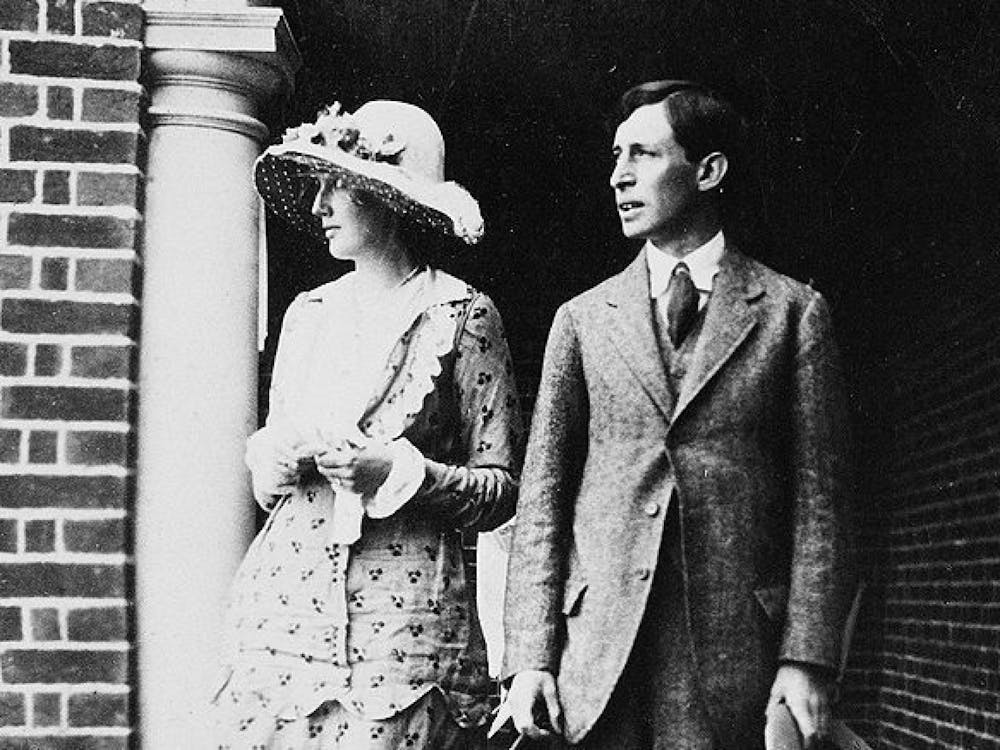
Rahul Dravid (image source: Wikimedia commons)
Wyllie adds that he has modelled his game on Rahul Dravid who inspires him to safeguard the wicket. He says:
“I idolised Rahul Dravid growing up. He values his wicket more than anyone. Growing up I modelled my game on him a bit when it comes to valuing his wicket and batting for long periods.”
Western Australian cricket team captain Sam Whiteman told ESPNcricinfo that Wyllie is an impressive player. Whiteman observed:
“He loves batting and is an impressive young man. He feels like he’s 28.”
Wyllie grew up in the regional city of Mandurah and earlier this year topped Australia’s batting at the Under-19 World Cup. He was also named in the tournament’s most valuable team.
India vs Pakistan cricket rivalry is well-known, in fact, one commentator even described the clash as “war minus shooting.” India’s first Test match against Pakistan was in 1952 and since then the two countries have played against each other in a number of formats. However, what is often not documented in the public arena is the number of people ready to make a good profit off this rivalry.
Ind vs Pak
Keeping in mind the popularity of ICC Men’s T20 World Cup 2022 which will take place in Australia from 16 October to 13 November 2022, the organisers have applied an 8-10 ticket purchasing limit.
“The maximum number of Matches in which tickets can be purchased is ten (10). In addition, an Event-wide ticket limit of 96 tickets per person will be imposed.”
If any person is found exceeding the stated ticket limit, their orders and tickets associated with T20 event will be cancelled without notice by the LOC or IBC at its discretion.
ICC T20 World cup Schedule
However, as the dates for the T20 Worl Cup draw near, many concerned Indian-Australian community members have noticed some original purchasers selling the 23 October 2022 India vs Pakistan tickets “300% above the stated selling price in black market through social media.”
Ind vs Pak
Virat Dev Chouhan (name changed on request), a member of the Indians in Melbourne Facebook group, told The Australia Today that he tried buying through the official channel but tickets “ran out in the first 5 minutes of being made available.”
He further adds that now people on social media “are trying to sell a $A20 ticket for $A400 and in some cases even $A500.”
(Representative social media posts offering the sale of already purchased tickets)
Mr Chouhan added that such people give various reasons for reselling their Ind vs Pak tickets but do not provide enough information regarding tickets or pricing.
He observes:
“Such people who are posting and trying to sell at a higher price often don’t put details such as the original price and which stand the ticket belongs to. These people only share this information after an interested person contacts them via social media.”
Further, Mr Chouhan believes that not everyone would be ready to pay $A500 for a $A20 ticket. He says, “I know people who have paid A$100 or are willing to pay $A150 for the $A20 ticket.”
(Representative social media posts offering the sale of already purchased tickets)
Saloni Varma Negi from Melbourne has a warning for such members of the public as this kind of selling is considered “fraudulent ticket scalping” activity in Australia.
Ms Negi wrote in the Indians in Melbourne Facebook group:
“For those who are selling T20 tickets to IND vs PAK match on the 23rd of October, at almost over 300% profits. This has been reported to the Department for further investigation. Screenshot Evidences has been submitted of tickets being offered with sellers details.”
Melbourne Cricket Ground (Image source: MCG)
Max Abbott, Media Manager for T20 World Cup, told The Australia Today that they have “not received any formal complaints, but we are aware of instances of some people and third parties illegally offering to sell tickets above face value.”
Mr Abbott says that they are aware that tickets for Ind vs Pak match “are in high demand” and this can “lead to some people or third parties taking advantage of genuine fans.”
He adds:
“We are fortunate to be able to host this match at one of the largest cricket stadiums in the world and we are proud of the fact that we provided a fair opportunity for fans who registered early with us to buy tickets before they were made available to the general public. This will help ensure the match is attended by as many genuine cricket fans and families as possible.”
Mr Abbott added that they will notify the Victorian Department of Jobs, Precincts and Regions, who have the ability to investigate and issue infringement notices if they are able to do so.
Members of the general public too can directly report such offences to DJPR:
“If you believe a ticket to a declared event is being advertised or sold for more than 10% above the face value of the ticket, or an unauthorised ticket package is being advertised, an Authorised Ticketing Officer can investigate and determine if an offence has taken place.”
Ms Negi observes that people who are genuinely interested in watching Ind vs Pak match suffer because of such shady practices.
She adds:
“There are people genuinely interested in attending these matches who can purchase them through the website. Also, I request – please do not purchase tickets from this platform. You are only encouraging black marketing and fraud.”
Mr Abbott says that T20 has launched the official ICC Men’s T20 World Cup re-sale platform for genuine buyers. This platform provides “a safe and secure way for fans to buy and sell tickets at their face value.”
He adds:
“The LOC also actively contacts relevant unauthorised resale sites when identified, requiring the removal of tickets listed on such sites. We are regularly encouraging fans to only buy tickets through the official ICC platforms as any tickets sold through unauthorised channels cannot be guaranteed. We are working with our ticketing provider Ticketek and the Victorian Government to monitor social media and third-party websites and will take action to cancel tickets that are in breach of our terms and conditions”
The concerned members of the community have been requested to only buy and re-sale their extra or unwanted tickets through proper channels.
Molina Swarup Asthana (Image source: supplied)
Molina Swarup Asthana, T20 World Cup Ambassador and Melbourne-based Lawyer, says she is sure that people “wouldn’t like to be on the wrong side of the law while enjoying much-awaited Ind vs Pak match.”
Ms Asthana warns:
“I would like to caution anyone who is reselling tickets for a major sporting event including the India vs Pakistan ICC T20 match to only do it through the official resale site. Not complying with legislation may land you into trouble and you may be charged for an offence.”
(ICC T20 World Cup launch event in Melbourne / Image source: Jitart Jai Bharadwaj)
Due to the popularity of cricket in Australia, all T20 cricket matches in Victoria, including Ind vs Pak, have been declared as a “Major Event” by the Victorian Government.
It must be noted that Victoria’s Major Events Act 2009 “protects fans from being ripped off by ticket scalpers and ensures that tickets to major events are available for everyone.” So, when the “government declares an event as a major event, it becomes illegal to sell or advertise for resale tickets for more than 10 per cent above face value.”
Mr Abbott says that under this Act it is illegal for a ticket to be resold or advertised for resale. He warns that breaching this Act can result in heavy fines up to $110,952 for an individual and $554,760 for a company and purchasing a ticket from an unauthorised seller can also result in the ticket holder being denied entry to the T20 event.
Divyangana Sharma has won the coveted Victorian Premier’s Award – International Student of the Year 2021-22.
A special congratulations goes to Divyangana Sharma who has won the coveted Premier’s Award – International Student of the Year! What an outstanding achievement! #VIEAhttps://t.co/5OUATtmjYapic.twitter.com/0Q2I3Ak9PE
Divyangana came to Melbourne to study nursing at Holmesglen Institute in February 2020.
She has also won Victorian International Education Awards 2021-22 in the Higher Education category.
The Victorian International Education Awards 2021-22 Higher Education award goes to Divyangana Sharma who is studying a Bachelor of Nursing at @holmesglen. Congratulations Divya on this incredible achievement ! 🎉 #VIEAhttps://t.co/5OUATtmjYapic.twitter.com/Zn02rqWfQR
During the COVID-19 crisis, she joined the frontline healthcare workforce by working at pop-up COVID-19 testing sites between classes.
She says:
“The cultural diversity, inclusion of LGBTQIA+ community, education opportunities, art and culture is what makes Melbourne a unique city and works like a magnet for people wanting to study abroad.“
Divyangana was also named the International Student of the Year at Holmesglen Institute, which also nominated her for the World Federation of Colleges and Polytechnics’ Outstanding International Student Award.
Ritika Saxena won the International Student of the Year award in the Research category.
Congratulations to Ritika Saxena, our Research category winner at the Victorian International Education Awards 2021-22! A stem cell researcher who did an undergraduate degree at @Deakin, Ritika is undertaking a Doctor of Philosophy at @UniMelb. #VIEAhttps://t.co/5OUATtmjYapic.twitter.com/siZAPUlA2C
Ritika moved to Melbourne as an 18-year-old and is now a PhD student involved in stem cell research. She won the Melbourne Medical School’s Research Symposium 2021 Image Contest.
She says:
“When you move to Victoria, you are an international student. But by the time you finish your degree, you will be truly global.“
Ritika has developed the ability to set up complex and exciting experiments to help search for the elusive apex rare haematopoietic stem cell. She is also a part of the Novo Nordisk Foundation Centre for Stem Cell Medicine (reNEW). Her aim is to one day have her own research group and help patients who need a bone marrow transplant.
Congratulations to all finalists for this year's Victorian International Education Awards. We are so proud to celebrate the changemakers in Victoria’s unique and diverse international student community through these awards. Learn more about our finalists: https://t.co/yNBfqcptvMpic.twitter.com/hR26g2tzi9
Victorian Premier’s international student awards recognise and showcase exceptional Victorian international students and alumni who champion international education in Victoria and across the globe.
Image source: Gonul Serbest (LinkedIn)
Gonul Serbest, Chief Executive Officer of Global Victoria, congratulated all the finalists and winners in her LinkedIn post:
“So wonderful to come back together for the Victorian International Education Awards and recognise and celebrate excellence amongst Victoria’s international students and sector. A great opportunity to shine light on their inspiring contributions to our community and academic performance and leadership. A huge congrats to all our finalists and winners.”
These awards are an initiative of the Victorian Government to celebrate outstanding international students and education providers in Victoria. Further, these awards recognise the Victorian Government’s commitment to the education sector and leadership in our community.
Award winners in each student category, with the exception of the International Alumnus of the Year, are awarded $6,000 each to support their studies and up to two runners-up per student category are awarded $2,000 each. The recipient of the ‘Premier’s Award – International Student of the Year’ receives $10,000 to support their studies.
There are only two things you’re likely to encounter in India as much as Delhi belly: ubiquitous copies of Gregory David Roberts’ best-selling 2003 novel Shantaram in hostel lobbies and Swiss bakeries and, as noted in the book, constantly “being stared at with the […] almost accusatory censure of those who’ve convinced themselves they’ve found the one true path”.
Based on Roberts’ own life, Shantaram tells the story of Lin, an armed robber on the run with a false passport. Lin ends up in a Bombay slum and is adopted “like a son” by a mystic Afghan mafia boss before becoming a gun runner to Africa and a mujahedeen (guerrilla fighter) in Afghanistan.
Roberts’ semi-autobiographical character Lin calls himself “gora chierra, kala maan”: white on the outside, but full Hindustani on the inside. Despite this, Shantaram perpetuates the Orientalist fantasies that much of Western art does when depicting India and Indians.
Shantaram raises important questions about what author Vikram Chandra called the “cult of authenticity” in which too often, representations of India are artefacts of heightened or caricatured “Indianness” – designed to appeal to Western audiences.
It’s what I’ve called in the past the “mango novel”: increasingly familiar mirages of magical-realist wonders and colourful terrors in places at once enticingly and reassuringly distant (think of David Davidar’s novel The House of Blue Mangoes or Arundhati Roy’s The God of Small Things, set in a mango pickle factory.)
The Indians in Shantaram don’t vary much from the stereotypes, constantly needing Lin’s help and “revealing” the true nature of India through their simplicity, generosity and poverty.
Like Elizabeth Gilbert’s Eat Pray Love or Liam Pieper’s recent Sweetness and Light, featuring similarly troubled spiritual tourists, the “natives” exist in the background or through the tour bus windows, India and its people merely a set and props for Lin’s journey to enlightment.
What had seemed unimaginably strange and remote […] suddenly became […] comprehensible and fascinating […] the flare of shame I’d felt when I first saw the slums and street beggars dissolved in the understanding that they were free […] the city was free. I loved it.
Literature is self-validating […] a book is not justified by its author’s worthiness to write it, but by the quality of what has been done. There are terrible books that arise directly out of experience, and extraordinary imaginative feats dealing with themes which the author has been obliged to approach from the outside.
Ontological questions about whether it’s fact or fiction, or who wrote it or where they’re from, shouldn’t matter as long as the writing’s good, such as in American author Katherine Boo’s profoundly affecting 2012 account of Mumbai’s slums, Behind The Beautiful Forevers.
Shantaram, however, is burdened by self-indulgent writing, cluttered with unrealistic, extraneous, often forgettable characters, strangled by meandering digressions, and addled with expository dialogue and perplexingly obvious aphorisms on the nature of life, or love, or – of course – India itself.
“This is not like any other place,” Roberts writes. “This is India.”
[It has] more in common with Oprah than Proust, and most readers with a shred of intellect or self-respect […] will cringe at [how] large chunks […] resemble the snake oil of the self-help industry.
According to Roberts, in the decade between Shantaram and its sequel, he “offered [his] writer’s perspective and writer’s skills to several NGOs, and worked in human rights, social justice, the environment and health issues.”
After The Mountain Shadow achieved neither the commercial success or critical acclaim of its predecessor, Roberts stepped back from public life, and embarked on what he calls “the spiritual path,” shaving his head, applying Hindu spiritual markings, foregoing shoes and donning Indian hermetic robes.
Making notes on his guru’s teachings, Roberts wrote an eponymous book, The Spiritual Path, featuring florid, cod-philosophical epigrams similar to those that choked his novels, such as “honesty is the river flowing into the sea of Trust” or “success is the full expression of personal fulfilment”.
He recorded a reggae album, Love&Faith in Jamaica (featuring collaborations with Jamaican artists), released in December 2020, and has increased his focus on music since. A plethora of releases with titles such as Good Morning Morning and Deep SurRender (music to play while your project is rendering); a playlist called Shantaram House, and featured artists on his website including Scantana, “the man with the most grammar”, suggest literature’s loss is music’s loss too.
Fixing the novel
Great literary fiction is often unfilmable because the kinetic range of the camera can’t capture the affective tone of the narrator’s voice or the author’s use of language.
But in Shantaram’s case, it’s possible being transposed to the screen and focusing on the action, rather than the cod-philosophy and over-description, might actually address the inherent vices in Roberts’ book.
skim the pages rapidly, and you will get a fine thriller… Read it sincerely, and you will find a man trying so hard to be, if not the Buddha, at least a rock ‘n’ roll Jesus figure, that it is irritating. Open the book randomly, and you will find a Paulo Coelho with a snub-nosed automatic …
The new TV series is co-created, written and executive produced by showrunner Steve Lightfoot, with Bharat Nalluri directing and executive producing. Two initial episodes directed by Australian Justin Kurzel (Snowtown, Nitram) were reportedly considered too dark.
One hopes it will interrogate and subvert those persistent Orientalist, white saviour tropes, although with a trailer focusing on the white characters, who enjoy moody close ups as faceless Indians swarm in the slummy background, and with dialogue that’s as forced and wooden as the book – including Hunnam’s unconvincing Australian accent – it doesn’t promise any great improvement.
For as Deb writes,
a jailbird troubled by B-grade questions about life and the universe found India —in a very limited sense — in south and central Bombay. Then he found spirituality, with two knives hidden up the back of his shirt. And then he asks: What do you want from me, India? Mr Roberts, India doesn’t want anything from you. Write books, make money, get stoned, babble about nirvana, love the debauched expat life. India accepts you. We are not one, but we are us.
The first three episodes of Shantaram’s 12-episode first season will air on Apple TV on Friday, 14 October, 2022.
The India men’s cricket team, led by Rohit Sharma lands in Perth, Australia for the upcoming ICC Men’s T20 World Cup, starting from October 16.
After failing to get past the quarterfinals in 2017, the 2007 champions will try to claim the trophy this time around. Team India was able to generate some momentum before the World Cup winning the bilateral series against Australia and South Africa.
Indian Cricket Players; Image Source: BCCI
The social media accounts of the Board of Control for Cricket in India (BCCI) posted a picture of the entire Team India contingent departing for the T20 World Cup.
“Picture perfect, let’s do this #TeamIndia. @cricketworldcup here we come,” BCCI tweeted.
The T20I series between India and Australia and South Africa may have ended in victories for India on home soil, but there are some serious issues as the team prepares to compete in the T20 World Cup in Australia.
Jasprit Bumrah was ruled out of the four-week tournament on Monday with a back injury and will stay home in India while his teammates travel Down Under for the showcase event.
Bumrah was initially named to spearhead India’s attempt at winning a second T20 World Cup crown and his absence is expected to hamper their chances of adding to the title they won in 2007.
The BCCI is yet to name a replacement for the right-arm, although fellow seamers Mohammed Shami and Deepak Chahar are among the players already on standby for the tournament. Before starting their World Cup campaign India will play a couple of warm-up fixtures against Australia and New Zealand.
They will begin their T20 World Cup campaign against arch-rivals Pakistan on October 23 in Melbourne.
Analysis of data from the Australian Bureau of Statistics (ABS) shows that migrants from the Indian subcontinent who take permanent residency (PR) and citizenship have a strong hunger for university education.
The children of these migrants have helped increase Australia’s national average university participation rate.
Andrew Norton, from the Australian National University (Image source: ANU website)
Andrew Norton from the Australian National University notes in his analysis that the “highest uni participation language groups are now from Southern Asian countries rather than Mandarin and Cantonese.”
The highest uni participation language groups are now from Southern Asian countries rather than Mandarin and Cantonese. pic.twitter.com/28atA5RcVt
Norton’s analysis reveals that more than 80 per cent of 18- to 20-year-olds who speak Malayalam, Bengali, Gujarati, Sinhalese, and Tamil at home attend university. Comparatively, Urdu, Hindi, and Punjabi speakers attend at rates of 75 per cent, 74 per cent, and 72 per cent respectively.
Other Asian language groups such as Indonesian at 69 per cent, Vietnamese at 66 per cent, Japanese at 62 per cent, Filipino at 58 per cent and Tagalog at 57 per cent also show good university participation rates.
Indian university students (Image source: CANVA)
According to ABS, in 2021, more than 80 per cent of 18- to 20-year-old migrants from five Asian-language backgrounds were studying for a degree. This was way higher when compared to 32.5 per cent of those born in Australia and who spoke English at home. Also, only 35 per cent of young people who are born in Australia go to university while the figure is 59 per cent for those who arrived between 2001 and 2010.
Image source: andrewnorton.net.au
Norton believes that the high university participation rates amongst Indian migrant communities is because most parents came to Australia on skilled visas and hold university education in high regard. He observes:
“Possible reasons include high rates of family arrival through the skilled migration program, creating the usual association between the education of parents and children, and cultural attitudes favouring higher education.”
Dr Ritesh Chugh from Central Queensland University says prior research studies also have found that migrants place a high value on education. He adds:
“As a validation, the educational aspirations become evident through the ABS data that demonstrates strong participation rates in university-level education. In addition, there is a correlation between higher education learning and earning, which inspires migrants to complete tertiary education. Furthermore, through university education, these groups contribute not only to their own financial success but also to Australia’s prosperity.”
Norton’s analysis looks at university participation and doesn’t include vocational education participation rates.
Ramleela and Dussehra festival’s Ravan Dahan is among the most memorable festivities for a lot of Indian Australians.
Annual Dussehra festivities at Sri Durga Mandir in Melbourne will be held on Sunday 9th October. Elaborate arrangements have been made for the grand celebrations at the temple premises. The festivities will begin with traditional rituals and conclude with fireworks and Ravan Dahan at 8 pm.
Dussehra is an annual Hindu festival celebrated across the world to signify the victory of good over evil, symbolised by the slaying of the demon King Ravan at the hands of the Hindu God Sri Ram.
Dussehra, also known as Vijayadashami is one of the biggest festivals observed by the Hindu community. It is celebrated at the end of Navratri, on account of which the date changes every year. Under the Hindu calendar’s month of Kartik, this festival will be observed on the 10th day of this month.
Sri Durga Temple Dussehra; Image Source: Supplied
Every year Indian Australian community has enjoyed Sr Durga Mandir’s Ravan Dehan and Ramleela, however, due to the pandemic last two years were low-key festivities.
Kulwant Joshi is the President of the Sri Durga Mandir management committee.
Sri Durga Temple Dussehra; Image Source: Supplied
He told The Australia Today, “With no restriction after two years, we are ready to welcome all devotees and make them immerse in traditional food, music and different performances.”
“Our Ramleela is derived in such a way by fantastic volunteer artists to educate the new generation Hindu kids about their culture,”
added Mr Joshi.
Sri Durga Temple Dussehra; Image Source: Supplied
Mr Joshi quips, “Young children are the ones who will be the happiest to attend Dussehra festival as rides, food and lots of games are there to keep them engaged.”
This year, the temple committee has made substantial preparations for crowds to congregate and park their cars as almost 18,000 people are expected to attend the festivities throughout the day.
Mr Joshi says, “We have made extensive arrangements for car parking, however, we request everyone to follow the directions of traffic controllers for convenient entry and exit.
Sri Durga Temple Dussehra; Image Source: Supplied
The Star of the festival will be a giant cut-out effigy of Ravan, which will be burned as a symbol of evil. This will be followed by extensive fireworks displaying colours of hope, success and prosperity.
By Ariadna Matamoros-Fernández and Aleesha Rodriguez
We live in deeply unequal societies where certain groups, such as racial and sexual minorities, continue to experience structural oppression. Humour targeted at these groups can cause individual harm through its cumulative effects, and contribute to broader social harms too.
Much of our social interaction today takes place online. So it makes sense that significant attention is paid to issues such as online hate speech, harassment and misinformation.
However, a more challenging problem is the conduct of users who aren’t necessarily trying to harm others, but still participate online in ways that can do so. For example, TikTok users have participated in viral parody challenges that trivialise police brutality, domestic violence and even the Holocaust.
The COVID-19 health crisis pushed digital platforms to curb the spread of misinformation, but it seems they did less to minimise anti-Asian content – despite signs the pandemic was being “racialised”.
In our research, we investigated how the “humorous” racist stereotyping of people of Asian descent emerged on TikTok during the pandemic, and how such behaviour should be addressed.
TikTok and racial humour
TikTok has become hugely popular across generations. Its “use this sound” feature allows users to remix audio from other videos, making it a unique platform to study racist stereotyping.
For our research we collected TikTok videos posted from January to June in 2020, with the hashtag #coronavirus, and other hashtags relevant to our research (such as “#asian” and “#funny”, for example).
We also included videos tagged with keywords related to China (#china, #chinacoronavirus, #wuhan) and with #Australia, to potentially collect examples from within the country (which has a history of anti-Asian racism).
Once we removed duplicates, unavailable videos, and videos in a language other than English, we obtained a dataset of 639 TikTok videos. After closely analysing these, we found 93 videos displayed examples of racist humour.
‘Yellow peril’ memes
Among the videos were “yellow peril” memes. These were about people or objects being “contaminated” with coronavirus by extension of their connection to China, or other Asian countries. The “yellow peril” trope dehumanises people from Asian countries by posing them as a threat to Western countries.
Three types of “yellow peril” memes were noticed in our sample:
memes targeting people of Asian descent as being the cause of coronavirus spreading
memes where people react in horror or disgust when they receive packages or goods from China
memes that blame the coronavirus on practices such as eating wild animals.
“Digital yellowface” parodies
We also found a form of “digital yellowface”. In these videos users applied the “use this sound” feature to parody Asian accents in English or say “Asian sounding words” by speaking gibberish, or words like “Subaru” (the Japanese car brand) in an exaggerated way.
Some users dramatised their face to further embody the offensive caricature they were trying to portray.
Scholars researching racist stereotyping online have warned that “certain dialects, vocal ranges, and vernacular are deemed noisy, improper, or hyperemotional by association with blackness”.
During COVID-19, non-Asian users appropriated “Asian sounds” on TikTok in a similar way. They portrayed people of Asian descent as irrational or overly emotional, reducing an entire racial group to a mere caricature.
Actor Mickey Rooney did ‘yellowface’ in the 1961 film Breakfast at Tiffany’s – a depiction that’s now rightly considered very racist. Wiki Commons
What has TikTok done?
TikTok has enabled users to willingly or unwillingly contribute to racist discourse that dehumanised Chinese people, and other Asian people, over the course of the pandemic.
We are not claiming a direct causal link between this racist stereotyping and real-world violence. But research has shown attaching an illness to an historically marginalised group has immediate and longer-term negative social effects in societies.
Although TikTok joined the European Commission’s Code of Conduct on Countering Illegal Hate Speech Online in 2020, its policies still do not provide a detailed explanation of when humour can have the capacity to harm.
To improve the moderation of harmful humour, TikTok could modify its community guidelines and reporting processes to acknowledge the way humour targeted at historically-marginalised groups can have severe consequences.
This would be similar to Facebook’s expansion of its hate speech policy in 2020 to include harmful stereotypes (which came after the platform consulted with advocacy groups and experts).
TikTok’s moderation of racialised harmful humour doesn’t necessarily have to entail takedowns and user bans. There are several other remedies available. The platform could:
educate users by tagging or labelling dubious or potentially harmful content
reduce the visibility of content through algorithmic demotion
restricting engagement functionalities on “humorous” content that’s likely to cause harm.
One thing’s for sure: we can no longer excuse racism under the guise of humour. Beyond individuals, social media platforms have a responsibility to make sure they address racist humour, since it can and does cause real harm.
29-year-old Adelaide man Raman Sharma has admitted that he tried to deliver drugs into a medi-hotel during the COVID-19 pandemic period concealed in food delivery bags.
In Adelaide Magistrates Court he pleaded guilty to possessing opium and heroin. He also pleaded guilty to intending to supply those drugs to another person.
Raman Sharma; Image Source: ABC News
The magistrate granted Mr Sharma bail and he shall be back in court in November.
In October last year, Police issued a statement saying that there were no food receipts in the bags when searched and a small amount of heroin and others drugs were recovered.
Mr Sharma was working as a food delivery person to the people quarantined at the hotel. However, his bags were searched by SA Police as routine protocol.
Indian-origin Neeru Samota has won two Silver medals in Runway Model and Bikini Angels event at the I ICN Victorian Muscle and Model Championship 2022.
ICN Victorian Muscle and Model Championship 2022 (image source: ICN Victoria)
Neeru told The Australia Today that this was one of the biggest bodybuilding shows since Covid with 732 entrees in the competition. She adds:
“First of all, I would like to thank every single person who encouraged me through this journey, supported me, and was kind to me. All those people who I don’t know personally, but they would send kind messages or stop at public places to say, “They are proud of me”! I am grateful to my amazing family, friends, and my coach, Manoj Mukunda, who is truly my Guru – guiding me through tough times. And yes, of course, the biggest appreciation to my partner, Rahul, and my daughter, Arya, who is always there for me, cheering, smiling, and running nonstop with me.”
Last year, Neeru won two Gold medals in addition to scoring 2 third places and 3 fourth places at the I Compete Natural (ICN) event held at the Moonee Valley Race Club in Victoria.
Neeru Samota with Arya (Image source: Facebook)
With this win, Neeru has now won 55 Medals and Achievements in bodybuilding. She observes proudly:
“This is a win for all of us and it would have been impossible without the amazing support that I have received.”
Neeru Samota (Image source: Facebook)
Neeru says that by following her passion for bodybuilding, she is also trying to inspire other women from multicultural backgrounds to step forward and think about both physical and mental well-being. She adds:
“I do this as a mum and definitely understand how challenging it is to prioritise yourself. I do this to inspire other mums to look after their physical and mental health. We, mums, are the core of the family and our kids are watching us. They learn by observing and doing what mums do, not what we tell them to do. If they see mums prioritising their mental & physical health, they will understand the importance of it and do the same for them growing up. If I am able to get all the mums to stop and think about their own health, my job is done.”
Neeru Samota (Image source: supplied)
ICN is a professional organisation that promotes best practices and innovation “to protect and serve the drug-free competitor, on a truly level playing field.”
“Our Motto has always been to “Serve and protect the Natural athlete”. We hope to do this while providing every competitor with a world-class and unique experience so you will remember and cherish your time with us. As part of our commitment to you.”
Neeru Samota (Image source: supplied)
Neeru says that her future plan is to keep inspiring and keep working with other mums as a Fitness Coach. She adds:
“I now have my own studio gym at home where mums from diverse cultural backgrounds can bring their little ones with them and make the most of it. As a young mother, I understand it’s hard to leave little bubs and come out to exercise. Therefore, I am trying to make it a little easier for mums to do it.”
Neeru is planning to compete in the ICN World Championship which will take place in Prague in November 2022.
There’s a climactic scene in Helen Garner’s third and latest diary where she describes tipping a box of her then husband’s cigars into a pot of soup, picking up a pair of scissors, slashing a straw hat that belongs to his lover and stuffing the pieces in his “ugly black suede shoes.” In her husband’s study she finds his latest manuscript:
I wrench the cap off his Mont Blanc fountain pen and stab the proof copy with the nib, gripping the pen in my fist like a dagger. I stab and stab, I press and screw and grind.
This scene of kitchen sink carnage comes after days of diary entries where Garner – the great observer of the smallest details – carries on blind (wilfully? self-protectively?) to what is staring her reader in the face: a novelist husband who is spinning fictional stories both to her and to his lover. It’s a cathartic moment for everyone. As if Garner had called her readers inside the bladder of a dark balloon, blown it up as taut as it could stretch, and then finally punctured the sides so fresh air can come screaming in. We can breathe again.
Something else struck me as I read this scene, which takes place in the mid-1990s: how Garner’s words echoed another scene about men and knives and stabbing she wrote and performed almost 25 years earlier, in 1972.
With men I feel like a very sharp, glittering blade that’s only partly out of its sheath.
It glitters and glitters.
They don’t see it, but I don’t dare to show that blade, to come right out of the sheath, because I’m afraid of how fierce and joyful it will be to stab – and stab – and stab. So I don’t show it, I hold it, somehow I hold it back, but it’s there, glittering.
These lines are from a group-devised woman’s play, called Betty Can Jump, staged at Carlton’s experimental Pram Factory theatre in that year. A friend of Garner’s from university, Kerry Dwyer, was one of the founders of a theatre company based at the Pram Factory, the Australian Performing Group (APG).
Dwyer organised women from the APG, together with those from the Carlton Women’s Liberation Group, who were meeting in Garner’s share house, to build sets, make costumes and run the front of house while Garner and four other women – Claire Dobbin, Evelyn Krape, Yvonne Marini and Jude Kuring – workshopped scenes under Dwywer’s direction.
In closed workshops in the Pram’s back theatre, the cast explored how they felt as women, using consciousness-raising techniques from women’s liberation, and physical exercises and improvisations adapted from avant-garde theatre groups.
As I read and reread many of Garner’s books recently, I started seeing knives and blades everywhere. Nora, the narrator of Garner’s 1977 novel Monkey Grip, describes how, after a perfunctory encounter with her careless lover Javo, she grabs a bowie knife and fantasises about “plunging it into the famous handsome picture of him in Cinema Papers”.
In another entry in Garner’s latest diary, Garner offers up to her father her most recent book. He criticises her author photo (it made her “look old”), then he takes a blade he is holding, turns the book on its cover, and demonstrates how to sharpen a knife against a stone.
I started to notice, too, other objects that keep reappearing in Garner’s work. She frequently introduces characters by describing their shoes, for example, like actors in a play walking on stage.
The diary scene where Garner stuffs her husband’s shoes with the remnants of a slashed hat brings these repeating objects together. The scene also vividly dramatises one of Garner’s other great concerns: the conflict between love and passion and individual freedom.
‘Who will bring in a cup of tea?’
In the Carlton world Garner inhabited in the 1970s – an inner-city Melbourne community of actors and artists and activists – jealousy and possessiveness was frowned upon while open free relationships were encouraged writes Ponch Hawkes, a photographer who documented the Pram Factory world.
In Monkey Grip, as Garner’s fictional surrogate Nora visits the Tower household that adjoined the Pram’s theatre and office space and the share households of her inner-city community, she constantly steels herself for the possibility of seeing her lover Javo emerge from another woman’s bedroom.
People, Hawkes writes of this time, “couldn’t say they were very hurt, or act hurt [when they] had to see you the next day, or the same day, in the hall.” They had to “wear it”.
For many who were part of Australia’s social and cultural revolutions of the early 1970s – especially the denizens of the inner-city bohemia like Garner and her friends – the women’s movement and sexual liberation were so entwined they could not be understood separately.
In 1971 and 1972, Garner and Dwyer and the women rehearsing at the Pram Factory were developing a critique of the traditional, heterosexual, nuclear household. They were influenced by their reading of books such as Virginia Woolf’s A Room of One’s Own, The Female Eunuch, in which Germaine Greer argued the liberation of individual women had to begin with their sexual liberation (and satisfaction), and feminist journals and books from overseas – including the Boston Women’s Health Collective’s Our Bodies, Ourselves, a pamphlet urging women to understand their bodies, explore their sexual desires and control their reproductive lives.
Helen wrote another monologue for Betty Can Jump called “What is a woman?”.
You want me to mother you, you want to worship me and make a goddess of me but I disgust you, you loathe me because of the dark wetness of my most secret place …
You expect me to find meaning in my household tasks, my hands in water and children’s shit, my back bent in your service, my mind flabby from constant distractions, but when I interrupt your recital of the day’s woes or try to speak of my daily frustration or pleasure I must hear my work dismissed as trivia, and my concern for my children called an obsession.
Pram Factory poster (created by Micky Allan). Image courtesy of the State Library of Victoria.
Twenty-five years after Garner performed this monologue, Garner’s diary entries from the 1990s describe her then husband dismissing her anxieties, making light of her worries, and calling her concerns trivial.
She leaves the house each morning to accommodate his demands for complete solitude while he works. She returns home in the evenings from her own writing labours, with food and hours left in her day to cook for the both of them.
He, a novelist, belittles her non-fiction writing as a lower-order craft. And he criticises her close relationship with her daughter and extended family.
Garner’s life during this period eerily echoes the one her good friend Micky Allan – a painter who created the sets and slides that formed the backdrop to Betty Can Jump – had lived quarter of a century earlier.
Allan attended her first consciousness-raising meeting in Melbourne the day she had split with her husband, a talented artist but someone whose ideas about men and women’s roles were formed in the 1950s.
When I visited her in 2018, Allan told me the story of their time sharing a flat, earlier in London, where she rose early and left in snowy weather to work as a relief teacher, leaving their home to her husband and his art.
I had a little cupboard off the kitchen which was my studio, and he took over our living room as his. When I came home in the afternoon, I couldn’t get in without him making a big fuss about having to move a giant painting blocking the door.
He had asked her why she needed to paint: “If you’re painting too, who will bring in the cup of tea?”
A reaction to frustrations
Betty Can Jump is named after a 1951 children’s reader produced by the Victorian Education Department in which a boy called John plays with his truck and dog, and Betty plays with a toy pram and her cat. The play was a reaction to frustrations the women were feeling in their personal and professional lives. Helen was feeling left out and lonely while her husband Bill spent more and more time at the Pram Factory. Kerry, newly pregnant, was feeling increasingly sidelined in the the APG.
Kerry Dwyer recalls the day she stormed out of rehearsals for the APG’s first Pram Factory show, Marvellous Melbourne. It was meant to be a group-created show, but she was enraged at the way the men in the APG dominated the production. While the Marvellous Melbourne cast included equal numbers of women and men, scenes “arrived in the rehearsal room with five parts for men, none for women [or] seven parts for men, one for a woman”. Why are women in the theatre considered incapable of writing? she fumed. Or directing? Why is female culture not respected and nurtured?
The women spent five months devising Betty. One man attended the first planning meeting, bringing a couple of plays he’d written. The women asked him to join the large circle for general discussions, but instead he stormed around the edge shouting: “Damnitall! I don’t know how you are going to achieve anything at all if you won’t accept help and advice from us”.
The rehearsal room was then closed to men – until they realised they needed an actor to play the male roles. So Perth actor Vic Marsh was invited to take part.
In the opening scene, Marsh whips the women, who play convicts emerging from a ship’s hold. The cast re-enact riots in early female factories, and tell stories about suffragists Louisa Lawson and Vida Goldstein and other women who had been largely ignored by an Anglo, male history. They also deliver intimate monologues written during rehearsal exercises, where each cast member has to complete the phrase “As a woman I feel like …”
Helen delivers her scene where feels like a sharp, glittering knife.
Evelyn feels like a cushion plumped up and sat in.
Yvonne feels like a mouth filled with laughing gas.
The lights go out and the cast talk about their bodies and blood and sex and rape. In another scene, the cast don jockstraps and fake penises and mock ocker men drinking at a pub. (Ockers featured in many plays written by APG men.)
This was the first play of the 1970s women’s liberation movement, part of an extraordinary period of social change. In just a few short years, a generation of women led a transformation of our social and cultural life. It’s easy to forget just how different the early 70s were: there were still separate columns in the paper advertising jobs for “women and girls” and “men and boys”. Many public bars still banned women. Not one of the 125 electorates across the country was represented in Canberra by a woman.
As I researched the play and these times, however, I thought about that other definition of revolution: a movement around a circle. I saw how feminism so often keeps rehearsing and staging the same battles. There is a scene in Betty, acted in the dark, where a character taunts a woman: “Got the rags on, have you?”. Fifty years on, I found myself talking to teachers recently about a group of primary school boys allegedly harassing girls with “jokes” about rape, and taunts about being “on their periods”.
These circlings are not unconnected, I thought, to the way in which we forget, or repress our history. Both individually and collectively.
For a long time, my image of the Pram Factory had centred on the male playwrights David Williamson and Jack Hibberd and actors Graeme Blundell and Bruce Spence. Don’s Party and boozing ocker men.
I discovered the stories of women at the APG in the archives at the State Library of NSW, where Dwyer had deposited her production diaries – her own diary, with notes of rehearsals and descriptions of the cast, as well as Garner’s production diary, with stage directions and script notes in a neat pink slanted cursive script.
Dwyer’s archive also contained interviews she conducted with cast members and with Micky Allan and the play’s researcher, Laurel Frank.
Just as I hadn’t known about the history of women’s theatre at the Pram, Frank and another woman, Kay Hamilton, had turned to archives – at the State Library of Victoria, and the NSW Mitchell Library – to discover stories of colonial women’s settler history. The researched Female Factories, stories of auctions where convict women were sold off, they researched politicians and women’s rights activists such as Vida Goldstein and Caroline Chisholm. The play’s focus is on non-Indigenous women, something that might seem a glaring oversight to contemporary readers, but Kerry tells me:
We were not so much blind to the lives of Indigenous women, it was more that we were catching up with ourselves.
A huge success
In 1972, after a shaky preview night of their women’s show – Garner, in an account of the play she wrote in 1972 for the journal Dissent, recalled thinking the APG men watching the show were “stony-faced” – Betty Can Jump turned out to be a huge success.
Women who saw the show laughed and cried, performances sold out, the four-week season was extended for two more weeks. While not all of the APG members praised the play – Hibberd called it “mawkish and sentimental” – the Pram Factory shows did slowly being to change.
The company began exploring women’s issues in plays and appointing women directors. Although the APG always styled itself as a radically democratic organisation, more emphasis began to be placed on what was often described by left political groups in the 1970s as “shitwork”, such as taking minutes and cleaning toilets and kitchens.
APG minutes show the group organised childcare for mothers performing in shows. In 1974, the Melbourne Women’s Theatre Group moved into the Pram, and they would stage dozens of women’s shows over the next four years. Theatre critic Suzanne Spunner wrote that in 1978 in Melbourne, “Everywhere you turned it seems there were plays by and about women wrote”, listing women’s shows at La Mama, Russell Street theatre, the Comedy Theatre and at the Pram Factory.
Revolutions
When I interviewed Garner about the time she made Betty Can Jump and these revolutionary years (Helen was active in the abortion rights movement, and women in the Betty collective ran through Moratorium marches doing street theatre dressed up as Viet Cong), she described the sensation of discovering women’s liberation as an epiphany.
I felt as if I’d been underwater for my whole life. And now for the first time, I’d stuck my head out of the water and taken a breath … looking around and thinking: ‘Now I get it. Now I get why my life is such a mess and why I’ve been so unhappy and wrecked everything’.
She also thought it would be easy to change.
Once I got the sort of basic gist of feminism – or women’s liberation as it was called then – I thought, ‘Oh, now I understand everything, and everything’s going to change, because all we have to do is just say to men: “This is what’s the matter, and if we could just do this, and if you could just do that” …’ And I really thought that was going happen.
She now reflects, in the context of MeToo:
Some things might change, but there’s stuff about men and sex and women that are just not amenable to social control, and never will be.
In Garner’s latest diary, as her third marriage disintegrates, she laments some lack in her that makes her a failure at marriage. But when she documents the failure of heterosexual marriage and monogamy in her diaries, they don’t read to me as proof of her own personal flaws, but rather as proof of a systemic flaw in the heterosexual, nuclear set-up. As a vindication of the 1970s ideal of the Pram communalism and the collective ideal (if not always the practice) of women’s liberation.
Garner was already known for her brilliant letters before she was cast in Betty Can Jump, Dwyer has noted, but the play was the first time she wrote for a public audience. Dobbin described the way she took on a role that was akin to a dramaturge, someone who could “take big ideas and reduce them to a human personal scale”. Garner wrote some of the play’s most affecting and effective scenes. The collective experience, and the visceral responses of audiences, was an important part of her development as a writer.
When Dwyer emailed me to apologise for her messy archives (they were, in fact, a goldmine of material that left me constantly amazed at her prescience in keeping them), I thought about how it can take more than a lifetime for us as women to shake off our proclivity for apology.
And I realised, when I recently began meeting on Sundays with a group of women from my neighbourhood – a visual artist, a filmmaker and children’s author, two musicians, a teacher, a journalist and a public communications expert – that we were reinventing the consciousness-raising circle.
Betty Can Jump was never performed again. Dwyer described it to me a “pastiche” that would be difficult to reproduce. “It was a very complex show. There were slides, there were puppets. We just flung everything at it […] It was a very, very dense show.”
Although Dwyer tells me “not very much of [the script] was written down”, when I comb through the APG archives at the State Library of Victoria, I find a stapled document that appears to be a near-complete script for the play.
Still, unlike books, theatre is an ephemeral art form. Just as the story of women at the Pram Factory has been overshadowed by the story of men, the story of the collectively created plays and short films and bands that were part of the cultural renaissance of the women’s liberation movement, has not been well recorded. There is no star author to help sustain their afterlife in our historical memory.
But understanding our history, and our patterns – individually, collectively, historically – seems to me a pre-condition for escaping the revolutions that take us around in circles, and into the kind of revolutions that take us somewhere else.
The Reserve Bank of Australia has decided to increase the cash rate target by 25 basis points to 2.60 per cent. It also increased the interest rate on Exchange Settlement balances by 25 basis points to 2.50 per cent.
The cash rate has increased substantially in a short period of time of 6 months. Reflecting on this, the RBA board decided to increase the cash rate by 25 basis points this month as it assesses the outlook for inflation and economic growth in Australia.
RBA governor says, “We are committed to returning inflation to the 2–3 per cent range over time.”
“Today’s increase in interest rates will help achieve this goal and further increases are likely to be required over the period ahead.”
Reserve Bank Of Australia; Picture Source: @CANVA
A further increase in inflation is expected over the months ahead before inflation then declines back towards the 2–3 per cent range.
The Bank’s central forecast is for CPI inflation to be around 7¾ per cent over 2022, a little above 4 per cent over 2023 and around 3 per cent over 2024.
Higher inflation and higher interest rates are putting pressure on household budgets, with the full effects of higher interest rates yet to be felt in mortgage payments. Consumer confidence has also fallen and housing prices are declining after the earlier large increases.
How much extra will your mortgage be each month?
Melbourne-based finance solutions specialist Mark Unwin explains.
“Unless you’re on a fixed-rate mortgage, the banks will likely follow the RBA’s lead and increase the interest rate on your variable home loan soon.
Let’s say you’re an owner-occupier with a 25-year loan of $500,000 paying principal and interest.
This month’s 25 basis point increase means your monthly repayments could increase by almost $75 a month. That’s an extra $685 on your mortgage compared to May 1.
If you have a $750,000 loan, repayments will likely increase by about $110 a month, up $1030 from May 1.
Meanwhile, a $1 million loan will increase almost $150 a month, up $1,380 from May 1.”
RBA to raise cash rate within week; Image Source: @CANVA
When exactly will this latest rate rise kick in?
Mr Unwin says, “Once the RBA hikes the official cash rate, your bank will usually announce its own interest rate hike (and have its own notice period) for variable rates in the days to come.
“Let’s also assume you receive a notice from your lender this Friday (October 7) of their own subsequent rate increase, with a 30-day notice period.
By the time October 20 arrives, you won’t be paying higher repayments, as the full 30 days notice would not have passed.
When that 30 days notice finishes on November 6, the daily interest rate you’re charged would increase to the new amount.
That means when your monthly repayment on November 20 rolls around, you’d be charged at the new, higher rate (but calculated only from November 6).
By the time December 20 arrives, the monthly repayment amount you’re charged would fully reflect the new rate.”
The Australian economy is continuing to grow solidly and national income is being boosted by a record level of the terms of trade. The labour market is very tight and many firms are having difficulty hiring workers. The unemployment rate in August was 3.5 per cent, around the lowest rate in almost 50 years. Job vacancies and job ads are both at very high levels, suggesting a further decline in the unemployment rate over the months ahead. Beyond that, some increase in the unemployment rate is expected as economic growth slows.
Wages growth is continuing to pick up from the low rates of recent years, although it remains lower than in other advanced economies where inflation is higher. Given the tight labour market and the upstream price pressures, the Board will continue to pay close attention to both the evolution of labour costs and the price-setting behaviour of firms in the period ahead.
Price stability is a prerequisite for a strong economy and a sustained period of full employment. Given this, the Board’s priority is to return inflation to the 2–3 per cent range over time. It is seeking to do this while keeping the economy on an even keel. The path to achieving this balance is a narrow one and it is clouded in uncertainty.
RBA claims that today’s further increase in interest rates will help achieve a more sustainable balance of demand and supply in the Australian economy. The Board expects to increase interest rates further over the period ahead. It is closely monitoring the global economy, household spending and wage and price-setting behaviour.
The size and timing of future interest rate increases will continue to be determined by the incoming data and the Board’s assessment of the outlook for inflation and the labour market. The Board remains resolute in its determination to return inflation to target and will do what is necessary to achieve that.
In a state like Queensland, one in five Queenslanders and one in three parents have been born overseas. One in ten speak languages other than English and overall, 220 languages are spoken across the state and over 100 religious beliefs are practised.
This changing demography is more pronounced during cricketing events when a team from the Indian subcontinent is visiting Australia, bringing more diverse and multicultural fans to the stadium than white Australians.
This transformation has not gone unnoticed at Cricket Australia, which champions cricket as an instrument of positive social change. CA released the National Multicultural Cricket Strategy in 2014 which reflects CA’s vision for enriching cultural diversity and leaving a legacy that helps unify and connect all Australians. Now CA is passionately promoting more engagements with young people, and encouraging local clubs to become more welcoming and culturally inclusive.
Dr Ashutosh Misra has been appointed as Project Officer-Multicultural with Queensland Cricket.
Dr Misra told The Australia Today, “It is a double delight and pride for me to be associated with Queensland Cricket and the project as a long-time cricket tragic and also a passionate member of the Indian community.
Queensland Cricket community engagement; Image Source: Supplied
“It is an opportunity to utilise cricket as an icebreaker for not only building a more resilient society but also building a lasting legacy for QC as a champion of social change and inter-community understanding. Multiculturalism is not only his/her but everyone’s business,”
added Dr Misra.
Such sentiments are also shared by Geoff Teys, GM – Government Relations, Infrastructure & Community Cricket.
He told The Australia Today, “This is an exciting period for cricket and Queensland Cricket in particular.”
“Our purpose is to promote and grow cricket to ensure all Queenslanders can play, participate and enjoy this great game, and Project Multicultural will play a prominent role in achieving our vision of being Queensland’s leading sport.”
Queensland Cricket community engagement; Image Source: Supplied
Queensland government has also galvanised its multicultural connect after passing the Multicultural Charter in 2017. Responding to this demographic transformation, Queensland Cricket (QC) has created the Queensland Cricket Foundation to fundraise and develop initiatives for positive change. The Foundation rests on four broad pillars:
Indigenous health & wellbeing;
female and all-inclusive program & initiative;
developing infrastructure and facilities; and
supporting experiences for disadvantaged youth.
To further expand the Foundation’s outreach, QC in strategic alignment with CA has now created a dedicated project called Project Multicultural espousing the following key priorities:
enhancing engagement with the diverse multicultural communities, especially during the ICC T20 world cup, and beyond;
partnering with the Usman Khawaja Foundation to deliver Woolworths Cricket Blast Programs;
establishing social formats such as tape ball leagues;
rolling out Queensland Cricket’s Nations Cup; and
developing a multicultural network for promoting diversity and inclusion by engaging with diverse multicultural community organisations and clubs.
Besides, Dr Misra is the CEO of IAIE, National Sports Chair with the Australia India Business Council, and Editor-in-Chief, India News Australia which engages with QC in promoting multicultural engagements around cricket.
Queensland Cricket’s CEO Terry Svenson says, “Strong ties within our community, especially through existing networks which support and promote cricket, are vital. We are delighted to have Dr Misra providing his insights and expertise and look forward to delivering our goals during the summer.”
You’re probably familiar with the sight of a lillipilly bush. This hardy Australian staple – a glossy evergreen bearing powder-puff flowers and clusters of bright berries – features in many a garden hedge.
But you may not know this humble native has spread across the globe in waves of emigration, adaptation and evolution. Almost 1,200 species of lillipilly are now found in rainforests across the tropics and subtropics of Africa, Asia and the Pacific.
Our research helped reconstruct the evolutionary history of lillipillies in unprecedented detail. We show how lillipillies evolved in Australia and now form the largest genus of trees in the world.
Lillipillies are one of Australia’s great gifts to the natural world. But the story of these homegrown heroes may be taking a grim turn.
A plant on the move
Lillipillies began their international adventures about 17 million years ago. At that time, the Australian continent (which together with New Guinea is known as the Sahul Shelf) was colliding with Southeast Asia (known as the Sunda Shelf) following its breakup with Antarctica. This breakup was the final dramatic act of the fragmentation of Gondwana.
The collision provided opportunity for biotic exchange between the northern and southern hemispheres. Many plants and animals moved south to the Sahul Shelf and prospered in the new lands. Lillipillies are one of the few lineages that moved in the other direction.
Along with our songbirds, lillipillies stand as a rare example of an Australian group that set out from these shores and achieved major evolutionary success abroad.
Lillipillies light up our lives when they flower and fruit. Their showy white, cream or red flowers are followed by succulent red or purple berries. They’re a magnet for pollinators, helping fill our gardens with the songs of insects and birds.
The riberry, Syzygium luehmannii, is one of the most commonly grown and stunning garden species. It produces heavy crops of delicious fruit rich in antioxidants and prized by chefs.
Many species in the genus are used as food and medicine by Indigenous people, and potent antibacterials have been identified in the leaves of some species. Cloves, a favourite spice of home bakers, are the dried flower buds of an Indonesian lillipilly – the aptly named Syzygium aromaticum.
About 75 species of lillipilly are native to all Australian states and territories except South Australia and Tasmania.
The greatest concentration of species is in the Wet Tropics World Heritage Area of northeast Queensland. About 50 species are found there, half of which occur nowhere else on Earth.
And almost 1,200 species of lillipilly are now found in rainforests across the tropics and subtropics of Africa, Asia and the Pacific, including Australia.
As is common in the tropics, species new to science are regularly discovered and named. For example, almost 30 new species of lillipilly have been named from New Guinea in the last two years – and many more are likely awaiting scientific discovery.
But how did lillipillies achieve such international success? Our research team decided to find out.
Peering into the past
The research, led by colleagues in Singapore, involved analysing the genomes of hundreds of living species of lillipillies.
Similarities and differences in the structure of genomes can reveal how closely related the species are. Using that knowledge, we can build up a picture of their genealogy – the “family tree” that connects ancestral species and their descendants.
These techniques also allow us to estimate the amount of genetic change that has occurred along the branches of the genealogy. And, if we’re lucky enough to have an accurately dated fossil of an ancestral species – as we do for lillipillies – we can calculate the rate of genetic change even more accurately.
All this allowed us to peer deeply into the past and reveal the events that set the lillipillies on their global journey.
We already knew lillipillies evolved in Australia and emigrated into the rainforests of Africa, Asia and the Pacific. Our research showed this dispersion occurred in at least a dozen distinct waves.
Each emigrant lineage diversified rapidly and successfully in its new environment. This resulted in the nearly 1,200 lillipilly species found worldwide today – more than any other tree genus. In contrast, their relatives the eucalypts have largely remained only a local success story.
A sad twist?
Lillipillies may be one of Australia’s most successful botanical exports, but their future, like that of many rainforest plants globally, is threatened by habitat degradation and climate change.
The Magenta Cherry (Syzygium paniculatum), for example, is endangered by coastal development in New South Wales. And the Brotherly Love Lillipilly (Syzygium fratris), found only on Queensland’s highest mountain, is highly vulnerable to climate change.
But a devastating disease – myrtle rust – may be the most potent threat of all. It’s caused by an introduced fungal pathogen and kills new foliage, flowers and fruits of plants in the family Myrtaceae, to which lillipillies belong.
Myrtle rust arrived in Australia in 2010 and spread rapidly in the wind and via human activity. Already, it threatens some plant species with extinction. Lillipilly species have been damaged by this serious disease, though none are under immediate extinction threat yet.
Lillipillies are an Australian origin story. They’re a major contributor to rainforest biodiversity and important to Indigenous cultures. And they’ve endeared themselves to generations of gardeners and cooks.
Given all this, lillipillies deserve to be recognised – and protected – as Aussie icons.
The ‘MAHATMA Peace Symposium 2022’, a tribute to the global peace hero Mahatma Gandhi in commemoration of his 153rd Birth Anniversary or ‘Gandhi Jayanti’, was hosted for the first time, at the Parliament of NSW on the 28th of September 2022.
MAHATMA Peace Symposium is an initiative of the Saroni Roy Foundation (SRf). It aims to increase public awareness and understanding of Mahatma Gandhi’s vision of sustainability, real-development & Ahimsa (non-violence) as a non-violent approach to foster lasting peace within and across diverse & vulnerable communities, thereby accelerating inclusive, networked multilateralism with vision, ambition and impact, integral for a sustainable world.
“In 2022 with the world enduring the ebbs and flows of the pandemic, MPS 2022 focussed on the Gandhian philosophy/concept of Ahimsa (non-violence) addressing ‘multi-dimensional poverty’ as the worst form of violence, and its articulation in the UN-SDGs. We at SRf believe that Inclusive & peaceful societies lead to prosperous economies.” said, Saroni Roy, Founder & Director, Saroni Roy Foundation, and Creator & Producer of MAHATMA Peace Symposium.
The Gandhian values of Ahimsa — social action, justice and peace through non-violence — have universal relevance today, inform this Peace Symposium and perfectly align with Saroni Roy Foundation (SRf) & SRf Creatists’s core principles of ‘Diversity, Sustainability & Social Justice’ to create a more peaceful, more inclusive ‘One World’ to live and love.
The MPS 2022 also highlighted ‘Australia Celebrating India’s 75 Years of Independence’ – Azadi Ka Amrit Mahotsav, in backdrop of the AI-ECTA, celebrating and strengthening Australia-India friendship/dosti.
These ethos were also articulated by The Hon. Julian Leeser MP, Federal Member for Berowra, through his video message screened at the event.
Hon Julian Leeser MP’s Video Message for MAHATMA Peace Symposium 2022
MPS 2022 was presented with the support of Hon. Matt Kean MP, Member for Hornsby, NSW Treasurer and Minister for Energy. The event was attended by parliamentarians and dignitaries including Hon. Consul General of India, Sydney, Mr. Manish Gupta & Mrs. Nimeesha Gupta, Hon. Mark Coure MP, Member for Oatley, Minister for Multiculturalism, and Minister for Seniors, Hon. Jason Yat-sen Li MP, State Member for Strathfield and Hon. Scott Farlow MLC, Government Whip in the Legislative Council who paid tribute to Mahatma Gandhi and reflected on his values and their relevance today. Fijian-Indian-Australian Deputy Mayor Barbara Ward, councillors and members of the Indian diaspora were also present at the event.
The event included a live concert by actor and artist Saroni Roy, powered by SRf Creatists. A medley by Saroni of Mahatma Gandhi’s favourite songs in three languages, namely, ‘Vaishnav Jan To’, ‘Raghupati Raghav’, ‘Ekla Cholo Re’, showcased CALD (Culturally and Linguistically Diverse) artists from India and Australia, as a tribute to Mahatma Gandhi and to all creatives and artists creating a peaceful, inclusive world through art, capturing the essence of SRf Creatists.
Adapting to the pandemic restrictions, Saroni remotely worked with musicians/artists based in India to curate this piece of art, ensconced in the Gandhian values of Ahimsa, courage, determination, solidarity, harmony and peace.
NSW Multicultural Minister Mark Coure in an exclusive interview with The Australia Today paid tribute to Mahatma Gandhi and thanked the Indian-Australian community for their contributions to Australia.
The event included a Global Peacebuilders Forum, a call-for-action to peacebuilders, artists, government leaders, advocacy, media and academia worldwide, for a global partnership, to create a shared blueprint to achieve a better, peaceful and more sustainable future for all.
The panel featured Major General Tim Ford, AO (Retired), Vice President (Operations) United Nations Association of Australian (NSW Division) and former UN Peacekeeper, Steve Killelea AM, Founder, Institute for Economics & Peace (IEP) and Nobel Peace Prize Nominee, Nola Turner-Jensen, Director, The 5 Bats Company, Lead – CultuRecode Project and Saroni Roy. The panel was moderated by Kartik Mohandas and focussed on applying the Gandhian principles of sarvodaya, social inclusion, prosperity, solidarity and partnership to address ‘multidimensional poverty’.
Among those present at the event was author and influencer Indranil Halder who was wearing a dhoti at the event. He told The Australia Today that ‘khadi’, which was promoted by Mahatma Gandhi, is about sustainable clothing.
On September 24, 2014, India became the first country in the world to enter the Martian orbit in its first attempt.
The Indian Space Research Organisation’s (ISRO) ‘Mangalyaan‘, or the Mars Orbiter Mission, was the first such interplanetary mission undertaken by an Asian country.
#OTD in 2014, the @isro's Mars Orbiter Mission (aka Mangalyaan) reached Mars orbit. The mission aims to test key technologies for interplanetary exploration and to study the Martian surface.https://t.co/79SW4RTfvgpic.twitter.com/6HaYfeyFUR
Mangalyaan was launched on 5 November 2013 from Satish Dhawan Space Centre in Sriharikota (Andhra Pradesh) and it took 296 days for the probe to exit the Earth’s orbit.
It is now being reported that after 8 years, Mangalyaan has completed its journey. The Mars Orbiter has run out of propellant thus making it difficult to be revived in the planet’s orbit.
A source from ISRO told local media on condition of anonymity that “The satellite battery has drained. The link has been lost.”
However, there was no official statement or tweet from ISRO.
Mangalyaan (image source: ISRO)
Mangalyaan made ISRO the fourth space agency to achieve such a feat after NASA, European Space Agency, and Roscosmos. Further, it was regarded as a success based on its cost-effectiveness. ISRO was able to achieve the feat at a budget of ₹450 crores (US$74 million).
With the success of Mangalyaan, ISRO is planning to launch Mangalyaan 2 in 2024 or 2026 with an upgraded orbiter and 100 kilograms (about 220 pounds) of scientific instruments. It also aims to send more such missions to explore the inner solar system, such as the Venus orbiter Shukrayaan and the Aditya-L1 solar observatory.
Netizens remembered the day Mangalyaan was launched and paid tribute to both Isro and Mangalyaan for putting India in the space rcae.
Still remember that day so well, when @MarsOrbiter entered the red planet's orbit.
India's Mars Orbiter Mission, designed to last 6 months has ended it's mission after a span of 8 years. Kudos to the team of @isro and Mangalyaan and best of luck for Mangalyaan-2. https://t.co/8aQ5F1QiuS
Violence in Leicester UK has got coverage in India. The High Commission of India in the UK posted a press release strongly condemning “the violence perpetrated against the Indian Community in Leicester and vandalisation of premises and symbols of the Hindu religion.”
Pakistanis allegedly attacked Hindus after the latter celebrated India’s defeat of Pakistan in the August 28, Asia Cup match played in Dubai. It did not matter that India lost a match to Pakistan a week later.
This article is not about the violence in Leicester but its cause. The Pakistanis dislike Indians read Followers of Dharma and are frustrated due to the problems faced by their home country (no excuse for violence). Read on.
Let us start with the history of Indo-Pak matches. These were resumed in the late 1980s. Pakistan won against India regularly. Imran Khan’s outstanding performance in the 1992 home series, Mohinder Amarnath’s batting then and the last ball six by Javed Miandad in Sharjah are most remembered.
But things changed when the Saurav Ganguly-led team defeated Pakistan in Pakistan in the 2003-04 test series and ODI’s. “Virender Sehwag earned the nickname ‘Multan ka Sultan‘ after scoring 309 in the first test in Multan.” Source Thereafter, India beat Pakistan regularly.
Simultaneously, India was a victim of Pakistan-sponsored terrorism from 1980 onwards. In Punjab, India defeated terrorism by the mid1990’s while in J&K the process is on. Not to forget the Kandhar Hijacking of December 1999 and numerous terrorist attacks across India that were planned/supported by Pakistan e.g. 26/11 Mumbai.
Whilst Pakistan was busy exporting terror, Indian software companies successfully helped the West deal with Y2K at the turn of the century. There was no looking back for the I.T. sector thereafter. This success followed by Team India’s victory in the 2003-4 series plus the growth rates experienced during NDA1 and UPA1 changed the way the world looked at India and importantly the way Indians looked at themselves.
There was renewed confidence after the Balakot Air Strikes and producing vaccines for the world during the pandemic.
Further, India is today the world’s fifth largest economy and the third largest economy (based on purchasing power parity). The success of India means the failure of the reason for creating Pakistan.
Recall that the British expected India to disintegrate after they left in 1947. They must be disappointed that not only has India survived but recently replaced them as the world’s fifth largest economy. In a recent interview with PGurus channel, London-based Pt Satish Sharma spoke about the anti-Hindu bias of BBC. In a way, the appeasement politics of India (colonial origin) and minority persecution (Pakistan and Bangladesh origin) is what we are seeing in the UK today.
It is good to see Indians protest at the UK Embassy in Delhi. Wonder why they do not protest about violence against Hindus in Bangladesh!
Perhaps, Leicester’s violence is a result of BJP’s opponents within and outside India joining hands to intimidate Hindus and then blame the RSS, Hindutva and Hindus if they react. Note that the RSS is not the equivalent of the Vatican with which every Hindu needs to be associated with.
Kapil Dudakiya wrote in AsianVoice.com, “The truth is that a Hindu family that was celebrating Ganesh Chaturthi with was attacked.” Soon celebration of Hindu festivals in the UK might require police protection like in India.
Is the India template being exported to the UK? If yes, expect the next attack in Silicon Valley or New York.
Today, ‘Ishwar ki Kripa see’ (by the grace of god) the Indian economy is recovering post-pandemic while Pakistan’s economy is tottering and the government running pillar to post for loans. The unfortunate and devastating floods only added to the misery. Plus in England Pakistanis see Hindus prospering, celebrating their culture and contributing to UK’s GDP.
A combination of these factors has created deep anguish in the British Pakistani mind. Indians celebrating victory was only an excuse to get back at the Hindus.
So the more Pakistan fails, as a nation, the greater would be the anger against the Followers of Dharma. After all, the reason for the creation of Pakistan was hatred for Dharma. They have an air of superiority and take pride in the victories of invaders.
With the decline of Pakistan, pride has been replaced by anguish. Indians must remember that Pakistanis hate losing to India, in cricket or war.
Today, it seems the tide is turning. Pakistan always wanted parity with India. But India is moving ahead.
What surprises me is why Indians continue to celebrate cricket match victory over Pakistan esp. when we have defeated them often.
The reality is that ever since India became independent Pakistan has, due to wars and terrorism, occupied India’s mind space in a manner that is disproportionate to its size and potential. India has ignored the real enemy China for its pawn Pakistan.
Indians must raise the bar and compare themselves with the best in the world. Not only in cricket but in all walks of life.
India has hurt Pakistani pride and the country’s reputation by having it on the grey list of Financial Action Task Force (FATF is the global money laundering and terrorist financing watchdog.) Plus Osama Bin Laden’s presence in Pakistan spoilt the country’s reputation as is proved by this example.
In 2009 we visited Nice in France. Craving for Indian food we walked into a restaurant that seemed Indian (see pic below and decide).
Restaurant in France that seems Indian but is run by a Pakistani.
After ordering dal chawal we got chatting with the owner. He kept on saying Hamara India is so good etc. We wondered if he was really Indian because Indians usually do not talk like that. My wife respectfully asked him if he was from Lahore. He said am from Karachi.
Now, why would a Pakistani have a board as you see in the pic and praise India so much? It gives them a cover of respectability.
The Government of India must pass a law that the words India or Indian can be used by any commercial establishment or company outside Bharat only when it is majority owned by Indian citizens. Though am not sure about the legality of this being implementable globally this is one way to preserve India’s brand equity. (Note that most restaurants serving Indian food in London are owned by Bangladeshis and Pakistanis. When they wanted they broke away from India and now use India’s cultural assets to make money).
Next, all Indians must read Thoughts on Pakistan. Written in 1941, Dr B R Ambedkar’s understanding of the sub-continental Muslim mind is outstanding.
Lastly, Indians must not devote so much time and energy to Pakistan.
Every time Pakistan faces a setback many celebrate. By doing so we are creating bad karma. Observing, being alert and keeping them under pressure is the way forward.
If India continues to rise, Hindus must expect the unexpected because few want Dharma to rise.
In May 1909 Maharshi Aurobindo said, “When it is said that India shall be great, it is the Sanatan Dharma that shall be great. When it is said that India shall expand and extend itself, it is the Sanatan Dharma that shall expand and extend itself over the world. It is for the Dharma and by the Dharma that India exists….” (India’s Rebirth)
India has a long way to go to be recognised as great. We need to put our heads down, work hard and brag less.
Author:Sanjeev Nayyar is a chartered accountant and founder, of www.esamskriit.com Disclaimer: The opinions expressed within this article are the personal opinions of the author. The Australia Today is not responsible for the accuracy, completeness, suitability, or validity of any information in this article. All information is provided on an as-is basis. The information, facts, or opinions appearing in the article do not reflect the views of The Australia Today and The Australia Today News does not assume any responsibility or liability for the same.
Note: This article is republished with the written permission of www.esamskriti.com
In the series of alleged hate crimes against global Hindus a recently unveiled Shri Bhagavad Gita Park sign was allegedly vandalised in Canada’s Brampton.
Today, the @CityBrampton unveiled the renaming of Brampton's Troyers Park to Shri Bhagavad Gita Park. ⁰Brampton is a Mosaic, and this renaming commemorates the Hindu community and all they contribute to our City. We celebrate all cultures and all faiths in our City. pic.twitter.com/dHO96ksiPD
Brampton’s Mayor Patrick Brown initially confirmed the news and condemned the incident. In a tweet, he said that there’s “zero tolerance” for such behaviour.
The Mayor wrote:
“We are aware that the recently unveiled Shri Bhagavad Gita Park sign has been vandalized. We have zero tolerance for this. We have flagged to Peel Regional Police for further investigation. Our Parks department is working to resolve and correct the sign as soon as possible.”
Indian-origin member of Parliament Chandra Arya also condemned this alleged incident and released a statement.
He tweeted:
My statement on recent vandalism of the park sign in Brampton named after the Hindu holy book Bhagavad Gita. pic.twitter.com/BOeFbQ9SLV
However, after an investigation, the Mayor of Brampton deleted his earlier tweet and posted the following message that said “blank sign was installed by the builder until the permanent Shri Bhagavad Gita Park sign can be replaced.”
Peel Regional Police in a tweet clarified that “there was no evidence of vandalism to the permanent sign or any park structure.” They tweeted:
– Shri Bhagavad Gita Park, #Brampton – Permanent sign is still waiting for the lettering to be applied – There was no evidence of vandalism to the permanent sign or any park structure – It was a temporary park sign used in the park naming ceremony – PR22035311
Earlier, the High Commission of India in Ottawa, Canada, condemned this ‘hate crime’ and urged the Canadian authorities “to investigate and take prompt action on the perpetrators.”
Global stock markets are tanking on fears of recessions in the US, the UK and Europe, and the OECD is actually forecasting recessions in Europe.
So is recession now inevitable in Australia? Not at all.
The good news is there are several reasons to think Australia might be able to escape a global slide into recession – though it will need careful management.
What could push Australia into recession?
Here’s the worst case scenario. The United States keeps pushing up interest rates until it brings on a recession, and Australia gets pressured to do the same.
Here’s how it’s playing out at the moment. The US Federal Reserve has lifted rates at each of its past five meetings. The past three hikes have been massive by Australian and US standards – 0.75 percentage points each, enough to slow already-forecast US economic growth to a trickle, which is what the Fed wants to fight inflation.
But the Fed is planning to go further. Its chair, Jerome Powell says he expects ongoing increases, and last week countenanced the possibility they would throw the country into recession:
We don’t know, no one knows, whether this process will lead to a recession or if so, how significant that recession would be. That’s going to depend on how quickly wage and price inflation pressures come down, whether expectations remain anchored, and whether also we get more labour supply.
Powell is saying he is prepared to risk a recession to get inflation down.
The UK’s top banker already expects a recession
Powell’s not alone. His UK equivalent, Bank of England governor Andrew Bailey, has lifted rates seven times since December. Bailey says he is prepared to do more to fight inflation – “forcefully, as necessary” – and is actually forecasting a recession, which he says has probably started.
So alarmed is the new UK government headed by Liz Truss that on Friday it unveiled a £45 billion (A$75 billion) “growth plan” made up of tax cuts and infrastructure spending, on top of spending of £60 billion (A$100 billion) to cap household and business energy bills.
Given what’s now happening overseas, you might expect Australia’s Reserve Bank to take note and behave differently to central banks overseas.
Except it’s not quite that easy.
Pressure to follow the US
Whenever the US hikes interest rates (it’s hiked them seven times since March), investors buy US dollars to take advantage of the higher rates. This forces up the price of the US dollar in relation to currencies of countries that didn’t hike.
This means unless countries such as Australia hike in line with the US, the values of their currencies are likely to fall in relation to the US dollar – meaning their values are likely to fall in relation to the currency in which most trade takes place.
This means more expensive imports, which means more inflation.
And Australia’s Reserve Bank is trying to contain inflation.
The upshot is whenever the US pushes up rates (no matter how recklessly) there’s pressure on Australia to do the same, simply to stop inflation getting worse.
The risk of ‘a gratuitously severe recession’
Since March, when the US began pushing up interest rates more aggressively than Australia, the value of the Australian dollar has slid from US0.73 to less than $US0.65, putting upward pressure on goods traded in US dollars of about 11%.
With Australian inflation already forecast to hit 7.75% this year, way above the Reserve Bank’s 2-3% target, still more inflation is what the bank doesn’t want.
This locks countries such as Britain (whose currency has fallen to an all-time low against the US in the wake of the tax cuts) and Japan (whose government has intervened to try to stop its currency falling) into a semi-dependent relationship with the US.
Failing to follow its lead makes inflation worse.
It is why US economist Paul Krugman says there is serious risk the Fed’s actions “will push America and the world into a gratuitously severe recession”.
Going your own way can hurt your dollar
The risk isn’t merely that the US will go too far. The risk is that other countries, including ours, will ape the US in pushing up rates to maintain the value of their currencies, amplifying the effect of a US recession and making it global.
It’s often said that central banks hunt in packs. What’s less often noted is the pressure they are under to follow each other.
In Australia, AMP chief economist Shane Oliver puts it starkly: if the Reserve Bank doesn’t follow the US Fed, the Australian dollar might crash.
But here’s the good news. We know Australia can avoid the worst of global economic downturns, because we’ve done it before.
How Australia has avoided past recessions – and can again
In part, this has been due to excellent judgement. Our Reserve Bank was able to take clear-eyed decisions about when to follow the US on rates and when not to.
At times it was helped by high commodity prices, which are high again following Russia’s invasion of Ukraine and which are supporting our currency, even though we are increasing rates less aggressively than the United States.
At the right moment, Australia’s Reserve Bank would be wise to decouple from the US. If the Fed pushes up rates to the point where it is about to bring on a US recession, Australia would be well advised to stand back and not lift rates, letting the collapse of the US economy bring down inflation by itself.
If Australia’s Reserve Bank thinks that moment is approaching, it should consider shrinking the size of its rate rises (the last four have been 0.5 percentage points).
Its next meeting is next Tuesday. Because of its importance, the Bureau of Statistics is bringing forward the publication of its new monthly measure of inflation to this Thursday, publishing the results for both July and August at once.
But the bank will need more than information. It’ll need the intuition and common sense that has kept us out of trouble in the past.
This 200km railway project was built at the cost of $62 million near Bowen in North Queensland and employed more than 300 people as part of the construction of the Carmichael Rail Network under the banner of Bravus Mining and Resources’ Carmichael Project.
According to Bravus Mining, the construction of the Carmichael Mine and Rail Projects “have already delivered more than $1.5 billion in contracts and 2,600 jobs to benefit regional Queensland.”
Brendan Lane, Bowen Rail General Manager (image source: BRC)
BRC’s diesel freight locomotives are cutting-edge and developed in partnership with Caterpillar Company’s Progress Rail business in the USA.
Brendan Lane, Bowen Rail General Manager, said in a statement that BRC was “a shining example of the capability of regional contractors and how BRC was delivering on its promises of jobs and contracts for locals.”
Kate Campbell, Head of Communications and Community for Adani Australia (image source: LinkedIn)
Kate Campbell, Head of Communications and Community for Adani Australia, notes that many people termed it as Adani’s “fantasy project that would never be financed, built or profitable.”
Campbell adds in her LinkedIn post that the recent recognition for Diversity and Inclusion acknowledges Adani business’ “efforts to challenge entrenched gender imbalance within the rail industry through practical recruitment and training programs.”
In the BRC, she observes, nearly half of the senior leadership team comprises of women, two in five new train driver trainees are First Nations people, and employees proudly come from a range of diverse backgrounds.
BRC Team in Melbourne (Image source: Kate Campbell – LinkedIn)
Campbells adds that “the Freight Rail & Heavy Haul nomination recognized BRC’s extraordinary achievements in finalising the construction, testing and commissioning, and Office of the National Rail Safety Regulator accreditation of the 200km Carmichael Rail Network.” She adds:
“It is a testament to the hard work of the Bowen Rail Company team under the leadership of General Manager Brendan Lane that they have made Adani’s vision a reality and could stand shoulder to shoulder with their peers at the Australian rail industry’s night of nights!”
Recently, BRC ran its 500th train carrying thermal coal from Bravus Mining & Resources’ Carmichael Mine to the North Queensland Export Terminal at Abbot Point for export.
India’s Central Electricity Authority has also observed that an additional 28 gigawatts of new coal-fired thermal power stations will be needed by 2032 on top of the 25 gigawatts of capacity already under construction.
BRC (Image source: Kate Campbell – LinkedIn)
The ARI Awards is a platform for individual and company achievements in the rail industry to be recognised and celebrated. These awards promote diversity, excellence, and innovation for the betterment of rail in Australia.
Proceeds from the ARI Awards go to the TrackSAFE Foundation, a registered harm prevention charity established by the industry to reduce near collisions, injuries, and fatalities on the rail network from suicide and reckless behaviour.
Rio Tinto’s Gudai-Darri Rail Project won the Heavy Haul and Rail Freight Excellence Award and the Engineering Pathways Industry Cadetship that helps connect alliances delivering the Level Crossing Removal Project with qualified refugees and asylum seekers won the Diversity and Inclusion Excellence Award.
Australia’s Minister for Foreign Affairs Senator the Hon Penny Wong has announced new appointments that strengthen Australia’s diplomatic capability and match people with the right qualifications and expertise to senior postings.
Today I announced new appointments that strengthen Australia’s diplomatic capability and match people with the right qualifications and expertise to senior postings.
This includes our intention to appoint Stephen Smith as Australia's next High Commissioner to the United Kingdom.
Senator Wong announced that Stephen Smith will become Australia’s next High Commissioner to the United Kingdom. Mr Smith was a member of the Australian Parliament for 20 years, and served as the Minister for Defence, and prior to that, as Minister for Foreign Affairs and Minister for Trade.
Australia’s Minister for Foreign Affairs Senator the Hon Penny Wong (Image source: Twitter)
“The Albanese Government is reversing the previous government’s approach and rebalancing appointments towards qualified senior officials, consistent with position requirements and community expectations.
In certain circumstances there is a clear advantage for Australia to be represented by people who have had distinguished careers beyond the public service, such as businesspeople and former parliamentarians.”
Further, Senator Wong announced the appointment of the following six career diplomats to lead Australian overseas posts:
Senator Wong also added that she will soon announce the replacement for the Hon Arthur Sinodinos AO who is Australia’s Ambassador to the United States of America until February 2023.
She added that the Department of Foreign Affairs and Trade (DFAT) would undergo an extensive recruitment process in key international posts. This includes selection of experienced public servants as heads of mission in Singapore, New Delhi, Tokyo, and at the United Nations in New York.
The Hon Barry O’Farrell AO will conclude as High Commissioner to India in February 2023. he was appointed on 18 February 2020 by then Australian Minister for Foreign Affairs Senator the Hon Marise Payne. He replaced the outgoing High Commissioner Ms Harinder Sidhu for her significant contribution to advancing Australia’s interests in India since 2016.
Mr O’Farrell served in the Parliament of New South Wales from 1995 to 2015, including as the State’s 43rd Premier between 2011 and 2014. As Premier, Mr O’Farrell initiated and led annual trade missions to India to promote economic, cultural and social links between New South Wales and the states of India. He has also served as NSW’s Special Envoy for India and has made a significant contribution as the Deputy Chair of the Australia India Council Board.
Image source: Lisa Singh with the Hon Barry O’Farrell – AII.
Senator Wong said the new appointments would “strengthen Australia’s diplomatic capability” and match the important postings with people who possess suitable “qualifications and expertise”.
Australia recognises India as one of its closest and most significant partners in the Indo-Pacific and recognises the growing Indian Diaspora s a key driver in Australia-India education, cultural and tourism links.
Consul General of India in Sydney, Manish Gupta, in an exclusive interview with The Australia Today spoke about the bilateral relationship between Australia and India and the contribution of the Indian-Australian community in strengthening this relationship.
In a candid conversation, Mr Gupta and Mrs Nimeesha Gupta shared their views about Australia and their interactions with the diaspora calling it a microcosm of India.
Mr Gupta said that there are not too many countries like Australia in the world where you have the freedoms and the means available to follow your own culture and traditions.
He added that Australia and India have a convergence of interests and there is extensive synergy in the relationship.
Mrs Gupta mentioned that the range of the Indian – Australian community in Australia is quite striking and that brings a lot of cultural exchanges in terms of food, art, dance music and festivals.
Tune in to this one-of-a-kind interview where the CGI and his wife speak about their experiences in Australia straight from the heart.
Indian National Congress leader Shashi Tharoor, 66-year-old, has apologised “unconditionally” for misrepresenting India’s geographical boundaries in his manifesto for the Congress President’s election.
In a tweet, Tharoor blamed his small volunteer team for this “mistake”. He added: “No one does such things on purpose … We rectified it immediately and I apologise unconditionally.”
Re the troll storm on a manifesto map: No one does such things on purpose. A small team of volunteers made a mistake. We rectified it immediately &I apologise unconditionally for the error. Here’s the manifesto: English: https://t.co/aKPpji9Z8M Hindi: https://t.co/7tnkY9kTiO
Tharoor’s manifesto entitled ‘Think Tomorrow, Think Tharoor’ used a map of India that did not have parts of Jammu and Kashmir, and Ladakh.
Jammu & Kashmir UT and Ladakh UT parts gifted to Pakistan and China in the Manifesto map of India issued by Congress Presidential candidate Shashi Tharoor. Bharat Jodo or Bharat Todo? pic.twitter.com/luWaGm2NwE
After social media users attacked him over the wrong map and also typo on the last page, Tharoor shared the corrected version.
Shashi Tharoor (Image source: Twitter)
However, some in the Congress party tried to distance themselves from the “egregious error” and even deflected the blame to BJP arguing this was used as an excuse to attack Rahul Gandhi’s ongoing ‘Bharat Jodo Yatra’.
Congress leader Jairam Ramesh tweeted: “The BJP is clearly panicking now that the Bharat Jodo Yatra has entered Karnataka.”
The BJP is clearly panicking now that the Bharat Jodo Yatra has entered Karnataka. The “I Troll Cell” (IT Cell) of the BJP will look for any flimsy excuse to target and tarnish the #BharatJodoYatra and @RahulGandhi. Only Dr. Tharoor and his team can explain this egregious error. pic.twitter.com/3GMYj19js3
This is not the first time that Tharoor has landed in a map controversy. In December 2019, he shared publicity material about a Kerala Congress protest against the Citizenship Amendment Act (CAA) with a similar map of India.
Tharoor is part of the group of 23 leaders who wrote to Sonia Gandhi in 2020 seeking large-scale reforms within the party. He is fighting against Mallikarjun Kharge and K. N. Tripathi in the Congress President election to be held on 17 October 2022.
If you pictured the character from the popular board game wearing one, you’d be wrong. In fact, he has never worn one.
If you’re surprised by this, you’re not alone. Many people possess the same false memory of this character. This phenomenon takes place for other characters, logos and quotes, too. For example, Pikachu from Pokémon is often thought to have a black tip on his tail, which he doesn’t have. And many people are convinced that the Fruit of the Loom logo includes a cornucopia. It doesn’t.
The Fruit of the Loom logo has never had a cornucopia. Wikimedia Commons
We call this phenomenon of shared false memories for certain cultural icons the “visual Mandela Effect.”
People tend to be puzzled when they learn that they share the same false memories with other people. That’s partly because they assume that what they remember and forget ought to be subjective and based on their own personal experiences.
The term “Mandela Effect” was coined by Fiona Broome, a self-described paranormal researcher, to describe her false memory of former South African president Nelson Mandela dying in prison in the 1980s. She realized that many other people also shared this same false memory and wrote an article about her experience on her website. The concept of shared false memories spread to other forums and websites, including Reddit.
When asked to recall the popular children’s book series ‘The Berenstain Bears,’ many people make the same error by spelling it ‘The Berenstein Bears.’ (image source: Wikimedia Commons)
Since then, examples of the Mandela Effect have been widely shared on the internet. These include names like “the Berenstain Bears,” a children’s book series that is falsely remembered as spelled “-ein” instead of “-ain,” and characters like Star Wars’ C-3PO, who is falsely remembered with two gold legs instead of one gold and one silver leg.
Because of that, scientific research has only studied the Mandela Effect as an example of how conspiracy theories spread on the internet. There has been very little research looking into the Mandela Effect as a memory phenomenon.
But understanding why these icons trigger such specific false memories might give us more insight into how false memories form. The visual Mandela Effect, which affects icons specifically, was a perfect way to study this.
A robust false memory phenomenon
To see whether the visual Mandela Effect really exists, we ran an experiment in which we presented people with three versions of the same icon. One was correct and two were manipulated, and we asked them to select the correct one. There were 40 sets of icons, and they included C-3PO from the Star Wars franchise, the Fruit of the Loom logo and the Monopoly Man from the board game.
C-3PO from the Star Wars (image source: Wikimedia commons)
In the results, which have been accepted for publication in the journal Psychological Sciences, we found that people fared very poorly on seven of them, only choosing the correct one around or less than 33% of the time. For these seven images, people consistently identified the same incorrect version, not just randomly choosing one of the two incorrect versions. In addition, participants reported being very confident in their choices and having high familiarity with these icons despite being wrong.
Put together, it’s clear evidence of the phenomenon that people on the internet have talked about for years: The visual Mandela Effect is a real and consistent memory error.
The correct version of Pikachu is the one on the left. Most participants in the study not only chose a wrong version of the popular cartoon character, but they also chose the same wrong one – the Pikachu with the black tip on its tail. Wilma Bainbridge and Deepasri Prasad, CC BY-SA
We found that this false memory effect was incredibly strong, across multiple different ways of testing memory. Even when people saw the correct version of the icon, they still chose the incorrect version just a few minutes later.
And when asked to freely draw the icons from their memory, people also included the same incorrect features.
No universal cause
What causes this shared false memory for specific icons?
We found that visual features like color and brightness could not explain the effect. We also tracked participants’ mouse movements as they viewed the images on a computer screen to see if they simply didn’t scan over a particular part, such as Pikachu’s tail. But even when people directly viewed the correct part of the image, they still chose the false version immediately afterward. We also found that for most icons, it was unlikely people had seen the false version beforehand and were just remembering that version, rather than the correct version.
Monopoly (Image source: Wikimedia commons)
It may be that there is no one universal cause. Different images may elicit the visual Mandela Effect for different reasons. Some could be related to prior expectations for an image, some might be related to prior visual experience with an image and others could have to do with something entirely different than the images themselves. For example, we found that, for the most part, people only see C-3PO’s upper body depicted in media. The falsely remembered gold leg might be a result of them using prior knowledge – bodies are usually only one color – to fill in this gap.
But the fact that we can demonstrate consistencies in false memories for certain icons suggests that part of what drives false memories is dependent on our environment – and independent of our subjective experiences with the world.
National Cabinet has agreed to end mandatory isolation requirements for COVID-19 effective 14 October, with each jurisdiction implementing the change via relevant public health legislation.
With this decision comes the end of the Pandemic Leave Disaster Payment effective on the same date.
However, to protect the most vulnerable and those in high-risk settings, the National Cabinet agreed to continue targeted financial support for casual workers, on the same basis as the PLDP.
1- Workers in aged care, 2- disability care, 3- aboriginal healthcare 4- and hospital care sectors.
National Cabinet; Image Source: NSW Premier
The new payment will be funded 50:50 between the Commonwealth and States and Territories, with final details including eligibility and compliance to be released by Services Australia.
These arrangements will be reviewed at the December meeting of the National Cabinet.
The Commonwealth Chief Medical Officer provided an update on the COVID-19 pandemic. On which Prime Minister Anthony Albanese along with Premiers and Chief Ministers discussed a nationally consistent approach to transition Australia’s COVID-19 response on the basis of the following principles:
National Cabinet; Image Source: NSW PremierNational Cabinet; Image Source: NSW Premier
minimising the level of severe COVID-19 and death, including through ensuring measures are effective, proportionate and targeted wherever possible for the most vulnerable and at risk populations;
ensuring the health, economic and social systems as a whole have the capacity and capability to respond to future waves;
promoting and creating an environment that mitigates pandemic fatigue and generates self-reliance, resilience and capacity building which reduces the reliance on government interventions;
continue to promote the importance of vaccinations, including boosters, to improve health outcomes;
supporting the economic and social well-being of those living in Australia; and
returning funding and policy efforts to a more sustainable footing, including for business and individual support, aged care and health funding.
Improving care pathways
National Cabinet considered advice from First Secretaries on improving care pathways for patients and addressing pressures on the health and hospital system.
Premiers and Chief Ministers agreed to further work, with policy options to be considered in the context of each jurisdiction’s budget processes.
Award-winning Australian respiratory device maker AirPhysio is growing exports to India since launching its product in February 2022.
AirPhysio, short for Airway Physiotherapy, makes hand-held respiratory devices that help people with limited lung capacity to clear their lungs and improve breathing.
AirPhysio’s co-founder and CEO Paul O’Brien told The Australia Today, “Next week is going to be very big for us as we inaugurate our India office.”
“If you look at India as a big country, you may find it difficult to navigate but you just need to segregate the right sectors (states) to make it all easy to do business.”
In April 2022, AirPhysio won the India–Australia Business and Community Alliance Awards for Small and Medium-sized Enterprise of the Year.
AirPhysio (Twitter)
The company started in 2015 and its expansion comes as Australia’s new trade agreement with India is set to reduce tariffs on Australian-made medical devices.
AirPhysio’s device looks just like an asthma inhaler and it requires people to exert positive airway pressure as they exhale and is therefore becoming popular with athletes for improving breathing capacity.
Mr O’Brien further said that India is a great opportunity for MedTech.
“Exporting medtech to India is becoming easier. Before the pandemic, duties and taxes added approximately 42% to the value of a shipped AirPhysio device. This includes opportunities for ‘allied health’ services, products and medical devices.
In the next two years AirPhysio plans to export 60,000 devices every year. Which has the potential to go three-fold if the plans for the local manufacturing unit are achieved.
Medtech experts believe that Australia-India Comprehensive Economic Cooperation Agreement will help to open up India’s target health market of about 200 million people in India to Australian manufacturers.
Paul O’Brien, Co-founder and Chief Executive Officer of AirPhysio (Image source: supplied
O’Brien adds:
“It will reduce import tariffs from 42.5% to 7.5%. This will make it easier for distributors to sell high-quality medical devices in India.”
O’Brien is hopeful that as Indians are open to fresh ideas in personal health, big changes will occur in the health industry in India which in turn will open opportunities for Australian businesses.
India’s Minister of Commerce and Industry Piyush Goyal with his Australian counterpart Don Farrell on the sidelines of #IPEF (Image source: Piyush Goyal – LinkedIn)
AirPhysio along with its local Indian partner and a local distributor is following a go-to-market strategy by selling directly to customers.
O’Brien observes:
“Our partner listed the devices on Amazon and began selling 6–8 devices per day. This B2C (business to consumer) approach showed that we had a potential market.”
AirPhysio with the help of Austrade and Investment NSW officials in India and Australia is able to export over 3,000 devices and is now present in more than 100 countries, including North America and Europe.
The company has also begun working with the MGM School of Physiotherapy based in Mumbai to help with long-term respiratory complications.
When you have the unwavering support of long-term partners, and steadfast belief in your vision of enabling and empowering teachers, magic happens! Read on to know how an Indian Education Platform is helping spread awareness about IBM’s futuristic business concept called Cognitive Enterprise.
As a part of an ongoing series of train-the-trainers events, iStep Mentors, a New-Delhi based innovative platform for Indian educators, organized an exclusive free workshop titled ‘Cognitive Enterprise: How You Can Leverage Technology to Navigate the Changing Business Landscape’ on August 4, 2022, for educators from iSTEP member schools, colleges and universities.
The workshop was organised in association with Federation University, Australia, and IBM, India at the Eros Hotel, New Delhi. In this one-of-its-kind free workshop, participating educators got a chance to learn from the visiting members of the academic team from Federation University, Australia, and IBM India.
The entire event was specially designed keeping in mind the requirements of Class 12 teachers from reputed New Delhi schools, and professors from colleges affiliated to the Delhi University, IP University and other reputed universities from the region. Needless to say, the workshop was a great success with more than 70 school teachers and college professors from 40+ schools and colleges attending it.
Teachers got a glimpse of the possible future of business as per IBM’s concept of the ‘Cognitive Enterprise’. It was an interactive session, with lots of questions and queries from the audience, that were answered in-depth by the panel members.
Providing more details about the workshop, iStep Cofounder Nikhil Jaipurkar mentioned,
“At the event, Indian educators learned how tools and technologies such as Artificial Intelligence, Machine Learning, Big Data, and Internet of Things are changing the way businesses are being built. They were also introduced to the concept of Cognitive Enterprise as envisaged by IBM and how it will transform the way businesses of the future will operate.”
Image Source: Supplied ISTEP
iSTEP Mentors is the brainchild of Nikhil Malhotra, an experienced educator and entrepreneur with decades of experience counselling and mentoring students. Nikhil laid the foundation of iSTEP in 2019 with the sole aim of enabling and empowering Indian teachers to mentor their students.
At iSTEP, Indian teachers and professors at both school and higher education levels get an opportunity to interact with their counterparts from reputed international universities, thereby enabling experience-sharing and knowledge transfer.
Over the past three years, iSTEP has organised more than 25 educative and informative seminars and webinars in collaboration with various reputed international universities. This has helped iSTEP member organisations as well as teachers to enhance their skill sets, bridge any gaps in knowledge and implement international best practises for their students in India.
Image Source: Supplied ISTEP
Speaking about his team’s vision and mission at iSTEP Mentors, Nikhil Malhotra shares, “Our team at iSTEP Mentors is committed to empowering Indian educators and enabling them to act as the best guides to their students.
Connecting Indian teachers with overseas subject matter experts from top universities helps us in improving awareness and knowledge of international education best practices amongst Indian teachers.
Currently, there is very little or no collaboration between Indian and international academicians in shaping the future of Indian students. The iStep Mentors project aims to change this by empowering Indian teachers in such a way that they start providing genuine and useful guidance to their students regarding global education opportunities.”
Image Source: Supplied ISTEP
iStep Mentors certifies participating teachers and enables them to mentor their students on global education options.
The project has working relations and partnerships with 25+ reputed public universities from Australia and the UK. With its dedication to serving the Indian teacher-student community, iSTEP is fast becoming a trusted name and preferred go-to resource for all things international for Indian teachers and students.
Parents and students are currently making big decisions about next year.
Some will have just received or be about to receive offers of a selective school place for 2023. Other parents need to decide soon if they will apply for their children to sit selective schools tests next year for entry in 2024. Or if they should be looking at other high school options.
These decisions can seem overwhelming for families. What are some of the issues to consider?
What is selective school?
Selective schools are public high schools where students sit a competitive test to be accepted the year before entry.
They are mostly found in New South Wales, where there are about 50 schools. But there are small number in other states, including Queensland (years 7 to 12), Victoria (years 9 to 12) and Western Australia (7 to 12).
The success rate varies, but is is very competitive. For example, in NSW this. year, there were 15,660 applications for 4,248 places.
The pros and cons
Selective school places are highly sought-after – these schools feature prominently in the top schools for year 12 results. But they don’t have the fees of elite private schools.
Some students feel energised by the “best of the best” atmosphere in which they can focus and find similarly capable peers.
But there is an ongoing debate about whether they should exist in the first place. There is also an obvious focus on test performance, rather than the modern skills students need to learn such as collaboration, tech literacy and creativity.
And while academic streaming does seem to improve the performance of high achievers, it can harm the confidence of those who get in (as well as those who don’t). As Australian Catholic University education scholar Associate Professor Philip Parker has explained, selective schools can create a “big fish little pond” effect where students lose a realistic sense of where they fall within the full student achievement spectrum.
Even if students gain a place at selective school, they can find the competition counter-productive. Australian selective school students are increasingly speaking out about the mental health impacts of studying in a stressful, competitive environment.
Don’t forget tutoring
The Australian tutoring industry is huge, not just for parents seeking to improve their child’s performance in class, but in preparation for selective entry exams.
While the entry tests measure general literacy, maths and logic skills – and do not require study – many students undergo months or even years of expensive and often stressful tutoring to prepare.
A 2010 US study suggested tutoring and coaching for selective entry exams only had a moderate effect on student’s results, but this is far from conclusive. Given the competition to gain entry to these schools, students and their parents may be more confident knowing they’ve had tutoring. That confidence alone may improve their performance.
What should parents think about?
It’s understandable that parents might be confused. How do you know if the selective school is right for your child? Here are some issues to consider:
school culture: are the schools you are considering particularly competitive? Do they have an emphasis on other activities, away from exam marks? Do they encourage sport, music or creative arts? Do they emphasise mental health? Do they have programs to support students from diverse backgrounds and with diverse identities?
location: if your child is successful, will it mean a very long commute for them?
your child’s strengths: does your child enjoy school work and sitting tests? Or do their strengths lie in other, less traditionally academic areas?
your child’s temperament: does your child become anxious in testing situations, or do they enjoy the “performance” aspect of them?
your child’s opinion: is your child self-motivated to go to a selective school, or are you trying to convince them it’s “good” for them? If they are keen, giving them a chance – with the appropriate support – might help them decide.
tutoring: does your child want to do tutoring or exam preparation? Can you afford the fees and time if they do?
your child’s teacher: have you had conversations with your child’s teachers? Do they believe your child has the academic aptitude and emotional capacity to thrive in a selective school environment?
The international student awards recognise and showcase exceptional Victorian international students and alumni who champion international education in Victoria and across the globe.
Study Melbourne is proud to announce the industry finalists for the VIEA 2021-22. Congratulations to all finalists, who have made outstanding contributions to Victoria’s international education sector. Winners will be announced on 6 October 2022. https://t.co/nEMqrBMbEjpic.twitter.com/sCfWS7cqcS
These awards are an initiative of the Victorian Government to celebrate outstanding international students and education providers in Victoria.
Further, these awards recognise the Victorian Government’s commitment to the education sector and leadership in our community.
L-R: Divyangana Sharma and Dr Jeetendra Mathur (Image source: Study Melbourne)
Dr Jeetendra Mathur– Finalist in the International Alumnus of the Year
Dr Jeetendra Mathur came to Australia in 2019 to do an MBA (Healthcare Management) at Deakin University. He was also presented with the coveted ‘Indian Achievers’ Award in Healthcare Excellence 2021′ and ‘The 2022 Global Healthcare Award’ for outstanding contribution to the healthcare sector.
Divyangana Sharma– Finalist in the International Student of the Year
Divyangana Sharma came to Melbourne to study nursing at Holmesglen Institute in February 2020. During the COVID-19 crisis, she joined the frontline healthcare workforce by working at pop-up COVID-19 testing sites between classes. She says:
“The cultural diversity, inclusion of LGBTQIA+ community, education opportunities, art and culture is what makes Melbourne a unique city and works like a magnet for people wanting to study abroad.“
Divyangana was also named the International Student of the Year at Holmesglen Institute, which also nominated her for the World Federation of Colleges and Polytechnics’ Outstanding International Student Award.
L-R: Aayushree Kharel and Ritika Saxena (Image source: Study Melbourne)
Ritika Saxena– Finalist in the International Student of the year (Research)
Ritika Saxena moved to Melbourne as an 18-year-old and is now a PhD student involved in stem cell research. She won the Melbourne Medical School’s Research Symposium 2021 Image Contest. Ritika says:
“When you move to Victoria, you are an international student. But by the time you finish your degree, you will be truly global.“
Ritika has developed the ability to set up complex and exciting experiments to help search for the elusive apex rare haematopoietic stem cell. She is also a part of the Novo Nordisk Foundation Centre for Stem Cell Medicine (reNEW). Her aim is to one day have her own research group and help patients who need a bone marrow transplant.
Aayushree Kharel– Finalist in the International Student of the Year (Regional)
Aayushree Kharel, a plant pathology researcher, is the first person from Nepal to be awarded the Deakin University Vice Chancellor’s International Excellence Award. After completing a Master of Biotechnology and Bioinformatics, she was accepted to study for a PhD, receiving the Deakin University Post Graduate Research Scholarship. Her research topic is focused on understanding plant diseases and how the pathogen and the plant interact. Aayushree also received the best presenter award at the Australasian Plant Pathology Conference in 2021.
The recipient of the ‘Premier’s Award – International Student of the Year’ will receive an additional $10,000 to support their studies. Award winners in each student category, with the exception of the International Alumnus of the Year, will be awarded $6,000 each to support their studies. In addition, up to two runners-up per student category will be awarded $2,000 each.
The Albanese Government will introduce legislation this week to establish a “powerful, transparent and independent” National Anti-Corruption Commission.
A total of $262 million has been committed over four years for the establishment and ongoing operation of the Commission.
This funding will ensure the Commission has the staff, capabilities and capacity to properly consider referrals and allegations, conduct timely investigations and undertake corruption prevention and education activities.
Attorney-General Mark Dreyfus said, “Australians want to see public officials, whether they be politicians or public servants, act in their interest.”
“Australians want to see transparency and accountability. The Albanese government will deliver a powerful National Anti-Corruption Commission,”
added Mr Dreyfus.
Albanese Government claims that the National Anti-Corruption Commission will investigate serious or systemic corrupt conduct across the entire federal public sector.
It will be built on the following design principles:
Broad jurisdiction: The Commission will have broad jurisdiction to investigate serious or systemic corrupt conduct across the Commonwealth public sector by ministers, parliamentarians and their staff, statutory officer holders, employees of all government entities and government contractors.
Independent: The Commission will operate independent of government, with discretion to commence inquiries into serious or systemic corruption on its own initiative or in response to referrals, including from whistle-blowers and the public.
Oversight: The Commission will be overseen by a statutory Parliamentary Joint Committee, empowered to require the Commission to provide information about its work.
Retrospective powers: The Commission will have the power to investigate allegations of serious or systemic corruption that occurred before or after its establishment.
Public hearings: The Commission will have the power to hold public hearings in exceptional circumstances and where it is in the public interest to do so.
Findings: The Commission will be empowered to make findings of fact, including findings of corrupt conduct, and refer findings that could constitute criminal conduct to the Australian Federal Police or the Commonwealth Director of Public Prosecutions.
Procedural fairness: The Commission will operate with procedural fairness and its findings will be subject to judicial review.
The legislation also provides strong protections for whistle-blowers and exemptions for journalists to protect the identity of sources.
Following the introduction of the Bill, the Government will propose the establishment of a joint select committee to examine its provisions.
The first meetings of the Referendum Working Group and the Referendum Engagement Group will be held in Canberra today.
Image source: Garma festival (Twitter – Linda Burney MP)
These groups will work with the Australian Government on the next steps to a referendum in this term of Parliament to enshrine an Aboriginal and Torres Strait Islander Voice in the Constitution.
Today at the Garma Festival I am outlining how the Government will bring our commitment to the Uluru Statement from the Heart to life. pic.twitter.com/1sUi7AnjY7
Prime Minister Anthony Albanese said in a statement:
“The constitution is our nation’s birth certificate. It should be a source of pride that all Australians share this continent with Aboriginal and Torres Strait peoples, the oldest continuous civilisation on earth. This should be recognised with a constitutionally enshrined Voice to Parliament.”
The Referendum Working Group, co-chaired by Minister Linda Burney and Special Envoy Patrick Dodson, includes a broad cross-section of representatives from First Nations communities across Australia.
A beautiful start to Garma Festival!
Such a welcoming crowd who are so eager for our Government to listen and walk with them. And we will. pic.twitter.com/qb4KCmgHvy
Minister Linda Burney observed that this is an important next step on the road to the referendum for an Aboriginal and Torres Strait Islander Voice to Parliament.
Minister Burney added:
“The work of the Referendum Working Group and the Referendum Engagement Group will ensure Aboriginal and Torres Strait Islander views are front and centre in the decision making leading up to the Referendum. They will provide us with advice about how to harness the goodwill in the Australian community on this important nation building project.”
Image source: Garma festival (Twitter – Anthony Albanese)
The Referendum Working Group will provide advice to the Government on how best to ensure a successful Referendum and focus on the key questions that need to be considered in the coming months, including:
The timing to conduct a successful referendum;
Refining the proposed constitutional amendment and question; and
The information on the Voice necessary for a successful referendum.
It’s an honour to attend the Garma festival on the traditional lands of the Yolŋu people with the PM and my colleagues. With this celebration of their culture, Yolŋu share their wisdom and hopes for the future. It’s up to us to listen and act. pic.twitter.com/0ShomLzVuE
The Special Envoy for Reconciliation and the Implementation of the Uluru Statement from the Heart, Senator Patrick Dodson said that this Group is a clear demonstration of Labor government’s strong commitment to go out and consult as “we work to implement the Uluru Statement from the Heart in full.”
Senator Dodson added:
“We’ve got a clear plan to get us from Garma to referendum day. The first step on that road is to listen to Indigenous Australians on how best to ensure we deliver a successful referendum.”
Today’s meetings follow the Prime Minister’s landmark speech at the Garma Festival in north east Arnhem Land, where he released the possible wording of the proposed constitutional amendment and question on the Voice to be put to the Australian people.
An honour to meet with so many elders at Garma Festival, including with Gumatj leader Galarrwuy Yunupingu, and share in their wisdom on how we can take our country forward together. pic.twitter.com/wWrzqpCMO4
A second meeting will be held with the Referendum Engagement Group, which includes Aboriginal and Torres Strait Islander representatives from the across the country, including: land councils, local governments, and community controlled organisations. They will provide advice about building community understanding, awareness, and support for the referendum.
By Jennifer J. Williams, Jeffrey Foster, and Tamara Watson
Optus, Australia’s second largest telecommunications company, announced on September 22 that identifying details of up to 9.8 million customers were stolen from their customer database.
The details, dating back to 2017, include names, birth dates, phone numbers, email addresses, and – for some customers – addresses and driver’s licence or passport numbers.
According to the Australian law, telecommunications providers are required to hold your data while you are their customer and for an additional two years, but may keep the data for longer for their own business purposes.
This means that if you are a previous customer of Optus, your data may also be involved – although it remains unclear how long the details of past customers have been held.
Optus has been contacting former and current customers to notify them of the data breach. The Conversation
The stolen data constitutes an almost complete suite of identity information about a significant number of Australians. Optus states they have notified those affected, but there are plenty of questions remaining.
What happens with your data next, and what can the average Australian do to protect against the threats caused by this unprecedented data breach?
What will happen to the data?
Late last week, an anonymous poster on a dark web forum posted a sample of data ostensibly from the breach, with an offer not to sell the data if Optus pays a US$1 million ransom. While its legitimacy has not yet been verified, it is unlikely the attackers will delete the data and move on.
More likely, the data will be distributed across the dark net (sold at first, but eventually available for free). Cyber criminals use these data to commit identity theft and fraudulent credit applications, or use the personal information to gain your trust in phishing attacks.
Below, we outline several steps you can take to proactively defend yourself, and how to detect and respond to malicious uses of your data and identity.
What should I do if I’ve been affected?
Step 1: Identify your most vulnerable accounts and secure them
Make a list of your most vulnerable accounts. What bank accounts do you hold? What about superannuation or brokerage accounts? Do you have important medical information on any services that thieves may use against you? What accounts are your credit card details saved to? Amazon and eBay are common targets as people often keep credit card details saved to those accounts.
Next, check how a password reset is done on these accounts. Does it merely require access to your text messages or email account? If so, you need to protect those accounts as well. Consider updating your password to a new – never before used – password for each account as a precaution.
Many accounts allow multi-factor authentication. This adds an extra layer for criminals to break through, for example by requesting an additional code to type in. Activate multi-factor authentication on your sensitive accounts, such as banks, superannuation and brokerage accounts.
Ideally, use an application like Google Authenticator or Microsoft Authenticator if the service allows, or an email that is not listed with Optus. Avoid having codes sent to your Optus phone number, as it’s at higher risk of being stolen.
Step 2: Lock your SIM card and credit card if possible
One of the most immediate concerns will be using the leaked data to compromise your phone number, which is what many people use for their multi-factor authentication. SIM jacking – getting a mobile phone provider to give access to a phone number they don’t own – will be a serious threat.
Most carriers allow you to add a verbal PIN as the second verification step, to prevent SIM jacking. While Optus has locked SIM cards temporarily, that lock is unlikely to last. Call your provider and ask for a verbal PIN to be added to your account. If you suddenly lose all mobile service in unusual circumstances, contact your provider to make sure you haven’t been SIM jacked.
To prevent identity theft, you can place a short-term freeze (or credit ban) on your credit checks. These can help stop criminals taking out credit in your name, but it makes applying for credit yourself difficult during the freeze. The three major credit report companies, Experian, Illion, and Equifax offer this service.
If you can’t freeze your credit because you need access yourself, Equifax offers a paid credit alert service to notify you of credit checks on your identity. If you get a suspicious credit alert, you can halt the process quickly by contacting the service that requested the report.
Step 3: Improve your cyber hygiene
These breaches don’t exist in a vacuum. The personal information stolen from Optus may be used with other information cyber criminals find about you online; social media, your employer’s website, discussion forums and previous breaches provide additional information.
Many people have unknowingly been victims of cyber breaches in the past. You should check what information about you is available to cyber criminals by checking HaveIBeenPwned. HaveIBeenPwned is operated by Australian security professional Troy Hunt, who maintains a database of known leaked data.
You can search your email accounts on the site to get a list of what breaches they have been involved in. Consider what passwords those accounts used. Are you using those passwords anywhere else?
Take extra care in verifying emails and text messages. Scammers use leaked information to make phishing attempts more credible and targeted. Never click links sent via text or email. Don’t assume someone calling from a company is legitimate, get the customer support number from their website, and call them on that number.
Creating unique and secure passwords for every service is the best defence you have. It is made easier using a password manager – many free apps are available – to manage your passwords. Don’t reuse passwords across multiple services, since they can be used to access other accounts.
If you aren’t using a password manager, you should at least keep unique passwords on your most vulnerable accounts, and avoid keeping digital records of them in email or in computer files while keeping any written passwords in a safe, secure, location.
I’ve been hacked, now what?
Sometimes you can do everything right, and still become a victim of a breach, so how do you know if you’ve been hacked and what can you do about it?
If you receive phone calls, emails or letters from financial institutions regarding a loan or service you know nothing about, call the institution and clarify the situation.
You should also contact IDCare, a not-for-profit organisation designed to assist victims of cyber-attacks and identity theft, for further guidance. You can also report cyber crimes – including identity theft – through CyberReport.
India has extended its zero-tariff rate on lentils until 31 March 2023. This rate applies to all countries except the United States.
Lentils from the United States, however, will be subject to a 22% tariff.
The objective of the extension is to contain the retail price of lentils in India by reducing the cost of imports.
John Southwell, Trade and Investment Commissioner with Austrade told The Australia Today “Australia has a reputation for premium, quality and nutritious produce, including some of the world’s best lentils and pulses.”
“The Indian Government’s July 2022 extension of its zero-tariff rate on lentils was a welcome development – it provides better market conditions for the export of Australian lentils to India to satisfy consumer demand,”
added Mr Southwell.
Lentil export; Image Source: @CANVA
Implications for exporters
Australian lentil exports to India will continue to benefit from a zero tariff until at least 31 March 2023.
Exporters are encouraged to track the availability and retail prices of split pigeon peas (toor dal). Lentils can be used as a substitute when ‘toor dal’ prices are too high.
Exporters should monitor Indian lentil plantings from October onwards. This applies in particular to plantings in Madhya Pradesh and Uttar Pradesh. Plantings will provide an indication of the likely volume of domestic production in early 2023.
Figure 1: World lentil imports by country
New Delhi-based grain importer Suneel Agrawal’s firm has its offices in Australia and Canada. Mr Agrawal says, “The kind of activity Australian grain market as seen from Indian traders is unprecedented. I have travelled to Australia four times in the last eight months and can tell you it will be go to market for us in the next couple of years.”
“The quality of Australian grain is superior to most suppliers in competition however pre-booking is key to secure on time and within budget products.”
Lentil export; Image Source: @CANVA
Trade impact of Indian lentil tariffs
India is one of the world’s largest consumers and importers of lentils (Figure 1). The Indian Government adjusts lentil tariffs depending on the availability of lentils that are grown domestically.
Tariff rates have a substantial impact on the number (tons) of lentils imported by India. For example, Australian lentil exports to India fell dramatically (Figure 2) following the introduction of a 30% tariff on lentils in December 2017.
The impact of the tariff change was exacerbated by dry conditions in Australia, which reduced the volume of Australian lentils available for export.
In 2021–22, the return of good seasonal conditions in Australia and reduced Indian tariffs led to a resurgence in trade. Australian exports of lentils to India increased by 253% compared to the average for the previous 3 years.
Australian pulse production is expected to be strong in 2022–23. This will likely lead to more opportunities for exports to India.
Figure 2: Australian lentil exports by country (2016-17 to 2021-22)
Avnish Kumar Rai is a global food analyst based in Singapore. Mr Rai told The Australia Today, “As India’s growth is on an upward trajectory, its cashed-up middle class will demand the best food products.”
“Australia is in the best position to fulfil those needs as it has geographical and strategic alignment with India. If both countries can iron out agribusiness disagreements this will be the biggest success story for Australia after coal.”
Lentil export; Image Source: @CANVA
Tariff reductions part of global food security concerns
Lentils and other pulses are a major source of nutrition in developing countries including India (OECD 2021). Despite rising meat consumption, most protein in India comes from crops, in particular pulses.
Concerns about food prices and availability have led many countries to reduce or remove import restrictions on food. By removing import tariffs, the Indian Government is hoping to reduce food inflation. It also hopes to avoid a repeat of the record high lentil prices experienced in September 2021.
The outlook for Indian lentil prices will largely depend on lentil production in Canada and India.
Canada is India’s main source of lentil imports (Figure 3). In 2021–22, drought caused Canadian lentil production to fall by 44%.
The outlook for the Indian lentil crop will become clearer once planting begins from October onwards.
Given the above, the demand for Australian lentils in India – as well as prices in India – will largely depend on whether the lentil harvests in Canada and India return to average levels in 2022–23.
Figure 3: Indian lentil imports by country (2017 to 2021)
On Sunday, September 25, the New York Timesreported that a “bulldozer” festooned with images of Prime Minister Narendra Modi and “a hard-line protégé” (Uttar Pradesh Chief Minister Yogi Adityanath) had driven in a New Jersey parade celebrating India’s Independence Day six weeks earlier.
The bulldozer has become a symbol of oppression in India. Its appearance in a New Jersey parade has exposed fault lines between the region's Hindu and Muslim communities. https://t.co/BSlAB578rZ
The Times said that the bulldozer “was a blunt and sinister taunt later likened to a noose or a burning cross at a Ku Klux Klan rally” and quoted a Muslim community member as saying that “the bulldozer was as offensive as a hooded Klansman would be to African Americans or a Nazi symbol to Jews”.
All in all, the article used the word “bulldozer” twenty-one times.
But there was no bulldozer at the parade—or at least, the vehicle pictured in the press coverage was not a bulldozer. It was a backhoe. And while that distinction may be lost on many people who are not familiar with construction equipment, it is symbolic of the low-effort, low-accuracy reporting that characterises the India coverage of many prestigious Western news organisations, Or in this case, the Indian diaspora coverage.
To be fair to the Times, they only got it wrong two days after Reuters got it wrong.
Reuters reported slightly more factually (and with slightly more nuance) on September 23 that “a yellow bulldozer—a symbol that has become offensive to many Indian Muslims—appeared among the floats. The reporter, Atul Dev, had apparently never written for Reuters before. According to his LinkedIn profile, he is a postgraduate fellow at Columbia University’s school of journalism. He had previously been a staff reporter for the Caravan magazine in India.
Dev can perhaps be forgiven for calling the backhoe a bulldozer since that term is widely (though incorrectly) used in the Indian media. He can also be credited for actually reading the sign in Hindi on the side of the backhoe, which put the text “Baba Bulldozer” over the picture of Yogi Adityanath. Dev explained that this is a reference to Adityanath’s policies in Uttar Pradesh, “where a number of Muslim homes have been razed by bulldozers.”
Dev further raised the alarm that “groups that appeared in the Edison parade … included Overseas Friends of the BJP as well as the Hindu Swayamsevak Sangh and the Vishwa Hindu Parishad, both of which are hardline Hindu groups”. Of course, “hardline” is in the eye of the beholder. Some would say that “Hindu” is, too.
Uttar Pradesh Chief Minister Yogi Adityanath (Image source: Twitter)
In any case, the Uttar Pradesh CM Yogi Adityanath has been in fact labelled Baba Bulldozer, first by his opponents, and then by his friends.
The Indian Express, no friend of Adityanath, does not identify Muslims (or members of any other community) as being particularly targeted by the authorities in Uttar Pradesh. Reuters, also no friend of Adityanath, apparently disagrees. It had previously published an article by two Indian journalists (Fayaz Bukhari and Subrata Nag Choudhury) suggesting that Adityanath’s demolitions were unconstitutional and specifically targeted Muslims.
The journalist from the New York Times, the newspaper’s New Jersey correspondent Tracey Tully, was clearly out of her depth. But when Reuters scoops you on your own beat, you have to respond—even if the news is six weeks old. So she found some local outraged citizens and called some human rights activists, got her quotes, and filed her report. About the bulldozers. That were actually backhoes.
She wrote (in America’s most prestigious newspaper) that “in India, where a divisive brand of Hindu-first nationalism is surging, the bulldozer has become a symbol of oppression, and a focus of the escalating religious tension that has resulted in the government-led destruction of private homes and businesses, most of them owned by members of the country’s Muslim minority”.
Is this actually true? Well, It is now. It’s in the New York Times.
Tully seems not to have identified the owner of the backhoe or tried to find out why it was in the parade. Was it a conscious attempt to provoke Muslims? Or just a clever but clumsy play on the epithet Baba Bulldozer, conceived by a landscaper who meant no harm? The organisers of the parade, the local Indian Business Association, were obviously embarrassed by all the attention. They apologised for any offence their parade might have inadvertently caused and promised not to feature “bulldozers” (or, presumably, backhoes) in any future events.
Nonetheless, following a complaint by “Muslim leaders”, the police, the FBI, the US Justice Department, the US Department of Homeland Security, and the Carnegie Endowment for International Peace all piled in. People (living in New Jersey) were quoted as saying that India was “consumed by religious hatred”. Tully noted that Narendra Modi had once appeared at a rally alongside Donald Trump. For the New York Times, that must have been the worst sin of all.
The funniest thing is that the whole controversy had already been covered—in a solidly level-headed article—by the Press Trust of India. Neither Reuters nor the Times seems to have referenced the PTI’s coverage. Maybe it was just too … factual. Except, of course, that they called the backhoe a bulldozer.
This whole sorry saga aptly illustrates how activist narratives are often expanded and amplified as they are passed up the journalistic food chain from initial reports to the New York Times.
Biased and inaccurate articles like those in the Times then get recycled into the footnotes of think tank reports that present negative feelings about India (or any other unlucky victim) as authoritative knowledge.
Only people who forensically read between the lines, critically examining exactly what was said and carefully looking for what was not said, have any chance of arriving at an accurate picture of reality. For everyone else, the headline is the story.
Reporters, editors, and publishers share a responsibility to dig for the truth. They should aggressively question the stories told to them by all of their interviewees, and whether or not they are sympathetic to the storytellers. Especially when they are sympathetic to the storytellers. Unless they ruthlessly fight their own biases, journalists will inevitably produce biased journalism. They should know that. They routinely boast about their independence and objectivity, but these qualities don’t arise automatically from the practice of questioning others. They come from questioning oneself.
*****
Contributing Author: Salvatore Babones is an associate professor at the University of Sydney and the author of Indian Democracy at 75: Who Are the Barbarians at the Gate?, a research paper exposing flaws in international evaluations of Indian democracy.
Disclaimer: The opinions expressed within this article are the personal opinions of the author. The Australia Today is not responsible for the accuracy, completeness, suitability, or validity of any information in this article. All information is provided on an as-is basis. The information, facts, or opinions appearing in the article do not reflect the views of The Australia Today and The Australia Today News does not assume any responsibility or liability for the same.
The Indian government has declared the radical Islamist organisation Popular Front of India (PFI) and its associates or affiliates or fronts as an unlawful association with immediate effect for a period of five years.
A Government of India gazette notification said, “PFI and its associates or affiliates or fronts operate openly as a socio-economic, educational and political organisation but, they have been pursuing a secret agenda to radicalise a particular section of the society working towards undermining the concept of democracy and show sheer disrespect towards the constitutional authority and constitutional set up of the country.”
The notification further explained, PFI and its associates or affiliates or fronts have been indulging in unlawful activities, which are prejudicial to the integrity, sovereignty and security of the country and have the potential to disturb public peace and communal harmony of the country and support militancy in the country.
“Some of the PFI’s founding members are the leaders of the Students Islamic Movement of India (SIMI) and PFI has linkages with Jamat-ul-Mujahideen Bangladesh (JMB), both of which are proscribed organisations.”
There had been a number of instances of international linkages of PFI with global terrorist groups like the Islamic State of Iraq and Syria (ISIS); the PFI and its associates or affiliates or fronts have been working covertly to increase the radicalisation of one community by promoting a sense of insecurity in the country, which is substantiated by the fact that some PFI cadres have joined international terrorist organisations, said the notification.
“The Central Government, having regard to the above circumstances, is of the firm opinion that it is necessary to declare the PFI and its associates or affiliates or fronts as an unlawful association with immediate effect, and accordingly, in the exercise of the powers conferred by the proviso to sub-section (3) of section 3 of the said Act, the Central Government hereby directs that this notification shall, subject to any order that may be made under section 4 of the said Act, have effect for a period of five years from the date of its publication in the Official Gazette,”
it said.
India’s National Investigation Agency, Enforcement Directorate and the state police forces jointly coordinated searches at the houses and offices of the PFI leaders and members across India. Searches were conducted at 93 locations in 15 states of India in which over 100 activists of the Popular Front of India (PFI) were arrested.
The states where the raids were conducted included Andhra Pradesh (4 places), Telangana (1), Delhi (19), Kerala (11), Karnataka (8), Tamil Nadu (3), Uttar Pradesh (1), Rajasthan (2), Hyderabad (5), Assam, Madhya Pradesh, Maharashtra, Goa, West Bengal, Bihar and Manipur.
The searches were conducted in connection with five cases registered by the NIA following “continued inputs and evidence” that the PFI leaders and cadres were involved in the funding of terrorism and terrorist activities, organising training camps for providing armed training and radicalising people to join banned organisations.
A large number of criminal cases were registered in different states over the last few years against the PFI and its leaders and members for their involvement in many violent acts. The PFI was launched in the Indian state of Kerala in 2006.
We set out to investigate gender bias in patent outcomes at IP Australia – the government agency responsible for administering intellectual property rights.
To do so, we analysed 309,544 patent applications from across a 15-year period (2001-2015), and categorised close to one million inventors’ names based on whether they sounded male or female.
We found that having a male-sounding first name increases the odds of securing a patent. This gender bias can have serious implications for women’s health, female career progression and equity policies in STEM. But what’s causing it?
Women are increasingly applying for patents
Patents provide a 20-year monopoly over a new invention and are a well-known measure of the output from STEM-based industries.
Global studies show the number of patent applications from female inventors (while still lower than the number from men) has grown significantly over the past 20 years. What has been less clear is whether these applications convert to granted patents.
The proportion of female inventors associated with patent applications worldwide has grown from 1915 to 2017. Intellectual Property Office UK, Gender Profiles in Worldwide Patenting: An Analysis of Female Inventorship (2019 edition)
Studies of data from the United States Patent and Trademark Office unfortunately reveal inventors with a female-sounding first name are less successful at having their patent granted than those with a male-sounding first name.
This is irrespective of the technical field and the gender of the patent examiner, and despite evidence that female inventor patents are just as good as male inventor patents.
We wanted to investigate whether a similar gender bias exists for patents filed at IP Australia, where most applications come from non-residents. Inventors who plan to operate internationally will often file in multiple jurisdictions, including filing in Australia.
So unlike studies of the US Patent and Trademark Office, where the majority of patents come from US residents, a study of patents at IP Australia reflects more worldwide applications.
A profile of 2020 patent applications to IP Australia. IP Australia
A gender gap persists
Our analysis of 309,544 patent applications submitted over 15 years found 90% of applications had at least one male inventor. Just 24% had at least one female inventor (typically as part of a mixed-gender team).
The percentage of applications per year, per team composition (male, female, ambiguous, unidentified).
We then examined whether these applications converted into a successful patent grant. We found inventors with a female-sounding first name had slightly lower odds of having their patent granted.
Also, as the number of males on a team increased, so did the odds of the team being granted a patent – whereas adding a female had a negligible impact. In other words, bigger teams of inventors had more patent success, unless the additional inventors had female-sounding names.
This graph shows the pattern that emerges when you vary the composition of a single-gender team. You can see more men increases chances of success, whereas more women does not. Author provided
But why is it like this?
One question for us was whether this gender disparity could be explained by the types of fields patents were being granted in, and whether women simply work in less “patentable” fields such as life sciences.
We found more than 60% of female inventors were clustered in just four of 35 technical fields (the 35 science categories recognised in patents). These were all in the life sciences: chemistry, biotechnology, pharmaceuticals and medical technology.
We also found patents in three of these fields had a lower-than-average success rate. In other words, it’s generally harder to get a patent in these fields, regardless of whether you’re a woman or man.
Nevertheless, even after we statistically controlled for the effect of participating in a less successful field, we still found a gender disparity – male-named inventors did better than female-named inventors.
Women in STEM must be supported
The implications of women falling out of the patent system are significant for a number of reasons. For one, patents with female inventors are more likely to focus on female diseases.
Also, getting a patent can be important for career progression and for securing investment capital. And research has shown a lack of female inventors today impacts the rate at which girls aspire to be the inventors of tomorrow.
The next step in our research is to find out why there is a gender gap in successful patent applications.
We don’t believe it’s a simple case of gender bias at the patent office. We suspect the issues are complex, and related to the systemic and institutional biases that hold back women’s progress in STEM more generally.
Country and cultural differences may also be at play, particularly since more than 90% of patent applications received by IP Australia come from non-Australian inventors (and overwhelmingly from the United States).
We want to look deeper into our results to figure out what’s driving the gender disparity, and what we can do to support female inventors.
The first step in fixing a problem is acknowledging it exists. We hope our research starts a conversation that prompts people to reflect on their own biases.
The personal details of 10,000 Optus customers have been released following a massive cyber attack.
Optus has earlier admitted that almost 10 million current and former customers’ data had been accessed in a cyberattack.
According to the statement, upon discovering the cyberattack, Optus immediately shut down the attack and is working with the Australian Cyber Security Centre to mitigate any risks to customers.
“We are working closely with the Australian Cyber Security Centre, key regulators and authorities to mitigate any risks to customers. We also notified the Australian Federal Police and financial institutions.”
The information includes dates of birth, passport and driver licence numbers, and also personal addresses.
Australia’s Cybersecurity Minister Clare O’Neill told the media that Optus needs to do more to better its security.
Today I gave an update on the Optus security breach.
Responsibility for this security breach rests with Optus. This is a breach we shouldn't expect to see in a large telecommunications provider.
It is now reported that the hackers have released 10,000 private records and warned that they would continue to do so each day until an amount of $1.5 million is paid.
After the cyber attack, “optusdata” in an online noticeboard issued an ultimatum that personal information was held to ransom by the supposed hackers.
7News reports that the user added that the hackers would sell the data on the dark web unless Optus paid AUD1.53million in cryptocurrency. to verify, the user also attached the details of 200 customers.
A spokesperson for the Australian Federal Police (AFP) told 7News:
“It is an offence to buy stolen credentials. Those who do face a penalty of up to 10 years’ imprisonment.”
Optus has apologised and contacted every customer who had been impacted by the breach.
“We understand and apologise for the concern that this has caused for our customers. Payment detail and account passwords have not been compromised as a result of this attack.”
Optus breach is staring the Australian federal government directly in the eyes to take concrete actions in the area of cyber security.
Prime Minister Anthony Albanese (Image source: Twitter)
Prime Minister Anthony Albanese told Brisbane radio 4BC.
“This is a huge wake-up call for the corporate sector in terms of protecting the data. We know that in today’s world there are actors – some state actors but also some criminal organisations – who want to get access to people’s data.”
After 10 months flying in space, NASA’s Double Asteroid Redirection Test (DART) – the world’s first planetary defence technology demonstration – successfully impacted its asteroid target, the agency’s first attempt to move an asteroid in space on 26th September 2022.
A statement released by NASA said that the Mission control at the Johns Hopkins Applied Physics Laboratory (APL) in Laurel, Maryland, announced the successful impact at 7:14 p.m. EDT (USA).
As a part of NASA’s overall planetary defense strategy, DART’s impact with the asteroid Dimorphos demonstrates a viable mitigation technique for protecting the planet from an Earth-bound asteroid or comet, if one were discovered.
In an exclusive interview with The Australia Today, eminent Australian Scientist, Dr Charles Lineweaver, from ANU Research School of Astronomy & Astrophysics, tells Pallavi Jain about the significance of the DART mission.
“At its core, DART represents an unprecedented success for planetary defense, but it is also a mission of unity with a real benefit for all humanity,” said NASA Administrator Bill Nelson. “As NASA studies the cosmos and our home planet, we’re also working to protect that home, and this international collaboration turned science fiction into science fact, demonstrating one way to protect Earth.”
Giving more details about the mission the NASA statement mentioned that DART targeted the asteroid moonlet Dimorphos, a small body just 530 feet (160 meters) in diameter. It orbits a larger, 2,560-foot (780-meter) asteroid called Didymos. Neither asteroid poses a threat to Earth.
The final five-and-a-half minutes of images leading up to the DART spacecraft’s intentional collision with asteroid Dimorphos. The DART spacecraft streamed these images from its DRACO camera back to Earth in real time as it approached the asteroid. This replay movie is 10 times faster than reality, except for the last six images, which are shown at the same rate that the spacecraft returned them. Both Didymos and its moonlet Dimorphos are visible at the start of the movie. At the end, Dimorphos fills the field of view. The final image in the movie shows a patch of Dimorphos that is 51 feet 16 meters) across. DART’s impact occurred during transmission of the final image to Earth, resulting in a partial picture at the end of this movie. Didymos is roughly 2,500 feet (780 meters) in diameter; Dimorphos is about 525 feet (160 meters) in length. Credits: NASA/Johns Hopkins APL
The mission’s one-way trip confirmed NASA can successfully navigate a spacecraft to intentionally collide with an asteroid to deflect it, a technique known as kinetic impact.
The investigation team will now observe Dimorphos using ground-based telescopes to confirm that DART’s impact altered the asteroid’s orbit around Didymos. Researchers expect the impact to shorten Dimorphos’ orbit by about 1%, or roughly 10 minutes; precisely measuring how much the asteroid was deflected is one of the primary purposes of the full-scale test.
“Planetary Defense is a globally unifying effort that affects everyone living on Earth,” said Thomas Zurbuchen, associate administrator for the Science Mission Directorate at NASA Headquarters in Washington. “Now we know we can aim a spacecraft with the precision needed to impact even a small body in space. Just a small change in its speed is all we need to make a significant difference in the path an asteroid travels.”
The spacecraft’s sole instrument, the Didymos Reconnaissance and Asteroid Camera for Optical navigation (DRACO), together with a sophisticated guidance, navigation and control system that works in tandem with Small-body Maneuvering Autonomous Real Time Navigation (SMART Nav) algorithms, enabled DART to identify and distinguish between the two asteroids, targeting the smaller body.
These systems guided the 1,260-pound (570-kilogram) box-shaped spacecraft through the final 56,000 miles (90,000 kilometers) of space into Dimorphos, intentionally crashing into it at roughly 14,000 miles (22,530 kilometers) per hour to slightly slow the asteroid’s orbital speed. DRACO’s final images, obtained by the spacecraft seconds before impact, revealed the surface of Dimorphos in close-up detail.
Fifteen days before impact, DART’s CubeSat companion Light Italian CubeSat for Imaging of Asteroids (LICIACube), provided by the Italian Space Agency, deployed from the spacecraft to capture images of DART’s impact and of the asteroid’s resulting cloud of ejected matter. In tandem with the images returned by DRACO, LICIACube’s images are intended to provide a view of the collision’s effects to help researchers better characterize the effectiveness of kinetic impact in deflecting an asteroid. Because LICIACube doesn’t carry a large antenna, images will be downlinked to Earth one by one in the coming weeks.
“DART’s success provides a significant addition to the essential toolbox we must have to protect Earth from a devastating impact by an asteroid,” said Lindley Johnson, NASA’s Planetary Defense Officer. “This demonstrates we are no longer powerless to prevent this type of natural disaster. Coupled with enhanced capabilities to accelerate finding the remaining hazardous asteroid population by our next Planetary Defense mission, the Near-Earth Object (NEO) Surveyor, a DART successor could provide what we need to save the day.”
With the asteroid pair within 7 million miles (11 million kilometers) of Earth, a global team is using dozens of telescopes stationed around the world and in space to observe the asteroid system. Over the coming weeks, they will characterize the ejecta produced and precisely measure Dimorphos’ orbital change to determine how effectively DART deflected the asteroid. The results will help validate and improve scientific computer models critical to predicting the effectiveness of this technique as a reliable method for asteroid deflection.
“This first-of-its-kind mission required incredible preparation and precision, and the team exceeded expectations on all counts,” said APL Director Ralph Semmel. “Beyond the truly exciting success of the technology demonstration, capabilities based on DART could one day be used to change the course of an asteroid to protect our planet and preserve life on Earth as we know it.”
Roughly four years from now, the European Space Agency’s Hera project will conduct detailed surveys of both Dimorphos and Didymos, with a particular focus on the crater left by DART’s collision and a precise measurement of Dimorphos’ mass.
Apple has announced that it has started assembling its flagship iPhone 14 in India.
This is the first time that Apple is not only producing its latest model entirely in India but also has started the process of shifting production away from China.
Foxconn, Apple’s main iPhone assembler, is manufacturing iPhone 14’s at its Sriperumbudur factory on the outskirts of Chennai. The company said in a statement:
“The new iPhone 14 lineup introduces groundbreaking new technologies and important safety capabilities. We’re excited to be manufacturing iPhone 14 in India.”
Apple is following in the footsteps of other larger tech firms such as Google, Yahoo, LinkedIn and others who are moving away from China.
The Cupertino has been manufacturing iPhones in India since 2017 but these were usually older models.
iPhone14 (Image source: apple.com)
Apple is planning to sell India-produced iPhone 14s, which start at 79,900 rupees (AUD 1500), locally as well as export them to international markets.
Here’s all the big news from the Apple Event. Introducing iPhone 14 Pro, iPhone 14, Apple Watch Ultra, Apple Watch Series 8, and AirPods Pro. pic.twitter.com/kFDeU2bdUl
It is reported that India customers will be able to buy iPhone 14 devices in the next few days.
Analysts believe that by 2025, Apple could make 25% of all iPhones in India and try to increase its market share from 3.8% in India which is the world’s second-largest smartphone market.
The Reserve Bank has just reported a loss of A$37 billion, the biggest in its history, and it says it will be unable to pay the government dividends for some time.
The announcement followed a review of its bond-buying programme, one of the most important ways it supported the economy during the first two years of the pandemic.
In order to borrow to fund programs such as JobKeeper, the government borrowed on the bond market, issuing bonds on the money market that the Reserve Bank later bought with newly created money. That meant the Reserve Bank was, indirectly, the largest financier of the expanded budget deficit.
The review concluded the bond-buying program worked relatively well. By aggressively buying $281 billion of bonds, the Reserve Bank was able to not only make sure government programs were funded, but also lower the general level of interest rates in the bond market, supporting the economy.
Bank loss; Image Source: @CANVA
How did buying bonds help?
The review found buying bonds on the money market
encouraged traders to put their money into other parts of the economy, such as investing in Australian firms
sent a signal to the market that interest rates would be low for a long time, encouraging firms to invest, confident they will be able to borrow cheaply for years to come
gave investors confidence that, if they bought bonds, they could sell them later to the bank if needed.
The report suggests the $281 billion dollars of bond purchases lowered long-term bond rates by around 0.3 percentage points.
This in turn helped lower the value of the Australian dollar by 1-2%, supported business investment, and encouraged consumers to spend, and boosted gross domestic product by a cumulative $25 billion.
What about the downsides?
The report found the Reserve Bank made a substantial loss on the bond-buying program, estimated to be as high as $54 billion. Its overall loss this financial year will approach $37 billion.
The answer is that it lost money by buying high and selling low – the opposite of traditional investment advice!
During the crisis investors fled to the safety of the Australian bond market, wanting to put their money somewhere safe: Australian government bonds.
This meant the bank bought bonds at high prices. As the economy recovered and investors ploughed their money back into the stock market and other more risky places, bond prices dropped, giving the bank an accounting loss on the bonds.
While the Reserve Bank doesn’t plan to sell the bonds (it’ll hold them until they mature), if it did, it would have to sell them for much less.
Bank loss; Image Source: @CANVA
Bankrupt? Not really
The bank is still perfectly capable of operating even if it loses money on investments. Being able to print money at will means it can’t go broke.
But it is unlikely to provide the government with a dividend from its profits for several years. Usually the bank makes a profit from printing money. The notes cost about 32 cents each to print and it offloads them for as much as $50 and $100.
It will use this income to soak up the losses from its bond-buying program, and won’t need to ask the government for more.
This review confirms that bond-buying will remain an important part of the bank’s toolkit. While inflation today is soaring and interest rates are being increased at a breakneck pace, it is highly likely that at some point in the future the economy will go through a rough patch and need lower rates.
When the bank has cut its short-term cash rate to near-zero, as it did in 2020, it’ll need to do something else to bring down other longer-term rates.
It says it will buy bonds only “in extreme circumstances when the usual monetary policy tool – the cash rate target – has been employed to the full extent possible”, but it concedes it may have to, and it believes what it did was worthwhile.`
Indian international students who are graduating from Australian universities feel their chances of getting a Permanent Residency (PR) is almost negligible.
These graduates with degrees in areas of skill shortage often find it hard to gather the required points to get the NSW government-sponsored visas.
Seema Chauhan (Image Source: Supplied)
Seema Chauhan, who is the Director of Abode Australia Migration, told The Australia Today that this affects Indian international students who are attracted to study in Australia to gain permanent residency through engineering, IT and accounting streams.
The Australian federal government during the recent Jobs and Skills Summit has increased permanent migration places by 35,000 to 195,000 for 2022-23.
Fantastic to have so many representatives of businesses, workers, governments and civil society here at the Jobs and Skills Summit today – engaging, listening and finding common ground. Looking forward to day two. pic.twitter.com/hKbgYsOJjj
NSW has the greatest demand for skilled migration visas and has also allocated 12,000 places. This includes 7160 places for 190 skilled visa applicants and 4870 for applicants to live in regional areas, or the 491 visa.
In September, Premier of NSW Dominic Perrottet called the Australian Prime Minister’s announcement to increase the skilled migration cap and accelerate the visa process “a step in the right direction.”
As the Jobs and Skills Summit comes to a close, it’s been encouraging to see progress made on measures which will help address the skills shortage. The PM's announcement to increase the skilled migration cap and to accelerate the visa process are a step in the right direction. pic.twitter.com/10cVKwy6z6
appears within an ANZSCO unit group identified below, AND
is eligible for the respective visa
Further, to be eligible for NSW nomination a person must meet the minimum point score AND minimum years of work experience in your occupation’s ANZSCO unit group.
For example, if a person is skilled as an Accountant (occupation code 2211), they must have a minimum point score of 110 and 3 years of eligible skilled work experience to be considered in an invitation round.
Karl Konrad, Founder of Australian Immigration Law Services (Image source: LinkedIn)
Karl Konrad, who is the founder of Australian Immigration Law Services, expects a mass exodus of engineering, IT and accounting graduates to other Australian states in the hope of getting permanent residency.
He told AFR that gaining sponsorship on 190 or 491 visas in jurisdictions with less arduous requirements than NSW:
“The NSW government is sending a clear message to accounting, ICT and engineering graduates with the high points and work experience requirements that with these occupations you are unlikely to find a pathway to state sponsorship unless you find a job in your profession.”
It is reported that an estimated 45,000 people will put in expressions of interest for the 12,000 NSW state-sponsored visas available this year.
These people will also be able to check the minimum points test scores and minimum skill requirements along with the complete skills list on the NSW government website.
Rani Patel* (name changed on request), an International student studying at a premier institute in Sydney, said that this issue may escalate and act as a deterrent to future Indian international students who are considering NSW as a preferred study destination. She adds:
“IT IS A BIG BLOW TO THE ASPIRATIONS OF INDIAN INTERNATIONAL STUDENTS WHO NURTURE THE AMBITION OF CALLING AUSTRALIA HOME.”
The rights of Hindus to display a Swastika were recently preserved and protected by a significant piece of legislation that was passed in the NSW Parliament.
The NSW legislation deals with the banning of Nazi symbols which the Hindu community unequivocally welcomes. Similar legislation has been passed in Victoria and a bill has been introduced in the Queensland Parliament for the same.
The Hindu Council of Australia and several prominent members of the Hindu community across state lines worked with the Jewish community and Governments to ensure that the state legislations do not ban the display of the sacred Hindu symbol Swastika (also considered sacred by Buddhists, Jains and Sikhs).
The Nazi symbol Hakenkreuz is often referred to as the Swastika in several western countries even though there seems to be no record of Nazi leader Adolf Hitler himself ever using the word Swastika in his speeches or in writing. Neither does there seem to be any mention of the word Swastika in Hitler’s autobiographical manifesto Mein Kampf while the word Hakenkreuz is mentioned several times in the book.
On the other hand, there is evidence to suggest that the Hakenkreuz was mistranslated to Swastika when Mein Kampf was translated from German to English. However, the continued usage of the word Swastika to refer to the Nazi symbol Hakenkreuz is a matter of serious concern for many in the Hindu community.
swastika
Among those who gave input on the NSW legislation are Pallavi Sinha, Principal Solicitor Lawyers with Solutions & President Global Diverse Connections and Dr Yadu Singh of Federation of Indian Associations of NSW (FIAN) who advocated for appropriate wording of the legislation.
“The Crimes Amendment (Prohibition on Display of Nazi Symbols) Act 2022 amended the Crimes Act 1900 to provide important, additional safeguards against hate speech and vilification in NSW. We supported the introduction of an offence of displaying Nazi symbols. However, we submitted that the first draft of the Bill was inaccurate and counter-productive, as it associated the Swastika with a Nazi symbol”.
Ms Sinha said that they suggested to the Department of Communities and Justice, changes to the wording to the amendments that clarified that the display of a Swastika in connection with Buddhism, Hinduism or Jainism does not constitute the display of a Nazi symbol.
“It’s good for the community that these suggestions were adopted as the Swastika has significant religious, cultural and/or historical meaning for innumerable years. I thank the NSW Government, especially the NSW Attorney General Speakman and the NSW Multicultural Minister Coure, and all departments and organisations that were involved with drafting the Bill”.
Pallavi Sinha with NSW Attorney General Mark Raymond Speakman
Dr Singh of the Federation of Indian Associations of NSW says that the Hakenkreuz should never be confused with the Swastika.
“The Swastika is a living enigma for the Hindus in addition to others which displays auspiciousness, wealth, good fortune, the sun, the circle of life and has nothing to do with the Nazi insignia of hate, fascism and supremacy. The Nazi symbol is called the Hakenkreuz (“Hooked cross”), and should never be confused with Swastika.”
“Concerned about the potential harm to our peace-loving community from an improperly drafted law, we reached out to the NSW government with our inputs and suggestions including Opinion Pieces on Swastika. We are pleased that NSW Government has given sufficient importance to these views from us and others”.
Hindu Swastika; Picture Source: @CANVA
Ms Sinha also commented that a joint submission made by her and Dr Singh to the NSW Government has advocated for the establishment and implementation of extensive education and awareness campaign about the Swastika, and the difference between the Swastika and the Nazi symbol Hakenkreuz, to relevant stakeholders such as members of the public, the police, law enforcement agencies and to those administering justice.
If any of our readers want to express their opinion on this issue and want their views to reach the NSW government they can email Pallavi Sinha at globaldiverseconnection@gmail.com
You wouldn’t know it from the pages of our daily newspapers, but the rate of growth in rents has been pretty modest.
Not everywhere, not for everyone, but for most Australians who rent.
According to the most recent count used by the Bureau of Statistics to compile the consumer price index, rents increased by only 1.6% in the year to June.
Higher increases in other prices pushed the overall consumer price index up 6.1%.
Rent decreases during COVID mean that over the past five years the total increase has been just 1.5%.
Average rents are barely any higher than they were at the start of COVID.
The Bureau gets its data direct from the computers of real estate agents, state housing authorities and the Department of Defence (for Darwin).
It covers rent actually paid, for a “matched sample” of dwellings, meaning it refers to the same dwellings each quarter so as to record genuine price changes.
Actual versus advertised rents
In contrast, the media (and some interest groups) prefer to focus on the data for “advertised” or asking rents. These have been growing more strongly than the overall mass of rents paid.
Nationwide, advertised rents climbed 8.2% in the year to June, and by almost 18% over the five years to June on CoreLogic’s data.
But advertised rents are only a tiny fraction of the rents actually paid. Not all properties get advertised. Advertised rents don’t always match up with the agreed rent. Most renters remain on existing contracts.
Although advertised rents might be expected to relate to overall rents over time, they are not necessarily representative of the entire market.
Our main concern ought to be what has happened to low-income renters.
Low increases for low-income renters
Australia’s lowest-income renters receive rent assistance, which is pretty frugal. Single renters get no more than $73 a week, and very large families up to $97.
But the typical rent paid by Australians on rent assistance hasn’t increased much. Over the year to June, the median rent for rent assistance recipients climbed by 1% – roughly $5 per week. Over the past five years it has increased 9% – somewhat less than the increase in the consumer price index of 10.7%.
Over the longer term, low-income rents have increased more sharply. Households in the bottom 40% of income distribution used to spend around 22% of their after-tax income on rent, and now spend about 30%, down from a peak of 32%.
If there is a crisis in rents, the figures suggest it is not widespread.
Rents in locations including Perth and Darwin are climbing much more strongly than others as they come off long periods of negative rent growth.
The growth in asking rents is most pronounced away from the cities, in particular in holiday and tree-change destinations such as Richmond-Tweed (including Byron Bay), Gold Coast, Sunshine Coast and Wide Bay.
Some were experiencing strong growth in asking rents before COVID, which accelerated through COVID.
Other regions, including parts of Sydney and Melbourne, have experienced subdued or negative growth.
Across all renting households we are yet to see any serious growth. To date, the “rent crisis” has been felt mainly in a few specific locations and among people looking for new rental properties.
Indian Barista Champion 2022, Mithilesh Vazalwar, is currently in Melbourne to take part in the World Barista Championship which starts on 27th of September. He is also the Founder and CEO of Corridor Seven Coffee Roasters.
Mithilesh who was on his way to becoming a Chartered Accountant decided to shift gears and went into the coffee business seven years ago. With just one group of CA Final exams left, having cleared the CA Foundation and Intermediate exams, it seems that Milthilesh literally woke up and smelled the coffee! We spoke to Mithilesh to know more about his interesting journey.
India’s 2022 Barista Champion Mithilesh Vazalwar speaks to The Australia Today’s Editor Pallavi Jain
Mithilesh is a Coffee Q-Grader (Internationally recognised professionally skilled in sensory evaluation of green coffee) Coffee Roaster, Cupper and Trainer. He is also the First Indian Aeropress Champion and the first to represent India at the World Aeropress Championship (W.A.C.).
The Melbourne World Coffee Championships (WCC) which includes the World Barista Championship and the World Brewers Cup will have more than 100 national champions and competitors participating. India’s 2019 Barista Champion Santhosh is also taking part in the competition this year as he could not attend the competition in 2019.
Scholars see India and Greece as the two principal birthplaces of science. School textbooks tell us about Pythagoras, Aristotle, Euclid, Archimedes, and Ptolemy, geometry of the Vedic altars, the invention of zero in India, Yoga psychology, and Indian technology of steel-making that went into the manufacture of the best swords. But if you take the trouble of reading scholarly books, articles and encyclopedias, you will find that in many ways the early Indian contributions are the more impressive for they include a deep theory of mind, Pāṇini’s astonishing Sanskrit grammar, binary numbers of Piṅgala, music theory, combinatorics, algebra, earliest astronomy, and the physics of Kaṇāda with its laws of motion.
Of these, Kaṇāda is the least known. He may not have presented his ideas as mathematical equations, but he attempted something that no physicist to date has dared to do: he advanced a system that includes space, time, matter, as well as observers. He also postulated four types of atoms, two with mass (that turn out to be like proton and electron) and two with little mass (like the modern neutrino and photon), and the idea of invariance. A thousand or more years after Kaṇāda, Āryabhaṭa postulated that earth rotated and advanced the basic idea of relativity of motion.
Image source: CANVA
And then there is India’s imaginative literature, which includes the Epics, the Purāṇas and the Yoga Vāsiṣṭha (perhaps the greatest novel ever written), that speaks of time travel, airplanes, exoplanets (that is many solar-like systems), cloning of embryos, sex change, communication over distances, and weapons that can destroy everything. Some nationalists take these statements to mean the literal scientific truth, which claim is ridiculed by their political opponents who then use this broad brush to tar all Indian science.
To return to the history of mainstream science, the discovery of infinite series and calculus by Newton and Leibniz heralded the Scientific Revolution that was to change the world. But new research has shown that over two centuries prior the Kerala School of Mathematics had already developed calculus and some historians suggest that this and advanced astronomical knowledge from Kerala went abroad via the Jesuits and provided the spark for its further development in Europe. Other historians discount this saying that clear proof of the transmission of this knowledge to Europe is lacking.
There is more agreement about the many achievements of Indian medical sciences. For example, The Royal Australasian College of Surgeons in Melbourne, Australia has a prominent display of a statue of Suśruta (600 BCE) with the caption “Father of Surgery”. The ancient Ayurveda texts include the notion of germs and inoculation and also postulate mind-body connection, which has become an important area of contemporary research. Indian medicine was strongly empirical; it used Nature (which is governed by Ṛta) as guide, and it was informed by a sense of skepticism. In the West the notion of skepticism is usually credited to the Scottish philosopher of science, David Hume, but scholars have been puzzled by the commonality between his ideas and the earlier Indian ones. Recently, it was shown that Hume almost certainly learnt Indian ideas from Jesuits when he was at the Royal College of La Flèche in France.
There are also indirect ways that Indian ideas led to scientific advance. Mendeleev was inspired by the two-dimensional structure of the Sanskrit alphabet to propose a similar two-dimensional structure of chemical elements.
A Vedantic vision guided Jagadis Chandra Bose in his pathbreaking discoveries in a variety of fields. Bose is considered the true father of radio science which, as we know, has changed the world. Bose also discovered millimeter length electromagnetic waves and was a pioneer in the fields of semiconductor electronics and biophysics.
I now briefly touch upon Indian influence on linguistics, logic, philosophy of physics, and theory of mind.
Linguistics, algorithms and society
Pāṇini’s work (4th or 5th century BCE) showed the way to the development of modern linguistics through the efforts of scholars such as Franz Bopp, Ferdinand de Saussure, Leonard Bloomfield, and Roman Jakobson. Bopp was a pioneering scholar of the comparative grammars of Sanskrit and other Indo-European languages. Ferdinand de Saussure in his most influential work, Course in General Linguistics (Cours de linguistique générale), that was published posthumously (1916), took the idea of the use of formal rules of Sanskrit grammar and applied them to general linguistic phenomena.
The structure of Pāṇini‘s grammar contains a meta-language, meta-rules, and other technical devices that make this system effectively equivalent to the most powerful computing machine. Although it didn’t directly contribute to the development of computer languages, it influenced linguistics and mathematical logic that, in turn, gave birth to computer science.
The works of Pāṇini and Bharata Muni also presage the modern field of semiotics which is the study of signs and symbols as a significant component of communications. Their template may be applied to sociology, anthropology and other humanistic disciplines for all social systems come with their grammar.
The search for universal laws of grammar underlying the diversity of languages is ultimately an exploration of the very nature of the human mind. But the Indian texts remind that the other side to this grammar is the idea that a formal system cannot describe reality completely since it leaves out the self.
Modern logic
That Indian thought was central to the development of machine theory is asserted by Mary Boole — the wife of George Boole, inventor of modern logic — who herself was a leading science writer in the nineteenth century. She claimed that George Everest, who lived for a long time in India and whose name was eventually applied to the world’s highest peak, was the intermediary of the Indian ideas and they influenced not only her husband but the other two leading scientists in the attempt to mechanize thought: Augustus de Morgan and Charles Babbage. She says in her essay on Indian Thought and Western Science in the Nineteenth Century (1901): “Think what must have been the effect of the intense Hinduizing of three such men as Babbage, De Morgan, and George Boole on the mathematical atmosphere of 1830–65.” She further speculates that these ideas influenced the development of vector analysis and modern mathematics.
Much prior to this, Mohsin Fani’s Dabistani-i Madhahib (17th Century) claimed that Kallisthenes, who was in Alexander’s party, took logic texts from India and the beginning of the Greek tradition of logic must be seen in this material. In Indian logic, minds are not empty slates; the very constitution of the mind provides some knowledge of the nature of the world. The four pramāṇas through which correct knowledge is acquired are direct perception, inference, analogy, and verbal testimony.
Universal gravitation
Indian physics, which goes back to the Vaiśeṣika Sūtras (c. 500 BCE), is not believed to have directly influenced the discovery of physical laws in Europe, but these ideas were an integral part of Indian sciences so they must have played a role in the formulation of scientific questions as Indian ideas traveled west. Kaṇāda had spoken of how objects fall due to gravitation, and his ideas included those of symmetry and invariance that arose from the premise that the universe consisted of innumerable star-systems like out solar system, in contrast to the Western idea of earth being the center of the universe. We have no explicit knowledge that Kaṇāda believed that gravitation worked beyond the earth, although it appears to be implicit in the idea that other solar systems exist.
The great Bhāskara (1114–1185) in his Siddhānta-Śiromaṇi presented gravitation as a universal principle:
ākṛṣṭiśaktiśca mahī tayā yarakhasthaṃ guru svābhimukhaṃ svaśakyā । ākṛṣyate tapatatīva bhāti same samantāt patatviyaṃ khe ॥ 6 ॥
“The earth exerts an attractive force, by which other massive objects in space fall on it. But when attractive force on objects in space balances out, how would they fall?” (Golādhyāya 6) [This explains why planets do not fall on earth or on other massive bodies.] Just so that there is no misunderstanding, Bhāskara did not present a mathematical expression for gravitational force.
If Bhāskara’s idea of universality of gravitation reached Europe via the Jesuits, then he should be credited with one of the most significant advances in physics before Newton.
Physics with observers
Indian ideas that place the observer at center prefigure the conceptual foundations of modern physics, and this is acknowledged by the greatest physicists of the twentieth century.
In the West, the universe was seen as a machine going back to Aristotle and the Greeks who saw the physical world consisting of four kinds of elements of earth, water, fire, and air. This model continued in Newton’s clockwork model of the solar system. Indian thought, in contrast, has a fifth element, ākāśa, which is the medium for inner light and consciousness. With the rise of relativity theory and quantum mechanics, the observer could no longer be ignored. In one sense, the journey of science is the discovery of self and consciousness.
Image source: CANVA
Kaṇāda’s Vaiśeṣika Sūtras speak of how properties of matter are to be derived from substances, their attributes and motions, but our perception of these properties derives from how the mind interacts with the physical system.
It is one of those obscure footnotes to the history of physics that Nikola Tesla, who was very famous in the 1890s, was asked by Swami Vivekananda to find an equation connecting mass and energy. We know that Tesla didn’t quite succeed at this but he was to work on various models of wireless transfer of energy for the remainder of his career.
Cosmology and evolution
The Ṛgveda speaks of the universe being infinite in size. The evolution of the universe is according to cosmic law. Since it cannot arise out of nothing, the universe must be infinitely old. Since it must evolve, there are cycles of chaos and order or creation and destruction. The world is also taken to be infinitely old. Beyond the solar system, other similar systems were postulated, which appear to have been confirmed with the modern discovery of exoplanets.
The Sāṅkhya system describes evolution at cosmic and individual levels. It views reality as being constituted of puruṣa, consciousness that is all-pervasive, and prakṛti, which is the phenomenal world. Prakṛti is composed of three different strands (guṇas or characteristics) of sattva, rajas, and tamas, which are transparency, activity, and inactivity, respectively.
Evolution begins by puruṣa and prakṛti creating mahat (Nature in its dynamic aspect). From mahat evolves buddhi (intelligence) and manas (mind). Buddhi and manas in the large scale are Nature’s intelligence and mind. From buddhi come individualized ego consciousness (ahaṅkāra) and the five tanmātras (subtle elements) of sound, touch, sight, taste, smell. From the manas evolve the five senses (hearing, touching, seeing, tasting, smelling), the five organs of action (with which to speak, grasp, move, procreate, evacuate), and the five gross elements (ākāśa, air, fire, water, earth).
Rigveda (padapatha) manuscript in Devanagari, early 19th century. After a scribal benediction (śrīgaṇéśāyanamaḥ Au3m), the first line has the first pada, RV 1.1.1a (agniṃ iḷe puraḥ-hitaṃ yajñasya devaṃ ṛtvijaṃ) (Image source: Wikipedia -Public Domain)
The evolution in Sāṅkhya is an ecological process determined completely by Nature. It differs from modern evolution theory in that it presupposes a universal consciousness. In reality, modern evolution also assigns intelligence to Nature in its drive to select certain forms over others as well as in the evolution of intelligence itself.
The description of evolution of life is given in many texts such as the Mahābhārata. I present a quote from the Yoga Vāsiṣṭha on it:
“Iremember that once upon a time there was nothing on this earth, neither trees and plants, nor even mountains. For a period of eleven thousand [great] years the earth was covered by lava. In those days there was neither day nor night below the polar region: for in the rest of the earth neither the sun nor the moon shone. Only one half of the polar region was illumined. [Later] apart from the polar region the rest of the earth was covered with water. And then for a very long time the whole earth was covered with forests, except the polar region. Then there arose great mountains, but without any human inhabitants. For a period of ten thousand years the earth was covered with the corpses of the asuras.” [YV 6.1]
The reverse sequence, of the end of the world, is also described in various texts. First, the sun expands in size incinerating everything on the earth (quite similar to modern accounts of the aging sun becoming a red giant). The specific sequence mentioned is that the fireball of the sun transforms the Pṛthivī atoms into Āpas atoms, which then together change into Tejas atoms and further into Vāyu atoms, and finally to sound energy that is an attribute of space, and so on (Mahābhārata, Śānti Parva Section 233). In our modern language, it means that as temperatures become high, matter breaks down becoming a sea of elements, then the protons break down into electrons, further into photons, and finally into neutrinos, and on to acoustic energy of space. At the end of this cycle the world is absorbed into Consciousness.
We are in the midst of a worldwide Yoga revolution. For many, it is about health and well-being but that is only a portal that leads to the understanding of the self and its relationship with the body.
Although the roots of Yoga lie in the Vedas, most read Patañjali’s Yoga-sūtra for a systematic exposition of the nature of the mind. The text is logical and it questions the naïve understanding of the world. According to it, there is a single reality and the multiplicity we see in it is a consequence of the projections of our different minds. Therefore to obtain knowledge one must experience reality in its most directness.
The Vedic texts claim to be ātmavidyā, “science of self” or “consciousness science” and they also provide a framework to decode its narrative, establishing its central concern with consciousness.
In the Vedic view, reality is unitary at the deepest level since otherwise there would be chaos. Since language is linear, whereas the unfolding of the universe takes place in a multitude of dimensions, language is limited in its ability to describe reality. Because of this limitation, reality can only be experienced and never described fully. All descriptions of the universe lead to logical paradox.
Knowledge is of two kinds: the higher or unified and the lower or dual. The higher knowledge concerns the perceiving subject (consciousness), whereas the lower knowledge concerns objects. The higher knowledge can be arrived at through intuition and meditation on the paradoxes of the outer world. The lower knowledge is analytical and it represents standard sciences with its many branches. There is a complementarity between the higher and the lower, for each is necessary to define the other, and it mirrors the one between mind and body.
Image source: CANVA
The future of science
I have gone through a random list of topics to show that Indian ideasand contributions have shaped science in fundamental ways. I hope to show now that they remain equally central to its future growth.
We first note that in spite of its unprecedented success and prestige, science is facing major crises. The first of these crises is that of physics for it has found no evidence for dark matter and dark energy that together are believed to constitute 95% of the observable universe, with another 4.5% being intergalactic dust that doesn’t influence theory. How can we claim that we are near understanding reality if our theories are validated by only 0.5% of the observable universe?
The second crisis is that neuroscientists have failed to find a neural correlate of consciousness. If there is no neural correlate, then does consciousness reside in a dimension that is different from our familiar space-time continuum? And how do mind and body interact with each other?
The third crisis is that there is no clear answer to the question if machines will become conscious. The fourth crisis is related to the implications of biomedical advances such as cloning on our notions of self.
It becomes clear that the three crises are actually interrelated when it is realized that consciousness is also an issue at the very foundations of physics. These questions also relate to the problem of free will.
Researchers are divided on whether conscious machines will ever exist. Most computer scientists believe that consciousness is computable and that it will emerge in machines as technology develops. Bu there are others who say there’re things about human behavior that cannot be computed by a machine. Thus creativity and the sense of freedom people possess appear to be more than just an application of logic or calculations.
Quantum views
Quantum theory, which is the deepest theory of physics, provides another perspective. According to its orthodox Copenhagen Interpretation, consciousness and the physical world are complementary aspects of the same reality. Since it takes consciousness as a given and no attempt is made to derive it from physics, the Copenhagen Interpretation may be called the “big-C” view of consciousness, where it is a thing that exists by itself — although it requires brains to become real. This view was popular with the pioneers of quantum theory such as Niels Bohr, Werner Heisenberg and Erwin Schrödinger.
The opposing view is that consciousness emerges from biology, just as biology itself emerges from chemistry which, in turn, emerges from physics. We call this less expansive concept of consciousness “little-C.” It agrees with the neuroscientists’ view that the processes of the mind are identical to states and processes of the brain.
Philosophers of science believe that these modern quantum physics views of consciousness have parallels in ancient philosophy. Big-C is like the theory of mind in Vedanta — in which consciousness is the fundamental basis of reality and at the experienced level it complements the physical universe. The pioneers of quantum theory were aware of this linkage with Vedanta.
Little-C, in contrast, is quite similar to what many take to be standard Buddhism. The Buddha chose not to address the question of the nature of consciousness until the end of his life, and many of his followers believe that mind and consciousness arise out of emptiness or nothingness. Yet in the Mahāyāna Mahāparinirvāṇa-sūtra, the Buddha acknowledges a transcendent category underlying constant change which is quite similar to the conception of Vedanta.
Big-C, anomalies, and scientific discovery
Scientists question if consciousness is a computational process. More restrictively, scholars argue that the creative moment is not at the end of a deliberate computation. For instance, dreams or visions are supposed to have inspired Elias Howe‘s 1845 design of the modern sewing machine and August Kekulé’s discovery of the structure of benzene in 1862, and these may be considered to be examples of the anomalous workings of the mind.
A dramatic piece of evidence in favor of big-C consciousness existing all on its own is the life of self-taught mathematician Srinivasa Ramanujan, who died in 1920 at the age of 32. His notebook, which was lost and forgotten for about 50 years and published only in 1988, contains several thousand formulas — without proof in different areas of mathematics — that were well ahead of their time, and the methods by which he found the formulas remain elusive. Ramanujan himself claimed that the formulas were revealed to him by Goddess Nāmagiri while he was asleep. The idea of big-C provides an explanation for the anomalous scientific results from old Indian texts that were mentioned at the beginning of the essay.
The concept of big-C consciousness raises the questions of how it is related to matter, and how matter and mind mutually influence each other. Consciousness alone cannot make physical changes to the world, but perhaps it can change the probabilities in the evolution of quantum processes as was first proposed by George Sudarshan and Baidyanath Misra in what they called the Quantum Zeno Effect. The act of observation can freeze and even influence atoms’ movements, as has been demonstrated in the laboratory, and this may very well be an explanation of how matter and mind interact.
With cognitive machines replacing humans at most tasks, the question of what selfhood means will become more central to our lives. It appears to me that the only way to find fulfilment in life will be through wisdom of ātmavidyā. Vedic science will bring humanity full circle back to the source of all experience, which is consciousness. It will also reveal unknown ways mind and body interact and this will have major implications for medicine.
Indian sciences are universal and they have within them the power to inspire people to find their true potential and find meaning in life, as also having the potential to facilitate the next advances in both physical and biological sciences.
Historians may quibble about whether a certain equation should be called Baudhāyana’s Theorem or Pythagoras Theorem, but in the larger scheme names do not matter. The direction of science is the more important thing and it is clear that the mystery of consciousness will be one of its major concerns.
Contributing author: Prof. Subhash Kak is Regents Professor at Oklahoma State University in Stillwater, USA. He is a renowned Computer Scientist and author of twenty books including In Search of the Cradle of Civilization, The Prajna Sutras, Computing Science in Ancient India and his autobiography The Circle of Memory. He is also a member of Indian Prime Minister’s Science Technology and Innovations Advisory Council (PM-STIAC). He was awarded the Padma Shri in 2019.
Disclaimer: The article was first published on Medium.We have republished it with kind permission from the author. The author is solely responsible for the views expressed in this article. The opinions and facts are presented solely by him, and neither The Australia Today News nor its partners assume any responsibility for them.
With local body elections currently under way, democracy makes its triennial appearance in New Zealand’s towns and cities once again. But elections alone don’t automatically make for democratic governance at street level. And this is particularly true of Auckland.
Since the unification of regional, city and district councils in 2010, the so-called “super city” has been run by a single Auckland Council.
It covers a diverse urban and rural region of 1.7 million people, spread across more than 4,894 square kilometres. The mayor and 20 councillors set the rates, pass bylaws and control city planning.
The 21 subordinate local boards have no rating or regulatory powers. On the old maxim of “no taxation without representation”, local board members aren’t representatives in a full political sense. It’s the power to tax that really matters.
So, in effect, 21 people represent 1.7 million. That’s a ratio of one elected representative to approximately every 81,000 people – somewhere between the populations of Whangārei and Dunedin.
🗳️ VOTING OPENS! 📬 From today you will be receiving a personalised voting pack in your letterbox. Look out for the purple envelope that is your ticket to choosing the mayor, councillors and local board members.#OurAKL#AKLElections#VoteAuckland [1/2] pic.twitter.com/hcOqHFPj4u
By comparison, at the national level there is one member of parliament to every 42,700 people. Auckland has 23 electorate MPs, and 16 list MPs are based in the region. That’s 39 MPs in Auckland compared with 20 councillors and one mayor.
Ironically, Aucklanders are better represented in parliament in Wellington than in the council chamber in downtown Auckland.
Compare this also with Central Hawkes Bay District, for example, where there are nine council members, including a mayor, representing 14,142 people: a ratio of one to 1,571.
A vote there is clearly worth a lot more – roughly 53 times more – than one in Auckland. That other old maxim of “one person, one vote” comes to mind. Little wonder Hawkes Bay voted not to unify its local government along the same lines as Auckland.
While representing and taxing 81,000 people, an Auckland ward councillor is rarely heard or seen by residents between elections. Your chances of bumping into one in Queen Street to say “g’day” and tell them your thoughts are almost zero.
Local boards have no rating or regulatory powers, despite each covering populations the size of cities. In 2018, for example, the Waitematā Local Board area had an estimated 82,866 residents, and Devonport-Takapuna 57,975.
Whether you’re a farmer close to the northern or southern border of the council territory, or an inner-city student, the real decision makers are remote and largely beyond the influence of ordinary ratepayers and voters.
Shrinking from four leading candidates to perhaps two, Auckland's contest is not the traditional “whale versus minnows”. https://t.co/ijdB7BeOgV
Compounding this had been the historical decline in voter turnout for local elections, with participation down to 42% in 2019. This is the opposite of general elections: following a low in 2011, turnout rose to 81.5% of those enrolled in 2020.
In Auckland, there are presently 22 candidates running for mayor, most of whom get no voice in the media. To get ahead in this election requires more than just competence and a good track record. You need plenty of money, wider political backing and, above all, media attention.
But media space is limited, so news coverage and live debates focus on those deemed to stand a chance of getting within the first three or four places.
This process, and the subsequent withdrawal of two centre-right candidates, has seen the media and pollsters anoint two remaining front-runners: the centre-right Wayne Brown and the centre-left Efeso Collins. Neither is clearly ahead in polls.
But given the forgone conclusions of previous mayoral contests, Aucklanders at least have a real electoral choice of leadership styles and visions for the city’s future.
Collins espouses a caring and inclusive approach that looks to the interests of the city’s worst-off, as well as its economic development. Brown pushes the pragmatic and task-oriented attitude of an engineer who prides himself on “fixing” things.
Centralisation of power
This close and less predictable contest may help boost participation. But it doesn’t negate the essential problem of genuine representation.
Auckland’s many problems are expensive to fix – and expensive to leave unfixed. The solutions frequently involve partnerships with central government, which to a large extent was the reason for unifying the region’s governance in the first place.
Cabinet ministers, it was believed, should be able to call one person – the mayor – when dealing with the city’s significant infrastructure deficits. Even so, much of the city’s real assets and services were carved off into “council-controlled organisations”, entities with their own governance structures. Many argue the council should exert more control over these.
Whatever the motivation, the outcome has certainly not been an improvement in local democracy. The governance of Auckland is remote from, and happens high above the heads, of ratepayers and residents.
This attenuated system of representation appears to reflect a national, indeed international, trend towards centralisation of government.
Not only has the unification of Auckland thinned out representation and put up barriers to participation, across the whole country we’ve seen central government overruling local government in matters such as public health, urban development and water use.
Regardless of where you might stand on those issues, we certainly hear a lot less about devolving decision making closer to those directly affected.
Australia’s Minister for Foreign Affairs Senator the Hon Penny Wong met with India’s Minister of Foreign Affairs Dr S. Jaishankar as part of the Quad Ministerial Meeting in New York City.
This meeting between the Secretary of State of the United States and the Foreign Ministers of the Governments of Australia, India, and Japan was organized on the sidelines of the 77th United Nations General Assembly.
Good to catch up with FM @SenatorWong of Australia.
The Quad aims to deepen multilateral cooperation between Australia, India, USA, and Japan in support of advancing an inclusive and resilient free and open Indo-Pacific.
Senator Wong tweeted: “The Quad partners are working together to shape the world and region for the better.”
The Quad partners are working together to shape the world and region for the better.
In a joint statement the Quad ministers said that “the Quad’s vision is for a region where the rules-based international order is upheld, and where the principles of freedom, rule of law, democratic values, peaceful settlement of disputes, sovereignty, and territorial integrity are respected.”
The ministers “reaffirmed our conviction that international law, peace, and security in the maritime domain underpins the development and prosperity of the Indo-Pacific.”
Further, they “strongly oppose any unilateral actions that seek to change the status quo or increase tensions in the region.”
Ministers also reaffirmed their “unwavering support for ASEAN unity and centrality, ASEAN-led regional architecture, and practical implementation of ASEAN’s Outlook on the Indo-Pacific.”
Representatives of the Governments of Australia, India, USA, and Japan (Image source: Twitter)
Quad also underscored its “unwavering support for the UN Charter, including its three pillars,” and their “steadfast commitment to strengthening and reforming the UN and international system.”
The Quad affirmed “its support for a UN that solves the consequential challenges of our time and safeguards our shared and interconnected resources.”
This support also includes the full implementation of the 2030 Agenda for Sustainable Development, and achievement of the Sustainable Development Goals.
The ministers observe that their nations are “committed to advancing a comprehensive UN reform agenda, including through expansion in permanent and non-permanent seats of the UN Security Council, so that the Council reflects the current global realities and incorporates more geographically diverse perspectives. We underscored the need to address attempts to unilaterally subvert the international and multilateral system, including in the UN.”
Senator Penny Wong at the 77th United Nations General Assembly (Twitter)
The Quad ministers welcomed progress in delivering on Quad commitments especially the guidelines to operationalize the Quad Humanitarian Assistance and Disaster Relief Partnership for the Indo-Pacific announced by Quad leaders in May 2022.
Ministers observed that they look forward to the counter-terrorism tabletop exercise being hosted by Australia later in 2022. They also announced a statement on ransomware, calling on states to take reasonable steps to address ransomware operations emanating from a particular nation’s territory.
Further, the ministers reiterated the Quad’s commitment to supporting regional partners’ efforts to improve their maritime security and domain awareness. They said, “We support the ongoing efforts, in close consultation with regional partners, to take forward the Indo-Pacific Partnership for Maritime Domain Awareness.”
Representatives of the Governments of Australia, India, USA, and Japan (Image source: Twitter)
The Quad will continue to leverage its collective expertise to support the region to respond to other challenges, such as education and disinformation.
Ministers also agreed to advance the initiatives set forth by Quad leaders on “health security, climate change, infrastructure, peaceful use of outer space, critical and emerging technologies, and cybersecurity.”
The Foreign Ministers resolved that “Quad’s multilateral cooperation will be predicated on action-oriented engagement for the benefit of people throughout the Indo-Pacific.”
The next in-person meeting of the Quad Foreign Ministers’ Meeting will be held in New Delhi in early 2023.
Fiji, considered the Paradise in the Pacific, is moving ahead with the election. As per the historical discourse, the elections in Small Islands Pacific nations have also brought some uncertainties and apprehensions.
Image source: Statue of Ratu Sukana outside the old parliament building in Fiji (Amit Sarwal)Image source: Statue of Ratu Seru Epenisa Cakobau outside the old parliament building in Fiji (Amit Sarwal)
Fiji has witnessed four constitutions (1970, 1990, 1997 and 2013) and four political upheavals, two in 1987, one each in 2000 and 2006. After Fiji’s youngest Constitution was formed, the nation witnessed two elections (2014 and 2018) as a part of the democratic process.
Fiji is planning for the 2022 upcoming national election that is expected to be strongly contested. As per the 2022 General election till date stats, there are 689,784 registered voters and an arrangement of 1,468 polling venues and 9 Registered Parties.
Image source: Fiji’s PM Frank Bainimarama (Twitter)
The victorious 2018 and current government party FijiFirst will look forward to repeating their performance by winning the elections for the third time. This is the third election since Hon. Prime Minister Frank Bainimarama restored democracy in 2014.
In the 2014 elections, FijiFirst won 32 seats; SODELPA got 15 seats, and National Federation Party won 3 seats. Followed elections in 2018, where FijiFirst repeated its victory by winning 27 seats and SODELPA with 21 seats and the National Federation Party with three seats.
Fiji’s parliament has a term of 4 years, where the President, on the advice of the Prime Minister, issues a writ for a new election after the expiry of each four-year term.
Fiji election date yet to be announced but work to prepare student team for their biggest assignment must go on. Workshop topics:
– Fiji’s electoral system. – Past Lessons: content analysis of 2018 election coverage. – Why do elections matter? – Nuts&bolts of election coverage. pic.twitter.com/Bc40xGav91
The Fiji Electoral Commission is in charge of organizing the elections to conduct free and fair elections. Its website notes:
“The Electoral Commission is constituted as an independent, non-partisan authority that has responsibility for the registration of voters and the conduct of free and fair elections in accordance with written laws governing elections in Fiji. The Electoral Commission is responsible for receipt and returning of the Writ, voter registration and maintenance of the Register of Voters, voter education, candidate registration, settlement of electoral disputes, including disputes relating to or arising from nominations, but excluding election petitions and disputes subsequent to the declaration of election results and monitoring compliance with any written law governing elections and political parties.”
Image source: Mohammed Saneem, Supervisor of Elections for Fiji (FEO website)
“The election of members of Parliament is by a multi-member open list system of proportional representation, under which each voter has one vote, with each vote being equal in value, in a single national electoral roll comprising all registered voters.”
Image source: National Federation Party leader Prof. Biman Prasad with Sitiveni Ligamamada Rabuka who is the leader of The People’s Alliance party (Twitter)
The largest opposition party is Social Democratic Liberty Party, which will be planning to turn the table around in the upcoming election. Another opposition party is the National Federation Party, one of the oldest parties to contribute constructive criticism. Another party that emerged in the 1980s and has been raising issues of national importance was Fiji Labour Party. Other parties included the All People Party, New Generation Party, The People’s Alliance, Unity Fiji, and We Unite Fiji Party.
As Nikki Reed stated, “Young people need to vote. They need to get out there. Every vote counts. Educate yourself too. Don’t just vote. Know what you’re voting for, and stand by that.”
Democracy is an ideal form of system where the citizens get the right to choose their representative with the ‘power of a vote’ that brings transformation towards electing a candidate or party that works towards maximising the social/public welfare of the nation. Voting is the fundamental right in any democracy, which affirms the principle of citizens governing themselves with free choice.
Election plays a critical role in a democracy that is conducted at regular intervals with stipulated procedures of the voter list, casting a vote, counting votes, and declaration of election results regulated and organized usually by an independent body.
The responsibility of casting a vote is on the shoulder of every citizen, especially the youth who have recently become eligible to exercise the ‘right to vote’.
Voting helps in empowering the citizen to become a part of the election. Participation in an election is more than merely a value as it expresses a preference, choice, opinion, and right to use the constitutional right. Every registered voter needs to be aware of their rights and responsibilities to exercise their voting right.
In conclusion, I would quote Abraham Lincoln’s statement, “Elections belong to the people. It’s their decision. If they decide to turn their back on the fire and burn their behinds, then they will just have to sit on their blisters.” Thus, the voters need to be agile and informed about the national election and all registered voters should objectively cast a vote. Free and fair elections are essential to exercise democratic rights.
Contributing Author: Dr Sakul Kundra is an Associate Dean (Research) and Assistant Professor at the College of Humanities and Education, at Fiji National University. The views expressed are his own and not of his employer. Email dr.sakulkundra@gmail.com
Disclaimer: The opinions expressed within this article are the personal opinions of the author. The Australia Today is not responsible for the accuracy, completeness, suitability, or validity of any information in this article. All information is provided on an as-is basis. The information, facts, or opinions appearing in the article do not reflect the views of The Australia Today and The Australia Today News does not assume any responsibility or liability for the same.
It’s hard to avoid encountering the term “toxic masculinity” these days.
It has been linked to Australian soldiers’ war crimes in Afghanistan, the Morrison government’s low credibility with women in the lead-up to this year’s election – and further afield, the rise of Donald Trump and the Capitol riots.
It is regularly applied to pop-culture characters as diverse as the hypersensitive dinosaur nerd Ross Gellar from Friends, the alcoholic adulterer Don Draper in Mad Men, and the violent, repressed Nate in Euphoria, who regularly tells his girlfriend, “If anyone ever tried to hurt you, I’d kill them.”
The term “toxic masculinity” was obscure in the 1990s and early 2000s. But since around 2015, it has become pervasive in discussions of men and gender.
So what does it mean?
“Masculinity” refers to the roles, behaviours and attributes seen as appropriate for boys and men in a given society. In short, masculinity refers to society’s expectations of males.
In many societies, boys and men are expected to be strong, active, aggressive, tough, daring, heterosexual, emotionally inexpressive and dominant. This is enforced by socialisation, media, peers, and a host of other influences. And it plays out in the behaviour of many boys and men.
The term “toxic masculinity” points to a particular version of masculinity that is unhealthy for the men and boys who conform to it, and harmful for those around them.
The phrase emphasises the worst aspects of stereotypically masculine attributes. Toxic masculinity is represented by qualities such as violence, dominance, emotional illiteracy, sexual entitlement, and hostility to femininity.
This version of masculinity is seen as “toxic” for two reasons.
First, it is bad for women. It shapes sexist and patriarchal behaviours, including abusive or violent treatment of women. Toxic masculinity thus contributes to gender inequalities that disadvantage women and privilege men.
Second, toxic masculinity is bad for men and boys themselves. Narrow stereotypical norms constrain men’s physical and emotional health and their relations with women, other men, and children. https://www.youtube.com/embed/EbAoSnaXVkI?wmode=transparent&start=0 Toxic masculinity shapes men’s involvement in sexist and patriarchal behaviours and relations – as epitomised in Mad Men’s famous Jaguar pitch.
The movement focused on men’s healing, using male-only workshops, wilderness retreats and rites of passage to rescue what it saw as essentially masculine qualities and archetypes (the king, the warrior, the wildman, and so on) from what it dubbed “toxic” masculinity.
In the 1990s and early 2000s, the term spread to other self-help circles and into academic work (for example, on men’s mental health). Some US conservatives began applying the term to low-income, under-employed, marginalised men, prescribing solutions like restoring male-dominated families and family values.
“Toxic masculinity” was virtually non-existent in academic writing – including feminist scholarship – up until 2015 or so, other than in a handful of texts on men’s health and wellbeing.
But as it spread in popular culture, feminist scholars and commentators adopted the term, typically as a shorthand for misogynist talk and actions. Though the term is now associated with a feminist critique of the sexist norms of manhood, that’s not where it started.
It is virtually absent from the scholarship on men and masculinities that developed rapidly from the mid-1970s, though its use in that area has increased in the last decade. This scholarship has, however, long made the claim that culturally influential constructions of manhood exist, and that they are tied to men’s domination of women. https://www.youtube.com/embed/7kAqAFOHIxw?wmode=transparent&start=0 Coach David Brockway explains what toxic masculinity is and why phrases like ‘man up’ are so destructive.
Merits and risks
Understood properly, the term “toxic masculinity” has some merits. It recognises that the problem is a social one, emphasising how boys and men are socialised and how their lives are organised. It steers us away from biologically essentialist or determinist perspectives that suggest the bad behaviour of men is inevitable: “boys will be boys”.
“Toxic masculinity” highlights a specific form of masculinity and a specific set of social expectations that are unhealthy or dangerous. It points (rightly) to the fact that stereotypical masculine norms shape men’s health, as well as their treatment of other people.
The term has helped to popularise feminist critiques of rigid gender norms and inequalities. It is more accessible than scholarly terms (such as hegemonic masculinity). This has the potential to allow its use in educating boys and men, in similar ways to the concept of the “Man Box” (a term describing a rigid set of compulsory masculine qualities that confine men and boys) and other teaching tools on masculinity.
By emphasising the harm done to both men and women, the term has the potential to prompt less defensiveness among men than more overtly political terms such as “patriarchal” or “sexist” masculinity.
Toxic risks
“Toxic masculinity” also carries some potential risks. It is too readily misheard as a suggestion that “all men are toxic”. It can make men feel blamed and attacked – the last thing we need if we want to invite men and boys to critically reflect on masculinity and gender. Persuasive public messaging aimed at men may be more effective if it avoids the language of “masculinity” altogether.
Whether it uses the term “toxic masculinity” or not, any criticism of the ugly things some men do, or of dominant norms of manhood, will provoke defensive and hostile reactions among some men. Criticisms of sexism and unequal gender relations often provoke a backlash, in the form of predictable expressions of anti-feminist sentiments.
The term might also draw attention to male disadvantage and neglect male privilege. Dominant gender norms may be “toxic” for men, but they also provide a range of unearned privileges (workplace expectations of leadership, freedom from unpaid care work, prioritising of their sexual needs over women’s) and inform some men’s harmful behaviour towards women.
“Toxic masculinity” can be used in generalising and simplistic ways. Decades of scholarship have established that constructions of masculinity are diverse, intersecting with other forms of social difference.
The term may cement the assumption that the only way to involve men in progress towards gender equality is by fostering a “healthy” or “positive” masculinity. Yes, we need to redefine norms of manhood. But we also need to encourage men to invest less in gendered identities and boundaries, stop policing manhood, and embrace ethical identities less defined by gender.
Whatever language we use, we need ways to name the influential social norms associated with manhood, critique the harmful attitudes and behaviours some men adopt, and foster healthier lives for men and boys.
India’s Ministry of External Affairs (MEA) has issued an urgent advisory for Indian nationals and students in Canada.
In a statement, MEA said noted that there “has been a sharp increase in incidents of hate crimes, sectarian violence and anti-India activities in Canada.”
Further, India’s High Commission and Consulates General in Canada have also taken up these incidents with the concerned Canadian authorities.
MEA has also requested Canadian authorities “to investigate the said crimes and take appropriate action.”
MEA has critically observed that Canadian authorities have failed to catch the perpetrators of these crimes and give justice to Indian nationals and students who are victims of hate crimes in Canada.
MEA has thus advised all Indian nationals and students in Canada and also those who plan to move to Canada for travel or education “to exercise due caution and remain vigilant.”
Indian nationals and students in Canada may also register with the High Commission of India in Ottawa or Consulates General of India in Toronto and Vancouver through their respective websites, or the MADAD portal madad.gov.in.
Registration would enable the High Commission and the Consulates General to better connect with Indian citizens in Canada in the event of any requirement or emergency.
This advisory comes just days after a so-called “Khalistan referendum” was organised in Ontario by anti-India groups supported by Pakistan.
Delhi ‘O’ Delhi has once again emerged a winner at the 2022 NSW Awards for Excellence organised by the Restaurant and Catering Association (R&CA). It was awarded the winner in the Indian restaurant category. This is the fourth year in a row that this restaurant nestled in Sydney’s Newtown has won in this category.
Delhi ‘O’ Delhi has been serving fine dining Indian cuisine since 2007. Founder and owner of the restaurant, Javed Khan, told The Australia Today,
“Taking inspiration from India’s ancient cooking methods, the restaurant’s cooking style is a modern interpretation of India – a perfect balance of both traditional and contemporary techniques while paying homage to our humble roots”.
Image source: Supplied
Delhi ‘O’ Delhi celebrates India’s historical cuisine and serves timeless delicacies from different regions of the country led by their head chef Kailash Chand. You will find Seekh Kebabs from the valleys of Kashmir, Duck Curry from Assam, Fish Curry from Goa and more on their ever-changing menu. The restaurant also has a dedicated Vegetarian and Vegan Menu.
After completing his hospitality management from Kolkata, Javed began his journey in the dining room and kitchen of the Oberoi Hotels, an award-winning Indian luxury hotel group with properties around the world. It was there that Javed first understood that excellence in food and service was a true form of art.
Javed told The Australia Today that his philosophy and message to the team is to always believe in doing things the right way with all dedication and determination.
“Sooner or later your work will be recognised at the right time. Great work will always gain attention”.
Left – Restaurant Delhi ‘O’ Delhi, Right – Javed Khan at the NSW Awards for Excellence (Image source: supplied)
He also mentions the support of the community in the restaurant’s success and that giving back to the community was important.
“Throughout Delhi ‘O’ Delhi’s 15-year culinary journey, the team has always been blessed to have incredibly supportive locals and regular patrons who form the base of our wonderful community. Their constant support is a source of inspiration for us to continue to strive to for excellence in our dining experience”.
“We create so many memories with our guests! For example, Last Valentines I was so excited to see that one of our regular had come with his girlfriend to celebrate valentine’s day. I remember when this same gentleman used to come as a child with his parents and order of the kid’s menu!”
“Giving back to the community is an integral part of our business, from sourcing local ingredients, Australian wines and supporting the Kids Cancer Project with our Good Korma initiative which has raised over $6000 since the inception of the project in 2021”, said Javed.
Image source: Supplied
Besides being the winner at R&CA’s NSW Awards for Excellence in the Indian restaurant category four years in a row from 2018 to 2022, Delhi ‘O’ Delhi was also the winner of IABCA Tourism, Hospitality & Catering Award in 2021.
The global e-commerce website Amazon has been ordered by India’s Delhi High Court to remove the listings after the Indian company Hamdard National Foundation, filed a lawsuit alleging that Pakistan-produced Rooh Afza was being sold.
According to The Indian Express, The order, passed on September 7, came on a plea filed by the Indian social welfare NGO Hamdard National Foundation saying some of the “Rooh Afza” listed on the e-commerce site in India are not manufactured by Hamdard Laboratories (India), but by Pakistani companies whose details are not mentioned on the packaging.
The Rooh Afza sherbet concentrate, an Unani formulation containing ingredients that are believed to have cooling properties, has long been popular in North India during summer. It is said to have been invented in Delhi in the first decade of the 20th century as a cure for the summer heat.
The Indian court said:
“‘Rooh Afza’ is a product which has been consumed by the Indian public for more than a century now, and its quality standards have to comply with the applicable regulations prescribed by the Food Safety and Standards Act and Legal Metrology Act.”
“It is surprising that an imported product is being sold on Amazon without complete details of the manufacturer being disclosed,” the court order said.
Delhi Highcourt’s Justice Prathiba M. Singh ordered Amazon to remove the “listings of infringing ‘Rooh Afza’ products” within 48 hours.
What is Rooh Afza
Rooh Afza is a deep pink-coloured, sweet, concentrated syrup claimed to be made of fruits, roses, and herbs that is typically added to chilled water or milk, or used to flavour desserts such as phirni and falooda.
The formula for the sherbet was invented by Hakim Hafiz Abdul Majeed, who owned a small clinic that practised Unani, an ancient tradition of Graeco-Arabic medicine that continues to be popular in the Middle East and some South Asian countries.
It is said that in 1907, Majeed created the formula of Rooh Afza more as a cooling drink than as a medicine. After Majeed died at the age of 34, his wife Rabea Begum declared Hamdard a trust largely meant to fund charitable activities and research on Unani medicines.
Story of three Rooh Afzas
Rabea Begum’s family decided on different countries after the partition of India and the creation of east and west Pakistan. Her elder son Hakim Abdul Hamid stayed in India, while the younger son, Hakim Mohammed Said, moved to West Pakistan.
Both brothers respectively own the rights to manufacture Rooh Afza via Hamdard National Foundation in India, while Hamdard Laboratories (Waqf) in Pakistan.
However, after the birth of Bangladesh in 1971, a separate Hamdard trust was set up there. Now, all three businesses are run independently of each other by members of the extended family or the friends of the herbalist Hakim Hafiz Abdul Majeed, The New York Times said in a report published in 2021.
Today, according to the plaintiffs in the case in India, Hamdard India earns more than Rs 200 crore annually from sales of products sold under the Rooh Afza name.
Currently, Hamdard National Foundation has the rights to the beverage in India, while Hamdard Laboratories (Waqf) makes it in Pakistan.
Last year, the Hamdard National Foundation discovered that some merchants were also listing Rooh Afza, and several of them received notifications as a result. Later, it was discovered that the Rooh Afza bottles being sold in India on Amazon were really made in Pakistan, which is against the law.
By Albert Pessarrodona Silvestre, Karen Filbee-Dexter, and Thomas Wernberg
Amazon, Borneo, Congo, Daintree. We know the names of many of the world’s largest or most famous rainforests. And many of us know about the world’s largest span of forests, the boreal forests stretching from Russia to Canada.
But how many of us could name an underwater forest? Hidden underwater are huge kelp and seaweed forests, stretching much further than we previously realised. Few are even named. But their lush canopies are home to huge numbers of marine species.
Off the coastline of southern Africa lies the Great African Seaforest, while Australia boasts the Great Southern Reef around its southern reaches. There are many more vast but unnamed underwater forests all over the world.
Our new research has discovered just how extensive and productive they are. The world’s ocean forests, we found, cover an area twice the size of India.
Underwater forests are formed by seaweeds, which are types of algae. Like other plants, seaweeds grow by capturing the Sun’s energy and carbon dioxide through photosynthesis. The largest species grow tens of metres high, forming forest canopies that sway in a never-ending dance as swells move through. To swim through one is to see dappled light and shadow and a sense of constant movement.
Just like trees on land, these seaweeds offer habitat, food and shelter to a wide variety of marine organisms. Large species such as sea-bamboo and giant kelp have gas-filled structures that work like little balloons and help them create vast floating canopies. Other species relies on strong stems to stay upright and support their photosynthetic blades. Others again, like golden kelp on Australia’s Great Southern Reef, drape over seafloor.
Only a few of the world’s most productive forests, such as the Great African Seaforest (GASF) and the Great Southern Reef (GSR), have been recognised and named.
How extensive are these forests and how fast do they grow?
Seaweeds have long been known to be among the fastest growing plants on the planet. But to date, it’s been very challenging to estimate how large an area their forests cover.
On land, you can now easily measure forests by satellite. Underwater, it’s much more complicated. Most satellites cannot take measurements at the depths where underwater forests are found.
To overcome this challenge, we relied on millions of underwater records from scientific literature, online repositories, local herbaria and citizen science initiatives.
Ocean forests support biodiversity worldwide. Richard Shucksmith., Author provided
With this information, we modelled the global distribution of ocean forests, finding they cover between 6 million and 7.2 million square kilometres. That’s larger than the Amazon.
Next, we assessed how productive these ocean forests are – that is, how much they grow. Once again, there were no unified global records. We had to go through hundreds of individual experimental studies from across the globe where seaweed growth rates had been measured by scuba divers.
We found ocean forests are even more productive than many intensely farmed crops such as wheat, rice and corn. Productivity was highest in temperate regions, which are usually bathed in cool, nutrient-rich water. Every year, on average, ocean forests in these regions produce 2 to 11 times more biomass per area than these crops.
Biomass production of different crops and ocean forests (in grams of carbon per metre squared per year). Data derived from Pessarrodona et al. 2022 and the Food and Agriculture Organization.
What do our findings mean for the challenges we face?
These findings are encouraging. We could harness this immense productivity to help meet the world’s future food security. Seaweed farms can supplement food production on land and boost sustainable development.
These fast growth rates also mean seaweeds are hungry for carbon dioxide. As they grow, they pull large quantities of carbon from seawater and the atmosphere. Globally, ocean forests may take up as much carbon as the Amazon.
This suggests they could play a role in mitigating climate change. However, not all that carbon may end up sequestered, as this requires seaweed carbon to be locked away from the atmosphere for relatively long periods of time. First estimates suggest that a sizeable proportion of seaweed could be sequestered in sediments or the deep sea. But exactly how much seaweed carbon ends up sequestered naturally is an area of intense research.
Underwater (Image source: CANVA)
Hard times for ocean forests
Almost all of the extra heat trapped by the 2,400 gigatonnes of greenhouse gases we have emitted so far has gone into our oceans.
This means ocean forests are facing very difficult conditions. Large expanses of ocean forests have recently disappeared off Western Australia, eastern Canada and California, resulting in the loss of habitat and carbon sequestration potential.
Conversely, as sea ice melts and water temperatures warm, some Arctic regions are expected to see expansion of their ocean forests.
These overlooked forests play an crucial, largely unseen role off our coasts. The majority of the world’s underwater forests are unrecognised, unexplored and uncharted.
Without substantial efforts to improve our knowledge, it will not be possible to ensure their protection and conservation – let alone harness the full potential of the many opportunities they provide.
Gold weighing over a kilogram was recently recovered by the custom officers at Kolkata’s International airport.
Kolkata Airport Customs, based on spot intelligence, intercepted an Indian passenger arriving from Singapore on 18th September.
Image source: Kolkata Customs (Twitter)
The Customs search resulted in the recovery of concealed Gold – 27 gold coins and 3 gold bars – weighing 1,140 gms (approx) valued at INR56,78,694 (AUD105,917).
Based on spot intelligence on 18.9.22, an Indian pax arriving from Singapore was intercepted. His personal search resulted in recovery of concealed Gold (27GoldCoins & 3GoldBars) weighing 1140 gms (approx) valued at ₹5678694/- @cbic_india@DDBanglaTV@PIBKolkatapic.twitter.com/ZhGkFn4quN
Australia telecom giant Optus has been hit by a massive data breach by hackers. Following a cyberattack, Optus is investigating the possible unauthorised access of current and former customers’ information. The company has released a statement notifying its customers of the cyberattack compromising customer information.
According to the statement, upon discovering the cyberattack, Optus immediately shut down the attack and is working with the Australian Cyber Security Centre to mitigate any risks to customers. Optus has also notified the Australian Federal Police, the Office of the Australian Information Commissioner and key regulators.
“We are devastated to discover that we have been subject to a cyberattack that has resulted in the disclosure of our customers’ personal information to someone who shouldn’t see it,” said Kelly Bayer Rosmarin, Optus CEO.
“As soon as we knew, we took action to block the attack and began an immediate investigation. While not everyone maybe affected and our investigation is not yet complete, we want all of our customers to be aware of what has happened as soon as possible so that they can increase their vigilance. We are very sorry and understand customers will be concerned. Please be assured that we are working hard, and engaging with all the relevant authorities and organisations, to help safeguard our customers as much as possible.”
(Image source: Optus Twitter)
Information which may have been exposed includes customers’ names, dates of birth, phone numbers, email addresses, and, for a subset of customers, addresses, ID document numbers such as driver’s licence or passport numbers. Payment detail and account passwords have not been compromised according to the statement issued by Optus.
Optus services, including mobile and home internet, are not affected, and messages and voice calls have not been compromised. Optus services remain safe to use and operate as per normal.
“Optus has also notified key financial institutions about this matter. While we are not aware of customers having suffered any harm, we encourage customers to have heightened awareness across their accounts, including looking out for unusual or fraudulent activity and any notifications which seem odd or suspicious.”
To help protect against fraud, customers are encouraged to look to reputable sources such as:
For customers believed to have heightened risk, Optus will undertake proactive personal notifications and offering expert third-party monitoring services.
The most up to date information will be available via optus.com.au. For customers who have specific concerns, they can contact Optus via the My Optus App (which remains the safest way to interact with Optus) or by calling 133 937. Optus will not be sending links in any emails or SMS messages.
Using saliva to polish the ball is now prohibited permanently by the International Cricket Council (ICC), announced the organisation while introducing new changes to its playing conditions on Tuesday.
“The International Cricket Council (ICC) has announced several changes to its Playing Conditions after the Chief Executives’ Committee (CEC) ratified recommendations from the Sourav Ganguly-led Men’s Cricket Committee, which discussed MCC’s updated 3rd Edition of the 2017 Code of the Laws of Cricket and shared its conclusions with Women’s Cricket Committee, who endorsed the recommendations to CEC,” said a statement from the council.
Sourav Ganguly said, “It was an honour chairing my first meeting of the ICC Cricket Committee.”
“I was pleased with the productive contribution of the Committee members which resulted in key recommendations being made. I thank all members for their valuable input and suggestions.”
The main changes to the Playing Conditions that come into effect on 1 October 2022 are:
Batters returning when caught: When a batter is out Caught, the new batter will come in at the end the striker was, regardless of whether the batters crossed prior to the catch being taken.
Use of saliva to polish the ball: This prohibition has been in place for over two years in international cricket as a COVID-19-related temporary measure and it is considered appropriate for the ban to be made permanent.
Incoming batter ready to face the ball: An incoming batter will now be required to be ready to take strike within two minutes in Tests and ODIs, while the current threshold of ninety seconds in T20Is remains unchanged.
Striker’s right to play the ball: This is restricted so as to require some part of their bat or person to remain within the pitch. Should they venture beyond that, the umpire will call and signal a Dead ball. Any ball which would force the batter to leave the pitch will also be called No ball.
IndVsAus Women Series 202; Picture Source: @BCCIWomen
Unfair movement by the fielding side: Any unfair and deliberate movement while the bowler is running into the bowl could now result in the umpire awarding five penalty runs to the batting side, in addition to a call of Dead ball.
Running out of the non-striker: The Playing Conditions follow the Laws in moving this method of effecting a Run out from the ‘Unfair Play’ section to the ‘Run out’ section.
Bowler throwing towards striker’s end before delivery: Previously, a bowler who saw the batter advancing down the wicket before entering their delivery stride, could throw the ball to attempt to run out the striker. This practice will now be called a Dead ball.
Also, the in-match penalty introduced in T20Is in January 2022, (whereby the failure of a fielding team to bowl their overs by the scheduled cessation time leads to an additional fielder having to be brought inside the fielding circle for the remaining overs of the innings), will now also be adopted in ODI matches after the completion of the ICC Men’s Cricket World Cup Super League in 2023.
It was also decided that the playing conditions for all Men’s and Women’s ODI and T20I matches will be amended to allow hybrid pitches to be used if agreed by both teams. Currently, hybrid pitches can only be used in Women’s T20I matches.
All Playing Conditions will be updated to reflect these changes.
The ICC Cricket Committee is constituted of Sourav Ganguly (Chair); Ramiz Raja (Observer); Mahela Jayawardena and Roger Harper (Past Players); Daniel Vettori and VVS Laxman (Representatives of Current Players); Gary Stead (Member Team Coach Representative); Jay Shah (Full Members’ Representative); Joel Wilson (Umpires’ Representative); Ranjan Madugalle (ICC Chief Referee); Jamie Cox (MCC Representative); Kyle Coetzer (Associate Representative); Shaun Pollock (Media Representative); Greg Barclay and Geoff Allardice (Ex Officio – ICC Chair and Chief Executive); Clive Hitchcock (Committee Secretary); David Kendix (Statistician).
Australian national carrier Qantas has decided not to offer vegetarian meals on some domestic flights.
The airline said in a statement that passengers on domestic flights under three-and-a-half hours in duration would only have one meal option, such as a chicken pie or a zucchini and onion frittata.
Vegeterian food (Image: Qantas website)
Jon Dee who was flying from Adelaide to Sydney on Sunday night was told by staff that there was only chicken pie on the menu. He tweeted:
I’m on the Adelaide to Sydney flight – I’m informed that #Qantas no longer serve vegetarian food on domestic flights (except Perth).
A spokesperson told the media that this reduced meal option began in June 2020 during the coronavirus pandemic.
“During Covid we made some changes to onboard food and service offerings to simplify the service delivery for our crew. We now offer a single meal/snack option per flight on our shorter flights, such as a chicken pie or a zucchini and onion frittata. If the option on a particular flight is not suitable for vegetarians, we try to offer an alternative of a small sweet or savoury snack which is vegetarian.”
It is being reported that Qantas would also stop serving kosher and other special meals on shorter domestic routes.
However, the Qantas spokesperson added that its passengers could still book special meals, including vegan or gluten-free and dairy-free options, on longer domestic and international flights.
Qantas food (Twitter)
Scrapping of the vegetarian food option may have added to Qantas’ alleged troubles caused by flight delays, cancellations, and lost baggage. Although, in a recent tweet, Qantas claims that its “operational performance has continued to improve.”
Qantas’ operational performance has continued to improve, with flight delays, cancellations and mishandled bag rates all falling in the first two weeks of September.
OTP has improved from 52% of flights on time in July, to 67% in August and 71% from 1-14 September. pic.twitter.com/y60YHZctso
A Resolve poll for Nine newspapers, conducted September 14-18 from a sample of 1,607, gave federal Labor 39% of the primary vote (down three since August), the Coalition 32% (up four), the Greens 10% (down two), One Nation 6% (up one), UAP 2% (steady), independents 8% (steady) and others 3% (steady).
Apart from near elections, Resolve does not give a two party estimate. My calculations from 2022 election preference flows say Labor would lead by 57-43 on this poll, a four-point gain for the Coalition since August.
60% thought Prime Minister Anthony Albanese was doing a good job, and 24% a poor job for a net approval of +35, down four points. Opposition Leader Peter Dutton’s net approval dropped four points to -12. Albanese led Dutton as preferred PM by 53-19 (55-17 in August).
Labor’s lead over the Liberals on economic management was reduced to 33-30 from 39-30 in August, and their lead on keeping the cost of living low fell to 31-23 from 39-21.
I believe the August Resolve poll that gave Labor an estimated 61-39 lead was an outlier. The two Newspolls we have had so far, in early August and early September, have had Labor ahead by 56-44 and 57-43. Labor is still in “honeymoon” polling territory, but no other poll has given them the massive lead the last Resolve poll did.
Morgan and Essential on the republic
A Morgan SMS poll, conducted September 12 from a sample of 1,012, had 60% who thought Australia should remain a monarchy (up five since November 2012), while 40% wanted Australia to become a republic with an elected president (down five).
An Essential poll, conducted in the days before September 20 from a sample of 1,075, had 43% supporting Australia becoming a republic (down one since June) and 37% opposed (up three). This did not mention the monarchy as the alternative.
Four weeks ago, Essential asked voters to give a rating from 0 to 10 on various leaders. Ratings of 0-3 were classed as negative, 4-6 as neutral and 7-10 as positive. Albanese had a 46% positive, 17% negative rating (43-23 previously), while Dutton was at 33% negative, 23% positive (34-26 previously).
US President Joe Biden was at 30% positive, 28% negative, while Russian President Vladimir Putin was at 77% negative, 9% positive.
Members of the royal family were assessed, with Queen Elizabeth II at 71% positive, 8% negative, Prince William at 64% positive, 10% negative, King Charles III at 44% positive, 21% negative and Prince Harry at 42% postive, 22% negative. The country was split 50-50 on whether Charles should be our head of state.
23% said they were very interested in the queen’s passing and the king’s accession, 35% fairly interested, 25% not that interested and 17% not interested at all. 48% thought the media coverage had given them more information than they needed, 42% about the right amount and 10% less information than needed.
61% supported declaring a public holiday to honour the queen, 60% Albanese attending the funeral and 38% suspending federal parliament.
Morgan poll and climate change bill passes parliament
In last week’s Morgan weekly update video, federal Labor led by 53.5-46.5 from polling conducted September 5-11. This lead was unchanged from the previous week, but a 1.5-point gain for Labor since late August.
Labor’s bill to set a 43% emissions reduction target by 2030 passed federal parliament on September 8. It was passed by the Senate with minor amendments by 37 votes to 30, with support from the Greens, the Jacqui Lambie Network and David Pocock. The amendments were then approved by the House of Representatives.
Victorian Essential and Morgan polls: Labor would easily win
The Victorian election will be held on November 26. An Essential poll for The Guardian, conducted August 31 to September 7 from a sample of 536, gave Labor 35.3% of the primary vote, the Coalition 32.2%, the Greens 10.2%, independents 8% and undecided 11.9%.
If undecided are excluded, the primary votes become 40.1% Labor, 36.5% Coalition, 11.6% Greens and 9.1% independents. With Labor ahead of the Coalition on primary votes and a solid Greens vote, Labor would win easily after preferences.
The linked article says Opposition Leader Matthew Guy’s pledge to shelve the Suburban Rail Link appears to be resonating with voters. But by 44-25, voters supported construction beginning on stage one of the proposed 90 kilometre underground railway line.
A Victorian Morgan poll, conducted in August from a sample of 1,407, gave Labor a 58-42 lead, from primary votes of 36.5% Labor, 29% Coalition, 14% Greens and 20.5% for all Others. Unlike the SMS Victorian Morgan polls that have previously been released, this poll was conducted using telephone and online methods.
Many other parties were listed, but none got more than 2%. The highest polling Others were other parties (7.5%) and non-teal independents (5.5%).
NSW Essential poll: it’s close
The New South Wales election is in March 2023. An Essential poll for The Guardian, conducted August 31 to September 7 from a sample of 661, gave the Coalition 36.4% of the primary vote, Labor 32%, the Greens 8.5%, independents 6.8% and 12.8% undecided.
If undecided are excluded, primary votes become 41.7% Coalition, 36.7% Labor, 9.7% Greens and 7.8% independents. Analyst Kevin Bonham estimated a 50-50 tie from these primary votes.
Tasmanian and WA byelection results
A byelection occurred September 10 in the Tasmanian Labor-held upper house seat of Pembroke. Labor defeated the Liberals by 63.3-36.7 after preferences, a 4.6% swing to Labor since the 2019 Pembroke contest.
Labor won 39.5% of the primary vote, the Liberals 28.8%, the Greens 19.3%, an independent 9.3% and the Shooters 3.2%. The result means Labor and four left-aligned independents retain an 8-7 majority in the Tasmanian upper house.
At last Saturday’s byelection for the Western Australian Nationals-held seat of North West Central, the Nationals defeated the Liberals by a 59.7-40.3 margin, after holding by 51.7-48.3 against Labor at the 2021 election. Primary votes were 40.2% Nationals (up 0.5%), 26.7% Liberals (up 18.8%), 12.6% Greens (up 8.5%) and 5.4% Legalise Cannabis.
Labor did not contest despite coming close at the massive March 2021 Labor landslide. Labor holds 53 of the 59 WA lower house seats, with the Nationals retaining four and the Liberals two.
Italian and Brazilian elections
I wrote for The Poll Bludger on Sunday that the far-right is likely to win this Sunday’s Italian election. The first round of the Brazilian presidential election is October 2, with a runoff October 30 if nobody wins a majority. Far-right incumbent Jair Bolsonaro is likely to lose to the former leftist president.
Victoria’s Government has decided that masks will no longer be mandatory to wear on public transport.
From 11.59 pm on Thursday, 22 September, face masks will no longer be required on public transport or in taxis, ride-share services or tourism vehicles and will instead be strongly recommended, in line with the existing indoor mask recommendations.
Masks continue to be strongly recommended in indoor settings, in situations where people can’t physically distance themselves, for people who have any COVID symptoms and for anyone who may be immunocompromised or vulnerable to COVID.
Minister for Health Mary-Anne Thomas said, “These sensible changes provide consistency for the community on mask-wearing requirements and I thank the Chief Health Officer for his advice on this matter.”
“As we move to living with COVID, it’s important we ensure enduring behaviour change in the community – and that means giving people the choice to wear masks to protect themselves and those around them,”
Ms Mary-Anne added.
However, the requirement to wear face masks will remain in some circumstances – like visiting a hospital, care facility or any other indoor space that is publicly accessible in a healthcare setting, including allied health providers.
Masks are also required if someone has COVID or is a close or household contact and are not required to quarantine – for example, because you have tested negative on a rapid antigen test.
The decision brings Victoria in line with mask requirements in most other states and will provide more national consistency on the approach to mask-wearing. Face masks remain a low-cost and highly effective tool to help reduce transmission and protect the most at-risk members of the community.
With more Victorians becoming eligible for their fourth dose of the COVID vaccine, it is important that people continue to stay up to date with their vaccinations to help protect themselves and the community.
People should also maintain good ventilation indoors, get tested if they have symptoms and speak to their doctor about COVID treatments.
The NSW Parliament for the first time hosted Onam celebrations, the Hindu harvest festival from the Indian state of Kerala. The event was organised by the World Malayalee Council Sydney.
Onam is celebrated over ten days between August-September every year in India and amongst the Indian diaspora. It is symbolic of the legendary and virtuous King Mahabali’s annual homecoming. This year Onam was celebrated around the world from 30th August to 8th September.
Among those present at the celebrations were NSW Parliament Speaker Jonathan Richard O’Dea, NSW Corrections Minister Dr Geoffrey Lee, Chief Liberal Party whip in NSW Legislative Council Scott Farlow, Shadow Minister for Sport and Youth, Julia Finn, who also hosted the celebrations and Indian Council General in Sydney, Manish Gupta.
Image source: Julia Finn MP FacebookImage source: Julia Finn MP Facebook
Julia Finn, looking dazzling in a Sari at the celebrations, said that it was great to be able to celebrate ancient festivals like Onam at the NSW Parliament.
Well known for her Sari collection and looking resplendent in a traditional Kerala Sari, Australia India Business Council (AIBC) Chair and former Leader of the Opposition in the NSW Parliament, Jodi McKay told The Australia Today that it was marvellous to have Onam celebrations in the oldest Parliament of Australia.
Fijian-Indian origin Deputy Mayor of Ku-ring-gai Council, Barbara Ward, and Indian-origin Councillors in various Sydney councils, Charishma Kaliyanda, Reena Jethi and Sreeni Pillamarri also attended the event. The evening was peppered with dazzling peformances and showcased a slice of the rich tapestry of Indian culture.
Council General of India in Sydney, Manish Gupta, said that Onam being celebrated in the oldest Parliament of Australia spoke volumes about the values of multicultural Australia.
Irfan Malik, World Malayalee Council Sydney Chair and Global Vice President for Far-East and Australia region, told The Australia Today that the celebrations symbolised the Indian ethos of the world being one family, ‘Vasudhaiva Kutumbakam’.
World Malayalee Council Sydney Province and Global Youth Forum Secretary Seema Balasubramanian (L) and World Malayalee Council Far East and Australia Region Women’s Forum President Deepa Sujeet (R) also shared their feelings with The Australia Today.
Indian-Australian scientist Prof. Chennupati Jagadish AC PresAA FTSE, who is the President of the Australian Academy of Science, has been elected an International Fellow of the United Kingdom’s Royal Academy of Engineering.
A huge congratulations to our Academy President, Professor Chennupati Jagadish AC PresAA FTSE (now also FREng!), on his election to the UK Royal Academy of Engineering – an honour very well deserved. https://t.co/CqTOxkoBrwpic.twitter.com/hqESAJNBUY
The Royal Academy of Engineering, founded in 1976, is the UK’s national academy of engineering, providing leadership for engineering and technology and independent expert advice to the government in the UK and elsewhere. It is composed of a Fellowship of almost 1,700 eminent engineers.
The 72 new Fellows of the Royal Academy of Engineering elected in 2022. Image: Royal Academy of Engineering.
Sir Jim McDonald FREng, President of the Royal Academy of Engineering, said he was delighted to welcome such an array of enormously talented people to the Fellowship of the Royal Academy of Engineering.
“In an uncertain world, one thing is certain – engineering skills, vision and leadership will play a crucial part in addressing the escalating domestic and global challenges that we face today.”
Sir McDonald added:
“The combined connectivity, professionalism, experience and wisdom of the new Fellows who join us today will greatly enrich the expertise and support we can provide to the government and to society in general,”
Prof. Jagadish is one of seven International Fellows elected this year, alongside 60 Fellows from within the United Kingdom and five Honorary Fellows.
He was elected by his peers for his pioneering work in applying nanotechnology to semiconductor optoelectronic sources and detectors, as well as his significant contributions to semiconductor lasers, optoelectronic integration and nanowire devices.
Further, Prof. Jagadish’s work is widely used in optical communication systems and infrared detectors used in the defence, biomedical and manufacturing industries.
Prof. Jagadish said it is a great honour to be elected to such an esteemed body. In a statement he said:
“I look forward to joining the Fellows of this national academy to champion excellence in engineering, both in practice and advocacy, and bringing its many benefits to the public.”
Prof. Jagadish has served as an advisor to the Australian Government on Nanotechnology, and also established the Australian Nanotechnology Network and the Canberra node of the Australian National Fabrication Facility to serve academic and industrial needs. He has also served as the President of the IEEE Nanotechnology Council (2008, 2009), IEEE Photonics Society (2018,2019), Australian Materials Research Society (2016-2019) and is currently serving as the President of the Australian Academy of Science (May 2022-May 2026).
By Bruce Chapman, Anne Summers, and Matthew Taylor
We recently published tworeports that highlight the devastating financial consequences borne by women who leave their partners after suffering domestic violence.
We found women who experienced domestic violence fared much worse financially after separating from their partner compared to those who didn’t face such violence, for women both with and without children.
Before separation, mothers who experienced domestic violence had about the same household income as mothers who didn’t. But after separation, the mothers who experienced domestic violence on average suffered a significantly higher drop in income of 34%, compared with a 20% decrease for mothers who didn’t experience domestic violence.
It’s the first time in Australia (to the best of our knowledge) that we have specific data on what happens financially to these women.
Our results highlight the terrible option facing those who are experiencing domestic violence: to stay in a violent relationship, or leave and face a major decline in financial wellbeing.
What we studied
The first report, The Choice: Violence or Poverty by Anne Summers, presents previously unreported data from the Australian Bureau of Statistics (ABS) 2016 Personal Safety Survey.
The data reveal that of all women who’d ever been in a partnership, 22% have experienced violence from a current or previous partner. And, of single mothers living with children under 18 years of age, a staggering 60% had experienced physical violence, and 70% emotional abuse, from a partner they had previously cohabited with.
The data also show 50% of these now single mothers live in poverty, relying on government benefits such as JobSeeker as their main source of income.
'I left with the kids and ended up homeless with them': the nightmare of housing wait lists for people fleeing domestic violence https://t.co/nSRbGGL6ZW via @ConversationEDU
It’s important to note the ABS figures come from what’s known as a “cross-section”, which means they reflect circumstances at a given point in time (2016). They can’t tell us what happens to women over time, or the immediate effects of domestic violence on their separation and/or income. This is a critical issue for domestic violence policy.
Understanding the dynamics of the financial situation of victim-survivors requires what’s known as “panel data”. This issue is addressed in the second report by Bruce Chapman and Matthew Taylor, where we analyse the Household Income and Labour Dynamics of Australia (HILDA) survey. HILDA is Australia’s best longitudinal data set, meaning it surveys the same people over time. To date, HILDA has followed around 19,000 people from 2002 to 2021.
We analysed HILDA data looking at the financial consequences for women likely to have experienced domestic violence. We covered both mothers and women who don’t have children.
HILDA doesn’t ask questions about the origins of violence experienced directly. So we had to devise a method of identifying separation due to domestic violence by linking the date of separation to reporting of an incident of violence: the presumption being that the incident was domestic violence (rather than, say, a street crime).
The report uses averages before and after separation of the three income categories, all measured in annual terms:
the partner’s contribution to household income
the woman’s wages and salaries
and total government financial support received by women.
What we found
In dollar terms, the drop in household income (which measures the total of all income) for mothers who experienced domestic violence after separation was from $54,648 to $35,921 a year.
There was also a fall in the household income for separating mothers not subject to domestic violence. But this fall is about $7,500 less compared to mothers who experienced domestic violence.
“It’s not just that women and children are often impoverished by #familyviolence. What’s also clear is that many perpetrators are enriched by it:
We also looked at the changes to a particular component of household income, the wages and salaries of the mothers (again, following separation). Similarly, we found those who’d gone through domestic violence fared far worse than those who didn’t.
It was expected the wages and salaries of women would increase on average after separation because of their need to compensate for the loss of the former partner’s income. But the extent to which this happened is quite different depending on whether or not the women experienced domestic violence.
Specifically, the wage and salary increase for mothers who’d experienced domestic violence was just 19% (from $11,526 to $13,747). But the wage and salary increase for mothers who hadn’t experienced domestic violence was much greater at 45% (from $14,414 to $20,838).
This means that these now single mothers who experienced domestic violence are considerably worse off financially than single mothers who didn’t face such violence.
When the pre- and post-separation incomes of women without children are examined, the findings are similar to those for mothers, but with even greater losses for childless women who’d experienced domestic violence compared to childless women who hadn’t. Childless women who experienced domestic violence suffered an extraordinary 45% drop in household incomes, compared with 18% for childless women who didn’t experience domestic violence.
The relatively large loss in household income for childless women is the result of significant differences in the post-separation income levels between childless women, depending on their experience of domestic violence.
Childless women who hadn’t experienced domestic violence had an average increase of 68% in their wage and salary incomes (to about $38,000) after separation. But childless women who’d experienced domestic violence had an actual decrease in wage and salary incomes of around 20% on average (to about $13,000).
A different way of illustrating the issue is the recognition that experiencing domestic violence doubles the likelihood of victim-survivors ending up in the bottom quarter of the income distribution.
We found around 50% of the women included in the data who have faced domestic violence and separated from their partners end up in the bottom quarter of the income distribution.
The ABS data reports a similar outcome, with 48.1% of now single mothers with children being in the lowest fifth of the income distribution.
More research and better data needed
These two reports have dug deeply into available data and unearthed findings of tremendous significance, results that reinforce each other.
While these findings have been rigorously tested and found to be statistically significant, the sample sizes for the longitudinal data are small.
This is currently the best available longitudinal data capturing incomes. But as both reports have highlighted, data collection in the field of domestic violence needs to be expanded considerably if we’re to have more comprehensive information on longer-term outcomes.
We urgently need a national longitudinal study of social behaviour and experience that probes the consequences of domestic violence (with respect to perpetrators as well as victims) and the financial, employment and health outcomes for all concerned, including the children caught up in these violent relationships.
A ghostwriter who worked for the Chinese company Assignment Joy has revealed that they completed thousands of assignments for international students enrolled at Australian universities.
The Kenyan national told The Australian that they wish to remain anonymous out of fear of reprisals from the company that describes itself as an “essay writing service” on its website, which specialises in universities in Britain, Australia, the US, New Zealand, and Canada.
Assignment Joy (Image: website)
The whistleblower revealed that Assignment Joy, based in Jiangsu (north of Shanghai), for AU$150 per 1000 words arranges assignments for international students.
The company also advertises “Australian thesis writing” services with C grade papers costing just AU$30 per 250 words, AU$40 for “B Grade Pro” and AU$60 for “A Grade PhD.”
The ghostwriter said:
“It’s all kinds of students but the major market is Chinese foreign students; they’re 60 per cent of the entire market.”
They added that around 50 other ghostwriters were subcontracted to do assignments for them and this Chinese company.
Cheating (Image source: CANVA)
The Australian during its investigation has obtained orders and completed university assignments for the University of Sydney, the University of Melbourne, the University of Queensland, the University of South Australia, Macquarie University, and Torrens University as well as several TAFEs.
The ghostwriter added:
“If you’ve seen all the things I’ve seen your mind would be blown. You would come to the conclusion that I have come to realise that the education system is just a sham. I have some students who I have worked for since their first year and I’ve done all the assignments until they graduate, just pass and get all the grades.”
This ghostwriter claims that they have written assignments for bachelor’s and master’s students who are pursuing nursing, health science, education, psychology, and business administration at major Australian universities.
The University of Sydney has confirmed to The Australian that it will investigate this case as they have seen an increase in “aggressive activity” from contract cheating companies.
The Tertiary Education Quality and Standards Agency (TEQSA) has blocked 40 academic cheating sites which had traffic of about 450,000 times a month but Assignment Joy was not included on the list and still continues to operate.
Australia’s Minister for Education Jason Clare MP has called such websites criminal in their operation. He observed:
“Illegal cheating services threaten academic integrity and expose students to criminals, who often attempt to blackmail students into paying large sums of money.”
Such cheating websites are used to sell students’ essays, help in online assessments, and accept payment for someone else to sit exams on a student’s behalf. Most Australian universities have started using advanced online anti-cheat software to deter students from academic misconduct. However, these companies create a way around this anti-cheat software.
Dr Ritesh Chugh, Associate Professor at CQ University, Australia (Image supplied)
“Participants expressed a feeling of anger when they discovered their students had intentionally cheated, while others were visibly distressed and upset at the thought their students had committed academic misconduct accidentally because they had not engaged with any training.”
Dr Ritesh Chugh, an Associate Professor at Central Queensland University, was one of the authors of the above research paper. He told The Australia Today that it is important for Australian academics to tell international students about the strict penalties that come with academic misconduct.
Dr Chugh says:
“Education, prevention and detection play a vital role in combatting academic misconduct. Academics should not hesitate to discuss their knowledge of contract cheating opportunities with students. In addition, it is important to tell students they are being observed, and misconduct incidents come with strict penalties, some of which can even be applied after graduation.”
Dr Chugh adds that a blend of actions from regulatory agencies and educational institutions is required to curb this growing menace.
A new analysis of the 2021 Census data shows that the proportion of overseas-born and second-generation migrants in Australia has steadily increased since the end of World War II.
Duncan Young, General Manager of the Australian Bureau of Statistics (ABS) Census said in a statement:
“It is the suite of cultural diversity questions in the Census, such as ancestry, country of birth, English proficiency, languages spoken, citizenship status, year of arrival and religious affiliation, which allows us to better understand the increasing complexity and growing cultural diversity in Australia.”
In the first Census in 1911, the proportion of Australians who were born overseas was 18 per cent. In 2021, more than seven million people in Australia were born overseas, this is almost 30 per cent of the population. It is an increase from 6.1 million, or 26 per cent, in 2016.
Over a million people arrived in Australia since the 2016 Census and of these 230,000 are from India, 137,000 are from China and 71,000 are from Nepal.
Most of Australia’s population are descendants of migrants and as a result, the most common ancestries align with the most common countries of birth of the population over time.
In 2021, Australia’s top five ancestries largely reflected waves of British and European migration and were the same top five as reported in 2016.
The five most common overseas countries of birth were the same in 2021 as reported in 2016, however, India has moved from fourth largest to second largest. India only sits behind England for overseas countries of birth in Australia.
Young adds that shared language is a component of understanding ethnicity.
He observes:
“The ancestry variables in the Census provide a self-assessed measure of ethnicity and cultural background. When used alongside the country of birth of individuals and their parents, Census data provides a good indication of the ethnic background of all Australians”.
In 2021, 5.6 million people or 22 per cent, reported using a language other than English at home. This was an increase from 4.8 million people or 20.6 per cent in 2016.
For people who used another language at home, the Census asked how well they spoke English. In 2021, 3.4 per cent of the population spoke English not well or not at all.
RF Pest Management’s Suresh (name changed on request) started his morning on a pleasant note with plans to finish most work by late afternoon to attend a get-together in the evening.
However, he could drive only a few kilometres from home before a freak accident turned his work truck upside down and left him stuck in it.
A very kind passerby who happened to be a nurse called the ambulance and stayed with Suresh and calmed him while he was trapped inside the vehicle.
Image Source: The Australia Today
What happened:
As per the witness who was right behind Suresh, “we were like on 30km/hr speed at the crossing.”
“I saw that car just banged with his work truck and it flew in the air and turned on its side,”
she told The Australia Today.
Another unfortunate driver of the third car was just waiting at the other end of the crossing and got her car involved by sheer bad luck. The ambulance, fire trucks and police were at the scene of the accident within some time, however, it took almost 40 minutes to get Suresh safely out of his work truck.
The female driver involved in the accident was treated by paramedics as she was visibly shaken by the whole ordeal.
There was a loud cheer from the anxious family/friends of Suresh and others watching when they had their first glimpse of him in the middle of a team of paramedics and CFA responders helping him out.
Image Source: The Australia Today
Suresh sat on the side of the road and was talked to by a pracademic about how he was feeling and the initial screening.
Image Source: The Australia Today
Police officers did what protocol dictates in accidents like this testing both drivers for alcohol and drug test.
Ms Rue Chay local resident and a witness of the accident told The Australia Today, “He was just very lucky to survive such a freak accident without any big injury.”
Image Source: The Australia Today
As the long weekend public holiday is approaching this week Victoria Police as issued advice to Victorians to drive safe and follow the traffic rule.
“We will be on road in big numbers to make sure everyone returns home safe.”
Why do politicians often post content that seems awkward, outrageous or strange? The answer could be an appeal to authenticity – something that has become a valuable currency in the world of politicians, influencers and social media.
Scott Morrison’s Facebook page bases its appeals on his ‘ordinariness’ (Image source: Scott Morrison/Facebook)
When John Howard debuted his first YouTube video as prime minister in 2007 he famously began by addressing the audience with “Good morning”.
The gaffe – not realising that users might view the content at any time of day – represented the beginning of an era for Australian politicians on social media, and a period coloured by naivety and experimentation.
Yet if we were to examine the then prime minister Scott Morrison’s Facebook page ahead of the 2019 and 2022 elections (not to mention his famous “curry night” posts) you might be forgiven for thinking not much had changed.
Of course, Morrison and other pollies’ pages have plenty of high-production content that reflects their professional personas – but among this are also myriad posts that appear unscripted and unrefined.
It could very well be deliberate, and there is evidence to show it’s working.
Can we fake authenticity?
Media scholar Gunn Enli argues that for personalities in the media their public-facing “authenticity” is a kind of performance. This thinking suggests that in the media, being authentic is something you do as opposed to something you are.
Theories of authenticity have been used to examine influencers, reality television and Barack Obama’s presidential election campaign.
Ambivalence, imperfection and shared “live” experiences are among the range of qualities that Enli suggests constitute an authentic performance.
Behind-the-scenes photos can make politicians appear more ‘authentic’. Pauline Hanson/Facebook
Strategic engagement with social media platforms has become a major preoccupation for politicians. But why?
Well, research has shown young voters in Australia, the UK and US want to see politicians who are more authentic and accessible online. So it could be politicians are taking the authenticity approach to appeal to young voters.
Another consideration is that social media often force campaigners to reduce the scope of their messaging. It’s hard to articulate the nuance of tax reform in Twitter’s 280 characters, or diplomatic efforts in 15 seconds on TikTok.
Appealing to emotions over logic (what is called “politics of the gut”) could be a strategy for campaigners trying to overcome the constraints of digital platforms.
So does ‘authenticity’ on social media work?
We can measure the success of content characteristics or appeals on social media, such as authenticity, by comparing high-engagement posts against a randomised sample.
If a particular characteristic is over-represented in the high-engagement sample, we can estimate it is contributing to its popularity online.
My analysis of social media posts by Australia’s federal party leaders ahead of the 2019 election indicates these kinds of authenticity appeals do, in fact, give posts an edge.
Using Enli’s analytical theory, the following graph shows six out of seven authenticity traits were over-represented in a sample of high-engagement posts. The data were collected from six party leaders: Bill Shorten, Scott Morrison, Clive Palmer, Pauline Hanson, Richard Di Natale and Michael McCormack.
This graph shows the mean frequency of authenticity appeals between random and top engagement samples. ‘Imperfection’ was the only trait that didn’t feature prominently in high-engagement posts. Cameron McTernan
Of these qualities, “predictability” (which loosely refers to how on-brand they stay) and “immediacy” (use of “live” content) were the most frequently observed.
“Ambivalence” appeared to have the widest margin. Further examination at a page-by-page level revealed the majority of these posts were coming from Palmer’s page, reflective of the abundance of memes among Palmer’s high-engagement posts.
Clive Palmer’s posts are often ambivalent to formal political communication. Clive Palmer/Facebook
We can understand authenticity alongside a constellation of political communication styles referred to as “politics of the gut”. Other appeals to politics of the gut include “populist” and “nativist” appeals.
Populism promotes the worldview that political elites are depriving the public of their rights. Nativism conveys a worldview that promotes divisions between non-migrants and migrants.
When I compared posts that have been measured for traits of populism and nativism, the inverse was observed. Populist and nativist appeals made by Australian party leaders received less support.
This would suggest that, in the context of Australian politics, there is less of an appetite for these kinds of appeals, compared to authenticity.
This graph shows the mean frequency of populist-nativist appeals between samples of random and top engagement posts. Cameron McTernan
But authenticity is a good thing … right?
Politicians have sought to appear more authentic since well before the advent of social media. We can look to former US President Franklin D. Roosevelt’s “fireside chats” as an early example of politicians using the media and performance to appear more down to earth.
But is this a good thing for politics and democracy?
Politics of the gut comes at the cost of hearing politicians discuss matters that genuinely affect the public. If social media continue to be a leading arena for political communication, politicians will continue to engineer content that works best on these platforms. This might mean more political personality, but less political substance.
We saw this play out on TV ahead of the 2022 Australian federal election too, with Anthony Albanese’s authenticity being challenged by Morrison after the former’s “glow-up”.
More recently, Senator Sarah Hanson-Young wore an “end gas and coal” dress at a Press Gallery event – an obvious nod to US politician and social media icon Alexandria Ocasio-Cortez (whose “tax the rich” Met gala dress made headlines everywhere).
My dress for the Parliamentary ball was made by Adelaide artist Elizabeth Cahalan. If we are to stop the climate crisis we need to stop new coal and gas. pic.twitter.com/jqoLGMaQmC
The research suggests people (especially young people) want more “authentic” politicians. But this might actually be a political literacy issue.
Wanting politicians to act more like influencers might only seem natural for a generation raised on internet media. Memes, selfies and curry nights help us relate to our political leaders, but they don’t help solve the issues that matter most.
Australian accounting firms are saving as much as $50,000 per employee by using offshore labour in countries such as India and the Philippines.
The firms are using Indian offshore auditors for tasks such as auditing, accounting, administration and financial planning work.
Accountant – representative image (Source: CANVA)
This was revealed in a survey conducted by the AFR amongst Australia’s top 100 accounting firms. The respondents said that they were relying on skilled foreign labour to help service client demands.
According to AFR, outsourced skilled labour is 25 to 50 per cent cheaper than in Australia. This move is also helping Australian accounting firms to pay higher salaries to local staff to meet the talent crunch.
Nexia Australia (Image source: Twitter)
Nexia Australia has hired staff in India because of a shortage of experienced accountants in Australia. Its chairman Mal Di Giulio told AFR that there was a “significant indirect cost of managing the activity.”
He added:
“We hope that indirect cost will reduce over the next couple of years.”
Further, many Australian firms are using a combination of offshore workers and hiring their own staff overseas. Large firms such as PwC have even set up a specialised talent centre to meet demand.
Bentleys Network (Image source: Bentleys)
Bentleys Network marketing director Jo Adams told AFR that the member firms using offshoring providers saved 50 – 75 per cent in wages for administrative and processing roles.
Boyce Chartered Accountants, which hired seven offshore accountants, said that the salary difference between those workers and their Australian equivalents was $47,000 annually.
Other countries where Australian accounting firms used outsourced skilled workers were Vietnam, Malaysia, Hong Kong, Fiji, and Thailand.
A century ago, a legend Sita Ram Goel was born. He was a pioneer and a legend. At a time, when the Congress secular rule was supreme, he was the first Hindu intellectual to dare say the truth. His sheer hard work and intellect exposed the hollowness of the left at a time when it seemed invincible. He was a writer and a religious-political activist.
He is well-known for his prominent books like “How I became Hindu”, “The Calcutta Quran Petition” and “The Rishi of a resurgent India” to name a few. Sita Ram Goel was also known for his writing style, and most of his books comprised the class between Hinduism and Islam as the theme.
His family was penniless, despite his membership in the merchant Agarwal caste, and he found refuge in Vaishnavism, notably the devotional poetry of the local 18th-century Sant Garib Das. Growing up, he was influenced by the reformism of Arya Samaj and Mahatma Gandhi. As a student, he was a Gandhian activist. He earned an MA in History from Hindu College, Delhi University.
Communism to anti-communism
In 1948, Goel was on the verge of joining the Communist Party, but after meeting Ram Swarup and reading communist classics, he swiftly became an outspoken anti-communist. Sita Ram Goel had strong Marxist leanings as an undergraduate and was on the verge of joining the Communist Party of India in 1948. On the other hand, the Communist Party was banned in Bengal on the day he planned to join it.
He read Karl Marx’s Communist Manifesto and Das Kapital, as well as Harold Laski’s “Communism,” and came to the conclusion that “while Marx advocated for a balanced societal structure, Sri Aurobindo held the key to a balanced human personality.”
Later, books by Aldous Huxley, Victor Kravchenko, and Suzanne Labin (“Stalin’s Russia”) convinced him to abandon communism. In Kolkata, he set up the Society for the Defence of Freedom in Asia, which during the 1950s was the leading anti-communist think tank in the Third World.
Hindu Society
He opened the very first one, Hindu Society under Siege, with an analysis that said it all: “Hindu society is the only significant society in the world today which presents a continuity of cultural existence since time immemorial. Most other societies have undergone a traumatic transformation due to the invasion and victory of latter-day ideologies — Christianity, Islam, and Communism. Hindu culture can meet the same frightful fate if there were no Hindu society to sustain it.
This great society is now besieged by the same dark and deadly forces. And its beneficiaries no more seem interested in its survival because they have fallen victim to hostile propaganda. They have developed towards it an attitude of utter indifference, if not downright contempt. Hindu society is in mortal danger as never before.”
Or in his Defence of Hindu Society (1983): “Hindus have become devoid of self-confidence because they have ceased to take legitimate, well-informed and conscious pride in their spiritual, cultural and social heritage. The sworn enemies of Hindu society have taken advantage of this enervation of the Hindus.”
His works
The two-volume Hindu Temples: What Happened to Them? will remain Goel’s most well-known work. (1990-91). In it, he presents a very imperfect but already substantial record of around 2,000 forcible temple displacements by mosques, none of which have been challenged since. The book’s most important portion, however, is a description and examination of the theological justification for this centuries-long (and continent-spanning; consider Istanbul’s Aya Sophia or Mecca’s Kaaba) record of iconoclasm. This was critical in understanding the Ayodhya argument.
From his book ‘How I Became Hindu’ by Sita Ram Goel – Chapter 9(a): Nightmare Of Nehruism
In this perspective, my first premise is that Sanatana Dharma which is known as Hindu Dharma at present is not only a religion but also a whole civilisation that has flourished in this country for ages untold, and which is struggling to come into its own again after a prolonged encounter with several sorts of predatory imperialism.
I do not concede to Islam and Christianity the right to maintain their missions in this country, or, for that matter, their seminaries, which train missionaries for waging war on the Hindus. I have no use for secularism, which treats Hindu Dharma as just another religion and puts it on par with Islam and Christianity. For me, this concept of Secularism is a gross perversion of the concept which arose in the modem West as a revolt against Christianity and which should mean, in the Bharatiya context, a revolt against Islam as well.
Scholar of Sanatana Civilisation
Indeed, Sita Ram Goel was a truly apolitical scholar whose overarching concern was Sanatana Dharma, its civilisational integrity, which is inextricably linked to its continuity, and its intricately sublime culture, which bestowed on the world unparalleled gifts of all-around genius in every conceivable sphere of human activity.
Sita Ram Goel truly deserves the distinction of being an eye-opener, almost literally, for millions of Hindus, and encouraging at least two generations to seek civilisational rediscovery, given the periods and terrible environment in which he toiled.
Despite the severe control exerted by the Nehruvian gatekeepers of public discourse, his work gradually gained attention, notably in the mid-to-late 1980s. His Voice of India honestly provided top academics like K.S. Lal, N.S. Rajaram, K.M. Talreja, Suhas Majumdar, Koenraad Elst, David Frawley, or Shrikant Talageri’s writings would never be published by a “mainstream” publisher.
Reviews of an anonymous reader raised in a Communist family who reads “How I Became a Hindu” by Sita Ram Goel
I just finished reading my first Sita Ram Goel book, the famous ‘How I Became A Hindu’ with its original chapters written in 1982 and the last chapter specifically on the “Nightmare of Nehruism” added by Goel in 1993. I am a 30-year-old Bengali from Kolkata born and raised in a “Communist” family and I mention this specifically to signal to the reader that almost everything I read in the book was a shock or surprise.
Disclaimer: The opinions expressed within this article are the personal opinions of the author. The Australia Today is not responsible for the accuracy, completeness, suitability, or validity of any information in this article. All information is provided on an as-is basis. The information, facts, or opinions appearing in the article do not reflect the views of The Australia Today and The Australia Today News does not assume any responsibility or liability for the same.
Note: This article is republished with kind permission, the original article can be read here at www.trunicle.com
The Productivity Commission has just released a review of school standards in Australia. It finds we “persistently fall short” when it comes to providing a high quality and equitable education for all students.
Coming in at 253 pages, there is a lot to read. And a lot we already know.
But this report comes at a crucial time for Australian education. Outcomes are slipping, despite repeated attempts to improve them. And teacher shortages mean we need urgent measures as well as long-term changes.
Why do we have this review?
In April this year, former treasurer Josh Frydenberg asked the Productivity Commission to review the National School Reform Agreement. This sets out nationally agreed initiatives for the next five years between the federal government, states and territories.
It is focused on three main areas: supporting students, supporting teaching and improving the data we have on schools in Australia. The next agreement is due to be signed in late 2023.
On Wednesday, the commission released its interim findings ahead of the final report to be delivered in December, when education ministers will begin hashing out a new agreement for the next five years.
What’s in the report?
There is little in this report we have not seen before. But the interim report certainly raises many key issues.
The report found too many students are falling behind. Every year, between 5% and 9% of Australian students do not meet year-level expectations in literacy or numeracy.
Student wellbeing is of significant concern, with one in five young people aged 11-17 reporting high levels of psychological distress, even before the pandemic.
More support for teachers is one key to lifting student outcomes, according to the Productivity Commission
Australian teachers work some of the longest hours in the OECD, but are burdened with low-value tasks and need more time to teach@hunter_jordanahttps://t.co/cATmzp7r2T
Despite talk about improving results for Aboriginal students and those in rural and remote areas, and students with disabilities, it says, “governments are yet to demonstrate results in improving equity”. It calls for new strategies, developed with students, parents and communities, to support students from disadvantaged backgrounds.
We already know teacher shortages are an issue – and state and federal governments are working separately on a new workforce plan for teachers, also due in December.
Additionally, the report found teachers are overworked with “low-value tasks” and burned out. Work-life balance and wellbeing were the key reasons why teachers wanted to leave the profession.
What can we do?
There are no quick or easy fixes. But here are three practical solutions government can adopt now to improve the school system for teachers and students.
1. Quality teaching rounds
The commission’s report says quality teaching is key to improving student outcomes. It recommends teachers are given more time for planning and professional development.
The report also highlighted my work with colleagues on “quality teaching rounds” professional development. This approach brings teachers together to learn from each other, improve their teaching and lift student outcomes.
It is centred on three big ideas: a deep understanding of important knowledge, positive classrooms that boost learning, and connecting learning to students’ lives and the wider world.
Our evidence shows this approach has positive effects on teaching quality, teacher morale and student achievement, with greater impact in disadvantaged schools. This shows clear potential to narrow equity gaps and genuinely support teachers.
2. Support throughout teaching careers
The report acknowledges that school leadership roles are becoming more complex and demanding. It calls for the creation of a specific stream for aspiring school leaders.
This would see potential principals and other leaders (such as year-level and subject leaders) identified early in their careers and given specific support.
We also need a clear pathway from teaching degrees at university to induction in schools and ongoing development throughout teachers’ careers. This would mean teachers and school leaders are better equipped to do their jobs – and want to stay in the profession.
3. More funding for research
The report highlights the need for more evidence about what is working and what is not. It points out that previously agreed reforms for national data systems have stalled.
More than just creating systems of data, true reform requires rigorous research into all aspects of education.
Yet education does not receive the research dollars it deserves. For example, in the most recent round of the Australian Research Council’s discovery project grants, education received less than 1% of approved funds – some A$2.5 million of the A$258 million allocated.
If the government wants change, investing in educational research must be part of the next agreement.
What happens now?
Education in Australia has a history of reviews, reports, plans and great intentions.
But we are constantly let down by implementation of recommendations. Partly it’s due to organisational complexity. Not only do the federal and state governments have different responsibilities in education, but there is a gap between policy and what happens on the ground in classrooms.
But with a new government and universal attention to the problem of teacher shortages, there is a rare opportunity now for Australian schools. We have a chance to make changes that genuinely support teachers and lift student outcomes.
The commission is now asking for comments on its interim report by October 21.
This FAQ tells why Sept 17 should be celebrated as Hyderabad Liberation Day, the role of Arya Samaj in the liberation of Hyderabad & why were Hindus unhappy under Nizam Rule? Lastly, what happened in 1947 includes the Accession of State, objectives of MIM, the role of Razakars and Operation Polo.
The Central government declared September 17 would be celebrated as Hyderabad State Liberation Day. TRS declared it as ‘Telangana National Unity Day’. MIM leader Owasi said the day should be celebrated as National Integration Day, “The struggles of the people of the erstwhile Hyderabad state against colonialism, feudalism and autocracy are a symbol of national integration rather than merely a case of “liberation” of a piece of land.” What should it be?
While virtually all areas (about 560 the Princely States and British India) became part of India on August 15, 1947, the people of Hyderabad State got freedom, from Nizam rule, only in September 1948.
At Independence, Madras Presidency included Rayalaseema and Coastal Andhra. “In 1952, Dr Burgula Ramakrishna Rao was elected chief minister of the Hyderabad State in its first democratic election.” Freedom fighter Potti Sreeramulu’s 56-day hunger strike and death to draw attention to the demand for a state of Telegu-speaking regions of Madras resulted in the formation of Andhra Pradesh in 1953. The newly formed Andhra Pradesh was merged with the Telegu-speaking areas of Hyderabad State in 1956. The current Telangana state was formed on June 2, 2014.
Hyderabad State Liberation Day; Image Source: www.wirally.com Map of Hyderabad State shows parts of Maharashtra and Karnataka.
Note that the Hyderabad State ruled by Nizams (Asif Jahi Dynasty, 1724 to 1948) covered three linguistic areas in modern-day Telangana, Maharashtra (Marathwada) and Karnataka. Marathwada areas include districts of Aurangabad, Beed, Hingoli, Jalna, Latur, Nanded, Osmanabad and Parbhani and districts of Kalaburagi, Bellary, Raichur, Yadgir, Koppal, Vijayanagara and Bidar in today’s Karnataka.
A1. Since the Nizam rule came to an end on September 17, it is celebrated as Liberation Day. The Mukti Sangram Din is a tribute to those who fought against Nizam rule under the leadership of Swami Ramanand Tirth, Govindbhai Shroff, Vajayantra Kabra, P H Patwardhan and others. Source
Q2. Can September 17 be National Integration Day as stated by Owasi?
A2. India was liberated from British rule on August 15, 1947. The process of integration of British India and the Princely States started then. For certain reasons, the integration of Hyderabad State etc. happened later. People fought for freedom from Nizam’s rule. The Razakars wanted Muslim rule (under Nizam) to continue e.g. “On August 27, 1948, Razakars killed 96 villagers in Bhairanapally to quell their demand for merger with India.” Source
According to a White Paper on Hyderabad published by the Government of India, “A special feature of the history of Hyderabad has been that not only did it never enjoy independence but it also never established a legitimate claim to it by making any sacrifices in the cause of independence.” Also, “the Nizam’s Government lifted the 5-year-old ban on the Communists & efforts are being made for an Ittehad-Communist alliance to make common cause against India.” 7
Q3. What is the role of the Arya Samaj in the liberation from Nizam rule?
A3. Sri Ram Sharma wrote in A History of the Arya Samaj, “The Arya Samaj launched a successful Satyagraha against the Nizam of Hyderabad in 1939 and delivered such a shattering blow to his prestige that he was never able to recover his former status, at least in the eyes of his subjects.” Pg. 203
Hyderabad State Liberation Day; Image Source: www.wirally.com
Here is a quote from the DAV College Solapur site, “Dayanand Anglo Vedic (DAV) College Trust and Management Society, New Delhi established Damani Bhairuratan Fatehchand Dayanand College of Arts and Science, Solapur on 17th June 1940 in memory of the victory of Satyagraha launched by Arya Samaj against the Nizam of Hyderabad as a part of `Marathwada Mukti Sangram’.”
Smt H Geeta (and others), Associate Prof in B.J.R. Government Degree College, Hyderabad wrote in Role of Arya Samaj in the Liberation of Hyderabad State, “During the reign of VII Nizam Mir Osman Ali Khan the last ruler, political awakening and Public Opinion began among the people, this took place mainly because of the activities of Arya Samaj. Several restrictions were imposed on the activities of Arya Samaj like holding Nagar Kirtans, hoisting Om flags and so on.
When Nizam Government offered education only in Urdu Medium attempts were made to start the ‘Raastriya’ School. Under the presidentship of Pandit Rao Koratkar in 1932 branches of Arya Samaj were established throughout the state and education spread through libraries and schools in Marathwada. The students of Intermediate College Aurangabad, under the guidance of G.M. Shroff, started The Vande Mataram Movement in 1938 and Shroff resigned as a teacher and helped organise it.” 3
Q4. Why were Hindus protesting against Nizam rule?
A4. Here are some reasons.
1. Dr Satish K Kapoor, Local Secretary of Dayananda institutions, Solapur (2008 to 2012) and former British Council Scholar says that Arya Samajis were not allowed to perform havan in their homes.
2. Dr Gautam Pingle, Dean of Studies & Head, Centre for Telangana Studies, MCR-HRD Institute of Telangana wrote about the land tax in The Formation and History of Telangana: A Collection of Nine Critical Essays, “The Hindu canonical land tax was fixed by Bhishma in his instruction to Yudhishthira in the Mahabharata to take “a sixth part, upon fair calculation, of the yield of the soil as his tribute.” (Ganguli 2003 Volume VIII: 156).This was the famous shadbaga and applied over time. Even Akbar’s minister Abul Fazl attested to the continuity of the one-sixth rate: “Throughout the whole extent of Hindustan where at all times so many enlightened monarchs have reigned, one-sixth of the produce was exacted.” (Abul Fazl Allami, 1891:55). The Mohammedan Kings, however, following Islamic law made a distinction between believers and non-believers. The Islamic canonical land tax as per sharia was fixed at 50% for non-Muslims and 10% for Muslims.” The British reduced the level of tax to a rational number.
3. “Muslims constituted less than 15% of the population but held 75% of positions in the bureaucracy.” 6 Also referred to in 7
4. Faisal CK wrote in The Wire, “The Vande Mataram movement was the most significant movement in the history of Hyderabad’s freedom struggle. The Nizam’s government forbade the singing of ‘Vande Matram’ all over the state, including in educational institutions and hostels. It became a symbol of nationalist agitation. The MIM supported the Nizam’s adamant action against this movement.” 6
5. Excerpts from White Paper, “Hyderabad of today, on the other hand, is not only a stronghold of mediaeval feudalism but also a plague spot of militant fascism and communal fanaticism. The political structure of Hyderabad is the very antithesis “of democracy; the Razakar ideology, which dominates Hyderabad”, is automatically and irrevocably against popular freedom and democratic concepts.” 7
Q5. Since Hyderabad was a Muslim-ruled state should it have become part of Pakistan?
A5. Lt Gen N S Malik wrote in the Indian Defence Review, “Similarly the so-called “Two Nation Theory”, under whose umbrella Pakistan was formed, applied only to British ruled India and not the princely states, and hence a state being Muslim majority did not disqualify it from joining Indian Union. (Note that Kapurthala in Punjab was a Muslim Majority State)”. 5
Mahakali Temple at Golconda Fort
Q6. What happened in 1947?
A6. Prior to partition in 1947, British rule over India comprised two separate geographical regions. One comprised of various provinces administered by the Viceroy of India (referred to as British India). The other comprised provinces ruled by Maharajas, Princes, Nawabs etc. There were 562 Princely states of which 327 were petty states.
On 20/2/1947, His Majesty’s Government announced that British India would become independent. Facing the state’s rulers on 11/7/1947 Mountbatten said, ‘The Indian Independence Act releases the States on 15th August from all their obligations to the Crown. The States have complete freedom-technically and legally they are independent. At a meeting held on 25/7/1947, Mountbatten advised the princes that they should accede to one of the two dominions, keeping in mind the ‘geographical contiguity of their States’.
Kashmir and Hyderabad were two big states that had not signed the Instrument of Accession (IOA) by 15/8/1947. Kashmir was signed by IOA on 26/10/1947.
In Hyderabad, State Muslims controlled the army and public service. The British had refused to consider Nizam’s plea for Dominion status. Patel had given the Nizam three months, after August 15, to decide. No accession, no Standstill Agreement was India’s policy. The agreement was signed on November 29, 1947. Amongst others, it provided for posting an Agent-General in each other’s headquarters. India appointed K M Munshi. Assured that Nizam would not join Pakistan and aware that Nizam was lending his ear to extremist Muslims, Patel decided to wait. He also knew that Mountbatten would return in the summer of 1948. 1 Patel A Life by Rajmohan Gandhi
The Nizam was under the influence of a young man Kasim Razvi who headed Ittehad-ul-Musilmeen, a body dedicated to maintaining Muslim supremacy in the State. The Razakars formed the Ittehad’s militant wing. Faisal wrote, “Formed in 1926, the MIM had a 4-fold objective: maintain Hyderabad as an independent Islamic monarchy under the Asaf Jahi dynasty, perpetuate Muslim dominance in the bureaucracy, keep Urdu as the official language and prevent the formation of a popular, responsible government.” 6
Razvi visited Delhi himself in November and told Sardar Patel, “We shall fight and die to the last man.” V P Menon noticed his fanaticism bordering on frenzy. 1 Pg. 476 Faisal wrote, “After Operation Polo, the MIM was banned in 1948. Qasim Razvi was jailed from 1948 to 1957 and was released on the condition that he would go to Pakistan where he was granted asylum. Before leaving, Razvi handed over the responsibility of the Ittehadul Muslimeen, to Abdul Wahid Owaisi,” grandfather of the current Owasi leader.
Patel told Nizam representative Laik Ali that India would restrain itself if Hindus were given a say in the government. Democracy was unacceptable to Nizam and those guiding him. “They arranged a secret loan of Rs 20 crore to Pakistan, whose support was essential if the Nizam were to stand up to India. The Razakars were financed and armed”. 1 Pg. 476
Hyderabad State Liberation Day; Image Source: www.wirally.com
The Nizam complained in April 1948 to the British of an economic blockade (Patel had a heart attack around this time). Razvi gave a speech in which he said, “The 45 million Muslims in the Indian Union would be our 5th column in any showdown”. 1 Pg 477 The provincial governments of Bombay, Central Provinces and Madras had given reports of Razakar’s lawlessness on the border.
Due to numerous efforts, Patel initialled The Heads of Agreement. It provided that the Nizam’s Government if requested by New Delhi, would pass legislation similar to India in the matters of defence, foreign affairs and external communications.
Further, the Hyderabad Army would be limited to a maximum of 20,000, and Razakars would be gradually disbanded. Also, the Nizam would declare that he would hold a plebiscite, and form a Constituent Assembly with leaders of major political parties. 1
When Laik Ali reached Hyderabad with the initialled copy the Nizam and his advisors had a new set of demands. Aware this would happen Patel convinced the Cabinet in May 1948 to authorise preparations for military action.
Mountbatten left on June 21 and Patel had returned from Dehradun (recovery from illness). Now the economic blockage became official and tighter. “Hyderabad played into his hands by hiring gun-runners who were taking off at night from airports in Pakistan and touching down on landing strips in Bidar and Warangal.” 1 Pg 481 Patel A Life by Rajmohan Gandhi
Razakars and Communists appeared to be forging close links. In July 1948, a Hindu member of Nizam’s council Shri Joshi resigned, charging the police and Razakars for jointly terrorising Hindus in Hyderabad’s western districts. 1 (for details of atrocities see pg. 55 of 7). Violence against Hindus invited military action by India.
Jinnah died on August 11, 1948. Operation Polo started on the dawn of the 13th. Razakar resistance was stiffer than the State troops. It was all over by the 17th evening. “Razakar figures were 2727 killed, 3364 captured. Indian casualties were 42 killed and 24 missing”. 1
Undivided Andhra Pradesh produces quality handlooms even today.
Major General Chaudhari took over on September 18 as Military Governor. Nizam was appointed as a constitutional head. Post defeat the Nizam withdrew the complaint to the United Nations, and disowned the Razakars amongst others.
Since India defeated Hyderabad State on September 17 resulting in it becoming part of India, the date assumes significance.
It is important for Indians of today to realize what life under Nizam rule can be.
Author:Sanjeev Nayyar is a chartered accountant and founder, of www.esamskriit.com Disclaimer: The opinions expressed within this article are the personal opinions of the author. The Australia Today is not responsible for the accuracy, completeness, suitability, or validity of any information in this article. All information is provided on an as-is basis. The information, facts, or opinions appearing in the article do not reflect the views of The Australia Today and The Australia Today News does not assume any responsibility or liability for the same.
Note: This article is republished with the written permission of www.esamskriti.com
PM Modi said that though India declared cheetahs extinct in 1952, it is unfortunate that no constructive efforts were made to reintroduce the fastest land animal for decades. He added:
“Project Cheetah, under which the cheetahs were reintroduced in the country after they became extinct seven decades ago, is our endeavour towards environment and wildlife conservation. 21st century India is giving a message to the whole world that economy and ecology are not conflicting fields”.
However, many people didn’t like the fact that PM Modi was successful in bringing back the endangered species ‘big cats’ to India.
Cheetah (image source: Narendra Modi – Twitter)
Indian National Congress party was quick to point out that the proposal for ‘Project Cheetah’ was prepared in 2008-09 and approved by the then Manmohan Singh-led UPA government. It added that in 2013, the Supreme Court had stayed the project, before approving it in 2020, paving the way for the return of the cheetahs.
'प्रोजेक्ट चीता' का प्रस्ताव 2008-09 में तैयार हुआ।
मनमोहन सिंह जी की सरकार ने इसे स्वीकृति दी।
अप्रैल 2010 में तत्कालीन वन एवं पर्यावरण मंत्री @Jairam_Ramesh जी अफ्रीका के चीता आउट रीच सेंटर गए।
2013 में सुप्रीम कोर्ट ने प्रोजेक्ट पर रोक लगाई, 2020 में रोक हटी।
Congress leader Rahul Gandhi, who is busy on his Bharat Jodo Yatra, took some time out of his busy schedule and asked on Twitter: “8 cheetahs have come, now tell me, Why didn’t 16 crore jobs come in 8 years?”
8 चीते तो आ गए, अब ये बताइए, 8 सालों में 16 करोड़ रोज़गार क्यों नहीं आए?
However, amongst these disconcerted voices the Former Chief Minister of Uttar Pradesh Akhilesh Yadav stood out for his tweets and ignorance of cheetahs.
Yadav who is now the Leader of the Samajwadi Party and the Leader of Opposition in the Uttar Pradesh Legislative Assembly, tweeted: “सबको इंतज़ार था दहाड़ का… पर ये तो निकला बिल्ली मौसी के परिवार का.” [We were waiting for a roar … but this animal turned out to be a member of the cat family.]
Netizens were quick to highlight and point out the failure of the Australian education system as Yadav ironically holds a Master’s degree in environmental engineering from the University of Sydney.
This man allegedly holds a masters degree in environmental engineering from the University of Sydney, Australia. https://t.co/QzRiHDDkfN
सिडनी यूनिवर्सिटी में पढ़े लिखे टोंटी जी नहीं पता था तो ट्विट करने से पहले कम से कम गूगल मैप पर ही सर्च कर लेते की चीता दहाड़ता में या बिल्ली की तरह आवाज निकालता है 😂
So you're saying that you have a master's degree in Environmental Engineering from the University of Sydney and still don't know that a cheetah does not roar but it meows and purrs. https://t.co/VF4DSXB5Ty
— Indian Leftists Posting Their Ls Online (@LeftistLs) September 17, 2022
Yadav’s tweet can be a reference to an earlier floated idea of finding a second home for Gir lions. In the early 1990s, the Madhya Pradesh government has started developing Kuno as a second home for Asiatic lions. However, the Gujarat government refused to share lions with Madhya Pradesh, saying they were the pride of Gujarat.
Cheetahs are part of the felidae animal family with more than 36 species that includes cats, lions, lynx, snow leopards, and tigers.
😺 Happy #InternationalCatDay! 😺 #Didyouknow that the felidae animal family – including cats, lions, cheetahs, lynx, snow leopards, and tigers, has more than 36 species of cats within the family tree! What's your favourite feline? pic.twitter.com/lNMHaVcCNG
— TELUS Spark Science Centre (@TELUS_Spark) August 8, 2018
According to the Cheetah Conservation Fund (CCF), an international not-for-profit organisation, the five female cheetahs are aged between two and five years, while the males are aged between 4.5 years and 5.5 years.
As part of Project Cheetah, PM Modi released three of the eight cheetahs that arrived in India from Namibia. The eight cheetahs were brought in a cargo aircraft in Gwalior as part of an inter-continental cheetah translocation project and were released from enclosure number one following which about 70 meters away, another cheetah was released from the second enclosure.
WATCH VIDEO: PM Modi releases wild cheetahs at Kuno National Park in Madhya Pradesh
An earworm has gnawed its way into my brain, looping the same melody over and over. It is Italy’s most famous resistance song, Bella Ciao, which I recently heard played as a high-decibel dance remix in an exclusive Balinese bar overlooking the Indian Ocean. Well-heeled patrons of diverse nationalities bopped to the catchy tune in the glow of a glorious sunset and, fuelled by exotic cocktails, chanted the chorus. I wondered how a sacred anthem of radical credentials could have strayed so far from its original meanings and contexts.
Bella Ciao began as a partisan anthem, possibly with roots in folk laments sung by exploited workers in the north of Italy. It is associated in Italian minds with the resistance of 1943–45.
The song’s popularity peaked when it was used as a soundtrack for the popular Netflix series Money Heist (2017). It was sung from balconies in Europe during the pandemic; it is de rigueur at political rallies by groups of all political leanings. It is used to sell burgers in Korea and to celebrate quashing an opponent in football matches (“Messi Ciao”). Unanchored from its local habitation as a protest folk song, Bella Ciao is now a tune that can travel anywhere and represent everyone and everything.
The less benign phrase “cancel culture” (and its cognate “cancelling”), which has roots in oral Black vernacular traditions, has suffered a similar semantic drift.
“Cancelling” originally referred to a practice among the disempowered of “calling out” socially unacceptable behaviour and discrimination. It has now become a catch-all phrase, imprecisely applied to all manner of people, places and things. It is used to signify everything from vigilante justice, hostile debate, intimidation and harassment, to levelling statues and de-platforming books and lectures in universities and school syllabi.
Cancel culture is often conflated with adjacent phenomena such as outrage culture, boycotts and backlashes. It is linked to debates about censorship, free speech, decolonising the curriculum, “wokeness” and “political correctness”. The noisy doxxing and bad faith piling-on feels, to many, like a rudderless surrogate of the judicial process, at once chaotic and ritualised, and has invited comparisons by some commentators to ancient, ritualised practices of scapegoating.
A real phenomenon
While cancel culture may be a hot topic among journalistic and intellectual elites, a recent UK YouGov survey found that only around a third of Britons (35%) think they know what “cancel culture” means. Of the two-thirds who don’t know what it means, close to four in ten claimed never to have heard the expression in the first place (38%).
That many people have not heard of “cancel culture” doesn’t mean the phenomenon isn’t real. On August 19, the NSW Minister for the Arts, Ben Franklin, demanded that Sydney’s Festival of Dangerous Ideas cancel a talk about bestiality by eminent historian Joanna Bourke. After being contacted for comment by 2GB talkback radio host Ben Fordham, Franklin’s office said he was
deeply concerned by the contents of Bourke’s scheduled talk entitled “The Last Taboo”, and is demanding festival organisers remove it from their program.
Festival curator and Ethics Centre director Simon Longstaff refused to comply with the request, stating Bourke’s views have been misunderstood. “If somebody was to provide a history of cannibalism or slavery,” said Longstaff, “does that mean they are therefore encouraging us to eat each other or enslave our fellow man?” As a result of this media attention, he added, Bourke has been “trolled by lowlifes”.
In 2019, the Macquarie Dictionary committee named “cancel culture” Word of the Year, noting it captured an important aspect of the zeitgeist.
According to its definition, it describes community attitudes that,
call for or bring about the withdrawal of support from [for] a public figure, such as cancellation of an acting role, a ban on playing an artist’s music, removal from social media, etc., usually in response to an accusation of a socially unacceptable action or comment.
Franklin’s attempt to cancel Bourke falls squarely within this circumscribed definition.
The strikethrough option
Is this attempt to “cancel” Bourke simply another example of the anti-intellectualism evident across the political spectrum? Is vitriolic misinterpretation really replacing thoughtful debate?
Attempts at “cancelling” often aim to inflict maximum reputational or economic damage to otherwise out-of-reach public figures and celebrities. But as the case of author J.K. Rowling suggests, the more famous you are, the more difficult you are to topple. Rowling appears to have suffered no significant career setbacks following calls for her cancellation after she tweeted controversial views on gender identity and biological sex.
Cancelling, in this sense, is a bit like executing the strikethrough option on the keyboard: a function that enables you to draw a line through a word while allowing it to remain legible and in place.
Cancel culture is not always discerning in its targets. The transnational #MeToo movement, to cite one example, has contributed to the exposure of high-profile sexual predators such as Bill Cosby and Harvey Weinstein, leading to criminal convictions. But other cancellations enact more casual cruelty on ordinary, innocent people. I am reminded of the US writer Shirley Jackson’s story The Lottery (1948), in which a member of a small American community is selected by chance and stoned.
Origins in social justice
The idea of cancelling or calling out transgressions has its origins in the creative spaces occupied by marginalised groups. Exemplified by hashtag-oriented social justice movements such as #BlackLivesMatter and #MeToo, the strategy has been successfully deployed by activists to call out real harm and demand accountability.
Journalist Aja Romano notes the idea of cancelling a person, place or thing has long circulated within the Black culture and traces it to Nile Rodgers’s 1981 single “Your Love Is Cancelled”.
Writer and researcher Meredith D. Clark argue that “calling out”, which begat cancelling, is “an indigenous expressive form” of “useful anger” perfected by Black women. The practice was colourfully deployed to name individual transgressions. In its networked forms, it became a critique of systemic inequality.
It developed into a socially mediated phenomenon with origins in queer communities of colour. In the early 2010s, Black Twitter – a meta-network of culturally connected communities – made the language of being “cancelled” into an internet meme.
The term “cancel culture”, however, has become unmoored from its history and its original signification. In its clamorous current form, it has no coherent ideology: cancellations come just as steadily from the right as the left. Reframed by the dominant culture, and amplified by the media, it has come to be used as a term of approbation wielded against minorities to maintain the status quo.
In the attention economy of the 24-hour news cycle, journalists routinely extract and decontextualise rich traditions of collective resistance (or in Bourke’s case, scholarly research) to meet the demand for attention-grabbing content. In doing so, they often fail to explain why these debates should or shouldn’t be part of mainstream public discourse.
Franklin is on record as championing freedom of expression and diversity of opinion. Earlier this year, he stated an artist’s boycott of the Sydney Festival was “censorship” and that it risked silencing diverse voices and important perspectives to the “great detriment” of society.
Given free speech is a sovereign human right many liberals and conservatives claim to hold dear, attempting to cancel a reputable academic seems an awkward spot to be occupying. Bourke is a prizewinning author of 14 books and a Fellow of the British Academy. She is an expert on the history of violence in British, Irish, US and Australian societies. Her work includes histories of rape, fear and killing. Her most recent book, Loving Animals: On Bestiality, Zoophilia and Post-Human Love (2020), has been widely reviewed in scholarly journals.
Mediated speech
How is it that the most ardent defenders of free speech and diversity are often the same people who seek to silence those with whom they do not happen to agree, without a sound knowledge of the ideas on which they are passing judgement?
Let’s be clear. Platitudes about freedom of expression, in the contexts we are discussing, are not about the abstract principle of free speech as such. They are about the greyer areas where we draw the boundaries. What kind of discourse and actions are considered acceptable? Which are morally out of bounds? And, crucially, who gets to decide?
All societies place some limits on the exercise of speech because it always takes place in the context of competing values. And in the case of cancel culture, this exercise of free speech is mediated by commercially owned social media platforms such as Twitter – the main arena of cancel culture – which, while free, thrives on the scandal that generates profit.
In this respect, it is useful to remember that the kinds of speech and actions that society deems acceptable are historically contingent and an effect of power relations.
Societies evolve; norms change; attitudes progress; the boundaries of moral acceptability are redrawn over time. It is also in the nature of linguistic meaning to be fluid and provisional, not fixed or rigid. As Judith Butler explains in Excitable Speech: A Politics of the Performative (1996), speech acts are constrained by a larger set of discursive rules. Those rules are negotiable. In this sense there is, strictly speaking, no such thing as free speech, in the sense of unlimited and decontextualised speech.
An idea deeply embedded in liberal democracies is that people are equally empowered to engage in debate and freely express their ideas. But is this really so? The public sphere is a fractured space of competing elites. Idealistic visions of equal access fail to acknowledge disparities in knowledge and resources between social elites and disempowered groups.
Right-wing politicians and commentators have claimed in recent years that a progressive cancel culture has silenced alternative perspectives and stifled robust intellectual debate. The pejorative label “cancel culture” has been misappropriated to discredit social justice movements like #BlackLivesMatter and #MeToo.
The question that remains to be answered is why, even as pundits condemn cancel culture as the mob running amok, the injustices and systemic inequalities that cancelling strategies evolved to name remain largely in place. The example of Franklin and Bourke suggests hypocritical censoriousness remains part of the dominant political culture.
Understanding the genealogy of “cancel culture”, and how its language has been reframed and mobilised, may help us see such moral condemnations for what they really are: a reactive rearguard reflex by those in power, who are no longer congruent with the progressive liberal culture that dominates a fractured public sphere.
Forty Punjabi youths face the serious charge of obstruction of justice and could be deported from Canada for blocking an RCMP officer’s duty car in Surrey, British Columbia.
The spokesperson for the Surrey RCMP detachment, Cpl. Vanessa Munn told the media that the officer was called to the parking lot after the complex’s security staff complained of a vehicle with “an extremely loud and disruptive exhaust system (that) had been unnecessarily driving around the parking lot and causing a disturbance for the preceding three hours.”
She added:
‘”The behaviour of the group escalated as the officer re-entered his police vehicle and attempted to leave. Persons involved blocked the police vehicle, attempted to open the driver’s door and could be heard swearing and name calling while filming the incident.”
It is being reported that the car driver was roaming around Strawberry Hill Plaza-72nd Avenue playing loud music for three hours. The lone police officer on duty issued a notice to remove the loudspeakers from the car. But soon, several Punjabi youths obstructed the officer and misbehaved with him. The youth even made a TikTok video and captioned it as an alleged “racist” and “bully” confrontation with the officer.
Constable Sarbjit Sangha told the media that the group of Punjabi youth indulged in lawlessness when a police officer stopped and issued a traffic notice to a car driver. She adds that the video of the case is being investigated and these forty youths, mostly students and visitors, can face deportation.
What is the true meaning of ‘freedom’? Perhaps a person suffering the brunt of exile, a soldier standing on the border or he/she who has lost thirty six springs of his/her life in imprisonment can know better.
The air we breathe in a free country and safe borders are fundamental to this ‘freedom’. But, if we turn into a relaxed zone, feeling thinking that it is our innate right, then we are far from understanding the philosophy of ‘freedom’. Freedom is not something that comes for free. For this one has to fight. Every citizen of India must commit to keeping it intact.
War memorial New Delhi (Image source: Amit Paranjape)
As, we all are celebrating glorious 75 years of our Independence (Azadi ka Amrit Mahotsav) from colonial rule and entering into the 76th year of independence, we all have a common as well as individual responsibility that while we ceebrate our freedom as Amrit (nectar), we as a nation also have to combat the Vish (poison) persistent in our country in various forms of irregularities, corruption and others maladies. These poisons are pushing us away from our fundamental duties which is not only an integral part of freedom but also a true companion of fundamental rights.
There is a lot that has to be done and we as Indians have to be constantly aware of both our fundamental rights and our duties. Only then, we will be able to understand the real meaning of freedom.
Image source: CANVA
This glorious ‘Azadi ka Amrit Mahotsav’ is an opportunity for all of us to understand the real meanings of freedom. Real Freedom for a citizen means that s(he) has the right to sovereignty, s(he) can freely express his/her views, experience respect and s(he) has due participation in the system. And, who can better understand this than the citizens of the largest democracy in the world, which has very recently elected its maiden lady tribal (Santhal Tribe) President.
New Delhi Central Vista (Image source: Kiraan Kumar Twitter)
A person, who is in captivity, cannot be free in mind. Therefore, s(he) cannot enjoy the pleasant music of a group of birds singing at sunset or the beauty of the beautiful moon rising in the sky, as a free person can. For a prisoner, being out of jail means ‘freedom’. But freedom is certainly a broader concept from a social perspective. Any society can give absolute freedom to its entire people only in relative form. This is because if everyone in society does whatever they want to do, even if it is wrong, there will be anarchy. That is, there are some rules and regulations to exercising freedom as well. Enjoying our freedom also does not mean that we ignore the rights of others.
Today’s new civilization is bringing with it new family relationships, a new way of working, a new way of life, a new scientific system, a new political struggle and above all a new changed consciousness, which is allowing people to share their thoughts and providing power to bring positive change.
Image source: CANVA
In the new era, many types of challenges are now emerging, which are constantly being dealt by the government. Digital India is giving our country new technical edge on domestic and international front, Smart Cities Mission is turning our engines of growth i.e. cities into sustainable smart habitation hubs, several flagship schemes brought by Union and State governments are contributing to economic and social upliftment of citizens, these all are new dimensions of freedom for an Indian citizen.
A series of inclusive schemes targeting women, who comprise half the population, and marginalized communities, have also inculcated a new meaning of azadi (freedom) among them, which not only makes them dream bigger, but also, is enabling them to turn those dreams into real actions.
Image source: CANVA
Nevertheless, today’s India needs to work fast to get rid of corruption, poverty, pollution, malnutrition etc. Economic freedom is important for long-term progress, paving the way for people to break free from poverty. Also, extensive use of technology has given rise to the so called virtual world or cyber world and apart from ‘citizen’ a new word ‘netizens’ has also become popular. This has further given rise to the concept of virtual freedom/social media freedom, which is undoubtedly like a do dhaari talwar (double edged sword).
On the completion of seventy-five years of independence, it would be appropriate to examine the themes, personalities and ideas related to India’s independence from a different angle and not take for granted the freedom that we have as the citizens of the world’s largest democracy.
Jai Hind ! Jai Bharat !
Contributing Author: Shonit Nayan is presently a Smart Cities Fellow-India Smart Cities Fellowship Program, NIUA-MOHUA, Government of India.
Disclaimer: The opinions expressed within this article are the personal opinions of the author. The Australia Today is not responsible for the accuracy, completeness, suitability, or validity of any information in this article. All information is provided on an as-is basis. The information, facts, or opinions appearing in the article do not reflect the views of The Australia Today and The Australia Today News does not assume any responsibility or liability for the same.
Today, on Australian Citizenship Day, we welcome people from all across the country who are taking the pledge to become a citizen. More than 5,700 people have been invited to over 70 Australian citizenship ceremonies nationwide.
Australian Citizenship Day is a chance to reflect on the meaning and significance of citizenship – a common bond that unites all Australians.
In recognition of Australian Citizenship Day, the Minister for Immigration, Citizenship and Multicultural Affairs, Andrew Giles had the pleasure of attending a ceremony in his electorate of Scullin, in Melbourne’s North.
He said:
“Australian citizenship is both a privilege and a responsibility. We all can contribute to making this country one of the best places in the world to live. This Australian Citizenship Day I encourage everyone to celebrate our diversity and reflect on how we can all support a welcoming and inclusive Australia.”
Over 150 new Australian citizens were invited to attend the ceremony with the City of Whittlesea council where the Minister participated in formally welcoming them into the community.
Mr Giles said:
“Australia has a long and proud history of welcoming migrants to our shores— we are home to migrants born in almost every country worldwide, and over 50 per cent of Australia’s population were either born overseas or has a parent born overseas. More than 5.7 million people have chosen to become Australians since Australian citizenship was introduced in 1949.”
He further added:
“Our nation has been built on successive waves of migration, making us one of the world’s most successful multicultural countries.”
This Australian Citizenship Day, Minister Giles has announced a new initiative, where primary school students across Australia are being encouraged to write welcome messages that will be shared with new citizens by local government councils hosting citizenship ceremonies.
Ads are coming to Netflix, perhaps even sooner than anticipated.
The Wall Street Journal has reported that Netflix has moved up the launch of their ad-supported subscription tier to November. The Sydney Morning Herald, meanwhile, is reporting that Australia is amongst the first countries likely to experience ads on Netflix later this year.
Netflix first announced they would introduce a new, lower-priced, subscription tier to be supported by advertising in April. This was an about-face from a company that had built an advertising free, on-demand television empire. Indeed, it was only in 2020 that Netflix CEO Reed Hastings ruled out advertising on the platform, saying “you know, advertising looks easy until you get in it.”
The change of heart followed Netflix’s 2022 first quarter earnings report which saw a subscriber loss for the first time in over a decade. The addition of ads to the platform is a clear sign of the emerging period of experimentation across the streaming landscape.
How will it work?
It’s important to note that not every Netflix subscription tier will carry advertising. The current plan is there will be one newly introduced and cheaper subscription tier supported by advertising, targeting in the US market around USD $7-9 a month as the price point. This will represent a discount from the current cheapest plan of US $9.99 (AUD $10.99) a month. These prices will be adapted to the different currency markets Netflix operate across and the existing price points in those markets.
By bringing a hybrid advertising/subscription tier, Netflix is adopting a business model already present on other streamers like Hulu. Netflix is keeping this a hybrid tier, meaning while the new tier will be cheaper, it will not be free, like ad-supported streaming available on Peacock.
Advertising presents complex new technological and business challenges for Netflix, which has not worked in this market before. To enter this new market, Netflix announced advertising would be delivered through a partnership with Microsoft.
Partnering with Microsoft allayed some fears around Netflix entering a new media market and gives Netflix access to Microsoft’s extensive advertising delivery infrastructure.
Netflix has announced that original movie programming may stay free of ads for a limited period upon release, and that both original and some licensed childrens’ content will remain free of ads.
As well as staying away from children’s advertising, which in Australia is highly regulated by government and industry codes, Netflix is also avoiding any advertising buyers in cryptocurrency, political advertising, and gambling.
Advertising will run around 4 minutes per hour of content – for context Australian commercial free-to-air TV networks are limited on their primary channels to 13 minutes per hour and 15 minutes per hour on multi-channels between 6am and midnight.
Netflix will also have limits on the number of times a single ad can appear for a user and there is expectation that ads for movie content will be delivered in a pre-roll format, not interrupting the feature.
Advertising in the streaming sector
Netflix is not the only subscription service to announce advertising as part of new pricing strategies. Earlier this year Disney announced a highly successful quarter from a subscriber uptake perspective, growing by 15 million subscribers, however streaming-induced losses were $300 million greater than estimated.
Disney also announced that an ad-supported Disney+ subscription option will become available in December. The Wall Street Journal reported that the December timeline given by Disney is what drove Netflix to bring forward their ad plans.
TV consumers are historically well accustomed to advertising in television – in Australia, commercial free-to-air networks Seven, Nine, and Ten carry advertising, public broadcaster SBS carries a limited amount of advertising, and even pay-TV provider Foxtel is supported by both subscription fees and advertising. Advertising itself is not new to audiences, but it has not been present on a number of premium streaming platforms like Netflix before.
Streaming platforms like Netflix and Disney+ are seeking ways to both reach new audiences and to maximise their revenues from each user. There is a belief amongst top executives that providing a cheaper ad-supported tier will tap into the market of audiences who both do not mind advertising and see current subscription prices as too high.
There is also evidence from other streaming platforms, such as Hulu and Discovery+, that have offered ad-supported subscription tiers, that these tiers can generate greater average revenue per user (ARPU) than higher priced subscription-only tiers.
The ARPU is a metric used in the streaming industry that looks at how much money a company makes from each subscriber after deducting business costs. Having higher revenues from a subscriber can be driven by increasing subscription prices, driving subscribers to more expensive subscription tiers, reducing business costs, or by adding additional revenue streams like advertising.
In 2021, Discovery CEO David Zaslav noted that Discovery+ was generating more revenue per subscriber from their cheaper ad-supported tier than their more expensive subscription-only tier thanks to the advertising revenue. Zaslav commented that advertisers were keen to reach an audience that was largely not accessible through other television means.
With this in mind, Netflix and Disney are betting that their ad-supported tiers can perform similarly and increase the revenue they can generate per subscriber.
Experimentation across the streaming sector
Experimentation around established business strategies is ruling the current streaming landscape.
HBO Max, under newly merged corporate parent Warner Bros. Discovery, is now switching to licensing content in select markets rather than streaming on its own platform. With the airing of The Lord of the Rings prequel The Rings of Power, Amazon Prime Video is discovering whether its experiment with the most expensive television production ever at US $715 million (AUD $1.05 billion) will pay off with audiences.
There is experimentation across the streaming industry in licensing strategies, spectacle television, pricing models and beyond. The results of this experimentation will take time. But what the arrival of advertising on Netflix signals is that established strategy no longer rules the streaming landscape.
A new study by Associate Professor Melissa O’Shea from Deakin University’s School of Psychology has found significant mental and physical health benefits for men who practice yoga.
Dr O’Shea is a registered Clinical Psychologist and Clinical Academic with over 20 years of experience. She has led one of the first clinical trials to examine therapeutic yoga as an adjunct to cognitive behaviour therapy (CBT).
Associate Professor Melissa O’Shea from Deakin University’s School of Psychology (Image source: Kyo Yoga)
Dr O’Shea told The Australia Today that she herself practices yoga in the tradition of Krishnamacharya:
“I have had a long interest in yoga and returned to the practice over the years before deepening my practice when time permitted.
Through a deeper and more consistent practice, I experienced the benefits physically, emotionally and spiritually, and with this, an interest to learn more about yoga. This inspired me to enroll and complete a teacher training program in the Krishnamacharya tradition.”
In her research project to use yoga to treat mental health treatments amongst men, Dr O’Shea observes:
“As my understanding of the practice and philosophy of yoga developed, I could see synergies with my own professional discipline of Clinical Psychology and was interested in how the practice could complement other mental health treatments.
I was fortunate that my academic role allowed me to bring my interests in psychology and mental health and yoga together and I have led a range of studies to further understanding of the benefits of yoga for mental health.”
However, she adds that the biggest hurdle for many men is having the courage to join a class.
Yoga (Image source: Canva)
Dr Shea’s study entitled “’The only man on the mat’: yoga as a therapeutic pathway for men’s mental health” published in the journal Australian Psychologist asked men who were engaged in a yoga practice: what mental health benefits if any, they experienced as a result of their practice? Further, she also asked the participants what barriers they overcame when they considered taking up yoga.
Dr O’Shea adds that often yoga studios are seen as women’s spaces and some men found that intimidating and were embarrassed to exercise with women.
She observes:
“Yoga combines breathing exercises, physical postures and meditation and has been shown to help with depression and anxiety but men represent less than 20 per cent of participants in Australian yoga classes.”
She further adds:
“We wanted to find out what was stopping more men taking up yoga, given the physical and mental health benefits of regular yoga practice.”
Yoga (Image source: CANVA)
Dr O’Shea said separate research published last year revealed up to 25 per cent of Australian males, aged 10 to 55, have experienced a diagnosed mental health disorder in their lifetime.
She adds:
“We know many more men struggle alone undiagnosed as they are less likely than women to seek mental health support and, when they do, the drop-out rates for men are as high as 44 per cent.”
Dr O’Shea said the research findings were raw and revealing.
“The men told us they felt like they were “the only man on the mat” or “it was a little intimidating the fact that there were a lot of people there, like young girls, super flexible and they all seemed to know what they were doing” or “I couldn’t touch my toes…I was pretty embarrassed really”.”
She says that joining a men’s only class in Geelong, Victoria, was a turning point for a group of men. These men “discovered a space where they felt motivated by each other’s presence, enjoyed a sense of comradery and laughter and it felt ‘like a safe space for men.'”
Yoga (Image source: CANVA)
Dr Shea reveals that participants reported initial physical health benefits that often extended to mental health benefits, including stress reduction.
She adds:
“One participant described feeling “calmer in all situations . . . a lot calmer”.
11 of the 14 participants in Dr Shea’s study started practising yoga after the age of 40. The participating men in this study said they now saw yoga as a form of physical activity they could maintain as they age.
Further, the low-impact nature of yoga helps both their physical health and ongoing mental health benefits.
She observes:
“This study tells us yoga can be an effective means for men to self-manage their mental health. Increasing the availability of men’s only yoga classes may be a great way of supporting men to step onto the mat for the first time.”
Dr O’Shea visited India in 2019 and shared the findings of her research work with colleagues. She plans to continue to explore yoga as a complementary approach to mental health alongside psychological interventions for a range of mental health conditions.
Australia’s Charles Sturt University (CSU) is offering a second chance to all students who scored as low as 40 per cent in a subject.
It is reported that CSU’s School of Social Work and Arts, which also teaches students from the education faculty, told teaching staff about a new strategy to allow those who finish a subject with a mark of between 40 and 49 to sit another assessment within 10 days.
The Head of School, Dr Sally Totman, wrote to colleagues that the aim was “to improve the retention and success of our students.”
Some lecturers fear that such a strategy on the university’s part will compromise their rigorous academic standards just to keep fee-paying domestic and international students.
Under new Australian federal laws, domestic students who fail to pass 50 per cent of their subjects lose their Commonwealth funding. However, CSU has told SMH that the sole purpose was to allow students to demonstrate they have met learning outcomes.
“The trial will be evaluated based on staff feedback, and the number of additional assessment tasks issued and their outcomes.”.
One lecturer in their response to Dr Totman, according to SMH, questioned whether universities were still places of learning and teaching or had become businesses chasing money.
“As an institution, does CSU intend ensuring every graduate is competent and proficient to carry out the role their CSU qualification suggests they are?”
The academic further added:
“When I fail a student I actually mean it. It is not an easy thing to do. The pressure to pass students who don’t deserve it (to the detriment of those who work hard and have earned the honour) has passed endurance.”
Prof. Salvatore Babones, who has written about international students, said CSU’s move could strengthen academic standards. He adds that most students juggle university study with work and also caring responsibilities:
“Instead of pressuring academics to lower their standards and pass students through, they’re saying it’s okay to fail students, we then want them to improve their standards.
It’s very difficult to fail at the arts and social sciences at any of our universities.
Failure is typically the result of non-completed work, rather than low performance.”
An academic at a different Australian university, who doesn’t wish to be named, told The Australia Today that giving undergraduate students another chance at passing a course is common in countries such as India and even the United Kingdom. He added that in Australia such a strategy is not just designed for domestic students but also to pass and retain low-performing international students who when unable to pass drop the course and leave the university.
Bollywood star Ranveer Singh has claimed to Mumbai Police that one of his photos in the nude photo shoot published in Paper Magazine on 21 July 2022 was morphed.
This nude photo shoot triggered a controversy that ultimately lead to a case being registered in Mumbai against Ranveer Singh.
The Bollywood star was shown all the photos by the police and it is reported that he denied uploading one of the pictures in which his private parts were allegedly visible.
Indian media reports that Ranveer Singh claimed in his statement to the Mumbai Police on 29 August 2022 that his photo was tampered with and morphed.
“Everything’s gone to shit. I understand that this journey of life is an agonizing f**king journey. It’s agonizing to just exist. I am hyper-sensitive to everything around me, it’s just the way I am, it’s how I’m wired.”
“It’s so easy for me to be physically naked, but in some of my performances I’ve been damn f*ing naked. You can see my f*ing soul. How naked is that? That’s being actually naked. I can be naked in front of a thousand people, I don’t give a s*t. It’s just that they get uncomfortable.”
Some praised the Bollywood superstar while others used social media to post various reactions and rib-tickling memes since the release of the naked pictures.
The police case was registered under sections pertaining to obscenity and insulting the modesty of women, and under the Information Technology Act, at the Chembur police station in July 2022.
Ranveer Singh (Image source: Paper magazine)
The complainant, an office-bearer of an NGO, had claimed that Ranveer Singh “hurt the sentiments of women in general and insulted their modesty through his photographs.”
It was on the basis of this complaint, a notice was served to the Bollywood star to join the investigation.
Ranveer Singh appeared before the Mumbai Police on August 29 and was questioned for around two hours.
Krishna Kant Upadhyay, the Deputy Commissioner of Police – Zone VI, told HT:
“We had asked the actor to come to the police station by August 30. He visited the police station on Monday at 7:30am and was present in the police station till 9:30am.”
Ranveer Singh will next be seen in Karan Johar’s Rocky Aur Rani Ki Prem Kahani and Rohit Shetty’s Cirkus.
Last week’s news of a Chinese couple’s audacious plot to set up a mini-state in the Republic of the Marshall Islands by allegedly bribing members of parliament and officials was deeply disturbing: if successful, it could have seen the creation of a ‘semi-autonomous region’ on the remote Rongelap Atoll to expand foreign access to the Marshall Islands, according to reports.
Even more absurd than the scheme itself was how far the pair were able to get before they were busted. As reported by the BBC, a bill supporting the plan actually made it into parliament in 2018, where it was defeated by then president Hilda Heine’s government. Heine went as far as to accuse the bill’s promoters of working for China to turn the Marshalls into a ‘country within a country’. However, after Heine’s loss in the 2019 election, the new parliament endorsed the concept in 2020, paving the way for its establishment.
As it is often rightly argued, island countries’ sovereignty and their right to do business with whomever they please should be respected. However, this case demonstrates that sovereignty can put at risk by the very people entrusted with safeguarding it, which is why any such dealings should not be above question, and scrutinising them should not be seen, or portrayed, as a breach of sovereignty.
According to the charge sheet, Cary Yan and Gina Zhou bribed several Marshall Islands lawmakers with US$7,000 to US$22,000 to support the scheme. Yan also invested in a private business venture on behalf of one official, who then appointed Yan as a ‘special adviser’ on Rongelap. Both Yan and Zhou became naturalised Marshall Islands citizens.
Despite the seriousness of the case, the Marshall Islands government has ignored opposition calls for clarification, which is puzzling; in such situations, a quick and unequivocal response can help clear the air and allay undue suspicions. On the other hand, a non-responsive attitude creates public distrust and disquiet—particularly when it’s a question of threats to territorial integrity by a potentially corrupt, treasonous undertaking.
Contrary to Heine’s claims in 2018, there is no clear indication of China’s direct involvement, although the charge sheet indicates a typical Chinese strategy of conducting business by building personal connections, sometimes with elements of chequebook diplomacy. Besides cash bribes, the accused paid for the travel, accommodation and entertainment of Marshallese lawmakers to Hong Kong for a conference to establish the ‘Rongelap Atoll Special Administration Region’. One official gave a speech in praise of the concept.
This tactic is reminiscent of ‘elite capture’, often associated with the Chinese state and Chinese businesses, with the two elements said to operate in concert. Some Pacific commentators argue that the ambitions of Chinese businesses are often closely intertwined with the ambitions of the state.
Although the involvement of Chinese state officials is unclear at this stage, there’s no denying that the Marshall Islands would be a prime target and major prize for them. The country is one of only 13 that maintain diplomatic ties with Taiwan, and, for China, it would be a major scoop to persuade it to defect, especially after having coaxed Solomon Islands and Kiribati to switch sides in recent years.
On top of this, the Marshall Islands’ Compact of Free Association with the United States is due to expire next year, and Washington has made it a priority to renew the longstanding treaty. Among other things, the compact guarantees the US free and open military access to the Marshalls, while denying others the same rights.
Given the stakes, it’s not inconceivable that China would try to gain influence in the Marshall Islands, especially in the context of recent developments in the region, such as Kiribati’s decision to ditch Taiwan, rewarded with a US$66 million Chinese grant, followed by its shocking move to lift the moratorium on commercial fishing in the Phoenix Islands. When Kiribati withdrew from the Pacific Islands Forum in July, its former president Anote Tong quipped that something was ‘cooking’ between Beijing and Tarawa, while opposition leader Tessie Lambourne was adamant that China influenced the decision.
Likewise, in Solomons Islands, claims by an ABC Four Corners report that a Chinese state-owned company was negotiating to buy a deep-water port and World War II airstrip raised deep suspicions. Like the Marshall Islands case, there were allegations of bribery and influence buying, with Four Corners purporting to show documents of a Chinese slush fund that dispersed nearly US$365,000 directly to MPs loyal to Prime Minister Manasseh Sogavare. Head of Solomon Islands Transparency International Ruth Liloqula claimed: ‘China is keeping this government together. We all assume that China is remotely controlling the government and Solomon Islands affairs.’
While China denied the allegations and an angry Sogavare threatened a national ban on foreign journalists, the Four Corners’ claims are not easily dismissible given China’s involvement in chequebook diplomacy in the region. That said, the topic of China in the Pacific is a delicate one that’s not helped by speculation. The media don’t always get it fully right, such as reports of alleged Chinese attempts to develop a deep-water port in Vanuatu. However, playing down Chinese actions in the Pacific, and underestimating Beijing’s ambitions and power, is quite risky as well.
Evidence of the impact of China’s activities in the other regions of the world is clear and it would be naive to believe that the Pacific is somehow different and immune to trends gripping other countries where China is active.
If anything, the Marshall Islands case indicates that while national sovereignty is sacrosanct, it shouldn’t be allowed to be used as a shield to deflect legitimate questions—especially by those who may be prepared to trade national sovereignty for personal gain. In other words, national sovereignty cannot be divorced from the reality that crucial decisions in a country are often the prerogative of a few elite, potentially bribable leaders who operate in secrecy, can circumvent the wishes of the people and don’t always act in the national interest.
Contributing Author: Dr Shailendra Bahadur Singh is Associate Professor and head of journalism at the University of the South Pacific in Fiji.
Disclaimer: The opinions expressed within this article are the personal opinions of the author. The Australia Today is not responsible for the accuracy, completeness, suitability, or validity of any information in this article. All information is provided on an as-is basis. The information, facts, or opinions appearing in the article do not reflect the views of The Australia Today and The Australia Today News does not assume any responsibility or liability for the same.
Dussehra, also known as Dasara or Dashain, is a major Hindu festival celebrated at the end of Navaratri every year. This festival is also a celebration of the Divine Feminine as it marks the killing of demon Mahishasura by Goddess Durga. During this time preparations also take place for Diwali (the festival of lights) which is celebrated twenty days after Dussehra.
Colourful clothes and authentic food are a part of these festivals. This year Sydney based ‘U Creations’, founded by Urmi Talukdar, is organising a Dussehra Exhibition to promote ethnic wear and support women in business. The exhibition will have stallholders mainly women running small boutiques from home, showcase and sell ethnic costumes, jewellery, other items, and traditional food.
This is the first ever Dussehra exhibition to be organised in Western Sydney.
The exhibition will have more than 30 vendors who will showcase traditional women’s wear, men’s wear, kid’s wear, jewellery, shoes, clutches, gift items, puja decorations and authentic food. Shoppers can directly buy from them.
The exhibition will give an opportunity to Sydneysiders or shoppers to complete their festival shopping under one roof. There will also be ‘Fashion at Dussehra’by models where they will showcase traditional wear from the vendors for promotion in the evening. The venue is “The Granville Centre” and the event is free beginning at 11 am and finishing at 9 pm this coming Sunday (18th September 2022).
‘U Creations’ is founded by Urmi Talukdar who arrived in Australia in 2004. Urmi started her career in National Australia Bank in 2008 and is currently a Credit Associate with the Bank. Urmi told The Australia Today that from childhood she was passionate about music, dance, art, culture, and design.
Urmi has previously been involved with theatre and is also a classical dancer. She says that classical dancing has taught her to keep learning, improving and remain motivated.
Urmi mentions that she started ‘U Creations’ with an aim to promote women in business specially those who operate from home like a small boutique.
“Opportunity in the digital world is endless and I wish to help them to reach out to their very defined customers and be successful in business and what they love to do like myself. I aim to work towards empowering and supporting women in business. If I can do it, all the mums and women out there can, too!”.
India’s new global tech unicorn, LeadSquared, has selected Victoria as the base to build its Oceania headquarters for Australia, New Zealand and the Pacific Island Nations.
LeadSquared team (Image source: LeadSquared)
Founded by Nilesh Patel, Prashant Singh, and Sudhakar Gorti in 2011, LeadSquared is India’s leading Software as a Service (SaaS) platform. It is a recognised leader in end-to-end sales, marketing, and onboarding automation solutions. It raised over $220 million in its series-C round to achieve its unicorn status, pushing its valuation past $1.3 billion.
“We are excited to be expanding into Australia and New Zealand with great support from the Victorian government. As we expand internationally, Melbourne’s innovation culture, technology infrastructure and talent will play a key role in supporting our efforts, not just from a market expansion perspective in the Oceania and APAC region, but also in leading our Go-to-market training efforts globally.”
The Bengaluru-based firm has more than 1,000 staff with operations in India, the US, Singapore, the Middle East and South Africa. It has clients including global Edtech companies such as Byju’s, Unacademy, Cuemath and UpGrad.
Victoria’s Minister for Economic Development Tim Pallas (image source: Twitter)
This move is supported by the Andrews Labor Government, as a LeadSquared headquarter and global training hub in Melbourne will bring new job opportunities for local university graduates.
Victoria’s Minister for Economic Development Tim Pallas said:
“The arrival of LeadSquared builds our tech excellence and provides terrific new jobs. Tens of thousands of Victorians do great things in tech every day and it’s vital that we continue to grow and create opportunities for the coders, engineers and developers of the future.”
LeadSquared CEO Nilesh Patel (image source: LinkedIn)
In Melbourne, LeadSquared staff will focus on sales, marketing, engineering, and servicing. Further, Melbourne will be its global hub for all training needs and the company is looking to partner with a Victorian university to deliver its training program.
Glad that we could spend some time with Mr. Abhay Mehta, Chief Representative of the Confederation of Indian Industry, Australia, and discuss how the partnership and support that CII Australia is enabling, has helped businesses scale internationally.#australia#leadsquaredpic.twitter.com/qD3f7Ktmke
On creating Oceania headquarters in Melbourne, LeadSquared CEO Nilesh Patel said:
“Melbourne’s innovation culture, technology infrastructure and talent will play a key role in supporting our global expansion efforts in the region and will also lead in our go-to-market training efforts globally.”
Victoria’s tech sector contributes more than $38 billion to the economy annually and supports almost 140,000 workers across 20,000 businesses.
Three Indian nationals from Kerala were taken into custody by the Australian Border Force (ABF) officials when they landed at Perth Airport on 1 September 2022.
Polachan Vareed, Shibu Lonakunji and Shaju Kunjuvareed who are members of the same family were questioned for 12 hours and then detained for 110 hours in an immigration detention facility in Perth.
The three men and their spouses were granted three-year-long tourist visas by the Department of Home Affairs in May and June. They travelled to Perth, Western Australia for a holy communion celebration for their brother-in-law Biju Pallan’s daughter. With Mr Pallan, trio also planned to take a tour around the state and to South Australia for a holiday.
It is being reported that the ABF cancelled their tourist visas and decided to deport them believing that the three men while in Australia intended to work for their brother-in-law Biju Pallan.
ABF also observed that the three men did not arrive with their wives, “stated travel companions,” as originally listed on their visa applications.
ABF’s notice of intention to cancel the visa reads:
“Departmental systems confirm that the person you claimed as your spouse in your visa application is currently not in Australia. The above information confirms you have provided an incorrect answer on your current Subclass 600 (Visitor) visa application.”
The men told ABF that their wives made a last-minute decision to remain in India. Polachan Vareed, told SBS Malayalam, that he was “questioned like a criminal.”
He added:
“I was kept in detention for five days, just because I didn’t bring my wife with me. Is this how tourists are treated here?”
Immigration officials’ decision was later overturned by a Melbourne bench of the Federal Circuit Court where officials conceded that the decision to cancel the Indian tourists’ visas was affected by a “jurisdictional error.”
The three Indian tourists were released from detention following a court order quashing the government decision.
The court order said in its ruling:
“The [minister’s] delegate misconstrued section 101(b) of the Migration Act 1958 in finding that the applicant had provided incorrect answers.”
The September 6 court order further read:
“The respondent concedes there was no evidence before the delegate that the information provided by the applicant, being who he intended to travel to Australia with, was incorrect at the time the application was lodged.”
Ethnic Communities Council of Western Australia president Suresh Rajan told SMH that the whole saga “smacked of stereotyping”:
“I question whether it is stereotyping based on the colour of their skin because I don’t think that they would have applied this type of analysis to someone coming in from the UK or from Europe, who happens to be white-skinned.”
Shibu Lonakunji, one of the tourists, said he never imagined would happen in Australia:
“We never expected this kind of treatment, we were treated as people who had broken the law and that is wrong. It will take us some time to get over those feelings of hurt.”
ABF spokesman said it did not comment on individual cases due to privacy reasons and also rejected suggestions that racism played any role in the decision to detain Indian tourists.
The court has asked the Ministry of Immigration to pay the legal costs of the visitors.
Among the many similarities between California and Australia, both are impacted by bushfires and climate change, and both are home to larger cars and trucks than is the norm in developed countries. They are dissimilar, though, when it comes to electric vehicles and vehicle regulations. While California has been pursuing low-carbon and electric vehicles for decades, Australia has trailed most developed nations.
Plug-in electric vehicles accounted for 16% of new light-duty vehicle sales in California in the first half of 2022. In Australia, electric vehicle sales are only 2% of the market, and mostly from one carmaker, Tesla.
The proposed Australian target would result in a slow transition, which new research suggests will have little or no effect on the transport sector’s CO₂ emissions.
The rationale for a slow transition is the same as was heard for decades in California: electric vehicle prices are too high, there isn’t enough infrastructure to support these vehicles, their driving ranges are too short, and certain models aren’t available (electric utes, for example).
These concerns have some validity, but are largely out of date. Australia in 2022 faces a very different situation from California when it started down the electric vehicle path.
Let’s deal with why each of these four concerns might now be overstated.
1. Limited range
Drivers in both Australia and California travel similar distances per year. In both regions, most trips are well within electric vehicle range.
Further, in both regions most households own two vehicles. This means buyers can, if needed, use another vehicle for longer trips.
Electric vehicle range has also improved: the average range of available electric vehicles in 2013 when electric vehicle sales in California reached Australia’s current level of 2% was 179 kilometres (111 miles). Now, it’s 443 kilometres.
In California and other markets like Norway, most early electric vehicle buyers charge at home on their driveway or in a garage. In Australia even more people live in a detached house than in California. Drivers in these households could charge their vehicle at home, which reduces the need for public charging stations.
Public charging may be needed to support occasional charging, to enable longer journeys and to support the smaller proportion of households without home charging. But public infrastructure is not a prerequisite for early market growth.
Australia already has as many charging stations per person as California had in 2016. In fact, Australia might be only a few years behind.
Is Ampol Missing the Point with Electric Vehicles?: Starting in six months, Ampol Australia is building out 121 ultra-fast charging stations across its service network. These are being built on the east coast in metropolitan centres… https://t.co/Tntm2EYbPT#Renewable#Energypic.twitter.com/o8tLkLIsGs
In Australia the average new car is AU$40,729 (US$28,000). Electric vehicles with ranges of around 400km could be made available at that price.
For example, the 2023 Chevrolet Bolt starts at US$25,600 (AU$37,000) in the US. And until 2020 the Renault ZOE was sold in Australia for AU$37,400. Both models have a range of about 400km.
The lack of choice and of lower-cost electric vehicles in Australia is because carmakers prefer to send these models to markets with supportive electric vehicle policies . Making these models available in Australia may be as simple as giving carmakers the motivation to sell them there.
Australia may be well positioned for a rapid transition to electric vehicles if it adopts more supportive policies. If Australia brings in policies such as ambitious fuel-economy standards or a zero-emission-vehicle sales mandate, the country could benefit in the same ways as California did.
All that’s needed now is supportive policy
Supportive policies like these help set the stage for the early electric vehicle market to grow. They do this by:
giving carmakers the confidence to develop and supply electric vehicles at multiple price points, in multiple body styles and with long driving ranges
giving providers confidence to roll out charging infrastructure
giving consumers the supply of electric vehicles they are waiting for.
Australia is not the first nation to grapple with these challenges. South Korea, despite being a global producer of electric vehicles, was experiencing slow domestic market growth. Many Korean electric vehicles were exported to regions with policies more friendly to the technology.
The government responded with policies to support electric vehicles. Since then, domestic sales have tripled. South Korea is now the seventh-largest electric vehicle market in the world, up from 11th in 2019.
And as federal Energy Minister Chris Bowen noted at the EV Summit last month, with the right policy settings, Sweden increased its proportion of electric vehicle sales from 18% to 62% in just two years.
Similar approaches could yield similar results for Australia. While some nations may need a slower transition for a variety of reasons, Australia need not be one of them. Concerns about range, infrastructure and model availability can be readily overcome.
The country is well placed for early market growth. All states already offer incentives for electric vehicle buyers, including rebates, registration discounts and road tax exemptions.
All that may be needed is for the federal government to adopt policies that support electric vehicles. Based on the remarkable improvements in the technology and what has been learned in California and elsewhere, Australia is well placed for rapid market growth.
An Indian-origin Queensland-based accomplished Mathematician Dr Ekta Sharma, at the University of Southern Queensland (UniSQ) with several years of experience in the STEMM discipline, was recently awarded a prestigious fellowship in the next-generation artificial intelligence (AI) space satellite challenges by the Australian Government.
Dr Ekta Sharma (Image source: supplied)
The award was nationally competitive with less than five projects selected Australia-wide. Dr Sharma told The Australia Today:
‘I design technologies that will help to create an early warning, fair and inclusive AI-based future for all people’.
Dr Sharma, who received her PhD with an Excellence in Doctoral Research award from UniSQ, has earlier designed a technology to help vulnerable people such as elderly people or children with respiratory concerns to help manage their exposure to pollutants that are a risk to their health.
She is hopeful that AI systems designed in her research would be used globally to help respond to the effects of climate change and natural disasters such as bushfires.
Dr Ekta Sharma with the Chancellor of UniSQ (Image source: supplied)
Dr Sharma says she is thankful to UniSQ to award her the Vice Chancellor Postdoctoral Fellowship for Women in STEMM discipline. She adds:
‘I am very passionate about working and enhancing opportunities for Women in STEMM and being awarded for something you believe in, is a cherry on the cake.
I am hopeful, that gradually this support and fellowship opportunity will turn the tide on Australia’s maths deficit, and strengthen maths education and participation of women across the discipline.’
Dr Sharma graduated in Mathematical Sciences and majored in Operations Research from the University of Delhi. With All India Rank 2, she undertook higher degree research and simultaneously Lectured at various Government and Privately funded colleges in Delhi. She later moved to Europe to work as a Scientist at the Zurich University of Applied Sciences.
Dr Ekta Sharma (Image source: supplied)
She recalls:
‘I was the only female Scientist in my team, and I felt very proud while contributing to the projects of the Commission for Technology and Innovation which is one of the world’s most successful Swiss state funding agencies for innovations in research.’
In 2013, she moved with her family to Australia and became the only Queenslander chosen for the CHOOSEMaths grant by The Australian Mathematical Sciences Institute in 2019.
The CHOOSEMATHS Grants are part of a broader program being delivered by AMSI with support from the BHP Foundation to solve the big challenges facing Maths in Australia, particularly for women.
Dr Ekta Sharma (Image source: supplied)
Dr Sharma has showcased her research on best practices to measure and forecast the catastrophic effects of air pollutants and how the accurate prediction helps in reducing the ongoing and future healthcare costs reducing the public health risk in Australia, and globally.
She says:
‘Interventions need to happen much earlier on. I have seen students, particularly women, greatly improve in Maths because of the encouragement and training from teachers who have both a passion for and strong academic knowledge in Mathematics. Young girls need to be shown more female role models. Later, the challenge of returning to the workforce after having children can be challenging, especially if it has been a long career interruption. I think the grants will be quite helpful in assisting such women to get a foot in the door.’
Dr Sharma says her mother was her role model who taught her the relationship between Maths and real life and that she will use Maths every day in her life.
Dr Ekta Sharma (Image source: supplied)
Dr Sharma observes:
‘I am a part of UniSQ’s School of Mathematics, Physics and Computing and Advanced Data Analytics Research Lab. We have a very supportive group of researchers. Apart from the wonderful research support, we always encourage students to pursue Maths as a career, and conduct training and regular meetings for the members who are interested to pursue AI.’
Following a successful project with the Australian Department of Defence in 2020-2021, Dr Sharma designed efficient AI models and codes for satellite and radio communications. This project received extensive media coverage and went on to develop highly advanced AI for a radio system that will transform the way soldiers communicate on the battlefield.
Dr Ekta Sharma (Image source: supplied)
The multi-talented Dr Sharma is also an accredited translator for Hindi, German, and Indo-Aryan languages and a non-accredited translator for Japanese. In 2022, she was a lead coordinator in a short story collection for women published by Bose Creative Publishers (BCP), Switzerland.
She adds:
‘Working as volunteers, besides our day jobs is not easy but the smile on the faces of children who benefit from the profit of book sales make it worthwhile for each member of our BCP team. Getting a book together by March 8th every year shows geographical and time zone challenges don’t matter if there is determination.’
On being asked where she sees herself in five years, Dr Sharma confidently replies:
‘Hopefully doing something I love! I have worked both in academia and industry and I envisage myself in pursuit of developing maturity in AI through the synergy of industry experience, student mentoring, and academic activities with a healthy work-life balance.’
When not researching, Dr Sharma also writes poems in Hindi and works as an active volunteer for children from 4-14 years of age with mathematical and statistical learning disabilities.
Today the first non-stop flights between Australia and southern India by any airline took to the air as Qantas began direct services between Sydney and Bengaluru.
Operating four times a week on our Airbus A330 aircraft, QF67 will cut nearly three hours off the current fastest travel time between the two cities and significantly boost connectivity between India and New South Wales.
The first flight was celebrated with an entertaining display from Bollywood dancers at the check-in gate, with a tasty southern India-inspired menu on offer in First Lounge and onboard.
Qantas direct flight to southern India; Image Source: Qantas
Passengers also received a special souvenir certificate to mark the historic flight, with a touchdown in Bengaluru expected just before 5 pm local time.
With these direct flights between Australia and Delhi or Bengaluru (Bangalore), Passengers can connect to and from destinations throughout India on Indigo’s extensive network.
Commencing from
Direct flights operated by Qantas (between Australia and India)
Qantas codeshare flights operated by Indigo (connecting destinations in India)
14 September 2022
Melbourne <> Delhi
Amritsar Kochi
14 September 2022
Sydney <> Bengaluru (Bangalore)
Delhi Mumbai Hyderabad Kolkata Chennai Pune Goa Kochi Ahmedabad Patna Lucknow
Before you fly
There are a range of benefits available that can be booked ahead of your trip when flying on a Qantas codeshare flight with IndiGo.
.
Benefits included for services operated by IndiGo
Business
Economy
Platinum One/ Platinum
Gold
Silver
Qantas Club
Bronze
Seat selection (paid or complimentary) via qantas.com
No
No
No
No
No
No
Seat selection (paid or complimentary) via airline partner
Yes
Yes
Yes
Yes
Yes
Yes
Online check-in via qantas.com
Yes
Yes
Yes
Yes
Yes
Yes
Online check-in via airline partner
No
No
No
No
No
No
Complimentary food and drinks
Yes
Yes
Yes
Yes
Yes
Yes
Special meal request
No
No
No
No
No
No
Purchase additional / excess baggage prior to departure
No
No
No
No
No
No
Qantas direct flight to southern India; Image Source: Qantas
At the airport
The operating carrier is responsible for checking in customers travelling on Qantas codeshare services. Check your itinerary to locate the departure terminal and ensure you check in with IndiGo.
Benefits included for services operated by IndiGo
Business
Economy
Platinum One/ Platinum
Gold
Silver
Qantas Club
Bronze
Baggage Through Check from Qantas operated flight
Yes
Yes
Yes
Yes
Yes
Yes
Boarding Pass Through Check from Qantas operated flight
Yes
Yes
Yes
Yes
Yes
Yes
Extra checked baggage allowance
No
No
No
No
No
No
Priority airport check-in
Yes
No
No
No
No
No
Priority boarding
Yes
No
No
No
No
No
Priority baggage handling
Yes
No
No
No
No
No
Lounge access
Eligible customers and their guests booked on a Qantas flight number on the codeshare routes can access the following lounges.
Benefits included for QF codeshare services operated by IndiGo
Business
Economy
Lounge Access
Platinum One/ Platinum
Gold
Silver
Qantas Club
Bronze
Delhi
Yes
No
No
No
No
No
IndiGo partner lounges in India
Yes
No
No
No
No
No
Qantas direct flight to southern India; Image Source: Qantas
Qantas Frequent Flyers
Qantas Frequent Flyers~can maximise Qantas Points and Status Credit* earn by booking the codeshare flight (‘QF’ airline code) where possible.
To benefit from the following special requests, choose a flight operated by Qantas or contact IndiGo directly:
assistance for children travelling alone
medical assistance
transporting oxygen for medical purposes
transport on a stretcher
travelling with a guide/service dog
travelling with a child seat or bassinet
travelling with a battery-powered wheelchair
Sometimes everything doesn’t go to plan. Qantas recognises the impact delays and missed connections can have on your plans and on your life. In the event, this happens to you, below is some key information.
Missed connections:
If you missed a connection due to the late arrival of your aircraft, the delivering carrier is responsible for ensuring you make your final destination.
Lost baggage:
If your baggage doesn’t arrive on the same flight as you, contact the Arrival Service desk of the delivering carrier in the arrivals hall. A delayed baggage report will be created.
Prime Minister Anthony Albanese has announced the Pandemic Leave Disaster Payment (PLDP) at current rates will continue indefinitely.
This decision was taken in a National Cabinet meeting held virtually to discuss the ongoing COVID-19 pandemic and to receive an update from Chief Medical Officer Professor Paul Kelly.
All state and territory leaders agreed to Prime Minister Albanese’s proposal to keep payments at current rates beyond 30 September 2022.
“The payment will remain available for as long as mandatory isolation periods are applied by all States and Territories.”
Highlights:
Pandemic leave payments will be kept as long as mandatory isolation is required
The $540 payments were due to expire this month
The government will limit how often the payment can be claimed
Announcement: Paid pandemic leave payments will remain for as long as all the states and territories have mandatory isolation requirements in place.
In the meeting, PM Albanese said, “While the government requires mandated isolation, the government has a responsibility to provide support.”
“We remain obviously of the view if people are sick, whether from COVID or from other health issues, they should not be at work,”
added Mr Albanese
However, there is a limitation to the number of claims to be made.
“One can only make three claims over a period of six months, except for some extraordinary cases.”
The payment will remain at a maximum of $540 for people required to isolate for five days.
Prime Minister also cautioned against some evidence of people defrauding the payment scheme.
“With 2.6 per cent of claims automatically triggering fraud checks since July, with more than half of those claims ultimately rejected,”
said Mr Albanese.
National Cabinet agreed the Commonwealth and States and Territories would continue 50:50 cost-sharing arrangements for the payment.
Overall the scheme has paid out $2.2 billion, with costs now equally shared between the Commonwealth and states and territories.
It was notified that in the first six months of this year, more than half of the claims made were by people who had claimed more than once, and 13 per cent were by people who claimed four or more times — or once every six and a half weeks.
NAPLAN is a nationwide test of literacy and numeracy that all students in years 3, 5, 7 and 9 are expected to take. It doesn’t impact entrance to high school or university but is a measure of how a child is performing at school.
Just like every year, some students will bring home results that are lower than what they hoped for. If this happens to your child, you can play an important role in helping them overcome some of the disappointment and limit any impact on their wellbeing.
What should you say – and what shouldn’t you say – when discussing NAPLAN results with your child?
Do talk about the context
One thing parents can do for their students is to help them understand the broader context of NAPLAN.
For one thing, the purpose of NAPLAN is for the government and public to get a broad understanding of how schools are performing.
This provides important information about where to allocate more resources to support schools in need. While individual families also receive information about how their students performed, this was not the original purpose of the test.
Another key aspect is the impact of COVID cannot be overstated when it comes to interpreting this year’s NAPLAN results. Countries around the world are reporting that annual test scores are significantly down this year, and it shouldn’t be a surprise.
School disruptions might explain some of these drops, but we can’t forget the levels of fear, loss and trauma that many families have experienced due to the pandemic and floods. NAPLAN participation rates were historically low this year, which says a lot about the challenging circumstances students have faced.
NAPLAN Examination (Image source: CANVA)
Do talk about life beyond NAPLAN
Without fail, NAPLAN attracts national attention every year. To a student, it is hard to believe that NAPLAN could be anything but a very big deal.
Unfortunately, research has shown students’ self-esteem can be negatively impacted by lower-than-expected test results.
Parents can help students understand that NAPLAN is only one indication of their learning progress. They can encourage their child to focus on their strengths and other indicators of achievement. These may be achievements in subjects not tested by NAPLAN, or involvement in extracurricular activities.
Most importantly, if you have any questions about your student’s NAPLAN results, discuss these questions with your child’s teacher.
Teachers have the most valuable information about how your student is progressing through school.
Regardless of what NAPLAN results say, teachers are the ones who spend every day watching your student grow. They are constantly assessing learning, and they will be able to explain how your student is doing and how to interpret NAPLAN scores more holistically.
Don’t compare your child’s results
Please resist the urge to compare your student’s NAPLAN results to their peers’ or even their own previous scores.
I would say this every year, but it’s even more important now. The last few years have been extremely disruptive, and families have been impacted in very different ways.
It is impossible to know exactly how the effects of the pandemic influenced each student’s NAPLAN performance. Because of this, comparisons across students, classrooms or years can be misleading.
NAPLAN Examination (Image source: CANVA)
Don’t focus on what NAPLAN ‘means’ for the future
It is critical that students and parents understand that NAPLAN is only one narrow measure of learning.
NAPLAN only provides a small snapshot of how they performed on one day. NAPLAN will never be able to capture everything a student has learned or the progress they have made.
It is also true that NAPLAN doesn’t tell us much about what a student might do in the future. Most importantly, students should be reminded that NAPLAN does not define who they are, or what they are capable of achieving.
And don’t panic!
Regardless of how your student performs on NAPLAN this year, do not panic or get overly excited.
Remaining calm and encouraging your student to see NAPLAN as but one measure of achievement is crucial for supporting students’ well-being and future prospects.
Overreactions can have multiple consequences. They can lead to unnecessary pressure to perform better next time, which will likely have the opposite effect.
They can also lead to the incorrect belief that NAPLAN scores are true predictors of what students will be capable of doing in the future. It is not worth jeopardising a student’s sense of worth simply because of one test score.
ABC Bullion, Australasia’s leading independent precious metals and bullion dealer, has launched two new, limited-edition products – gold and silver coins embossed with Lakshmi, the Hindu Goddess of Wealth and Prosperity in celebration of Diwali. The coins were launched at an exclusive event attended by prominent Indian community and business leaders recently in Sydney.
ABC Bullion’s Diwali coins are part of the annual mintage. The exquisitely crafted 5g gold coin and 1oz silver coins have been launched in anticipation of Diwali, the festival of lights, which is celebrated by one of the largest and fastest growing diasporas in Australia, in commemoration of India’s 75th year of Independence.
The Indian diaspora has registered 47 per cent growth in the past four years according to Census 2021.
MD ABC Bullion Janie Simpson shares her plans for Diwali (Image source: Multiconnexions)
Janie Simpson, Managing Director of ABC Bullion, said: “ABC Bullion is a leading and inclusive organisation who understands their customers’ special needs, especially aligned to festive periods such as Diwali. Australian Indians have made significant contributions to the Australian economy and enriched our multicultural society. To celebrate Indian people, culture, and accomplishments, we wanted to create something specifically for this flourishing community which we hope will be well received. Diwali celebrations are the perfect opportunity to tap into the very auspicious tradition of buying gold and silver among Indians.”
Each coin is backed by its purity certificate also commemorating India’s 75th year of Independence and comes in a luxurious presentation box. These limited-edition Diwali coins will be available for purchase on a special Diwali link on the ABC Bullion website which will go live from 20th September 2022 onwards.
Gold coins to celebrate Diwali (Image source: Multiconnexions)
Australian Indian CEO, Sheba Nandkeolyar from MultiConnexions Group, said: “I am absolutely blown away by the beauty of these intricately designed Diwali limited-edition silver and gold coins. What a gift to the Australian Indian community, who will be celebrating Diwali next month. ABC Bullion is certainly an organisation which connects with the hearts of their audience and understands their special needs.”
ABC Bullion & MCX team (Image source: Multiconnexions)
Consul General of India, Sydney, Manish Gupta, prominent members of the Indian community and business leaders were present at the VIP launch.
Consul General of India launches special limited edition Diwali coins on India’s 75th Independence year (Image source: Multiconnexions)
ABC Bullion’s initiative of crafting these beautiful gold and silver coins for Diwali drew praise from guests present at the launch.
Team India Plate of Origin (Ash and Simran Gulati) shares the excitement with ABC Bullion CEO Janie Simpson (Image source: Multiconnexions)
According to information provided by ABC Bullion the price and other details of the limited edition Diwali coins are as follows,
A video of Dr Govind Nandakumar, a Gastroenterology surgeon at Manipal Hospital in Sarjapur, Karnataka, India, running on the Bengaluru road has gone viral on social media.
“It normally takes 30-45 minutes from my home in Cunnigham road to Sarjapur. On August 30 (Tuesday), there was a traffic jam. When I checked on Google, it showed 45 minutes to cover the last stretch, which otherwise takes 5-10 minutes. The traffic was not moving and it wouldn’t have moved even if I waited for 5-10 minutes. That day I had to conduct a laparoscopy surgery and had to start on time as it was important for the patient and others who were awaiting treatment. I left my car with my driver and ran about three kilometres to the hospital.”
Dr Nandakumar had to leave his car at 10 am on 30 August 2022 in the peak traffic jam and run 3km to reach the hospital premises on time for conducting the surgery. He wrote on his Instagram page: “Sometimes you got to do what you got to do!”
Image source: Manipal Hospital (Website)
Dr Nandakumar’s team, which was ready to induce anaesthesia on the patient, got into the act as soon as he reached the operation theatre.
It is reported that Dr Nandkumar changed into surgical attire to perform the procedure and was successful in surgery.
The female patient who had been suffering from a gallbladder illness for a long time was discharged after a successful surgery.
As of 2021, the previous federal government cut nursing student contributions by 40% to just under A$4,000 a year. The Victorian government is going a step further, temporarily covering tuition costs for nursing and midwifery undergraduate degrees. As Premier Daniel Andrews describes the move, it is part of “building an army of homegrown health workers to care for Victorians”.
Neither policy is likely to have much impact on the numbers of students who start nursing courses. But if redesigned as a cash payment, the Victorian policy would make it easier for nursing students to complete their courses.
The Victorian government policy on nursing and midwifery courses
The Victorian government policy will apply to students beginning undergraduate nursing and midwifery courses in 2023 and 2024.
These students will still have to pay, or defer under the HELP loan scheme, some student contributions while they study. The Victorian government will pay $9,000 while the student is enrolled, $3,000 less than the $12,000 total course cost for a three year nursing degree.
Nursing and midwifery graduates who work in the Victorian public health sector for two years after finishing their course will receive an additional $7,500. This could clear their remaining HELP debt.
Nursing degree fees are not an obstacle
Thanks to the HELP loan scheme, tuition fees are not a major obstacle to domestic students signing up to higher education.
HELP repayments should be considered in educational decision-making, but in the context of the financial benefits of a degree. It is important to note HELP loans are only repaid on annual earnings above $48,361.
Using Census 2016 data, the Grattan Institute calculated a female nursing graduate with mid-range income earned about $650,000 more over her career, after tax, than a woman who finished her education at Year 12.
While other careers are more lucrative than nursing, reducing nursing student contributions to zero cannot make a significant financial difference to the choice between nursing and other courses. It will save nursing graduates about $12,000 – equivalent to two or three months difference in the length of a working life – not the difference in lifetime earnings between occupations.
Living expenses
Although student contributions can be deferred with a HELP loan, most students fund their own living expenses. Student income support payments are low and, apart from a COVID-related spike, the number of students receiving them has trended down.
To finance themselves while studying, most full-time tertiary students – about 70% in recent months – have paid jobs. According to the higher education Student Experience Survey released last week, 37% of students say paid work interferes with their studies.
For nursing students, clinical training requirements create additional living expense issues. They must undertake at least 800 hours of supervised activity in a hospital or another clinical setting.
Clinical training may take place at a location far from the student’s home. Nursing students have often reported this as an issue, as they may not be able to do their normal paid work and they incur additional travel costs.
Scholarships paid in cash would help most
The Victorian government announcement refers directly to tuition costs. But some of it will be paid in cash, as the total value is $16,500 for students who complete their nursing degrees and then spend two years working in the Victorian public sector.
This exceeds the cost of a three-year nursing degree by several thousand dollars.
Either way, a nursing graduate who meets all the program conditions will be $16,500 better off. The timing of this financial benefit is the only difference between paying student contributions and giving the student cash.
If the student has all or most of their student contributions paid while studying the cash benefit comes after graduation in early career, through reduced HELP repayments. This benefits them when their annual income already exceeds $48,361.
If the student is paid while studying, it delivers cash when their income is much lower. Nursing and midwifery students could use their cash scholarship to help manage the cost of clinical training. It could also reduce the number of students who drop out because they cannot afford to keep studying, or who study part-time to fit in with paid work, delaying course completion and the start of their nursing career.
Can the Victorian scheme increase nursing commencements?
If paid in cash, the Victorian nursing and midwifery financial assistance could improve course completion times and rates. But it won’t increase the number of people commencing nursing and midwifery courses.
Demand for nursing courses already exceeds the supply of student places. Universities face two constraints on increasing the number of nursing students – limited capacity for clinical training and the total funding per student they receive, including both Commonwealth and student contributions.
Ensuring all students can complete the clinical training component of their course is a major practical issue for nursing faculties. In response to the Victorian government announcement, the head of nursing at the Australian Catholic University said they could take another 100 students at their Ballarat campus if professional experience placements were available.
Nursing schools are looking for ways to expand, but for a stretched health system, taking on more students creates additional work before it leads to additional workers.
Another problem for universities is that as part of its Job-ready Graduates policy, the Morrison government cut total funding per nursing student place by 8%.
The new funding rate was based on estimated average teaching and scholarship costs of nursing, but created problems for universities with above-average costs and reduced financial incentives for all universities to enrol more nursing students. The current government is reviewing Job-ready Graduates, but no quick financial fix is likely.
Solving the right problems
For high-profile occupations like nursing, student demand usually mirrors the labour market. COVID-19 increased the need for nurses and demand for nursing courses spiked.
For the higher education system to meet workforce needs, the issues are more often the supply of student places than the demand for them, and course completions rather than commencements.
More clinical placement capacity and scholarships aimed at living expenses should be favoured over cutting student course costs.
Nidhi Lalji Hirani and Ruxmi Premji Vaghjihani, both aged 20, have been identified as the two young students who drowned near Perth, Western Australia.
Dhanji Bhudia, a family friend, told g to Perth Now that Nidhi nad Ruxmi have come to Australia about four months ago to study nursing at Edith Cowan University.
The two friends were on their way to work, at a deli in Ballajura, at about 6.40 am on Sunday when their Toyota Corolla lost control and veered off the road into the lake at Egerton Park.
Picture Source: Nine News Perth
Nidhi and Ruxmi were trapped in their car after it ploughed into a lake in Aveley.
Ruxmi’s uncle K. P. Halai told Nine News Perth thathe received a call from his panicked niece who was trapped inside the car, asking for help. He remembered:
“Nidhi just said, uncle we are drowning, the car is going down.”
Picture Source: Nine News Perth
According to Perth Now, the first responders rushed to help the two friends as they cried for help.
The first person at the scene who has been only identified as 40-year-old Mr Singh told Nine News Perth that when he arrived the car had completely submerged in the water. He heard the two young women banging on the windows screaming for help.
Mr Singh added that as he cannot swim, he was unable to enter the water to try to save the young women. He further said that as his phone battery was dead, he tried to stop cars to call triple-0.
Mr Singh recalled:
“I stopped two or three cars and we grabbed a spanner,” Mr Singh said.
“I can see the girls starting to bang on the windows by that time. A gentleman who (could) swim, we give him the spanner to go and swim and break the glass. By the time he reached the car, in two or three minutes … it was too late, we could not smash the doors and get things open.”
Image Source: Nine News Perth
Mr Singh said police arrived quickly but by then the car had sunk and the two friends who were earlier struggling to get out of their sinking car couldn’t be saved.
Dhanji Bhudia confirmed that arrangements were now underway for their bodies to be repatriated back to Kenya. he said the parents of Nidhi and Ruxmi are in “shock”.
Mr Bhudia added:
“I was a little bit worried about how I would tell their parents … they went quiet for some time and obviously the mum started crying straight away. It was very, very hard to believe that they passed away and the circumstances. Even now we cannot understand that actually happened.”
Nidhi and Ruxmi are remembered as being deeply religious and followed the Shree Swaminarayan Temple in Bennett Springs.
Mr Bhudia said:
“These girls are very, very well mannered, no alcohol, no smoking, we are a very strict religious group.”
The crash is now subject to a probe by major crash detectives. State operations command Inspector Craig Collins told media that it was unknown what caused the car to travel across the median strip and crash into the lake.
Indian-origin talent took a front-row seat in this year’s Global Australian Award finalists list which received over 400 nominations.
The Global Australian Awards are offered every year by not-for-profit organisation Advance. Since its founding in 2002, this organisation has grown to serve members globally and provide valuable opportunities to Australian expats.
Johanna Pitman, CEO of Advance.org (Image: Advance.org)
Johanna Pitman, CEO of Advance.org, said in a statement that celebrating the 2022 Global Australian Awards was an absolute thrill. She added:
“As the Global Australian Awards demonstrate, there are so many ways in which individuals connect Australia with the world – through their careers, education and/or migration – all resulting in a more globally engaged Australia.”
Now in their 11th year, these awards are given to Australians living and working overseas, Australians who have built their career overseas in the past, international alumni of Australian universities, and recent migrants to Australia.
Dr Sonu Bhaskar – Australian Global Talent Awardee
Dr Sonu Bhaskar, a medical entrepreneur and global health leader responsible for establishing the world’s first Blood Clot Biobank in Sydney, won the Australian Global Talent Award. He started his career in his home country of India, where he was inspired by his grandfather to work hard and overcome financial challenges to obtain a leading education. He remains inspired by the teachings of his late Grandfather who instilled in him the belief that no matter what your resources may be, you can always make a difference in the lives of others.
Dr Bhaskar is also the Founding Director and Chief Investigator at the NSW Brain Clot Bank and is counted amongst the world’s top specialists in the fields of stroke and cerebrovascular disorders. He is a two-time winner of the 2019 European Academy of Neurology (EAN) Investigator Award, the 2020 Rotary Vocational Excellence Award, and 2021 Paul Harris Fellow recognition
Anuradha Gupta – Asia Impact Awardee
Anuradha Gupta, who is Deputy CEO of Gavi (the Global Vaccine Alliance), has won the Asia Impact award. She is recognised global health leader whose work has saved the lives of millions of children in communities around the world. She led the push to identify ‘zero-dose’ children, aiming to ensure all children have access to critical immunisation and no one is left behind.
Ms Gupta completed a Master of Business Administration at the University of Wollongong. In 2015, Ms Gupta was named one of “300 Women Leaders in Global Health” by the Global Health Centre of the Graduate Institute of International and Development Studies and in 2021, she received the University of Wollongong Alumni Award for Social Impact.
Dr Shafali Gupta – Australian Global Talent Finalist
Dr Shafali Gupta, who is Co-founder and Co-CEO of sustainable packaging startup Uuvipak, is a molecular biologist by training. Her goal is to replace 1 billion plastic products with their biodegradable, vegan, edible eco-packaging by the end of 2025.
Dr Gupta completed a Masters in Biotechnology in Mumbai and in 2015 received Ph.D. scholarship at the University of Queensland’s Institute of Molecular Biosciences. Her passion for the environment was the final motivation for her to take the leap and start her own venture.
Madhavi Shankar – Alumni Award Finalist
Tech entrepreneur Madhavi Shankar, who is co-founder and CEO of one of India’s fast-growing tech startup SpaceBasic, was this year’s Alumni Award Finalist. She came to Australia in 2012, after completing her Bachelor of Engineering at home in India. In Sydney, she completed to a Master of Engineering Management and a Master of Business Administration at the University of Technology Sydney (UTS). Her company SpaceBasic empowers colleges and universities drive student success with a connected campus experience.
In 2019, Ms Shankar was named as one of the Top 30 Women Transforming India by the Indian government and the United Nations. In 2020, she was recognised by Forbes in the 30 Under 30 list for Enterprise Technology in Asia. She attributes the learnings and experiences she had during her post-graduate studies and startup job in Australia with helping create the launchpad for her career as an entrepreneur, instilling in her a belief in her own potential to bring her big ideas to life.
These awards showcase the achievements of these inspiring global Australians who are innovating in their field and shaping the world. A statement by Advance.org notes:
“The addition of this Australian Global Talent Award in 2022 recognises that Australia’s pipeline of internationally-experienced talent includes many skilled migrants and “new Australians” working and building businesses in Australia.”
In 2022 awards, the achievements of migrants in the following future-facing sectors are being celebrated: Advanced manufacturing, Agrifood and agtech, Circular economy, Culture, tourism and leisure, Defence, Digitech, Education and research, Energy and renewables, Financial services and fintech, Health and life sciences, Infrastructure, Resources and critical minerals, Space, Transformative technologies and sciences including: biosciences, blockchain and digital ledger technologies, cybersciences, data services and digital technologies, materials sciences, nanotechnologies, quantum technologies and robotics.
India’s Reliance Industries is considering a plan to build a green energy plant in Australia.
According to AFR this hydrogen manufacturing project could crystallise deeper economic ties between the two countries. Reliance also plans to use its expertise in solar panel manufacturing to establish a solar farm in Australia to produce carbon-free hydrogen for export.
However, a Reliance company spokesman did not confirm the plan to AFR. The spokesman said:
“our company evaluates various opportunities on an ongoing basis. We have made and will continue to make necessary disclosures in compliance with our obligations.”
Mukesh Ambani (Image source: Wikipedia)
According to a company announcement to the National Stock Exchange of India, Reliance signed an MoU with the government of Gujarat state earlier this year to invest US$80 billion in green projects.
In May 2022, Reliance representatives visited Australia to explore opportunities and processing costs of producing carbon-free fuel. To cater to a low-carbon economy, Reliance has also hired 2500 scientists, engineers, and professionals.
India is the world’s third-biggest emitter of greenhouse gases and is seeking to decarbonise its economy and reduce imports of fossil fuels.
As of November 2021, India’s installed renewable energy capacity had reached 150 GW, nearly 40% of the total installed electricity capacity of 392 GW. The country aims to have 500 GW of installed renewable energy capacity by 2030 and be net carbon zero by 2070. Analysts predict that India may need AUD14.8 trillion in investments to reach its net zero goal by 2070.
Ambani has vowed to produce green hydrogen at $1 per kilogram, a more than 60% reduction from today’s costs. “Reliance will aggressively pursue this target and achieve it well before the turn of this decade,” Ambani said last year.
Reaching a $1 price point will require a dramatic drop in the cost of electrolyzers, the equipment needed to make green hydrogen, according to Debasish Mishra, a Mumbai-based partner at Deloitte Touche Tohmatsu.
Inflation is pushing up interest rates. Interest rates are pushing up mortgage costs. There’s talk of a rental supply crisis. This means there’s a good chance your landlord wants to increase your rent.
So what are your rights as a renter? That depends on where you live, because residential tenancy laws are determined by state and territory governments. There are, however, many commonalities. Here’s a rundown.
When can your landlord raise the rent?
In every state and territory there are limits on when and how often your landlord can raise the rent.
If you are on a fixed-term lease your rent cannot be increased during the lease period, unless the lease itself specifically provides for such an increase. This makes it worthwhile to negotiate a longer fixed-term lease if you can.
If you are on a periodic (month-to-month) lease, state and territory laws set limits on the frequency with which the rent can be increased. For the Northern Territory, Queensland and Western Australia, rent can be raised every six months. Elsewhere, it is every 12 months.
What must the landlord inform me of?
Landlords do not need to provide a reason for increasing the rent.
They are, however, required to strictly follow notification procedures – informing you in writing, using forms that are specified in relevant regulations, and giving you advance notice of the increase.
Minimum notice periods for increasing rent differ, from 30 days in the Northern Territory to 90 days in New South Wales. For the other state and territories it is about 60 days (see the table above).
If your landlord does not comply with these requirements, you are not obliged to pay the higher rent.
Is there any limit on how much my rent can increase?
The Australian Capital Territory is the only jurisdiction that puts a cap on rent increases. They are limited to no more than 10% above the Consumer Price Index for Canberra. Any larger increase must be approved by the ACT Civil and Administrative Tribunal.
In all jurisdictions, however, you can appeal to the tribunal or court that oversees residential tenancy laws if you believe a rent increase is excessive.
These bodies have the power to reduce or refuse the increase. They can also order landlords to reduce the rent in some circumstances (such as if disrepair or damage makes the property less fit for living).
No state and territory residential tenancy legislation defines what makes rent “excessive”. But they do include similar lists of things a tribunal or court may consider to determine whether rent is excessive.
These include the rent of comparable premises, and the property’s value and condition. You will need to provide this evidence, because the burden of proving your rent is excessive is on you.
Tenants (Image source: CANVA)
Can I be evicted so the landlord can charge more rent?
A landlord can terminate a fixed-term lease at its expiry for any reason (as long as they follow the notice provisions).
They cannot terminate a fixed-term lease earlier than its expiry just so they can raise the rent for new tenants. They must have a legitimate reason, for instance if you are continually breaching the terms of the lease, or making the property uninhabitable. They must provide the reason in writing.
With the exception of Victoria, a landlord can terminate a periodic lease for any reason. The only requirement is a minimum notice period. In Victoria, your landlord must give and substantiate a valid reason. Wanting to lease out the property at a higher rent is not a valid reason.
In short, what to check?
1) Check your lease. If it’s a fixed-term lease, look to see if the terms allow for a rent increase.
2) Check your landlord has used the correct form for the notice and given you at least the minimum notice period.
3) Seek advice from your local tenants’ advisory service or relevant government tribunal or agency if you are in doubt. The organisations in the following table are a good place to start.
After the announcement of the death of the longest serving British monarch Queen Elizabeth II, the word “Kohinoor” surprisingly started to trend on social media.
The Kohinoor diamond, the world’s most famous and precious gemstone, is one of the main gemstones set in the crown made for the Queen Mother, Elizabeth II’s mother.
The Kohinoor, a 105-carat oval-shaped jewel now part of the crown, was mined (793 carats uncut) in Andhra Pradesh during the Kakatiyan dynasty of the 12th-14th centuries. Experts and historians record its possession in the hands of Moguls, Persians, the Afghans, the Sikhs, and the British.
Author and columnist Monidipa Bose-Dey tweeted a brief history of this precious gemstone: “The Kohinoor was owned by the Kakatiya dynasty. Malik kafur attacked Warangal fort 5 times, which was capital of the Kakatiyas. The deadliest attack was launched during the 2nd attack in 1309, when diff Kakatiyan cities were brutally destroyed by Khilji’s army.”
To the question what was the name of the diamond before it was named Kohinoor by Nadir Shah, 1739.
Answer- it was the eye of the Devi Bhadrakali during the Kakatiya reign period, hence had no particular name. It remained nameless as such, until Nadir shah named it as Kohinoor. pic.twitter.com/QKWXrlN1u1
Malik kafur attacked Warangal fort 5 times, which was capital of the Kakatiyas. The deadliest attack was launched during the 2nd attack in 1309, when diff Kakatiyan cities were brutally destroyed by Khilji’s army. 1/2@LostTemple7pic.twitter.com/w4bIVgtTEq
When the Persian Emperor Nader Shah, the conquerer of Delhi in 1739, saw the diamond, he exclaimed “En Koh-i-Noore” – “This is a Mountain of Light!” in Persian.
Maharajah Ranjit Singh brought it back to India from Shah Shujah Durrani. However, it was then looted by the British during the annexation of Punjab.
The East India Company took the Kohinoor diamond in the late 1840s by threatening 10-year-old Maharajah Dunjeep Singh to surrender his lands and possessions.
The diamond was then presented to Queen Victoria and Prince Albert who got it recut and set in the crowns of Queen Alexandra and Queen Mary before being placed in the Queen Mother’s crown in 1937. The Queen Mother also wore the crown at her daughter’s coronation in 1953.
Now with the death of the Queen, many Twitter users in India have demanded that Kohinoor diamond must be returned to its rightful owner.
Analyst and author Saurav Dutt said in a tweet: “Speaking of big, the Kohinoor diamond should be dispatched back to Indian hands with haste and alacrity.”
The Empire is a vestige of a bruised and thankfully dessicated past. She was a lady of impeccable class and divine character, but she is not the biggest star of anything. Speaking of big, the Kohinoor diamond should be dispatched back to Indian hands with haste and alacrity. https://t.co/pNTsZYgGmB
In April 2016, the Indian government stated it would make “all possible efforts” to arrange the return of the Kohinoor diamond to India.
Shri Mahant Sudhirdas Maharaj reminded netizens that chances of getting Kohinoor back to India are dull as in 2016 the government today told the Supreme Court that “it cannot force the United Kingdom to return the famous jewel to India since it was neither stolen nor forcibly taken away, but gifted to the British.
18-Apr-2016 The legendary #KohinoorDiamond may never return to India. The government today told the Supreme Court that it cannot force the United Kingdom to return the famous jewel to India since it was neither stolen nor forcibly taken away, but gifted to the British. pic.twitter.com/8Le2TBuT2d
Rupa Murthy tweeted that even if it was “gifted” India should get the diamond back: “Can INDIA get her #KohinoorDiamond, and the precious Indian artefacts, “gifted by British to British” that are housed in the British museum, back now?
Can INDIA 🇮🇳 get her #KohinoorDiamond , and the precious Indian artefacts, “gifted by British to British”that are housed in the British museum, back now? #QueenElizabeth
In 1976, Pakistan has also asserted its ownership over the diamond. And in a response to Pakistan’s request, Prime Minister of the UK James Callaghan wrote a letter to his counterpart Zulfikar Ali Bhutto.
Prime Minister of the UK James Callaghan and his Pakistani counterpart Zulfikar Ali Bhutto (Image: Wikimedia Commons)
“I need not remind you of the various hands through which the stone has passed over the past two centuries, nor that explicit provision for its transfer to the British crown was made in the peace treaty with the Maharajah of Lahore in 1849. I could not advise Her Majesty that it should be surrendered.”
In 2019, Pakistan’s Information Minister Fawad Chaudhary also reiterated that the Kohinoor diamond “must be returned to Lahore museum, where it belongs.”
Interestingly, the Taliban too has demanded the return of the Kohinoor. The Taliban’s foreign affairs spokesman said earlier that the diamond was the ‘legitimate property’ of Afghanistan and should be handed back to them than India “as soon as possible.”
⚫ His Majesty The King was formally proclaimed King Charles III at the Accession Council held at St James's Palace.
⚫ In Windsor and Balmoral, members of The Royal Family have viewed floral tributes that have been left in memory of The Queen.https://t.co/hXIgRRjf3U
With the accession of Prince Charles as His Majesty The King Charles III, his wife the Queen Consort Camilla will receive the Queen Mother’s Kohinoor crown.
Even with bleak chances to get the Kohinoor back, Indians are still hopeful that King Charles III should come forward and acknowledge the dark history of both the Kohinoor diamond and the British Raj.
“How good are novels!” So thinks protagonist Alice Fox in This Devastating Fever, the third novel from former publisher Sophie Cunningham. Alice is preparing to chair a panel at a writers’ festival, just as Covid-19 hits the headlines in March 2020.
The exclamation is slightly hysterical: do books and stories really matter when a deadly disease is sweeping the globe? Months later, in the grim, dark days of 2021, Alice’s worries are buttressed by a prize-winning author, who muses “maybe novel writing won’t even exist after the pandemic”.
Image source: Sophie Cunningham (Facebook)
Review: This Devastating Fever – Sophie Cunningham (Ultimo)
This Devastating Fever, Cunningham’s first novel since Bird (2008), is ostensibly about Leonard Woolf – the author, publisher and would-be politician most famous for being Virginia’s husband – and Alice, the writer who is attempting to craft a novel about him. Most importantly, though, it is a novel about novels, about their weight and worth in a complicated world.
Big ideas, but not a polemic
Image source: Sophie Cunningham (Facebook)
In recent years, the novel form has been forced to fight for legitimacy on multiple fronts. Against attention spans hobbled by (take your pick) social media, eco-anxiety or long Covid. Against the systematic defunding of the arts and humanities departments. Against suspicion that writing and reading fiction are particularly frivolous pursuits at a time of (take your pick) ecological collapse, economic downturn, war, pandemic and the decline of democracy. To all these concerns, This Devastating Fever is a powerful but finely drawn riposte.
I spend a significant portion of my time reading, teaching and thinking about novels. But I don’t think I’ve read a creative work quite this aware of so many contemporary conversations about what the form can and should be.
This Devastating Fever engages with the tricky relationship between fiction and non-fiction and the question of how literature engages with climate change. It also asks what it means to represent the past ethically, and what historical fiction might offer the future.
But for all its big ideas, This Devastating Fever is not a polemic or a tract: it is wry and clever and earnest – and yes, devastating when it needs to be. If the novel slips occasionally into a more essayistic mode, Cunningham is such an accomplished stylist that it is easy to forgive these lapses.
Cunningham proves that novels of ideas don’t need to be dour. This Devastating Fever is often very funny, as when Alice, irritated by her agent Sarah’s demand for more scintillating details of the Bloomsbury group’s infamous couplings, composes a dot point “SEX LIST or Who Fucked Who”, to which Sarah responds, via email, “it would be more grammatically correct to ask who fucked whom”.
Image source: Sophie Cunningham (Facebook)
An era of disasters
The novel is anchored by two interwoven narratives, neither told chronologically. It follows Leonard from 1904, the year he went as a very young man to then-Ceylon as a colonial administrator, to 1969 and his death. And it follows Alice, from when she begins the novel in 2004 (when Sri Lanka was devastated by the Indian Ocean tsunami) to her attempt to finish it in 2021, at the height of the pandemic.
Despite their many differences, Leonard and Alice are united in their sense that they are living, as Cunningham wrote in a 2020 essay, in an “era of disasters”, and a belief – sometimes faint but never fully surrendered – that there is meaning to be made by writing about, and in spite of, catastrophe.
Since 2016, when Amitav Ghosh declared the modern novel incapable of properly representing climate change, a wave of fiction has attempted to prove him wrong. This Devastating Fever joins a small but significant body of renovated historical fictions that range non-chronologically across time to show humans’ far-reaching impact on the earth.
Richard Powers won commercial and critical success with the form in The Overstory (2018). Bestselling writers Anthony Doerr (in Cloud Cuckoo Land, 2021) and Hanya Yanagihara (To Paradise, 2022) have attempted it. What makes Cunningham’s iteration different is that through Alice, who never stops feeling anxious about the legitimacy of her project and her capacity as a novelist, Cunningham lets us behind the curtain to see how the fiction gets made.
Autofiction and blurred lines
It is tempting to characterise the part of the novel focused on Alice – who is similar, but pointedly not identical to Cunningham – as autofiction, a term coined in the 1970s to describe certain French works that combined autobiographical and fictional elements. Today, autofiction sells well, while regularly attracting dissent.
Cunningham playfully evokes and denies the label. Readers are told that during her novel’s long gestation, Alice debates whether “Alice, who was, in one iteration of the manuscript, called ‘The Author’ should and could exist”. Cunningham reminds us that writers have always blurred the boundaries of fiction and non-fiction: Leonard Woolf’s The Wise Virgins (1914), a memoir masquerading as a novel, caused some distress to the friends and family he fictionalised.
Through Alice, Cunningham comments on the precariousness that comes of trying to live a creative life within our fragile arts ecosystem. But writing and reading remain as vital to Alice in the 2000s as they were to Leonard more than a century earlier.
This Devastating Fever is a love letter to the global writing fraternity – quotations from writers pepper the text – and to the archive; to the slow, good work of research, which becomes a way for Alice to (literally) speak with the dead. She is regularly visited by “Imaginary Leonard” and “Ghost Virginia”, who comment on the manuscript in progress.
The phenomenon of contemporary writers reanimating modernism’s major figures, methods and concerns (though few as playfully as Cunningham’s apparitions) is widespread enough for critics, including David James and Urmila Seshagiri, to call it “metamodernism”. Virginia Woolf in particular has generated experimental, hybrid fictions, like Michael Cunningham’s Pulitzer Prize-winning The Hours (1998) and Olivia Laing’s environmental memoir/biography To The River (2011).
Contemporary writers and artists of colour have returned to Woolf’s work, alert to the complexities of race and class it often omitted. Between 2009 and 2014, artist Kabe Wilson rearranged the 37,971 words of Woolf’s proto-feminist tract A Room of One’s Own (1929) to create “Of One Woman or So by Olivia N’Gowfri” (both the title and author name are anagrams of the originals). In this novella, a young, mixed-race Cambridge University student grapples with the invisibility of race and class in institutional and canonical literary studies.
Earlier this year, Michelle Cahill returned to Mrs Dalloway (1925) in Daisy and Woolf, exploring the undercurrents of race and imperialism in Woolf’s novel. Like Cunningham, she considers what it means to write and read ethically in contemporary life.
The Woolfs
Virginia Woolf is a forceful presence in This Devastating Fever. Cunningham captures her racism and her snobbery, her trauma and her genius – and her dependence on the man who sometimes clumsily, but always valiantly nursed her and nurtured her creativity. It is this man, Leonard, who is the beating heart of the novel.
Cunningham works hard to neither romanticise nor demonise a man who “disliked fascists, gave apples to children, and liked leopards”, but also “once almost beat a horse to death and who tenaciously argued and truth-told until all around him were beaten or bored into submission”.
When we meet him, young Leonard is just realising the terrible absurdity of his role as a cog in the colonial machine. The novel neither forgives nor excuses his complicity. Cunningham connects the imperial project Leonard was involved in to the 1-in-6 inland vertebrates at risk of extinction in contemporary Sri Lanka, and with Australia’s detainment of the Nadesalingam family, which has only just come to an end.
One of my favourite pieces of recent non-fiction writing is Cunningham’s essay “The Age of Loneliness”, from her collection City of Trees (2019). It is about Ranee, the first elephant in Australia, and her long walk from Port Melbourne to the Royal Park Zoo in 1883. Even as Cunningham builds a larger theme about cruelty and loss in the Anthropocene, her portrait of Ranee is deeply felt and essentially true.
This Devastating Fever is full of similarly well-drawn animals: cats and a pandemic kitten, Bogong moths gathered around a light bulb, Leonard’s series of much-loved spaniels, a Marmoset named Mitz at whose death I shed actual tears. These animals are there to show the debt we owe to the non-human creatures whose planet we are destroying. In one scene, a diminishing number of flamingos rising from a lake take us forward from 1910 to 2005, their “flight feathers cutting through time” – but there is nothing instrumental about how they are written.
It is not always easy to write non-human beings into the very-human form of the novel, but Cunningham fits animals into her narrative like they fit in everyday life: with the rightness and naturalness of a pet curling up at one’s feet, or bees clustering around flowers in the front garden.
In many ways, Alice Fox and Leonard Wo(o)lf are of the same genus: they are both writers attempting to do their best by others, in the midst of what seems like the end of the world. Leonard’s role as a carer for Virginia is well-trodden but often misunderstood territory, which Cunningham writes with originality. It’s mirrored by the relationship between Alice and Hen, a beloved friend who unwillingly enters a nursing home with dementia.
Virginia and Leonard Woolf.
Caring and what we owe
Caring, ultimately, is what this novel is about. It asks what caring means and explores how hard it can be to act with care in complicated circumstances. This Devastating Fever contains the joy and pain and terror of caring deeply for another living thing: whether a loved one whose mind is failing, or cicadas destined to be incinerated in the Black Summer fires. It is also about the need to read carefully, write carefully, and think carefully – about the past and how we respond to it, and about what we owe the dead, the living, and the future.
Leonard Woolf always claimed to live by the motto “nothing matters”, because in the great warp and weft of cosmological time, human beings are only a tiny blip. “It doesn’t matter,” his imaginary avatar says to Alice, about her novel. “We don’t matter. Nothing really does.”
In line with this sentiment, Alice never really reconciles the anxiety she feels over her project, and Cunningham offers no grand affirmation of the power and purpose of the novel form. But a good novel – and This Devastating Fever is a very good novel – doesn’t need to justify its existence so directly. The reader already knows.
“We can’t save them, can we?” Alice asks Imaginary Leonard at one point. Her question is ostensibly about Virginia and Hen, but could just as feasibly be about animals, reading and writing, the earth. Leonard doesn’t reply, but Cunningham’s novel answers for him: maybe not, but there is infinite grace in the trying.
Australia India Business Council will be led by two women Jodi McKay, former NSW Leader of the Opposition and Ravneet Pawha, Vice President (Global Alliances) and CEO (South Asia) at Deakin University.
Ms McKay and Ms Pawha’s election as National Chair and National Vice Chair of the Australia India Business Council Ltd (AIBC) comes at a momentous time in the history of Australia-India relations, with the two countries agreeing on an interim free trade agreement and negotiations underway for an Australia India Comprehensive Economic Cooperation Agreement.
Ms Jodi and Ms Ravneet will be supported in the AIBC national leadership team by Irfan Malik, CEO and Managing Director inQ Innovation Global and Ashok Mysore, Vice President of Delivery and Operation at Infosys.
Irfan Malik, CEO and Managing Director inQ Innovation Global and Ashok Mysore, Vice President of Delivery and Operation at Infosys
Ms McKay said, “India is the fastest growing major economy in the world, and Australia has been positioning itself to realise the mutual benefits of growing trade ties.”
“However, the relationship between Australia and India is not solely a government responsibility – business must be prepared to step up and it is AIBC’s role to support and facilitate opportunities.”
“Ravneet and I lead the AIBC at a crucial time in the bilateral relationship. We are excited about the opportunities for Australia and the role of AIBC as the voice for business and an advocate for strengthening economic, social and cultural ties.”
The AIBC was established in 1986 by the respective Prime Ministers of both countries of the time – Bob Hawke and Rajiv Gandhi.
“The history of AIBC and the India Australia story is underpinned by business-to-business and people-to-people links. AIBC must be the voice for business and trade while harnessing the tremendous potential of the Diaspora in this critical relationship.”
Ravneet Pawha said, “I’ve had the opportunity of being a voice in building robust government-to-government, business-to-business and people-to-people linkages between India and Australia for almost three decades in various roles including as the President of the AIBC Victoria chapter for the past two years,”
“India is Australia’s seventh-largest trading partner and fifth-largest export market, and the signing of the historic India-Australia Economic Cooperation and Trade Agreement has given significant momentum to the deepening of the bilateral relationship.”
“Both governments recognise there is significant potential in cooperation in areas of trade and business, AIBC is well-positioned to advance this engagement by facilitating, nurturing, and promoting industry, business, start-ups ecosystem through commercial and economic development between India and Australia.”
“I look forward to working with Jodi in strengthening AIBC’s role as a platform for leaders of businesses in both countries to transform and influence decisions that promote mutual awareness and understanding that makes it easier for Australian businesses to operate in India and vice versa,” Ms Pawha added.
Ms McKay and Ms Pahwa thanked the outgoing leadership team of Jim Varghese and Sanushka Seomangal.
Jim Varghese: Image Source; AIBC/Harmohan’ Click
“Jim and Sanushka have placed AIBC in a strong position to champion the India-Australia trade cause,”
added Ms McKay.
“Ravneet and I hope to build on that work for the mutual benefit of our two great nations, said Ms McKay.











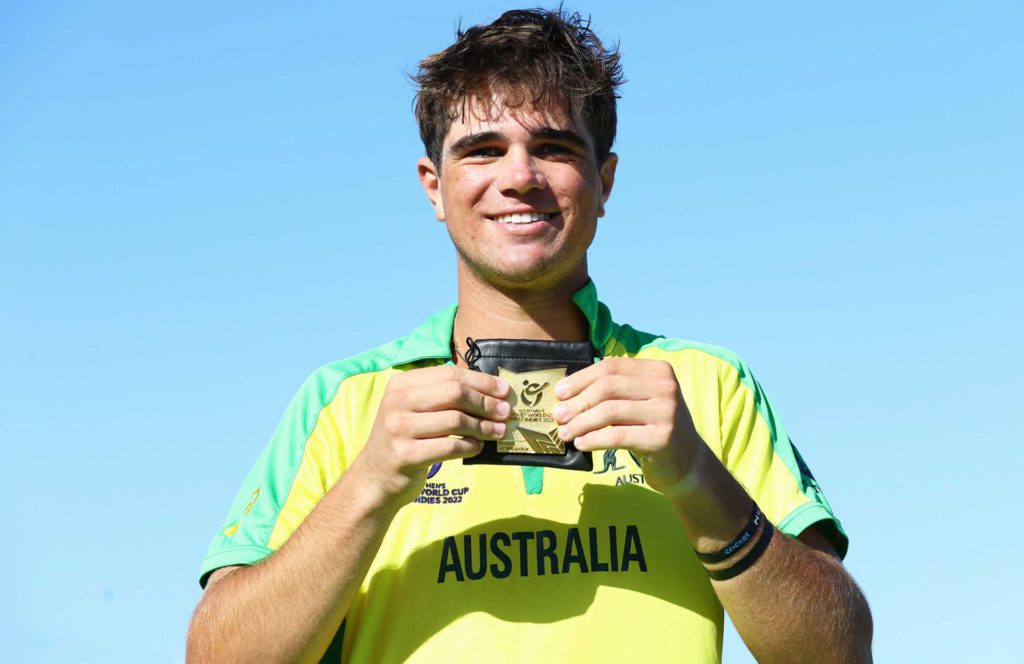
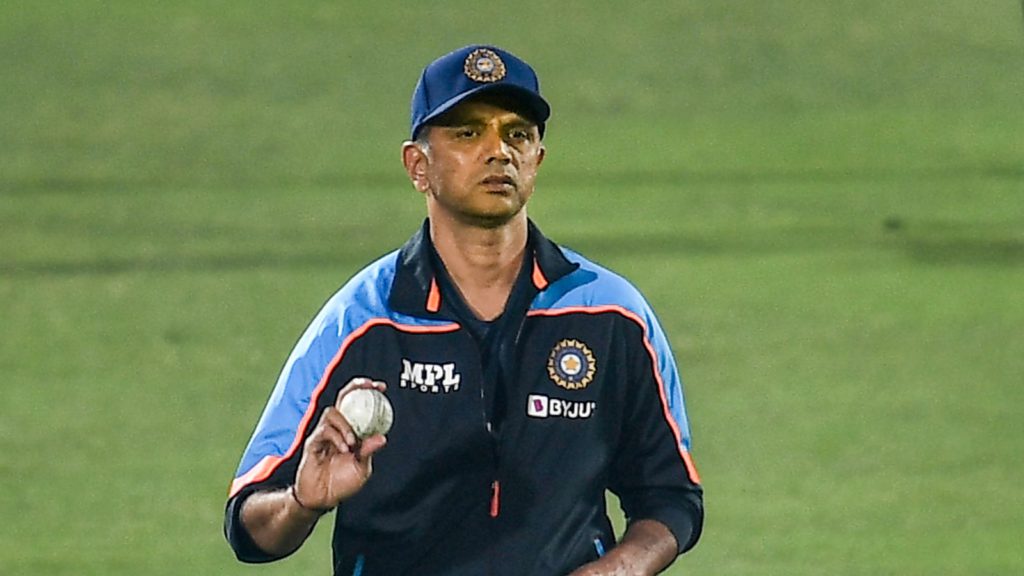

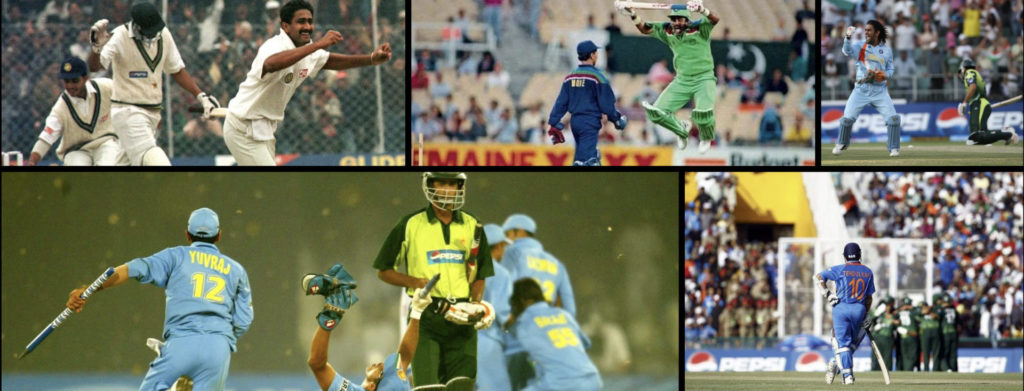



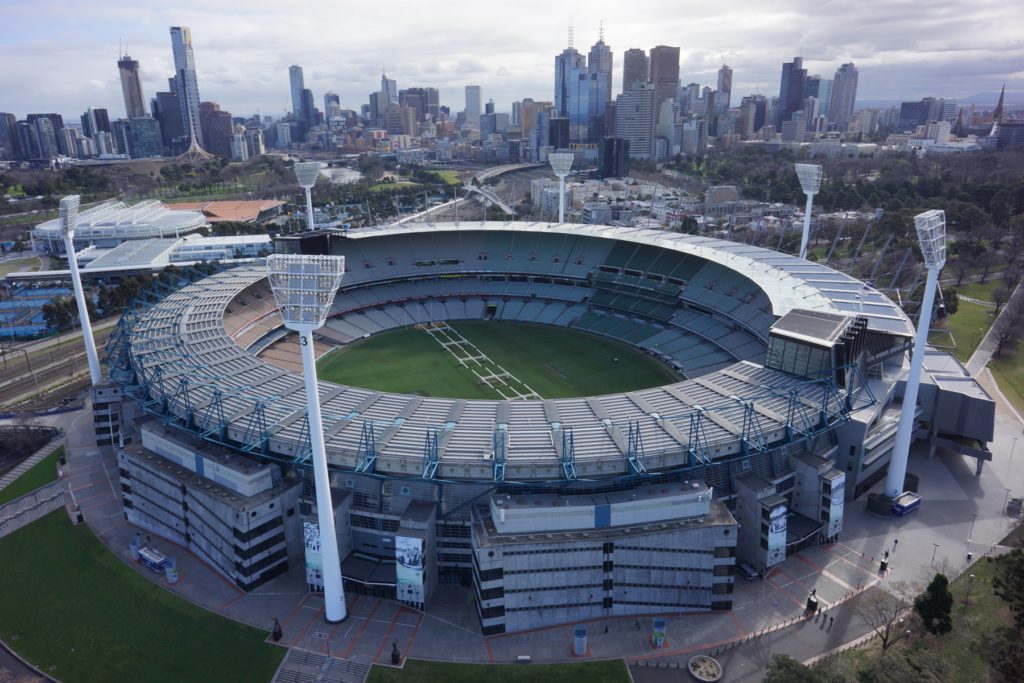

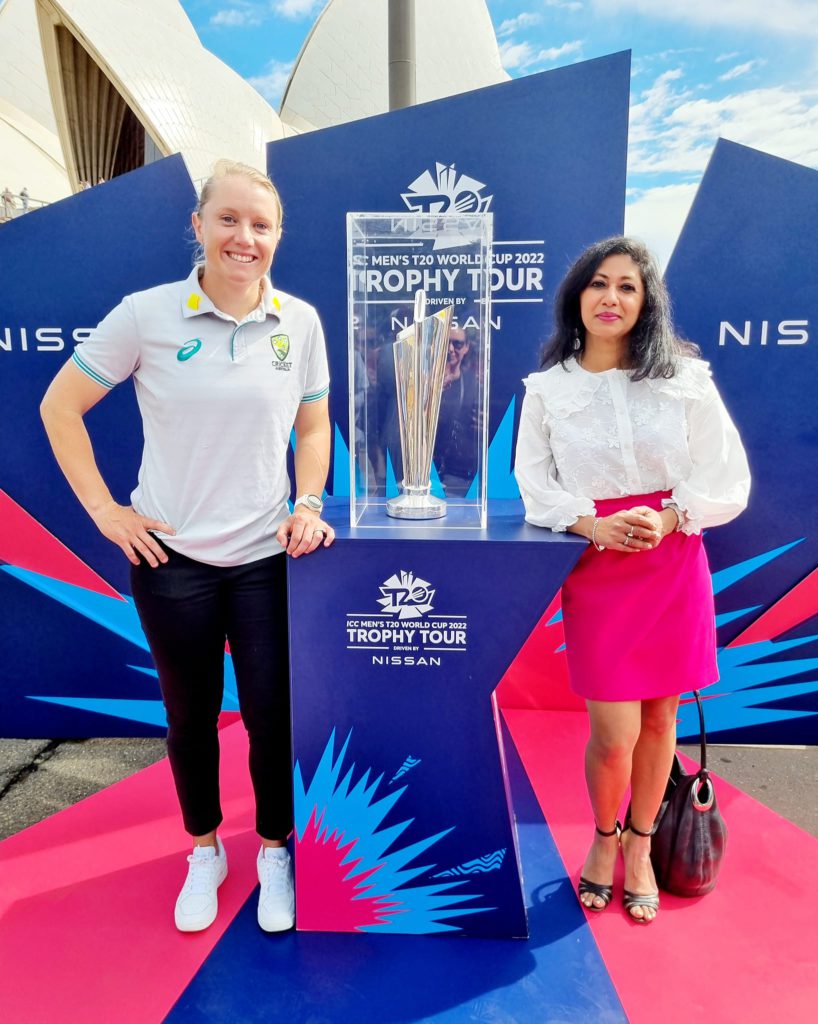
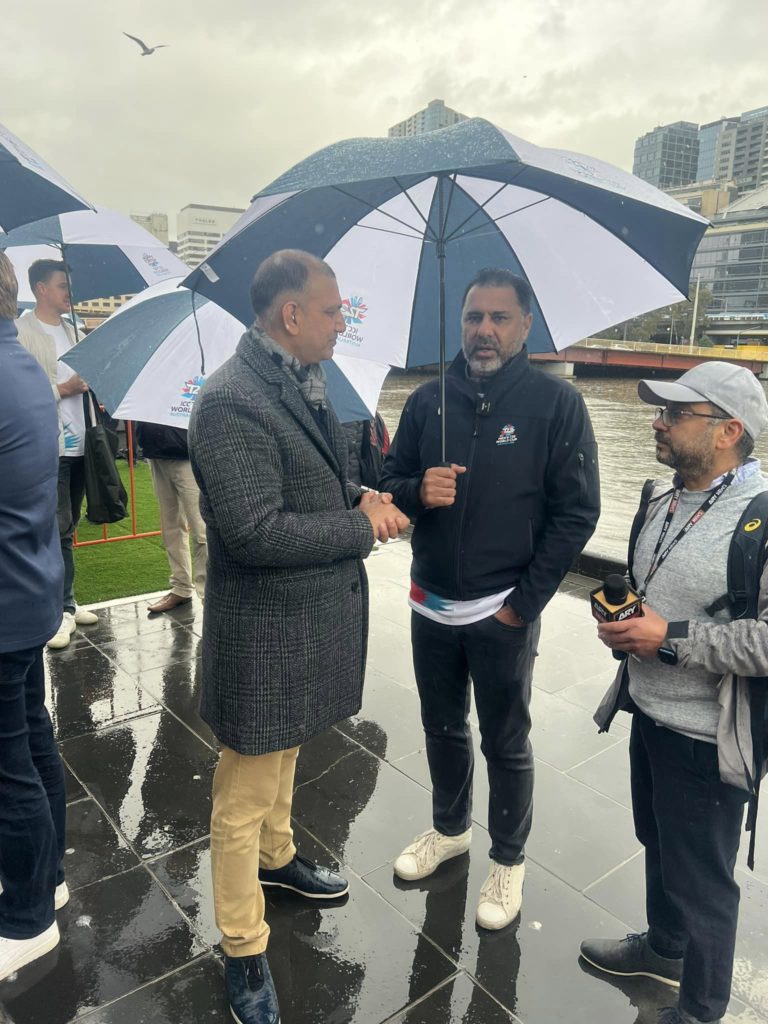
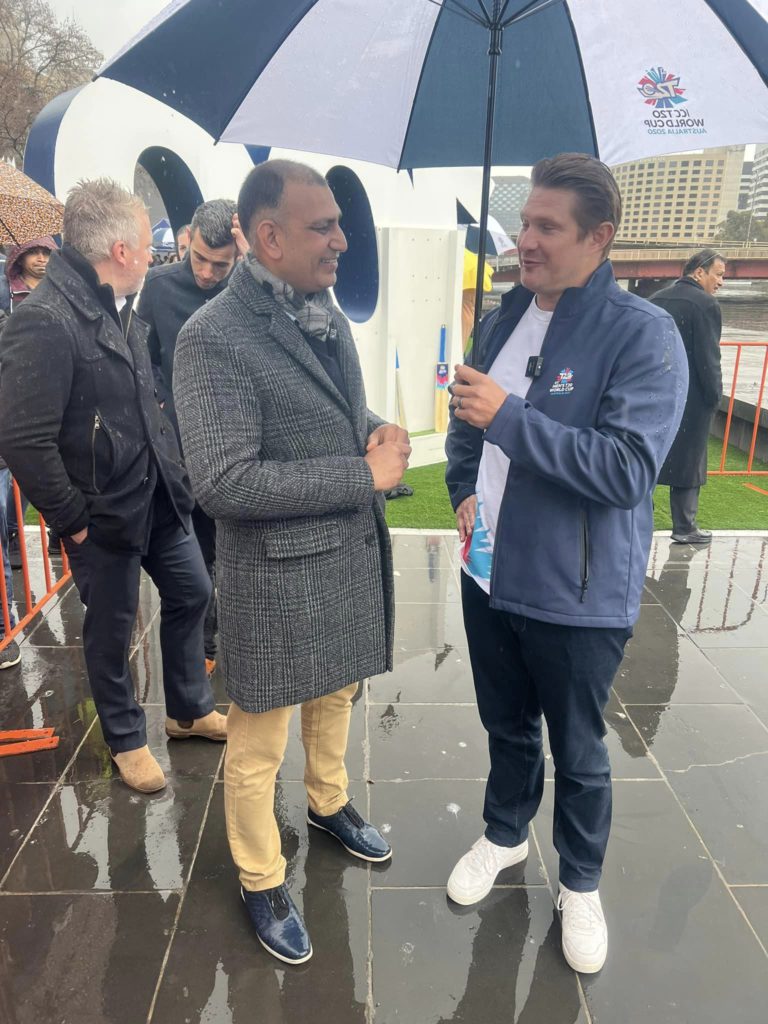

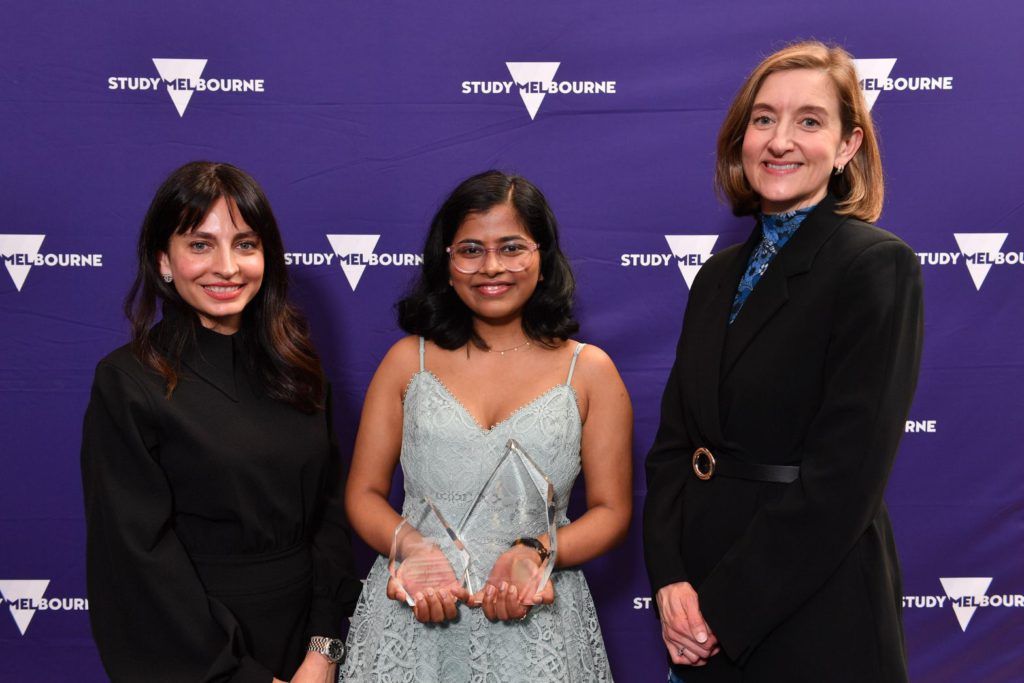

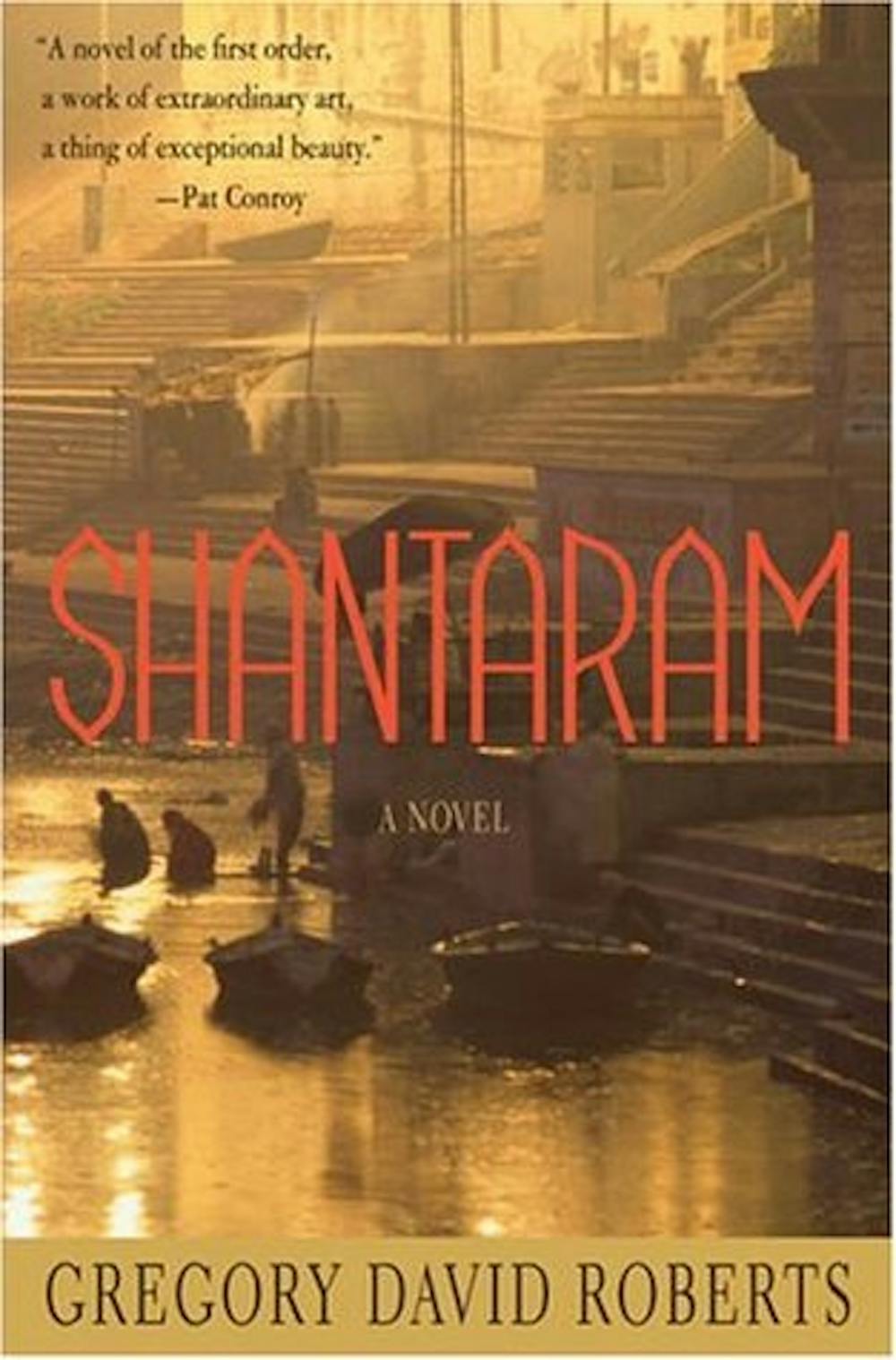
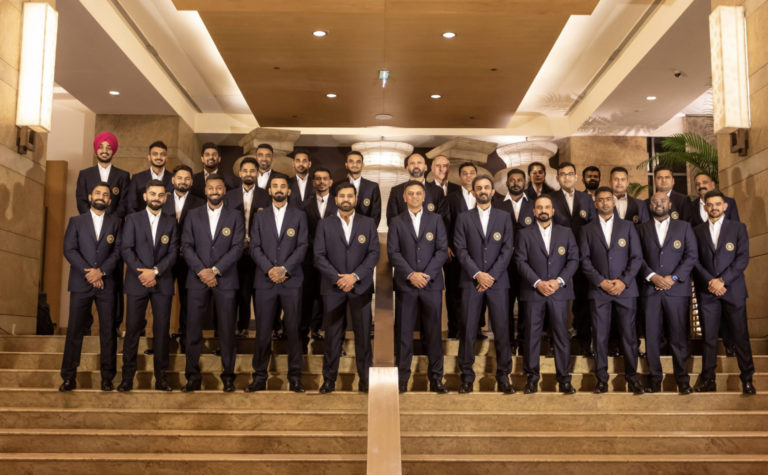



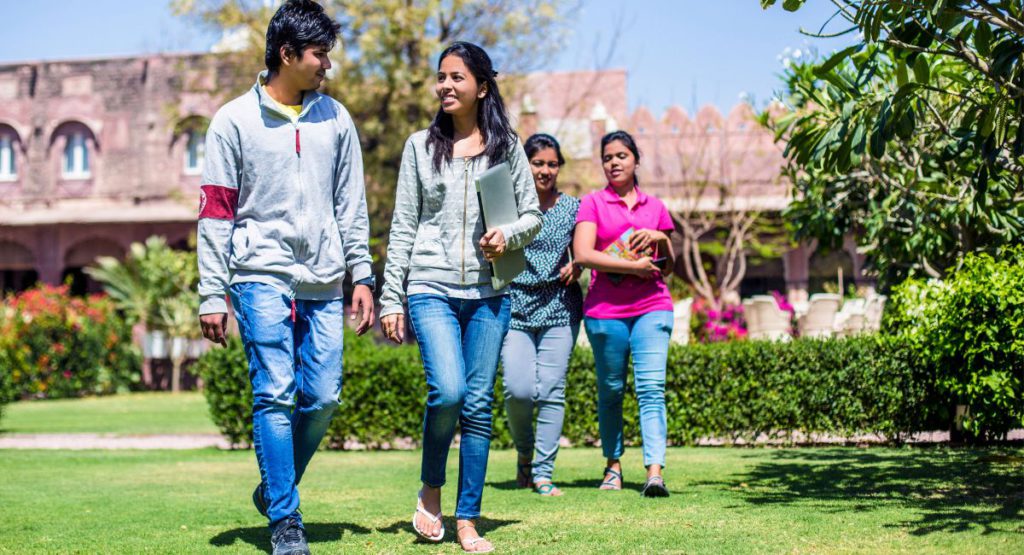
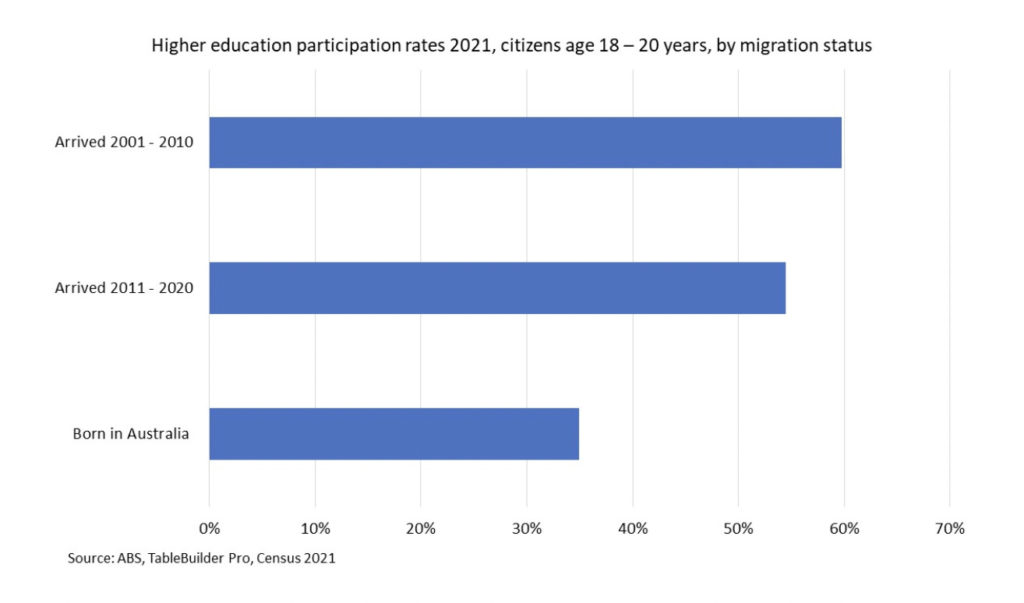



























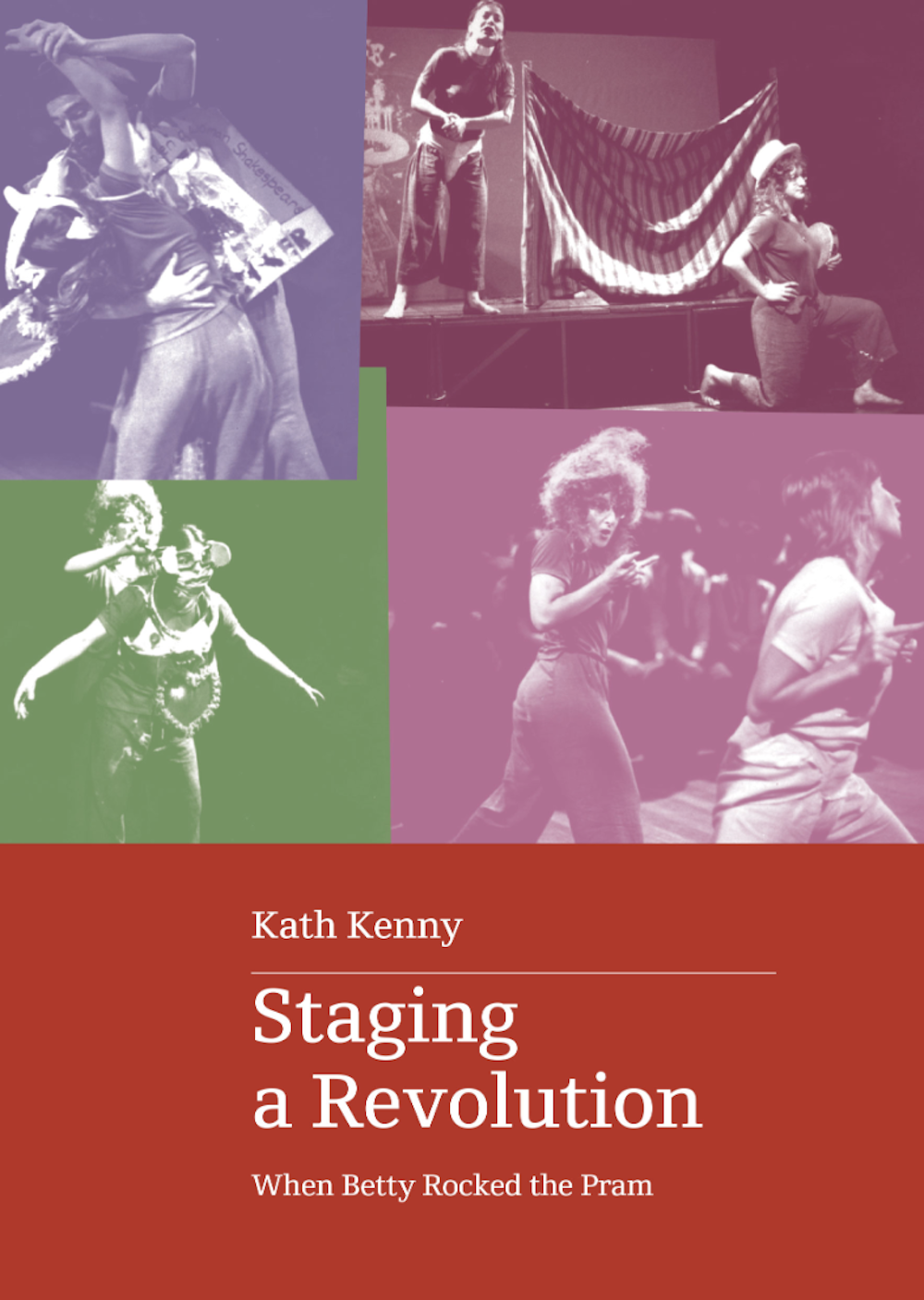

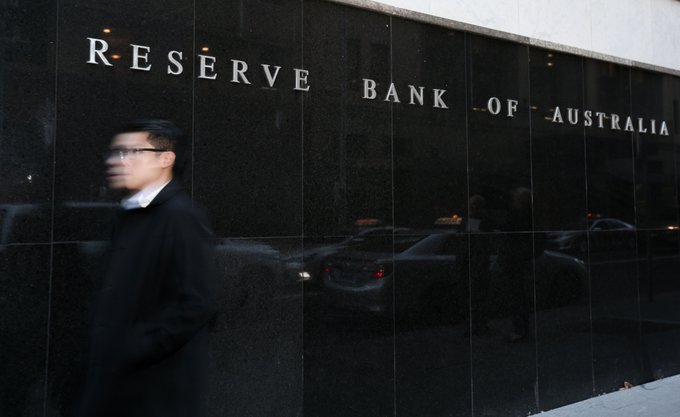

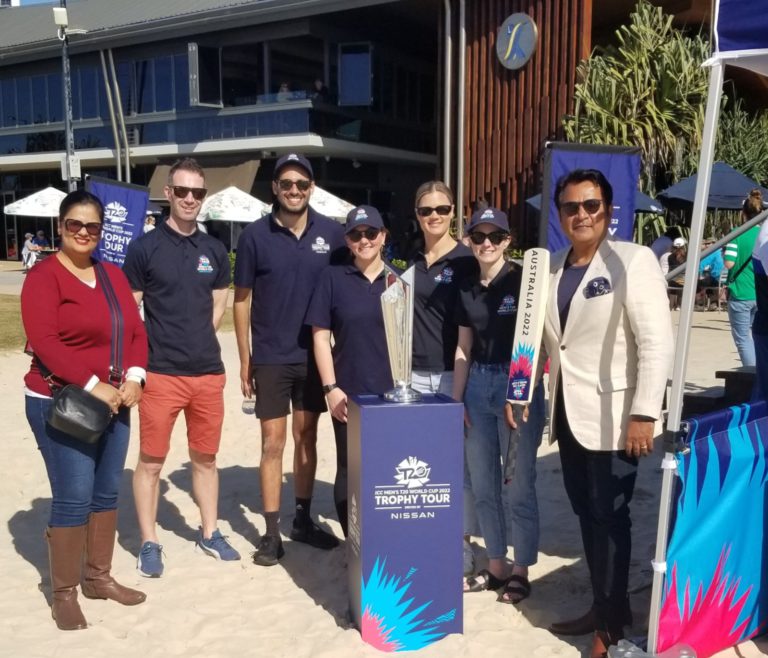



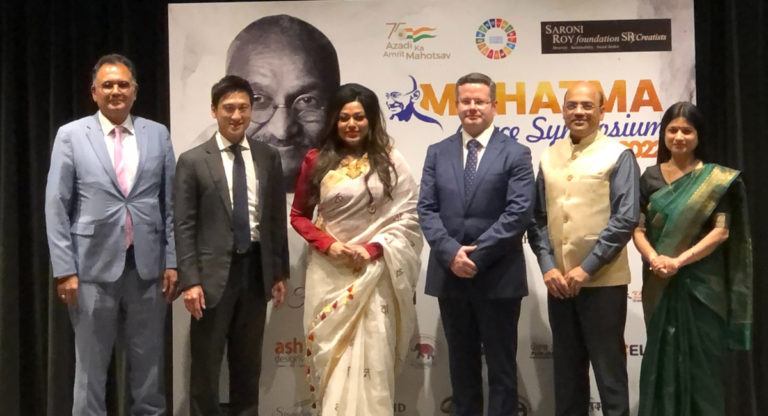

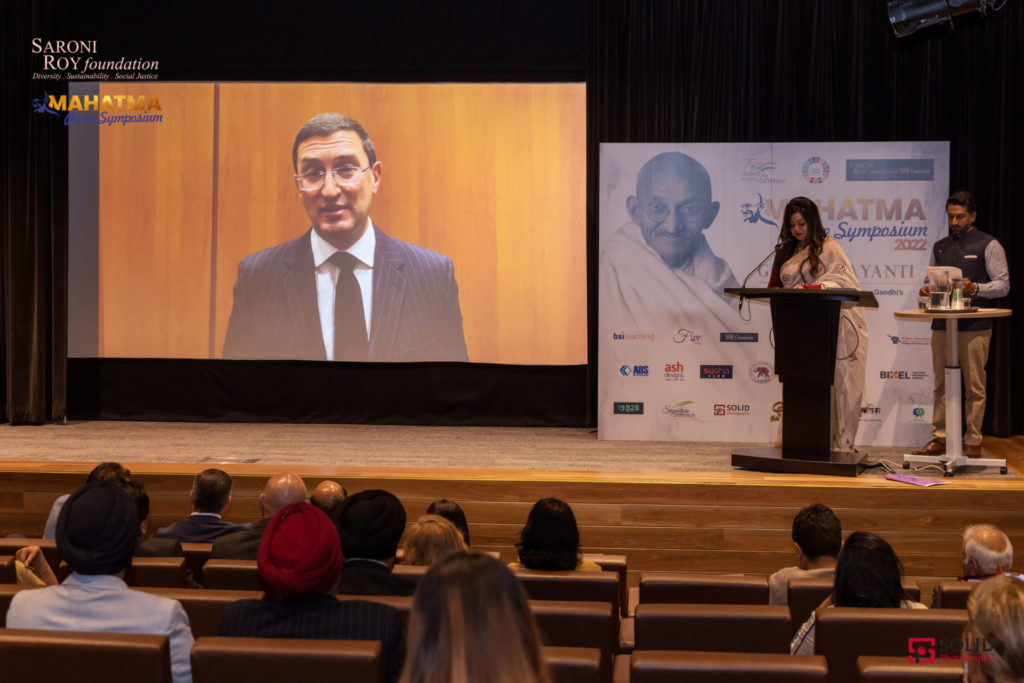
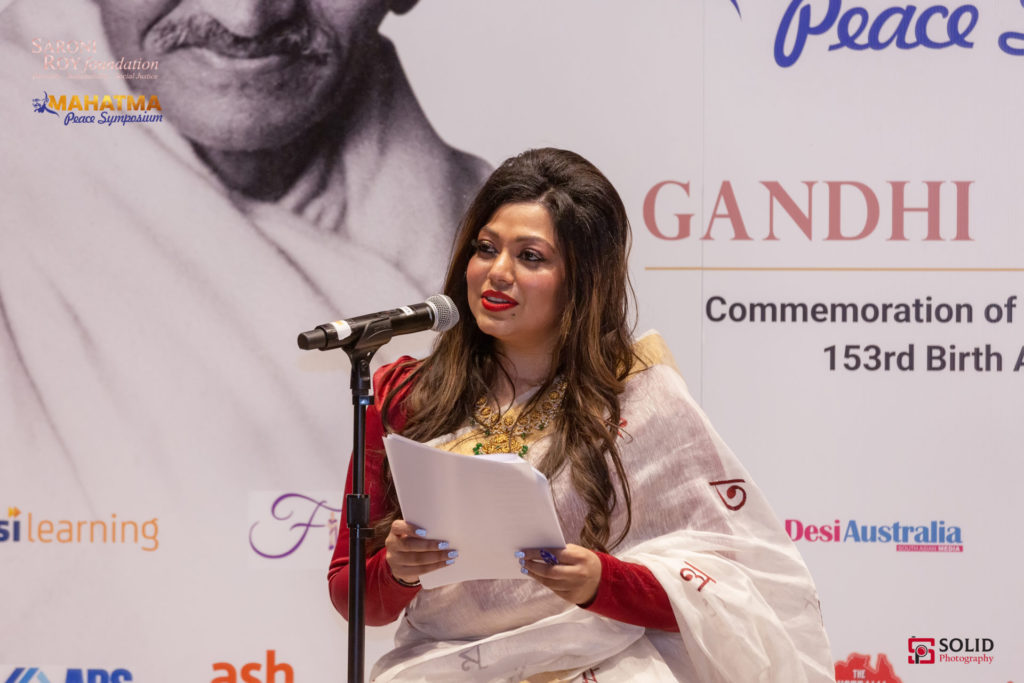


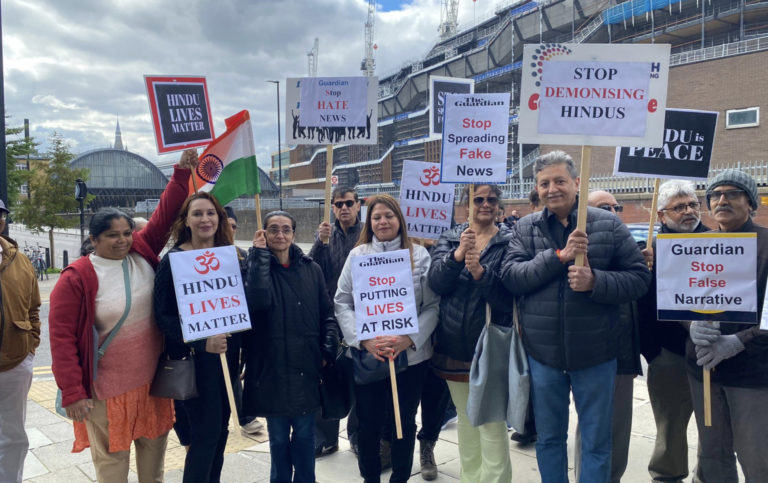

 Restaurant in France that seems Indian but is run by a Pakistani.



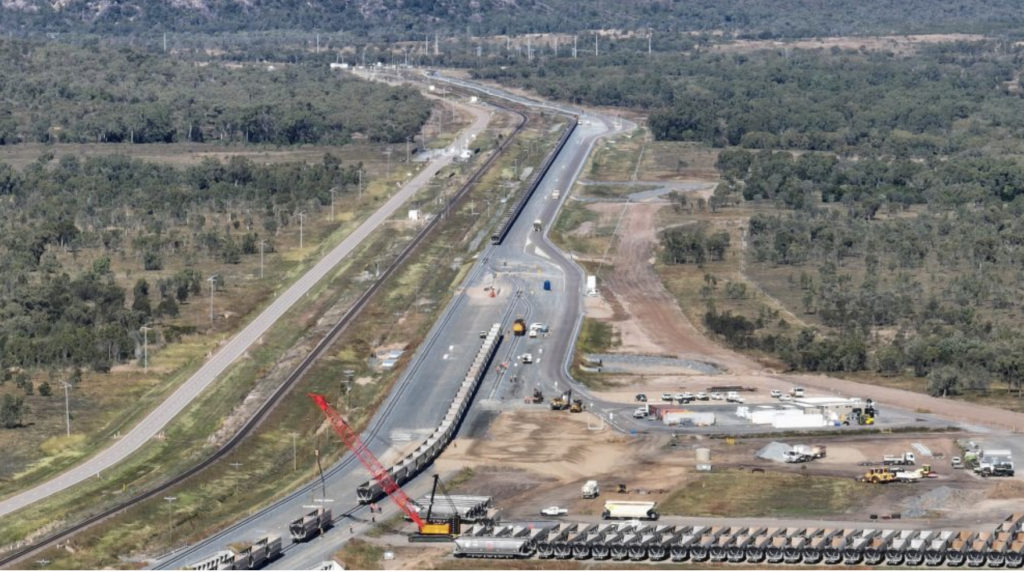



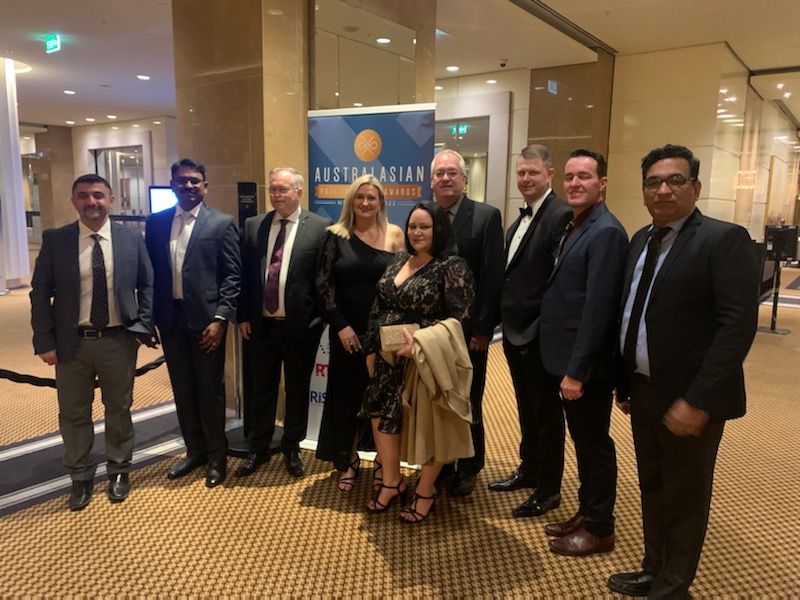

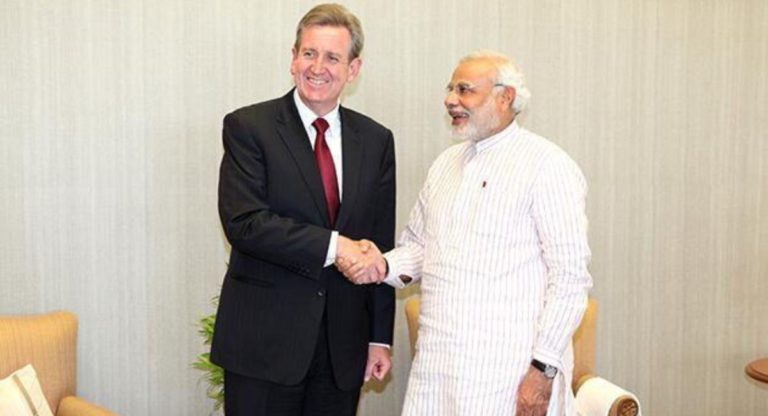
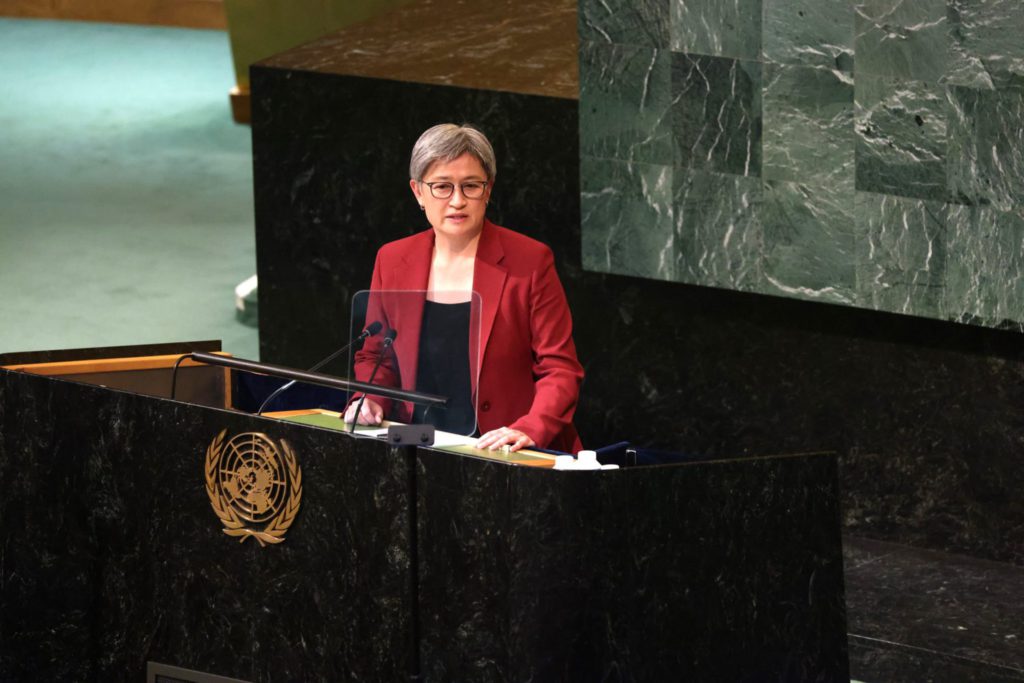
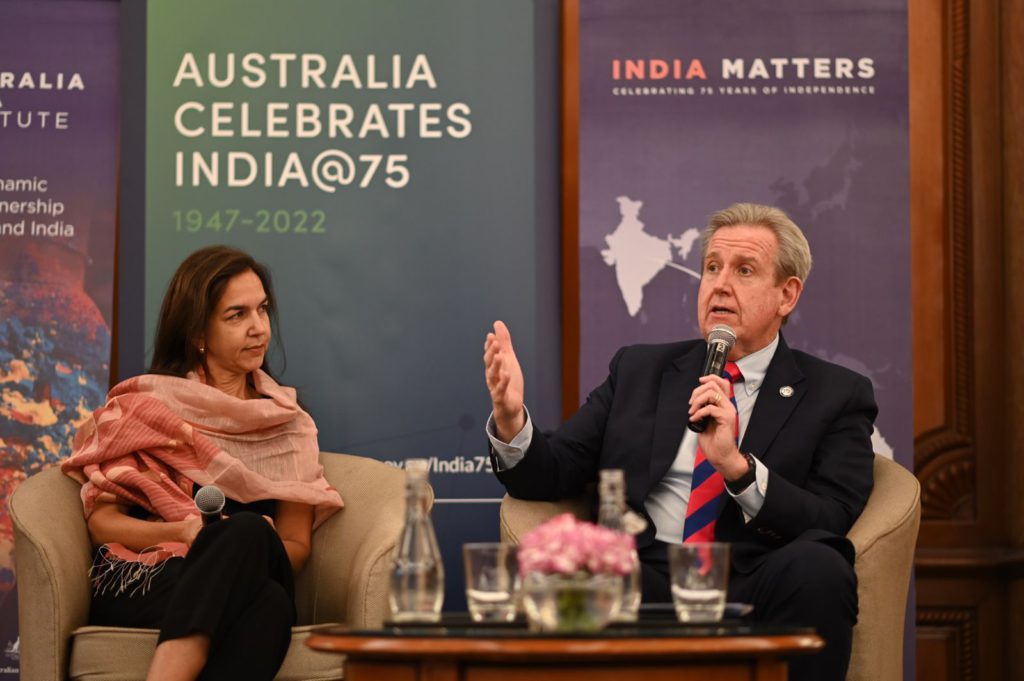
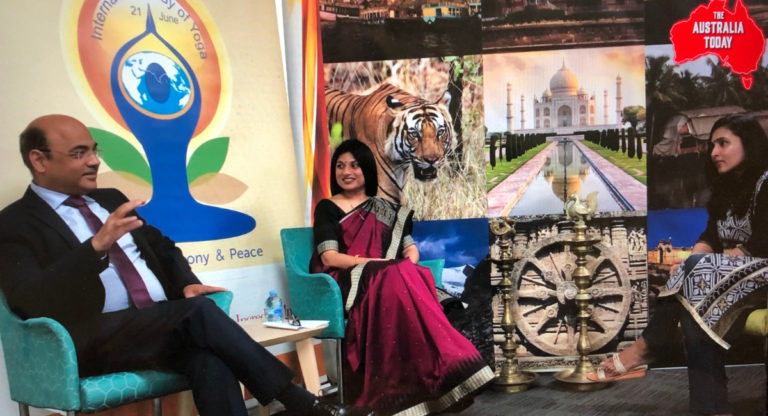

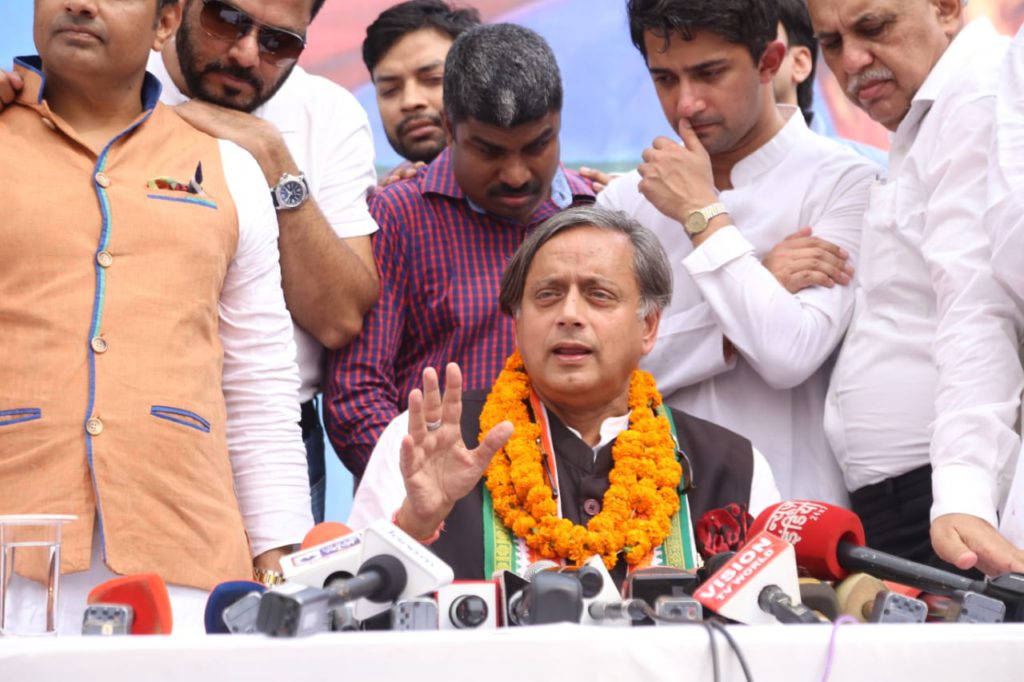




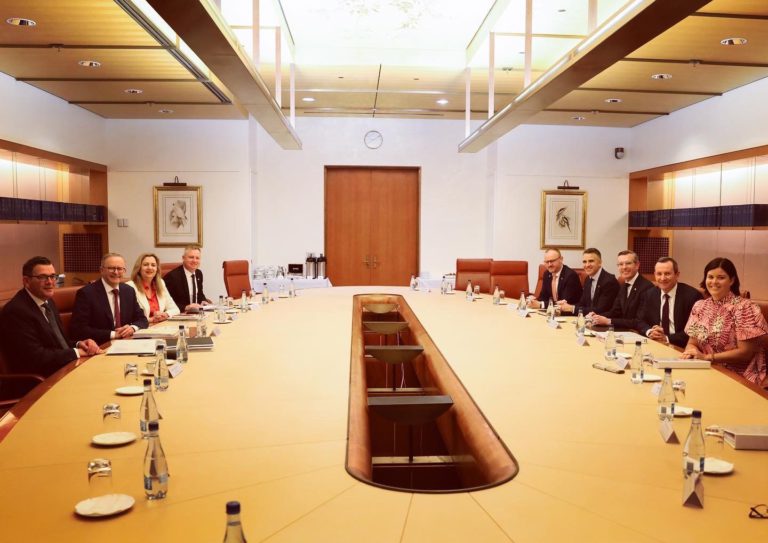
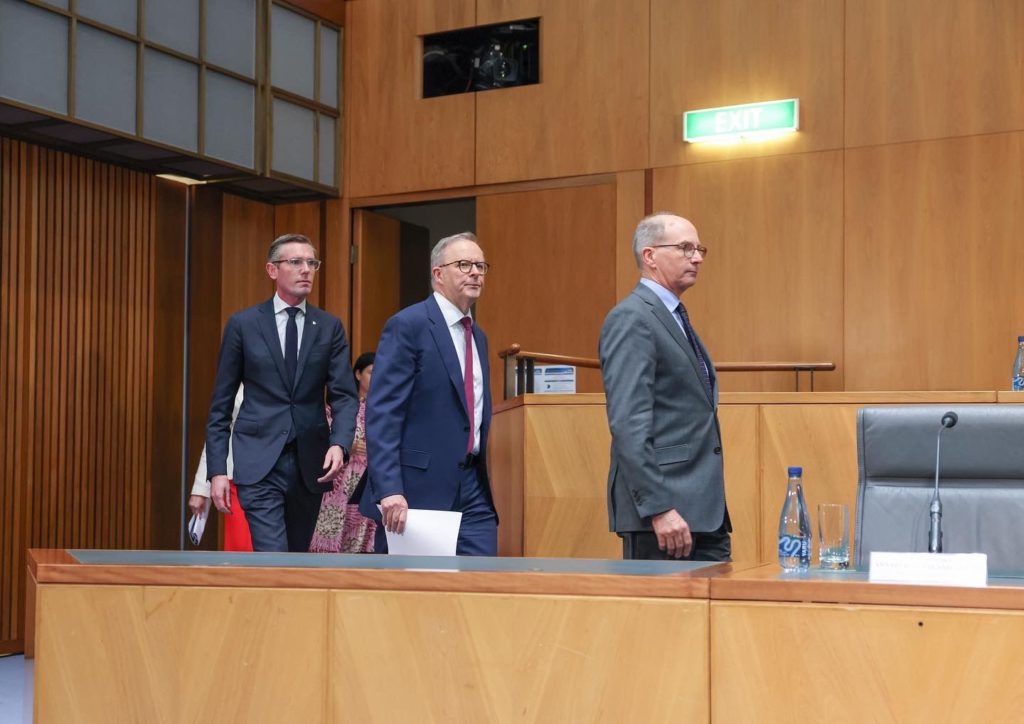
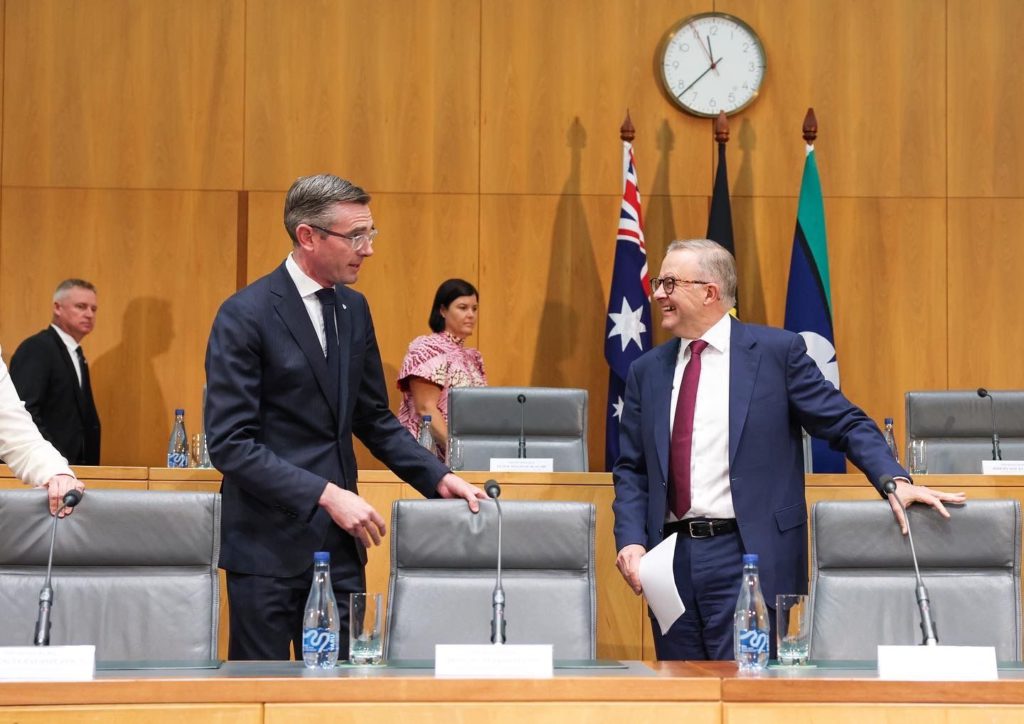



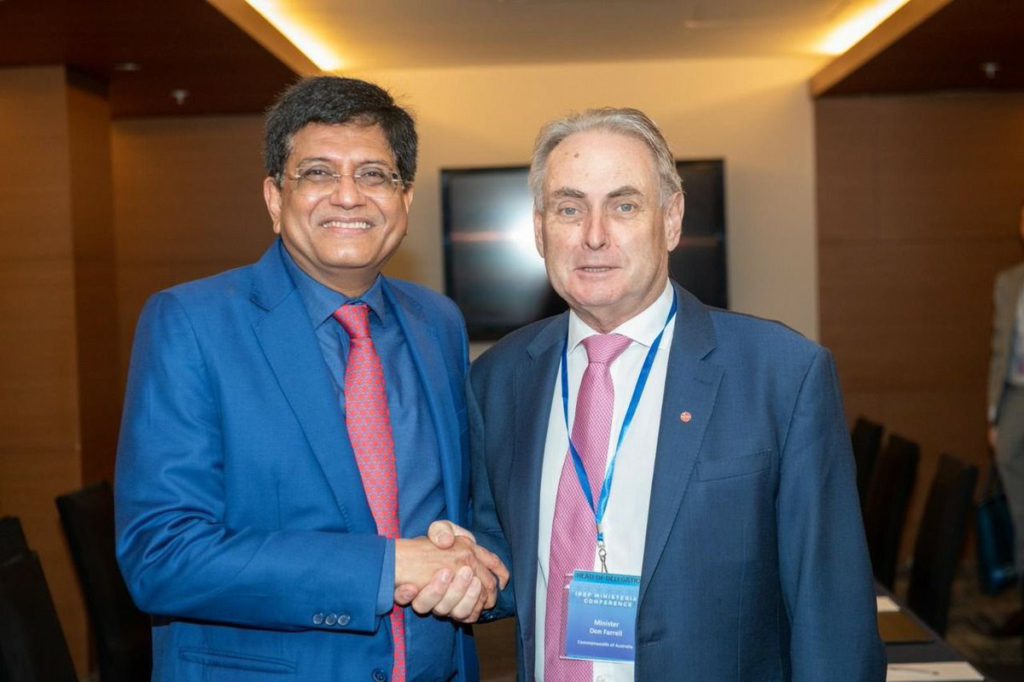
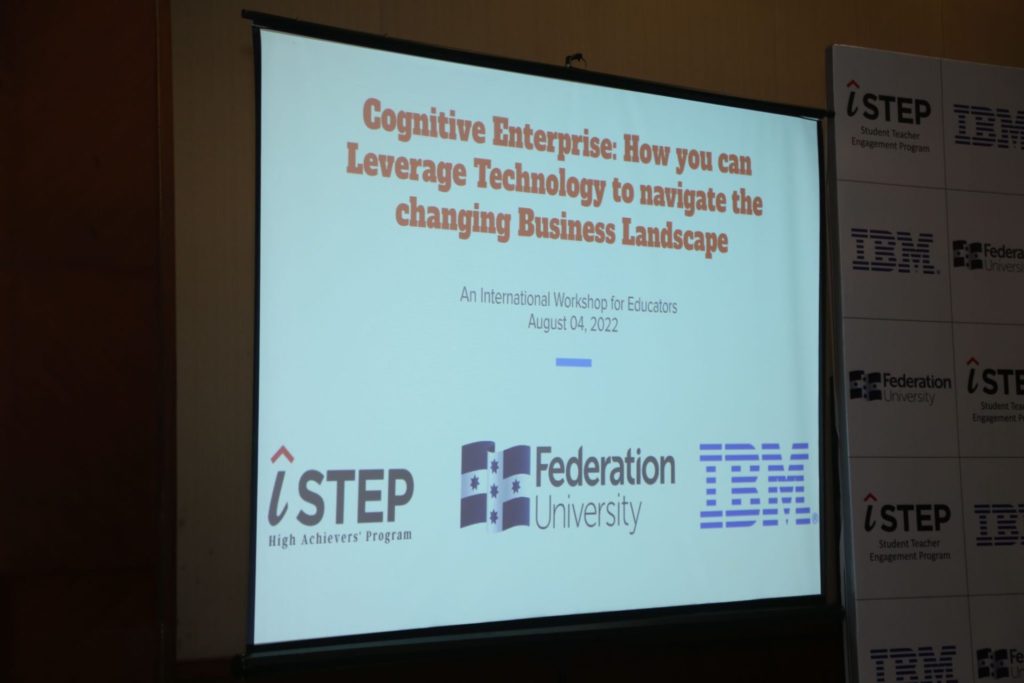
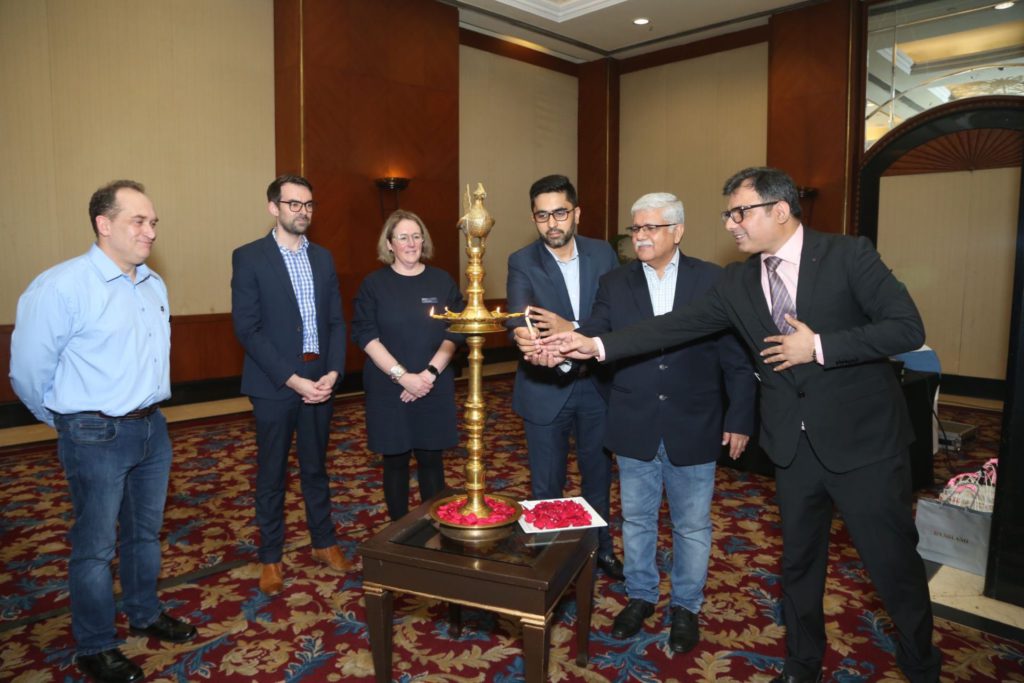





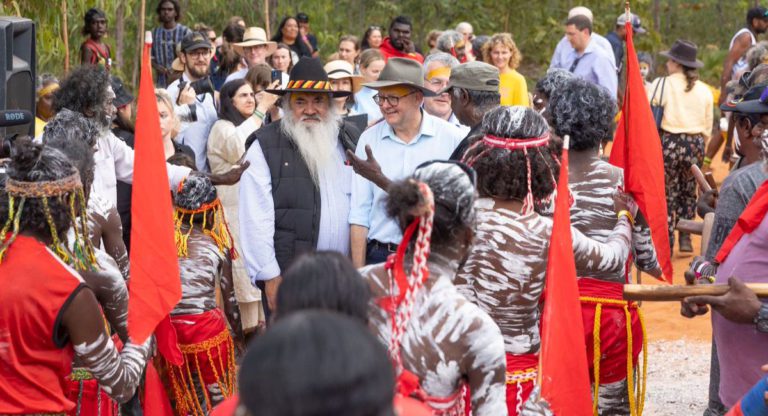

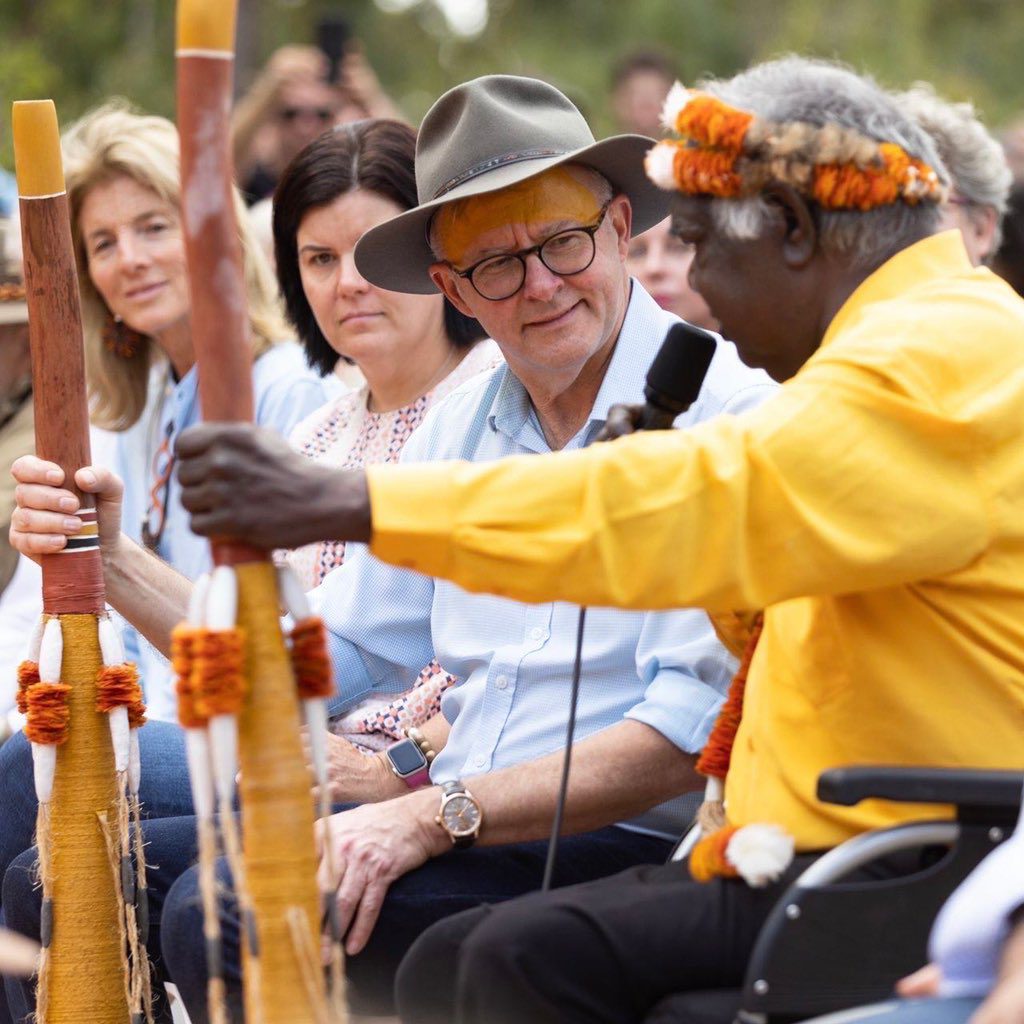










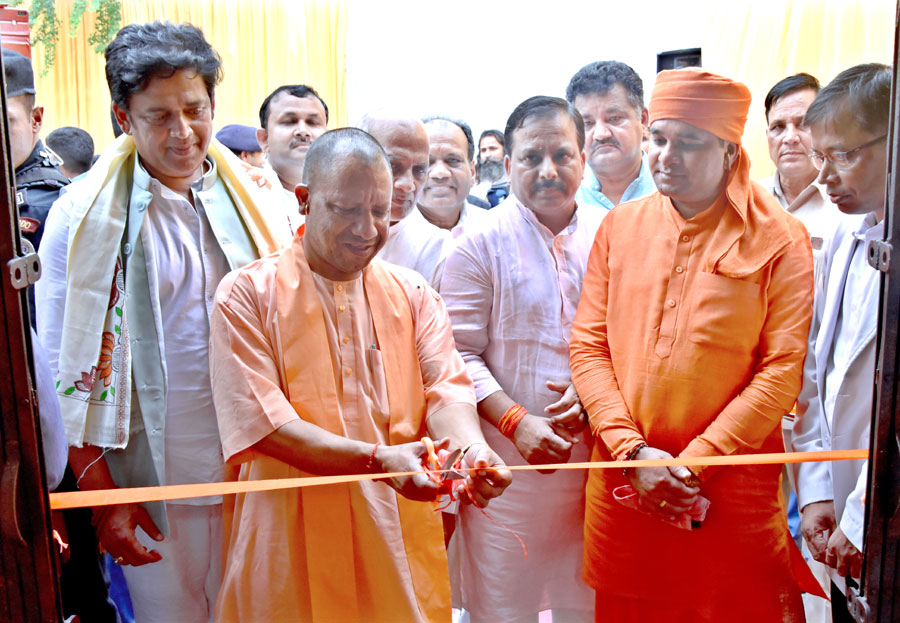

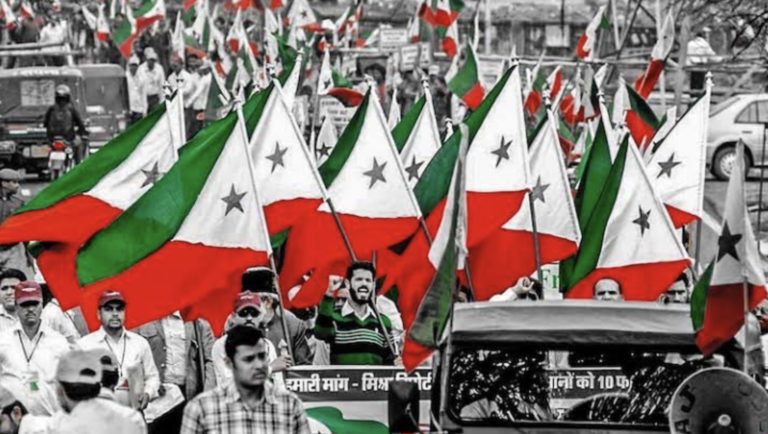
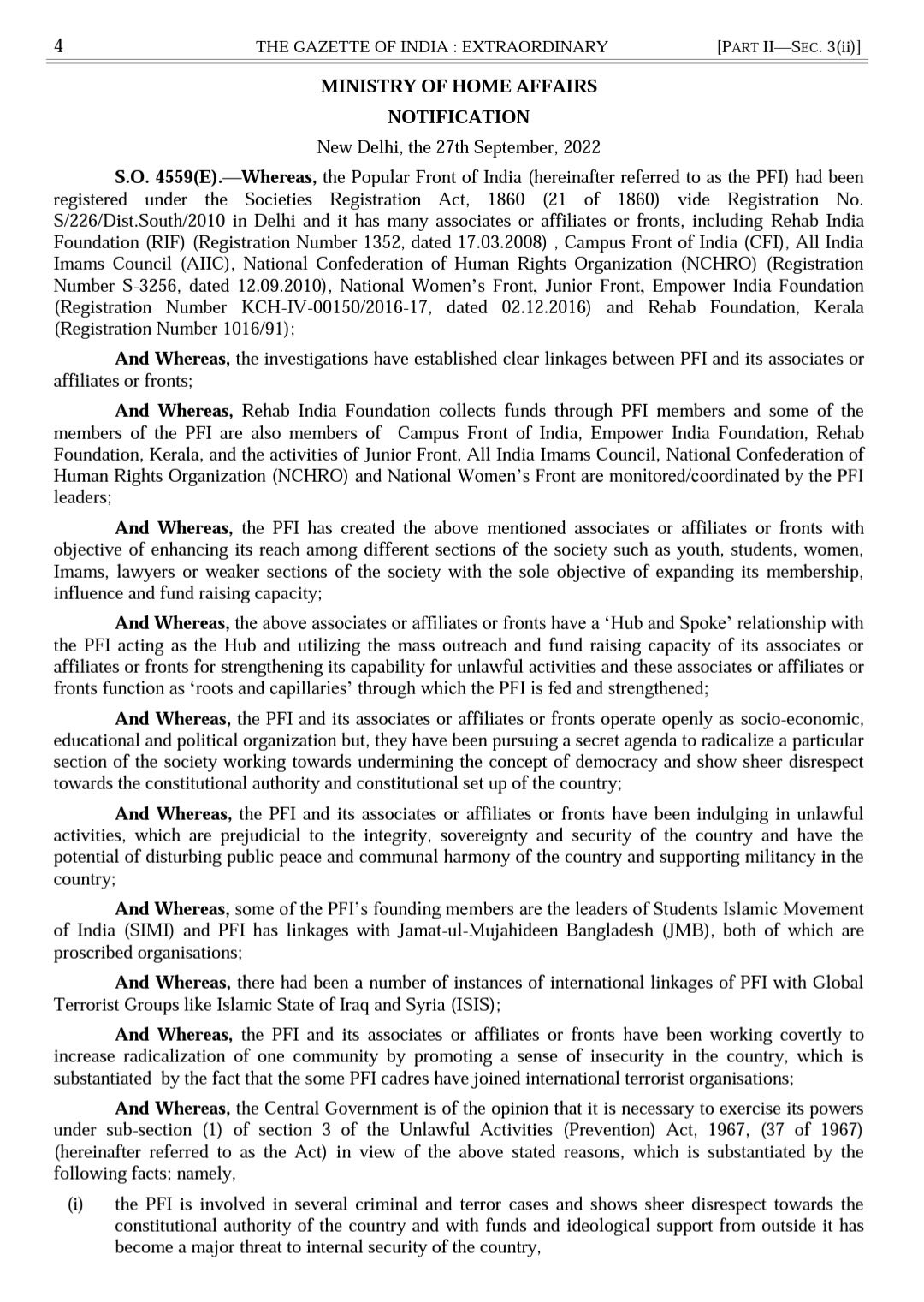
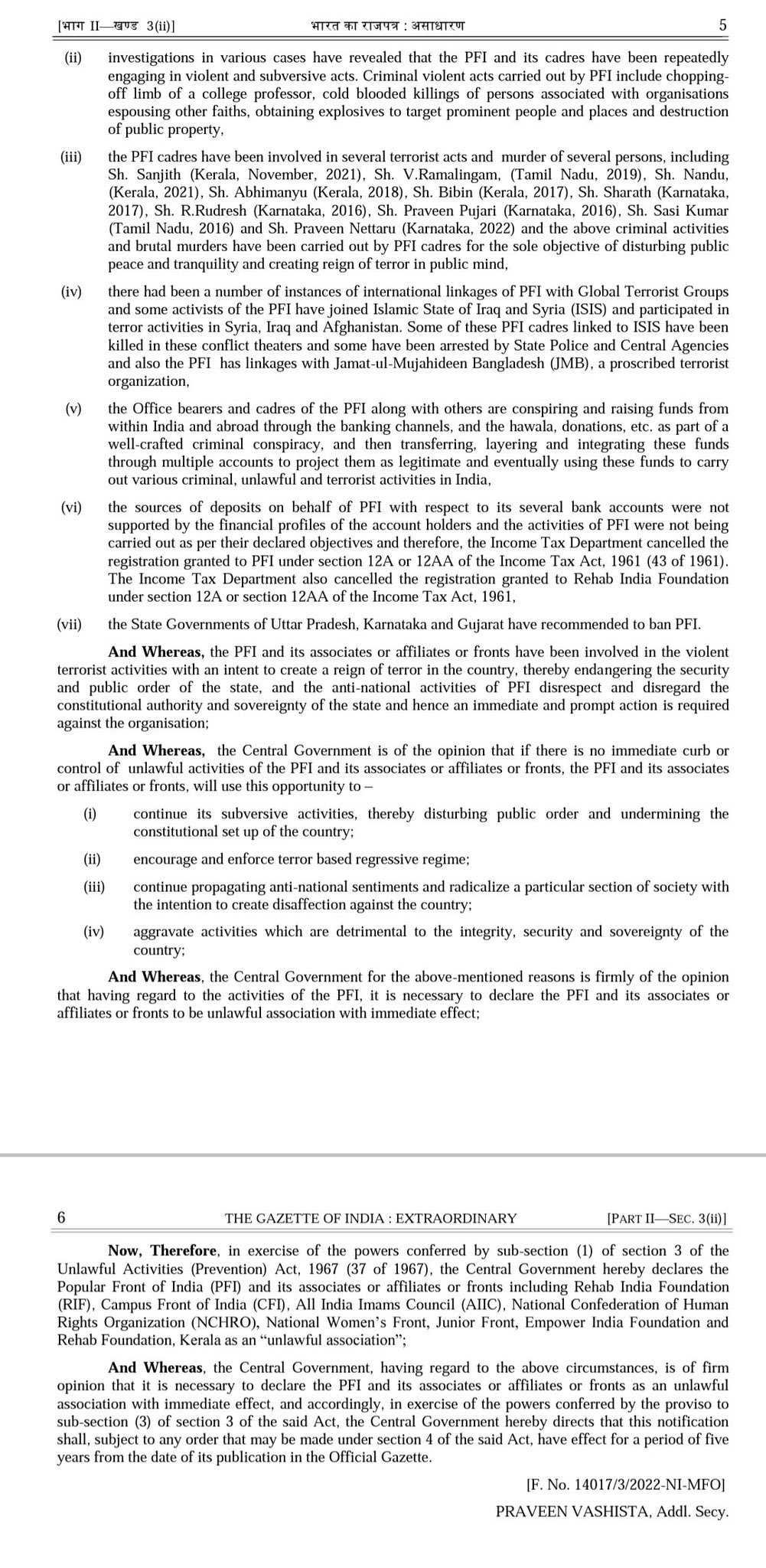

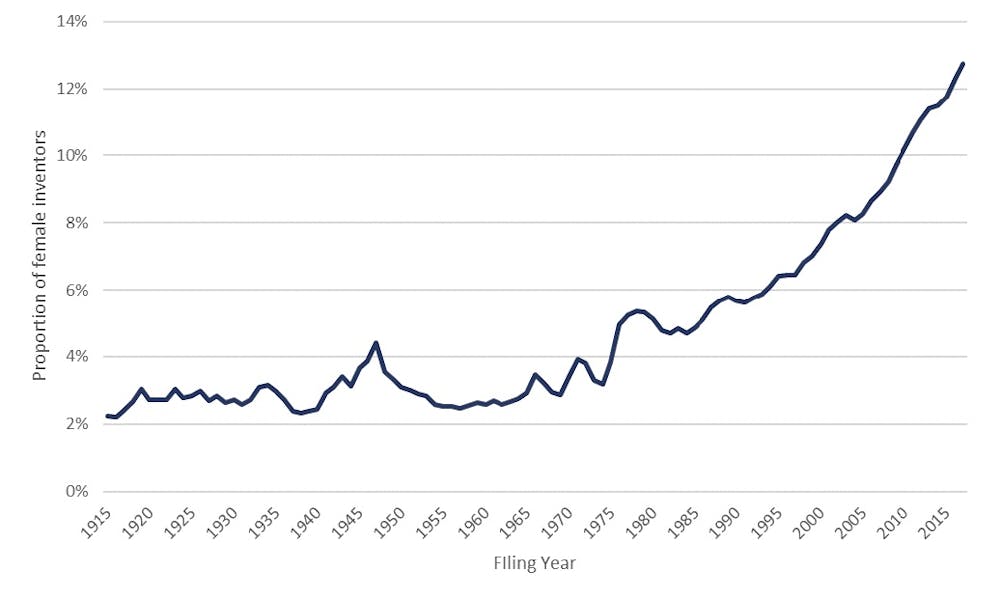
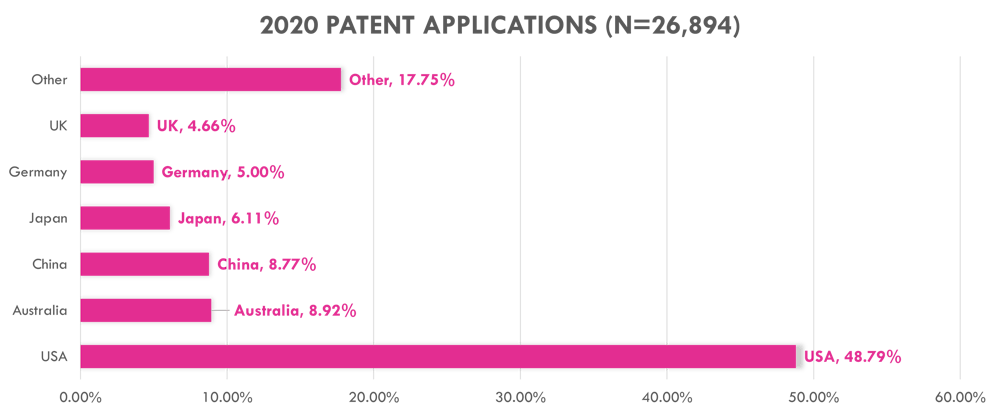
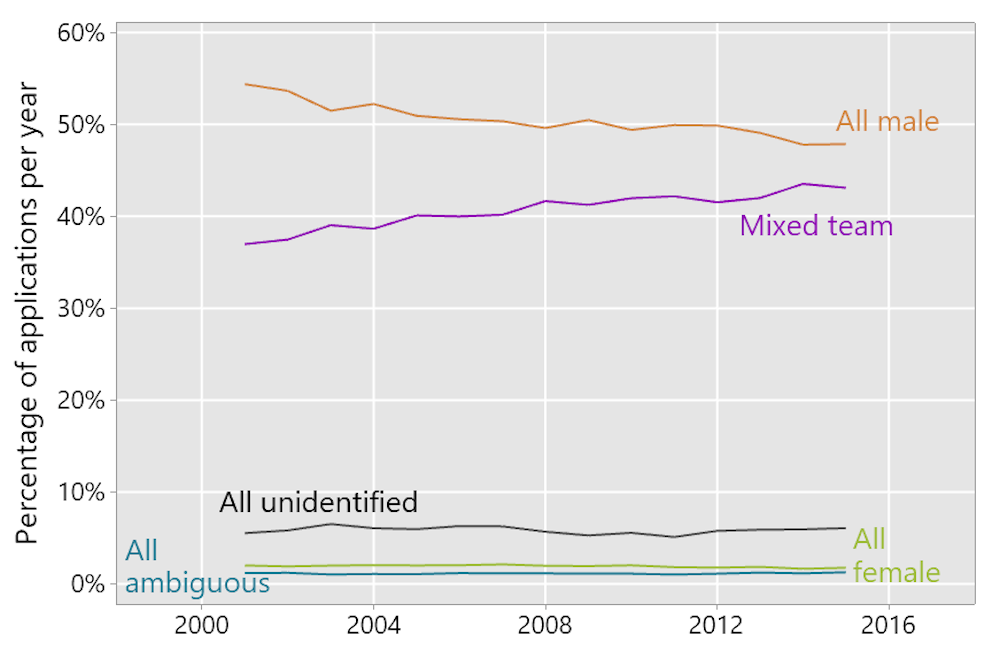
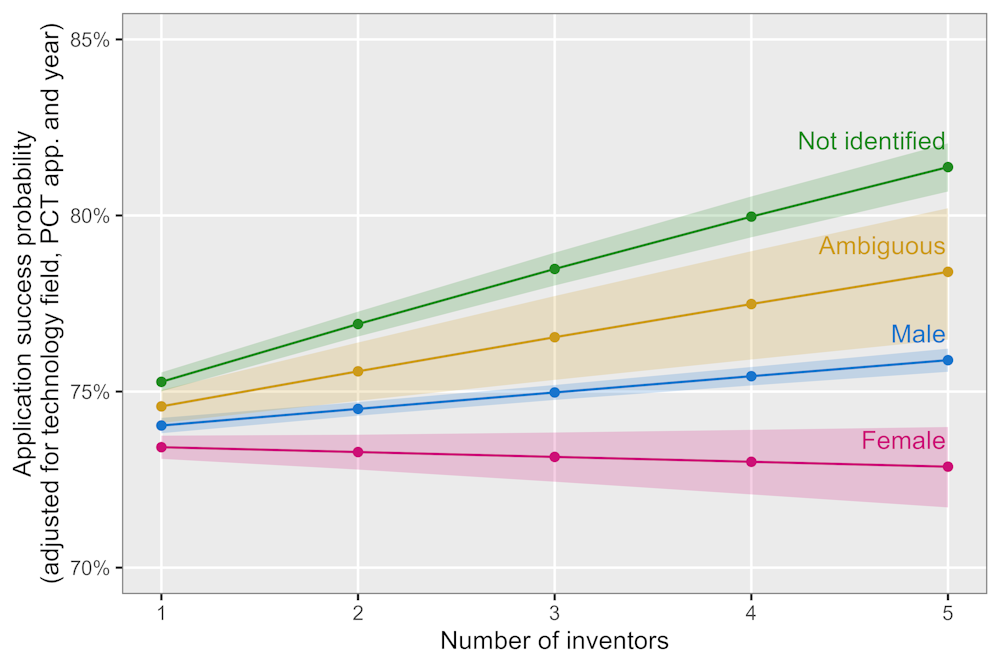

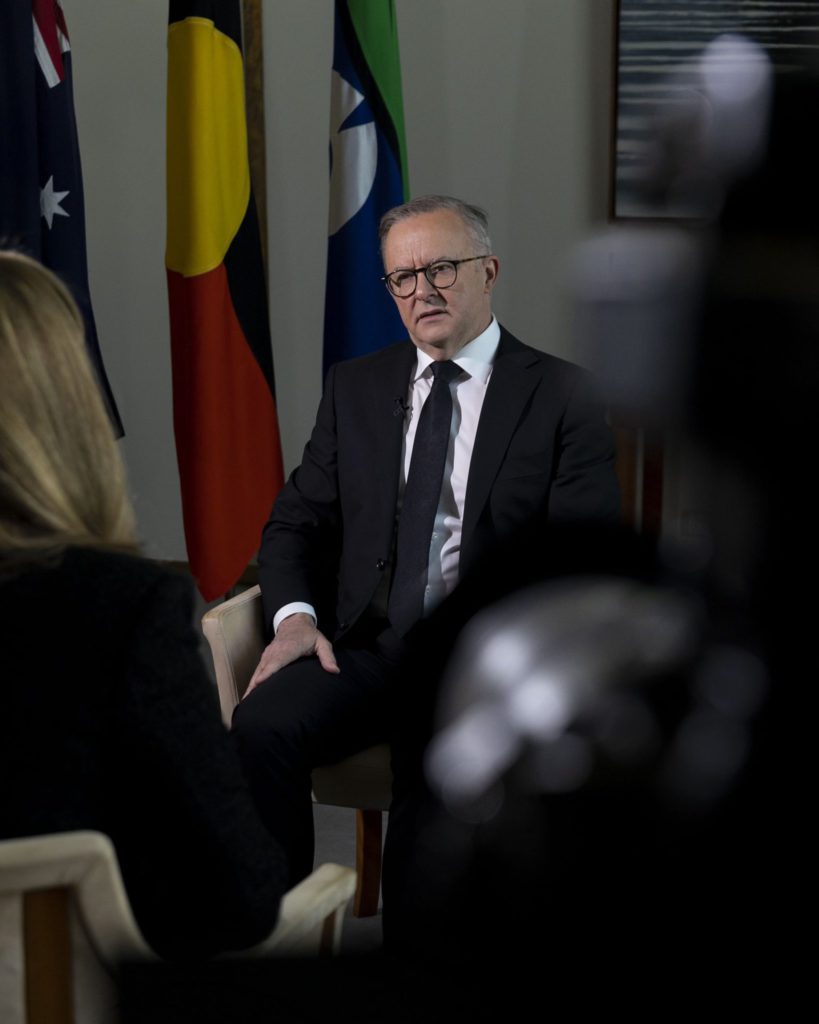


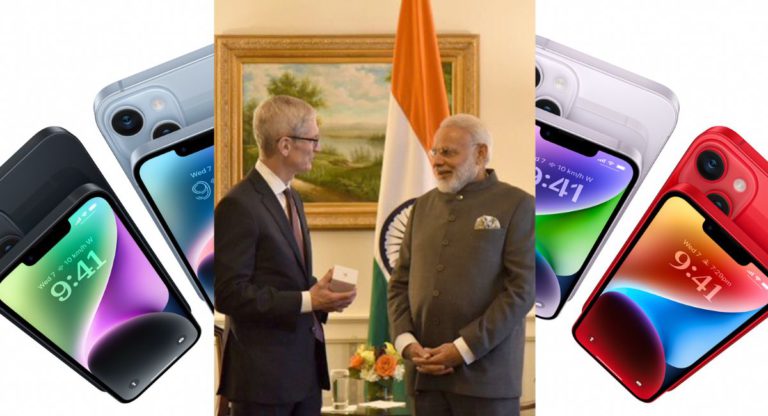





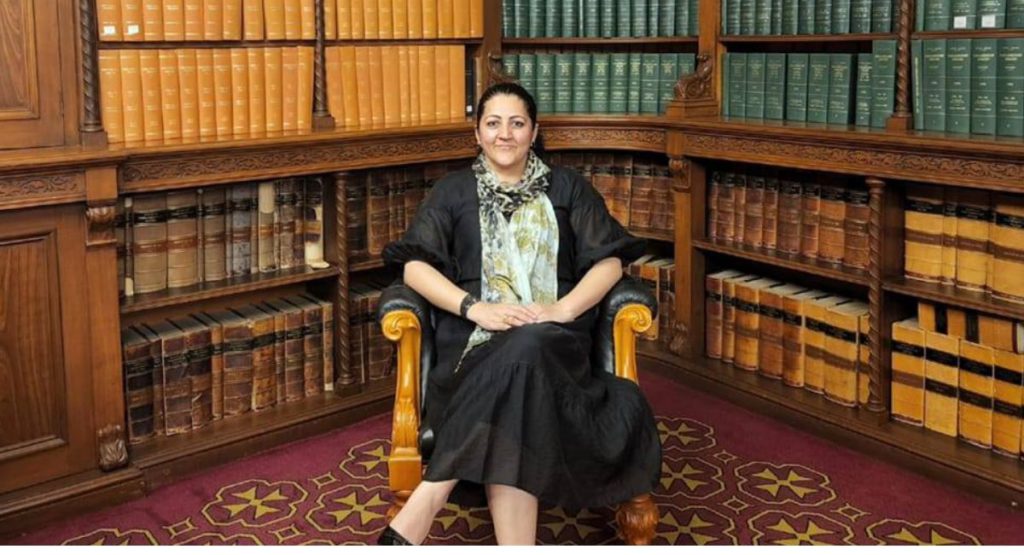













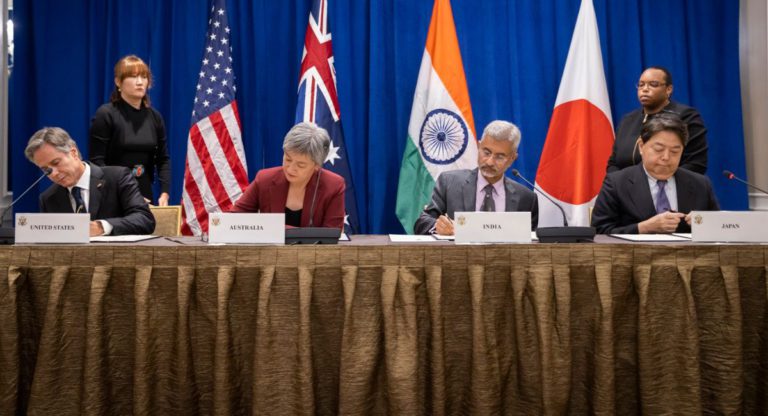
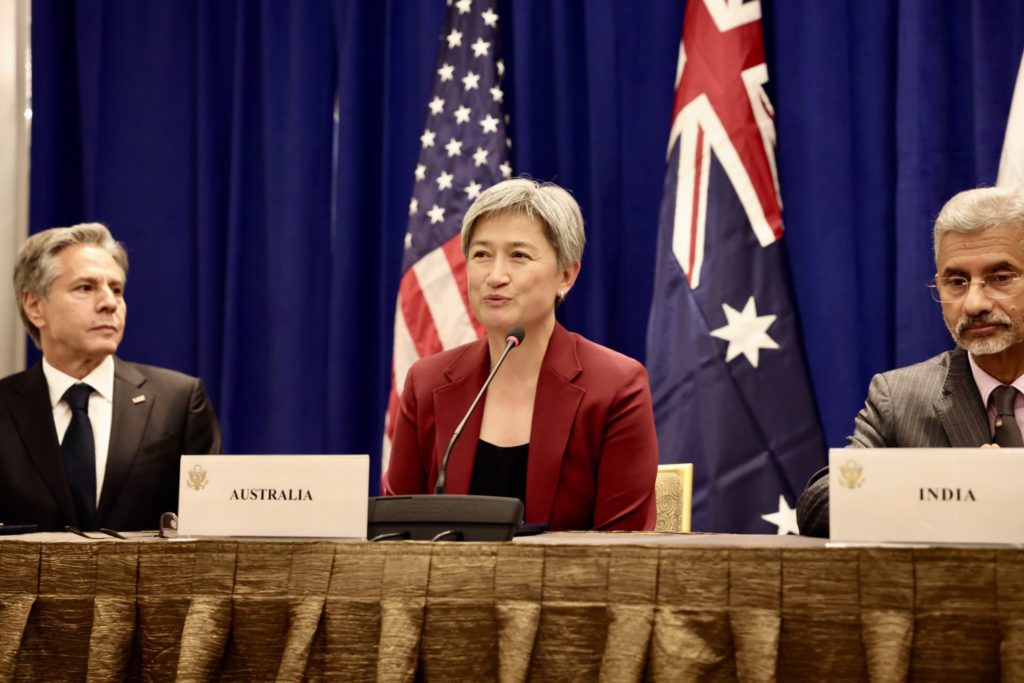

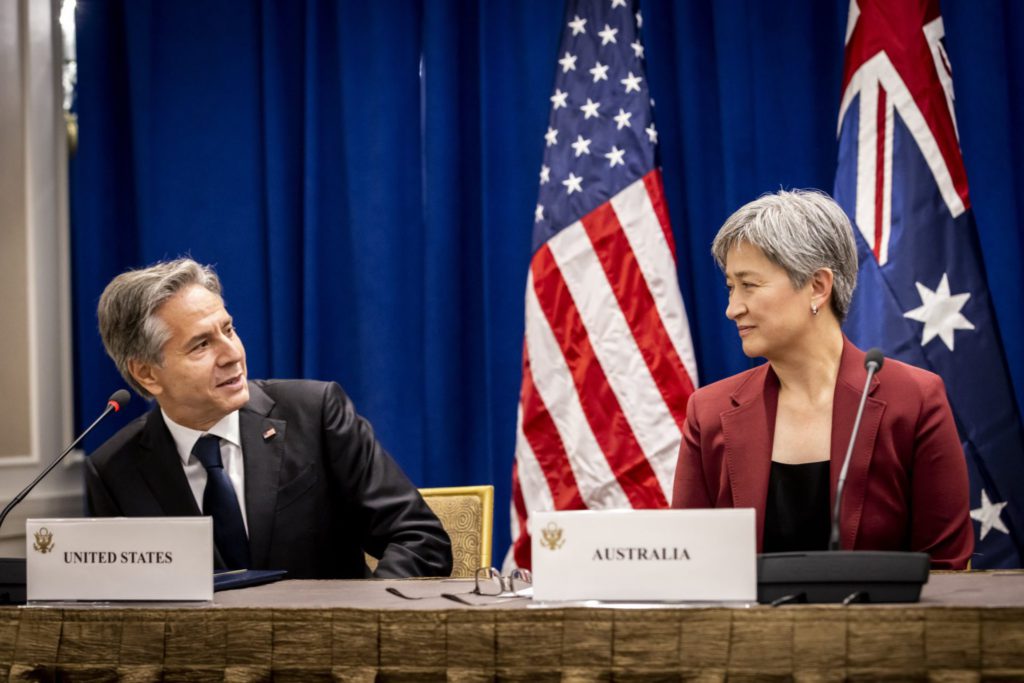
















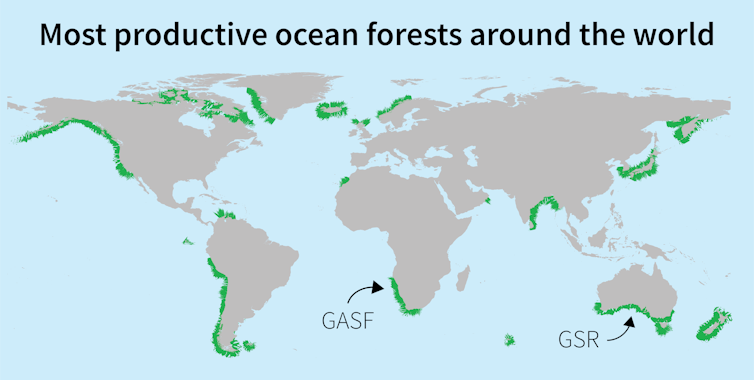

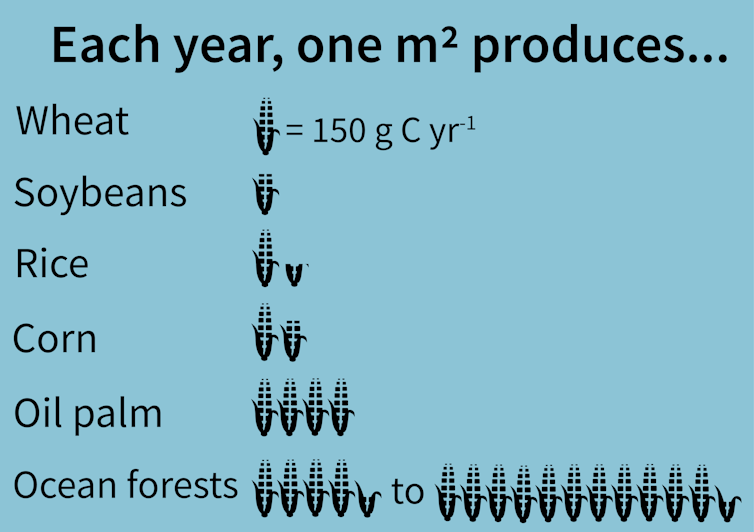

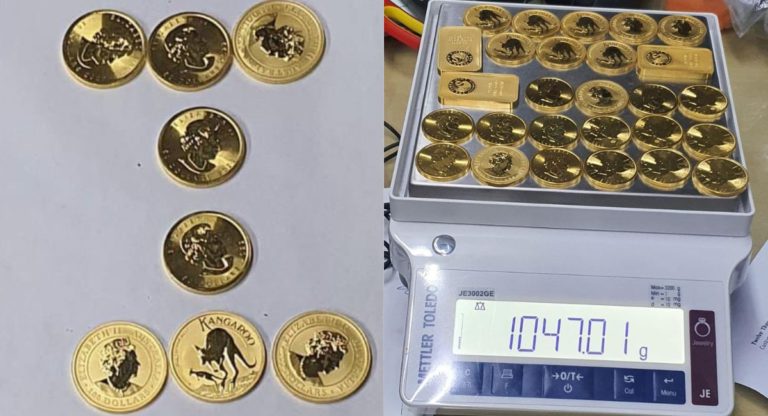
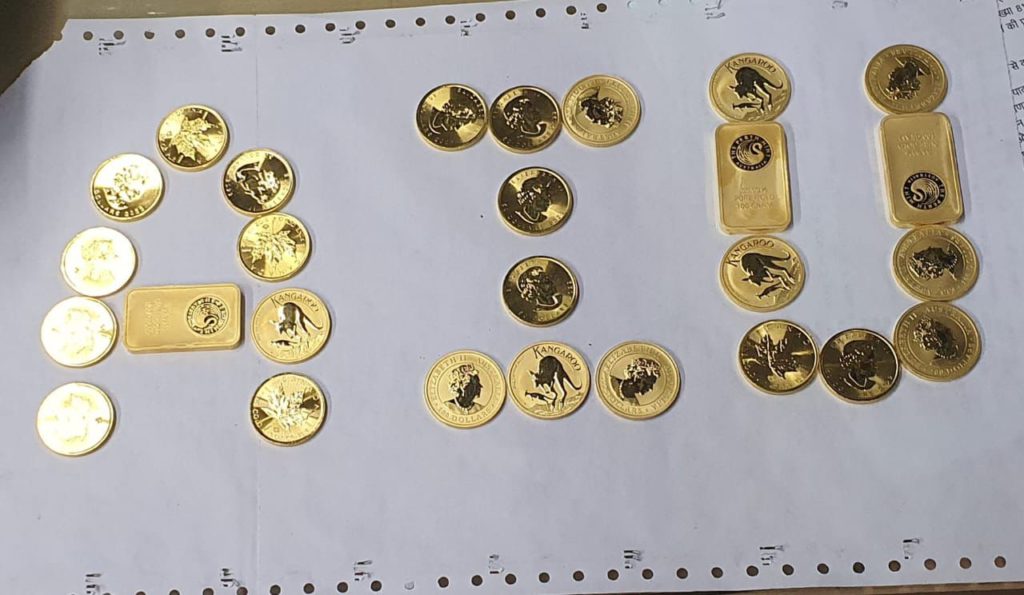




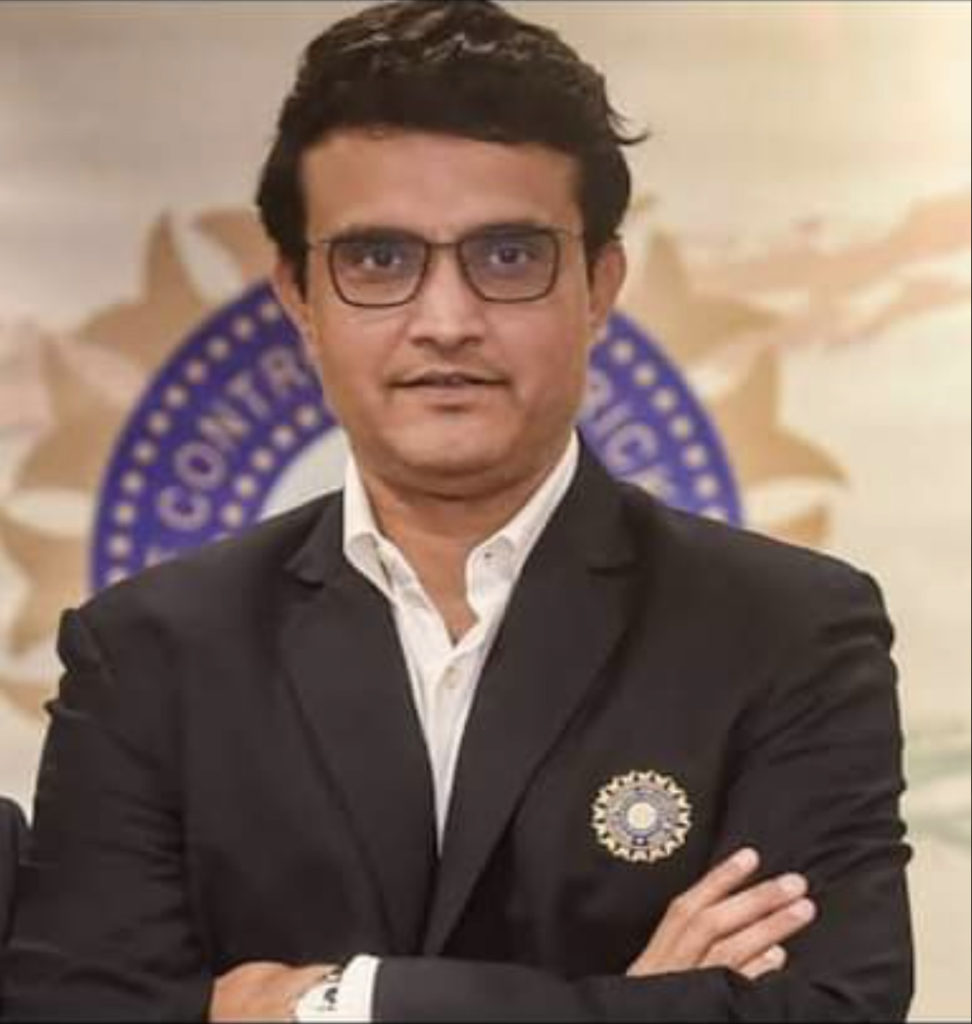
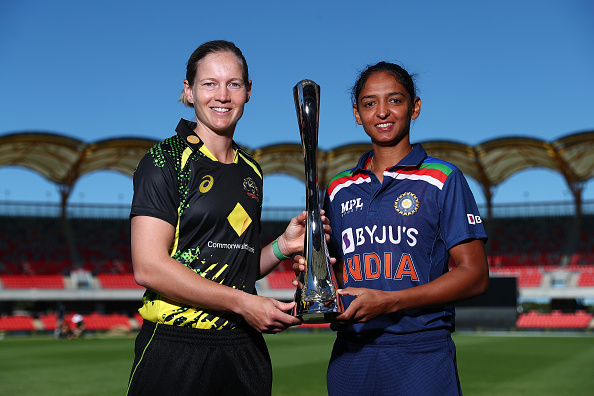
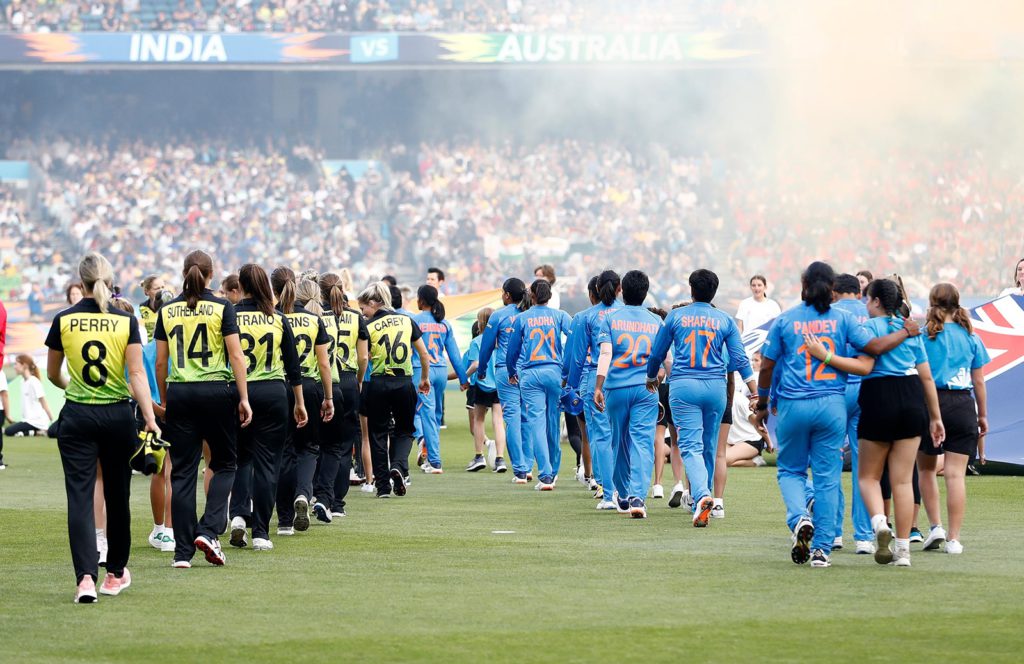







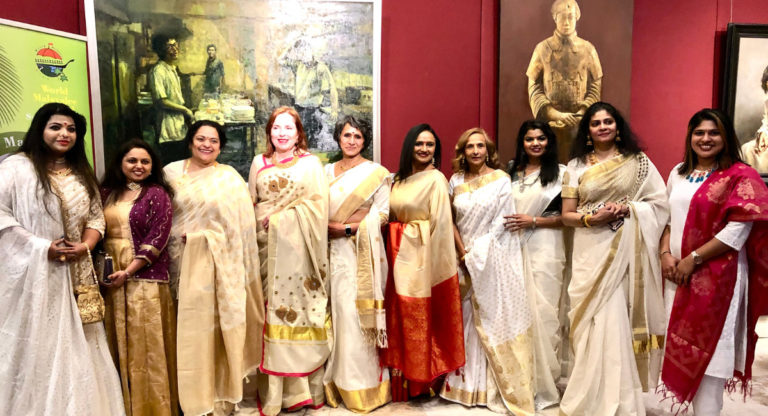
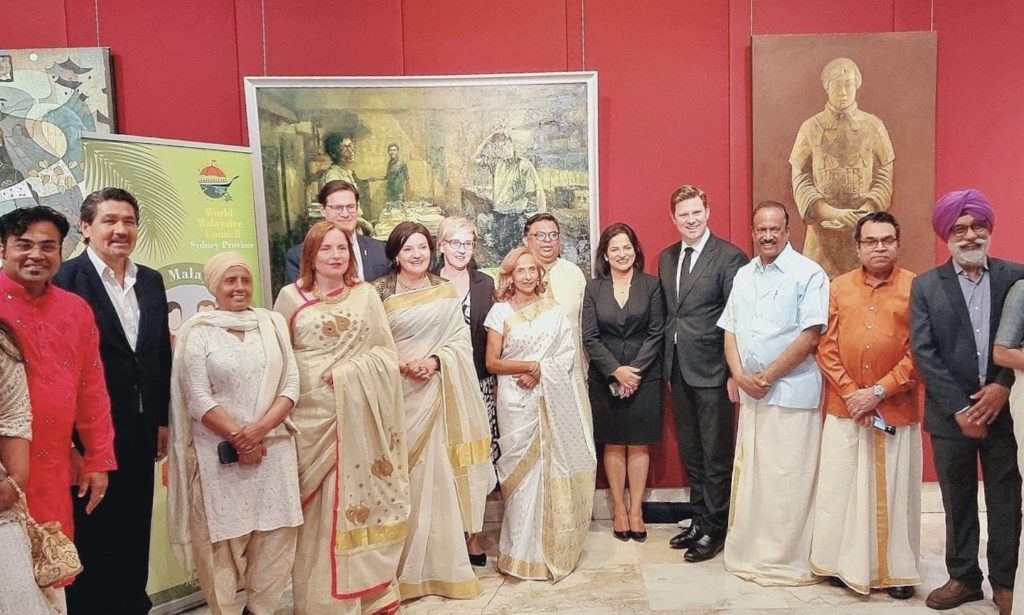
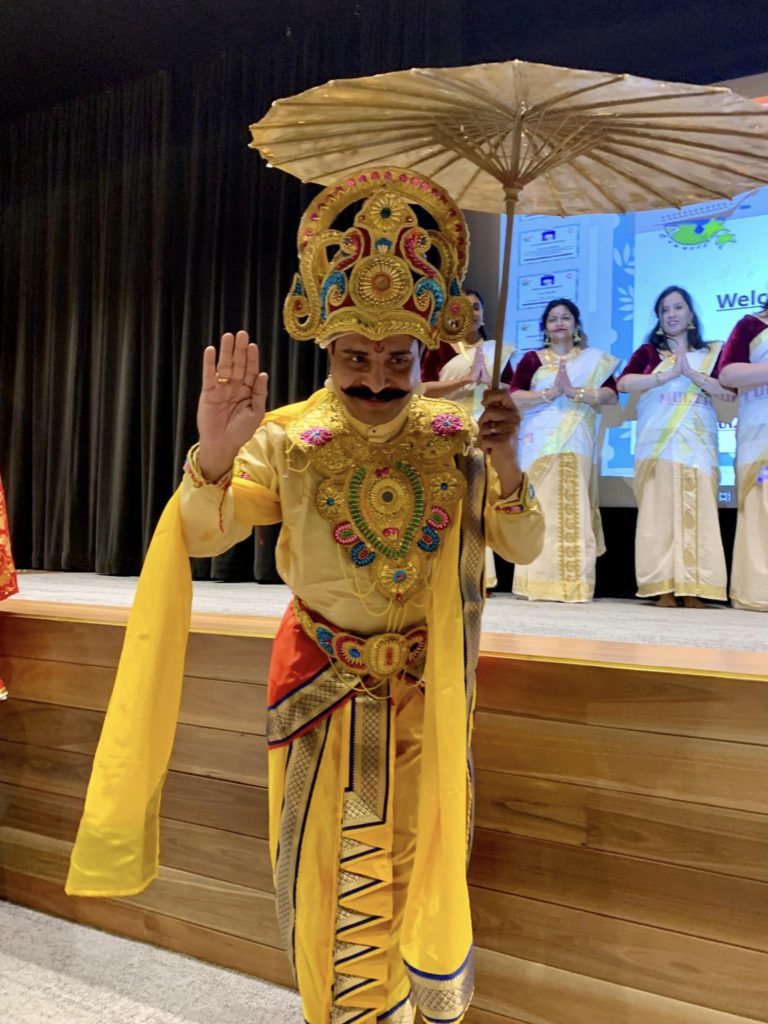
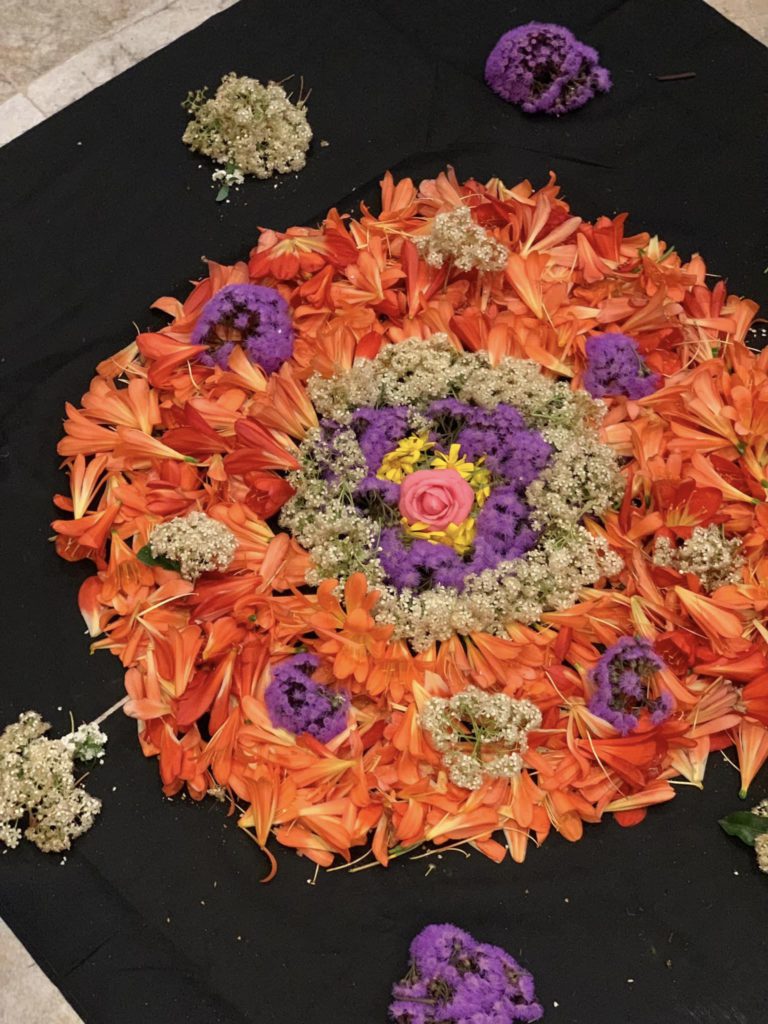

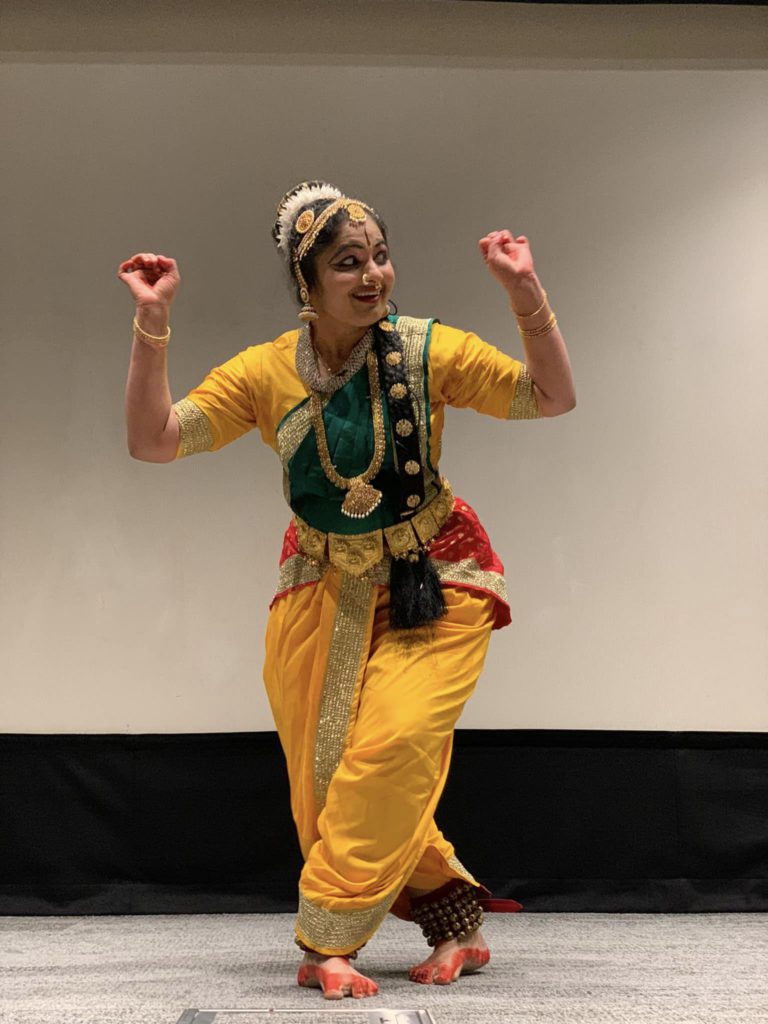
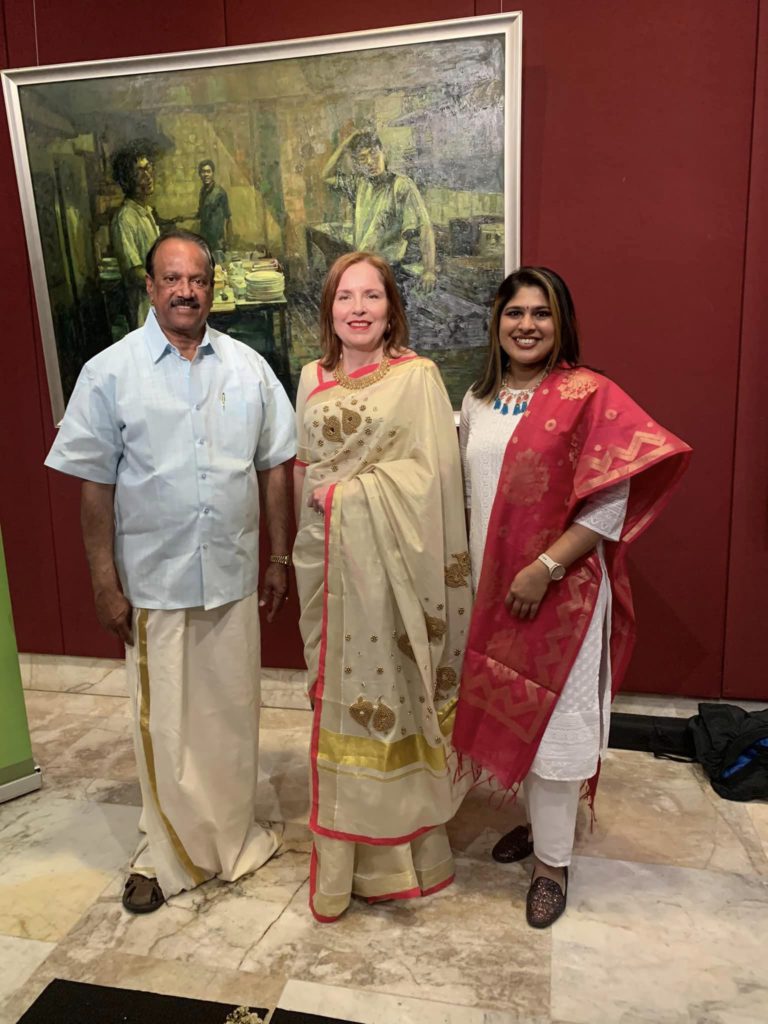
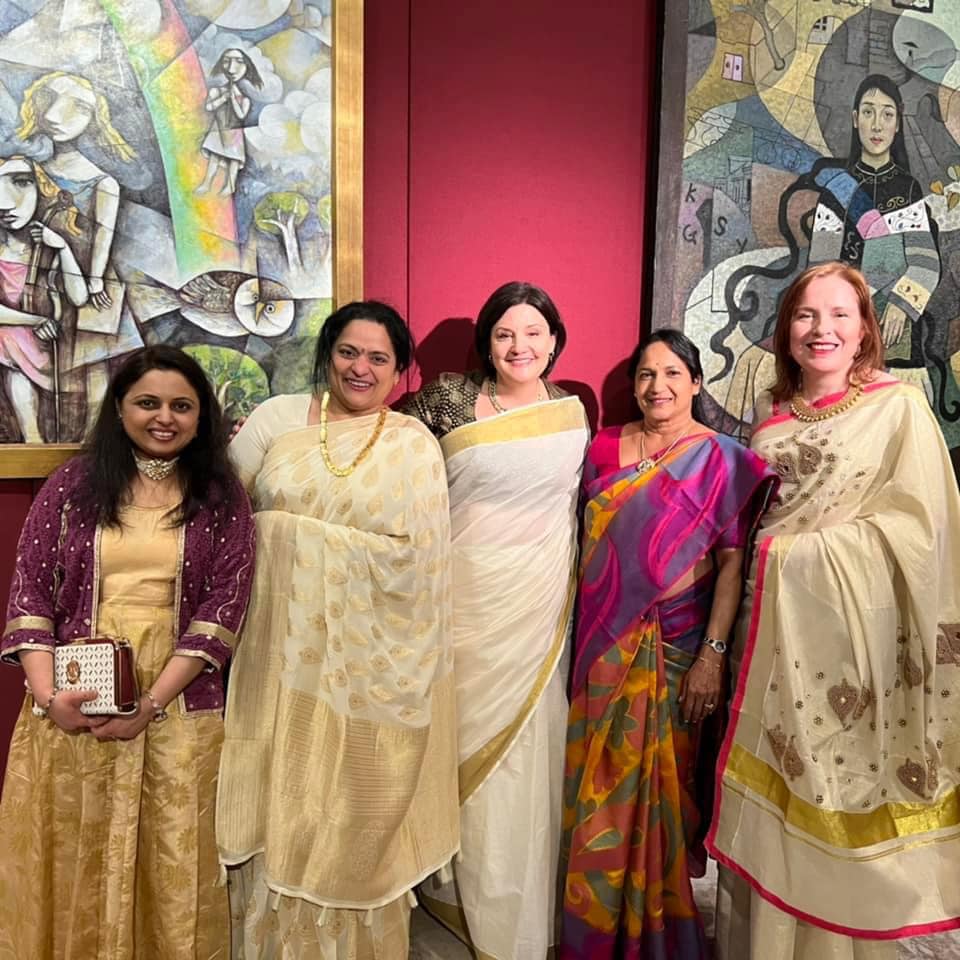
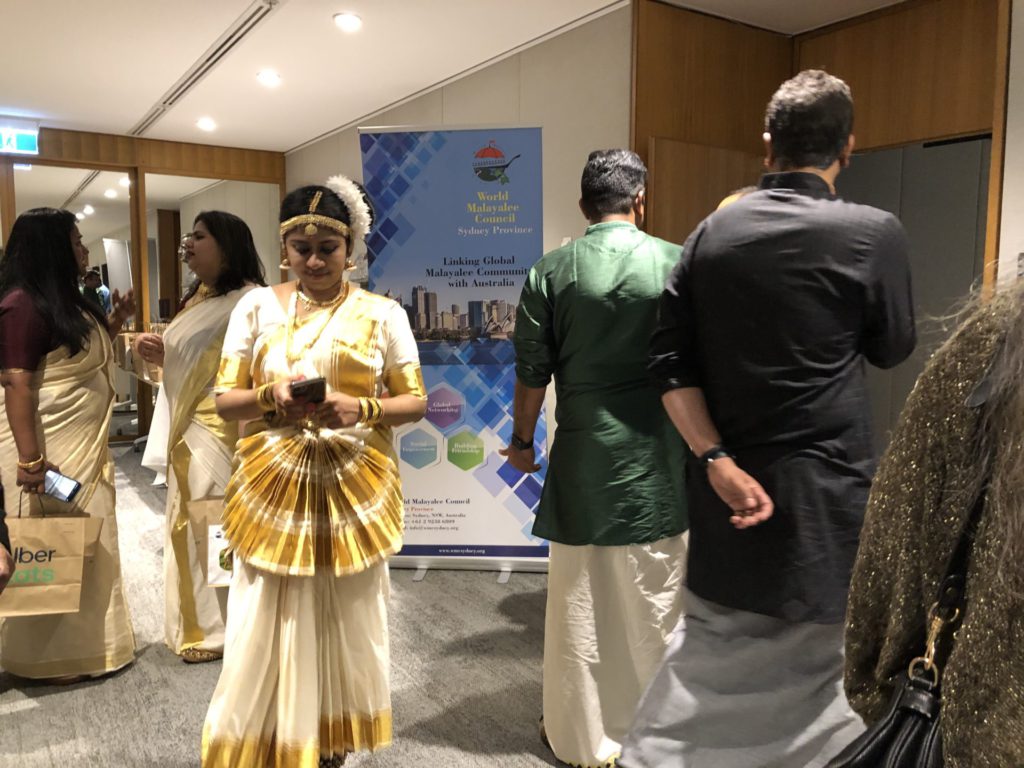
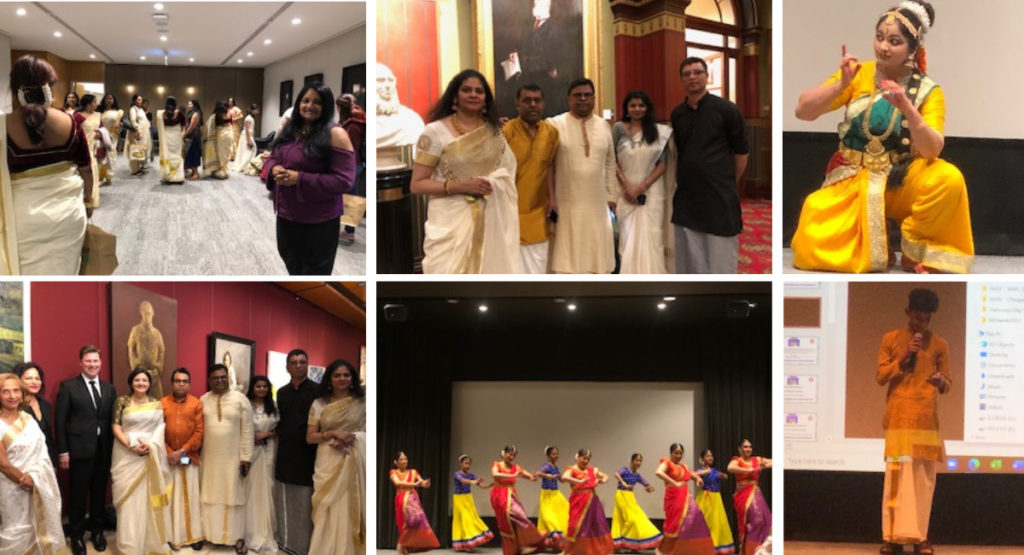



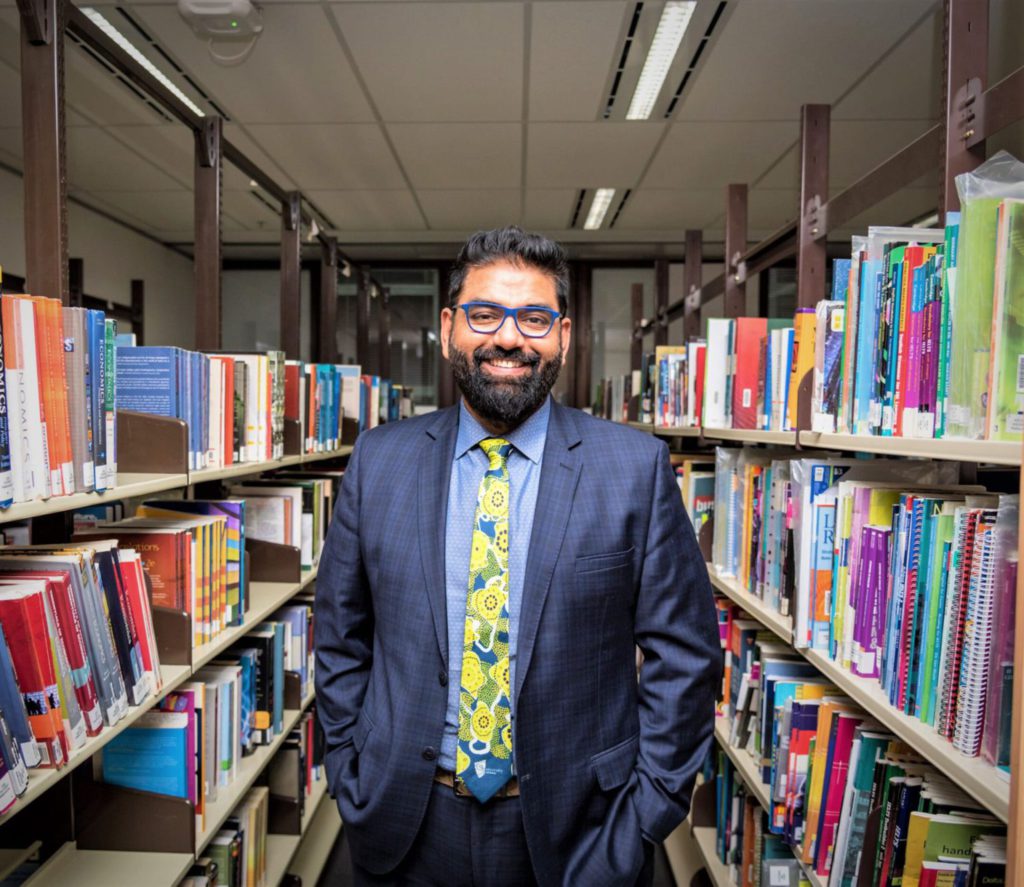
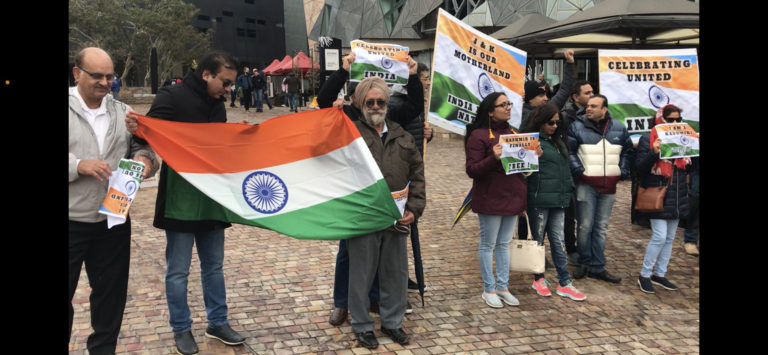
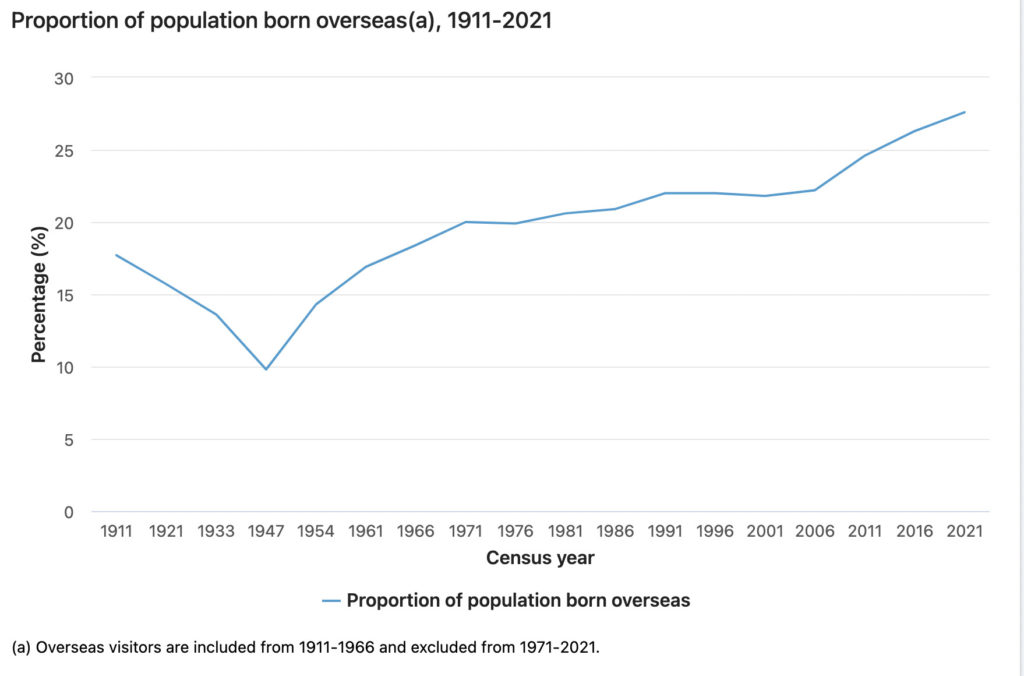
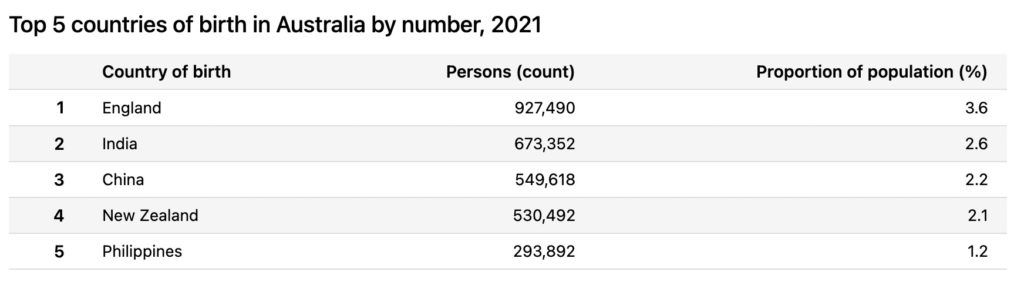
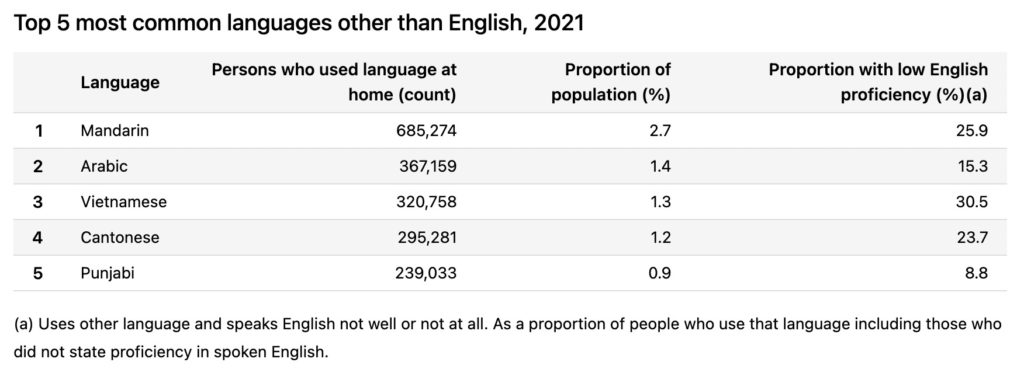




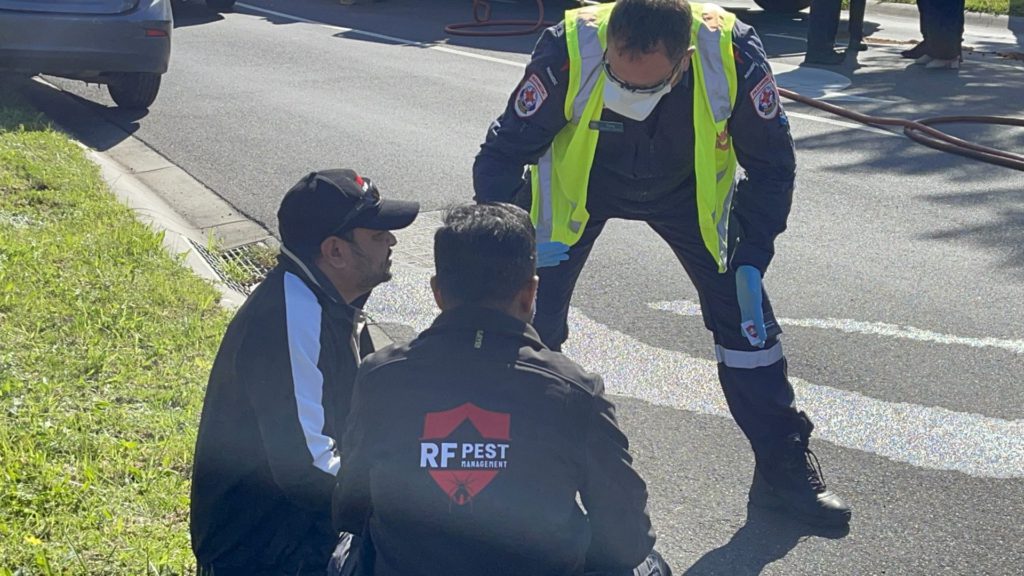



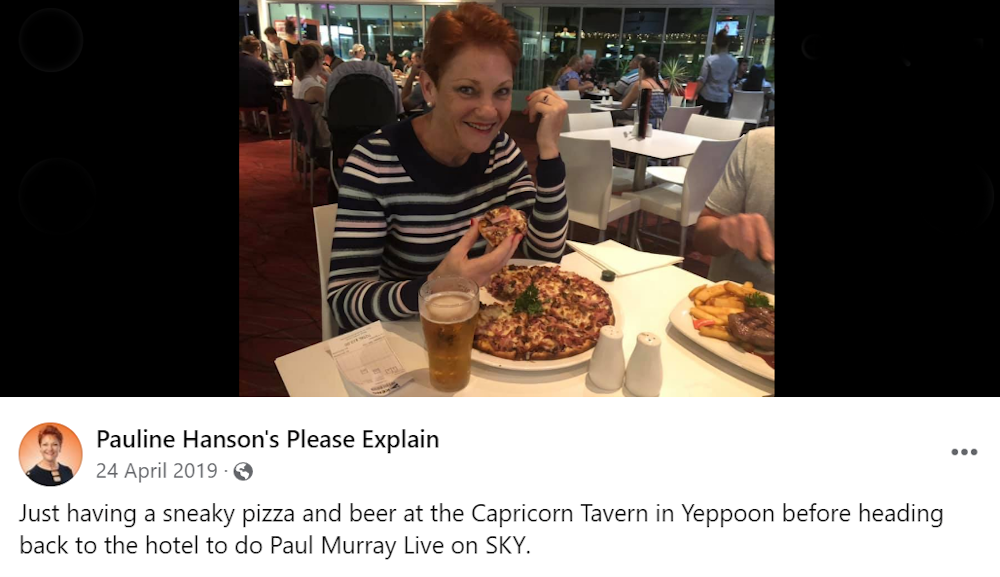
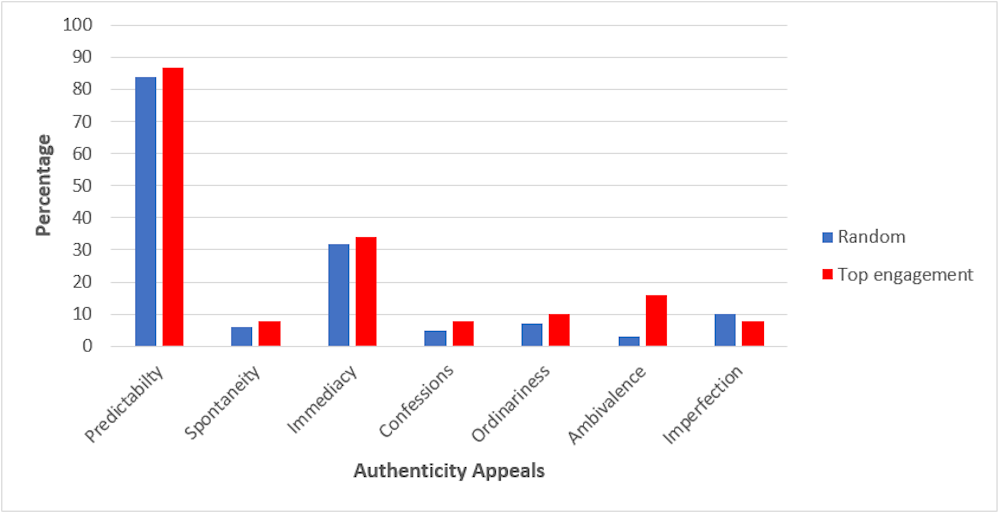








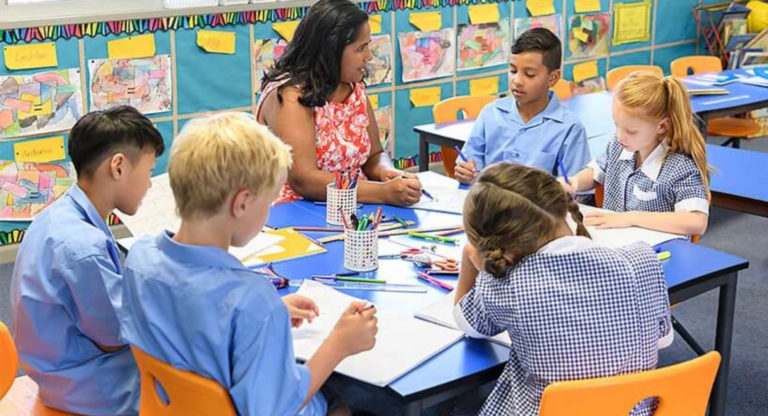


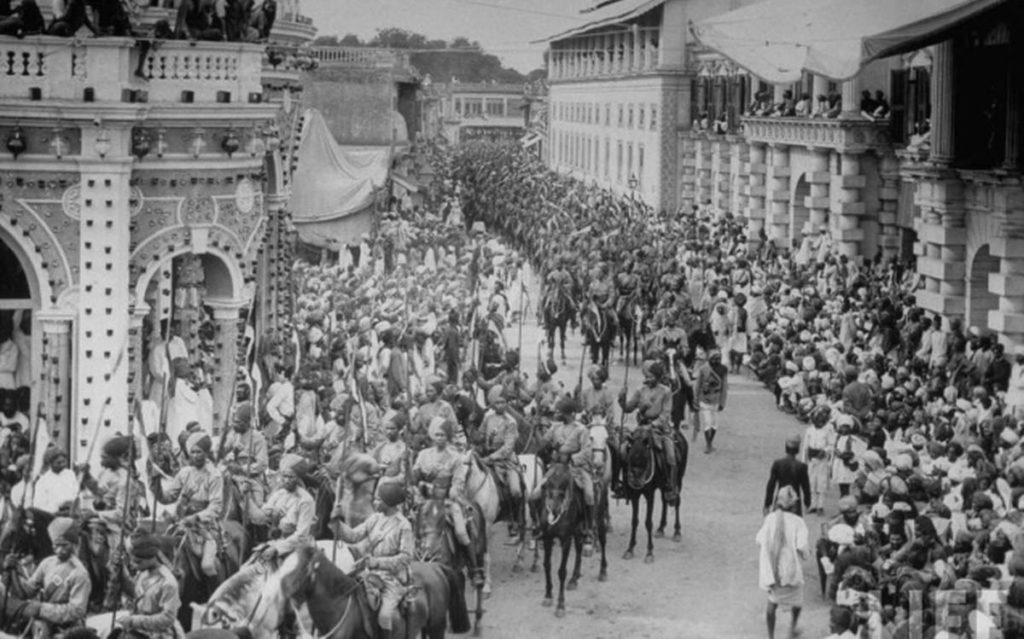
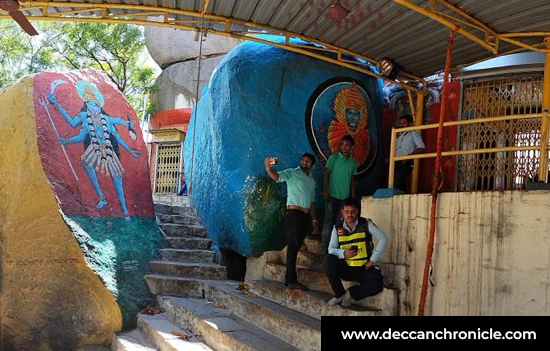 Mahakali Temple at Golconda Fort
 Undivided Andhra Pradesh produces quality handlooms even today.