How Australia can redefine its critical minerals approach with India’s partnership

0

By Mohan Yellishetty and Dr David Whittle

Australia is rapidly realising its critical minerals opportunity, but there are several initiatives that could help expedite the mission. 

Critical minerals play an important role in sustaining the financial well-being of the world’s major and emerging economies. They are used in the manufacturing of mobile phones, flat-screen monitors, wind turbines, electric cars, solar panels, and many other applications. 

While demand for critical minerals is projected to grow due to the rapid deployment of clean-energy technologies, they are currently at risk of geological scarcity, geopolitical issues and trade policy.

So what is Australia’s critical minerals approach and how can the nation better harness its existing infrastructure to realise the opportunity? Australian Resources & Investment explores several initiatives that could expedite the quest. 

Opportunistic co-production

As the largest mining company in the world, the lion’s share of BHP’s revenue comes from its iron ore operations. 

When considering the US Geology Survey’s 2022 list of critical minerals, nickel, zinc and cobalt are the only critical minerals the company currently produces. 

BHP produces nickel from its Nickel West operations in Western Australia, along with cobalt as a co-product. Zinc is produced as a co-product of the company’s Olympic Dam operations in South Australia.

Tackling small, technically challenging, diverse and imperfect markets to mine critical minerals might not suit BHP’s business model or its shareholders’ interests. However, the company has the potential to extract additional minerals as co-products to contribute to the global critical minerals supply. 

Take, for example Olympic Dam, Australia’s largest copper mine. Its ores include critical minerals such as cobalt and tellurium, along with the host mineral, copper, which is economically assisted by uranium and gold. 

If Olympic Dam could extract all of the critical minerals from its ore streams, it could significantly add to its gross resource value and become a prominent contributor to the global critical mineral demand. 

Nevertheless, there are many challenges in extracting these critical minerals. For example, rare earth elements often have low variations in density with their gangue – the commercially worthless material that surrounds a mineral – and can be difficult to extract as a result.

Employing additional extraction techniques downstream could unlock critical minerals previously considered inaccessible. It might take some imagination but could serve as another viable stream for Australia’s critical minerals future.

This takes us to the next point.

BHP’s Olympic Dam operation.

The role of Smelters and Refineries

The production of critical minerals relies on smelters or refineries, and it is often more cost-effective to retrofit existing facilities than to build new dedicated facilities. This offers an opportunity for smelters and refineries to produce more critical minerals as co-products. 

Olympic Dam is an example of a facility at which latent capacity exists to produce critical minerals, but where a combination of business focus and advances in technology are required to unlock the capacity. 

In January 2022, Rio Tinto announced the construction of the first module of a commercial-scale scandium demonstration plant at its Fer et Titane metallurgical complex in Sorel-Tracy, Quebec, Canada. 

Rio Tinto invested $US6 million ($8.4 million) into the building of the module, with an initial capacity to produce three tonnes of the critical mineral scandium oxide per year, which would make up approximately 20 per cent of the current global market. 

In May, Rio Tinto produced its first batch of high-purity scandium oxide from the plant and became the first North American producer of the critical mineral, which is used in solid oxide fuel cells and in aluminium alloys.

In the same month Rio Tinto announced its Kennecott copper operation in the US state of Utah had started producing tellurium, a critical mineral used in solar panels. A $US2.9 million circuit was built at the Kennecott refinery to achieve this copper co-product, which will enable Rio Tinto to produce approximately 20 tonnes of tellurium per year.

This is evidence of how smelters and refineries can be manoeuvred to co-produce alternate minerals and could be an inspired way of supplementing Australia’s critical minerals strategy. 

Mine waste and abandoned mines could offer a solution

Lack of government policy, financial incentive or techno-economic barriers at a company level means critical minerals are currently discarded to tailings storage facilities. Their retrospective recovery will be attractive only if the value of metal-contained tailings exceeds the costs of extraction and processing. 

The extent to which critical minerals exist in historic mine tailings and other waste streams is also subject to a great deal of uncertainty. 

In the past, miners did not necessarily assay for minerals that held no value, and historic records are often incomplete. However, more and more resources are being committed to tailings investigation. 

In April, Geoscience Australia teamed up with the University of Queensland, RMIT University and the Geological Survey of Queensland to develop a national database of mine waste sites across the country and the minerals that could potentially be present.

The Atlas of Australian Mine Waste from the Australian Government’s $225 million Exploring for the Future program highlights new opportunities to recover valuable minerals – a concept known as secondary prospectivity.

In December 2021, Cobalt Blue established a Memorandum of Understanding with the Queensland Government to explore opportunities in the recovery of cobalt (as well as any co-existing base and precious metals) from mine waste.

This forms part of the Queensland Government’s $13 million New Economy Minerals Initiative and involves Cobalt Blue conducting testwork to evaluate minerals processing options in the recovery of target metals.

The statistics from the past 20 years show the proportion of mine-waste-derived metals is nominal. 

Therefore, the best approach could be multifold – both encouraging mines and smelters to extract these minerals as a by-product to the existing commodities and exploring potential mine-waste-extraction opportunities.

A large proportion of the world’s gallium is produced from red mud – a form of industrial waste.

The 2022 critical minerals strategy

In March last year, the then Federal Minister for Resources and Water Keith Pitt announced the 2022 Critical Minerals Strategy, which is committed to growing critical-mineral production and expanding on-shore downstream processing. 

The strategy’s major objective is to provide stable supplies through securing investments and offtake agreements, enhancing sovereign capability and enabling the creation of regional jobs and growth. With the hope to position Australia as a “global critical minerals powerhouse by 2030”, the strategy will involve strengthening engagement with key countries such as the US, India, Japan, Korea, the UK, and European Union members.

This strategy is well placed to complement other major initiatives, such as the Global Resources Strategy (via diversifying markets), Modern Manufacturing Strategy (via critical-minerals processing) and the Technology Investment Roadmap (via low emissions technologies). 

Australia’s large critical-mineral endowment and high environmental, social and governance (ESG) standards mean the sector can respond to market expectations and demand.  We have the potential to meet the future needs of our key trading partners.

With the strategy in place, and the capital to support it, it’s now about optimising the implementation phase. The critical minerals are there to find. 

Authors: Mohan Yellishetty is an Associate Professor in Resources Engineering in the Department of Civil Engineering at Monash University and co-founder of the Critical Minerals Consortium. He’s been recognised as one of the leading experts in the area of sustainable mineral resources.

Dr David Whittle is a Research Fellow in the Department of Civil Engineering at Monash University and a Co-founder of the Critical Minerals Consortium. 

This feature first appeared in the Australian Resources & Investment.

3 reasons you feel hungrier and crave comfort foods when the weather turns cold

0

By Lauren Ball and Emily Burch

As we move through Autumn, parts of Australia are starting to see cooler weather. For some of us, that can mean increasing feelings of hunger and cravings for “comfort food” such as as pasta, stews and ramen.

But what’s happening in our body?

3 things change when it gets cold

1. Our body conserves heat

It sends this energy it conserves to our internal organs so they can maintain their temperature and work properly. The body can also perform heat-generating activities (such as shivering), which uses energy. The body will then look for additional energy through calories from eating food.

2. Our body warms up when eating

When we eat, the body needs to expend energy to digest, absorb, and metabolise the nutrients. This process requires the use of energy, which generates heat in the body, leading to an increase in body temperature termed “diet-induced thermogenesis”.

However, the amount of energy used to keep us warm is quite modest.

3. Some people experience a drop in the neurotransmitter called serotonin

This is partly because the rate our body produces serotonin is related to sunlight, which is lower in winter.

Serotonin helps to regulate mood, appetite, and sleep, among other things. When serotonin levels are low, it can lead to increased hunger and decreased satiety (feeling that you’ve had enough to eat), making us feel hungrier and less satisfied after meals.

Why we love comfort food in winter

Many of us struggle to eat salad in winter and crave mum’s chicken soup or a slow cooked, brothy ramen.

Research shows our brain detects the cold weather and looks for warm food. Warm food can provide a sense of comfort and cosiness, which is particularly appealing during the colder months when we spend more time indoors.

Comfort food can mean something different for everyone. They are foods we reach for in periods of stress, nostalgia, discomfort (like being cold), or emotional turmoil. For most of us, the foods we often over-indulge in are rich and carbohydrate heavy.

A drop in serotonin has also been shown to stimulate an urge to eat more carbohydrate-rich foods such as gnocchi, pasta, ragout, mashed potatoes.

What happens to those extra calories?

If you consume more energy in cooler weather, some of it will be used to keep you warm. Beyond keeping us warm, extra calories we consume are stored.

While most humans today have access to a year-round food supply, some research shows our bodies may still have some leftover instincts related to storing energy for the cooler months when food was harder to come by.

This behaviour may also be driven by biological factors, such as changes in hormone levels that regulate appetite and metabolism.

A fundamental principle of nutrition and metabolism is that the balance between the energy content of food eaten and energy expended to maintain life and to perform physical work affects body weight. This means any excess energy that we don’t use will be stored – usually as fat.

Using mathematical modelling, researchers have predicted weight gain is more likely when food is harder to find. Storing fat is an insurance against the risk of failing to find food, which for pre-industrial humans was most likely to happen in winter.

It doesn’t have to be unhealthy

No matter your cravings during cooler months, it’s important to remember your own personal health and wellbeing goals.

If you’re worried about excess energy intake, a change in season is a great time to rethink healthy food choices. Including lots of whole fresh vegetables is key: think soups, curries, casseroles, and so on.

Including protein (such as meat, fish, eggs, legumes) will keep you feeling fuller for longer.

Lauren Ball, Professor of Community Health and Wellbeing, The University of Queensland and Emily Burch, Dietitian, Researcher & Lecturer, Southern Cross University

This article is republished from The Conversation under a Creative Commons license. Read the original article.

Australian parents want schools to teach more sex education from an earlier age

0

By Jacqueline Hendriks

Decades of research have shown when relationships and sexuality education is delivered well, it can improve the sexual, social, and emotional health of young people. It can also lead to improved academic outcomes.

But research also shows schools worry parents and families will revolt if they provide too much detail in their sex education programs.

So it is important schools know what Australian parents actually think and want when it comes to relationships and sexuality education.

Our recent study surveyed Australian parents about what schools should teach and when they should teach it.

The history of sex education in Australia

Sex education in Australian schools has a long and complex history. Propelled by the HIV and AIDS pandemic of the early 1980s, programs often focused on the prevention of sexually transmissible infections, and led to many of us suffering through awkward lessons, such as how to put condoms on bananas.

Lessons about our changing bodies, menstruation and pregnancy prevention were also common. For many, perhaps the only time we saw our school nurse was that one time they came into the classroom to put a tampon in a glass of water – much to the horror of anyone who might need to use one.

More recently, a broader variety of topics has been covered by schools, to reflect the modern issues faced by young people. This includes a focus on consent. Age-appropriate consent education is mandatory as of 2023, from the first year of schooling to year 10.

However, the actual delivery of relationships and sexuality education in Australian schools is still highly varied. And students often tell us that the content they are given is not relevant. This is in stark contrast to the United Kingdom, where relationships and sex education became mandatory in 2020.

What should good quality sexuality education include?

According to international research, schools should teach a broad range of sexuality-related topics from the earliest years. Previous approaches, that relied heavily on fear or risk should be avoided. Instead, there should be an emphasis on wellbeing.

To give children and young people the information they need to be safe and healthy, a good quality relationship and sexuality education should include:

  • naming all body parts without shame
  • learning about the social, emotional and physical changes that come with puberty
  • developing a healthy body image (this includes learning that our genitals all look different – and that’s okay)
  • skills for decision-making about around sex and relationships, how to communicate effectively with friends or partners
  • how to safely navigate online spaces, including an understanding of the impact pornography can have on how we see sex
  • gender stereotypes and how they are problematic for everyone
  • skills to maintain healthy relationships and how to engage in sexual practices as safely as possible
  • affirmation of LGBTIQA+ diversity and
  • reliable places where you can seek support or get more information.

Our research

Our new research project set out to establish exactly what Australian parents think about school relationships and sexuality education via an online survey.

More than 2,400 Australian parents were surveyed in late 2021. They represented all states and territories, and their children were enrolled in both primary and secondary schools.

All school sectors – government, independent and Catholic – were represented.

What should students be taught?

Overall, 90% of parents in the survey either agreed or strongly agreed schools should deliver relationships and sexuality education.

Parents also reviewed a list of 40 sex education topics, from correctly naming body parts, to sexting and masturbation. They were then asked if such a lesson was appropriate for the school classroom.

Across all 40 topics, there was emphatic support for schools to address each of these issues. In most cases the level of support was more than 95%. Some of the most supported topics were peer pressure, communication skills and changes associated with puberty.

Support was lowest for topics such as pleasure, masturbation, pornography, gender stereotypes, gender identity and sexual orientation. However, the level of support for these topics still ranged from 83% to 92%. This confirms other recent research, which found Australian parents are highly supportive of schools teaching about diversity of gender and sexuality.

When should students be taught?

Parents in our survey were also asked to indicate at what grade level each topic should first be introduced.

Most parents thought a small number of topics could easily begin in primary school, with remaining topics being held over until secondary school. The primary school topics included bodily autonomy and personal boundaries, personal safety (or child abuse prevention) and correct names for body parts, including genitals and changes associated with puberty.

Interestingly, their preference was for more sensitive lessons, such as reasons to engage/not engage in sex, safer sex practices, sexting, contraception, and pornography to start in years 7 and 8. This is an important finding, as we know many schools hold off on delivering a lot of their sexuality education until years 9 and 10, as guided by the Australian curriculum.

Whilst most parents rated the current quality of relationships and sexuality education at their child’s school to be somewhere between good and very good (58%), 21% felt it hadn’t been taught at all by their school, and 12% were unsure what their school actually delivered.

What happens now?

Our study clearly demonstrates the vast majority of Australian parents surveyed want schools to delivery a truly comprehensive relationships and sexuality program. Yes, there is public support for consent to be covered – as it should be. But parents also want many issues, beyond consent, to be taught at school.

Despite a vocal minority who might criticise particular lessons, schools should feel confident most families have their back. In many instances, they actually want these topics to be introduced in earlier grade levels.

Schools may benefit from consulting with their parent bodies, and developing a specific school policy about relationships and sexuality education. Any policy should be heavily grounded in evidence, but it will also benefit from the input of staff, students and parents.

Our curriculum writers should also feel confident to include terms like “sex”, “contraception”, “pornography”, “gender diversity”, and “sexual orientation” in their guidance to educators. For too long there has been a reticence to provide clear directions to schools about exactly what to topics teach. This lack of clarity, along with inadequate teacher training, has had a big impact on our ability to implement relationships and sexuality education across the country in an effective and uniform manner.

Young people have a right to be educated about their bodies. And Australian parents want schools to play their part in doing this.


Talk Soon. Talk Often is a resource to help families have discussions about relationships and sex with their children. Yarning Quiet Ways is a similar resource for Aboriginal and Torres Strait Islander families.

The author wishes to acknowledge her co-researchers: Katrina Marson, Jennifer Walsh, Tasha Lawton, Hanna Saltis and Sharyn Burns.

Jacqueline Hendriks, Research Fellow and Lecturer, Curtin University

This article is republished from The Conversation under a Creative Commons license. Read the original article.

AFP launches new technology platform to manage investigations into the next decade

0

The AFP has launched a modern technology platform aimed at providing investigators with a contemporary and fully scalable system for managing investigations into the next decade.

In 2018, the AFP approached the market to find a solution to manage its extensive investigative activities for the next 10-15 years that is required to:

  • Manage offences associated with an investigation
  • Record and collate information that may be used as evidence
  • Author, prepare and manage evidence collection capabilities and capacities, briefs of evidence and other related documents tailored to the relevant jurisdiction in which the AFP is operating
  • Manage an investigation throughout the investigation lifecycle
  • Utilise the AFP’s existing and planned future enterprise capabilities
  • Deliver a high level of usability
  • Innovatively solve business problems
  • Adhere to AFP security policies and requirements.

In 2020, the AFP commenced developing the Investigations Management Solution (IMS) in partnership with the SAS Institute. On 4 April 2023, the AFP launched a fully operational IMS for its workforce.

AFP Assistant Commissioner Nigel Ryan said that under the AFP’s Capability Framework, delivering the IMS is a top priority for the organisation.

“The IMS supports Commissioner Reece Kershaw’s intent to support the frontline, reduce red tape, and enhance partnerships with our Commonwealth, State and Territory law enforcement and security partners,” Assistant Commissioner Ryan said

“It will enable AFP investigators to manage their investigations on a single platform, from receipt of a report or request through to generation of a brief of evidence and the finalisation of the investigation process.

 “The IMS is a system that is robust and underpins the next generation of investigations case management capability; one that reflects the AFP Investigations Doctrine, investigation standards and current practices,” he said.

“From the outset, it has been paramount to have a technology platform that supports contemporary investigators needs, from community policing to child exploitation, terrorism, criminal assets confiscation and complex, transnational, serious and organised crime.

“It also demonstrates the AFP as a leader in developing unique capabilities and exploiting advanced technology to support Australia’s national interests. To put it simply, we have built a platform that will contribute to the safety and protection of all Australians,” Assistant Commissioner Ryan said.

Indian international tourists key to record $14 billion spending in Western Australia

0

Travellers in Western Australia spent a record $14 billion in 2022, more than $1.05 billion of which was spent by international visitors. 

Tourist Research Australia’s latest statistics found visitors in WA spent $3.6 billion more in 2022 than the previous year. The record spending was also $500 million more than the record spending prior to the COVID-19 pandemic in 2019.

Tourists from India were the quickest to return, with visitor numbers just 5 per cent behind pre-pandemic levels.

Western Australia’s tourism Minister Roger Cook said, “WA is leading the nation in recovering both international and interstate visitors since opening its borders just over a year ago.”

May be an image of 15 people, people standing, indoor and text that says "WESTERN AUSTRALIA"

“We’ve put a huge focus on reinvigorating our tourism industry over the past year and we’re delighted to see that all our efforts are paying off.”

“With our new global tourism brand Walking On A Dream, an incredible lineup of major events, 13 new direct flights to Perth and huge developments in our incredible natural assets and attractions, the eyes of the world are on WA.”

No photo description available.

Out of the $14 billion, about $10.6 billion was spent during domestic overnight trips and $2.8 billion was spent during domestic day trips. 

In 2022, more than $1.05 billion was injected into the economy by international visitors in WA.

No photo description available.

That was up from $82 million spent by international travellers in 2021 when the border was still closed. 

Nearly 380,000 international travellers visited WA between April and December 2022.

About half of the state’s international visitors were from the UK, Singapore, New Zealand and India.

Nearly half of the funds, or $6.8 billion, was spent across the regional economy. That included $2.84 billion in the South West, $1.75 billion in the north-west and almost $1.1 billion in the Coral Coast.

Minister Cook said it was fantastic to have set a new record for tourism spending.

May be an image of 2 people, fire and outdoors

“This is a huge injection into the WA economy, creating jobs and revenue right across the State but we have ambitions to do much, much more,” he said.

“These results show just how much momentum we have as a sought-after tourism destination. WA is one of the hottest tourism spots in the world at the moment.”

No photo description available.

The Australian Hotels Association released a statement saying the state’s hotels and hospitality venues directly benefited from the record tourism spending. 

Chief executive Bradley Woods said despite the expenditure there were still significant opportunities for growth.

May be an image of 6 people, people standing, outdoors and text that says 'A GiANTS YOUR NTURE giantsofmandurah.com.au'

“Following last year’s border reopening, WA’s tourism sector has rebounded rapidly, which is outstanding news for WA’s hoteliers, publicans, restaurateurs, and the tens of thousands of staff they employ.”

“In late 2019, WA was enjoying record levels of visitors from interstate and overseas, so it is reassuring to see that we are on a trajectory to return to these levels once airline capacity improves and airfare pricing stabilises.”

May be an image of 7 people, people standing and text that says "WA'S BEST REGIONAL ACCOMMODATION ÛWARD AWÎ WESTERN AUSTRALIA WALKING ON DREAM C WESTERN AWA PA -"

“Today’s data reflects the concerted efforts by state and federal governments, Tourism WA and Tourism Australia to ensure the tourism, accommodation and hospitality sector could bounce back strongly after prolonged border closures.”

May budget to boost cultural and historical institutions with $535m four-year injection

0

By Michelle Grattan

Next month’s budget will provide $535.3 million extra over four years for nine major cultural and historical institutions.

The funding will go to the Australian National Maritime Museum, Bundanon Trust, Museum of Australian Democracy (Old Parliament House), National Archives of Australia, National Film and Sound Archive, National Gallery of Australia, National Library of Australia, National Museum of Australia and the National Portrait Gallery of Australia.

The money includes the $33 million earlier announced for the National Library’s digital archive Trove.

The government also promises that beyond the four years, the institutions will get indexed funding.

“Our institutions will be able to meet their financial obligations and invest for the future knowing they finally have a government that values them just as the Australian people do,” a statement on the funding says.

The government says it will “establish clear line of sight over future capital works and improvements to ensure the institutions never again fall into the state of disrepair they did over the last decade”.

But it has not abolished the “efficiency dividend” requirement that has been a bane of the institutions over many years.

Finance Minister Katy Gallagher this week defended the efficiency dividend, telling The Canberra Times it was appropriate as long as the funding was adequate.

“Putting a productivity efficiency component into any funding I think is a responsible part of government and making sure we keep the budget on a sustainable footing,” she said.

The efficiency dividend dates from the 1980s and has been again criticised by the Community and Public Sector Union, which represents staff at the institutions.

Prime Minister Anthony Albanese said the extra funding was another example of his government having to clean up the mess left by the Coalition.

Arts Minister Tony Burke said the former government had left the institutions in “a shocking state of disrepair” and the funding would get them “back to where they should be – where the government delivers strong core funding and philanthropists take them to the next level”.

The financial squeeze has led to some institutions having to reduce staff and services and neglect some activities and maintenance.

The government recently appointed former ABC journalist Barrie Cassidy as chair of the Old Parliament House board.

This is second time around for Cassidy, a one-time staffer to Bob Hawke. He was appointed chair of the Old Parliament House advisory council at the very end of the last Labor government but resigned after the Coalition won the 2013 election. Cassidy (who was still with the ABC at the time) was pressured to go by then arts minister George Brandis.

Michelle Grattan, Professorial Fellow, University of Canberra

This article is republished from The Conversation under a Creative Commons license. Read the original article.

Australia and India to race for space together; more than $20 million in grants available

0

The Australian Space Agency (ASA) is unlocking opportunities for Australian organisations to collaborate with the Indian space sector.

The International Space Investment India Projects (ISI India Projects) grant program is now open for applications.

Under this, applicants will be able to receive grants from allocated $20.69 million in funding over 4 financial years (2022-23 to 2025-26).

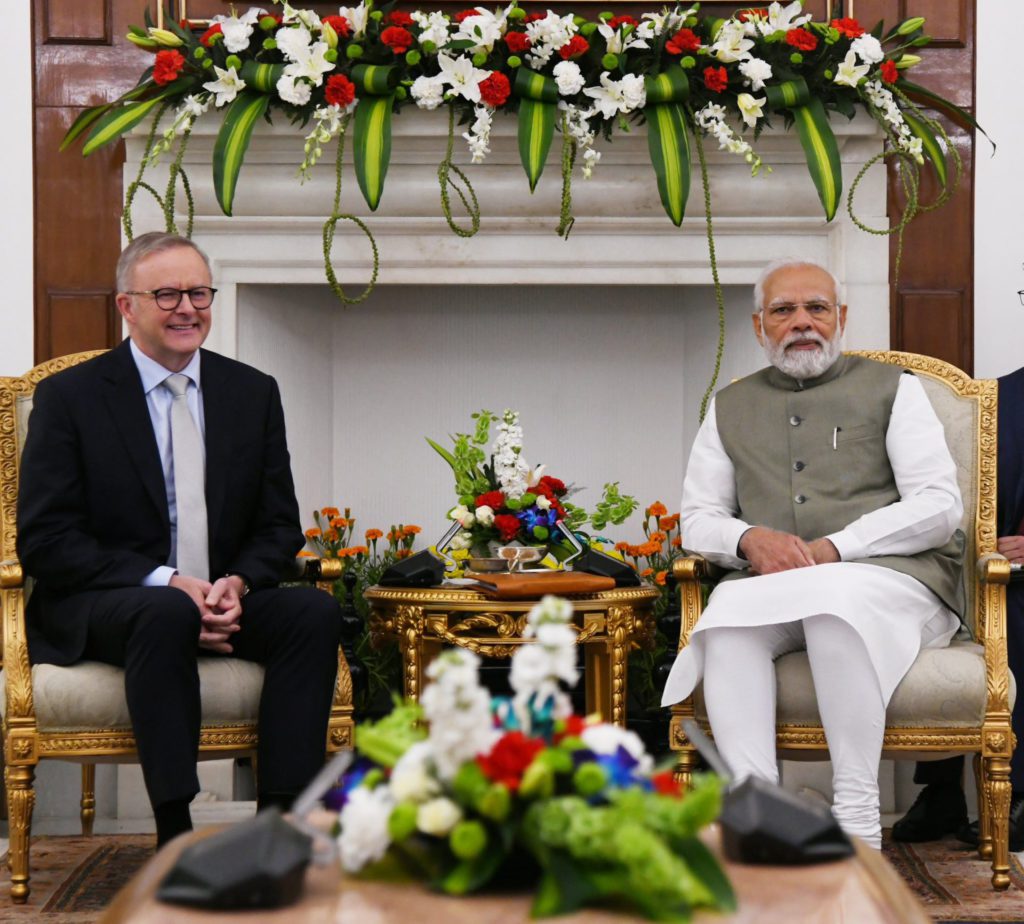
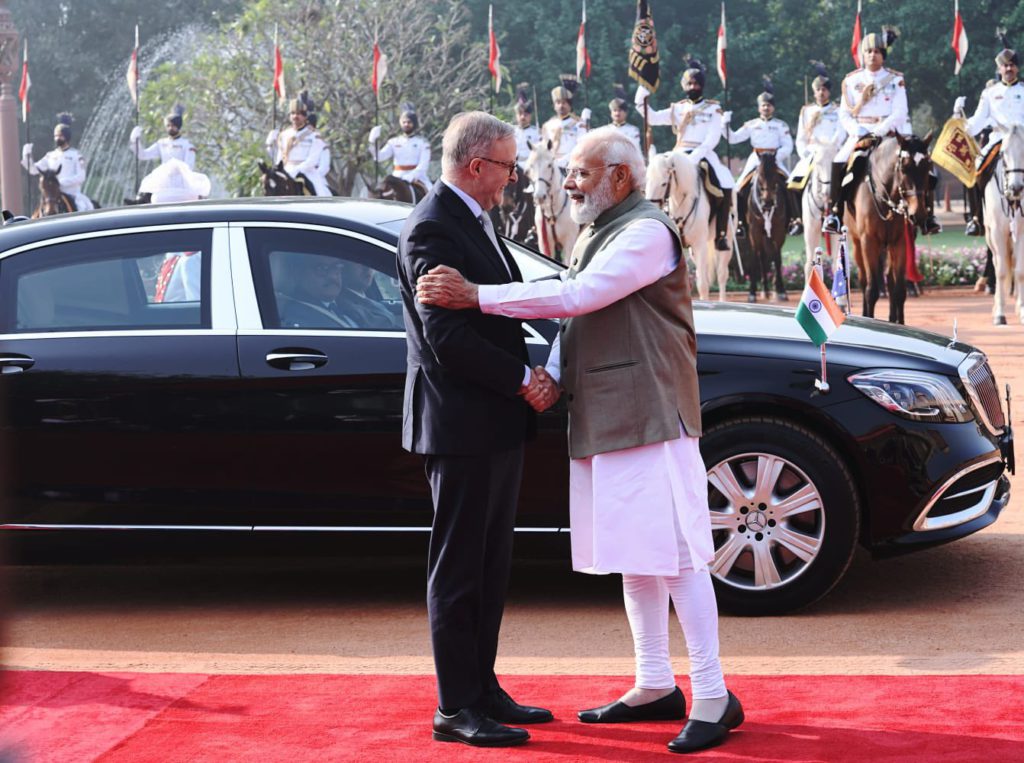
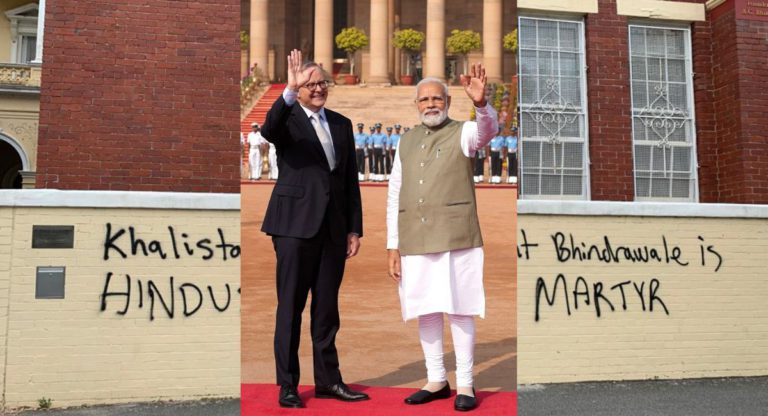
Prime Minister Anthony Albanese and Indian Prime Minister Narendra Modi; Image Source: PIB

Recently, India’s Prime Minister Narendra Modi and his Australian counterpart Anthony Albanese, recognising the importance of space, said in their leader’s statement “more India-Australia collaboration in the field of space should be fostered.”

Both prime ministers also recalled the participation of Australia as a Partner Country in the 7th Bengaluru Space Expo and expressed their belief that more India-Australia collaboration in the field of space should be fostered, including scientific research, space applications and production and launch of satellites.

Image: Head of the ASA Enrico Palermo (Source: Twitter)

Head of the ASA Enrico Palermo said in a statement the projects will help Australian space organisations build strong and ongoing connections with India.

He said:

“Australia and India’s commercial space sectors are at similar levels of development, making us perfect partners.”

This collaboration will enable Australian businesses and research organisations to conduct joint projects and build closer relationships with the Indian space sector.

It will also offer valuable opportunities for collaborative space projects across the mutual priority areas, which are:

  • earth observation
  • position, navigation and timing
  • advanced manufacturing for space
  • artificial intelligence for space-based applications
  • applied space medicine and life sciences
  • space situational awareness and debris mitigation
  • cyber security projects for space missions
  • science and exploration services
  • facilitating space projects in industry resilience, workforce and skills development.

Mr Palermo added:

“THE INTERNATIONAL SPACE INVESTMENT INDIA PROJECTS OPPORTUNITY WILL GENERATE PROJECTS THAT LEVERAGE OUR RESPECTIVE EXPERTISE TO ULTIMATELY STRENGTHEN OUR SPACE SECTORS, ENHANCE OUR CAPABILITIES AND BOOST JOBS AND GROWTH ACROSS OUR COUNTRIES.”

The first round of Australia’s India-focused International Space Investment grants program, designed to foster closer bilateral collaboration on mutually beneficial space research and development projects.

Prime Minister Anthony Albanese and Indian Prime Minister Narendra Modi; Image Source: PIB

PM Albanese also underlined Australia’s ongoing support of India’s Gaganyaan Space Program.

ISI India Projects are delivered by the Australian Space Agency and DISR Grants Delivery & Business Services, building off the concept of a broader 2018 ISI initiative. The ISI India Projects grant applications close Tuesday 13 June 2023.

Come have a coffee at Sisterworks Cafe to empower migrant and refugee women

0

Celebrating 10 years in operation, social enterprise SisterWorks has opened a new cafe and shop in the Richmond suburb of Melbourne, supporting more migrant, refugee and asylum-seeking women to find work and rewarding careers.

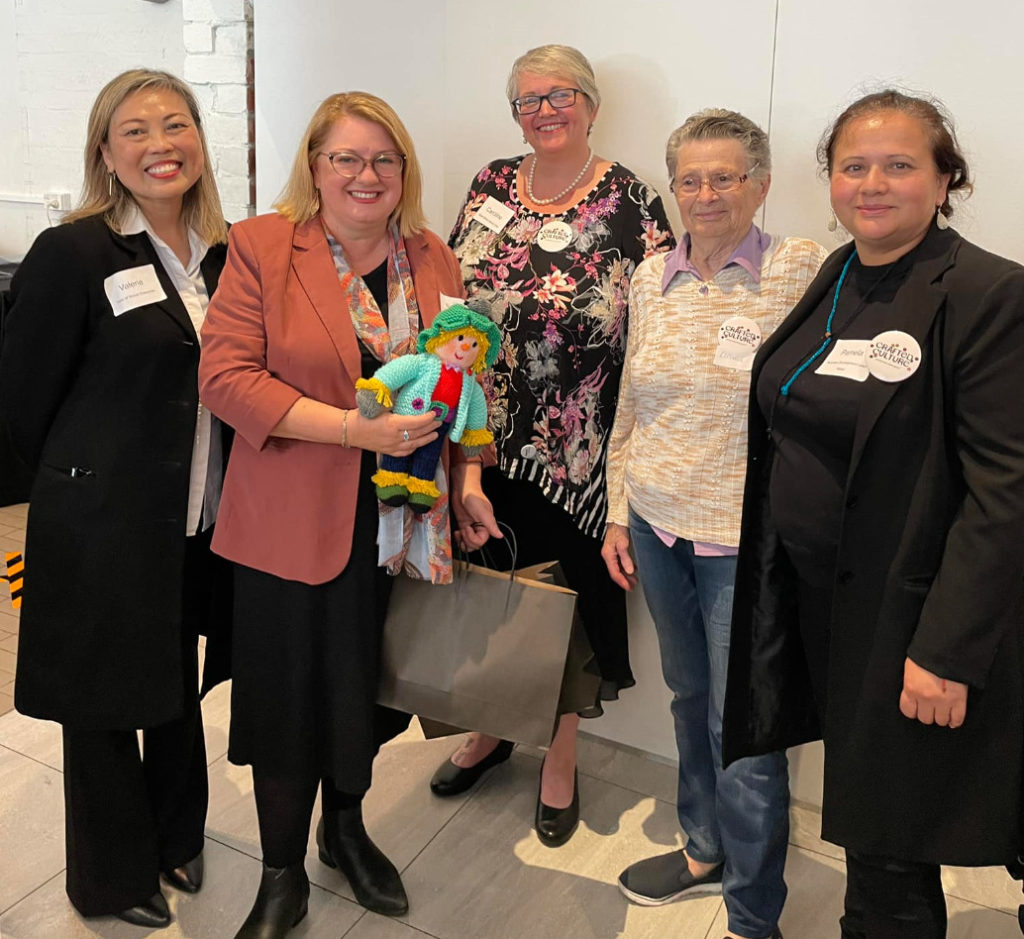
Victoria’s Minister for Women Natalie Hutchins officially opened the SisterWorks Crafted Culture Cafe and Shop on Bridge Road. It is SisterWorks’ latest initiative to support women from diverse cultural backgrounds by providing hands-on, vocational training and employment opportunities.

Minister Natalie Hutchins said, ‘Migrant, refugee and asylum seeker women bring unique cultural knowledge, skills, abilities, perspectives and connections to our community, which are not only valuable assets to potential employers but also key to overcoming structural barriers to women’s advancement in the workforce.

“I’m delighted to be here today to help officially open the SisterWorks Crafted Culture Café, which will support more women from diverse backgrounds to earn an income, gain work experience and explore entrepreneurship.”

Migrant and refugee women can be excluded from employment opportunities due to a lack of local relevant experience, qualifications and language obstacles.

Victoria's Minister for Women Natalie Hutchins officially opened the SisterWorks Crafted Culture Cafe; Image Source: Supplied
Victoria’s Minister for Women Natalie Hutchins officially opened the SisterWorks Crafted Culture Cafe; Image Source: Supplied

The Richmond café will employ women who have completed SisterWorks hospitality training, while the shop will showcase the cultural diversity of ‘Sisters’ through flavours and crafts from around the world.

SisterWorks CEO Ifrin Fittock said, “Crafted Culture, our new cafe and shop, is a testament to our strong, culturally sensitive and tailored hospitality and employment service programs.”

“Not only is this a safe place for our migrant and refugee Sisters to practice new vocational skills, but for some of the women, this is their first job in Australia.”

SisterWorks programs have received $1 million for the economic empowerment of migrant and refugee women, as part of the Victorian government’s commitment to addressing structural barriers to women’s participation in the workforce.

Women from culturally diverse backgrounds are overrepresented in insecure and low-paid work. They also experience higher rates of unemployment, with the unemployment rate for Victorian migrant women more than three times higher than for Australian-born women. 

SisterWorks has supported more than 2000 migrant, refugee and asylum seeker women from 105 countries to build a better life in Australia through skills training and work opportunities.  

The Richmond café and shop joins SisterWorks activities across Victoria, including Empowerment Hubs in Melbourne’s CBD, Bendigo, Dandenong and Abbotsford, where women can connect with each other.  SisterWorks also delivers learning opportunities through their Labs: Support, Design, Cooking, Business, Digital and Pathways.

What’s on the Sisterworks Cafe menu?

Cafe’s menu features products created by our Sisters including our Raspberry JamSpicy SalsaFig Jam and Eggplant Pickle

Students’ mental health a big issue for schools but are teachers part of solution?

0

By Brian Moore and Sarah Redshaw

Schools are an obvious place to do mental health work with young people. This is important, as about one in seven young Australians are diagnosed with a mental illness. This includes issues like psychological distress, anxiety, depression, school refusal, and complex trauma.

However, the ratio of school counsellors and psychologists to students means they can be very difficult for students to access. For example, there is about one counsellor for every 750 students in NSW public schools.

Consequently, teachers are often seen as front-line mental health providers by default. This has particularly been the case since the start of the pandemic.

But what is reasonable to expect of teachers when it comes to students’ mental health?

Training is patchy

There is little consistency in the types of mental health services provided by schools or who actually performs this role.

Many schools have counsellors or psychologists, while others may have access to Department of Health and non-government staff who might come into schools to deliver a specific program or provide targeted support to at-risk students. But availability is a huge issue.

Meanwhile, there is no consistent mental health training for new teachers. Many teacher education programs do not explicitly address mental health. If it is included, it often occurs as a single day of training, or sometimes features as part of other subjects. The level of training a student receives is often up to a lecturer’s interest in mental health rather than identified needs.

Even then, the focus is also often around supporting student wellbeing, rather than addressing mental illness.

There are professional development training and resources on mental health for existing teachers. But again, these are not consistently applied.

Teachers are not confident

Given inconsistent and potentially inadequate training, it is unsurprising that while teachers take mental health seriously, many report low confidence about supporting their students’ mental health. In one 2017 study in the United States, almost 50% of teachers reported they had received inadequate mental health training, and 85% indicated they would like further training in mental health issues.

Even experienced mental health professionals report feelings of incompetence when addressing their clients’ mental health needs.

So, if qualified mental health practitioners feel this way, our expectations of teachers in the mental health space should be carefully considered.

What can teachers do?

Teachers do of course have a valuable role in supporting student mental health. But this needs to occur in the context of teaching.

They can do this by developing a positive, supportive learning environment that supports students’ individual needs and strengths. Teachers can provide opportunities to build positive student identity and self-esteem by providing genuine opportunities for students to succeed in the classroom. Teachers can have positive relationships with their students and foster healthy peer interactions.

It is important teachers know how to identify students with possible mental health problems as well as being aware of potential referral options (noting lack of availability is an issue). It is also important teachers develop and maintain open and honest communication with caregivers.

What more can be done?

Clearly, much more needs to be done around mental health in schools. It makes sense to make greater provision for funding and training of school counsellors and psychologists. We should also examine ways of better integrating mental health services like the Department of Health and Headspace in schools.

However, with supply and recruitment difficulties these are not straight forward solutions.

A consistent national approach to the mental health curriculum in teacher training is urgently needed.

Critically, the role of teachers in school based mental health services needs to be clearly defined to manage expectations and support students more effectively.

Teachers belong to the helping category of professionals and are inclined to support their students in every way they can. They need to be equipped to provide assistance with learning that can take mental health into account.

However, policy makers and school communities need to remember, teachers are not trained as mental health practitioners.


If this article has raised issues for you or someone you know, you can call Lifeline on 13 11 14 or Kids Helpline on 1800 55 1800.

Brian Moore, Lecturer, Educational Psychology & Child Development, School of Education, Charles Sturt University and Sarah Redshaw, Senior Research Fellow, Charles Sturt University

This article is republished from The Conversation under a Creative Commons license. Read the original article.

How I got my daughter to love India and stay close to her roots

0

By Sahana Singh

“You have been away from India for so long; how is your daughter so attached to the place? My children hate to travel to India; even if they do, they can’t wait to leave! They hate to fall sick there, and they cannot fit in with their cousins, uncles, and aunts.”

I am often asked this question by Indian moms but have never given a detailed reply. Let me try today. My daughter was six months old when we moved to Singapore.

It was not a happy choice for me — I wept buckets because I was a young mother and wanted to have my extended family around me.

Besides, the thought of going away from India was just heartbreaking. But my husband would not hear anything; he was convinced that it was a matter of time before I appreciated his decision. He felt it was important to see the world and experience it; besides, we could always return to our home in India whenever we wanted. It did not take long for me to fall in love with Singapore — it was like a paradise where everything was organized perfectly and worked like clockwork.

Thanks to the imprint of Indian civilization, it often felt like a city in India but with a government that works exceptionally well. My experience in Singapore has been published here in Washington Post and later syndicated in the Straits Times, Singapore’s national paper.

My daughter went to different kindergartens and schools in Singapore. Her childhood was fun with lots of friends in a safe and clean island country. Yet, there was one worry always at the back of my mind— what if she turned out like one of the culturally disconnected Indian kids who knew nothing about India, did not speak any Indian language, and did not derive any inspiration from India? I recoiled at the prospect of feeling estranged from my own daughter.

The first thing I did was to make my girl familiar with Ramayana, Mahabharata, Puranas, and Panchatantra.

With the help of picture books and comics, I made sure that all those delightful stories that I had grown up reading became meaningful for her too. I tried to make her develop a personal bond with all the deities in the Hindu pantheon — Vishnu, Shiva, Lakshmi, Parvati, Hanuman, Durga and so on.

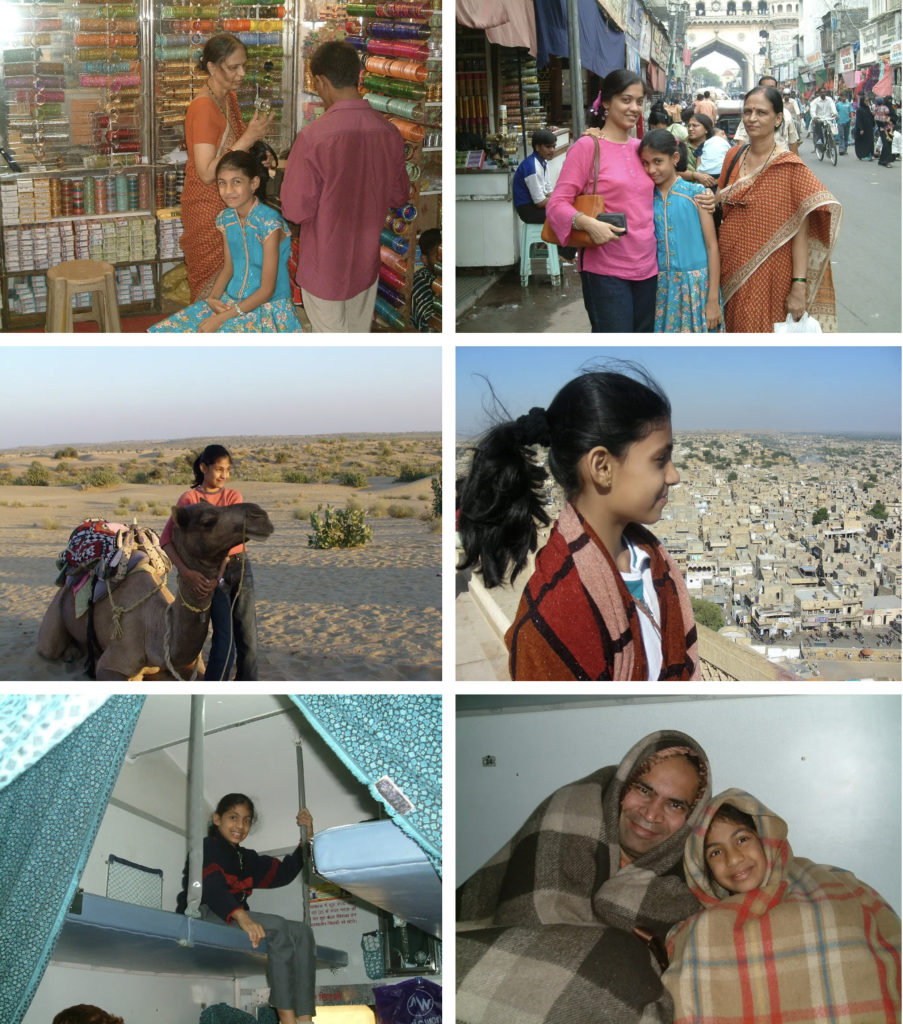
Since Singapore was just four hours by air from Bengaluru and five hours from Delhi, I made at least two trips to India in a year. My job allowed me to work from home, except when I travelled to conferences so I could easily manage my trips to India. Whenever he could, my husband would join. Thus, my daughter spent plenty of time with her grandparents in India.

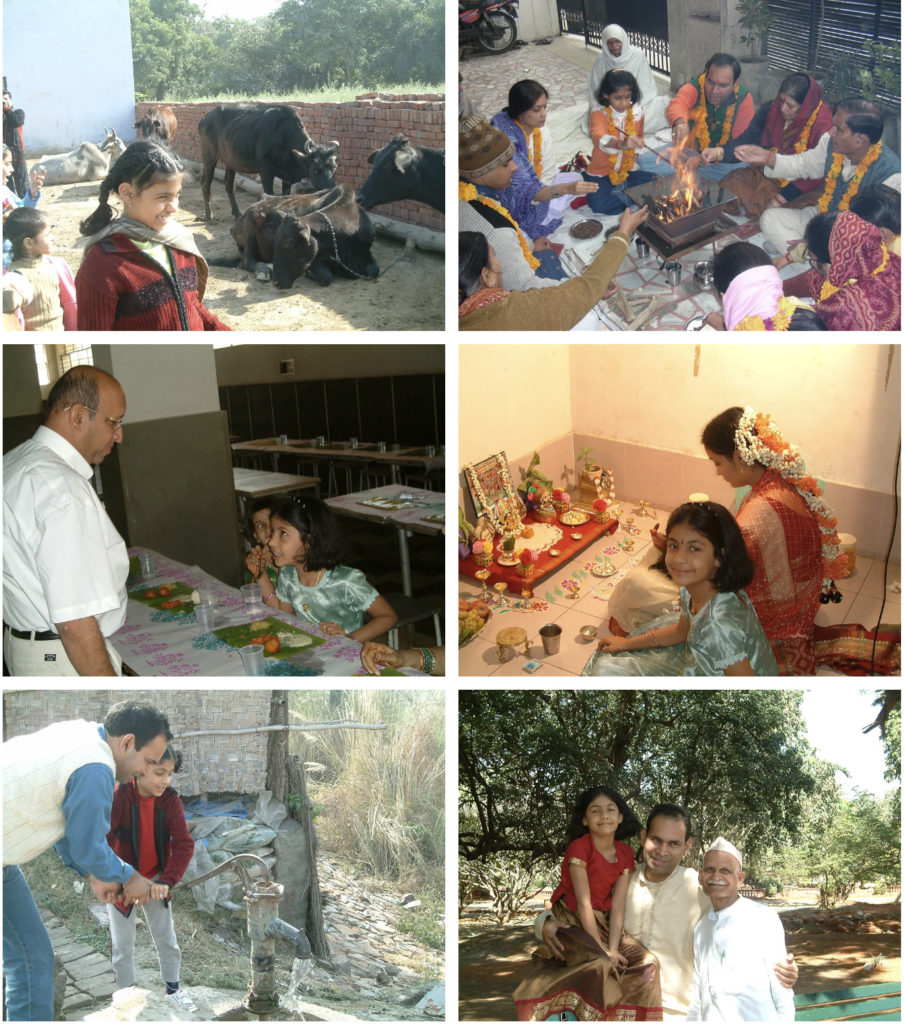
She collected Parijata flowers for my mother’s daily puja; she heard stories from my father and often enjoyed traditional meals on banana leaves in Bengaluru. And in Delhi, she enjoyed my mother-in-law’s Makki ki roti and Sarson-chana-palak saag along with bathua ka raita. She got the chance to visit both the villages in Uttar Pradesh (Tatiri and Fazalpur) where my mother-in-law and father-in-law grew up.

In the 13 years, we were in Singapore, I managed to take my daughter to different places in Karnataka, Kerala, Telangana, Punjab, Haryana, Uttar Pradesh, Rajasthan, Maharashtra, and Bengal. We often travelled by train. In each of these places, we would visit historical sites and I would tell her stories of valour and wisdom from India’s past. This was in contrast to many Indian families in our circle of friends who preferred to take their children only to Europe and Australia.

Not that I have anything against Europe and Australia. But I wanted my girl to know her own culture thoroughly before knowing others.

Meanwhile, to my relief, two Indian schools opened up in Singapore one after the other — the Global Indian International School and the DPS International School. I had always wanted my daughter to study Indian geography and history alongside other subjects in school, so the opening of these schools was the fulfilment of a deep desire.

Both schools followed the curriculum of Indian schools. I knew that the history textbooks were written from the Marxist-Christian colonizer perspective but at least there would be some context for me to work with while teaching my child. If the textbook extolled the virtues of the railways that were introduced to India by the British, I was at hand to explain to her that the trains were mainly used to transport natural resources out of India to power England’s Industrial Revolution leaving India behind in poverty.

I think I might be crazy but I spent a lot of time explaining the Southwest Monsoon to my daughter! It was vital for me that she understood how the life-giving monsoon was the cornerstone of our civilization — how it contributed to the bountiful harvests and perennial rivers. I transmitted every word of what I had learned from Ms Madhabi Bhattacharya, my Geography teacher at Julien Day School, Ganganagar in Kolkata.

She had explained the monsoon to us so evocatively:

“The air current coming from the southwest is saturated with moisture and struggling to carry the weight. Suddenly, the Western Ghats of India appear in its path and it dashes against the mountains dropping a large part of its moisture.”

As she had pointed out different places on the map of India indicating where the rains would pour and where it would be dry, my mind’s eye correlated that with the beautiful and dramatic downpours, I had experienced in different parts of India and I also looked forward to seeing the desert in Rajasthan.

It also fascinated me that the state of Tamil Nadu which got passed over by the SW Monsoon later received winter rains from the Northeast Monsoon winds. When we moved to Singapore and experienced rains in winter, it struck me that these were the same air currents that brought rain to Tamil Nadu, which of course, I pointed out to my daughter.

Thanks to the manner in which my teacher had explained the spatial spread of the monsoon and the soil and cropping patterns of India, geography was never a dull subject for me in school. And I was not going to let it be dull for my daughter either! I tried to recreate all the imagery of monsoon for my daughter and to enhance it further by playing rain-themed songs from movies as well as monsoon ragas.

In order to highlight the enormous cultural diversity of India, I got my daughter interested in the plethora of family names (last names) of people in India. Very quickly, she could gather that names like Tendulkar, Mangeshkar, Ambedkar, Kelkar or Diwekar came from the state of Maharashtra while names like Banerjee, Chatterjee, and Bhattacharjee came from West Bengal. It became quite a game between us. I would sometimes throw her off the trail with names like Karmakar which she would guess as Maharashtrian but discover they were Bengalis. If someone called Krishnamoorthi was coming for dinner, she would quickly ask if he was from southern India. And of course, she could easily tell that Nairs, Menons, Nambiars or Pillais were from Kerala. I would often use the family names as a starting point for telling her little things about the different states of India, their customs, traditions, cuisines, and even the way the people of the states pronounced common words. Today, when I hear of people excluding their last names because they are indicative of their “caste” I can only gape at their ignorance of India’s jaati system, which created such amazing diversity.

In Singapore, where my daughter spent her formative years, we were mostly surrounded by people of Han Chinese ethnicity whose features were distinctly different from ours. Lest my daughter thought that all Indians had features similar to ours, I frequently pointed out the people from northeastern India during our trips to India and she was thrilled that Indians came in a variety of races, complexions, and physical attributes but shared so many common traditions.

People were often surprised that, unlike other Indian children, my daughter would sit with guests who visited us, and instead of playing video games, she would listen to our conversations and even participate in them. Before the guests came, I would tell her something about them to pique her interest so that she would not shy away from interacting with them. I did not want her to grow up like the children I often met in people’s houses, who stayed glued to electronic devices and refrained from interacting with guests beyond the initial greetings. Those kids were so disinterested in anything the elders were talking about.

Thanks to the Sikh helper Daljeet we had in our Singapore home, my daughter became got well-acquainted with the lives and sacrifices of the Sikh Gurus and frequently went to Gurudwara with her. In fact, on one India trip, we visited Daljeet’s home and my daughter saw the famous yellow mustard fields that Punjab is known for.

Since I grew up in Kolkata, I have a fond attachment for Durga Pujo and Bengali sweets so we always made sure to visit Anando Mela and the Pujo in Singapore. I would describe everything I remembered about my years in Bengal — our neighbours who streamed to our house to watch TV, the festive atmosphere during Pujo, and how my friend would coerce me to wear a saree and go pandal hopping with her every year. Just like I had listened raptly to my mother’s childhood memories and internalized them, I saw my daughter doing the same with mine. And in one Durga Pujo in Singapore, a Bengali friend draped my daughter in a saree too.

As I began to decolonize myself, birthdays in our family began to be celebrated a little differently. Instead of blowing candles off which is so alien to the Hindu ethos, we began to light lamps. We still cut cakes because children loved them, but stopped the colonizer’s practise of extinguishing lamps on an auspicious occassion.

We watched a large number of Indian movies curated carefully by me. And by Indian, I do not mean just Hindi. We watched Hindi, Kannada, Bangla, Marathi, Tamil, Malayalam and even non-Indian movies such as Arabic, Iranian, French, Spanish and Italian — a passion that continues until today. The movies always gave rise to interesting philosophical discussions about dilemmas, Dharma, values or even just talks on how the movie could have been directed or acted better. There are so many things I do not need to explain about Indian society, Hinduism or life in general to my daughter simply because of the kind of movies we saw together. We have a huge list of “dilemma” movies that we love, where the characters have to decide the best course of action based on their Dharmic settings.

Today, my daughter recalls that movies like Nadiya Ke PaarGeet Gata Chal and Chitchor made her aware of the charm of rural India and the subtle bonds of family. In Piya ka Ghar she appreciated how families adjusted their privacy needs in cramped Mumbai apartments. She noted how women conducted themselves with grace and dignity in Satyajit Ray movies. It is from movies like Upahaar and Swami that she realized the enormity of change a woman experiences when she marries and moves from her father’s to her husband’s house and also the significance of her role in keeping the family together.

I also sent my daughter to classes where she learned vocal Hindustani classical music. She learned many ragas from her teacher Megha Deshpande and got a memorable glimpse of the Maharashtrian culture. She discontinued the classes after five years when she felt that her vocal range was limited. However, the classes made her understand the theory and nuances of classical music and she often attended concerts of well-known musicians along with me.

When the renowned vocalist Shubha Mudgal came to Singapore to teach a short course in music to children, I promptly enrolled my daughter in it. To my surprise, instead of a classical piece, Shubha ji taught the children a patriotic work titled “Jhansi ki Rani” that I too had studied in school — but she went further and taught all the 18 stanzas of them, which she had set to an excellent tune. The grand finale when the children sang the song with the moving words written by Subhadra Kumari Chauhan on stage brought tears to many an eye.

In 2012, we moved to the United States from Singapore and a new chapter began in our lives. Middle school in America was not easy for my girl and in fact, quite a culture shock. High school had its own challenges. Even as I adjusted to a new culture, my interest in India’s history was getting deeper as one discovery was leading to another. From knowing about just the ancient universities of Nalanda and Takshshila, I found that the entire land of Greater India was covered with hundreds of educational centres to which students flocked from around the world to study Indian schools of thought, medicine, mathematics, astronomy, governance and a plethora of other disciplines. While writing both my first book and second book on India’s educational heritage, I frequently discussed my findings with my daughter and husband. The questions they asked led me on my quest to search for more authentic sources and learn more facts.

In the summer of 2016, on one hectic India trip, my daughter fell sick with dengue. There were just some nine days left to take the flight back to America and within a week of that she was to start her undergraduate course at UT Austin. She had been thoroughly bitten by mosquitoes in Delhi, Chandigarh and Bengaluru. There was no option but to get her admitted to Malathi Manipal Hospital near my parents’ house in Bengaluru. Her blood platelet count had gone very low. The six days that she endured agonies felt like an eternity. The drip tubes inserted into her wrist caused swelling and pain. After three days when it became unbearable, the nurse had to insert the tubes into the other wrist, which ultimately suffered the same fate. “I can’t sleep with these tubes!” she cried. “It hurts! And I get some sleep only when I lie on my stomach”. But lying on your stomach is out of the question with drip tubes attached. She tossed and turned, moaned and groaned, and went into the depths of despair. Even a toilet visit became a big project. In fact, she fainted once while I was helping her to walk from the toilet to the bed. I panicked like never before. When she became conscious again, the struggle began to find a vein from which to extract blood for lab testing. The nurses pricked and pricked in vain. Later, the awful joint pains started (a typical dengue symptom). It crossed my mind that perhaps my daughter would never want to visit India after an experience like this. She had often fallen sick on previous visits too but never did it take more than a few days to recover. She lay there with the saddest expression I had ever seen on her face, and it was breaking my heart.

In the midst of all this, relatives and friends kept our boat floating. One dear cousin brought delicious vegetable soup day after day from the other end of town. Another one brought kiwi fruits which were known to increase platelet counts. Yet another brought pomegranates. A dear friend sent an Ayurvedic remedy called Amritarishta. She was able to have just a few spoons in a day, but slowly, my daughter’s condition improved to the extent that we were able to make the long journey back to our home in Houston, Texas.

Therefore, it was with utter astonishment that just one year later in 2017, I learned that my daughter had signed up for a summer internship in India organized by Sewa. She was keen to experience India with her peer group. The internship included a stint at hospitals and medical camps in Bengaluru, teaching at schools and also an educational trip to northern Karnataka. I was worried that she would fall sick again or have some other bad episodes. But, equipped with a local phone, and Odomos smeared all over her body, she seemed to have no problem commuting to hospitals and other sites in auto rickshaws and Uber taxis.

I asked her why she did not feel deterred from visiting India after the harrowing dengue experience.

“On the contrary, I think I fell sick because I visited India after four long years. I must visit more often so that the viruses don’t treat me like a foreigner!”

As an avid vlogger, she stitched up an interesting vlog on her trip to Hampi, Badami, Bidar, Bijapur and Hospet.

One day, when we were talking on the phone, she said “Amma, I have not met people as kindhearted and selfless as the people I am meeting right now in India!” On probing, I came to know that she had been bonding with the doctors and nurses at the Bengaluru hospital where she was doing her internship. The nurses would sit on the floor at lunchtime and eat from their lunch boxes. My daughter would eat at the canteen and then later join them to chat in her rusty Kannada. The nurses were astonished that her favourite food was nothing but their daily staple — huli-anna (sambar-rice). They talked among themselves and on the very next day, a nurse brought a lunch box filled with delicious huli-anna just for her.

“Amma these nurses hardly earn anything and they wake up very early in the morning because they have to commute for almost two hours to reach the hospital, but one of them made fresh huli-anna in the morning just for me! I will not even see them again, but they cared so much for me!”

“Yes, my dear magu, you’ve just experienced the essence of Bharata.”

My heart swelled up with an inexpressible emotion and poured out as tears. I wanted to fall on my knees and do a full namaskara to Bharat Mata. Thank you Mother for showing a glimpse of your big heart to my daughter. Keep her and future generations close to you, and shower them with the richness of your civilization so that they become a force for good in the world.

This article was first published in Medium.

Contributing Author: Sahana Singh is an award-winning commentator on water, Indic history, and current affairs. She is the author of a book on India’s educational heritage.

Disclaimer: The opinions expressed within this article are the personal opinions of the author. The Australia Today is not responsible for the accuracy, completeness, suitability, or validity of any information in this article. All information is provided on an as-is basis. The information, facts, or opinions appearing in the article do not reflect the views of The Australia Today and The Australia Today News does not assume any responsibility or liability for the same.

Arrest of Donald Trump: A Dark Day in American Democracy

0

By Jai Bharadwaj and Amit Sarwal

The recent arrest of former President Donald Trump marked a significant and troubling moment in American history.

As a nation founded on the principles of equality, rights, liberty, opportunity, and democracy, the arrest of a former president is a stark reminder that no one is above the law, but it also raises questions about the state of American democracy.

Donald Trump, the 45th president of the United States, was arrested on charges of obstruction of justice, and abuse of power. The arrest came after a lengthy investigation into his actions while in office.

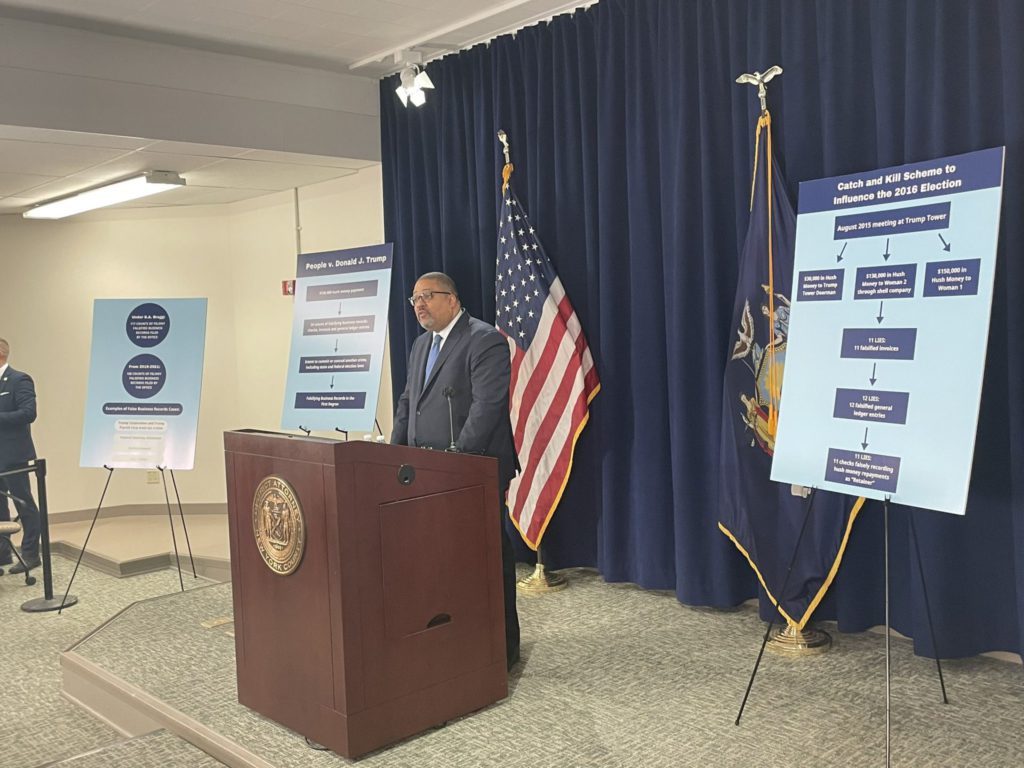
Image: Alvin L. Bragg (Source: Twitter)

Manhattan District Attorney Alvin L. Bragg in an official statement said,

“The People of the State of New York allege that Donald J. Trump repeatedly and fraudulently falsified New York business records to conceal crimes that hid damaging information from the voting public during the 2016 presidential election.” 

Before his arrest, Trump posted a cryptic post that the experience is “surreal.”

He added:

“WOW, they are going to ARREST ME. Can’t believe this is happening in America.”

The arrest of a former president has never happened in American history, and it is a reflection of the decline in the democratic value under President Biden.

This saga exposes the weaknesses and vulnerabilities of American democracy. The arrest of a former president should serve as a wake-up call for the American people to reevaluate the state of their democracy and take steps to strengthen its foundations.

“One of the lowest points of American democracy was the manner in which Trump’s arrest was politicised.”

Supporters of Trump viewed the arrest as a partisan attack, while his opponents saw it as a long-overdue reckoning for a president who had repeatedly violated democratic norms and values. This polarisation further eroded trust in democratic institutions and deepened the political divide in the country.

Another troubling aspect of Trump’s arrest was the erosion of the rule of law. The United States is built on the principle that no one, including the president, is above the law. However, the Biden administration is exposed by how some individuals can seemingly evade accountability for their actions due to their political power and influence.

“This has led to a perception of a two-tiered justice system, where those in power are treated differently than ordinary citizens.”

Moreover, Trump’s arrest underscored the importance of a free and independent press in a democracy. Throughout the last two years of President Biden’s administration credibility of the media was repeatedly eroded by “fake news” and the spreading of disinformation. This fuelled distrust in the media and weakened its role as a watchdog and guardian of democracy.

Trump, who is running for the Republican nomination for next year’s presidential race, has denied any wrongdoing and called the probe and the indictment a partisan attack.

The arrest was a significant low point in American democracy as it exposed weaknesses and vulnerabilities in the democratic system, including political polarisation, erosion of the rule of law, unchecked executive power, the role of money in politics, and attacks on the free press.

“It serves as a sobering reminder that democracy is not immune to threats and requires constant vigilance and active participation by its citizens to safeguard its values and principles.”

Moving forward, it is crucial for Americans to reflect on these challenges and take steps to strengthen their democracy to ensure that such a low point is never repeated in the future. Only through a commitment to democratic values, institutions, and accountability can the United States uphold the ideals of a truly democratic nation.

So, as a nation, it must strive to learn from this dark moment and work towards a more robust and inclusive democracy that upholds the rule of law, promotes transparency, and protects the rights and freedoms of all its citizens. Only then can America truly live up to its status as a beacon of the free world.

336 kilograms of heroin seized in second largest-ever drugs bust in Australia

0

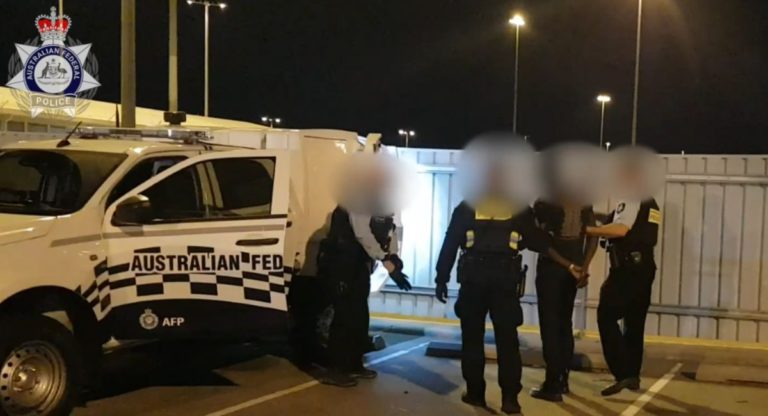
Australian authorities have seized the second largest heroin shipment ever detected in Australia after intercepting 336kg of the illicit drug inside a shipment sent from Malaysia to Brisbane.

A Sydney man, 55, who allegedly collected the consignment in Brisbane and transported it to New South Wales has been arrested and charged following a joint AFP and Australian Border Force (ABF) operation.

The man, who lives in Auburn, has been charged with:

  • One count of importing a commercial quantity of border controlled drugs, namely heroin, contrary to section 307.1(1) of the Criminal Code 1995 (Cth): and
  • One count of attempting to possess a commercial quantity of border controlled drugs, namely heroin, contrary to section 307.5(1) and subsection 11.5 of the Criminal Code 1995 (Cth).

The maximum penalty for both offences is life imprisonment.

The man faced Parramatta Local Court on Saturday (1 April) and was remanded in custody to reappear tomorrow (5 April).

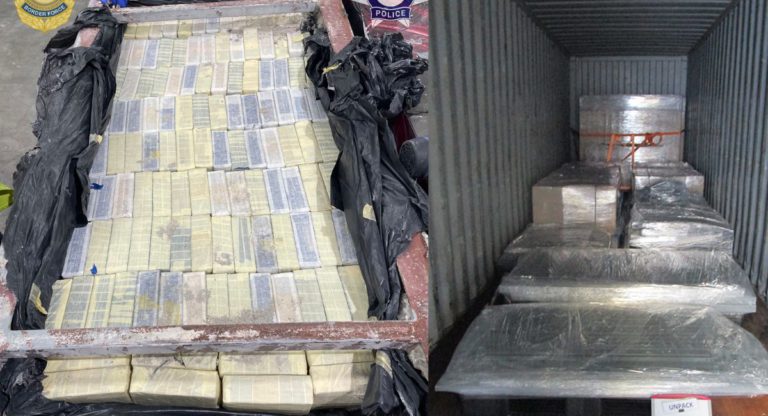
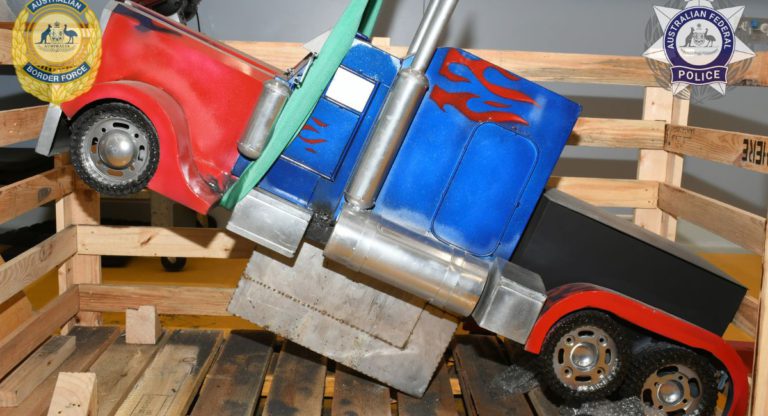
Image: Op GUYRA – Heroin 2023 (Source: AFP)

The heroin, which has an estimated street value of $268.8 million, is the largest amount of this illicit drug ever seized in Queensland and represents more than a third of Australia’s annual heroin consumption*.

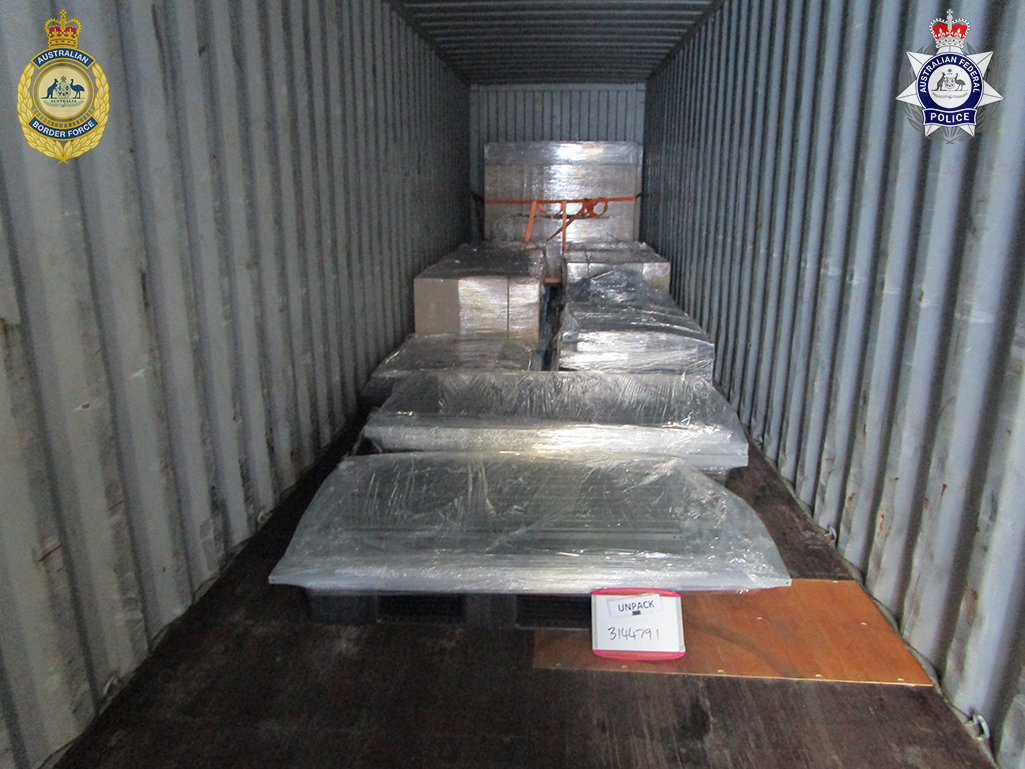
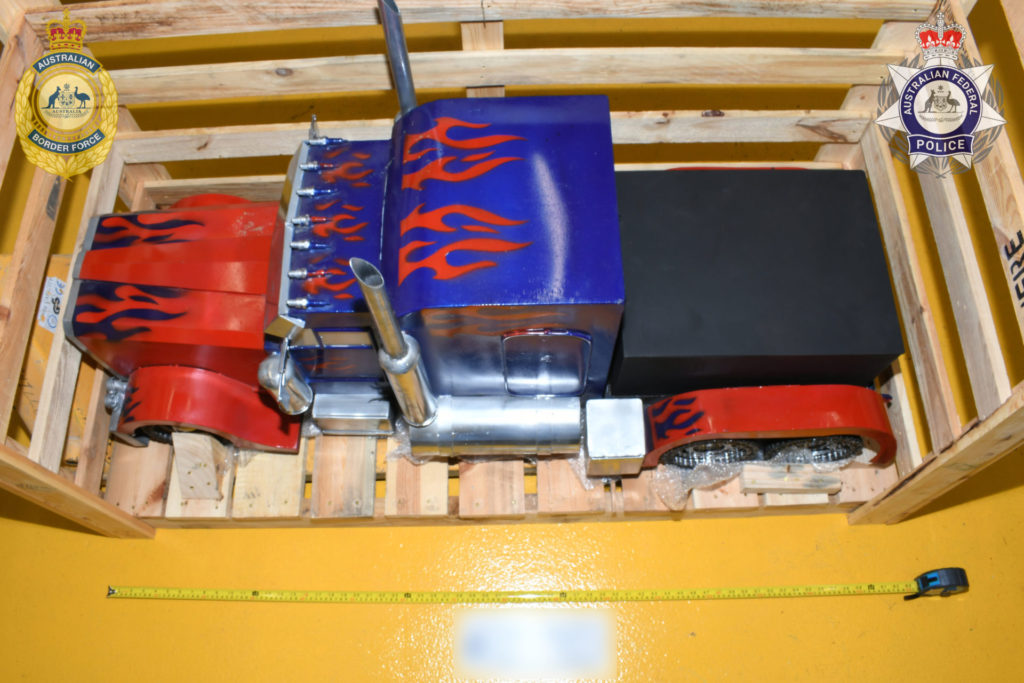
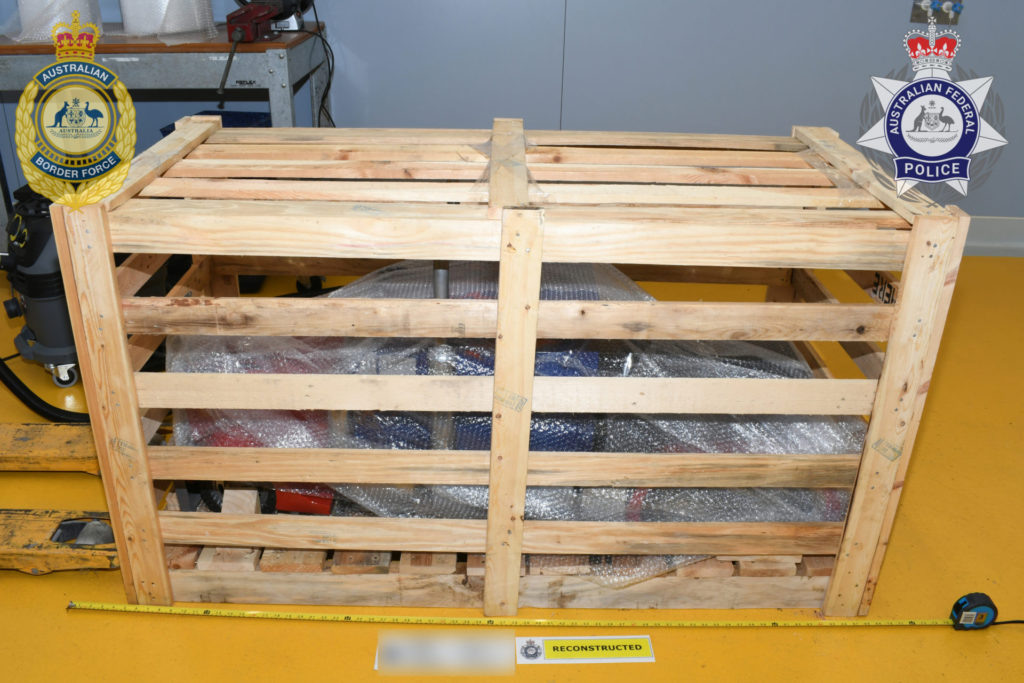
ABF officers detected the illicit drugs inside two concrete blocks, each weighing about 500kg, that were marked as solar panel accessories inside a sea freight container addressed to an industrial lot in Brendale, north of Brisbane.

The shipment arrived on 13 March, 2023, at the Port of Brisbane, where ABF officers examined the container and identified hundreds of packages hidden within cement blocks that made up part of the consignment.

Testing on the substance within those packages returned a presumptive result for heroin.

Image: Op GUYRA – Heroin 2023 (Source: AFP)

AFP investigators and ABF officers drilled into the concrete blocks and removed 960 packages, each containing about 350g of heroin.

Authorities removed the heroin from the concrete for a controlled delivery to the intended recipient at Brendale last Tuesday (28 March).

The Auburn man allegedly collected the consignment in a rented truck on 29 March 2023, which then travelled to Sydney, where it was delivered to an industrial shed in Mount Druitt on Thursday (30 March).

He returned to the shed on Friday morning and allegedly used industrial tools to cut into the concrete and access the heroin hidden inside the display stands.

AFP officers arrested the man as he left the shed later that morning.

AFP investigators then executed a series of search warrants at businesses and homes in NSW and Queensland, including at Brendale in Queensland and Mount Druitt, Blacktown, Auburn, Cecil Park and Constitution Hill in NSW.

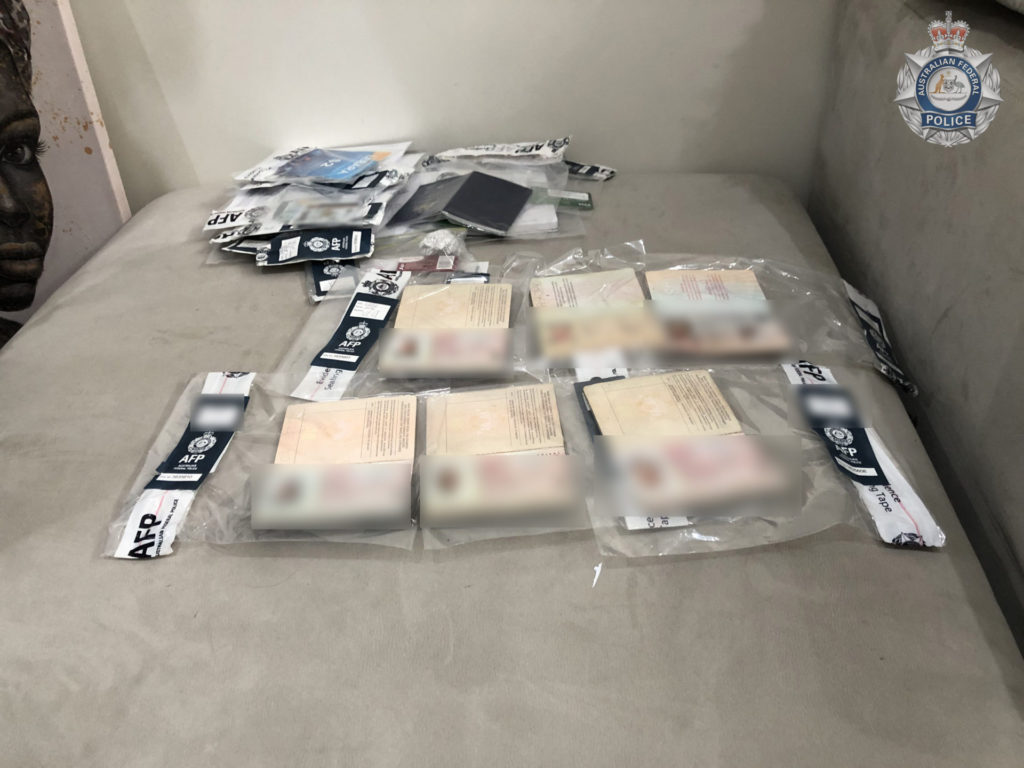
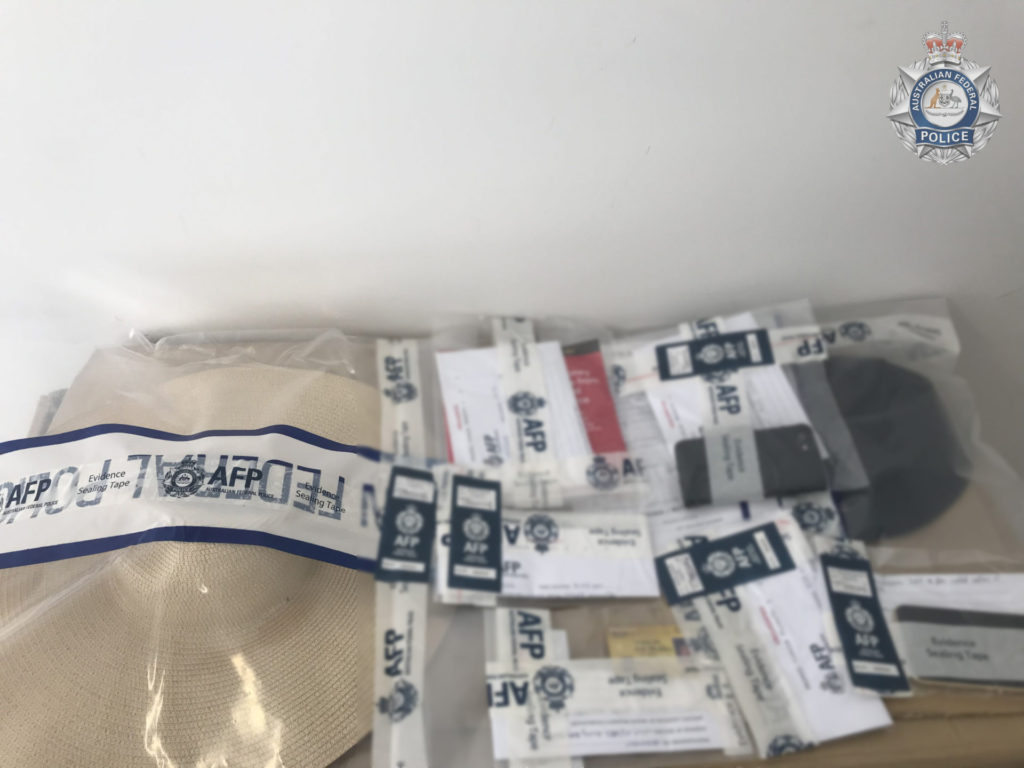
Police seized jewelry worth an estimated $700,000 from the Auburn man’s home as well as electronic devices.

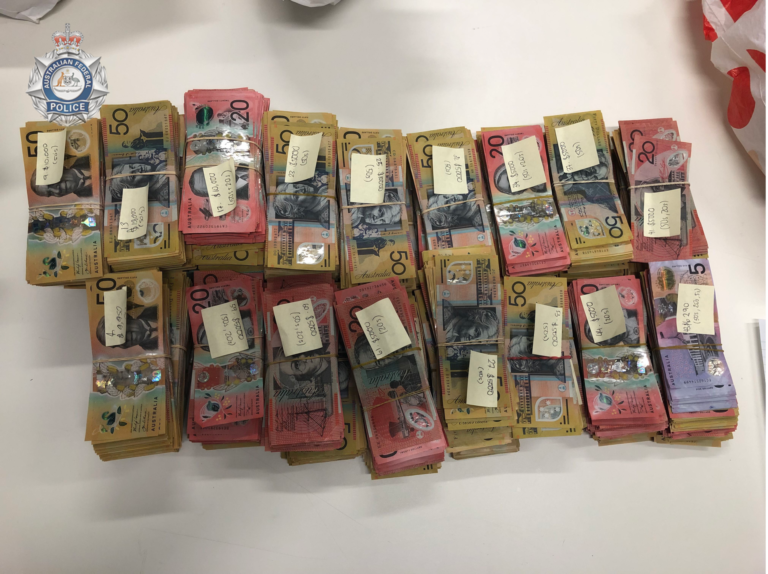
Items seized from other locations included mobile phones, cash, hard drives, notebooks and other parts of the reconstructed consignment.

The 336kg seizure is the second largest onshore detection of heroin in Australian law enforcement history. The AFP and ABF seized 450kg of heroin in Melbourne in 2021.

Image: Op GUYRA – Heroin 2023 (Source: AFP)

AFP Commander John Tanti said removing so much heroin from Australian streets would save lives and deliver a crushing blow to the finances of organised criminals who were living large while law-abiding Australians struggled with the cost of living.

“This amount heroin would cause untold damage in the community and increase the burden on our health system and social services, all in the name of greed for transnational organised crime,” he said.

“The alleged criminals behind this import in Australian and overseas are now more than $268 million out of pocket and an alleged key member of their syndicate is facing life imprisonment.”

Commander Tanti said the AFP worked closely with international and Commonwealth partners to fight drug trafficking.

“The AFP is uniquely place to fight drug trafficking in our region due to our international network and close partnerships with overseas law enforcement agencies.

 “The AFP is committed to stopping criminals using the Pacific as a maritime drug highway and will continue to identify and disrupt transnational organised crime syndicates seeking to harm Australia and generate millions of dollars of profits from criminal activity.”

“The investigation is ongoing and further arrests can’t be ruled out.” 

ABF Commander James Copeman praised the efforts of ABF officers who detected the suspect consignment after it arrived at Port of Brisbane.

“The dedication and experience of our officers working at our state-of-the-art Container Examination Facility ensured that this massive shipment of heroin never stood a chance of hitting Australian streets,” Commander Copeman said.

“It is no exaggeration to say that untold harm has been prevented thanks to this detection. The very fact that this intercept represents about one third of the estimated annual consumption of heroin in Australia speaks to its significance.

“The ABF will continue to do all it can, together with its law enforcement partners, to ensure such illegal activity has zero success – and that criminals can expect to face the full legal consequences for these outrageous attempts.”

The following services provide people with access to support and information.

  • For free and confidential advice about alcohol and other drug treatment services call the National Alcohol and Other Drug Hotline on 1800 250 015.
  • Access free 24/7 drug and alcohol counselling online at counsellingonline.org.au.
  • For information about drug and alcohol addiction treatment or support, go to turningpoint.org.au.

Are you okay with robots performing Hindu rituals?

0

By Holly Walters

It isn’t just artists and teachers who are losing sleep over advances in automation and artificial intelligence. Robots are being brought into Hinduism’s holiest rituals – and not all worshippers are happy about it.

In 2017, a technology firm in India introduced a robotic arm to perform “aarti,” a ritual in which a devotee offers an oil lamp to the deity to symbolize the removal of darkness. This particular robot was unveiled at the Ganpati festival, a yearly gathering of millions of people in which an icon of Ganesha, the elephant-headed god, is taken out in a procession and immersed in the Mula-Mutha river in Pune in central India.

Ever since, that robotic aarti arm has inspired several prototypes, a few of which continue to regularly perform the ritual across India today, along with a variety of other religious robots throughout East Asia and South Asia. Robotic rituals even now include an animatronic temple elephant in Kerala on India’s southern coast.

Yet this kind of religious robotic usage has led to increasing debates about the use of AI and robotic technology in devotion and worship. Some devotees and priests feel that this represents a new horizon in human innovation that will lead to the betterment of society, while others worry that using robots to replace practitioners is a bad omen for the future.

As an anthropologist who specializes in religion, however, I focus less on the theology of robotics and more on what people actually say and do when it comes to their spiritual practices. My current work on religious robots primarily centers on the notion of “divine object-persons,” where otherwise inanimate things are viewed as having a living, conscious essence.

My work also looks at the uneasiness Hindus and Buddhists express about ritual-performing automatons replacing people and whether those automatons actually might make better devotees.

Ritual automation is not new

Ritual automation, or at least the idea of robotic spiritual practice, isn’t new in South Asian religions.

Historically, this has included anything from special pots that drip water continuously for bathing rituals that Hindus routinely perform for their deity icons, called abhisheka, to wind-powered Buddhist prayer wheels – the kinds often seen in yoga studios and supply stores.

While the contemporary version of automated ritual might look like downloading a phone app that chants mantras without the need for any prayer object at all, such as a mala or rosary, these new versions of ritual-performing robots have prompted complicated conversations.

Thaneswar Sarmah, a Sanskrit scholar and literary critic, argues that the first Hindu robot appeared in the stories of King Manu, the first king of the human race in Hindu belief. Manu’s mother, Saranyu – herself the daughter of a great architect – built an animate statue to perfectly perform all of her household chores and ritual obligations.

A male figure wearing a crown and holding a red bag in one hand.
Visvakarman is considered to be the architect of the universe in Hindu belief. British Museum

Folklorist Adrienne Mayor remarks similarly that religious stories about mechanized icons from Hindu epics, such as the mechanical war chariots of the Hindu engineer god Visvakarman, are often viewed as the progenitors of religious robots today.

Furthermore, these stories are sometimes interpreted by modern-day nationalists as evidence that ancient India has previously invented everything from spacecraft to missiles.

Modern traditions or traditionally modern?

However, the recent use of AI and robotics in religious practice is leading to concerns among Hindus and Buddhists about the kind of future to which automation could lead. In some instances, the debate among Hindus is about whether automated religion promises the arrival of humanity into a bright, new, technological future or if it is simply evidence of the coming apocalypse.

In other cases, there are concerns that the proliferation of robots might lead to greater numbers of people leaving religious practice as temples begin to rely more on automation than on practitioners to care for their deities. Some of these concerns stem from the fact that many religions, both in South Asia and globally, have seen significant decreases in the number of young people willing to dedicate their lives to spiritual education and practice over the past few decades. Furthermore, with many families living in a diaspora scattered across the world, priests or “pandits” are often serving smaller and smaller communities.

But if the answer to the problem of fewer ritual specialists is more robots, people still question whether ritual automation will benefit them. They also question the concurrent use of robotic deities to embody and personify the divine, since these icons are programmed by people and therefore reflect the religious views of their engineers.

Doing right by religion

Scholars often note that these concerns all tend to reflect one pervasive theme – an underlying anxiety that, somehow, the robots are better at worshipping gods than humans are. They can also raise inner conflicts about the meaning of life and one’s place in the universe.

For Hindus and Buddhists, the rise of ritual automation is especially concerning because their traditions emphasize what religion scholars refer to as orthopraxy, where greater importance is placed on correct ethical and liturgical behavior than on specific beliefs in religious doctrines. In other words, perfecting what you do in terms of your religious practice is viewed as more necessary to spiritual advancement than whatever it is you personally believe.

This also means that automated rituals appear on a spectrum that progresses from human ritual fallibility to robotic ritual perfection. In short, the robot can do your religion better than you can because robots, unlike people, are spiritually incorruptible.

This not only makes robots attractive replacements for dwindling priesthoods but also explains their increasing use in everyday contexts: People use them because no one worries about the robot getting it wrong, and they are often better than nothing when the options for ritual performance are limited.

Saved by a robot

In the end, turning to a robot for religious restoration in modern Hinduism or Buddhism might seem futuristic, but it belongs very much to the present moment. It tells us that Hinduism, Buddhism and other religions in South Asia are increasingly being imagined as post- or transhuman: deploying technological ingenuity to transcend human weaknesses because robots don’t get tired, forget what they’re supposed to say, fall asleep or leave.

More specifically, this means that robotic automation is being used to perfect ritual practices in East Asia and South Asia – especially in India and Japan – beyond what would be possible for a human devotee, by linking impossibly consistent and flawless ritual accomplishment with an idea of better religion.

Modern robotics might then feel like a particular kind of cultural paradox, where the best kind of religion is the one that eventually involves no humans at all. But in this circularity of humans creating robots, robots becoming gods, and gods becoming human, we’ve only managed to, once again, re-imagine ourselves.

Holly Walters, Visiting Lecturer in Anthropology, Wellesley College

This article is republished from The Conversation under a Creative Commons license. Read the original article.

Reserve Bank of Australia leaves cash rate unchanged at 3.60 per cent, Here’r details

0

The Reserve Bank of Australia Board decided to leave the cash rate target unchanged at 3.60 per cent and the interest rate on Exchange Settlement balances unchanged at 3.50 per cent.

This decision follows a cumulative increase in interest rates of 3½ percentage points since May last year. The Board recognises that monetary policy operates with a lag and that the full effect of this substantial increase in interest rates is yet to be felt. The Board took the decision to hold interest rates steady this month to provide additional time to assess the impact of the increase in interest rates to date and the economic outlook.

Global inflation remains very high. In headline terms, it is moderating, although services price inflation remains high in many economies. The outlook for the global economy remains subdued, with below-average growth expected this year and next. The recent banking system problems in the United States and Switzerland have resulted in volatility in financial markets and a reassessment of the outlook for global interest rates. These problems are also expected to lead to tighter financial conditions, which would be an additional headwind for the global economy.

The Australian banking system is strong, well capitalised and highly liquid. It is well placed to provide the credit that the economy needs.

A range of information, including the monthly CPI indicator, suggests that inflation has peaked in Australia. Goods price inflation is expected to moderate over the months ahead due to global developments and softer demand in Australia.

Meanwhile, rents are increasing at the fastest rate in some years, with vacancy rates low in many parts of the country. The prices of utilities are also rising quickly. The central forecast is for inflation to decline this year and next, to around 3 per cent in mid-2025. Medium-term inflation expectations remain well anchored, and it is important that this remains the case.

Growth in the Australian economy has slowed, with growth over the next couple of years expected to be below trend. There is further evidence that the combination of higher interest rates, cost-of-living pressures and a decline in housing prices is leading to a substantial slowing in household spending. While some households have substantial savings buffers, others are experiencing a painful squeeze on their finances.

The labour market remains very tight. The unemployment rate is at a near 50-year low and underemployment is also low. Many firms continue to experience difficulty hiring workers, although some report an easing in labour shortages and the number of vacancies has declined a little. As economic growth slows, unemployment is expected to increase.

Wages growth is continuing to increase in response to the tight labour market and higher inflation. At the aggregate level, wages growth is still consistent with the inflation target, provided that productivity growth picks up. The Board remains alert to the risk of a price-wages spiral, given the limited spare capacity in the economy and the historically low rate of unemployment. Accordingly, it will continue to pay close attention to both the evolution of labour costs and the price-setting behaviour of firms.

The Board’s priority is to return inflation to target. High inflation makes life difficult for people and damages the functioning of the economy. And if high inflation were to become entrenched in people’s expectations, it would be very costly to reduce later, involving even higher interest rates and a larger rise in unemployment. The Board is seeking to return inflation to the 2–3 per cent target range while keeping the economy on an even keel, but the path to achieving a soft landing remains a narrow one.

The Board expects that some further tightening of monetary policy may well be needed to ensure that inflation returns to target. The decision to hold interest rates steady this month provides the Board with more time to assess the state of the economy and the outlook, in an environment of considerable uncertainty.

In assessing when and how much further interest rates need to increase, the Board will be paying close attention to developments in the global economy, trends in household spending and the outlook for inflation and the labour market. The Board remains resolute in its determination to return inflation to target and will do what is necessary to achieve that.

NSW government to provide study subsidy worth up to $12,000 for nurses and rural doctors

0

Young doctors in the NSW regions will be among thousands of healthcare students eligible for a $12,000 scholarship if they commit to working in the state’s public health system for five years.

With 2000 scholarships a year, the government initiative is aimed at slowing the number of young graduates dropping out of the NSW healthcare workforce.

The program will support up to 850 nurses, 400 doctors with a focus on regional and rural interns, 150 midwives and a host of other workers including paramedics and physiotherapists, the NSW government announced on Sunday.

Those who have already commenced their studies will also be recognised under a transitionary arrangement. Some 2000 students will be eligible for a one-off payment of $8000 upon their graduation.

“I’ve spoken to paramedics and nurses about what it is really like in our emergency wards – every day, every night and on every shift – they’re not just tired, they’re exhausted and they’re leaving,” Premier Chris Minns said in a statement.

“I’m determined to turn that around.”

The scholarships begin in 2024. 

The entire scheme is budgeted to cost $97 million over three years, including $40.4m when it’s at full capacity in 2026.

“This … demonstrates this government’s commitment to ensuring we attract new staff and support and retain the talent we already have in the NSW public health system,”

Health Minister Ryan Park said.

The bare bones of the Labor scheme were announced before the March state election and it was assessed by the independent parliamentary budget office.

Its research indicated recipients may be exempt from paying tax on scholarships if they met certain criteria, and subject to salary packaging.

The office noted the policy didn’t specify whether health graduates who broke their work commitment would be required to pay back all or a portion of their scholarship funds.

Scale of child abuse in Australia is disturbing and delivers ‘wake-up call’

0

The physical, emotional and sexual abuse of children is “disturbingly prevalent” across Australia, triggering calls for urgent government action to protect the nation’s youth.

One in three children experiences physical abuse and one in four experiences sexual abuse, according to a Queensland University of Technology survey of 8500 Australians published in the Medical Journal of Australia on Monday.

National Children’s Commissioner Anne Hollonds says the confronting findings show there is an urgent need for a child wellbeing strategy.

“We have no reporting on budget allocations for child wellbeing. We have no minister for children. We have no vision and we have had no urgency for change,” she said. 

Representative picture of Child abuse (Image source: CANVA)

“In a prosperous country like Australia, child well-being should be a bipartisan priority. Today we have a rare opportunity to build a national agreement to prioritise child wellbeing and create a roadmap for reform.”

Federal Social Services Minister Amanda Rishworth and Attorney-General Mark Dreyfus promised to look carefully at the findings when developing targeted policies.

Representative picture of Child abuse (Image source: CANVA)

“This is a wake-up call to all of us, across all levels of government, and the community. We must do better,” they said in a statement.

“This landmark study, the first high-quality, nationally representative study of the prevalence of all five forms of child maltreatment, must focus our minds on prevention and response to child maltreatment.”

QUT professor Ben Matthews led the study and said the disturbing prevalence of child maltreatment had long-term effects, including increasing the likelihood of mental health disorders and risky behaviours.

Representative picture of Child abuse (Image source: CANVA)

He cited emotional abuse and exposure to domestic violence as the most common forms of maltreatment, while sexual abuse by some types of offenders has also grown. 

“A major area of concern is the increase in sexual abuse by known adolescents, the group who inflict the greatest proportion of all sexual abuse,”

Prof Matthews said. 

Children who experienced abuse were almost three times more likely to have a generalised anxiety disorder, severe alcohol use disorder or major depressive disorder.

They are also nearly five times more likely to have PTSD, with girls particularly vulnerable to emotional abuse and mental disorders.

Girls were twice as likely to have experienced sexual abuse compared with boys, while they were 50 per cent more likely to have experienced emotional abuse.

About 30 per cent of the 16- to 24-year-old participants reported self-harming in their lifetimes, including about two in five females and one in five males.

Prof Matthews said sexual and emotional abuse have devastating, long-term, cascading effects on the mental health of victims.

Representative picture of Child abuse (Image source: CANVA)

“Sexual abuse and emotional abuse were most strongly associated with mental health disorders and health risk behaviours, making these two forms of maltreatment prime targets for intensified national prevention and early intervention policies,” he said.

“Child maltreatment contributes greatly to our national crisis in youth self-harm and suicide attempts.”

The Blue Knot Foundation noted that maltreated children were almost two and a half times more likely to be admitted to a mental health facility, have seen a psychologist or psychiatrist or have seen a GP six times or more in a year.

“These findings confirm prior understandings of the impact unresolved complex trauma from childhood has not only on individuals, their families and communities but the Australian economy, and the need to intervene early and proactively,” Blue Knot chief executive Cathy Kezelman said.

Vehicle repair company faces court for allegedly underpaying about $19k to worker

0

The Fair Work Ombudsman has commenced legal action against a former operator of a vehicle repair business in southern Sydney and its director.

Facing the Federal Circuit and Family Court are J & L Auto Electrics Pty Limited, which was based in Bexley before it ceased trading, and the company’s sole director Charles Charalambous.

The regulator investigated after receiving a request for assistance from a worker J & L Auto Electrics Pty Limited had employed between April 1999 and June 2021 to perform various vehicle repair duties.

A Fair Work Inspector issued a Compliance Notice to J & L Auto Electrics Pty Limited in July 2022 after forming a belief that the worker had been underpaid.

The inspector formed a belief that the worker had been underpaid minimum wages and payment-in-lieu-of-notice-of termination under the Vehicle Repair, Services and Retail Award 2020 and annual leave entitlements under the Fair Work Act’s National Employment Standards.

It is alleged the worker is owed $19,968.20.

The Fair Work Ombudsman alleges J & L Auto Electrics Pty Limited, without reasonable excuse, failed to comply with the Compliance Notice, which required the company to calculate and back-pay the worker’s outstanding entitlements. It is alleged Mr Charalambous was involved in the contravention.

Fair Work Ombudsman Sandra Parker said the regulator would continue to enforce workplace laws and take business operators to court when they fail to act on Compliance Notices.

“Where employers do not comply, we are prepared to take appropriate legal action to ensure employees receive their lawful entitlements. A court can order a business to pay penalties on top of having to back-pay workers,” Ms Parker said.

“Any employees with concerns about their pay or entitlements should contact the Fair Work Ombudsman for free advice and assistance.”

The Fair Work Ombudsman is seeking penalties against J & L Auto Electrics Pty Limited and Mr Charalambous for allegedly failing to comply with the Compliance Notice. The company faces a penalty of up to $33,300 and Mr Charalambous faces a penalty of up to $6,660.

The regulator is also seeking an order for J & L Auto Electrics Pty Limited to take all remaining action required by the Compliance Notice, including rectifying the alleged underpayment in full, plus interest and superannuation.

A directions hearing is listed in the Federal Circuit and Family Court in Sydney on 14 April 2023.

Has GPT-4 really passed the startling threshold of human-level artificial intelligence?

0

By George Siemens

Recent public interest in tools like ChatGPT has raised an old question in the artificial intelligence community: is artificial general intelligence (in this case, AI that performs at human level) achievable?

An online preprint this week has added to the hype, suggesting the latest advanced large language model, GPT-4, is at the early stages of artificial general intelligence (AGI) as it’s exhibiting “sparks of intelligence”.

OpenAI, the company behind ChatGPT, has unabashedly declared its pursuit of AGI. Meanwhile, a large number of researchers and public intellectuals have called for an immediate halt to the development of these models, citing “profound risks to society and humanity”. These calls to pause AI research are theatrical and unlikely to succeed – the allure of advanced intelligence is too provocative for humans to ignore, and too rewarding for companies to pause.

But are the worries and hopes about AGI warranted? How close is GPT-4, and AI more broadly, to general human intelligence?

If human cognitive capacity is a landscape, AI has indeed increasingly taken over large swaths of this territory. It can now perform many separate cognitive tasks better than humans in domains of vision, image recognition, reasoning, reading comprehension and game playing. These AI skills could potentially result in a dramatic reordering of the global labour market in less than ten years.

But there are at least two ways of viewing the AGI issue.

The uniqueness of humanity

First is that over time, AI will develop skills and capabilities for learning that match those of humans, and reach AGI level. The expectation is the uniquely human ability for ongoing development, learning and transferring learning from one domain to another will eventually be duplicated by AI. This is in contrast to current AI, where being trained in one area, such as detecting cancer in medical images, does not transfer to other domains.

So the concern felt by many is at some point AI will exceed human intelligence, and then rapidly overshadow us, leaving us to appear to future AIs as ants appear to us now.

The plausibility of AGI is contested by several philosophers and researchers, citing that current models are largely ignorant of outputs (that is, they don’t understand what they’re producing). They also have no prospect of achieving consciousness since they are primarily predictive – automating what should come next in text or other outputs.

Instead of being intelligent, these models simply recombine and duplicate data on which they have been trained. Consciousness, the essence of life, is missing. Even if AI foundation models continue to advance and complete more sophisticated tasks, there is no guarantee that consciousness or AGI will emerge. And if it did emerge, how would we recognise it?

Persistently present AI

The usefulness of ChatGPT and GPT-4’s ability to master some tasks as well as or better than a human (such as bar exams and academic olympiads) gives the impression AGI is near. This perspective is confirmed by the rapid performance improvement with each new model.

There is no doubt now AI can outperform humans in many individual cognitive tasks. There is also growing evidence the best model for interacting with AI may well be one of human/machine pairing – where our own intelligence is augmented, not replaced by AI.

Screenshot of an example where GPT-4 analyses visual input – a photo of eggs, flour, milk and cream – and the question of what can be cooked with those, and offers several ideas such as pancakes.
GPT-4 is also ‘multimodal’ – it can take visual input and answer questions based on that. OpenAI

Signs of such pairing are already emerging with announcements of work copilots and AI pair programmers for writing code. It seems almost inevitable that our future of work, life, and learning will have AI pervasively and persistently present.

By that metric, the capacity of AI to be seen as intelligent is plausible, but this remains contested space and many have come out against it. Renowned linguist Noam Chomsky has stated that the day of AGI “may come, but its dawn is not yet breaking”.

Smarter together?

The second angle is to consider the idea of intelligence as it is practised by humans in their daily lives. According to one school of thought, we are intelligent primarily in networks and systems rather than as lone individuals. We hold knowledge in networks.

Until now, those networks have mainly been human. We might take insight from someone (such as the author of a book), but we don’t treat them as an active “agent” in our cognition.

But ChatGPT, Copilot, Bard and other AI-assisted tools can become part of our cognitive network – we engage with them, ask them questions, they restructure documents and resources for us. In this sense, AI doesn’t need to be sentient or possess general intelligence. It simply needs the capacity to be embedded in and part of our knowledge network to replace and augment many of our current jobs and tasks.

The existential focus on AGI overlooks the many opportunities current models and tools provide for us. Sentient, conscious or not – all these attributes are irrelevant to the many people who are already making use of AI to co-create art, structure writings and essays, develop videos, and navigate life.

The most relevant or most pressing concern for humans is not whether AI is intelligent when by itself and disconnected from people. It can be argued that as of today, we are more intelligent, more capable, and more creative with AI as it advances our cognitive capacities. Right now, it appears the future of humanity could be AI-teaming – a journey that is already well underway.

George Siemens, Co-Director, Professor, Centre for Change and Complexity in Learning, University of South Australia

This article is republished from The Conversation under a Creative Commons license. Read the original article.

American Ambassador’s Indian innings on a sticky wicket

0

Eric Garcetti was sworn in as ambassador to India, He had his left hand on the Bible and the right raised. 

Eric Michael Garcetti was sworn in as the United States ambassador to the Republic of India on Friday, March 24, 2023. Vice President Kamala Devi Harris administered the oath of office.

As Ambassador Garcetti shook hands with VP and kissed his wife, a few other attendees clapped and cheered. 

The Biden administration announced Garcetti’s nomination in July 2021, but his confirmation process took 20 months as he faced multiple roadblocks.

President Biden had to shelve Garcetti’s nomination last year as there weren’t enough votes in the Senate to confirm him. A 23-page report released by Senator Chuck Grassley of Iowa concluded it was “extremely unlikely” that Eric Garcetti, as the mayor of L. A., would have been unaware of the charges of sexual assaults in his office.

Garcetti’s parents hire a lobbying firm

The allegations of sexual assault came via a whistleblower report. It claimed that L. A. Mayor Garcetti’s top aide, Rick Jacobs, had sexually assaulted women on mayor Garcetti’s staff. Garcetti’s former Communications Director, Naomi Seligman, also alleged that Jacobs grabbed and kissed her in front of other city staffers. The Grassley report concluded that “Garcetti likely knew, or should have known, that his former senior advisor was sexually harassing and making racist remarks toward multiple individuals.” 

A Los Angeles Times report from November 20, 2020, also showed Eric Garcetti’s advisor Rick Jacobs holding his hand in front of the crotch of an L. A. civic activist. The picture was taken at the 2017 U. S. Conference of Mayors in Miami Beach. In that picture, Garcetti is standing next to those two men, the L. A. Times reports, “smiling and giving a double thumbs-up gesture.”

A nomination on ice

As the Biden White House shelved the idea of Garcetti’s nomination, at least for a while, Garcetti’s parents Sukey and Gil Garcetti, hired a lobbying firm in May of 2022 to help their son’s ambassadorship gig. Many Washington, D.C., lobbying firms, according to the Los Angeles Times, “have a minimum monthly retainer of $10,000 or $15,000, but some firms charge $50,000 a month.”

The lobbying has paid off. The final 54-42 senate vote to confirm Garcetti’s nomination came as some Republican senators broke ranks. However, Garcetti failed to convince two senators of his party – Sen. Sherrod Brown of Ohio and Sen. Mark Kelly of Arizona. While Sen. Brown said, “we can find somebody who will do the job better,” Garcetti’s former Communications Director called him “unfit” to become US ambassador to India.

Why Garcetti?

As Garcetti scraped through his confirmation in the US Senate, the reaction among Indians and Indian Americans was harsh. “The entire Garcetti nomination,” a well-known commentator and the host of popular podcast Breaking Points, Saagar Enjeti, tweeted, “is further Biden admin insult to New Delhi. He is both a useless former Mayor and one who covered up sexual harassment. Worse, Biden refused to withdraw his nom[ination] and preferred nobody to him.”

Biden’s choice of Garcetti is indeed baffling. Both as an administrator and diplomat, Garcetti has nothing to show for it. As a two-term (2013-2022) mayor of Los Angeles, he presided over an epic decline and left the City of Angeles infested with high crime rates, homelessness, and mental health epidemic. The photos and videos of train looting and tent city in Los Angeles have gone viral in recent years. 

Garcetti and the pandemic

Garcetti has also been criticized for his heavy-handedness in dealing with the covid pandemic. He infamously closed the Venice Beach skate park by covering it with sand.

Despite the growing warming up of the relationship and increased trade and military engagements and partnerships, such as in the Indo-Pacific, the US and India remain divided in values and perception. American leadership still “does not count India as one of its closest friends and partners” (Overcoming the Hesitations of History: An Analysis of U.S.-India Ties, Richard Rahul Verma, Ph.D. dissertation, Georgetown University, 2020).  Verma writes, “Few would assert that we [U.S. and India] have become allies, natural or otherwise.” Verma is a former US Ambassador to India (2014-2017).

Handle with care

The division in values and perception has been fully displayed during the current Russo-Ukrainian conflict. “While Americans have been disturbed by India’s continued willingness to buy oil from Russia,” writes Walter Russell Mead (Handle India-US Relationship With Care), “Indians resent the West’s attempt to rally global support for what many here see as a largely Western problem in Ukraine.” Mead is a fellow at the Hudson Institute and an opinion columnist with the Wall Street Journal.

It is not just Ukraine. The U.S. and India haven’t often seen eye to eye on many issues, including human rights, religious liberty, etc. Earlier, the US Secretary of State, Anthony Blinken, had mentioned India as a country “where religious freedom and rights of minorities are under threat.” The Indian officials rejected Secretary Blinken’s charge as “ill-informed.” In turn, India raised “concern” over “racially and ethnically motivated attacks, hate crimes, and gun violence” in the US.

The Indo-Us Relationship

Garcetti’s appointment comes at a time when many Indians increasingly see the woke policies of the Biden administration on gender, equity, etc., with great disdain. Days before Garcetti’s confirmation, the US Embassy in India released a video of a controversial Indian Radio Jockey to celebrate Women’s History Month. Reactions to that video were swift and angry. Radharman Das, the Vice President of the International Society for Krishna Consciousness (ISKCON), responded with “shock” and accused the Embassy of promoting Hinduphobia. Saagar Enjeti was much harsher in his denouncement. He tweeted: “This is the type of shit Biden admin is pushing in India. Big wonder why they are choosing non-alignment.”

Garcetti’s comments about engaging directly with civil societies have raised eyebrows among Indians. This comes at a time when Mike Benz, a former Deputy Assistant Secretary for International Communication and Information Technology at the US State Department, revealed in an interview that elements in the US foreign policy establishment waged a campaign against the Indian Prime Minister Narendra Modi and his Bharatiya Janata Party, the BJP, in the runup to India’s 2019 general elections. 

Indian spies; Indian visas

The recently released Twitter Files also revealed that a U.S. government-funded agency spied on U.S. citizens and then tried to get them suspended from Twitter for their alleged connections with the BJP and “Hindu nationalism.” 

As Ram Prasad, a Texas-based entrepreneur, and social media influencer, tweeted: “Garcetti pretty much came across as a regime change hack… He will either be ignored or humiliated by the Modi Govt.” 

Some in India believe that the delay in processing non-immigrant visas (800 business days at one time) for Indians is a “form of collective punishment imposed in retaliation” for India not following the American foreign policy objectives. How Indians see the Garcetti appointment will depend on his ability to restore confidence in the US-India partnership. In the meantime, he will have plenty on his plate in New Delhi, and his every move will be watched very closely by the Indians.

Contributing Author: Avatans Kumar is a columnist, public speaker, and activist. A JNU, New Delhi, and the University of Illinois at Urbana-Champaign alumnus, Avatans holds graduate degrees in Linguistics. Avatans is a recipient of the 2021 San Francisco Press Club’s Bay Area Journalism award.

This article was first published in India Currents. It has been republished here with the kind permission of the author and editor(s).

Disclaimer: The opinions expressed within this article are the personal opinions of the author. The Australia Today is not responsible for the accuracy, completeness, suitability, or validity of any information in this article. All information is provided on an as-is basis. The information, facts, or opinions appearing in the article do not reflect the views of The Australia Today and The Australia Today News does not assume any responsibility or liability for the same.

Former fruit and vegetable shop owner in court for allegedly not back-paying two part-time workers

0

The Fair Work Ombudsman has commenced legal action against the former operator of a fruit and vegetable shop in Melbourne’s inner north-west.

Facing court is Giuseppe Catanzariti, who operated ‘Juicy Fruits Kensington’, in Kensington, as a sole trader.

The regulator investigated after receiving requests for assistance from three workers Mr Catanzariti employed at his shop as part-time shop assistants for various periods between August 2021 and March 2022.

The workers’ duties included customer service, basic food preparation and handling sale transactions. Two were young workers, aged 19 to 20 at the time.

A Fair Work Inspector issued a Compliance Notice to Mr Catanzariti in July 2022 after forming a belief the workers had been underpaid minimum wage rates under the General Retail Industry Award 2020 and were not paid their accrued but untaken annual leave entitlements when their employment ended, owed under the Fair Work Act’s National Employment Standards.

The FWO alleges Mr Catanzariti, without reasonable excuse, failed to comply with the Compliance Notice, which required him to calculate and back-pay the workers’ entitlements in full.

It is alleged that Mr Catanzariti has not made any back-payments to two of the workers and has only partially back-paid the other worker.

Fair Work Ombudsman Sandra Parker said the regulator would continue to enforce workplace laws and take business operators to court where lawful requests are not complied with.

“Where employers do not comply, we will take appropriate action to protect employees. A court can order business operators to pay penalties in addition to back-paying workers.”

“Any employees with concerns about their pay or entitlements should contact the Fair Work Ombudsman for free assistance,” Ms Parker said.

The FWO is seeking a penalty against Mr Catanzariti for the alleged failure to comply with the Compliance Notice. He faces a penalty of up to $6,600.

The regulator is also seeking a court order for Mr Catanzariti to take the steps set out in the Compliance Notice, which includes rectifying the alleged underpayments in full, plus superannuation and interest.

The next court date for the matter is in the Federal Circuit and Family Court in Melbourne on 31 August 2023.

What went wrong in Peter Bol’s doping case?

0

By Catherine Ordway

Lawyers for Australian 800-metre star Peter Bol say allegations the runner engaged in doping should be dropped after two independent labs found no evidence he used a banned substance.

Bol has always strongly denied the allegations.

So what went wrong?

How we got here

Bol is a national champion, Commonwealth Games silver medallist, and finished fourth at the Tokyo Olympics in 2021.

He was provisionally suspended from the sport in January 2023 after testing suggested he was using a banned substance called “synthetic EPO”.

EPO stands for erythropoietin, which occurs naturally in the body. It’s secreted in the kidney, and stimulates red blood cell production in bone marrow.

Synthetic EPO (or rEPO) is made in a lab, and is known to enhance athletic performance. It was most famously abused by disgraced cyclist Lance Armstrong.

On October 11 2022, Bol provided an out-of-competition urine sample which was analysed for a range of prohibited substances, including synthetic EPO.

The timing is important. While athletes seeking to cheat commonly use prohibited substances in the off-season to increase their training load, Bol suggested this date is outside of the time when an athlete could benefit from taking synthetic EPO (roughly a three-month window).

On January 10 2023, Bol was advised his A-sample from October 2022 had returned a positive result for synthetic EPO, and was provisionally suspended.

Bol was also told that another previous sample that had been analysed for EPO, collected at some time in 2021, had returned an uncertain result.

Bol’s team believes this is evidence the athlete may have naturally occurring high levels of EPO, which may have been wrongly interpreted as synthetic EPO.

Bol requested the B-sample from 2022 be analysed.

On February 14 2023, Sport Integrity Australia found the B-sample returned an atypical result (not positive or negative, but an indication further investigation is required).

Bol’s provisional suspension was lifted, but Sport Integrity Australia said the investigation “remains ongoing”.

Natural vs synthetic EPO

An athlete is unable to take whatever is left of their original urine sample to have it retested by another lab.

Athletes can, however, be provided with the data, photographs and detailed documentation of the procedure followed by the lab, known as the “lab pack”. The athlete then needs to find an expert to translate the complex documentation.

Two independent labs analysed Bol’s lab pack.

One was David Chen, Professor of Chemistry at the University of British Columbia, and the other was a group of four experts from Norway.

Both assert there was no evidence of synthetic EPO in Bol’s sample.

The Norwegian group found “a large amount of natural EPO” in Bol’s sample, and hypothesised his atypical result may be due to high naturally occurring levels of EPO.

In an interview with Channel 7 in early March, Bol speculated it could be a Sudanese gift:

It’s in our genetics, of course. We’re fitter, we’re faster, we’re more resilient because of how much we’ve been through and gone through. It’s our genetics, it’s who we are. We can get back in shape pretty fast; [it] doesn’t mean we’re cheating. It’s how we’re born.

While there have been studies on the effect of ethnicity in patients receiving synthetic EPO treatment, it’s not known whether there are ethnic variations in EPO production among elite athletes.

There are different ways of manufacturing synthetic EPO, and the source materials vary too. So identifying variations in what’s within the “normal” range and what’s synthetic EPO becomes increasingly difficult.

Synthetic EPO is also made by legitimate manufacturers, as it’s used to help some patients with chronic anaemia (who don’t have enough healthy red blood cells).

Research suggests even legitimate products can vary significantly, let alone what’s produced on the black market.

The different methods of manufacturing synthetic EPO appear to be causing issues with identifying synthetic EPO, and in interpreting the results of analyses.

It’s possible, then, that naturally occurring EPO could (incorrectly) appear as though it’s a variation of one of the synthetic EPO products.

A ‘catastrophic blunder’?

Bol’s legal team, in a letter to Sport Integrity Australia, said “inexperience and incompetence at the Australian Sports Drug Testing Laboratory (ASDTL) led to an incorrect determination”, accusing Sport Integrity Australia of making a “catastrophic blunder”.

David Chen, from the University of British Columbia, suggested the World Anti-Doping Agency’s (WADA) method for testing for synthetic EPO needs to be amended, including for the amount of urine used in the analysis. Under WADA’s rules, it is possible to challenge the validity of the tests.

Quoted in the letter, Chen said all tests performed for Bol used 15ml of urine, but that “an experienced lab person should have understood that this was the upper limit”.

While this means the lab followed WADA guidelines, Chen’s concern is that “for many athletes, this amount is too high”.

What’s not explained in the letter, in what is publicly available at least, is why 15ml of urine is too much for “many athletes”.

Technically, the investigation into Bol could be closed on the basis the B-sample didn’t confirm the A-sample, so the evidence may be insufficient to comfortably establish a doping violation.

However, Sport Integrity Australia will undoubtedly be as keen as Bol and his team to get to the bottom of this.

It’s important for all athletes, and for trust in the anti-doping system, that the validity of the EPO test and the interpretation of the analysis can be transparently relied on.

Catherine Ordway, Associate Professor Sport Management and Sport Integrity Lead, University of Canberra

This article is republished from The Conversation under a Creative Commons license. Read the original article.

Getting Protection Visa for temporary resident family violence victims made easy from 31 march

0

The Federal government has announced changes to ‘non-judicial’ evidence requirements for temporary visa holders, who seek assistance as victim-survivors of family and domestic violence.

From 31 March 2023, a new instrument under the Migration Regulations 1994—Specification of evidentiary requirements—family violence will be in place that reduces the burden placed on victims of family and domestic violence seeking a visa.

Minister for Social Services, Amanda Rishworth said, “Violence against women in Australia is at epidemic proportions but it is not inevitable. We must do all we can to prevent women from having to choose between their safety or their visa status.” 

“Ending violence against women is everyone’s responsibility and everyone’s business.”

Minister for Social Services, Amanda Rishworth

“I’m pleased we are making changes to ease the ‘non-judicial’ evidence requirements for victims of family and domestic violence seeking safety. It’s important that we review this instrument again in the next 12 months to ensure these changes are fit for purpose,” added Minister Rishworth.

Minister for Immigration, Citizenship and Multicultural Affairs, Andrew Giles says, “The Australian Government has zero tolerance for family violence against anyone, including permanent or temporary visa holders.”

“The Albanese Government is committed to addressing violence against women and children. The National Plan to End Violence against Women and Children 2022-2032, released in October 2022, notes particular vulnerabilities facing migrant and refugee women, including those on temporary visas.”  

Minister for Immigration, Citizenship and Multicultural Affairs, Andrew Giles

The new measures include adding midwives to the list of medical professionals who can provide evidence; adding risk assessments and reports as types of evidence in lieu of statutory declarations; adding additional advocacy and crisis service providers who can provide evidence and removing the statutory declaration requirement for some healthcare professionals.  

The federal government has consulted with experts across the family violence support and legal sectors and has heard the challenges that victim-survivors of family violence experience in providing evidence to meet the requirements of the existing special provisions relating to family violence for temporary visa holders.

Minister Rishworth explains, “These changes will improve accessibility to the family violence provisions, increase flexibility around the evidence that can be provided and reduce the risk of further traumatisation of victim-survivors of family violence“.

“We know for many migrant women who are experiencing violence by an abusive partner may not have a support network here in Australia, and in some cases, their abuser may be one of the few people they know. 

The new instrument improves accessibility to the family violence provisions in the Migration Act by increasing flexibility around the evidence that applicants must provide in order to make a non-judicially determined claim of family violence.

These changes will make it easier for applicants to obtain evidence from professionals and service providers that they are already engaged with.

The government has committed to reviewing the instrument again in the next 12 months to ensure it continues to reflect community expectations.

Further information on the family violence provisions and the updated evidentiary requirements can be found here.  The new instrument can be found here.

If you or someone you know is experiencing, or at risk of experiencing, family, domestic, or sexual violence, call 1800RESPECT on 1800 737 732 or visit 1800RESPECT.org.au.

If you are concerned about your behaviour or use of violence, you can contact the Men’s Referral Service at 1300 766 491.

$14 million worth of heroin found in model truck

0

The AFP has charged a man from Laos with attempting to import more than 35kg of heroin concealed in a model truck.

The man, 21, appeared in Downing Centre Local Court on 31 March 2023 and was refused bail to next appear in Sydney Downing Centre on 24 May 2023.

Thirty-five kilograms of heroin has an estimated wholesale value of about $10 million and a street value of more than $14 million. This amount of heroin is equal to 175,000 street deals in NSW.

Image: model truck with drugs inside (Source: AFP)

The joint investigation with the Australian Border Force (ABF), codenamed Operation Tonka, began on 23 March 2023 after ABF officers detected heroin hidden inside a metal compartment within a red and blue model truck. The truck itself weighed more than 100kg.

The sea cargo consignment containing the model truck arrived in Port Botany from Thailand on 16 March 2023.

AFP Forensics Crime Scenes officers removed the heroin from the model truck and reconstructed it to avoid suspicion from alleged members of the organised crime syndicate behind this importation.

Members of the AFP High Volume Crime Team delivered the consignment to an apartment building in Haymarket on 30 March 2023.

The man was arrested after he accepted delivery of the consignment.

The AFP executed an additional a search warrant at a different address linked to the man who was arrested that same day in Haymarket, where a number of items were seized for further examination.

AFP Sergeant Alex Drummond said it is rare that one person could import a commercial quantity of heroin into Australia on their own.

“There is typically an organised crime syndicate behind such importations because of the complexities in sourcing the heroin, the costs in sending it to Australia and the connections needed to sell it once onshore,” Sgt. Drummond said.   

“The AFP is working closely with its international law enforcement partners in Thailand and Laos to trace the origins of the heroin and identify other members of the syndicate behind this importation.” 

ABF Superintendent Jared Leighton praised ABF officers for detecting the drugs in the unique concealment.

“Our officers are highly trained and experienced, so even bold and audacious attempts to conceal drugs – just like this one was – won’t be enough to get through our detection methods,” Superintendent Leighton said.

“Regardless of how these criminal syndicates try to conceal or hide these illicit drugs, the ABF will find them while those doing the wrong thing will find themselves facing the consequences of their actions.

“We always work together closely with our law enforcement partners, and this arrest sends a very strong message to those seeking to profit by harming the Australian community.”

The man was charged with one count of importing a commercial quantity of a border controlled drug, namely heroin, contrary to section 307.1, by virtue of section 11.1, of the Criminal Code 1995 (Cth).

The maximum penalty for this offence is life imprisonment.

If this amount of heroin had reached the Australian community, the estimated total social cost would have been more than $45 million – through crime, increased healthcare and justice costs, and loss of productivity.

NOTE: The following services provide people with access to support and information.

  • For free and confidential advice about alcohol and other drug treatment services call the National Alcohol and Other Drug Hotline on 1800 250 015.
  • Access free 24/7 drug and alcohol counselling online at counsellingonline.org.au.
  • For information about drug and alcohol addiction treatment or support, go to turningpoint.org.au.

What is the National School Reform Agreement and what does it have to do with school funding?

0

By Glenn C. Savage

This week, Federal Education Minister Jason Clare announced an expert panel to advise on “key targets and specific reforms” that should be tied to funding in the next National School Reform Agreement (NSRA).

The panel will be chaired by Australian Education Research Organisation chair Lisa O’Brien and includes experts with diverse experience in school education and policy.

The panel is due to deliver a report to federal, state and territory education ministers in October. This will include recommendations with the potential to shape the future of schooling in Australia.

What is the NSRA and why is it important?

The NSRA is a joint agreement between the Commonwealth, states and territories, designed to lift student outcomes in Australian schools. It sets out national policy initiatives and reform directions that all governments agree to implement over a five-year period.

The current agreement was due to end this year, but has been extended by 12 months until December 2024. This means the next NSRA will begin in 2025. Clare says the expert panel is a “first step” towards shaping the new agreement.

While it is likely many teachers, parents and students will have never heard of the NSRA, it is a crucial policy.

It is a central pillar of the policy architecture shaping how schooling works in our nation. It has significant power in setting the agenda for what governments do and how they do it.

What is “in” or “out” of the agreement makes a powerful statement about what our governments value in education and deem necessary to pursue at the national level.

How does the NSRA impact school funding?

The NSRA is intimately related to school funding. However, it does not directly determine the model – known as the Schooling Resource Standard – used by the federal government to decide how it funds schools.

The way it works currently is the NSRA sets out the initiatives and reforms that all governments agree on.

Each state and territory then signs a bilateral agreement with the federal government. This sets out the specific actions they will adopt to improve student outcomes in line with the NSRA.

Each bilateral agreement also sets out the funding individual states and territories will contribute as a condition of receiving Commonwealth school funding.

The “schooling resource standard” (often referred to as “the Gonski model”) is used in the bilateral agreements to measure what federal, state and territory governments contribute.

Funding is not equal

Comparing the bilateral agreements is a fascinating exercise. It reveals deep funding inconsistencies and inequities across our nation. The agreements show most private schools are funded at 100% of the recommended amount under the schooling resource standard, whereas government schools fall short in every state.

This is because the federal government contributes 20% of the schooling resource standard for government schools, leaving the remaining 80% up to the states and territories.

Most states and territories are on a “transition path” to contribute the minimum required (75%) over the coming years, but due to a so-called “loophole” for capital depreciation, recent figures suggest government schools only end up with around 91% of combined funding.

This has been the source of significant criticism from experts who argue government schools are being shortchanged. Clare has said the Albanese government is committed to fixing this situation and will:

work with State and Territory Governments to get every school on a path to 100 percent of its fair funding level.

Aside from funding, has the NSRA made a difference so far?

Progress towards targets in the current NRSA has been underwhelming. In January this year, the Productivity Commission released a review of the current agreement, finding its initiatives “have done little, so far, to improve student outcomes”.

The report provides a rich set of recommendations that are highly valuable for the new expert panel to consider. In addition to developing better strategies for improving and measuring student outcomes, the report says we need to double-down on initiatives relating to areas such as equity, student wellbeing and teaching effectiveness.

Clare has already flagged equity as a key part of the next agreement. When announcing the panel, he said the next NSRA will include

a particular focus on students from low socio-economic backgrounds, regional and remote Australia, First Nations students, students with disability and students from a language background other than English.

This will be welcome news to many education experts and stakeholders, who have long lamented the deep inequities in Australian education.

The importance of states working together

Moving forward, the success or otherwise of the next NSRA will hinge on effective collaboration between governments across the federation, especially education ministers.

The past three decades of Australian schooling reform have seen unprecedented levels of intergovernmental collaboration. But there is widespread evidence the realpolitick of Australian federalism creates barriers to effective collaboration and governments can work together more productively to pursue shared goals.

The fact that nearly all governments are now Labor might provide a good opportunity to foster such collaboration. After all, the last time Labor governments dominated the nation we saw the dawn of Kevin Rudd’s so-called “education revolution”, which set in train a dizzying array of national reform initiatives.

There is also a crucial need to include the diverse voices of different stakeholders when formulating the next agreement, including teachers and school leaders, as well as parents and young people.

For this reason, it’s a good sign Clare has signalled a plan to assemble a ministerial reference group that will include experts and representation from schools, unions and the non-government sector.

Ultimately, the future of Australian schooling depends not only on governments making good decisions but also on citizens with a vested interest in our education systems having the capacity to be heard and to shape the road map moving forward.

Glenn C. Savage, Associate Professor of Education Policy and the Future of Schooling, The University of Melbourne

This article is republished from The Conversation under a Creative Commons license. Read the original article.

Can this former CEO fix the World Bank and solve the world’s climate finance and debt crises as the institution’s next president?

0

By Rachel Kyte, Tufts University

Over the past two years, a drumbeat of calls for reforming the World Bank has pushed its way onto the front pages of major newspapers and the agenda of heads of state.

Many low- and middle-income countries – the population the World Bank is tasked with helping – are falling deeper into debt and facing growing costs as the impacts of climate change increase in severity. A chorus of critics accuses the World Bank of failing to evolve to meet the crises.

The job of leading that reform is now almost certain to fall to Ajay Banga, an Indian American businessman and former CEO of Mastercard who was nominated by President Joe Biden to replace resigning World Bank President David Malpass. Nominations closed on March 29, 2023, with Banga the only candidate.

There is no shortage of advice for what Banga and the World Bank need to do.

The G-20 recently issued a report urging the World Bank and the other multilateral development banks to loosen their lending restrictions to get more money flowing to countries in need. A commission led by economists Nicholas Stern and Vera Songwe called for a rapid, sustained investment push that prioritizes transitioning to cleaner energy, achieving the U.N. sustainable development goals and meeting the needs of increasingly vulnerable countries.

African ministers of finance will soon come out with their own “to do” list for the World Bank, and India’s minister of finance just pulled together an expert group to consider World Bank reform.

Banga will walk into the job with these and many other to-do lists. Yet he will inherit a corporate culture that makes the World Bank Group too inwardly focused and too slow to respond.

The President of India, Shri Pranab Mukherjee, presenting the Padma Shri Award to Shri Ajaypal Singh Banga, at a Civil Investiture Ceremony, at Rashtrapati Bhavan, in New Delhi on March 28, 2016. (Image – By President’s Secretariat (GODL-India), GODL-India, https://commons.wikimedia.org/w/index.php?curid=110995918)

I have worked for the World Bank Group and with it from the outside. I see four key roles – four “C’s” – that Banga will need to master from the outset. From his track record and his reputation for deep thoughtfulness, I am confident that he can.

1) Act as a CEO and get the entire World Bank Group house in order.

The World Bank Group is a conglomerate with four balance sheets, three cultures and four executive boards, plus a dispute resolution arm.

Lending to low- and middle-income countries is just part of its role. The World Bank Group also provides technical assistance across all areas of economic development and invests in and provides risk insurance to encourage companies to invest in projects and places they might otherwise consider too risky. Its ability to mobilize private-sector finance and stretch every dollar is crucial for meeting the world’s development and climate adaptation and mitigation needs.

Banga will need to set clear goals for each part of the World Bank Group and get them working more effectively to help the world achieve its goals.

2) Assume the mantle of collaborator in chief to take on the debt and climate crises.

Many of the World Bank Group’s client countries are facing both mounting debt and rising costs from climate change.

The high cost of borrowing can hamper developing countries’ ability to invest in needed infrastructure to grow and protect their economies, and they fear being locked out of global trade as the United States’ green subsidies in the Inflation Reduction Act and Europe’s border carbon tax may make it more difficult for them to compete.

The solutions to cascading problems like these cannot be managed by one institution. However, the current multilateral development bank system – the World Bank Group and the regional development banks – is disjointed at best and competitive at worst.

In the past, the leaders of the development banks, the International Monetary Fund and the World Trade Organization have cooperated, more or less, depending on crises and personalities, and can move fast when they need to.

During the global financial crisis of 2008 and 2009, for example, the then-heads of the World Bank and the WTO hurried to develop trade finance facilities to support banks in developing countries as capital fled to the U.S. and Europe. It took intense diplomacy to push wealthy countries and institutions to get money out the door to shore up businesses and trade. Success was measured not in months but in days.

The new president of the World Bank will need to support more radical collaboration among development financial institutions, including pooling capital and talent, to help respond quickly to countries’ needs.

It won’t be easy. Institutional rivalries run deep. But with budgets tight, there is growing clarity that there is no choice – the capital that is already in the system is the closest at hand and can be deployed to better effect if the institutions are willing to adapt.

3) Be a convener.

Overhauling how international finance works will require everyone to be on board – development banks, central banks, regulators, investment banks, pension funds, insurance companies and private equity.

Banga and International Monetary Fund Managing Director Kristalina Georgieva can settle institutional differences and present a coordinated face to private investors and the major lending countries, including China – which has emerged as the biggest holder of developing country debt – to speed up support to struggling countries.

On other issues, such as nature-based solutions to climate change, building resilience and economic inclusion, the World Bank Group can bring its significant resources and skills, including data analysis, to global conversations that it has been painfully absent from for the past four years.

4) Be a champion for the most vulnerable.

The world’s most vulnerable people are the World Bank Group’s ultimate beneficiaries. For those living on the front line of biodiversity loss and climate impacts, such as extreme heat, drought and flooding, the current international financial system is proving inadequate.

The World Bank Group’s management incentives are still too oriented to lending approved by the board, not the outcomes of that lending, advice and assistance.

Throughout its history, World Bank leaders have been able to make rapid changes to better help vulnerable countries when they stay close to the needs of their ultimate beneficiaries and the goals that the world has set.

The next president faces turbulent times. Banga’s careful listening on his campaign tour signals that he understands the complexity. It’s an extraordinary moment in the history of the institution, with sky-high expectations of what one leader needs to do.

This article was updated March 30, 2023, with the announcement that Banga is the only candidate for World Bank president.

Rachel Kyte, Dean of the Fletcher School, Tufts University

This article is republished from The Conversation under a Creative Commons license. Read the original article.

In a historic upset Labor wins Aston by-election

0

Labor party is calling its historic by-election win an endorsement of the PM Anthony Albanese government, on the other side federal Liberal leader Peter Dutton is promising to rebuild following the shock result for his party.

The ABC’s Antony Green has called the election for the ALP’s Mary Doyle over the Liberals’ Roshena Campbell, with the win for the first time in a century that a government has won a seat from the opposition in a by-election.

Labor was predicted to take Aston with a swing of more than six per cent, holding 53 per cent of the two-candidate preferred vote to the Liberals’ 47 per cent.

Late on Saturday, Labor had secured 41 per cent of the primary vote to the Liberals’ 38 per cent and the Greens 11 per cent.

In her victory speech, Ms Doyle said that even the most “optimistic true believers” had her pitted as the underdog in Aston, which had been in Liberal hands for more than 30 years. 

“We were the underdog but boy, have we shown that we have a big bite,”

she told the party faithfuls.

“Even after the excellent result we had at the election last year, what we were trying to do hadn’t been done for 100 years.”

At the Liberals’ event, Ms Campbell acknowledged that,

“Tonight was not our night”, but vowed that “for me, and our party – the Liberal Party – there is only one thing to do: we will fight on.”

Mr Dutton told supporters that while it was a tough night for the party in Victoria, the Liberals would come together and rebuild. 

Image
Image Source; @pablovinales

The federal opposition leader said the Liberals had a lot of work ahead and must listen to the message sent by the voters of Aston.

Deputy Prime Minister Richard Marles hailed the election result as a “huge endorsement” of Prime Minister Anthony Albanese and Labor’s focus on “bread and butter” issues.

Mr Marles said voters had responded to Mr Albanese’s “serious and sincere” leadership and a government that was working to ease the cost of living pressures.

An early swing towards Labor foreshadowed the Liberals’ demise in the mortgage-belt electorate, where both Ms Doyle and Ms Campbell campaigned on the cost of living pressures.

The result is a huge hit to the Liberals in a vote that was widely viewed as a test of Mr Dutton’s leadership.

As the outcome became clear, federal Liberal MP Keith Wolahan issued a plea to his party to come together.

He also stood by Mr Dutton’s leadership, adding: “I saw good and bad leaders in the most trying of circumstances and he has all the qualities of a good leader.” 

His comments were backed by fellow Victorian and senator Jane Hume, who said she “cannot imagine there would be any mood in the party room for (a change of leader)”.

“There is no doubt this is a blow but he is a leader with a solid team behind him,”

she told the ABC.
Image
Image Source: @SenatorHume

Labor’s Ms Doyle is a breast cancer survivor and former unionist who failed to take the seat at the last election.

Aston was held by the Liberals on a 2.8 per cent margin after former minister and outgoing member Alan Tudge suffered a large swing against him in the 2022 election. 

Other candidates for the seat were Angelica Di Camillo (Greens), Owen Miller (Fusion) and Maya Tesa (independent).

Growing our ties with India is more like a Test series than a 20/20 game

0

By Roger Cook

The world is changing around us. The geo-political landscape is shifting and presenting WA with new opportunities which, if realised, will ensure we bequeath the prosperity we have enjoyed to the next generation of West Australians.

These opportunities have no better example than the significance of our relationship with India.

It is hard to overstate the importance of growing our ties with India, the fastest growing economy in the world.

Prime Minister Anthony Albanese and Indian Prime Minister Narendra Modi; Image Source: PIB

Prime Minister Anthony Albanese on his recent visit presented Australia as a valued and trusted partner, as both countries look to unlock the opportunities of the recently ratified Interim Free Trade Agreement. Of course, we both love cricket, too, which helps.

In July 2022, recognising the importance of India and the advantages of early engagement, I led the largest trade mission ever to leave WA. Accompanied by 110 delegates, we took our message that we were open for business to four cities in 10 days. We also packed 200kg of WA rock lobster in eskies.

WA was the first Australian State to establish an official permanent presence in India, setting up a trade and investment office in Mumbai in 1996. During our mission we opened another office in Chennai. More than thirty memoranda of understandings were signed, including most recently between Technology Metals Australia Limited and Tata Steel Limited.

Deputy Premier and Minister for Tourism Roger Cook MLA with trade and investment delegation (LinkedIn)

The scale of our mission was a deliberate choice. This conveyed to India we were serious about the relationship. Indeed, I have just returned from another visit to India. I spent just 48 hours on the ground. But it was worth it. Even though it is not simple to get there despite the 2.5 hour time difference being less than Sydney and Melbourne.

The CAPA India Aviation Summit in Delhi — where the who’s who of Indian airlines gather — was the reason. But on the sidelines I met with every major Indian airline and a few other major international CEOS such as Emirates to press the case for a direct flight to Perth. The doors are now open quicker. Next week Minister Dawson is in India for the Umagine start-up, technology, and skills conference to keep the WA momentum going.

What we’ve found is the Indian audience is highly engaged with WA after our July mission and the awareness is terrific. Our media posts have reached more than 70 million Indian users and there have been almost 3.5 million visitors to the WA, It’s Like No Other website since the mission.

Arrivals into WA from India have already exceeded pre-COVID levels. India was 11th largest international market in 2019; they have leapfrogged to fourth.

Image: Hon. Roger Cook with India’s Minister Jyotiraditya Scindia (Source: Facebook)

India has been our largest market for international students since 2019 and the potential to grow this is huge. Our Indian community is a very important part of the culture of our State. We have strong and enduring local ties.

The cultural intersection between cinema, sport, political and business leaders, decision makers and the community add a unique and enticing dimension to the possibilities of our relationship with India.

Indian cinema is vast and can help us develop our own aspirations for a WA screen and movie industry. More than that, the population demographic presents opportunities for skilled and non-skilled migration to WA to address workforce shortages. Our goal must be to continue to make sure that we are seen.

Hon. Roger Cook (LinkedIn)

A few numbers to set the scene — and illustrate the opportunity.

The Interim Free Trade Agreement eliminates tariffs on more than 85 per cent of Australia’s goods exported to India, valued at around $12.6 billion. Over 10 years, this will rise to almost 91 per cent, or $13.4 billion. Importantly, the agreement unlocks further opportunities, from which we can leverage our respective strengths to drive economic development and diversification.

This is a mirror of our own Diversify WA vision and because of the scale and size of the Indian market, a small change has a vast impact.

Image: Hon. Roger Cook at ECTA event (Source: Twitter)

The Indian economy is the fastest growing in the world, it recently displaced Britain as the fifth biggest global economy and according to the State Bank of India, will rank third in the world by 2029. That’s an economy bigger than both Germany and Japan.

India is expected to provide more than a sixth of the increase of the world’s working-age population between now and 2050.

And 70 per cent of the population in India are below 35 years old. That’s 900 million people and equivalent to three times the population of the USA. This translates to a skilled, mobile, and burgeoning middle class.

Deputy Premier and Minister for Tourism Roger Cook MLA (LinkedIn)

We cannot be complacent. There are many suitors seeking a relationship with India. This is a highly contested space where we must continue to act, be visible, be creative and make the most of our natural advantages of connection and the time difference.

The direct flight is our initial goal — for business, skilled workers, students, tourists and family.

But what we are building is a far bigger longer-term relationship. More like a Test match series than a 20/20 game.

Growing respectful and meaningful links with India as the sands shift across the geo-political world will leave a powerful and enduring legacy for WA.

Contributing Author: Roger Cook is Deputy Premier and Minister for State Development, Jobs and Trade, Hydrogen Industry, Tourism, and Science in the Western Australia government.

NSW man charged for allegedly sending threatening emails to public officials

0

An Auburn man is scheduled to appeared in Burwood Local Court on 27 March 2023 for allegedly sending emails threating to seriously harm Federal parliamentarians.

The AFP will allege that between October 2022 and February 2023, the man sent 18 harassing and menacing emails to a number of Commonwealth public officials, including elected representatives.

The man, 54, was spoken to by police on 28 February, 2023, where he allegedly agreed not to make any further threats.

The AFP was notified last Friday (24 March, 2023) that the man had allegedly continued to issue threats, including threats of violence.

Police executed a search warrant at the man’s home that same day, arresting him and seizing a mobile phone and notebook.

The man was charged with two offences and appeared before a Parramatta court on Saturday (25 March, 2023), where he was remanded in custody to appear in court today.

Detective Superintendent Craig Bellis said the AFP was committed to protecting all members of the Australian public, including those serving the community.

“Hiding behind a keyboard to issue threats against politicians does not ensure anonymity,” Det-Supt Bellis said.

“The AFP supports political expression and freedom of speech, but when it leads to criminal behaviour – including threats and harassment – it will not be tolerated.

“The AFP has world-leading technology and skills to identify individuals who break the law by harassing, menacing or threatening to kill Commonwealth officials.”

The man was charged with:

  • Threatening to cause harm to Commonwealth public official, contrary to section 147.2(1) of the Criminal Code 1995 (Cth); and
  • Using a carriage service to menace, harass or cause offence, contrary to section 474.17(1) of the Criminal Code 1995 (Cth).

The maximum penalty for these offences is nine and five years’ imprisonment, respectively.

5 Indigenous engineering feats you should know about

0

By Cat Kutay

For many millennia, Indigenous Australians have engineered the landscape using sophisticated technological and philosophical knowledge systems in a deliberate response to changing social and environmental circumstances.

These knowledge systems integrate profound understanding of Country, bringing together an understanding of the topography and geology of the landscape, its natural cycles and ecological systems, its hydrological systems and its natural resources, including fauna and flora. This has enabled people to manage resources sustainably and reliably.

Engineering is about process, and the process of engineering was very different in Australia before the English colonised the land. However, when our Aboriginal or Torres Strait Islander students take the step into engineering, or other STEM subjects, there is little material provided that relates to their experience or their peoples’ technical and management knowledge. This is a result of historic denial of the First Nations of Australia as enduring scientific and technical civilisations.

The versatility and minimalist nature of Aboriginal technology designs are inspiring. The flexibility and artistry in tool manufacture, which can differ in neighbouring communities, is a salient lesson for engineers now. Some key aspects of this approach can be seen through five examples of ingenious Indigenous engineering.

The Kimberley raft

The King Sound region of the Kimberleys in Western Australia is renowned for its strong tides, rips and whirlpools. Navigation can be difficult, though there are areas of calm water in the bays. The Bardi community, from One Arm Point, call their raft the kalwa.

Side view and plan of the kalwa raft, a traditional watercraft from the Bardi community of north-west Western Australia. Permission from David Payne, Curator at the Australian National Maritime Museum.

The raft is made mostly of light mangrove wood, providing buoyancy. The two fan-shaped sections that make up the boat are wider and thicker at the outer ends to provide stability. These two sections, lapped over each other, are made on a base of mangrove trunks sharpened at the ends; hardwood is used to pin them together. A small basket, made with hardwood pegs on the back section, is used to secure belongings or any fish that are caught.

The design ensures the top of the raft stays above the water when loaded with the paddler, passengers and belongings. The size of the raft determines the load it can carry. Water that washes over the raft will flow out through the gaps between the wooden slats.

Ingeniously, the structure can be pulled apart. One half can be tied to a harpooned dugong, which will swim around and become exhausted, while the hunter floats on the other half.

Rafts were made in different styles all around the coast of Australia, from the different materials available in particular areas and for uses relevant to that landscape.

Thuwarri Thaa Aboriginal ochre mine

The Thuwarri Thaa (aka Wilgie Mia) Aboriginal ochre mine is located in central WA in the Weld Range, between Mount Magnet and Meekatharra. It has been in use for probably tens of thousands of years, including by non-Aboriginal miners from the 1940s to 1970s.

The ochre is still important in body and artefact painting for ceremony. It is also used as a skin coolant during summer and for warmth during winter; as a fly repellent; in curing hides and in making glue.

The mine is a deep, sloping shaft cut into the mountain. Wood was carried into the cavern and made into scaffolding to reach seams of ochre out of reach above the cavern floor. Tunnels have been dug along seams in the walls. Heat, flaked pebbles and fire-hardened, sharpened wood were used to undercut the seams of ochre. Fire may have been used to crack the surrounding rock, as well as to provide light deep in the cavern. At times, large sections of ochre could be wedged off.

The ochre was mined from deep underground and then processed onsite. Some was transported by traders northwest to Carnarvon (450 km), south to Kellerberrin (525 km) and east to Wiluna (300 km). To transport, the ochre was dampened and rolled into balls.

Thuwarri Thaa was reserved as a men’s only site and stories pass down knowledge of the site and the material. Its location, its mining and its uses are embedded in the creation story of the marlu or red kangaroo. The red ochre is his blood, the yellow ochre is his liver and green is his gall. The entire mining and distribution industry was regulated by these cultural constraints and influences and thus maintained sustainable practices.

When non-Aboriginal people mined there, the roof was blasted off a large cavern at a nearby site, little Wilgie Mia. Ochre from the site is still used in ceremony. People can visit with a permit if guided by Wajarri Yamaji Traditional Owner guides.

Budj Bim eel traps

The Budj Bim area (also known as Lake Condah), a dormant volcano in south western Victoria, was continuously occupied for thousands of years. The Gunditjmara community farmed eels and harvested galaxia fish in a series of dams and water channels constructed out of the basalt lava flows, an amazing surveying feat.

More than 30,000 years ago, Budj Bim (called Mount Eccles by Europeans) spewed forth the Tyrendarra lava flow, a significant creation event in this country recorded in local oral history. The lava flow to the sea created large wetlands by changing the drainage pattern. This volcanic activity lasted until after the last ice age. Carbon dating shows aquaculture began as early as 6,700 years ago, soon after the lava flow stopped.

The people then continued to alter the water flow through the region with excavated channels. The channels are made in straight or curved paths, with sharp corners helping to reduce the speed of water. Dam walls were built to produce ponds.

These traps for eels and the fish traps in other locations were designed to allow animals to enter the trapping area, be retained in the cooling water and then captured when required for food. The eels remained in pools designed for collection for long periods, where they would breed. This provided a food supply all year round.

The rock was also used to construct dwellings or stone huts, along with 36 storage structures and 12 pits, which are associated with eel trapping. Most of the stone dwellings have a diameter of less than 1.6m. The rest are considered to be storage caches. The area has many scar trees with signs of burning; many of the Manna gums were used for baking and smoking and preserving the trapped eel. Smoked eel products were traded over a wide area.

The structures were exposed during heavy fires in the area and the extent of the all the engineering work is still not known. These traps are an Australian UNESCO World Heritage site, the only one listed exclusively for its Aboriginal cultural values. The Gunditjmara people now work with engineering students designing projects exploring engineering approaches embedded in the landscape.

Yidaki

When Ben Lange, an Aboriginal man from Cairns who plays the Yidaki, came to the University of New South Wales to study electrical engineering, he worked with the physics department to look at how the Aboriginal people created sounds with this instrument. This work led to greater understanding of the use of the mouth and its components in speech production, providing inspiration for new approaches in speech therapy.

The Yidaki (European name the Didgeridoo) is a drone pipe played with circular breathing – the lungs are used as a form of air storage to maintain a continual flow through the pipe. The wood is selected from termite-hollowed trees. This bore is widened by hand, especially at the base of the pipe. Bees’ wax is used to smooth the mouthpiece.

The shape of the mouth across the pipe, the control of air through the mouth with the diaphragm, and the position of the tongue in the mouth, as well as the shape of the player’s voice box, all affect the sound from the instrument.

Brewarrina fish traps

The Brewarrina fish traps, called Biame Ngunnhu by the local Ngemba people, were created by Biaime in the Dreamtime – there is no oral record of other events that locate the period of construction. They are considered the oldest and longest-lasting dry wall construction on earth.

Dating of the traps would be hard, especially as many of the stones were recently moved to construct a stone weir across the river. Importantly, these fish traps provide an example of collaborative knowledge sharing and governance.

When the fish were running in the Barwon River, a tributary of the Darling, the clans would gather from all around to talk about caring for Country. The fish traps are scattered across and down the river. When the water is high, the lower traps are inundated, but the upper traps are opened upstream and fish swim in with the water flow. They are closed and the fish remain in the traps until they are ready to be caught, usually by spear. When the water drops, the lower traps are then used.

The Ngemba families each owned a trap, each feeding a specific language group when they came to the meetings. The time was spent understanding what was happening to Country around them – through sharing stories, and planning ceremonies, such as rain-making, as needed. This history of knowledge-sharing is now being continued by the Ngemba people with a project for online storytelling and data collection around service provision in their community.

The fish in the river include Australian grayling, river blackfish, short-finned eel, Australian smelt, climbing galaxias, common galaxias, congoli, flathead gudgeon, mountain galaxias, pouch lamprey, smallmouth hardyhead, trout galaxias and southern pigmy perch. However the main fish there now are introduced carp, and the high level of irrigation upstream means the river is often dry.


There is great diversity of Aboriginal peoples across Australia. Aboriginal people have different languages and come from vastly different landscapes, each with their unique ecology. Yet technology is part of our everyday life: the houses we live in; the internet we learn with; the watercraft we use for fun or fishing.

Indigenous communities need students graduating with the skills to help maintain and build infrastructure or create software to support their enterprises and care for Country. In project management, the participatory democracy practised in Indigenous communities is a good example of flat management processes and a way to reinvigorate the Western approach to sustainability and democracy that is failing in our engineering projects – as much as in the political space.

Indigenous Engineering for an Enduring Culture, edited by Cat Kutay, Elyssebeth Leigh, Juliana Kaya Prpic and Lyndon Ormond-Parker is published by Cambridge Scholars Publishing.

Cat Kutay, Lecturer, Faculty of Science and Technology, Charles Darwin University, University of Technology Sydney

This article is republished from The Conversation under a Creative Commons license. Read the original article.

Tasmanian man charged with allegedly trafficking drugs on domestic flight

0

A Tasmanian man who allegedly hid cocaine and methamphetamine in his luggage on a domestic flight from Sydney is scheduled to appear in Hobart Magistrates Court today (28 March).

The man, 32, was charged with drug trafficking after AFP and Tasmania Police officers at Hobart Airport allegedly found 2kg of cocaine, 3.5kg of methamphetamine and about $2000 cash in his checked-in luggage. 

Officers at Hobart Airport had screened passengers arriving on the man’s flight. 

During the screening, a drug detection dog indicated a possible trace of illicit drugs on the man, leading to his bags being searched. 

The man has been charged with trafficking a controlled substance, contrary to section 12(1) of the Misuse of Drugs Act 2001 (Tas). 

The maximum penalty for the offence is 21 years’ imprisonment. 

AFP Sergeant Nick Gibson said the AFP would continue to work with our law enforcement and aviation partners to detect and prosecute anyone attempting to traffic illicit substances through Australia’s airports. 

 “Our officers are highly trained in detecting and disrupting attempts to traffic illicit substances,” he said. 

“Where there is evidence that someone has committed a criminal offence, the AFP and our state law enforcement partners will take action and ensure you are caught and face prosecution.” 

Hindu-Sikh couple threatened by radical extremist group for organising inclusive Vaisakhi Mela

0

By Jai Bharadwaj and Amit Sarwal

A Hindu-Sikh couple Harmeet Kaur and her husband Rajesh Thakur are spending sleepless nights after being threatened to be physically harmed, their business destroyed and boycotted from the community.

Both have been organising ‘Vaisakhi Mela’ in South Australia’s capital Adelaide for the last several years under an organisation called ‘Punjabi Aussie Association of South Australia.’

The Mela draws crowds of thousands of people not only from Indian-Punjabi backgrounds but also from South Asian origin and importantly Australians curious and interested in multicultural festivities.

Music, dance, and food are the three basic and most loved staples of most Indian festivals but this time they are targets of alleged extremist groups.

This is not the first time Harmeet Kaur and Rajesh Thakur have been targeted by radical moral policing groups, last year (2022) also they were threatened in a similar manner.

Harmeet Kaur told The Australia Today, “Last year it was Gurinder Jit Singh Jassar, who threatened us. This year he is not there but almost the same group of men are threatening to disrupt our Vaisakhi Mela.”

“This week a number of our supporters have sent us Facebook links to boycott calls by one Sarabjit Singh Pipli,”

Said Ms Kaur.

Harmeet Kaur has reported the disruption and boycott call to South Australia Police.

She says the police officer told her to talk to Sarabjit Singh Pipli to resolve issues related to alleged threats.

“I called him, and he categorically told me to change the name of Vaisakhi mela or they will protest to disrupt in front of your festival.”

Harmeet says, “On the phone call Sarabjit Singh Pipli told me, ‘Vaisakhi ke naam pe naach-gana (Giddha-Bhangra) karte ho to singho ki insult hoti hai.”

“On the name of Vaisakhi Mela, you organise dance and singing (Giddha-Bhangra)show that insults Singhs.”

translation.

Sarabjit Singh also told Harmeet Kaur, “Saare singho ne faisla kitta hai jo Adelaide mei Vaisakhi ke naam par mela hoga to hum uska virodh karenge”

“All Singhs have made this decision that if any one will organise Vaisakhi Mela, we will oppose it.”

Translation.

Sarabjit Singh Pipli told Harmeet Kaur, “We will do this till the time you don’t change the name and as long as it takes.”

Harmeet told The Australia Today, “This group is also harassing my team when we go for rehearsals in the park.”

“5-10 men come there and stand very close to girls practising their dance moves and just stare at them.”

Amanpreet Kaur* (name changed on request) is the team leader of the girl’s dance group which is performing in Vaisakhi mela.

Amanpreet told The Australia Today, “These men were making gestures and showing facial expressions to make girls uncomfortable.”

“We called Harmeet didi that we can’t practice because of these men harassing us, However as Harmeet didi came they dispersed from there.”

Harmeet says, “I reported it to the South Australia Police however they said we can’t do anything unless these men do or say something.”

“Believe me, it was white girls facing this kind of harassment by any random man police would have acted immediately,”

a frustrated Harmeet kaur said.

The Police officer Harmeet Kaur and Rajesh Thakur are liaising has told them,

“We have police allocated to attend specifically between protest timings, to ensure it remains a safe environment for your patrons as well as ensure the protest is safely managed.”

“Police will be present to deal with any concerns or issues you have.”

Harmeet Kaur also alleges that a Facebook group ‘Indians In Adelaide Group (IIAG by Dev)’ with almost 37,000 members is also participating in propaganda to hurt the Vaisakhi mela.

The Australia Today has tried to contact the admin Dev of the Facebook group, however, he has not responded to our calls.

Robbie Benipal is the Editor of Adelaide-based Raabta Radio.
Robbie gives voice to the community and raises issues but for this, he was publicly targeted.

Robbie Benipal is the Editor of Raabta Radio; Image Source: Supplied

Robbie told The Australia Today, “These radicals are using religious grounds to target business of Vaisakhi Mela organisers.”

“If It was religious they should have taken directions from religious leaders and applied to all of Australia, not a particular event.”

“They raised it one year back but didn’t get any direction from Sikh supreme body Akal Takhat Saheb.”

“As a Sikh, I can tell you this is not what we are. This is not what we learn from Guru Granth Saheb.”

“These radical groups are opposing this Vaisakhi event only based on muscle power. Because Akal Takhat Saheb says Vaisakhi is everyone’s festival and they can celebrate it as they want to.”

Vaisakhi or Baisakh has been celebrated as a harvest festival in the North Indian state of Punjab where farmers offered thanks for a plentiful harvest.

It became popular amongst the Sikh community after Guru Gobind Singh chose the festival as the moment to establish the Khalsa in 1699.

Amrik Singh Thandi is a Sikh leader in Adelaide and a member of the Sikh Society of South Australia.

Last year, Mr Thandi told The Australia Today, “Vaisakhi Mela is common for Hindu, Sikh, Christian, and Muslims of Punjab. Nobody can claim it and in my view, the name should not be changed, Vaisakhi Mela should go on as it is.”

“My message to the community is, please attend Vaisakhi Mela in big numbers and enjoy food and cultural dances,” added Mr Thandi.

The Australia Today has tried to contact Sarabjit Singh Pipli, however, he told us, “I am not answering any questions.”

We have still sent him a text message with our questions, but we have not received any response from him. In case he responds to us we will update the story.

Note: The Australia Today has contacted a number of other stakeholders we will update the story as and when we receive their response.

Australia will have a carbon price for industry – and it may infuse greater climate action across the economy

0

By Frank Jotzo

Australia is about to take a big, constructive step on climate change policy: we will have a carbon price for the industry sector, under the safeguard mechanism.

It comes nine years after the Abbott Coalition government abolished Labor’s carbon price. The safeguard mechanism lay as a sleeper for many years – legislated in large parts under the Coalition government, but kept ineffective due to how it was implemented.

The mechanism will become effective as a so-called “baseline and credit scheme”, putting a price signal on about 30% of Australia’s greenhouse gas emissions. It will create a sizeable financial incentive to cut emissions in industry, even though it also relies on land-based carbon offsets.

Under the parliamentary compromise this week between Labor, the Greens and some crossbenchers, the legislation will prescribe that overall emissions from industrial facilities covered by the scheme cannot rise over time.

Implementation of the safeguard mechanism bodes well for future climate policy in Australia. The policy does not have bipartisan support but the Dutton opposition is not vocal about it.

It could be a basis from which to expand sensible economic climate policy instruments to other parts of the Australian economy and infuse greater climate policy ambition throughout.

How the safeguard mechanism will work

The safeguard mechanism applies to 215 of Australia’s largest greenhouse gas emitters. It requires them to keep their net emissions below a set limit, known as a baseline.

Facilities under the scheme include gas extraction and processing coal mines, factories producing steel, aluminium and cement, and more. Importantly, the electricity generation sector is excluded from the scheme.

The safeguard mechanism covers a smaller share of the economy than the Gillard government’s carbon pricing scheme, which operated from 2012 to 2014. That scheme also covered the electricity sector and some other emissions.

But the trading price of emissions credits under the safeguard mechanism will likely be much higher than under the earlier scheme. It will be capped at A$75 a tonne, with that cap rising over time.

The higher the price, the stronger the financial incentive to cut emissions, such as by investing in low-emissions processes and equipment.

Under the scheme, a facility’s baseline is set depending on the emissions-intensity of the goods they produce and the amount of product they make.

New facilities will get low baselines, reflecting international best-practice in production. The federal government will issue credits to facilities that remain below their baseline emissions. If a facility exceeds its baseline, it must cover the excess by purchasing carbon credits – either from other facilities, or from outside the scheme.

The credits trade at a market price. That creates the financial incentive for everyone in the scheme to cut emissions – either to save money or to make money. In that way, it works like an emissions trading scheme.

But the scheme will not be a source of revenue for government. That has been seen as a political necessity, but it’s also a lost fiscal opportunity.

A big role for offsets

Emissions baselines under the safeguards mechanism will decline by nearly 5% each year. The resulting net emissions by facilities under the scheme is estimated to decline from the current 143 million tonnes of carbon dioxide-equivalent to 100 million tonnes in 2030. It is a suitably steep reduction rate, considering industry emissions have been slowly rising.

But facilities will be allowed to emit above the declining baselines, if they offset the excess by buying Australian Carbon Credit Units (ACCUs). These carbon credits are generated by projects in agriculture, forestry and land use. The idea is that emissions reductions that cannot be achieved in industry will be achieved in the land sector and paid for by industry.

There is no limit on how many offset credits industry can use to comply with their baselines. This is unusual for carbon trading schemes internationally. It provides maximum flexibility but also makes for a vulnerability. It is possible that a sizeable share of the overall targeted emissions reductions will come from offset credits.

Australia’s carbon credit system has been accused of not delivering genuine reductions in greenhouses gas emissions in some cases. For example, some offset projects might be granted credits for outcomes such as native vegetation growth that might have happened anyway.

The carbon credit scheme will be tightened following the recommendations of the Chubb review. But doubts will unavoidably remain about whether all credits represent real emissions reductions.

The revised safeguard mechanism will create new demand from industry for offset credits. This will encourage new offset projects, possibly at higher prices.

Nevertheless the ACCU mechanism invariably excludes many emissions reduction options. Additional policy efforts to cut emissions in agriculture and forestry will be needed – as well as in transport, the building sector and electricity.

The future of coal and gas

The Greens had sought a ban on new coal and gas projects in exchange for supporting the safeguard mechanism bill. So will the policy achieve this? No, though it will make the investment case harder for some fossil fuel projects.

For coal and gas production projects, the mechanism applies only to emissions that arise during the mining of coal and the extraction and processing of gas. It does not apply to the emissions produced when the fuel is burnt for energy, except when the fuel is used by another facility under the mechanism.

So the policy will create a financial disincentive for fossil fuel projects that produce a lot of emissions on site – for example, gassy coal mines and leaky gas extraction. But it does not penalise the fact that fossil fuel is produced.

So what about the amendments negotiated by the Greens – in particular, the “hard cap” on emissions? It means total emissions covered by the mechanism must, by law, fall over time, assessed over rolling five-year periods. The minister will need to be satisfied that the overall emissions objective in the legislation will be met, and may need to change the rules in future if needed.

This is a kind of safeguard on the safeguard mechanism. But it does not amount to a stop to new coal mining and gas production. It will only tend to limit new coal mines and gas fields that have high production emissions – and these face financial disincentives under the safeguards mechanism anyway.

In any case, expansion of coal and gas production is unlikely. Coal demand will decline sharply in Australia as coal power plants get replaced by wind and solar, and the international coal demand outlook is declining. No expansion of Australia’s gas export industry is on the cards; the question is mostly about replacing gas fields that run out.

A question remains how to prepare for the inevitable long-term demise of fossil fuel industries, including whether Australia should in some way constrain fossil fuel production for export. The safeguard mechanism, however, is not the policy to deal with that.

Looking ahead

The safeguard mechanism will create strong incentives for large industrial emitters to cut emissions. It lays the foundations for a cleaner and more efficient industry sector in Australia.

It positions Australia for future international industrial competitiveness. It will help avoid trade penalties for imports from countries without a comparable carbon policy. It will give advantage to low-emissions production – the only kind viable in a world that acts on climate change.

The safeguard mechanism may also pave the way for carbon pricing beyond the industry sector – possibly with money flowing to government, rather than as a revenue-neutral scheme. More federal level policy effort will be needed right across the economy to complete Australia’s transition to net-zero emissions.

Frank Jotzo, Professor, Crawford School of Public Policy and Head of Energy, Institute for Climate Energy and Disaster Solutions, Australian National University

This article is republished from The Conversation under a Creative Commons license. Read the original article.

Queensland makes distinction between Swastika and Nazi Hakenkreuz as it introduces bill banning hate symbols

0

Queensland’s Attorney-General Shannon Fentiman has categorically made the distinction between the sacred Swastika and the Nazi Hooked Cross (Hakenkreuz) as she introduced the Criminal Code (Serious Vilification and Hate Crimes) and Other Legislation Amendment Bill 2023 in the Queensland Parliament to ban hate symbols in the state.

“The bill also makes it an offence to publicly display, distribute or publish a prohibited symbol in a way that could menace, harass or offend someone. The offence will carry a maximum penalty of 70 penalty units or six months imprisonment. Unlike other jurisdictions that have specified prohibited symbols in legislation, our framework will prescribe symbols by regulation. This will mean our laws will cover a broader range of hate symbols and we will be able to respond to new symbols or hate movements that may unfortunately emerge.”

Attorney General Shannon Fentiman at Queensland Parliament with the bill (Shannon Fentiman MP Facebook)

“While the bill does not prescribe a prohibited symbol, we have announced our intention to ban symbols related to Nazi and ISIS ideology. When referring to Nazi symbols, it is important to note that the Nazi hooked cross is the correct terminology for the most widely known symbol. The hooked cross closely resembles the swastika, which has peaceful and profound meaning in some religions, including Hinduism, Buddhism and Jainism. I want to especially thank Ms Akashika Mohla from the Hindu Community of Australia for her advocacy on this important distinction,” said Ms Fentiman who is also the Minister for Justice, Minister for Women, and Minister for the Prvention of Domestic and Family Violence.

The Criminal Code (Serious Vilification and Hate Crimes) and Other Legislation Amendment Bill 2023 was introduced in the Queensland Parliament on 29th March 2023. Explanatory notes on this bill state,

“…a person will not commit the offence if they engaged in conduct for a genuine artistic, religious, educational, historical, legal, law enforcement purpose; a public interest purpose; or to oppose the ideology represented by the prohibited symbol. The purpose relied on must be showed to have been reasonable in the circumstances.”

It is intended that an excuse might be available where the public display is made in books, body art, plays, satire, film and documentaries, museums and universities, on historical models, during historical re-enactments, and for religious or scientific and research purposes.

Although the Bill does not prescribe a prohibited symbol, the Nazi Hakenkreuz (or Hooked Cross) significantly resembles the swastika, which has peaceful and profound meaning in some religions including Hinduism, Buddhism and Jainism. The ‘religious’ excuse is intended to ensure that the display of symbols, such as the swastika, in these contexts is not captured by the offence.”

Ms Fentiman while speaking about the bill also said that the bill requires that before prescribing a symbol, the minister must consult with the CCC, the Queensland Human Rights Commission and the Police Service. The minister must also be satisfied that the symbol is widely known by the public or by members of a ‘relevant group’ as representing an ideology of extreme prejudice. In this case, a ‘relevant group’ is a group of people who identify with each other because of, or based on, their race, religion, sexuality, sex characteristics or gender identity. She added that of course, the government will also undertake extensive consultation with appropriate community and multicultural groups during the process of prescribing prohibited symbols.

Tweeting about the bill, Premier Palaszczuk stated that there was no place for hateful ideologies in Queensland.

Premier Palaszczuk had faced social media backlash last year in May after she tweeted a tweet in which she referred to the Nazi hate symbol Hakenkreuz (“hooked cross”) as the Swastika. The Premier deleted her tweet after hundreds of Hindu, Jain and Buddhist community members expressed their disappointment over her misrepresentation.

Sharing her feelings about this legislation which was introduced on 29th March, Ms Mohla tweeted,

Three Khalistani arrested for violence against Indian-Australians at Federation Square in Melbourne

0

By Jiatrth Jai Bharadwaj and Amit Sarwal

Victoria Police has arrested three men in relation to alleged violence against Indian-Australians at Federation Square in Melbourne on 29th January.

Two men were arrested on the day, with a further three arrested this week that includes:

• A 23-year-old man from Kalkallo charged with affray an unlawful assault;

• A 39-year-old man from Strathtulloh charged with affray and violent disorder; and

• A 36-year-old from Craigieburn charged with affray and violent disorder.

Police were in attendance at a Khalistan Referendum event when these thugs allegedly attack Indian-Australian peacefully protesting their extremist ideology at about 12.45 pm and 4.30 pm.

Police have alleged that flag poles were used by several Khalistan supporters as weapons that caused physical injuries to multiple victims.

Two victims, one with laceration to their head and another with a hand injury, were treated at the scene by paramedics.

Several other victims sustained injuries and required medical treatment.

In both alleged incidents, police quickly responded to separate and disperse the crowd. OC spray was used in the second incident.

All those charged this week have been bailed to appear at the Melbourne Magistrates’ Court on 8 August.

The investigation remains ongoing and Victoria Police are making enquiries to identify and apprehend any further alleged offenders from the day.

Anyone with information is urged to contact Crime Stoppers on 1800 333 000 or visit www.crimestoppersvic.com.auExternal Link

Australian amphibian aircraft ‘Albatross’ to fly over India’s coastal line in Tamil Nadu

0

India’s Hawking Defence Services has signed a procurement cum partnership agreement with Australia’s Amphibian Aerospace Industries.

Hawking is a Chennai-based (Tamil Nadu) Def-Tech Company operating in the field of Defence and Aerospace, while Amphibian is a Darwin-based (Northern Territory) manufacturer of 28-seater “Albatross” amphibious aircraft.

Amphibian’s “Albatross” is a 28-seater Amphibious Aircraft capable of landing and taking off from land, water, and snow.

Mr Khoa Trong, the Chairman of Amphibian Aerospace Industries, said in a statement:

“This aircraft will be a game changer for India as similar to Australia, India has a vast coastal belt. Our amphibious aircraft can be used in any kind of terrain and weather and will add great value to India’s Civilian and Defence sectors.”

The current agreement between Hawking and Amphibian includes the confirmation of procurement of a single aircraft. It also aims to set up water-aerodromes for the aircraft to operate from which will cost AUD60,000. 

Image: Khoa Hoang, Chairman of Amphibian Aerospace Industries with Vijayanarayanan Rapalli, Chairman of Hawking Defence and Rajeev Koundinya, CEO of Hawking Defence (Source: Twitter)

Mr Vijayanarayanan Rapalli, the Chairman of Hawking Defence, added:

“This is just the beginning of our relationship. We have plans to establish a unit in Tamil Nadu to manufacture aircraft components and MRO services for the Amphibious Aircraft.”

In the next five years, Hawking is looking to invest INR 1,000 crores with an expectation to create around 850 direct jobs and thousands of indirect jobs in India and Australia.

Mr Rajeev Koundinya, the CEO of Hawking Defence, observed that Tamil Nadu has many advantages to offer such as its unique coastal line and highly skilled manpower.

“Besides approximately 38,000 industries, Tamil Nadu also offers a full ecosystem including highly skilled manpower readily available which has led us to choose Tamil Nadu as our base.”

Image: Khoa Hoang, Chairman of Amphibian Aerospace Industries with Vijayanarayanan Rapalli, Chairman of Hawking Defence and Rajeev Koundinya, CEO of Hawking Defence (Source: Twitter)

The MoU signing that took place today between both companies was in the presence of Mr David Eggleston, Deputy Consul General, Australia; Mr Adil Mohamed, Project Director- Australia India Business Exchange; Mr Abdul Ekram, Trade and Investment Commissioner, South-East Asia; Mr Tim Owen, Chair, Hunter Defence Net, Australia; Capt. Amber Singh Uban, Director, Hawking Defence; Wing Cdr. P Madhusoodhanan, Vice President, Aerospace & Defence, TIDCO; and Mr B Krishnamoorthy, IOFS, Additional Secretary, Project Director, TIDCO.

Electrical services business penalised for failing to back-pay two young workers

0

The Fair Work Ombudsman has secured a total of $15,318 in penalties in court against the operators of an electrical services business in Melbourne for a deliberate contravention that affected two vulnerable young apprentices.

The Federal Circuit and Family Court has imposed a $13,320 penalty against DB Richardson Trading Pty Ltd, which operated an electrical services business trading as ‘Electrafi’ at Springvale South, and a $1,998 penalty against the company’s sole director, Desmond Brian Richardson.

The penalties were imposed in response to DB Richardson Trading Pty Ltd failing to comply with a Compliance Notice requiring it to back-pay entitlements to two young workers it employed as electrical workers for various periods between January 2020 and February 2021.

Both workers had been apprentices for about half of their employment.

Mr Richardson was involved in the contravention.

The Court has also ordered the company to take the steps required by the Compliance Notice, including calculating and back-paying the workers’ outstanding entitlements in full, plus superannuation and interest.

Fair Work Ombudsman Sandra Parker said business operators that fail to act on Compliance Notices need to be aware they can face court-imposed penalties on top of having to back-pay workers.

“Protecting vulnerable workers, like young workers, continues to be a priority for the FWO. The underpayments in this case were significant and we have now secured court orders to force the employer to make back-payment, plus penalties to deter this occurring again.”

“Any employees with concerns about their pay or entitlements should contact us for free advice and assistance,” Ms Parker said.

The FWO investigated after receiving requests for assistance from the affected workers.

The Compliance Notice was issued in September 2021 after a Fair Work Inspector formed a belief that the company underpaid the workers’ minimum wages under the Electrical, Electronic and Communications Award 2010, Electrical, Electronic and Communications Award 2020 and annual leave entitlements under the Fair Work Act’s National Employment Standards.

In the proceedings, the FWO had alleged that one of the workers, aged 20 to 21 during his employment, had been paid a total of just $100 for approximately five months of casual work and four months of full-time work between May 2020 and February 2021.

The FWO alleged that the other worker, aged 19 during his employment, had been paid a total of just $3,250 for more than three months of casual work and more than seven months of part-time work between January and December in 2020.

In imposing the penalties, Judge Amanda Mansini found, that as apprentices, the two workers were “naturally disposed” to “greater vulnerability”.

Judge Mansini said the “degree of underpayment and consequential loss” suffered by the workers was serious, noting that they remained unpaid.

Judge Mansini said the failure to comply with the Compliance Notice was deliberate and that there was a need to deter DB Richardson Trading Pty Ltd and Mr Richardson, and other employers, from similar future conduct.

“It is important that the penalty be imposed at a level sufficient to discourage such contraventions being treated by employers in the electrical industry as just another cost of doing business,” Judge Mansini said.

Are you financially literate? Here are 7 signs you’re on the right track

0

By Bomikazi Zeka

With the cost of living and interest rates rising, a growing number of Australians are struggling to manage their finances. Many are experiencing real financial stress.

But even in the best of times, managing your finances is hard. Every day, you’re making complex financial decisions (some of which carry huge ramifications) and there are more financial products and services available than ever before. Navigating this minefield can be overwhelming and lead to financial anxiety.

Being financially literate helps. But what does “financial literacy” mean in practice?

Here are seven signs you’ve got the basics covered.

1. You track your cashflow

By tracking your cashflow on a regular basis, you’re ensuring your expenses don’t exceed your income. In other words, you make sure you’re earning more than you spend.

A good sign you’ve successfully managed your cashflow is that you have a surplus or a buffer.

These left-over funds can be used to boost savings, pay off debt or meet other financial commitments.

Cashflow management allows you to assess whether there are opportunities to increase your savings and/or reduce spending. Being able to manage your earnings and spending is a key financial skill.

2. You have a budget – and you follow it

Setting and following a budget requires financial discipline, which is a key part of financial literacy.

By following a budget, you’re putting a measure in place to live within your means and reduce the risk of overspending.

With all the competing demands that come with managing money, your budget can be a tool to keep you on track. And developing this habit over time can empower you to make wise financial decisions.

3. You understand the difference between good debt and bad debt

Love it or hate it, debt forms part of our financial portfolios and sustains the financial institutions we interact with. Knowing how to make debt work for you is a skill and a sign of good financial knowledge. It is crucial to understand the difference between good debt and bad debt.

Good debt is debt used to improve your long-term financial position or net worth, such as a home loan.

Bad debt tends to be consumption-driven and doesn’t have lasting value. Examples include payday loans or retail accounts.

4. You have your money in various places

One of the key concepts of financially literacy is understanding the importance of diversification.

By having your money spread across various places (such as a savings account, property, the share market, superannuation and so on), you’ve reduced the concentration of risk.

This helps protect your wealth in tough economic times.

5. You understand how financial assets work, along with their pros and cons

Financial assets refers to things like cash, shares and bonds. It’s important to understand how financial assets work and how they can either help or hurt your financial position.

For instance, savings accounts are a safe financial instrument that earn interest on the amount accumulated within the account. But the fact they’re so safe also means that they won’t outperform inflation.

This type of knowledge is an imperative part of financial literacy.

6. You’re aware of your financial strengths and weaknesses

Financially literate people reflect on their capabilities.

When you can appreciate where your financial strengths and weaknesses lie, you can make better financial decisions and prioritise your needs.

On the other hand, being oblivious to your strengths and weaknesses means you miss opportunities to improve your financial health.

For example, perhaps you buy unnecessary stuff when you feel sad. Or maybe you panic when faced with tough financial choices and make quick decisions just to make the problem go away.

Neglecting to reflect on patterns of behaviour can lead to serious and possibly irreversible financial mistakes.

7. You set financial goals and put measures in place to meet them

Financially literate people plan for their finances. This involves setting goals for either earnings, savings, investments, and debt management or putting measures in place to protect wealth (via, for example, insurance to protect your wealth against loss).

Setting goals is one thing, but it’s also important to have a system and habits in place to achieve them.

Make sure you understand what you’re trying to achieve with your goals, why the goals are important and how you’ll achieve them.

Boosting your financial literacy can feel tough at first. But tackling your finances head on, controlling spending, participating in financial markets, handling debt, being able to understand financial assets and working towards financial goals can help you feel in control of your financial situation.

Everyone’s financial situation is unique, so none of what I’ve said here should be taken as financial advice. You can find free financial counsellors via the government’s MoneySmart site and if you need help with debt, contact the National Debt Helpline on 1800 007 007.

Bomikazi Zeka, Assistant Professor in Finance and Financial Planning, University of Canberra

This article is republished from The Conversation under a Creative Commons license. Read the original article.

Daniel Mookhey becomes first Hindu Treasurer in Australia, takes oath on Bhagavad Gita

0

Daniel Mookhey has become the first person of Indian origin and the first Hindu to become Treasurer in any Australian Parliament.

Mr Mookhey took his oath on the Hindu Holy book the Bhagavad Gita becoming the first senior Minister in Australia to do so.

In a statement, Mr Mookhey said:

“I am incredibly honoured and humbled to be the first Australian Minister, state or federally, to take my oath of allegiance on the Bhagavad Gita.T his is only possible because Australia is so open and so welcoming to the contributions of people like my parents, who I was thinking about a lot as I took my oath earlier today.”

Image: Daniel Mookhey (Source: Facebook – Daniel Mookhey)

Mr Mookhey was among the six Ministers who took oath along with Premier Chris Minns who was sworn in as the 47th Premier of NSW.

Deputy Labor Leader Pru Car was also sworn in as Deputy Premier of NSW. The other Ministers of the interim ministry who took oath were John Graham, Penny Sharpe, Michael Daley, Jo Haylen and Ryan Park. Mr Mookhey will also be the Minister for the Gig Economy.

Mr Mookhey was elected to the NSW Legislative Council in 2015 and became the first politician in Australia’s history to take oath on the Bhagavad Gita during his swearing in ceremony at that time.

Image: Daniel Mookhey (Source: Facebook – Daniel Mookhey)

Mr Mookhey was appointed Shadow Cabinet Secretary in November 2018 (until July 2019), Shadow Minister for Finance and Small Business July 2019 (until June 2021), Shadow Minister for the Gig Economy in July 2019 and Shadow Treasurer in June 2021.

The new NSW Parliament will have the maximum number of Indian-origin members ever in the NSW Parliament, Treasurer Daniel Mookhey, Charishma Kaliyanda who has been elected from Liverpool and Gurmesh Singh from the Nationals who retained his seat from Coffs Harbour. Deputy Premier Pru Car also has part-Indian ancestry.

Indian-Australians are now around 3% of Australia’s population. According to the latest ABS census, India was the birthplace of the second largest group of overseas-born living in Australia (710,000 India born) while 783,958 declared they had Indian ancestry.

Australia is now also home to over 680,000 Hindus with Hinduism being the third largest religion in the country.

Chris Minns wins NSW government with the blessing from Hindu seer

0

Six months back when the then NSW leader of the opposition Chris Minns was attending a Hindu religious ceremony he didn’t know wearing a handmade bracelet gifted by a Hindu guru will change his fortunes.

Now, the 47th Premier of NSW, Chris Minns can be seen wearing the same handmade bracelet at the ceremony to take an oath of office.

Ahead of the last week’s NSW election, Mr Minns told the media: “I’ve got a strain of superstition that runs through the Minns line, and I haven’t been game to take it off.”

The red and yellow ceremonial bracelet was given to the Labor leader by a guru associated with the Bochasanwasi Shri Akshar Purushottam Swaminarayan Sanstha (BAPS) in Sydney.

Image: Chris Minns at the Pramukh Swami Maharaj Centenary Celebration at Sydney Opera House (Source: BAPS)

BAPS has organised Pramukh Swami Maharaj Centenary Celebration at the iconic Sydney Opera House.

Pramukh Swami Maharaj visited Sydney in 1984 during his first spiritual tour to Australia. 

Minns, who attended the event as NSW Leader of the Opposition, admitted that because the Hindu religious leader didn’t speak English well, so he was unable to explain the meaning behind this ceremonial bracelet.

He added:

“I probably told him I was running for office so … (it) probably (means) ‘best of luck mate’.”

Labor has seen a landslide victory in the NSW state election with the former firefighter becoming the state’s 47th Premier.

Image: Pramukh Swami Maharaj Centenary Celebration at Sydney Opera House (Source: BAPS)

As part of Pramukh Swami Maharaj’s centenary celebrations, more than 3,000 devotees took part in the festivity at the iconic Sydney Opera House.

Among the other distinguished guests who attended the event were Ms. Julia Finn, Shadow Minister for Sport and Youth; Hon. Daniel Mookhey, Shadow Treasurer and Shadow Minister for the Gig Economy; Lord Mayor Donna Davis, Parramatta City Council; Councillor Sameer Pandey, Deputy Mayor, Parramatta City Council; Councillor Barbara Ward, Deputy Mayor, Ku-ring-gai Council; and Councillor Reena Jethi, Hills Shire Council.

mage: Pramukh Swami Maharaj Centenary Celebration at Sydney Opera House (Source: BAPS)

Former director of Subway outlets penalised more than $31k for failing to back-pay three workers

0

The Fair Work Ombudsman has secured court orders for more than $31,000 in penalties and back-pay against the former director of two Subway outlets in Adelaide.

The Federal Circuit and Family Court has imposed $5,425 in penalties against Jason Matthew Hood, who was a director of two companies that formerly operated Subway franchise outlets on Jetty Road in Glenelg and the Bayside Village Shopping Centre in Glenelg.

The penalties were imposed in response to Mr Hood’s involvement in failing to comply with Compliance Notices requiring back-payment of entitlements to three workers who had been employed at the outlets for various periods between August 2017 and October 2019.

In addition, the Court has ordered Mr Hood to back-pay the workers a total of $25,597.

Most of the back-pay order relates to one of the workers, who is owed $22,247. The two other employees, young workers aged 17 and 18 when they commenced employment, are owed amounts of $1,750 and $1,600 respectively.

Fair Work Ombudsman Sandra Parker said company directors involved in failing to act on Compliance Notices need to be aware they can face penalties in court on top of having to back-pay workers.

“When Compliance Notices are not followed, we are prepared to take legal action to ensure workers receive their lawful entitlements,” Ms Parker said.

“Employers also need to be aware that taking action to protect vulnerable employees, such as young workers, and improve compliance in the fast food, restaurant and café sector continue to be priorities for the FWO. Any workers with concerns about their pay or entitlements should contact us for advice and assistance.”

The FWO investigated after receiving requests for assistance from the affected workers.

Compliance Notices were issued in September 2020 after a Fair Work Inspector formed a belief that the workers had been underpaid entitlements under the Fast Food Industry Award 2010, including minimum rates for ordinary hours, casual loadings, penalties, a special clothing allowance and annual leave entitlements on termination of employment.

Judge Stewart Brown found that workers in the fast food industry are “vulnerable to exploitation by unscrupulous employers due to the nature of their work and the hours required of them” and that there was a need to impose penalties to deter others from similar conduct.

“The specific objectives of the Compliance Notice system must be supported and a general message sent as to the need for prompt and complete compliance to them,” Judge Brown said.

COVID origins debate: what to make of new findings linking the virus to raccoon dogs

0

By Connor G G Bamford

The origin of SARS-CoV-2, the virus that causes COVID, has long been a topic of heated debate. While many believe SARS-CoV-2 spread to humans from an animal at Wuhan’s Huanan Wholesale Seafood Market, others have argued the virus was accidentally leaked from a lab at the Wuhan Institute of Virology.

Over the past week there has been intense activity surrounding the emergence of new data relevant to this question. In particular, reports emerged that the pandemic’s origins may be linked to raccoon dogs which were being sold illegally at the market.

The excitement stemmed from a re-analysis of raw data generated as part of official investigations into the role of the Huanan Wholesale Seafood Market in the outbreak.

The team of international scientists working on this re-analysis (from North America, Europe and Australia) alerted the World Health Organization and discussed the topic in an article published in The Atlantic. And the scientists themselves have now released a report on the issue, providing greater detail.

So what can we make of their findings? Will this development shift the course of the ongoing debate? Let’s take a look.

The Huanan market

In January 2020, writing about the emergence of what we now call SARS-CoV-2, I stated the importance of understanding how this pandemic began. It remains important to determine the virus’s origins because this knowledge may help us stop the next pandemic occurring.

Even very early in 2020, it was clear that the central Chinese city of Wuhan (a major metropolis and travel hub) was the epicentre of the outbreak. Within Wuhan, the Huanan seafood market stood out as it was associated with many – but not all – of the earliest cases. Indeed, the market was closed on January 1, 2020, animals were culled, and the site was disinfected.

Suspicions arose given the role that animal trade and markets had played in the emergence of the closely related SARS-CoV-1 virus (which caused SARS, a widespread outbreak of viral respiratory disease) nearly two decades earlier. Evidence emerged that the Huanan seafood market also sold live mammals, including a fox-like mammal known as a raccoon dog, that we now know are susceptible to SARS-CoV-2.

Later epidemiological and genetic analyses further focused in on the market, and even specific stalls within it, as being the origin of the pandemic.

The new data

As part of the official investigations into the market, swabs were collected from various parts of the market in the two months after it shut down at the start of 2020. The scientists who undertook this research, from the Chinese Center for Disease Control and Prevention, posted their analysis as a pre-print (a study yet to be peer-reviewed) in February 2022.

In this, the team concluded that the market likely played a significant role in SARS-CoV-2’s early spread, but that they couldn’t detect the virus in samples taken directly from animals. They reported that all the virus evidence found was associated with humans, and it was therefore likely the virus had been brought into the market by humans, not animals, and so perhaps the pandemic began elsewhere.

However, prior to any official peer-reviewed publication, the raw data from this work was released on an open scientific database called Gisaid. And the group of scientists who re-analysed this data did actually find an association between SARS-CoV-2 and animals, in particular raccoon dogs in the market.

They found DNA from animals mixed in with SARS-CoV-2 in a number of samples from the market. Some positive samples contained no human DNA and mostly raccoon dog DNA. This mix of virus and animal material is consistent with an infected animal – not a human – shedding virus, which is what you might expect if SARS-CoV-2 originated from animals brought into the market. Unfortunately, samples from a living raccoon dog were either not taken or not reported, and the official investigation makes no mention of raccoon dogs.

Where to from here?

While this latest data is one additional piece of the puzzle that supports an origin of the pandemic linked to Wuhan’s animal trade, it is unlikely to provide irrefutable evidence. It’s important to note it’s also a pre-print.

Ideally, we would like animal samples from early December 2019, and to compare animal virus genomes with human ones. It will also be crucial to follow events backwards through the animal trade and farming systems to work out where the animals got the virus from in the first instance.

Further, we must bear in mind that the virus could have easily been given to a raccoon dog by an infected human, or that the association between raccoon dog DNA and SARS-CoV-2 may be coincidental.

However, evidence is accumulating that official investigations have left a gap in their research – particularly around the role that animals like raccoon dogs and the wildlife trade played in the origins of the pandemic.

While it may be unlikely that we will ever get concrete evidence as to how SARS-CoV-2 entered the human population, we can still think pragmatically and seek to alter behaviour and practices to reduce the chance of a new pandemic. One immediate target would be food systems (encompassing farm to fork), and how to make farming and the wildlife trade safer for all, potentially by enhancing virus surveillance in animals.

Connor G G Bamford, Virologist, Queen’s University Belfast

This article is republished from The Conversation under a Creative Commons license. Read the original article.

Netizens school NYT journo who claimed Chicken Manchurian is Pakistani Chinese

0

The New York Times (NYT) once again tried to strip India of its legacy and attribute one of its famous fusion dishes to Pakistan portraying it as “South Asian food.”

Recently, NYT published an article by a Pakistani-origin American, Zainab Shah, on the Indo-Chinese delicacy ‘Chicken Manchurian’ and described it as a “stalwart of Pakistani Chinese cooking.”

For the uninitiated, Chicken Manchurian is a really spicy dish that is made of Chicken (sometimes with cauliflower and paneer). It is available at any restaurant serving ‘Chinese food’ in India. 

Netizens were quick to school both Ms Shah and NYT for not checking facts before going ahead and publishing the report.

It is a recorded fact that Chicken Manchurian was created by Chef Nelson Wang in Tiretta Bazaar (popularly known as Old Chinatown) in the Tangra area of Kolkata (Calcutta).

Chef Wang moved to Mumbai (then Bombay) and, eventually a few years later and some struggle, opened his own restaurant in Kemps Corner called China Town that secured a Chinese catering contract at the Cricket Club of India. When a club member requested something spicy and different, Chef Wang decided to serve them Chicken Manchurian.

It is fact universally acknowledged that many original Chinese cuisines have been modified to create fusion dishes to provide them with a distinctly Indian flavour.

Restaurant operator Sushil Kumar penalised more than $58k for “planned and deliberate” exploitation of visa holder

0

A former Perth restaurant operator has been penalised $58,950 for exploiting a Bangladeshi visa holder and then dismissing him because he lodged a workers’ compensation claim after injuring his back at work.

The Fair Work Ombudsman has secured the penalty in the Federal Circuit and Family Court against Sushil Kumar, who formerly owned and operated the Bricklane British Curry House in Leederville.

It is the largest penalty ever imposed against an individual business operator in WA as the result of a Fair Work Ombudsman legal action.

In addition to the penalty, Judge Douglas Humphreys had ordered Mr Kumar to back-pay the worker $38,822.

The exploitation of the affected worker, which included unlawfully requiring him to pay cashback out of his wages, occurred after he was recruited from Bangladesh in 2015 and sponsored to work as a cook at the Bricklane British Curry House on a subclass 457 skilled worker visa.

Fair Work Ombudsman Sandra Parker said taking enforcement action to protect vulnerable visa holders in Australian workplaces remains a top priorities for the FWO.

“The substantial penalty sends a clear message that the exploitative conduct we have seen in this matter will not be tolerated in any Australian workplace,” Ms Parker said.

“Employers must pay the lawful minimum pay rates that apply to all employees, regardless of a worker’s nationality or visa status. There is also no place for adverse action against any worker for exercising their rights, including to make a workers’ compensation claim.”

“Any workers with concerns about their pay or entitlements should contact us.”

The affected worker generally worked six days a week at Bricklane British Curry House, often performing more than 50 hours work per week between August 2015 and February 2016.

The cook was contracted on an annual salary of $54,000.

However, after the cook received his fortnightly wages, Mr Kumar required him to withdraw cash and pay back $434 of his wages, falsely telling the cook it was a ‘condition of his visa’.

The unlawful cashback arrangement, failure to pay at all for some periods of work, and the underpayment of contractual and other entitlements led to the cook being underpaid a total of $38,822.

The cook gave evidence that the underpayments made it difficult for him to support himself, his wife and three-year-old daughter.

Mr Kumar also prevented the cook from returning to work following an injury sustained in the workplace.

After the cook sent a workers’ compensation claim to Mr Kumar in 2016, Mr Kumar responded by dismissing him the following day and then contacted the then Department of Immigration and Border Protection to inform them that the cook’s employment had been terminated.

The dismissal contravened the Fair Work Act because it amounted to adverse action against the cook for exercising his workplace right to lodge a workers’ compensation claim.

After being dismissed, the cook lodged a request for assistance with the Fair Work Ombudsman, which commenced an investigation and then legal action in court.

Judge Humphreys found that “the conduct which led to the breaches was highly organised, planned and deliberate” and that Mr Kumar had subsequently engaged in “a deliberate attempt to mislead both the Fair Work Ombudsman and the Court through a false narrative supported by fabricated documents”.

“Mr Kumar has not exhibited one iota of remorse or contrition,” Judge Humphreys said.

Judge Humphreys said that the worker was a vulnerable person recruited from overseas, and that the “exploitation of such persons is a matter of the utmost seriousness and deserving of not only public condemnation but the imposition of significant penalties”.

Judge Humphreys said there was a need to make it clear to those seeking to exploit migrant workers brought to Australia on temporary work permits that any financial advantage that might be gained will be more than offset by the imposition of penalties.

The Fair Work Ombudsman has filed 126 litigations involving visa holder workers, and secured more than $13.4 million in court-ordered penalties, in the past five full financial years.

What happened to the promised revolution?

0

By Neil G. Sipe

According to predictions made nearly a decade ago, we should be riding around in self-driving vehicles today. It’s now clear the autonomous vehicle revolution was overhyped.

Proponents woefully underestimated the technological challenges. It turns out developing a truly driverless vehicle is hard.

The other factor driving the hype was the amount of money being invested in autonomous vehicle startups. By 2021, it was estimated more than US$100 billion in venture capital had gone into developing the technology.

While advances are being made, it is important to understand there are multiple levels of autonomy. Only one is truly driverless. As established by SAE International, the levels are:

  • level 0 — the driver has to undertake all driving tasks
  • level 1, hands on/shared control — vehicle has basic driver-assist features such as cruise control and lane-keeping
  • level 2, hands off – vehicle has advanced driver-assist features such as emergency braking, adaptive cruise control, auto park assist and traffic-jam assist
  • level 3, eyes off — vehicle drives itself some of the time
  • level 4, mind off — vehicle drives itself most of the time
  • level 5, steering wheel option — vehicle drives itself all the time.

Why the slow progress?

It’s estimated the technology to deliver safe autonomous vehicles is about 80% developed. The last 20% is increasingly difficult. It will take a lot more time to perfect.

Challenges yet to be resolved involve unusual and rare events that can happen along any street or highway. They include weather, wildlife crossing the road, and highway construction.

Another set of problems has emerged since Cruise and Waymo launched their autonomous ride-hailing services in San Francisco. The US National Highway Traffic and Safety Administration opened an investigation in December 2022, only six months after the services were approved. It cited incidents where these vehicles “may have engaged in inappropriately hard braking or became immobilized”.

The San Francisco County Transportation Authority stated:

[I]n the months since the initial approval of autonomous taxi services in June 2022, Cruise AVs have made unplanned and unexpected stops in travel lanes, where they obstruct traffic and transit service and intrude into active emergency response scenes, including fire suppression scenes, creating additional hazardous conditions.

In several cases, Cruise technicians had to be called to move the vehicles.

What’s happening now?

Active autonomous vehicle initiatives can be grouped into two categories: ride-hailing services (Cruise, Waymo and Uber) and sales to the public (Tesla).

Cruise is a subsidiary of General Motors founded in 2013. As of September 2022, it operated 100 robotaxis in San Francisco and had plans to increase its fleet to 5,000. Critics said this would increase city traffic.

Cruise also began to offer services in Chandler (a Phoenix suburb), Arizona, and Austin, Texas, in December 2022.

Waymo, formerly the Google Self-Driving Car Project, was founded in January 2009. The company lost US$4.8 billion in 2020 and US$5.2 billion in 2021.

Waymo One provides autonomous ride-hailing services in Phoenix as well as San Francisco. It plans to expand into Los Angeles this year.

Uber was a major force in autonomous vehicle development as part of its business plan was to replace human drivers. However, it ran into problems, including a crash in March 2018 when a self-driving Uber killed a woman walking her bicycle across a street in Tempe, Arizona. In 2020, Arizona Uber sold its AV research division to Aurora Innovation.

But in October 2022 Uber got back into autonomous vehicles by signing a deal with Motional, a joint venture between Hyundai and Aptiv. Motional will provide autonomous vehicles for Uber’s ride-hailing and delivery services.

Lyft, the second-largest ride-sharing company after Uber, operates in the US and Canada. Like Uber, Lyft had a self-driving unit and in 2016, Lyft co-founder John Zimmer predicted that by 2021 the majority of rides on its network would be in such vehicles (and private car ownership would “all but end” by 2025). It didn’t happen. By 2021, Lyft had also sold its self-driving vehicle unit, to Toyota.

In 2022, Zimmer said the technology would not replace drivers for at least a decade. However, Lyft did partner with Motional in August 2022 to launch robotaxis in Las Vegas and Los Angeles.

Telsa is the world leader in sales of battery electric vehicles. It also purports to sell vehicles with full automation. However, by the end of 2022, no level 3, 4 or 5 vehicles were for sale in the United States.

What Telsa offers is a full self-driving system as a US$15,000 option. Buyers acknowledge they are buying a beta version and assume all risks. If the system malfunctions, Telsa does not accept any responsibility.

In February 2023, the National Highway Traffic Safety Administration found:

[Fully self-driving] beta software that allows a vehicle to exceed speed limits or travel through intersections in an unlawful or unpredictable manner increases the risk of a crash.

This led to Tesla recalling 362,000 vehicles to update the software.

Another setback for autonomous vehicle sales to the public was the October 2022 announcement that Ford and VW had decided to stop funding autonomous driving technology company Argo AI, resulting in its closure. Both Ford and VW decided to shift their focus from level 4 automation to levels 2 and 3.

So, what can we expect next?

Autonomous vehicle development will continue, but with less hype. It’s being recognised as more an evolutionary process than a revolutionary one. The increasing cost of capital will also make it harder for autonomous vehicle startups to get development funds.

The areas that appear to be making the best progress are autonomous ride-hailing and heavy vehicles. Self-driving car sales to the public are further down the track.

Neil G Sipe, Honorary Professor of Planning, The University of Queensland

This article is republished from The Conversation under a Creative Commons license. Read the original article.

AFP dismantles cybercrime syndicate that allegedly laundered $1.7 million

0

Four members of an alleged cyber criminal syndicate accused of money laundering $1.7 million in stolen cash from Australian and overseas victims have been charged in Brisbane, Adelaide and Melbourne.

The AFP alleges the syndicate orchestrated more than 15 sophisticated cybercrime incidents between January, 2020, and March, 2023, and set up more than 80 bank accounts with stolen identities to help transfer the money out of Australia.

The AFP began the investigation in October, 2021, after an Indonesian business lost more than $100,000 in a business email compromise (BEC) attack.

AFP investigators identified two Brisbane women, a Melbourne man and an Adelaide man whom allegedly laundered the proceeds from the cyber fraud and were operating as a cybercrime syndicate with links to South Africa.

AFP investigators yesterday (23 March, 2023) executed five search warrants across Queensland, Victoria and South Australia.

In Brisbane, warrants were executed in Sherwood, Richlands and Durack. A woman, 35, was arrested in Durack while another woman, 27, was arrested in Sherwood.

In Melbourne, warrants were executed in Manor Lakes and Wyndham Vale. A man, 26, was arrested at Wyndham Vale.

A man, 30, was arrested in the Adelaide suburb of Croydon Park. 

Investigators seized fake passports, international driver licences and luxury handbags. They also seized digital devices that will be subject to further forensic examination

The Sherwood woman was charged with:

  • Six counts of possessing a false document, contrary to section 138(3) of the Anti-Money Laundering and Counter-Terrorism Financing Act 2006 (Cth); and
  • Six counts of possessing a false foreign travel document contrary to Section 22 of the Foreign Passports (Law Enforcement and Security) Act 2005.

 The charges carry a maximum penalty of 10 years’ imprisonment. She is scheduled to face Brisbane Magistrates Court today (Friday 24, March)

A Durack woman, 35, was charged with:

  • Three counts of possessing a false document, contrary to section 138 of the Anti Money Laundering and Counter-Terrorism Financing Act 2006 (Cth);
  • One count of dishonestly obtaining or dealing in personal financial information, contrary to section 480.4 of the Criminal Code Act 1995 (Cth);
  • Two counts of dealing in proceeds of crime worth $100,000 or more, contrary to section 400.4 of the Criminal Code Act 1995 (Cth); and
  • Five counts of producing a false document, contrary to section 137 of the Anti-Money Laundering and Counter-Terrorism Financing Act 2006 (Cth).

The charges carry a maximum penalty of 20 years imprisonment. She is scheduled to face Brisbane Magistrates Court today.

The Croydon Park man, 30, was charged with: 

  • Two counts of producing a false document, contrary to section 137 of the Anti-Money Laundering and Counter-Terrorism Financing Act 2006 (Cth); and
  • One count of dealing in proceeds of crime worth $100,000 or more, contrary to section 400.4 of the Criminal Code Act 1995 (Cth).

 The charges carry a maximum penalty of 20 years imprisonment. He was granted bail is scheduled to next appear in Adelaide Magistrates Court on 9 June, 2023.

The Wyndham Vale man, 26, was charged with:

  • One count of possessing a false document, contrary to section 138 of the Anti Money Laundering and Counter-Terrorism Financing Act 2006 (Cth); and
  • One count of possessing a false foreign travel document contrary to Section 22 of the Foreign Passports (Law Enforcement and Security) Act

 The charges carry a maximum penalty of 10 years imprisonment. He was granted bail and is next scheduled to face Melbourne Magistrates’ Court on 15, June, 2023.


The syndicate allegedly undertook a range of cybercrime tactics, including BEC attacks, scams targeting users of Facebook Marketplace and fraudulent superannuation investments. Individual losses ranged from $2500 to nearly $500,000.

The four individuals allegedly operate about 180 bank accounts to facilitate thefts from their victims and then transfer and launder their profits.

About $1.1 million was allegedly laundered to bank accounts in South Africa, where the group was working with associates who sourced legitimate identity documents and altered the photographs and birth dates so Australian syndicate members could use them. The majority of documents belonged to victims residing in South Africa, some of whom were Australian citizens.

AFP Commander Cybercrime Operations Chris Goldsmid said cybercrimes were increasing at an alarming rate, and the techniques scammers were using to trick their victims had become increasingly cunning.

“Business email compromise has become a particularly prominent cyber threat, which is why the AFP, through Operation Dolos, remains focussed on protecting Australians who are being targeted in these attacks,” Commander Goldsmid said.

“Australians reported losses of more than $98 million to business email compromise attacks in the past year alone, with an average loss of $64,000 per reported incident.

“As a result of this investigation, and with the assistance of several financial institutions, the AFP was able to identify nearly 80 fraudulent accounts being used by the syndicate and begin to shut them down.

“Now, more than ever, we need individuals and business to remain hyper vigilant when conducting online transactions.

“Educate yourself on the latest scams and take the time to triple check the details of your transactions – not doing so could cost you your life savings.”

If you believe you have fallen victim to cybercrime, you should immediately contact ReportCyber at www.report.cyber.gov.au.

If you are concerned that your identity has been compromised, contact the national identity and cyber support service IDCARE at www.idcare.org.

Australia is now almost entirely held by Labor

0

By Frank Bongiorno

When Dominic Perrottet gave a gracious concession speech after his defeat in the New South Wales election on Saturday night, it was hard to avoid favourable comparison with the United States. There was no sign of rancour or hyper-partisanship. He praised Labor’s Chris Minns for a clean campaign. He predicted Minns would be a “fine” premier, urging people to “get behind him”.

But in one respect, our politics do look more American: Australia now has “red” and “blue” states, although we reverse their political colour scheme. The maps have already begun to appear on social media. The Australian mainland, with its five states and two territories, is now “red”. Only little Tasmania remains “blue”, looking like an antipodean Taiwan, with the sole surviving Liberal government in the country.

These look like good times for Labor. It is not quite there yet, but the last time – indeed, the only time – it has been in office in all nine of Australia’s jurisdictions was for a few months between late November 2007 and early September 2008, between Kevin Rudd’s federal victory and Alan Carpenter’s loss to Colin Barnett in Western Australia a little over nine months later.

The parties of the right have also only once, since 1910, held office everywhere: for just over a year, in 1969-70, between a win in Tasmania and a loss in South Australia. In those days, the bar was a little lower than today, for neither the Northern Territory nor Australian Capital Territory had gained self-government yet. Australia had six sub-national jurisdictions, not the eight of today.

An obvious question to ask of these circumstances is whether they matter for the governments involved. Is it, for example, easier for a federal government if the states and territories are ruled by the same party? Is it better for a state or territory government if the government on the federal scene has the same complexion?

Like so many historical questions, the answer isn’t simple.

If government by one party is rare in Australia, a situation where one party has become preponderant nationally is not. The 1980s, for instance, was a Labor decade in ways that extended well beyond the ascendancy of the Hawke government. Labor was also in power in New South Wales, Victoria, South Australia and Western Australia for much of the decade.

In the 1990s, there was something of a reversal. Beginning in New South Wales in 1988, all four of those states became Coalition or Liberal by 1993. To balance things a little, Labor won power in Tasmania (in an Accord with Greens Independents) and Queensland in 1989. But when the John Howard government came to office in March 1996, there was just one Labor government left in Australia, that of Bob Carr in New South Wales, which had returned to office the previous year.

These configurations very likely reverberated in federal electoral politics. In 1990, as Labor’s tide went out in Victoria, it was coming in for the party in Queensland. The early unpopularity of some hardline policies of the Kennett government in Victoria possibly helped Paul Keating in the 1993 election.

There was some irony here, since Keating’s relations with Kennett were healthy in a way they had not been with John Cain, Victorian Labor premier through much of the 1980s. Cain, who tried to steer his government on a Keynesian path in an era of economic rationalism, blamed Hawke government economic policy for many of the difficulties his state had faced during the decade.

Here is a reminder there is no guarantee of sweetness and light simply because the same party holds office in a state and in Canberra. The history of strong disagreement between federal and state governments of the same complexion is almost as long as the history of the two-party system itself.

When the Fisher Labor government sought additional powers via a constitutional referendum in 1911, it was stymied by opposition from the New South Wales Labor government, and especially the attorney-general, William Holman, who saw in the proposals a dangerous trend towards centralisation of power.

The most spectacular clashes between federal and state government have arguably occurred when they have represented different sides of politics. Those over censorship and conscription during the first world war in 1917 between T.J. Ryan, the Queensland Labor premier, and Billy Hughes, who had split the Labor Party and formed the Nationalists, were legendary.

Gough Whitlam’s exasperation with Joh Bjelke-Petersen led him to call the Queensland premier a “bible-bashing bastard”. The latter’s actions in filling a casual vacancy with a Senator hostile to the Whitlam government, and a similar action by a Liberal premier of New South Wales, damaged Whitlam. But it should be recalled that there were also strains, over money, between Whitlam’s government and that of his Labor counterpart in South Australia, Don Dunstan.

Conversely, there is little evidence until quite late in the day that the Howard Coalition government was greatly hampered by having to face a wall of Labor governments in the early 2000s.

There was a rather pointed walk-out from a Premiers’ Conference over health policy in 2003; one of the premiers involved was still chuckling about it years later when recounting the stunt to me. And the premiers, especially Victoria’s Steve Bracks, made difficulty over the Murray-Darling basin policy late in the life of Howard’s government.

Nonetheless, state and territory governments, whatever their stripe, have a strong incentive to cooperate, even if few are as simpatico as Labor prime minister Ben Chifley, and South Australian Liberal and Country League premier Tom Playford in the years following World War Two. Meanwhile, Scott Morrison’s relations with both Gladys Berejiklian and Dominic Perrottet disclose how unhappy political families can become.

Anthony Albanese will be taking nothing for granted in his relations with Labor state and territory governments. And the premiers and chief ministers will know better than to expect too many free kicks.

Frank Bongiorno, Professor of History, ANU College of Arts and Social Sciences, Australian National University

This article is republished from The Conversation under a Creative Commons license. Read the original article.

Former barbershop operators in court for alleged underpayments

0

The Fair Work Ombudsman has commenced legal action against the former operators of a barbershop in Melbourne.

Facing court are Razor’s Edge Barbershop Pty Ltd, which was based in Point Cook before it closed, and the company’s sole director, Salvatore Anselmo.

The regulator investigated after receiving requests for assistance from two workers who had been employed at the barbershop as part-time barbers for various periods between March 2018 and June 2021.

One worker, from Indonesia, was a visa holder at the time.

A Fair Work Inspector issued a Compliance Notice to Razor’s Edge Barbershop in March 2022 after forming a belief the workers had not been paid their accrued but untaken annual leave entitlements upon termination of employment, owed under the Fair Work Act’s National Employment Standards.

It is alleged that Razor’s Edge Barbershop has only partially back-paid the workers.

The FWO alleges Razor’s Edge Barbershop, without reasonable excuse, failed to comply with the Compliance Notice, which required it to calculate and back-pay the workers’ entitlements in full. It is alleged Mr Anselmo was involved in the contravention.

Fair Work Ombudsman Sandra Parker said the regulator would continue to enforce workplace laws and take businesses to court where lawful requests are not complied with.

“Where employers do not comply, we will take appropriate action to protect employees. A court can order a business to pay penalties in addition to back-paying workers.”

“Any employees with concerns about their pay or entitlements should contact the Fair Work Ombudsman for free assistance,” Ms Parker said.

The FWO is seeking penalties for the alleged failure to comply with the Compliance Notice. Razor’s Edge Barbershop Pty Ltd faces a penalty of up to $33,300 and Mr Anselmo faces a penalty of up to $6,660.

The regulator is also seeking a court order for Razor’s Edge Barbershop to comply with the Compliance Notice, which includes rectifying the alleged underpayments in full, plus interest.

A directions hearing is listed in the Federal Circuit and Family Court in Melbourne on 20 March 2023.

How Indo-Fijians negotiate identity and relationship with their ancestral homeland

0

Dr Aditya Anshu

Indo-Fijians are a group of people who migrated to Fiji from India in the 19th and early 20th centuries. They faced many challenges in adapting to their new home and creating a sense of belonging in a foreign land. Over time, Indo-Fijians developed a unique cultural identity that blended Indian and Fijian traditions. However, they also faced discrimination and marginalization from the indigenous Fijian population, which led to tensions and conflicts between the two groups.

This article explores into the double diaspora situation of Indians who are descendants of indentured laborers in the Fiji Islands but, due to their socio-economic aspiration and political situation have decided to migrate to countries like Australia and New Zealand. 

The majority of Indo- Fijians have long ago lost all personal contact with India. During their stay in Fiji, their social, cultural, and religious practices have undergone many changes. Their experiences with subcontinental Indians are limited and their views of India and of subcontinental Indians are largely based on ignorance, indifference, and stereotypes.

Recent efforts of the Indian Government at fostering relations with its 30 million strong Diaspora are aimed primarily at wealthy Indian migrants in the West and descendants of indentured Indians have attracted comparatively little interest in India.

Many Indo-Fijians have left Fiji and resettled in the developed Pacific Rim countries, especially Australia. In the wake of this secondary migration, Indo-Fijians have realized that their social and cultural distance from subcontinental Indians is too great to be narrowed by a shared ethnicity. 

In the process, they have developed a Pacific identity. Over the last one-and-a-half centuries, many Indo-Fijian families have undertaken two migrations, the first, from India to Fiji, occurring in colonial times. A few generations later, many families undertook a secondary migration to Australia, New Zealand, the United States, and Canada. 

The historical circumstances of these two migrations were very different. The Indian presence in Fiji was first and foremost a product of the imperial connection, a part of a system of indentured migration from India to many plantation colonies, introduced in response to labor shortages following the abolition of slavery in 1834. From these, two points can be highlighted!

First, it was a matter of colonial government policy, overtly concerned with preserving traditional Fijian culture, to keep ethnic Fijians away from the wage labor and plantation systems of sugarcane production, so that from the start, the migrant community was held apart. Secondly, though the working and living conditions under indenture were appalling enough for the Indians to call them “narak” (hell), at least if indentured workers spent another five years in the colony they were entitled to a free return passage.

However, or the later history of Fiji the most important provision in the scheme was that immigrants could, if they wished, remain in Fiji after completing their indentured labor service’. This provision laid the foundation for a permanent Indian presence in Fiji.

On the day they left home, most indentured Indians severed for good all contacts with their relations in India. In the sailing ship era of the late nineteenth century, a voyage between India and Fiji took some 40 days and even after the introduction of steamships, few indentured laborers intended to return to India but due to less or no linkage with the homeland. 

From colonial times, ethnic Fijians were over-represented in the army and police force. A classical contemporary legacy of colonial rule in Fiji is the continuing record of manipulation of ethnicity by members of the political élite, of all ethnic groups. This, ultimately, is the root of the Indo-Fijians’ predicament in postcolonial Fiji.

Since Fiji’s independence in 1970, race relations have dominated Fiji politics. In 1987, and again in 2000, Indo-Fijian-dominated governments were removed in coups and since 2000 Indo-Fijians have largely been excluded from political power.

Within Fiji’s economy, the roles of Indo-Fijians and ethnic Fijians have remained different. While the diversification into trade, commerce, industry, and professions had already started in colonial times, about half of the Indo-Fijians are still farmers or working in agriculture and today, their situation is grave. Large numbers of Indo-Fijian farmers have had to leave their farms, exacerbating social problems such as rural-urban drift and poverty.

The political and economic situation in postcolonial Fiji, the lure of a higher degree of security and a higher standard of living abroad, and facilitation by their transnational kinship networks, have caused an estimated 150,000 Indo-Fijians to undertake a secondary migration. The vast majority have resettled in the developed countries of the Pacific.

Being geographically closest, Australia and New Zealand are particularly important for resettlement: Australia today hosts the largest overseas community of Indo-Fijians, estimated at some 40,000 at the turn of the millennium Most emigrants, though, remain attached to Fiji.

Fiji is the place of their childhood memories, fondly remembered as a beautiful country offering a relaxed lifestyle. Many migrants have close kin in Fiji, further strengthening their emotional links. For many of them, Fiji is the place to which they would like to return if it offered more political security and better economic opportunities. Being resettled close to it is a partial consolation, allowing the opportunity for regular visits.

One of the most significant cultural practices of the Indo-Fijian community is the celebration of Diwali, a Hindu festival of lights that symbolizes the victory of light over darkness. This festival is celebrated with great enthusiasm and involves the lighting of thousands of diyas (oil lamps) in homes and public spaces throughout Fiji.

Another important aspect of Indo-Fijian culture is the cuisine, which features a fusion of Indian and Fijian flavors and ingredients. Some popular dishes include roti (flatbread), curries, and chutneys, as well as traditional Fijian dishes like kokoda (raw fish marinated in lemon juice and coconut milk).

In recent years, there has been a growing interest in Indo-Fijian culture both within Fiji and abroad. This has led to increased awareness and appreciation of the unique contributions of this community to Fijian society and culture.

Overall, the emergence of distinct Indo-Fijian culture is a testament to the resilience and creativity of this community in the face of adversity. It serves as a reminder of the importance of cultural diversity and the richness it brings to our world.

In the past, the attitude of the Indian government towards its diaspora has at times given every appearance of ambivalence. Within the last two decades, however, its relationship with parts of its global diaspora has become closer, since the Indian government has realized the potential benefits of enhanced economic cooperation. Nevertheless, relations with Indo-Fijians and other Indians of indentured origin are not a high priority!

The Indian government’s efforts at fostering cooperation with the diaspora have to a large extent targeted wealthy Indian migrants in developed countries who have money to spare for investments in India. Descendants of indentured Indians, because of their less favorable socio-economic status, have attracted comparatively little interest in India.

On their own behalf, few descendants of indentured Indians have established economic links to India. Indo-Fijians in Australia have day-to-day or emotional links to at least three countries: India, Fiji, and Australia.

Most migrants regard Australia as their new home and have little intention of leaving a country where they can build a more secure future and are treated as equals.

The Indo-Fijian case demonstrates how descendants of migrants have moved away from their ancestral homeland as a result of the loss of personal links and cultural changes. Since most Indo-Fijians have little idea of either their caste, regional background or their exact origin in India, they have lost the parameters to locate themselves in relation to other Indians.

Being unable to link back to Indian society, Indo-Fijians increasingly stress their emotional and day-to-day links to the Pacific. Their social and kinship links often incorporate several Pacific Rim countries as well as Fiji. While India retains emotional importance, Indo-Fijians have emerged as a Pacific population in self-perception and in practice.

Further research may determine whether parallel developments have occurred in other countries where the paths of India-direct migrants and secondary migrants cross. Moreover, comparative studies could explore whether the situation is specific to Indians or whether there are similarities with other Diasporas such as that of the Chinese.

Contributing Author: Dr Aditya Anshu (PhD) is Assistant Professor of International Relations at Abu Dhabi University in UAE.

Disclaimer: The opinions expressed within this article are the personal opinions of the author. The Australia Today is not responsible for the accuracy, completeness, suitability, or validity of any information in this article. All information is provided on an as-is basis. The information, facts, or opinions appearing in the article do not reflect the views of The Australia Today and The Australia Today News does not assume any responsibility or liability for the same.

India’s health diplomacy matters when global south comes together for emergency preparedness

0

By Lav Agarwal

As the world witnessed an unforeseen COVID-19 surge in several countries including China, Japan, South Korea, Hong Kong and Thailand in the opening weeks of this year, India took up the group of 20 (G20) Presidency and committed to strengthening the global health architecture to prepare and respond efficiently to future health emergencies.

Significantly, the G20 has a lot to offer in this domain for another major milestone ahead in this regard – the Global Health Security Agenda (GHSA) 2024 that strives for countries to take greater ownership of global health security efforts, and for more than 100 countries to improve health-security-related technical areas within five years.

Earlier, the World Economic Forum (WEF) 2015 in the backdrop of the rising incidence of Ebola, influenza and antibiotic-resistant pathogens flagged the “rapid and massive spread of infectious diseases” to be the second-highest risk in terms of global impact, just behind water crises and ahead of weapons of mass destruction.

5,194 COVID-19 cases in India; death toll hits 149: Health Ministry,  COVID-19


The early part of the 21st century was an era of emerging zoonotic infections that had the potential to cause pandemic diseases with devastating consequences for global human populations. The outbreaks of SARS in 2003 and H5N1 avian influenza in 2004-5 provided the impetus for interdisciplinary collaborations to control and prevent zoonoses.

India has demonstrated competence in effectively managing these two importations and outbreaks. One Health – also a key focus in India’s G20 agenda – has emerged as a concept to enable such partnerships.

The Indian health system was able to demonstrate deep-rooted resilience by mounting” pre-emptive and proactive steps to provide a coherent response”.

It drew upon the fundamental strengths of “whole-of-government” and “whole-of-society” approaches. It was also able to leverage its inherent strength in information technology (IT) by first launching surveillance tools such as the Arogya Setu and later applications such as CoWIN that revolutionised the COVID vaccination programme.

Image

To support health systems-wide strengthening, the National Health Mission (NHM) undertook Emergency COVID-19 Response Plans (ECRP) I and II that injected emergency funds to bolster infrastructure, logistics and technological components.

India thus mounted not just a 360-degree response but also made determined efforts in addressing COVID- related inequities that vulnerable communities suffer from.

India’s G20 Presidency foregrounds three main priorities for emergency prevention, preparedness and response.

Image

It has strong technological, industrial and financial fundamentals to not just provide available, accessible and affordable medical countermeasures, vaccines, therapeutics, and diagnostics (VTDs) and back it up with Digital Health for its own billion-plus population but offers the surplus towards fostering cooperation among Global South partner countries.

There are several important lessons from the COVID-19 experience from countries in the Global South. The Global South encompasses categories such as developing countries, least-developed countries, underdeveloped countries, and low-income economies. It thus signifies countries with economies that face a common set of challenges including low per capita income and a lack of adequate resources to be able to respond to disasters such as pandemics of this nature.

Image

India is emerging as the “voice of the Global South” and working to “depoliticise” the global supply of food, fertilisers and medical products.

In synergy with Prime Minister Narendra Modi’s vision of SabkaSaath, Sabka Vikas, SabkaVishwas, and SabkaPrayas(together, for everyone’s growth, with everyone’s trust, everyone’s efforts), and underpinned by India’s philosophy of VasudhaivaKutumbakam (one earth, one family, one future), India hosted a “new and unique” initiative — a virtual “Voice of Global South Summit” under the theme “Unity of Voice, Unity of Purpose” in January this year.

There is abundant evidence now that countries of the Global South bore a disproportionate burden of the COVID-19 pandemic. This was not just in terms of the humanitarian crisis but also in the context of inadequate testing, pandemic-specific medical countermeasures, and later access to affordable and efficacious COVID vaccines.

Image

Under-resourced health service systems were conspicuous for supply chains that were less stable resulting in regular shortages of essential healthcare supplies.

As the WHO-EURO puts it, “health has become an integral part of economic, geopolitical, security, and social justice agendas, including human rights and domestic-foreign policy, among other emerging agendas”.

In the Global South context, India’s health diplomacy seeks to strengthen health security and public health; improve South-South collaboration and promote outcomes that are fair and contribute to the overall goal of enhancing health equity.

Author: Lav Agarwal is Additional Secretary, Ministry of Health & Family Welfare, Government of India

This op-ed is published under our global content-sharing project.

Disclaimer: The opinions expressed within this article are the personal opinions of the author. The Australia Today is not responsible for the accuracy, completeness, suitability, or validity of any information in this article. All information is provided on an as-is basis. The information, facts, or opinions appearing in the article do not reflect the views of The Australia Today and The Australia Today News does not assume any responsibility or liability for the same.

Bengaluru born Charishma Kaliyanda wins Liverpool, scripts history in NSW election

0

The new NSW Parliament will have at least four people of Indian origin. Deputy Labor leader Pru Car, who has part Indian ancestory, has retained her seat of Londonderry. Gurmesh Singh from the Nationals has also been re-elected from Coff’s Harbour.

However, the one person who has made history is Charishma Kaliyanda. She has become the first, India born Indian-Australian to be elected to the NSW Parliament’s Legislative Assembly. She has been elected from Liverpool.

Liverpool was considered a safe Labor seat but in an exclusive interview with The Australia Today earlier Charishma Kaliyanda told Pallavi Jain that you cannot take the electorate for granted. Charishma was the first Asian Australian to become Councillor in the Liverpool City Council.

In an election yet too close to call, Jameshdpur born Sameer Pandey is currently trailing incumbent Mark Taylor in Winston Hills. At one point it seemed that Sameer had won the election but after around 60% votes having been counted he is behind his rival by just over 1200 votes in two party preference. The election in Winston Hills seems to be heading for a nail biting finish.

Daniel Mookhey, who was the Shadow Treasurer before elections, is likely to become the new Treasurer of NSW. Daniel is a member of the Legislative Council and was the first MP in Australia’s history to take oath on the Bhagavad Gita during his swearing in.

Indian-Australian candidates Mohit Kumar and Aaryen Pillai from the Liberals lost their respective seats from Riverstone and Fairfield. Samantha Talakola lost to Pru Car in Londonderry. Alan Mascarhenas lost to now former Premier Dominic Perrottet.

Hat-trick for Labor

Labor is on its way to winning the NSW state elections extending the string of losses for the Liberal party.

Labor will now have a government at the Federal level as well as in every state and territory except Tasmania. This is also the third consecutive election that Labor has won after the Federal and Victoria elections.

Image: PM Albanese with Leader of NSW Labor Chris Minns (Source: Twitter)

Chris Minns will be the new Premier of NSW. Labor has come to power after 12 years in the state.

Counting is still on for the elections but at the time of publication of this report, Labor was around the half way mark at 47 seats.

“Our son is not a burden”: Indian-origin family granted Permanent Residency after three years fight

0

Aneesh Kollikkara, a Perth-based telecommunications technician, his wife Krishnadevi Aneesh, a cyber security expert, and their two children, Aaryan (10 yo) and Aaryasree (8 yo) have finally been granted permanent residency after three years of battle.

Image: Krishnadevi Aneesh and Aneesh Kollikkara with their two children.

The family said in a statement:

“We are overwhelmed with joy as we share the news that the minister has granted our family permanent residency. We have been waiting for this moment for three long years, and it feels like a dream come true.”

Social justice campaigner Suresh Rajan tweeted the development: “Letter received from Minister Giles’ office granting permanent residency to Krishna and Aneesh. Hallelujah!”

The family arrived in Australia in 2016 and the Immigration Department rejected the family’s permanent residency application in mid-2021 after being lodged in February of the year before.

The rejection was due to the potential costs Aaryan’s disability might have on the health system.

Aaryan has a mild intellectual disability (Down’s Syndrome) that as per the Australian Government is a “significant cost to the Australian community”. 

Image: Aaryan (Source: 7NEWS screenshot)

The immigration department and federal government had calculated that looking after Aaryan would cost $664,000 over 10 years including carer payments and special education services.

Aneesh and Krishna observed:

“Our family Was devastated. We haD built a life here, made friends and established ourselves as part of the community.” 

Despite Aneesh and Krishna working in critical industries in Australia that are facing a skill shortage, immigration denied their Permanent Residency Visas.

“This has been entirely attributed to Aaryan’s condition. The Australian Government deems Aaryan a “Burden” to the taxpayer, which is sickening and ableist.”

The family says that Aaryan currently accesses no services, and is also unlikely ever to do so as both children are privately schooled and the family has private health insurance too.

“By working in critical industries and paying significant amounts of tax, any taxpayer-funded services that Aaryan may require would be well and truly covered by our contributions.”

In mid-February 2023, the family was told that they have less than two weeks to leave the country after their final appeal was denied.

Image: Aneesh Kollikkara and Krishna Aneesh (Source: 7NEWS screenshot)

Aneesh and Krishna were facing the prospect of leaving Perth – their home and friends – which could have a detrimental effect on their children’s development.

The family observed:

“We have no family or support network in India, and we fear for Aaryan’s future. The quality of medical care Aaryan will receive, the stigma he will face, and the opportunities he will miss out on worry us.”

The family submitted a Ministerial Intervention request to the Hon Andrew Giles, Minister for Immigration, Citizenship, Migrant Services and Multicultural Affairs.

Image: Hon Andrew Giles, Minister for Immigration, Citizenship, Migrant Services and Multicultural Affairs (Source: Twitter)

After the family’s change.org petition received more than 28,000 signatures to demonstrate to Minister Giles that the Australian community also supports Aneesh and Krishna’s family to stay in Australia.

The family said:

“Words cannot express how happy we are to be able to stay in this wonderful community and provide a safe and nurturing environment for our children. I want to express our deepest appreciation to everyone who has supported us along the way.”

In his decision, Minister Giles refers to the 28,000 signatures that showed the Australian public’s support for Aneesh and Krishna’s family to meet ‘the public interest criteria.’

Aneesh and Krishna say that they are obviously “disappointed” with the current Australian immigration rules, but are hopeful that the Labor government will review the migration act to create a more fair and just system.

“It shouldn’t be a torturous process for families to fight for their right to stay in a place they call home. Every family deserves the chance to build a future in a safe and welcoming environment. We urge you to join us in advocating for change and calling on your Members of Parliament to prioritise human rights and fair immigration policies.”

During 2021-22, when Aneesh and Krishna applied for permanent residency, there were around 1800 individuals who failed to meet the visa health requirement.

Australia’s Migration Act is exempt from the Disability Discrimination Act. This exemption makes it very difficult for families with a member with a disability to get permanent residency.

The family is excited about their future in Australia and feels lucky to have the unwavering support of the community throughout this process.

AFP seize more than $370k hidden cash at Melbourne Airport

0

A Korean national has been charged after he allegedly attempted to fly from Melbourne to Sydney with about $370,000 cash hidden inside his carry-on luggage.

AFP officers were called to a security screening point at Melbourne Airport on Thursday (16 March, 2023), after security members allegedly identified a large amount of cash in the man’s bag.

AFP officers arrested the man, 29 after he was unable to provide sufficient information regarding the significant amount of money found in his luggage. Police seized the total currency and his iPhone for further examination.

The man was charged with one count of dealing with property reasonably suspected of being proceeds of crime, contrary to section 400.9(1) of the Criminal Code Act 1995 (Cth).

The maximum penalty for this offence is three years imprisonment.

The man faced the Melbourne Magistrates Court yesterday (17 March, 2023) and was granted strict bail conditions, which included the requirement to surrender his passport to police. He is next expected to appear in court on 9 June, 2023.

Detective Acting Superintendent Amanda Glover said the AFP worked closely with security providers across Australia’s major airports to ensure domestic and international flights were not being used as transit routes for criminal activities.

“Unexplained sources of cash are often a sign of underlying criminal activity and the AFP has the ability to put people before court to justify that wealth,” Det A-Supt Glover said.

The AFP encourages the public to call Airport Watch on 131 237 if they see or hear something unusual while working or travelling through one of the nation’s major airports.

New asteroid sample study offers further hints of space origin for the building blocks of life on Earth

0

By Trevor Ireland

How did life come about? The answer to this question goes to the very heart of our existence on planet Earth.

Did life simply arise from chemical reactions among organic compounds in a primordial soup left after Earth clumped together from space rubble? If so, where did the organic compounds come from?

Some of the so-called “building blocks of life” may have been surprisingly common in the early Solar System.

A team of Japanese and American scientists led by Yasuhiro Oba has analysed samples taken from the asteroid Ryugu in 2018 by the Hayabusa2 mission and found uracil, one of the five key bases of the RNA and DNA molecules that are crucial to life as we know it. Their study is published today in Nature Communications.

Building blocks

At the most basic level, the development of life is a matter of combining simple organic molecules into increasingly complex compounds that can participate in the myriad reactions associated with a living organism.

Simple amino acids are believed to act as building blocks in the construction of these more complex molecules. But this isn’t just a simple random combination exercise.

The largest “chunk” of the human genome, chromosome 1, is made up of 249 million base pairs (the rungs on the twisted ladder of the DNA molecule). Each base pair is made of two bases: either guanine and cytosine, or adenine and thymine.

Building from the simple base pair chemicals to a full strand of DNA is a massive undertaking. A strand of DNA also has a complex structure, which varies from one individual to another. Life on Earth uses the structure of DNA to memorise the construction of the life form involved.

Alongside DNA, life uses a molecule called RNA for making proteins and doing other odds jobs inside cells. RNA is also made of a long string of bases: guanine, cytosine and adenine (like DNA), but instead of thymine it has uracil – which is what turned up in the sample from Ryugu.

Ryugu

Ryugu is what’s called a C-type or carbonaceous asteroid. These are the most common type in the asteroid belt, making up about 75% of the asteroids we can see.

The Hayabusa2 mission established that C-type asteroids like Ryugu are the source of a kind of rare meteorite sometimes found on Earth, called a carbonaceous chondrite.

Uracil and other organic molecules have previously been found in these meteorites, but there has been no way to rule out the possibility that some of the molecules had a terrestrial origin. The meteorite samples could have been contaminated here on Earth, or their chemistry might have been changed by heating as they fell through the atmosphere.

However, since the Ryugu sample was taken from the surface of an asteroid and brought back in a tightly sealed container, scientists are confident it is free of contamination or any effects of coming to Earth.

Furthermore, the presence of these amino acids on Ryugu shows that even on asteroid surfaces, exposed to solar wind, micrometeorites and cosmic rays, organic molecules can survive transportation through the solar system.

A huge variety of different organic compounds have already been found in Ryugu samples.

Many organic molecules, such as amino acids, come in two forms: left-handed and right-handed. Life on Earth relies on left-handed amino acids, but both forms are equally common in Ryugu samples – which indicates the molecules found on Ryugu are not signs of life.

The big picture

The Solar System formed around 4.57 billion years ago from a molecular dust cloud that was exposed to UV radiation and particle bombardment from protons.

The molecular cloud contained simple molecules such as methane (CH₄), water (H₂O) and ammonia (NH₃). These would have been fragmented by the radiation, and the fragments would have reassembled into more complex molecules such as amino acids.

C-type asteroids like Ryugu are believed to have formed so far from the Sun that the water and carbon dioxide they contain would have remained frozen. However, as the asteroids warmed up and the ice melted, liquid water would have been able to react with the rocks and minerals.

Whether these conditions led to the creation of more complex organic molecules is an open question, but certainly these conditions would be conducive to further reactions. In addition, these conditions could affect the survival of different compounds.

The Hayabusa2 samples from Ryugu provide a new context for understanding the origin of organic compounds that may have been the start of life on Earth. It is still a big step from having these organic compounds available to early Earth, and the formation of life itself.

Trevor Ireland, Professor, School of Earth and Environmental Sciences, The University of Queensland

This article is republished from The Conversation under a Creative Commons license. Read the original article.

Will the new NSW Parliament have more Indian-origin faces?

0

NSW goes to polls today (25th March 2023). The Liberal-National Coalition has been in power in the state for the past 12 years. If Labor wins this election, Australia will have a Labor government in every state and territory except Tasmania.

If the Coalition wins again beating incumbency it will be a significant win given that they have had a string of losses most recently in the Federal as well as Victoria elections. Premier Dominic Perrottet is heading the Coalition while Chris Minns is heading Labor into this election battle.

The Parliament of NSW has 93 seats in the Legislative Assembly and 42 in the Legislative Council. Elections are being held today to elect the 58th Parliament of NSW. This will include elections for all the 93 seats in the Legislative Assembly and half the seats for the Legislative Council.

In the last elections Coalition won 48 seats while Labor won 36 seats in the Legislative Assembly. Three went to the Greens. The current strength of the Coalition however is 45.

Two members (John Sidoti and Gareth Ward) resigned and moved to the crossbench in 2021 after being subjects of inquiry by ICAC and the NSW Police respectively. Coalition’s number dipped to 45 after losing the Bega by-election.

The member for Bega, Andrew Constance, had resigned to contest the Federal seat of Gilmore which he lost. The Coalition has been in minority since 2021 but Opposition Labor decided not to bring a no-confidence motion and the government served its full term.

Indian-origin candidates in the fray

Prue Car, Deputy Leader of the Labor Party has part Indian ancestry. She will be contesting from Londonderry a seat that she currently holds.

Labor is also fielding Charishma Kaliyanda from Liverpool, Sameer Pandey from Winston Hills and Alan Mascarenhas from Epping. They also have Nathan Hagarty from Leppington who was born in India.

Liberals are fielding Mohit Kumar from Riverstone, Aayren Pillai from Fairfield and Samantha Talakola from Londonderry while The Nationals have Gurmesh Singh from Coffs Harbour who currently holds the seat.

In the current Parliament besides Pru Car and Gurmesh Singh, there is only one other member of Indian-origin, Shadow Treasurer Daniel Mookhey. He is a member of the Legislative Council and was the first politician in Australia’s history, who while swearing in, took his oath on the Hindu Holy book Bhagavad Gita. His seat in the Legislative Council is not up for elections.

Liverpool, Fairfield and Londonderry (Deputy Labor leader Pru Car’s seat) are currently held by Labor while Epping (Premier Dominic Perrottet’s seat) Winston Hills and Riverstone are currently held by Liberals. Coffs Harbour is currently held by Nationals.

For the Legislative Council elections, there are no Indian-origin candidates in the top eight from either party. Jag Dhaliwal has been given 9th spot on the Upper House ticket by the Liberals while Pamela Ward is at the 16th spot on the Labor ticket.

Police case registered in India over vandalism at Indian High Commission in UK

0

Delhi Police in India has filed a FIR in connection with the vandalism at the Indian High Commission in London, UK.

According to local media reports a case has been registered by the Special Cell of the Delhi Police against unknown persons under the Unlawful Activities (Prevention) Act and the Prevention of Damage to Public Property Act of the Indian Penal Code.

The case was registered after the Indian Ministry of Home Affairs asked the police to take appropriate legal action after recieving a report from the Ministry of External Affairs regarding the incident in London on 19th March.

Indian news agency ANI is reporting via sources that the Special Cell of the Delhi Police has started investigations as the incident involves unlawful activities by some holding Indian nationality abroad.

In a disgraceful incident, the Indian national flag at the Indian High Commission in London was pulled down during a protest by pro-Khalistan activists on 19th March, prompting the Indian External Affairs Ministry in New Delhi to summon the senior-most British diplomat to lodge a protest.

British deputy high commissioner Christina Scott was summoned to convey India’s strong protest at the actions taken by separatist and extremist Khalistan elements against the Indian High Commission in London after the incident according to a press release by the Indian Ministry of External Affairs.

The Australia Today had spoken to Rashmi Samant who was an eyewitness to this vandalism

.

Western Australia growing local innovation ecosystem with Indian state Tamilnadu

0

Opportunities for collaboration across Western Australian (WA) and Indian innovation ecosystems are at the front and centre, as Innovation and the Digital Economy Minister Stephen Dawson gives a keynote speech at Umagine Chennai 2023.

Minister Dawson highlights how the McGowan Government is supporting Western Australians to embrace partnerships with international innovators like those in India.

Innovation and ICT Minister Stephen Dawson said, “India is a large and growing market that offers a broad range of opportunities for Western Australian businesses, particularly in sectors like innovation, and health and medical life sciences.”

“We know that Western Australia has a lot to offer. Over the next few days, I look forward to strengthening ties and promoting opportunities for collaboration through initiatives such as Perth Landing Pad, our innovation hubs and The Challenge.”

WA Innovation Minister Stephen Dawson facilitated by Minister Mano Thangaraj in #Chennai

More than 10,000 delegates are expected to attend Umagine Chennai 2023 over three days. The event includes over 250 speakers across 130 plus sessions, and an exhibition featuring more than 150 exhibitors.

A business delegation with representatives from 13 Western Australia (WA) organisations is participating in the mission led by Minister Dawson. Selected through an expression of interest process, the organisations have a focus on the innovation, space, and health and medical life sciences sectors.

Image
WA Innovation Minister Stephen Dawson; Image Source: Supplied

The organisations participating in the business delegation include Western Australia (WA) Data Science and Innovation Hub, CyberWest, DNA Zoo Australia, Innovation Central Perth, WeVolt, Red Piranha, Space Angel, LatConnect 60, QL Space, Hola Health, Has Holdings, Adarsh Australia and TATA Consultancy Services.

Several collaborative relationships are expected to be formalised during the five-day mission, including the exchange of a letter of strategic intent between Western Australia (WA) and Tamil Nadu, which was signed virtually on 20 March 2023 to strengthen the bilateral relationship between the two States.

Image
WA Innovation Minister Stephen Dawson; Image Source: Supplied

The letter of strategic intent follows the opening of the Invest and Trade WA office in Chennai, the capital of Tamil Nadu, which was first announced by Deputy Premier Roger Cook in July 2022.

During the visit, Minister Dawson will showcase the Chennai office. Western Australia (WA) is the first Australian State to establish a presence in Tamil Nadu, the second-largest economy in India.

The Minister will also promote activities and initiatives supported by the McGowan Government, including Perth Landing Pad, The Challenge, Health Fellowships, the Premier’s Scholarship and the CyberWest Summit.

The mission will be supported by the Invest and Trade WA India-Gulf offices, led by the Investment and Trade Commissioner, Nashid Chowdhury.

Image

India is home to the world’s third largest startup ecosystem with more than 100 ‘soonicorns’ and ‘unicorns’ – privately owned startups with a value of more than $1 billion.

Building on the momentum of the Deputy Premier’s Mission to India last year, Western Australia (WA) Government is committed to growing the strong relationship, which is underpinned by common values, strong people-to-people connections, and substantial trade and investment links.”

Note: Here is a link to Invest and Trade WA’s India Market Outlook 2022-23 for more information on trade and investment opportunities: https://www.wa.gov.au/system/files/2023-03/India_Market_Outlook_2022-23.pdf

#YesForVoice: The Australia Today urges its readers to vote ‘yes’ for Indigenous Voice

0

The Australia Today editorial board has decided to support the Yes vote in the upcoming referendum for a First Nations Voice to Parliament.

The question to be put to the Australian people at the 2023 referendum will be:

“A Proposed Law: to alter the Constitution to recognise the First Peoples of Australia by establishing an Aboriginal and Torres Strait Islander Voice.

Do you approve this proposed alteration?”

And we at The Australia Today request you to support this proposed alteration with a ‘yes’ vote.

This referendum brings us to a historic movement to stand for a First Nations Voice in Parliament.

Prime Minister Anthony Albanese said, “As Australians, we have an extraordinary privilege. We share this great island continent with the world’s oldest continuous culture. Our nation’s birth certificate should recognise this and be proud of it.”

“People who have loved and cared for this country for 65,000 years and more. In countless ways, we embrace that as a source of great pride – and we should recognise it, we should recognise it,”

added PM Albanese

This referendum will provide a sensible and practical proposition that Aboriginal and Torres Strait Islander people should have a say in the decisions and policies that affect their lives.

We at The Australia today editorial board request our Indian, Nepali, Sri Lankan, Bangladeshi, Afghan and Fiji Australian readers to vote ‘yes’ in the referendum for Indigenous Voice to Parliament.

“We stand shoulder to shoulder with Australia’s Indigenous communities.”

Following are the design principles of the Voice to Parliament agreed by the First Nations Referendum Working Group:

A.    The Voice will give independent advice to the Parliament and Government.
B.    It will be chosen by Aboriginal and Torres Strait Islander people based on the wishes of local communities.
C.    It will be representative of Aboriginal and Torres Strait Islander communities, gender-balanced and include youth.
D.    It will be empowering, community-led, inclusive, respectful, and culturally informed.
E.   It will be accountable and transparent.
F.    It will work alongside existing organisations and traditional structures.
G.   It will not have a program delivery function.
H.   It will not have veto power.

The Referendum Working Group encourages everybody, everybody that has an interest in this process, to pay close attention to the design principles.

The Australia Today uses the tagline “Multicultural Voice” to explain what we stand for and now it is important for us to educate and empower our readers to recognise the pain and sufferings of hundreds of thousands of First Nation Australians.

Indian, Nepali, Sri Lankan, Bangladeshi, Afghan and Fiji Australians, all have faced racism and bigotry in many forms in their journey in Australia. However, the extreme racism, pain, suffering and trauma Indigenous Australians have gone through for generations are just unimaginable.

As members of multicultural communities from the Indian subcontinent, we know that our ancestors had a deep connection with Australian indigenous communities for almost 30,000 years.

Be it First Nations people in Western Australia, South Australia or far north Queensland all have visible similarities with the natives of the Indian subcontinent.

The Australia Today editorial team believes that almost one and a half million people from the Indian Subcontinent who are more than eight per cent of the Australian population have this responsibility to enshrine the voice of First Nations in our Parliament.

We have been actively telling the stories of Indigenous Australians and are committed to playing our part in this historic movement of recognising the voice.

Your support in recognising Aboriginal and Torres Strait Islander people in the constitution will be a simple, but powerful act. It will move Australia forward for everyone.

It will give First Nation people a say in the matters that affect them so better policies can be made.

We have featured stories on the work being done by Indigenous leaders and their collaborations with Indian subcontinent Australians and those who promote reconciliation and recognition.

In the last two years, The Australia Today has supported the Uluru Statement from the Heart, which was issued in 2017, and called for a Makarrata Commission to oversee a process of agreement-making between Indigenous and non-Indigenous Australians.

In the coming weeks and months, The Australia Today will actively participate in education campaigns via articles, Op-eds, interviews and videos to do our bit to help create a more inclusive society in which First Nations Australians have equal voices.

In case you want to support this campaign in any which way please write us at admin@theaustraliatoday.com.au we will publish all campaign details to proudly support the movement for reconciliation and recognition of Indigenous Australians.

Together we can and will bring change.

Passenger charged for assaulting police officer and unruly behaviour at Perth Airport

0

A Melbourne man is due to appear in Perth Magistrates Court today (20 March) for allegedly assaulting an AFP officer and acting disorderly on a domestic flight.

AFP officers at Perth Airport responded to an airline’s call for assistance on Saturday night (18 March), after a passenger allegedly acted aggressively and refused to comply with the direction of airline staff.

The man allegedly refused to follow further requests from officers to disembark the plane. It will also be alleged that he became more aggressive and proceeded to physically assault an AFP officer attempting to arrest him.

Police were required to deploy a Taser in order to restrain and arrest the man. Three AFP officers sustained minor injuries that were later treated.

A second passenger who was travelling with the man was also escorted off the plane.

Acting Superintendent Shona Davis said antisocial or illegal behaviour is unacceptable in any setting and the AFP will not tolerate it at Australia’s airports.

“Simply put, we just need to treat each other the way we want to be treated – with respect and common decency,” Acting Supt Davis said.

“Choosing to behave poorly on a flight not only effects your travel plans, but also those of potentially hundreds of other people.

“This is why the AFP has no tolerance for poor behaviour in our airports or on aircraft.”

The man, 30, has been charged with the following:

  • Assaulting a police officer, contrary to section 318(1)d of the Criminal Code Act Compilation Act 1913 (WA);
  • Obstructing a public officer, contrary to section 172(2) of the Criminal Code Act Compilation Act 1913 (WA); and
  • Disorderly behaviour in a public place, contrary to section 74A(2)(a) of the Criminal Code Act Compilation Act 1913 (WA).

The maximum penalty for these offences is seven years’ imprisonment.

If you require a police presence at an airport, or wish to report an incident or provide information, please call the AFP’s Airport Watch on 131 AFP (131 237).

$115,603 in penalties for former Coffee Club outlet operators

0

The Fair Work Ombudsman has secured a total of $115,603 in penalties in court against the former operators of a Coffee Club outlet in Victoria, after they deliberately underpaid two young workers and falsified records.

The Federal Circuit and Family Court has imposed a $96,336 penalty against JMSL Pty Ltd, the former franchisee of the Coffee Club outlet located in the Westfield Geelong shopping centre, and a $19,267 penalty against the company’s sole director, Edison Peng, also known as Congyou Peng.

The penalties were imposed after JMSL Pty Ltd and Mr Peng admitted breaching workplace laws by underpaying two workers a total of $15,412 between May 2016 and November 2018.

The company and Mr Peng also admitted breaching record-keeping and pay slip laws, including making false time-and-wages records and providing them to the Fair Work Ombudsman knowing that they were false.

The two affected workers were paid flat rates as low as $15 per hour, which resulted in underpayment of the junior hourly rates, casual loadings, and weekend and public holiday penalty rates they were entitled to under the Restaurant Industry Award 2010.

JMSL Pty Ltd and Mr Peng back-paid the workers in full only after the Fair Work Ombudsman commenced legal action.

The breaches occurred despite the Fair Work Ombudsman having previously put Mr Peng on notice of his obligations under workplace laws during a prior underpayment investigation.

Fair Work Ombudsman Sandra Parker said employers need to be aware there are significant consequences for deliberately breaching workplace laws.

“Deliberate falsification of records and the payment of low, flat rates that undercut Award entitlements is completely unacceptable conduct. The exploitative conduct we have seen in this matter will not be tolerated in any Australian workplace,” Ms Parker said.

“Employers also need to be aware that protecting vulnerable workers, like young workers, and enforcing compliance in the fast food, restaurant and cafe sector are enduring priorities for the FWO. Any employees with concerns about their pay or entitlements should contact us for free advice and assistance,” Ms Parker said.

The FWO investigated after receiving requests for assistance from the affected workers.

Fair Work Inspectors discovered that one of the workers, then aged 19 to 20, was underpaid $12,910 between May 2016 and August 2017 and the other, then aged 20, was underpaid $2,502 over a three-month period in 2018.

During the investigation, Mr Peng provided a total of 66 false and misleading records to Fair Work Inspectors that overstated the rates the two workers were paid.

In imposing the penalties, Judge Caroline Kirton found the workers had suffered “significant” loss, and that JMSL Pty Ltd and Mr Peng took “deliberate steps” to falsify records in an attempt to “conceal” the underpayments.

Judge Kirton noted that Mr Peng “persisted with this conduct” despite having received prior warnings from the FWO and found there was a need to deter Mr Peng and “others who might be tempted to contravene the Fair Work Act.”

“The deliberate provision of false information to a regulator is inexcusable and will be met with a strong penalty outcome,” Judge Kirton said.

It is the second time the Fair Work Ombudsman has taken legal action against a Coffee Club franchisee. In 2017, Fair Work Ombudsman secured more than $180,000 in penalties against a former Coffee Club café franchisee in Brisbane for contraventions including requiring an overseas worker to pay back $18,000 of his wages through an unlawful cash-back payment.

NOTE: The Coffee Club Café – Bay City Geelong now has new operators. The Fair Work Ombudsman makes no allegations against the current operators of the business.

How can Australia pay $368 billion for new submarines? Some of the money will be created from thin air

0

By Peter Martin

Australia’s decision to buy three nuclear-powered submarines and build another eight is so expensive that, for the A$268 billion to $368 billion price tag, we could give a million dollars to every resident of Geelong, or Hobart, or Wollongong.

Those are the sort of examples used by former NSW treasury secretary Percy Allan on the Pearls and Irritations blog, “in case you can’t get your head around a billion dollars”.

Such multi-billion megaprojects almost always go over budget.

For instance, when Prime Minister Malcolm Turnbull announced the Snowy Hydro 2.0 pumped hydroelectricity project in 2017, it was supposed to take four years and cost $2 billion. The latest guess is it’ll actually take 10 years and cost $10 billion.

So to pay for those two megaprojects alone, there’s an awful lot of money we will need to find from somewhere. Or will we?

‘No simple budget constraint’

In the first year of the pandemic, Australians were given a glimpse of a truth so unnerving that economists and politicians normally keep to themselves.

It’s that, for a country like Australia, there is “no simple budget constraint” – meaning no hard limit on what we can spend.

“No simple budget constraint” is the phrase used by Financial Times’ chief economics commentator Martin Wolf, but he doesn’t want it said loudly.

The problem is, he says, “it will prove impossible to manage an economy sensibly once politicians believe there is no budget constraint”.

A quick look at history shows he is correct about there being no simple budget constraint, despite all the talk about the need to pay for spending.

As you can see below, Australia’s Commonwealth government has been in deficit (spent more than it earned) in all but 17 of the past 50 years. The US government has been in deficit for all but four of the past 50.


Commonwealth government surpluses and deficits since 1901

Ashley Owen, Stanford Brown

There is no hard limit on how the Commonwealth can spend over and above what it earns, just as there’s no hard limit on how much you and I can spend. But whereas you or I have to eventually pay back what we have borrowed, governments face no such constraint.

Because the Commonwealth lives forever, it can keep borrowing forever, even borrowing to pay interest on borrowing. And unlike private corporations, it can borrow from itself – borrowing money it has itself created.

Governments create money

That’s what the Morrison government did in 2020 and 2021, in the early days of COVID.

To raise the money it needed for programs such as JobKeeper, the government sold bonds (which are promises to repay and pay interest) to traders, which its wholly-owned Reserve Bank then bought, using money it had created.

The government could have just as easily cut out the traders and borrowed directly from its wholly-owned Reserve Bank, using money the bank had created – effectively borrowing from itself. But the Reserve Bank preferred the appearance of arms-length transactions.

And there’s no doubt the Reserve Bank created the money it spent, out of thin air.

Asked in 2021 whether it was right to say he was printing money, Governor Philip Lowe said it was, although the money was “created”, rather than printed.

People think of it as printing money, because once upon a time if the central bank bought an asset, it might pay for that asset by giving you notes, you know, bank notes. I’d have to run my printing presses to do it. We don’t operate that way anymore.

These days the Reserve Bank creates money electronically. It credits the accounts of the banks that bank with it.

One way to think about it (the way so-called modern monetary theorists think about it) is that none of the money the government spends comes from tax.

The government creates money every time it gets the Reserve Bank to credit the account of a private bank (perhaps in order to pay a pension), and destroys money every time someone pays tax and the Reserve Bank debits the account.

If it creates more money than it destroys, it’s called a budget deficit. If it destroys more than it creates, it’s called a budget surplus.

Too much spending creates problems

Can the government create more money than it destroys without limit? No, but where it should stop is a matter for judgement.

If it spends too much money on things for which there is plenty of demand and a limited supply, it’ll push up prices, creating inflation.

Where to stop will depend on how much others are spending.

If there’s little demand (say for builders, as there was during the global financial crisis) the government can safely spend without much pushing up prices (as it did on builders during the global financial crisis).

If it wants to spend really big (say on building submarines), it might have to restrain the spending of others, which it can do by raising taxes.

What matters is what others are spending

But it’s not a mechanical relationship. The main function of tax is not to pay for government spending, but to keep other spenders out of the way.

If the economy is weak in the decades when the subs are being built, the burst of government spending will be welcome, and needed to create jobs. There will be no economic need to offset it by raising tax.

But if the economy is strong, so strong the government would have to bid up prices to get the subs built, it might have to push up tax to wind other spending back.

This truth means there’s no simple answer to the question “how they are going to pay for subs?” – just as there was no simple answer to questions about how to pay for a much-needed increase in the JobSeeker, or anything else.

The deeply unsatisfying answer is that, from an economic perspective, it depends on who else is spending what at the time.

Peter Martin, Visiting Fellow, Crawford School of Public Policy, Australian National University

This article is republished from The Conversation under a Creative Commons license. Read the original article.

NSW Labor commits $2.75 million to Sikh community for Glenwood Gurudwara infrastructure upgrade

0

NSW Labor Party has promised to provide $2.75 million to support the Sikh community to upgrade the facilities of the Glenwood Gurdwara if they form a government after March 25 state election.

Chris Minns, NSW Labor Leader says, “The Glenwood Gurdwara is considered one of the southern hemisphere’s largest Sikh temples, and it is a place where the dynamic and growing Sikh community comes together from all over NSW.”

“NSW Labor is pleased to support the ASA and its plans to better serve the Sikh community in NSW.”

The funding will be provided to progress the Masterplan for Glenwood Gurdwara Complex by the Australian Sikh Association (ASA).

Dr Albel Singh Kang, ASA Company Secretary “We welcome the support of NSW Labor and their commitment towards the redevelopment of our Glenwood Gurdwara Complex.  We are particularly pleased that NSW Labor has found our Masterplan for the further development of our complex and construction of additional critical infrastructure, worthy of their support.”

“The Masterplan is an exciting project which will deliver lasting benefits to the growing Sikh and wider local community, from our older citizens right through to the next generation of Sikh Australians.”

NSW LABOR COMMITS $2.75 MILLION TO SIKH COMMUNITY; Image Source: Supplied

“The Gurdwara is open to everyone without any discrimination based on caste, creed or colour,” He added.

What is Glenwood Gurdwara Complex?

The ASA says they will build an aged care facility, child care facility, short-term accommodation facility, multi-storey carpark, auditorium, heritage museum, gymnasium and new classrooms for its language school at the site.

The funding promise comprises $2.5 million to progress the long-term Master plan. An additional $250,000 will be provided for an urgent upgrade of the Gurdwara to relocate bathrooms and create additional office space and private meeting rooms.

“NSW Labor has always been the champion of our multicultural and multifaith communities, and we look forward to working with the Sikh community on this project if we form Government after the election,” added Mr Minns.

The commitment is part of NSW Labor’s Fresh Start Plan to support faith communities right across the State.

Sydney lawyer jailed for 12 years for role in $105 million tax fraud

0

Five people have now been found guilty in the Supreme Court of NSW for their roles in a syndicate alleged to have conducted a $105 million tax fraud over a three-year period.

This brings the 11-month trial to a close and lifts the lid on the sentencing result of another offender, which was previously subject to a non-publication order.

A Sydney lawyer, 52, was sentenced to 12 years’ jail in June 2022 for his role in knowingly dealing with the proceeds of crime, being amounts blackmailed from offenders participating in a syndicate that defrauded the Commonwealth of more than $105 million of unpaid tax over three years.

The Rose Bay man was found guilty of dealing in proceeds of crime worth $1 million or more. He received a non-parole period of seven years and six months. Assets in a trust account controlled by the man were also restrained. 

AFP Assistant Commissioner Kirsty Schofield said this outcome was the result of diligent investigation and financial analysis in the wake of the initial Operation Elbrus arrests.

“This arrest came from a thorough and forensic analysis of the money that flowed out of the large-scale tax fraud, highlighting the commitment of all involved in this matter,” she said.

“As we gathered more evidence of the blackmail conspiracy, we were able to link it to the flow of millions of dollars from syndicate members that were facilitated by this man.

“This sentence should send a clear message to those engaged in criminal behaviour – we will always follow the money, and often it can lead to criminal charges or asset confiscation, or both.”

Acting Australian Taxation Office (ATO) Deputy Commissioner and Serious Financial Crime Taskforce (SFCT) Chief John Ford said the sentence reflects the severity of his offending.

“This is a significant result, highlighting that we will protect Australia’s revenue, and we will hold criminals to account.

“This was the eighth sentencing outcome for Operation Elbrus, and we have continued to see successful outcomes progressing through the courts.”

Operation Elbrus was an investigation led by the AFP, with significant assistance from the ATO as part of the SFCT, into a large-scale and organised tax fraud conspiracy.

The operation exposed a large-scale and organised tax fraud and money laundering conspiracy that used Plutus Payroll Australia Pty Ltd and other payroll service entities to divert amounts of money payable to the ATO as Pay-As-You-Go Withholding (PAYGW) tax and Goods and Services Tax for the conspirators’ benefit.

The Rose Bay man was a solicitor at the time of his arrest. He provided the mechanism for disguising that over $24 million received into and then transferred out of his legal practice’s trust account was the proceeds of crime derived from other persons blackmailing the Plutus tax fraud conspirators of some of the proceeds of their fraud.

In respect of his role, Justice Peter Johnson remarked he was an indispensable participant in laundering the proceeds of the crime:

‘The Offender, as a solicitor, played a critical role in the offending, utilising his professional status as a solicitor and access to a trust account which provided a level of cover for the criminal activity involved.’

Justice Peter Johnson also found that his offending was in the high range of objective gravity for offences of this kind, reflecting substantial moral culpability. 

‘We have a wide net, where we’re focusing on financial criminals and professional enablers who choose to commit serious financial crime. If you become involved, you will be caught,’ Mr Ford said.

‘Tax crime affects everyone. The Plutus tax fraud ripped off innocent creditors and deprived the public of valuable funds that could otherwise be used to fund essential services,’ Mr Ford said.

The matter was prosecuted by the Commonwealth Director of Public Prosecutions.

Australia beat India by 21 runs in third ODI to clinch series 2-1; Adam Zampa claims four wickets

0

Virat Kohli’s half-century went in vain as Adam Zampa’s four-wicket haul and all-round team efforts helped Australia defeat India by 21 runs in the third and last match of the ODI series here at MA Chidambaram Stadium on Wednesday.

With the win, Australia clinched the three-match ODI series by 2-1. Australia are the new team at the top of the ICC Men’s ODI Rankings after their thrilling win over India in Chennai. The 21-run win takes Australia marginally ahead of India at the top, with the visitors at 113.286 rating points compared to the Men in Blue’s 112.638. Before the start of the final ODI, India were on top with 114 rating points and Australia had 112.

For Australia, Zampa bagged four while Ashton Agar scalped two wickets. Kohli scored the highest for India at 54 of 72 balls. Hardik Pandya slammed 40 runs in 40 deliveries.

Chasing the target of 270, India got off to a flying start as openers Rohit Sharma and Shubman Gill slammed Australian bowlers all around the ground and made them toil hard.

The Indian duo kept piling runs while slamming boundaries at regular intervals and took their team’s total beyond the 50-run mark in under eight overs.

Image

Sean Abbott then provided his team with a significant breakthrough as he dismissed well-set batter Rohit Sharma for 30. The right-handed batter Virat Kohli then came out to bat at the crease. It did not take long for Australia to give another blow to India as Adam Zampa dismissed well-set batter Shubman Gill for 37.

KL Rahul then came out to bat. Kohli opened his hands and slammed one four and one six against Ashton Agar in the 18th over of the game. The Indian duo also brought up a 50-run partnership.

However, Australian bowlers delivered tight bowling and controlled the flow of runs. Rahul then slammed a boundary after 49 balls in the 26th over of the game. Rahul hammered Mitchell Starc for 11 runs with the help of one six and four in the 27th over of the game. Rahul’s stint at the crease was cut short as he was dismissed by Adam Zampa. Rahul returned after scoring 32 runs in 50 balls.

Brilliant fielding from Steve Smith sent Axar Patel back into the pavilion as the Indian batter was run out after playing four balls.
Hardik Pandya came out to bat. Kohli slammed his 65th ODI half-century and kept the scoreboard ticking.

Ashton Agar gave double blows as he dismissed well-set Kohli and Suryakumar Yadav. Agar first claimed the wicket of Kohli who slammed 54 runs and then Suryakumar for a golden duck.
Ravindra Jadeja then came out to bat. The duo of Jadeja and Pandya took India’s total beyond the 200-run mark. The crucial partnership was broken by Zampa who dismissed Pandya for 40 in the 44th over of the game.

Image

Kuldeep Yadav was next on the crease. Jadeja could not stand long on the crease as he was dismissed by Zampa after scoring 18.

New batter Mohammed Shami slammed Marcus Stoinis for one six and boundary. However in the same over he handed his wicket to the Aussie bowler. Mohammed Siraj then came out to bat.
In the 49th over of the match, Stoinis and Alex Carey’s quick fielding and stumping got Australia India’s last wicket. The hosts were bundled out for 248.

Earlier, tight bowling spells by Kuldeep Yadav and Hardik Pandya helped India bundle out Australia for 269 in 49 overs.

Mitchell Marsh scored the highest for Australia at 47 and made them from as many deliveries. Alex Carey played a knock of 38 runs. For India, Pandya and Kuldeep Yadav bagged three wickets each while Axar Patel and Mohammed Siraj scalped two wickets respectively.

Opting to bat first, Australia got off to a flying start as their openers Mitchell Marsh and Travis Head made the Indian bowlers toil hard making merry of the excellent batting conditions.

The Aussie openers slammed a flurry of sixes and fours against Indian pacers. The batting pair of Marsh and Head were decisive in their approach. The Aussie batters rotated the strike, not allowing the Indian bowlers to settle as they whacked the loose balls on offer.

However, their dominance did not last long as Hardik Pandya provided India with a big wicket of Head. He returned after scoring 33 runs from 31 deliveries.

Australia captain Steve Smith came out to bat but could not stand for long against the Indian pacer attack as he also fell prey to Pandya.

The left-handed veteran batter David Warner then came out to bat. In the 15th over of the game, Pandya struck again to give India a big breakthrough as he removed well-set Mitchell Marsh.

Having scalped three wickets, Team India bowled a tight line and controlled the flow of runs. Hardik Pandya’s over cost two runs while Ravindra Jadeja conceded only three runs in the 18th over of the game.
Kuldeep Yadav then joined the wicket-taking party as he dismissed Warner for 23. It did not take long for Australia to lose their fifth wicket as Labuschagne returned after scoring 28 runs.

Marcus Stoinis then came out to bat. Stoinis opened his hands and gathered 12 runs in Kuldeep’s over. The Aussie do of Alex Carey and Stoinis slammed Axar Patel for 13 runs while stealing singles at regular intervals.

Image

In the 37th over of the game, Patel removed Stoinis for 25. Kuldeep delivered an absolute ripper to bowl out set batter Carey for 38 and delivered a wicket-maiden over.

With seven wickets down, Ashton Agar and Sean Abbott handled Australia’s charge and the duo kept piling runs while stealing singles.

In the 45th over of the innings, Abbott slammed Patel for two sixes before losing his wicket to the Indian bowler on the last delivery of the over. Abbott returned to the pavilion after scoring 26 runs.
Mitchell Starc then came out to bat. In the 46th over of the innings, Axar delivered a stunning delivery and removed Agar for 17 runs.

Siraj ended Australia’s innings as he claimed the wicket of Starc for 10, helping India skittle out Australia for 269.

Brief score: Australia 269 (Mitchell Marsh 47, Alex Carey 38; Hardik Pandya 3-44) vs India 248 (Virat Kohli 54, Hardik Pandya 40; Adam Zampa 4-45).

School principals are reaching crisis point, pushed to the edge by mounting workloads, teacher shortages and abuse

0

By Paul Kidson, Herb Marsh, and Theresa Dicke

Australian schools have been under huge pressures in recent years. On top of concerns about academic progress and staff shortages, schools have faced significant, ongoing disruptions due to COVID and major flooding disasters.

In response, there has been considerable attention rightly given to students, families and classroom teachers. But what about the people tasked with leading their schools through these unprecedented times? We have been surveying Australian principals and other school leaders – such as deputy principals and assistant principals – for more than a decade.

Previous reports from this project have highlighted ongoing challenges for school leaders, even during the first difficult year of COVID. But while there are some consistent themes, this year’s report shows there has been a significant, worrying shift.

The situation is more serious and pressing than previously reported: many Australian principals are on the verge of a crisis.

Our research

Our survey has collected data every year since 2011 and is now the most significant and longest-running survey of its type in the world.

Each year we have been able to survey around 2,000 school leaders about what is happening in their jobs. This includes tracking their health and wellbeing.

To date, the project has collected data from over 7,100 individual school leaders across government, independent and Catholic schools, all around the country. Given there are around 10,000 schools across Australia, this is a major source of evidence.

Three major findings stand out from the 2022 report.

1. Sources of stress are changing and growing

Each year, participants rate 19 sources of stress on a scale of one (not stressful) to ten (extremely stressful). We then rank all 19 based on the average score for each stressor.

Unsurprisingly, sheer workload and lack of time to focus on teaching and learning have been the two top stressors every year.

This year, however, the impact of teacher shortages has risen from a ranking of 12 in 2021 to three in 2022. On top of this, and for the first time, supporting the mental health of students and teachers combined to make the top five.

The average scores also continue to increase to the highest levels we have seen. For example, in 2021, student mental health scored an average of 7.0. In 2022 its average was 7.3. Teacher mental heath rose from an average of 6.7 to 7.2.

For the first time in the history of the survey, there are seven sources of stress with an average score higher than 7.0. On top of work levels, lack of time, teacher shortages and student and teacher mental health, this includes “student-related issues” and “expectations of employers”.

Seeing so many significant stressors clustered together is new. And their cumulative impact is highly concerning.

2. Parents are harassing and abusing principals

In trying to manage these complexities, school leaders are facing increasing levels of abuse and threatening behaviour.

Sadly, school leaders in our survey have historically suffered much higher levels of threatening and violent abuse than the general population. Prior to COVID-19, in 2019, nearly 50% of school leaders reported being threatened with violence. While this dropped to 43% during the first phases of COVID-19 (2020-2021), it now exceeds 50%.

Concerningly, school leaders reported parents as a major source of bullying and threatening behaviour.

In the 2022 survey, one third of participants report being subjected to bullying. When asked to say “from whom”, the highest result was “from parents” (19%). Conflicts and quarrels are reported by 60% of participants, mostly with parents (36%).

Gossip and slander was reported by 50% of participants, again, with most of these from parents (31%).

3. More principals need help

Part of our survey includes a “red flag” process. Because participants are telling us about their wellbeing, we will email them directly and confidentially if their responses suggest they should seek further professional help to protect their mental health.

These emails are intended to warn school leaders they are experiencing high stress levels and direct them to sources of support.

In 2022, an alarming 48% of school leaders received red-flag warnings. This is an enormous increase of 18% points in 2021 and the highest level since the start of the survey in 2011. Across 2017–2021, red-flag warnings averaged 29%, highlighting the significance of the 2022 result.

What can we do about it?

Principals and school leaders have spent the past three years steering their communities through a global pandemic and in some cases, devastating flooding and bushfires.

We know the teaching workforce is under stress and many teachers are leaving or intending to leave. We also know families and communities have been stressed and stretched by the pandemic and what this has meant for their work and home lives.

But we cannot forget school principals in our responses. Our research shows they are enduring more and different stressors on top of already huge workloads. But they are not getting the support they need, rather, in too many cases, they are enduring abuse and bullying from parents.

Our red flag process shows this is taking a highly concerning toll on the health and wellbeing of school leaders, just when we need them most.

This year’s survey results show, more than ever, school leaders need urgent and significant support.

Federal and state governments have recently responded to teacher shortages with a National Teacher Workforce Action Plan. It’s an important start, but our report shows the problem will compound if comparable strategies are not also developed for school leaders.

We now call on governments to specifically address the health and wellbeing of Australian school principals. We cannot acheive anything meaningful in education if our school leaders are not better supported to do their work, which is so critical to keeping teachers, students and school communities happy, safe and engaged.

Paul Kidson, Senior Lecturer in Educational Leadership, Australian Catholic University; Herb Marsh, Distinguished Professor of educational psychology, Australian Catholic University, and Theresa Dicke, Associate professor, Australian Catholic University

This article is republished from The Conversation under a Creative Commons license. Read the original article.

AFP restructures to combat growing criminal threats

0

The AFP will now have four Deputy Commissioners to combat growing criminal threats under a restructure that has promoted more women to senior positions than any time in the agency’s history.

AFP Commissioner Reece Kershaw is supported by Deputy Commissioner National Security Ian McCartney, acting Deputy Commissioner Crime Grant Nicholls, ACT Policing Chief Police Officer Neil Gaughan and Deputy Commissioner International and Specialist Capabilities Command Lesa Gale, who has become only the second woman in the AFP to be promoted to Deputy Commissioner.

Deputy Commissioner Gale’s appointment was approved by the Governor-General, General David Hurley, on 16 March, 2023.

Commissioner Kershaw said the evolution of federal policing over the past 100 years was driven by the changing and complex criminal environment.

“This restructure comes as the AFP’s remit continues to increase, in part driven by the complexity of cyber crime and other tech-enabled criminality,’’ Commissioner Kershaw said.

“Comprehensive legislative frameworks, including a number of national security laws passed since 2001, have cemented the AFP’s responsibility to keep Australians safe and protect Australia’s way of life.

“Crime and national security responsibilities have been split to reflect the growing criminal threat, which has been exacerbated by geopolitics and COVID 19.

“With our Pacific law enforcement partners, with whom we have enduring and strong relationships, we are targeting those criminals using the Pacific as a maritime drug highway to Australia.

“Beyond the Pacific, the AFP will continue to leverage our international law enforcement partnerships to help stop crime before it reaches Australia.

“Every day the people of the AFP are working to keep Australians safe. The restructure and promotions will allow the AFP to continue to deliver maximum damage to the criminal environment and remain a step ahead.”

Deputy Commissioner McCartney, who has been a member of the AFP for 32 years, was formerly the Deputy Commissioner for Investigations, which had responsibility for transnational serious crime, cyber crime and counter terrorism. Now, Deputy Commissioner McCartney will lead engagement on matters involving Australia’s national security frameworks, including counter terrorism and foreign interference, and its operational implementation; plus aviation, protection and security.

Acting Deputy Commissioner Nicholls will be responsible for developing and managing the AFP’s crime and cyber strategies and related policy issues. Acting Deputy Commissioner Nicholls was formerly the AFP Assistant Commissioner Learning and Development, was a former Northern Territory Police Deputy Commissioner and a former acting Deputy Commissioner for New Zealand Police. He has worked in law enforcement for about 38 years.

Deputy Commissioner Gaughan, whose career with the AFP spans more than 30 years, continues to oversee community policing operations in the ACT and for the AFP’s activities in external territories.

Deputy Commissioner Gale has responsibility for the AFP’s specialist capabilities and will focus on building and strengthening international relationships, particularly in the Pacific. With more than 200 members in 33 countries, the AFP is among Australia’s first line of defence.

Recently, Deputy Commissioner Gale was the Assistant Commissioner for Northern Command (which includes Queensland and parts of the Northern Territory) and had responsibility for the AFP-led Australia Centre to Counter Child Exploitation, the country’s foremost agency tackling child sexual abuse in Australia and throughout the globe.

The restructure has promoted further female Assistant Commissioners, making them the most senior AFP member in the state or command they serve in. Thirty-nine per cent of the AFP’s sworn executive are female.

Assistant Commissioner Krissy Barrett has become the first woman in the AFP to lead Counter Terrorism and Special Investigations Command. Assistant Commissioner Barrett, formerly the Assistant Commissioner in Southern Command (Victoria), previously led the Aviation and Protection teams to provide counter terrorism first response and aviation security in Victoria and Tasmania, and the Serious Financial Crime Taskforce within the AFP’s Criminal Asset, Fraud and Anti-Corruption portfolio. She has been a member of the AFP for 22 years.

Southern Command (Victoria and Tasmania) is now led by Assistant Commissioner Hilda Sirec, who was formerly a Commander in Northern Command. Assistant Commissioner Sirec was formerly an AFP senior officer in Pakistan, and in 2014 was deployed to the Ukraine to investigate the downing of MH17. She has been a member of the AFP for 21 years.

Assistant Commissioner Alison Wegg leads the AFP’s Specialist Protective Command, which comprises and integrates a range of the AFP’s highly specialised capabilities responsible for deterring, responding to, and resolving threats against Australians and Australia’s national interests both at home and abroad. Assistant Commissioner Wegg has previously deployed to Bangkok where she led the AFP’s in-country response to child exploitation and human trafficking matters. She has been a member of the AFP for 32 years.

Northern Command, is now led by Assistant Commissioner Justine Gough, who was formerly the Assistant Commissioner for Cyber Command – the first time an Assistant Commissioner was appointed to focus on combatting cyber crime. Assistant Commissioner Gough has been a member of the AFP for 33 years, and was formerly Assistant Commissioner Eastern Command (NSW) and has held various roles in human trafficking, countering terrorism, illicit drugs and organised crime.

Assistant Commissioner Kirsty Schofield assumes the lead of Crime Command after formerly being the Assistant Commissioner for Eastern Command (NSW). Crime Command is at the forefront of keeping Australians safe. Assistant Commissioner Schofield has been a member of the AFP for more than 30 years and leads the AFP’s strategy on fraud and anti-corruption. Assistant Commissioner Schofield will also oversee the ACCCE.

The restructure ensures the AFP remains agile and alert to emerging threats.

Assistant Commissioner Nigel Ryan, who headed-up Operation Ironside, is now the Assistant Commissioner for a new Pacific Asia Command. Assistant Commissioner Ryan was formerly the Assistant Commissioner Crime Command and established the National Anti-Gangs Squad initiative. He has been a member of the AFP for 27 years and a former chief-of-staff to Commissioner Kershaw.

Stephen Dametto has been promoted from Commander to Assistant Commissioner. Assistant Commissioner Dametto will be in charge of the busiest regional command within the AFP, Eastern Command. He was previously seconded to the UK’s National Crime Agency and the Metropolitan Police’s Counter Terrorism Command (S015) and was a senior investigating officer in the Ukraine and the Netherlands to investigate the downing of MH17. Working in law enforcement for more than 20 years, Assistant Commissioner Dametto has extensive experience in countering terrorism, illicit drugs, money laundering and organised crime.

A new Assistant Commissioner position for Intelligence and Covert Services has been created. Assistant Commissioner Hans Koenderink, formerly the Commander Intelligence Operations, will now drive the intelligence critical to supporting the AFP to target known and emerging threats. Assistant Commissioner Koenderink was a former police attaché to Australia, New Zealand and Indonesia for the National Police of the Netherlands. Assistant Commissioner Hans Koenderink has almost 37 years of intelligence and policing experience in operations, intelligence and international engagement.

Assistant Commissioner Scott Lee, formerly the Assistant Commissioner for Counter Terrorism and Special Investigations Command, is now leading Cyber Command. Cyber crime is becoming an entrenched and growing threat, with vectors throughout the world targeting Australian governments, businesses, academia, financial institutions, critical infrastructure and citizens. Assistant Commissioner Lee has been a member of the AFP for 37 years, was previously posted to Bangkok as a senior liaison officer and during the Bali bombings was deployed to Indonesia as forward Commander, leading the Australian contingent to the investigation.

Assistant Commissioner Michael Pannett, formerly Assistant Commissioner International, now becomes Assistant Commissioner Americas, Europe, Middle-East and Africa. Assistant Commissioner Pannett, a New Zealand Police Assistant Commissioner for International and National Security, was also the New Zealand Police Liaison Officer to the United States of America, Canada, Central and South America, based in the New Zealand Embassy, Washington DC, between 2011-2015.

Assistant Commissioner Doug Boudry is now the Deputy Chief Police Officer in ACT Policing. Assistant Commissioner Boudry, a former chief-of-staff to Commissioner Kershaw, has worked across a variety of capabilities including community policing, technical surveillance, digital forensics, enterprise information and communications technology, and covert and technical operations. He has been a member of the AFP for almost 24 years.

Assistant Commissioner Peter Crozier moves from Deputy Chief Police Officer in ACT Policing to Assistant Commissioner Learning and Development Command. Assistant Commissioner Crozier has undertaken previous postings to the UK and Singapore and performed operational duties across the AFP’s community policing, national and international responsibilities. He has been a member of the AFP for 36 years and was the AFP’s investigative lead for the downing of MH17.

Assistant Commissioner Peter Harvey remains in Central Command (South Australia and parts of the Northern Territory) and Assistant Commissioner Pryce Scanlan remains in Western Command (Western Australia).

The AFP has an Assistant Commissioner in every mainland state, plus the ACT.

What Australia could learn from New Zealand about Indigenous representation

0

By Dominic O’Sullivan

A referendum will be held later this year to enshrine a First Nations’ Voice to Parliament into the Australian constitution. The draft question for the referendum is “Do you support an alteration to the Constitution that establishes an Aboriginal and Torres Strait Islander Voice?”

Prime Minister Anthony Albanese said in a speech last month the Voice should give First Nations’ people a “say” in public policy. He said “it is common courtesy to consult people when you’re taking a decision that affects them”.

But a “say” is still not the power to make decisions. An ongoing question is whether the proposed Voice should instead make First Nations peoples authoritative participants in the rights and responsibilities of government.

In New Zealand, Māori are represented in parliament through designated seats. This arrangement was established in 1867, to ensure a Māori voice in rather than to parliament. Being in parliament means being able to serve as a minister or, if a member of the oppostion, being able to participate in holding the government to account.

The proposed Voice won’t have the power to make decisions because it won’t be a parliamentary chamber, as the House of Representatives and the Senate are. The government is formed in, and responsible to, the House of Representatives. The Voice won’t be able to pass laws and its members will not be ministers in government.

What could Australia learn from New Zealand?

New Zealand is not a perfect model for good relations between Indigenous people and government. But the Māori seats in parliament at least ensure Māori people can bring distinctive and culturally contextualised perspectives to parliamentary decision-making.

New Zealand public life is influenced by its founding treaty, te Tiriti o Waitangi, signed in 1840. Its terms and contemporary meaning are sharply contested, but Māori seats in parliament mean there is a constant voice to make sure Te Tirit (the treaty) is “always speaking”.

Te Tiriti allowed the British Crown to establish government over its own people. Māori were promised full authority over their own affairs and resources, and granted the rights and privileges of British subjects.

In 2023, New Zealanders are no longer British subjects, but New Zealand citizens. Citizenship is a stronger political status, carrying the right to participate in government. It emphasises political authority belonging to the people rather than a distant sovereign. Te Tiriti means Māori should be distinctively included among the people to whom political authority belongs.

These treaty promises for Māori self-determination pre-date democracy. But they make democracy work better. This is through something political theorist Nancy Fraser calls participatory parity – where everybody has the same opportunity to influence public decisions.

The general idea that Māori are present in the political community is well established in New Zealand. There is a distinctive Māori Health Authority, to make decisions about how to deliver primary health care, and distinctive schools to teach in the Māori language.

Te Tiriti justifies Māori voice at every level of the policy-making process. A major review into the future of local government is considering what it means in that sphere.

But on the other hand, Te Tiriti routinely fails to work as Māori think it should. There are points of difference with government that can be seen in the number and breadth of claims put to the Waitangi Tribunal, which has been established to consider alleged Tiriti breaches.

Since its fist report in 1978, the Tribunal has reported on more than 3,000 claims. A recurring point of contention is over how much authority Te Tiriti gives the government as opposed to how much authority Māori retain.

Recent examples include the tribunal finding government overreach in the care and protection of Māori children, which led to large numbers of children being unjustifiably removed from their families.

Another is that breaches of the agreement have contributed to poorer Māori health outcomes.

There are many reports dealing with the alienation of Māori land and making recommendations for compensation, many of which the NZ government has accepted. Though these never amount to full compensation or the return of everything that was taken.

Testing democratic fairness

My work in New Zealand focuses on strengthening participatory parity in public life.

For example, my colleagues and I developed Critical Tiriti Analysis. This is a policy evaluation method that asks questions about a policy to see if it is consistent with Te Tiriti.

Adapting our questions to the Australian context could see a Voice to Parliament asking questions like these about proposed policies, but also about who makes policy for whom and why:

  • How have First Nations’ people contributed to this policy?
  • Does this policy reflect First Nations’ peoples’ priorities?
  • Could this policy disadvantage First Nations’ people in ways it doesn’t disadvantage other citizens?
  • Does this policy preserve First Nations’ sovereignty as the relevant communities understand it?
  • Is this policy consistent with the UN Declaration on the Rights of Indigenous Peoples (and with treaties that may, in time, be negotiated)?
  • Why is the government presuming to make this decision? Why does the decision not, in part or whole, belong to a First Nation or other Indigenous entity?

Through facilitating questions such as these, the right to be consulted in a government project is replaced by more meaningful political voice. If people have contributed to a policy, rather than just been consulted before somebody else makes the decision, the policy has potential to be better informed and more likely to work.

Although only partially implemented in New Zealand, Te Tiriti supports the expectation that Māori leadership in Māori policy should always occur.

If a policy reflects what First Nations’ people actually want, this would better support their self-determination. This could also be an effective way of avoiding future policies and decision-making that exclusively disadvantages First Nations’ people.

Participatory parity, through political voice, is quite different from governments saying “we will ask you want you think before making the decision for you”.

Dominic O’Sullivan, Adjunct Professor, Faculty of Health and Environmental Sciences, Auckland University of Technology, and Professor of Political Science, Charles Sturt University

This article is republished from The Conversation under a Creative Commons license. Read the original article.

Philip Green will be Australia’s High Commissioner in India

0

Australia’s serving ambassador in Berlin, Philip Green, will be named Australia’s next high commissioner to India.

Ambassador Green is posted in Germany since 2020. However, media reports suggest at that time he was keen to go to New Delhi but the then Foreign Minister Marise Payne decided to make a political appointment in the form of former New South Wales Premier Barry O’Farrell.

Ambassador Philip Green talking with Australian exhibitors at the ITB.
Ambassador Philip Green at a Tourism Australia program

The Australia Today broke the news that Australia’s current High Commissioner in India Barry O’Farrell will remain in New Delhi till June despite his tenure ending in February 2023. This decision was taken to facilitate Prime Minister Anthony Albanese’s bilateral visit and smooth sailing of the QUAD summit scheduled for the last week of May 2023.

Before Berlin Ambassador Green had served as head of the Australian mission in Johannesburg, Nairobi and Singapore. He was also an international adviser to Kevin Rudd as Prime Minister, and his chief of staff when Mr Rudd was foreign minister.

Now after Mr Rudd was appointed as Australia’s Ambassador to Washington foreign policy experts are curiously watching who will drive Australian foreign policy.

Independent MP Rob Oakeshott drawn into campaign by Kevin Rudd supporters |  The Australian
Ambassador Philip Green with Former PM Kevin Rudd; Image Source

Many are suggesting in private conversations that a rogue and berserk arm of Australian foreign policy “The Kevin27 doctrine’ will be back as soon as Mr Rudd has all his people in place to run the show.

However, a few also say that Foreign Minister Penny Wong is a strong leader and will not be easily pushed around by ‘Kevin27 doctrine’ operators.

Mr Green on the other hand is considered in political circles as very active, sharp and decisive in implementing the job at hand. However, few note that he is a silent operator and it is difficult to consider him in either of the camps.

Know Who is a Sikh? Who are Amritdhari/Keshdhari Sikhs? and Who are Scheduled Caste Sikhs?

0

By Sanjeev Nayyar

  • How Jaats became a powerful community in Punjab? Who is a Bhapa & are Brahmin Sikhs? Who are Nirmalas, Udasis and Nirankaris? Why are Deras popular?

1. The Caste Construct

Many of us are obsessed with caste. We shall debate whether Shivaji Maharaj was a Sudra or Kshatriya but not his karmas. Read Shivaji’s Karmas not caste matter

Is the word caste Indian in origin?
No, it is of Spanish origin and fails to capture the meaning of the Indian term “jati,” which more properly translates as “community.” Jati in traditional India promoted and preserved diversity and multiculturalism by allotting every jati a particular space and role in society so that no jati would be appropriated or dominated by another. The jati system was integral to the survival of the Indian nation.

Note what Dharampal wrote in Rediscovering India, “For the British, as perhaps for some others before them, caste has been a great obstacle, in fact, an unmitigated evil not because the British believed in casteless-ness or subscribed to a non-hierarchical system but because it stood in the way of their breaking Indian society, hindered the process of atomisation, & made the task of conquest & governance more difficult.”

Further, Swami Vivekananda said, “Caste is an imperfect institution, no doubt. But if it had not been for caste, you would have had no Sanskrit books to study. This caste made walls, around which all sorts of invasions rolled and surged but found it impossible to break through.”

Having said that, the Varna system has degenerated over the years.

Note that Abbe J.A. Dubois, a Christian missionary of eminence, who was in India from 1792 to 1823 wrote thus, “This plan of dividing the people of India into castes is not confined to the lawgivers of India.” 4 Hinduism: The Faith Eternal Pg. 66 J Sai Deepak wrote, “But I am suggesting that it was under the British that ‘caste’ became a single term capable of expressing, organizing and above all ‘systematiszng India’s diverse forms of social identity, community and organization.” India that is Bharat Pg. 304

However, divisions created by the British have got ingrained in the Indian psyche.

Read articles on Caste

1. When caste was not a bad word

2. Impact of Census 1881 by Dharampalji

3. Vedas and other scriptures on Caste

4. Why we cannot be so one-dimensional on caste

5. Caste as social capital

Also note that Indian religions are not centrally organised nor are they rigid, but they are amorphous. So people across the country have always flocked to sants in their region. Within a common spiritual framework, the guru’s organisations provides spiritual and emotional support to their respective followers.

The author states that caste names are used for identification and academic purposes and not for calling or belittling anyone or with malafide intent. There is no ill feeling for any community or caste.

2. First who are Amritdhari, Sahajdhari and Kesdhari Sikhs?

According to W.H. Mcleod, a scholar on Sikhism, “Those who take initiation into Khalsa, having received the amrit or water of baptism are Amritdhari Sikhs. For those who held back the name adopted were Sahajdhari Sikhs. Those who do not take initiation but who observe the fundamentals of Rahit (particularly the uncut hair) are Kesdhari Sikhs.” Pg. 12 Kesdhari Sikhs sport the 5 symbols of Khalsa.

Also read How the British divided Punjab into Hindu and Sikh?

3. Who is a Sikh as per the Sikh Gurudwaras Act 1925?

The word Sikh is derived from the Sanskrit word Shishya meaning student.

By about 1920, Shiromani Gurdwara Prabandhak Committee (SGPC) was overtaken by the Akali Dal, a political party that gave expression to the revived sense of Sikh identity. The Akalis entered into a dispute with the British for the control of Sikh gurudwaras. In 1925, the Sikh Gurudwaras Act was passed.

The Act’s definition of a Sikh leant strongly towards the exclusivist Khalsa view and is “one who believed in the ten gurus and the Granth Sahib and was not a patit (apostate). This last proviso was particularly odious to the Hindu members of the Legislative Council.” Pg. 212

In the context of Sikhs a patit is one who does not follow Sikh Rehat Maryada. Trimming of the long hair, idol worship, smoking, following the rituals of other faiths, or not following Sikh religious injunctions makes one a patit.

According to this Times of India 2011 article, “Those who are born in Sikh families and cut their hair are called Patit not Sahajdharis.” However, P S Ranu of the Sahajdhari (Mona) Sikh Federation questioned this interpretation. Those born in Sikh families who had never maintained their hair cannot be called Patit. Only Amritdhari Sikhs who cut off their hair are Patit.

The Act states that “Amritdhari Sikh” means and includes every person who has taken khende-ka-amrit or khanda pahul prepared and administered according to the tenets of Sikh religion and rites at the hands of five pyaras or `beloved ones’ (Section 10). Sahajdhari Sikh’ means a person – (i) who performs ceremonies according to Sikh rites; (ii) who does not use tobacco or Kutha (Halal meat) is any form; (iii) who is not a Patit; and (iv) who can recite Mul Manter.)

A 2016 amendment of the 1925 Act, disentitles Sahjdhari Sikhs from voting in the SGPC and management committee election. Was this amendment introduced (before or after Rajya Sabha polls) to ensure some continue to dominate voting at SGPC?

Differing views on who is a Sehjdhari Sikh!
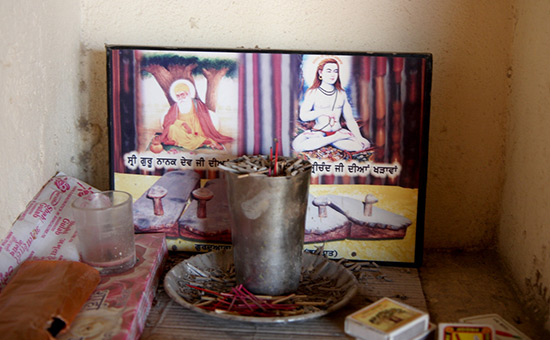
Guru Nanak and Baba Sri Chand, Lakhpat Gurudwara Kutch, Gujarat.

4. Who are Udasis and Nirmalas?

The Udasi historically began with Baba Siri Chand (son of Guru Nanak Dev and Mata Sulakhani Devi). Udasis are known for their renunciatory outlook as against the mainstream Sikh belief in worldly activity. Udasi establishments do not fall under the control of the Shiromani Gurdwara Parbandhak Committee (SGPC).

Also read The Udasi Tradition

On Nirmalas Dr Satish K. Kapoor wrote in South Asian Observer, Toronto, “While at Paonta Sahib (Himachal Pradesh) where he composed most of his writings, Guru Govind Singhji sent five of his disciples – Ganda Singh, Karam Singh,Vir Singh, Ram Singh and Saina Singh– investing them with the saffron attire of ascetics, to Kashi (Varaṇasi) in 1686, for learning Sanskrit and acquiring knowledge of classical Hindu texts. The chosen Sikhs studied under Pandita Satyananda for about seven years and acquired the quintessentials of ancient Sanskrit literature. After returning to Anandpur Sahib (Punjab), birthplace of the Khalsa, they were called Nirmalas, meaning pure and spotless. The Nirmalas keep long hair, flowing beard, and wore turban but do not always undergo the Sikh baptismal rites of the orthodox. They consider Vedanta as most practical and sublime, and are sometime called Vedanti Sikhs.”

Bandai Sikhs are followers of Banda Bahadur.

5. Who are Nirankaris?

Dayal Das (born 1783 in a Malhotra Khatri family of Peshawar, died 1855) belonged to this Hindu Sikh Community (Khatris-Aroras-Baniyas who made atleast son a Kesadhari Sikh).1 The Nirankaris following is mainly amongst non-Jaat Sikhs and Hindus of Arora Zargar and Kshatriya castes. 1 Pg. 124 It started as a reformist movement.

“In the 1930s, Sant Nirankaris emerged as an offshoot of the Nirankaris. While the original Nirankaris receded into the background, the Sant Nirankaris continued to spread and grow, inviting the ire of orthodox Sikhs.” ThePrint here

“The Nirankaris believe in the formless God-Nirankar-who can be reached through a “God-realised soul” or “satguru”. Trouble began in 1951, when Satguru Avtar Singh proclaimed himself a living guru in the presence of the Adi Granth (the Sikh holy book, which is considered to be a living Guru).” ThePrint Rivalry between Sikhs and Nirankaris is nearly a century old

The cause of differences between orthodox Sikhism and Nirankaris are limited to the latter’s worship of gurus other than the ten gurus recognized by Sikhs. They also disapprove of militant Khalsa. 1 Pg. 125

According to this Indian Express report , “The Nirankari Mission, which is looked upon by many mainstream Sikhs as a heretic cult, claims to be unaffiliated with any religion with an aim of uniting people with God. The Nirankaris deny that Sikhs have any authority over them. In 1980, then sect chief Satguru Gurbachan Singh was assassinated by a Sikh extremist at the Foundation’s headquarters in Delhi.”

Also read Were Backward Classes always suppressed in India?
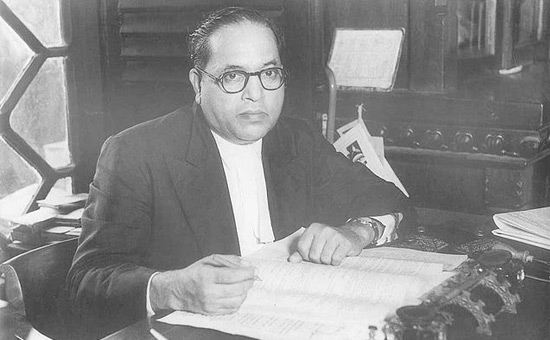
Ambedkar

6. Dr Ambedkar wanted his followers to become Sikhs!

The Government of India Act 1935 introduced the term ‘Scheduled Caste’ (SC) for the depressed classes (DC) to which Ambedkar belonged. The word Scheduled Tribe came to be used around 1950. In Tripura, the former rulers are now S.T. so a bust of Ambedkar is installed at their palace. The word Dalit come into prominence in the 1990s and is said to be an American Church construct. There are national commissions for the scheduled castes and backward classes but nowhere is the word Dalit used.
Ujjayanta Palace Agartala, Tripura.

Today there is a clamour to be declared SC/ST because of reservations in government jobs etc., for e.g. the Dhangar community (to which Queen Ahilyabai Holkar belonged) want to be declared a Scheduled Caste. New communities are declared SC/ST invariably before elections when votes are sought.

Also read History of the word Dalit

Ambedkar deputed on 18/9/1936, a group of his followers to the Sikh Mission at Amritsar to study the Sikh religion. They were a group of 13, none of whom was a scholar or a first rate Ambedkarite. Ambedkar wished them success but had not asked them to convert to Sikhism. In an excess of zeal those students went over to Sikhism & did what their leader did not mean. They were coldly received in Bombay and then sank into oblivion.

Prior to his meeting the British in 1937, Ambedkar had consulted some German & other Europeans jurists of repute as to the possibility of the DC retaining the reserved seats in the Provincial Assemblies if DC became Sikhs for the Sikhs were granted reserved seats only in Punjab. Later the Sikh authorities & Ambedkar could not hit it off and so they parted. Source chapter 14 of Life and Mission of Dr Ambedkar by Dhananjay Keer

It is also possible that the existing DC Sikhs told Dr Ambedkar of their ill-treatment. This might have influenced his decision. 3

Also after the definition of who is a Sikh in the Gurudwaras Act 1925, the Depressed Classes would post becoming Sikhs have to sport the 5 forms of Khalsa–turban, kada etc. Would Ambedkar’s followers wear turbans and give up Marathi for Punjabi!

It is also possible that those who controlled SGPC then, realized that Ambedkar could take control of SGPC if his followers, being large in number became Sikhs. Prof Harish Puri adds, “Such is the evidence offered by Sardar Kapur Singh in his well-known but controversial book, Saachi Sakhi. According to him there was an apprehension that once the tall leader Ambedkar became a Sikh with all his followers, none from the existing leaders like Baldev Singh may be nominated to the Viceroy’s Executive Council as a representative of the Sikh community.” 3

7. How Jaat Sikhs became dominant in Punjab?

Initially, the Khalsa followers were mostly Jaats (were considered low caste then). Though others considered themselves Sikhs, they held back since they were not followers of Khalsa. The birth of Khalsa resulted in the rise of Jat power in Punjab. Khalsa was raised to fight Mughal oppression and persecution of Hindus and Sikhs (who then were considered part of the larger Hindu community).

Another view by Prof Harish Puri is, “The large scale entry of the Jats by the time of the Sixth Guru, tended to alter the caste equation in the Panth. The Jats constituted the rural elite who dominated the rural Punjab. By the 18th century the Jat constituency was preponderant among the constituent groups in the Panth (McLeod 1975: 10).” 3

Also read Is modern day Sikhism a colonial construct

Having experienced the strength of Sikh opposition during the Anglo-Sikh wars and grateful for the assistance received from Sikh princes during the Mutiny of 1857, the British realized that Sikhs would be an effective buffer between Afghanistan and India.

Also read The 12 Sikh Misls of Punjab OR 12 Sikh MISLS

Therefore, the British reduced the number of Bengali soldiers (many of whom were involved in the 1857 Mutiny) and replaced them with loyal Sikhs and Punjabi Muslims. It however, insisted that only Kesadhari Sikhs could join the army i.e. those who sported the five k’s. The enlistment of Sikhs rose steeply. Since it was mainly Jaat Sikhs who sported the five k’s then, they were the biggest beneficiaries since soldiers were well paid, given agricultural land and pension.

In order to woo the Jats, “The area specifically chosen for the Sikhs was a tract known as nili bar, irrigated by the Chenab canal. Colonization officers scoured Sikh villages in the districts of Amritsar, Ludhiana and Ferozpur to pick up the best farmers. The settlers were given heritable and inalienable rights of occupancy. The vast majority of Sikh colonists were Malwa Jats with a sprinkling on non-Jat agricultural tribes.”Pg. 118

With time farmers (predominantly Sikhs) prospered.

The British enforced rigid occupational boundaries by creating ‘traditional agriculturists’, ‘martial races’ and ‘trading castes’. The Jats were classified as traditional agriculturists.

To retain effective control over Punjab, the British accentuated the wedge between land-owning Jats and non-agriculturists. Backward classes were declared a non-agricultural caste. Thus, they could not own land and had to work as farm labour.

The Punjab Land Alienation Act of 1900 “enabled the government to retain its inflexible revenue policies and continue to blame peasant proprietors’ misfortunes on Hindu moneylenders. It was done to pacify the land owning classes and deflect a rebellion, and to aggravate and exploit any tension that existed between Hindus and Muslims to keep their political grip on Punjab. This piece of legislation created a favoured, ‘dominant’ agriculturalist class at the expense of other social groups. Here the ‘agriculturists’ were Muslim tribes and Sikh and Hindu Jat zamindars, and the ‘non-agriculturists’ were Hindu Brahmins, Khatris and Banias. The Act made tribe and caste the basis of land ownership.” 2

Thus, Jaats became the biggest land owning community in Punjab.

Another reason for rise in their power was that Jaats controlled SGPC since its inception in 1925. Barring a couple every Chief Minister of Punjab, since the state was formed in 1966, has been a Jaat Sikh.

The caste divide was created in the Indian Army too. A Jaat Sikh regiment and a Sikh Light Infantry for Mazhabi Sikhs were created.

Thus, Jaat Sikhs became socially dominant and politically powerful in Punjab.
Guru Goving Singhji prayer to Shivji at Siachen War Memorial.

8. Who is covered by the term Bhapas?

The Land Alienation Act 1900 created a divide between Jaat and Khatri/Arora Sikhs such that the latter are called “Bhapa”, a term used dismissively by Jaats to describe some Khatris and others.

Former Chief Minister and Jaat Sikh Pratap Singh Kairon referred to them as Bhapas (brothers) a pejorative term for Sikhs of Brahmin, Khatri or Arora extraction. This is despite all the ten Gurus being Khatris. 1 Pg 317

9. How does one identify Brahmin Sikhs?

“Sikhs of Brahmin origin existed from the times of Guru Nanak. If we see beyond the modern narrative then Pandit Hardyal Pandha was the first one to recognize the divine light of Guru Nanak.” Current distinctions did not exist then.

“Here is a short but not complete list of Brahmin Sikh clans: Rishi, Sasan, Kala, Kalia, Chibber, Dutt, Rissam, Sudan, Pandha, Vasudev, Issar, Dutta, Bhardwaj, Punj, Reen, Bali, Devgan, Joshi, Ramdev, Raina, Tara, Vashisht.”

According to article by H C Dutt in Dailyexcelsior the, “Mohyal-a clan of Saraswat Brahmins separated their life style from other Brahmins by serving the society with weapon in one hand and Vedas in other. The Sikh army was known for many Mohyal warriors like Baba Praga Chhibber- the Bisham Pitama who with the orders of Guru Har Govind fought and destroyed the large army of Shah Jahan. Bhai Matti Dass Chibber was the Prime Minister of Guru Teg Bahadur who fought with the army of Aurangzeb and was cut in two pieces with saw cutter by Mughals on 9 November 1675 in Chandni Chowk, Delhi. His brother Bhai Satti Dass was also burnt alive.”

Also readContribution of Brahmins to Indian Society and Culture

Maharaja Ranjit Singh Samadhi, Lahore

10. Who are the Scheduled Castes in Sikhs?

They are Mazhabis, Ramdasias, Sikhlighars, Kabirpanthis, Ravidasas etc.

Mazhabis are karamchari/sweeper community. The Sikh Light Infantry in the Indian Army consists of Mazhabhi Sikhs.

Ramdasias belong to the Chamar (leather maker) community. The Bahujan Samaj Party founder Kanshiram was a Ramdasia Sikh.

Giani Zail Singh belonged to the carpenter community (of Ramgariya Sikhs). The Ramgariyas trace their decent from Jassa Singh Ramgariya, who was a great leader, organiser and warrior. Carpentars in say Uttar Pradesh, are not treated as scheduled castes but belong to the Vishwakarma community. Near Jaipur met a carpentar named Sharma who is a Jehangid Brahmin (see pic below)
Brahmin Carpentar near Jaipur.

Prof Ronki Ram wrote in ThePrint, “Those members who were mainly from the weaving community, popularly known as Julahas, became Ramdasias after conversion to Sikhism.” Source

This concept was conversion to another religion did not exist till recently. Conversion is used when one adopts an Abrahmaic religion.

Dalit activist and advocate Dr S.L. Virdi wrote in ThePrint, “Dalit Sikhs and Jat Sikhs have separate gurdwaras. The discrimination might not be as visible as in UP, Bihar or Haryana in that Jaats may allow Dalits to enter gurdwaras but they won’t allow them to make prasad,” he said. Source

Also read Survey paper by Prof Vishal Puri pg 17

Ad-harmis are a sub-caste and known as Ravidassias. They follow Sant Ravidas (a chamar). Rajput Queen Meerabai was a follower of Sant Ravidas (rigid western style distinctions amongst people do not work in India).

Also read Life and Teachings of Sant Ravidas

According to as Indian Express report, “An attack in 2009 during a religious congregation in Vienna, which the current chief of the Dera Sant Niranjan Das survived, but in which one of the sants was killed, became a watershed moment. In Varanasi, on the birth anniversary of Guru Ravidas in 2010, the Dera and its sants declared Ravidassia as a new religion.”

Ravidassias believe in Ravidasia Dharm. It is a Panth, like there have been many in India. “Dera Sachkhand or Dera Ballan has emerged as a major centre for the articulation of the Ravidassia identity in Punjab.”

According to a Punjab based scholar, “They are considered pariahs in all matters. Sikhs generally used the epithet Sant for Ravidas, denying him the status of Guru, which they kept only for their own ten gurus. While Ravidasis take pride in being chamars (as did their guru) Sikhs continue to consider chamars as low caste. Inter-dining, intermarriage between two communities is still not accepted, although the elite among them enjoys a better social status by virtue of their political or economic power.”

Valmikis are found amongst Hindus too. Ranghreta Sikhs are those who brought Guru Tegh Bahadur’s head from Delhi to Anandpur. Sikhligars, found mainly in Maharashtra, are Lohars who made Shastras/Arms for the Guru Govind Singhji. There are Rai, Bazigar and Sansi Sikhs too.

The British created this system of caste and sub-caste and Indians are trying to justify their society based on that.Dera Sacha Sauda Chief, old pic. 
11. Why have Deras become popular in Punjab and Haryana?

Dera refers to places of worship associated with individual gurus.

The backward classes and poor were left out of the prosperity ushered in by the Green Revolution. The need for a support system and to be part of a larger community was felt. It is this vacuum that deras like Sacha Sauda filled. They made the poor feel secure, loved, provided a support system and gave them dignity.

According to a 2017 report in Chandigarh’s Tribune the reasons for their popularity are four-fold . One, identities of caste and religion cease to exist in the dera. Two, the humble ranking of dera management. A state is divided into zones, with each zone headed by a man called Bhangi Das. Three, subsidised food and free rations. Four, many districts close to Sirsa in Haryana are plagued by knee problems and cancer due to bad quality of water. The dera provided free treatment.

Also read Why Dera Sacha Suda draws followers

12. What were the Gurus views on caste?

“If you were to go only by the Gurbani (the words and writings of the ten Gurus of the Sikhs) there cannot be a caste system in Sikhism. But this did not translate into practice,” said noted scholar and subject expert Dr Harish Puri. Source ThePrint

It must be known that neither do Hindu scriptures sanction caste?

Also read Rethinking Caste-Why we cannot be one dimensional Caste is a Socio-Political Institution

What scriptures say and the reality are different.

Also read Impact of foreign invasions on Indian society & caste by R C Mazumdar

Note that the Panj Pyare belonged to different caste. On 30 March 1699, at Anandpur, Govind Singhji gave a stirring speech to the assembly about the need to protect their spiritual and temporal rights. He then asked if anyone would offer his head in the services of God, Truth and Religion. The five who came forward were Dayaram a Khatri from Lahore, Dharamdas a Jat from Hastinapur near Delhi, Sahib Chand a barber from Bidar in Karnataka, Himmat Chand Kahar, a water carrier from Puri in Odisha and Mohkam Chand Chihimba from Dwarka in Gujarat.

Prof Harish Puri wrote, “It was no problem that the Sikhs who were distinguished from Hindus (Hum Hindu Nahin), largely because they did not believe in Hindu caste system, now considered that such a distinction between the two religious communities was itself a discrimination against the Sikhs. The Sikh leaders “promoted constitutional provisions for the Sikh society which were an insult to Guru Nanak’s egalitarian principles.” 3

Utmost care is taken in sharing history. While we can have differing views, in case of any errors please mail with reference of source documents.

References

1. A History of Sikhs, Volume II by Khushwant Singh.

2. Dowry Murder: The Imperial origins of a Cultural Crime by Veena Talwar Oldenburg.

3. The Scheduled Castes in the Sikh Community – A Historical Perspective by Prof Harish K Puri. [First published in Economic & Political Weekly (28 June 2003) and was then included in the author’s edited volume on Dalits in Regional Context (2004)

4. Hinduism: The Faith Eternal by Dr. Satish K Kapoor.

Also read

1. The myth of a Castless Sikh Society by Prof Ronki Ram 2007 paper

2. The Historical role of Caste amongst Sikhs

3. What happened during the Khalistani Movement

Author: Sanjeev Nayyar is a chartered accountant and founder, www.esamskriit.com

Simridhi Makhija also contributed to this article.

Disclosure – The author is a Punjabi Khatri who takes equal pride in the karmas of Shivaji Maharaj and Guru Govind Singhji.

Disclaimer: The article was first published on, www.esamskriit.com, We have republished it with kind permission from the author under our global content-sharing initiative.


Labor is odds-on for a narrow victory in NSW election, but it is far from a sure bet

0

By Andy Marks, Western Sydney University

A gambler would probably feel the odds favour a Labor win at the upcoming New South Wales election. But, as Scott Morrison proved in 2019, underdog status is prized in politics. Favouritism brings its own challenges, especially when the game takes an unanticipated twist. In this setting, the wide path to victory can quickly become a narrow track to defeat.

NSW voters go to the booths on March 25 with Premier Dominic Perrottet seeking to lock in 16 years of Liberal-National incumbency. The Labor opposition under Chris Minns is polling well. Despite this, Perrottet isn’t playing to type.

This campaign is recasting the state’s typically combative political culture. Peace has broken out. Major campaign promises, from both sides, are converging on a shared political centre. Be it toll relief, health infrastructure, energy vouchers or other rebates, only strategic nuances separate the two.

Funding commitments, too, are broadly on par. The Coalition’s “future fund” promises education and housing co-investment to individuals, while Labor’s “education future fund” directly targets the schools system.

On public sector wages, neither side is promising increases. Both leaders will thin the ranks and freeze the pay of senior public servants. And Perrottet has ruled out further privatisation, ending nearly a decade of “asset recycling” and bringing the Coalition into line with Labor.

With commonality abounding, real difference is emerging on unanticipated terrain. The NSW cabinet’s decision to introduce cashless gaming within five years is providing Perrottet a moral profile that typically takes time for a new leader to build. It also acts as a reset following revelations of his Nazi costume choice at his 21st birthday.

In contrast, Labor won’t back gambling reform, seemingly untroubled by the issue from a campaign standpoint. These divergent stances could weigh on undecided voters wondering what kind of a premier Minns might be. Would he stand up to powerful lobbyists? It’s not an insignificant question given Labor’s past in NSW. It may be a factor in marginal electorates.

Several seats in western Sydney are shaping as tight contests. With roughly one-third of the total votes cast at the election to be lodged in Sydney’s west, there is no path to victory for the Coalition or Labor without the region’s support.

East Hills, which the Liberals hold by just 0.1%, is a campaign focal point. In an announcement confined almost entirely to social media, the premier committed $1.3 billion to construct a hospital in the electorate.

Ordinarily, a hospital pledge would be a widely promoted commitment. Keeping it local may be a deliberate strategy to emulate isolated success at last year’s federal election. In the western Sydney seat of Lindsay, the federal Liberals bucked the national trend and secured a positive swing. Hyper-local, street-by-street campaigning fuelled that unexpected surge. https://www.youtube.com/embed/j-mbz2y5ksM?wmode=transparent&start=0

Lindsay overlays the marginal NSW seat of Penrith, where former minister Stuart Ayres is defending a margin of just 0.6%. Here, too, the Liberals are upending wider campaign tactics for a local pitch, with the help of former premier Gladys Berejiklian.

Continuing his moral stance, Perrottet endorsed the Independent Commission of Corruption’s investigation of her and continues to disavow her it’s “not illegal” rationale for pork-barrelling.

Other factors ramp up the unpredictability. The new seat of Leppington – nominally Labor (1.7%) – takes in many highly mortgaged areas of Campbelltown, Liverpool and surrounds. The pace of housing development has far eclipsed the construction of education, health and transport links.

Similar growing pains are evident in electorates like Riverstone, where existing services are unable to cope with surging housing estates. Labor is, accordingly, promising to address these challenges, committing to a range of investments such as a $700 million hospital for Rouse Hill.

Leaders answer quickfire 'pub trivia'
New South Wales Premier, Dominic Perrottet, and Opposition Leader, Chris Minns

The retirement of several senior Liberal members brings additional opportunities for Labor in key seats. Kevin Connolly in Riverstone and Geoff Lee in Parramatta are departing, along with cabinet members David Elliott, Brad Hazzard and Rob Stokes.

Stokes’ seat of Pittwater is among a clutch of northern Sydney electorates facing challenges by independent candidates. However, a repeat of the federal “teal wave” is unlikely, given the optional flow of preferences, and mitigating budget measures from Treasurer Matt Kean with a focus on women and sustainability.

In the regions, the transition to clean energy is challenging the Nationals’ hold on the Upper Hunter, while the retirement of Liberal Shelley Hancock has put the seat of South Coast in the frame for Labor. And the Nationals’ grip on the bellwether electorate of Monaro will be closely watched, with former Labor representative Steve Whan making a comeback.

This is an unusual election. Conventional analysis – and the bookies – suggest a Labor win, likely in minority government. But the Coalition are rolling the dice in narrowly targeted areas and on atypical issues.

While the heat has gone out of NSW politics, many voters will struggle to make sense of the peace. Others are understandably sceptical it will last.

Andy Marks, Pro Vice-Chancellor, Strategy, Government and Alliances, Western Sydney University

This article is republished from The Conversation under a Creative Commons license. Read the original article.

Can you help Police find these men regarding Federation Square Khalistan Violence

0

After almost seven weeks Victoria Police has appealed for public assistance regarding the violent attacks on peaceful Indian Australian community members by Khalistan supporters at Federation Square in late January.

Police were in attendance at a Khalistan Referendum event at Federation Square on 29 January when two incidents of attacks happened, one at about 12.45 pm and the other at about 4.30 pm.

During the attacks, flag poles were used by several men as weapons which caused physical injuries to multiple victims.

Two victims, one with a laceration to their head and another with a hand injury, were treated at the scene by paramedics. Several other victims sustained injuries and required medical treatment.

An Indian flag was also burnt by a group of men.

In both incidents, police quickly responded to separate and disperse the crowd. OC spray was used in the second incident to separate the fighting men.

Two men were arrested on the day, and police have been making a number of enquiries to identify the remaining individuals.

Investigators have released images of six men they believe may be able to assist with their enquiries.

After continued violence in UK, ‘Sikh separatist’ activity should be on the radar of Australian authorities

0

The senior-most UK diplomat in New Delhi was summoned on Sunday night after the Indian High Commission in the United Kingdom was vandalised.

In a disgraceful incident, the Indian national flag at the Indian High Commission in London was pulled down during a protest by pro-Khalistan activists on Sunday, prompting the Indian External Affairs Ministry in New Delhi to summon the senior-most British diplomat to lodge a protest.

British deputy high commissioner Christina Scott was summoned late yesterday evening to convey India’s strong protest at the actions taken by separatist and extremist Khalistan elements against the Indian High Commission in London earlier in the day, the Ministry of External Affairs said in a press release on Sunday.

An explanation was demanded for the complete absence of British security that allowed these elements to enter the High Commission premises.

She was reminded in this regard of the basic obligations of the UK Government under the Vienna Convention.

“India finds unacceptable the indifference of the UK Government to the security of Indian diplomatic premises and personnel in the UK,”

the MEA press release said.

On the other hand, Australian authorities are being reminded by geopolitics academicians to be on their heels to tackle growing Khalistan extremist activities in the country.

Brisbane-based Prof Ian Hall is co-editor of the Australian Journal of International Affairs and Hon. fellow at Australia India Institute.

Prof Hall took to social media to remind the Australian government that if the “Sikh separatist activities are not checked by authorities they can potentially complicate the Australia-India relationship.

However, the lack of knowledge and understanding of the Khalistan extremist ideology and its terror roots is evident in Australian media, academia and security agencies.

Prof Hall says,

“If anyone has a good account of why we’re seeing this resurgence, I’d be grateful for the reference. I’m finding it hard to explain.”

Earlier PM Anthony Albanese said while addressing a press conference in New Delhi, “Australia won’t tolerate any extreme actions and attacks that took place in religious buildings, and there is no place for such action against Hindu temples.”

“And we will take every action through our police and also our security agencies to make sure that anyone responsible for this faces the full force of the law.

We’re a tolerant multicultural nation, and there is no place in Australia for this activity,”

said PM Albanese.

In India, demanding “immediate steps” from the UK Government, Indian Ministry of External Affairs officials said, “It is expected that the UK Government would take immediate steps to identify, arrest and prosecute each one of those involved in today’s incident, and put in place stringent measures to prevent the recurrence of such incidents.”

The British High Commissioner Alex Ellis condemned the attack on the Indian High Commission in the United Kingdom today. He condemned the “disgraceful acts” and called it totally unacceptable.

“I condemn the disgraceful acts today against the people and premises of the High Commission of India – totally unacceptable,” British High Commissioner to India Alex Ellis tweeted. 

Is the sun setting on the era of Bainimarama and FijiFirst?

0

By Shailendra Bahadur Singh

The long-running row between the former Fiji government and the Suva-based University of the South Pacific (USP) has come back to haunt former Fiji prime minister Frank Bainimarama, who spent a night in a police cell on 9 March before appearing in court, charged with abuse of office.

Not only did the “USP saga”, as it came to be known, cause a major rift between Fiji and the other 12 USP-member countries, but it may have contributed to the narrow loss of Bainimarama’s FijiFirst Party (FFP) in the December 2022 election.

Bainimarama’s abuse of office charges included accusations of interfering with a police investigation into financial malpractices at USP. If convicted, he would face a maximum sentence of 17 years in jail. But there are also serious questions about the future of the party that he co-founded, and which won successive elections in 2014 and 2018 on the back of his popularity.

Image

A day before his indictment, there were surreal scenes at the Suva Central Police Station, as police officers marched an ashen-faced Bainimarama to his cell to spend the night before his court appearance the next morning. This, under the full glare of live media coverage, with journalists tripping over themselves to take pictures of the former military strongman, who installed himself as prime minister after the 2006 coup and ruled for 16 years straight.

Arrested, detained and charged alongside Bainimarama was his once-powerful police chief, Sitiveni Qiliho, who managed a wry smile for the cameras. Both were released on a surety of FJ$10,000 after pleading not guilty to the charges.

It is alleged that in 2019, the duo “arbitrarily and in abuse of the authority of their respective offices” shut down a police investigation into alleged irregularities at USP when former vice-chancellor Rajesh Chandra was in charge.

Fiji’s former prime minister Frank Bainimarama was placed in police custody after he was arrested and charged with abuse of office, according to reports. Former police commissioner Sitiveni Qiliho has also been placed under arrest as charges relating to alleged irregularities in the finances of a University are investigated.

In November 2018, Chandra’s replacement, Professor Pal Ahluwalia, revealed large remuneration payments to certain USP senior staff, some running to hundreds of thousands of dollars. The Fiji government, unhappy with Ahluwalia’s attack on Chandra, counter-attacked by alleging irregularities in Ahluwalia’s own administration. As the dispute escalated, the Fiji government suspended its annual grant to the USP in a bid to force an inquiry into its own allegations.

When an external audit by accountants BDO (NZ) confirmed the original report’s findings, the USP executive committee, under the control of the then Fiji government appointees, suspended Ahluwalia in June 2020. This was in defiance of the USP’s supreme decision-making body, the USP Council, which reinstated him within a week.

USP Vice-Chancellor and President Professor Pal Ahluwalia is greeted by USP staff and student representatives at the Nadi International Airport this morning. Picture: SUPPLIED/USP MARKETING AND COMMUNICATIONS

Samoa’s then Deputy Prime Minister Fiamē Naomi Mataʻafa (who is now prime minister, having won a heavily contested election of her own) said at the time that Ahluwalia’s suspension had been a “nonsense”. The then Nauruan President Lionel Aingimea attacked a “small group” of Fiji officials for “hijacking” the 12-country regional university.

The USP Students’ Association threatened a boycott of exams, while more than 500 signatures supporting the suspended vice-chancellor were collected and students protested across several of USP’s national campuses. All these events played out prominently in the regional news media as well as on social media platforms.

With Fiji’s national elections scheduled for the following year, the political toll was becoming obvious. However, Bainimarama’s government either did not see it or did not care to see it. Instead of backing off from what many saw as an unnecessary fight, it doubled down. In February 2021, around 15 government police and security personnel along with immigration officials staged a late-night raid on Ahluwalia’s Suva home, detained him with his wife, Sandra Price, and put them in a car for the three-hour drive to Nadi International Airport where deported, they were put on the first flight to Australia. The move sent shockwaves in Fiji and the region.

To many, it looked like a government that had come to power in the name of a “clean-up campaign” against corruption was now indulging in a cover-up campaign instead. The USP saga became political fodder at opposition rallies, with one of their major campaign promises being to bring back Ahluwalia and restore the unpaid Fiji government grant that stood at FJ$86 million at the time.

A month before the 2022 polls, a statement targeting the estimated 30,000 staff and student cohort at USP, their friends and families, urged them to vote against FijiFirst, which would go on to lose government by a single parliamentary vote to the tripartite coalition led by another former coup leader, Sitiveni Rabuka.

It was Rabuka who greeted Australian Prime Minister Anthony Albanese on his first official visit to Fiji yesterday. During talks at the Australian-funded Blackrock military camp, Albanese reportedly secured Rabuka’s support for the AUKUS deal.

Australia is keen for stability in Fiji, which has not had a smooth transition of power since independence, with democratically elected governments removed by coups in 1987, 2000 and 2006. Any disturbance in Fiji has the potential to upset the delicate balance in the region as a whole.

For Bainimarama and his followers, there is much to rue. His claimed agenda – to build national unity and racial equality and to rid Fiji of corruption – earned widespread support in 2014. His margin of victory was much narrower in 2018 but Bainimarama managed to secure a majority in parliament to lead the nation again.

His electoral loss in 2022 was followed by a series of dramatic events, which first saw Aiyaz Sayed-Khaiyum, his deputy in all but name, disqualified from holding his seat in parliament. Bainimarama went next, suspended for three years by parliament’s privileges committee for a speech attacking head of state Ratu Wiliame Katonivere. He chose to resign as opposition leader.

Following his 10 March hearing, Bainimarama addressed the media and a few supporters outside court, adamant that he had served the country with “integrity” and with “the best interests” of all Fijians at heart. The former leader even managed to smile for the cameras while surrounded by a group of followers.

With nearly double the personal votes of the sitting PM Rabuka under Fiji’s proportional representation voting system, Bainimarama’s supporters still harboured some hope that he could return as the country’s leader one day. However, his health is not the best. He is now out of parliament and bogged down by legal troubles. Is the sun now setting on the era of Bainimarama and FijiFirst?

Contributing Author: Dr Shailendra Bahadur Singh is an associate professor and head of journalism at the University of the South Pacific (USP) in Suva, Fiji. He was the 2022 Pacific Research Fellow at the Australian National University.

This article was first published in The Interpreter. We have republished it with kind permission from the author under our global content-sharing project.

Disclaimer: The opinions expressed within this article are the personal opinions of the author. The Australia Today is not responsible for the accuracy, completeness, suitability, or validity of any information in this article. All information is provided on an as-is basis. The information, facts, or opinions appearing in the article do not reflect the views of The Australia Today and The Australia Today News does not assume any responsibility or liability for the same.

Is financial stress affecting your mental health? Here are 5 things that can help

0

By Kristin Naragon-Gainey, The University of Western Australia

Financial stress affects us in many different ways. Some people are struggling to pay bills, feed the family, or maintain a place to live. Others are meeting their basic needs but are dipping into their savings for extras.

Financial stress is increasing and, understandably, is causing some distress. In recent months, Lifeline has seen a rise in the number of calls about financial difficulties.

But understanding and finding ways to reduce our financial stress – and its emotional impact on us – can help make this challenging time a bit easier.

What is financial stress?

If you’re finding it difficult to meet your current expenses or are worried about your current or future finances, you’re under financial stress. Like other types of stress, financial stress has two components:

  • objective financial difficulty, where you don’t have enough funds to cover necessary expenses or debts
  • subjective perceptions about your current or future finances, leading to worry and distress.

These two are related. But someone can have trouble meeting their expenses, view this as acceptable, and not be overly worried. Alternatively, someone may be reasonably financially secure but still feel quite stressed about their finances.

Why are we feeling it?

There is a broad range of factors that can influence your current level of financial stress. These include contextual and personal ones.

Contextual factors are societal-level influences on the current financial landscape. These include rates of economic growth, market performance, governmental and political policy, and distribution of wealth. These factors may vary across cultures and countries.

Personal factors contributing to stress are unique to each person. For example, demographic characteristics such as age, gender, education and ethnic group may influence someone’s access to financial resources.

Other personal factors that can affect financial stress are financial literacy and practices, personality traits that influence behaviour and perceptions, and major life events with financial implications (such as marriage, having a child, or retiring).

Worried looking couple looking at piece of paper at laptop on kitchen counter
Not all factors contributing to your financial stress are under your control. Shutterstock

The health impacts can be severe

High levels of financial stress can impact people’s well-being, raising levels of psychological distress, anxiety and depression.

A review found clear evidence for a link between financial stress and depression, and that the risk for depression was greatest for people on low incomes.

A large survey of adults in the United States also found that more significant financial worries were associated with more psychological distress. This was especially the case for people who were unmarried, unemployed, had lower income levels and who were renters.

So people who are more vulnerable financially – in an objective sense – are also most likely to experience negative psychological effects from financial stress.

However, the perception of your financial situation matters here too. In one study of older adults, including Australians, it was not just someone’s financial situation that was linked to their well-being, but also how satisfied people were with their wealth.

Severe financial stressors, such as being forced to sell your home if unable to meet mortgage payments, can affect both psychological and physical health.

Bill Stress; Image Source: @CANVA

What can I do about it?

While we can’t change the broader financial landscape or some aspects of our financial situation, there are some simple ways to help reduce financial stress and its impacts.

1. Take small steps

Try to identify elements of your finances you can improve and act on some of them, even if they are small steps. This may include creating and following a budget, cutting some extra costs, applying for available financial assistance, getting quotes for more affordable utilities or insurance, or contemplating a career change. Even little changes can improve your financial state over time. Taking action in a difficult situation can enhance well-being by giving you a greater sense of agency.

2. Check your take on the situation

Examine your perspective. Are you often seeing the negative aspects of your situation but ignoring the positive ones? Are you worrying a lot about very unlikely catastrophes far off in the future? It’s worth checking whether your perceptions about your financial situation are accurate and balanced.

3. Don’t be too hard on yourself

Your financial state does not reflect your value as a person, and over-identifying your financial status can lead to further stress. Financial difficulties are the result of many factors, only some of which are under your control. Reminding yourself that your finances do not define you as a person can reduce feelings of sadness, shame or guilt.

4. Take care of yourself

It’s draining dealing with ongoing financial stress. So focus on self-care and coping strategies that have helped you with past stressors. This may mean taking some time out to relax, deep breathing or meditation, talking with others and doing some things for fun. Giving yourself permission to take this time can improve your mood, perspective and well-being.

5. Ask for help

If you are struggling financially or psychologically, seek help. This may take the form of financial advice or assistance to reduce financial difficulties. If you notice yourself feeling persistently down, anxious, or hopeless, reach out to friends or family and get help from a mental health professional.


If this article has raised issues for you, or if you’re concerned about someone you know, call Lifeline on 13 11 14.

Kristin Naragon-Gainey, Associate Professor, School of Psychological Science, and Director, Emotional Wellbeing Lab, The University of Western Australia

This article is republished from The Conversation under a Creative Commons license. Read the original article.

Former cleaning operator penalised $13k for giving a false pay slip to worker on bridging visa

0

The Fair Work Ombudsman has secured a $13,986 penalty in court against the former operator of a cleaning services business in Adelaide who used his father’s ABN to attempt to avoid his obligations to his workers.

The Federal Circuit and Family Court has imposed the penalty against Josef Samuel Neubauer, a sole trader who operated ‘City Central Cleaning’ in the Adelaide CBD.

The penalty was imposed in response to Mr Neubauer failing to comply with a Compliance Notice requiring him to back-pay entitlements to a worker he employed as an administration assistant, and for knowingly providing the worker with a false and misleading pay slip.

The worker was a Brazilian national on a bridging visa.

The Court has also ordered Mr Neubauer to take the steps required by the Compliance Notice, which includes back-paying the worker in full.

Fair Work Ombudsman Sandra Parker said business operators that fail to act on Compliance Notices need to be aware they can face court-imposed penalties on top of having to back-pay workers.

“When Compliance Notices are not followed, we are prepared to take legal action to ensure workers receive their lawful entitlements,” Ms Parker said.

“Employers should know we treat falsifying documents seriously and have no tolerance for those who attempt to avoid their obligations to their workers. Those who use false records will be found out.”

“Protecting vulnerable workers, like visa holders, also continues to be a priority for the FWO. Any employees with concerns about their pay or entitlements should contact us for free advice and assistance,” Ms Parker said.

The FWO investigated after receiving a request for assistance from the affected worker, who was employed by Mr Neubauer between October 2020 and February 2021.

A Fair Work Inspector issued a Compliance Notice to Mr Neubauer in July 2021 after forming a belief the worker had been underpaid wages, annual leave pay and payment-in-lieu-of-notice-of-termination entitlements, owed under the Clerks – Private Sector Award 2020.

In imposing the penalties, Judge Stewart Brown found that the affected worker was vulnerable and remained “out of pocket” despite direct requests to Mr Neubauer.

“The FWO has provided evidence of messages which he sent to Mr Neubauer on 13 February 2021 in which he asked when he could expect to be paid and indicated further that he was struggling to buy food. This request fell on deaf ears,” Judge Brown said.

The FWO presented evidence in court that Mr Neubauer attempted to dishonestly portray his father, from whom he is estranged, as being responsible for operating the cleaning business and employing the worker by including an Australian Business Number (ABN) registered to his father on a pay slip issued to the worker.

Judge Brown described this as a “calculated attempt to deceive”, saying “Mr Neubauer adopted the subterfuge of utilising his father’s ABN in order to evade his responsibilities arising under industrial law.”

Judge Brown found there was a need to deter Mr Neubauer and others from such conduct.

“Employees, particularly vulnerable ones, are entitled to know what they have been paid and by whom and specifically how their wages are broken down. They are also entitled to know the formal identity of their employer so that relevant queries about the terms of employment can be referred to the appropriate source,” Judge Brown said.

Why SVB and Signature Bank failed so fast – and the US banking crisis isn’t over yet

0

By Vidhura S. Tennekoon

Silicon Valley Bank and Signature Bank failed with enormous speed – so quickly that they could be textbook cases of classic bank runs, in which too many depositors withdraw their funds from a bank at the same time. The failures at SVB and Signature were two of the three biggest in U.S. banking history, following the collapse of Washington Mutual in 2008.

How could this happen when the banking industry has been sitting on record levels of excess reserves – or the amount of cash held beyond what regulators require?

While the most common type of risk faced by a commercial bank is a jump in loan defaults – known as credit risk – that’s not what is happening here. As an economist who has expertise in banking, I believe it boils down to two other big risks every lender faces: interest rate risk and liquidity risk.

Interest rate risk

A bank faces interest rate risk when the rates increase rapidly within a shorter period.

That’s exactly what has happened in the U.S. since March 2022. The Federal Reserve has been aggressively raising rates – 4.5 percentage points so far – in a bid to tame soaring inflation. As a result, the yield on debt has jumped at a commensurate rate.

The yield on one-year U.S. government Treasury notes hit a 17-year high of 5.25% in March 2023, up from less than 0.5% at the beginning of 2022. Yields on 30-year Treasurys have climbed almost 2 percentage points.

As yields on a security go up, its price goes down. And so such a rapid rise in rates in so short a time caused the market value of previously issued debt – whether corporate bonds or government Treasury bills – to plunge, especially for longer-dated debt.

For example, a 2 percentage point gain in a 30-year bond’s yield can cause its market value to plunge by around 32%.

SVB, as Silicon Valley Bank is known, had a massive share of its assets – 55% – invested in fixed-income securities, such as U.S. government bonds.

Of course, interest rate risk leading to a drop in market value of a security is not a huge problem as long as the owner can hold onto it until maturity, at which point it can collect its original face value without realizing any loss. The unrealized loss stays hidden on the bank’s balance sheet and disappears over time.

But if the owner has to sell the security before its maturity at a time when the market value is lower than face value, the unrealized loss becomes an actual loss.

That’s exactly what SVB had to do earlier this year as its customers, dealing with their own cash shortfalls, began withdrawing their deposits – while even higher interest rates were expected.

This bring us to liquidity risk.

Liquidity risk

Liquidity risk is the risk that a bank won’t be able to meet its obligations when they come due without incurring losses.

For example, if you spend US$150,000 of your savings to buy a house and down the road you need some or all of that money to deal with another emergency, you’re experiencing a consequence of liquidity risk. A large chunk of your money is now tied up in the house, which is not easily exchangeable for cash.

Customers of SVB were withdrawing their deposits beyond what it could pay using its cash reserves, and so to help meet its obligations the bank decided to sell $21 billion of its securities portfolio at a loss of $1.8 billion. The drain on equity capital led the lender to try to raise over $2 billion in new capital.

The call to raise equity sent shockwaves to SVB’s customers, who were losing confidence in the bank and rushed to withdraw cash. A bank run like this can cause even a healthy bank to go bankrupt in a matter days, especially now in the digital age.

In part this is because many of SVB’s customers had deposits well above the $250,000 insured by the Federal Deposit Insurance Corp. – and so they knew their money might not be safe if the bank were to fail. Roughly 88% of deposits at SVB were uninsured.

Signature faced a similar problem, as SVB’s collapse prompted many of its customers to withdraw their deposits out of a similar concern over liquidity risk. About 90% of its deposits were uninsured.

Systemic risk?

All banks face interest rate risk today on some of their holdings because of the Fed’s rate-hiking campaign.

This has resulted in $620 billion in unrealized losses on bank balance sheets as of December 2022.

But most banks are unlikely to have significant liquidity risk.

While SVB and Signature were complying with regulatory requirements, the composition of their assets was not in line with industry averages.

Signature had just over 5% of its assets in cash and SVB had 7%, compared with the industry average of 13%. In addition, SVB’s 55% of assets in fixed-income securities compares with the industry average of 24%.

The U.S. government’s decision to backstop all deposits of SVB and Signature regardless of their size should make it less likely that banks with less cash and more securities on their books will face a liquidity shortfall because of massive withdrawals driven by sudden panic.

However, with over $1 trillion of bank deposits currently uninsured, I believe that the banking crisis is far from over.

Vidhura S. Tennekoon, Assistant Professor of Economics, Indiana University

This article is republished from The Conversation under a Creative Commons license. Read the original article.

NSW Labor commits $3.75 million to establish Hindu Cultural and Education Centre in Sydney

0

NSW’s Labor party has promised to provide $3.75 million towards the establishment of a Hindu Cultural and Education Centre – a home for Hindus in Sydney if they form the government after the 25 March election.

NSW Labor Leader Chris Minns said, “The Hindu community needs a home – and that home should be in Sydney’s northwest.”

“The proposed Hindu Cultural and Education Centre will become the epicentre of activity for people of the Hindu faith in New South Wales.”

NSW Labor commits to establish Hindu Cultural and Education Centre; Image Source: Supplied
NSW Labor commits to establishing Hindu Cultural and Education Centre; Image Source: Supplied

The funding will be provided to the Hindu Council of Australia (HCA) to help plan and establish the new facility to be located in Sydney’s northwest.

Surinder Jain is the National Vice President Hindu Council of Australia.

Mr Jain said, “The establishment of a Hindu Cultural and Educational Centre in Sydney is an exciting project which will deliver lasting benefits to every one of the Hindu faith in New South Wales.

“It will support the work of the many Hindu community organisations and temples in New South Wales,”

added Mr Jain.
NSW Labor commits to establish Hindu Cultural and Education Centre; Image Source: SuppliedNSW Labor commits to establish Hindu Cultural and Education Centre; Image Source: Supplied
NSW Labor commits to establishing Hindu Cultural and Education Centre; Image Source: Supplied

The proposed Centre will meet the administration needs of the HCA and other Hindu organisations and provide a venue for community meetings and events.

Activities planned for the Hub include yoga classes, dance, music, seniors gatherings, counselling and indoor games.

Surinder Jain explained if established, it will be available for use by the Hindu communities from all countries including India, Nepal, Fiji, Bangladesh etc.

NSW Labor commits to establish Hindu Cultural and Education Centre; Image Source: Supplied
NSW Labor commits to establishing Hindu Cultural and Education Centre; Image Source: Supplied

The facility will have a commercial kitchen to provide Hindu Saatvik food by Karma Kitchen to Meals on wheels, hospitals, school canteens and aged care homes.

The educational activities planned for the Centre include community language lessons as well as the training of Hindu Chaplains and Special Religious Education teachers.

The Hindu community has also identified a need for a library and storage area where important cultural, educational and religious materials can be kept and accumulated for future generations.

As a first step to the project, the elected NSW Labor Government will provide $250,000 to the Hindu Council of Australia for a business case to confirm the community’s needs and to obtain the professional advice required to plan a successful project.

“NSW Labor has always been the champion of our multicultural and multifaith communities, and we look forward to working with the HCA on this project if we form Government after the election,”

said Mr Minns.

The additional $3.5 million will be reserved for the acquisition of suitable premises once the business case has been completed.

The commitment is part of NSW Labor’s Fresh Start Plan to support faith communities right across the State.

Hindu Council thanked MP Chris Minns and shadow Multi-cultural Minister Steve Kamper for making this announcement. Chris Minns addressing a gathering of Hindu community leaders praised the contribution of Hindus and Indians to Australia and to the state of NSW.

He said that this announcement is a very minor contribution to the community when compared with what Hindus have and are contributing to Australia.

Australia rejects visa applications of students from Punjab, Canada to deport 700

0

Australian authorities and universities are rejecting new student applications from the Indian states of Punjab and Haryana. It is reported that some universities and vocational course providers have instructed their agents not to stop taking and processing applications from students in northern India.

Australian universities have indicated that they do not want to raise the expectations of students with low prospects of obtaining visas from these regions.

Torrens University told THE it was considering only “very strong” applications from these states.

“We are still awaiting further information from the government about why visa refusals from these states were so disproportionally high. If students apply from these regions and their visas are refused, any future visa applications could be jeopardised.”

Phil Honeywood, chief executive of the International Education Association of Australia, told the Times Higher Education that the Australian officials from the Department of Home Affairs (DHA) had warned international education operators about soaring numbers of “low-quality applications”.

However, the DHA has told THE that they are not screening out student visa applications from Gujarat, Haryana or Punjab.

Meanwhile, the Canadian Border Security Agency (CBSA) has also issued deportation notices to over 700 Indian students. Surprisingly, CBSA scrutiny revealed that admission offer letters from educational institutions provided by the migration agent to these students were found to be fake.

It is reported that the CBSA officials are not accepting the claims of innocence of the “victims”. They are unable to see any evidence to prove that the education agent prepared and arranged all documents. Further, they are also not accepting the failure of the Canadian visa authorities that issued visas and allowed these students entry into the country.

Are Australian journalists in the gunsights of a new generation of Khalistani extremists?

0

‘Sikhs for Justice’ (SFJ), the Khalistani outfit deemed a terrorist organisation by India, has threatened The Australia Today team. Founder of SFJ, Gurpatwant Singh Pannu, splashed the pictures and names of the Editors of The Australia Today, Jitarth Jai Bharadwaj, Dr Amit Sarwal and Pallavi Jain in his latest propaganda video.

The video incites hate against India and Hindus and ends with Mr Pannu making the gesture of a gun.

This video was released soon after Prime Minister Anthony Albanese assured his Indian counterpart PM Narendra Modi that attacks on Hindu temples will not be tolerated and the attackers will meet the full force of the law during his recent India visit.

Earlier both Foreign Minister Penny Wong and Australian High Commissioner to India Barry O’ Farrell had said that Australia respects India’s sovereignty and that the Khalistan issue has no status in Australia.

Khalistan supporters also released a poster in Brisbane with the names and pictures of The Australia Today Editors along with that of the Indian High Commissioner Manpreet Vohra and Honorary Consul Archana Singh.

Khalistan blockade at Indian Consulate, Brisbane; Image Source: The Australia Today

While Khaiistan terrorism was brought to an end by India three decades ago, some elements of this terrorist movement continued to operate outside India with the help of Pakistan.

In Canada, Khalistani extremists are known to violently attack people who oppose their ideology. Ujjal Dossanjh, the first Indo-Canadian Premier (He became Premier of British Columbia in 2000) and a Sikh himself, was attacked and viciously beaten for his opposition to Khalistani extremism in 1985 in the parking lot of his office in Vancouver.

He was targeted again in 1999, while he was a member of the Legislative Assembly of British Columbia in Canada when his constituency office was attacked. Mr Dossanjh tweeted in 2018: “Indian Sikhs have a country: They call it India. Punjab has been India for untold centuries until it was cut into two to make Pakistan.”

In July 2022, a controversial Sikh leader in Canada Ripudaman Singh Malik (a former terror suspect who later rejected the Khalistan movement) was murdered. While the local authorities, it appears, have so far not conclusively figured out a motive behind this targetted killing, Indian intelligence officials indicated that this could be a planned murder by anti-India forces supported by Pakistan’s ISI.

More recently a radio presenter in Auckland, Harnek Singh (also a Sikh), was viciously attacked and seriously injured in December 2020. While sentencing Jaspal Singh who pleaded guilty for attempted murder in this case, NZHerald.co.nz reported that Justice Veening agreed the impetus for the attack appeared to be religious extremism or political disagreement.

The Australia Today also spoke with Canadian journalist Terry Milewski who has been covering this issue in Canada for the past 40 years. He is the author of the book ‘Blood for blood: Fifty years of the global Khalistan project’ and the report “Khalistan: A Project of Pakistan

Amidst death threats and cyber bullying, The Australia Today has been at the forefront of covering the growing Khalistani menace in Australia. The authorities have been informed about these threats but so far no action has been taken regarding any complaint.

A Timeline of our coverage regarding the Khalistan menace in Australia

February 2021 – Peaceful ‘Tiranga Rally’ stopped and diverted twice in Sydney after fears of alleged “Khalistani mob” attack

September 2021 – American think tank calls for urgent attention on Pakistan supported Khalistan movement

June 2022 – Australian Defence Force officers’ participation alongside Khalistani separatists in Griffith Sikh Games leaves Indian Australians dismayed

July 2022 – Impact: India raises concerns with Australia over ADF officers attending event alongside Khalistan supporters

December 2022Australia activates security apparatus after India warns of growing Khalistani menace

January 2023 – Khalistan car rally fails to garner Sikh community support but successfully terrorises Indian-Australians

January 2023 – Melbourne Hindu temple attacked and vandalised by Khalistan supporters

January 2023 – Second Hindu Temple in Melbourne vandalised by Khalistan supporters in desperation

January 2023 – Third Temple vandalised in Australia with Hindu hate graffiti by Khalistan supporters

January 2023 – Australian security agencies to crack down on illegal migrants at Federation Square Khalistan propaganda meet

February 2023 – Extremists intimidate Hindu Society of Queensland’s Gayatri Mandir: Raise ‘Khalistan Zindabad’ slogans or…

February 2023 – Indian Consulate in Brisbane targeted by Khalistan goons beside two Temples threatened in Sydney and Melbourne

March 2023 – Shree Laxmi Narayan Temple vandalised by Khalistan supporters in Brisbane

March 2023 – As PM Albanese leaves for India, Perth’s Shree Swaminarayan Temple threatened by Khalistan supporters

March 2023 – Brisbane’s Indian Consulate forced to close down by Khalistan supporters as Police watched on

March 2023 – Indian PM Modi raises Hindu Temple vandalism concerns with PM Albanese

March 2023 – PM Albanese warns attacks on Hindu Temples have ‘no place in Australia’ 

So far no arrests have been made anywhere despite seven Hindu temples being targetted across Australia.

There have been no arrests yet of Melbourne’s Federation Square attackers even though the faces of the perpetrators are on video.

The Indian Consulate in Brisbane has been targeted twice in two months and yet no one has been arrested so far.

Khalistani terrorists are responsible for one of the deadliest terror attacks in aviation history before 9/11. On 23rd June 1985, Khalistani terrorists bombed Air India flight 182 which was flying from Montreal to Mumbai via London and New Delhi killing all 329 people onboard including Canadian, British and Indian citizens.

Countries like the US and Canada have deemed Khalistani separatist groups like the Babbar Khalsa International and International Sikh Youth Federation (ISYF) as terrorist organisations.

In recent years there have been reports of violent intra-Sikh fightings among members of Gurudwaras in countries like Canada and Australia over alleged ‘power struggles’.

The Khalistan issue is not just a threat to Indian-Australians but to all Australians. One will have to wait and watch whether PM Albanese’s words translate to concrete action on the ground.

NAPLAN results inform schools, parents and policymakers, But too many kids miss the tests altogether

0

By Lucy Lu and Olivia Groves

The NAPLAN testing window has started for more than a million students in Years 3, 5, 7 and 9. Over the next nine days students will sit literacy and numeracy tests which are designed to measure their reading, writing, numeracy, grammar, punctuation and spelling.

Education decision-makers will be holding their breath about how many students turn up for NAPLAN. Last year saw the steepest declines on record in secondary school student participation.

This is an issue because NAPLAN results help inform parents, teachers, schools and education authorities about student learning and can influence decisions about policies, resources and additional supports for students. Declining NAPLAN participation may result in decisions being based on incomplete data.

In our new paper for the Australian Education Research Organisation, we look at who is not sitting the tests and why that matters.

Who is not sitting the tests?

While primary school student participation in NAPLAN has been steady at about 95% since 2014, secondary student participation has been in persistent decline. Last year only 87% of Year 9 students sat the tests.

A sharper decline in participation in 2022 was partly due to flooding in regions across Australia, high rates of illness and COVID-19 isolation requirements – circumstances we hope will not be repeated. It is the long-term decline in NAPLAN participation in secondary schools that needs attention.

The participation rate is alarmingly low for some groups of students. The figure below shows 79% of Year 9 students living in remote Australia sat NAPLAN last year. First Nations students and students from educationally disadvantaged backgrounds also had low participation rates in 2022; 66% and 75% respectively.


Our analysis reveals low-performing students are also less likely to participate in the tests. Students who performed poorly in NAPLAN in Year 7 were nearly five times more likely to miss the Year 9 tests than high-performing students. These findings were replicated for primary students.

Students who are educationally at risk need the best decisions from schools and education authorities. If NAPLAN participation rates are low for these smaller populations, the data is less reliable and the ability to make informed decisions may be compromised.

Why aren’t students sitting the tests?

Students do not sit NAPLAN for three official reasons: they may be exempt from taking the tests, withdrawn by their parents, or absent on the day.

The main reason for the long-term decline in NAPLAN participation is that more parents have been withdrawing their children from the tests. In 2022 over 11,000 Year 9 students didn’t sit the writing test because they had been withdrawn from it.

Being absent is also a contributing factor in the decline in participation; more so for secondary students than primary. In 2022, more Year 9 students than usual were absent from the writing test (in total over 28,600).

There are many reasons students are absent and withdrawn from NAPLAN. Parents who are worried about how their child may be affected by taking the tests and receiving results may choose to keep them at home or formally withdraw them from the tests. Anecdotally there have also been reports of schools asking low performing students to stay home on testing days, so they don’t “drag down” school averages.

On the positive side, our analysis showed Year 9 students with language backgrounds other than English participated in higher proportions than average (92% compared to 87%). This suggests cultural differences and family attitudes to education and testing might play an important role in participation.

Why is high NAPLAN participation important?

NAPLAN data is used by education authorities to better understand the learning progress of all Australian students to inform system-wide policies and support.

It also helps schools, systems and sectors to monitor and evaluate the effectiveness of educational approaches, and identifies schools which need more support.

For example, in NSW, NAPLAN data has been used to understand whether a new teaching role and giving students more practice time have been effective in improving students’ writing skills.

In Victoria, Brandon Park Primary School used its NAPLAN results to inform a whole school change to its teaching of reading, which brought remarkable success.

Given the benefits that good use of NAPLAN data can bring, it is critical the results are representative of the student groups being tested.

While the Australian Curriculum, Assessment and Reporting Authority estimates data for withdrawn and absent students, our analysis suggests student proficiency is likely to be overestimated.

That’s because students not sitting the test are more likely to be lower-performing students from their respective demographic groups. Real data is always better than estimates.

What now?

The Australian education system is meant to be about achieving equitable outcomes from education for all students.

Equity is something we should all expect and support.

To achieve it, we need accurate information about student progress on a national scale. NAPLAN is meant to provide that information, so we should support and encourage students to turn up for the tests and try their best.

Lucy Lu, Adjunct Senior Lecturer, Faculty of Education and Social Work, University of Sydney and Olivia Groves, Adjunct Research Fellow, Curtin University

This article is republished from The Conversation under a Creative Commons license. Read the original article.

India’s business tycoon Ratan Tata appointed to ‘Order of Australia’

0

The Governor-General of Australia has announced the appointment of India’s well-known business tycoon Ratan Tata to the Order of Australia for his distinguished service to the Australia-India bilateral relationship, particularly to trade, investment and philanthropy.

Ratan Tata is Chairman Emeritus of India’s one of largest business houses Tata Sons, former Chairman of Tata Group, and is one of the world’s most significant philanthropists.

Mr Tata has made a significant contribution to the Australia-India bilateral relationship. He has been a strong and influential advocate for deeper ties between Australia and India, including advocating for the Australia-India Economic Cooperation and Trade Agreement, which was finalised in 2022, and supporting visiting business and government leaders in India.

The breadth of Mr Tata’s contribution to India’s economic and industrial development is matched by the ethical conduct of his businesses and his support for charitable causes.

This work includes supporting the development and creating opportunities across a wide range of fields including health, nutrition, education, water, agriculture, the environment and energy, social justice and inclusion, digital transformation, disaster relief, and women’s economic empowerment.

Through scholarships offered under the Tata family trust, Indian students have been afforded opportunities to study in Australia, deepening people-to-people and economic ties, and creating opportunities in Australia’s education sector.

Mr Tata has also been involved in disaster relief efforts and has supported organisations that provide aid to those in need, such as after the 2008 Mumbai terror attacks, during which two Australians tragically lost their lives.

Tata Consultancy Services (TCS), has been based in Australia since 1998, and employs the largest number of Australians of any Indian company, with 17,000 staff and associates.

TCS also contributes to the Australian community through a significant probono program that offers complimentary IT services to six not-for-profit Australian organisations in the fields of health and Indigenous leadership.

Mr Tata has received numerous international awards and commendations for his contributions to business, industry, engineering, leadership, culture, and peace, including a Doctor of Business honoris causa from the University of New South Wales.

In recognition of his support for the Australia-India relationship, Mr Ratan Tata is receiving formal national recognition with an appointment as an Honorary Officer in the General Division of the Order of Australia (AO).

New Studies confirm no damage to springs from Carmichael mine

0

New groundwater modelling using five years of expert, on-the-ground, science has proved current and planned open-cut mining at the Carmichael mine has not, and will not, harm the Doongmabulla springs.

Bravus Mining and Resources has submitted an updated groundwater model for the area of the Carmichael mine and its surrounds to the Queensland Government as per the requirements of the Groundwater Management and Monitoring Plan, one of the suites of State or Commonwealth regulatory documents that form the operation’s rigorous environmental approvals.

At the heart of the new groundwater model is data that expert hydrogeologists collect and record every two months from a network of more than 120 monitoring bores on Bravus’ mining and pastoral leases and on neighbouring landholders’ properties.

Surface water samples are collected from another 15 locations including the Doongmabulla springs complex, which is a grouping of individual groundwater springs that naturally discharge water from the Great Artesian Basin. The nearest of the springs is located about 11 kilometres from any mining activity at Carmichael.

Bravus Mining and Resources Chief Operating Officer Mick Crowe said the peer-reviewed data was the most comprehensive scientific understanding of groundwater in the local area and demonstrated the process of environmental checks and balances for the mine was working well.

“The Carmichael mine has some of the strictest environmental conditions of any resources project in Australia’s history,”

Mr Crowe said.

“As part of those conditions, we have been measuring groundwater levels in and around the mining area for the last five years and have now submitted that information to the Queensland Government.

“The work we’ve done shows that we are not dropping the level of the water in the Doongmabulla springs complex with any of the open-cut surface mining we are undertaking now.

“The expert modelling also demonstrates that future open-cut surface mining will not cause water levels in the springs, the nearest of which is about 11 kilometres away from our mining activities, to drop.”

“While we are not doing any underground mining now, the new model does indicate we have additional work to do on our future underground mining plans to ensure they do not cause water levels in the springs to fall by more than 20 centimetres after mining occurs, which is one of our regulatory conditions.

Photo: Cameron Laird (www.cameronlaird.com)

“Protecting the springs has always been a top priority for us as we understand both their value to the Traditional Owners of the area and their inherent environmental value, and we will now use the science and the model to rework our future underground mining plans to ensure we comply with our approvals.

“This process shows the right checks and balances are in place to protect groundwater, however, anti-coal activists have begun a misinformation campaign to twist the truth to try to dupe the community into believing that our mine will damage the springs. This is absolutely not the case.

“Queenslanders can be confident we are mining in a way that protects the environment and sites of cultural significance and will continue to create local jobs and business opportunities for generations.”

About Bravus Mining & Resources’ approvals and groundwater

The Carmichael mine was granted approvals under seven different Commonwealth and Queensland Acts and, as such, has some of the strictest environmental conditions ever imposed on a mining project in Australia.

Bravus Mining and Resources’ actions to protect groundwater are set out in the Groundwater Management and Monitoring Plan and Groundwater Dependent Ecosystem Management Plan, both of which were approved by the Australian and Queensland governments following independent review by the CSIRO and Geoscience Australia.

More than 10 years of baseline groundwater data was collected to inform the Groundwater Management and Monitoring Plan and Groundwater Dependent Ecosystem Management Plan prior to the documents being approved.

These best-practice environmental plans are reviewed annually in consultation with regulators and external scientists to ensure they remain fit-for-purpose as our understanding of local groundwater and spring ecosystems advances as the program is delivered.

One of the regulatory conditions for the Carmichael mine states that water levels in the Doongmabulla springs complex must not fall more than 20cm.

Bravus Mining and Resources undertook extensive scientific studies to inform the approach to mining at the Carmichael mine and ensure there would be no impact on the Doongmabulla springs complex, the species that depend on it, or the cultural heritage significance of the area.

About the groundwater monitoring program

The groundwater study is part of a comprehensive suite of environmental programs Bravus Mining and Resources delivers to investigate, record, and, when necessary, take action to uphold its sustainability commitments.

Every two months, experienced hydrogeologists collect and record groundwater data at more than 120 monitoring bores on our mining and pastoral leases and on neighbouring landholders’ properties. Surface water samples are collected from another 15 locations.

The monitoring bores were drilled to specific depths to allow the hydrologists to collect information on aquifers in nine different geological layers.

The groundwater and surface water samples collected in the field are sent for analysis at an independent ISO-accredited laboratory using a strict chain of custody.

The laboratory tests for 40 different water quality parameters.

The information gathered is reported to Bravus Mining and Resources and to regulators and informs a process of checking any actual groundwater drawdown impacts via sensitive early warning triggers.

Bravus Mining and Resources also makes this information available to the public via its website.

About the Carmichael mine

The Carmichael mine is producing high-quality coal for export to nations around the world that want to lift their people out of energy poverty.

The mine continues to safely and efficiently ramp up to its constructed level of production which is in the order of 10 million tonnes per annum.

Townsville and Rockhampton remain the primary employment hubs for the Carmichael mine and we continue to recruit workers who can drive to the site from the Isaac Region.

More than 2,600 people were employed and more than A$1 billion was paid to regional Queensland contractors and businesses since construction began on the Carmichael project in 2019.

Although the primary construction phase is finished, Carmichael still has more than 750 people on-site at any time while another third are on days off.

Carmichael coal is high quality with low sulphur, low trace elements and low ash which meets the import requirements of many international markets, including those in the Asia-Pacific region.

Carmichael coal is sold into the international seaborne export market and its ultimate destination depends on market demand.

Note:

1. Experienced hydrogeologists collect and record groundwater data at more than 120 monitoring bores on the Carmichael mining lease and surrounding area.

2. The Moses spring is located on a cattle property in the local area. It is part of the Doongmabulla springs complex and is monitored by Bravus Mining and Resources as one of the environmental conditions for the Carmichael mine.

Disclaimer: Above article is published as per The Australia Today’s global content partnership initiative.
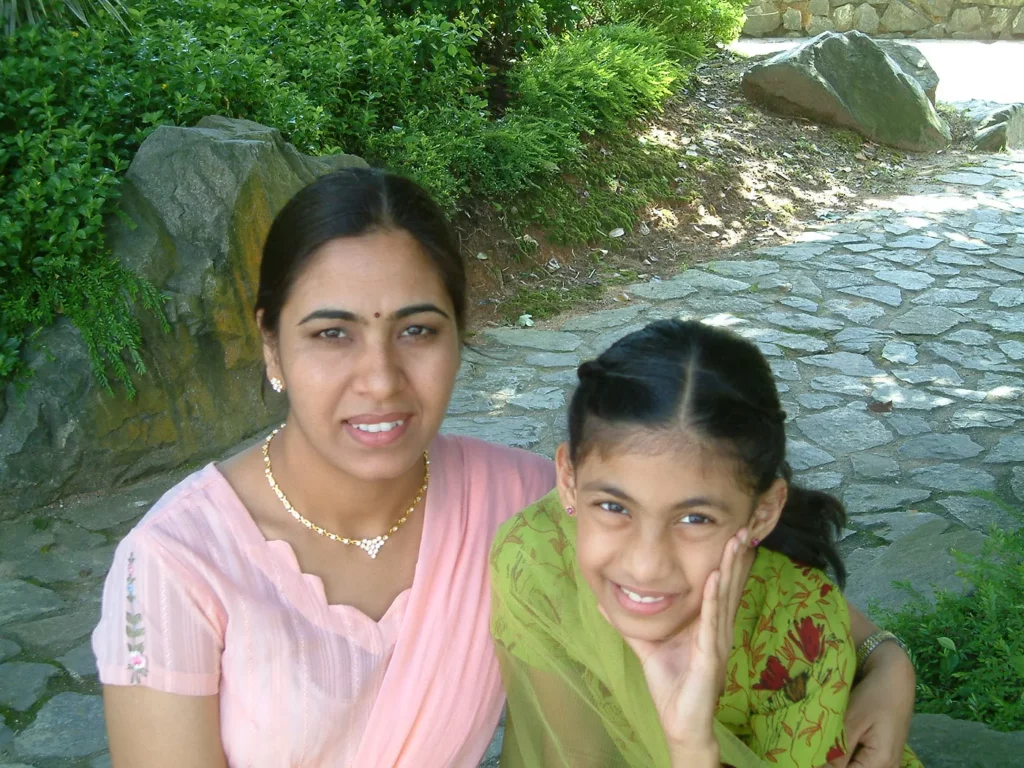
Two men charged with flying under false names

0

Two South Australian men were arrested at Adelaide Airport (13 March, 2023) and charged for allegedly travelling under false identifications.

The Angle Vale man, 21, and Burton man, 19, were flying from Perth to Adelaide on Monday (13 March, 2023) when staff became suspicious the travellers were not using their real names.

The AFP was alerted to the incident and officers met the plane on its arrival at Adelaide Airport.

AFP officers questioned the pair and further enquiries revealed one of the men had allegedly breached conditions of his bail on unrelated charges.

The man, 21, faced the Adelaide Magistrates Court yesterday (14 March, 2023) charged with:

  • One count of travelling using false identification information, contrary to section 376.4(2) of the Criminal Code 1995 (Cth). The maximum penalty for this offence is one year imprisonment; and
  • Two counts of breach of bail, contrary to section 17(1) of the Bail Act 1985 (SA), as applied by section 4 of the Commonwealth Places (Application of Laws) Act 1970 (Cth). The maximum penalty for this offence is two years’ imprisonment.  

The man was released on bail to reappear on 19 May, 2023.

The Burton man is expected to face court on 23 May, 2023, charged with:

  • One count of travelling using false identification information, contrary to section 376.4(2) of the Criminal Code 1995 (Cth); and
  • One count of fail to comply with direction to provide identity information at an Airport, contrary to section 3UU(1) of the Crimes Act 1914 (Cth). The maximum penalty for this offence is a $5500 fine.

AFP Acting Superintendent Paul Everingham said the AFP would continue to work with aviation partners to ensure travellers abided by Australian laws.

“The fraudulent use of identity documents can facilitate other criminal activity,” he said.

“It is important to know who is travelling, both domestically and internationally, and the AFP is working to identify and disrupt potential threats.”

The AFP continues to encourage airport staff and the public to report any inappropriate or suspicious activity when travelling.

‘Dates add nothing to our culture’: Everywhen explores Indigenous deep history, challenging linear, colonial narratives

0

By Anna Clark

When the eminent Australian anthropologist W. E. H. Stanner first published his essay on “The Dreaming” in 1956, there was increasing scholarly and popular interest in the complexity and duration of Australia’s Indigenous cultures.


Everywhen: Australia and the language of Deep History – edited by Ann McGrath, Laura Rademaker and Jakelin Troy (UNSW Press)


That same year, an excavation by the archaeologist D. J. Mulvaney at Fromm’s Landing in South Australia utilised radiocarbon dating for the first time in Australia. It verified human occupation of that site stretching back 5,000 years.

This might feel slim by today’s understanding of Indigenous ancientness, but in the 1950s and 1960s, scientific dating confirmed Australia’s human history reached well beyond any sort of written archival record. Moving Australian History into the deep past, thousands of years before colonisation brought with it Western forms of history-making, established a radical new timescale for the discipline.

Jim Bowler’s famous work at Lake Mungo in south-western New South Wales in the 1960s and 1970s pushed back the date of Aboriginal occupation even further – to an extraordinary 40,000 years. By the early 21st century, Aboriginal claims that they had always been here didn’t seem unreasonable alongside archaeological finds that measured their presence at 65,000 BCE.

As well as comprehending that colossal timescale, there has been the challenge of how to acknowledge and translate the understandings and experiences of time held by Australia’s First Peoples. Since Baldwin Spencer and James Gillen’s ethnological work in the late 19th century, the term “Dreamtime”, or “Dreaming” had been variously applied to this variegated Indigenous time: at once now and then, both cosmological and narrative-truth.

In Stanner’s 1956 essay, “The Dreaming”, he attempted to tease out a translation of Indigenous temporality. “The Dreaming conjures up the notion of a sacred, heroic time of the indefinitely remote past, such a time is also, in a sense, still part of the present”, he suggested. “One cannot ‘fix’ The Dreaming in time: it was, and is, everywhen.”

Everywhen.

It was a bold, memorable term. Stanner’s attempt to bring Indigenous knowledges into an Australian public discourse reflected his belief in the importance of understanding Aboriginal history and history-making.

Over 50 years later, that commitment to translation and conversation is the focus of an impressive collection of essays, Everywhen, edited by Ann McGrath, Laura Rademaker and Jakelin Troy. “The concept of everywhen,” they explain, “unsettles the way historians and archaeologists have conventionally treated time — as a linear narrative that moves toward increasing progress and complexity.”

The volume looks back on that original attempt at translation by Stanner and others, but also renegotiates the terms of the conversation around Indigenous deep histories and conceptions of time.

“We take ‘deep history’ to include the histories that long precede modernity, the medieval era and the few thousand years generally known as ancient history”, McGrath and Rademaker explain in the book’s introduction. But this is more than simply going back in time, they add:

we consider that deep history is largely Indigenous history, so it cannot be slotted into European history’s existing archival boxes or temporalities.

This book is a collective act of translation and negotiation.

Translating time

Clint Bracknell describes various Noongar words for time and the past, including the illuminating term nyidiŋg, which means “long ago/cold” – pointing perhaps to a cultural memory of the last Ice Age.

Ngarigu woman and linguistic anthropologist Jakelin Troy locates time in Country itself. “We do not see ourselves as being in a solely terrestrial space”, she offers.

Land, water, and sky all connect as one space, and the stories of ancestral figures and the creation of features on the land, in the water, and in the sky are all connected.

Shannon Foster, a D’harawhal knowledge keeper, also explores the uniqueness of D’harawhal historical connections that sit outside Western conceptions of linear time. “There is no purpose for us as D’harawhal people to know a time or an age”, Foster insists. “Dates add nothing to our culture … We know their value. It has nothing to do with time”.

Specific terms shared in the book, such as the well-cited word jukurrpa in Warlpiri, as well as bugarrigarra (from the Yawuru language in the West Kimberley), and amalawudawarra (from Anindilyakwa, on Groote Island) confirm the encompassing, fluid and cosmological hues of Indigenous languages that meld time and place through Ancestors and Country.

The collection includes multiple contributions to this conversation – from historians, archaeologists, linguists, and anthropologists, as well as Indigenous knowledge-holders. Taken together, the chapters reflect the diversity and breadth of this growing interest in deep time. Most of all, it displays a commitment to a vital conversation that has extended Australian history into the deep past and into new epistemological territory.

The ethical imperative of this exercise in translation and conversation drives the collection. As McGrath and Rademaker explain,

for most of the 20th century the way many national histories were taught in schools and publicly memorialised was as if nothing much happened until Europeans arrived.

What’s more, these histories also “fulfilled a substantive legal function” by depicting pre-colonial Australia as an “empty land” with “no history”. Sovereignty was imported, rather than recognised as held by Indigenous people.

Historians complicit

Historians have increasingly grappled with the knowledge that their discipline has been complicit in the colonisation of Indigenous peoples – policing whose histories can be told, and how. “Time” has been a critical component of that colonising architecture, as Dipesh Chakrabarty and Priya Satiya have shown — determining Indigenous people had “no time”, or existed outside historical, linear time (and therefore outside historical “progress”).

In early histories of Australia, for example, historical time was understood to begin at the point of European “discovery”. Before that, the continent was in a sense “timeless” – and certainly devoid of history in a disciplinary sense.

This was “a country without a yesterday”, the writer Godfrey Charles Mundy insisted in 1852. A generation later, George Hamilton similarly described Australia and its First Peoples as essentially blank: “Here was a country without a geography, and a race of men without a history.”

Australia’s historiographical emptiness prior to colonisation — its “historylessness” as the postcolonial studies scholar Lorenzo Veracini evocatively describes it – reflected the enduring assumption that pre-colonial Australia was also pre-historical.

And yet, as this collection demonstrates, there was history, in the sense that pre-colonial Australia has a rich human past. What’s more, there were fully developed temporalities that encompassed a rich cosmology, sense of time and “code of truth”, as Worimi historian John Maynard carefully explains in his chapter.

An act of reckoning

In part, the commitment to translating, understanding and respecting “everywhen” is an act of reckoning on the part of academic history, which tended to marginalise Indigenous pasts and their expression until the 1960s and 1970s.

There is an explicit sense in this volume of the obligation to recover the deep past and engage Indigenous temporalities, without relegating them to a sort of “dreamtime” that is only mystical and spiritual. Critically, it also highlights the generosity of Indigenous historians, writers and knowledge-keepers who continue to share that knowledge, despite occlusion from the discipline for the better part of two centuries.

That’s not to say all the curly questions are answered, or reconciled. Clearly, there is a question as to how Australian Indigenous texts — drawn in sand, sung, painted, etched and walked on Country — can be rendered into scholarly historical discourse.

Or, indeed, if they should be: I couldn’t help but wonder, does the history discpline’s reach into Indigenous deep time threaten to colonise a space which has so far eluded Western epistemology? (Although, the cost of not trying might be even worse.)

And the question of whether (and how) Western historical narratives can populate deep history with actual lives, as well as understand and represent the thoughts, feeling and senses of people who lived thousands of years ago, is still to be answered.

This uncertainty is not unique to Australia, as a recent statement on decolonising research by the American Historical Review makes clear. The ethical demand to engage with, acknowledge and include Indigenous forms of history has extended the discipline into new, albeit sometimes challenging, epistemological territory around the world.

Yet that difficult terrain can also make for the most productive conversations, as this generous volume demonstrates.

Anna Clark, Professor in Public History, University of Technology Sydney

This article is republished from The Conversation under a Creative Commons license. Read the original article.

Sound political governance and its importance to Fiji

0

By Dr Sanjay Ramesh

Failure of political governance in Fiji was commonplace under FijiFirst (2014 to 2022) where lack of democratic bargaining, political transparency, and accountability led to political dysfunction and often political strife in this Pacific Island state.

Democratic deficit theory highlights that so-called democratic governments such as Fiji under FijiFirst fall short of fulfilling the principles of democracy in their practices and operation, and these failures were at multiple levels of governance, including a controlled media, an electoral system that is partisan and imposed without consultation and manipulated to serve the political class that supported the military coup in 2006. 

Post-election parliamentary committees were stacked in favour of FijiFirst with a lack of public oversight on policy and legislative processes or any meaningful integrity institutions or standards authorities, even though there existed a highly politicised Fiji Independent Commission Against Corruption (FICAC), which was under the political control of the FijiFirst Minister, and a poorly defined and somewhat not implemented Transparency and Accountability Commission. 

Image
Image: Former Fijiam PM Frank Bainimarama (Source: Twitter)

In addition, policy and legislative-making processes were more a tick-box exercise, stage managed by the FijiFirst functionaries with policy debates often subject to political control and under FijiFirst direction with standing orders of parliament manipulated to suit the FijiFirst agenda.

The political system did not allow for effective engagement from not only the opposition but input from civil society and the NGOs were highly proscribed, and major political issues were discussed exclusively on social media, and forums hosted overseas subject to intervention from FijiFirst social media surveillance team.

Parliamentary debates in such an environment were usually symptomatic of reactionary partisan discourse, aimed at reducing, marginalising, and compromising alternative opposition views and ideas with opposition members held in breach of standing orders or other extraordinary claims from the FijiFirst ruling party. 

Image

The Fijian state under FijiFirst was characterised by bureaucratic authoritarianism where media, everyday political discourses, and free speech were controlled by party functionaries, including restrictions to freedom of speech, excessive power to the Fiji Elections Office, the Supervisor of Elections, and the FICAC.

The 2013 Constitution was imposed on the people of Fiji after the interim government burnt the Professor Yash Ghai consultative Commission Report and rushed in a constitution that formalised the 2007 FICAC and 2009 State Services Decrees.

There were limited checks and balances and unclear separation of power under this constitution, and the FijiFirst government breached its constitution by dismissing the Solicitor General without proper due process, extending the powers of the Fiji Elections Office that invariably violated the fundamental rights of voters and political parties to contest elections without fear of prosecution, and weaponised the judicial system with an intention to lean on those who were critical of the FijiFirst government.

The most glaring failure under the FijiFirst was the politicisation of the Fiji Human Rights Commission where many serious allegations of human rights violations were not investigated and international human rights reports on specific instances of human rights matters were dismissed as “exaggerations” by those hostile to FijiFirst government. 

The question that arises is how the new coalition government can implement transparent and accountable political governance in Fiji which has a  history of bureaucratic authoritarianism, lack of accountability, and rampant corruption.

The first and most important is to establish a Ministerial Code of Conduct for the maintenance of public confidence in the integrity of Government where a Minister must exhibit, and be seen to exhibit, the highest standards of probity in the exercise of their offices, and that they pursue, and be seen to pursue, the best interests of the people of Fiji to the exclusion of any other interest, and potential breaches are investigated by an independent commission. 

Image

There should be gifts, benefits, and hospitality register where Ministers have to declare a conflict of interest, including actual, potential, or reasonably perceived conflicts, and the offer of a gift or hospitality must always be declared and declined. In most advanced democracies there are Independent Parliamentary Commissioner for Standards where members set out in detail MPs’ obligations to register and declare their interests, including restrictions on lobbying for reward or consideration.

Image: Fijiam PM SL Rabuka (Source: Twitter)

While Ministers and Members of Parliament must be held accountable under the code of conduct and by the Standards Commissioner, the public service should engage and promote a person based on merit. Public sector rules and procedures should ensure that all eligible members of the community are given a reasonable opportunity to apply to perform the relevant duties, and an assessment is made of the relative suitability of the candidates to perform the relevant duties, using a competitive selection process and the assessment based on the relationship between the candidates’ work-related qualities and the work-related qualities genuinely required to perform the relevant duties.

Members of government-owned corporations and companies should also be subjected to a Code of Conduct and merit-based selection process so that there is transparency in the recruitment process, probity, integrity, and conflict of interests is declared and managed, and accountability in the role is enforced by a performance regime with ongoing employment subject to meeting key performance benchmarks and indicators.

There is a fair amount of work to be done to meet the standards of a democratic system and hopefully, the coalition government in Fiji will work hard to achieve good governance objectives and desist from the past undemocratic practices of FijiFirst.

Contributing Author: Dr Sanjay Ramesh is a Senior Fellow at the University of Sydney in new South Wales.

Disclaimer: The opinions expressed within this article are the personal opinions of the author. The Australia Today is not responsible for the accuracy, completeness, suitability, or validity of any information in this article. All information is provided on an as-is basis. The information, facts, or opinions appearing in the article do not reflect the views of The Australia Today and The Australia Today News does not assume any responsibility or liability for the same.

US Senate confirms Indian-origin Ravi Chaudhary as Assistant Secretary of Defense for Air Force

0

The United States Senate on Wednesday (Local Time) confirmed Indian origin Ravi Chaudhary as the Assistant Secretary of Defense for Air Force for Energy, Installations, and the Environment.

Chaudhary won the mandate by a vote of 65-29 as he became a part of one of the top civilian leadership positions in the Pentagon. Chaudhary will be the first Indian-American to serve as an Assistant Secretary of Defense for the Air Force.

Image

After Minneapolis native Chaudhari won the vote, US Senator Amy Klobuchar (D-MN) released a statement that read, “Growing up as the son of immigrant parents in Minnesota, Dr Ravi Chaudhary dreamed of serving our country as an Air Force pilot.”

“From his more than two decades of service as an active duty Air Force officer to his tenure at the Federal Aviation Administration, Dr Chaudhary has dedicated his career to public service.”

“I fought to advance his nomination through the Senate because I am confident that Dr Chaudhary has the qualifications and experience needed for this critical role. Now that he has been confirmed by the Senate, I look forward to working with him to support the men and women of the Air Force,”

she added.

According to the statement, Chaudhary served as an active duty Air Force pilot between 1993 and 2015, conducting numerous combat missions in Afghanistan and Iraq.

Following his retirement from military service, Chaudhary served for five years as a senior official within the Regions and Center Operations and Office of Commercial Space at the Federal Aviation Administration.

Image

He was also appointed by President Obama to serve on the President’s Advisory Commission on Asian Americans and Pacific Islanders, the statement added.

The Assistant Secretary of Defense for the Air Force for Energy, Installations, and the Environment is responsible for the Air Force’s sustainability and operational readiness, including installations and basing strategy, as well as ensuring the quality of military housing.

Nepalese and Sri Lankan workers on student and post-study work visas allegedly underpaid and subjected to sham contracting

0

The Fair Work Ombudsman has commenced legal action alleging that five migrant cleaners in Sydney were underpaid a total of more than $125,000 and subjected to sham contracting.

Facing the Federal Court are Timothy Baxter Chambers and Craig Richard Simpson, former directors of ProClean HQ Pty Ltd, which was formerly subcontracted to provide cleaning services at Sydney Trains’ Auburn Maintenance Centre.

ProClean HQ went into liquidation in 2021.

The Fair Work Ombudsman investigated after the company responsible for maintenance operations at the Auburn Maintenance Centre contacted the FWO with concerns that workers were being underpaid.

The FWO allegedly found ProClean HQ had breached sham contracting provisions of the Fair Work Act by knowingly misclassifying five cleaners as independent contractors.

It is alleged the sham contracting activity resulted in ProClean HQ underpaying the cleaners a total of $125,565 for work they performed at the Auburn Maintenance Centre between February 2018 and April 2019.

The cleaners were Sri Lankan and Nepalese nationals, aged between 19 and their early 20s at the time. They were in Australia on student visas and post-study work visas.

Fair Work Ombudsman Sandra Parker said taking action to protect vulnerable workers, address sham contracting and improve non-compliance in the contract cleaning sector were top priorities for the FWO.

“Sham contracting is extremely serious conduct because it involves employers knowingly or recklessly misrepresentating to workers that they have less lawful rights than they actually do, and it often goes hand in hand with exploitation of vulnerable workers,” Ms Parker said.

“Employers need to be aware that the FWO is prepared to take strong enforcement action to stamp out sham contracting and protect the rights of vulnerable workers.”

“Any employees or employers with concerns about their obligations or rights should contact the FWO for free advice and assistance.”

The FWO alleges that ProClean HQ’s misclassification of the five cleaners as independent contractors included requiring the cleaners to obtain Australian Business Numbers and sign contractor agreements providing for flat rates of pay of $20 to $22 per hour.

It is alleged that under the Fair Work Act, the correct lawful classification of the cleaners was as employees of ProClean HQ, for reasons including that the purported contractor agreements were varied by the parties’ conduct such that the employees would work hours set by the company, were not able to subcontract and were required to follow the company’s directions.

It is alleged the five cleaners were therefore lawfully entitled to receive entitlements under the Cleaning Services Award 2010, including penalty rates of up to $55 on public holidays.

It is alleged the workers were underpaid minimum wage rates, casual loadings, weekend and public holiday penalty rates, overtime rates, shift loading and allowances under the Award. Alleged individual underpayments range from $1,057 to $50,926.

The FWO is seeking penalties in Court against Mr Chambers and Mr Simpson.

The FWO alleges Mr Chambers was involved in both the sham contracting and underpayment contraventions and that Mr Simpson was involved in only the underpayment contraventions. They each face penalties of up to $12,600 per contravention.

In addition, the Fair Work Ombudsman is seeking Court orders for the men to make payments to the workers to rectify the alleged underpayments, plus superannuation and interest.

The Fair Work Ombudsman cannot seek penalties and compensation orders against ProClean HQ because the company is in liquidation.

A directions hearing in the Federal Court in Brisbane is still to be scheduled.

The Fair Work Ombudsman makes no allegations against Sydney Trains or any other company involved in the operation of the maintenance centre.

The end of daily letter deliveries is in sight as Australia Post sees red

0

By Paul Alexander

Australia Post is seeing red. A lot of it.

After posting a razor-thin profit of $23.6 million in the last six months of 2022, it anticipates a loss for the full 2022-23 financial year – only the second time since being corporatised in 1989.

The last loss was in 2014-15, following a $190 million investment in “transformational reform” of Australia Post’s letters business. At the time, it expressed confidence those efficiency improvements would allow it “to maintain a five-day-a-week delivery”. Now it is pessimistic. With the ongoing collapse in demand for letter delivery, it sees only more losses ahead.

That’s a huge problem, because Australia Post has two main obligations, enshrined in federal legislation. It is required to operate on commercial principles – that is, the federal government wants it to deliver a dividend – while also meeting strict community service obligations.

Those obligations – established in 1989 and last reviewed in 2019 – require delivering letters to 98% of all Australian addresses five days a week, and in more remote areas to 99.7% of addresses at least twice a week, generally within two days of posting.

The Morrison government temporarily relaxed those obligations between May 2020 and June 2021 so Australia Post could divert resources to its parcel delivery services as online shopping boomed during the pandemic. Now the organisation wants those community service obligations reduced permanently.

Cost of service obligations

Meeting the obligations cost $348.5 million in 2021-22, says a federal government discussion paper on “postal services modernisation” published this month. It says they “are no longer financially sustainable and are not well targeted at the needs of Australians due to changes brought about by the digitisation of the economy”.

It’s hard to disagree. The numbers are incontrovertible. The hundreds of millions of dollars a year being lost on letter delivery will only get bigger. People just don’t need a daily postal service like they used to.


In the red, and dying

In the 2021-22 financial year, Australia Post made a slim profit of $55 million on revenues of $8.97 billion. That’s a 0.6% profit margin, far below the 8.5% average within the transport services sector.

The surplus was due only to its parcel-delivery business, which grew about 12% in 2021-22 after four years of growing at more than 20%. Letters now account for less than 20% of Australia Post’s revenue.

The discussion paper notes letter volumes in Australia is now less than half what they were in 2008. This is not as severe as countries such as New Zealand or Denmark, but worse than Germany, Japan, the United States and the United Kingdom.


Declines in postal organisation letter volumes

Australian Government, Postal Services Modernisation Discussion Paper, March 2023
Australian Government, Postal Services Modernisation Discussion Paper, March 2023, CC BY

Government agencies and businesses now account for 97% of mail sent. Overall volume will decline as they move to cheaper, more efficient online methods. Even major postal events like election campaigns are likely to disappear, with postal voting replaced by digital technology.

What can be done?

The discussion paper flags a range of possible responses.

One is to charge higher prices. Britain’s Royal Mail, for example, has raised postage prices by 64% over the past five years.

Australia Post increased the rate for standard letter delivery from A$1.10 to A$1.20 in January, which the discussion paper notes is significantly less than the average of $2.08 for OECD countries.

Higher prices may boost profit for a year or two, but in the longer term will just accelerate the transition to non-postal methods.

Another option is investing in more efficient sorting technology, particularly automation. The French and German postal services are doing this. But Australia Post has already made huge investments in efficiencies, and doing more will cost the federal government money – something it won’t want to do given the budget position.

What about local post offices?

Another option is to reduce Australia Post’s network of post offices, of which there are more than 4,300. This number is tied to another community service obligation: that no one live further than 2.5km from a post office in a metropolitan area, or 7.5km in a non-metropolitan area.

The discussion paper notes Australia has more post offices than supermarkets. They cost $1.3 billion to operate in 2021-22.

These provide posting, pickup, banking, transaction and retail services. But their need is diminishing as all things are progressively digitised. An argument could be made that some, at least in metropolitan areas, could be replaced with smart lockers for parcel pick-up.

But that’s likely to be politically contentious, with less financial gain, than the most obvious choice – to scrap the community service obligation to deliver post five days a week.

New Zealand’s postal service did this in 2013, moving to delivery every other day. Sweden did so in 2020 as a trial, with the intention of making it permanent.

Some will miss the daily service. But most of us won’t. As the relaxation to deliveries every second day showed during the COVID period, it is likely most people won’t even notice.

Paul Alexander, Adjunct Associate Professor of Supply Chain Management, Curtin University

This article is republished from The Conversation under a Creative Commons license. Read the original article.

Brisbane’s Indian Consulate forced to close down by Khalistan supporters as Police watched on

0

Jai Bharadwaj and Amit Sarwal

The Honorary Consulate of India located on Swann Road in the Taringa suburb of Brisbane was forced to close down after Khalistan supporters blockaded the entry.

Queensland Police says it was an unauthorised gathering, however, they were allowed to be consulate property and block anyone from entering it.

Parvinder Singh is a resident of regional Queensland. He took leave from his work to attend an appointment at Indian Consulate, in Brisbane.

However, Mr Singh is left with no choice but to go back and reschedule his appointment to get his young child’s Overseas Citizen of Indian card issues sorted because of the Khalistan menace in Brisbane.

Khalistan blockade at Indian Consulate, Brisbane; Image Source: The Australia Toda
Khalistan blockade at Indian Consulate, Brisbane; Image Source: The Australia Today

Mr Singh told The Australia Today, “These thugs should not be allowed to dictate how we live our life in Australia.”

“They are threatening us when we visit Gurughar (Gurudwara) now these Khalistan supporters are entering into our daily life for worse.”

“Queensland government and police need to deal with the full force of the law as Prime Minister Anthony Albanese said a few days back,” added Mr Singh.

Australia won’t tolerate any extreme actions and attacks that took place in religious buildings, and there is no place for such action against Hindu temples, Prime Minister Anthony Albanese said while addressing a press conference in New Delhi on 11th March.

“And we will take every action through our police and also our security agencies to make sure that anyone responsible for this faces the full force of the law.

We’re a tolerant multicultural nation, and there is no place in Australia for this activity,”

said PM Albanese

Sarah L Gates is the Director of Hindu Human Rights based in Brisbane.

Ms Gates told The Australia Today, “Indian Consulate was forced to close today due to safety concerns after Sikhs for Justice targeted them with their propaganda.”

“Slogans were raised against Hindus calling them supremacists with Khalistan Zindabad. The occupation of the Consulate follows SFJ shutting down some train lines in India.”

said Ms Gates.

The presence of the Brisbane Sikh Temple bus accommodating the protesters was very concerning.

Khalistan blockade at Indian Consulate, Brisbane; Image Source: The Australia Toda
Khalistan blockade at Indian Consulate, Brisbane; Image Source: The Australia Today

Local residents living across the road from Indian consulates shared their concern with The Australia Today at the loud aggressive slogans.

One witness said,

“These are not the peaceful Indian people the neighbourhood is familiar with”.

Khalistan blockade at Indian Consulate, Brisbane; Image Source: The Australia Toda
Khalistan blockade at Indian Consulate, Brisbane; Image Source: The Australia Today

Hindu Human Rights’ Ms Gates was on the scene to witness the event.
She said

“A strong police presence spoke to the attitude of authorities that we will not have a repeat of what happened in Melbourne”.

However, Police and Political authorities had a meeting with Indian Australian leaders last night to assure the community that a team working in the background is committed to upholding law and order.

Community safety was a priority and they stressed their reliance on community leaders to pass on the information provided to them on democratic protests, reporting and lists of actions to report their concerns.

Khalistan blockade at Indian Consulate, Brisbane; Image Source: The Australia Toda
Khalistan blockade at Indian Consulate, Brisbane; Image Source: The Australia Today

The Australia Today earlier reported that the Honorary Consulate of India located on Swann Road in the Taringa suburb of Brisbane was targeted by Khalistan supporters on the night of 21 February.

Honorary Consul of India in Brisbane Mrs Archana Singh found the Khalistan flag attached to the office when she arrived on 22nd February.

Mrs Singh immediately notified the Queensland Police, which on arrival confiscated the flag and swept the Honorary Consulate of India to clear of any immediate threat.

Honorary Consul Archana Singh told The Australia Today, “Police is surveilling the area to keep us safe. We have Strong faith in police authority.”

Australian avocados all set to enter the Indian market worth $30 million

0

Australia’s Hass avocados are all set to enter the Indian market that has a value of $30 million with the final approval of trial shipments.

The Australian and Indian governments issued a joint statement welcoming the finalisation of market access for Hass avocados. 

Avocados Australia chief executive John Tyas said in a statement:

“We think India is going to be a great market for us to build and a great market for us to really dominate.”

Image: CEO John Tyas (Source: Avocados Australia)

According to reports, Australia has to complete ten successful trial shipments to India. Mr Tyas added that the industry was “very confident” it can achieve that. 

“With the industry now capable of producing a strong supply of Hass avocados, having access to an overseas market such as India will be a ‘game changer’ for our industry. We believe there are great opportunities for Australian avocados in India and it is a market with enormous growth potential.” 

Mr Tyas commended the Federal government on its efforts with India to achieve this outcome for the industry.

“The Australian government has worked very hard and closely with industry to achieve a commercially viable and workable protocol that all Australian Hass avocado growers will be able to use.”

Image: Hort Innovation chief executive Brett Fifield (Source: LinkedIn)

Hort Innovation chief executive Brett Fifield said:

“Getting to the point the Australian government has with India today is no small feat. As well as significant work by the government, this trade agreement, which is enacted after ten successful shipments, has been informed by hundreds of hours of research.” 

Avocados Australia is optimistic about competing in the Indian market, noting that its relative proximity to the country is “very favourable” compared with competitors.

Image: Antony Allen, CEO of The Avolution (Source: The Avolution)

The Avolution’s CEO Antony Allen said that he was proud that their “premium quality Hass avocados would be heading to the Indian market”.

He added:

“This new market access is a great opportunity for us to expand our export business and strengthen our relationship with Indian consumers, and we look forward to building a long-lasting relationship with our Indian customers.”

This avocado market access agreement with India is underpinned by a $3 million investment into research to support the export of the fruit. 

The industry has undertaken extensive market research in cities such as Bangalore, Mumbai, and Delhi to assess the Indian market for Australian avocado growers.

Piyush Goyal, Minister of Commerce & Industry, Consumer Affairs, Food & Public Distribution and Textiles and Australia's Dan Tehan MP, Minister of Trade, Tourism and Investment; Image Source: @PIB
Piyush Goyal, Minister of Commerce & Industry, Consumer Affairs, Food & Public Distribution and Textiles and Australia’s Dan Tehan MP, Minister of Trade, Tourism and Investment; Image Source: @PIB

The Australia-India Economic Cooperation and Trade Agreement (ECTA) entered into force on 29 December 2022 and with it came this excellent new trade opportunity for the Australian avocado industry.

India is a fast-growing market for avocados and consumers are keen to try premium quality Hass avocados at affordable prices. India’s population is 1.4 billion and if the Australian avocado industry is able to get just 1 per cent of people to buy their product that’s a clear market of 14 million people.

Asha Bhat receives Western Australia Multicultural Award and inducted into Women’s Hall of Fame

0

By Amit Sarwal and Jitarth Jai Bharadwaj

Asha Bhat OAM has received the WA Multicultural Award 2023 – Sir Ronald Wilson Leadership Award. In addition to this honour, she has also been inducted into the Western Australia Women’s Hall of Fame in recognition of the mark she has left on the local community in the business category.

Ms Bhat told The Australia Today, “I am incredibly honoured to be a recipient of the WA Multicultural Award 2023 – Sir Ronald Wilson Leadership Award.”

She added:

“It was a real privilege to be standing in the company of some amazing community leaders.”

The award ceremony was hosted by the Office Of Multicultural Interests – Department of Local Government, Sport and Cultural Industries.

The Sir Ronald Wilson Award recognises outstanding Western Australians who have had a sustained impact on the lives of Aboriginals, CALD or other marginalised groups in Western Australia.

Earlier, sixteen women inducted into the Hall of Fame were announced on International Women’s Day.

The purpose of the Hall of Fame is to recognise and celebrate the achievements of Western Australian women past, present, and future.

2023 WA Women’s Hall of Fame (Source: Twitter)

As CEO of Southern Aboriginal Corporation (SAC), Ms Bhat leads the award-winning regional organisation that provides services and programs to address the Noongar peoples’ needs and aspirations.

Image: Asha Bhat with her mother Ramani Hegde in India (Source: Supplied)

Originally from Karnataka, India, she migrated to Australia from India in 2004 with her husband and son and made Albany her home in 2008.

Image: Asha Bhat (Source: Twitter)

Ms Bhat has been working in Indigenous Affairs for the last 15 years and has worked across all levels of the organization, from grassroots through senior management.

She observed:

“I am proud of my Indian heritage and identity. I feel very proud to be able to set an example for other women migrants like myself who came to Australia with very little and for other disadvantaged groups to show that through hard work and strong commitment, they too can be successful.”

Under Ms Bhat’s leadership, SAC has won many awards, including the Community Business Award of the Year 2016 and the 2018 Community Services Excellence Award.

Ms Bhat adds that she has been accepted by the First Nations peoples and they recognise her efforts.

“I have found many commonalities with our Indian culture and First Nations cultures in terms of family values, dealing with loss and grief, using informal ways of working, etc.”

She has successfully expanded of SAC’s family violence prevention legal service to the South West, Wheatbelt, and Perth.

Ms Bhat observes:

“Aboriginal people experience racial discrimination all the time and I am committed to advocating and supporting Aboriginal people to improve their safety and wellbeing.”

In 2017, Ms Bhat received the Albany Citizen of the Year Award, in 2020 Women in Business award, and in 2022 the Pro Bono Australia Impact Award. In 2017 and 2020, she was also a finalist in the Telstra WA Business Women of the Year Awards.

Image: Asha Bhat (Source: Twitter)

In 2022, Ms Bhat was awarded the Order of Australia Medal last year for her service to WA’s Indigenous community.

On looking back and mapping her success in Australia, she says:

“When I came to Australia I found I needed to completely re-establish my professional and personal life in an environment that didn’t particularly support migrant Indian women.”

Today, Ms Bhat volunteers for a number of charities and sits on several Boards and Committees. She is the chair of the Albany Family and Domestic Violence Action Group and the WA volunteer team leader for the national women’s charity Share the Dignity.

The WA Women’s Hall of Fame was first established in 2011 in recognition of the Centenary of International Women’s Day held annually on 8th March.

Since then three Indian women have been inducted celebrating their diverse set of achievements.

Listen to Asha Bhat’s exclusive conversation with Dr Amit Sarwal and Jitarth Jai Bharadwaj mapping her amazing journey from India to Australia.

AFP female officers leading the charge in Southern Command

0

The AFP is celebrating the contributions of its female workforce to deliver maximum damage to the criminal environment, as part of International Women’s Day 2023 (Wednesday, 8 March).

AFP Assistant Commissioner Hilda Sirec said International Women’s Day was an important opportunity to acknowledge the achievements of women in both sworn and unsworn roles across the organisation each year.

“International Women’s Day is a time for the AFP to highlight the contribution and impact of not only our female members across the country, but also female members working in law enforcement around the world,” AC Sirec said.

“The AFP is incredibly proud of the outstanding work and commitment shown by its female workforce in both sworn and unsworn roles, who are each working tirelessly to keep Australians safe.”

The AFP has a current total of 7,703 members in both sworn and unsworn roles, across Australia and overseas (as at 28 February, 2023). The AFP can confirm 40.6% (3,130) of these members are women.

There are currently 1,022 women in the AFP’s sworn (police and PSO roles) workforce (making up 23.9% of the sworn workforce), and 2,108 women in the unsworn workforce (making up 61.6% of the unsworn workforce).

“The AFP is proud to be driving more female representation and diversity across our ranks – and this commitment remains our focus in 2023. We continue to keep our sights set on improvement and making progress towards our 30 per cent target for sworn-female officers by 2028,” she said.

Assistant Commissioner Sirec leads AFP Southern Command, overseeing the operations of federal police officers, protective service officers and support specialists in Victoria and Tasmania.

AC Sirec is part of a powerhouse trio of executive officers leading the charge in Southern Command, together with Commander Investigations Raegan Stewart and Commander Operations Gail McClure.

The leadership team offered the following advice to women wishing to pursue a career in policing and law enforcement:

“I want to acknowledge the supportive male champions who work alongside women to build an inclusive culture,” said AC Sirec.

“It’s also really important to highlight on International Women’s Day that women can achieve greatness in law enforcement, and in a way that allows them to blend a career with family. So I encourage women out there who want diverse and exciting opportunities to consider a career in policing,” she said.  

“International Women’s Day is the perfect time to reflect on what the AFP has to offer, as there is no limit with what women can achieve in the AFP,” said AFP Commander Investigations Raegan Stewart.

“Numerous opportunities will be presented to you along your career path which can lead to fulfilling and rewarding experiences. I encourage all women of diverse backgrounds to consider and amazing career in the AFP.”

“International Women’s Day is a great time to encourage women to consider a career with the AFP and help us build upon our commitment to a holistic, inclusive and diverse workforce reflective of the community we serve,” said AFP Commander Operations Gail McClure.

“The AFP has given me an incredible career, with opportunities to work in Commands across the country and overseas.  You won’t regret it – submit your application today!”

15-minute cities will free us to improve mental health and wellbeing

0

By Christopher Patterson and Lance Barrie

The idea of the 15-minute city, according to its originator Carlos Moreno, is that people are no more than a 15-minute walk or bike ride away from all the services they need to live, learn and thrive.
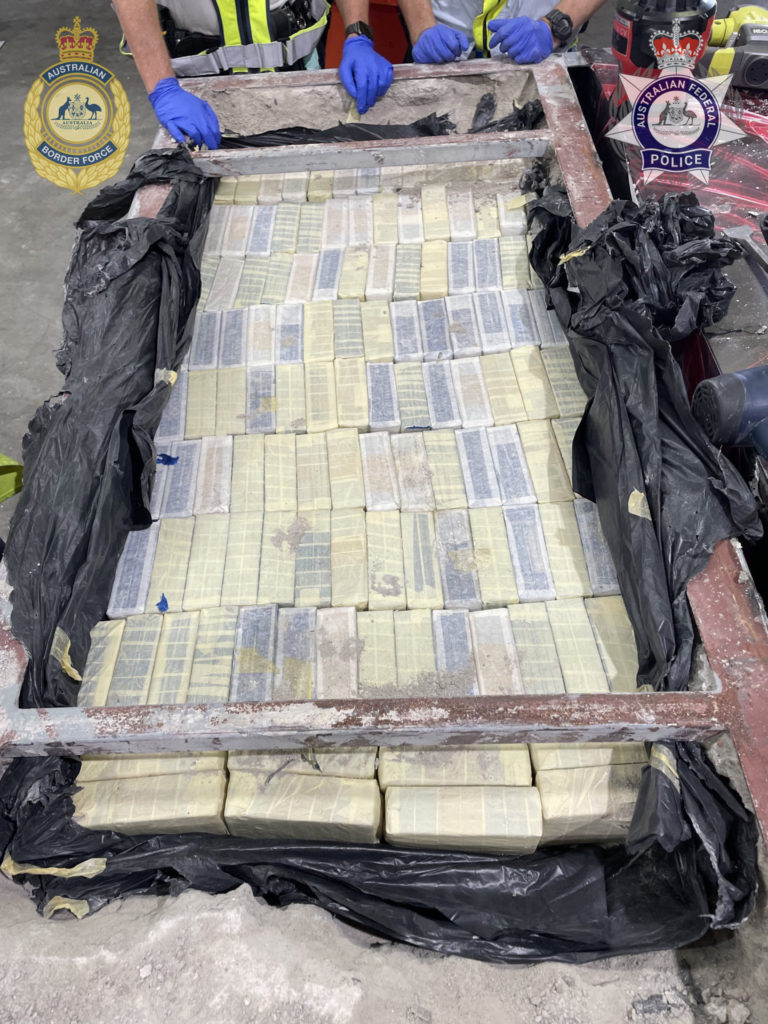
The idea is appealing in its simplicity: it puts people and the environment at the centre of urban planning. It involves building new urban centres and restructuring existing ones to ensure the services people need for work, food, health, education, culture and leisure are all close by – a walk or bike ride from home. Key elements are: the proximity of necessities; local participation and decision-making; community solidarity and connection; and green and sustainable urban living.

This reimagining of local living is quickly going global. Its proponents are many and growing, and the idea is being applied on big city stages. Most notably, the 15-minute city was a feature of Paris Mayor Anne Hidalgo’s successful re-election campaign in 2020.

The United Nations has hailed the 15-minute city as a means by which cities can emerge from COVID, as well as reduce the damaging dependence on cars. The potential to promote mental health and well-being is significant.

Enter the conspiracists

In 2023, though, conspiracy theories and protests have threatened to drown out the discussion of such positives.

How did that happen? By finding itself sitting at the centre of debates about COVID living, climate change and car-centric societies, the 15-minute city has become a focal point of attention for those who imagine more sinister motives are at work. Conspiracists have spouted misdirected fears of the forced loss of cars, the creation of locked urban zones people cannot leave, and government surveillance and control.

These notions were even raised recently in the UK parliament. Conservative MP Nick Fletcher called the 15-minute city an “international socialist concept” that “will cost us our personal freedom”.

A chance to improve mental health and wellbeing

In fact, personal and community freedom, by way of giving people back meaningful time currently lost to commuting and other travel, is exactly what Moreno and proponents of 15-minute cities are focused on. In their drive to grow, cities tend to push people, the environment and their health to the periphery. Through their sprawl, Moreno argues, cities take away freedom by taking time and disconnecting their inhabitants from services and each other.

Importantly, these effects increase the risks to people’s mental health. Moreno wants us to move away from fracturing our living into “inhuman bigness”, and towards planning that focuses on what access to services, local connection and community means for the well-being of people and communities.

This is why the 15-minute city presents a great opportunity for better mental health. Long commuting times and the stressors of traffic congestion, road conditions and punctuality are linked to declines in subjective measures of mental health and well-being for workers. The benefits of reducing these stressors could be immediate.

Physical activities like walking and cycling are also widely understood to benefit mental health, as does exposure to natural, green spaces. Creating local spaces for leisure and play is vital for children and parents alike.

But, deeper than that, we need cities and urban spaces purposefully designed to promote mental health in ways that are globally recognised as impactful and essential. This process involves improving a range of social and environmental factors for individuals and communities.

COVID sharpened the focus on wellbeing

Lessons learned from COVID lockdowns have sharpened global understanding of the mental health crises and harm done to people’s well-being by loneliness, social isolation and disconnectedness. These conditions damage the well-being of communities too, by fostering stigma and promoting exclusion.

We need to move quickly towards ways of living that promote connection, inclusion and healthy communities and environments. We can achieve these goals through participation, local decision-making and sustainable ecologies.

Imagine cities with accessible housing, work and education. Imagine cities with mental health services where the focus is on inclusion, participation, connection and equitable access. Where health workers and essential services are local and available, with minimal obstacles. Imagine mental health service that is threaded through the community in meaningful, impactful ways – where every square metre is considered for its potential to improve health and wellbeing.

Mental health, well-being and recovery require social connection, inclusion and accessible health services. These are, without a doubt, key factors in achieving better mental health. And the 15-minute city could be the template for its delivery.

Christopher Patterson, Senior Lecturer, School of Nursing, University of Wollongong and Lance Barrie, Research Fellow, ARC Centre of Excellence for the Digital Child, University of Wollongong

This article is republished from The Conversation under a Creative Commons license. Read the original article.

Man jailed for stealing funds from Australian bank accounts

0

A Sydney man has been sentenced to three years and six months’ imprisonment for accessing bank accounts of victims in Australia and transferring the stolen funds to members of an international money laundering syndicate.

An AFP Cybercrime investigation revealed the man, 27, was a member of an international money laundering syndicate led by a person known as ‘the Russian’.

‘The Russian’ sent the Sydney man stolen identification details and bank login credentials on five separate occasions. The man used this information to log into Australian bank accounts and fraudulently transferred a total of $92,000 from five victims.

Some of the stolen funds are suspected to have been later withdrawn in cash and deposited into cryptocurrency ATMs.

AFP Eastern Command Cybercrime investigators executed a search warrant at the man’s home in Brighton-Le-Sands on 11 February 2021 and later charged him with:

  • Commit offence for the benefit of a criminal organisation, contrary to section 390.5(1) of the Criminal Code 1995 (Cth);
  • Using a carriage service to menace, harass or cause offence, contrary to section 474.17 of the Criminal Code 1995 (Cth); and
  • Failure to provide information and assistance that was reasonable and necessary to allow access to data held in accessible form from a computer that was on warrant premises/person, contrary to section 3LA of the Crimes Act 1914 (Cth).

He pleaded guilty to the charges on 2 February 2023.

The man was sentenced to three years and six months’ imprisonment by the Downing Centre District Court on 27 February 2023. He will be eligible for parole on 25 February 2025.

AFP Detective Acting Superintendent Nuckhley Succar said criminal syndicates have little regard for everyday Australians and only care about filling their pockets.

“Australians are struggling with the current cost of living and having their slowly built savings stolen from them is a massive setback,” Det A-Supt Nuckhley Succar said.

“The AFP is committed to identifying these criminals and through our partnerships with financial institutions and law enforcement agencies in Australia and offshore, stopping them from harming more Australians.”

Investigations into the activities of the international money laundering syndicate are ongoing.  

The AFP-led Joint Policing Cybercrime Coordination Centre (JPC3) uses collective legislative powers, experience, and investigative and intelligence capabilities from all Australian policing jurisdictions to inflict maximum impact on high harm, high volume cybercrime affecting the Australian community.

If you believe you are a victim of Cybercrime, report it to ReportCyber at cyber.gov.au.

India qualifies for World Test Championship final, to take on Australia at Oval after 2-1 series win

0

India has qualified for the World Test Championship as New Zealand managed to defeat Sri Lanka in one of the instant classics.

“India has qualified for the World Test Championship final! They’ll take on Australia at The Oval for the #WTC23 mace!,” tweeted the International Cricket Council (ICC) on Monday.

In order to qualify for the WTC final, India only had two options. India either needed to defeat Australia by a margin of 3-1 or invest their hopes in New Zealand.

New Zealand went against the odds to defeat Sri Lanka in a dramatic fashion. On Day-5 when rain intervened to change the course of the game, the Kiwis still relied on their chances of chasing down a total of 285.

When the moment called Kane Williamson and Daryl Mitchell rose to the occasion to keep New Zealand in the game. Their partnership was the turning point of the entire series and for India as well. After Mitchell’s wicket, the game was wide open. Sri Lanka went on to pick up wickets at a regular level. But Williamson ensured that New Zealand maintained a consistent run rate.

Tension started to mount up in the entire stadium. Asitha Fernando held the ball to bowl the final ball of the game. One ball and one run was the difference between the two teams. Fernando produced a fierce bouncer missing Williamson’s bat entirely. Neil Wagner made an effort to complete the run with all his might. Williamson did his role and completed the run before the ball could hit the stumps. The epic clash came to an end and India booked their place in the final of WTC.

On the other side half-centuries from Travis Head and Marnus Labuschagne helped Australia draw the fourth and final Test of the ongoing Border-Gavaskar Trophy against India at the Narendra Modi Stadium in Ahmedabad on Monday.

With this, India won the four-match Test series 2-1 and retained the Border-Gavaskar Trophy. Australia started the final session on 158/2 after Tea, with Labuschagne (56*) and Steve Smith (0*) unbeaten.

Indian bowlers failed to produce a wicket in the final session and both sides agreed to end the match as a draw with Australia at 175/2, with Labuschagne (63*) and Smith (10*) unbeaten at the crease.
Ravichandran Ashwin and Axar Patel took a wicket each for India.

After Lunch, Australia resumed their innings with a score of 73/1, Travis Head and Marnus Labuschagne were on the pitch with scores of 45* and 22*, respectively.

The second session was almost an exact copy of the first session with a minor change in detail. Ravichandran Ashwin struck the first blow in the first hour of the game, but after that, the effortless Australian batting did not allow Indian bowlers to gain any sort of momentum in their favour.

In the second session, the boy from Gujarat, Axar Patel struck the second blow sending Travis Head (90) back to the pavilion. The nervous nineties seemed to get into Travis’s mind as he went to play a drive leaving a wide gap open between his pad and bat. The ball turned sharply and went crashing into the stumps. Axar Patel became the fastest Indian player to pick up 50 wickets in terms of balls bowled (2,205 balls).

Image

Axar broke the 139-run stand between Labuschagne and Head. Australia was 153/2 at that point.
Steve Smith and Marnus Labuschagne went on to carry Australia for the remaining session.

In the first session, as a night watchman, Kuhnemann (6) failed to survive for as long as Australia would have hoped for. It was Ashwin who picked up his wicket. Australia was 14/1 at that point.
Head and Labuschagne carried Aussies through the remainder of the session without any loss of wickets.

Image

Earlier, India gained a 91-run lead over Australia after they were bundled out for 571 in their first innings.

Virat Kohli brought an end to his century drought in Test cricket, scoring his 75th international century and his 28th in Tests. This was his first century in Tests since November 2019. In his marathon effort, he scored 186 runs in 364 balls, consisting of 15 fours.

Shubman Gill also scored a century, smashing 128 runs in 235 balls. Axar (79), KS Bharat (44) and Cheteshwar Pujara (42) also played some important knocks, which helped India gain a lead over Australia.

Todd Murphy (3/113) and Nathan Lyon (3/151) were the picks of the bowlers for Australia. Mitchell Starc and Matt Kuhnemann got a wicket each.

In their first innings, Australia posted 480 runs. Usman Khawaja (180) and Cameron Green (114) posted stunning centuries to help the Aussies gain a massive advantage earlier in the match.
Ravichandran Ashwin was the pick of the bowlers, taking 6/91 on a surface and offering no help to spinners.

Virat Kohli was adjudged the ‘Man of the Match’ for his knock of 186 runs.

Ravichandran Ashwin and Ravindra Jadeja, India’s star spin all-rounder duo were given the ‘Men of the Series’ award for their heroics throughout the series.

Image

Ashwin ended as the top wicket-taker in the series with 25 wickets, with the best bowling figures of 6/91. He also scored useful 86 runs in five innings throughout the series with the best score of 37.
Jadeja also emerged as the second-highest wicket-taker in the series, with a total of 22 scalps and best figures of 7/42. He also scored 135 runs in five innings with one half-century and the best score of 70.

Image

Brief Scores: India 571 (Virat Kohli 186, Shubman Gill 128, Todd Murphy 3/113) vs Australia 480 and 175/2 (Travis Head 90, Marnus Labuschagne 63*, Axar Patel 1/36).

‘Maths anxiety’ is a real thing. Here are 3 ways to help your child cope

0

By Benjamin Zunica and Bronwyn Reid O’Connor

From March 15, more than one million young Australians will sit the NAPLAN numeracy test. For most students, this will just be a routine part of the school day (albeit less fun than running around at recess or lunch).

But for others, the prospect of doing a maths test will be downright terrifying. These students may be suffering from maths anxiety.

We are academics in mathematics education. Here’s how to help your child if they are experiencing maths anxiety.

What is maths anxiety?

Maths anxiety is the feeling of tension and worry that interferes with a person’s ability to solve mathematical problems. Researchers consider maths anxiety to be distinct from general anxiety, or test anxiety, though there is some crossover.

Maths anxiety usually develops as a result of poor experiences with maths, which leads to negative thought patterns about your maths potential. These thoughts can manifest in an avoidance of maths and feelings of helplessness when confronted with tests.

Maths anxiety is a common issue for many young people and adults and can be seen in children as young as five.
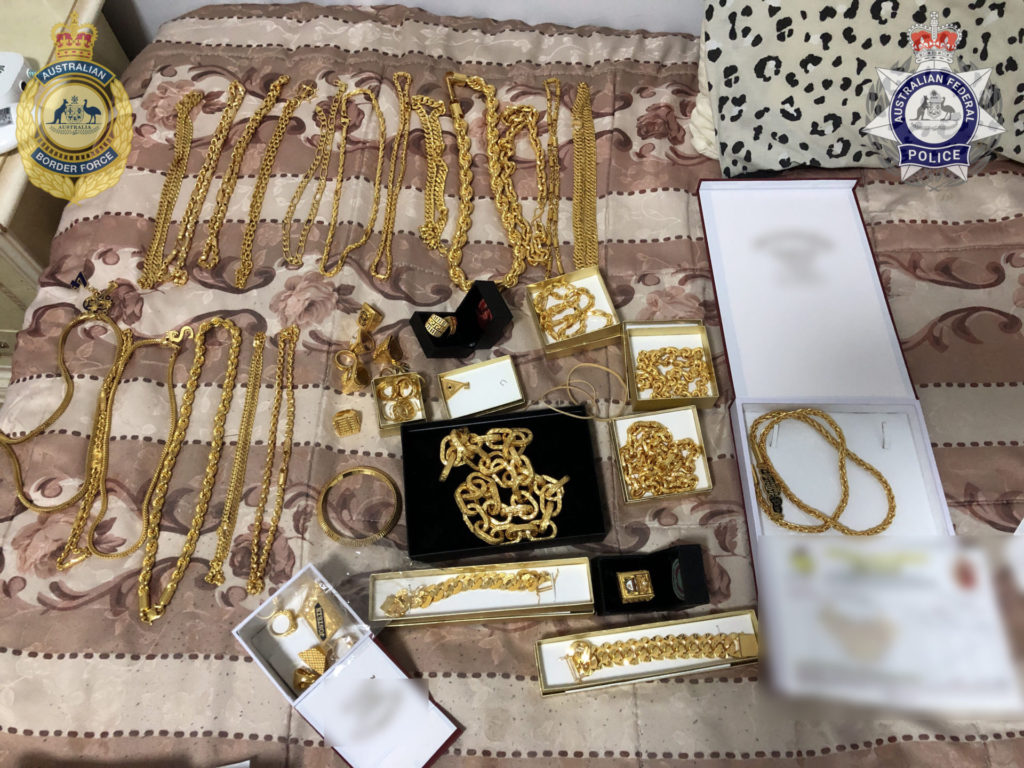
According to Stanford University mathematics education professor Jo Boaler, as of 2012, up to 50% of adults had maths anxiety. The Victorian Department of Education suggests rates are lower, at between six and 17%. However, the average rate in academic studies tends to be approximately 20%.

That means there are thousands of children who will be dreading the upcoming NAPLAN numeracy test.

So, what can a parent do to help their anxious child achieve their best in the NAPLAN numeracy test and other maths exams? Here are three practical things you can do right away and into the future:

1. Focus on successes to build confidence

Most children want to be good at maths. If they are younger, they will likely understand this is something their teachers and parents think is important. If they are older, they will know it is important for future jobs and careers.

One of the key sources of maths anxiety is despite wanting to be good at maths, students have received consistently negative feedback about their ability. This may just be by comparing themselves to others or more formally through poor results.

To reduce anxiety, it is important to focus on the positive, showing your child times where they have had success in maths. Experiences of success are vital in paving the way to further success in maths.

A practical way to demonstrate success is by getting the child to do an old worksheet, even as far back as two years ago. Students in years 5 and above could do a previous NAPLAN test at a lower level. This shows them how they have progressed.

After completing the sheet, focus on areas of strength – such as “you got all the long divisions correct!” – to help build confidence. This experience of success can be used as a base to then tackle more complicated tasks.

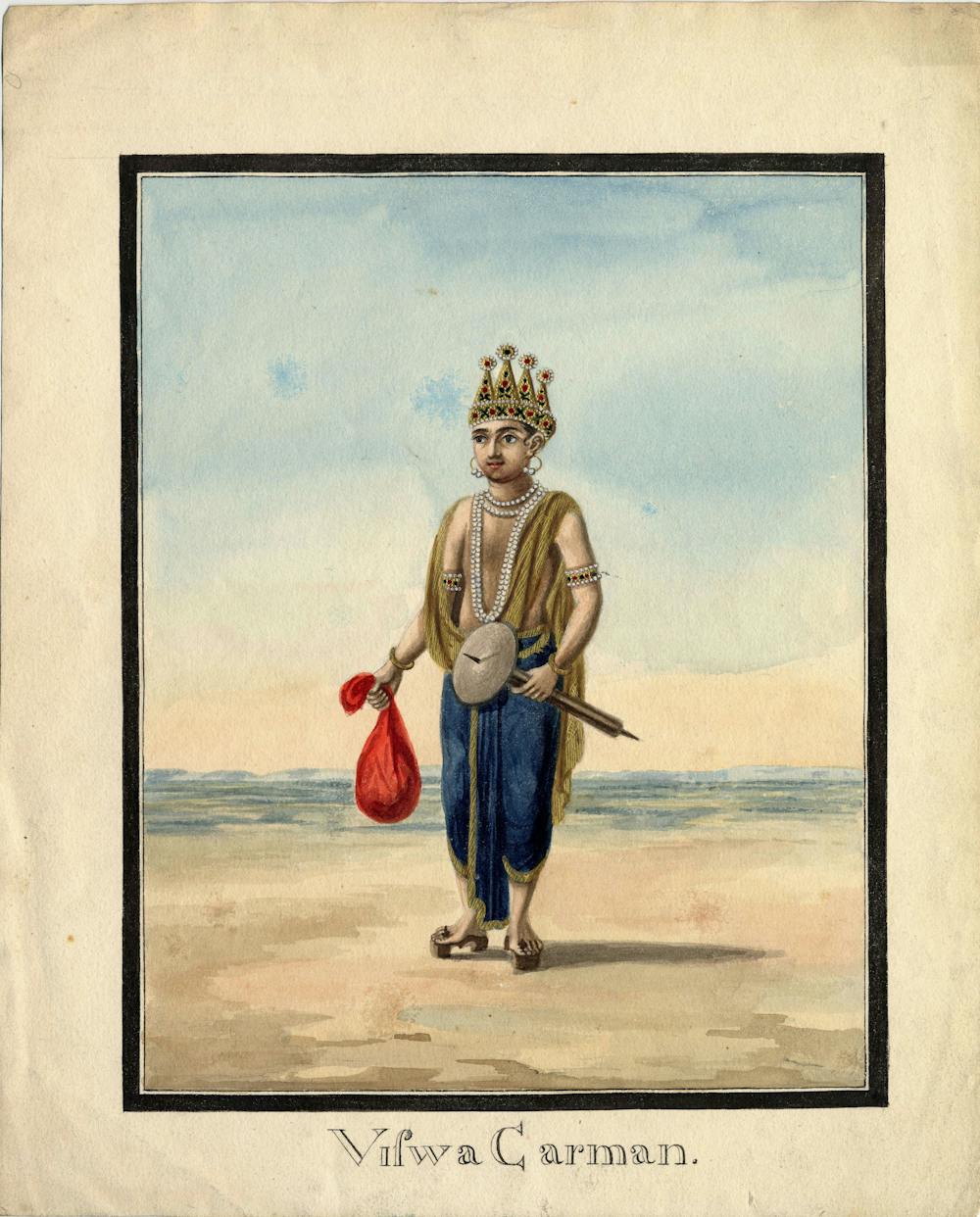
2. Avoid ‘NAPLAN overload’

Anxiety about NAPLAN and any other assessments can be exacerbated by over-emphasising its importance in the build up. A more constructive approach is to reassure your child there is no judgement in how they perform.

Currently, most schools are working hard to prepare students for NAPLAN and discussions about the test are regularly taking place. Because of this, it can be easy for children with maths anxiety to get “NAPLAN overload”. At home, it is useful to limit your discussion of the upcoming tests to times where the child is doing work to prepare for it.


We recommend trying to make the day an exciting one, rather than a terrifying one. For example, you might have a special NAPLAN breakfast on the day of the test.

3. Work alongside your child

During COVID many families felt the strain taking a hands-on role with their children’s education (who did not take kindly to mum or dad suddenly becoming their “teacher”). So parents may be tempted to leave their children alone to study or do homework. But this won’t help relieve maths anxiety.

A more beneficial approach is for for parents to study alongside younger children, and show interest in the work older children are completing. Teenagers may not be open to help when you offer the first time but make it clear that you’re there if they need you and you aren’t seeking to judge them.

This approach shows the child their parent is engaged with their work and positive about their ability to learn.

It cannot be underestimated how much a parents’ approach to learning maths influences their child’s approach. Try and have positive conversations with your child about maths and how we use it everyday. This can be help dispel negative attitudes, such as children thinking, “this is too hard and is just something I need to do at school”. You might want to use maths to work through a “best buy” at the supermarket or use length and area to determine how to arrange the furniture in a room.

As the test day nears, families should not have to stress out about NAPLAN. Preparation focused on celebrating successes and positive experiences can encourage students to simply do their best.

Benjamin Zunica, Lecturer in Secondary Maths Education, University of Sydney and Bronwyn Reid O’Connor, Lecturer in Mathematics Education, University of Sydney

This article is republished from The Conversation under a Creative Commons license. Read the original article.

Former Fijian prime minister and police commissioner plead not guilty to abuse of office charges

0

By NIKHIL KUMAR

Former prime minister Voreqe Bainimarama and suspended Police Commissioner Sitiveni Qiliho were granted bail by the Suva Magistrates Court today in a special court hearing after being charged with one count each of abuse of office.

They pleaded not guilty to the charges and were released on a $10,000 bail with two sureties. The matter has been adjourned to May 11.

Magistrate Seini Puamau ordered them not to interfere with witnesses, not to leave the country and to reside at a fixed address.

It is alleged that Bainimarama, in his capacity as Prime Minister in 2019, ordered Qiliho to terminate an active investigation in July of that year relating to alleged activities of former staff members of The University of the South Pacific.

The matter was stood down twice today, allowing for bail conditions to be heard. The state counsel requested for strict bail conditions for the pair which also included a strict curfew.

Magistrate Puamau questioned the logic of requesting a curfew.

The state prosecutor told the court that there is a likelihood of interferences with the witnesses as the pair held high positions previously.

Meanwhile Bainimarama and Qiliho’s lawyer Devanesh Sharma asked for a standard bail condition basing it on claims that the accused were seasoned and well-educated men and that there would be no interference from them.

While leaving the court premises, Bainimarama told the media that he “served as a prime minister of Fiji with integrity and everyone’s interest at heart”.

He said he would fight the charge not only because of his legacy and reputation but because of “democracy, and for all Fijians and for the Constitution”.

Qiliho did not provide any comments when leaving the Suva Magistrates Court.

Opposition members Premila Kumar, Faiyaz Koya, Viliame Naupoto, Jone Usamate, Parveen Bala, Naisa Tuinaceva, supporters of FijiFirst Party alongside Bainimarama’s wife and daughters were also present at court today.

In light of these developments, the Fiji Police Force yesterday reassured the public that there was no reason to be concerned about public safety following the laying of formal charges against the former PM and former police commissioner.

Police chief operations officer acting Assistant Commissioner of Police Livai Driu, in a statement, said the latest developments did not warrant the need to panic as the security landscape remained calm and manageable.

A/ACP Driu reiterated Minister for Home Affairs and Immigration Pio Tikoduadua’s statement that “no one should be apprehensive about the security of our nation, as police have everything under control, and we urge everyone to go about their business as usual”.

This news was first published in USP’s Wansolwara and is republished here with their kind permission.

Contributing Author: Nikhil Kumar is a final-year journalism student at The University of the South Pacific’s Laucala campus. He is also the deputy editor for Wansolwara, USP Journalism’s training newspaper and online publication.

Return to offender: AFP and Australia Post target criminals using the postal network

0

More than half a tonne of illicit drugs sent by mail to Queensland has been intercepted under an AFP and Australia Post operation.

Over the past nine months, nearly 160 packages were detected and referred to the joint operation set up to target criminal syndicates shipping contraband into the state.

The packages contained more than 547kg of illicit drugs and precursors. Investigations have led to the arrest of four people allegedly responsible and the disruption of numerous attempted imports.

The seizures referred to the AFP for investigation include a total of 203kg of methamphetamine, more than 180kg of cocaine, 48kg of heroin, 26.3kg of GBL, 4kg of opium and more than 5.5kg of ketamine, which were addressed to Queensland homes and businesses.

The joint effort to detect and disrupt criminals using the international postal system started in May last year (2022) when an Australia Post Group security liaison officer was embedded with AFP investigators in Brisbane.

Intelligence from this operation confirmed more than 140kg of the methamphetamine and 75kg of the cocaine had been destined for locations across Brisbane. An extra 100kg worth of cocaine and 50kg of both methamphetamine and gamma aminobutyric acid (GABA) was destined for the Gold Coast.

One of the seizures of illicit packages addressed to Far North Queensland was a parcel containing 45kg of heroin. Further inquiries revealed that a suspected criminal syndicate involved in the heroin importation plot used a fake address in an attempt to evade law enforcement detection.

Illicit drugs were found hidden in a range of items, including candles, clothing, books and electronic equipment.

AFP Detective Superintendent Helen Schneider said having an embedded Australia Post member allowed investigators to respond much more quickly when illicit substances in the postal stream were discovered.

“The ability for our investigators to access real-time intelligence from Australia Post has enabled the AFP to trace criminal networks and disrupt them swiftly,” she said.

“Drug trafficking impacts on our national security because criminals try to corrupt officials, or those who work in key logistic or infrastructure sectors.”

“It also impacts on the Australian economy because drug traffickers launder money through our financial systems and often increase their wealth by investing their illicit money, allowing them to bankroll more serious crime.”

“Illicit drugs cause tremendous harm to the Australian community and anyone caught importing, possessing or trafficking commercial quantities of these drugs could face life imprisonment if convicted.

“This operation has given us valuable intelligence about these groups, including that criminal syndicates often nominate an incorrect address, such as vacant lots or short-term rentals as destinations for shipments.”

The AFP is aware that organised crime groups (OCGs) use the mail and parcel post system to import illicit drugs in combination with their other import streams.

 AFP is successfully identifying individuals who are receiving imports on behalf of OCGs. This enables police to identify and investigate the transnational OCGs that are organising and ultimately receiving these drugs.

The AFP is actively targeting mail and air cargo streams in close collaboration with partner agencies.

Australia Post assistance increases investigative opportunities for law enforcement agencies and aims to strengthen the exploitation of supply chain.

 “While most air mail or air cargo imports might seem like relatively small amounts of illicit substances – anywhere from five grams to several kilograms – combined, they equate to millions of individual street deals that cause significant harm to the community,” she said.

 “The disruption to the supply chain is a key part of our strategy to protect the Australian community from the harm illicit drugs can cause.

“Anyone who witnesses suspicious behaviour such as deliveries to vacant lots or short-term rentals should contact police or Crime Stoppers on 1800 333 000.”

Australia Post General Manger Group Security Kevin Zuccato said the organisation took the security and integrity of the supply chain seriously.

“We are committed to working collaboratively with law enforcement, as evidenced by our recently deployed Australia Post Liaison Officer embedded with the AFP in Queensland,” he said.

Details of those charged during this operation:

A Brisbane man, 28, was charged after he was allegedly identified as the intended recipient of two illicit consignments sent from the United Kingdom in October 2022.

The packages, described as containing clothing, also held a combined total of seven kilograms of cocaine secreted in the lining of the cardboard boxes.

When police searched his Runcorn home in December 2022, they seized 500 grams of cocaine as well as MDMA, SIM cards and false driver licences.

The man was charged with:

  • Importing a commercial quantity of a border controlled drug, contrary to section 307.1 of the Criminal Code 1995 (Cth) and;
  • Possessing a substance, the substance having been unlawfully imported border controlled drugs, contrary to section 307.6(1) of the Criminal Code 1995 (Cth).

He is next due to appear in Brisbane Magistrates Court on 21 April, 2023.

If convicted the man faces a maximum sentence of life imprisonment.

A Cairns man, 30, was charged after he was allegedly linked to an illicit package of one kilogram of Ketamine, hidden within bath towels in June 2022.

He was arrested and charged with attempted possession of a marketable quantity of unlawfully imported border controlled drugs, contrary to section 307.6(1) of the Criminal Code Act 1995 (Cth).

He is next due to appear in Cairns Magistrates Court on 21 March, 2023.

A German National, 61, was arrested at Brisbane International Airport after allegedly importing over two kilograms of cocaine hidden inside coffee bags and a children’s book in November 2022.

He was charged with importing a commercial quantity of border controlled drugs, contrary to section 307.1 of the Criminal Code Act 1995 (Cth).

He is next due to appear in Brisbane Magistrates Court on 17 March, 2023.

A Logan man, 36, was charged for his alleged role in importing cocaine into Australia in November 2022 after analysis of messages on an encrypted chat platform.

Officers charged the man with:  

  • two counts of importing a marketable quantity of border controlled drugs, contrary to section 307.2 of the Criminal Code Act 1995 (Cth) and;
  • two counts of trafficking in a controlled drug, contrary to section 302.2 of the Criminal Code Act 1995 (Cth).

He is next due to appear in Brisbane Magistrates Court on 17 March, 2023

Breakdown of seizures referred for investigation:

  • 45 individual packages containing methamphetamine with a total weight of about 203kg;
  • 47 individual packages containing cocaine with a total weight of about 180.5kg;
  • Three individual packages containing heroin with a total weight of about 48kg;
  • Three packages containing Gamma-aminobutyric acid with a total weight of about 68kg;
  • Two individual packages containing pseudoephedrine with total weight of about 12kg;
  • Eight individual packages containing ketamine with a total weight of about 5.6kg;
  • One package containing opium weighing about 4kg;
  • Seven individual packages containing GBL with a total quantity of about 26.3kg; and
  • A number of individual packages containing a diverse range of other border controlled drugs.

Investigations are ongoing into these seizures and further charges are likely.

The following services provide people with access to support and information.

  • For free and confidential advice about alcohol and other drug treatment services call the National Alcohol and Other Drug Hotline on 1800 250 015.
  • Access free 24/7 drug and alcohol counselling online at www.counsellingonline.org.au.
  • For information about drug and alcohol addiction treatment or support, go to www.turningpoint.org.au.

Disputes over COVID’s origins reveal an intelligence community in disarray

0

By Patrick F Walsh and Ausma Bernot

A recent Wall Street Journal article reported on new, classified intelligence from the US Department of Energy about the origins of COVID. It concluded with “low confidence” that the pandemic may have been due to a lab leak in Wuhan, China, rather than a natural disease transmission from animal to human.

The report is the latest chapter in a long saga about the origins of the pandemic, involving conflicting assessments from intelligence, policy and scientific communities around the globe.

The debate over the origins of COVID began early in the pandemic, with a lot of pressure being placed on the intelligence community by then-US President Donald Trump and Secretary of State Mike Pompeo to lay blame on the Chinese government.

In May 2021, the Biden administration tried to resolve some of the conflicting intelligence and data points about the origins of COVID by tasking the US intelligence community to do a 90-day review on the available information.

An unclassified version of this review was then released in October 2021. It was published by the peak body within the US intelligence community – the Office of the Director of National Intelligence.

The report shows a consensus among eight US intelligence agencies and the National Intelligence Council (which provides longer-term strategic analysis for the president) that COVID was not a bioterrorism incident.

However, there was disagreement among the agencies around the two most probable origins of COVID:

  • it was the result of animal-to-human transmission
  • it was the result of an accidental laboratory leak, likely from the Wuhan Institute of Virology.

No agency was named in the unclassified report, though four agencies, as well as the National Intelligence Council, have reportedly concluded (also with low confidence) that the origins were from natural transmission. Two others (the FBI and Department of Energy) have now assessed it as a lab leak. Two agencies remain undecided, including, reportedly, the CIA.

Why is intelligence conflicting?

This lack of consensus among intelligence agencies and low levels of confidence on their assessments are due to many factors.

The variations in analytical judgements are mostly due to how each agency interprets what are, at best, fragmented intelligence sources. There’s also the question of how intelligence analysts comprehend complicated scientific research.

Several scientific studies that examined environmental testing for COVID at the live animal and seafood market in Wuhan and early patient cases living nearby have provided strong evidence of a natural transmission of the virus. That is, the scientific evidence leads to the market as the probable epicentre of the epidemic.

Yet, the scientific and epidemiological data itself is also incomplete. In particular, analysts haven’t identified which animal the virus likely “jumped from” to infect humans. More genetic data and a better understanding of how coronaviruses are transmitted naturally are required to fill the information gaps, notably in the initial cases in Wuhan.

According to US officials, Beijing has not been willing to provide full access to data requests from Western governments – or to the World Health Organization.

What needs to change before the next pandemic

The Department of Energy report highlights an even greater issue that has received less attention. The US intelligence community and its other “Five Eyes” partners (Australia, Canada, the United Kingdom and New Zealand) must improve their intelligence collection methods and analysis of health security threats and dangers, including from potential pandemics.

Four things will help improve the capabilities of the intelligence community and hopefully bring greater confidence in their assessments of the causes of future health emergencies and pandemics.

1. Better health intelligence collection and analysis

As pandemics become more frequent, our intelligence agencies need better risk, threat and hazard assessment methodologies to drive more robust, evidence-based collection and analysis of intelligence.

This means improving ways to combine traditional intelligence sources (often qualitative in nature) with scientific evidence to better assess the potential intent, capability and impact of threats and health hazards.

2. Fostering stronger ties with the scientific community

The intricacy of future pandemic threats and possible weaponisation of biotechnology will require intelligence agencies to foster a more purposeful and consistent interaction with the scientific community.

The US intelligence community has a track record here, but it and other Five Eyes countries will require even more strategic, coordinated outreach from the relatively closed intelligence world to the scientific community.

Greater workforce expertise in microbiology, genetics, virology and public health is also required within the intelligence community.

3. Creating a robust national health security strategy

Each agency cannot feasibly develop the capabilities to improve its intelligence collection and analysis on its own. A whole-of-government approach is required to iron out each agency’s roles, functions and mandates for future health security risks.

We advocate for a national health security strategy, much like the national cybersecurity strategies in each Five Eyes country, to improve governance and coordination across intelligence agencies in the health security space.

4. Conducting a 9/11 commission-style review

Lastly, to develop stronger post-COVID national health security measures, we need full independent reviews of how the intelligence community and key public health agencies worked throughout the pandemic in the US and its allies.

Such reviews could include what was done well and lessons to be learned that can be fed into national health security strategies.

Ideally, a review would also examine any evidence of politicising intelligence. Politics have always influenced intelligence gathering and analysis, not just during COVID.

For example, the assessment of whether Iraq had weapons of mass destruction before the US-led invasion of Iraq in 2003 shows how politics can negatively affect the ability of intelligence agencies to provide independent, non-biased advice to policy makers.

Recent calls for the equivalent of a 9/11 commission into COVID so far have not gone anywhere in Washington. It is not too late for such a review to take place. But realistically, given the fractured political climate in the US, the possibility of establishing an independent commission seems more difficult than in the other Five Eyes countries.

What this means is that we’re missing an opportunity to improve our intelligence agencies, which is acutely needed before the next global pandemic event.

Patrick F Walsh, Professor Intelligence and Security Studies, Charles Sturt University and Ausma Bernot, Postdoctoral Research Fellow, Australian Graduate School of Policing and Security, Charles Sturt University

This article is republished from The Conversation under a Creative Commons license. Read the original article.

IND vs AUS: Virat Kohli ends Test century drought, first hundred in whites since 2019

0

After a wait of 1205 days, Virat Kohli finally registered a Test century, bringing up three figures on day four of the fourth Test against Australia in Ahmedabad.

Kohli brought up Test century No.28 after flicking Nathan Lyon for a single and helping India push towards a crucial first-innings lead. There was a gap of 41 innings between his last century and this one, with the previous one coming over three years ago against Bangladesh in November 2019.
Kohli scored a sublime 136 in India’s only innings at the Eden Gardens and helped his team secure innings and 46-run victory.

Ahmedabad, Mar 11 (ANI): India’s Virat Kohli celebrates after completing his century during the fourth day of the 4th test match against Australia, at Narendra Modi Stadium, in Ahmedabad on Sunday. (ANI Photo)

“600kg Gorilla off his back,” Ravi Shastri boomed on commentary as Kohli raised his bat, then removed his helmet with a smile and kissed his necklace in relief to a standing ovation from the Ahmedabad crowd.

He now has eight Test hundreds against Australia, second-most, on par with Sunil Gavaskar on a list that is topped by Sachin Tendulkar, who has 11.

Ahmedabad, Mar 11 (ANI): India’s Virat Kohli plays a shot during the fourth day of the 4th test match against Australia, at Narendra Modi Stadium, in Ahmedabad on Sunday. (ANI Photo)

His 28th Test ton is also his 75th international hundred.

Respect and admiration: Australian skipper Steve Smith congratulates Virat Kohli after a marathon century in the fourth Test

After being dismissed by spinner Todd Murphy, Virat was lauded by Steve on his way back to the pavilion. Steve shook his hand and patted the batter on his back. The Board of Control for Cricket in India (BCCI) posted the picture on Twitter acknowledging Smith’s gesture.

“Respect and admiration,” said BCCI in their tweet.

Smith and Kohli are part of this generation’s ‘Fab Four’ batters along with New Zealand’s Kane Williamson and England’s Joe Root.

Both batters have had a storied career in Test cricket as batters.

In 108 matches and 183 innings, Virat has scored 8.416 runs at an average of 48.93. He has scored 28 centuries and an equal number of half-centuries, with the best individual score of 254*.

On the other hand, Smith has represented Australia in 96 Tests, in which he has scored 8,782 runs at an average of 59.74. He has scored 30 centuries and 37 fifties in the format, with the best individual score of 239*.

Ahmedabad, Mar 11 (ANI): Australia skipper Steve Smith greets India’s Virat Kohli during the fourth day of the 4th test match between India and Australia, at Narendra Modi Stadium, in Ahmedabad on Sunday. (ANI Photo)

The former India skipper brought up his much-needed hundred in 241 balls. It was the most-awaited ton as his last century came against Bangladesh in November 2019. With this century, he took his international century tally to 75. Kohli’s hundred has chipped off a chunk of Australia’s lead as India looks to press home the advantage

The cricketing fraternity took to social media after Virat Kohli ended his Test century drought.

Legendary Indian opener Virender Sehwag, with whom Sachin Tendulkar opened the batting for years, congratulated Virat, saying that “class is permanent”.


Indian pace legend Jhulan Goswami congratulated Virat for his “iconic innings”.

Former Indian pacer Venkatesh Prasad also lauded this “special innings from a special player” and called his comeback to form an “inspiration”

Australian veteran opener also lauded Virat’s innings on Instagram, warning to not ” write off champions”.

Former England batter Kevin Pietersen also lauded Virat for his knock on Twitter.

PM Albanese warns attacks on Hindu Temples have ‘no place in Australia’ 

0

Australia won’t tolerate any extreme actions and attacks that took place in religious buildings, and there is no place for such action against Hindu temples, Prime Minister Anthony Albanese said while addressing a press conference in New Delhi.

Responding to a question about the assurances that PM Albanese gave to his Indian counterpart Albanese said,  

“I gave him the assurance that Australia is a country that respects people’s faith. That we don’t tolerate the sort of extreme actions and attacks that we’ve seen on religious buildings, be they Hindu temples, mosques, synagogues, or churches. This has no place in Australia.”

“And we will take every action through our police and also our security agencies to make sure that anyone responsible for this faces the full force of the law.

We’re a tolerant multicultural nation, and there is no place in Australia for this activity,”

said PM Albanese

Earlier, India-Australia: Exchange of Agreements and Press Statements on Friday, India’s Prime Minister Narendra Modi said that in light of the recent attacks on temples in Australia, PM Albanese has assured that the safety and well-being of the Indian community in Australia is a priority for him.

“Since the last few weeks, news of attacks on temples in Australia are coming regularly. It is natural that such news worries people in India. I have raised these concerns with Prime Minister Albanese who has assured me that the safety of the Indian community is a special priority for him,”

PM Modi said.

Recently, in the first week of March, Shree Laxmi Narayan Temple in Australia’s Brisbane was vandalised by Khalistan supporters.

Temple President Satinder Shukla while speaking to The Australia Today said, “Temple Priest and devotees called this morning and notified me about the vandalism on the boundary wall of our temple.”

Sarah Gates, who is the Director of Hindu Human Rights said, “This latest hate crime is a pattern of Sikhs For Justice (SFJ) globally, clearly attempting to terrorise Australian Hindus.”

“Coupled with a barrage of propaganda, illegal signs, and cyberbullying, the organisation intends to present all-pervasive threats, fear, and intimidation.”

In January, Shri Shiva Vishnu Temple in Australia’s Carrum Downs was vandalised with anti-Hindu graffiti.

The Australia Today earlier reported that the act came to notice on January 16 after temple devotees came for ‘darshan’ amid the three-day long “Thai Pongal” festival which was celebrated by Australia’s Tamil Hindu community,

On the evening of January 15, 2023, Khalistan supporters tried to draw support for their referendum through a car rally in Melbourne. However, they failed miserably as less than two hundred people gathered out of an almost 60,000-strong Melbourne community.

A week before the above incident, On January 12, the BAPS Swaminarayan Mandir in Australia’s Mill Park was smeared with anti-India and anti-Hindu graffiti.

The temple was vandalised by anti-India elements with anti-India slogans written on the temple’s walls, located in the suburb of Mill Park, The Australia Today reported. Patel, an onlooker shared how he witnessed the vandalised walls of the temple when he visited the site.