The national minimum wage has increased to $23.23 per hour (up from $21.38) or $882.80 per week (up $70.20 from $812.60) based on a 38-hour week for a full-time employee.
This increase applies from an employee’s first full pay period starting on or after 1 July 2023.
On 2 June 2023, the Fair Work Commission announced the increase to the national minimum wage following its Annual Wage Review.
The Fair Work Ombudsman is reminding employers that all casual employees entitled to the national minimum wage must receive a minimum $29.04 per hour, which includes their 25 per cent casual loading.
Fair Work Ombudsman Sandra Parker said workplaces must ensure all their employees are paid at least the relevant minimum wage, in accordance with the Fair Work Commission’s decision.
“We’ve updated our free Pay Calculator to help employers and employees calculate the new pay rates.”
“We urge all businesses to use our Pay Calculator to check the lawful minimum rates they need to pay their staff, or to contact us directly for free assistance,” Ms Parker said.
“If workers are unsure which award applies to them, they can use our Find my award tool or contact us for help to find any applicable award.”
“If employers and employees have any questions about pay rates, they can contact the Fair Work Ombudsman for free advice and assistance,” Ms Parker said.
The Commission also announced that employees covered by awards will have their minimum wage rates increased by 5.75 per cent from the first full pay period starting on or after tomorrow.
Since 2005, annual labour productivity growth (growth in output per hour worked) has been the best part of one percentage point below its long-term average in Australia and other developed countries.
The Productivity Inquiry that I helped conduct for the Productivity Commission found this will lead to much-slower improvements in Australians’ living standards than in the past.
In the search for a culprit, economists including Australia’s Competition Minister Andrew Leigh have pointed to reduced business competition resulting in decreasing dynamism, by which they mean:
mergers leading to increased business concentration
an increase in the markups businesses can sustain
only few highly-productive firms, with the rest increasingly less so
A study that I have just published in Australian Economic Papers, reviews the evidence and finds that while most of these things have happened (and while many are undesirable) they aren’t sufficient to explain what’s happened to productivity.
The findings suggest that even if we did make our economy more competitive and businesses more dynamic (and we probably should) improving productivity growth depends on a much bigger set of policy reforms.
Here’s what we find.
Firm entry and exit has been slowing
In Australia, the rates of firm entry and exit (meaning companies either joining or dropping out of an industry) declined between 2005–06 and 2012–13.
While there’s been an increase in firm entry more recently, it’s been mainly among non-employing business – sole traders and independent contractors – rather than bigger businesses.
In the US (we don’t have an equivalent Australian study) red tape may be strangling dynamism. Investment in new profitable businesses has slowed at the same time as there has been a significant increase in regulation of those businesses.
In Australia, improvements in business survival rates at least partly seem to reflect improved conditions for both survivors and new entrants, rather than barriers that protect unproductive survivors at the expense of more-productive entrants.
Job-switching has slowed
Australian job mobility has declined dramatically over the past 30 years, in part because the population is ageing, and older workers are less likely to switch jobs than younger workers.
Another explanation might be that Australian businesses face a less volatile environment, suggesting job turnover does not have value in its own right.
While job churn tends to fall if barriers to job mobility rise, it also falls when businesses face fewer shocks, making any link between declining job turnover and diminished competition ambiguous.
Business investment has slowed
Non-mining business investment in Australia has stagnated over recent decades, as it has in a number of other advanced economies.
Among the suggested explanations are risk aversion and uncertainty, pessimism about the future and lower productivity growth. The role, played by competition – if any – is far from clear.
Business concentration has climbed
The average concentration of Australian businesses (the extent to which industries are dominated by a few big firms) appears to have been falling until the early 2000s, and climbing since then.
Most of the increased concentration appears to have been in already-concentrated industries, with technological advances and exposure to imports explaining a lot of it.
As an example, concentration has increased in “warehousing and storage”, but the industry has taken advantage of technological advances including parcel tracking and smart warehouses, meaning both concentration and competition have increased as firms have scaled up to install new technologies.
Businesses profit margins have climbed
Markups (profit margins) appear to have climbed by around 57% in Australia between 1980 to 2016, which is less than in the US, Canada and much of the European Union, but greater than in New Zealand and most Asian countries except for South Korea.
But markups at the level of the firm are difficult to measure because they depend on assumptions about the way the firm makes its products. Different assumptions can produce very different estimates.
There are only a few highly-productive firms
Globally and in Australia the most-productive firms seem to be three to four times more productive than the less productive, but, at least in Australia, there is little evidence to suggest the gap is widening.
What evidence there is suggests the gap between the most-productive Australian firms and the most-productive global firms is widening, suggesting all Australian firms are slower to adopt leading technologies than they were.
Put bluntly, Australian businesses as a whole appear to have become slow to adopt world best practice; which is a problem, but not necessarily a problem of highly-productive firms versus the rest.
There are a range of policies that can help to reverse the decline, but it is far from clear that competition plays much of a role.
We’re at risk of chasing the wrong target
The broader reasons for Australia’s declining productivity growth include changing demographics, changing international trade patterns and the changing nature of industries as Australia continues to moves towards a more service-based economy.
Fixing our productivity problem requires a suite of changes that address these and other issues. In March, the Productivity Commission laid out a roadmap.
Of course, we shouldn’t ignore competition. The government’s 2015 Competition Policy Review focused on updating competition and consumer laws.
Many of its recommendations remain on the shelf.
Further, new challenges are emerging. To pick one, Australia currently has three alternative ways to get competition clearances when businesses merge.
Unsurprisingly, they pick the path of least resistance.
The head of the Competition and Consumer Commission Gina Cass-Gottlieb has developed a proposal that would help.
Actually boosting productivity will require measures that cover education, technology, business regulation, taxation, carbon emissions, and more.
Blaming declining dynamism and declining competition for declining productivity is not just a diversion, it risks making us do the wrong things.
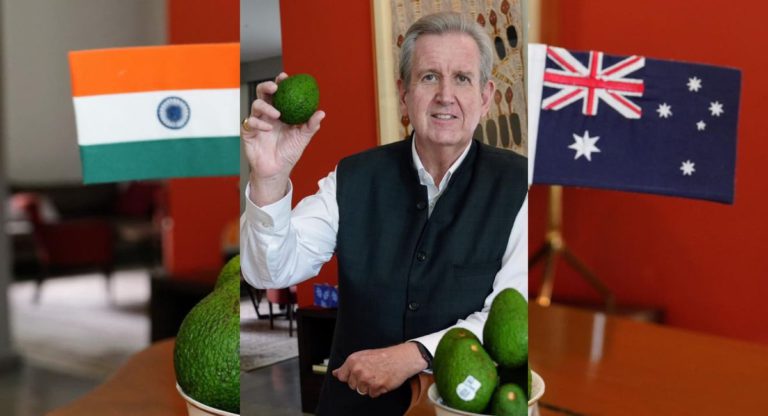
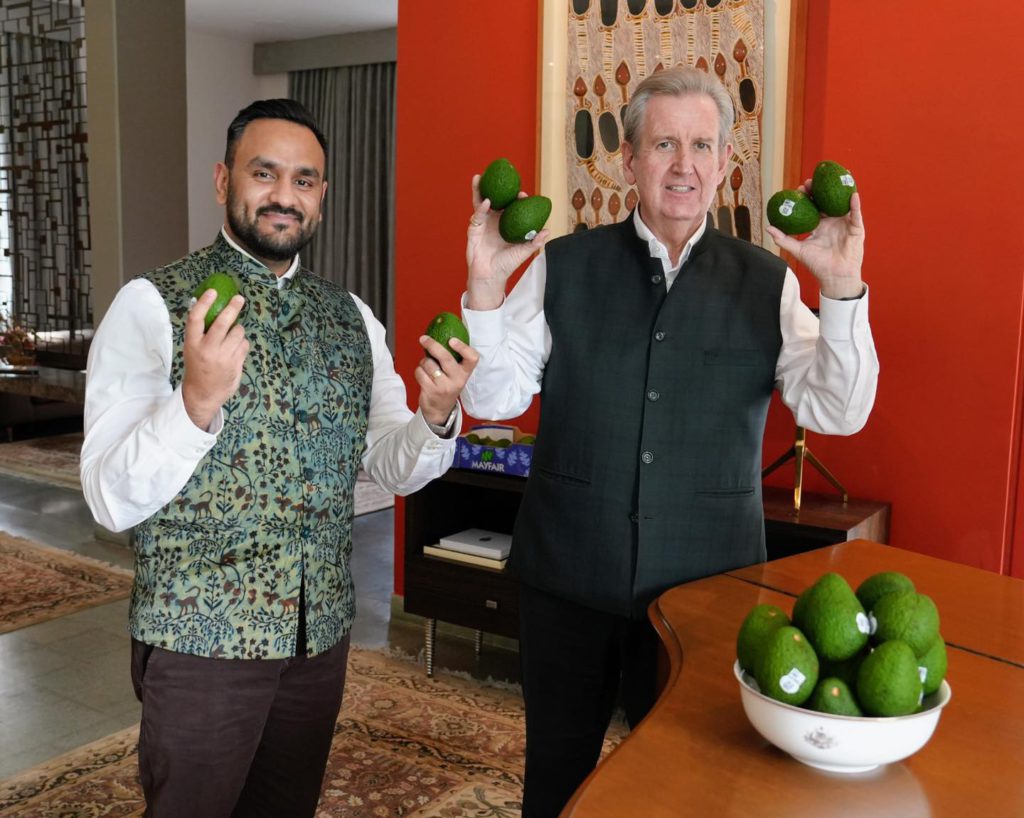
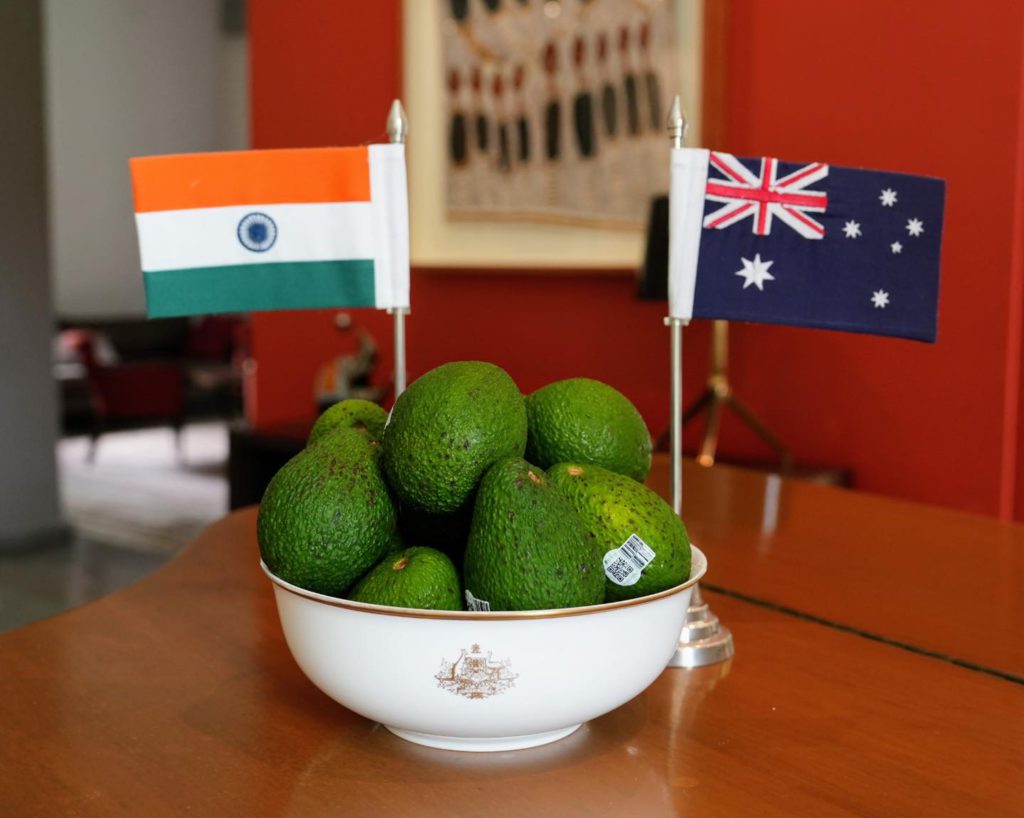
Australia’s well-known Hass avocados have finally made an entry into the Indian market.
Releasing the photos of the select avocados from the first shipment that has arrived, Australia’s outgoing High Commissioner to India Barry O’Farrell said: “Two-way agricultural trade is set to grow under #IndAusECTA.”
Image: Australia’s High Commissioner to India Barry O’Farell (Source: Facebook)
In 2021-22, India imported A$4.8 million of avocados, up from A$2.4 million in 2020-21 and A$1.6 million in 2019-20.
According to experts, the Indian market has a value of $30 million as access was granted earlier this year after Australia demonstrated that its high-quality avocados could meet India’s biosecurity and food import requirements.
Earlier, Australia completed trial shipments to India to see supply chain confidence within the industry and $3 million research to check Indian markets growth potential.
The research was undertaken in cities such as Bangalore, Mumbai, and Delhi to assess the Indian market for Australian avocado growers.
Image: Antony Allen, CEO of The Avolution (Source: The Avolution)
The Avolution is responsible for bringing premium quality Hass avocados to the Indian market. It said in a comment:
“Excellent Team Work from Australia High Commissioner Barry O’Farrell’s team inDelhi, Minister for Agriculture Murray Watt’s team in Canberra. Working closely with the Indian Government to achieve a great outcome for Australian avocado growers and fresh healthy avocados for Indian consumers.“
Image: CEO John Tyas (Source: Avocados Australia)
Avocados Australia chief executive John Tyas said in a statement:
“We think India is going to be a great market for us to build and a great market for us to really dominate.”
The Indian market access comes after Australia secured reduced tariffs on several horticulture products through the Australia-India Economic Cooperation Agreement (AI-ECTA).
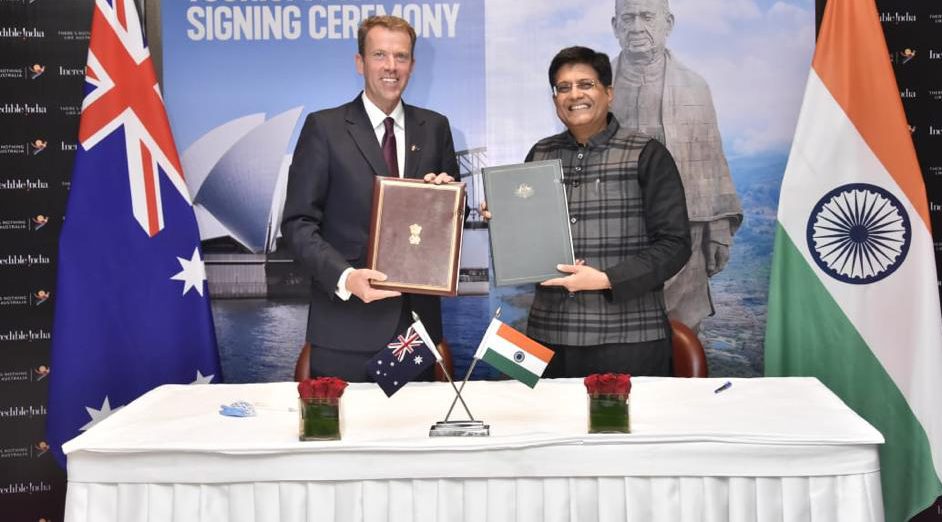
Image: Piyush Goyal, Minister of Commerce & Industry, Consumer Affairs, Food & Public Distribution and Textiles and Australia’s Dan Tehan MP, Minister of Trade, Tourism and Investment (Source: PIB)
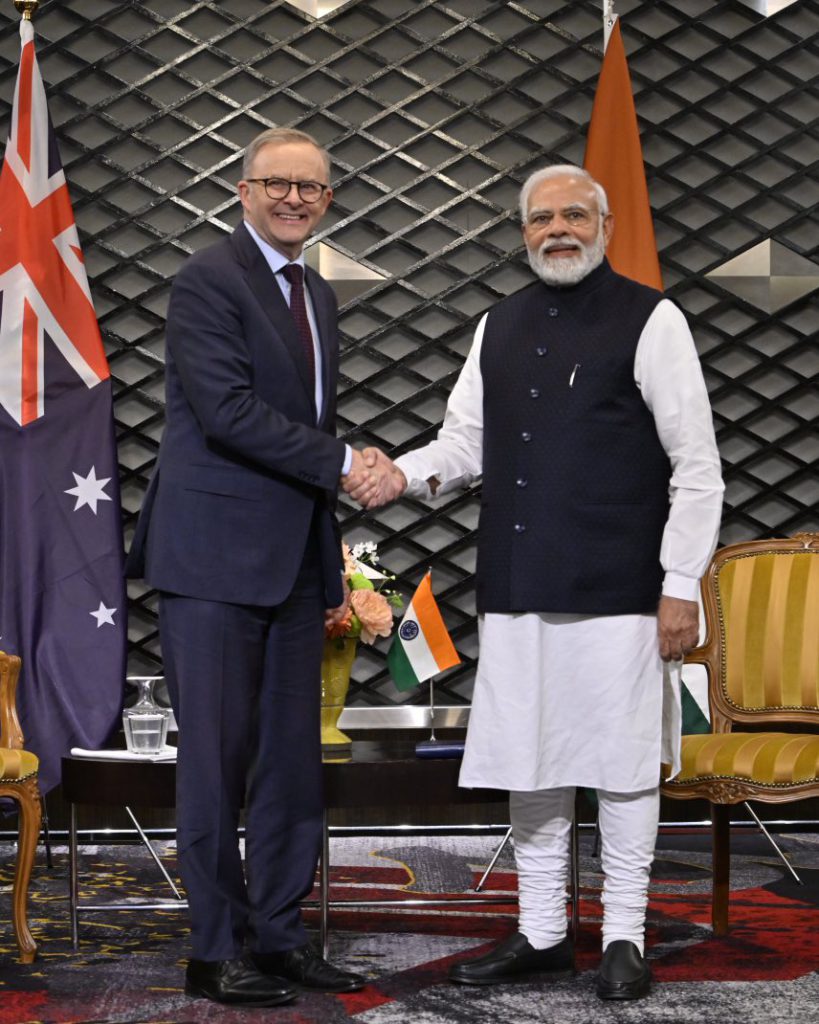
New access was announced in a Joint Statement by the Australian Prime Minister Anthony Albanese and the Prime Minister of India Narendra Modi on 11 March 2023.
Image: Australian Prime Minister Anthony Albanese and the Prime Minister of India Narendra Modi (Source: Twitter)
It is reported that in the first 6 months of ECTA, Australian businesses have benefitted from lower tariffs on more than $12 billion worth in exports.
Image: Senator the Hon Don Farrell (Source: Supplied)
Minister for Trade and Tourism and Special Minister of State Senator the Hon Don Farrell said in a statement:
“Prime Minister Albanese and India’s Prime Minister Modi share an ambition to grow our trading relationship through our next free trade agreement with India, an ambitious Comprehensive Economic Cooperation Agreement, which will further strengthen our economic partnership and open new avenues for cooperation.”
The Australia-India Economic Cooperation and Trade Agreement (ECTA) entered into force on 29 December 2022 and with it came this excellent new trade opportunity for the Australian avocado industry.
“Getting to the point the Australian government has with India today is no small feat. As well as significant work by the government, this trade agreement, which is enacted after ten successful shipments, has been informed by hundreds of hours of research.”
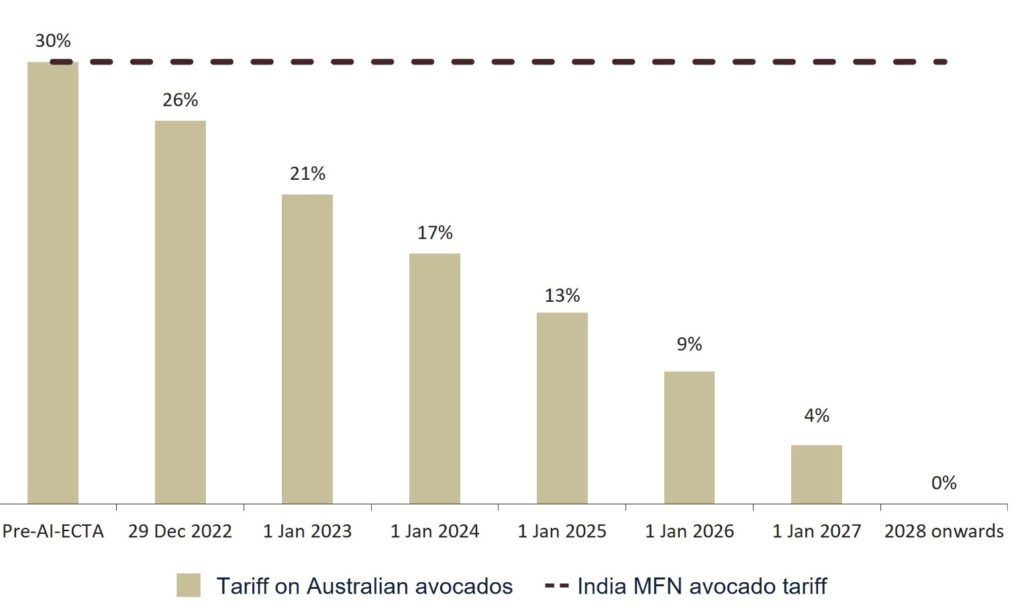
India does not produce avocados on a commercial scale and its key suppliers are New Zealand (41%), the European Union (39%) and Peru (17%) which are subject to India’s 30% Most Favoured Nation (MFN) import tariff.
In 2022, avocados were Australia’s seventh largest fruit crop, valued at A$363.8 million with the majority produced in Queensland (55%), WA (27%), and New South Wales (11%). At this stage, Hong Kong, Singapore and Malaysia are Australia’s major avocado markets.
Image: Australian avocados in India (Source: Australia in India – Facebook)
Avocados Australia is optimistic about growth in the Indian market and has observed that Australia’s proximity to India is “very favourable” compared with its competitors.
India is a fast-growing market for avocados, considered a high-end product, and consumers are keen to try premium quality Hass avocados at affordable prices. India’s population is 1.4 billion and if the Australian avocado industry is able to get just 1 per cent of people to buy their product that’s a clear market of 14 million people.
ByLeo Roberts, Daniel R. Little, Matthew J. Spittal, and Mervyn Jackson
With dual men’s and women’s Ashes series under way, the performance of elite Test cricketers is in the spotlight. For psychologically minded researchers like us, one aspect of play is attracting particular interest: the performance of batters progressing through the famed “nervous nineties”.
Popularised by commentators, this terminology captures the idea that batters with 90 or more runs become anxious about reaching (or not reaching) a century (100 runs).
Commentators and journalists (and Wikipedia) often portray the nervous nineties as a problematic moment for batters. This anxiety, the story goes, leads to lost ability, slow run-scoring and timid play.
These ideas are intuitive – but are they correct?
In fact our new research, published today in PLOS ONE, shows batters approaching 100 runs typically increased their scoring rate (more runs per ball) and became more likely to score a boundary (a four or a six), without being any more likely to get out than at any other point between 70 and 130 runs.
100 is not an arbitrary number
While cricket is a team sport, the individual accumulation of 100 runs is universally hailed as a major batting achievement.
Notably, 99 runs is an impressive individual total; yet in cricket culture, 99 is a world away from 100.
Watching a batter reach 100 runs reveals its significance. Jubilation and relief flood out, teammates stand and applaud, and crowds respond. Even nearby opponents offer congratulations.
Scoring centuries builds a batter’s reputation, while enhancing their legacy, their chance of team selection and, let’s not forget, their team’s chances of winning.
In stark contrast, getting out just short of a century is a bitter experience.
Beyond the disappointment, being dismissed in the 90s can attract stigma of mental weakness (especially if repeated) and is widely considered “a failure to convert”.
Who wouldn’t be nervous?
Challenges of realising success
Many people can think of a time when a desired achievement slipped through their fingers just when success seemed assured.
Humans have imperfect thought control and can experience unhelpful thoughts at inconvenient times, like pondering the consequences of failing when success is in sight.
The possibility of gaining or losing reputation is also a common source of performance anxiety.
For athletes, performance anxiety places extra demands on the ability to execute precise actions.
To counteract this, performers need to apply coping strategies to maintain performance, such as the acceptance of negative thoughts or directing their thoughts to a single focus, like the ball in cricket.
According to the mythology of the nervous nineties, these strategies could include more cautious behaviour to try to avoid getting out.
What does the data say?
In our new research, we examined data about every ball bowled in 712 men’s and women’s Test matches played between 2004 and 2022 (over 1.4 million deliveries).
In stark contrast to the colloquial phenomenon of the nervous nineties, we found batters in their 90s generally scored faster without increasing their chances of dismissal.
Importantly, accelerated scoring – that is, a progressive increase in the average runs per ball and the probability of a boundary – was uniquely large throughout the 90s when compared to the 70s, 80s and immediately after 100.
Some key examples from this year’s Ashes series bear out this finding. When Usman Khawaja brought up his century in the first men’s Ashes Test of 2023, it was with a boundary.
When Ellyse Perry was caught out on 99 runs in the women’s Test match, she was dismissed playing an aggressive shot destined for the fence – not exactly the timid play expected of the “nervous nineties” phenomenon.
In fact, Perry’s forceful batting is precisely the kind of playing our analysis predicts for those nearing a century.
And throughout the 90s, we estimated the probability of a batter getting out on any given score to be about 1.3% – much the same as throughout the 70s, 80s and just after 100.
Managing the nerves
We have come up with several explanations for the productive batting observed in the 90s.
Possibly, batters rush to escape their nervous discomfort by batting aggressively or with more urgency (such as running faster between the wickets).
The bowling team could also play a role. Bowling sides often try to limit run-scoring as batters near 100 by bringing fielders closer to the pitch, hoping to build pressure and encourage a mistake.
Ironically, a field packed tightly around the batter may offer a faster path to a century by leaving the boundary unprotected from any shot that passes through or over the infield.
While we can’t judge a batter’s emotional state from historical cricket data, we suspect many players are actually nervous when progressing from 90 to 100 runs. But we find no evidence the “nervous nineties” leads to widespread poor functioning or timid play.
International cricketers appear to typically manage any nerves and capitalise on the situation. It’s a fine example of coping among an elite population in a career-defining situation.
The latest figures by the Department of Foreign Affairs and Trade show that bilateral trade between India and Australia has reached its highest level ever. According to DFAT,
“The two-way trade in goods and services between Australia and India was valued at $46.5 billion in 2022.”
Bilateral trade between the two countries stood at around $34 billion in the preceding year. India is currently Australia’s sixth-largest trading partner and fourth-largest export market.
Austrade’s Head of South Asia and Senior Trade and Investment Commissioner Catherine Gallagher told The Australia Today, “The Australia and India bilateral relationship is at a historic high.”
“Our growing two-way trade relationship is now supported by our landmark free trade agreement, the Australia-India Free Trade Agreement (AI-ECTA) that came into force in December 2022.
“Lower tariffs have unlocked opportunities for businesses in both countries to grow and diversify across sectors, including agriculture and food, resources and energy, and health.”
The trade growth data of the last three years between Australia and India tells its own story.
In 2022, India was Australia’s sixth largest trading partner with two-way trade in goods and services valued at over $46 billion. The fourth largest export market of goods and services, valued at $34.8 billion.
In 2021, India was Australia’s sixth largest trading partner with two-way trade in goods and services valued at $34.2 billion, representing a 41% annual increase. The fourth largest export market of goods and services, valued at $24.5 billion.
In 2020, India was Australia’s seventh largest trading partner with two-way trade in goods and services valued at $24.3 billion. The sixth largest export market of goods and services, valued at $16.8 billion.
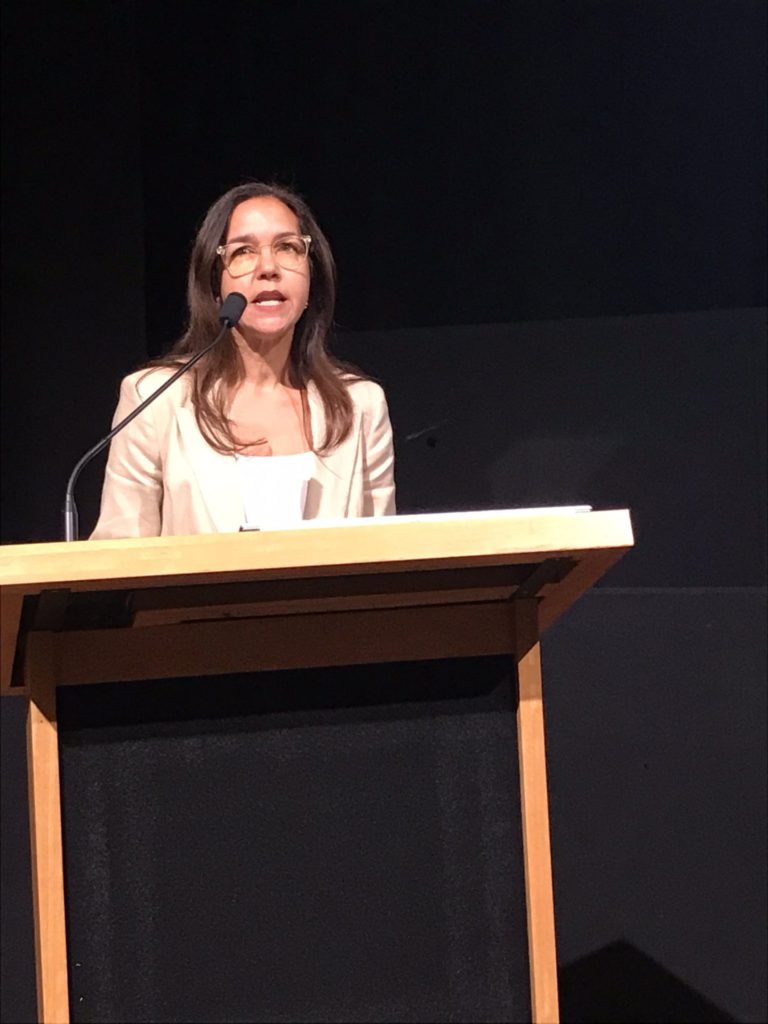
Speaking with The Australia Today, National Chair of Australia India Business Council (AIBC), Jodi McKay said,
Jodi McKay AIBC National Chair; Image Source: The Australia Today
“These figures show that the recent efforts by our two nations are having a significant impact on trading volumes. AIBC’s focus has been on raising the profile and opportunities of the ECTA”
“It is pleasing to see businesses on both sides begin to convert the potential of our growing economic relationship. While the figures are impressive- this is just the start.”
Late last year the Australia-India Economic Cooperation and Trade Agreement (ECTA) came into effect after almost a decade of negotiations. The agreement was signed on 2 April 2022 and entered into force on 29 December 2022.
At the time Minister for Trade and Tourism Don Farrell said,
“This agreement reflects the Government’s commitment to diversifying exports and strengthening our partnerships.”
Indian Trade Minister Piyush Goyal and Minister for Trade Don Farrell (Pic: Twitter – @AusHCIndia)
“Australia and India are natural trading partners – this agreement will unlock the enormous potential in our trading relationship,”
said Mr Farrell.
He added, “ECTA’s entry into force opens up the world’s largest democracy, with nearly one and a half billion people, to Australian exporters – early entry into force sees Australian exporters receive a tariff cut today, followed by another on 1 January 2023.”
Additionally, given the date on which the agreement came into force, Australia was effectively getting an extra year of tariff cuts on the free trade agreement with India.
Speaking at an event organised by the Australia India Business Council (AIBC) in December, DFAT’s Chief Negotiator for ECTA and CECA (Comprehensive Economic Cooperation Agreement), Frances Lisson, highlighted the significance of the timing of when the agreement was coming into force.
After the ECTA came into force, tariffs on over 85 per cent of Australian exports to India have been eliminated and locked in at zero. These include key exports such as wool, lamb, barley, oats, fresh rock lobsters, cosmetics and many metallic ores, critical minerals, non-ferrous metals, and titanium dioxide.
Tariffs on a further 5 per cent of exports, including macadamia nuts, avocados, berries, seafood, pharmaceuticals, cochlear implants, vitamins, infant formula, breakfast cereals, pasta, sandalwood chips, pumps, and fillers, excavating machinery parts and lifting machinery for mines, are lower now and will be phased down to zero within 6 years.
Australian services suppliers in 31 sectors and subsectors are also guaranteed to receive the best treatment accorded by India to any future free trade agreement partner, including in:
higher education and adult education
business services (tax, medical and dental, architectural and urban planning
research and development
communication, construction and engineering
insurance and banking
hospital, audiovisual and tourism and travel.
Modern commitments have provided for non-discriminatory treatment for Australian service suppliers across a wide range of sectors. There is also improved transparency and predictability around the domestic regulations that apply in India.
India has provided market access for single-brand retailing and franchising, as well as commitments regarding wholesale distribution services. Australian Internet services businesses in India also have more opportunities to expand their portfolio with foreign equity limit of 74 per cent for commercial presence.
ECTA contains separate Annexes on Financial Services, Professional Services, and Telecommunications Services, consistent with the growth opportunities these sectors represent.
IN 2016, Taika Waititi, a Maori filmmaker from New Zealand, released his film Hunt for the Wilderpeople, which went on to become the highest grossing New Zealand film of all time.
During the press tour for the film, Waititi was asked about the significance of having an indigenous filmmaker behind such a successful film. He responded, “It’s important that we keep moving forward and keep telling our stories because that’s how we build our communities and empower ourselves.”
Waititi’s words illustrate the importance of indigenous filmmakers and their stories, not just for entertainment purposes, but also for community building and empowerment.
Indigenous filmmakers around the region but especially us of the Small Island Developing States (SIDS) variety, are using their craft to challenge stereotypes and increase representation in the film industry.
The Soli Bula short film is a testament to the growing presence of Pacific Islander filmmakers in the film industry. Accepted to screen in various film festivals around the world, Soli Bula is a Fijian story told by Fijians, with cultural accuracy and authenticity at its core.
Members of the film’s production team shared their experiences and insights on the making of the film and the importance of Pacific Islander representation in the film industry.
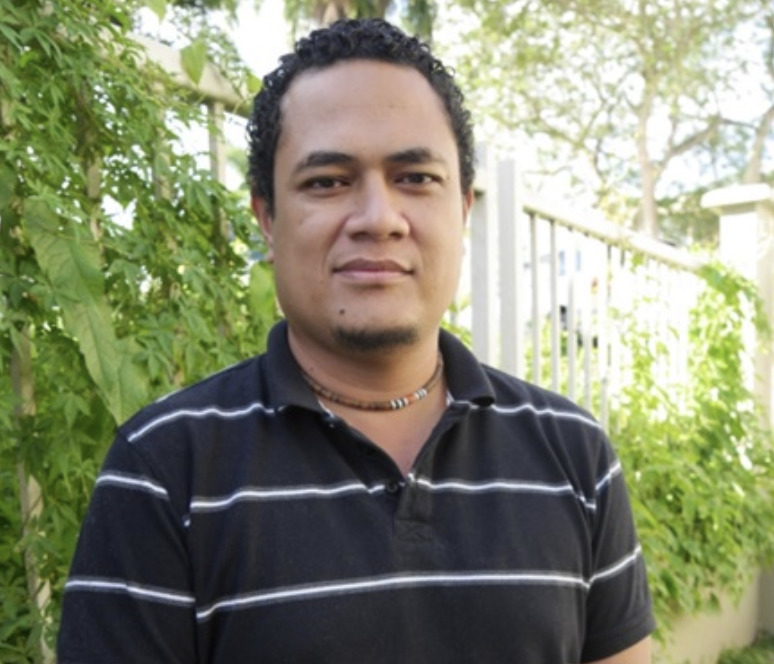
Image: Tumeli Tuqota is an indigenous filmmaker and director of the short film, Soli Bula. Tuqota hopes the film will inspire locals to venture into filmmaking. Picture: SUPPLIED
Director and producer of Soli Bula, Tumeli Tuqota says, “I specifically made this film for us and, nobody else but at the same time. Because it’s a Pacific culture, other Pacific Islanders can watch this and feel sort of like a sense of like, yeah, we know what you’re doing.”
Tuqota hopes that other Pacific Islanders watching the film will understand and relate to it, and suggests that local organisations should support and develop their own film industries.
He believes that Soli Bula shows how Fiji could have evolved while still retaining its traditional cultural practices and values, and that Pacific Islander filmmaking has great potential in the future.
Tuqota adds, “For us, filmmaking is not just a tool to express ourselves, but it’s also a way to document our stories for future generations. We want to show the world that we can do it, and we can do it just as well as anyone else.”
Neisau Tuidraki, based in Melbourne Australia, was involved in the awareness campaign for Soli Bula and highlighted the importance of Pacific Islander representation in the film industry.
She believes that it empowers the community and future generations to tell their stories.
“Pacific Islander filmmakers face financial challenges, but there are always workarounds,” she added.
Tuidraki thinks that the film industry could provide funding and script development to increase representation for underrepresented groups.
“Soli Bula can inspire other Pacific Islanders to pursue filmmaking and creative endeavours,” she says.
Image: Tickets for ‘Soli Bula’ (Source: Facebook)
Fiji’s premier hip-hop artist, Mr GRIN or Dave Lavaki, a sound designer, got involved in Soli Bula because of his previous work with the director Tumeli on previous animation projects.
He was mindful of how sound changes with perspective and aimed to create audio that would work across different sound devices.
Lavaki’s process for creating the audio and foley for the film involved combining various sounds to create the desired effect and his work on Soli Bula showcases the technical expertise of Pacific Islander filmmakers in the industry.
The film also relied heavily on the knowledge of Simione Sevudredre who functioned as a cultural consultant on the film and who provided cultural context and drew from oral history and tradition memorialised in words, customs, and ceremonies to ensure historical and cultural accuracy in the film.
He believes it’s important for Pacific Islander stories to be told accurately and authentically. Still, Sevudredre is aware that it’s impossible to achieve full accuracy and authenticity due to the various contemporary lenses and biases.
His work mainly consisted of liaising with the director and production team to take stock of the past before engaging in creative reimagining.
Sevudredre hopes that audiences take away their interpretations of the film based on their individual cultural background and life experiences. He suggests that Pacific Islanders incorporate cultural accuracy and representation by recognising and respecting their history, language, and indigenous ethics.
Soli Bula’s acceptance into various film festivals worldwide, including the Maoriland Film Festival, the Los Angeles Asian Pacific Film Festival, and the Native Spirit Film Festival, showcases the growing presence of Pacific Islander filmmakers in the film industry.
Other film festivals such as the Wairoa Maori Film Festival, the Pasifika Film Festival, and the Skábmagovat Indigenous Film Festival highlight the importance of indigenous representation in the film industry.
The film industry can increase Pacific Islander representation in film by engaging in ethnographic research, tapping into the local “insider” vibe and pulse, and pressuring government and tertiary institutions to grow disciplines on cultural studies, Pacific studies, and indigenous studies.
With Soli Bula, Pacific Islander filmmakers show the world the richness of their culture and history and the importance of telling their stories. By increasing representation and visibility, Pacific Islander filmmakers can empower their community and inspire future generations to pursue filmmaking and creative endeavours.
Soli Bula can inspire other Pacific Islanders to pursue filmmaking and creative endeavours.
Tuqota shares a final thought. “I think the future for Pacific Islander filmmaking is really exciting, there’s so much potential.”
Indigenous filmmakers are making their mark in the film industry, and Soli Bula is just the beginning of many more stories to be told.
So as the young ones say nowadays, we’re here for it.
This article was first published in Wansolwara and has been republished here with the kind permission of the editor(s).
Contributing Author: Ro Uluinavucu Vavaitamana is a final-year journalism student at The University of the South Pacific’s Laucala Campus, Suva, Fiji.
Disclaimer: The opinions expressed within this article are the personal opinions of the author. The Australia Today is not responsible for the accuracy, completeness, suitability, or validity of any information in this article. All information is provided on an as-is basis. The information, facts, or opinions appearing in the article do not reflect the views of The Australia Today and The Australia Today News does not assume any responsibility or liability for the same.
Victoria’s Labor Government is amplifying the voices of inspiring and influential women to help level the playing field and drive change for women and girls in sport.
Minister for Community Sport Ros Spence has announced this year’s eight Change Our Game Ambassadors for the inaugural Ambassador Program.
This year’s Change Our Game Ambassadors are:
Carol Cooke AM PLY
Elle Steele PLY
Gabby Seymour
Jacara Egan
Melissa Hale
Molina Asthana
Rana Hussain
Rita Nehme
Well-known Indian-Australian lawyer Molina Asthana has broad-based commercial and litigation experience and localised expertise in mergers and acquisitions. She sits on the board of the Law Institute of Victoria and was the first South Asian woman to be elected President-Elect of the Law Institute of Victoria.
Image: Molina Asthana (Source: LinkedIn)
On her appointment as the 2023 Change Our Game Ambassador, Molina Asthana said:
“I am very excited to be appointed a Change Our Game Ambassador and I look forward to using this platform to champion for greater diversity in sport. Sport has great benefits for women, especially from diverse backgrounds; it provides confidence, strength of mind and body and can help to create a sense of belonging and community.”
Ms Asthana serves on various boards including Gymnastics Victoria, AFL South East Commission, Table Tennis Victoria, and Australasian Centre for Human Rights and Health. She is also the co-founder of the Asian Australian Alliance and the founder of the organisation Multicultural Women in Sport. She is also a member of the Sport Australia Sport Volunteer Coalition and a member of the Football Federation of Victoria Tribunal.
The government believes that these ambassadors will use their voice and network to champion equality for all women and girls in sports.
Further, these Ambassadors are expected to shed light on the issues that matter the most to them – from the accessibility of sports for women with a disability to more opportunities for First Nations and culturally diverse women in sport, and beyond.
Image: Ros Spence, Minister for Community Sport (Source: LinkedIn)
Ros Spence, Minister for Community Sport, observed:
“These eight Ambassadors will be vital in advocating for equal opportunities for all women and girls. The gender equality in sport movement continues to accelerate and I look forward to seeing what we can achieve together.”
Through speaking opportunities, educational events and digital content, the Program provides a platform to champion gender equality in sport and share a diverse range of lived experiences and perspective – from grassroots through to leadership roles.
Established in 2017, the Office for Women in Sport and Recreation was the first of its kind in Australia and delivers nation-leading policy, advocacy, research, and education in pursuit of gender equality.
When an anti-corruption agency issues a 688-page report with findings a former premier engaged in “serious corrupt conduct” and breached the public’s trust, it puts all public officials on notice.
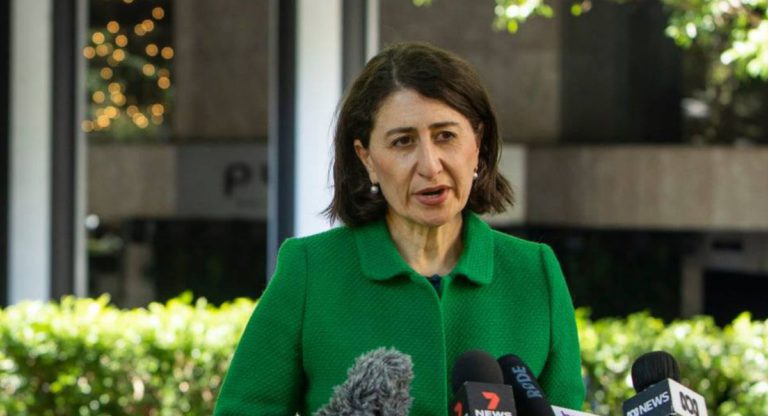
In an extraordinary report released on Thursday, the Independent Commission Against Corruption (ICAC) found former New South Wales Premier Gladys Berejiklian had taken steps to award government grants in a “desire on her part to maintain or advance” her relationship with former state MP Daryl Maguire.
The commission also faulted her for not disclosing her relationship with Maguire and for failing to report any suspicions she had about Maguire’s activities to the ICAC, calling this “grave misconduct”.
Is Australia a corrupt country?
Compared with most of the world, Australia is not a highly corrupt country. Yet, its ranking on the global Corruption Perceptions Index slipped significantly between 2012 and 2021, before stabilising this year.
The ICAC report on Berejiklian’s conduct will further diminish Australia’s standing, but does it mean we necessarily have more corruption?
We always need to distinguish between situations in which corruption is the norm – such as in Somalia, Sudan, Afghanistan, Lebanon and Syria who are at the bottom of the Corruption Perceptions Index – or the exception, as in Australia.
In countries like Australia, citizens can go about their daily lives without the fear of being shaken down by a public official or being asked for a bribe to receive a public service, as they are in countries at the bottom of the standings.
However, in countries like ours, there is much more fury when corruption is uncovered because, above all, it is a betrayal of trust. We trust our politicians and public servants to act in the public interest, and when it is found they have not, we are rightfully outraged.
As cases like this demonstrate, corruption in richer countries often involves conflicts of interest, the misuse of information and the purchase of government access. This is why investigatory bodies like the ICAC are so vital to maintaining government integrity.
Criticism of anti-corruption bodies
On the federal level, the government has finally established a National Anti-Corruption Commission, which commences operation on July 1.
This came into being after a long discussion about whether we really needed such an agency. When the allegations against Berejiklian first came to light, then-Prime Minister Scott Morrison disparaged the idea of an anti-corruption body, likening it to a “kangaroo court”.
He also accused the ICAC in NSW of making “shameful attacks” on Berejiklian and tarnishing the reputation of public figures.
However, the whole point of anti-corruption agencies is they ensure the integrity of our public system is not compromised. This work does take time and careful consideration.
Anti-corruption agencies bark, but they do not bite. If they make findings of corrupt conduct, they leave prosecution to the discretion of the director of public prosecutions. If there are findings of misconduct or maladministration, it is up to government departments and public service commissioners to address them.
Not only do we now have a National Anti-Corruption Commission, but at the top of the Australian public service, there is now a huge focus on integrity and better behaviour and better processes.
This is no longer politics as usual
Most politicians and public servants in Australia operate with great integrity, but we have had significant shocks to our system in recent years.
The list includes the Robodebt fiasco, the sports and car park rorts scandals, an Australian National Audit Office report on community health centre funding breaches and allegations of a plan to funnel kickbacks to a minister for steering contracts to a favoured company.
Then, of course, there is the ongoing PwC saga, where allegations of conflicts of interest have been raised, alongside a confidentiality breach.
This catalogue of alleged activities stains our public sector (though PwC did not involve public officials) and must be investigated. They raise questions not just of behaviour, but go to the root of what is the public interest.
In the case of the former NSW premier, it seems a personal relationship ended up compromising her judgement. In the other cases, there was political advantage to be gained by breaching standards and acting inappropriately. Generally speaking, these are not things that make politicians or public servants rich. But it may make some of their mates rich.
The response from politicians typically has been “that’s politics” or “if you don’t like it, vote me out at the next election”.
These are not adequate responses to integrity breaches. We have started on an integrity-building process in the Australian public service and around the country. More action needs to be taken on areas like pork-barrelling (about which the NSW ICAC has written an extensive separate report) and election funding.
These findings by the NSW ICAC signal that holding public office is a matter of great trust, with standards that are expected are high. Excuses do not wash anymore.
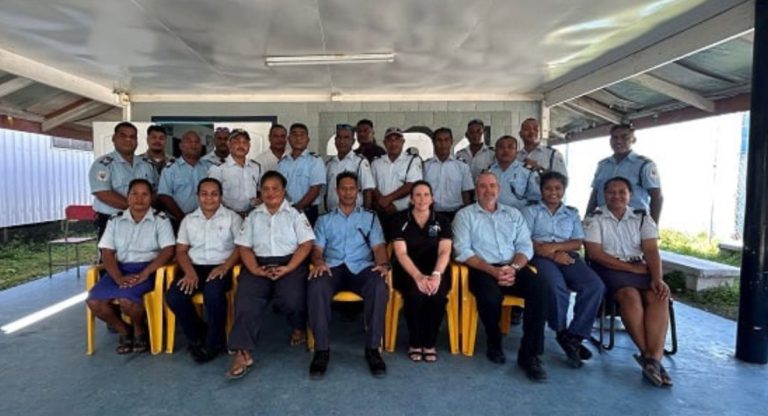
The AFP and Kiribati Police Service (KPS) have joined forces to boost local police officers’ capability in conducting and solving complex investigations.
This month, the AFP delivered a two-week investigations training program for Kiribati Police Service (KPS) officers from the outer islands, the Criminal Investigation Division (CID) and the Police Training Academy.
The course focused on current policing powers, police ethics and professionalism, diversity, intelligence, dealing with victims and witnesses, and practical sessions on taking statements, file preparation and giving evidence in court.
Image: Kiribati Police Service Investigations Training (Source: AFP)
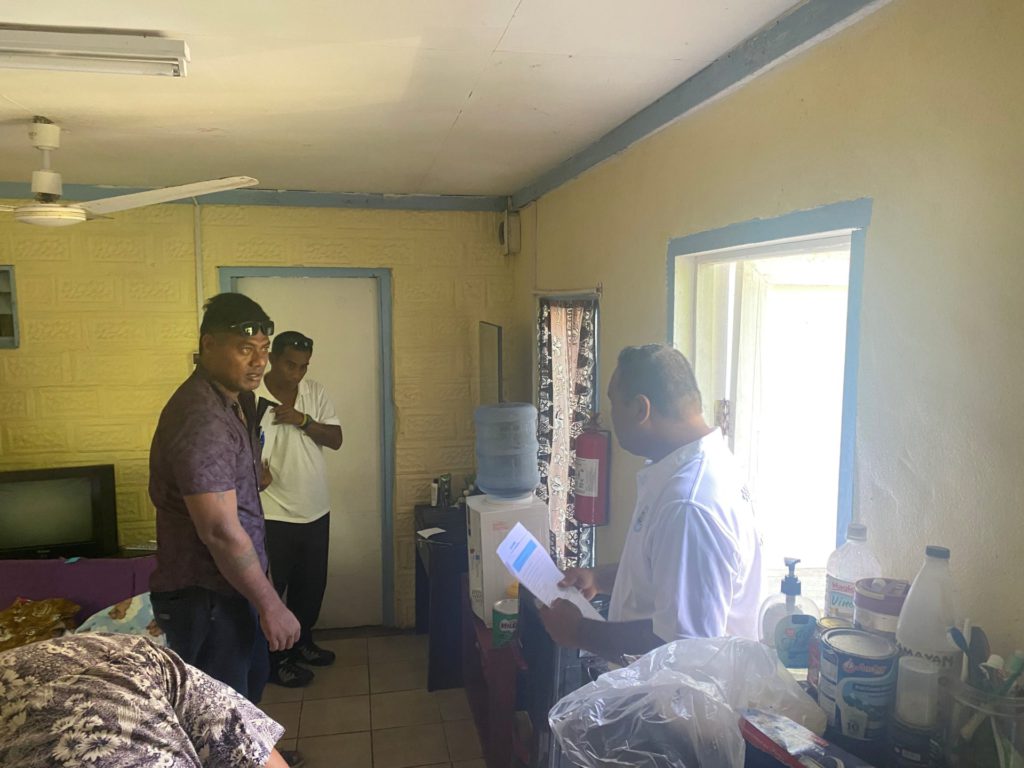
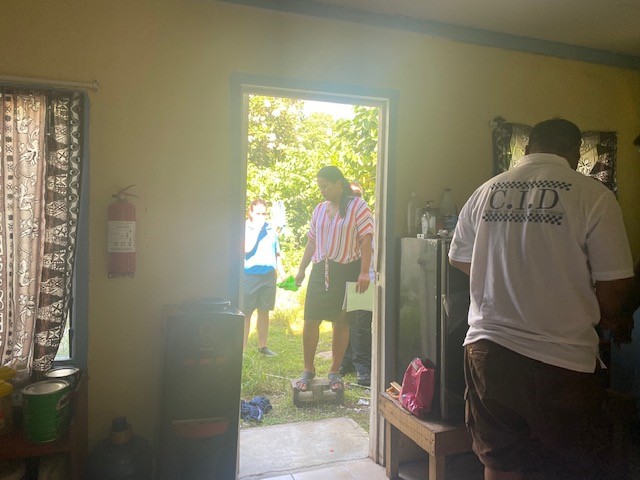
During the program, police officers followed a scenario where they had to apply complex investigations techniques, including executing search warrants. They also worked through a case study of a homicide investigation involving foreign nationals.
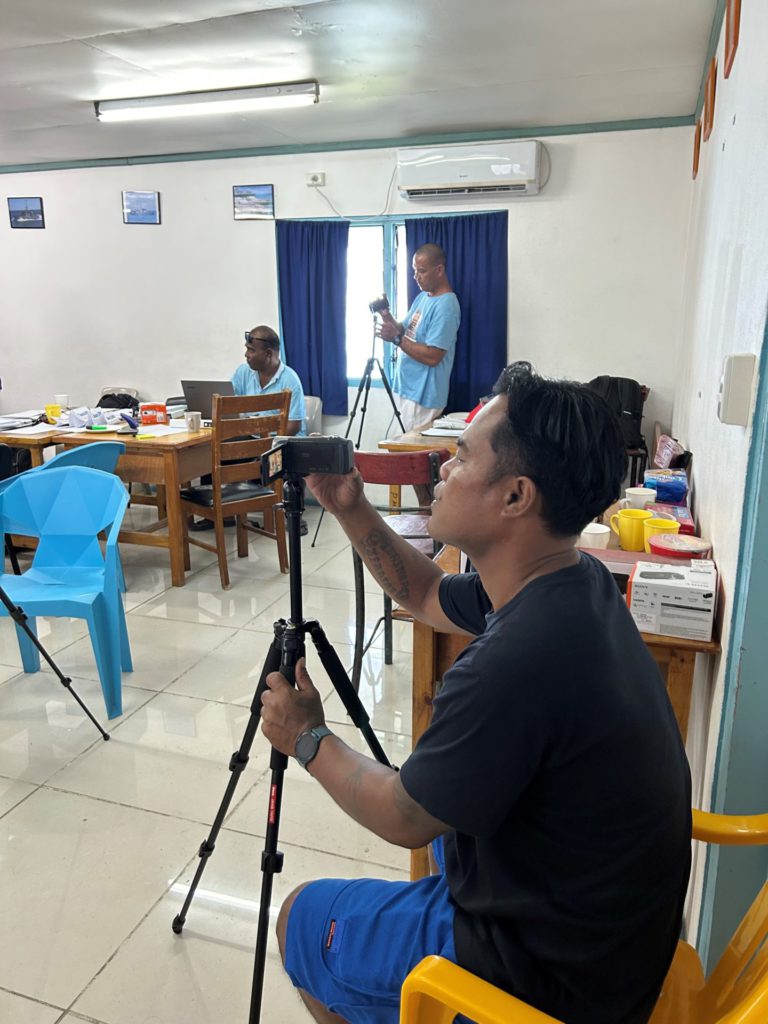
The AFP provided the KPS with six new video cameras, which will be available in police stations across Kiribati and enable officers to digitally record their interviews with suspects instead of taking statements by hand. This is a significant step in helping to enhance and modernise the KPS and was welcomed by the Kiribati Department of Public Prosecution (DPP).
AFP Commander Pacific Melinda Phelan said it was great to again provide investigations training to the KPS.
“The officers who took part in this training now have the knowledge and skills to take on more complex investigations to keep their communities safe,” Commander Phelan said.
“The AFP works closely with the KPS to ensure we continue to boost the capability of all members based across the country, including those on the outer islands, to keep all communities safe.
“But just as importantly, I know AFP members always learn something new from our Pacific partners.”
Image: Kiribati Police Service Investigations Training (Source: AFP)
KPS Acting Assistant Commissioner Nakibwae Rateki said the investigations program was very valuable to his officers.
“The training provided great tools and processes for the better investigation of criminal offences,” Acting Assistant Commissioner Rateki said.
“I thank the AFP for its continued support.”
KPS Officer Commanding Station Abemama, Eritabeta Teiri said he was glad to have undertaken the training.
“The investigations training has given me a wide range of understanding on what I should do as an investigator and apply that to my work, especially when encountering complex cases,” Officer Teiri said.
Image: Kiribati Police Service Investigations Training (Source: AFP)
Throughout the program, KPS and the Kiribati Government provided a number of subject matter experts from the CID, Intelligence, Forensics, Domestic Violence Unit, Kiribati DPP as well as the Kiribati Acting Attorney General Pauline Beiatiau.
The investigations training forms part of a suite of capability building programs the AFP is delivering to the KPS to further develop and up-skill police officers.
The 2023 Victorian Refugee Awards has recognised four remarkable people who have rebuilt their lives in Victoria to serve others.
Now in its third year and hosted by the Victorian Multicultural Commission (VMC) as part of Refugee Week, the awards recognise the achievements of Victorians who arrived in Australia as refugees or asylum seekers.
Deputy Chairperson of VMC Bwe Thay presented the awards alongside Minister for Multicultural Affairs Colin Brooks and VMC Chairperson Viv Nguyen AM.
Victorian Minister for Multicultural Affairs Colin Brooks said,
“These awards are about recognising people who choose to serve their community and make Victoria a welcoming and inclusive place for people from all backgrounds.”
The awards highlight people who excel through study, work, entrepreneurship or volunteering, including those who own or run businesses or organisations that support others with refugee or asylum seeker backgrounds.
Victorian Multicultural Commission Deputy Chairperson Bwe Thay said,
“It’s important to elevate the voices of individuals with refugee or asylum seeker backgrounds so we can overcome the hurdles and celebrate the gift of cultural diversity.”
Twelve people or organisations received awards including:
The Achievement Award went to WINNER Thuy Linh Bui.
Thuy is a remarkable woman who raised three successful children while helping hundreds of refugees through her work with organisations such as the Australian Vietnamese Women’s Association. She received the “Worker of the Year” Award in 2009 and the “Award for Compassion” recently.
The Young Leader Award went to Athraa Yousif.
Athraa Yousif
A refugee mental health advocate, EAL Counsellor and Peer Career Advisor, who uses her own lived experiences in Iraq’s wars to inspire others and advocate for more mental health support for young refugees
The Leadership Award went to Jacob Thang.
He arrived from Chin State Myanmar 11 years ago and started a small gardening business which is now a successful landscaping company employing people from the local Chin community. Jacob is also the founder of Chin Myanmar Community Care and the Vice President of the Western Chin Community
TheBusiness Award went to the Dandenong-based Afghan Women’s Organisation Victoria which supports and empowers Afghan women and girls from diverse backgrounds.
In this year’s Budget, Victorian Government invested $6 million to continue programs that support refugees and asylum seekers including the delivery of culturally appropriate health care and education for newly arrived and at-risk refugees, and support for people seeking asylum who are ineligible for basic safety net support.
The Centre for Australia-India Relations (CAIR) has announced the recipients of the 2022-23 Maitri Cultural Partnerships grants.
These grants support Australian creative collaboration with India and have been divided into three programs:
Maitri Cultural Partnerships Major Collaboration Grant: Supporting major Australian cultural organisations to engage Indian partners (funding up to $250,000)
Maitri Cultural Partnerships Visual and Performing Arts Grants: Cultural collaboration that supports First Nations’ participation (funding up to $250,000)
Maitri Cultural Partnerships Collaboration Grants: Supporting collaboration of small to medium-sized Australian cultural organisations and community groups (funding up to $70,000)
The six grant recipients for 2022-23 represent a diverse range of cultural sectors from new media to textile design.
Image: Mona Foma Festival (Source: Website)
Mona Foma Festival (Moorilla Estate) – $248,960
Tasmania’s world-famous festival of music and art Mona Foma will lead a two-year Australia-India music collaboration with artistic exchanges, music residencies resulting in a major concert in 2025.
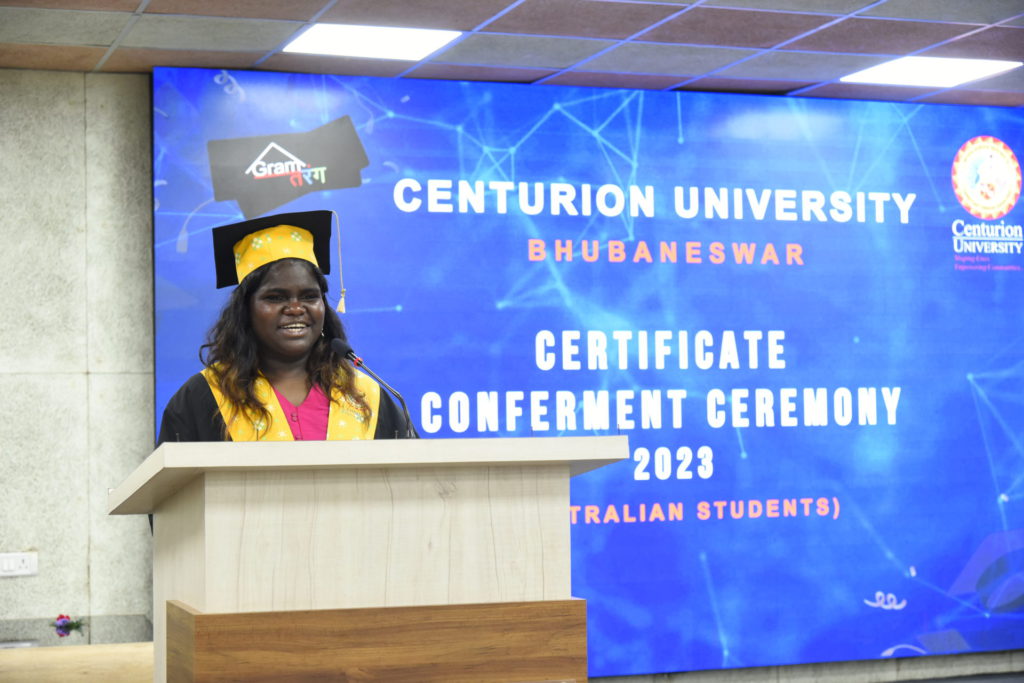
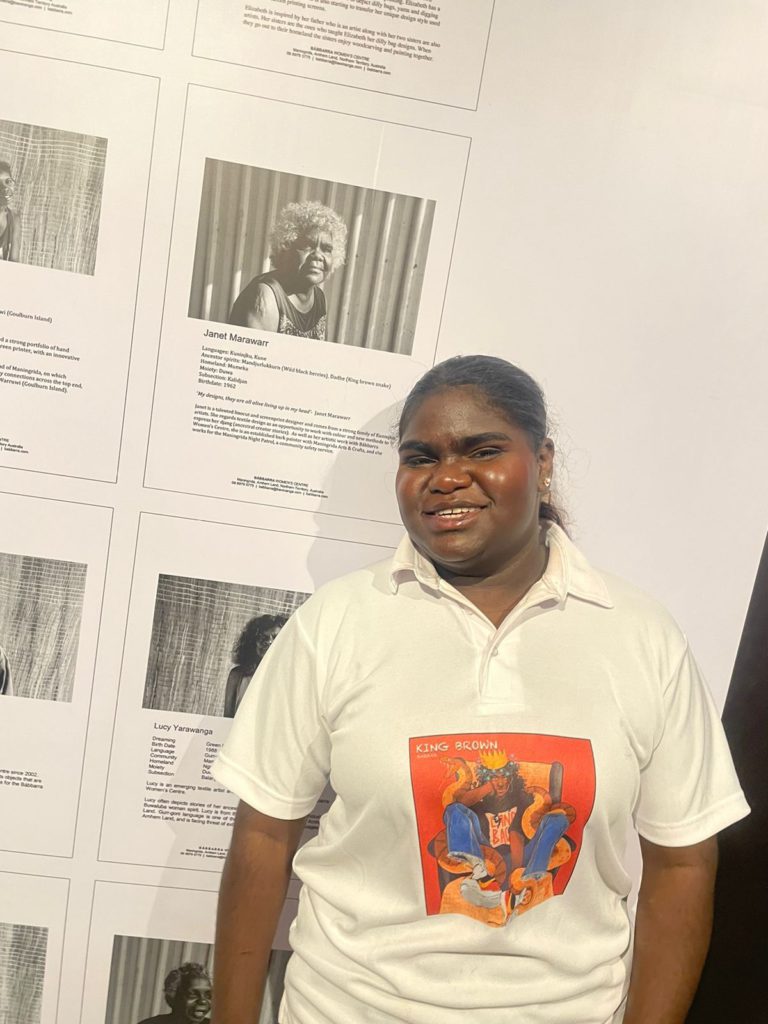
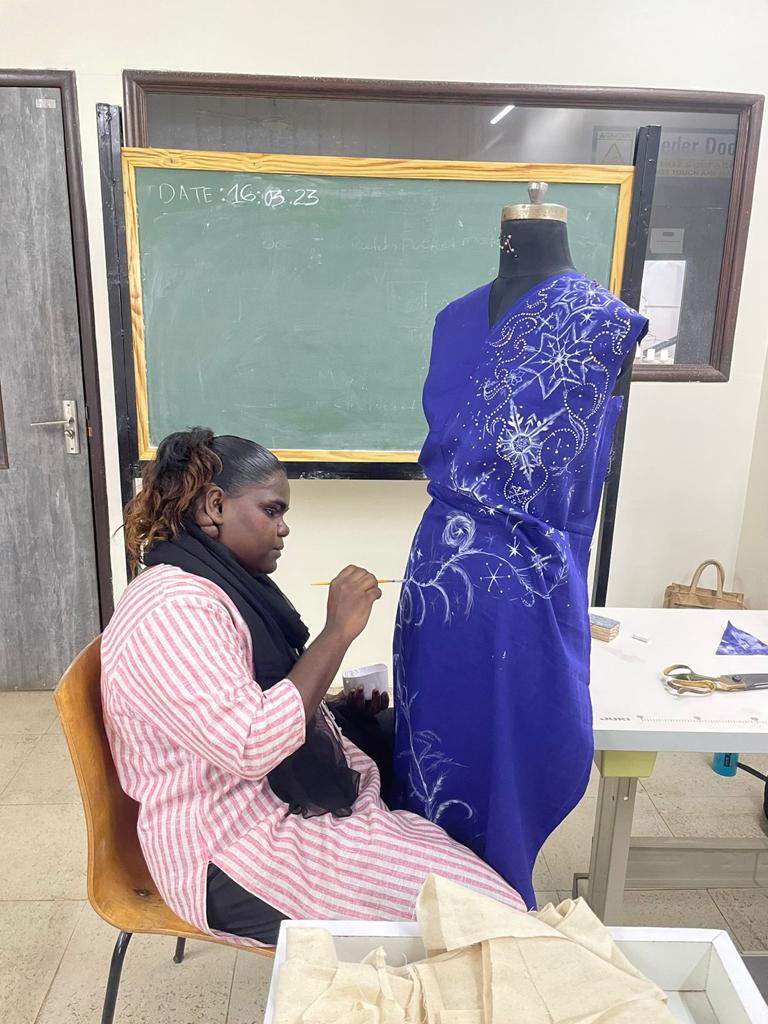
Bábbarra Women’s Centre in Maningrida, Arnhem Land, Northern Territory will collaborate with Tharangini Studio in Bengaluru working with emerging women artists in textile development.
Image: Ben Knapton
Dr Ben Knapton – $67,702
Leading Australian circus and physical theatre director Benjamin Knapton will work with leading performers of traditional Indian physical theatre in a production to premiere at the Royal Opera House in Mumbai.
Image: Raghav Handa 9Source: Sydney dance Company)
Raghav Handa – $58,948
Raghav Handa’s project features an international development collaboration between Australian dance artists and the Attakkalari Dance Centre for Movement Arts at the 2024 India Biennale in Bengaluru.
Image: Félicia Atkinson: Stick and Stone (Source: Liquid Architecture)
Liquid Architecture – $67,347
Melbourne-based Liquid Architecture will co-host, with New Delhi-based Sarai-CSDS, a symposium, workshop, and exhibition exploring creative practices engaged with new technologies in sound and media.
Image: Undercurrent Theatre Company 9Source: Facebook)
Undercurrent Theatre Company – $53,273
West Australian theatre makers Undercurrent Theatre Company’s co-production with Kerala-based VOiD Ensemble.
As the school year hits the half-way mark, many Year 6 students and their families will be starting to think more about the move to high school next year.
Moving to secondary school is a big change for young people. In addition to hearing stories – good and bad – on the school grapevine, students today also see stories via platforms like YouTube and TikTok. These may or may not be helpful or reflect what their experience will be like.
To discover the actual challenges Australian students face, in 2021, the Australian Council for Educational Research conducted a series of student forums with 444 year 6 to 8 students at 15 schools around Australia in New South Wales, Queensland, South Australia and Western Australia.
Students do feel excited
In the forums, students talked about their experiences of moving to high school, their main challenges, as well as potential solutions. We also had conversations on what they felt they needed to know about the move to secondary school.
When asked about their feelings about high school, the responses were mixed. More than 30% said “happy”, “excited” or “confident”. But 25% replied “fear” and 13% said “uncertainty”.
But they are also worried
When asked to explain their fears and uncertainties, 44% of students said academic work. This included concerns around both the difficulty level and amount of academic work in secondary school, as well as increased expectations on students’ performance. As one student told us:
Everyone says that there is lots more homework in high school.
About 30% of respondents also said the new school environment was a concern. This included familiarising themselves with a new campus, finding their way around and the culture of a new school. For example, learning “how things are done at this school” as well as the rules for each classroom. As another student said:
It makes me nervous, knowing that I might get lost.
And 21% said social aspects worried them. This included making new friends, keeping in touch with old friends, as well as the complexities of managing the usual ebb and flow of friendships and interactions at school. One respondent explained:
I feel nervous because there will be new people.
Students also discussed self-management. This included getting up on time, managing public transport, changing to and from sports uniforms, making sure they were prepared for class (having done the homework and brought the correct materials), as well as general time management to fit everything in. Another student told us:
In primary school I had heaps of time. I used to play hockey every weekend. Now I don’t.
What students want
The key message from students was that they wanted independence in their school transition. Students said they wanted some help with the move, because, of course, it was new territory. But they strongly felt that once they had guidance, they were old enough to take care of the challenges themselves.
As some students told us, “take deep breaths in and out when scared”, “the Year 8s have helped me a lot”, “make one friend at a time”, and “just be yourself”.
How parents and carers can help
So, how can adults help, while allowing for plenty of independence? The starting point is simply to engage with your young person: ask questions about their move to high school, share your experiences and identify the details of what your young person wants and needs to know.
Here are some practical things parents and carers can do:
share helpful family stories about change (moving schools, new job, new lifestyle), particularly where there are examples of feeling nervous, making mistakes, and asking for help.
practice travelling to the new school together during the holidays, so students feel confident doing it on their own when the school year begins.
look at the high school’s website and social media pages together to see what sort of information you can find. Follow up with the school if you or your child have questions.
check in with your new school about what orientation activities might be planned. And talk to your existing school: do they have any transition activities?
importantly, talk with your young person about how they and their classmates are feeling about the move to secondary school. What are their challenges? What could help?
There are more examples of how to help in non-profit organisation Life Ed’s Guide to Thrive. Their examples and resources build directly from the research above.
The big picture
The bigger picture is change and uncertainty is a fact of life. Transitioning from primary to high school is an opportunity for young people to learn skills for managing change they can use again in their future.
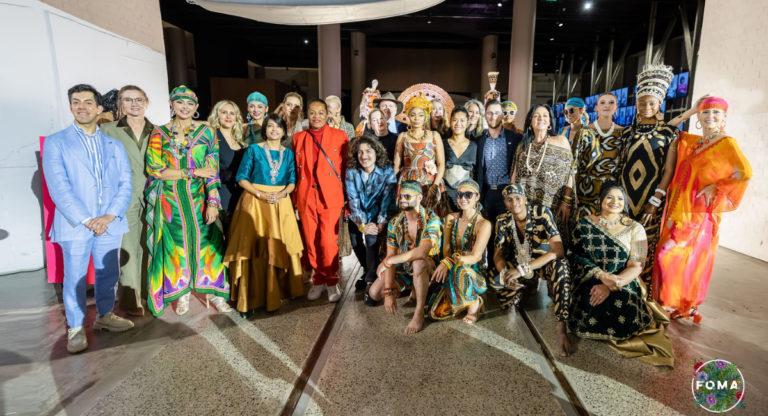
In a glamorous and glittering celebration of Australia’s diversity, local and international fashion designers displayed their beautiful creations on the runway at the Powerhouse Museum in Sydney hosted by Fabrics of Multicultural Australia (FOMA).
Supported by In Country PartnerFiji Consulate General and Trade Commission and Department of Foreign Affairs and Trade, the 2023 reiteration of the FOMA platform aims to stimulate economic growth for the creative sector and generate bilateral trading opportunities while fostering social cohesion.
With nearly 1,000 people in attendance across the two events, Australia’s premier cultural institution, the Powerhouse Museum was proud to witness one of the most diverse engagements of foreign governments, local and international artists.
Runway show at FOMA 2023
The Artistic and Cultural Exhibits showcasing their diverse diasporas included The Fiji Consulate General and Trade Commission with their Bula Premium Kava Tasting, The Embassy of the Kingdom of Morocco with their Moroccan Tea Tasting, The Embassy of El Salvador in Australia, and The Embassy of Israel in Australia with plenty of giveaways.
Hupfeld Evers HoerderMy Paloma
5 local and 5 leading international designers showcased brand and identity through the visual arts lens. Throughout the museum, the Powerhouse came alive through visual artistry with a giant floor to ceiling projection of all Exhibitors and Designers; and a short film in the King Cinema showing FOMA 2023 and in-country partner Fiji Consulate General and Trade Commission country highlights.
Tracey Anne FarringtonCatalina flying boat ‘Frigate Bird II’Kis-SambaNAROK Designs
Participating Local and International Artists and Designers across Exhibit and Fashion Runway include Danielle Mate, Indigenous Brand Ambassador and Cultural Partner, Elaradi FIJI, Holyland Civilians, Hupfeld Evers Hoerder, JAVAD, Kis-Simba, LavaLani Designs, My Paloma, NAROK Designs, Pooja’s Couture, SMODA, Sugarose and Tracey Anne Farrington known for her famous Bondi Beach Bag Co brand.
Runway Show at FOMA 2023
https://www.youtube.com/watch?v=IkKwjzU6ntY&t=40s
FOMA 2023 bought together an array of culturally diverse people, those interested in the artistic world of design, fashion leaders, and those simply there to view multiculturism at its best, and experience everything the Powerhouse had to offer.
Heartwarming performances at FOMA 2023
Present on the night, Lisa Havilah, CEO, Museum of Applied Arts and Sciences (MAAS), Sydney said,
‘The Powerhouse is proud to extend its support to Fabrics of Multicultural Australia (FOMA) and their ongoing efforts to celebrate excellence in fashion while supporting cultural expression.”
Pooja’ CoutureSMODA
“Working in the intersection between design, industry, and cultural heritage, FOMA provides an unparalleled opportunity to present the talent, innovation, and cultural richness of a diversity of Australian communities.’
Lisa Havilah at FOMA 2023
Participating Embassies and their diverse diasporas included The Fiji Consulate General and Trade Commission, The Embassy of the Kingdom of Morocco, The Embassy of El Salvador in Australia, The Embassy of Israel in Australia.
Holyland CiviliansJAVAD
Speaking at the official In-country partnership announcement of the Fiji Consulate General and Trade Commission with FOMA, Daniel Stow, Trade Commissioner reiterated,
‘The Fijian apparel and fashion industry has a rich heritage, with several fashion brands being sold & marketed all over the world. Fiji is home to many leading designers producing quality garments that we thrilled to showcase as part of this year’s FOMA Exhibit and Runway.”
“Many school uniforms, workwear, and sporting jerseys (AFL & NRL) found in Australia are manufactured in Fiji – one of the economy’s most thriving sectors with well-established, first-class infrastructure. As the transportation and manufacturing hub of the Pacific, Fiji is positioned to share its rich trading culture through platforms like FOMA, that provide the opportunity to further strengthen economic activity through its network.’
Daniel Stow at FOMA 2023
FOMA was established in 2018 by entrepreneur Sonia Sadiq Gandhi, Chief Executive of multi-award-winning events enterprise, Gandhi Creations, to promote the diversity of our Australian creative industries sector, whilst providing an opportunity to connect international brands who are looking to invest and grow in the Australian market.
Sonia Sadiq Gandhi at FOMA 2023
In 2023, FOMA, across a 12-month period will present 16 runway shows, empower 45 brands, showcase 400 looks, while presenting works of two First Nations designers, across various councils and cultural institutions, making it a very agile business platform.
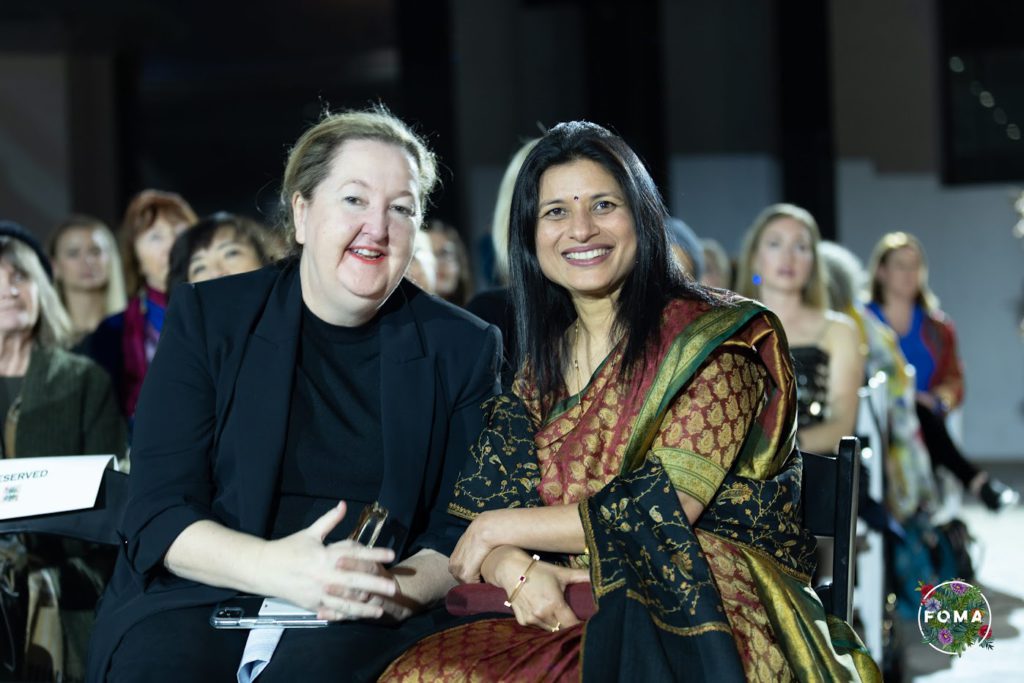
Lisa Havilah with Nimeesha Gupta (wife of CGI Sydney Manish Gupta)
The Faces of FOMA is another ground-breaking concept in Australia. Representing over 33 diverse cultures across the program, showcasing Australia’s diversity in beauty.
The Fair Work Ombudsman has commenced legal action against a farm business in Werribee South, Victoria, alleging it underpaid two employees more than $28,000, falsified records to hide the underpayments, and made unlawful deductions.
Facing court is Lotus Farm Pty Ltd, which primarily produces tomatoes and cucumbers, and one of the company’s directors, Son Thai.
The Fair Work Ombudsman investigated the company after receiving requests for assistance from two former employees, both from non-English speaking backgrounds, who alleged unlawfully low flat hourly rates of pay while working at the farm as pickers and packers.
The Fair Work Ombudsman alleges that Lotus Farm underpaid the two adult Vietnamese-speaking workers a total of $28,530.82 for work performed between June 2017 and September 2020.
It is alleged this occurred due to the two casual employees being each paid unlawful flat hourly rates of pay of between $13-$14, well under the minimum hourly casual rates then owed under the Horticulture Award 2010.
Mr Thai, on behalf of Lotus Farm, allegedly produced 21 pay slips for one employee which stated they worked 15 hours per week and were paid the lawful amount for those hours. The FWO alleges that the worker was in fact generally paid the lower $13-$14 hourly rates and generally worked more hours than the allegedly falsified payslips.
The FWO alleges that Lotus Farm underpaid both employees’ minimum wages and casual loading and underpaid one employee’s overtime and public holiday penalty entitlements. The FWO also alleges unlawful deductions from one employee’s wages.
It is also alleged that the company knowingly or recklessly provided false or misleading records to a Fair Work Inspector, failed to make and keep required records, and failed to provide pay slips to the employees. Mr Thai is alleged to be involved in the contraventions.
Fair Work Ombudsman Sandra Parker said the litigation sent a warning to any employer in the agriculture sector who was breaching workplace laws.
“Improving compliance in the agriculture sector and protecting the vulnerable workers who work there are priorities for the FWO. Employers who underpay their workers and use false records will be found out and risk facing significant penalties,” Ms Parker said.
“Any employees with concerns about their pay or entitlements should contact the Fair Work Ombudsman for free advice and assistance. They can do this in their own language.”
The FWO will allege the reverse onus provisions of the Fair Work Act apply and the company should have to disprove the underpayment allegations given the alleged failure to make and keep records.
The Fair Work Ombudsman is seeking penalties against Lotus Farm and Mr Thai for alleged contraventions of the Fair Work Act. The company faces penalties of up to $66,600 per contravention while Mr Thai faces penalties of up to $13,320 per contravention.
A directions hearing is listed in the Federal Circuit and Family Court in Melbourne on 7 August 2023.
The Gold Coast man, 34, pleaded guilty in November, 2022, to three terrorism charges linked to his involvement in the Syrian Civil War, where he engaged in armed conflict against Assad regime as part of a group aligned with proscribed terrorist organisation Jabhat Al-Nusra as well as advocating for acts of terrorism in the West.
The Queensland Joint Counter Terrorism Team (Qld JCTT), comprised of the AFP, Queensland Police Service and Australian Security Intelligence Organisation, arrested and charged the man in 2019.
He left Australia in 2013 and travelled to Turkiye from where he made trips into Syria between 2014 and 2016.
The man was detained in Turkiye in 2018 and held in custody before he was deported to Australia in December 2019.
AFP Assistant Commissioner Counter Terrorism Krissy Barrett said the investigation highlighted how the AFP’s international network gave it a unique ability to reach across international borders to investigate and prosecute terrorists.
“This investigation was long and complex, involving law enforcement partners here in Australia and overseas in the Middle-East,” she said.
“The safety of the Australian community is always our prime concern and this result shows the AFP’s ongoing commitment to protecting Australians from the threat of violent extremism.”
QPS Security and Counter-Terrorism Command Acting Assistant Commissioner Christopher Jory said: “combating terrorism and violent extremism is a global challenge, and one which we cannot defeat alone.”
“We rely of the cooperative efforts of our national and international partners to keep the community safe,” he said.
“I commend the dedication and professionalism of our counter-terrorism investigation teams, and their commitment to disrupting and apprehending those who advocate or participate in terrorism and violent extremist activities.”
On 25 November 2022, the man pleaded guilty to three charges:
One count of incursions into foreign states with the intention of engaging in hostile activities, contrary to section 6(1) (b) of the Crimes (Foreign Incursions and Recruitment) Act 1978 (Cth);
One count of advocating terrorism contrary to section 80.2C (1) of the Criminal Code 1995 (Cth); and
One count of incursions into foreign counties with the intention of engaging in hostile activities contrary to section 119.1(2) of the Criminal Code 1995 (Cth).
The man’s sentence included a non-parole period of six years and one and a half months.
Average housing rents across Australia have increased by about 10% per year to February 2023 for new rentals, and just a bit lower than that for existing rentals.
Combined with rapidly increasing interest rates and wage rises not keeping pace with inflation, this is placing huge strain on the average household purse, prompting calls for improved rental market conditions.
The Greens are refusing to pass the $10 billion Housing Australia Future Fund bill to provide more community housing unless the federal government supports the introduction of rent controls. But is a rent freeze a simple panacea?
Australia used rent controls effectively during the two world wars. However, they have been used in other countries without much success. Using basic economic principles, there is evidence freezes worsen inequality and actually reduce availability.
Making the market worse, not better
Rentals, in economic terms, are a product. To make a quality product for the market, the producer – the landlord – invests substantial sums of money in construction and maintenance to meet legislated minimum standards for rental properties. They also have to cover land and income tax, insurance and mortgage costs.
The rent from a property is expected to cover these expenses with an average return on investment between 3% and 7%. As soon as there is a rent freeze and the return on investment starts falling – in some cases into the negative – landlords will cut back on what they consider discretionary spending.
This can affect spending on maintenance because all other outlays are fixed. Houses are then allowed to fall into disrepair, leading to landlords selling up or withdrawing properties from the long-term rental market.
Experience in the United States shows how landlords allow some houses to become uninhabitable so they can fraudulently obtain insurance payouts for damage to the property.
Unscrupulous landlords will also try to bypass the minimum rental property standards by offering their properties at above-market rents, capitalising on the high demand and low stock.
Cashing in on the black market
Promoting rent-bidding above the fixed price will only worsen if there are government-imposed rent freezes. While rent bidding has been banned in some states including New South Wales and Victoria, anecdotally it remains widespread.
Then there is a grey area where real estate agents and landlords appear to adhere to the law by not asking for bids, but willingly accept offers above the advertised price from renters desperate to secure a property.
Given the difficulty in evicting renters, and rent freezes not covering costs, landlords might think a premium payment is justified. On paper, it would appear the rent being paid is reasonable and in accord with a government-imposed freeze.
But it also provides the landlord with untaxed cash. This flows on to the building sector where tradies will happily provide their services for cash, thereby expanding the black market.
The reasons for the property supply shortage are longstanding, and many of the causes were worsened by the COVID pandemic. These included material supply delays, increased costs and changes in preferred housing types. Government policies relating to the release of land and drawn-out approval processes for new builds have added to the supply problem.
Other unintended consequences
Battling families are further disadvantaged in the rental market because landlords would prefer to have their properties occupied by professionals with no children. Often, it is easier for owners to charge under-the-table premiums to this cashed-up group prepared to pay to get a particular property.
This increase in social segregation has been reported in Britain, where landlords choose renters from their preferred social and economic cohort. This increases the waiting times for “rent frozen” properties, forcing desperate individuals – usually those already most disadvantaged – to rent illegally through the black market.
This worsens the divide between the wealthy market-insiders and unemployed, migrant, young and other disadvantaged renters. The resulting lack of available rentals worsens worker shortages in some areas and can create pockets of increased violence and crime spawned by uncontrolled hidden black markets.
While freezing rents would appear to be a simple method to increase rental housing affordability, the unintended consequences of any such move will have a long-term negative impact on the total availability of rental housing stock, reducing the quality of housing and increasing a black market in rental housing.
Global experience suggests that improving supply, by easing building restrictions and scrapping red tape for new developments, is likely to be a more effective policy tool in Australia. Local councils and state governments need to simplify and expedite the process for approving new developments at the same time as reducing taxes on rental properties, both during construction and later.
The quality of the educational experience for both international and domestic undergraduate students at Australian universities has improved since the pandemic.
The results of the 2022 student experience and international student experience surveys have been released today and show encouraging trends, although the impacts of COVID-19 are still being felt.
In 2022, the largest source of countries international undergraduate students were from included China, with around 24 per cent of SES international student responses, followed by Nepal, India, Vietnam and Malaysia, which together make up almost 60 per cent of total undergraduate international student responses.
Minister for Education Jason Clare said in a statement:
“It’s great to see the high quality of teaching at Australian universities be recognised by both international and domestic students. It’s a testament to the hard work of our educators. The results underscore Australia’s great reputation for delivering high quality education.”
The two annual surveys collect data from students across 141 higher education providers, including 42 universities.
International students make up around 17 per cent of undergraduate responses mainly sourced from 5 countries (China, Nepal, India, Vietnam and Malaysia) which make up almost 60 per cent of total undergraduate international responses.
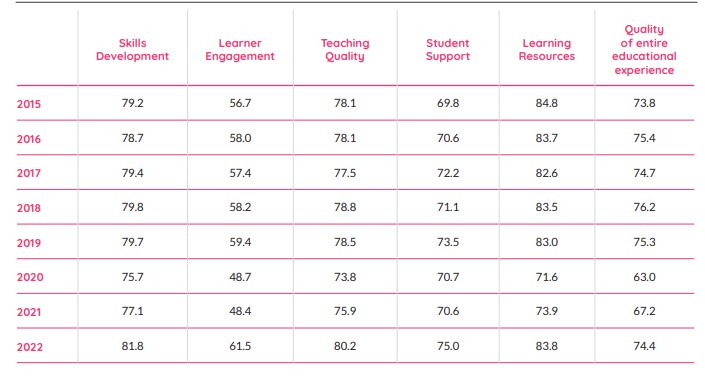
Image: International undergraduate student education experience, 2015–2022 (% positive rating) / Source: Table 1 – 2022 SES
International undergraduate students are mainly clustered in just a few study areas and institutions, with Business and management, Computing and information systems and Nursing.
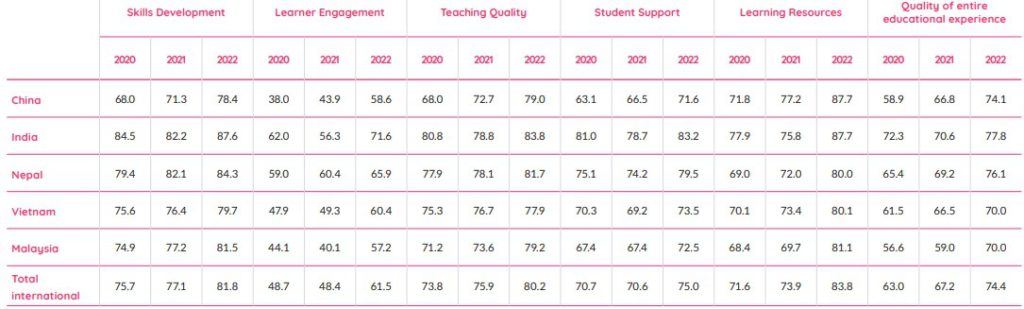
For 2022, Indian international students have rated Australian institutions highly on Skills Development (87.6%), Learner Engagement (71.6%), Teaching Quality (83.8%), Student Support (83.2%), Learning Resources (87.75), and Quality of entire educational experience (77.8%).
Image: International undergraduate student education experience by source country, 2020-2022 (% positive rating) / Source: Table 4 -2022 SES
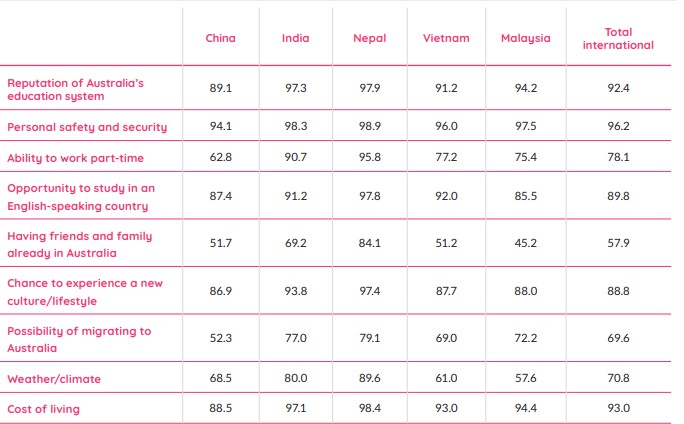
The report notes that, in general, Indian and Nepalese respondents tended to rate having family and friends in Australia and the possibility of permanent residency/migration as key reasons to come here to study than Chinese, Vietnamese and Malaysian respondents.
Image: International undergraduate student reasons for choosing to study in Australia by source country, 2022 (% importance rating) / Source: Table 16 – 2022 SES.
As per the report, the proportion of international student respondents located off-shore at the time of the survey increased from 12.1 per cent of undergraduate respondents in 2020 to 33.9 per cent in 2021 and back down to 8.9 per cent in 2022.
According to the surveys, the quality of Australian educators has been recognised with international students recording an all-time high rating for teaching quality at 80 per cent, on par with domestic students.
The Quality Indicators for Learning and Teaching (QILT) are a suite of government endorsed surveys for higher education, across the student life cycle from commencement to employment.
Other key findings include:
The rating international students gave to the quality of their entire educational experience rose 7 per cent to 74 per cent.
Domestic students rated the quality of their entire educational experience at 76 per cent, up from 74 per cent.
Female students rate their experience higher (77 per cent) than male students (74 per cent).
Students aged over 40 rates their experience higher (81 per cent) than those under 40.
International undergraduate students rated their overall living experience in Australia highly, with 94 per cent of international students rating their living experience positively.
International students rated personal safety and security as the main reason for studying in Australia at 96 per cent.
Students studying agriculture and environmental studies (84 per cent), veterinary science (81 per cent) and rehabilitation (82 per cent) rated their overall experience highest.
The full results from the 2022 Student Experience Survey and the 2022 International Student Experience Survey can be found at the QILT website www.qilt.edu.au.
NSW will today take a global lead in addressing modern slavery, with the state’s independent anti-slavery commissioner launching a three-year strategic plan ‘Working Together for Real Freedom’ outlining concrete steps to combat the rise in modern slavery across NSW.
The estimated number of people in modern slavery in NSW has grown to over 16,400. The action comes as new polling released today finds 78 per cent of respondents want governments to do more to protect people from modern slavery.
The polling, commissioned by the Office of the NSW Anti-slavery Commissioner and conducted by Essential Research, also reveals that many people are unaware of the severity of the issue in NSW, with six in ten Australians saying they had no idea the number of people in modern slavery in NSW was so high, and more than 40 per cent people incorrectly believing it is illegal for Australian businesses to trade with overseas companies that engage in modern slavery.
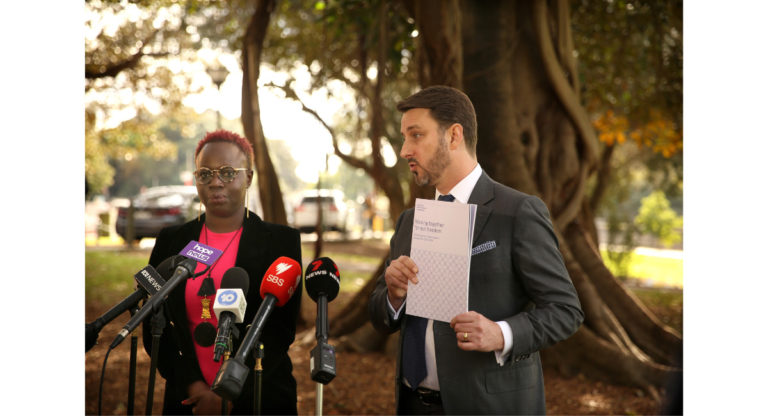
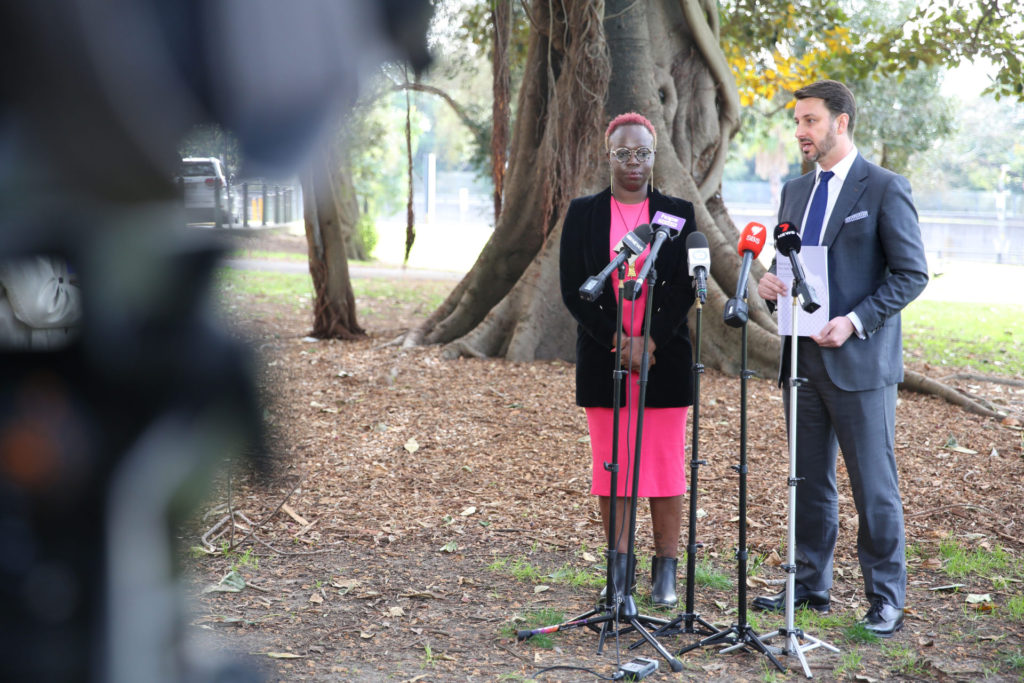
CEO of Global Fund to End Modern Slavery, Sophie Otiende and the NSW Anti-Slavery Commissioner, James Cockayne co-present the NSW Anti-Slavery Commission Strategic Plan 2023-2026 to the Media during a press conference at NSW Parliament House, Sydney. June 22, 2023. Photograph by James Alcock / NSW Anti-Slavery Commission.
NSW Anti-slavery Commissioner, Dr James Cockayne – the first Anti-slavery Commissioner in the country and just the second globally – said the ground-breaking plan, ‘Working Together for Real Freedom’ sets the stage for effective anti-slavery action in New South Wales over the next three years, positioning the state at the forefront of the global effort to combat modern slavery. Key elements of the plan include: • removing products of modern slavery from public procurement • establishing a support and referral hotline for those in modern slavery • putting modern slavery survivors at the heart of anti-slavery efforts • fostering responsible business practices in the private sector • equipping frontline workers to identify and report modern slavery • establishing an expert Advisory Panel and holding an anti-slavery forum twice a year
“It might seem like a foreign concept to many, but modern slavery is all around us. It’s happening right now on farms in regional NSW, in shops and construction sites in our cities – perhaps even in a house down the street.”
“We see women and children made vulnerable through domestic and family violence; cleaners and security guards working in office blocks, caught in the grip of debt bondage; girls forced to marry here in NSW or overseas; and people living with disability who are exploited in segregated workplaces or in institutional care.
NSW Anti-Slavery Commissioner James Cockayne addresses guests during the launch of the NSW Anti-Slavery Commission Strategic Plan 2023-2026 at NSW Parliament House, Sydney. June 22, 2023. Photograph by James Alcock / NSW Anti-Slavery Commission.
“Everyone has a human right to be free from slavery, but right now there are thousands of people being robbed of that right here in NSW. Sophie Otiende, a visionary global survivor-leader and Chief Executive of the Global Fund to End Modern Slavery will provide a keynote address at the launch, emphasising the pivotal role of centring people with lived experience in the fight against modern slavery.
Ms Otiende says that by embedding survivor voices in decision making process, we can effectively pave the way towards a world that is free from slavery. Dr Cockayne said the strategic plan was developed through extensive consultation with experts, stakeholders and survivors of modern slavery. More than 2,500 people contributed to the consultation process between September 2022 and May 2023.
“This is an ambitious plan compared to business as usual, but not when compared to the size of the problem we are facing. There’s no time to waste. It’s time to take a stand to end modern slavery in New South Wales.”
WHEN Minister for Home Affairs Pio Tikoduadua pointed out last year that the use and distribution of hard drugs had spiraled out of control and was a far bigger disaster than climate change, he was not exaggerating the situation.
Month after month, it is either marijuana seizures or arrests over possession of illicit drugs, none more dangerous than the highly addictive illegal crystal meth (ice) or crystal methamphetamine, a strong drug that affects the central nervous system and one that is widely distributed throughout the country and Pacific region.
The value of this drug? Millions of dollars. From 2017 to 2021, the Fiji Police Force revealed that 292 arrests were made during that period with $5.6 million worth of methamphetamine seized as a result.
The Office of the Director of Public Prosecutions estimated that funds from illicit drug activities were more than $10m annually, and that local traffickers could make between $5,000 and $10,000 a day from the sale of cocaine and methamphetamine in the domestic market.
Towards the end of last year to May this year, police conducted several drug raids in Samabula, Cunningham, Nakasi, Raiwaqa, Nausori, Ba, Lautoka and Nadi. Just last week, arrests were made in Nadi, Toorak and Uluirua Settlement in Korovou for unlawful possession of illicit drugs including methamphetamine.
Fiji continues to fight the war on drugs since the 1980s and recently, hard drugs are now more easily available on the streets in major towns and cities. Increasing news coverage on the use and sale of hard drugs in Fiji, particularly methamphetamine, have brought to light the need to raise awareness on the dangers and prevalence of illegal narcotics and meth use among youths.
But some tertiary students and youths in the Western Division, are finding it difficult to let go of this ‘lucrative’ business.
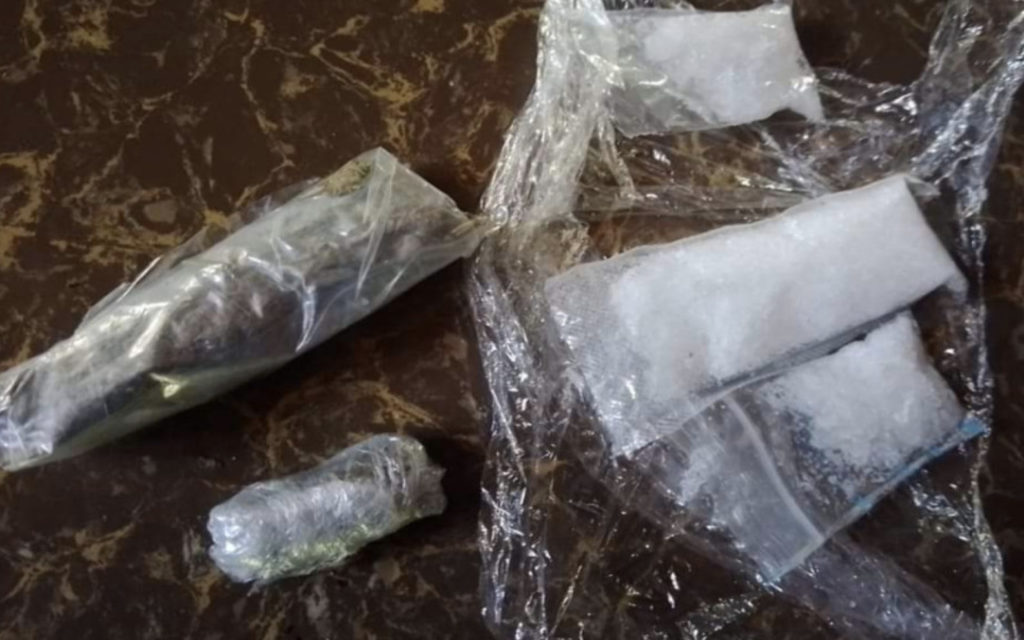
Image: A joint raid conducted by the Western Division Taskforce and the Fiji Detector Dog Unit in 2022, resulted in the arrest of a 39-year old man of Namoli, Nadi following the alleged discovery of white crystals believed to be methamphetamine in his home (Source: FIJI POLICE FORCE)
John Doe, a male in his 20s from Nadi, spoke to Wansolwara on anonymity, about the meth menace in the tourist hotspot.
“Nadi is not like how it used to be and with the introduction of meth, it really took off as it had a longer effect,” he said.
Bruno James, a young man also in his 20s from Nadi, shared that ice could be sold for as much as $50, but the price would vary depending on the size and quality.
The Fiji Police Force estimated the average cost to be about $500 per gram.
“Ice is consumed in two ways – the most common way users consume meth is by using a syringe to inject the drug into their system.
“The other way that users consume meth by crushing the ice into powdery form like salt crystals and then use credit cards or bus cards to make thin lines of the powder like substance and inhale through their nose,” he added.
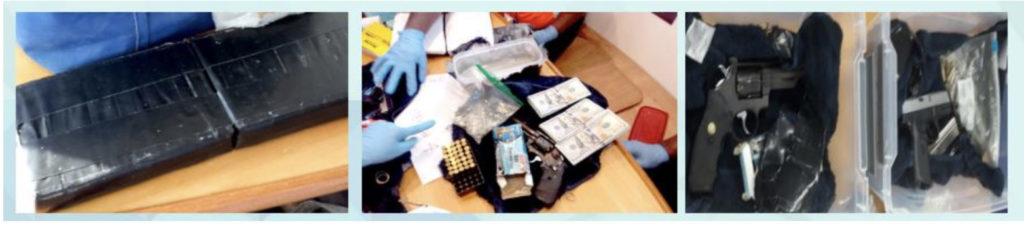
Image: Confiscated drugs, ammunition and weapons from raids conducted by the Fiji Police Force and Fiji Revenue and Customs Service (Source: FIJI POLICE FORCE)
Others like Adam Jones wants to get out of the illegal drug business but it’s not that easy as his life and that of his family would be in jeopardy.
“I dropped out of school and got roped into the drug trade in my late teens,” said Jones, the sole breadwinner of his family.
“I do this to earn money for my family, but I want to leave it. I want to get out, but I’m trapped and if I leave, it would be dangerous for me and my family,” he claims.
As part of an in-depth investigation by Wansolwara on the widespread and dangerous use of meth, not just marijuana, among tertiary students in two of Fiji’s most populated divisions, Suva, and Nadi, it was found that acquiring meth was exactly like ‘buying lollypops’, a revelation from Vice World News investigative report on the meth trade in Fiji.
It was from this report that Mr Tikoduadua referred to when he spoke of the grave situation and cataclysmic impact of the use of hard drugs like methamphetamine on education, health and poverty.
“I had said this problem had a way of worming itself into the very safe space of family.
“Tragically, our worst fears have been confirmed with Vice World News highlighting that meth is as easily accessible as lollipops, which means our children and youths are being viciously targeted by unscrupulous drug kingpins,” he had said.
One does not have to go far to find a ‘peddler’, whether it be at a public space like the bus depot, or simply chatting to a taxidriver or sex workers, the experiences were similar. They had used hard drugs at some point in their life, and so too visitors to Fiji, as one taxidriver quipped that, “some tourists around here are also regular meth users”.
Joint operations between police, enforcement agencies, and the Fiji Revenue and Customs Service (FRSC) continue to keep these foreign influences at bay. In June 2018, FRSC officers found drugs onboard the yacht of former Australian horse trainer, John Nikolic, at the Denarau Marina in the Western Division. The court heard that Nikolic had told his wife that a Columbian national had put something in their yacht because he owed some bad people money.
The couple had imported 12.9 kilograms of cocaine and 34.4 grams of methamphetamine with an estimated value of between $20 million to $30 million. They also failed to declare that they had in their possession two pistols with 112 rounds of live ammunition.
They were sentenced to 23 years in prison for the offences, with an 18-year non-parole period.
This year, High Court in Lautoka judge Justice Aruna Aluthge sentenced a Lautoka man found with 900 grams of methamphetamine and 25 grams of marijuana to 13 years in prison with a non-parole period of 11 years, but not before addressing the illegal drug trade.
“The illicit drug offending has become a serious problem in Fiji. Higher quantities of hard drugs such as methamphetamine have been seized in recent years,” Justice Aluthge had said.
“Deterrence is a legitimate sentencing purpose in the Sentencing and Penalties Act and real-life experience tells us that it works for most people.
“In the context of methamphetamine sentencing, particularly relevant purposes include deterrence of the offender/other persons from committing similar offending and the protection of the community.”
Justice Aluthge had said the illegal drug dealing was a lucrative business and those who were in this business had no regard for the harm that it caused to the community at large.
The joint efforts of law enforcement in interrupting organised crime activities are one of the key strategies in preventing the flow of dirty money to support their illicit trade and lavish lifestyle, according to Police Commissioner Juki Fong Chew.
He had said the Fiji Police Force could not tackle the illegal drug trade alone, and aside from law enforcement partners in Fiji and the region, community support was needed through the sharing of information, “to be able to disrupt these illegal networks and safeguard our communities from the devastating impacts of illicit drugs”.
FRSC chief executive officer Mark Dixon had also reiterated the commitment of Fiji’s law enforcement agencies to tackle the illicit drug trade in Fiji.
This news article was first published in Wansolwara and has been republished here with the kind permission of the editor(s).
Contributing Author(s): Ioane Asioli and Viliame Tawanakoro are senior editors for Wansolwara, The University of the South Pacific Journalism Programme’s flagship student training newspaper and online publication.
Disclaimer: The opinions expressed within this article are the personal opinions of the author. The Australia Today is not responsible for the accuracy, completeness, suitability, or validity of any information in this article. All information is provided on an as-is basis. The information, facts, or opinions appearing in the article do not reflect the views of The Australia Today and The Australia Today News does not assume any responsibility or liability for the same.
It’s that time of the year when reports on student learning come home. Anxiety for students and their parents and caregivers often tags along.
Long gone are the days when a school report was handwritten page, with wisdom like “tried hard, but needs to try harder”, along with percentages or letter grades.
Now students get multi-page reports, with a dazzling array of verbal and sometimes graphical data. Most require significant time to digest and interpret.
But despite all the effort schools make to produce these documents, parents can finish a report and have little idea whether their child is doing OK.
How did we get here?
A major part of the problem is Commonwealth regulation on education. This requires schools to provide a report to “each person responsible” for a student “at least twice a year”. It must also be “readily understandable” to a parent or caregiver.
For students from Years 1 to 10, the report must give “accurate and objective assessment” of the student’s progress and achievement, including an assessment of the student’s achievement:
against any available national standards
relative to the performance of the student’s peer group
reported as A, B, C, D or E (or on an equivalent five-point scale) for each subject studied, clearly defined against specific learning standards.
Information gets swamped
We see the well-intentioned desire to provide parents and caregivers with timely and useful information becoming swamped by the rest of the requirements around reports.
The combination of the regulation’s demand for accurate, objective standards, relative to the peer group, and on a five-point scale is a recipe for communicating a lot of words and overwhelming data. The language used can also be inconsistent or not clearly defined.
Both a 2019 Australian Council of Education Research review and anecdotal reports suggest parents do not find reports particularly clear or helpful. Or as some described them to The Sydney Morning Herald in 2018, “sterile and technical” and “next to useless”.
Focus is also on achievement at certain points (say, the half-year mark), rather than learning progress. And that doesn’t take into account the increasing number of Australian households where English is not the language spoken at home.
How does this fit with other ideas about school?
This highly standardised approach also conflicts with other trends in education. There is a growing understanding we need to take a more individualised and flexible approach to support all kinds of learners at school.
But don’t hold your breath the regulations will change any time soon.
The government is consulting with parents, schools and communities about the next National School Reform Agreement, which is due to begin in 2025, but this does not specifically ask about reports.
Some schools do it differently
However, some schools are already doing reports about student learning very differently, albeit with very different philosophies and practices.
Some Australian schools are using personalised curricula and reporting through practical projects such as an album of recorded music to demonstrate a student’s progress.
Others schools focus on “dispositions towards learning” that prioritise entreprenurial skills and innovative thinking that will set them up for post-school life.
Other schools get students to draw evidence from their curricular and co-curricular achievements that build towards a microcredential mapped to the Australian Skills Quality Authority. Microcredentials are short skills-based courses, that can be counted as part of a larger certificate or diploma.
Non-profit education organisation Learning Creates Australia has developed a “new metrics” framework for the senior years of high school. This redesigns the current focus on tests and scores, that (incorrectly) assumes the goal for all secondary students is to go to university. They suggest a broader student profile which includes learning progress in areas of particular interest and relevance to students.
Other schools are taking a classical approach. Students study classical literature, mathematics, and science along with philosophy and aesthetics. Assessment relies on the teacher’s judgement about the student’s progress, rather than prescribed “predicted outcomes”.
Reporting includes formal documents, but also regular conversation between parents, teachers, mentors and students.
Schools and parents can create alternatives
All these alternative approaches place critical thinking and creativity at the core of their learning philosophy, assessment, and reporting. Each prioritise evidence of student learning that is meaningful to them and their community.
This suggests standardised reporting on a five-point scale leaves a lot to be desired. But until regulatory constraints change, they’re here to stay for the foreseeable future.
Perhaps it’s better, then, for school communities to create better solutions for themselves. Each of the examples here show how powerful learning can be when parents and caregivers are meaningful partners with the school, rather than passive recipients of predetermined outputs.
A 38-year-old Australian woman who had been battling depression for 26 years became the first to undergo a psychiatric operation in Mumbai, India.
It is reported that this could be perhaps the first such case since the Mental Healthcare Act was passed in 2017 which allows for only a patient’s informed consent along with approval of a specially constituted state mental health board.
For the Australian patient, the process of getting permission from the state to actaul operation took almost 10 months.
Image: Dr Doshi (Source: https://neurologicalsurgery.in/about-dr-paresh-doshi/)
Leading neurosurgeon Dr Paresh Doshi (M.S., M.Ch.), in charge of the Stereotactic and Functional Neurosurgery program at Jaslok Hospital, told local media:
“Maharashtra has not only been ahead of many other states in setting up a mental health board, it has now become the first to give permission for a surgery.”
In fact, Dr Doshi, who has conducted over 650 Stereotactic surgeries including 450 deep brain stimulation (DBS) surgeries, is credited with several firsts in India including the first DBS for depression in Asia and Australia performed in 2013.
Dr Doshi is President of The Neuromodulation Society of India and Director of the Asian-Australian Society for Stereotactic and Functional Neurosurgery. He is considered a pioneer in the field of deep brain stimulation (DBS) and has performed the largest number of DBS surgeries in India.
He added:
“We operated on three patients with depression in the past and they are doing well.”
Dr Swapnil Lele, director of health services in Maharashtra, told the media that the Australian patient had tried various combinations of antidepressants and therapies over the years.
“Although she is a trained occupational therapist, she stopped going out for work seven years back.”
The patient’s brother said that she had tried different antidepressants and was prescribed at least five medicines in very high doses than usual.
“She also had undergone ECT (electroconvulsive therapies) and cognitive and behavioural therapy, without much benefit.”
The family got Dr Doshi’s reference from two Australian patients who had undergone DBS for depression at Jaslok Hospital years back.
Image: Dr Doshi (Source: https://neurologicalsurgery.in/about-dr-paresh-doshi/)
In India, Maharashtra and Karnataka are the only states where DBS surgeries have been regularly conducted for depression in the past.
Dr Doshi observed that during surgery the Australian patient’s anxiety significantly dropped and her mood improved slightly during the surgery.
‘“During DBS surgery, the patient is awake so that we can map responses while placing the electrodes.”
The patient and her brother have left India for Melbourne and Dr Doshi added that it will take a few months for the surgery’s effects to show clearly on the patient’s overall health.
The prestigious Australia India ‘Unnati’ Research Collaboration Grants have been awarded to 12 Australian researchers for a range of projects.
The list of projects includes a digital map designed for women’s safety, research tackling fluoride pollution in groundwater, and a test to support gut health.
🌏🔬 The prestigious Unnati Research Collaboration Grants have been awarded to 12 Australian researchers, supported by Indian experts. These impactful projects will advance global knowledge and strengthen bilateral research links. More 👇https://t.co/DsmTFbjQUY#UnnatiGrantspic.twitter.com/fWWiJISRE7
— Australia India Institute (@AIinstitute) June 26, 2023
The Unnati Grants, administered by the Australia India Institute and funded by the Australian Government Department of Education, are anchored on the principle of the Hindi word ‘unnati’, striving to advance the impact and outcomes of research collaborations.
Twelve Australian researchers across nine universities have been awarded grants of up to $30,000. They will be supported by Indian partners from more than 20 higher education institutions, research centres, and industry.
Image: CEO of the Australia India Institute, The Hon Lisa Singh (Source: Twitter)
CEO of the Australia India Institute, The Hon Lisa Singh said in a statement that the selection process was highly competitive, with more than 180 applications via the Australian Researcher Cooperation Hub-India.
Ms Singh said:
“The Selection Panels were impressed by the high quality and diversity of the research proposals received, demonstrating the immense interest and enthusiasm for fostering research collaboration between Australia and India.”
She added:
“We are delighted to support these outstanding researchers and their innovative projects through the Unnati Grants. The selected projects have the potential to make significant contributions to their respective fields, advancing knowledge globally and strengthening bilateral research links.”
The grants have been awarded across four priority areas of mutual importance between Australia and India: food and water security, the future of healthcare, environmental change and energy frontiers, and digital humanities and intelligent futures.
The funding will be used to progress existing research collaborations and support new partnerships across a range of impactful topics, including:
Food and water security
Making village groundwater visible: Outscaling MARVI Australian Principal Investigator: Dr Dharma Hagare, Western Sydney University Indian Co-Investigators: Dr Parmeshwar Udmale, Indian Institute of Technology Bombay; A/Prof. Shive Rai, Banaras Hindu University; Prof. Jayantilal Patel, Sardar Vallabhbhai National Institute of Technology
Innovative solutions for safe drinking water in rural India Australian Principal Investigator: A/Prof. Meenakshi Arora, University of Melbourne Indian Co-Investigator: Dr Manoj Tiwari, Indian Institute of Technology Kharagpur
Climate Adaptation, Food and Water Security in the Indian Sundarbans Project Australian Principal Investigator: Dr Annabel Dulhunty, Australian National University Indian Co-Investigators: Dr Jenia Mukherjee, Indian Institute of Technology Kharagpur; Ms Sukanya Banerjee, Rabindra Bharati University
Research and innovation partnerships are instrumental in education’s role as the flagship sector of the Australia-India relationship.
Future of Healthcare
Developing biomarkers for leaky gut Australian Principal Investigator: Dr Purnima Bhat, Australian National University Indian Co-Investigators: Dr Rupjyoti Talukdar and Dr Nageshwar Reddy, Asian Institute of Gastroenterology
Building clinical trial capacity in India through the RESPOND Trial Australian Principal Investigator: Associate Professor Kristen Gibbons, The University of Queensland Indian Co-Investigators: Professor Vivekanand Jha, The George Institute for Global Health India; Professor Jayashree Muralidharan, Postgraduate Institute of Medical Education and Research
Developing an enhanced model of care for survivors of exploitation Australian Principal Investigator: Emma George, University of Adelaide Indian Co-Investigators: Professor GVS Murthy, Indian Institute of Public Health; Dr Beryl D’Souza, Good Shepherd Hospital
Environmental Change and Energy Frontiers
Heat stress in vulnerable populations Australian Principal Investigator: Professor Petra Tschakert, Curtin University Indian Co-Investigators: Dr Anshu Ogra and Professor Upasna Sharma, Indian Institute of Technology Delhi
Clean energy for healthy environments and lives in India Australian Principal Investigator: Professor Sotiris Vardoulakis, Australian National University Indian Co-Investigators: Professor Shiva Nagendra and Professor Krishna Vasudevan, Indian Institute of Technology Madras; Mr Raghuraman Chandrasekaran, E-Hands-Energy
Phase change energy storage technology for temperature and fire control of batteries and electronics Australian Principal Investigator: Professor Frank Bruno, University of South Australia Indian Co-Investigators: Dharam Buddhi, Uttaranchal University, Dehradun; Professor Richa Kothari, Central Jammu University; Mr Chanderashekhar Dhangar, Adiabatic Technologies Pty Ltd
Digital Humanities and Intelligent Futures
Improving women’s safety using digital technologies Australian Principal Investigator: Dr Jinwoo (Brian) Lee, University of New South Wales Indian Co-Investigators: A/Prof. Sundeep Kumar and Dr Anoop Shukla, Manipal Academy of Higher Education
Digital Shillong: Mapping, visualising, and interpreting urban historical data Australian Principal Investigator: Professor Andrew May, University of Melbourne Indian Co-Investigators: Professor Desmond L. Kharmawphlang, North-Eastern Hill University; Dr Madeline Tham, Indian National Trust for Art and Cultural Heritage (Meghalaya Chapter); Mr Nathaniel Majaw, Northeast India Audio-Visual Archive, St Anthony’s College
Strengthening Australia-India cybersecurity partnership for digital innovation Australian Principal Investigator: Dr. Kamaljeet Sandhu, University of New England Indian Co-Investigators: Professor Amlan Chakrabarti, University of Calcutta; Dr. Rajesh Many, Mahatma Gandhi University
— HEAL Network – Healthy Environments And Lives (@HEALenviron) June 26, 2023
Further, Ms Singh observed:
“We look forward to witnessing the progress of the Unnati Grant projects and the long-lasting impact they will leave on the research landscape of both countries. Through collaboration, we can harness the expertise and resources of both nations to achieve greater progress in key areas of priority, leading to lasting social and economic outcomes for Australia, India and the planet.”
Grant activities under ‘Unnati’ will be completed by 8 December 2023.
A woman has been sentenced to 2 years 11 months imprisonment today (Friday, 23 June, 2023) by the Parramatta District Court for money laundering offences as a part of Taskforce Avarus.
The Sydney woman, 59, who was regarded as an “auntie” in an alleged Vietnamese organised crime network, was the signatory to 89 individual bank accounts and responsible for the coordination of criminal funds throughout Australia.
Image: Operation Avarus (Source: AFP)
The AFP arrested the woman following a search warrant of two units at a complex in Carramar, New South Wales, on 13 December, 2021. At the complex, police seized more than $2.6 million in cash, which had been concealed in several compartments throughout the home and in a cavity beneath a religious shrine.
AFP officers also found a cash-counting machine, multiple mobile phones and other items linked to money laundering following an extensive forensic examination of the property.
The woman, who was at one of the units when police arrived was arrested and charged with engaging in conduct in relation to money that was proceeds of a general crime over $1,000,000, contrary to section 400.3(2A) of the Criminal Code 1995 (Cth).
Image: Operation Avarus (Source: AFP)
AFP Detective Sergeant Bobby Higgins said the investigation had disrupted the activities of a significant money-laundering organisation that services numerous criminal groups of Sydney’s underbelly. With dedication, the AFP will continue to safeguard the community, ensuring that organised crime does not reap profits at society’s expense.
“During this investigation, we removed more money from the criminal economy in one day than 20 average Australians makes in a year,” Det-Sgt. Higgins said.
“Today’s outcome should serve as a warning to offenders that the AFP is working tirelessly with partners to protect the community and Australia’s legitimate economy.
“We will continue to seize illicit funds to disrupt organised crime syndicates from using those profits to fund other illegal ventures.”
The question on many minds right now is why did some of the world’s richest men risk death to venture to the bottom of the sea in a cold and cramped “experimental” submersible for a chance to glimpse the wreck of the Titanic?
The “unsinkable” ship that sunk on its maiden voyage across the Atlantic in 1912 after colliding with an iceberg is arguably the world’s most well-known boat. The Titanic is recognisable to more of the world’s population than, say, the Niña, the Pinta, and the Santa Maria (Christopher Colombus’s fleet that launched the Spanish conquest of the Americas), or Captain Cook’s HMS Endeavour (the tall ship that set in motion the British conquest of Australia). The Endeavour’s long-forgotten wreck was found scuttled off the coast of Rhode Island just last year.
The sinking of the Titanic as depicted in Untergang der Titanic, a 1912 illustration by Willy Stöwer.
Opulence and immigrants
There are two reasons why we are so drawn to the Titanic, and why the super-rich are apparently willing to part with their money and even risk their lives to catch a glimpse of its broken hull.
The first is its opulence. The White Start Line that built the Titanic advertised the ship as the most luxurious ever to set sail. Wealthy passengers paid up to £870 for the privilege of occupying the Titanic’s most expensive and spacious first-class cabins. To put this 110-year-old money in perspective, when the first world war broke out in 1914, infantry soldiers in the British army were paid a basic salary of around £20 per year.
Titanic departing Southampton on 10 April 1912. Wikipedia
Titanic movies and exhibitions are popular because audiences enjoy the voyeurism of gazing on the ship’s beautiful furnishings, the stunning clothes worn by its rich and beautiful passengers, and their elaborate meals in fancy restaurants. First-class passengers feasted on multi-course dinners with salmon, steak, and pâté de foie gras. Chefs in Australia and around the globe occasionally recreate Titanic meals for curious clients.
Hundreds of poor immigrant passengers, represented by Jack (played by Leonardo DiCaprio) in Cameron’s movie, were also aboard the Titanic. They lived in crowded quarters and enjoyed less thrilling meals such as boiled beef and potatoes. If their ilk were the only people on board the Titanic, the ship would arguably have faded quickly from memory. https://www.youtube.com/embed/erAQ9LkftwA?wmode=transparent&start=0
The power of the sea
The fact the Titanic was touted as unsinkable also adds to its allure. The ship, whose name evoked its massive size, was engineered to cheat the ocean. When it departed England it symbolised man’s domination over nature. At the bottom of the Atlantic, it serves as a visceral reminder of the indomitable sea’s awesome power.
The same two factors – the excess of the voyage, and its defeat by the sea – are now driving the current global interest in the Titan submersible disaster. Few world events garner so much attention, including statements from Downing Street and the White House, and live news blogs from The New York Times and the Guardian.
The Titan, like the Titanic, commands our attention because of its obscenely rich passengers, who each reportedly paid US$250,000 (or between four and five times the average US salary) to visit the wreck of the famous ship that battled the sea and lost.
And then there is the intriguing mystery and power of the sea. News outlets are publishing helpful graphics that try to teach our terrestrial brains to comprehend just how deep the ocean is, and how far below the sea’s surface the Titanic and possibly the Titan lie.
The Titanic’s bow, photographed in June 2004. Wikipedia
The limits of human knowledge
Last night I spied Neal Argawal’s Deep Sea website circulating on social media. The site allows viewers to scroll from the sea surface to the sea floor, diving down past images of various marine animals that inhabit different oceanic depths.
At 114 metres is an orca, and 332m marks the the deepest depth a human has ever reached using SCUBA gear. It takes a lot of scrolling to descend to the Titanic almost 4,000m below the waves.
Besides gross income inequality, reflecting on the Titan and the Titanic invite us to confront just how little we can “see” of the sea in this age of mass surveillance. Not even the powerful US navy, assisted by the Canadian, UK and French governments, can muster the resources and technology required to locate, let alone rescue, the missing submersible.
As the sea seems to have swallowed yet another ship, we are reminded of limits of human knowledge and mastery over the ocean.
BLUE Prosperity Fiji is an opportunity for Fijians to have an improved understanding of our ocean and resources, as well as create a space to better navigate its development and protection, says Arthur Sokimi, the programme’s country manager.
To this extent, he said the Blue Prosperity Fiji programme had embarked on a large-scale ocean science expedition across Fiji to gain a better understanding of existing marine life and resources.
This, according to Mr Sokimi, was the first nationwide ocean science expedition to be undertaken in the country, and would support other numerous surveys that had been done previously from Macuata to Yasawa, the Great Sea Reef, Vatu-i-Ra passage, Lau, Beqa and Yanuca.
“Determination of these sites was by the Ministry of Fisheries, led by their research division,” he said.
“The selection was informed by the needs of Government to understand the different parts of the country and the status of our coral reefs and marine ecosystem.
“Government can use the information to development management plans at community and national level to better manage our marine resources.
“These management plans do not only speak for the conservation of resources but for the needs of our people today, tomorrow and onwards.”
Image: Blue Prosperity Fiji expedition team with partners and stakeholders. Picture: SUPPLIED/TOM VIERUS
The dive expedition boasts around 15 advanced certified divers, including three officers from the ministry, who would be diving into designated waters across Fiji to find out more about the ocean’s health status and at the same collecting and collating data for future use.
“We are not going to be sugarcoating any of the findings. The findings will speak for itself,” Mr Sokimi said.
“These are the findings Government will use to develop plans they want to have in place to ensure the sustainability of resources.”
This effort will be led by the Government of Fiji and supported by local non-governmental organisations, The University of the South Pacific (USP), international scientists, and the Waitt Institute.
Fiji had formalised a partnership with the Waitt Institute to implement 30 per cent protection of Fiji’s waters from 0-200 nautical miles and support ocean management in three core areas; marine spatial planning, blue economy, and sustainable fisheries.
Prior to the expedition, the Government and Blue Prosperity Fiji teams conducted extensive community consultations and cultural protocols, including sevusevu to ensure the appropriate permissions were given to survey each qoliqoli area.
While officiating the launch of the Blue Prosperity Fiji ocean science expedition on May 22 at the Suva Royal Yacht Club, Minister for Fisheries Kalaveti Ravu said Fiji was now taking that much-needed leap to get the right information for informed policy decisions, three months after signing the memorandum of understanding between the Coalition Government and the Waitt Foundation.
“I have been advised that this expedition is one of the seven aspects of the agreement between Blue Prosperity Fiji and the Fijian Government,” Mr Ravu said.
“The expedition will help us understand the health of our corals, the status of our fish stocks, and the quality of our water across our islands so that we can make informed decisions and policy interventions about how to be responsible stewards of our oceans and its resources.
“Fiji’s history is marked by exploration. Our people would not be here if not for the explorers that ventured out across the sea in search of new lands and a better life.”
He said fishermen and fisherwomen were the original stewards of the ocean, as they had deep wisdom and connections to the ocean.
“Yet their livelihoods are changing. They are finding smaller fish on their reefs, pollution in their waters, and must travel further to feed their families,” Mr Ravu said.
“At the micro level, every recording of data, every sample and analysis, will be most valuable and will provide leaders with the right guidance to making informed decisions, fit-for-purpose policies and legislation at the very macro level.”
Image: The ocean science expedition team. Picture: SUPPLIED/TOM VIERUS
Blue Prosperity Fiji co-primary investigator for the science expedition, Dr Joeli Veitayaki, said the expedition offered local people information about their fishing areas.
“Blue Prosperity Fiji is, for me, the answer to the country’s prayers for a better future for our future generations as its promises to provide the enabling environment to assist Fijians to embark on the sustainable development of its biggest resource base, our ocean,” Dr Veitayaki said.
“The expedition offers local people information about their fishing areas.
“Do they think the environment is as productive as it used to be or is it the other way around?
“They can use this information to think about what they have done to try and look after the interest of future generations.
“It is this generation’s responsibility to prepare for the well-being of future generations.”
According to Blue Prosperity Fiji, the expedition will involve underwater research from a team of divers that will gather information about Fiji’s qoliqoli areas and coastal habitats. The data collected is expected to provide insight on the state of these qoliqoli areas and their resources.
It is understood the researchers would assess coral health, fish populations, invertebrate populations, and water quality. Blue Prosperity Fiji will also help implement Fiji’s National Ocean Policy and follow through on international commitments to sustainably manage 100 per cent of Fiji’s ocean.
“The programme is designed to support inclusion, equity, and traditional knowledge to improve long-term economic stability, livelihoods, and ocean ecosystems,” Blue Prosperity Fiji highlighted.
“The expedition will be carried out in three legs and cover an extensive amount of Fiji’s various seascapes.
“This includes studying corals around Viti Levu, Vanua Levu, and Lau. Leg one will focus around Viti Levu. Leg two focuses on Vanua Levu and leg three will focus on Lau.”
Beginning in May, the expedition will visit the three confederacies through the end of August this year.
This article was first published in Wansolwara and has been republished here with the kind permission of the editor(s).
Contributing Author: Sosiveta Korobiau is a final-year journalism student at The University of the South Pacific’s Laucala Campus, Suva, Fiji. He is also the 2023 news editor for Wansolwara, USP Journalism’s student training newspaper and online publication.
Disclaimer: The opinions expressed within this article are the personal opinions of the author. The Australia Today is not responsible for the accuracy, completeness, suitability, or validity of any information in this article. All information is provided on an as-is basis. The information, facts, or opinions appearing in the article do not reflect the views of The Australia Today and The Australia Today News does not assume any responsibility or liability for the same.
Bitcoin boosters like to claim Bitcoin, and other cryptocurrencies, are becoming mainstream. There’s a good reason to want people to believe this.
The only way the average punter will profit from crypto is to sell it for more than they bought it. So it’s important to talk up the prospects to build a “fear of missing out”.
But the hard data on Bitcoin use shows it is rarely bought for the purpose it ostensibly exists: to buy things.
Little use for payments
The whole point of Bitcoin, as its creator “Satoshi Nakamoto” stated in the opening sentence of the 2008 white paper outlining the concept, was that:
A purely peer-to-peer version of electronic cash would allow online payments to be sent directly from one party to another without going through a financial institution.
The latest data demolishing this idea comes from Australia’s central bank.
Every three years the Reserve Bank of Australia surveys a representative sample of 1,000 adults about how they pay for things. As the following graph shows, cryptocurrency is making almost no impression as a payments instrument, being used by no more than 2% of adults.
Payment methods being used by Australians
Reserve Bank calculations of Australians’ awareness vs use of different payment methods, based on Ipsos data.
By contrast more recent innovations, such as “buy now, pay later” services and PayID, are being used by around a third of consumers.
These findings confirm 2022 data from the US Federal Reserve, showing just 2% of the adult US population made a payment using a cryptocurrrency, and Sweden’s Riksbank, showing less than 1% of Swedes made payments using crypto.
The problem of price volatility
One reason for this, and why prices for goods and services are virtually never expressed in crypto, is that most fluctuate wildly in value. A shop or cafe with price labels or a blackboard list of their prices set in Bitcoin could be having to change them every hour.
The following graph from the Bank of International Settlements shows changes in the exchange rate of ten major cryptocurrencies against the US dollar, compared with the Euro and Japan’s Yen, over the past five years. Such volatility negates cryptocurrency’s value as a currency.
There have been attempts to solve this problem with so-called “stablecoins”. These promise to maintain steady value (usually against the US dollar).
But the spectacular collapse of one of these ventures, Terra, once one of the largest cryptocurrencies, showed the vulnerability of their mechanisms. Even a company with the enormous resources of Facebook owner Meta has given up on its stablecoin venture, Libra/Diem.
This helps explain the failed experiments with making Bitcoin legal tender in the two countries that have tried it: El Salvador and the Central African Republic. The Central African Republic has already revoked Bitcoin’s status. In El Salvador only a fifth of firms accept Bitcoin, despite the law saying they must, and only 5% of sales are paid in it.
Storing value, hedging against inflation
If Bitcoin’s isn’t used for payments, what use does it have?
The major attraction – one endorsed by mainstream financial publications – is as a store of value, particularly in times of inflation, because Bitcoin has a hard cap on the number of coins that will ever be “mined”.
In terms of quantity, there are only 21 million Bitcoins released as specified by the ASCII computer file. Therefore, because of an increase in demand, the value will rise which might keep up with the market and prevent inflation in the long run.
The only problem with this argument is recent history. Over the course of 2022 the purchasing power of major currencies (US, the euro and the pound) dropped by about 7-10%. The purchasing power of a Bitcoin dropped by about 65%.
Speculation or gambling?
Bitcoin’s price has always been volatile, and always will be. If its price were to stabilise somehow, those holding it as a speculative punt would soon sell it, which would drive down the price.
But most people buying Bitcoin essentially as a speculative token, hoping its price will go up, are likely to be disappointed. A BIS study has found the majority of Bitcoin buyers globally between August 2015 and December 2022 have made losses.
The “market value” of all cryptocurrencies peaked at US$3 trillion in November 2021. It is now about US$1 trillion.
Bitcoins’s highest price in 2021 was about US$60,000; in 2022 US$40,000 and so far in 2023 only US$30,000. Google searches show that public interest in Bitcoin also peaked in 2021. In the US, the proportion of adults with internet access holding cryptocurrencies fell from 11% in 2021 to 8% in 2022.
UK government research published in 2022 found that 52% of British crypto holders owned it as a “fun investment”, which sounds like a euphemism for gambling. Another 8% explicitly said it was for gambling.
The UK parliament’s Treasury Committee, a group of MPs who examine economics and financial issues, has strongly recommended regulating cryptocurrency as form of gambling rather than as a financial product. They argue that continuing to treat “unbacked crypto assets as a financial service will create a ‘halo’ effect that leads consumers to believe that this activity is safer than it is, or protected when it is not”.
Whatever the merits of this proposal, the UK committtee’s underlying point is solid. Buying crypto does have more in common with gambling than investing. Proceed at your own risk, and and don’t “invest” what you can’t afford to lose.
We have millions of hair follicles on our body, including around 100,000 on our scalp.
This might sound like a lot of hair, yet humans are described as “hairless”. We have evolved to be the only mammals with a relatively hairless body, but still with scalp hair.
So how does your hair affect your body temperature when it’s hot or cold?
Compared with other animals, our hair does not have as much influence on keeping us warm or cool as you might think.
Essential to our survival
Our brain function and body’s metabolism depend on an optimal temperature of around 37℃. Thermoregulation maintains this body temperature, even when we are exposed to a hotter or colder external temperature.
For non-human mammals, body hair or fur plays a role in protecting against environmental cold or heat.
For instance, a heavy fur coat helps keep a polar bear warm in the cold. But fur also keeps an animal cool in the heat because it can absorb or reflect radiant heat.
Scientists think this is why humans have kept hair on our heads. Our heads are exposed to the most heat from the sun, and scalp hair keeps our heads cool.
Research published just last week suggests curly hair provides the best heat protection. That’s because curly hair’s thicker layer of insulation reduces the amount of sun that reaches the scalp.
But hair is not the only factor
When humans moved from living in the jungle to the savannah, they needed to walk and run long distances in the sun. This meant they needed a way to handle the increased body temperature that comes with physical activity in the heat.
Sweating is the best way to lose heat and cool down, but the presence of hair reduces sweating and heat loss from the skin.
So humans evolved to lose body hair to be better adapted to exercising in the heat. Fewer hair follicles in our skin made room for more sweat glands. This made our skin optimal for sweat evaporation – and the heat loss that goes with it – to keep us cool.
Representative image: Hair (Source: CANVA)
So what’s best in the heat?
You might think removing body hair or having a bald head is best for sweating and keeping cool when exercising in the heat. However, it’s not that simple.
Removing head hair would increase the amount of sun that reaches your scalp. This means you would need to sweat more during exercise in the sun to reduce an increase in body temperature, but not by much.
In fact, it’s the least hairy areas of our body that have the highest sweat rates during exercise. These are our forehead, neck, feet and hands.
So the best way to keep cool in the heat is to keep these areas uncovered (but still use sunscreen). Removing body hair will not have a large impact on your overall sweat rate.
How about when it’s cold?
Our body hair and head hair theoretically have a role in keeping us warm, but the effects are minimal.
When we are cold, the muscles of the hair follicles on the body contract to cause the hairs to stand straight. This is an attempt to trap heat close to the body and we see this as goosebumps. However, because our body hair is so thin, this does not have a big effect in keeping us warm.
Our head hair can prevent some heat loss from the head, but again this is limited.
When it’s cold, heat can still be lost through the skin of the head regardless of your hairstyle.
The scalp also has only a very thin layer of fat compared to the rest of our skin, so our head has less insulation to protect against the cold.
A warm hat or beanie is the only way to prevent too much heat lost from the head.
In a nutshell
Our head and body hair, or lack of it, does have a small role in how you maintain your body temperature.
But overall, your hairstyle does not influence whether you feel warm or cool.
Despite the cost of living pressures, Victorian public transport fares will increase from 1 July 2023.
The daily full fare will increase to $10 or $5 for concessions. On a weekend or public holiday, daily fares are capped at $7.20 or $3.60 for concessions.
The increase will add 80 cents to the full fare daily Zone 1, Zone 1+2 metropolitan fares, and the regional fare cap. The regional fare cap ensures that fares across regional Victoria continue to be capped at the same amount as metropolitan daily fares.
For regional Victorians, the cost of getting around town will also increase after seven years. The full-fare regional town bus two-hour fare will increase by 20 cents to $2.60 and the daily fare will increase by 40 cents to $5.20.
In the late March Victorian government as its election promise decided to cut the price of V/Line tickets so they were in line with metro prices.
Metropolitan fares overview
Myki Money
Zone/s
2 hours
Daily
Weekend daily cap
Full Fare
Concession
Full Fare
Concession
Full Fare
Concession
1+2
$5
$2.50
$10
$5
$7.20
$3.60
2
$3.30
$1.65
$6.60
$3.30
–
–
Myki Pass
Zone/s
7 Day myki Pass
28–365 Day Myki Pass (price per day)
Full Fare
Concession
Full Fare
Concession
1+2
$50
$25
$6
3
2
$33
$16.50
$3.96
$1.98
Regional fares overview
Myki Money
Travel between Zone 1 and
2 hours
Daily
Full Fare
Concession
Full Fare
Concession
Zone 2
$5
$2.50
$10
$5
Zone 3
$8.80
$4.40
$10
$5
Zone 4 – Zone 15
$10
$5
$10
$5
Myki Pass
Zone/s
7 Day myki Pass
28–365 Day myki Pass (price per day)
Full Fare
Concession
Full Fare
Concession
1 to 15
$50
$25
$6
$3
Number of zones travelled*
7 Day Myki Pass
28–365 Day Myki Pass (price per day)
*excluding Zone 1
Full Fare
Concession
Full Fare
Concession
1
$24.20
$12.10
$3.38
$1.69
2
$38
$19
$5.24
$2.62
3
$40
$20
$5.52
$2.76
4 to 14
$50
$25
Victorian Shadow Minister for Public Transport Richard Riordan to ABC that the hike in Myki fares would hit household budgets across the state.
“The fares are legislated to increase again next January,”
Mr Riordan added.
“It’s unfair and at a time in the middle of winter when 80 per cent of our rail lines are closed and people are having to stand in the rain and go on buses. It’s simply a bad look.
“There is no doubt the Andrews government’s commitment to lower fares was the shortest-lived election promise in the history of Victorian politics.”
Public Transport Users Association’s Daniel Bowen told ABC Radio Melbourne, fares usually only rose on January 1.
“It’s quite a big rise, it’s over 8 per cent, which perhaps is to be expected, but it’s still a big jump.”
In a statement, a state government spokesperson said the government was aware many Victorians were dealing with cost-of-living pressures.
Actors Kartik Aaryan and Kiara Advani are busy promoting their upcoming romantic musical drama film ‘Satyaprem Ki Katha’.
Helmed by Sameer Vidwans, the film is all set to hit the theatres on June 29. The film marks Kartik and Kiara’s second collaboration after their blockbuster horror comedy ‘Bhool Bhulaiyaa 2’.
Makers of ‘Satyaprem Ki Katha’ has unveiled the official trailer and 4 songs of the film, which received a good response from the audience.
The trailer introduces us to Kartik as SatyaPrem and Kiara as Katha. Kartik is seen pursuing Kiara for marriage as he tries to impress her. The duo gets married. After that, Kiara and Kartik have many difficult experiences together.
Talking about the songs of the film, the makers first unveiled the romantic track ‘Naseeb Se’. Composed by Payal Dev, the song has been sung beautifully by Payal Dev and Vishal Mishra. The lyrics are by AM Turaz.
The mesmerising visuals and melody are guaranteed to captivate the audience. The song showcases the chemistry of Kartik and Kiara as they usher the season of love back to the theatres after a long time.
Post that, the makers released the romantic track ‘Aaj Ke Baad’, sung by Manan Bhardwaj and Tulsi Kumar. The song has been received well by the audience.
‘Gujju Pataka’ and ‘Sun Sajni’ were the third and the fourth songs of the film. Recently, at the launch of the Garba song ‘Sun Sajni’, Kartik said it was one movie in which he has felt proud at every stage — from the narration of the script to the final filming.
He said, “Creative discussions all take place because the film is extremely precious to us. I think in my entire career I haven’t ever been this involved in a film as much as I have been in Satyaprem Ki Katha because I really believe in the subject and I feel proud to be a part of Satyaprem Ki Katha.”
“I think in my filmography maybe this is one film in which I have felt proud in every frame of the film, which I don’t know why but on a story level and from the beginning, the first day, when the first narration happened until now when we are on the stage I still have that proud feeling.”
Kartik added, “We get attached to things and that causes agreements and disagreements, in some things it happens a lot when you are really attached to something, you feel like this is precious and this should be presented in the best way possible. We all are attached to this film, and that is unreal. And I think you find it with a lot of difficulties what we have found with Satyaprem Ki Katha”.
‘Sun Sajni’ gives a glimpse into the great Garba celebration song. This will be the first time where the viewers will see Kartik and Kiara performing garba and one cannot miss out on their sizzling chemistry in this dance number.
‘Sun Sajni’ is sung by Meet Bros, Parampara Tandon, and Piyush Mehroliyaa while the music is composed by Meet Bros. The lyrics are by Kumaar.
The film also stars Supriya Pathak Kapur, Gajraj Rao, Siddharth Randheria, Anooradha Patel, Rajpal Yadav, Nirrmite Saawaant and Shikha Talsania.
Apart from this, Kartik will be seen in Hansal Mehta’s next ‘Captain India’ and in Kabir Khan’s next untitled project.
Kiara, on the other hand, will also be seen in director Shankar’s next, ‘Game Changer’, opposite actor Ram Charan. The official release date of the film is still awaited.
The ranking of the World’s Most Liveable Cities for 2023 has been released by the Economist Intelligence Unit (EIU).
Out of the 173 cities, in EIU’s Global Liveability Index, the Austrian city Vienna has come out on top with closely followed by Denmark’s Copenhagen in second position.
Australia’s Melbourne and Sydney have shot back up in the rankings taking third and fourth place respectively based on improved healthcare scores.
Three other Australian cities – Perth, Adelaide, and Brisbane ranked 12th and 16th respectively.
Image: Western Australia Premier Roger Cook (Source: Twitter)
Western Australia Premier Roger Cook said in a post:
“It’s no surprise to us – but Perth has rocketed up the rankings to be named the 12th most liveable city in the world. The survey assesses 173 cities right across the globe – factoring stability, healthcare, culture, environment, education, and infrastructure. It’s a true reflection on why we’re so proud to call WA home.”
Upasana Dutt, Head of Liveability Index at EIU, said in a statement:
“As the world’s political and economic axis continues to shift eastwards, we expect the cities in these regions to move slowly up our liveability rankings.”
Canada’s three cities – Calgary, Vancouver, and Toronto — ranked amongst the top 10 livable cities.
Sweden’s capital Stockholm and the UK capital London were placed at 43rd and 46th ranks.
Meanwhile, cities in the Asia Pacific – Hanoi, Kuala Lumpur, and Jakarta – also moved to significant spots.
The ranking was based on a number of significant factors, including health care, education, stability, infrastructure, and environment.
WATCH VIDEO: The Global Liveability Index 2023: optimism amid instability
But in remote First Nations communities in the Northern Territory, you don’t see solar on any rooftops. That’s a real problem. This part of Australia is dangerously hot in summer. And many people don’t have enough power to run vital appliances like the fridge and air conditioner.
Solar would be an ideal solution. Tennant Creek has over 300 days per year of sunshine with some of the clearest skies in the world, for instance.
Only recently, co-author and Warumungu elder Frank Jupurrurla took part in the first NT rooftop solar trial, supported by Original Power and installed rooftop solar on his house.
As our new research found, this pilot worked well, supplying a third of the house’s power and ending the problem of power disconnecting. Previously, the power would go out once a month on average. After solar, it never went off.
So why isn’t this widely available? The main problems are red tape, such as getting approval for work on public housing, securing feed in tariffs and metering requirements. As Mr Jupurrurla’s experience demonstrates, they can all be overcome – but not easily.
As Frank Jupurrurla says:
We call the sun Kilyirr […] Right now he’s shining on my panels, he’s giving me power, and he looks after us. So that Kilyirr, he gonna be there forever.
How do remote communities get power at present?
Prepaid electricity is used in many remote First Nations households across Australia, and in almost all town camps. In this model, people “top up” the meter with credit. When credit runs out, the electricity disconnects until more credit is purchased. The electricity here is often produced by diesel generators.
Despite the risk of sudden disconnection, this model is often preferred by many communities as it gives residents fewer surprise bills. The downside is it often leads to an unenviable choice – power or food.
For residents of Tennant Creek’s town camps, it is not uncommon to run out of credit on a hot day. The hotter the day, the higher the chance people will lose power. That’s because hotter weather forces air conditioners and fridges to work harder.
Original Power, Author provided
When the power goes off, food inside fridges starts to spoil. Essential medical devices such as oxygen concentrators stop operating. Medications can become inactive or even toxic.
Air conditioners stop working and temperatures rise. On very hot days, the inside of a house gets well over 40℃. Children and adults can’t sleep. Going to school gets harder. Not only are these conditions unsafe, they can drive social disharmony.
As Frank Jupurrurla says:
We struggle every day. Our people, they’re not healthy. Lots of people in this town are on renal [dialysis]. Solar should be talked about in parliament and put on the table.
Did the trial help?
A 6.6 kilowatt solar array was installed on Mr Jupurrurla’s house and switched on in November 2021. The house kept its grid connection and no battery was installed. Household residents received a crash course from the installers, First Nations organisation Original Power, on making the most of the solar for example by running the washing machine during daylight hours.
The result? Solar generates a third of the total power use in any given month. But more importantly, through reducing energy costs, disconnections stopped entirely. This removed a huge source of stress and made the home safer and more enjoyable, according to the family.
As Mr Jupurrurla says: “We used to put a lot of power cards in nearly every day, second day. Now we got money all the time since we’ve got solar.”
Solar is a great solution – but only if it’s made easy
It sounds simple: install a 6.6kW array and see what difference it made. After all, people in the cities can do this routinely.
But it’s harder far from the cities, and harder still when different government departments have to sign off. As Mr Jupurrurla describes:
The barriers was from the day we started. Before that, we’d argue with [Department of] Housing, and they said we have to check inside and check if the house is strong enough. Once we had the panels on, then it took us a while to [turn] it on. It was pretty frustrating. It took Power and Water more than three months just to switch the switch on. It was so hard. I rang the housing minister but nothing happened. So one day I just went out there to the box and switched it on myself
Installing solar here meant overcoming regulatory barriers such as securing feed-in tariffs for excess power produced, ensuring the public housing is high-quality enough to host solar, and the question of ownership of the panels.
The NT housing department required an engineer’s sign off on the roof’s structural integrity, as this can’t be assumed for remote public housing.
As Mr Jupurrurla’s experience demonstrates, these barriers can be overcome – but not easily.
Sun after red tape: Frank Jupurrurla (centre), with family members Serena and Nina-Simone (left) and Lauren Mellor (Original Power). Original Power, Author provided
What’s stopping a wider rollout?
Our trial shows solar can work well for remote communities. The timing is good, as the ongoing roll-out of smart prepay meters means most remote First Nations houses in the NT are able to handle solar.
For this to gain momentum, the NT government must find ways to overcome these barriers. The Territory government has responsibilities as both the landlord for housing and as the monopoly energy provider.
A key first step would be to smooth the path with clear paperwork and incentives for prepay households to install solar.
Just as in the cities, encouraging solar will require financial incentives to offset the upfront cost, with culturally appropriate resources available in First Nations languages to explain the process.
Feed-in tariffs have long driven demand for solar for many homeowners. Ensuring remote communities are eligible will be vital.
Australian households are world leaders in taking up solar. But for too long, the ability to generate your own power from the sun has been off limits to many of the people who would benefit the most.
I’d like to see government fund […] panels on homes. Especially in the Community Living Areas [Town Camps] in places like Alice Springs, Tenant Creek, and Katherine.
The Fair Work Ombudsman has commenced legal action against the operators of a business providing support services in Victoria under the National Disability Insurance Scheme for allegedly failing to comply with an unfair dismissal compensation order.
Facing court are OzNDIS Pty Ltd, which operates a business registered in Mornington, and the company’s sole director, Fabian Robinson.
In January 2022, the Fair Work Commission found that in August 2021 OzNDIS unfairly dismissed a worker.
The Fair Work Commission ordered the company to pay the worker $4,038.45 in compensation by February 2022.
The Fair Work Ombudsman alleges OzNDIS breached the Fair Work Act by failing to comply with the Fair Work Commission compensation order. It is alleged Mr Robinson was involved in the breach.
Acting Fair Work Ombudsman Kristen Hannah said the legal action would reinforce the importance of complying with Fair Work Commission orders.
“It is fundamental for the integrity of the workplace relations system that Fair Work Commission orders are complied with,” Ms Hannah said.
“The Fair Work Ombudsman is prepared to take legal action to ensure that employees receive all owed compensation and entitlements.”
“Any employees with concerns about their pay or entitlements should contact the Fair Work Ombudsman for free advice and assistance.”
For allegedly failing to comply with the Fair Work Commission order, OzNDIS faces a penalty of up to $66,600 and Mr Robinson faces a penalty of up to $13,320.
The Fair Work Ombudsman is also seeking court orders for the company to pay the outstanding compensation owed to the employee, plus interest.
A directions hearing is listed in the Federal Circuit and Family Court in Melbourne on 6 July 2023.
The launch of ever-capable large language models (LLMs) such as GPT-3.5 has sparked much interest over the past six months. However, trust in these models has waned as users have discovered they can make mistakes – and that, just like us, they aren’t perfect.
An LLM that outputs incorrect information is said to be “hallucinating”, and there is now a growing research effort towards minimising this effect. But as we grapple with this task, it’s worth reflecting on our own capacity for bias and hallucination – and how this impacts the accuracy of the LLMs we create.
By understanding the link between AI’s hallucinatory potential and our own, we can begin to create smarter AI systems that will ultimately help reduce human error.
How people hallucinate
It’s no secret people make up information. Sometimes we do this intentionally, and sometimes unintentionally. The latter is a result of cognitive biases, or “heuristics”: mental shortcuts we develop through past experiences.
These shortcuts are often born out of necessity. At any given moment, we can only process a limited amount of the information flooding our senses, and only remember a fraction of all the information we’ve ever been exposed to.
As such, our brains must use learnt associations to fill in the gaps and quickly respond to whatever question or quandary sits before us. In other words, our brains guess what the correct answer might be based on limited knowledge. This is called a “confabulation” and is an example of a human bias.
Our biases can result in poor judgement. Take the automation bias, which is our tendency to favour information generated by automated systems (such as ChatGPT) over information from non-automated sources. This bias can lead us to miss errors and even act upon false information.
Another relevant heuristic is the halo effect, in which our initial impression of something affects our subsequent interactions with it. And the fluency bias, which describes how we favour information presented in an easy-to-read manner.
The bottom line is human thinking is often coloured by its own cognitive biases and distortions, and these “hallucinatory” tendencies largely occur outside of our awareness.
How AI hallucinates
In an LLM context, hallucinating is different. An LLM isn’t trying to conserve limited mental resources to efficiently make sense of the world. “Hallucinating” in this context just describes a failed attempt to predict a suitable response to an input.
Nevertheless, there is still some similarity between how humans and LLMs hallucinate, since LLMs also do this to “fill in the gaps”.
LLMs generate a response by predicting which word is most likely to appear next in a sequence, based on what has come before, and on associations the system has learned through training.
Like humans, LLMs try to predict the most likely response. Unlike humans, they do this without understanding what they’re saying. This is how they can end up outputting nonsense.
As to why LLMs hallucinate, there are a range of factors. A major one is being trained on data that are flawed or insufficient. Other factors include how the system is programmed to learn from these data, and how this programming is reinforced through further training under humans.
Doing better together
So, if both humans and LLMs are susceptible to hallucinating (albeit for different reasons), which is easier to fix?
Fixing the training data and processes underpinning LLMs might seem easier than fixing ourselves. But this fails to consider the human factors that influence AI systems (and is an example of yet another human bias known as a fundamental attribution error).
The reality is our failings and the failings of our technologies are inextricably intertwined, so fixing one will help fix the other. Here are some ways we can do this.
Responsible data management. Biases in AI often stem from biased or limited training data. Ways to address this include ensuring training data are diverse and representative, building bias-aware algorithms, and deploying techniques such as data balancing to remove skewed or discriminatory patterns.
Transparency and explainable AI. Despite the above actions, however, biases in AI can remain and can be difficult to detect. By studying how biases can enter a system and propagate within it, we can better explain the presence of bias in outputs. This is the basis of “explainable AI”, which is aimed at making AI systems’ decision-making processes more transparent.
Putting the public’s interests front and centre. Recognising, managing and learning from biases in an AI requires human accountability and having human values integrated into AI systems. Achieving this means ensuring stakeholders are representative of people from diverse backgrounds, cultures and perspectives.
By working together in this way, it’s possible for us to build smarter AI systems that can help keep all our hallucinations in check.
For instance, AI is being used within healthcare to analyse human decisions. These machine learning systems detect inconsistencies in human data and provide prompts that bring them to the clinician’s attention. As such, diagnostic decisions can be improved while maintaining human accountability.
In a social media context, AI is being used to help train human moderators when trying to identify abuse, such as through the Troll Patrol project aimed at tackling online violence against women.
In another example, combining AI and satellite imagery can help researchers analyse differences in nighttime lighting across regions, and use this as a proxy for the relative poverty of an area (wherein more lighting is correlated with less poverty).
Importantly, while we do the essential work of improving the accuracy of LLMs, we shouldn’t ignore how their current fallibility holds up a mirror to our own.
In what can described as a wonderful example of Australia and India ties, five Indigenous Australian students recently went to study at a University in India.
The students who are from Wadeye in Northern Territory went to study at Centurion University in Bhubaneshwar, Odisha.
Image: Indigenous Australian students in India (Source: Supplied)
The five students Geeradine Bunduck, Veronica Mary Munar, Mary MC Killop Munar, Amaya Francine Chula, and traditional owner Margaret Rose Perdjert were part of the “WADEYE Training Project” a six-month training project organized by Centurion University of Technology and Management to impart the technical skills required in apparel manufacturing like cutting of cloth, colour printing, surface ornamentation, among others for the participants, who are First Nations members of the WADEYE Community in Australia.
The students recently graduated from the University after completing their programme which is perhaps the first of its kind programme for both India and Australia.
Image: Amaya Francine Chula, Mary MC Killop Munar, Veronica Mary Munar and Geeradine Bunduck at Centurion University in India (Source: Supplied)Image: Amaya Francine Chula, Mary MC Killop Munar, Veronica Mary Munar and Geeradine Bunduck at Centurion University in India (Source: Supplied) Image: (L to R) Amaya Francine Chula, Veronica Mary Munar, Geeradine Bunduck,and Mary MC Killop Munar (Source: Supplied)
This skill training program is designed to give the participants the required technical knowledge and skills to independently manufacture all types of garments.
Image: (L to R) Mary MC Killop Munar, Geeradine Bunduck,Veronica Mary Munar and Amaya Francine Chula with project coordinator Priyambada Mallick (center) (Source: Supplied)
The aim and outcome of this program was to produce confident and capable apparel manufacturing masters who could gain suitable employment, become micro-entrepreneurs, develop the skills to train others, creating a ripple effect in their community at Wadeye.
Image: Indigenous students at Jarrachhara exhibition in Delhi, India, showcasing Indigenous Australian textiles (Source: Supplied)
Along with economic empowerment, this program is also expected to influence the trainee’s thinking and behaviour, improving self-esteem and making them proud of their ability to be productive citizens. Besides, the skills and abilities acquired, they would also learn and understand about Indian culture and lifestyle.
Image: Traditional owner Margaret Perdjert and Indigenous students attending a wedding in India along with project coordinator Priyambada Mallick standing next to the bride (Source: Supplied)Image: Margaret, Mary, Geeradine and Amaya wearing Indian attire (Source: Supplied)Image: Mary, Geeradine, Veronica and Amaya with Eve Riikonen from Thamarrurr Youth Indigenous Corporation and manager of this project in Australia, enjoying Odia cuisine at Sumita and Niranjan Mohapatra’s home in India (Source: Supplied)Image: Indigenous students visiting tribal villages of Nilgiri, Baligohiri, Balasore in India (Source: Supplied)Image: Indigenous students visiting tribal villages of Nilgiri, Baligohiri, Balasore in India (Source: Supplied)Image: Indigenous students visiting tribal villages of Nilgiri, Baligohiri, Balasore in India (Source: Supplied)Image: Indigenous students visiting Ratnakar Town High School in Odisha which is a vernacular school (Source: Supplied)
The five students hail from Wadeye, which is located 420km south-west from Darwin and it is one of the largest Indigenous communities in the Northern Territory.
“I grew up in Wadeye and went to boarding school there. After school I have lived and worked in Bright (VIC), where I completed a work readiness program with Thamarrurr Youth Indigenous Corporation (TYIC) and then found employment at the local laundromat”, says 21-years old Gerradine Bunduck
Image: Geeradine Bunduck at Jarrachhara exhibition in Delhi showcasing Indigenous Australian textiles (Source: Supplied)
“Now I’m pursuing my interest of fashion, design and photography. I have learned a lot about textiles manufacturing and design here in Aussie Fashion at Centurion University and I’m looking forward to taking these skills and life lessons back to my community. I’m proud of myself and I know that my family is proud of me too. I hope to start my own little enterprise back in Wadeye when I return and sell things that I design and create.”
Image: Geeradine Bunduck at Centurion University (Source: Supplied)
Veronica Munar is 22-years old and grew up in Wadeye.
“At the age of 15 I moved down to Bright (VIC) to take a part in Thamarrurr Youth’s school program. I lived at a girls boarding house facilitated by TYIC and attended school nearby at Bright P-12 college. I proudly graduated Year 12 in 2021 in Bright.”
“I have learned a lot about myself, textiles manufacturing skills and Indian culture whilst living and studying abroad at Centurion University. I will never forget my time here and I know I will be using all the skills learned here in my future jobs.”
Image: Veronica Mary Munar in Bhubaneshwar, India (Source: Supplied)
Mary MC Killop Munar is 25-years old and liked engaging in activities at the local Youth Centre.
“I got an opportunity to live in Bright and complete TYIC’s work readiness program and study certificates in hospitality. Afterward, I moved back to Wadeye and I have been working at the Youth Center cafe ever since.”
Image: Mary MC Killop Munar with Veronica Mary Munar in India (Source: Supplied)
“Last year I got an opportunity to take part in a new program with Thamarrurr Youth and Centurion University. This program has taught me a lot of new skills and I’m grateful to have gotten the opportunity to study here.”
Image: Mary MC Killop Munar in India (Source: Supplied)
“I look forward going back home to Wadeye after our graduation in June and continuing working there. I would like to share the knowledge I have gained here and teach other young people that come through the Youth Centre”, says Mary.
Amaya Francine Chula is 20-years old and was born in a remote community called Nauiyu which is situated on the banks of the Daily River. She and her family later moved to Wadeye, where a lot of her mother’s side of the family lives.
“I have been a part of Thamarrurr Youth’s school program since 2015 and graduated Year 12 from Bright P-12 last year. Since then I have been accepted to the University of Tasmania to study marine biology.”
Image: Amaya Francine Chula (Source: Supplied)
“After graduating, I wanted to take a year off and take a part in Thamarrurr Youth’s study program at Centurion University in India. I have always loved art and expressing myself with art. It’s a big part of my culture. I didn’t know much about textiles before coming here but I have learned so much.”
Image: Amaya happy to see her grandmother’s name (Janet Marawarr) being mentioned at the Jarrachhara exhibition in Delhi showcasing Indigenous Australian textiles (Source: Supplied)
“I know I will be using these skills throughout my life and most importantly open doors and be a strong role model for other youth and young adults. I want to show that you can also pursue your dreams and study a degree and travel overseas.”
Image: Amaya Francine Chula at Centurion University (Source: Supplied)
Amaya further adds, “I look forward to returning back to Wadeye after our graduation in June and share more of my experience there. I would love to be part of the textiles enterprise created in Wadeye after this program even when I live in Tasmania.”
Margaret Rose Perdjert is 61-years old, a traditional owner of Wadeye and a proud Kardu Diminin woman.
“My home Wadeye is located 420km South-West from Darwin and it is of the largest Indigenous communities in the NT with a population of approximately 4,000.”
Image: Traditional owner Margaret Rose Perdjert in India (Source: Supplied)
“This project with Thamarrurr Youth and Centurion has been my dream for a long time. I first visited India back in 2016 and again in 2017. We mapped out a program with TYIC and Centurion University that would offer opportunities and skills development to people from Wadeye the way no place else would. I believe that this program will benefit the whole of Wadeye community and it’s future generations.”
Image: Traditional owner Margaret Rose Perdjert with students at Jarrachhara exhibition in Delhi showcasing Indigenous Australian textiles (Source: Supplied)
“It has been amazing to see this come to life and our first cohort graduates in June. I have loved being part of the first cohort, learning new skills and experience India and it’s beautiful and colourful culture. I look forward to seeing this program grow in the future and the study opportunities it will bring to other young adults in Wadeye. I’m excited to return to Wadeye in June, after our graduation and starting our first textile business there.”
Image: Margaret Perdjert and Veronica Munar enjoying a night out in India (Source: Supplied)Image: Margaret Perdjert and Veronica Munar enjoying a night out in India (Source: Supplied)Image: Margaret Perdjert and Veronica Munar enjoying a night out in India (Source: Supplied)
In an exclusive interview, while studying in India, the First Nations students told Pallavi Jain that this was a once-in-a-lifetime opportunity and they will encourage others in their community to also come and study in India.
They also added that it was important to learn about each other’s cultures and that they loved to learn about Indian culture.
Students with Vice-Chancellor of Centurion University Prof. Supriya Pattanayak
The Australia Today also reached out to the Vice-Chancellor of Centurian University Prof. Supriya Pattanayak who told Pallavi Jain that she wants to see the students apply and utilise their training in their realities and use what they have learned in India to engage with work in their communities in Australia.
Founder and President of Centurion University, Prof. Mukti Kanta Mishra, believes that grassroots level engagement between communities is important for deepening bilateral ties and that he is very proud of this project.
He also said during the interview that First Nations people are the real owners of Australia.
President of Centurion University Prof. Mukti Kanta Mishra’s visit to Wadeye for this project.
Swagatika Mohapatra, Deputy Managing Director, Gram Tarang Employability Training Services which is the social outreach of Centurion University and Rebecca Crawley, Director of Thamarrurr Youth Indigenous Corporation were also involved in getting this project to fruition.
Swagatika, who is the Project Leader for the Wadeye project told us that the Wadeye community members are really proud of their daughters that they have taken the lead to travel overseas to undertake this training.
Education Minister Jason Clare and his Indian counterpart Dharmendra Pradhan had met with the Indigenous students from Wadeye when Mr Clare visited India in March this year.
Image: Indigenous students with Australian and Indian Education Ministers Jason Clare and Dharmendra Pradhan along with President of Centurion University Prof. Mukti Kanta Mishra (Source: Supplied)Image: Gift from the students to Education Ministers of both Australia and India (Source: Supplied)Image: Education Minister Jason Clare speaking with the students (Source: Supplied)
All the stakeholders involved in this training project hope that it will make a tangible difference to the lives of First Nations people and will enable to further deepen ties between Australia and India.
Image: Veronica, Geeradine and Amaya at their graduation at Centurion University with Eve Riikonen, manager of this project in Australia (Source: Supplied) Image: Veronica, Margaret, Amaya, Veronica and Mary in their uniform along with their kits (Source: Supplied)Image: Geeradine Bunduck at Centurion University (Source: Supplied)Image: Students participating in the basketball competition (Source: Supplied)Image: Mary, Veronica, Geeradine and Amaya with Dr Swetalina Mishra who was anchoring the ceremony at the completion of their course (Source: Supplied)
The prestigious Skytrax World Airline Awards have been announced, and for the first time ever, Fiji Airways has been named the best, ahead of Qantas and Air New Zealand in Australia/Pacific region.
In the 2023 World Airline Awards, out of more than 325 airlines Singapore Airlines has been named at the top with Qatar Airways, ANA All Nippon Airways, Emirates, and Japan Airlines closely following in the top five positions.
Skytrax best airlines for 2023 (2022 World Airline Award rankings given in brackets):
Singapore Airlines (2)
Qatar Airways (1)
ANA All Nippon Airways (4)
Emirates (3)
Japan Airlines (6)
Turkish Airlines (7)
Air France (8)
Cathay Pacific (16)
EVA Air (18)
Korean Air (9)
Hainan Airlines (14)
Swiss (10)
Etihad Airways (12)
Iberia (25)
Fiji Airways (36)
Vistara (20)
Qantas Airways (5)
British Airways (11)
Air New Zealand (30)
Delta Air Lines (24)
For the Australia/Pacific region, Fiji Airways was on 15th with Air New Zealand on 19th and Qantas sliding down from fifth to 17th place.
India’s Vistara, a oint venture between Tata Sons and Singapore Airlines, moved four places up from last year to the 16th position.
In addition, Vistara has also been named the ‘best airline in India and South Asia’, ‘best airline staff in India and South Asia’, ‘best cabin crew in India and South Asia’, and ‘best business class airline in India and South Asia’.
Proud to have been awarded Best Airline in India and South Asia for the 3rd time in a row, and Best Airline Staff Service in India and South Asia for the 5th time at the Skytrax Awards! We have also ranked 16th among the Top 20 Airlines in the World. #Skytrax2023pic.twitter.com/NcK9gKmx5G
Skytrax is the UK-based airline and airport review and ranking site that has been running the awards since 1999.
The focus of the survey is for customers to make their own, personal choices as to which airline they consider to be the best, underlining the brand as the Passenger’s Choice Awards.
The awards ceremony took place during the Paris Air Show 2023 where India’s IndoGo announced a deal to buy a record 500 jets from Airbus.
New relationships were forged and existing relationships reaffirmed as the AFP hosted the first-ever Transnational Serious Organised Crime (TSOC) Global Summit in Sydney earlier this month.
The summit, which was held from 4 to 7 June, 2023, brought together senior law enforcement officers from 77 agencies representing 46 countries from around the globe.
AFP Commissioner Reece Kershaw and Federal Attorney-General Mark Dreyfus KC opened the three-day event and encouraged attendees to share operational strategies to strengthen the global takedown of TSOC.
AFP Assistant Commissioner Kirsty Schofield said the evolving and pervasive nature of TSOC meant it was vital global law enforcement agencies worked together to remain a step ahead.
“Transnational serious organised crime groups are corroding the values and safety of our countries,” Assistant Commissioner Schofield said.
“They manufacture and distribute illicit drugs on an industrial scale around the world, without regard for their impact on the communities they target, their way of life, or the integrity of public and private institutions.
“The downstream effects of illicit drug use are contributing to the road toll, family violence, child neglect and entrenched dysfunction in communities.
“The market for drugs in Australia is strong, especially methamphetamine and cocaine, which are the drugs of choice for cartels, Italian organised crime and outlaw motorcycle gangs to traffic around the globe.
“Transnational serious organised crime is a global menace that costs Australia $60 billion annually and disproportionally harms some of the world’s most vulnerable people who are victims of drug-related human trafficking and child sexual abuse.
Assistant Commissioner Schofield said global law enforcement agencies needed an integrated and agile response to TSOC to ensure they could inflict maximum damage on the criminal environment.
“The event presented the AFP with an opportunity to strengthen ties with law enforcement partners and gain an understanding of the TSOC challenges faced across the globe,” Assistant Commissioner Schofield said.
“The event highlighted the importance of maintaining close and collaborative partnerships to effectively disrupt the illicit drug trade and bolster the fight against transnational crime across the world.”
The AFP has more than 200 personnel located in 33 countries as part of its international network. AFP members posted offshore work in partnership with foreign law enforcement agencies to detect, deter, prevent and disrupt crime and harm at its source to ensure a safer Australia.
Australia skipper Pat Cummins and Nathan Lyon’s resilient effort at the crease defied top-class bowling to score a thrilling first Test match victory in the first match of the Ashes series against England.
Australia won by two wickets in a match that seemed evenly poised at various stages. Cummins and Lyon built a match-winning half-century partnership. Pat Cummins, known more for his exploits with the ball, scored 44* and Nathan Lyon 16*.
Australia now have a 1-0 lead in the series.
Resuming the third session on Day 5 after tea break, Australia were 183/5. Usman Khawaja was batting solidly at 56* and Cameron Green 22*.
England did a comeback after Robinson cleared up Cameron Green (28). Robinson hit the stumps as Green bat got an inside edge. Australia got another blow as England captain Ben Stokes dismissed Khawaja at 65. Australia were 209/7 with two new batters at the crease – Alex Carey and Pat Cummins. Both the batters were playing carefully as one wicket could turn the tables and England could get their grip on the match.
England’s hopes revived in the 81th over when as Alex Carey went to the pavillon. Australia were 227/8 needing 54 runs to win with just two wickets in hand.
Cummins and Lyon’s resilient half-century partnership tool Australia through an intense phase of the game.
Broad (3/64), Robinson (2/43) were top bowlers for England. Moeen, Stokes and Root got one scalp each.
Earlier, coming to bat on Day 5, Australia needed 174 runs to win the first Ashes Test. After the first session was washed, Scott Boland 13 (19)* and Usman Khawaja 34 (81)* started the proceedings for the Aussies who were 107/3.
Stuart Broad struck early and took the wicket of Scott Boland. Boland was sent in as nightwatchman yesterday to save the wicket for Australia.
Scott Boland scored 20 runs. He went on to play a ball on the on-side, which led to an outside edge and the ball carried to the safe gloves of Jonny Bairstow. Australia were in a spot of bother at 121/4. Travis Head was next on the crease and he carried on with his attacking gameplay, striking three fours.
Moeen Ali took the wicket of Travis Head who was trying to drive away the ball and was caught in the slip by Joe Root. Travis Head scored 16 runs while hitting three boundaries and half of the Australian team was back in the pavilion at 143.
Usman Khawaja continued to steady the innings and completed his half-century in 143 balls. The duo of Green and Khawaja took Australia through the remainder of the session.
On Day 4, England started at 28/2 and were bundled out for 273. Knocks from Joe Root (46), Harry Brook (46) and skipper Ben Stokes (43) and lower order contribution from Ollie Robinson (27) helped England gain a 280-run lead with Australia needing 281 runs to win the match.
Pat Cummins (4/63) and Nathan Lyon (4/80) were the main wicket-takers for the Aussies. Josh Hazlewood and Scott Boland got one wicket each.
In the first innings, Australia was bundled out for 386 and they trailed England by seven runs, who had scored 393 in their first innings after electing to bat.
Australia was once at 67/3 after David Warner (9), Marnus Labuschagne (0) and Steve Smith (16) were dismissed quickly. Then knocks from Khawaja (141), Alex Carey (66), Travis Head (50) and skipper Pat Cummins (38) carried the Aussies to a big score, though not big enough to secure a lead. Ollie Robinson (3/55) and Stuart Broad (3/68) were the pick of the bowlers for England. Moeen Ali picked two scalps while skipper Ben Stokes and James Anderson got one each.
In England’s first innings, they had declared at 393/8d on Day 1. Joe Root scored a century (118)*, Zak Crawley and Bairstow smashed half-centuries, scoring 61 and 78 respectively.
Nathan Lyon was the pick of the bowlers in the first innings of England’s batting. Hazlewood took two wickets, Scott Boland and Cameron Green picked one-wicket each.
Brief scores: England 393/8 and 273; Australia 386 and 282/8 (Usman Khawaja 65 and Pat Cummins 44, Stuart Broad 3/64).
Food prices are rising at the fastest rate in almost four decades, with fruit and vegetables up more than 22% in the past year. As often happens during a cost of living crisis, there have been calls to remove the goods and services tax (GST) from fresh produce.
But is this actually a good idea? And if not, what alternatives might there be to help people currently struggling to afford fruit and vegetables?
It is a popular idea. In 2022, 76% of New Zealanders surveyed supported removing GST from food. But as some economists have warned, tinkering with the tax system might not actually deliver the desired results for low-income families. Put simply, those with the income to buy more fruit and vegetables – high-income households – will benefit the most from GST exemptions on fresh produce.
New Zealand currently has one of the most comprehensive and effective goods and services tax systems globally. Any changes would require substantial evidence demonstrating the benefits of change.
Additionally, as many households struggle to cover costs, any additional cash gained from eliminating GST from fresh produce will go towards more pressing expenses like rent and power. If the government wants to fight obesity during a cost-of-living crisis, it needs to develop a more targeted approach.
Looking beyond GST
My research, to be published later this year, looks into the literature on GST and tax expenditure from New Zealand, Australia, the United States and United Kingdom. I examined how different countries use a variety of tax measures to help low-income families buy fruit and vegetables.
I wanted to examine whether dropping GST would help reduce obesity by making nutritious food more accessible. In fact, the literature suggests it does not significantly improve affordability and healthy eating choices for such families.
These households tended to allocate additional income (or tax saved) to other food or non-food items, such as meats, clothing or housing.
My study shows there are more targeted options within New Zealand’s welfare system that can be used to help struggling families afford healthier foods.
Fruits and veggies shop; Image Source: @CANVA
Targeted assistance overseas
One option is to issue a GST refund on fresh fruit and vegetables purchased.
But there is no guarantee the extra money will be spent on purchasing healthy food. Similar to removing GST before purchase, the extra money will likely be diverted to other more pressing priorities, particularly in low-income households.
If the primary aim of making fresh fruit and vegetables more affordable is to increase healthy eating, then a cash rebate won’t help. But there are policies in use overseas that New Zealand could use as a starting point to directly help low-income families afford fresh produce.
One particularly interesting option is the targeted smart-card system for buying fruit and vegetables. In the US, it’s known as the Supplemental Nutrition Assistance Program scheme (SNAP), and in Britain as the Healthy Start scheme.
SNAP provides monthly funds for people to buy food using a benefit card (similar to a debit card) to buy groceries. They can’t use it to buy non-food items or alcohol. Healthy Start is for pregnant women and mothers with children under four to buy healthy food and milk, also delivered via a type of debit card.
What targeted help could look like
In New Zealand, we already have the food or hardship grants available through Work and Income. But these are only given in exceptional circumstances, and are limited to once every six months.
These food grants can also be used to buy anything an individual or family needs, including toiletries and other non-food items.
Introducing a regular and targeted healthy food grant via an electronic smart card would be a more effective way to ensure low-income families are able to access healthy food.
The cards could be protected with biometric data to prevent abuse or transfer. Eligibility criteria and account limits could be revised annually depending on the inflation rate to avoid any erosion of the card’s value.
Other ways to encourage healthy eating
The literature shows that a targeted smart-card system could help reduce New Zealand’s high obesity rate during the current cost of living crisis, if combined with an increase in education to prioritise healthy eating.
Instead of removing GST, the revenue gathered could be used to provide that extra nutritional information and education.
My research found that the costs of tampering with New Zealand’s current GST system far outweigh the benefits likely to accrue from such a change. A targeted smart-card scheme is arguably a more effective measure to improve affordability and healthy eating habits – and the benefits would outweigh the setup costs.
Indian Rajya Sabha MP Sanjay Raut has written a letter to Antonio Guterres seeking to recognise 20 June as ‘Jagatik Gaddar Din’ (‘World Traitors Day’).
For the uninitiated in Maharashtra state politics, 20 June 2022 was the day when the two factions of Shiv Sena came into being – Shiv Sena (SS) and Shiv Sena (Uddhav Balasaheb Thackeray).
In 2022, a group of 40 Shiv Sena MLAs walked out of the three-party Maha Vikas Aghadi government headed by former CM Uddhav Thackeray.
Image: Former Maharashtra CM Thackeray with Delhi CM Kejriwal and Punjab CM Mann (Source: Twitter)
The Thackeray government was toppled and Eknath Shinde with the support of the Bharatiya Janata Party (BJP) became the new Chief Minister of Maharashtra on 30 June 2022.
The Election Commission of India (ECI) has legitimised CM Shinde’s faction as the real Shiv Sena and allotted the bow and arrow symbol to their political party.
Image: Eknath Shinde (Source: Twitter)
Recently, Shiv Sena (UBT) President Thackeray mentioned the breakaway faction led by CM Shinde as ‘gaddars’ (traitors).
“On June 19, we would celebrate the Shiv Sena ‘vardhapan din’ (foundation day)…on 20 June it’s ‘World Traitors’ Day.”
महाराष्ट्राच्या राजकारणाचे भविष्य..शिवसेनेतील नव्या पिढीचे नेतृत्व माझे प्रिय आदित्य ठाकरे @AUThackeray यांना वाढदिवसाच्या लाख लाख शुभेच्छा! pic.twitter.com/sZv6a9o69i
Taking this one step further, MP Raut has petitioned the United Nations to make this a formal demand.
“We will collect signatures of lakhs of people from Maharashtra and send them to the United Nations.”
Meanwhile, the ruling Shiv Sena leaders have called both MP Raut and Shiv Sena (UBT) as the real ‘gaddars’ (traitors) to the cause of Hindutva and the ideals of the late Balasaheb Thackeray.
Terror organisation Khalistan Tiger Force chief Hardeep Singh Nijjar was gunned down by two unknown assailants in his car in the parking lot of the Guru Nanak Sikh Gurdwara in Surrey, British Columbia.
He was wanted in India with National Investigation Agency (NIA) having announced a cash reward of 1 million Indian rupees on him.
Hailing from Bharsinghpur village in Punjab’s Jalandhar, Nijjar was based in Surrey and had been declared “absconder” by the NIA.
Surrey Royal Canadian Mounted Police (RCMP) S. Sgt. Tyner Gillies told the media that a murder victim was found inside his grey truck in the parking lot.
“Upon attendance, police found an adult male inside a vehicle suffering from apparent gunshot wounds and provided medical assistance until Emergency Health Services arrived on the scene. The man died of his injuries at the scene,” Gillies said.
He said the Integrated Homicide Investigation Team had been called in.
“At this early stage of the investigation, any possible motives for the shooting are not yet known. Police are still working to determine possible suspect descriptions from multiple witnesses who were in the area,”
Gillies said.
Who was Hardeep Singh Nijjar
Najjar was the head of terror outfit Khalistan Tiger Force (KTF) and was involved in the Sikhs for Justice (SFJ) group. He also took over the Presidentship of Surrey-based Guru Nanak Sikh Gurdwara by intimidating other members.
Since January 2023, Nijjar has visited Australia twice to oversee Khalistan Referendum propaganda events.
The Australia Today understands, Nijjar with the help of his local Khalistan supporters in Melbourne, Sydney and Brisbane orchestrated the attacks on five Hindu Temples in Australia.
The Australia Today is also given to understand that Hardeep Singh Nijjar organised a support fund of 3.8 million Australian dollars for different groups to establish a Gurudwara in Adelaide, a charity organisation to open its office in multiple Australian capital cities.
Indian National Investigation Agency (NIA) had in July 2022 announced a cash reward of Rs 10 lakh on Nijjar in the case of the killing of a Hindu priest in Jalandhar.
Shree Laxmi Narayan Temple, Brisbane; Image Source: The Australia Today
Indian state Punjab’s Police have been on the lookout for him for almost a decade. He was allegedly involved in an explosion near Satya Narayan temple in Patiala in the year 2010 and for plotting to kill religious leaders in the state.
Nijjar had ties with Pakistan and visited the country in 2013 to meet Jagtar Singh Tara, who assassinated former Punjab Chief Minister Beant Singh, and officials of the Inter-Services Intelligence (ISI). Tara was arrested in Thailand in 2015 and was awarded life imprisonment by a district court in Chandigarh, India.
“Hardeep Singh Nijjar is wanted by the National Investigation Agency in NIA case in the conspiracy hatched by Khalistan Tiger Force (KTF) operating under Nijjar, to kill a Hindu priest at Jalandhar,” NIA had said in a release.
Stuart Broad and Ollie Robinson’s prowess with the ball set up a perfect Day-5 for the first Test match of the Ashes 2023 at Edgbaston on Monday.
Australia ended the day with a score of 107/3 with Usman Khawaja and night watchman Scott Boland unbeaten on the crease with scores of 34(81)* and 13(19)* respectively. Australia started the session aggressively as David Warner and Khawaja looked to gather runs quickly. They neutralised the threat of the new ball with their precision and flawless batting technique.
Warner looked in his best shape with a couple of shots he played to find boundaries. It looked as if both batters would do the majority of the work in the final session, but Robinson inspired his team to make a comeback as he dismissed Warner for a score of 34(81).
After that Stuart Broad joined the action and stole the entire limelight with his fierce bowling. He sent Marnus Labuschagne off with a beauty. Broad has been Marnus Labuschagne’s nightmare and the Australian has been doing his best to avoid this matchup. But once he came face to face with the English bowler the result was clear.
The ball swung away from Marnus, he ended up kicking the ball and it went straight into the hands of Jonny Bairstow.
Broad struck once again and this time he got the big fish – Steve Smith. He went for the shot but found a slight knick and Bairstow caught it quite comfortably.
Boland came in to see off the rest of the day and he managed to do so. Australia will be back to chase the remaining 174 runs on the final day.
Earlier in the day, Lyon and Cummins kept England on the edge for the majority of the session. With Ben Stokes and Jonny Bairstow on the pitch, England went on with their usual style of play. But Lyon with his experience managed to halt their progress as he dismissed Bairstow following an LBW for a score of 20(39).
Stokes soon followed the footsteps of Bairstow two overs later as he ended up losing his wicket to Cummins. In the battle of skipper against skipper, Cummins emerged victorious as he trapped Stokes right in front of the wicket. The English skipper went for a review with height factor as the only thing that could have saved his wicket. But fortune favoured Australia and Stokes went back with a knock of 43(66).
Even after going down to 7 wickets, England didn’t succumb to the situation and went on with their style of play. Moeen Ali was next in line to lose his wicket. Josh Hazlewood came into the attack, he set up the field which indicated his thought process of bowling a short ball. His plan worked perfectly as Moeen tried to play a pull shot but the ball gently brushed off his glove and landed in the gloves of Carey.
Ollie Robinson and Stuart Broad showed some fight and managed to keep their partnership alive for seven overs. But they couldn’t survive Lyon’s fierce spin bowling attack, Robinson lost his wicket against the spinner for a score of 27(44).
Stuart Broad and James Anderson tried to stitch up a partnership for the final wicket stand. They survived for the next five overs but, Cummins came in to put an end to their partnership. He dismissed Andrson for a score of 12(14).
Before Lunch, England tried to bounce back with Joe Root taking charge with the bat. He opened his account with a beautiful flick towards the mid-wicket area to find the boundary for a four off Boland. On the next delivery, he went for a reverse scoop to help the ball get past the fence for a six. Once again Root made his intentions clear as he executed a reverse scoop to find the third consecutive boundary in the second over of the day.
In the first 20 minutes of the day, both Root and Ollie Pope played Bazball in its purest form. But Cummins got Australia back into the match as he ripped Pope’s defence apart with an inswinging yorker and sent the bails flying off the stumps. Pope departed with a score of 14(16).
Even after Pope’s departure, Root went on with his aggressive approach to get runs on the board at a brisk pace. But Nathan Lyon’s arrival in the attack after drinks changed the complexion of the entire game. Root came out to play a big sweep but ended up missing the ball completely. Alex Carey had a simple task to take the bails off the stumps.
Root walked back to the pavilion for a score of 46(55). After this wicket, it was clear that this day will be fought between Lyon and the Bazball.
In the first session, the veteran Australian spinner emerged victorious as he dismissed Root’s partner in crime Harry Brook. There was a small buildup before Brook’s dismissal as a couple of dot balls added a certain amount of pressure on England’s batter. He tried to release the tension with an unexpected pull shot for a ball that was too low for such a shot. Still, he didn’t hold back and executed the shot but it went straight into the hands of Marnus Labuschagne. Lyon got the second wicket of the game for a score of 46(52).
Before the end of the first session, Jonny Bairstow had a moment of scare as Boland’s appeal for an LBW. The on-field umpire declared him out but he went on to challenge the decision with a review. In the DRS it became evident that the ball went missing the stumps. England ended up with a score of 155/5 in 37 overs.
Brief Scores: England 393/8 d & 273 (Joe Root 46(55), Harry Brook 46(52) and Pat Cummins 4/63) vs Australia 386 & 107/3 (Usman Khawaja 34(81)*; David Warner 36; Stuart Broad 2-28).
There is increasing talk about microcredentials in higher education. Earlier this week, the federal government announced the first group of courses it is supporting in a microcredential pilot program.
Microcredentials have been around in vocational circles for several years but are starting to be offered more widely by universities. The Universities Accord review panel has noted “microcredentials are likely to be increasingly in demand” as industries encourage lifelong learning.
The government’s pilot involves 28 courses in IT, engineering, science, health and education. But they can also be offered in fields as diverse as law, psychology and architecture.
What are microcredentials?
Microcredentials are small courses in a specific area of study.
They focus on updating or gaining new skills in a short time frame, typically ranging from a few weeks to a semester of study. They are viewed as a way to meet industry and employee needs quickly and address critical skills gaps.
For example, the pilot program includes a microcredential on phonics for teachers to develop their skills in literacy teaching. It also includes a course in disease management outbreaks for GPs and other health-care workers.
The cost varies but can range from a few hundred dollars to more than A$4,000. At the end of a microcredential, you may receive a stand-alone certificate, or the microcredential may provide a credit transfer pathway and count towards a degree.
They have been part of Australia’s industry skills landscape for a while now and have been delivered by TAFEs, industry organisations, and even by employers. However, they are still quite new in universities and many of the professions that universities have traditionally supported.
The benefits of short-term study
Microcredentials can address critical skills gaps. They offer a way to update and progress your career without the long-term commitment and expense of a traditional graduate qualification.
You can also mix and match education and training to form a more bespoke study plan.
So it is no surprise microcredentials are gaining a lot of attention in the higher education sector. Most universities already offer “short courses”, “professional certificates” and “executive education”. These are all microcredentials by another name.
However, all this flexibility can be confusing and it may not be clear whether a microcredential is the right choice for you. Here are four things to consider.
1. What do you want out of further education?
Microcredentials have a different purpose to traditional degrees.
Microcredentials can feel more like vocational education and training – highly targeted to cover precise competencies in a specific setting. This means they are rarely designed to develop broader capabilities and frameworks of professional practice you can normally expect from a degree program.
So in your career and educational planning, it is important to think through what you really need.
In a nutshell, if you need a specific skill, then a microcredential is ideal. However, if you need support bringing together diverse skills, knowledge, and dispositions to extend your professional practice, then a traditional degree may be a better investment.
2. What specific skill is on offer?
If your career plan does call for an improvement of specific skills, there are some important questions you should ask yourself before you enrol in a microcredential course.
The first is simply “does this course offer a skill I actually need?” Unlike the vocational system (such as TAFE), universities’ microcredential catalogue is still relatively small. The skills government and industry are choosing to support at the moment may not be the skills you need in your context or to advance your career.
3. Am I suited to this type of study?
In the hustle and bustle of a microcredential course, it is often assumed participants will be well prepared to manage their own learning.
Because they are so short, microcredentials generally focus very strongly on the content itself. How you learn it, is often up to you.
To be successful, you may be required to take greater personal responsibility for all your own learning strategies. This might include recognising what you already know (or don’t know) about the topic, taking a quick look at the readings to get an overview before reading them carefully for more details, and adopting processes to critically question learning materials.
4. How will I use this in my job or profession?
You also need to think about how you will transfer your microcredential learning into your everyday work habits.
A science teacher who learns some physics content, for example, may need to alter their wider assessment strategies to incorporate what they learned. A physiotherapist with a new treatment technique may need to decide how to explain it to the clients they work with.
Traditional degrees are usually designed to help with this translation-to-practice work. Part of the trade-off with microcredentials is they can throw this translation work back to the course participant.
For this reason, microcredentials will work best for people who have established good professional development practices like reflection and peer-review, or for those who can engage in active and ethical experimentation with the new skill in their real-world practice.
Choose wisely
Preparing people for professional environments has always been a core purpose of universities, and the adoption of microcredentials will likely expand the ways this can be done.
A microcredential, however, is a different educational proposition to a traditional degree course. So it is important the consumer chooses wisely.
But even though they are different, the two are still compatible. You may even find yourself engaging in both traditional university courses and microcredentials as you evolve and adapt throughout your career.
The Senate passed the bill on Monday to enable the referendum 52 to 19, following a fiery final debate in the upper house.
The vote means the referendum will be held in the next two to six months, with the government already flagging it will take place between October and December.
The bill passed to a standing ovation in the public gallery and rounds of applause.
The final parliamentary vote on holding a referendum to enshrine an Indigenous voice in the constitution has been hailed as a day “as big as Uluru”.
Labor senator Murray Watt said the significance of the day was as “big as Uluru” – a view endorsed by Assistant Indigenous Australians Minister Malarndirri McCarthy.
“They’re reaching out to all Australians, to be able to feel proud of this time in our country’s history where we can lift one another up.
“It is the systemic change that was called upon by those who gathered at Uluru.”
While most coalition senators spoke against the Indigenous voice, most of them voted to set up the referendum to allow the public to have their say.
Liberal senator Michaelia Cash voted for the referendum bill, but described the voice as “risky, unknown and divisive”.
Opposition Indigenous Australians spokeswoman Jacinta Nampijinpa Price said the voice was dividing Australians.
“The goodwill of many non-Indigenous Australians is being exploited by those who seek to profit in money, clout or power off the real problems being faced by marginalised Australians,”
she said.
Independent senator Lidia Thorpe said it would be tokenistic and wouldn’t address issues impacting Indigenous people.
She instead urged for the government to set up a treaty, calling the voice a powerless body.
“Happy assimilation day, everybody,” Senator Thorpe said.
“Many clans and nations around this country do not support assimilating into such a racist, colonial regime and we will continue to push for our sovereignty to be acknowledged.”
Upon the bill passing, she yelled out “Another day in the colony, another nail in the coffin”.
Breaking news: the Referendum Bill has officially passed the Parliament!
This confirms that a referendum on a First Nations Voice will occur this year.
Uluru Dialogue co-chair Megan Davis said the bill passing was a historic moment.
“We’re closer to a referendum to finally give First Nations Peoples a chance to be heard,” Professor Davis said.
“This is the recognition we’ve been fighting for and what the vast majority of First Nations People support. The significance of this moment cannot be overstated.”
Paul Ramsay Foundation chief First Nations officer Michelle Steele, who travelled to parliament for the vote, said there was a feeling of excitement and optimism among ‘yes’ campaigners.
“I want to say to broader Australia, please just listen to us and that’s the most important thing about the voice,” she said.
“Some details might come later but it is really a great opportunity for us to share this love of country.”
Some senators were designated to vote against the bill to allow them to outline arguments for a ‘no’ vote in pamphlets sent to all Australian households.
Among those who voted ‘no’ in the chamber were Senator Price, Nationals senator Bridget McKenzie and Senator Thorpe.
Liberal MP Julian Leeser, who stood down from the party’s front bench due to his support for the voice, said a ‘yes’ vote would lead to real change.
“The voice is a practical change that will help local and regional communities across Australia,”
he said.
“It is a safe constitutional change and it will make a meaningful difference to the lives of Aboriginal and Torres Strait Islander Australians.”
England managed to survive Day-3 with a lot help from the heavens, as persistent rain brought an early halt to play for the day.
This after Scott Boland and Pat Cummins made short work of the English opening pair on Day 3 of the ongoing first Test match of Ashes 2023 at Edgbaston. At the end of Day 3, England was at 28/2 with Joe Root and Ollie Pope unbeaten on naught.
Before rain interrupted play for the first time on Day 3, England continued with their ‘Bazball’ style of play.
Ben Duckett looked to quickly score runs while Zack Crawley played the anchor’s role, holding onto his wicket on the other end.
But everything started to change once the weather gods interrupted the game. A drizzle stopped the game for an hour.
Once the play resumed, Scott Boland and Pat Cummins thrived on a surface freshened up by rain. The pitch and the wind provided the pace bowlers with the ideal conditions to bowl to the English batters. Cummins dismissed Duckett as he tried to play the short behind square but his shot wasn’t wide enough. Green stretched every part of his body to take a stunner at the gully. Duckett departed for a score of 19(28).
In the next over, Boland swung the ball sharply right into the right-handed batter. He struggled to deal with the drastic change in conditions. Boland set up his dismissal perfectly as he ended up knicking the ball and it went straight into the hands of Alex Carey. Crawley walked back to the pavilion with a score of 7(25).
Root and Pope managed to hold on to their wickets as the rain once again intervened. In the end, the match couldn’t continue and stumps was called on 10.3 overs.
Earlier, resuming the day at 311/5, Alex Carey and centurion Usman Khawaja continued their splendid partnership as the duo kept cracking runs off regular intervals.
The duo kept on moving the scoreboard at a brisk pace. Carey slammed two back-to-back fours before veteran pacer James Anderson bowled the Australia batter for 66 runs and broke a solid more than a hundred-run partnership. Australia skipper Pat Cummins then came out to bat.
It was a tough task for England players to trap centurion Khawaja, however, Ollie Robinson did the job gracefully, removing Australia opener. England captain Ben Stokes deployed a bizarre field for Khawaja – a number of close catchers in front of the square – and it appeared to befuddle the Australian as he came down the pitch and was yorked by Robinson.
New batter Nathan Lyon did not look convinced with any of the big shots he played and ended up getting out to one as he got caught by Ben Duckett on the square-leg boundary off Robinson. Another unorthodox, attacking field from England welcomed new batter Scott Boland, along with Robinson coming around the wicket to the right-hander off the last ball as well.
Broad then trapped Boland to play short ball and the plan worked for England as he prod on up to close-in fielder Ollie Pope on the off-side to depart Australia’s batter without scoring a run. Cummins tried to take on the short ball off Robinson’s over, but mistimed it and Stokes got under it to make the catch in midwicket.
Australia skittled out just before lunch at 386, and England lead by seven runs after the first innings.
Brief score: England 393/8 d & 28/2 (Zack Crawley 19(28), Ben Duckett 7(25) and Scott Boland 1/1) vs Australia 386 (Usman Khawaja 141; Alex Carey 66; Ollie Robinson 3-55).
You’re in a meeting, with something important to say. Just as you begin, a colleague sighs and shares an eye-roll with their buddy. And not for the first time.
Workplaces aren’t always harmonious. Whether it’s a cafe, factory or parliament, people do and say hurtful things. They may talk down to you, “call you out” in front of others, make jokes at your expense, gossip about you behind your back, or give you the silent treatment.
This type of incivility doesn’t quite rise to the level where you can complain to human resources and expect a satisfying resolution. Organisations typically have policies against racism, sexism, harassment and other overt forms of abuse. But incivility – being less severe and more difficult to prove – tends to fly under the radar.
Most of us will experience incivility at some point at work. More than 50% experience it weekly. According to a 2022 meta-analysis of 105 incivility studies, you’re more likely to cop it if you’re new, female, in a subordinate position, or from an ethnic minority.
Unkind and thoughtless words matter. As linguist Louise Banks says in the 2016 film Arrival: “Language is the first weapon drawn in a conflict.”
What people say and how they say it affects us deeply. One cruel remark can ruin your whole day. Left unchecked, incivility makes for a toxic workplace.
Why are people rude to each other?
It’s tempting to simply blame bad character. Certainly such behaviour is much more likely from people with dysfunctional personality traits, especially the “dark triad” of narcissism, psychopathy and Machiavellianism.
Narcissists are self-obsessed and dominate social interactions. Psychopaths lack empathy and don’t understand social norms. Machiavellians are manipulative, self-interested and amoral.
But even “nice” people can be uncivil, with the three most common incivility triggers being because they feel let down by their leaders, are under more pressure than they can handle, or someone else was rude first – to them or others.
Incivility can therefore become a vicious spiral that turns victims and bystanders into perpetrators. That’s how toxic workplaces are born, develop, and perpetuate.
Incivility in the workplace
Leadership sets the tone. We’re social creatures and learn what’s expected and acceptable from those we look up to. Our leaders’ behaviour is infectious, and cascades down throughout and across organisations – for better or worse.
Incivility is most harmful when it comes from a supervisor: someone we’re supposed to trust, who’s supposed to look after us.
The power asymmetry means leaders’ inappropriate behaviour is less likely to be challenged. Take, for example, Harvey Weinstein, who for decades abused his position as one of Hollywood’s most successful film producers to sexually exploit women, before finally being held to account.
But managers can be derelict in their duty without being perpetrators. As in the case of sexual harassment, it may be easier to see and hear no evil, perhaps because the perpetrator is favoured as a high performer or a friend. With the capacity for one individual to make life a misery for many colleagues, this leadership failure can lead to a toxic workplace culture.
Authentic leadership ‘in the trenches’
It’s up to leaders to be the first movers against incivility and create positive work cultures with their own behaviour. What leaders will tolerate on their team sets the bar for how everyone else will behave.
With colleagues Stephen Teo and David Pick, I’ve surveyed 230 nurses across Australia about the leadership qualities that help reduce incivility.
Why ask nurses? Because their work is stressful and demanding. The strain of providing critical care for patients creates conditions conducive to conflict, from swearing to physical violence. Workplace incivility is frequent and these stressors increase the likelihood of medical mistakes. So there’s good reason to reduce incivility to improve health-care quality.
Our research shows that authentic leadership promotes workplace cultures with less incivility and better well-being. Such authentic leaders are aware of their own strengths and weaknesses, act on their values even under pressure, and work to understand how their leadership affects others.
What can you do?
Incivility isn’t okay. It should never be excused as “just part of the job”.
If this is happening to you, or others in your workplace, avoiding it won’t help you or your colleagues. Putting up with incivility is emotionally taxing, entrenches feelings of resentment and will likely lead to bigger conflicts down the track.
Responding with more incivility of your own isn’t a good idea. Retaliation rarely deters a person who engages in such behaviour and instead effectively endorses it.
One approach recommended by psychologists when dealing with high-conflict personalities is known as the BIFF technique: be brief, informative, friendly and firm.
When someone says something mean, you might respond, as calmly as possible, along the lines of: “Your comments are hurtful and damage our working relationship. Please, let’s keep things professional.”
If the behaviour persists, approach your supervisor. Again, stay calm. Explain what’s happening and how it’s affecting you. You don’t have to go at it alone either: consider inviting colleagues who can support you, and your claims.
Will this fix the problem? Possibly not. Your manager might simply shrug their shoulders, or arrange a “mediation” that resolves nothing. But saying and doing nothing will almost certainly leave you unsatisfied.
If your manager is the perpetrator, contact your HR department first (if your organisation has one) or else your union. The union can offer advice on other avenues to seek redress.
Statutory agencies such as Australia’s Fair Work Ombudsman, Employment New Zealand and the UK’s Advisory, Conciliation and Arbitration Service have the power to investigate workplace complaints, and to intervene in disputes through formal conciliation or arbitration. But before embarking on such a process, it’s best to get expert advice. You might get justice, but also still need to find another job.
Incivility is unlikely to stop on its own, however. Your voice matters and can help break the cycle.
By Kira Westaway, Meghan McAllister-Hayward, Mike W Morley, Renaud Joannes-Boyau, and Vito C. Hernandez
In 2009, when our team first found a human skull and jaw bone in Tam Pà Ling Cave in northern Laos, some were sceptical of its origin and true age.
When we published a timeline in 2012 for the arrival of modern humans in mainland Asia around 46,000 years ago based on the Tam Pà Ling evidence, the sceptics remained.
In short, the site was given a bad rap. One of the most interesting caves in mainland Southeast Asia was frequently overlooked as a possible route on the accepted path of human dispersal in the region.
However, in new research published today in Nature Communications, we report more human remains found in Tam Pà Ling – and a more detailed and robust timeline for the site. This shows humans reached the region at least 68,000 years ago, and possibly as long as 86,000 years ago.
Kira Westaway, Author provided
Plenty of evidence, but hard to date
Our team of Laotian, French, US and Australian researchers has been excavating at Tam Pà Ling for many years. You can see a detailed, interactive 3D scan of the site here.
As we dug, we found more and more evidence of Homo sapiens at earlier and earlier times.
First there was a finger bone, then roughly 2.5 metres deeper, a chin bone, then part of a rib. In total, eight pieces were found in only 4.5 metres of sediment – which may not sound like a lot, but is huge in archaeological terms.
Surely, we thought, this would be enough for Tam Pà Ling to take its place among the early human arrival sites in Southeast Asia.
But a hurdle remained: the cave is hard to date. This has prevented its significance being recognised, and without a convincing timeline the cave’s evidence will not be included in the debate over early human movements.
Many common dating methods can’t be used
There are a few difficulties with dating Tam Pà Ling.
First, the human fossils cannot be directly dated as the site is a world heritage area and the fossils are protected by Laotian laws.
Second, there are very few animal bones and no suitable cave decorations, either of which might be used for dating.
The wide, steep entrance to Tam Pà Ling channelled sediments and fossils into the cave over a long time period. Kira Westaway
And third, the entrance of the site is wide and steep. This means any charcoal found in the cave, which is useful for dating, may well have come from outside – so it has little relation to the age of the sediment inside.
This means the backbone of the timeline must be established by the dating of the sediment itself, using techniques such as luminescence dating.
Signals in buried minerals
Luminescence dating relies on a light-sensitive signal that builds up in buried sediment, resetting to zero when it is exposed to light.
This technique mainly uses two minerals: quartz and feldspar.
Quartz can only be used in the younger levels as it is limited by how much signal it can hold. In the deeper layers it can often underestimate the age, so in Tam Pà Ling we only used quartz to date the top three metres of the sediment.
For the lower levels (four to seven metres), we had to switch to dating using feldspar to fill in the gap in the age profile. Below six metres the feldspar grains started to weather and we had to resort to fine-grain dating, using tiny mineral grains all mixed together.
Dating teeth
Tam Pà Ling is relatively poor in animal evidence. Yet, eventually two teeth from a cow-like animal were unearthed at 6.5 metres deep that could be dated using two distinct techniques.
Uranium series dating works by measuring uranium, and the elements into which it transforms via radioactive decay, within the tooth. Electron spin resonance dating relies on measuring the number of electrons in tooth enamel.
Each technique offers an individual numerical age for the fossil. By combining the two, we obtained robust direct dates, which can complement the luminescence chronology.
A closer look at sediment
Archaeologists have returned to Tam Pà Ling regularly, steadily accumulating more evidence from a deep 7 m excavation. Kira Westaway
To make the dating as strong as possible, we used every technique we could, such as applying uranium series dating to a stalactite tip that had been buried in sediment.
We also began to support all our dating evidence with a very detailed analysis of the sediments to assess the origin of the fossils.
Micromorphology is a technique that examines sediments under a microscope to establish the integrity of the layers that buried the fossils.
This is a key component of the new chronology, as it helped establish that there was a fairly consistent accumulation of sediment layers over a long period.
By 2022, we had amassed an array of dating evidence that could be modelled to determine the exact age of each layer and the fossils they buried.
A stop on the route of human dispersal
Our updated chronology revealed humans were present in the vicinity of Tam Pà Ling Cave for roughly 56,000 years. It also confirmed that, far from reflecting a rapid dump of sediments, the site contains sediments that accumulated steadily over some 86,000 years.
The age of the lowest fossil, a fragment of a leg bone found seven metres deep, suggests modern humans arrived in this region between 86,000 and 68,000 years ago.
The evidence from Tam Pà Ling has pushed back the timing of Homo sapiens arrival in Southeast Asia. This suggests the mainland, along with the coastal and island locations, may have also been a viable dispersal route.
Tam Pà Ling is just a stone’s throw from Cobra Cave, where we found a tooth some 150,000 years old belonging to a Denisovan, the now-extinct human relatives otherwise known only from remains found in Siberia and Tibet. This suggests the site may lie on a previously used dispersal route among hominins.
Tam Pà Ling continues to reveal pieces of the puzzle of the ancient human journey across the world. Only time will tell how many more it has in store.
Two men have been charged with attempting to import methamphetamine from a global criminal syndicate that has attempted to traffic almost $1.7 billion worth of the high-harm drug to Australia over several months.
A further four men, who allegedly tried to buy the illicit drugs in Australia, have also been charged.
The AFP and Victoria Police Victorian Joint Organised Crime Taskforce (JOCTF), working with Five Eyes Law Enforcement Group partners, has prevented more than six tonnes of liquid crystal methamphetamine from arriving in Australia in four separate ventures.
The methamphetamine, solely for the Australian market and destined for Victoria and NSW, would have amounted to almost 19 million individual street deals.
Today, the AFP’s Chief Medical Officer, Dr Alison Money, will take the unprecedented step of addressing the media to explain the dangers of consuming methamphetamine.
AFP Southern Assistant Commissioner Hilda Sirec will outline the national security threat posed by transnational serious organised crime groups trafficking high-harm illicit drugs Australia.
Victoria Police Assistant Commissioner Bob Hill will explain how methamphetamine is significantly harming the Victorian community, whether it be through lives lost on our roads or violence on our streets and in our homes.
Under Operation Parkes, the AFP and Victoria Police executed eight search warrants across Melbourne’s CBD and western suburbs yesterday (14 June, 2023). The five-month investigation was also supported by Australian Border Force (ABF), the Department of Home Affairs and the Australian Criminal Intelligence Commission (ACIC).
A man, 38, from Melbourne’s CBD, who recently returned from overseas, will appear in Melbourne Magistrates’ Court today (Thursday 15 June, 2023), charged with attempting to import a commercial quantity of border controlled drugs and attempting to possess a commercial quantity of unlawfully imported border controlled drugs. It will be alleged the man acted as a conduit for an organised crime network in Canada, and is the primary onshore facilitator for the transport and movement of one attempted methamphetamine import to Australia.
A man, 32, from Melbourne’s CBD, will appear in the Melbourne Magistrates’ Court on 15 June 2023, charged with attempting to import a commercial quantity of a border controlled drugs, attempting to possess a commercial quantity of unlawfully imported border controlled drugs and trafficking a drug of dependence. It will be alleged the man is a professional facilitator, and used his position in a logistics business to transport the substituted methamphetamine when it arrived in Australia.
Both men are facing a maximum penalty of life imprisonment.
A Sunshine North man, 28, a US national, 25, and a St Albans man, 19, have each been charged with attempting to possess a commercial quantity of unlawfully imported border controlled drugs. It is expected that further charges will be laid against these three men. Police executed search warrants at their homes and a storage unit in Sunshine, which the three men allegedly used to store the illicit drugs. During the warrants, police allegedly uncovered a clandestine lab at the Sunshine North home along with a quantity of other drugs.
They appeared before the Melbourne Magistrates’ Court on 14 June 2023. The 28 year old Sunshine North man is due to reappear at the Melbourne Magistrates Court on 15 June 2023, while the other two men are remanded in custody until 18 October 2023.
Another Melbourne CBD man, 51, will appear in Melbourne Magistrates’ Court on 15 June 2023, charged with possession and trafficking of a marketable quantity of border controlled drugs, possession of a controlled drug, dealing with proceeds of crime and failing to comply with a court order.
Further arrests in Australia are expected.
It will be alleged the two men from Melbourne’s CBD, were involved in facilitating one of the four alleged attempted methamphetamine imports.
In January, 2023, Canadian authorities alerted the AFP that 2900 litres of liquid methamphetamine were contained in 180 bottles of canola oil and destined for Australia. It had an estimated street value of $720 million. The two men are charged for this import.
It will be alleged that once the consignment arrived in March 2023, the two men were involved in moving it to a number of storage locations across Melbourne.
It is further alleged that during the investigation, a number of new persons of interest were identified when 120 canola oil bottles were moved across Victoria.
The three men, aged 28, 25, and 19, are alleged to have been operating a clandestine laboratory in Melbourne where a large quantity of cocaine, methamphetamine and equipment used to manufacture drugs was located, along with a large quantity of cash and a two imitation firearms.
In May, 2023, Canadian authorities seized about 325 litres of liquid methamphetamine that was concealed within canola oil and destined for Australia. It had an estimated street value of $81 million.
In June, 2023, Canadian authorities seized about 2900 litres of liquid methamphetamine that was concealed within canola oil and destined for Australia. It had an estimated street value of $717 million.
The global crime syndicate is also linked to an attempt to traffic 200kg of crystal methamphetamine to Australia in December, 2022. The illicit drugs had a street value of $180 million and was also seized by Canadian authorities.
In January, 2023, New Zealand Police seized 713kg of crystal methamphetamine and charged six people. The AFP suspects those drugs were sourced from the same organised crime group that is trafficking methamphetamine to Australia.
AFP Assistant Commissioner Hilda Sirec said all of the imports bound for Australia had been substituted with harmless substances to give authorities time to identify alleged Australian offenders and their connection to overseas criminal syndicates.
“Transnational serious organised crime groups are a national security threat. They undermine the Australian economy, social security system and financial system,’’ Assistant Commissioner Sirec said.
“The AFP has members based in 33 countries, and our offshore partnerships, operations and disruptions, are a key strategy in diverting crime, including illicit drugs from Australia.
“The AFP is among the frontline defence of Australia, so we can help protect Australians and our way of life.
“Equally, helping to prevent illicit drugs from coming into Australia is critical because it deprives organised crime from profiting and bankrolling other serious offences, including child exploitation, sexual servitude and human trafficking.
“And while organised crime and drug trafficking are not new, what is emerging, is the trafficking of illicit drugs in state war craft.
“In parts of the world, some state actors appear to be working with organised crime to distribute illicit drugs to regions in a bid to undermine societies and democracy. This challenges our rules-based order and the rule of law at levels never before seen.”
Victoria Police Assistant Commissioner Bob Hill, Crime Command, said the transnational nature of this operation was reflective of the current environment of organised crime – simply motivated by greed and where they could make the highest profit.
“Unfortunately, the insatiable appetite for illicit drugs in Australia makes us a lucrative market for organised crime,’’ Assistant Commissioner Hill said.
“Importing these types of insidious drugs on an industrial scale ruins lives while destroying communities and families.
“The prevalence of these illicit substances within our society and the impact they have on human behaviour translates to road trauma, family violence, homicides, fatal shootings and other violent offending intrinsically linked to illicit drug trafficking.
“We are simply not prepared to allow this to happen and will continue to target those criminals who promote their misery through the illicit drug market.
“Our message to these international drug lords is very clear: we will continue to work closely with our law enforcement and intelligence partners to crush your operations.
“Stopping this criminal organisation from operating beyond our border means that these illicit drugs will never make it to the suburbs or rural settings of Australia.
“Every single deal has the potential to cause death or serious harm, not to mention the devastating impacts on families affected by illicit drug use and the significant healthcare system costs.
“Seizing six tonnes of methylamphetamine – or $1.7B worth – is an extraordinary blow to organised crime. We will not stop. Our job is to protect this community and we will relentlessly target whoever seeks to harm it.”
AFP Chief Medical Officer, Dr Alison Money said methamphetamine was highly addictive and had a significant physical, mental and social impact on users.
“Every day, on average, 40 people are admitted to Australian hospitals from methamphetamine, heroin or cocaine use,’’ Dr Money said.
“Every week, on average, 16 Australians die from heroin, amphetamine or cocaine overdose.
“Methamphetamine profoundly impacts every major organ system we have. A single episode of use can be sufficient to result in addiction, and the chronic usage has catastrophic consequences for physical and mental health.
“Law enforcement strongly discourages people from consuming methamphetamine and importantly, we strongly encourage those who use methamphetamine to seek the medical help and support needed to stop using the dangerous drug.”
British Columbia Royal Canadian Mounted Police (RCMP) Assistant Commissioner Will Ng said strong partnerships in policing helped build a safer world.
“Operation Parkes is a perfect example of what law enforcement can achieve when we work together, helping each other disrupt the flow of illicit drugs around the globe and combat the threat of transnational organized crime,” Assistant Commissioner Ng said.
“The RCMP is proud to have contributed to this effort alongside the Australian Federal Police and other FELEG partners.”
Referring to the NZ seizure in January, 2023. New Zealand Police Commissioner Coster said it was a significant result by NZ’s National Organised Crime Group, alongside partner agencies in New Zealand and across the globe, to combat the harm methamphetamine causes to our communities.
“Had this shipment been distributed across New Zealand it would have caused immense harm to the vulnerable communities these criminal groups were preying upon,” Commissioner Coster said.
Police estimate this seizure would have caused close to two and a half billion dollars’ worth of social harm, according to drug harm index figures.
“We know that drugs are a major driver of crime in New Zealand, and we see first-hand how damaging the impact of addiction in our communities is,” Commissioner Coster said.
“We are committed to disrupting and dismantling drug networks identified through a multi-agency, international partnerships approach.”
New Zealand Customs Service Comptroller of Customs Christine Stevenson said the message to transnational organised crime was that, “we are aware of what they are doing, how they are doing it, and we will use the combined resources of New Zealand Customs and our partner agencies here in New Zealand and around the world to stop them and hit the profits they try to extract from our communities and our economy”.
ABF Acting Assistant Commissioner Chris Holzheimer said the ongoing dedication and expertise of officers at the border ensured illicit substances do not enter the Australian community.
“The audacity that many criminal actors show when they’re attempting to import illicit substances into Australia is astounding, and this is yet another example of that,” Acting Assistant Commissioner Holzheimer said.
“The ABF works with its partners both here in Australia and internationally to ensure illicit drugs don’t reach our communities.
“This operation proves yet again that when we work alongside our law enforcement partners, criminals don’t stand a chance and can expect to be brought to justice.
“The Australian border is one of our most critical national assets and criminals should know that we will relentlessly protect it to their utmost detriment.”
Canada Border Services Agency Regional Director General, Pacific Region, Nina Patel said Canada Border Services Agency officers in British Columbia seized more than 6330 kg of methamphetamine over six months, all destined for Australia.
“One seizure alone was the largest methamphetamine seizure in the CBSA’s history at almost 3000 kg,” she said.
“We are proud to have worked alongside the Australian Federal Police, the Australian Border Force and our partners at the Royal Canadian Mounted Police to combat organized crime and protect our communities.”
The most recent ACIC National Wastewater Drug Monitoring Program report found that there had been a national increase in methylamphetamine and heroin consumption from year 5 (2020–21) to year 6 (2021–22) of the program.
The report said, “at a time when discretionary expenditure by Australians is increasingly constrained, an estimated $10 billion was spent on methylamphetamine, cocaine, MDMA and heroin between August 2021 and August 2022. Methylamphetamine accounted for 83 per cent of this expenditure”.
The ACIC estimated that 2.9 tonnes of methylamphetamine was consumed in NSW in 2021–2022. During the same period, about 2.5 tonnes was consumed in Victoria, about 1.6 tonnes in Queensland, about 944kg in Western Australia, about 775kg in South Australia, 99kg in Tasmania, about 83kg in ACT and about 50kg in the Northern Territory.
NOTE: The following services provide people with access to support and information.
For free and confidential advice about alcohol and other drug treatment services call the National Alcohol and Other Drug Hotline on 1800 250 015.
The Fair Work Ombudsman has secured a $20,000 penalty in court against the former operator of an Espresso Warriors café in the Southern Highlands of New South Wales for a breach affecting a migrant worker.
The Federal Circuit and Family Court has imposed the penalty against HML Holdings Pty Ltd, which was previously the franchisee for the outlet located in the Highlands Marketplace on the Old Hume Highway, in Mittagong.
The penalty was imposed in response to HML Holdings failing to comply with a Compliance Notice requiring it to calculate and back-pay entitlements to a worker it employed at the café as a full-time chef between June 2020 and February 2022.
The worker, a Nepali man, was a visa holder at the time.
In addition to the penalty, the Court has ordered HML Holdings to pay the entitlements owing to the worker, plus interest.
Acting Fair Work Ombudsman Kristen Hannah said business operators that fail to act on Compliance Notices need to be aware they can face court-imposed penalties on top of having to back-pay workers.
“When Compliance Notices are not followed, we are prepared to take legal action to ensure workers receive their lawful entitlements,” Ms Hannah said.
“Employers also need to be aware that taking action to improve compliance in the fast food, restaurant and café sector and protecting vulnerable workers like visa holders are enduring priorities for the FWO. Visa holders have the same workplace rights as any other employee.”
“Any employees with concerns about their pay or entitlements should contact us for free advice and assistance.”
The FWO investigated after receiving a request for assistance from the affected worker.
A Fair Work Inspector issued a Compliance Notice in May 2022 after the worker was not paid accrued but untaken annual leave entitlements at the end of his employment, owed under the Fair Work Act’s National Employment Standards.
In imposing the penalty, Judge Natasha Laing said that HML Holdings had displayed a “concerning level of disregard for its obligations under the Fair Work Act” and that the company had “provided no indication of any contrition or intention to pay the employee’s entitlements without further enforcement action”.
Judge Laing found that penalties must be set at a level which demonstrates that there are serious consequences for non-compliance, to deter others from failing to comply.
“The penalty imposed in this matter should be sufficiently high to impress upon other employers the importance of complying with their legal obligations, and in particular the need to comply with statutory notices from the FWO,” Judge Laing said.
The cafe in the Highlands Marketplace ceased operating in 2022.
The FWO has filed 126 litigations involving visa holder workers, and secured more than $13.4 million in court-ordered penalties in visa holder litigations, in the past five full financial years.
In any household with children there is an inevitable accumulation of possessions. Birthdays, Christmas, the celebration events like sporting victories and random impulse buys bring in a stream of toys, clothes and other stuff.
But getting rid of these possessions is another story. While some children can be convinced to send their old toys to the op shop, or give clothes that are too small to younger friends to wear, other kids really struggle.
Here’s why it’s so difficult and how parents and guardians can help.
Why help your kids learn to let go of possessions?
The obvious reason is to avoid clutter. For people who value their home being tidy, research shows clutter can negatively impact their mood and wellbeing. However, the definition of what constitutes a cluttered space varies dramatically across people.
In extreme cases, children can develop a hoarding disorder if they consistently struggle letting go of items, and having to do so causes them a lot of distress.
The psychological act of letting go of possessions has similarities with getting over other things, such as thwarted expectations (such as an event being cancelled), or getting over a relationship breakdown. Cultivating an ability to let go of possessions in childhood may have positive implications well beyond simply avoiding clutter.
When and why do kids become attached to possessions?
Attachment to objects begins in a child’s first year of life. Infants can become distressed when blankets and teddy bears are removed. Researchers view this early attachment behaviour as the objects acting as a comforting parental substitute in between parental contact.
As children get older, through early childhood into early teens, a sense of comfort remains as one of the primary reasons behind attachment to possessions. However, the type of comfort can become more complex as the child ages.
Over time, children may come to treat a toy as a unique individual. In one clever study, children were presented with a “duplicating machine” based on a simple conjuring trick. They could either choose to have a copy of their toy, or have their original toy returned. Children were more likely to request their original toy be returned instead of the new copy, indicating a level of attachment to the original toy.
Some toys take on a kind of “friend” status. Interacting with toys in this way is believed to have benefits for psychological and social development. It’s easy to imagine how parting with something viewed in such a manner might be a challenge.
Possessions can also act as memory cues. That old, now ill-fitting and faded t-shirt they are reluctant to throw out might be serving as a reminder of how special and loved they felt at their birthday party.
Just like adults, children can fall into the “I might need this later” trap. For example, a child that used to love colouring but has since moved onto different hobbies might still be reluctant to throw out the old crayons just in case.
So what can you do?
First, try to model the behaviour you would like your child to perform. If you have trouble letting go of your own possessions, they will be less likely to see the need to throw away their stuff.
Next, talk with the child about their underlying motivations behind their resistance to let go – and help them deal with their mental blocks.
For a possession that feels like a friend, you might encourage them to concentrate on their other toys that are also special. Help them understand relationships can end, and that’s OK. There are new relationships they can have. Take a gradual approach and encourage them to donate their toy when they are ready. This can help them feel they are not disposing of their toy altogether. The toy continues to exist, just with someone else.
For a possession that is helping them remember good times with sentimental value, remind them those good times will still have happened. There are other ways to keep memories alive, such as photos, or reminiscing with loved ones.
For “I might need this later”, one strategy is to take away the concern that underpins the resistance. Tell them “you can get another one if need be in the future”. Chances are it won’t happen.
There are going to be other reasons and motivations beyond those above, so take a targeted approach. Do this by communicating with your child to understand their point of view. Then tailor your strategy to best alleviate the specific concerns they have.
Try to avoid only lamenting about the mess, which might backfire if the child starts harbouring feelings of guilt and resentment about letting go of their possessions.
Instead, finding out the underlying reasons for their reluctance will allow you to work with them to deal with those thoughts and emotions.
“Hindi is close to my heart, and this film brings Hindi to the forefront of the NRI audience. … I am excited about the shooting in Australia.”
This film which will be shot in November and December 2023 also stars Mihir Ahuja, who is best known for “Super 30” and “Dhaakad”, and actor-singer Shannon K.
Mihir AhujaNeena GuptaShannon K.
Directed by Indian-origin film maker Ali Sayed, “Hindi-Vindi” delves into the bond between a visiting grandmother (Neena Gupta) and her Indian-Australian grandson Kabir (Mihir Ahuja).
The film shows Kabir’s transformative journey as he learns Hindi through the harmonious fusion of Western and Indian music, ultimately embracing his cultural identity.
Image: Ali Sayed (Source: Facebook)
Ali Sayed, who is an engineer by profession, has been working on the script of “Hindi-Vindi” with Jay Sharma for the past four years added:
“This film is close to me and every immigrant and will resonate with audiences worldwide. We are also proud to be working with a talented cast and crew from Australia and India, and we believe that the creative collaboration will showcase the best of both cultures.”
Sayed is the son of Hindi film writer Sayed Sultan, who was behind greatest hits like Ankush and Mr Natwarlal. In 2022, ‘Blame The Ovens’, a short film by Ali Sayed, was nominated for five awards at the ‘Made in the West’ Film Festival in Sydney.
“Hindi-Vindi” will be produced by Australian film production 24Six films and India-based Shah Entertainment Media (SEM) to be released in May 2024.
Avtar Singh Khanda, chief of the terrorist organisation Khalistan Liberation Front, who led an anti-India protest in London died in England’s Birmingham on Thursday.
As per his family based in Punjab’s Moga, the reason behind his death is not confirmed yet. Earlier, it was informed by media sources that Khanda was suffering from blood cancer and was admitted to a hospital in Birmingham.
Khanda was also behind most pro-Khalistan activities in the United Kingdom and is credited to be the handler of notorious Waris-Punjab-de Chief Amritpal Singh.
Like most Khalistani sympathisers, Khanda came to the UK through the most reliable method of a “student visa” and quickly got associated with the separatist bandwagon active in some of the key gurudwaras in the UK. These gurudwaras are being managed by Khalistani supporters and are used to collect funds for terrorism in the name of human rights violations against the Sikh community in India.
Recently, Khanda was also arrested in connection with the allegation of pulling down the Indian flag before the Indian embassy based in London.
India’s National Investigating Agency had identified Khanda along with three others as the principal accused of dishonouring the Indian flag at the London High Commission during an orchestrated protest on March 19.
Khanda was born in the Moga district of the Indian state of Punjab. Khanda was believed to be aligned with other leaders of KLF including Jagtar Singh Tara and Paramjit Singh Pamma. He was also related to another militant leader Gurjant Singh Budhsingwala. Khanda was in league with other London-based extremists Joga Singh, Kuldip Singh Chaheru and Gursharan Singh in staging aggressive demonstrations before the Indian High Commission on several occasions.
Avtar Singh Khanda, also known as Ranjodh Singh, had sought political asylum in the UK. His father, who was involved with Khalistan Liberation Force (KLF), was killed by Indian armed forces in 1991.
Speaking to ANI, Former Akal Thakhat Jathedar Jasveer Singh Rode, said, “Avtar Singh Khanda experienced stomachache all of a sudden. When he was taken to the hospital, the doctors told him that he had cancer in the food pipe. Anyone who suffers from cancer does not die this soon. It seems that he was being given slow poison.”
“The Sikhs are with the family. The members of the family are in touch with the doctors in England. Either his mother and sister will be heading to England or his body will be brought back to India”,
added Rode.
Khanda was a well-known pro-Khalistan activist. His name had previously come up during Prime Minister Narendra Modi’s visit to England in 2015 for providing bomb-making training in an England gurdwara, an allegation he denied.
In April 2022, the regulator investigated the Sharetea franchisee-operated stores after receiving tip-offs indicating possible underpayments, supported by FWO intelligence confirming the stores engaged a significant number of vulnerable workers such as Mandarin-speaking visa holders.
Inspectors interviewed employees, managers and owners in person at stores in Sydney, Melbourne, Brisbane and Canberra, and checked employment records and payslips.
Fair Work Inspectors assessed compliance against the Fair Work Act, including with the Fast Food Award 2010 and Fast Food Award 2020. The Inspectors found only five of the 14 outlets investigated had met all obligations under the awards.
In response to the alleged breaches by the other nine businesses, Inspectors issued four Compliance Notices, recovering $88,893 for 29 employees. For payslip and record-keeping breaches, nine Infringement Notices were issued, with a total $17,428 in fines paid.
One business voluntarily rectified $1,060 for seven employees without enforcement action being needed.
Fair Work Ombudsman Sandra Parker said the findings were another warning to those at all levels of franchise chains to ensure they are compliant with workplace laws.
“It is disappointing we have had to recover nearly $90,000 in underpayments, and issue more than $17,000 in fines, due to franchisees not complying with workplace laws that protect their hard-working employees,” Ms Parker said.
“Improving compliance in the fast food, restaurant and café industry, which employs many vulnerable workers, including in franchises, continues to be a priority for us.”
“We expect all franchisees and franchisors to meet their obligations, and we have free and simple to use tools and resources available to help them get it right. Any workers with wages concerns should also contact us.”
The main issues found by FWO inspectors were the failure to pay the casual minimum wage, including appropriate junior rates; weekend penalty rates and part-time overtime rates; and failing to engage workers for the minimum number of hours for a casual.
Sharetea outlets were also found to have made or kept inadequate records and breached payslip-related requirements under the law.
There was $87,176 recovered for 32 workers in Sydney and $2,776 for four workers in Canberra. The large majority of underpayments were from one Sydney store where $78,711 was recovered for 18 employees.
This franchisee, which also received an Infringement Notice for making or keeping misleading records, is no longer operating any franchise or fast food business.
The investigation did not find any involvement in any of the contraventions by the franchisor, Sharetea Australia Pty Ltd, which had taken steps to provide education to its franchisees and undertaken audits.
Earlier this year, the FWO commenced its first court action alleging a franchisor was legally liable for the alleged contraventions of its franchisees as a “responsible franchisor” under the Fair Work Act. The case is ongoing.
Franchisors can be held accountable for contraventions by employers in their networks if the franchisor could reasonably be expected to have known that contraventions of a similar character were likely to occur and did not take reasonable steps to prevent the breaches.
In this investigation, the non-compliant franchisees were told future breaches could lead to higher-level enforcement action.
Fifty years after the Whitlam government released its landmark report on multiculturalism in Australia, the Albanese government has launched a major review of its policies to ensure they are serving multicultural communities in the best ways.
But will this review provide a multicultural policy “for all Australians”? Or is it just seeking to ensure, as the government put it, that “no one is left behind, and everyone feels that they truly belong”?
Multicultural policies in Australia initially aimed to benefit all Australians, not just multicultural communities. They were meant to express the broader principles of liberal democracy, such as equality, freedom and economic opportunity.
However, the past decade has been marked by “fear-mongering and division”, as Immigration Minister Andrew Giles recently reminded us.
Perhaps this is why the Albanese government review, promised during the 2022 federal election, has set a modest goal on multicultural policies. It may ultimately fall short of the broader goal of engaging with wider society.
So, what will the review actually be looking at? And what is it seeking to achieve?
How Australia has changed
The review’s terms of reference say the aim is quite simple: ensuring we have a government that works for a multicultural Australia.
It identifies discrimination, systemic barriers to services and social mobility as focal points for action.
Australia has changed significantly over the past decade. More than 50% of the population today was born overseas or has at least one parent overseas born. And nearly 30% identify with a non-Anglo culture.
Over the past decade, perhaps the biggest issue in relation to the social integration of immigrants has been the huge increase in temporary migration to Australia.
Public policy has equated “temporary” with “not requiring support”. That means these migrants have not received adequate services in housing, transport, education, employment protection and health.
They were the ones most abandoned during the pandemic, when they were told simply to “go home” or survive on the streets.
What the review will look at
There are three intertwining policy spheres that require a major rethink in the multicultural review:
multicultural policy (including language policy, recognition of people’s identities and support for their sense of belonging to Australian society, and employment protection policy)
settlement policy (focused on new arrivals of both migrants and refugees, including trauma recovery), and
community relations (covering discrimination, relations between different cultural groups, anti-racism efforts, social integration and the all-important relations between Indigenous and non-Indigenous Australians).
These policies were left to decay over the last generation, throughout both Labor and Coalition governments.
Another focus of the review will be on the power hierarchy in Australia and how open it is to non-European Australians.
This remains a major challenge for the country. There are few people of multicultural backgrounds in positions of power, such as
Importantly, the review will also consider the role of the government as an employer itself. Recent studies have pointed to the under-representation of culturally and linguistically diverse groups in the public sector at both the Commonwealth and state levels – especially at senior levels.
The review will consider how the Commonwealth government has been addressing all of these issues. It will make recommendations on legislation, policy settings, community relations and government services at the federal, state and local levels.
Where the review may fall short
Unfortunately, the review was not asked to examine the poor state of Australian government data collection on diversity and its appalling consequences.
We recently saw this most starkly in the lack of statistics on mortality from COVID, which hit older, multicultural Australians particularly hard.
Neither is it being asked to consider how to rebuild the depleted state of Australian research on diversity and multicultural issues. This was a central recommendation of the last Labor-led parliamentary committee review of multicultural policies in 2013.
The chair of the current panel is Dr Bulent Hass Dellal, executive director of the Australian Multicultural Foundation. He has considerable experience as a government advisor in the Abbott, Turnbull and Morrison governments. He also has the confidence of the new government.
However, there are no First Nations people on the panel, though they will be invited to contribute. The government has also not appointed any academic researchers to either the panel or reference group.
From the perspective of experts with an interest in cultural and linguistic diversity, this is disappointing.
Lastly, the review is being conducted within the Department of Home Affairs rather than the Department of the Prime Minister and Cabinet.
Multicultural policy was once thought important enough to have the support and imprimatur of the prime minister and be monitored by his staff – be it Malcolm Fraser or Bob Hawke. This is seemingly no longer the case.
The Henley Private Wealth Migration Report 2023 which tracks wealth and investment migration trends worldwide says Australia is expected to attract the highest net inflow of High Net Worth Individuals (HNWIs) in 2023 at 5,200.
The United Arab Emirates is expected to drop into 2nd place following its record-breaking influx in 2022, it is still expected to enjoy an impressive net arrival of 4,500 new millionaires this year. Singapore ranks 3rd with a net inflow of 3,200 HNWIs, its highest on record, followed by the US with an expected net influx of 2,100 millionaires.
Switzerland (net inflow of 1,800) and Canada (1,600) are in 5th and 6th place, respectively, with Greece (1,200), France (1,000 — double last year’s net intake of 500 millionaires), Portugal (800), and New Zealand (700) all making it onto this year’s Top 10 list for net HNWI inflows.
Where are these millionaire migrants coming from
As it has for the past decade, China continues to lose the largest number of dollar millionaires each year to migration.
Andrew Amoils, Head of Research at New World Wealth, explains that “general wealth growth in China has been slowing over the past few years, which means that the recent outflows could be more damaging than usual. China’s economy grew strongly from 2000 to 2017, but wealth and millionaire growth in the country has been negligible since then (when measured in US-dollar terms)”.
Although the second-biggest loser globally, India’s net exit numbers are predicted to drop to 6,500 in 2023 compared to last year (7,500).
Skill Migrants; Image Source: @CANVA
Mr Amoils points out,
“These outflows are not particularly concerning as India produces far more new millionaires than it loses to migration.”
Commenting on the Report, Sunita Singh-Dalal, Partner, Private Wealth & Family Offices at Hourani adds that “prohibitive tax legislation coupled with convoluted, complex rules relating to outbound remittances that are open to misinterpretation and abuse, are but a few issues that have triggered the trend of investment migration from India”.
The UK (3,200) and Russia (3000 vs 8,500 in 2022 following its invasion of Ukraine) sit in 3rd and 4th place respectively, with Brazil (1,200), Hong Kong (SAR China) (1,000 — less than half the actual net outflow in 2022), South Korea (800 — double the net outflow in 2022), Mexico (700), South Africa (500), and Japan (300 compared to last year’s net loss of 100) making up the rest of the Top 10 biggest millionaire losers forecast for 2023.
Award-winning journalist and Rector of the Institute for Human Sciences in Vienna, Misha Glenny, says the lessons for those who hope to attract HNWIs are clear.
“Political stability is the key metric for those selecting where they want to live, together with low taxation regimes and personal freedom. ”
What are popular investment migration pathways?
Portugal’s Golden Residence Permit Program remains the most popular overall in 2023, followed by Austria’s citizenship by investment offering and St. Kitts and Nevis’s Citizenship by InvestmentProgram. Next is Canada’s Start-Up Visa Program, the fastest way for entrepreneurs and wealthy individuals to access Canadian residence and the North American market. Rising in popularity this year and last in the top five is Italy’s Residence by Investment Program, with Greece’s Golden Visa Program and Spain’s Residence by Investment Program hot on the heels of their Mediterranean counterpart.
Dominic Volek, Group Head of Private Clients at Henley & Partners, says historically, many wealthy individuals acquired residence rights or citizenship without moving to those countries.
“Recent and persistent turmoil has caused a shift — more investors are considering relocating their families for a range of reasons, from safety and security to education and healthcare, to climate change resilience and even crypto-friendliness.”
“It is important to note that nine of the Top 10 countries for forecast net HNWI inflows in 2023 host formal residence-by-investment programs that encourage foreign direct investment in return for the right to reside, which can also lead to citizenship in some cases. Investors see the clear value of diversifying their domicile portfolios as the ultimate hedge against both regional and global volatility, now and in the future.”
Suncorp has back-paid staff about $32 million, including interest and superannuation, and has entered into an Enforceable Undertaking (EU) with the Fair Work Ombudsman.
Suncorp Staff Pty Ltd, Suncorp Insurance Services Limited and Australian Associated Motor Insurers Pty Limited (AAMI) (together, Suncorp) provide a range of banking, insurance and wealth management services in Australia and New Zealand.
Suncorp self-reported breaches to the FWO in 2020.
Suncorp underpaid more than 15,800 employees’ minimum wages between May 2014 and March 2022 because of its inconsistent application of the term ‘Rostered Employee’ and the Rostered Employee clause (such employees being entitled to shift penalties) in its Enterprise Agreements.
The underpayments and EU relate to the insurance arm of the companies.
The inconsistent use of ‘Rostered employee’ and misunderstandings of appropriate entitlements under a self-service process led to the underpayment of entitlements including overtime, shift loadings, weekend penalties, annual leave loading, public holiday loadings, minimum rate of pay, long service leave, redundancy, payment in lieu of notice, meal allowances and superannuation.
Suncorp first identified underpayments after commencing an internal review into specific pay and leave practices and its rostering systems.
The underpaid current and former employees worked nationwide in a variety of roles in the insurance arm of the three companies, including as advisors, assessors, customer support staff, technical staff, team leaders and managers.
Suncorp has already back-paid more than 99 per cent of the more than $32 million owed. This includes having paid about $26 million in wages and entitlements, $4.5 million in interest and $1.4 million in superannuation.
Individual payments range from $1 to $54,951, with an average underpayment of $1,687 per impacted employee. The remaining underpayments must be rectified by September 2023.
Fair Work Ombudsman Sandra Parker said that an EU was appropriate because Suncorp had cooperated and demonstrated a strong commitment to rectifying underpayments.
“Under the Enforceable Undertaking, Suncorp has committed to stringent measures to ensure its employee are paid correctly in the future. These measures include engaging, at the company’s own cost, two independent annual audits to assess its compliance with workplace laws,” Ms Parker said.
“This matter demonstrates the importance of employers placing a high priority on compliance, including with all clauses in their Enterprise Agreements. Suncorp’s incorrect application of particular clauses has led to underpayment of basic employee entitlements and a large back-payment bill.”
“Any employer who needs help should contact the Fair Work Ombudsman for free advice.”
Under the EU, Suncorp must make a $520,000 contrition payment to the Commonwealth Consolidated Revenue Fund.
It must also operate an employee information channel for 60 days; provide appropriate training to relevant staff; and provide a signed letter of assurance to the FWO from their Group Executive, confirming they are now compliant.
The odds have been shortening on the Reserve Bank of Australia lifting interest again, and Australia’s workers are again being blamed for driving inflation.
Harvey Norman chairman and executive director Gerry Harvey is one of the business leaders flamboyantly warning higher wages will lead businesses to cut staff numbers or increase prices, making it harder for the central bank to get inflation down to its 2–3% target.
This follows the decision of Australia’s industrial relations umpire in its Annual Wage Review last week. The Fair Work Commission granted a 5.75% increase to award wage rates, and an 8.6% increase to the minimum wage.
But there are good reasons this decision won’t have a material impact on inflation or interest rates.
Limited impact on the wages bill
To start with, the increase in award rates directly affects only about 20% of workers. And those workers, being low paid and often part-timers, only account for about 11% of the national wages bill.
Markets expected a 5% rise anyway. The Fair Work Commission’s decision, being 0.75 of a percentage point above market expectations, means the national wages bill will be only 0.08% (less than one-thousandth) greater than expected.
As a general principle in economics, if the increase in “real wages” (“money wages” minus prices growth) is similar to the trend growth in national productivity, then wage increases will have no impact on inflation.
Over the long run, the Fair Work Commission aims to increase wages in line with growth in prices and productivity. In this decision, though, real wages for even most low-paid workers are falling. Wages growth is putting downward pressure on inflation.
Not all award-reliant workers will get the increase anyway, because there are still employers who ignore awards and underpay employees.
It’s true the decision to increase the federal minimum wage by 8.6% was for more than the increase in award rates. That’s because the minimum wage serves a different purpose to awards. It targets low-wage people who aren’t covered by awards, which is a tiny 0.7% of workers.
The Fair Work Commission raised the minimum wage benchmark from an old, rarely used classification in awards (known as C14) to one matching what most bottom-level workers get paid anyway (known as C13). While the commission is still reviewing the relationship between awards and the minimum wage, this one-off increase, affecting very few workers, is likely to be the biggest change we will see.
What about other workers?
The implications of all this for other workers are very limited. Most workers on enterprise agreements (outside of retail and hospitality) and many on individual contracts receive so much more than the award that an award increase does not matter. Their wage outcomes are more influenced by the state of the labour market, employer approaches to bargaining, inflation and, critically, the bargaining power of unions – something that has been declining substantially in recent decades.
Some workers on enterprise agreements have received such low increases that award rates have caught up to them. This is one reason award coverage has grown from 16% in 2012 to 23% in 2021, but those workers are factored into the cost impact anyway.
Reserve Bank governor Philip Lowe in March said “the risk of a prices-wages spiral remains low”. The Bank’s wage forecasts are now slightly lower than then. But by continuing to raise interest rates, it keeps on behaving as if a wages break-out is a real prospect.
Profits and prices
Profits had been growing considerably faster than wages, both in Australia and overseas, though profits are now slowing down in both. There’s a debate in Australia and more explicitly overseas, about the role of profit-making in reinforcing inflation.
But firms won’t chase cheap profits through hiking prices indefinitely. Sure, firms have the chance to raise prices more than they need, since customers expect price rises during shortages. Firms expect competitors to match price rises. So they can take advantage of a temporary supply shortage to permanently boost profits. But they’re wary of bumping up prices repeatedly, fearing loss of market share. So inflation (but not prices themselves) should fall.
Indeed, the Reserve Bank of Australia – along with the Treasury and pretty much everyone else – anticipates that inflation is falling anyway. In the central bank’s case, it expects inflation to more than halve, to 3.2% by December next year.
Inflation and interest rates
So there is no reason for the Reserve Bank of Australia to raise interest rates again in light of the award wage decision. It has minimal implications for inflation, which is heading downwards.
That could affect central bank actions down the track, though effective action on prices themselves would reduce that risk. It also creates policy problems for the federal government, on whether and how to redistribute income back to labour.
David Peetz, Laurie Carmichael Distinguished Research Fellow at the Centre for Future Work, and Professor Emeritus, Griffith Business School, Griffith University
The Governor-General of Australia, the Hon. David Hurley AC DSC (Retd), has announced Honours and Awards for 1,191 Australians, including awards in the Order of Australia (General and Military Divisions), meritorious awards and recognition for distinguished and conspicuous service.
Well-known Sri Lankan-Australian community worker Dushyanthi Thangiah has been awarded the Medal of the Order of Australia (OAM) for service to the community through social welfare organisations.
Image: Dushyanthi Thangiah (Source: LinkedIn)
Dushy was born to Sri Lankan parents with strong ties to India – both grandmothers are Indians! In December 1988, Dushy and her husband Ranjit migrated to Australia after spending several years in Singapore.
She observes:
“Community work runs in my blood. My mother and sisters are all in it. Working for the community gives me a real sense of purpose and keeps me grounded.”
For Dushy, the greatest impact of community work is reducing the gap of disparity between Indigenous and non-Indigenous Australians. She helps achieve this goal by providing culturally appropriate service responses to those who come to social welfare organisations for support.
“Working for the community gives me a real sense of purpose and keeps me grounded. I genuinely feel blessed to have the life I have been granted and be able to do the work I have been chosen to do.”
The idea of being awarded a Medal of the Order of Australia was definitely a surprise, she adds:
“I am still trying to process it. It is such a prestigious award.”
Notably, for the first time since the Order of Australia was established in 1975, the majority of recipients in the General Division are women – recognised with 465 awards (50.6%).
Similarly, there is gender parity or better at the three highest levels in the Order – 50% of the appointments to the Companion of the Order of Australia are for women; 52% of the appointments to the Office of the Order of Australia are for women; and 53% of the appointments to the Member of the Order of Australia are for women.
Over 43 per cent of awards (397 in total) were for outstanding service or achievement in the community. The Governor-General has prioritised ensuring the Order reflects the diversity of our community. He added:
“Each recipient has something in common: someone nominated them. The Order of Australia belongs to each of us because nominations come from the community. In honouring today’s recipients, I also encourage all Australians to consider nominating someone they admire who has had a significant impact in the community.”
In addition to the 919 recipients of awards in the General Division of the Order of Australia (6 AC, 46 AO, 246 AM and 621 OAM), today’s Honours list includes: 19 recipients of awards in the Military Division of the Order of Australia (3 AO, 11 AM and 5 OAM), 199 Meritorious awards, and 54 Distinguished and Conspicuous service decorations.
Image: The Hon. David Hurley AC DSC (Retd), the Governor-General of Australia (Source: www.gg.gov.au)
The Governor-General said in a statement:
“Recipients have made substantial contributions and had a significant impact at the local, national or international level. Some are volunteers, others have had a remarkable impact in professional roles – many have done both. They are all inspiring and their service is valued by us all.”
This list also includes 73 Australians recognised for their contribution in support of Australia’s response to the COVID-19 pandemic.
Australia’s Austin Engineering, headquartered in Perth, Western Australia, has received purchase orders for four haul truck trays from a major iron ore producer in India.
The company designs and manufactures customized dump truck bodies, buckets, water tanks, tyre handlers, and other ancillary products utilized in the mining industry.
Image: David Singleton, Austin’s CEO (Source: LinkedIn)
David Singleton, Austin’s CEO and managing director, said in a statement that the company is excited to make moves into the Indian market.
He observed:
“We also see India as a logical market expansion opportunity given our existing experience in the Australian iron ore sector.”
Austin adds that they have not sold truck trays in India before but look forward to catering to the world’s third-largest iron ore producer.
Image source: Austin website.
Singleton adds:
“It presents an important opportunity for Austin to market its customised equipment and the potential advantages it could bring the country’s iron ore sector.”
Experts believe that this purchase could potentially open up a dynamic new market for Australian businesses dealing in heavy machinery in engineering and manufacturing.
Austin’s manufacturing sites are located in Australia, North America, Indonesia, and South America. It adds that at this stage there is no commitment from the Indian customer for further orders. This customer’s total order requirement for all of its iron ore and coal operations is up to 165 trays.
Image: Ultima (Source: Austin website)
Austin adds:
“The orders follow nine months of engineering work with the customer to develop a customised ULTIMA tray that is designed to be used without a steel wear liner and can therefore outperform the OEM unit in this application.”
Experts say that the service life of one iron ore truck tray is four years and then it needs immediate replacement.
The company says its tray is designed to deliver an additional circa 66,000 tonnes of ore per annum per truck which equates to a significant lift in overall tonnage delivered across the full operation per annum.
Image source: Austin website.
The Australian and Indian governments have improved business access and trade opportunities through the elimination, reduction, or phasing out of tariffs thus creating long-term future potential for businesses to grow.
Austin has established a small team on the ground in India to oversee the delivery of the four trays that are being manufactured at Austin’s factory in Batam, Indonesia, to be delivered by the end of July 2023.
“Splinternet” refers to the way the internet is being splintered – broken up, divided, separated, locked down, boxed up, or otherwise segmented.
Whether for nation-states or corporations, there’s money and control to be had by influencing what information people can access and share, as well as the costs that are paid for this access.
The idea of a splinternet isn’t new, nor is the problem. But recent developments are likely to enhance segmentation, and have brought it back into new light.
The internet as a whole
The core question is whether we have just one single internet for everyone, or whether we have many.
Think of how we refer to things like the sky, the sea, or the economy. Despite these conceptually being singular things, we’re often only seeing a perspective: a part of the whole that isn’t complete, but we still experience directly. This applies to the internet, too.
A large portion of the internet is what’s known as the “deep web”. These are the parts search engines and web crawlers generally don’t go to. Estimates vary, but a rule of thumb is that approximately 70% of the web is “deep”.
Despite the name and the anxious news reporting in some sectors, the deep web is mostly benign. It refers to the parts of the web to which access is restricted in some ways.
Your personal email is a part of the deep web – no matter how bad your password might be, it requires authorisation to access. So do your Dropbox, OneDrive, or Google Drive accounts. If your work or school has its own servers, these are part of the deep web – they’re connected, but not publicly accessible by default (we hope).
We can expand this to things like the experience of multiplayer videogames, most social media platforms, and much more. Yes, there are parts that live up to the ominous name, but most of the deep web is just the stuff that needs password access.
The internet changes, too – connections go live, cables get broken or satellites fail, people bring their new Internet of Things devices (like “smart” fridges and doorbells) online, or accidentally open their computer ports to the net.
But because such a huge portion of the web is shaped by our individual access, we all have our own perspectives on what it’s like to use the internet. Just like standing under “the sky”, our local experience is different to that of others. No one can see the full picture.
A fractured internet poised to fracture even more
Was there ever a single “Internet”? Certainly the US research computer network called ARPANET in the 1960s was clear, discrete, and unfractured.
Alongside this, in the ‘60s and ’70s, governments in the Soviet Union and Chile also each worked on similar network projects called OGAS and CyberSyn, respectively. These systems were proto-internets that could have expanded significantly, and had themes that resonate today – OGAS was heavily surveilled by the KGB, and CyberSyn was a social experiment destroyed during a far-right coup.
Each was very clearly separate, each was a fractured computer network that relied on government support to succeed, and ARPANET was the only one to succeed due to its significant government funding. It was the kernel that would become the basis of the internet, and it was Tim Berners-Lee’s work on HTML at CERN that became the basis of the web we have today, and something he seeks to protect.
Today, we can see the unified “Internet” has given way to a fractured internet – one poised to fracture even more.
Many nations effectively have their own internets already. These are still technically connected to the rest of the internet, but are subject to such distinct policies, regulations and costs that they are distinctly different for the users.
For example, Russia maintains a Soviet-era-style surveillance of the internet, and is far from alone in doing so – thanks to Xi Jinping, there is now “the great firewall of China”.
Surveillance isn’t the only barrier to internet use, with harassment, abuse, censorship, taxation and pricing of access, and similar internet controls being a major issue across many countries.
Content controls aren’t bad in themselves – it’s easy to think of content that most people would prefer didn’t exist. Nonetheless, these national regulations lead to a splintering of internet experience depending on which country you’re in.
Indeed, every single country has local factors that shape the internet experience, from language to law, from culture to censorship.
While this can be overcome by tools such as VPNs (virtual private networks) or shifting to blockchain networks, in practice these are individual solutions that only a small percentage of people use, and don’t represent a stable solution.
We’re already on the splinternet
In short, it doesn’t fix it for those who aren’t technically savvy and it doesn’t fix the issues with commercial services. Even without censorious governments, the problems remain. In 2021, Facebook shut down Australian news content as a protest against the News Media Bargaining Code, leading to potential change in the industry.
Facebook (now known as Meta) attempted to create a walled garden internet in India called Free Basics – this led to a massive outcry about corporate control in late 2015 and early 2016. Today, Meta’s breaches of EU law are placing its business model at risk in the territory.
This broad shift has been described in the past by my colleague Mark Andrejevic in 2007 as digital enclosure – where states and commercial interests increasingly segment, separate and restrict what is accessible on the internet.
The uneven overlapping of national regulations and economies will interact oddly with digital services that cut across multiple borders. Further reductions in network neutrality will open the doors to restrictive internet service provider deals, price-based discrimination, and lock-in contracts with content providers.
The existing diversity of experience on the internet will see users’ experiences and access continue to diverge. As internet-based companies increasingly rely on exclusive access to users for tracking and advertising, as services and ISPs overcome falling revenue with lock-in agreements, and as government policies change, we’ll see the splintering continue.
The splinternet isn’t that different from what we already have. But it does represent an internet that’s even less global, less deliberative, less fair and less unified than we have today.
India’s National Investigation Agency (NIA) is seeking public help to identify Khalistani miscreants.
The Ministry of Home Affairs (MHA) has directed the NIA to file cases in connection with the attack byKhalistan protesters on the Indian High Commission in London on 19 March 2023.
“CCTV footage of the attack by anti-national elements on High Commission of India London, which happened on 19.03.2023 is uploaded above. All the members of public are requested to provide any information regarding the persons seen in the footage to the NIA in public interest.”
It was reported that on 19 March Pro-Khalistani protestors had pulled down the Indian national flag as they created a ruckus and vandalism outside the High Commission complex.
A spokesperson for the Metropolitan police told media:
“Windows were broken at the high commission building. Two members of security staff sustained injuries. These are believed to be minor; they did not require hospital treatment.”
They added:
“Officers attended the location. The majority of those present had dispersed prior to the arrival of police. An investigation was launched, and one male was arrested nearby a short time later on suspicion of violent disorder. Inquiries continue.”
The man was arrested on suspicion of violent disorder as footage emerged of him detaching the Indian flag from the first-floor balcony of the building while a crowd of extremists waving Khalistan banners appeared to encourage him.
The British High Commissioner to India, Alex Ellis, condemned the incident on Twitter: “I condemn the disgraceful acts today against the people and premises of the @HCI_London – totally unacceptable.”
British Foreign Office Minister Lord Tariq Ahmad of Wimbledon said he was “appalled” and the government would take the security of the Indian High Commission “seriously”.
He added:
“This is a completely unacceptable action against the integrity of the Mission and its staff.”
Based on the above incident, a case has also been registered by the Delhi Police on 24 March: “On receipt of a report from the Ministry of External Affairs on the incident at Indian High Commission, London on March 19, 2023, the Ministry of Home Affairs asked Delhi Police to take appropriate legal action.”
In Australia, Victoria Police had also arrested three men in relation to alleged violence against Indian-Australians at Federation Square in Melbourne on 29th January 2023.
A 23-year-old man from Kalkallo charged with affray an unlawful assault;
A 39-year-old man from Strathtulloh charged with affray and violent disorder; and
A 36-year-old from Craigieburn charged with affray and violent disorder.
On 24 February 2022, the AFP launched Operation Shepherd after receiving a report from a woman who alleged she had been exited from Australia by her then-husband, 46, and told she could not return to Australia.
Police will allege the woman’s husband deceived her into travelling overseas in mid-2021.
While overseas, the woman allegedly received a series of text messages from her husband informing her that he was divorcing her and she was not permitted to return to Australia.
The woman allegedly had no indication when she departed Australia that the man wished to end their marriage.
In December 2021 the alleged victim managed to fund her return to Australia. When she returned to the home she had shared with her husband, she allegedly found all of her belongings had been removed.
Police will allege after the woman had returned the man tried to blackmail her by sending her messages demanding money for visa costs and threatening to have her deported if she did not comply.
On 17 March, 2022 the AFP Human Trafficking Team executed search warrants at the man’s home and workplace.
On 15 May, 2023 the AFP charged the man by summons, with:
Exit Trafficking, contrary to section 271.2(1A) of the Criminal Code 1995 (Cth); and
Blackmail, contrary to section 87(1) of the Crimes Act 1958 (Vic).
The maximum penalty for these offences is 12 years’ imprisonment (exit trafficking) and 10 years’ imprisonment (blackmail).
The accused will next face the Shepparton Magistrates’ Court on 1 August, 2023.
AFP Detective Superintendent Simone Butcher said it was the second time the AFP had laid exit trafficking charges in Victoria.
“Exit trafficking can involve a person using coercion, deception or a threat, to organise or facilitate another to leave Australia” Det-Supt Butcher said.
“No one has the right to force or deceive anyone to leave Australia, or to prevent them from returning against their will. No one has the right to ‘cancel’ another person’s visa, including the visa sponsor.”
Det-Supt Butcher said the AFP was committed to the wellbeing and protection of human trafficking victims.
“We want victims to know the AFP is here to help them and that their safety and wellbeing is our primary concern when we are investigating these matters,” she said.
“These investigations are handled with compassion and great care. There is a dedicated support program specifically tailored for victims of human trafficking offences. The AFP can refer victims for support and will continue to work with our partners across the sector, including not-for-profit organisations.”
Det-Supt Butcher urged the community to learn the signs and indicators of human trafficking and contact the AFP if they had any concerns.
“We are calling on the community to help bring these often hidden crimes out of the shadows,” Det-Supt Butcher said.
“Everyone can help us by understanding and talking about the signs of human trafficking and raising the alarm if something is not right.”
The AFP is the lead Australian investigative agency for all forms of human trafficking and modern slavery.
If you or someone you know is a victim of human trafficking, contact the AFP on 131 237.
When we were asked to survey people in Melbourne about their relationship with nature, little did we know our findings would reinforce a well-known cultural divide between those living north and south of the Yarra River. Residents of neighbourhoods to the south were overall less connected to nature.
But perhaps a more important finding was that people in Melbourne overwhelmingly supported the creation of more space for nature in the city.
The City of Melbourne commissioned the study and is already applying its findings in programs that aim to foster residents’ connection with nature.
The differences in connection to nature north and south of the Yarra River, with green areas being neighbourhoods with higher average connection to nature and yellow areas having lower average connection. Selinske et al 2023, CC BY
What did the study find?
In our survey of nearly 1,600 residents, commuters and visitors to Melbourne, 86% wanted the city to create more space for nature. Their reasons included:
to promote mental and physical wellbeing
to conserve native plants and wildlife in the city
civic pride
a belief that if Melbourne could create more nature it would help attract more visitors and help the city’s post-pandemic recovery.
Nearly 75% of respondents had a high connection to nature. More than 75% said they were concerned about climate change and the destruction of nature.
These figures should give heart to anyone promoting greening or conservation actions in the city – the public has your back.
Retirees and university students who had lived most of their lives within the greater Melbourne area had the lowest connection to nature. Despite there generally being more tree cover and beach access south of the Yarra, residents of those areas tend to have a lower connection to nature than those to the north.
Why promote people’s connection with nature?
The City of Melbourne commissioned the study as part of its Nature in the City Strategy. Its aim, in part, is to “create a more diverse, connected and resilient natural environment” and “connect people to nature”.
The strategy set this target: “By 2027, more residents, workers and visitors encounter, value and understand nature in the city more than they did in 2017.”
Connection to nature is the extent to which an individual identifies with nature. It stems from a belief that we all have a natural affinity for nature, known as biophilia.
Nature anywhere can offer respite from stresses and be a source of inspiration, creativity and spiritual connection. But individuals have varying levels of connection to nature, which may change during their lifetime.
Those who feel less connected are less likely to engage with nature. Their wellbeing can suffer as a result.
Barriers to engaging with nature as identified from responses to the survey. Selinske et al 2023, CC BY
Exposure to and engagement with nature are important for our physical and mental health. Studies have shown exposure to natural environments reduces blood pressure and stress levels, and improves cardiovascular health.
Nature also fosters emotional wellbeing. Research has consistently shown spending time in nature reduces anxiety, depression and mental fatigue.
This is especially important for stressed city residents. As well as its health benefits, urban nature has positive impacts on our mood, crime rates, social cohesion and quality of life.
So how do we bring people closer to nature?
The reasons for the north-south divide in residents’ connections to nature aren’t clear and require more research. However, the other findings are already being applied to strategies to help people engage with nature and enjoy the benefits.
Research has shown young people’s connection to nature tends to decline when they reached their mid-teens. While there might be a spike in connection as they reach their 20s, it can plateau by later adulthood.
Young people go through many changes in their lives before adulthood. For many, other activities take priority over spending time in nature. Re-engagement strategies could include more nature-based social events for teens and young adults, to help sustain their connection to nature through to adulthood.
While some retirees had strong knowledge of Australian biodiversity, their low connection to nature could be due to lack of mobility and social connection. One possible way to re-engage this group is to bring nature to them. We could set up more community gardens near them, creating social opportunities as well, or make nature part of their homes.
In response to our findings, the City of Melbourne ran online workshops to identify where retirees engage in nature, how connections with nature are formed, and possible barriers and strategies to strengthen these connections.
New residents of Australia are a really engaged, environmentally conscious group. Finding ways to increase their local biodiversity knowledge may create stronger ties to the Melbourne area and foster emerging conservation allies. The City of Melbourne is planning programs to increase learning opportunities for these residents who identified awareness as a barrier to taking part in conservation activities.
The city council can also make structural changes to increase the time people spend in nature. Biodiverse streetscapes and green buildings can enhance exposure and connection to nature for residents and visitors.
For starters, the council could green streets while reducing traffic by converting parking spaces into gardens and passing Amendment C376 for Sustainable Building Design. This change to the planning scheme will increase green roofs and walls and the number of trees in the city.
As Melbourne recovers from pandemic lockdowns and becomes the most populated urban area in Australia, making more space for nature is vital to maintain and increase the city’s liveability. Most Melburnians would agree.
We all benefit from spending time in nature whether that takes place north or south of the Yarra.
The author acknowledges and thanks Blake Alexander Simmons, Environmental Social Scientist at Tampa Bay Estuary Program, and Lee Harrison, Senior Ecologist at City of Melbourne, co-authors of the peer-reviewed study published in Biological Conservation.
NSW Police Acting Assistant Commissioner Tracy Chapman has confirmed that ten people had been killed and a further 21 passengers from the bus were confirmed to still be in hospital after a horror crash in Hunter Valley.
Image: Hunter Valley bus crash (Source: Nine News screenshot)
NSW Premier Chris Minns tweeted: “The tragic loss of so many lives in a bus crash last night in the Hunter is nothing short of heartbreaking. To those injured and those who have lost loved ones – the thoughts of our state are with you.”
The tragic loss of so many lives in a bus crash last night in the Hunter is nothing short of heartbreaking.
To those injured and those who have lost loved ones – the thoughts of our state are with you.
The 57-seat bus had been carrying 40 passengers who had just attended wedding of newly-married couple Mitchell Gaffney and Maddy Edsell at the nearby Wandin Estate winery and was on the way to Singleton.
Image: Hunter Valley bus crash (Source: Nine News screenshot)
NSW emergency services were called just after 11.30pm on Sunday night at the roundabout on Wine Country Drive near the Hunter Expressway off-ramp at Greta.
Emergency services remain at the scene of a fatal bus crash, where multiple people have died, and more than 10 others were injured in the state’s Hunter region overnight.
One patient is in a critical condition and eight patients are in a stable condition at John Hunter Hospital; five patients are in a stable condition at Maitland Hospital; five are in a stable condition at Calvary Mater Newcastle; and two patients are in a stable condition at Royal Prince Alfred Hospital.
Many guests at the wedding, including the groom, Mitchell Gaffney, are believed to be members of the Singleton Roosters AFL team.
Warrandyte Cricket Club president Royce Jaksic told The Sydney Morning Herald that there were also up to nine current players and their partners on the bus at the time of the crash.
Image: Acting Assistant Commissioner Tracy Chapman (Source: Nine news screenshot)
“We’re investigating all avenues of driver behaviour. “He’s the driver of a motor vehicle, there is sufficient information for us to establish that there will be charges but I won’t go into the detail about those at this time.”
She added:
“From a policing perspective, our role is to make sure that we undertake a full and thorough investigation to ensure that some comfort may be given to the public at the conclusion of that process.”
NSW Police have confirmed that the 58-year-old bus driver was taken to hospital with minor injuries and has been arrested with ‘charges are pending’.
The owners of the bus company, Linq, said they were “working with NSW Police and authorities” in their investigation.
A significant proportion of young Australians still do not finish high school. According to data released by the Productivity Commission on Tuesday, about one in five students leave before they reach Year 12.
In 2022, about 79% of students started Year 12, the lowest in the last ten years of data reported. The rate was higher for non-government schools (87.2%) than government schools (73.5%).
If a student reaches Year 12 it doesn’t mean they complete the year. Figures released last month by the South Australian Department for Education show of those who began Year 12 in the state, only 64% completed their Year 12 certificate.
This is a problem. But our work with non-mainstream schools is showing how we can retain and engage more students if they are treated with more respect and given more choice in the senior years.
Why is it important for young people to finish Year 12?
It is hugely important for young people to finish Year 12. Low-skilled, entry level jobs are disappearing.
In 2022, the National Skills Commission found more than nine out of ten new jobs to be created in the next five years will require post-secondary qualifications.
There is a clear link between finishing Year 12 and higher earning capacity – for one, students are more likely to earn above the minimum wage. But more than this, Year 12 is where young people start to build a career, rather than have a job.
School completion also means young people are more likely to be engaged in their communities and have a longer, healthier life.
Why are these students leaving?
Over the last few decades, the collapse in the youth labour market and raising the school leaving age has meant senior secondary schooling must accommodate a more diverse range of young people.
But it is still designed for a time when this stage of education was meant for a small elite.
If young people do not see themselves reflected in the curriculum or school structure, this is a problem. Exams and a heavy academic workload will not work for everyone. Simply bolting on vocational education and training programs don’t give young people enough choice and power to express their interests and skills.
We know if young people live in poverty, rural and remote locations or come from an Indigenous background, they have a have significantly lower chance of staying on for and completing Year 12.
Disadvantaged young people who don’t fit the narrow image and academic aspirations of schooling “success” are often told by their schools they would be better off leaving. This can be to another school or perhaps a vocational program. But it can start the journey out of school, without clear direction or guidance.
Many come to this conclusion themselves. The implicit contract that Year 12 completion leads to higher paid work in the future is not enough to counter the lack of belonging they feel at school.
A new type of school
Increasingly, research is showing us the way we do schooling needs to change to support all young people.
Our work is with new schools that are adapting to meet the needs of different groups of students.
Independent “special assistance schools” – sometimes known as flexi schools – cater for young people who have left mainstream education, because they have either failed or become disengaged. There is growing demand: there were 48 independent special assistance schools in the 2014 and 96 as of 2022 in addition to those in the Catholic sector.
What do special assistance schools do?
Special assistance schools have much to teach mainstream schools. Their strength comes from being small, usually with less than 150 students, with a focus on relationships that foster understanding and responding to their students.
These schools work with generalist teachers and a range of youth workers, social workers, makers, coaches and other adults to support student wellbeing. The curriculum follows students’ interests and passions.
There is direct negotiations about what students do. For example, a young person with an interest in visual arts may work with an artist-in-residence to organise and plan an exhibition on youth experiences with mental health.
In addition to the art making, they would explore the maths of organising an exhibition space, the literacy in communicating to others and increase their knowledge and understanding of their own wellbeing and how artists make a living.
Treating students as (young) adults
The students accessing these schools arrive with their own issues, ideas, aspirations, skills and capabilities. These young people have already made a choice, wanting to continue their education.
For some they want to do learning in the way they did it at school but in a smaller, more respectful place. Others come with a clear idea of what they want to achieve but not knowing how to get there. For others it is about testing the water.
We know students benefit from being treated like adults, where they feel their voice is heard and they have a say in how the school works.
We are partnering with special assistance schools in South Australia to speak to education authorities about how to get their work accredited. This could reimagine how learning and achievement is recognised for these young people.
This could potentially see students finish Year 12 without doing a battery of exams or assignments. Instead, they would develop a “learner profile”, which would reflect the the skills and learning they had developed.
But more than this, they will have developed networks, support and the confidence to talk about their capabilities and achievements.
After dominating India over the course of five days Australia secured their maiden World Test Championship 2023 title on Sunday at the Oval, London.
Australia has won a total of five ICC Cricket World Cup titles, the most by any team. Australia has won the tournament’s 1987, 1999, 2003, 2007 and 2015 editions. They ended up as runners-up in 1975 and 1996.
The Men in Yellow have also won two ICC Champions Trophy titles, in 2006 and 2009 editions of the tournament.
Australia won their maiden ICC T20 World Cup title in 2021, after previously finishing as the runners-up in 2010.
Now, the Aussies have also won the World Test Championship, completing their ICC trophy collection. With nine trophies across all competitions in men’s cricket, Australia is the most successful team in the sport.
A bitter Indian Captain Rohit Sharma proposes best-of-three WTC final, hints at changes to Test squad after crushing defeat
“I would prefer a best-of-three final for the World Test Championship as it would be ideal to compete over 3 Tests after all the hard work, over 2 years, in reaching the final. However, we need to find a window for that. It would be ideal if there are 3 Tests in the next cycle,” Rohit said at the post-match press conference.
Australia became World Test Champion by defeating India; Image Source: @ICC Twitter
“June is not the only month to play the WTC final. It could be played anywhere in the world, not just in England,” he added.
The India skipper said his side was disappointed with the loss as winning the World Test Championship was more important than winning the bilateral series against Australia.
“It is disheartening and disappointing that we couldn’t win the trophy. The team is gutted. I am personally very disappointed,”
he added.
India succumbed to a score of 234 in 63.3 overs with Mohammad Shami as the last player standing with a score of 13(8)*. In a single over, Australia’s talisman Scott Boland changed the dynamics of the entire game as he dismissed set batter Virat Kohli and Ravindra Jadeja.
Boland exploited Kohli’s Achilles heel as he lured him to play a cover drive. On any other day, Kohli would have opted to play against the shot but this time he couldn’t control his desire to play his beloved shot. He went for the shot but only found a thick edge towards the slip, Steve Smith dived low to his right to take a stunning catch. Kohli lost his wicket just one run shy of his 29th half-century (49 off 78 balls).
On the final ball of the over, Jadeja fell to Boland’s precise in-swinging delivery. Jadeja had no option except to offer a shot, he found an edge and the ball comfortably carried into the gloves of Alex Carey. Ajinkya Rahane and Shardul Thakur once again tried to string up a partnership to keep India’s innings from falling apart. But their desperate counterattack came to an end as Rahane lost his wicket to Mitchell Starc.
His dismissal was similar to Kohli, an unneeded shot that carried comfortably behind the stumps. Rahane’s fairytale return to the Indian Test team came to an end with a score of 46(108).
Thakur fell in the next over for a five-ball duck as Nathan Lyon was introduced into the attack. Umesh Yadav and KS Bharat survived for a few overs.
But Umesh didn’t have an answer to deal with Starc’s lethal pace bowling attack. Yadav walked back to the pavilion with a score of 1.
With an inevitable defeat on the cards, Mohammad Shami entertained the crowd by picking up two consecutive boundaries. Siraj Tried to do the same with a reverse sweep shot, but the ball landed straight into the hands of Boland.
Australia became World Test Champion by defeating India; Image Source: @ICC Twitter
This marked the end of the second innings of the Indian team for a score of 234 in 63.3 overs.
The cricket world reacts to Australia’s WTC title triumph at The Oval against India
Legends of cricket and former players from India, and across the world congratulated team Australia for winning their maiden ICC World Test Champions (WTC) title.
“Look at what it means to this group of players. Two long and hard years of work, competing and winning Test matches all around the world has gone into this today. Disappointment for India but they’ve been completely outplayed here at The Oval by a very good Australian cricket team,” speaking at the moment of Australia’s triumph, former skipper Ricky Ponting told ICC.
Ponting and Hayden weren’t the only big names to react, with a number of stars of Indian cricket taking to social media to congratulate Australia.
Former India cricketer Yuvraj Singh took to Twitter and wrote, “Congratulations to Australia on winning the wtc final! Outplayed us in all departments of the game. Good to see@ajinkyarahane88 get runs in the middle order great knocks by @stevesmith49 @travishead34 but personally I think Travis was sensational my mom!! #WTC2023Final.”
“There’s something about Australia…they come with a built-in software of champions. Congratulations on winning another tournament! Tough luck for our #TeamIndia,” Dinesh Karthik tweeted.
After the new World Test Champions were announced, others, including New Zealand’s Devon Conway, who was one of the winners the last time the final was played in England, also posted on social media.
The final day of the ICC World Test Championship Final 2023 saw Australia take possession of the coveted Test Mace after they bundled India out for 234, winning The Ultimate Test by 209 runs. Travis Head was declared the Player of the Match in the WTC Final for his incredible 163 in the first innings of the game
The Governor-General of Australia, the Hon. David Hurley AC DSC (Retd), today announced Honours and Awards for 1,191 Australians, including awards in the Order of Australia (General and Military Divisions), meritorious awards and recognition for distinguished and conspicuous service.
Remarkably twelve Indian Australians have been awarded in the list.
1- Sunita Gloster– Order of Australia (AO)
Image: Sunita Gloster (Source: Twitter)
Sunita Gloster has been awarded the Order of Australia (AO) for significant service to the media and marketing industry, and to gender equality.
Sunita says she is energised by the process of inspiring and galvanising people to act. Her parents, Betty and John D’Souza OAM, moved from India to Australia in 1974. Sunita recalls:
“We left Bombay to settle in Mt Gambier. I can’t imagine the courage that took. I’m so grateful for all the sacrifices my parents made for my future. And I must acknowledge the community of Mt Gambier, which 49 years later my parents still call home, for welcoming us into their lives and to Australia.”
In 2021, Sunita was part of making change through an advocacy campaign she had helped to create and launch for UN Women Australia. She says it is a special feeling to be told that someone out there thought she had made enough of a difference to nominate her for an Order of Australia honour.
2- Ajay Satyan – Public Service Medal (PSM)
Image: Ajay Satyan (Source: LinkedIn)
Ajay Satyan has been awarded the Public Service Medal (PSM) for outstanding public service through leadership in delivering grants in response to the COVID-19 pandemic.
Ajay is the Executive Director of Program Centre at the Victorian Government Department of Jobs, Skills, Industry and Regions. Prior to his appointment in the Victorian Government, Ajay was the Chief Technology Officer at the Federal Department of the Environment and Energy, where he reformed critical platforms management by adopting Cloud and Software. With Master’s degrees in Computing and Business from the Australian National University, Ajay’s public sector experience has spanned across the Commonwealth and Victorian Governments.
In 2021, Ajay led the delivery of 17 economic support programs including the Licensed Hospitality Venue Fund 2021, the Small Business COVID Hardship Fund and the Business Costs Assistance Program, which is the largest grant program by value in Victoria’s history. These three programs alone supported more than 200,000 businesses to stay afloat through the protracted lockdowns in Victoria and they were the cornerstone of the Victorian Government’s economic response to COVID-19. He also led the delivery of the Test Isolation Payment Program, which was the largest grant program in Victoria’s history by application numbers. The Test Isolation Payment Program supported more than 1 million Victorians to isolate while waiting for COVID-19 test results, thus limiting the spread of COVID-19.
3- Assoc. Prof. Ravi Subramanya – Member of the Order of Australia (AM)
Image: Assoc. Prof. Ravi Subramanya Bhat (Source: Melbourne Medical School)
Assoc. Prof. Ravi Subramanya Bhat has been awarded Member (AM) in the General Division of the Order of Australia for significant service to medicine, and to rural psychiatry.
in 1999, Dr Bhat came to Australia from India with his young family and took a position with GV Health as a consultant psychiatrist. Since 2012, he has been working as Divisional Clinical Director – Mental Health Services and Authorised Psychiatrist and has authored He has authored 40 peer-reviewed papers and book chapters. In 2021, Dr Bhat was awarded the prestigious Victorian Branch Meritorious Award from The Royal Australian & New Zealand College of Psychiatrists (RANZCP).
“As a society, it comes down to how we take care of others, who we are, what are our values and what we want our children to be.”
4- Prof. Harshal Nandurkar Member of the Order of Australia (AM)
Prof. Harshal Nandurkar has been awarded Member (AM) in the General Division of the Order of Australia for significant service to medicine, particularly as a haematologist.
Prof. Nandurkar completed his MBBS from the University of Mumbai and then undertook PhD research at The Walter and Eliza Hall Institute followed by postdoctoral research in the Department of Biochemistry, Monash University. He is presently he Director of Clinical Haematology Alfred Health and Program Director of Alfred Cancer and also the Head of the Australian Centre for Blood Diseases, Monash University.
5- Dr Virendra Kumar Berera – Medal of the Order of Australia(OAM)
Image: Dr Virendra Kumar Berera
Dr Virendra Kumar Berera has been awarded Medal of the Order of Australia(OAM) in the General Division for service to the Indian community of Victoria.
Dr Berera is a well-known medical practitioner in Victoria and is President of the Federation of Indian Associations of Victoria, 2002-2004. He has been active in organising Diwali Festival and in 2007 was honoured with the Victorian Multicultural Award for Excellence.
6- Vinod Daniel– Medal of the Order of Australia(OAM)
Image: Vinod daniel (Source: IVI)
Vinod Danielhas been awarded Medal of the Order of Australia(OAM) in the General Divisionfor service to conservation and the environment.
Vinod is an international museum expert by profession. he is also Chairman of AusHeritage and Chief Executive Officer of India Vision Institute (IVI). He was a Board Member of the Australia India Council, Department for Foreign Affairs and Trade, Australia, for the period 2005-2011. His NGO IVI, a joint initiative of the LV Prasad Eye Institute in Hyderabad and the Brien Holden Vision Institute in Sydney, provides vision screening for the underprivileged, and free glasses to those in need.
7- Dr Sunita Siddhu Dhindsa – Medal of the Order of Australia(OAM)
iMAGE: Dr Sunita S Dhindsa (Source: FINACT)
Dr Sunita Siddhu Dhindsa has been awarded Medal of the Order of Australia(OAM) in the General Division for service to the Indian community of the Australian Capital Territory.
Dr Dhindsa has a PhD in genetics and a Graduate Diploma in Public Sector Management from Macquarie University. She is a member, founder member, patron, and life member of various community organisations and has held various positions. Dr Dhindsa is ex-Secretary of FINACT (2017-18), President of FINACT (2019-20), and Founder/ex-Coordinator of AusIndia Fair. After working in various roles, her aim is to support and empower the Indian-Australian community to contribute constructively to the Australian environment and economy.
8- Dr Saba Nabi– Medal of the Order of Australia (OAM)
Image: Dr Saba Nabi (Source: Twitter)
Dr Saba Nabihas been awarded the Medal of the Order of Australia (OAM) in the General Division for service to community health, education and multicultural affairs.
She arrived in regional Australia, Wagga Wagga in New South Wales (NSW) from New delhi, India, after her husband received a PhD scholarship in biomedical science from Charles Sturt University (CSU). Soon, Dr Nabi began work on her own PhD and also started volunteering at the university to help international students integrate into tertiary and community life.
Dr Nabi is recognised as a prominent voice in the regional Australian community who is helping women from culturally and linguistically diverse backgrounds.
“I was really proactive from day one. I really wanted to engage because I was feeling homesick and I also really wanted to understand the Australian culture.”
9- Jaishri Patricia Falcetta– Medal of the Order of Australia(OAM)
Jaishri Patricia Falcettahas been awarded Medal of the Order of Australia(OAM) in the General Divisionfor service to the community through social welfare organisations.
Jaishri is the founder and director of Social Living Solutions, and creator of the Family Joy Model™. Through her work, she hopes to see fulfilment of her vision for a world where people with Autism and other neurodiversity are accepted, integrated, and recognised as valued members of society. As a passionate advocate for neurodiverse people, Jaishri helps families with neurodiverse children to live a joyful life free of discrimination and judgement.
She is an active volunteer not only in her local community, but also internationally through the Global Goodwill Ambassadors network which serves others through humanitarian and charitable work. In 2019, she was also a finalist for the Australian Capital Territory Chief Ministers Inclusion Awards for Excellence in Support Work.
10- Nishi Puri – Medal of the Order of Australia(OAM)
Image: Nishi Puri (Source: Twitter)
Nishi Puri has been awarded Medal of the Order of Australia(OAM) in the General Divisionfor service to the Indian community of Canberra.
Nishi is a small business owner who employs many new migrants especially women from domestic abuse relationships and supports their upskilling. While living in Canberra for the past 30 years, she has chaired and founded multiple cultural associations to engage the Indian and multicultural community locally and to promote the vast economic, educational, and cultural benefits the ACT has to offer.
Nishi is the President of the Global Organisation for People of Indian Origin (GOPIO) and was the President of the India-Australia Association of Canberra over 4 terms (from 2014-2018). In her various roles, Nishi has promoted networking between Indians from different parts of the world, cultivated business opportunities and diversified local business prospects in Canberra. In 2022, she was appointed as Honorary Australian Capital Territory Multicultural Ambassador.
11- Kalpana Sriram – Medal of the Order of Australia(OAM)
Image: Kalpana Sriram during Sydney Dance Festival of Classical Indian Dance 2015 at Lennox Theatre, Riverside Theatres, Parramatta / Photo: Binu Naikaraparambil (Source: Facebook)
Kalpana Sriram has been awarded Medal of the Order of Australia(OAM) in the General Divisionfor service to community mental health.
Kalpana is the Director of Bharatiya Vidya Bhavan Australia and the Founder of Madhuram Academy of Performing Arts. She is also a Sessional Clinician at Transcultural Mental Health Centre and Multicultural Problem Gambling for New South Wales.
12- Arun Venkatesha – Medal of the Order of Australia(OAM)
Image: Arun Venkatesha (Source: Facebook)
Arun Venkatesha has been awarded Medal of the Order of Australia(OAM) in the General Divisionfor service to the Indian community of Canberra.
Arun is Treasurer of the Canberra India Council and a Founding Member of Diwali Mela Inc.
Notably, for the first time since the Order of Australia was established in 1975, the majority of recipients in the General Division are women – recognised with 465 awards (50.6%).
Similarly, there is gender parity or better at the three highest levels in the Order – 50% of the appointments to the Companion of the Order of Australia are for women; 52% of the appointments to the Office of the Order of Australia are for women; and 53% of the appointments to the Member of the Order of Australia are for women.
Over 43 per cent of awards (397 in total) were for outstanding service or achievement in the community. The Governor-General has prioritised ensuring the Order reflects the diversity of our community. He added:
“Each recipient has something in common: someone nominated them. The Order of Australia belongs to each of us because nominations come from the community. In honouring today’s recipients, I also encourage all Australians to consider nominating someone they admire who has had a significant impact in the community.”
In addition to the 919 recipients of awards in the General Division of the Order of Australia (6 AC, 46 AO, 246 AM and 621 OAM), today’s Honours list includes: 19 recipients of awards in the Military Division of the Order of Australia (3 AO, 11 AM and 5 OAM), 199 Meritorious awards, and 54 Distinguished and Conspicuous service decorations.
Image: The Hon. David Hurley AC DSC (Retd), the Governor-General of Australia (Source: www.gg.gov.au)
The Governor-General said in a statement:
“Recipients have made substantial contributions and had a significant impact at the local, national or international level. Some are volunteers, others have had a remarkable impact in professional roles – many have done both. They are all inspiring and their service is valued by us all.”
This list also includes 73 Australians recognised for their contribution in support of Australia’s response to the COVID-19 pandemic.
Have you spotted a swarm of flying insects emerging from a wall? Or noticed a buzzing noise coming from inside the house?
If this sounds familiar, a colony of European honeybees (Apis mellifera) may be making their home in your walls.
Why does this happen, and what should you do?
Are they honeybees?
First, work out who these house guests really are. Honeybees are often the culprits, but European wasps (Vespula germanica) also occasionally build their nests inside human-made structures. Their nests have a papery appearance and are made from chewed-up plant fibres.
European wasps are a more dramatic yellow and black, and have narrower waists. Honeybees have less slender waists, appear furrier, and are a duller orange-brown colour.
If they are inside homes or high-traffic areas, both honeybees and European wasps will usually need to be removed by a professional.
Depending on where you live, other social bees such as stingless bees and bumblebees may occasionally build colonies in human-built structures, but they rarely cause any serious problems.
Solitary native bees such as carpenter bees, blue banded bees and teddy bear bees do not live in colonies. However, they sometimes build their individual nests close to one another. These insects are rarely aggressive and can often be left alone.
How did they get there?
When a honeybee colony outgrows its current dwelling, the bees embark on a quest to find a new home.
In preparation, the queen bee lays eggs in special cells known as “queen cells”. The larvae in these cells are fed with royal jelly, which helps them develop into new queens.
Once the new queens emerge, the old queen leaves the hive accompanied by a substantial number of worker bees.
Now homeless, the house-hunting bees gather together in a tight cluster called a “swarm ball” on a nearby object. From this temporary base of operations, the bees send out scouts to find potential nesting sites.
When a scout discovers a suitable location, she returns to the swarm ball and performs an extraordinary routine known as a “waggle dance”. https://www.youtube.com/embed/12Q8FfyLLso?wmode=transparent&start=0
Astonishingly, this dance communicates the location of the potential new home to other scouts, who then venture out to inspect the advertised site. If they agree with its suitability, they return to the hive and do their own waggle dance.
Once enough scouts agree on the suitability of the new home, the entire swarm soars through the air to their new home.
Unfortunately, the bees occasionally choose to settle in human-made structures. Once inside, they produce wax to build the hexagonal cells that make up the nest. Some cells are used as nurseries for larvae, while others are used to store pollen and honey.
The most obvious sign is usually a steady stream of bees flying in and out of the hive, usually from a small hole or gap in the wall.
You might also hear a buzzing sound.
What will the honeybees do to my house?
The honey and wax produced by bees can melt when the colony dies or during hot weather. This leads to stains and damage to walls, while the lingering honey may draw in rodents. The growing weight of a colony can also cause structural damage over time.
While honeybees are generally not aggressive, they will sting in self-defence, particularly near their colony.
If honeybees have taken up residence in your home, ask a professional, such as a beekeeper, to remove them.
Do not attempt to remove the bees yourself; this could be dangerous. Spraying insecticides or repellents into your walls may not kill all the bees and could trigger aggression.
Even if the insecticide does kill the colony, the dead bees, wax and honey will decay and melt, creating a bigger mess and attracting pests.
Not all beekeepers are equipped to remove bees from homes. Look for beekeepers who advertise “bee removal” or “bee rescue” services.
You can also try contacting amateur beekeeping associations, which may maintain a list of experienced bee removers. If there are no appropriate beekeepers in your area, or the colony is not easy to access, you may need to contact a pest controller.
Sometimes, colonies can be removed alive and relocated but this is not always possible. Your options will depend on the size of the colony, whether or not the beekeeper can access the colony, their level of experience and how long the colony has been there.
If you live in certain regions of New South Wales, it’s very important you report honeybee swarms or wild colonies to the Department of Primary Industries.
Wild colonies may harbour invasive Varroa mites, which are a deadly honeybee parasite. Varroa mites are currently subject to an eradication program. Varroa mite is only in NSW at the moment.
Prevention is key
Try to prevent bees getting in your house in the first place. Seal cracks or holes in exterior walls and put fly screen mesh over outdoor vents.
Beekeepers can prevent swarms happening in the first place by making sure they manage their hives appropriately. Joining a local beekeeping club is an excellent way to learn about bee care.
While honeybees are important pollinators and honey producers, they can also be a nuisance in your home.
An eventful day of cricket came to an end with Virat Kohli and Ajinkya Rahane holding down India’s fort at the end of Day-4 of the ongoing World Test Championship Final 2023 between India and Australia on Saturday.
At the end of the day, India scored 164/3 in 40 overs with Ajinkya Rahane and Virat Kohli at the crease with scores of 20(59)* and 44(6)*.
After Shubman Gill’s loss at the end of the second session, India bounced back with Rohit Sharma and Cheteshwar Pujara keeping the scoring rate intact by scoring boundaries at every possible opportunity.
Shubman Gill posts a cryptic tweet about his controversial dismissal with image of Cameron Green’s catch.
Gill was declared out by TV umpire Richard Kettleborough at the stroke of tea after India got a strong start in their run chase, with 444 needed to win. Pacer Scott Boland found the edge of India’s opener’s bat and Cameron Green dove to his left in his preferred gully position to complete the catch, but the debate has opened up in the cricket world on whether the Australia all-rounder was successful in getting his hands under the ball and controlling it.
Green immediately started celebrating the superb catch with his teammates. Fans and many players debated whether the batter was out or not as well as whether Green avoided hitting the ball on the grass when his hand came on the ground after catching it as soon as the ‘out’ decision was shown on the huge screen.
Gill and India captain Rohit Sharma were left unconvinced by the decision as tea was taken right away.
In the 20th over the Indian team suffered a major setback as Nathan Lyon dismissed Rohit who had found his groove for a score of 43(60). Rohit tried to play a clean sweep but failed to read Lyon’s intentions and missed the ball completely.
In the next over Pat Cummins dismissed Pujara, who tried to play an unorthodox shot over the keeper’s head but failed to time it well and it went straight into Carey’s hands.
Ajinkya Rahane at WTC; Image source: @BCCI Twitter
From that point, Rahane and Kohli took on the Australian bowlers and subdued them with their defensive skills and attacking shots. They went on to build an unbeaten 71-run partnership at the end of the day.
India ended the day with 164/3 and they still need 280 runs to win the game. Before the second session came to an end, Indian batter Shubman Gill was declared out following a catch from Cameron Green at slip. There was a lack of evidence about whether Green took the catch cleanly or not. The matter went straight to the Third Umpire and he declared the catch was cleanly taken.
India suffered a major blow in their hunt to break the record for the highest fourth-innings run chase in the history of Test cricket.
Virat Kohli at WTC; Image source: @BCCI Twitter
At the beginning of the second session, the Australian team looked calm and composed with Alex Carrey and Mitchell Starc on the crease. They kept the scoreboard ticking and eased off the pressure on the team.
After establishing a 93-run partnership, Starc lost his wicket to Mohammad Shami in the 83rd over for a score of 41(57). Australian skipper Pat Cummins came in struck a boundary and then lost his wicket to Shami for 5(5).
This marked the end of Australia’s second innings as they decided to declare for a score of 270/8 leaving India to chase down a massive total of 444 runs,
India started their second inning on a positive note, with the opening pair of Shubman Gill and Rohit Sharma picking up boundaries in the initial five overs. India scored 24 runs in the first five overs but Gill’s controversial dismissal marked an end to their explosive start.
India ended the second session with a score of 41/1. In the first session, Umesh Yadav gave the Indians a strong start at the start of play on Day 4, sending back Marnus Labuschagne for 41 (126). The Aussie poked at a good-length ball outside off-stump, nicking it to Pujara at the slip cordon.
Carey joined Green in the middle at the fall of Labuschagne’s wicket, and the two set about taking Australia to a position of strength.
They put together a partnership of 43 runs before left-armer Ravindra Jadeja got Green to edge one straight onto his stumps. The wicket was Jadeja’s third of the innings.
While the Indian bowlers continued to operate on disciplined lines and lengths, they failed to effect any further breakthroughs as Carrey and Starc drove Australia’s lead.
Runs, though, were hard to come by as the bowlers, aided by a bit of help from the surface, gave nothing away.
However, Jadeja conceded 4 byes in an hour, as his delivery spun viciously, not only missing the Starc but also Bharat behind the stumps. The boundary, in a way, broke the shackles that the Indians had on the Aussies up until then.
As play resumes in the second session, Australia will look to cross the 400-run mark as quickly as possible, with a maximum of 154 overs remaining in five remaining sessions.
Brief Scores: India (Ajinkya Rahane 20(59)*, Virat Kohli 44(6)* and Nathan Lyon 1/32) vs Australia
A combined effort by Victoria Police and the AFP has resulted in more than $47M worth of assets including, property, cars and a luxury yacht being seized as part of investigations into one of the state’s most significant organised crime syndicates.
The Victoria Police investigation, known as Operation Steelers, commenced in October 2020 and was led by the Echo Taskforce.
It primarily focused on the large-scale Middle Eastern Organised Crime syndicate’s access to firearms, large-scale drug importation and unexplained wealth, as well as threats to life.
The AFP’s Operation Fuji, which began in August 2021, had a strong focus on the syndicate’s criminal operations, including drug importations, and how they were planned and coordinated by syndicate leaders in custody in the prison system.
A total of 52 people across both investigations have been arrested and charged with a range of offences including:
Importing a commercial quantity of border-controlled drugs
Trafficking a large commercial quantity of:
Heroin
Amphetamine
Cocaine
1,4-Butanediol
Possess firearm when Firearm Prohibition Order applies
Deal with proceeds of crime
Discharge firearm at person
Obtain financial advantage by deception
Make/use false document
Dealing with money or property being proceeds of crime recklessly greater than $1,000,000
Dealing with money or property reasonable suspected of being proceeds of crime, money/property greater than $100,000
Knowingly dealing in money or property being proceeds of indictable crime greater than $10,000,000
Dealing with money or property reasonably suspected of being proceeds of indictable crime greater than $10,000,000
Nine of these people have been convicted and sentenced in criminal prosecutions.
More than 60 search warrants were executed at properties across metropolitan Melbourne and regional Victoria.
Items seized during the investigations included the following:
$2.2m cash, as well as a number of bank accounts restrained;
drugs including 19kg heroin, 81.5kg methylamphetamine, 6.6kg cocaine, 356L 1,4 Butanediol, cannabis, GHB and various prescription medication; and
three firearms and other weapons, including a speargun and knuckle dusters.
As part of this investigation, police had a strong focus on the seizure of assets including those believed to be the proceeds of crime.
Attacking the criminal business model through confiscating criminal assets was central to the Victoria Police and the AFP’s strategy and as result the AFP-led Criminal Assets Confiscation Taskforce (CACT) and Victoria Police’s Criminal Proceeds Squad restrained over $47m in assets linked to the syndicate.
This includes:
60 residential properties across Victoria and NSW including 33 parcels of land in a development site in Melbourne’s west;
A luxury boat valued at approximately $800,000;
Five paintings by noted Australian artists; and
A significant quantity of jewellery designer goods including multiple Cartier bracelets and Rolex watches.
Police also restrained income generated from rental properties and other money located in various bank accounts.
Included in the 60 properties restrained are addresses in Essendon, Moonee Ponds, Mickleham, Taylors Hill, Roxburgh Park, Greenvale, Malvern East, Keilor Downs, Coolaroo, Doreen, Craigieburn, Brookfield and Campbellfield.
The restraining orders for these assets were issued in the Victorian Supreme Court on 12 May 2022,16 June 2022, 23 February 2023 and 10 May 2023.
Victoria Police urge anyone with information about criminal activity to contact Crime Stoppers on 1800 333 000 or to submit at confidential crime report at www.crimestoppersvic.com.au
Assistant Commissioner Bob Hill, Victoria Police Crime Command said in a statement:
“This was a significant, lengthy and complex investigation that has substantially changed the organised crime landscape here in Victoria. This was a syndicate that has brought immense harm to the community over many through their violent criminality and large-scale drug trafficking in particular.”
He added:
“These results are testament to not only the most recent investigation, but the work of many units across Victoria Police over many years to ultimately bring this syndicate down. However one of the most crucial aspects of the success of this investigation was the collaboration between Victoria Police and the Australian Federal Police. It has been said previously that when it comes to modern organised crime syndicates that it takes a network to break a network, and this operation has proven that.
“Sustained targeting by both Victoria Police and the Australian Federal Police, along with support from various other agencies during the investigation, was key to our success. These results also highlight the importance of not only holding these criminals to account, but also working to remove every shred of benefit they have derived from their offending. Money remains the lifeblood of organised crime and by severing the flow of finances and taking away material benefits such as properties and vehicles, it prevents re-investment in further criminality.”
AFP Commander Paula Hudson said that the extensive value and scale of assets restrained by the CACT was a true example of law enforcement’s commitment to inflict maximum damage to organised crime in Australia.
“This investigation proves that, together with Victoria Police, the AFP is targeting and outsmarting the highest levels of organised crime,” Commander Hudson said.
Commander Hudson said that the combined skills of AFP-led CACT financial investigators, forensic accountants and litigators skilfully uncovered and exposed the techniques used by this criminal syndicate to conceal and accumulate illicit wealth.
“Our warning to all people involved in transnational organised crime groups is clear: Not only is the AFP coming to dismantle your criminal enterprises, we are coming for your homes, vehicles, cash, luxury items, including watches, bags and the shoes you parade – we target it all,” she said.
“Targeting the criminal economy by confiscating criminal assets and removing the profit from crime, is a critical strategy deployed by the AFP and its partners to disrupt organised criminal activity and deliver maximum damage to criminal syndicates. In addition to disrupting and damaging the criminal environment, it is satisfying for our committed members to see the proceeds of the criminal assets seized and redistributed back into measures supporting the community and nation they serve”.
Star allrounder Ravindra Jadeja’s remarkable spell enabled India raise visions of an unlikely win at the close of play on Day 3 of the ongoing World Test Championship (WTC) final against Australia at the Oval on Friday.
Australia closed the day at 123/4 in 44 overs, with Marnus Labuschagne and Cameron Green unbeaten at 41(118)* and 7(27)* respectively.
Jadeja breaks the momentum with the big scalp of Steve Smith; Image Source: @ICC Twitter
At the beginning of the day, Ajinkya Rahane and Shardul Thakur’s partnership laid the groundwork for the Indians to fight back after having their backs against the wall for the better part of two days.
Speedster Umesh Yadav set the tone for the Indians quite early in the third session, as he dismissed Usman Khawaja cheaply (13 off 39 balls). The left-hander knicked a wide delivered wide outside off-stump and KS Bharat dived low to take a fine catch.
Marnus Labuschagne and Steve Smith once again settled Australian nerves, as they kept the scoreboard ticking over.
But India managed to find a breakthrough after 16 overs, with the centurion from the first innings failing to make his mark this time. Brought into the attack, left-armer Jadeja sent back the former Australia skipper for the eighth time in his career.
Jadeja brought his experience to the fore yet again as he dismissed another centurion from the first innings, Travis Head.
In the first ball of the 37th over, Head was dropped by Umesh Yadav on the boundary line and the ball went for a six. On the second ball of that over, Head regained his composure and defended it for a dot ball.
However, on the third ball, Jadeja dismissed Head after he lobbed a catch at him. This was the final Australian wicket to fall for the day as Cameron Green and Labuschagne survived the final ball.
Before tea, Ajinkya Rahane and Shardul Thakur managed to reignite India’s hope of making a comeback in the WTC final, Australian bowlers once again showcased their prowess, with skipper Pat Cummins dismissing Rahane at the beginning of the second session.
Rahane, who was in sight of what would have been a fine century on his return to the Indian red-ball team, fell for 89 (129).
The right-hander, who had survived some close calls and anxious moments, eventually ran out of luck as Cameron Green took a stunning catch to send him back to the pavilion. Umesh tried to play a cameo but Cummins made short work of him. Yadav fell for a score of 5(11).
Thakur soon followed Rahane back to the shed as in trying to clear the boundary, he edged to wicketkeeper Alex Carey behind the stumps. Thakur’s counter-attacking knock came to an end for 51(109).
With Thakur gone, Shami went after the Australian pacers, striking two consecutive boundaries in the 67th over off Boland. His attacking knock was, however, short-lived as he was dismissed by the pacer for 13 (11).
The fall of this wicket saw the Indians being rolled over for 296 in 69.4 overs, trailing Australia by 173 runs.
The Australian left-handed opening duo of David Warner and Usman Khawaja stepped up to build on their 173-run advantage. However, the Aussies were rocked early as Siraj drew first blood, dismissing Warner for a score of 1(8). Marnus Labuschagne and Khwaja, however, survived the initial torrid spell, to take the Aussies to 23/1 in 11 overs.
The Australians started the first session of Day 3 in the same way as they did on Day 2, with Boland getting a delivery to sneak past the defence of Indian wicketkeeper-batsman KS Bharat and striking timber. Bharat fell on the second ball of Day 3 at a score of 5 off 15 balls. The strapping right-armer got a good-length delivery to tailback sharply at Bharat, dislodging his off peg.
After the fall of Bharat’s wicket, Rahane and Thakur went about rebuilding the Indian innings. Rahane brought up his 26th Test half-century, under tough and testing circumstances, in the 47th over. Thakur, who has played enterprising knocks for his country in the red-ball format, fought fire with fire as the Aussies threw everything at him. However, the cricketing gods seemed to be smiling on him, as he survived some anxious moments.
In the final over of the first session, Shardul was adjudged LBW to skipper Cummins. However, even as the onfield decision was sent to the third umpire for review, Cummins was found to have stepped over the blowing mark. The ball was eventually adjudged a no-ball.
In the next over, bowled by Mitchell Starc, Shardul knocked a delivery. which fell marginally short of Australian wicketkeeper Alex Carey.
Even Rahane had his share of good fortune during the first session as he survived a strong LBW shout in the 49th over, which was turned down by the on-field umpire but was sent up to the third umpire for a referral.
He edged the next delivery but it flew over the first slip and raced to the fence. On the third ball, he stroked a delightful drive to bring up two consecutive boundaries.
In the final overs of the first session, he tried to play a drive but ended up edging to the first slip. However, the catch fell short of David Warner, who was standing in the first slip.
At the close of play in the first session, India was still trailing the Australians by 209 runs.
Brief scores: Australia 123/4 (Marnus Labuschagne 41(118)*, Steve smith 34(47) and Ravindra Jadeja 2/25) vs India.
More Victorians are getting the skills they need to begin a rewarding career in in-demand industries – with the Andrews Labor Government making Free TAFE open to more people and upgrading TAFEs across the state.
Premier Daniel Andrews and Minister for Training and Skills Gayle Tierney met students at Glen Waverley’s Holmesglen Institute studying early childhood education.
This is Victoria’s fastest-growing sectors – and whose training will be better supported with more than $545 million invested in TAFE in the Victorian Budget 2023/24.
Premier Andrews said in a statement:
“This year’s Budget is delivering certainty for the training sector, opportunities for Victorians seeking new careers, and stability for our growing industries that need skilled workers.”
Early childhood education is one of more than 80 courses available across Victoria as part of Free TAFE, offering tuition fee-free training so more people can embark on a great career or re-train into growing industries – with students in early childhood courses alone saving students more than $68 million in fees combined.
Since it began in 2019, the Labor Government’s Free TAFE has removed the barriers to training for more than 137,000 students – saving them almost $340 million since the program began in 2019.
An investment of $186 million will support even more Victorians to get the skills they need for the job they want, removing all eligibility barriers – for example, already having a university degree – to get more people into in-demand industries.
An extra $90.5 million will subsidise more vocational training courses across the training and skills system, while a further $90 million will help TAFEs provide job placement support, improve student wellbeing and maintain a high-quality workforce to best train the next generation of workers.
We're continuing to make our Victorian TAFE network better than ever.
Including the new $7.4 million @Chisholm_Inst Dandenong Trades Centre.
Modern facilities for more students which means more opportunities for Victorians.
Victoria’s Minister for Training and Skills Gayle Tierneyadded:
“Great early childhood education starts with highly skilled early childhood professionals – and with free TAFE, we’re making it easier for people across the state to take up a career in this rewarding sector.”
The Labor Government’s nation-leading Best Start, Best Life reforms target is giving Victoria’s youngest learners the best start to their education, and supporting more parents, particularly women, to get back into the workforce when they want to.
The Building Better TAFE Fund is making sure students have the best facilities to train in, close to home – with $170 million to deliver a Centre for Excellence in Disability and Inclusion at The Gordon in Geelong, and upgrade the Community Health and Learning Hub at Bendigo Kangan Institute in Castlemaine.
The Fund will also support brand-new TAFE campuses in Melton and Sunbury, which are two of Australia’s fastest-growing communities but do not currently have a single vocational training facility.
With $50 million invested in the Clean Energy Fund at Federation TAFE in Ballarat, TAFE Gippsland in Morwell and South West TAFE in Warrnambool, the Andrews government is backing the growth of Victoria’s clean energy future as well.
Premier Andrews observed:
“We’ve delivered nation-leading reforms to fix the broken TAFE and vocational education system left by the former Liberal Government including offering Free TAFE for more than 80 courses.”
Since 2014, the Labor Government has invested more than $4 billion to fix the broken TAFE system the former Liberal Government brought to its knees, and backing universities and higher education to give every Victorian access to high-quality education and rewarding career pathways.
When a driver and a pedestrian approach a T-intersection, who has to give way?
In newly published research we tested over 1,000 road users’ knowledge of the Australian road rules. We presented them with the two scenarios shown below.
When asked who should give way in these scenarios, many road users answered incorrectly. Browne & Flower 2023
When asked who should give way, the green car or the pedestrian, in the first and second scenarios, 37% and 39% of road users respectively answered incorrectly.
(1) If a driver is turning from a road at an intersection –
(a) the driver is required to give way to a pedestrian who is crossing the road that the driver is entering […] and
(b) the driver is not required to give way to a pedestrian who is crossing the road the driver is leaving.
An obvious source of people’s confusion is the inconsistency between parts (a) and (b) of rule 353. In effect, it gives pedestrians “right of way across only half an intersection”.
Part (b) is also quite counter-intuitive. After all, most people would expect that a stop or give way sign would mean drivers have to stop for pedestrians as well as cars.
Changing the rules to require drivers to give way to pedestrians who are crossing the road the driver is leaving would create a “generalised and unambiguous duty to give way on turning”“. This change has been proposed before. But more recent developments have added to the case for such a rule change.
The UK’s new rule H2
The UK recently made the same change to its road rules. In late 2021, the UK Highway Code introduced rule H2 which, at a junction, requires drivers to give way to pedestrians crossing or waiting to cross a road into which or from which the driver is turning.
The change eliminated inconsistencies and the counter-intuitiveness about who has to give way.
Giving pedestrians an unambiguous right of way also encourages walking. Examples of apparently minor “urban acupuncture” like this can have long-term benefits for liveability and for public health and wellbeing.
Zebra crossings have unintended consequences
The second recent development is that local councils around Melbourne have been installing zebra crossings at prioritised locations – but not all locations – within activity centres and on routes designated as part of the so-called Principal Pedestrian Network. The purpose has been to encourage and enable walking for transport, particularly since 2020 when COVID-19 lockdowns meant people were seeking more opportunities to exercise in their local area.
A zebra crossing improves safety where it has been installed, but can lead to confusion at intersections without such crossings. Geoffrey Browne, Author provided
Zebra crossings at T-intersections like the one pictured above are certainly well intentioned, and they over-ride rule 353(1)(b) to create pedestrian priority where it wouldn’t otherwise exist. The evidence suggests such zebras crossings do improve safety at the intersections where they are installed.
At the same time, however, there is a very real risk that, without a rule change, the crossings unintentionally undermine walkability more widely. This is because when they are installed at some but not all intersections, they can lead people to believe that at sites where they are not installed, drivers do not have to give way to a pedestrian who is crossing the street into which the driver is turning.
Our research, which was the first to examine this issue, found the risk of this unintended consequence is very real.
A rule change is the best answer
We also interviewed traffic engineers, local government planners and walking experts. A clear majority agreed a rule change that requires drivers to give way to pedestrians at a stop or give way sign would improve road safety and promote walking.
It would taking some getting used to, but road rules have been changed before.
In 1993 the road rules in Victoria were changed for vehicles turning left at intersections to have the right of way before vehicles turning right. Previously, and somewhat counter-intuitively, it was the other way around.
From April 2021, motorists across Australia were required to give cyclists clearance of at least one metre when overtaking.
Both of these rule changes were accompanied by public awareness campaigns to ensure the community knew about them.
Encouraging walking has broader public benefits
Requiring drivers approaching and turning at a T-intersection from any direction to give way to pedestrians would be an important simplification of the road rules. And the more the rules are biased toward the convenience of walkers, the more walkers there will be.
Importantly, changes like this can send subtle but powerful social signals that society values walking for transport because it reduces pollution and encourages incidental exercise. Such changes can play a small part in shifting communities from being car-dominated to enabling everyone, but particularly children, older people and people with disabilities, to feel safe to walk more.
Australian and New Zealand Journal of Public Health
People are reminded to be vigilant about their water safety this June long weekend, following new research from Surf Life Saving Australia (SLSA) highlighting the increased risk of death and drowning on public holidays.
The research, published today in the Australian and New Zealand Journal of Public Health analysed coastal deaths from 2004 to 2021 and found the risk of coastal death (drowning deaths and fatalities due to other causes) more than doubled on public holidays and was even higher on long weekends.
Over the 17-year study period, 185 coastal deaths occurred on public holidays and 167 on long weekends. One in six coastal drowning deaths occur in winter.
Children younger than 16 years and overseas-born Australian residents were most vulnerable, whose risk of dying on the coast tripled over public holidays and long weekends compared to other times.
Article co-author Dr Jasmin Lawes, Lead Researcher from SLSA says the research also uncovered which coastal activities significantly increased the risk of mortality.
“On long weekends scuba diving and snorkelling were particularly associated with an increased risk of drowning or death, whereas on public holidays we saw greater risk associated with swimming, wading and bystander rescues.”
Co-author Mr Shane Daw ESM, General Manager of Coastal Safety at SLSA says the research will help inform new measures to help keep people safe on the coast.
“On public holidays and long weekends, people flock to the coast – and this increased visitation brings increased exposure to risk. This research shows that children and overseas-born residents are most vulnerable to, and are probably less familiar with, the risks at Australian beaches. We need tailored water safety education and messaging to help protect these at-risk groups.”
Mr Daw has a simple message for anyone heading to the coast this weekend.
“Many parts of the country are not patrolled over Winter, so if you are swimming at the beach this weekend, download the BeachSafe APP or visit www.beachsafe.org.au to find the nearest red and yellow flags.
“If you do find yourself at an unpatrolled location, we are asking everyone to adopt a STOP. LOOK. PLAN approach. STOP and check for hazards including rip currents, LOOK for other dangers like large waves or rocks, and PLAN how to stay safe before entering the water”.
Key Actions and Safety Tips for this Long Weekend:
1. Swim at a patrolled beach between the red and yellow flags. Download the BeachSafeAPP or visit BeachSafe to find a patrolled beach: https://beachsafe.org.au/
2. Wear a lifejacket if you are going boating, rock fishing, or on watercraft
3. Avoid alcohol and drugs when around water
4. Always supervise children on, in and around water at all times
5. Check weather conditions before heading out
6. Know your limits
7. Seek the advice of surf lifesavers or lifeguards
8. STOP, LOOK, PLAN
STOP – check for hazards i.e. rip currents
LOOK – for other dangers
PLAN – how to stay safe,and swim at a patrolled beach
This article was first published in the Australian and New Zealand Journal of Public Health, a publication of the Public Health Association of Australia, as “Public holiday and long weekend morality risk in Australia: A behaviour and usage risk analysis for coastal drowning and other fatalities” has been published online here: https://www.sciencedirect.com/science/article/pii/S1326020023052317.
Disclaimer: The opinions expressed within this article are the personal opinions of the author. The Australia Today is not responsible for the accuracy, completeness, suitability, or validity of any information in this article. All information is provided on an as-is basis. The information, facts, or opinions appearing in the article do not reflect the views of The Australia Today and The Australia Today News does not assume any responsibility or liability for the same.
The Indian top-order collapsed yet again even as the Australian attack overcame a comeback partnership by Ravindra Jadeja and Ajinkya Rahane to take firm control of the WTC final on Day 2 at the Oval in London on Thursday.
At the close of play on Day 2, India had posted 151/5 at The Oval on Thursday. KS Bharat (5*) and Rahane (29*) were unbeaten at the crease as the stumps were drawn at the end of the final session. India started the final session at 37/2, with Cheteshwar Pujara (3*) and Virat Kohli (4*) unbeaten in the middle.
Pat Cummins celebrating at WTC; Image Source: @CricketAustralia Twitter
India reached the 50-run mark in 13.4 overs. Pujara looked confident, smashing Green for a four. But a few overs later, the bowler had the last laugh as he struck timber that had been left exposed by Pujara, sending him back for 14. Virat continued building the innings with Ajinkya Rahane, as the Indian dressing room set its turnaround hopes on them.
Ravindra Jadeja at WTC; Image Source: @BCCI twitter
But Virat fell for 14 to a Mitchell Starc delivery, which reared up from a length and hit the batter’s glove. The catch went straight into Steve Smith’s hands at the slip cordon.
India was reduced further to 71/4. Following this, Rahane resumed the innings with Ravindra Jadeja. Jadeja looked to be in fine fettle, striking some elegant drives. He took India to 100 in 24.5 overs. The duo marched to a 50-run partnership with their positive intent.
Half of India’s line-up was inside the hut, however, as Jadeja was dismissed for 48 off 51 balls after edging a Nathan Lyon delivery to Steve Smith. India was 142/5 and the 71-run partnership with Rahane was broken.
KS Bharat came to the crease at the fall of Jadeja’s wicket and he and Rahane took India to the 150-run mark on the final ball of the day.
Despite a comeback by Indian pacers, Australia strengthened their position in ICC World Test Championship (WTC) final as they dismissed both Indian openers in the second session of the second day of Thursday after scoring 469 runs.
At Tea, India’s score read 37/2, with Cheteshwar Pujara (3*) and Virat Kohli (4*) unbeaten. Australia started the second session at 422/7, with Alex Carey (22*) and skipper Pat Cummins (2*) unbeaten. Umesh Yadav started the session with a maiden over.
Carey played some aggressive strokes, smashing Mohammed Shami for three fours in the 113th over. With Carey’s six in the next over, Australia crossed the 450-run mark in 114.3 overs.
However, on the very next ball, Ravindra Jadeja trapped Carey leg-before-wicket for 48, which came off 69 balls and consisted of seven fours and a six. Australia were 453/8.
A disappointed Virat Kohli at WTC; Image Source: @BCCI Twitter
Cummins took the proceedings further with Nathan Lyon. But Mohammed Siraj castled Lyon for nine to get his third wicket. Australia were 468/9. With this, Siraj also reached 50 Test wickets. Siraj took the final wicket as well. Cummins gave a catch straight to Ajinkya Rahane at extra cover after scoring nine runs.
The Australian innings ended on 469. Siraj was the leading wicket-taker for India, taking 4/108 in 28.3 overs. Shardul Thakur took 2/83 in 23 overs.
Shami took 2/122 in 29 overs. Jadeja got one wicket. When India came out to bat, openers Shubman Gill and Rohit Sharma sought to give a solid start, both striking some elegant shots. But the budding partnership was cut short at 30 when skipper Rohit was trapped lbw by Pat Cummins for 15. Skipper got the skipper and the scoreline read 30/1 in six overs.
Cheteshwar Pujara was next on the crease. But Scott Boland gave India another heavy blow as Gill was dismissed for 13. Gill was looking to leave the ball, but left his stumps exposed and the ball went through them. India was 30/2 in 6.4 overs.
The experienced duo of Virat Kohli and Pujara took India through the remainder of the session without any further loss.
Earlier, tight bowling spells from the pace trio of Mohammed Siraj, Mohammed Shami and Shardul Thakur helped India make a comeback in the first session of the second day. At lunch, Alex Carey was batting on 22 and Pat Cummins on 2.
Australia started the day at the overnight score of 327/3 with Steve Smith (95*) and Travis Head (146*) unbeaten.
Steve Smith celebrates his century at WTC; Image Source: @CricketAustralia Twitter
The duo started the second day with positive intent and Smith smashed two straight fours in the first over of the day to bring up his 31st Test hundred, his seventh in England. Head also brought up his 150 in just 164 balls. Australia brought up the 350-run mark in the 90th over.
Mohammed Siraj struck early in the session to give India the much-needed breakthrough. Head was caught behind by KS Bharat for 163 (174 balls). His knock consisted of 25 fours and a six. Australia were 361/4.
Mohammed Shami dismissed Cameron Green for six runs as he was caught by Shubman Gill at slips. Next, it was Shardul Thakur who got the key wicket of Smith for 121 (268 balls). Australia were 387/6 in 98.1 overs and crossed the 400-run mark in 102.5 overs.
Travis Head celebrates his century at WTC; Image Source: @CricketAustralia Twitter
Axar Patel, who had come to the field as a substitute, made an immediate impact by running out Mitchell Starc for just five runs. India continued to build pressure on the lower order with their pace, but Alex Carey and skipper Pat Cummins put up some solid resistance to it carrying Australia to the lunch without further damage.
Australia had ended the first day on a high at 327/3 with Steve Smith (95*) and Travis Head (146*) unbeaten. India had restricted Australia to 76/3 but Head-Smith put on a solid partnership to put Australia in a strong position.
Brief Scores: Australia: 469 (Travis Head 163, Steve Smith 121, Mohammed Siraj 4/108) vs India: 151/5 (Ravindra Jadeja 48, Ajinkya Rahane 29*, Cameron Green 1/22).
While plants can’t walk, they can certainly travel. Some species have travelled vast distances over millennia, moving by different and varied modes.
Some found new habitats when the continent they were riding on slowly crashed into another. Others went on perilous ocean going journeys – think of coconuts washing up on new island shores. Others still have been carried as seeds by birds or other animals – including us.
Many have now become local, endemic to their region of Australia. Some may surprise you.
Native nuts – how macadamia trees began
Early in the age of jet aeroplanes, flying to America meant a stop-over in Hawaii to refuel. Here, many Australians tasted macadamia nuts for the first time and probably assumed they were a local delicacy. Imagine their surprise at discovering the truth. Hawaii’s macadamia industry began when a few nuts were sent from Australia in the 1880s.
Of course, this was not news to Australia’s First Nations people, many of whom had enjoyed macadamia nuts for millennia.
There are four species of Macadamia, of which two are the most important nut producers, namely Macadamia integrifolia and M . tetraphylla. All species belong to the Proteaceae family, meaning they are related to banksias, grevilleas and proteas.
This family connection reveals the genus has a long evolutionary history, dating back about 100 million years. Macadamias travelled with the continent of Australia as it split off from Antarctica and South America.
In their natural habitat across northern New South Wales and southern Queensland, these subtropical trees can reach heights of 25 metres. But even though they are now widely farmed, they’re actually threatened in the wild – and may be further threatened by climate change.
Oranges, lemons – and native citrus?
Many of us are fond of tart and tasty citrus – oranges from southern China, lemons probably from northern India. All the world’s citrus trees stem from an ancestor species which grew in the foothills of the Himalayas, according to DNA evidence. Over time, these trees spread out and new species split off. Eventually, about 8–10 million years ago, they arrived in Australia.
The most well known is the finger lime, C. australasica, with tiny globes spilling out of the fruit like citrus caviar. But there are others, like the Australian lime, Citrus australis and the desert lime C. glauca. Like many citrus, they can be prickly customers with long painful spines. While most are shrubs and small trees, the Australian lime can reach heights of 20 metres.
Native raspberries
In recent years, the native raspberry, Rubus probus, has achieved celebrity status as a prickly, quick growing bramble with a good fruit.
But like its relative, the blackberry, Rubus fruticosus, you have to work hard to get fruit and rarely come away unscathed.
That’s why it was big news when a thornless specimen was found and propagated. This will make a big difference to the cultivation of our native raspberry.
So how did Australia come to have raspberries? It seems likely their ancestors migrated from North America towards Europe and Asia between 10 and 15 million years ago and eventually made it to Oceania.
Exactly how the genus Rubus made it to Australia is unknown, but the most likely pathway is a few seeds stuck to the feathers of a migrating bird. It could have happened as recently as a few hundred thousand years ago.
Native geraniums? It’s true
I associate geraniums with my maternal grandmother, who had the most magnificent red geraniums along her back fence. Family folklore had it they were cuttings from a prize winner at a major horticultural exhibition – and I believe it.
While we associate garden geraniums with Europe, they’re actually African and only arrived in Europe in the 17th century.
But while we all know these geraniums, Australia has its own species. That fact still amazes me after decades of studying plants.
But first, let’s clear up the debate over names. In the 17th century, geraniums and closely-related pelargoniums were grouped together in a single genus. But early in the 18th century, Charles LeHeritier – the botanist who first described eucalypts – divided them and there has been confusion ever since.
The easiest way of telling them apart is that geraniums have five petals of the same size and shape but pelargoniums have two larger petals and three smaller ones.
Most of the Australian native plants commonly called geraniums are in fact pelargoniums. You may have stumbled across Pelargonium australe, the most common of our seven species, which is spread across much of southern Australia.
Native orchids: from flying ducks to the Queen of Sheba
There’s something about orchids. In the 19th century, so many Europeans went mad for their flowers that the name “orchidelirium” was coined.
We have some of the most iconic orchids as natives, such as the remarkable flying duck orchid and the stunning Queen of Sheba. Our 1800 species mostly grow in our tropical and subtropical areas.
Some orchids can be traced back to the last years of Gondwana. But curiously, we also have tropical species which must have island hopped from Papua New Guinea and Indonesia more recently.
That’s only the start of our surprising plants. We have native tamarinds, native rivermint, and a native rhododendron.
And did you know that cloves come from an Indonesian species of lilly pilly? This species is related to Australian lilly pillies, a genus which evolved as the final fragmentation of Gondwana occurred about 65 million years ago. They rapidly diversified and there are now over 1000 species.
Plants move slowly. But they move much more than you’d expect. Their success has enriched the biodiversity and novelty of our ecosystems in surprising ways. As for me, I love an Australian macadamia nut – and I’ll always love those imported red geraniums.
Well known Indian restaurant in Sydney, Delhi’ O Delhi, is hosting a charity dinner for ‘The Kids Cancer Project’ on 15th June. Owner of the restaurant, Javed Khan, told The Australia today that this cause is deeply personal to him.
“I lost my elder brother in India to stage four cancer at the age of 53. He had only seven months to live since he was diagnosed. Witnessing the immense challenges at Tata memorial cancer centre, Mumbai faced by adults alone was a confronting experience, but seeing the innocent children bravely battling this dreadful disease was truly heart-wrenching. Motivated by this experience, on my return from India I, set out on a mission to make a difference and help these young warriors in their fight against cancer.”
“The journey began with a charity dinner at our restaurant Delhi ‘O’ Delhi, where our local community came together to show their support. It was a heart-warming event filled with compassion, generosity, and a shared determination to make a positive impact. Additionally, Delhi ‘O’ Delhi implemented an ongoing fundraising initiative in our community. For every sale of our delicious lamb Karma (Korma) dish on the menu, we are donating two dollars directly to The Kids Cancer Project.”
Javed says that this endeavour has not only allowed them to contribute to the cause financially but has also helped raise awareness among their patrons, fostering a sense of unity and compassion within the community.
“Through the kindness and contributions of our attendees, we managed to raise over $10,000 for The Kids Cancer Project, an organization dedicated to combating childhood cancer, crucial research efforts and support affected families”, said Javed who is also the Co – Founder of another Sydney restaurant ‘Foreign Return’.
Javed added that he would like to express his heartfelt gratitude to every person who has supported this campaign thus far, whether through attending the charity dinner, purchasing the korma dish, or generously contributing in any other way.
Delhi ‘O’ Delhi (Image source: supplied)
“It is because of your unwavering support that we have been able to achieve this significant milestone and make a real difference in the lives of children battling cancer.”
Continuing its commitment, Delhi ‘O’ Delhi is hosting its second charity dinner with three course menu & matching wines sponsored by Joval wines on 15th June. Their head chef Kailash has carefully crafted the menu. There will also be raffle tickets with some amazing prizes to be won.
Javed told us that by sharing his story, he can inspire more people to get involved, raise awareness about childhood cancer, and encourage continued support for The Kids Cancer Project.
“Let’s stand together against childhood cancer and make a difference in the lives of these brave young warriors. Together, we can bring hope, healing, and renewed strength to their fight.”
The federal government will introduce legislation next week to criminalise public displays of the Nazi Hakenkreuz and the Schutzstaffel, or SS, hate symbols and ban the trade in these items in Australia.
The Counter-Terrorism Legislation Amendment (Prohibited Hate Symbols and Other Measures) Bill will make clear there is no place for those who seek to profit from the trade in these evil symbols or use them to promote their hatred.
There is no place in Australia for symbols that glorify the horrors of the Holocaust.
“And we will no longer allow people to profit from the display and sale of items that celebrate the Nazis and their evil ideology.”
The ban includes but is not limited to, the trade and public display of flags, armbands, t-shirts, insignia and the publication of symbols online promoting Nazi ideology.
The Bill will exclude public displays of the Nazi Hakenkreuz and the Schutzstaffel, or SS, hate symbols for religious, academic, educational, artistic, literary, journalistic or scientific purposes.
This ban will not in any way apply to the display and use of the swastika which is of spiritual significance to religions such as Hinduism, Buddhism and Jainism.
The office of the Attorney General says they have consulted with these communities to ensure nothing in these laws will impinge on the use or display of these symbols in association with those religions.
“As a responsible government, we have taken the necessary time to get this bill right. This legislation must be well-targeted and effective. It is a product of careful consideration and consultation, including with law enforcement and with those targeted by this hatred.
Swastika is not Hakenkreuz (Nazi Symbol); Image Source: @CANVA
“We are working with our state and territory colleagues and their law enforcement agencies to ensure our laws keep our communities safe and complement existing and ongoing efforts to stamp out hatred.
The federal government is sending the clearest possible signal to those who seek to spread hatred, violence and anti-Semitism that we find these actions repugnant and will not be tolerated.
Steve Smith and Travis Head capped off an impressive display by Australia against India on the first day of the World Test Championship 2023 final at the Oval London on Wednesday.
Australia ended Day-1 with Travis Head and Steve Smith powering the Baggy Greens to 327/3, staying unbeaten at their respective scores of 146 (156) and 95 (227) respectively.
Image Source: @ICC
India skipper Rohit Sharma’s decision of bowling first initially seemed to have paid off. However, Head and Smith’s unbeaten partnership of 251 runs put the Australians in the driver’s seat at the close of play on Day 1.
Head, who laid into the Indian attack since arriving at the crease at the fall of Marnus Labuschagne, became the first player to score a century in the WTC final.
Head struck the century in 106 balls, striking 22 fours and one six. Smith and Head continued their onslaught in the final session and ensured that they stayed unbeaten at the close of play.
Indian bowlers’ struggles became more and more evident with each passing over. They threw everything they had at Head and Smith but couldn’t dislodge the pair.
Image Source: @ICC
Smith played the anchor’s role to perfection while Head took the aggressive approach, scoring at a brisk pace. The Indian bowlers didn’t bowl well to Head at the start of his innings, allowing him to settle in.
Smith, on the other hand, showed signs of struggle early on. He got away with a few edges that didn’t carry to the slip cordon and took his time finding his rhythm. However, once he found his bearings, he was hard to stop.
With both players in sync, the Indian bowlers couldn’t break the partnership. By the end of day’s play, the pair had put Australia in a commanding position.
Image Source: @ICC
Earlier, Australia reached a healthy 170/3 with Travis Head and Steve Smith standing on the crease with scores of 60(75)* and 33(102)* respectively.
India began the second session in a similar way as they did the first, with speedster Mohammad Shami sending back Marnus Labuschagne for 26(62).
Shami struck off his very first ball after lunch with a delivery that was pitched right up, inducing Labuschagne into a drive. However, he missed the ball completely as it sneaked through his defence and clipped the bails.
In-form Travis Head then joined Smith at the crease and the left and right-handed pair then picked up the pace of scoring.
Both batters looked to find the fence every over, signalling their intent to push the scoring along. In the first 10 overs of the second session, both batters struck a total of seven boundaries.
For the next four overs, however, Australia struggled to keep the scoreboard ticking over. However, they picked up the momentum again in the 38th over, with Shardul Thakur delivering two no-balls and conceding three boundaries.
Image Source: @ICC
As India managed to put a leash on the Aussie scoring rate, Travis Head brought up his 50 off 60 balls, with a four. At the end of 44 overs, Australia were 160/3.
In the next seven overs, Australia managed to score just 10 runs, ending the second session at 170/3. During lunch, India managed to strike early after sending down a couple of maiden overs back-to-back. Australia opened their account with a double from David Warner on the 16th ball of their innings.
With the pressure building on the Australian openers to keep the scoreboard ticking over, Usman Khawaja fell for a 10-ball duck, nicking one-off Mohammed Siraj to wicketkeeper Srikar Bharat. Siraj got one to move slightly away from the southpaw and Bharat managed to latch onto a regulation offering.
Image Source: @ICC
Marnus Labuschagne arrived at the crease at No.3 and went about settling Aussie nerves in the dressing room in the company of Warner.
The duo of Siraj and Shami kept, however, kept Warner and Labuschangne on a leash, bowling precise lines and lengths with occasional bumpers.
Australia managed to reach the 50-run mark in 14.5 overs.
Warner, however, took the pressure off Australian batters in the 16th over, taking 16 runs off Umesh Yadav. The veteran India pacer conceded four boundaries in a single over, with the Aussies getting some much-needed momentum into their innings.
Labuschagne survived a couple of confident LBW shouts from the Indians and soaked in all the pressure that was brought to bear on them.
Steve Smith and Travis Head celebrating at #WTC; Image Source: @ICC
Warner was in sight of another half-century when all-rounder Shardul Thakur induced an edge off his willow, which was safely lapped up by stumper Bharat. Warner’s promising innings was cut short at 43 off 60 balls. Steve Smith managed to negotiate the final few deliveries leading into lunch.
Brief Scores: Australia (Travis Head 146(156)*, Steve Smith 95(227)* and Mohammed Siraj 1/67) vs India.
Queensland Police have brought criminal charges against an activist from the unlawful protest camp on Bravus Mining and Resources’ Mining Lease near Clermont in central Queensland after the man was captured on camera allegedly interfering with stock gates and cattle grazing in the area.
The 21-year-old man, who cannot be named, appeared in Clermont Magistrates Court on Wednesday7 June on wilful damage charges related to him allegedly forcing open, and then pinning back, a cattle gate designed to prevent livestock from wandering onto a public road.
PROJECT NAME: Gate north of Grid 1 DESCRIPTION: Dingo Dam square WATERMARK:
The man then allegedly attempted to hide his actions by using cow excrement to obscure a security camera, damaging it in the process.
The charges come as fellow activists state on social media that the operation of pastoral leases and cattle grazing is a ‘limitation of their rights’ and they are in the “biggest fight” with local pastoralists.
In one video posted to social media from the unlawful protest camp last week, activist Coedie McAvoy** complained: “Why does (sic) cattle get rights over us?”
“This system is like, oh, well, they could say, ‘Oh well you chose to live here’. And I said, well, I didn’t choose to live here. They chose to have their cattle in here,” Mr McAvoy said in the video.
“… cattle is (sic) a limitation of my rights because it’s an economic benefit.”
Bravus Mining and Resources installed the security cameras after local graziers told the company the activists’ behaviour had made them fear for the welfare of their people, including young jillaroos, following heated interactions between some pastoral workers and activists about cattle on the land.
“We’re extremely concerned that the activists who are camped on our Mining Lease without our permission have stepped up their dangerous and anti-social behaviour interfering with gates and cattle grazing in the area,”
a Bravus Mining and Resources spokesperson said.
“For months we’ve raised the alarm about the activists’ increasingly erratic and threatening behaviour towards our workers, Traditional Owners, and public figures, and now they appear to want to abolish grazing in central Queensland because farmers and cattle are a ‘limitation of their human rights’.
“Local graziers told us they believed the activists had been interfering with cattle and gates and had allegedly had an angry verbal exchange with a jackeroo, so we installed security cameras to help keep our people, neighbours, and their cattle and property safe.
“One of these cameras filmed an activist as he sabotaged stock gates, behaviour which has disrupted cattle breeding and let cattle loose into the public road reserve where the valuable animals risk being struck by passing traffic and injured or killed.
“We’ve written to our neighbours to let them know what has happened and to suggest they stay alert in case the activists continue to interfere with cattle and gates in the local area.
“It’s time the Queensland Government stepped in and removed the unauthorised protest camp from our mining lease to protect the rights of law-abiding miners and pastoralists to go to work and do their job without fear of activist intimidation, harassment, or sabotage.”
The activist allegedly damaging the stock gates; Image Source: Supplied
Note: **Mr McAvoy is also facing criminal charges for the alleged assault of an Indigenous environmental ranger and a security guard as the pair went about their lawful work on Mining Lease in February.
The two counts of common assault brought against Mr McAvoy by Queensland Police over that incident are still before the courts.
The latest health trend on TikTok has been dubbed “nature’s own Ozempic”. It’s the herbal preparation berberine.
Influencers have been enthusiastically claiming its success in helping them lose weight, with their posts viewed by millions.
But what actually is berberine? How is it related to the drug Ozempic? Does it help people lose weight? And is it safe?
Why berberine? What is it anyway?
Many people who cannot lose weight through diet and exercise turn to medication. That includes the high-profile prescription medicine Ozempic, a diabetes drug that also leads to weight loss.
World-wide supply shortages of the drug and the need to get a prescription for it have likely driven people to look for alternatives available online or in pharmacies, such as berberine.
Berberine is a bitter tasting chemical extracted from the roots of plants, such as goldenseal and barberry.
It belongs to the class of plant chemicals called isoquinoline alkaloids. Other well known chemicals in this class include the pain-relieving medicines morphine and codeine.
Berberine extracts have been used in traditional medicines for disorders of the gut and to treat infections. It is mostly taken orally as a powder, capsule or tablet.
Is it the same as Ozempic?
Berberine is not the same as Ozempic. Ozempic is the brand name of the drug semaglutide, which is used to treat people with type 2 diabetes.
Ozempic works by imitating a natural hormone called glucagon-like peptide-1 (GLP-1). This hormone is important because it helps the body produce insulin to regulate blood sugar levels.
More recently, Ozempic has been shown to be effective for weight loss in people who are overweight or obese. By mimicking GLP-1, Ozempic makes you feel full and less hungry.
Does berberine help you lose weight?
In clinical studies, berberine leads to modest weight loss in people who are obese. But the data are not conclusive as most published studies are small and of varying quality.
The strongest evidence we have comes from two meta-analyses, types of studies that pool together and analyse the results of other studies.
These show that taking a 300-3,000mg berberine a day orally is associated with modest reductions in body mass index (BMI), waist circumference and body weight (around 3kg). These results were most significant in women with a BMI great than 30, taking at least 1,000mg daily for at least three months.
Studies have only been conducted with people who are overweight or obese. So we don’t know whether berberine leads to weight loss in others.
We also don’t yet have the data to say what happens when people stop taking berberine.
We don’t exactly know how berberine works to help people lose weight. But a recent systematic review (when researchers pool together evidence) gives some clues.
It influences GLP-1 levels like Ozempic, but probably results in weight loss in other ways too. It decreases blood sugar levels, stimulates insulin release, influences how the body absorbs cholesterol, and changes the way fat is processed in the body.
Is berberine safe?
Just because berberine is sold over the counter, doesn’t mean it’s safe. It can have side effects and interfere with other drugs you may be taking.
Common side effects include diarrhoea, constipation, gas and an upset stomach. Large quantities may be fatal.
Berberine is not recommended for people who are pregnant as it is thought it can cross the placenta and may harm the fetus. It may also stimulate contractions of the uterus, which can inappropriately trigger birth. Because it can be transferred to breast milk it is not appropriate if breastfeeding.
Berberine can also interact with many other drugs and supplements. These include the immune-system drug ciclosporin, cough suppressants like dextromethorphan, and herbal remedies and medicines used to lower blood pressure, lower blood sugar levels, reduce blood clotting, and help with relaxation and sleep.
So what to do?
If you are obese or overweight and are having trouble losing weight through diet and exercise alone then berberine may be of some help.
However, before buying berberine, discuss it with your doctor or pharmacist to see if it will be safe for you, or if other medications might be more appropriate.
The Indian Test team is set to face Australia in one of the games that could define their legacy and the prowess they have gained in the recent time as they made their way into the World Test Championship 2023 final by defying the odds.
On Wednesday the Indian skipper Rohit Sharma and Australian captain Pat Cummins will set their eyes to claim the trophy that is still missing from their cabinet which is filled with individual and team accolades.
The Indian team will look to heal the wounds which were inflicted by the New Zealand team in the inaugural WTC final. Even though they were barely a few steps away from claiming the title, the distance never felt so far.
They will be backing themselves on a ground that is quite familiar to the echoes of their victorious chants. In the 14 Test matches at this Oval, the Indian team has stood victorious twice, lost three times and the remaining seven matches were ruled a draw.
The tales of their last travel are still the talk of the town, as they won the game by 157 runs against England in 2021.
Ahmedabad, Mar 11 (ANI): India’s Virat Kohli raises his bat after completing his century during the fourth day of the 4th test match against Australia, at Narendra Modi Stadium, in Ahmedabad on Sunday. (ANI Photo)
While this venue is nothing short of a place that the Australian team fears to venture into. The Aussies have played 34 matches at this venue, they have won 7, lost 17, and 14 of them ended as draws.
There are a few Indian players who would be more than willing to ensure that Australia’s horror run continues at the Oval. Virat Kohli tops the chart as his endless love affair with the Australian team continues to live on.
The aggression and the level of intensity Kohli showcases against his opponent is just a glimpse of the love he has for the opponents. This love of his especially comes out against Australia. In 24 Tests against Australia, he has scored 1,979 runs at an average of 48.26, with eight tons and five fifties. His best score is 186. Across all formats against Australia, Virat has played 92 matches, in which he has scored 4,945 runs at an average of 50.97. His best score is 186. He has scored 16 centuries and 24 fifties against Aussies.
The second Indian player who emerges as a threat for the Australian team not only in the WTC final but for the years that lie ahead – is Shubman Gill.
The 23-year-old has learned the ways of making people see his ability and talent with the bat. He was in brilliant form for the Gujarat Titans in the IPL this year, slamming three hundred and four fifties and finishing as the tournament’s highest run-scorer with 890 runs at an average just shy of 60.
In terms of the bowling threat, Mohammad Shami and Mohammed Siraj will be the two pace bowlers who will lead India’s bowling attack from the front.
While talking about Shami, the 32-year-old pace veteran has impressed with the ball in the 2021-23 WTC cycle. In 12 matches, he took 41 wickets at an average of 27.12 at an economy rate of 3.29, with best bowling figures of 5/29.8)
While Siraj displayed his capabilities with the red ball during the 2021-23 WTC cycle, Siraj presented his case to be India’s next pace-bowling superstar with some match-winning performances. In 13 matches, this Hyderabad pacer took 31 wickets at an average of 32.86 and an economy rate of 3.54. He has the best bowling figures of 4/32.
Even though the record, Australia’s past performances and series losses against India, the Australian team will still come up as a competitor who will challenge for the title till the last ball.
Just like Kohli loves to play against Australia, Steve Smith’s favourite opponent is India. In 18 Test matches, he has featured in a total of 35 innings, he has struck 1887 runs at an eye-watering average of 65.07 and an impressive strike rate of 52.80.
Another batter who will pose a threat to India’s challenge will be Marnus Labuschagne. In 37 Test matches, the Australian has a score of 3,394 runs with an average of 57.53 and a strike rate of 54.22.
In terms of their bowling line-up, Mitchell Starc and Scott Boland will be the two pacers to watch out for in the testing English conditions. In 77 matches, Starc has picked up 306 wickets with an economy of 3.30. He has 13 five-wicket hauls in his name. His left arm and taking the ball away from the batter could turn out to be the biggest concern the Indian skipper Rohit Sharma faces.
While Boland is known for the spell he produced against England, he tore apart the entire English battling line-up and ended up with the figures of 6-7. If the pitch carries even the slightest possibility of swinging the ball he will be the one to watch out for.
“Australian team is competitive, highly-skilled, motivates me to elevate my game”:
Virat had an interview with Star Sports where he said, “Australian team is a very competitive side that if you give them even a small window, they will come very hard at you and capitalise. Their skill set is really high. That is the reason my motivation increases even more and I had to take my game to the next level against them. I have to rise and elevate my game against Australia to beat them.”
Virat said that the conditions at The Oval will be tough in the final.
“We would not get a flat wicket and batters need to be cautious. We need more focus and have to adapt to the situation and conditions. We will need more focus and discipline while batting,”
added Virat.
Indian spinners- “They are always going to be a challenge”
The conditions of England are likely to hold similar traits to the Australian pitches. But Australia’s captain Pat Cummins believes that the Indian spinners have dominated overseas conditions and they are not to be taken likely.
“It is always a challenge coming up against the world-class spinners, the wicket might not play like it did in Delhi or some of those places for the spinners but they are crafty they have a pretty good record wherever they play in the world they are always going to be a challenge,”
Cummins said in the pre-match conference.
The WTC final will begin at 7.30 pm AEST from June 7 till June 11 at the Oval, London, a reserve day is also in place if the weather intervenes to spoil the sport.
India’s squad for WTC final: Rohit Sharma (Captain), Shubman Gill, Cheteshwar Pujara, Virat Kohli, Ajinkya Rahane, KS Bharat (wk), Ravichandran Ashwin, Ravindra Jadeja, Axar Patel, Shardul Thakur, Mohd. Shami, Mohd. Siraj, Umesh Yadav, Jaydev Unadkat, Ishan Kishan (wk). Suryakumar Yadav, Mukesh Kumar and Yashasvi Jaiswal have been named as stand-by players for the high-stakes match.
Australia squad for WTC final: Pat Cummins (c), Scott Boland, Alex Carey (wk), Cameron Green, Marcus Harris, Travis Head, Josh Inglis (wk), Usman Khawaja, Marnus Labuschagne, Nathan Lyon, Todd Murphy, Michael Neser, Steve Smith (vc), Mitchell Starc, David WarnerStandby players: Mitch Marsh, and Matthew Renshaw.
The Federal Circuit and Family Court has imposed a $116,550 penalty against Carnarvon Cleaners Pty Ltd, based in Carnarvon, and a $23,310 penalty against the company’s sole director and shareholder, Margaret Herlysha Seaton.
The penalties were imposed after Carnarvon Cleaners and Ms Seaton admitted breaching workplace laws by underpaying 35 employees a total of $114,538 between November 2017 and November 2018.
The company and Ms Seaton also admitted breaching record-keeping laws, including knowingly making false or misleading records and providing them to Fair Work Inspectors.
Carnarvon Cleaners employed most of the underpaid workers as cleaners to service the premises of its clients in WA’s Gascoyne region. Some workers also performed gardening and trolley collecting duties.
The breaches occurred despite the FWO having previously made Carnarvon Cleaners and Ms Seaton aware of their lawful obligations after audits in 2010, 2013 and 2014 found that Carnarvon Cleaners had underpaid employees.
Fair Work Ombudsman Sandra Parker said employers that fail to address non-compliance problems after being put on notice will face significant consequences.
“The repeated underpayment of basic lawful minimum entitlements is unacceptable,” Ms Parker said.
“The seriousness of the conduct is compounded in this case by the use of false records. Employers who provide false records to Fair Work Inspectors will be found out and face enforcement action”.
“Employers also need to be aware that improving compliance in the contract cleaning sector is a priority for the FWO. Any employees with concerns about their pay or entitlements should contact us for free advice and assistance.”
The FWO investigated Carnarvon Cleaners as part of a national auditing campaign in 2018.
Fair Work Inspectors discovered that the company had underpaid employees’ minimum-engagement pay, casual loadings, part-time allowances, public holiday penalty rates, overtime rates, annual leave loading and broken-shift allowances owed under the Cleaning Services Award 2010.
Individual underpayments ranged from $69 to $16,303. All workers have been back-paid.
Judge Allyson Ladhams described the conduct of Carnarvon Cleaners and Ms Seaton as “negligent or careless” and found that there had been a “repeated pattern of failing to pay the appropriate employee entitlements”.
Judge Ladhams found that failure to pay the correct Award entitlements, particularly to employees who are vulnerable and in low income roles in a competitive service industry such as the cleaning services industry, warranted meaningful penalties.
Judge Ladhams said the falsification of records was “particularly serious” because it had the ability to “frustrate” the FWO’s investigation and that there was a need to impose penalties that were “sufficiently meaningful” to deter others from similar conduct.
“Ensuring compliance with the record keeping requirements under the Fair Work Act is essential to ensure that employees are remunerated according to minimum standards,” Judge Ladhams said.
Employers and employees can visit www.fairwork.gov.au or call the Fair Work Infoline on 13 13 94 for free advice and assistance about their rights and obligations in the workplace. An interpreter service is available on 13 14 50.
Mermaids are multicultural mythical figures, reflecting the continuing human fascination with the sea in stories echoing thousands of years into the past. Mermaids are found in cultures across the globe.
In Australia, special water spirits appear in the rock and bark art of First Nations people in Arnhem Land.
Across the continent of Africa, mermaid-like water deities such as Yemaya and Mami Wata reflect the powerful connection between human communities and their environment.
Mami Wata sculpture from the Ewe people from Ghana, c. 20th century. FundacionArellanoAlonso/Wikimedia Commons, CC BY-SA
Among the most well-known mermaid narratives is Hans Christian Andersen’s fairy tale, The Little Mermaid, now a live-action film from Disney.
By the time of its publication in 1837, The Little Mermaid was already a relative latecomer to the genre. Indeed, Hans Christian Andersen himself was raised with much earlier stories involving mermaids.
His childhood bedtime reading included the works of Shakespeare and the Tales of the Arabian Nights.
Shakespeare’s mermaids from A Midsummer Night’s Dream are noted for their song. Oberon observes beautiful mermaid melodies could calm the sea and draw down the stars:
Since once I sat upon a promontory, And heard a mermaid on a dolphin’s back Uttering such dulcet and harmonious breath That the rude sea grew civil at her song And certain stars shot madly from their spheres, To hear the sea-maid’s music.
Andersen’s other bedtime book, the Arabian Nights, is a collection of Indian and Persian stories assembled over many centuries. Among these are narratives about merfolk, some of whom live in wonderful undersea palaces.
In one story, a human fisherman visits his merman friend under the sea. There he finds communities of Jewish, Christian and Muslim merfolk, before their friendship ends over religious differences.
Abdullah the Fisherman and Abdullah the Merman illustrated by Albert Letchford, 1897. Wikimedia Commons
Ancient wisdom from the deep
Images of human-fish hybrid creatures can be found from the third millennium BCE in ancient Mesopotamia, a geographical area relating roughly to modern day Iraq.
The Apkallu, or the seven divine sages of Mesopotamian myth, can take the shape of human-fish hybrids. This is particularly interesting due to their connection to ancient wisdom traditions predating the great flood. In Mesopotamian literature, as in the Bible, a great flood event destroys most of humanity.
Apkallu figure: male with a fish-skin hood, Assyrian, c. 9th–8th century BCE. The Metropolitan Museum of Art
As human-fish hybrids, the Apkallu were well-equipped to survive the flood and carry forward their wisdom traditions. According to Mesopotamian literature, the useful information given to humanity by the Apkallu included knowledge of medicine and building cities.
The connection of mermaids to wisdom and medicine extends to other ancient traditions. In Southern Africa, mermaids play a complex role in ages-old healing rituals.
Woodcut of Noah’s Ark from Anton Koberger’s Nuremberg Bible of 1483. University of Edinburgh, CC BY
Seafaring friends
Across the world and across traditions, mermaids have been accompanied by many different creatures. Their close connection to the sea extends to animals who share their home.
As in the Nuremberg Bible, mermaids and seadogs are said to swim together in Inuit mythology from North America.
Havets Moder (‘Mother of the Sea’), granite sculpture by Greenlandic artist Aka Høegh, on the Nuuk coast, Greenland. Gray Geezer/Wikimedia Commons, CC BY-SA
In folklore from the Orkney Islands in Scotland merfolk are instead accompanied by seals, and are described milking whales.
In A Midsummer Night’s Dream, mermaids are accompanied by dolphins. In myths from East Asia and South America, they are friendly with turtles.
Similarities with the Danish fairy tale can be found in a famous story from South Korean folklore, dating to the 13th century CE.
The princess is homesick for her underwater life, so her turtle companion helps her to use the moon to turn back into a mermaid and regain her wellbeing.
Turtles and whales appear with mermaids as helpers to the Mesoamerican storm deity Tezcatlipoca. The myth is an aetiological tale about the creation of music in the world.
13th century painting of mermaids from a house in Barcelona. Museu Nacional d’Art de Catalunya, Barcelona
Captivating creatures of song
Another theme shared by many mermaid myths is that of music. Powerful and persuasive song is a feature of numerous folkloric tales containing mermaids, including varieties of the Little Mermaid tale and Shakespeare.
In his fairy tale, Andersen’s mermaid uses her special abilities with music to win a contest in the royal court. In a disturbing scene, the voiceless mermaid participates in a song and dance contest against decoratively attired enslaved women, all competing for the prince’s attention.
In 1989, the animated Disney film’s soundtrack won both a Grammy award and two Oscars. https://www.youtube.com/embed/GC_mV1IpjWA?wmode=transparent&start=0
In Shakespeare, mermaids are sometimes conflated with the Sirens of Greek myth by the poet. The two mythical figures were commonly viewed as interchangeable from the medieval times.
Sirens in ancient epics such as Homer’s Odyssey were known for their ability to lure people to their death with their sweet-sounding songs – and their promise to share secret wisdom with their listeners. Sirens, like merfolk, are known as hybrid creatures with powerful voices, but are usually depicted with bird-like, rather than fish-like, qualities.
The power of merfolk to seduce with their charms may reflect the ability of the sea to capture the hearts of seafarers, and keep them away from their homes on land – by accident or design.
Greek Vase in the Form of a Siren, c. 540 BCE. Walters Art Museum
Mysterious depths
The dynamic nature of mermaid mythology contributes to their continuing popularity in the 21st century.
Mermaids build bridges between land and water (at times in Southeast Asian and South American myths, quite literally), between human and animal, and between wilderness and civilisation, giving a human face to the mysteries of the deep.
The RBA Board has decided to increase the cash rate target by 25 basis points to 4.10 per cent. It also increased the interest rate paid on Exchange Settlement balances by 25 basis points to 4.00 per cent.
Inflation in Australia has passed its peak, but at 7 per cent is still too high and it will be some time yet before it is back in the target range. This further increase in interest rates is to provide greater confidence that inflation will return to target within a reasonable timeframe.
High inflation makes life difficult for people and damages the functioning of the economy. It erodes the value of savings, hurts family budgets, makes it harder for businesses to plan and invest, and worsens income inequality. And if high inflation were to become entrenched in people’s expectations, it would be very costly to reduce later, involving even higher interest rates and a larger rise in unemployment.
Recent data indicate that the upside risks to the inflation outlook have increased and the Board has responded to this. While goods price inflation is slowing, services price inflation is still very high and is proving to be very persistent overseas. Unit labour costs are also rising briskly, with productivity growth remaining subdued.
Interest rate rise; Image Source: @Canva
Growth in the Australian economy has slowed and conditions in the labour market have eased, although they remain very tight. The unemployment rate increased slightly to 3.7 per cent in April and employment growth has moderated. Firms report that labour shortages have eased, although job vacancies and advertisements are still at very high levels.
Wages growth has picked up in response to the tight labour market and high inflation. Growth in public sector wages is expected to pick up further and the annual increase in award wages was higher than it was last year. At the aggregate level, wage growth is still consistent with the inflation target, provided that productivity growth picks up.
The Board remains alert to the risk that expectations of ongoing high inflation contribute to larger increases in both prices and wages, especially given the limited spare capacity in the economy and the still very low rate of unemployment. Accordingly, it will continue to pay close attention to both the evolution of labour costs and the price-setting behaviour of firms.
Reserve Bank Of Australia; Picture Source: @CANVA
The Board is still seeking to keep the economy on an even keel as inflation returns to the 2–3 per cent target range, but the path to achieving a soft landing remains a narrow one. A significant source of uncertainty continues to be the outlook for household consumption. The combination of higher interest rates and cost-of-living pressures is leading to a substantial slowing in household spending. Housing prices are rising again and some households have substantial savings buffers, although others are experiencing a painful squeeze on their finances. There are also uncertainties regarding the global economy, which is expected to grow at a below-average rate over the next couple of years.
Some further tightening of monetary policy may be required to ensure that inflation returns to target in a reasonable timeframe, but that will depend upon how the economy and inflation evolve. The Board will continue to pay close attention to developments in the global economy, trends in household spending, and the outlook for inflation and the labour market. The Board remains resolute in its determination to return inflation to target and will do what is necessary to achieve that.
As India’s ICC World Test Championship final against Australia comes close, being all set to start on June 7 at The Oval, all eyes are on star batter Virat Kohli, who roared back to form across all formats from late 2022 onwards and has his eyes set on the prestigious Test Championship mace, for which he will have to be at his best against Australia, an opponent he loves playing against.
Virat indeed loves playing against Australia. In 24 Tests against Australia, he has scored 1,979 runs at an average of 48.26, with eight tons and five fifties. His best score is 186. Across all formats against Australia, Virat has played 92 matches, in which he has scored 4,945 runs at an average of 50.97.
His best score is 186. He has scored 16 centuries and 24 fifties against Aussies. As he prepares to play a big knock in the title clash, let us look at some of the records Kohli might break during the match.
-Most runs by a player in ICC tournament knockout matches
Virat currently has a total of 620 runs in ICC tournaments knock-out stages matches. In his 16 innings across 15 knockout matches, Virat has scored 620 runs at an average of 51.66. He has scored six fifties in the knockout matches, with best score of 96*. In case he scores big, he will surpass legends like Sachin Tendulkar (657 runs in 14 knockout innings with one century and five fifties) and Ricky Ponting (731 in 18 innings with three centuries and a fifty) to become the ‘King’ of ICC knockout matches.
Ahmedabad, Mar 11 (ANI): India’s Virat Kohli plays a shot during the fourth day of the 4th test match against Australia, at Narendra Modi Stadium, in Ahmedabad on Sunday. (ANI Photo)
–Most Test runs against a bowler Cheteshwar Pujara holds this record. He has scored a total of 570 runs against Nathan Lyon. Virat sits on fourth with 511 runs against the same bowler, with Steve Smith (520 runs against Stuart Broad) and Kumar Sangakkara (531 runs against Saeed Ajmal) above him. A massive score will see Virat leapfrog these superstars and take the throne.
-Most international runs by an Indian batter in England Currently, Rahul Dravid has the most international cricket runs in England by an Indian player. In 46 matches, England has scored 2,645 runs at an average of 55.10 in England, with a total of eight centuries and 15 fifties. Sachin is in second place with 2,626 runs in 43 matches with seven centuries and 12 centuries. Virat is in third place with 2,574 runs in 56 matches with three centuries and 18 fifties at an average of 40.85. Virat needs just 72 more runs to climb to the top in this aspect.
-Virat’s will touch two milestones against Australia In Tests against Australia, Virat has scored 1,979 runs at an average of 48.26, with eight centuries and five fifties in 24 matches. He needs just 21 runs to get 2,000 runs in Test cricket against Australia. In international cricket, Virat has scored 4,945 runs at an average of 50.97 in 92 matches against Australia. He needs to score 55 more runs to touch the 5,000-run mark against Australia.
Virat Kohli, Indian Cricket Captain; Picture Source: Twitter @BCCI
–Most ICC knockout stage matches Australian batting great Ricky Ponting has played the most number of ICC knockout stage matches in various tournaments like the 50-over World Cup, 20-over World Cup and the Champions Trophy. He has played a total of 18 such matches. Yuvraj Singh has played 17 such matches while Virat, Sachin and MS Dhoni have played 15 knockout matches each. Virat will leapfrog above Sachin and Dhoni to become the player with the third-highest ICC knockout match appearances.
-950 fours in Test cricket Virat has currently hit 941 fours in the longer format. He has to hit nine more to touch 950-mark. Sachin Tendulkar (2,058 fours) has the most fours in Test cricket.
–Most Test centuries by an Indian against Australia Sachin Tendulkar currently has 11 Test centuries against Australia, the most by any Indian. Sunil Gavaskar and Virat have eight each. In case Virat scores a century, Virat will become the Indian player with the second-highest Test centuries against Australia, a total of nine.
-Most international centuries by an Indian in SENA countries by age of 34 South Africa, England, New Zealand, Australia are SENA countries where Indians do not have a very good record historically. But by the age of 34, Sachin had hit 22 centuries across these nations, while Virat is at 21. He needs one more century to equal Sachin’s record and two back-to-back tons in the WTC final to go over Sachin to become India’s master in overseas conditions.
-Fastest to 76 centuries Virat is currently at 75 international centuries. If he hits his 76th ton against Australia in the WTC final, he will reach this landmark in 555 innings, faster than Sachin (587 innings).
–Most international hundreds against a team Sachin has 20 international tons against Australia, which is most by any player against a team. Legendary Australia batter Don Bradman has 19 against England while Sachin has 17 against Sri Lanka. Virat sits fourth with 16 centuries against Australia. He will need one century to level Sachin’s century tally against Sri Lanka, while two back-to-back tons will take him to the third spot with 18 tons.
Ahmedabad, Mar 11 (ANI): India’s Virat Kohli raises his bat after completing his century during the fourth day of the 4th test match against Australia, at Narendra Modi Stadium, in Ahmedabad on Sunday. (ANI Photo)
-First Indian after Sourav Ganguly to score a century in an ICC final Ganguly scored a century for India in the final of the ICC Champions Trophy 2000. Since then, no Indian has been able to hit a century in the final of an ICC tournament. Virat could be the one to break this century’s drought.
Australia ended at the top of the WTC table with 11 wins, three losses, and five draws in 19 matches whereas India ended in second position with 10 wins, five losses and three draws.
India’s squad for WTC final: Rohit Sharma (Captain), Shubman Gill, Cheteshwar Pujara, Virat Kohli, Ajinkya Rahane, KS Bharat (wk), Ravichandran Ashwin, Ravindra Jadeja, Axar Patel, Shardul Thakur, Mohd. Shami, Mohd. Siraj, Umesh Yadav, Jaydev Unadkat, Ishan Kishan (wk). Suryakumar Yadav, Mukesh Kumar and Yashasvi Jaiswal have been named as stand-by players for the high-stakes match. Australia squad: Pat Cummins (c), Scott Boland, Alex Carey (wk), Cameron Green, Marcus Harris, Travis Head, Josh Inglis (wk), Usman Khawaja, Marnus Labuschagne, Nathan Lyon, Todd Murphy, Michael Neser, Steve Smith (vc), Mitchell Starc, David Warner Standby players: Mitch Marsh, and Matthew Renshaw.
In 1948, Punjab’s princely states were merged into one unit in the Patiala and East Punjab States Union. (PEPSU).
Post-independence, the ruling parties have been: 1.August 1952 to March 1967: the Congress 2.March 1967 to June 1971: the Akalis 3.President’s Rule was imposed twice during this period 4.March 1972 to April 1977: the Congress (with Giani Zail Singh as chief minister) 5.June 1977 to February 1980: the Akalis 6.June 1980 to October 1983: the Congress (with Darbara Singh as chief minister) 7.President’s Rule was imposed from October 1983 to September 1985 8.September 1985 to June 1987: the Akalis 9.President’s Rule till February 1992
From the above, it is clear that Congress ruled the state from 1952 till 1967. It lost power in the first Assembly elections held after Punjab was reorganised in 1966 with the formation of Haryana as a separate state.
The government took two steps “that nurtured the concept of a Sikh state”. One, in 1948 Punjab’s princely states were merged into one unit: the Patiala and East Punjab States Union. Second, was the declaration of Punjab as a bilingual state in 1957 with both Hindi and Punjabi as its languages. The demand for a state where Punjabi was written in the Gurumukhi script was driven by Akali political ambition as well as the desire to preserve Sikh traditions and identity. When I was posted in Punjab in 1988-1990, all my Hindu colleagues and friends spoke Punjabi.
So the actual reason for Hindus saying their mother tongue was Hindi and not Punjabi could be the apprehension of living in a Sikh dominated state—what happened in the 1980’s ensured their fears were not misplaced.
Thus, the language issue divided Punjab into Hindu and Sikh. This was notwithstading the age-old relations between the two and one of the tallest Akali leaders, Master Tara Singh, being a co-founder of the Vishwa Hindu Parishad in 1964.
Master Tara Singh (a Khatri Sikh) tried his best for a Punjabi Suba (state) but Nehru did not oblige. Subsequently, leadership of the Akali Dal passed on to a Jat, Sant Fateh Singh, who have traditionally been more aggressive and are considered the weapon wielding arm of the Sikh community.
In 1966, following the agitation, Hindi- speaking plains became Haryana and the rest Punjab. Sant Fateh Singh, the leader of the Akali Dal, helped Indira Gandhi by stating that the Akalis demanded a linguistic not a Sikh state. Notwithstanding this, the confusion on language persists. Even today, in the union territory of Chandigarh there is a police station which writes everything in Gurumukhi while another, just 5 km away, writes in Hindi.
Realizing that Akalis (who had ruled from 1967 to 1971) could not come to power without the support of the Jana Sangh (earlier avatar of BJP), Fateh Singh started a fast unto death to force Indira Gandhi to concede the city of Chandigarh to Punjab. Mrs Gandhi agreed on the condition that two Hindi-speaking tehsils of Abohar and Fazilka go to Haryana. Negotiations broke down.
On becoming chief minister in 1972, Giani Zail Singh tried his best to wrest control of the SGPC from the Akalis and used every opportunity to placate Sikh religious sentiments and assert Sikh identity. In order to regain the initiative, the Akali Dal Working Committee passed the Anandpur Sahib Resolution in 1973. The key perceived grievances of the Akalis were, unfair treatment by the Centre in the matter of industrial development (perhaps because most of it was Hindu owned), with the Green Revolution on the wane farmer income was inadequate for a large family leading to a rising number of educated unemployed, reducing the percentage of Sikhs in the army and reduced water supply (arising out of the Indus Water Treaty with Pakistan and giving water to Haryana / Rajasthan).31
It might be worth mentioning that in the 1970’s “the challenge to Sikhism came not from Hinduism but from the winds of modernism and prosperity which swept the community post Green Revolution. An increasing number of younger Sikhs began to question the need of having long hair and beards and looked upon them as archaic relics of the past.”32
Sikhs were worried they would get reabsorbed into Hinduism. Ironically, Sikhs continue to be obsessed with maintaining a non-Hindu identity whilst ignoring conversions of Sikhs to Christianity in Punjab.
The question is, had the Hindu equivalent of a church asked the Sikhs to give up their traditions? One of the best things about Hinduism is its all encompassing nature and the freedom it gives every follower to choose the path he wants.
Note that “when Akali leaders approached the then Prime Minister, Morarji Desai and Deputy PM Charan Singh to declare Sikhs a minority community, both turned down the request on the grounds that they regarded Sikhs as a part of the Hindu community.”33
In 1977, Congress leader and former chief minister Zail Singh, with an intent to break up the coalition of Akali Dal and Janata Party who had come to power, recommended to Sanjay Gandhi that they look for a new religious leader who will discredit the traditional Akali Dal leadership. Bhindranwale, then head of the respected Damdami Taksal (an influential school founded by one of the greatest Sikh heroes, Baba Deep Singh Ji) was the chosen man.34
The Congress were on the lookout to create a divide and when the Akalis allowed the Nirankaris (a sect of the Sikhs) to hold a convention in Amritsar on 13 April 1978, Bhindranwale protested. The Akalis tried to reason that permission for the convention was granted because Nirankari traders had links with Hindu traders who supported the Jan Sangh, its coalition partner. Actually the reasons for protests lay elsewhere. The Nirankaris had begun to revere their founder and his successor as Gurus, inspite of Guru Govind Singhji’s statement that he was the last Guru. The clash actually took place between Damdami Taksal and Akhand Kirtani Jatha who opposed Baba Gurbachan Singh claiming to be the living Guru in Avtar Bani and Yug Purush (religious books of the Nirankaris). How could the day of creation of Khalsa (Baisakhi) be misused for apotheosising someone? The background of clash was ideological—the Sikhs believe Guru Granth Sahib to be the Guru; the Guru is the Word, while the Nirankaris, Radhasoamis, Namdharis and other Sikh sects believe in a living Guru.
Bhindranwale and an agricultural inspector Fauja Singh marched out of the Golden Temple shouting slogans against the Nirankaris. Enroute to Nihang’s shelter an agitated Sikh cut off the arm of a Hindu sweetshop owner. When the Sikhs reached the convention, Fauja Singh tried to behead Nirankari Guru, Baba Gurbachan Singh. Violence erupted in which 12 Sikhs and three Nirankaris were killed. The Congress was successful in creating the issue they had wanted to. Note that the Nirankari Guru was gunned down in April 1980 and the Central Bureau of Investigation accused Bhindranwale of ‘hatching the conspiracy to murder’.
Some consider this 1978 incident to be the real cause of the terrorist movement in Punjab. Absolutely untrue. The fight was then between two Sikh sects whose enmity went back years and had nothing to do with the Hindu community. The truth lies in Bhindranwale’s reply to a middle-aged woman’s plea to finish her husband because he had deserted her.
He said in 1983, “I only finish those who are the enemies of the Sikh faith like policeman, government officials and Hindus.”35 The seeds for such thoughts were sown by the British as is stated above.
It must be mentioned that during the 1980 elections Bhindranwale campaigned actively for the Congress in three constituencies.
When Indira Gandhi returned to power in 1980, Zail Singh was made home minister and his arch rival Darbara Singh the chief minister of Punjab. Darbara Singh opposed Zail Singh’s type of religious politics and was opposed to compromise with communalism. This increased his differences with Zail Singh.
Meanwhile, three killings during Mrs Gandhi’s first year in office brought Bhindranwale into the limelight.
The first was of Baba Gurbachan Singh, Guru of Nirankaris, in April 1980. Bhindranwale’s name was mentioned in the police report on the Baba’s murder after which he moved into one of the hostels of the Golden Temple. He stayed there till Zail Singh told Parliament that Bhindranwale had nothing to do with the murder.
The second was the killing of Lala Jagat Narain in 1981 after which Bhindranwale was arrested. As soon as he was taken away, his supporters opened fire on the police leading to the death of at least 11 people. The same day, three Sikhs fired at Hindus in a Jalandhar market killing four, and the next day another Hindu was killed. Five days later, a goods train was derailed near Amritsar. Nine days later Sikhs hijacked an Indian Airlines plane to Lahore.
Some might justify the killing of Lala Jagat Narain, proprietor of Hind Samachar newspaper group because he had exhorted Punjabi Hindus to declare Hindi as their mother tongue, sided with the Nirankaris and criticized Bhindranwale. But how does having a different point of view justify the murder of the man?
In about a month, Bhindranwale was released, not on the basis of a court order, but due to lack of evidence of his involvement in the murder. A victorious Bhindranwale drove around Delhi with 80 supporters many of whom were brandishing illegal arms. No arrests were made.
With his release, Bhindranwale achieved cult status. He was now seen as a hero. After his release Bhindranwale said, “The government has done for me in one week more than I could have achieved in years.”36Zail Singh wanted him released as he believed he could use him to bring about the downfall of his rival, Darbara Singh. Indira Gandhi thought the release would help her maintain control over Delhi’s Sikhs.
The third was the killing of Santokh Singh, president of the Delhi Gurudwara Management Committee, who had pleaded for Bhindranwale’s release, in Delhi on 21 December 1981. At Santokh Singh’s memorial service Zail Singh was photographed in the company of Bhindranwale. By this time, Bhindranwale’s men were known to have killed two policemen, 10 civilians, attempted to derail trains, there had been many bomb explosions and an airliner had been hijacked too. Bhindranwale had fallen out with the Congress. The Akali Dal, too, was bidding for his support now as they recognized that this religious leader was the passport to winning over the Sikhs.
The Congress and the Akalis held talks to resolve the situation but they were unsuccessful.
Meanwhile Bhindranwale launched a campaign to stir up hatred between Hindus and Sikhs. “In order to incite Hindus, heads and other parts of the anatomy of the cows were thrown into temples — the cow is of course sacred to Hindus — and the Dal Khalsa claimed responsibility. Bhindranwale’s strategy was to cause such communal tension that Hindus would leave Punjab in fear. He hoped this would provoke a Hindu backlash elsewhere which would convince many Sikhs that they would be safe only in Punjab.” 37
The more hatred he spread the possibility of Hindus leaving Punjab increased, creating the probability of a Sikh majority state. Note that “During the 18th century the fighting Khalsa was divided into jathas, most of which later formed misls. Sometimes they agreed to form a group of misls for a particular purpose (such as a campaign against the Afghan invader), and as such would constitute the Dal Khalsa or ‘Army of Khalsa’. In 1978, a Dal Khalsa was formed to fight for Khalistan”. 38
It did not matter to them that the original name of Golden Temple is Hari (Vishnu) Mandir or these facts that Khushwant Singh wrote,
“There is a new breed of Sikh scholars who bend backwards to prove Sikhism has taken little or nothing from Hinduism. All they need to be told is that of the 15,028 names of God that appear in the Adi Granth, Hari occurs over 8,000 times, Ram 2,533 times, followed by Prabhu, Gopal Govind, Parbrahm and other Hindu nomenclature for the Divine. The purely Sikh coinage ‘Wahe Guru’ appears only sixteen times.” 39
On 4 August 1982, an Indian Airlines plane was hijacked to Pakistan. On 20 August 1982, another plane was hijacked. On 11 September 1982, a bus load of Akali volunteers being transported to jail was hit by a train at an unmanned crossing killing 34. In short there was chaos.
When talks with government representatives and former foreign minister Swaran Singh broke down, Akali leader Harchand Singh Longowal announced on 6 November 1982 that the Akali Dal would demonstrate in Delhi during the Asian Games that was due to start in weeks. A cordon was thrown around Delhi to prevent any disruption. Since the protestors had to pass through Haryana, Chief Minister Bhajan Lal saw it as an opportunity to please Indira Gandhi. The Haryana Police overdid the checks and hurt Sikh sentiments. It gave Bhindranwale just the sort of ammunition he was looking for.
After the Asian Games, the talks between the Akalis and the Congress failed. This also marked the start of the split between Bhindranwale and Akali Dal leaders that eventually left Indira Gandhi with an option to negotiate with the Akalis or storm the Golden Temple.
Around that time, Bhindranwale organised a meeting of ex-servicemen at the Golden Temple. Close to 30,000 attended raising alarm bells in the government.
On 25 April 1983, A.S Atwal, Deputy Inspector General of police was shot dead at the temple main entrance. New fronts of protests were constantly being opened by Akali leaders like stopping canals and blocking roads. Hit lists with names of people started to circulate.
Bhindranwale, too, was now targeting more and more Hindu victims. “The first took place in Jagraon, near Ludhiana, where on 28th September young Sikh fired indiscriminately at Hindus out for their morning walks. On the night of 5th October, Sikhs hijacked a bus in Kapurthala district, separated Hindu passengers from Sikhs killing six Hindus and seriously injuring one.”40
President’s rule was imposed in Punjab but it didn’t improve the situation and two weeks later a train was derailed killing 19 and four Hindu passengers were shot in cold blood on 18 November 1983.
As the situation worsened, and following a debate in Parliament, Bhindranwale reacted to the possibility of his arrest by asking Gurcharan Singh Tohra, President of SGPC, to permit him to shift to the Akal Takht. Head Priest Giani Kirpal Singh objected and said that no Guru or any serious religious leader had ever been allowed to live in the Akal Takht. He added that if Bhindranwale stayed in the Akal Takht he would commit sacrilege because he would live above the Guru Granth Sahib. Tohra overruled Kirpal Singh and Bhindranwale moved into the Akal Takht.
“At his morning darbars, or congregations, on the roof of the langar, Bhindranwale used to preach hatred against India and Hindus. The doctrine of hate was spreading throughout the villages of Punjab by means of tapes that Bhindranwale’s followers circulated.”41
On 14 February 1984 the Hindu Defence Committee called for a strike in Punjab. Fourteen people were killed during the Hindu strike. It was followed by anti-Sikh rioting in Haryana where eight Sikhs were killed. On 12 April 1984 a prominent politician Harbans Lal Khanna was killed in Amritsar. Hindu-Sikh clashes broke out at his cremation and eight people died.
“One of the reasons the government was now forced to consider the military option was the deterioration of the police force. Throughout February incidents were reported almost daily. There were raids on Hindu temples, attacks on government offices, including a bomb thrown at Jullundur television station, bank robberies, firings at the police and at Hindus.”42
Ironically, even till a month before Operation Blue Star, Indira Gandhi maintained contact with Bhindranwale through the president of the Punjab Congress R.L. Bhatia. “In March 1984, Rajiv Gandhi went to Chandigarh and praised Bhindranwale.”43 What message did this give to the security forces?
Police were given additional powers but to no avail. A critic of the Akali Dal Morcha and well-known Sikh H.S. Manchanda was shot in broad daylight in Delhi. The Congress Member of Parliament V. N. Tiwari was killed in Chandigarh. On 22nd April an Air Force officer was hacked to death. On 30th April, former DSP Bachan Singh was shot dead in Amritsar. On 12th May, Romesh Chander, owner of Punjab Kesari was shot dead in Jalandhar.
Meanwhile, the fortification of Hari Mandir, supposedly under the watchful eye of Major-General Shahbeg Singh had begun by March 1984. Through a process of give and take the government tried for a solution of Sikh demands. Once the Akali trinity of Badal, Longowal and Tohra agreed, Tohra met Bhindranwale with the terms of a settlement. Nothing came out of the meeting. The Akali trinity had no control over Bhindranwale. A week later, Longowal announced the Akali Dal’s plans to stop the movement of grain in Punjab. Punjab being the largest producer of wheat, an economic blockade would make rest of India starve. The CRPF took up positions in buildings surrounding the Golden Temple on the same day. The Akalis also exhorted peasants to refuse paying land revenue to the government, and instead deposit them at the Akal Takht.
Prime Minister Indira Gandhi was left with little option than to raid the Akal Takht. Longowal and Tohra were in the Golden Temple before Operation Blue Star started whilst Badal was at his farm miles away from Amritsar.
Former top cop K.P.S. Gill wrote, “Terrorism in Punjab has, on occasion, been projected as a natural consequence of the unfulfilled collective aspirations of the Sikhs, as ‘an idealistic movement for the creation of a state… among the Sikhs of the Punjab’. The fact, however, is that the movement for Khalistan was created out of a pattern of venal politics, of unscrupulous and bloody manipulation, and a brazen jockeying for power that is too well documented to be repeated. It will suffice to state here that each of the major political players in the state and the national arena participated in the creation of this calamity, and the Congress (I) and the Akali Dal were the most culpable formations. This, indeed, was the first stage where a pernicious pattern of political intervention contributed not to the resolution, but to the creation and nurturing of terrorism.
“This convoluted pattern of politics, of competitive communalism and brinkmanship in the Punjab, produced the larger than life image of Jarnail Singh Bhindranwale. An image that owed its proportions as much to the political leadership of that time as it did to the media and, eventually and overwhelmingly, to his seizure and control of the Golden Temple – the most hallowed shrine of the Sikhs. Whatever the causes, it is a fact that, by 1984, Bhindranwale’s murderous creed had captured the imagination of a significant number of Sikhs, particularly in rural Punjab.”44
I will not get into the details of Operation Blue Star except to say that it was unfortunate and is easy to blame Indira Gandhi. In hindsight, perhaps she acted late but it was not an easy decision to take. Of importance is the government’s and especially the army’s underestimation of the fire power of Team Bhindranwale. “During Operation Blue Star rocket propelled grenade launchers were used to knock out an armoured personal carrier. The Generals had no intelligence reports of Shahbeg Singh having armour-piercing weapons at his disposal. ” 45 How did Shahbeg Singh get such weapons?
Those who died in Operation Blue Star continue to be seen as martyrs in certain places. During a recent visit to California, I visited the Freemont and San Jose gurudwaras. Both displayed photos of Bhindranwale prominently. Freemont has pictures of martyrs on the wall of the entire langar hall. At the entrance a banner shows 29 April 1986 as Khalistan Liberation Day. A sign inside the gurudwara reads, “Dedicated in the memory of the Martyrs of Khalistan”. A five-member Panthic Committee of militant leaders was created on 29 April 1986 and they passed a formal resolution proclaiming Khalistan and again hoisted the Khalistani flag in the Golden Temple.
When I spoke about some Sikhs demanding Khalistan, 92 year old Dr Gulzar Singh Johl of Yuba City said,
“If these NRI Sikhs are so concerned about the people of Punjab why do they not go and live there?
If Sikhs cannot manage their gurudwaras peacefully how will they run a country?”
Here is the year-wise details of deaths caused by terrorism.
Table 2 – Annual Fatalities in Terrorist related violence 1981to 5th June, 2016@
Year
Civilians
Terrorists
Security forces
Total
1981
13
14
2
29
1982
13
7
2
22
1983
75
13
20
108
1984
359
77
20
456
1985
63
2
8
73
1986
520
78
38
636
1987
910
328
95
1333
1988
1949
373
110
2432
1989
1168
703
201
2072
1990
2467
1320
476
4263
1991
2591
2177
497
5265
1992
1518
2113
252
3883
1993
48
798
25
871
1994
2
76
0
78
1995
0
11
0
11
Sub-total
11696
8090
1746
21532
1996
0
3
0
3
1997
56
1
2
59
1998-2011
31
2
2
35
2012-2016
4
11
16
31
TOTAL
11787
8107
1766
21660
5 June 2016. Data from South Asia Terrorism Portal www.satp.org
Of the total of 21,660 lives lost, 54% were civilians, 37% terrorists and 9% security forces. Note that civilian killings crossed 1,000 a year for each of the years 1988 to 1992 peaking at 2,591 in 1991. Ditto figures for terrorists for each of the years 1990, 1991, 1992 peaking at 2,177 in 1991.
A point worth wondering over is, what wrong had Hindus done because of which fanatic Sikhs killed them in such large numbers? This is not to forget that a large number of Sikhs also died during the Khalistan Movement and it was only a section of the Sikh community that indulged in terror. But few protested the killing of innocents.
Inspite of such unwarranted killings, Hindus continue to flock to the Golden Temple to this day. When I visited Hari Mandir in 2012, an elderly Sikh lamented that all he could hear was Marathi and Gujarati, was it a Sikh shrine? A common misconception is the conflation of Sikhism with Punjab, whereas the original “Panj Piare” or “Five Loved Ones” were from all over India.
The above is an extract from a mini book titled ‘How the British sowed the seeds for the Khalistan Movement before the Indians took over.’
Disclaimer: The article was first published on, www.swarajyamag.com, We have republished it with kind permission from the author under our global content-sharing initiative.
The world missed the boat with social media. It fuelled misinformation, fake news, and polarisation. We saw the harms too late, once they had already started to have a substantive impact on society.
With artificial intelligence – especially generative AI – we’re earlier to the party. Not a day goes by without a new deepfake, open letter, product release or interview raising the public’s concern.
Responding to this, the Australian government has just released two important documents. One is a report commissioned by the National Science and Technology Council (NSTC) on the opportunities and risks posed by generative AI, and the other is a consultation paper asking for input on possible regulatory and policy responses to those risks.
I was one of the external reviewers of the NSTC report. I’ve read both documents carefully so you don’t have to. Here’s what you need to know.
Trillions of life-changing opportunities
With AI, we see a multi-trillion dollar industry coming into existence before our eyes – and Australia could be well-placed to profit.
In the last few months, two local unicorns (billion dollar companies) pivoted to AI. Online graphic design company Canva introduced its “magic” AI tools to generate and edit content, and software development company Atlassian introduced “Atlassian intelligence” – a new virtual teammate to help with tasks such as summarising meetings and answering questions.
These are just two examples. We see many other opportunities across industry, government, education and health.
AI tools to predict early signs of Parkinson’s disease? Tick. AI tools to predict when solar storms will hit? Tick. Checkout-free, grab-and-go shopping, courtesy of AI? Tick.
The list of ways AI can improve our lives seems endless.
What about the risks?
The NSTC report outlines the most obvious risks: job displacement, misinformation and polarisation, wealth concentration and regulatory misalignment.
For example, are entry level lawyers going to be replaced by robots? Are we going to drown in a sea of deepfakes and computer generated tweets? Will big tech companies capture even more wealth? And how can little old Australia have a say on global changes?
The Australian government’s consultation paper looks at how different nations are responding to these challenges. This includes the US, which is adopting a light touch approach with voluntary codes and standards; the UK, which looks to empower existing sector-specific regulators; and Europe’s forthcoming AI Act, which is one of the first AI-specific regulations.
Europe’s approach is worth watching if their previous data protection law – the General Data Protection Regulation (GDPR) – is anything to go by. The GDPR has become somewhat viral; 17 countries outside of Europe now have similar privacy laws.
Indeed, the Australian government’s consultation paper specifically asks if we should adopt a similar risk and audit-based approach as the AI Act. The Act outlaws high-risk AI applications, such as AI-driven social scoring systems (like the system in use in China) and real-time remote biometric identification systems used by law enforcement in public spaces. It allows other riskier applications only after suitable safety audits.
China stands somewhat apart as far as regulating AI goes. It proposes to implement very strict rules, which would require AI-generated content to reflect the “core value of socialism”, “respect social morality and public order”, and not “subvert state power”, “undermine national unity” or encourage “violence, extremism, terrorism or discrimination”.
In addition, AI tools will need to go through a “security review” before release, and verify users’ identities and track usage.
It seems unlikely Australia will have the appetite for such strict state control over AI. Nonetheless, China’s approach reinforces how powerful AI is going to be, and how important it is to get right.
Existing rules
As the government’s consultation paper notes, AI is already subject to existing rules. These include general regulations (such as privacy and consumer protection laws that apply across industries) and sector-specific regulations (such as those that apply to financial services or therapeutic goods).
One of the major goals of the consultation is to decide whether to strengthen these rules or, as the EU has done, to introduce specific AI risk-based regulation – or perhaps some mixture of these two approaches.
Government itself is a (potential) major user of AI and therefore has a big role to play in setting regulation standards. For example, procurement rules used by government can become de facto rules across other industries.
Missing the boat
The biggest risk, in my view, is that Australia misses this opportunity.
A few weeks ago, when the UK government announced its approach to deal with the risks of AI, it also announced an additional £1 billion of investment in AI, alongside the several billion pounds already committed.
We’ve not seen any such ambition from the Australian government.
The technologies that gave us the iPhone, the internet, GPS, and wifi came about because of government investment in fundamental research and training for scientists and engineers. They didn’t come into existence because of venture funding in Silicon Valley.
We’re still waiting to see the government invest millions (or even billions) of dollars in fundamental research, and in the scientists and engineers that will allow Australia to compete in the AI race. There is still everything to play for.
AI is going to touch everyone’s lives, so I strongly encourage you to have your say. You only have eight weeks to do so.
Federal Government today announced very significant reforms to the migration system supporting workers, ensuring that migrant worker exploitation is no longer a feature of Australia’s migration system and something that’s holding back workplaces.
This will protect workers at risk of exploitation with a package of measures that target employers who seek to exploit temporary visa holders and ensure workers can speak up without fear of reprisal.
One in six recent migrants to Australia is paid less than the minimum wage. This exploitation doesn’t just hurt the individual worker, but effectively drives down wages and worsens conditions for all Australian workers.
Back in 2016, the former government commissioned Professor Allan Fels to look at migrant worker exploitation after shocking revelations of abuse, particularly in respect of 7-Eleven were revealed. After three years that report handed down significant recommendations to the former government, recommendations that were never enacted into law.
Following eight months of consultation, the Albanese Government announced a package of legislative powers, enforcement tools, additional funding and a new approach to help people in exploitative workplaces speak up.
Minister for Home Affairs, Clare O’Neil said “Over the last ten years our migration system has drifted deeper and deeper into reliance on low-paid temporary migrant workers who we know are routinely exploited, under a government that simultaneously did nothing to prevent this exploitation.”
Image: Clare O’Neil MP (Source: Twitter)
“This indifference stops with our Government.”
“We are in consultation on systemic changes to our migration system which will ensure it works in the interests of Australian workers and businesses, and we are also doing the work necessary to ensure that no one who comes to this country is exploited or abused.”
“The fact that this has been happening almost unchecked in our migration system is a reflection of the competency and values of the former government” She added.
The Minister for Immigration, Citizenship and Multicultural Affairs, Andrew Giles, will introduce legislation into Parliament in the coming weeks that will penalise unscrupulous employers.
The new measures will:
Make it a criminal offence to coerce someone into breaching their visa condition;
Introduce prohibition notices to stop employers from further hiring people on temporary visas where they have exploited migrants;
Increase penalties and new compliance tools to deter exploitation; and
Repeal section 235 of the Migration Act which actively undermines people reporting exploitative behaviour.
Minister for Immigration, Citizenship and Multicultural Affairs, Andrew Giles said, “There is a crisis of exploitation, with up to one in six recent migrants paid less than the minimum wage.”
“When migrant workers are being underpaid – it hurts all of us, driving wages and conditions down for everyone. For a decade, the former Liberal government put the safety of migrant workers on the back burner,”
said Minister Giles.
Immigration Minister Andrew Giles; Image Source: @Twitter
“These reforms will help workers speak up and target those employers who do the wrong thing.”
The Government will also provide $50 million in funding to resource the Australian Border Force for this and other enforcement and compliance activities.
The Albanese Government is also committed to supporting those who are exploited to speak out. The Government will consult with businesses, unions and civil society on whistle-blower protections for temporary visa holders and strengthening the firewall between the Fair Work Ombudsman and the Department of Home Affairs.
Minister for Workplace Relations and Employment, Tony Burke said, “Exploiting workers is never acceptable.
“We’re committed to stamping it out wherever it’s happening and protecting all workers working in Australia – regardless of their migration status.”
“The previous government neglected these workers, by failing to act. We’re fixing that.”
Further reforms will also commit to work with stakeholders, the government has been listening to – workers themselves, most importantly, good employers, unions and so many experts – to ensure that they have new visa arrangements in place, to ensure that people who are being exploited at work can report that exploitation without the fear of having their visa cancelled.
“This is a fear that’s hung over the heads of too many workers who have been mistreated at work for too long. It is something that we are committed to bringing to an end and getting right,”
said Minister Giles.
“This is a critical element of a wider piece of reform, reforms to the world of work which my friend Minister Burke is undertaking as we speak. Reforms to our migration system under Minister O’Neil to ensure that we work hard to ensure that exploitation is driven out of our migration system.”
“We are a country that’s been built on migration. We need to keep this going and ensure that every Australian and every migrant worker is safe at work so that we have a labour market that works for everyone.”
On the question of international students struggling, as many people are with the cost of living Minister Giles said,
“This is a very complicated area, but, look, obviously anyone coming here to study is principally coming here to study, not to work. We recognise that the drivers of exploitation of migrants are complicated and that’s what this proposal, this series of reforms, is intended to do – firstly, to send a signal that this is not to be tolerated.”
“Secondly to put in place an enforcement regime which deals with many of the concerns that have been articulated by international students and their advocates about some of the drivers of exploitation. But fundamentally we are here to ensure that people who come here on a particular visa are here for the purpose of that visa. For international students, that’s obviously to study.”
The Australian team are set to face India in the World Test Championship (WTC) final at the Ovals in London starting on June 7.
Australia topped the WTC points table in the 2021-23 cycle with 66.67 points per cent in 19 Tests, while India made its cut for the final with 58.8 per cent. In the first WTC final, New Zealand became the champions of Test cricket after beating India at Southampton in 2021, as the WTC event has a two-year cycle.
Australia missed by a narrow margin entering the WTC final in 2021 due to a slow over-rate penalty, but this time they played brilliantly and reached the final in England.
Australia qualified for the WTC final in the top spot. They played 19 matches and won 11 of them, while India earned 10 wins after playing 18 test matches.
Before the Aussies play to claim the Test Championship, let’s see the journey of Australia to reach the final against India.
Ashes (England vs Australia) – December 2021-January 2022 (won 4-0) The Aussies outplayed England in the Ashes series held between December 2021 and January 2022. They won the series 4-0.
In the first test, they won comfortably by nine wickets. Pat Cummins’s clobbering bowling spell bundled the England side for just 147 runs in the first innings. Then, Travis Head played a blistering knock of 152, and David Warner’s 94 helped Australia post 425 in the first inning.
In the second innings, spinner Nathan Lyon did the job and restricted England to 297. Australia chased the 19-run target quickly.
The second test had the same story, Steve Smith took charge of Australia for the first time since the infamous ball-tampering incident in 2018, but the setback was insignificant as the hosts dominated the match from the start.
With scores of 103 and 51, Marnus Labuschagne secured the No. 1 Test-batter rating, while Alex Carey produced a half-century in front of his home crowd in only his second Test, and Travis Head extended his hot start to the series with 51 in the second innings. Australia won the match by 275 runs.
In the third match, England’s batting lineup crumbled and Australia registered a big win by an innings and 14 runs. In the first innings, Pat Cummins’s 3/36 and Nathan Lyon’s 3/36 had restricted England to 185. And in the second innings, Scott Boland performed exceptionally well and took six wickets by conceding only seven runs. Mitchell Starc had taken three wickets.
The fourth test was a draw, however, Usman Khawaja displayed his talent with 137 runs and Scott Boland was the pick of the bowlers as he had the bowling figures of 4/36 in the first innings and 3/30 in the second innings.
The fifth and last match was won by 146 runs, Cameron Green contributed 74 runs as Australia recovered from 4-83 to record 303 batting first. Pat Cummins got seven wickets throughout the match, with Mitchell Starc, Scott Boland, and Green each getting three to conclude England’s terrible tour.
Benaud-Qadir Trophy-Pakistan, March 2022 (won 1-0) Australia toured Pakistan after 24 years and the Cummins-led side defeated the host by 1-0. The two matches went to draw. But in the last test in Lahore, the Aussies came out victorious by 115 runs.
Warne-Muralidaran Trophy, June-July 2022 (drawn 1-1) In the two-match series against Sri Lanka in their home venue. Australia won the first test by 10 wickets but in the second test, they had to face defeat by an innings and 39 runs.
Frank Worrell Trophy-West Indies, November-December 2022 (2-0) Following their hosting of the T20 World Cup, Australia began their five-Test home season against a West Indies side that had gone undefeated in their previous five matches, having defeated England 1-0 and Bangladesh 2-0 in the previous home series. They claimed the series by 2-0, winning the first two matches and making the third match draw.
Australia v South Africa – December 2022-January 2023 (won 2-0) Australia outplayed South Africa in a three-match series. In the first test in Gabba, they won by six wickets. Followed by a dominating win in the second test by an innings and 182 runs at the MCG. The third test was drawn.
Border Gavaskar Trophy, February-March 2023 (lost 1-2) The Australian challenge arrived at India as India’s final obstacle towards the WTC final. In the first Test, an all-round show by Ravindra Jadeja (70 and seven wickets), and a century by Rohit Sharma (120) helped India win by an innings and 132 runs.
In the second Test, a half-century by Axar Patel (74) and yet another all-round masterclass by Jadeja (26 and 10 wickets including a spell of 7/62) helped India win by six wickets. Jadeja’s seven-wicket haul crumbled the Aussies to just 113 runs while following on, leaving India to chase 115 runs. India retained the Border-Gavaskar Trophy with a 2-0 lead.
A spin exhibition by legendary Nathan Lyon (3/35 and 8/64) helped Australia win a low-scoring third Test by nine wickets to stay alive in the series. The scoreline was 2-1.
In the final Test, Virat Kohli (186) outclassed Usman Khawaja (180) and Cameron Green (114) in a high-scoring match, which ended in a draw. India won the series 2-1.
Australia squad for WTC final: Pat Cummins (c), Scott Boland, Alex Carey (wk), Cameron Green, Marcus Harris, Travis Head, Josh Inglis (wk), Usman Khawaja, Marnus Labuschagne, Nathan Lyon, Todd Murphy, Michael Neser, Steve Smith (vc), Mitchell Starc, David Warner Standby players: Mitch Marsh, Matthew Renshaw
Canada has updated its Travel Advisory listings for the United States of America (USA).
America’s neighbour is worried about gun violence and random mass shootings that are a serious threat to urban safety.
Image: President Joe Biden with PM Justin Trudeau (Source: Twitter)
Canadian government notes that “it’s legal in many states for US citizens to openly carry firearms in public.” It further adds:
“Incidences of mass shootings occur, resulting most often in casualties. Although tourists are rarely involved, there is a risk of being in the wrong place at the wrong time.”
It advises that visitors should remain vigilant, and familiarize themselves on how to remain safe in these situations while travelling or staying in the USA.
Source: https://www.gunviolencearchive.org/
Most governments worldwide maintain a ‘Travel Advisory’ in order to track the developments and safety of travellers in foreign countries.
However earlier, either the USA has been considered pretty safe in terms of tourism or the foreign governments did not attempt to challenge this narrative.
Source: https://www.gunviolencearchive.org/
Since 2020, there have been more than 600 mass shootings in the USA and more than 200 mass shootings, including both in the open and inside the home, in this year alone till now.
According to 2019 comparison data, gun-related deaths were 12.09 per 100,000 people in the USA and 0.90 per 100,000 people in Australia.
To respond to the gun violence problem in Australia, between October 1996 and September 1997, the government collected 650,000 privately held guns under a mandatory buyback.
In 2008 Australia’s federal, state and territory governments set the goal of halving the employment gap between First Nations Australians and others within a decade. That required, by 2018, lifting the employment rate for First Nations Australians from 48% to 60%, with the rate for other Australians being 72%.
So how are things going? Not well.
At the 2021 census the employment rate for First Nations Australians was 51%, while the rate for other Australians was 74%.
Assuming the employment rate for other Australians does not change, the rate of incremental gains in First Nations employment since 2008 suggests that closing the employment gap is going to take 100 years.
We have analysed the employment data published by the Australian Bureau of Statistics to get a more granular picture of why so little progress has been made.
Our results show the ongoing problems of low educational attainment and lack of employment opportunities in rural and remote areas, where the majority of First Nations Australians live.
What these statistics show
Before we continue, it’s important to note the following statistics use a slightly different way to measure employment (and unemployment) rates than that used in the Australian government’s Closing the Gap reports, referenced above.
The Closing the Gap methodology measures employment as a percentage of all people aged 15 to 64. We’ve adopted the approach used by the Australian Bureau of Statistics for its unemployment data. This approach measures the employment rate as the percentage of people employed in the labour force – the labour force being anyone working or registered as looking for work.
The rationale for the Closing the Gap methodology is that the bureau’s measure overstates Indigenous employment, because First Nations Australians have a lower labour-force participation rate. That is, there is a greater proportion of Indigenous Australians that don’t have jobs but are not counted as unemployed because they aren’t registered as unemployed.
There are pros and cons to both approaches. We’re using Australian Bureau of Statistics data, so we’ve stuck with the bureau’s approach. It doesn’t substantially change the results, but it’s important to acknowledge the subtle distinction.
Educational attainment matters
Our first two graphs demonstrate the importance of educational outcomes.
Almost half of the First Nations Australians (49%) do not have a qualification beyond secondary education, compared with 31% of other Australians. About 12% of First Nations Australians attain university qualifications of a bachelor’s degree and above (graduate diploma or postgraduate), compared with about 37% of other Australians.
These differences in educational attainment are reflected in employment outcomes.
For the 6.7% of First Nations Australians who leave school before year 10, the unemployment rate is more than 25%. For those with no qualification beyond year 10 to 12 of secondary school, the rate is 16.7%.
Unemployment rates begin to equalise only with university qualifications. For every level of educational attainment less than a diploma, First Nations unemployment rate is at least double that of other Australians.
Location counts
There are likely multiple reasons for these stark differences in employment outcomes by education, including discrimination. But one clear factor is geographic location.
First Nations Australians in remote and very remote locations are twice more likely to be unemployed than their peers in major cities (where the unemployment rate is still double that of other Australians). The more remote, the higher the rate of unemployment.
Why do the unemployment rates for other Australians show the opposite trend, with lower rates the more remote? Our best guess is this disparity reflects a combination of the effects of educational attainment, job opportunities available and labour mobility.
Non-Indigenous Australians in remote regions are more likely to have moved to these areas only after securing jobs upon attaining their schooling and qualifications in a big city. Governments often provide incentives for those with the right skills to relocate to these regions.
This disparity presents a stark challenge for employment programs, given almost 60% of First Nations Australians live outside the major cities, compared with only a quarter of other Australians.
Commonwealth employment programs for remote regions have a vexed history, with the most recent program, known as the Community Development Program, being cancelled in 2021. The Albanese government announced a replacement remote jobs program in the May federal budget.
Employment by occupation
The unemployment-related factors lead to differences in the occupational profile of First Nations Australians. They are more likely than other Australians to be employed in community and personal services or manual labour, and significantly less likely to be in a professional or managerial role.
Different approaches needed
These statistics show that, with the exception of those achieving postgraduate qualifications, First Nations Australians face multiple disadvantages in employment.
The lack of any significant progress in the past 25 years suggests just continuing with the same policies will achieve little.
Something has to change. Listening to those closest to the problem, and giving First Nations Australians a greater say in designing and implementing solutions would be a good start.
By Marek Kowalkiewicz, Ivano Bongiovanni, and Peter Townson
Picture a world where academic research is fast, practical, and beneficial to everyone involved.
In reality, making university research practical, which typically requires working with industry, can take many years. By that time, it might be too late for it to be of benefit.
Research has been singled out as a key priority for the upcoming Universities Accord. The review team has called for advice on “more effective” collaboration between universities and industry to solve “big challenges”.
We are a research group of academics with years of industry experience in global corporations, designers who have worked on everything from airplane cabin controls to wooden sunglasses, and early career researchers, hoping to see their work address problems that matter.
We have devised an approach to make university and industry collaboration effective.
Why traditional research needs a makeover
We have seen it way too many times: academia and industry often struggle to collaborate well.
Traditional academic research can be slow, focusing on advancing knowledge and peer recognition, while freely sharing results.
In contrast, industry research is driven by commercial dynamics and seeks practical solutions to real-world problems as quickly as possible. Often this is done in secret to protect potential profits.
This difference in goals, interests, approaches, incentives and timeframes leads to unique challenges when academics and industry partners work together.
But ultimately, the two need one another. To achieve impact in the real world, universities need to work with industry to implement their research. And industry benefits from academic research, as it is not constrained by traditional ways of thinking and timeline pressures.
We drew inspiration from the “design sprint”, which began at Google. The idea is to build and test a prototype in just five days.
We committed to having all our research projects embrace this same philosophy. We were also guided by “design thinking”, which means we prioritise humans and think first and foremost about the people we are researching for and how the research can meet their needs, while of course ensuring research rigour.
We learned (the hard way) that five days is not enough to ensure research rigour. So our sprints are now always 30 days long – not a day shorter, not a day longer. This pace is bearable for academics and acceptable for industry.
This is how we do it
In our research sprints, we bring together researchers, industry partners, end-users and stakeholders to tackle specific problems and develop practical solutions.
First, we work side-by-side with the industry partner to define the problem, collecting data to understand user and stakeholder needs. Then we brainstorm and co-design solutions, and select the best ones. This is where we tap into our academic research.
After this, we create prototypes and test them with end-users. Finally, we provide the solution to the client for implementation.
But there’s no “handover” – we literally lock ourselves in the same room with partner organisations during each sprint. We’re down in the trenches, rather than up in the ivory tower.
40 sprints so far
Since 2015 we have done about 40 research sprints. Our clients have included state government agencies, local government departments, financial service providers, and manufacturers.
Our projects have included designing superannuation services for gig economy workers, a “digital maturity benchmark” service (which measures an organisation’s digital impact) for a consultancy, or the first version of the Queensland government’s Business Launchpad, which helps start and run a small business.
We were also involved with one of the banks that initiated the Digital Fraud Reporting Exchange, which shares victim information, not just the perpetrator data.
We also run sprints for government policy. We co-created the Queensland government’s Digital Economy Strategy during a research sprint.
Research sprints have a high success rate. In about 63% of cases, the client organisations have implemented or are working on implementing our solutions.
Where do research sprints work best?
Of course, there are times when sprints will not work. Academic research often takes time, and there are situations where expecting results in 30 days is a pipe dream.
Some research questions are also simply of no interest to industry. And that’s OK.
We understand it and carefully focus only on introducing industry-academia collaboration where it makes sense. For us, this is “the first mile” and “the last mile” of research.
We recently ran a research sprint with almost 40 PhD students as participants and five partner organisations. Now the students have a much better understanding of the potential impact of their research. And this “first mile” sprint gives them the necessary motivation to continue their work.
The “last mile” is where we translate mature research work into industry-relevant solutions. Most of our commercial research work happens there.
How can we get more academics to ‘sprint?’
The current academic model does not encourage effective collaboration with industry. There are no incentives for academics when their research is implemented. There are no benefits for demonstrating alignment of research with problems industry recognises as important.
When a researcher publishes a paper in a respectable journal, it directly translates to their chances to be promoted, and often leads to additional funds from the university. Successful collaboration with industry should lead to exactly the same type of rewards: career growth and research budget.
Regardless of incentives being present or not, our experience shows once academics have had a chance to participate in a research sprint, they never look back.
How can we make sure more academics are engaging in research sprints? We think we should start by giving every higher degree research student a chance to participate in a research sprint as part of their academic training.
This means every young academic would begin their career by understanding how to make research fast, practical, and beneficial to everyone involved.
A court judgement handed down last Friday has delivered what years of promises from Australia’s life insurance industry have not – insurance that pays out on what it says it will.
I first raised the issue of outdated medical conditions within the insurance industry almost 15 years ago. Then in 2016, after stepping down as chief medical officer for CommInsure, then owned by the Commonwealth Bank, I spoke on Four Corners about the practice of using outdated definitions of conditions such as heart attacks to refuse payouts.
A random audit conducted of 40 heart attack claims found CommInsure had knocked back more than half by using a threshold for diagnosing substances in the blood that was by then out of date.
The banking royal commission was critical of ASIC’s performance in this area, and in 2021 ASIC commenced action against the insurer MLC for denying payouts to customers because it had failed to promptly update its definition for the insurance benefit of severe rheumatoid arthritis.
On May 18, Justice Moshinsky of the Federal Court found that MLC’s failure to promptly update the medical definition for severe rheumatoid arthritis had contravened the Corporations Act 2001.
The section of the Corporations Act in which the breach occurred has been in place for a long time, suggesting failure to update medical definitions would have been illegal for a long time.
Tight definitions quickly date
There are generally four types of life insurance in Australia. The most common is death (or more euphemistically, “life”) insurance, which pays a benefit when a policyholder dies. The others are
total and permanent disability insurance, which pays a sum of money when a person becomes disabled
income protection, which pays a monthly benefit when someone is sick
and trauma or critical illness insurance, which pays out a lump sum when a policyholder experiences a defined medical event.
For death insurance (“life” insurance) the definition is usually uncontentious, as it is for income protection insurance, which kicks in after a period of waiting if a treating doctor diagnosed a condition that prevents work in an occupation covered by the insurance policy.
Fine print can turn policies into junk.
More contentious are the definitions for total and permanent disability insurance and trauma insurance.
The problem with tightly and strictly-worded definitions is they can get out of date very quickly, whereas the policies they are written into can stay in place for decades. Unless updated, they can turn the policies into near-useless; so-called “junk insurance”.
The MLC policies that ASIC took action against required the claimant to develop a level of deformity now uncommonly seen, given available treatments – even for clinically severe cases. In essence what the court has found was that the holders of those policies were holding something close to junk.
Loopholes in the industry’s code
The Code of Practice for life insurers is only voluntary, and is administered by the Financial Services Council.
Insurers who subscribe to it now do have to review medical definitions at least every three years, but only for new policies that are currently on sale – not for existing policies held by existing customers.
The new code due to come into effect in July 2023 continues to leave out existing customers, but adds a commitment that seems to offer new customers more.
It says where a policy
has a medical definition which specifies an obsolete method of diagnosis or treatment that is no longer used in mainstream medical practice in Australia, we will assess your claim, including whether it meets the required degree of severity defined in your policy, using a current method of diagnosis or treatment approved for use in Australia
But for sufferers of severe rheumatoid arthritis the offer is near meaningless.
Whereas rheumatoid arthritis can be diagnosed by various clinical criteria, including blood tests, such diagnostic criteria does not equate to the level of severity.
The outdated definition of “severe” used in insurance policies commonly requires a number of things in addition to a diagnosis.
The extra requirements include (and all of them are needed) joint deformity, and bilateral and symmetrical joint soft tissue swelling or fluid.
These extra requirements are in addition to what is required for diagnosis, meaning that code, which refers to methods of “diagnosis or treatment” doesn’t cover them.
They are also obsolete, but the wording of the code only requires the updating of obsolete methods of diagnosis or treatment – not obsolete methods for determining severity.
Thankfully, claimants are now able to rely on more than the code. Friday’s judgement established that outdated medical definitions are a breach of the law regardless of the code, and have been for a long time.
The ABF Sponsor Monitoring Unit in Victoria launched separate investigations into the IT companies after a number of internal referrals from the Department of Home Affairs.
In one of the cases, allegations were raised relating to foreign worker exploitation, including the underpayment of employees.
A number of interviews were carried out with people who were sponsored by the IT company to work on Temporary Skill Shortage (TSS) visas.
The company provided documents, including payslips and employee records, after ABF officers visited its offices in Melbourne.
The investigation found that the company is a frequent user of the TSS visa program.
A monitoring process of the company was conducted over a six-month period, with a particular focus on the firm’s compliance with its sponsorship obligations to ensure sponsored workers receive equivalent terms and conditions of employment with Australian workers, and that they are working in their nominated skilled occupation.
ABF officers identified 11 failures relating to its sponsorship obligations, nine of which included underpayment of sponsored workers.
The exploitation of foreign workers by underpayment is a serious breach of obligations and the ABF issued a civil penalties infringement notice for $90,750, followed by a formal warning notice.
A separate investigation into a different IT company, also a large user of the TSS program, found visa holders were not working in their nominated professions.
The ABF monitored the company for 15 months and interviewed a number of workers.
Officers identified 11 failures relating to the company’s obligation to ensure that a primary sponsored person works or participates in their nominated occupation, program or activity.
The ABF issued a civil penalties infringement notice for $90,750, along with a formal warning notice.
The ABF and the Department of Home Affairs will continue to ensure that all businesses who use the employer sponsored visa program comply with their sponsorship obligations, including paying workers appropriately.
ABF Acting Superintendent Jessica Fensling, Regional Investigations and the Sponsor Monitoring Unit, said the ABF is dedicated to maintaining the integrity of Australia’s visa programs, and to protecting foreign workers from exploitation.
“Everybody working in Australia has the right to be paid properly, including workers who are holders of sponsored visas,” A/g Superintendent Fensling said.
“The ABF regularly undertakes targeted sponsor compliance activities to ensure businesses sponsoring visa holders are not underpaying workers or breaching their sponsorship obligations.
“Where underpayment or other non-compliance is found, not only will sponsors be required to repay wages owed to employees, they also face harsh fines, cancellation of sponsorship agreements and being barred from making further applications to sponsor workers.
“The ABF and its partners are committed to targeting those who wish to profit from the exploitation of foreign workers.”
People with information about the exploitation of foreign workers and visa rorting should contact Border Watch at borderwatch.gov.au.
By reporting suspicious activities, you help protect Australia’s border. Information can be provided anonymously.
Tanvir Brar, who was employed as a Probationary Constable in Queensland Police, has failed to get his job back in a case heard at Queensland Industrial Relations Commission (QIRC).
Mr Brar was accused by the State of Queensland (Queensland Police Service) of unprofessional personal conduct after a night out for his bachelor party.
It is reported that in 2019 Mr Brar and his friends visited ToyBox Gentlemen’s Club in Surfers Paradise and the manager kicked him out of the strip club.
Mr Brar said during a police interview:
“I was getting married, my family was coming from India and from Canada, and I was supposed to take my brother-in-law and everyone out when they arrive in Brisbane, and that’s the most embarrassing thing for me … that I’m banned from the venues and I work as a police officer.”
QIRC was shown CCTV footage that showed Mr Brar got into an argument with the manager after he was told to put his phone away.
Further, it was alleged bt the strip club staff that Mr Brar had been taking photos. However, this was unsubstantiated by police and Mr Brar claimed he was just checking cricket scores and messaging his wife.
The strip club staff member also alleged that Mr Brar had been aggressive. A claim that he denied.
It was revealed that the manager then asked Mr Brar to leave and in this process also pushed him towards the stairs.
The manager banned Mr Brar from the venue thus resulting in a 12-month ban on him entering other licensed premises.
Image: ToyBox Gentlemen’s Club (Source: website)
After finding about the ban, Mr Brar went to the Surfers Paradise police station and lodged a complaint with the reporting officer.
The duty officer, Constable Alex Hommema, told investigators that Mr Brar was intoxicated and arrogant, and also told him how to do his job: “just put it on QPRIME”.
It was alleged that Mr Brar then used his powers to access QPRIME police records on nine occasions without authorisation that included the club manager’s home address.
The QIRC noted:
“Mr Brar utilised police resources to benefit himself, stating the only reason he made a complaint was to try and have the banning notice removed, it was not from any genuine concern arising from an assault.”
He was convicted of computer hacking after pleading guilty.
Mr Brar in his plea submitted to the QIRC noted that his termination from Queensland Police was harsh, unjust, or unreasonable.
He claimed at QIRC and during the investigation that the manager abused them: “You four Indian creepy bastards, get the f— out of my place”.
Assistant Commissioner Charysse Pond in her investigation observed that Mr Brar had been argumentative, aggressive, and rude.
She added that given that Mr Brar was on a probationary period he was not suitable to be a constable in the Queensland Police Force.
The QIRC found QPS’s decision to terminate Mr Brar’s employment was formed on reasonable grounds.
The group of students and teachers set off for a walk about 9pm on Wednesday 31 May when the 13-year-old boy walked down an unfamiliar track off Wannon River Road and became disoriented.
The boy tried to find a fence-line in an attempt to return to the track but became further lost in the bush.
A quick-thinking teacher followed after the sound of the boy’s voice before eventually locating him unharmed.
Both however became stranded in the dense terrain.
Victoria Police Air Wing
Local police were notified of the incident just before midnight and called the police Air Wing to assist.
Air Wing Inspector Kelly Walker said in a statement:
“Both the man and the boy were very grateful when they saw the police helicopter hovering above them. Although unfortunate they got lost, sticking together was the right thing to do. Doing so made it easier for us to find them and bring them to safety. It’s a good day for the Air Wing when we’re able to support our regional colleagues and community.”
The helicopter scoured the area before locating the pair in bushland about 3.30am.
Air Wing tactical flight officers used the winch system to pluck them to safety.
Both were uninjured but were checked over by paramedics as a precaution.
General visitors are welcome to bring a picnic and enjoy views of Sydney Harbour.
Prime Minister Anthony Albanese said in a statement:
“I am pleased to invite visitors to the Kirribilli House Open Day on Saturday 3 June. While Kirribilli House is the Prime Minister’s official residence in Sydney, the Australian people are its true custodians.
As per the invite, along with Admiralty House, Kirribilli House grounds and gardens will be open to the public from 10:00am – 2:00pm.
Image: Kirribilli House (Source: PM office)
Since 1957, Kirribilli House has been a Commonwealth property for special occasions and official purposes, including as an official residence.
Countless international dignitaries, including India’s Prime Minister Narendra Modi, have visited for bilateral talks and official events.
The general public can just come and tour the historic houses, explore the beautiful grounds and learn about the histories of the properties at their leisure.
Image: India’s Prime Minister Narendra Modi with PM Albanese (Source: Twitter)
People can also stand where many world leaders have before and take a photo with the magnificent Opera House and Harbour Bridge in the background.
“There is room to spread a picnic rug and for children (and adults!) to run around and enjoy the atmosphere and views that both houses have to offer.”
In addition, the government had authiorised food and beverage vendors at Admiralty House in case guests forget to bring their own picnic.
Please note that pets are not permitted, however, service and support dogs are welcome.
Entrance for this once-in-a-lifetime picnic will be via the Admiralty House main gates, and bag checks will be in place. There is also no onsite parking so do plan ahead.
Ten years ago, a group of images on a popular Chinese website caught my attention. They showed young rural migrant workers in intimate, though not overtly sexual situations: talking quietly, holding hands, kissing, embracing, or simply sitting close to each other with their limbs intertwined.
These intimate moments all take place in public spaces in the industrial areas of Dongguan, Guangdong Province, where these workers live and work – on the lawn of a park, on a bench by the roadside, at a table outside a snack bar, in a community library, in a public phone booth, on a city street. While some women in the photos wear casual or even sexy clothes, others wear factory uniforms.
Zhan Youbing, Author provided
As a cultural anthropologist who has spent 20 years studying rural migrant workers in China, I was immediately captivated by these images. I liked their realism. But what intrigued me were the polarised comments about them.
Some were one-liners such as “So sweet”; “How romantic”; “They are so pure and innocent”; “Love doesn’t discriminate against the poor”; “Life is beautiful because love exists.”
Others were harsh. One comment said that Shenzhen and Dongguan were full of “illicit love birds”. Criticism of such intimate acts was also implied in another post, which said “most of these couples are just after sex; love doesn’t really come into it.” One of the comments struck me as particularly judgemental:
They’re not interested in learning, they have no souls, they give free rein to their bodily urges. They feel no responsibility for themselves, their family, and society. They’re after cheap sexual pleasure. What do they know about love?
Wanning Sun’s decade-long journey into the intimate consequences of inequality among Shenzen’s migrant workers began with a series of photos. Zhan Youbing, Author provided
Looking back, I realise it was my initial fascination with this group of photos that started me on a decade-long journey of exploring the intimate consequences of inequality.
I wanted to know what rural migrant workers themselves would make of these images and these polarised responses. I wanted to know what it feels like to go on yet another blind date arranged by their parents, to steal an intimate moment in compromised circumstances, and to endure the stigma of not being able to afford a wife.
The iPhone and iPad workers of Shenzen
Driven by these questions, I started my fieldwork in 2015 in the newly created industrial zone of Longhua District in Shenzhen – a manufacturing sector in the Pearl River Delta that is a major employer of China’s rural migrant factory workers.
From 2015 to 2017, I spent an average of one month each year talking to a total of 50 migrant men and women who worked for Foxconn in Shenzhen – people who assembled the iPhones and iPads we use. In addition to these in-depth, one-off interviews, I also invited ten workers – five men and five women – to participate in my research over three years, so I could document the changes in their lives.
The production line at Foxconn, making iPhones and iPads. Kin Cheung/AP
During this period, I met members of these workers’ families, and spent as much time as possible with them: chatting, cooking, eating, shopping and watching television, or simply “hanging out.” I closely followed the developments in their love lives in 2018 and 2019. To this day, I still communicate with them regularly via WeChat.
The main site of my fieldwork was Village Q, a “village within the city” enclave that lies outside Foxconn’s plant. Inside the village, the smell of food wafts in the street, as does the sound of popular songs lamenting the travails of unrequited love, betrayal and loneliness.
Spicy aromas of food from Hunan, Hubei and Sichuan fill the nostrils, ameliorating homesickness and gratifying the chilli-loving palates of large cohorts of workers from these provinces. Shops selling lottery tickets, mobile phone accessories and groceries line the streets, as do internet cafes, hair salons, and “accommodation” venues of a dubious nature, selling temporary intimacy at hourly rates.
The streets are littered with promotional material in the form of cards or leaflets advertising myriad goods and services, ranging from “factory girls” who are happy to spend a night with you for a reasonable fee, to clinics offering a “quick and painless abortion.”
Everything migrant workers need for subsistence can be found here. It’s all cheap and cheerful, catering exclusively to workers on a wage of around 3,000 yuan (approximately US$440) a month.
Each morning, around 7.30, I would see a steady stream of workers hurrying toward the northern and western gates of the Foxconn factory, breakfast in one hand and sleep still in their eyes, afraid to risk having their pay docked for being even a couple of minutes late.
At the same time, another stream of workers going in the opposite direction would emerge from the same gates, dragging their tired bodies after a 12-hour shift, looking pale and numb, heading for bed in their dormitory or rental accommodation. Everyone wore a lanyard with their Foxconn photo ID card hanging from it; no one was allowed to enter or leave the plant without swiping their card.
‘A very modest dream’
The rural migrant workers I talked to are often referred to as nongmingong, literally translated into “peasant worker”. Rural migrants can be found in the manufacturing sector, where I conducted this study. They are also in the construction sector, the service and hospitality sector, small businesses, and a wide range of other areas.
Chinese cities cannot function smoothly for a single day without rural migrants. The China’s so-called economic miracle simply would not have been possible without the cheap labour they supply.
Nongmingong have become part of urban life since the start of the economic reforms of the 1980s. China’s National Bureau of Statistics finds that as of 2020, there were up to 286 million “peasant workers”. That’s more than ten times Australia’s entire population.
The rural migrants I talked to were born in the 1980s and 1990s. They are the children of the rural migrants who went to the city to seek employment during China’s first two decades of economic reforms. Most of these younger workers have little or no experience in farming.
Most rural migrants Wanning Sun spoke to harbour the ‘very modest dream’ of finding a life partner, and the chance for family and a better life. Zhan Youbing, Author provided
They tend to be better educated and more engaged with urban consumption culture than their parents, but they also feel more stuck, angry and disillusioned – unlike their parents, who had always intended to go back to the village, they generally want to remain in the city. However, they see little hope of doing so, and are often unwilling even to contemplate returning to their native villages.
Most rural migrants I talked to harbour what might seem to be a very modest dream: of finding a life partner, having the chance to start a family, and living with a little more dignity and less discrimination in their often bleak and harsh lives.
Since they still hold rural residential registration status, they have less access to a wide range of socioeconomic benefits – health care, education, housing and employment – than city folk do. This is despite the fact they have lived in the city all their lives, and have spent their youth and prime years contributing to China’s economic growth.
‘Without betrothal gift, my family would be embarrassed’
I first met WJ, a clerical employee at Foxconn, in August 201. WJ comes from a rural village in Henan Province, one of the biggest labour-sending counties in Henan. She was 27 years old, and had been away from home for more than ten years.
WJ’s mother was also a first-generation rural migrant worker. But several years of long hours and night shifts working in a garment factory finally took their toll, and WJ’s mother returned home, nursing a chronic high blood pressure condition. WJ’s only brother had just gotten married and was expecting a baby, so he was living at home for the moment.
At the age of 16, just after finishing middle school, WJ decided to “go out” (chu qu – leave her hometown), since there was nothing to do in the village, and there was no work. The small piece of farming land available to the family brought in little income.
WJ’s story exemplifies the dilemma of being caught between parental opinions and her own desires.
Born in 1988, WJ was aware that many women her age were already married with children. She liked someone she met online, but she was not sure how to proceed. In the eyes of her mother, this potential marriage partner had three strikes against him: he owned no property; he had two younger, unmarried brothers (so he may have needed to support them in the future); and his mother could not help with childcare. And to add the final straw, he may not have been able to afford a betrothal gift, even though the expected betrothal “fee” (caili) from the groom’s family in WJ’s hometown is not high.
Then WJ met S, who had a university degree, and then worked in a company in Shenzhen. WJ hoped to find someone better educated or financially better off than she was.
This traditional preference to “marry up” on the part of female rural migrants explains why, despite the large number of male workers in Foxconn, women still report difficulty in finding “suitable partners”.
There is a traditional preference to ‘marry up’ on the part of female rural migrants. Zhan Youbing, Author provided
Even though WJ did not think S was very “handsome”, she felt what he lacked in looks was compensated for by his superior education. While WJ was keen on S, her mother disapproved. S’s mother was mentally ill, and there was not a marital house for the would-be couple. Furthermore, S’s family could not afford to pay betrothal money – an amount of about 100,000 yuan (more than AUD$20,000) – in WJ’s hometown.
The practice of giving “betrothal money” to the bride’s family has survived in China from a much earlier era. WJ was aware that paying a betrothal fee to the bride’s family was a bad “feudal” custom, but it had been done for generations and her family felt it should be followed:
Personally, I don’t care if he has no caili, but I know my family would be embarrassed. What would our neighbours think of us? Everybody else follows the tradition, and who are we to break it? People may say that your daughter is so cheap she’s prepared to go without any betrothal money.
WJ’s mother put pressure on her to consider a young man who now had a small local business, and whose family was keen to cement the marriage with a handsome amount of betrothal money as well as an engagement ring.
WJ was not in the least interested in that man – “we have nothing in common” – but she was worried that her open defiance might further upset her mother’s health. So, while her mother went ahead and accepted the betrothal money and ring from the other suitor, WJ secretly continued seeing S.
‘My daughter doesn’t want to talk to me anymore’
In the married cohort I talked to, MB’s story was fairly common: parents arranging matchmaking, the couple getting married after a few meetings, the relationship falling apart soon after marriage.
After MB married this way and their daughter was born, she and her husband came to work at Foxconn in Shenzhen. Their daughter, four years old at the time I met MB for our first interview in 2015, was being cared for by MB’s mother-in-law back in the village.
At that meeting, MB told me she had not seen her daughter for a couple of years. She could only get leave during the Chinese New Year period, but she could not secure a train ticket because of the high demand during peak seasons. Once, she got up at 4am and queued for three hours, only to find that the tickets for her train home had sold out.
Social media platforms such as QQ and WeChat were useful to connect with her daughter, but only to a limited extent. Her mother-in-law did not know how to use QQ – she did not even have QQ on her phone – so MB could only see her daughter on QQ when her mother-in-law visited relatives. On average, she saw her daughter once every two or three months. But she was sad that her daughter no longer wanted to talk to her.
MB lived in Foxconn’s dormitory, whereas her husband lived in a small rented room near the factory. They seldom saw each other in the factory – it was a huge complex and they worked in different departments. MB went to visit him on Sundays when they both had a day off. She told me that she would help him tidy up his room, wash his clothes, and cook a meal.
MB (not pictured) lived in Foxconn’s dormitory and visited her husband in the small rented room where he lived on their shared day off. Zhan Youbing, Author provided
My first guess about their decision to live separately was that it was a way of saving costs. But it wasn’t until I met MB for a second face-to-face interview in the following year that she became more open about her conjugal problems.
They fought all the time, and could not agree on anything, even though she was quite sure there was no other woman in his life. The tension between the couple was not just due to an incompatibility of personalities. They also disagreed about the future.
MB believed they should work as hard as possible while they were still young, and save enough money so that they would not have to work so hard when they eventually went back home. At this stage of her life she also preferred to be living in the city, and did not want to go back home. In comparison, her husband was less enthusiastic about city living, and would not mind going back home.
MB has tried to engineer opportunities for her to talk with her husband.
His rental room is small – only big enough for a bed – dark and stuffy, so one time I suggested we go out for a walk. So, we went for a walk, and I sensed he was in a much better mood, and for the first time, he talked about some things from his childhood. After that, whenever we had another fight, I’d suggest we get out of his room and go for a walk. But he wouldn’t do that anymore. He said, “That’s just your trick of getting me out so you can discuss our relationship.”
MB knew in theory that she needed to “communicate”, but she said she did not know how to in practice. Nor did she know how to communicate with someone who refused to engage.
MB echoed the sentiments of quite a few migrant women I spoke to, who were eager to talk to their husbands but did not know how to get through to them. An expression that came up frequently in my conversations with migrant women about their partners was “cold violence” (lengbaoli), referring to the absence of physical violence but the presence of aggressive and hostile refusals to engage – in effect, emotional abuse.
Last year, MB told me via WeChat, 11 years since I first spoke to her, that she was finally divorced. She is still working at Foxconn.
‘You never get ahead by working hard’
These conversations made me realise experiences in people’s intimate lives are shaped by differences in gender as well as socioeconomic status. ZB is one of the five men whose love lives I followed, but he was the only one who recently found someone and got married.
When I first met ZB in 2015, he was still single, and he offered this explanation why the odds were against migrant men like him “getting girls”:
People like us come from the countryside, and we don’t own a house or car, and many of us can’t afford the cost of getting married, including caili. If you’re poor but good-looking, you may have a chance. But then again, if you are that good-looking, you wouldn’t be a worker at Foxconn, would you?
Also, girls like boys who have glib tongues and pay them a lot of attention and shower them with gifts, even though these boys may not have serious intentions. Younger people, those born in the 1990s, tend to have a more casual approach when it comes to girls. Older ones like me who were born in the 1980s are more serious.
I’ve seen too many boys who are honest and want to do the honourable thing by girls, but they’re shy and don’t know how to talk to them. That may not be a problem if you’re loaded with money; your money can talk on your behalf. But what chance do you have if you have no money, you look ordinary, and you don’t know how to talk to girls? Most of the men you see here fit that description, especially those born in the 1980s.
And let’s face it, girls like men who are confident and can sweet talk them, even though they may not be as dependable as the honest, quiet ones. That’s why you see so many lonely souls here – starving for love, sexually frustrated, and feeling lost.
Wanning Sun followed some of China’s so-called ‘leftover men’. Zhan Youbing, Author provided
JH is one of the so-called “leftover men” I followed. Born in 1986, JH grew up in a mountain village in southeast of China. When I first met him in 2015 in Shenzhen, he was working 12 hours a day, six days a week at Foxconn plant, assembling iPhones. “That’s one of the iPads we make,” he said, noticing mine.
JH frequently changed jobs during the period of my fieldwork. By August 2019, he was working as a security guard in a hotel. I asked him why he had left his last job making furniture. He told me the company had to lay off many people because of China’s trade war with the United States, and his company faced too much competition from inland factories in Chengdu and Jiangsu, so he had to work more for less pay. He could no longer make enough to support himself.
JH is tall and dark, with a well-chiselled face – my assessment of his good looks was shared by other workers, both male and female. But he had had no luck in finding a girlfriend. In my meetings with him, he was quiet, softly spoken and shy. He found it difficult to strike up a conversation with a stranger. But other migrants who knew him well all commented on his loyalty as a friend.
Unlike those glib-tongued men who “get girls easily”, JH would not ask a girl out even if he was attracted to her, because he feared rejection. Because of this, he lived with a constant sense of failure. Furthermore, he did not believe in wasting time on frivolous affairs:
If I like a girl and want to go out with her, I want to make sure she knows I’m serious. I don’t want to waste her time, or my time. Also, I want to behave responsibly toward the girl. I don’t want to take advantage of her, only to leave her later. I also don’t want to say and do nice things – such as buying her gifts – just to please her and get close to her, with no intention of marrying her. It’s not the right thing to do. I know I’m old-fashioned.
JH was referring here to some younger rural migrant workers in their twenties, some even as young as their late teens, who “get girls” easily, but have no intention of staying in a relationship with them or getting married.
Some younger rural migrant workers ‘get girls easily’, but have no intention of staying in a relationship or getting married. Zhan Youbing, Author provided
In addition to his loneliness, JH’s sense of failure is exacerbated by a feeling of guilt for letting his parents down:
They [his parents] sacrificed so much to bring me up, and all they want to see is that I’m married. But I’m not able to give them that. They try not to put too much pressure on me, but I know they’re also under a lot of pressure from neighbours and relatives. I have two sisters and I’m their only son. So, they always try to set me up with a date when I go home. I feel I need to go along with these meetings, but nothing ever comes of them.
In the past, JH had believed that, as long as he was prepared to work hard, he might have been able to change his circumstances. After all these years of job hopping, he remains a source of disposable cheap labour. He earns enough money to survive on, but has nothing left to save, and certainly isn’t acquiring any certified professional skills. Now, he is adamant that “you never get ahead by working hard.”
Love doesn’t conquer all
One key message I got from my conversations with workers is that love does not conquer all, as we are often told. Instead, market logic and socioeconomic inequality largely determine the extent of success or failure in the pursuit of dreams and intimate desires on the part of the rural men and women in the study.
My research tells me that although people from all social classes experience “love troubles”, an individual’s capacity to ward off such troubles often depends on their socioeconomic position.
As shown in the polarised responses to the photos discussed earlier, inequality not only shapes how much access people in different classes have to intimacy, it also shapes how their intimate practices are talked about: both by themselves and in public narratives.
For instance, I talked to both young rural migrants and their educated urban counterparts about how they made decisions about wedding photography. Both cohorts considered wedding photography essential to their marriages, but they attached different meanings and significance to this ritual of consumption.
The love lives of the workers are not only personal and individual matters; they are closely related to how the Chinese state governs. Much government funding has gone into research about the lived reality of a large cohort of unmarried and sexually repressed rural migrant men in urban China: mainly because sexual frustration is usually believed to be a law and order issue, and may pose a serious threat to moral order and social stability. The aim, therefore, is largely to find ways of governing vulnerable communities and managing inequality.
I did get to ask workers to comment on those images of lovers in Dongguan: the ones that started me on my ten-year journey of discovery. Their responses were mostly along the lines of “So what?”
To them, what was represented in these pictures was simply their everyday lives: “These are very familiar to me; I see people like this everywhere, all the time.” Some even told me they had “been there and done that” and that “it’s nothing to make a fuss about.”
It’s clear that workers didn’t want people to romanticise their love lives – and nor did they wish to be patronised, judged or censured.
Wanning Sun’s new book, Love Troubles: Inequality in China and its Intimate Consequences, is published by Bloomsbury, May 2023.
The Royal Solomon Islands Police Force (RSIPF) has taken delivery of four firetrucks to improve its fire and rescue capability, made possible through the RSIPF AFP Policing Partnership Program (RAPPP).
Fire and Rescue NSW (FRNSW) donated the refurbished trucks, which are equipped with ladders, foam firefighting systems, 3000-litre water storage capacity and high-capacity water pumps.
The firetrucks replace RSIPF Fire and Rescue’s ageing fleet and allow firefighters to better respond to fire, rescue and hazardous material incidents.
The AFP provides support to the RSIPF Fire and Rescue through the RAPPP, which includes the secondment of a senior NSW firefighter, Inspector Gary Power, who advises and supports his Solomon Islands colleagues, and assists with the procurement of specialist equipment.
Image source: AFP.
The AFP and FRNSW previously donated personal protective equipment, including overalls, coats and helmets.
AFP Commander Solomon Islands Heath Davies said the firetrucks would make a big difference to fire and rescue response and capability in Honiara and surrounding areas.
“The AFP is proud to have once again worked closely with FRNSW to provide the firetrucks which are vital for the services RSIPF Fire and Rescue provide to the local community,” Commander Davies said.
“The trucks will ensure officers are better equipped with the tools to respond and protect the community under challenging conditions.”
RSIPF Commissioner Mostyn Mangau thanked FRNSW for the firetrucks, which would improve RSIPF’s fire and rescue capability.
“The firetrucks will improve the RSIPF’s ability to deal with and respond to fire incidents, and improves the RSIPF Fire Department’s capability as it prepares for the 2023 Pacific Games,” Commissioner Mangau said.
“The four trucks and ongoing training will further strengthen the RSIPF’s capability and enable the RSIPF Fire Department to respond to fire incidents more efficiently.”
“Whilst they’re between 20 and 22 years old, the decommissioned tankers are still in decent operational order”, FRNSW Commissioner Paul Baxter said.
“We donated two fire trucks to the Royal Solomon Islands Police Force ‘Fire and Rescue’ Division a few years back and they provided local firefighters with a tremendous increase in capability.”
FRNSW Fleet Director Ian Peisley said the new trucks would prove a great addition to the island nation’s emergency resources.
“They are a larger truck than they typically run so they’re able to carry more water. Water supply via hydrant supply is an issue in the Solomon Islands but now they can carry more equipment and have a greater pumping capacity,” Mr Peisley said.
“They can provide a bigger response, they’re four-wheel drives, so they can travel off-road.
“Once we commission the new appliances, which are in the final stages of build, and get them into station, we will do a full mechanical and safety inspection of the four trucks.
“We maintain all our trucks throughout their lives so we don’t expect them to have any work required.”
One part of the push to increase teacher numbers is encouraging people to swap their current career for a teaching role.
Mid-career or “career change” students are increasingly common in teacher education programs. The most recent Australian data shows as of 2017, one-third of new applicants were 25 or older.
We also know there are plenty of people interested. A 2022 survey by the federal government’s Behavioural Economics Team found one in three mid-career individuals was open to the idea of teaching.
Last August, the Albanese government set up an expert panel on teacher education, in part due to concerns about teacher shortages. Led by Sydney University vice-chancellor Mark Scott (who also chairs The Conversation’s board), the panel is due to submit a report next month. One of the key items it is looking at is how to “improve” teaching degrees to attract mid-career entrants.
What does the research tell us about the people who go into teaching mid-career? And what lessons does it hold for policymakers wanting them to stay in their new job?
Our research
Our new research reviewed studies on career-change teachers from the past two decades.
It examined 29 studies on career-change teachers, to identify who chooses to enter teaching, why they make the switch, and the barriers that can stop them changing careers. This international review explored the experiences of career-change teachers worldwide, including Australian, US, UK and New Zealand studies.
Who enters teaching?
Career-change teachers come from many different backgrounds. We identified more than 140 prior careers.
There were former tradespeople, lawyers and scientists. Others had hospitality, administration or retail experience.
We also found people often chose teaching after experience in teacher-like roles.
Many previously worked in childcare, tutoring, volunteering in classrooms, coaching sports, or working with children in community organisations. Some mentioned work leadership roles such as staff training or mentoring.
These experiences helped career changers see they were suited to teaching. Many realised having skills such as effective communication, organisation, resilience, and being able to build relationships were useful for teaching.
Others chose teaching because they liked working with children or wanted to share expertise in a field they were passionate about, such as science. Several were inspired by role model teachers or had family who were teachers.
What makes someone switch to teaching?
Many had thought about becoming a teacher for a long time, calling it a longstanding interest or “someday” career. This desire often predated their first career choice, but life circumstances played a big role in choosing when to make the switch.
Some had become dissatisfied in their job because of boredom, long hours or poor conditions, or because they wanted a career that felt more meaningful.
Having children made teaching a more attractive option for many. Career changers felt the shorter working days, hours that aligned with children’s school, and regular holidays would allow them to better manage family responsibilities.
We also found global circumstances influenced the choice to teach. Some career changers chose this pathway when their jobs became unstable during industry declines, offshore outsourcing, or due to events such as the global financial crisis.
What does and does not support career changers?
Our research also found career changers often faced challenges when choosing to teach.
Career-change teachers reported friends and family usually supported the idea of choosing teaching. However, in some cases when individuals were switching from high-status careers (as scientists or doctors), people questioned the change, seeing teaching as a drop.
Mature entrants sometimes struggled in teacher education programs, because of study costs and lack of financial support, especially during lengthy unpaid professional placements.
Others felt teacher education programs often lacked flexibility or didn’t recognise the unique needs, skills and experiences of mid-career students.
Supports such as scholarships, flexible timetables and mentoring helped them balance teaching studies with their existing life responsibilities.
Expectations vs reality
Once mid-career teachers made it into a job, their ideas about teaching did not always match reality.
Some were shocked by the high workloads, excessive administration demands, continual government-driven changes and lack of professional autonomy.
Indeed, many career-change teachers end up leaving the profession early. An estimated 30-50% of all new Australian teachers leave the profession within the first five years, and for career-change teachers, this figure is estimated to be 25% higher
What can we do differently?
To encourage more mid-career entrants to join the teaching profession, we need to better appreciate the unique strengths and experiences they bring from their previous lives. Mid-career entrants come to schools with new ideas and enthusiasm to make a difference and share their real-world and industry experiences.
One option is to formally recognise extensive industry experiences or advanced subject area qualifications (such as a PhD in chemistry) these career changers bring to schools. This could be done with expedited career progression or specialist roles within schools.
Schools could also offer increasingly flexible employment pathways (such as jobshare arrangements or innovative timetabling) for career changers who want to maintain industry connections.
This could allow for school-industry partnerships that benefit students, and let these teachers use their professional experiences to make a difference. In doing so, this crucial teaching workforce may feel they are making a positive contribution to their students and be more likely to stay.