


By Simon Quilty, Brad Riley, Lee White and Norman Frank Jupurrurla
Over 3.4 million Australian houses now have rooftop solar, often subsidised by government incentives.
But in remote First Nations communities in the Northern Territory, you don’t see solar on any rooftops. That’s a real problem. This part of Australia is dangerously hot in summer. And many people don’t have enough power to run vital appliances like the fridge and air conditioner.
Solar would be an ideal solution. Tennant Creek has over 300 days per year of sunshine with some of the clearest skies in the world, for instance.
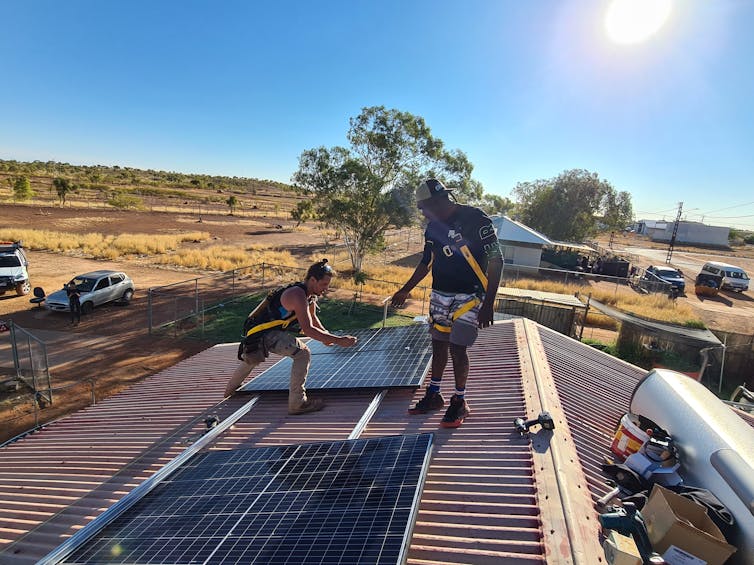
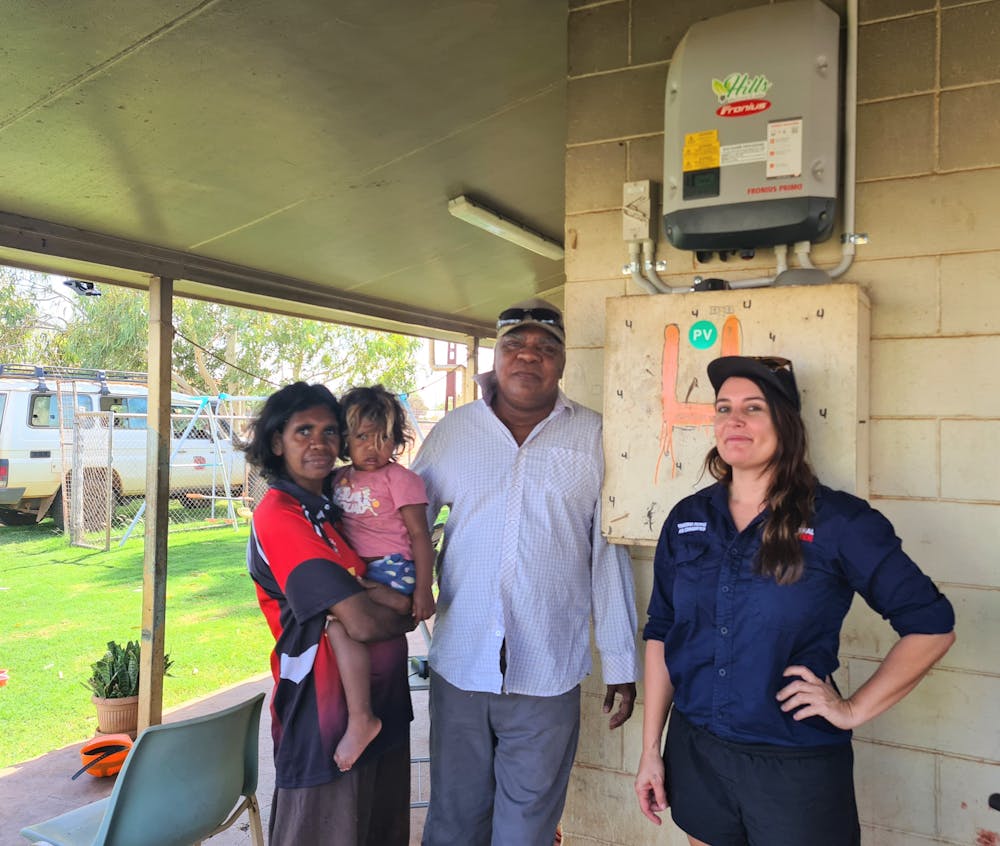
Only recently, co-author and Warumungu elder Frank Jupurrurla took part in the first NT rooftop solar trial, supported by Original Power and installed rooftop solar on his house.
As our new research found, this pilot worked well, supplying a third of the house’s power and ending the problem of power disconnecting. Previously, the power would go out once a month on average. After solar, it never went off.
So why isn’t this widely available? The main problems are red tape, such as getting approval for work on public housing, securing feed in tariffs and metering requirements. As Mr Jupurrurla’s experience demonstrates, they can all be overcome – but not easily.
As Frank Jupurrurla says:
We call the sun Kilyirr […] Right now he’s shining on my panels, he’s giving me power, and he looks after us. So that Kilyirr, he gonna be there forever.
How do remote communities get power at present?
Prepaid electricity is used in many remote First Nations households across Australia, and in almost all town camps. In this model, people “top up” the meter with credit. When credit runs out, the electricity disconnects until more credit is purchased. The electricity here is often produced by diesel generators.
Despite the risk of sudden disconnection, this model is often preferred by many communities as it gives residents fewer surprise bills. The downside is it often leads to an unenviable choice – power or food.
For residents of Tennant Creek’s town camps, it is not uncommon to run out of credit on a hot day. The hotter the day, the higher the chance people will lose power. That’s because hotter weather forces air conditioners and fridges to work harder.
When the power goes off, food inside fridges starts to spoil. Essential medical devices such as oxygen concentrators stop operating. Medications can become inactive or even toxic.
Air conditioners stop working and temperatures rise. On very hot days, the inside of a house gets well over 40℃. Children and adults can’t sleep. Going to school gets harder. Not only are these conditions unsafe, they can drive social disharmony.
As Frank Jupurrurla says:
We struggle every day. Our people, they’re not healthy. Lots of people in this town are on renal [dialysis]. Solar should be talked about in parliament and put on the table.
Did the trial help?
A 6.6 kilowatt solar array was installed on Mr Jupurrurla’s house and switched on in November 2021. The house kept its grid connection and no battery was installed. Household residents received a crash course from the installers, First Nations organisation Original Power, on making the most of the solar for example by running the washing machine during daylight hours.
The result? Solar generates a third of the total power use in any given month. But more importantly, through reducing energy costs, disconnections stopped entirely. This removed a huge source of stress and made the home safer and more enjoyable, according to the family.
As Mr Jupurrurla says: “We used to put a lot of power cards in nearly every day, second day. Now we got money all the time since we’ve got solar.”
Solar is a great solution – but only if it’s made easy
It sounds simple: install a 6.6kW array and see what difference it made. After all, people in the cities can do this routinely.
But it’s harder far from the cities, and harder still when different government departments have to sign off. As Mr Jupurrurla describes:
The barriers was from the day we started. Before that, we’d argue with [Department of] Housing, and they said we have to check inside and check if the house is strong enough. Once we had the panels on, then it took us a while to [turn] it on. It was pretty frustrating. It took Power and Water more than three months just to switch the switch on. It was so hard. I rang the housing minister but nothing happened. So one day I just went out there to the box and switched it on myself
Installing solar here meant overcoming regulatory barriers such as securing feed-in tariffs for excess power produced, ensuring the public housing is high-quality enough to host solar, and the question of ownership of the panels.
The NT housing department required an engineer’s sign off on the roof’s structural integrity, as this can’t be assumed for remote public housing.
As Mr Jupurrurla’s experience demonstrates, these barriers can be overcome – but not easily.
What’s stopping a wider rollout?
Our trial shows solar can work well for remote communities. The timing is good, as the ongoing roll-out of smart prepay meters means most remote First Nations houses in the NT are able to handle solar.
For this to gain momentum, the NT government must find ways to overcome these barriers. The Territory government has responsibilities as both the landlord for housing and as the monopoly energy provider.
A key first step would be to smooth the path with clear paperwork and incentives for prepay households to install solar.
Just as in the cities, encouraging solar will require financial incentives to offset the upfront cost, with culturally appropriate resources available in First Nations languages to explain the process.
Feed-in tariffs have long driven demand for solar for many homeowners. Ensuring remote communities are eligible will be vital.
Australian households are world leaders in taking up solar. But for too long, the ability to generate your own power from the sun has been off limits to many of the people who would benefit the most.
This year is an excellent time to correct this, as the federal government works towards a co-designed First Nations Clean Energy Strategy and the NT government’s plans for better power solutions in remote communities.
As Frank Jupurrurla says:
I’d like to see government fund […] panels on homes. Especially in the Community Living Areas [Town Camps] in places like Alice Springs, Tenant Creek, and Katherine.
Simon Quilty, Senior Staff Specialist, Alice Springs Hospital. Purple House Medical Advisor. Honorary ANU., Australian National University; Brad Riley, Research Fellow, Australian National University; Lee White, Fellow, Australian National University, and Norman Frank Jupurrurla, Warumungu Elder and Director of the Julalikari Council Aboriginal Corporation, Tennant Creek, Indigenous Knowledge
This article is republished from The Conversation under a Creative Commons license. Read the original article.