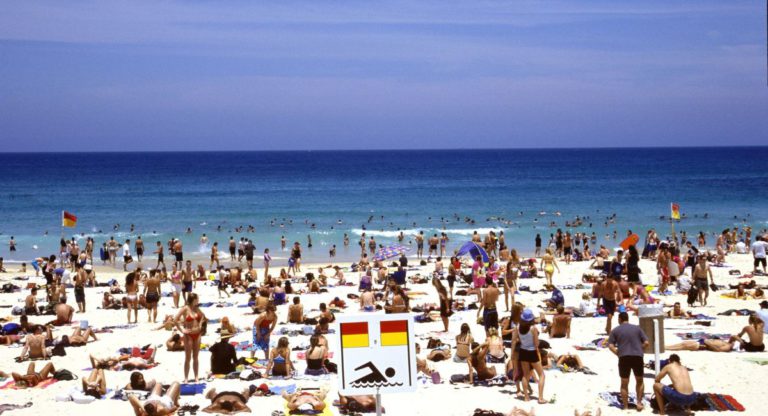
Hanging out at the beach, body surfing, boogie boarding or just cooling off in frothy waves under a hot sun are all part of a typical Kiwi summer.
But with an extensive coastline, plenty of hazardous surf and a poor water safety record, swimming between red and yellow flags under the watchful gaze of surf lifesavers is a reassuring part of the experience. Over the years, brave and capable lifeguards have saved thousands of lives.
And these days you’re just as likely to be saved by a female guard as a male one. Girls and women now expect to be able to participate and compete in surf lifesaving. But it wasn’t always that way. Until relatively recently, patrolling the beach and waves was pretty much a male domain.
In many ways, the story of how surf lifesaving cast off its Edwardian-age origins of masculine grit and strength mirrors social progress in New Zealand in general. And it involves tenacious and talented women who braved the waters to open the way for others.
Locked out of the changing room
Surf lifesaving landed on New Zealand’s shores in 1910, having crossed the Tasman from Australia where it was already taking hold. The volunteer club movement included both rescue work and sport. It quickly adopted a masculine culture that involved patrols of men drilling, training and competing.
Strength and fitness were considered prerequisites for rescuing bathers in trouble. Swimming out in a belt attached to a rope, throwing out and reeling in ropes, and rowing boats weren’t seen as women’s jobs.
Historians Caroline Daley and Charlotte Macdonald have examined the separation of women and men into different sports, and traced the development of an early lifesaving mythology: tanned muscular men, with women cast in a feminine supporting role, providing afternoon teas at the surf club or sunbathing on the sand. Saving lives was men’s work.
In reality, women always wanted to be actively involved and were buoyed by growing feminist attitudes and awareness in wider society. By the 1920s, women’s teams were forming at various clubs around the country. There were even some separate women’s clubs.
Researcher Elena Simatos examined the records of the Canterbury Surf Life Saving Association (CSLSA) from 1917-1990 to see if women had been “locked out of the changing room”. Despite the growing involvement of women, it seems there was clearly still prejudice against them.
In 1928, for example, the “Ladies” Sumner team was granted permission to compete for surf medallions and in club lifesaving events. But soon after, the CSLSA discussed the “question of the desirability of lady members entering into surf competitions” and banned women in Canterbury from competing.
Experiences varied according to the beliefs of individual members and the culture of each club. Overall, though, change came slowly through the steady chipping away at a dominant culture steeped in a tradition of exclusively male strength.
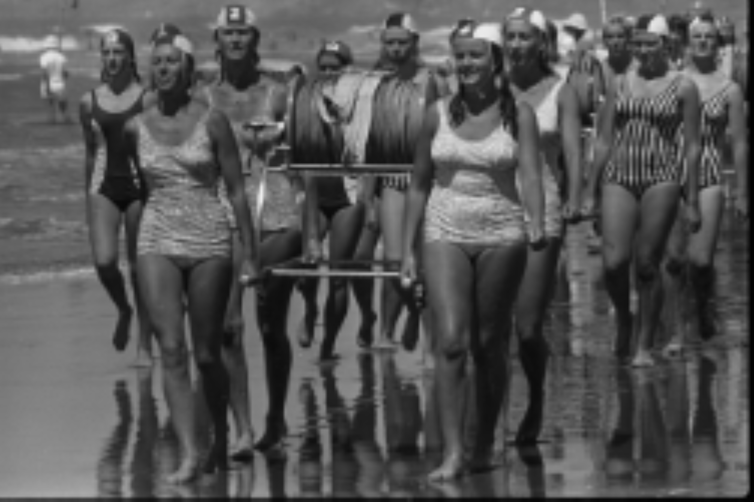
Female teams at the Waimairi Beach surf lifesaving competition, 1974. Christchurch City Libraries. CCL-Star-1974-2220-004-035N-02
Women hit the waves
Emergency regulations during the second world war allowed women to patrol beaches while the men were away fighting. But the change was reluctant and fleeting. There were concerns about the “physical strain” on women in surf races, with limits placed on the most challenging races.
But the post-war years saw some gains. Histories of surf lifesaving by Douglas Booth, Bob Harvey, Tony Murdoch and Christine Thomas have shown how the dominant culture continued to be eroded, with women’s clubs acting as incubators of female participation. Women were allowed to become summer beach patrollers and be paid for their work.
The first of New Zealand’s paid women patrollers was probably Daphne McCurdy (née Dasler), who received NZ$40 a week during the 1969-1970 summer season at Waimairi and North Beach in Christchurch.
McCurdy came from a family of swimmers, surfers and surf lifesavers and grew up near the North Beach Surf Life Saving Club. By 1969, she told me, she had gained the skills and tenacity for the job:
At the time of my appointment I had been active in surf lifesaving four-man, six-man and surf-race teams for more than a decade, was known for my ability to successfully pull a belt in rough seas, could ride a paddleboard if required and had trained most of my club’s boat crew members who had been recruited from the local football clubs. On the day of my appointment I was second in the surf swim test. I was the only female.
Swimming with the feminist tide in the 1970s, other paid women beach patrollers followed McCurdy. More girls and women entered competitions, and there were some mixed competitive teams around the country. More awards were also given – with titles such as “Lady Surf Life Saver of the Year”.
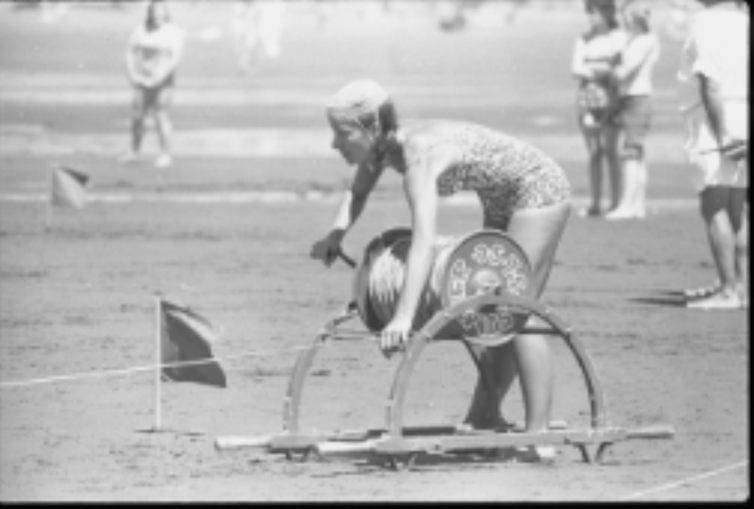
Proving women could do what men did, also at the 1974 Waimairi Beach surf lifesaving competition. Christchurch City Libraries. CCL-Star-1974-2220-004-035N-02
‘Amazons of the sea’
And yet, while women such as Jan Pinkerton and Christine Thomas gradually assumed leadership roles, surf lifesaving was still far from a gender-equity workplace. As author Sandra Coney noted in her 1985 article Amazons of the Sea for feminist magazine Broadsheet, there were only two women, Kate Sheriff and Muriel Brown, on the honours board of the Auckland Surf Life Saving Association.
Family background and connection, Coney argued, were still important for women like Sue Donaldson of Muriwai. Like Daphne McCurdy, she’d first become a lifeguard at Christchurch’s North Beach. Also like McCurdy, her father, brother and sister were lifeguards.
Nonetheless, women were making inroads, and the cultural reputation of surf lifesaving in New Zealand was always better than Australia’s. Historian Caroline Ford has written of “rampant misogyny” on Sydney beaches, where it took until 1980 for the Australian Surf Life Saving Association to allow women to become active surf lifesavers.
Still, Coney uncovered plenty of evidence of a macho, drink-fuelled local culture, involving “chunder miles where increasingly blotto clubbies stagger from jug to jug before disgorging a full frontal puke”. “Other typical boyish pranks [included] publicly stripping men of their togs and hoisting women’s knickers on the club flagpole.”
In it together
Did new technology shake up old prejudices and promote equality for all on the waves? On the contrary, Coney reported that “men have colonised the beaches”, keeping women away from new equipment that compensated for sheer physical strength.
In the 1950s and 1960s at Piha beach near Auckland, Coney’s sister Helen Watson couldn’t join the surf lifesaving club or use “all the interesting equipment – the skis, boards and boat”, and was “excluded from taking part in competitions”.
New lifesaving equipment was nabbed by the men. As Bryony Coutanche said of the heavily male-dominated board riding scene: “I was told to ‘get off, this is my wave’. The men are awful and when you’re learning it’s hard.”
By 2017, half of New Zealand’s surf lifeguards were women, but they made up only 28% of rescue boat drivers. A recent survey found girls and women still faced some barriers to participation.
Still, if surf lifesaving has never radically led the way for gender equality, its culture has changed with the times. A Wahine on Water program sets out to redress the remaining gender imbalance, providing mentors and training opportunities. And Surf Life Saving New Zealand has made it a mission to include all peoples and cultures within the organisation.
Lifesaving is heroic work that often shows people at their most humane and caring. So it’s good to see an inclusive culture being built for those welcome guards who watch over us while we relax and enjoy summer at the beach.
This article benefits from research by Elena Simatos in her 2016 University of Canterbury History BA (Hons) research essay, “Locked out of the changing room? A gendered history of surf lifesaving in Canterbury 1917-1990”, which was supervised by the author.
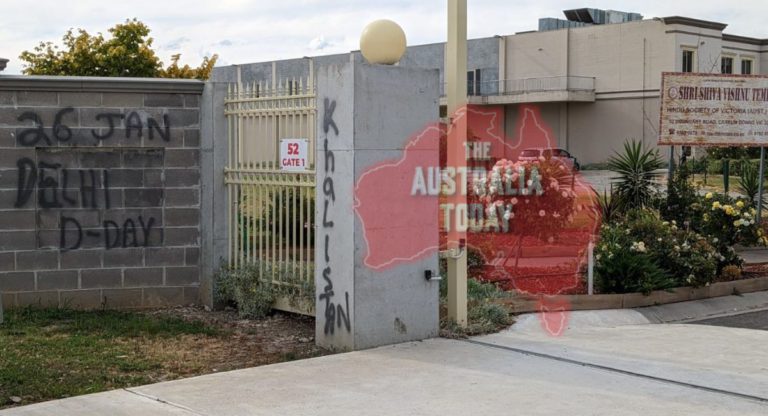
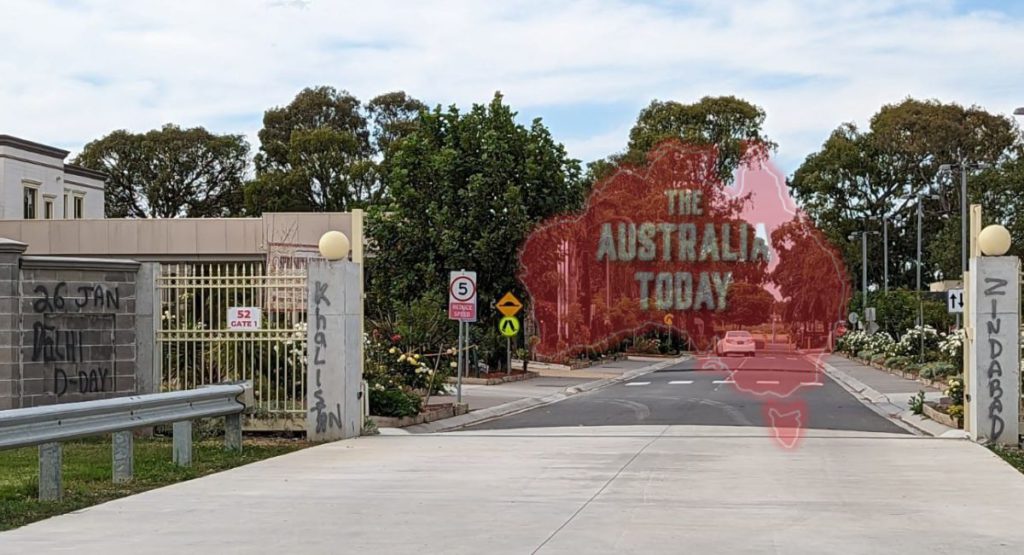
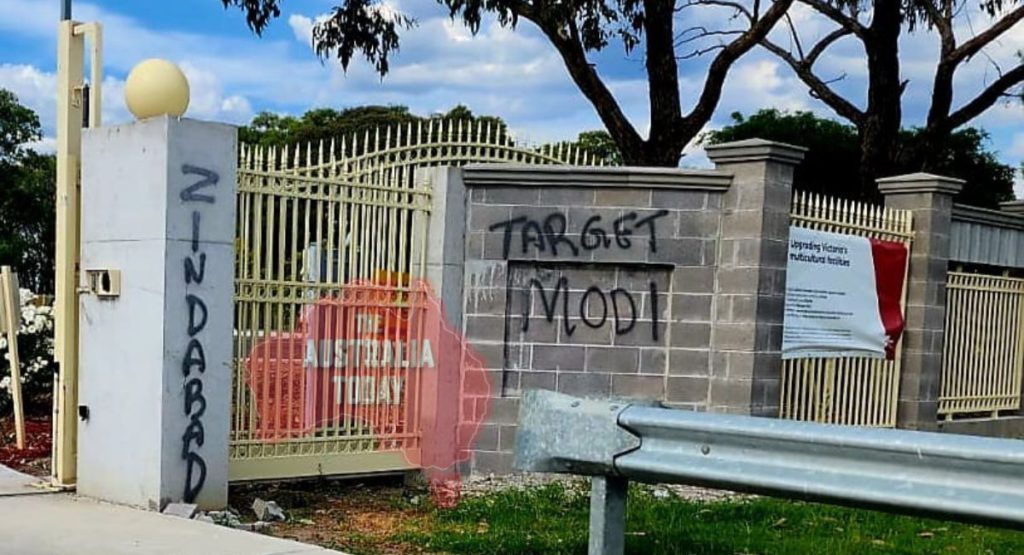
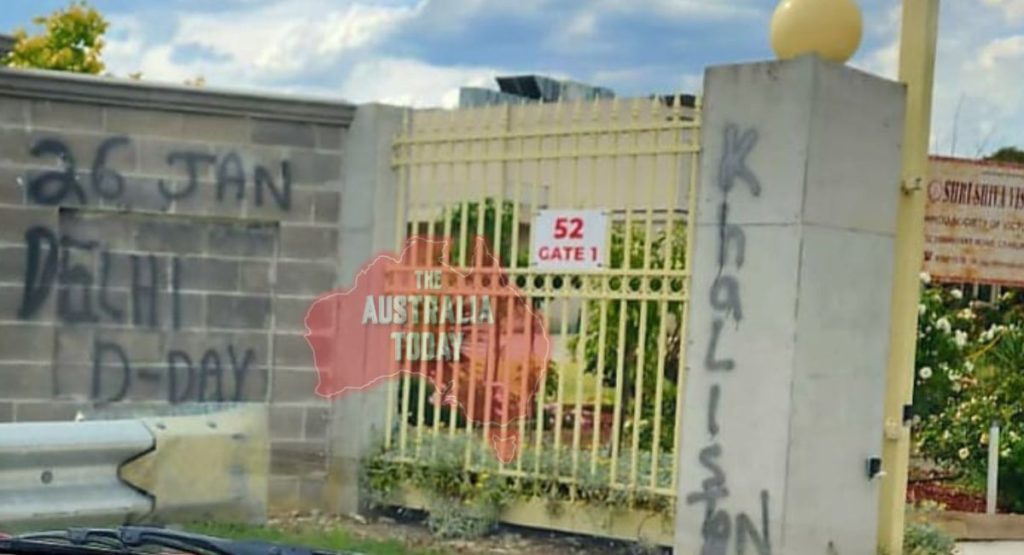
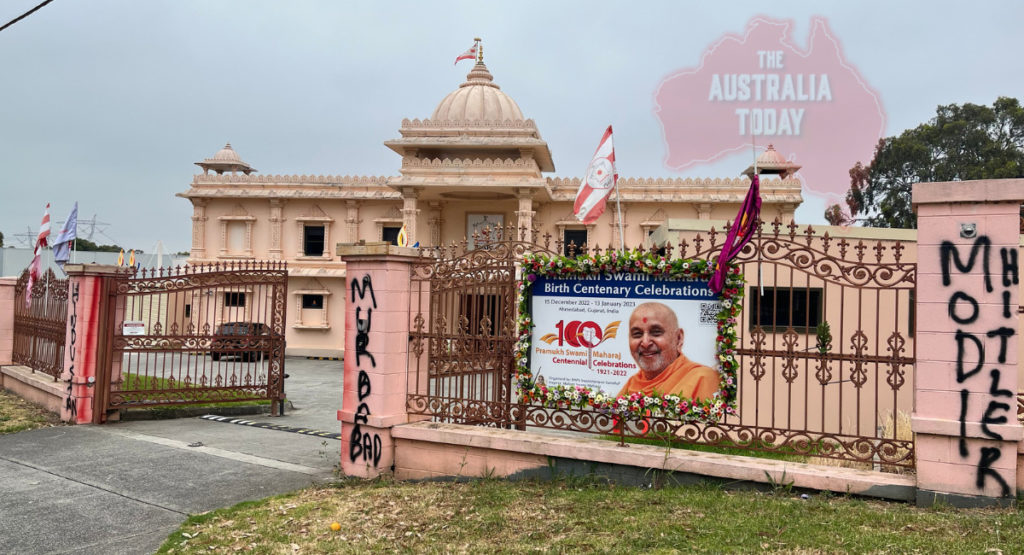
Indian-Australian community has once again been left in shock with one of the iconic Hindu temples outside the Indian subcontinent vandalised with anti-Hindu graffiti.
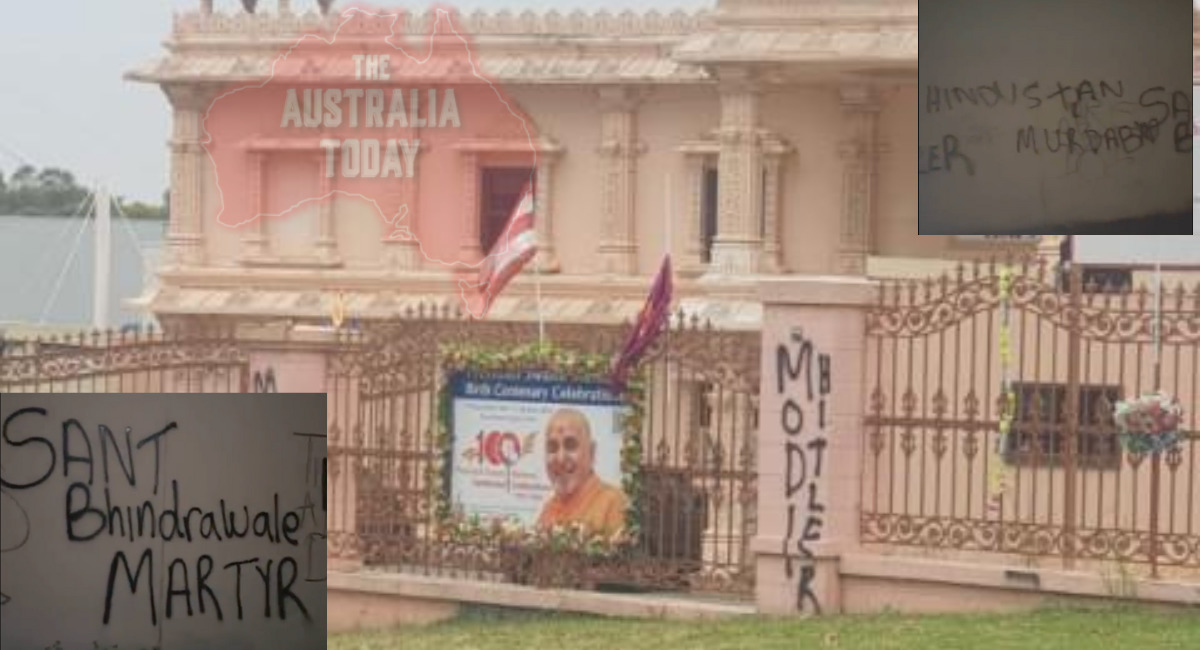
The vandalism of the historic Shri Shiva Vishnu Temple in Carrum Downs comes just within a week of anti-India and anti-Hindu graffiti smeared on the walls of BAPS Swaminarayan Mandir in Mill Park.
This act of vandalism came to notice on Monday 16th January morning when Temple devotees came for ‘darshan’ as three days long “Thai Pongal” festival is being celebrated by the Tamil Hindu community.
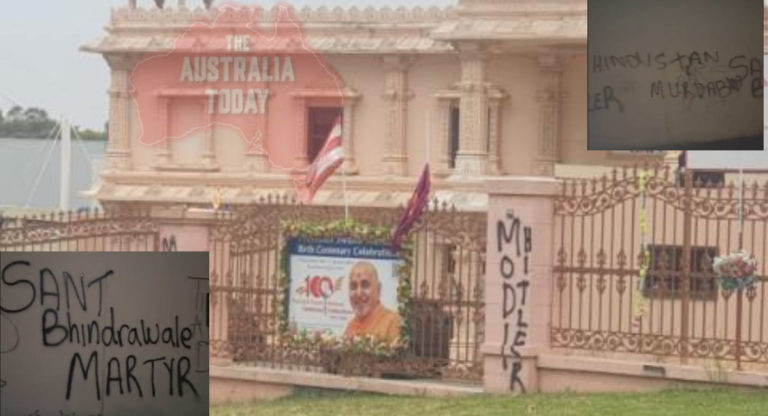
Shri Shiva Vishnu Temple in Carrum Downs comes just within a week of anti-India and anti-Hindu graffiti; Image Source: The Australia Today
Ms Usha Senthilnathan a long-time devotee of Shri Shiva Vishnu Temple told The Australia Today, “We are a Tamil minority group in Australia, a lot of us came as refugees to escape the religious persecution.”
“This is my place of worship and it’s not acceptable to me that these Khalistan supporters are vandalising it with their hate messages without any fear.”
I urge Premier Dan Andrews and Victoria Police to take strict action against these goons who are trying to scare the Victorian Hindu community,” added Ms Senthilnathan.
Shri Shiva Vishnu Temple in Carrum Downs comes just within a week of anti-India and anti-Hindu graffiti; Image Source: The Australia Today
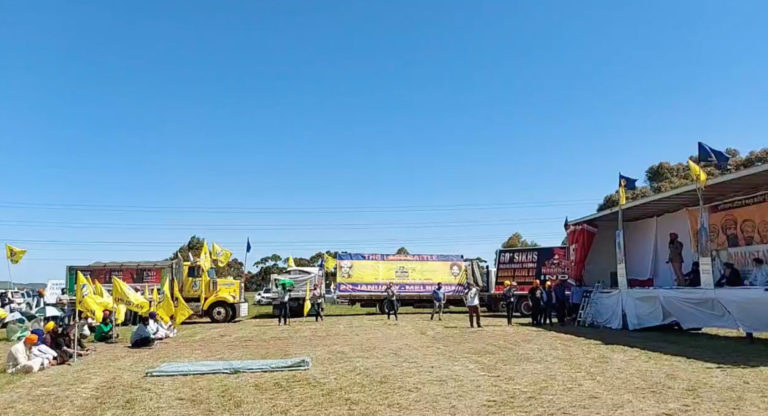
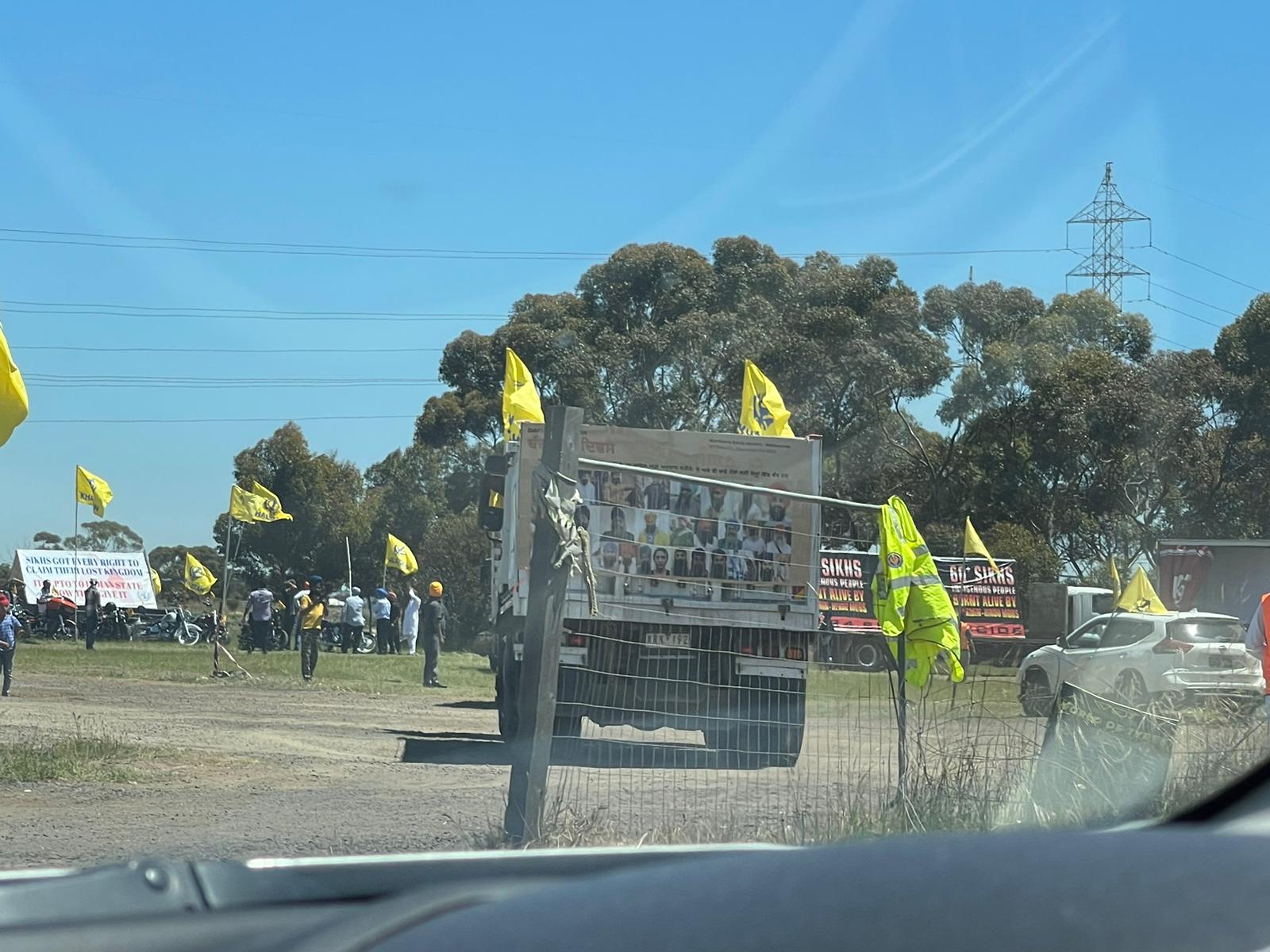
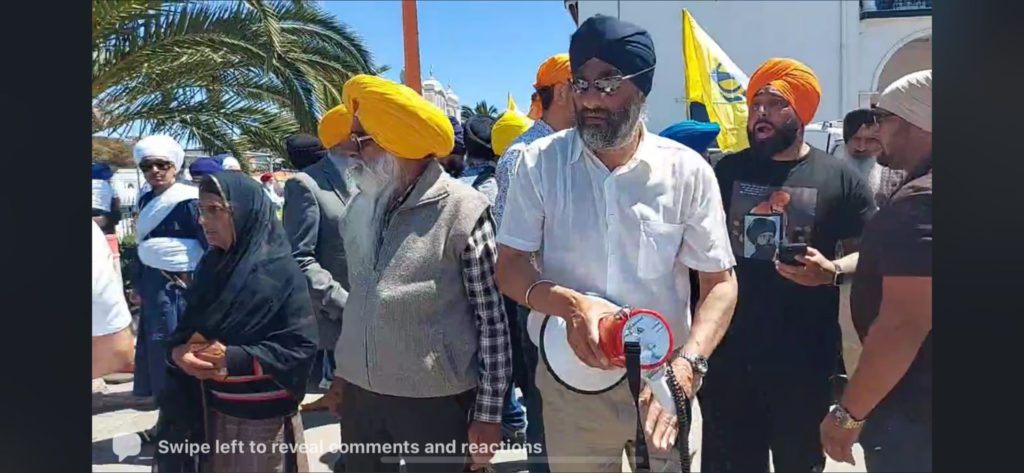
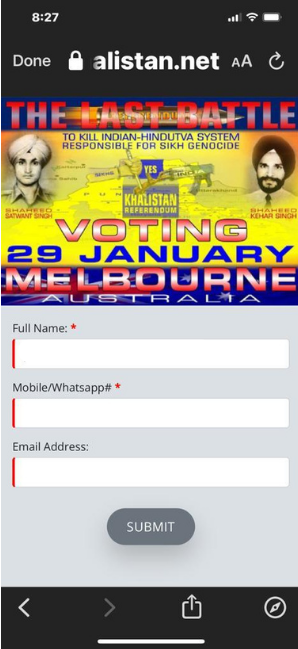
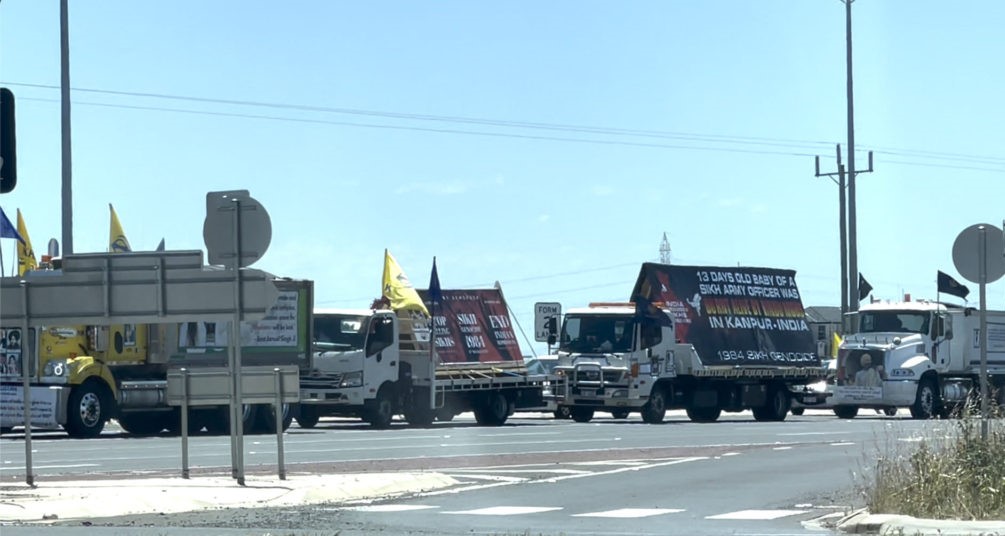
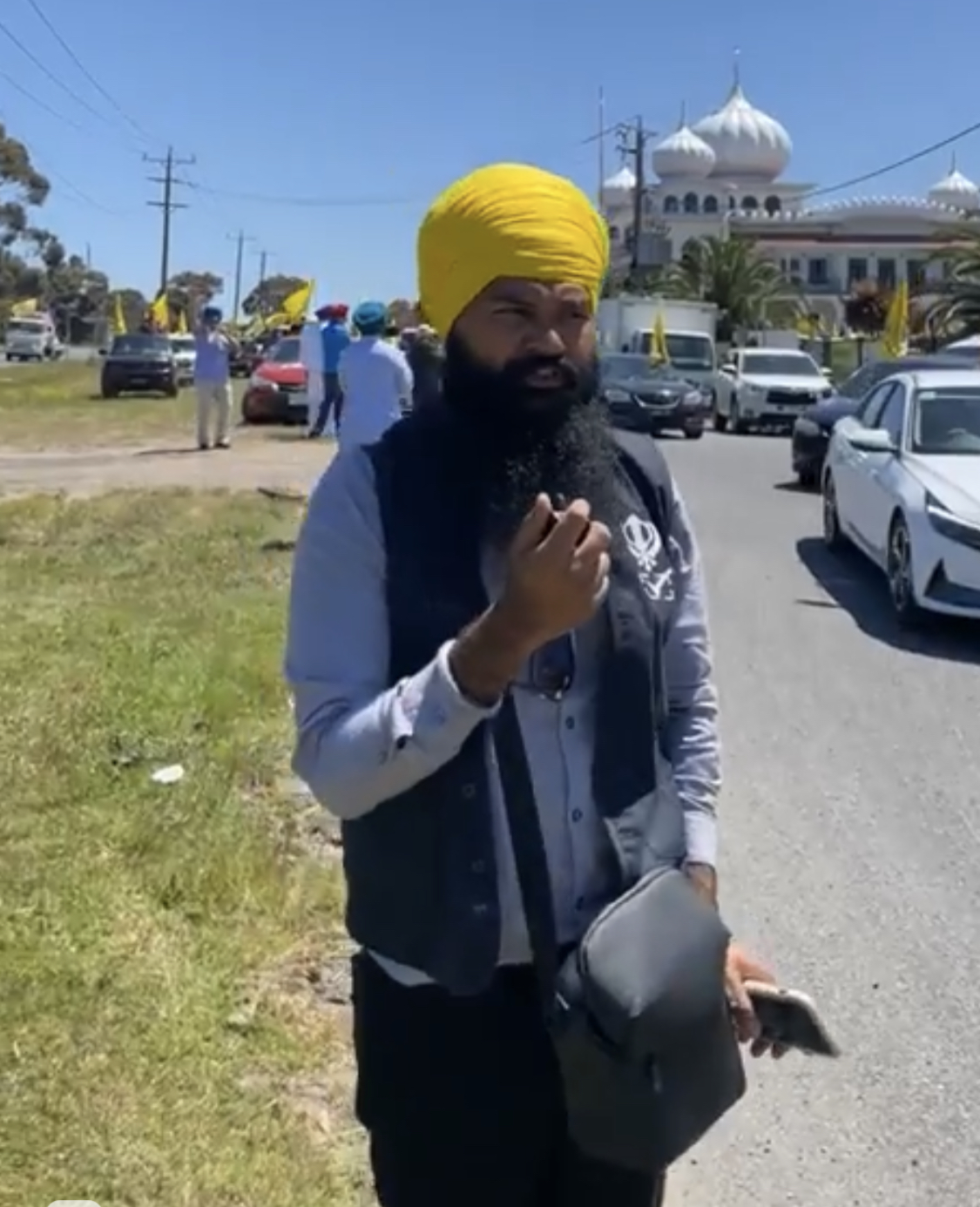
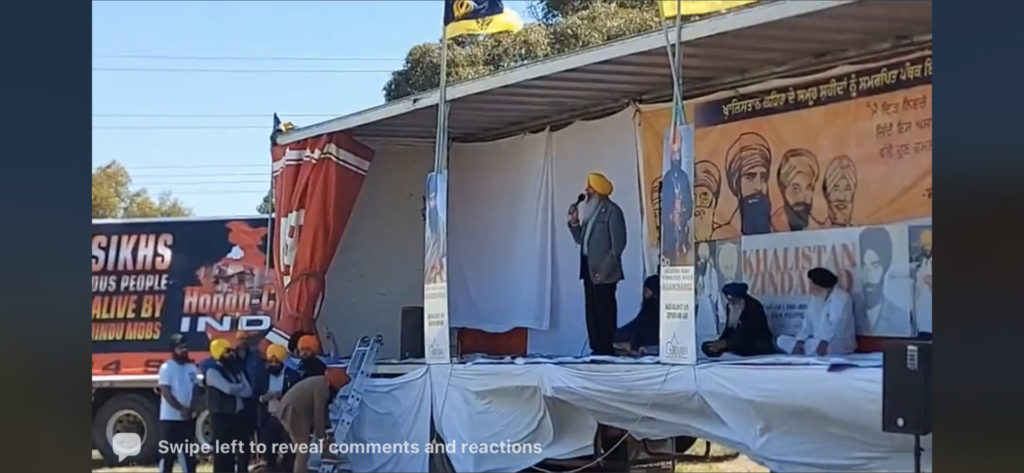
It is important to note that on the evening of 15th January 2023, Khalistan supporters tried to draw support for their referendum through a car rally in Melbourne. However, they failed miserably as less than two hundred people gathered out of an almost 60,000-strong Melbourne community.
Hindu Council of Australia’s Victoria chapter President Makrand Bhagwat told The Australia Today, “I can’t tell you how upset I am for witnessing a second Hindu Temple vandalised for Khalistan propaganda.”
“Our Temples vandalism is deplorable and should not be tolerated by the wider community.”
Melbourne Hindu community member Sachin Mahate told The Australia Today, “If these Khalistan supporters have the courage they should go and draw graffiti on the Victorian Parliament building rather than target peaceful Hindu communities religious places.”
Shri Shiva Vishnu Temple in Carrum Downs comes just within a week of anti-India and anti-Hindu graffiti; Image Source: The Australia Today
Victorian Liberal Party MP Brad Battin has told The Australia Today, “In no way, our future can be built on hate when it has been built on working together for so long.”
“There is no place in Victoria or Australia for this kind of behaviour what we are seeing here.”
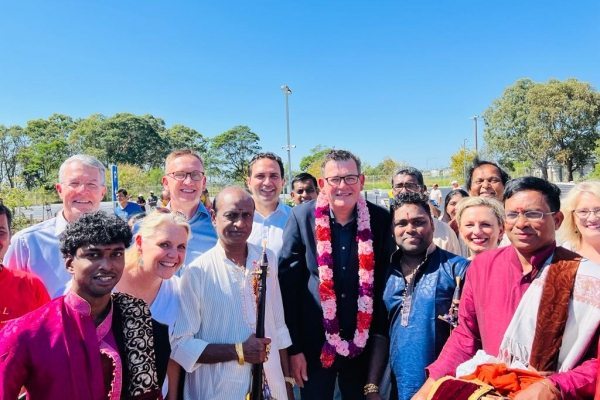
Victorian Liberal Party MP Brad Battin with Indian Australian dancers
“Victoria is and will remain the best multicultural state in the world as long as people learn to work together not against each other,” added Mr Battin.
Earlier on 12th January 2023, Khalistan supporters have written praises on the walls of BAPS Swaminarayan Temple of an Indian terrorist Bhindrawala responsible for killing more than twenty thousand Hindus and Sikhs as a ‘Martyr’.
The Australia Today has revealed how these Khalistan supporters even recorded a video of their despicable and disrespectful act at the BAPS Swaminarayan Mandir. And soon, the social media accounts started sharing the images and videos claiming it to be their brave act against Indian-Australian Hindus.
Victoria Police confirmed to The Australia Today that an investigation into the vandalism of the BAPS Swaminarayan Mandir incident is ongoing.
“Police are investigating after reports of graffiti in Mill Park on 12 January.Police have been told graffiti was written on the walls and fence of a building on Heaths Road in the early hours of the morning.“
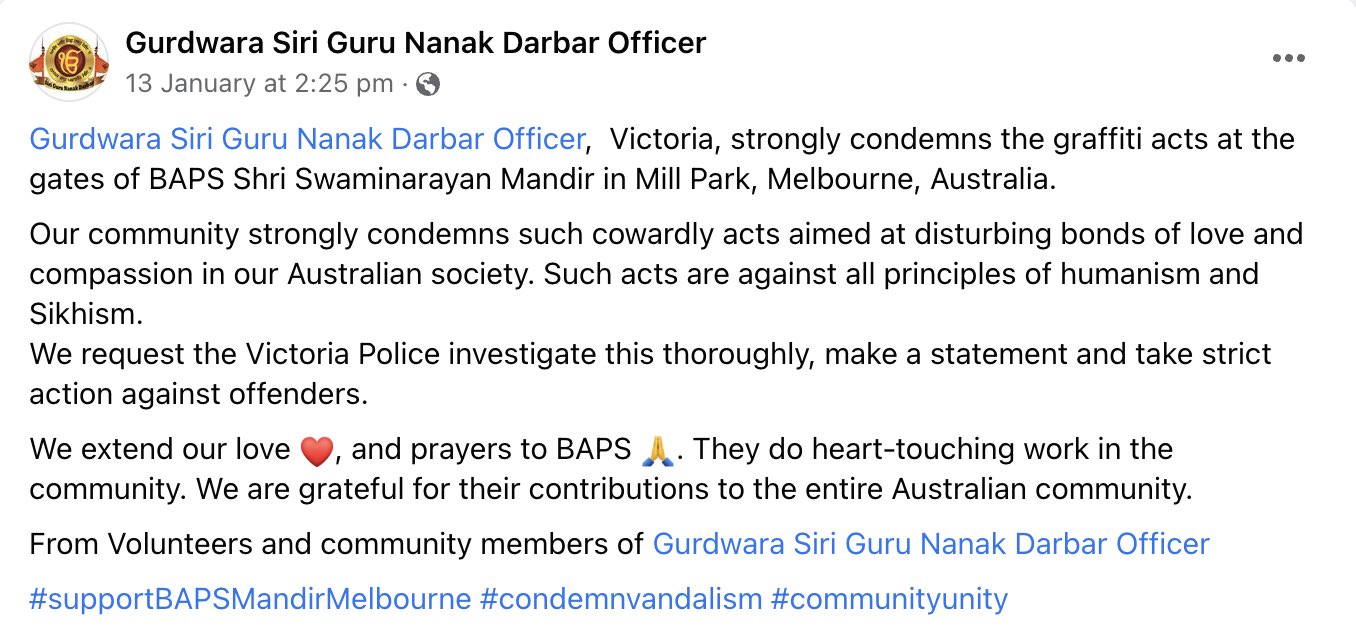
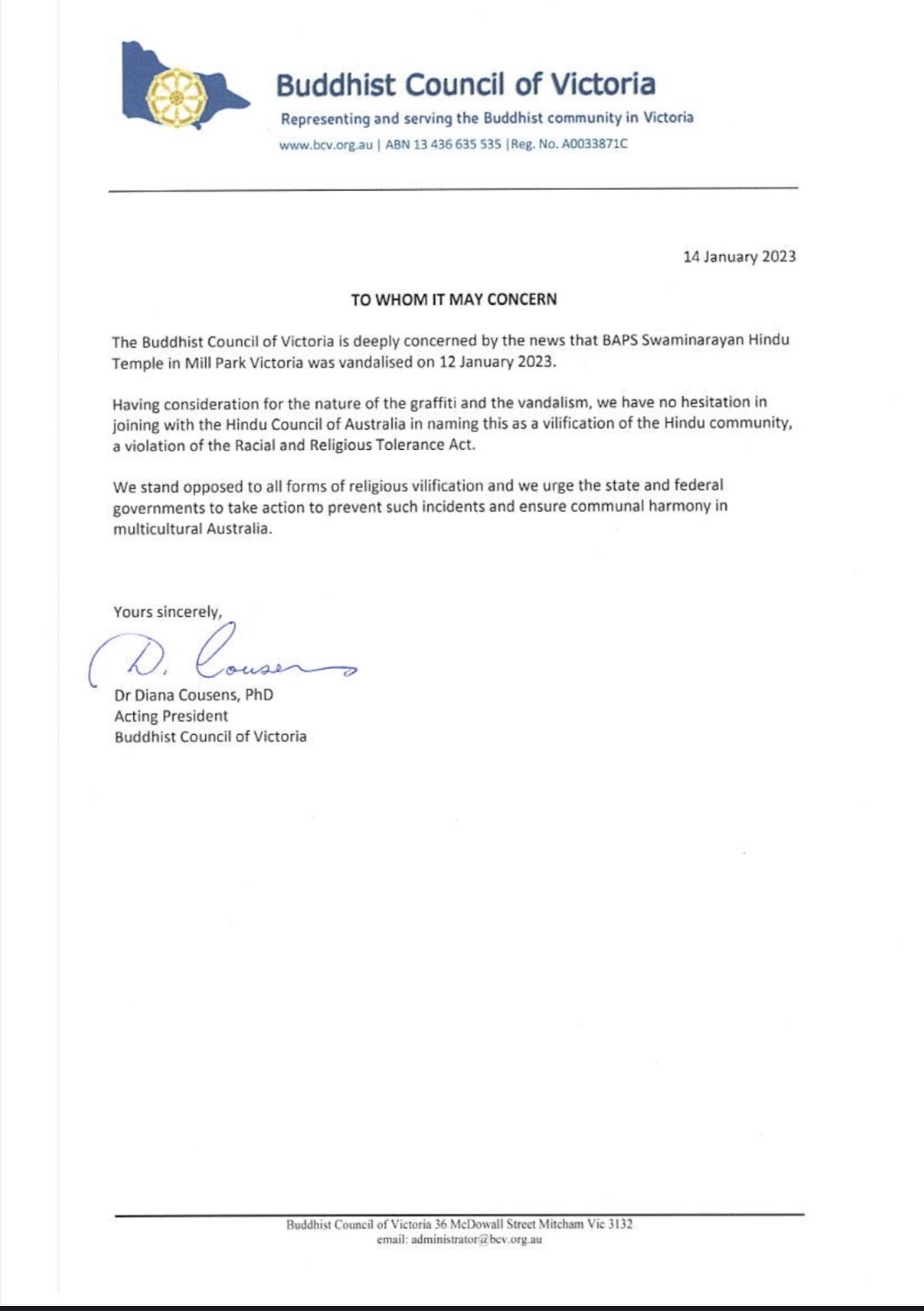
Meanwhile, the Jewish Community Council of Victoria and Gurdwara Siri Guru Nanak Darbar, Victorian Council of Churches and Buddhist Council of Victoria have strongly condemned the attack on the Hindu temples.
“This act must be called out as hate speech and religious vilification,”
said Jewish Community Council of Victoria.
They added that death threats to Hindus are a very serious matter as the Indian-Australian community is now living in fear of the Khalistan supporters.
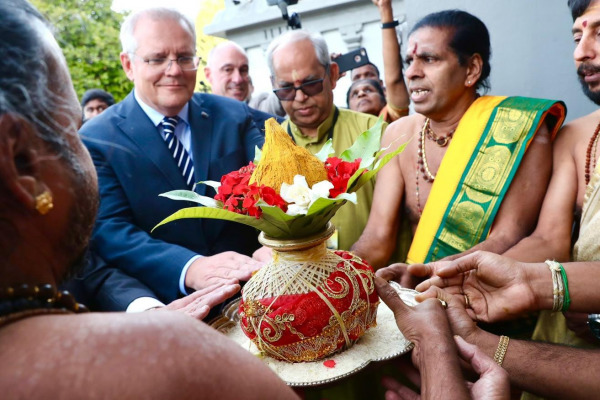
The then Australian Prime Minister Scott Morrison and Victorian Premier Dan Andrews visited Shri Shiva Vishnu Temple at Carrum Downs just a few months back.
Former Australian Prime Minister Scott Morrison and Premier of Victoria Daniel Andrews at Shri Shiva Vishnu Temple (Image source: HSV – Facebook)
Hindu Society of Victoria’s Shri Shiva Vishnu Temple at Carrum Downs is one of the oldest temples in Victoria. On 22 May 1994, the Maha Kumbhabishekam of Shri Shiva Vishnu Temple was performed with due rigorous rituals and procedures in the presence of a large number of devotees and Hindu priests from India, Sri Lanka, and other temples of Australia.
“May 22, 1994 was a day in the life of Hindus in Victoria that saw the dream of Hindus in Victoria come true.”
Note: The Australia Today has connected multiple stakeholders for comments, we will update the story as it happens.
People from diverse communities in NSW needing mental health support are set to benefit from an Australian-first multicultural mental health phone line service covering up to 30 different languages.
The languages include Hindi, Punjabi, Bengali, Tamil, Malayalam, Gujarati and Urdu. They also include Nepali, Dari, Tibetan, Pashto and Sinhalese.
The service is staffed by registered bilingual mental health professionals and covers languages such as Arabic, Chinese, Greek, Korean, Vietnamese and Ukrainian.
Minister for Mental Health Bronnie Taylor said this new phone line would support people from diverse communities who are struggling with their mental health to access appropriate services.
“While there is a wide range of mental health services available to all NSW residents, language and different cultural understandings of mental health can act as a barrier for people when accessing services,” Mrs Taylor said.
“This new phone line will support people to get the help they need, with a specialist team of health care professionals ready to provide care and connect people with the appropriate services.”
Available Monday to Friday between 9:00am to 4:30pm on 1800 648 911, the Transcultural Mental Health Line improves access to mental health care and support for diverse communities.
Minister for Multiculturalism Mark Coure said this initiative once again shows the NSW Government’s commitment to supporting the state’s rich multicultural society.
“We understand that finding the right words to express how we are feeling can be hard, let alone for people that might struggle with English,” Mr Coure said.
“This new service makes mental health support more accessible, and will give people the peace of mind to speak freely in a language they are more comfortable with,” Mr Coure said.
The Transcultural Mental Health Line joins a host of services, programs and initiatives the NSW Government is funding to support the mental health of people from diverse communities. This includes the funding of STARTTS, which offers a 24/7 counselling service for people that have experienced trauma related to war and violence overseas.
If you, or someone you know, is in a life-threatening situation please seek help immediately by calling 000. If you or someone you know is thinking about suicide or experiencing a personal crisis or distress, please call Lifeline 13 11 14 or Suicide Call Back Service on 1300 659 467. The NSW Mental Health Line on 1800 011 511 is a 24/7 service that can advise you on appropriate local mental health services for you or a loved one.
For multilingual mental health resources, visit the Transcultural Mental Health Centre website via www.dhi.health.nsw.gov.au/tmhc.
The $3.2 million investment over four years is part of the $130 million COVID-19 Mental Health Recovery package and builds on the $2.68 billion 2022-23 NSW Mental Health Budget, the largest mental health investment in the state’s history.
Nearly all economists and most politicians seem to agree stamp duty is a bad tax. But nearly all state and territory governments rely on it to keep the lights on.
It’s a bad tax because it taxes homeowners every time they move, merely because they have moved. At A$40,000 per move on a median-priced home in Sydney or Melbourne, it’s enough to dissuade people from moving for a better job or to a bigger or smaller home when they have children or their children move out.
It’s even a de facto tax on divorce. When a family home is sold to allow assets to be split, each member of the separating couple needs to pay stamp duty to purchase again. It’s a big reason more than half of divorced women who lose their homes don’t buy again within a decade.
And it’s unfair. Stamp duty hits most the younger households that move around the most. It leaves alone the older residents who stay put.
New modelling by the Centre for Policy Studies at Victoria University finds abolishing stamp duty and replacing the revenue lost with land tax would put downward pressure on the price paid by buyers of about 4.7%, and downward pressure on the price received by sellers of about 0.1%.
In 2018 the Grattan Institute found a national shift from stamp duties to land tax would add up to $17 billion per year to gross domestic product.
Most states aren’t really removing stamp duty
So far only one state or territory – the Australian Capital Territory – has really taken the plunge. Others are merely tinkering with stamp duty in order to create what amounts to a de-facto first home-buyer grant.
The ACT is halfway through a genuine switchover designed to take 20 years.
In Victoria, the Andrews government is merely expanding a system of exemptions for eligible first home-buyers already available. NSW, Queensland, Western Australia and Tasmania also offer such exemptions.
Now in the lead-up to the March election, the NSW government and opposition are one-upping each other with competing policies to offer even more first home-buyers a way to avoid paying stamp duty.
The NSW Labor opposition pledged to abolish stamp duty altogether for first home buyers purchasing properties worth up to $800,000 — expanding the current exemption which is for homes worth up to $650,000. First home buyers purchasing more expensive homes worth up to $1 million will be offered a discount.
The Coalition government has already legislated to offer first home buyers the option of paying an annual land tax rather than stamp duty if they buy a property worth up to $1.5 million.
By targeting these exemptions to first home-buyers, both sides of NSW politics and other state governments are undercutting the key benefit of removing stamp duty: removing the tax on moving.
Most of these policies – including the two offered in NSW – amount to little more than first home buyers’ grants. History shows such grants tend to push up prices.
Actually axing stamp duty means replacing it with something
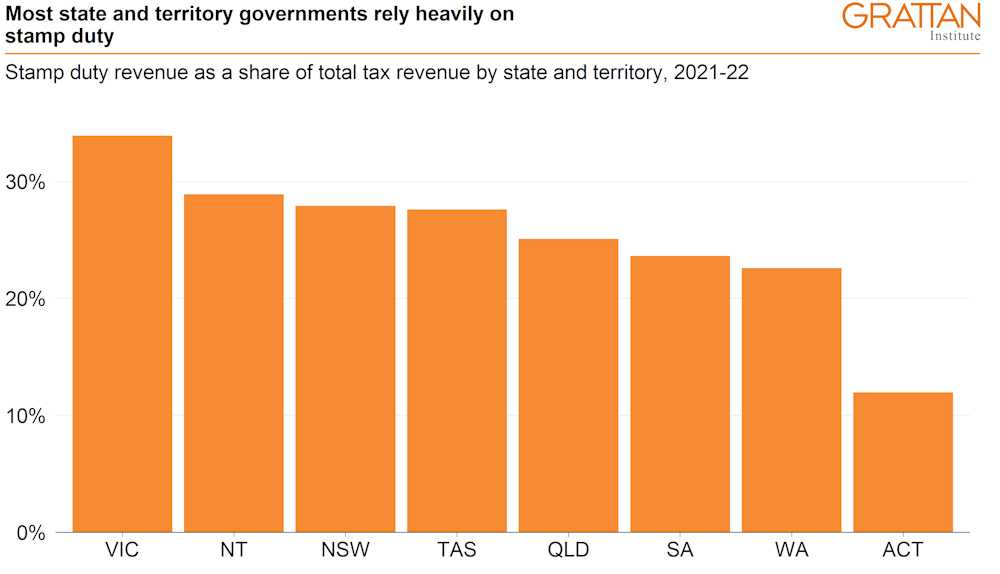
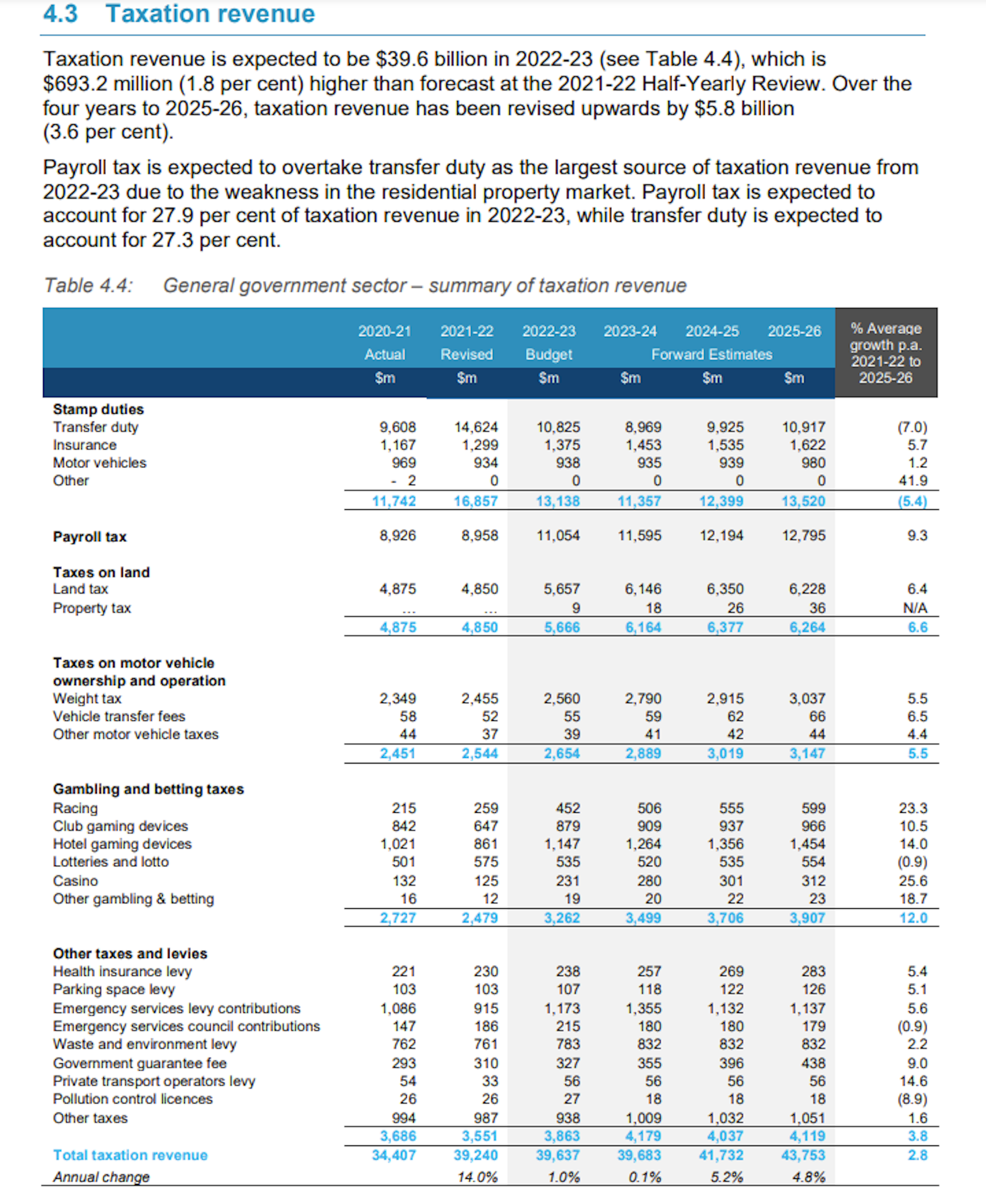
Stamp duty is critical to helping state governments pay the bills. All states or territories, except the ACT, use them to collect at least one-fifth of their tax revenue.
Does not include Commonwealth grants. Grattan analysis of each state or territory’s most recent budget
These revenues pay to keep our hospitals running and schools open.
NSW expects to collect around $10 billion in stamp duty this financial year alone.
In contrast, Labor’s NSW giveaway for first-home buyers will cost $722 million in its first three years. The Coalition’s will cost $728 million over four years.
To really get rid of stamp duty altogether, we need to replace it with something else. Land tax is a good candidate because it doesn’t distort people’s decisions.
Whereas homeowners can avoid paying stamp duty again by refusing to move, land can’t be moved, meaning land tax can’t be avoided.
The NSW Coalition government started with bolder plans for a meaningful transition, until a scare campaign and the opposition from Labor and the Greens forced it to wind it back.
This has left NSW Labor in the unfortunate position of being against the bad tax (stamp duty) but also against the good tax that would have to replace it: land tax.
Other options – such as increasing the goods and services tax to cover the cost of abolishing stamp duty – appear even less likely.
NSW is stuck in a quagmire in which stamp duty seems here to stay.
Only the ACT is showing the way
The Australian Capital Territory’s approach of slowly reducing one tax while slowly increasing the other shows it can be done.
After announcing the switchover in 2012, the then treasurer Andrew Barr was reelected as chief minister in 2016 and in 2020.
He is ahead in the race to actually remove stamp duty by replacing it with something. He is showing the rest of Australia it needn’t be afraid.
Indian-Americans who constitute about one per cent of the US population pay about six per cent of the taxes.
US Republican Congressman Dr Rich McCormick told Congress that the Indian-American community does not cause problems and follows the laws.
“Although they make up about one per cent of American society, they pay about six per cent of the taxes. They’re amongst the top producers, and they do not cause problems. They follow the laws.”
Mr McCormick who represents the 6th Congressional District of Georgia added that one of the five doctors in his community is from India and described Indian-Americans as upstanding citizens.
Many of the Indian Hindu cultures celebrate the “Harvest Festival” today. It is called by different names in different parts of the country: Pongal, Baisakhi, Lohri, Makar Sankranti etc. pic.twitter.com/qhvmFWhFhs
“They (Indian-Americans) don’t have the problems that we see other people have when they come to the emergency room for overdoses and depression anxiety because they’re the most productive or family oriented and the best of what represents American citizens.”
Georgia has almost 100,000 people who have immigrated directly from India.
Earlier, it was revealed that Indian-Americans have the highest median household income in USA.
As per US Census Bureau, this group now has an average household earning of $123,700, i.e a little over ₹1 crore ($63,922).
Data also shows that 70% of the Indian-American population in America holds a bachelor’s degree while the national average is merely 28%.
Australia is welcoming back international students in much greater numbers this year. Some predict new enrolments in 2023 could even be higher than the pre-COVID record in 2019. Student visa applications in the second half of 2022 were up 40% on the same period in 2019.
The downside is many of these students are likely to struggle to find affordable and adequate accommodation. They are facing record low private rental vacancy rates and higher rents than before the pandemic.
Redfern Legal Centre’s International Student Legal Service NSW has been assisting international students for over a decade. Its senior solicitor, Sean Stimson, told us:
The tenancy situation facing international students in the second half of 2022 – including illegal evictions and illegal rent increases – is the worst I’ve seen. We are increasingly seeing international students who are occupying substandard, illegal accommodation, exposing themselves to dangerous environments.
In some cases, this has made student accommodation more costly. Rents are typically equivalent to, or even higher, than rents in the wider private rental market.
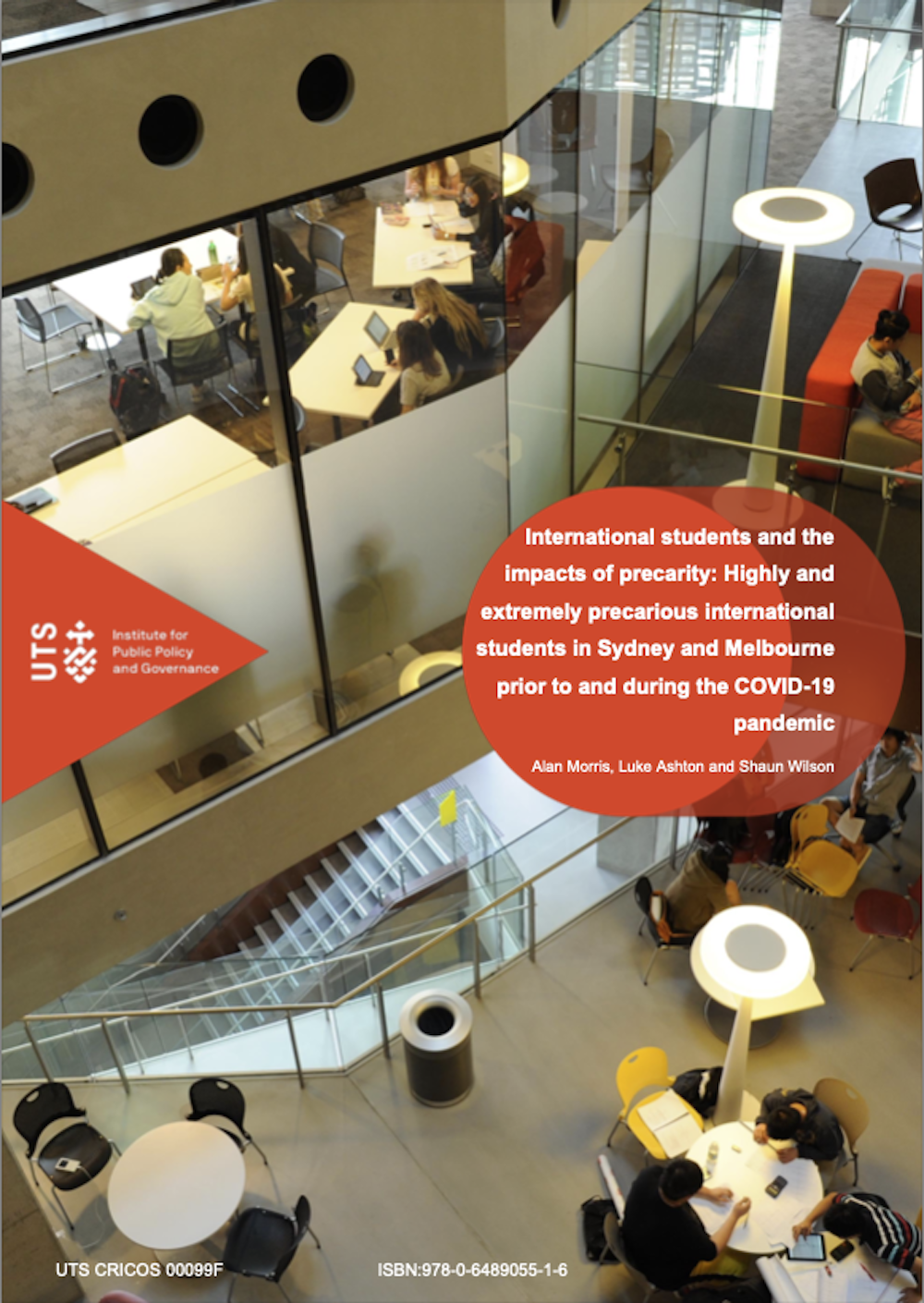
The authors’ report, International students and the impacts of precarity. Institute for Public Policy and Governance/UTS, Author provided
Like any group, students’ financial resources vary greatly. However, little was known about these inequalities and their impacts on international students’ housing and everyday living.
Our recently published study, involving more than 7,000 international students, shows many were struggling financially even before the post-COVID rental crisis. They suffered great anxiety about finding the money to pay the rent and worried about becoming homeless.
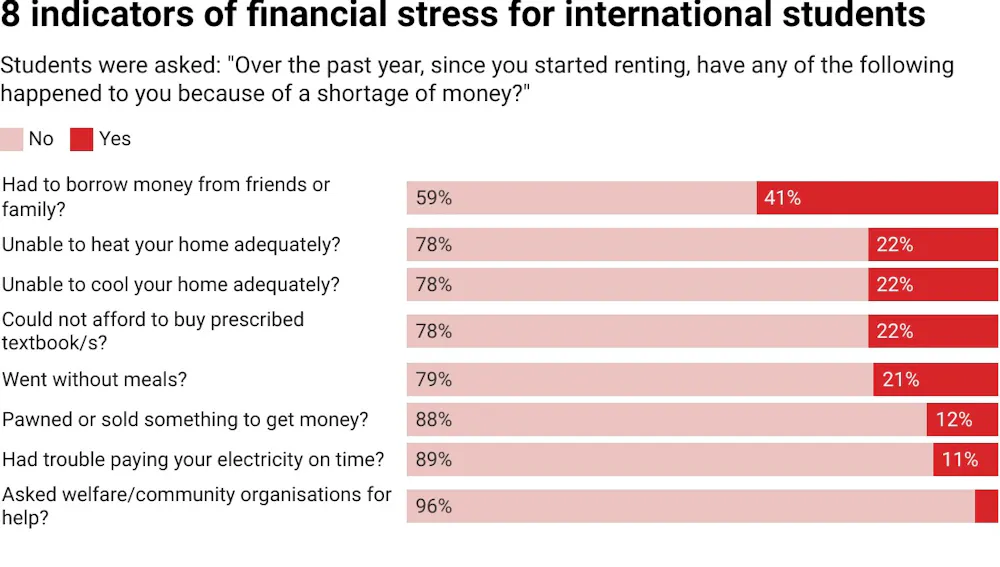
We also found food insecurity was common among these students. More than one in five had gone without meals. Similar numbers were unable to heat or cool their home adequately.
What did the study look at?
To study students’ experience of financial hardship or precarity, we used a scale of seven financial stress indicators from the Australian Bureau of Statistics. We added a new item, “Could not afford to buy prescribed textbooks”.
Our research project surveyed students who depended on private rental accommodation in Sydney and Melbourne, Australia’s top destinations for international students, in late 2019.
The sample was drawn from all three post-secondary sectors. It included ten universities, 24 vocational colleges, seven English language colleges and two foundation course institutions.
We divided the 7,084 valid responses to the survey into four groups: secure (no financial stress indicators), moderately precarious (one to two indicators), highly precarious (three to five) and extremely precarious (six to eight).
Some 44% of students were secure, 31% were moderately precarious, 20% were highly precarious, and 5% were extremely precarious.
How many students are struggling financially?
A large proportion of students were struggling, as the chart below shows. Some 21% reported going without meals in the past 12 months. And 22% were unable to heat or cool their home adequately.
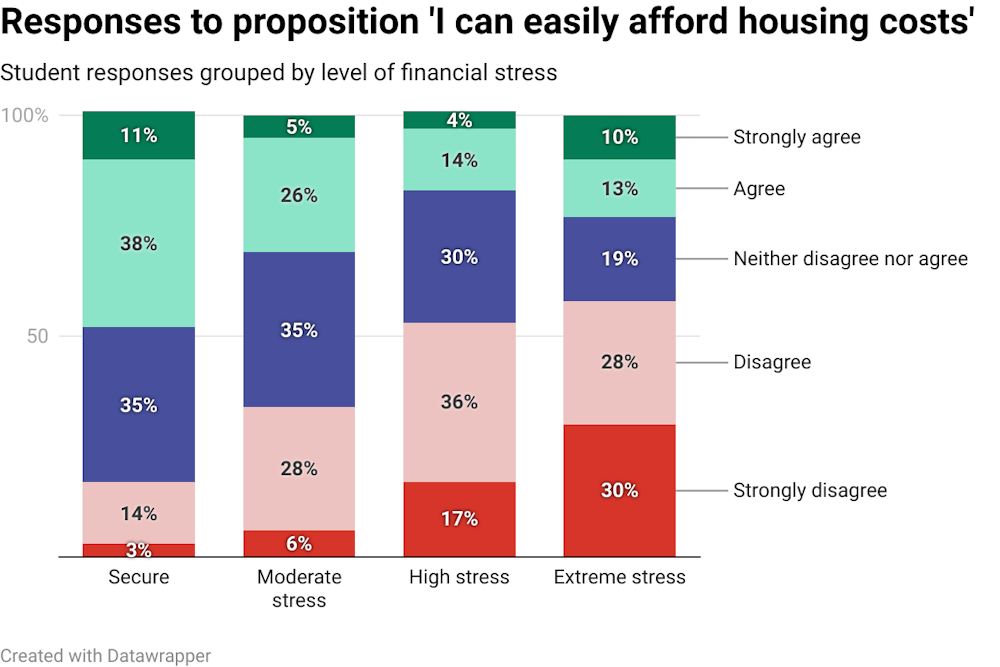
More than half of the students classed as highly and extremely precarious (53% and 58% respectively) said they could not “easily afford housing costs”. This compared to 34% of moderately precarious and 17% of secure students.
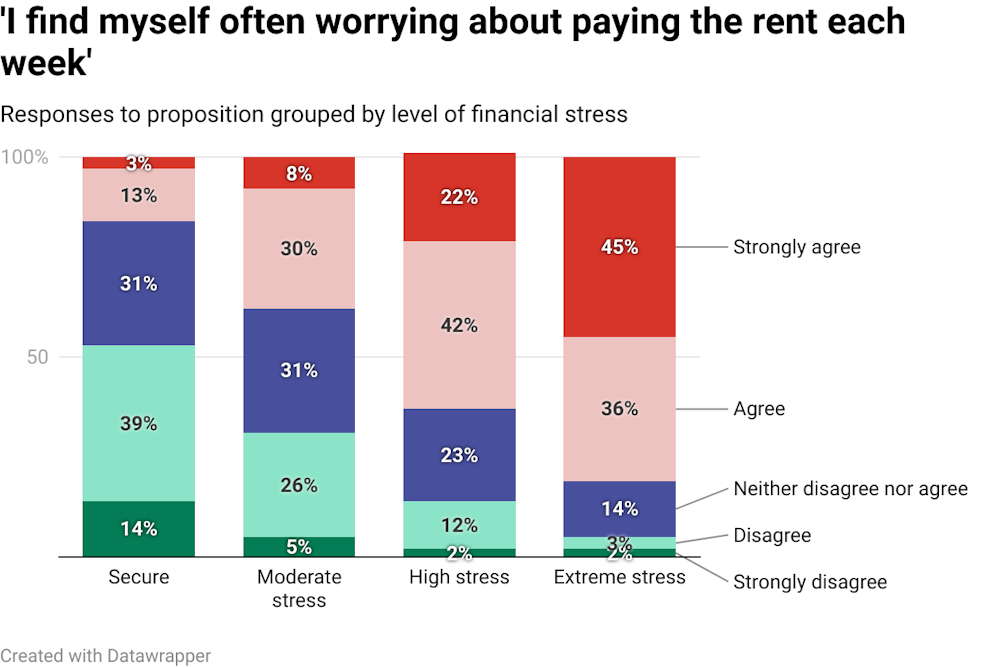
Paying the rent was a source of much anxiety across all groups. Some 64% of highly precarious students and 81% of extremely precarious students said they often worried about paying the rent each week, compared to 38% of moderately precarious students and only 16% of secure students.
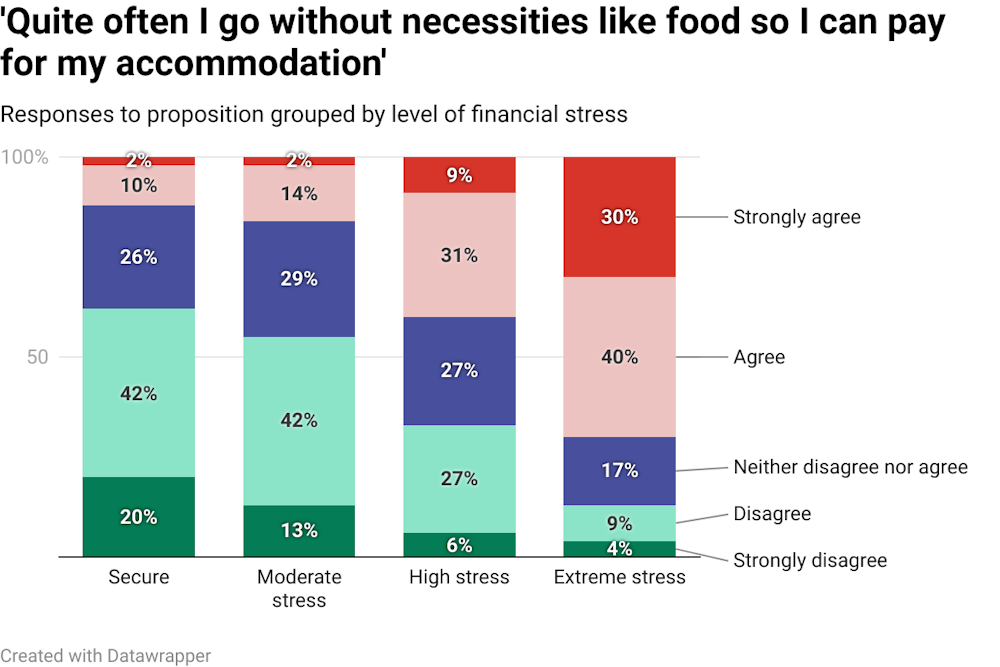
Worryingly, 70% of extremely precarious students reported going without necessities such as food so they could pay the rent. This proportion drops to 40% for highly precarious students, 16% for moderately precarious students and 11% for secure students.
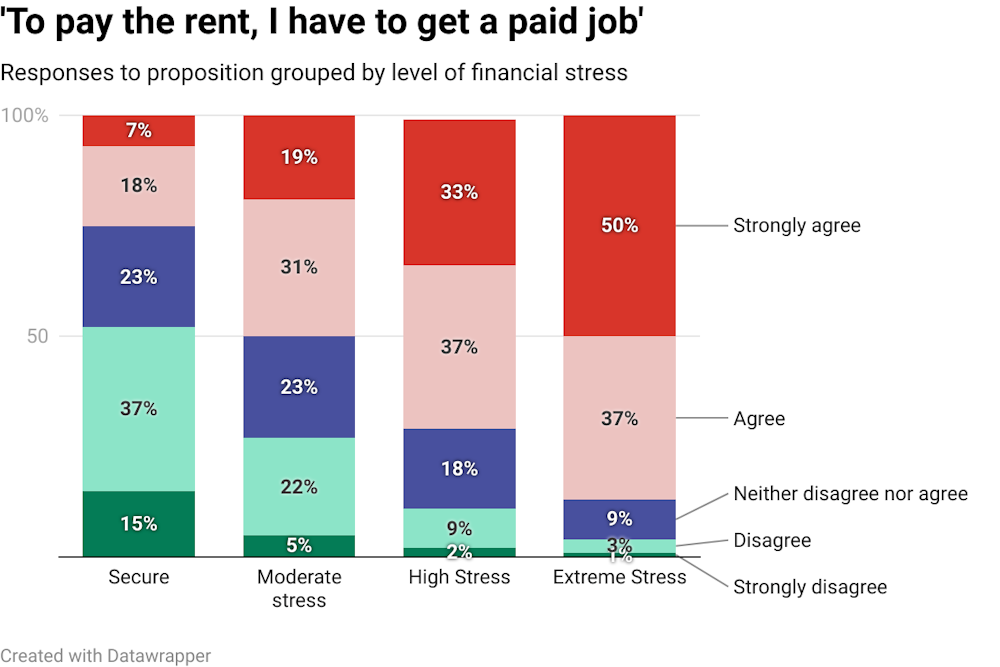
Many international students have a job and paid work is strongly related to precarity. A large percentage of extremely precarious students and highly precarious students (87% and 70% respectively) agreed having paid work was essential to pay the rent. In contrast, half of moderately precarious students and a quarter of secure students said they needed paid work to pay the rent.
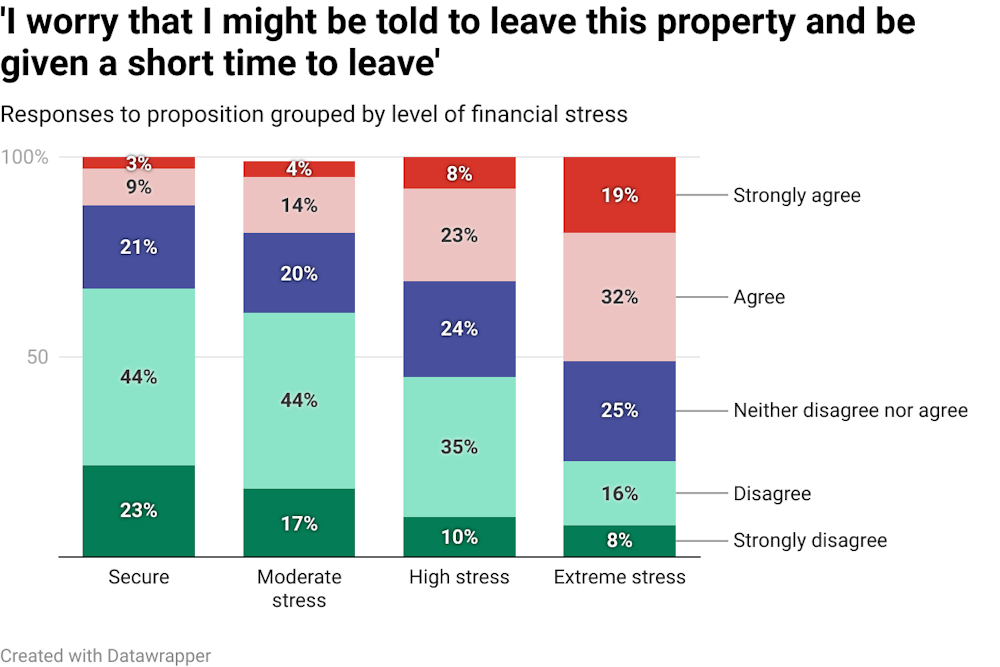
High rents are only part of the housing insecurity problem. When asked whether they worry about being told to leave their accommodation at short notice, just over half of extremely precarious students said yes, as did 31% of high precarious students. Only 18% of moderately precarious students and 11% of secure students had similar worries.
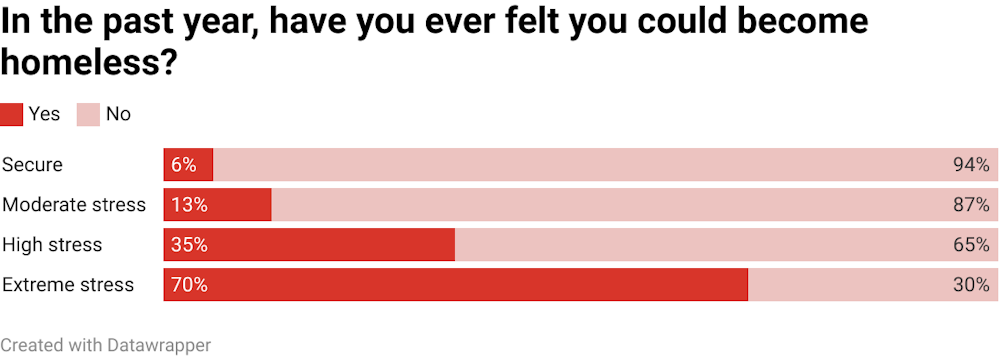
A particularly worrying finding was that seven in ten extremely precarious students and just over one in three highly precarious students had felt in the past year that they could become homeless. Only 13% of moderately precarious students and 6% of secure students had this concern.
The rental housing crisis means the circumstances of international students in need of housing are likely worse now than in late 2019.
The risks are particularly high for students from poorer backgrounds or countries. Policymakers and education providers must pay more attention to the issue of housing students who come to study in Australia.
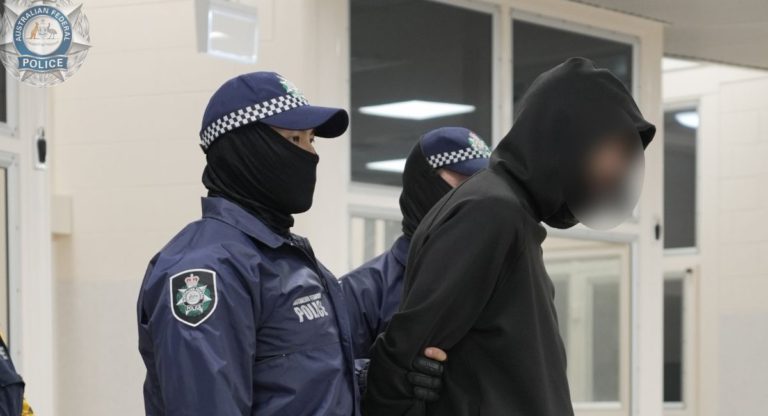
The AFP has revealed the surprising role gold is playing to help law enforcement identify and track down alleged criminals, thanks to a special forensic capability.
AFP Forensic Teams are using precious metals such as gold and silver in an evidence recovery technique that can develop fingerprints on cash along with other items including plastics, glass, mobile phones, firearms and other weapons.
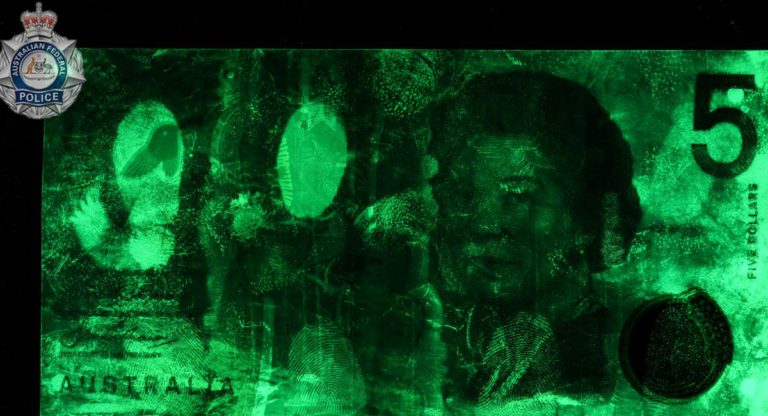
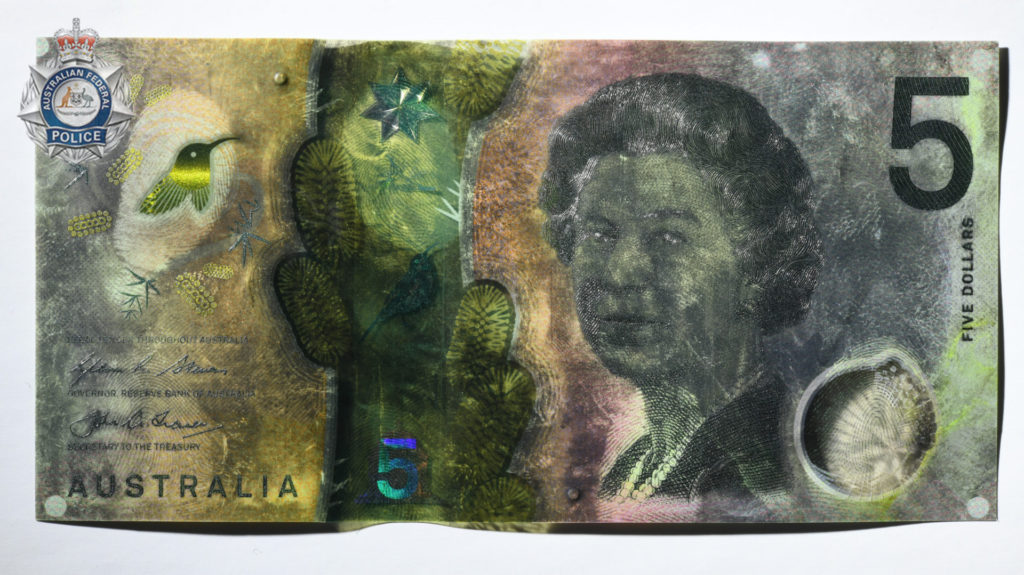
The powerful technique, known as Vacuum Metal Deposition (VMD), was responsible for the detection of dozens of fingerprints, some of which were identified to alleged criminals, on seizures of Australian currency as part of Operation Ironside.
Image source: Vacuum Metal Deposition (VMD), AFP.
VMD involves the thermal evaporation of metals, primarily gold or silver and zinc inside a custom built chamber. The technique causes these metals to form thin films under the controlled high vacuum conditions, which develops any ‘invisible’ fingerprints present, so that they can be seen.
AFP Forensic Coordinator Dr Nathan Scudder said the evidence recovery technique using gold had delivered significant results for multiple AFP investigations part of Operation Ironside.
He said:
“The AFP’s Forensic Team played a significant role in Operation Ironside thanks to our elite evidence recovery techniques. We used VMD to process more than twenty alleged illicit cash seizures, totalling thousands of dollars, as part of Operation Ironside. These banknotes were sent to our Majura Forensic Facility to undergo specialist fingerprint development in a purpose built machine.”
Dr Scudder said the capabilities of AFP Forensics was continuously evolving and allowing investigators to locate evidence that previously would have remained undetected.
“This is an extremely powerful and sensitive process where precious metals such as gold can actually enhance the fingerprints of individuals that have touched the exhibits, such as banknotes. Suddenly evidence that was not visible before has been miraculously recovered, thanks to this capability.”
The AFP used the VMD technique to conduct evidence recovery from cash seizures from multiple investigations linked to Operation Ironside including the following case studies:
Operation IRONSIDE-REGA:
On 9 June, 2021 a Hunter Valley man was arrested as part of Operation Ironside-Rega after approximately $4.9 million dollars, believed to be the proceeds of crime, was allegedly discovered inside his home.
AFP officers, along with the NSW Police Force Drugs and Firearms Squad conducted a search warrant at the man’s rural New South Wales’ home in Quorrobolong, where detectives allegedly located 49 bundles of illicit cash inside the wall of a sheet metal shed, with each bundle containing $100,000.
Also in June, 2021, AFP investigators recovered and seized approximately $47,000 in cash, including $40,000 hidden inside a shoebox, located during a search warrant on the New South Wales Central Coast.
The search warrant at the Erina Heights property on 7 June, 2021 was part of a larger investigation into an alleged criminal syndicate responsible for trafficking and importing methamphetamine, leading to the seizure of more than 460 kilograms of the illicit drug.
In December, 2021 as part of the second phase of Operation Ironside AFP detectives with assistance from NSW Police Force and Australian Border Force officers executed more than 20 search warrants across Sydney as a result of intelligence collected from the AN0M platform.
Aussiewood sprinkled its star dust at this year’s 80th Golden Globes with five nominations and a fourth acting win for Cate Blanchett, this time her performance as a renowned German conductor in Todd Field’s Tár.
The Golden Globes was back in full capacity at the Beverley Hilton in Los Angeles and broadcast on NBC. This time the ceremony was on a Tuesday, not a Sunday night and was also streamed live on Stan.
In the previous years the ceremony had been scaled down due the COVID-19 pandemic, as well as controversies associated with the Hollywood Foreign Press Association (HFPA).
Besides Blanchett, another Aussiewood member nominated included Baz Luhrmann for directing the feature about the rockabilly icon, Elvis. Also nominated was Margot Robbie in the acting musical or comedy category for her role as Nellie LaRoy, an aspiring actress in the film Babylon, about ambitious creatives in Hollywood during the roaring 1920s.
Hugh Jackman received an nomination as the father of a teenage boy with mental health issues in The Son, and Elizabeth Debicki in her supporting role of Princess Diana in season five of the Netflix series, The Crown.
US actor Austin Butler won Best Performance by an Actor in a Motion Picture — Drama for his role as Elvis Presley. But Luhrmann lost out to Steven Spielberg’s The Fabelmans for Best Director — Motion Picture.
Andrew Dominik’s Netflix drama, Blonde, saw Cuban actress Ana de Armas (who played Marilyn Monroe) nominated in the Best Performance by an Actress in a Motion Picture — Drama. However, that award went to Blanchett, who did not attend the ceremony because she was in London for the premiere of Tár.
Aussiewood and awards
Since the 1900s, Australians in the cultural field have often spent time in or moved to Hollywood to forge successful careers.
Despite the 1970s and 1980s boom in Australia’s national film industry, the minimal Australian nominations for the Golden Globes were tied to the Foreign Language category. One example is Gillian Armstrong’s My Brilliant Career, which was nominated for Best Picture in 1981.
The term Aussiewood came into vogue during the 2000s to describe the international franchises and successful invasion of Australian artists in Hollywood.
In their 2004 book on the topic, critics Michaela Boland and Michael Bodey said Aussiewood reached a critical mass in 2002 when Australian directors and the acting fraternity were nominated in 24 television and film categories at the Golden Globes.
Nicole Kidman, who won a Golden Globe in 2002 for her role as Satine in Luhrmann’s Moulin Rouge, has a total of six Golden Globe awards to her name – the most for any Australian to date.
Nicole Kidman at the 2002 Golden Globes awards. Golden Globes
What is the magic of Aussiewood?
Tom Hanks, who is nominated this year for playing Colonel Tom Parker in Luhrmann’s Elvis, joked back then that Australia’s success in Hollywood “has something to do with magical qualities in Vegemite”.
However, as Beverly Hills-based publicist Catherine Olim said:
It doesn’t have anything to do with where they are from […] What Hollywood sees is their talent.
Unlike the peer-driven, Academy of Motion Picture Arts and Sciences (the Oscars), the Golden Globes is voted on by 105 Los Angeles-based foreign journalists (six of which are now Black) who are members of the Hollywood Foreign Press Association.
Since its inception in 1943, the aim of the the Hollywood Foreign Press Association was to distribute cinema news to the non-US markets. The annual Golden Globes ceremony is often seen as the dress rehearsal to the Oscars in March.
In recent years the Hollywood Foreign Press Association has been criticised for moving beyond the realms of objective journalism by boosting media campaigns of Oscar hopefuls.
Prior to this year’s Golden Globes and following its world premiere at the Venice Film Festival in September 2022, Blanchett received a lot of international positive media praise for her role in Tár.
Blanchett’s Golden Globe win for Tár hints at possible Oscar glory, which could put her in the elite Aussiewood category of three Academy Awards.
One way to understand how the courts in Australia are ranked is to imagine a pyramid and an umbrella.
Let’s start with the pyramid. Imagine three lines horizontally across the pyramid dividing it into four sections. Each section represents a court of each state or territory.
So what’s on the base of the pyramid, and what are the upper layers?
The Local or Magistrates Courts
The bottom section represents the local or magistrates courts. It is biggest because it deals with the vast majority of court cases in Australia.
There is a single judicial officer presiding, and no jury. The bread and butter of these courts are minor crimes such as traffic offences, lesser assaults, shoplifting and possession of prohibited drugs.
These courts also have other roles including being children’s and coroners’ courts. They also deal with less serious civil disputes, where one person or company is suing another (under certain limits; in New South Wales, for example, that limit is A$100,000).
Local courts also deal with apprehended violence and restraining orders. The maximum sentence that can be handed out by a judge in a local court is generally two years imprisonment.
The other reason the bottom section of the pyramid is biggest is because all criminal matters start in the local court. The more serious ones work their way up to the higher courts for sentence or trial.
The District Court
The next section up the pyramid represents the District Court.
They deal with more serious crime such as sexual assault, major drug supply and high-level violence.
If the person on trial doesn’t plead guilty, there is a jury to determine guilt or innocence.
The district court also deals with serious civil disputes, generally where the amount is up to $750,000.
The Supreme Court
The Supreme Court is the next layer of the pyramid. It deals with the most serious civil and criminal cases, such as murder. They mostly have a jury in criminal cases.
They also deal with some specialty areas such as defamation.
The Courts of Appeal
Finally, there is the Courts of Appeal, which are part of the Supreme Court, but sit above it.
They hear appeals from lower courts, and there are usually three judges sitting on each matter.
The really interesting aspect of the pyramid is that it represents not just more seriousness and less volume as you go up, but also the appeal process.
So, if you want to appeal from the Local Court, then you go the District Court, then from the District to the Supreme Court and so on.
The “doctrine of precedent” means rulings from higher courts are binding on lower ones.
The High Court and the umbrella model
But what if you want to appeal from the Court of Appeal? That’s where the umbrella comes in.
That appeal is to the High Court, which you can imagine as an umbrella that sits over each of the state or territory pyramids.
There is one High Court, based in Canberra, and its decisions are final, and binding throughout all parts of Australia.
Fun fact: up until the 1980s the highest court for Australia was in England! Called the Privy Council, it was possible to appeal from state and federal courts and let English law lords be the final decider. But Australia got rid of that system and now the highest court in the land is the High Court.
Some state-based variations
Is it all that simple? Not really.
First, in Tasmania the Australian Capital Territory and the Northern Territory there is no District Court level at all. These are small states and territories, with not enough people to necessitate this level of the pyramid.
Second, sometimes appeals jump a level. For example, they may go straight from the Local Court to the Supreme Court. And in some states, there are different names for each level. In Victoria the District Court is called the County Court, and in some places like the Northern Territory, magistrates are called judges.
Finally, there are some specialty courts like the NSW Land and Environment Court that sit at Supreme Court level.
Hang on, what about federal courts?
Just when you thought you had your pyramids in a row, along comes another complication: the federal system.
The Constitution divides up powers between the states and the Commonwealth.
The best example is family law, which is allocated to the Commonwealth and so the Federal Court system deals with divorce and related matters.
And so there is another pyramid which works across the whole country only this time it has two levels.
The lowest and biggest level is the Federal Circuit and Family Court of Australia, dealing mostly with family law (but also other federal matters such as immigration and welfare law).
The next level up is the Federal Court, which deals mainly with corporations law, bankruptcy and trade practices as well as hearing appeals from the lower court.
Don’t forget the umbrella, the High Court, which also hears appeals from the Federal Court.
A whole myriad of tribunals
I’m sorry to have to tell you it gets even more complex from there. There are also tribunals.
Sitting beneath the state, territory and federal court systems is a whole myriad of tribunals which deal with non-criminal matters.
New South Wales, for example, has the New South Wales Civil and Administrative Tribunal (NCAT), which deals with tenancy, consumer, guardianship, strata and licensing matters. It even has its own appeal panel as well (and if people still aren’t happy, they can then appeal to the courts).
The members of the tribunal are not judicial officers and are appointed for fixed periods.
Of course, if you were to strike out centuries of history and start afresh, you would likely just have one multilayered pyramid across the country with a single tribunal at the foot, and the High Court at the top.
Australia’s cherry industry is all set to increase export efforts.
This will be done through a new $1.2M export program that will boost support for existing and aspiring exporters.
Cherry (image source: CANVA)
The local cherry industry plans to send 40 per cent of its production overseas by 2025.
The latest initiative is being delivered through Hort Innovation using industry levies and funds from the Australian Government and led by Cherry Growers Australia with industry partners.
Andrea Magiafoglou (Image source: CGA)
Cherry Growers Australia’s chief operating officer, Andrea Magiafoglou said the nation’s cherry industry, made up of some 200 producers, is poised for growth as it enters a new phase of export development.
“Industry has set an ambitious target of exporting 40 per cent of production by 2025 and this dedicated export program, with support being tailored to each region, will help us reach that,” she said. “With many cherry growers being export ready, we are now in a position where we can build on our success to be an export-focussed industry.”
Ms Magiafoglou adds that there is a strong willingness for industry to work together to share data and intelligence to preserve premium export prices in the face of increasing global competition; and thereby manage this risk.
The initiative will include more than 50 activities that will build export capability among Australian cherry growers, minimise trade risks during supply chain disruptions and other challenges and grow Australia’s reputation for delivering quality cherries.
Cherry (image source: CANVA)
Australia exported almost 5000 tonnes of fresh cherries overseas in 20/21
24 per cent of that went to our largest market, Hong Kong.
23 per cent of Australian Cherry production was exported in 2020/21 (Source: Australian Bureau of Statistics).
Brett Fifield (Image source: Hort Innovation)
Hort Innovation’s chief executive officer, Brett Fifield, said this project would focus on emergency response planning, pest and disease management, data and supply chain traceability, as well as training workshops and supports such as an export helpdesk line.
“Investing in export activities is at the forefront of what we do. In this instance, a key focus is also looking at how trade markets can be maintained, expanded, and diversified to support industry sustainability.”
More than $26M in research and development activities, from pest and disease management efforts to educational events to market access preparation work, underpins the Cherry Export Strategy.
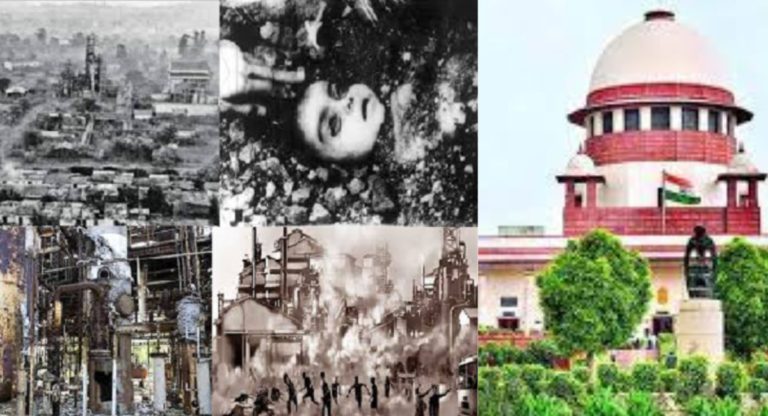
India’s Supreme Court has given a verdict on the government’s curative plea (filed in December 2010) seeking an additional ₹7,844 crore from successor firms of Union Carbide Corporation (UCC) for giving extra compensation to the victims of the Bhopal gas tragedy.
The court observed that the central government cannot reopen a settlement arrived at with the company after over 30 years.
Justice Sanjay Kishan Kaul, who headed the five-judge Constitution bench, said:
“Courts are not averse to extending the envelope to exercise jurisdiction. But it all depends on the jurisdiction you are dealing with.”
He added:
“If I am sitting in Article 226 jurisdiction, I would certainly not hesitate to mould the relief wherever required. In a suit, I will be more constrained and here we are in curative. There is ‘maryada’ in the jurisdiction. We as judges are bound by ‘Maryada’ (limit) of jurisdiction.”
The Supreme Court bench, comprising Justices Sanjeev Khanna, Abhay S Oka, Vikram Nath and JK Maheshwari, presented its disinclination about reopening the issue.
They told Attorney General R Venkataramani:
“The court is not going to step into something which is not permissible and open the pandora box. There was a settlement which was arrived at between the parties and the court has approved it.”
The AG said the fiduciary relationship concept has grown over a period of time and has been expanded by courts.
“What is worrying in this case is that a lot of issues and questions have remained unanswered. By this curative petition, our endeavour is to elicit such answers.”
The AG clarified to the bench that the government is not seeking to challenge the settlement already arrived at but wants more compensation for the victims of the tragedy.
Justice Khanna also told the AG that the incident happened in 1984 and the settlement was arrived at in 1989.
The AG highlighted that between 1992 and 2004, ₹ 1,549 crore was disbursed by the Reserve Bank of India and around ₹ 1,517 crore was paid after 2004 as compensation.
Senior advocate Harish Salve, appearing for UCC, told the bench that the settlement which was arrived at had no reopener clause in it.
The UCC, owned by Dow Chemicals, gave a compensation of USD 470 million (Rs 715 crore at the time of settlement in 1989) after the toxic methyl isocyanate gas leak from the Union Carbide factory on the night of December 2-3 1984. This gas leak killed more than 3,000 people and affected 1.02 lakh more.
The courts in Bhopal had issued non-bailable warrants against the prime accused UCC chairman Warren Anderson in 1992 and 2009. He died in September 2014 and did not appear for any trial.
The news of a hot chilli sauce shortages earlier this year – due to high temperatures and drought in agricultural regions – prompted warnings to stock up on supplies or forego adding this flavor to your food. But what prompts people to want to do this in the first place?
We are usually born with an aversion to the sensations like the taste of chilli on our tongue. This isn’t surprising because the key ingredient in chilli is a compound called capsaicin, which causes a painful and even burning sensation when it comes into contact with sensitive areas of our skin, eyes and mouth. Little wonder that it is also a key ingredient in pepper spray.
But in smaller, tolerable amounts, we can adapt to the sensations evoked by chilli and find them desirable.
Chilli can even act as a natural opiate, making our bodies release endorphins in a similar way to a “runner’s high”.
A taste sensation
We react to capsaicin because we have a family of receptors in sensory nerves lining the epithelial (outer) layers of our skin, naso-oral and gastrointestinal tract. These bind to the capsaicin and relay signals to our brain.
These receptors are temperature sensitive and respond to heat in addition to being activated by capsaicin.
In the case of biting into a chilli pepper, the release of capsaicin onto our tongue generates a sensation that ranges from mild tingling to burning heat, depending on the degree to which we have adapted to it.
What distinguishes the sensation compared to other flavours – for example, salty, sweet and bitter – is that it continues long after we have swallowed the mouthful of food containing the chilli. This is because capsaicin is soluble in fat so it is not easily washed off from its receptors on our tongue and mouth by drinking water. In this way, the sensation can intensify with further mouthfuls of chilli-containing food.
We experience capsaicin as a burning sensation that is amplified when the temperature of the food is hot. Our brain interprets this as both pain and excessive warmth, which is why our facial skin flushes and we start to sweat.
Sounds horrible, so why do some people love it?
Well, firstly, all that burning increases saliva production, a response that dilutes the heat as well as enhancing the ability to chew the food. This also dissolves and spreads other flavours in food around the tongue, which enhances the perception of these flavours.
Some volatile organic compounds with flavour can also rise up from the back of the mouth to the nasal sensors when the food is swallowed. Think of the pungent hit of wasabi that comes with sushi or the complex mix of aromas in a Thai red curry. Relatively bland food like rice has its flavor increased by the addition of chilli.
Another factor is that endorphins are released in response to the painful stimulus, which provide their own pain-numbing and mood-enhancing effects. This is a similar situation to people who get addicted to running – the effect of endorphins released by prolonged or intense exercise is to reduce feelings of pain and make us feel good.
People may increase their consumption of chilli as their response to capsaicin receptors adapts and they develop more tolerance and preference for the taste and its effects.
However, it is possible to have too much chilli, shown in the link between high daily consumption of chilli (more than 50 grams – or three or four tablespoons – per day) and declines in memory.
COVID and taste
One thing people have noticed as a frequent side-effect of COVID infection and some antiviral treatment is that their sense of taste and smell is temporarily reduced or lost.
While this eventually recovers in most people, it can go on long after the initial illness. This loss of the ability to smell and taste flavours in food (anosmia and ageusia) leads to reduced enjoyment and quality of life.
Researchers have focused on the mechanisms through which the different COVID variants affect olfactory neurons (the parts of the brain that process and respond to smell) and supporting cells in order to find treatments.
These include smell training using essential oils, which may assist people whose smell remains impaired longer than a month post-COVID. Chilli might also assist, as a taste enhancer.
One study by a meals company of 2,000 diners with COVID found 43% of them were increasing the amount of chilli and other spices they were adding to food to amplify the flavour of meals. Danish experts say eating foods like chilli might be useful to provide sensory stimulation to diners when their sense of smell isn’t quite up to scratch.
Non-Resident Indians (NRI) will soon be able to make payments in Unified Payments Interface (UPI) without getting an Indian mobile number.
India’s National Payments Corporation of India (NPCI), the umbrella organisation for all retail payments systems, that facilitates services like UPI Payment, Bharat Bill Pay, and RuPay Card said in a statement:
“We have been receiving requirement from the (UPI) ecosystem with regards to the non-resident accounts and other permissible accounts having international numbers to be allowed to transact in UPI.”
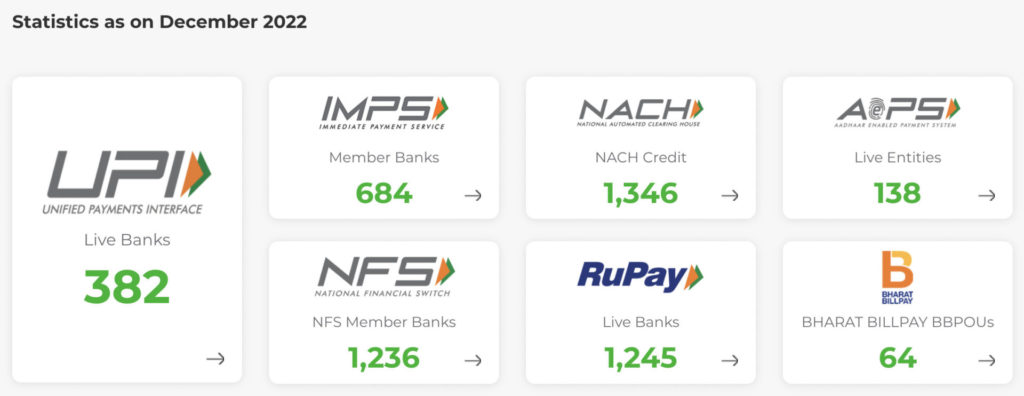
NPCI says NRE/NRO accounts from the following ten select countries, including, can access UPI using their international mobile numbers.
Image source: NPCI
An NRE account helps NRIs transfer foreign earnings to India, while an NRO account helps them manage the income earned in India.
For the uninitiated, UPI payment systems have revolutionized transactions and obviated the need to carry hard cash in most cases. UPI has been done by simply allowing a UPI user to simply scan a QR code and transfer the desired amount directly to the vendor’s bank account. In fact, from roadside vendors to retail chains, UPI has now become common in India.
image source: NPCI
Further, Nepal, Bhutan, and Singapore have signed deals with NPCI to integrate their payment networks with UPI.
A cabinet committee headed by Prime Minister Narendra Modi today approved a ₹ 2,600 crore scheme for promoting RuPay debit cards and low-value BHIM-UPI transactions.
PM Modi has also lauded fellow Indians for embracing digital payments as India reached a milestone of 782 Crore UPI Transactions worth ₹12.8 Lakh Crore in Dec 2022.
I like how you’ve brought out the rising popularity of UPI. I laud my fellow Indians for embracing digital payments! They’ve shown remarkable adaptability to tech and innovation. https://t.co/fSqR8NIufj
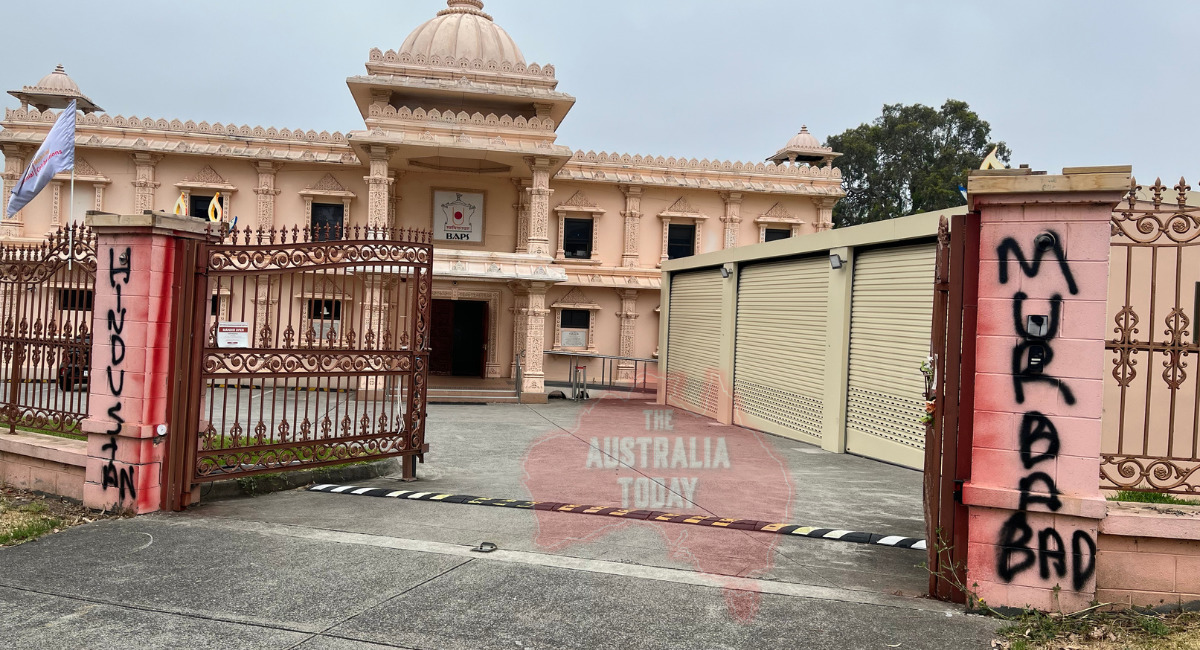
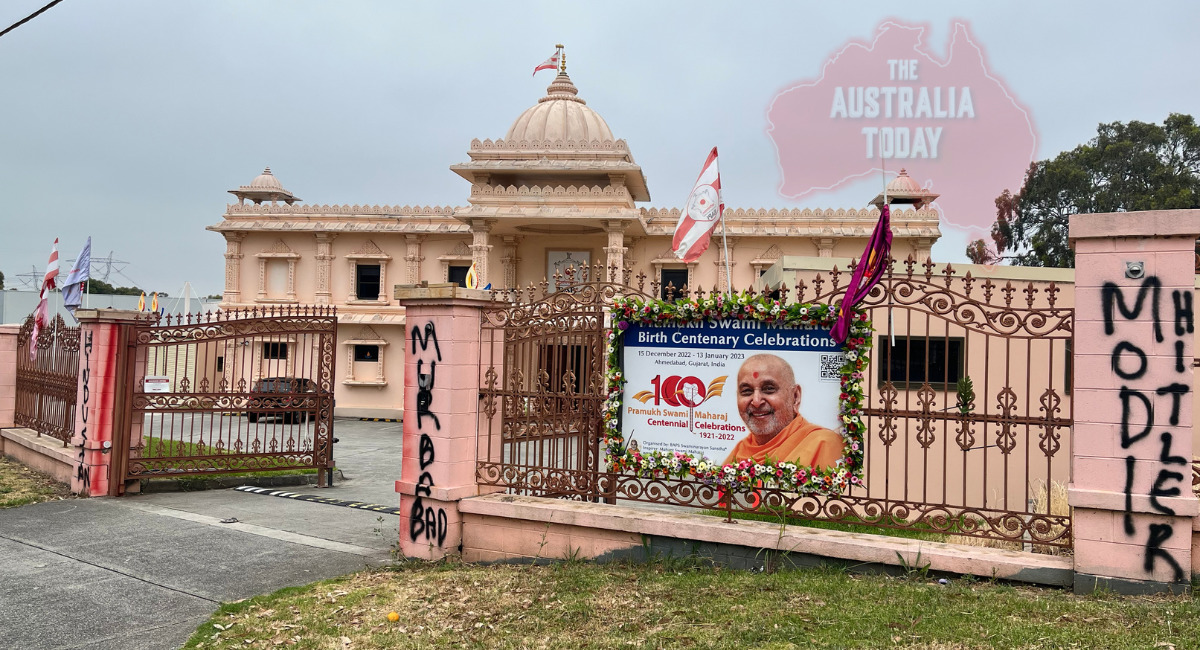
12 January morning came as a shock to the Hindu community as they woke up to ugly scenes on the walls of BAPS Swaminarayan Mandir in Melbourne’s northern suburb of Mill Park.
Mr Patel (who does not want to tell his first name fearing repercussions) told The Australia Today, I visit the temple every morning before going to work.
“When I reached the temple today morning all walls were coloured with graffiti of Khalistani hatred towards Hindus.”
Temple walls are painted with “Hindu-stan Murdabad” which means death to Hindu-place.
Mr Patel says,
“I am angry, scared and dismayed by the blatant display of religious hatred towards the peaceful Hindu community by Khalistan supporters.”
BAPS Swaminarayan Mandir provide a statement to The Australia Today, “We are deeply saddened and shocked by these acts of vandalism and hate.”
“BAPS has always been committed to peaceful coexistence and dialogue with all faiths and peoples. We have apprised the authorities and are cooperating fully with them.”
“We offer our prayers for peace and harmony and will provide a fuller statement in due course,” ended the statement.
Khalistan supporters have also written praises of an Indian terrorist Bhindrawala responsible for killing more than twenty thousand Hindus and Sikhs as a ‘Martyr’.
Hindu Council of Australia’s Victoria state President Makrand Bhagwat told The Australia Today, “Any kind of hatred and vandalism against places of worship is not acceptable and we condemn it.”
“And this kind of activity is in violation of the racial and religious tolerance act of victoria we demand Victoria Police and Premier Dan Andrews to take strong action against the perpetrators.”
We will definitely raise this matter with the Victorian Multicultural Commission and the Multicultural Minister of Victoria because the death threat to Hindus is a very serious matter as the community is in fear of these Khalistan supporters.
Evan Mulholland, Liberal MP for the Northern Metropolitan Region told The Australia Today, “This vandalism is deeply distressing for Victoria’s peaceful Hindu community, especially at this holy time.”
Evan Mulholland, Liberal MP for the Northern Metropolitan Region; Image Source: Supplied
“Religious hatred of this kind has no place in Victoria.”
Hindu community leaders across Victoria are standing with the BAPS Swaminarayan Mandir community and condemning the attack on Temple.
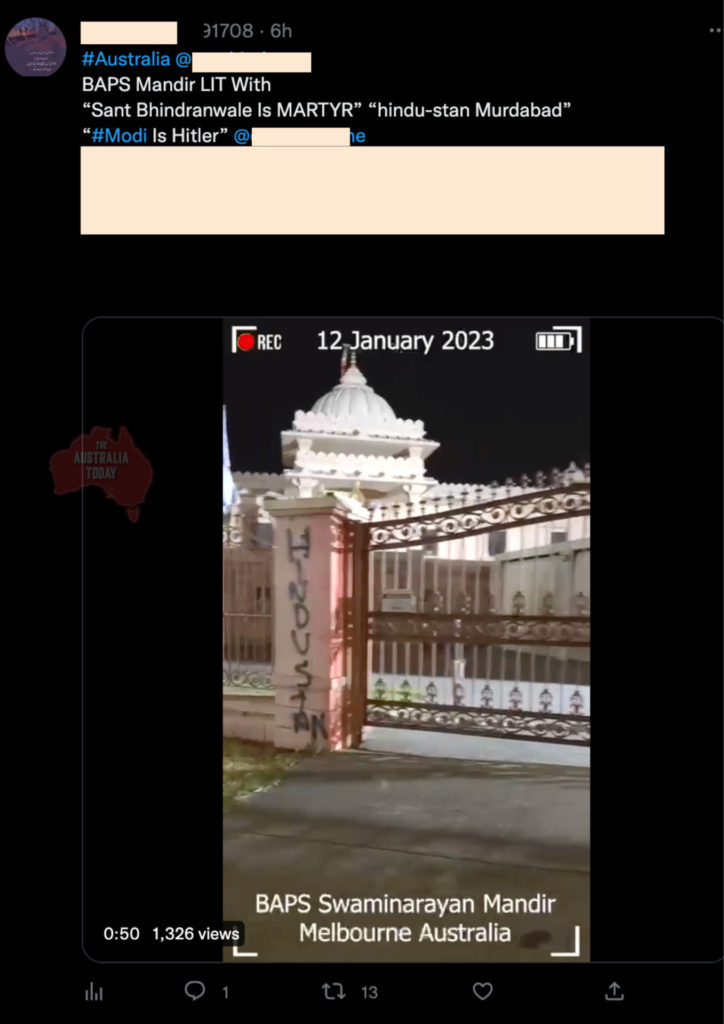
The Australia Today can reveal that the Khalistani extremists recorded a video of their despicable act of vandalising the BAPS Swaminarayan Mandir. And now they are sharing it on social media claiming it to be their brave act.
Our editorial team has decided not to put that video here however here is a screenshot.
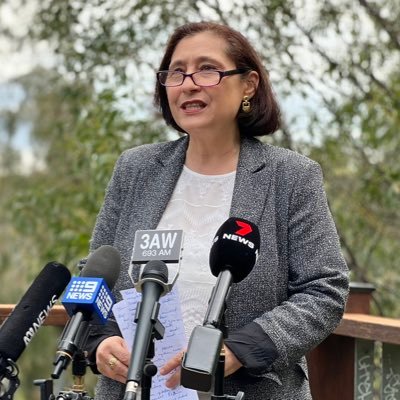
Lily D’Ambrosio, Member for Mill Park and Minister in the Victorian government, told The Australia Today that “there is no place in our community for such attacks”.
Image source: Lily D’Ambrosio, Member for Mill Park (Twitter)
She said:
“I have reached out to the Mill Park Mandir today to express my concern with the attack on the temple. The Mandir is a very important site for worship across broader Melbourne and is used to host many events that grow a better understanding of the rich diversity of our community amongst all of us. I have visited on many occasions and hope that the appropriate authorities can identify those responsible and bring them to account.”
Meanwhile, BAPS Swaminarayan Sanstha Australia in a statement appealing for peace has added that the whole community is “deeply saddened by the anti-India graffiti at the gates of the BAPS Shri Swaminarayan Mandir in Mill Park, Melbourne, Australia by anti-social elements.”
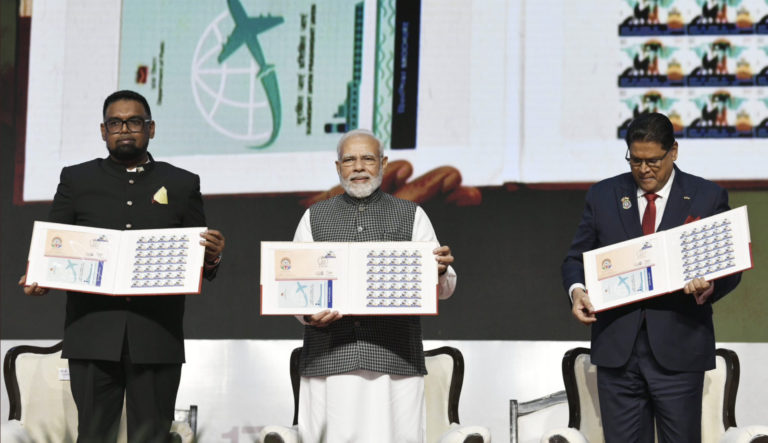
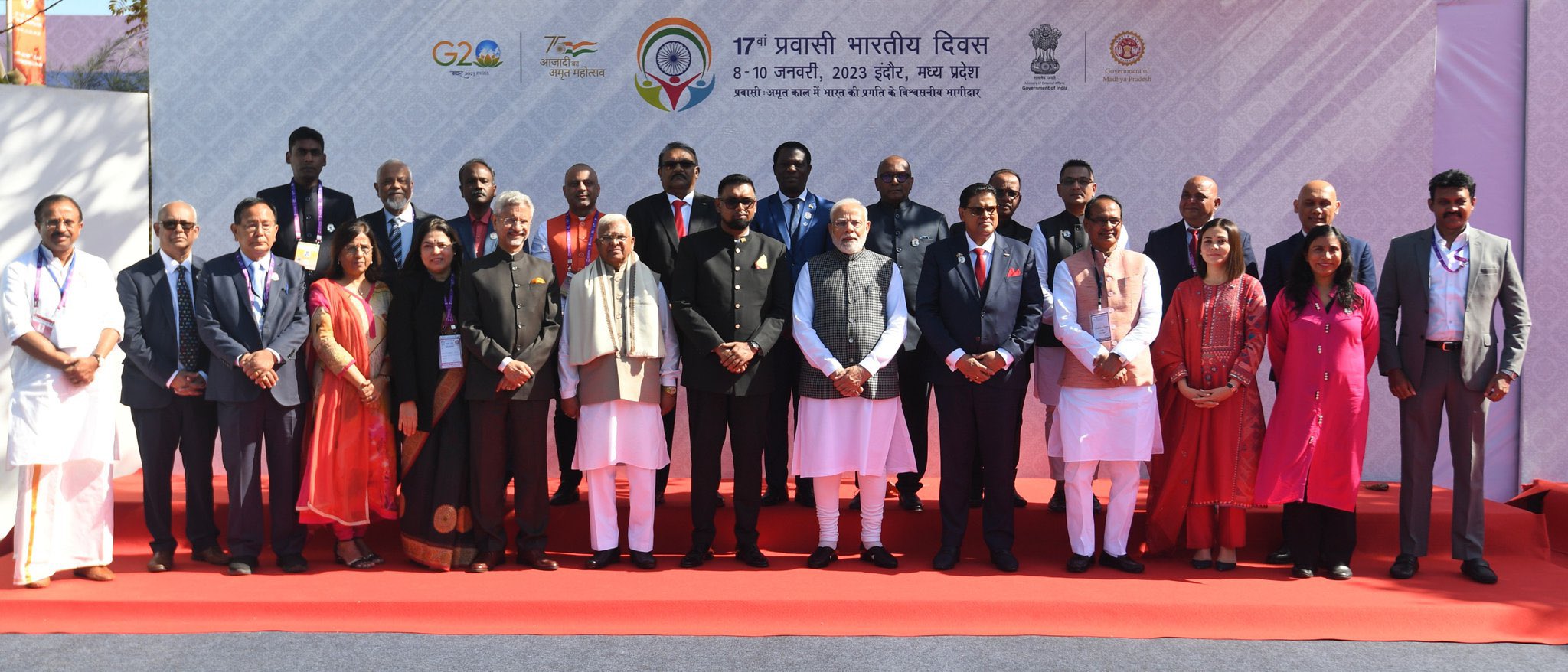
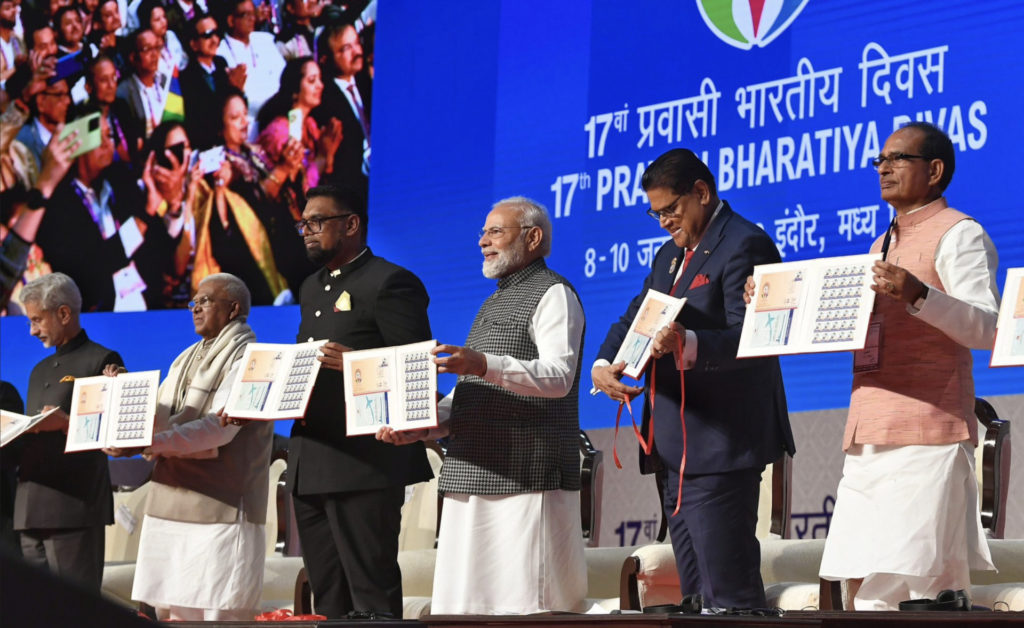
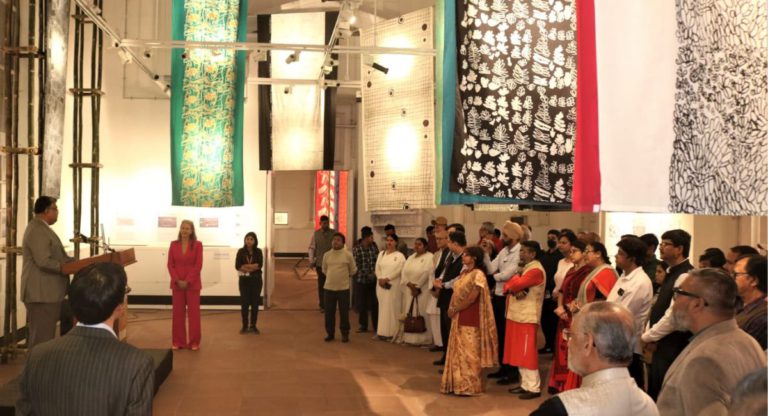
The 17th Pravasi Bharatiya Divas Convention in the Indian city of Indore was glittering with shining stars of the Indian Diaspora on its valedictory session.
As President of India Droupadi Murmu conferred Pravasi Bhartiya Samman Awards to 27 carefully selected members of the 32 million-strong global Indian Diaspora.
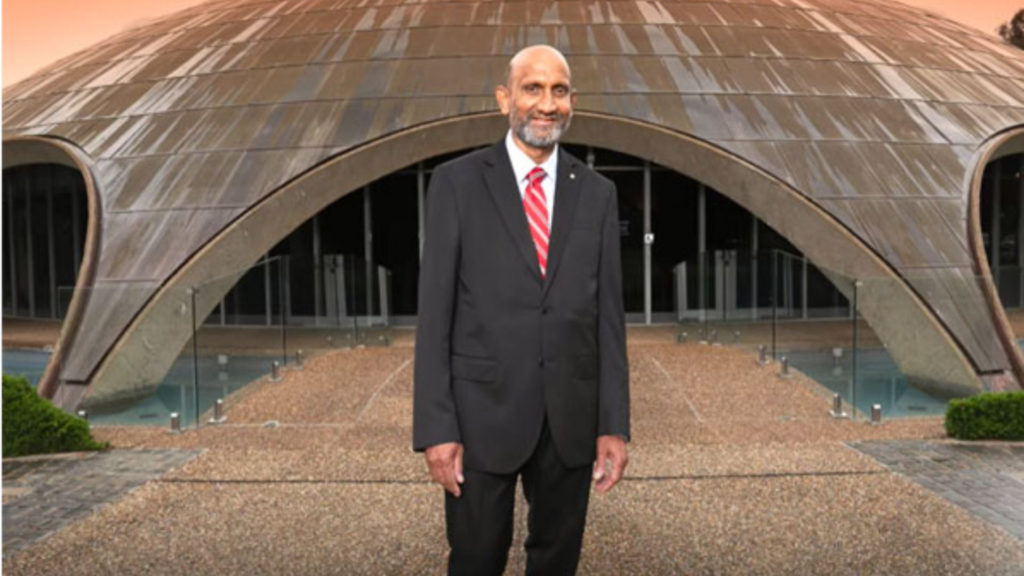
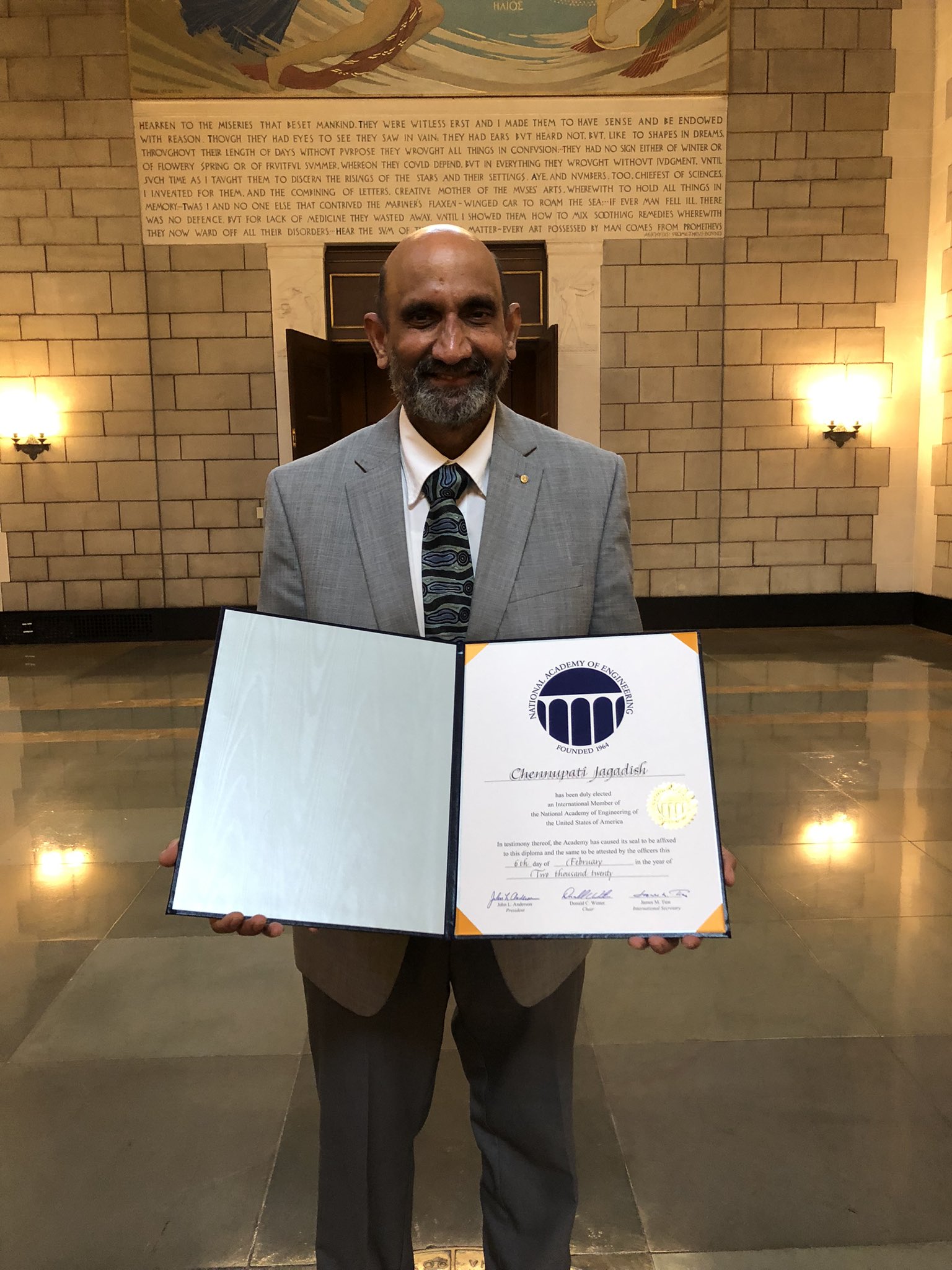
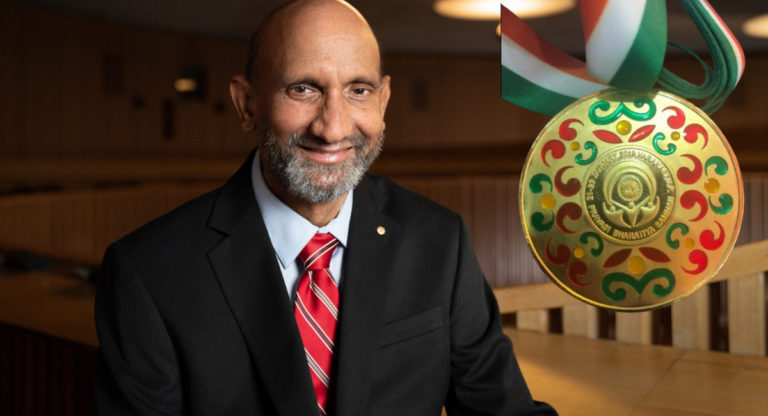
Indian Australian Dr Chennupati Jagadish was among the recipients of the Pravasi Bhartiya Samman.
Prof Chennupati is a Physicist and Nanotechnology Pioneer and was recently appointed as the President of the prestigious Australian Academy of Science (AAS).
Nanotech pioneer Prof. Jagadish appointed as President of Australian Academy of Science: Picture Source: Supplied
Prof. Jagadish who studied by the light of a kerosene lamp up until grade seven went on to receive a B.Sc. degree from Nagarjuna University in 1977, M.Sc (Tech) degree from Andhra University in 1980, and M.Phil. and Ph.D. degrees from the University of Delhi in 1982 and 1986, respectively.
He moved to Australia in 1990 and became an Australian citizen in 1995. Here, he established a major research program in the field of optoelectronics and nanotechnology.
WATCH VIDEO: Prof. Chennupati Jagadish’s exclusive interview with The Australia Today’s Editor Pallavi Jain
Prof. Jagadish has served as an advisor to the Australian Government on Nanotechnology, and also established the Australian Nanotechnology Network and the Canberra node of the Australian National Fabrication Facility to serve academic and industrial needs. He has also served as the President of the IEEE Nanotechnology Council (2008, 2009), IEEE Photonics Society (2018,2019), Australian Materials Research Society (2016-2019) and is currently serving as the President of the Australian Academy of Science (May 2022-May 2026).
Pravasi Bhartiya Samman Award (PBSA) is conferred by the President of India as part of the Pravasi Bharatiya Divas Convention on Non-Resident Indians, Persons of Indian Origin or an organisation/institution established and run by the Non-Resident Indians or Persons of Indian Origin in recognition of their outstanding achievements both in India and abroad.
A Jury-cum-Awards Committee, with India’s Vice-President Jagdish Dhankar as the Chairman and External Affairs Minister Dr S. Jaishankar as the Vice-Chair with other distinguished members from various walks of life considered the nominations for the Pravasi Bharatiya Samman Awards, 2023 and unanimously selected the awardees.
Following is the list of Awardees recommended by Jury-cum-Awards Committee for conferment of the Pravasi Bharatiya Samman Award 2023:
Sr. No.
Name
Country
Field
1
Prof. Jagadish Chennupati
Australia
Science & Technology/ Education
2
Prof. Sanjeev Mehta
Bhutan
Education
3
Prof. Dilip Loundo
Brazil
Art & Culture/Education
4
Dr. Alexander Maliakel John
Brunei Darussalam
Medicine
5
Dr. Vaikuntam Iyer Lakshmanan
Canada
Community Welfare
6
Mr. Joginder Singh Nijjar
Croatia
Art & Culture/Education
7
Prof. Ramjee Prasad
Denmark
Information Technology
8
Dr. Kannan Ambalam
Ethiopia
Community Welfare
9
Dr. Amal Kumar Mukhopadhyay
Germany
Community Welfare/Medicine
10
H.E. Dr. Mohamed Irfaan Ali
Guyana
Politics/Community Welfare
11
Ms. Reena Vinod Pushkarna
Israel
Business/Community Welfare
12
Dr. Maqsooda Sarfi Shiotani
Japan
Education
13
Dr. Rajagopal
Mexico
Education
14
Mr. Amit Kailash Chandra Lath
Poland
Business/Community Welfare
15
Mr. Parmanand Sukhumal Daswani
Republic of Congo
Community Welfare
16
Mr. Piyush Gupta
Singapore
Business
17
Mr. Mohanlal Hira
South Africa
Community Welfare
18
Mr. Sanjaykumar Shivabhai Patel
South Sudan
Business/Community Welfare
19
Mr. Sivakumar Nadesan
Sri Lanka
Community Welfare
20
Dr. Dewanchandrebhose Sharman
Suriname
Community Welfare
21
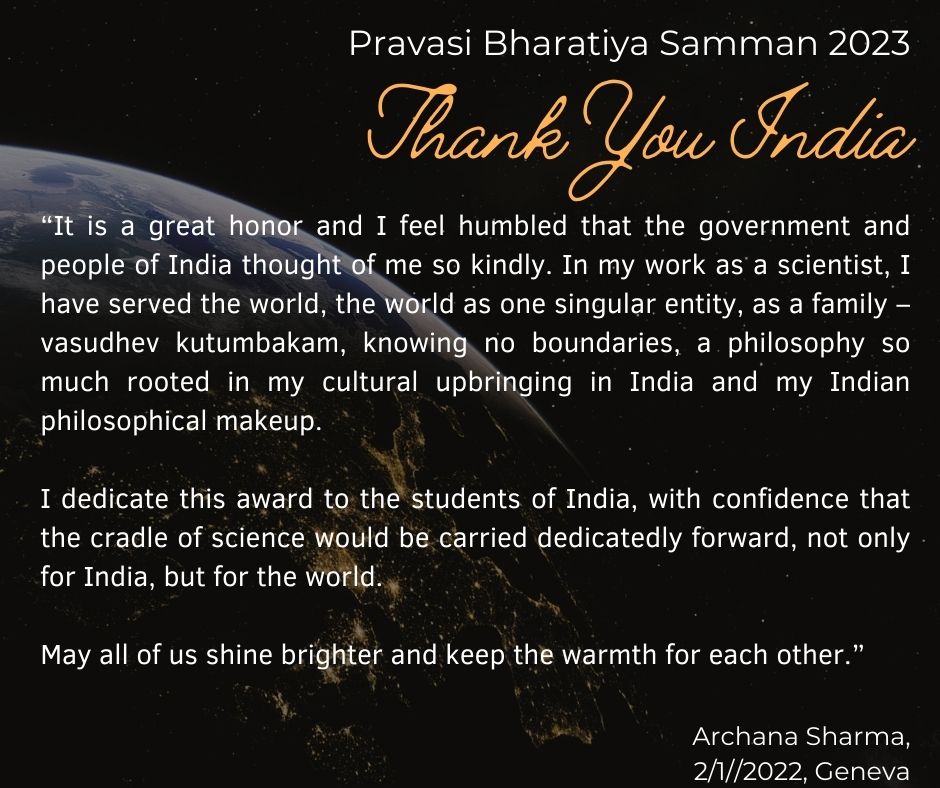
Dr. Archana Sharma
Switzerland
Science & Technology
22
Justice Frank Arthur Seepersad
Trinidad & Tobago
Community Welfare/Education
23
Mr. Siddharth Balachandran
UAE
Business/Community Welfare
24
Mr. Chandrakant Babubhai Patel
UK
Media
25
Dr. Darshan Singh Dhaliwal
USA
Business/Community Welfare
26
Mr. Rajesh Subramaniam
USA
Business
27
Mr. Ashok Kumar Tiwary
Uzbekistan
Business
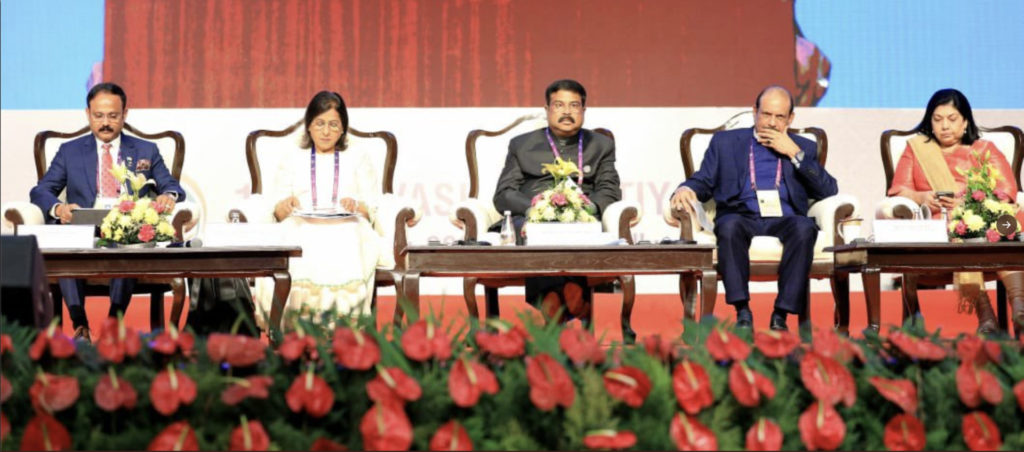
Dr Archana Sharma from Switzerland receiving Pravasi Bhartiya Samman Award
Addressing the gathering, the President of India said that the Indian Diaspora today has become an important and unique force in the global system. It has grown into an energetic and confident community in every region and is making stellar contributions to world affairs in leadership positions.
“Our Diaspora has exhibited extraordinary dedication and hard work, and has overcome many challenges to achieve excellence in all walks of life – including art, literature, politics, sports, business, academics, philanthropy, science and technology.”
President Murmu said that over the last two decades, the Pravasi Bhartiya Divas Convention has served as a unique platform to enable fruitful engagement between the Government, the people of India and the Diaspora.
The Pravasi Bharatiya Samman Awards symbolise the India’s highest recognition of the Diaspora members for their contributions to India and their home countries.
Referring to the theme of this year’s Pravasi Bharatiya Divas Convention – “Diaspora: Reliable Partners for India’s Progress in Amrit Kaal”, President Murmu said that it reflects India’s desire to make its Diaspora a partner in the achievement of its national developmental goals.
She said that in the next 25 years, India is going to embark on an ambitious journey of collective hard work, sacrifice and intensive development to transform into a self-reliant world leader by 2047, when we would be celebrating the centenary of our independence.
The President said that the collective power and potential of the Indian Diaspora would be a force multiplier in the nation’s inclusive development. She urged each and every member of the Diaspora family to become a full partner in this journey.
President Murmu said that diaspora can contribute with their energy, experience, ideas, business acumen, investments, technical expertise and knowledge sharing, to enhance our capacities to fulfil the vision of an Atmanirbhar Bharat.
She concluded by saying, While the Indian Diaspora has built enriching and productive lives in their adopted homes in different corners of the world, they would always hold a special place in our hearts: not only as extended family members but as responsible stakeholders in India’s development.
By Louise Grimmer,Gary Mortimer, and Martin Grimmer
Many of us are drowning in “stuff”. To find space for all our possessions, we are paying off-site storage companies. Australians spend an average of A$163 per month on self-storage, one recent survey found.
The number one item stored in these facilities is furniture. Other items we cannot fit in our houses include appliances and electronics, hobby items, sports equipment, collectibles, memorabilia, books and photographs, cars and wine.
Around a quarter of customers cannot remember what is actually in their storage unit. Around 13% use them to hide their purchases from others.
The massive growth of the household storage industry is a sign of overconsumption. It’s a problem in many developed economies that’s doing increasing harm to the planet.
Unfortunately, the Earth does not have an off-site storage option. Curbing our desire to consume has to be the solution.
Costs are mounting for us and the planet
Australians owe, on average, about $3,800 in credit card debt and a further $17,700 in personal debt (excluding property debt, which averages $565,880).
This year Australian shoppers were expected to spend $63.9 billion in the six weeks before Christmas, about $2,458 per person.
We waste a lot of what we buy. For example, each year Australia wastes 7.6 million tonnes of food, with consumers accounting for half of this waste. The food we throw out is worth between $2,000 and $2,500 per household – or up to $1,000 per person.
Every Australian needs to prevent 150 kilograms of food going to waste every year for the national target of halving food waste by 2030 to be met. The state of play on food waste in Australia will be detailed at the National Food Waste Summit. https://t.co/2JCzwDepOnpic.twitter.com/s2RDEE3zNH
That’s just the start of the wasteful spending – think of all those gym memberships, gift cards, clothes, appliances and furniture we’ve bought but don’t use.
In total, Australian households produce about 12.4 million tonnes of waste each year. That equates to roughly half a tonne per person.
We are not just spending beyond our personal means but also beyond what our planet can sustain.
Eventually, we will run out of places for all this waste to go.
I’m not a hoarder, but …
People who own lots of stuff, or who collect things, are not necessarily hoarders, but may struggle to part with personal and household possessions. The reason can in part be explained by Belk’s concept of the extended self. This is when possessions become part of our identity and signal to others who we are and, importantly, who we want to be.
This is certainly the case for those who collect things. Our collections become a part of us and our life story. It can be difficult to disentangle ourselves from these possessions.
Some things we own may have symbolic value because they remind us of special people, places and events, such as gifts from a friend or souvenirs from a holiday. Possessions that still have potential financial or utilitarian value can also be hard to give up.
Why buy so much in the first place?
Part of the problem is we are exposed to thousands of advertisements every day and a huge array of cheap products. The temptation to keep buying things can be too much for many people.
In their 2005 book Affluenza, Clive Hamilton and Richard Denniss describe the Western world as being in the grip of consumerism. Fast forward to 2022 and it appears we haven’t changed much. Behaving as though we have a chronic lack of stuff, we simply buy too many things we don’t need.
Many Australians live in small houses or apartments that lack space for all their things. Even those in large houses find they are overflowing with possessions but are loath to give up some of them.
The solution is we pay someone else to store our possessions – and we pay a lot. Self-storage in Australasia has grown into a $1.5 billion industry.
There are about 2,000 self-storage facilities across Australia and New Zealand. Some house hundreds of individual storage units.
Depending on the size, location and type of storage unit (for example, climate-controlled for wine collections), the costs can add up to thousands of dollars a year for some people.
What can we do about it?
It is easy to be swept up in the shopping frenzies of Christmas and new year sales. We are “programmed” to spend by marketers and retailers who surround us with temptation in stores and online.
But there are things you can do to help counter the impulse to buy and reduce its impacts.
Make a list and set a budget before you head to the shops, and try to stick to it. Use cash instead of cards when you can. Research shows people feel the cost of paying more when using cash. Don’t shop on an empty stomach or when you are tired.
Where possible, shop locally and buy locally made items. It’s great for your local economy, and the planet benefits from fewer air miles.
Rather than products, consider gifts of experiences, which don’t involve accumulating “stuff”. Options include creative classes, entertainment, sports, or health and beauty services.
Look for products with less packaging or with biodegradable packaging. Buy loose products and choose refillable options where you can.
Ask yourself: do I really need to buy this? If I didn’t have a credit card, could I actually afford it today?
We can all use self-monitoring to improve our spending habits and reduce the environmental costs.
She told a hall full of hundreds of non-resident Indians coming from all over the globe that, “India is arguably one of the most successful Nations that practices ancient religions while embracing new technologies”
The plenary session on ‘Enabling Global Mobility of Indian Workforce – Role of Indian Diaspora’ in 17th Pravasi Bharatiya Diwas could not get a better speaker than Sheba Nandkeolyar, CEO of MultiConnexions a marketing agency specialising in multicultural communities.
Ms Nandkeolyar wears many hats including former National Chair of the Australia India Business Council and President of IAA Australia.
She said, “Indian Australian diaspora is an integral part of India’s civilisation and has played an important role in improving the relationship between two countries.”
“Australia is already a go-to place for Indian students and a skilled workforce however we as a diaspora have a role and responsibility to enhance the capacity and mobility of India’s workforce to serve humanity,”
said Ms Nandkeolyar.
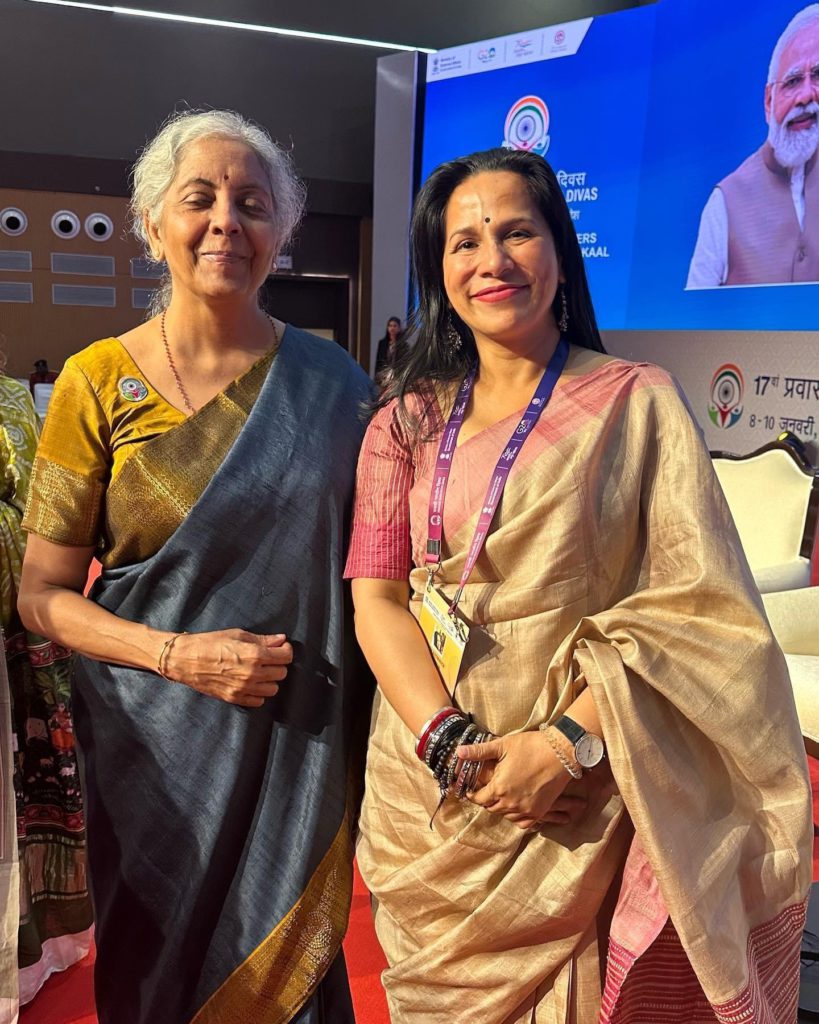
The final session at the 17th Pravasi Bharatiya Divas on Harnessing the potential of women diaspora entrepreneurs towards an inclusive approach to nation-building was chaired by the Indian Minister of Finance Nirmala Sitharaman.
In this session, Indian Australian entrepreneur Mitu Bhowmick Lange, Director of Mindblowing Films mesmerised everyone with her story of creating a brand for the Indian Film industry in Australia.
Mitu Bhowmick Lange with Indian Minister of Finance Nirmala Sitharaman at the final session at the 17th Pravasi Bharatiya Divas
Ms Lange recalled the days when she had to wait to watch the second half of the #Hindi movie at an Australian theatre.
“Today we have one of the most successful celebrations of Indian cinema through the ‘Indian Film Festival of Melbourne’ with a flag hoisting ceremony on India’s independence day 15th August every year,”
said Ms Lange.
She didn’t forget to mention that Australia is in real love with Indian cinema, barring the barriers of language Hindi, Telugu, Tamil, Kannada, Malayalam, Marathi, Gujarati and Punjabi are generating $200 million per year.
The focus of this wonderfully inspiring and stimulating three days long function was to celebrate the Indianness living inside the 32 million-strong global Diaspora of India.
These three Indian Australian women are among the leaders who are instrumental in envisioning a flexible model with multiple entry-exit and skilling pathways that focus on building competencies of the Indian Diaspora.
Sheba Nandkeolyar rightly sums it up by saying the Indian workforce is hardworking, honest and responsible which can help India emerge as the global hub of skilled manpower.
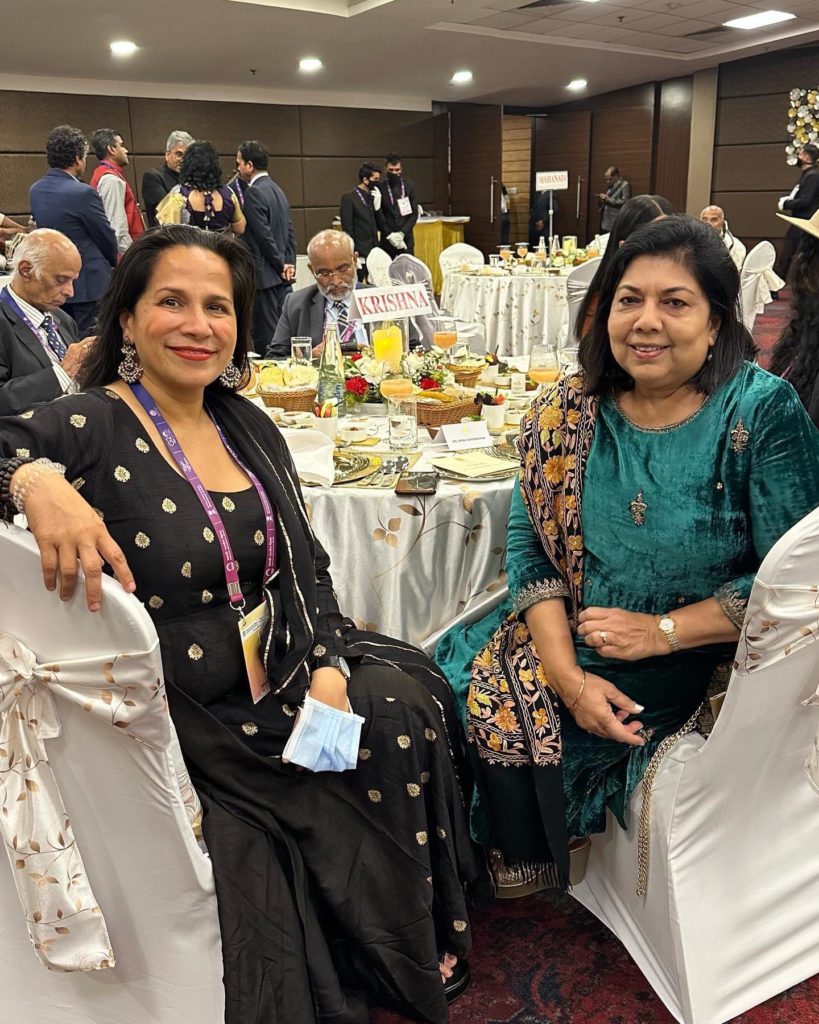
Mitu Bhowmick Lange and Sheba Nandkeolyar at Pravasi Bharatiya Divas
Pravasi Bharatiya Divas (PBD) Convention is the flagship event of the Government of India. It provides an important platform to engage and connect with overseas Indians and to enable the diaspora to interact with each other.
The 17th Pravasi Bharatiya Divas Convention was organized in partnership with the Madhya Pradesh Government from 08-10 January 2023 in Indore. The theme of this PBD Convention was “Diaspora: Reliable partners for India’s progress in Amrit Kaal”.
Over 3,500 diaspora members from nearly 70 different countries participated in PBD Convention.
Two women were denied bail after they were charged over an alleged armed robbery in the Lake Illawarra area, New South Wales.
About 4.50am on Wednesday 28 December 2022, two females – allegedly armed with a box cutter – entered a service station on King Street, Warrawong and approached the counter and threatened two male employees while demanding money.
One woman jumped the counter and allegedly stole cigarettes before both females fled from the store.
The employees were uninjured and called police.
Officers attached to Lake Illawarra Police District were notified and commenced an investigation into the incident.
Following inquiries, including a public appeal for assistance, two women – aged 23 and 27 – were arrested at Wollongong Police Station about 1.30pm yesterday (Monday 9 January 2023).
The older woman was charged with one count of robbery armed with offensive weapon – serious indictable offence and the younger woman was charged with one count of robbery in company – serious indictable offence.
The women were refused bail to appear before Wollongong Local Court today (Tuesday 10 January 2023).
When I was ten, I was the only female member of an all-boys sports team, and the boys liked to remind me of it, and that it would be better if I just went home.
That was my introduction to sexism. And its logic was clear: you are not welcome, go home.
It is also how many of us used to think about racism and sexism – as involving big, conscious signals of hatred or exclusion.
We now understand discrimination as a more complex phenomenon, involving a mix of big and small, intentional and unthinking, acts. Racism can be a large “not welcome” sign, but it can also be a series of micro-aggressions that leave racial minorities feeling marginalised, stigmatised or emotionally exhausted from repeated attempts to claim their rightful place on the team or at the table.
Sexism can be telling women and girls to – literally – go home, or it can be merely forgetting to unlock the girls’ locker room or provide protective gear designed for female bodies.
Performed repeatedly, these small acts can have systematic consequences for the choices women make about their lives and their sense of where they belong.
These acts can also have broader ripple effects on those witnessing them or walking alongside those affected. They are one way racism and sexism become systemic – baked into our social and legal structures.
Laws hurt, but they can help
Our laws are another source of systemic bias. Among them are laws that penalise crack cocaine more heavily than its whiter, powdered equivalent.
But laws can also be an important counter to bias. They can give women and marginalised groups the right to enter domains for which they have been excluded and stay there.
They can, for example, require equal funding for male and female sports teams.
And they can even require employers and educational institutions to make accommodations that make staying in institutions and succeeding possible.
Among such laws are laws that require wheelchair access and Braille signage and paid sick and carer’s leave.
These are not cheap for employers and educational institutions, but they can make a big difference to the lives and employment chances of those they help.
Micro-accommodations, to fight micro-aggressions
But laws can’t do everything. That’s why employers, managers and co-workers need to go further and provide small but meaningful accommodations to individual employees to help them thrive, rather than just survive, at work.
We could think of them as micro-accommodations. Like micro-aggressions, micro-accommodations involve acts that seems small to those making them, but if repeated can have much larger positive consequences for those they target.
Micro-accommodations can take the form of small scheduling adjustments. They might involve changing a start or finish time by a few minutes to accommodate school or daycare drop offs and pick ups, or short blocks in meeting calendars for parents to welcome their children home from school, or reordering presentations in meetings to allow people to arrive later or leave earlier.
Or they could involve providing short breaks for people to take prescribed medicines, or to briefly stretch to help manage injuries.
For me, as an 11 year old in an all-boys sports team, micro-accommodations initially took the form of a scheduled break to allow me to access a far-away female bathroom, and later, an agreement among my team that I could have brief but exclusive use of the male locker room.
This made a big difference to my focus and batting average (it was baseball, in the United States) and more significantly to my sense that I had a place in the team.
That message of inclusion may not have erased the messages of past exclusions, but it definitely helped mute them.
In principle, micro-accommodations could take any form – so long as they go beyond what’s required by law, and impose only modest costs on those providing them.
Think of efforts by employers to provide halal, kosher, vegan or gluten-free menu options, or to provide proportional parking prices for those working part-time.
One of the most famous micro-accommodations in recent memory was documented by former Google and Facebook executive Sheryl Sandberg in her best-selling book, Lean In.
Pregnant, late for a meeting, and only able to find a parking spot far from the front door of Google’s headquarters, Sandberg asked Google co-founder Sergey Brin for pregnancy parking closer to the door. He immediately said yes and said he wondered why the idea hadn’t occurred to him previously.
The cost was small: simply a matter of re-arranging parking spots rather than providing more. And the benefit to a pregnant Sandberg was huge. (If you don’t understand why, consider how hard it can be to walk quickly while heavily pregnant!)
Perhaps more important, it was a change that lasted well beyond Sandberg’s own pregnancies, benefited many other women at Google, and never became something they needed to negotiate each time they drove to the office.
Favours are not micro-accomodations
There is certainly value in managers and co-workers responding to requests for accommodations beyond what the law requires.
But asking has costs – it can cause anxiety and stress, it can be exhausting, and it can re-reinforce “not belonging”.
My own experience attests to this. When I started university teaching in Australia with a small baby, I was told that my classes would be at night, but that I could ask a colleague if they would consider swapping with me, as an accommodation.
I was fortunate that a colleague was generous and agreed to swap. It was a sacrifice for him, but not a large one. But the act of asking felt awkward and stressful. I really needed my colleague to say yes, if I was to keep doing the job I loved.
The question I kept asking myself was why it had become my responsibility to make things work rather than my employer’s.
The good news is that I and others repeatedly made this point, and there is now a far better policy: all staff at my university are invited to complete a form indicating when they can and cannot teach, and any special circumstances. Those who do the timetabling take this into account.
This is the difference between a favour and a micro-accommodation: a favour is inter-personal and ad hoc; a micro-accommodation is formalised so that all employees in the situations can benefit for as long as they are in that situation.
And micro-accommodations are public rather than private – not something workers have to keep quiet or minimize.
Favours are private, micro-accommodations are public
Private favours and quiet forms of “personal workarounds”, which are communicated on a need-to-know basis have downsides.
They are less effective because well-meaning colleagues can misunderstand and undermine them, and they are unlikely to have larger, systemic benefits.
Not advertising a workaround means it is likely to stop at one person.
Here’s an example. One of my co-workers, Marian, trialled a personal workaround involving blocking out a short period in her calendar after her kids came home from school. Because she didn’t advertise it to her team, she kept receiving calls and urgent queries during this time.
We discussed the challenges, and I encouraged her to communicate the workaround to her team.
As soon as she did, the results were different. The blocked-out time was almost never interrupted, and she found it much easier to look forward to her kids arriving home and spending time with them.
How to create micro-accommodations
Micro-accommodations are best when targeted to specific needs, as Marian’s was.
And they work best when they are initiated by managers, rather than employees. This takes an emotional load off workers and sends a powerful signal of inclusion.
Asking employees how best to accommodate their needs is one way to do it, but this still imposes an emotional responsibility on those being asked.
Another better way to do it is to informally audit facilities and schedules to see if they make sense for staff.
The resulting accommodations might be as simple as shifting important meetings and reporting deadlines away from major religious and school holidays.
Or making sure meetings don’t start at 9pm or finish at 6pm if childcare centres opens at 9am and close at 6pm.
Or making sure politicians don’t schedule big votes at unfriendly times.
ACT Legislative Assembly.
I help run a program that helps women (including trans-gender women) prepare to run for electoral office. Modelled on the Kennedy School of Government’s From Harvard Square to the Oval Office program, it trains a diverse mix of Australian women for electoral success.
And it pushes for changes that make it easier for them to stay in office once there.
One – already in place in the Australian Capital Territory – is family-friendly sitting hours, with sittings generally beginning at 10 am and adjourning by 7 pm. Queensland’s parliament and Brisbane City Council have similar arrangements.
Where this can’t happen, parties can agree not to schedule crucial votes at night, or during morning drop-off times.
Diverse leaders have responsibilities
While it shouldn’t only have to fall to female and diverse managers to offer micro-accommodations, they are in a good position to do so, even though the extra responsibilty is weighty.
It is no accident that it was Sheryl Sandberg rather than Sergey Brin who pushed for pregnancy parking, or that it was female legislators saw the case for family-friendly sitting times.
Micro-accommodations are far from the most important tool for achieving equality. Large-scale changes to the law can achieve more. And no amount of micro-accommodations can put right a world dominated by micro-aggressions.
But they are an important additional tool, one enlightened managers have the power and authority to use.
Indian Prime Minister Narendra Modi inaugurated the 17th Pravasi Bharatiya Divas Convention in Indore, Madhya Pradesh with much fanfare.
PM Modi released the Commemorative Postal Stamp ‘Surakshit Jaayen, Prashikshit Jaayen’ to underline the importance of safe, legal, orderly and skilled migration. The Prime Minister also inaugurated the first-ever digital PBD Exhibition on the theme “Azadi Ka Amrit Mahotsav – Contribution of Diaspora in Indian Freedom Struggle” to highlight the contribution of our diaspora freedom fighters in India’s Independence.
Pravasi Bharatiya Divas (PBD) Convention is the flagship event of India that provides a platform to engage and connect with the people of Indian origin and enable the diaspora to interact with each other.
The theme of this PBD Convention is ‘Diaspora: Reliable partners for India’s progress in Amrit Kaal’. Over 3,500 diaspora members from nearly 70 different countries have registered for the PBD Convention.
India celebrates its ‘Diaspora’ with a stamp on legal migration: Surakshit Jayen, Prashikshit Jayen’: Image Source: PIB
Addressing the gathering, PM Modi remarked that the Pravasi Bharatiya Divas is taking place in all its glory after a gap of four years and highlighted the significance and joy of personal interaction.
Welcoming everyone on the occasion on behalf of 130 crore Indians, Prime Minister Modi said that the event is taking place on the land of Madhya Pradesh which is known as the heart of India and famous for the holy waters of Narmada, the greenery, the tribal culture and spirituality.
He also mentioned the recently dedicated Maha Kaal Maha Lok and hoped that dignitaries and delegates will be able to visit the sacred place.
Talking about the host city, Indore, Prime Minister Modi said Indore is a city as well as a phase,
“It is a phase that walks ahead of time while preserving its heritage.”
Prime Minister Modi remarked that the Pravasi Bharatiya Divas is special in numerous ways as India completed 75 years of its independence only recently. He also informed that the first-ever digital PBD Exhibition on the theme ‘Azadi Ka Amrit Mahotsav’ has also been organised which brings the glorious era to the fore once again.
Highlighting the significant role of Pravasi Bhartiya in the next 25 years of the journey of Amrit Kaal, the Prime Minister stated that India’s unique global vision and its role in the global order will be strengthened by them.
Speaking about the world of today, He highlighted that Indians have traversed all parts of the globe while living among different cultures and traditions and yet found ways to unlock the gates of prosperity through business partnerships.
“The feeling of pride in being the mother of democracy increases manifold when Pravasis are talked about as the most democratic, peaceful and disciplined citizens in different parts of the world”,
Prime Minister Modi remarked.
Prime Minister Modi stated that he calls every Pravasi Bhartiya a national ambassador of India as they echo the voice of a powerful and capable India when the world evaluates their contributions.
“You are the Rashtradoots (national ambassadors) of India’s heritage, of Make in India, of Yoga and Ayurveda, of India’s cottage industries and handicrafts”, “At the same time, you are also the brand ambassadors of India’s millets.”
He mentioned that 2023 has been declared the International Year of Millets and appealed to everyone to take some millets products back home.
Prime Minister Modi highlighted that India is taking over the G-20 Presidency this year and the responsibility comes with a great opportunity to make the world aware of India’s past experiences to attain a sustainable future and learn from these experiences.
“G-20 is not just a diplomatic event but it should be turned into a historic event of public participation where one can witness the sentiment of ‘Atithi Devo Bhava’”, the Prime Minister said. He informed that more than 200 meetings will take place as part of the G-20 summit which will take place in different cities in India and said that it will be a great opportunity to establish meaningful connections with the delegates of many countries.
India celebrates its ‘Diaspora’ with a stamp on legal migration: Surakshit Jayen, Prashikshit Jayen’: Image Source: PIB
PM Modi said that today’ India has the opportunity to become not only the knowledge centre but also the skill capital of the world. He underlined the skill, values and work ethics of Indian youth. “This skill capital can become the engine of global growth”, the Prime Minister added.
He suggested that there should be a sustained effort to document the lives, the struggle and the contributions of Pravasi Bharatiyas for their respective countries through universities and research institutions. The Prime Minister said that each and every Bharatvanshi carries entire India with him or her.
“In the last 8 years, India has tried to strengthen its diaspora. It is India’s commitment today that wherever you are the country is for your interests and expectations”,
he said.
Prime Minister Modi thanked the Special Guests of Honour Dr Mohamed Irfaan Ali, the President of the Cooperative Republic of Guyana, and, Chandrikapersad Santokhi, President of the Republic of Suriname for their remarks and suggestions.
The 17th PBD Convention holds significance as it is being organised as a physical event after a gap of four years and the first after the onset of the Covid-19 pandemic. The last PBD Convention in 2021 was held virtually during the Pandemic.
The new year often means a new season of kids’ sports. Many families may be pondering whether to commit to another season or discovering their child is now saying they’d like to quit their usual sport.
My husband and I faced this dilemma last year when our nine-year-old wanted to quit Nippers (junior surf lifesaving). This followed a season of high emotion, where we faced weekly “drop-off dread”, only to have him happily bounce over to us after training, full of smiles and stories.
Given the vast body of research showing the benefit of organised sport for children (more on that later), it’s not always easy for parents to instantly agree when their child wants to quit.
So what does the research tell us about why kids drop out of sport and how might parents respond?
Why do children drop out from sport?
Participation rates in organised sport tend to peak towards the end of primary school, and there is significant decline in participation across adolescence.
Reasons for dropping out of a sport in adolescence include a focus on one sport over others or prioritising involvement in other activities (such as school work, jobs or socialising).
One of the major factors influencing children’s decision to quit sport is pressure from others (parents, coaches and peers).
Adult expectations, attitudes and behaviours can unintentionally sour children’s experiences of sport. This pressure can come in many forms, including unrealistically high expectations, a focus on winning, heated post-match debriefings, and critical comments.
Perceived pressure from adults relates to some of the main reasons children give for dropping out of sport: not having fun, being bored, or feeling they’re not good enough at it.
What are the benefits of sport for children?
When your child says they want to quit their sport, reflect on what’s at stake, and perhaps even discuss it with them.
As well as promoting health and fitness, organised sport builds developmental skills and competencies in young people.
Many parents see critical life skills – such as teamwork, resilience, dealing with frustration and disappointment, resolving conflicts and goal setting – as a major reason to enrol their children in sport.
Sport can also promote social connectedness for children and their families, contributing to a sense of belonging and social identity.
Our research with parents of Australian junior rugby league players suggests this might be particularly the case for Indigenous parents.
This social connectedness from sport can promote children’s mental health, helping protect against issues like anxiety and depression.
One longitudinal Australian study found children who drop out of sport between eight and ten years are at greater risk for social and emotional problems compared to those who continue in sport.
What can parents do when a child wants to quit?
There are no easy answers and the response will be shaped by factors unique to the child and their situation. But here are some strategies:
1. Talk to your child
Ask them what they don’t like about the sport. Is there anything that would need to change for them to continue? Would switching teams or dropping down a division make a difference?
You could try testing out the sport again, and agree to review things after a month.
Ask what they do like about the sport. This helps shift their thinking to what’s fun about it and what they might miss if they quit.
If your child can’t name anything they like, this might be the red flag you need that this sport isn’t for them.
2. Reflect on your own behaviour.
Think about your own hopes and expectations. Is it possible you’re putting too much pressure on your child?
Let your child know they can be open with you if they feel you’re pressuring them. You might need to work with your partner or other adults in the child’s life to come up with a plan to temper your expectations or behaviour around children’s sport.
3. Consider other options.
Every child is different. Some thrive on competition and performance, others find it anxiety-provoking and distressing. Others don’t much care if they win or lose.
Most children, though, enjoy personal accomplishment and the opportunity sport provides to challenge themselves and improve skills.
So, if the old sport isn’t working out for your child, consider looking for something different. Many activities build fitness and a sense of accomplishment but don’t necessarily involve competition.
For example, our local gymnastic club runs “NinjaZone” classes that challenge children to use their strength and agility to complete obstacle courses. My nine-year-old loves it.
Kicking off a new sports season provides an opportunity to reflect on the past and on how you can help your child have a positive sporting experience.
After all, the long-term goal is for our children to build a lifelong enjoyment of physical activity so they can bring the physical health, mental health and social benefits into adulthood.
Police have charged a man following a crime spree across southern metropolitan suburbs during December and January.
General duties officers, along with the Air Wing and Dog Squad, located and arrested a man following an attempted carjacking in Willow Drive, Hampton Park on 7 January.
It is alleged a man, who was a passenger in a ride-share vehicle, assaulted the driver and allegedly attempted to steal the car before fleeing on foot about 8pm.
The victim, a 35-year-old Narre Warren man, received minor injuries in the incident.
Other alleged offending included:
• Theft of alcohol and lollies from a liquor store on Bemersyde Drive, Berwick on 5 December.
• Theft of cigarettes from a service station on Webb Street, Narre Warren on 13 December.
• Theft of alcohol from a liquor store on Bemersyde Drive on 20 December.
• Assault of a shop attendant and theft of a large quantity of jewellery from a jewellery store on Nepean Highway, Moorabbin on 7 January.
A 26-year-old Berwick man has been charged with:
• Attempted carjacking
• Attempted theft of motor vehicle
• Theft x 4
• Unlawful assault x 2
• Contravene Court orders
• Fail to stop vehicle on police direction
• Robbery
• Commit indictable offence while on bail
• Theft from motor vehicle
The man was produced before the Melbourne Magistrates’ Court for a bail/remand hearing.
Bhandut is a small village in Olpad block of Surat district in India’s western state Gujarat. It has become 100% solar pump powered. The village’s 688 bigha agriculture land is now totally irrigated using fifteen 5-HP pumps facilitated by Adani Foundation. The initiative is perfectly executed to demonstrate a Public-Private-Partnership Model.
The gram panchayat and Adani Foundation with the guidance of the Gujarat government’s irrigation department came together to successfully execute the transfer from diesel to solar-powered pumps, in two years. The Adani Foundation generously aided the solar pumps and installations, the state government’s irrigation-related schemes ensured that irrigation pipelines were installed to take water to farms, and the Gram Panchayat helped in the implementation.
The Solar Pump installations have brought an abundance of benefits to the lives of beneficiary farmers. Adani Foundation is always in the process of creating opportunities for the farming community to help them benefit from the latest knowledge and technology. Through this initiative, the farmers are not only saving precious wealth by not buying diesel but also saving in the form of labour costs and time.
A total of 401 farmers are reaping the benefits of the initiative. Looking at the average annual savings on diesel, the farmers will collectively save approximately Rs. 9.13 Lakhs monthly and Rs. 1.10 Crore annually.
Similarly, the farmers will be saving Rs. 20 lakhs in labour and many hours of time. In addition to this, 3000 working hours are saved per month and 36000 hours annually. One of the major indirect benefits of the initiative has been the utility of those few farmlands as well which were not productive due to lack of access to irrigation.
Bhandut Solar Village; Image Source: Adani Foundation
The transition from diesel to solar has a positive impact on the environment as well; as per the calculation, the total CO2 emission avoided in the village by eliminating diesel pumps is 269916 KG per year.
Mukesh Patel, State Minister, Agriculture, Energy and Petrochemicals, Government of Gujarat inaugurated and witness the completion of the last phase of the Clean Energy (Solar Water Pump) initiative at Bhandut village.
Minister Patel said, “Bhandut village becoming diesel pump free has benefited 400 farmers cultivating in 688 Bigha of agricultural land of the village. The land has been irrigated with fifteen 5-hp pumps facilitated by the Adani Foundation.”
“The implementation of the scheme, featuring a Public-Private-Partnership model, has increased farmers’ incomes with cost and time savings.”
But reaching this stage was no easy feat. It was challenging for the villagers earlier as the main source of water for irrigation were three ponds and to direct water to their respective farmlands, farmers would use diesel-run motor pumps. The disadvantages to using plentifulabour inducing diesel meant that the farmers ended up spending a lot more, the diesel motor contributed to noise and air pollution, and it was a hard labour-inducing job as well as time-consuming.
And then there was another catch – not all farmers were able to afford to buy these pumps and hence they would have to take these pumps for rent from those who owned them, which would further add to the cost.
Soon, they realised that farming, when done on a large scale, is an expensive endeavour that consumes lots of electricity. Hence, if they incorporate solar-powered irrigation into farming, it will reduce overhead costs comprehensively. That is when they sought help from the Adani Foundation, Hazira, which stepped in and installed solar water pumps each of 5HP as an eco-friendly alternative.
The benefits of solar water pumps are many. It makes irrigation possible in remote areas; it is environmentally friendly; there is no requirement for fuel; and it needs minimal maintenance. Today, Bhandut has become a glowing example of a successful sustainable agriculture ecosystem, and a model village for many villages in India to follow its path.
About Adani Foundation
Established in 1996, Adani Foundation today has widespread operations in 16 states that include 2,409 villages and towns across the country with a team of professionals who work with an approach that embodies innovation, people participation and collaboration.
Touching the lives of over 3.70 million people and passionately working towards creating social capital with focus on four core areas – Education, Community Health, Sustainable Livelihood Development and Infrastructure Development, Adani Foundation acts towards inclusive growth and sustainable development of the rural and urban communities, in turn contributing towards nation-building.
Note: Above article is published as per The Australia Today’s global content partnership initiative.
Australians sure do like those brekkies, barbies and mozzies.
We’re not talking about “actual” mozzies here. We’re defo (definitely) talking about words — and Aussies can’t seem to get enough of these shortened words.
Some say we’re lazy for clipping them. Others claim it’s just Aussies knocking words down to size — ta, we’ll have a glass of cab sav or savvy b instead of whatever that is in French.
Our most beloved shortenings end in -ie/y and -o. Journos often ask us why Aussies use them, and whether they’ll last. Well, not only are we still using them, seppos (Americans) and pommies (Brits) are joining the action, too.
These alternative forms of words are often described as “diminutives” (or hypocoristics).
Pet names with such endings can show we have a warm or simply friendly attitude toward something or someone (think of the -s on Cuddles). Certainly, on names, -ie/y and -o are often affectionate (think Susy and Robbo).
But the vast majority of Aussie diminutives are doing something different.
Indeed, saying journo or pollie doesn’t usually indicate we’re thinking of journalists and politicians as small and endearing things. These “diminutives” are also a world away from the birdies and doggies of the nursery. Adult Australians might cheerfully talk about blowies and trackies, but not birdies and doggies — well, unless it’s on the golf course or perhaps in reference to the Western Bulldogs getting a specky (spectacular mark).
For Australian National University linguist Anna Wierzbicka, these expressions are among the most culturally salient features of Australian English — expressions of informality and solidarity that are “uniquely suited to the Anglo-Australian ethos […] and style of interaction”.
Experiments by Australian linguists have empirically confirmed the social effects of these embellished words. Colloquialisms such as barbie and smoko are like accents – part of the glue that sticks Australian English speakers together.
There’s a lot to saying the word "no" in an Australian accent, including the number of sounds you make – so, is it "no" or "naur"?
Those who think it's "naur" might "[link] the sound to ones they have in their own accent", writes Amy Hume (@UniMelb). https://t.co/2IKrU2DF8y
Diminutives can die out when they take on the burden of new social meanings. One of the oldest endings (found as far back as Anglo-Saxon times) is -ling. We see it still on words like twinkling and darling. However, by modern times it had flipped and become contemptuous, especially when used of humans (think of weakling and underling).
In contrast to -ling, our -ie/-y endings carry important, positive meanings, and there’s no sign yet that we’re giving up on them. Those sunnies, scungies, boardies, cozzies, stubbies and trackies are still the stuff of our sartorial summer fashion.
Slang might come and go, but the process that transforms sunglasses into sunnies and tracksuit pants into trackies continues to thrive.
So thriving in fact are these expressions that some are among Australia’s successful exports. International celebrities include greenie, pollie, surfie, mozzie, budgie (and its offshoot budgie smugglers).
And let’s not forget the linguistic rockstar that is selfie – its meteoric rise to stardom in 2013 saw it crowned Word of the Year by Oxford Dictionaries, and also by the Van Dale dictionary in the Netherlands.
We are, however, constantly refreshing our stock of -ie/y words. Many of the gems in Wendy Allen’s 1980s collection of youth slang in Melbourne (Teenage speech) have bitten the dust (for example, scottie from “he’s got no friends” -> “s’got no friends” -> “s’got + ie”).
But the second edition of the Australian National Dictionary shows us how many -ie/y words have proliferated since the 1980s/1990s (firie, tradie, trackie daks).
Bottle-o, milko and smoko: still alive-o?
That other long-time favourite ending -o occurs all round the English-speaking world. However, as the Oxford English Dictionary describes, its use “is especially associated with Australia”.
The earliest Australian examples (like milko, rabbito, bottle-o) date from the 19th century and are abbreviated nouns referring to a person’s trade (“milkman”, “rabbit-seller” “bottle-collector”). Sometimes they appear with -oh because of their association with street calls, and this use is old – think of those cockles and mussels of 18th century London, all very much “alive, alive-oh”.
Orright you lot, ever wondered where words like 'boardies', "burkini' and 'spunkrat' came from?@MonashUni linguists @HowardManns and Kate Burridge have the answers, unlocking Aussie summer slang.https://t.co/SKmYp6DW9u
Our love of this -o suffix may also owe something to Irish English. However, Australian linguist Jane Simpson points out it has much wider applications in Australia (and New Zealand), as shown by place names such as Rotto (Rottnest Island), Freo (Fremantle), Paddo (Paddington) and common nouns such as compo (compensation), ambo (ambulance driver) and bowlo (bowling club). And we’re exporting these too – demo, preggo and muso have made it into the wider world.
As with -ie/y endings, our -o endings don’t seem to be going anywhere in a hurry. However, their long-term survival seems slightly less assured than -ie/y. We’re still seeing newer coinages (such as housos), but a 2011 study suggests young people might be using this one less than previous generations.
Rellies or rellos, garbies or garbos: is there a pattern?
There are wharfies and truckies but not wharfos and truckos; garbos and musos but not garbies and musies. People who ride motorcycles are generally bikers; those who belong to motorcycle gangs tend to be bikies.
So what’s wrong with bikos? And why are there gaps? Those who build houses are neither buildos nor buildies.
Undoubtedly there are nuanced differences of meaning involved here. Does weirdie describe unconventional people more affectionately than weirdo, or even weird person? Certainly there’s a world of difference between the sicko (psychologically sick person) and the sickie (leave you take when you’re sick – or is that when you’re not sick?).
You tell us: do you prefer a lammo or a lammie for the small chocolate and coconut–covered cake? And are members of your family rellos or rellies? There’s a lot of lexicographers, linguists and other word nerds who haven’t figured this out.
A NSW woman, 31, has been charged for previously entering and remaining in parts of Syria that were under the control of the Islamic State terrorist organisation.
AFP and NSW Police investigators from the NSW Joint Counter Terrorism Team (JCTT), arrested the woman on 5 January 2023 after executing search warrants in Young and Parklea, NSW.
The woman faced Griffith Local Court on 6 January 2023, charged with entering, or remaining in, declared areas, contrary to section 119.2 of the Criminal Code (Cth).
The offence carries a penalty of up to 10 years’ imprisonment.
It will be alleged the woman, who is now living in Young, NSW, travelled to Syria in early 2014 to join her husband, who left Australia in 2013 and joined Islamic State.
It will also be alleged the woman was aware of her husband’s activities with Islamic State, and willingly travelled to the conflict region.
The woman’s husband is believed to have died in Syria in 2018.
The woman, who was in Al Roj Internally Displaced Persons camp, returned to Australia in October 2022.
She was charged after a complex and long-term investigation by the JCTT that began when the woman was in Syria, and continued after her return to Australia.
It will be alleged newly obtained evidence enabled the JCTT to charge the woman.
There is no current or impending threat to the Australian community as part of this activity.
AFP Acting Assistant Commissioner Counter Terrorism and Special Investigations Command Sandra Booth said the JCTT would continue to investigate Australians returning from declared conflict areas to ensure the safety of the Australian community.
“Individuals will be brought before the courts when evidence supports allegations that returned individuals have committed offences in conflict areas,” Acting AC Booth said.
“The JCTT will continue to target criminal activity, and does not target specific ideologies or beliefs.”
NSW Police Counter Terrorism and Special Tactics Commander, Assistant Commissioner Mark Walton, said the priority of the NSW JCTT is to protect the community from those who seek to do us harm.
“We have zero tolerance for Australians – or anyone – who seek to commit acts of violence or extremism, and those considering doing the wrong thing will come under our notice,” Assistant Commissioner Walton said.
“Our investigators methodically gather information and evidence, conduct surveillance and work tirelessly to target criminal activities which pose a threat to the Australian community.”
The NSW JCTT comprises members of the AFP, NSW Police Force, the Australian Security Intelligence Organisation, and the NSW Crime Commission.
Anyone with information about extremist activity or possible threats to the community should come forward, no matter how small or insignificant you may think the information may be. The number for the National Security Hotline is: 1800 123 400.
The idea of a “forgotten prime minister” may seem laughable. For Australian historians, it is the governed rather than the governors who need rescuing “from the enormous condescension of posterity” as the English historian E. P. Thompson famously put it.
Our First Nations histories especially were for too long silenced and concealed in what the anthropologist Bill Stanner called a “cult of forgetfulness practised on a national scale”.
Prime ministers, on the other hand, are stitched into the tapestry of national history thanks to extensive newspaper coverage, the dogged pursuits of political biographers, and the quest of archivists and librarians to collect their personal papers. Deceased leaders’ names adorn buildings and streets, federal electorates, and dedicated research centres, and in Harold Holt’s case, a memorial swimming pool.
But some, of course, are better known than others. So which prime ministers, if any, can be considered “forgotten” by contemporary Australia? And what does that act of forgetting reveal about our political culture? Commemorative rituals and opinion surveys suggest that some have very much receded from memory.
Here are a few prime ministers who deserve to be a little better known.
Edmund Barton 1901-03
Edmund Barton, Australia’s first prime minister. National Archives of Australia
Barton was a hugely significant figure in his day. A leading advocate of federation, he was summoned by the Governor-General Lord Hopetoun (after a false start) to form the first Commonwealth government.
Between 1901 and 1903, Barton’s government, with the dynamic Alfred Deakin as its attorney-general, established some of the national institutions we now take for granted, such as the public service and the High Court. Barton and Deakin’s deeply racial vision of a White Australia was also enacted in legislation in these years.
Australia’s first prime minister (known to detractors as Tosspot Toby) helped to establish the machinery of the federal government out of nothing. But this earned him no special place in Australian collective memory. Resigning in 1903, he spent the remainder of his life as a reticent statesman and High Court judge.
George Reid 1904-05
George Reid, a political enemy of Barton’s, held office from 1904-05. Museum of Australian Democracy
Reid was a political opponent of Barton’s. The defining issue of the early Commonwealth was tariff policy, and all other matters – industrial development, employment, and individual liberty – were refracted through the “tariff question”. Reid, a former New South Wales premier who had earned the moniker “Yes-No Reid” for his prevarications during the earlier federation debates, was a devout advocate for and leader of the Free Trade movement.
Reid was summoned to form a government in August 1904. Hamstrung by his lack of a parliamentary majority, he remarkably passed the Conciliation and Arbitration Bill. This was core business for the early Commonwealth, and two previous ministries had failed to secure it. But Reid’s attempts to settle the tariff question with Deakin’s Protectionists failed, and his ministry was defeated in parliament in July 1905.
Joseph Cook 1913-14
Joseph Cook, together with Reid, was instrumental in establishing the two-party system that continues today. National Archives of Australia
Out of office, Reid and his Free Trade colleague Joseph Cook played a crucial role in making the two-party system that endures today. Whatever their differences with Deakin and the protectionists, Reid and Cook (himself a former Labor MP in New South Wales) saw the rising Australian Labor Party as the real enemy.
Reid travelled the country establishing anti-socialist leagues and building the groundwork for a united anti-Labor Party. When the tariff schedule was finally settled in 1908, and the mutual animosity between Deakin and Reid seemed the only barrier to a Liberal fusion, the latter sacrificed himself and resigned so that the former could join forces with Cook on his own terms.
In 1913, Cook led the new Commonwealth Liberal Party to a federal election, winning by the narrowest of margins. He oversaw the opening weeks of the Great War the following year, committing 20,000 Australian troops and the Australian Navy to Britain, but soon lost power in Australia’s first double dissolution election.
Stanley Melbourne Bruce 1923-29
After the war, the task of national leadership fell to Stanley Bruce, a young businessman and ex-serviceman from Melbourne. In 1923, as leader of the non-Labor forces (now reconstituted as the Nationalist Party), Bruce formed the government with Earle Page’s Country Party (forerunner of today’s rural National Party). In doing so, Frank Bongiorno has recently explained, Bruce and Page ‘inaugurated the Coalition tradition on the conservative side of Australian federal politics’.
Stanley Melbourne Bruce (pictured with his wife Ethel) had the task of leading the country after the first world war. National Archives of Australia
Bruce’s government was ambitious for Australia in the “roaring ‘20s”. He envisioned a future underscored by British migrants, British money and imperial markets. In power for six years, he presided over the creation of the Loans Council and the federal parliament’s move from Melbourne to Canberra in 1927.
But like others before him, he came unstuck on the issue of centralised arbitration. His attempt to abolish the federal arbitration court (with a view to restraining wage growth) saw his government defeated and his own seat lost in the 1929 election.
Arthur Fadden 1941
Arthur Fadden was chosen to lead his party after Robert Menzies resigned. National Archives of Australia
In the early 1930s, conservatives once again reorganised in the form of the United Australia Party, and dominated politics for the ensuing decade. But by 1941, after two years of wartime leadership, the young leader Robert Menzies appeared to falter. His colleagues disliked his brisk manner and the public lacked confidence in his government’s war efforts. A hung parliament after the 1940 election, in which two Independents held the balance, confirmed this. With his position untenable, Menzies resigned in August 1941 and the coalition unanimously chose Fadden, the Country Party leader, to replace him.
“Affable Artie” was a widely respected figure and apparently the only one who could hold together a decade-old government too consumed by infighting to meet the demands of the moment. His premiership lasted just 40 days, at which point the Independents offered John Curtin and Labor their support. The sole Country Party leader to become prime minister on a non-caretaker basis, Fadden was one of a small handful of men to lead the nation in a global war.
Australia and Its Forgettables
Why is it that these five prime ministers are largely absent from national memory? Four factors seem particularly significant.
First, contemporary Australian political discourse offers only a shallow sense of history. Political reporting rarely reaches for historical depth, and when it does, the second world war tends to be the outer limit.
Moreover, when Australians are asked to rank their prime ministers and select a “best PM”, they rarely reach beyond living memory.
The federation generation, overshadowed by the first world war, fare especially poorly. In the 1990s, with the centenary of federation fast approaching, surveys revealed that Australians knew less about its federal founders than they did about America’s ‘founding fathers’. What kind of country, the civics experts implored, could forget the name of its first prime minister? Tosspot Toby was no match for Simpson and his donkey.
Second, Australians prefer to think of their political history in terms of heroes and villains (often embodied by the same individuals). Those binary roles require gregariousness, dynamism, some controversy, and the occasional serving of larrikinism. “Tall poppy syndrome” notwithstanding, partisan heroes like Menzies and Gough Whitlam, or infamous rats such as Billy Hughes, make for easy storytelling.
The forgettables are more often reserved, restrained or even polite characters. The Primitive Methodist Joseph Cook was “[s]olemn and humourless”. The patrician Bruce was judged “too aloof and reserved to be an Australian”. And Frank Forde, in his old age, maintained that all of his colleagues and opponents had been “outstanding” and “capable men” for whom he had only “friendly feeling”. This is not exactly the stuff of masculine political legend.
Alfred Deakin has tended to absorb the historical limelight and cast long shadows over his contemporaries, not least because he furnished historians and biographers with rich personal papers. (Barton scrupulously destroyed most of his). But as Sean Scalmer has argued, we ought not to overlook the influence of Deakin’s contemporaries in the making of Australian politics as we know it.
Alfred Deakin (front row, second from right) has tended to cast a long shadow over his contemporaries. Australian Parliamentary Library
Third, prime ministers are rendered immemorable if they were judged to be temporary, or presiding over some kind of interregnum. Australians have valorised the longevity and stability of Menzies and Howard, or the sense of epochal change that accompanied Whitlam and Hawke. Men like Reid, Cook and Fadden seem transitory in comparison.
Fourth, public memory has often depended on the sponsorship of major parties and their affiliated scribes and institutes. The corollary is that those who preceded the two-party system are harder to commemorate. Labor has been excellent at proselytising its great leaders and their great reforms and demonising the rats and renegades. The Liberal Party, on the other hand, has struggled to memorialise its antecedents and influences (Deakin perhaps excepted). Menzies and Howard predominate in the collective Liberal psyche, and Liberal forerunners from Barton to Bruce rarely get a look-in.
India’s University Grants Commission on Thursday notified the draft guidelines for establishing campuses of foreign higher educational institutions in the country in line with the NEP-2020 and invited suggestions and feedback from the public on the same.
In line with the recommendations of the National Education Policy (NEP), 2020, the Guidelines on Internationalisation of Higher Education in 2021, which included provisions like setting up an Office for International Affairs and Alumni Connect Cell in the Universities, have been notified, the UGC said in a release.
However, the programmes offered under these regulations will not be allowed in online mode.
NEP 2020 has envisioned that “top universities in the world will be facilitated to operate in India.”
The foreign educational institution should be within the top 500 of overall / subject-wise global rankings, as decided by the Commission from time to time, in its home jurisdiction, it said.
As per Times Higher Education’s World University Rankings 2023 Australia has 31 universities in the top 500 globally.
However, some of Australian universities have already set up partnerships with Indian institutions, allowing students to partially study in India and complete their degrees on the main campus abroad. The current move will encourage these overseas institutions to set up campuses without local partners.
“A legislative framework facilitating such entry will be put in place, and such universities will be given special dispensation regarding regulatory, governance, and content norms on par with other autonomous institutions of India.”
A regulatory framework allowing the entry of higher-ranked foreign Universities will provide an international dimension to higher education, enable Indian students to obtain foreign qualifications at affordable cost, and make India an attractive global study destination, the UGC said.
The guidelines, called, “University Grants Commission (Setting up and Operation of Campuses of Foreign Higher Educational Institutions in India) Regulations, 2023,” aim to facilitate the entry of foreign higher educational institutions into India, it said.
“These regulations shall regulate the entry and operations of Foreign Universities/Institutions in India to conduct undergraduate, postgraduate, doctoral, post-doctoral, and other programmes and award degrees, diplomas, and certificates in all disciplines,” the UGC said.
No Foreign Higher Educational Institutions (FHEIs) will be allowed to set up campuses in the country without the approval of the UGC, it said.
The foreign institute has to ensure that the quality of education imparted by it in its Indian campus is at par with that of the main campus in the country of origin, the release said.
The qualifications awarded to the students in the Indian campus shall be recognised and treated as equivalent to the corresponding qualifications awarded by the FHEIs in the main campus located in the country of origin, the UGC said.
The University Grants Commission’s final draft will be presented to the Indian parliament for its approval before becoming law.
All children argue. And while this can be tedious for parents and carers, it’s not necessarily a problem.
Conflict can help develop social skills, including learning to negotiate, and accommodate the needs of others.
But if the conflict is physical, if there is any distress, or if children are stuck in a loop of unproductive complaints (“no, it’s mine!”), adults can step in to help restore the peace.
Usually, adults intervene by trying to establish the cause of the problem and then providing a solution. But this type of intervention is not as effective as involving children in the process.
A chapter in our new book on how to talk with preschool-aged children suggests four steps to help them solve arguments.
Children argument; Image Source: @CANVA
1. Remove the conflict object
Preschool-aged children mostly argue about objects. That is, who can touch, move or play with the object, who was playing with it first, and how the object is supposed to be used.
Intervention won’t work if children are locked in a tug-of-war over who had the blocks or marbles first. By asking for the object and removing it from any child’s “ownership” (perhaps just temporarily), adults can redirect children’s attention to finding a solution. Trying saying something like: “Let’s put the marbles all together in the middle, and talk about it.”
Children argument; Image Source: @CANVA
2. Forget about blame
Children will be eager and able to explain what happened, who did what to whom, and how they have been offended.
It can be useful to establish what happened to establish moral accountability (if, for example, one child has ignored another’s a reasonable request) or to know more about how each child feels their rights have been infringed. We should acknowledge, rather than ignore the position of each child. Children hold opposing views and alternate accounts – this is the reason for the conflict in the first place. But we don’t need to evaluate these accounts.
To move from conflict to cooperation, the focus needs to shift to talking about a solution. For example: “What can we do to make this fair?”
Young children have a strong sense of fairness, and are quick to identify when things are “not fair”. Encouraging children to consider what’s fair invites solutions that take into account other children’s perspectives.
Children argument; Image Source: @CANVA
3. Ask children for their ideas
Solutions imposed by adults don’t work well when children have then left to their own devices again.
Take this example from an Australian study of playground interactions in the first year of school: two five-year-olds complain to a teacher about other children interrupting their play.
The teacher suggests they explain they were using the area, and to invite the others to join their play rather than take over. This seems sensible advice. But as they walk away, one of the children says to her friend, “yeah, that’s not gonna work”.
It’s important to remember that children are expert members of their own peer culture – they create and navigate relationships and rules with other children. Ask them what might work. Inviting ideas from children supports them to arrive at solutions independently.
Children argument; Image Source: @CANVA
4. Seek consensus and then supervise
Moving to the next step, you could ask children, “What have we decided to do?”
Having asked each child to contribute their ideas means they have buy-in, even if their suggestion does not prevail. Contributing their own ideas means children have invested in the resolution. After brainstorming ideas, ask the children which solution they will choose or they could even “vote”.
Rather than walking away once children have agreed on a compromise, it’s then a good idea to stay nearby to encourage children to stick to their agreement.
Children argument; Image Source: @CANVA
Meanwhile, children are learning
Modelling solutions, and enacting how to reach a compromise is part of children’s learning about how to be in the world.
If we just tell kids what to do all the time, it means they don’t learn how to compromise or negotiate with others. In fact, some research has shown educators can disrupt the peacemaking process that children might otherwise navigate by themselves.
Parents are knowledgeable about their own children’s lives, but in many ways, children understand their peers better than adults do. Understanding how children’s interactions actually work, helps us provide more useful advice. So the adult’s role in an argument is not to attribute blame or hand the marbles back to the kid who cries the loudest. Rather it is to help children to recognise the needs of others in finding a fair solution.
The lead-up to the holiday period is often referred to as the silly season — but it is when offenders get serious; burglary ratestend to increase during the festive season.
Why? Homes around this time of year are often full of Christmas presents, so there is a lot of new merchandise to attract burglars. And sometimes people also break into houses looking to steal food and goods they need, or items they can pass on as gifts – and burglars know there’s a good chance the home will be empty during the holiday season.
Our research has focused on finding out more about why offenders commit burglary, what they’re looking for, and how they decide which house to target. Here’s what you need to know.
How do burglars pick which house to target?
Burglars tell us they choose houses that are easy to access, often looking out for unlocked windows and doors.
Some kind of cover is important, too. Are there large or overgrown plants they can hide behind? Are they hidden from view of main roads or neighbours?
Finally, they want the burglary to be worth it; ideally, they want valuables that are easy to access, conceal and sell on. Examples include online package deliveries, small electronics, jewellery, cash or gift vouchers.
Any valuables visible from windows or left in gardens or driveways are considered fair game.
Protecting your home while you are away
Over the holiday period many of us take some well-deserved time away, so how can you reduce the risk of burglary while you’re out of town? It helps to understand what “types” of burglars there are.
We sort burglars into three categories:
“opportunists” are not out to burgle but will if they see something they fancy
“searchers” are planning to burgle but have not selected the premises yet; and
“planners” are more professional and will watch or “case” a property in preparation for a burglary.
To best deter opportunists, keep valuables out of sight. Garage doors should stay shut and don’t leave empty cardboard boxes lying around near the bins. These empty boxes advertise your new Christmas acquisitions, and should be kept out of sight away from the kerb until bin day.
To reduce the risk of becoming a target for searchers, lock your doors and windows. Remove hiding places from your front door or rear access so they cannot remain hidden while breaking into the house.
We also know searchers look for houses that are obviously empty of people. If you’re going away, ask someone to put out and bring in your bins and collect your mail, so a loaded letterbox doesn’t advertise an empty home.
Planners usually target homes that will produce a significant haul but are deterred by sophisticated security systems and alarms. They can often recognise a decoy security camera for what it is.
All burglars we’ve interviewed have reported not liking dogs, alarms, neighbours or anyone who could potentially identify them.
Our previous research shows burglars are aware of old tricks such as leaving a radio or light on constantly while you are away. Instead, you could try using timer-based indoor lights that come on in the evenings.
You should also resist the urge to announce your holiday plans on social media, and make sure your home contents insurance is up to date and you have individual items photographed and insured.
Older children home alone during the holidays? Make a plan
School holidays are long and most parents’ annual leave won’t doesn’t cover the entirety of the school break. That means older children are often left home alone while their parents are at work, particularly in January. It’s important you speak to your children about how to reduce the risk of your house becoming a target while they are home alone.
If your children are coming and going during the school holidays, make sure they know how to lock up the house and remind them not to leave their valuables in view.
It is common for young people to leave new bikes, skateboards and scooters outside the front door. Put reminders up so they remember to take them inside, or out of view.
When young people return home, teach them to take notice of anything that looks out of place. If they suspect someone has been in the house, tell them not to enter but go to a trusted neighbour, call their emergency contact, or contact the police. That way they stay safe and do not interrupt a crime in progress and put themselves in danger.
Our recent research showed when young people target a house, the most common method they use is to knock on the door and see if someone is home. If it looks like someone is coming to the door, they run.
We quite often tell young people at home not to open the door when parents and caregivers are out. You might consider whether you feel comfortable with them making it clear someone is home (by calling out or making some noise inside) but not opening the door. It’s up to you to develop a strategy you and your children feel comfortable with.
Every year people make new year’s resolutions and while the intent is to follow and live by them throughout the year, very few of them actually materialise.
While there are some new ones, some simply are carried forward every year. As we are already into 2023, let’s take a look at some resolutions that people make almost every year but fail to follow through on.
Eat Healthy; Image Source: @CANVA
1. Eat Healthy
Well, the most difficult one perhaps. Almost everyone watching their weight or health take this one up as their priority when they make new year’s resolutions. Eating healthy and clean tops the list and while it sounds easy, it’s actually quite difficult to follow or keep up with. Especially, if you love munching on late-night junk or find it difficult to find a place in your heart for the greens!
Exercise More; Image Source: @CANVA
2. Exercise More
Just like eating healthy, hitting the gym or exercising, in general, is another common resolution people make. It takes a lot of motivation, dedication and willpower which many of us lack — not always though. We make crazy workout routines and a goal to hit the gym at least 5-6 times a week and while it’s all good until January ends, the struggle to keep up with it begins the very next month. Especially, if you work for crazy hours. Maybe, this year?
Save Money; Image Source: @CANVA
3. Save Money
Another very common new year’s resolution is to curb our expenses — which basically means fewer trips to the malls and no ordering-in! But as good as the idea to save money for the much-awaited vacation sounds, some last-minute date night emergency shopping or late-night hunger pangs prove to be the biggest hurdles. We always got that “I’ve got nothing to wear in my cupboard, let’s go shopping” days, right? Well, for most of us, it’s more often than y’all think!
Cut down on social media; Image Source: @CANVA
4. Cut down on social media
Social media has built careers for many and while it’d a good platform to interact and socialise digitally, it’s addictive! Think of those nights you’ve wanted to sleep early but ended up watching reels till 4 in the morning. Sounds familiar, right? While many of us want to cut down time on our social media usage, it’s difficult to keep up, especially with the new outfit inspiration ideas and funny memes. But let’s hope 2023 proves to be the year that makes us keep up with this resolution.
Quit smoking; Image Source: @CANVA
5. Quit smoking
Well, this is not for everyone, just smokers! Everybody who smokes knows it’s a bad thing and extremely unhealthy and still does it. It’s addictive which is why people make a new year’s resolution to quit it. Some do it in a planned way while some just give up — only to smoke another cigarette 6 days later! Smoking is injurious to health. So good luck quitting!
The research on any particular is a personal choice of a scholar, but the world of publication and university expectations has changed in the last few decades. Many research grants, consultations and scholarships are aligned with Sustainable Development Goals (SDGs). Tertiary institutions worldwide strive to achieve the SDGs in their mission and vision.
The research plans of modified to align with the SDGs, which include an array of research activities (leading innovative research projects; holding seminars/webinars; drafting research journals and producing special editions; exploring research grants from agencies supporting SDGs; publication on themes catering for the needs of sustainable development goals; presenting a research paper in a conference addressing researches related to SDGs; holding Conferences and Webinars; and many more).
Research focuses have changed from self-directed towards social development and real-time impact. Climate change, life below water and life on Land has been burning global issue, especially in the Pacific. This opinion article gives a snipped view of the Origin and history of SDGs and the factors that led to imply them in research.
History of SDGs
Development of SDGs is part of the worldwide approach to solving pivotal world issues and the research is conducted in pursuance of Sustainable Development Goals. The coming up of SDGs is associated with United Nation, which tried to find solutions of many global challenges since its birth. In September 2000, many world leaders came together at Millennium Summit, UN headquarters in New York, to resolve these issues that adopted Millennium Development Goals (MDG). These goals were agreed upon by all 189 UN members and 23 international organizations. There were eight targets set to be achieved by 2015 as a part of MDG.
These included:
Eradicate extreme poverty and hunger;
Achieve universal primary education;
Promote gender equality and empower women;
Reduce child mortality;
Improve maternal health;
Combat HIV/AIDS, malaria and other diseases;
Ensure environmental sustainability; and
Develop a global partnership for development”.
There were some drawbacks of MDGs that were not able to achieve the desired results. The shortcoming included “lack of Intermediate objectives and milestone; Outdated data; Non-participation of private sectors; and Lack of societal investment/contribution” (O.S.I. Fayomi et al. 2018).
Others have criticized these MDGs on the basis that human rights norms and values are not properly alighted; lack of accountability system; and are mostly controlled by international organisations and developed country government; and some criticized for omitting of crucial objectives like inequality (International Human Rights Instruments, 2008; Bautista-Puig et. al., 2021).
Thus many delegates from many countries came to an agreement to formulate Sustainable Development Goals that constitute 17 objectives to be achieved in 15 years or by the year 2030. The 2030 Agenda was approved in UN General Assembly in 2015.
Researches correlate with SDGs
Many universities around the world are promoting researches to achieve the SDGs. These SDGs consist of “SDG 1 No Poverty: SDG2 Zero Hunger; SDG3 Good health and well-being; SDG4 Quality Education; SDG5 Gender Equality; SDG6 Clean water and sanitation; SDG7 Affordable and Clean Energy; SDG8 Decent Work and Economic Growth; SDG9: Industry, Innovation and Infrastructure; SDG10 Reduced Inequalities; SDG11 Sustainable Cities and Communities; SDG12 Responsible Consumption and Production; SDG13 Climate Action; SDG14 Life below water; SDG15 Life on Land; SDG16 Peace, Justice and Strong Institutions; SDG 17 Partnerships for the Goals”.
There are many types of research at tertiary institutions that align with SDGs to combat the world’s pressing challenges. The implication of this approach at Universities needs to adopt an interdisciplinary approach where the expertise of various disciplines needs to come together to resolve these grave issues. The research will show the way forward to find possible sustainable solutions raised in SDGs. Reducing and eliminating poverty is one of the prime objectives of sustainable development objectives.
Many universities are providing research funds in the field of SDGs; special emphasis is made to support publications on research related to sustainable development goals. Several international conferences are held and participated in line to find solutions to SDGs.
Measured are taken to capture these problems by awakening the masses by many reports and surveys that are conducted. Both qualitative and quantitative research is conducted across the world to capture these challenges to make the world a better place to live sustainably. Community service is also another arm to support the issues raised in SDGs. It is a way forward to resolve these problems to get a better future.
Conclusion
Research that can make a real-time impact on society and the world. The 2030 Agenda is the prime concern for the researchers and with collective efforts, the objectives of SDGs can be achieved. It should be mindful that research based on the researcher’s interest should also be taken into consideration as a part of freedom in research by the sponsoring agencies and grant organisations.
Thus the combination of SDGs-sponsored research and local research interest should be funded to achieve sustainable goals.
Contributing Author: Dr Sakul Kundra is an Associate Dean of Research and Assistant Professor in History at the College of Humanities and Education at Fiji National University. The views expressed are his own and not of this newspaper or his employer. Email dr.sakulkundra@gmail.com
Many parents want to encourage their children to be creative. This is not just about training the next Archibald Prize winner. Young people develop important emotional and cognitive skills when they make art.
But at the same time, it can be tricky to know where to start. Or how to overcome the fear of a big clean up.
I am a visual artist and art educator of big and small people. Here are some ways to support your child to set up their own art studio at home.
All you have to do is make a space for them, supply the materials and not get too hung up on the mess!
How to set up a kids studio
First, you need to set up a space or a “kids studio”. Ideally, this is a place where your child can make and leave work in progress.
Artists need time to mull over ideas. If they have to pack up their work at the end of each session, it disrupts the creative process. Artists like to make, take a break, think and go back to their work in spurts. Spurts can be five minutes or five hours.
Not everyone has a separate backyard studio in their home. So your studio could be the dining table or a corner of the lounge room. You can always cover the studio with a tablecloth to signify it is “closed” during dinner or for other activities.
Another excellent option is an easel. Standing at an easel to paint and draw helps the artist see their work better, as it allows them to stand back and look at the proportions of what they are doing.
Kids are also happy to make on the floor! A simple mat can help designate a studio space. The important thing is your child can come and go as the urge takes them.
And you don’t need special lights. Natural light is best as it doesn’t distort the colours and forms you are working with.
How can you encourage them to start?
Under the Reggio Emilio teaching philosophy, the environment around a child plays a central role in the process of making learning meaningful.
One way to encourage your child to begin creating is to place freshly sharpened pencils in a jar (not a box that needs opening) on the table with some paper and a provocation. This could be some shells or anything you know your child might find curious. This becomes an offering to “come and draw here”. https://www.youtube.com/embed/paiEAR1tJH8?wmode=transparent&start=0 This video shows you how to make a mythical beast.
You could also have a construction area with a pile of cardboard next to masking tape (which children can tear themselves), scissors and a fully loaded stapler and a few images of houses as a provocation.
You might like to consider having a wet area and a dry area. Painting, gluing and clay work happen in the wet area and cutting and drawing happen in the dry area.
While it’s great to set up spaces for your child, remember they are the ones using it. So, one way of encouraging them is to invite them to set up and design the space with you. This means they are invested in where things go (and putting things away).
Basic materials for your studio
Pencils
Steiner schools know that using quality art materials enhances the creative process. I love the pencils from German brand Lyra. Prismacolor pencils are another excellent brand.
I also love Lyra’s stubby fat graphite sticks. These are good for all ages (from one and up) because they are sturdy and easily gripped. They also change when you add water, the graphite turns to paint – changing the drawing into a painting!
Good quality pencils will need to be sharpened less, break less when they are dropped and will last a very long time. You can also replace individual pencils, so in the long run it is more economical.
Paper
Good quality paper also makes a difference. The feeling of a pencil dragging across a rough or smooth surface promotes a sensory feeling that you do not get from inferior quality materials.
I like to use heavy watercolour paper. Look for paper thickness (200 to 300gsm) and feel the texture. You are looking for a nice surface (touch lots of paper and you will begin to know what a nice surface feels like). Canson make good water colour pads and you can find something similar at most art shops.
But sometimes all you need is a packet of A3 copy paper or a roll of butchers paper (which you can get from IKEA or Officeworks).
As influential professor of art education Viktor Lowenfeld noted, children under four are in the “scribbling” phase of their artistic development. So, young children will burn through paper.
Paint
IKEA make great acrylic and watercolour paints and the colours are vibrant.
I particularly like to use watercolours because they are like magic. They have a beautiful effect as they wash together, and they don’t dry up into blobs of plastic and destroy brushes (if you don’t clean them straight away). It’s easier to come and go from your work without the palaver of “getting the paints out”.
When watercolours dry up, you just “wake them up from their sleep” with water.
Brushes
Use soft bristle brushes for water colour and firm bristle brushes for acrylic paint.
Try to provide an assortment of sizes, of short and long handles and shapes such as round and flat. This will help your young artist explore a range of different marks.
You can get brushes from art stores but also Officeworks and IKEA. Examine the bristles closely: long soft floppy bristles or hard plastic ones are terrible to use and take the fun out painting.
Use recycled materials where possible
Art materials don’t have to cost the earth and you can be sustainable. Save magazines, newspapers, catalogues, flyers and cardboard boxes as they provide endless open-ended opportunities for making.
Things to say and NOT to say
As adults we tend to have decided what we can and can’t do. But do not say things to your child such as, “I can’t draw” or “I’m no good at art”.
Role model a positive can-do attitude and show your child that you can try anything (and it doesn’t matter whether you are “good” or not). https://www.youtube.com/embed/Uo0DTp6BF98?wmode=transparent&start=0 Try the ‘Exquisite Corpse’ drawing game.
I like to give my students practical skills they can apply to open-ended activities. That is, there is no prescribed outcome. This is important to keep in mind. If you set your child up with a certain activity but they do something completely different – this is not wrong or bad.
It seems counterintuitive, but avoid saying things such as, “that’s beautiful” or “that’s pretty”. Art isn’t just about making beautiful things it’s also about expressing yourself or trying to make sense of the world. It is a process as much as a product. So, don’t get hung up on the final art work.
So, instead of saying, “Oh that’s a great drawing of a giraffe”, ask them, “what were you thinking about when you made this?”
Keep in mind, there’s also a good chance it’s not even a giraffe! Very young children can change what they are drawing along the way. They might start out drawing their family but end up drawing something completely different. And when you show them the drawing after a week they might have a completely different explanation for the artwork.
So, don’t “correct” your child if they colour outside of the lines or draw something you can’t immediately understand. By the same token, never finish your child’s work for them.
A final word on mess
Creativity can (and should!) look really messy. It’s important to give your child the opportunity to make a mess in order to discover new possibilities, generate ideas and think through materials.
This can understandably be off-putting for parents. But if you have a designated area, then hopefully you can relax and know you are providing your child space to grow and develop creative and critical skills they need for now and in the future. https://www.youtube.com/embed/kJS9yWZtKcI?wmode=transparent&start=0 Naomi Zouwer shows you how to make a zine.
You can find more activities and suggestions on Naomi Zouwer’s YouTube channel.
Indian Museum and Australian Consulate General in Kolkata had organised ‘Jarracharra: Dry Season Wind’, a remarkable collection of textiles by indigenous artists from Babbarra Women’s Centre, Maningrida Region, Northern Territory, Australia.
This new exhibition features seventeen women artists and showcases a powerful collection of Aboriginal women’s textile art from the Western Arnhem Land that pushes barriers to depict ancient narratives using contemporary mediums.
The designs presented in this exhibition were developed over many years with generations of women during Maningrida community workshops.
‘Jarracharra’, a term in the Burarra language, is the powerful cool wind that blows across Arnhem Land each dry season, signifying the beginning of a period of exchange between clans and an annual ceremonial coming together.
Used as a powerful metaphor this word brings together different Aboriginal cultures and stories from across Arnhem Land.
The exhibition presents a rich variety of textile designs from a range of Bábbarra eras.
The majority of artists in this exhibition are Kuninjku; however, there are also artists from the Gurr-goni, Ndjébbana, Mawng, Burarra, Djambarrpuyngu, Djinang, Rembarrnga, Kriol and Kune languages.
The exhibition at the Museum will be held till 22 January 2023.
The Pravasi Bharatiya Samman Award (PBSA) is the highest honour conferred on overseas Indians.
PBSA is conferred by the President of India as part of the Pravasi Bharatiya Divas Convention on Non-Resident Indians, Persons of Indian Origin or an organisation/institution established and run by the Non-Resident Indians or Persons of Indian Origin in recognition of their outstanding achievements both in India and abroad.
A Jury-cum-Awards Committee, with India’s Vice-President Jagdish Dhankar as the Chairman and External Affairs Minister Dr S. Jaishankar as the Vice-Chair with other distinguished members from various walks of life considered the nominations for the Pravasi Bharatiya Samman Awards, 2023 and unanimously selected the awardees.
The awardees represent the excellence achieved by the Indian diaspora in various fields.
Following is the list of Awardees recommended by Jury-cum-Awards Committee for conferment of the Pravasi Bharatiya Samman Award 2023:
Sr. No.
Name
Country
Field
1
Prof. Jagadish Chennupati
Australia
Science & Technology/ Education
2
Prof. Sanjeev Mehta
Bhutan
Education
3
Prof. Dilip Loundo
Brazil
Art & Culture/Education
4
Dr. Alexander Maliakel John
Brunei Darussalam
Medicine
5
Dr. Vaikuntam Iyer Lakshmanan
Canada
Community Welfare
6
Mr. Joginder Singh Nijjar
Croatia
Art & Culture/Education
7
Prof. Ramjee Prasad
Denmark
Information Technology
8
Dr. Kannan Ambalam
Ethiopia
Community Welfare
9
Dr. Amal Kumar Mukhopadhyay
Germany
Community Welfare/Medicine
10
H.E. Dr. Mohamed Irfaan Ali
Guyana
Politics/Community Welfare
11
Ms. Reena Vinod Pushkarna
Israel
Business/Community Welfare
12
Dr. Maqsooda Sarfi Shiotani
Japan
Education
13
Dr. Rajagopal
Mexico
Education
14
Mr. Amit Kailash Chandra Lath
Poland
Business/Community Welfare
15
Mr. Parmanand Sukhumal Daswani
Republic of Congo
Community Welfare
16
Mr. Piyush Gupta
Singapore
Business
17
Mr. Mohanlal Hira
South Africa
Community Welfare
18
Mr. Sanjaykumar Shivabhai Patel
South Sudan
Business/Community Welfare
19
Mr. Sivakumar Nadesan
Sri Lanka
Community Welfare
20
Dr. Dewanchandrebhose Sharman
Suriname
Community Welfare
21
Dr. Archana Sharma
Switzerland
Science & Technology
22
Justice Frank Arthur Seepersad
Trinidad & Tobago
Community Welfare/Education
23
Mr. Siddharth Balachandran
UAE
Business/Community Welfare
24
Mr. Chandrakant Babubhai Patel
UK
Media
25
Dr. Darshan Singh Dhaliwal
USA
Business/Community Welfare
26
Mr. Rajesh Subramaniam
USA
Business
27
Mr. Ashok Kumar Tiwary
Uzbekistan
Business
The 17th edition of the Pravasi Bharatiya Divas (PBD) Convention is scheduled to be held from 8–10 January 2023 in Indore, Madhya Pradesh.
Dr Archana Sharma from Switzerland posted a heartfelt note on social media after hearing the news of her being awarded Pravasi Bharatiya Samman.
The Pravasi Bharatiya Samman Awards will be conferred by the President of India Mrs Droupadi Murmu at the PBD Convention in the valedictory session of the Pravasi Bharatiya Divas celebrations.
Few are better placed to answer this than Mike Burgess, Director-General of Security and head of ASIO, Australia’s domestic intelligence agency.
Burgess is one of the handful of people who can talk openly about his agency’s work. And when he speaks, his words are carefully calibrated and warrant close attention.
In a rare public address in November he told the Australian public that, for the time being at least, they could stop worrying about the threat of a terrorist attack in Australia.
He said:
When ISIL formed its caliphate in the Middle East, significant numbers of Australians were seduced by slick propaganda and false narratives, and that led ASIO to raise the terrorism threat level to PROBABLE. Our decision was tragically justified.
Since 2014, there have been 11 terrorist attacks on Australian soil, while 21 significant plots have been detected and disrupted.
ASIO head Mike Burgess has reduced Australia’s terror threat from probable to possible; Image Source: Twitter @MikePBurgess
Decades of hard work by police, communities and government agencies have ultimately reduced the capacity of terrorist groups (al-Qaeda and the Islamic State movement in particular) to significantly threaten stable, democratic states.
But in weak or failing states (including Syria, Iraq, Afghanistan and Somalia) al-Qaeda and Islamic State affiliates continue to represent an existential threat.
According to the Global Terrorism Index, Sub-Saharan Africa accounts for almost half of all terrorist deaths, and the Sahel (a region of North Africa that includes countries such as Niger, Mali and Burkina Faso) is home to some of the most potent terrorist networks on the planet.
How have stable democracies minimised the terror threat?
Established democracies have developed police-led counterterrorism intelligence capacity to the point where ambitious, large-scale, terrorist plots are largely detected and disrupted, and terrorist social networks are effectively pinned down.
And this is not just the case with Western democracies. In our region, for example, Indonesia, Malaysia and the Philippines have made impressive progress in constraining a resilient and pernicious terrorist threat.
For Indonesia, and Australia, the bomb attacks in Bali 20 years ago were transformative. In the wake of the bombings, successful forensic investigations by the Indonesian National Police, in partnership with the Australian Federal Police (AFP), profoundly reshaped the police forces of both nations.
The AFP was established in 1979 and tasked with leading counterterrorism, in response to the Sydney Hilton bombing of 1978. This was an unprecedented attack that killed three and injured 11. By the turn of the century, however, the modest resources of the AFP were being reorientated towards more pressing threats, such as counternarcotics and port security.
The September 11 al-Qaeda terrorist attacks on America in 2001, however, forced an abrupt pivot, returning the AFP to its original focus on counterterrorism. A year later, in October 2002, AFP agents Mick Keelty and Graham Ashton were forced to draw on their relationships of trust with Indonesia National Police officers to figure out who was responsible for the Bali bombings and to limit their capacity to launch further attacks.
Their successful cooperation led to the arrest of members of a breakaway bombing cell of an Indonesian al-Qaeda affiliate, Jemaah Islamiyah. Formed in 1993 along the Afghanistan-Pakistan border by so-called mujahideen, or holy fighters, this group supported the resistance to Soviet occupation in Afghanistan.
The Bali attacks resulted in the establishment of a specialist counterterrorism unit of the Indonesian police called Densus 88. In the 18 years since its establishment, Densus 88 has arrested and contributed to the successful prosecution of, more than 2,000 terrorists (this is my estimate based on the hundreds of arrests reported year on year).
The challenge now for Indonesian police is breaking the cycle of radicalisation. The recent release of Bali bomb-maker Umar Patek, on closely supervised parole, is confronting. But it’s also an encouraging indication of the success of Indonesian police in rehabilitating former terrorists.
The rise of the Islamic State caliphate in Syria and Iraq in mid-2014 marked a disturbing setback in counterterrorism in Australia and Southeast Asia. It was, in large part, a product of an unwise, and unwarranted, military intervention in Iraq a decade earlier. This toppled the regime of Saddam Hussein and opened the door to insurgent forces, including Al Qaeda in Iraq, which later became Islamic State in Iraq, and then the Islamic State of Iraq and Syria (ISIS).
The 2003 invasion of Iraq and the toppling of Saddam Hussein proved deeply destabilising, with cascading perverse outcomes. The international military operation, in which Australia played a significant role, contributed both to the rise of ISIS and to its ultimate defeat.
A similar, though strikingly incomplete, cycle of events played out in Afghanistan. Initially, the US-led military operation that began in October 2001 constrained al-Qaeda, almost to the point of defeat. But ultimately, the military intervention led to the reconquest of Afghanistan by the Taliban and the opening of the door to al-Qaeda and its rival Islamic State.
For the time being, however, police counterterrorism intelligence has constrained the capacity of both al-Qaeda and ISIS to project a threat into Australia.
The rise of Islamic State in Syria and Iraq marked a disturbing set-back in counterterrorism in Australia. AL FURQAN ISIS MEDIA WING HANDOUT/EPA
What about far-right terror?
Far-right and related conspiracy extremism has gone from representing just 10-15% of the counterterrorism caseload of ASIO and the AFP to almost 50%. This is a pattern matched across North America and Europe.
For the moment, this new threat is most likely to manifest in lone-actor attacks that are mostly smaller-scale and less lethal (but not always, as we saw in Christchurch in 2019).
For Western democracies, and increasingly Asian democracies as well, toxic ultra-nationalism in the form of ethnic and religious supremacist movements is the rising threat. Currently, it’s less well-organised and coordinated than jihadi terrorism. But that’s likely to change.
And, as the tragic attacks in Wieambilla have shown, it has all become much more complex and unpredictable. Paranoia fuelled by conspiracy theories, mixed with religious fundamentalism and hatred of governments and police, is generating new forms of violent extremism.
As Mike Burgess reminded us:
Terrorism is an enduring threat. And terrorism is an evolving threat […] We keep the terrorism threat level under constant review. There can be no ‘set and forget’ in security intelligence.
Greg Barton, Chair in Global Islamic Politics, Alfred Deakin Institute for Citizenship and Globalisation, Deakin University
The Fair Work Ombudsman has secured $15,717.60 in penalties in court against the former operators of a burger outlet in Melbourne’s south-east.
The Federal Circuit and Family Court has imposed a $13,320 penalty against Benny842 Pty Ltd, which operated a restaurant in Pakenham trading as ‘Burger Boss’ until it ceased trading, and a $2,397.60 penalty against former company director Shane Dharmatilake.
The penalties were imposed in response to Benny842 Pty Ltd failing to comply with a Compliance Notice requiring it to back-pay entitlements to a food and beverage attendant, then aged 20, it employed between June and October 2020. Mr Dharmatilake was involved in the contravention.
The Court has also ordered Benny842 Pty Ltd to take the steps required by the Compliance Notice, including by back-paying the worker in full, plus superannuation and interest.
Fair Work Ombudsman Sandra Parker said business operators that fail to act on Compliance Notices need to be aware they can face court-imposed penalties on top of having to back-pay workers.
“When Compliance Notices are not followed, we are prepared to take legal action to ensure workers receive their lawful entitlements,” Ms Parker said.
“Employers also need to be aware that taking action to improve compliance in the fast food, restaurant and café sector continues to be a priority for the FWO. Any employees with concerns about their pay or entitlements should contact us for free advice and assistance.”
The FWO investigated after receiving a request for assistance from the affected worker.
The Compliance Notice was issued in December 2020 after a Fair Work inspector formed a belief the worker had been underpaid minimum wages, overtime rates, and penalty rates for weekend and public holiday work under the Restaurant Industry Award 2020, and annual leave entitlements under the Fair Work Act’s National Employment Standards.
Judge Amanda Mansini found that Benny842 Pty Ltd’s and Mr Dharmatilake’s failure to comply with the Compliance Notice was deliberate and serious.
Judge Mansini said there was a need to impose penalties to deter other employers in the café and restaurant industry from similar breaches.
Judge Mansini found that “general deterrence is important in the café and restaurant industry where there is evidence of regular instances of non-compliance with minimum wages and conditions.”
I am the proud parent of the average child, HSC results are out for 2022. I would like to congratulate each and every child and his/her parent who completed this important milestone of their academic journey.
I am one of such parents whose daughter has completed HSC this year. Due to privacy reasons, I will not like to share more details about my daughter. All the kids and their parents who achieved over 90% of ATAR are proudly sharing their achievements which they certainly deserve but, in this glory, the lights of our struggling stars who are average learners and achievers are not visible.
I am a proud parent of such a daughter with average academic achievement as per societal norms but for me, she is a late bloomer.
The blooming I waited for many years has just started to show this year when she has become more focused on her future path, with the support of excellent teachers she achieved good success in HSC as per expectation and as per requirement for her choice of degree in one of the best universities.
Representative picture of Mother and daughter; Image Source: @CANVA
I will like to share credit to Mrs Anisha Sharma and her fellow teachers from Asketa Academy in this journey and without their support, this was not possible. Special thanks to Anisha mam who is not only the teacher but purpose coach and mentor and her regular coaching to us as parents and my daughters helped in many ways.
I made several mistakes as a parent of a child whose academic success was less than high achiever kids and like many other parents, made comparisons with other kids, scolded my daughter for her academic achievements and worst thing discussed her issues in front of others whom I considered as friends to seek support but that was the biggest mistake as a parent which I later realised.
Anisha mam always told me she is a late bloomer and I should just have patience and keep nurturing her and leave her and one day she will shoot like Chinese bamboo suddenly.
I would like to take this opportunity to apologise to my daughter publicly for the parenting mistake I did in the past. Sorry dear, I am still learning how to become a good parent.
Representative picture of Mother and daughter; Image Source: @CANVA
This year may be for some people, and her academic success might be lower, but she is a far bigger winner for me.
Firstly, she learned independence and learned to take her own decisions and find a path. With the help of her teachers and mentor, she figured out her interest area and selected subjects accordingly for HSC.
She went through panic attacks and anxiety due to exam stress in year 11, had counselling sessions for the same and then learned to overcome that anxiety issue in year 12 which is a big win for all of us.
She completed her university’s early entry admission programme with minimum or no support from her parents and secured admission to multiple universities.
Immediately after HSC’s last paper, we travelled to India to take care of medical issues with her grandparents and she without any complaint sacrificed one of the most important days of High school life – Yr 12 Prom.
While all my other friends were planning exclusive dresses, makeup and accessories for the event, she stood with us all day in the hospital.
During her entire stay in India just spent days in the hospital and at home and could not even go out for fun for one single evening but no complaints and happily helped and took care of her grandparents.
Representative picture of Mother and daughter; Image Source: @CANVA
One day during this trip, she went to the market with her grandfather to buy vegetables and groceries for the family and carried all the heavy bags on both shoulders.
When grandfather asked if she would be able to carry bags she said as he is old and walks slowly it will be difficult for him to walk with bags so she will manage and he just needs to walk carefully. She has not allowed me to do more shopping for her except for two dresses and one pair of shoes and asked me to save money as we are going through heavy expenses on many fronts currently.
Developing such an attitude of care, responsibility and understanding is a far bigger achievement than any academic achievement for me and hence she is the winner.
I am still supporting my in-laws for all their medical issues in India alone. She went back to Australia with her father, the child who never stepped inside the kitchen and always gave excuses to run away from helping me is managing cooking and other responsibilities now.
During the India trip, she applied for a job and landed interviews as soon as reaching Sydney and started part-time work all again independently.
The list is big to explain the signs of late blooming.
What I have learnt in my journey of parenting till now is that the best intelligence test in the entire world can fail to determine what a child is capable of doing in the future.
More important than academic success is an overall holistic development of a child as an individual – developing resilience, perseverance, identifying weakness, ability to accept failures and the zeal to overcome challenges as they are the skills of living a better life and becoming a good human being.
All our average shining stars might struggle to achieve academically something, hence already in the process of developing all these important life skills. This is the biggest win for them, which will help them stand out in future. There are many alternate ways to achieve what a child wants to achieve, especially in Australia.
Diploma, degree, pathway courses, change of degree and universities, mature-age entry scheme many options are available to reach the destination.
Yeah – these can be a little longer in some cases, but once you identify your purpose and goals, you can achieve them at any stage.
If your child is a late bloomer, keep patience, try to develop the right attitude, and inculcate the right values in the child and one day he/she will shine.
Celebrate this important milestone completion with pride along with the child. I am extremely proud of my twinkle twinkle little star. I love you to the moon and back my dear.
Have you stopped speaking to one or more of your parents, or a sibling? If so, you’re not alone. Family estrangement is common and has affected around one in 25 Australians.
Fictional portrayals of family estrangement routinely cast it as a plot device: an organising tension or a problem to be “fixed”. For example, in the movie Encanto, about family ties, community, and magic, estrangement is vital to the story.
A family member, Bruno, is driven away when his family decides his magical prophecies are mischievous and meddling, rather than helpful. As conflicting truths are eventually revealed and resolved, Bruno is welcomed home.
Estrangement is central to the movie Encanto, as epitomised in the song, We Don’t Talk About Bruno.
Estrangement stories
The reality of family estrangement is more complex. Sometimes, it is not a problem to be solved, but a solution to a more difficult set of problems. One of the most detailed studies of estrangement, Hidden Voices: Family Estrangement in Adulthood, reveals the complexity of the experience.
The study suggests most people who experience family estrangement feel a “stigma” at being estranged, though 80% of respondents also say their lives improved due to cutting family ties.
True stories of estrangement dive into such complexities and contradictions. Recent ones include former child star Jennette McCurdy’s memoir, I’m Glad My Mom Died (2022) and literary academic Shannon Burns’ memoir Childhood (2022). These storytellers assert their right to complex feelings of loss – and pave the way for others to discuss their own experiences.
Of course, stories about estrangement are not new. Writers have been exploring real-life estrangement through fiction for centuries. For example, Dominican writer Jean Rhys, who was estranged from her mother (and sent to live with an aunt in the UK, aged 16) killed her mother off in her semi-autobiographical novel, Voyage in the Dark (1934). Her emotional experience of abandonment is mirrored in her narrator: marooned, parentless and without resources in a bleak London.
Real-life stories told without the “modesty veil” of fiction became more common in the early 1990s, when memoirs of ordinary people became popular. Stories of dysfunctional families were at the forefront of the boom: worldwide bestsellers like Tobias Woolf’s This Boy’s Life (1989) and Mary Karr’s The Liar’s Club in 1995 (neither featuring estrangement, though Karr, was later estranged from her sister). And, in 1997, Kathryn Harrison published The Kiss, the memoir of her affair with her father, who she met as a young woman after years of childhood estrangement.
But true stories seem to offer readers something special: a sense of validation and solidarity in their experience.
“A lot of people have been coming up to me,” McCurdy told Vogue. They say, “Hey, my mom’s alive. I can’t say this. Thank you for saying this for those of us who can’t”.
What is family estrangement?
Researcher Kristina Scharp notes that in family estrangement “at least one family member intentionally distances themselves from at least one other family member because of a negative relationship – or the perception of one”.
Family estrangement has always been with us. Self-help media (like books and podcasts), as well as online support groups and forums, have enabled communities to begin talking about it, and introduced language around the experience.
These groups are sometimes quite specific, along the lines of “alienated grandparents support groups” or “survivors of narcissistic mothers”. And social media posts from everyday people, and professionals such as psychologists, indicate a willingness to begin speaking about estrangement more publicly.
We might assume estrangement entails a complete lack of contact. But researchers suggest it’s more complex than that. Scharp explains that estrangement is a “process” and a “continuum”, while psychologist Tamara Cavenett describes it as a “huge spectrum”. An identifiable feature of estrangement, however, is altered communication and the initiation of boundaries. Boundaries might include restricted topics of conversation and limitations on times, places and ways that family members interact.
Although researchers lament the need for more comprehensive data, there is a growing understanding that family estrangement is on the rise.
Parent-child “break-ups” or “divorces” in particular are increasingly common, and can be hard to understand and discuss. Joshua Coleman describes how “parents and adult children seem to be looking at the past and present through very different eyes”.
Although estrangement can occur between siblings, grandparents and other pairings, parent-child estrangement is often in focus, as parental relationships are usually the first ones we form. We expect parents to provide foundational support and love, and children to reciprocate this as they grow. However, reality is not nearly so neat.
The distance can be caused by money, addiction or substance use, divorce, parenting style, emotional or physical abuse, disapproval at choice of partner, differing political views, sexuality, religious beliefs (or lack thereof), and more.
Whether the distance is enacted by a child, a parent, or mutually, sharing such experiences can be made difficult by social expectations for intact or happy families and stigma around the loss of such structures.
Battling stigma
In Western society there is a sense that estrangement violates normal, healthy family life – and it can be faced with backlash.
A participant in an Australian study highlights how many in her life don’t understand her choice, even after decades:
People still say to me, and it’s coming up for 20 years now […] People say to me, but that is your mother.
There is an expectation to have an intact family. In certain conversations with colleagues and acquaintances, I just fake it. I pretend everything is okay and even tell fun stories.
Stigma and social pressures around estrangement have consequences for the research. Leading estrangement researcher Kylie Agllias states that embarrassment, or a desire to provide “socially acceptable” answers, might influence study participants, and therefore obstruct or muddy research into parent-child relationships.
Writing as if someone has died
McCurdy throws social expectations to the wind when recounting her experience of parent-child estrangement. She writes:
Why do we romanticize the dead? Why can’t we be honest about them? Especially moms. They’re the most romanticized of anyone.
The iCarly actor’s titillatingly titled memoir topped charts earlier this year and became a hot topic in many media circles. The book deals with child stardom, abusive parent–child relationships, and what it means to begin anew.
Among other horrors, McCurdy describes how her mum, Debbie, insisted on bathing her into her teens, pressured her to cry on cue, hid her daughter’s income, and encouraged an eating disorder. As McCurdy enters young adulthood and seeks treatment for her mental health, she reluctantly realises that her mother’s behaviour was abusive. She attempts to convey her hurt to her mum (to no avail) and they become estranged.
McCurdy has been unwavering in her commitment to representing her childhood in honest detail – even if it paints her now-deceased mother in a damning light. In one interview, Drew Barrymore asked McCurdy about how to write honestly about difficult family relationships: “Does someone have to die?”. McCurdy replies, “We have to write as if someone has died”. Later McCurdy states, “If saying the truth ends a relationship, it’s probably a relationship which needed to end.”
One writer who writes as if her subjects are already dead is Rachel Cusk. In her essay, Coventry, Cusk reflects on silence; how her parents used it to punish her as a child, and how they use it as a tool after she writes things they are unhappy about.
In her essay, Cusk’s then-husband worries he’s caused a silence by asking her parents where his wife’s “honesty” came from. This honesty is Cusk’s dedication to writing (her) truth, as if her subjects will not retaliate. Doing so causes its own rifts, but Cusk says, “Wanting people to like you corrupts your writing.”
Drew Barrymore and Jennette McCurdy bonded over their difficult relationships with their mothers.
“People”, in the stories of memoirists, are often family. Likeability or allegiance goes out the window for writers like Cusk, no matter the consequences. While McCurdy and Cusks’s traumas and griefs are complex, they steadfastly assert their right to tell stories. McCurdy reflects on the strength writing gives her:
Through writing, I feel power for maybe the first time in my life. I don’t have to say somebody else’s words. I can write my own.
Making the story their own
Estrangement is often about different parties having “different stories”. So sharing narratives of estrangement can be a way of testifying to individual truth and owning one’s story. Shannon Burns’s Childhood does just this.
While McCurdy was propelled from poverty into child-stardom, Burns struggles to “escape” his impoverished childhood in Adelaide’s outer suburbs. Burns’ story testifies to the ways disadvantage and poverty can influence the strength and stability of family ties.
I spoke to Burns, who told me,
“Escape” is tricky when it comes to family or community. You have to leave more behind than you would like to because the connections run deep. The people, places and things that you love are bound to the people, places and things that you despise. There is no way of separating them, so you make the choice: do I remain in this world, or do I let it go?
His aim in sharing his story was to generate “more conversation around the impact of poverty and related concerns (lack of public housing, a punitive welfare system, educational inequality) on children”.
Research indicates that socioeconomic status can lead to “harsher” parenting, and poor parent-child relationships. “When parents suffer, children suffer,” Burns told me, “because they can become the focus of their rage and frustration”.
In his memoir, Burns describes how his mother bounced between bouts of neglect, physical abuse and emotional manipulation. His already waning regard for his father deteriorated further when he realised his predatory nature. Burns ruminates (in the third person) on his 15-year-old self and a first attempt at freedom from his parents, stating
the thing that has changed is him. He has either run out of endurance or he refuses to endure.
For a long time, he “endured” parental relationships that took significant energy and continued to cause him pain. Eventually, though, he cut ties. He writes about the “surprise” and “pride” of hitting his twenties and realising he hadn’t seen his mother for ten years. At the time of writing Childhood, he states he hasn’t seen his father and stepfamily for 15 years.
While writing his memoir forced Burns to reinhabit a world he’d “happily left behind”, it also allowed him a level of authority and agency in shaping stories of his childhood and fraught family relationships.
Negotiating ‘truth’
When the same story is remembered in different ways, there can be confusion around why estrangement happened in the first place. The Hidden Voices study found that 67% of adult children estranged from their parents claimed they’d “concretely” told them why, but more than 60% of estranged parents claimed their children hadn’t told them the reasons they’d cut off contact.
Some storytellers choose to acknowledge, and even seek out, their parent’s version of truth. After the publication of her memoir The Anti-Cool Girl, about a turbulent upbringing between an unsafe family home and the Australian foster care system, Rosie Waterland decided to ask her mum Lisa for her side of the story.
In each episode of her 2018 podcast, My Mum Says My Memoir Is A Lie, Waterland reads a chapter of her book, then she and her mum engage in “heated discussions” about the content.
They sometimes exchange playful banter about their contradicting memories. Lisa says, “I never would’ve allowed you to come home at ten o’clock”. Waterland replies, “That is not true because we used to play these long long games […] when it was really dark.” “No way!” retorts Lisa, “You are just trying to picture yourself and all those kids as ragamuffins or something.”
A few episodes later, Waterland describes Lisa running around their home, drunk, waving a knife around. “That night was fucked up, Mum,” Waterland says sombrely. Lisa replies, “I was mucking around!” Waterland disputes this vehemently, stating that it was one of the scariest moments of her life. In a 2021 interview, Waterland stated that she and Lisa are no longer speaking.
While Waterland’s act of collaborative storytelling was purposeful, Tara Westover’s was not. After Westover published her memoir Educated, about escaping a controlling and violent ultra-religious environment in the pursuit of knowledge, her mother self-published her own memoir, disputing many of Westover’s claims.
Tara Westover, whose mother self-published her own memoir in response to Tara’s book, Educated. Paul Stuart
In an interview, Westover states, “In families like mine there is no crime worse than telling the truth”.
For Westover and Waterland, differing views of a shared story are played out in public: revised and revisited through the story form. Such layered storytelling can pave the way for deeper discussions regarding the complexity of estrangement.
Everyday estrangement
Everyday people with diverse experiences of estrangement are increasingly being encouraged to publicly share their stories. A notable example is SBS’s series Look Me In the Eye, which began in 2017. The show explores what happens when two estranged people share eye contact for five minutes, without conversation. Participants are invited to talk after this period.
One estranged pair is a mother and son. The mother, Jenny, moved from China to Australia with her only son, Carl. Jenny was raised in a strict Chinese family and has different values to her Australian-raised son. She mourns the loss of their relationship after Carl moved in with his girlfriend when he was 19.
Jenny describes feeling abandoned and hurt, and that she lost her best friend. Carl describes how he loves and misses his mum, but feels their rift was caused by unrealistic expectations and an attachment that left him feeling stifled and unable to “be his own person”. The episode ends with a tentative reunion – a goal of the show. https://www.youtube.com/embed/t5PVZqEG-jg?wmode=transparent&start=0 SBS’s series Look me in the Eye encourages everyday people to share their estrangement stories.
More recently, a 2021 episode of ABC Nightlife saw several callers (often parents) describing stories of family breakdown. One caller detailed how his children wouldn’t speak to him after he left their mother, and how he longs to meet his grandchildren, born after their estrangement. Another caller described how she had an affair due to an emotionally absent spouse, and all but one of her children subsequently cut her off.
One caller, the only “child” to call, explicitly urges others to heal wounds. He says that he had a difficult relationship with his father, until his father fell critically ill. They put aside their differences and became closer. He urges listeners:
Please, get over it, whatever it is […] bury whatever it is, and just love one another, because when it’s gone you’ll do anything to have it back.
The point of these media programs is often to encourage reconnection. But they also provide public platforms for discussing estrangement.
True stories, in all their forms – and the inherent complexities they contain – can spark conversations on estrangement’s varied forms and causes. Sharing experiences can help reduce the shame of a taboo topic. Hopefully, increasing the profile of family estrangement and reducing its stigma may also lead to deeper research.
The FijiFirst Party in Fiji is the ruling party in the country and established an iron rule on Fijians since its election in 2014. The ethnic composition of Fiji is roughly 30 percent Indo-Fijians, 65 percent iTaukei Fijians, and 5 percent others including those of Pacific Islander origin and Europeans.
The electoral system and the electoral rules are based on the 2013 Constitution, imposed by the 2006 coup makers, led by the retired Rear Admiral Voreqe Bainimarama, who led a campaign against the Soqosoqo ni Duavata ni Lewenivanua government of former late Prime Minister Laisenia Qarase since 2003, leading to a military coup in December 2006. This coup dressed up as a “clean up” campaign against corruption saw Bainimarama purge publicly owned corporations, move closer to China and impose public emergency regulations that disallowed all forms of political activities against the regime, and severely restricted fundamental freedoms, including media freedom.
Initially, the people of Fiji, tired of ethnic politics, embraced the principles and policies of the FijiFirst Party (FFP) but by 2018, the novelty of the FFP Government peeled off when former coup leader Retired Major General Sitiveni Rabuka took over the leadership of Social Democratic Liberal Party (SODELPA) and marshaled the largest percentage of iTaukei Indigenous Fijian votes, but election irregularities ensured that the FFP continued in government with 50.02 percent of the votes.
The next four years were marred by COVID (2021-2022) followed by changes to the electoral act that imposed needless restrictions on women and opposition parties with controversial and perhaps most concerning was the trial and conviction of Suva lawyer Richard Naidu over a spelling correction on Facebook of a judgment, which according to international jurists was a trivial emendation that prompted the Minister for Justice of the FijiFirst Party, Aiyaz Saiyad Khaiyum, to file a public interest legal action.
The abuse of legislative majority was not only restricted to Fiji parliament as opposition candidates and parties were subjected to harsh requirements of fully costing their election promises to the satisfaction of the Fiji Elections Office including any polling after the Fiji Sun Western Force poll, showing support for the FFP government slipping away.
Key candidates of the opposition were summarily referred to FICAC, which became the political prosecution arm of the state with opposition Lynda Tabuya and Sajjal Narayan of the People’s Alliance Party (PAP) charged with breach of electoral laws. Even the leader of the National Federation Party, Professor Biman Chand Prasad, an economist by profession was charged by the Fiji Police for violating the modesty of a person, only to have the charge dismissed by the Office of the Public Prosecution. The opposition and their supporters were quite distressed by the ongoing restrictions and questioned whether restrictions on opposition facilitated rational choice.
The Mission Observer Group (MoG) under the co-Chair of Australia failed to see fundamental problems with the electoral system and the electoral process by endorsing the official version of the electoral count. While the MoG was enjoying Fijian hospitality, opposition candidates were being threatened, intimidated, and harassed by FFP thugs. The counting of the votes was marred by a “glitch” on 14 December 2022 and for two and a half hours, the Results Management System (RMS) had IT issues which were not explained properly by the Supervisor of Election (SoE) and for some reason during the “glitch”, FijiFirst resumed its lead in votes, leaving many opposition parties questioning the integrity of the vote counting process.
The opposition parties wrote a letter to the SoE, the Commander of the Republic of Fiji Military Forces, and the President of Fiji and initiated a voters’ petition, arguing significant discrepancies between what was reported by ballot invigilators and the Results Management System. The SoE protested that there was no law in place for a vote recount and continued with the manual count much to the concern of opposition parties. There are vote count issues that require auditing including some 20.000 votes incorrectly allocated to FijiFirst. Was it innocent misallocation or deliberate since electoral projections suggested People’s Alliance and National Federation Party victory?
Late in the evening of 15 December, the Criminal Investigation Department (CID) took People’s Alliance Party leader, Sitiveni Rabuka, and the party secretary, Sakiasi Ditoka, for two-hour questioning at the Criminal Investigation Headquarters in Suva, and at the same time arrested and questioned the President of Fiji’s Methodist Church, Reverend Illi Vunisuwai, who was taken in for questioning at the Valelevu Police Station in Nasinu. Vunisuwai had sent a letter on behalf of the Methodist Church to the President of Fiji expressing concern about the vote counting process and inconsistencies in the results management application. We unite Fiji Deputy Leader Dr. Jone Hawea and candidate Abel Camillo were investigated and charged for allegedly calling for a mass gathering to protest against the 2022 Fiji election count at the Vodafone Arena in Suva. By 18 December 2022, there were no clear winners with FFP with 26 seats and PAP and NFP with 26, and SODELPA with 3 seats.
On 20 December 2022, Social Democratic Liberal Party pledged its support to the Peoples’ Alliance and the National Federation Parties giving them a majority of 29. On the same day, Fiji Police detained the leader of of the SODELPA youth wing who called for a petition by SODELPA voters against a coalition with FFP.
When the country thought that they were ready to install the new government, SODELPA General Secretary, Lenaitasi Duru, resigned from SODELPA and wrote a letter to the President of Fiji stating that that some of the members of the SODELPA Management Board who voted were no longer members and a new vote was warranted. The President responded that he was in no hurry to convene parliament. But a bigger issue was emerging when the Commissioner of Police and the General Secretary of the Fiji First Party accused the opposition for targeting Indo-Fijians. However, it soon became evident that rumours of attacks on Indo-Fijians were orchestrated by a fake Facebook account as members of the public confirmed to various media outlets that there were no such attacks as alleged.
The FFP Military Council along with the Commissioner of Police approached the military commander but by then the SODELPA Management Board met again on 23 Dec and reaffirmed their support for the PAP-NFP Coalition. After a razor thin vote for the second time in a week, the President convened parliament on Christmas eve where Retired Major General Sitiveni Rabuka won the secret ballot by 28 votes to become Fiji’s Prime Minister. The former Prime Minister Voreqe Bainimarama became leader of opposition and a new Rabuka cabinet was sworn in the afternoon on 24 December.
In the 2022 election, the ruling FFP and the PAP had 55 candidates contesting the election, while the NFP and SODELPA had 54 candidates each. The Fiji Labour Party had 42 approved candidates, Unity Fiji 38, We Unite Fiji 20, All Peoples Party 14, and New Generation Party 5. There were 2 independents, but independents can’t get the 5 percent threshold required to win any seat in parliament.
In this election, there are 56 females and 287 males contested the election under the D’Hondt proportional system and ethnic bloc voting was a glaring feature with Indo-Fijians supporting FijiFirst Partyy and iTaukei indigenous Fijians supporting the Peoples’ Alliance Party and the National Federation Party. Unity Fiji and the Fiji Labour Party polled less than 5 percent of the total votes.
With retired Major General Sitiveni Rabuka back at the helm, there is hope that the indigenous iTaukei population’s concerns on land and resources including rampant poverty and unemployment in their community will finally be addressed. Indo-Fijians bloc voted for FFP following a concerted campaign of fear where the community was warned of further coups and bloodshed under PAP. However, Rabuka has reiterated that he will embrace all Fijians and ensure that he governs over a united country where fundamental freedoms are respected and enforced.
Contributing Author: Dr Sanjay Ramesh is a senior fellow in the Department of Social and Political Science at the University of Sydney. He has written numerous articles on Fiji, neo-Gramscian politics, and semantic data models and has led many major projects in digital, data, and deliberative democracy in the Pacific. His interest is in data management, deliberative systems, and open, transparent, and accountable regimes in divided communities. (sanjay.ramesh@sydney.edu.au).
Disclaimer: The author is solely responsible for the views expressed in this article. The opinions and facts are presented solely by him, and neither The Australia Today Newsnor its partners assume any responsibility for them.
It is a historic day as the Australia-India Economic Cooperation and Trade Agreement (ECTA) enters into force. ECTA underscores both governments’ commitment to delivering opportunities to diversify trade that are commercially meaningful for businesses.
Today Australian businesses have greater access to the Indian market of 1.4 billion people, and one of the world’s fastest-growing major economies. A serious window of opportunity has opened for exporters to move into an export market valued at over $24 billion in 2021.
Entry into force this year means Australian exporters will benefit from two tariff cuts in quick succession, the first takes place today and the second, on 1 January 2023.
Minister for Trade and Tourism, Senator Don Farrell says “Australia and India are natural trading partners – this agreement will unlock the enormous potential in our trading relationship.”
“This agreement reflects the Government’s commitment to diversifying exports and strengthening our partnerships.”
“ECTA’s entry into force today opens up the world’s largest democracy, with nearly one and a half billion people, to Australian exporters – early entry into force sees Australian exporters receive a tariff cut today, followed by another on 1 January 2023,”
added Minister Farrell.
Minister for Trade and Tourism, Senator Don Farrell
Effective today, tariffs on over 85 per cent of Australian exports to India have been eliminated and locked in at zero. This includes key exports such as wool, lamb, barley, oats, fresh rock lobsters, cosmetics and many metallic ores, critical minerals, non-ferrous metals and titanium dioxide.
Tariffs on a further 5 per cent of exports, including macadamia nuts, avocados, berries, seafood, pharmaceuticals, cochlear implants, vitamins, infant formula, breakfast cereals, pasta, sandalwood chips, pumps and fillers, excavating machinery parts and lifting machinery for mines, are lower today and will be phased down to zero within 6 years.
National Chair of the Australian India Business Council, Jodi McKay also welcomed the finalisation of the Australia-India Economic Cooperation and Trade Agreement (ECTA) as a “watershed moment” in the history of the economic and commercial relationship between the two nations.
Jodi McKay and Ravneet Pahwa, AIBC Leadership; Image Source: The Australia Today
“Australia is well ahead of the game when it comes to trade with India and we are the envy of many other economies like the UK.
“This will be looked back on as a momentous day with the social and cultural ties between our two nations now joined by a special trade relationship,”
Ms McKay said.
Australian producers of premium wine, lentils, almonds, oranges and strawberries are now receiving significant reductions to high Indian tariffs.
“The Agreement also opens up opportunities for 1,000 Indian students to come to Australia to undertake post-study work with a bonus year for high-performing STEM students, said Ms McKay.
Australian services suppliers are gaining full or partial market access across 85 sectors and subsectors including distribution, financial and telecommunications services. In 31 sectors and subsectors.
Australia will also get the best treatment afforded by India to its future trade agreement partners. This will benefit suppliers of higher and adult education, business services, research and development, construction and engineering services, tourism and travel.
Importantly, the trade agreement will support tourism and workforce needs in regional Australia by making 1,000 Work and Holiday Program places available to young Indian travellers.
Business Consulting firm Newland Global Group’s Executive Director Natasha Jha say, “We are working with multiple stakeholders to explain the AI ECTA in a simplified version including Trade in Goods and Services, Tariff Schedules, Trade Remedies, Rules of Origin, Customs Procedures, and Trade Facilitation.
“AI-ECTA offers Australian businesses the first-mover advantage across various sectors in a large growing aspirational economy. We have that unique expertise to unlock Key resources to access and important terms to Know for potential exporters,”
said Ms Jha
Newland Global Group’s Executive Director Natasha Jha
India is Australia’s sixth-largest trading partner and our fourth-largest export market.
Minister Farell says we are pursuing further competitive advantages to expand this trade relationship through an ambitious Comprehensive Economic Cooperation Agreement (CECA). CECA will address deeper market access and outcomes in new areas including digital trade, government procurement and cooperation.
“Australian businesses can look to DFAT’s Free Trade Agreement Portal and Guide to using ECTA to export and import goods to seize these new opportunities.”
Associate Professor Parwinder Kaur, a renowned Indian-Australian biotechnologist, has been appointed to the Australian government’s expert panel to increase women’s participation in STEM sectors.
Dr Kaur, who originally who hails from Nawanshahr in Punjab, is the Director of DNA Zoo Australia and a Fellow at the University of Western Australia Public Policy Institute.
“Being a woman and immigrant navigating academia and industry I have deep lived experience of the biases and invisible hurdles that are out there which we all need to work on to not only increase participation in STEM but also retention.”
The three-member panel – Sally-Ann Williams, Parwinder Kaur and Mikaela Jade – for the Pathway to Diversity in STEM Review has been appointed by Australia’s federal Minister for Industry and Science Ed Husic.
Image: (from left to right) Members of the Diversity in STEM panel, Ms Mikaela jade, Ms Sally-Ann Williams and Associate Professor Parwinder Kaur with Minister for Industry and Science Ed Husic.
Ed Husic said in a satement:
“It’s vital that Australians from all parts of the community have a chance to contribute to our ambitious scientific and technological agenda. The Pathway to Diversity in STEM review is about helping to create equal opportunities for women and historically under-represented groups to pursue education and careers in STEM, supporting them to unlock their full potential, and bolstering Australia’s STEM skills pipeline”
In 2013, Dr Kaur was awarded the prestigious ‘Science and Innovation Award’ by the Australian Academy of Sciences; in 2019, she won the Microsoft’s AI for Earth Award, and in 2022 she was a finalist in Western Australia’s Innovator of the Year.
The panel will report its findings and make recommendations to the government in late 2023.
Every parent knows kids spend their time differently when they’re on holidays. Our new research found out just how differently.
During the school term, kids get up around 7am, get into their uniforms, make their way to school, eat food from their lunchboxes or canteens, play at recess and lunch, have PE lessons, sit and get bored or excited in class, and then head home. Their day is highly structured.
However during school holidays, all this goes out the window. Our new research shows in the summer holidays, kids are getting less physical activity, more screentime, and eating more junk food and less fruit than they do during term time.
So what can families do to counter this?
What our research found
We asked 358 children aged nine to 11 years from 24 primary schools across Adelaide to wear an activity band for four weeks across the school year and one week during the summer holidays. At the same time, we asked the children to tell us about the activities they did and what they ate.
From the activity band data, we found during the summer holidays, kids sit for an extra 27 minutes, and spend 12 minutes less doing physical activity. From asking the kids about the activities they did, we found kids get 73 minutes more screen time each day, they spend an extra 22 minutes in cars, buses and trains, and 23 more minutes eating or grooming. They also spend an extra 16 minutes just chilling (sitting listening to music or doing nothing).
These findings mean their overall energy expenditure is about 13% lower. We also found kids’ diet quality is lower — more junk food and about half a serve less fruits each day than in school time.
Why does it matter?
More physical activity and less screen time are linked to better physical and mental health, higher levels of fitness, better school grades, and lower risk of becoming overweight. Overweight and obesity in childhood can lead to an increased risk of developing type 2 diabetes, problems sleeping, and low self-esteem.
During the school year kids don’t gain much weight, but they do in the summer holidays. We found on average, all participating kids’ weight increased six times faster during the summer holidays than during term time. In fact, if kids lived every day like they do when they’re on summer holidays, they’d put on an extra 6 kilograms a year. Kids are also losing fitness, and their mental health and wellbeing suffer over the summer holidays.
These effects are worse in children from poorer, less educated backgrounds, and kids who are already overweight.
How can we maintain the benefits of kids being at school, during the holidays?
Some have called for shorter school holidays. But Australian summer holidays are quite short by world standards. Parents in Australia might welcome the four weeks enjoyed by Singaporean students, and children the 14 weeks endured by parents in Egypt.
In the United States and Europe, many children go to summer camps in the summer holidays. These can be overnight camps, where kids stay overnight, or day camps where kids go home at the end of each day. The length of these camps varies widely and can be short (1 to 2 weeks), mid-length (3 to 5 weeks) or the full summer session (7 weeks or more).
Research has shown where kids go to a summer camp daily (Monday to Thursday) for six weeks over the summer, kids are more active, less stationary and eat healthier diets on the days they go to summer day camp, compared to the days when they stay at home. These camps may be residential or day camps, and may combine physical activity with specific learning activities, such as coding, art or drama.
Families may also try getting their kids outdoors. Research has shown kids are likely to be more active when they are outdoors. Families may also try getting their kids to do something physically active before allowing them screen time – this could even be doing chores like mopping the floor.
Families may try to add extra structure to their children’s holiday days, but it’s pretty hard to resist the opportunity to sleep in, snack and binge on Netflix and video games, when the content is precisely designed to keep kids watching.
Big problems need bold solutions – is it time for school administrators and policy makers to reconsider the length of the school holidays, or the lack of summer holiday programming, for the sake of our kids’ health?
Summer holiday programming might come from a variety of organisations such as sports and activity clubs, schools, religious organisations, museums and art galleries, disability groups, as well as the private sector which also offers summer camps.
Some ways to get everyone out of the house and moving could include the family enjoying a day out at the zoo, going climbing at [Tree Climb], spending the day swimming and sliding at your local aquatic centre, or spending time with the animals at Hahndorf’s Farm Barn.
It appears that after a botched bid to push through cherry picked candidates by party factions for the NSW Upper House elections in the name of ‘gender parity’, the NSW Liberal Party is again allegedly attempting to circumvent the preselection process.
According to sources the faction power brokers have again picked names for the Upper House ticket and are asking the state executive members to vote on them today. Apparently, The Australia Today understands that the members have only been given four hours to vote on the ballot that started at 3 pm AEDT.
Former Liberal member Matthew Camenzuli tweeted,
So it has happened. The NSW State Executive is being asked to make captains picks
The executive is being asked to do the bad thing
When I was there we blocked special powers all the way, all that did were rewarded by the Members
Mr Camenzuli also tweeted about some of the names who have allegedly been picked. They are Susan Carter, Rachel Merton, Peter Poulos, Chris Rath, Natasha Maclaren Jones and Scott Farlow.
For many members, it is baffling why the NSW Liberal party does not want the due preselection process to take place when it comes to selecting Upper House candidates on winnable spots. The Constitution of the party supposedly gives members the right to choose candidates in a democratic process.
This chain of events is especially surprising given the abysmal performance of the Liberal Party in the Federal as well as Victoria state elections with one of the reasons for this dismal performance reportedly being candidate selections.
Take for instance the Dai Le fiasco. Dai Le was refused an Upper House ticket in the NSW Parliament by the Liberal party in the last state elections. She quit the party after that, ran as an Independent in the Federal seat of Fowler and won what was considered a safe Labor seat. Now she is a Federal MP.
It appears that factional power equations seem to be at play when it comes to picking candidates for the party.
Catherine Cusack (NSW Parliament website)Dai Le (Dai Le website)
Former NSW Senator Catherine Cusack (first female to be elected ‘Young Liberals’ President) who resigned earlier this year after over two decades in politics told The Australia Today:
“There is overwhelming evidence the factional power brokers are deciding selections for themselves rather than the best interests of the party and community”.
Latest reports suggest that the factions still have a huge say in which candidates are picked.
Chaotic media leaks suggest tomorrow’s NSW Liberal Executive meeting will suspend the constitution to cancel 5 Legislative Council Selections. The faceless faction men whose nepotism created the liberal womens debacle will now handpick 5 MPs for 8 yr terms. A bit like this pic.twitter.com/H8OgTUP6fV
According to media reports, three women, Families Minister Natasha Maclaren – Jones, Susan Carter and Jean Haynes were likely to be given winnable spots for the NSW Upper House elections after the factions worked together to reach an agreement. But that deal did not go through.
However, one wonders if this way of selecting candidates is going to help the party improve its chances at the ballot.
So far there seems to be zero ethnic diversity on the Liberal party Upper House ticket which will come as a disappointment for many in the Indian Diaspora who are hoping to see Indian-origin Pallavi Sinha on the ticket. This is despite the party’s own review of the 2022 Federal election stating “To successfully win seats, the Party must reflect modern Australia. It is therefore important the Party, as a priority, has a greater gender and ethnic diversity in pre-selection candidates”.
Ms Sinha is a multi-award-winning Lawyer and Notary Public and was selected in the prestigious AFR and Westpac 100 Women of Influence. She is Principal of Lawyers with Solutions and lectures at the University of Sydney Law School.
A well-known speaker and commentator, Ms Sinha was the first Indian Australian woman to be invited to join Saxton Speakers Bureau. She is also an Appointed Supporter of the Joint Federal and State Government campaign to stop Domestic or family violence (DV).
Pallavi Sinha (Image source: Facebook)
It is in fact telling that there is not a single MP of Indian-origin from the Liberal Party in any Parliament of Australia currently.
People of Indian origin are approximately 3% of the NSW population. NSW Parliament has 93 members in the Legislative Assembly and 42 members in the Legislative Council. Yet, in the current NSW Parliament, out of 135 MPs, there is only one MP of Indian origin, Daniel Mookhey, who is from the Labor party. Mr Mookhey is from the Upper House and Shadow Treasurer.
Ms Sinha, who has been a long time member of the Liberal party, was given number 12 spot in the last NSW Parliament Upper House elections. It would be impossible for her to make it to the Parliament at that spot.
However, she still got the second highest personal votes in the Liberal party in the Upper House elections at that spot. Given Ms Sinha’s track record, many in the Indian diaspora are hoping that she is given a winnable spot on the Upper House ticket this time around. She is also Co-Chair Liberal Party Friends of India.
Pallavi Sinha (Image source: Facebook)
Dr Shailja Chaturvedi is a Consultant Psychiatrist, author and well-known in the Indian diaspora. She told The Australia Today:
“I commend Pallavi Sinha for her initiative, courage, strength and ambitious labour to meet the challenges of representing the Indian community in the Parliament. It has been long overdue that the successful, peace loving, highly educated and thriving community of Australian Indians should have a political voice”.
Pallavi Sinha with NSW Attorney General Mark Speakman
Dr Shailja Chaturvedi added:
“I see Pallavi to be the most capable, deserving, enthusiastic and committed worker to represent the Indian diaspora for the recognition of their significant contributions. However, most importantly, Pallavi is contesting on her merit and her contributions will be significant on the vital issues which NSW government must address for its continued leadership.”
Several prominent members of the community have expressed support for Ms Sinha’s candidature.
The Indian-Australian community is now the second largest migrant group only behind the Brits and the fastest growing. It is also among the highest tax-paying and most educated communities in Australia.
Pallavi Sinha at a recent event in south-western Sydney. South western sydney is the province held by Lou Amato who it is reported will be replaced by Susan Carter who lives in Pennant Hills
The Indian Diaspora is keenly watching how the candidate preselection unfolds for the upcoming NSW elections. So far the only Indian-origin candidate preselected from the Liberal party is Mohit Kumar from Riverstone although there were only Indian-origin candidates in the fray for that seat. Moreover, there is not a single Indian-origin woman candidate on any ticket, as yet, for the party, either in the Upper House or the Legislative Assembly.
On the other hand, Labor has preselected Charishma Kaliyanda from Liverpool and Sameer Pandey from Winston Hills while Daniel Mookhey in all likelihood will become Treasurer if Labor comes to power. The contrast between the two parties couldn’t be more striking.
By Rick Sarre, Juliette McIntyre, Lisa Parker, Michelle Fernando, and Sarah Moulds
We’ve all been at a work or family gathering when someone has offered a seemingly authoritative statement about the way the law operates.
Without some knowledge of the field of law, listeners may simply nod their heads sagely and tut-tut about the perceived inadequacies and injustices that have been revealed.
But there are many misconceptions about the law. Here are eight common falsehoods.
1. If people laugh at my joke then it’s not sexual harassment
This is not correct. Sexual harassment is defined as any unwelcome sexual behaviour that makes a person feel offended or humiliated, where that reaction is reasonable in the circumstances.
A survey by the Australian Human Rights Commission found over the past five years, one in three workers experienced sexual harassment in their workplace. The survey found reporting of workplace sexual harassment remains alarmingly low, at only 18%.
Women (41%) were far more likely than men (26%) to experience harassment. More than three-quarters of harassers were men.
In November, the federal parliament passed the Respect@Work bill which creates a positive duty on all employers to implement measures to prevent sexual harassment.
2. I don’t have to give my name and address to police, as I have a right to silence
The right to remain silent when questioned by police is a fundamental protection provided by the common law. However, this right is not absolute, and does not mean you don’t have to give them certain personal information.
Legislation in every Australian jurisdiction gives police the right to ask for details that will assist their enquiries. For example, in South Australia, you must provide your full name, date of birth and address if a police officer has reasonable cause to suspect you have committed or are about to commit an offence, or if you may be able to assist in the investigation of an offence.
It’s an offence to refuse to give police your personal details, or if you provide false or misleading information. Police can also ask you to identify drivers of motor vehicles in which you’re travelling. But they can’t demand that you answer any further questions, and must give you a caution that anything you might say may be later used in evidence.
Where there has been a violent arrest, or the arrested person is unable to appreciate or understand their rights, the caution must be repeated once the arrested person has settled down or sobered up.
3. My boyfriend moved in with me a year ago and left last week, so now I have to give him half of my assets
For a person in a de facto relationship to be successful in any property settlement, they must satisfy the Family Court that:
the relationship has lasted at least two years
or the parties have had a child together
or the relationship was registered under a state or territory relationship registration scheme
or one party has made substantial financial or non-financial contributions to the other party and that serious injustice would result if an order were not made.
Also, there’s no presumption of a 50:50 split in Australian family law. In determining a just and equitable division of property, the court will consider the parties’ respective assets, the contributions each party has made to the relationship, and each party’s future needs.
4. I’m not responsible for things others write on my Facebook
While it may be hard to believe, you may still be liable for things others post on your social posts, even if you don’t know about them.
In 2021 the High Court ruled that media companies could be liable for defamatory comments made by readers on their Facebook posts. The ruling extends beyond Facebook and likely applies to any social media platform including Instagram, TikTok, Twitter and LinkedIn.
It also extends beyond media companies and covers businesses and private individuals, including those running online community groups and forums, such as administrators of Facebook groups.
But watch this space – state and territory attorneys-general have just given in-principle agreement to amend defamation laws to protect “internet intermediaries” such as social media administrators. The details are yet to emerge but are not likely to defend egregious comments that should have been noticed and removed by a person posting on their own social media platforms.
5. I can leave my kids in the car for a few minutes so long as I leave a window open
This is not true. While every jurisdiction in Australia has slightly different laws, it’s generally an offence to leave a child unattended in a car regardless of whether they suffer any distress or injury.
Any police attention, and charges that may flow from that, will depend on the circumstances of the alleged neglect, including the ambient temperature, the extent of child distress (if any), and the proximity of the driver including the time taken for them to, for example, pay for fuel.
6. I can urinate in public if it’s on my back tyre
If this was once the law with horses and drays, it is no longer the law today. Any such displays in public (especially in a built up area) can amount to “offensive behaviour” and can be prosecuted.
However it’s entirely contextual. For example, marathon runners who receive urgent calls from Mother Nature would be unlikely to be prosecuted.
7. Saying you wish Charles would cark it so William can be king is treason
The offence of treason still exists, but one must do more than declare disparaging (or even treacherous) thoughts about the reigning monarch to excite the authorities into prosecuting.
The Commonwealth Criminal Code section 80.1 sets out what amounts to treasonous behaviour. You really have to be serious about acting on your declarations before the treason threshold is reached.
8. Australian consulates overseas are Australian territory
This is a common misconception. Article 31 of the Vienna Convention on Consular Relations provides some protection to consular premises from outside intrusion.
This includes a rule that the police of the host state can’t enter consular premises without the consulate country’s permission, unless it’s an emergency. But this doesn’t turn the consulate into Australian territory.
Spin great Shane Warne will be honoured with the Australia Men’s Test Player of the Year award to be renamed in his honour as ‘The Shane Warne Men’s Test Player of the Year’.
The award will be presented annually at the Australian Cricket Awards.
It is the second most prestigious award for men behind Allan Border Medal. The announcement of the award’s renaming coincided with the Boxing Day Test match between Australia and South Africa, the second match of the series at the Melbourne Cricket Ground (MCG), where tribute was paid to the ‘The King’ at the first Test at his favourite venue since his shocking demise in March this year.
Warne has won the award once, back in 2006, a year in which he took a record 40 Test wickets in the iconic 2005 Ashes series in England. Batter Travis Head won the award last year, while for 2023, Usman Khawaja, Marnus Labuschagne and Nathan Lyon are three of the biggest contenders.
Labuschagne is the Australian leading run-scorer in the voting period, with 837 runs at an average of 69.75 in eight Tests since the last summer’s Ashes. He is narrowly ahead of Khawaja, who has scored 824 runs at an average of 68.66.
Nathan Lyon is the leading wicket-taker with 39 wickets since last summer, ahead of Mitchell Starc (27) and Pat Cummins (24).
This summer’s Australian Cricket Awards will be declared on January 30.
Cricket Australia CEO Nick Hockley and Australian Cricketers Association CEO, Todd Greenberg made the announcement.
“As one of Australia’s all-time greats, it is fitting we acknowledge Shane’s extraordinary contribution to Test cricket by naming this award in his honour in perpetuity,” cricket.com.au quoted Hockley.
“Shane was a proud advocate of Test cricket and you only have to look around at all the fans who came out to the MCG in their floppy hats and zinc on Boxing Day to realise what a profound impact he had on the game,” he added.
Greenberg added: “I am proud that the ACA, along with Cricket Australia, is able to recognise the incredible impact Shane had on Test cricket with an award named in his honour.”
“While he was a once-in-a-generation player, he was very much a man who understood the important contribution all players made to Australian cricket. He played an important role in the formative years of the ACA and never knocked back an opportunity to promote and grow the game … and once they came, nobody knew how to put on a show quite like Warnie – particularly here at the MCG,” he added.
Men’s Test Player of the Year past winners: 2000: Glenn McGrath, 2001: Colin Miller, 2002: Matthew Hayden, 2003: Ricky Ponting, 2004: Ricky Ponting, 2005: Damien Martyn, 2006: Shane Warne, 2007: Ricky Ponting, 2008: Brett Lee, 2009: Michael Clarke, 2010: Simon Katich, 2011: Shane Watson, 2012: Michael Clarke, 2013: Michael Clarke, 2014: Michael Clarke, 2015: Steve Smith, 2016: David Warner, 2017: Mitchell Starc, 2018: Steve Smith, 2019: Nathan Lyon, 2020: Marnus Labuschagne, 2021: Pat Cummins, 2022: Travis Head.
The Indian government has decided to commemorate 26th December as “Veer Baal Diwas” in honour of the supreme sacrifice made by Sahibzada Zorawar Singh and Sahibzada Fateh Singh, the younger sons of the 10th Sikh Guru Gobind Singh.
They made their supreme and unparalleled sacrifice on 26th December 1705.
The Chote Sahibzades were executed when they refused to convert to Islam by Wazir Khan, one of the governors of the Muslim Mughal king, Aurangzeb. Chote Sahibzadas were only 9 and 6 years old at the time.
Sikh Guru Gobind Singh stood up against the tyranny of Aurangzeb’s rule in northern India. Aurangzeb was known for his brutality including forceful conversions, killings, the beheading of his own elder brother Dara Shikoh and the imprisonment of his own father Shah Jahan.
As a result of the ongoing battles, Guru Gobind Singh’s all four sons were martyred. They were fondly called Sahibzades. His two older sons Ajit Singh and Jujhar Singh (aged 18 and 14) were martyred at the battle of Chamkaur (1705) between the Sikhs and Mughals.
Guru Gobind Singh’s father Guru Teg Bahadur (9th Sikh Guru) was also executed by Aurangzeb.
Guru Gobind Singh’s two younger sons Zorawar Singh and Fateh Singh and mother Gujri Devi were captured by Wazir Khan who was the Governor of Sirhind. The young boys were told that if they convert to Islam their lives will be spared but they refused.
Wazir Khan first ordered the two children to be bricked alive. However, the next day Wazir Khan ordered them to be beheaded. Mother Gujri Devi also passed away shortly after hearing about her grandchildren’s execution.
Gurudwara Fatehgarh Sahib in India stands today at the same place where the two Chote Sahibzades were martyred.
Wazir Khan was later killed in the battle of Chappar Chiri by Sikh warrior Fateh Singh. The Sikhs defeated the Moghul army in this battle led by Banda Bahadur that took place in 1710.
All Indians around the world will forever remember the courage, bravery and sacrifice of Chote Sahibzades.
Indian Health Minister Mansukh Mandaviya on Saturday announced that the RT-PCR test has been made mandatory for passengers coming from five countries including China.
“The RT-PCR test to be mandatory for international arrivals from China, Japan, South Korea, Hong Kong and Thailand. On arrival, if any passenger from these countries is found symptomatic or tests positive for Covid-19 infection, then he/she will be put under quarantine,”
Health Minister Mandaviya said in a conversation with ANI.
He also said that the Air Suvidha form filling to declare the current health status will also be made compulsory for international passengers arriving from these Asian countries.
Indian Airport conducting RT-PCR Test; Image Source: Twitter @KanchanGupta
Taking note of the rising cases of COVID globally, Union Health Minister Mansukh Mandaviya on Friday said that the Centre and States need to work in “tandem” and in a “collaborative spirit” as was done during the previous surges.
Mandaviya, while chairing a virtual meeting Friday with the health ministers of the states, Principal Secretaries, Additional Chief Secretaries and Information Commissioners, said that the country needs to be on the alert and be fully prepared for COVID management.
#WATCH | Air Suvidha portal to be implemented for passengers arriving from China, Japan, South Korea, Hong Kong & Thailand, RT-PCR to be made mandatory for them. After arriving in India, if they test positive, they'll be quarantined: Union Health Min Dr Mandaviya pic.twitter.com/ST7ypqmy1V
The meeting was held in view of the recent upsurge in cases in some countries like China, Japan, Brazil and the United States in the presence of Union Minister of State for Health Bharati Pravin Pawar, NITI Aayog member V K Paul to review the public health preparedness for containment and management of COVID-19 and progress of national COVID-19 vaccination campaign.
Manadaviya has also stressed the importance of public awareness campaigns regarding adherence to Covid-appropriate behaviour in view of the upcoming festive season.
He asked the State Health Ministers to personally monitor and review the preparedness of all infrastructure and ensure adequate stock of essential medicines.
Notably, Union Health Ministry has already issued “Operational Guidelines for Revised Surveillance Strategy in context of COVID-19” in June 2022 which calls for early detection, isolation, testing and timely management of suspected and confirmed cases to detect and contain outbreaks of new SARS-CoV-2 variants.
Indian Airport conducting RT-PCR Test; Image Source: Twitter @KanchanGupta
On Thursday Health Minister Mansukh Mandaviya told Indian Parliament, India will start randomly testing two per cent of international passengers arriving at its airports for COVID-19 in view of rising cases of COVID in China and other countries.
The Ministry of Health and Family Welfare informed on Saturday morning informed that in the past 24 hours, India recorded 201 new COVID-19 infections.
The country’s active caseload currently stands at 3,397 which accounts for 0.01 per cent of the total cases.
The recovery rate currently is at 98.8 per cent. As many as 183 recoveries were made in the last 24 hours, thereby taking the total recoveries to 4,41,42,791.
The daily positivity rate stood at 0.15 per cent, while the weekly positivity rate stood at 0.14 per cent. Mandaviya told parliament on Thursday that the government has started random RT-PCR sampling among the passengers arriving at international airports in the country amid the recent surge of coronavirus infection in various countries including China, Japan, South Korea, France, and the United States.
A fugitive in Australia, Rajwinder Singh, accused of murdering Toyah Cordingley in Queensland, on Saturday in a Delhi court expressed his desire to go contest the case Down Under.
Rajwinder Singh is accused of murdering Toyah Cordingley in 2018 in Queensland. He is facing an extradition inquiry in India. He was arrested on November 25, 2022, by Indian Police.
Additional Chief Metropolitan Magistrate (ACMM) of Patiala House Court Nabeela Wali said, “You (Rajwinder) don’t have a legal counsel, therefore cannot record your statement today.”
Later, the court provided a legal aid counsel to him to legally represent the accused. Advocate Love Deep Gaur will be the legal aid counsel for Rajwinder Singh.
The case has been listed for January 7, 2023, for further hearing, wherein the accused’s statement is likely to be recorded.
Image of Rajwinder Singh (Image source: Delhi Police) and Toyah Cordingley (Image source: Facebook)
Earlier on November 30, the court listed the matter for evidence and directed the government authorities to supply a copy of documents to Rajwinder Singh.
On November 25, Rajwinder Singh was remanded to judicial custody. He was arrested and produced before Patiala House Court by the Delhi police’s special cell on the same day.
A non-bailable warrant was issued for the arrest of Rajwinder by the court before that.
Rajwinder was in Australia for 10 years and was working as a male nurse. The woman who was allegedly killed by him was unknown to him. He was married to a woman who was also an Australian citizen.
On November 25 early morning, Delhi Police Special Cell arrested Rajwinder Singh, who carried the largest ever reward by Queensland police of 1 million Australian dollars.
On November 4, 2022, via Twitter, the Australian High Commission informed the declaration of the reward of one million Australian Dollars on the arrest of one Rajwinder Singh, an Indian-origin Australian citizen, who had committed the gruesome murder of an Australian lady on 21/10/2018 in Queensland, Australia, and had been absconding ever since.
INTERPOL had issued Red Corner Notice (RCN), Control No. A-2639/3-2021 regarding the said accused.
The CBI/INTERPOL, New Delhi had got issued a non-bailable warrant, under The Extradition Act, against his name from the Patiala House Court on November 21, 2022.
On November 25, at 06:00 hrs. based upon inputs shared by CBI/INTERPOL and Australian counterparts, in an intelligence-based operation, the accused was apprehended near GT Karnal Road and arrested by Special Cell under sections of the CrPC.
What comes to mind when you think of someone who stutters? Is that person male or female? Are they weak and nervous, or powerful and heroic? If you have a choice, would you like to marry them, introduce them to your friends or recommend them for a job?
Your attitudes toward people who stutter may depend partly on what you think causes stuttering. If you think that stuttering is due to psychological causes, such as being nervous, research suggests that you are more likely to distance yourself from those who stutter and view them more negatively.
I avoided sounds and words that I might stutter on. I avoided ordering the dishes I wanted to eat at the school cafeteria to avoid stuttering. I asked my teacher to not call on me in class because I didn’t want to deal with the laughter from my classmates when they heard my stutter. Those experiences motivated me to investigate stuttering so that I can help people who stutter, including myself, to better cope with the condition.
In writing about what the scientific field has to say about stuttering and its biological causes, I hope I can reduce the stigma and misunderstanding surrounding the disorder.
The experience of stuttering
The most recognizable characteristics of developmental stuttering are the repetitions, prolongations and blocks in people’s speech. People who stutter may also experience muscle tension during speech and exhibit secondary behaviors, such as tics and grimaces.
Neuroimaging studies from both children and adults who stutter point to a malfunction in areas of the brain responsible for the timing of movements and skilled motor control – such as speech production – called the cortico-basal ganglia-thalamocortical loop. Yet researchers also know that brain development can be shaped by experience.
Stuttering; Image Source: @CANVA
Therefore, the anomalies in brain connectivity among adults who stutter could result from their experience of stuttering rather than what contributes to its onset. Ongoing studies looking at differences between children and adults who stutter could help illuminate the core deficits that are associated with the onset of stuttering.
About 1 in 100 people across the world stutter. About 5% to 8% of preschool-age children develop stuttering. The majority of children who stutter – about 80% – spontaneously recover from it with or without intervention before around 7 years of age, while the remaining 20% experience stuttering into adulthood.
Researchers have found similar neuroanatomical deficits in children ages 9 to 12 years old who continue to stutter and those who recover from it. But those who continue to stutter as adults are more likely to be male and have a family member who also stutters. When stuttering begins, the boy-to-girl ratio is about 1 to 1. Girls who stutter are more likely to recover than boys; as a result, the male-to-female ratio among adults who stutter is about 4 to 1.
People whose stuttering persists also tend to have poorer performance on at least one standardized assessment in pronouncing or manipulating sounds in words – such as saying a word without its initial sound.
Researchers are still exploring the factors that predict stuttering persistence versus recovery.
Multiple pathways
A common misconception about stuttering is that it’s caused by anxiety. After all, you may notice that someone who stutters may not always stutter in the same way. Adults who stutter do not stutter when they are talking to themselves in private. They also self-report that they stutter more when the pressure is high, when the listeners are impolite or when talking on the phone.
But the causal factors are often more complex than you might think. For one, observing that two things are associated, like stuttering and anxiety, does not mean that one causes the other.
Researchers usually do not know which variable comes first, the stuttering or the anxiety, nor whether alternative explanations for the association exist. Also, many factors are usually involved in the development of any complex neurodevelopmental disorder. Teasing these factors apart and learning how they relate to each other is extremely challenging and will take many years of research.
Because stuttering primarily involves disfluent speech, it’s likely that neural deficits in the brain regions responsible for speech production are at the root of the disorder. Yet research points to a set of conditions, such as linguistic and emotional factors, that could maintain stuttering over a lifetime or increase stuttering in certain situations.
Overcoming the stigma
Research shows that stuttering is usually considered an undesirable characteristic and that people who stutter are discriminated against and often socially devalued. Examples include being fired from a job, being patronized, being taken less seriously and being avoided.
In recent years, there have been more and more headlines about people who stutter. The election of President Joe Biden, who has stuttered since childhood, has been inspiring for millions of people who stutter.
At the same time, Biden’s speech has been put under greater scrutiny and has invited insensitive critiques, such as that his “brain just broke”. Politics aside, the rhetoric on stuttering could further stigmatize the disorder and give others permission to mock one’s speech differences.
Stuttering; Image Source: @CANVA
Redefining recovery
There currently isn’t an effective cure for stuttered speech when it persists into adulthood. In a large-scale survey study, fewer than 2% of adults who grew up with a stutter indicated that they no longer self-identify as someone who stutters. Stuttering in adulthood, therefore, is not a sign of moral failure that someone is not working hard enough or with enough self-discipline to be fluent.
Yet, about 30% of adults who stutter said that they experienced recovery, even though around 10% of them relapsed. Recovery was defined not only as reduced stuttering but also as having greater control of how they stutter, saying what they intended to say as well as greater acceptance of stuttering, decreased avoidance and less negative emotions toward stuttering.
Ironically, in an environment in which people were allowed to stutter without judgment – such as at self-help conferences – people who stutter reported that their speech became easier, they experienced less anxiety when talking, and they felt more outgoing and friendlier toward others.
The contract of Afghanistan fast bowler Fazalhaq Farooqi with Sydney Thunder has been revoked as a result of a hearing before Cricket Australia’s conduct commissioner.
In accordance with a statement, the club was made aware of a complaint regarding Farooqi’s behaviour following an incident on Thursday and forwarded the case to CA’s integrity section for review.
“Thunder made the decision to end his contract after the investigation, a subsequent hearing, and the commissioner’s decision.”
According to a Cricket Australia statement, the specifics of this situation have not been revealed and no further comment will be made. It is understood that no police officers were present throughout the incident.
“The behaviours displayed by Fazalhaq Farooqi sit outside our values and it was determined that his contract be terminated. Our focus now is providing the necessary support to those affected by this incident,”
said Cricket New South Wales CEO Lee Germon.
The franchise has not yet decided who would replace the player after being suspended from the league.
Farooqi was hired in November to take David Willey’s place, who withdrew from the competition. In each of Thunder’s first four games, he was a member of the starting lineup.
He made an impression during his very first game for the team, going 2 for 20 against the Melbourne Stars and then 3 for 20 against the Adelaide Strikers.
US President Joe Biden on Friday nominated Indian American Richard R Verma to a top diplomatic position in the US Department of State.
According to a White House release, Biden announced his intent to nominate Verma as Deputy Secretary of State for Management and Resources. Verma is the Chief Legal Officer and Head of Global Public Policy at Mastercard.
Mr Verma has served as a former US ambassador to India from January 16, 2015, to January 20, 2017, and as Assistant Secretary of State for Legislative Affairs during the Obama administration.
Earlier in his career, he was National Security Advisor to United States Senator Harry Reid (D-NV). At the same time, he was Democratic Whip, Minority Leader and then-Majority Leader of the United States Senate added the release.
He has served as Vice Chairman of The Asia Group, Partner and Senior Counselor at Steptoe & Johnson LLP, and Senior Counselor at the Albright Stonebridge Group. He is a veteran of the United States Air Force where he served on active duty as a Judge Advocate.
He received numerous awards and decorations, including the Distinguished Service Medal from the Department of State, the International Affairs Fellowship from the Council on Foreign Relations and the Meritorious Service Medal from the United States Air Force, added the release.
He was appointed to the President’s Intelligence Advisory Board and is a former member of the Weapons of Mass Destruction and Terrorism Commission.
He serves as a trustee of The Ford Foundation, and is on numerous other boards, including the National Endowment for Democracy and Lehigh University.
In a bid to arrest escalating power prices, Australia’s federal, state and territory governments have agreed to impose caps on the wholesale price of coal and gas.
Announcing the decision after National Cabinet met on Friday, Prime Minister Anthony Albanese said parliament would be recalled next week to pass the necessary legislation. He indicated there was enough crossbench support for this to be a formality.
There will also be $1.5 billion to subsidise electricity bills for households and small businesses. This will be administered by state and territory governments starting in April 2023, and for households, it will be subject to means tests.
For the next year, coal used in Australia cannot be sold in wholesale markets for more than $125 a tonne. Gas used in Australia cannot be sold in wholesale markets for more than $12 a gigajoule.
At the time of writing, the short-term (spot) market price for coal at the Newcastle export terminal was $580 a tonne. Gas could be bought at the Wallumbilla hub near Brisbane for $22 a gigajoule.
With such a big gap between spot coal and gas prices and the announced caps, can we expect much lower gas and electricity prices?
Electricity Meter; Image Source: @CANVA
In short, maybe or maybe not.
The aphorism “the devil is in the detail” is made for questions like this. This is because of the complex ways domestic coal and gas markets are linked to export markets, how supplies are contracted, and the lack of publicly available information on supply and demand in these markets.
Effect on coal price
The majority of Australia’s coal-fired electricity generators get their coal from nearby mines. Much of this coal cannot be exported, either because of its low quality (such as the brown coal of Victoria’s Latrobe Valley) or because the transport infrastructure doesn’t exist.
This “mine mouth” coal is therefore unaffected by export prices. Its price is based on extraction and delivery costs, plus a margin (of course). In all cases this is well below the $125 per tonne cap.
There are exceptions. Two of Queensland’s eight coal-fired generators – the government-owned Stanwell and the privately owned Gladstone – are supplied by mines able to divert some coal to export markets.
Electricity Meter; Image Source: @CANVA
In NSW, coal from most of the mines that supply the state’s six coal-fired stations can, to varying degrees, be diverted. But much of this supply is already contracted for years ahead, so the export price is unlikely to be an accurate estimate of the price power stations will pay.
As best we know, only the Eraring station, near Newcastle in NSW’s Hunter region, is currently paying a price higher than the cap.
In the National Energy Market covering eastern Australia the price of the most expensive generator sets the price all generators receive. The coal price cap is therefore likely to make a difference to wholesale electricity prices when the Eraring power station is setting the market price.
This happens about 30% of the time, according to the publicly available data. So capping the coal price Eraring will pay much below what it is now paying could have a big effect on electricity prices.
But there’s a caveat. How will Eraring’s coal supplier respond?
Will it continue to supply coal at the lower capped price? Or will it decide to divert that coal to more lucrative export markets?
If the former, we can reasonably say the cap will reduce electricity prices.
If the latter, we could potentially be facing a supply crisis, with much higher electricity prices. If Eraring, the largest generator in eastern Australia, sits idle for want of coal to burn, more expensive gas generators (if available) will have to take its place.
Electricity Meter; Image Source: @CANVA
Effects on gas price
What about gas? It’s a similar story to coal, although diverting gas to the export market is easier than for coal (because gas is much easier to move than coal and the pipeline network is much more extensive than the coal freight network).
As a result, domestic spot gas prices are more closely linked to export prices.
Like the coal price cap, the gas price cap is much lower than the spot gas price. So the question is whether gas suppliers will sell uncontracted gas at the capped price, or politely decline.
The government hopes the Heads of Agreement with gas suppliers will ensure supply. It remains to be seen whether such a deal will ensure supply at a much lower price than we see in the gas markets today, at least for spot market purchases.
Imperfect information
None of this is to suggest the decision to impose price caps is necessarily flawed.
I do not have the necessary information about the existing situation, or accurate foresight of what lies ahead, to pass a categorical judgement. Presumably neither do any of our governments. None of us can confidently predict success or failure.
At the media briefing to announce the policy, Albanese was asked to quantify the effect on prices. He wisely refused to name a number, but insisted the policy would place “downward pressure” on prices. Presumably the government intends that the rebates (to be funded by federal taxpayers and the jurisdictions) will kick in if the wholesale caps don’t work as hoped.
Are there obviously better solutions?
Orthodox economists would suggest these challenges should be handled outside the market (for example through coal and gas export taxes, which would provide income to bail out exposed customers).
Sounds easy, but here too many devils lurk in the details.
James Cameron’s Avatar 2: The Way of Water, is released worldwide today. It’s the long-awaited sequel to Avatar (2009), also directed by Cameron, and has cost an enormous amount of money to make.
Some sources list the budget at around $350 million dollars, meaning it will need to make upwards of $2 billion at the worldwide box office just to break even.
But do we actually need this sequel? Do people remember the original Avatar? Aside from the 3D glasses and 10-foot-tall aliens, what was memorable about it? Is Avatar in fact not a blockbuster, but a forgotbuster?
When it comes to describing a certain type of film, the word blockbuster dates back nearly 80 years. It was first used in the 1940s in film trade magazines such as Variety and Motion Picture Herald. It was in the 1970s – with the release of Jaws (1975) and Star Wars: A New Hope (1977) – that the concept of the blockbuster became commonplace.
Ever since, the term has been used to describe a certain type of (usually) Hollywood film – full of CGI and special effects, with a fast-paced and action-packed narrative, full of memorable heroes, villains and one-liners, and financially lucrative at the box office.
The term “forgotbuster” was first coined by US film critic Nathan Rabin in 2013 to describe those movies that were among the top 25 grossing films the year of their release, but have receded culturally.
In other words, forgotbusters attracted huge numbers of audiences at the time, but have failed to endure. Rabin’s first example was Monster-In Law (2005), a now largely forgotten comedy vehicle for Jane Fonda and Jennifer Lopez. Rabin’s subjective list would also include the likes of Hannibal (2001), Disclosure (1994) and What Women Want (2000). By far his most controversial choice was Avatar.
On its release in December 2009, Avatar quickly became a staggering financial success. Unadjusted for inflation, it remains to this day the most successful film ever made in terms of box office receipts. It was nominated for nine Academy Awards (winning three) and briefly brought 3D technology to the mainstream. It was lauded for its exquisite world-building and the IMAX grandiosity of its special effects.
Avatar (2009) film poster. 20th Century Studios
Some fans even admitted to experiencing depression after seeing the film as they realised the alien world Pandora where most of the film takes place was not real. Several billion dollars later, James Cameron announced he was not going to make just one sequel, but potentially four.
The critic Roger Ebert described the film as “an Event, one of those films you feel you must see to keep up with the conversation”. But do people still talk fondly or nostalgically about Avatar in the way they do, say, Lord of the Rings (2001-2003), Star Wars, or James Cameron’s other era-defining films like Terminator 2: Judgement Day (1991) and Titanic (1997)?
I think there are three other reasons Avatar might be regarded as a forgotbuster.
Firstly, Avatar encouraged film studios to subsequently hike ticket prices based on a “3D premium”. Paying $15 for a regular ticket suddenly became $20 for Avatar and the dozens of movies that followed in the period from late 2009 to mid-2012.
Films were often retrofitted for 3D as studios sought to capitalise on Avatar’s success. This resulted in many sub-standard films being released that offered this supposed 3D experience – and cast Avatar as the film responsible for this surge in bad 3D.
Secondly, beyond its technological advances and impressive visual feats, what else do we remember from Avatar? What was the name of the lead character? Or the planet he landed on? Or the tribe he spent time with?
Avatar’s frozen-in-time memorability stems in large part from its status as an “event”. People went to the cinema multiple times, with family, then friends, then again alone, each time slipping on the 3D glasses and watching in awe at the immersive visual spectacle.
Unlike Cameron’s other classic films, full of indelible figures like Ripley in Aliens (1986) or Arnold Schwarzenegger in The Terminator (1984), Avatar lacks memorable characters or iconic lines.
A still from Avatar: The Way of Water (2022) 20th Century studios
Thirdly, and perhaps most importantly, Avatar is not like other contemporary blockbusters. It is not a sequel, or part of a connected cinematic universe (yet), or based on an existing property. It is not full of star names. It trades heavily on ecological, pro-environmental, and anti-military themes.
Because Avatar isn’t a brand like Harry Potter, Star Wars or DC Comics, it lacks the cultural stickiness those franchises rely on to stay relevant in our saturated media landscape. Avatar burned brightly, and then was forgotten.
Avatar’s cultural footprint was temporary. What will happen to Avatar 2? Will it endure?
Despite the mixed reviews, the early indications are Cameron’s sequel will be a roaring commercial success, and will presumably gross in excess of $2 billion at the global box office. Avatar 3 is due in December 2024, and two more sequels have been greenlit.
Perhaps this extended Avatar universe will ultimately help both the sequels and the original re-enter popular culture and remind us of Cameron’s impressive skill at blending action, special effects, and the narrative beats that define the contemporary blockbuster.
Buy Now, Pay Later (BNPL) services have dramatically changed the landscape of personal lending, largely by being easy to access and not charging interest – thus avoiding national credit laws.
In the 2021-22 financial year, according to data from the Reserve Bank of Australia, the number of active BNPL accounts in Australia rose from 5 million to 7 million. Collectively, these users spent A$16 billion, about 37% more than the previous years (and about 2% of all card purchases).
With the federal government now considering options to better regulate the industry, we’ve been researching how this largely unregulated but growing corner of the debt market is affecting BNPL’s biggest users – young adults.
Our annual survey of people aged 18-24, the Australian Youth Barometer conducted in August, indicates 27% of young people used BNPL in the past 12 months. BNPL’s popularity as a credit product is only surpassed by credit cards, used by 31% of young Australians in the past year.
Buy now, pay later; Image Source: @CANVA
About the Australian Youth Barometer
This is the second year of the Australian Youth Barometer, a nationally representative survey sample of 505 Australians aged 18-24.
In 2021 we asked young people if they had ever used a BNPL service. This year, we asked about BNPL use over the previous year.
In the 2021 Australian Youth Barometer 53% of participants said they had ever used a BNPL service. That result was broadly consistent with research from the Australian Finance Industry Association. In March 2021, AFIA’s surveys found 44% of those aged 18-24, and 52% of those aged 25-35, had used BNPL. By March 2022 those percentages rose to 55% and 58%, respectively.
Financial difficulties are widespread
Our 2022 survey reports that 90% of young Australians experienced financial difficulties at some point during the past year. About a quarter said this happened often or very often.
In our 2021 survey, 82% said they had experienced financial difficulties during the previous two years.
Financial stress is correlated with BNPL use. Our 2022 survey data indicates 30% of those very often in financial difficulties over the previous year used BNPL services, compared with just 8% of those who had never experienced financial difficulty.
But the relationship is not clear-cut, with BNPL use being most prevalent among those who experience financial difficulties only sometimes.
Attitudes to BNPL
Generalisations about young people being “hooked” on BNPL credit are therefore inaccurate. As in any demographic, attitudes vary.
Our 2021 survey results indicate about half are wary of BNPL services, agreeing they have a negative effect on young people’s financial behaviour.
But as incomes fail to keep up with the cost of living – particularly for energy and housing – the high use of BNPL should ring regulatory alarm bells.
The Treasury’s consultation paper on regulating the BNPL industry notes the need to subject BNPL companies to the same type of responsible lending standards and requirements imposed on credit providers through Australia’s National Consumer Credit Protection Act.
Buy now, pay later; Image Source: @CANVA
BNPL products are not subject to these credit laws because they don’t charge interest, which is key to the act’s definition of credit provision. As the Treasury paper notes:
This unintended regulatory gap creates the potential for consumer harm due to the absence of key protections available to other products regulated by the Credit Act.
Closing this gap is important to increase protections for young people and BNPL users.
But just as important is to address the underlying causes of financial insecurity that push people into debt in the first place.
India’s Ministry of Civil Aviation (MoCA) on Thursday announced that at least two per cent of the arriving passengers on international flights to the country will have to undergo random sampling as part of a precautionary measure for Covid-19.
An official statement said that the passengers are to be identified by the airline and will be allowed to leave the airport after sample collection. Those being tested positive for the infection will be isolated and their samples will be sent for genome sequencing.
“This arrangement should come into the practice with effect from 10:00 am on December 24,”
as per the statement from MoCA.
Indian Health Minister Mansukh Mandaviya in Lok Sabha on Thursday said that the government has started random RT-PCR sampling among the passengers arriving at International airports.
This will be done amid the recent surge of Coronavirus infection in various countries including China, Japan, South Korea, France, and the United States.
Meanwhile, the Indian Ministry of Health and Family Welfare also issued ‘Guidelines for International Arrivals’ in view of the COVID-19 pandemic and said that the guidelines will be reviewed and revised from time to time.
All travellers should preferably be fully vaccinated as per the approved primary schedule of vaccination against COVID-19 in their Country.
Ministry of Health and Family Welfare has however exempted Children (under 12 years of age) from post-arrival random testing.
“In-flight announcements about the ongoing COVID-19 pandemic including precautionary measures to be followed (preferable use of masks and following physical distancing) shall be made in flights/travel and at all points of entry, Any passenger having symptoms of COVID-19 during travel shall be isolated as per standard protocol i.e. the said passenger should be wearing a mask, isolated and segregated from other passengers in flight/travel and shifted to an isolation facility subsequently for follow up treatment,”
read the statement from Ministry of Health and Family Welfare.
“However, if found symptomatic for COVID-19 on arrival or during the period of self-monitoring period, they shall undergo testing and be treated as per laid down protocol,” read the statement.
It stated that on the arrival of passengers’ de-boarding should be done ensuring physical distancing, thermal screening should be done in respect of all the passengers by the health officials present at the point of entry and the passengers found to be symptomatic during screening shall be immediately isolated, taken to a designated medical facility as per health protocol.
NSW elections are coming up and given the abysmal performance of the Liberal party in the Federal as well as Victoria state elections the question is whether the Liberal party is going to meet a similar fate in NSW or manage to avert another disaster.
One issue that is being reportedly blamed for the dismal performance of the party is candidate selections.
Take for instance the Dai Le fiasco. Dai Le was refused an Upper House ticket in the NSW Parliament by the Liberal party in the last state elections. She quit the party after that, ran as an Independent in the Federal seat of Fowler and won what was considered a safe Labor seat. Now she is a Federal MP.
It appears that factional power equations seem to be at play when it comes to picking candidates in the party.
Catherine Cusack (NSW Parliament website)Dai Le (Dai Le website)
Former NSW Senator Catherine Cusack (first female to be elected ‘Young Liberals’ President) who resigned earlier this year after over two decades in politics told The Australia Today,
“There is overwhelming evidence the factional power brokers are deciding selections for themselves rather than the best interests of the party and community”.
Chaotic media leaks suggest tomorrow’s NSW Liberal Executive meeting will suspend the constitution to cancel 5 Legislative Council Selections. The faceless faction men whose nepotism created the liberal womens debacle will now handpick 5 MPs for 8 yr terms. A bit like this pic.twitter.com/H8OgTUP6fV
Latest reports suggest that the factions still have a huge say in which candidates are picked. According to a report in the Sydney Morning Herald three women, Families Minister Natasha Maclaren – Jones, Susan Carter and Jean Haynes are likely to be given winnable spots for the NSW Upper House elections after the factions worked together to reach an agreement.
However, one wonders if this way of selecting candidates is going to help the party improve its chances at the ballot.
So far there seems to be zero ethnic diversity on the Liberal party Upper House ticket which will come as a disappointment for many in the Indian diaspora who are hoping to see Indian-origin Pallavi Sinha on the ticket. This despite the party’s own review of the 2022 Federal election stating “To successfully win seats, the Party must reflect modern Australia. It is therefore important the Party, as a priority, has a greater gender and ethnic diversity in pre-selection candidates”.
Ms Sinha is a multi-award winning Lawyer and Notary Public and was selected in the prestigious AFR and Westpac 100 Women of Influence. She is Principal of Lawyers with Solutions and lectures at the University of Sydney Law School.
A well known speaker and commentator, Ms Sinha was the first Indian Australian woman to be invited to join Saxton Speakers Bureau. She is also an Appointed Supporter of the Joint Federal and State Government campaign to stop Domestic or family violence (DV).
Pallavi Sinha
It is in fact telling that there is not a single MP of Indian-origin from the Liberal Party in any Parliament of Australia currently.
People of Indian origin are approximately 3% of the NSW population. NSW Parliament has 93 members in the Legislative Assembly and 42 members in the Legislative Council. Yet, in the current NSW Parliament, out of 135 MPs, there is only one MP of Indian origin, Daniel Mookhey, who is from the Labor party. Mr Mookhey is from the Upper House and Shadow Treasurer.
Ms Sinha, who has been a long time member of the Liberal party, was given number 12 spot in the last NSW Parliament Upper House elections. It would be impossible for her to make it to the Parliament at that spot.
However, she still got the second highest personal votes in the Liberal party in the Upper House elections at that spot. Given Ms Sinha’s track record, many in the Indian diaspora are hoping that she is given a winnable spot on the Upper House ticket this time around. She is also Co-Chair Liberal Party Friends of India.
Dr Shailja Chaturvedi is a Consultant Psychiatrist, an author and well known in the Indian diapora. She told The Australia Today,
“I commend Pallavi Sinha for her initiative, courage, strength and ambitious labour to meet the challenges of representing the Indian community in the Parliament. It has been long overdue that the successful, peace loving, highly educated and thriving community of Australian Indians should have a political voice”.
Pallavi Sinha with NSW Attorney General Mark Speakman
“I see Pallavi to be the most capable, deserving, enthusiastic and committed worker to represent the Indian diaspora for the recognition of their significant contributions. However, most importantly, Pallavi is contesting on her merit and her contributions will be significant on the vital issues which NSW government must address for its continued leadership”.
Several prominent members of the community have expressed support for Ms Sinha’s candidature.
The Indian-Australian community is now the second largest migrant group only behind the Brits and the fastest growing. It is also among the highest tax paying and most educated communities in Australia.
Pallavi Sinha at a recent event in south-western Sydney. South western sydney is the province held by Lou Amato who it is reported will be replaced by Susan Carter who lives in Pennant Hills
The Indian diaspora is keenly watching how the candidate preselection unfolds for the upcoming NSW elections. So far the only Indian-origin candidate preselected from the Liberal party is Mohit Kumar from Riverstone although there were only Indian-origin candidates in the fray for that seat. Moreover, there is not a single Indian-origin woman candidate on any ticket, as yet, for the party, either in the Upper House or the Legislative Assembly.
On the other hand, Labor has preselected Charishma Kaliyanda from Liverpool and Sameer Pandey from Winston Hills while Daniel Mookhey in all ilkelihood will become Treasurer if Labor comes to power. The contrast between the two parties couldn’t be more striking.
Parliamentary Friends of India Chair, Andrew Charlton, in an exclusive interview with The Australia Today, said that India is emerging as a global super power and highlighted the importance of the bilateral relationship between Australia and India.
Mr Charlton said that Australia’s security relationship with India is important to Australia because Australia recognises the role that India is playing and will play in the future security of the region.
He also emphasised on the need to take the economic relationship to the next level especially now that the India Australia Economic Cooperation and Trade Agreement (IA-ECTA) will come into effect from 29th December 2022.
Calling the Indian Diaspora a ‘human bridge’ between the two countries, Mr Charlton, who is a Federal Member from Parramatta, mentioned that Parramatta was extremely lucky to have a large population of people of Indian heritage.
Mr Charlton has a PhD in Economics from the University of Oxford and was Senior Economic Adviser to Prime Minister Kevin Rudd and G20 Sherpa from 2008 to 2010. He was Managing Director of Accenture from 2020 to 2022 before being elected Federal Member for Parramatta.
Catch Mr Charlton’s full and exclusive interview with The Australia Today’s Editor Pallavi Jain here:
Nonetheless, the recommendation that Trump be investigated for four potential crimes – obstructing an official proceeding; conspiracy to defraud the United States; conspiracy to make a false statement; and inciting, assisting or aiding or comforting an insurrection – raises the prospect of an indictment, or even a conviction, of the former president.
It also poses serious ethical questions, given that Trump has already announced a 2024 run for the presidency, especially in regards to the referral over his alleged inciting or assisting an insurrection. Indeed, a Department of Justice investigation over Trump’s activities during the insurrection is already underway.
But would an indictment – or even a felony conviction – prevent a presidential candidate from running or serving in office?
The short answer is no. Here’s why:
The U.S. Constitution specifies in clear language the qualifications required to hold the office of the presidency. In Section 1, Clause 5 of Article II, it states: “No Person except a natural born Citizen, or a Citizen of the United States, at the time of the Adoption of this Constitution, shall be eligible to the Office of President; neither shall any Person be eligible to that Office who shall not have attained to the Age of thirty-five Years, and been fourteen Years a Resident within the United States.”
These three requirements – natural-born citizenship, age and residency – are the only specifications set forth in the United States’ founding document.
Congress has ‘no power to alter’
Furthermore, the Supreme Court has made clear that constitutionally prescribed qualifications to hold federal office may not be altered or supplemented by either the U.S. Congress or any of the states.
Justices clarified the court’s position in their 1969 Powell v. McCormack ruling. The case followed the adoption of a resolution by the House of Representatives barring pastor and New York politician Adam Clayton Powell, Jr. from taking his seat in the 90th Congress.
The resolution was not based on Powell’s failure to meet the age, citizenship and residency requirements for House members set forth in the Constitution. Rather, the House found that Powell had diverted congressional funds and made false reports about certain currency transactions.
When Powell sued to take his seat, the Supreme Court invalidated the House’s resolution on grounds that it added to the constitutionally specified qualifications for Powell to hold office. In the majority opinion, the court held that: “Congress has no power to alter the qualifications in the text of the Constitution.”
For the same reason, no limitation could now be placed on Trump’s candidacy. Nor could he be barred from taking office if he were to be indicted or even convicted.
But in case of insurrection …
The Constitution includes no qualification regarding those conditions – with one significant exception. Section 3 of the 14th Amendment disqualifies any person from holding federal office “who, having previously taken an oath … to support the Constitution of the United States, shall have engaged in insurrection or rebellion against the same, or given aid or comfort to the enemies thereof.”
The reason why this matters is the Department of Justice is currently investigating Trump for his activities related to the Jan. 6 insurrection at the Capitol. And one of the four criminal referrals made by the Jan. 6 House committee was over Trump’s alleged role in inciting, assisting or aiding and comforting an insurrection.
Under the provisions of the 14th Amendment, Congress is authorized to pass laws to enforce its provisions. And in February 2021, one Democratic Congressman proposed House Bill 1405, providing for a “cause of action to remove and bar from holding office certain individuals who engage in insurrection or rebellion against the United States.”
Even in the event of Trump being found to have participated “in insurrection or rebellion,” he might conceivably argue that he is exempt from Section 3 for a number of reasons. The 14th Amendment does not specifically refer to the presidency and it is not “self-executing” – that is, it needs subsequent legislation to enforce it. Trump could also point to the fact that Congress enacted an Amnesty Act in 1872 that lifted the ban on office holding for officials from many former Confederate states.
He might also argue that his activities on and before Jan. 6 did not constitute an “insurrection” as it is understood by the wording of the amendment. There are few judicial precedents that interpret Section 3, and as such its application in modern times remains unclear. So even if House Bill 1405 were adopted, it is not clear whether it would be enough to disqualify Trump from serving as president again.
Running from behind bars
Even in the case of conviction and incarceration, a presidential candidate would not be prevented from continuing their campaign – even if, as a felon, they might not be able to vote for themselves.
History is dotted with instances of candidates for federal office running – and even being elected – while in prison. As early as 1798 – some 79 years before the 14th Amendment – House member Matthew Lyon was elected to Congress from a prison cell, where he was serving a sentence for sedition for speaking out against the Federalist Adams administration.
Eugene Debs, the founder of the Socialist Party of America, ran for president in 1920 while serving a prison sentence for sedition. Although he lost the election, he nevertheless won 913,693 votes. Debs promised to pardon himself if he were elected.
Several provisions within the Constitution offer alternatives that could be used to disqualify a president under indictment or in prison.
The 25th Amendment allows the vice president and a majority of the cabinet to suspend the president from office if they conclude that the president is incapable of fulfilling his duties.
The amendment states that the removal process may be invoked “if the President is unable to discharge the powers and duties of his office.”
It was proposed and ratified to address what would happen should a president be incapacitated due to health issues. But the language is broad and some legal scholars believe it could be invoked if someone is deemed incapacitated or incapable for other reasons, such as incarceration.
To be sure, a president behind bars could challenge the conclusion that he or she was incapable of discharging the duties simply because they were in prison.
But ultimately the amendment leaves any such dispute to Congress to decide, and it may suspend the President from office by a two-thirds vote.
Indeed, it is not clear that a president could not effectively execute the duties of office from prison, since the Constitution imposes no requirements that the executive appears in any specific location. The jail cell could, theoretically, serve as the new Oval Office. Of course, managing a presidency from a prison cell would in itself raise myriad issues in regard the handling of sensitive or classified documents.
Finally, if Trump were convicted and yet prevail in his quest for the presidency in 2024, Congress might choose to impeach him and remove him from office. Article II, Section 4 of the Constitution allows impeachment for “treason, bribery, and high crimes and misdemeanors.”
Whether that language would apply to Trump for indictments or convictions arising from his previous term or business dealings outside of office would be a question for Congress to decide. The precise meaning of “high crimes and misdemeanors” is unclear, and the courts are unlikely to second-guess the House in bringing an impeachment proceeding. For sure, impeachment would remain an option – but it might be an unlikely one if Republicans maintained their majority in the House in 2024 and 2026.
Between 1 January and 18 November 2022, Australian Border Force intercepted, and the AFP seized, 702 consignments, which were sent by air and sea cargo streams, and contained illicit drugs, including methamphetamine, cocaine and heroin.
Some of the illicit drugs were found hidden in juke boxes, mini BBQ meat smoker machines, pens, magnets and timber pallets. Illicit drugs were also located in containers declared as rat poison and insecticide. ABF referred the matters to the AFP, which seized the drugs and launched respective investigations.
In February, authorities uncovered 2 kilograms of cocaine concealed inside a consignment of ponchos and bikinis sent from South America to Perth. The cocaine was allegedly embedded in the fibres of the clothing.
In addition, attempts to import illicit substances within timber pallets was also identified as a trend. In February, Operation Wirraway led to the arrest of a Brisbane man, after 83kg of methamphetamine was allegedly detected inside hollowed-out timber pallets in Queensland.
In June, 2022, a Victorian Joint Organised Crime Task Force (JOCTF) investigation led to a thwarted drug import attempt in Melbourne with an estimated 45kg of cocaine concealed inside a juke box from Greece. Three people were later arrested with a number of luxury items seized, including two Mercedes-Benz vehicles, a Harley Davidson motorbike, luxury watches and a significant quantity of cash.
While a 42-year-old man became the sixth person arrested and charged in relation to an alleged criminal syndicate in Melbourne. The June arrest followed an alleged import of liquid cocaine hidden inside marker pens and smoke machines.
In another attempt in July, a New South Wales man was arrested after he allegedly attempted to import a firearm – a Glock style pistol – that was detected hidden inside a gaming console shipped from the US to Australia.
The AFP slammed the brakes on one alleged criminal syndicate that attempted to import 66kg of cocaine, worth about $23.7 million, into Perth. ABF officers detected the drugs hidden inside Mercedes-Benz car tyres sent from Switzerland. Four West Australians were arrested in July connection to Operation Dommeldange.
In November, the AFP seized about 1.1 tonnes of cocaine from two shipping containers labelled as rat poison and insecticide that arrived in Sydney from Panama. ABF officers examined the containers and found about 550kg of cocaine inside each one.
AFP Commander Kate Ferry said organised criminal syndicates continued to devise creative concealment methods to avoid detection from law enforcement.
“Unfortunately, Australia remains an attractive market for transnational serious organised criminal syndicates,” she said.
“We know that these syndicates are relentless in their attempts to flood our shores with their illicit substances and their sole motivation is greed and profit.
“The AFP and our state and Commonwealth law enforcement partners are under no illusions over the lengths criminals will go to in their attempts evolve their concealment methods in order to import harmful drugs into our country.
“Our message is clear: your efforts will fail – we are a step ahead. We are keeping watch and ready to act. We’re here to remind you that the AFP and its partners continue to target and disrupt your criminal operations and we will bring you to justice.”
ABF Commander James Copeman said ABF officers had seen it all when it came to creative attempts at concealing illicit drugs in attempts to bring them into the Australia.
“Our highly-trained officers have a wide range of capabilities at their disposal to locate concealments of illicit drugs, informed by intelligence and sophisticated technology, to target and detect illicit drugs at Australia’s border,” Commander Copeman said.
“There have been some significant detections throughout 2022, but this is a marathon, not a sprint and we remain focused on disrupting any attempt by criminal syndicates to make money off the misery and harm these drugs cause in our community.”
The following services provide people with access to support and information.
• For free and confidential advice about alcohol and other drug treatment services call the National Alcohol and Other Drug Hotline on 1800 250 015.
Booking a place to stay on holidays has become a reflex action.
The first thing many of us do is open a site such as Wotif, Hotels.com or trivago (all of which are these days owned by the US firm Expedia), or their only big competitor, Booking.com from the Netherlands.
Checking what rooms are available – anywhere – is wonderfully easy, as is booking, at what usually seems to be the lowest available price.
But Australia’s Assistant Competition Minister Andrew Leigh is concerned there might be a reason the price seems to be the lowest available. It might be an agreement not to compete, or the fear of reprisals against hotel owners who offer better prices.
Hotel booking; Image Source: @CANVA
Agreements to not compete
Leigh has asked the treasury to investigate, and if that’s what it finds, it may be the booking sites have the perverse effect of keeping prices high, especially when the substantial fees they charge hotels are taken into account.
For now, the treasury is seeking information. It has set a deadline of January 6 for hotel operators and booking sites to tell it:
the typical fees charged by online booking platforms
the details of any agreements not to compete on price
whether hotels that try to compete get ranked lower on booking sites.
What’s likely to come out of it is a ban on so-called price-parity clauses that prevent discounting, or a ban on “algorithmic punishment,” whereby hotels that do discount get pushed way down the rankings on the sites.
But in the meantime, there are things we can do to get better prices, and they’ll help more broadly, as I’ll explain.
Hotel booking; Image Source: @CANVA
Flight Centre precedent
Back in 2018, in a case that went all the way to the High Court, the Australian Competition and Consumer Commission (ACCC) forced Flight Centre to pay a penalty of A$12.5 million for attempting to induce airlines not to undercut it on ticket prices.
That the ACCC eventually won the case might be an indication that price-parity clauses are already illegal under Australian law. But it’s a difficult law to enforce. This is why the treasury is considering special legislation of the kind in force in France, Austria, Italy and Belgium.
The ACCC has known for some time that Expedia and Booking.com have included clauses in their contracts preventing hotels from offering the same room for any less than they do, even directly.
Rather than take the big two to court, in 2016 the ACCC “reached an agreement” with them to delete the clauses that prevented hotels from offering better deals face-to-face.
The concession that conceded little
From then on, hotels were able to offer better deals than the sites over the phone or in person, but not on their own websites. Given we are less and less likely to walk in off the street or even use the phone to book a hotel, it wasn’t much of a concession.
Then, in 2019, with the Commission under renewed pressure from hotel owners for another investigation, Expedia (but not Booking.com) reportedly waived the rest of the clauses, giving hotel owners the apparent freedom to advertise cheaper prices wherever they liked including on their own sites without fear of retribution.
Except several appear to fear retribution, and very few seem to have jumped at the opportunity.
Hotel booking; Image Source: @CANVA
Algorithmic punishment
An Expedia spokesman gave an indication of what might be in store when he was quoted as saying a hotel that undercut Expedia might “find itself ranked below its competitors, just as it would if it had worse reviews or fewer high-quality pictures of its property”.
Being ranked at the bottom of a site is much the same as not being ranked at all, something Leigh refers to as “algorithmic punishment”.
It’s not at all clear the present law prevents it, which is why Leigh is open to the idea of legislating against it.
Although you and I may not often think about what hotels are paying to be booked through sites such as Wotif and Booking.com, and although what’s charged to the hotel isn’t publicised, it appeard to be a large chunk of the cost of providing the room.
One figure quoted is 20%. Leigh says hotel owners have told him the fees are in the “double digits”, something he says is quite a lot when you consider the sites don’t need to clean the toilets, change the sheets or help on the front desk.
Hotel booking; Image Source: @CANVA
‘Chokepoint capitalism’
What this seems to mean (the treasury will find out) is almost all bookings are more expensive than they need to be because firms that sit at the “chokepoint” between buyers and sellers are squeezing sellers.
A hotel could always abandon the sites and offer much cheaper prices, but for a while – perhaps forever – it will be much harder to find.
In their defence, the operators of the platforms might say they need to get the best offers from hotels in order to make it worthwhile for the operators to invest in their sites, an argument the treasury is inviting them to put.
In the meantime, with some hotels reluctant to put their best rates on their websites, but with them perfectly able to offer better rates over the phone, there’s a fairly simple way we can all get a better deal – and help fix the broader problem by weight of numbers.
If we look up the best deal wherever we want online, and then phone and ask for a better one (or a better room), we might well find we get it. We might be saving the owner a lot of money.
Leigh reckons the more we do ring up, the more the sites might feel pressure to discount their own fees, helping bring prices down even before he starts to think about writing legislation.
Many year 12 students who are receiving their exam results at the moment will go straight to further study and training next year. But others may be planning or dreaming about a break.
As a professor of education with a focus on positive psychology, I think of a gap year as a dynamic transition time that allows you to be your own person. It is a chance to reconnect to who you are and what you want in life. It is so much more than a break!
It can mean working, volunteering, doing a program with the Australian Defence Force or travelling.
Despite what some assume, it is not a year of doing nothing, or slacking off. Nor is it an indication you won’t return to further study. Here are some things to consider if you are thinking about a gap year.
International Students; Image Source: @CANVA
Gap years in Australia
Although a gap can be taken at any time, the first real opportunity for most is at the end of high school.
Each year, about one in seven Australian year 12 students who then do a bachelors degree take a gap year (although the proportion fell from 16% in 2009 to 11% in 2016).
For some students, this is a practical reality. Students from regional and remote areas are more likely than city students to take a gap year. And students from less advantaged areas are more likely to do paid work during this time.
Every university will have a support team to advise you on how to defer for a year once you are accepted, and can let you know when you need to make a decision. You can also change your course preferences if you want to.
It can be a form of self-care
Taking a gap year can be dedicated time to explore who you are as a person, build new connections and relationships, and be curious. You can gain confidence, perspective, and open-mindedness.
From a self-care perspective, it is important to tune into how you are feeling about yourself and move ahead with your future studies now or not.
Finishing high school and the stress of exams is draining at the best of times. Studying during the pandemic – away from teachers and friends and with so many disruptions and uncertainties – has been exhausting.
Representative picture of Student worker; Picture Source: @CANVA
How to set up a gap year
If you take a gap year, this is likely to be a precious and unusual time in your life. The pandemic has also changed priorities for some people. So what is it that you want to change, interrupt or do differently? Ask yourself honestly:
what do I want?
what’s working in my life?
what have I learned from things that haven’t been working?
what will the year look like?
what will success look and feel like at the end?
According to US education researcher Joseph O’Shea, you need to pay attention to the organisation, resourcing and quality of your gap year. Think about these questions:
how much money will I need?
how will I support myself?
has someone else done the same type of gap year activity before? What did they learn that can help?
who can be a mentor for me?
A note for parents
And for parents and carers who may be hesitant to support a gap year, it does not mean your child will turn their back on studying forever. Figures show students taking a gap year are just as likely to complete their degree within six years as students who do not.
As a university lecturer, I have also taught many students who have taken a gap year. For me, what stands out with every single one of them is that in return they are super focused, ask thought-provoking questions in class and know exactly what their purpose is.
Research also suggests a gap year has a positive impact on academic performance once you return to university, with the greatest impact on those who performed less well at school. It has also been shown to increase students’ motivation to study when they come back.
So, tune into what you are curious about and how it will help you become the best person you want to be. Don’t compare yourself with others. There are so many pathways to finding meaning and purpose in life – a gap year might be exactly what you need.
Former Prime Minister Kevin Rudd will be Australia’s next ambassador to the United States of America.
Prime Minister Anthony Albanese and Foreign Minister Penny Wong announced Mr Rudd’s appointment at a press conference in Canberra.
PM Anthony Albanese and FM Penny Wong at Press Conference; Image Source: Twitter
“Rudd brings unmatched experience to the role,”
they said in a joint statement.
“He has served as prime minister, foreign minister, held prominent academic roles and worked extensively in the United States.”
Former PM Kevin Rudd; Image Source: Twitter @KevinRudd
Mr Rudd in a written statement said, “I am greatly honoured by the Australian government’s decision to appoint me as next Ambassador to the United States of America commencing in March.”
Political commentators’ opinions are divided on the development as Mr Rudd is seen as “someone close to China.”
Mr Rudd is expected to begin his new role in early March 2023.
The latest to climb on the “caste” bandwagon is Brown University. In their announcement, Brown admitted that:
“The previous policy would have protected people experiencing caste discrimination, but we felt it was important to lift this up and explicitly express a position on caste equity.”
In other words, Brown made an unnecessary policy change without regard for consequences, just to make a political point.
Much of this action on “caste equity” in the United States has been triggered by the efforts of Equality Labs and its founder Thenmozhi Soundararajan. Her long quest to make “caste” an issue in America has culminated in her book, “The Trauma of Caste”, released recently.
When a book makes extraordinary claims and becomes the basis for real-world action that affects real people, it is our duty to examine it and verify the claims. This is especially true of academic institutions which are supposed to be guardians of truth. But when they fail in that fundamental task, when they put politics over integrity, that task falls on others.
What follows is a multi-part series that closely examines various claims in the book. In the current environment, any attempt to apply the lens of logic and data is likely to be dismissed as an attempt to hide the fragility of the oppressors.
But we must soldier on and ask the foolish question: Is it really true?
THE TRAUMA OF CASTE – A REVIEW
Act 1 Scene 1: What is in a name?
There is a remarkable description at the beginning of the book. The author asks her mother ‘What Caste am I”?
“She whispered, “We’re untouchable.”
Suddenly, so much began to make terrifying sense: Why my parents were mysterious with all the other South Asian families we knew? Why my dad always evaded questions meant to locate us socially, like where we were from, our last name, and who we knew? He went by T. S. S. Rajan, or “Raj,” refusing to tell people his full name, which I had always found weird and embarrassing.
At the Hindu temple, around the other uncles, he was the master of the cough that changed the conversation and the joke that turned to lighter matters. I was so frustrated by him when he would do that, thinking he was obtuse, obnoxious, and arrogant.
He wasn’t any of those things. He was deeply afraid and in hiding. His full name would have revealed his caste in an instant, reflecting the name of the Dalit village his people were from. And the consequences of that were too much for him to bear, for we would have been cut off from other Indians who would no longer want to be in a relationship with someone who was caste-oppressed.“
(Soundararajan, Thenmozhi. The Trauma of Caste (pp. 13-14). North Atlantic Books. Kindle Edition.)
She makes the claim here that her father’s last name (presumably hers as well) – Soundararajan – was so caste-revealing that people would have instantly known where he was from, he was an untouchable – a Dalit – and therefore to be socially ostracized.
His full name would have revealed his caste in an instant, reflecting the name of the Dalit village his people were from
Thenmozhi Soundararajan
This is widely offered – from the Cisco case in CA to the various anti-caste resolutions rattling around the country. But is it true? Can it be supported by data?
Her family is from Tamil Nadu, a state on the southern tip of India. Ask anyone who grew up in Tamil Nadu in the 70s and 80s, to name the first person who comes to mind when they hear the name Soundararajan.
The most common response will be T M Soundararajan. Indeed his is among the first names that pop up on an internet search for ‘Soundararajan’
T M Soundararajan (TMS, as he was fondly known everywhere) was born in the Indian city of Madurai, Tamil Nadu. A household name in Tamil Nadu as a playback singer in practically every Tamil movie made between 1950 and 1990. The voice behind the songs for the superstars of the time, MGR and Sivaji Ganesan. With an amazing vocal range and hits like “Paattum Naane “ (Thiruvilayadal) and thousands of other songs in Tamil films.
According to Thenmozhi Soundararajan, this last name instantly identifies caste, but Thoguluva Meenachi Iyengar Soundararajan was a Brahmin.
A Brahmin from Saurashtra (modern-day Gujarat) whose ancestors likely migrated to Tamil Nadu a couple of centuries earlier. Probably during the rule of the great patron of the arts, Thirumalai Naicker, whose dynasty ruled Madurai from the 16th to 18th centuries. Before the colonial British ossified the social structures, people migrated freely to India.
So, the very first premise in the book is a lie.
While there are names that tend to be favoured among certain castes, there is no way to definitively determine someone’s caste from names like Soundararajan, Somasundaram, Saravanan, Panneerselvan, Ananthakrishnan etc. They are found in all castes.
What then are we to make of this story, that her father’s name would cause consternation among the horrified upper caste brahmins at the temple he went to? Is the whole incident ginned up to bolster the premise that revealing the last name is a definitive way to identify caste?
This particular claim that names are caste markers is a constant theme in all of Ms Soundararajan’s theses (Equality Labs) – that Dalits in America are terrified that their last name would point to their caste. That theory was pushed prominently at the DGH conference last year as well. It is a key argument in the Caste Survey conducted by her organization.
By her own theory, Thenmozhi Soundararajan, Dalit Diva, bearer of millennia of trauma caused by Brahmins, is herself a Brahmin.
Act 1 Scene 2: Hiding in plain sight
Here is how she describes her mother’s Christian religious observances
Soundararajan, Thenmozhi. The Trauma of Caste (p. 14). North Atlantic Books. Kindle Edition.
It beggars credulity to think that a family would be afraid to live openly as a Christian in the United States, in a city named Los Angeles, in a country where the President is sworn in on the Bible. Why would anyone hide their Christian belief in a nation that has a church of every denomination in every city? Where every child in public schools swore to live under “one God”? Does anyone find that claim credible?
“… Having grown up hiding her religion in India, at a time when it wasn’t safe to be out as a Christian”
Why did she hide her religion in India? Why was it not safe to be out as a Christian (note the not-so-subtle reference to persecuted LGBTQ community as fellow sufferers)
She carefully avoids calling the system what it is and instead uses a term – affirmative action – that is specifically American. This is not a coincidence. It is intended to convey the idea that the Indian system is the same as the American system.
… specific racial quotas, such as the 16 out of 100 seats set aside for minority students by the University of California, Davis School of Medicine, were impermissible under the constitution and Title VI
Justice Powell (Bakke 1978)
But the Indian system is one that has specifically been prohibited by the US Supreme Court (Bakke, 1978) – quotas in admissions and jobs. In India, until recently, caste, as identified by the Constitution, is the only factor. As of 1990, 69% of government jobs and college admissions in Tamil Nadu were set aside or “reserved” for groups listed as disadvantaged by Indian lawmakers.
Lets read that again:
In the state where her parents went to school, seven out of ten students in colleges must be from groups categorized as backward, most backward, Scheduled or Other backward castes.
In the state where her parents went to school in India, seven out of ten students in colleges must be from groups categorized as backward, most backward, Scheduled or Other backward caste.
So, why would that be a reason to hide the Christian faith in Tamil Nadu?
When the Indian constitution codified the quota system (article 16(4, 4A, 4B)), it established the principle of quotas and left the implementation to a separate document. That separate document was the “The Constitution (Scheduled Castes) Order, 1950” which laid out which castes could claim allotment under the quota system.
It also limited the eligibility to Hindus (Sikhs and Buddhists were added later, in 1990)
“3. Notwithstanding anything contained in paragraph 2, no person who professes a religion different from the Hindu the Sikh or the Buddhist religion shall be deemed to be a member of a Scheduled Caste.”
Based on this order, you could not claim to be a Dalit if you also were a Christian. (The term Dalit does not officially exist but is commonly understood to include scheduled castes and sometimes other backward castes and anyone else who claims to be one even if their name is a brahmin name. The author never explains who exactly is a Dalit)
Christians in Tamil Nadu who want to benefit from the quota system cannot do so under the constitution.
What is a Christian woman who wishes to take advantage of quotas meant for disadvantaged Hindus to do?
Hide her Christianity in a closet. And ask her daughters to do the same in Los Angeles, USA even after escaping what she terms caste apartheid.
What is a Christian woman who wishes to take advantage of quotas meant for disadvantaged Hindus to do? Hide her Christianity in a closet.
But Thenmozhi Soundararajan wants her readers to think that it was because of the caste-obsessed brahmins in the US.
Authors Note: This is the first of a multipart review of the book. Throughout these reviews, I am using the word caste to mean how it is used *currently* in India and not in the sense of historical varna, jati, kula shreni etc.
NOTE: This article was first published in CoHNA and is republished here as our global collaboration series.
Disclaimer: The opinions expressed within this article are the personal opinions of the author. The Australia Today is not responsible for the accuracy, completeness, suitability, or validity of any information in this article. All information is provided on an as-is basis. The information, facts, or opinions appearing in the article do not reflect the views of The Australia Today and The Australia Today News does not assume any responsibility or liability for the same.
It was a battle of Paris Saint-Germain (PSG) teammates Lionel Messi and Kylian Mbappe, with Messi scoring a brace and converting a penalty and Mbappe getting a hat trick. However, it was Argentina that came out on top over France in the FIFA World Cup 2022 final at Lusail by 4-2 on penalties after both teams finished at a stalemate at the end of extra time, with the scoreline reading 3-3.
Lionel Messi’s Argentina began the match on a positive note as Julian Alvarez was provided with a small opportunity to test Hugo Lloris. Alvarez came close twice in the first five minutes. On the first occasion, the ball was passed by Di Maria to him very close to the Argentina goalkeeper. He was offside though but the next shot came from a distance three minutes later and that was straight at Lloris.
A fine move by Argentina saw Mac Allister finding an opportunity to shoot. His shot, however, went straight into the hands of France goalkeeper Hugo Lloris. Messi with another excellent attacking contribution from midfield as he unleashed Angel di Maria, who dribbled into the box before lining up a shot for Rodrigo de Paul. The shot, however, was blocked.
Within 14 minutes of the game, Mbappe found himself with some space on the left wing but the move did not materialise. Emiliano Martinez efficiently collected the ball to put the attack to an end.Angel di Maria was brought down in the penalty box by Ousmane Dembele. Di Maria went down inside the French box after Dembele’s tackle. Lionel Messi made no mistake from the spot and beat France goalkeeper Hugo Lloris. A calm penalty from the Argentine to score his 6th goal of the World Cup and took Argentina 1-0 ahead in the 23rd minute of the game.
Argentina down France 4-2 in FIFA World Cup2-22; Image Source: Twitter @fifaworldcup_es
Angel di Maria made it two for Argentina as Mac Allister set up Di Maria for a brilliant finish in the bottom right corner and di Maria made no mistake in taking his team to a 2-0 lead in the 36th minute of the game.
In the 41st minute of the game, Olivier Giroud and Ousmane Dembele went off the field and Marcus Thuram and Randal Kolo Muani took their place.
Seven minutes of stoppage time were added to the clock. It’s for the 6th time that Argentina had taken a 2-0 lead in the 2022 Qatar World Cup. A total of 7 minutes of injury time was added in the first half. At the end of first-half, Argentina had the upper hand and they went into the second-half with a 2-0 lead over France, all thanks to amazing goals by Lionel Messi and Angel Di Maria.
At the start of the second half, France continued to stay sluggish. Julian Alvarez clipped one in behind Raphael Varane and Mac Allister was close to getting ahead goalkeeper Hugo Lloris, but the goalkeeper prevented any disaster from happening.
In the 50th minute of the match, Rodrigo De Paul almost scored, went for a volley but French goalie made the save.
France won a corner in the 52nd minute, Antoine Griezmann took it but Emiliano Martinez made a save to relieve the pressure.
In the 55th minute, Adrien Rabiot of France was given a yellow card for tackling De Paul, bringing him down with a scissors-like tackle to take possession of the ball.
Lloris made a save in the 60th minute after Alvarez drilled a low shot. This was Argentina’s eighth strike at the goal.
In the 63rd minute, Mac Allister won possession and played Alvarez into the box. He went for a return inside the box, but Lloris and Dayot Upamecano did not let Argentina triple their lead.
Argentina down France 4-2 in FIFA World Cup2-22; Image Source: Twitter @fifaworldcup_es
In the 65th minute, Marcos Acuna came out as substitute, replacing Di Maria. France registered their first-ever shot at goal, but Kolo Muani’s connection was poor and the ball dribbled wide.
In the 71st minute, Mbappe shoot from 22 yards but it was over the bar. France won a penalty in the 79th minute, Randal Kolo Muani was fouled. Mbappe took the penalty and scored a goal to make the scoreline read 2-1. Mbappe scored an equaliser a minute later.
In the 85th minute, France had another chance to score, but could not come into the lead. In the 87th minute, France’s Marcus Thuram was booked for diving inside the Argentina’s box. There was a clash of heads in the midfield between Rabiot and Alvarez, which stopped the game. Eight minutes of stoppage time was added to the game.
In the 94th minute, Mbappe took another shot at the goal, which was deflected. Messi came extremely close to scoring the third goal for his side in the 97th minute, but failed to do so. Both teams could not add anything to their tally in the stoppage time. The game stretched into extra time. Gonzalo Montiel replaced Molina for Argentina at the end of extra time.
In the 104th minute, Acuna missed a shot, denying Argentina another chance at taking the lead. In the 105th minute, Argentina missed two chances at scoring once again. Messi started an attack but Upamecano made a block. The ball dropped to Montiel, who tried to score from 25 yards, but a French defender hit a header to deny him the goal.
Things headed into the second half of the extra time. Messi put back Argentina into the lead, scoring a 109th minute goal. Martinez’s attempt was saved by Lloris and Messi waited on rebound and forced the ball inside. The scoreline read 3-2 in favour of Argentina.
In the 116th minute, France was awarded a penalty. Mbappe converted it into a goal to make things even at 3-3, bringing up his hat trick. In the 119th minute, Messi took a corner for Argentina, but it was cleared.
Argentina down France 4-2 in FIFA World Cup2-22; Image Source: Twitter @fifaworldcup_es
Mbappe’s penalty, however, took the final into a penalty shootout.
Mbappe scored the first penalty for France, to give his side a 1-0 lead. Messi however restored parity for Argentina.
However, Argentina managed to save France’s second penalty. Paulo Dybala scored Argentina’s second penalty to make the score 2-1 in their favour.
France’s third penalty was also a miss. Aurelien Tchouameni hit it wide. Leandro Paredes scored Argentina’s third straight penalty to make things 3-1.
However, Kolo Muani scored France’s fourth penalty to make it 3-2. Montiel scored the winning penalty for Argentina, making the score 4-2 in favour of Argentina.
Argentina captured their third FIFA WC title, their first since 1986. Messi’s dream of winning the title was finally fulfilled.
Legend Lionel Messi was awarded the Golden Ball, the honour given to the best player of a FIFA World Cup, after a thrilling final.
Messi, playing his final FIFA World Cup this year, was in top form throughout the entire tournament. Scoring crucial goals, converting penalties and assisting his teammates in scoring, the 35-year-old legend did it all. Messi ended up as the second-highest goal scorer in the tournament, next to France’s Kylian Mbappe.
However, Kylian Mbappe (8) secured the Golden Boot thanks to a hat-trick in the final of FIFA World Cup 2022 in Qatar but ended up on the losing side.
Mbappe’s hat trick in the summit clash took him to eight goals at Qatar 2022, taking his tally of goals to one more than Lionel Messi, who scored twice in the final.
Year 12 students around Australia have started receiving their exam results. This is a time of great expectations and intense pressure for many young people.
For some, their individual subject marks and university admission rank (ATAR) will be a cause for celebration. But others will be dealing with disappointment and perhaps concern if they didn’t receive what they were hoping for.
Here, a higher education expert and a clinical psychologist share their advice on how to handle your results.
‘Don’t lose sight of what you want to do
Associate Professor Tim Pitman, higher education policy expert and senior research fellow, Curtin University
First, take a breath. It’s not the end of the world and you’re definitely not the first student to have received a grade that was less than they were hoping for. Countless students have been in this position before you and have gone on to study, and succeed, in higher education.
The second thing to remember is, don’t lose sight of what you want to do. If you’re passionate about a certain degree or profession, it’s better to take some extra time and effort to get there, than do something else that your heart might not really be in.
If they haven’t told you already, ask your university what options are available to have your offer reconsidered.
These might include:
applying for some form of special consideration. Most universities have processes to take into account significant factors that affected your academic performance, for example, illness, study load and work commitments
sitting some form of alternative admissions test, such as the Special Tertiary Admissions Test
submitting a portfolio of academic achievements and qualifications, other than your ATAR, to demonstrate your readiness for university. Some universities also consider informal and non-formal learning (such as work-based experience)
enrolling in a summer program run by the university before the start of the semester. There may even be a longer bridging program, preparing you to start in the second semester or the following year.
If none of these options is available to you, they might be available at another university, which offers the same course. You might be able to start at that university then switch to your preferred university after passing a certain number of subjects – and get credit for those subjects. And who knows, you might end up preferring your new university!
You could also consider enrolling in a vocational educational course, such as TAFE, that could count towards your preferred course. Again, check with your university what courses are eligible, and if you will receive any credit for your studies.
And again, remember you are not the first person in this position and there are still plenty of options available to you.
‘A single number does not and will not define who you are
Dr Madeleine Ferrari, clinical psychologist and lecturer, Australian Catholic University
After the build-up and expectations from family, friends, school, and especially ourselves, receiving a grade you don’t want is tough. There’s no downplaying this, it is hard. This situation is likely to trigger a range of self-critical thoughts, uncomfortable feelings and avoidant behaviours. An avoidant behaviour, which is triggered by shame or embarrassment, may include wanting to withdraw and not see or speak to others.
This is completely normal and to be expected. It is helpful to normalise and validate these reactions. Make space for them and experiment with healthy ways to express them.
It might be watching a sad movie and letting yourself have a good cry, or putting pen to paper and writing anything that comes to mind. You could call a friend you trust, go for a run, or use art, music or boxing to move these feelings from inside your body to the external world. The more we express them, the less we carry them and the less they control us.
However, there is one reaction to keep an eye out for – self-criticism. If left unchecked, it can make you susceptible to mental ill-health and psychological distress. Psychologists view self-criticism as toxic. There’s a difference between thinking, “I’m disappointed with this grade, next time I’d approach study differently” compared to, “I’m disappointed with this grade, it’s all my fault, I’m useless, I’ll never amount to anything”.
Give your self-critical voice a name (mine’s called Voldemort), and label it when it pops up. This will help you notice and get some space from it. When you do catch Voldermort flaring up, rather than believing them, gently ask yourself, would you say these things to a good friend who you cared about? What would you say instead? You deserve the same kindness and support.
This is called self-compassion. And when times are tough – such as receiving a disappointing grade – self-compassion can help keep things in perspective.
Self-compassion is treating ourselves with non-judgemental understanding, acceptance, encouragement, warmth, and wanting the best for ourselves. It creates a protective buffer in times of stress, and becoming more self-compassionate is linked with fewer anxiety, stress and depression symptoms.
A single number does not and will not define who you are. It may not feel like it right now, but you will survive this, and as time passes, the sting of the number will fade. It will simply be another experience in the library of memories about yourself and you will start to have more confidence you can survive tough situations.
Difficult moments can be a powerful opportunity from a clinical psychologist’s perspective. Surviving such moments forms the building blocks for the resilience you will carry across your life.
If this article has raised issues for you or someone you know, you can call Lifeline on 13 11 14 or Kids Helpline on 1800 55 1800.
The AFP has taken action to protect 53 individuals, including women and children, who were at risk of forced marriage, forced labour and being purposely left overseas.
For the first time, the AFP is outlining details of the human trafficking disruptions undertaken between 1 July 2021 and 30 November 2022.
More than 75 per cent of the victims removed from harm were women and more than half were children (under the age of 18) *.
AFP Detective Superintendent Jayne Crossling said reports of human traffic were often received after an incident, however, when alerted earlier, the AFP was often able to act to protect victims.
“The AFP was able to act to help protect these 53 potential victims because they trusted, or the agencies that work closely with investigators, trust the AFP,’’
Det. Supt Crossling said.
“Our priority is the well-being and safety of victims.
“We want these vulnerable members of the community to understand that their situation isn’t hopeless, help is available and the AFP can protect you through a range of measures that don’t necessarily involve arrests and charges.”
Intervention measures can include the removal of victims from harm, working with partner agencies to provide safe and secure accommodation, placing restrictions on domestic and international travel, intervention orders and preventative education in the community about Australian laws and peoples’ rights, to prevent all forms of trafficking from occurring.
The AFP intervened to protect children and adults from forced marriages, removal from Australia against their will – known as exit trafficking – and domestic servitude situations.
The disruption capability remains a crucial aspect of the AFP’s work in human trafficking, with official reports to police reaching 436 within the same time period (1 July 2021 – 30 November 2022).
Det Supt Crossling said in one recent case, the AFP quickly intervened after receiving information that a mother and child were being forced to leave Australia against their will.
“We were able to intervene to remove these people from harm and by working with our government and non-government partners, we have offered them ongoing protection and support to safely move on with their lives.”
She said not all matters could proceed to charges or prosecution due to a number of reasons, including instances where it was not in the best interest of the victim.
“Human trafficking is not always a clear-cut situation – and this can be for a range of unique and complex reasons that these individuals are facing,” she said.
“It could be that a child’s parents have organised a marriage for them and they want to be protected from that situation but may not want the relative prosecuted.
“Our main message to victims is that we are aware of barriers they may be facing and we are here to help and protect you. Support beyond law enforcement is available.”
What AFP has done
Forced Marriage Disruption:
In 2022, the AFP intervened to protect a young woman who had just arrived in Australia from South Asia as an Asylum Seeker.
The woman was being threatened by a family member to return to her country of origin to be married.
The woman approached the AFP and indicated she did not want to be married and was fearful for her safety because she wanted to stay and study in Australia.
The woman was safely relocated to new accommodation.
The AFP placed a travel alert on the victim to prevent her being forced to travel overseas and be married against her will. A subsequent Intervention Order was placed on the family member who was threatening to harm the victim, thanks to assistance from state police.
In addition, the AFP spoke to family members involved to educate them about Australian laws relating to forced marriage and human trafficking.
Domestic Servitude Disruption:
In 2022, a young woman living in Australia – who had previously been forced into marriage overseas – approached a trusted partner agency for assistance.
The woman was brought to Australia to live with her husband and his family and allegedly became a victim of domestic servitude.
The victim was forced to work as a housekeeper and at the family’s business without payment, while also being prevented from leaving the family home and contacting her own family in her home country.
The victim was emotionally and physically abused by her husband and his family. They manipulated her to use the woman’s visa status against her, threatening to send her to her home country against her will if she did not accede to their demands.
The victim was able to notify her family that she was being forced to leave Australia, which sparked intervention by the AFP and state police.
Police removed the victim from the home and relocated her to safe accommodation.
She received ongoing assistance from the Support for Trafficked People Program.
The woman now lives and works in Australia without any further contact with her ex-husband and his family.
Forced Marriage Disruption:
In 2022, the AFP became aware of a teenage girl living in Australia who had been forced into a religious marriage ceremony overseas when she was 16 years old.
The girl returned to Australia to continue her education.
Her school alerted authorities after they received a report that she had been forced into a marriage overseas.
The victim told police the man she was forced to marry was preparing to travel to Australia.
The victim feared she would be forced into a legal marriage with the man upon his arrival in Australia.
The AFP moved to share this information with Australian Border Force officials. ABF cancelled the man’s visa and he was prevented from entering the country.
Exit Trafficking Disruption:
In 2022, the AFP was alerted that a man had organised an overseas trip for his family but that his wife feared he was planning to force her and her child to leave Australia permanently.
The AFP met the woman and advised her of her rights and assistance that could be provided if she decided to travel but was prevented from returning home.
AFP officers also spoke to her husband to advise him of Australian laws.
The woman decided to go on the trip and the AFP is working with international partners to monitor the situation.
In a bid to arrest escalating power prices, Australia’s federal, state and territory governments have agreed to impose caps on the wholesale price of coal and gas.
Announcing the decision after National Cabinet met on Friday, Prime Minister Anthony Albanese said parliament would be recalled next week to pass the necessary legislation. He indicated there was enough cross-bench support for this to be a formality.
There will also be $1.5 billion to subsidise electricity bills for households and small businesses. This will be administered by state and territory governments starting in April 2023, and for households, it will be subject to means tests.
For the next year, coal used in Australia cannot be sold in wholesale markets for more than $125 a tonne. Gas used in Australia cannot be sold in wholesale markets for more than $12 a gigajoule.
At the time of writing, the short-term (spot) market price for coal at the Newcastle export terminal was $580 a tonne. Gas could be bought at the Wallumbilla hub near Brisbane for $22 a gigajoule.
With such a big gap between spot coal and gas prices and the announced caps, can we expect much lower gas and electricity prices?
In short, maybe or maybe not.
The aphorism “the devil is in the detail” is made for questions like this. This is because of the complex ways domestic coal and gas markets are linked to export markets, how supplies are contracted, and the lack of publicly available information on supply and demand in these markets.
Effect on coal price
The majority of Australia’s coal-fired electricity generators get their coal from nearby mines. Much of this coal cannot be exported, either because of its low quality (such as the brown coal of Victoria’s Latrobe Valley) or because the transport infrastructure doesn’t exist.
This “mine mouth” coal is therefore unaffected by export prices. Its price is based on extraction and delivery costs, plus a margin (of course). In all cases, this is well below the $125 per tonne cap.
There are exceptions. Two of Queensland’s eight coal-fired generators – the government-owned Stanwell and the privately owned Gladstone – are supplied by mines able to divert some coal to export markets.
In NSW, coal from most of the mines that supply the state’s six coal-fired stations can, to varying degrees, be diverted. But much of this supply is already contracted for years ahead, so the export price is unlikely to be an accurate estimate of the price power stations will pay.
As best we know, only the Eraring station, near Newcastle in NSW’s Hunter region, is currently paying a price higher than the cap.
In the National Energy Market covering eastern Australia, the price of the most expensive generator sets the price all generators receive. The coal price cap is therefore likely to make a difference to wholesale electricity prices when the Eraring power station is setting the market price.
This happens about 30% of the time, according to publicly available data. So capping the coal price Eraring will pay much below what it is now paying could have a big effect on electricity prices.
But there’s a caveat. How will Eraring’s coal supplier respond?
Will it continue to supply coal at the lower capped price? Or will it decide to divert that coal to more lucrative export markets?
If the former, we can reasonably say the cap will reduce electricity prices.
If the latter, we could potentially be facing a supply crisis, with much higher electricity prices. If Eraring, the largest generator in eastern Australia, sits idle for want of coal to burn, more expensive gas generators (if available) will have to take its place.
Effects on gas price
What about gas? It’s a similar story to coal, although diverting gas to the export market is easier than for coal (because gas is much easier to move than coal and the pipeline network is much more extensive than the coal freight network).
As a result, domestic spot gas prices are more closely linked to export prices.
Like the coal price cap, the gas price cap is much lower than the spot gas price. So the question is whether gas suppliers will sell uncontracted gas at the capped price, or politely decline.
The government hopes the Heads of Agreement with gas suppliers will ensure supply. It remains to be seen whether such a deal will ensure supply at a much lower price than we see in the gas markets today, at least for spot market purchases.
Imperfect information
None of this is to suggest the decision to impose price caps is necessarily flawed.
I do not have the necessary information about the existing situation, or accurate foresight of what lies ahead, to pass a categorical judgement. Presumably, neither do any of our governments. None of us can confidently predict success or failure.
At the media briefing to announce the policy, Albanese was asked to quantify the effect on prices. He wisely refused to name a number but insisted the policy would place “downward pressure” on prices. Presumably, the government intends that the rebates (to be funded by federal taxpayers and the jurisdictions) will kick in if the wholesale caps don’t work as hoped.
Are there obviously better solutions?
Orthodox economists would suggest these challenges should be handled outside the market (for example through coal and gas export taxes, which would provide income to bail out exposed customers).
Sounds easy, but here too many devils lurk in the details.
A delegation from the Indian state of Uttar Pradesh was in Sydney recently to interact with Australian industry and invite investors to attend the upcoming UP Global Investors Summit in the state’s capital Lucknow (10-12 February 2023).
The delegation included Uttar Pradesh’s Minister of Jal Shakti and Disaster Management, Swatantra Dev Singh, CEO of NOIDA and Greater NOIDA and MD NOIDA Metro Rail Corporation, Ritu Maheshwari, CEO of Uttar Pradesh State Industrial Development Authority (UPSIDA), Mayur Maheshwari, and Principal Secretaries Deepak Kumar and Subhash Chandra Sharma. The delegation was hosted by the Indian Consulate in Sydney and the Australia India Business Council (AIBC).
The delegation spoke about the incentives being given by Uttar Pradesh, including rebates and subsidies, for investors. Consul General of India in Sydney, Manish Gupta, and AIBC National Chair, Jodi McKay, also emphasised on the economic bilateral opportunities between the two countries especially after the ECTA agreement at the event.
Uttar Pradesh is estimated to have a GSDP of around US$250 billion in 2022-23 and contributes around 8% to India’s GDP. It is India’s third largest state economy and had a compound annual growth rate of 11.39% between 2015-16 and 2021-22 according to Government data. It is India’s most populous state with a population of over 200 million.
Check the information below for extensive details regarding incentives in various sectors provided by the state from manufacturing to textiles and dairy farming to defence sector.
In an exclusive interview with The Australia Today, UP Minister Swatantra Dev Singh told Pallavi Jain why investors should come to Uttar Pradesh.
CEO of UPSIDA, Mayur Maheshwari, speaking exclusively to The Australia Today also mentioned that UP offers land, labour, capital and technology which are major factors of production and that the state is offering subsidies upto 30% of the capital cost.
At the conclusion of the event, Ms McKay presented Minister Singh with a traditional Australian stole made by Indigenous artists while Minister Singh also presented Ms Mckay with a traditional shawl from UP.
For an economic snapshot of Uttar Pradesh check the information below.
Growing numbers of Australians are reported to be struggling to put enough healthy food on the table every day as the cost of living soars. But Australia doesn’t collect enough data on food insecurity. The lack of data makes it difficult for policymakers to grasp the extent of the problem, let alone take effective action to solve it.
Food insecurity can range from being anxious about not having enough food in the house, to eating cheaper, less healthy foods due to a lack of money, to regularly skipping meals and going hungry.
Estimates from before 2020 suggested between 4% and 13% of the general Australian population were food insecure and 22% to 32% of the Indigenous population, depending on location. A recent study found levels of food insecurity are worse than before the COVID pandemic.
Food insecurity has a powerful influence on health. It leads to worse physical and mental health in both adults and children. And the impacts get worse as the severity of food insecurity increases.
Some Australians turn to food charities for temporary relief. But little is being done to change the root causes of food insecurity.
Federal, state and territory governments do not regularly measure and report food insecurity. This leaves researchers, organisations and policymakers short of information about Australians experiencing food insecurity.
The information we have has been collected using many different measurement tools. This means we can’t easily compare the results.
To fill the gap, we often turn to data collected by the emergency and community food sectors. However, food security policy and government responses must be supported by independent, rigorous data collection. That’s the only way to ensure we have an accurate picture of food insecurity in the whole population.
Without this data, people in power seem to have no motivation to act in a timely way to prevent Australians from experiencing food insecurity.
What can be done about these problems?
Other high-income countries, like Canada and the USA, have regular and reliable monitoring systems. These countries measure food insecurity every one to two years. Their reliable data enable them to respond with targeted policies.
Australia can learn from these countries. Regular, high-quality data about food insecurity will support action at all levels of society. It will help ensure policy responses are timely and targeted.
collaborations at the local level – for example, Western Australia’s Food Community project is working with community members to develop place-based solutions in different regions
education programs that develop nutrition knowledge and cooking skills in people at risk of food insecurity
broad policy interventions, including increasing government support payments.
A call to properly monitor food insecurity in Australia
Regular national monitoring of food insecurity will mean we have enough good information about Australians’ experiences of food insecurity. We can then use this information to take action that helps those struggling to afford basic necessities like food.
The consensus statement being issued this week will be used in conversations with people in positions of power to shine a light on the importance of measuring food insecurity.
The US Household Food Security Survey Module recommended in the statement is a freely available measurement tool. It takes a few minutes to complete, has been translated into several languages and is relatively easy to use. Importantly, it can measure food insecurity in households with both adults and children.
We know food insecurity is a growing problem in Australia. We need now for all levels of government to commit to regularly monitoring food insecurity. Only then can targeted responses be developed.
A war of words erupted between filmmakers Vivek Agnihotri and Anurag Kashyap on Twitter on Wednesday after the ‘The Kashmir Files’ director shared his disagreement over Anurag’s recent statement.
Taking to Twitter, Vivek shared a screenshot of Anurag Kashyap’s interview which reads, “Films like Kantara and Pushpa are destroying the industry: Anurag Kashyap.”
Sharing the post, Vivek wrote, “I totally totally totally disagree with the views of Bollywood’s one & only Milord. Do you agree?.”
I totally totally totally disagree with the views of Bollywood’s one & only Milord.
Replying to Vivek’s tweet, the ‘Gangs of Wasseypur’ director wrote, “Sir aapki galti nahin hai, aap ki filmon ki research bhi aisi hi hoti hai jaise aapki mere conversations pe tweet hai. Aapka aur aapki media ka bhi same haal hai. Koi nahin next time thoda serious research kar lena ..”
Vivek asked the ‘Manmarziyaan’ director to prove that the 4-year research work on ‘The Kashmir Files’ was a lie and took an indirect jab at Anurag’s recently released film ‘Dobaaraa’.
Sir aapki galti nahin hai, aap ki filmon ki research bhi aisi hi hoti hai jaise aapki mere conversations pe tweet hai. Aapka aur aapki media ka bhi same haal hai. Koi nahin next time thoda serious research kar lena .. https://t.co/eEHPrUeH9u
‘The Tashkent Files’ director responded, “Bholenath, aap lage haath sabit kar hi do ki #TheKashmirFiles ka 4 saal ka research sab jhooth tha. Girija Tikoo, BK Ganju, Airforce killing, Nadimarg sab jhooth tha. 700 Panditon ke video sab jhooth the. Hindu kabhi mare hi nahin. Aap prove kar do, DOBAARA aisi galti nahin hogi.”
Bholenath, aap lage haath sabit kar hi do ki #TheKashmirFiles ka 4 saal ka research sab jhooth tha. Girija Tikoo, BK Ganju, Airforce killing, Nadimarg sab jhooth tha. 700 Panditon ke video sab jhooth the. Hindu kabhi mare hi nahin. Aap prove kar do, DOBAARA aisi galti nahin hogi. https://t.co/jc5g3iL4VI
The Twitter war has divided social media into two parts. Some fans came in support of Vivek, while some are standing along with Anurag Kashyap.
Meanwhile, Vivek has now started the shooting of his next film ‘The Vaccine War’ which is all set to hit the theatres on the occasion of Independence Day 2023.
Anurag, on the other hand, recently directed the suspense thriller film ‘Dobaaraa’ which starred Taapsee Pannu and Pavail Gulati in the lead roles but failed to impress the audience at the box office.
Albanese Government has announced a change to the Australian Citizenship Ceremonies Code, which allows councils to hold Australia Day citizenship ceremonies on or around Australia’s national day, as a part of their Australia Day celebrations.
This change allows councils to hold Australian citizenship ceremonies on; Australia Day, or on the three days before and after: from 23 to 29 January.
Minister for Immigration, Citizenship and Multicultural Affairs Andrew Giles said, “Australia Day holds great significance to many people across Australia. Our national day provides all Australians with the opportunity to reflect, respect, and celebrate.”
“It is also the day when more people become citizens than any other time of the year and, for those who have joined our great Australian community from all corners of the world, becoming a citizen is an unforgettable occasion to be treasured forever.”
“It is the Australian Government’s strong expectation that councils conduct ceremonies on January 26.”
Immigration Minister Andrew Giles; Image Source: @Twitter
“The Australian Government implores councils to have new citizens as their key focus, recognising that many community members want to complete their journey to Australian citizenship in connection with Australia Day.”
“I look forward to joining some of our newest citizens at the National Citizenship and Flag Raising Ceremony on the shores of Lake Burley Griffin in Canberra on Australia Day 2023,”
added Mr Giles.
“Australian citizenship is an important common bond for all Australians, whether by birth or by choice and lies at the heart of a unified, cohesive and inclusive Australia. The Government’s priority is to ensure that, where people have made the choice to become Australian citizens, they are afforded that opportunity in their own communities, with friends and family, in a timely way.”
A number of councils have indicated they will move to no longer hold a citizenship ceremony on Australia Day due to higher operational costs involved in hosting ceremonies on a public holiday. Councils have also indicated they would benefit from scheduling ceremonies as part of a broader program of Australia Day community events.
Minister Giles also announced the reinstatement of the City of Yarra and Darebin City Councils’ authority to conduct citizenship ceremonies. Importantly, by increasing the capacity to confer citizenships in these local government areas, new citizens in Yarra and Darebin will once again be able to invite friends and family to what is, for some, the most important day in their lives.
The Australian Citizenship Ceremonies Code sets out the requirements for conducting citizenship ceremonies in accordance with the Australian Citizenship Act 2007 (Cth). Prior to this update, councils were required to hold a citizenship ceremony on Australia Day; they will now be able to hold it on 26 January, or on the three days before and after – for 2023, councils will be allowed to hold Australia Day ceremonies in the period from Monday 23 to Sunday 29 January.
This is a pragmatic change in line with the Government’s commitment to the efficient processing of citizenship applications and timely ceremonies for new citizens.
As of 9 December 2022 there were under 98,000 applications on hand- the first time in more than 5 years that the number has been below 100,000. Of the total number of new citizens in 2022, 92 per cent had, to date, been waiting less than six months to attend a citizenship ceremony.
When Portuguese explorer Vasco da Gama arrived in the Indian Ocean in 1498 he laid the foundations for the rise of Portugal as a great power. It was the Netherlands’ displacement of the Portuguese from key Indian Ocean ports that paved the way for the rise of its own global Empire, and when Britain in turn seized the Indian Ocean ports it set itself on course to create the most extensive empire in world history.
The great power rivalry over the Indian Ocean is driven by its strategic value as an economic highway. Prior to da Gama’s arrival, the Indian Ocean was the main thoroughfare between the major economies of Asia and Europe.
The Portuguese, Dutch and British in effect established a protection racket over Indian Ocean trade, requiring everyone to use their ports, buy permissions, or use their merchant shipping to conduct their business. The result was fabulous wealth and power.
The Indian Ocean slipped from the centre of global wealth and power during the second half of the twentieth century. During World War II, Imperial Japan was unable to mount a sustained campaign in the Indian Ocean, masking the rapid decline in the capacity of the British navy to keep hostile powers out of the region.
The US Navy stepped into the breach, establishing the country as the major power in the Indian Ocean. It has since maintained its primacy, despite a brief rise in concern about the development of Soviet naval capabilities in the Indian Ocean during the 1980s. During this time, the focus of global power competition moved to the Atlantic and Pacific Oceans.
But since the beginning of the twenty-first century, the Indian Ocean has come back as a focus for global power competition. The growing dependence of the major industrial economies of North Asia on the Gulf region for their energy supplies has steadily increased the importance of the Indian Ocean as a major economic thoroughfare.
China’s emergence as the world’s largest oil importer, against a background of rivalry with the US, has transformed the Indian Ocean’s economic importance into a potential power resource. In the event of serious confrontation or conflict, the ability of the US and its allies to restrict China’s oil supplies across the Indian Ocean would be a major strategic asset. It would risk crippling both China’s economic viability and its war-fighting ability.
Consequently, China has been steadily increasing its naval capabilities in the Indian Ocean. The main attention has been on its ports in Djibouti, Gwadar and Hanbantota, and on its anti-piracy operations in the Red Sea. But much more significant has been the increase in its nuclear submarine presence in the Indian Ocean. Submarines provide the ability to protect commercial shipping while threatening other powers’ capabilities to blockade shipping.
As Beijing’s strategic capabilities and ambitions have grown, so has the imperative to protect China’s Indian Ocean energy supplies. China’s greater assertiveness since 2008 has brought serious confrontations with India, Japan, South Korea, Vietnam, the Philippines and Australia. As a result trust in China as a strategic actor in the region has plummeted. The US and its allies are now searching for ways to shape and limit Beijing’s ambitions, further heightening China’s concerns about better securing of its energy lifelines through the Indian Ocean.
For Australia and India, this has changed the salience of the Indian Ocean in both countries’ strategic frameworks. Since European settlement, Australia has tended to overlook the Indian Ocean in favour of the Pacific.
Australia’s major population centres fringe the Pacific, and its major strategic threats, as well as its most significant economic opportunities, have been centred on the Pacific. However, as rising global strategic competition spills into the Indian Ocean, Australia has rediscovered its other ocean. Australia was among the first countries to advocate a conception of the “Indo-Pacific” as a strategic realm rather than just the “Asia Pacific”.
India has always regarded the Indian Ocean as central to its strategic concerns, identifying as a core security goal the need to exclude hostile interests from the area. But for most of the past 75 years since independence, the primary threats to India have come from its land borders with Pakistan and China. As a consequence of wars with both countries, India has invested heavily in its army and air force, at the expense of its navy. Now that is changing, with major investments in naval platforms and bases, and the expansion of maritime exercises with strategic partners.
The convergence of India’s and Australia’s interests in the Indian Ocean now lays the foundations for a burgeoning strategic partnership. Australia’s inclusion in India’s “Malabar” naval exercises in 2020, and India’s inclusion in Australia’s “Talisman Sabre” exercises, along with the Mutual Logistics Support Arrangement signed by both countries in 2020, are all establishing the scaffolding for a deeper Indo-Australian strategic partnership in the Indian Ocean.
Professor Michael Wesley, Deputy Vice-Chancellor International, University of Melbourne
Contributing Author: Professor Michael Wesley is Deputy Vice-Chancellor International at the University of Melbourne, responsible for leading the University’s international engagement. His research focuses on Australian foreign policy, Asia’s international relations and strategic affairs, and the politics of state-building interventions. His most recent book is Restless Continent: Wealth, Rivalry and Asia’s New Geopolitics. Previously, Prof. Wesley was a Professor of International Affairs and Dean of the College of Asia & the Pacific at the Australian National University (ANU), Director of the Coral Bell School of Asia Pacific Affairs at ANU, the Executive Director of the Lowy Institute for International Policy, Director of the Griffith Asia Institute at Griffith University, and Assistant Director General for Transnational Issues at the Office of National Assessments. He has a PhD in International Relations from the University of St Andrews, Scotland.
These awards feature recipients from the United Kingdom, Canada, Germany, Scotland, and the United States active in global corporate leadership awards.
Maha’s journey is inspiring – from growing up in a village with no electricity to becoming one of Australia’s wealthiest people.
He is well-known as the visionary behind the multi-award winning master planned city of Greater Springfield. Through this award, he was recognised for the vision that has produced Australia’s fastest-growing city.
The CEO Monthly magazine applauded Greater Springfield’s achievement over 30 years as Australia’s first master-planned city since Canberra.
It said in a statement:
“Instead of mimicking what has been done elsewhere, Mr Sinnathamby and his Springfield City Group team have established themselves as trailblazers. Springfield city has been developed with partnerships built on the understanding of the founders’ vision, but these partnerships flowed only after hard work.”
The magazine adds:
“Greater Springfield would have a CBD, an education precinct, a health precinct, an innovation precinct, excellent transport and many families who would live long, productive lives without the headaches of traditional cities built without planning coordination.”
Further, the magazine noted the factors of climate and diversity commitments and increased scrutiny on the likes of equity and inclusivity in modern businesses.
Maha said he was honoured to receive the award.
“This has been a team effort for decades and we are excited that Australia has been recognised for a visionary project. This city has always been built on the goal to enhance human and social capital. Brain power is the foundation of the world’s most renowned cities. When planning our city, I wanted to provide all the elements necessary for people and their ideas to flourish.”
Maha received an Appointment as a Member (AM) of the Order of Australia (General Division) as part of the Queen’s Birthday Honours in 2019.
Springfield city includes 53,000 residents utilising schools, tertiary education, hospital and health services and innovative businesses in its booming Knowledge Precinct.
Mr Sinnathamby was among 12 Chairs to be recognised in the awards that acknowledge the changing roles of Chairs.
A half-century from Shafali Verma went in vain as timely strikes by Australia enabled them to defeat India by 21 runs in the third T20I in Mumbai on Wednesday.
Australia is now 2-1 up in the five-match series.
Chasing 173, India left too much to do in the last few overs. India was off to a good start as pacer Darcie Brown dismissed both Smriti Mandhana (1) and Jemimah Rodrigues (16) before the power play ended, reducing India to 33/2. Skipper Harmanpreet Kaur and Shafali Verma carried the chase.
They brought India to 41/2 in six overs at the end of the power play.
Harmanpreet kept the other end steady while Shafali hit some big shots from the other. She smashed Nicola Carey for three fours in the 8th over before sending Ashleigh Gardner’s deliveries for two sixes in the next over.
At the end of 10 overs, India was 79/2, with Shafali (43*) and Harmanpreet (10*). Shafali reached her half-century in 39 balls and with that, she also brought India to the 100-run mark in 12.5 overs.
However, Carey’s medium-pace struck gold in the 14th over as Shafali was dismissed while attempting to pull a delivery when she was on 52 of 41 balls that included six fours and three sixes. India were 106/3 in 13.3 overs.
Devika joined Harmanpreet on the crease. Gardner brought Australia into the match, dismissing Devika and Richa for one run each in her over.
At the end of 15 overs, India was 113/5, with Kaur (31*) joined by Deepti Sharma (0*). They needed 60 runs in the final five overs.
Team India found themselves in genuine trouble after their skipper Kaur was dismissed by Megan Schutt for 37 of 27 balls in her 140th T20I. India was six down for 123 runs.
Deepti Sharma and Radha Yadav kept Women in Blue in contention and 17 runs came off Carey’s 19th over, which included Deepti’s three boundaries. India needed 27 runs in the final over.
Schutt’s final over started on a good note for Australia, with the first ball being a dot and the second claiming the wicket of Radha for just four runs.
India could not accomplish the target and ended their innings at 151/7, with Anjali (2*) and Deepti (25*) at the crease.
For Aussies, Gardner and Brown took two wickets each while Carey and Schutt took a wicket each. Earlier, a half-century by Ellyse Perry and an entertaining knock by Grace Harris helped Australia overcome two quick strikes by Indian bowlers and post 172/8 in the third T20I in their 20 overs at Mumbai on Wednesday.
Aussies were reduced to 5/2 in the second over, but Perry (75) and Harris (41) helped Australia post a competitive total.
Put to bat first by India, Australia did not have a great start. Skipper Alyssa Healy was trapped lbw in the first over by pacer Renuka Singh for just 1 while Anjali Sarvani’s pace rattled recently-crowned number one batter Tahlia McGrath’s stumps for just 1. Australia was reduced to 5/2 in the second over itself.
Following this, Beth Mooney and Ellyse Perry started to rebuild the innings. At the end of the power play in six overs, Australia was at 43/2, with Perry (25*) and Mooney (14*).
The duo formed a 50-run partnership and threatened to undo all the hard work India had done in the first two overs. But spinner Devika Vaidya continued to impress after her return, dismissing Mooney for 30 off 22 balls, with assistance from Shafali’s safe hands at extra cover.
At the end of 10 overs, Australia were 79/3, with Ashleigh Gardner (5*) joining Perry (40*). Devika got her second wicket of the match as she dismissed Gardner for just seven runs, reducing the Aussies to 89/4 in 11 overs.
Perry brought up her half-century in just 33 balls. At the end of 15 overs, Australia was 127/4, with Grace Harris (16*) joining Perry (70*) at the crease.
A 55-run stand between Perry and Harris was brought to an end by Sarvani, who clinched her second wicket of the match. Perry was back in the pavilion for 75 off 47 balls, with half of the Aussie line-up out at 144 runs in 16.1 overs.
Deepti Sharma and Renuka struck to give India two more quick wickets, dismissing Annabel Sutherland for just one run and Harris for an explosive 41 off 18 balls with four boundaries and three sixes. Australia was 163/7 in 18.1 overs.
Nicola Carey was dismissed by Deepti on the first ball of the final over.
Australia finished their innings at 172/8, with Alana King (7*) and Megan Schutt (1*) unbeaten. Renuka, Anjali, Devika and Deepti each took two wickets for India.
Brief Scores: Australia: 172/8 (Ellyse Perry 75, Grace Harris 41, Renuka Singh 2/24) beat India: 151/7 (Shafali Verma 52, Harmanpreet Kaur 37, Darcie Brown 2/19) by 21 runs.
A Melbourne man has been sentenced to three years’ imprisonment by Melbourne County Court after an AFP investigation revealed the man shared child sexual abuse material online.
The man, 34, was identified through a nationwide investigation know as Operation Arkstone – an AFP-led, large-scale child protection operation.
Investigators from the Victorian Joint Anti Child Exploitation Team (JACET) executed a search warrant on 18 November 2021, at the man’s Truganina home, where they seized multiple electronic devices containing child abuse images and videos.
A forensic examination of the phones revealed multiple files depicting child abuse material and the sexual torture of pre-pubescent and pubescent children. He also shared the abuse material with others online, through instant messaging applications.
AFP Senior Constable Cassandra Barlee said the level of vile offending identified during Operation Arkstone shocked Australia.
“Our child protection investigators left no stone unturned in their inquiries to identify offenders and ensure child victims were saved from further abuse,” Senior Constable Barlee said.
“These children will sadly have to live with the trauma of their abuse for the rest of their lives. If our investigators could provide one peace of mind, it’s to ensure their abusers never have the opportunity to inflict more harm on them or others.”
The man pled guilty to 7 child abuse charges on 21 November 2022.
Access child pornography using a carriage service contrary to s474.19(1)(a)(i) Criminal Code 1995 (Cth)
Make available child abuse material using a carriage service using a carriage service contrary to 474.22(1)(a)(iii) Criminal Code 1995 (Cth)
Promote material child abuse material using a carriage service contrary to s474.22(1)(a)(iii) Criminal Code 1995 (Cth)
Access child abuse material contrary to s474.22(1)(a)(i) Criminal Code 1995 (Cth)
Transmit child abuse material contrary to s474.22(1)(a)(iii) Criminal Code 1995 (Cth)
Cause child abuse material to be transmitted contrary to s474.22(1)(a)(ii) Criminal Code 1995 (Cth)
Possess child abuse material contrary to s474.22A(1) Criminal Code 1995 (Cth).
He was sentenced to three years’ imprisonment with a non-parole period of six months. He is eligible for parole in May 2023 and will be placed on the Sex Offenders Registry for life.
Operation Arkstone was launched in February 2020 when investigators from Eastern Command Child Protection Operations arrested a then 30-year-old Central Coast man for child abuse offences. The initial arrest followed a report to the AFP-led Australian Centre to Counter Child Exploitation (ACCCE) from the United States’ National Center for Missing and Exploited Children.
The digital trail from that first arrest in February 2020 has to date identified 56 child victims in Australia, who have been removed from harm. 26 Australian alleged offenders have been charged with 1359 offences.
The AFP and its partners are committed to stopping child exploitation and abuse and the ACCCE is driving a collaborative national approach to combatting child abuse.
The ACCCE brings together specialist expertise and skills in a central hub, supporting investigations into online child sexual exploitation and developing prevention strategies focused on creating a safer online environment.
Members of the public who have information about people involved in child abuse and exploitation are urged to call Crime Stoppers on 1800 333 000 or www.accce.gov.au/report. If you know abuse is happening right now or a child is at risk, call police immediately on 000.
Research conducted by the ACCCE in 2020 revealed only about half of parents talked to their children about online safety.
An award-winning podcast launched last year by the ACCCE ‘Closing The Net’ is working to change that, showcasing that knowledge is power and that our only chance to help prevent this issue is if we bring a ‘whole-of-community’ response.
The podcast series offers valuable tips and advice on how to keep kids safe online. Listen to the Closing The Net podcast on your favourite streaming platform.
If you or someone you know are impacted by child sexual abuse and online exploitation there are support services available at www.accce.gov.au/support.
Advice and support for parents and carers about how they can help protect children online can be found at www.thinkuknow.org.au, an AFP-led education program designed to prevent online child sexual exploitation.
Like Canadian Prime Minister Justin Trudeau and Mexican President Andrés Obrador before him, Prime Minister Anthony Albanese has been infected with COVID for a second time.
In the middle of this year’s fourth Omicron wave, Albanese’s reinfection should not come as a surprise. Population antibody surveys have shown roughly half of Australian adults had COVID at least once by mid-2022.
With Christmas parties and much-needed holidays beckoning, how much effort should we be putting in to avoid COVID a second (or third) time?
Studies suggest we should care about this, as each reinfection can increase the risk of poorer health outcomes into the future.
COVID Safety; Image Source: @CANVA
What are the risk factors for reinfection?
The United Kingdom’s COVID Infection Survey recently published an analysis of people testing positive for COVID again between June and October 2022, when the BA.4 and BA.5 Omicron subvariants were circulating widely.
They found reinfection rates were higher in those who had a very mild initial bout of illness and who’d had their second or third vaccine more than 90 days prior (suggesting waning immunity).
Interestingly, they also found reinfection rates were higher 14 days or more following a fourth vaccine dose than they were 14–89 days after a third dose. This is likely related to the qualification for the additional dose being an older and more chronically unwell population, compared with the three-dose regime recommended for a broader (healthier) population.
COVID Safety; Image Source: @CANVA
What are the health risks of reinfection?
For most viral infections (such as chickenpox or measles), when we get infected a second or further time, the symptoms and complications are fewer (or absent altogether) compared with the initial illness. This is due to the body’s long-lasting and protective immune system responses.
Whether this holds true for infection with SARS-CoV-2 (the virus that causes COVID) has been an open question due to its immune-evading ability, made possible by rapidly emerging mutations. The Australian government has just released its issues paper as part of its inquiry into long COVID and repeated COVID infections.
Research published last month in the peer-reviewed journal Nature Medicine offers the best evidence to date on the health risks of COVID reinfection.
These researchers used the enormous US Department of Veteran’s Affairs national database to compare around 440,000 veterans who had one infection with around 40,000 who’d had two or more infections. They also compared them against an uninfected control group (around 5 million people).
They found the reinfected people had a higher risk of poor health – from death and hospitalisation from any cause, through to fatigue and organ-specific issues (respiratory and heart health, neurological problems, mental health and digestive issues).
What’s more, the risk increased with each new infection. So, those who’d had three infections had worse health outcomes compared with those who’d had COVID twice. And the latter group had worse health than those who’d only been infected once.
The link with worse outcomes was strongest in the first 30 days after their reinfection but was still evident six months later. Many of these persisting ailments, such as fatigue, poor concentration or breathlessness, are consistent with what we call long COVID syndrome.
COVID Safety; Image Source: @CANVA
It is important to note this research, though large and with important findings, is based on a US veteran population that is predominantly male, older (average age 60) and white. This means there will be differences in underlying health conditions and vaccination coverage compared with the wider population.
Bottom line
These studies don’t mean that people feel sicker with the reinfection episode compared with their first – the severity of illness is related to the particular COVID variant, how much virus got into your respiratory tract (“the dose”) and your vaccination status. In many cases, the subsequent infection is “milder” than the initial one.
However, the Nature study does suggest repeated COVID infection can trigger a wide range of health problems down the track through biological pathways that scientists are still trying to unravel. So, getting infected again is best avoided.
Get yourself up-to-date with COVID vaccinations. We know that vaccinations protect against severe COVID illness (needing to be in hospital for oxygen or dying from COVID pneumonia). They also provide some modest protection against reinfection.
With the current wave of infections, be sensible in crowds and public transport and wear a mask. Protect vulnerable contacts, such as the elderly or immunosuppressed, by staying away if you have symptoms.
The end-of-year party and holiday season will bring more invitations to social events and travel. Taking sensible precautions to prevent reinfection will protect our future health.
The Victoria Prize for Science & Innovation and Victoria Fellowship recipients for 2022 have been announced at an event organised by veskiat the Investment Centre Victoria.
Dr Sampa Sarkar from RMIT University has been awarded the Victoria Fellowship 2022 (up to $18,000).
In a statement, Dr Sarkar said:
“Thanks a lot to veski (Victorian Government Department of Jobs, Precincts and Regions) for the award of 2022 #Victorian Fellowship. My sincere thanks to all of my mentors and colleagues for showing confidence in me.”
Dr Sarkar’s study expects to develop a fundamental understanding of how the lipidic system (the fatty, waxy, or oily compounds that are essential to many body functions) interacts with a vaccine and its performance.
veski delivers these prestigious prizes and fellowships on behalf of the Victorian Government that shines a spotlight on the inspiring work of leading and emerging researchers in life and physical sciences.
Victoria’s Minister for Industry and Innovation Ben Carroll MP said:
“These prestigious awards provide the perfect opportunity to not only recognise the achievements of scientists and innovators, but to celebrate them.”
The expected outcomes of Dr Sarkar’s research will benefit future vaccine research, improve Victoria’s capabilities in biotechnology and vaccine development, and lead to better vaccines.
Dr Sarkar will visit the prestigious Massachusetts Institute of Technology (MIT) and the Houston Methodist Research Institute in the USA, as part of her research.
When Shahrukh Khan as Coach Kabir Khan in the Film Chak De,’ his one of the few good movies in his otherwise illustrative career inspired the Girls to play their best game “70 minutes hai tumhare pass”, girls win the match for him in the movie. It was a film though, lines remained etched in Indian minds forever in a do-and-die situation of any game.
When Messi on Tuesday night scampered down Croatia’s left wing, went inside, and simply laid the ball off for Alvarez to score Argentina’s third goal, Kabir Khan’s memorable film line inadvertently came to most Indian fans of the petite Argentinian legend that it was as if he was playing his best 90 minutes game ever of his entire sporting life.
It was an amazing display of Messi’s sorcery. Even by the extraordinary standards of Lionel Messi, it was a night to remember. And now he gets to pen one more illustrious chapter in what will eventually become Sunday night’s Messi spectacular.
As Argentina’s only hope of making it to the World Cup final, Messi, 35, was simply magnificent in the Lusail Stadium. No one is more deserving of it than he is because few have illuminated the game the way he has, and it would also guarantee that this World Cup will go down as Messi’s greatest moment. With his 11th goal, Messi surpassed Gabriel Batistuta as Argentina’s all-time greatest World Cup scorer.
He also became the oldest man to ever score 5 goals at a single world cup.
He also currently holds the lead with five goals and four assists in the race for the Golden Boot this year. But it was also about his overall performance, as he and Julian Alvarez of Manchester City flat-out demolished Croatia in what ended up being a terrible one-sided demolition.
As the Argentina fans screamed his name and worshipped their hero, Messi raised his arms in front of the wall of blue and white supporters behind the goal. This World Cup moment will go down in history as one of the most memorable ones ever. The 20-year-old Croatian defender Josko Gvardiol, who was hailed as the competition’s greatest defender but was unable to approach the young wizard, had just been demolished by Messi.
In addition, it creates the possibility of a fantasy final featuring the defending champions France back at the 90,000-seat Lusail Stadium, which is exactly what Qatar, FIFA, and the rest of the world – save for Morocco – want to see.
Messi takes Argentina’s team, which is actually fairly average, to the cusp of greatness because he is simply on another level. What special players do is that. This was by far Argentina’s best performance. Not bad for a squad that lost to Saudi Arabia to start the season and was concerned that losing to Mexico in their second game would even force them to leave the tournament.
Now, it seems like a distant memory. Certainly, given the way, they celebrated after the final buzzer. The relationship between Matteo Kovacic and Luka Modric looked good in midfield for Croatia, who actually got off to a decent start. However, Messi came through for Argentina when they needed him. When Alvarez burst into the Croatian penalty area, goalkeeper Dominik Livakovic raced out and stopped him.
Referee Daniele Orsato of Italy awarded Croatia a penalty that angered them since Kovacic was booked for dissent and assistant manager Mario Mandzukic was dismissed.
Messi took the penalty kick and slammed it into the net’s ceiling. And even if the first was in question, there was no question about the second. There was no stopping Alvarez as he raced from his own half, but Nahuel Molina produced a fantastic decoy run. Borna Sosa and Josip Juranovic deflected the ball, but Argentina’s No. 9 continued running and ultimately hammered it home.
Even excellent was the third. Before cutting it back for Alvarez to score, Messi, danced, dribbled, and taunted Gvardiol. That merely exemplified Messi’s performance and demonstrated his brilliance. He is now 90 minutes away from eternal life. And what glory one man could achieve when one’s fellow player on the field could say a life timeline about you?
Rodrigo De Paul, a fellow teammate of Messi, said that “we play for the shirt, but we also play for him (Messi).
Anurag Punetha, Head of Media and Communication, Indira Gandhi National Centre for Arts, New Delhi, India
Author: Anurag Punetha is a senior journalist with 25 years of experience in TV and print. He has worked in senior editorial positions at Zee News, Sahara Samay, Live India, News Express, P7, Lok Sabha TV and Parliament TV. At present, Anurag is the Media Head of India’s top cultural institution Indira Gandhi National Centre for Arts.
Disclaimer: The Australia Today is not responsible for the accuracy, completeness, suitability, or validity of any information in this article. All information is provided on an as-is basis. The information, facts, or opinions appearing in the article do not necessarily reflect the views of The Australia Today and The Australia Today News does not assume any responsibility or liability for the same.
By IOANE ASIOLI, COOPER WILLIAMS and GERALDINE PANAPASA
Scores of people along the Nasinu-Suva corridor lined the premises of their designated polling stations as early as 6 am today to cast their votes in the Fiji 2022 General Election.
While polling venues opened at 7.30 am, the light morning drizzles did very little to deter voters from exercising their democratic right to vote.
As many as 693,915 Fijians have registered to vote in this year’s election, the majority of voters are expected from the Central Division – 9916 had applied for the postal ballot, while 77,907 Fijians registered to vote for pre-polling.
Jolame Raisele was the first person to cast his vote at the Suva Grammar School polling venue this morning. Picture: COOPER WILLIAMS
At 7.15 am, accredited media participated in a walk-through to take photos and videos at the Suva Grammar School polling station before the first vote was cast at 7.30 am.
Last night, Supervisor of Election Mohammed Saneem urged employers to allow their employees to take at least half a day or the morning session to cast their vote after receiving concerns raised by some employees that their employers were giving them ultimatums to either turn up to work at 9 am or ‘face the axe’.
Voters in Nabua were making their way to the polling venue at Saint Agnes Primary School along Mead Road. Picture: GERALDINE PANAPASA
“It is not proper for any employer to force their employees to come to work without having voted. Is not only unjust, but it is unconstitutional.
“I cannot apply Section 141 in this circumstance… I would like to invite every single employer in this country to consider Section 23 (2) of the Constitution which reads, ‘Every citizen has the right to free, fair and regular elections for any elective institution or office established under this Constitution.
Registered voters at the Sigatoka Andhra Sangam College polling venue showed up early to cast their votes. Picture: ROSELYN BALI
“The Constitution does not make any allowance for any person to make a law that will prohibit a person from voting. This means that neither Parliament nor an employer has the authority to stop a person from voting. They must allow their employees to vote,” Mr Saneem said.
The Fijian Elections Office, he said, had been advocating for employers to allow employees to vote and then report to work.
He said the FEO would not hesitate to take people to court if necessary if they did not allow employees to vote in the morning, or during the day.
A glimpse of the polling station inside the Suva Grammar School polling venue before the first vote was cast at 7.30 am. The media were permitted a walk-through of the polling station prior to the commencement of voting today. Picture: COOPER WILLIAMS
“Employers must immediately rectify all their plans and allow voters to go and vote. Two hours is not enough, you must allow them enough time, that means half the day,” Mr Saneem said.
The 2022 General Elections would be Fiji’s third elections under the new electoral system, which features the Open List PR system established through provisions of the 2013 Constitution, and Electoral Act 2014.
Today, 606,092 Fijians will cast their votes at 855 venues. Fiji’s 2022 General Election will close after the last voter in the queue at 6 pm has voted. The commencement of counting is expected to start thereafter with provisional results to be announced by 8 pm.
NOTE: This article was first published in WANSOLWARANEW and is republished here with their kind permission.
Disclaimer: The Australia Today is not responsible for the accuracy, completeness, suitability, or validity of any information in this article. All information is provided on an as-is basis. The information, facts, or opinions appearing in the article do not necessarily reflect the views of The Australia Today and The Australia Today News does not assume any responsibility or liability for the same.
International students are flooding back to Australian universities. Some predictions say 2023 could even see record numbers of overseas students in the country.
This is not only good news for universities but potentially good news for Australian employers. Part of the Albanese government’s plan to boost skills in Australia is to try and ensure more students stay longer after they graduate and join the workforce.
Education Minister Jason Clare recently announced those with a bachelor’s degree could stay for four years, up from two, to “strengthen the pipeline of skilled labour”, particularly likely to include graduates in healthcare, teaching, hospitality and accounting.
But the government’s simple policy change is not enough. It assumes graduates will be able to get jobs in the areas they studied. There are four key reasons why getting more skilled international graduates into positions needs more than just a visa extension.
International Students; Image Source: @CANVA
1. Not all graduates secure a job
Up to one-third of international graduates who stay in Australia post-study are still unemployed six months after graduating. This is the case even with historically low unemployment rates.
Full-time employment rates for international graduates are also consistently lower than for domestic graduates. For example, in 2021, the full-time employment rate for international graduates with an undergraduate degree was 43.0% compared with 68.9% for domestic graduates.
Many international students are self-funded and report feeling stressed and under pressure to financially support themselves and their families due to the increased cost of living.
International Students; Image Source: @CANVA
2. Or if they do find a job, it pays less
Finding well-paying employment in occupations related to a student’s field of study also takes time.
Many students and graduates report they are taking jobs that are not related to what they have studied, often for low wages.
Studies also show that even if international students with an undergraduate degree find full-time employment, they earn 20% less than domestic graduates.
3. There are not enough work experience opportunities
Another reason it is difficult for international students to get a job after graduating is the limited opportunity to work while they study.
Due to COVID and the push towards more online learning, work placements or internships have become scarce. In 2022, many universities have begun to offer internships again, but some students completed their studies without practical workplace experience.
Very few international students have local networks to draw on for job opportunities. They also tend to be less familiar with Australian workplace contexts and cultures and rely on internships to get the experience they need to secure an ongoing job.
International Students; Image Source: @CANVA
4. Employers are hesitant
A 2020 Deakin University report found employers were hesitant to hire international graduates on temporary visas. Other research also shows employers favour those with permanent residency because they see them as more likely to stay in Australia, and worth the investment in recruiting and training.
Research has also found that employers think international graduates will be more expensive to hire and require more on-the-job training to understand Australian workplace cultures.
Some mistakenly think language will be an issue, not realising that all university graduates need to meet the minimum English language proficiency to gain entry into any university program.
Sometimes employers think international graduates are not considered to be a good “cultural fit”. While cultural fit is a consideration when hiring, there is a real danger some employers are using this reason to discriminate against international graduates for no other reason than their ethnic background.
International students are a trustworthy and valuable source of productivity and workplace diversity – both of which are necessary to compete in a global economy. They have different skill sets, ideas, attitudes and cultural understandings that can expand how a business operates in a culturally diverse country.
International Students; Image Source: @CANVA
What now?
So, giving international students more time in Australia is not the whole answer. They need better career support before and after graduation.
This includes work placements but also helps prepare for job applications and interviews.
Employers also need to be better informed about graduates’ capabilities and the benefits of hiring international graduates.
Normally I don’t mind when people are late, but Jim had the money, and I mind about the money.
Not that his name was Jim. It was Mathukumalli, or Mokshagundam, or something unpronounceable at least for me. I was getting none of it. You might as well try to say Thiruvananthapuram.
— प्रोफेसर सल्वाटोर (Salvatore Babones) (@sbabones) December 7, 2022
So, I called him Jim.
Not that Jim ever knew it. Jim didn’t speak English. Not even Hinglish. And I didn’t speak tongue twister south Indian language he called his mother tongue.
Anyway, Jim wasn’t paid to talk. Jim had one job, and that was to deliver the bag. And he did it like a true Telugu dadagiri. Without saying a word.
In the bag was $4000 cash. Not the plastic, rainbow-coloured Australian variety. Cold, hard American cash. Benjamin Franklins, all forty of them.
I counted. Jim looked the other way. And that was that. Jim did his job. I did mine. And that’s how I became a “foreign agent”.
Or at least: that’s how it must have sounded to readers of The Print, when it broke the news “Sociologist Who Called Indian Intellectuals ‘Anti-India’ Listed as ‘Foreign Agent’ in US, Australia”.
Yes, both.
I suppose that makes me a double agent? A double-agent whose cover is … teaching sociology? In Australia?
It wasn’t the first time that a sociologist had been outed as a foreign agent, and it won’t be the last.
People with (very) long memories might remember the 1942 spy thriller Across the Pacific, starring Humphrey Bogart as an undercover intelligence officer out to expose a Japanese foreign agent played by the always-sinister Sydney Greenstreet. And what led Greenstreet down the path to perfidy in this particular film? His study of sociology, of course.
Sociology teaches us to systematically examine societies. It demands that we put aside our personal impressions, our likes and dislikes, and treat people not as friends or foes but as data. Sydney Greenstreet’s traitorous Canadian sociologist had spent a lifetime studying Japanese society, and his scientific calculation was that Japan would win the war. So he did the only rational thing. He sold American war secrets for Japanese gold—and a one-way ticket to Tokyo.
ACROSS THE PACIFIC; Image Source: www.tcm.com
In the end, Humphrey Bogart foiled the plot, flattened the sociologist, and saved the day. Sydney Greenstreet tried to commit seppuku ritual suicide, but lost his nerve and begged for mercy. Well, he was Canadian after all. Bogart got the girl, and the sociologist got ten years of hard labour in the Andaman. Or something like that.
Thus it was that as a committed sociologist and classic film aficionado, I came to my scientific calculations about India.
I read the Indian independence literature; I ran democracy regression models; I even rented RRR. And I came to the conclusion that India was going to be the next big thing, at least on Twitter. So I packed my bag, bought 50,000 new followers, and set out for Mumbai.
Rajdeep Sardesai, did the rest.
Thanks, Rajdeep!
Shekhar Gupta, Dr Salvatore Babones and Rajdeep Sardesai
Unfortunately, being a Bharat Bhakt in 2022 doesn’t pay quite as well as being a Japan bhakt did in 1941. Then again, no one expects a Bharat Bhakt to commit ritual suicide, and I still have my day job. Good thing, too. Twitter doesn’t pay either. Maybe I should go back to spying.
The problem is that I don’t make a very good spy. Spying, like journalism, is all about the personal touch. And I just don’t have it.
When a hitman like Rajdeep or Shekhar plans a job, he needs a setting, a story—and a star. The minority shopkeeper whose business is wrongly bulldozed. The young lovers arrested for wanting to marry. The prominent journalist who is booked in absentia for sedition, but never has to appear in court.
Life’s little tragedies pull at the heartstrings and seem to tell us something deeper than mere data ever can.
Except they don’t.
There are 140 crore stories in the naked city, and there’s always one to suit any agenda. To really understand society, you have to turn to the facts. Not the anecdotal facts of the journalist (or spy); the systematic facts of the objective sociologist. How many businesses were bulldozed? How many lovers were arrested? Do journalists fare worse than ordinary citizens when charged with sedition, or do they fare better?
These are the kinds of facts that underpin a truly scientific understanding of society. It’s on the basis of these kinds of facts that I’m proud to be a ‘Bharat Bhakt‘. Not a foreign agent, mind you.
You can’t be an agent if you don’t get paid, and Twitter only wants me to pay them.
So someone please tell Jim to bring me eight George Washington in an unmarked paper bag. I have a friend named Elon. He wants his $8.
*****
Contributing Author: Salvatore Babones is an associate professor at the University of Sydney and the author of Indian Democracy at 75: Who Are the Barbarians at the Gate?, a research paper exposing flaws in international evaluations of Indian democracy.
Disclaimer: The opinions expressed within this article are the personal opinions of the author. The Australia Today is not responsible for the accuracy, completeness, suitability, or validity of any information in this article. All information is provided on an as-is basis. The information, facts, or opinions appearing in the article do not reflect the views of The Australia Today and The Australia Today News does not assume any responsibility or liability for the same.
Australian Prime Minister Anthony Albanese pays tribute to two police officers, Constable Rachel McCrow, 29, and Constable Matthew Arnold, 26, who were shot and killed in Queensland.
Prime Minister Albanese called it a “heartbreaking day” for the families and friends of police officers who lost their lives. Taking to his official Twitter handle, he offered condolences to the people who lost their loved ones.
PM Albanese tweeted, “Terrible scenes in Wieambilla and a heartbreaking day for the families and friends of the Queensland Police officers who have lost their lives in the line of duty. My condolences to all who are grieving tonight – Australia mourns with you.”
The Australian National Flag will also be flown at half-mast all day today in Queensland only for the two Queensland Police Service officers who lost their lives in the line of duty.
On Monday night, Constable Rachel McCrow and Constable Matthew Arnold were shot and killed, and two other officers were injured after they were ambushed by offenders at a remote property in Wieambilla, in Queensland’s Western Downs.
The police officers were at the address at the request of New South Wales Police to conduct a missing person inquiry.
Queensland police said that Constable Matthew Arnold and Constable Rachel McCrow were shot dead “in the line of duty” at Wieambilla. Four police officers were initially shot at while visiting the property at Wieambilla to investigate reports of a missing person.
The missing person’s report involved a former school principal Nathaniel Train who was last seen in Dubbo in December last year.
Nathaniel Train and his brother were among the people who died. A woman was also killed in the shoot-out with police. Matthew Arnold and Constable Rachel McCrow died at the spot while a neighbour was also killed, according to police.
Constable Randall Kirk suffered a bullet graze and was taken to hospital for treatment. Furthermore, Constable Keeley Brough managed to escape. Police at around 2 am (local time) said that two more men and a woman were killed in a confrontation with officers shortly after 10:30 pm.
According to police, there was a siege and specialist officers were involved.
Queensland Police Commissioner Katarina Carroll said that the officers “did not stand a chance” and “the fact that two got alive is a miracle.” She stressed that an investigation will be carried out into the shooting.
Meanwhile, Queensland Premier Annastacia Palaszczuk said, “This is indeed a heartbreaking tragedy. And on the behalf of people of Queensland, I offer my deep condolences to the families and loved ones of those two young constables who were tragically killed.”
Since 2010, five police have died as the result of actions of armed offenders in Australia, of these four involved firearms and one a knife.
Bollywood actor Nora Fatehi on Monday filed a defamation case against Jacqueline Fernandez and various media organisations in Delhi’s Patiala House Court. She claimed that Jacqueline Fernandez’s statement has caused harm to her reputation.
Nora Fatehi stated that she is aggrieved by the defamatory remarks made by Jacqueline Fernandez, which were further carried forward and circulated by the other accused (media organisations), all of whom were acting in connivance with each other and a conspiracy by Jacqueline Fernandez to ensure the financial, social, and personal downfall of the Complainant (Fatehi) was hatched and enacted through the said actions.
Ms Fatehi alleged that Jacqueline also maliciously attempted to absolve herself from her actions in other criminal proceedings which are absolutely unrelated to the complainant.
“It has started to become evident that the aforementioned rivals being unable to compete with the complainant fairly in the industry have started to try and tarnish her reputation which would cause her loss of work and hence would open up greener pastures for her rivals in the industry.”
It is also pertinent to submit here that the reputation of any person in the Film Industry is an asset and any denting in the same would cause huge and irreparable damage to their career,” stated Fatehi in her lawsuit.
Fatehi, through her Advocate Vikram Singh Chauhan, said Jacqueline made a “false statement” that was “unnecessary and unwarranted”.
She has “unnecessarily dragged the complainant” and “defamed her as she is in the same industry and is fully aware that the business of any artist and their career is solely based on their reputation”.
The federal government will provide up to $1.5 billion – to be matched by states and territories – for “targeted and temporary” relief on power bills for low and middle-income households and small businesses.
Under a four-part package announced by Prime Minister Anthony Albanese after Friday’s national cabinet, the assistance will be built into households’ bills rather than being a cash handout.
Albanese said this was so it was deflationary, rather than inflationary.
The help, lasting a year, will be delivered by states and territories.
It will go to people receiving Commonwealth income support, pensioners, Commonwealth Seniors Health Card holders, and those receiving Family Tax Benefit A and B. It will also be directed to small-business customers of electricity retailers.
‘Hundreds of dollars’ in bill relief
The government says it will provide hundreds of dollars in bill relief to eligible families and businesses.
Amounts will vary between jurisdictions, with details still to be worked out. “It will not be the same plan in each state and territory, given each of them have different systems,” Albanese told a news conference. Power prices are not as high in some jurisdictions.
After the details are signed off by the national cabinet by March, the assistance will start in the second quarter of next year, as winter looms.
In other measures, the federal government will impose a 12-month gas price cap of $12 a gigajoule on new wholesale gas sales by east-coast producers.
There will be a mandatory code of conduct for the wholesale gas market that includes a “reasonable pricing” provision.
Federal parliament, which had finished for the year, will be recalled on Thursday to pass the necessary legislation.
NSW and Queensland will introduce a temporary price cap on coal used for electricity generation of $125 a tonne. Where the cost of production is higher, the federal government will provide support.
In a statement, Albanese, Treasurer Jim Chalmers and Energy Minister Chris Bowen said the average family would be $230 worse off next year without the government’s energy price relief plan.
They said that combined, the gas and coal measures were estimated to:
dampen predicted gas price rises by 2 percentage points in 2022-23 and 16 percentage points in 2023-24
reduce the impact of forecast electricity price rises of 36% in 2023-24 by 13 percentage points – preventing the $230 increase an average household would have seen otherwise
reduce expected inflation in 2023-24 by about a half percentage point.
Extraordinary times, and measures
Albanese said these were extraordinary times requiring extraordinary measures.
These are actions that wouldn’t have been contemplated by governments in normal times.
He hailed the agreement as an example of the “Commonwealth working hand in hand with states and territories”.
The deal has involved much wrangling with the NSW and Queensland governments, which stood to lose revenue. The NSW government, facing an election early next year, agreed to forgo royalties provided there was a cost of living assistance.
Previously the federal government has resisted giving the cost of living relief citing budget pressures as well as high inflation.
Albanese stressed the funding would not be inflationary.
The appropriate way to pay it is through state governments because that is how you take money off people’s bills, rather than provide cash payments. And that is important so that you have a deflationary impact, rather than inflationary.
Asked how much of the budget’s forecast two-year 56% rise in power prices the package would undo, Albanese said:
What it will do is put downward pressure on those increases which were envisaged.
He said there had already been some downward pressure as a result of the Commonwealth flagging it would act.
The final part of the package includes a capacity investment scheme agreed by energy ministers on Thursday, to ensure supply reliability. The federal government has agreed to underwrite investment in dispatchable renewable storage and generation.
Friday’s national cabinet was held virtually, with Albanese isolated at Kirribilli House with COVID.
Industry groups respond
The Business Council of Australia welcomed the help for households and small businesses. But it warned that “without careful management, the long-term consequences of dramatic intervention could end up making the problem much worse”.
The Australian Industry Group described the deal as “messy but good for users”.
The Australian Petroleum Production & Exploration Association’s chief executive, Samantha McCulloch, said: “A gas price cap will force prices higher for households and businesses because it will kill investment confidence and reduce future supply.
“This heavy-handed, radical intervention has been conducted with no prior consultation with industry to consider specific measures and warn of potential risks to Australia.”
Chalmers said it “was a pretty remarkable effort by Albanese to line all that up from iso”.
Sydney witnessed a mesmerising Bharatanatyam performance as well known dance school NrityaNiketan celebrated three decades of teaching Indain Classical Dance Bharatanatyam to Sydneysiders. Forty past and present students along with their Guru Neeta Sura presented the school’s 30th anniversary show, SHIVAM, which was an exhilarating, mesmerising and soul uplifting performance for all those who attended. The enthralling event took place at the UNSW Science Theatre in Sydney.
Founder of NrityaNiketan, Neeta Sura, told The Australia Today, that the audience feedback and the joy her students get from working towards the end result is what keeps her going.
“It’s a whole year in making and a lot of sacrifices. I can’t begin to tell what pride I feel in these girls. From the youngest girl (6 yrs), another with down syndrome, to the student from my very first batch, kept their position in the formation, very important for visual geometry”.
Images: Neeta Sura Facebook
Exaplaining the foramat of the dances Ms Sura added,
“The first half was a cohesive way to tell how the story of NatyaShastra & classical dance came about and Lord Shiva’s various forms. Second half continued with Lord Shiva’s stories through captivating choreography via the Varnam, a composition of Guru Dr Anjani Arunkumar. It was followed by Ravana’s ShivaTandav stotra, performed by myself, then a Tillana and a grand finale of Nirvana Shatakam, Adi Shankaryachrya’s Vedic chants that say ‘Chidanand rupa, Shivoham Shivoham’, ‘I am nothing but one with Lord Shiva’”.
“The musical ensemble added to the magical experience. Siva Setupathi and his students (Santhosh Jaisankar, Sayeesh Srinivasan) on Mrudangam, Veena by Saumya Sritharan, Vocals by Madhuri Risbud, Vikas Kolar and Hemangi Akolkar. All were marvellous for both Hindustani & Carnatic music”.
The production was enhanced by the beautiful lighting managed by Sagar Agashe and sound and power point presentation was managed by Sameer Bhole. Emcee for the evening was another one of Ms Sura’s student Ashlesha Pelosi while Purnita did the recitation when she was dancing.
Ms Sura thanked all her students for the their efforts to bring SHIVAM to life and to the audeinces who attended the performances.
“Thanks to all the girls for the endless hours of rehearsals, parents for their undying support to their daughters but also to myself, all friends who stand by me to help on the day and parents & family who from overseas keep believing in me & encouraging me, and my family here for putting up with me. Last but not the least the very important audience who have attended & applauded the performance”.
India’s Union Minister of State for External Affairs V Muraleedharan recently informed the parliament that more than one hundred thousand Indians have renounced their citizenship.
Mr Murleedharan was replying to opposition leader Abdul Khaleque (INC) who has asked details of the number of people who had renounced their Indian citizenship since January 2015.
The following figures from January to October 2022 were presented: 131,489 people gave up their Indian citizenship in 2015, 141,603 in 2016, 133,049 in 2017, 134,561 in 2018, 144,017 in 2019, 85,256 in 2020, 163,370 in 2021 and 1,83,741 till 31 October 2022.
In 2021, 78,284 Indians became citizens of the USA; 23,533 of Australia; 21,597 of Canada; and 14,637 of the UK.
The Union minister further informed that the number of foreign nationals who had taken Indian citizenship was 93 in 2015, 153 in 2016, 175 in 2017, 129 in 2018, 113 in 2019, 27 in 2020, 42 in 2021 and 60 in 2022.
These numbers do not include citizens of Bangladesh, Pakistan and Afghanistan.
Mr Murleedharan also added that almost 32 million Indians or People of Indian origin live abroad.
The Fair Work Ombudsman has secured a $30,000 penalty in court against the operator of a vehicle repair and maintenance business in Brisbane.
The Federal Circuit and Family Court has imposed the penalty against Bhangu Pty Ltd, which operates a business trading as Rehaan Automotive Care, based in Archerfield.
The penalty was imposed in response to Bhangu Pty Ltd failing to comply with a Compliance Notice requiring it to calculate and back-pay entitlements to a visa-holder worker, from India, it employed as a full-time motor mechanic between February 2017 and February 2018.
The Court has also ordered the company to take the steps required by the Compliance Notice, which includes back-paying the worker in full, plus superannuation and interest.
Fair Work Ombudsman Sandra Parker said business operators that fail to act on Compliance Notices need to be aware they can face penalties in court on top of having to back-pay workers.
“When Compliance Notices are not followed, we are prepared to take legal action to ensure workers receive their lawful entitlements,” Ms Parker said.
“Employers should also be aware that taking action to protect vulnerable employees, such as migrant workers, is a priority for the agency. Any employees with concerns about their pay or entitlements should contact us for free advice and assistance.”
The FWO investigated after receiving a request for assistance from the affected worker. A Fair Work Inspector issued the Compliance Notice to Bhangu Pty Ltd in September 2021 after forming a belief that the worker had been underpaid minimum wages and annual leave entitlements, owed under the Vehicle Manufacturing, Repair, Services and Retail Award and the Fair Work Act’s National Employment Standards.
Australia is about to play host to negotiators from 14 countries involved in the Indo-Pacific Economic Framework (IPEF) over six days in Brisbane from Saturday.
They include the United States, Australia, Brunei, Fiji, India, Indonesia, Japan, South Korea, Malaysia, New Zealand, the Philippines, Singapore, Thailand and Vietnam, but not China.
Although as unfamiliar as many of the acronyms in the alphabet soup of trade deals to which Australia is a party, the IPEF has a very specific focus.
The US wants to use it to diversify its supply chains away from China towards its allies and create US-style rules in a region encompassing the Indian and Pacific Oceans and extending from the east of Africa to the west of the United States.
At the launch of negotiations in May the US said the agreement would
enable the United States and our allies to decide on rules of the road that ensure American workers, small businesses, and ranchers can compete in the Indo-Pacific.
And the US is not involved in the two other big regional trade agreements involving IPEF members including Australia:
the Regional Comprehensive Economic Partnership (RCEP) of the ten ASEAN nations plus five others including China
the Comprehensive and Progressive Trans-Pacific Partnership (CPTPP) of 11 nations excluding China, from which the Trump administration withdrew in 2016.
There is still strong bipartisan US Congressional opposition to legally binding agreements like the CPTPP. This means in negotiating IPEF the US will not offer increased market access to Australia or other member countries.
The “four pillars” of the framework are
trade, in which there will be a general commitment to boost trade among members while recognising labour rights, environmental and other concerns
supply chains, aimed at diversifying away from China and facilitating cooperation among members in the event of major disruptions
clean economy, in which there will be recognition of the role of incentives in encouraging energy transitions
fair economy, in which the members commit to preventing and combating corruption and tax evasion.
India has opted out of the trade pillar but says it will sign up to the other pillars.
This means the IPEF will offer no immediate trade benefits for Australia or other countries, but for developing countries, it will offer the prospect of US energy and other projects as an alternative to China’s One Belt One Road initiative.
More open process but negotiating documents secret
The Albanese government’s policy promises more transparent and accountable trade negotiations, including access to negotiating texts and independent evaluation of their costs and benefits.
It has promised this for the IPEF, and both civil society and business organisations have been invited to present their views to IPEF negotiators in Brisbane.
But this will be a one-way street because Australia and other IPEF countries have signed agreements with the US pledging to keep all negotiating documents secret until five years after the negotiations.
Without access to the details of the proposals, consultation will be extremely limited.
Standards on human rights, labour and the environment
Civil society groups have made submissions supporting the IPEF goals of higher standards for labour rights and environmental protection, and are asking for them to be made fully enforceable.
It remains to be seen whether all IPEF countries will commit to these goals without the carrot of access to the US market, and how commitments would be enforced unless they were legally binding.
A strategic balancing act for Australia
Australia is a US ally, but China is Australia’s largest export market.
Foreign Minister Senator Penny Wong recently said the government’s policy was to deepen regional relationships, building a regional order in which all states can contribute to a strategic equilibrium “rather than be forced to choose sides”.
The Albanese government is also hoping its recent success in re-establishing diplomatic contact with China will help ease China’s trade restrictions on Australian barley, wine and lobsters and contribute to regional stability.
But the US recently announced new trade restrictions against China, including a ban on US exports associated with the manufacturing of computer chips, and secondary restrictions on countries that export these products to China, including IPEF members South Korea and Singapore.
Singapore’s prime minister Lee Hsien Loong responded saying a further decoupling between the US and China could “result in less economic cooperation, less interdependency, less trust, and possibly, ultimately, a less stable world.”
The negotiations will present a challenge for the Albanese government’s policies on trade transparency, labour and environmental standards and regional stability.
The Fair Work Ombudsman has secured $192,995 in penalties in court against the former operators of a café in the Perth CBD after they deliberately falsified wage records.
The Federal Circuit and Family Court has imposed a $168,415 penalty against Quickpoint Pty Ltd, which formerly operated a Japanese café trading as ‘Shimizu Harbour Town’, and a $24,580 penalty against the company’s sole director Augustine Lawrence Chia.
The penalties were imposed after Quickpoint and Mr Chia admitted breaching record-keeping and pay slip laws, including by knowingly making false pay slips and time-and-wages records and providing them to the Fair Work Ombudsman during an investigation.
Fair Work Ombudsman Sandra Parker said employers who use false records to try to frustrate an investigation into underpayment allegations will face serious consequences.
“Falsifying records and providing them to the Fair Work Ombudsman is extremely serious conduct and it will be met with the strongest possible enforcement action,” Ms Parker said.
“Our experienced inspectors will test whether time and wages records are legitimate. If you use false records you will be found out.”
“Employers also need to be aware that taking action to improve compliance in the fast food, restaurant and café sector continues to be a priority for the FWO. Any employees with concerns about their pay or entitlements should contact us for free advice and assistance.”
The FWO investigated after receiving a request for assistance from a worker and issued Quickpoint with a Notice to Produce documents.
In response, Quickpoint on two separate occasions provided Fair Work inspectors with falsified records purporting to show that Quickpoint had paid two employees at the Shimizu Harbour Town café significantly higher rates than was actually the case.
Judge Christopher Kendall also found that there had been a “blatant attempt by (Quickpoint and Mr Chia) to manipulate or threaten their employees with their jobs” should they not support their “concerted attempt to deceive” the FWO.
Quickpoint, through Mr Chia, pressured the two employees to tell inspectors they had been paid award rates, despite the company having paid them only $15 to $16 per hour.
This included Mr Chia writing a letter to the employees stating: “Anything you say about me or the company about not paying according to award wage can lead to a heavy fine and closing of this business” and “this is a very serious… if you say the wrong thing we all will be out of a job”.
Judge Christopher Kendall described the conduct of Quickpoint and Mr Chia as “reprehensible”.
Judge Kendall said making and keeping false records was “not a straight forward task” and that it required “a fair degree of deception”.
Judge Kendall said the company deprived the employees of their right to be properly remunerated and the falsified records were “an attempt to cover up this dishonest conduct when records had to be produced.”
“When the payslips were produced to the employees, they contained false and misleading information which made it more difficult for them to discover how their rights had been treated in such a cavalier fashion,” Judge Kendall said.
“The need for general deterrence in this matter is high. Employers must be deterred from engaging in similar conduct,” His Honour said.
Most Australian book authors do not earn enough income from their creative practice to make ends meet. They rely on other jobs and other support, such as a partner’s income.
In the 2020-21 financial year, the average personal income in Australia was approximately $A70,000. Only one-third of authors earned this amount from all their sources of income combined. The average total income for authors, including all sources of income, was $64,900.
And the amount they earned from their books alone was far, far less.
We found the average annual income authors derive from practising as an author is $18,200. That’s an increase from $15,100 seven years ago (adjusted for inflation). But it’s a modest increase from a low base: it represents growth of less than 3% per annum over seven years.
Book writing is a profession dominated by women, who make up two-thirds of all Australian authors. More than 80% of authors have attended university and almost half have completed a postgraduate degree – a high level of education that is not matched by high income.
In our survey (which followed up on an earlier 2015 study), we asked Australian book authors about their income and how they allocate their time, the effect of the Covid-19 pandemic on their career, their relationships with their readers and publishers, and more. We wanted to find out what has changed in the last seven years – and whether conditions are improving for Australian authors.
Authors’ earnings and ‘portfolio careers’
If you are planning a career as an author, what could you expect to earn?
Education authors earned the highest average income from their practice as an author ($27,300), followed by children’s ($26,800) and genre fiction ($23,300) authors. Even though these figures are above the overall average for authors, they are not enough to live on, to support a family, or to pay rent or a mortgage.
At the other end of the spectrum are poets, who earned an average of $5,700 from their creative practice. Literary authors earned $14,500, which is a decrease in real terms since 2015.
To break this down, an author’s income from their creative practice includes advances from publishers, royalties on book sales, fees for live appearances, Public Lending Rights (PLR) and Education Lending Rights (ELR) paid by the government for the use of their work in libraries and educational institutions, prizes and fellowships, and rights sales for film, TV etc.
Artists’ careers are often known as “portfolio careers” – which sounds more glamorous than the bracing reality of juggling multiple commitments. Some authors have another career as a journalist, medical specialist, academic, teacher or public figure that provides their main source of income.
Several authors wrote about the uneven timing of income from their work. One literary author wrote:
It’s difficult to capture the life and income of an author because for up to five years nothing might happen except writing, then for about 18 months there is a flurry of (a tiny amount) of cash and editing, and then a month or two of publicity.
The difficulty of spending time to write
We asked authors what prevents them from spending more time writing. Only 6% of authors reported no competing demands for their writing time. Domestic responsibilities affect almost two-thirds of trade authors (62%). One literary author wrote:
I managed to devote regular time to writing alongside a full-time job pre-children but the addition of a baby (now toddler) to life has rendered those opportunities non-existent. I now meet my obligations to my publisher by taking annual and sometimes unpaid leave to work on my author duties. It has certainly slowed my career and I can no longer devote time to learning experiences, networking, or applications for prizes, grants and residencies.
Insufficient income is a factor for over half of all authors. Some commented that their ability to spend time writing was enhanced by other sources of financial security. A creative non-fiction author commented:
Having my first book published the year before I turned 60 meant I faced less financial issues due to owning my own home, superannuation and financial support from my partner. However, if I was less financially established it would be very difficult to live on what I make as an author.
The financial insecurity inherent to the profession may contribute to the recognised lack of diversity of Australian authors: a recent report found only 7% of books published in 2018 were written by people of colour. As the UK Society of Authors noted a few years ago, “people from less privileged backgrounds who want to write are less likely to have additional sources of household income”.
In the 2022 survey, we heard from established, prize-winning authors – including some who’d had a bestselling book earlier in their career – who were contemplating no longer writing books, due to dwindling opportunities for mid-list writers.
We all stand to lose if established authors leave the profession.
Impact of the Covid-19 pandemic
Like many Australians, the majority of authors experienced disruption and hardship due to the Covid-19 pandemic. Approximately one-third of authors reported large or modest increases in levels of financial stress.
Authors promote their books through live appearances in bookstores, schools, libraries, writers’ festivals and other events. Over half of authors experienced a reduction in promotional opportunities for their next book. One creative non-fiction author wrote:
My book [was] released into closed bookstores and I still find myself questioning if there is anything I can do to improve sales, eight months on. It was, and is, devastating.
The lockdowns meant that over one third of authors experienced a large decrease in income from paid appearances.
We found it difficult to identify a single factor that meant authors were negatively affected by the pandemic. A range of factors could be influential: whether an author lived in a state which experienced lengthy lockdowns, whether they had a book released (and if so, if they had an established large readership base or not), whether they had carer responsibilities (which could include elderly relatives as well as children), and whether they were experiencing financial stress.
Small, good news – and what’s next?
One piece of good news is that authors are 10% more likely to be satisfied with their main publisher than they were seven years ago. Nearly one-third (31.6%) of authors are very satisfied with their main publisher – an increase from just 19.6% in 2015.
Authors, large and small publishers, booksellers and libraries are working on joint initiatives to promote Australia’s reading culture in 2023. The industry awaits the federal government’s national cultural policy with anticipation.
Mom of two young kids Aditi Rana* (name changed on request) lives in Orchard Estate just 200 meters from Tarneit Gurudwara in Melbourne’s west.
Ms Rana and her husband build their house in this neighbourhood so close to Tarneit Gurudwara because her father and mother-in-law are staunch Sikhs who attend the Sikh Temple daily.
However, today on 10 December, despite being a Saturday, they didn’t go to Gurudwara.
She says her in-laws are scared to see the same Khalistan flags and posters with pictures of terrorists which have ruined the lives of their family and friends during the Khalistani terrorism in the Indian state of Punjab.
Ms Rana told The Australia Today, “Papa Ji (Father in Law) doesn’t like to watch TV but today he has kept himself busy with cartoon movies with my daughter.”
“Khalistan rally loudspeakers right infront of Tarneit Gurudwara were loud enough to hear them in our house Papa ji doesn’t want both my kids to see or hear that nonsense.”
Just to answer your question in a simple way, yes I am scared for thesafety of my family, said Ms Rana.
Why is Khalistan Referendum car rally happening in Melbourne?
A notorious secessionist organisation ‘Sikhs for Justice known as SFJ’ is plotting to implement its divisive agenda of the Khalistan movement amongst Australian Sikhs.
The Australia Today can reveal that a number of SFJ members from the USA, Canada and the United Kingdom including Avatar Singh Pannu coordinator for Sikhs For Justice in Melbourne to recruit Australian Sikhs for his plans to divide India and create a separate nation via violent means.
Avtar Singh Pannu at Melbourne Airport; Image Source: Facebook
The Australia Today earlier reported that the Department of Home Affairs is examining the visa conditions of some Khalistani overseas players who are actively involved in this proposed Khalistan referendum to be held in Melbourne.
Officials close to the developments who do not want to be named for security reasons told The Australia Today, “Allegations of some overseas players entering into Australia and running a malicious campaign with elements of possibly violent past are very concerning to us.”
The above photograph was provided to The Australia Today by a respectable Sikh community member describing a person in a yellow turban as Inderjit Singh from Canada and a person in a blue turban as Mohinder Singh from the USA with mike in his hand, both present in Melbourne for recruitments for Khalistan fights.
Avtar Singh Pannu and his local Australian team of Khalistan supporters have been sending links to Sikh community members via multiple Gurudwara databases and on Indian Australian social media groups to register as volunteers for the Khalistan movement.
Below is a screenshot of the recruitment link.
Australia has previously seen similar recruitment of Muslim youths a few years ago by overseas players of the terrorist organisation Islamic State to participate in a violent movement to establish a Caliphate in middle-east.
However, this time due to much awareness around Khalistan propaganda among the Australian Sikh community these overseas recruiters of Sikhs For Justice have not been able to get much support.
This fact was visible in today’s Khalistan Referendum car rally where a relatively small number of Khalistan supporters participated in it.
The car rally started from Sri Guru Singh Sabha-Craigieburn Gurudwara and reached Gurdwara Sahib Tarneit via Gurudwara Sahib Plympton and Gurudwara Miri Piri.
Anil Kumar* has lived in Melbourne’s western suburbs for the last twenty years since he came as an international student from Jalandhar city in the Indian state of Punjab.
Mr Kumar runs his real-estate-related business with a Sikh business partner in Truganina.
He told The Australia Today, “Khalistanis are not representatives of Sikhs.”
“Victorian and for that matter Australian political leaders need to understand this Khalistan propoganda is very serious issue, however majority of Sikhs don’t support them,”
told Mr Kumar.
Khalistan Referendum Car Rally; Image Source: The Australia TodayKhalistan Referendum Car Rally; Image Source: The Australia Today
“I used to visit Tarneit Gurudwara all the time with my business partners’ family, however after the start of this Khalistan menace, I am scared to enter. What if someone will say something nasty to me.”
“These Khalistan supporters are spreading lies, and because of that Indian Australian communities’ harmony is being affected,” added Mr Kumar.
Last week when I went there a few young boys told me in Punjabi not to come this Saturday.
“Tu Hindu- Tu Bahman, Aisi vekh lenvenge.” (You Hindu- You Brahman, we will deal with you)
“Tell me what shall I do, my business partner apologised several times because of those idiots’ conduct but now I will not take my 12-year-old to listen to such hatred just because of my religious beliefs,” said a visibly upset Mr Kumar.
Mr Jagga (who doesn’t want to give his first name) told The Australia Today, “I have been very vocal about the Khalistan issue.”
“I and my wife have warned the Gurudwara management committee several times about discriminatory behaviour of certain individuals when non-Sikhs come to Gurudwara.”
“I have received many no call id phone calls abusing me and telling me that I am not real Sikh but a Hindu-RSS dog,”
said Mr Jagga.
“In the last month or so these people have been unable to get much support, I am sure now they will start to using threatening tactics to address reluctance to participate in Khalistan Referendum proposed in January 2023,” added Mr Jagga.
Bhakta Das is the Chairperson of Faith Community Council Victoria (FCCV).
Mr Das told The Australia Today, I am personally concerned with the developments as they are very disturbing to the Hindu community as well as the good Sikh community.”
“We at FCCV want to have dialouge between Hindu Council of Australia and Victorian Sikh Gurudwara Council, let’s see what we can come up with.”
“To stop the use of religious spaces for spreading hatred towards other communities, we will be having discussions with all stakeholders asap,” added Mr Das.
The Australia Today repeatedly contacted the Cragieburn and Tarneit gurudwara management committee and VSGC President and Sectary however they didn’t respond to our calls.
The AFP today arrested a Sydney man who fled Australia while on trial for his alleged role in importing a precursor that could produce more than two million MDMA tablets.
The man, 46, was deported by Turkish authorities and landed in Darwin this morning, where he was arrested by members of the AFP Fugitive Apprehension Strike Team (FAST). He is scheduled to face a Darwin court today, where an application will be made to extradite him to NSW.
It is believed the man allegedly entered Türkiye illegally in mid-2022, and was detected by Turkish authorities trying to exit the country on 14 August 2022 while using a false passport. Turkish authorities detained the man after establishing his identity.
The man failed to appear in court in March 2020 to face a charge of importing a commercial quantity of a border-controlled precursor, namely 2.8 tonnes of safrole oil. If convicted, he was facing a maximum penalty of 25 years’ imprisonment.
AFP Assistant Commissioner Crime, Nigel Ryan, welcomed the independent decision by Turkish authorities to deport the man, and also the assistance FAST investigators received from NSW Police, the NSW Crime Commission, and the Fintel Alliance.
“The AFP will continue to investigate this man’s activities over the past two years, and will not hesitate to lay charges if we have evidence of criminal activity being used to finance his efforts to escape detection,” he said.
“This also highlights the commitment and expertise of the AFP FAST – our investigators only need a few little pieces to start putting together a clearer picture to track down fugitives seeking to hide from answering for their criminal acts.”
The man was originally arrested in September 2011 as part of a joint investigation between the AFP and the then-Australian Customs and Border Protection Service. The investigation allegedly found the safrole in containers labelled as hair and cleaning products imported from China in three shipments between April and August 2011.
Investigations led the AFP FAST to suspect the man was allegedly hiding in Australia during the COVID-19 pandemic – possibly on the south coast of NSW – before leaving Australia in late June 2022.
The AFP notified Turkish authorities of his potential whereabouts in Türkiye through the AFP’s international network, and they in turn advised the AFP of his detention for using a false travel document to leave Türkiye in August.
NT Police provided tactical and custodial facility support to assist the safe apprehension and detention of this man while in the Northern Territory.
The Australia India Business Council (AIBC) and Business NSW recently organised an event to discuss business opportunities in India for Australian businesses following the passage of the India Australia Economic Cooperation and Trade Agreement (AI-ECTA) in the Australian Federal Parliament.
The trade agreement will come into effect from 29th December 2022 after it was passed in both houses of the Australian Parliament and the Indian Government completing the respective domestic requirements.
The event included several eminent guests inluding DFAT’s Chief Negotiator for ECTA and CECA (Comprehensive Economic Cooperation Agreement), Frances Lisson, who spoke about the significance of the date on which the agreement comes into force (29th Decemebr 2022). She said that because the agreement is coming into force this year it will effectively mean that Australia gets an extra year of tariff cuts!
WATCH VIDEO:
AIBC NSW President and Associate National Chair, Irfan Malik, who was hosting the event, used a cricket analogy to make his point while speaking to The Australia Today’s Editor, Pallavi Jain, at the event.
WATCH VIDEO:
Indian Consul General in Sydney, Manish Gupta, also emphasised on the importance of this agreement.
Speaking at the event, Federal Member for Parramatta and Chair, Parliamentary Friends of India, Andrew Charlton, said that Parramatta was the fastest growing CBD in Australia. Parramatta is a suburb in Greater Western Sydney and has a significant Indian-origin population.
Eminent guests at the event also included AIBC National Chair Jodi McKay, Deputy Mayor of Parramatta and ALP’s candidate for Winston Hills for the upcoming NSW elections , Sameer Pandey and Executive Director, Business Western Sydney, David Borger.
There’s something about the wintry quality of so much Christmas iconography – snow, mistletoe, fireplaces – that just doesn’t gel with the Southern hemisphere. So it’s not really that strange that Australian Christmas films have been so few and far between.
There is, of course, the classic adventure Bush Christmas from 1947, starring Chips Rafferty, its remake from 1983 starring Nicole Kidman, and Crackers from 1998. But until a few years ago, aside from a handful of cartoons and solid Christmas horror thrillers, festive offerings have been rare in Australia.
Derrick Harrington (Matt Okine) is the proprietor of a toy store that has seen better days.
When crooks Nan (Genevieve Lemon) and Shez (Bridie McKim) hold Derrick and his lead employee Pete (Ed Oxenbould) at gunpoint, demanding a ransom from Derrick’s well-heeled sister Terri (Vivienne Awosoga), it is up to pregnant security guard Gladys (Miranda Tapsell) and shoplifters Brady (Tahlia Sturzaker) and Wombat (Evan Stanhope) to foil their evil plans and save the day.
You can tell from the character names how hard Christmas Ransom strains to seem Australian. The opening sequences involve Santa hat-wearing koalas and a giant blow-up kangaroo Santa, Christmas letters deposited in her pouch.
There are some quirks about Christmas in Australia and, sure, everyone might have a koala ornament or two, but most of the paraphernalia in Australian Christmases is of the generic Northern hemisphere kind. So the effect seems inauthentic, straining too hard.
This is the film’s major weakness – it just tries too hard. It tries too hard to be funny, to be light-hearted, to be Australian and, most of all, to be a cheesy Christmas film. It’s not particularly effective in any of these aspects.
Straining to be clever
There is something endearingly lame about many of the best Christmas movies. Even critically-acclaimed films like It’s a Wonderful Life and the brilliant 1945 version of Christmas in Connecticut are schmaltzy to a degree that would be seen as a fault in a non-holiday film. The cheesy quality is a major source of their charm.
But it doesn’t work if a film is simultaneously trying to be clever. Christmas Ransom wants to be both a heartfelt cheeseball Christmas film and a witty, knowing take on the Christmas film genre. The mix doesn’t work.
There are cute ideas, like an assault with a swimming noodle. Stan
There are numerous “wink-wink” moments to other Christmas films for viewers in the know – Harrington’s father is named Clarence, for example, recalling the angel in the Capra film. But Christmas Ransom feels the need to take things one (irritating) step further, making already obvious references explicit.
At one point, Gladys throws a Santa out the window to get the attention of the fire engine who think they’ve been mistakenly alerted, directly recalling a similar moment in Die Hard. Later, Gladys says “so this is what it means to die hard,” spelling out the reference to the infinitely better Christmas ransom film. It’s hard to understand the point – is this meant to be funny? Clever? Is it being deliberately stupid?
Some of the material would have worked well on paper – it’s Home Alone meets Die Hard with a dash of The Ref, filtered through a daggy Aussie sensibility – and you can understand why the script would have been greenlit.
There are some funny and cute ideas: an assault with a swimming noodle; thieves hiding in a ball pit; hostages tied up with tinsel and Christmas lights. As the camera pulls back to reveal the very ordinary building at the beginning of the film, Gladys’ voiceover tells us Harrington and Sons is “the greatest toy store in the whole wide world – or at least in the greater metropolitan region.”
Christmas Ransom could appear fresh, engaging, sweet but also clever in its approach to the Christmas movie. There’s romance. There’s action. There’s fractured relationships between partners and siblings overcome by the end. There is a general waning of Christmas spirit that is remedied – a common trope of the genre – with the toy store transformed into the kind of thriving wonderland of movie-world (think the toy store in Home Alone 2) in the final sequences.
Christmas Ransom is light hearted and silly enough to be bearable. Stan
But it all seems rather forced. The kind of comedic overacting that works in films like the Hulk Hogan-starring Christmas masterpiece Santa With Muscles doesn’t pay off here. The numerous fart jokes may appeal to very young children, but probably not many others. The music labours to keep us engaged, but also seems deliberately hammy and thus pointless in a film that isn’t quite committed to being a spoof.
The good and the bad
This is not to suggest it’s not worth watching. In fact, I quite enjoyed watching this terrible Aussie Christmas film.
For aficionados of Christmas cinema, the good and the bad, Christmas Ransom is light-hearted and silly enough to be bearable. There are some endearingly daggy zany moments and the lameness of much of it isn’t necessarily a problem for this kind of fare. But it just doesn’t work as well when it tries to be clever, because it’s not.
And even if its 83 minute run time seems overlong, it compares favourably with much of the other straight-to-streaming Christmas films – next to Santa Girl it looks like Vertigo – and it’s fun watching a bad Christmas film from Australia for a change.
Winners of the 2022 National Restaurant & Catering Hostplus Awards for Excellence (Image source: Twitter)
South Australia’s ‘Laxmi’s Indian Restaurant’ and New South Wales’ ‘Delhi ‘O’ Delhi’ won the Silver and Bronze awards respectively in the Indian Restaurant category.
📸 The photos and video from Monday night's 2022 National Restaurant & Catering Hostplus Awards for Excellence are now available!
— Restaurant & Catering Association (@RestCatering) December 2, 2022
These awards formally recognise hospitality operators across a broad range of categories who “consistently provide exceptional service and demonstrate culinary excellence in their respective fields.”
Chef Sanjay and Chef Sunita said they are thrilled to receive the award.
“This award, winning Gold has been 7 years in the making. Daana receiving national recognition as the Best Indian restaurant in Australia, is the result of our whole team delivering consistency in creating the Daana experience.”
Chefs Sunita and Sanjay moved to Canberra in 2012 with their two young children to start a new life. From 2012-15, both worked in the corporate and hospitality sectors with the aim to start their own business one day.
Image source: Daana (Facebook)
In 2015, they launched ‘Daana’ which offered Indian street food from a shipping container in west Acton before moving to commercial premises in Curtin. The couple advanced from street food to a new dining experience, showcasing India’s food diversity, rich hospitality, and unique ancient heritage.
Tara Cheyne, MLA (Image source: Facebook)
Tara Cheyne, MLA, in a post, congratulated the multi-award-winning restaurant and chefs Sanjay and Sunita. She observed:
“Given the restaurant is already multi-award winning and has a large and loyal following, I expect this news will come as no surprise to many who visit.”
Chefs Sanjay and Sunita believe their commitment to supporting aspiring people will create enthusiasm in similar private-sector employment and more business will become open-minded and willing to take this journey in offering meaningful employment and becoming more inclusive.
This was reflected as Daana won Inclusion in Employment at the the 2022 ACT Chief Minister’s Inclusion Awards in the category Excellence and Innovation in Community Access and Inclusion.
‘Daana’ was selected amongst businesses, organisations and individuals who have demonstrated their commitment to encouraging, welcoming and supporting people with disability are being celebrated.
Thousands of anonymous tip-offs about potentially unlawful workplace practices are helping the Fair Work Ombudsman (FWO) hold employers to account.
The FWO has received more than 90,000 anonymous tip-offs since it launched its Anonymous Report tool in 2016, with almost 13,000 in 2021-22.
The intelligence contributes to the shaping of the regulator’s compliance activities and creation of education resources.
Anyone can make a tip-off. In addition to tip-offs from members of the public, anonymous reporting provides an option for vulnerable workers to raise issues with the FWO while choosing not to identify themselves.
This includes options to provide anonymous reports directly in 16 languages other than English. In 2021-22, reports in Simplified Chinese, Korean, Traditional Chinese, Japanese and Vietnamese were the most common after English.
Fair Work Ombudsman Sandra Parker said tip-offs provided valuable intelligence.
“The Fair Work Ombudsman uses intelligence from tip-offs to help gain insight into Australian workplaces, shape our education materials and inform compliance activities,” Ms Parker said.
“They are a vital tool in helping us to monitor for workplace breaches and take targeted action where needed.”
“We encourage anyone – worker, manager, family member or member of the public – to use our Anonymous Report tool to share concerns.”
In one matter, the FWO received multiple reports about a cupcake business underpaying staff. The FWO later included this business in a targeted food precincts campaign to check compliance with workplace laws. The anonymous reports said that the employees were being paid unlawfully low rates of $10 to $16 per hour, did not receive penalty rates and weren’t given pay slips.
This investigation resulted in FWO taking legal action, with the court ordering total penalties of nearly $50,000 against the business and one of its directors. Some of the underpaid employees were juniors under age 21, and most were visa holders.
In another matter, the FWO received reports from various employees of a newly established café chain that alleged underpayment of wages. The anonymous tip-offs each included an Australian Business Number (ABN) and business owner name, which helped FWO determine that workers from different café locations were all reporting underpayments.
The FWO commenced a number of investigations and ultimately took legal action against two businesses within the café chain. This included action against the brand owner and a company of which he was director. In that matter, the court ordered total penalties of $170,000, with a penalty of $130,000 imposed on the company and $40,000 on the company director.
In 2021-22, most anonymous tip-offs came from the hospitality industry (which includes fast food, restaurant and café outlets), retail industry and health support services industry.
The most common issues reported were working excessive hours without compensation, workers being paid ‘cash in hand’, or workers being paid less than an industry award or the National Minimum Wage.
As summer approaches, we need to start remembering to slip on sun-protective clothing, slop on sunscreen, slap on a hat, seek shade where possible, and slide on sunglasses.
When it comes to sunscreen, we all know we need to wear it to protect against the harmful effects of ultraviolet (UV) radiation, which can cause skin cancer.
But what about the sun protection factor, known as the SPF rating, we see on our sunscreen bottles? It indicates the level of protection – but is it always what it says it is, and how is it actually tested?
In Australia, we can be comfortable knowing these products are tightly regulated to ensure they are safe and meet their claimed SPF rating, according to current SPF testing methods.
However, problems arise when it comes to how sunscreens are tested for their SPF rating. Most people would not be aware that the SPF value on their sunscreen bottles is determined by testing on humans.
Ultimately, this means we are risking people’s health to test how effective our sunscreens are – and we urgently need to change this.
How is sunscreen SPF tested?
Once a sunscreen formulation has been developed by a manufacturer it needs to go through testing to ensure it only contains approved ingredients, and ultimately, that it does what it says it does.
Currently, testing sunscreens on humans is the approved international standard to rate the UV protection level of a sunscreen. This testing involves volunteers wearing strictly defined amounts of sunscreen and being exposed to artificial solar UV radiation.
Performance is measured by determining the time it takes for erythema or redness to occur. This is, basically, sunburn; based on this, an SPF rating is assigned.
Why is human testing of SPF a problem?
If sunscreens only contain approved ingredients we know are safe, is it really a problem they are tested on humans?
Further, testing is only done on a small number of people (a minimum of ten people is required in Australia). This is great for exposing as few people as possible to harmful UV radiation to determine a product’s SPF rating – but not so great when it comes to inclusiveness.
Testing such a small number of people is not representative. It does not include all skin types and leads to real challenges in achieving reproducible results across different laboratories testing the same product.
The testing itself is also very expensive. This adds to the already high cost of buying sunscreens, and potentially limits manufacturers from developing new and better products.
These, along with many other issues, highlight the urgency for non-human (in vitro) testing methods of a sunscreen’s effectiveness to be developed.
Human-free SPF testing technology is in development
While efforts have been made to develop non-human testing methods, there remain several challenges. These include the materials used to simulate human skin (also known as substrates), difficulties in applying the sunscreen to these substrates, reproducibility of results, and ensuring that results are the same as what we see with human testing.
Reliable in vitro testing methods will mean in the future, sunscreen manufacturers would be able to quickly make and test new and better sunscreens, without being limited by the time and cost constraints involved with human testing.
So the next time you buy a bottle of sunscreen, look to purchase the highest-rated sunscreen of SPF 50+ – and know that work is underway on getting that rating classified in a more ethical way.
The Director of Global Health Neurology Lab and Founding Director of NSW Brain Clot Bank, the first of its kind in the world, Dr Sonu Bhaskar, spoke to The Australia Today about his ground breaking research.
Dr Bhaskar, who is a physician-scientist and academic neurologist, is well known for his research on prevention and treatment of strokes and leads national and international initiatives on reducing health disparities with a focus on vulnerable populations and under-resourced settings.
Screenshot Global Health Neurology Lab website
He is the recipient of several international awards including the EU Marie Curie Fellowship, Spanish Ministry of Health Fellowship, Dutch Ministry Top Talent Award in Biomedical Sciences and Medical Innovation and Prof. AR Rao Young Scientist Award. He is the two-time winner of the 2019 European Academy of Neurology (EAN) Investigator Award, the 2020 Rotary Vocational Excellence Award, the 2021 Paul Harris Fellow recognition and the 2022 Australian Global Talent Award.
Dr Bhaskar told The Australia Today’s Editor, Pallavi Jain that he was always fascinated by the brain and that there are many aspects of the human brain that we still don’t know about.
The man, 52, who was sentenced yesterday (30 November 2022) and released under a two-year good behaviour bond, is banned from being a company director for five years because of his conviction.
He previously pleaded guilty to illegally providing a client with market-sensitive information about a significant discovery by a Perth-based diamond exploration company.
AFP officers charged the man in March 2021 over the 2012 incident, after a joint operation involving the AFP, Australian Securities and Investments Commission, Australian Taxation Office and the Australian Criminal Intelligence Commission.
The man communicated the inside information about the discovery at a company’s African diamond mining tenement in 2012, a day before the company’s shares were put in a trading halt and five days before the discovery was made public.
The public release of the inside information increased the company’s share price. The client did not ultimately trade in the shares.
The man pleaded guilty in June (2022) to communicating inside information to a person, when he knew, or ought reasonably to have known, that person would be likely to acquire shares, contrary to sections 1043A(2) and 1311(1) of the Corporations Act 2001 (Cth).
The maximum penalty for these offences is 10 years’ imprisonment and a $495,000 fine.
AFP Inspector John Whitehead said insider trading was a serious offence because it could undermine the integrity of financial markets.
“We work with our partner agencies to uphold the integrity of Australia’s financial and regulatory systems,” he said.
“This matter is a reminder that anyone who tries to take advantage of sensitive information will be identified and prosecuted.”
This is a joint release between Australian Federal Police, Australian Securities and Investments Commission, Australian Taxation Office and the Australian Criminal Intelligence Commission
The US State Department has made it clear that India will not be placed on its list of ‘Countries of Particular Concern’ or ‘Special Watch list’ this year for violations of religious freedoms. The US State Department Spokesperson, Ned Price, said,
“These designations are based on the totality of circumstances, the totality of reporting that we have been able to gather over the past year….Secretary Blinken, given the totality of the facts and the circumstances, determined that religious freedom concerns in India do not warrant a country of particular concern designation or placement on a special watch list… ”
WATCH VIDEO:
Under the American ‘International Religious Freedom Act (IRFA) of 1998’, the American President is required to annually review the status of religious freedom in every country in the world and designate each country the government of which has engaged in or tolerated “particularly severe violations of religious freedom” as a Country of Particular Concern (CPC). The law defines particularly severe violations as “systematic, ongoing, egregious violations of religious freedom,” including violations such as: (1) torture; (2) prolonged detention without charges; (3) forced disappearance; or (4) other flagrant denial of life, liberty, or security of persons.
Under the ‘Frank R. Wolf International Religious Freedom Act of 2016 (Wolf Act)’, the American President is required to “designate each country that engaged in or tolerated severe violations of religious freedom during the previous year, but does not meet” all the criteria for being designated as a CPC to a “Special Watch List” (SWL).
After the US State Department released the names of countries under CPC and SWL on 2nd Decemeber 2022, Vice Chair of USCIRF (US Commission for International Religious Freedom) took to Twitter to pressurize US State Department to target India: “The @StateDept’s failure to designate #India a CPC is inexplicable given their own reporting of the country’s religious freedom violations. Their documentation shows that India’s violations are systematic, ongoing, & egregious.”
In an exclusive interview with The Australia Today Assoc. Prof. at The University of Sydney, Salvatore Babones, decimated USCIRF’s targeting of the world’s largest secular democracy India.
WATCH VIDEO: Exclusive interview of Dr Salvatore Babones with The Australia Today’s Jitarth Jai Bharadwaj, Amit Sarwal, and Pallavi Jain
Background:
A report by the US Commission for International Religious Freedom (USCIRF) earlier this year alleged that religious freedom in India is under threat.
The Indian government outrightly rejected the USCIRF’s observations as “biased and inaccurate.”
Responding to the USCIRF’s report, the Ministry of External Affairs said: “We have seen the biased and inaccurate comments on India by the U. S. Commission on International Religious Freedom (USCIRF). These comments reflect a severe lack of understanding of India and its constitutional framework, its plurality and its democratic ethos.”
The US State Department released its list of Countries of Particular Concern (CPC) on 2nd December 2022.
This year 12 countries including China, Pakistan, Myanmar, Cuba, Eritrea, Iran, Nicaragua, DPRK, Russia, Saudi Arabia, Tajikistan and Turkmenistan are on the list. Important to note that this list is by US State Department while USCIRF is a domestic US commission.