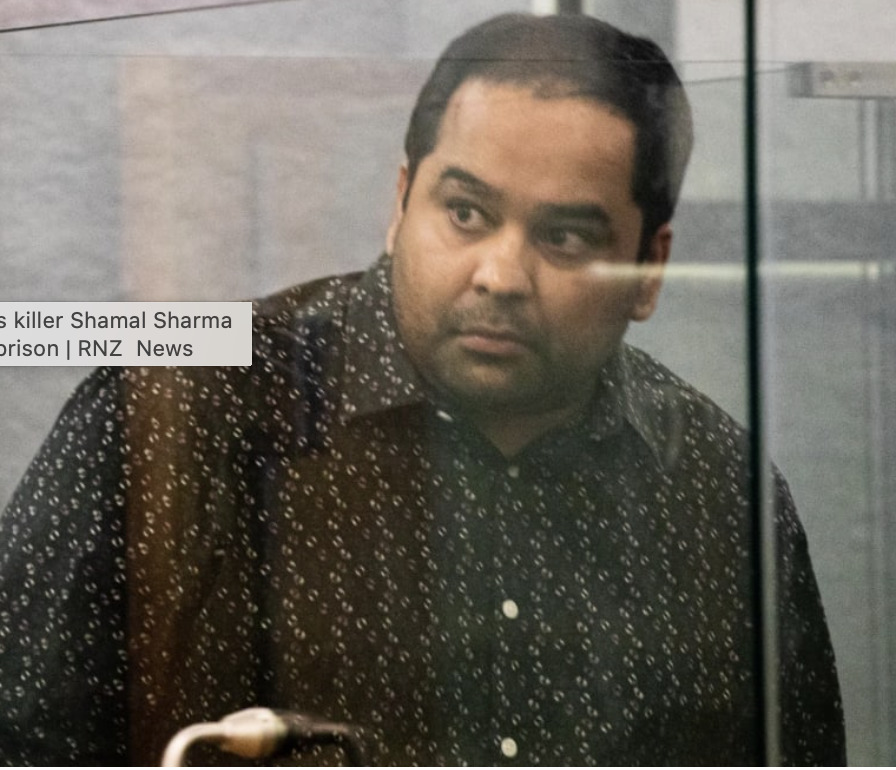
NSW Police are appealing for public assistance after two women were inappropriately touched while walking home in Sydney’s north-west.
In the first incident, a 35-year-old woman had left a train at West Ryde about 12.50am on Saturday 20 May 2023 and was walking along Falconer Street when she noticed a man in a silver Mazda sedan following her. As she approached Hermitage Lane, the man left the car and inappropriately touched the woman, before returning to his vehicle and driving towards Parks Street, West Ryde.
In the second incident, a 28-year-old woman left a train at West Ryde about 1.20am on Sunday 28 May 2023 and was walking on Forster Street, when she felt someone touch her inappropriately. She turned and found a man nearby performing a sexual act. She yelled at him and ran into a building while the man ran to a silver Mazda sedan and drove away along Ryedale Road. Neither woman was injured but were shaken by the incidents.
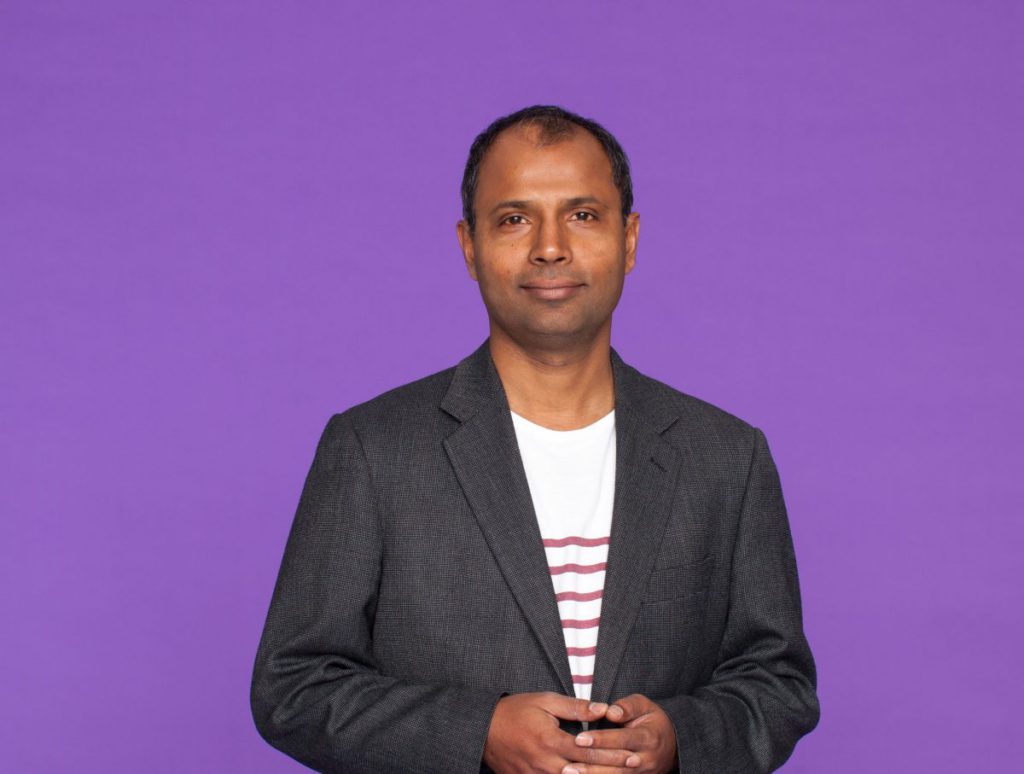
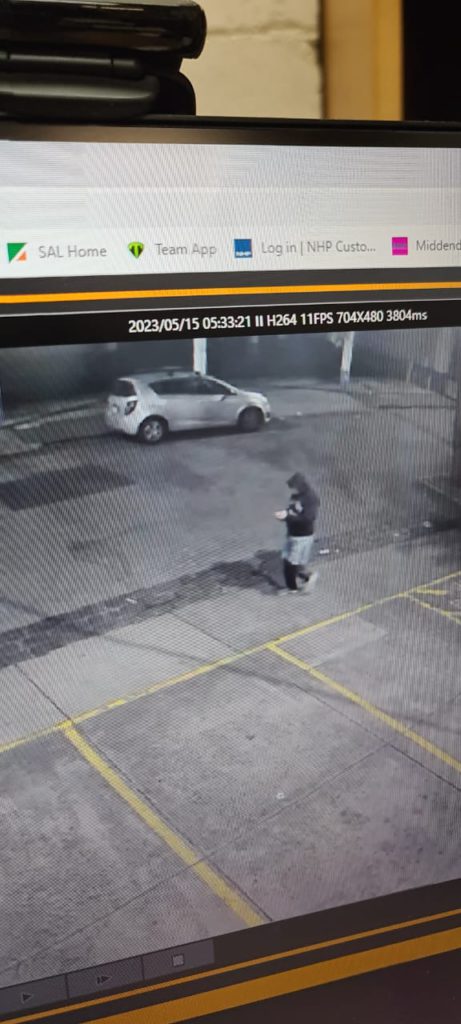
Image: NSW Police
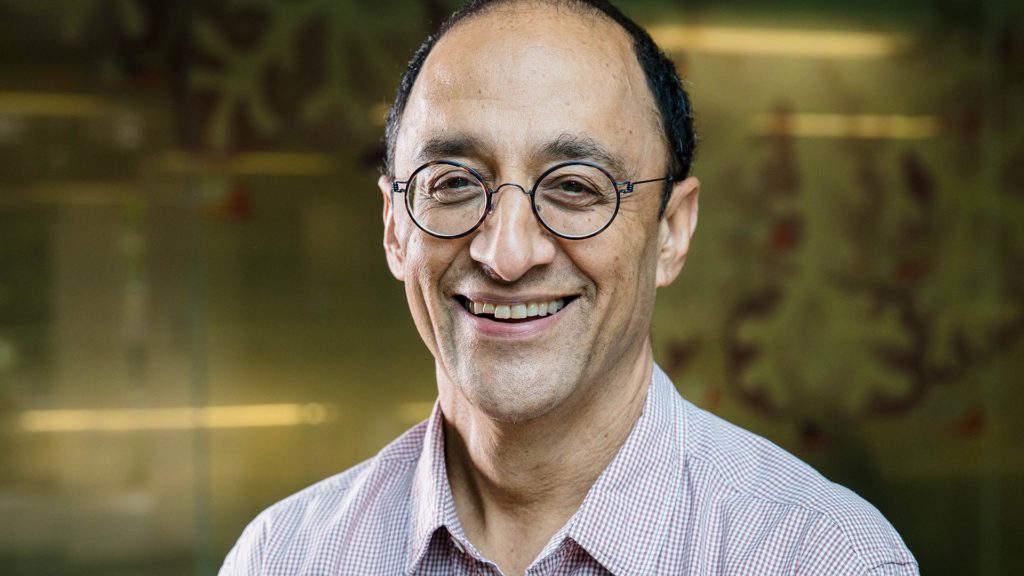
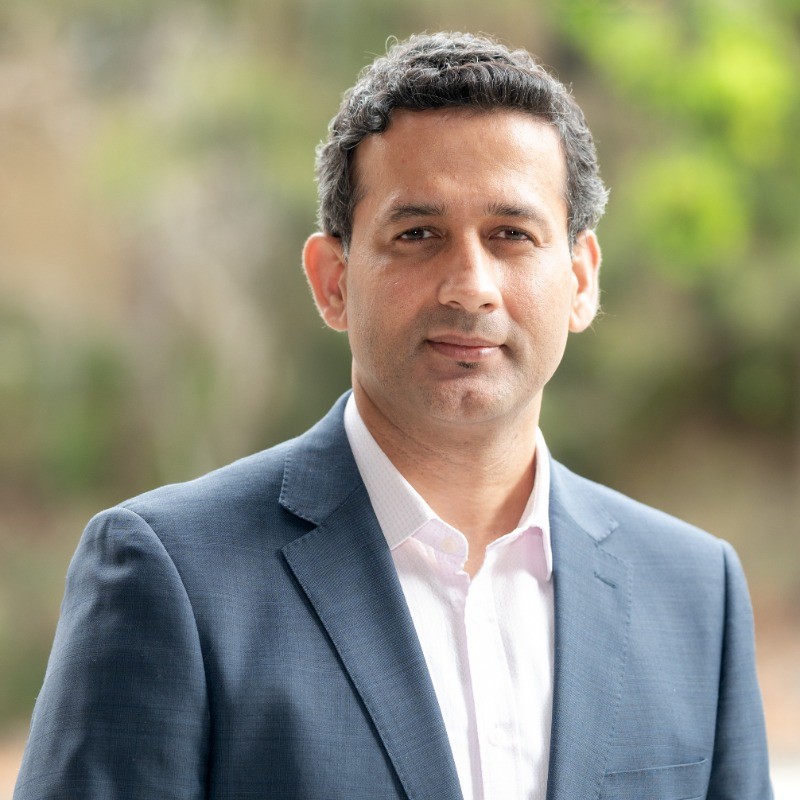
Investigators believe the incidents are linked and have released a description of a man they believe can assist with their inquiries. The man is described as being of Indian/Sub-Continental appearance, aged 20 to 30, with a medium build, short black hair and a short beard.
Image: NSW Police
At the time he was wearing a black jacket, blue jeans, and white shoes, and was seen driving a silver Mazda sedan with yellow and black NSW number plates. Anyone who recognises the man, has dashcam footage or has information which might assist police is asked to call Crime Stoppers on 1800 333 000.Anyone with information about this incident is urged to contact Crime Stoppers: 1800 333 000 or https://nsw.crimestoppers.com.au. Information is treated in strict confidence. The public is reminded not to report information via NSW Police social media pages.
George Speight, the 2000 coup leader who brought down Fijian Prime Minister Mahendra Pal Chaudhary’s government has applied for a Presidential pardon through the Fiji Corrections Service.
He has been serving time for over 20 years and wishes to be released from prison.
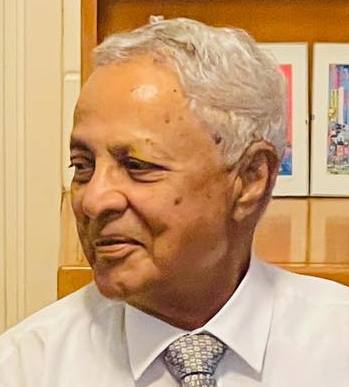
Image: Fiji’s Attorney General Siromi Turaga (Source: fijivillage)
Attorney General and Chair of the Mercy Commission, Siromi Turaga confirmed to fijivillage that Speight has made an application and the consideration process is underway.
According to the 2013 Fijian Constitution, the Commission may recommend that the President of Fiji:
exercise the power of mercy by granting a free or conditional pardon to a person convicted of an offence; remitting all or a part of a punishment
dismiss a petition that it reasonably considers to be frivolous, vexatious or entirely without merit, but otherwise must consider a report on the case prepared by the Judge who presided at the trial; or the Chief Justice, if a report cannot be obtained from the presiding Judge;
must consider any other information derived from the record of the case or elsewhere that is available to the Commission; and
may consider the views of the victims of the offence.
The Constitution states that the President must act in accordance with the recommendations of the Commission.
Image: Former Fijian Prime Minister Mahendra Pal Chaudhary (Source: Wikimedia)
In the 1999 election, Chaudhary’s Fiji Labour Part-led People’s Coalition had a landslide win with 58 of the 71 seats in the House of Representatives. Chaudhry was duly appointed Prime Minister on 19 May 1999 and appointed indigenous Fijians to two-thirds of all ministerial positions.
However, on 19 May 2000, Speight without any warning led led a small group of armed men that resulted in the takeover of the parliamentary complex in Veiuto. He took the then PM Chaudhry and his government hostage. The hostage crisis lasted for 56 days.
Last year, on the occasion of the 20th anniversary of the coup, Chaudhry told fijivillage this coup will never be forgotten as a lot of what is happening today in Fiji is the price we have to pay for the two coups.
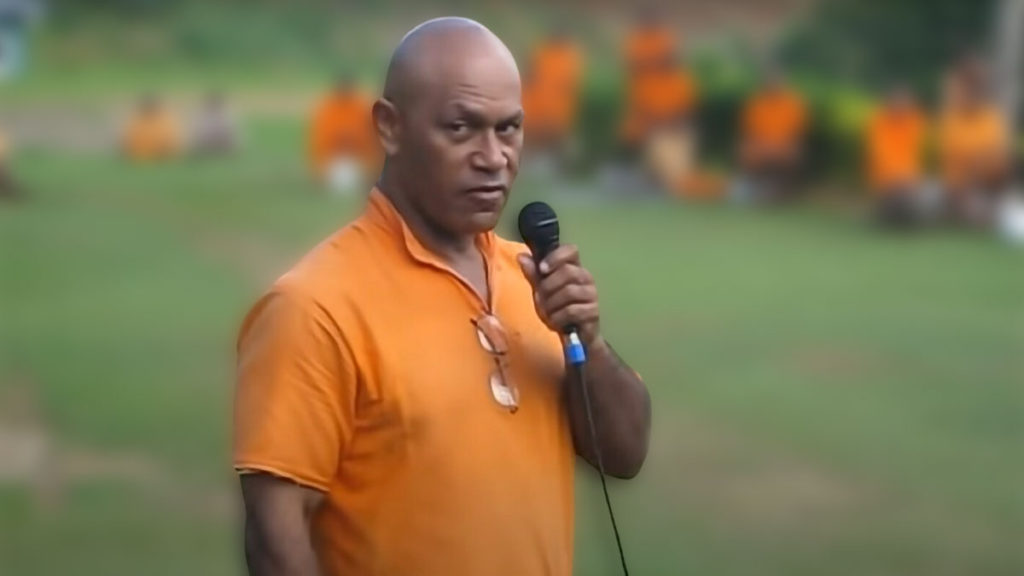
Image: George Speight (Source: YouTube)
Speight was arrested and taken into custody on 26 July 2000 and in February 2002 was convicted of treason and sentenced to death; the sentence was later commuted to life in prison by the President of Fiji.
It is believed that if Speight’s petition is accepted then he could be released in the next batch of people to be given mercy by the President.
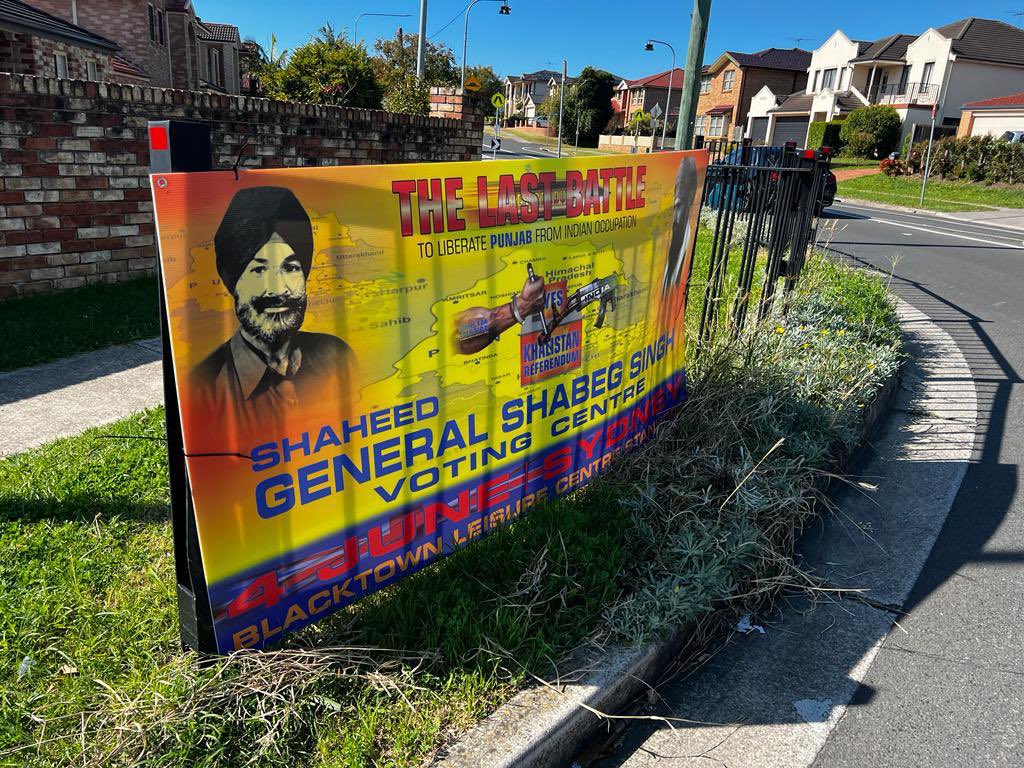
After hundreds of complaints by the Indian Australian community about threats by Sikhs For Justice’s propaganda referendum event, the Sydney Masonic Centre (SMC) decided to cancel the booking.
This propaganda event was scheduled to be organised on 4th June however in new development, this booking has been cancelled after security agencies advise.
A spokesperson from Sydney Masonic Centre (SMC) confirmed to The Australia Today,
“Masonic Centre has, this morning, cancelled this booking as it is in conflict with adopted Masonic policy and due to risks to Masonic staff, assets and members of the public which cannot be practicably mitigated.“
“We did not understand the nature of this Khalistan event at the time of booking, However after lots of deliberations decision was taken that Sydney Masonic Centre does not want to be part of any event which can potentially bring harm to the community,” she added.
Sydney-based Dharmendra Yadav is one of the people who complained about terrorists being praised via posters and banners by the Sikhs For Justice propaganda event.
Mr Yadav told The Australia Today, “I live in Parramatta and for the last five days every morning we had to confront huge banners with anti-Hindu slogans on them.
“I wrote to Sydney Masonic Centre and explained the violent ideology of Khalistan, how they have killed thousands of Hindus and Sikhs in last forty years.”
He says the Sydney Masonic Centre sales team was tricked by Khalistan supporters into the booking.
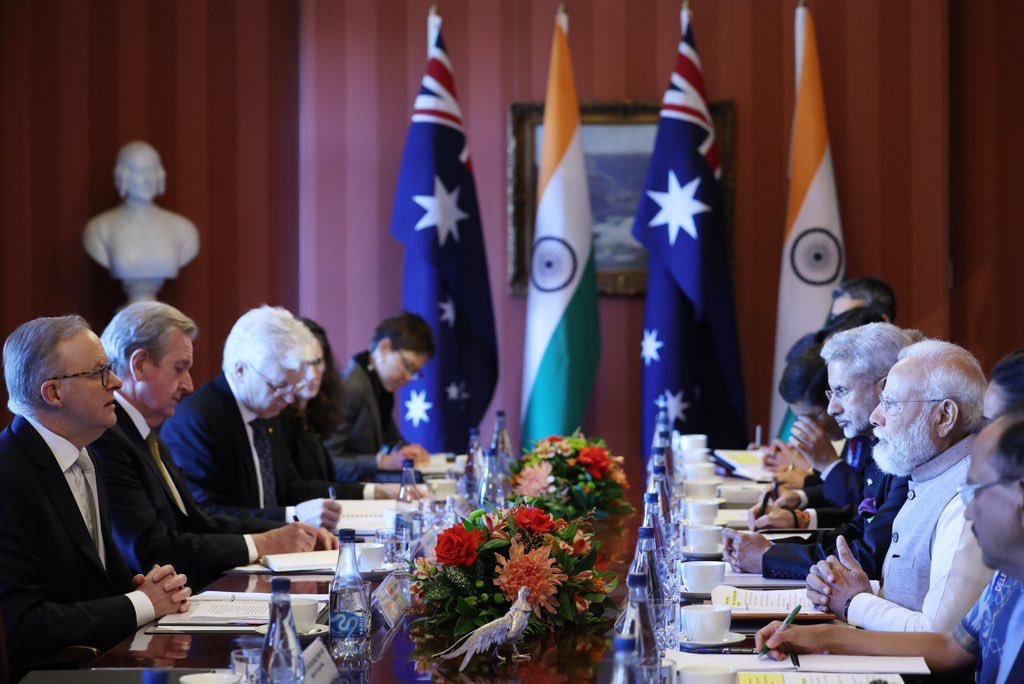
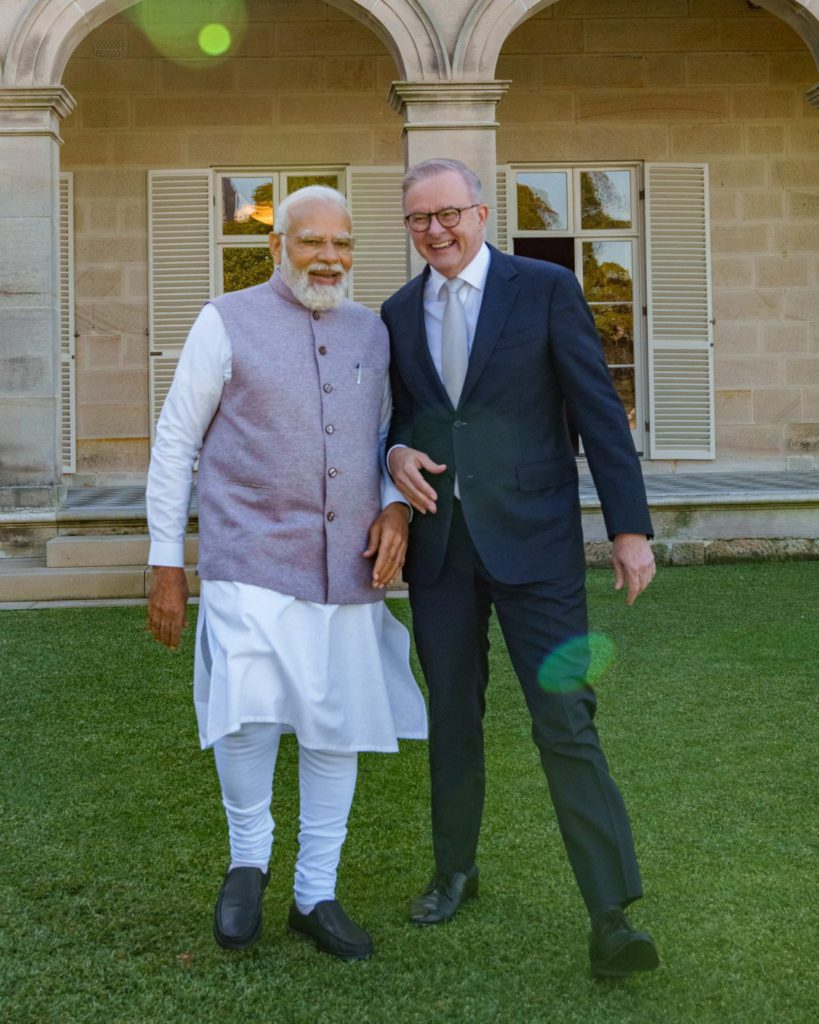
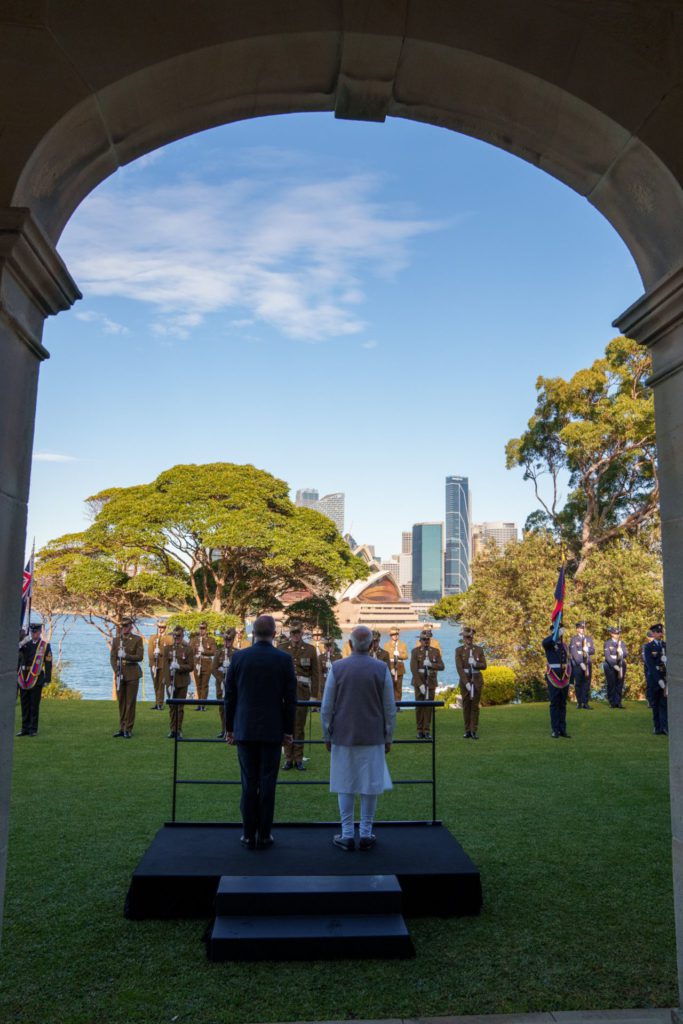
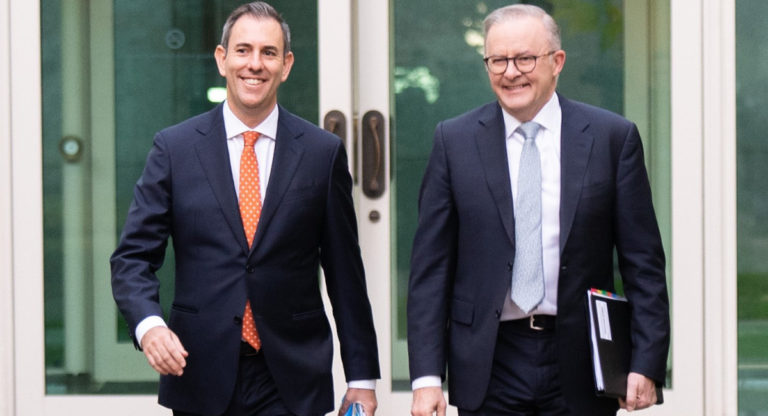
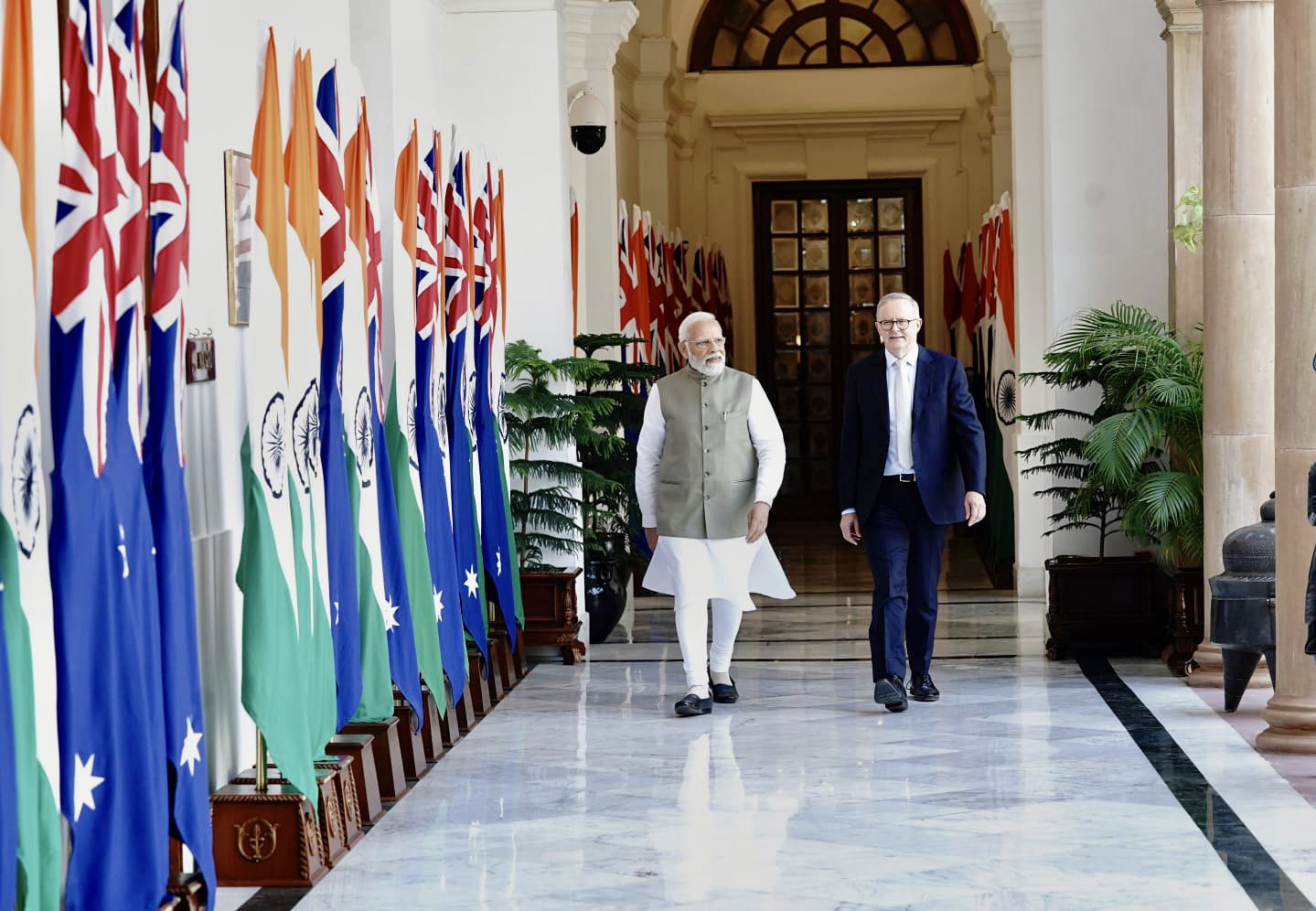
Australian Prime Minister Anthony Albanese has assured his Indian counterpart PM Narendra Modi that his government will continue to take strong action against extremist elements that want to disrupt the strong and deep ties between the two countries.
India has also mentioned that Australia and India ties are extensive and will not be allowed to be affected by such elements.
In reference to the Khalistan menace, India’s Foreign Secretary Vinay Kwatra has said that whatever both governments have to do to clamp down on such disruptive elements we will do.
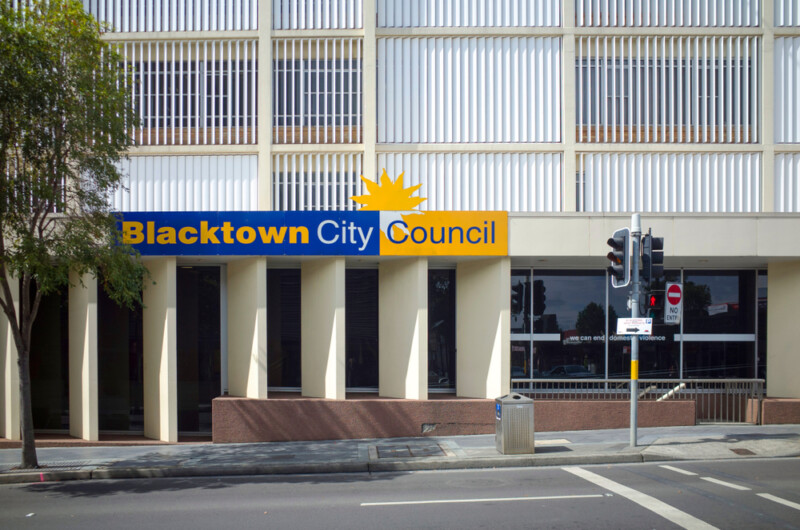
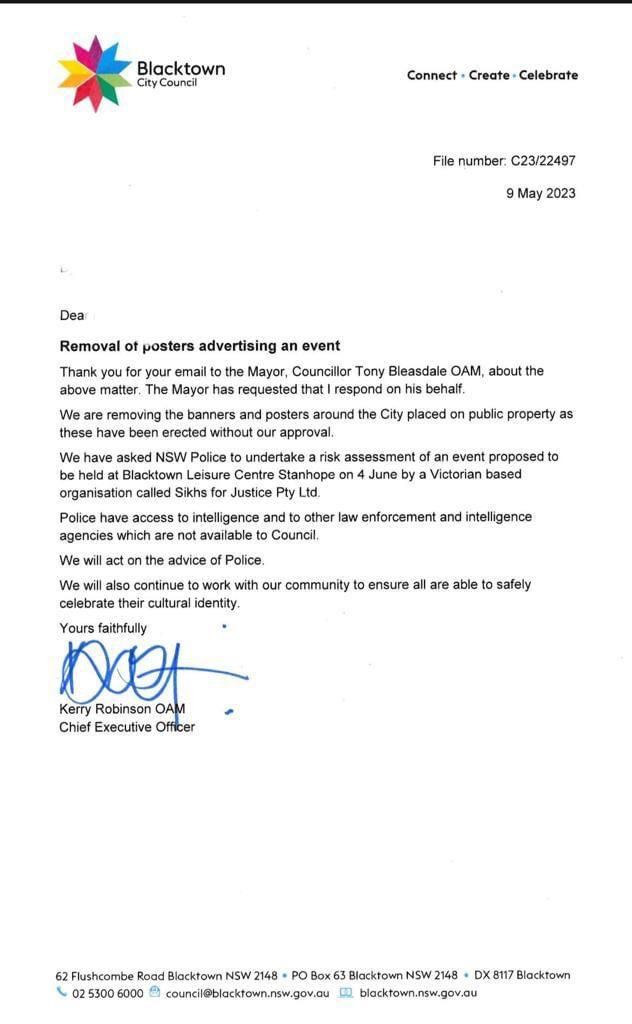
Prior to this, amidst complaints from Indian-Australians regarding Sikhs For Justice’s propaganda referendum event proposed in Sydney, the Blacktown City Council has also decided to cancel the event.
Image: Blacktown City Council (Source: Website)
A Blacktown City Council spokesperson has told The Australia Today,
“Council has, this morning, cancelled this booking as it is in conflict with adopted Council policy and due to risks to Council staff, Council assets and members of the public which cannot be practicably mitigated.”
The Australia Today is also given to understand that an investigation is already underway about “Sikhs For Justice Pty Ltd” which is registered in Victoria.
An official close to the matter told The Australia Today, “An connection to unaccounted money trail is what we are looking into.
The Australia Today has contacted Sikhs For Justice Pty Ltd, however, we have not got any response as yet.
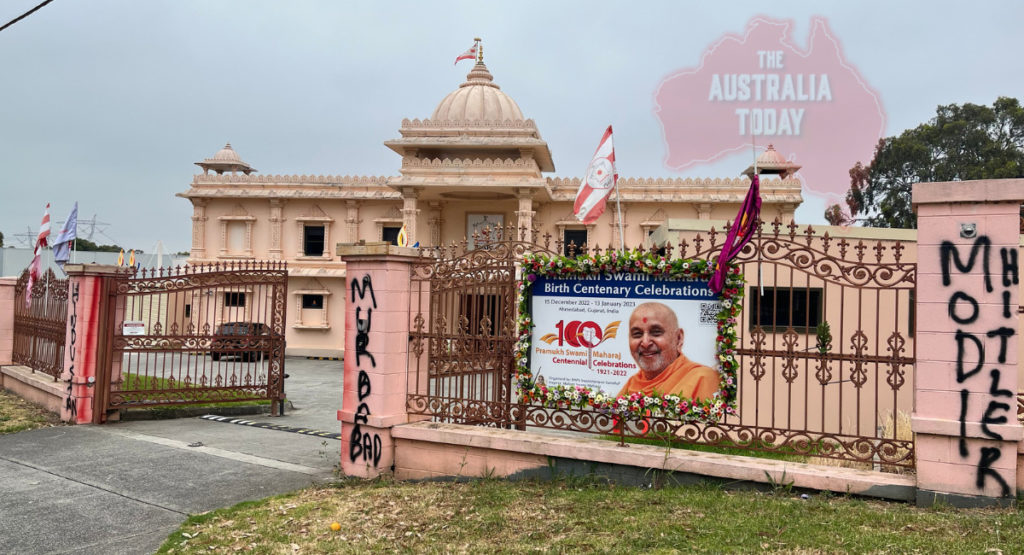
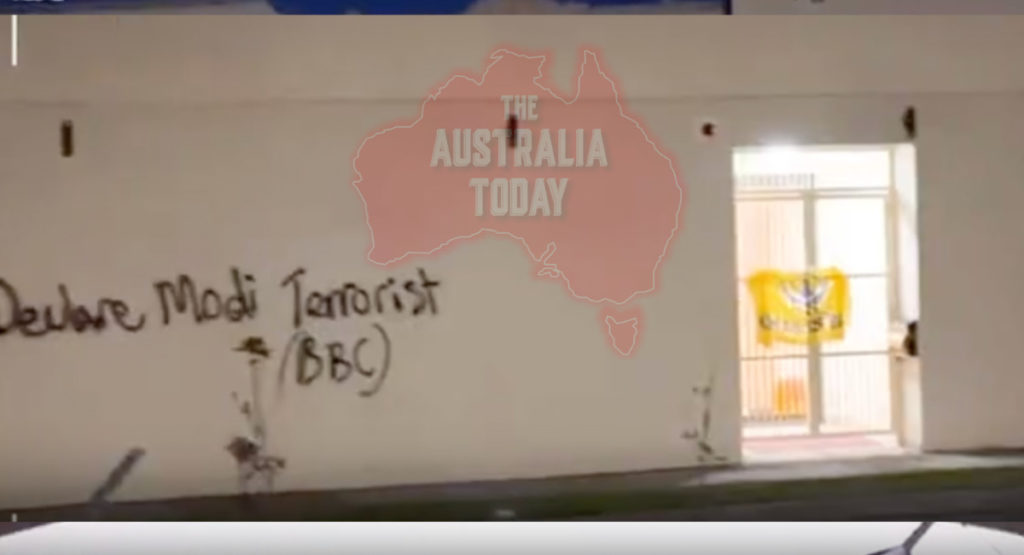
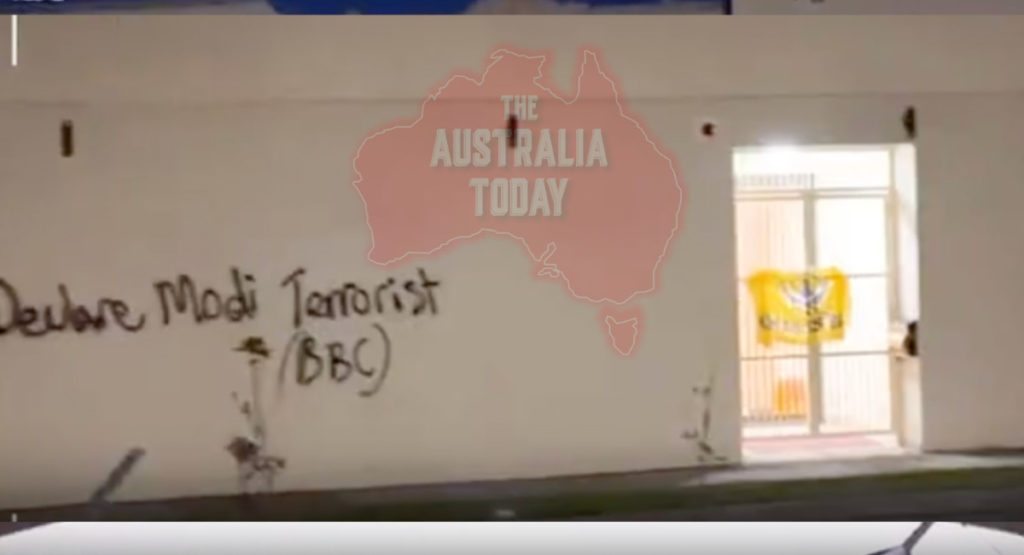
Image: BAPS Swaminarayan Temple vandalised by Khalistan supporter (Source: The Australia Today)
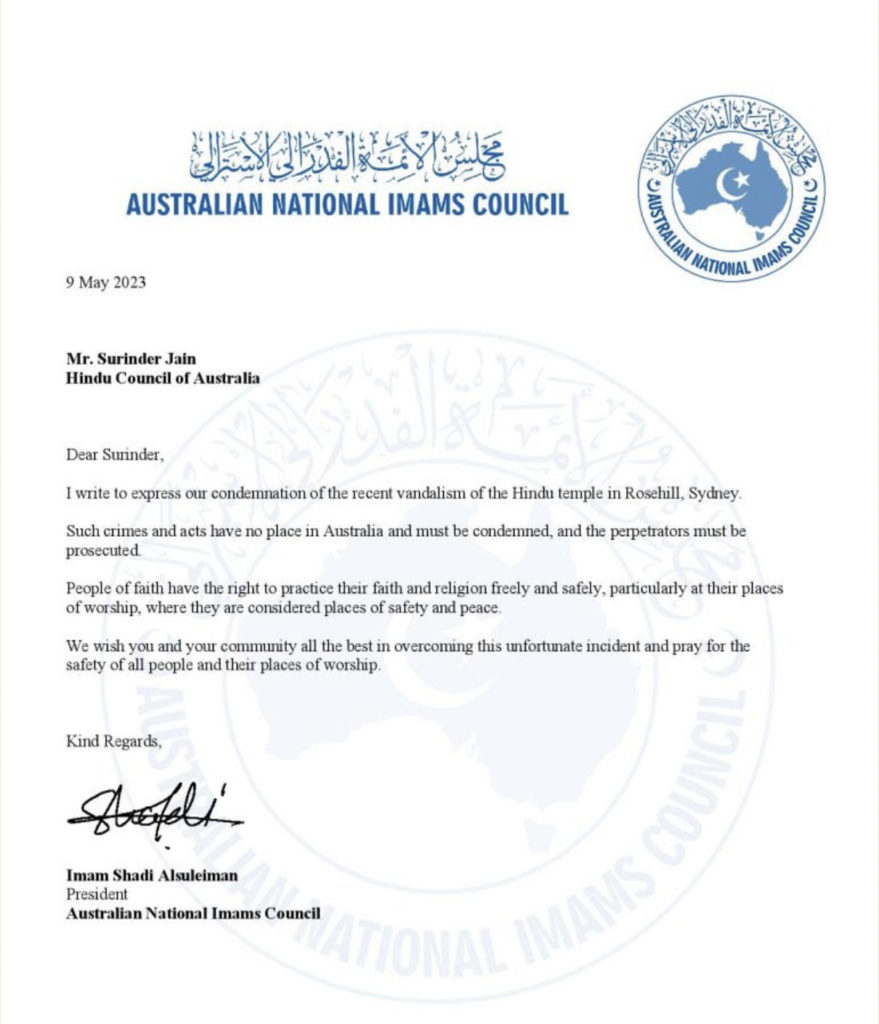
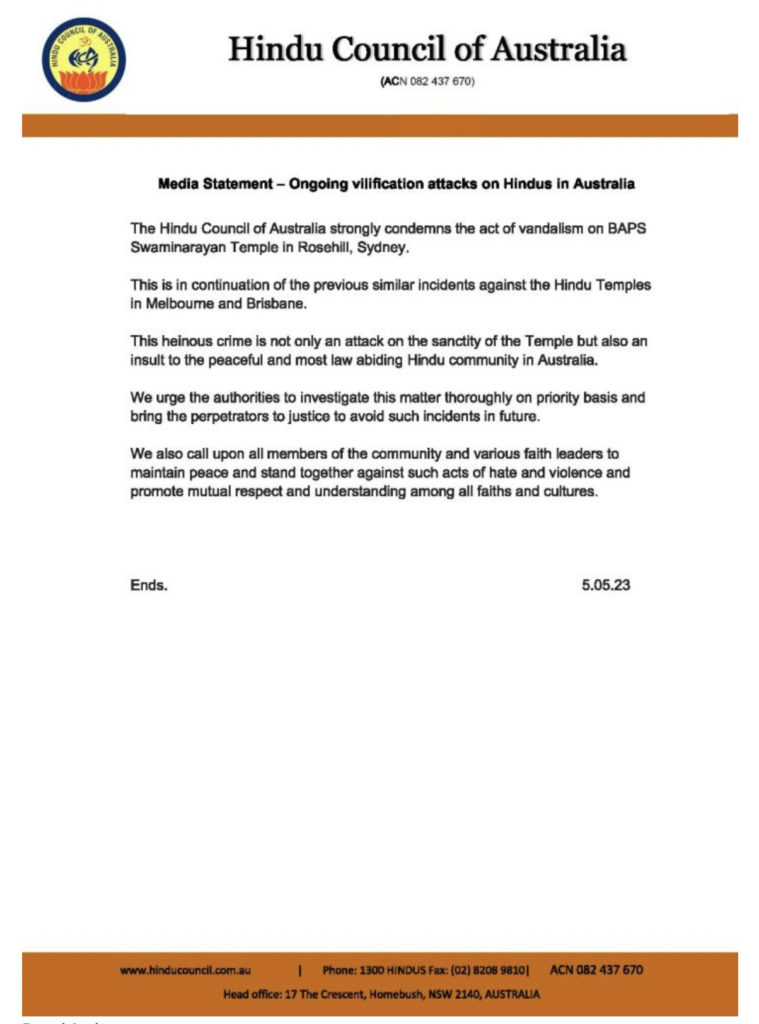
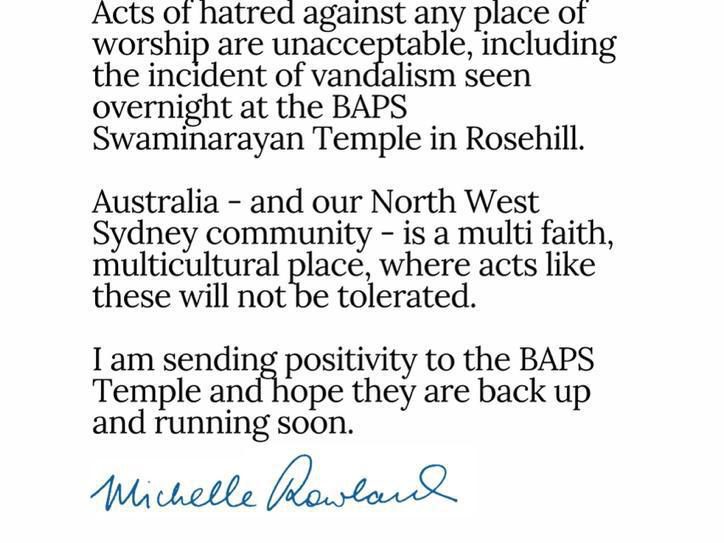
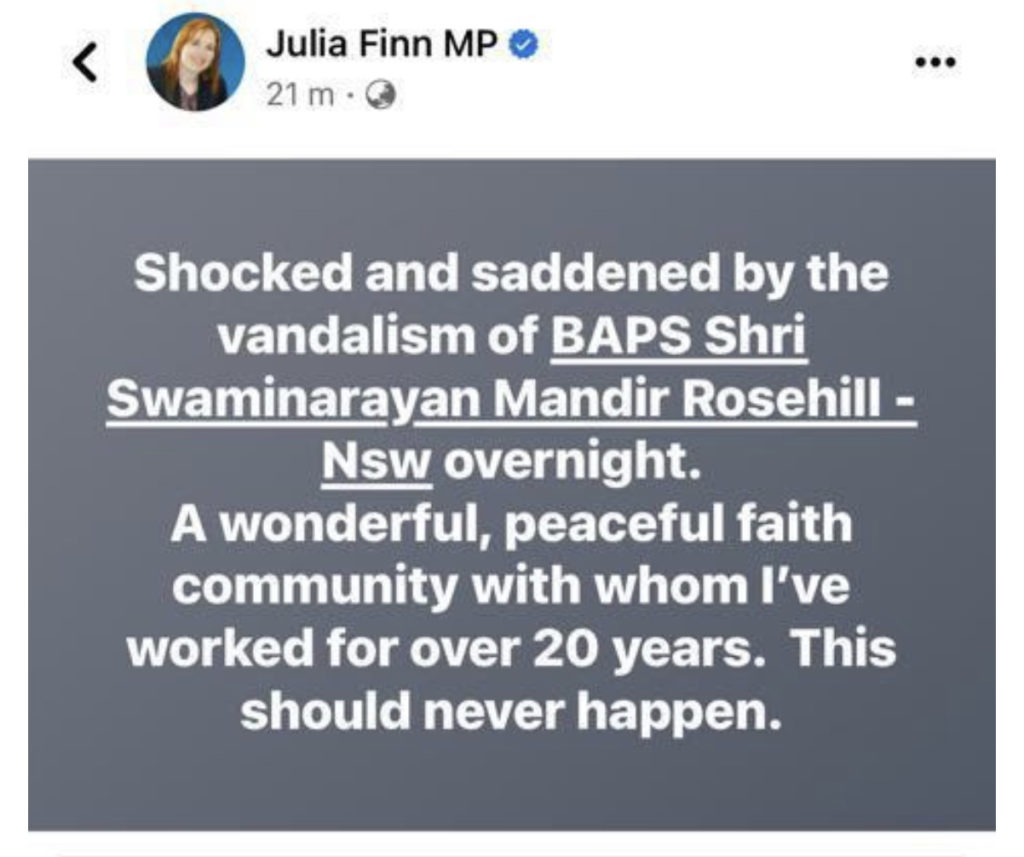
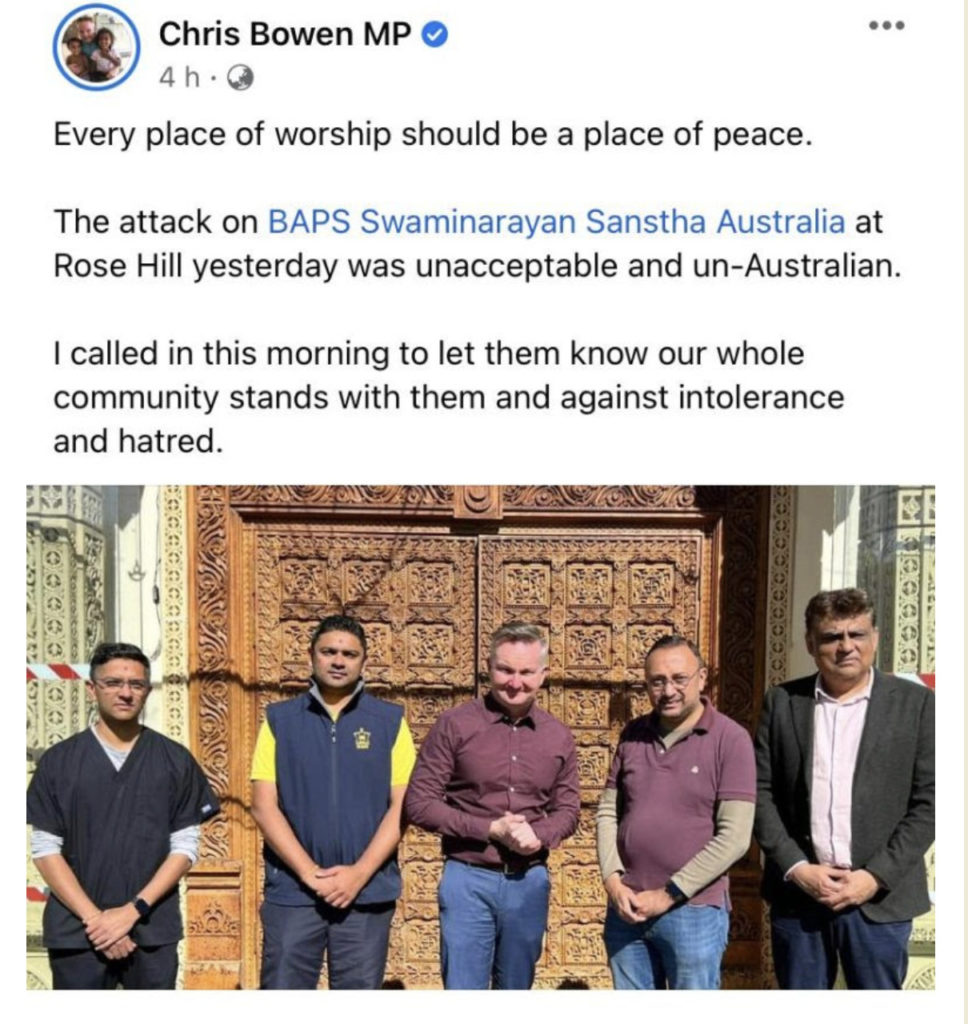
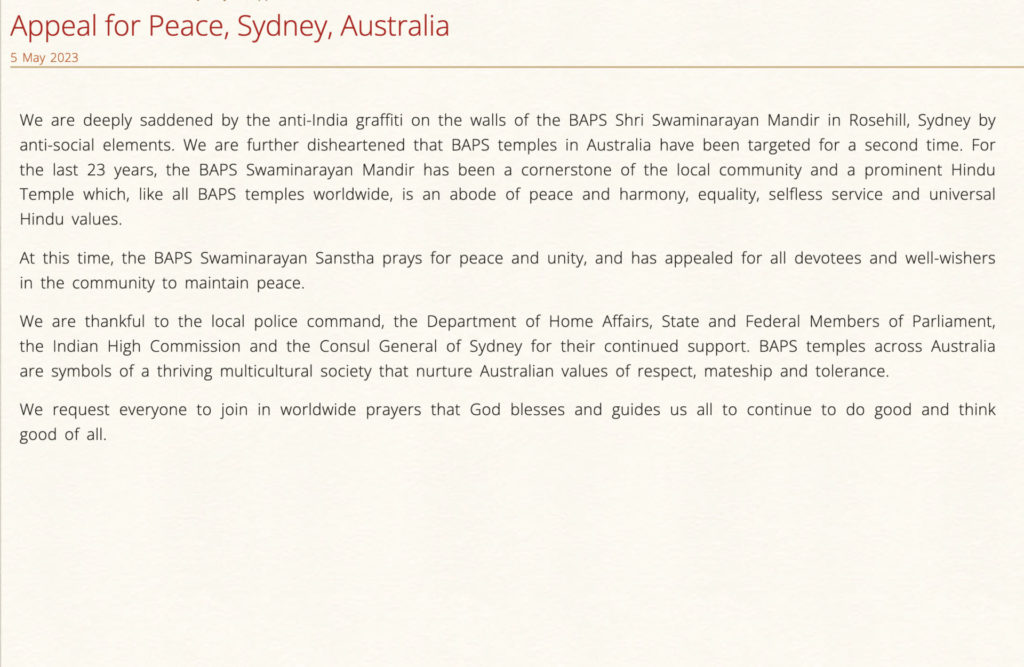
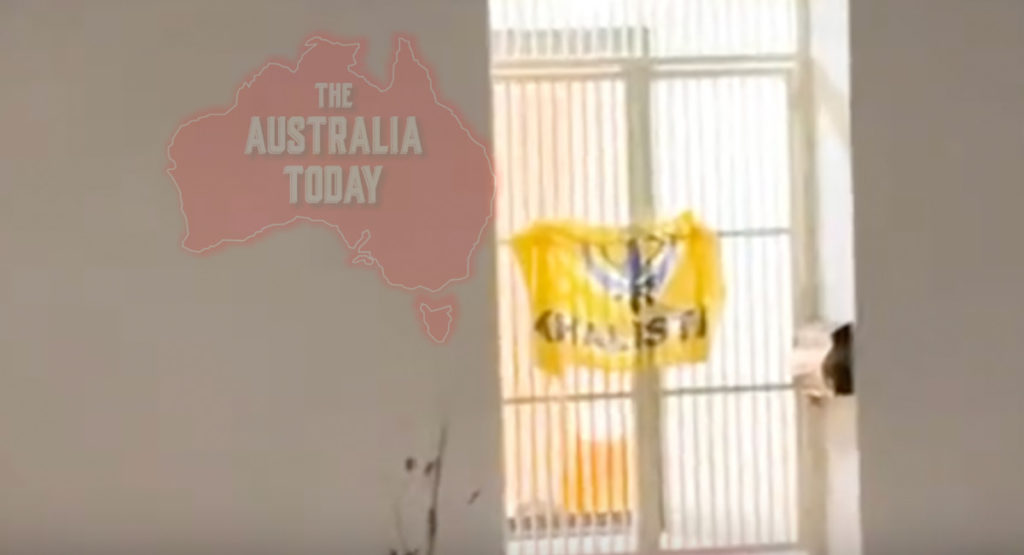
Earlier this month The Australia Today reported about a vicious anti-Hindu vandalism attack on BAPS Swaminarayan Mandir Rosehill by Khalistan supporters.
Temple management has told The Australia Today that NSW Police officers have attended the Temple and CCTV footage has been provided to assist them in the investigations.
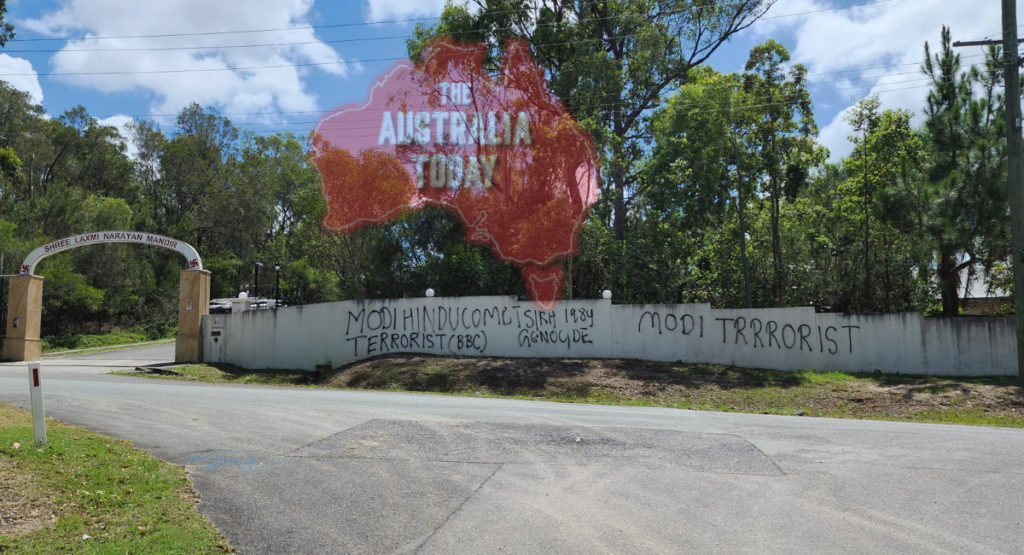
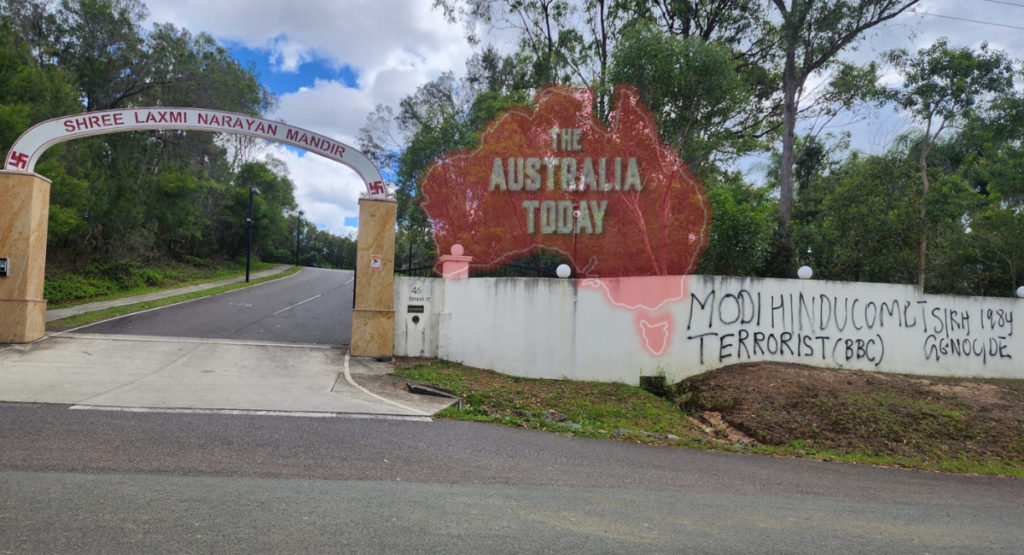
In January 2023, the Indian-Australian community was dismayed with three of its most iconic Hindu temples outside the Indian subcontinent vandalised with anti-Hindu graffiti.
Hindu, Islamic and Sikh religious leaders condemned the attack and called on authorities to take strict action against perpetrators.
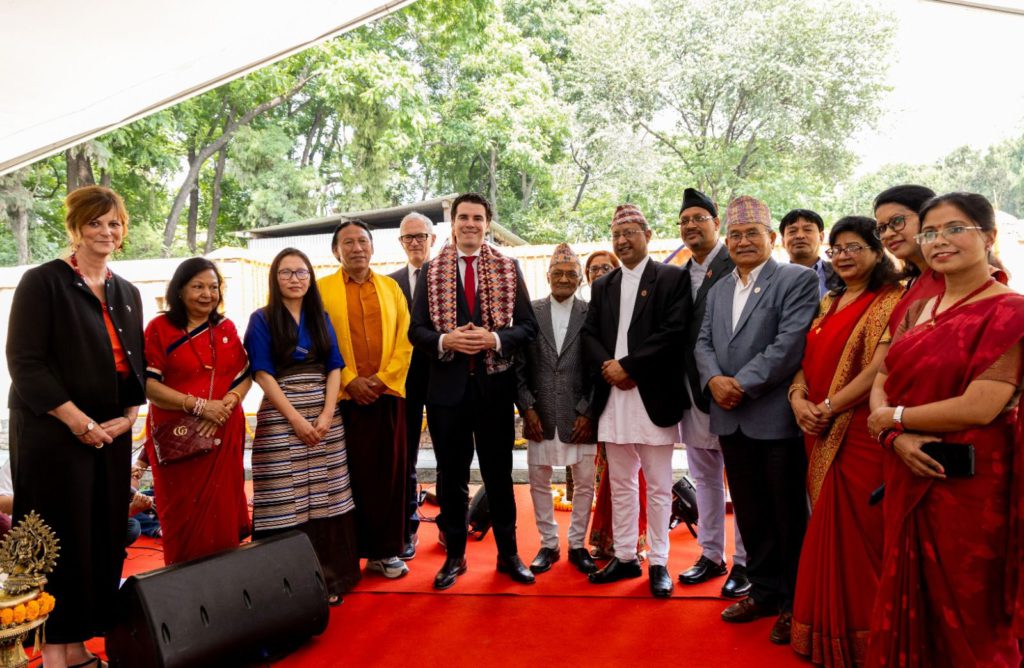
Nepal Airlines is planning to start a direct connection with just a one-stop flight between Sydney and Kathmandu.
Nepal Airlines deputy spokesperson Ganesh Kumar Ghimire told The Kathmandu Post that the airline has officially secured a slot from the Sydney Kingsford Smith Airport and is now awaiting government approval.
“We are applying for landing permits and making other necessary preparations to meet the deadline.”
Ghimire added that the actual start date remains subject to approval by the Australian regulatory body the Civil Aviation Safety Authority.
“The proposed June 21 flight, however, will depend on the issuance of the landing permits by the Australian government, even though we have secured the slots from the airport authority in Sydney.”
According to reports, Nepal Airlines’ Kathmandu-Sydney flights will initially run twice a week.
These flights will depart Kathmandu on Thursdays and Sundays, with the 13½ trek broken by a stopover in Singapore.
Meeting with Deputy Head of Mission, Australian Embassy of Nepal in the presence of Under Secretary Mudita Bajracharya MOFA, Nepal and Executive Chairman Ubaraj Adhikari by in connection with Nepal Airlines direct schedule flight operation to Australia. pic.twitter.com/UIhddOkdpd
“In the first phase, we have decided to do a technical landing at Singapore, only for refuelling.”
As Australia’s 63-year friendship with Nepal deepens, I was honoured to meet with the Rt Hon Prime Minister Dahal to discuss Australia’s commitment to support human resource development & capacity building in Nepal’s education sector.@dfat@cmprachanda@AusAmbNPpic.twitter.com/XESulsQnEh
Australian Assistant Foreign Minister Tim Watts who was in Nepal recently is hopeful that the proposed flights would bring the two countries closer and boost bilateral trade and tourism.
“There is an enormous demand for direct flights between Kathmandu and Sydney. Once established, I am certain that there would be no shortage of our people to buy tickets.”
While more than 130,000 Nepalis live in Australia which includes 60,000 students, Nepal caters to almost 40,000 Australian tourists.
The one-way journey from Kathmandu to Sydney would cover 9,816 km and Nepal Airlines will use two Airbus A330s which have 18 seats in business class and 256 seats in economy class.
The Fair Work Ombudsman has secured a total of $19,980 in court penalties against the operators of a bed and breakfast business in northern New South Wales.
The Federal Circuit and Family Court has imposed a $16,650 penalty against Nimos Leisure Pty Ltd, which operates ‘Stannum House’ at Tenterfield, and a further $3,330 penalty against one of the company’s directors, Mohan Lal Siribaddana.
The penalties were imposed in response to Nimos Leisure failing to comply with a Compliance Notice requiring it to calculate and back-pay entitlements to a Sri Lankan visa holder it employed at the bed and breakfast as a food and beverage attendant between December 2017 and January 2019.
Mr Siribaddana was involved in the contravention.
Nimos Leisure back-paid the worker his full entitlements only after the FWO commenced legal action.
Fair Work Ombudsman Sandra Parker said business operators that fail to act on Compliance Notices need to be aware they can face penalties in court on top of having to back-pay workers.
“When Compliance Notices are not followed, we are prepared to take legal action to ensure workers receive their lawful entitlements,” Ms Parker said.
“Employers also need to be aware that taking action to protect vulnerable workers, like visa holders, is an enduring priority for the agency. Any employees with concerns about their pay or entitlements should contact the FWO for free assistance.”
The FWO investigated after receiving a request for assistance from the affected worker.
The Compliance Notice was issued in July 2021 after a Fair Work Inspector formed a belief the worker was underpaid weekend overtime, public holiday penalty rates and annual leave entitlements, owed under the Hospitality Industry (General) Award 2010 and the Fair Work Act’s National Employment Standards.
Judge Nicholas Manousaridis found the worker, who did not receive full payment until a year after the Compliance Notice was issued, had suffered a loss.
Judge Manousaridis said the rectification of underpayments was unaccompanied by any expression of regret or remorse and there was a need to impose penalties at a level to deter Nimos Leisure and Mr Siribaddana from similar future conduct, and deter employers from failing to comply with Compliance Notices.
“The penalty should be set at a level which demonstrates to employers in general, and to employers in the (Accommodation) Industry in particular, that they would be faced with a meaningful penalty if they fail to comply with a Compliance Notice.”
The FWO has filed 126 litigations involving visa holder workers, and secured more than $13.4 million in court-ordered penalties in visa holder litigations, in the last five full financial years.
I cannot tell you how the culmination over the last 2 weeks starting from the Girmit celebrations, the Rotuma Day celebrations and finally the magnificent hosting and bringing together of all communities at the Great Council of Chiefs opening of beginning of Rt Sukuna week celebrations in Bau — has put a definitive spring in my step.
For the record, I want to also acknowledge and offer my profound thanks to the Gone Turaga na Vunivalu na Tui Kaba, the vanua vakaturaga of Kubuna and all the lovely people of Bau; all the boat “pilots” who managed the crowds to and from the Bau landing; all the govt agencies; all the media personnel; all the school teachers who have rekindled the learning spark in our children over the past few weeks; and most especially all the women of Bau who cared and opened their homes to us, as visitors to their special Island this week.
Your kindness and compassion has really touched all our hearts, and has above all — shown us that traditional leadership has a place in nation-building to remind us that customary wisdom led by “veikauwataki” (care for each other) and “veilomani” (love) must echo in all that we do.
I also want to especially acknowledge all our religious leaders who during these events, also led from their actions to offer their support and YES, to keep US ALL on our toes –reminding us that our whatever we determine our personal legacies to be, it should be spiritually guided first and foremost.
After all, we are all accountable to the Creator when we leave this earth.
Image: A commemorative march to celebrate the life of Ratu Sir Lala Sukuna on Saturday. Picture: FIJI GOVERNMENT FB PAGE
My world on a daily basis as you can imagine, is one where numbers swirl around my head all day, but I can tell you that my spirit has been uplifted and revived just witnessing the resurgence of our pride as different cultures sharing our heritage with each other.
The numbers that I deal with daily are meaningless unless it brings forth as profound a change — on behalf of the Coalition Govt led by our leader, the Prime Minister Hon Sitiveni Rabuka.
The numbers that I confront daily, are empty unless there are human relationships first restored to build trust, confidence and even hopefully down the line, to trigger business partnerships and economic growth.
Somehow we as a nation need to find the balance that is workable, relevant and fit-for-purpose for us. And most of all, one that unifies us together as a people.
And so, there is no greater time then today when we reflect and draw upon the example of Ratu Sir Josefa Lalabalavu Vanayaliyali Sukuna’s exemplary leadership — in which to draw guidance from.
Ratu Sir Lala Sukuna (left). Picture: FIJI GOVERNMENT FB PAGERatu Sir Lala Sukuna (left). Picture: FIJI GOVERNMENT FB PAGE
Ratu Sir Lala Sukuna was without a doubt, the embodiment of chiefly authority and wisdom. It was this that moulded him into the statesman that Fiji heralds him as, this week.
Much has been written about the life and work of Ratu Sukuna. All are excellent pieces of academic work no doubt requiring thorough research, but in essence all these works establish that Ratu Sukuna was a firm believer that life is more satisfactory if it is dedicated to selfless service and humanity.
I think my good friend, former Fiji diplomat and CEO of the Institute of Indigenous Studies, Mr Emitai Boladuadua put it well last night in his speech at FNU, when he said that Ratu Sukuna’s most prized possession were his people, and thus with history as our witness, we can confirm from Ratu Sukuna’s life of selflessness, to be absolutely true.
His selfless service is illustrated even then as – a chief, statesman and a decorated soldier – walked the length and breadth of Fiji especially Fijian or i-taukei villages, convincing customary landowners that they needed an institution to protect their land from being exploited.
And as we know now, this resulted in the establishment of the Native Land Trust Board – the Trustee authority of all native land in Fiji.
Image: A commemorative march to celebrate the life of Ratu Sir Lala Sukuna on Saturday. Picture: FIJI GOVERNMENT FB PAGE
If Ratu Sukuna did not have the foresight and did not sacrifice his time and energy towards setting up the system of i-Taukei registration that is the Vola Ni Kawa Bula, which was closely aligned to iTaukei land custodianship records, there would not have been a space in later years to then consider how to then give effect to land legislation that would develop our then fledging economy for the benefit of everyone, through the iTaukei Lands Trust Board.
Ratu Sukuna won the trust of the people and ensured that their trust and faith in him was not misplaced.
And his ability to speak plainly is evident in his speech in the iTaukei language to the Great Council of Chiefs in 1936 before Independence – and by the way, this speech is in his book titled “Fiji: the three legged stool”, edited by Deryck Scar and is available for purchase right now at the Fiji Museum as part of Rt Sukuna celebrations – it is my humble suggestion that this book should be a fixture in every house in Fiji.
Rt Sukuna’s speech on page 205 is quite poignant as he deftly addressed the historical background of why decisions were made and answered many understandable concerns about the leasing of customary land, particularly to Indo-Fijians.
I quote Ratu Joni Madraiwiwi – another eminent Leader, a paragon of outstanding Leadership who we miss dearly – in his public lecture to honour Ratu Sukuna, where he references Ratu Sukuna’s address on native land in the iTaukei language to the Bose Levu Vakaturaga in 1936.
Ratu Joni Madraiwiwi quotes Ratu Sir Lala Sukuna as follows:
“We cannot in these days adopt an attitude that will conflict with the welfare of those who like ourselves wish only to live peacefully and increase the wealth of the Colony. We are doing our part here and so are they. We wish to live; they do the same. You should realise that money causes a close inter-relation of interests. If other communities are poor, we too remain poor; if they prosper, we will also prosper.
But if we obstruct other people without reason from using our lands, following the laggards, there will be no prosperity. Strife will overtake us and before we realise the position, we shall be faced with a position beyond our control, and certainly not to our liking. Lastly I beg you to think of the big changes that have come over us and of the complications consequent on dealings based on money. You must remember that Fiji today is not what it used to be. We are not the sole inhabitants; there are now Europeans and Indians. Should Fiji progress we shall all benefit and vice versa…”
And how right Ratu Sukuna was. In the hey day of the sugar industry, the Vanua that had an unmatched record of sugar production was Saunaka.
As a landowning group, Saunaka were on their own consistently hitting sugar output at around like 10,000 tonnes a year.
For over seven decades or so the NLTB or TLTB as it is now known, has acted in the national interest, albeit with a few exceptions during and after political turmoil. The TLTB would not be what it is today without
Ratu Sukuna’s understanding of the importance of the sugar industry and its link to the Indo-Fijian community who chose to make Fiji their home at the end of the Indenture period in 1916 would have had this view at a young age, because up until now he is the most famous alumni of Wairuku Indian School in Ra – a school established during Girmit in 1898 by Pundit Badri Maharaj.
Ratu Sukuna’s efforts later evolved into a legitimate tenancy arrangement when the Agricultural Landlord and Tenant Ordinance (ALTO) was formulated in 1966, that required the minimum tenure of a lease to be 10 years.
Ten years later after ALTO and in 1976, progress was made when ALTA – the Agricultural Landlord and Tenant Act was enacted – increasing the minimum tenure of all agricultural leases to 30 years.
When Indo-Fijians had better access to native land leasing arrangements and in the latter years enjoyed security of tenure, it accelerated the growth of the sugar industry into the economic mainstay of our economy for several decades, until the turn of the century.
Despite the industry’s downturn, it continues to directly and directly impact the livelihoods of 200,000 people of Fiji or more than 20% of our population.
Despite the common stereotype, cane farmers are now very much a multiracial industry — and it needs to be looked at carefully now after the industry has been gutted by the poor policies and mismanagement of the previous Government.
The vision to establish the NLTB to administer leases for all native land on behalf of the landowners and the recognition of land use needs for agriculture of the Indo Fijian population — and now leasing by iTaukei themselves as current trends show — is a perfect demonstration of Ratu Sukuna’s manifestation of Trust.
The Trust he created with landowners manifested into Trust given to a 3rd party the TLTB to mediate between landowners and lessee’s for win-win solutions – Ratu Sukuna triangulated Trust via dialogue.
I would venture to suggest that no other indigenous group in the world can claim such visionary protection such as the recording both on paper and in electronic format of native land and i-qoliqoli ownership in such a systematic way.
Ratu Sukuna was a visionary when it came to politics and both personally and posthumously mentored those who later became household names in Fiji.
He is also credited with forming the Fijian Association, which later became the Alliance Party that ruled this country for 17 years.
Above all, the statesman is credited for what is famously known as the “Big Four” – Ratu Sir Kamisese Mara, Ratu Sir Edward Cakobau, Ratu Sir George Cakobau and Ratu Sir Penaia Ganilau. Even then, Ratu Sukuna was ahead of modern day management principles such as mentoring and succession planning.
These four gentlemen upheld the principles of Ratu Sukuna. And they commanded the respect of our people in no small measure. Together with national leaders at various times of our history like, A D Patel, S M Koya, Harish Sharma, Dr Timoci Bavadra and Jai Ram Reddy, they were, as it has been rightly said – giants of their time in their ability, perception and understanding of the problems facing Fiji.
Trust was the foundation of their leadership. Honesty, integrity and putting national interest above everything else was the bedrock of their larger than life personalities.
From Ratu Sukuna’s admirable leadership, the Lord Denning Award provided a fair distribution of revenue to cane growers came about – as well as ALTO, ALTA, the establishment of FNPF, negotiations for Fiji’s Independence, the 1997 Constitution, negotiation of various protocols and treaties which have or are still benefitting Fiji economically and development of major infrastructure – all this was built on trust, consensus building, dialogue, painstaking negotiations, perseverance and above all selfless service for the greater good.
These are the principles of a national leader and a statesman. These principles, together with chiefly authority and wisdom, formed the formidable character of Ratu Sir Lala Sukuna.
The Maori have a very wise proverb that sums this up well: Ka mura, Ka muri.
Which translates to mean that we look to the past to inform the way we move into the future because we learn from those who have gone before us. We walk backward into the future with our thoughts directed toward the coming generations but with our eyes on the past.
Image: A commemorative march to celebrate the life of Ratu Sir Lala Sukuna on Saturday. Picture: FIJI GOVERNMENT FB PAGE
There are two great lessons that I take away from the life of Ratu Sukuna that I wish to share today:
The first is the respect for the rule of law. Despite the trying times as an administrator in the colonial times and Ratu Sukuna’s fervent aspiration for the self-determination of the iTaukei at that time, Ratu Sukuna worked within the boundaries of all the colonial regulations triangulating Trust through dialogue with the colonial leaders at that time and with the iTaukei people before he embarked on that big project of native land registration.
Ratu Sukuna, even as a decorated and hailed French Foreign legionnaire and traditional chief of high rank would not have dared to even think about imposing his view on others.
Moreover as the GCC Review team work do their careful work, I ask you help them and put your energy towards this mammoth task.
For example, the iTaukei governance structure has been carried on the shoulders of iTaukei men aged 21-60 from every Province with an annual levy for a very long time. That was set out in the iTaukei Affairs Act 1944 Regulations.
That levy or “provincial rate” is almost like an additional tax that targets only able-bodied and productive iTaukei males.
In this current era of human rights and gender equity – is this fair? Is this right?
Please let the GCC review team know your thoughts.
My other lesson from the life of Ratu Sukuna is that shared leadership and unity is the way forward.
In closing I can only think that the words of Justice Jai Ram Reddy, former NFP and Leader of Opposition, the first Indo-Fijian Leader to address the GCC on 6th June 1997, presents us with more reflection points as we remember the life and leadership of Ratu Sukuna:
“Let us, therefore, gather our courage and set ourselves, united, to the finishing of the noble task to which our history, our heritage, and our motherland now call us. This generation must keep its rendezvous with destiny. And then, to future generations, much will be given.”
This news article was first published in Wansolwara and has been republished here with the kind permission of the editor(s).
Contributing Author: Prof. Biman Prasad is Deputy Prime Minister and Minister for Finance, Strategic Planning, National Development and Statistics, Government of Fiji.
Disclaimer: The opinions expressed within this article are the personal opinions of the author. The Australia Today is not responsible for the accuracy, completeness, suitability, or validity of any information in this article. All information is provided on an as-is basis. The information, facts, or opinions appearing in the article do not reflect the views of The Australia Today and The Australia Today News does not assume any responsibility or liability for the same.
‘Sirf Ek Bandaa Kaafi Hai’ is a meaningful film with a great message for parents to follow.
The film depicts the victory of truth over evil. This brilliantly made film is a well-acted courtroom drama. In the plot, a minor girl is sexually assaulted by a self-styled Godman. The girl and her parents file a report in the police station, to seek justice and remain steadfast till they get justice from the court.
At the beginning of the story, a minor girl staying in the hostel develops stomach pain so her parents are informed. The parents, who believe that their religious leader, a baba, is a divine incarnation, take the daughter to his ashram for treatment. The debauchee Baba asks the parents to sit outside, calls the girl to his private room, and sexually assaults her on the pretext of miraculously ridding her of evil spirits. After coming out, the scared girl tells her mother that ‘Baba is not a God’. Panicked and stunned by this unexpected incident, the girl courageously goes to the police station with her parents to file an FIR against Baba. Taking cognisance of the report of the victim, the police, realizing the seriousness of the matter, arrests Baba from his ashram and imprisons him behind bars.
Director Apoorv Singh Karki has done a brilliant job, depicting the problems and hurdles common people face while fighting a court case against high-profile people. The expectations from the director are raised, as he has proved that if he gets more strong stories with a meaningful message for society, he can create more such masterpieces. The entire film focuses on the court trial, showing how the media manages to grab the attention of the audience by presenting the courtroom drama in an interesting manner.
Manoj Bajpayee, an actor having immense possibilities in the acting field, is a highly talented actor who brings alive each character with his soulful acting. Manoj Bajpayee has given a powerful, one of his best performance till date in this film. He plays a simple man but professionally competent lawyer P.C. Solanki, who fights the case of the victim teenager ‘Nu’.
Manoj, along with the opposition counsel, humbly requests the judge that in view of the sensitive questions being asked to the victim about the sexual assault, except her parents, no one else should be present in the courtroom. Showing Manoj Bajpayee’s highly sensitive character, the director has shot this scene with a mature approach.
One of the most brilliant scenes in the movie comes towards the end depicting the last day of the case in court. Giving too many details will act as a spoiler but to just give a hint it shows Manoj quoting a dialogue between Bhagwan Shiva and Devi Parvati in relation to Raavan to prove an important point.
In the final courtroom scene Manoj Bajpayee’s constant change in facial expressions due to the height of passion, his outbursts, amazing inflection in his voice during dialogues, his trembling hand and then clenched fists, emphatically addressing the judge a clear request that ‘the guilty baba who committed the heinous act should be hanged’ – all this is a culmination of his brilliance and his masterful performance.
Image: @advsumitsingh Twitter
While watching the film, the audience immediately understands and realises that this film is allegedly based on the misdeed of a self-styled Godman who is now serving a life sentence. However, after watching this well-made film, a thought occurs that why aren’t more such films made on the misdeeds of other community or religious leaders who have committed similar heinous crimes as worldwide audiences must be made aware of their acts too!
Contributing Author: Sushma ‘Shandilya’ is a well-known Hindi poet and writer based in Bhopal, Madhya Pradesh, India. Her short stories, articles and plays have been published in leading Indian publications. Sushma ‘Shandilya’ writes on various contemporary issues including themes around women empowerment. She is also a yoga teacher.
Disclaimer: The opinions expressed within this article are the personal opinions of the author. The Australia Today is not responsible for the accuracy, completeness, suitability, or validity of any information in this article. All information is provided on an as-is basis. The information, facts, or opinions in the article do not reflect the views of The Australia Today and The Australia Today News does not assume any responsibility or liability for the same.
A fifty partnership by Devon Conway and Ruturaj Gaikwad and cameos from Shivam Dube, Ravindra Jadeja helped Chennai Super Kings (CSK) defeat Gujarat Titans (GT) in a final ball thriller by five wickets at Ahmedabad on Monday to clinch their fifth Indian Premier League (IPL) title.
Chennai Super Kings (CSK) all-rounder Ravindra Jadeja dedicated the victory to skipper MS Dhoni.
Ahmedabad, May 30 (ANI): Chennai Super Kings’ Ravindra Jadeja with his wife Rivaba Jadeja and daughter celebrates with the trophy after the team won the final match of Indian Premier League 2023 by beating Gujarat Titans with 5 wickets, at Narendra Modi Stadium, in Ahmedabad on Tuesday. (ANI Photo)
Jadeja said, “It feels amazing, to win my fifth title in front of my home crowd. I am from Gujarat, and it is a special feeling. This crowd has been amazing. They were waiting for rain to stop till late at night, I would like to say a big congratulations to the CSK fans who came to support us.”
“I would like to dedicate this win to a special member of the CSK side, MS Dhoni.”
“I was just thinking I need to swing hard, as much as I can. Where the ball will go, I was not thinking about that, just looking to swing hard. I was backing myself and looking to hit straight, because I know Mohit can bowl those slower balls,” said Jadeja after the match.
CSK Captain MS Dhoni said that though it is a perfect time for him to retire from the game, he would play one more season for the fans after all the love and affection they have shown to him all over India, even though it is,
Ahmedabad, May 30 (ANI): Chennai Super Kings’ skipper MS Dhoni lifts Ravindra Jadeja in celebration after winning the final match of Indian Premier League 2023 as CSK beat Gujarat Titans by 5 wickets, at Narendra Modi Stadium, in Ahmedabad on Tuesday. (ANI Photo/ Digital Restriction)
“hard thing to do is to work hard for nine months and prepare for next season.”
MS Dhoni has scored 104 runs in 12 innings this IPL 2023. He scored these runs at an average of 26, with a strike rate of above 182. His best score this season was 32*.
Gujarat Titans’ (GT) star batter Shubman Gill on Monday became the Orange Cap holder of the Indian Premier League (IPL) 2023 with 890 runs in the season.
Gill has ended the IPL 2023 with the Orange Cap on his head, becoming the youngest player to do so. In 17 matches, he has scored 890 runs at an average of 63.57 and a strike rate of 158.08, with three centuries and four fifties and best score of 129.
Ahmedabad, May 29 (ANI): Gujarat Titans’ Wriddhiman Saha and Shubhman Gill during the final match of Indian Premier League 2023 against Chennai Super Kings, at Narendra Modi Stadium, in Ahmedabad on Monday. (ANI Photo)
Royal Challengers Bangalore (RCB) captain Faf Du Plessis claimed the second spot in the tally with 730 runs in 14 innings while CSK opener Devon Conway (672) clinched the third spot. RCB batter Virat Kohli with 639 runs is in the fourth position while Rajasthan Royals (RR) batter Yashasvi Jaiswal is in the fifth position with 625 runs.
Gujarat Titans (GT)’s pacer Mohammed Shami walked away with the ‘Purple Cap’ for the most wickets in the Indian Premier League (IPL) 2023 following his side’s loss to Chennai Super Kings (CSK) in the final at Ahmedabad on Monday.
In 17 matches, Shami took 28 wickets at an average of 18.64 and an economy rate of 8.03. He had the best bowling figures of 4/11 in the tournament. This is Shami’s most successful IPL season since his debut back in 2013.
Ahmedabad, May 30 (ANI): Chennai Super Kings players celebrate with the trophy after winning the final match of Indian Premier League 2023 by beating Gujarat Titans with 5 wickets, at Narendra Modi Stadium, in Ahmedabad on Tuesday. Chennai Super Kings captain MS Dhoni’s daughter Ziva also seen. (ANI Photo)
After receiving the ‘Purple Cap’, Shami said,
“(On powerplay bowling) It is always enjoyable for the viewers, but difficult to execute. Only two fielders allowed outside, lots of responsibility but that’s my role in the team. If you are bowling in the right areas, you will get rewards – be in a red ball or white ball.”
However, Shami was expensive in the final as he gave away 29 runs in three overs with an economy rate of 9.70.
A rock-solid partnership between Conway-Ruturaj had helped set the foundation for a successful run-chase, but a game-changing spell from Mohit Sharma threatened to take away the win from CSK. However, Dube and Jadeja kept calm to seal a memorable title win for the Men in Yellow. The match resumed as a 15-over affair after rain interrupted action for a while. CSK was set a new target of 171 runs to win in 15 overs.
Openers Devon Conway and Ruturaj Gaikwad seemed to be unfazed by anything as they provided a quick start to four-time champions. At the end of 4 overs of the powerplay under revised conditions, CSK was at 52/0, with Conway (27*) and Gaikwad (23*) unbeaten.
Noor Ahmed’s spin gave Gujarat the much-needed breakthrough in the seventh over, dismissing Gaikwad for 26 off 16 balls, consisting of three fours and a six. CSK was 74/1 in 6.3 overs after Rashid Khan’s catch at backward point ended Gaikwad’s innings.
Shivam Dube was next up. Noor took another wicket in this over to send back Conway for 47 off 25 balls, consisting of four boundaries and two sixes. Mohit Sharma took the catch to dismiss the in-form opener. CSK was 78/2 in seven overs.
However, CSK was 149/4 in 12.4 overs.
MS Dhoni was next up on the crease. Dhoni was dismissed for a first-ball duck, Mohit got his third wicket and CSK was at 149/5 in 12.5 overs.
Ahmedabad, May 30 (ANI): Gujarat Titans’ Mohit Sharma reacts after losing the final match of Indian Premier League 2023 against Chennai Super Kings, at Narendra Modi Stadium, in Ahmedabad on Tuesday. (ANI Photo)
CSK needed 21 in 12 balls. The penultimate over by Mohammed Shami gave away eight runs. CSK needed 13 runs in the final over.
Mohit Sharma could not defend 13 runs in the final over as Ravindra Jadeja hit the four on the final ball. CSK won the match by five wickets.
Mohit was the pick of the bowlers for GT, taking 3/36 in his four overs. Noor Ahmed (2/17) was also impressive with the ball.
Earlier in GT’s last over, Sudharsan slammed two back-to-back sixes, however, he lost his wicket to Matheesha Pathirana. Pathirana delivered superb balls and took the wicket of Rashid Khan on the last ball of the final over to restrict GT to 214/4 in 20 overs.
Brief score: Gujarat Titans 214/4 (Sai Sudharsan 96, Wriddhiman Saha 54; Matheesha Pathirana 2-44) vs Chennai Super Kings.
Queensland Premier Annastacia Palaszczuk has welcomed Indian Prime Minister Narendra Modi’s announcement to open a new Indian Consulate-General in Brisbane.
“I’m extremely pleased with Mr Modi’s announcement India will open a Consulate-General in Brisbane. This is something I know our Indian communities have long wanted, further cementing the closeness of our peoples.”
This announcement followed a business event in Sydney which was attended by the Premier at the invitation of Australian Prime Minister Anthony Albanese.
Australia and India are closer friends and partners than ever before.
Prime Minister Anthony Albanese said in a statement:
“Prime Minister Modi’s visit to Australia has strengthened the close and strong relationship that Australia enjoys with India. This is a relationship we need to invest in. Our strong partnership with India will deliver benefits for Australia in trade, investment and business, and in regional security and stability.”
Premier Palaszczuk added:
“It was my honour to represent Queensland at last night’s very important meeting with Prime Minister Modi where I was able to promote our state’s interests. We have a special relationship with India which will play a vital role in our future.”
The relationship between Queensland and India has been strengthened by this announcement as the new consulate will reinforce the trade partnership between Queensland and India.
In March, Queensland Treasurer Cameron Dick led a Trade Delegation to India to sign a Memorandum of Understanding which will develop aerospace and defence manufacturing in Queensland.
Ten of Queensland’s universities joined the Treasurer at an Education Fair in Mumbai to develop education relationships, with more than 10,400 people from India studying in the Sunshine State.
India is Queensland’s second-largest trading partner with exports worth $19 billion in the 12 months to March, representing an increase of 29 per cent or $4.5 billion.
Last year, India bought more metallurgical coal from Queensland than Korea and Japan combined.
Queensland’s Indian communities make such a big contribution to our state.
I know they will be delighted to hear Prime Minister @narendramodi ‘s announcement that India will open a permanent consulate in Brisbane.
— Annastacia Palaszczuk (@AnnastaciaMP) May 24, 2023
Premier Palaszczuk observed:
“India is the fastest-growing major economy on the planet and, by 2030, it will be the world’s third largest economy. Trade means jobs for Queenslanders which is why it was so important I attended the meeting.”
Queensland recognised the importance of India and was committed to further strengthening the Queensland–India relationship, which is highlighted by the Queensland Government Trade and Investment Strategy 2018-2023.
This strategy was successful in assisting Queensland businesses to engage with India and is being refreshed to further grow the state’s presence and profile, fostering relationships, business development and investment.
The man, 28, was sentenced yesterday (25 May, 2023) in the Darwin Supreme Court after pleading guilty to seven offences.
The investigation into the man’s activities began when the AFP-led Australian Centre to Counter Child Exploitation (ACCCE) received a report from the United States’ National Center for Missing and Exploited Children (NCMEC) about a person travelling to Australia who allegedly possessed child abuse material.
Australian Border Force (ABF) officers in Darwin stopped the man for a baggage examination when he arrived on an international flight on 5 September, 2022.
During the examination, ABF officers found dozens of child abuse files on the man’s mobile phone, laptop and SIM card.
The matter was then referred to the NT Joint Anti-Child Exploitation Team (NT JACET), which comprises AFP and Northern Territory Police Force officers, for further investigation.
The man was charged with and later pleaded guilty to seven child abuse-related offences:
One count of accessing child abuse material using a carriage service, contrary to section 474.19(1) of the Criminal Code Act 1995 (Cth);
Two counts of accessing child abuse material using a carriage service, contrary to section 474.22(1) of the Criminal Code Act 1995 (Cth);
One count of obtaining child abuse material outside of Australia, contrary to section 273.6(1) of the Criminal Code Act 1995 (Cth);
Two counts of possessing or controlling child abuse material obtained or accessed using a carriage service, contrary to section 474.22A of the Criminal Code 1995 (Cth); and
One count of providing false information for a serious offence, contrary to section 3LA(6) of the Crimes Act 1914 (Cth).
The man was sentenced to three years’ imprisonment, with a non-parole period of one year and six months. After serving his sentence, the man will be deported back to Bangladesh.
AFP Superintendent Greg Davis said one media file containing child abuse material was one too many.
“It is paramount the AFP continues to work closely with its law enforcement partners in Australia and offshore to identify alleged offenders and hold them accountable for their actions,” he said.
“The AFP remains committed to targeting and identifying those who seek to harm children. We want to remind offenders that there are consequences for supporting this abhorrent industry, which includes imprisonment.”
The AFP and its partners are committed to stopping child exploitation and abuse and the ACCCE is driving a collaborative national approach to combatting child abuse.
The ACCCE brings together specialist expertise and skills in a central hub, supporting investigations into online child sexual exploitation and developing prevention strategies focused on creating a safer online environment.
Members of the public who have information about people involved in child abuse are urged to contact the ACCCE at www.accce.gov.au/report. If you know abuse is happening right now or a child is at risk, call police immediately on 000.
This week the Five Eyes alliance – an intelligence alliance between Australia, the United Kingdom, Canada, New Zealand and the United States – announced its investigation into a China-backed threat targeting US infrastructure.
Using stealth techniques, the attacker – referred to as “Volt Typhoon” – exploited existing resources in compromised networks in a technique called “living off the land”.
Microsoft made a concurrent announcement, stating the attackers’ targeting of Guam was telling of China’s plans to potentially disrupt critical communications infrastructure between the US and Asia region in the future.
This comes hot on the heels of news in April of a North Korean supply chain attack on Asia-Pacific telecommunications provider 3CX. In this case, hackers gained access to an employee’s computer using a compromised desktop app for Windows and a compromised signed software installation package.
The Volt Typhoon announcement has led to a rare admission by the US National Security Agency that Australia and other Five Eyes partners are engaged in a targeted search and detection scheme to uncover China’s clandestine cyber operations.
Such public admissions from the Five Eyes alliance are few and far between. Behind the curtain, however, this network is persistently engaged in trying to take down foreign adversaries. And it’s no easy feat.
Let’s take a look at the events leading up to Volt Typhoon – and more broadly at how this secretive transnational alliance operates.
Dennis Desmond, Author provided
Uncovering Volt Typhoon
Volt Typhoon is an “advanced persistent threat group” that has been active since at least mid-2021. It’s believed to be sponsored by the Chinese government and is targeting critical infrastructure organisations in the US.
The group has focused much of its efforts on Guam. Located in the Western Pacific, this US island territory is home to a significant and growing US military presence, including the air force, a contingent of the marines, and the US navy’s nuclear-capable submarines.
It’s likely the Volt Typhoon attackers intended to gain access to networks connected to US critical infrastructure to disrupt communications, command and control systems, and maintain a persistent presence on the networks. The latter tactic would allow China to influence operations during a potential conflict in the South China Sea.
Australia wasn’t directly impacted by Volt Typhoon, according to official statements. Nevertheless, it would be a primary target for similar operations in the event of conflict.
As for how Volt Typhoon was caught, this hasn’t been disclosed. But Microsoft documents highlight previous observations of the threat actor attempting to dump credentials and stolen data from the victim organisation. It’s likely this led to the discovery of compromised networks and devices.
Living-off-the-land
The hackers initially gained access to networks through internet-facing Fortinet FortiGuard devices, such as routers. Once inside, they employed a technique called “living-off-the-land”.
This is when attackers rely on using the resources already contained within the exploited system, rather than bringing in external tools. For example, they will typically use applications such as PowerShell (a Microsoft management program) and Windows Management Instrumentation to access data and network functions.
By using internal resources, attackers can bypass safeguards that alert organisations to unauthorised access to their networks. Since no malicious software is used, they appear as a legitimate user. As such, living-off-the-land allows for lateral movement within the network, and provides opportunity for a persistent, long-term attack.
The simultaneous announcements from the Five Eyes partners points to the seriousness of the Volt Typhoon compromise. It will likely serve as a warning to other nations in the Asia-Pacific region.
Who are the Five Eyes?
Formed in 1955, the Five Eyes alliance is an intelligence-sharing partnership comprising Australia, Canada, New Zealand, the UK and the US.
The alliance was formed after World War II to counter the potential influence of the Soviet Union. It has a specific focus on signals intelligence. This involves intercepting and analysing signals such as radio, satellite and internet communications.
The members share information and access to their respective signals intelligence agencies, and collaborate to collect and analyse vast amounts of global communications data. A Five Eyes operation might also include intelligence provided by non-member nations and the private sector.
Recently, the member countries expressed concern about China’s de facto military control over the South China Sea, its suppression of democracy in Hong Kong, and threatening moves towards Taiwan. The latest public announcement of China’s cyber operations no doubt serves as a warning that Western nations are paying strict attention to their critical infrastructure – and can respond to China’s digital aggression.
In 2019, Australia was targeted by Chinese state-backed threat actors gaining unauthorised access to Parliament House’s computer network. Indeed, there is evidence that China is engaged in a concerted effort to target Australia’s public and private networks.
The Five Eyes alliance may well be one of the only deterrents we have against long-term, persistent attacks against our critical infrastructure.
A Sydney man has been charged for allegedly orchestrating one of the largest heroin importations in recent Australian history.
AFP Eastern Command investigators assisted by the AFP’s Offshore Disruption Taskforce Operation Gain arrested the man, 35, at Sydney International Airport yesterday morning (27 May, 2023) following his deportation from Türkiye by Turkish authorities.
Police will allege the man has been based in a number of countries since March 2020 and is responsible for organising the importation of 347.9kg of heroin into Sydney in December 2020, while he was based in Thailand. It will also be alleged this man has extensive links to transnational organised crime groups, which helped facilitate this importation.
Another Sydney man was charged for his role in the importation in September 2021, part of a joint investigation with the Australian Border Force and NSW Police. He remains before the courts.
The AFP’s Operation Gain notified Turkish authorities through the AFP’s international post in Türkiye that the alleged organiser was suspected to be in their jurisdiction. Turkish authorities advised the AFP they had detained the man in January 2023 and would be deporting him to Australia.
The man arrived on a flight into Sydney yesterday morning and was charged with importing a commercial quantity of border controlled drugs contrary to section 307.1 of the Criminal Code 1995 (Cth). The maximum penalty for this offence is life imprisonment.
He is due to appear in Parramatta Local Court today, 28 May 2023.
AFP Commander Transnational Operations Richard Chin praised the diligent work of AFP Eastern Command investigators, Operation Gain and the Fugitive Apprehension Strike Team (FAST).
“The AFP has a priority focus on transnational serious and organised crime figures targeting Australia from overseas. This arrest is a testament to our close partnership with Turkish authorities who continue to demonstrate their strong commitment to creating a hostile environment for organised crime in Türkiye, ensuring these groups cannot operate,” he said.
“Illicit drugs like heroin cause significant harm to the Australian community; they are an impost on our health system and negatively impact every aspect of society.
“The AFP remains committed to working with our global partners through our International Command to disrupt organised crime groups engaged in this activity and bring them to account for their actions”.
The following services provide people with access to support and information.
For free and confidential advice about alcohol and other drug treatment services call the National Alcohol and Other Drug Hotline on 1800 250 015.
The statement is a powerful document that speaks of the opportunity for true and meaningful change between First Nations peoples and the rest of the country that will benefit generations to come. The key document in the journey towards a First Nations Voice to Parliament, it invites Australia to “walk with us in a movement of the Australian people for a better future.”
“And that’s how we changed this country for the better…. How we made history.”
We are proud to release our official ad as part of the History is Calling referendum education campaign. pic.twitter.com/cTe0zKZWJ7
The statement represents a coming together of First Nations peoples from across the country, through a process that focused on our communities, especially from the regions, and what matters on the ground at a local level. Regional and remote areas are where the decisions of government play out most acutely for our peoples, where decisions about funding, regulation, and rights have the most immediacy. Our communities know what issues we face, and often they know what solutions we need.
In creating the Uluru Statement, the Referendum Council in 2017 designed a process that sought the opinions of Indigenous peoples across the country, including regional and remote areas. However, dialogues in these areas are still needed in the lead-up to the Voice referendum.
Having regional voices heard was essential in designing and advancing the idea of a Voice to Parliament. These voices will be equally essential in this upcoming referendum.
Listening to regional peoples was essential to the Uluru Statement
Major cities often get much of the attention in national policy, and communities outside cities get left behind. As of 2022, 61% of Indigenous people live in regional areas, with major cities having an average Indigenous population of only 1.09%, with 32% living in remote and very remote areas.
To reflect this, the Referendum Council during 2015 and 2016 held Regional Dialogues with Indigenous peoples, to find out what we wanted to see achieved through constitutional reform. The dialogues were held in 13 locations around the country, with invited members of different communities, including traditional owners and community organisations.
This process sought to include those who may not previously have had their voices represented in government processes. Our voicelessness as Indigenous peoples, and the voicelessness of our communities, was raised at these dialogues. It has continued to be raised in the years since.
Not all Indigenous peoples, including some from regional and remote areas, support the Voice to Parliament. There are those in our communities who believe it either goes too far, or, does not go far enough, and want to pursue things such as Treaty. Some communities, while supportive, have expressed concerns about remote and regional voices potentially being unheard, and are wanting more detail about how their voices will be represented. These views are understandable; a lot of First Nations peoples’ faith in government and the Australian people is not built on strong foundations.
However, an overwhelming majority of Indigenous peoples support a Voice to Parliament. A Yougov poll from April this year, one of the most representative samples to date, shows 83% of Indigenous peoples support a Voice. The 2022 Reconciliation Barometer Report shows this number as even higher, though arguably with less representative samples.
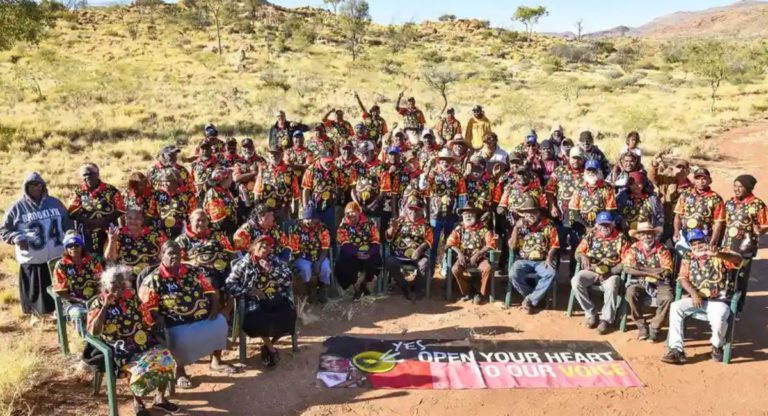
A great show of support for the Voice to Parliament from community leaders across Central Australia and surrounding regions.
Communities want to be heard on the issues that matter to them including housing, health, education and jobs.
Opposition Leader Peter Dutton has stated the Voice would be incapable of representing regional and rural peoples. Jacinta Nampijinpa Price says supporting pre-existing bureaucracies would be more effective for local people.
Yet the Central Land Council, representing traditional owners in central Australia,has repeatedly rebuked comments from Price, stating she has been misrepresenting their views on the Voice, and that she doesn’t “speak for them” or their communities.
Indigenous people in NSW’s regional town of Orange have also expressed strong support for the Voice. While speaking to SBS, Orange’s Aboriginal Medical Service chief executive Jamie Newman stated,
It’d be remiss of us not to take this opportunity now to say we need a change in direction, if we’re going to get services on the ground, going to get outcomes for our people, if we’re ever going to close the gap.
Much of the discussion in the referendum campaign has been focused on the major cities and their suburbs. Less attention has been put to Indigenous peoples in the regions.
Referendums are about all Australians having a say about our constitutional democracy. Failing to seek the active participation of regional and rural peoples is doing them a disservice. It is this neglect that forms much of the problems and resentments regional peoples have towards Canberra.
An Aboriginal legal service is providing regional Indigenous communities with information about the Voice to Parliament due to what it says is a lack of government engagement.
In addition, the Voice to Parliament is about making sure Indigenous peoples from across the continent are heard effectively. Are we truly doing politics and media differently if we don’t actively engage 30% of Australians and 60% of Indigenous peoples? The referendum could be won or lost on these voters.
As someone who lives in a small town in country NSW of less than 2000 people, I see the problems faced out here, the lack of involvement from government, and the strong need to engage with voters from these parts of the country, not just in the cities and suburbs.
Giving regional people enough information
Many communities are taking their own initiative to be informed. Wagga Wagga City Council has held forums on the Voice, alongside state MP Dr Joe McGirr, to inform and engage people. Independent federal MP Andrew Gee has been holding events across Calare, and campaigning on the issue of the Voice with Linda Burney.
Fellow Independent Helen Haines has begun outreach campaigns with local elders, seeking to take in the views of her community. Before taking leave for illness, Labor Senator Pat Dodson had been speaking at a number of forums for regional peoples, including one in Ballarat, where he noted,
people in the regions are really wanting to do the right thing and they want information […] if they get that, they will do the right thing and they will vote positively for this referendum.
Local councils, regional MPs, organisations from our rural communities such as the CWA, all have roles to play in this referendum campaign. Even if they are undecided on the Voice, we must ensure regional and remote peoples are included in the nation’s dialogues about the Voice.
It’s what the Voice has always been about for Indigenous peoples – ensuring our people are heard, even if we’re far away.
The race to net zero is accelerating. Just last week, United States President Joe Biden and Australian Prime Minister Anthony Albanese unveiled a climate pact to boost cooperation. The move signifies Australia is becoming a global leader in the renewable energy roll-out and critical mineral supply.
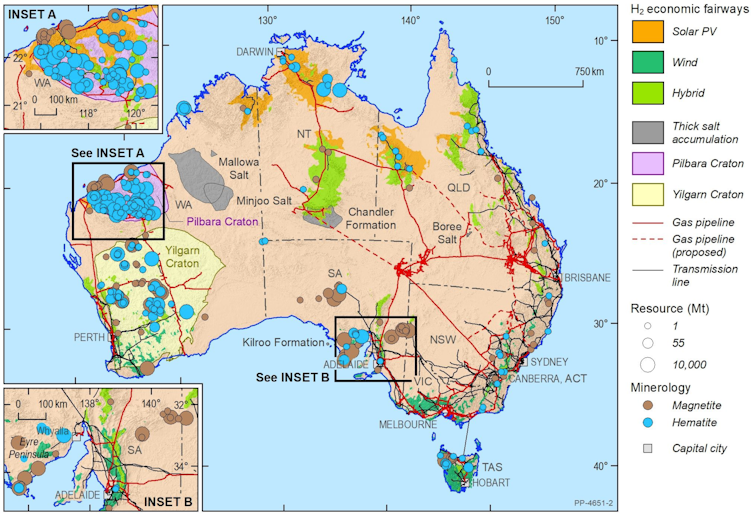
Australia’s rich iron ore deposits and cheap solar offer yet another way we can lead. If we locate green hydrogen plants near green steel facilities, we can shift the highly polluting steel industry away from fossil fuels.
Our new research shows co-locating plants in sun-rich, iron-rich places like Western Australia’s Pilbara and South Australia’s Eyre Peninsula can help overcome the “first mover problem” for green hydrogen: you can’t have a hydrogen industry without buyers for it and can’t have buyers without hydrogen.
How would it work? Cheap solar power would be used to crack water into hydrogen and oxygen. This green hydrogen would be piped a short distance to a green steel plant, which uses hydrogen and electricity to produce iron from the ore, and then an electric arc furnace to smelt steel.
As we grapple with ways to decarbonise the steel sector, which uses 8% of the world’s energy and produces 7% of all energy-related carbon emissions, we should urgently look for opportunities like this. As a bonus, cheap power from solar and wind could make Australian-made iron and steel more competitive globally.
Making iron and steel making plant; Image Source: @CANVA
Why is Australia so well placed?
We’re the world’s largest iron ore exporter. Under our red dirt lies an estimated 56 billion tonnes of iron ore, as of 2021. Export earnings reached A$133 billion in 2021–22. We also profit from the current emissions-heavy way of making steel, by exporting $72 billion worth of metallurgical coal.
Australia’s potential as a green hydrogen provider is often promoted. This year’s federal budget allocated $2 billion to help make it a reality. But our distance from the rest of the world makes pipelines prohibitively expensive, and shipping hydrogen is difficult.
One solution is to use it here. Green hydrogen could make it possible to onshore more iron and steel production.
Clean steelmaking will bring major change to our iron ore exports if other countries take it up. Traditionally, 96% of our exports are the most common type of ore, hematite. But this is currently not suited to green steelmaking.
By contrast, magnetite ore only accounts for 4% of exports but can be used in hydrogen-based green steelmaking.
Magnetite ore; Image SOurce: @CANVA
Australia has vast reserves of magnetite ore, which previously hasn’t been in as much demand. But these ore bodies will become valuable under the right economic conditions.
And while we can solve steel’s carbon problem with much better recycling of this valuable material, we’ll still need new steel equivalent to about 50% of the current rate of production in 2050, due to issues with converting scrap to reusable steel and removing contaminants.
Where should we co-locate these plants?
Major iron ore centres in the Pilbara and Eyre Peninsula already have ports, a workforce and other infrastructure. That makes them the logical first choice to co-locate solar, wind and hydrogen with iron and steelmaking.
We modelled what would happen if these sites expanded wind and solar power to make hydrogen and found the cost of green steel could drop substantially to around $900 per tonne by 2030 and $750 per tonne by 2050.
By exporting green iron and steel, Australia could boost trade value, reduce global greenhouse emissions, and link our exports with global decarbonisation efforts. Steel will become even more important given it’s so vital to manufacturing solar and wind.
There’s a strong correlation between potential hydrogen hubs and current and future iron ore operations.
Our recent modelling has found key benefits in linking hydrogen hubs and future iron ore operations.
First, it avoids the problem of transporting hydrogen, which, especially in liquid form, can be expensive and energy-intensive to transport.
And second, co-locating green hydrogen gives an immediate boost to the industry. At present, green hydrogen is at the early stage before increased scale and knowledge drives costs down.
To compete with coking coal, green hydrogen must get cheaper. Part of this will come from falling renewable energy prices, better electrolysers to make hydrogen, and carbon pricing. But part of it will be locating hydrogen production where it can be used.
South Australia’s Eyre Peninsula; Image Source: @CANVA
Choosing a site is the most important consideration. While access to infrastructure and cheap ore are important, the cost of green steel largely depends on low-cost hydrogen and cheap renewables.
Australia’s state and federal governments are backing hydrogen as an industry of the future. To go from paper to reality will require policy incentives, low-interest loans, research and development funding, and investment in infrastructure.
Policies to boost renewable energy and develop the hydrogen economy will create a more conducive environment for green steel production.
If we combine our wealth of solar, hydrogen and iron ore, we can help make global steel production green, and also create the conditions for a green hydrogen export industry.
Today the Albanese Government is announcing the members of the National Respectful Relationships Education Expert Working Group that will support the delivery of respectful relationships education (RRE) in schools.
The expert working group will be chaired by the Chief Executive Officer of OurWatch, Patty Kinnersly, during its first year and meet for the first time next month.
Minister for Education, Jason Clare said, “Teaching respectful relationships education in schools assists students build the skills, values and attitudes required to develop and maintain positive, healthy, and respectful relationships.
“This expert working group will work to ensure that age-appropriate, evidenced-based respectful relationships school education is delivered.”
The group will guide national collaboration between states, territories, the non-government schooling sectors and experts to support the delivery of age-appropriate, evidenced-based and expert-developed respectful relationships in school education.
This is in line with Recommendation 10 of the Respect@Work: Sexual Harassment National Inquiry Report.
Minister for Social Services, Amanda Rishworth said, “Making sure all Australian children can access age-appropriate consent and respectful relationships education is an important focus of the National Plan to End Violence against Women and Children 2022-2032.
The Hon Amanda Rishworth. Member for Kingston. Pic Ben Searcy 2021
“Evidence shows that improving attitudes and understanding is a key way to prevent sexual harm and violence. If we want to see a societal shift in attitudes, we need to start with young people.”
“Young people are at a heightened risk for this kind of violence. Strengthening positive and equal relationships is vital to preventing it from happening in the first place,” Minister Rishworth added.
Advice from the group will support the implementation of the Albanese Government’s $83.5 million Consent and Respectful Relationships Education program.
The working group will guide a rapid review into existing delivery approaches of RRE in schools to identify best-practice and opportunities for improvement.
They will also oversee the development of a national framework to assist schools in selecting quality external providers of RRE.
National Respectful Relationships Education Expert Working Group members include:
Patty Kinnersly (Chair), Chief Executive Officer of OurWatch
Professor Peter Buckskin, Aboriginal Engagement and Strategic Projects, University of South Australia
Chanel Contos, Teach Us Consent
Heather Clarke, National Association of Services Against Sexual Violence
Associate Professor Michael Alan Salter, School of Social Sciences, University of New South Wales
Dr Fiona Martin, Educational and Developmental Psychologist
Minister for Women, Senator Katy Gallagher said, “The Albanese Government is committed to achieving gender equality, and we know that this starts with how young people learn to respect each other and treat each other equally.
“This important work to roll out respectful relationships education supports our efforts to drive equality across women and girls’ lives.”
The working group will also include a representative from the Australian Government, a member from each state and territory government, and representatives from the National Catholic Education Commission and Independent Schools Australia.
Education Ministers Meeting will receive regular updates on the implementation of the Consent and Respectful Relationships Education program.
Now, netizens proud of PM Modi-led government are sharing his achievements on twitter “9 years of Modi govt and the 9 reasons I’ll vote for @narendramodi ji in 2024″ and are also asking others to do the same.
Here is a glimpse of some of PM Modi’s achievements according to netizens.
9 years of Modi ji & 9 reasons why I'll vote for him in '24 (in random order) 1.Focus on NE 2.Toilets+amenities for women 3.National pride 4.370 abrogation 5.Infra: Airports,trains,roads 6.Vaccines 7. AI privatisation 8.Handling of Pak,Ukraine 9.Ram mandir, Kashi corridor,Ujjain https://t.co/gQZNyoxDjQ
9 years of Modi & the 9 reasons I'll vote for him in 2024
1. COVID handling/vaccinations 2. Ram Mandir 3. Pak policy 4. 370 abrogation 5. JAM trinity, & the most successful social welfare in our history across various verticals 6. UPI 7. Highways/infra 8. Mainstreaming Patel,… https://t.co/yWB9Sc1mkH
9 years of Modi. 9 of his most spectacular achievements, ranked:
1. Vaccinating a billion Indians, twice 2. 170 million new LPG connections 3. 370 Abrogation 4. Balakot 5. 112 million Swachh Bharat Toilets 6. Ayushman 7. 50,000 km Highways 8. Air India privatisation 9. CAA
1/2
— Anand Ranganathan (@ARanganathan72) May 26, 2023
1. Jan dhan Yojna 2. Skill India 3. Vande bharat 4. New Parliament building 5.Uri 6. World is looking to bharat with great hope. 7. Bharat in making of vishwgroup 8. Strengthen armed forces
9 years of Modi & the 9 reasons I'll vote for him in 2024: 1) COVID management 2) 370 abrogation 3) Fastest road infrastructure 4) Vande Bharat 5) Foreign policies & Border Security, when turmoils like Russia-Ukraine war occurred & China kept pestering us 6) Central Vista Project… https://t.co/DH6kdPDyfB
Balancing China-Atmanirbhar push Indo-Pacific partnerships Make in India-Defence Strategic Outreach to Pacific, West and Central Asia Surgical Strike Article 370 Connectivity OWOSOG
Best: Declaration of India’s leading power ambition
In a tweet, PM Modi thanked netizens for sharing his government’s achievements.
Since morning, I am seeing many Tweets on #9YearsOfModiGovernment in which people are highlighting what they have appreciated about our Government since 2014. It is always humbling to receive such affection and it also gives me added strength to work even harder for the people.
In other tweets, PM Modi added: “I am truly humbled to have got the opportunity to fulfil the aspirations of 140 crore Indians.”
“We have covered much ground in the last 9years and we want to do even more in the times to come so that we can build a strong and prosperous India in the Amrit Kaal.”
The BJP has decided to start a mass outreach programme as well more than 50 rallies all across the country between 30 May and 30 June 2023.
The Fair Work Ombudsman has commenced legal action against the operators of a motor vehicle smash repair business in Western Sydney.
Facing court are ESR Group Pty Ltd, which operates ‘Essential Motor Body Smash Repairs’ in Seven Hills, and company manager Paul Silvestro.
The regulator investigated after receiving requests for assistance from four workers who were employed at the business for various periods between March 2020 and December 2021.
The workers included three panel beaters, including an apprentice aged 19 to 20 at the time, and a spray painter. They were all employed on a full-time basis.
Fair Work Inspectors issued Compliance Notices to ESR Group between August 2021 and August 2022 after forming a belief the workers had not been paid accrued but untaken annual leave entitlements when their employment ended, owed under the Fair Work Act’s National Employment Standards.
The inspectors also formed a belief that two of the workers were not paid any wages for some work performed, owed under the Vehicle Repair, Services and Retail Award 2020 and that one worker was not paid personal leave entitlements.
The Fair Work Ombudsman alleges ESR Group, without reasonable excuse, failed to comply with the Compliance Notices, which required it to calculate and back-pay the workers’ entitlements. Four breaches of pay slip laws are also alleged.
It is alleged Mr Silvestro was involved in some of the Compliance Notice contraventions and the pay slip breaches.
Fair Work Ombudsman Sandra Parker said the regulator would continue to enforce workplace laws and take businesses to court where lawful requests are not complied with.
“Where employers do not comply, we will take appropriate action to protect employees. A court can order a business to pay penalties in addition to back-paying workers.”
“Any employees with concerns about their pay or entitlements should contact the Fair Work Ombudsman for free assistance,” Ms Parker said.
The FWO is seeking penalties. In relation to the alleged Compliance Notice breaches, ESR Group faces a penalty of up to $33,300 per breach and Mr Silvestro faces a penalty of up to $6,660 per breach.
In relation to the alleged pay slip breaches, ESR Group faces a penalty of up to $66,600 per breach and Mr Silvestro faces a penalty of up to $13,320 per breach.
The regulator is also seeking orders for ESR Group to rectify the alleged underpayments in full, plus interest and superannuation.
A directions hearing is listed in the Federal Circuit and Family Court in Sydney on 20 July 2023.
Consumers struggling with cost-of-living pressures were dealt another blow when the Australian Energy Regulator confirmed energy price hikes of up to 25% from July.
For one in three Australian homes with rooftop solar, the bill shock will be reduced – together with their carbon emissions. But households without solar, such as renters and social housing tenants, are missing out on the benefits.
In this month’s federal budget, A$1 billion was allocated to low-interest loans to homeowners for energy efficiency upgrades, solar panel installation and swapping out gas for electric appliances. Details are sketchy so far, but the government says the package “will focus on households that most need support”, including renters.
But do low-interest loans encourage homeowners to install solar on rental homes? Our research suggests in many cases, the answer is no. New measures are needed to make sure renters benefit from solar technology – both through lower bills, and more liveable homes.
Electricity prices rising; Image Source: @CANVA
Solar haves and solar have-nots
Rents in Australia are on the rise. But as of 2017-2018, there was only a 3-4% chance a rental property had solar panels on the roof.
The conventional view is that two main barriers exist to solar being installed on rentals.
The first is that property investors don’t want to pay for the technology when they aren’t directly reaping the benefits of lower bills and a more comfortable home temperature.
But this dynamic is an inherent part of the rental arrangement. And it ignores the fact that landlords routinely make other improvements to investment properties, such as kitchen upgrades, even though they’re not using the kitchen. Instead, landlords benefit by collecting higher rents.
The second perceived barrier is the upfront cost of installing solar. Until now, efforts to increase solar on rental properties have focused on reducing this cost through subsidies and low-interest finance.
But are upfront costs really preventing landlords from installing solar on rental properties? Our research set out to answer that question.
First, we surveyed 931 property investors with all types of buildings. This involved a ranking exercise where landlords selected the most and least important reasons for not yet putting solar panels on their rental home.
We then surveyed 147 owners of stand-alone rental homes. We asked them to choose between hypothetical policy options involving system costs, billing arrangements and interest-free loans.
Solar energy can help when Electricity prices rising; Image Source: @CANVA
Our findings
Our research found landlords are concerned about the upfront cost of solar. They ranked it as one of the two top reasons why they hadn’t installed rooftop panels.
But when offered a choice of hypothetical policy options, about two-thirds opted for an upfront payment of solar systems rather than an interest-free loan. So for the majority of landlords, loans don’t seem to be the key tipping point.
And the other top reason landlords don’t install rooftop solar? Because they think renters aren’t willing to pay higher rent in exchange.
However, this perception runs counter to a 2021 study that found Australian renters with solar panels pay about A$19 more in rent each week than non-solar renters. This meant landlords could recoup the cost of installation in about five years.
So for policymakers wanting to get more solar on rental homes, initiatives must go beyond low-interest loans.
Other research we’ve conducted found many landlords saw energy efficiency measures, such as electric heating, as extremely expensive – and, in the case of insulation, invisible and therefore not valued by renters.
Our research also examined barriers for apartment landlords when it comes to energy efficiency upgrades and installing solar panels. Many worried about issues such as body corporate approval, and physical and legal barriers.
This suggests policies to increase the energy efficiency of the rental housing stock must cater to different dwelling types.
Electricity prices rising; Image Source: @CANVA
So what next?
The federal government should be commended for spending on energy efficiency. But further actions are needed.
One potential group that should receive more attention is the real estate industry. Property managers have relationships with both landlords and tenants, and deep knowledge of the rental market.
Resources could, for instance, be invested into teaching property managers about the benefits of rooftop solar and energy efficiency upgrades. Property managers could then include such features in home advertisements and talk about these benefits in discussions with landlords and prospective tenants.
Additional incentives could be provided to investors and property managers who, say, make a home less reliant on gas over time. This would mean as old appliances fail, they’re replaced with efficient electric versions – for hot water, heating and cooking.
What’s more, information about a property’s energy-efficiency performance should be made available to all prospective renters.
The ACT government has made steps towards this. It requires a home’s energy efficiency rating be disclosed to prospective buyers at the time of sale, and be disclosed to renters when a rating is available.
This should occur nationally, and be expanded to include the amount of energy generated by solar panels on a property and the amount of money to be saved on energy bills.
Lastly, tax breaks for property investing, such as negative gearing, should be conditional on rental properties meeting minimum energy efficiency standards.
It’s good to see rental properties on the federal government’s agenda. But our research shows improving Australia’s rental stock requires far more than low-cost financing.
The AFP’s National Missing Persons Coordination Centre (NMPCC), in partnership with The Daniel Morcombe Foundation, has on International Missing Children’s Day 2023 (IMCD) released online resources to encourage parents to talk to their children about safe behaviour.
IMCD is held each year to acknowledge the missing children who have found their way home, remember those who have been victims of crime and continue efforts to find those still missing.
Assistant Commissioner Justine Gough said this year’s IMCD presented a valuable opportunity for parents and guardians to have important conversations with their children about online and offline safety.
“The AFP and NMPCC, in partnership of the Daniel Morcombe Foundation, have released a suite of tools and resources to support parents and guardians talking to their children about safe behaviour,” Assistant Commissioner Gough said.
“It may be a tough conversation for parents and guardians to have, but it can help keep children safe and protected.”
Assistant Commissioner Justine Gough said the resources provided safety tips for both parents and children to familiarise themselves with.
“Being safe on social media is as equally important for children as for parents. Remember to remove friends or followers you don’t know, set your child’s and your own accounts to private, and only share photos with people you know and trust,” Assistant Commissioner Gough said.
“Ensure your child knows their full name, home address and parents’ phone numbers and keep a copy of this information in their backpack.
“Before visiting crowded places or events, consider dressing your child in bright clothing and agree on a meeting spot in case they get lost.”
Bruce Morcombe and Denise Morcombe said when a child went missing the impact on family and friends was huge.
“We need to be better at supporting those left behind who are dealing with unresolved loss,” Bruce Morcombe said.
“IMCD provides a valuable opportunity to educate our young people on ways to stay safe. We recommend that it starts with the creation of a “Family Password”.
“Teach your children that no matter what is offered or story told, they cannot get into a car or secretly meet anyone that does not know your family’s special word.”
Denise Morcombe said: “Parents need to have updated photos and medical records of their children and know what their children are wearing in case they go missing”.
International Cricket Council’s (ICC) World Test Championship Final between Australia and India will see a star-studded line-up heading to ‘The Oval’ in London for The Seven Network, the Test is set to be seen on Seven and 7plus from Wednesday, 7 June.
Cricket commentators Justin Langer and James Brayshaw will meet a cavalcade of Australian and Indian cricket greats – including Seven’s own Ricky Ponting and Matthew Hayden –to deliver every ball of the highly anticipated final between the world’s two highest-ranking sides.
First Test – Australia v West Indies at Optus Stadium
Ricky Ponting. Matthew Hayden and Justin Langer are part of the 7 Cricket commentary team.
Full in-play match coverage will be produced by ICC TV.
Fearless opening batsman and iconic broadcaster, Sunil Gavaskar, Former Indian coach Ravi Shastri and fan-favourite broadcaster and former Indian wicketkeeper Dinesh Karthik will make up an exceptional contingent of former Indian cricket greats. Australian Indian viewers will hear from a voice familiar to the 7Cricket audience and yes that ‘banter’ is defiantly part of the deal.
Former English Cricket Captain Nasser Hussain also joins the team, alongside Sri Lankan great Kumar Sangakkara and accomplished cricket broadcasters, 7Cricket’s Alison Mitchell and the iconic voice of Harsha Bhogle.
In a huge coup for Australian cricket fans, Seven’s agreement with the ICC will see the eagerly anticipated ultimate Test shown both exclusively on Seven and live on 7plus bringing the game closer to the fans than ever before.
The gripping final will be shown in Australia in prime time from 7 June to 11 June, with a reserve day in place (12 June). The coverage will also include a 30-minute pre-game show each night, from 7.00 pm AEST on 7mate and 7plus, where viewers will be greeted by many of 7Cricket’s favourite faces.
As Pat Cummins’ side looks to take home the World Test Championship mace, Rohit Sharma’s men – headlined by the incomparable Virat Kohli – will be looking for redemption following a loss in the inaugural World Test Championship Final in 2021 to New Zealand.
Managing Director Seven Melbourne and Head of Network Sport, Lewis Martin, said: “The contest between Australia and India is shaping up to be one of the great international sports events of 2023, and we’re rapt to be able to deliver every moment to Australians, live, free and exclusively on Seven and 7plus.
“The ICC World Test Championship is the premier competition in Test cricket and we are honoured to partner with the ICC to deliver this spectacle to fans all over Australia.
This match will decide who is the best Test cricket nation in the world and we can’t wait to deliver the spectacle into the homes, phones and tablets of every Australian.
“Much like the Summer of Cricket on Seven, Australians will again hear from an exceptional team of cricket experts, as we eagerly watch the fierce rivalry between the two premier cricket nations in the world,” he said.
“Once again, three greats of Australian cricket – Justin Langer, Ricky Ponting and Matthew Hayden – will be side-by-side as our national team meets the best in the world, not to mention the remarkable lineup of Sunil Gavaskar, Ravi Shastri and Dinesh Karthik.
“This is an event not to be missed and the only place to see it all is right here on Seven, Your Home of Cricket.”
ICC Chief Commercial Officer, Anurag Dahiya said: “We are now in the final planning stages of the ICC World Test Championship Final and eagerly await to see who will be crowned the new world champions.”
“The second edition of the Ultimate Test is shaping up to be an enthralling sporting showdown that’s sure to captivate fans across the globe.”
Throughout the Test, fans can tune into 7plus for live and on-demand cricket content, including:
Full replays on demand
Daily highlights
Interviews and extras with the Australian Cricket Team
Event coverage live and exclusive from 7.00 pm AEST daily 7NEWS.com.au remains the best source of cricket news throughout the Final and includes the 7Cricket Match Centre, which includes fixtures, live ball-by-ball commentary, player statistics, breaking news and exclusive 7Cricket stories.
The ICC World Test Championship Final from Wednesday, 7 June to Sunday 11 June Live, free and exclusive on Seven and 7plus The only place to see it all!
TV broadcast times on Seven:WEDNESDAY, 7 JUNE ICC World Test Championship Final: Day One Pre Game show
Sydney, Melbourne and Brisbane – 7.00 pm live on 7mate and 7plus Adelaide – 6.30 pm live on 7mate and 7plus Perth – 5.00 pm live on Channel 7 and 7plus
ICC World Test Championship Final: Day One, Session One
Sydney, Melbourne and Brisbane – 7.30 pm live on Channel 7 and 7plus Adelaide – 7.00pm live on 7mate/7.30pm live on Channel and 7plus Perth – 5.30pm live on Channel 7/6.00pm on 7mate and 7plus
ICC World Test Championship Final: Lunch break
Sydney, Melbourne and Brisbane – 9.30 pm live on Channel 7 and 7plus Adelaide – 9.00 pm live on Channel 7 and 7plus Perth – 7.30 pm live on Channel 7 and 7plus
ICC World Test Championship Final: Day One, Session Two
Sydney, Melbourne and Brisbane – 10.10 pm live on Channel 7 and 7plus Adelaide – 9.40 pm live on Channel 7 and 7plus Perth – 8.10 pm live on Channel 7 and 7plus
ICC World Test Championship Final: Tea Break
Sydney, Melbourne and Brisbane – 12.10 am live on Channel 7 and 7plus Adelaide – 11.40 pm live on Channel 7 and 7plus Perth- 10.10 pm live on Channel 7 and 7plus
ICC World Test Championship Final: Day One, Session Two
Sydney, Melbourne and Brisbane – 12.30 am live on Channel 7 and 7plus Adelaide – 12.00 am live on Channel 7 and 7plus Perth – 10.30 pm live on Channel 7 and 7plus
The broadcast schedule will remain the same for the next four days Thursday, Friday, Saturday and Sunday for ICC World Test Championship Final.
The Fair Work Ombudsman has secured more than $57,000 in penalties in court against the operators of a Melbourne painting company for breaches affecting a migrant worker.
The Federal Circuit and Family Court has imposed a $47,952 penalty against Mehtaab Group Pty Ltd, which operates a business trading as Paint Splash based at Tarneit, and a $9,590.04 penalty against the company’s sole director and shareholder, Vikramjeet Singh Khalsa.
The penalties were imposed against Mehtaab Group after the Court found the company breached the Fair Work Act by failing to comply with a Fair Work Commission order to pay $21,491.17 in compensation to the worker as a result of an unfair dismissal claim, and failing to comply with a Fair Work Ombudsman Compliance Notice to pay outstanding annual leave entitlements to the worker.
The penalties were imposed against Mr Khalsa after the Court found he was involved in both breaches.
The compensation and entitlements were owed to an Indian international student Mehtaab Group had employed for almost a year.
In addition to the penalties, the Court has ordered Mehtaab Group to pay the outstanding Fair Work Commission order for unfair dismissal compensation, plus superannuation, and to calculate and back-pay the annual leave entitlements owing to the worker.
Image: Fair Work Ombudsman and Paint Splash
Fair Work Ombudsman Sandra Parker said the regulator was prepared to take action to reinforce the importance of complying with Fair Work Commission orders and FWO Compliance Notices.
“It is fundamental for the integrity of the workplace relations system that Fair Work Commission orders and our Compliance Notices are complied with,” Ms Parker said.
“The Fair Work Ombudsman is prepared to take legal action to ensure that employees receive all compensation and entitlements they are lawfully entitled to. Any employees with concerns about their pay or entitlements should contact the FWO for free advice and assistance.”
The Fair Work Ombudsman investigated after receiving a request for assistance from the affected worker.
In June 2021, the Fair Work Commission found that earlier that year Mehtaab Group unfairly dismissed the worker.
The Fair Work Commission ordered the company to pay the worker $21,491 compensation, plus superannuation, within two weeks. The company failed to make the payments to her.
The Fair Work Ombudsman’s attempts to secure voluntary compliance were not successful.
During the investigation, a Fair Work Inspector formed a belief that Mehtaab Group failed to pay the worker’s accrued but untaken annual leave entitlements when it dismissed her.
In September 2021, the inspector issued Mehtaab Group with a Compliance Notice, which required the company to calculate and back-pay any outstanding annual leave entitlements owed to the worker.
The FWO has filed 126 litigations involving visa holder workers, and secured more than $13.4 million in court-ordered penalties in visa holder litigations, in the past five full financial years.
A partnership forged between the Government of India and The University of the South Pacific (USP) will see the establishment of a new center for climate change, coastal and ocean management in Fiji.
The Sustainable Coastal and Ocean Research Institute (SCORI) at USP’s Suva campus was launched on May 22 by India’s High Commissioner to Fiji, Palaniswamy Subramanyan Karthigeyan, who described the initiative as a celebration of the future.
Image: High Commissioner of India to Fiji, Mr Karthigeyan (Source: USP)
“This is a meeting of the best minds from both sides in the scientific, technology world and possibly being on the frontline of climate action,” Mr Karthigeyan said.
He added the institute would have India’s unstinted support and the way forward was going to be more critical.
“Unfortunately, due to the pandemic, we have lost quite a bit of time in taking this initiative forward and we have the momentum to make sure that this is not lost sight of and we make it a benchmark project not just for the region but the entire world,” he said.
“The onus of responsibility is on all of us to make sure that we do justice to that. The best way to do that is to make it a benchmark project in the shortest possible time, and to make it a sustainable model of excellence.”
Mr Karthigeyan echoed similar sentiments made earlier in the day by Indian Prime Minister Narendra Modi at the 3rd India-Pacific Islands Cooperation (FIPIC) Summit in Papua New Guinea. PM Modi focused on the problems faced by Global South at the summit, including the issues of climate change, natural disasters, hunger, poverty, and various health-related challenges among others.
“I am glad to hear that the Sustainable Coastal and Ocean Research Institute has been established at The University of the South Pacific in Fiji. This institute connects India’s experiences in sustainable development with the vision of Pacific Island countries,” he said in his address at the summit in Port Moresby.
“In addition to research and development, it will be valuable in addressing the challenges of climate change. I am pleased that SCORI is dedicated to the well-being, progress, and prosperity of citizens from 14 countries,” Modi added drawing attention to India’s desire to partner the region in tackling issues that regional countries have placed priority on.
On the margins of the FIPIC Summit, I held a bilateral meeting with Hon. Narendra Modi where we discussed opportunities for partnership in the areas of climate mitigation, disaster risk resilience, renewable energy, education and health sector. pic.twitter.com/IiR8pftnAd
— Prime Minister Sitiveni Rabuka (@FijianPM) May 22, 2023
PM Modi said Pacific Island countries were not Small Island States, but rather, large ocean countries He noted it was this vast ocean that connected India with the Pacific region.
“The Indian philosophy has always viewed the world as one family. Climate change, natural disasters, hunger, poverty, and various health-related challenges were already prevalent.
“Now, new issues are emerging. Barriers are arising in the supply chains of food, fuel, fertiliser, and pharmaceuticals,” Mr Modi said.
India, he said, stood with its Pacific island friends during challenging times, whether it was vaccines or essential medicines, wheat or sugar.
Delighted to meet PM @slrabuka of Fiji. We had a great conversation on various topics. The relation between India and Fiji has stood the test of time. We look forward to working together to further cement it in the coming years. pic.twitter.com/IfXKyWQMAM
USP’s vice-chancellor and president, Professor Pal Ahluwalia, said the unwavering support and endorsement of SCORI by PM Modi and the Fijian Government underscored the significance of the institute in advancing climate change and oceans management in our region.
Image: The Vice-Chancellor and President of The University of the South Pacific (USP), Professor Pal Ahluwalia (Source: Twitter)
“With the establishment of SCORI, we embark on a new chapter of cooperation between India, Fiji, and The University of the South Pacific,” he said.
“This institute will serve as a hub for the exchange of knowledge, ideas, and cutting-edge technologies, ensuring that our work in climate change and oceans management remains at the forefront of global research.”
Through the collaboration of esteemed scholars from India and Fiji, Prof Ahluwalia said the University aimed to publish groundbreaking research and set new agendas in the field of coastal and ocean studies.
“This institute will greatly enhance our research activities and capacity building, contributing to the sustainability of the Pacific Ocean and aligning with the Blue Pacific 2050 Strategy launched by our Pacific leaders,” he said.
USP deputy vice-chancellor and vice-president (education) Professor Jito Vanualailai said the Sustainable Coastal and Ocean Research Institute (SCORI) would serve as a hub for research and development to meet the needs of Pacific Island countries.
“SCORI will spearhead research and development initiatives that address pressing issues in the region,” he said.
“Together, we strive to develop policies for sustainable management and protection of marine and coastal ecosystems while effectively tackling coastal hazards and vulnerabilities stemming from global warming, ocean acidification and climate change.”
USP’s director of research, Professor Sushil Kumar, said the project was a reality due to the integral role played by some “remarkable individuals and organisations”.
Prof Kumar thanked the governments of Fiji and India for their support to foster collaboration and partnership under SCORI.
He said apart from the Ministry of Earth Sciences, Government of India, several institutes such as the National Center for Coastal Research are part of the collaborations.
The center will have a dedicated focus on areas of common interests such as coastal vulnerability, coastal erosion and coastal protection, monitoring and mapping of marine biodiversity, ocean observation systems, sea water quality monitoring and capacity building.
SCORI will be funded and maintained by the Government of India for five years until it is handed over to USP.
This news piece was first published in Wansolwara and has been republished here with the kind permission of the editor(s).
Contributing Author: Joeli Bili is a final-year journalism student at The University of the South Pacific’s Laucala Campus, Suva. He is a senior reporter for Wansolwara, USP Journalism’s training newspaper and online publication.
Disclaimer: The opinions expressed within this article are the personal opinions of the author. The Australia Today is not responsible for the accuracy, completeness, suitability, or validity of any information in this article. All information is provided on an as-is basis. The information, facts, or opinions appearing in the article do not reflect the views of The Australia Today and The Australia Today News does not assume any responsibility or liability for the same.
Today marks six years since the Uluru Statement from the Heart was issued at Uluru on 26th May 2017.
Along with National Sorry Day and this year’s National Reconciliation Week (27 May to 3 June), it is an important time for Australians to reflect.
Six years ago, Aboriginal and Torres Strait Islander leaders from across the nation issued the Statement from the Heart, inviting their fellow Australians ‘to walk with us in a movement of the Australian people for a better future’.
At this historic meeting, the Uluru Statement from the Heart called for the establishment of a Voice to Parliament to be enshrined in the Constitution.
It was the culmination of regional dialogues and included 1,200 First Nations representatives, that formed the Uluru Dialogues.
The sixth anniversary provides an opportunity for all Australians to reaffirm their commitment of the generous invitation of the Uluru Statement from the Heart, in full.
The Australian Government understands that the Statement from the Heart provides the best chance to close the gap between Indigenous and non-Indigenous Australians and to bring people together and move our nation forward.
Next week the Constitutional Alteration is expected to pass the House of Representatives taking us one step close to a referendum to recognise Aboriginal and Torres Strait Islander people through a Voice to Parliament in Australia’s founding document.
In the words of the Uluru Statement let’s end “the torment of our powerlessness” and allow “our children to flourish”.
In 2017 we heard the call to the Uluru Statement from the Heart, and in 2023 we deliver on its promise.
2023 will be the year that Australia moves forward to a better future, for everyone.
A “Yes” vote at the 2023 referendum is a chance for all of us to take the next step on the journey to reconciliation.
To be counted – and heard – on the right side of history.
A court judgement handed down last Friday has delivered what years of promises from Australia’s life insurance industry have not – insurance that pays out on what it says it will.
I first raised the issue of outdated medical conditions within the insurance industry almost 15 years ago. Then in 2016, after stepping down as chief medical officer for CommInsure, then owned by the Commonwealth Bank, I spoke on Four Corners about the practice of using outdated definitions of conditions such as heart attacks to refuse payouts.
A random audit conducted of 40 heart attack claims found CommInsure had knocked back more than half by using a threshold for diagnosing substances in the blood that was by then out of date.
The banking royal commission was critical of ASIC’s performance in this area, and in 2021 ASIC commenced action against the insurer MLC for denying payouts to customers because it had failed to promptly update its definition for the insurance benefit of severe rheumatoid arthritis.
On May 18, Justice Moshinsky of the Federal Court found that MLC’s failure to promptly update the medical definition for severe rheumatoid arthritis had contravened the Corporations Act 2001.
The section of the Corporations Act in which the breach occurred has been in place for a long time, suggesting failure to update medical definitions would have been illegal for a long time.
Representative picture Medical Insurance; Image Source: @CANVA
Tight definitions quickly date
There are generally four types of life insurance in Australia. The most common is death (or more euphemistically, “life”) insurance, which pays a benefit when a policyholder dies. The others are
total and permanent disability insurance, which pays a sum of money when a person becomes disabled
income protection, which pays a monthly benefit when someone is sick
and trauma or critical illness insurance, which pays out a lump sum when a policyholder experiences a defined medical event.
For death insurance (“life” insurance) the definition is usually uncontentious, as it is for income protection insurance, which kicks in after a period of waiting if a treating doctor diagnosed a condition that prevents work in an occupation covered by the insurance policy.
The fine print can turn policies into junk.
More contentious are the definitions for total and permanent disability insurance and trauma insurance.
The problem with tightly and strictly-worded definitions is they can get out of date very quickly, whereas the policies they are written into can stay in place for decades. Unless updated, they can turn the policies into near-useless; so-called “junk insurance”.
The MLC policies that ASIC took action against required the claimant to develop a level of deformity now uncommonly seen, given available treatments – even for clinically severe cases. In essence what the court has found was that the holders of those policies were holding something close to junk.
Loopholes in the industry’s code
The Code of Practice for life insurers is only voluntary and is administered by the Financial Services Council.
Insurers who subscribe to it now do have to review medical definitions at least every three years, but only for new policies that are currently on sale – not for existing policies held by existing customers.
The new code due to come into effect in July 2023 continues to leave out existing customers but adds a commitment that seems to offer new customers more.
It says where a policy
has a medical definition which specifies an obsolete method of diagnosis or treatment that is no longer used in mainstream medical practice in Australia, we will assess your claim, including whether it meets the required degree of severity defined in your policy, using a current method of diagnosis or treatment approved for use in Australia
Representative picture Medical Insurance; Image Source: @CANVA
But for sufferers of severe rheumatoid arthritis, the offer is nearly meaningless.
Whereas rheumatoid arthritis can be diagnosed by various clinical criteria, including blood tests, such diagnostic criteria do not equate to the level of severity.
The outdated definition of “severe” used in insurance policies commonly requires a number of things in addition to a diagnosis.
The extra requirements include (and all of them are needed) joint deformity, and bilateral and symmetrical joint soft tissue swelling or fluid.
These extra requirements are in addition to what is required for diagnosis, meaning that code, which refers to methods of “diagnosis or treatment” doesn’t cover them.
They are also obsolete, but the wording of the code only requires the updating of obsolete methods of diagnosis or treatment – not obsolete methods for determining severity.
Thankfully, claimants are now able to rely on more than the code. Friday’s judgement established that outdated medical definitions are a breach of the law regardless of the code, and have been for a long time.
Fire and Rescue NSW says a massive massive blaze that engulfed a vacant seven-storey building in central Sydney has now been “effectively contained”.
The seven-storey complex on Randle Street caught alight just after 4pm and its walls came crashing down onto the street below.
Image: Surry Hills Fire (Source: Fire and Rescue NSW)
The massive fire created plumes of smoke that drifted over the central CBD and most nearby streets were shut down as the building started to collapse.
SURRY HILLS | Wall collapses as major fire engulfs seven-storey building. New video footage, released by FRNSW, shows the moment a wall from an engulfed building in Surry Hills came crashing down onto the street below. pic.twitter.com/mZeYGg1Kox
It is reported that more than 100 firefighters, from 20 fire trucks and multiple stations, continue to work to extinguish the blaze in two buildings.
NSW Fire and Rescue Commissioner Jeremy Fewtrell told the media:
“The fire is now effectively contained but it will be a substantial and very prolonged duration of firefighting to extinguish the fire completely.”
More than 100 firefighters, from 20 fire trucks and multiple stations, continue to work to extinguish the blaze in two buildings. At this stage, it is believed both impacted buildings have been vacant. Firefighting operations are expected to continue throughout the night. pic.twitter.com/nvbLVX8YRb
Fewtrell added that the building was made out of “well seasoned and dry timber” that caused the building to burn with such speed and intensity.
“The information we have at this stage was the buildings were vacant or unoccupied, whether they were under construction or about to have sort of demolition or work done.”
Hundreds of people were evacuated from the area near the building on Randle Street near Central Station.
Right now @FRNSW are battling a major fire in a multi-level building at Surry Hills near the Sydney CBD.
There are road closures near the site of the fire, and the public are advised to avoid the area as firefighting operations continue.
A large exclusion zone remains in place to ensure the safety of emergency crews and the broader community.
Image: Surry Hills Fire (Source: Fire and Rescue NSW)
Fire and Rescue NSW said in a statement:
“At this stage, it is believed both impacted buildings have been vacant. Firefighting operations are expected to continue throughout the night.
One firefighter who received a minor burn to his right arm is being treated by NSW Ambulance paramedics at the scene but will not require hospital treatment.
NSW Police and Fire and Rescue have warned people to stay away from the scene.
Among these Fellows are two Indian-Australian academics Prof. Brajesh Singh, a Soil Ecologist, and Prof. Pankaj Sah, a Neuroscientist.
Image: Prof. Brajesh Singh (Source: WSU)
In a statement, Prof. Brajesh Singh said: “Humbled, honoured & inspired for being named as a fellow of Australian Academy of Science. @Science_Academy fellows are among the nation’s most distinguished scientists, elected for ground-breaking research with clear impact,” Congrats to all! #FellowsAA“
Humbled, honoured & inspired for being named as a fellow of Australian Academy of Science. @Science_Academy fellows are among the nation’s most distinguished scientists, elected for ground-breaking research with clear impact,” Congrats to all! #FellowsAAhttps://t.co/rcq2zzBRUz
— Prof Brajesh Singh (@Prof_Braj_Singh) May 24, 2023
Ecologist and Distinguished Prof. Singh has shown how the loss of microbial diversity in soils can reduce the functioning of ecosystems. His research has been translated into products and guidelines to improve soil health and led to changes in farm management practices in the agriculture sector. He has also conducted global studies that have demonstrated the central role of soil microbes in predicting, mitigating, and adapting to climate change.
Image: Prof. Pankaj Shah (Source: Twitter)
Prof. Sah is the Executive Director of the Queensland Brain Institute (QBI) at The University of Queensland. His research interest includes developing new treatments for anxiety, obsessive-compulsive disorder (OCD), and anorexia nervosa. He has published over 110 papers in international peer-reviewed journals.
Prof. Sah trained in medicine at The University of New South Wales and, after completing his internship, gained a PhD from the Australian National University. Following postdoctoral work at the University of California, San Francisco, and UQ, he established his own laboratory at the University of Newcastle in 1994. He then joined the John Curtin School of Medical Research at the Australian National University as a group leader in 1997. He was recruited to QBI as a founding member in 2003, and has been Director since July 2015.
Image: Australian Academy of Science Professor Chennupati Jagadish, AC with Indian PM Narendra Modi (Source; LinkedIn)
President of the Australian Academy of Science Prof. Chennupati Jagadish, AC congratulated the new Fellows on their contributions to science.
“Fellows of the Australian Academy of Science are among the nation’s most distinguished scientists, elected by their peers for ground-breaking research and contributions that have had clear impact. There is no greater professional honour than being recognised by your own peers and the leaders within your own field of research for your achievements.”
This year’s new Fellows come from countries including Germany, China, India and Italy and all now call Australia home.
Image: Fellows – Australian Academy of Science 2023
Following the May 1987 Coup, the Indigenous Fijian iTaukei Movement, held noisy demonstrations throughout the country with the support of the military and the police in favour of Indigenous rights, arguing that iTaukei land was in jeopardy by the newly elected coalition government led by late Fiji Labour Party leader Dr Bavadra.
At the time, the attack from iTaukei nationalists was directed at the late Prime Minister Dr Timoci Bavadra and his Attorney of General late Jai Ram Reddy.
I make this confession on my own behalf and on behalf of all those who took part with me in the military coup on the 14th of May, 1987. We confess our wrongdoings, and we confess that we have hurt so many of our people in Fiji, particularly those of the Indo-Fijian community. pic.twitter.com/eNI83zu86F
Debates on race and racism were played out in the halls and corridors of the University of the South Pacific (USP) in Suva where iTaukei nationalists argued in support of Indigenous Fijian political dominance and aggrieved for the loss of that dominance of indigenous Fijians at all levels of government, following the election of the multiracial coalition government in April 1987.
For the Indigenous Fijian iTaukei Movement, the Fiji Labour Party-National Federation Party Coalition was “Indian-dominated” and as such had Ministers who could undermine Indigenous Fijian land and customary rights because they could not be trusted on iTaukei affairs due to their race.
On the other side of the debate were supporters of the Labour-led Coalition who labelled the deposed government as “multiracial” and argued that Indigenous Fijian culture, customary rights, and land were fully protected under the 1970 Constitution with Indigenous Council of Chiefs and their permanent veto powers to disallow any move to undermine iTaukei land rights.
At times heated and emotional debates ensued and those who argued in favour of the Coalition were effectively cancelled or silenced because race matters were seen as the sole domain of iTaukei indigenous nationalists.
Indo-Fijians were seen as apologists for the Coalition Government, which according to the iTaukei nationalist, who used race to elbow their way into political power following the election of 1987. The argument by the nationalists against the elected coalition government fails to acknowledge that since independence in 1970, the country was led by the iTaukei-dominated Alliance Party and any failings in policies towards the iTaukei lay at the heels of the iTaukei Alliance government and its misguided supporters.
Strangely, the multiracial coalition government in 1987 was deposed by a military coup led by the current Prime Minister of Fiji, Sitiveni Rabuka, in less than a month and since 1987, there has been a trend in Fiji on either the Indo-Fijian and Indigenous iTaukei Fijian sides to invoke race, ethnicity and political entitlement to claim control of the country.
We're now one nation of different beliefs. One nation of different cultures. My custom now is acceptance. My custom now is harmonious coexistence. pic.twitter.com/n45Z5n9kkE
The term race has a different and unique ethnic reference point in Fiji. A more elaborate race concept emerged following the implementation of the 1997 Constitution.
Indo-Fijians longed for political justice in the form of equal political rights whereas Indigenous Fijians wanted cultural, economic, and social justice as part of the constitutional and political settlement between Indo-Fijians and indigenous Fijians. Both communities articulated their injustices as national grievances, but their narratives never intersected or were not allowed to intersect by the political class.
These contending race discourses amplified racial conflict and set in motion disjunctive narratives within ethnic groups as each tried to spin their position as a national strategy for peace, stability and good government.
In 2000, Indo-Fijians argued that race was a factor in deposing the government led by Indo-Fijian Prime Minister Mahendra Chaudhry whilst the rebel Indigenous Fijian ITaukei nationalists argued that an Indo-Fijian-dominated government led by an “Indian” Prime Minister were the reason for the chaos and mayhem at the Fiji Parliament House for 56 days, where government ministers were held at gunpoint and often beaten for refusing to acquiesce to the demands of their captors. Both communities, Indo-Fijians, and Indigenous Fijians used race to justify their political positions.
Are both communities using race to air their variety of racial injustices or perhaps there are more covert intra-communal social forces at play beyond race?
For example, elite, sectional, and intra-communal interests exploit racial divisions for their political and economic benefit. In Fiji, the questions of race are rarely settled, and they cannot be addressed unless there is some form of meaningful Truth and Reconciliation Commission into Fiji’s troubled past. The moment an Indigenous Fijian raises an issue of racial injustice, it is assumed that the intended target of such claims is the non-Indigenous race or Indo-Fijians and vice versa. Such perceptions stifle critical discussions on race since it is aimed at cancelling or silencing or reducing race discussions before it even starts. The Fijian community including the Fijian Diaspora must ensure that racial grievance, of any form and by any community, is allowed to be communicated, debated, and addressed within a multiracial governance framework.
In 2018, the former Prime Minister of Fiji Voreqe Bainimarama dismissed requests from the opposition to establish a truth and reconciliation commission. However, the current Prime Minister Sitiveni Rabuka, during the election campaign in December 2022, indicated that his party “the People’s Alliance Party (PAP) plans to set up a truth reconciliation commission that will look at the mistakes of the past, and the recent past”.
While a truth and reconciliation commission is yet to be established, the debate on race has started once again as Indo-Fijians re-assess their political position in the country, following the defeat of FijiFirst Party at the polls, and a different kind of re-assessment is taking place within the iTaukei community with a stocktake on the economic gap between Indo-Fijians and iTaukei Fijians as well as growing poverty in the community.
Contributing Author: Dr Sanjay Ramesh is Senior Fellow at the University of Sydney.
Disclaimer: The opinions expressed within this article are the personal opinions of the author. The Australia Today is not responsible for the accuracy, completeness, suitability, or validity of any information in this article. All information is provided on an as-is basis. The information, facts, or opinions appearing in the article do not reflect the views of The Australia Today and The Australia Today News does not assume any responsibility or liability for the same.
Australian government agencies’ use of Chinese-made technology has been making headlines again. This time, the potential threat comes from DJI drones produced by China-headquartered company Da Jiang Innovations.
A cessation order signed earlier this month will see the Australian Defence Force (ADF) suspend its use of DJI products, pending a six-month security audit of the force’s supply chain. DJI drones were being used for training and military exercises.
DJI joins a growing list of Chinese technology producers spurring anxiety in Australia and among allies. But the disproportionate focus on Chinese-made technologies might not be doing Australia’s national security much good.
A history of pointing the finger at China
It is important to note DJI does have links with China’s ruling political party, the Chinese Communist Party (CCP), which has its own branch within the company. DJI also supports public security efforts in Xinjiang. Recent research has demonstrated how private surveillance companies in China will keenly adopt the CCP’s language to position themselves advantageously in the domestic market.
All of the above has raised national security concerns in Australia – and not for the first time. In 2018, Malcolm Turnbull’s government blocked Huawei from supplying Australia’s 5G infrastructure to ensure the security of critical infrastructure. Turnbull said Australia must “defend our sovereignty with the same passion that China seeks to defend its sovereignty”.
An ongoing case is also being made against TikTok, with critics pointing to the potential for the CCP to use the app to harvest data. The platform was banned from Australian government devices in April.
In another example, the shadow cyber security and home affairs minister, James Paterson, earlier this year called for the removal of all CCTV cameras at government sites supplied by China-based companies Hikvision and Dahua. This came after an audit that involved counting the number of Hikvision and Dahua cameras being used on government premises (there were more than 900).
The problems, according to recent debates
Paterson’s reviews of the use of TikTok, Chinese CCTV camera and DJI drones by government agencies have been accompanied by two key arguments.
The first considers Chinese companies’ links to human rights violations. In 2022, the United Nations published an assessment that determined there was evidence of serious human rights violations against Uyghur and other predominantly Muslim-minority people in Xinjiang province.
The Australian Strategic Policy Institute has monitored Chinese technology companies and their sales in Xinjiang since 2019, and curated a list of 27 companies supplying surveillance infrastructure to the region. DJI, Hikvision and Dahua all compete for market share in China, and this includes sales to public security agencies in Xinjiang.
The second argument considers potential risks to Australia’s national security. In the case of DJI, Australia has acted in tandem with the US since 2017, when DJI drones where first prohibited from use by the US military. The same year, Australian Defence Forces suspended their use of DJI drones for two weeks. A recommendation was then made to use them only in non-sensitive and unclassified contexts.
In 2019, the US Department of Defence banned the purchase and use of drones and their components produced in China, and in 2022 made DJI a blacklisted supplier – less than a year before the ADF announced its current security audit.
What should Australia be doing?
In a 2017 parliamentary hearing that included a discussion on DJI drones, the ADF’s then deputy chief of information warfare, Marcus Thompson, noted “there were some concerns regarding the cyber security characteristics of the device”. The conversation continued behind closed doors.
More recently, Australian Security Intelligence Organisation (ASIO) Director-General Mike Burgess responded to concerns about CCTV camera use by saying: “There’s nothing wrong with the technology; it’s that the data it collects and where it would end up and what else it could be used for would be of great concern to me and my agency.”
These scenarios suggest, when it comes to China, there are risks of potential foreign interference, espionage and data leaks. Yet, at the same time, we don’t have concrete evidence of Chinese government agencies accessing Australians’ data via tech companies and their products.
Either way, starting a new debate on the use of Chinese technology every few months is not a sustainable security strategy, as much as it is a whack-a-mole tactical response. Nor is it very useful to conduct audits that merely count the number of Chinese-made devices in use.
Protecting Australia’s national security interests will require in-depth security reviews of all foreign technologies used, as well as a review of our overall national security strategy. ASIO has a foreign interference task force, which could consider incorporating the vetting of imported tech. Such an approach would help avoid hypotheticals.
It would also clearly articulate roles and responsibilities within government for whatever new technology comes along next. It is not just China that poses risks to Australia’s national security. Our politically driven focus on China takes away from efforts to weed out potential harms from elsewhere, such as Russia, Iran and non-state actors.
Australia has assured India that it will continue to take strong action against elements that want to disrupt the strong and deep ties between the two countries. India has also mentioned that Australia India ties are extensive and will not be allowed to be affected by such elements.
In reference to the Khalistan menace, India’s Foreign Secretary Vinay Kwatra has said that whatever both governments have to do to clamp down on such disruptive elements we will do.
Mr Kwatra said in a press conference in Sydney that with regards to attacks on temples and other such activities that are disruptive to the relationship these were discussed between the two Prime Ministers earlier during PM Albanese’s visit to India and today also.
“As you heard the honourable Prime Minister say in his press remarks that the attack on the temples and the activities of the other separatist elements, these were discussed between the two Prime Ministers…”
He mentioned that from the discussions from last time to this time the progress is clearly reflected in the fact that PM Modi thanked PM Albanese for the action the Government of Australia has taken not just in making correct appreciation of the nature of such activities but also against the elements which perpetrated such attacks.
Mr Kwatra added that PM Modi said that India Australia ties are very strong, deep and extensive and we will not allow these friendly ties to be disrupted by such elements. PM Modi also thanked PM Albanese for his assurance that Australia will continue to take strong actions against such elements that want to disrupt the India Australia partnership.
This is an area where the relevant department of the two countries will remain in touch with each other so that they can closely coordinate whenever information on such a thing arises and needs to be exchanged so that timely action can be taken on it, added the Indian Foreign Secretary.
Prime Minister Anthony Albanese and Prime Minister Narendra Modi met today in Sydney for bilateral discussions that deepened the friendship between our two nations.
The Australia-India relationship is already strong, but we both see potential for growth and an opportunity shape a better future for our region.
The meeting built on the outcomes from the Australia-India Annual Leaders’ Summit in March and reinforced their commitment to an open, prosperous and secure Indo-Pacific.
The leaders discussed the strength of the bilateral trade, investment and business relationship and reiterated their shared ambition for an early conclusion of the Comprehensive Economic Cooperation Agreement.
PM Albanese with PM Modi (Image: @AlboMP Twitter)
Further reinforcing the economic and people to people ties between our two countries, the leaders announced the finalisation of the Australia-India Migration and Mobility Partnership Arrangement, which will promote the two-way mobility of students, graduates, academic researchers and business people, while also enhancing cooperation to prevent irregular migration and people smuggling.
The Prime Ministers welcomed progress towards establishing an Australia-India Green Hydrogen Taskforce and today announce the Terms of Reference for the Australia-India Green Hydrogen Taskforce have been agreed.
Prime Minister Albanese and Foreign Minister Penny Wong announced that the new Centre for Australia-India Relations will be head-quartered in Parramatta. The Centre began operations this month and will drive deeper engagement with India through business, policy and cultural activities and work with Indian diaspora communities. The Centre will be led by Chair Swati Dave and CEO Tim Thomas.
Tonight, @AlboMP announced the inaugural Advisory Board for the Centre for Australia-India Relations.
The Centre will drive greater collaboration between our countries from its Parramatta base.
Congratulations to all of the appointees, we look forward to working with you. pic.twitter.com/YOrHUVvwCX
Prime Minister Albanese also announced the establishment of the new Australian Consulate-General in Bengaluru. Expanding Australia’s diplomatic footprint to Bengaluru will connect Australian businesses to India’s booming digital economy and innovation ecosystem, and reinforce our growing links in science and technology. Prime Minister Albanese welcomed India’s plans for a Consulate-General in Brisbane.
Yesterday, Prime Minister Albanese and Prime Minister Modi celebrated Australia’s valued Indian diaspora communities at a community event at Qudos Bank Arena in Sydney.
In recognition of the important contributions of the Indian diaspora to Australia’s rich multicultural society, the leaders unveiled a plaque for the foundation stone of a “Little India” gateway for Harris Park.
The leaders also welcomed the City of Perth and Western Australian Government’s decision to rename a road along Perth’s Swan River in recognition of Private Nain Singh Sailani, one of 12 known ANZACs from the Indian community who fought in the Australian Imperial Force during the First World War.
Prime Minister Albanese said that Prime Minister Modi’s visit to Australia has strengthened the close and strong relationship that Australia enjoys with India.
“This is a relationship we need to invest in. Our strong partnership with India will deliver benefits for Australia in trade, investment and business, and in regional security and stability.”
“In my first year as Prime Minister, I have met with Prime Minister Modi six times, which underscores the value we place on deepening ties between our nations.”
“Australia is a better place because of the contributions of Indian-Australian community, and we want to see more connections between our countries.”
By Jennifer Curtin, Komathi Kolandai, Oluwakemi Igiebor, Suzy Morrissey, and Victoria Woodman
All the pre-budget talk of “bread and butter”, “no frills”, targeting and reprioritisation came with a sense of foreboding. History and research tell us that budgets in general – but particularly those hyper-focused on fiscal prudence – have different, often unequal impacts on women compared to men.
For those of us who have long advocated for applying a gender lens to the budget, however, those fears were misplaced. That’s because Budget 2023 included a gender budgeting “snapshot” – the first New Zealand budget to do so.
This is an important addition to the budget process. The aim is to secure the wellbeing of diverse groups of women, underline structural inequalities, and avoid unintended negative consequences of investment decisions.
Although gender budgeting is new for Aotearoa New Zealand, it has a long history elsewhere, including in Australia. More than 80 countries have trialled some form of gender budgeting, including over 20 OECD member states.
Indeed, the OECD, the United Nations, the World Bank and the International Monetary Fund view gender budgeting as critical to correcting resource disparities, closing gender gaps in pay and the labour market, and enhancing economic, fiscal and social outcomes.
There are many gender budgeting models. But best-practice examples apply a data-based gender perspective to all stages of the budget process, from design and analysis to implementation and evaluation.
The New Zealand government’s expanded pilot is not at that stage yet. But we witnessed some valuable first steps towards building a more inclusive budget system.
Treasury guidelines asked government agencies to analyse how budget proposals would enhance the wellbeing of Māori and Pacific people, children, the environment – and, explicitly for the first time, women and girls.
Fifteen agencies, supported by the Ministry for Women, used a gender budgeting toolkit to undertake this work. As a result, the budget contained specific initiatives for diverse groups of women. Investments often assumed to be “gender neutral” were assessed through this gender lens.
Balancing the books
Our analysis of previous “wellbeing” budgets has highlighted how the gender-segregated nature of the labour market, including unpaid care work, has meant the benefits of government investments often bypass women.
Women are underrepresented in the construction and technology sectors, for instance. They also rely heavily on affordable childcare to support their return to work after parental leave. They often have different transport needs to men, and may be affected differently by pandemics and natural disasters.
Without a gender perspective, new spending on transport and climate change mitigation is unlikely to be evenly shared.
Bringing gender into Budget 2023 overcame some of these inefficiencies. For example, gender analysis resulted in the digital technology package including NZ$26.6 million to help businesses address digital skills gaps, and increase women’s participation in the sector from 27% to 50% by 2030.
Budget 2023 makes childhood education cheaper and boosts teacher pay, but long delays in rolling out new policy has people in the sector scratching their heads https://t.co/Ezz91yFeEu
Expanding the 20 hours early childhood education (ECE) subsidy to cover two-year-olds (it previously covered those aged three to five) was another win for women. This $1.2 billion investment reduces by 18 months the period between parental leave payments ending and government support for childcare starting.
Reduced fees and cost-of-living support for parents with children already enrolled in ECE are also signalled. This may expand women’s labour force participation and increase productivity.
The government also began to address the gender gap in retirement savings by matching KiwiSaver employer contributions for paid parental leave recipients. This contribution is conditional on a co-contribution by employees, so may be less accessible to the lowest income earners.
However, it represents an investment in, and acknowledgement of, the unpaid care work predominantly done by women. And it is an important step towards reducing one component of the “motherhood penalty”.
The gender analysis completed by transport agencies revealed women are more likely than men to rely on public transport, use it in off-peak hours and make multiple short journeys. Women, particularly Māori and Pacific women, are also less likely than men to have a driver’s licence, making them more dependent on public transport.
So the promise of free fares for under-13-year-olds and reduced prices for under-25s is valuable. But it doesn’t cover the full cost for high school students, or help address the safety concerns associated with using public transport at night.
A political dividend?
Gender analysis also matters for climate change and disaster recovery initiatives. For example, the University of Auckland’s 2021 International Social Survey Programme found more women than men reported experiencing extreme weather events in the past 12 months.
While the gender gap is not significant, this nevertheless reinforces the need to analyse the impact of climate disasters on diverse groups within regions.
Family violence and harm also increase during and following such events. The additional funding dedicated to eliminating family and sexual violence in the budget is welcome. But making gender analysis the norm across recovery packages will be essential for resilience plans as the impacts of climate change increase.
It’s possible this year’s gender budgeting snapshot will be read by naysayers as a “frill” or a “nice to have”. But in reality it will make New Zealand’s system of budgeting more effective, efficient and equitable. Ultimately, it makes good economic sense.
It might also help Labour, the Greens and Te Pati Māori retain enough of the women’s vote to swing this year’s general election in their favour come October.
The authors thank Eva Mountfort for her research assistance.
Sydney’s Qudos Bank Area seemed like the venue for a rock concert as thousands gathered to attend the community reception organised for the Prime Minister of the world’s largest democracy. Australian politicians across the spectrum attended the event where the depth of the bilateral ties between India and Australia was visibile in the warmth between the Prime Miinisters of the two countries.
Prime Minister Anthony Albanese called the Indian PM boss in a gathering of Indian diaspora representing all corners of India. He mentioned that PM Modi was a friend who had met six times since he became PM last year.
Prime Minister Modi announced the opening of a new consulate in Brisbane, made references to Indian street names in Sydney and also suggested to the diaspora that they should get a friend along to India the next time they visit. He also joined PM Albanese for the foundation stone laying ceremony of ‘Little India’ Gateway to be built in Harris Park, Parramatta, Sydney.
The Australia Today’s Editor Jai Bharadwaj exclusively spoke to several prominent politicians who were attending the event including Opposition Leader Peter Dutton, NSW Treasurer Daniel Mookhey, Senator Simon Birmingham and Shadow Minister for Multicultural Affairs Jason Wood.
Earlier in the day PM Modi met with top business leaders and public figures in Sydney. They included Gina Rinehart, Executive Chairman of Hancock Prospecting, Dr Andrew Forrest, Founder of Fortescue Metals Group and Paul Schroder, Chief Executive, AustralianSuper.
He invited them to invest and partner in India’s growth story.
Prime Minister Modi also met eminent public personalities including Nobel Laureate Prof Brian Schmidt who is also the current Vice-Chancellor of the Australian National University (ANU), Scientia Professor of AI at UNSW Prof Toby Walsh, quantitative comparative sociologist and Associate Professor at The University of Sydney, Dr Salvatore Babones, Artist Danielle Mate, Singer Guy Theodore Sebastian, celebrity Chef Sarah Todd and ‘Toilet Warrior’ Mark Bella.
Prof. Brian P Schmidt of Australian National University met PM @narendramodi in Sydney. He praised India’s strides in research and science. He says India’s ability to do world-class science has become an order of magnitude higher.@cosmicpinot@ourANUpic.twitter.com/XgqFrmbGOE
Prime Minister Modi landed in Sydney on 22nd (May) night and is on a two day official visit (22-24 May) to Australia. If there was one picture to sum up the activities of the first day of his official visit then this would be it. As they say sometimes a pictiure speaks a thousand words.
A plaque formally proclaiming the business district of Harris Park as Australia’s first Little India was unveiled by Prime Minister Narendra Modi to celebrate the Indian diaspora in Australia. The plaque was unveiled by PM Modi along with PM Albanese at Sydney’s Qudos Bank Arena where thousands had gathered for a community reception for the Indian Prime Minister.
This follows the allocation of $3.5 million last year to formally establish the Little India cultural precinct, honouring an election commitment made by the Federal Member for Parramatta Dr. Andrew Charlton MP.
The Little India cultural precinct will help grow the business district of Harris Park, and support its continued development as a premier destination for authentic subcontinent culture in Sydney.
Federal MP from Paramatt, Andrew Charlton meeting with the Indian-Australian business community in Sydney’s Harris Park (File Image source: Indranil Halder)
Also announced during Prime Minister Narendra Modi’s visit is the $42 million Centre for Australia-India Relation’s (CAIR) location in Parramatta.
The establishment of the CAIR and establishment of the Little India cultural precinct are further examples of the Albanese Labor Government’s commitment to strengthening bilateral relations with India and the Indian diaspora.
In attendance at the event will be Lord Mayor Sameer Pandey, who was elected last night as the first Indian-born Lord Mayor in Australia.
Opening later this year, the CAIR will focus on promoting further bilateral relations between Australia and India, across government and non-government institutions through enhanced policy dialogue.
The CAIR will support existing institutions and mechanisms to strengthen Australia-India engagement and represent the centre of gravity for the bilateral relationship.
“This is a massive milestone for Australia India relations and a sign of how far we have come in building this relationship.
The Centre will also administer over $20 million in Maitri (friendship) initiatives.
Federal MP from Parramatta and Chair of the Parliamentary Friends of India Group, Dr Andrew Charlton said,
“India and Australia are natural partners. Not only do we have strong people-to-people links and shared interests in the Indo-Pacific, but we have a huge opportunity to grow our economic ties.”
“Parramatta has the largest Indian diaspora community in Australia, with over 33,450 Indian-born residents calling the local area home. I am delighted to see Parramatta recognised as a key cultural hub for the Australian-Indian community with the establishment of the Little India precinct and location of CAIR.”
“I am a huge advocate for Little India, and I acknowledge the work of local community leaders in this space, including Gurmeet Tuli with Little India Australia, Parah Shah, Nitin Setia, Lord Mayor Sameer Pandey and Sanjay Deshwal with the Little India in Harris Park Business Association.”
Indian origin Lord Mayor of Parramatta Sameer Pandey mentioned that this was an exciting moment for the Australian-Indian community.
“The location of the Centre for Australia India Relations in Parramatta and recognition of the Little India precinct in Harris Park cements Parramatta’s place as a cultural hub for the Indian-Australian community.
“This announcement and progress follows months of hard work and advocacy by the Federal Government through the Member for Parramatta Dr. Andrew Charlton, community groups and the City of Parramatta Council.”
The news media environment in the Pacific island states is experiencing some major turbulence, with a government of a key country trying to legislate the national press as competition grows between superpowers to court journalists in the region.
Papua New Guinea is currently the center of attention: draft media legislation unveiled there on Feb. 6 has elements of China’s controlled media system, as opposed to the liberal media model which has been the norm both in PNG and across the Pacific. If the law passes as expected, the PNG media will come under government regulation for the first time in the country’s history.
Autocratic-minded national governments and leaders were once considered the major threat to media independence in the Pacific, but the situation has become complicated by the intensifying geopolitical contest in the region, with China on one side, and the United States and Australia on the other.
Research published by the Australian National University’s Department of Pacific Affairs in 2020 on “China’s Media Strategy in the Pacific” indicates that media are one of the core avenues of competition in the region between Australia and China.
Likewise, another report, “Beijing’s Global Media Influence 2022” by Freedom House, suggests that Pacific island states could be part of China’s greater media strategy.
It is then perhaps no coincidence that U.S. Secretary of State Antony Blinken joined the Reporters Without Borders’ (RSF) launch of the 2023 edition of the World Press Freedom Index last week. He called on “governments to ensure media safety and protect journalists’ ability to do their jobs without fear.”
In terms of its proposed media law, PNG is following in the footsteps of Fiji, the first country in the region to bring the national media under government regulation through its 2010 Media Industry Development Act. The law was in place for nearly 13 years before it was repealed by the new government elected in December 2022.
The trend of legislating the national media in Fiji and PNG taking hold in other Pacific island countries is alarming some observers because historically, media practice in the region has been based on the western liberal watchdog model, which emphasizes the importance of holding governments to account. This is premised on the separation of powers principle whereby an independent media is seen as a cornerstone of democracy, and allowed to operate with minimum government control.
The respective models dumped by Fiji and proposed by PNG have parallels with China’s controlled media system, with comparatively stronger government regulation and little tolerance for government criticism. There is some pressure to report news and information that the government deems beneficial to the nation.
Media regulation is usually considered an internal affair, but any attempts to capture or commandeer the press, whether by foreign elements or national governments, is cause for concern, not just because of the impact on media independence, but also due to the potentially negative effect on democratic norms in society as a whole.
There is ample evidence of this from Fiji: In the 2020 Freedom House “Freedom in the World Report,” Fiji managed only a “partly free” democracy ranking, despite elections in 2014 and 2018, in part because of its “restrictive press laws.” There is a clear correlation between the 2022 Freedom House report on the decline of democracy in Fiji and the 2022 Reporters Without Borders World Press Freedom Index finding that Fiji is the “worst place in the Pacific for journalists.”
While Fiji has repealed its media act, its imprint, though, can still be felt in the region.
According to an Australian National University Discussion Paper published in 2017, besides Fiji and PNG, news media in two other Melanesian countries, the Solomon Islands and Vanuatu, also faced increased government hostility, including threats of stronger legislation.
In the report, the governments of all four countries expressed a preference for a developmental, nation-building journalistic approach, which is closer to the Chinese communist media model than the liberal watchdog model.
Reporters targeted
In some instances, anti-media sentiments are actually playing out in the field, with cases of crackdowns against reporters critical of China, or of national governments.
In October 2019, Australian 60 Minutes reporter Liam Bartlet and his crew were deported from Kiribati while investigating the country’s “switch” from Taiwan to China. Likewise, the Vanuatu Daily Post news director, Dan McGarry, was temporarily barred from the country for his October 2019 report on the arrest of six Chinese nationals in Vanuatu by Chinese and Vanuatu police.
And in November 2018, PNG journalist Scott Waide was sacked by the state-owned media company EMTV for criticizing the PNG Government’s purchase of 40 luxury Maseratis for the Asia Pacific Economic Cooperation conference.
While being followed by a government vehicle in the Kiribati capital Tarawa, Bartlet wondered “whether that’s the Kiribati government or whether somebody from [the] government operating under Chinese instruction. It’s a very, very strange thing to happen in a place like this,” he added.
For his part, McGarry stated that he had observed a trend among some Pacific leaders of emulating behavior that they had noticed elsewhere, whereas Waide stated that Pacific governments were taking lessons from China when dealing with their critics. “I’m not saying China’s directly telling them what to do, but people watch, people learn,” he said.
Claims of major China efforts to influence the Pacific mediascape are repeated in the latest Australian Strategic Institute report released this year, titled: “Seeking to undermine democracy and partnerships: How the CCP is influencing the Pacific islands information environment.” The report alleges that China is engaging in “coordinated information operations in Pacific island countries designed to influence political elites, public discourse and political sentiment regarding existing partnerships with Western democracies.”
These developments indicate that despite its smallness, and for all its weaknesses, the Pacific media sector has a high strategic value in the information warfare pertaining to the geopolitical contest in the region.
This is an updated version of an article published by BenarNews. Republished here with the permission of BenarNews and the author.
Contributing Author: Dr Shailendra Bahadur Singh is an associate professor and head of the journalism programme at The University of the South Pacific in Fiji. He has written widely on Pacific media, politics and development. The views in this article are his own and do not reflect the position of The University of the South Pacific or Australia Times.
Disclaimer: The opinions expressed within this article are the personal opinions of the author. The Australia Today is not responsible for the accuracy, completeness, suitability, or validity of any information in this article. All information is provided on an as-is basis. The information, facts, or opinions appearing in the article do not reflect the views of The Australia Today and The Australia Today News does not assume any responsibility or liability for the same.
By Danny Liu, Adam Bridgeman, and Cecilia Ka Yuk Chan
In just a few months, higher education has moved from being afraid of how generative AI like ChatGPT could help students cheat, to cautiously embracing it by allowing students to use it under certain circumstances.
In getting to grips with how AI will change education and society, we’ve heard mainly from educators, university management and other experts. But what about students, whose studies, careers, relationships and futures will be most impacted by AI?
We are academics from universities in Sydney and Hong Kong, specialising in higher education practice and research.
Over the last two months, we have asked students their thoughts about how AI should be used in their education through questionnaires and focus groups. This includes a survey of more than 450 students in Hong Kong and pilot focus group panels with 13 Australian students.
Here are some the key themes to emerge so far from this ongoing research.
AI makes knowledge easier to access
Students recognised that ChatGPT was helpful for summarising, brainstorming, explaining and suggesting. They mentioned how it made it easier to learn difficult topics in a conversational way.
As one told us:
I’ve had a mostly positive experience […] Explanations of new concepts are always really well done and you [can] ask it to explain something a little more clearly.
Others mentioned it helps them learn during classes:
to grab quick definitions, explain concepts to me, and assist in discussions when the conversation goes quiet or people are confused.
Students are aware of the risks
The more experience students had with ChatGPT, the more nuanced their views were. One student noted ChatGPT “will miss out on important points or misunderstand”.
That’s why I am not relying on it for assignments, instead it is very helpful for my daily learning.
Another went further to say that using AI improved their critical thinking:
I simply put the whole assignment in to see what it would generate. The answer was quite abysmal […] This was really valuable information because I developed critical thinking while critiquing its work.
Another student added, “I think students really need to understand that AI is not always correct”.
In the survey of more than 450 students across Hong Kong universities, 80% said they understood its limitations and potential inaccuracies.
AI is key to their future careers
Students talked about how AI could remove less desirable parts of work, to focus on more important thinking.
busywork can be done for us, and will be done for us in our future careers.
As one student put it:
for learning, it’s [like] an upgraded version of Google. Let’s say if you are new to a topic, you can ask ChatGPT questions and treat it as interactive Wikipedia.
Students said they wanted their teachers to teach them “how to best use AI tools and make AI tools a common part of education, just like PowerPoint and Excel”.
This includes educating them about risks, biases and limitations so they can understand the technology they will inevitably be using.
Students agreed guidelines about “what happens if AI is used” are needed going forward. As one noted:
Please do not assume the worst of us. Rather, teach us how to use this technology in the right way and learn alongside it.
Concerns about equity and ethics
Students were concerned about the disadvantages that lack of access to ChatGPT would mean for some people.
all students should have the same resources as one another, being of a lower income should not be a reason why other students can do their assessments more efficiently.
Others noted AI was not necessarily free, as there were costs of accessing premium tools. Schools are also taking different approaches globally and locally, with some banning and some embracing AI. This could widen existing inequities.
This is something we cannot ignore. And students want universities to actively engage with AI for their benefit.
They do so knowing this is a “difficult time” for their teachers.
The traditional ways of learning […] are changing. But this technology is now our present and the future, we need our teachers to prepare us for it.
But they are worried about their futures and they want their education to prepare them for life after study, in a world that is changing rapidly.
if university wants to prepare people for later in life, why not encourage usage of a tool that would be available to us outside a strict academic setting?
We need to work with students, industries, communities, and governments to figure out how we can help our students engage productively and responsibly with AI. This is urgent work as the pace of AI development accelerates and has wide-ranging impacts across society perhaps beyond its developers’ understanding.
Shortly before his arrival, Prime Minister Anthony Albanese said that he was honoured to host the Indian PM.
“I am honoured to host Prime Minister Modi for an official visit to Australia, after receiving an extremely warm welcome in India earlier this year.”
A press statement by the Prime Minister mentioned that he will welcome the Prime Minister of the Republic of India, His Excellency Shri Narendra Modi, to Australia from 22-24 May as a guest of the Australian Government.
Prime Minister Modi’s visit to Australia builds on the Australia-India Annual Leaders’ Summit in New Delhi in March and discussions at the G7 Summit and Quad Leaders’ meeting in Hiroshima over the weekend.
PM Modi being received by High Commissioner of India Manpreet Vohra (r) and Consul General of India in Sydney Manish Gupta (l) (Image: MEAIndia Twitter)
Prime Minister Modi’s visit will include a bilateral meeting between the two leaders where they will discuss trade and investment, including efforts to boost trade between the two countries through a Comprehensive Economic Cooperation Agreement, and work to strengthen people to people links, renewable energy, and defence and security cooperation.
Prime Minister Anthony Albanese and Indian Prime Minister Narendra Modi; File Image Source: PIB
Prime Minister Modi will also meet Australian business leaders to drive Australia’s growing trade and investment relationship with India and take forward opportunities from the Australia-India CEO Forum held in Mumbai in March.
Prime Minister Albanese has said that Australia and India share a commitment to a stable, secure and prosperous Indo-Pacific and together we have an important role to play in supporting this vision.
During the visit, the Prime Ministers will also attend a community event in Sydney to celebrate Australia’s dynamic and diverse Indian diaspora, a core part of the country’s multicultural community.
“As friends and partners, the relationship between our countries has never been closer. I look forward to celebrating Australia’s vibrant Indian community with Prime Minister Modi in Sydney”, said PM Albanese.
Prime Minister Modi last visited Australia in 2014.
Prime Minister Albanese will next be visiting India in September for the G20 Leaders’ Summit in New Delhi, the world’s premier forum for economic cooperation.
Editor-in-Chief of The Australia Today Jai Bharadwaj spoke to members of the Indian diaspora in Sydney regarding PM Modi’s visit. Tune in to know what they had to say.
The City of Parramatta Council in Sydney, New South Wales, has elected Councillor Sameer Pandey as its new Lord Mayor.
Cr Pandey, who represents the Parramatta Ward, is the City’s first Lord Mayor of Indian origin. He was first elected to the City of Parramatta Council in September 2017, and elected as Deputy Lord Mayor in January 2022.
Image: Woolworths Sod Turn Event at North Parramatta. 15th May 2023. Photograph Dallas Kilponen/Woolworths (Source: Facebook – Cr Pandey)
Cr Pandey, who has a background in IT, has a lot of work on his hand particularly major projects such as the aquatic centre, town hall and Riverside Theatre redevelopments.
In a statement, Cr Pandey said it was a privilege to lead the council of one of the fastest-growing centres in Australia.
“The City of Parramatta is the geographical heart of Greater Sydney and a major economic powerhouse as well as the best place in Sydney to live. Parramatta is home to a vibrant and diverse community and I’m excited to lead the City as it cements itself as Sydney’s second CBD and the focus of some of its most exciting opportunities.”
Image: Cr Donna Davis MP with Cr Sameer Pandey (Source: Facebook)
Cr Donna Davis MP stepped down from the role following her election as the State Member for Parramatta. She will continue as a councillor until the next local government elections in September 2024.
NSW laws allow a councillor who is elected to parliament to continue on the council until their term ends, or for two years, whichever is shorter. A new Deputy Lord Mayor will be elected at the next meeting of the Council in June.
Australia’s mining giant Bravus’ parent company the Adani Group has welcomed the Indian Supreme Court’s findings of “no regulatory failure” and “no evident pattern of manipulation.”
In a statement, Bravus told The Australia Today that it is pleased the Committee’s findings confirm the Adani Group’s public position that the Hindenburg Research allegations were not only false and baseless, but were also motivated.
“None of our businesses have been contacted by the Australian Securities and Investments Commission or the Australian Tax Office about any of the allegations in the Hindenburg Report. It remains business as usual at our port, rail, and mine operations, which are exporting Australian coal, mined at the Carmichael mine and by our customers in the Bowen Basin, to the world.”
This latest development follows an expert investigation of stock manipulation and financial fraud allegations levelled at the Group by USA-based short sellers Hindenburg Research.
Indian stock market regulator the Securities and Exchange Board of India (SEBI) likewise told the Court it had “drawn a blank” in its probe into alleged violations in money flows from offshore entities into the Adani Group.
Both independent investigations were triggered after Hindenburg Research published a report on 24 January 2023 that used selective misinformation and discredited allegations to purposefully undermine the reputation of the Adani Group and profit by short-selling shares in Adani Group companies.
The findings of the expert six-member Committee appointed by the Supreme Court were made public late on Friday 19 May 2023.
It states that the “allegations of stock price manipulations or violation of Minimum Public Shareholding norms by Adani group companies cannot be proved at this stage.”
The Committee notes in its report:
“At this stage, taking into account explanations provided by SEBI (and) supported by empirical data, prima facie it would not be possible for the Committee to conclude there was a regulatory failure around the allegation of price manipulation.”
The Committee’s report also categorically stated that short-selling activity took place before the release of Hindenburg’s report, with evidence of a build-up in short positions and profiting from squaring off positions after prices crashed post-publication of Hindenburg’s disproved allegations.
The Fair Work Ombudsman has secured a total of $60,480 in court penalties against the operators of the Bakers Boutique & Patisserie retail bakery outlets, after Court infers they took advantage of a migrant worker’s vulnerability.
The Federal Circuit and Family Court has imposed a $50,400 penalty against Gothic Downs Pty Ltd, which operates Bakers Boutique & Patisserie outlets in various shopping centres in Melbourne, and a $10,080 penalty against the company’s sole director Giuseppe Conforto.
The penalties were imposed in response to Gothic Downs failing to comply with Compliance Notices requiring it to calculate and back-pay entitlements to two workers it employed at Bakers Boutique & Patisserie outlets in Meadow Heights and Caroline Springs between 2016 and 2018. Mr Conforto was involved in the contraventions.
The company and Mr Conforto back-paid the workers a total of $30,107 only after the FWO commenced legal action.
One of the workers was a visa holder from India.
Fair Work Ombudsman Sandra Parker said business operators that fail to act on Compliance Notices need to be aware they can face penalties in court on top of having to back-pay workers.
“When Compliance Notices are not followed, we are prepared to take legal action to ensure workers receive their lawful entitlements,” Ms Parker said.
“Employers also need to be aware that taking action to protect vulnerable workers like visa holders continues to be a priority for the FWO. Any employees with concerns about their pay or entitlements should contact us for free advice and assistance.”
The FWO investigated after receiving requests for assistance from the two affected workers.
One worker was a pastry cook and the other worker was engaged as a sales assistant.
Compliance Notices were issued in December 2019 after a Fair Work Inspector formed a belief that Gothic Downs had underpaid the workers’ minimum wages, early morning shift rates, weekend and public holiday penalty rates and overtime rates under the General Retail Industry Award 2010, and one of the worker’s leave entitlements under the Fair Work Act’s National Employment Standards.
Judge Heather Riley inferred that the Indian worker, who was sponsored by Gothic Downs on a Temporary Work Skilled visa, was “vulnerable” and that the company and Mr Conforto “took advantage of her vulnerability”.
Judge Riley found that the breaches were deliberate and rejected the company and Mr Conforto’s claim that they were confused about how much was owing to the workers.
“To my mind, the respondents’ protestations ring hollow, in circumstances where they did not pay even the minimum amounts that they conceded were owing until long after the compliance notices required rectification,” Judge Riley said.
Judge Riley said there was a need to impose penalties at a level to provide “an adequate deterrent” for the company and “others who may be tempted to behave as they have”.
The PwC scandal reveals appalling behaviour by an individual consultant and his company that provided consulting services to the federal government.
PwC reportedly used its insider knowledge to advise multinational firms on how to continue to avoid tax when the legislation it advised on came into operation.
Confidentiality agreements were broken and the central objective of the contracted advice – to address tax avoidance by multinational companies – was directly subverted.
In light of this case, a Senate committee is investigating the use of consultancy firms by the federal government.
The Treasurer called it “an appalling breach of trust”. But it's much worse than that.
— The Conversation (@ConversationEDU) May 17, 2023
While the terms of reference focus on conflicts of interest, committee members are also interested in the growth in the use of consultants and contractors in recent years, how they are managed by government, and the impact this is having on the public service. As a former Australian Public Service Commissioner, I appeared before the committee to discuss these wider issues on May 2 this year.
So far, no evidence has been provided that the PwC case is representative of widespread abuse among consulting firms of their contracted obligations, or of extensive and systematic failure to properly manage conflicts of interest.
But the scale of the use of consultants raises questions about how well conflicts are managed and, indeed, about value for money in the use of such external advice by federal government agencies.
Differing values and blurred boundaries
In managing consultants, it’s essential the public service appreciates that the motives and values of the consultants are quite different from those of public servants. Their loyalty is to their employers and, while delivering what the contract for services requires, their interest is in their company’s profits.
What they deliver may be in the public interest, but the public interest isn’t their primary motivation.
The extensive use of consultants and contractors in recent years has sometimes blurred the boundaries between them and the public servants with whom they work.
The benefits of close working relationships can obscure the boundaries, leading to perceptions of working seamlessly together. But seamlessness is inappropriate and risks mismanagement of the different interests and values involved.
I was asked a few years ago to investigate a case in the defence department, in which a contractor was so embedded in the organisation, having high-level security clearances, that managers failed to see he was exploiting the relationship to gain further work without competitive processes.
He was also stealing intellectual property from a former employer to win new contracts. It was only after a court case, and my investigation, that the department accepted its mismanagement of the contractor.
The seamlessness of the relationship blinded them to the reality.
Public servants need to recognise the commercial interests of the consultants and contractors, which might motivate these contractors to engage in activities such as:
limiting the transfer of expertise to the public service so as to retain demand for that expertise externally into the future
tailoring advice to maximise the chances of new business, including by not providing advice that might not be welcome
further tailoring advice to recommend supplementary work, particularly where that might not be subject to competitive tender.
When contracting consultants, governments should:
have clarity about what is to be delivered
have a sound competitive process
carefully manage the consultancy to maximise the quality of the product and address any conflicts of interest
conduct a proper assessment of the product against the description in the requirement
and, where possible, publish the material delivered to expose it to external scrutiny.
Gone too far
The use of consultants and contractors grew initially in the 1980s and ‘90s in the context of new public management reforms. The mantra of “management for results” increasingly incorporated the use of competitive markets to pursue greater efficiency whether in service delivery, corporate services or government business enterprises (or, later, policy advice).
Central to this use of competition was a focus on value for money and having an even playing field, testing whether outsourcing was warranted. There’s little doubt that, despite some mistakes, significant efficiency gains were delivered during this period.
Subsequently, the focus on demonstrating value for money has shifted. An ideological view emerged that the private sector was necessarily more efficient or that public service advice was more self-interested than private sector advice.
The imposition of staff ceilings, in addition to budgetary ceilings, also led to the use of external labour even when departments knew it didn’t represent value for money. In addition, the scale of the shift to external providers undermined capabilities within the public service, including to be “informed purchasers” of externally sourced services.
There’s little doubt the extent of the use of consultants and contractors has gone too far in recent years. Not only beyond what could be fairly assessed as value-for-money, but also undermining critical capabilities in the public service.
This includes aspects of the core role of the public service, such as the provision of expert, disinterested policy advice drawing on its extensive administrative experience and its understanding of connections across the breadth of government policies.
There are welcome signs of attempts to wind back the use of consultants and contractors and to repair the damage to public service capability. This will take time.
This is not to deny the case for external assistance where expertise is required that the public service has no reason to maintain or where an external perspective is needed.
Calling Indian Prime Minister Narendra Modi very popular, United States President said that he is running out of tickets for the Indian leader’s event being organised during his (PM Modi’s) visit to the US next month, according to the sources.
On Saturday, during the Quad meeting, which was held on the sidelines of the G7 Summit, President Biden came up to PM Modi and told that he’s been facing a challenge with a deluge of requests from prominent citizens to attend the program PM Modi.
Biden, while talking to PM Modi, said,
“You are demonstrating that democracies matter.”
“You are causing me a real problem. Next month we have a dinner (during PM Modi’s visit to the US in June) for you in Washington.
“Everyone in the whole country wants to come. I have run out of tickets. You think I am kidding? Ask my team. I am getting phone calls from people I have never heard of before. Everyone from movie actors to relatives. You are too popular,”
Sources quoted him saying.
He further stated that PM Modi has made a significant impact on everything, including what the other three members doing in QUAD.
“You also made a fundamental shift in climate. You have influence in Indo-Pacific. You are making a difference,” Biden added.
Prime Minister Anthony Albanese was also present when US President was speaking to PM Modi.
Both PM Albanese and Biden complained to PM Modi about their peculiar challenges. PM Albanese further remembered how at the Narendra Modi stadium, more than 90,000 people welcomed PM Modi during the victory lap.
To this, Joe Biden told PM Modi,
“I should take your autograph.”
PM Narendra Modi will embark on an official state visit to the United States on June 22. During his visit, PM Modi will be hosted by US President Joe Biden and First Lady Jill Biden at a state dinner at the White House, the Ministry of External Affairs informed through a press statement.
The MEA statement further said the visit will underscore the growing importance of the strategic partnership between India and the United States, as the two nations are already collaborating across sectors.
Meanwhile, a statement released by the White House read, “President Joe Biden and First Lady Jill Biden will host Prime Minister Narendra Modi of the Republic of India for an Official State Visit to the United States, which will include a state dinner, on June 22, 2023.”
“The visit will strengthen the two countries’ shared commitment to a free, open, prosperous, and secure Indo-Pacific and our shared resolve to elevate our strategic technology partnership, including in defence, clean energy, and space,” the statement added.
“The leaders will discuss ways to further expand our educational exchanges and people-to-people ties, as well as our work together to confront common challenges from climate change, to workforce development and health security,” it stated further.
The QUAD (Quadrilateral Security Dialogue, a group of the USA, Australia, India, and Japan on Saturday endorsed its vision of ‘not an era of war’ in its joint statement.
The four leaders PM Anthony Albanese, US President Joe Biden, Japanese PM Fumio Kishida and Indian PM Narendra Modi issued a joint statement after the meeting.
Prime Minister Anthony Albanese said he was delighted to be among close friends again.
“Standing together for an open, stable, secure, and prosperous Indo-Pacific region. A region where sovereignty is respected and all countries large and small benefit from the regional balance that keeps the peace, respect for the leadership of regional institutions, including ASEAN, the Pacific Island Forum and the Indian Ocean RIM Association is central to our approach,” said Albanese.
“I am proud to stand with my Quad partners in Hiroshima today. Together we will seize the opportunities ahead of us, and use our collective strengths to meet the challenges we face,”
tweeted Albanese.
“Our vision statement that we released tonight sets out the principles for our engagement in the region. Through QUAD’s …practical agenda we are taking action to address shared challenges. Together we are leveraging a collective strength and offering support to the region,” said Albanese.
“Our shared vision for an open, stable and prosperous Indo-Pacific will help us build a better future for our people and the region. I look forward to strengthening our partnership,”
he added.
Indian Prime Minister Narendra Modi on Saturday highlighted the importance of QUAD while addressing concerns over Chinese assertiveness in the Indo-Pacific.
PM Modi said our primary objective is working for a free, open, prosperous, and inclusive Indo-Pacific region.
“QUAD will continue to make efforts towards global good, welfare of the people, prosperity and peace,”
Prime Minister Narendra Modi said.
PM Modi said, “There is no doubt at all about the fact that the Indo-Pacific region is the engine for global trade, innovation and development. We agree that the security and success of the Indo-Pacific is important, not just for this region, but, for the entire world.”
He also said that Quad has emerged as a key platform to ensure peace, stability and prosperity in the Indo-Pacific and the coalition is moving forward on the basis of constructive agenda and democratic principles.
“With united efforts, we are giving practical dimension to our vision for a free, open and inclusive Indo-Pacific,”
Mr Modi said.
PM Modi also said that India is willing to host the next Quad Summit in 2024. “We will be happy to host the QUAD summit in India in 2024,” Indian PM Narendra Modi said in the opening remarks of the QUAD meeting held on the sidelines of a Group of Seven Summit (G-7) meeting in the Japanese city of Hiroshima.
In the opening remarks of the Quad meeting, President Biden said, “While our setting today is different, our mission remains the same and that is to advance our vision of a free, open, secure and prosperous Indo-Pacific. And to demonstrate the capacity of democracy Pacific and the capacity of democracies to deliver on a shared region.”
I think people are going to look back at this Quad 10, 20, 30 years from now and say it changed the dynamics not only as a region but the world. And while the setting today is different, in our last two years we made enormous progress,”
Presidnet Biden added.
He further stated that the QUAD is now launching new initiatives to keep that progress going from projects to build secure telecommunications in the Pacific region to strengthen the cooperation and submarine cables.
The US president further stated that one of the counterparts, who is also the part of ASEAN group, had stated that Quad is a “very good idea.”
“I think a great deal of the future of our world is going to be written here in the Indo-Pacific. And together, I think we’re going to continue to assure that the future provides more opportunity, prosperity and stability than anything else.”
“So I want to thank you again for your strong partnership and friendship, and I apologize again for the change in plans, but thank you for this, and I look forward to our conversations tonight,”
Biden said.
Japan’s PM Fumio Kishida said that all will listen to the voices of regional countries of ASEAN, South Asia & Pacific island states to engage in practical cooperation which delivers true benefits to the region as a force for good.
The joint statement released after the meeting said, “In this context, today we express our deep concern over the war raging in Ukraine and mourn its terrible and tragic humanitarian consequences. We recognise its serious impacts on the global economic system including on food, fuel and energy security and critical supply chains. We will continue to render humanitarian assistance to Ukraine for its recovery. Conscious that ours must not be an era of war, we remain committed to dialogue and diplomacy,” while expressing deep concern about the ongoing conflict in Ukraine.
It also vowed to remain committed to strengthening cooperation in the Indian Ocean region.
“We welcome the work of IORA as the Indian Ocean region’s premier forum for addressing the region’s challenges. We recognise India’s leadership in finalising the IORA Outlook on the Indo-Pacific (IOIP) and express our support for its implementation. We thank Bangladesh for its term as IORA Chair and commit to working with Sri Lanka and India as they assume the roles of IORA Chair and Vice Chair respectively this year,” added the statement.
They reaffirmed their steadfast commitment to a free and open Indo-Pacific that is inclusive and resilient.
“As Indo-Pacific countries, Quad partners are deeply invested in our region’s success. Harnessing our collective strengths and resources, we are supporting the region’s development, stability, and prosperity through the Quad’s positive, practical agenda. Our work is guided by regional countries’ priorities and responds to the region’s needs. We are and will continue to be transparent in what we do. Respect for the leadership of regional institutions, including the Association of Southeast Asian Nations (ASEAN), the Pacific Islands Forum (PIF), and the Indian Ocean Rim Association (IORA), is and will remain at the centre of the Quad’s efforts,” read the statement.
The Quad Leaders’ Vision Statement issued today sets out the shared vision for the Quad and the Indo-Pacific region.
“Today we reaffirm our consistent and unwavering support for ASEAN centrality and unity. We are committed to ensuring the Quad’s work is aligned with ASEAN’s principles and priorities and continues to support the implementation of the ASEAN Outlook on the Indo-Pacific (AOIP). We underscore ASEAN’s regional leadership role, including in the East Asia Summit, the region’s premier leader-led forum for strategic dialogue, and the ASEAN Regional Forum. We strongly support Indonesia’s 2023 ASEAN Chairmanship and its Chair theme “ASEAN Matters: Epicentrum of Growth”. We will continue to strengthen our respective relationships with ASEAN and seek opportunities for greater Quad collaboration in support of the AOIP,” read the statement.
Recommitting to working in partnership with Pacific island countries to achieve shared aspirations and address shared challenges, the Quad leaders reaffirmed support for Pacific regional institutions that have served the region well over many years, foremost the PIF, and warmly welcomed Cook Islands assuming the PIF Chair in 2023.
“We continue to support the objectives of the 2050 Strategy for the Blue Pacific Continent, and commit to working with partners, including through Partners in the Blue Pacific, to support engagement with these objectives. We welcome the 3rd Summit of the Forum for India-Pacific Islands Cooperation and the US- Pacific Island Forum meeting, both to be held in Papua New Guinea in coming days,” added the statement.
The Quad leaders also applauded Japan’s longstanding engagement with Pacific island countries through the Pacific Islands’ Leaders Meeting (PALM), and Australia’s deep and enduring commitment to the Pacific as part of the Pacific family, including as a founding member of the PIF. They also dealt with the issues of climate change and its ill effects in the region.
“Quad Leaders will listen to and be guided at every step by Pacific priorities, including climate action, ocean health, resilient infrastructure, maritime security and financial integrity. In particular, we acknowledge climate change remains the single greatest threat to the livelihoods, security and wellbeing of the peoples of the Pacific and applaud Pacific island countries’ global leadership on climate action,” read the statement.
The Quad group planned to coordinate collective resources to support early warning systems in the Indo-Pacific, including through the Pacific-led Weather Ready Pacific initiative and the longstanding leadership of the Pacific Meteorological Council.
“We recognise the urgent need to address the climate crisis, which poses tremendous environmental, social, and economic challenges for our region. Today we underline our dedication to taking significant action on climate change – individually and collectively. We will continue to support climate mitigation, adaptation, and resilience efforts in alignment with the United Nations Framework Convention on Climate Change and the Paris Agreement as well as regional architecture, including ASEAN, the PIF, and IORA,” added the statement.
They intended to provide support through global partnerships such as the Coalition for Disaster Resilient Infrastructure (CDRI) and its Infrastructure for Resilient Islands States (IRIS) initiative. “We recognise that achieving sustainable consumption and production is a key component of global efforts to achieve the 2030 Agenda and Sustainable Development Goals (SDGs), environment and climate ambitions. We will work together to seek meaningful outcomes on climate action and the clean economy transition in the Indo-Pacific Economic Framework for Prosperity (IPEF),” read the joint statement.
The latest Intergovernmental Panel on Climate Change report makes clear that rapid and far-reaching transitions are needed across all sectors and systems.
“As we move to a net zero world, we underscore that it is critical to strengthen our cooperation to ensure better access to affordable, reliable and secure clean energy in the Indo-Pacific. We will work together to increase the region’s access to climate finance and climate-smart technology. Under the Quad Climate Change Adaptation and Mitigation Package (Q-CHAMP), launched in 2022, we continue to work together and with Indo-Pacific partners to enhance climate and clean energy cooperation as well as promote adaptation and resilience. In this regard, we welcome the Sydney Energy Forum and the Quad Clean Hydrogen Partnership meeting hosted by Australia and India respectively in July 2022,” the statement added.
Issuing a Statement of Principles on Clean Energy Supply Chains in the Indo-Pacific, which provide a basis for Quad’s engagement in the region on clean energy supply chain development, it said, “We also announce a Clean Energy Supply Chains initiative designed to accelerate the Indo-Pacific’s clean energy transition. Working with Indo-Pacific partners, the initiative will facilitate research and development and feasibility study projects to lower clean energy manufacturing and deployment costs, enhance regional energy security, and expand and diversify the regional production of necessary materials and technologies.”
Highlighting the COVID-19 pandemic and the need for health security, Quad partners said that they stepped up to help meet the region’s most pressing need, delivering more than 400 million safe and effective COVID-19 vaccine doses to Indo-Pacific countries and almost 800 million doses globally, bilaterally and in partnership with COVAX in 2021 and 2022.
“Today, we announce the evolution of our Quad Vaccine Partnership into a broader Quad Health Security Partnership. Through this partnership, we will strengthen our coordination and collaboration in support of health security in the Indo-Pacific. We plan to implement a suite of activities to build the region’s capacity to detect and respond rapidly to outbreaks of diseases with epidemic and pandemic potential. These activities include support for health workforce development, disease surveillance, and electronic health information systems and coordination of outbreak responses, such as the Quad Pandemic Preparedness Exercise,” the statement added.
The Quad leaders also underscored the need to cooperate with Indo-Pacific partners to meet the region’s infrastructure priorities to support access to quality, sustainable and climate-resilient infrastructure investments in the Indo-Pacific region.
“Today, we announce a new initiative to boost infrastructure expertise across the Indo-Pacific: the ‘Quad Infrastructure Fellowships Program’. The initiative aims to empower more than 1,800 of the region’s infrastructure practitioners to design, build and manage quality infrastructure in their home countries,” added the statement.
The Quad also committed to improving the region’s connectivity by developing resilient infrastructure. “Today we announce a new ‘Quad Partnership for Cable Connectivity and Resilience’. The Partnership will strengthen cable systems in the Indo-Pacific, drawing on Quad countries’ world-class expertise in manufacturing, delivering and maintaining cable infrastructure,” read the statement. They also announced cooperation with Palau to establish a deployment of Open Radio Access Networks (Open RAN), the first in the Pacific.
“We welcome the launch of the private sector-led Quad Investors Network (QUIN), which aims to facilitate investments in strategic technologies, including clean energy, semiconductors, critical minerals, and quantum,” read the statement.
Regarding secure cyberspace and to fostering an international digital economy that works for everyone, Quad partners will continue collaborating to enhance regional capacity and resilience to cyber incidents and threats.
“We welcome the first Quad Cyber Challenge, held earlier this year to promote cyber awareness and empower participants across the Indo-Pacific to protect themselves online. We also welcome the Quad Joint Principles for Secure Software and the Quad Joint Principles for Cyber Security of Critical Infrastructure, and efforts to develop a guiding framework for ensuring supply chain security and resilience. These principles are designed to strengthen our region’s defences against cyber threats to the software supply chain and critical infrastructure and services,” read the statement. They also recognised the importance of space technologies and space-related applications in responding to climate change and disasters, and enhancing the sustainable use of oceans and marine resources.
Regarding Indo-Pacific Partnership for Maritime Domain Awareness (IPMDA), announced at the 2022 Tokyo Quad Leaders’ Summit, the statement added, “Through IPMDA, we are providing near-real-time, integrated and cost-effective maritime domain data to maritime agencies in Southeast Asia and the Pacific, and will expand coverage to partners in the Indian Ocean region in the coming months.” The joint statement also talked about Quad Fellowship and added, “This year, we welcome the first cohort of Quad STEM Fellows, who will begin their studies in the United States in August 2023. Our one hundred Quad Fellows from all four Quad countries represent the best and brightest of our next generation.”
The forum traces its genesis to 2004 when the four countries came together to coordinate relief operations in the aftermath of the tsunami.
In 2007, the group again met on the Association of Southeast Asian Nations (ASEAN) sidelines. Japanese Prime Minister Shinzo Abe was the first to pitch the idea for the formation of QUAD in 2007. Earlier this week, the planned summit of QUAD leaders from the US, India, Australia, and Japan in Sydney was cancelled after US President Biden withdrew from his visit due to ongoing debt limit talks in Washington.
Biden scrapped his planned trip to Sydney as well as a historic visit to Papua New Guinea. The decision — which prompted Albanese to cancel the scheduled Quad summit — was seen as a self-inflicted blow to hopes of a more visible US presence in the Indo-Pacific amid its competition with China in the region.
Tim Wattas MP, Australia’s Assistant Minister for Foreign Affairs, on his recent visit, returned a 13-century wooden ‘tunala’ (strut) stolen from Ratneshwartemple in Nepal.
“I AM HUMBLED TO BE HERE TODAY, AS ASSISTANT MINISTER, ON BEHALF OF AUSTRALIA AND ALL AUSTRALIANS, TO OVERSEE THE RETURN OF THIS TUNALA.”
This beautifully carved wooden ‘tunala’ depicts Queen Maya giving birth to Prince Siddhartha, the Buddha-to-be. Queen Maya is depicted like a shalabhanjika (tree-goddess) who is shown grasping an overhanging flowering branch with her right hand. Prince Siddhartha is depicted on her right side in the likeness of the adult Buddha with ‘ushnisha’ and snail shell curls apparently wearing priestly robes.
Image: Tunala (Source: The Art Gallery of NSW – Website)
This ‘tunala’ is considered a wonderful example of one of the Eight Great Events of Buddhist legend.
Mr Watts added:
“We have returned a 700-year-old goddess to her home. We can only hope to receive 700 more years of her blessings.”
In 1975, thieves took the ‘tunala’ from Ratneshwar temple in Lalitpur, a city southeast of Kathmandu, and sold it to Australian-British art collector Alex Biancardi.
Image: The 13th-century Ratneshwar Temple (Source: The Art Gallery of NSW)
The collector’s family, after his death, bequeathed 79 sculptures and textiles to the Australian Art Gallery of NSW for display in an exhibition entitled “Walking with Gods.”
In 1975, thieves took a wooden sculpture – called a tunala – from a 13th century temple in Nepal.
A collector acquired it, and upon his death it was donated to the @ArtGalleryofNSW.
“People came to see it, were moved by its elegance and craft. But it didn’t belong there – that wasn’t its home.”
In 2001, the Art Gallery of New South Wales was notified about the 13-century Hindu temple origin of the ‘tunala’ by Mary Shepherd Slusser, a scholar of architectural studies and Nepalese cultural history.
It was irrefutably confirmed through research and evidence that this ‘tunala’ was illegally taken from Ratneshwartemple.
Since then the Art Gallery held the ‘tunala’ in accordance with Australian law as a “repository of last resort” until it was not safe in its country of origin.
Mr Watts observed:
“Thanks to our art gallery friends, I am proud to be able to witness the return this precious item of your living culture – this sacred yakshi– to Nepal, and to all Nepali people. It’s back. It’s home. It never should have left.”
Image: Tunala (Source: Tim Watts MP – LinkedIn)
Praising the return as “a noble and significant gesture” by the Art Gallery of New South Wales, Mr Watts said:
“Today, we have shown ourselves to be absolutely committed to the highest standards of ethical practice and international obligations. That is what the Australian people expect of us, and what the world expects of Australia. We know that in order to show moral leadership abroad, we must show moral leadership at home.”
Mr Watts stressed that this was an opportunity to deepen collaboration between the cultural institutions in Australia and Nepal.
Australia has been working with Nepal on climate change, disaster preparedness, good governance, and also looking forward to introducing direct flights between the two nations.
He further added that more than 50,000 Nepali international students are enrolled in Australian schools and universities thus helping create awareness about Nepal in Australia.
“You’ll see our Nepali-Australian communities are some of our fastest growing, with over 130,000 people of Nepali ancestry living in Australia already. … Australians love Nepal – the tens of thousands of Aussie tourists who travel here every year make that plain.”
Image source: Tim Watts MP – LinkedIn.
The Tupala was returned to Patan Museum in Kathmandu by Director of the Art Gallery of NSW, Dr Michael Brand, in the presence of Secretary of the Ministry of Culture, Tourism and Civil Aviation, Mr Ghimire; Mayor of Lalitpur, Mr Maharjan; Head Priest of the Ratneshwar Temple, Mr Rajopadhyay; and members of the Temple Trust and Nepal’s heritage conservation community.
Australia is a world leader in land clearing and species extinctions. Tree-planting programs are among the restoration measures needed to bring threatened species back from the brink. But do these programs always work?
Our new research set out to answer that question, by examining the much-touted 20 Million Trees program. It began under the Rudd Labor government in 2014 and was continued by successive governments.
The program aimed to improve native vegetation, support a richness of plant and animal species and reduce greenhouse gases.
Our research, however, found funding decisions were largely driven by simplistic “value for money” considerations such as the cost of each tree. This undermined the benefits for both threatened species and the climate.
What was the 20 Million Trees program?
Australia has experienced the greatest biodiversity decline of any country in the past 200 years, driven largely by land clearing for agriculture. Many of Australia’s 2,000 threatened species and communities will become extinct unless their habitat is restored.
What’s more, vegetation stores carbon from the atmosphere, so restoring native plant communities is important for tackling climate change.
With this in mind, the Rudd government established a A$62 million tree-planting program in 2014. As the name suggests, it aimed to plant 20 million trees by 2020. The program was administered by the then Department of the Environment and Energy.
The program has now ended. More than 29.5 million trees were planted across 30,000 hectares.
Groups including restoration practitioners, community groups and landholders were paid to plant trees under the scheme. Contracts were awarded through a variety of means, including $13 million in competitive grants. These grants delivered the most individual projects, and led to three million trees planted across about 8,000 hectares.
A significant percentage of the funds allocated to threatened species recovery in 2014 and 2015 was directed to the 20 Million Trees program. So it was vital the program delivered real benefits for threatened species.
‘Cost per tree’ measures are fraught
Our research investigated what projects were most likely to be funded by the program’s competitive grants, and whether these projects delivered real benefits to threatened species.
We started by examining the project outlines prepared by applicants for all 169 successful and 698 unsuccessful applications.
Projects were more likely to be funded when the cost per tree was less than A$5. Projects with a tree cost of more than A$10 were almost never funded.
Allocating funding based on “cost per tree” is fraught. The cost to produce a seedling depends on factors such as the cost of obtaining seeds, germination times, and growth and mortality rates. Seedlings of woodland eucalypts may cost a couple of dollars to produce, while some tropical rainforest trees can cost about $14 per seedling.
Tree species may also differ in their value to the broader ecosystem, such as their ability to provide food or shelter for threatened animals.
Forcing groups to bid low to win funding may also lead to cutting corners. This may include planting fewer tree species and minimising essential maintenance such as weeding and watering. Focusing on how many trees survived, rather than were planted, would lead to better environmental outcomes.
Dudding our threatened species
Grant applications were also substantially more likely to be funded when they included the names of threatened species in the project summaries. Despite this, projects in areas supporting many threatened species were less likely to be funded.
Tree-planting projects occurred in the habitat of 769 threatened species. Of these, just nine benefited from projects covering more than 1% their range. Many projects capable of delivering more substantial benefits to threatened species were not funded.
The majority of Australia’s threatened plants and animals, or 1,302 species, received no habitat restoration under the program. But if different projects were selected for funding, habitat for about 400 of these species could have been restored.
Cost considerations were also given far more weight in funding decisions than a project’s carbon-storing potential. Projects in areas with high potential were not more likely to be funded than those in areas with low to intermediate potential.
This contradicted grant guidelines, which stipulated that alignment with program objectives – including environmental conservation and carbon reduction – be given a higher weighting than value for money.
Our conclusion was corroborated by the Australia National Audit Office in its 2016 report into the 20 Million Trees program. It found the program was appropriately designed, but assessment methods were not adhered to and eligibility assessments were not conducted transparently.
In its response to that report, the department said it was “committed to continuous business improvement to ensure that grants administration is to best-practice standard”, adding it would address the report’s recommendations.
New measures of success
Our research suggests simplistic measures of success are inappropriate when it comes to environmental restoration. It can lead to perverse outcomes that don’t benefit the threatened species for which funding was intended.
We found different funding criteria would have led to much larger gains for threatened species. Value for money, for example, should be calculated as the cost per area of threatened species habitat. Funding should also be prioritised for species that have lost the most habitat.
Nature restoration programs are vital to reversing Australia’s biodiversity crisis. But if they’re not done right, we risk squandering precious conservation dollars and pushing our unique plants and animals further towards extinction.
Vansh Khanna, an 18-year-old Indian international student, has been charged after three children were injured when his car allegedly hit them in Sydney’s North Shore.
Mr Khanna arrived in Sydney earlier this year on a three-year student visa to study at Macquarie University.
He appeared in Manly Local Court after NSW Police alleged that he ran a red light and struck three schoolboys boys crossing at a green pedestrian light.
Image: 9News screenshot
Officers from North Shore Police Area Command secured the crime scene and the Crash Investigation Unit examined it.
NSW Police reported that Mr Khanna drove off from the crime scene and was arrested at Lane Cove about 30 minutes after the crash.
Mr Khanna was issued a licence suspension notice and his Honda Accord has been seized for mechanical and forensic examination.
Image source: 9News screenshot
NSW Ambulance paramedics treated the boys –one aged 13 and two aged 12 – at the scene.
The 13-year-old boy was taken to Sydney Children’s Hospital and treated for serious but non-life-threatening injuries. The two 12-year-old boys sustained minor injuries and were conveyed to Westmead Children’s Hospital.
Image source: 9News screenshot
Mr Khanna has been charged with seven offences including:
Cause bodily harm by misconduct, in charge of motor vehicle (x2)
Fail to stop and assist after vehicle impact causing grievous bodily harm
Fail to stop and assist after impact cause injury – 1st offence
Proceed through red traffic light (not toll booth)
He was initially refused bail and asked to reappear at Manly Local Court on 19 May 2023.
On Friday, Mr Khanna was granted bail on the condition that he handed over his passport and his international driver’s licence, and must report to the police at Chatswood daily until his court appearance on 8 June 2023.
When the The New York Times and The Boston Globe recently published exposés in which employees of award-winning chef Barbara Lynch described their abusive work environments, we weren’t surprised.
Anyone who has spent years working in restaurants probably wouldn’t be surprised, either.
As sociologists who study the culinary industry and its workers, we recently published research showing that many kitchen staffers come to view mistreatment and abuse as a mundane – and often inevitable – part of working in restaurants.
‘Showers of slaps’ and ‘grab-ass’
Much of the reporting provided damning accounts of Lynch’s own behavior – her alleged mistreatment of employees, tirades, threats, groping and sexual innuendos.
But while Lynch may be in the spotlight today, she and her alleged behaviors are, unfortunately, closer to business as usual in restaurant kitchens, where a culture of violence has been normalized.
Numerous articles and chef memoirs dating as far back as the late 1800s have detailed everyday forms of abuse in restaurants. For example, pioneering French restaurateur Auguste Escoffier wrote in his memoir that his first chef “believed that it was impossible to govern a kitchen ‘sans une pluie de gifles’” – without a shower of slaps.
Some, such as Anthony Bourdain’s memoir “Kitchen Confidential,” even romanticize these behaviors. At one point, Bourdain fondly recalls a kitchen he worked in early in his career as having an “atmosphere [that] was not unlike a Pinero play, very jailhouse, with a lot of grab-ass, heated argument, hypermacho posturing and drunken ranting. Two burly men who’d just as soon kill you as look at you, when talking to each other, would often nestle a hand tenderly next to the testicles of the other, as if to say, ‘I am so not gay – I can even do this!’”
The allegations against Lynch are only the latest in a long string of high-profile chefs and restaurateurs who have been accused of cultivating similar physically, psychologically and sexually violent workspaces.
Mario Batali, for instance, was accused in 2019 by an employee of groping and indecency, charges that he was acquitted of in 2022 and resolved with a civil settlement.
In our own research, we wanted to learn more about how workers deal with toxic kitchen culture. Do they ever push back? Do they flee? Or do they put their heads down and simply rationalize it as part of what they signed up for?
If you can’t take the heat …
There are obvious economic realities that prevent many from leaving violent workspaces. After all, most everyone has bills to pay.
Quitting is also hard in light of the other upsides to professional cooking, such as creativity and freedom, sensory stimulation and reciprocal joy from watching a satisfied customer eat. One sous chef we spoke with described the latter as “life-changing to me. It was addicting.”
These pressures aside, the workers we interviewed tended to see violence as a core aspect of a hardscrabble kitchen culture that has existed for generations.
Others admitted that they’ve come to expect as much after seeing the ways in which abusive chefs are glorified in the media – think Gordon Ramsay’s entertaining tongue-lashings on the show “Hell’s Kitchen,” or Ralph Fiennes’ recent portrayal of a homicidal chef in “The Menu.”
Because those we talked to saw violence in kitchens as unexceptional, most of them responded to it by sticking it out rather than resisting it. Many of them viewed enduring violence on the job as just another task on their daily to-do list.
A key element of rationalizing the violence involved justifying the perpetrator’s behavior.
There’s evidence of this in both articles about Lynch’s restaurants: Workers and the public touted Lynch as an early fighter of industry sexism, a portrayal that presented her as an ally and may have softened her blows. Her public acknowledgments of her own battles with substance abuse and childhood trauma painted her in a sympathetic light and allowed some staffers to excuse her alleged behavior.
Similar rationalizations were found in our study: A chef named Jesus, for example, recounted to us a time when his boss became so upset that, after berating his crew, he “flipped everyone off and told them to ‘go f— themselves.’” But rather than note his boss’s inappropriateness, Jesus praised him for being “straightforward” and “honest.” In doing so, Jesus excused the outburst as simply a product of honesty and emotion, rather than of a work environment that bred such behavior.
We also noticed that Lynch’s own staff rationalized their decisions to stay – despite saying they’d been subjected to abuse – because they felt that working in Lynch’s restaurants would help them find better jobs in the future. This approach was echoed by several cooks in our study – a chef named Carsen, for example, explained away the abuse he endured once at a Michelin-starred restaurant: “I was there for the experience. I wasn’t there because I was invested in the restaurant.”
Perpetuating a culture of violence
As workers endure violence in kitchens, they deal with not only the harms of being targeted, but also the psychological and emotional discomfort of remaining at a job that causes them suffering.
Studies have also shown that learning to endure violence can increase the chances of repeated abuse, as well as the incorporation of unproductive behaviors into victimized workers’ own actions. The latter can look like adopting abusive behaviors themselves or engaging in small acts of damaging rebellion, like sneaking a swig of cooking wine here or slowing the pace of work there. Cruelly, enduring violence unintentionally aids the process of making violent behavior feel and seem normal in the workplace.
So a cycle of violence perpetuates and reverberates, embedding itself deeper into the fabric of restaurant kitchens, often being passed down from one generation of cooks to the next.
Workers begin to expect it. Grant, a cook we interviewed, explained: “The abuse is normalized. And sometimes romanticized as well. … Chefs being [jerks] is common in part because that’s the expectation for what it is to be a chef. … And while it [seems] like most places are getting better, it’s still a big part of kitchen culture.”
The accusations against Lynch are not exceptional. Sadly, we think it’s likely only a matter of time before another case of an abusive high-profile chef comes to light. Outrage will occur, and then it will settle. Rinse and repeat.
But culinary brilliance and artistry need not be pre-seasoned with violence. Not venerating violent kitchens and chefs would be a start. Perhaps reporting and resisting abuse, rather than enduring it, will then become the norm.
Amidst rising vandalism, violence and death threats to Australian Hindus by Khalistan supporters and their enablers, community groups and victims are making a plea to Indian Prime Minister Narendra Modi to raise this issue as a matter of urgent concern with his counterpart Anthony Albanese.
Saran Patel a Melbourne resident was the first person to witness Khalistan supporters’ terror unleashed on the Hindu community on the morning of 12 January 2023.
That morning came as a shock to the Hindu community as they woke up to ugly scenes on the walls of BAPS Swaminarayan Mandir in Melbourne’s northern suburb of Mill Park.
Mr Patel told The Australia Today, I visit the temple every morning before going to work.
“When I reached the temple that morning all walls were coloured with graffiti of Khalistani hatred towards Hindus.”
With tears in his eyes, Mr Patel says I am counting each and every day to see people responsible for that act of Hindu hate going to jail.
Four months and seven days have passed since then but Victoria Police has failed to even identify the perpetrators.
“I am angry, scared and dismayed with police and civil authorities in Melbourne, and want Indian PM Modi to intervene,”
said Mr Patel
Mr Patel is not alone with this sentiment.
Brisbane’s Shree Laxmi Narayan Mandir (Temple) devotee Rohini Balamunde told The Australia Today “Khalistan supporters are terrorising the Australian Hindu community and making it a very traumatising experience to practice our religion and visit temples.”
Her Temple was also attacked by Khalistan supporters on the early morning of 4th of March.
Ms Balamunde explains, “I am aware of what has happened to Melbourne Hindu Temples, but facing this hate ourselves is a very distressing experience.”
“You tell me what are our options if Australian authorities don’t listen and act when Khalistan supporters attack Hindu Temples.”
She is travelling to Sydney on 23rd May where the Indian Australian community is organising grand reception for Prime Minister Narendra Modi.
Ms Balamunde has written a three-page long letter to present to Mr Modi (seen by The Australia Today). She says I have got 1623 signatures from the Australian Hindu community and want to present it to PM Modi.
“Indian PM Modi should raise our plight with Pm Albanese, if he will not then who will care for Indian Australian Hindus”
said Ms Rohini Balamunde.
In the last five months, there had been six Hinduphobic attacks on Hindu Temples in Australia. This vicious cycle started in Melbourne this year in the month of January when Khalistan supporters announced a propaganda referendum event.
Despite propaganda posters and banners flying around in the suburbs Indian Australian community didn’t respond to Khalistan’s calls. This really made USA, Canada and Europe-based Khalistan supporters desperate and they unleashed terror among the Australian Hindu community.
Sachin Gaur is a victim of Khalistan supporters’ attack on the peaceful Melbourne ‘Tiranga March’ on January 29th.
He was among 100 men and women carrying the march in Melbourne’s Federation Square against the Khalistan propaganda referendum.
He told The Australia Today, “Five of my fellow Hindus were mercilessly beaten by rods, polls and swords.”
“It is just Shankar Bhagwan kripa (Blessings of Lord Shiva) that I am alive today, but look at Victoria Police despite video evidence they have not arrested any Khalistani attackers.”
In all six Temple attacks and physical attacks on Australian Hindus, not a single person is arrested by Victoria, Queensland and NSW Police.
A frustrated Sachin Gaur says, “I know PM Modi raised the issue of attacks on Hindu Temples with PM Albanese but look at Sydney BAPS Swaminarayan Temple it was attacked this month by Khalistan supporters.”
He adds: “PM Modi should take his Australia visit as an opportunity to discuss a working strategy on Khalistan menace and Hindu security issues with PM Albanese.”
“Please ask PM Albanese, why this apathy with Australian Hindus and their religious institution.”
Sarah L. Gates is an Australian academic who has done extensive work on Hinduphobia and Khalistan.
Ms Gates told The Australia Today, “Authorities were not prepared to address the social cohesion impact of recent Sikhs for Justice activities in Australia. Rising tensions in the diaspora have not received sufficient investment.”
“Targets of Khalistani hate speech and hate crimes have been left in the lurch and subjected to an onslaught of violent rhetoric and bigoted propaganda.”
She adds: “The government and services are often ignorant or ill-advised about diaspora matters due to lack of diversity in their consultation practices.”
“Whether it’s hate speech on temple walls, cyberbullying on social media or prejudiced reports in the media, victims of harassment and intimidation feel let down by the system and at times betrayed by attempts to balance ‘fairness’ against ‘facts’.”
Indian Prime Minister Narendra Modi spoke about Hindu temples being vandalised in Australia in a joint Press statement with Prime Minister Anthony Albanese in New Delhi on 10 March.
PM Modi said that reports of Hindu temples being attacked in Australia are distressing and a cause for concern.
He said that he has discussed this issue with Prime Minister Albanese who has assured him that the safety of Indian Australians is a priority for him.
Hindu community members are now anticipating some form of reassurance by PM Albanese to act against Khalistani goons when he joins Indian PM Modi at the jam-packed Qudos Bank Arena Stadium in Sydney with a capacity of 21,000 people.
Australia is known for its wide-open spaces, natural environment, and agriculture.
It is a leading supplier of high-quality cotton that is ginned with state-of-the-art equipment and exported to the world market, especially throughout Asia.
It is now reported that India has used its 51,000-tonnes quota of duty-free Australian cotton imports for 2023.
Image: ohn Southwell, Trade & Investment Commissioner for the Australian Trade Commission, Atul S Ganatra, a president of the Cotton Association of India, ACSA Chairman Matthew Bradd and Directors Michael O’Rielley and Cliff White (Source: ACSA – Facebook)
A four-member delegation from Australian Cotton Shippers Association (ACSA) is in India (Coimbatore, Mumbai and Ludhiana) to meet with stakeholders in the cotton and textile industries.
Cliff White, a member of the visiting delegation, told local media that apart from the 51,000-tonnes quota for 2023, there is a small quantity that is imported by India with duty.
“If the Indian cotton crop is small, there is scope for more imports.”
Image: John Southwell, Australia’s Trade and Investment Commissioner (Source: LinkedIn)
Speaking at an event in Mumbai, John Southwell, Australia’s Trade and Investment Commissioner for food, agriculture and consumer goods in India, highlighted how Australian cotton could contribute further to the Indian economy.
He added that these imports through AIECTA “build on connections sometimes going back decades.”
“Special personal significance for me being from a cotton growing area – where the success or otherwise of the Australian cotton industry (and many others) and ability to access markets overseas heavily influenced my family and our community’s livelihood. Great to be able to give back.”
Image: ACSA delegation in Coimbatore (Source: ACSA – Facebook)
India has one of the largest textile industries in the world and improved access to this market will provide long-term benefits to Australian cotton producers and shippers.
Nishanth A. Asher, secretary of the Indian Cotton Federation (ICF), added in the Coimbatore seminar that it is the high-quality nature of Australian cotton that may attract more imports to India if the prices are at the right level.
Indian textile associations have also appealed to the government to increase the import quota for duty-free cotton imports from Australia.
The AFP has provided Toyota LandCruisers, quad bikes, IT equipment and uniforms to the Vanuatu Police Force (VPF) this week as part of ongoing assistance to support and improve VPF’s reach and coverage across the archipelagic nation.
The AFP, through the Vanuatu Australia Policing and Justice Program (VAPJP), supplied four LandCruisers that will be sent to four different provinces to improve the VPF’s mobility footprint.
Image: Vehicles, quad bikes, uniforms and IT equipment (Source: AFP)
The additional vehicles will take the VPF’s LandCruiser fleet to six, after the AFP provided the first two vehicles last year. The vehicles have so far helped the VPF to respond to community members in areas damaged by Tropical Cyclones Judy and Kevin, assist the Australian Defence Force’s (ADF) communications network roll-out and provide visible patrols during the 2022 snap election. The extra mobility also enabled the VPF to ensure the security and safety of communities that had previously been unable to access police resources.
The VPF has also received four quad bikes, which will be based at newly created police posts in Port Vila and Northern Vanuatu, including at the airport.
Image: Vehicles, quad bikes, uniforms and IT equipment (Source: AFP)
AFP Deputy Commissioner International and Specialist Capabilities Lesa Gale said the vehicles would enhance the VPF’s capability to keep the communities of Vanuatu safe and secure.
“Our enduring partnership, demonstrated by the VAPJP, reinforces our commitment to meet the needs of Vanuatu and the VPF,” Deputy Commissioner Gale said.
“It is a privilege for AFP members to stand shoulder-to-shoulder with the VPF, as we have done for many years, and will continue to do.
“By working together we can improve the safety of communities throughout our Pacific region.”
Image: Vehicles, quad bikes, uniforms and IT equipment (Source: AFP)
Uniforms and IT equipment have also been donated to VPF as part of the AFP’s Pacific Initiatives, which was established earlier this year to help uplift the VPF’s capability by providing support and funding.
The VPF has received 10 desktop computers and 10 laptops, uniforms and bags for UN deployment training, 12 new suits for new detectives and 2,000 sets of shoulder epaulettes.
Image: Vehicles, quad bikes, uniforms and IT equipment (Source: AFP)
VPF Commissioner Robson Iavro thanked the AFP for its continued partnership.
“The AFP has done so much for the VPF and has stood by us during both good times and bad as a close friend,” Commissioner Iavro said.
“I want to say thank you to the AFP for its continuous support to the VPF.”
While in Vanuatu, Deputy Commissioner Gale had the opportunity to observe specialist training programs at VPF’s Police Training College, including the Detective Training Program and Public Order Management.
AFP specialist officers as well as police officers from Papua New Guinea and the Solomon Islands are working closely with VPF to deliver the training courses.
Australia’s superannuation funds are getting bigger – and fewer. There were close to 400 funds in 2010. With mergers, it’s now closer to 120. By 2025, according to industry executives surveyed last year, there will be fewer than 50.
The portfolios of the two biggest super funds, AustralianSuper and Australian Retirement Trust, are bigger than even the federal government’s Future Fund Management Agency, which oversees the A$194 billion Future Fund and several other funds worth a total $242 billion.
Underpinning this consolidation is the idea that larger scale is beneficial for superannuation fund members. But that’s not necessarily true. A bigger fund is no guarantee of better returns.
I’ve examined the issue of fund scale with Scott Lawrence, an investment manager with 35 year’s industry experience. Together we’ve written a report for the Conexus Institute, an independent research centre focused on superannuation issues.
Our conclusion: funds, large and small alike, succeed or fail depending on how well they formulate and execute their strategies.
Managing assets in-house
The first potential benefit of bigger size is that funds can manage assets using their own dedicated investment professionals, rather than outsourcing everything to external investment managers to invest on their behalf.
For example, UniSuper (the higher education industry fund) manages 70% of assets in-house. AustralianSuper, with more than double UniSuper’s assets, manages 53% of assets in-house.
This can be cheaper than paying fees as a percentage of assets to these external providers. It offers more control as the super fund can decide the assets in which they invest, rather than leaving the decision to someone else.
But fund members will only benefit if the internal team makes investment decisions that are as good as the service they are replacing. For this reason, there is no reliable correlation between performance and degree of in-house management.
Investing in big-ticket items
The second potential benefit is it becomes more possible to become successful direct investors in “big ticket” assets such as infrastructure and property, instead of just focusing on shares and other assets traded on stock exchanges.
For example, AustralianSuper owns 20.5% of WestConnex, Australia’s biggest infracture project, having contributed $4.2 billion to the consortium that is building the mostly underground toll-road system linking western Sydney motorways.
Opportunities like this are easier to access by large funds, and can help to diversify their portfolios.
But such direct investment is costlier than buying shares and bonds. This limits the potential for fee reductions.
For members to benefit, these investments must deliver attractive returns. This requires a fund developing capability in what are specialised markets. Size alone won’t deliver on its own.
Economies of scale and scope
The third potential benefit is that size brings economies of scale and scope.
Scale can reduce fees, by spreading the fund’s fixed costs over a larger member base.
Our review of the research literature confirms there are solid reasons to expect administration costs to reduce with size, as well as in-house management reducing investment costs.
Economies of scope involve an organisation being able to improve or increase services, say by investing in better systems and more staff.
But investing in better systems also brings potential pitfalls. Big visionary projects tend to run over time and over budget, and sometimes fail.
An example is the disastrous attempts of five industry funds (AustralianSuper, Cbus Super, HESTA, Hostplus and MTAA Super) to develop a shared administration platform, called Superpartners. It was meant to cost $70 million, but development costs blew out to $250 million before they gave up.
Size brings its own challenges
Large funds also face some unique challenges. Because they have more money to invest, they have more work to do in finding sufficient attractive assets to buy.
The risk is they need to accept some assets offering low returns to do so. They can also outgrow some market segments, such as owning shares in smaller companies.
Large organisations are typically more complex, more bureaucratic and less flexible. They can find it difficult to coordinate staff to work towards a common purpose. These elements may create dysfunction if not managed.
This may explain why, despite the potential increased scope of their offerings, surveys suggest large funds tend to deliver less personalised service.
So the idea “bigger is better” is not necessarily true. Large size is not an automatic win. Whether the advantages outweigh the disadvantages and challenges ultimately depends on fund trustees and management doing their jobs well so that members benefit.
Tuesday 23rd May is a usual working day for the almost 800,000-strong Indian Australian community, however, almost 21,000 have decided to take a mid-week furlough from the work schedule.
They will be attending a grand welcome ceremony for Indian Prime Minister Narendra Modi in Sydney at Qudos Bank Arena Stadium. Among these are 177 lucky people who have booked to be part of a special flight called “Modi Airways” from Melbourne to Sydney.
It was in the month of March in one of the Indian Australian Diaspora Foundation’s organising committee meetings that the idea of a #ModiAirways charter plane was floated.
Jay Shah is one of the Directors of the Indian Australian Diaspora Foundation, a local organisation that supports Indian Prime Minister Narendra Modi and is organising the Australia Welcomes Modi event.
Mr Shah told The Australia Today, “The idea that we will chant Modi Modi at 10-15,000 feet in the skies excited everyone the moment it was proposed in a planning meeting in March.”
“We then made a few calls to fellow Modi fans to validate and received the same excitement in response. Now we were confident and we straight away delved into filling up the seats and making it grand and memorable. “
“With Modi Airways we are creating a history”.
Dr Sachin Dahiya is a General Practice Clinic owner based in Victoria’s regional town of Ballarat.
“Me and my partner at the clinic both wanted to go and listen to PM Modi in Sydney but the issue is we can’t close the clinic as looking after the patients is our first dharma,” said Dr Dahiya.
“We decided to toss a coin to decide who between us will go, and luckily I won and now he will look after clinic on 23rd and 24th May,”
Dr Dahiya told The Australia Today, “I take a lot of pride being a member of the team which is spearheading this transition from Modi Express train to Modi Airways charter flight”
“a lot of friends who could not get tickets to travel by #ModiAirways are still coming at 7 am for dhol, dance and dhokla at Qantas terminal.”
All passengers travelling in Modi Airways will assemble at Melbourne Tullamarine Airport at 7 am on 23rd May for an extraordinary show of Indian cultural dance on the beats of dhol and some sweet-savoury breakfast.
Ashwin Bohra is an experienced hand to have on the team when such an event is to be organised by Victoria’s Indian Australian community.
He was the hands and legs of the team responsible for the Melbourne to Sydney Modi-Express train nine years back when Indian PM Modi last visited.
Mr Bohra says, “We Indian Australians are the second highest personal tax-paying community in Australia.”
“And this event is a show of strength for us, not only to inform and educate but also to seek our rightful representation in the social, political, business and cultural avenues in Australia.”
said Mr Bohra with confidence.
He says ‘Dhokla and Laddu’ are favourite to PM Modi, this time we wanted to make sure we have these two items to taste on this journey on Modi Airways.”
“We have ordered enough so that we can distribute ‘Dhakla and laddu’ to all who are coming even just to participate in the cultural program at the drop-off.”
Tapan Desai is a Melbourne-based entrepreneur, who runs Metropolitan Carpet Court and Desai Entertainment.
Mr Desai told The Australia Today, “When I heard of #ModiAirways I straight away booked my tickets.”
Tapan Desai is a Melbourne-based entrepreneur, who runs Desai Entertainment.
However, that was not enough for Mr Desai. Three weeks back late in the night he called Dr Dahiya to ask if his team will allow Indian tricolour pagadi (Indian headgear) for all passengers.
Before they could ask anything about the costs involved Mr Desai himself clarified it will be a gift from him to show pride in the cultural values of the Indian Australian diaspora.
Mr Desai said, “After three weeks of order, and follow-ups our consignment has reached Melbourne and is ready to be worn by Modi Airways passengers.”
“Now I am happy to welcome fellow passengers with ‘Tilak and Pagadi’, very similar to what we do back home in India”
Yogesh Bhatt is spending his evenings dedicated to arrangements for Modi Airways, which defiantly means less family time.
He told The Australia Today, “I have never left my wife and young son alone in the last few years but for this trip, I have bribed them to let me go for two days.”
“I am cooking dinner for the last two weeks and have promised my wife this whole month dinner is my duty.”
said Mr Bhatt with a naughty smile.
“She knows we will be having a blast in Sydney at the event and she can’t make it because of work commitment, the only way to compensate is her favourite curry.”
Another passenger on Modi Airways Gurpreet Verma an IT consultant based in Melbourne’s west has taken two days of annual leave to attend the Australia Welcomes Modi event and travel by Modi Airways.
Mr Verma told The Australia Today, “I like to plan things in advance so as soon as Modi’s reception event was announced, I talked to my supervisor and got two days annual leave.”
“I have a few friends who waited a bit long and had trouble getting leave from work.”
So what do you do if your annual leave is not approved to attend the Australia Welcomes Modi event?
Amith Karanth is also an IT consultant, He attended all the programs including Modi-Express nine years back and has an idea.
Mr Karanth told The Australia Today, “One of my friends called in sick to travel on Modi-Express but due to so much media his boss saw him on TV News.”
“Believe me it took a lot of persuasion on his part to convince his boss, so let’s think that now in the age of Twitter and Instagram pictures and videos will travel fast.”
He says, “This time journey is short, almost 1 hour and 35 minutes but we have arranged some exclusive in-flight entertainment shows.”
“I am sorry can’t tell more as it’s a surprise piece for Modi-Airways passengers. I think the copyrights of pictures and video will be hot property.”
Dr Dhaiya says, “We have also arranged lunch at Sydney Airport which will be packed box with Indian food delicacies.”
“Yes, yes, yes Sydney Airport to The Qudos Bank Arena Stadium is also going to be a unique experience as we have specially decorated buses ready for Modi Airways passengers.”
“Please join the convoy if you want to be part of this historic journey”, said Dr Dahiya.
Wyndham Crime Investigation Unit detectives with the assistance of the Regional Crime Squad and Alliance Taskforce arrested and charged three men following an affray in Laverton North last month.
It is alleged a fight broke out between two large groups of Punjabi men at Little Boundary Road at about 9.40 pm on Saturday 29 April.
The groups had left the scene on police arrival but a number of items, allegedly used in the fight, were seized.
The investigation remains ongoing, and detectives have released images of a vehicle and a man that may be able to assist with their enquiries.
A 28-year-old Tarneit man, 38-year-old Truganina man and a 26-year-old Williams Landing man have all been charged with affray and weapons offences.
They have been bailed to appear at Werribee Magistrates’ Court on 30 October.
Two men, a 35-year-old Tarneit man and a 33-year-old Williams Landing man remain in hospital with serious injuries.
The man is perceived to be Indian in appearance and was wearing a white GANT logo jumper and driving a white SUV.
Anyone with information is urged to contact Crime Stoppers on 1800 333 000 or visit www.crimestoppersvic.com.au
Young Australians aged 18-40 who are passionate about the dynamic and deepening relationship between Australia and the world’s largest democracy are invited to nominate to take part in the Australia India Youth Dialogue (AIYD).
Dr Bodean Hedwards, AIYD Co-Chair, said in a statement:
“At the heart of the AIYD is the unshakable belief that young people have to be at the table as our countries re-design the way we respond to the issues that affect Australia, India and the world and play a meaningful role in shaping one of the region’s most important bilateral relationships.”
Over four days delegates will grapple with some of major issues shaping the bilateral relationship and wider world, including climate, AI, healthcare, and international security. They will also hear from and engage with a series of high-level guest speakers.
Image source: Dr Bodean Hedwards – Twitter
Dr Hedwards added:
“As the two countries grow ever close, leadership, knowledge and cultural exchanges such as the AIYD set a positive example to others. Simply, we are stronger together. I encourage people to apply for what is an exciting and truly life-changing experience.”
The conference has been held annually since 2012 in Australia and India in alternating years, with the aim of developing fresh avenues for collaboration and partnership, as well as forging strong connections between young Indians and Australians from all walks of life.
Young people will be leading responses to the major challenges that 🇦🇺&🇮🇳 are focused on – from geopolitical security to climate change, we need to be at the table as Gov & business design how we respond & collaborate!
— Dr. Bodean Hedwards (@BodeanHedwards) April 3, 2023
More than 300 people from across Australia have taken part, ranging from Olympians, Paralympians, entrepreneurs, academics, writers and journalists, to economists, social activists, emerging politicians, foreign policy specialists and even a Grammy Award-winning composer.
Australian delegates have included Test cricketer Nathan Bracken; political activists, three of whom are now Federal Ministers (Assistant Minister for Foreign Affairs Tim Watts, Minister for Aged Care Anika Wells, and Minister for Veterans’ Affairs and Defence Personnel, Matt Keogh); Olympic gold medal winning swimmer Stephanie Rice, journalist Del Irani; award-winning entrepreneur Esha Oberoi; and CEO of High Earth Orbit Robotics, William Crowe.
Indian delegates have included Olympic swimmer Hakim Habibulla; member of parliament Hibi Eden; Muthoot Finance executive George Alexander; Grammy-award winner Ricky Kej; industrial company CEO Madhavkrishna Singhania; and journalists Mitali Mukherjee and Sunaina Kumar.
Applications are now open for young leaders from India and Australia to apply for Australia India Youth Dialogue 2023 scheduled in September in Delhi and Bengaluru. Applications close June 4. Apply now: https://t.co/KW8fSGIR6hpic.twitter.com/c45EMBQSgz
— Aus-IndYouthDialogue (@AIYouthDialogue) May 16, 2023
The annual AIYD conference will be held in New Delhi and Bengaluru in September. It will gather 30 emerging leaders from Australia and India – 15 from each country – with AIYD covering the cost of flights and accommodation.
The Dialogue is supported by partners including the Victorian Government, the University of Sydney, Macquarie University, Monash University, Deakin University, and Bluescope Steel.
The International Cricket Council (ICC) on Monday announced major changes to the playing conditions which will be put into effect from June 1.
ICC announced changes to the Playing Conditions after the Chief Executives’ Committee approved the recommendations from the Men’s Cricket Committee led by former Board of Control for Cricket in India (BCCI) president Sourav Ganguly and the Women’s Cricket Committee.
Australia skipper Steve Smith greets India’s Virat Kohli during the fourth day of the 4th test match between India and Australia, at Narendra Modi Stadium, in Ahmedabad on Sunday. (ANI Photo)
The significant change involved the soft signal being scrapped, with umpires no longer required to give a soft signal when referring decisions to the TV umpire.
“The on-field umpires will consult with the TV umpire before any decisions are taken,”
the ICC confirmed.
“Soft signals have been discussed at previous cricket committee meetings over the last couple of years,” Sourav Ganguly said as quoted by ICC.
“The committee deliberated this at length and concluded that soft signals were unnecessary and at times confusing since referrals of catches may seem inconclusive in replays,”
said the former Indian skipper.
India clinch massive innings win in first BGT Test against Australia; Image: BCCI Twitter
The other big announcement involved making helmets mandatory for high-risk positions.
The compulsion of helmets will be for when batters are facing fast bowlers, when wicketkeepers are standing up to the stumps and when fielders are close to the batter in front of the wicket.
“We also discussed player safety, which is very important for us. The committee decided that it was best to make the use of helmets mandatory in certain positions to ensure the safety of players,”
Ganguly added.
There was also a minor addition to the ‘Free Hit’ rule with any runs scored off a Free Hit when the ball hits the stumps counted as runs scored from now. This would mean that if a batter is bowled off a Free Hit and runs are scored off it, they would be attributed to the batter.
The changes will come into effect on 1 June 2023 with the Lord’s Test between England and Ireland, a four-day one-off Test match.
The World Test Championship final between India and Australia, starting June 7, will follow these new Playing Conditions.
A 28-year-old Adelaide man has been awarded a punishment to serve three years and nine months in jail for attempting to import 2.35kg of pseudoephedrine powder hidden in Indian cookware.
The man pleaded guilty to importing nearly five kilos of pseudoephedrine which is a precursor to methamphetamine (Meth).
Her Honour Judge Davison, of the District Court, said in her judgement:
“As you pleaded guilty so early in the proceedings, I am giving you a reduction of 20% to reflect your remorse and other features, including facilitating the course of justice. The sentences are therefore three years, nine months and 19 days. I direct that the sentences be served concurrently.”
On 4 and 6 July 2022, Australian Border Force (ABF) staff detected anomalies in two parcels at the International Mail Centre in Melbourne Airport.
The two packages from India contained kitchen items for delivery to a person at Christie Downs in South Australia.
ABF officers tested a white crystalline substance concealed in the kitchen items, which came back positive for pure pseudoephedrine.
The total weight in the second parcel was 3027.7 g containing 2479.7 g of pure pseudoephedrine. This parcel had a potential yield of 1885 g of methylamphetamine, with a potential street value of between $942,500 and $1,319,500 if sold as points on the street.
On 18 July 2022, undercover ABF officers made a controlled delivery of both parcels to the nominated address.
It is reported that the man approached the undercover officer who was posing as a delivery driver and asked him if he had two parcels to deliver.
The man signed for the delivery of the packages and then put them into his car and drove to Aldinga Beach where the parcels remained in the vehicle in the driveway of a house.
ABF officers attended that address and executed a search warrant.
ABF Inspector Regional Investigations South Australia, Mark Bateman said in a statement:
“Methamphetamine is doing an unbelievable amount of harm to the community and our officers remain committed to detecting these illicit drugs at the border and prosecuting those who import them into the country.”
The maximum penalty for this offence is 25 years imprisonment and/or a fine of $1.1 million.
Members of the community who suspect suspicious border-related activity can report it anonymously 24/7 through the Border Watch portal.
By Sam Hoang, Binh Ta, Hang Khong, and Trang Thi Doan Dang
One of the key reasons for doing a a doctoral research degree or PhD is to pursue an academic career. But this dream is becoming increasingly far-fetched, due to a decline in academic positions and a steady increase in Australians undertaking PhDs.
The number of PhD completions has been steadily growing over the past two decades, from about 4,000 to about 10,000 per year.
According to our calculations* based on the information available, the cumulative number of people in Australia with a PhD has increased from about 135,000 in 2016 to about 185,000 in 2021.
But the number of academic positions has shrunk. Australia saw a significant decrease in academic staff from 54,086 in 2016 to 46,971 in 2021 as universities cut costs during the pandemic.
As the Universities Accord review examines how our higher education system needs to work, we need to rethink who is doing a PhD and how their degrees are structured.
Why has the number of PhDs grown?
There are plenty of incentives to keep PhD candidates coming through the system. Some federal government funding to universities is based on research degree completions. PhDs are also free for domestic students.
On top of this, universities put pressure on academic staff to supervise successful PhD students. This is used as one of the criteria for promotions.
Where do PhD graduates go?
There is no official data on how many PhD graduates go on to work in academia. About 25% of PhD graduates got some employment in academia according to a small-scale survey in 2011.
Our estimates suggest this figure has not changed much as of 2021. If there are about 185,000 people with a PhD, this is four times higher than the number of available academic positions (46,971).
We also know some PhD students struggle to get work outside of academia, despite the prestigious nature of their qualifications.
The 2022 Graduate Outcomes Survey found 84.7% of research degree graduates (which includes masters degrees by research as well as PhDs) were in full-time employment within six months of completing their studies. This compares with 78.5% of undergraduates.
Where do PhDs want to work?
It is true not all PhD candidates and graduates want an academic career.
A 2019 national survey found 51% of all PhD students surveyed wanted to find a job in business or the public sector.
But here, students’ field of study makes a big difference.
Two-thirds of PhD students in STEM fields (science, technology, engineering and maths) were hoping to work in industry. The banking, civil engineering, mining, energy and medical/pharmaceutical sectors are the top employers of PhD graduates.
Meanwhile, two-thirds of PhD students in social sciences (including history, politics, education, sociology, psychology, economics, and anthropology) wanted to stay in academia.
Our study
To understand how people with social sciences PhDs navigate employment, we conducted 23 in-depth interviews with doctoral graduates from five Australian universities. All interviewees graduated less than five years before the interviews.
Our research uncovered two distinct themes.
1. A stable academic job is almost impossible to find
Of the group, only one had gained a continuing academic position within five years of graduation. Thirteen were on precarious contracts (either casual or fixed-term) while three were doing a “postdoc” or research fellowship (which are also often a fixed-term contract). Six worked in either the private sector or government.
As one interviewee told us:
[PhD candidates should] put aside the assumption that […] because you’ve got a PhD, you will automatically get a job. That’s not the case. There are many many many PhDs out there who cannot find work or are working in what we call menial jobs or ‘survivor’ jobs.
Another emphasised the insecure nature of working in academia:
I’ve been working as a sessional [employed on contracts per semester] in higher education, basically full-time on a million contracts.
Some participants moved in and out of academia while holding a slim hope of finding a continuing position:
If I don’t get an academic job within one year or two years, then it’s kind of over for me […].
2. There is not enough career support or preparation
While ongoing academic jobs were very difficult to obtain, PhD graduates said they were not well-prepared for the labour market outside academia.
There is a sharp contrast between university and non-university occupations in terms of workplace cultures and employer expectations. For example, industry employers want skills needed for work rather than qualifications or publications. PhD graduates moving out of academia have had to re-train themselves.
As one participant told us:
They were less impressed by the publications. They were more interested in the skills that I got. […] So I did some online data courses [like] LinkedIn courses, and then I tried to apply for some jobs with these skills and in this direction.
Another participant said they had to hide their doctoral degree for fear of being seen as overqualified. Meanwhile, meaningful career advice was thin on the ground.
[My university] didn’t actually do anything to support me in getting my job.
How to rethink doctoral education
The diverse and insecure employment outcomes of the PhD graduates in our study strongly point to a need for universities to rethink how they educate PhD students.
Firstly, this includes offering specific career education as part of PhD programs. This may require universities to be upfront about the employment prospects for PhD graduates and research funding climate.
Career consultations from both universities’ career centres and industry experts should be offered early in PhD programs to help students make informed decisions about future options. For those who would like to pursue a traditional academic career, it is important to have ongoing career guidance from their supervisors and research offices.
Secondly, there needs to be more structured work experience. Universities should strengthen their partnerships with industry to facilitate work experience. Those seeking academic jobs also need to be provided with meaningful opportunities to work alongside academic staff in both teaching activities and research projects.
Thirdly, universities need to ensure doctoral programs better prepare students for employment possibilities inside and outside academia.
This includes opportunities to build transferable skills such as teamwork, communication, analytical skills, and leadership.
This specifically needs to include teaching students how to write and speak for different audiences beyond academia, including policymakers and the public.
This needs to include admissions
Lastly, we also need to take a hard look at PhD admissions. There is currently no limit on PhD numbers and the more admissions universities have, the more funding they will earn when students graduate.
To balance supply and demand, the government should consider quotas for funding PhD students in each field. This would also help select the most suitable PhD candidates, who are most likely to benefit from the rigours of doctoral study.
This may not be a popular move – but we have be more realistic about whether accepting more and more people into three-plus years of intense study is benefiting the students, or simply generating funds for universities.
*These figures have been adjusted for life expectancy and overseas PhD graduates returning to their home country.
Sydney recently witnessed the splendour of paintings inspired by the sacred Hindu text the Bhagavad Gita at the Gita Mahotsav held at the International Convention Centre.
We spoke to the artist who painted these magnificent 3-d paintings, Dakshinamurthy Anjanappa.
International Gita Festival was organised by the Association of Haryanvis in Australia with support from several other organisations. President of AHA Mr Sewa Singh with artist Dakshinamurthy Anjanappa (Image: supplied)
Well-known in Sydney as Mr Murthy, he told Pallavi Jain that Indian traditional Arts can help youngsters stay connected to their roots.
WATCH VIDEO
After Mauritius, London and Canada, the International Gita Mahotsav was recently held in Sydney.
3-D Painting by Dakshinamurthy Anjanappa at the International Gita Mahotsav (Image: supplied)
The objective of celebrating International Gita Mahotsav in various locations around the world is to spread the global inspirational message of the sacred Hindu text Bhagavad Gita and enlighten the world with the message of peace, harmony and universal brotherhood.
Dakshinamurthy Anjanappa with his 3-D painting at the International Gita Mahotsav (Image supplied)
Various mediums like Seminars, Exhibitions, Chanting, Yajna and Multimedia Shows were held as part of the Mahotsav to provide an opportunity for understanding the Gita.
Essay writing, Gita reciting, Painting and Colouring competitions were also held for children and youngsters with winners receiving prizes at the Convention Centre.
Khushi and Mili Dakshin (Mr Murthy’s daughters are also artists)
The Mahotsav started at Canberra Parliament house followed by the Gita Seminar in Sydney. Thereafter, on 30th April, a Gita Sdbhavna Yatra was arranged with amazing Floats from various religious Organizations starting off at BAPS Swaminarayana temple after the Yagna and reaching Parramatta river shore.
At the Parramatta river shore many cultural activities including a symbolic Ganga Aarati were held. It was concluded with beautiful fireworks. The Mahotsav was arranged by Association of Haryanvis in Australia (AHA) along with IGM team. The event was supported by more than 60 Indian Organizations.
The Australian Federal Government is making it harder for academic cheating services to target higher education students.
The Albanese government has blocked another 100 academic cheating websites.
Since August 2022, this is the third time that TEQSA, the higher education regulator, has used protocols with Australia’s major ISPs to disrupt access to websites targeting students studying with an Australian higher education provider.
Cheating websites offer to sell students essays or assignments or accept payment for someone to sit exams on a student’s behalf.
Australia’s Minister for Education Jason Clare (Source: Twitter)
Jason Clare MP, Minister for Education, said in a statement:
“Illegal cheating services threaten academic integrity and expose students to criminals, who often attempt to blackmail students into paying large sums of money. Blocking these websites seriously disrupts the operations of the criminals behind them.”
Analysis shows that after TEQSA began using these protocols in August 2022, web traffic from Australia to illegal cheating services halved in semester 2 2022 (September – November) compared with the same time in 2021.
Minister Clare added:
“The Albanese Government is working with the higher education sector to reduce the risk posed by cheating services.”
Australia’s anti-cheating laws make it illegal to provide or promote academic cheating services. Penalties include up to 2 years in prison and fines of up to $110,000.
Students who are found to engage in cheating are subject to their institution’s disciplinary penalties.
In addition to TEQSA’s enforcement action and work with providers and international partners to share intelligence, the agency has also developed a range of resources for students and staff.
These include advice on avoiding cheating services for students and a new training course to upskill academics and staff within institutions to deter, detect and respond to cases where students outsource work to third parties.
The present action to block another 100 websites brings the total number of illegal cheating websites blocked under these protocols to 250.
Prime Minister Anthony Albanese has confirmed that next week’s QUAD Leaders Summit in Sydney has been cancelled.
This step was taken after US President Joe Biden cancelled his visit to Australia due to a domestic economic crisis.
PM Albanese said in a statement:
“The President apologised that he would now have to postpone this visit.”
PM Albanese is hopeful that Indian Prime Minister Narendra Modi and Japanese Prime Minister Fumio Kishida will visit Sydney next week.
Quad Leaders Summit in Tokya (Image Source: Twitter)
He said that PM Modi “would certainly be a very welcome guest here next week”:
“Prime Minister Modi has a bilateral program that is organised, so I’m certain that he will be here. And, of course, we have a very large growing diaspora here in Australia and there are events including a large event at Qudos Bank Arena to be held next Tuesday night.”
He added:
“The decision by President Biden that he has been forced to make because of the holding-up of those budget issues in the United States means that the rescheduling of other arrangements is being made and those discussions are taking place, respectfully, over the course of today.”
President Biden has been forced to turn his attention to domestic politics to prevent the US from defaulting on its debts at the end of this month.
QUAD promotes an open Indo-Pacific and leaders are likely to instead meet on the sidelines of the G7 meeting in Japan this weekend.
By Kim Toffoletti, Holly Thorpe, and Rebecca Olive
The “Cost of Beauty”, a short video recently released by global beauty brand Dove, highlights the damaging effects of social media on young womens’ body image and self esteem. It forms part of a wider campaign that raises awareness about the devastating effects of social media on young women’s mental and physical health.
It is clear social media can negatively affect women’s relationships with their bodies, but our recent research revealed a more complex and nuanced picture.
That said, social media users are not naive about the toxic beauty ideals being promoted across digital platforms.
Our research found that women were very aware of the risks and vulnerabilities associated with using social media. And women were developing habits and online communities to counter these negative elements.
We focused on the emergence of “#fitspo” (short for “fitspiration”) content – think rippling six pack, sweaty sports bra, and smiling face mid-workout.
Despite being seemingly health positive, one of the consequences of fitspiration is that women now experience pressures to be both thin and fit. Increasingly, many women and girls actively avoid these online spaces, while others find support, inspiration and even care in these online communities.
Instagram’s potential as a positive space
In our work with exercising women who use Instagram, we found many everyday examples of how they thoughtfully navigated online spaces to reduce risk and minimise harm to themselves and others.
For instance, when confronted with unrealistic body standards, women were making active choices to strategically curate their social media worlds by blocking, unfollowing – also known as “pruning” – content they found unhealthy or unrelatable. They also increasingly blocked and reported followers who are offering unsolicited advice and negative or sexualised comments.
Women also made choices about how they engaged with other bodies online. Body shaming is rife on social media. But in many exercising communities women avoided posting comments that could make other women feel self-conscious or negative about their bodies.
Making comments about someone’s image could be seen to contribute to body surveillance. So, participants in our research explained that they focused on how women were looking strong or confident, or celebrated their efforts and achievements in a sport. Knowing how it felt to have one’s body judged online prompted women to avoid judging others.
The power of connection
Social connection was also an important feature for women and girls using social media.
We found that for many women, their motivations for sharing images of themselves online were not simply about “showing off” their bodies or promoting themselves. Instead, they were trying to build safe online communities to seek validation and support. Posting pictures of their unfiltered bodies pursuing their sport and fitness goals was one of the ways they built a collective online presence.
Importantly, women from diverse social, cultural and religious backgrounds experienced both the same and different sets of risks (such as racist and sexist trolling or body shaming) when using social media.
Scholars have identified the ways Muslim sportswomen have navigated such risks, carefully considering gender, religion and culture in managing their accounts, their audiences, and taking time to consider the types of images and text they share.
Researchers in Turkey have also revealed the potential in such imagery for challenging racialised and patriarchal norms and expectations of women’s bodies in sport and fitness.
Minimising the harm of social media
Whether we intend it to or not, posting about our bodies online and in public makes us vulnerable.
Our findings suggests that we need alternative ways of thinking about women and girls’ social media usage, where the risks and vulnerabilities of social media use become the basis for a more nuanced way of understanding how participation on social media can affect our lives.
Paying attention to women’s efforts to minimise harm through their own everyday actions on social media is an important first step towards cultivating social media encounters that account for broader impacts of what we post, based on care, consideration and respect.
The investigation, codenamed Operation Tick, began when the AFP-led Australian Centre to Counter Child Exploitation (ACCCE) received a report from the United States’ National Center for Missing and Exploited Children (NCMEC) about the upload of child abuse material by a Kik user.
The AFP linked a NSW central coast man, 42, to the Kik account.
The man was arrested at his home in Chittaway Point on 16 March 2022 and charged with multiple child abuse-related offences.
It was revealed in court that the man covertly filmed children using a hidden camera. He also shared child abuse material that he downloaded and received.
He pleaded guilty to nine child abuse-related offences at the Gosford District Court on 9 February 2023.
One count of possess or control child abuse material, obtained or accessed using a carriage service, contrary to section 474.22A of the Criminal Code 1995 (Cth);
Four counts of produce child abuse material, contrary to section 91H(2) of the Crimes Act 1900 (NSW);
One count of transmit child abuse material using a carriage service, contrary to section 474.22(1) of the Criminal Code 1995 (Cth);
One count of make available child abuse material using a carriage service, contrary to section 474.22(1) of the Criminal Code 1995 (Cth);
One count of solicit child abuse material using a carriage service, contrary to section 474.22(1) of the Criminal Code 1995 (Cth); and
One count of cause child abuse material to be transmitted using a carriage service, contrary to section 474.22(1) of the Criminal Code 1995 (Cth).
The man will be eligible for release on 15 February, 2029.
AFP Inspector Jeremy Staunton said strong international partnerships were imperative to identifying the offender sharing child abuse material online.
“The prevalence of online child abuse is vast and it requires a global response,” he said.
“The AFP works closely with its international law enforcement partners to identify child predators and protect children from further harm.”
The AFP and its partners are committed to stopping child exploitation and abuse and the ACCCE is driving a collaborative national approach to combatting child abuse.
The ACCCE brings together specialist expertise and skills in a central hub, supporting investigations into online child sexual exploitation and developing prevention strategies focused on creating a safer online environment.
Members of the public who have information about people involved in child abuse are urged to contact the ACCCE at www.accce.gov.au/report. If you know abuse is happening right now or a child is at risk, call police immediately on 000.
If you or someone you know is impacted by child sexual abuse and online exploitation, support services are available at www.accce.gov.au/support.
Research conducted by the ACCCE in 2020 revealed only about half of parents talked to their children about online safety. Advice and support for parents and carers about how they can help protect children online can be found at www.thinkuknow.org.au, an AFP-led education program designed to prevent online child sexual exploitation.
For more information on the role of the ACCCE, what is online child sexual exploitation and how to report it visit www.accce.gov.au.
Whether it’s Facebook’s News Feed or TikTok’s For You page, social media algorithms are constantly making behind-the-scenes decisions to boost certain content – giving rise to the “curated” feeds we’ve all become accustomed to.
But does anyone actually know how these algorithms work? And, more importantly, is there a way to “game” them to see more of the content you want?
Optimising for engagement
In broader computing terms, an algorithm is simply a set of rules that specifies a particular computational procedure.
In a social media context, algorithms (specifically “recommender algorithms”) determine everything from what you’re likely to read, to whom you’re likely to follow, to whether a specific post appears in front of you.
Their main goal is to sustain your attention for as long as possible, in a process called “optimising for engagement”. The more you engage with content on a platform, the more effectively that platform can commodify your attention and target you with ads: its main revenue source.
One of the earliest social media feed algorithms came from Facebook in the mid-2000s. It can be summarised in one sentence:
Sort all of the user’s friend updates – including photos, statuses and more – in reverse chronological order (newer posts first).
Since then, algorithms have become much more powerful and nuanced. They now take myriad factors into consideration to determine how content is promoted. For instance, Twitter’s “For You” recommendation algorithm is based on a neural network that uses about 48 million parameters!
A black box
Imagine a hypothetical user named Basil who follows users and pages that primarily discuss space, dog memes and cooking. Social media algorithms might give Basil recommendations for T-shirts featuring puppies dressed as astronauts.
Although this might seem simple, algorithms are typically “black boxes” that have their inner workings hidden. It’s in the interests of tech companies to keep the recipe for their “secret sauce”, well, a secret.
Trying to “game” an algorithm is like trying to solve a 3D box puzzle without any instructions and without being able to peer inside. You can only use trial-and-error – manipulating the pieces you see on the outside, and gauging the effects on the overall state of the box.
Even when an algorithm’s code is revealed to the public – such as when Twitter released the source code for its recommender algorithm in March – it’s not enough to bend them to one’s will.
Between the sheer complexity of the code, constant tweaks by developers, and the presence of arbitrary design choices (such as explicitly tracking Elon Musk’s tweets), any claims of being able to perfectly “game” an algorithm should be taken with a pinch of salt.
TikTok’s algorithm, in particular, is notoriously powerful yet opaque. A Wall Street Journal investigation found it uses “subtle cues, such as how long you linger on a video” to predict what you’re likely to engage with.
So what can you do?
That said, there are some ways you can try to curate your social media to serve you better.
Since algorithms are powered by your data and social media habits, a good first step is to change these habits and data – or at least understand how they may be shaping your online experience.
1. Engage with content you trust and want more of
Regardless of the kind of feed you want to create, it’s important to follow reliable sources. Basil, who is fascinated by space, knows they would do well to follow NASA and steer clear of users who believe the Moon is made of cheese.
Think critically about the accounts and pages you follow, asking questions such asWho is the author of this content? Do they have authority in this topic? Might they have a bias, or an agenda?
The higher the quality of the content you engage with, the more likely it is that you’ll be recommended similarly valuable content (rather than fake news or nonsense).
Also, you can play to the ethos of “optimising for engagement” by engaging more (and for longer) with the kind of content you want to be recommended. That means liking and sharing it, and actively seeking out similar posts.
2. Be stingy with your information
Secondly, you can be parsimonious in providing your data to platforms. Social media companies know more about you than you think – from your location, to your perceived interests, to your activities outside the app, and even the activities and interests of your social circle!
If you limit the information you provide about yourself, you limit the extent to which the algorithm can target you. It helps to keep your different social media accounts unlinked, and to avoid using the “Login with Facebook” or “Login with Google” options when signing up for a new account.
The “Off-Facebook Activity” setting allows you to break the link between your Facebook account and your activities outside of Facebook. Similar options exist for TikTok and Twitter.
Ad blockers and privacy-enhancing browser add-ons can also help. These tools, such as the open-source uBlock Origin and Privacy Badger, help prevent cookies and marketing pixels from “following” your browsing habits as you move between social media and other websites.
4. Get (dis)engaged
A final piece of advice is to simply disengage with content you don’t want in your feed. This means:
ignoring any posts you aren’t a fan of, or “hiding” them if possible
regularly revising who you follow, and making sure this list coincides with what you want from your feed.
So, hypothetically, could Basil unfollow all users and pages unrelated to space, dog memes and cooking to ultimately starve the recommender algorithm of potential ways to distract them?
Well, not exactly. Even if they do this, the algorithm won’t necessarily “forget” all their data: it might still exist in caches or backups. Because of how complex and pervasive algorithms are, you can’t guarantee control over them.
Nonetheless, you shouldn’t let tech giants’ bottom line dictate how you engage with social media. By being aware of how algorithms work, what they’re capable of and what their purpose is, you can make the shift from being a sitting duck for advertisers to an active curator of your own feeds.
Marc Cheong, Senior Lecturer of Information Systems, School of Computing and Information Systems; and (Honorary) Senior Fellow, Melbourne Law School, The University of Melbourne
Fiji’s Prime Minister Sitiveni Rabuka has apologised to the Indian-Fijian community for the coup of 1987. PM Rabuka made the confession at the Reconciliation Service between the Methodist Church and the Girmitiyas in Suva held at the Vodafone Arena and has asked for forgiveness.
Rabuka admitted that he had wronged the Girmitiyas descendants and all Fijians in 1987 and said, “I am not making this confession as the Prime Minister for Fiji because I do not hold the government accountable for my actions of 1987.”
“We confess our wrongdoings, we confess that we have hurt so many of our people in Fiji.”
“I do not claim to be making this confession on behalf of the Vanua Navatu, I’m not Tui Navatu, I’m just a member of the Yavusa Navatu, vanua Navatu of Cakaudrove, but I make this confession on my own behalf and on behalf of all those that took part with me on the military coup of the 14th of May, 1987.”
“I admit our wrongdoings, you have every right to blame us for the difficulties you went through, we do not blame you for being angry with us or even hate us, you are justified in your anger and your hate. I stand here to confess and to ask for your forgiveness,”
tweeted Rabuka.
Fiji, where ethnic Indians were in a majority until the aftermath of a military coup in 1987 forced tens of thousands of them to leave the country of 330 islands. Staged by Rabuka, it overthrew the elected government of Prime Minister Timoci Bavadra, who was the country’s first ethnic Indian prime minister.
I admit our wrongdoings, you are correct to have blamed us, you have every right to blame us for the difficulties you went through, we do not blame you for being angry with us or even hate us, you are justified in your anger and your hate.
— Prime Minister Sitiveni Rabuka (@FijianPM) May 14, 2023
“I make this confession on my own behalf and on behalf of all those who took part with me in the military coup on the 14th of May, 1987. We confess our wrongdoings, and we confess that we have hurt so many of our people in Fiji, particularly those of the Indo-Fijian community,”
tweeted Rabuka.
Mr Rabuka commended the efforts of those who stayed on and struggled to try and restore our relationship to date.
“I thank the community leaders who have worked tirelessly. to bring the two communities of Fijians and Indo-Fijians together. The work is not complete, we will have to continue, I do not make this as an excuse but I wish those before us had done this in the years gone by,” said Rabuka.
PM Rabuka admits that they have wronged Fijians, particularly the Indian-Fijian community and their sons and daughters, forcing some to leave our shores for a better living.
“I admit our wrongdoings, you are correct to have blamed us, you have every right to blame us for the difficulties you went through, we do not blame you for being angry with us or even hating us, you are justified in your anger and your hate.”
“I stand here to confess and to ask for your forgiveness. I have made my confession personally to some for my deeds in 1987. For those that I did not reach, I hope I am coming across to you today here and on the live stream.”
President of the Methodist Church, Rev Ili Vunisuwai and Chair of the Girmit Day organising committee Assistant Minister Sashi Kiran with PM Rabuka.
“Please forgive us. As you forgive us, you release us and you are released, you are released from hatred and you are released for your anger and we can feel the peace of God coming to your beings, coming to our lives,”
said PM Rabuka.
PM Rabuka’s apology comes ahead of the India-Pacific Island summit. Prime Minister Narendra Modi is expected to address the India-Pacific Islands Cooperation (FIPIC) summit and announce a number of initiatives aimed at deepening India’s engagement with the Pacific Islands.
He will attend the FIPIC summit in Papua New Guinea on May 21-22. The apology by Rabuka is seen as a significant step towards reconciliation between the indigenous Fijian and Indian communities. The summit is being attended by leaders from 14 Pacific Island countries and is seen as an important opportunity for India to strengthen its ties with the region.
Fiji’s PM Rabuka apologizes for 1987 coup, seeks forgiveness from Indian-Fijians: Image Source: Supplied
The 1987 coup was a pivotal moment in Fiji’s history and led to significant political instability in the country, as well as strained relations with India and other countries.
However, Indian PM Narendra Modi visited Fiji within six months of assumption of office in his first term as Prime Minister. It was a bold step. It ended a freeze in high-level visits since Rabuka overthrew the islands’ democratically elected government, which provided a conducive environment for Fiji Indians to live in peace in the country.
I pray for God to empower us to forgive each other and no longer carry that burden of hate. pic.twitter.com/zDTWFzjR9P
For India, developments in Fiji, where the erstwhile anti-Indian coup leader Sitiveni Rabuka was elected PM on Christmas Eve, present a stream of ironies and dilemmas. Following Rabuka’s election, replacing his Beijing-leaning predecessor, Frank Bainimarama, Fiji will be the ground zero for China-US rivalry in Oceania in the coming months.
Alarmed by the inroads China is making into Oceania, US President Joe Biden hosted the first-ever summit with 12 Pacific Island nations in Washington in September. After the summit, the Biden administration is in overdrive in this region.
Mr Makhija’s daughter has informed us that he has been found near Brighton with some minor injuries. Paramedics have taken him to the hospital for a checkup.
Ms Rekha told The Australia Today, “Everyone.. thanks God, found him in Brighton.”
“He’s being taken to hospital with some minor injuries as he must have fallen. Appreciate all help, million thanks 🙏 I will post updates”
Earlier, Victoria Police was looking for Prem Kumar Makhija who was missing since 6 am Monday 15th May morning.
Mr Makhija is in Melbourne since 7th April 2023 visiting his daughter Rekha in the St Kilda suburb.
Ms Rekha told The Australia Today, “My father went for his daily morning walk around 5.30-6 am but had failed to return home.”
Prem Kumar Makhija; Image Source: Supplied
“He was wearing a grey Kurta (Indian Shirt) and white Pajama (loose Indian pants) and light green shoes.”
The family has provided CCTV footage of the morning when Mr Makhija left for the morning walk.He had this hoodie and these shoes on when he left for a morning walk
Rekha says my dad has an early onset of dementia and can potentially forget locations. When he left home this morning he had his phone however the phone is switched off right now.
Indian international student Sumedha came to Melbourne in 2017 to pursue her Australian dream.
Sumedha recently moved to Perth to find some better job opportunities. However, unfortunately, she lost her life in a drowning accident in Perth.
Dishima Bansal and Nikhil Bansal who were friends with Sumedha for the last six years have organised a fundraiser to send her body back home.
They note:
“She was 21 years old and was a very lovely girl. We are raising money to help her family to have Sumedha’s body to perform her last rituals. This is the only chance for them to see her for the last time as they haven’t met her from past 6 years.”
The friends are requesting the Indian-Australian community to help them raise the $25,000 to send Sumedha’s body back to her parents.
They are collecting funds to pay travel expenses and other associated costs.
The friends add:
“We will appreciate your support and prayers for her family. May her soul rest in peace and her family get the strength to bear the loss of their only daughter.”
The two friends are representing Sumedha’s family in Australia for completing all the formalities to send the body back to India.
Aged care services provider Uniting AgeWell Limited has back-paid staff more than $3.5 million including interest and superannuation and signed an Enforceable Undertaking (EU) with the Fair Work Ombudsman.
The not-for-profit charitable organisation, wholly owned by the Uniting Church in Australia, self-reported its non-compliance to the regulator in September 2021 after discovering underpayments in a self-initiated review.
The company provides services across Victoria and Tasmania such as residential care; home-based care; independent living services; allied health and therapy programs; and respite and carer support.
Underpayments were caused by Uniting AgeWell interpreting its enterprise agreements incorrectly, complicated rostering arrangements, and the failure to pay the right penalty rates and allowances owed.
Most of the underpayments involved a failure to pay overtime rates, for example to employees who had had insufficient rest breaks between shifts or worked more than 76 hours in a fortnight. Shift and public holiday penalties, and allowances, were also underpaid.
As a result, between 2015 and 2021, Uniting AgeWell underpaid 4,971 employees a total of about $3.5 million plus $127,640 in superannuation. There were 3,304 Victorian workers underpaid more than $2.7 million and 1,667 Tasmanian workers underpaid more than $800,000.
The company has remediated all underpayments to all employees it could find, with more than $3.5 million, including interest and superannuation, paid to 4,224 current and former employees. The balance is to be rectified in coming months.
Most back-payments range from less than $1 to up to $10,000, with 36 back-payments ranged from $10,000 to the highest backpayment of $104,345.
Fair Work Ombudsman Sandra Parker said an EU was appropriate as Uniting AgeWell had cooperated with the FWO’s investigation and demonstrated a firm commitment to rectifying underpayments and reforming its practices.
“Under the Enforceable Undertaking, Uniting AgeWell has committed to implementing stringent measures to improve compliance and protect the rights of its workforce. These measures include commissioning, at its own cost, an independent audit to check its compliance with workplace laws later this year,” Ms Parker said.
“This matter demonstrates how important it is for employers to identify and fix non-compliance in their processes. Errors particularly in Uniting AgeWell’s rostering and understanding of certain entitlements were left unchecked, which left hardworking employees missing out on their money,” Ms Parker said.
“All employers need to invest the time and resources to ensure they are meeting all lawful entitlements. This includes the higher rates for overtime and penalties.”
Underpaid employees, who worked full-time, part-time and casually, worked in locations across metropolitan and regional Victoria and Tasmania, including Melbourne, Geelong, Bendigo, Hobart and Launceston. Roles included nurse, bus driver, chef, social worker, occupational therapist, laundry assistant, lifestyle assistant, home care worker and more.
The EU also requires Uniting AgeWell to have relevant staff complete workplace training with a qualified professional.
The Ukraine crisis, which in addition to bringing devastation to the people of that country has had severe impacts on a global scale—even giving rise to the specter of nuclear weapons use—has entered its second year. Against this backdrop and amid urgent calls for its resolution, the G7 Summit of leading industrial nations will be held in Hiroshima, Japan, from May 19 to 21.
In February of this year, an emergency special session of the UN General Assembly was held, where a resolution calling for the early realization of peace in Ukraine was adopted. Among the operative paragraphs of the resolution was one that urged the “immediate cessation of the attacks on the critical infrastructure of Ukraine and any deliberate attacks on civilian objects, including those that are residences, schools and hospitals.”
The UN General Assembly adopted a resolution that demands #Russia leave #Ukraine.
With that as a first essential step, all concerned parties must come together to create a space for deliberations toward a complete cessation of hostilities. Here I would like to propose that, as negotiations advance through the cooperative efforts of the concerned countries, they be joined by representatives of civil society, such as the physicians and educators who work in schools and hospitals to protect and nurture people’s lives and futures, participating as observers.
In March, the leaders of Russia and China issued a joint statement following their summit meeting which reads in part:
“The two sides call for stopping all moves that lead to tensions and the protraction of fighting to prevent the crisis from getting worse or even out of control.”
This is aligned with the resolution adopted by the emergency special session of the UN General Assembly.
The G7 Hiroshima Summit should develop concrete plans for negotiations that will lead to a cessation of hostilities.
I also urge the G7 to commit at the Hiroshima Summit to taking the lead in discussions on pledges of No First Use of nuclear weapons. The current crisis is without parallel in the length of time that the threat of use and the fear of actual use of nuclear weapons have persisted without ceasing.
Image: Bombings of Hiroshima and Nagasaki (Source: Wikimedia)
Since the bombings of Hiroshima and Nagasaki, the hibakusha of those cities, in coordination with the larger civil society movement, have stressed the inhumane nature of nuclear weapons; non-nuclear-weapon states have engaged in continuous diplomatic efforts; and the states possessing nuclear weapons have exercised self-restraint. As a result, the world has somehow managed to maintain a seventy-seven-year record of non-use of nuclear weapons.
If international public opinion and the taboo against the use of nuclear weapons were to fail to provide their braking function, nuclear deterrence policy will compel humankind to stand on a precipitous ledge, never knowing when it might give way.
Photo: Daisaku Ikeda. Credit: Seikyo Shimbun.
Since the start of the Ukraine crisis, I have written two public statements. In both, I referenced the joint statement by the five nuclear-weapon states (United States, Russia, United Kingdom, France and China) made in January 2022, which reiterated the principle that “a nuclear war cannot be won and must never be fought,” and called for it to serve as the basis for reducing the risk of nuclear weapons use.
Also of important note is the declaration issued by the G20 group in Indonesia last November, which stated:
“The use or threat of use of nuclear weapons is inadmissible.”
The G20 member countries include nuclear-weapon states as well as nuclear-dependent states. It is deeply significant that these countries have officially expressed their shared recognition that the use or threat of use of nuclear weapons is “inadmissible”—the animating spirit of the Treaty on the Prohibition of Nuclear Weapons (TPNW).
It is vital that this message be communicated powerfully to the world from Hiroshima.
As the G7 leaders revisit the actual consequences of a nuclear weapon detonation and the bitter lessons of the nuclear era, I urge that they initiate earnest deliberations on making pledges of No First Use so that their shared recognition of the inadmissible nature of nuclear weapons can find expression in changed policies.
If agreement could be reached on the principle of No First Use, which was at one point included in drafts of the final statement for last year’s NPT Review Conference, this would establish the basis on which states could together transform the challenging security environments in which they find themselves. I believe it is vital to make the shift to a “common security” paradigm.
Image: Ukraine war (Source: Volodymyr Zelensky – Twitter)
Commitment to policies of No First Use is indeed a “prescription for hope.” It can serve as the axle connecting the twin wheels of the NPT and TPNW, speeding realization of a world free from nuclear weapons.
For our part, the SGI has continued to work with the world’s hibakusha, the International Campaign to Abolish Nuclear Weapons (ICAN)—which arose from its parent body IPPNW—and other organizations first for the adoption and now the universalization of the TPNW. As members of civil society, we are committed to promoting the prompt adoption of policies of No First Use of nuclear weapons, generating momentum to transform our age.
This news piece was first published in indepthnews.net and has been republished here with the kind permission of the editor(s).
Disclaimer: The opinions expressed within this article are the personal opinions of the author. The Australia Today is not responsible for the accuracy, completeness, suitability, or validity of any information in this article. All information is provided on an as-is basis. The information, facts, or opinions appearing in the article do not reflect the views of The Australia Today and The Australia Today News does not assume any responsibility or liability for the same.
By Kate Lycett, Georgie Frykberg, Mallery Crowe, and Tanja Capic
Australians’ satisfaction with life as a whole is at its lowest level in 21 years, according to the latest Australian Unity Wellbeing Index survey, a collaboration between Deakin University and mutual company Australian Unity.
Each year since 2001, we survey a geographically representative sample of 2,000 Australians about how satisfied they are with their lives as a whole, along with their satisfaction with seven key life areas to compile an overall measure: the Personal Wellbeing Index.
Our survey was conducted in May and June of 2022, by which time inflation was exceeding 6% and the Reserve Bank of Australia had delivered the first two of ten consecutive interest rate rises. There have now been 11 since May 2022.
In 2020, at the start of the pandemic, we actually saw an improvement in satisfaction with life as a whole. The decline since likely reflects pressures like cost of living but also conforms with a longer-term trend since 2010.
Measuring personal wellbeing
Our composite measure, the Personal Wellbeing Index, incorporates seven life areas: standard of living, relationships, purpose in life, community connectedness, safety, health and future security. We combine these using an internationally regarded method to generate an index score out of 100.
This composite has been pretty stable over the survey’s 21 years, with average scores ranging between 74 and 77.
But small shifts are significant because we do not expect to ever see big ones. This is due, principally, to a type of “psychological homeostasis” whereby most people will ride out the highs and lows of their lives and maintain a relatively positive outlook regardless of the circumstances.
Also, as an average, different factors can counterbalance each other. You can get a better sense of this from the following graph, which shows the constituent elements of the Personal Wellbeing Index.
This shows a long-term increase in feelings of personal safety but long-term declines in the average measures of health and purpose in life, with relatively steep declines since 2021 in standard of living, future security and community connectedness.
Wellbeing and low incomes
For Australia’s poor, 2020 unexpectedly had a silver lining when the federal government temporarily doubled JobSeeker payments. This likely explains the jump in wellbeing scores recorded in 2020 for those with household incomes of less than $30,000. But with those extra payments ending (in March 2021) and the increases in living costs since, the average wellbeing score for poor people has plummeted.
Differences by age
Those aged 76 and older reported the highest average wellbeing (78.7 out of 100), and those aged 18-25 the lowest – though not by much, with their score (72.5) being just below those aged 46-55 years (73.2).
The average wellbeing score for 18- to 25-year-olds was the lowest in 21 years. It likely reflects higher feelings of anxiety, stress, depression and climate worry (also measured in our survey) among this age group.
Creating a wellbeing economy
Given the ongoing uncertainties and cost-of-living pressures that we now face, there’s every reason to expect Australians’ wellbeing to now be even lower than when our survey was conducted.
It underscores the importance of considering wellbeing in policy decisions, particularly for groups that are struggling the most.
As Treasurer Jim Chalmers noted in his lengthy essay in The Monthly in February, we must “build something better” in the face of ongoing crises.
The Salvation Army’s National Multicultural Launch, as part of the annual Red Shield Appeal, was launched by the Head of The Salvation Army Australia, Commissioner Miriam Gluyas and Jodi McKay, National President, Australia India Business Council bringing together business, community, and media leaders from 20+ multicultural community groups at Sydney Startup Hub.
Now in its 59th year, the Red Shield Appeal is The Salvation Army’s flagship fundraising Appeal and is aiming to raise $37 million nationally to support people in need across Australia, including the critical work The Salvation Army does within multicultural communities.
The Multicultural Launch, hosted by MultiConnexions Group, which has been running for over 20 years, is an important event for The Salvos as it offers a chance to connect and communicate with diverse Australian groups.
Captain Tara McGuigan from The Salvation Army said: “We are a proud, multicultural country and we acknowledge the valuable contributions culturally and linguistically diverse groups make to our society.”
Captain Tara McGuigan, Assistant Public Relations Secretary & Relationship Manager CALD Communities NSW & ACT, share the work done by SALVOS; Image Source: Supplied
“We don’t want anybody to struggle alone, and we remain committed to working alongside multicultural communities providing services and programs that have a lasting impact,”
Ms McGuigan added.
“The Salvation Army’s Multicultural Launch is a great way for us to connect with multicultural community leaders who are charity driven and eager to help the less fortunate.”
Jodi McKay, former NSW Leader of the Opposition and National President of Australia India Business Council said: “The Salvation Army’s important work sends a message of hope to those in need. Australia’s multicultural communities are a valuable contributor to our society and economy.
Jodi McKay, former Shadow Minister for Multicultural Affairs and former Leader of the Opposition; Image Source: Supplied
“It is an honour and great privilege to formally launch The Salvation Army’s annual Red Shield Appeal for 2023 to multicultural communities across Australia,”
Said Ms McKay
Sheba Nandkeolyar, CEO of Australia’s leading and largest multicultural marketing agency MultiConnexions Group said: “Our latest Census 2021 has shown us that more than half of Australians are multicultural (either born overseas or have a parent born overseas).
“Many are keen to contribute back to the country they live in and support The Salvation Army, one of Australia’s leading charities that has a national footprint of over 400 centres and 2,000 services around the country,”
explained Ms Nandkeolyar
“Similarly, many New Australians face unique challenges and hence MultiConnexions is proud to continue to support the Salvation Army in extending the message of hope to these audiences.”
Earlier last week, Ms Nandkeolyar was honoured with the Eva Burrows Award for the year 2023. Every year this award honours an eminent person in the community for their contribution towards the Red Shield Appeal campaign.
Each year, through The Salvation Army’s nationwide network of services, The Salvation Army provides*:
Assistance to one person every 17 seconds
More than 1.86 million sessions of care to people in need
Over 1 million bed nights to those in need of accommodation
More than 1.52 million meals to people who accessed our homelessness services
To donate to The Salvation Army’s Red Shield Appeal, or if you need support from The Salvos, visit salvationarmy.org.au or call 13 SALVOS. You can also donate at any Salvos Store.
Note: This article is published under The Australia Today’s social responsibility initiative.
In a recent meeting between University of Wollongong (UOW) Vice-Chancellor Professor Patricia M. Davidson and the Indian Prime Minister Narendra Modi, the University officially received approval to establish a teaching location in Gujarat International Finance Tec-City (GIFT City).
The UOW Vice-Chancellor Prof. Davidson welcomed the approval received from the International Financial Services Centre Authority (IFSCA) in a meeting with Prime Minister Modi, IFSCA and GIFT City officials.
“We are delighted to receive the approval and plan to start our operations in GIFT City by the end of this year. I would like to thank the Australian Government, Prime Minister Modi and his government for the support and bringing our mutual vision of providing high-quality Australian teaching and learning environment that UOW is known for to India.”
Image: Australian PM Anthony Albanese, UOW VC Prof. Davidson and Indian PM Narendra Modi.
She added:
“In accordance with the strategic ambitions of both of our nations’ governments, the vision of UOW is to create a location for learning, research and industry collaboration that supports the mission of GIFT City, and provides an affordable Australian education within India, by a highly ranked and experienced global university.”
Image: UOW Senior Deputy Vice-Chancellor and Vice-President (Innovation, Enterprise and External Relations) Professor Alex Frino (Source: UOW)
UOW Senior Deputy Vice-Chancellor and Vice-President (Innovation, Enterprise and External Relations) Professor Alex Frino said:
“The licence approval brings us one step closer to realising our ambition for India and the people of India. The 21st century is truly India’s century, and we are proud to be part of its success story and its contribution to shaping a better world.”
GIFT City is not merely a premise, it represents India.
It represents India’s democratic values, demand, demography & diversity.
It represents India’s openness to ideas, innovation & investment.
GIFT City is a gateway to the global fintech world: PM @narendramodi
“India’s young and expanding workforce and growing demand for expertly trained talent has provided a unique opportunity for UOW to invest its high-quality teaching and learning capabilities into the country and produce the skilled workforce of the future.”
UOW plans to commence at GIFT City later this year with a Graduate Certificate in Computing and a Master of Computing in the Finance domain.
It will later add a Master of Applied Finance and Master of Financial Technology (FinTech) in 2024, which will be followed by Bachelors of Business and Computing Science in 2025.
Image: Letter of Intent (LOI) formally signed between the UOW and GIFT City (Source: UOW)
Last year in July, A Letter of Intent (LOI) was formally signed between the UOW and GIFT City to establish a location for teaching, research and industry engagement in GIFT City within a partnership or on a stand-alone basis.
The signing ceremony was attended by New South Wales Government Minister for Enterprise, Investment and Trade the Hon. Stuart Ayres MP, UOW Executive Dean of the Faculty of Business and Law Professor Colin Picker, and UOW Global Brand Ambassador and cricketing legend Adam Gilchrist AM.
Image: Letter of Intent (LOI) formally signed between the UOW and GIFT City (Source: UOW)
In addition, UOW plans to establish a Global Capital Markets Research Centre in its GIFT City location focussed on training PhD students and delivery of research with a focus on Indian capital markets.
Image: GIFT City, Gujarat (Source: YouTube)
Prof. Frino said:
“We have commenced work with the National Stock Exchange of India (NSE) and have in-principle support from the Bombay Stock Exchange (BSE) and Singapore Exchange (SGX). Providing high-quality education is one of the key goals of the University and the GIFT City operations will ensure accessibility and affordability for students.”
The University will set the student fees at 50 per cent of those incurred by international students studying at UOW’s Australian campus. UOW adds that this fee will also be supplemented by merit scholarships to ensure bright and capable students can study with us at GIFT City.
By Jarrad Daniel Kowlessar, Alfred Nayinggul, Daryl Wesley, and Ian Moffat
Many visitors to Arnhem Land in the Northern Territory are struck by the magnificent cliffs, stunning bird life and extraordinary rock art. Some may know this landscape includes the earliest evidence of human occupation in what is now Australia, at Madjedbebe, where signs of habitation have been dated to 65,000 years ago.
Most people, however, ignore the expansive floodplains surrounding these sites, especially when they are covered by water during the wet season.
Our research, recently published in PLOS One, shows these floodplains hide a complex landscape buried deep underground critical to understanding the deep history of the region. We have mapped the cliffs and rivers, more than 15 metres below the current surface, which would have greeted the first people to arrive here.
The view from the Arnhem Land escarpment over the floodplains that contain a hidden landscape. Ian Moffat, Author provided
Red Lily Lagoon
This landscape has been transformed by a sea-level rise of more than 120 metres, which brought the coastline from more than 200 kilometres away to lap directly on the cliffs in the Red Lily Lagoon area in Western Arnhem Land.
Since then, the East Alligator River has filled this region with sediment and the coast has retreated 60 kilometres to the northeast, leaving the current landscape of jagged sandstone cliffs surrounded by flat floodplains, which are seasonally flooded.
Arnhem Land is home to an extraordinary array of rock art. Ian Moffat
The buried landscape we have mapped contains a sandstone escarpment, now buried underground, which has great potential to contain archaeological sites. This overlooked a deep valley that contained a river system, which is now buried by more than 15 metres of sediment.
Eventually, around 8,000 years ago, this river system was flooded by sea-level rise, leading to mangroves filling the valley and levelling it with marine sediments built up between the roots of the mangrove trees.
A digital reconstruction shows a view of the Red Lily Lagoon area today (top) and the same view around 7,000 years ago (bottom), when the ocean lapped against the rocky escarpment. Jarrad Kowlessar, Author provided
These major changes in the local environments are also visible through materials excavated from Madjedbebe and other sites in the area.
The excavations show people in the area ate land animals and freshwater fish before the valley flooded. But afterwards, diets changed to take advantage of the ample supply of shellfish.
Modern maps of an ancient landscape
Previous work in Arnhem Land using drilling has provided some information about the history of the landscape, but our research achieves much greater detail.
Our work used a technique called electrical resistivity tomography. This is when we pass an electrical current through the ground to measure the nature of the sediments and rocks beneath the surface. This method can map more than 50 metres below the surface, and because it doesn’t involve digging or drilling, we could work right up to existing archaeological sites.
Electrical resistivity tomography equipment used to image the subsurface of the floodplains near Red Lily Lagoon, Arnhem Land. Ian Moffat
We combined this data with aerial mapping of the modern landscape undertaken with a drone and an airborne laser. This allows us to compare the subsurface results to the contemporary land surface and get a good understanding for just how much change has occurred up to the present day.
While geophysics techniques like these are often used to find and map archaeological sites, we instead focused on reconstructing the ancient landscape itself. Knowing how landscapes have changed provides important context for understanding choices people may have made about where to live, what to eat and how to move around.
What lies beneath?
This research paints a new picture of the landscape that greeted the First Peoples on their arrival. This older buried landscape, which is so different to the modern one, was occupied for most of the history of human activity in the area – starting over 60,000 years ago and lasting until just 8,000 years ago.
The past 8,000 years have seen dramatic changes, from a dry river valley to a mangrove forest to today’s seasonally inundated flood plains. These changes would have had important implications for people, including in terms of what they could eat and drink, and where they could live.
Some archaeologists have questioned the accuracy of the dates of occupation determined from the Madjebebe site. Criticism has focused on possible disturbance to the site by termite activity, and also the lack of other sites of a similar age in the region.
Our research shows why a lack of other sites may not be surprising: the most likely places for people to have lived when they first occupied this area are now buried more than 10 metres beneath the floodplain.
‘We want people to see’
Beyond Red Lily Lagoon, the methods we have used will give archaeologists a low cost, non-invasive way to understand ancient landscapes on a broad scale. Better models of how the environment has changed let us ask new questions about how people lived.
This is useful, not just as a tool for understanding why sites are where they are but also how people may have responded to the landscape around them. For example, we may have a different view of a rock art panel if we can understand what the artist could see around them when they painted it.
The research provides a new perspective on the history of the Arnhem Land region, which is important for First Nations people. Ian Moffat
This research also has important implications for First Nations people. Alfred Nayinggul, a senior Erre Traditional Owner from Arnhem Land and co-author of this research, said:
We want people to see and want people to know what’s been happening many thousand years ago in the past. We need to know where those other places in Australia are, and that it was different before, and how it was formed, and we didn’t know what it was. We need to know, us Bininj, and everyone in the world with this new technology, bringing that up to our country. I need to know, and the rest of the world would see, what was in the past.
NSW police detectives investigating the vandalism of BAPS Swaminarayan Temple in Rosehill last week have released images to seek help from the public to catch the culprits.
Earlier, Officers attached to Cumberland Police Area Command were called to the building on Eleanor Street at about 9 am on Friday 5 May 2023, after the paint was found sprayed on the outside wall of the Hindu Temple.
The Australia Today has reported that subsequent inquiries revealed the incident occurred between 1 am and 2 am early Friday morning.
Following inquiries, NSW Police detectives have released an image of a vehicle last seen travelling on Virginia Street toward James Ruse Drive, Rosehill, in the early hours of Friday morning.
Police are requesting the driver of this car to help identify alleged vandals on Friday, May 5 between 1 am and 2 am on Virginia Street toward James Ruse Drive, Rosehill. CREDIT: NSW Police
They believe the occupants of the vehicle may have information that could assist investigators, or even possibly dashcam vision.
Cumberland Commander, Superintendent Sheridan Waldau, said she hoped the community may have information that could help investigators identify the person or the car.
“We are also hopeful that the person, or the occupants of the car, will contact detectives as we believe they could have information crucial to the investigation,”
Supt Waldau said.
NSW Police have released a second image which is believed to be of a person recorded as being in the vicinity of the temple at about the same time.
The person depicted is dressed in dark clothing, wearing a dark beanie and a face mask. It’s not known if the person depicted has any connection with the vehicle depicted in the other image.
“NSW Police works closely with members of a widely-diverse community in western Sydney, and it’s disappointing that actions such as these can cause unnecessary distress, Superintendent Waldau said.
“Police rely on the support of the local community to provide information so it can be investigated, but it’s important to know that information provided will be treated with the strictest confidence,”
she said.
Anyone with information about this incident is urged to contact Granville Police Station or Crime Stoppers: 1800 333 000 or https://nsw.crimestoppers.com.au. Information is treated in strict confidence.
The public is reminded not to report information via NSW Police social media pages.
The historical discourse of Girmitiya’s coming from India on a girmit (contract/agreement) in 1879 and thousands staying back after the end of the indenture system (1916), reflect the phase of sacrificing and struggling in the foreign land.
British colonial power brought around 60,000 Indian labourers in 42 ships and 87 voyages. The Leonidas was the first ship that brought Indians to Fiji on 14th May 1879, which became a historical landmark to remember and commemorate.
Prof. Brij V Lal’s work Chalo Jahaji: On a journey through indenture in Fiji, reflects a milestone work in subaltern studies that focuses on the girmit experience in Fiji. Another scholarly work by Prof. Vijay Naidu titled Violence of Indenture in Fiji, emphatically explained the indenture system and labour importation, the factors behind recruitment, the journey of the blood brotherhood, the condition in plantations and the violence that happened with them. Other renowned scholars documenting the suffering of Girmitiyas are Robert Nicole, Dung Munro, John D Kelly and others.
One needs to remember that Girmit system was used by the British during the colonial phase to bring labourers from India to different colonies like Mauritius, the Caribbean (Trinidad and Tobago, Guyana, Suriname, and Jamaica), South Africa and Fiji.
Image: NAIDU Theatre Company (Source: Jade Naidu)
Thousands of Girmitiyas uprooted from their original homeland and brought to Fiji to work in sugarcane fields showed their perseverance and determination to succeed. The indentured period for them was a phase of humiliation that led to many suicides, sexual jealousy, and inhuman treatment. Despite these challenges and hardships, Girmitiyas have contributed to Fiji’s economic and social development to transform it into a modern state. They became an integral part of Fiji’s rich history. This op-ed gives a synoptic view to commemorate Girmitiyas principles, values and the way forward to achieve progress and development.
The Deputy Prime Minister and Minister for Finance this morning highlighted the profound significance of the indentured labourers’ story, describing it as both a tale of triumph and tragedy.#FBCNews#FijiNews#Fiji#fjunited More: https://t.co/496dCewu6k
Every generation learns from their forefathers and elders to remember and learn from their principles and values. Similarly, the discourse of Girmitiyas’ arrival and struggle to survive in a foreign land, their contribution and future generations’ role in nation-building, sacrifices to uplift the educational standard of their children. This has been a hallmark of their contribution. Girmitiyas’ traits of honesty, dedication, commitment, and the determined spirit to work under tough conditions, are some of many traits that need to be embraced by younger generations. They have played a significant role in preserving the culture and social institutions that have become moral lessons for many.
Girmitiyas’ blood and sweat went into the harsh plantation system, substantially contributing to Fiji’s economy during the British colonial phase [1874-1970].
During their historical journey in Fiji, Girmitiyas did not have access to proper education, and many remained illiterate, so they gave education to their children and helped them escape a life of poverty and despair.
Over the years, the following generations contributed to the educational sector by setting up schools and educational institutions that became a learning means for thousands of Fiji’s children. They exerted considerable effort to carve out their niche in the nation-building process.
The spirit of teamwork and hard work is considered a service to the nation’s development and has inspired generations. With their self-dignity and respect, the Girmitiyas have preserved their social, cultural and traditional values.
Besides contributing to the education, economy, medical, social and political sector, the descendants have also contributed to raising the name of Fiji internationally and making the nation proud in sports, media, academics and other sectors. They have worked together with their fellow citizens and achieved success in the eyes of the world.
Day Two of the ‘Celebrating Girmitya Lives’ International Conference @UniSouthPacific. An excellent and successful conference with top quality presentations and research papers from some of the world’s best scholars on Indian indenture: pic.twitter.com/VxLZhJUPaH
— Dr Shailendra B Singh (@ShailendraBSing) May 12, 2023
Conclusion
In Fiji’s post-colonial phase, there were many political putsches, but this archipelago remained united in re-emerging as the thriving economy in the Pacific Islands.
Fiji’s inclusivity and diversity have been the core element of its strength to cooperate among its citizens in reaching economic excellence compared to its surrounding Pacific islands. This helped to develop a multiracial society, and the nation is among the world’s happiest countries.
Girmitiyas and their descendants have made immense contributions in many fields like education, economy, politics and culture. The inspirational stories of Girmitiyas are a fascinating phase of Fiji’s history; their following generations have achieved global recognition, naming a few A.D. Patel, Jai Ram Reddy, Prof. Brij V. Lal, Prof. Subramani, Vijay Singh and many others. Declaration of Girmit Day as a public holiday is a welcome gesture by the state. It provides the general public opportunities to inculcate the traits of Girmitiyas’ dedication and hard work into their lives to become successful citizens of the nation through their commitment and dedication to national progress and development.
🧵1/3 With thanks to the @FijiGovernment & the National Organising Committee of the Girmit Day Commemoration & Celebrations, we are pleased to announce free entry for all visitors to the museum on Saturday 13 May and Monday 15 May! pic.twitter.com/2VcFQxbB6G
Contributing Author: Dr Sakul Kundra is Associate Dean Research and Assistant Professor at the College of Humanities and Education, at Fiji National University, Nadi. The views expressed are his own and not of his employer. Email dr.sakulkundra@gmail.com
Disclaimer: The opinions expressed within this article are the personal opinions of the author. The Australia Today is not responsible for the accuracy, completeness, suitability, or validity of any information in this article. All information is provided on an as-is basis. The information, facts, or opinions appearing in the article do not reflect the views of The Australia Today and The Australia Today News does not assume any responsibility or liability for the same.
Bowen State High School students have struck skills development gold after participating in a hands-on workshop delivered by the Queensland Minerals and Energy Academy (QMEA), the education arm of the Queensland Resources Council (QRC).
Thanks to support from Abbot Point Operations (APO), about 20 Year 10 students from Bowen State High School have embarked on an exciting journey to become the mining industry’s next generation of skilled tradespeople.
QRC Director of Skills, Education and Diversity Katrina-Lee Jones said with the growing demand for trade-based professionals, these students are now armed with the skills and confidence to unearth a rewarding career in the resources and energy sector.
“Guided by experienced apprentices and tradespeople from Abbot Point Operations, today’s workshop allowed students to try out popular trade activities like electrical, mechanical, pneumatics, and welding in the safety of their classroom environment,”
Ms Jones said.
“This cohort is on the precipice of choosing their subjects for Years 11 and 12, and today was a valuable opportunity for the students to sample different technical disciplines, allowing them to make informed decisions about tertiary pathways after school.”
Abbot Point Operations Fourth Year Engineering (Fitting and Turning) Apprentice Bryce Doyle instructs Bowen State High School students at the QMEA’s Tradie for a Day workshop; Image Source: Supplied
APO General Manager Allan Brown said learning directly from industry professionals today has helped the students gain a deeper understanding and appreciation for the resources and energy sector, and more specifically the intricacies of port operations.
“The activities from today’s workshop were cleverly delivered with a resources industry focus, where students could take the skills they picked up and apply them to real-world scenarios,”
Mr Brown said.
“This not only gave them a competitive advantage for their future career pathways, but it also demonstrated how important intangible skills like critical thinking, problem-solving and teamwork are.”
Bowen State High School Principal, Mr Robert Harris said the virtual welding activity was the clear crown favourite among today’s group of students.
“Students often won’t get the opportunity to try out welding until their final years of secondary school, and usually only if they’ve selected an Industrial Technology and Design (ITD) subject,”
Mr Harris said.
“This was such a fun and innovative way for them to try out a new skill thanks to the impressive advancement in virtual reality technology.”
As Australia’s largest and most successful industry-led education and schools initiative, the QMEA seeks to broaden student and teacher knowledge of career opportunities in resources.
The academy encourages a talent pipeline of employees into vocational and professional careers, with a focus on female and Indigenous participation. The QMEA currently engages with 91 schools and is a partnership between the QRC and the Queensland Government under its Gateway to Industry Schools program.
The QRC is Queensland’s peak representative body for coal, metal and gas explorers, producers and suppliers across the resources sector. It contributes one in every five dollars to the Queensland economy, sustains one in six Queensland jobs, supports more than 15,000 businesses and contributes to more than 1,400 community organisations across the state – all from 0.1 per cent of Queensland’s land mass.
When children steal, naturally parents can be very concerned. They might wonder if they’ve taught their child correctly, whether it’s just a phase or whether they’re going to have a young offender on their hands.
But before parents panic, they need to consider why their child may have taken something that doesn’t belong to them.
First, it’s important to consider the age of the child.
When do kids learn stealing is wrong?
Very young children don’t have a concept of ownership. If they see something that interests them, they are likely to reach out and just take it.
Child experts believe a sense of their own property begins at about two years old, but fully understanding ownership rights of other people develops at three to five years old.
The American Academy of Child and Adolescent Psychiatry advises that age three to five is a particularly important time for parents to actively teach children about property and honesty. Model good behaviour around respecting property, which means not bringing home extra stationery from work, or bragging about the cooked chicken on the supermarket trolley hook you got away with not paying for.
If they know it’s wrong, why do they do it?
Motives for stealing need to be explored and understood before deciding on a course of action, as it’s not necessarily a sign of moral failure.
Some young children with low impulse control might steal for immediate gratification – especially items perceived as low value. They might think it’s only a few lollies, or a biscuit or two, no one will notice.
Others may have difficulty imagining anyone would be cross or disappointed if they took another person’s belongings.
Bored children may steal simply for a sense of excitement or to gain attention.
Another important aspect is whether they steal alone or with peers. Children may steal as part of pranking behaviour due to peer pressure or to impress their friends.
Children who come from impoverished backgrounds may steal to obtain items they can’t afford. The item may be particularly valued within their peer group, or it may be the latest fad item everyone else in the group has.
Some children may steal to gain attention from adults or peers. Or there may be emotional or psychological issues and the child uses stealing as a method of coping.
Stealing may indicate a child is struggling with something deeper and needs help addressing the root cause of their behaviour. Parents, caregivers and educators should approach the situation with empathy and understanding, and work with the child to find more constructive ways to cope with their emotions and needs.
My child has stolen something. What should I do?
Here are some steps parents and guardians can take:
1. Stay calm and avoid overreacting. Approach the situation calmly. Shouting or punishing children harshly can make them more likely to steal again in the future.
2. Talk to the child. Ask them why they stole and listen to their response. Try to understand what motivated them to steal and address any underlying issues. Explain why stealing is wrong and the consequences it can have.
3. Tell them stealing is wrong. It’s important to teach children the importance of honesty and trust. Explain how stealing can break trust between people and damage relationships.
4. Remove the goods, if possible. Make sure they don’t benefit from the theft or keep any goods. Sometimes parents may decide not to return goods for fear of the consequences, but your child should not be able to keep the goods.
5. Set clear consequences. Make sure they understand there are consequences to their actions. This could include returning the stolen item, apologising to the person they stole from, and completing chores or community service to make amends.
6. Avoid scare tactics. Don’t threaten to tell the police or continually label them as naughty, a thief or bad person. Once you have dealt with it, avoid bringing it up again.
7. Monitor their behaviour. Keep an eye on your child’s behaviour in the future to ensure they aren’t stealing again. Praise them when they make good choices and show honesty.
8. Seek professional help. If your child’s behaviour continues or escalates, it may be necessary to seek professional help from a psychologist who specialises in working with children.
Remember, stealing is not necessarily a serious issue, however it should not be ignored. With the correct approach and right support, parents and guardians can help their child develop a sense of ownership, understand the consequences of stealing, and prevent them stealing in the future.
At a time when the West has weaponized human rights, the United Nations body that promotes freedom of expression needs to rethink what it means.
Every year UNESCO (United Nations Educational Scientific and Cultural Organization) marks World Press Freedom Day (WPFD) on May 3, with a particular theme and this year will be its 30th edition.
All our freedom depends on press freedom.
But in every corner of the world, freedom of the press is under attack.
UNESCO has mainly provided a platform through their WPFD to civil society (NGO) groups that are funded by Western agencies to shape the free speech agenda.
With many countries in the Global South seeing these groups involved in so-called “colour revolutions” as a security threat, it is time, as an inter-governmental organization, UNESCO paid some attention to the views of its member states who are not of the Western alliance.
This year’s theme is ‘Shaping of Future Rights: Freedom of Expression as a Driver of all other human rights’.
— Committee to Protect Journalists (@pressfreedom) May 2, 2023
UNESCO has given four special briefs in their website for campaign action on the day.
First of which is the “misuse” of the judicial system to attack freedom of expression.
It focuses on the use of criminal defamation to silence journalists, but no mention at all about how the UK and US judicial systems are being used to silence Julian Assange of Wikileaks.
Yonden Lhatoo, the Chief News Editor of the Hong Kong-based South China Morning Post in a recent videolog made a powerful indictment regarding the Assange case.
“There is no limit to the insufferable hypocrisy of these gangsters in glass houses,” he said referring to the US, UK and Australian government action against Assange.
In his New Year’s message, Yonden Lhatoo demands Western governments free WikiLeaks founder Julian Assange before preaching press freedom to everyone else. pic.twitter.com/dVN4NTO7KC
The safety of foreign journalists and those covering protests are two other issues, while the fourth UNESCO brief is about journalism and whistle-blowing.
The 16-page UNESCO brief on whistleblowing talks about the new electronic means of leaks to media and publishing of such information.
It mentions “Pub/Leaks” and “Latamleaks” in Latin America but no mention of Wikileaks.
It also argues that whistleblowers and publishers must have guarantees of protection and that their actions do not lead to negative consequences, such as financial sanctions, job dismissals, undermining their family members or circles of friends, or threats of arbitrary arrest.
But, no mention whatsoever about Assange’s case including Western financial institutions blocking donations to Wikileaks(1).
The document seems to distance itself completely from this case because the US considers Assange a computer hacker, not a journalist.
The brief talks about the benefits to society from whistleblowers that “allow people to get information and evidence of acts of corruption, human rights violations, or other matters of unquestionable public interest” but no direct reference to war crimes, that Wikileaks exposed through whistleblowers like Chelsea Manning and Edward Snowden.
Unfortunately, today, it is okay to talk about war crimes if the Russians are doing it but not when the Americans, NATO, or Australians are involved.
In June 2019, the Australian Federal Police raided the newsroom of Australia’s national broadcaster ABC after they exposed Australian forces’ war crimes in Afghanistan.
They took away the laptops of some journalists in an attempt to trace the whistleblowers describing the action as a “national security” operation.
Today, human rights arguments have lost credibility because of these double standards.
Thus, it is interesting to note how China is now pushing a new human rights agenda via the United Nations.
In July 2021, China succeeded in getting a resolution adopted at the 47th session of the UN Human Rights Council on development rights(2).
It affirmed that the eventual eradication of extreme poverty must remain a high priority for the international community and that international cooperation for sustainable development has an essential role in shaping our shared future.
The resolution was adopted by 31 votes to 14 against.
Interestingly, those voting against were 12 European countries plus Japan and South Korea.
While joining China in voting for it were Russia, India, Pakistan, Cuba, Indonesia, Philippines, and Fiji, plus a number of African and Latin American countries.
The vote itself gives a good indication of the new trends in the human rights agenda promoted by the Global South.
This brings us to the question of where freedom of speech stands in this human rights agenda.
Human rights according to this agenda are what is prescribed in the UN’s Sustainable Development Goals(SDGs).
Providing clean water and sanitation to the people, a good education, developing and nurturing sustainable systems of agriculture to provide food security to people, protecting the environment and protecting communities from the impacts of climatic change, empowering women, providing proper housing and healthcare to people, and so forth.
Governments should be held accountable to providing these rights to people, but that cannot be achieved by the media always accusing governments of corruption, or people coming out to the streets shouting slogans or blocking roads or occupying government buildings.
Reporters need to go out to communities, talk to the people and find out how they live, what is lacking and how they think these services could be provided by governments.
Journalists could even become facilitators of a dialogue between the people and the government.
Human rights is a marvellous concept on paper, but its practice is today immersed in double standards and hypocrisy.
Media has been a party to this.
In 2016-17, I was part of a team at Chulalongkorn University in Bangkok to develop a curriculum to train Asian journalists in what we call “mindful communication for sustainable development”.
It was funded by UNESCO, and we used Asian philosophical concepts in designing the curriculum, to encourage journalists to have a compassionate mindset in reporting grassroots development issues from the peoples’ perspective.
We want to develop a new generation of communicators, who would not demand rights and create conflicts, but work with all stakeholders, including governments, to help achieve the SDGs in a cooperative manner rather than confrontation.
It is time that UNESCO listened to the Global South and rethink about why we need to have freedom of speech and for what purpose.
For 77 years, the UN has been working to create a better world where all people are able to enjoy peace, prosperity & human rights.
Scroll through to learn some facts about the history of the UN and our efforts around the world today.
This article was first published in Wansolwara and has been republished here with the kind permission of the editor(s).
Contributing Author: Dr KALINGA SENEVIRATNE is a Sri Lanka-born journalist, broadcaster and international communications specialist. He is currently a consultant to the journalism program at the University of the South Pacific. He is also the former head of research at the Asian Media Information and Communication Center (AMIC) in Singapore. This article was first published in The Fiji Times on 3 Mary 2023. Republished under content sharing MOU between USP Journalism and Fiji Times Ltd.
Disclaimer: The opinions expressed within this article are the personal opinions of the author. The Australia Today is not responsible for the accuracy, completeness, suitability, or validity of any information in this article. All information is provided on an as-is basis. The information, facts, or opinions appearing in the article do not reflect the views of The Australia Today and The Australia Today News does not assume any responsibility or liability for the same.
After hundreds of complaints about threats by Sikhs For Justice’s propaganda referendum event proposed in Sydney, the Blacktown City Council has decided to cancel the event.
This propaganda event was scheduled to be organised at Blacktown Leisure Centre Stanhope, however in new development, this booking is cancelled after security agencies advise.
A Blacktown City Council spokesperson has told The Australia Today,
“Council has, this morning, cancelled this booking as it is in conflict with adopted Council policy and due to risks to Council staff, Council assets and members of the public which cannot be practicablymitigated.“
“Council’s decision is in no way an endorsement of, or criticism of, any political position relating to the internal affairs of India or Pakistan and must not be represented as support for any particular political position,” he added.
Arvind Gaur is one of the people who complained about terrorists being praised via posters and banners by the Sikhs For Justice propaganda event.
Mr Gaur told The Australia Today that he has received a reply from the council CEO Kerry Robinson explaining that the unauthorised banners and posters are being removed by Council officials and they have sought advice from the NSW Police.
Ms Robbinson says, “We are removing the banners and posters around the City placed on public property as these have been erected without our approval.”
“We have asked NSW Police to undertake a risk assessment of an event proposed to be held at Blacktown Leisure Centre Stanhope on 4 June by a Victorian-based organisation called Sikhs for Justice Pty Ltd.”
The Australia Today understands NSW Police, ASIO, AFP and DFAT were involved while taking a decision to withdraw permission for the Khalistan propaganda event.
The Australia Today is also given to understand that an investigation is underway about “Sikhs For Justice Pty Ltd” which is registered in Victoria.
An official close to the matter told The Australia Today, “An connection to unaccounted money trail is what we are looking into.
The Australia Today has contacted Sikhs For Justice Pty Ltd, however, we have not got any response as yet.
Earlier this week The Australia Today reported about a vicious anti-Hindu vandalism attack on BAPS Swaminarayan Mandir Rosehill by Khalistan supporters.
Hindu, Islamic and Sikh religious leaders condemned the attack and called on authorities to take strict action against perpetrators.
Au
Local Member of Parliament for Parramatta Andrew Charlton reached the BAPS Temple as soon as he was informed of the Hindu-Hate incident.
Member of Parliament for Parramatta Andrew Charlton reached the BAPS Temple; Image Source: Supplied
Mr Charlton also helped in removing anti-Hindu graffiti from the Temples walls.
A number of other political leaders including Federal Communication Minister Michelle Rowland came forward to condemn the anti-Hindu attack by Khalistan supporters.
Condair, the leading global manufacturer of commercial and industrial humidification systems, has announced the appointment of Indian-origin Virender Rana as its new Managing Director for Condair Australia.
Mr Rana brings over 22 years of experience in the HVAC industry to his new role with a proven track record of driving growth, building strong relationships with customers and partners, and implementing innovative strategies to improve business operations.
Urs Hefti, Head of Condair Global Sales AG, said in a statement:
“We are delighted to welcome Virender as our new Managing Director for the Australian region. He brings a wealth of experience to the company. Our growth in sales across Australia in recent years has been very positive and we’re sure that under his leadership, this trend will continue.”
Image: Virender Rana (Source: LinkedIn)
Mr Rana said in a statement:
“I am honoured to take on the role of Managing Director at Condair and to work alongside our talented team of professionals. I look forward to building on the strong foundation that Ian and the team have established and continuing to drive innovation and growth for our customers.”
Mr Rana completed his studies in India – MBA from Appejay Institute of Management and Technology and a B.Sc. (Life Sciences) from Panjab University.
He started his professional journey at Pfizer and Ranbaxy as Medical Sales Representative in India.
Prior to joining Condair, Mr Rana worked at LG Electronics for 18 years as Pre-Sales, Assistant General Manager and National Commercial Sales Manager. His experience spans many countries with various leadership roles, both domestic and regionally within the HVAC domain.
Condair’s outgoing Managing Director, Ian Eitzen, has joined in his new role as Senior Technical Advisor.
The University of Technology Sydney (UTS) is back-paying staff more than $4.4 million, plus superannuation and interest, and has entered into an Enforceable Undertaking (EU) with the Fair Work Ombudsman.
UTS reported its non-compliance to the regulator in May 2021 after becoming aware, when conducting an internal review while designing a new payroll system, that it had been underpaying employees’ minimum engagement entitlements since 2014.
The underpaid employees performed work across the university’s seven faculties, primarily at the main campus in the Sydney CBD. They were engaged as casual professional staff.
The underpayments occurred because UTS failed to review and update its employment contracts and payroll systems to reflect an increase in the minimum engagement pay for casual professional employees, first introduced under its 2014 professional staff enterprise agreement.
That agreement, and the University’s subsequent 2018 professional staff agreement, required casual professional employees to be paid for three hours per engagement, or one hour for those also enrolled as UTS students, regardless of whether they were required to work the whole time.
Prior to 2014, the University’s applicable professional staff enterprise agreement allowed UTS to enter into agreements with employees to pay them for shorter engagement periods.
Under its EU with the Fair Work Ombudsman, UTS has agreed to back-pay 2,777 current and former casual professional employees $4.4 million in minimum engagement entitlements underpaid between September 2014 and May 2021, plus more than $1.3 million in superannuation and interest.
UTS has already back-paid more than $3.5 million of the owed minimum engagement entitlements plus more than $1 million in superannuation and interest, and the EU requires the University to pay the remaining amounts owed by 31 July 2023.
Individual underpayments ranged from less than $1 to, in one instance, more than $209,000, with an average underpayment of $1,590.
Fair Work Ombudsman Sandra Parker said an Enforceable Undertaking was appropriate because from the point that UTS self-reported its non-compliance, it fully cooperated with FWO’s investigation and demonstrated a strong commitment to rectifying all identified underpayments and putting in place systems and processes to ensure that they were not repeated.
“Under the EU, UTS has committed to implement stringent measures across multiple years to rectify its non-compliance issues and ensure workers are paid correctly,” Ms Parker said.
“The underpayments by the UTS are the latest warning to all universities, and employers generally, that if you don’t prioritise workplace compliance and apply all entitlements, you risk underpaying staff on a large scale and facing enforcement action,” Ms Parker said.
Under the EU, UTS has committed to undertaking a university-wide review with FWO oversight, which will ensure that all UTS staff can be confident they are being paid what they are owed.
“Any employer who needs help meeting their lawful obligations to their employees should contact the Fair Work Ombudsman for free advice and assistance,” Ms Parker said.
The EU requires UTS to implement systems and process improvements, including training, to ensure compliance so that all current and future workers continue to be paid correctly. These measures include the larger UTS-wide review across all staff groups, at its own cost, to identify and rectify any additional underpayments.
Inflation, as Prime Minister Anthony Albanese has said, is “a tax on the poor”.
The great budget challenge for him and Treasurer Jim Chalmers has been to deliver help to Australians struggling with cost-of-living pressures without adding to inflation.
So has the government achieved that aim? While it’s too soon to be certain, given the vagaries that have beset economic forecasting in recent years, in my view the measures announced do not add to the prospect of the Reserve Bank of Australia raising interest rates further.
The RBA’s latest forecasts, published last week after it raised rates for the 11th time in 12 months, now assume no further rate rises will be needed for inflation to fall back to the central bank’s 2-3% target range by mid-2025. (RBA Governor Lowe has said taking this length of time is better than forcing inflation down quicker at the expense of job losses.)
This suggests the RBA will only raise interest rates in June or July if there’s new evidence that inflation is staying higher than expected.
How the budget may change the RBA’s view
The only price rises resulting from the budget are higher prices for smokers, with the tobacco excise to be increased by 5% a year over three years.
To avoid adding to inflation, the government has focused on budget measures that directly reduce costs of essential goods and services for those on lower incomes, notably household energy bills (some households will save $500 a year) and medical expenses (increasing bulk-billing incentives and reducing the cost of some medicines).
Treasury estimates these measures will directly reduce inflation by 0.75 of a percentage point in 2023–24.
What matters most is how they affect the Consumer Price Index’s “trimmed mean” measure of underlying inflation. This excludes the 15% of prices that climb the most and the 15% of prices that climb the least (or fall). The RBA often pays more attention to the trimmed mean than the headline CPI figure because it is less influenced by temporary factors.
Energy and medical prices may end up among the prices that fall and thus get excluded from the measure. So the trimmed mean measure may be less reduced than the headline number.
On a more positive note, the high profile of these price reductions may contribute more to moderating inflationary expectations. Because inflation, as Lowe has indicated with all his warnings about stagflation, is a lot about psychology.
What about those payments?
Households receiving higher support payments such as unemployment benefits, single parenting payments, youth allowance and rental assistance will have more money to spend.
But not much, and the measures are tightly targeted to those most in need. This contrasts with the cost-of-living relief measures of the previous government, whose temporary cuts to petrol excise and so-called “low and medium tax offset” provided greater benefits to the affluent.
Treasury expects these measures to only add modestly to aggregate demand. Total household spending is forecast to grow by 1.5% in 2023–24. This will not be a significant source of inflationary pressure.
The budget papers’ forecast for inflation by June 2024 is 3.25%, slightly less than the RBA’s forecast of 3.5%. The forecast by June 2025 is 2.75%, compared to the RBA’s 3%.
It remains to be seen if the RBA’s next set of forecasts will be closer to those of the Treasury. These will be published in August, though the bank may be guided by them before then.
If they are, then further rate rises will be less likely.
As Sydney’s Indian Australian community was trying to recover from the vicious anti-Hindu vandalism of BAPS Swaminarayan Mandir in Rosehill, another menace by Khalistani supporters left them disappointed with authorities.
Ankur Patel a resident of Sydney’s western suburb of Blacktown is angry because he had to face Khalistan propaganda banners near his shopping centre.
Mr Patel told The Australia Today, “How can someone put posters and banners with pictures of terrorist Bhindrawale*.”
“This can’t be tolerated in a civil society like Australia,”
said Mr Patel.
He is not alone to be noticing and being upset with Khalistan propaganda material being put on local streets.
Rupinder Kaur Singh (name changed on request) is a dentist in Sydney. She told The Australia Today, “I am unable to explain to my daughters why posters of terrorists have been mounted near my house.”
“Clearly they are unauthorised, I called Blacktown city council and they told me they are sending someone to remove the banners,”
Ms Singh said.
The Australia Today understands a number of residents of Blacktown city council have complained about propaganda material at their doorsteps with pictures of Khalistani terrorists.
Blacktown City Council’s CEO Kerry Robinson has issued an official statement on behalf of the Mayor.
Ms Robbinson says, “We are removing the banners and posters around the City placed on public property as these have been erected without our approval.”
“We have asked NSW Police to undertake a risk assessment of an event proposed to be held at Blacktown Leisure Centre Stanhope on 4 June by a Victorian-based organisation called Sikhs for Justice Pty Ltd.”
“Police have access to intelligence and to other law enforcement and intelligence agencies that are not available to Council. We will act on the advice of the Police.”
“We will also continue to work with our community to ensure all are able to safely celebrate their cultural identity,” Ms Robinson added.
BAPS Swaminarayan Temple vandalised by Khalistan supporter; Image Source: The Australia Today
This incident happened after the calm of almost two months of Khalistan activities in Australia.
In the early hours of Friday morning, temple management found the front wall of the temple vandalised with graffiti “Declare Modi Terrorist (BBC)” and a Khalistan flag hanging on the gate.
Local Member of Parliament for Parramatta Andrew Charlton reached the BAPS Temple as soon as he was informed of the Hindu Hate incident.
Mr Charlton also helped in removing anti-Hindu graffiti from the Temples walls.
Member of Parliament for Parramatta Andrew Charlton reached the BAPS Temple; Image Source: Supplied
Earlier this week Minister for Climate Change and Energy Chris Bowen stood in Federal Parliament and called the attack on @BAPS Swaminarayan Temple in Sydney unacceptable and un-Australian.
“Our whole community stands with you and against intolerance and hatred,”
Minister Bowen said.
Minister for Climate Change and Energy @Bowenchris has called the attack on @BAPS Swaminarayn Temple in Sydney unacceptable and un-Australian.
However, residents like Ms Singh and Mr Patel are now fed up with slow actions by the local councils and NSW Police.
The Australia Today is given to understand an online meeting is being organised today (11 May) by concerned residents to draw a strategy to counter Khalistani propaganda.
The Fair Work Ombudsman is urging agriculture sector employers to prioritise compliance as total fines for pay slip and record-keeping breaches exceed $170,000 nationally.
The regulator has investigated 330 businesses in regional hot spots across Australia since its agriculture strategy began in December 2021.
Site inspections target employers in 15 ‘hot spot’ regions where FWO intelligence suggests non-compliance may be common. The most recently inspected regions are Queensland’s Whitsunday Coast and Stanthorpe, Adelaide and Adelaide Hills, and South West WA.
Fair Work Ombudsman Sandra Parker said the regulator’s agriculture strategy had highlighted the importance of employers following record-keeping and pay slip laws.
“Record-keeping is a bedrock of meeting workplace laws,” Ms Parker said. “Breaches related to record-keeping can indicate increased risks of underpaying, whether intentionally or not.”
Under the agriculture strategy, Fair Work Inspectors have issued 64 Infringement Notices for pay slip and record-keeping breaches, with employers fined a total of $176,028. Fifty-five of the Infringement Notices were issued to labour hire entities and nine to growers.
Ms Parker said Inspectors had consistently found higher levels of non-compliance in relation to labour hire companies, as opposed to growers who directly engage workers.
“It’s a red flag if workers can’t identify their employer and are paid cash-in-hand, without pay slips, by individuals seemingly unrelated to the apparent employing entity. This is prevalent in multi-level supply chains where we consistently find wrongdoing.”
Inspectors have also issued 18 Compliance Notices – ten for underpayments and eight for non-monetary breaches. They issued nine of the Compliance Notices to labour hire entities and nine to growers.
Five were handed out on-the-spot during recent site inspections – three in South West WA’s Manjimup-Donnybrook region and two in Stanthorpe – to employers who had failed to provide new workers with the required information statements.
“Failing to hand out the Fair Work Information Statement or Casual Employment Statement to new workers is no trivial matter,” Ms Parker said. “We expect employers to meet this legal obligation, which helps to keep their hard-working employees informed.”
“With unannounced hot spot inspections continuing this year and next, growers and labour hire entities are on notice. They may get a visit from Fair Work Inspectors very soon – and we will take enforcement action where appropriate.”
Results summary, so far – Whitsunday Coast, Adelaide and Adelaide Hills regions, South West WA and Stanthorpe
On the Whitsunday Coast, in November and December last year, inspectors looked into 23 businesses. Infringement notices have so far totalled $3,774 and 13 investigations remain on foot.
In Adelaide and Adelaide Hills, where inspectors paid a visit in December and came back in March, 34 businesses were investigated. There have been $19,794 in Infringement Notices issued, and 27 investigations are ongoing.
February’s South-West WA inspections led to investigations into 20 businesses in the Bunbury region. Infringement notices totalling $5,500 were issued, along with four Compliance Notices to growers for failing to provide the required information statements. There are ongoing investigations into eight businesses.
Fair Work Inspectors checked 22 businesses in Stanthorpe, Queensland, in March. They have so far issued two Compliance Notices to growers over failing to provide the required information statements. Investigations are ongoing.
Nationally, 110 investigations under the Agriculture Strategy are continuing.
Pieceworker-related compliance under the Horticulture Award
Ms Parker said many ongoing investigations related to the pieceworkers minimum wage guarantee changes.
“During our inspections we’ve had growers show us their sophisticated software that tracks productivity and ensures Horticulture Award compliance. However, not all employers are meeting their obligations and record-keeping breaches are a key part of that.”
From the 64 INs issued, 13 have related to failures to make and keep the required records, including hours worked, for pieceworkers since the April 2022 changes to pieceworkers laws. These have totalled $49,542 in fines for 11 labour hire companies and two growers.
So far, pieceworker-related contraventions have also led to two Compliance Notices being issued.
Pacific Australia Labour Mobility (PALM) scheme investigations
The Fair Work Ombudsman also has responsibility to enforce wages and entitlements under the PALM Scheme, and has commenced 48 investigations this financial year. There have been 37 concluded investigations into PALM Scheme employers, including some that began the prior year.
In response to breaches, the FWO has issued seven Compliance Notices. Recoveries in 2022-23 have totalled $25,732 for 252 employees, each as a result of Compliance Notices.
Fair Work Inspectors regularly present on-arrival briefings to new and returning recruits under the PALM Scheme that cover workplace entitlements in Australia.
Late last year, the Fair Work Ombudsman commenced legal action against a Queensland labour-hire company alleging it underpaid 87 workers up to May 2020. The case is ongoing.
There were an estimated 100 million individual solar photovoltaic (PV) panels in Australia at the end of 2022. We estimate this number will likely grow to over 2 billion if we are to meet Australia’s 2050 net-zero emissions target. This growth means Australia is facing a 450,000-tonne mountain of used PV panels by 2040.
Managing all those discarded PV panels will be a huge job. Rather than treating them as “waste”, though, these panels could be a source of social, environmental and economic value. Our new industry report outlines how we can realise that value.
PV panels contain a variety of valuable materials. The panels can also be put to new uses, such as on uninhabited community and sports club buildings, for agricultural irrigation pumps, or for camping and caravanning.
However, at present, they tend to follow a linear, “take, make, dispose” lifecycle. This results in many PV panels being sent to landfill or stockpiled. Much of their value is wasted.
PV panels are being discarded in large numbers, but sending them to landfill is a waste. CPVA, Author provided
What did the research look at?
The University of Queensland and Circular PV Alliance have assessed the market for used and surplus PV panels, with funding from Energy Consumers Australia. Our findings are in the report launched today at the Smart Energy Council Expo in Sydney.
Our goal was to understand potential customers and value streams for used PV panels. We also wished to identify market or policy barriers to reusing, repurposing and recycling these panels.
We reviewed the academic research on the topic and conducted a series of interviews. Thirteen organisations with diverse interests in solar energy and PV panel reuse and recycling participated. A series of recurrent themes emerged that indicate potential or perceived opportunities and challenges for PV panel reuse.
What did the research find?
Overall, there was broad concern among interviewees that PV panels are being decommissioned before the end of their productive lives. A few key reasons stood out:
renewable energy certificates encourage PV investors to install new panels rather than extend the life of older panels, because the subsidy is paid in full on installation, rather than as power is generated
low-quality PV products have a high failure rate
an array that combines different PV panels can be limited by the lowest-performing panel.
These issues contribute to the already large amounts of discarded panels coming from solar farms, and warranty and insurance claims.
However, we also found reclaimed PV panels offer low-cost, clean energy options for households and community energy projects.
Several challenges must be overcome to scale up the work of repurposing and recycling the volume of panels discarded in Australia. CPVA, Author provided
Even when not reusable, PV panels include valuable materials that can be recovered. The average silicon panel contains silver (47% of recycled materials value), aluminium (frame, 26%), silicon (cells, 11%), glass (8%) and copper (8%).
And PV panel recycling is becoming more efficient. This has led to better-quality outputs and higher recovery rates. For example, nano-silicon created by processing recovered silicon can sell for over A$44,000 per kilogram.
A shift towards viewing a PV panel as a valuable resource or asset, rather than “waste”, will improve both consumer and industry understanding of its inherent value, even when it’s not brand new.
CPVA, Author provided
How do we turn ‘waste’ into an asset?
We can keep used PV panels out of landfill by treating them as an asset through a value-capture system. This will create a variety of benefits and opportunities.
The circular economy model loops the “take, make, reuse” phases into a self-sustaining cycle. It provides a foundation to grow markets for used PV panels. This will tap into consumer demands for credible and sustainable products and services.
So how do we set up a circular economy for PV panels? We found a combination of policies, regulations and commercial services can overcome the obstacles to reuse and recycling.
A consistent, national approach is needed to establish successful markets for used PV panels. Standards for testing and certifying these panels, as well as repair warranties, are essential to build consumer trust in this product.
Industry reporting and accreditation requirements as well as product traceability, so the reused and recycled panels can be accounted for, are all important elements of product stewardship and used PV panel markets.
Targeted engagement with a broader range of potential consumers, insurers and PV panel manufacturers will help overcome their perceived barriers to reusing panels.
Taken together, these actions are the building blocks of creating a circular economy for PV panels in Australia. The looming volumes of used panels and ever-increasing amount of solar energy being installed in Australia compel us to do this. Consumers, industry and the environment will all benefit.
The author acknowledges Megan Jones, Circular PV Alliance co-founder and director, for her contribution to this article.
A protein inside our immune system could be used as a “weapon” by scientists against a common bacteria that in extreme cases is responsible for causing deadly flesh-eating disease.
Scientists in a recently published report have found that this protein helps detect and warn against the potentially lethal bacteria, Clostridium perfringens.
So happy to share our latest research on the innate immune recognition of bacterial toxins. Check it out! A big thank you to everyone who contributed to this work, especially to Callum, @SiMingMan1 & Man lab. Thank you all for your support😇@JCSMR@ourANU@ANUmedia@ANU_Researchhttps://t.co/QTStLTRnYy
Dr Anukriti Mathur, lead author from John Curtin School of Medical Research (JCSMR) at the Australian National University (ANU), told The Australia Today:
“My ultimate goal is to find ways to harness the power of the immune system which can help reduce the burden of infectious diseases.”
Image: Dr Anukriti Mathur, from the ANU John Curtin School of Medical Research (Source: ANU)
In 2022, Dr Mathur was awarded outstanding research for her PhD thesis, “Microbial Activators of the Inflammasome”. Her research focused on understanding how the innate immune system work to recognise bacterial toxins.
She is investigating molecular mechanisms of innate immune sensing in infectious diseases and colorectal cancer.
“We found the bacteria produces two toxins that act in different ways and attack the body using a two-pronged approach. The first toxin punches holes into the cell surface, while the other enters the cell and damages the cell’s internal structures.”
Image: Dr Anukriti Mathur in her lab (Source: ANU)
The Clostridium perfringens bacteria, in its benign form, scientists believe is a common cause of food poisoning. However, in severe cases, it’s also responsible for causing deadly infections, including gangrene.
The authors of the study describe NLRP3’s ability to detect these toxins using the analogy of a home security system “that also doubles up as a fire detector”.
JCSMR scientists have found that two distinct toxins secreted by a flesh-eating bacterium can be detected by a versatile protein called #NLRP3. Understanding how NLRP3 gets activated could help develop new therapies to defeat the bacteria. Read more at https://t.co/QwB3Nas4nGhttps://t.co/fb7miFTeQXpic.twitter.com/WaqbiFtKqr
— John Curtin School of Medical Research, ANU (@JCSMR) April 20, 2023
Callum Kay, from JCSMR, adds:
“We found that NLRP3 acts in a similar way; the protein can become overactive and trigger a disproportionate response that causes more harm than good and can lead to sepsis, which can be life-threatening.”
By activating a defensive response, the ANU team discovered a previously unidentified role of the NLRP3 protein to become “over-activated” and improperly respond to Clostridium perfringens infection.
Scientists say that when this happens, the body’s safety mechanisms that are designed to protect us fail, leading to potentially deadly conditions such as sepsis.
The death rate of muscle necrosis, which is caused by Clostridium perfringens, remainsalarmingly high, exceeding 50 per cent, Dr Mathur observes:
“By understanding the role NLRP3 plays in detecting these deadly toxins and the defensive mechanisms it activates to protect the body, we can start to develop new techniques that target the protein and ‘dampen’ its overactive response. This would not only help prevent the body from triggering extreme and potentially deadly reactions to infection, but it could also help us find new ways to outsmart the bacteria and potentially develop new treatments.”
The ANU scientists used drugs to dampen the immune system’s defensive response triggered by NLRP3. This helped them decipher the molecular mechanisms that cause the toxins to trigger the protein’s alarm system.
According to the researchers, by better understanding these mechanisms scientists can begin to uncover ways to develop new therapies to defeat the bacteria, for which current treatment options are limited and not very effective.
L-R: Dr Paul Craft (CCACT Board), Professor Si Ming Man, Her Excellency Mrs Linda Hurley, Dr Anukriti Mathur, His Excellency General the Honourable David Hurley AC DSC (Retd), Roger Buckley (CCACT Board President). Image: Cancer Council ACT
In 2022, Dr Anukriti Mathur, Professor Si Ming Man, and Professor Narci Teoh were granted $65,000 by Cancer Council ACT to lead a research project investigating how a previously identified DNA sensor protects against bowel cancer, the second leading cause of cancer-related deaths.
Image: Dr Anukriti Mathur (Source: Twitter)
Dr Mathur wishes to empower and mentor young girls in the field of STEM:
“I have been privileged throughout my life with mentors and colleagues who have helped me grow and develop into an independent researcher that I am today. I believe that empowering and mentoring young girls is crucial to help them garner confidence and pursue their careers in STEM. As an academic supervisor,I have always tried to support, promote and motivate the next generation women scientists.”
Dr Mathur also hopes that her work can further narrow the gap in knowledge of the immune system and lead her to establish her innate immunology-focused laboratory that would foster Australia and India collaborations.
“In my opinion, a strong partnership between the two nations has an immense potential to bring breakthroughs in the areas of Science and Technology. The establishment of the Australia-India Strategic Research Fund is a great step for creating research collaboration and opportunities between the two nations. As an Indian-Australian researcher, such funding opportunities helped us to collaborate with bright minds of both nations in our quest to tackle global problems including anti-microbial resistance.”
Four years after female solicitors first outnumbered their male counterparts, a new national statistical analysis shows women reaching another important milestone in the legal profession.
Chief Executive Officer of the Law Society of NSW Sonja Stewart said in a statement that the results of the 2022 National Profile of Solicitors reveal the number and proportion of women in the solicitor branch continue to grow.
“For some time now, women have made up the majority of government lawyers (69 percent), in-house counsel (61 percent) and solicitors working in the legal assistance sector (70 percent). These new figures show for the first time that in private practice, the genders are now represented equally.”
Image: Chief Executive Officer of the Law Society of NSW Sonja Stewart 9Source: Twitter)
Ms Stewart adds:
“Given a substantial majority (67 percent) of Australian solicitors work in private practice, the achievement of gender parity marks a significant chapter in the development of the legal profession in this country.”
According to 2022 National Profile, as of October 2022, there were 90,329 solicitors practising in Australia. This is an increase of 32,752 (57 percent) since the first National Profile in 2011 and an almost eight percent increase since the last Profile in 2020.
Ms Stewart notes that women have been in the majority in the profession since the last Profile was published in 2020. In fact, women continue to outnumber male solicitors in all states and territories as they now make up 55 percent of all solicitors in Australia.
In 2011 women accounted for 46% of the nation’s 57,577 solicitors and the high rate of female entry into the profession continues to be evident with the total number of female solicitors rising 86 percent in the past 11 years, while the number of male solicitors grew by 32 percent over the same period.
Ms Stewart adds that this growth was observed across all states and territories:
“More than 60 percent of solicitors in their first five years of practice are women. In rural, regional and remote Australia, that proportion rises to nearly 70 percent. The average age of an Australian solicitor is 42, with the mean female age being 39 years and males 46.”
However, she says more work is also needed to increase the representation of Aboriginal and Torres Strait Islander solicitors who make up less than one percent of the profession.
“While the raw number of Aboriginal and Torres Strait Islander solicitors has risen from 632 to 749 since the 2020 National Profile, their proportion remains at 0.8 percent. Internships and mentorship arrangements for Aboriginal and Torres Strait Islander lawyers are useful and provide good opportunities, but only for a relatively limited number of early career solicitors in this cohort.”
Image: Molina Asthana (Source: Supplied)
Ms Molina Swarup Asthana, National President of the Asian Australian Lawyers Association Inc, agrees and says that still much work needs to be done in this regard by the legal profession.
She observes that as a profession it should be reflective of Australia’s demographic and “give faith to litigants of a diverse background that their issues are understood.”
Ms Swarup Asthana told The Australia Today:
“I am concerned that we are still not seeing many women in leadership positions in law. There are even fewer women of diverse backgrounds in these positions. The barriers they face to progression are not specifically recognized or addressed and the imbalance continues to grow.”
The Asian Australian Lawyers Association published the Cultural Diversity report in 2015 which revealed that though Asian Australians constituted 9.6% of the population, they only constituted 3.1% of partners in big firms, 1.6% of barristers and 0.8% of the judiciary.
Ms Swarup Asthana adds:
“Anecdotally the figures may have changed marginally but the representation still remains dismal and more so for Asian Australian women.”
The National Profile of Solicitors compiled by consultancy firm Urbis provides important demographic data about solicitors in all states and territories, as well as changes observed over time.
NSW maintains the largest proportion of the nation’s solicitors with 42 percent, Victoria has 25 percent and Queensland with 16 percent.
The CommBank Household Spending Intentions (HSI) Index fell 4.3 per cent in April as a result of fewer trading days in the month with the Easter and Anzac Day public holidays, while the lagged effect of recent Reserve Bank of Australia (RBA) interest rate increases is expected to further weaken consumer spending over coming months.
Commonwealth Bank of Australia Chief Economist Stephen Halmarick said in a statement weaker spending in April reflected the increasing cost of living for Australians, while the number of public holidays also impacted activity.
“Spending activity continues to moderate in response to the increased cost of living, with annual spending growth falling to 3.7 per cent in April from a peak of 15.2 per cent in August 2022 and well below the rate of inflation at 7 per cent.”
Shopping Basket: Image Source: @CANVA
The CommBank HSI Index was led lower by reduced spending intentions in home buying, health & fitness, transport and household services. Retail spending intentions also fell 1 per cent following a strong 12.6 per cent rise in March, although retail spending has tracked sideways in seasonally adjusted terms over recent months.
Mr Halmarick adds:
“With the RBA increasing interest rates again last week to 3.85 per cent monetary policy is now highly restrictive and we expect the lagged effect of higher interest rates will further weaken household spending as the year progresses.”
Spending intentions on motor vehicles increased strongly by 5.3 per cent, as consumers continued to take advantage of increased imports and stock post-Covid. A slight decline in purchases was offset by increased car loan applications – electric vehicles now account for 8 per cent of sales, up from 1.1 per cent a year ago.
Higher utilities bills saw utilities spending continue to climb, up 7 percent on April last year – the fastest annual pace of growth in utilities spending since the HSI was introduced in 2018.
CBA economics team is forecasting a significant reduction in the budget deficit in the Federal Budget 2023-24 to be announced later today and measures to support more affordable housing.
Mr Halmarick said:
“However we believe this latest increase will mark the peak in the cash rate, and that the RBA will commence interest rates cuts later this calendar year as inflation starts to trend downwards towards the Reserve Bank’s 2-3 per cent target range.”
The CommBank HSI Index combines analysis of CBA payments data (Australia’s largest consumer spending data set covering approximately 40 per cent of payment transactions), loan application information and Google Trends publicly available search activity data. To access this powerful insight into spending trends.
The Fair Work Ombudsman has secured more than $37,000 in penalties and back-pay orders in court against a Gold Coast-based IT services company and its director.
The Federal Circuit and Family Court has imposed a $20,000 penalty against Vertebral Pty Ltd and a further $4,000 penalty against company director Yasien Adams.
The penalties were imposed in response to Vertebral Pty Ltd failing to comply with a Compliance Notice requiring it to calculate and back-pay entitlements to a worker it employed as a network engineer between January and August 2020. Mr Adams was involved in the contravention.
The worker, from the United Arab Emirates, was a visa holder at the time.
The Court has also ordered the company to back-pay the worker a total of $13,467 owing to him, plus interest and superannuation.
Fair Work Ombudsman Sandra Parker said business operators that fail to act on Compliance Notices need to be aware they can face penalties in court on top of having to back-pay workers.
“When Compliance Notices are not followed, we are prepared to take legal action to ensure workers receive their lawful entitlements,” Ms Parker said.
“Employers also need to be aware that taking action to protect vulnerable workers, like visa holders, continues to be a priority for the agency. Any employees with concerns about their pay or entitlements should contact the FWO for free assistance.”
The FWO investigated after receiving a request for assistance from the affected worker.
A Fair Work Inspector issued the Compliance Notice in December 2021 after forming a belief Vertebral Pty Ltd had underpaid the worker’s minimum wages, payment-in-lieu-of-notice-of-termination entitlements and annual leave entitlements under the Professional Employees Award 2010, the Professional Employees Award 2020 and the Fair Work Act’s National Employment Standards.
Schools and students around Australia continue to face a teacher shortage.
This means some schools have gone back for term two unable to offer certain subjects. Some might have composite classes, larger classes or disrupted units of study.
This also means some students will not have the best possible chance at learning skills, developing a passion for a subject, or achieving their potential.
There are already several national and state policy moves to try to address the shortage and its potential causes. As part of these, teachers’ workloads, wellbeing, working conditions and pay have been raised as key factors.
Over the past five years, I have studied the career decisions of more than 1,000 Australian teachers across all school years.
At the moment, we are trying to solve the teacher shortage without all the key information. Here are four questions we need to answer to really address this issue.
1. Who is leaving?
We know the teacher shortage is an issue around the country, at all year levels. But beyond this, it’s hard to get specific details.
One point often lost in discussions about the teacher shortage is teachers are not a homogeneous group: they teach students from the first years of schooling to the last, and specialise in everything from languages to science to music.
In the past ten years there has been concern about shortages of teachers in science, maths and languages, as well as early career teachers, male primary teachers and teachers in remote, rural and disadvantaged schools. Each of these groups will not necessarily be retained with the same strategy.
There is also a potential mismatch between the supply of teachers being trained in certain areas and the demand from schools.
So we need to know who is leaving and what is their expertise.
2. How do turnover numbers connect with reasons for leaving?
In the past, teacher turnover research has been dominated by large-scale reports with national data from the United States. These do not adequately connect teacher departures with the reasons for leaving, or necessarily reflect Australian trends.
Smaller studies are more common in Australia, especially those looking at teachers’ motivations and reasons for leaving. These often rely on hypothetical career intentions only, not real quitting behaviours.
This is not enough, as many teachers stay in schools and the profession despite an intention to leave. Decisions to leave are also not always planned.
Quitting can be based on time (such as the number of years’ service or after earning long-service leave), life stage (such as starting a family), contingencies (such as a promotion or raise), and impulsivity (such as interpersonal conflict).
We need to connect how and why teachers leave with who they are.
3. Are teachers leaving or simply changing jobs?
In a systematic review of the past 40 years of teacher turnover research, I found the majority of past studies did not adequately distinguish between teachers who simply go to a different school, and those who leave the profession altogether.
We also need to know who is just moving schools and who is leaving the profession. Policy makers and schools can help develop understanding of shortages by tracking destinations of departing teachers and their reasons for leaving through data collection and exit interviews.
This helps work out whether there is a migration issue or an attrition issue.
The effect of a teacher’s absence on students’ learning and schools’ operations may be the same. But the shortage solutions are likely to differ for migration and attrition.
4. Are we losing ‘quality’ teachers?
In my research, I also reviewed more than 200 quantitative studies with data on teacher turnover and retention. Only one study had a measure of teacher quality.
We need to consider the quality of teachers who are leaving and staying. We should worry most about losing high-performing teachers, as opposed to those who were not a good fit for the profession or who left for personal reasons or reasons outside a school’s control.
We should also be most concerned with teachers who are high-performing, who leave due to a difficult environment. After all, teachers’ working environments are the students’ learning environments.
Involuntary retention of employees – those who want to leave but cannot or do not – is not necessarily preferred to a teacher shortage.
We want children’s teachers to be in the classroom because they are satisfied in their jobs and passionate about education and young people, not because they are incentivised by another force such as extra pay or a lack of other employment opportunities.
What next?
A uniform approach to the teacher shortage will not work. Solving it requires matching up teacher types, quitting types and the reasons for leaving, with relevant initiatives for retention.
Collecting teacher turnover figures along with information such as year level taught, subject area, location, age, gender and years of experience will help.
Schools, school systems and governments should work together to create a fuller picture of who is leaving and why.
India has among the most vibrant and linguistically diverse press in the world. According to Registrar of Newspapers for India, the country has over 100,000 registered publications including over 20,000 dailies in almost 200 languages and dialects. India has over 200 TV News channels in several languages.
India is also the world’s largest democracy. According to some estimates India has the most Newspapers published in any country and the Times of India has the highest circulation for any daily English-language newspaper in the world.
The so-called ‘World Press Freedom Index’ ranks India 161 out of 180 countries in 2023. It ranks India behind countries like Afghanistan (152) and Pakistan (150) where blasphemy is punishable by death.
India also fares worse than countries like Central African Republic (98) and Somalia (141) with ongoing civil wars. Hence the new World Press Freedom Index raises serious questions about the methodology of these rankings.
We spoke to quantitative comparative sociologist Dr Salvatore Babones about these rankings whose area of expertise is quantitative methods for cross-national comparisons.
Dr Babones is Associate Professor at The University of Sydney. He earned an M.S.E in Mathematical Sciences and a Ph.D. in Sociology from Johns Hopkins University, US. He mentions that India trailing Afghanistan and Hong Kong raises concerns about the integrity of the World Press Freedom Index.
According to this index “with an average of three or four journalists killed in connection with their work every year, India is one of the world’s most dangerous countries for the media”.
However, Dr Babones points out that between 2014-2023, Annual Journalists death per billion population in India was 2.3 which is lower than US (3.3) and far lower than the rest of the world excluding China (12.3) and yet according to these rankings India is more unsafe for journalists than Afghanistan.
"With an average of three or four journalists killed in connection with their work every year, India is one of the world’s most dangerous countries for the media." – this, from @RSF_inter's latest World Press Freedom Index. Great write-up. Shame about the data. pic.twitter.com/dUBVqRAwky
He feels that this is a case where instead of saying that the objective data suggests the opposite of what the subjective survey is showing, they are just looking for data to justify their narrative.
Federal Government has announced that Budget 2023-24 will expand access to financial support by raising the age cut-off for the Parenting Payment (Single) from 8 to 14.
Many single parents – overwhelmingly women – face difficulty balancing caring responsibilities and work. These difficulties do not end when their child turns eight.
As many single mothers who have experienced violence from a previous partner are at greater risk of financial hardship. The Federal government understands they need more support.
This Budget will extend the Parenting Payment (Single), so eligible carers can access that support until their youngest dependent child turns 14.
From 20 September 2023, and subject to the passage of legislation, single parents will no longer have to transfer to JobSeeker when their youngest child turns eight.
Supporting single parents and their children is so important to me.
And I'm proud that in this budget we’ll provide more financial support every month for tens of thousands of single parents. pic.twitter.com/oHWYlKyjWC
These parents will continue to receive the higher support, with a current base rate of $922.10 per fortnight (95 per cent of the Age Pension), until their youngest child turns 14.
Prime Minister Anthony Albanese said, “Single parents carry the world on their backs. They sacrifice so much to give their children a better life.”
“This is about giving them the greater security and better support they deserve.
“No one held back and no one left behind has always been the principle that guides me.
“This change to single-parent payments is about making things fairer for parents who are already doing it tough.”
“I know this will make a big and immediate difference for tens of thousands of mums, dads and children right across Australia,” PM Albanese added.
With these changes, eligible single parents currently on JobSeeker will receive an increase to payments of $176.90 per fortnight.
By 14, children have typically settled into high school and need less parental supervision, and single parents are in a much stronger position to take on paid work.
More than 90 per cent of parents who will benefit from this change are single mothers.
Minister for Social Services, Amanda Rishworth said, “No parent should have to choose between meeting their children’s needs and their family’s safety or economic security.
“Reduced opportunities to participate in paid work, coupled with the additional costs associated with raising children, make single-parent households more vulnerable to economic insecurity.”
Amanda Rishworth MP; Image Source: Supplied
“Labor’s changes will support more single parents and their children to ensure they have the safety net they need and that they are supported to re-enter the workforce when their children get older.
“We will always seek to do more to provide a safety net to those who need it,” Minister Rishworth added.
Federal Budget changes will provide additional financial support to at least 57,000 single principal carers, including 52,000 women and around 5,700 First Nations carers.
Representative picture Single Parent; Image Source: @CANVA
This represents a $1.9 billion investment through 2026-27.
Mutual obligation requirements will remain in place for recipients of Parenting Payment (Single) to encourage single parents to participate in employment, study or training, and maintain connections with the labour force so they can return to work when their children are older.
Our Budget is all about helping families deal with day-to-day financial pressures while creating more economic security for them over the long term. This change extends that support to some of the families who need it the most.
Indian Prime Minister Narendra Modi’s Mann Ki Baat (a radio program addressing the community), which turned 100 on Sunday, saw very wide public engagement with more than 11 lakh people posting photos while listening to Mann Ki Baat in India and globally.
Overseas Friends of BJP (OFBJP) Australia Chapter organised “Mann Ki Baat” at 150 locations across Australia which were attended by more than 1000 members of the Indian diaspora.
One of the organisers of the Australia events Yogesh Bhatt told The Australia Today, “In the era of PM Modi, the Indian women are empowered, and the ordinary is celebrated.”
“By interacting with all sections of the society in India and abroad through his radio program, PM Modi has proved that a good leader alone can make a significant change and lead the nation towards growth,”
Mr Bhatt said.
The programme, which started on October 3, 2014, has become a key pillar of the Indian government’s citizen-outreach programme addressing multiple social groups such as women, youth, and farmers and has spurred community action.
According to a study, over 100 crore people have connected to ‘Mann Ki Baat’ at least once, it speaks directly to people, celebrates grassroots-level change makers and achievements of people and has influenced people towards positive actions.
Apart from 22 Indian languages and 29 dialects, Mann Ki Baat is broadcast in 11 foreign languages including French, Chinese, Indonesian, Tibetan, Burmese, Baluchi, Arabic, Pashtu, Persian, Dari and Swahili.
In Australia program was organised on the occasion of the 100th episode of the radio program ‘Mann Ki Baat’. The OFBJP organisation got 150+ locations registered for the event.
Around 150 Suburbs including 20 major town centres from all 6 states and 2 territories.
Enthusiastic Indian diaspora members listened to the 100th episode at 53 locations in NSW, 56 locations in Victoria, 19 locations in Western Australia, 9 locations in South Australia, 8 locations in Queensland, 3 locations in Tasmania and 1 location in ACT.
The two biggest cities Melbourne and Sydney were clear winners as they hosted 40 and 32 locations respectively.
One of the officials from OFBJP told The Australia Today, “Each location has a range of people from a minimum of 1 up to 50 attending the programme.”
“Our diaspora was very excited about the special screening of the 100th episode of “Mann ki Baat” and many people approached the organisation for conducting the program at their locations.”
Sydney Opera House, Melbourne Cricket Ground, Marvel Stadiums in Melbourne and the Sacred Gallery in Perth were some landmark locations where the programme was hosted.
Famous Punjabi singer Shri Lakhbir Singh Lakha attended the program from the Sydney Opera House. Other OFBJP office bearers were present at various locations across Australia to host the “Mann Ki Baat”.
India’s ruling political party Bhartiya Janta Party’s Member of Parliament from Vadodara Mrs Ranjanben Bhatt who was in Melbourne on a personal visit also joined the program.
“Trying to talk to the beneficiaries so that others who had not benefitted so far could also pick up cues. Collecting inputs to improve his reforms. this is one of the most miraculous things happening through Man ki Baat,” said Mr Bhatt.
Many office bearers of OFBJP, Australia managed the arrangements for the program in their respective states including- Sachin Dahiya, Ritesh Mehta, Ankur Patel, Ganesh Vallakatti, Ashutosh Agarwal, Guruduty Bhat, Piyush Satapara, Rajendra Pandey and Sthitapragyan Maharana.
The Victorian Government will give motorists the option to carry their licence on their phone with a digital driver licence.
The trial for a digital driver licence will begin in Ballarat before it being implemented statewide by 2024.
Minister for Roads and Road Safety Melissa Horne
Minister for Roads and Road Safety Melissa Horne said in a statement:
“We know Victorians want digital driver licences and that’s why this trial is such a big step before further rollout occurs. A digital driver licence will make it easier and more convenient for Victorian motorists and it will help businesses and authorities to verify identity with minimum time and fuss.”
The new technology will give motorists the choice to store a secure digital version of their driver licence in the popular Service Victoria app or soon-to-be-launched my VicRoads app.
From June, full licence holders in Ballarat will be able to sign up for the pilot through the Service Victoria or VicRoads websites before the trial begins in July, with those who register progressively invited to add a digital version of their licence to their phone.
Following extensive work by the Victorian Government, the card will feature superior security features – with the licence updated in real-time in response to any changes such as new licence conditions or a change of address.
Digital licences will automatically reveal if a licence has been revoked or suspended but will still be available for use to prove identity or age when it is not active.
The licence has a highly secure, timed QR code that can be scanned by licence validators such as police, businesses and other authorities to verify authenticity and prevent fraudulent use.
Minister for Government Services Danny Pearson
Minister for Government Services Danny Pearson added:
“This is world-class technology – the digital driver licence has a constantly refreshed unique QR code and the customer has control over the level of personal information shared. We know Victorians are calling out for more cards to be added to the Service Victoria wallet and that is why we are thrilled that the digital driver licence will soon be added.”
Accessibility and security of personal information is the highest priority.
During the Ballarat trial, feedback will be sought from motorists, retailers, licensed venues, Victoria Police and places where a licence is used as proof of identity.
The initial pilot is for full licence holders and won’t change the obligation for L and P plate drivers to carry their physical licence with them at all times. Drivers will still have the option to use their physical licence.
In anticipation of a statewide roll-out, the Government will also begin engagement with key business and industry leaders to make sure Victorian workers and businesses are well prepared.
A Sydney man is the second person this week sentenced to jail by the Supreme Court of NSW for his involvement in a syndicate that committed a $105 million tax fraud over a three-year period.
The man, 36, was sentenced to nine years’ jail on 5 May 2023, with a non-parole period of six years’ imprisonment. He was convicted on two charges in the Supreme Court of NSW on 21 March 2023:
Conspiracy to dishonestly cause a loss to the Commonwealth, contrary to section 135.4(3) of the Criminal Code (Cth); and
Conspiracy to deal with money of a value of $1,000,000 or more believing it to be the proceeds of crime, contrary to sections 11.5(1) and 400.3(1) of the Criminal Code (Cth).
The syndicate responsible for this large-scale and organised tax fraud conspiracy was dismantled as part of Operation Elbrus – an investigation led by the AFP, with significant assistance from the Australian Taxation Office (ATO) as part of the Serious Financial Crime Taskforce (SFCT).
Operation Elbrus exposed a large-scale and organised tax fraud and money laundering conspiracy, which used Plutus Payroll Australia Pty Ltd and other payroll service entities to divert amounts of money payable to the ATO as Pay-As-You-Go Withholding (PAYGW) tax and Goods and Services Tax for the conspirators’ benefit.
The man jointly exercised day to day control over second-tier companies and their bank accounts used by the syndicate to withhold money and underpay a portion of the Pay As You Go Withholdings (PAYGW) and GST owed to the ATO. His role included processing payments for the second tier companies, at the direction of other conspirators.
AFP Detective Superintendent Kristie Cressy said this is one of many sentencing outcomes as part of Operation Elbrus that has resulted in years of imprisonment.
“The AFP is working with the Australian Taxation Office to actively identify and pursue anyone who actively participates in schemes to defraud the government and live an extravagant lifestyle at the expense of hard working Australians,” she said.
“The theft and laundering of money that could be used to better the lives of others in our community will not be tolerated. You will be identified and held accountable for your actions.”
Deputy Commissioner and Serious Financial Crime Taskforce Chief John Ford said that the court had sent a clear signal that the community would not tolerate tax cheats
“The sentences are a major milestone and show the commitment of the SFCT in bringing financial criminals to account.”
“It doesn’t matter how sophisticated the criminals think their scheme is, our officers will detect, investigate and prosecute the most elaborate schemes and bringing the perpetrators to account.”
The matter was prosecuted by the Commonwealth Director of Public Prosecutions.
The Albanese government’s announcement it will provide $240 million for a new stadium in Hobart has not had the favourable reception it might have hoped.
Those concerned with the proper operation of the federal system can point out that this kind of funding is the concern of state and local governments.
Concerns about process are reinforced by the sorry history of “sports rorts”. Both Labor and Liberal federal governments have funded sports facilities to curry political favour.
To be fair, it is hard to see this project as targeted at a particular seat, but presumably the aim was to win support in Tasmania as a whole. Even compared with the dubious economics of sporting events such as the Formula 1 Grand Prix and the Olympic Games, stadium developments stand out as boondoggles.
Extensive research in the US is summarised by the conclusion that over the past 30 years, building sports stadiums has been a profitable undertaking for large sports teams, at the expense of the general public.
While there are some short-term benefits, the inescapable truth is the economic benefit of these projects for local communities is minimal. Indeed, they can be an obstacle to real development.
We’re helping upgrade this stadium.
It’ll be a place people across Australia can come for world class entertainment – from music, to footy and more.
The economic case for the Hobart Stadium is startlingly thin. The only clear-cut benefit attributable to the project is that the new Tasmanian AFL team will play its home games there, replacing the small number of AFL rounds played at Hobart’s existing stadium, Bellerive Oval.
In 2022, eight AFL men’s games were played in Tasmania – four at Bellerive, four at UTAS Stadium in Launceston. A local AFL team will play 11 home games.
The state government’s business case estimates that 5,000 interstate visitors will attend seven matches a year. It seems safe to assume some will fly in and out on the same day, and that few will stay more than two nights.
If we allow an average of one night per visitor, that’s 35,000 bed nights, or an increase of about 0.3% in current visitor nights for Tasmania (about 11 million a year in 2022).
Against that must be offset the Tasmanians who will travel to Melbourne and elsewhere for away games.
What about housing?
All of this is par for the course for projects of this kind. The big problem for both state and federal governments is that it comes at a time of a housing crisis.
The federal government’s press release contains some vague references to housing developments associated with the project. But this is little more than the sort of PR spin we’d expect from, for example, the proponents of a new coal mine.
The numbers here are quite startling. The centrepiece of federal Labor’s election platform was a $10 billion fund for housing, providing $500 million year to support social housing. (Labor’s bill is currently held up in the Senate, with the Coalition opposed, and the Greens demanding stronger action.)
If this $500 million were allocated proportionally by population, Tasmania would get about $10 million a year. The Commonwealth’s $240 million contribution to the stadium would cover this expenditure until nearly 2050. The total public outlay on the Hobart stadium (with $375 million from the Tasmanian government) would cover most of this century.
At a time of extreme fiscal stringency, such a massive outlay on a luxury project is very hard to justify.
What about job creation?
No serious benefit-cost analysis of this project has been made. Instead, supporters have relied on announcing the number of jobs it will create – 4,200 jobs during construction and 950 jobs when operational.
Such numbers are questionable. To make them bigger, governments typically count on the “multiplier effect” of work created for suppliers of various kinds. This is a long-standing tradition taken to new heights by the Albanese government. The announcement of the AUKUS submarine project, for example, was all about the jobs it would create.
But wait a moment. At the same time as trumpeting the creation of jobs for construction workers, the government is seeking to solve Australia’s “skills shortage” arising from historically low unemployment.
Tasmania’s unemployment rate is 3.8%, marginally above the average for Australia, but lower than at any time since the economic crisis of the 1970s. This low rate represents a situation of full employment, where numbers of unemployed workers and job vacancies are roughly equal.
In such circumstances, creating a job means luring a worker away from another. If the new job is on a major construction project, that means one less worker available to build housing.
As I argue in my book, Economics in Two Lessons (Princeton University Press, 2019), the true costs of wasteful public expenditure are opportunity costs – the alternatives that are foregone.
Multiplier effects make opportunity costs even larger. The project diverts the workers employed directly, and takes all kinds of resources that could otherwise be used for socially useful purposes. This diversion of necessary resources is the truly pernicious aspect of publicly subsidising projects like the AFL stadium.
Tasmania, like the rest of Australia, does not need government action to create any more jobs, particularly in construction. It needs to ensure skilled workers are employed where they can be most valuable.
From souvenir shops to art galleries, First Nations designs are big business. Australia’s Productivity Commission estimates about $250 million of Indigenous-style art and consumer products are sold annually. But just 16% of that ends up in the hands of Aboriginal and Torres Strait Islander artists.
When it comes Indigenous-style souvenirs, the commission says about 75% aren’t authentic. The art market is a little better, but fakes are prevalent enough for one to have appeared in comedian Ricky Gervais’ sit-com Afterlife.
To support First Nations artists and communities, here’s what you need to know, and need to ask, before buying.
Home is where the art is
Aboriginal and Torres Strait Islander art is more than aesthetically pleasing shapes and colours. It is a cultural expression, a means of passing information from one generation to the next, of telling stories.
These stories may be about sacred knowledge and dreamings specific to an individual, a family or a community – stories not culturally permissible for others to tell. Those stories share commonalities but also differ according to place – plants, animals, customs and laws.
Each of Australia’s more than 200 Indigenous nation groups – comprised of clans that share a common language and kinship systems – will use designs, colours and materials related to place.
Dot painting, for example, is specific to the desert interior of Western Australia, Northern Territory and South Australia.
Dot painting by an artist from Yuendumu, about 300 km northwest of Alice Springs in the Northern Territory. Warlukurlangu Artists, Author provided
Cross-hatching and “x-ray” paintings come from Arnhem Land in north-east Northern Territory.
Arnhem Land artist Glen Namundja at work in 2014. Mark Roy/Wikimedia Commons, CC BY
Depictions of “Wandjina” spirits come from the Kimberley coast in northern Western Australia. The Wandjina are the most powerful creation spirits, symbolising rain. They are often depicted with bodies of dots, representing rainfall.
Wandjina rock art near the Barnett River, in the Kimberley, north Western Australia. Graeme Churchard/Wikimedia Commons, CC BY
Ochre pigments, derived from soil, are used across the east Kimberley, Arnhem Land and central Northern Territory.
Any authentic piece of Indigenous art tells a story. Before you buy, get to know that story.
What’s the story?
There’s one simple rule when buying First Nations art or crafts: the more information the better.
Artists have two main ways to sell their art. For original art, it’s through a gallery, which takes a hefty commission. If it’s a design on a product, licensing is more common: the artist gives permission for the reproduction of their work in exchange for a one-off payment or an ongoing commission, usually linked to sales.
In either case, a legitimate gallery or licensee has a vested interest in assuring you of the authenticity of what they are selling, and that the artist is benefiting from your purchase.
They should be able to provide you with:
the artist’s name and biography, including their language or nations group
evidence of the work’s authenticity, such as photographs of the artist at work
how they pay the artist, and how much
evidence of commitment to efforts to improve the industry, such as the Indigenous Art Code.
If there’s no information on who created an artwork and where they’re from, it is most likely fake.
In short: buy from sellers with transparent policies. On their website and in person they should provide clear information on all off the above. Reluctance to share this information is a red flag.
Look for community connections
Galleries and other intermediaries may be Indigenous or non-Indigenous-owned. They may be private for-profit businesses or community-owned.
Private businesses can be highly ethical and reinvest in their community, but there is greater assurance of this happening with collectively owned businesses established specifically for the benefit of local artists, to employ local people and fund community projects.
An example is the Warlukurlangu Artists Aboriginal Corporation, a not-for-profit company owned by artists from the Yuendumu community in the Northern Territory, about 300 kilometres northwest of Alice Springs. Founded in 1985, the company uses its surpluses to fund community projects such as a health program and a dog program, which cares for the local dog population.
At work at the Warlukurlangu Artists art centre. Warlukurlangu Artists, Author provided
There are more than 100 such independently governed First Nations art and craft centres in Australia, including umbrella organisations in the following areas:
Art centres sell online. They may have arrangements to sell artwork through commercial galleries nearer population hotspots. They may also license art for use on homeware and souvenirs.
In the wider market for First Nations designs and products, look for evidence of Indigenous ownership, commitment to compensate artists, and other evidence of community engagement. Most First Nations-run businesses are proud to acknowledge their heritage.
There is a federal scheme, called Supply Nation database, that verify Aboriginal and Torres Strait Islander businesses. But because this is focused on government and commercial procurement, it has few listings for arts, craft, and design business.
So use your best judgement. Ask the right questions, expect full answers.
Warlukurlangu Artists, Author provided
What about product certification?
What about certifying products? This is done for Australian Made goods. Why not for First Nations-made products?
The problem, according to the Productivity Commission, is that certification schemes need high producer take-up and high consumer recognition to succeed. That would require resources the artists don’t have.
The commission has recommended an alternative approach, mandatory labelling of inauthentic products, through amending the Australian Consumer Law.
It has also recommended new “cultural rights” legislation, giving traditional owners control over cultural assets such as stories, symbols and motifs, with power to take legal action when the infringement of their rights.
So far, however, the federal government has given no indication of if and when it will act on these recommendations.
Until it does, and there are more legal protections and clear labelling – of fake or authentic good – take the time to ask the right questions and get the right answers.
A West Australian man has become the first person to be jailed in the state for aggravated child abuse offences.
The Maddington man, 36, was sentenced to 4 years and six months’ imprisonment by the Perth Magistrates Court on Friday 28 April, 2023 after sharing child abuse material online.
The West Australian Joint Anti Child Exploitation Team (WA JACET) – comprising of officers from the AFP and Western Australia Police – launched its investigation into the man in 2020 after the AFP received a report from the National Centre for Missing and Exploited Children (NCMEC) about child abuse material being uploaded to social media.
The AFP linked the man to the account and executed a search warrant on 23 February, 2021.
Police seized a number of devices including a laptop and mobile phones, which were all found to contain child abuse material.
The man previously pleaded guilty to the following charges:
One count of possessing child abuse material, contrary to section 474.22A(1) of the Criminal Code (Cth),
One count of committing an offence on three or more occasions, contrary to section 474.22(1) Criminal Code involving 2 or more people contrary to section 474.24A(1) of the Criminal Code (Cth),
One count of accessing child abuse material, contrary to section 474.22(1) of the Criminal Code (Cth); and
One count of transmitting child abuse material, contrary to section 474.22(1) of the Criminal Code (Cth).
He was sentenced to 4 years and six months’ imprisonment with a non-parole period of 2 years and 9 months.
AFP Superintendent Peter Chwal said the sentencing outcome was significant as it was the first time an offender had been charged in Western Australia with aggravated child abuse offences.
“This outcome should serve as a strong warning to those seeking to exploit and harm children. You will be caught and you will be brought to justice,” Superintendent Chwal said.
“The AFP and its state, territory and international law enforcement partners are committed to protecting children and work tirelessly to target and identify anyone who seeks to harm them.”
The AFP and its partners are committed to stopping child exploitation and abuse and the Australian Centre to Counter Child Exploitation (ACCCE) is driving a collaborative national approach to combatting child abuse.
The ACCCE brings together specialist expertise and skills in a central hub, supporting investigations into online child sexual exploitation and developing prevention strategies focused on creating a safer online environment.
Members of the public who have information about people involved in child abuse are urged to contact the ACCCE at www.accce.gov.au/report. If you know abuse is happening right now or a child is at risk, call police immediately on 000.
If you or someone you know is impacted by child sexual abuse and online exploitation, support services are available at www.accce.gov.au/support.
Research conducted by the ACCCE in 2020 revealed only about half of parents talked to their children about online safety. Advice and support for parents and carers about how they can help protect children online can be found at www.thinkuknow.org.au, an AFP-led education program designed to prevent online child sexual exploitation.
Charles later went on to marry his long-time love interest Camilla Parker-Bowles. They married in a civil ceremony in 2005. This broke with the tradition of royal family members getting married in an Anglican church ceremony.
The extramarital relationship of Charles and Camilla prevented them from being remarried in church. But there was a subsequent service of prayer and dedication. Queen Elizabeth II declined to attend the wedding, reportedly because it conflicted with her role to uphold the Christian faith as supreme governor of the Church of England.
The accession of Charles to the throne is not only politically significant, but also carries religious importance. Charles is the “defender of the faith” and the supreme governor. Charles’ status as a divorcee puts him at odds with his religious roles.
One week to go!
As Their Majesties’ Coronation draws closer, a new picture has been shared of The King and The Queen Consort in the Blue Drawing Room at Buckingham Palace. Taken by Hugo Burnand. pic.twitter.com/rECK5i04hK
King Henry VIII was infamous for having six wives in the 16th century. He annulled his first marriage to Catherine of Aragon. This meant the marriage was never legally valid to begin with.
King George IV was almost successful in divorcing his wife Queen Caroline in 1820. At the time, divorce could only be granted by Act of Parliament. The trial took place in the House of Lords. The king accused his wife of committing adultery as grounds for divorce. However, Prime Minister Lord Liverpool eventually withdrew the divorce bill due to political pressure.
King Edward VIII was forced to abdicate in 1936 because he wanted to marry an American divorcee Wallis Simpson. This conflicted with his role as supreme governor.
Henry VIII knew a thing or two about divorce. English History
While Charles was in a similar position to his great-uncle in his marriage to Camilla, they lived in different worlds. The Conservative government and the Church of England simply could not tolerate Edward’s marriage to a divorcee. It was viewed as an affront to morality.
Similarly, Princess Margaret was pressured to not marry the divorcee Group Captain Peter Townsend. As the sister of the queen, the marriage would have been scandalous in some circles.
Queen Elizabeth called 1992 the “annus horribilis” (horrible year) for the royal family. Her three children Prince Charles, Princess Anne and Prince Andrew’s marriages had all broken down. Divorce by then had become increasingly acceptable in society.
Royal civil marriage
Charles had to seek his mother’s permission to marry Camilla. The Royal Marriages Act 1772 stipulated that all descendants of King George II were required to seek the consent of the sovereign to marry.
This law was repealed in 2013. Only the first six persons in the line of succession now have to seek the sovereign’s permission to marry.
There was controversy at the time whether a member of the royal family could legally marry in a civil ceremony. The Marriage Act 1836 permitted civil marriages. But the law stated this did not apply to members of the royal family.
The British government released a statement declaring Charles could legally enter into a civil marriage. The view was the Marriage Act 1949 had repealed the previous legislation. The government also argued there was a right to marry under the Human Rights Act 1998 and the European Convention on Human Rights.
The civil marriage of Charles and Camilla symbolised the changing values of society. The view of marriage had shifted from a moral commitment to a celebratory union. This marked the modernisation of the monarchy over tradition.
A modern monarchy
The accession of a divorcee as king a generation earlier would have been unpalatable to many. But Charles embodies the modern character of monarchy and the liberal values of wider society.
Charles has recently affirmed his commitment to Anglican Christianity. This is an acknowledgement of his constitutional role in the Act of Settlement 1701. Only Protestant Christians can claim succession to the crown.
It also affirms his role as nominal ruler of the Church of England. The monarch still appoints bishops on the advice of the prime minister. Anglicanism is the official state religion of England.
Yet Charles is also pushing for a modern monarchy. He has viewed himself as a defender of diversity. Upholding a space for multifaith practice and expression of secular ideals form part of the agenda of his reign.
The monarchy faces a tension between modernity and tradition. As a divorced and remarried monarch, Charles III represents the reinvention of the crown, an ancient institution that seeks to embrace its role in a multicultural, religiously diverse and more open and tolerant society.
Abid Surti’ is a personality endowed with unique talents and many rare qualities. A man with immense possibilities, he is a versatile initiator, wanderer by nature, litterateur of Hindi-Gujarati language, child litterateur, writer-satirist, initiator of famous cartoon character ‘Dhabbu ji’, novelist-storyteller, painter-cartoonist and social worker.
His eighty published books include fifty novels, ten story-collections, seven plays, ten children’s books, travelogue, ghazal compilation, memoirs and comics. He has been writing in various magazines and newspapers in Gujarati and Hindi for the last forty-five years. His novels have been translated into Kannada, Marathi, Malayalam, Urdu, Punjabi and English. He wrote dialogues for stories, screenplays for Doordarshan and other channels and wrote 7 plays for theatre. He is a member of ‘Film Writers Association’, ‘Mumbai Press Club’, ‘Association of Writers and Illustrators’ of Delhi and ‘Board of Film Certification’ of Mumbai. Abid Surti was invited to the show ‘Kaun Banega Crorepati’ in 2015.
Abid Surti was born on May 5, 1935, in Rajula, Gujarat in an aristocratic family. After doing M.Sc. he did his Diploma in Fine Arts from ‘JJ School of Arts’. His first solo painting exhibition was displayed in Nainital and sixteen solo exhibitions have been displayed in the country and abroad. There are different dimensions of his phenomenal paintings like ‘Glass Painting, Mirror Collage, Stand Glass, Acrylic Cartoon, Body Painting, Painted House’ etc. The diverse arts reflected in his creations and paintings are a powerful medium to break the monotonous pattern of life.
Abid Surti is a conscious storyteller who has created fantasies of human minds in fictional stories and has written reality in factual stories. He is fully aware of precious lives being plagued by wrong traditions and in his own style, by constantly questioning them in his stories, he strikes to destroy the prevailing rotten stereotypes and beliefs.
Abid Surti (Image: Supplied)
His creations stimulate the mind but provide intellectual entertainment also. He is undoubtedly a creator with a wonderful combination of interesting ideas. The inquisitive child in his heart constantly questions him and he becomes a true, original artist who is inspired to improve lives through his various arts. The effect of sharpness created by the collision of imagination with reality is sharper than the effect of simple truth. Therefore, instead of facing the facts of life directly, taking support of fiction is the secret of sharpness in his satires.
Editor ‘Dharamveer Bharti’ was to start a weekly Hindi magazine ‘Dharmyug’, for which he wanted to publish the works of any famous cartoonist as a comedy strip. To make up for the delay of few weeks in the publication of ‘Dharmyug’, he asked Abid Surti to create something entertaining. Abid Surti’s father, a lawyer, used to wear a ‘monk-like robe’ and that image was imprinted in his mind. He created a small statured character and based on his father’s costume, dressed him in a ‘black cloak’ and named it ‘Dhabbu ji’. In order to meet the unexpected demand, Abid Surti transformed his creation, ‘Batuk Bhai’ in a new form and named him ‘Dhabbu Ji’. In the beginning ‘Dhabbuji’ was used as a filler for few weeks but the immense popularity of ‘Dhabbuji’ made him a regular feature of the magazine.
Published on the back page of ‘Dharmyug’, the cartoon corner ‘Dhabbuji’ used to depict humorous and satirical incidents taken from the lives of ordinary people. According to Abid Surti, without any discrimination of caste or high or low, ‘Dhabbuji’ used to show the right path to the misguided and inspired the lost ones to live through his simple humor and sarcasm. ‘Dhabbu ji’ was placed on the last page but the popularity of that character used to make the readers read their favourite ‘Dhabbu ji’ first and then only they read the magazine from the beginning.
‘Dhabbu Ji’ ruled the hearts of the readers and along with India, ‘Dhabbu ji’s’ had many fans in foreign countries as well. The satirical cartoon ‘Dhabbu ji’ created a record by being published continuously for 30 years in the prestigious ‘Dharmyug’ magazine. Seeing the popularity of ‘Dhabbu Ji’ among children and adults alike, the publishers of Diamond Comics published those strips in the comic form. Abid Surti created one more cartoon character ‘Bahadur’ which was published in Indrajal Comics in 1978, which was also extremely popular and is now synonymous with his great works. His other cartoon characters ‘Inspector Azad’ and ‘Chinchu Ke Chamatkar’ comics were also very popular.
Abid Surti was awarded ‘National Award’ for his story-collection ‘Teesri Aankh’. Dharamveer Bharti wrote a preface to Abid Surti’s famous work ‘Kali Kitab’ – ‘The old holy books of the world were written in such a period of history when there was a need to set certain values and standards to organise human society. This important ‘Kali Kitab’ of Abid Surti has been written in such a period of history, when the established values and norms have started to fall into disrepute and there is a need for a renewed rebellious thinking so that the illusion of dignity, which destroys the society and the individual’s conscience disintegrating from the basis of its reorganisation can be found.
Abid Surti had faced acute water scarcity during his childhood in Gujarat so knew the value of saving water. In 2007, he noticed a continuous leaking tap in the bathroom of a friend’s house and told the friend who paid no heed. Abid Surti read an article that if a drop of water is wasted every second, about 1,000 litres of water is wasted in a month. Following great poet Rahim’s quote, ‘Rahiman Pani Rakhiye, Bin Pani Sab Soon’, he was determined to save water dripping from taps and spread awareness about water conservation. But for starting a project to bring revolution, he needed money. Meanwhile, he received an award of ‘1 lakh’ rupees from Hindi-Sahitya Sansthan, Uttar Pradesh. Shekhar Kapur was making a film on ‘Water Conservation’ and in March 2008 he freely praised Abid Surti on his website, due to which the media also started discussing his campaign, started for public interest. A channel awarded him with ‘Be the Change’ award. Abid Surti stays away from publicity and believes that ‘Anyone can fight the war of water conservation in their area’.
Abid Surti, also an activist and environmentalist, founded the NGO ‘Drop Dead’ Foundation for water conservation with the tagline ‘Save Every Drop or Drop Dead’. His team consists of a plumber and a volunteer who go door-to-door to spread awareness on how to stop wastage of water. In the beginning he faced difficulty to make people aware as they did not understand the importance of saving water. People started joining his campaign on realising the importance of water conservation. Abid Surti works 6 days a week for himself and every Sunday, visits homes in Mumbai’s Mira Road area with a plumber, providing a free service, by replacing rubber gasket rings and fixing the leaking taps so that no water gets wasted. He has saved an estimated 55 lakh litres of water from being wasted.
Despite being 87 years old, he is very active and makes people aware by explaining the importance of water conservation to save every drop of water. Everyone should take inspiration from his important campaign. In 2010 in Mumbai, on the occasion of Abid Surti’s 75th birthday, a literary magazine ‘Shabd Yog’ released its June 2010 issue in his honour and organised a seminar focused on him. Contributing to Abid Surti’s save-water campaign, ‘Yogdaan’ organisation’s secretary R.K. Paliwal presented a cheque of ten thousand rupees and presented Bermuda and colourful T-shirt because he always likes to dress in them. Abid Surti has continuously enriched Hindi and Gujarati literature as a storyteller, has mastered the cartoon genre as a painter-satirist, has written film scripts and ghazals, is a rare, unique artist and a highly sensitive social worker.
Today on 5th May, Abid Surti is celebrating his 88th birthday. Wishing him a joyous, peaceful, happy, healthy birthday with many more candles to blow in the coming years.
Contributing Author: Sushma ‘Shandilya’ is a well-known Hindi poet and writer based in Bhopal, Madhya Pradesh, India. Her short stories, articles and plays have been published in leading Indian publications. Sushma ‘Shandilya’ writes on various contemporary issues including themes around women empowerment. She is also a yoga teacher.
Disclaimer: The opinions expressed within this article are the personal opinions of the author. The Australia Today is not responsible for the accuracy, completeness, suitability, or validity of any information in this article. All information is provided on an as-is basis. The information, facts, or opinions in the article do not reflect the views of The Australia Today and The Australia Today News does not assume any responsibility or liability for the same.
The BAPS Swaminarayan temple of Western Sydney’s Rosehill suburb has been vandalised by Khalistan supporters.
This incident happened after the calm of almost two months of Khalistan activities in Australia.
In the early hours of Friday morning, temple management found the front wall of the temple vandalised with graffiti “Declare Modi Terrorist (BBC)” and a Khalistan flag hanging on the gate.
BAPS Swaminarayan Temple vandalised by Khalistan supporter; Image Source: The Australia Today
Sejal Patel is a resident of Harris Park and a daily visitor to the Swaminarayan temple.
Mrs Patel told The Australia Today, “When I came this morning for prayers I saw ugly vandalism on the front wall.”
“Who in their right mind would do this to our peaceful temple community,”
said, Mrs Patel.
BAPS Swaminarayan Temple vandalised by Khalistan supporter; Image Source: The Australia Today
The Australia Today understands that NSW police were notified by Temple management as early as 7 am.
Temple management has told The Australia Today that NSW Police officers have attended the Temple and CCTV footage has been provided to assist them in the investigations.
BAPS Shri Swaminarayan Mandir has issued a detailed statement with the title “Appeal For Peace” about the incident.
Earlier this year three Hindu Temples in Melbourne and two Hindu Temples in Brisbane were vandalised by Khalistan supporters.
Unlike previous attacks on Hindu Temples, this time emboldened Khalistan supporters have also put the Khalistan flag to claim that they are not worried about police authorities.
BAPS Swaminarayan Temple vandalised by Khalistan supporter; Image Source: The Australia Today
Sai Paravastu is the National Secretary of the Hindu Council of Australia.
Mr Paravastu told The Australia Today, “The Hindu Council of Australia strongly condemns the act of vandalism on BAPS Swaminarayan Temple in Rosehill.
“This heinous crime is not only an attack on the sanctity of the Temple but also an insult to the Hindu community in Australia.”
“We urge the authorities to investigate this matter thoroughly and bring the perpetrators to justice. We also call upon all members of the community to stand together against such acts of hate and violence and to promote mutual respect and understanding among all faiths and cultures.”
In January 2023, the Indian-Australian community was dismayed with three of its most iconic Hindu temples outside the Indian subcontinent vandalised with anti-Hindu graffiti.
BAPS Swaminarayan Temple vandalised by Khalistan supporter; Image Source: The Australia Today
BAPS Swaminarayan Temple vandalised by Khalistan supporter; Image Source: The Australia Today
Member of Parliament for Parramatta Andrew Charlton reached the BAPS Temple as soon as he was informed of the Hindu Hate incident.
Mr Charlton along with Temple authorities helped to repaint the wall.
Mr Charlton told The Australia Today, “This morning, BAPS temple in my electorate of Parramatta was vandalised by religious extremists.
“I am deeply shocked and saddened by this act of mindless vandalism. Everyone in Australia has the right to practice their faith in peace.”
Member of Parliament for Parramatta Andrew Charlton reached the BAPS Temple; Image Source: Supplied
“The Federal government will not tolerate acts of religious extremism. Relevant federal and state authorities are now investigating this incident,”
Mr Charlton said
Member of Parliament for Parramatta Andrew Charlton reached the BAPS Temple; Image Source: Supplied
“This act of hate has no place in our community. I urge everyone to remain calm as the relevant authorities respond to this matter,” he concluded.
Member of Parliament for Parramatta Andrew Charlton reached the BAPS Temple; Image Source: Supplied
Indian Prime Minister Narendra Modi is scheduled to visit Sydney for the QUAD summit on 24th May. Prime Minister Anthony Albanese assured Indian PM, Modi of strict action when Mr Modi raised the Hindu Temple attack issue on Albanese’s India visit.
“Australia won’t tolerate any extreme actions and attacks that took place in religious buildings, and there is no place for such action against Hindu temples,” Prime Minister Anthony Albanese said while addressing a press conference in New Delhi.
And we will take every action through our police and also our security agencies to make sure that anyone responsible for this faces the full force of the law.
We’re a tolerant multicultural nation, and there is no place in Australia for this activity,”
said PM Albanese.
NSW Police spokesperson has provided The Australia Today following statement.
“Officers from Cumberland Police Area Command have commenced an investigation following reports of malicious damage to a religious site in Rosehill.
“Police are conducting inquiries into the circumstances surrounding the incident and anyone with information is urged to contact Crime Stoppers on 1800 333 000.”
BAPS Swaminarayan Temple committee has told The Australia Today they will release an official statement soon. The Australia Today has contacted a number of stakeholders, they are yet to provide an official statement. We will update the story as we keep receiving statements.
“No sentence is long enough, and no justice can replace the life and love that was lost.”
Ms Harrap’s partially concealed body was discovered along a walkway about a kilometre from her home.
As per court documents, NZ Police believe Ms Harrap encountered Mr Sharma on her walk and made her way to a bush-lined concrete pathway.
Image: Lena Zhang Harrap (Source: NZ Police)
During his victim impact statement, Ms Harrap’s father said:
“She was caring. She was funny. She was clever. She was a beautiful dancer. She was a wonderful daughter. She was a good person. She had purpose in life. Lena wanted to do so much. Now all that is gone.”
NZ Herald reports that a pathologist counted 13 bruises and abrasions to Ms Harrap’s head, as well as blunt force trauma that caused brain injuries but was not fatal.
Crown prosecutor Matthew Nathan told the judge:
“This has a degree of sadism through the infliction of pain.”
Mr Sharma was arrested in September 2021 – two days after Ms Harrap’s murder.
NZ Police tested the blood stains found on Mr Sharma’s pants and shoes and linked it to Ms Harrap.
NZ Police investigation also revealed that 24 hours earlier to Ms Harrap’s murder, Mr Sharma also reportedly violently drove past his white Hyundai on the footpath to try running over a 26-year-old woman who was jogging.
Police told the court:
“He swerved abruptly to the left, over the kerb and onto the footpath approximately five metres ahead of her. Mr Sharma’s entire car was on the footpath as he drove his car directly at [the woman] in an attempt to run her over. [She] ran to her right, onto the grass beside the footpath, to avoid being hit by Mr Sharma’s car.”
The woman went to the nearest house to call the police as Mr Sharma drove away.
She told the court that she was shocked to see a news article appealing for information about a car with the same licence plate as the man who stalked and attacked her.
“My immediate reaction was guilt, wondering if the collective grief in the world would be less if I had died.”
Mr Sharma’s lawyer Jonathan Hudson told the judge that his client had been living in his car after being evicted from emergency housing. he added that Mr Sharma is also suffering from schizophrenia.
In Mr Sharma’s case, Justice Edwin Wylie has set the minimum term of imprisonment for the mandatory life sentence.