One of the men, 29, was expected to face Perth Magistrates Court yesterday 7 October, 2024 after he and a 24-year-old man first faced court last week (2 October). The 24-year-old is expected to reappear in court on 18 October.
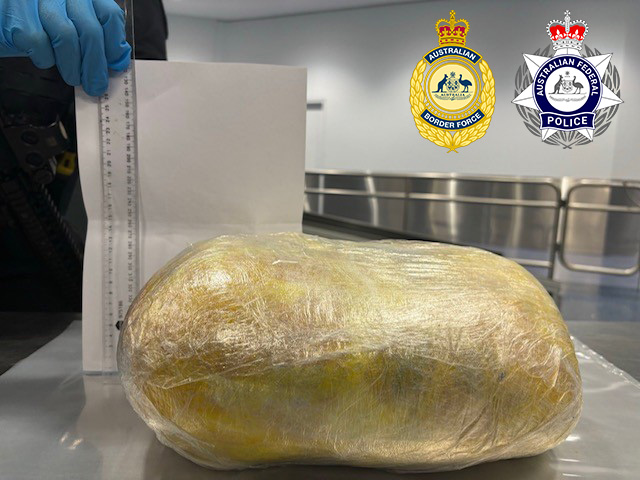
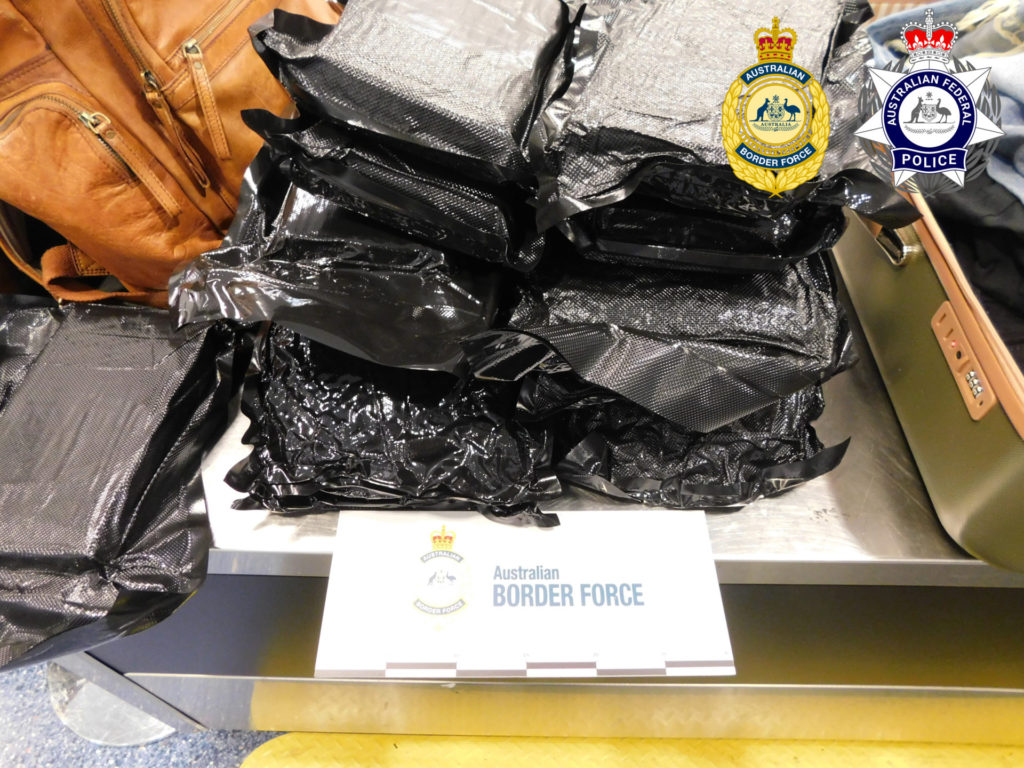
Image: WA illicit drugs (Source: AFP)
AFP Detective Inspector Matt Taylor said the AFP worked closely with ABF and other partners to combat criminal syndicates that tried to smuggle illicit drugs into Australia and supply them to the community.
“Methamphetamine causes widespread harm – with the negative impacts felt in our hospitals, in the road toll and in associated crime,” Det-Insp Taylor said.
“Combined, the methamphetamine, cocaine and heroin seized in this matter could have been sold as more than 152,000 street level deals in our community, with an estimated value of almost $14 million*.
ABF Superintendent Aviation Goods James Payne said behind every attempted import of illicit drugs was a criminal seeking to bring harm to Australians.
“Also behind every attempt there are dedicated officers showing initiative on a daily basis to detect illicit drugs at the border, and no matter the size or concealment, these detections can uncover serious and organised criminal operations,” Superintendent Payne said.
“These arrests and charges are a great result for all officers involved in the detection and subsequent investigation.”
The pair was arrested in the early hours of last Wednesday (2 October) as a result of an investigation that started in September, when Australian Border Force (ABF) officers in Perth uncovered about 4.15kg of methamphetamine in an air cargo consignment.
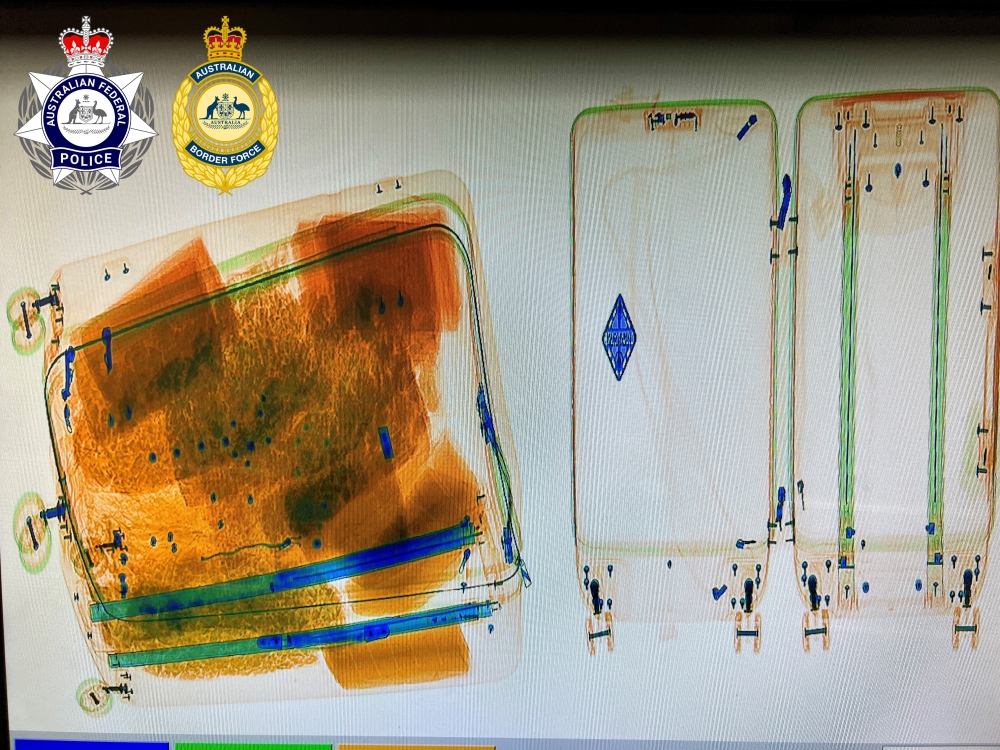
When ABF officers examined the consignment from the United States, they found a package of methamphetamine concealed among foam packaging and alerted the AFP.
Image: WA illicit drugs (Source: AFP)
The AFP removed the illicit drugs and facilitated the delivery of the consignment, as addressed, to a property in Ellenbrook on 1 October.
Investigators were monitoring the package as a man collected it from the premises and drove to a residence in Leederville.
Later in the evening, AFP and ABF executed a search warrant on the Leederville premises and also searched a vehicle there.
During the warrant, investigators allegedly located the original consignment, including all contents, as well as about 10.4kg of methamphetamine, about 1kg of cocaine and almost 380 grams of heroin.
They also seized multiple mobile devices and about $10,000 cash found on the 24-year-old.
The two men were arrested at the property and were charged.
The 29-year-old, from Leederville, has been charged with:
One count of attempt to possess commercial quantities of unlawfully imported border controlled drugs, contrary to section 307.5, by virtue of section 11.1 of the Criminal Code 1995 (Cth). The maximum penalty for this offence is life imprisonment;
One count of trafficking a commercial quantity of controlled drugs, namely methamphetamine, contrary to subsection 302.2(1) of the Criminal Code Act 1995 (Cth). The maximum penalty for this offence is life imprisonment;
Two counts of trafficking a marketable quantity of controlled drugs (namely cocaine and heroin), contrary to subsection 302.3(1) of the Criminal Code Act 1995 (Cth). The maximum penalty for this offence is 25 years’ imprisonment; and
One count of failure to comply with an order under section 3LA(2) of the Crimes Act 1914 (Cth), contrary to section 3LA(6) of the Crimes Act 1914 (Cth); The maximum penalty for this offence is 10 years’ imprisonment.
The 24-year-old, from Middle Swan, has been charged with:
One count of possession of money or property suspected to be the proceeds of crime, contrary to section 400.9(1A) of the Criminal Code 1995 (Cth). The maximum penalty for this offence is two years’ imprisonment; and
One count of possess a controlled drug, contrary to section 308.1 of the Criminal Code 1995 (Cth). The maximum penalty for this offence is two years’ imprisonment.
Investigations remain ongoing.
*Source: ACIC Illicit Drug Calculator
Support Our Journalism
Global Indian Diaspora and Australia’s multicultural communities need fair, non-hyphenated, and questioning journalism, packed with on-ground reporting. The Australia Today – with exceptional reporters, columnists, and editors – is doing just that. Sustaining this needs support from wonderful readers like you.
Whether you live in Australia, the United Kingdom, Canada, the United States of America, or India you can take a paid subscription by clicking Patreon and support honest and fearless journalism. LINK: https://tinyurl.com/TheAusToday
This week, Australia hosts the inaugural Global Nature Positive Summit in Sydney. It comes at a crucial time: biodiversity loss and ecosystem collapse is one of the biggest risks the world faces in the next decade.
The event, which begins tomorrow, brings together leaders from government, business, academia, environment groups and Indigenous Peoples. Together, they will seek ways to drive investment in nature and improve its protection and repair.
More than half the world’s economy directly depends on nature. Biodiversity loss threatens global financial stability, putting at least US$44 trillion (A$64 trillion) of economic value at risk.
Industries such as agriculture, fishing, forestry, tourism, water and resources rely heavily on nature. But ultimately, all of humanity depends on the natural world – for clean air, water, food, and a liveable climate.
In Australia significant investment is needed to reverse the decline in our natural environment. It will require action from governments, landholders and the private sector.
That’s why this week’s summit is so important. Nature conservation and restoration is expensive and often difficult. The task is beyond the capacity of governments alone.
Nature protection and repair is a massive job. Government funding has a critical role to play. But we can’t do it alone. This is what the first ever Nature Positive Summit will focus on.https://t.co/8t9UZnMErL
According to the World Economic Forum, “nature positive” is an economic worldview that goes beyond limiting environmental damage and aims to actually improve ecosystems.
Under the Kunming-Montreal Global Biodiversity Framework, to which almost 200 countries have signed up, at least 30% of land and waters must be protected or restored by 2030. The summit is exploring ways to realise this global commitment, which is also known as the 30×30 target.
The federal and New South Wales governments are co-hosting the event.
Federal Environment Minister Tanya Plibersek will address the summit on day one, outlining her government’s Nature Positive Plan. It commits to the 30×30 target as well as “zero new extinctions”. Achieving these commitments involves environmental law reform, setting up a Nature Repair Market and establishing a national Environment Protection Agency.
Delegates are expected to demonstrate their commitment and progress towards the 30×30 goal. They will then turn to the main point of the summit: building consensus on the economic settings needed to increase private investment in nature.
Finance models and corporate partnerships are on the agenda, along with how to make this work, including how to measure, monitor and report on progress and manage risk.
Sessions will focus on specific sectors of the environment such as agriculture and farming, cities, oceans and forests. On Thursday, delegates will visit nature sites around Sydney.
Investing in a market for nature repair
Substantial co-investment from the private sector, including landholders, will be required to repair and protect nature at the scale required.
Market-based approaches can drive private investment in natural resources. But most existing environmental markets focus on water and carbon. A more holistic approach, including nature repair, is needed.
Australia’s Nature Positive Plan includes building a nature repair market. This world-first measure is a legislated, national, voluntary biodiversity market in which individuals and organisations undertake nature repair projects to generate a tradeable certificate. The certificate can be sold to generate income. Demand for certificates is expected to grow over time.
But the role the government will take remains unclear. For example, will the government both regulate market prices and decide what, in a scientific sense, amounts to repairing nature?
On day two, the summit explores how nature markets can unlock new sources of finance. We can expect this discussion to include ways carbon and biodiversity markets can work together: so-called “carbon-plus” outcomes.
For example, when landholders conserve vegetation, the plants can both draw carbon dioxide from the atmosphere and provide habitat for animals, preventing biodiversity loss. Markets could be designed so landholders are rewarded for achieving these dual results.
Soon, farmers will be able to make money from restoring their land.
The nature repair market will make it easier to invest in projects that help protect and restore nature. https://t.co/McCKiVLk0Y
Under optimistic estimates, the global nature-positive transition will unlock business opportunities worth an estimated US$10 trillion (almost A$15 trillion) a year and create 395 million jobs by 2030.
The potential benefits for Australia are also substantial. They include benefits to nature such as restoring habitat for wildlife, while storing carbon. It can also provide returns for agriculture, by improving land value, yield and quality.
So the potential benefits have to be weighed against the risks of not doing anything. The summit is a chance to get a wide range of people on board, working towards a shared vision of a more positive future.
It’s time for a nature-positive mindset
The Albanese Labor government came to power promising to overhaul Australia’s national environment laws, following a scathing independent review.
When the summit was conceived, the government may have envisaged having cause for celebration by now. But some proposed reforms stalled in the Senate.
Nonetheless, the Nature Repair Market, a significant government win, is taking shape.
This week’s summit offers Australia an opportunity to show the world we have embraced the nature-positive mindset. There really is no time to waste.
Australia, the sixth most biodiverse country in the world, has listed 2,224 species and ecological communities as threatened with extinction. These losses are predicted to escalate if we continue business as usual and allow continued decline of ecosystems.
Global Indian Diaspora and Australia’s multicultural communities need fair, non-hyphenated, and questioning journalism, packed with on-ground reporting. The Australia Today – with exceptional reporters, columnists, and editors – is doing just that. Sustaining this needs support from wonderful readers like you.
Whether you live in Australia, the United Kingdom, Canada, the United States of America, or India you can take a paid subscription by clicking Patreon and support honest and fearless journalism. LINK: https://tinyurl.com/TheAusToday
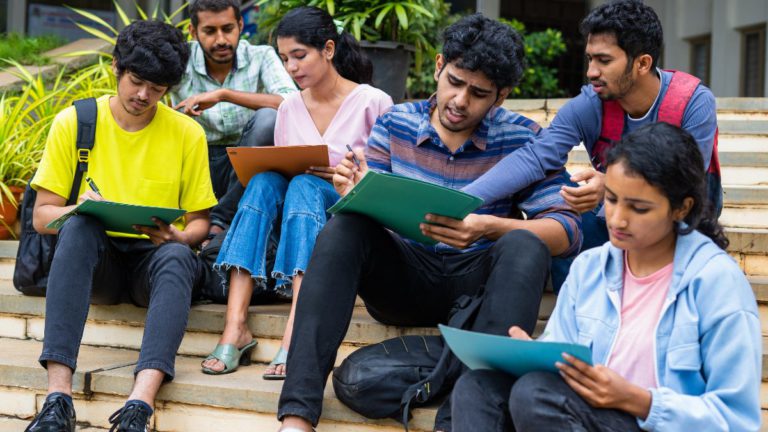
Central Queensland University’s 2024 Humanitarian Engineering Program, held at the renowned Amrita Live-in-Labs®️ in India has changed the lives of both the exchange students and members of the local communities they interacted with.
The first step of the program involved the students immersing themselves in their adopted community, and identifying opportunities to build capacity using civil and humanitarian engineering methods. They then engaged in empathy mapping to better understand the needs and capabilities of the community members, ensuring that their engineering solutions were tailored to the specific requirements of the people they were assisting.
The program, led by Associate Professor in Engineering Shameen Jinadasa, saw five Bachelor of Engineering (Honours) students travel to India to apply their skills in real-world, community-based projects.
“Five of our students have recently returned from India, where they spent time working in local communities as part of our annual program,”
Associate Professor Jinadasa said.
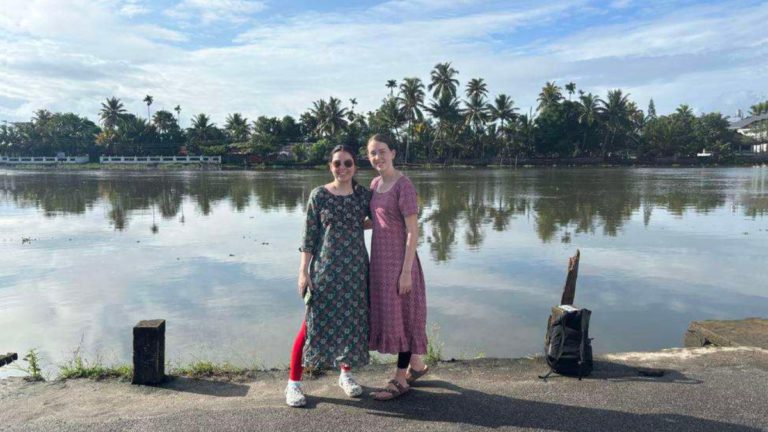
Third-year student Rylee Donald, from Cairns, and her colleague Juliette Lewis, from Rockhampton, worked in Pullincunno Kuttanad, a low-lying coastal region known for its intricate network of canals and its vulnerability to climate change and extreme weather events.
“This region faces significant challenges due to frequent flooding, which displaces residents and livestock and creates social, economic, and environmental problems for the community,”
Rylee explained.
Their solution involved designing sustainable, flood-resistant temporary shelters to protect both residents and livestock during times of flooding. Rylee and Juliette engaged directly with the local community, hosting collaborative design sessions to prototype shelters that would meet the unique needs of those affected by the floods.
“We wanted to make sure the community was involved in the design process, so their voices were heard and their concerns addressed,” Rylee said. The shelter prototype they created formed part of their assessment for the program, showcasing a practical and community-centred solution to a pressing problem.
The other students who participated in the program were Brad Purdon from Dysart, Chloe Coombe from Rockhampton, and Elise Green from Mackay.
“The aim of this program is to provide our students with the opportunity to create engineering solutions that improve the quality of life for people in need,” Assoc Prof Jinadasa said.
“There’s often a disconnect between engineers working in labs or offices and the communities they serve, but by working directly with these communities, the students are able to develop practical, sustainable concepts that benefit both the community and the engineers themselves.”
In November, four more CQ University students will travel to India for the second round of the 2024 Humanitarian Engineering Program, funded by Destination Australia’s Cheung Kong Exchange Program.
Assoc Prof Jinadasa also noted that humanitarian engineering is gaining traction across Australasia, and CQ University’s Civil and Humanitarian Major is now accredited by Engineers Australia, further demonstrating the growing demand for engineers who can combine technical expertise with a deep understanding of community needs.
Support Our Journalism
Global Indian Diaspora and Australia’s multicultural communities need fair, non-hyphenated, and questioning journalism, packed with on-ground reporting. The Australia Today – with exceptional reporters, columnists, and editors – is doing just that. Sustaining this needs support from wonderful readers like you.
Whether you live in Australia, the United Kingdom, Canada, the United States of America, or India you can take a paid subscription by clicking Patreon and support honest and fearless journalism. LINK: https://tinyurl.com/TheAusToday
Assistant Minister for Foreign Affairs Tim Watts announced the new External Advisory Group (EAG) members for the New Colombo Plan (NCP), a flagship initiative to enhance Australia’s engagement with the Indo-Pacific region.
The EAG, chaired by Minister Watts, will co-design the next phase of the New Colombo Plan, which will focus on expanding longer deployments for students, enhancing Asian language learning, and strengthening institutional partnerships in the Indo-Pacific.
Watts emphasised the critical role the group will play in shaping the program’s future to ensure it continues to deliver tangible benefits and foster a greater understanding of Australia’s regional neighbours.
“We are committed to ensuring the New Colombo Plan continues to create deeper connections with the Indo-Pacific,” Watts said.
“I look forward to working closely with the EAG to provide an even stronger platform for future generations of Australians to engage with our region.”
The appointed members, drawn from diverse backgrounds across higher education, industry, and NCP alumni, will help shape the program’s future direction, ensuring it continues to foster regional ties and build Australians’ capability to operate in the Indo-Pacific.
The newly appointed members of the External Advisory Group include:
•   Ms Grace Corcoran, Diplomacy Program Lead, Asialink
•   Prof Nicholas Farrelly, Pro Vice-Chancellor, University of Tasmania
•   Prof Jessica Gallagher, Deputy Vice-Chancellor, Adelaide University
•   The Hon Phil Honeywood, CEO, International Education Association of Australia
•   Ms Renae Lattey, Chief Executive Partner, King and Wood Mallesons
•   Mr Ashok Mysore, Member, Victoria Trade and Investment Advisory Board
•   Mr Luke Sheehy, CEO, Universities Australia
•   Mr Peter Varghese AO, Chancellor, University of Queensland
•   Ms Elena Williams, ANU Indonesia Institute
•   Ms Hayley Winchcombe, Engagement Manager, Mandala Partners
In the ten years since its inception, the New Colombo Plan has supported over 50,000 Australian students and connected 41 universities with more than 2,500 institutions across the Indo-Pacific. The program has provided participants with opportunities to study, undertake language training, and engage in internships and research placements across 40 host locations, helping to deepen Australia’s ties to the region.
With experts spanning diplomacy, education, international law, and industry, the advisory group will help steer the program towards new opportunities for collaboration and growth, ensuring Australia remains at the forefront of regional engagement and development.
Support Our Journalism
Global Indian Diaspora and Australia’s multicultural communities need fair, non-hyphenated, and questioning journalism, packed with on-ground reporting. The Australia Today – with exceptional reporters, columnists, and editors – is doing just that. Sustaining this needs support from wonderful readers like you.
Whether you live in Australia, the United Kingdom, Canada, the United States of America, or India you can take a paid subscription by clicking Patreon and support honest and fearless journalism. LINK: https://tinyurl.com/TheAusToday
On the first anniversary of the devastating October 7 terrorist attacks, Prime Minister Anthony Albanese and Opposition Leader Peter Dutton have shared messages of solidarity, reflection, and condemnation.
The attacks, orchestrated by Hamas, led to the deaths of over 1,200 Israelis, marking the deadliest single day for Jewish life since the Holocaust.
In his statement, Prime Minister Albanese described October 7 as a day that “carries terrible pain” and condemned Hamas’ actions, calling the brutality “coldly calculated.” He expressed deep sympathy for those still held hostage by Hamas and for their families, whose agony of waiting for answers has been unbearable.
Albanese also noted the rise in antisemitism following the attacks and reaffirmed Australia’s commitment to fight all forms of prejudice, stating,
“There is no place in Australia for discrimination against people of any faith.”
He emphasised the shared humanity of all people, adding that “every innocent life matters” in times of conflict.
Opposition Leader Peter Dutton echoed these sentiments, calling the last 12 months “one of the most difficult periods for Jewish Australians in our nation’s history.”
He mourned the loss of 1,200 innocent lives on October 7 and expressed grief for families still holding out hope for hostages. Dutton further condemned the rise of antisemitism across Western democracies, which the attacks have exposed, and reiterated Israel’s right to defend itself against such existential threats.
“The enemies of Israel and the peddlers of Jewish hate will never win,”
Dutton asserted, standing firmly with Australia’s Jewish community.
The last 12 months constitute one of the most difficult periods for Jewish Australians in our nation’s history.
Together today, we pay our respects to the memories of the 1,200 innocent people murdered on October 7.
The tragic events of October 7, 2023, occurred when Hamas launched an unprecedented series of coordinated attacks on Israel. Armed militants breached the Gaza-Israel border, targeting civilians at a music festival, residential areas, and military posts. Innocent men, women, and children were killed, with hostages taken, sparking global outrage and a renewed focus on the Israel-Palestine conflict.
Support Our Journalism
Global Indian Diaspora and Australia’s multicultural communities need fair, non-hyphenated, and questioning journalism, packed with on-ground reporting. The Australia Today – with exceptional reporters, columnists, and editors – is doing just that. Sustaining this needs support from wonderful readers like you.
Whether you live in Australia, the United Kingdom, Canada, the United States of America, or India you can take a paid subscription by clicking Patreon and support honest and fearless journalism. LINK: https://tinyurl.com/TheAusToday
Should young people be paid less than their older counterparts, even if they’re working the same job? Whether you think it’s fair or not, it’s been standard practice in many industries for a long time.
The argument is that young people are not fully “work-ready” and require more intensive employer support to develop the right skills for their job.
Why? They say the need to be fairly paid for equal work effort, as well as economic considerations such as the high cost of living and ongoing housing crisis, mean paying young adults less based on their age is out of step with modern Australia.
So is there a problem with our current system, and if so, how might we go about fixing it?
What are youth wages?
In Australia, a youth wage or junior pay rate is paid as an increasing percentage of an award’s corresponding full adult wage until an employee reaches the age of 21.
This isn’t the case in every industry – some awards require all adults to be paid the same minimum rates.
But for those not covered by a specific award, as well as those working in industries including those covered by the General Retail Industry Award, Fast Food Industry Award and Pharmacy Industry Award, employees younger than 21 are not paid the full rate.
https://datawrapper.dwcdn.net/Kqm5g/1
Why pay less?
Conventionally, junior rates have been thought of as a “training wage”. Younger people are typically less experienced, so as they gain more skills on the job over time, they are paid a higher hourly rate.
But there are a few key problems with this approach, which may not be relevant given many employers’ expectations for their workers to start “job-ready” and a lack of consistency in the training they provide.
Training up and developing skills is an important part of building any career. But it isn’t always provided by their employers.
Many young workers train themselves in job-related technical education and short courses, often at their own expense and prior to starting work.
Employers reap the benefit of this pre-employment training and so a “wage discount” for younger workers may be irrelevant in this instance.
None of this is to say employers aren’t offering something important when they take on young employees.
Younger workers coming into employment relatively early have access to more than just a paid job, but also become part of a team, with responsibilities and job requirements that support “bigger-picture” life skills.
Those who employ them may be contributing to their broader social and cultural engagement, something that could be considered part of a more inclusive training package. Whether that justifies a significant wage discount is less clear.
Calls for a rethink
There are growing calls for a rethink on the way we compensate young people for their efforts.
An application by the Shop Distributive and Allied Employees’ Association – the union for retail, fast food and warehousing workers – seeks to remove junior rates for adult employees on three key awards. This action will be heard by the Fair Work Commission next year.
Sally McManus, Secretary of the Australian Council of Trade Unions, said the peak union body will lobby the government to legislate such changes if this application fails. The Greens have added their support.
That doesn’t have to mean abolishing youth wages altogether. But 21 years of age is a high threshold, especially given we get the right to major adult responsibilities such as voting and driving by 18.
A transition strategy could consider gradually lowering this threshold, or increasing the wage percentages over time.
Lessons from New Zealand
We wouldn’t be the first to make such a bold change if we did.
Our geographically and culturally close neighbour, New Zealand, has already removed the “youth wage” – replacing it with a “first job” rate and a training wage set at 80% of the full award rate in 2008.
A common argument against abolishing youth wages – and increasing the minimum wage in general – is that it will stop businesses hiring young people and thus increase unemployment.
But a 2021 study that examined the effects of New Zealand’s experience with increasing minimum wages – including this change – found little discernible difference in employment outcomes for young workers.
The authors did note, however, that New Zealand’s economic downturn post-2008 had a marked effect on the employment of young workers more generally.
It’s easy to see how we arrived at the case for paying younger adults less. But younger workers should not bear the burden of intergenerational inequity by “losing out” on wages in the early part of their working life.
The debate we see now echoes the discussions about equal pay for equal work value run in the 1960s and ‘70s in relation to women’s unequal pay.
We were warned that paying women the same as men would cause huge economic dislocation. Such a catastrophe simply did not come to pass.
Global Indian Diaspora and Australia’s multicultural communities need fair, non-hyphenated, and questioning journalism, packed with on-ground reporting. The Australia Today – with exceptional reporters, columnists, and editors – is doing just that. Sustaining this needs support from wonderful readers like you.
Whether you live in Australia, the United Kingdom, Canada, the United States of America, or India you can take a paid subscription by clicking Patreon and support honest and fearless journalism. LINK: https://tinyurl.com/TheAusToday
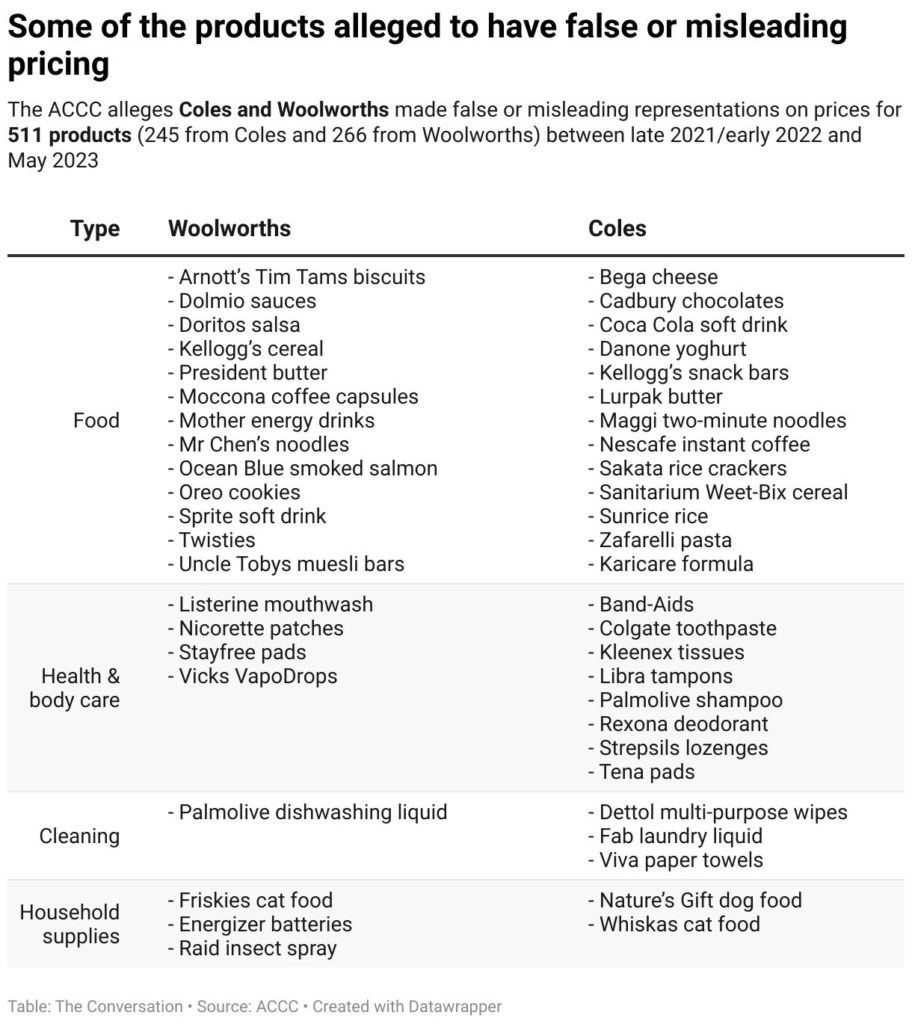
As per statement, the government will strengthen the Unit Pricing Code, making it easier for shoppers to accurately compare prices and get the best value for their money.
Shrinkflation refers to the practice where the size of a product is reduced while the price remains the same, or even increases. With packaging often unchanged, this can mislead consumers, especially those doing their weekly grocery shopping.
The strengthened Unit Pricing Code will help address this issue by ensuring Australians can clearly see the price of products based on their volume, weight, or per unit, preventing them from being caught out by shrinking products disguised by familiar packaging.
Ever found more air than chips in your chip packet?
More air, less product, same price. It's called shrinkflation, and it's ripping Australians off.
We’re fixing it, making sure you get good value at the checkout with stronger unit pricing and big penalties for supermarkets… pic.twitter.com/qhdF48YBmV
The Albanese Government is also set to introduce hefty penalties for supermarkets found in breach of the Unit Pricing Code, cracking down on any retailers engaging in misleading practices.
“Stronger unit pricing and new penalties are part of our plan to ensure Australians get a better deal at the supermarket,” said Prime Minister Anthony Albanese.
“We are committed to making sure the ACCC [Australian Competition and Consumer Commission] remains a tough cop on the beat, holding supermarkets accountable and ensuring there are real consequences for those doing the wrong thing.”
An ACCC Interim Supermarket Inquiry Report, released last week, revealed that nearly 90% of Australian consumers regularly use unit pricing to make informed purchasing decisions. However, concerns were raised during the inquiry about the inconsistent use of unit measurements, as well as the visibility and readability of unit prices on supermarket labels.
In response, the government plans to consult on several improvements to the Unit Pricing Code, including:
Enhancing the visibility and readability of unit pricing in stores;
Addressing inconsistencies in units of measurement used across different retailers;
Expanding the scope of retailers covered by the Code;
Introducing clearer rules on how prominently unit pricing should be displayed; and
Improving the use of unit pricing in cross-retailer price comparisons.
The ACCC will also receive funding to launch a consumer awareness campaign, helping shoppers identify the best deals by teaching them how to use unit pricing effectively.
The Albanese Government is cracking down on shrinkflation at Aussie supermarkets.
If they do the wrong thing, they'll face fines of up to $1 million per breach.
This is about stopping businesses ripping off Australians with dodgy discounts.
Assistant Treasurer Stephen Jones emphasised the importance of protecting Australians from unfair pricing tactics. “Misleading practices around pricing are illegal and inappropriate. Australian consumers deserve transparency and fair prices – not dodgy discounts,” Jones said.
“We have empowered the ACCC to take swift action against businesses trying to take advantage of consumers.”
This latest initiative follows a series of measures from the Albanese Government aimed at reducing the cost of living for Australians. These include a $30 million funding boost for the ACCC to crack down on market practices that increase living costs, consultations on a new mandatory Food and Grocery Code, and steps to revitalise National Competition Policy.
Assistant Minister for Competition Andrew Leigh reinforced the government’s commitment to fairness in the supermarket industry.
“We want a system that is fair for families and for farmers. By holding supermarkets to account and giving consumers the information they need, we’re helping Australian families save time and money at the checkout,” Leigh said.
With the proposed changes, the Albanese Government aims to ensure consumers are better equipped to spot misleading pricing tactics and make informed purchasing decisions, ultimately helping to ease the financial strain at the supermarket.
Support Our Journalism
Global Indian Diaspora and Australia’s multicultural communities need fair, non-hyphenated, and questioning journalism, packed with on-ground reporting. The Australia Today – with exceptional reporters, columnists, and editors – is doing just that. Sustaining this needs support from wonderful readers like you.
Whether you live in Australia, the United Kingdom, Canada, the United States of America, or India you can take a paid subscription by clicking Patreon and support honest and fearless journalism. LINK: https://tinyurl.com/TheAusToday
A 51-year-old New South Wales man was sentenced to three years and four months in prison on 4 October 2024 for attempting to arrange forced marriages for his two teenage children, aged 15 and 17 at the time. The Downing Centre District Court handed down a non-parole period of one year and 11 months.
This sentencing follows Australia’s first successful conviction for forced marriage in July, marking another significant step in combating human trafficking.
AFP Commander Kate Ferry emphasised that Australia is not immune to human trafficking and noted the crime is often under-reported.
“There are two common types of forced marriages: one where unwilling participants are coerced or deceived, and another where individuals are too young to legally consent,” Commander Ferry explained.
“This crime typically involves younger, vulnerable family members. Victims often hesitate to report the crime, fearing their family could get in trouble.”
The Australian Federal Police (AFP) Eastern Command Human Trafficking Team launched an investigation into the case in February 2022 after the two siblings escaped from their father’s regional NSW home and sought assistance from NSW Police.
The children, who moved to Australia with their father in 2021, discovered that he was attempting to arrange marriages for them against their will. They were unaware of who their prospective spouses were or when the ceremonies would take place.
Following the siblings’ escape, AFP officers executed a search warrant at the father’s residence, uncovering mobile phones with messages detailing wedding arrangements.
The man pleaded guilty on 17 October 2023 to two counts of attempting forced marriage, in breach of sections 11.1(1), 270.7B, and 270.8 of the Criminal Code 1995 (Cth).
The victims have since been supported by a specialist youth organisation, dedicated to helping young people affected by forced marriage.
AFP Sergeant Chantal Pravaz praised the courage of the victims, stating that the prosecution was only possible due to their bravery in coming forward.
“The AFP is committed to helping all victims of human trafficking. Each case is handled with care, compassion, and respect. Our priority is the wellbeing of those seeking to escape their situation, whether through prosecution or by providing support and education,” she said.
Reports of human trafficking to the AFP have increased, with 382 cases reported in the 2023-2024 financial year – 91 of which involved forced marriage allegations. This marks a rise from the previous year’s 340 reports, though authorities believe the crime remains under-reported.
Support Our Journalism
Global Indian Diaspora and Australia’s multicultural communities need fair, non-hyphenated, and questioning journalism, packed with on-ground reporting. The Australia Today – with exceptional reporters, columnists, and editors – is doing just that. Sustaining this needs support from wonderful readers like you.
Whether you live in Australia, the United Kingdom, Canada, the United States of America, or India you can take a paid subscription by clicking Patreon and support honest and fearless journalism. LINK: https://tinyurl.com/TheAusToday
Parents sometimes ask: what’s the point of drama class? Many want their children to choose elective subjects, especially in Year 12, that parents think will help them get into university and establish a career.
This is despite the fact work possibilities are wide open for the average 17 year-old, who is likely to have a range of jobs and careers over their lifetime.
So why study drama? As scholars who have researched drama and learning for 30 years, it’s clear studying drama can enhance your teenager’s present and contribute to their future. Drama teaches skills for life, learning and employability.
Teamwork, project management, public speaking and more
Many employers want staff who can work well in a team, manage a complicated project from inception to final delivery and speak well in public or to clients.
They want employees who can problem-solve creatively and effectively, can think flexibly, adapt to changing circumstances and see others’ point of view.
Now consider the skills kids learn in drama class. These include:
Teamwork: There is nothing like collaborating with your classmates as an ensemble to devise a script or pull off a show. There is excitement and a heightened sense of purpose in having to work together to present a performance for an audience. Relationships of trust and cooperation are formed through teamwork in drama class. These are valuable skills kids can use throughout their lives.
Public speaking: Drama develops communication and presentation skills that boost your confidence to speak in public. You learn how to use space, gesture, posture and to vary your pace, tone and volume to successfully communicate with and convince your audience. This is a skill set your child will use at university, in job interviews and at work.
Speedy problem-solving: In drama class, you learn to improvise. The skill of quick and creative thinking on your feet is valuable to many employers.
Creative and critical thinking: Drama is critical thinking in action, a way to look at issues from multiple points of view and understand nuance. Untangling this complexity in drama class is equipping students with the ability to cope with complexity in other parts of their life – now and in the future. It allows kids to exercise creativity, imagine alternate futures, and experiment and test radical ideas in a safe space. Creativity and imagination are essential skills for jobs of the future.
Make a compelling argument: When students have something important to say, a drama performance can be a powerful way to practice using their voice, express concerns and call others to action. Going to see live theatre with peers, studying plays and analysing theatre means engaging with and discussing big, complex and global ideas. Knowing how to formulate your point and articulate it in a compelling way is a valuable workplace skill.
Artistic and design skills: Students learn artistic, performance and theatre design skills when studying drama, which can lead to employment in a wide range of creative industries jobs.
Examining the evidence
There is a great deal of evidence on the impact of drama education on young people’s lives and employability skills.
Research shows drama develops empathy, social skills, well-being and confidence.
Studies involving drama students also report young people derive a sense of fellowship and fun from studying drama. They also report theatre helped them develop a sense of self and important life competencies.
Research has also shown drama can be an effective part of teacher education.
Consider the value drama adds to your child’s life now
Of course, school isn’t really about turning your child into an obedient and helpful worker bee. It’s their life now. Just as having a positive workplace can make a world of difference to your quality of life, having an enjoyable school experience is crucial to a teen’s mental health.
So if your child enjoys drama, ask them why. You might be surprised by the depth of the answer you receive.
Drama creates a strong sense of belonging and can reduce loneliness, as demonstrated in this recent ABC story: https://www.youtube.com/embed/V83DpIA4xBU?wmode=transparent&start=0 ABC Australia.
Drama class can help your child feel connected to others in school and to their community. It can help them develop empathy, relate to others in the real world (outside of social media) and encourage self-reflection.
It can allow them to engage with, and learn about, the big things in life: love, betrayal, friendship, ambition, power, envy, duty and more.
In the senior school years, when exam pressure and competitiveness can be overwhelming, a drama class and the community it provides can be a welcome relief.
And lastly: let’s not underestimate the sheer joy that comes of being creative, of expressing yourself, and the thrill of presenting to an audience.
Global Indian Diaspora and Australia’s multicultural communities need fair, non-hyphenated, and questioning journalism, packed with on-ground reporting. The Australia Today – with exceptional reporters, columnists, and editors – is doing just that. Sustaining this needs support from wonderful readers like you.
Whether you live in Australia, the United Kingdom, Canada, the United States of America, or India you can take a paid subscription by clicking Patreon and support honest and fearless journalism. LINK: https://tinyurl.com/TheAusToday
This event is organised in partnership with Invest India and will coincide with the National Film Development Corporation (NFDC) Film Bazaar, running from 20 to 24 November 2024.
The six successful applicants will receive up to $6,000 each to cover travel and accommodation expenses. The event aims to foster collaboration between Australian and Indian filmmakers under the India-Australia Co-Production Treaty.
In preparation for the Co-production Day, Screen Australia and the Film Facilitation Office of India also hosted a webinar to provide insights into the treaty.
Ratified on 24 November 2023, the treaty enables filmmakers from both countries to access creative and financial resources and tap into each other’s markets.
As per Screen Australia, participants in co-productions will also benefit from incentives offered in both nations.
The Co-production Day initiative offers Australian producers with experience in official co-productions, or comparable large-budget content, the opportunity to connect with their Indian counterparts. These meetings are designed to build early-stage creative partnerships and develop meaningful collaborations for future projects.
To be eligible, applicants must:
Be Australian citizens or residents and meet Screen Australia’s Terms of Trade requirements.
Have recent credits as lead producers on scripted series or features with significant international viewership, especially in India. Eligible projects may include those:
Distributed theatrically or released on streaming platforms.
Nominated for or awarded significant international honours such as Cannes, Sundance, the Academy Awards, BAFTA, or the Emmys.
Featured in top 10 most-watched shows on a subscription platform.
Amassed over one million views on a reportable platform such as YouTube.
Producers with prior international co-production experience, particularly with India, and those with projects that show strong potential for collaboration, will be prioritised.
Applications from underrepresented communities are strongly encouraged.
Support Our Journalism
Global Indian Diaspora and Australia’s multicultural communities need fair, non-hyphenated, and questioning journalism, packed with on-ground reporting. The Australia Today – with exceptional reporters, columnists, and editors – is doing just that. Sustaining this needs support from wonderful readers like you.
Whether you live in Australia, the United Kingdom, Canada, the United States of America, or India you can take a paid subscription by clicking Patreon and support honest and fearless journalism. LINK: https://tinyurl.com/TheAusToday
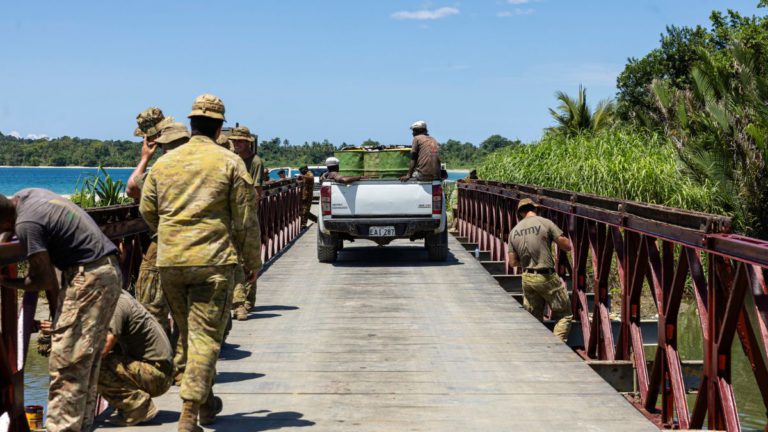
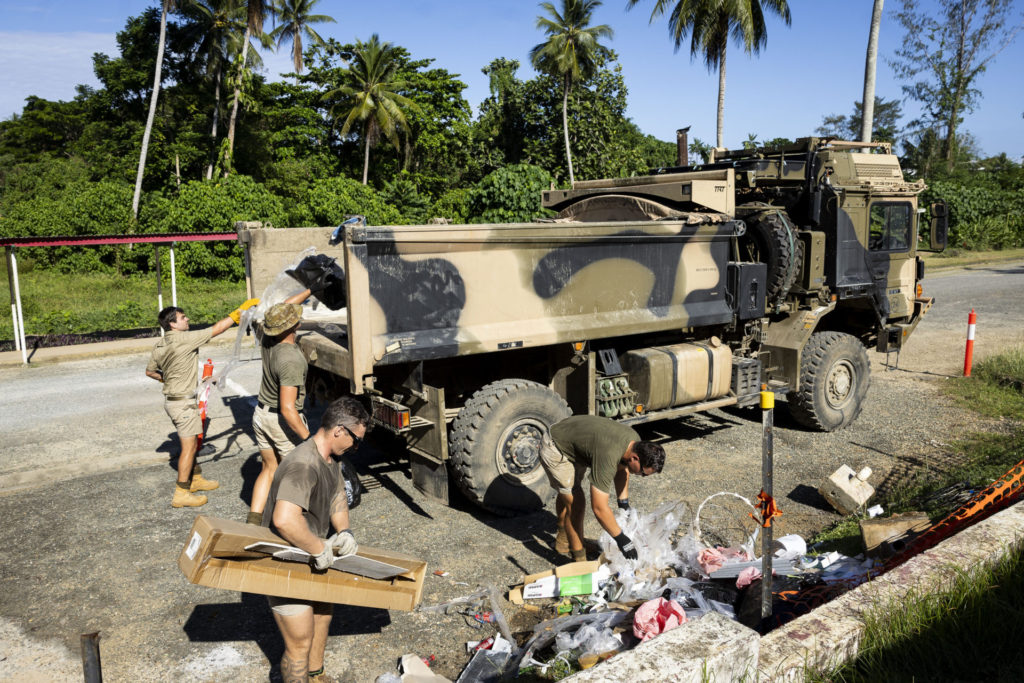
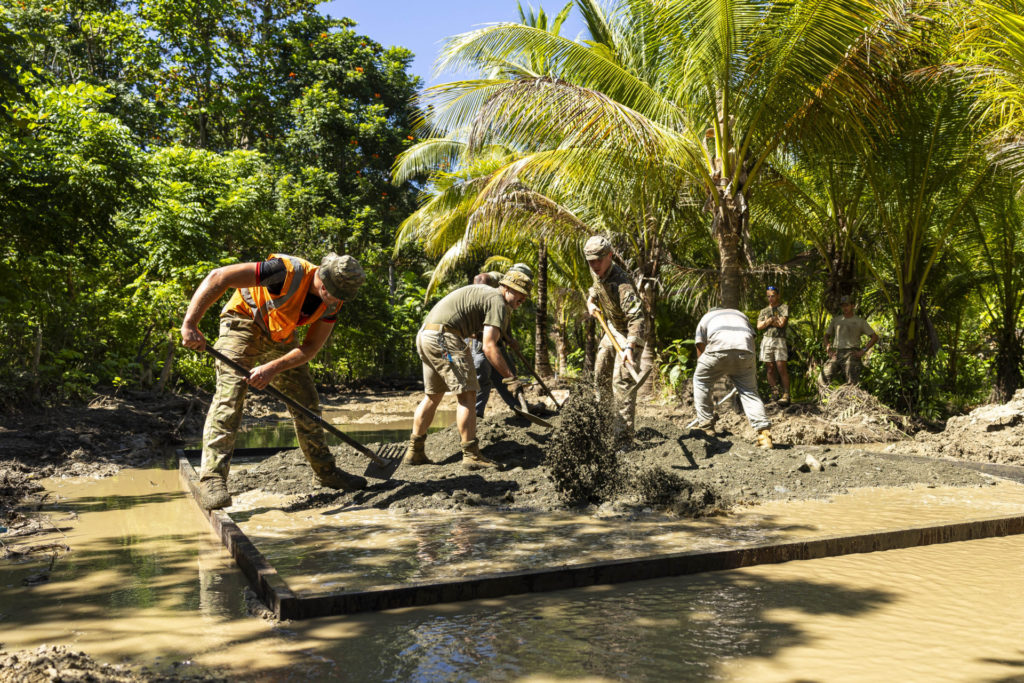
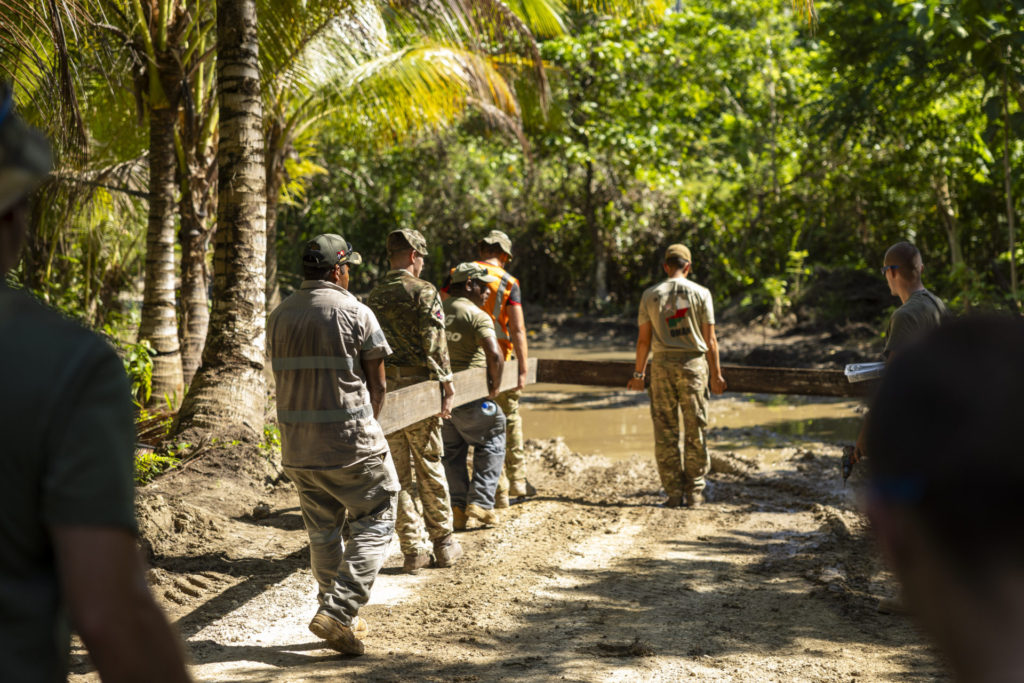
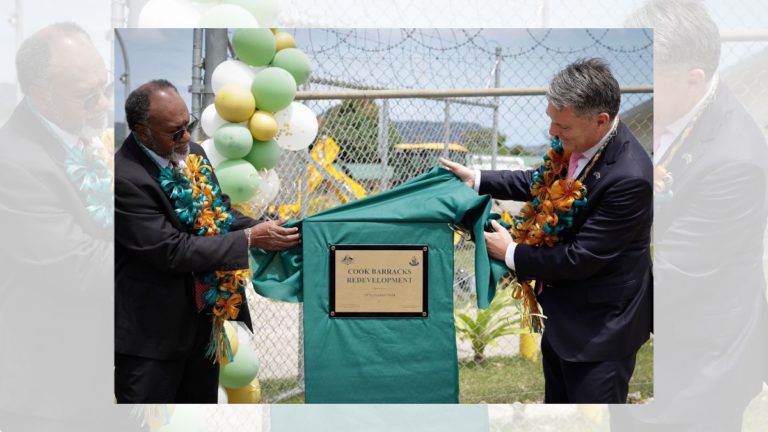
Australian sappers from the 3rd Combat Engineer Regiment joined forces with engineers and tradespeople from the British Army, New Zealand Army, and the Papua New Guinea Defence Force (PNGDF) for Exercise Puk Puk at Moem Barracks, PNG.
This annual engineering exercise aims to strengthen the capabilities and relationships between the Australian Defence Force (ADF) and the PNGDF while focusing on vital infrastructure repairs.
Image: Exercise Puk Puk in PNG (Source: Defence Australia – X)
During the exercise, the sappers carried out extensive refurbishments at Moem Barracks, including repairs to the guard house, live-fire range, obstacle course, and side access roads.
Other key projects included repairs to Puk Puk bridge, the installation of new lighting and ceiling fans in the church, and an upgraded power supply to the medical centre to ensure proper storage of vital medicines.
Lieutenant Colonel Francis Vitata, Commanding Officer of the 2nd Royal Pacific Island Regiment, highlighted the importance of these efforts.
“There are three essential lines of effort for looking after PNGDF soldiers: feed the soldier, clothe the soldier, and house the soldier,” Lieutenant Colonel Vitata said.
“The key for me is the infrastructure. Many of these buildings, built in 1974, have deteriorated over time, and the refurbishments are focused on training, maintenance, and operational readiness.”
Image: Exercise Puk Puk in PNG (Source: Defence Australia – X)
Lance Corporal Bayley Glover, the lead electrician on Exercise Puk Puk, reflected on the improvements made to the barracks, including the transformation of the guard house.
“When we arrived, the guard house was in poor condition—cracked windows, no working lights or ceiling fans, and peeling paint,” said Lance Corporal Glover.
“A well-maintained place of duty fosters a sense of pride and encourages soldiers to carry out their duties properly.”
The team also revitalised the overgrown obstacle course and live-fire range. According to Lance Corporal Glover, the course was redesigned, including a new jump point at the end, providing a challenge for soldiers and enjoyment for local children who have been using it after hours.
Meanwhile, repairs to Puk Puk bridge—an essential route connecting Moem Barracks and local villages—were also a priority.
“The bridge had missing timber and metal frames, forcing us to drive Army trucks through sand, which often got stuck,” Glover said.
Image: Exercise Puk Puk in PNG (Source: Defence Australia – X)
Local villagers helped dig out the vehicles before Australian, New Zealand, and UK soldiers completed welding repairs, reinforcing the structure with metal and timber.
Lieutenant Colonel Vitata acknowledged the broader impact of the exercise, not only on the soldiers but also on the local community.
“The refurbishments cater to what is missing for the soldiers and their families,” he said.
“It speaks volumes about the relationship between the PNGDF and the Australian Defence Force.”
Exercise Puk Puk continues to build both infrastructure and international cooperation, ensuring that PNGDF soldiers have the resources they need to serve with pride.
Support Our Journalism
Global Indian Diaspora and Australia’s multicultural communities need fair, non-hyphenated, and questioning journalism, packed with on-ground reporting. The Australia Today – with exceptional reporters, columnists, and editors – is doing just that. Sustaining this needs support from wonderful readers like you.
Whether you live in Australia, the United Kingdom, Canada, the United States of America, or India you can take a paid subscription by clicking Patreon and support honest and fearless journalism. LINK: https://tinyurl.com/TheAusToday
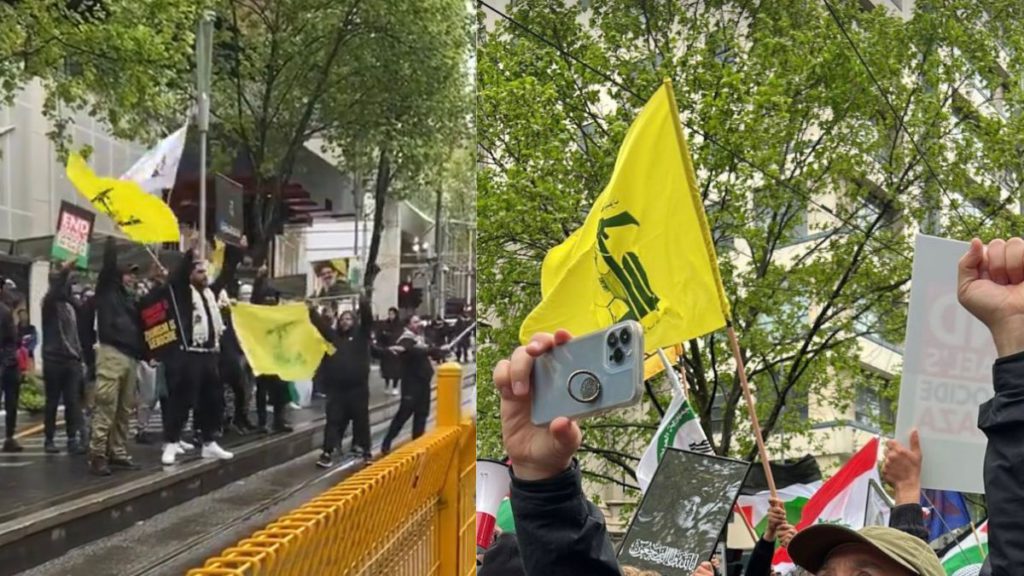
The protests, held on 29 September between 12:30pm and 2:00pm, involved individuals displaying suspected prohibited symbols, including the Hezbollah flag. While some of these individuals may have been named publicly, it is believed false names have been used.
Law enforcement agencies have reaffirmed their commitment to upholding the right to peaceful protest in Australia but have emphasised that illegal behaviour or violence will not be tolerated.
Displaying symbols that incite or advocate violence or hatred based on race or religion is a criminal offence in Australia. Such acts, along with the promotion or praise of terrorism, are subject to strict State and Commonwealth legislation.
Operation Ardvarna, led by the AFP’s Counter Terrorism and Special Investigations Command in Victoria, is currently investigating nine complaints related to the display of prohibited symbols that may have incited violence or hatred.
These complaints have been reported through various channels, including Victoria Police, the National Security Hotline, and proactive media investigations.
Law enforcement agencies are working in coordination to share intelligence, investigate criminal activity, and ensure the safety of the public.
As authorities prepare for future protests in several states and territories, the AFP remains focused on its primary duties, including investigating terrorism, radicalisation, foreign interference, and espionage.
The AFP urges anyone with information to contact Crime Stoppers on 1800 333 000.
Support Our Journalism
Global Indian Diaspora and Australia’s multicultural communities need fair, non-hyphenated, and questioning journalism, packed with on-ground reporting. The Australia Today – with exceptional reporters, columnists, and editors – is doing just that. Sustaining this needs support from wonderful readers like you.
Whether you live in Australia, the United Kingdom, Canada, the United States of America, or India you can take a paid subscription by clicking Patreon and support honest and fearless journalism. LINK: https://tinyurl.com/TheAusToday
When Iran fired more than 180 ballistic missiles at Israel this week in retaliation for the Israeli assassinations of the Hamas and Hezbollah leaders, some were surprised by Tehran’s forceful response.
Israeli Prime Minister Benjamin Netanyahu immediately announced his country would harshly retaliate at a time of its own choosing. He said as his security cabinet gathered for a late-night meeting, “whoever attacks us, we attack them”.
The Biden administration strongly condemned Iran’s aggression and reiterated its commitment to defending Israel. The White House said Iran would suffer “severe consequences”, though President Joe Biden urged against attacks on Iran’s nuclear facilities.
So, what could Israel’s retaliation look like, and is a full-scale war between Iran and Israel, and perhaps even the United States, now likely?
A regional war is already here
A regional war is no longer imminent – it is here. The conflict that began in Gaza nearly a year ago has expanded across the Middle East, with Israel fighting countries and groups far from its borders. It also has global implications.
As this week’s Iranian strike demonstrates, the conflict has become a direct confrontation between Israel and its Western allies on one side, and Iran and its proxies, backed by Russia and China, on the other.
Washington has played a key role in supplying Israel with military aid and diplomatic cover, while Moscow has pledged to send Iran fighter jets and air defence technology. It is also purchasing Iranian weapons for its own war in Ukraine, providing Tehran with much-needed cash.
Moreover, Israel is currently engaged on multiple fronts.
First, its war continues in Gaza, where more than 40,000 Palestinians have been killed. Hamas has been reduced to a low-functioning guerrilla organisation but still retains some control over the displaced Palestinian population.
In the West Bank, the Israel Defense Forces (IDF) are conducting military operations to counter a rise in terrorist attacks, fuelled by Iranian weapons and funds directed to local militants.
Meanwhile, Iran’s other proxy groups, the Shi’a militias in Iraq and Syria and Houthi rebels in Yemen, are still launching missile and drone attacks against Israel. Both Israel and the US have struck back at the Houthis in Yemen.
The most significant battle, however, is in Lebanon. On October 8 2023, a day after Hamas’ rampage through southern Israel that resulted in 1,200 deaths and more than 200 Israelis abducted into Gaza, Hezbollah began firing rockets and other weapons at Israel, without provocation, in solidarity with Hamas. This has forced more than 60,000 Israelis near the border to flee their homes.
Two weeks ago, Israel made a decisive move. Netanyahu reportedly ordered the detonation of thousands of booby-trapped pagers and walkie-talkies used by Hezbollah, fearing the operation was at risk of being exposed.
The IDF followed with a massive air campaign aimed at diminishing Hezbollah’s estimated arsenal of 150,000 missiles, rockets and drones.
It then launched a ground incursion into Lebanon, targeting positions fortified by Hezbollah’s elite Radwan force. The goal is to prevent Hezbollah from invading northern Israel and replicating the October 7 Hamas atrocities there.
Up to one million Lebanese people have been forced to flee their homes as a result of the Israeli operations.
Israel’s options for striking back
And now, Iran has become directly involved in the fighting with its launching of ballistic missiles at Israel this week, allegedly targeting military bases. Israel’s advanced anti-missile defence systems, assisted by the US, Jordan and other nations, intercepted most of the projectiles. A few landed inside Israel, with shrapnel killing one Palestinian in the West Bank.
It was the second direct attack by Iran against Israel in recent months. The first resulted in a limited Israeli retaliation on an Iranian air defence system allegedly protecting a nuclear facility in Isfahan.
The full scope and impact of Israel’s retaliation this time remains unknown at the time of writing.
One scenario that deeply worries Tehran is that Israel, in coordination with the US, might target its critical infrastructure. This could include its communications and transportation networks, financial institutions and oil industry (especially the facilities that are part of the funding mechanism of the powerful Islamic Revolutionary Guards Corp). This could create chaos within Iran, threatening the regime’s survival.
While forcing regime change in Tehran would be extremely difficult, the Iranian leadership isn’t taking any chances. It has reportedly rushed Supreme Leader Ayatollah Ali Khamenei to a secure location to prevent any assassination attempt.
Iran’s rapidly advancing nuclear program remains the jewel in the crown for the Iranian regime, which the US and its allies believe serves as cover for its pursuit of atomic bombs.
Iranian leaders may now fear Israel and the US could seize the opportunity to severely damage its nuclear infrastructure, as has long been urged by some conservative voices in both countries. Biden, however, is urging a “proportional” response instead.
Destroying Iran’s air defence systems is also considered an option to signal to the regime that it would become “blind” in any future attack on Israel. Other possibilities are also on the table.
A narrow window for Israel
In an attempt to de-escalate tensions, Iranian officials hastily declared their desire to end hostilities following the missile attack.
However, the conflict has come full circle. Hamas believed Israel would collapse after its October 7 2023 attack. However, instead, Israel responded with a devastating war on Gaza, dismantling much of Hamas’ capabilities but also causing widespread casualties and destruction.
Similarly, the decisions by Hezbollah and Iran to strike Israel have proved to be grave miscalculations, underestimating Israel’s determination to retaliate with overwhelming impact.
The ball is now in Israel’s court. While any retaliation must take account of the fact the IDF are already stretched thin across multiple fronts, Iran’s “axis of resistance” has also never appeared more vulnerable.
Israel has a narrow window to inflict a major blow against it – and Netanyahu is unlikely to let this moment pass.
Global Indian Diaspora and Australia’s multicultural communities need fair, non-hyphenated, and questioning journalism, packed with on-ground reporting. The Australia Today – with exceptional reporters, columnists, and editors – is doing just that. Sustaining this needs support from wonderful readers like you.
Whether you live in Australia, the United Kingdom, Canada, the United States of America, or India you can take a paid subscription by clicking Patreon and support honest and fearless journalism. LINK: https://tinyurl.com/TheAusToday
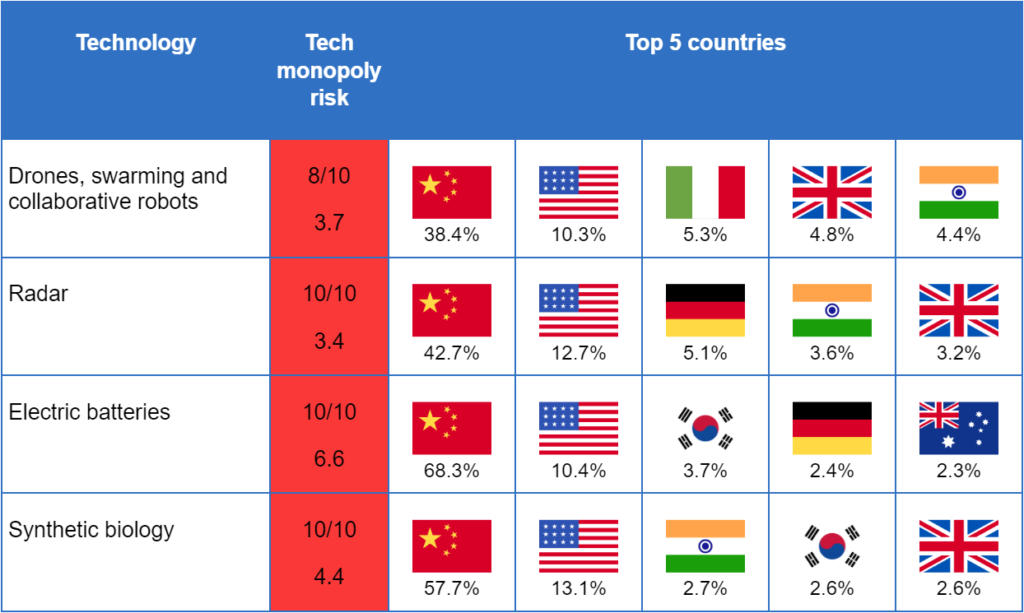
ASPI’s report also notes the emergence of India as a global player in research and innovation. India now ranks in the top five for 45 out of 64 technologies (an increase from 37 last year), further solidifying its position as a major science and technology hub.
Meanwhile, the UK’s standing declined, with the nation dropping out of the top five in eight technologies over the past year. The US, which led in 60 of these technologies during the same period, now maintains leadership in just seven.
The findings highlight a significant shift in research influence towards large Indo-Pacific economies, especially China and India, which has made substantial strides in sectors like quantum sensors, high-performance computing, space launch, and semiconductor manufacturing.
The two governments committed to enhancing their cooperation under the Australia-India Critical Minerals Investment Partnership, marking a vital step forward in securing the future of critical minerals for both nations.
Australia and India announced that five target projects have been identified—two lithium and three cobalt—on which detailed due diligence will be conducted.
This partnership is geared towards bolstering critical mineral supply chains, with Australia supplying key processed minerals that will support India’s transition towards a low-emission energy network and help fulfil its ambition to become a global manufacturing hub, especially for electric vehicles (EVs).
Australia’s Resources Minister Madeleine King and Indian Minister for Coal and Mines Pralhad Joshi; Image Source: Supplied
Australia, with its significant reserves of lithium, cobalt, and rare earths, stands at the forefront of the global supply chain for critical minerals. The demand for these resources will only rise in the coming decades, driven by the increasing need for low-emission technologies.
The collaboration between India and Australia is not only a strategic move to secure the minerals essential for green energy, but also a critical step towards diversifying global markets for clean technologies and reducing carbon emissions.
As ASPI report underscores, besides India and the UK, Germany is in the top five in 27 technologies, South Korea in 24, Italy in 15, Iran in 8, Japan also in 8 and Australia in 7. Of particular concern is China’s leadership in 24 technologies that are now classified as ‘high risk’ for future monopolies, including radar, drones, and advanced aircraft engines.
With China and the United States fighting for dominance in technology and supply chains, Australia and India’s collaboration stands as a crucial response to this competitive environment.
By combining their strengths, the two countries are poised to create a supply chain model that not only meets domestic needs but also contributes to global energy security.
Image: From left: Professor Susan Elliott Monash VC; Hon. Jason Clare MP, Minister for Education, Australia; Hon. Shri Dharmendra Pradhan, Minister of Education, India and Mr Anupam Jalote, CEO, iCEM with signed memorandums (Source: Monash University)
India’s “Critical Minerals Mission,” announced in its 23 July budget, aims to strengthen cooperation with Australia, a key resource supplier. With India’s significant investment in Australian resources and demand for critical minerals, this initiative seeks to enhance collaboration and address potential supply chain bottlenecks.
These hubs will focus on key areas such as mineral exploration, extraction, processing, and recycling, strengthening ties and advancing critical mineral research.
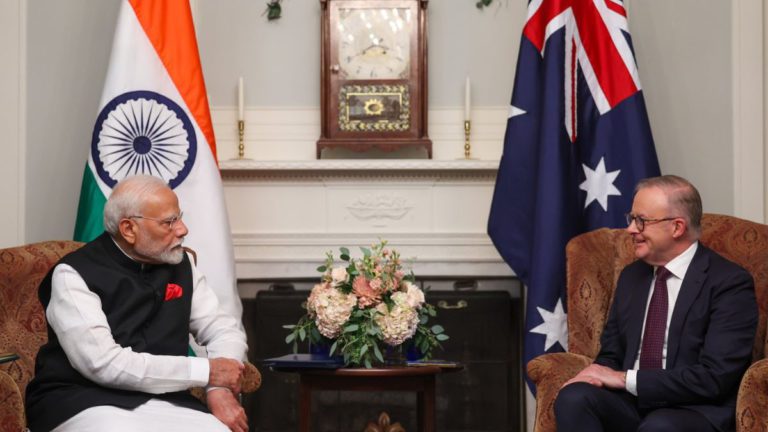
Always good to talk with you as leader of the world’s largest democracy – much work to do enhancing our Strategic Partnership and with the Quad 🇦🇺🇮🇳 https://t.co/Kx0D64s24u
Looking ahead, this partnership has the potential to evolve into a cornerstone of India and Australia’s broader strategic relationship. As India emerges as a key centre of global research and innovation, particularly in technology, its collaboration with Australia in critical minerals could unlock vast opportunities for both nations.
By integrating supply chains, fostering innovation, and aligning policy goals, India and Australia can build a future-proof partnership that strengthens their economies, secures their energy transitions, and positions them as global leaders in clean energy solutions.
Further, by fostering joint ventures, incentivising innovation, and promoting sustainable practices, the India-Australia Critical Minerals Investment Partnership can become a model for international cooperation in securing the future of energy and technology.
Support Our Journalism
Global Indian Diaspora and Australia’s multicultural communities need fair, non-hyphenated, and questioning journalism, packed with on-ground reporting. The Australia Today – with exceptional reporters, columnists, and editors – is doing just that. Sustaining this needs support from wonderful readers like you.
Whether you live in Australia, the United Kingdom, Canada, the United States of America, or India you can take a paid subscription by clicking Patreon and support honest and fearless journalism. LINK: https://tinyurl.com/TheAusToday
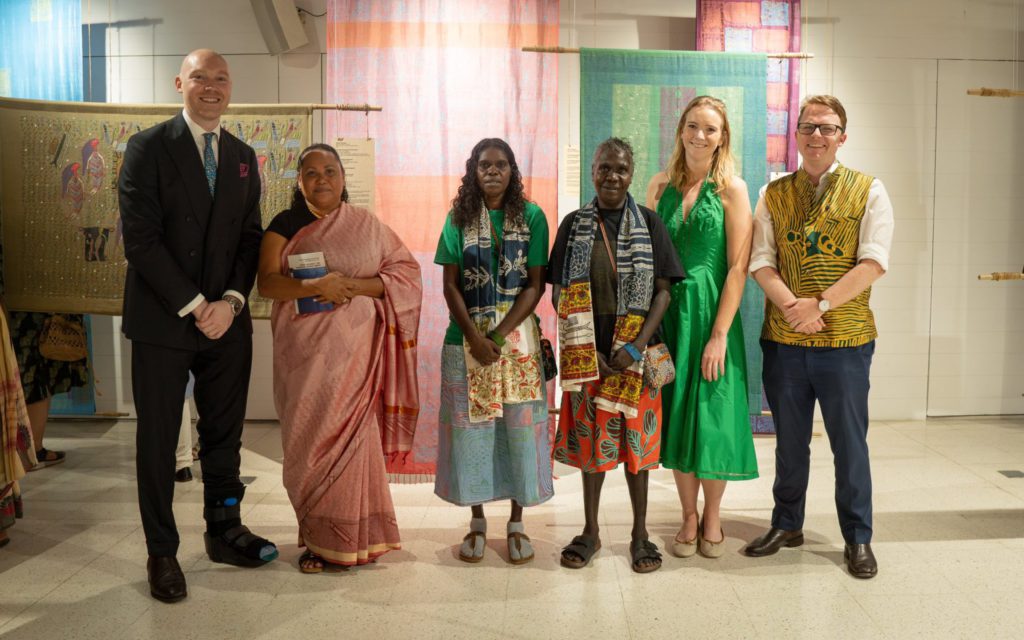
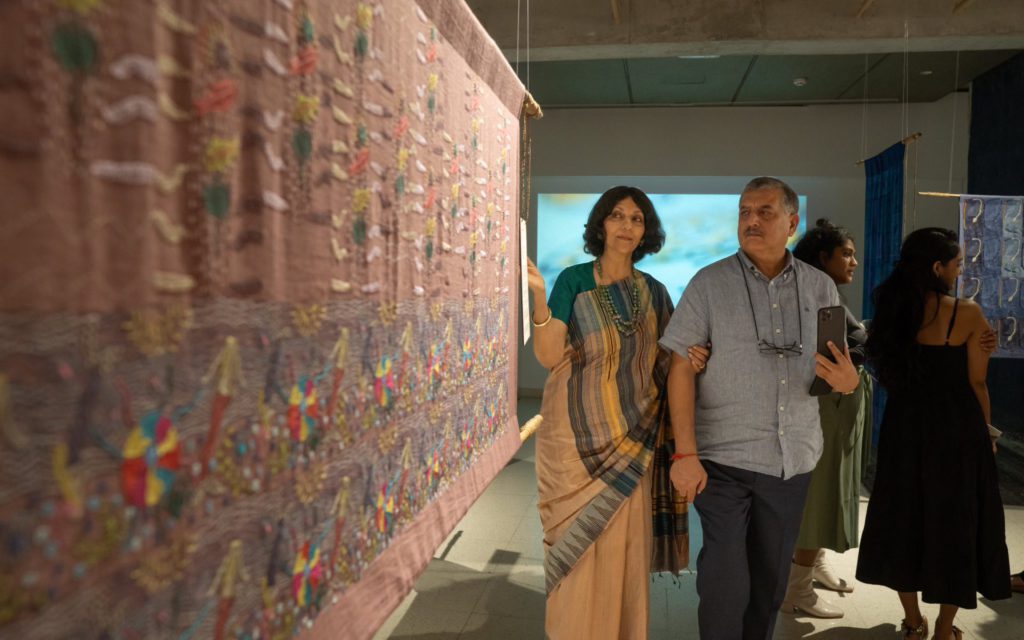
An extraordinary exhibition, Karri-djarrk-durrkmirri, meaning “we work together” in the Kuninjku language of West Arnhem Land, beautifully embodies the spirit of Australian and Indian maitri – collaboration and cultural exchange.
Image: Karri-djarrk-durrkmirri exhibition (Source: Australian Consul General for Karnataka and Telangana – X)
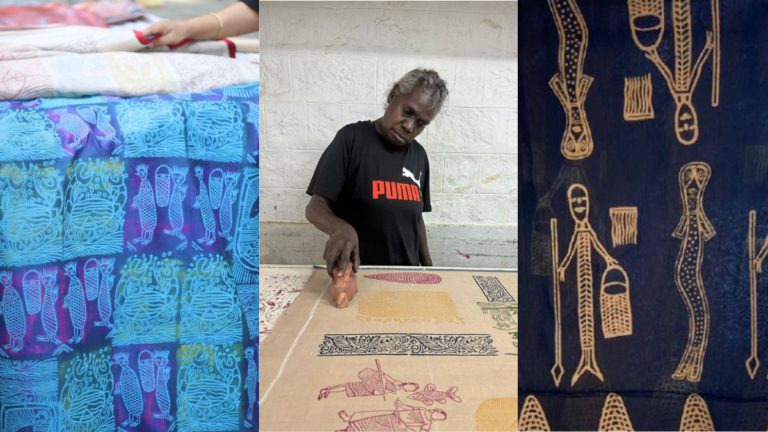
Celebrating the artistic heritage of Aboriginal Australian women, the exhibition weaves together the creative talents of the Bábbarra Women’s Centre from Arnhem Land and Bengaluru’s Tharangini Studio, renowned for its heritage woodblock printing techniques.
Australian Consul General for Karnataka and Telangana Hilary McGeachy said,
“Wonderful to see parallels between artisanal communities in our two countries.”
Image: Australian Consul General for Karnataka and Telangana Hilary McGeachy (Source: X)
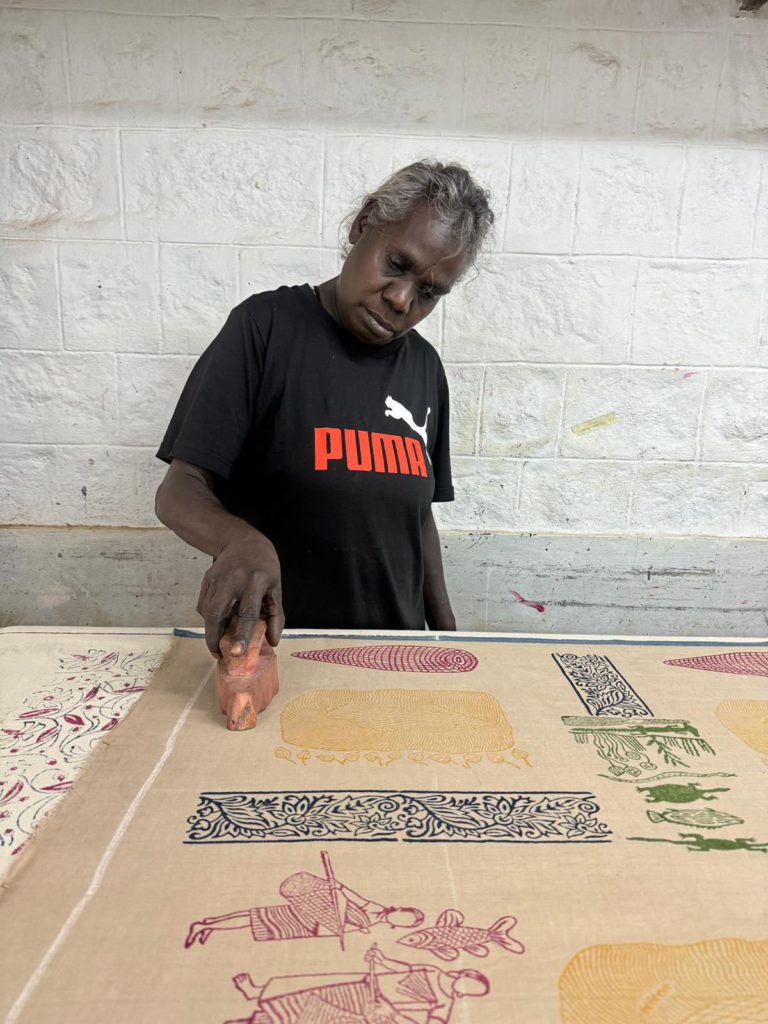
This cross-cultural initiative showcases 21 exquisite textiles, created through the intricate process of hand-carved woodblock printing.
The designs, drawn from sacred Aboriginal Australian stories and folklore, have been translated into vibrant prints by Indian artisans at Tharangini.
Image: Anahita Ananth (Source: An extraordinary exhibition, Karri-djarrk-durrkmirri exhibition webspage)
Anahita Ananth, a visual storyteller and media professional with Tharangini Studio told TNIE, “The responsibility was immense.” She emphasised the sacred nature of many of the symbols and the deep care taken to preserve their essence.
“Some designs are so sacred that only a few members of the community are permitted to draw them.”
Supported by the Australian Government’s Centre for Australia-India Relations (CAIR), the exhibition pays tribute to 16 First Nations Australian women artists, some of whom are no longer with us.
Image: Karri-djarrk-durrkmirri exhibition (Source: Australian Consul General for Karnataka and Telangana – X)
Initially starting with seven designs, the project has now expanded to 77, a testament to the seamless synergy between the two artisanal communities and the support of CAIR’s grant.
“The designs from Bábbarra were unlike anything we’d worked with before, but the connection to nature was familiar. Both our traditions draw deeply from our respective landscapes,” shares Ananth.
Image: Karri-djarrk-durrkmirri exhibition (Source: Australian Consul General for Karnataka and Telangana – X)
Anshu Arora, a multidisciplinary design practitioner and the exhibition’s co-curator, echoes this sentiment, adding,
“We found striking parallels in the resilience of these communities. Both the Aboriginal Australian artists and Indian artisans are guardians of traditions passed down through generations.”
Arora stresses the importance of highlighting not just the final artistic output but also the underlying belief systems and processes that give depth to each piece.
Visitors to the exhibition will also get a glimpse of this behind-the-scenes journey, led by Tharangini’s director, Padmini Govind.
“It’s been a 24-month process to adapt the designs for woodblock printing,” says Ananth.
“The women at Bábbarra traditionally use linocut prints, but linoleum degrades over time. By using seasoned teak woodblocks, we’ve created something that can last for decades.”
The exhibition delves into themes central to the lives of Aboriginal Australian women, including food, hunting, flora, and spiritual beliefs, all intricately intertwined with the landscape of Arnhem Land.
Image: Karri-djarrk-durrkmirri exhibition (Source: Australian Consul General for Karnataka and Telangana – X)
“Each textile reflects the colours and textures of Arnhem Land – from the sky and sea to the native plants,” says Arora, adding,
“The stories of mermaids, fish, and seaweed, key symbols in their cultural identity, are brought to life through the prints.”
In addition to the work with the Bábbarra Women’s Centre, three of the textiles were created in collaboration with the Porgai community, an artisanal embroidery group from Tamil Nadu, further highlighting the beauty of this cross-cultural exchange.
The exhibition also features a video installation and photographic documentation, offering visitors a chance to witness the 24-month journey of transforming sacred Aboriginal designs into timeless textile art.
Karri-djarrk-durrkmirri will be on display from October 4 to 13 at the Bangalore International Centre, with free entry starting at 11 am.
Support Our Journalism
Global Indian Diaspora and Australia’s multicultural communities need fair, non-hyphenated, and questioning journalism, packed with on-ground reporting. The Australia Today – with exceptional reporters, columnists, and editors – is doing just that. Sustaining this needs support from wonderful readers like you.
Whether you live in Australia, the United Kingdom, Canada, the United States of America, or India you can take a paid subscription by clicking Patreon and support honest and fearless journalism. LINK: https://tinyurl.com/TheAusToday
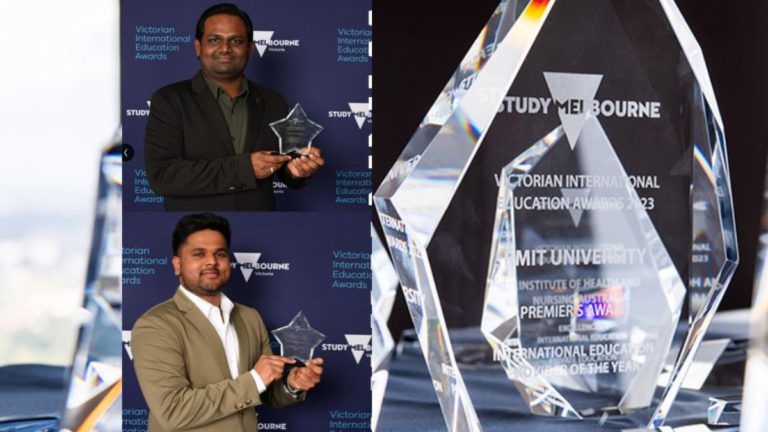
Indian international students Preetham Akula and Fazil Mohammed have been named International Student – Graduate Entrepreneur of the Year and Emerging Leader – International Alumni Award category in the 2024 Victorian International Education Awards.
Image: Preetham Akula – Bachelor of Aerospace Engineering, RMIT University (Source: Study Melbourne)
Preetham is an Aerospace Engineering student at RMIT University and has emerged as a dynamic entrepreneur and leader, making remarkable strides in both the food and beverage industry and space technology.
His entrepreneurial journey began with the founding of Dropout Chaiwala, a food and beverage startup that quickly expanded across multiple locations in Melbourne, achieving impressive financial success.
Building on this, Preetham leveraged his engineering expertise to establish Akula Tech, a cutting-edge space technology company. Within a short span, Akula Tech secured $1 million in pre-seed funding and is preparing for its first satellite launch.
The company has also partnered with Australian telecommunications giant VOCUS to tap into government and enterprise markets. Through Akula Tech, Preetham continues to foster mentorship, talent development, and collaboration within Victoria’s thriving startup ecosystem.
Image: Fazil Mohammed – Bachelor of Information and Communication Technology, Swinburne University of Technology (Source: Study Melbourne)
Fazil is a prominent advocate for international students and has earlier received the Emerging Leader Award from Swinburne University. He works as a Cloud Operations Engineer at PwC Australia.
Fazil’s YouTube channel, which promotes the international student experience in Melbourne, has amassed over one million views. Fazil’s commitment to community engagement and industry collaboration makes him a recognised figure in Victoria’s international student community.
Image: Angela Sojan (Source: Study Melbourne)Image: Ayushi Daga (Source: Study Melbourne)Image: Muhsin Kizhisseri (Source: Study Melbourne)
In addition to Preetham Akula and Fazil Mohammed, three other Indian students were also finalists in the 2024 awards:
Angela Sojan, a finalist for the International Student of the Year – Higher Education, is a passionate advocate for diversity in STEM. She has inspired thousands of students through her work at the Victorian Space Science Education Centre and her role as the diversity and inclusion officer for the Mathematics and Statistics Society at the University of Melbourne.
Ayushi Daga, also a finalist for the International Student of the Year – Higher Education, has made significant contributions through her volunteer work, notably during the February 2024 Grampians wildfires. Ayushi’s leadership in mental health advocacy and inclusivity through organisations like the Australian Kookaburra Kids Foundation is widely recognised.
Muhsin Kizhisseri, a finalist in the International Student/Graduate Entrepreneur of the Year category, leads Healovate, a startup that focuses on stroke prediction technology. His groundbreaking research has the potential to revolutionise stroke patient care and has earned him the Study Melbourne Future Founders Venture Scholarship.
Additionally, Nishadeep Kaur was highly commended by the International Student of the Year – Vocational Education and Training judging panel.
Last year, Sarbjeet Singh from Deakin University (Geelong campus) won the coveted Premier’s Award – International Student of the Year.
A special congratulations goes to Sarbjeet Singh from @Deakin Geelong, who has won the coveted Premier’s Award – International Student of the Year! What an outstanding achievement. pic.twitter.com/kNdaLmfQIt
The Victorian International Education Awards, organised by Study Melbourne, shine a spotlight on the state’s most outstanding international students and recent graduates.
These students represent the vibrant and innovative contributions of the Indian international student community in Victoria, showcasing leadership, creativity, and commitment to positive social impact.
Support Our Journalism
Global Indian Diaspora and Australia’s multicultural communities need fair, non-hyphenated, and questioning journalism, packed with on-ground reporting. The Australia Today – with exceptional reporters, columnists, and editors – is doing just that. Sustaining this needs support from wonderful readers like you.
Whether you live in Australia, the United Kingdom, Canada, the United States of America, or India you can take a paid subscription by clicking Patreon and support honest and fearless journalism. LINK: https://tinyurl.com/TheAusToday
This statement comes after a heated exchange between Opposition Leader Peter Dutton and Sood, an Indian-origin ABC journalist, during a press conference on Tuesday.
The incident, which has sparked fresh controversy around the national broadcaster, revolved around Hezbollah’s designation as a terrorist organisation and the potential criminalisation of its supporters.
Dutton, addressing the media after protests in Sydney and Melbourne, condemned the demonstrators for displaying Hezbollah flags and called for stronger legislation to criminalise such displays. When Sood asked why Israeli flags were not similarly banned, considering the deaths attributed to the Israeli government, Dutton defended Israel as a democracy, stating Hezbollah was a terrorist organisation.
Sood further questioned the criteria for designating groups as terrorist organisations, prompting Dutton to express disbelief at the ABC’s perceived stance.
“Hezbollah, under Australian law, is a listed terrorist organisation. Now if the ABC doesn’t support that, they should be very clear about it,” Dutton remarked, criticising the broadcaster for allegedly questioning government policy.
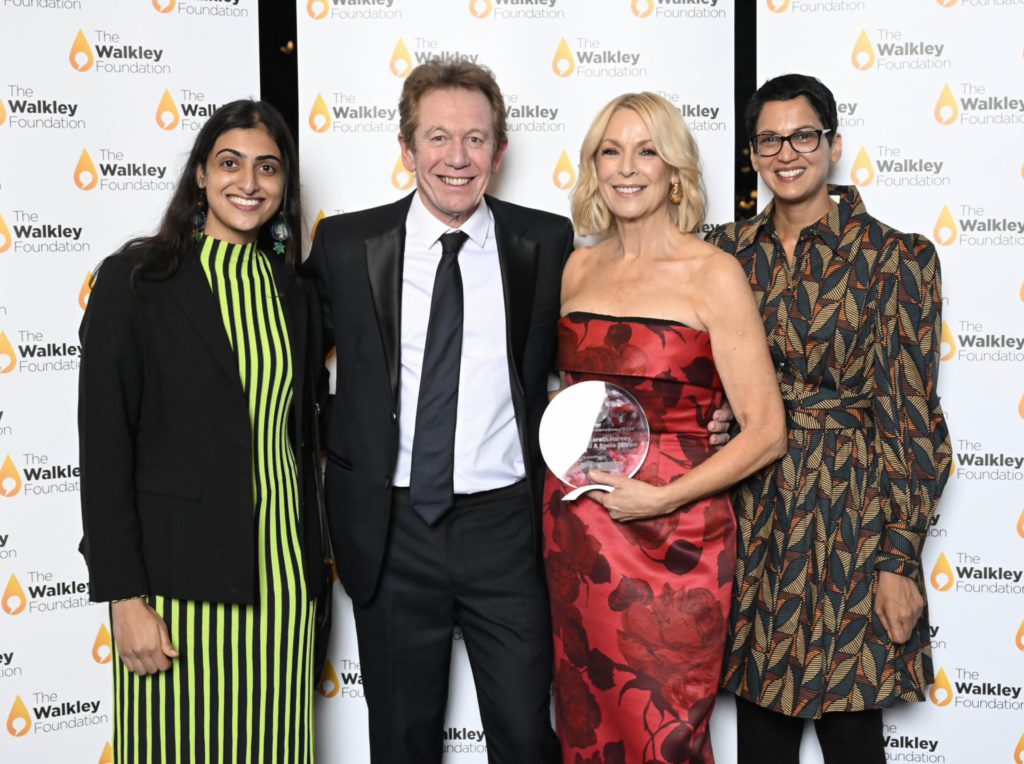
Image: Anushri Sood with Gareth Harvey, Liz Hayes and Sonia Serrao at Walkley Awards 2024 (Source: X)
MEAA expressed outrage at both Dutton’s comments and the ABC’s response, accusing the broadcaster of failing to protect its journalist and uphold its recent commitment to support staff of colour.
The committee’s motion read:
“We are appalled by Opposition Leader Peter Dutton’s behaviour and ABC management’s response. Following its new commitment to protect staff of colour, the ABC failed to show the leadership and values needed to be a robust defender of truth.”
The MEAA highlighted that it is a journalist’s right and duty to question policies affecting the Australian public and global community, calling the ABC’s silence on the intimidation of Sood a perpetuation of the racism exposed by an internal review issued the same day.
“This is a watershed moment for the national broadcaster, and Australia’s leaders, to recognise the role diverse media plays in the pursuit of transparency, truth, and fairness,” the MEAA stated.
Following the incident, the ABC issued a statement distancing itself from Sood’s questioning, clarifying that Hezbollah is recognised as a terrorist organisation by the Australian Government, and the ABC acknowledges that in its coverage.
🚨 Peter Dutton UNLEASHES on Hezbollah-loving ABC live on air
The taxpayer-funded broadcaster, which recently got caught fabricating evidence against ADF heroes, is now doing the bidding of a proscribed terrorist organisation
HERE’S PETER DUTTON AND ABC JOURNALIST’S Q&A IN FULL:
Reporter: With Hezbollah, you’re saying being responsible for the deaths of women and children, groups have commented on the hypocrisy of that situation because there are no bans currently on Israeli flags being raised, despite 45,000 people dying at the hands of the Israeli government.
Dutton: Israel is a democracy. It’s not run by a terrorist organisation. Hezbollah is a terrorist organisation, they’re a listed terrorist organisation and if people are in favour of a terrorist organisation they should declare it and authorities can deal with them.
Reporter: And if not the number of deaths, what determines…. What determines the fact that Hezbollah is a terrorist organisation even though-?
Dutton: Where are you from, I’m sorry? Which organisation?
Reporter: Um, ABC.
Dutton: ABC. So what’s the question from the ABC just to be very clear?
Reporter: I just wanted to find out because groups have commented…
Dutton: No, no. But you asked about the listing of the organisation. I just didn’t understand that question I’m sorry.
Reporter: Ah, yep. So, ah.
Dutton: This is a question from Canberra is it? You’re reading it from a phone?
Reporter: Ah, no. So ah. Just wanted to ask in terms of, ah, looking into that for the investigation, you’ve asked the Prime Minister and the minister (Tony Burke) to direct the AFP in its investigation.
Dutton: No. That wasn’t the question you asked. What was the question you asked?
Reporter: I just wanted to understand.
Dutton: No, you asked a question about the listing so just ask that question again.
Reporter: So if you could sort of explain what determines something as a terrorist organisation?
Dutton: Well I had presumed up until this point at least the ABC supported the government’s laws. And the government has passed laws, supported on a bipartisan basis, but not by the ABC it seems, in relation to the prescribing or the listing of a terrorist organisation. Hezbollah under Australian law is a listed terrorist organisation. Now if the ABC doesn’t support that they should be very clear about it because I think that’s quite a departure.
Reporter: That’s not what I’m …
Dutton: But you asked me why the country has listed Hezbollah. They’re a terrorist organisation. They’re organise terrorist attacks and if that is not clear to the ABC, then I think the ABC is in greater trouble than even I first imagined.
Reporter: That wasn’t my question
Support Our Journalism
Global Indian Diaspora and Australia’s multicultural communities need fair, non-hyphenated, and questioning journalism, packed with on-ground reporting. The Australia Today – with exceptional reporters, columnists, and editors – is doing just that. Sustaining this needs support from wonderful readers like you.
Whether you live in Australia, the United Kingdom, Canada, the United States of America, or India you can take a paid subscription by clicking Patreon and support honest and fearless journalism. LINK: https://tinyurl.com/TheAusToday
The Australian Federal Police’s Counter Terrorism and Special Investigations Command (in Victoria) has established Operation Ardvarna, which is investigating complaints of allegedly publicly displayed prohibited symbols in Victoria while potentially inciting or advocating violence, or hatred, based on race and religion.
In a tweet Leader of Opposition Peter Dutton said, “The shocking scenes in Melbourne and Sydney at public rallies over the weekend were a disgrace. Incitement to violence and displaying terrorist symbols are crimes – and they have no place in our society.”
The shocking scenes in Melbourne and Sydney at public rallies over the weekend were a disgrace.
Incitement to violence and displaying terrorist symbols are crimes – and they have no place in our society. pic.twitter.com/3O1eq3eb0g
The nine reports stem from multiple sources, including three from Victoria Police, one from the National Security Hotline, four via the Report of Crime portal, and one case arising from a media investigation identifying an individual.
Authorities expect the number of investigations to grow, as other state and territory police agencies also conduct their own inquiries.
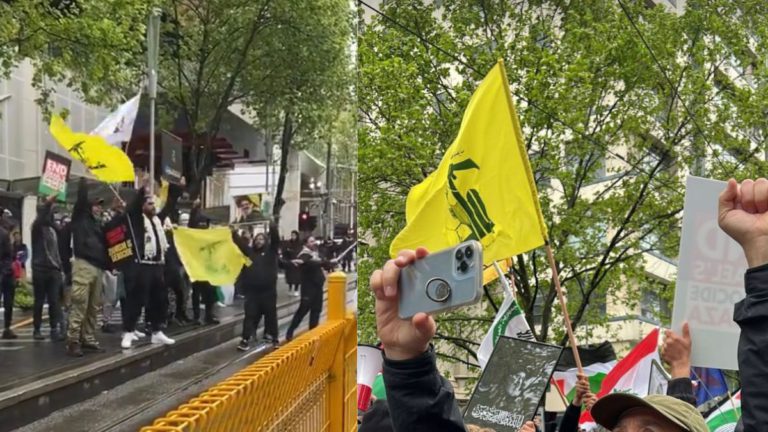
Image: Hezbollah flags at pro-Palestine demonstrations in Sydney and Melbourne (Source: X – screenshots of videos)
Shadow Minister for Home Affairs and Cyber Security, and Liberal Senator for Victoria, James Paterson, welcomed the AFP’s action. He said, “The AFP’s decision to establish Operation Ardvarna to investigate nine potential breaches of hate symbols legislation on Sunday in Melbourne is welcome.”
“It should have been immediately clear Hezbollah flag wavers were likely breaking the law. This action should have come earlier but finally sends a strong message to protestors that it is not ok or lawful to display symbols of listed terrorist organisations after months of open defiance,” Paterson added.
This action should have come earlier but finally sends a strong message to protestors that it is not ok or lawful to display symbols of listed terrorist organisations after months of open defiance. 2/2
AFP said in a statement that its investigators are tasked with triaging and assessing these referrals, identifying persons of interest, and developing investigation strategies to aid ongoing cases. The process may involve disruption tactics or overt action.
“While state and territory police agencies primarily focus on public order management for protests, the AFP has offered or is providing support to agencies ahead of expected protests over the coming days.”
Despite the focus on these investigations, the AFP continues to prioritise its core mission of combating terrorism, radicalisation, foreign interference, and espionage.
Support Our Journalism
Global Indian Diaspora and Australia’s multicultural communities need fair, non-hyphenated, and questioning journalism, packed with on-ground reporting. The Australia Today – with exceptional reporters, columnists, and editors – is doing just that. Sustaining this needs support from wonderful readers like you.
Whether you live in Australia, the United Kingdom, Canada, the United States of America, or India you can take a paid subscription by clicking Patreon and support honest and fearless journalism. LINK: https://tinyurl.com/TheAusToday
Have you ever asked your child how school was today, only to be told it was “boring”?
It’s a conversation sadly all-too-familiar to a lot of parents. Many are left wondering why and what they can do to help.
It’s important to understand why your child may be feeling bored at school. Here are some possibilities to consider.
Not every aspect of school is engaging
Boredom at school isn’t uncommon. Remember, a child’s learning journey is jagged, not linear. Their learning may progress quickly during some periods, and less so at other times. Sometimes they will be bored.
Our own research, which involved surveying 412 students in Year 10 about their emotions, revealed boredom was the most commonly reported emotion among participants.
As we argued in our paper, it’s possible there’s a need for some teachers to develop more stimulating lesson plans, and work more with students to find ways to motivate and engage them. Collecting feedback and working with their students to minimise classroom boredom could help some teachers.
Young people are growing up in an era where – thanks to technology – boredom in spare time is rare. This can be quite challenging for teachers, who generally want to encourage their students to reflect, ponder and contemplate.
But research has found closer student-teacher relationships, creating safe and supportive classrooms, and linking learning to real-world contexts relevant to students can often mitigate negative emotions like boredom.
The greater the control the student has over their learning – and the better they see the value of it – the more motivated they’re likely to be.
But lesson content is only part of the picture.
Is your child bored some or all of the time?
If your child is feeling bored in just one class, or one subject, then it could be the lesson content.
But if your child is consistently complaining that all classes and all school is boring – and you’ve noticed their grades are declining – there may be more to consider, such as:
the possibility of an underlying learning difficulty, such as dyslexia (which relates to reading) or dyscalculia (which relates to maths and numbers)
the possibility of hearing or vision impairment
the possibility your child is “gifted”, meaning they learn much faster than their peers.
If you suspect any of these, talk to your GP, and to your child’s teacher.
So it’s worth considering if there are friendship issues happening in the playground, or if there is something else going on emotionally for your child.
These stressors can occupy your child’s thoughts in the classroom, taking attention away from learning.
By helping children to understand and articulate their emotions, we can provide them the tools to manage these experiences more effectively.
Some schools offer programs that help children identify their emotions and learn social, emotional and behavioural regulation skills.
Children with good social emotional skills are likely to do better on a range of interpersonal and academic outcomes, which can also benefit parents, teachers and the school in general.
So what should parents do?
Talk openly with your child. Ask more specific questions about their day, instead of just “how was school?”. Instead, you can try questions like:
what was the most interesting thing you learned at school today?
can you tell me about something you enjoyed doing at school today?
was there anything that made you feel frustrated or bored today?
what do you wish you could change about your day?
who did you play with today?
if you were the teacher for the day, what would you do differently?
what feedback did you receive from your teacher on your work today?
Find out what they mean when they say they’re bored at school, and when they feel bored.
Consider having them assessed for possible learning difficulties, and their eyes and ears checked.
Find out if there any problems with friends, or possible anxieties lurking below the surface.
If your child is particularly high achieving academically, discuss this with the school. Your child may be eligible for further assessment and extension support.
Find ways to relate what your child is learning in school to their own lives and interests.
Consider how you can strengthen your child’s relationship with their teacher, and talk to the teacher, too. They might be able to make simple adjustments to support your child’s motivation and engagement.
Global Indian Diaspora and Australia’s multicultural communities need fair, non-hyphenated, and questioning journalism, packed with on-ground reporting. The Australia Today – with exceptional reporters, columnists, and editors – is doing just that. Sustaining this needs support from wonderful readers like you.
Whether you live in Australia, the United Kingdom, Canada, the United States of America, or India you can take a paid subscription by clicking Patreon and support honest and fearless journalism. LINK: https://tinyurl.com/TheAusToday
Bangladesh’s interim government has ordered the recall of five senior diplomats, including the high commissioner to Australia and India, in a move that has sparked concerns within the country’s foreign service.
In addition to High Commissioner Muhammad Imran and High Commissioner Mohammad Sufiur Rahman, the diplomats being recalled are Bangladesh’s permanent representative to the United Nations in New York, Muhammad Abdul Muhith; M Allama Siddiqui; ambassador to Belgium, Mahbub Hassan Saleh; and ambassador to Portugal, Rezina Ahmed.
Ahead of JWG meeting under TIFA to be held on 22 February 2022 in Canberra, High Commissioner @MohammadSufiur met with Minister @DanTehanWannon to discuss matters related to, among others, expanding trade and identifying scopes for investment between Bangladesh and Australia. pic.twitter.com/mxhiEBYwGe
— Ministry of Foreign Affairs, Bangladesh (@BDMOFA) February 17, 2022
“You are requested to return to Dhaka and hand over your current responsibilities immediately.”
The decision comes at a time when India-Bangladesh relations are strained, following the collapse of the Sheikh Hasina government in August 2024 amid protests led by student organisations.
The caretaker administration, headed by Nobel laureate Muhammad Yunus, took over shortly after Hasina fled to India. Efforts by the interim government to arrange a meeting between Yunus and Indian Prime Minister Narendra Modi during the United Nations General Assembly in September were unsuccessful. Reportedly, India was displeased with Yunus’ alleged comments regarding Bangladesh’s domestic political situation and his suggestion of seeking Hasina’s extradition.
Bangladesh High Commissioner to India Mr. Muhammad Imran paid a courtesy call on the Hon'ble President of India at the Rashtrapati Bhaban today. pic.twitter.com/fxej5xX1re
— Bangladesh High Commission, New Delhi (@bdhc_delhi) September 13, 2022
High Commissioner Imran, a career diplomat, had been instrumental in fostering development cooperation between India and Bangladesh during his tenure, which began in July 2022.
Acting High Commissioner Nardia Simpson was honoured to meet Hon Chief Adviser Yunus earlier today. Ms Simpson said Australia was committed to working with the interim government and to building peace, stability and prosperity in our shared Indo-Pacific region. pic.twitter.com/eb0QkA3FPX
— Australian High Commission Bangladesh (@AusHCBangladesh) August 29, 2024
In a separate humanitarian context, the Australian government recently announced over $1.8 million in aid for flood relief in Bangladesh, where devastating floods have displaced more than half a million people.
This aid, which will be channelled through Oxfam and BRAC, is intended to provide lifesaving assistance to vulnerable groups, including women and children, affected by the disaster. Australia is a top donor to the UN Central Emergency Response Fund, which also contributed USD 17.7 million to address the crises in Bangladesh in 2024.
Support Our Journalism
Global Indian Diaspora and Australia’s multicultural communities need fair, non-hyphenated, and questioning journalism, packed with on-ground reporting. The Australia Today – with exceptional reporters, columnists, and editors – is doing just that. Sustaining this needs support from wonderful readers like you.
Whether you live in Australia, the United Kingdom, Canada, the United States of America, or India you can take a paid subscription by clicking Patreon and support honest and fearless journalism. LINK: https://tinyurl.com/TheAusToday
As the Jewish community celebrates Rosh Hashanah, both Australian Prime Minister Anthony Albanese and Indian Prime Minister Narendra Modi have extended their best wishes for the New Year.
Prime Minister Albanese offered his heartfelt message, stating, “I wish the Jewish community the very best as you mark the beginning of a new year, and what we all hope will be a better year.”
I wish the Jewish community the very best as you mark the beginning of a new year, and what we all hope will be a better year. pic.twitter.com/0eSVnNzKEr
Prime Minister Modi also conveyed his greetings, expressing, “Best wishes on Rosh Hashanah to my friend PM Benjamin Netanyahu, the people of Israel, and the Jewish community across the world. May the new year bring peace, hope, and good health in everyone’s life. Shana Tova!”
Best wishes on Rosh Hashanah to my friend PM @netanyahu, the people of Israel and the Jewish community across the world. May the new year bring peace, hope and good health in everyone’s life. Shana Tova!
Australia’s Opposition Leader Peter Dutton issued a detailed media statement reflecting on the past year’s hardships faced by Jewish people globally, calling it one of the most difficult periods since the end of the Second World War.
Dutton noted the Hamas terrorist attack on Israel on 7 October last year, which marked the greatest loss of Jewish life on a single day since the Holocaust. He condemned the attack and subsequent actions by Iran, Hezbollah, and the Houthis, highlighting the ongoing threats to Israel’s security.
Dutton also expressed concern over rising anti-Semitism, noting a surge in hate crimes against Jewish Australians following pro-Palestinian marches, some of which, he stated, endorsed Hamas’s actions. He recounted the disturbing scenes at the Sydney Opera House on 9 October, where a mob gathered, inciting fear among Jewish Australians.
The last 12 months constitute one of the most difficult periods faced by Jewish people around the world since the end of the Second World War.
Hamas’s terrorist attack on Israel on October 7 last year saw the greatest loss of Jewish life on a single day since the Holocaust.…
The Opposition Leader emphasised his commitment to combating anti-Semitism, vowing to provide political leadership that fosters law, order, and social cohesion.
“Anti-Semitism is not only a threat to one segment of our community but a threat to our social cohesion, democratic values, and way of life,” Dutton said.
As the Jewish community marks Rosh Hashanah, Dutton concluded his message with a reflection on the Jewish people’s resilience, stating,
“May your celebration of Rosh Hashanah this year be a roar of courage and confidence – one which makes it clear that civilisation will not cower in the face of evil. In this, I join you in celebrating Rosh Hashanah.”
Rosh Hashanah, the Jewish New Year, occurs in the fall at the beginning of Tishrei, the seventh month of the Jewish calendar. This holiday is a time for both celebration and introspection, allowing individuals to reflect on the past year while acknowledging new beginnings.
Support Our Journalism
Global Indian Diaspora and Australia’s multicultural communities need fair, non-hyphenated, and questioning journalism, packed with on-ground reporting. The Australia Today – with exceptional reporters, columnists, and editors – is doing just that. Sustaining this needs support from wonderful readers like you.
Whether you live in Australia, the United Kingdom, Canada, the United States of America, or India you can take a paid subscription by clicking Patreon and support honest and fearless journalism. LINK: https://tinyurl.com/TheAusToday
The sanctions target Maksim Viktorovich Yakubets, Igor Olegovich Turashev, and Aleksandr Viktorovich Ryzhenkov, who have played key roles in one of the world’s most prolific cybercrime syndicates.
Minister for Foreign Affairs Penny Wong emphasised Australia’s leadership in using autonomous cyber sanctions to safeguard its citizens.
“We are using all elements of our national power to keep Australians safe and promote a rules-based cyberspace, grounded in international law,” she said.
For over a decade, Evil Corp has orchestrated major cyber incidents, including ransomware attacks across Europe, the UK, and the US, causing millions of dollars in losses and crippling critical health systems, national infrastructure, and government sectors.
The sanctions, announced today, make it a criminal offence to provide assets to these individuals or to deal with their assets. Additionally, they are barred from entering Australia. This move is part of a coordinated international effort, involving the UK and the US, to disrupt Evil Corp’s activities and deter further cybercrime.
Deputy Prime Minister and Minister for Defence Richard Marles MP highlighted the significance of these sanctions.
“Malicious cyber actors continue to target governments, critical infrastructure, and households globally. These sanctions are an important tool in deterring cybercrime and protecting Australians,” Marles said, urging businesses and individuals to remain vigilant about their cybersecurity.
The sanctions come as Australia faces increasing ransomware threats across critical sectors, including infrastructure, government, and industry. The government urges Australians to back up data and exercise caution online, while also discouraging the payment of ransoms to cybercriminals.
Minister for Cyber Security Tony Burke MP reiterated the government’s commitment to strengthening Australia’s cyber defences.
“These sanctions are another example of our commitment to working with international partners to dismantle criminal organisations built on ransomware,” Burke stated.
Victims of ransomware attacks are advised to contact the Australian Signals Directorate via the Cyber Security Hotline or file a report online, while more information is available on the Australian Signals Directorate’s Ransomware page.
Support Our Journalism
Global Indian Diaspora and Australia’s multicultural communities need fair, non-hyphenated, and questioning journalism, packed with on-ground reporting. The Australia Today – with exceptional reporters, columnists, and editors – is doing just that. Sustaining this needs support from wonderful readers like you.
Whether you live in Australia, the United Kingdom, Canada, the United States of America, or India you can take a paid subscription by clicking Patreon and support honest and fearless journalism. LINK: https://tinyurl.com/TheAusToday
The Kiribati government’s decision not to join the inaugural ballot for Australia’s permanent migration pathway, the Pacific Engagement Visa (PEV), came as a surprise to many.
As an I-Kiribati mobility and climate change scholar who has had the privilege of working under two Kiribati government administrations with divergent views on migration, I am writing this article to show why rejecting the PEV is a missed opportunity.
Three out of the 12 Pacific island countries eligible for the PEV opted out of the visa. Samoa, it appears, declined due to concerns over the high level of outmigration of its people. The Republic of Marshall Islands has an existing pathway to the United States under its Compact of Free Association, and likely did not see the need for another scheme. Then there is Kiribati, a country with a fast-growing young population, high unemployment, limited economic opportunities, and few migration opportunities. No reason has been put forward by the Kiribati government for opting out. Was it an inclusive decision? Was it fair for the government to decide on behalf of everyone?
Kiribati sits at the centre of the world, at the intersection of the international dateline and the equator. It straddles all four hemispheres, making it a location of strategic importance in geopolitics today. Halfway between Australia and Hawaii, the country’s total land area is 811 square kilometres, about the size of Canberra. Kiribati’s 33 islands are dispersed over 3.5 million square kilometres of ocean territory, roughly the size of the states of Western Australia and South Australia combined. Labelled a small island state, Kiribati is essentially a big ocean state. It stands not more than three metres above sea level and its fragile geography is an impediment to its development and efforts to mitigate threats of climate change.
Labour migration is not new to I-Kiribati. The country prides itself on nearly 60 years of seafaring and associated work in the maritime and fisheries sector. More recently, New Zealand’s Recognised Seasonal Employer (RSE) scheme and the Pacific Australia Labour Mobility (PALM) scheme employ more than 3,000 I-Kiribati workers every year. Remittances have already become a key source of income for households and accounted for 8.4% of GDP in 2020.
While PALM and RSE participation is a good start, there are plenty of reasons why Kiribati should be seeking more migration opportunities and embracing the PEV.
First, Kiribati suffers from the tyranny of distance, resulting in high living costs and low living standards. For many economically vulnerable communities, migration to a first-world country like Australia, whether short-term or permanent, provides an escape from economic hardship. My own PhD fieldwork in Kiribati found remarkable growth in the popularity of labour migration schemes. In particular, I-Kiribati workers in Australia spoke highly of the PALM scheme and compared it favorably to the situation of being unemployed in Kiribati.
Second, Kiribati is one of the most densely populated places on earth. More than half its population is concentrated on the small strip of land that serves as the capital – South Tarawa. Attempts to control rural-urban migration have been trialled and failed to stem the flow. Migration under the PEV would be one practical way to reduce population pressures.
Third, Kiribati is highly vulnerable to climate change. Migration is not the solution to climate change, but having migration options is one effective adaption response in a global system that lacks governance mechanisms to protect climate-threatened communities. While rejecting apocalyptic climate vulnerability narratives is crucial to maintaining agency, the reality is that certain aspects of Kiribati’s geography render the country susceptible to climate change impacts.
Fourth, while PALM and RSE have been popular in Kiribati, the country is still a minor player in these schemes — for example, providing only an average of 5% of all PALM workers entering Australia in recent years. Indeed, the country’s isolation and other factors make it difficult for Kiribati to compete against other countries for temporary migration places (high transport costs being one factor), so it might be better suited to permanent migration schemes such as the PEV. The PEV will also be valuable in growing the Kiribati diaspora in Australia, which is tiny (just 1,263 in 2021). And the PEV is better than PALM in that it allows family accompaniment, does not tie the worker to a single employer, and allows access to many government benefits. These measures promote migrant safety and wellbeing and reduce the risk of exploitation.
A fifth point is that rejecting the PEV risks increasing the dependency of the I-Kiribati population on government handouts such as the social protection program – te mwane n aki mwakuri or unemployment allowance – and the copra subsidy. The former pays A$50 monthly to all I-Kiribati aged 18-59 years, while the cost of the latter increased dramatically from A$1 to A$4 per kilogram in the last four years, despite challenges for coconut producers with irregular shipments and competition in the international market. Both schemes, while designed to alleviate poverty, defeat the government’s purpose of building social resilience, and are fiscally unsustainable. By building sustainable economic opportunities for growth, including through migration, the government could treat the country’s dependency syndrome.
Finally, there is no doubt that the PEV would be very popular. The government needs to explain why it has rejected the PEV in 2024 given that Kiribati participates in New Zealand’s PEV-equivalent, the Pacific Access Category (PAC) visa scheme. In 2019, the most recent year for which we have data, 58 I-Kiribati applied for each one of the 75 PAC visas available. A fair process would be a nation-wide consultation before the next PEV ballot in 2025.
Kiribati is at a fundamental point in its history where it strives to challenge colonial constructs, exercise sovereignty amid geopolitical tensions, reinforce national and cultural identity, and chart its own future. However, as vital as this is, the government must not throw the baby out with the bathwater. Transforming Kiribati into the Dubai and Singapore of the Pacific is not impossible but it will not happen overnight, unless the government capitalises on the PEV to achieve its goal of increasing overseas employment by 100% by 2036. Until then, the rights of I-Kiribati to employment, migration, and culture, regardless of where they are in the world, must be fully recognised and not compromised in the name of decolonisation, nationalism or geopolitics.
Contributing Author: Akka Rimon is a PhD candidate with the School of Regulation and Global Governance (RegNet), Australian National University. She is one of four inaugural recipients of the Australia-Pacific Security College PhD Scholarship Awards.
Support Our Journalism
Global Indian Diaspora and Australia’s multicultural communities need fair, non-hyphenated, and questioning journalism, packed with on-ground reporting. The Australia Today – with exceptional reporters, columnists, and editors – is doing just that. Sustaining this needs support from wonderful readers like you.
Whether you live in Australia, the United Kingdom, Canada, the United States of America, or India you can take a paid subscription by clicking Patreon and support honest and fearless journalism. LINK: https://tinyurl.com/TheAusToday
A 38-year-old Canadian national faced court charged with attempting to smuggle approximately 15 kilograms of methamphetamine into Australia.
The illicit drugs were allegedly concealed in his luggage, discovered by Australian Border Force (ABF) officers upon his arrival at Sydney International Airport from Vancouver on 31 July 2024.
Image: Canadian national Meth Sydney Airport 2024 (Source: AFP)
ABF officers inspected the man’s suitcase, where they found multiple vacuum-sealed bags containing a powdery substance. Subsequent testing confirmed the substance as methamphetamine. The case was handed over to the Australian Federal Police (AFP), and the man was arrested.
He now faces one count of importing a commercial quantity of a border-controlled drug, an offence that carries a maximum penalty of life imprisonment under section 307.1 of the Criminal Code 1995 (Cth). Following his initial court appearance on 1 August, where he was denied bail, the man is due to reappear today at Downing Centre Local Court.
AFP Detective Acting Superintendent Dom Stephenson emphasised the importance of halting drug smuggling attempts to protect Australian communities.
“Criminal groups will go to any lengths to bring illicit substances into our country. The devastating impact methamphetamine has on individuals and their families is well known – that’s why we’re committed to stopping it whenever we can,” he said, adding that the seized quantity could have resulted in 150,000 individual hits on the streets.
Image: Canadian national Meth Sydney Airport 2024 (Source: AFP)
ABF Superintendent Elke West praised the efforts of officers who continuously work to prevent such dangerous substances from entering the country.
“Criminal syndicates care only about their profits, not the harm these drugs cause to the community. ABF officers will continue to rely on intelligence, observation, and intuition to disrupt these networks and protect Australians,” she stated.
Support Our Journalism
Global Indian Diaspora and Australia’s multicultural communities need fair, non-hyphenated, and questioning journalism, packed with on-ground reporting. The Australia Today – with exceptional reporters, columnists, and editors – is doing just that. Sustaining this needs support from wonderful readers like you.
Whether you live in Australia, the United Kingdom, Canada, the United States of America, or India you can take a paid subscription by clicking Patreon and support honest and fearless journalism. LINK: https://tinyurl.com/TheAusToday
Almost one year ago to the day, I wrote how an isolated conflict between Israel and Hamas would likely not cause a sustained increase in oil prices.
This was because neither Gaza nor Israel produces much oil. But this time, it’s different.
What’s changed
Iran is a major player in the global market for crude oil. The latest data from the US Energy Information Administration lists Iran as the ninth largest oil producer, accounting for about 4% of world oil production last year.
While this may sound like a small share, research has shown events like Iran’s nationalisation of the BP-owned Anglo-Iranian Oil Company in the early 1950s, the Iranian revolution in the late 1970s, and Iran-Iraq war of the early 1980s, all caused crude oil price to rise.
The extent to which Israel responds to the latest escalation could therefore have a genuine impact on oil prices in coming days.
A complex world
Of course, the difficulty in assessing any situation is such events do not happen in a vacuum.
Still, the current tensions can only add to the already tightening oil market following Libya’s recent shutdown of the El-Feel oil field in August this year.
Last week, the Reserve Bank of Australia said inflation is still above target, and returning to target is their number one priority, despite a highly uncertain economic outlook.
There’s no doubt these events only add to the uncertainty of that outlook, and any oil price surge can only add to the current cost of living crisis faced by Australians.
Let’s be clear. While Australia does not import any crude oil from Iran, we are heavily reliant on our trading partners for the resource. According to the most recent data from the Department of Climate Change, Energy, the Environment and Water, about two thirds of our oil supply currently comes from South Korea, Singapore, Malaysia, and India.
This reliance on foreign oil makes us especially exposed to rising oil prices.
The main channel through which higher oil prices could impact inflation is fuel prices. It is well understood that higher oil prices are associated with higher fuel prices.
Research by the Australia Institute, found Australia currently imports about 91% of fuel consumption. The transportation sector accounts more than three quarters of total fuel consumption, with road transport making up more than half of that number.
However, the silver lining is research suggests the likely flow on effects of oil prices on inflation in Australia is relatively smaller than some might expect.
To give a rough number, the research suggests a sustained increase in the oil price by 10% would translate into Australia’s inflation rate being about 0.6 percentage points higher.
This means the Reserve Bank will also be closely monitoring the oil price over the next few weeks ahead of next month’s cash rate meeting.
Global Indian Diaspora and Australia’s multicultural communities need fair, non-hyphenated, and questioning journalism, packed with on-ground reporting. The Australia Today – with exceptional reporters, columnists, and editors – is doing just that. Sustaining this needs support from wonderful readers like you.
Whether you live in Australia, the United Kingdom, Canada, the United States of America, or India you can take a paid subscription by clicking Patreon and support honest and fearless journalism. LINK: https://tinyurl.com/TheAusToday
Surgeon Vice Admiral Arti Sarin assumed the role of Director General of the Armed Forces Medical Services (DGAFMS), becoming the first woman doctor to ever hold this prestigious position.
“She has been a strong advocate for encouraging young women to join the armed forces and stands as a prominent icon of the government’s Nari Shakti initiative,” said the Ministry of Defence.
Surgeon Vice Admiral Arti Sarin, AVSM, VSM assumed the appointment of Director General Armed Forces Medical Services today. The Flag officer is the 46th #DGAFMS and the first Woman officer to take over as the head of Armed Forces Medical Services. Surg Vice Adm Sarin is an… pic.twitter.com/Z7rcmL7avg
At 60, Vice Admiral Sarin will serve a two-year term as the head of the AFMS, an organisation directly under the Defence Ministry responsible for the medical policies across the military.
Prior to this role, she led the Navy’s Medical Services Directorate, and she has also served as the Director General of Medical Services (Air) and Commandant of the Armed Forces Medical College (AFMC) in Pune.
This appointment follows the recent promotion of Lieutenant General Sadhna Saxena Nair, who became the first woman to hold the position of Director General Medical Services (Army) just two months earlier.
Vice Admiral Sarin, commissioned in December 1985 after graduating from AFMC, holds an MD in Radiodiagnosis from AFMC and a Diplomate of the National Board in Radiation Oncology from Tata Memorial Hospital, Mumbai. She has also trained in Gamma Knife surgery at the University of Pittsburgh in the US.
Throughout her 38-year career, Vice Admiral Sarin has held numerous distinguished academic and administrative posts, including Professor and Head of Radiation Oncology at the Army Hospital (Research & Referral) and Command Hospital (Southern Command) in Pune, Commanding Officer of INHS Asvini, and Command Medical Officer in the Indian Navy’s Southern and Western Naval Commands.
Vice Admiral Sarin has the rare honour of serving in all three branches of the Armed Forces – starting as a Lieutenant in the Army, progressing to a Surgeon Vice Admiral in the Navy, and reaching the rank of Air Marshal in the Air Force, a unique career path enabled by the military’s cross-service posting system.
Vice Admiral Sarin was recently appointed to a national task force formed by the Supreme Court to establish safe working conditions for medical professionals, following the alleged rape and murder of a female resident doctor at the RG Kar Medical College in Kolkata, an incident that led to widespread protests by doctors. The task force, constituted in August, is responsible for preparing a strategy to prevent violence against medical personnel and creating a national protocol for dignified and secure working environments for all healthcare staff.
In July 2024, Vice Admiral Sarin was awarded the Ati Vishisht Seva Medal (AVSM) by President Droupadi Murmu for her outstanding service. Her promotion to DGAFMS is a landmark moment for women in the Indian Armed Forces, as she now holds the highest rank ever attained by a female officer in the military.
As DGAFMS, she will oversee medical policies for the Armed Forces and represent the military’s medical concerns to Chief of Defence Staff General Anil Chauhan and Defence Minister Rajnath Singh.
Support Our Journalism
Global Indian Diaspora and Australia’s multicultural communities need fair, non-hyphenated, and questioning journalism, packed with on-ground reporting. The Australia Today – with exceptional reporters, columnists, and editors – is doing just that. Sustaining this needs support from wonderful readers like you.
Whether you live in Australia, the United Kingdom, Canada, the United States of America, or India you can take a paid subscription by clicking Patreon and support honest and fearless journalism. LINK: https://tinyurl.com/TheAusToday
Born between 1997 and 2013, 58% of this consumer cohort seek to buy products that are sourced sustainably. Australian Gen Zs say they are willing to pay more for brands that have a positive impact on society.
Yet, at the same time, we have witnessed the meteoric rise of ultra-fast fashion from online, direct-to-consumer retailers such as Shein, Temu and Boohoo. Shein alone generated US$32.5 billion (A$48.3 billion) in revenue in 2024 – a 43% increase from 2022.
There are complexities surrounding Gen Z’s shopping habits and how these often fail to align with their values.
On one hand, they covet a brand-new clothing item that is markedly more affordable when purchased from an ultra-fast fashion brand. On the other hand, they are aware of the environmental harms.
What explains this cognitive dissonance?
Caring about the environment …
Different from their predecessors, Gen Z has grown up with climate change as an urgent issue. Being chronically online means these concerns are not limited to their local environment.
Recent research revealed a pattern of stronger emotions of fear, guilt and outrage about the impacts of climate change among younger people, compared with older groups. These emotions could well be a driver of their activism and engagement with climate change.
They expect companies – those they buy from and work for – to prioritise sustainability in their business practices.
However, Gen Z crave more engaging ways to receive sustainability-related content. This is a worthy consideration for key players in the fashion industry.
… vs the temptation of fast fashion
Gen Z consumers are plugged into social media trends that appear with every scroll and swipe on TikTok and Instagram. Social media have spiked cultural trends that accelerate fast fashion.
Influencers promote “reps” (slang for replicas) and “dupes” (duplicates): cheaper, imitation versions of high-end fashion items. This is a way to democratise luxury by normalising “superfake” products and making luxury more accessible to a broader audience.
Social media tactics such as “hauls” and get-ready-with-me (“GRWM”) videos entice Gen Zs to get stuck on the treadmill of overconsumption. The idea is for content creators to show off massive amounts of new, trendy clothing. This in turn fuels the desire for consumers to continuously buy what they are seeing online – in bulk.
Fast fashion giants such as Zara and H&M have based their business models on translating what is on catwalks into cheap clothing, produced in mass quantities. Now, ultra-fast fashion brands such as Shein speed up the production cycle, the trend churn and consequently the volume.
Having seven trending items, over two high-quality outfits, makes more sense to Gen Z consumers in the digital age. https://www.youtube.com/embed/gWotBPtsulo?wmode=transparent&start=0
The cost-of-living crisis plays a part too. A recent survey of Australian Gen Zs revealed at least 77% are experiencing money concerns.
The biggest demographic to pull back on spending due to economic stress are 18–26-year-olds. Young people typically earn the lowest wages and enjoy less job security. These financial constraints are challenging to Gen Zs seeking to consume more sustainably.
Fast fashion becomes a cheap option for them to stay trendy without breaking the bank.
The ‘attitude–behaviour gap’
Gen Z are Shein shoppers, haul lovers, micro-trend followers, and repeat outfit shamers. This stands starkly against their eco-conscious values.
While this seems hypocritical, it is what is referred to as the attitude–behaviour gap – the incongruence between what people say and what they actually do. This is a phenomenon noted across multiple generations.
Even ethically minded consumers do not always walk their talk. But we can’t expect individual consumers to be entirely responsible for things like the carbon footprint of fast fashion, or the exploitation of workers in factories.
Being bombarded with persuasive tactics from brands and influencers, the ease of access to new items at the click of a button, and the allure of affordable pricing amid a cost-of-living crisis makes it very difficult for even the most committed Gen Z consumer to buy ethically.
The fashion industry is one of the biggest dangers to the environment in terms of its carbon and raw material footprint, and truckloads of clothing ending up in landfills.
While most young people know and respect Greta Thunberg’s environmental mission, she is not the one they are watching on TikTok or liking on Instagram.
It is time to re-engage with social media content creators in different ways that educate consumers, promote responsible behaviour and advocate for changed regulations and business practices. This might include tried-and-true tactics such as influencer endorsements and haul videos that are refocused on more sustainable options – like online second-hand retailers.
The emergence of “underconsumption core” on TikTok in recent months, as well as “deinfluencing”, where influencers call on their followers to buy less, is promising.
While sustainable clothing has a “bad rap” for being expensive, fast fashion brands are trying to adapt by offering options such as H&M Conscious. Any fashion offering must be convenient, accessible and trendy to capture Gen Z’s attention and wallet.
Global Indian Diaspora and Australia’s multicultural communities need fair, non-hyphenated, and questioning journalism, packed with on-ground reporting. The Australia Today – with exceptional reporters, columnists, and editors – is doing just that. Sustaining this needs support from wonderful readers like you.
Whether you live in Australia, the United Kingdom, Canada, the United States of America, or India you can take a paid subscription by clicking Patreon and support honest and fearless journalism. LINK: https://tinyurl.com/TheAusToday
The Albanese Labor Government is taking decisive steps to ensure Australians get fairer prices at the supermarket checkout, both in stores and online, in an effort to alleviate cost-of-living pressures.
Supermarket and retail misconduct, particularly misleading pricing practices, is being targeted in a bid to protect consumers from unfair behaviour that worsens financial strain.
Prime Minister Anthony Albanese reaffirmed the Government’s stance, stating,
“Today we are announcing a crackdown on dodgy supermarket practices. Australians deserve a fair go at the checkout, and we are making sure they get it.”
Prime Minister Albanese has further announced a significant increase in funding to the Australian Competition & Consumer Commission (ACCC), with an additional $30 million allocated to support investigations and enforcement in the supermarket and retail sectors. This funding will bolster the ACCC’s ability to monitor and crack down on deceptive pricing and unconscionable conduct.
“We don’t want to see ordinary Australians, families, and pensioners being taken for a ride by supermarkets,” Mr Albanese stated.
“We’re taking steps to make sure they get a fair go at the checkout.”
For families trying to pay the bills, fake supermarket discounts make life more difficult. @MaryDoyleMP and I sat down with Natalie, Xavier and Katie to talk about how our crackdown on supermarkets will help with the weekly shop.
The move follows the ACCC’s recent legal action against supermarket giants Coles and Woolworths for allegedly misleading customers with discount pricing claims on hundreds of everyday products. The increased funding will allow the regulator to further investigate retailers accused of falsely justifying higher prices, ensuring pricing transparency across the sector.
Treasurer Jim Chalmers reiterated the Government’s commitment to protecting consumers, saying, “More funding for the ACCC will help to make pricing fair, boost competition, and make sure there are significant consequences for supermarkets that do the wrong thing.”
Getting a fair go for consumers at the checkout.
Airline competition.
Calling for a ceasefire and an end to the loss of innocent life in the Middle East.
In addition to the ACCC crackdown, the Treasurer will work with state and territory governments through the Council on Federal Financial Relations to reform planning and zoning regulations.
These reforms are aimed at improving competition by opening more sites for new stores, overcoming current barriers that inhibit business expansion and contribute to rising prices through land banking.
We’ve welcomed the Treasurer's announcement of $30 million additional funding for investigations and enforcement relating to the supermarket and retail sector. This will allow for a significant enhancement of our enforcement and compliance activities. https://t.co/U5fMlvbAkopic.twitter.com/Bjhm8lSeqv
These announcements come alongside a series of recent Government actions aimed at strengthening consumer protections. Last week, the Government launched consultations on a new mandatory Food and Grocery Code, which will see major supermarkets including Aldi, Coles, Woolworths, and Metcash face multi-million-dollar penalties for serious breaches.
Further supporting consumers, CHOICE has released its second price monitoring report, funded by the Albanese Government, providing accurate data on where Australians can find the cheapest groceries.
In June, we visited 104 supermarkets across the country, including Aldi, Coles, Woolworths, and IGA, and again recorded the prices of 14 common grocery items: https://t.co/OOqnsQFKg1pic.twitter.com/XH2qBW2Lxw
The Government has also introduced reforms to ban unfair contract terms, increased penalties for breaches of consumer law, and is overseeing the most significant merger reforms in Australia in almost 50 years. Additionally, it is working with states and territories to revitalise National Competition Policy.
The next phase of the ACCC’s Supermarkets Inquiry will include public hearings with supermarket representatives later this year, giving consumers a voice in the regulatory process.
Support Our Journalism
Global Indian Diaspora and Australia’s multicultural communities need fair, non-hyphenated, and questioning journalism, packed with on-ground reporting. The Australia Today – with exceptional reporters, columnists, and editors – is doing just that. Sustaining this needs support from wonderful readers like you.
Whether you live in Australia, the United Kingdom, Canada, the United States of America, or India you can take a paid subscription by clicking Patreon and support honest and fearless journalism. LINK: https://tinyurl.com/TheAusToday
A tense exchange between Opposition Leader Peter Dutton and Indian-origin ABC journalist Anushri Sood has ignited fresh controversy around the national broadcaster.
The clash, which unfolded at a press conference on Tuesday, revolved around Hezbollah’s designation as a terrorist organisation and whether its supporters should face criminal charges.
🚨 Peter Dutton UNLEASHES on Hezbollah-loving ABC live on air
The taxpayer-funded broadcaster, which recently got caught fabricating evidence against ADF heroes, is now doing the bidding of a proscribed terrorist organisation
Dutton was addressing media following protests in Sydney and Melbourne over the weekend, where Hezbollah flags were displayed.
The Opposition Leader condemned the protesters, calling for stronger legislation to criminalise such displays. However, Sood’s question appeared to draw a comparison between Hezbollah and Israel, sparking a sharp response from Dutton.
Image: Anushri Sood with Gareth Harvey, Liz Hayes and Sonia Serrao at Walkley Awards 2024 (Source: X)
Sood asked, “With Hezbollah, you’re saying being responsible for the deaths of women and children; groups have commented on the hypocrisy of that situation because there are no bans currently on Israeli flags being raised, despite 45,000 people dying at the hands of the Israeli government.”
Dutton immediately defended Israel, stating,
“Israel is a democracy. It’s not run by a terrorist organisation. Hezbollah is. It is a terrorist organisation.”
Image: Hezbollah flags at pro-Palestine demonstrations in Sydney and Melbourne (Source: X – screenshots of videos)
Sood then shifted focus, questioning why Hezbollah is classified as a terrorist group.
“Could (you) sort of explain what determines something to be a terrorist organisation?”
Dutton expressed disbelief at the question, criticising the ABC for seemingly questioning the government’s decision. “Hezbollah, under Australian law, is a listed terrorist organisation. Now if the ABC doesn’t support that, they should be very clear about it,” he said.
“If that is not clear to the ABC, then the ABC is in even more trouble than I first imagined.”
Hezbollah has been officially recognised as a terrorist organisation by the Australian government since 2003, a designation that has received bipartisan support. The group is also listed as a terrorist entity by the United States and the European Union, with its activities including suicide bombings, rocket attacks, and political assassinations, largely funded by Iran and criminal enterprises.
According to SkyNews and the Nightly, the ABC quickly sought to distance itself from Sood’s line of questioning, clarifying that her comments were not reflective of the broadcaster’s official position.
“Hezbollah is listed as a terrorist organisation by the Australian Government and the ABC recognises that in its coverage.”
Dutton’s comments have gained traction among political commentators, who accuse the ABC of fostering a culture of activism.
John Storey, Director of Law and Policy at the Institute of Public Affairs, criticised the ABC for what he described as “rampant activism” within the organisation. He pointed out that an ABC journalist’s comparison of Hezbollah’s flag to Israel’s flag highlighted how “divisive and out of touch” the public broadcaster is, emphasising that Israel is a democracy and an ally of Australia.
“It is no wonder Australians have little faith in the integrity of the taxpayer funded broadcaster. Its declining viewership is testament to that. Its purpose and funding should be reviewed. Its conduct suggests it is anything but Australia’s most trusted news source.”
Dutton’s baffling confrontation with Sood comes as the ABC faces scrutiny over its journalistic practices. ABC Chair Kim Williams recently criticised the activist approach taken by some younger journalists, a sentiment echoed in the wake of Sood’s controversial questioning. At the 2024 Lowy Institute Media Award Dinner, Kim said:
“Many of our younger journalists have a much more activist view of the role of journalism, … And not only is it to be discouraged, it is to be ardently opposed.”
Despite calls from some Coalition members for “calmer conversations” about Middle Eastern conflicts, Dutton has continued to push for stronger laws against terrorist sympathisers and urged the government to cancel visas of protesters displaying Hezbollah symbols.
The shocking scenes in Melbourne and Sydney at public rallies over the weekend were a disgrace.
Incitement to violence and displaying terrorist symbols are crimes – and they have no place in our society. pic.twitter.com/3O1eq3eb0g
Under current law, displaying terrorist symbols can lead to jail terms of up to 12 months. The Australian Federal Police (AFP) has confirmed it is investigating “at least six reports of crime” connected to recent weekend rallies and expects these cases to be referred by Victoria Police.
“The AFP has no tolerance for individuals who break the law and will use its extensive capability and networks to take action. Matters referred to the AFP will be reviewed to determine if actions reach thresholds to charge under the Counter-Terrorism Legislation Amendment (Prohibited Hate Symbols and Other Measures) Act 2023.”
As the controversy unfolds, the ABC is under pressure to officially clarify its stance on the matter, while Dutton has solidified his position, emphasising the bipartisan nature of Australia’s anti-terrorism laws and maintaining a firm stance against Hezbollah.
PETER DUTTON AND ABC JOURNALIST’S Q&A IN FULL:
Reporter: With Hezbollah you’re saying being responsible for the deaths of women and children, groups have commented on the hypocrisy of that situation because there are no bans currently on Israeli flags being raised, despite 45,000 people dying at the hands of the Israeli government.
Dutton: Israel is a democracy. It’s not run by a terrorist organisation. Hezbollah is a terrorist organisation, they’re a listed terrorist organisation and if people are in favour of a terrorist organisation they should declare it and authorities can deal with them.
Reporter: And if not the number of deaths, what determines…. What determines the fact that Hezbollah is a terrorist organisation even though-?
Dutton: Where are you from, I’m sorry? Which organisation?
Reporter: Um, ABC.
Dutton: ABC. So what’s the question from the ABC just to be very clear?
Reporter: I just wanted to find out because groups have commented…
Dutton: No, no. But you asked about the listing of the organisation. I just didn’t understand that question I’m sorry.
Reporter: Ah, yep. So, ah.
Dutton: This is a question from Canberra is it? You’re reading it from a phone?
Reporter: Ah, no. So ah. Just wanted to ask in terms of, ah, looking into that for the investigation, you’ve asked the Prime Minister and the minister (Tony Burke) to direct the AFP in its investigation.
Dutton: No. That wasn’t the question you asked. What was the question you asked?
Reporter: I just wanted to understand.
Dutton: No, you asked a question about the listing so just ask that question again.
Reporter: So if you could sort of explain what determines something as a terrorist organisation?
Dutton: Well I had presumed up until this point at least the ABC supported the government’s laws. And the government has passed laws, supported on a bipartisan basis, but not by the ABC it seems, in relation to the prescribing or the listing of a terrorist organisation. Hezbollah under Australian law is a listed terrorist organisation. Now if the ABC doesn’t support that they should be very clear about it because I think that’s quite a departure.
Reporter: That’s not what I’m …
Dutton: But you asked me why the country has listed Hezbollah. They’re a terrorist organisation. They’re organise terrorist attacks and if that is not clear to the ABC, then I think the ABC is in greater trouble than even I first imagined.
Reporter: That wasn’t my question
Support Our Journalism
Global Indian Diaspora and Australia’s multicultural communities need fair, non-hyphenated, and questioning journalism, packed with on-ground reporting. The Australia Today – with exceptional reporters, columnists, and editors – is doing just that. Sustaining this needs support from wonderful readers like you.
Whether you live in Australia, the United Kingdom, Canada, the United States of America, or India you can take a paid subscription by clicking Patreon and support honest and fearless journalism. LINK: https://tinyurl.com/TheAusToday
There has been deep concerns following the assault on RED FM Calgary’s news director, Rishi Nagar, by two individuals in Calgary, Canada, on Sunday.
The incident, which took place on 29 September at 3.00 pm outside the Rio Banquet Hall, is seen as part of a worrying trend of attacks on journalists, particularly those covering sensitive topics such as Khalistani violence and Punjabi gang related extrortions in Canada.
Getting a disturbing news of a fatal attack on @RishiKNagar News Director at @REDFMCALGARY South Asian radio station in Calgary, Canada. Reported Reason: In the name of “Satkar Committee”, at least two goons, deployed by Guru Nanak Sikh Temple (Nijjer) in Surrey had forcibly… pic.twitter.com/xiWhFlFhZI
A former senator of the University of Calgary and a former member of the Calgary Police Service’s Anti-Racism Action Committee, Nagar is well-known and respected for his contributions to the South Asian community in Calgary.
On Sept 29th at 3 pm, our Host and News Director @RishiKNagar was attacked by 2 people.
Shiv Majumdar, Conservative Member of Parliament for Calgary Heritage, has condemned the attack and said that this kind of violence has been on the rise under Justin Trudeau and Jagmeet Singh.
I’m shocked to learn @REDFMCALGARY journalist @RishiKNagar was physically assaulted in Calgary. Rishi is a prominent Calgarian, known for his fearless reporting.
Freedom must prevail over fear. This kind of violence has been on the rise under Justin Trudeau and Jagmeet Singh.… https://t.co/sNtM7AzMvp
CoHNA Canada condemned the attack on Ngaar and pointed that this assault is not an isolated event but part of a pattern of violence targeting media professionals.
The organisation has emphasised that this attack is not only a personal assault but an attack on the freedom of the press in Canada, calling it “a deeply troubling incident in a democratic country.”
They have urged the Calgary Police and RCMP to take swift action against the perpetrators and ensure the safety of journalists across the country.
This is not just an individual attacked, it is an assault on freedom of press in Canada – part of a disturbingly long pattern, especially when… pic.twitter.com/sqc2ywuu9J
Violence against journalists in Canada, particularly those reporting on Khalistani-related issues, has been escalating.
According to CoHNA, this long history of violence against journalists reporting on Khalistani issues stretches back to the 1980s. One notable case is that of Tara Singh Hayer, who survived a bomb attack in 1986, only to be murdered in 1998 after two more assassination attempts.
Other journalists, such as CBC’s Terry Milewski, have faced repeated death threats for their reports on events like the Kanishka bombings. Some recent incidents include:
March 2023: AM600 Sher E Punjab Radio journalist, Sameer Kaushal, was assaulted in Surrey after covering a Khalistani protest.
February 2022: A Brampton radio host was attacked in his studio after criticising violence linked to the Khalistan movement.
August 2021: Joti Singh Mann, a Punjabi radio host, was viciously attacked with axes and a machete.
October 2009: Jagdish Grewal, publisher of a Punjabi-language newspaper, was assaulted and held at gunpoint for publishing anti-Khalistan content.
Death threats have been issued to investigative journalists like Mocha Bezirgan for their coverage of these protests.
CoHNA and other organisations have voiced frustration over the lack of significant action from law enforcement to protect journalists and prosecute perpetrators.
In several cases, such as the murder of Tara Singh Hayer, no charges were filed. Sameer Kaushal was reportedly told by police to leave for his safety, as protection could not be guaranteed.
The assault on Nagar is now under police investigation. Calgary Police have confirmed they are seeking two suspects and reviewing video footage of the incident.
Staff Sgt. John Guigon has described the attack as “particularly troubling” due to its impact on press freedom. He assured the public that resources are being allocated to the investigation.
https://t.co/kuOG7HPmK8 I have often been on @RishiKNagar Red-FM show and he is an excellent journalist. I also consider him a friend. This is not just an attack on Rishi, but an attack on freedom of the press in Canada.
Political commentator Duane Bratt described the attack as “an attack on freedom of the press,” urging people to focus on the issue at hand and not let political rhetoric obscure the severity of the crime.
This incident has further intensified calls for law enforcement to act decisively to protect journalists and uphold press freedom. CoHNA, alongside other advocacy groups, hopes that the authorities will send a strong message to extremists that such violence will not be tolerated. In closing, CoHNA expressed relief that Nagar’s injuries were not life-threatening, but warned: “Will the next target be as lucky?”
Support Our Journalism
Global Indian Diaspora and Australia’s multicultural communities need fair, non-hyphenated, and questioning journalism, packed with on-ground reporting. The Australia Today – with exceptional reporters, columnists, and editors – is doing just that. Sustaining this needs support from wonderful readers like you.
Whether you live in Australia, the United Kingdom, Canada, the United States of America, or India you can take a paid subscription by clicking Patreon and support honest and fearless journalism. LINK: https://tinyurl.com/TheAusToday
Several Indian origin councillors are back while some others have made their debut in the NSW Local Government elections.
Among those who have been re-elected as councillors are Sameer Pandey (Parramatta), Moninder Singh (Blacktown) and Susai Benjamin OAM (Blacktown) from Labor and Reena Jethi (The Hills Shire), Sreeni Pillamarri (Parramatta) and Sandhya (Sandy) Reddy (Strathfield) from the Liberals.
Mr Pillamarri was earlier a councillor from Hornsby but this time contested the elections from Epping Ward in Parramatta while Ms Reddy had won her seat as an Independent in the previous election but this time contested as a Liberal candidate.
Reena JethiMoninder SinghSusai Benjamin OAMSameer PandeySreeni PillamarriSandy Reddy
There are also several new councillors of Indian origin. Mohit Kumar, Pradeep Pathi and Jugandeep Singh from the Liberals have all won from Blacktown. Mandeep Sunny Singh from the Liberals has won in Northern beaches.
Among the Independents, Barbara Ward (lLiberal leaning) has retained her seat in the Ku-ring-gai council while Indu Balachandran has also been elected councillor in the same council for the first time. Both of them have been elected from the Gordon Ward.
Barbara WardIndu Balachandran
The NSW Local Government Elections were held on 14th September 2024. You can catch the full election resulsts at NSW Local Elections website.
Support Our Journalism
Global Indian Diaspora and Australia’s multicultural communities need fair, non-hyphenated, and questioning journalism, packed with on-ground reporting. The Australia Today – with exceptional reporters, columnists, and editors – is doing just that. Sustaining this needs support from wonderful readers like you.
Whether you live in Australia, the United Kingdom, Canada, the United States of America, or India you can take a paid subscription by clicking Patreon and support honest and fearless journalism. LINK: https://tinyurl.com/TheAusToday
Australia has today launched a new pre-application ballot process for the high-demand Work and Holiday (subclass 462) visa, allowing young people from India, Vietnam and China a fair opportunity to apply for a working holiday in Australia.
With a registration fee of AUD 25, eligible individuals from these countries can now register for the ballot, which began today.
This initiative, which is part of the 2024-2025 program year, aims to ensure an equitable and transparent selection process for applicants from countries where demand exceeds the available visa spots.
Eligibility Criteria
The Work and Holiday visa ballotsfor India,Vietnam and China will be held annually, with each country having a specific registration period. This year’s registration period opened on October 1, 2024, and participants must complete the process within the specified timeframe to be eligible for selection.
To register for the ballot, Indian applicants must:
Age: Be between 18 and 30 years old (inclusive).
Nationality: Hold a valid Indian passport.
National ID: Have a valid PAN card.
Account: Create an ImmiAccount and verify their email address.
Fee: Pay the AUD 25 registration fee.
The Work and Holiday Maker arrangement is a key commitment under the Australia-India Economic Cooperation and Trade Agreement (ECTA), which aims to enhance people-to-people ties between the two nations. Eligible Indian passport holders now have the opportunity to apply for a working holiday in Australia via the pre-application ballot process.
Indian Trade Minister Piyush Goyal highlighted this development in a recent post on X: “Concluded a very productive visit to Australia which will further strengthen our bilateral trade and investment ties in several priority sectors and open new areas of cooperation.
“During the visit, happy to learn that Work & Holiday visa, a key commitment under India-Australia Economic Cooperation and Trade Agreement will be operational from 1st October 2024 which will facilitate mobility and deepen people-to-people connect 🇮🇳 🇦🇺.”
Ballot Process
The ballot registration is completed via ImmiAccount, under ‘New application’. Once the form is filled and the registration fee is paid, the status changes from ‘draft’ to ‘received’, and the applicant is added to the ballot for random selection.
The ballot process aims to provide a fair and efficient way of managing the high demand for Work and Holiday visas. The selection is conducted through a random automated process, ensuring that every eligible applicant has an equal chance of being selected. Those selected will receive a ‘Notification of selection’ letter via email, inviting them to apply for the Work and Holiday visa.
However, it is important to note that receiving a selection letter does not guarantee the visa. Applicants must still meet all eligibility requirements to be granted a Work and Holiday (subclass 462) visa.
Once selected, participants will have their registration status updated to ‘selected’ in their ImmiAccount and will be invited to apply for the visa. The notification letter will provide further instructions, and some details will be pre-filled in the application form for convenience.
With registrations now open, eligible Indian applicants are encouraged to take advantage of this opportunity to participate in the Work and Holiday visa program and experience the culture and lifestyle that Australia has to offer.
Support Our Journalism
Global Indian Diaspora and Australia’s multicultural communities need fair, non-hyphenated, and questioning journalism, packed with on-ground reporting. The Australia Today – with exceptional reporters, columnists, and editors – is doing just that. Sustaining this needs support from wonderful readers like you.
Whether you live in Australia, the United Kingdom, Canada, the United States of America, or India you can take a paid subscription by clicking Patreon and support honest and fearless journalism. LINK: https://tinyurl.com/TheAusToday
Veteran actor Mithun Chakraborty, fondly known as ‘Mithun Da,’ will be honoured with the prestigious Dadasaheb Phalke Award for his remarkable contributions to Indian cinema.
The announcement was made by Indian Union Minister of Information and Broadcasting Ashwini Vaishnaw, who shared the news on his official X account, stating, “Mithun Da’s remarkable cinematic journey inspires generations! Honoured to announce that the Dadasaheb Phalke Selection Jury has decided to award legendary actor Mithun Chakraborty Ji for his iconic contribution to Indian cinema.”
Honoured to announce that the Dadasaheb Phalke Selection Jury has decided to award legendary actor, Sh. Mithun Chakraborty Ji for his iconic contribution to Indian Cinema.
The award will be presented at the 70th National Film Awards ceremony on October 8, 2024, marking another milestone in Mithun Chakraborty’s illustrious career. The Dadasaheb Phalke Award is India’s highest honour in the field of cinema, recognising exceptional contributions that have shaped the industry.
Indian Prime Minister Narendra Modi also extended his congratulations to the veteran actor, calling him a “cultural icon” admired for his versatility. In a post on X, PM Modi expressed his delight over the recognition given to Mithun Chakraborty, stating,
“Delighted that Mithun Chakraborty Ji has been conferred the prestigious Dadasaheb Phalke Award, recognising his unparalleled contributions to Indian cinema. He is a cultural icon, admired across generations for his versatile performances. Congratulations and best wishes to him.”
Mithun Chakraborty, who recently received the prestigious Padma Bhushan, has been one of the most celebrated figures in Indian cinema. He began his illustrious career in 1976 with the film Mrigayaa, portraying a Santhal rebel, a performance that earned him the National Film Award for Best Actor. Since then, Mithun has captivated audiences with his versatility, starring in numerous films across various genres.
Reflecting on receiving the Dadasaheb Phalke Award, Chakraborty said, “I never imagined that a boy from the footpath could receive such a big honour.” In an interview with ANI, he expressed his gratitude and dedicated the award to his family and fans.
“I’m literally dumbfounded, trust me. I can’t smile, I can’t cry with happiness because a man from literally nowhere, a nobody, made it.
This also proves what I always tell my fans and those who aren’t financially strong: if I can make it, then you can do it too.”
Mithun Chakraborty’s career has spanned almost five decades, with notable performances in films like Tahader Katha (1992) and Swami Vivekananda (1998), both of which earned him National Film Awards.
He is also celebrated for his contribution to Indian pop culture through his electrifying dance numbers, including hits like “I Am a Disco Dancer,” “Jimmy Jimmy,” and “Super Dancer.” These songs became instant classics, and his dance moves are still emulated by fans today.
Beyond acting, Mithun has also made his mark in politics, becoming a public figure who has inspired many with his journey from humble beginnings to stardom. Most recently, he appeared in Vivek Agnihotri’s critically acclaimed film The Kashmir Files, which added another successful chapter to his acting career.
The Dadasaheb Phalke Award is a fitting recognition of Mithun Chakraborty’s immense contribution to Indian cinema. His journey from a struggling actor to becoming a national icon is a testament to his talent, resilience, and ability to connect with audiences across generations. The upcoming award ceremony on October 8 will celebrate his achievements and his impact on Indian culture and cinema.
For millions of fans, Mithun Da remains not just an actor but an inspiration—proof that hard work, dedication, and passion can lead to incredible success, no matter the starting point.
Support Our Journalism
Global Indian Diaspora and Australia’s multicultural communities need fair, non-hyphenated, and questioning journalism, packed with on-ground reporting. The Australia Today – with exceptional reporters, columnists, and editors – is doing just that. Sustaining this needs support from wonderful readers like you.
Whether you live in Australia, the United Kingdom, Canada, the United States of America, or India you can take a paid subscription by clicking Patreon and support honest and fearless journalism. LINK: https://tinyurl.com/TheAusToday
“India’s playing 5D chess in the Indo-Pacific while everyone else is still figuring out how to move the pawns. Checkmate, or should we say ‘Chai-mate’?” This playful observation captures the essence of India’s growing influence in the Indo-Pacific, particularly in the context of its evolving relationship with Australia.
However, beneath this light-hearted quip lies a more complex and significant reality. The bond between India and Australia is not just a tale of Cricket and Chai, but a crucial strategic alliance shaped by both countries’ shared concerns about China’s rising dominance in the Pacific region.
Image Source- Supplied DFAT
India and Australia’s economic cooperation is advancing at an unprecedented pace. The cornerstone of this relationship is the Australia-India Economic Cooperation and Trade Agreement (AI-ECTA), which came into effect in November 2022. This agreement not only created a more equitable trade balance but also resulted in tangible benefits. For instance, Australian exports worth approximately $30 billion have entered India tariff-free, while Australians have saved around $225 million on goods imported from India.
Economic relations are poised to deepen further with ongoing negotiations for a Comprehensive Economic Cooperation Agreement (CECA), which will expand mutual trade and investment opportunities. As India continues to rise as the world’s fastest-growing economy, and Australia seeks to diversify its markets beyond China, this partnership holds great promise.
The new MoU signed between Invest India and Austrade will foster innovation, investments, and technology exchanges. Together, these economic initiatives are strengthening the two nations’ ability to resist coercive trade tactics—a strategy China has employed against nations it perceives as competitors or non-compliant with its ambitions.
Invest India and Austrade have signed an MoU to enhance investment relations, promote trade, support businesses; Image Source- Supplied DFAT
In a geopolitical chessboard with an aggressive and assertive player like China, the India-Australia economic partnership serves as a critical lever to reduce dependence on Beijing and secure the Indo-Pacific’s economic future. Trade relations are not just about financial gains but also a pathway to ensure long-term stability and resilience in an increasingly polarised region.
Image Source- Supplied DFAT
Beyond economic cooperation, the strategic dialogue between India and Australia is crucial in countering China’s hegemonic ambitions. The second India-Australia 2+2 Foreign and Defence Ministerial Dialogue reaffirmed both countries’ commitment to enhancing security ties, with a specific focus on maritime security in the Indo-Pacific. This alignment is driven by shared concerns over regional stability, including the expansion of China’s military presence and its assertiveness in the South China Sea.
Image Source- Supplied DFAT
Both India and Australia, along with the United States and Japan as part of the QUAD alliance, are working to create a counterbalance to China’s influence. The Quad, with its emphasis on a “free, open, and inclusive Indo-Pacific,” serves as a strategic framework through which like-minded democracies can coordinate responses to China’s expansionist strategies. India and Australia are key pillars in this alliance, providing both military and diplomatic heft to the QUAD’s efforts.
China’s Belt and Road Initiative (BRI), which extends its economic and political reach across Asia and Africa, presents a major challenge. By leveraging its financial power, China has deepened its influence over smaller Indo-Pacific nations. However, India and Australia offer an alternative—a model based on rules, transparency, and mutual respect. Their commitment to strengthening maritime security and regional stability sends a clear message: the Indo-Pacific will not fall under Beijing’s unilateral control.
While the partnership between India and Australia is largely positive, it is not without challenges. One major concern is how this evolving relationship impacts domestic industries, particularly in Australia. Despite the AI-ECTA’s success in reducing the trade gap, there have been murmurs within certain Australian sectors that are not benefiting equally from the agreement. Industries that are heavily reliant on China may view the shift towards India with scepticism. These internal concerns must be addressed to ensure sustained and widespread support for the partnership across Australia.
Image Source- Supplied DFAT
Moreover, the strategic partnership between India and Australia, while mutually beneficial, is partially driven by defensive postures. Both nations are responding to the perceived threat posed by China’s assertiveness, particularly in the Indo-Pacific. While this provides a strong foundation for cooperation, it also introduces complexities into the relationship, especially when dealing with diplomatic sensitivities involving other regional powers. Balancing the benefits of economic and strategic collaboration with the risks posed by these broader geopolitical dynamics will be critical for the future of this partnership.
The Quad’s focus on security, infrastructure, and capacity-building in the Indo-Pacific region is an essential counter to China’s growing influence. India and Australia, as key players within the QUAD, will have a more crucial role in the future in ensuring that the Indo-Pacific remains a region governed by international law, respect for sovereignty, and freedom of navigation. The partnership within the QUAD offers a multilateral framework through which India and Australia can align their strategies and deepen cooperation. As the world watches the Indo-Pacific, the partnership between India and Australia within the Quad is not just important—it is vital for the future of global stability.
Image Source- Supplied DFAT
As both nations navigate the complexities of the Indo-Pacific, their partnership represents more than just a regional alignment—it is a beacon of hope for a balanced, multipolar world. By strengthening economic ties, enhancing security cooperation, and contributing to multilateral frameworks like the Quad, India and Australia are creating a resilient alliance capable of withstanding the pressures of a changing geopolitical landscape.
As one commentator quipped, “It’s about ensuring there’s someone to share the cricket banter with over a good cup of tea or coffee – and maybe teach Aussies a thing or two about spice tolerance!” But beyond the humour, there is a serious message: India and Australia are laying the foundation for a future in which the Indo-Pacific remains free, open, and prosperous for all.
Support Our Journalism
Global Indian Diaspora and Australia’s multicultural communities need fair, non-hyphenated, and questioning journalism, packed with on-ground reporting. The Australia Today – with exceptional reporters, columnists, and editors – is doing just that. Sustaining this needs support from wonderful readers like you.
Whether you live in Australia, the United Kingdom, Canada, the United States of America, or India you can take a paid subscription by clicking Patreon and support honest and fearless journalism. LINK: https://tinyurl.com/TheAusToday
Pacific nations delivered a clear message to the U.N. General Assembly this year: Climate action was failing to slow accelerating sea-level rise, but statehood would endure even if land territories did not.
🌍 The #UNGA79 general debate has officially wrapped up! President Philemon Yang @UN_PGA thanked Member States for their participation.
Many Pacific island nations sit just a few meters above sea level, leaving them at risk of flooding, storm surges and coastal erosion that are forecast to increase in frequency as the planet warms. Some, like low-lying Tuvalu, are predicted to almost disappear by 2100.
Samoan Prime Minister Samoa’s Mata’afa said that in an era of unprecedented sea-level rise, international law must evolve to meet the climate crisis.
“Our statehood and sovereignty cannot be challenged,” she said in her address to the assembly on Friday. “No matter the physical changes wrought by the climate crisis, we will remain sovereign states unless we choose otherwise.”
In New York earlier this week, the 39-member Alliance of Small Island States (AOSIS) issued a declaration to reaffirm that their rights as nations remain intact under international law, despite the challenges posed by rising sea levels.
AOSIS, which includes 14 Pacific members, said it hoped the declaration would influence the ongoing work of the International Law Commission on sea-level rise.
The announcement echoed a similar statement on the continuity of statehood made by the Pacific Islands Forum, the region’s peak diplomatic body, in 2023.
Both declarations were referenced throughout the week by Pacific nations, which have been sounding the alarm for decades on rising sea levels. The big question, however, is who is listening?
H.E. Siaosi 'Ofakivahafolau Sovaleni, Prime Minister and Minister for Education and Training, Minister for Police, Fire Services and Emergency Services, and Minister for His Majesty's Armed Forces of the Kingdom of Tonga 🇹🇴 @UN#GeneralDebate
One after the other, leaders from the Pacific stood at the green-marbled lectern of the U.N. General Assembly and called for more urgent and stronger climate action, as well as easier access to climate finance.
“Once again, we urge the international community to promptly and dramatically act to restrict global warming to 1.5°C,” Tongan Prime Minister Siaosi Sovaleni said in his speech Friday.
“Industrialized nations must strengthen their emissions reduction commitments. We must ensure that climate finance is speedily and easily accessible to Pacific Island nations.
“Let there be no doubt, we are teetering on the brink of a climate catastrophe.”
On Tuesday, at a press conference on the margins of the general assembly, leaders from several Pacific islands nations were close to tears as they pressed for a just transition to a low-carbon economy.
Lenora Qereqeretabua, Fiji’s deputy speaker of parliament, said that wealthy fossil-fuel producing countries needed to take the lead on climate action.
“For those of us whose homes, whose traditional lands, whose fisheries and whose stories are being inundated by seawater, this is our very existence,” she said, apologizing for becoming emotional.
The U.N. this year convened a high-level meeting on the threat of sea level rise, earning the praise of many Pacific leaders. But there is a regional push for the issue to become a “permanent” agenda item of the world parliament.
Tuvalu Prime Minister Feleti Teo said he hoped a more ambitious declaration on sea-level rise would be adopted by the assembly in September 2026.
Among its objectives, he said, would be affirmation that statehood cannot be challenged because of sea-level rise; that existing maritime zones would continue in perpetuity; and that the international community should establish clear pathways for climate migration.
Financing failures
The Blue Continent is heavily reliant on foreign aid for its development needs. Still, it struggles to access funding for climate mitigation and adaptation projects.
This week leaders made calls for reform and expansion of access to climate finance and for developed nations to live up to commitments under the Paris Accord.
“We call on the United Nations to look into this matter with urgency or we will utilize our rights to liquidate our forest and marine resources to achieve our development aspirations, including alleviating poverty,” Papua New Guinea’s Prime Minister James Marape said to the assembly.
In his speech, Vanuatu’s Prime Minister Charlot Salwai called for sweeping reforms of the Bretton Woods system of monetary management and finance.
“Vanuatu loses over half of its GDP every time a severe cyclone strikes,” he said on Friday.
“We remain at the front lines of a climate emergency that not only threatens our overall sustainable development, but time and again given the lack of affordable alternatives, we are forced to incur unsustainable levels of debt to financial recovery from national natural disasters.”
Frustrated with the global climate financing model, Pacific nations have established a Pacific Resilience Facility to cater to the needs of the region.
Last month in Tonga, U.N. Secretary-General António Guterres promised he would do his best to mobilize resources for the initiative.
But amid intense international disagreement about who should foot the bill for the impacts of climate change, it’s unclear when the facility will become operational – with funding still well short of the initial goal of US$500 million in capitalization by 2026.
Disclaimer: This news article was originally published in BenarNews and is re-published here with the editor(s)’ kind permission. The views expressed in this article are those of the original author and do not necessarily reflect the views of our publication. We are not responsible for any errors or omissions in the content.
Support Our Journalism
Global Indian Diaspora and Australia’s multicultural communities need fair, non-hyphenated, and questioning journalism, packed with on-ground reporting. The Australia Today – with exceptional reporters, columnists, and editors – is doing just that. Sustaining this needs support from wonderful readers like you.
Whether you live in Australia, the United Kingdom, Canada, the United States of America, or India you can take a paid subscription by clicking Patreon and support honest and fearless journalism. LINK: https://tinyurl.com/TheAusToday
In a stark reminder of the growing threat of Business Email Compromise (BEC) scams, police have recovered $777,000 stolen from a South Australian woman, thanks to her swift action in reporting the crime.
The case, brought to light by the AFP-led Joint Policing Cybercrime Coordination Centre (JPC3), underscores how Australians commonly fall victim to BEC scams and provides advice on prevention, such as enabling multi-factor authentication (MFA) and carefully verifying email addresses.
In this incident, cybercriminals created an email address with a single-letter variation of a legitimate business email, deceiving the woman into sending $813,000 to a fraudulent account during a property transaction. Fortunately, the victim reported the scam to her bank and police just two days after transferring the funds in May 2023, using the ReportCyber platform at cyber.gov.au.
Following a thorough investigation involving multiple financial institutions and international law enforcement agencies, the JPC3 was able to recover $777,000, or 96 per cent of the stolen funds, by March 2024.
BEC scams, a sophisticated form of fraud, involve cybercriminals manipulating financial transactions by either hacking into or creating nearly identical email addresses to intercept large sums of money. In this case, the criminals targeted the woman while she was purchasing a new home, altering banking details so that the funds were transferred to a fraudulent account.
Under Operation DOLOS, a multiagency taskforce, police successfully froze the scammer’s account and retrieved $505,000 before the money could be moved further. The remaining $272,000 was tracked to a fraudulent Digital Currency Exchange (DCE) account, converted into cryptocurrency, and sent abroad. Collaboration with the Pakistani National Response Centre for Cyber Crime (NR3C) and cryptocurrency exchange Binance allowed authorities to freeze the DCE account and recover the funds.
Investigators suspect the fraudulent DCE account was opened by a Pakistani national, who acted as a money mule, enabling other criminals to launder illicit funds. The investigation into the criminal network remains ongoing.
AFP Detective Acting Superintendent Darryl Parrish emphasised the growing complexity of BEC scams, urging businesses and individuals to take preventive measures, particularly when making significant financial transactions.
“Cybercriminals often target property transactions and other large payments, diverting funds into fraudulent accounts. By setting up multi-factor authentication (MFA) and double-checking email addresses and banking details, businesses and individuals can better protect themselves,” Parrish said.
BEC scams continue to inflict heavy financial losses. According to the Australian Cyber Security Centre (ACSC), BEC scams cost Australians nearly $80 million in 2022-2023, with an average loss of $39,000 per incident.
While the recovered funds brought relief to the victim, Parrish acknowledged the emotional and financial toll the 12-month recovery process had on her. He stressed the importance of prompt action when dealing with cybercrime.
“This case is a reminder that recovering stolen funds can be complicated, and in some instances, it may not be possible. The best protection is prevention. If you suspect you’ve been scammed, report it to your bank and police immediately,” he advised.
Binance Investigations Specialist Robert Thomson highlighted the role of public blockchains in tracing stolen cryptocurrency, but warned that users must stay vigilant.
“While Binance works closely with law enforcement globally to assist victims of hacks or scams, users play the biggest role in protecting their assets. Strong security practices and staying informed are key to avoiding scams,” Thomson said.
Cyber Security Awareness Month aims to educate the public on the risks of cybercrime, with law enforcement and industry experts encouraging Australians to take proactive steps in safeguarding their digital assets. Reporting scams swiftly through ReportCyber and Scamwatch is essential for mitigating losses and helping authorities crack down on cybercriminal networks.
Support Our Journalism
Global Indian Diaspora and Australia’s multicultural communities need fair, non-hyphenated, and questioning journalism, packed with on-ground reporting. The Australia Today – with exceptional reporters, columnists, and editors – is doing just that. Sustaining this needs support from wonderful readers like you.
Whether you live in Australia, the United Kingdom, Canada, the United States of America, or India you can take a paid subscription by clicking Patreon and support honest and fearless journalism. LINK: https://tinyurl.com/TheAusToday
The Albanese government has indicated it will examine the visa status of protesters waving Hezbollah flags at pro-Palestine demonstrations in Sydney and Melbourne over the weekend.
Hezbollah flags, photos of its leader, paraded through the streets of Australia.
It’s against the law to endorse terror like this in Australia. Where the are police? How can the @Greens allow this at a protest they support. pic.twitter.com/hXP5PUU5gO
Home Affairs Minister Tony Burke said on Monday the government was asking authorities in the two states to “check the visa status of anyone who comes to their attention”.
“I won’t hesitate to cancel the visas of visitors to our country who are spreading hate,” Burke said.
In public comments at the start of Monday’s cabinet meeting, Prime Minister Anthony Albanese said: “We’ve seen worrying signs over the weekend. We do not want people to bring radical ideologies and conflict here. Our multiculturalism and social cohesion cannot be taken for granted.”
Disturbing to see symbols of a listed terrorist organisation, Hezbollah, prominently displayed on the streets of Melbourne & Sydney today. This is a clear contravention of 80.2HA of the Commonwealth Criminal Code. It’s time for police to enforce the law.
Opposition spokesman James Paterson said those with Hezbollah flags who are on visas should have them cancelled and they should be deported.
“It’s a breach of the Commonwealth Criminal Code,” Paterson said. “In December last year, the parliament voted unanimously to amend the Commonwealth Criminal Code to make it an offence to display either a Nazi logo or symbol or the symbol of a listed terrorist organisation, and that includes Hezbollah.”
The Australian Federal Police late Monday said it was expecting at least six “reports of crime” from Victoria Police allegedly involving prohibited symbols and chants, that were being investigated by the AFP for potentially breaching the Counter-Terrorism legislation.
“The mere public display of a prohibited symbol on its own does not meet the threshold of a Commonwealth offence,” the AFP said.
“The Criminal Code set outs very specific elements that must be met in order to charge an individual with a prohibited symbol offence.
“The prohibited symbol must be displayed in circumstance where the conduct involves: spreading ideas based on racial superiority or hatred; inciting others to offend or intimidate a person; advocating hatred of a person; advocating inciting others to offend, intimidating or using force or violence against a person or group based upon their race, religion or nationality; or is likely to offend, insult or intimidate people because of a defining characteristic.”
Meanwhile, the government has appointed Aftab Malik, a New South Wales public servant who has worked on promoting social cohesion and countering extremism, as its special envoy to combat Islamophobia.
The announcement comes following a long search, and well after the appointment of a special envoy to combat antisemitism, Jillian Segal.
Albanese and Burke said in a statement Malik, who was born in in Britain to Pakistani parents, is “recognised as a global expert on Muslim affairs by the UN Alliance of Civilisations”.
He has served as the senior advisor to the Abu Dhabi Forum for Promoting Peace, and as a board advisor to the British Council’s “Our Shared Future” project, headquartered in Washington DC.
Albanese and Burke said the appointment was part of the government’s strategy “to ensure all Australians feel safe and included”.
Malik will engage with members of the Muslim community, experts on religious discrimination and all levels of government, in combatting Islamophobia. He is appointed for three years and will report to both Albanese and Burke.
Malik said antisemitism and Islamophobia were “not mutually exclusive – where there is one, you will most likely find the other”.
The appointment was immediately criticised by the Australian Palestine Advocacy Network (APAN).
APAN said these envoys “which single out particular experience of racism for special government investment and attention, failed to address the increasingly frequent and severe forms of racism experienced by Palestinians – not all of whom are Muslims – First Nations peoples and other marginalised communities”.
“APAN calls on the federal government to dissolve both special envoy roles and instead engage in evidence-based, systemic anti-racism efforts that support the entire Australian community in eliminating racism and bigotry.”
Global Indian Diaspora and Australia’s multicultural communities need fair, non-hyphenated, and questioning journalism, packed with on-ground reporting. The Australia Today – with exceptional reporters, columnists, and editors – is doing just that. Sustaining this needs support from wonderful readers like you.
Whether you live in Australia, the United Kingdom, Canada, the United States of America, or India you can take a paid subscription by clicking Patreon and support honest and fearless journalism. LINK: https://tinyurl.com/TheAusToday
A 21-year-old Pakistani national, identified as Khizar Hayat has pleaded guilty in Perth Court to a reprehensible act of desecration against the Gutka Sahib, a sacred Sikh text, filming himself in the act and uploading the footage to TikTok.
The incident that has sent shock waves throughout the Sikh community in Australia occurred at the Canning Vale Sikh Temple in Western Australia’s capital Perth on August 29, 2024. It sparked widespread condemnation, protests, and calls for stricter legal actions, not only from the Sikh community but also from other religious and cultural groups across Australia.
More than 50 members of the Sikh community gathered at the Armadale Magistrates Court to witness Khizar Hayat plead guilty to one count of intending to racially harass. Although the community welcomed his guilty plea, there is widespread concern that Hayat may face only a fine as a penalty, a consequence viewed as grossly inadequate given the gravity of the crime.
Hayat has been granted strict bail on a $10,000 personal undertaking, which includes a ban from using social media, a requirement to report to police daily, and an enforced curfew from 6 pm to 6 am. He is also restricted from leaving Australia.
His sentencing will take place next month, but Sikh community leaders have expressed a deep fear that the legal response so far is not sufficient to serve as a deterrent for future acts of sacrilege.
The desecration, which took place in front of the Canning Vale Gurudwara, saw Hayat throw the Gutka Sahib—a revered scripture for Sikhs—onto the ground, step on it, tear its pages, flush parts down a toilet, and ultimately set portions of it on fire.
The videos, shared on TikTok, quickly went viral, leading to international outrage and deep emotional pain within the Sikh community.
Hayat’s actions have been described as an attack on the core of Sikh spirituality. The Gutka Sahib, also known as Pothi Sahib, is not just a religious book but is considered a living Guru for Sikhs.
As part of the Guru Granth Sahib, its teachings and presence guide the spiritual lives of Sikhs worldwide. For a community that has been integral to the social fabric of Australia for years, the incident represents the first of its kind in the nation’s history, resulting in significant devastation, heartbreak, and anger.
The Sikh Council of Western Australia and Hindu Council of Australia, were among the first to condemn the act, labelling it “Un-Australian.”
In a joint statement, the organisations emphasised that such actions undermine the principles of religious harmony and respect for cultural diversity that Australia is known for.
Community leaders echoed this sentiment, calling for measures to build peace and social cohesion in all religious communities. They stated that this kind of sacrilegious behaviour is a direct attack on the values that uphold Australia’s multicultural and inclusive identity.
The community has rallied together across the nation to respond to the incident, with meetings, ROS Marches (Mourning Marches), and awareness rallies being organised. Their demands are clear: they are calling upon the Australian Government, law enforcement authorities, and lawmakers to treat this issue with the seriousness it deserves. There are also requests for a full public inquiry into the incident.
The Sikh community’s desire to see Hayat face harsher penalties, ideally through charges that could be moved to the District Court, where more severe punishments could be issued. There are also calls for Hayat to be deported as he is not an Australian citizen.
As part of their campaign, Indian Australian community leaders have called for amendments to the Racial Vilification Act to cover incidents like the desecration of sacred texts more comprehensively. This amendment would enable stricter penalties for those found guilty of religious hatred and sacrilege. The community has also expressed interest in seeing the Australian Government implement specific laws aimed at preventing offences against sacred religious texts, not just for Sikhs, but for all faiths represented in Australia.
Despite the intense grief and anger, the Indian Australian community is calling for unity and urging the Australian government to take effective measures to prevent such sacrilegious acts in the future. They have stressed that this is not merely a religious issue but a matter that affects the very foundation of Australia’s multicultural values.
As Hayat’s sentencing approaches, the world will be watching to see how Australia responds to this call for justice, hoping that the nation’s commitment to multiculturalism and respect for all faiths will prevail.
Support Our Journalism
Global Indian Diaspora and Australia’s multicultural communities need fair, non-hyphenated, and questioning journalism, packed with on-ground reporting. The Australia Today – with exceptional reporters, columnists, and editors – is doing just that. Sustaining this needs support from wonderful readers like you.
Whether you live in Australia, the United Kingdom, Canada, the United States of America, or India you can take a paid subscription by clicking Patreon and support honest and fearless journalism. LINK: https://tinyurl.com/TheAusToday
Australia recently reaffirmed its commitment to combating the illegal trade of weapons of mass destruction (WMD) with the successful completion of Exercise Pacific Protector 2024.
The illicit arms trade, according to NGO C4ADS, worth over $7 billion annually, fuels conflict, empowers actors involved in violence, and undermines peace and stability, particularly in the world’s most fragile states.
Image: Guests gather for the opening day of Exercise PACIFIC PROTECTOR at the Intercontinental Hotel, Sydney (Photo: ABIS Danyellah Hill / Source: Department of Defence)
The event, held from 24 to 27 September in Sydney, was part of the Proliferation Security Initiative (PSI), a global partnership focused on preventing the spread of WMD-related materials.
As a founding member of the PSI, Australia led this year’s Asia-Pacific Exercise Rotation, aimed at enhancing the ability of countries in the Indo-Pacific region to disrupt illicit WMD-related activities. The four-day exercise featured academic discussions, table-top exercises, boarding operations, and hands-on training sessions.
Image: The search and rescue team approaches HMAS Gascoyne during a boarding operation during Exercise Protector held at HMAS Penguin, Sydney (Photo: LSIS Abdus Chowdhury / Source: Department of Defence)
Dr Sheridan Kearnan, Defence’s First Assistant Secretary for Strategic Policy, highlighted the significance of Pacific Protector 2024 in strengthening international collaboration and improving operational readiness.
“The exercise provided an opportunity to test real-world scenarios, enhance intelligence sharing, and streamline decision-making processes for interdiction operations,” Dr Kearnan said. “It sent a strong message to those involved in illicit proliferation that their activities are being monitored, and PSI partners are prepared to take individual or joint action to stop them.”
Image: Japan Maritime Self Defense Force members are briefed aboard a P-1 Maritime Patrol aircraft during an Exercise Pacific Protector sortie over the Eastern Australia Exercise Area (Photo: ACW Laura Flower / Source: Department of Defence)
The Proliferation Security Initiative (PSI) provides the international community with the practical means of cooperating, consistent with national and international law and frameworks, to prevent illicit trafficking in weapons of mass destruction (WMD), their delivery systems and related materials.
The 29 participating countries include Argentina, Australia, Chile, Cook Islands, Fiji, France, Germany, Greece, India, Indonesia, Italy, Japan, Malaysia, Mongolia, New Zealand, Nigeria, Philippines, Poland, the Republic of Korea, Singapore, Spain, Sri Lanka, Thailand, Tonga, Turkiye, United Arab Emirates, the United Kingdom, the United States and Vietnam.
Key Australian agencies such as the Department of Foreign Affairs and Trade, Australian Border Force, and Australian Federal Police also participated.
Prior to the exercise, on 23 September, Australia hosted the annual PSI steering group meeting – the Operational Experts Group – where Chile was welcomed as the newest member of the initiative.
Support Our Journalism
Global Indian Diaspora and Australia’s multicultural communities need fair, non-hyphenated, and questioning journalism, packed with on-ground reporting. The Australia Today – with exceptional reporters, columnists, and editors – is doing just that. Sustaining this needs support from wonderful readers like you.
Whether you live in Australia, the United Kingdom, Canada, the United States of America, or India you can take a paid subscription by clicking Patreon and support honest and fearless journalism. LINK: https://tinyurl.com/TheAusToday
The Fiji coups of 1987, 2000, and 2006 have caused irreparable damage to race relations and provoked intense competition for political power within the Indigenous Fijian and Indo-Fijian communities.
In 1987, the simple message from the coup leader Col. Sitiveni Rabuka (now Prime Minister of Fiji) was that the Indo-Fijian-dominated coalition government of the late Dr Timoci Bavadra threatened Indigenous Fijian land, culture, and tradition. At that time, Indo-Fijians slightly outnumbered Indigenous Fijians as Indigenous Fijian nationalists supporting the coup argued that democratic politics based on majority rule would ensure the extinction of the Indigenous community and such democracy was not suitable for Fiji.
13 years later, a group within the Republic of Fiji Military Forces, the Counter Revolutionary Warfare Unit, which Rabuka created after the 1987 coup to protect future governments from civilian insurrection, entered the parliament house on 19 May 2000 and held the coalition government of former Prime Minister Mahendra Chaudhary hostage for 56 days. The coup supporters used a similar argument in 1987 to justify the takeover. However, in 2000, the Indigenous Fijians were in the majority and significant differences appeared among Indigenous Fijians regarding the 1997 Constitution, an Indo-Fijian Prime Minister, and protection of Indigenous land, in particular expiring agricultural leases held mostly by Indo-Fijian farmers.
Indo-Fijian families in rebel-held areas in mostly eastern Fiji were allegedly attacked and driven from their homes and a spate of non-renewal of agricultural leases forced Indo-Fijian families to exit sugar cane farming. The 1997 Constitution was abrogated by Commander Voreqe Bainimarama, but the abrogation was overturned by the Fiji High Court which ruled that the constitution can only be enacted or amended by an act of parliament and that the President of Fiji had no reserve powers to overturn a constitution.
As a result of the reinstatement of the 1997 Constitution, Fiji went to the polls in 2001 and elected a pro-Indigenous Fijian government sympathetic to the 2000 coup. Tensions emerged between the military and the government as former Prime Minister Laisenia Qarase pushed racial, tolerance and unity, indigenous foreshore, and land tribunal bills to give greater voice and control to Indigenous Fijians over their natural resources and land.
In December 2006, the multiethnic government of Prime Minister Qarase was overthrown by Bainimarama. The 1997 Constitution continued to exist but following the Fiji Court of Appeal judgment against the 2006 coup, the President of Fiji abrogated the 1997 Constitution in 2009, and a new constitution and electoral system was implemented in 2013 with the new FijiFirst Part comprising of supporters of the 2006 coup won the 2014 and 2018 elections. Media rights were curtailed, and those opposed to the FijiFirst Government were pursued by the Fiji Independent Commission Against Corruption, the Fiji Elections Office, and the Fiji Police.
Former Fiji Prime Minister Bainimarama opposed any truth and reconciliation whereas the current Prime Minister Rabuka whilst in opposition supported a national commission to encourage truth-telling and forgiveness. However, following the recent release of George Speight and some of his fellow co-conspirators, there are pressures to get the truth and reconciliation right.
#SundayOped George Speight is free at last, but the ghosts of 2000 #Fiji Coup linger, writes Sanjay Ramesh
Using South Africa Truth and Reconciliation as a starting point, four key reconciliation concepts must be in scope as terms of reference for the Commission. These are political tolerance, legitimacy of political authority, interracial reconciliation, and support for the principles of human rights.
Political tolerance in the South African context refers to putting up with political ideas with which one strongly disagrees and requires that people be asked about repressing ideas and groups they find objectionable.
In Fiji, tolerance and reconciliation have been discussed for some time. However, the former FijiFirst Government was against any form of reconciliation because former Prime Minister Bainimarama believed that the coup of 2006, the 2013 Constitution, and the policies of FijiFirst had ushered in a new era of interethnic cooperation. However, this was hardly the case with the political and economic marginalisation of Indigenous Fijians.
At the Republic of Fiji Military Forces' Reconciliation program, we came together to confess and seek forgiveness. United in our commitment: never again will we repeat the mistakes of 1987, 2000, and 2006. #Reconciliation#Fiji
Views contrary to those of FijiFirst were cancelled by the authorities which used state institutions like the Fiji Independent Commission Against Corruption (FICAC), the Fiji Elections Office, and the Police to pursue dissidents. Whilst the coalition government that came to office in 2022 has promoted media freedom and freedom of expression, governance issues persist as it tries to divest itself from the authoritarian practices of the past.
This leads to the legitimacy of the current political authority in Fiji. The current Prime Minister, Rabuka, was elected by a single vote in parliament as per the 2013 Constitution which a majority of Indigenous Fijians feel was imposed without consultation, aimed at bolstering the political fortunes of those involved in the 2006 coup.
Further, the deregistration of FijiFirst and the arrest and conviction of former Prime Minister Bainimarama indicate that the current political authorities are serious about the rule of law. However, political governance remains an issue with mediocre performance and choices from elected officials with further questions being raised about appointing senior public servants (ABC, 6 September 2024).
Indo-Fijian members of the former FijiFirst party in parliament continue to highlight the alleged race-based appointments to senior positions within government as concerning, including the release of George Speight and some of his supporters and co-conspirators.
Interracial reconciliation in Fiji has not occurred since language and cultural differences ensured that such an initiative fail. However, the coalition government remains committed to a proper truth and reconciliation regime based on truth-telling and acknowledgments of past human rights violations.
While the intent of Rabuka government is noble, before setting up any such truth and reconciliation initiative, we must ensure that such a commission should avoid mistakes and ensure that victims’ voices are not marginalised.
In her study, Anne Menzel has argued that “there are tensions between victim participation and other professional standards in the field of transitional justice.”
“These tensions become most evident in victims’ ‘active’ involvement in transitional justice projects: victim participation has become a well-established principle – yet victims only become participants via selection and mobilisation procedures of which they are neither authors nor drivers,” she observes.
Analysing the Sierra Leone truth and reconciliation approach, Menzel highlights two critical issues: victim participation particularly participation of women and the broader concept of transitional justice and local actors. These tensions must be addressed before architecting a truth and reconciliation framework for Fiji.
In fact, truth and reconciliation regimes are established to counter the lack of a transitional justice framework within the existing justice system, and the purpose of the truth commissions is to document human rights violations and provide a forum for perpetrators and victims to recount their experiences and establish a clear understanding of the nature of the conflict and assist in healing those affected.
So, whilst truth and reconciliation commissions are set with the assistance of the international community and international transitional justice professionals, the commission should have a term of reference that takes into consideration local context as well as traditional and cultural sensitivities around truth-telling, reconciliation, and forgiveness.
Contributing Author: Dr Sanjay Ramesh is an Associate Senior Lecturer at the University of Sydney and an Associate Senior Fellow at the University of the South Pacific.
Support Our Journalism
Global Indian Diaspora and Australia’s multicultural communities need fair, non-hyphenated, and questioning journalism, packed with on-ground reporting. The Australia Today – with exceptional reporters, columnists, and editors – is doing just that. Sustaining this needs support from wonderful readers like you.
Whether you live in Australia, the United Kingdom, Canada, the United States of America, or India you can take a paid subscription by clicking Patreon and support honest and fearless journalism. LINK: https://tinyurl.com/TheAusToday
AFP Acting Sydney Airport Police Commander Dom Stephenson said illicit substances, including cocaine and methamphetamine, inflicted misery on the Australian community.
“Despite all the risks involved, we are still arresting people attempting to bring illicit drugs into our country through our airports,” Det. A/Supt Stephenson said.
“When individuals travel to Australia with drugs hidden in their possession, it should come as no surprise they will be detected and face the full consequences of the law. The AFP and our partners are working tirelessly to prevent airports being used as part of the criminal supply chain.”
Image: Case 1 (Source: AFP)
A Canadian-Ecuadorian dual national, 41, has been charged with allegedly importing six kilograms of cocaine concealed in his underpants on 21 September, 2024.
On the man’s arrival at Sydney Airport, Australian Border Force (ABF) officers identified abnormalities in the man’s visa application. Officers conducted a search of the man and located a package around his groin area, positioned between two pairs of underpants and secured with electrical tape.
ABF officers removed the package which contained a liquid substance which was tested and returned a positive result for cocaine. The matter was referred to the AFP.
AFP officers attended and arrested the man and he was charged with importing a commercial quantity of a border controlled drug, contrary to section 307.1 of the Criminal Code 1995 (Cth). The offence carries a maximum penalty of life imprisonment.
Image: Case 2 (Source: AFP)
Two days later (Monday, 23 September, 2024), AFP officers charged a US national, 23, with allegedly importing 21kg of cocaine and 21kg of methamphetamine concealed in two large suitcases.
On the man’s arrival from Los Angeles, USA, ABF officers located 28 suspicious packages in the man’s two suitcases during a routine inspection. The contents of the packages were tested and returned positive results for both cocaine and methamphetamine.
Image: Case 2 (Source: AFP)
AFP officers seized the suitcases which allegedly contained a total of 42kg of border controlled drugs. The 23-year-old was arrested and charged with two counts of importing a commercial quantity of a border-controlled drug, contrary to section 307.1 of the Criminal Code 1995 (Cth). The offence carries a maximum penalty of life imprisonment.
ABF Acting Superintendent Andrew Snook said these detections showed that travellers were not comprehending the life-altering consequences when making such brazen attempts to smuggle illicit substances into our country.
“Criminal syndicates are exploiting young travellers who may not understand the risks of importing border controlled drugs into Australia, all for their own financial gain,” A/Supt Snook said.
“The quantities alleged to have been stopped at Sydney Airport would have resulted in millions of street deals flooded into the illicit drug market and put thousands of lives at risk.”
Image: Case 2 (Source: AFP)
The 41-year-old man appeared in the Downing Centre Local Court on 22 September, 2024 where he was refused bail. He will return to the same court on 21 November, 2024.
The 23-year-old man appeared in the Downing Centre Local Court on 24 September, 2024 where he was refused bail. He will return to the same court on 27 November, 2024.
Support Our Journalism
Global Indian Diaspora and Australia’s multicultural communities need fair, non-hyphenated, and questioning journalism, packed with on-ground reporting. The Australia Today – with exceptional reporters, columnists, and editors – is doing just that. Sustaining this needs support from wonderful readers like you.
Whether you live in Australia, the United Kingdom, Canada, the United States of America, or India you can take a paid subscription by clicking Patreon and support honest and fearless journalism. LINK: https://tinyurl.com/TheAusToday
By Vitomir Kovanovic, Maarten de Laat, and Rebecca Marrone
It’s almost two years since ChatGPT burst onto the scene in late 2022. Since then, educators worldwide have been grappling with what generative artificial intelligence might mean for classrooms and learning.
ChatGPT has been met with both anxiety and a sense of optimism. While there has been a lot of discussion about what is happening in universities, there has been less attention given to schools.
We have been looking at trials of AI in schools in South Australia. Here’s what we found.
What has happened so far in Australia?
Most Australian states initially banned ChatGPT and other generative AI tools in government schools (many private schools have been using the technology).
In a different approach, the SA government began a trial of AI in schools in 2023 with its own tool, EdChat.
Other jurisdictions have since reconsidered their stance. For example, at the start of 2024, New South Wales began trialling its own AI tool.
In November 2023, the federal government also published a framework for generative AI in schools, which said AI has “great potential” to help teachers and students, and to reduce administrative workloads.
Last month, a federal parliamentary inquiry recommended generative AI in schools should be a “national priority”, finding the benefits of AI outweigh its significant risks and challenges.
What happened in South Australia?
EdChat is a generative AI tool owned by the SA Department for Education, which was designed with Microsoft. It can be used in classrooms and at home. According to the department, it has “extra safety features” to protect students’ privacy and stop them accessing inappropriate content.
In the first phase of the trial, EdChat was used in eight SA government high schools for eight weeks. In the second phase, a further eight schools were included.
We have been evaluating the trial using survey data from about 90 teachers and 700 students. A journal article on this work is currently under review. In this article, we speak about our results from teachers.
‘It reduces time pressure’
Teachers told us they felt safer using EdChat than other tools such as ChatGPT, because student data is not being used to train generative AI models.
However, teachers still wanted to know more about how the student data is stored and who can access EdChat records.
Teachers also reported significant benefits of the tool. They said it helped save time developing lesson plans and learning materials – allowing for more time with students in the classroom.
One teacher told us how the tool had been adopted by the class.
We nicknamed it Eddy as a class and Eddy is now embedded as part of our class culture.
Teachers also used EdChat to provide personalised learning activities to students and “reduce time pressure and brain power required to create [teaching examples] and plan fun activities”. EdChat also allowed students to get personalised feedback or support when teachers were not around.
‘We need to be careful’
Teachers noted issues with hallucinations (when the AI comes up with nonsense) and incorrect information. This means students need to have the skills to recognise this.
As one teacher told us:
I think we need to be careful since students can treat AI like how they treat anything on the internet, without any critical thinking and taking it at face value.
They also said students need to learn to write better prompts and develop their critical thinking skills for working with AI.
They said content filters could also be challenging. While designed to keep students safe, they sometimes interfered with learning, especially for sensitive topics such as history, reproductive health or politics. For example, one history teacher said the “censorship was difficult to get around”.
Teachers also said it was more difficult to work out whether students’ work was plagiarised or not.
Our research suggests we need to do more work in several areas.
The first is specific education for students around how to use AI critically and effectively.
We also need more research now about how AI is being used in different schools. There are no large-scale studies yet in Australia but there is growing evidence from other parts of the world, such as Estonia, the United States and United Kingdom, which show AI is significantly changing the way teachers are teaching. This includes spending more time on students’ critical thinking skills and using AI to generate ideas.
We also need to make sure all students can gain access to AI (not just those who can afford the technology) and that the AI itself it not biased against minorities.
Meanwhile, teachers need more support and professional development, and schools need help to plan and make changes. This includes a wider community awareness of the profound effects these new technologies are having and will have on the teaching profession and student learning.
Vitomir Kovanovic, Associate Professor and Associate Director of the Centre for Change and Complexity in Learning (C3L), Education Futures, University of South Australia; Maarten de Laat, Professor of Augmented and Networked Learning, Director Centre for Change and Complexity in Learning (C3L), Academic Lead AI for LIFE CRC bid development, Education Futures, University of South Australia, and Rebecca Marrone, Lecturer Learning Sciences and Development, The Centre for Change and Complexity in Learning (C3L), Education Futures, University of South Australia
Global Indian Diaspora and Australia’s multicultural communities need fair, non-hyphenated, and questioning journalism, packed with on-ground reporting. The Australia Today – with exceptional reporters, columnists, and editors – is doing just that. Sustaining this needs support from wonderful readers like you.
Whether you live in Australia, the United Kingdom, Canada, the United States of America, or India you can take a paid subscription by clicking Patreon and support honest and fearless journalism. LINK: https://tinyurl.com/TheAusToday
A one-of-a-kind initiative by Saroni Roy Foundation brought together government and community leaders, to commemorate the 155th birth anniversary of Mahatma Gandhi in NSW Parliament.
The event included a welcome address by NSW MP Julia Finn, representing NSW Premier Chris Minns and Australia-India Cultural Synergies keynote address by Warren Kirby Co-chair NSW Parliamentary Friends of India. NSW Minister for Women, Jodie Harrison, NSW MLC Jacqui Munro and NSW MPs Nathan Hagarty, Charishma Kaliyanda, Tim James, Matt Cross and Stephen Bali also spoke at the event to perpetuate and celebrate Gandhian principles and values.
(Images: Shantana Deka Dutta)
SRf is committed to promoting sustainable peace, resilient communities, and socio-economic development in honour of Mahatma Gandhi’s Birth Anniversary or ‘Gandhi Jayanti’ (2nd October International Day of Non-Violence), which it has been commemorating every year since 2021.
Images:Harmohan Walia
2024 onwards, SRf’s focus is on the ‘Women, Peace & Security’ (WPS) Global Agenda, highlighting Mahatma Gandhi’s advocacy for the participation of women in Satyagraha movements, which marked a significant contribution to both women’s empowerment and the promotion of peace and non-violence.
(Images: Shantana Deka Dutta)
A call-to-action, the Global Peacebuilders Forum 2024 panel discussion, featured Patricia Garcia AO, Dr Astrid Perry OAM, Dr Anna Cody, Saroni Roy, and launched ‘Super Naari – A Period Equity Initiative’, to address the global peace economics crisis of period poverty. The initiative ‘Mission: 1 Million Super Naaris’ is to create opportunities and equitable access to basic human rights for girls and women, leading to reduced school drop-out rates, accelerated participation at work, sports, aviation, business and more, destigmatizing menstrual health, offering a life of dignity in vulnerable and less-privileged communities.
“Protecting and respecting women’s rights to reproductive health care is essential for gender equity and for building peaceful and resilient communities. Super Naari aims to inform, educate, and communicate the WPS crisis of ‘Period Poverty’, democratising and destigmatising menstruation,” said Saroni Roy, Founder & CEO, SRf.
The event featured Super Naari Awards 2024 for Outstanding Contribution towards ‘Women Peace & Security’ Global Agenda, and the ‘SRf Creatists For Peace’ segment included live performance of Mahatma Gandhi’s favourite songs by Saroni Roy along with Tanima Banerjee’s dance performance, leading duo Abhinav Bose & Rai Ali from Sarhad Project, ‘Mahatma My Hero’ speech by Prahar, Theatre Performance of ‘Gandhiji The World Needs You’ by Bandana Cultural School, ‘Spirit of Super Naari’ showcased through Raja Ravi Verma’s portrait of Damyanti, woven in Maheshwari Silk in collaboration with Saree Selections.
Support Our Journalism
Global Indian Diaspora and Australia’s multicultural communities need fair, non-hyphenated, and questioning journalism, packed with on-ground reporting. The Australia Today – with exceptional reporters, columnists, and editors – is doing just that. Sustaining this needs support from wonderful readers like you.
Whether you live in Australia, the United Kingdom, Canada, the United States of America, or India you can take a paid subscription by clicking Patreon and support honest and fearless journalism. LINK: https://tinyurl.com/TheAusToday
A statue of Maharaja Ranjit Singh, the revered Indian King who founded of the Sikh Empire, was defaced during a pro-Palestinian protest in Malton, Canada, sparking widespread anger and outrage within the Indian community worldwide.
The Hindu American Foundation has issued a statement calling the attack on Maharaja Ranjit Singh’s statue “a hate crime.”
“We are outraged by the defacement of the statue to Maharaja Ranjit Singh in Ontario, Canada. Maharaja Ranjit Singh, the Sikh emperor, is universally respected in India as a defender of the nation by defeating Afghan invaders.”
We are outraged by the defacement of the statue to Maharaja Ranjit Singh in Ontario, Canada.
Maharaja Ranjit Singh, the Sikh emperor, is universally respected in India as a defender of the nation by defeating Afghan invaders.
The act, captured on video, quickly went viral on social media, drawing attention to the disrespectful nature of the incident. The video, which surfaced on 28th September, shows two masked individuals climbing onto the statue, with one of them tying a cloth around the horse of Maharaja Ranjit Singh. The protestors, identified as pro-Palestinian supporters, filmed the defacement alongside a group of demonstrators present at the scene.
Daniel Bordman, a senior correspondent for the National Telegraph, condemned the act, stating, “Jihadists in Brampton, Canada attack and deface a statue of Ranjit Singh. This isn’t about Israel or Palestine, it’s about the destruction of everything that is not part of the Muslim Brotherhood’s worldview.”
Jihadists in Brampton, Canada attack and deface a statue of Ranjit Singh. Ranjit Singh was the father of the Sikh Empire, last man to successfully hold Afghanistan and generally loved by all in South Asia. This isn’t about Israel or Palestine, it’s about the destruction of… pic.twitter.com/ZSyWFQNIIr
Earlier in August 2021, members of the Islamist political party Tehreek-e-Labbaik Pakistan (TLP) vandalised a nine-foot-tall statue of Ranjit Singh at Lahore Fort, Pakistan. TLP workers broke its arm and later completely dislodged it.
A nine-feet statue of Sikh ruler Maharaja Ranjit Singh in Lahore has been broken by a Pakistani man, chanting the same slogans heard in recent 'sar tan se juda' rallies in Bareilly, Ajmer etc. Statue was funded by UK-based Sikh Heritage Foundationpic.twitter.com/SNmXQMCWl9
In her post, Ruch Wali, member of the Conservative Party of Canada (CPC), pointed the hypocrisy of Khalistanis in North America, “Maharaja Ranjit Singh’s empire spanned from Khyber Pass-Sutlej River & Kashmir-Thar Desert. He embodies #Sikh pride & unity Yet, deafening silence & no outrage from the lot demanding a Sikh State #Khalistan, when his statue is defaced in Canada (same reaction when it happened in Paksitan).”
Maharaja Ranjit Singh’s empire spanned from Khyber Pass-Sutlej River & Kashmir-Thar Desert. He embodies #Sikh pride & unity
Yet, deafening silence & no outrage from the lot demanding a Sikh State #Khalistan, when his statue is defaced in 🇨🇦 (same reaction when it happened in🇵🇰) pic.twitter.com/H55H9KrCtz
The present video from Canada, lasting 37 seconds, has ignited outrage, with many highlighting the cultural and historical importance of Maharaja Ranjit Singh.
Maharaja Ranjit Singh, often referred to as the “Lion of Punjab,” is remembered as a formidable leader and military strategist. Born in 1780 in Gujranwala (now in the Islamic Republic of Pakistan), he founded the Sikh Empire in the early 19th century, successfully repelling Afghan invasions and consolidating his power over Punjab.
Despite losing sight in one eye due to smallpox as a child, Maharaja Ranjit Singh’s leadership skills were unparalleled. He challenged the might of the Afghans, resisted British expansion, and ruled for four decades. His administration was known for its inclusivity, embracing people of various religious backgrounds, including Sikhs, Hindus, Muslims, and Europeans.
Our acclaimed exhibition, Ranjit Singh: Sikh, Warrior, King, features exceptional miniature paintings depicting various Sikh Gurus engaging in devotional activities, such as reading or conversing with devotees. Book now: https://t.co/f44oceU5Jxpic.twitter.com/NU0YW6BZkl
The Peel Police in Canada have been informed of the incident and are currently investigating, though no official statement has been released.
Support Our Journalism
Global Indian Diaspora and Australia’s multicultural communities need fair, non-hyphenated, and questioning journalism, packed with on-ground reporting. The Australia Today – with exceptional reporters, columnists, and editors – is doing just that. Sustaining this needs support from wonderful readers like you.
Whether you live in Australia, the United Kingdom, Canada, the United States of America, or India you can take a paid subscription by clicking Patreon and support honest and fearless journalism. LINK: https://tinyurl.com/TheAusToday
In a landmark move to preserve and promote Fiji’s cultural heritage, the Ministry of Multi-Ethnic Affairs has initiated preparatory work to compile and digitise the country’s historical Girmit records.
These documents, which are currently stored in physical form, chronicle the experiences of Indian indentured labourers, known as Girmitiyas, who were brought to Fiji between 1879 and 1916 to work on plantations.
Image: Indian indentured labourers – Girmitiyas in Fiji (Source: Fiji Museum)
The Ministry aims to create a digital platform to provide public access to these vital records, ensuring their preservation for future generations.
The project focuses on four key record clusters: Immigration Passes, Ship Records, Plantation Records, and Repatriation Records. Once digitised, these documents will be made available online, making Fiji the first among the 19 Girmitiya nations to provide such public access.
Image: Charan Jeath Singh, Minister for Multi-Ethnic Affairs and Sugar Industry (Source: Facebook)
Minister for Multi-Ethnic Affairs and Sugar Industry, Charan Jeath Singh, emphasised the importance of preserving these historical ties. “It is vital to digitise these documents and make them accessible to the public to honour our shared history,” Singh said.
He further explained that once the digitisation process is completed, the Girmit database will be handed over to the National Archives of Fiji to ensure its long-term preservation and public accessibility. Singh also called on the public to support this effort, highlighting the Ministry’s commitment to using modern technology to enhance access to historical data.
Image: Indian indentured labourers – Girmitiyas in Fiji (Source: Fiji Museum)
This initiative aligns with Fiji’s National Development Goals, which prioritise the preservation of cultural heritage and traditional knowledge. By digitising these records, the Ministry seeks to support historians, researchers, and the general public, promoting wider collaboration and easier access to this essential data.
Between 1879 and 1916, 87 voyages were made by 42 ships, carrying indentured labourers first from Calcutta, and later from Madras. A total of 60,965 passengers embarked from India, with 60,553 (including births at sea) arriving in Fiji.
These labourers played a crucial role in Fiji’s sugarcane industry and contributed significantly to the nation’s multicultural identity.
Image: Indian indentured labourers – Girmitiyas in Fiji (Source: Fiji Museum)
Prominent Indo-Fijian academic, Prof. Ganesh Chand, who is also on the board of Global Girmit Institute, praised the initiative, stating on social media: “This is the best news I have heard coming from any Fiji Government or Minister on Girmit records since 2004.”
Image: Prof. Ganesh Chand (Source: Facebook)
In an earlier interview, Prof. Chand had pointed out that many Fijians were unaware of their country’s history and the way of life under British rule in Fiji, noting that Fijian-Indians were even unaware of their origins – the Girmitiyas.
“For Girmitiyas, there has been a total silence of material in our curriculum all the way up to now. There is nothing in the text, and students don’t learn their history,” Prof. Chand observed.
Image: Indian indentured labourers – Girmitiyas in Fiji (Source: Fiji Museum)
The Ministry’s digitisation effort marks a significant step towards building a more inclusive and culturally rich future for Fiji, ensuring that the legacy of the Girmitiyas is preserved for generations to come.
Support Our Journalism
Global Indian Diaspora and Australia’s multicultural communities need fair, non-hyphenated, and questioning journalism, packed with on-ground reporting. The Australia Today – with exceptional reporters, columnists, and editors – is doing just that. Sustaining this needs support from wonderful readers like you.
Whether you live in Australia, the United Kingdom, Canada, the United States of America, or India you can take a paid subscription by clicking Patreon and support honest and fearless journalism. LINK: https://tinyurl.com/TheAusToday
On 27 September 2024, the Australian Federal Police (AFP) joined law enforcement agencies across the nation to observe National Police Remembrance Day, paying tribute to officers who have lost their lives in the line of duty.
Held annually on 29 September, this solemn day is dedicated to commemorating officers from Australia and the South West Pacific who were killed while on duty or as a result of their duties. It serves as a reminder of the inherent dangers faced by police in their everyday work, and the unique challenges of their profession.
Memorial services are held nationwide to honour the fallen officers and acknowledge the profound impact their deaths have had on families, friends, and communities.
Image: National Service for National Police Remembrance Day (Source: AFP)
In 2024, five new names will be inscribed on the National Police Memorial in Canberra, adding to the growing list of officers who made the ultimate sacrifice. These officers are:
Jason Christopher Doig: On 17 November 2023, South Australia Police Brevet Sergeant Jason Christopher Doig was fatally shot while confronting an armed suspect near the Victorian border in Senior, SA.
Peter Stone: NSW Police Sergeant Peter Stone tragically drowned on 1 January 2023 after rescuing his son from a riptide at Bogola Beach on the NSW far south coast.
Glenn Murray: WA Police Force Senior Constable Glenn Murray sustained fatal injuries in a car crash in 1996. He passed away on 2 December 2022, having never fully recovered from the injuries he suffered on Mandurah Road near Singleton, WA.
Arthur Clapp: Northern Territory Police Mounted Constable Arthur Clapp was shot and killed on 5 November 1927 while arresting a man for the illegal sale of alcohol near Mataranka, NT.
Thomas McNulty: Northern Territory Mounted Constable Thomas McNulty drowned on 25 November 1917 after falling overboard while escorting witnesses on the sailing vessel ‘Albatross’ in the Gulf of Carpentaria.
These five officers will join 826 others already honoured at the memorial, a powerful reminder of the sacrifices made to keep communities safe.
Image: National Service for National Police Remembrance Day (Source: AFP)
AFP Acting Manager Communications and Customs, Jodie McEwan, reflected on the significance of this day and the addition of the five officers to the National Police Memorial.
“Policing is an extremely rewarding career, but it carries a degree of danger and unpredictability,” Ms McEwan said. “National Police Remembrance Day is an opportunity to pause, reflect, and remember those who served and paid the ultimate price for that service.”
“These five officers symbolise bravery, dedication, and sacrifice. It is important that their memory, along with all those enshrined at the memorial, lives on through our work as we continue to protect communities across Australia.”
National Police Remembrance Day stands as a poignant reminder of the risks police officers face every day and the enduring legacy of those who have laid down their lives in the line of duty.
Support Our Journalism
Global Indian Diaspora and Australia’s multicultural communities need fair, non-hyphenated, and questioning journalism, packed with on-ground reporting. The Australia Today – with exceptional reporters, columnists, and editors – is doing just that. Sustaining this needs support from wonderful readers like you.
Whether you live in Australia, the United Kingdom, Canada, the United States of America, or India you can take a paid subscription by clicking Patreon and support honest and fearless journalism. LINK: https://tinyurl.com/TheAusToday
Australia has a long history of domestic airlines collapsing, often affecting thousands of travellers, yet the industry provides little or no recompense.
Even the federal government’s recently released aviation discussion paper recognised the need for change by recommending important protections for passengers. These included making airlines honour refunds if flights were cancelled or significantly delayed.
The 2024 Aviation White Paper included the most consumer friendly proposals in 30 years. However, there was one significant omission in the 156-page report.
There was no mention of insolvency protection for airline passengers. To put it simply, if a domestic or international airline collapses there is little likelihood passengers who paid airfares will receive a refund.
In most cases, passengers affected by airline collapses receive little or no compensation. Fewer than 20% of Australian domestic passengers pay for domestic travel insurance compared to the 90% of Australians who buy insurance when they fly internationally.
A history of failed airlines
Since 1990 we have seen the rise and fall of multiple Australian airlines. This includes Compass Mark 1, Compass Mark 2, Ansett Airlines, Impulse Air and Aussie Air.
In May, Bonza collapsed after less than a year of operation. And more recently, services operated by REX (Regional Air Express) between capital cities stopped and its regional services are under pressure.
Virgin and Qantas immediately volunteered to honour the inter-city bookings of some REX ticket holders. However, nearly all affected Bonza passengers lost their money because no other airlines flew the same routes.
The risk of both domestic and international airline collapses affecting Australian travellers is real. Consumers are as entitled to be protected from that risk as they are from many other travel related risks.
The UK and European approach
The UK approach to insolvency insurance has worked well since 1973. The UK scheme is known as “ATOL” or Air Travel Operators Licence. It applies to package tour companies who sell air travel combined with land tours or accommodation
This user-pays, government-guaranteed insurance cover is compulsory for all British travellers who book a package tour. It costs only A$5 per person. It guarantees a full refund and return flights to the passenger’s point of origin if the tour operator goes out of business.
As part of a 2024 book I co-edited with Bruce Prideaux, I focused on the collapse of the famous British tour operator, Thomas Cook in 2019.
I also compared insolvency consumer protection in the UK with that of Australia and New Zealand.
The Thomas Cook experience
When Thomas Cook collapsed in the United Kingdom and Europe, 600,000 British and European Union passengers were fully refunded the cost of their tours and flown to their port of departure under their regions’ respective schemes. And the cost of their disrupted tours was refunded.
Funding built into the UK scheme covered full refunds to affected passengers at negligible cost to government which guaranteed the scheme.
By contrast, a far smaller collapse of two Australian based tour operators, Tempo Holidays and Bentours in September 2019 affected fewer than 1,000 passengers.
However not all the affected travellers were refunded due to the limitations of the insolvency scheme run by what was then the Australian Federation of Travel Agents.
Under this scheme travellers only receive insolvency protection if they pay by credit or debit card. There is a reliance on banks to refund if a tour operator becomes insolvent. If the passenger paid for their tour by cheque or cash, no refund applied.
What Australia needs
There are three key categories of business insolvency which affect travellers. The collapse of an airline, the collapse of a tour operator and the collapse of a travel agent.
If the Australian government is genuinely interested in protecting travel consumers at minimal cost to the taxpayer we should be using the UK and European schemes as a model.
A compulsory user-pays, government guaranteed insolvency protection scheme would cost the consumer very little and would be an ideal safety net for consumers in the event that their travel company goes bust.
Global Indian Diaspora and Australia’s multicultural communities need fair, non-hyphenated, and questioning journalism, packed with on-ground reporting. The Australia Today – with exceptional reporters, columnists, and editors – is doing just that. Sustaining this needs support from wonderful readers like you.
Whether you live in Australia, the United Kingdom, Canada, the United States of America, or India you can take a paid subscription by clicking Patreon and support honest and fearless journalism. LINK: https://tinyurl.com/TheAusToday
This week on display was a spirited cricket mateship with an U13s match between Northern Districts (NDs) and visiting boys from the Adams and Mandan Lal cricket academies in India.
The match took place at Heffron Park in Maroubra, with the Australian and Indian cricketing communities coming together in a unique cultural exchange.
Image: Young cricketers receiving expert guidance (Source: LinkedIn)
The Heffron Park match, a 40-overs-a-side event, was just one example of the rich talent emerging from both nations. It also highlighted the importance of mentoring, funding and access to facilities for young athletes.
Bruce Adams, Director of Adams Cricket Academy, is known for leading team of former first-class players and coaches in hosting children from remote areas of India.
His initiative is part of the academy’s ongoing efforts to provide high-quality training, mentoring, and education, helping young talents achieve their dreams both on and off the cricket field.
“The cricketing world is an amazing place,” Adams shared on LinkedIn. “Most of my lifetime friends I’ve met through this great game.”
Adams’ passion for the sport is evident as he continues to mentor aspiring cricketers from multicultural backgrounds, offering them opportunities to shine in cricket and beyond.
Image: Heffron Park cricket match (Source: LinkedIn)
The success of the event, however, extended far beyond the game itself. The day was marked by the generous involvement of parents and volunteers, who made the Indian visitors feel welcome and supported.
Among the volunteers was Dr Lurion De Mello, an economist and cricket enthusiast, who dedicated his annual leave to be a part of the event.
“What better way to spend my day than at this incredible match,” Dr De Mello said.
“It’s not often that we see aspiring Indian teenagers make it to our shores – it’s usually the other way around, with Australian players heading to India. This was a rare and significant occasion.”
Image: Heffron Park cricket match (Source: LinkedIn)
Dr De Mello praised Randwick City Council for an excellent pitch and ground that remained dry, all thanks to the excellent drainage system despite the unpredictable weather.
“Kudos to the council! Special thanks also to Cricket NSW and Suffan Hassan for helping us secure this beautiful ground in Maroubra,” Dr De Mello added.
Dr De Mello expressed his gratitude to his employer, Macquarie University, and its Widening Participation team, for their contribution.
“A big thank you to Macquarie University and my colleagues for their efforts. Many of these boys come from low socio-economic backgrounds, and the joy and excitement they experienced today were priceless.”
The significance of such exchanges, Dr De Mello added, lies in their ability to strengthen the Australia-India cultural bond, a relationship he hopes will continue to grow in the future. “Bruce Adams and Kunal Lall, till we meet again. Let’s keep this bond strong.”
Image: Young cricketers receiving expert guidance (Source: LinkedIn)
Kunal Madanlal Sharma, coach of the Indian U13s team and Director of Matchcraft Sports Management, is equally passionate about the role education plays in a young cricketer’s development.
Sharma, a former first-class cricketer who played for Delhi’s U-16 and U-19 teams, runs the Amenity Madan Lal Residential Cricket School in Rudrapur, Uttarakhand, which is dedicated to offering grassroots training to young cricketers, with the support of Indian cricketing legends like Kapil Dev and Madan Lal.
Image: Heffron Park cricket match (Source: LinkedIn)
As Dr De Mello summed up: “What a satisfying day! Months of planning, and we were rewarded with not just a great game but also the joy of seeing these young boys thrive. Let’s continue to support these cross-border initiatives and nurture the talent not only in India but also here in Australia.”
The Western Sydney Indian subcontinent diaspora community too came out in force to support and contribute to the match, making it a true celebration of cricket and cultural unity.
Support Our Journalism
Global Indian Diaspora and Australia’s multicultural communities need fair, non-hyphenated, and questioning journalism, packed with on-ground reporting. The Australia Today – with exceptional reporters, columnists, and editors – is doing just that. Sustaining this needs support from wonderful readers like you.
Whether you live in Australia, the United Kingdom, Canada, the United States of America, or India you can take a paid subscription by clicking Patreon and support honest and fearless journalism. LINK: https://tinyurl.com/TheAusToday
The New Zealand coalition government’s recent changes to Recognised Seasonal Employer (RSE) policy settings were a topic of much discussion at this year’s annual RSE conference which was well-attended by RSE employers, industry bodies, government officials, Pacific country representatives and other key stakeholders.
RSE employers were upbeat about the policy changes which will help to reduce their costs of participation, a key outcome that employers and industry groups have been lobbying for.
After 17 years of operation, the RSE scheme is still dominated by small producers – 62% of the 179 active employers in 2024 recruited fewer than 50 workers each, with half of those recruiting fewer than 20 workers. For many of the scheme’s smaller producers, rising employment costs and tightening profit margins, especially in the wake of the pandemic, have made RSE participation potentially unsustainable.
For Pacific countries, the three changes to policy settings that directly affect workers’ take-home pay– removing the requirement for employers to pay all RSE workers 10% above the minimum wage, removing the guaranteed payment for 30 hours’ work per week, and lifting the freeze on worker accommodation charges — are less welcome.
From September, the 10% loading above minimum wage is only applicable to RSE workers in their third and subsequent seasons of work. Arguably, this change has been implemented to recognise the skills and experience of returning workers – recognition that Pacific countries have sought for returning workers for some time. But there are several problems with imposing a blanket requirement to pay those in their third or subsequent season a higher wage than a new RSE recruit.
First, data on RSE worker return rates over the 17 years from 2007 to 2024 show that for many Pacific countries the average number of seasons worked is below three (Figure 1). Workers from Vanuatu – the largest RSE supply country – return on average for three seasons, while for Samoa and Tonga, it is 2.9 seasons and 2.8 seasons respectively. All other Pacific countries have lower return rates. It is only Asian countries whose workers, on average, return for more than three seasons, and will therefore repeatedly benefit from the higher wage rate.
Second, setting a wage rate based on the number of seasons worked encourages people to return more often to New Zealand to earn more money, whether they are particularly productive workers or not, and when it may not be in the best interests of their partners, children and extended family members who remain at home.
Third, basing higher wages simply on length of service doesn’t automatically recognise skills and productivity. There could well be workers in their second season who are more skilled and productive than those who continue returning. Moreover, there could be workers who have spent their first two seasons working with a particular crop (perhaps picking mandarins) who are shifted to a new crop in their third season (say, pruning grapevines) and who are automatically being paid more for performing a task in which they are not yet skilled.
An alternative is to leave decisions about rewarding skills and experience to the discretion of the employer. This has historically been the approach, and employers already have a range of ways in which they choose to reward workers, whether in the form of higher wages, or via other incentives such as payment of the workers’ full return airfare costs or subsidies for weekly accommodation charges.
The requirement for RSE employers to guarantee payment for at least 30 hours’ work per week was introduced during the pandemic as a protective mechanism to ensure workers stranded in New Zealand could cover their weekly living expenses. Under the new policy settings, RSE employers must guarantee payment for 30 hours per week averaged over four weeks (that is, they must now guarantee payment for at least 120 hours’ work over four weeks).
According to National MP Catherine Wedd who spoke at the conference, this shift to an averaging approach has been made so that we can “better compete with Australia”. This makes little sense; it is unclear how diluting worker protections in the form of guaranteed pay, as well as paying them less, makes New Zealand more competitive in the eyes of the Pacific.
One of the ways in which New Zealand has historically tried to differentiate the RSE scheme from Australia’s Pacific Australia Labour Mobility (PALM) scheme is by arguing that, while Australia pays higher wages, we have a scheme that is built on strong employer-employee relationships, a high standard of pastoral care and strong worker protections.
Now it seems Australia offers both higher wages and better worker protections. While PALM Approved Employers are also required to guarantee 30 hours’ pay averaged over four weeks, they have a guaranteed minimum pay threshold of A$200 per week to ensure workers’ pay does not drop below this level after deductions. Moreover, if a PALM employer cannot offer 20 hours of work in any given week, then the employer must cover the cost of the worker’s accommodation and transport – and these costs are not recoverable from the worker.
There are no similar protections under the RSE scheme. Now, workers have their wages averaged over a four-week period but will, in all probability, still be paying weekly deductions, with no minimum pay threshold in place. Furthermore, with the removal of the freeze on weekly accommodation charges, workers will likely be paying more each week in rent.
Notwithstanding the problems above, some changes to RSE settings are warranted. Employers have valid concerns about rising costs, especially for many of the scheme’s small producers. Fundamentally, the RSE scheme is employer-driven, so it needs to remain financially viable for employers to recruit from the Pacific if the scheme is to survive.
The main concern here is about the lack of consultation with the countries that supply the people who will be most affected by the changes.
Pacific stakeholders are still waiting for anything meaningful to come out of the RSE policy review which started pre-pandemic, was completed in 2023, and has been languishing since then. The current round of policy changes was, on the other hand, pushed through in a matter of weeks.
Given arguments can be made both for and against the recent changes, proper consultation with Pacific stakeholders would have been prudent. As Vanuatu’s High Commissioner to New Zealand, Jimmy Nipo, noted in his presentation, realising the benefits of the RSE scheme is a balancing act. Balancing the benefits for New Zealand and for Pacific countries – and maintaining important bilateral and regional relationships – requires regular, open dialogue.
Disclosure: This research was supported by the Pacific Research Program, with funding from the Department of Foreign Affairs and Trade. The views are those of the author only.
Contributing Author: Charlotte Bedford is a research fellow with the Development Policy Centre and is based in New Zealand.
Support Our Journalism
Global Indian Diaspora and Australia’s multicultural communities need fair, non-hyphenated, and questioning journalism, packed with on-ground reporting. The Australia Today – with exceptional reporters, columnists, and editors – is doing just that. Sustaining this needs support from wonderful readers like you.
Whether you live in Australia, the United Kingdom, Canada, the United States of America, or India you can take a paid subscription by clicking Patreon and support honest and fearless journalism. LINK: https://tinyurl.com/TheAusToday
Formed in July 2023, the coalition unites 156 countries, including Australia, to address the growing global threat posed by synthetic drugs. The effort encompasses policing, public health, and policy initiatives aimed at curbing the proliferation of these dangerous substances.
As part of the initiative, AFP officers will coordinate a multi-national effort to enhance screening processes and disrupt key transit routes for illicit drugs and chemicals used in their manufacture. The AFP will also work with international law enforcement partners to identify vulnerabilities and bolster disruption efforts.
AFP Assistant Commissioner David McLean emphasised that Australia remains a prime target for organised crime due to the high prices people are willing to pay for illicit drugs. However, he highlighted that international cooperation in disrupting transit routes would yield global benefits.
“Our Asia-Pacific region is a crucial hub for criminal groups to source precursors and finished synthetic drugs before exporting them globally,” McLean said.
“The AFP is in a unique position to leverage our established international network to drive sophisticated intelligence gathering and analysis, which will direct global collaboration to disrupt these activities in regions where we can make a tangible impact.”
McLean also noted the persistent demand for methamphetamine in Australia and the growing threat posed by Nitazenes, a potent synthetic opioid.
“Australia is at the end of the supply chain for these substances, and their large-scale distribution in our communities causes widespread harm, burdens the health system, and contributes to other crimes and financial inequality,” he said. “We share a common concern with our law enforcement partners and are committed to stopping countries from being exploited as manufacturing sites for synthetic drugs and chemical precursors or as hubs for global drug transportation.”
Australia has long supported law enforcement efforts across the Pacific, with over 100 AFP officers stationed in the region to enhance local policing capabilities and share intelligence on criminal activities through the Pacific Transnational Crime Network.
Several of the AFP’s existing partnerships in Asia will serve as a framework for tackling issues as part of the Global Coalition to Address Synthetic Drug Threats.
The AFP is also actively engaged in joint task forces with Cambodia, Thailand, and China, which have successfully prevented tonnes of illicit drugs from entering Australia and disrupted illegal supply chains.
Additionally, the Mekong-Australia Partnership on Transnational Crime (MAP-TNC) is helping countries in the Mekong subregion address the challenges posed by transnational organised crime, including the trafficking of synthetic drugs.
Through its leadership and international collaborations, the AFP aims to make the Pacific one of the most challenging regions for organised crime groups to operate in, further strengthening the global fight against synthetic drugs.
Support Our Journalism
Global Indian Diaspora and Australia’s multicultural communities need fair, non-hyphenated, and questioning journalism, packed with on-ground reporting. The Australia Today – with exceptional reporters, columnists, and editors – is doing just that. Sustaining this needs support from wonderful readers like you.
Whether you live in Australia, the United Kingdom, Canada, the United States of America, or India you can take a paid subscription by clicking Patreon and support honest and fearless journalism. LINK: https://tinyurl.com/TheAusToday
For decades, commercial broadcasting made its owners rich. Advertisers flocked to the networks – there just weren’t any other ways to reach so many viewers.
At the same time, the government limited competition by restricting licenses to operate. This discouraged content innovation and led to little choice for viewers. People habitually tuned into whatever was “on” – even if they weren’t particularly interested.
That’s a far cry from where we find ourselves now. The internet age has brought unfathomable new depths of choice and content for viewers. Social media and search engines have handed advertisers powerful new tools. Commercial broadcasters have lost their sheen, just as we saw with newspapers two decades ago.
That will have consequences for what appears on our screens. A substantial decline in advertiser spending on television networks Seven, Nine and 10, as well as their multichannels like 10Peach, 7Mate, and 9Gem, means there will likely be fewer of these channels in Australia’s future.
So what exactly has been happening to their business model – and can it be saved? Is everything really hanging on gambling ad revenue? Perhaps most importantly, what could this shift mean for society?
Streaming is only the latest chapter
In the business model of commercial broadcasters, the audience is the “product” being sold. Broadcasters pay for content likely to attract viewers, then sell these viewers’ attention to advertisers.
It might be tempting to assume the broadcasters’ struggles have been caused by the rapid ascent of on-demand streaming services, such as Netflix. But broadcaster revenue has been in decline since 2005.
Adjusted for inflation, commercial television network revenue had already been falling by an average of 5.6% per year between 2004-05 and 2015-16, which was Netflix’s first year in Australia.
So what exactly did happen in the early 2000s? We all went online. Search engines and social media emerged as new ways for advertisers to buy attention.
At first, most of the shift to online advertising came at the expense of traditional newspapers, but for the last decade it has cut into commercial broadcasters’ revenue as well.
The commercial broadcasters’ share of Australian advertising spend plummeted from 43% to 17% between 2006 and 2022, as advertisers moved their spending online.
Local content has paid the price
On the other side of the coin, broadcasters’ programming costs have not diminished, and have actually been increasing by about 1.1% each year. Many now have more channels to fill with content, with no corresponding uptick in revenue.
They have already radically reduced their investment in Australian content. Between 2000 and 2023, commercial TV spending on Australian drama fell by 72% in real terms, and spending on Australian children’s drama fell by 100%. Yes, you read that correctly, right down to zero.
Broadcasters fill many hours on many channels, but audiences no longer find much of this content compelling, especially given the wide range of other content and leisure options they now have.
Diminishing ad dollars have led to cheaper programming, and audiences have responded by shifting their attention elsewhere.
The erosion of advertiser-funded television is happening around the globe, but historically, Australia has relied more on advertisers than other comparable countries. That means here, the crisis is more acute.
Are gambling ads really the final straw?
Free-to-air TV’s future has been thrust further into the limelight amid predictions of catastrophe if gambling ads were banned on TV. That claim is worth investigating.
Data from the Australian Communications and Media Authority suggests gambling advertising delivered A$162 million to free-to-air networks in 2022-23.
That accounts for just under 5% of the total TV advertising market’s $3.6 billion in revenue that year. Any revenue lost to a sector in decline is costly, but keeping this small fraction isn’t going to hold off broader decline.
Not least because that revenue comes at a great societal cost. Australia leads the world in gambling losses – $24 billion a year – and promoting gambling has been identified to have substantial negative consequences for Australian society.
More pressing concerns
On commercial TV, the government faces far more pressing questions than whether to ban gambling ads. The loss of one or more of our commercial broadcasters seems financially inevitable and may even be in the interest of Australians.
It has been some time since commercial broadcasters delivered on their public responsibilities. They are a special class of business that uses a public good, the electromagnetic spectrum, to profit, and so they were set up with responsibilities to Australians in exchange for its use.
Yet over the past 20 years, they have attempted to back out of many of those responsibilities. They have successfully lobbied for the elimination of license fees, as well as for a significant loosening of rules around commissioning local content.
A series of recent scandals at Seven have led some to raise the question of whether the media giant is in violation of the Broadcasting Services Act and should be allowed to continue to operate.
Seven’s net debt is now bigger than its market capitalisation. That makes it fair to ask – is the company still afloat because it’s actually a viable business, or because of the power that comes from holding a broadcast license?
Where to from here?
Today’s media world is very different from the past. Like the horse and carriage industry at the dawn of the combustible engine, last century’s commercial broadcast sector cannot be restored.
That doesn’t mean we’re going to suddenly lose sport and other valued content – these things will find a way to viewers as the ecosystem adapts. News and entertainment may come at a higher cost for consumers and government, but the content made will prioritise consumers rather than advertisers.
That might be a good thing. The sector arguably hasn’t delivered for Australians as it was meant to for some time.
Global Indian Diaspora and Australia’s multicultural communities need fair, non-hyphenated, and questioning journalism, packed with on-ground reporting. The Australia Today – with exceptional reporters, columnists, and editors – is doing just that. Sustaining this needs support from wonderful readers like you.
Whether you live in Australia, the United Kingdom, Canada, the United States of America, or India you can take a paid subscription by clicking Patreon and support honest and fearless journalism. LINK: https://tinyurl.com/TheAusToday
Jatin A. Kotecha an Indian-Australian entrepreneur, is pushing the boundaries of personal achievement through thrilling adventures that challenge the norms and stereotypes of his community. Known for his passion for travel, motorcycling, and mountain climbing, Kotecha has embarked on extraordinary expeditions, inspiring people both in Australia and India.
Key Takeaways from Jatin’s Adventures:
Perseverance: Whether travelling solo across Australia or summiting the world’s highest mountains, Kotecha’s mantra is simple: “One step at a time.”
Cultural Impact: Kotecha’s adventures are not just personal achievements; they also aim to break stereotypes about the Indian and Gujarati communities.
Humility and Gratitude: Despite his many achievements, Kotecha remains humbled by his experiences, grateful for the opportunities to explore the world and share his journey with others.
Image Source; Supplied
From Business to Adventure: A Journey Like No Other
Kotecha, who co-owns two successful businesses—Aavas Consultants (a town planning consultancy) and Ravi Blinds—with his wife Devangi, has ventured far beyond his professional life. Driven by an insatiable thirst for adventure, Kotecha has turned his love for travel and exploration into life-changing experiences. His journey is one of self-discovery and breaking the societal mould often associated with the Indian diaspora.
“Adventure was something that called to me, and I knew I had to answer. Every challenge I’ve taken on has pushed me beyond my comfort zone, and that’s where growth happens,”
Kotecha said.
The Grand Australian Ride: A Solo Motorcycling Feat
In 2022, Kotecha embarked on the Grand Australian Ride, a remarkable solo motorcycle adventure that saw him travel over 16,500 kilometres around Australia in just 50 days.
Image Source; Supplied
Starting from his home in Melbourne, Kotecha followed the full length of Highway 1—the world’s longest national highway. He navigated extreme weather conditions, from scorching heat and sub-zero temperatures to fog and rain, all while riding through some of the country’s most remote areas.
“I ran out of fuel multiple times, stayed in towns with only eight residents, and covered over 600 kilometres in a single day. But through it all, I learned that anything is possible, one step—or one kilometre—at a time,”
Kotecha reflected on his unforgettable journey.
Image Source; Supplied
Conquering Mountains: Everest Base Camp, Kilimanjaro, and Elbrus
Following the success of his motorcycle expedition, Kotecha turned his attention to the mountains. In May 2023, he and his wife Devangi trekked to the Everest Base Camp in Nepal, a physically demanding climb that required months of preparation. Standing at 17,598 feet, the experience left Kotecha in awe of the natural beauty and human resilience it takes to conquer such heights.
Image Source; Supplied
In September 2023, he went even higher, summitingMount Kilimanjaro in Tanzania. At 19,341 feet, Kilimanjaro is the world’s tallest free-standing mountain. Kotecha describes the experience as “walking above the clouds” for seven days, battling the mountain’s unpredictable elements.
Image Source; Supplied
In 2024, Kotecha scaled Mount Elbrus, the highest mountain in Europe at 18,510 feet. Transitioning from hiking to full-fledged mountaineering, he braved knee-deep snow, ice, and relentless altitude.
“Standing at the summit, I felt humbled by the mountain’s majesty. It’s a reminder that the natural world is powerful and generous enough to let us reach its peaks,”
Kotecha said.
Image Source; Supplied
Breaking Stereotypes and Inspiring the Community
While Kotecha’s adventures are impressive feats in themselves, his broader goal is to shatter stereotypes associated with the Indian and Gujarati communities. Often seen as risk-averse or conservative, Kotecha’s bold expeditions challenge these perceptions.
“Every adventure I take is a message that no dream is too big and no background too limiting. It’s important to break the mould and show that anyone—regardless of where they come from—can pursue extraordinary challenges,”
he shared.
Image Source; Supplied
The Road Ahead
Kotecha’s spirit of adventure shows no signs of slowing down. With future plans already in place, he continues to inspire others to chase their dreams and defy the odds.
“Every mountain I climb, every road I travel, it’s about proving to myself and others that we are capable of so much more than we think. If you believe in yourself, no mountain is too high.”
Image Source; Supplied
Jatin Kotecha continues to blaze new trails, proving that even ordinary individuals can take on extraordinary challenges—and break barriers along the way.
Support Our Journalism
Global Indian Diaspora and Australia’s multicultural communities need fair, non-hyphenated, and questioning journalism, packed with on-ground reporting. The Australia Today – with exceptional reporters, columnists, and editors – is doing just that. Sustaining this needs support from wonderful readers like you.
Whether you live in Australia, the United Kingdom, Canada, the United States of America, or India you can take a paid subscription by clicking Patreon and support honest and fearless journalism. LINK: https://tinyurl.com/TheAusToday
Have you noticed certain words and phrases popping up everywhere lately?
Phrases such as “delve into” and “navigate the landscape” seem to feature in everything from social media posts to news articles and academic publications. They may sound fancy, but their overuse can make a text feel monotonous and repetitive.
This trend may be linked to the increasing use of generative artificial intelligence (AI) tools such as ChatGPT and other large language models (LLMs). These tools are designed to make writing easier by offering suggestions based on patterns in the text they were trained on.
However, these patterns can lead to the overuse of certain stylistic words and phrases, resulting in works that don’t closely resemble genuine human writing.
The rise of stylistic language
Generative AI tools are trained on vast amounts of text from various sources. As such, they tend to favour the most common words and phrases in their outputs.
And although most of the research has looked specifically at academic writing, the stylistic language trend has appeared in various other forms of writing, including student essays and school applications. As one editor told Forbes, “tapestry” is a particularly common offending term in cases where AI was used to write a draft:
I no longer believe there’s a way to innocently use the word ‘tapestry’ in an essay; if the word ‘tapestry’ appears, it was generated by ChatGPT.
Image: Examples of overused stylistic words and their simplified alternatives, from a ChatGPT query made on September 11 (Source: ChatGPT/screenshot)
Why it’s a problem
The overuse of certain words and phrases leads to writing losing its personal touch. It becomes harder to distinguish between individual voices and perspectives and everything takes on a robotic undertone.
Also, words such as “revolutionise” or “intriguing” – while they might seem like they’re giving you a more polished product – can actually make writing harder to understand.
Stylish and/or flowery language doesn’t communicate ideas as effectively as clear and straightforward language. Beyond this, one study found simple and precise words not only enhance comprehension, but also make the writer appear more intelligent.
Lastly, the overuse of stylistic words can make writing boring. Writing should be engaging and varied; relying on a few buzzwords will lead to readers tuning out.
There’s currently no research that can give us an exact list of the most common stylistic words used by ChatGPT; this would require an exhaustive analysis of every output ever generated. That said, here’s what ChatGPT itself presented when asked the question.
Image: The top 50 stylistic words commonly used in AI outputs, according to ChatGPT (Source: ChatGPT/screenshot)
Possible solutions
So how can we fix this? Here are some ideas:
1. Be aware of repetition
If you’re using a tool such as ChatGPT, pay attention to how often certain words or phrases come up. If you notice the same terms appearing again and again, try switching them out for simpler and/or more original language. Instead of saying “delve into” you could just say “explore”, or “look at it closely”.
2. Ask for clear language
Much of what you get out of ChatGPT will come down to the specific prompt you give it. If you don’t want complex language, try asking it to “write clearly, without using complex words”.
3. Edit your work
ChatGPT can be a helpful starting point for writing many different types of text, but editing its outputs remains important. By reviewing and changing certain words and phrases, you can still add your own voice to the output.
Being creative with synonyms is one way to do this. You could use a thesaurus, or think more carefully about what you’re trying to communicate in your text – and how you might do this in a new way.
Image: The custom instruction settings in ChatGPT can be useful in tailoring outputs to meet your needs (Source: ChatGPT/screenshot)
4. Customise AI settings
Many AI tools such as ChatGPT, Microsoft Copilot and Claude allow you to adjust the writing style through settings or tailored prompts. For example, you can prioritise clarity and simplicity, or create an exclusion list to avoid certain words.
By being more mindful of how we use generative AI and making an effort to write with clarity and originality, we can avoid falling into the AI style trap.
In the end, writing should be about expressing your ideas in your own way. While ChatGPT can help, it’s up to each of us to make sure we’re saying what we really want to – and not what an AI tool tells us to.
Global Indian Diaspora and Australia’s multicultural communities need fair, non-hyphenated, and questioning journalism, packed with on-ground reporting. The Australia Today – with exceptional reporters, columnists, and editors – is doing just that. Sustaining this needs support from wonderful readers like you.
Whether you live in Australia, the United Kingdom, Canada, the United States of America, or India you can take a paid subscription by clicking Patreon and support honest and fearless journalism. LINK: https://tinyurl.com/TheAusToday
The inaugural 2023 Pacific Media Freedom Index of 14 island countries has highlighted the region’s industry and journalists face significant economic and political pressures, bribes and corruption, as well as self-censorship.
The report entitled ‘For Us, By Us, About Us’ by the Pacific Freedom Forum – compiled by surveying 73 journalists and media executives – is described as the first comprehensive regional survey providing an “important baseline”.
More than half of the respondents said “political leaders ridiculed, shamed or encouraged public disrespect for members of the press” while almost a third said state-funded media “ignored major stories regarded as too sensitive for government reported by private sector news platforms.”
“Economic and financial pressure – including from advertising, capital costs, subsidies, administration, fiscal pressure, corruption incentives and bribes – ranked as the top challenge to media freedom,” said the report released on Monday at the Pacific Islands News Association summit in Niue.
Image: Launch of the ‘For Us, By Us, About Us’ 2023 Pacific Media Freedom Index by the Pacific Freedom Forum at the Pacific Islands News Association summit in Niue, pictured on Sept. 23, 2024 (Photo: Stefan Armbruster / Source: BenarNews)
While low pay for journalists has been a long-standing issue in the region, affecting retention and making them vulnerable to corruption and bribes, the report did not survey individual earnings, noting “income parity is a sensitive topic.”
Across all countries social and cultural issues weighed heavily, with a “whopping 60 per cent” of respondents reporting “journalists often practiced self-censorship due to fear of reprisals from their communities, families and others,” the PFF said.
The report also expressed disappointment with the equal split of male and female respondents as “women dominate the ranks but not necessarily the media leadership” and highlighted female journalists faced “gender-bullying, shaming and abuse” at work.
On a positive note, half of the respondents said “media workers and news platforms enjoyed a high level of trust and credibility from ‘everyday’ people’.”
The lowest ranked included Solomon Islands, Kiribati, Tuvalu, with Nauru placed last.
“The top performing countries generally demonstrate strong legal frameworks, effective safety mechanisms, financial sustainability and inclusive sociocultural environments,” the report said.
Its major recommendation is for governments to strengthen legal protections for media freedom, “including decriminalization (of) defamation and ensuring robust protections for whistleblowers and investigative journalists.”
While Palau has a small media industry, responses from 10 journalists there saw it lead the PFF index. The country has enshrined protections for journalists in its constitution, including a guarantee they cannot be jailed for refusing to disclose sources.
Image: Palau Media Council board member Leilani Reklai (right) at the 2023 Pacific Media Freedom Index launch in Palau, pictured on Sept. 23, 2024 (Photo: Stefan Armbruster / Source: BenarNews)
“For an island with 17,000 people, we have two newspapers, four radio stations, about four television stations, so that in itself reflects the freedom of the press and people are willing to come out and speak their mind and talk about what’s happening around the country,” Palau Media Council representative Leilani Reklai told BenarNews.
“Even as a nation like Fiji can – following the revocation of the Media Industry Development Act in 2023 – celebrate the return of media freedom after almost two decades of intense repression, there remains the impact of a generation of censorship to undo,” PFF founding co-ordinator Lisa Leilani Williams said in the report of the fifth ranked nation.
PNG plummeted in the RFS index due to proposed media laws. In the PFF report, PNG was second-lowest ranked and the only country where respondents said their primary concern was physical threats and safety.
“I’m not surprised, safety of journalists in conflict areas, especially during (tribal) revenge attacks, that’s a big concern in specific areas in Papua New Guinea, like the Highlands,” head of the Media Council of PNG Neville Choi told BenarNews. Riots, massacres and tribal violence have claimed hundreds of PNG citizens’ lives in recent years.
“We’ve had instances of journalists being manhandled or threatened or abused. At the courthouse one cameraman had his camera smashed by relatives of someone who was in the courts and was waiting or awaiting a decision.”
Choi said PNG’s draft media laws are also a cause for concern despite being watered down in the face of strong opposition from the Media Council and journalists.
Data collection on media freedom in the region has been sporadic, with the World Press Freedom Index only covering four Pacific nations – PNG, Fiji, Samoa and Tonga.
Image: Pacific Freedom Forum chair Robert Iroga details findings of the 2023 Pacific Media Freedom Index, pictured on Sept. 23, 2024 (Photo: Stefan Armbruster / Source: BenarNews)
“‘For Us, By Us, About Us’ was created to close the gap, specifically in the reporting of Pacific islands media freedom issues,” said Robert Iroga, chair of the PFF, adding it is a starting point to stimulate debate.
With two-thirds of respondents from four Melanesian countries, but only one or two from other nations, the report said it “is just under a level of statistical significance” but the PFF defended its integrity.
“We believe one respondent to be a statistically sound voice for a country of two or three news journalists, particularly for the national newspapers in Republic of Marshall Islands and Federated States of Micronesia,” the report said.
The PFF index was compiled with Internews – a not-for-profit operating in more than 100 countries to strengthen independent media – funded by the U.S. government and is expected to be produced annually.
Disclaimer: This news article was originally published in BenarNews and is re-published here with the editor(s)’ kind permission. The views expressed in this article are those of the original author and do not necessarily reflect the views of our publication. We are not responsible for any errors or omissions in the content.
Support Our Journalism
Global Indian Diaspora and Australia’s multicultural communities need fair, non-hyphenated, and questioning journalism, packed with on-ground reporting. The Australia Today – with exceptional reporters, columnists, and editors – is doing just that. Sustaining this needs support from wonderful readers like you.
Whether you live in Australia, the United Kingdom, Canada, the United States of America, or India you can take a paid subscription by clicking Patreon and support honest and fearless journalism. LINK: https://tinyurl.com/TheAusToday
The man is appeared in Melbourne Magistrates’ Court on 23 September 2024, where he faced three charges related to radio interference at Melbourne Airport over a two-month period.
The investigation began earlier this month after the AFP received a report from the Australian Communications and Media Authority (ACMA), alerting authorities to unauthorised radio transmissions. The suspect is accused of accessing aviation radio networks illegally and broadcasting chants and false mayday calls.
Following the report, AFP investigators executed a search warrant on 21 September 2024 at the man’s residence in Lower Plenty. Officers seized four handheld radios, along with other equipment allegedly used in the broadcasts, including two mobile phones containing recordings of the transmissions.
AFP Detective Superintendent Simone Butcher stressed the gravity of the offences, underscoring the vital importance of aviation security.
“These offences are extremely serious. Aviation security is critical, and appropriate procedures, processes, and systems are in place to ensure the safety of aviation operations across Australian airports,” Det Supt Butcher said.
“Anyone who attempts to compromise the safety of the travelling public through false or unauthorised access to operations and equipment will be caught and brought before the courts.”
The man faces several serious charges, including:
One count of transmitting radio signals with the intent of prejudicing the safe operation of an aircraft, in violation of subsection 19(1) of the Crimes (Aviation) Act 1991 (Cth), which carries a maximum penalty of 20 years’ imprisonment.
One count of operating a radio communications device without authorisation, contrary to section 46(1) of the Radiocommunications Act 1992 (Cth), with a maximum penalty of two years’ imprisonment.
One count of using a transmitter that interfered with radio communications, in a manner that was prejudicial to the safe operation of an aircraft, under section 192(1) of the Radiocommunications Act 1992 (Cth), carrying a maximum penalty of five years’ imprisonment.
The case highlights the stringent measures and partnerships in place between the AFP and aviation authorities to ensure the safety of Australia’s airspace.
Support Our Journalism
Global Indian Diaspora and Australia’s multicultural communities need fair, non-hyphenated, and questioning journalism, packed with on-ground reporting. The Australia Today – with exceptional reporters, columnists, and editors – is doing just that. Sustaining this needs support from wonderful readers like you.
Whether you live in Australia, the United Kingdom, Canada, the United States of America, or India you can take a paid subscription by clicking Patreon and support honest and fearless journalism. LINK: https://tinyurl.com/TheAusToday
As India celebrates 10 years of the ambitious “Make in India” initiative, the Australia India Business Council (AIBC) reflects on the growing success of its complementary “Make with India” Industry Chapter.
Today, we mark #10YearsOfMakeInIndia. I compliment all those who are tirelessly working to make this movement a success over the last decade. ‘Make in India’ illustrates the collective resolve of 140 crore Indians to make our nation a powerhouse of manufacturing and innovation.…
Launched in October 2019, this chapter has been pivotal in strengthening ties between Australian businesses and India’s rapidly growing sectors.
Image: Narasimhan Viswanathan, Chair – AIBC “Make with India” Industry Chapter (Source: LinkedIn – AIBC)
Under the leadership of Narasimhan Viswanathan, Chair of the AIBC “Make with India” Industry Chapter, the initiative has fostered collaboration and unlocked significant opportunities for Australian companies in key sectors such as renewable energy, electric vehicles, infrastructure, manufacturing services, information technology, pharmaceuticals, and most recently, defence and space technologies.
Viswanathan observed on LinkedIn, “Make In India, Make it for Australia and other countries for global prosperity.”
A decade of driving self-reliance and transforming India into a global manufacturing force. With innovations soaring and millions of jobs created, our journey is just beginning. Here's to a future #MakeInIndia for the world!… pic.twitter.com/kDu3J13t8T
By actively participating in India’s “Make in India” initiative, the chapter has aligned its efforts with both countries’ economic strategies, aiming to boost bilateral trade and achieve mutual growth.
Sector Engagement: AIBC members have made significant contributions to sectors that are strategically important for both Australia and India, including professional services, manufacturing, mining, and emerging technologies.
Collaborative Events: The chapter has hosted numerous webinars and roundtable discussions on topics such as renewable energy, digital technologies, pharmaceuticals, and defence, promoting B2B, B2G, and G2G business opportunities.
Strategic Alliances: Strong partnerships with organisations such as FICCI, INVEST INDIA, and the Advanced Manufacturing Growth Centre Limited have paved the way for Australian businesses to engage with India’s economic vision.
Smart Manufacturing Event: The chapter organised a successful event on “Bilateral Opportunities in Smart Manufacturing,” which brought together over 70 representatives from both nations to explore sectors like sustainability, recycling, defence, and space.
Clean Energy and Mining Tech Forum: Another standout event focused on “Clean Energy, Renewables, Minerals & Mining Tech,” exploring emerging opportunities in critical minerals and sustainable energy that align with both nations’ shared commitment to net-zero ambitions.
Defence and Space Technologies: Two collaborative events held in South Australia highlighted opportunities for collaboration in defence equipment manufacturing and space technologies.
From Local Craft to Global Impact: The #MadeInIndia Success Story
The Made in India initiative showcases the phenomenal success of Indian-made products globally. From Indian bicycles to digital payments, India is taking the world by storm with its products.
Launched in 2014 by Indian Prime Minister Narendra Modi, the “Make in India” initiative was designed to transform India into a global manufacturing hub, boost domestic employment, and attract foreign direct investment (FDI).
Make in India, Make for the World!
We are working to make India among the top five shipbuilding nations of the world. pic.twitter.com/1vCZ76YC2p
The initiative focuses on sectors such as manufacturing, infrastructure, renewable energy, and electronics, aiming to make India self-reliant while integrating the country into global supply chains.
Over the past decade, “Make in India” has attracted significant investments, spurred innovation, and laid the foundation for India’s ambitious economic growth plans, including an emphasis on sustainability and digitalisation.
Inking another milestone in the India-Australia partnership 🇮🇳🇦🇺
Invest India and Austrade have signed an MoU to enhance investment relations, promoting trade, supporting businesses, and fostering economic growth.
India’s Commerce and Industry Minister Piyush Goyal who was on a three day (23-25 September 2024) visit to Australia to enhance bilateral economic ties observed on LinkedIn, “This initiative aligns with PM Modi ji’s vision of positioning ‘Brand India’ as a global benchmark for innovation and quality.”
“The opening of Invest India offices abroad will aid in attracting global investments, thereby generating opportunities for the growth of domestic enterprises. These significant measures are crucial in ensuring the continued success of the Make in India initiative,” he added.
Looking ahead, the AIBC “Make with India” Industry Chapter continues to explore new avenues for collaboration, helping Australian businesses tap into the immense potential of the Indian market.
The inclusion of the “Make with India” initiative in the Comprehensive Strategic Partnership Agreement between Australia and India serves as a further boost to the chapter’s efforts.
Support Our Journalism
Global Indian Diaspora and Australia’s multicultural communities need fair, non-hyphenated, and questioning journalism, packed with on-ground reporting. The Australia Today – with exceptional reporters, columnists, and editors – is doing just that. Sustaining this needs support from wonderful readers like you.
Whether you live in Australia, the United Kingdom, Canada, the United States of America, or India you can take a paid subscription by clicking Patreon and support honest and fearless journalism. LINK: https://tinyurl.com/TheAusToday
Cricket Australia (CA) has announced that ticket sales for this year’s Boxing Day Test between Australia and India at the Melbourne Cricket Ground (MCG) have smashed previous records, reflecting unprecedented demand for the highly anticipated clash.
The Countdown Begins. The world’s best are heading our way.
The opening day sales have tripled compared to the 2018/19 series, and sales for days two to four have also surged, marking a 5.5-fold increase from the last time India toured Australia pre-pandemic. During the COVID-19 restricted 2020/21 series, only 30,000 fans were allowed into the 100,000-plus capacity MCG.
Joel Morrison, Executive General Manager of Events & Operations at CA, highlighted the immense interest in the series:
“The Border-Gavaskar series is always a highlight of the cricket calendar, and this year is no different. Ticket sales reflect the enormous excitement surrounding the contest between Australia and India.”
Morrison also urged fans to secure their seats early as tickets for all five Tests are selling fast.
“We’re encouraging fans to buy tickets now to ensure they don’t miss out on the action.”
In a notable trend, ticket purchases from Indian fans have jumped to 3.9% of total sales, compared to just 0.7% in 2018/19. Morrison emphasised that this surge presents a fantastic opportunity to celebrate the strong ties between Australia and India, both on and off the field. A large contingent of Indian fans is expected to attend the Tests across the summer, further enhancing the atmosphere.
The five-match Border-Gavaskar series, which is part of the World Test Championship cycle, kicks off on 22 November in Perth. The Boxing Day Test, scheduled from 26 December at the MCG, is the fourth match of the series. It will be followed by the traditional New Year’s Test in Sydney, beginning on 3 January 2024.
With India having won the last two Test series Down Under, fans are eagerly anticipating a thrilling showdown this summer.
Support Our Journalism
Global Indian Diaspora and Australia’s multicultural communities need fair, non-hyphenated, and questioning journalism, packed with on-ground reporting. The Australia Today – with exceptional reporters, columnists, and editors – is doing just that. Sustaining this needs support from wonderful readers like you.
Whether you live in Australia, the United Kingdom, Canada, the United States of America, or India you can take a paid subscription by clicking Patreon and support honest and fearless journalism. LINK: https://tinyurl.com/TheAusToday
Speaking at the 130th Fiji Principals’ Association Conference in Labasa, Prof. Prasad underscored the transformative impact of AI on education, urging principals to adapt to the digital era.
“We are entering a period where, for the first time in history, students will have access to more information, better information, and may become more knowledgeable than their teachers,” Prof. Prasad said.
He further noted that many principals have already observed students digitally fact-checking their teachers, highlighting the generation’s natural adaptation to AI tools.
Humbled and deeply touched being part of the Fiji Principals’ Association 130th Conference, Labasa. Principals are so critical to how Fiji will meet and respond to the education challenges of a changed world. #FijiNews@FijiGovernmentpic.twitter.com/dmT1Kvroiy
Prof. Prasad, drawing on his background as a university professor, stressed that many jobs for which students are currently being trained may cease to exist in the coming decades, potentially replaced by AI technologies.
“Large language models and similar AI innovations are going to profoundly change the world, and by the time today’s students graduate, some of the jobs we are training them for could be obsolete,” he warned.
The Deputy Prime Minister’s comments raise concerns about the future relevance of current educational structures.
“It is indeed possible that some subjects we teach today will become redundant in the way they are framed,” Prof. Prasad added.
VIDEO: Deputy Prime Minister and Minister for Finance Prof. Biman Prasad Officiated at the Fiji Principal’s Association 130th Conference at the Fiji FA Labasa Academy.
Prof. Prasad, while acknowledging the challenges ahead, urged educational leaders to stay at the forefront of these developments. “We need our principals and teachers at the cutting edge to shape the education system for this new AI-driven world,” he concluded.
However, not all education experts agree that AI will outpace traditional educational methods in such a dramatic fashion. Some AI researcher believe that while AI will revolutionise access to information, it will not replace the critical thinking and mentorship that teachers provide.
Experts agree that Professor Prasad is right in pointing out that AI will likely transform the way information is delivered, but the value of personalised learning and the social aspects of education should not be overlooked.
Support Our Journalism
Global Indian Diaspora and Australia’s multicultural communities need fair, non-hyphenated, and questioning journalism, packed with on-ground reporting. The Australia Today – with exceptional reporters, columnists, and editors – is doing just that. Sustaining this needs support from wonderful readers like you.
Whether you live in Australia, the United Kingdom, Canada, the United States of America, or India you can take a paid subscription by clicking Patreon and support honest and fearless journalism. LINK: https://tinyurl.com/TheAusToday
This landmark agreement ensures that funding for public schools in Tasmania will reach 100 per cent of the Schooling Resource Standard (SRS) by 2029.
Prime Minister Anthony Albanese hailed the agreement as a national priority, emphasising the importance of a quality education for all students.
“I want to ensure that every student, no matter where they live, has access to every opportunity. This agreement means that public schools in Tasmania will receive full and fair funding,” Albanese said.
This is going to change lives.
We've made the biggest increase in Commonwealth funding on offer to public schools across Australia.
I want to make sure that every student in Australia, no matter where they live and learn, receives every opportunity. pic.twitter.com/UO4w3uSuaT
Tasmania is the third state or territory to sign on to the Better and Fairer Schools Agreement, joining Western Australia and the Northern Territory in securing increased funding for public education.
Premier Jeremy Rockliff echoed these sentiments, highlighting the transformative potential of the additional funding, which will see up to $300 million invested in Tasmanian schools over the next five years.
“This partnership is the next step in delivering for young Tasmanians and ensuring they have the education they deserve,” Rockliff stated.
This state of the art facility includes a multi-purpose hall, performing arts space, gymnasium, commercial kitchen and café, outdoor learning area and technologies space.
When it reaches capacity, it will be home to up to 600 students in one of Tasmania’s fastest growing areas.… pic.twitter.com/B5eNpKgx0f
Currently, the Commonwealth provides 20 per cent of the SRS for Tasmanian public schools, which will now rise to 22.5 per cent by 2029. Meanwhile, the Tasmanian Government will boost its contribution to 77.5 per cent.
The agreement marks a significant step towards ensuring fair funding for public schools nationwide, with Tasmania committing to reforms aimed at improving student outcomes. These reforms will include Year 1 phonics and early numeracy checks, greater access to mental health professionals, and support for teacher and school leader wellbeing.
The funding boost will begin flowing to schools from 2025, with specific timelines for the increases to be outlined in the forthcoming Tasmanian Bilateral Agreement.
Minister for Education Jason Clare called the deal a “massive day” for Tasmanian public education, while Tasmanian Education Minister Jo Palmer emphasised the government’s focus on delivering the best possible outcomes for students.
With this agreement, Tasmania is now on track to achieve full public school funding by 2029, in line with the national commitment to improving education for all students across Australia.
Support Our Journalism
Global Indian Diaspora and Australia’s multicultural communities need fair, non-hyphenated, and questioning journalism, packed with on-ground reporting. The Australia Today – with exceptional reporters, columnists, and editors – is doing just that. Sustaining this needs support from wonderful readers like you.
Whether you live in Australia, the United Kingdom, Canada, the United States of America, or India you can take a paid subscription by clicking Patreon and support honest and fearless journalism. LINK: https://tinyurl.com/TheAusToday
The Australian Federal Police (AFP) launched Operation Kisurra in November 2023 after a woman reported that her husband had abandoned her in Pakistan without documentation. The couple, along with their two children, had travelled overseas from Australia in July 2023.
According to the AFP, the man allegedly misled his wife about the purpose of the trip, telling her they were going to visit her family in Pakistan. After a holiday stop in Afghanistan, the family continued on to Pakistan. During their travels, the man reportedly retained control of the family’s tickets, passports, and other travel documents.
Once in Pakistan, the man allegedly informed his wife that he would be visiting friends in Afghanistan. However, in September 2023, the woman discovered that her husband had returned to Australia alone, leaving her and their children stranded.
The AFP, in collaboration with the Department of Foreign Affairs and Trade (DFAT), worked to ensure the safe return of the woman and her children to Australia.
A search warrant executed at the man’s Auburn residence resulted in the seizure of several items as evidence. The AFP arrested the man today and charged him with one count of exit trafficking a person from Australia by deception, under section 271.2(1A) of the Criminal Code Act 1995 (Cth). The offence carries a maximum penalty of 12 years’ imprisonment.
AFP Detective Acting Inspector Emmanuel Tsardoulias described exit trafficking as a serious and often underreported crime.
“Exit trafficking can involve a person using coercion, deception, or threats to facilitate someone’s departure from Australia,” Detective Acting Inspector Tsardoulias said.
“No one has the right to force or deceive anyone into leaving Australia or to prevent them from returning against their will.”
Detective Acting Inspector Tsardoulias assured victims that the AFP is committed to their safety and well-being, handling each case with compassion and care.
Support Our Journalism
Global Indian Diaspora and Australia’s multicultural communities need fair, non-hyphenated, and questioning journalism, packed with on-ground reporting. The Australia Today – with exceptional reporters, columnists, and editors – is doing just that. Sustaining this needs support from wonderful readers like you.
Whether you live in Australia, the United Kingdom, Canada, the United States of America, or India you can take a paid subscription by clicking Patreon and support honest and fearless journalism. LINK: https://tinyurl.com/TheAusToday
By Olga Anikeeva, Jessica Stanhope, Peng Bi, and Philip Weinstein
Pandemics – the global spread of infectious diseases – seem to be making a comeback. In the Middle Ages we had the Black Death (plague), and after the first world war we had the Spanish flu. Tens of millions of people died from these diseases.
Then science began to get the upper hand, with vaccination eradicating smallpox, and polio nearly so. Antibiotics became available to treat bacterial infections, and more recently antivirals as well.
But in recent years and decades pandemics seem to be returning. In the 1980s we had HIV/AIDS, then several flu pandemics, SARS, and now COVID (no, COVID isn’t over).
So why is this happening, and is there anything we can do to avert future pandemics?
Unbalanced ecosystems
Healthy, stable ecosystems provide services that keep us healthy, such as supplying food and clean water, producing oxygen, and making green spaces available for our recreation and wellbeing.
Another key service ecosystems provide is disease regulation. When nature is in balance – with predators controlling herbivore populations, and herbivores controlling plant growth – it’s more difficult for pathogens to emerge in a way that causes pandemics.
For example, climate change affects the number and distribution of plants and animals. Mosquitoes that carry diseases can move from the tropics into what used to be temperate climates as the planet warms, and may infect more people in the months that are normally disease free.
We’ve studied the relationship between weather and dengue fever transmission in China, and our findings support the same conclusion reached by many other studies: climate change is likely to put more people at risk of dengue.
Biodiversity loss can have similar effects by disrupting food chains. When ranchers cleared forests in South America for their cattle to graze in the first half of the 20th century, tiny forest-dwelling, blood-feeding vampire bats suddenly had a smörgåsbord of large sedentary animals to feed on.
While vampire bats had previously been kept in check by the limited availability of food and the presence of predators in the balanced forest ecosystem, numbers of this species exploded in South America.
These bats carry the rabies virus, which causes lethal brain infections in people who are bitten. Although the number of deaths from bat-borne rabies has now fallen dramatically due to vaccination programs in South America, rabies caused by bites from other animals still poses a global threat.
As urban and agricultural development impinges on natural ecosystems, there are increasing opportunities for humans and domestic animals to become infected with pathogens that would normally only be seen in wildlife – particularly when people hunt and eat animals from the wild.
The HIV virus, for example, first entered human populations from apes that were slaughtered for food in Africa, and then spread globally through travel and trade.
Meanwhile, bats are thought to be the original reservoir for the virus that caused the COVID pandemic, which has killed more than 7 million people to date.
Ultimately, until we effectively address the unsustainable impact we are having on our planet, pandemics will continue to occur.
Targeting the ultimate causes
Factors such as climate change, biodiversity loss and other global challenges are the ultimate (high level) cause of pandemics. Meanwhile, increased contact between humans, domestic animals and wildlife is the proximate (immediate) cause.
In the case of HIV, while direct contact with the infected blood of apes was the proximate cause, the apes were only being slaughtered because large numbers of very poor people were hungry – an ultimate cause.
The distinction between ultimate causes and proximate causes is important, because we often deal only with proximate causes. For example, people may smoke because of stress or social pressure (ultimate causes of getting lung cancer), but it’s the toxins in the smoke that cause cancer (proximate cause).
Generally, health services are only concerned with stopping people from smoking – and with treating the illness that results – not with removing the drivers that lead them to smoke in the first place.
Similarly, we address pandemics with lockdowns, mask wearing, social distancing and vaccinations – all measures which seek to stop the spread of the virus. But we pay less attention to addressing the ultimate causes of pandemics – until perhaps very recently.
A planetary health approach
There’s a growing awareness of the importance of adopting a “planetary health” approach to improve human health. This concept is based on the understanding that human health and human civilisation depend on flourishing natural systems, and the wise stewardship of those natural systems.
With this approach, ultimate drivers like climate change and biodiversity loss would be prioritised in preventing future pandemics, at the same time as working with experts from many different disciplines to deal with the proximate causes, thereby reducing the risk overall.
The planetary health approach has the benefit of improving both the health of the environment and human health concurrently. We are heartened by the increased uptake of teaching planetary health concepts across the environmental sciences, humanities and health sciences in many universities.
As climate change, biodiversity loss, population displacements, travel and trade continue to increase the risk of disease outbreaks, it’s vital that the planetary stewards of the future have a better understanding of how to tackle the ultimate causes that drive pandemics.
This article is the first in a series on the next pandemic.
Global Indian Diaspora and Australia’s multicultural communities need fair, non-hyphenated, and questioning journalism, packed with on-ground reporting. The Australia Today – with exceptional reporters, columnists, and editors – is doing just that. Sustaining this needs support from wonderful readers like you.
Whether you live in Australia, the United Kingdom, Canada, the United States of America, or India you can take a paid subscription by clicking Patreon and support honest and fearless journalism. LINK: https://tinyurl.com/TheAusToday
India’s Commerce and Industry Minister Piyush Goyal is on a three day (23-25 September), two city (Sydney, Adelaide) visit to Australia at the invitation of Trade Minister, Don Farrell.
During Mr Goyal’s visit Invest India and Austrade have signed an MoU to enhance investment relations, promote trade, support businesses, and foster economic growth.
Inking another milestone in the India-Australia partnership 🇮🇳🇦🇺
Invest India and Austrade have signed an MoU to enhance investment relations, promoting trade, supporting businesses, and fostering economic growth.
Trade Minister Don Farrell and Minister Goyal co-chaired the 19th India-Australia Joint Ministerial Commission meeting today in Adelaide to discuss ways to further elevate the bilateral economic engagement.
Addressed a joint press conference in Adelaide with my Australian counterpart Mr. Don Farrell, Minister of Trade and Tourism, Australia.
Both the nations reiterated the commitment to partner with each other to provide a bouquet of opportunities for businesses, to leverage the… pic.twitter.com/z9gd21DFcq
He also met with Premier of South Australia Peter Malinauskas and the Governor of South Australia Frances Adamson.
Arrived in Adelaide.
Glad to be received by H.E. the Honourable Frances Adamson AC, Governor of South Australia, and Mr. Don Farrell, Minister for Trade & Tourism, Australia.
Looking forward to productive discussions on strengthening our bilateral trade and investment… pic.twitter.com/d6CwXTHCvA
Earlier in Sydney, in an exclusive interview with The Australia Today, Mr Goyal said that the aim should be to have $500 billion bilateral trade between the two countries by 2030.
India and Australia should aim for $500 billion in bilateral trade by 2030 says India's Minister for Commerce and Industry @PiyushGoyal.
In an exclusive interview with @Pallavi_Aus in Sydney, he highlighted the importance of deepening economic ties and unlocking new… pic.twitter.com/YI47badEJq
Mr Goyal attended a business roundtable hosted by the Business Council of Australia in which prominent Australian and Indian CEOs participated and invited Australian business leaders to explore the opportunities presented by the high and sustained economic growth in India.
He also met senior representatives from the Australian pension funds. Discussions focused on the robust policies and reform agenda of the Government of India which have boosted investor confidence. The Minister encouraged greater investments into the emerging sectors in the Indian market viz renewable energy, manufacturing, education, fintech, agritech etc.
Excellent meeting with Australia’s leading Super Funds, where we explored significant investment opportunities within India's dynamic growth sectors.
Also, discussed avenues to enhance collaboration, giving further boost to India-Australia trade and investment ties. 🇮🇳🤝🇦🇺 pic.twitter.com/Bq36vWncw1
Mr Goyal had a productive meeting with Tania Constable, CEO of the Minerals Council of Australia regarding ways to strengthen collaboration in the critical minerals sector between India and Australia. He also met Joel Katz, Managing Director of the Cruise Lines International Association to explore opportunities for enhancing coastal tourism in India. The Minister interacted with Robin Khuda, Founder & CEO of AirTrunk and discussed India’s digitalisation growth and the significant potential for collaboration in the data infrastructure sector.
(Images: @PiyushGoyal / X)
The Centre for Australia-India Relations hosted a lunch in honour of the Minister with members of their Director network. Mr Goyal also interacted with the representatives of the Indian-Australian community at a reception hosted by the Consulate General of India at Sydney Cricket Ground.
Minister Piyush Goyal with Federal Senator Dave Sharma (Image:Dave Sharma Facebook)
He then offered prayers at the BAPS Swaminarayan temple in Parramatta and recalled his previous visit to the temple in 2022.
It was an honour to visit and take blessings at BAPS Shri Swaminarayan Hindu Mandir in Sydney, where I also got the opportunity to engage with our vibrant Indian diaspora.
The event was attended by Dr Andrew Charlton, Chair of Parliamentary Friends of India and Warren Kirby, Co-chair of NSW Parliamentary Friends of India.
The Minister’s official bilateral engagements included the reception hosted in his honour by Australia-India Business Council (AIBC) and NSW Parliamentary Friends of India in the Parliament of New South Wales.
(Images: AIBC)
He also had a fireside chat with Asialink Business CEO Leigh Howard and addressed the ‘Emerging Business Leaders Reception’ hosted by the India Australia Business & Community Alliance (IABCA)
Had a captivating fireside chat with @Asialink_Au Business CEO Leigh Howard in Sydney.
During this insightful session with business leaders, we explored the Asia Century and the evolving landscape of trade and cooperation between India and Australia.
Mr Goyal reiterated the importance of the bilateral economic relationship and spoke about the opportunities to take Australia-India business collaboration to the world at the IABCA reception.
Images: IABCA Linkedin
He also attended The Confederation of Real Estate Developers Associations of India’s 22nd National conference which was being held in Sydney.
Thank you, @CREDAINational, for the warm reception at your 22nd National Conference in Sydney.
It was a pleasure meeting industry leaders in the real estate sector and discussing the incredible opportunities that lie ahead as India builds its path to a Viksit Bharat.
The Bhagavad Gita, a seminal text in Hinduism, is renowned for its diverse philosophical influences, including Sankhya, Yoga, and Vedanta.1 Among these, Sankhya’s atheistic and dualistic metaphysics seemingly stand in contrast to the Gita’s overarching theistic and devotional themes.2
This article explores how Sankhya’s metaphysical concepts are reconciled within the Gita’s Dharmic framework and compares them with metaphysical constructs in modern psychology.
By understanding this synthesis, we gain insights into the psychological impact of the Gita’s teachings on the religious Hindu mind.
1. Understanding Sankhya Philosophy and Its Metaphysics
Sankhya is one of the oldest philosophical systems in India, dating back to the 6th century BCE.3 Its core metaphysical principles revolve around the dualism of Purusha (consciousness) and Prakriti (matter). Purusha is the eternal, unchanging, and passive witness, while Prakriti is the ever-changing, active, and material principle.4 Sankhya posits that the universe evolves through the interplay of these two principles, without the need for a supreme deity.5
The Sankhya Karika, a foundational text of the Sankhya school, states:
“Purusha is neither productive nor produced; Prakriti is productive and produced. The union of these two is the cause of the universe.” (Sankhya Karika, Verse 3) 6
This verse encapsulates the atheistic nature of Sankhya, which sets it apart from other Indian philosophical schools. It focuses on the analysis of the self and the universe through a dualistic and non-theistic lens.7 By understanding the distinction between Purusha and Prakriti, an individual can attain liberation from the cycle of birth and death.8
2. Sankhya in the Bhagavad Gita: A Dharmic Reconciliation
The Bhagavad Gita skilfully integrates Sankhya’s metaphysical concepts within a Dharmic framework, reconciling its atheistic roots with devotional theism.9 In the Gita, Lord Krishna presents Sankhya’s analytical approach as a means to understand the nature of the self and the universe, while simultaneously emphasising the importance of devotion (Bhakti) and righteous action (Karma).10
In Chapter 2, Verse 39, Krishna states:
“This wisdom I have declared to you is according to Sankhya. Now listen to the wisdom according to Yoga, endowed with which, O Partha, you shall cast off the bondage of action.” (Bhagavad Gita, 2.39) 11
Here, Krishna acknowledges the value of Sankhya’s analytical approach while also introducing the path of Yoga, which emphasises devotion and action. This synthesis allows the religious Hindu mind to resolve inner conflicts and achieve mental clarity. By understanding the distinction between the eternal self (Purusha) and the transient material world (Prakriti), one can cultivate detachment and equanimity.12 At the same time, the Gita’s emphasis on devotion allows the individual to maintain a personal connection with the divine, fostering a sense of purpose and emotional fulfilment.13
3. Psychological Metaphysics vs. Sankhya’s Metaphysics
Metaphysics in psychology explores the fundamental nature of consciousness, self, and existence from a psychological perspective.14 While there are parallels between psychological metaphysics and Sankhya’s dualistic view of consciousness and matter, there are also significant differences.
Sankhya’s concept of Purusha as the eternal, unchanging witness bears some resemblance to the psychological notion of the “observing self” or “transcendent self.”15 However, Sankhya’s strict dualism and emphasis on detachment differ from psychology’s often materialistic and ego-centric view of the self.16
Modern psychology tends to view consciousness as an emergent property of the brain, whereas Sankhya considers consciousness (Purusha) to be independent of matter (Prakriti).17 This fundamental difference in the understanding of consciousness has implications for how the self is conceptualised and how mental well-being is approached.
From a Vedic psychology perspective, modern psychology’s materialistic and reductionistic approach to consciousness fails to account for the transcendent nature of the self and the importance of cultivating detachment from the material world.18 By focusing primarily on the ego and its attachments, modern psychology may inadvertently perpetuate suffering rather than alleviate it.19
4. Applications to the Religious Hindu Mind
For a religious Hindu, the Bhagavad Gita’s integration of Sankhya’s metaphysical concepts within a Dharmic framework offers a powerful tool for mental well-being. By understanding the distinction between the eternal self (Purusha) and the transient material world (Prakriti), one can cultivate detachment and resilience in the face of life’s challenges.20
In Chapter 2, Verse 14, Krishna explains:
“The contacts between the senses and the sense objects give rise to fleeting perceptions of happiness and distress. These are non-permanent and come and go like the winter and summer seasons. O descendent of Bharata, one must learn to tolerate them without being disturbed.” (Bhagavad Gita, 2.14) 21
This verse illustrates how the application of Sankhya’s dualistic principles can help individuals maintain equanimity amidst the fluctuations of pleasure and pain. The Gita’s synthesis of Sankhya with Bhakti (devotion) and Karma (action) provides a holistic approach to psychological well-being. Devotion to a higher power fosters a sense of connection and purpose, while the practice of detached action promotes mental clarity and emotional balance.22
A prime example of this is Arjuna’s crisis in the Bhagavad Gita. Faced with the prospect of fighting against his own family members, Arjuna experiences intense emotional turmoil.23 Krishna uses Sankhya concepts to help Arjuna understand the distinction between the eternal self and the temporary material world, encouraging him to fulfil his duty as a warrior with detachment and devotion.24 This illustrates how Sankhya’s metaphysical principles can be applied within a Dharmic context to promote psychological resilience and clarity of purpose.
5. The Role of Atheistic Concepts in a Theistic Context: Cognitive Dissonance or Harmony?
The presence of Sankhya’s atheistic metaphysics within the theistic framework of the Bhagavad Gita may appear to create cognitive dissonance. However, a closer examination reveals that the Gita’s synthesis of these seemingly disparate elements creates a harmonious whole.25
From a psychological perspective, the Gita’s integration of Sankhya helps resolve potential conflicts in belief systems by presenting a nuanced understanding of the self and the universe. By acknowledging the dualistic nature of Purusha and Prakriti, while simultaneously emphasising the importance of devotion and righteous action, the Gita offers a path to inner peace that transcends strict theistic or atheistic boundaries.26
The Gita’s use of Sankhya concepts demonstrates that atheistic ideas can provide value and insight within a broader, spiritually inclined worldview. By focusing on the practical applications of Sankhya’s metaphysics for mental well-being, the Gita shows that the ultimate goal is the alleviation of suffering, irrespective of one’s theistic beliefs.27
6. Implications for Modern Psychological Practice
The Bhagavad Gita’s integration of Sankhya’s metaphysical concepts offers valuable lessons for modern psychological practice. By understanding the distinction between the eternal self (Purusha) and the transient material world (Prakriti), psychologists can help clients cultivate detachment and resilience in the face of life’s challenges.28
The Gita’s emphasis on the importance of context in applying philosophical concepts is also relevant for psychology. Just as Sankhya’s atheistic ideas are adapted within the Gita’s theistic framework, psychological interventions must be tailored to the unique cultural, religious, and personal contexts of each individual.29
Techniques derived from Sankhya, such as mindfulness and self-reflection, can be incorporated into therapeutic practice to help clients manage anxiety, foster resilience, and achieve mental clarity.30 By integrating these Dharmic principles into modern psychological understanding, practitioners can develop a more holistic approach to mental health that acknowledges the interdependence of the mind, body, and spirit. 31
If there are fellow Psychologists who are reading this article, to them I give out something that I practice as an intervention method as a Vedic Psychologist, closely related to this article:
Psychoeducation: Introduce clients to the core concepts of Sankhya philosophy, such as the distinction between Purusha (consciousness) and Prakriti (matter), and the importance of cultivating detachment from the material world. Use relevant verses from the Bhagavad Gita to illustrate these concepts and their practical applications.
Mindfulness practice: Guide clients through mindfulness exercises that focus on observing thoughts, emotions, and sensations without attachment or aversion. Encourage clients to identify with the eternal, unchanging witness (Purusha) rather than the transient experiences of the material world (Prakriti).
Values clarification: Help clients identify their core values and explore how these values align with the principles of Dharma as presented in the Bhagavad Gita. Encourage clients to reflect on their duties and responsibilities in light of these values, and to cultivate a sense of detached action (Karma Yoga).
Devotional practice: For clients who are receptive to theistic practices, introduce devotional techniques such as chanting, prayer, or meditation on a chosen deity. Emphasize the importance of cultivating a personal connection with the divine as a means of fostering emotional resilience and a sense of purpose.
Cognitive reframing: Use the Bhagavad Gita’s teachings to help clients reframe their challenges and setbacks as opportunities for spiritual growth and self-discovery. Encourage clients to view their experiences through the lens of Sankhya’s dualistic metaphysics, recognising the impermanence of pleasure and pain, and the ultimate reality of the eternal self.
Behavioural activation: Help clients identify and engage in activities that align with their values and promote a sense of detached action. Encourage clients to perform their duties with dedication and focus, while remaining detached from the outcomes of their actions.
By integrating these elements into a cohesive intervention method, Vedic psychologists can offer a culturally sensitive and holistic approach to mental health that draws upon the rich tradition of Sankhya philosophy and the Bhagavad Gita. This approach has the potential to complement and enhance modern psychological practice, while also providing a much-needed counterpoint to the materialistic and reductionistic tendencies of contemporary psychology.
Conclusion
The Bhagavad Gita’s integration of Sankhya’s atheistic metaphysics within a Dharmic framework demonstrates the flexibility and adaptability of these ancient philosophical concepts. By reconciling Sankhya’s dualistic view of Purusha and Prakriti with devotional theism, the Gita offers a path to psychological well-being that is both pragmatic and spiritually fulfilling.
The distinction between psychological metaphysics and Sankhya’s approach highlights the importance of considering cultural and philosophical context when examining concepts of the self and consciousness. The Gita’s synthesis of these ideas illustrates how seemingly disparate elements can be harmonised to create a holistic understanding of the human experience.
As modern psychology continues to evolve, the integration of Dharmic principles, including Sankhya’s metaphysical concepts, offers a rich source of insight for the development of culturally sensitive and holistic approaches to mental health. By embracing the wisdom of the Bhagavad Gita, psychologists can help clients navigate the complexities of the human mind and find lasting peace and resilience in the face of life’s challenges.
From a Vedic psychology perspective, the proposed Sankhya-Bhagavad Gita intervention method represents a much-needed corrective to the limitations and biases of modern psychology. By grounding therapeutic practice in the timeless wisdom of Sankhya philosophy and the Bhagavad Gita, Vedic psychologists can offer a truly holistic and transformative approach to mental health that honours the spiritual dimensions of the human experience.
Author: Sri Prabhav Paturi is a Business Strategist and Executive Coach, renowned for developing the Vedic Psychology modality. Ordained by his Guru Parampara, he leads Vyoma Bindu Akhada, spreading Hindu Dharma through Aghora Tantra and Yoga, while offering free spiritual guidance. In addition, he collaborates with companies like Blue Capuchin, Brahman Studios, and Manoloka Holistic Wellness Clinic. Passionate about blending ancient wisdom with modern solutions, he aims to create a sustainable ecosystem where Dharma and modernity coexist.
The article was first published onwww.esamskriti.com, We have republished it with kind permission from the Editor under our global content-sharing initiative.
References
1. Deutsch, Eliot, and Rohit Dalvi, eds. The essential Vedanta: A new source book of Advaita Vedanta. World Wisdom, Inc, 2004.
2. Raju, P. T. “The philosophical traditions of India.” (1971).
3. Larson, Gerald James. Classical Sāṃkhya: An interpretation of its history and meaning. Motilal Banarsidass Publ., 2001.
4. Larson, Gerald James, and Ram Shankar Bhattacharya, eds. Sānkhya: A dualist tradition in Indian philosophy. Vol. 13. Princeton University Press, 2014.
5. Burley, Mikel. Classical Samkhya and Yoga: An Indian metaphysics of experience. Routledge, 2014.
6. Sharma, Har Dutt, ed. Sāṁkhyakārikā. Motilal Banarsidass Publ., 1933.
7. Dasgupta, Surendranath. A history of Indian philosophy. Vol. 1. Motilal Banarsidass Publishe, 1975.
8. Larson, Gerald James. “Classical yoga as neo-Sāṃkhya: A chapter in the history of Indian philosophy.” Asiatische Studien/Études Asiatiques (1999): 723-732.
9. Upadhyaya, Kashi Nath. “The Bhagavad Gita on war and peace.” Philosophy East and West 19.2 (1969): 159-169.
10. Sargeant, Winthrop. The Bhagavad Gita. SUNY Press, 2009.
11. Bhagavad Gita. Translated by Swami Chidbhavananda. Sri Ramakrishna Tapovanam, 1997.
12. Deutsch, Eliot. “Bhagavad Gītā.” (1980).
13. Malinar, Angelika. The Bhagavad Gita: Doctrines and contexts. Cambridge University Press, 2007.
18. Singh, R. Raj, and Rama Ghose. “The concept of mind and cognition in Indian philosophy with specific reference to Vedic literature: implications in contemporary psychology.” Psychological Studies 61.2 (2016): 126-136.
19. Paranjpe, Anand C. “Indian psychology: Implications and applications.” Indian psychology 5 (2016): 1-27.
20. Coward, Harold G. “The Bhagavad Gita and modern psychotherapy.” The Bhagavad Gita and modern scholarship. RoutledgeCurzon, 2007. 109-127.
21. Bhagavad Gita. Translated by Eknath Easwaran. Nilgiri Press, 2007.
22. Thakkar, Maya B. “Finding Common Ground between East and West, Ancient and Modern: The Place of the Bhagavad Gita in the Works of Carl Jung.” The Pluralist 11.2 (2016): 22-35.
23. Narasimhan, Chakravarthi V. The Mahābhārata: An English Version Based on Selected Verses. Columbia University Press, 1965.
24. Vanita, Ruth. “The Bhagavad Gita in Dialogue with Disability.” Journal of Religion & Spirituality in Social Work: Social Thought 36.1-2 (2017): 98-113.
25. Brockington, J. L. “The Mahabharata: What is not Here is Nowhere Else. Yannehasti Na Tadkvacit.” Bulletin of the School of Oriental and African Studies, University of London 60.3 (1997): 533-535.
26. Theodor, Ithamar. Exploring the Bhagavad Gitā: Philosophy, Structure, and Meaning. Routledge, 2016.
27. Edgerton, Franklin. The Bhagavad Gita. Vol. 1. Harvard University Press, 1952.
28. Rao, K. Ramakrishna. “Ayurveda and modern psychology.” Indian Psychology 24 (2006): 7-33.
29. Chirban, Sharon. “Yoga and the spiritual life: the journey home: A psycho-spiritual approach to human growth.” JOURNAL OF THE AMERICAN ACADEMY OF PSYCHOANALYSIS 30.2 (2002): 367-367.
30. Rao, K. Ramakrishna. “Approaches to Indian Psychology: Classical, Modern and Post-Modern.” Journal of Indian Psychology 1.1 (2008): 1-14.
31. Singh, Neha, Deshpande, Manish, and Sudhir, Paulomi. “A Qualitative Exploration into Life-Orientations in Ancient Indian Texts: Bhagavad-Gītā.” Indian Journal of Positive Psychology 2.2 (2011): 114.
Disclaimer: The opinions expressed within this article are the personal opinions of the author. The Australia Today is not responsible for the accuracy, completeness, suitability, or validity of any information in this article. All information is provided on an as-is basis. The information, facts, or opinions appearing in the article do not reflect the views of The Australia Today and The Australia Today News does not assume any responsibility or liability for the same.
Support Our Journalism
Global Indian Diaspora and Australia’s multicultural communities need fair, non-hyphenated, and questioning journalism, packed with on-ground reporting. The Australia Today – with exceptional reporters, columnists, and editors – is doing just that. Sustaining this needs support from wonderful readers like you.
Whether you live in Australia, the United Kingdom, Canada, the United States of America, or India you can take a paid subscription by clicking Patreon and support honest and fearless journalism. LINK: https://tinyurl.com/TheAusToday
The highly anticipated new season of Australian almonds has officially been launched in India, marking a significant moment in the ongoing bilateral trade relations between the two nations. With the festive season approaching, these premium almonds are set to be a key part of Indian celebrations, including Diwali.
Australian almonds are known globally for their distinct sweet taste and crunchy texture, a result of optimal growing conditions in Australia’s almond-producing regions. As one of the largest importers of almonds globally, India is set to benefit from increased availability and enhanced trade channels with Australia, providing a boost to both economies.
Official Launch and Strengthening Trade Relations
Australia’s Deputy High Commissioner to India Nick McCaffery, formally launched the promotion campaign for Australian almonds at a reception at the Australian High Commission in New Delhi.
Speaking at the event, McCaffery emphasised the strategic partnership between Australia and India, which has seen significant growth since the implementation of the India-Australia Economic Cooperation and Trade Agreement (ECTA).
Image Source: AUSTRADE
“Australia and India are strategic partners, and the two countries are working closely to enhance bilateral trade.
Australia’s almonds, recognised for their freshness and sweetness, perfectly complement the Indian market during the festive period of Diwali,”
McCaffery remarked.
He also highlighted the benefits of the counter-seasonality between the two hemispheres, which ensures year-round availability of fresh almonds in India.
Almond Board of Australia’s Commitment
Tim Jackson, CEO of the Almond Board of Australia (ABA), attended the event and emphasised the strict quality control and sustainable farming practices that distinguish Australian almonds in the global market.
“Australian almonds are known across the world for their high quality and exceptional taste, owing to strict quality controls and sustainable farming practices.”
“Their rich, buttery flavour makes them a versatile ingredient in a range of culinary applications, from traditional Indian sweets to modern recipes,” Jackson added.
With the increasing popularity of Australian almonds in India, Jackson encouraged consumers to seek out these premium almonds through local retailers and online platforms.
A Growing Market for Australian Almonds
The launch comes at a time when Australian almonds are gaining significant traction in the Indian market. As part of its ongoing efforts, the Almond Board of Australia is working to expand its presence and increase demand in India, a key market for almond exports.
Founded in 1995, the ABA has played a crucial role in the development and sustainability of the Australian almond industry. Through research, market development, and addressing key challenges like pest management and yield improvement, the ABA continues to support the growth of domestic and export markets.
Impact on Bilateral Trade
The growing trade in almonds between India and Australia underscores the strengthening economic ties between the two nations. The India-Australia Economic Cooperation and Trade Agreement has already facilitated tariff-free exports of Australian almonds to India, further cementing the importance of agricultural exports in their bilateral relationship.
As the festive season draws near, the availability of premium Australian almonds is expected to enrich the celebrations for millions of Indian consumers, while simultaneously bolstering the trade partnership between the two countries.
With increased availability and stronger trade channels, Australian almonds are poised to be a key part of India’s festive season, reflecting the deepening ties between these two strategic partners.
Support Our Journalism
Global Indian Diaspora and Australia’s multicultural communities need fair, non-hyphenated, and questioning journalism, packed with on-ground reporting. The Australia Today – with exceptional reporters, columnists, and editors – is doing just that. Sustaining this needs support from wonderful readers like you.
Whether you live in Australia, the United Kingdom, Canada, the United States of America, or India you can take a paid subscription by clicking Patreon and support honest and fearless journalism. LINK: https://tinyurl.com/TheAusToday
Loved ones gathered to honour the memory of Sitaleki Filihiahekava, a Sydney rugby league player who was fatally stabbed outside a fast-food restaurant in Marrickville on Monday night.
The 32-year-old’s death has shocked the community, with close to two dozen mourners holding a vigil outside the Guzman y Gomez eatery where the attack occurred.
Emergency services were called to the Mexican restaurant on Marrickville Road around 7:40 pm after reports of a critically injured man. Despite the best efforts of paramedics, Filihiahekava, who was found unconscious on the footpath, could not be saved.
On Tuesday evening, 24 hours after the stabbing, mourners gathered to pay their respects. The group, many stopping by after work, stood in silence around bouquets of flowers left in front of the restaurant. They stood with their hands in their pockets, heads bowed in grief.
Police are still searching for the attacker, who fled down Silver Street following the fatal stabbing. According to authorities, Filihiahekava briefly met with the suspect outside the restaurant before the attack. Acting Superintendent Ben Kennis confirmed that Filihiahekava was known to police but declined to provide further details.
Investigators are looking into potential links to organised crime, given Filihiahekava’s reported association with Dejan “Danny the Serb” Radulovic, who was killed in 2023.
Strike Force Nogales, with assistance from the Homicide Squad, is leading the investigation. Police are reviewing a large amount of security footage from the area, which was busy at the time of the attack, and are appealing for witnesses or anyone with mobile or dashcam footage to come forward.
Superintendent Kennis emphasised that the attack was not random. “We believe at this point the two people met, and the attack was somewhat targeted,” he said. The scene was described as “highly emotive,” with the attack occurring in front of families and commuters during peak dinner time.
Filihiahekava, who played for the Mascot Junior Rugby League club, has been remembered through tributes on social media. Club president Frank Cookson expressed his sorrow, noting that Filihiahekava was a well-respected and integral member of the team, having recently contributed to their A Reserve grade premiership win.
The alleged attacker remains at large, and police are urging anyone with information to contact Crime Stoppers on 1800 333 000 or visit the NSW Crime Stoppers website.
Support Our Journalism
Global Indian Diaspora and Australia’s multicultural communities need fair, non-hyphenated, and questioning journalism, packed with on-ground reporting. The Australia Today – with exceptional reporters, columnists, and editors – is doing just that. Sustaining this needs support from wonderful readers like you.
Whether you live in Australia, the United Kingdom, Canada, the United States of America, or India you can take a paid subscription by clicking Patreon and support honest and fearless journalism. LINK: https://tinyurl.com/TheAusToday
Defamation laws exist to strike a balance between press freedom and the protection of people’s reputations from wrongful harm. In Australia, this balance has always been loaded against press freedom.
This is due partly to the way the defamation laws have been framed and partly by the way the courts have interpreted them.
Courts examine matters of journalism in the same way they examine matters of law: forensically, with strict rules and high standards of evidence and proof.
While we rightly expect ethical and honest reporting from our media, even the best can prove insufficient under the piercing gaze of defamation law. And in a time when media companies are more cash-strapped than ever, this has a chilling effect on the stories that get told and press freedom more broadly.
Ethics vs the law
Until 2006, each Australian jurisdiction had its own defamation laws. This created a nightmare of complexity for publishers, especially of newspapers and broadcasts that crossed state boundaries, which meant all the main media organisations.
They had to take into account the risks posed by litigation in the jurisdiction least favourable to press freedom.
For many decades, that was New South Wales. It was one of the states where truth alone was not a sufficient defence; there also had to be a public interest in the material. In some other jurisdictions this was called public benefit.
This was a major burden on press freedom and it was removed by the introduction of uniform defamation laws in 2006.
Since then, it has been enough for publishers to prove the substantial truth of the meanings conveyed in an article in order for the defence of truth to succeed.
It may sound straightforward, but proving substantial truth requires producing admissible evidence strong enough to satisfy the civil standard of proof: on the balance of probabilities. That usually means having documents and witnesses who are willing to be identified.
If, as is often the case, the article has drawn on evidence from a confidential source, the publisher is unable to put that source in the witness box because to do so would breach the media’s fundamental ethical obligation to protect the identity of confidential sources.
So unless the source is prepared in advance to be identified should the matter come to court, a story relying significantly on that person’s testimony may not see the light of day unless some other defence is available.
In 2021, those defences were expanded, although quite how significant that expansion turns out to be remains to be seen.
What appears on paper to be the most significant change was the introduction of a general public interest defence. This says that if publication of a story is in the public interest, and the publisher has a reasonable belief that it is, then publication can be defended on that ground.
There has been only one major test of that new defence, and it went against the media.
That case showed “reasonable belief” depended on the journalism being sound. In this case, the court found that the defendant, which was the ABC, had relied on shaky testimony that had not been sufficiently verified and had not given the subject of the story a fair opportunity to respond.
At odds with practicalities
This brings us to the question of how the courts interpret the law.
One of the big disappointments in this respect has been the way the courts have interpreted what, at the time, was hoped to be a significant addition to Australia’s threadbare free-speech jurisprudence.
In a case brought against the ABC by a late prime minister of New Zealand, David Lange, the High Court established the principle that freedom of speech on matters of government and politics trumped a person’s case for protection for their reputation.
If a person wanted to sue for defamation, they had to do so in a way that did not burden freedom of speech on matters of government and politics.
However, the High Court attached a test of reasonableness to this freedom. In several ways, it’s similar to the “reasonable belief” test in the new public interest defence.
Unfortunately, successive courts have applied the Lange reasonableness test in ways that are so strict they require journalists to meet standards demanding more powers of investigation than they possess or to exceed the usual journalistic standards of verification. Journalists can’t subpoena documents or compel people to speak to them.
The result is that this defence has become more or less a dead letter for journalistic purposes.
Is a story worth the cost?
Those accused of defamation can also defend it by saying it was comment or honest opinion. The first requirement of this defence is that the material be a comment and not a statement of fact.
But courts have interpreted this in different ways.
This uncertainty was illustrated by a famous case that became known as “Leo the Lobster”. A restaurant and restaurateur in Sydney successfully sued the Sydney Morning Herald over a review of a lobster dinner written by one Leo Schofield.
Schofield, who was a colourful writer, said the lobster had been overcooked:
the carbonized claws contained only a kind of white powder which might have been albino walrus.
Despite the amusing language, the court interpreted that as a literal factual description, not a statement of opinion.
Courts have a limited sense of humour, which makes satirical writing a chancy business, since the sharper the satire, the closer it is to literal truth.
Cartoons, which are satirical by definition, have more leeway but are not immune to defamation suits.
Then there’s the costs of defamation, particularly for media outlets. They’ve become exorbitant.
It has been estimated that the costs involved in the case brought by Ben Roberts-Smith against The Sydney Morning Herald, The Age and The Canberra Times amounted to about $25 million. The newspapers won, although the matter has gone to appeal.
But even if the verdict is upheld, experience shows it is unlikely they will recoup anything like their full costs.
At a time when all major news media organisations are under acute financial pressure because of the inroads the internet has made on their revenue, there is a strong temptation not to risk publishing material the public has a right to know because of the financial impact an action for defamation would have.
This piece is the final of a three part series on Australia’s defamation laws. You can read the other pieces here and here.
Support Our Journalism
Global Indian Diaspora and Australia’s multicultural communities need fair, non-hyphenated, and questioning journalism, packed with on-ground reporting. The Australia Today – with exceptional reporters, columnists, and editors – is doing just that. Sustaining this needs support from wonderful readers like you.
Whether you live in Australia, the United Kingdom, Canada, the United States of America, or India you can take a paid subscription by clicking Patreon and support honest and fearless journalism. LINK: https://tinyurl.com/TheAusToday
The Reserve Bank of Australia (RBA) has decided to hold the cash rate at 4.35% for the seventh consecutive time, following its board meeting on Tuesday. The decision comes amid ongoing concerns about inflation, which the RBA said remains “too high” despite some signs of easing.
This widely expected move leaves homeowners facing the 13-year high cash rate at least until November 5, when the next RBA board meeting is scheduled.
The central bank acknowledged in a statement that inflation had “fallen substantially,” but it still exceeds the target range of 2-3%.
The board reiterated the possibility of future rate hikes, stating that monetary policy would need to remain “sufficiently restrictive” until inflation moves sustainably towards the target range. “The board is not ruling anything in or out,” the RBA said, noting the “high level of uncertainty” surrounding future rate decisions due to global risks and geopolitical tensions.
While central banks in other countries, such as the US Federal Reserve, have begun cutting rates, the RBA remains cautious. RBA Governor Michele Bullock said the board would not lower rates until they were confident that underlying inflation had dropped, adding that the board remains vigilant to any upside risks.
Bullock also warned that Wednesday’s monthly inflation update might show a drop in headline inflation to 2.7%, but this figure could be volatile and may not reflect the underlying inflationary pressures.
Asked why Australia was lagging behind other countries in cutting rates, Bullock pointed out differences in domestic conditions, including a resilient labour market and a lower peak in interest rates. Australia’s unemployment rate currently stands at 4.2%, and the labour market has not experienced the same deterioration seen in other countries.
Treasurer Jim Chalmers said the RBA’s decision not to raise rates further was a positive sign, reflecting progress in the fight against inflation. He pointed to Treasury forecasts that suggest a considerable drop in headline inflation in the upcoming data.
However, Chalmers remained cautious, stressing that economic growth had slowed due to the interest rate rises already in place. He declined to comment on whether he was disappointed by the lack of a rate cut, reaffirming that the RBA operates independently of government influence.
Shadow Treasurer Angus Taylor, on the other hand, criticised the pace of Australia’s inflation fight, stating that Australia is “at the back of the pack” compared to countries like the US and UK, which have already begun cutting rates.
The decision has had little impact on the markets, with the ASX 200 down slightly by 0.2% following the announcement. The Australian Stock Exchange’s RBA Target Rate Tracker also predicted minimal chances of a rate cut in the near term, with just a 10% chance of a reduction.
Despite inflation starting to ease, the RBA remains focused on returning it to the 2-3% target, a goal expected to take until late 2025, with the midpoint likely reached in 2026. Governor Bullock acknowledged that progress on reducing inflation has been slow but remains committed to the bank’s strategy.
Three of the big four banks – Westpac, NAB, and ANZ – have forecast that rates will remain at 4.35% until early 2025, with cuts expected in February. Meanwhile, CBA is the outlier, predicting the first rate cut could come as early as December, with the cash rate potentially dropping to 3.1%.
The decision to keep rates steady came after a significant move by the US Federal Reserve last week, which slashed its interest rate by 50 basis points. Despite global trends, the RBA’s focus remains firmly on managing domestic inflation, with no rate cuts expected until there is clear evidence of sustained improvement.
Support Our Journalism
Global Indian Diaspora and Australia’s multicultural communities need fair, non-hyphenated, and questioning journalism, packed with on-ground reporting. The Australia Today – with exceptional reporters, columnists, and editors – is doing just that. Sustaining this needs support from wonderful readers like you.
Whether you live in Australia, the United Kingdom, Canada, the United States of America, or India you can take a paid subscription by clicking Patreon and support honest and fearless journalism. LINK: https://tinyurl.com/TheAusToday
At a time most people are trying to cut their weekly grocery bills, Australia’s supermarket giants have been hit with legal action for allegedly misleading shoppers over the price of hundreds of products.
The Australian Competition and Consumer Commission (ACCC) on Monday announced it was launching separate actions in the Federal Court against the largest and second-largest grocery chains, Woolworths and Coles.
The ACCC alleges the two have systematically misled consumers over price discounts on hundreds of everyday products. The ACCC chair, Gina Cass-Gottlieb, said the alleged wrongdoing involved the sales of “tens of millions” of products, reaping “significant” extra revenue for the businesses.
Woolworths’ list of 266 items included Arnott’s Tim Tams, Dolmio sauces, Doritos salsa, Friskies cat food, Kellogg’s cereal and Stayfree pads, while the 245 products allegedly targeted by Coles included Arnott’s Shapes biscuits, Band-Aids, Bega cheese, Cadbury chocolates and Libra tampons.
These were not one-off pricing errors. The ACCC alleges the misleading conduct took place over 20 months as part of the Woolworths “Prices Dropped” and the Coles “Down, Down” promotional campaigns.
How shoppers were allegedly misled
The ACCC alleges on repeated occasions the supermarkets’ strategy was to temporarily raise the price of goods before applying the so-called discount.
The approach meant that although the boldly placed, coloured discount tickets showed a reduction from the previous “regular” price of the products, the discounted price was still higher than the price before the temporary price rise.
The ACCC gave the example of how consumers were allegedly misled over savings on a 370-gram family pack of Oreo original biscuits.
From at least January 1 2021 until November 27 2022, Woolworths offered the Oreos for sale at a regular price of $3.50 on a pre-existing “Prices Dropped” promotion. Then, on November 28 2022, the price was increased to $5.00 for 22 days.
On December 20 2022, the product was placed on a “Prices Dropped” promotion with the tickets showing a “Prices Dropped” price of $4.50 and a “was” price of $5.00. The “Prices Dropped” price of $4.50 was in fact 29% higher than the product’s previous regular price of $3.50.
Screenshot
What is the legal claim?
The ACCC does not regulate prices. Instead, it acts on breaches of the Competition and Consumer Act 2010, including making false or misleading claims about the prices of goods and services.
While it was true that Woolworths and Coles reduced the shelf price of the products, the ACCC alleges they didn’t reveal that the starting price had recently been increased. It is this conduct of promoting a discount from a recently inflated price that the ACCC says would mislead consumers.
The ACCC’s argument is the “ordinary and reasonable” consumer expects a discount to be genuine, not coming off a recently inflated price. The net effect of that strategy is just an increased price.
Other cases
This is not the first time the ACCC has pursued such a claim. In 2020, the commission successfully went after online retailer Kogan for engaging in a similar strategy.
Kogan ran an online promotion advertising to consumers that they could use the code TAXTIME to reduce prices by 10% at the checkout. The court found the ads conveyed false or misleading representations because Kogan had increased the prices of more than 600 of its products immediately before the promotion by at least 10% per cent.
A similar strategy of offering discounts that were not genuinely delivered has also been raised against insurer IAG. The Australian Securities and Investments Commission (ASIC) alleges IAG did not deliver promised loyalty discounts to customers because their premiums were increased before the discount was applied by more than the amount of the discount.
IAG is now facing action for civil penalties from the regulator (ASIC) and a class action by affected customers.
Potential penalties Woolies and Coles might face
The ACCC is seeking fines (civil penalties) which could be significant. In the Kogan case, the Federal Court awarded penalties of $350,000.
But since November 2022, potential penalties have risen. These increases are designed to ensure companies do not treat the possibility of being penalised as a cost of doing business that is outweighed (and disregarded) by the benefits that might come from contraventions of the law.
These new penalty amounts work on a sliding scale: they start at $50 million but can go up to potentially 30% of a company’s turnover during the period of the contravening conduct.
This amount is per contravention. This means, if the ACCC’s allegations of misleading conduct are established, each time the supermarkets misled consumers, they would technically be liable to pay the full penalty amount.
That said, in such a case, a court would likely take a more holistic approach in setting the penalty, taking several matters into account including: the extent of the conduct, its impact on consumers, the gain to the business and whether the conduct was deliberate.
Fittingly, the ACCC is also asking the supermarkets to make a contribution to charities that provide food to people in need.
Notably, in May Qantas agreed with the ACCC to pay a penalty of $100 million, subject to court approval and in addition to compensating customers, for misleading conduct in selling tickets for flights it had already cancelled.
Global Indian Diaspora and Australia’s multicultural communities need fair, non-hyphenated, and questioning journalism, packed with on-ground reporting. The Australia Today – with exceptional reporters, columnists, and editors – is doing just that. Sustaining this needs support from wonderful readers like you.
Whether you live in Australia, the United Kingdom, Canada, the United States of America, or India you can take a paid subscription by clicking Patreon and support honest and fearless journalism. LINK: https://tinyurl.com/TheAusToday
Dozens of underwater minerals experts descended on the remote Cook Islands in the South Pacific last week for a conference that was the latest sign of the country’s embrace of a contentious industry: deep-sea mining.
Yet despite gold rush-like promises of a financial windfall, not everyone in this nation of pristine white sand beaches and 15,000 people is convinced its seabed should be exploited for minerals such as manganese and cobalt.
“Protect Our Ocean, #Think Deeply,” declared a 75-square meter sign floated in Avarua Harbour Wednesday by a flotilla of several hundred Cook Islanders who took to the water in a traditional double-hulled vaka, kayaks, jet skis and other vessels.
Potato-sized poly-metallic nodules that carpet swathes of the seabed are touted as a potential source of metals needed for green technologies, such as electric vehicle batteries, as the world tries to reduce reliance on fossil fuels.
Skeptics say such minerals are already plentiful on land and warn that mining the seabed could cause irreparable damage to an environment that is still poorly understood.
The seafloor around the Cook Islands is particularly rich in nodules and a 2019 study estimated they could add billions of dollars to its small economy if hoovered up for processing on land.
Alanna Smith, a protest organizer, said the three civil society organizations behind the demonstration wanted to counter a perception that Cook Islanders are unanimously in favor of mining the deep sea.
“Internationally, we wanted to show there is opposition to deep-sea mining by local communities here in the Cook Islands,” Smith told Radio Free Asia.
“I think there’s been messages shown that our government has the social license of our people to look further into this industry, but it isn’t the case at all,” she said.
Image: Cook Islands residents are pictured at Rarotonga’s Avarua Harbour during a demonstration against potential deep-sea mining, Sept. 18, 2024. (Akau Media/Te Ipukarea Society)
Significantly more time is needed for independent research to be conducted on the deep sea ecosystem and to foster greater discussion and understanding in the Cook Islands of the potential risks and threats, Smith said. Research published in the journal Nature in July indicated that the nodules produce oxygen.
The country in 2022 issued five-year exploration licenses to three seabed mining companies, although its government hasn’t announced if or when mining could start.
While the Cook Islands is focused on nodules within its vast exclusive economic zone, some Pacific island neighbors such as Nauru are hoping to exploit resources in international waters that are administered by the U.N. affiliated International Seabed Authority, or ISA.
In conjunction with Nasdaq-listed The Metals Company, Nauru’s government has been pressing the ISA to approve mining before its 169 member nations agree on regulations for the industry.
Nauru’s President David Adeang told an ISA meeting in July that deep-sea mining was crucial to the survival of his 21 square kilometer (8.1 square mile) island nation and its 10,000 people.
Staying poor?
Similar sentiments are also expressed by leaders in the Cook Islands.
“Do you want to have a wealthy country or do you want us to remain poor for the rest of our lives?” the clerk of the Cook Islands parliament, Tangata Vainerere, said in a Facebook Live interview before the Avarua demonstration.
“I am the head of parliament and I struggle every year to get funding to pay for all the things that I and my people need,” he said.
“Now every other ministry is facing the same problem. So how are we going to solve that problem? We can’t under the current economic strategy.”
The Cook Islands’ tourism-reliant economy suffered a blow from the COVID-19 pandemic, but income per head remains multiple times higher than most other Pacific island countries, according to the 2021 census, and around the World Bank’s threshold for high-income status.
The week-long underwater minerals conference in Rarotonga – where nearly three quarters of Cook Islanders live – has billed itself as “the world’s largest gathering of ocean mineral stakeholders.”
Its sponsors included the Cook Islands Seabed Minerals Authority, or SMA, – set up to regulate mining – and companies with licenses to explore its seabed such as Moana Minerals and CIC Ocean Research.
Civil society organizations, in a letter to the Cook Islands News this week, expressed concerns about how deep-sea mining companies have “embedded themselves into the many layers of our society.”
Well-publicized examples include funding a charitable trust and sponsoring the country’s main cultural festival and its international cricket team.
Deep-sea mining industry representatives also took part in a government delegation to schools last year to raise awareness about seabed minerals, according to a SMA statement.
Juressa Lee, a Greenpeace campaigner, said the activities are a “greenwashing” effort.
Radio Free Asia is a news service affiliated with BenarNews.
Disclaimer: This news article was originally published in Benar News and is re-published here with the editor(s)’ kind permission. The views expressed in this article are those of the original author and do not necessarily reflect the views of our publication. We are not responsible for any errors or omissions in the content.
Support Our Journalism
Global Indian Diaspora and Australia’s multicultural communities need fair, non-hyphenated, and questioning journalism, packed with on-ground reporting. The Australia Today – with exceptional reporters, columnists, and editors – is doing just that. Sustaining this needs support from wonderful readers like you.
Whether you live in Australia, the United Kingdom, Canada, the United States of America, or India you can take a paid subscription by clicking Patreon and support honest and fearless journalism. LINK: https://tinyurl.com/TheAusToday
In front of a large number of enthusiastic supporters, local community leader Chander Sharma officially launched his campaign for the Stringybark Ward in the upcoming 2024 Melton City Council election.
Sharma, a respected figure in the community with a longstanding commitment to improving local services and infrastructure, is running on a platform of growth, safety, and community engagement.
Campaign Focus
At his campaign launch, Sharma outlined his key priorities, which include ensuring responsible council rates, improving local roads and infrastructure, expanding access to healthcare and childcare, increasing the number of parks and sporting facilities, supporting local businesses, and enhancing public safety and community engagement.
“Melton is a thriving, diverse community, and I believe that with the right leadership, we can make it an even better place to live, work, and raise a family,” Sharma said during his speech.
“I’m running to ensure that our community continues to grow in the right direction—one that prioritises the needs of our residents and the development of critical infrastructure.”
Community Support
The turnout for Sharma’s campaign launch was significant, with many supporters eager to voice their backing for his candidacy.
One supporter, Jane Thompson, emphasised Sharma’s deep connection to the community:
“Chander has always been there for the people of Melton. Whether it’s advocating for better roads or supporting local businesses, we know he will put the community first.”
Another attendee, longtime Melton resident Harish Patel, praised Sharma’s focus on public safety and infrastructure improvements.
“Chander understands the challenges we face here. His plans for improving roads and creating more parks and sporting facilities show that he’s in touch with what the community needs,” Patel remarked.
A Strong Vision for Melton
As a long-time advocate for community-driven development, Sharma highlighted the importance of building a safer, more connected Melton.
“We need to ensure that our infrastructure keeps pace with the rapid growth of our city. We also need to make sure that our parks, healthcare, and childcare services are accessible to all. I will work tirelessly to make this happen,”
he pledged.
Sharma also stressed about his commitment to supporting local businesses, which he believes are the backbone of the local economy.
“Small businesses are the heart of our community, and I want to ensure they have the resources and support they need to thrive. A thriving local economy benefits everyone,” Sharma said.
Looking Forward
As the 2024 Melton City Council election approaches, Sharma’s campaign is expected to gather further momentum. His vision for responsible governance, a strong local economy, and a safe, vibrant community resonates with many residents across the Stringybark Ward.
Sharma urged residents to participate in the democratic process and consider their vote carefully.
“I’m running to bring positive change to our community, but I can’t do it alone. Your support is crucial. Together, we can build a better Melton,”
he concluded, encouraging residents to reach out with ideas and suggestions.
The election, scheduled for October 2024, will give the people of Stringybark Ward the opportunity to choose a representative who can address their concerns and work towards a better future for Melton. Sharma’s supporters are confident that he is the right candidate for the job.
“Vote 1 for Chander Sharma—because together, we can create the thriving, safe, and prosperous Melton that we all deserve,” Sharma’s campaign team urged as they handed out flyers.
With strong community backing and a clear vision for Melton’s future, Chander Sharma is poised to be a key contender in the upcoming Melton City Council election.
Screenshot
Support Our Journalism
Global Indian Diaspora and Australia’s multicultural communities need fair, non-hyphenated, and questioning journalism, packed with on-ground reporting. The Australia Today – with exceptional reporters, columnists, and editors – is doing just that. Sustaining this needs support from wonderful readers like you.
Whether you live in Australia, the United Kingdom, Canada, the United States of America, or India you can take a paid subscription by clicking Patreon and support honest and fearless journalism. LINK: https://tinyurl.com/TheAusToday
In a historic and unprecedented triumph, Team India secured double gold medals in both the men’s and women’s competitions at the 45th FIDE Chess Olympiad held in Budapest, Hungary. The Indian contingent displayed remarkable skill and determination, dominating the competition to claim first place in both categories on Sunday.
Men’s Team Victory
The Indian men’s chess team, comprising D Gukesh, R Praggnanandhaa, Arjun Erigaisi, Vidit Gujrathi, and Pentala Harikrishna, delivered an outstanding performance throughout the tournament. In the final round, the team clinched the gold medal by defeating Slovenia with a commanding score of 3.5-0.5. Gukesh and Erigaisi secured crucial victories, giving India an early 2-0 lead. Praggnanandhaa added another win, while Vidit ended his match with a draw, sealing India’s comprehensive victory.
This victory marks a major milestone for Indian chess, showcasing the country’s rising dominance on the international stage. D Gukesh, one of the brightest young talents, won his match against Slovenia’s Vladimir Fedoseev, while Arjun Erigaisi triumphed over Jan Subelj, securing the gold for the Indian team. The team’s captain, Srinath Narayanan, played a pivotal role in guiding the players throughout the tournament.
Women’s Team Triumph
The Indian women’s team also made history by securing their first-ever gold medal at the Chess Olympiad. The team, featuring Harika Dronavalli, R Vaishali, Divya Deshmukh, Vantika Agarwal, and Tania Sachdev, outclassed Azerbaijan with an identical score of 3.5-0.5. Harika, Divya, and Vantika all won their respective matches, while Vaishali drew her game against Ulviyya Fataliyeva, cementing India’s dominance.
The women’s team improved on their previous best performance, a bronze medal from the Chennai Olympiad in 2022. Their gold medal win is a testament to the growing strength of Indian women’s chess and their potential to compete at the highest levels of the game.
A Remarkable Journey
India’s journey to the top of the podium in both men’s and women’s chess has been nothing short of remarkable. In the men’s competition, the Indian team consistently performed at a high level, defeating strong teams such as the USA in the 10th round. D Gukesh’s win over world-class player Fabiano Caruana was a standout moment, while Arjun Erigaisi and Vidit Gujrathi also played crucial roles.
Although R Praggnanandhaa suffered a rare loss to Wesley So, the team rebounded with Erigaisi’s win against Leinier Perez and Vidit’s draw against Levon Aronian. This resilience was key to India maintaining their top position on the leaderboard with 19 match points after 10 rounds.
India’s Chess Legacy
India’s previous best performances at the Chess Olympiad included two bronze medals in 2014 and 2022. The country also shared the gold with Russia in an online Olympiad during the COVID-19 pandemic in 2020. However, the double gold in Budapest represents the highest achievement in the country’s chess history, cementing India’s position as a global chess powerhouse.
India team spirit! Celebration time! Olympiad Champions!
The chess world has taken note of India’s rising talents, including prodigies like Gukesh and Praggnanandhaa, who have been making waves in international tournaments. With this historic win, India is poised to continue its upward trajectory in the global chess arena.
Looking Forward
As India celebrates this landmark victory, the future looks bright for Indian chess. The success at the FIDE Chess Olympiad underscores the depth of talent in both the men’s and women’s teams and highlights the country’s growing influence in the chess world.
With players like Gukesh, Praggnanandhaa, and Harika leading the charge, India is well-positioned to maintain its dominance in future competitions and inspire a new generation of chess players back home.
This historic double gold win is not just a triumph for the players but a moment of pride for the entire nation, marking India’s arrival as a force to be reckoned with in the world of chess.
Support Our Journalism
Global Indian Diaspora and Australia’s multicultural communities need fair, non-hyphenated, and questioning journalism, packed with on-ground reporting. The Australia Today – with exceptional reporters, columnists, and editors – is doing just that. Sustaining this needs support from wonderful readers like you.
Whether you live in Australia, the United Kingdom, Canada, the United States of America, or India you can take a paid subscription by clicking Patreon and support honest and fearless journalism. LINK: https://tinyurl.com/TheAusToday
Over the past four years, Australia has introduced several changes to its immigration policies to address the labour shortage during the COVID-19 pandemic and manage the post-pandemic immigration surge. (A summary of the changes in policy for Australian student visas is provided below as an annex: Table 1.) These changes have significantly affected the student diaspora in Australia. In 2022-23, nearly 500,000 student visas were granted to primary applicants, a 40% increase from the 2018-19 level and nearly double the number from a decade ago. However, due to gradual policy tightening, the number of student visas granted declined to 332,000 in 2023-24 and is expected to decrease further as new restrictions are implemented.
Students from the Pacific and Timor-Leste have experienced similar impacts. Historically, scholarships from the Australian Department of Foreign Affairs and Trade (DFAT) and also the Department of Defence have been crucial in attracting Pacific students to Australia, fostering the growth of the Pacific student diaspora prior to COVID-19.
During the pandemic, the relaxation of working hour limits provided strong economic incentives for Pacific students to support themselves while studying in the vocational education and training (VET) sector. This incentive was removed in July 2023 and although its effect persisted for a couple of months, the visa numbers are now decreasing as new financial and other barriers are introduced.
However, despite the general trend, a closer look at individual country data reveals that Fiji has emerged as the major beneficiary among Pacific countries, capitalising on opportunities presented during COVID-19. The number of visas granted to Fijian primary applicants increased more than five-fold from 2018-19 to 2022-23, and remained relatively high in 2023-24. Most of this increase occurred in the VET sector, but the number of students accepted in higher education also more than doubled, which is a very positive development.
In comparison, Papua New Guinea, other Pacific countries and Timor-Leste experienced much smaller increases during the immigration boom. The share of student visas granted to PNG, relative to the total number of student visas granted to all countries, went down from 0.36% — the average over the ten years before the pandemic — to 0.23% in 2022-23. Similarly, the share for other Pacific counties and Timor-Leste fell from 0.25% to 0.18%.
The increased volume was also short-lived. In 2023-24, the number of student visas granted to PNG was below the 2018-19 level, and much lower than the 2014-15 level. Other Pacific countries and Timor-Leste rely heavily on Australian Government support. When excluding visas supported by DFAT and Defence, the number of student visas granted in 2023-24 is lower than in 2018-19.
For most people from the Pacific and Timor-Leste, studying in Australia is economically challenging. This is why, apart from Fiji, other Pacific countries have not only struggled to benefit from Australia’s favourable student policies during COVID-19 but are now also facing increased pressure from tightened immigration policies.
While Australian government scholarships have been a stable and important source of education opportunities for students from Pacific countries, and the permanent residency status granted by the new Pacific Engagement Visa will allow recipients to access Australian student loans and benefit from domestic tuition rates, these opportunities are limited and conditional. As a result, an increasing number of Pacific people are opting for other study destinations largely influenced by economic considerations.
Educational exchange is crucial for enhancing connections between individuals and societies and acts as a powerful tool for extending soft power. Australia needs to be mindful of how changes in its student policies affect neighbouring countries and should take action to reduce further harm to those already underrepresented and in need of greater opportunities.
The exemption for Pacific students in the recent international student policy changes (no fee increase, and non-inclusion in the new international student cap) are certainly positives for the Pacific. Their impact on Pacific student numbers is something to be watched going forward.
Note: This blog was amended (20/9/24) to reflect exemptions for Pacific and Timor-Leste students from some of the recent policy changes (see Table 1).
Disclosure: This research was supported by the Pacific Research Program, with funding from the Department of Foreign Affairs and Trade. The views are those of the author only.
Contributing Author: Huiyuan (Sharon) Liu is a research officer at the Development Policy Centre, working in the area of economic development.
Support Our Journalism
Global Indian Diaspora and Australia’s multicultural communities need fair, non-hyphenated, and questioning journalism, packed with on-ground reporting. The Australia Today – with exceptional reporters, columnists, and editors – is doing just that. Sustaining this needs support from wonderful readers like you.
Whether you live in Australia, the United Kingdom, Canada, the United States of America, or India you can take a paid subscription by clicking Patreon and s
In a groundbreaking announcement, Australian Prime Minister Anthony Albanese revealed that Australia is on track to become the first nation in the world to eliminate cervical cancer. Speaking at the Quad Leaders’ Cancer Moonshot event on Saturday in Wilmington, Delaware, Albanese reaffirmed Australia’s commitment to eradicating the disease, both domestically and within the Indo-Pacific region.
“Australia is on track to be the first country in the world to eliminate cervical cancer. Today, I can announce that Australia is expanding our funding commitment to the elimination partnership in the Indo-Pacific for cervical cancer,” Albanese declared, signalling a significant step in the global fight against this preventable cancer.
Elimination Efforts and Quad Partnership
The announcement builds upon Australia’s comprehensive efforts to address cervical cancer, which have made significant progress over the years. Cervical cancer, caused primarily by the human papillomavirus (HPV), is a preventable disease. Australia’s public health measures, including nationwide HPV vaccinations and regular cervical screenings, have been pivotal in significantly reducing the incidence of the disease.
At the event, Albanese reflected on the Quad Leaders’ commitment to global health initiatives, recalling the first Quad Leaders summit chaired by U.S. President Joe Biden. At the time, the leaders agreed to collaborate on improving access to COVID-19 vaccines, resulting in more than 400 million vaccine doses being distributed to Indo-Pacific communities.
“The Quad Cancer Moonshot initiative builds on that spirit of cooperation. We are proud to stand with the United States, India, and Japan in this shared effort to change lives for the better,” Albanese stated, highlighting the significance of the partnership.
The Cancer Moonshot Initiative
The Cancer Moonshot is a major White House initiative launched by President Biden to accelerate cancer research, improve collaboration between global institutions, and drive significant progress in cancer prevention, treatment, and care. The initiative draws upon the resources of the public and private sectors, patient advocacy groups, healthcare providers, and research institutions to combat cancer globally.
As part of this initiative, over 95 new programs and policies have been introduced, and more than 170 private companies, nonprofits, and academic institutions have launched new collaborations to further the effort. The Cancer Moonshot is a comprehensive approach designed to reduce cancer mortality, and Australia’s efforts to eliminate cervical cancer are a key component of this global fight.
Australia’s Success in Cervical Cancer Prevention
Australia’s success in preventing cervical cancer is largely attributed to its national HPV vaccination program, which began in 2007 and offers free vaccines to both girls and boys in schools. The program has achieved high vaccination rates, significantly reducing the number of HPV infections, which are the leading cause of cervical cancer. Additionally, Australia’s National Cervical Screening Program, which uses advanced HPV testing, has further bolstered the country’s ability to detect and treat pre-cancerous conditions early.
In a statement, Albanese emphasized that Australia’s progress is not only a victory for the nation but a beacon of hope for the Indo-Pacific region. “Through our partnership with the Cancer Moonshot initiative and the expansion of our efforts in the Indo-Pacific, we are showing the world that eliminating cervical cancer is possible,” he said.
Looking Ahead
The expanded partnership and funding commitment in the Indo-Pacific region align with Australia’s broader goals of strengthening its health and economic ties within the region. With cervical cancer elimination within reach, Australia is positioning itself as a leader in public health, offering a model for other nations to follow.
As part of his visit to the Quad Leaders’ Cancer Moonshot event, Albanese also participated in discussions with U.S. President Joe Biden, Indian Prime Minister Narendra Modi, and Japanese Prime Minister Fumio Kishida, reinforcing the collaborative nature of the initiative and underscoring the importance of global partnerships in addressing major health challenges.
Australia’s path to eliminating cervical cancer could redefine global public health efforts, demonstrating the power of prevention, early detection, and international cooperation.
Support Our Journalism
Global Indian Diaspora and Australia’s multicultural communities need fair, non-hyphenated, and questioning journalism, packed with on-ground reporting. The Australia Today – with exceptional reporters, columnists, and editors – is doing just that. Sustaining this needs support from wonderful readers like you.
Whether you live in Australia, the United Kingdom, Canada, the United States of America, or India you can take a paid subscription by clicking Patreon and support honest and fearless journalism. LINK: https://tinyurl.com/TheAusToday
Anura Kumara Dissanayake, leader of the Janatha Vimukthi Peramuna (JVP) party, has been declared the winner of the 2024 Sri Lankan Presidential Election. The 55-year-old leftist leader emerged victorious after the country’s first-ever presidential election run-off, defeating his main rival, Sajith Premadasa, according to the Election Commission of Sri Lanka.
Dissanayake will become the 9th Executive President of Sri Lanka, marking a significant shift in the nation’s political landscape. In a historic first, the election saw a second round of voting after no candidate secured a majority in the initial vote count. Incumbent President Ranil Wickremesinghe came third, thus being eliminated after the first round of voting.
A New Era of Unity and Renewal
Following his victory, Dissanayake took to social media platform X (formerly known as Twitter) to express gratitude to his supporters and call for national unity. “The dream we have nurtured for centuries is finally coming true. This achievement is not the result of any single person’s work, but the collective effort of hundreds of thousands of you,” he said. Dissanayake emphasized the importance of uniting all Sri Lankans—Sinhalese, Tamils, and Muslims—to build a new beginning for the country.
“Our journey here has been paved by the sacrifices of so many… Their sacrifices are not forgotten. The millions of eyes filled with hope and expectation push us forward, and together, we stand ready to rewrite Sri Lankan history,” he added.
Challenging Path to Victory
The election comes at a critical time for Sri Lanka, which has been grappling with severe economic turmoil since 2022. The economic collapse, triggered by excessive borrowing, the COVID-19 pandemic, and mismanagement by previous governments, plunged the country into crisis. Fuel shortages, widespread protests, and power outages marked the political and economic landscape, ultimately forcing the resignation of former President Gotabaya Rajapaksa. Ranil Wickremesinghe, who served as interim president after Rajapaksa fled the country, failed in his bid for a full-term presidency, marking his third unsuccessful attempt after previous runs in 1999 and 2005.
Dissanayake’s victory is widely seen as a mandate for change, with many Sri Lankans eager for economic recovery and political stability. His presidency marks a departure from the traditional political elite and offers a fresh direction for the country.
Reactions and Future Outlook
Rauff Hakeem, a prominent parliamentarian with the Sri Lanka Muslim Congress, congratulated Dissanayake on his election victory, calling it a “feat” and a reflection of the people’s determination. The new president-elect is expected to be sworn in on Monday, beginning his tenure amidst high expectations for reform.
As the nation looks ahead, Dissanayake will be tasked with addressing the deep economic challenges facing Sri Lanka, fostering national unity, and guiding the country towards recovery. His leadership will be pivotal in shaping the country’s path forward as it seeks to rebuild and re-establish political stability following a tumultuous period.
The results of this election highlight the desire for transformative leadership and mark the beginning of a new chapter in Sri Lankan politics.
Support Our Journalism
Global Indian Diaspora and Australia’s multicultural communities need fair, non-hyphenated, and questioning journalism, packed with on-ground reporting. The Australia Today – with exceptional reporters, columnists, and editors – is doing just that. Sustaining this needs support from wonderful readers like you.
Whether you live in Australia, the United Kingdom, Canada, the United States of America, or India you can take a paid subscription by clicking Patreon and support honest and fearless journalism. LINK: https://tinyurl.com/TheAusToday
As the Reserve Bank of Australia (RBA) prepares for its upcoming board meeting, all signs suggest that the central bank will maintain its current interest rate of 4.35%, despite the recent rate cut by the United States Federal Reserve.
Since late 2023, the RBA has held firm on its rate in an effort to control inflation, signalling that further rate cuts are unlikely in the short term.
US Fed’s 50 Basis Point Cut
Last week, the US Federal Reserve implemented a significant 50 basis point interest rate cut, a move seen as an attempt to provide economic relief amid slowing global growth. While countries like Canada and New Zealand have also taken similar steps, the RBA has resisted following suit, maintaining that Australia is in a different economic position.
Australia’s Inflation Battle
Australia’s inflation fight has been slower than some other nations, with the RBA remaining cautious about premature cuts. The central bank has consistently reiterated that another hike is still on the table if inflation doesn’t ease as expected.
Independent economist Saul Eslake expressed that, while other countries have implemented more aggressive rate hikes and are now stepping back, the RBA’s strategy has been comparatively measured.
“They all put their rates up a lot more and earlier than the RBA did,” Eslake noted.
With Australian tax cuts already boosting household incomes by the equivalent of 50 basis points in rate cuts, Eslake argued that there is no immediate need for the RBA to intervene further. He predicted that any reduction in the interest rate wouldn’t occur until February 2025 at the earliest.
Upcoming Data Crucial for RBA
As the RBA board meets, they will be closely watching several upcoming economic indicators, including inflation data set to be released by the Australian Bureau of Statistics (ABS). Westpac economists have predicted that the consumer price index (CPI) could show a drop of 0.2% in August, potentially bringing annual inflation down to 2.7%, compared to 3.5% in July.
This would bring inflation closer to the RBA’s target range of 2-3%, but the bank has indicated that it plans to focus on underlying price pressures rather than temporary cost-of-living relief measures like government energy rebates.
Other key data points, such as job vacancies and household wealth reports, are due later in the week and will provide a clearer picture of the country’s economic health. The RBA will also release its own deep dive into global and domestic financial stability by the end of the week, offering further insights into its future policy direction.
Market Reactions and Global Context
While the Australian stock market has seen a boost, with the S&P/ASX200 index rising 17.6 points to close at a record high of 8,209.5, the global financial scene remains volatile. In the US, markets were steady following the Fed’s interest rate cut, with the Dow Jones Industrial Average inching up by 38.17 points to 42,063.36.
Despite this, Australian mortgage holders should not expect any immediate relief. Governor Michele Bullock is set to hold a press conference following the RBA’s decision on Tuesday afternoon, where more details on the bank’s outlook will be shared.
Future Outlook
While other central banks around the world begin to relax monetary policies, Australia’s RBA remains firmly committed to stabilizing inflation. With inflation showing signs of moderation, the board will likely hold the line for now, choosing to evaluate the situation further before making any significant moves. As the Australian economy navigates post-pandemic recovery alongside global economic shifts, the RBA’s cautious approach is designed to ensure sustainable growth without risking a resurgence in inflation.
For mortgage holders and investors, the wait for rate cuts may extend into 2025, but much will depend on how the economy evolves over the coming months.
Support Our Journalism
Global Indian Diaspora and Australia’s multicultural communities need fair, non-hyphenated, and questioning journalism, packed with on-ground reporting. The Australia Today – with exceptional reporters, columnists, and editors – is doing just that. Sustaining this needs support from wonderful readers like you.
Whether you live in Australia, the United Kingdom, Canada, the United States of America, or India you can take a paid subscription by clicking Patreon and support honest and fearless journalism. LINK: https://tinyurl.com/TheAusToday
Prime Minister Anthony Albanese has met with the leaders of the Quad nations — U.S. President Joseph R. Biden Jr., Indian Prime Minister Narendra Modi, and Japanese Prime Minister Kishida Fumio — for the 2024 Quad Leaders’ Summit in Delaware, United States. The summit highlighted Australia’s dedication to the future prosperity and stability of the Indo-Pacific region.
That’s what the Quad Leaders Summit is about.
Investing in our relationships to deliver jobs, opportunity and security at home and our region.
In a more connected world, working with our close friends and partners is more important than ever. pic.twitter.com/MTJNktpj7b
Albanese underscored the importance of this alliance, stating, “Australia is always better off when we work together with our friends and partners, leveraging our four nations’ collective strengths to respond to the region’s needs and to deliver for the Australian people. The Quad is a vital diplomatic partnership which helps us coordinate more effectively for our region.”
Australia is always better off when we work closely with our friends and partners.
A strong Quad means a stronger Australia.
Together, driven by a common ambition to ensure a free, prosperous and secure Indo-Pacific region, we’re able to face the challenges of our region. pic.twitter.com/9C6OYx0TrX
During the summit, Albanese expressed his enthusiasm for India hosting the next Quad Leaders’ Summit, saying, “I’m looking forward to my good friend Prime Minister Modi hosting next year’s summit in India.”
Following the meetings, Prime Minister Albanese held one-on-one talks with Prime Minister Modi, reinforcing Australia’s commitment to maintaining strong bilateral ties.
Despite recent reports that India’s government had operated a spy network in Australia, Albanese stressed that the relationship between the two countries remains robust.
Held extensive discussions with PM Albanese. We seek to add even more momentum in areas like trade, security, space and culture. India greatly cherishes the time tested friendship with Australia. @AlboMPpic.twitter.com/Bo4kzd8QwY
Prime Minister Modi emphasised the growing importance of the Quad in a multipolar world, noting the need for the partnership to remain relevant and effective. He also highlighted the strength of the India-Australia relationship, sharing on X, “India greatly cherishes the time-tested friendship with Australia.”
Albanese echoed these sentiments, posting on X: “Great to talk with Prime Minister @narendramodi today at the Quad Leaders’ Summit about ways to strengthen our partnership.”
The Indian Ministry of External Affairs (MEA) also commented on the meeting, reaffirming the commitment to deepening the India-Australia Comprehensive Strategic Partnership for peace, stability, and prosperity in the Indo-Pacific.
“The leaders reaffirmed their strong commitment to deepening the India-Australia Comprehensive Strategic Partnership. They discussed ways to further advance cooperation in sectors such as trade, security and culture,” PMO India said on X.
PM @narendramodi met with PM @AlboMP of Australia on the sidelines of the Quad Leaders' Summit in Delaware. The leaders reaffirmed their strong commitment to deepening the India-Australia Comprehensive Strategic Partnership. They discussed ways to further advance cooperation in… pic.twitter.com/0TwxFsEXI9
Prime Minister Modi switched from Hindi to English during the discussions, declaring, “Our message is clear: Quad is here to stay, to assist, to partner and to complement.”
Australia has announced the expansion of the Elimination Partnership in the Indo-Pacific for Cervical Cancer Program (EPICC), increasing its funding to AUD 29.6 million. Supported by the Australian Government and the Minderoo Foundation, the programme will now cover up to eleven countries in the Indo-Pacific, advancing efforts to eliminate cervical cancer and supporting cancer prevention, diagnosis, and treatment.
India has committed $7.5 million to provide HPV sampling kits, detection kits, and cervical cancer vaccines to the region. Additionally, through a $10 million contribution to the WHO’s Global Initiative on Digital Health, India will offer technical assistance for adopting its Digital Public Infrastructure to aid in cancer screening and care across the Indo-Pacific.
Defeating cancer is something we all must work together to achieve.
So today we’re announcing a comprehensive plan to eliminate cervical cancer in the Indo-Pacific, the Cancer Moonshot initiative, with our partners in the Quad.
In Wilmington, Albanese, Modi, Biden, and Kishida reaffirmed their shared vision for the Quad amidst a rapidly changing geopolitical landscape. The leaders noted, “We look forward to the next Quad Foreign Ministers’ meeting hosted by the United States in 2025, and the next Quad Leaders’ Summit hosted by India in 2025. The Quad is here to stay.”
The Quad, established as a regional coordination mechanism following the 2004 Indian Ocean tsunami, has evolved into a key diplomatic partnership. The 2025 Quad Leaders’ Summit is scheduled to take place in India.
Support Our Journalism
Global Indian Diaspora and Australia’s multicultural communities need fair, non-hyphenated, and questioning journalism, packed with on-ground reporting. The Australia Today – with exceptional reporters, columnists, and editors – is doing just that. Sustaining this needs support from wonderful readers like you.
Whether you live in Australia, the United Kingdom, Canada, the United States of America, or India you can take a paid subscription by clicking Patreon and support honest and fearless journalism. LINK: https://tinyurl.com/TheAusToday
Officers from Samoa Police have undertaken specialist police tactical group training with the Australian Federal Police in Canberra last month, as Samoa continues to ramp up its operational readiness ahead of the 2024 Commonwealth Heads of Government Meeting (CHOGM) being held in the Pacific nation in October.
Image: Samoa Tactical training (Source: AFP)
The Samoa Police Tactical Operations Section (TOS) worked closely with members of the AFP’s Tactical Response Team (TRT) on specialist first response training to address operational risks ahead of CHOGM and to build capacity and capability.
AFP Detective Superintendent Daniel Evans said the training provided by the AFP’s Tactical Response Team would support interoperability and capability of the Samoa Police ahead of CHOGM.
“The valuable skills and insights members of Samoa’s Police’s Tactical Operations Section have gained while in Australia will ensure they are equipped and ready for any scenario ahead of CHOGM,” Detective Superintendent Evans said.
“The AFP is committed to providing ongoing support to the Samoa Police and Samoa Government ahead of CHOGM by providing advice, funding and access to AFP capability and training. We look forward to working alongside our Samoa Police colleagues to deliver a safe and successful event.”
The training was delivered under the Samoa Australia Police Partnership (SAPP) which this year celebrates 15 years of partnership between the AFP and Samoa Police. Ten TOS officers participated in a range of training drills and scenarios focused on the tactical resolution of high-risk incidents ahead of the major Commonwealth event.
Image: Samoa Tactical training (Source: AFP)
The Samoan officers were provided with insights into the valuable role the AFP TRT plays in major events both in Australia and internationally, along with how the AFP strategically prepares and trains to ensure members deliver a safe and secure high-profile event.
The most recent training opportunity between AFP and the Samoa Police is the latest in the nation’s preparations for CHOGM, with AFP working closely with Samoa over the past two years in preparation of the event. The tactical training complements the tactical communications training collaboration in April this year.
Image: Samoa Tactical training (Source: AFP)
CHOGM is the Commonwealth’s primary political meeting, which is held every two years and where leaders discuss global economic, environmental and security challenges and how to work together to overcome them.
Samoa Police Commissioner Auapaau Logoitino Filipo said the training continued to enhance Samoa Police’s capability ahead of CHOGM.
“This training also reflects the 15 years of partnership with the AFP that has grown and strengthened into what it is today,” Commissioner Filipo said.
“The advancement in tactical policing ahead of CHOGM improves our ability to deliver the event but also safety and security to the people and communities of Samoa on a daily basis.”
Image: Samoa Tactical training (Source: AFP)
While in Canberra, TOS officers and AFP members visited the National Police Memorial where they laid a wreath in memory of Samoa Police Sergeant Peniamina Perite who was killed in the line of duty last month.
Support Our Journalism
Global Indian Diaspora and Australia’s multicultural communities need fair, non-hyphenated, and questioning journalism, packed with on-ground reporting. The Australia Today – with exceptional reporters, columnists, and editors – is doing just that. Sustaining this needs support from wonderful readers like you.
Whether you live in Australia, the United Kingdom, Canada, the United States of America, or India you can take a paid subscription by clicking Patreon and support honest and fearless journalism. LINK: https://tinyurl.com/TheAusToday
During September, many Australian universities start making early offers to Year 12 students for a place next year. This is ahead of the main rounds of offers, due in January.
These early entry schemes have been around for many years. But offers soared during COVID, with more than 40,000 school-leavers estimated to have received an early offer in 2021 and again in 2022.
These numbers saw early entry schemes slammed for lacking the “transparency” of the Australian Tertiary Admission Rank (ATAR), being an aggressive recruitment strategy by universities, and encouraging students to “slacken off” in their final exams.
In February, federal Education Minister Jason Clare announced early offers could not be issued before September. He said a national approach to early entry should be developed in time for 2027 enrolments, based on recommendations from the Universities Accord review.
Despite these criticisms, there has been no comprehensive research into early entry schemes. But my new study shows they can be a significant help to students from disadvantaged backgrounds hoping to go to university.
What are early entry schemes?
In Australia, most domestic students gain admission to an undergraduate degree via an ATAR. This is calculated to reflect a Year 12 student’s rank against other students in their state, taking into account their overall subject results.
Increasingly, young people are gaining access to university through early entry. These programs target Year 12 students who can receive an offer to study at university based on criteria other than (or in addition to) their ATAR.
Admission criteria differ across universities, but often include one or more Year 11 results, a recommendation from the student’s school, a personal statement demonstrating skills such as collaboration, resilience, or empathy, and extracurricular achievements.
Offers are released before students get their ATAR – and in many cases, before final exams, which generally begin in October. However, students still need to complete Year 12 and sometimes still need to meet a minimum ATAR.
Early entry schemes look at more than a student’s ATAR and can include letters of recommendation and Year 11 results. Krakenimages.com/Shutterstock
My research
In 2023, I interviewed 24 current university students who had gained admission via early entry. I also interviewed a small number of their parents/carers to shed light on the broader impacts of early entry on families.
I focused on students from regional and remote locations, students who were the first in their family to go to uni, Indigenous Australians, and people with a disability, as they are most disadvantaged in mainstream schooling and in their access to higher education.
Some researchers have suggested early entry schemes favour students with personal or socioeconomic advantages due to parent and principal advocacy in recommendation letters and better access to career guidance.
But I found these schemes can benefit students most in need.
Early entry can help address disadvantage
Many of the students I spoke to experienced complex home lives, physical and/or mental ill-health, and multiple forms of disadvantage. As a result, university had often felt out of reach.
This meant an early offer was a huge boost to a student’s confidence. As Paris* told me:
I don’t believe I would have gotten into university if it wasn’t for the early entry. I didn’t think university was an option for me, ever, because of the town that I grew up in, my family’s low economic status and especially going through homelessness in Year 11 and 12 and then COVID on top of that – everything just kept piling on. So, going through this early entry scheme 100% gave me the confidence to be able to pursue [my] career and be able to do life in general.
Securing an early place at university also gave families more time to plan for this significant life event. As Angela, a parent, said:
It helped ease the pressure and the stress of trying to work out […] accommodation up there. And then organise finances and things like that because I’m a single parent […] I had to get loans to help [my daughter], to help her do what she wants to do in life.
Students in the study said an early place at university gave them more confidence. Alena Ozerova/Shutterstock
Early entry can reduce stress
Students who experienced stress, anxiety, physical and/or mental ill-health in Year 12 felt early entry helped them manage their wellbeing as they moved from school to university. As Deirdre, a student, told me:
I applied in Year 12 for early entry before I sat my [final exams]. I had a lot of personal factors that year. I struggle with nine chronic illnesses at the current moment. It was more like six in Year 12. Early entry really just gave me an opportunity to not have to fret over the HSC [Higher School Certificate] if I was sick. It gave me a really healthy and positive pathway into university.
Students don’t ‘slacken off’
Media reports have suggested early entry students stop trying in their final exams if they know they have already got a university place. But this wasn’t the case among those interviewed.
Students wanted to demonstrate their offer was warranted. As Gavran said:
I really wanted [my HSC] to reflect how well I could do to show that I deserved the early entry offer.
Broader notions of success
Ultimately, students valued the way early entry schemes could broaden how their capabilities were assessed.
They said it allowed their potential to shine through, accepting them based on who they are as a person rather than what they can achieve in an exam. As Alicia said:
Early entry ultimately accepts a student for more than just that number and for more than just the culmination of 13 years of schooling. It accepts a person, a young adult, for more than just one incredibly stressful point in life.
Where to next?
My research also found schools don’t always give senior students clear information about different pathways to university and focus on the ATAR route instead.
So students need to be given information about the full range of ways to get to university. Schools must be supported to stay on top of all the available options in an increasingly complex admissions landscape.
As we move towards a national approach to early entry, we need to consider the perspectives of students and their families who have not traditionally gone to university.
This is important if we want to support students from diverse backgrounds to go to uni – and move beyond the narrow portrayal of early entry schemes in the media.
Global Indian Diaspora and Australia’s multicultural communities need fair, non-hyphenated, and questioning journalism, packed with on-ground reporting. The Australia Today – with exceptional reporters, columnists, and editors – is doing just that. Sustaining this needs support from wonderful readers like you.
Whether you live in Australia, the United Kingdom, Canada, the United States of America, or India you can take a paid subscription by clicking Patreon and support honest and fearless journalism. LINK: https://tinyurl.com/TheAusToday
On 19 May 2000, at 10:00 am about seven indigenous Fijian nationalists, armed with automatic rifles, stormed into the Fiji Parliament, and held 40 Members of Parliament and Cabinet Ministers, including former first Indo-Fijian Prime Minister Mahendra Chaudhry hostage for 56 days.
Immediately following the news of the illegal takeover, supporters of the coup went on a rampage, petrol bombing and looting about 200 Indo-Fijian and Chinese-owned shops in Suva’s Central Business District.
At about 1:00 pm, coup leader George Speight, son of politician Sam Speight, installed Ratu Timoci Silatolu as the Interim Prime Minister of Fiji and at 1:30 pm, suspended the 1997 Constitution, the elected government, the Great Council of Chiefs and the President (see coverage in The Sydney Morning Herald, 20 May 2000; The Daily Telegraph, 20 May 2000).
After the Suva rampage, the President of Fiji, Ratu Sir Kamisese Mara issued a statement denouncing the illegal takeover and imposed a dusk-to-dawn curfew. Two battalions of soldiers from Suva’s Queen Elizabeth Barracks were dispatched to downtown Suva as police cleared the affected area and established roadblocks.
The presence of soldiers on the street did not stop the coup sympathisers from continuing their rampage across the capital city. In Suva, homes were targeted by indigenous Fijian nationalists, and many Indo-Fijian homes were attacked throughout the night.
Tony Wall of The New Zealand Herald reported on 24 May 2000 that an Indo-Fijian settlement near Suva “endured nightly reign of racial terror.”
As the violence took place in the streets, the Chairperson of the Great Council of Chiefs (GCC), Sitiveni Rabuka (current Prime Minister of Fiji), continued to hold discussions with the coup leaders to resolve the political crisis (Fijilive, 19 May 2000).
On 20 May 2000, rumours surfaced that Prime Minister Chaudhry was beaten by his captors and forced to sign a resignation letter. Also physically abused was the PM’s son Rajendra Chaudhry along with other Indo-Fijian Ministers.
At 5:00 am on 21 May 2000, ten junior Ministers were released, and among them was Assistant Minister for Information Lekh Ram Vayeshnoi, who confirmed that the Prime Minister was attacked at gunpoint after his captors feared an imminent raid from sections of the military opposed to the coup (The Fiji Times, 23 May 2000).
An impasse between the coup leader and the hostage negotiators continued as family members of the MPs in captivity were allowed to bring food and clothing.
In an interview, the coup leader George Speight highlighted that he was prepared to execute the hostages if his demands were not met. Negotiations with the coup leader were stagnating and the President of Fiji issued a statement that the coup leader had plans to kill his captors (The Sydney Morning Herald, 30 May 2000). This statement was immediately refuted by George Speight, the public relations face of the 2000 coup.
Late Ratu Mara in a Presidential decree banned foreign media from conducting further interviews with the Speight group. However, restrictions were eased on 23 May 2000 and journalists were once again able to interview Speight, who blamed the Indo-Fijians for the insecurities of Indigenous Fijians (Associated Press, 31 May 2000).
On 22 May 2000, the nationalist group called the Taukei Movement withdrew support for George Speight and in the afternoon of that day, President Ratu Mara cast doubt on the future of Chaudhry as the Prime Minister of Fiji, after revealing that he would put alternative government scenarios to the Great Council of Chiefs.
On 23 May 2000, the Great Council of Chiefs convened an emergency meeting, where the hostage situation was discussed at length. Meanwhile, the chiefs from Western Fiji declared in a press statement that they supported the constitutional government of the day (The Great Council of Chiefs Resolutions, 23 May 2000).
As international pressure mounted, the Great Council of Chiefs’ Chairperson, Sitiveni Rabuka, supported the 1997 Constitution and as a result was accused by George Speight of negotiating with him in bad faith. It was crucial that the Great Council of Chiefs spoke with a single voice and denounced the illegal takeover. Instead, the chiefs from the eastern part of Fiji supported whereas others were less supportive and concerned about the economic effect as tourist numbers to the island plummeted following the events of 14 May 2000.
On 23 May 2000, the chiefs deliberated on the political crisis and pledged unanimous support for President Ratu Mara. George Speight expressed concern at the decision of the chiefs, insisting that the President and the 1997 Constitution had to be removed (National Post, 31 May 2000).
On 25 May 2000, a stalemate was setting in as Indigenous Fijians from nearby villages in Suva convened to offer their support to the coup leader. The Great Council of Chiefs agreed to dismiss the Chaudhry government and set up an interim administration for up to three years to investigate ways of changing the 1997 Constitution. After getting all his demands, George Speight continued his defiance.
On 27 May 2000, a group of Speight supporters stormed a military camp near the parliament and attempted to wrestle weapons away from the soldiers, and during the skirmish, two soldiers and an Agence France-Presse (AFP) journalist were injured when Speight’s shooters fired at them. Soon afterwards, the soldiers retreated, and the mob looted and uprooted the army camp (PACNEWS, 27 May 2000).
Political tensions remained high throughout Fiji and in the afternoon, the President of Fiji confirmed that he had relieved Prime Minister Chaudhry and appointed Ratu Tevita Momoedonu on grounds that Chaudhry was incapable of performing his duties because he was held hostage at the parliament building. The actions of the President did not satisfy George Speight whose supporters were planning further criminal activities.
In the afternoon of 28 May 2000, Fiji TV analysed the forces behind the 2000 coup and focused on George Speight who was portrayed by the TV program as a person without any history of championing Indigenous issues in the country (Fiji TV, 28 May 2000).
One of the interviewees on the television program, Jone Dakuvula, highlighted the role of the chiefs from Tailevu and Naitasiri behind the coup. Dakuvula’s claims infuriated Speight supporters and as a result, a group of 200 Indigenous men attacked and ransacked the television station and shot and killed an Indigenous Fijian police officer.
On 29 May 2000, the President summoned the commander of the Fiji Military Forces and former Prime Minster of Fiji Commodore Voreqe Bainimarama to discuss the deteriorating security around Suva City amid rumours that Speight supporters planned another wave of mob violence. At the meeting, Commodore Bainimarama and his military advisors advised the President that they had intelligence was an imminent threat against him and as a result, the President stepped aside in the evening, allowing Commodore Bainimarama to assume executive authority and declare martial law (BBC, 31 May 2000). Army checkpoints were established throughout Suva and a 24-hour curfew was imposed on the city.
On 30 May 2000, negotiations started between representatives of the Fiji Military Forces and George Speight as the military tightened its grip on the city to restrict the movement of the coup sympathisers. On the negotiating table were issues around the Council of Advisers, the proposed amnesty, and the abrogation of the 1997 Constitution.
To appease the coup leader, the army agreed to the amnesty for George Speight and his henchmen, and the 1997 Constitution was abrogated by the military (Interim Military Government Decree No. 1). Ratu Epeli Nailatikau, a former army commander and former Fijian ambassador to the United Kingdom, was designated as the interim Prime Minister.
In the evening of 30 May 2000, Speight and his supporters were promised immunity from all coup-related prosecution. However, progress in negotiations came to a standstill on 31 May 2000 after George Speight changed his mind and refused to accept the military-appointed Prime Minister because he was the son-in-law of President Ratu Mara.
On 30 June 2000, the Financial Review reported that deposed Prime Minister Mahendra Chaudhry “was seen for the first time” along with 26 other politicians held hostage inside Fiji’s parliament. There were also reports that soldiers loyal to Commodore Bainimarama “had grown frustrated with the stand-off and were eager to retaliate against taunts from within the rebel camp” (The Age, 27 June 2000).
As a sign of goodwill, earlier on 25 June 2000, Speight released women hostages including, Adi Koila Nailatikau daughter of President Ratu Mara, Marieta Rigamoto, Lavania Padarath and Akinisi Koroitamana (The Sydney Morning Herald, 26 June 2000).
After 56 days, the remaining hostages were released, and the coup leader George Speight and his bodyguard were arrested by the military on 26 July 2000 (Fiji Village News, 26 July 2000).
In December 2000, supporters of George Speight staged a mutiny against Voreqe Bainimarama at the Queen Elizabeth Barracks in Suva. However, the mutiny failed with Bainimarama withdrawing his support for the indigenous nationalist cause and publicly criticised the policies of Prime Minister Laisenia Qarase from 2003, leading to yet another coup in 2006.
After spending 24 years in prison, George Speight has now been released, and according to Fiji Village News, “George Speight had his death sentence commuted to life imprisonment in 2002 (Fiji Village News 20 September 2024).
The President of Fiji, Ratu Viliame Katonivere, approved Speight’s release after the Mercy Commission recommended a pardon based on his behaviour in prison and the length of time served. The Mercy Commission, a committee that recommends that the president exercise the power of mercy in the form of a pardon or by other means, defended the decision on 19 September 2024.
A spokesperson for the commission stated, “Justice must be balanced with compassion.” The commission cited Speight’s rehabilitation as a key factor in its recommendation to the president, who acted on their advice under Section 119(5) of the 2013 Fiji Constitution. Moreover, the Fiji Corrections Services reviewed psychological and judicial assessments while providing positive reports on Speight’s behaviour, supporting his reintegration into society (Jurist News, 20 September 2024).
The release of George Speight and some of his co-conspirators has once again divided Fiji mostly along ethnic lines with Indo-Fijians and their leaders requesting truth and reconciliation from those released whereas Indigenous Fijians requesting forgiveness, highlighting the time served.
The supporters of the 2000 coup have highlighted in the past that the 1987 coup leader Sitiveni Rabuka nor 2006 coup leader Voreqe Bainimarama served time in prison for treason and in fact ensured that they were and those involved were granted immunity in the 1990, 1987 and 2013 Fiji Constitutions.
As Fiji embarks on truth and reconciliation, the ghosts of Fiji’s past coups linger. However, there is hope that finally truth about the coups will emerge and constructive reconciliation and forgiveness can take place especially between the Indigenous Fijians and the Indo-Fijian communities.
In the meantime, according to media reports, Fiji TV has quoted government officials as saying Speight wants to make a private apology to the former Prime Minister Mahendra Chaudhry, and other politicians who were held captive for 56 days in 2000.
Contributing Author: Dr Sanjay Ramesh is an Associate Lecturer at the University of Sydney.
Support Our Journalism
Global Indian Diaspora and Australia’s multicultural communities need fair, non-hyphenated, and questioning journalism, packed with on-ground reporting. The Australia Today – with exceptional reporters, columnists, and editors – is doing just that. Sustaining this needs support from wonderful readers like you.
Whether you live in Australia, the United Kingdom, Canada, the United States of America, or India you can take a paid subscription by clicking Patreon and support honest and fearless journalism. LINK: https://tinyurl.com/TheAusToday
Leaders of the Quad alliance—Australia, the United States, Japan, and India—delivered a resounding message of solidarity and commitment during a high-level summit in Delaware, vowing to strengthen their partnership in the face of global challenges.
Australian Prime Minister Anthony Albanese, US President Joe Biden, Japanese Prime Minister Fumio Kishida, and Indian Prime Minister Narendra Modi reiterated that the Quad would continue to serve as a stabilising force in the Indo-Pacific, despite changes in political leadership across their nations.
Meeting at President Biden’s alma mater, Archmere Academy, the leaders discussed a range of pressing issues, with a strong focus on maritime security in the Indo-Pacific and countering China’s growing influence in the region.
Four years after my proposal to elevate the Quad, the U.S., Australia, India, and Japan are more strategically aligned and delivering more positive impact across the Indo-Pacific than ever before.
While challenges will come and the world will change – the Quad is here to stay. pic.twitter.com/UYbFnYMYLB
A key initiative announced was the deployment of Australian Border Force personnel on US Coast Guard vessels, in cooperation with Japanese and Indian forces, to patrol against illegal fishing and transnational crime in the region.
“The Quad is here to stay,” declared President Biden, underscoring the alliance’s enduring relevance even as he approaches the end of his presidency. Biden emphasised that the Quad partnership would continue beyond the US election in November, ensuring its longevity regardless of political transitions.
The United States' partnership with India is stronger, closer, and more dynamic than any time in history.
Prime Minister Modi, each time we sit down, I'm struck by our ability to find new areas of cooperation. Today was no different. pic.twitter.com/TdcIpF23mV
In a statement, Albanese echoed Biden’s sentiments, praising the Quad’s ability to evolve and adapt in response to regional needs.
“For Australia, the Quad is a key instrument to promote stability in our region. A stronger Quad means a stronger Australia,” he said, adding that the partnership is instrumental in addressing challenges such as cyber resilience, clean energy, and counter-terrorism.
Our two nations have stood together for decades in the cause of peace, prosperity and stability.
Today, we continued our work towards a stronger future.
Amid rising tensions in the South China Sea, China’s assertiveness was a major talking point during the summit. While the leaders did not explicitly target China, their discussions focused on reinforcing the rules-based international order and ensuring regional sovereignty.
Modi, switching between Hindi and English, reaffirmed the Quad’s commitment to peace and security, stating, “Our message is clear: Quad is here to stay, to assist, to partner, and to complement.” He stressed that the alliance was not aimed against any nation but was dedicated to promoting a free, open, and inclusive Indo-Pacific.
The summit took place under a symbolic setting at Archmere Academy, where Biden’s personal history with the school added a deeply reflective tone to the gathering. The venue also hosted the funeral of his late son, Beau Biden, further connecting the President’s past to his vision for the future of international cooperation.
The Quad leaders also touched on energy security, with Albanese assuring Kishida that Australia would remain a reliable energy supplier, particularly as Japan relies heavily on gas imports. Both leaders reaffirmed their commitment to bolstering the Quad’s collective response to shared challenges in the Indo-Pacific.
Looking ahead, Modi extended an invitation to host the next Quad Leaders’ Summit in India in 2025, signalling that the alliance will continue to shape the Indo-Pacific’s security architecture for years to come.
At the summit, Albanese expressed his anticipation, stating, “Can I also say how much I’m looking forward to my good friend Prime Minister Modi hosting next year’s Quad Leaders’ Summit in India.” President Biden captured the essence of the meeting, remarking, “While challenges will come, the world will change, but the Quad is here to stay.”
Support Our Journalism
Global Indian Diaspora and Australia’s multicultural communities need fair, non-hyphenated, and questioning journalism, packed with on-ground reporting. The Australia Today – with exceptional reporters, columnists, and editors – is doing just that. Sustaining this needs support from wonderful readers like you.
Whether you live in Australia, the United Kingdom, Canada, the United States of America, or India you can take a paid subscription by clicking Patreon and support honest and fearless journalism. LINK: https://tinyurl.com/TheAusToday
The sentence, handed down by the Perth District Court on 19 September 2024, includes a non-parole period of 18 months. The woman pleaded guilty to 30 charges in November 2023.
The scheme exploited provisions of the Federal Government’s early superannuation release program, which allows individuals to withdraw funds under specific conditions, such as financial hardship or compassionate grounds. The criteria for early access were expanded in 2020 to include hardship caused by the COVID-19 pandemic.
An investigation by the Australian Federal Police (AFP) commenced in 2020 after the Australian Taxation Office-led Serious Financial Crime Taskforce (SFCT) identified a series of suspicious claims from Western Australia.
Authorities discovered that the woman had submitted 30 fraudulent applications between April 2019 and April 2020, covering both her own claims and those of 24 others. Each claim sought to release $10,000 from superannuation accounts, the maximum allowed at the time under financial hardship provisions.
The woman devised the scheme by filing false severe financial hardship claims, even transferring funds between her own accounts to make multiple applications. She received fees totalling almost $11,000 for creating and submitting the fraudulent claims on behalf of others. Additionally, she illegally used the identities of professionals such as teachers, nurses, doctors, and pharmacists to falsely certify documents and statutory declarations.
When AFP officers searched the woman’s home in May 2020, they uncovered evidence, including business identification and certification stamps used to support the fraudulent applications.
The woman pleaded guilty to 27 counts of fraud and three counts of attempted fraud, as per the Criminal Code Act Compilation Act 1913 (WA).
AFP Detective Superintendent Peter Chwal emphasised the importance of protecting government financial support programs from exploitation. “It is important to protect the integrity of financial support programs to ensure funds are only dispersed when people genuinely need them or can legitimately access them,” he said.
John Ford, Chief of the Serious Financial Crime Taskforce and ATO Deputy Commissioner, highlighted the collaborative efforts of Commonwealth and state law enforcement agencies in tackling financial crime. “This outcome sends a clear message to the community that we do bring those who exploit the tax and super system to account,” Mr Ford said.
The investigation and subsequent conviction were the result of a joint effort between the AFP and the ATO-led Serious Financial Crime Taskforce.
Support Our Journalism
Global Indian Diaspora and Australia’s multicultural communities need fair, non-hyphenated, and questioning journalism, packed with on-ground reporting. The Australia Today – with exceptional reporters, columnists, and editors – is doing just that. Sustaining this needs support from wonderful readers like you.
Whether you live in Australia, the United Kingdom, Canada, the United States of America, or India you can take a paid subscription by clicking Patreon and support honest and fearless journalism. LINK: https://tinyurl.com/TheAusToday
The Pacific Islands may evoke images of sprawling coastlines and picturesque scenery. But while this part of the world might look like paradise, many local residents are grappling with a serious public health issue.
Across Pacific nations, almost half a million people are living in informal urban settlements with a lack of proper sanitation, which can include difficult access to working toilets.
Our new study, published in the Nature journal NPJ Clean Water, examined the state of sanitation in several informal urban settlements in two Pacific countries – Fiji and Vanuatu. Our findings show this is an issue which needs urgent attention.
Research on the ground
We partnered with researchers from the University of the South Pacific to survey households and inspect sanitation infrastructure. Our team examined 393 households in nine informal urban settlements in the capital cities of Fiji (Suva) and Vanuatu (Port Vila).
These settlements develop when people settle on unoccupied land that has not been planned for housing, generally due to a lack of affordable housing options. Informal urban settlements often lack access to essential services and infrastructure such as sewerage systems, power, sealed roads and rubbish collection.
We identified that although piped water is available, most households (from 56% to 100% of the households in each settlement) still rely on unsafe sanitation to manage human waste. Many use poorly built dry pits – for example, a pedestal above a hole in the ground – or cesspits. In these toilets, there’s no plumbing and no running water is used to flush. All are onsite (in the house or adjacent to it), meaning the waste, treated or untreated, stays in the settlement.
On top of everyday challenges, we found one in every three households loses access to functioning toilets during heavy rain, cyclones, or floods. Dry pit systems face four to eight times higher odds of damage during climate events than water-based systems in the same settlements.
We also found safe waste management, particularly from septic tanks and pits, poses significant challenges for residents. Even when toilets are available and working well, there is often no safe and sustainable way to manage the waste that builds up in pits and tanks.
In many cases, the sludge is dumped either on open spaces in the settlement, into local rivers, or seeps into the ground. This can pollute water sources and create serious environmental and public health risks.
Further, we found cyclones and heavy rains damage sanitation systems, causing waste to overflow and contaminate water supplies.
Poor sanitation in these areas leads to the spread of diseases such as diarrhoea, intestinal worms and trachoma. Studies show that improving water and sanitation systems significantly reduces the chances of childhood deaths and deaths from diarrhoea specifically.
Estimates from the World Health Organization and UNICEF indicate that less than 3% of urban populations in Fiji and Vanuatu use unimproved or unsafe sanitation – that is, sanitation that does not safely contain, treat and dispose of human waste.
That figure contrasts sharply with our finding that most households in informal urban settlements rely on unsafe sanitation. This highlights the need for improved monitoring strategies which distinguish informal settlements from formally planned areas.
How can we address this problem?
Toilets alone won’t solve the problem. Communities need a comprehensive approach that addresses sanitation management at every stage. This will involve creating a complete service chain that ensures reliable waste removal, treatment, and disposal, and which is resilient to disasters.
This means enhancing local expertise, supporting local service providers, ensuring systems are well maintained, and fostering community ownership of these systems to guarantee long-term sustainability.
We found most households in informal urban settlements rely on unsafe sanitation. Benny Zuse Rousso
In informal settlements, providing these services is much more challenging than in formal urban areas, largely because of insecure land ownership and limited access to adequate infrastructure, which adds complexity for service providers.
The sixth sustainable development goal aims to provide clean water and sanitation for all. Solving the sanitation crisis in the Pacific Islands is about protecting health, restoring dignity, supporting livelihoods, and building resilience at the level of households and communities, who are at the frontline of an increasingly uncertain future.
Global Indian Diaspora and Australia’s multicultural communities need fair, non-hyphenated, and questioning journalism, packed with on-ground reporting. The Australia Today – with exceptional reporters, columnists, and editors – is doing just that. Sustaining this needs support from wonderful readers like you.
Whether you live in Australia, the United Kingdom, Canada, the United States of America, or India you can take a paid subscription by clicking Patreon and support honest and fearless journalism. LINK: https://tinyurl.com/TheAusToday
Speaking to the media, Albanese said that the summit is an opportunity for him to talk directly to his friends Indian Prime Minister Narendra Modi and Japanese PM Fumio Kishida.
In light of recent reports concerning espionage activities allegedly linked to India, Albanese affirmed that sensitive matters like these would be handled diplomatically.
Albanese stressed the strong and growing relationship between Australia and India, noting their shared economic goals and the significant contribution of the Indian-Australian diaspora to Australia’s multicultural landscape.
That’s what the Quad Leaders Summit is about.
Investing in our relationships to deliver jobs, opportunity and security at home and our region.
In a more connected world, working with our close friends and partners is more important than ever. pic.twitter.com/MTJNktpj7b
Albanese emphasised the importance of the Quad as a collective force for good in the region, underscoring its commitment to common objectives such as security and opportunity. He highlighted that discussions over the next few days will focus on supporting developing nations in the region, particularly around climate action, energy security, and improvements in health and education.
“The Quad is an important body committed to peace and stability in the Indo-Pacific. It’s also about opportunity, and we’ll be discussing how to support developing nations in the region, including action on climate change,” Albanese said.
When asked about the potential impact of a possible Trump victory in the upcoming US election, Albanese downplayed concerns, stressing that the Australia-US relationship is built on shared values rather than individual leaders. “The relationship between our two great nations was forged during World War Two, and it will continue regardless of who is in the White House,” he assured.
The Prime Minister acknowledged that China’s growing influence in the region will be a key topic during the Quad discussions. However, he reiterated Australia’s position of balancing cooperation and disagreement with China in its national interest. “We will cooperate when we can, disagree where we must, but always engage in our national interest,” Albanese said.
In his one-on-one meeting with President Biden, Albanese plans to discuss a range of issues, including the AUKUS security pact, the economic ties between the two countries, and broader US engagement in the Indo-Pacific.
Albanese praised Biden’s leadership and commitment to the region, noting that the US is Australia’s largest investor.
The Prime Minister addressed questions about his absence from the upcoming United Nations General Assembly, citing domestic responsibilities and a prioritisation of essential international engagements.
“I have prioritised the visits I need to make. The UN is important, but Foreign Minister Penny Wong will represent Australia, and I’m confident she will do a fantastic job,” he explained.
Albanese concluded by promising to address key domestic issues, including cost-of-living pressures, when he returns to Canberra next week. He expressed gratitude to the journalists covering the Quad meeting, acknowledging the importance of their reporting on these significant international events.
The Quad, comprising Australia, the United States, India, and Japan, is focused on promoting peace, stability, and security in the Indo-Pacific region.
Support Our Journalism
Global Indian Diaspora and Australia’s multicultural communities need fair, non-hyphenated, and questioning journalism, packed with on-ground reporting. The Australia Today – with exceptional reporters, columnists, and editors – is doing just that. Sustaining this needs support from wonderful readers like you.
Whether you live in Australia, the United Kingdom, Canada, the United States of America, or India you can take a paid subscription by clicking Patreon and support honest and fearless journalism. LINK: https://tinyurl.com/TheAusToday
Australian pop sensation Kylie Minogue who starred with Akshay Kumar in her Bollywood debut hit ‘Chiggy Wiggy’ (Blue, 2009) is once again set to prove why she remains one of Australia’s most beloved pop diva.
In a 2021 interview with ANI, Minogue said that she was looking forward to working in Bollywood once again, “I would really like to come to India and sing a song there once again.”
Minogue is set to embark on her largest global tour since 2011, with the “Tension Tour” kicking off on 15 February in Perth.
The Australian leg will see her perform in Adelaide (18 Feb), Melbourne (20-21 Feb), Brisbane (26 Feb), and Sydney (1-2 March), before heading to Asia and the UK in May.
Excited for her first major Australian tour since 2019, Minogue said, “I can’t wait to share beautiful and wild moments with fans all over the world, celebrating the Tension era and more.”
Minogue’s upcoming album Tension II, a sequel to her chart-topping 16th studio album Tension, will be released on 18 October, with the lead single Lights, Camera, Action out on 27 September.
Tension II will feature 13 songs, including nine new studio tracks and a selection of recent collaborations. These include Edge of Saturday Night with The Blessed Madonna, Dance Alone with Sia, Midnight Ride with Orville Peck, and My Oh My, featuring Bebe Rexha and Tove Lo.
The album promises to delve further into the electronic space that defined Tension, which became Minogue’s fourth consecutive number-one album in Australia, led by the global success of Padam Padam.
Padam Padam became an instant hit and was embraced as a Pride anthem. It earned Minogue her 18th ARIA Award in November and her first Grammy in 20 years in February for Best Pop/Dance Record. The song also brought Minogue back into Triple J’s Hottest 100 after a 27-year absence, setting a record for the longest gap between appearances.
Minogue was initially scheduled to headline this year’s Splendour in the Grass festival, which was later cancelled. Fans anticipated that her performance would draw inspiration from her Las Vegas residency and her spectacular 2024 BRIT Awards medley.
Over the summer Minogue played several European festivals and the 2025 “Tension Tour” marks Minogue’s return to Australian arenas for the first time in a decade, following her “Kiss Me Once” tour in 2015.
Support Our Journalism
Global Indian Diaspora and Australia’s multicultural communities need fair, non-hyphenated, and questioning journalism, packed with on-ground reporting. The Australia Today – with exceptional reporters, columnists, and editors – is doing just that. Sustaining this needs support from wonderful readers like you.
Whether you live in Australia, the United Kingdom, Canada, the United States of America, or India you can take a paid subscription by clicking Patreon and support honest and fearless journalism. LINK: https://tinyurl.com/TheAusToday
In a major milestone for Australia’s mining and export industries, Centrex Limited (ASX: CXM) is set to dispatch its first-ever shipment of high-grade rock phosphate from the Ardmore mine in Queensland to India.
This shipment, scheduled for late September 2024, will mark Australia’s first phosphate export to India and signals Centrex’s growing global competitiveness in the rock phosphate market.
Image Source: Centrex Media
The Ardmore mine, owned by Centrex’s subsidiary Agriflex Pty Ltd, is one of the few remaining undeveloped, high-quality phosphate rock deposits globally. With approximately 25,000 tonnes of phosphate concentrate ready to be shipped, Centrex is positioning itself as a significant player in the growing international demand for phosphate, which is a key ingredient in fertilizers.
Centrex’s Entry into the Indian Market
India, the largest importer of phosphate rock globally, brings in nearly 10 million tonnes annually. The country’s heavy reliance on these imports offers a significant opportunity for Centrex to secure a strong foothold in this critical market.
Chief Executive Officer Robert Mencel said that this shipment represents an important strategic move for Centrex.
“For many in northern Australia, it’s been a long-held dream that the immense phosphate endowment of the Georgina Basin could one day help feed Asia’s burgeoning economic and population growth.
Centrex’s first shipment of high-grade, low-impurity phosphate concentrate into this strategic market is beginning to turn this dream into reality.”
Mencel added that the company looks forward to deepening its relationship with India and expanding into other key Asian markets as Ardmore’s production capacity continues to grow.
Image Source: Centrex Media
Samsung C&T Corporation’s Role
The transaction will be managed by Samsung C&T Corporation under a marketing services agreement with Centrex. This deal highlights the international collaboration between Australia, South Korea, and India, further enhancing Centrex’s presence on the global stage. Samsung C&T will conduct and facilitate the shipment, ensuring a smooth transition into the Indian market.
The Impact of ECTA on the Trade
The shipment has been made possible, in part, by the Australia-India Economic Cooperation and Trade Agreement (ECTA), which facilitates tariff-free exports of Australian goods to India. This agreement aligns with the Australian Federal Government’s India Economic Strategy, designed to strengthen trade relations between the two nations. Mencel emphasized that the ECTA has been instrumental in making Centrex’s entry into the Indian market a reality, calling it a “strategic alignment with government policy.”
Image Source: Centrex Media
Ardmore’s Growth and Future Potential
The Ardmore phosphate mine has been steadily increasing production capacity, enabling larger shipments over time. This first shipment to India is part of the mine’s ongoing Stage 1.5 expansion, which has progressively enhanced its ability to meet international demand. Centrex’s recent acquisition of a new exploration permit, approximately 70 kilometers from Ardmore, promises further growth potential. This permit is strategically located near Incitec Pivot’s Phosphate Hill mine and positions Centrex to explore additional opportunities in the region.
The Road Ahead
With this landmark shipment, Centrex is not only tapping into India’s substantial demand for phosphate rock but also establishing itself as a key supplier to one of the world’s fastest-growing markets. The company is optimistic about future growth, with plans to strengthen its presence in India and other Asian markets. This export opens new avenues for Australian mining products, demonstrating the potential for further collaboration between Australia, India, and other international partners.
Centrex’s journey from the untapped resources of the Georgina Basin to becoming a global phosphate supplier is just beginning. The company’s ongoing efforts in expanding the Ardmore mine and forging new partnerships will likely make it a significant player in the global phosphate market in the years to come.
Support Our Journalism
Global Indian Diaspora and Australia’s multicultural communities need fair, non-hyphenated, and questioning journalism, packed with on-ground reporting. The Australia Today – with exceptional reporters, columnists, and editors – is doing just that. Sustaining this needs support from wonderful readers like you.
Whether you live in Australia, the United Kingdom, Canada, the United States of America, or India you can take a paid subscription by clicking Patreon and support honest and fearless journalism. LINK: https://tinyurl.com/TheAusToday
Today’s news that an extra 47,500 Australians found work in August while the unemployment rate held steady at 4.2% is a sign of success for both the government and Reserve Bank.
It’s a sign of success in dealing with the difficult task of bringing inflation down without too much economic damage.
Then Reserve Bank Governor Philip Lowe, in a speech shortly before he handed over the reins to Michele Bullock, said that success in this task would require navigating a narrow path.
To keep to the narrow path would mean
inflation returns to the target band within a reasonable timeframe
the economy continues to grow
we hold on to as many of the gains in the labour market as we can.
Well, so far we’ve stayed on the narrow path – and that is a considerable achievement.
The main reason we’ve been able to stay on the path, up until now, is good decision-making by both the government in its handling of spending and taxation (so-called fiscal policy) and the Reserve Bank in its handling of interest rates (monetary policy).
This might seem a wild claim to make, and it is certainly contrary to the sorts of claims that are generally made.
But here are three key facts about policies and economic outcomes in Australia compared to the United States, United Kingdom and Canada that back it up.
Australia was less aggressive in raising rates
The first fact is that policymakers in Australia have been less aggressive in using interest rate increases to constrain activity in order to bring down inflation.
Australia started raising interest rates when inflation reached about the same level as the other countries, but increased them by much less, by 4.25 percentage points, compared for example to 5.25 points in the United States.
The second fact is that Australia’s more gentle approach to tightening does not seem to have led to an outsize increase in inflation after the tightening began.
Nor does it appear to have slowed the subsequent decrease in inflation.
The rate of inflation has fallen an average of 0.7 of a percentage point per quarter from its peak in Australia, 0.7 in Canada, 0.8 in the United States and 1.0 percentage point in the United Kingdom.
Australia’s approach kept unemployment low
The third fact is that, largely as a result, Australia has done better in preventing the rate of unemployment from climbing.
Australia’s unemployment rate has increased only 0.6 of a percentage point since interest rates were first hiked, whereas unemployment has risen 0.8 of a percentage point in the United States and 1.6 percentage points in Canada.
This achievement is made even more impressive by the fact many more Australians are making themselves available to work.
Australia’s so-called participation rate has climbed 0.7 percentage points since unemployment began rising, compared to 0.3 points in the United States and a fall of 0.2 points in the United Kingdom.
Of course it would have been better had unemployment not increased at all.
But the large rise in inflation in 2022 required a response. Deciding to head it off by increasing interest rates at the cost of some jobs was a reasonable call to make at the time.
Whether that is still the case is a different matter. Inflation has now fallen back below 4%. And when the inflation rate for the year to August is released next week, it may well be closer again to the Reserve Bank’s target band.
Our jobs market is weaker than it seems
Although the unemployment rate has so far only climbed from 3.5% to 4.2%, there are reasons to worry it will soon climb higher.
The average number of hours worked per month has climbed 24 million over the past year, an increase of 1.3%.
But much of this has been the result of an extraordinary boost in immigration boosting population growth.
In the year before COVID hit, the population grew by an average of just over 20,000 per month. Over the year to August, it grew 50,000 per month. This can’t be expected to continue, and the government’s proposed cap on international students is one of the measures that will slow it down.
Many new jobs are government-funded
As well, many of the extra hours worked are in largely government-funded jobs, in the industries the Bureau of Statistics calls education and training, health care and social assistance, and public administration and safety.
The number of people employed in childcare increased by 53,000 over the past two years and residential aged care by 47,000. In the “other social assistance” category (which includes disability care) employment has increased by 83,000.
Like high immigration, this can’t be expected to go on forever.
This graph shows the portion of the monthly change in hours worked that is accounted for by education, health care, social assistance, and public administration and safety jobs.
In recent months, they have accounted for more than 40% of the extra hours worked.
As the boost in largely government-funded jobs fades and the immigration rate slows, Australia’s labour market is likely to start to look worse.
Now is the time to start worrying about it. Jobs need again to come to the fore in setting monetary policy.
Not to do that risks undoing the good work so far, and pushing us off the narrow path, with a much larger labour market downturn than is desirable or necessary.
Global Indian Diaspora and Australia’s multicultural communities need fair, non-hyphenated, and questioning journalism, packed with on-ground reporting. The Australia Today – with exceptional reporters, columnists, and editors – is doing just that. Sustaining this needs support from wonderful readers like you.
Whether you live in Australia, the United Kingdom, Canada, the United States of America, or India you can take a paid subscription by clicking Patreon and support honest and fearless journalism. LINK: https://tinyurl.com/TheAusToday
Local community leader and long-time Wyndham resident, Satishkumar Ambalal Patel, has officially announced his candidacy for the upcoming Wyndham City Council elections, where he will be contesting for the Wimba Ward.
The election is scheduled to take place on October 25, 2024, and Patel has outlined a platform focused on community service, cultural inclusivity, and improving local governance.
Patel, who has lived in Australia for over 21 years, has a long track record of serving the community through various social initiatives. From volunteering with non-profit organisations to helping asylum seekers and refugees find jobs and housing, his contributions reflect his commitment to supporting diverse communities in Wyndham and beyond.
“I have always been driven by the principle of selfless service,” Patel said.
“Through my years of volunteering and social work, I’ve developed a deep understanding of the challenges our community faces, and I want to use that experience to advocate for positive change.”
His efforts have been widely recognised, including receiving the International Award for Volunteering from a United Nations-affiliated organisation, further cementing his reputation as a dedicated and passionate community advocate.
A Platform for a Better Wyndham
Patel’s campaign is built on the values of honesty, responsibility, and inclusivity. He aims to address key issues affecting the Wimba Ward and the wider Wyndham community, including:
Improved Public Services: Patel promises to advocate for better access to essential services like healthcare and housing for vulnerable populations, including refugees and asylum seekers.
Cultural Inclusivity: Having organized Diwali celebrations since 2009 and worked with various cultural groups, Patel pledges to continue fostering multicultural harmony by promoting events that celebrate Wyndham’s diversity.
Support for International Students and New Migrants: Drawing on his experience advocating for international students and regional visa holders, Patel plans to address concerns about education fees and access to public services for students and new migrants.
Enhanced Community Programs: Patel has spearheaded multiple community programs in Wyndham, including the “Salutations of the Elder and Family Get-Together” initiative, which brings together families and seniors. He is committed to expanding such programs to improve social cohesion.
Youth Engagement and Education: Patel has previously worked with youth organizations in both Australia and India, and he aims to implement more resources for education and youth programs in Wyndham to empower the next generation of leaders.
Patel’s background in social work extends beyond Wyndham. In Adelaide, he was a founding member of a group advocating for regional visa holders. In Griffith, NSW, he helped build bridges between the Indian-Australian and Aboriginal communities, and in Melbourne, he has played an active role in temple organizations and multicultural events.
Patel’s candidacy has been met with enthusiastic support from various community members, who have praised his longstanding dedication to service. He is encouraging residents of Wimba Ward to voice their concerns and ideas for a better Wyndham, inviting everyone to participate in shaping the community’s future.
“Vote for a committed advocate for the people,” Patel said in his closing remarks.
“Together, we can bring about significant change and construct a more promising future for Wyndham.”
Residents are encouraged to reach out to Patel with their ideas or questions regarding his campaign at satishforwimba@gmail.com.
As election day approaches, Patel remains focused on his mission to serve the people of Wyndham, ensuring that their voices are heard and their needs met. His experience, combined with his dedication to social justice, positions him as a strong candidate in the race for Wimba Ward.
Support Our Journalism
Global Indian Diaspora and Australia’s multicultural communities need fair, non-hyphenated, and questioning journalism, packed with on-ground reporting. The Australia Today – with exceptional reporters, columnists, and editors – is doing just that. Sustaining this needs support from wonderful readers like you.
Whether you live in Australia, the United Kingdom, Canada, the United States of America, or India you can take a paid subscription by clicking Patreon and support honest and fearless journalism. LINK: https://tinyurl.com/TheAusToday
The Indian diaspora across Australia recently celebrated Onam, the Hindu harvest festival from the Indian state of Kerala. The celebrations included brilliant cultural events bringing to life the rich tapestry of ancient India.
The World Malayalee Council (WMC) Far East Asia and Australia Region, in collaboration with Metro Malayalam, hosted spectacular Onam celebrations at the Joan Sutherland Performing Arts Centre, Penrith. The event was a beautiful showcase of unity, cultural diversity, and the rich heritage of Kerala, drawing attendees from various backgrounds and cultures.
Images: The Australia Today
The event saw the participation of over 300 Indian-Australian female artists from Sydney who put their heart and soul into their performances.
The “Voice of Kerala” event, orchestrated by Dr. Smitha Balu and her team, added a musical flair to the celebration with the musical segment being presented by the talented group Team ‘Utsavayaanam.’ It featured a special song penned by Kerala’s own Prof. V Madhusoodhanan Nair and composed by the renowned Chirayankeezhu Sudheesh, blending classical charm with folk undertone. The concluding performance from the Carnatic tradition by K C Keshava Pillai, wrapped up the segment on a high note.
From Kerala to Kashmir and Assam to Gujarat, from Kathakali to Kuchipudi and Kathak to Mohiniyattam, 300 Indian-Australian artists put their heart and soul into bringing alive the ancient and vibrant cultural tapestry of India at the recently held Multicultural Onam celebrations… pic.twitter.com/FSx8a9GjgS
The celebration featured a variety of performances, primarily showcasing Kerala’s traditional art forms. Kathakali, Mohiniyattam, Kalaripayattu, Theyyam, and several other traditional art forms were brought to life by Manisha Mohandas Vipin and her team, captivating the audience with their artistry.
In addition to these vibrant acts, the Kerala Art Forms segment uniquely portrayed Kerala’s heritage through seven different acts, including a contemporary display inspired by Raja Ravi Varma’s paintings and a theatrical movement piece called ‘Saga of White and Gold’, visualizing Kerala’s ritualistic art forms. The audience was further treated to the powerful ‘Rhythm of Kalari’, a concept highlighting women empowerment through Kalari and classical dance.
Raja Ravi Varma’s iconic paintings came to life at the recent Multicultural Onam celebrations in Sydney!
Choreographed by the talented Manisha Mohandas Vipin and her team from Kerala Art Forms, this unique art performance was a highlight of the event, organised by The World… pic.twitter.com/GeLLF0ANL0
The stage came alive with the rhythms and colors of Kerala as performers brought the essence of Onam to life. A fashion show led by Beena C. Menon and her team also showcased various items, including costumes of traditional brides of Kerala, different varieties of sarees, and other unique items. The fashion show went beyond Kerala, presenting a wide variety of ethnic styles from across India.
Nisha Manath and her team presented Indian art forms from almost 14 states, each performance reflecting the cultural richness of the country. The Indian Art Form segment opened with the graceful ‘Bharatanatyam’ from Tamil Nadu, followed by beautiful performances of ‘Mohiniyattam’, ‘Kuchipudi’, ‘Odissi’, ‘Kathak’ and ‘Kolata’ to name a few.
The event also featured the folk dances ‘Garba’ from Gujarat, ‘Bathukamma’ from Telangana, ‘Bhangra’ from Punjab and ‘Sattriya’ performance from Assam.This diverse portrayal of various states’ performances was able to paint a vivid picture of India’s cultural diversity on the stage. The event concluded with the Indian national song “Vande Mataram,” where all participants gathered on stage in their vibrant costumes, with one participant proudly holding the Indian flag. This powerful moment created a deep sense of pride and emotional connection among all present.
NSW MPs Julia Finn and Charishma Kaliyanda were among the dignitaries who attended the event and did so wearing their beautiful six yards.
The event was a true celebration of cultural diversity, with people from multicultural backgrounds coming together to enjoy the festivities.
Onam celebrations also took place in Melbourne. The Kerala Hindu Society Melbourne Inc. celebrated Onam with the women’s team performing a breathtaking ‘Kinnamkali’. Shyama Sasidharan, played a crucial role in making it special.
The event was attended by Consul General of India in Melbourne, Sushil Kumar, Federal Shadow Minister for Multicultural Affairs, Jason Wood, and Victorian MP Brad Battin
CGI Melbourne, Sushil Kumar, Federal Shadow Minister for Multicultural Affairs Jason Wood Victorian MP Brad Battin at Onam celebrations
Onam festivities took place in Perth as well organised by various associations. Consul General of India in Perth, Amarjeet Singh Takhi, attended the celebrations organised by Perth United Malayalee Association Inc – (PUMA). The Malayalee Association of Perth (MAP) and Malayalee Association of Western Australia (MAWA) also hosted Onam celebrations with lively cultural events.
(Images: Indian Society of WA, Indian Consulate in Perth, Malayalee Association of Perth/ Facebook)
CGI Perth Amarjeet Singh Takhi at Onam celebrations organised by PUMA
The Australian High Commission in Delhi hosted a special welcome event for Jacinta Allan, Premier of Victoria, to celebrate the significant contributions of women in the Australia-India economic relationship.
Premier Allan addressed the gathering, sharing her aspirations for the partnership between the two countries, her women’s agenda, and the ongoing work of Global Victoria in India.
Image: Jacinta Allan, Premier of Victoria, talking with Ravneet Pawha, VP (Global Engagement) & CEO (South Asia) at Deakin University and National Vice-Chair of Australia India Business Council, at the launch of Australia-India Women’s Leadership Forum in Delhi (Source: LinkedIn)
The event was organised by the Australia-India Women’s Leadership Forum (AIWLF), which was established through a collaboration between the Business Council of Australia (BCA) and the Confederation of Indian Industry (CII).
AIWLF brings together influential women leaders to strengthen the economic ties between Australia and India.
Image: Jodi McKay, Director of the Australia-India CEO Forum and National Chair of the Australia India Business Council 9Source: LinkedIn)
Jodi McKay, Director of the Australia-India CEO Forum and National Chair of the Australia India Business Council, added an enthusiastic note to the occasion, stating:
“Our startup has begun! We are new to the Australia-India relationship, and we’re new to LinkedIn. Watch us rise!”
Image: Jacinta Allan, Premier of Victoria, talking with Ravneet Pawha, VP (Global Engagement) & CEO (South Asia) at Deakin University and National Vice-Chair of Australia India Business Council, at the launch of Australia-India Women’s Leadership Forum in Delhi (Source: LinkedIn)
Viji Murugesan, the Indian Chair of AIWLF, opened the event, followed by a discussion where Australian Chair Ravneet Pawha, VP (Global Engagement) & CEO (South Asia) at Deakin University and National Vice-Chair of Australia India Business Council, interviewed Premier Allan.
Their conversation focused on Victoria’s strategic engagement with India and explored ways to promote and elevate the profile of women in the Australia-India business corridor.
Ravneet Pawha observed Son LinkedIn that Premier Allan’s “insights into inclusive leadership and the pivotal role of women in driving societal progress were both enlightening and actionable.”
“She highlighted that Victoria stands for Australia’s future, while India leads the world—a vision that resonated with everyone in the room.”
Image: Ravneet Pawha, VP (Global Engagement) & CEO (South Asia) at Deakin University and National Vice-Chair of Australia India Business Council; Jacinta Allan, Premier of Victoria; and Viji Murugesan, the Indian Chair of AIWLF, at the launch of Australia-India Women’s Leadership Forum in Delhi (Source: LinkedIn)
Acknowledging the work of the BCA and CII in launching the AIWLF, Premier Allan commended the platform for empowering women in Australian and Indian companies that are key to the bilateral relationship.
The Business Council of Australia (BCA) represents the country’s largest employers, advocating for policies that benefit both the business community and their employees. Meanwhile, CII International acts as a catalyst, connecting global stakeholders and promoting India as a reliable partner for bilateral growth.
Support Our Journalism
Global Indian Diaspora and Australia’s multicultural communities need fair, non-hyphenated, and questioning journalism, packed with on-ground reporting. The Australia Today – with exceptional reporters, columnists, and editors – is doing just that. Sustaining this needs support from wonderful readers like you.
Whether you live in Australia, the United Kingdom, Canada, the United States of America, or India you can take a paid subscription by clicking Patreon and support honest and fearless journalism. LINK: https://tinyurl.com/TheAusToday
The newly redeveloped Cook Barracks in Port Vila has officially opened, marking a significant milestone in the security partnership between Australia and Vanuatu.
The upgraded facilities were inaugurated by Australia’s Deputy Prime Minister and Minister for Defence, Richard Marles, alongside Vanuatu’s Prime Minister Charlot Salwai Tabimasmas, during Marles’ visit to the Pacific nation.
The newly redeveloped Cook Barracks in Port Vila, Vanuatu will support the growing operational capabilities of the Vanuatu Police Force and Vanuatu Mobile Force. pic.twitter.com/XR9xj3ldIP
The upgraded barracks now include modern engineer and vehicle workshops, accommodation and training facilities, a fire station, chapel, medical centre, and improved road infrastructure and essential services.
These enhancements will boost the operational capabilities of the Vanuatu Police Force and Vanuatu Mobile Force, enabling them to better serve both the community and regional security efforts.
In his address at the opening, Deputy Prime Minister Marles emphasised the importance of Australia and Vanuatu’s partnership in fostering peace, security, and prosperity in the region. “Australia and Vanuatu’s security is intertwined,” said Marles.
“our partnership enhances the peace, prosperity, resilience and safety of our region for future generations.”
Australia and Vanuatu share a deep and enduring partnership, founded on a shared vision of a prosperous, peaceful and resilient region.
This morning I met with Prime Minister of the Republic of Vanuatu – Charlot Salwai and Minister for Internal Affairs – Andrew Napuat. pic.twitter.com/Hw11uF1fPL
The redevelopment is part of a broader infrastructure partnership between the two nations, which also includes the recent upgrades to the Tiroas Barracks in Espiritu Santo Province, completed in March 2024. Together, these projects have created hundreds of jobs and provided skills training opportunities for the local ni-Vanuatu community.
The Cook Barracks redevelopment highlights Australia’s ongoing commitment to supporting the Vanuatu Police Force’s capabilities.
Marles stated, “These major projects demonstrate the importance of Australia and Vanuatu’s longstanding relationship and continuing commitment to working together.”
During his visit, Deputy Prime Minister Marles met with other key Vanuatu leaders, including Deputy Prime Minister Matai Seremaiah Nawulu, Minister of Internal Affairs Andrew Napuat, Minister of Finance Johnny Koanapo, and Minister of Lands Marco Rick Mahe.
Support Our Journalism
Global Indian Diaspora and Australia’s multicultural communities need fair, non-hyphenated, and questioning journalism, packed with on-ground reporting. The Australia Today – with exceptional reporters, columnists, and editors – is doing just that. Sustaining this needs support from wonderful readers like you.
Whether you live in Australia, the United Kingdom, Canada, the United States of America, or India you can take a paid subscription by clicking Patreon and support honest and fearless journalism. LINK: https://tinyurl.com/TheAusToday
Fiji’s 2000 coup leader George Speight and Counter Revolutionary Warfare (CRW) leader Shane Stevens have been granted presidential pardons and were officially released from custody today.
Both men had been serving life sentences—Speight for treason and Stevens for mutiny. Their pardons were part of a decision made by Fiji’s Mercy Commission during its meeting on 18th September 2024.
The commission, which reviews petitions for clemency, also pardoned five others: Sekina Vosavakatini, Nioni Tagici, James Sanjesh Goundar, Adi Livini Radininausori, and John Miller.
Image: Mahendra Pal Chaudhary (Source: Wikipedia)
In the 1999 election, Mahendra Pal Chaudhary’s Fiji Labour Party-led People’s Coalition had a landslide win with 58 of the 71 seats in the House of Representatives. Chaudhry was duly appointed Prime Minister on 19 May 1999 and appointed indigenous Fijians to two-thirds of all ministerial positions.
Speight, a former businessman, led the 2000 coup that saw then-Prime Minister Chaudhry, Fiji’s first Indo-Fijian leader, and his government held hostage for 56 days.
Image: George Speight (Picture: AP / Source: YouTube screenshot)
The coup was driven by Speight and Indigenous nationalists allegedly aiming to restore political power to Indigenous Fijians, sparking ethnic tension between iTaukei Fijians and Indo-Fijians and leading to 21 months of political instability and violence.
Speight was arrested in July 2000 and sentenced to death for treason. However, in 2002, the Mercy Commission commuted his sentence to life imprisonment.
While awaiting trial, Speight was elected to Fiji’s parliament but was expelled as he remained in custody.
The Mercy Commission, chaired by the attorney-general and comprising four other members appointed by the president, has the power to recommend pardons.
According to the 2013 Fijian Constitution, the Commission may recommend that the President of Fiji:
exercise the power of mercy by granting a free or conditional pardon to a person convicted of an offence; remitting all or a part of a punishment
dismiss a petition that it reasonably considers to be frivolous, vexatious or entirely without merit, but otherwise must consider a report on the case prepared by the Judge who presided at the trial; or the Chief Justice, if a report cannot be obtained from the presiding Judge;
must consider any other information derived from the record of the case or elsewhere that is available to the Commission; and
may consider the views of the victims of the offence.
The Constitution states that the President must act in accordance with the recommendations of the Commission.
Last year, on the occasion of the 20th anniversary of the coup, Chaudhry told Fijivillage this coup will never be forgotten as a lot of what is happening today in Fiji is the price we have to pay for the two coups.
Support Our Journalism
Global Indian Diaspora and Australia’s multicultural communities need fair, non-hyphenated, and questioning journalism, packed with on-ground reporting. The Australia Today – with exceptional reporters, columnists, and editors – is doing just that. Sustaining this needs support from wonderful readers like you.
Whether you live in Australia, the United Kingdom, Canada, the United States of America, or India you can take a paid subscription by clicking Patreon and support honest and fearless journalism. LINK: https://tinyurl.com/TheAusToday
The men, both 39, from Mornington and Mount Martha, were charged in June 2023 as part of Operation Maridun, an AFP-led multi-agency investigation into irregular betting on the awards.
Investigators found the Mornington man, then an employee of a Commonwealth Government-owned corporation, had been advised of the names of the Australian of the Year each year between 2017 and 2019 before they were released publicly.
He then passed that information to the Mount Martha man, who placed 48 bets worth $2469 on the outcome of the awards using five online betting accounts. The pair netted $9363 in winnings.
AFP Commander Matthew Gale said the misuse of confidential information for financial gain represented a serious breach of trust.
“The Australian people have a right to expect that public servants act with integrity and fairness at all times,” Commander Gale said.
“The criminality exposed by Operation Maridun undermines public confidence in our institutions and creates doubt about the legitimacy of important awards like the Australian of the Year.
“The AFP and ACIC, with the support of Australian Transaction Reports and Analysis Centre (AUSTRAC) data, were meticulous and thorough in following the money trail that led us to the persons of interest.
“Their tenacity should serve as a warning to anyone else who is considering committing similar offences.”
At an earlier hearing on 1 August, 2024, the Mornington man pleaded guilty to one count of abuse of public office, contrary to section 142.2(a)(iii) of the Criminal Code Act 1995 (Cth).
The Mount Martha man pleaded guilty to one count of aiding, abetting, counselling, or procuring offences of abuse of public office, contrary to sections 11.2 and 142.2(a)(iii) of the Criminal Code Act 1995 (Cth).
The men were fined $4000 each, had their convictions recorded and were ordered to pay court costs. The maximum penalty for each of the offences is five years’ imprisonment.
Operation Maridun began in February 2021 after the National Australia Day Council raised concerns with the Australian Criminal Intelligence Commission (ACIC) about a considerable move in betting towards that year’s eventual winner.
The ACIC provided a report to the AFP and Operation Maridun commenced.
In January 2024, the AFP charged a Sydney man, 48, for using inside information to win $7542 on the Australian of the Year awards between 2017 and 2021.
His matter was referred to the NSW Mental Health Review Tribunal for assessment.
There is no link between the Victorian and NSW offenders.
No Australian of the Year award winners were suspected or involved in wrongdoing.
Support Our Journalism
Global Indian Diaspora and Australia’s multicultural communities need fair, non-hyphenated, and questioning journalism, packed with on-ground reporting. The Australia Today – with exceptional reporters, columnists, and editors – is doing just that. Sustaining this needs support from wonderful readers like you.
Whether you live in Australia, the United Kingdom, Canada, the United States of America, or India you can take a paid subscription by clicking Patreon and support honest and fearless journalism. LINK: https://tinyurl.com/TheAusToday
Victoria’s Premier, Jacinta Allan, made a significant cultural statement by inaugurating the special screening of the much-anticipated film My Melbourne in New Delhi during her visit to India.
The film, produced by the Indian Film Festival of Melbourne (IFFM), is directed by Four renowned Bollywood filmmakers— Rima Das, Imtiaz Ali, Kabir Khan, and Onir —whose storytelling expertise brings to life the essence of Melbourne’s multicultural landscape. The event marks a crucial step in fostering deeper cultural and creative ties between Victoria and India.
Draped in a stunning traditional saree, Premier Allan delivered an impassioned speech at the special screening.
“It is an honor to be here in New Delhi to present My Melbourne, a film that captures the spirit of our great city—one that thrives on its diversity and inclusivity,”
Allan remarked.
She further highlighted the power of film as a medium that transcends boundaries, bringing people together and fostering understanding between cultures. She also revealed a light-hearted personal ambition, saying,
“I dream of being the first Victorian Premier to appear in a Bollywood film!”
This remark was met with laughter and applause from the audience, underscoring her genuine enthusiasm for India’s vibrant film industry.
Cultural Exchange Through Film
My Melbourne is a unique project, born out of a collaboration between IFFM and the Victorian Government, and is set to tell compelling stories about Melbourne’s diverse communities. The anthology film is composed of four short stories, each reflecting the experiences of migrants in Melbourne.
Directed by four of Bollywood’s most celebrated filmmakers—Imtiaz Ali, known for Jab We Met and Tamasha; Kabir Khan, director of Bajrangi Bhaijaan; and Onir, famous for his socially conscious films like My Brother…Nikhil—the film explores themes such as race, identity, and the challenges faced by people from different cultural backgrounds in a foreign land.
Onir, who directed one of the most touching and a story of inclusivity, shared his excitement about the project: “It’s a rare opportunity to tell stories that resonate globally, and Melbourne is the perfect backdrop to explore these universal themes of belonging and identity.”
Imtiaz Ali echoed these sentiments, stating that “Melbourne’s cultural landscape is rich, and the stories here are waiting to be told. I am thrilled to be a part of this journey.”
Building on Victoria’s India Strategy
The film’s special screening is just one of many engagements that Premier Allan is participating in during her visit to India, which focuses on strengthening ties between Victoria and India across multiple sectors. Film, in particular, is a key focus of the visit, given Melbourne’s growing reputation as a global hub for arts, film, and culture. The state of Victoria is home to a large Indian community, making collaborations like My Melbourne not only culturally relevant but also a celebration of shared values between the two regions.
At the event, Premier Allan emphasised the role of Victoria as a global leader in film production and cultural initiatives.
“Victoria is a state where arts and culture thrive.
We are home to a vibrant Indian community, and the stories they bring enrich the cultural fabric of Melbourne. Through this film, we aim to highlight our shared values and strengthen the bonds between our two nations,”
she said.
This focus on cultural diplomacy is aligned with Victoria’s broader India Strategy, which aims to enhance ties between the two regions across various domains including education, tourism, and trade. During her visit, Allan is also expected to release a comprehensive India Strategy report, outlining the state’s plans to boost trade and collaboration in fields such as advanced manufacturing, technology, and education.
Victoria’s Growing Influence in the Indian Film Industry
The Indian Film Festival of Melbourne has long been a cultural bridge between India and Australia. Each year, it showcases the best of Indian cinema to Australian audiences, fostering cultural exchange through film. Premier Allan’s participation in the inauguration of My Melbourne further cements Victoria’s place as a key player in the global film industry.
Mitu Bhowmick Lange, Director of the Indian Film Festival of Melbourne, expressed her excitement about the project: “This film is a celebration of the diversity that Melbourne is known for. We are thrilled to have these incredible directors onboard, and we hope this project will inspire more collaborations between India and Australia in the future.”
A Strong Foundation for Future Collaborations
Premier Allan’s visit to India, which focuses on deepening ties in tourism, technology, and education, has been a significant diplomatic milestone. The film inauguration serves as a reminder of the power of cultural exchange in strengthening international relations. By fostering collaborations in the creative industries, Victoria continues to position itself as a leading cultural hub on the global stage.
As Allan’s trip progresses, it is clear that both Victoria and India stand to benefit from this cultural diplomacy. The special screening of My Melbourne is just the beginning of a series of initiatives that will undoubtedly strengthen the bonds between these two regions for years to come.
In her closing remarks, Premier Allan shared her hopes for the future of Victoria-India relations: “As we continue to deepen our ties, I look forward to more collaborations that celebrate our shared values and build a future where Victoria and India grow together—both culturally and economically.”
Her inauguration of My Melbourne is a fitting representation of this future, where art, culture, and community come together to tell stories that transcend borders.
Support Our Journalism
Global Indian Diaspora and Australia’s multicultural communities need fair, non-hyphenated, and questioning journalism, packed with on-ground reporting. The Australia Today – with exceptional reporters, columnists, and editors – is doing just that. Sustaining this needs support from wonderful readers like you.
Whether you live in Australia, the United Kingdom, Canada, the United States of America, or India you can take a paid subscription by clicking Patreon and support honest and fearless journalism. LINK: https://tinyurl.com/TheAusToday
A 66-year-old driver, William Swale, who suffered a severe hypoglycaemic episode before his car ploughed into diners outside a Daylesford hotel, killing five people, will not face trial.
Magistrate Guillaume Bailin discharged the case ruling there was insufficient evidence to put before a jury.
Image Source: The Australia Today
Swale had faced 14 charges, including five counts of culpable driving causing death and other serious offences, after his BMW SUV crashed into patrons about 6.07 pm outside the Royal Daylesford Hotel on 5 November 2023.
Image: Vivek Bhatia (left) and his 11-year-old son died at the scene while his wife Ruchi Bhatia (right) and six-year-old son survived. Picture: Facebook
Among the victims were 11-year-old Vihaan Bhatia, his father Vivek, 38, family friends Pratibha Sharma, 44, Jatin Kumar, 30, and Sharma’s nine-year-old daughter, Anvi, who later died in hospital.
Eralier, Vikas Sharma, the brother of crash victim Pratibha, while speaking to media outside court said, “It’s very simple – we need justice!”
Image: Pratibha Sharma her daughter Anvi and her partner Jatin Chugh were all killed. Picture: Supplied.
Bailin’s ruling followed three days of hearings at Ballarat Magistrates’ Court, where the focus was on whether Swale’s actions were conscious and voluntary.
The court heard that Swale, a long-time type 1 diabetic, had ignored multiple warnings from his blood-glucose monitoring device about dangerously low sugar levels before the fatal crash.
Diabetes specialist Matthew Cohen, who has been treating Swale for about 30 years, said he told him he received “no notifications” from his device before the crash. However, he also said Swale would have “no memory” of the crash due to his severe hypoglycaemic state before and after the collision.
Image Source: The Australia Today
Prosecutors argued he should have been aware of the risks associated with driving while experiencing hypoglycaemia.
“He’s well aware of the risks of having low blood sugar levels … of recognising his own personal suite of symptoms for falling blood glucose levels and what to do to remedy or rectify those circumstances. Here we have a driver that is very aware of what the consequences of driving in an environment of low blood sugar is – it’s loss of control,” McWilliams said.
Mr Swale was captured on CCTV entering the Winespeake cellar and deli in Daylesford asking for a table about 30 minutes before a fatal crash. Picture: Magistrates’ Court of Victoria.
However, Bailin found the evidence could not support a conviction, noting that a reasonable jury could not be satisfied beyond doubt that Swale’s driving was voluntary at the time of the incident.
Swale’s defence, led by Dermot Dann KC, argued that the crash occurred while he was in an impaired state, with no memory of the event. Witnesses described him as semi-conscious and unresponsive immediately after the collision.
“This hearing is not about whether the accused is guilty or not, or even about if the accused could have done something different. It means the nature of this hearing proceeds in a way that appears distant from emotion, focusing on the legal test I have to decide,” Bailin said.
Bailin further stressed that the ruling did not diminish the tragedy of the event:
“I make clear, this dispassionate focus on those issues is in no way meant to reflect a disrespect or lack of acknowledgement of what those in court and online have been experiencing. This ruling is designed to explain how the decision I have made has been reached so it is understood, rather than been accepted.”
As such, the court discharged Swale of all charges, leaving the families of the victims devastated and seeking justice.
Support Our Journalism
Global Indian Diaspora and Australia’s multicultural communities need fair, non-hyphenated, and questioning journalism, packed with on-ground reporting. The Australia Today – with exceptional reporters, columnists, and editors – is doing just that. Sustaining this needs support from wonderful readers like you.
Whether you live in Australia, the United Kingdom, Canada, the United States of America, or India you can take a paid subscription by clicking Patreon and support honest and fearless journalism. LINK: https://tinyurl.com/TheAusToday
Australia’s population has officially surpassed 27 million, with overseas migration contributing to the majority of growth, according to new figures from the Australian Bureau of Statistics (ABS). In a statement released on Thursday, the ABS reported the population reached 27.1 million by March 2024, representing a 2.3 per cent increase over the previous year.
Beidar Cho, head of demography at the ABS, highlighted that net overseas migration was the primary driver of the increase, accounting for 83 per cent of the population growth. “Our population grew by 615,300 people over the year, with births and deaths, known as natural increase, making up the remaining 17 per cent,” Ms Cho said.
Net overseas migration contributed 509,800 people to Australia’s population in the year to March 2024, a slight decrease from the peak of 559,900 in September 2023. The natural increase was 105,500, with 289,700 births and 184,200 deaths recorded during the period.
Western Australia led the states with the fastest growth, seeing a 3.1 per cent rise in population, while Tasmania experienced the slowest growth at 0.4 per cent. Victoria’s population grew by 2.7 per cent, followed by Queensland at 2.5 per cent. New South Wales grew by 2 per cent, South Australia by 1.5 per cent, and the ACT by 1.8 per cent, while the Northern Territory increased by 0.8 per cent.
Australia’s population growth aligns with projections from the Centre for Population, which expects the population to exceed 28 million by 2026-27, and 30 million by 2031. The country’s population has effectively doubled since the mid-1970s.
Support Our Journalism
Global Indian Diaspora and Australia’s multicultural communities need fair, non-hyphenated, and questioning journalism, packed with on-ground reporting. The Australia Today – with exceptional reporters, columnists, and editors – is doing just that. Sustaining this needs support from wonderful readers like you.
Whether you live in Australia, the United Kingdom, Canada, the United States of America, or India you can take a paid subscription by clicking Patreon and support honest and fearless journalism. LINK: https://tinyurl.com/TheAusToday
The Albanese Labor Government has announced the construction of more than 13,700 new social and affordable homes across Australia, marking the largest investment in housing in over a decade.
Prime Minister Anthony Albanesesaid in a statement, “I grew up in social housing – I know how important a roof over your head is and the opportunities it creates.”
“The first round of funding under our Housing Australia Future Fund will deliver thousands of social and affordable homes across Australia for those that need it most,” he added.
Australians want their leaders to act now to make housing more affordable. This is too important to wait.
Yet today, the Liberals and Greens teamed up to block more help to buy a home.
Help to Buy would mean a smaller deposit and getting first home owners in the door faster.…
Through the first round of the Housing Australia Future Fund and National Housing Accord programs, 4,220 social homes and 9,522 affordable homes will be built, including 1,267 homes specifically for women and children escaping domestic violence, as well as older women at risk of homelessness.
This first round of funding surpasses the combined efforts of the Liberal and National parties over their nine years in office, with the Albanese Government now leading in social and affordable housing development.
Labor has a simple belief that ordinary Australians should be able to own their own home.
It’s disappointing that the Liberals, Greens and One Nation have blocked an important housing Bill that would help 40,000 low- and middle-income Australians buy their own home.
Minister for Housing and Homelessness, Clare O’Neil, said “The Commonwealth Government is back in the game of delivering social and affordable houses at scale, working with all levels of government and the community housing sector to deliver the biggest investment in social housing in over a decade.”
“We want to reduce the stress of housing for Australians – the long waits on housing lists, the long queues for rentals, the out-of-reach deposits for first-home buyers. We’re building homes for renters, first-home buyers, and women and children at risk of homelessness, because more homes mean more affordable housing for everyone,” she further observed.
Housing Australia has recommended contract negotiations for 185 projects, with nearly 40% of the 13,742 new dwellings expected to break ground this financial year.
The first-round funding will also mobilise a $9.2 billion investment from Commonwealth, State, and Territory governments, as well as private and community housing sectors.
With a long-term goal to construct 40,000 social and affordable homes, the programs are set to provide a continuous funding stream, with applications for round two set to open in the next six months.
Support Our Journalism
Global Indian Diaspora and Australia’s multicultural communities need fair, non-hyphenated, and questioning journalism, packed with on-ground reporting. The Australia Today – with exceptional reporters, columnists, and editors – is doing just that. Sustaining this needs support from wonderful readers like you.
Whether you live in Australia, the United Kingdom, Canada, the United States of America, or India you can take a paid subscription by clicking Patreon and support honest and fearless journalism. LINK: https://tinyurl.com/TheAusToday
The Brisbane Maratha Warriors (BMW) hosted their annual Ganesh Festival and Award Night at the Coorparoo State School Auditorium, bringing together the community for a vibrant celebration of culture, sports, and unity.
The event, which featured an impressive mix of cultural performances and sporting recognitions, encapsulated the spirit of the Maratha community in Brisbane.
Image:Brisbane Maratha Warriors (BMW) hosted their annual Ganesh Festival (Source: Supplied)
A major highlight of the evening was the recognition of 26 young cricket enthusiasts, aged between 4 and 12, who took part in the Cricket Blast program, supported by Queensland Cricket.
These budding athletes received medals for their participation, becoming the focal point of the night. The excitement in the room was undeniable as the young cricketers took to the stage, cheered on by an enthusiastic audience and proud parents. This initiative reflected BMW’s ongoing commitment to fostering the next generation of cricketing talent.
In addition to the Cricket Blast honours, medals were awarded to winners of the BMW Badminton Tournament and the highly anticipated BMW Super 6 Cricket Tournament. These athletes were recognised for their exceptional skill, sportsmanship, and dedication, underscoring BMW’s broader mission of promoting sporting excellence across a range of disciplines.
Image: Brisbane Maratha Warriors (BMW) hosted their annual Award Night (Source: Supplied)
The event also featured a series of cultural performances that captivated the audience. Six performances, including an energetic Bhangra routine, the graceful movements of classical Kathak, and an array of dynamic Bollywood dance performances, highlighted the rich cultural heritage of the Maratha community. The vibrancy and energy of the performances were met with applause and admiration from attendees.
Image: Brisbane Maratha Warriors (BMW) hosted their annual Award Night (Source: Supplied)
Distinguished guests, including Councillor Emily Kim, Ashutosh Mishra from Queensland Cricket, and Prerana Phawa from Simply Human, added a special touch to the evening. Their speeches reflected a shared appreciation for the community’s efforts in preserving cultural traditions and nurturing youth through sports.
Mishra underscored the value of initiatives like Cricket Blast in developing young talent, while Phawa praised community-driven efforts that create a positive, inclusive environment. Councillor Kim commended BMW’s role in enriching Brisbane’s multicultural landscape.
As the event concluded, it was clear that the Brisbane Maratha Warriors had successfully crafted a night that honoured tradition while strengthening the bonds of community through sport and culture. BMW continues to play a pivotal role in promoting cultural and athletic engagement in Brisbane, inspiring future generations.
Support Our Journalism
Global Indian Diaspora and Australia’s multicultural communities need fair, non-hyphenated, and questioning journalism, packed with on-ground reporting. The Australia Today – with exceptional reporters, columnists, and editors – is doing just that. Sustaining this needs support from wonderful readers like you.
Whether you live in Australia, the United Kingdom, Canada, the United States of America, or India you can take a paid subscription by clicking Patreon and support honest and fearless journalism. LINK: https://tinyurl.com/TheAusToday
The syndicate allegedly aimed to pervert the course of justice by faking a terrorist conspiracy involving high-powered weapons.
Six men were arrested on 17 September 2024 and charged with a total of 43 offences following a joint investigation by the AFP and NSW Police.
Image: Operation Kraken (Source: AFP)
The group allegedly communicated using an encrypted mobile app to organise drug importations and plot the fake terrorism scheme between March and April 2024.
According to the AFP, a 31-year-old man from North Rocks played a key role in the syndicate, conspiring to create a fictitious terrorist plot involving machine guns, bombs, rocket launchers, and terrorist insignia. This plot was allegedly intended to manipulate authorities into dropping charges against an individual in an unrelated criminal case.
In addition to the fake plot, the AFP alleges the man attempted to smuggle 42kg of cocaine into Sydney, hidden in refrigerated shipping containers. Australian Border Force (ABF) officers, acting on AFP intelligence, intercepted the shipment on 3 April 2024, uncovering 42 packages of cocaine.
The syndicate is further accused of trafficking various illegal drugs, including methamphetamine, cocaine, cannabis, and MDMA. Runners were allegedly used to transport drugs from Sydney to Inverell, and cash from drug sales was sent back to Sydney.
On 5 September 2024, AFP and NSW Police conducted simultaneous raids across multiple suburbs, including North Rocks, Regents Park, Hassall Grove, Kellyville, Kellyville Ridge, Quakers Hill, and Inverell. Six encrypted devices, 50g of cocaine, and $19,785 in cash were seized during the searches.
Charges Filed
The 31-year-old North Rocks man faces numerous charges, including:
Conspiring to pervert the course of justice;
Attempting to import a commercial quantity of drugs;
Trafficking and conspiring to traffic a commercial quantity of drugs;
Dealing with the proceeds of crime exceeding $100,000;
Directing a criminal organisation; and
Possessing an encrypted communication device for criminal purposes.
He appeared in Parramatta Local Court on 17 September 2024, where he was refused bail and is set to reappear on 26 September 2024.
Image: Operation Kraken (Source: AFP)
Other men charged include:
A 27-year-old man from Regents Park: Facing charges related to drug trafficking, conspiracy, dealing with the proceeds of crime, and directing a criminal organisation. He is due to appear in Parramatta Local Court on 18 September 2024.
A 26-year-old man from Hassall Grove: Charged with drug trafficking, conspiracy, aggravated entry, and benefiting a criminal organisation. He is due to appear in Blacktown Local Court on 18 September 2024.
A 25-year-old man from Kellyville: Facing charges for drug trafficking, conspiracy, and perverting the course of justice. He is set to appear in Parramatta Local Court on 18 September 2024.
A 23-year-old man from Quakers Hill: Charged with trafficking drugs, conspiracy, and aggravated entry, among other offences. He is expected to appear in Blacktown Local Court on 18 September 2024.
A 26-year-old man from Kellyville Ridge: Facing charges for drug trafficking and benefiting a criminal organisation. He will also appear in Blacktown Local Court on 18 September 2024.
Operation Kraken marks another significant victory in Australia’s ongoing fight against organised crime and illicit drug trafficking, with the AFP and NSW Police committed to dismantling syndicates that threaten the safety and security of the community.
Support Our Journalism
Global Indian Diaspora and Australia’s multicultural communities need fair, non-hyphenated, and questioning journalism, packed with on-ground reporting. The Australia Today – with exceptional reporters, columnists, and editors – is doing just that. Sustaining this needs support from wonderful readers like you.
Whether you live in Australia, the United Kingdom, Canada, the United States of America, or India you can take a paid subscription by clicking Patreon and support honest and fearless journalism. LINK: https://tinyurl.com/TheAusToday
By Evangeline Gardiner, Amy Kirkegaard, Breanna Lepre, Lauren Ball, and Mark Robinson
From doctors’ offices to family gatherings, larger-bodied people report being bombarded with unsolicited advice about their eating and exercise habits. The underlying message? They “just need to lose weight” to fix almost any health problem.
Society’s focus on weight has shaped how most Australians view health and body weight, often pushing them towards unhealthy thoughts and behaviours in the pursuit of an “ideal” body shape.
However, the way society thinks about ob*sity and body weight is changing, with science backing the shift.
*Historical reflections on the word “obesity” reveal its offensive origins, with advocates suggesting the term ob*sity should be used with an asterisk to acknowledge this. To show our respect, we will adopt this language here.
Policymakers and health researchers are increasingly recognising the harms of stigmatising language and attitudes towards larger-bodied people.
Let’s unpack how the thinking on ob*sity has shifted over time and what this means for public health and health care in Australia.
From personal responsibility to a complex, chronic disease
Until recent years, managing body weight was predominantly considered a personal responsibility. Ob*sity was considered a result of a poor diet and a lack of physical activity, underpinned by personal and moral failure.
This narrative was reflected in public health policies that used language such as “war on ob*sity” and “ob*sity epidemic”. Such language was shown to reinforce negative stereotypes of larger-bodied people as “lazy” and lacking willpower.
These stereotypes give way to weight stigma and discrimination, which is still prevalent today. Health professionals such as dietitians report that weight stigma (from other people and internally from within themselves) is a prevalent and ongoing challenge they manage in their career.
This narrative of personal responsibility has shifted in recent years to recognise the wider determinants of health. Research has identified a range of psychological, social, biological and systemic factors contributing to increasing rates of ob*sity, such as socioeconomic status, genetics, medications and environment.
As a result, public health experts consider it no longer appropriate to use language referring to ob*sity as a problem of “lifestyle”.
Professionals across medicine, psychology and dietetics also responded by updating their language standards to person-first language (for example, “person living with ob*sity”), acknowledging the shift away from framing ob*sity as a personal failure.
In 2014, the United States American Medical Association classified ob*sity as a chronic disease, against advice from its Committee on Science and Public Health. The decision sparked widespread discontent and discussion, with claims it causes unnecessary discrimination and pathologises normal changes to human bodies over time.
The debate continues here in Australia, yet no classification has been made.
Weight-centric and weight-inclusive narratives
Recent policy documents in Australia, such as the National Ob*sity Strategy 2022–2032, acknowledge a broader view of ob*sity. But policy and practice in Australia remains predominantly weight-centric. They encourage weight loss as a health goal and recommend intentionally avoiding weight gain.
Weight-centric approaches to health have been criticised for lacking long-term evidence (beyond five years) to support their effectiveness and for producing unintended consequences.
Rather than promoting health, weight-centric approaches can cause harm, such as increased weight stigma and weight cycling (repeatedly losing and regaining weight). Both weight stigma and weight cycling have been linked with negative long-term physical and mental health outcomes.
Weight-inclusive approaches to health are gaining popularity as an alternative approach that supports people in eating well and moving regularly, regardless of any desire to lose weight. This approach aims to improve access to health care and has been shown to enhance overall physical and mental health.
Approaches like Health at Every Size and intuitive eating are key examples of promoting health and wellbeing without focusing on weight.
Weight-inclusive approaches have faced criticism, however, with concerns that these approaches lack empirical evidence and may not be appropriate for people who want support for weight management.
Where does this leave us?
While our thinking about ob*sity continues to change, it is essential to listen to larger-bodied people and ensure their access to health care is equitable, safe and affirming.
Advocates such as Size Inclusive Health Australia recommend efforts to reduce weight stigma and discrimination so that health is inclusive of all body shapes and sizes.
Policy, research and practice should continue to synthesise and understand the evidence surrounding weight-inclusive approaches, in line with the shifting narratives of weight and health. This will support the design, implementation and evaluation for weight-inclusive initiatives in Australia.
Global Indian Diaspora and Australia’s multicultural communities need fair, non-hyphenated, and questioning journalism, packed with on-ground reporting. The Australia Today – with exceptional reporters, columnists, and editors – is doing just that. Sustaining this needs support from wonderful readers like you.
Whether you live in Australia, the United Kingdom, Canada, the United States of America, or India you can take a paid subscription by clicking Patreon and support honest and fearless journalism. LINK: https://tinyurl.com/TheAusToday