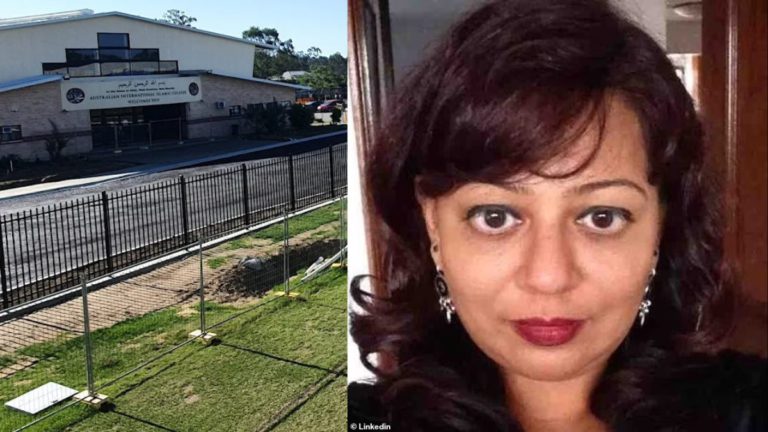
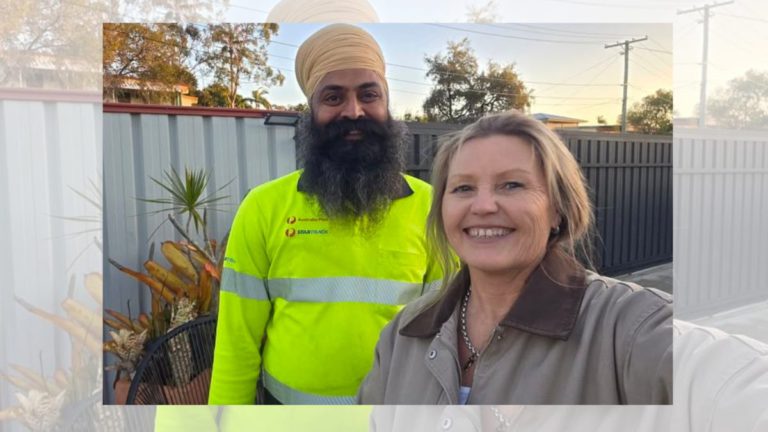
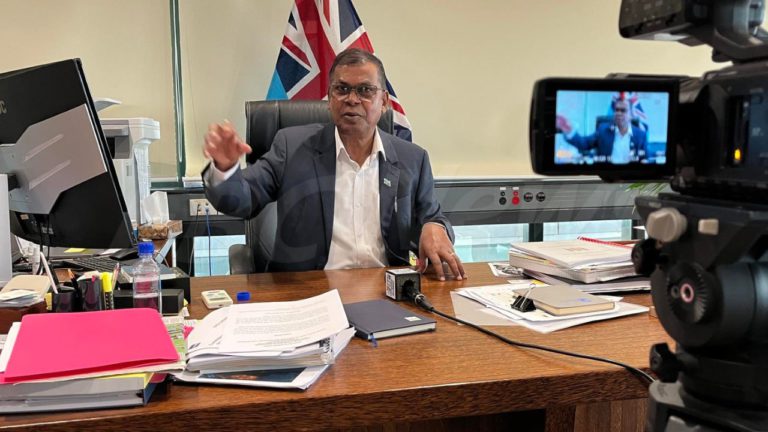
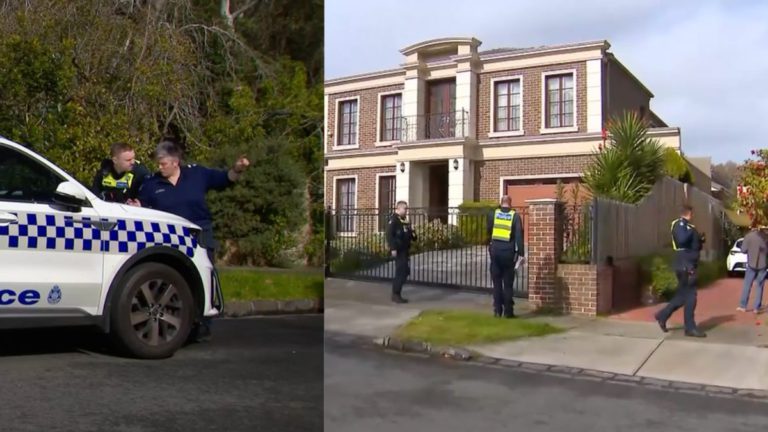
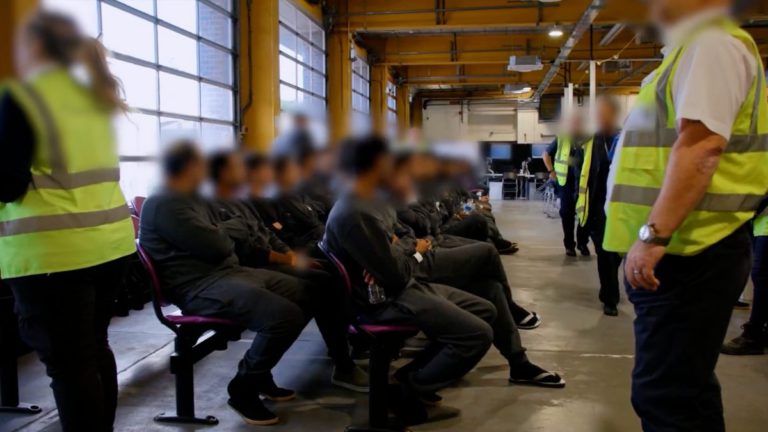
But in rulings across 2024 and 2025, Fair Work Commissioner Stephen Crawford repeatedly found her dismissal was unjust, criticising the school’s handling of the case and its reliance on falsified notes. He said it was “absurd” to treat a teacher’s raised voice as serious misconduct when dealing with disruptive students.
Evidence from pupils also showed Ms Brownson was not the only teacher who raised her voice, and others did so more frequently.
According to Daily Mail,
The Commission further found that the real motive for her dismissal stemmed from a conflict with college director Mohamed Azhari, after Ms Brownson supported a colleague who had complained about his aggressive behaviour at a school cultural event.
Commissioner Crawford ruled the disciplinary process against her was “contrived and flawed” and said Mr Azhari acted inappropriately to achieve his objectives.
“The dismissal of Ms Brownson was unjust and unreasonable,” Commissioner Crawford said.
“She was unfairly targeted … for vindictive personal reasons.”
While reinstatement at the Australian International Islamic College was deemed impractical due to a breakdown in trust, Ms Brownson was awarded the maximum compensation of $55,786.90 plus $6,415.49 in superannuation.
The commissioner said Ms Brownson is likely to find comparable employment by the 2026 school year. Her record from this decision can reassure potential employers that her conduct was appropriate.
Support our Journalism
No-nonsense journalism. No paywalls. Whether you’re in Australia, the UK, Canada, the USA, or India, you can support The Australia Today by taking a paid subscription via Patreon or donating via PayPal — and help keep honest, fearless journalism alive.
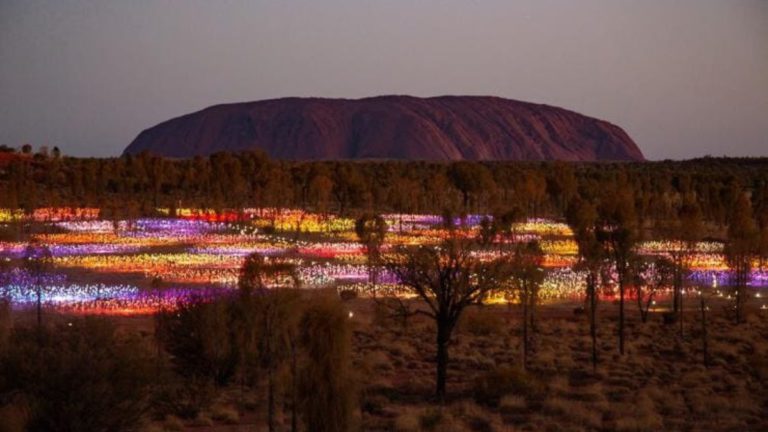
Britt and Tim Cromie, Aussie couple who share their travel adventures online, recently told followers they had no idea strict media guidelines apply at Uluru and Kata Tjuta, even for tourists posting to personal accounts.
Uluru, formerly known as Ayers Rock, is considered an iconic tourist destination by travellers but sacred by the Anangu people, and many areas of the site are off-limits to photography.
In an Instagram video, Britt said they were blind sided by a lengthy email citing 20 possible breaches linked to their YouTube upload and Instagram posts. “You have to apply for a permit, whether you’re a content creator, doing brand deals, or just posting personal socials,” she explained.
“We weren’t aware about that.”
According to rules, a photography permit at Uluru–Kata Tjuta National Park costs $20 per day for still images or $250 per day for filming, in addition to the $38 adult entry fee.
According to Parks Australia, details and features on the rock are equivalent to sacred scripture for the Anangu.
“It is inappropriate for images of sensitive sites to be viewed elsewhere, so taking any photos of these places is prohibited,” its website states.
Since climbing Uluru was permanently banned in 2019, significant parts of the rock have also been declared off-limits to photography. Fines of more than $5,000 apply.
The couple had to overhaul their Uluru YouTube video and remove several Instagram posts to avoid fines under the Environment Protection and Biodiversity Conservation Act.
While emphasising their respect for Traditional Owners, the Cromies admitted they were caught off guard by how strict and confusing the rules can be. “There’s barely any info on the ground,” Britt said.
“You see a couple of signs that say don’t take photos here, it’s sacred, so we didn’t. But did you know you can’t swipe your face with a branch? We didn’t.”
They later discovered that Kata Tjuta’s Valley of the Winds walk is a complete no-photo zone, even though signage only mentioned restrictions at two lookouts.
The pair stressed they were not criticising the restrictions but wanted to warn others. “It’s a lesson for anyone heading to Uluru,” Britt said.
“Apply for a permit early, read the guidelines, and if in doubt, put the camera away.”
In a follow-up post, she added: “This isn’t about criticism or blame, just transparency and learning. Our goal was to share honestly and help fellow travellers avoid the same mistakes we made.”
Support our Journalism
No-nonsense journalism. No paywalls. Whether you’re in Australia, the UK, Canada, the USA, or India, you can support The Australia Today by taking a paid subscription via Patreon or donating via PayPal — and help keep honest, fearless journalism alive.
Brisbane-based Indo-Fijian powerlifter Varun Lal has gone from hauling sugarcane in Ba to making headlines on the Australian powerlifting stage.
The 27-year-old, who grew up in Navau, Ba, and later moved to Australia to study civil engineering, has set a new Australian bench press record of 145kg in the 125kg Single Ply category at the 2025 CAPO National Powerlifting Championships. The previous record stood at 130kg.
Lal, who only began serious training in early 2023 under the guidance of coach Jack Welch, is now preparing to represent Australia at the World Powerlifting Championships in Durban, South Africa, this November.
“Proud to become the new Open Champion and set a national bench press record with 145kg,” Lal told RNZ after his victory.
“This one means a lot—months of discipline, sacrifice, and pure love for the sport. We’re just getting started.”
At the Brisbane championships, Lal registered 200kg in squat, 145kg in bench press, and 240kg in deadlift, cementing his place as one of Australia’s most promising new lifters.
While powerlifting was not widely known in his Fiji Indian community, Lal said it has given him a sense of belonging in Australia. “Back in Ba, football is everything. My family didn’t know much about powerlifting at first, but now they’re my biggest fans,” he said.
He credited his parents, Vimlesh Kumar and Saorjni Devi, for their unwavering support despite being thousands of kilometres away. His father, who recently recovered from a serious accident, encouraged him to continue competing for Australia.
“I know he is proud that I did something for him,” Lal said. “Their prayers keep me strong every day.”
Having debuted for Australia at the World Championships in Chicago last year, where he finished third overall in deadlift, Lal is determined to push further in Durban.
With less than three months to prepare, his focus is now on refining technique and chasing world records. “It will be a challenge, but the goal is to win gold for Australia,” he said.
Lal also hopes his journey will inspire young Pasifika athletes.
“Anyone can succeed if they put their time, focus and dedication into what they are doing.”
The 2025 WPC World Powerlifting Championships will take place in Durban, South Africa, from 4–9 November.
Support our Journalism
No-nonsense journalism. No paywalls. Whether you’re in Australia, the UK, Canada, the USA, or India, you can support The Australia Today by taking a paid subscription via Patreon or donating via PayPal — and help keep honest, fearless journalism alive.
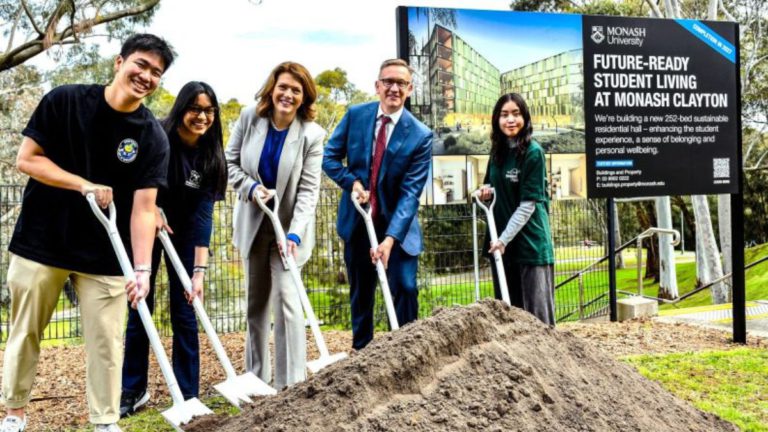
The ceremony last week was attended by the Julian Hill MP, Assistant Minister for Citizenship, Customs and Multicultural Affairs and Assistant Minister for International Education, alongside representatives from the university.
The new residence, located in the north-east precinct of the Clayton campus near College Walk and Jock Marshall Reserve, aims to enhance on-campus living and meet the growing demand for student housing.
Image: Julian Hill MP, Assistant Minister for Citizenship, Customs and Multicultural Affairs and Assistant Minister for International Education, alongside Monash University Vice-Chancellor and President Prof. Sharon Pickering (Source: Monash University)
“While saying no to High-Vis, we turned the first sod for 252 new student housing beds at Monash University!” Mr Hill said.
“Good quality accommodation is essential to ensure Australia remains a top destination for higher education. International education is Australia’s fourth largest export sector and a strategic national asset building soft power over generations.”
Monash University Vice-Chancellor and President, Prof. Sharon Pickering, described the development as a vital step in supporting students and fostering a sense of community.
“The experience we offer students at Monash goes beyond academics. This new residence will help foster connection, belonging, and personal growth.”
The residence will feature thoughtfully designed spaces to promote sustainable living, student wellbeing, and collaborative engagement.
Spanning 7,900 square metres, it will include communal kitchens, winter gardens, study zones, lounges on every floor, music and gaming rooms, mobility-accessible units, a wellness hub, and a sports court. As an all-electric building, it aligns with Monash’s sustainability and climate-conscious infrastructure goals.
Construction is scheduled to begin in late 2025, with completion expected by mid-2027. Across its Victorian campuses, Monash currently accommodates around 3,000 students and continues to work with private housing providers to expand access to high-density, student-focused apartment developments.
This new development is part of Monash’s broader Student Accommodation Strategy, which addresses rising demand while ensuring a high-quality residential experience for students from Australia and around the world.
Support our Journalism
No-nonsense journalism. No paywalls. Whether you’re in Australia, the UK, Canada, the USA, or India, you can support The Australia Today by taking a paid subscription via Patreon or donating via PayPal — and help keep honest, fearless journalism alive.
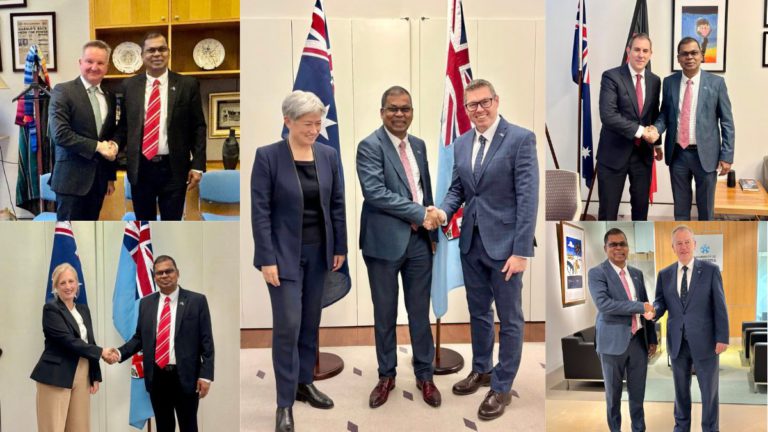
Fiji’s Deputy Prime Minister and Minister for Finance, Prof. Biman Prasad, has wrapped up a series of high-level meetings in Canberra, reinforcing Fiji’s commitment to regional integration, climate action, and educational collaboration with Australia.
Image: Fiji’s Deputy Prime Minister and Minister for Finance, Prof. Biman Prasad had a high level meeting with Australia’s Minister for Foreign Affairs, Senator Penny Wong, and Minister for Pacific Island Affairs and Defence Industry, Pat Conroy (Source: Facebook)
Prof. Prasad met with Foreign Minister Senator Penny Wong and Minister for Pacific Island Affairs Pat Conroy during his visit to Canberra. He conveyed Fiji’s appreciation for Australia’s support under the Vuvale Partnership and welcomed improvements in visa processing, which he said have strengthened people-to-people ties.
Prof. Prasad described this as “Australia’s century in the Pacific” and reiterated Fiji’s vision of the region as an “Ocean of Peace,” where development and security go hand in hand.
Looking ahead, Prof. Prasad emphasised the importance of the upcoming Fiji–Australia Security Treaty, which he said should go beyond defence to include economic security and regional integration. He also urged stronger investment in Pacific infrastructure and proposed exploring a Pacific-wide economic agreement with Australia and New Zealand to boost trade and investment.
Minister Wong welcomed Fiji’s vision and reaffirmed Australia’s commitment to supporting Fiji and the Pacific through a flexible and enduring partnership.
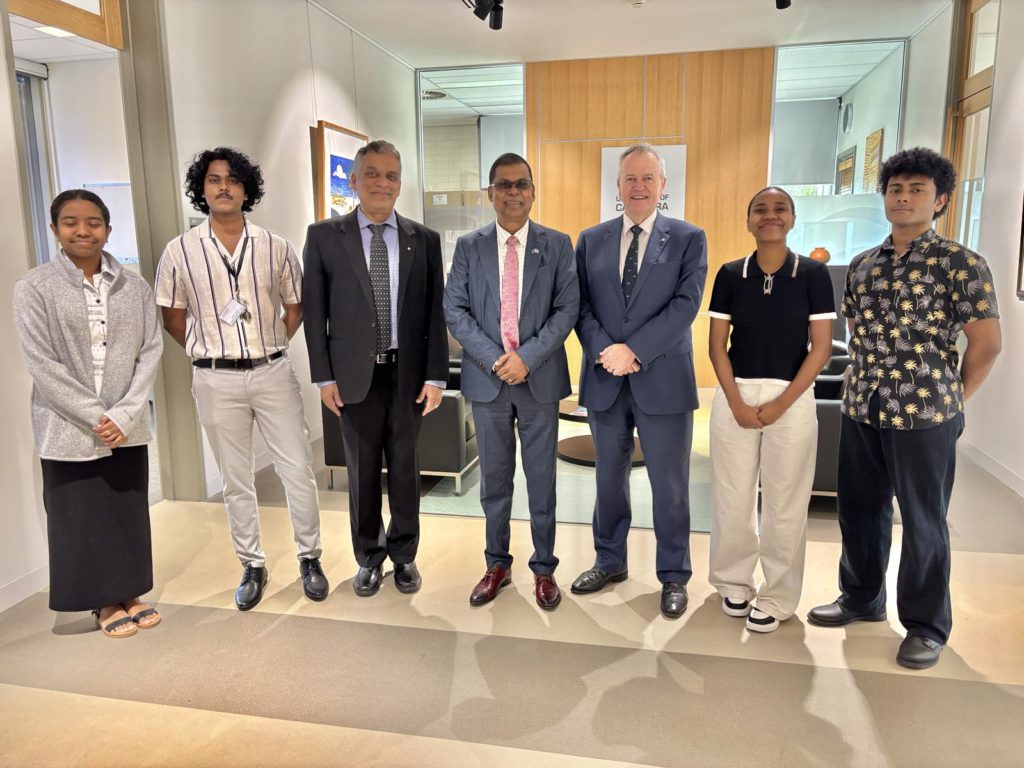
Image: Fiji’s DPM Prof. Biman Prasad met with Vice Chancellor and President Bill Shorten (Source: Facebook)
During his visit to the University of Canberra, Prof. Prasad met with Vice Chancellor and President, Bill Shorten, and engaged with Fijian students studying in Australia.
Prof. Prasad highlighted Australia’s longstanding support for Pacific education, noting that 72 Fijian students are studying in Australia through Fiji Government scholarships and 64 students under the Australia Awards program.
“Education is central to regional integration and a key driver for Fiji’s development,” Prasad said, urging students to excel in their studies and contribute positively to Fiji upon their return.
Image: Fiji’s Deputy Prime Minister and Minister for Finance, Hon. Biman Prasad, visited the University of Canberra, where he met with Vice Chancellor and President, Hon. Bill Shorten, and engaged with Fijian students currently studying at the University. (Source: Facebook)
Prof. Prasad’s visit also opened doors for future collaborations, including cost-sharing in specialised areas where Fiji lacks local expertise, support for Fiji’s National Artificial Intelligence Strategy, development of micro-credentials in AI and biomedical sciences, building digital identity systems, and expanding AI-related scholarship opportunities.
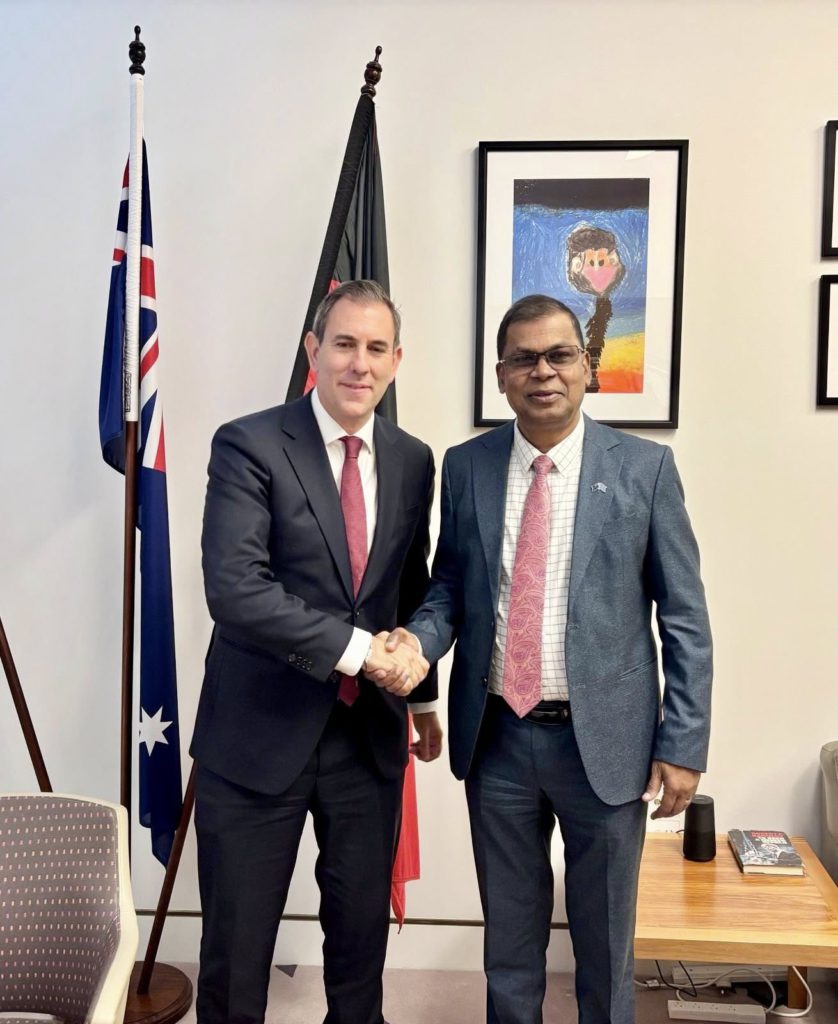
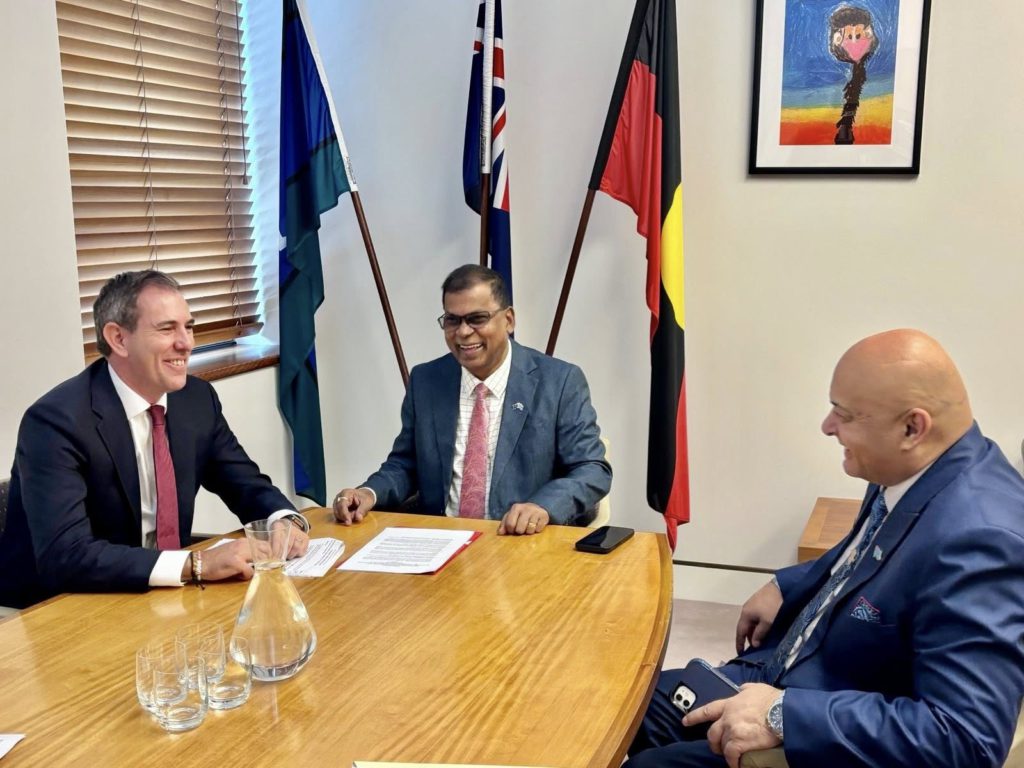
Image: Fiji’s DPM Prof. Biman Prasad met with Treasurer Dr Jim Chalmers (Source: Facebook)
DPM Prasad also held a constructive meeting with Treasurer, Dr Jim Chalmers, to discuss economic cooperation.
Prof. Prasad thanked Australia for its budget support in recent years and outlined Fiji’s National Development Plan, which prioritises investments in water, sewerage, health, and critical infrastructure.
Image: Fiji’s DPM Prof. Biman Prasad met with Treasurer Dr Jim Chalmers (Source: Facebook)
He also highlighted the importance of partnerships with Australia and the Australian Infrastructure Financing Facility for the Pacific (AIFFP) to deliver these initiatives and addressed correspondent banking challenges affecting the region.
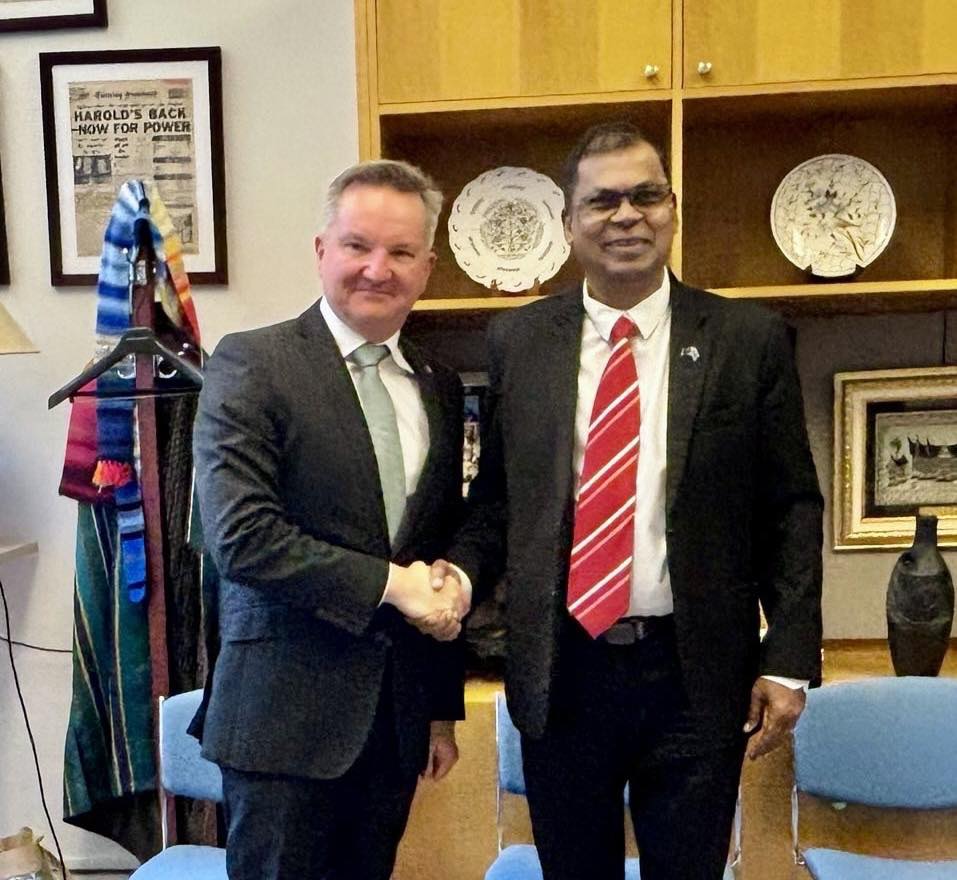
Image: Fiji’s DPM Prof. Biman Prasad met with Minister for Climate Change and Energy Chris Bowen (Source: Facebook)
On climate action, DPM Prasad reaffirmed Fiji’s support for Australia’s bid to host COP31 in 2026, emphasising that a Pacific COP would be crucial for advancing ambitious climate goals for small island developing states.
Minister for Climate Change and Energy, Chris Bowen, welcomed the discussions on operationalising the Loss and Damage Fund, advancing the Pacific Resilience Facility, and strengthening the Green Climate Fund’s impact in the Pacific.
Image: Fiji’s DPM Prof. Biman Prasad met with Senator Katy Gallagher (Source: Facebook)
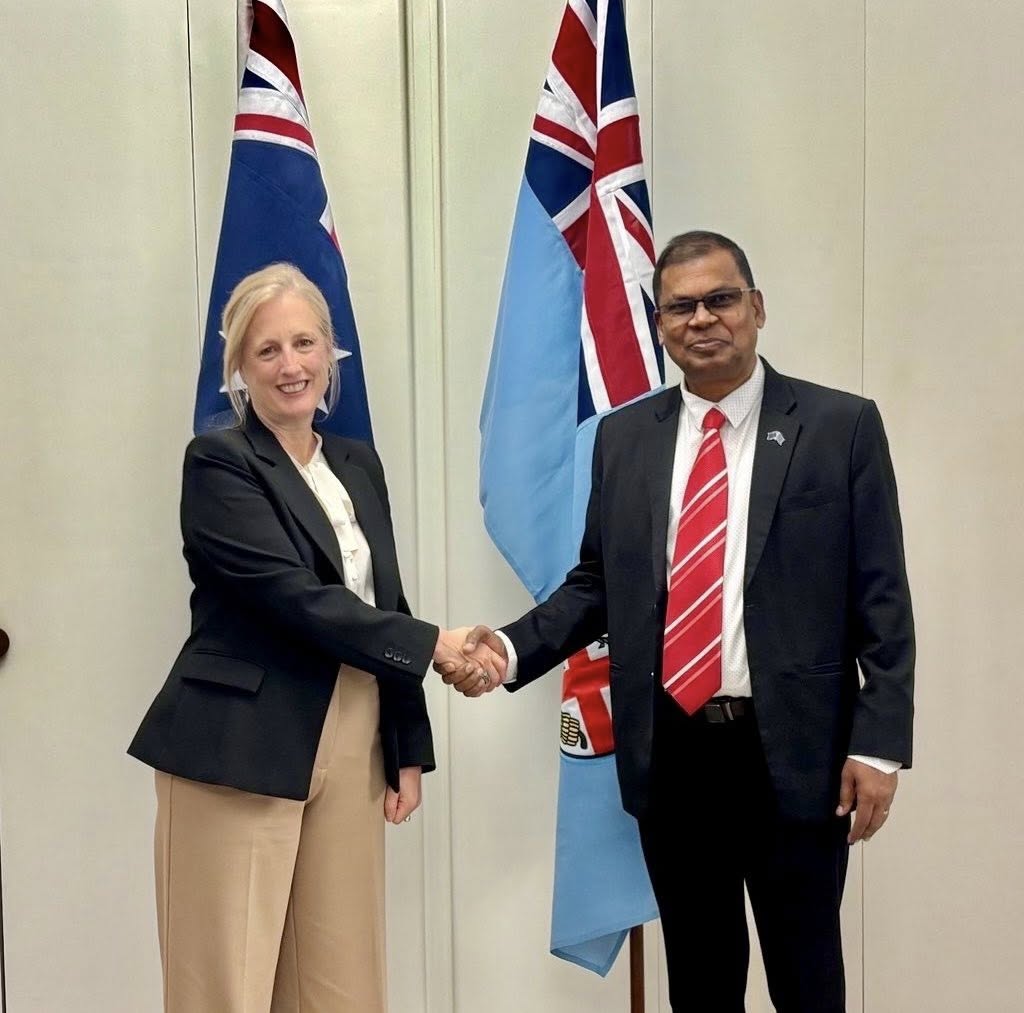
Senator Katy Gallagher added, “Australia and Fiji have shared over 40 years of diplomatic relations. Our shared-interest partnership focuses on building resilience in the Pacific, taking climate action, and ending violence against women.”
Prof. Prasad’d visit underscores the growing partnership between Fiji and Australia across education, economic development, and climate resilience, with both sides committing to deepening ties in the years ahead.
Support our Journalism
No-nonsense journalism. No paywalls. Whether you’re in Australia, the UK, Canada, the USA, or India, you can support The Australia Today by taking a paid subscription via Patreon or donating via PayPal — and help keep honest, fearless journalism alive.
The Brisbane District Court found the man guilty of six counts of advocating terrorism following a jury trial last week. He was acquitted of two additional counts.
He was also sentenced for one count of dealing in proceeds of crime worth $1000 or more, after pleading guilty to the offence in February 2025.
Authorities said the man played a senior role in a Brisbane-based extremist group promoting a religiously motivated violent ideology, with intentions to travel to Syria for hostile activities.
Between March 2019 and February 2020, he posted videos on Facebook speaking in English and Arabic, encouraging followers to provide weapons to fighters and participate in jihad. In 2013, he also provided funds to an individual who travelled from Australia to fight in Syria.
The man left Australia in June 2019 but was taken into custody by Saudi authorities in March 2021 and deported back to Australia in July 2021. The Queensland Joint Counter Terrorism Team (JCTT) arrested him upon his arrival at Sydney Airport.
AFP Assistant Commissioner Stephen Nutt said the case highlighted the tireless work of the JCTT in protecting the community. “Joint counter-terrorism teams across the country continue to identify and charge individuals who advocate for others to commit terrorism offences,” he said.
QPS Security and Counter Terrorism Command Acting Assistant Commissioner Heath Hutchings also praised the multi-agency effort. “The collective power and capabilities of all agencies in the JCTT sends a strong message about the commitment to thoroughly investigate and then put before the courts those who engage in terrorism related activity,” he said.
The man has been in custody since June 2022, after breaching his bail by removing his GPS tracking bracelet and attempting to flee the country on a one-way flight to Oman.
Support our Journalism
No-nonsense journalism. No paywalls. Whether you’re in Australia, the UK, Canada, the USA, or India, you can support The Australia Today by taking a paid subscription via Patreon or donating via PayPal — and help keep honest, fearless journalism alive.
While discussion was focused on the federal government’s economic reform roundtable last week, a significant change that will mainly affect age pensioners flew under the radar.
For the first time in five years, the government will adjust the rates it assumes pensioners earn from their savings and investments, which for many will mean a change their social security payments.
The rates have been fixed since May 2020, when they were reduced in line with the record low interest rates set during the COVID pandemic.
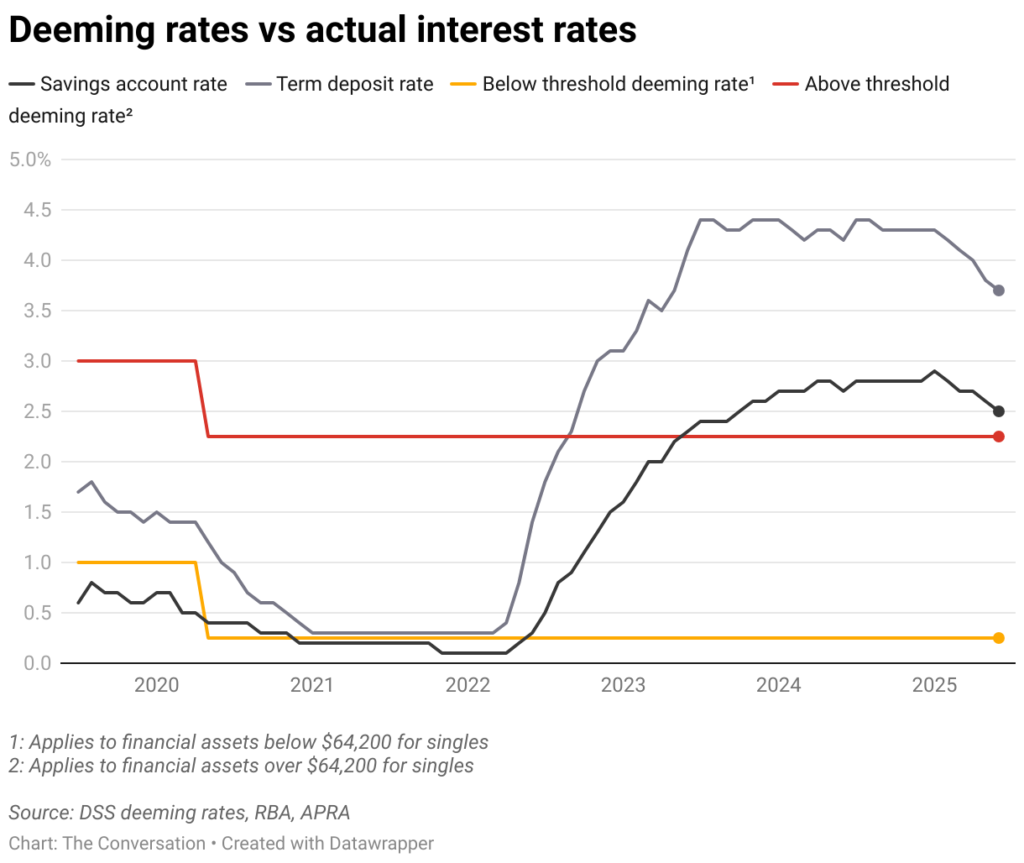
Although official interest rates were increased 13 times since 2022 – which lifted the interest rates that pensioners could actually achieve on term deposits as high as 4% or 5% – pensioners were assumed or “deemed” to be only earning 0.25% interest on savings below a threshold (currently $64,200 for single pensioners), or 2.25% interest above that threshold.
For the government, the one-size-fits-all “deeming rates” simplify the way it calculates pensions and other income support payments. The rates also simplify reporting for pensioners who do not need to declare the actual income earned on their investments.
So, what’s changing?
Low deeming rates were worth $1.8 billion
Since 2020, the widening gap between the actual income many pensioners earn on their savings and the income the government assumed them to have earned is estimated to have been worth A$1.8 billion to social security recipients.
Social Services Minister Tanya Plibersek said maintaining the gap at “artificially low” levels had shielded people on income support from high inflation during the post-COVID recovery.
The increases means the gap will narrow, raising deemed incomes, reducing some pensioners’ payments, and likewise reducing government spending on social security.
From September 20, a deeming rate of 0.75% will apply to financial assets under $64,200 for singles and $106,200 for couples. That’s up from 0.25% currently.
Assets over this amount will be deemed at a rate of 2.75%. That’s up from 2.25% currently.
Support is targeted
Australia targets income support to needier households so that payments are designed to fall as household incomes and wealth (assets) rise.
Targeting is done through “means tests”. There are two types of means tests: income tests and assets tests. The government uses deeming rates to calculate the assumed income that pensioners earn, which affects income tests.
Some pensioners, including age pensioners, hold large pots of savings as bank accounts, term deposits, retirement income products and investment funds. These savings earn interest, make capital gains (for example, as share prices rise), and pay dividends. In other words, they earn income.
How will the change work in practice?
What difference will this make to age pension payments, for example?
Around 64% of Australians over age 64 – around 4.5 million people – receive an age pension. Of those, around 25% are impacted by the income test that the deeming rates factor into.
Right now, a single, home-owning age pensioner can earn up to $218 of income each fortnight and still be eligible to receive the full pension ($1,149 including supplements).
At the current low deeming rates, this mean the pensioner can have around $285,000 of savings and investments (not including the family home) on the full pension.
If the pensioner’s savings and investments rise by $10,000, deemed income also rises and their fortnightly pension goes down by almost $5. (The assets means test starts to apply above $321,500.)
From September 20, both the income limits and deeming rules are changing.
The savings and investments that a single pensioner can hold and still get the full pension under the income means test will be lower, because the rules will treat them as earning more income.
In addition, the reductions in the pension as financial assets rise will be a bit larger. For every $10,000 in savings and investments above $210,000, the pension will be lowered by $7, since those extra savings will be deemed to earn more than under the pre-announcement rules.
To put the pension reductions into perspective, we can compare the deemed rates of interest with interest that people could actually have earned on their savings since mid-2022. The graph shows the difference between actual and deemed rates on regular bank accounts.
It’s also worth noting that many pensioners hold their financial assets in account-based pension products that earn higher rates of return than term deposits, and are tax-free to retirees over 60. Some of these superannuation retirement products have earned rates over 8% per year over the past 10 years.
The social services minister said adjustments to deeming rates are needed to ensure that the social security system is “grounded in fairness”.
From now on, the deeming rates will be set by the Australian Government Actuary – an independent advisor to the federal government – although the government retains the right to adjust deeming rates in “exceptional circumstances”.
No-nonsense journalism. No paywalls. Whether you’re in Australia, the UK, Canada, the USA, or India, you can support The Australia Today by taking a paid subscription via Patreon or donating via PayPal — and help keep honest, fearless journalism alive.
Fiji’s Prime Minister Sitiveni Rabuka has strongly condemned the stoning of a Hindu temple in Sawani, near Nausori, describing the act as “deeply disturbing.”
Rabuka urged religious and community leaders across Fiji to stand united with the Government and police in upholding the rule of law.
“Fiji is a proud multi-ethnic and multi-religious nation. To preserve harmony, we must commit to living together in peace, with mutual respect for the cultures we practice and the faiths we hold dear.”
Image: Weekly Ramayan recital at Shree Baba Ragho Dass Vishnu Temple on Koroi Road in Sawani (Source: Facebook)
The Shree Baba Ragho Dass Vishnu Temple on Koroi Road in Sawani was the target of the attack on Tuesday night, disrupting a peaceful religious gathering.
The incident occurred at approximately 9:15 pm, shortly after the temple’s weekly Ramayan recital had concluded. Attendees were listening to a speech by community social worker Mr Dharman Prasad when a volley of stones was suddenly hurled onto the temple’s roof.
According to witnesses, the assault happened in two waves, just minutes apart, before a group of youths was seen fleeing the scene.
Temple officials and community members have condemned the act as shameful and a direct attack on their place of worship.
A formal police report was lodged, and a team of four officers visited the temple last night to begin investigations. No arrests have yet been made.
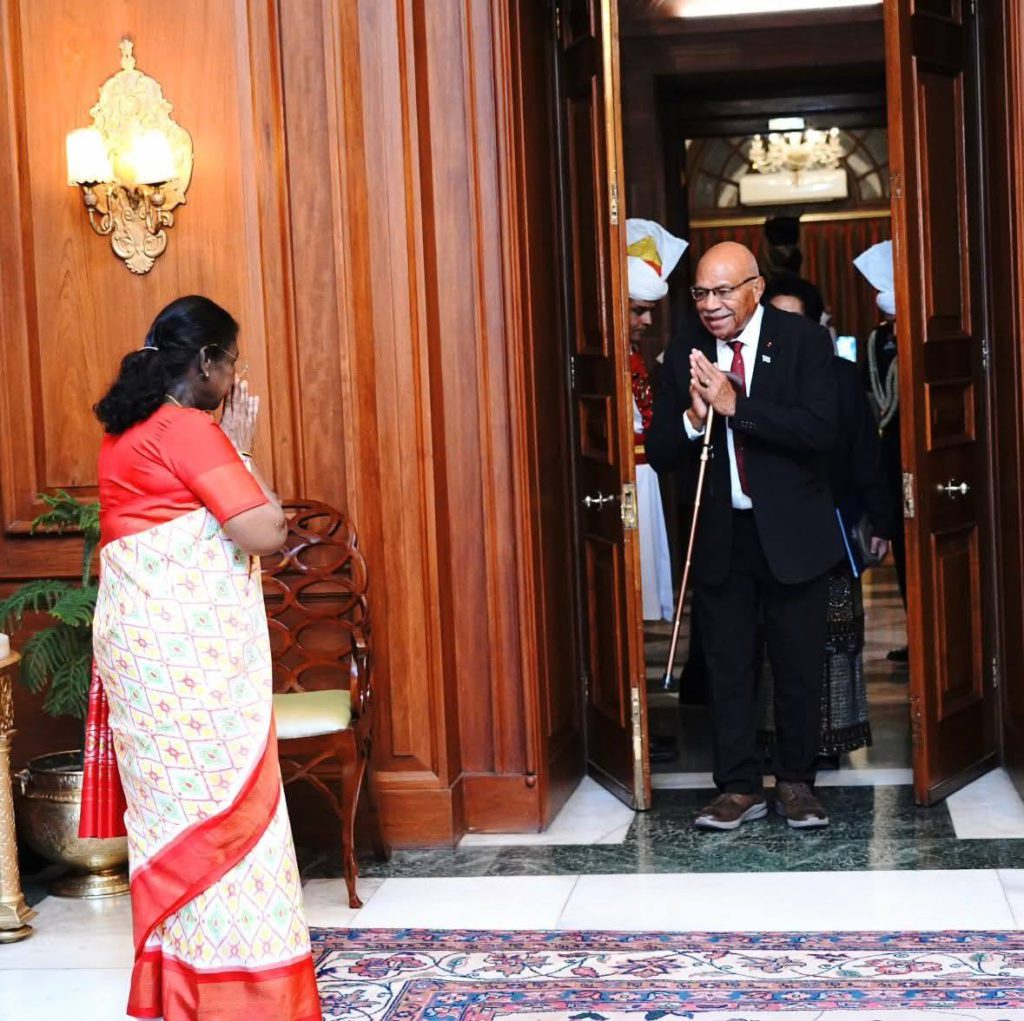
Image: Fiji’s Prime Minister Sitiveni Rabuka at Rashtapati Bhavan in India (Source: Facebook)
The Prime Minister stressed that taking the law into one’s own hands must never be an option and called on leaders to foster greater partnership, unity, and solidarity as investigations continue.
Earlier in April 2025, pages of the sacred Ramayan were torn at the Vunicuicui Shiv Mandir in Labasa—a crime condemned by the temple community as an assault on interfaith respect. Earlier this month, the Samabula temple was also vandalised, with police investigations ongoing.
Such incidents are part of a troubling pattern. In 2018, temples in Suva and Nadi were defaced with hate graffiti, idols damaged, and donation boxes stolen. In 2006, the frequency of attacks forced temples to hire private security after police admitted they could not provide 24-hour protection. As far back as 1991, firebombings and the burning of sacred texts shocked the nation and drew widespread protests.
Support our Journalism
No-nonsense journalism. No paywalls. Whether you’re in Australia, the UK, Canada, the USA, or India, you can support The Australia Today by taking a paid subscription via Patreon or donating via PayPal — and help keep honest, fearless journalism alive.
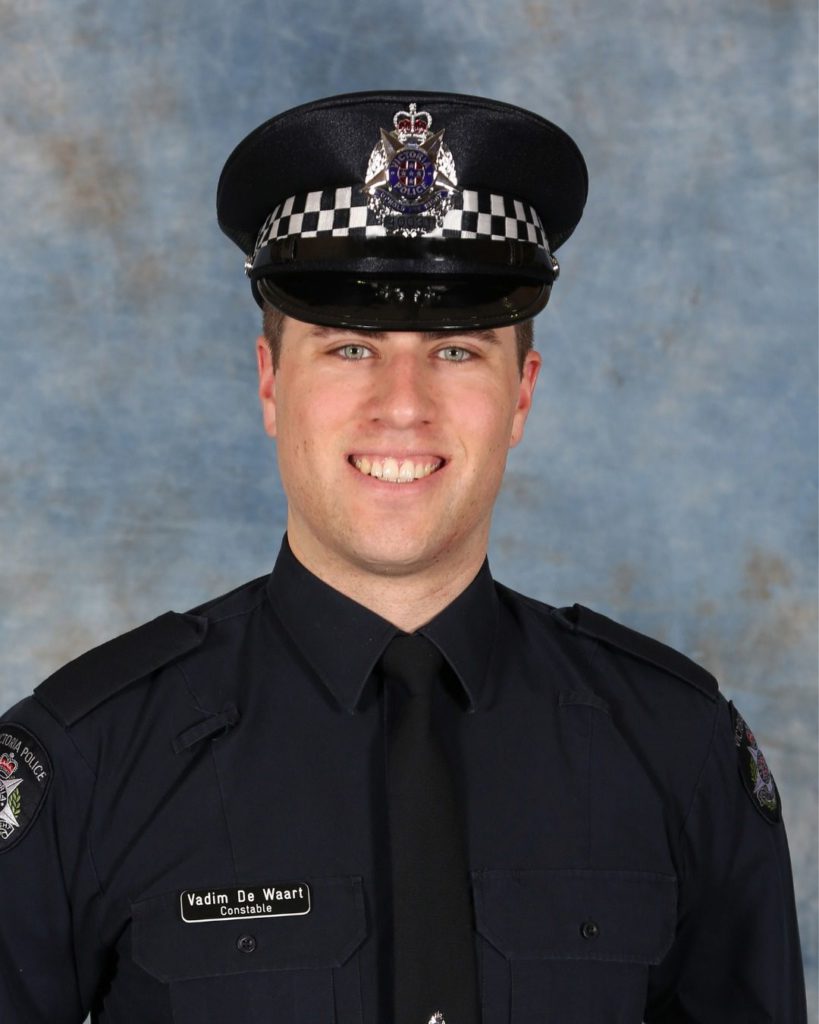
Victoria Police has formally identified the two officers tragically killed while on duty near Porepunkah as Detective Leading Senior Constable Neal Thompson (VP26182) and Senior Constable Vadim De Waart (VP44954). In an official notice, the force outlined their service histories and personal tributes, and shared condolences from Chief Commissioner Mike Bush.
Thompson joined Victoria Police in 1987, served in general duties at Collingwood, then in the Major Fraud Squad and State Crime Squad, before moving to Wangaratta CIU in 2007. Loved by colleagues for his love of the outdoors, he had been planning for retirement with his partner Lisa.
De Waart began his career in 2018 at St Kilda Police Station, later joining the Public Order Response Team in 2023 and was on temporary assignment in Wangaratta. An avid traveller fluent in French, Spanish, Flemish and English, he recently purchased his first home in Melbourne. He is survived by family in Belgium and Switzerland, and extended family in Melbourne.
The officers died during a Tuesday operation to execute a search warrant at a rural property, where the alleged gunman fled into nearby bushland. A large-scale police response continues in Victoria’s northeast as authorities warn the community to remain vigilant amid difficult terrain and winter conditions.
The suspect—identified publicly as Dezi Freeman (also known as Desmond Filby)—is believed to be heavily armed, prompting roadblocks, closures and an intensive manhunt across the Alpine region. A third officer wounded in the incident underwent surgery and is reported to be in a stable condition.
Chief Commissioner Mike Bush, who was appointed in June 2025, expressed the force’s grief and praised the courage of members who “take a risk every time they go to work to protect the Victorian community.”
Community tributes are flowing for both officers, whose service and lives have been celebrated by colleagues, local residents and leaders across Australia.
Victorian Opposition Leader Brad Battin, a former police officer, said the state now knows the identities of the two officers who laid down their lives in Porepunkah and paid tribute to Detective Leading Senior Constable Neal Thompson and Senior Constable Vadim De Waart, “tragically killed in the line of duty.”
He said both men dedicated their lives to service, with Neal giving decades of good work and Vadim serving with optimism and pride, and he offered condolences to their families, friends and colleagues.
If you have information that could assist police, contact Crime Stoppers on 1800 333 000 or submit a report online.
Support our Journalism
No-nonsense journalism. No paywalls. Whether you’re in Australia, the UK, Canada, the USA, or India, you can support The Australia Today by taking a paid subscription via Patreon or donating via PayPal — and help keep honest, fearless journalism alive.
Former defence minister Linda Reynolds has won her defamation lawsuit against ex-staffer Brittany Higgins in the WA Supreme Court, with Justice Paul Tottle awarding $315,000 in damages plus $26,109.25 interest for two defamatory publications on social media. One later post was found defamatory but protected by defences, so no damages were ordered for that publication.
Justice Tottle found that Higgins defamed Reynolds in:
a 27 January 2022 tweet (with imputations including that Reynolds pressured Higgins not to pursue a genuine sexual-assault complaint, and hypocrisy on gender equality), and
a 4 July 2023 Instagram story (including imputations of harassment and mishandling). Damages of $135,000 and $180,000 were awarded, respectively, plus interest.
A separate 20 July 2023 series of tweets was found defamatory but successfully defended as honest opinion, fair comment and qualified privilege, so no damages were ordered on that publication. The court declined to grant an injunction.
Key numbers
General damages: $315,000
Interest: $26,109.25
Total award: $341,109.25 (before costs)
The judgment also found one statement in the 4 July 2023 Instagram story breached a non-disparagement clause in Higgins’ 2022 settlement deed with the Commonwealth, but the court was not persuaded to muzzle future comment. Costs are to be determined; Reynolds is entitled to seek them.
Reynolds said the decision vindicated her, arguing the case was about false allegations of a political cover-up rather than the sexual-assault allegation itself. Higgins said she was grateful the matter had concluded, expressed sorrow for Reynolds’ hurt, and said she hoped to move forward.
The civil case followed Higgins’ public statements in 2021 and subsequent litigation involving former Liberal staffer Bruce Lehrmann. In 2024, Justice Michael Lee found, on the balance of probabilities, that Lehrmann raped Higgins in 2019 during Lehrmann’s defamation case against Network 10 and Lisa Wilkinson; Lehrmann denies the allegation and has appealed. The criminal trial in the ACT was aborted, and no retrial proceeded.
What happens next
Appeal: Higgins may appeal aspects of today’s ruling. (No notice has been filed at the time of writing.)
Costs: A separate hearing will address costs; media reporting anticipates significant liabilities on both sides.
Separate action: Reynolds is also suing the Commonwealth and law firm HWL Ebsworth over the handling of Higgins’ 2022 compensation; a case-management hearing is listed for October 8.
Support our Journalism
No-nonsense journalism. No paywalls. Whether you’re in Australia, the UK, Canada, the USA, or India, you can support The Australia Today by taking a paid subscription via Patreon or donating via PayPal — and help keep honest, fearless journalism alive.
Liberal National Party Senator for Queensland, Paul Scarr, has delivered a powerful speech in the Senate, standing in solidarity with Australians of Indian heritage after a racist pamphlet was circulated ahead of a proposed march on 31 August.
Image: Senator Paul Scarr at the India Day Fair in the Roma Street Parklands, hosted by GOPIO Queensland (Source: Facebook – Senator Paul Scarr)
“I say at this time to Australians of Indian heritage that your community is a great blessing for our beautiful country, for Australia. You belong. You are part of the Australian story, and you have brought so many wonderful things to our Australian community.”
He recalled visiting the Hindu temple in Melbourne earlier this month after it was defaced with racist graffiti, saying:
“An attack on them was an attack on me, an attack on them was an attack on our Australian values.”
Last night, I gave a speech in the Senate in solidarity with Australians of Indian heritage. I was contacted today by dear friends in the community dismayed at a pamphlet being circulated.
During my time in the Senate, I have seen Australians of Indian heritage rally to support… pic.twitter.com/q9965NtWwN
Senator Scarr praised the contributions of Indian-Australians during natural disasters and the COVID-19 pandemic, highlighting the efforts of Sikh gurdwaras, GOPIO Cairns, and the Fiji Senior Citizens Association in supporting fellow Australians in need.
“You do not deserve what is contained in this vile pamphlet. You are the human bridge between Australia and India, and so important for the future of this country,” he said, condemning those responsible as a “very small minority” trying to divide Australians.
Closing his remarks, Scarr declared:
“Light will triumph over darkness, good will triumph over evil, and knowledge will triumph over ignorance. I rise and stand in solidarity with all Australians of Indian heritage.”
Image: March for Australia posted to Facebook ahead of its nationwide rallies this weekend (Source: Facebook)
‘March for Australia’ rallies are set to take place in nine cities on 31 August, organised by an anti-immigration group calling for an end to “mass migration.” Promoters of the event claim immigration has undermined “Australia’s unity and shared values,” with their flyers warning that “big business” and political leaders are driving a so-called “Big Australia” agenda for profit at the expense of ordinary citizens.
In its campaign material, the group singled out Indian migrants, claiming more Indians had arrived in the past five years than Greeks and Italians over a century, describing migration as “replacement plain and simple.”
Migration critics, however, have condemned the movement as racist and xenophobic, saying it targets communities who have long contributed to Australia’s cultural and economic life.
According to the Department of Home Affairs, Indian-born residents are now the second-largest migrant group in Australia after those born in the United Kingdom, with numbers more than doubling in the past decade to 845,800 people — about 10 per cent of the overseas-born population.
Home Affairs Minister Tony Burke has dismissed the protests as “un-Australian,” insisting that those pushing division have no place in a modern, multicultural Australia.
Support our Journalism
No-nonsense journalism. No paywalls. Whether you’re in Australia, the UK, Canada, the USA, or India, you can support The Australia Today by taking a paid subscription via Patreon or donating via PayPal — and help keep honest, fearless journalism alive.
Indian-origin Sydney businessman Amit Sharma has been sentenced to community service after illegally obtaining the personal details of almost 18,500 participants in the National Disability Insurance Scheme (NDIS)
Sharma, 46, pleaded guilty in Parramatta District Court to three counts of soliciting protected Agency information from former National Disability Insurance Agency (NDIA) employee Leena Kumar.
On Tuesday (26 August), Sharma was sentenced to 14 months’ imprisonment, to be served under an Intensive Corrections Order, alongside 90 hours of community service and a $1,850 fine.
It is reported that the court heard Sharma, a prominent figure in Sydney’s Indian community who once hosted Bollywood red-carpet events, acquired names and addresses of participants to boost his disability service businesses.
Both Sharma and Kumar were issued lifetime bans in November 2023 under the NDIS Quality and Safeguards Commission, prohibiting them from directly or indirectly working in the disability sector or managing NDIS funds, including in a consultancy role.
“We have strengthened our safeguards, tightened access controls and expanded monitoring to ensure participant information is protected at every stage,” Mr McNaughton said.
“We have zero tolerance for any misuse of participant data and will act swiftly, like we did in this matter, against anyone who seeks to exploit participants and the Scheme.”
The case was uncovered by the Fraud Fusion Taskforce — a collaboration of 23 partner agencies led by the NDIA and Australian Federal Police.
Support our Journalism
No-nonsense journalism. No paywalls. Whether you’re in Australia, the UK, Canada, the USA, or India, you can support The Australia Today by taking a paid subscription via Patreon or donating via PayPal — and help keep honest, fearless journalism alive.
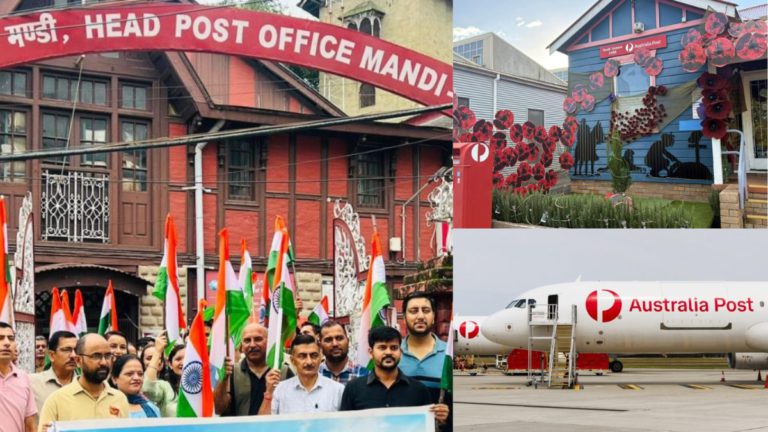
Australia Post and India’s Department of Posts have temporarily suspended most international postal services to the United States and its territory Puerto Rico in response to recent changes in US import rules and tariffs.
The suspension, effective from August 25–26, 2025, affects Australian Business Contract, MyPost Business, and Retail customers, while in India, most postal consignments to the US are also halted. In both countries, letters, documents, and gifts valued up to $US100 will continue to be accepted. Customers with parcels no longer eligible for dispatch can apply for refunds.
Image: Australia Post (Source: Instagram)
The move comes after US President Donald Trump issued Executive Order No. 14324, ending the “de minimis” exemption that allowed goods valued under $US800 ($1,233) to enter the US duty-free.
From August 29, all goods sent to the US will face customs duties, and carriers are now required to collect and remit tariffs before items arrive.
Australia Post said the decision mirrors actions taken by other international postal services facing similar challenges. Liberal MP Tim Wilson criticised the suspension, stating, “It is worrying @auspost has suspended mail to the United States. Small business relies on package deliveries and they will pay the price of another perfectly managed relationship with an ally by the Albanese government.”
India’s Department of Posts cited unresolved technical and operational issues as a key reason for the temporary suspension, noting that the US Customs and Border Protection has yet to clarify critical details, including the designation of “qualified parties” for tariff collection.
Both postal services stressed they are monitoring the situation closely and working to resume full operations as soon as possible, while keeping customers informed of developments.
Support our Journalism
No-nonsense journalism. No paywalls. Whether you’re in Australia, the UK, Canada, the USA, or India, you can support The Australia Today by taking a paid subscription via Patreon or donating via PayPal — and help keep honest, fearless journalism alive.
Florida will now turn all truck weigh stations into immigration checkpoints following the fatal big-rig crash involving Harjinder Singh, an undocumented Indian-origin driver, state officials announced Monday.
Attorney General James Uthmeier said the move is part of a new partnership between federal agencies and Florida’s agricultural inspection stations along major highways.
Speaking at a press conference in Live Oak, Uthmeier pointed to “the serious tragedy that happened down in southeast Florida” as a wake-up call.
“Someone that should never have been given a driver’s license, much less a CDL license to drive larger commercial vehicles, engaged in reckless behavior that took three lives,” Uthmeier said, surrounded by law-enforcement officials.
The expanded enforcement will include new lanes for truck pullovers in North Florida, additional technology such as advanced X-ray scanners to inspect cargo, and a fresh checkpoint near the Florida–Alabama border on Highway 231.
Last night, the Bay County Sheriff's Office arrested an illegal alien who was driving a commercial vehicle with a New Jersey driver's license that is not valid in Florida. Roberto Carlos Vergara Cervantes from Ecuador is now on an ICE hold and will be deported. pic.twitter.com/vl7ZolqZcc
— Attorney General James Uthmeier (@AGJamesUthmeier) August 25, 2025
On Sunday, another undocumented migrant was caught driving a commercial truck in Bay County, intensifying concerns. “There’s no telling how many illegal aliens are in this country driving large commercial vehicles and putting American families in a safety risk every single day,” Uthmeier warned.
The policy shift comes after Singh, who had entered the US illegally and applied for asylum, allegedly caused a fatal collision on the Florida Turnpike on 12 August. Investigators say Singh attempted an illegal U-turn in his semi-truck near Fort Pierce, slamming into a Chrysler Town & Country minivan. The van was crushed under the trailer, killing three people — two at the scene and the driver later in hospital.
It was reported that Singh fled to California after the crash but was tracked down by U.S. Marshals and extradited back to Florida. He now faces six charges, including three counts of manslaughter. Judge Lauren Sweet denied him bail on Saturday, calling him an unauthorised alien and a “substantial flight risk.” He remains in custody at St. Lucie County Jail under an ICE hold, with a deportation order issued after his prison term.
Uthmeier also said he has written to Transportation Secretary Duffy urging the suspension of California and Washington’s commercial driver’s licence programs, arguing that sanctuary states are endangering Floridians’ lives and vowing to work with the Trump administration to impose consequences.
Today, I sent a letter to @SecDuffy requesting the suspension of California's and Washington's CDL programs.
Sanctuary states are putting Floridians' lives at risk. We are ready to work with the Trump administration to ensure there are serious consequences. pic.twitter.com/Z4fctRYzE6
— Attorney General James Uthmeier (@AGJamesUthmeier) August 25, 2025
The case has drawn international attention after it emerged that Singh failed an English language test — correctly answering only two of 12 verbal questions and recognising just one of four road signs — yet was still granted a California commercial driver’s licence to operate an 18-wheeler.
His brother Harneet Singh, 25, who was a passenger in the truck at the time of the crash, was also arrested by ICE on 18 August as an undocumented migrant. He now faces removal proceedings.
The Department of Homeland Security said it will tighten coordination with the U.S. Department of Transportation to prevent illegal migrants from obtaining commercial licences in so-called sanctuary states.
Support our Journalism
No-nonsense journalism. No paywalls. Whether you’re in Australia, the UK, Canada, the USA, or India, you can support The Australia Today by taking a paid subscription via Patreon or donating via PayPal — and help keep honest, fearless journalism alive.
The Rape Gang Inquiry, chaired by Conservative MP Rupert Lowe, has identified eighty-five local authorities across the United Kingdom where the gang-based sexual exploitation of children is taking place, or has historically occurred.
Lowe, the MP for Great Yarmouth, said: “Our Rape Gang Inquiry has today released research detailing eighty-five local authorities in which the gang-based sexual exploitation of children is taking place, or has historically done so.”
“This is one of the most comprehensive exposés of the rape gang scandal to date.”
The inquiry, set up by Lowe before Prime Minister Sir Keir Starmer announced a government-backed investigation in June, has drawn on testimonies from survivors, families, and whistleblowers.
Our Rape Gang Inquiry has today released research detailing eighty-five local authorities in which the gang-based sexual exploitation of children is taking place, or has historically done so.
This is one of the most comprehensive exposes of the rape gang scandal to date. pic.twitter.com/lRRRaQeuFN
The report highlights patterns of targeted exploitation by predominantly Pakistani male gangs and alleges gross negligence from public bodies.
Elon Musk, among the most influential entrepreneurs and the wealthiest person globally, has announced that he is willing to help fund legal actions against officials accused of enabling misconduct during what he described as the “rape of Britain,” citing findings from the official government inquiry.
I would like to help fund legal actions against corrupt officials who aided and abetted the rape of Britain, per the official government inquiry.
Cases date back as far as the 1960s, with incidents uncovered in towns and cities including Aberdeen, Plymouth, Antrim, and Canterbury.
Thousands of Freedom of Information requests helped the inquiry compile what Lowe described as evidence of a “rotting scandal” that has destroyed countless lives.
Lowe criticised Labour for failing to deliver on its promise of nationwide action, saying survivors were demanding urgent justice after decades of broken commitments.
Hearings are expected to begin later this year, giving victims the chance to speak and experts the opportunity to provide recommendations for safeguarding reforms.
Support our Journalism
No-nonsense journalism. No paywalls. Whether you’re in Australia, the UK, Canada, the USA, or India, you can support The Australia Today by taking a paid subscription via Patreon or donating via PayPal — and help keep honest, fearless journalism alive.
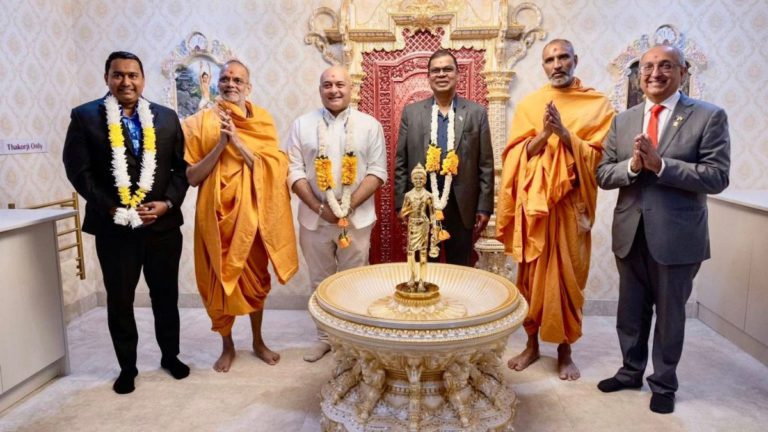
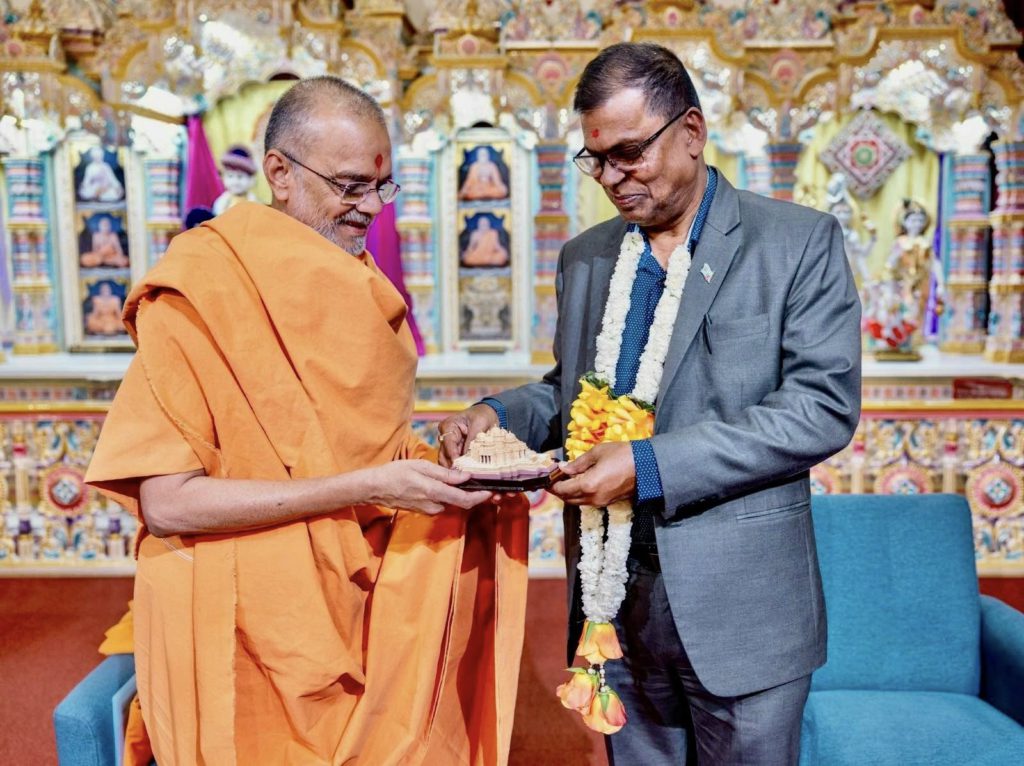
Fiji’s Deputy Prime Minister and Minister for Finance, Honourable Prof. Biman Prasad, has paid tribute to the global contributions of the BAPS Shri Swaminarayan Mandir during a visit to the temple in Canberra.
In his remarks, Prof. Prasad warmly thanked BAPS for opening a temple in Ba in 2023, describing it as “an important milestone for Fiji’s Hindu community.”
He noted that the origins of the BAPS movement in Gujarat represented the start of a new era of Hindu spirituality, one that has since spread worldwide through temples, schools, hospitals, and social initiatives serving people of all faiths.
Image Source: BAPS Canberra
The Deputy Prime Minister also highlighted the historic and ongoing contributions of the Gujarati community to Fiji’s economy, politics, and religious life. Recalling the legacy of the late A.D. Patel, he said the National Federation Party was founded by “a Gujarati leader of great vision and courage.”
Prof. Prasad reflected on Fiji’s wider spiritual history, noting that the country’s faith traditions date back to the arrival of indentured labourers in 1879, who carried sacred texts such as the Bhagavad Gita and the Quran with them. This, he said, ensured that “spiritual values remained at the heart of Fiji’s multicultural society.”
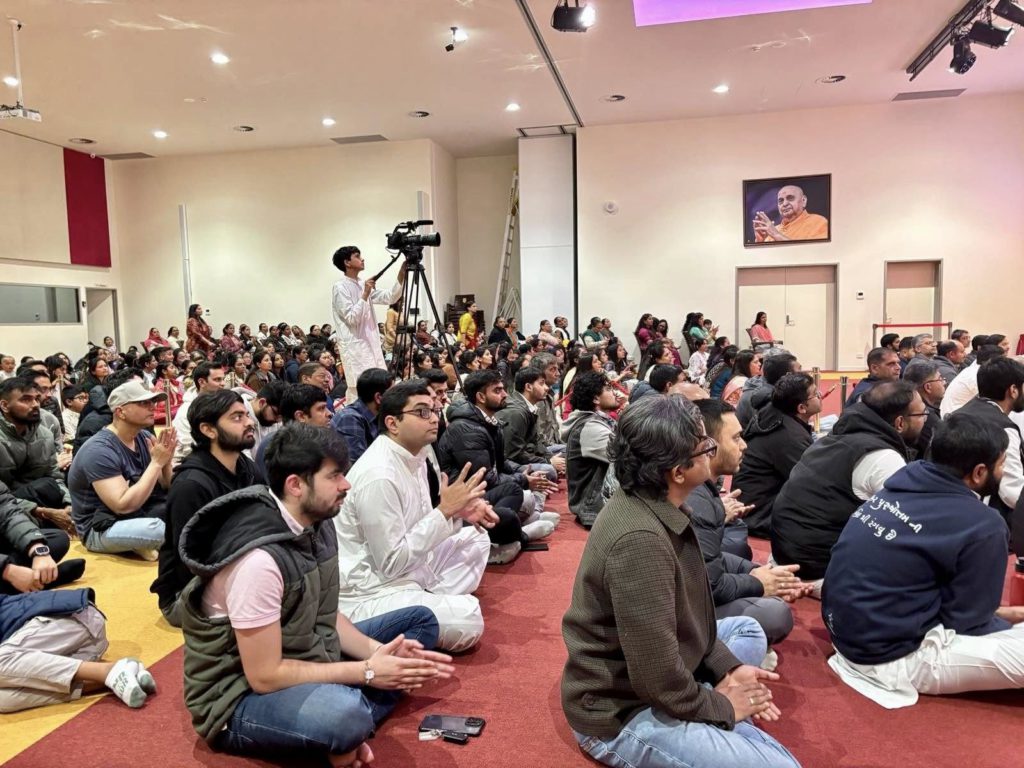
Image Source: BAPS Canberra
Congratulating the saints and devotees present, Prof. Prasad described the Mandir as
“not only a gift to Canberra, but to all who pass through it and find an opportunity to learn, reflect, and grow.”
He praised BAPS’ global mission to build spirituality, character, and human values, adding that its efforts had “enriched countless lives.”
Image Source: BAPS Canberra
Looking to the future, he welcomed plans for a similar temple in Suva, alongside a health and spiritual hospital.
“Prime Minister Sitiveni Rabuka and his Government welcome the construction of a state-of-the-art temple in Fiji modelled on Canberra’s Mandir, as it would be a source of pride, inspiration, and unity as well as attraction for Fiji,”
No-nonsense journalism. No paywalls. Whether you’re in Australia, the UK, Canada, the USA, or India, you can support The Australia Today by taking a paid subscription via Patreon or donating via PayPal — and help keep honest, fearless journalism alive.
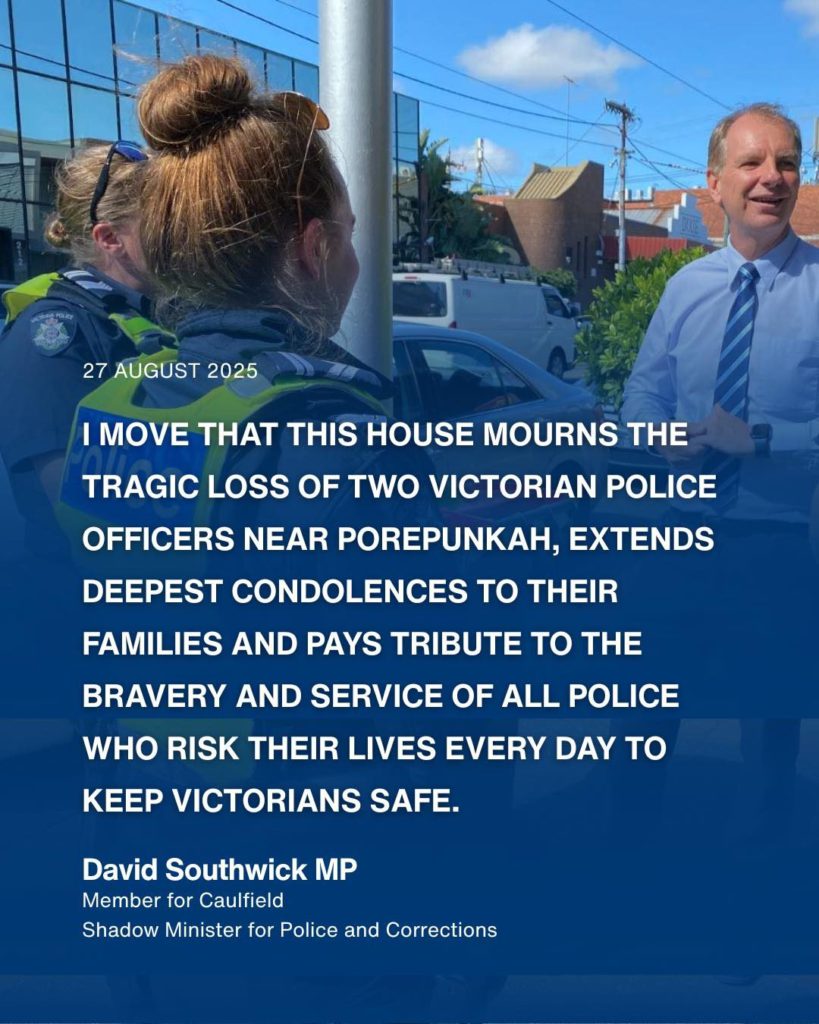
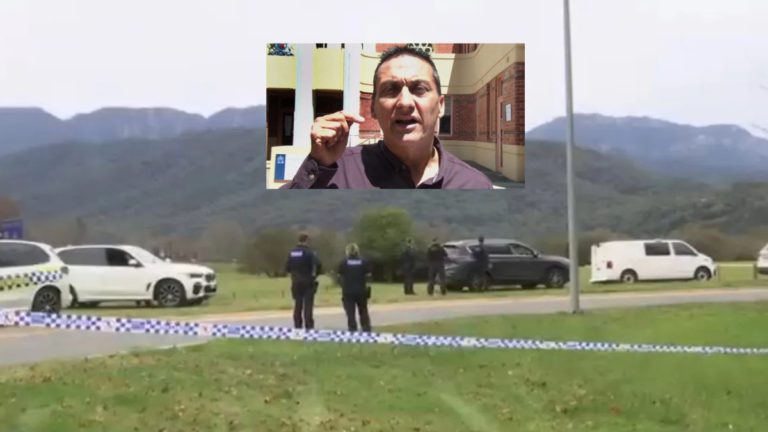
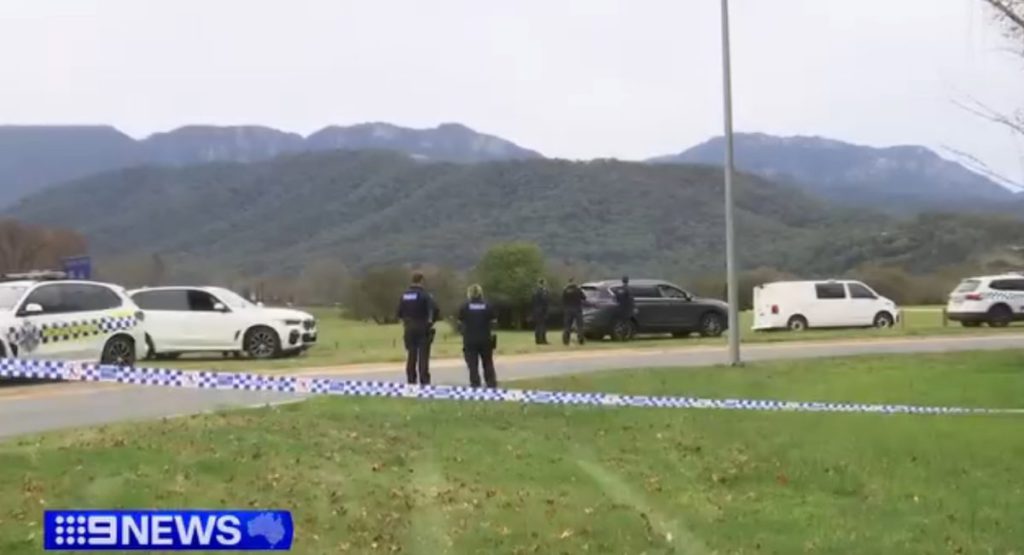
Two police officers have been shot dead and a third seriously injured during a confrontation at a rural property in Porepunkah, north-east Victoria.
Victoria Police confirmed that a 59-year-old detective and a 35-year-old senior constable were killed, while another detective was shot in the lower body and remains in hospital with serious injuries.
Two on duty police officers have been shot and killed, and a third was seriously injured, during an incident in Porepunkah this morning.
Further information about the incident will be provided once it comes to hand.
Prime Minister Anthony Albanese described the shooting as “horrific” during an interview with 7.30. “This is terrible news, and my heart goes out to the families who are grieving tonight,” Mr Albanese said.
“The men and women who wear blue, or wear a uniform, take a risk when they go to work each and every day. Two police officers have lost their life — another has been seriously injured. And police are, of course, continuing to pursue the action in order to bring the perpetrator to justice.”
All Australians are mourning with the families, loved ones and colleagues of the two Victoria Police officers who tragically lost their lives in the line of duty.
Our nation’s condolences are with everyone whose world has been shattered by this horrific shooting.
The alleged gunman, identified as 51-year-old Dezi Freeman, is believed to hold “sovereign citizen” views and remains on the run.
Victoria Police said a “significant search” is underway, with specialist units including the Special Operations Group and Critical Incident Response Team deployed.
Victoria Police urged residents in and around Porepunkah to stay indoors and warned against travelling into the area while the manhunt continues.
(Screenshot 9News)
Victoria’s Premier Jacinta Allan said the state was “deeply shaken” by the tragedy.
“Today is a tragic day for our state. Our thoughts are with the families, friends and colleagues of the police officers killed and injured in this tragedy.”
In a statement, Victoria Police said detectives from the Homicide Squad, Armed Crime Squad and Fugitive Squad will investigate. The exact circumstances of the shooting remain unclear, but authorities confirmed that ten officers were at the property on Rayner Track when the incident unfolded around 10.30 am.
The incident has sparked an outpouring of grief across the country.
“All Australians are mourning with the families, loved ones and colleagues of the two Victoria Police officers who tragically lost their lives in the line of duty,” Mr Albanese said. “Today’s terrible loss reminds us of the risks police take each day to protect us, and of the gratitude we owe them for their service.”
Support our Journalism
No-nonsense journalism. No paywalls. Whether you’re in Australia, the UK, Canada, the USA, or India, you can support The Australia Today by taking a paid subscription via Patreon or donating via PayPal — and help keep honest, fearless journalism alive.
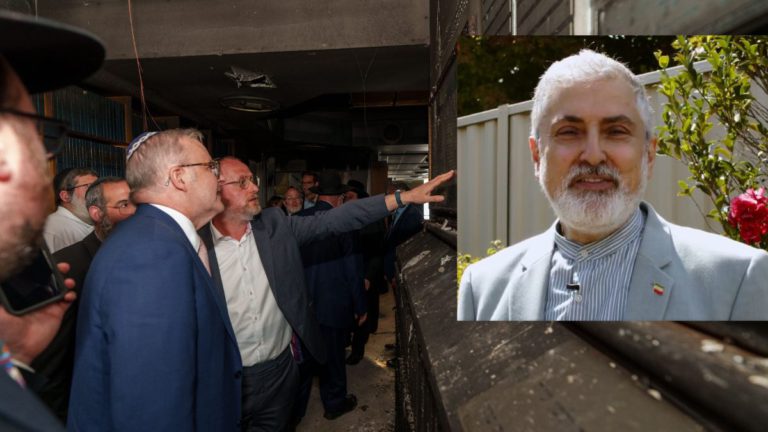
Australia has expelled Iran’s ambassador after intelligence confirmed Tehran was behind two anti-Semitic attacks targeting the Jewish community in Sydney and Melbourne.
Prime Minister Anthony Albanese announced the decision, revealing that the Australian Security Intelligence Organisation (ASIO) had gathered credible evidence that the Iranian government directed the October 2024 attack on Lewis’ Continental Kitchen in Sydney and the December firebombing of the Adass Israel Synagogue in Melbourne.
I want the community to know that we will see this synagogue rebuilt.
Appearing alongside the Prime Minister, ASIO director-general Mike Burgess said Iran was also believed to be behind further attacks.
“They put lives at risk, they terrified the community and they tore at our social fabric. Iran and its proxies literally and figuratively lit the matches and fanned the flames.”
Australia has not only expelled Ambassador Ahmad Sadeghi and three other diplomats, but also suspended operations at its embassy in Tehran, and will legislate to list Iran’s Islamic Revolutionary Guard Corps (IRGC) as a terrorist organisation.
﷽ In our talks today, I and Channel 9 TV host, Andrew Probyn exchanged Q & A on Israeli regime's unprovoked imposed war against 🇮🇷 of June 13th.
I explained how this illegal war still got further escalated through another act of aggression and Air Raids by the US in a grave… pic.twitter.com/4J3RnwFPuk
Opposition Leader Sussan Ley described the revelations as “one of the most egregious acts of foreign interference against our nation since the darkest days of the Cold War,” throwing her support behind the expulsions and the IRGC listing.
Today we have learnt of one of the most egregious acts of foreign interference against our nation since the darkest days of the Cold War.
All Australians are shocked to learn of the serious and chilling foreign interference which has been perpetrated by the Islamic Republic of…
The Zionist Federation of Australia (ZFA) said it was “deeply disturbed by revelations that Iran was involved in the planning and execution of multiple antisemitic attacks on Australian soil.” President Jeremy Leibler welcomed the government’s actions, saying they sent “a powerful and principled message that terrorism, foreign interference, and hate have no place in Australia.”
ZFA CEO Alon Cassuto added that the “infiltration and normalisation of terrorism and extremism in Australia” was “nothing but shameful,” citing images of prominent Australians and several MPs past and present standing in front of a portrait of Iran’s Supreme Leader Ayatollah Ali Khamenei.
The Zionist Federation of Australia is deeply disturbed by revelations that Iran was involved in the planning and execution of multiple antisemitic attacks on Australian soil, including the firebombing of the Adass Synagogue in the heart of Melbourne’s Jewish community last…
— Zionist Federation of Australia (@ZionistFedAus) August 26, 2025
The Australian Jewish Association (AJA) said the expulsion of Iran’s ambassador was “long overdue” and accused the Albanese Government of failing to act until Australians were placed at risk.
AJA CEO Robert Gregory said, “The Albanese Government deserves no credit for acting only after Australians were placed in danger”
“Despite repeated warnings, the government failed to act in a timely manner, leaving the Jewish community and Australia’s national security exposed.”
Mr Gregory added that the AJA, alongside the Iranian diaspora and other Jewish organisations, had for years urged the government to expel the ambassador and proscribe the Islamic Revolutionary Guard Corps (IRGC) as a terrorist organisation.
AJA Statement -Expulsion of ambassador
– Attributable to CEO Robert Gregory
The expulsion of the ambassador of the Islamic Republic of Iran is long overdue. The Albanese Government deserves no credit for acting only after Australians were placed in danger.
— Australian Jewish Association (@AustralianJA) August 26, 2025
Melbourne-based academic and former hostage of IRGC Dr Kylie Moore-Gilbert said the Iranian-Australian community and victims of the Islamic Revolutionary Guard Corps (IRGC) had long warned authorities about Tehran’s activities in Australia.
“For years now the Iranian-Australian community and other victims of the IRGC, including myself, have been literally screaming … that Iranian agents are operating brazenly and with few consequences here on Australian soil,” she said.
Dr Moore-Gilbert, who has personally petitioned successive foreign ministers to sanction IRGC officials, said the government’s decision was overdue but welcome. “Now finally, the government is taking action. I applaud Albanese and Wong for stepping up and taking decisive action against a brutal regime which has long shown itself to be an enemy of the Australian people. It’s such a shame that it’s taken them so long.”
For years now the Iranian-Australian community and other victims of the IRGC, including myself, have been literally screaming at rallies, to our local MPs, in parliamentary consultations and in reports to the national security hotline that Iranian agents are operating brazenly…
ASIO investigators are reported to have pieced together a complex web of encrypted communications, cryptocurrency flows and financial transactions spanning multiple countries.
ASIO has warned that Iran is likely to have orchestrated further operations, intensifying fears about foreign interference and antisemitism in Australia.
Support our Journalism
No-nonsense journalism. No paywalls. Whether you’re in Australia, the UK, Canada, the USA, or India, you can support The Australia Today by taking a paid subscription via Patreon or donating via PayPal — and help keep honest, fearless journalism alive.
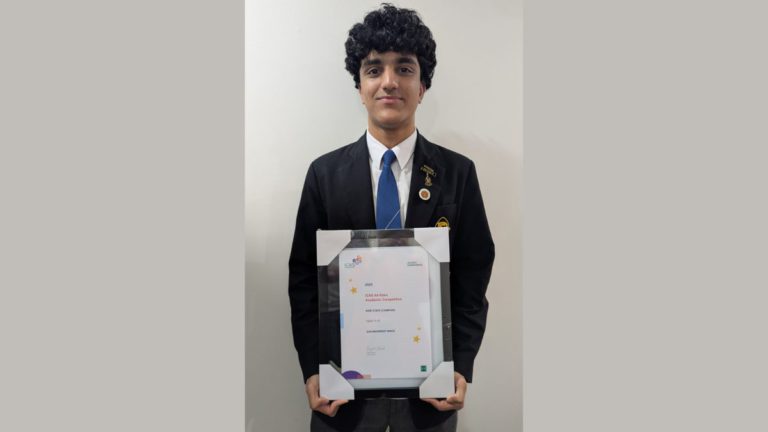
Penrith Selective High School Year 11 student, Sukhmandeep, has claimed the title of NSW Year 11–12 State Champion in the first-ever ICAS All-Stars Academic Competition.
The school said in a statement: “This remarkable achievement is a testament to Sukhmandeep’s talent, hard work, and dedication to learning. We couldn’t be prouder to celebrate this success with our school community. Well done, Sukhmandeep, a true star and an inspiration to us all!”
The ICAS All-Stars initiative builds on the long-standing tradition of ICAS by recognising the top academic achievers across the state. Winners are celebrated at a level of prestige comparable to state championships in sport, providing a platform for students to showcase their skills and gain wider recognition.
The competition features three assessment tiers matched to students’ year levels, with the Senior Assessment for Years 9 to 12. Each test runs for 60 minutes and evaluates general academic ability across multiple subjects, including English, Mathematics, Science, reasoning, general knowledge, and digital literacy, offering a comprehensive measure of student excellence.
Support our Journalism
No-nonsense journalism. No paywalls. Whether you’re in Australia, the UK, Canada, the USA, or India, you can support The Australia Today by taking a paid subscription via Patreon or donating via PayPal — and help keep honest, fearless journalism alive.
Two women of Indian heritage are set to shine on the global stage as Chandini Baljor has been crowned Miss Universe Guyana 2025, while Praveenar “Veena” Singh claimed the title of Miss Universe Thailand 2025. Both will represent their countries at the 74th Miss Universe competition in Thailand this November, a stage that unites nations through beauty, culture, and advocacy.
At just 22, Baljor is already a remarkable blend of intellect and compassion. Currently a fourth-year medical student at the University of Guyana, she is also pursuing a Bachelor’s in Public Health at Texila American University. With an Associate Degree in Natural Sciences already under her belt, she has made healthcare equity her mission.
Her path to the crown has been one of persistence and growth. After winning Miss Teen Charm Guyana 2022 and representing her country in Colombia, she went on to secure the Second Runner-Up spot in Miss Universe Guyana 2023. This year’s victory cements her place as a determined and consistent achiever.
Image: Chandini Baljor, 22-year-old fourth-year medical student at the University of Guyana, has been crowned Miss Universe Guyana 2025 (Source: Facebook)
Baljor’s achievements stretch well beyond pageantry. She has been published as a poet (Blooming Against Adversity at age 15), featured in Framed Photographer Magazine, and even reached the finals of a Lawn Tennis Summer Program in her first year of playing. Balancing academics and entrepreneurship, she launched a home baking business during medical school and later created a sustainable thrifting initiative to promote eco-conscious fashion.
Her community work is equally inspiring. While at Queen’s College, she joined the Environmental Club, Interact Club, and Hindu Society, spearheading clean-up campaigns, cultural initiatives, and awareness drives. Off-campus, she works with the Rampertop Children’s Foundation, supports youth empowerment, and celebrates her culture through dance performances.
Image: Chandini Baljor, 22-year-old fourth-year medical student at the University of Guyana, has been crowned Miss Universe Guyana 2025 (Source: Facebook)
Baljor’s advocacy focuses on universal healthcare, animal welfare, and youth empowerment. “Cleanliness breeds a clear mind,” she believes, adding that beauty is not only seen but also felt in the actions that touch lives.
Her win also highlights the contributions of the Indo-Guyanese community, who comprise about 40% of Guyana’s population. Descendants of indentured labourers brought from India between 1838 and 1917, Indo-Guyanese have played a defining role in Guyana’s cultural identity, politics, and economy.
Meanwhile in Bangkok, the Miss Universe Thailand 2025 (MUT 2025) crown went to Praveenar Singh, representing Saraburi. Fans across Thailand watched as 77 contestants competed at MGI Hall, Bravo BKK, with Singh ultimately triumphing after rounds in swimsuit, evening gown, and a challenging question-and-answer session.
The 28-year-old was born in Chiang Mai before moving to Yala, later graduating with a degree in Russian from Thammasat University. She has deep ties to India as well—granted overseas Indian citizenship in 2021, and once married to Thai-Indian businessman Hanchareon Singthakwal.
Singh’s pageant journey has been years in the making. She was second runner-up in Miss Universe Thailand 2018, rose to first runner-up in 2020, and again placed as second runner-up in 2023 before claiming her long-awaited crown this year.
Her persistence mirrors Baljor’s, as both women stand out not only for their beauty but also for their resilience, cultural pride, and sense of purpose.
As the world turns its gaze to Thailand this November, Chandini Baljor and Praveenar Singh prepare to represent Guyana and Thailand—two women whose Indian heritage and remarkable journeys embody purpose, resilience, and cultural pride. Their stories transcend traditional pageantry; they are about identity, impact, and inspiration.
Chandini brings a powerful legacy of Indo-Guyanese heritage and unwavering advocacy, while Praveenar stands out as the first winner of Indian descent to hold the Miss Universe Thailand title—a breakthrough reflecting both persistence and representation. They follow in the footsteps of iconic Indian-origin beauty queens who have proudly represented other countries on the global stage, including Priyanka Yoshikawa (Miss World Japan 2016), Kaya Chakrabortty (Miss Universe Japan 2024), Nina Davuluri (Miss America 2014), Priya Serrao and Maria Thattil (Miss Universe Australia), and Manshika Prasad (Miss Universe Fiji 2024).
Just as Sushmita Sen (1994), Lara Dutta (2000), and Harnaaz Kaur Sandhu (2021) lifted the Miss Universe crown for India—using their influence to advocate for social causes and empowerment—these diaspora icons have brought visibility, pride, and cultural richness to nations across the globe. Chandini and Praveenar now continue that legacy, shining not just as beauties but as ambassadors for diversity, intellect, and heartfelt change.
Support our Journalism
No-nonsense journalism. No paywalls. Whether you’re in Australia, the UK, Canada, the USA, or India, you can support The Australia Today by taking a paid subscription via Patreon or donating via PayPal — and help keep honest, fearless journalism alive.
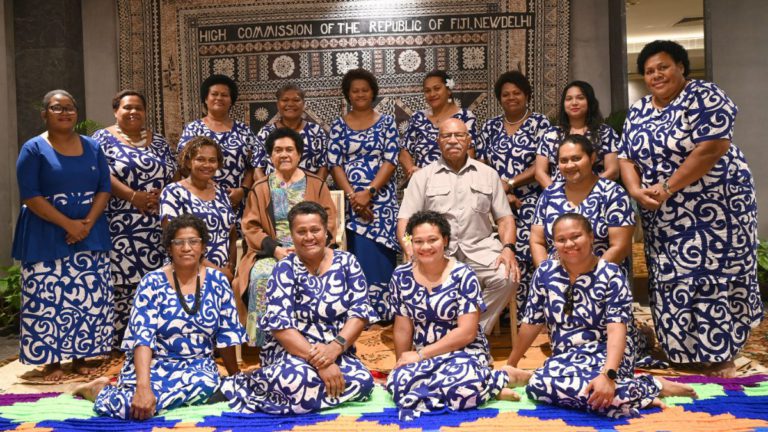
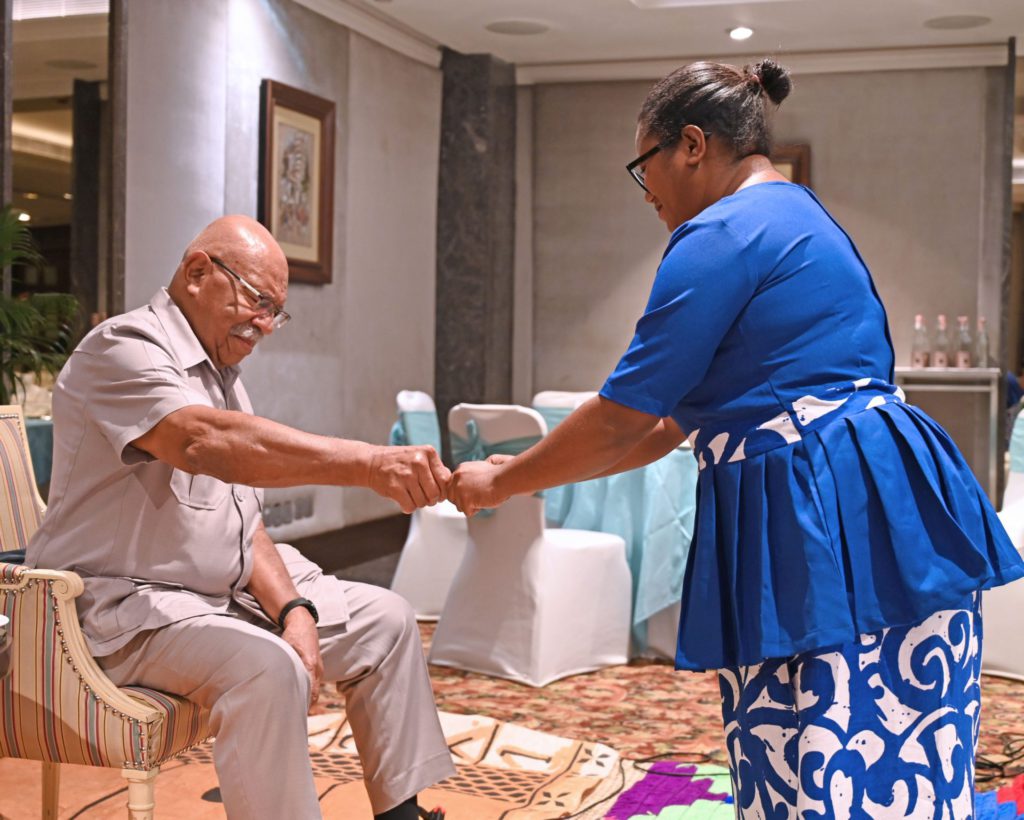
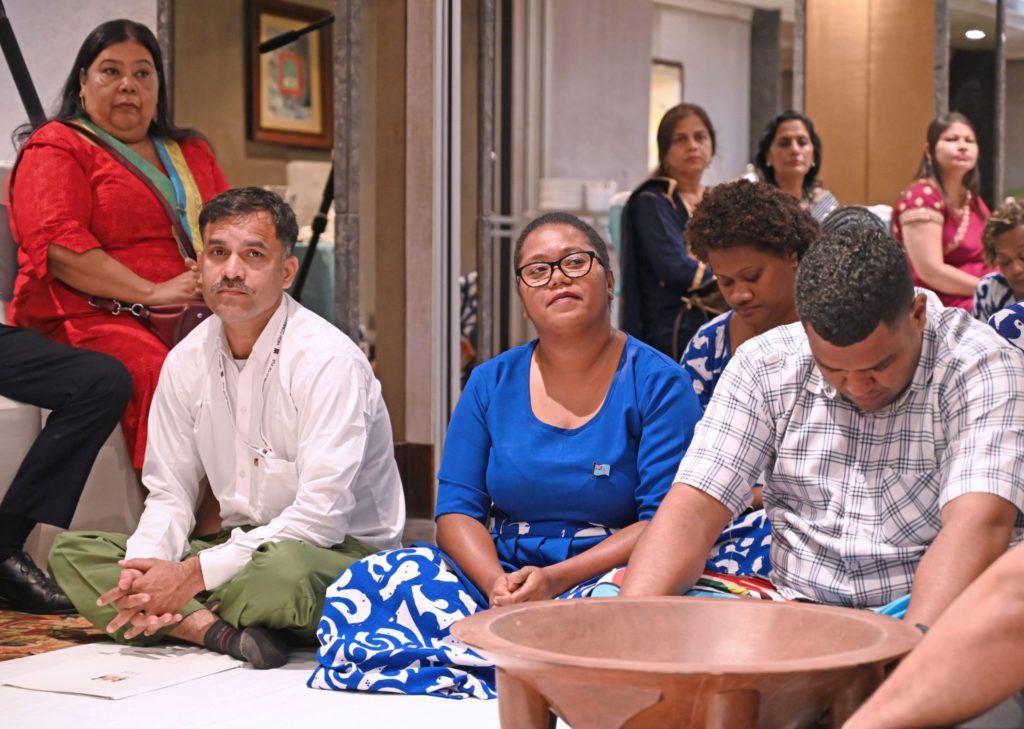
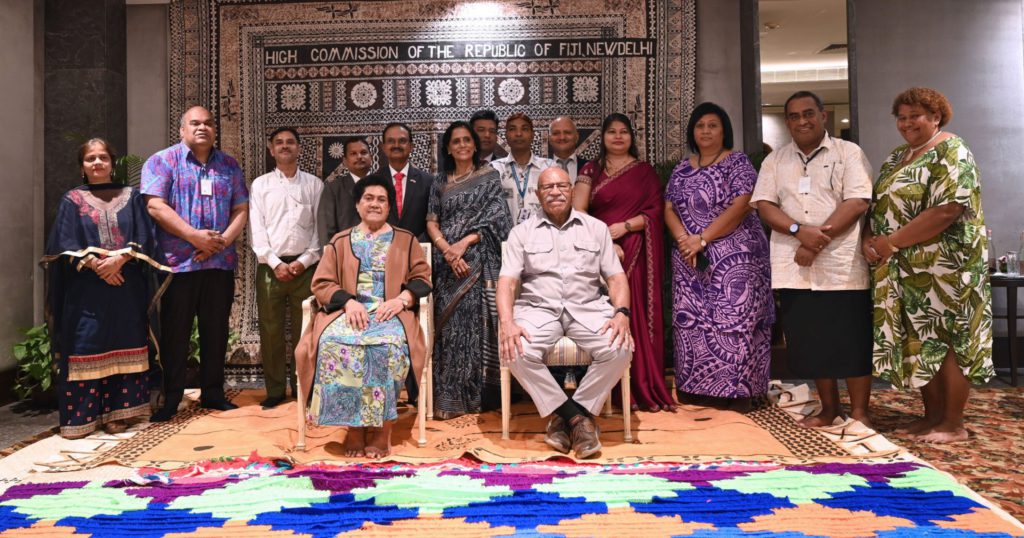
Fiji’s Prime Minister Sitiveni Rabuka has reaffirmed his government’s commitment to strengthening ties with Fijians living abroad, during a meeting with members of the Fijian community in India last night.
Image: Fiji’s Prime Minister Sitiveni Rabuka met with Fijians in India (Source: Facebook – Fiji Government)
Rabuka acknowledged the vital role overseas Fijians play in the nation’s development, highlighting their contributions through education, skills, remittances and international networks.
Image: Fiji’s Prime Minister Sitiveni Rabuka met with Fijians in India (Source: Facebook – Fiji Government)
Updating the gathering on Fiji’s progress, he outlined key initiatives in infrastructure, agriculture, education and land development. He also encouraged Fijians in India to remain proud ambassadors of their homeland while seizing opportunities available abroad.
Image: Fiji’s Prime Minister Sitiveni Rabuka met with Fijians in India (Source: Facebook – Fiji Government)
The audience included 16 primary school teachers representing Fiji at the WAGGGS Asia-Pacific Regional Conference, alongside Fijians in India for medical treatment and studies.
Image: Fiji’s Prime Minister Sitiveni Rabuka met with Fijians in India (Source: Facebook – Fiji Government)
Rabuka also reflected on the deep historical ties between the two nations, dating back to 1879 when the first indentured labourers from India arrived in Fiji. He emphasised that the Fiji–India partnership continues to grow strongly, built on shared values and areas of mutual interest.
Support our Journalism
No-nonsense journalism. No paywalls. Whether you’re in Australia, the UK, Canada, the USA, or India, you can support The Australia Today by taking a paid subscription via Patreon or donating via PayPal — and help keep honest, fearless journalism alive.
A new report from CSIRO, Australia’s national science agency, and the Insurance Council of Australia (ICA) reveals how artificial intelligence (AI) could help insurers better manage risks, improve customer experiences, and strengthen industry resilience.
Image: Dr Alexandra Bratanova, CSIRO project lead (Source: LinkedIn)
Dr Alexandra Bratanova, CSIRO project lead, said the timing of the research was critical.
“The insurance sector is facing significant pressures from climate change, rising costs, and shifting customer demands.”
Currently, around one in three Australian homes – 5.6 million properties – face bushfire risk, while one in 12 properties – 1.36 million homes – are exposed to flooding. Rising inflation, labour shortages, and higher reinsurance costs have pushed up insurance premiums and claims, placing pressure on households, especially those in high-risk areas.
Insurance claims linked to catastrophic events have jumped nearly 50 per cent in the past five years and are expected to rise by 5 per cent annually until 2050.
Dr Bratanova added, “Our research identified seven key areas to guide the responsible adoption of AI in Australia’s insurance sector, with the potential to improve affordability and customer service, and strengthen industry resilience.”
She further noted that AI could streamline operations and create more personalised customer experiences, potentially making insurance more affordable and accessible.
“However, this transformation needs to be managed responsibly, with appropriate governance frameworks and guardrails to protect consumer privacy and ensure equitable outcomes.”
The report highlights five priority AI use cases for Australian insurers: automated claims processing, fraud detection, enhanced underwriting, natural disaster impact prediction, and operational compliance.
Image: ICA CEO Andrew Hall (Source: ABC News screenshot)
ICA CEO Andrew Hall said the research offered a roadmap for the industry as it embraces AI: “This report provides a practical roadmap for insurers to harness AI responsibly while keeping customer outcomes front and centre,”
Hall added, “By implementing AI solutions effectively, we can improve affordability and enhance our natural disaster response and recovery – ultimately helping more Australians access the financial protection they need.”
“The industry is committed to prioritising safe adoption by addressing privacy and safety concerns, and AI system biases so that these technologies serve all Australians fairly.”
The report also outlines seven key areas for advancing AI adoption in insurance: delivering better insurance through AI, strengthening governance, fostering collaboration, adopting AI strategically, building AI skills, becoming a trusted partner, and innovating products to address emerging challenges.
The research was conducted with the ICA AI Working Group and draws on international frameworks and best practices for responsible AI adoption.
Support our Journalism
No-nonsense journalism. No paywalls. Whether you’re in Australia, the UK, Canada, the USA, or India, you can support The Australia Today by taking a paid subscription via Patreon or donating via PayPal — and help keep honest, fearless journalism alive.
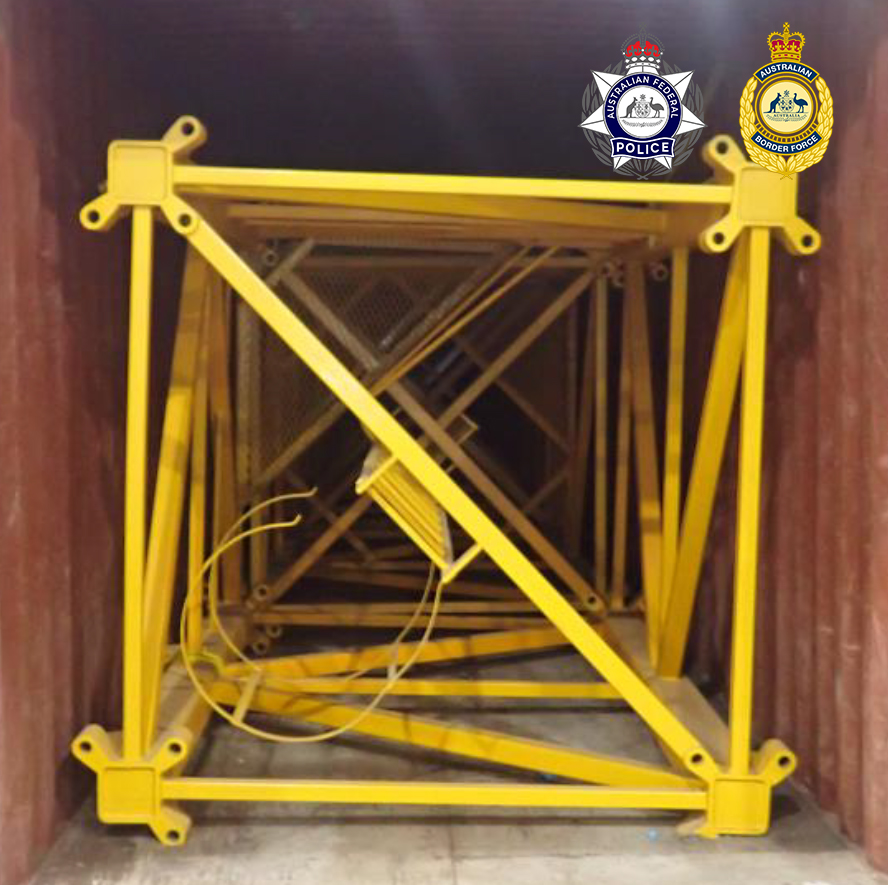
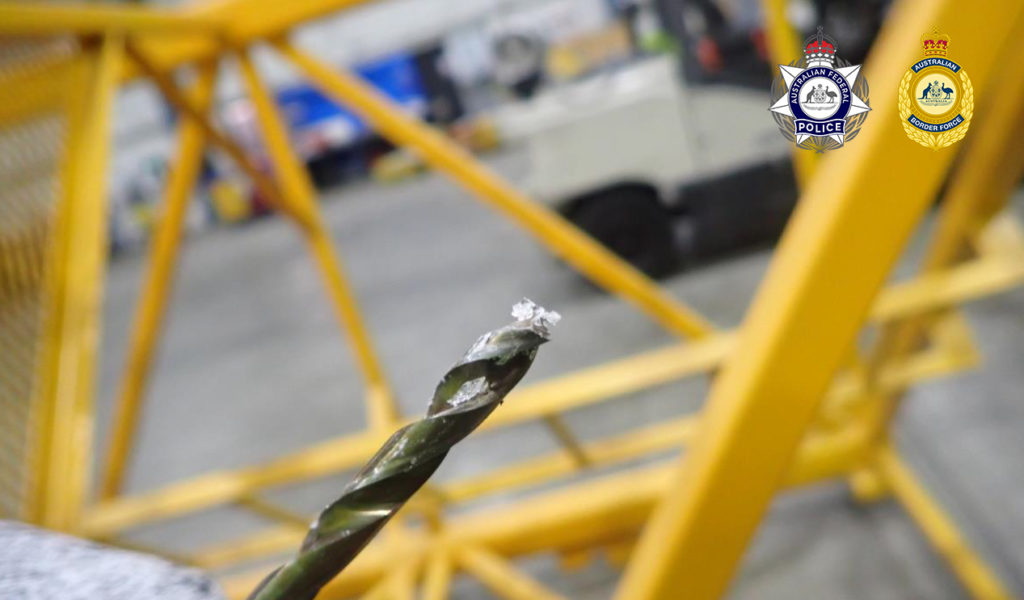
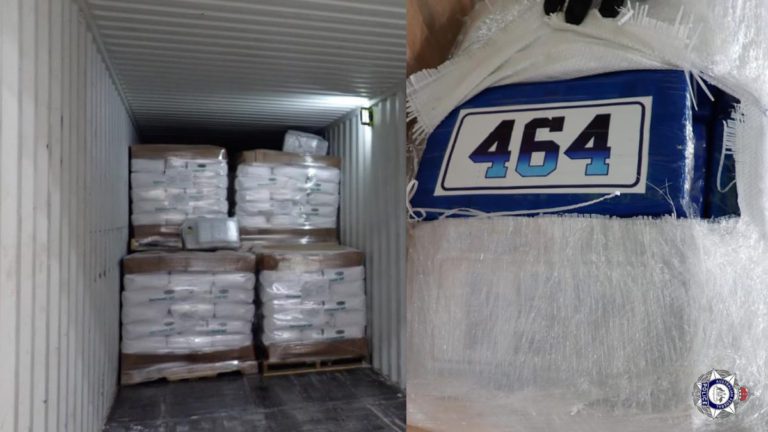
A 51-year-old Queensland man has been sentenced to 22 years in prison for collecting about 560kg of cocaine from the ocean off Western Australia’s Mid-West region in 2023. He must serve at least 13 years and 10 months before being eligible for parole.
The man is the second person to be jailed over the botched smuggling attempt, in which the cocaine was allegedly dropped from a bulk cargo carrier off Kalbarri, about 580km north of Perth. Another Queensland man, 34, received the same sentence in August 2024, with a slightly longer non-parole period of 14 years.
The pair were arrested in Kalbarri on 11 August 2023 after Australian Federal Police (AFP), Border Force, WA Police and the Department of Home Affairs tracked their movements and intercepted them unloading plastic-wrapped bundles of cocaine from a seven-metre boat into their rental accommodation.
Image: QLD men jailed over 560kg WA cocaine import plot (Source: AFP)
Forensic testing confirmed the cocaine’s purity exceeded 86 per cent, amounting to about 488kg of pure product—equivalent to 2.8 million street-level deals worth an estimated $182 million.
AFP Inspector Chris Colley said the joint operation stopped a major drug syndicate from flooding the Australian market. “This amount of cocaine could have been broken down into about 2.8 million individual deals … instead, the offenders will both be spending years in a jail cell,” he said.
Investigators found the men had been promised $300,000 for their role. The courts also ordered the forfeiture of their boat, four-wheel-drive and nearly $5000 cash.
Four other Queensland men are still before the WA courts over their alleged involvement in the trafficking plot.
Support our Journalism
No-nonsense journalism. No paywalls. Whether you’re in Australia, the UK, Canada, the USA, or India, you can support The Australia Today by taking a paid subscription via Patreon or donating via PayPal — and help keep honest, fearless journalism alive.
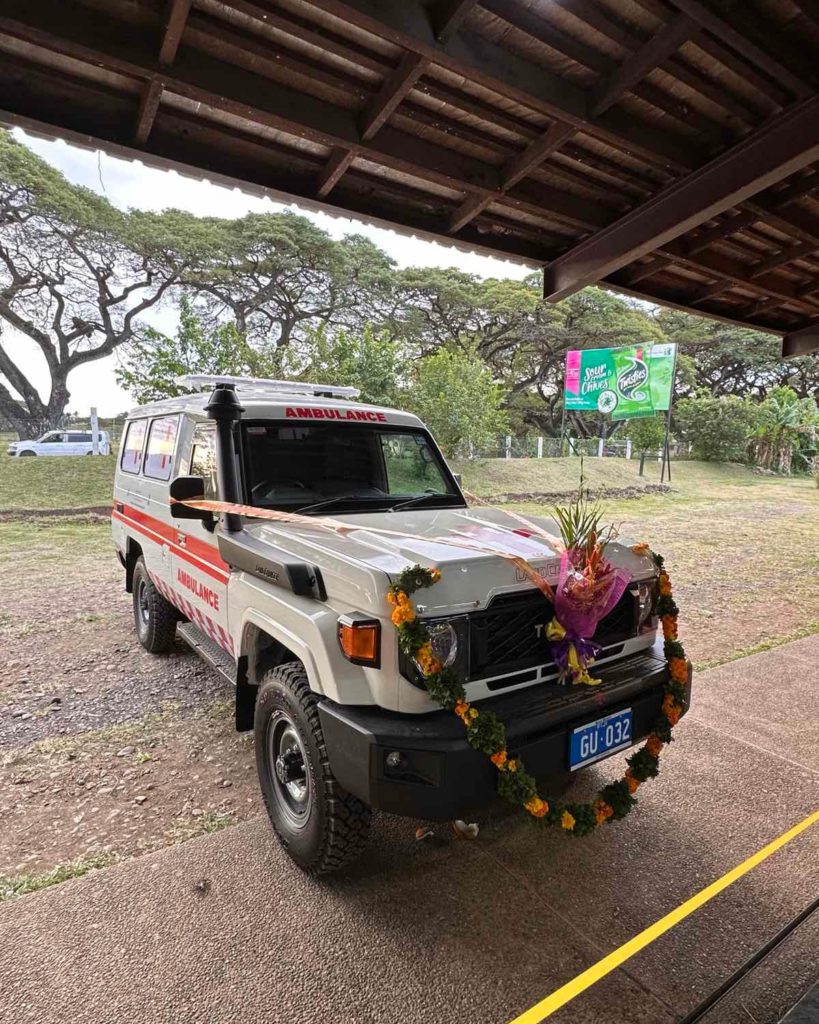
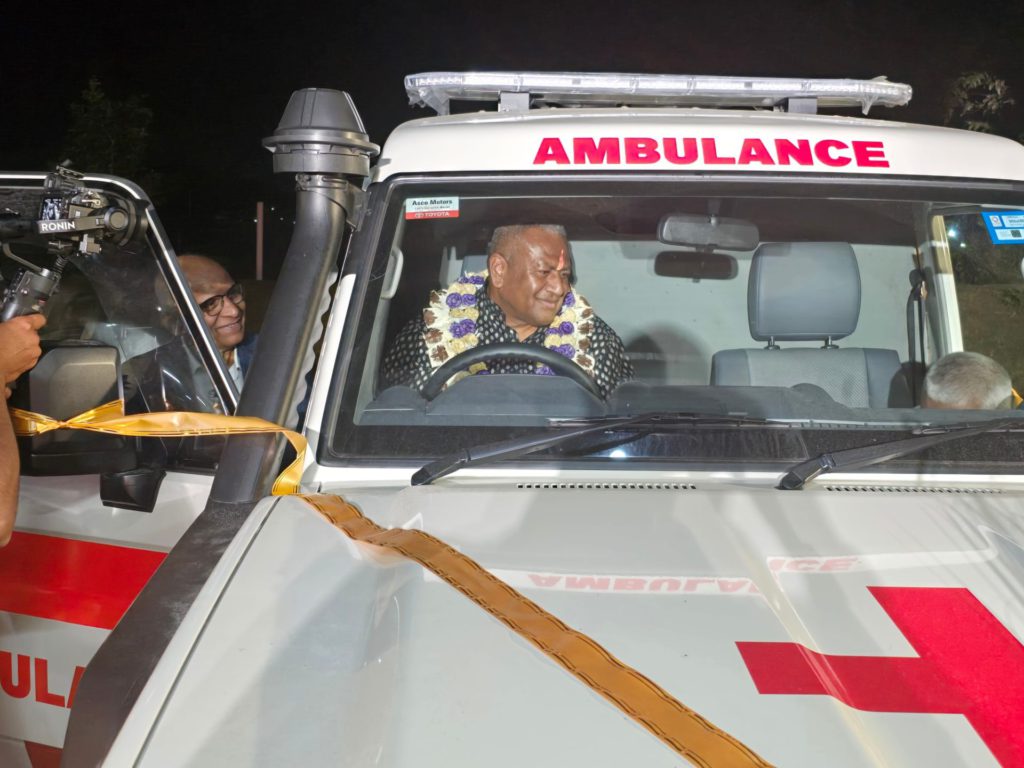
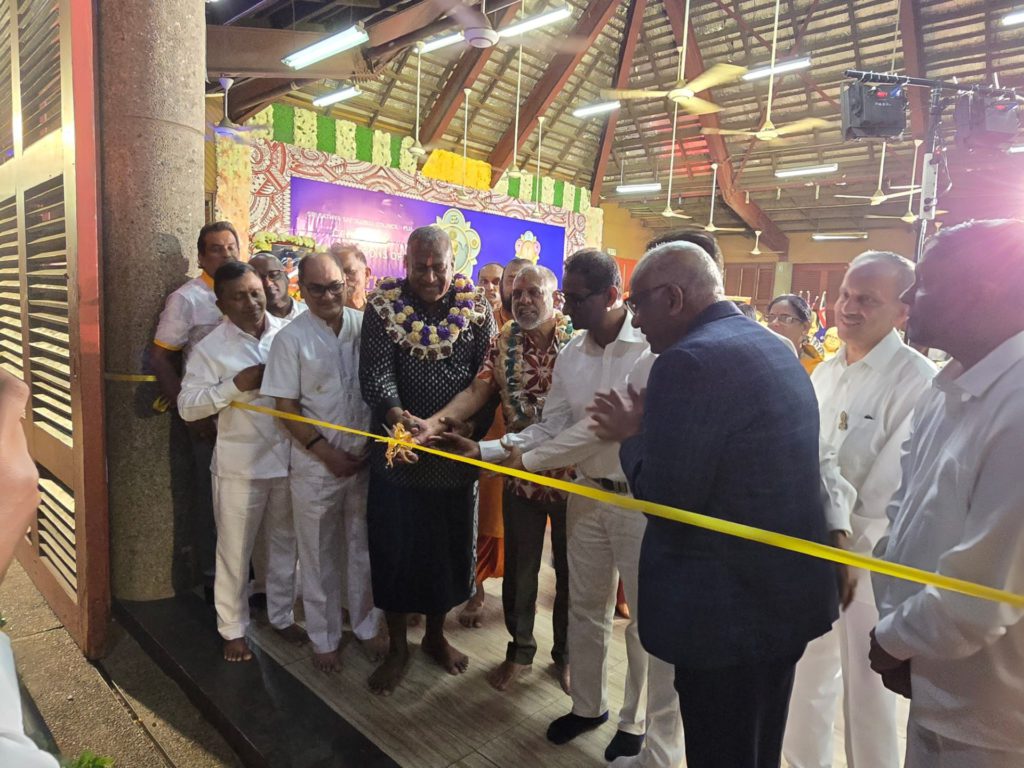
The Sri Sathya Sai Global Council marked its 100-year celebration at the Girmit Centre in Lautoka by donating a new ambulance valued at $159,000, along with $75,000 worth of medical equipment, to enhance emergency health services in Fiji’s Western Division.
Image: Sri Sathya Sai Global Council marked its 100-year celebration by donating a new ambulance valued at $159,000 (Source: Ministry of Health & Medical Services – Fiji – Facebook)
The event was attended by the Assistant Minister for Health and Medical Services, Penioni Ravunawa, and the Minister for Employment, Productivity and Workplace Relations, Agni Deo Singh.
Image: Assistant Minister Ravunawa inspecting the new ambulance valued at $159,000 (Source: Ministry of Health & Medical Services – Fiji – Facebook)
Assistant Minister Ravunawa praised the Council’s commitment to supporting underserved communities, saying their service “aligns closely with the Fiji Government’s vision of Universal Health Coverage and the constitutional right to health for every Fijian.”
Image: Sri Sathya Sai Global Council marked its 100-year celebration by donating a new ambulance valued at $159,000 (Source: Ministry of Health & Medical Services – Fiji – Facebook)
He also expressed gratitude to the international medical teams conducting free medical camps from Sigatoka to Rakiraki, adding that the Council’s devotion “truly represents love in action” and reminded everyone that “service to humanity is service to God.”
As the Council celebrates a century of service, Ravunawa called for continued collaboration to build stronger, healthier, and more resilient communities across Fiji and beyond.
Support our Journalism
No-nonsense journalism. No paywalls. Whether you’re in Australia, the UK, Canada, the USA, or India, you can support The Australia Today by taking a paid subscription via Patreon or donating via PayPal — and help keep honest, fearless journalism alive.
Australia’s job market is facing a paradox. Employers across every major sector – from construction to healthcare – report crippling skills shortages.
A key measure of skills shortages, the proportion of advertised vacancies filled, shows 30.3% of surveyed occupations were in shortage in the March quarter.
Yet there are more than two million people – hidden workers – who remain on the fringes of the labour market. They might just be a missing piece in solving Australia’s talent crisis.
This mismatch is more than a numbers problem – it’s a systemic failure to connect the untapped talent with unmet industry demand.
Businesses need to rethink rigid hiring practices, challenge outdated stereotypes and create pathways for those sidelined from work. Policymakers need to build in targeted pathways that connect their skills to shortage areas.
Who are the hidden workers?
Each month, the Australian Bureau of Statistics (ABS) releases official data on the labour force: new jobs created, the unemployment rate and other measures. But these figures don’t tell the whole story.
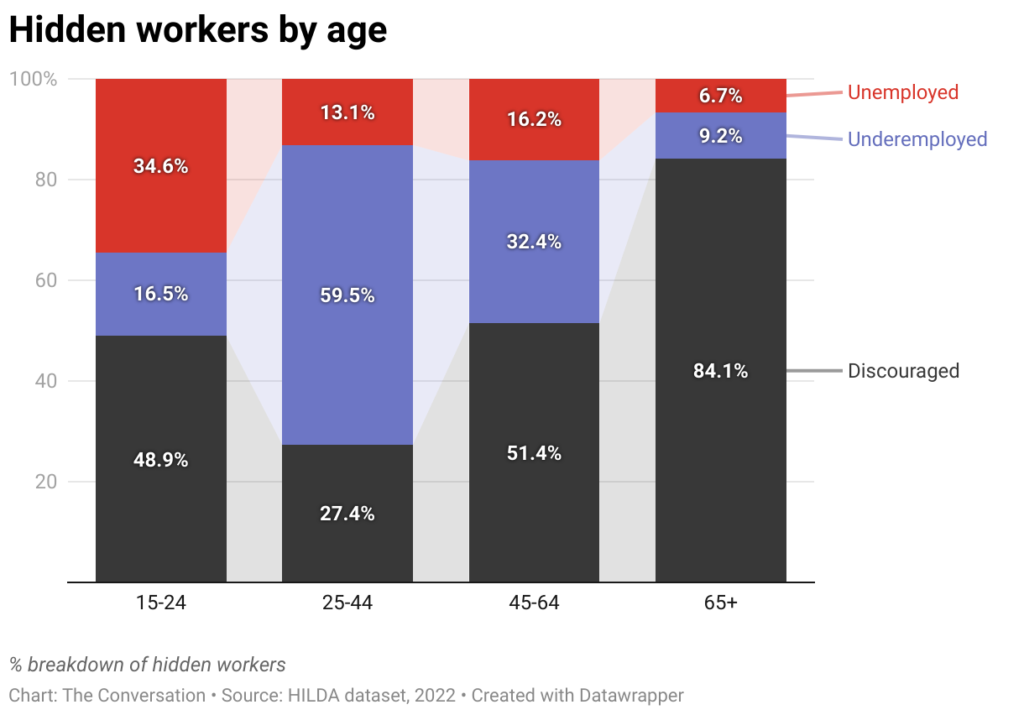
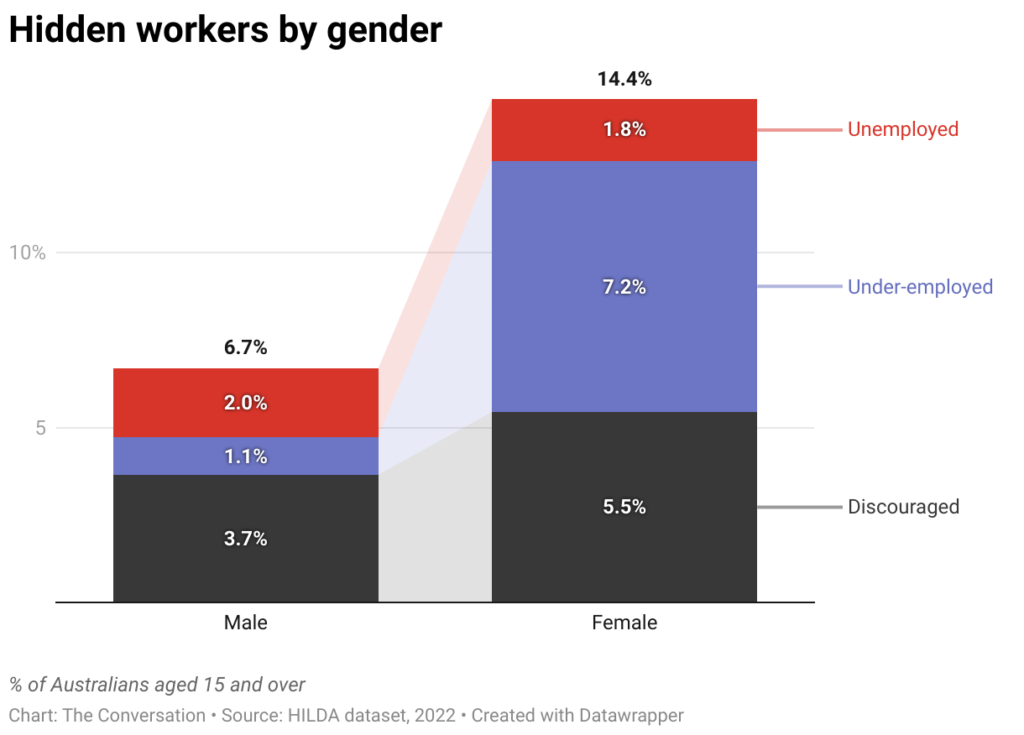
Women are predominant among the hidden workers, reflecting ongoing gendered divisions in caregiving. Half of the discouraged workers, who have given up looking for work, are over 41.
Those with lower educational attainment (below Year 12) are more likely to be discouraged or unemployed. Hidden workers often lack networks or live in disadvantaged areas.
It’s not just discouraged workers
Our research shows hidden workers make up 21.1% of Australians aged 15 and over, according to the HILDA 2022 survey data. We use broader definitions of discouraged workers and the underemployed than the ABS does, and we include people over 65. The ABS, which uses a different survey and methods, arrives at a rate of about 17%. We explain these differences in further detail below.
Discouraged workers are most common among the youngest and oldest age groups, comprising 43.17% of hidden workers. Discouraged workers are a big part of the story, but not the whole picture.
Many hidden workers are underemployed (39.1%). They are actively working, but in casual or part-time jobs that don’t give them the hours or income they need. Working parents, especially mothers, are underemployed in unstable part-time roles, juggling caregiving responsibilities.
Findings from another study which analyses the probabilities of becoming a hidden worker, confirms women’s participation in the labour market is hindered at various stages of life by the unequal sharing of childcare and other care responsibilities.
Limited local job opportunities and economic resources further widen the gender gap, particularly among those aged 45–64.
Why our research paints a fuller picture
The ABS defines “potential workers” as people who are willing and able to work, a group that includes both those classified as unemployed and those considered discouraged workers. However, the ABS publishes underemployment as a separate category. This mainly covers people employed part-time who wanted more hours, and were available.
However, in hidden worker research, underemployed workers are defined more broadly, as people who want more hours and can’t get them, without the readiness-to-start condition.
By grouping them as a category under hidden workers, we get a fuller picture of the “missing” labour that could be mobilised if structural and systemic barriers were addressed.
My research into hidden workers stems not just from academic curiosity, but from my own experience. As a newly completed PhD, a migrant woman of culturally and linguistically diverse background, and a mother of two young children, I found it challenging to navigate a labour market that didn’t fully recognise my skills, experience or potential.
Despite being “willing and able to work”, I was underemployed, unemployed and then discouraged.
Why does this matter for the economy?
Australia cannot afford to address only the visible tip of the labour market iceberg. The hidden workers in Australia are a vital yet invisible part of the workforce.
Bringing hidden workers into policy focus is not only an economic priority, but also a public health imperative. A young hidden worker may start out in insecure, low-paid jobs that limit access to good food, safe housing and adequate health care.
These early disadvantages don’t just affect the present. Over time, these disadvantages may compound, leading to chronic stress, mental health challenges and a higher risk of long-term illness. The accumulated disadvantages can lead to inequitable ageing.
To make a difference, job services, health care, housing and community support all need to work together so these challenges don’t keep them stuck. The Victorian state government has an initiative for a community council to help design better solutions.
Governments should link employment services with health and social protection systems to address compounding disadvantages. Unlocking this hidden workforce could be a game-changing step toward securing Australia’s economic resilience and strengthening its social fabric.
No-nonsense journalism. No paywalls. Whether you’re in Australia, the UK, Canada, the USA, or India, you can support The Australia Today by taking a paid subscription via Patreon or donating via PayPal — and help keep honest, fearless journalism alive.
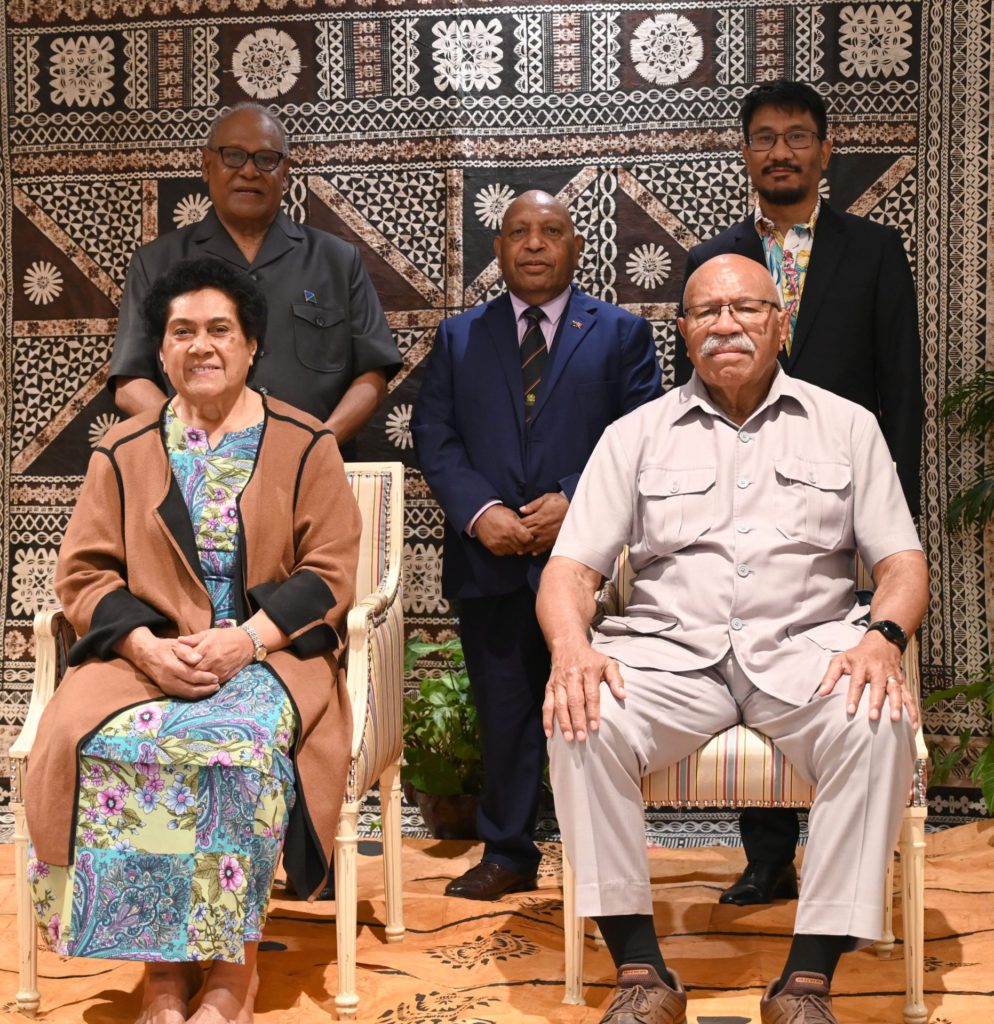
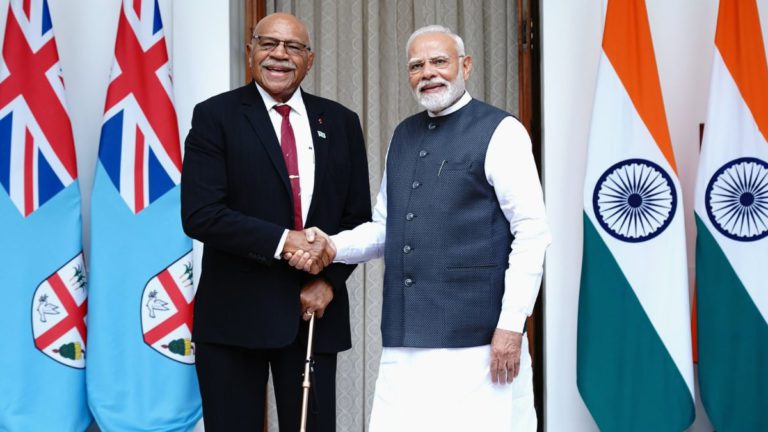
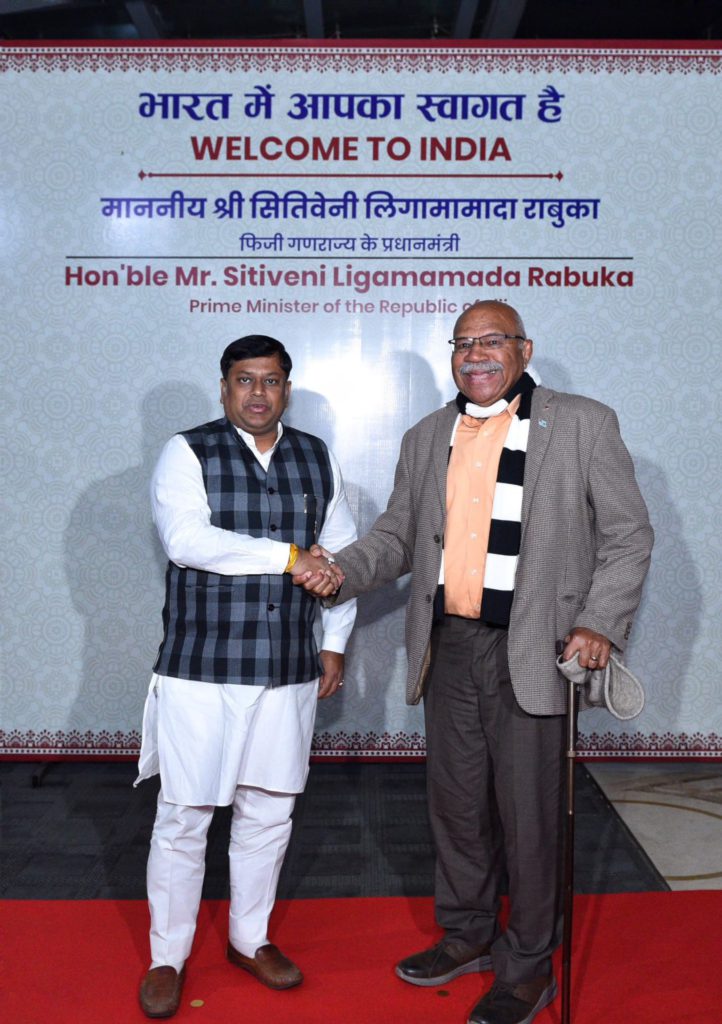
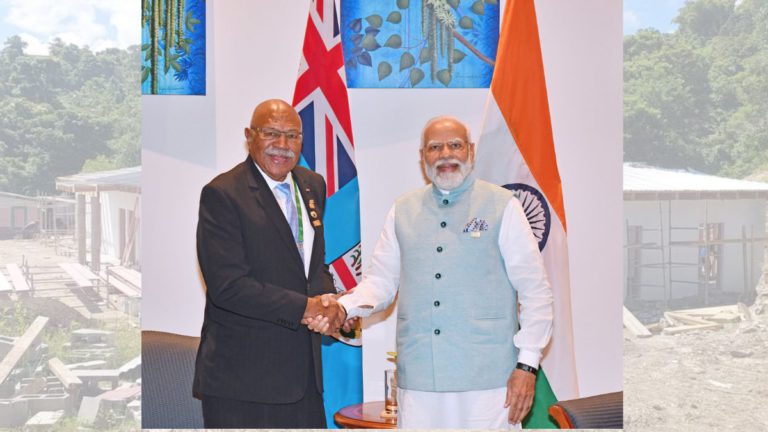
India and Fiji have signed seven agreements in New Delhi to boost cooperation in health, defence, standardisation, and capacity building.
After talks with Fijian Prime Minister Sitiveni Ligamamada Rabuka, Prime Minister Narendra Modi announced that a 100-bed super speciality hospital will be built in Suva, alongside new dialysis units, sea ambulances, and Jan Aushadhi centres to provide affordable medicines.
PM Modi said both nations had finalised an action plan to strengthen defence and security ties, including cooperation in cybersecurity and data protection. He also underlined that terrorism remains a “huge challenge for humanity.”
On climate change, PM Modi stressed that India and Fiji will continue working together through the International Solar Alliance, the Coalition for Disaster Resilient Infrastructure, and the Global Biofuels Alliance.
PM Rabuka praised the outcome of the talks, saying his delegation was “very impressed beyond expectations” with the agreements. He emphasised that Fiji “will continue to treasure the relationship with India,” noting that the people of Fiji were deeply honoured to host President Droupadi Murmu in Suva last year.
PM @narendramodi and PM @slrabuka of Fiji held wide-ranging & productive talks at Hyderabad House today.
Discussions covered strengthening 🇮🇳-🇫🇯 ties in defence, trade, healthcare, agriculture, mobility, people-to-people ties, & advancing a shared vision for a resilient and… pic.twitter.com/3JUHBQZqLs
PM Rabuka, accompanied by his wife Sulueti Rabuka and senior ministers, began his three-day visit to India on Sunday.
During his stay, he will deliver a lecture at the Indian Council of World Affairs and meet President Murmu at Rashtrapati Bhavan.
India and Fiji last reinforced momentum in bilateral ties at the 6th Foreign Office Consultations in Suva in July 2025, covering cooperation in health, education, renewable energy, climate change, and trade.
Support our Journalism
No-nonsense journalism. No paywalls. Whether you’re in Australia, the UK, Canada, the USA, or India, you can support The Australia Today by taking a paid subscription via Patreon or donating via PayPal — and help keep honest, fearless journalism alive.
The scheme will guarantee a portion of a first home buyer’s loan, allowing them to purchase with a smaller deposit and avoid paying Lenders Mortgage Insurance (LMI). Unlike previous versions, the expanded program will have no caps on places or income limits, and property price caps will be lifted in line with average house prices.
Prime Minister Anthony Albanese said the move would save first home buyers years of saving and thousands in mortgage insurance costs.
“Bringing the start date of our 5 per cent deposit scheme forward will help more Australians achieve the dream of home ownership sooner, while saving them money along the way.”
You shouldn't have to rent forever.
And we're tackling housing from every angle to make sure you don't.
For many, the changes could be game-changing. A buyer in Brisbane will be able to purchase a $1 million home with a $50,000 deposit, cutting up to 10 years off saving time and avoiding about $42,000 in LMI. In Bendigo, a buyer could secure a $600,000 property with just $30,000 down, saving up to six years of saving and around $25,000 in LMI.
Labor is blitzing the approvals backlog and we are building more homes.
It's another example of the consensus and momentum that we were able to build together at our Economic Reform Roundtable last week.#auspol#auseconpic.twitter.com/hHRJoGVbG7
With the median Australian home now costing $844,000, a 5 per cent deposit amounts to $42,200 — the same amount needed for a full 20 per cent deposit back in 2002, highlighting the generational scale of the challenge.
Housing Minister Clare O’Neil said the scheme was about levelling the playing field.
“It’s just not right that an entire generation of young Australians have been locked out of the housing market – saving for decades while paying off someone else’s mortgage. So Labor’s changing it.”
BREAKING: From 1 October, you’ll be able to buy your first home with a 5% deposit.
This will help so many people across Australia get into their own home sooner – cutting years off the time it takes to save for a deposit.
And you won’t have to pay a single dollar in lenders…
The government will also direct Housing Australia to promote a wider range of lenders, including regional and customer-owned banks, to give buyers more choice.
The 5 per cent deposit scheme is part of Labor’s $43 billion housing agenda, which also includes boosting supply and supporting renters. Since taking office in 2022, Labor says it has helped over 180,000 first home buyers into the market — 6,000 more per year on average compared to the previous Coalition government.
Support our Journalism
No-nonsense journalism. No paywalls. Whether you’re in Australia, the UK, Canada, the USA, or India, you can support The Australia Today by taking a paid subscription via Patreon or donating via PayPal — and help keep honest, fearless journalism alive.
Fiji’s Acting Prime Minister and Minister for Trade, Cooperatives, MSMEs and Communications, Manoa Kamikamica, has described the Hindu Unity Program 2025 as “more than a religious gathering,” calling it a nation-building initiative to strengthen trust, reconciliation, and social harmony.
Image: Fiji’s Acting Prime Minister and Minister for Trade, Cooperatives, MSMEs and Communications, Manoa Kamikamica (Source: Ministry of Education FIJI & Hindu Unity)Image: Minister for Education, Aseri Radrodro (Source: Ministry of Education FIJI & Hindu Unity)
Speaking at the event on Sunday (24 August 2025), Kamikamica was joined by the Minister for Education, Aseri Radrodro.
Both leaders stressed that unity, compassion, and understanding are central to building a peaceful Fiji where all communities can coexist in harmony.
Image source: Ministry of Education FIJI & Hindu Unity
Kamikamica reaffirmed government’s zero-tolerance stance on religiously motivated attacks, assuring that “any assault on faith will not be tolerated” and pledging support for dialogue, peace, and reconciliation.
The program comes amid renewed concerns over temple vandalism.
Image: Stolen Shiv Ling from Sagayam Road, Nadi Town (Photo: Supplied to FijiVillage)
Nadi Police are investigating five thefts of Hindu religious statues reported in a single day across Korociri, Nakurakura, and Sagayam Road on Friday. Items stolen included multiple statues, a clay lamp, and a Shiv Ling. Police say a team is working around the clock to track down the suspect.
Earlier in April, pages of the sacred Ramayan were torn at the Vunicuicui Shiv Mandir in Labasa—a crime condemned by the temple community as an assault on interfaith respect. Earlier this month, the Samabula temple was also vandalised, with police investigations ongoing.
Such incidents are part of a troubling pattern. In 2018, temples in Suva and Nadi were defaced with hate graffiti, idols damaged, and donation boxes stolen. In 2006, the frequency of attacks forced temples to hire private security after police admitted they could not provide 24-hour protection. As far back as 1991, firebombings and the burning of sacred texts shocked the nation and drew widespread protests.
Indo-Fijian community leaders say the Hindu Unity Program is an important step in countering this history of division. They are urging authorities not only to bring perpetrators to justice but also to reinforce Fiji’s multicultural identity through education and dialogue.
Support our Journalism
No-nonsense journalism. No paywalls. Whether you’re in Australia, the UK, Canada, the USA, or India, you can support The Australia Today by taking a paid subscription via Patreon or donating via PayPal — and help keep honest, fearless journalism alive.
Fiji Police are investigating a spate of thefts targeting Hindu religious statues in Nadi, with five incidents reported within a single day.
According to FijiVillage three reports were lodged from Korociri in Nadi on Friday afternoon, between 12 and 1pm, where five statues were stolen from three different properties. A clay lamp was also taken from one of the homes.
Earlier that morning in Nakurakura, a 33-year-old man reported the theft of three religious statues from his property.
In the fifth incident, a 35-year-old man of Sagayam Road in Nadi discovered that a statue, believed to be a Shiv Ling, had been stolen from his prayer room.
Police confirmed that a dedicated team is pursuing several leads and working around the clock to identify those responsible.
Earlier this year in April, pages of the sacred Ramayan were torn at the Vunicuicui Shiv Mandir in Labasa—a crime condemned by the temple community as an assault on interfaith respect. Earlier this month, the Samabula temple was also vandalised, with police investigations ongoing.
Such incidents are part of a troubling pattern. In 2018, temples in Suva and Nadi were defaced with hate graffiti, idols damaged, and donation boxes stolen. In 2006, the frequency of attacks forced temples to hire private security after police admitted they could not provide 24-hour protection. As far back as 1991, firebombings and the burning of sacred texts shocked the nation and drew widespread protests.
Support our Journalism
No-nonsense journalism. No paywalls. Whether you’re in Australia, the UK, Canada, the USA, or India, you can support The Australia Today by taking a paid subscription via Patreon or donating via PayPal — and help keep honest, fearless journalism alive.
Maribyrnong Mayor Pradeep Tiwari has announced he will temporarily step down from his duties while he faces court over dangerous driving charges, condemning racist abuse directed at him in response to the case.
In a statement on social media, Tiwari said he was recently made aware of the allegations, which date back to June 2023 in Flemington, before his election to council. “This matter has nothing to do with my work on council or for the period I have been on council,” he said.
“As this is a legal matter I cannot speak about it further, and with lawyers I am working to resolve it as quickly as possible,”
Tiwari added, while thanking community members for their support.
Image Source: Facebook
However, the mayor also strongly criticised racist comments that surfaced online following media coverage.
“It is very difficult for me to understand why the entire Indian community is being mocked and degraded with racist commentary. Racism has no place in our society, and I will continue to call it out whenever it appears,”
he said.
Tiwari confirmed he would remain a councillor but step back as mayor while the case is before the courts.
Deputy Mayor Bernadette Thomas will serve as Acting Mayor during his absence.
“Once this legal matter and investigation are resolved, I fully intend to return to my role and continue representing our community,”
he said.
The development comes after Tiwari was briefly the subject of an arrest warrant when he failed to appear at a Melbourne Magistrates’ Court hearing.
Magistrate John Doherty approved the police prosecution’s request for a warrant, noting,
“Amongst other things, this fellow is charged with driving in a manner that’s dangerous, a jailable offence … he needs to be at court.”
The warrant was later withdrawn after the court received information from Tiwari’s lawyers, and the case was adjourned until October.
Tiwari faces charges of alleged dangerous driving, touching a portable device while driving, and failing to ensure a passenger was not seated in the same seat as the driver.
Elected mayor in November 2024, Tiwari became the first mayor of Indian heritage in Victoria’s history. A well-known figure in Melbourne’s inner west, he previously served as president of the West Footscray Traders Association and continues to run Bharat Traders, an Indian grocery business founded by his father in 1991.
Support our Journalism
No-nonsense journalism. No paywalls. Whether you’re in Australia, the UK, Canada, the USA, or India, you can support The Australia Today by taking a paid subscription via Patreon or donating via PayPal — and help keep honest, fearless journalism alive.
A 23-year-old taxi driver has been arrested after allegedly dragging a passenger along a Klemzig street and leaving him injured in hospital.
South Australia Police say the incident occurred about 1.20am on Sunday, 10 August, after the passenger travelled from Adelaide to a Klemzig address. When the man went inside to collect cash to pay the fare, the driver withheld his mobile phone.
As the passenger returned, the driver allegedly sped off with the phone, dragging the victim about 60 metres before he let go. The man sustained injuries and was taken to hospital.
The driver, from Paralowie, was arrested on 18 August and charged with theft, causing harm by dangerous driving, leaving the scene of an accident and failing to report a collision. His taxi was impounded, and he received a 12-month instant loss of licence.
The victim’s phone was later recovered. The driver has been bailed to appear before the Adelaide Magistrates Court on 10 October.
Support our Journalism
No-nonsense journalism. No paywalls. Whether you’re in Australia, the UK, Canada, the USA, or India, you can support The Australia Today by taking a paid subscription via Patreon or donating via PayPal — and help keep honest, fearless journalism alive.
A so-called whistleblower has been arrested by Indian state Karnataka’s police after making sensational allegations against the 800-year-old Dharmasthala temple, claiming the institution was involved in rapes and murders of young girls.
The claims, which sparked national and international attention, appear to be entirely fabricated, raising questions about the verification of such serious accusations before they are amplified by the media.
In July 2025, the temple town of Dharmasthala in Karnataka was thrown into turmoil after a former sanitation worker, C.N. Chinnaiah, claimed he had buried “hundreds of bodies” between 1995 and 2014 as part of a mass murder cover-up.
The allegations, unsupported by any form of actual evidence, prompted the Karnataka government to form a Special Investigation Team (SIT). For two weeks, police combed forests, riverbanks, and ghats in search of mass graves. None were found.
Soon after, Chinnaiah was arrested, and in court he confessed that the story was fabricated. He admitted to being trained and promised protection by unidentified handlers in exchange for giving false testimony designed to malign Dharmasthala’s revered Sree Dharmasthala Manjunatheshwara Temple and its dharmadhikari, Veerendra Heggade.
“I can no longer bear the burden of memories of the murders I witnessed, the continuous death threats to bury the corpses I received, and the pain of beatings — that if I did not bury those corpses, I would be buried alongside them.”
Locally, however, the temple issued a statement on 20 July highlighting its openness to scrutiny and grounding its response in faith and ethics. “Truth and belief form the foundation of a society’s ethics and values,” said its official spokesperson.
“We sincerely hope and strongly urge the SIT to conduct a thorough and impartial investigation and bring the true facts to light.”
The SIT’s inquiry so far suggests that the allegations were false and fabricated. Seventeen of the 18 alleged grave sites showed nothing; the remains at one site were linked to a recent suicide of a male. Chinnaiah’s theatrics—including presenting a skull he could not trace—collapsed under scrutiny.
But by then, the damage was done. For weeks, unverified claims were amplified globally, painting a narrative that maligned Dharmasthala.
The case raises wider concerns about how narratives travel. Fabricated or unverified claims involving Hindus or Hindu institutions often gain disproportionate international traction, while proven crimes in India involving non-Hindus rarely receive the same intensity of media coverage.
Even as subsequent developments confirm the allegations were a hoax, Indian diaspora community members in Australia have expressed despair that the ABC has neither corrected nor withdrawn the original story filed by its South Asia bureau chief. They argue this lack of accountability reflects a troubling pattern in how negative stories about India often take precedence in Australian coverage. More broadly, it underscores a challenge in international reporting: once unverified claims are amplified by a trusted outlet, they can shape global perceptions long after being disproven.
Support our Journalism
No-nonsense journalism. No paywalls. Whether you’re in Australia, the UK, Canada, the USA, or India, you can support The Australia Today by taking a paid subscription via Patreon or donating via PayPal — and help keep honest, fearless journalism alive.
Fijian Prime Minister Sitiveni Rabuka, who is on his first state visit to India since taking office, met with India’s ruling Bharatiya Janata Party (BJP) president, JP Nadda, in New Delhi as part of the party’s “Know BJP” initiative.
Nadda welcomed PM Rabuka and highlighted the historic and civilisational bonds between India and Fiji, strengthened by the Indian diaspora that makes up nearly one-third of Fiji’s population.
“Looking forward to deepening our partnership for the mutual benefit of both nations,” Nadda posted following the meeting.
Image: Fijian Prime Minister Sitiveni Rabuka met with India’s ruling Bharatiya Janata Party (BJP) president, JP Nadda, in New Delhi (Source: Facebook – JP Nadda)
Further, the discussions centred on strengthening party-to-party relations, highlighting the BJP’s ideology, organisational framework, and its role in shaping India’s development journey. Both leaders also held detailed talks on enhancing cooperation in the healthcare sector.
Vijay Chauthaiwale, In-Charge of the BJP’s Foreign Affairs Department, who was also present at the meeting, said: “Shri Nadda ji highlighted the Bharatiya Janata Party’s organisational reach and its structured outreach to engage overseas political parties. He proposed delegation exchanges between the BJP and the People’s Alliance of Fiji.”
Image: Fijian Prime Minister Sitiveni Rabuka met with Vijay Chauthaiwale, In-Charge of the BJP’s Foreign Affairs Department, in New Delhi (Source: Facebook – Vijay Chauthaiwale)
PM Rabuka arrived in India on Sunday morning on an official visit at the invitation of the Indian Government. He was welcomed with a ceremonial quarter guard at the airport and received by India’s Minister of State for Education and DoNER, Dr Sukanta Majumdar.
The visit underlines the enduring Fiji–India relationship, grounded in cultural ties, shared values, and mutual respect.
Image: Fijian Prime Minister Sitiveni Rabuka with India’s Minister of State for Education and DoNER, Dr Sukanta Majumdar (Source: X)
Today, PM Rabuka is scheduled to hold bilateral talks with Indian Prime Minister Narendra Modi and President Droupadi Murmu.
During his stay, he will also deliver a keynote address at the Indian Council of World Affairs (ICWA), outlining his vision for the Pacific as an “Ocean of Peace.”
Rabuka’s programme includes high-level meetings, site visits, and exchanges across development, climate resilience, education, and people-to-people engagement — reaffirming Fiji’s commitment to strengthening ties with India as a valued regional and global partner.
Support our Journalism
No-nonsense journalism. No paywalls. Whether you’re in Australia, the UK, Canada, the USA, or India, you can support The Australia Today by taking a paid subscription via Patreon or donating via PayPal — and help keep honest, fearless journalism alive.
Seventeen-year-old Anahat Singh has made history by becoming the first Indian woman to reach a PSA World Tour Copper-level final, finishing runner-up at the NSW Squash Bega Open 2025 despite battling an ankle injury.
Image: Seventeen-year-old Anahat Singh (Picture by Hangzhou2022.cn / Source: https://www.olympics.com/)
Singh had taken the opening game 11-9, but Hani fought back to claim the next two games 11-5 and 11-8, before the injury forced Singh to concede the match.
Singh’s journey to the final was nothing short of spectacular. In the semi-finals, she overcame Egypt’s Nour Khafagy 3-2 (10-12, 11-5, 11-5, 10-12, 11-7) despite her ankle issue.
Earlier, she had defeated South Africa’s Hayley Ward 3-0 and Australia’s Sarah Cardwell 3-0, after receiving a first-round bye.
Image: Habiba Hani (Source: PSA Squash Tour)
Hani, ranked World No.61, claimed her first World Tour title, fighting back from a game down to win in four. She had defeated India’s fifth seed Akanksha Salunkhe 3-1 in the semi-finals. Other Indian participants, Tanvi Khanna and Remashree Muniady, exited in the second and first rounds, respectively.
Singh has been in outstanding form over the past two years. She won bronze at the World Junior Squash Championships 2025 in Egypt, ending India’s 15-year wait for an under-19 individual medal, and earlier this year claimed Asian senior titles in women’s and mixed doubles. She also made her senior World Championship debut in Chicago.
In 2024, Singh won nine PSA Challenger titles and began 2025 with the British Junior Open U-17 crown. She was also part of India’s bronze-winning women’s team at the 2023 Asian Games.
With squash set to make its Olympic debut at Los Angeles 2028, Anahat Singh’s historic run signals India’s rising presence on the global squash stage, showcasing her grit, skill, and resilience even in the face of injury.
Support our Journalism
No-nonsense journalism. No paywalls. Whether you’re in Australia, the UK, Canada, the USA, or India, you can support The Australia Today by taking a paid subscription via Patreon or donating via PayPal — and help keep honest, fearless journalism alive.
Brisbane’s Federal Circuit and Family Court has imposed a $15,984 penalty on Navaneeth Gogikar, the former operator of a United Petroleum outlet in Sunnybank Hills, after he provided falsified employment records to a Fair Work Inspector.
The penalty follows an investigation by the Fair Work Ombudsman (FWO), which revealed that Mr Gogikar knowingly supplied misleading pay slips showing different rates of pay for a young Indian international student than what was actually paid.
It is further reported by Fair Work that Mr Gogikar also failed to keep proper records or issue pay slips for two other young Indian visa holders he employed between 2019 and 2021.
Fair Work Ombudsman Anna Booth said the case highlights the serious consequences of poor record-keeping and deliberate deception. “We have no tolerance for employers who knowingly provide our inspectors false records,” Ms Booth said.
“Employers need to understand that protecting young and migrant workers is a priority.”
The litigation against Mr Gogikar is part of a wider FWO investigation into United Petroleum outlets, which audited 20 sites across Tasmania, Queensland, New South Wales, Victoria and South Australia.
Earlier court actions have already resulted in $179,221 in penalties for underpayments at two Tasmanian outlets, while other cases in Adelaide and Melbourne remain ongoing.
Over the seven financial years to June 2024, the FWO filed 146 litigations involving visa holder workers, securing nearly $23 million in penalties.
Support our Journalism
No-nonsense journalism. No paywalls. Whether you’re in Australia, the UK, Canada, the USA, or India, you can support The Australia Today by taking a paid subscription via Patreon or donating via PayPal — and help keep honest, fearless journalism alive.
When most people think of bomb squads, images of defusing devices flash to mind. But the Australian Federal Police’s Weapons Technical Intelligence (WTI) team takes a different, hands-on approach: they build bombs themselves—just to blow them up. All in the pursuit of solving crime.
Explosions often leave little trace of the devices that caused them. Yet the fragments that remain can provide vital clues. That’s where the Canberra-based WTI specialists step in. Part of the AFP’s Forensics Command, the team analyses evidence from disaster scenes, helping law enforcement piece together the how, why, and who behind a detonation.
“In simple terms, we look for things that shouldn’t be there, or that our experience tells us should be there,” WTI Team Leader Lora explains.
Image: Proactive MR WTI Profile (Source: AFP)
The team, which combines expertise in chemical, biological, radiological, and nuclear materials (CBRN), explosives, improvised devices, and electronics, boasts more than 300 years of collective experience.
Formed in 2012 from the merger of the Australia Bomb Data Centre and the Australian CBRN Data Centre, WTI’s mission is to collect, interpret, and share technical intelligence that can make a difference in criminal investigations.
Though primarily based in Canberra, complete with an electronics workshop for analysing and constructing devices, the team has been deployed to major international incidents. These include the Bali Bombings in 2002 and 2005, the Australian Embassy bombing in Jakarta in 2004, the downing of MH-17 over Ukraine in 2014, and other tragic scenes across Indonesia, the Philippines, Thailand, and Sri Lanka.
“The sheer scale of these incidents is hard to fathom, but the AFP always answers calls to assist partner agencies,” Lora says.
“Even small remnants of a device can be crucial evidence. After the 2005 Bali Bombings, we recovered components that linked the attack to devices we had previously seen in Indonesia.”
WTI members come from scientific, military, and law enforcement backgrounds, specialising in analysing hazardous devices and materials. Their unique method of gathering intelligence includes constructing IEDs themselves.
“We build our own devices from scratch, using the same materials and components a criminal or terrorist would,” WTI Team Leader Bruce explains.
“Then we initiate them under controlled conditions to study the aftermath. Even a mangled piece of steel can reveal serial numbers or markings that lead to breakthroughs in investigations.”
Image: Proactive MR WTI Profile (Source: AFP)
The insights gained from these analyses extend far beyond individual cases. By tracking device types, construction methods, and material choices, the AFP and its partners can spot trends and predict criminal behaviour. “One obscure detail from a previous incident might be the key to solving a case somewhere else in the world,” Bruce adds.
For the WTI team, technical intelligence is more than a tool for solving crimes—it’s a vital part of preventing them. By sharing expertise with law enforcement, defence, and scientific agencies across Australia and internationally, they ensure that even the most complex criminal acts don’t go unnoticed.
Support our Journalism
No-nonsense journalism. No paywalls. Whether you’re in Australia, the UK, Canada, the USA, or India, you can support The Australia Today by taking a paid subscription via Patreon or donating via PayPal — and help keep honest, fearless journalism alive.
Vulnerable young Australians are being targeted and recruited into extremist organisations. Sometimes, adult recruiters use grooming and coercion. Young people are seen as easy targets because they are looking for a place to belong, rather than holding deep-seated ideological beliefs.
Last week, Australia’s Independent National Security Legislation Monitor launched a review of Australia’s legal definition of a terrorist act. The high number of young Australians becoming involved in violent extremism and terrorism was a key factor.
Last year, director general of ASIO, Mike Burgess, said the median age when minors are first subject to ASIO investigation is now 15. Case examples he cited included alleged sharing of beheading videos in the schoolyard, a 12-year-old allegedly wanting to blow up a place of worship and another 12-year-old allegedly planning a school shooting.
We worked with the Engagement and Support Program (Department of Communities and Justice, New South Wales) to look at this exact problem. We interviewed six case managers and learned in depth about 17 of their clients, whose beliefs ranged from violent Salafi Jihadism to the violent extreme right. The median age these clients were referred to services was 19.
We wanted to know three things. Why are young Australians radicalising? Who, or what, is driving this problem? And how can we help?
Unhelpful stereotypes
We found the stereotype of youth radicalisation is unhelpful, with the mirage of a “good kid gone bad” radicalising alone in their bedroom in a quiet suburban home. Instead, a complex interplay of needs, narratives and networks are combining to create the perfect storm. Much radicalisation came through personal relationships, not internet forums.
There were clear unmet needs in the lives of radicalised young people. Many of them had unstable lives, experiencing things such as family discord, abuse and violence. They also suffered neglect and social isolation. Their lives were marked, too, by significant and distressing events, including personal, physical and/or family health issues. Their daily lives lacked stability, meaningful relationships, and a feeling of belonging and community.
This set the scene for engagement with extremist ideologies. We noted strong online engagement, with young people reposting, downloading or even creating extremist content for thousands of followers, from extreme right to religious. Sometimes, however, it appeared the young people did not have clear understandings of the belief system they supported.
Their engagement was driven by the need for community, belonging and positive engagement, rather than an unshakeable loathing for the Australian liberal democratic order.
Our young people are being drawn into extreme ideologies which promote, or seek to do, serious violence, from the mass killing of their fellow citizens to attacking critical infrastructure. It is our responsibility as a society to prevent young people from falling under the spell of false friends, including online groomers and extremist recruiters.
Barbecues and bookshops: youth recruitment
Who is recruiting young people? All too often, the stereotype of young people self-radicalising online without any interference by other people is promoted. But that’s not what we found.
Our findings are alarming. Some young people were directly recruited out of the school yard by domestic violent-extremist organisations or individuals. Some had been exposed to extreme ideas in public – at barbecues and bookshops. As one of our participants observed about their clients, they are “vulnerable and easily influenced”.
Around half of the young people we examined had become engaged with violent extremism through a direct relationship such as a family member or peer.
The internet, of course, had a part to play. Around 10% of young people involved with ideologically motivated violent extremism had been exposed via online forums. Most concerningly, it appeared some young people had been subject to grooming and coercion by individuals unknown and online.
We wanted to know why they had been targeted.
Understanding youth vulnerability
Young people are, of course, vulnerable to predatory ideologies and people. But we wanted to know more about why they’re specifically vulnerable to extremism. We found multiple vulnerabilities that heightened young people’s susceptibility to recruitment.
Experiences of violence often underlay the engagement of young people. Violence was normalised for many, who had been victims of violence – often in the family home – before they became (or sought to become) perpetrators.
Others struggled with undiagnosed mental or physical health problems. Many had experienced traumatic adverse childhood events (such as the death of a family member or removal from the family home), neglect and/or family discord and violence. Over half had been bullied.
Notably, each of these life challenges were not experienced in isolation. Many young people who had been radicalised presented with multiple challenges, contributing to this “perfect storm”.
These young people lacked a safe, regulated environment within which they could develop and choose their own path. We were struck by their powerlessness, their lack of agency, and their vulnerability to extremist recruiters, armed with false promises and predatory communities of belonging.
How can we help?
Youth radicalisation and terrorism recruitment has long been a security concern. It was highlighted by ASIO in 2021, a Victorian government inquiry into extremism in 2022 and a Federal Senate inquiry last year.
ASIO’s Mike Burgess rightly noted “you cannot spy your way to less youth radicalisation”, and advocates a “whole of society” approach to the problem.
We can all work on this together. We cannot simply expect young people to be resilient to extremist recruiters: we need to be willing to step in and support their exit from extremism. Small acts of kindness and non-judgemental support can go a long way. As a community, we can rally around our young people rather than push them into harm.
If you are concerned about a young person, you don’t need to carry the burden alone. Specialist teams are on hand with supportive, trauma-informed practice, who might be able to help. There are helplines you can contact, such as Steptogether, a federally funded, NSW government-managed initiative, being rolled out Australia-wide. (Steptogether also has a chat function.) These contrast with traditional law enforcement-led approaches.
Young people are becoming more engaged with violent extremism. Our duty, as their guardians and community, is to help them find a way out.
No-nonsense journalism. No paywalls. Whether you’re in Australia, the UK, Canada, the USA, or India, you can support The Australia Today by taking a paid subscription via Patreon or donating via PayPal — and help keep honest, fearless journalism alive.
Fijian Prime Minister Sitiveni Rabuka arrived in India this morning on an official visit at the invitation of the Indian Government, receiving a ceremonial quarter guard welcome at the airport.
PM Rabuka was received by India’s Minister of State for Education and DoNER, Dr Sukanta Majumdar.
Image: Fijian Prime Minister Sitiveni Rabuka with India’s Minister of State for Education and DoNER, Dr Sukanta Majumdar (Source: X)
The visit underscores the enduring Fiji–India relationship, built on shared values, cultural ties, and mutual respect.
Prime Minister Rabuka is scheduled to hold bilateral talks on Monday, 25 August, with his Indian counterpart, Prime Minister Narendra Modi, as well as the President of India, Droupadi Murmu.
Image: Fijian Prime Minister Sitiveni Rabuka with India’s Minister of State for Education and DoNER, Dr Sukanta Majumdar (Source: X)
During his stay, Prime Minister Rabuka will also deliver a keynote address at the Indian Council of World Affairs (ICWA), where he will outline his vision for the Pacific as an “Ocean of Peace.”
The official programme includes high-level meetings, site visits, and exchanges aimed at deepening cooperation in development, climate resilience, education, and people-to-people ties.
Warm welcome to PM Sitiveni Rabuka of Fiji @slrabuka as he arrives in New Delhi on his first visit.
PM Rabuka was received by MoS Education & DoNER @DrSukantaBJP at the airport.
PM Rabuka’s visit reaffirms Fiji’s commitment to strengthening its partnership with India, recognising New Delhi as a key ally in the Pacific region and beyond.
Support our Journalism
No-nonsense journalism. No paywalls. Whether you’re in Australia, the UK, Canada, the USA, or India, you can support The Australia Today by taking a paid subscription via Patreon or donating via PayPal — and help keep honest, fearless journalism alive.
Harjinder Singh, the truck driver involved in the August 12 Florida Turnpike crash that killed three people, made his first court appearance on Saturday before Judge Lauren Sweet in the Nineteenth Judicial Circuit of Florida.
Singh, who was originally charged with three counts of vehicular homicide, now faces three additional charges of manslaughter.
Judge Sweet ordered no bond, citing Singh as an unauthorised alien and substantial flight risk, meaning he will remain in custody at the St. Lucie County Jail as the case proceeds.
A translator was present during Singh’s court appearance as earlier it was revealed that Singh failed an English Language Proficiency test, correctly answering only 2 of 12 verbal questions and recognising just 1 of 4 highway traffic signs, yet was still issued a California commercial driver’s licence to operate an 18-wheeler.
🚨NEW — Harjinder Singh, the man arrested for vehicular manslaughter while driving a truck in Florida (killing three), has been DENIED BAIL!
His brother, who was the passenger in the truck, has been detained by ICE and is set to be deported.
An ICE hold has also been placed on Singh, and U.S. immigration officials have issued a deportation order, with Singh expected to serve his prison sentence before being returned to India.
The crash occurred around 3 p.m. on August 12 near mile marker 171 in Fort Pierce, when Singh attempted an illegal U-turn at an “Official Use Only Turn Around” while driving a semi-truck in the northbound lanes.
A Chrysler Town & Country minivan travelling in the inside lane could not avoid the collision and became wedged under the trailer, killing all three passengers — two at the scene and the driver later in hospital, according to the Florida Highway Patrol.
Image: Harneet Singh, brother of Florida crash driver Harjinder Singh, arrested by ICE (Source: X)
Singh fled Florida after the crash with his brother Harneet Singh, 25, who was a passenger in the truck. Harneet was later arrested by ICE on August 18 as an undocumented immigrant from India and is now facing removal proceedings.
Border Patrol records indicate Harneet was previously encountered in May 2023 but released under the Biden Administration.
Today, I personally escorted the thug who took the lives of three Floridians. Harjinder Singh should never have been in this country, and he never should have been granted a CDL by California. Governor @GavinNewsom's reckless policies put communities at risk, and Florida won't… pic.twitter.com/KvbVGRLfcJ
The Department of Homeland Security said it will work with the U.S. Department of Transportation to prevent illegal aliens from obtaining commercial driving licences in sanctuary jurisdictions, citing the dangers posed to American drivers and passengers.
Effective immediately we are pausing all issuance of worker visas for commercial truck drivers.
The increasing number of foreign drivers operating large tractor-trailer trucks on U.S. roads is endangering American lives and undercutting the livelihoods of American truckers.
Officials, including Florida Gov. Ron DeSantis and Lt. Gov. Jay Collins, along with multiple law enforcement agencies, continue to oversee the investigation into the fatal crash.
Support our Journalism
No-nonsense journalism. No paywalls. Whether you’re in Australia, the UK, Canada, the USA, or India, you can support The Australia Today by taking a paid subscription via Patreon or donating via PayPal — and help keep honest, fearless journalism alive.
The Aboriginal Business Industry Chamber of South Australia (ABICSA) and the Hindu Economic Forum of Australia (HEFA) have signed a Memorandum of Understanding (MoU), forging a powerful alliance between Aboriginal-led businesses and the Hindu business diaspora.
The partnership brings together two of the world’s oldest cultures to advance sustainable investment, ethical trade, and inclusive innovation across South Australia and beyond.
Image: ABICSA CEO Parry Agius (Source: ABICSA)
“We are not just signing a document, we are weaving a shared vision,” said ABICSA CEO Parry Agius in a statement.
“One that unites Dreaming and Dharma, kinship and capital, and transforms cultural resilience into commercial strength.”
The agreement provides Hindu investors with direct opportunities to support Aboriginal enterprises in key growth sectors such as clean energy, tourism and cultural storytelling, ethical agribusiness, health and aged care, and advanced manufacturing.
“Hindu investors bring discipline, vision, and global connection,” HEFA Chairperson Rajendra Pandey added.
“ABICSA brings authenticity, community, and a deep understanding of country and culture. Together, this is a model for respectful and prosperous investment in South Australia.”
With strong policy settings like the South Australian Industry Participation Policy and a growing emphasis on Aboriginal procurement and economic inclusion, South Australia presents fertile ground for values-based investment.
Image: World Hindu Economic Forum (WHEF) 2025 – Adelaide (Source: LinkedIn – Rajendra Pnadey)
As part of the MoU, both organisations have committed to showcasing First Nations excellence at the World Hindu Economic Forum 2025 through a dedicated Aboriginal Business Pavilion, promoting joint expos and cultural events, collaborating on government-backed projects, and maintaining ongoing dialogue to strengthen trust and respect.
The ABICSA–HEFA alliance marks a new chapter in economic collaboration, moving beyond coexistence to co-investment, co-design, and co-leadership. Aboriginal businesses are open for investment. Hindu businesses are open for partnership. Together, they are open for prosperity.
Support our Journalism
No-nonsense journalism. No paywalls. Whether you’re in Australia, the UK, Canada, the USA, or India, you can support The Australia Today by taking a paid subscription via Patreon or donating via PayPal — and help keep honest, fearless journalism alive.
Fiji’s Deputy Prime Minister and Finance Minister Prof. Biman Prasad met with the Fijian community in Melbourne, thanking them for their unwavering support and urging greater investment in Fiji’s growth story.
Image: Fiji’s Deputy Prime Minister and Finance Minister Prof. Biman Prasad met with the Fijian community in Melbourne (Photo: Ajay Chandra Photography / Source: Facebook – Biman Prasad DPM)
The event, hosted by the Fiji Senior Citizens Organisation, saw Prof. Prasad highlight the Coalition Government’s progress two and a half years into office, noting reforms that have strengthened democracy, removed restrictive laws, and restored freedom of speech.
“People are now free to speak and criticise the government without fear. We have delivered three national budgets with necessary reforms in tax policy, social welfare, and scholarships, while rebuilding economic confidence.”
Prof. Prasad outlined major initiatives, including new hospitals, upgraded medical facilities, and infrastructure projects such as the Vanua Levu terminal.
He pointed to Fiji’s strong economic recovery, with 4% growth in 2024, $5.8 billion in investments, and rising investor confidence.
Image: Fiji’s Deputy Prime Minister and Finance Minister Prof. Biman Prasad met with the Fijian community in Melbourne (Photo: Ajay Chandra Photography / Source: Facebook – Biman Prasad DPM)
Prof. Prasad also encouraged the diaspora to take advantage of reformed citizenship laws, making it easier for descendants of Fijians to live and work in the country.
Paying tribute to overseas Fijians, he acknowledged remittances nearing $1.4 billion annually as a vital pillar of the economy.
“Our economy continues to move because of your contributions. The government is deeply grateful to each and every one of you,” he said.
Image: Fiji’s Deputy Prime Minister and Finance Minister Prof. Biman Prasad met with the Fijian community in Melbourne (Photo: Ajay Chandra Photography / Source: Facebook – Biman Prasad DPM)
Looking ahead, Prasad shared Fiji’s new National Development Plan, which charts a path to becoming a high-income nation within the next two to five decades.
Support our Journalism
No-nonsense journalism. No paywalls. Whether you’re in Australia, the UK, Canada, the USA, or India, you can support The Australia Today by taking a paid subscription via Patreon or donating via PayPal — and help keep honest, fearless journalism alive.
Prime Minister Anthony Albanese has reminded Australians to “enjoy your downtime this weekend” as landmark right to disconnect laws officially take effect, giving millions of workers the legal right to refuse work calls and emails outside paid hours.
Enjoy your downtime this weekend.
And from next week, even more workers in Australia will have the right to disconnect. pic.twitter.com/qPp90zNTY8
From 26 August 2025, staff in small businesses will gain the same protection as given last year to employees in medium and large businesses under the Fair Work Act changes.
The reforms mean workers cannot be penalised for “reasonably” refusing to monitor or respond to calls, texts or emails outside their rostered hours, unless required by law or where refusal would be deemed unreasonable.
Last yera, then Employment Minister Murray Watt said the changes were about restoring work–life balance: “Clocking off used to mean something in this country,” he said.
“Workers shouldn’t be required to do unpaid overtime. This is about time with family, friends, or simply time to yourself.”
The laws were introduced after growing concern over the so-called “digital leash” of phones and laptops, with international precedents in France and local workplace policies such as those adopted by Victoria Police.
Alongside the right to disconnect, the Albanese Government’s Closing the Loopholes legislation also introduces:
A fairer definition of casual employment and a pathway to permanency.
A clearer test for determining whether someone is an employee or independent contractor.
Minimum standards for gig economy and road transport workers, set by the Fair Work Commission.
With small business employees joining the scheme, the reforms are expected to cover nearly all national system employees, loosening the grip of the digital leash for millions of Australian workers.
Support our Journalism
No-nonsense journalism. No paywalls. Whether you’re in Australia, the UK, Canada, the USA, or India, you can support The Australia Today by taking a paid subscription via Patreon or donating via PayPal — and help keep honest, fearless journalism alive.
The Murray River town of Cobram awoke to tragedy when 32-year-old Anu Kumar was found dead inside her Christie Avenue home, allegedly killed by her estranged husband Prem Kumar while their two young sons played just metres away.
Image: Anu Kumar and Prem Kumar (Source: Prem Kumar Facebook)
Kumar’s relatives told The Age that he converted from Christianity to Islam after arriving in Australia, describing him as “brainwashed.”
He moved to Australia without Anu and lived with a housemate – during which time he converted to Islam – before Anu came to join him, the family member said.
His online posts in recent months frequently referenced religion and global politics, and in his final video rants he invoked nations and deities while presenting his children to viewers.
Kumar can be seen encouraging his children to praise nations including Australia, India and Saudi Arabia, and Hindu and Islamic deities.
Only hours after the alleged killing, Kumar posted a series of disturbing videos to social media in which he paraded his children, made them chant phrases such as “I am Sikh warrior,” and handed them gifts. In one clip, with a child on his lap, he directed them to say “Hi everyone, I am safe.”
Image: Prem Kumar (Source: Prem Kumar Facebook)
Police allege the videos were uploaded around 8am, less than three hours after Anu’s body was discovered.
Neighbours reported hearing a dull thud about 1.30am before spotting the boys on their plastic bikes outside the unit. Emergency services arrived soon after and confirmed Anu’s death around 5am. Her husband, 45-year-old Prem Kumar from Dandenong, was arrested at the scene and charged with murder.
Image: Anu Kumar (Source: Prem Kumar Facebook)
Family members in India told The Age that Anu, who was a Christian, had grown up in Bangalore, where she was the eldest of three siblings, before moving to Australia after her marriage.
Wedding photos showed her smiling in a sunset-coloured sari adorned with bangles, but relatives said her life in Australia was marked by loneliness and isolation.
Image: Anu Kumar and Prem Kumar (Source: Prem Kumar Facebook)
It is further revealed that while Prem had some friends, they said Anu had few connections and “didn’t know anyone.” Her social media accounts had only a handful of contacts and were filled with photos of her children rather than herself.
It is also reported that Anu, who lived with multiple sclerosis, was a devoted mother and a “very polite, very sweet” woman.
Neighbours confirmed that Anu kept largely to herself and rarely left the house, a social housing unit, while some had raised concerns with government agencies about her need for support.
Image: Anu Kumar and Prem Kumar’s two children (Source: Prem Kumar Facebook)
Floral tributes have since been placed outside the home, with community members posting online messages of grief and shock.
For Anu’s two sons, and for her family now travelling from India, the tragedy has left a void that cannot be filled.
Kumar appeared in Shepparton Magistrates’ Court, did not apply for bail, and will remain in custody until December 10.
Support our Journalism
No-nonsense journalism. No paywalls. Whether you’re in Australia, the UK, Canada, the USA, or India, you can support The Australia Today by taking a paid subscription via Patreon or donating via PayPal — and help keep honest, fearless journalism alive.
India’s trailblazing bodybuilder Naji Hillang has scripted history by winning the gold medal at the 57th Asian Bodybuilding & Physique Sports Championship 2025 in Bangkok, Thailand.
The 25-year-old from Arunachal Pradesh emerged champion in the Women’s Model Physique (Up to 160 cm) category, defeating a strong field of international athletes.
Hailing from Kurung Kumey district, Hillang—widely recognised as the state’s first female bodybuilder—has steadily risen to prominence.
Earlier this year, she made headlines at the 15th South Asian Bodybuilding and Physique Sports Championships in Bhutan, where she claimed both a gold and a silver medal, becoming the first female athlete from the state to achieve such a feat at the international level.
Image: India’s trailblazing bodybuilder Naji Hillang with Union Minister Kiren Rijiju (Source: Instagram)
Union Minister Kiren Rijiju extended his congratulations, noting that her victory was not only a personal milestone but also a matter of national pride.
Chief Minister Pema Khandu led the state in celebrating her achievement, calling it a moment of pride for Arunachal Pradesh and India.
Hillong, who trained under the guidance of the Indian Body Builders Federation after clearing national selection trials in Kerala, has previously represented India at the 56th Asian Bodybuilding & Physique Sports Championship and the 15th WBPF World Championship. Despite not winning last year, she had vowed to come back stronger—and delivered on her promise.
With her gold in Bangkok, Naji Hillang has cemented her place as a pioneering figure in Indian women’s bodybuilding, inspiring a new generation of athletes from the North East and beyond.
Support our Journalism
No-nonsense journalism. No paywalls. Whether you’re in Australia, the UK, Canada, the USA, or India, you can support The Australia Today by taking a paid subscription via Patreon or donating via PayPal — and help keep honest, fearless journalism alive.
The Australian Federal Police (AFP) has appealed for public assistance to identify the criminal syndicate behind a major drug importation after 54 kilograms of cocaine were discovered in a shipping container of flour at Port Botany.
AFP Detective Superintendent Peter Fogarty said the agency was determined to disrupt organised crime networks targeting Australia.
“We are pleased we were able to prevent these drugs from reaching our communities,” he said.
“We will be relentless in pursuing the syndicate responsible. We are watching, we are ready, and we will bring you to justice.”
Australian Border Force (ABF) officers intercepted the consignment in late July 2025, after x-rays during a routine inspection revealed anomalies. The container had been shipped from South America and transshipped via China.
A forensic examination uncovered two duffel bags concealed within the flour, each containing 27 one-kilogram packages of cocaine. The drugs, with an estimated potential street value of $17.5 million, were seized.
ABF Commander Kari Ellis praised the work of frontline officers, saying they were committed to keeping Australia safe from criminal entities attempting to exploit the border.
“The criminals who attempt to harm our community in return for large profits will find themselves in court,” Commander Ellis said.
“We continue to work closely with both domestic and international partners to hold them accountable.”
Authorities have also encouraged the public to report any suspicious activity to Border Watch to help safeguard Australia’s borders and communities.
The AFP is urging anyone with information about the consignment to contact Crime Stoppers on 1800 333 000 or report online.
Support our Journalism
No-nonsense journalism. No paywalls. Whether you’re in Australia, the UK, Canada, the USA, or India, you can support The Australia Today by taking a paid subscription via Patreon or donating via PayPal — and help keep honest, fearless journalism alive.
So your boss wants you in the office more? If this makes you anxious, you’re not alone.
Return-to-work tensions aren’t simply resistance to change. They reflect deeper questions about how different people work best and what modern organisations actually need to succeed.
After COVID, return-to-office rates stabilised by around June 2023, without much movement since.
In Australia, 36% of Australians were working from home regularly in August 2024 and 37% in 2023. This is a dramatic shift from pre-pandemic levels when only 5% of Australians worked from home regularly.
In Europe and North America, around 30% of employees now work hybrid schedules, with 8% fully remote.
Yet tensions persist. Many employers are pushing harder to get workers back in person, while unions are pushing back. The Australian Services Union recently requested presumed work-from-home arrangements and 26 weeks’ notice before employees have to return to the office.
Meanwhile, the Victorian government plans to introduce laws giving employees the legal right to work from home two days a week.
Workers tend to prefer hybrid models
Research on remote and hybrid work models reveals both benefits and challenges.
Hybrid work can increase productivity, improve work-life balance and reduce attrition rates.
A 2024 randomised controlled trial found hybrid work arrangements led to 33% lower quit rates. There were particular benefits for women, non-managers and employees with long commutes.
Research tracking individual productivity found fully remote work was associated with a 10% drop in productivity. However, hybrid working appeared to “have no impact on productivity”.
Employees generally prefer hybrid models, with many willing to accept pay cuts for remote work options.
It’s good to spend some time in the office
There are benefits in spending time with our colleagues face-to-face.
We learn more naturally in social settings. We gain knowledge informally through observation, spontaneous questions and overheard conversations.
The social connections that form more readily in person contribute significantly to employee retention and satisfaction.
Collaboration and innovation often flows better face-to-face too.
Some things are difficult to replicate virtually. The spontaneity of brainstorming, the nuanced communication possible through body language, and the collective energy of problem-solving are hard to achieve online.
Being able to work from home improves inclusion
Parents, carers and people with disabilities benefit significantly from the flexibility to manage responsibilities while maintaining productivity.
Recent research shows flexible working practices are important for neurodivergent employees. This includes those with autism and attention-deficit hyperactivity disorder (ADHD).
Neurodivergent workers make up a significant percentage of the Australian workforce: 12% in 2024. And in the United States, 20% of adults have a learning or attention issue.
For neurodivergent employees, working at home gives much-needed sensory control and routine flexibility. This includes adjusting lighting to reduce overwhelm, controlling noise levels and taking breaks when needed. It also allows avoiding the social exhaustion that constant office interactions can create.
Loneliness is also a workplace issue
Loneliness is a significant concern among both remote and on-site workers.
A survey of 7,500 American workers found over half feel lonely. Some 36% of lonely workers were more likely to seek a job somewhere else, compared with 20% of workers who were not lonely. Additionally, 42% of lonely workers reported being disengaged. This is twice as many as among surveyed workers who were not lonely.
Earlier research from 2024 found one in five workers globally experienced loneliness a lot in the previous day.
Loneliness is particularly pronounced among younger workers, with 46% of those aged 18–24 feeling left out.
Loneliness impacts business performance as well individuals. Workplace loneliness leads to decreased engagement, reduced commitment, and increased turnover.
Managers can address workplace loneliness by fostering a culture of wellbeing, creating opportunities to build relationships, increasing support and practising inclusive decision-making.
How can employers help anxious staff return to the office?
Know that workers may feel anxious about returning to offices, so allow them to ease back in. Gradual transitions prove more effective than abrupt changes, perhaps starting with one day weekly before building up.
Preparation is essential to support a diverse workforce. This should include clear communication about hybrid expectations, flexibility where possible, and recognition that transitions take time.
Attention to the physical work environment is vital. Creating inclusive office environments means considering lighting, noise levels and providing spaces where employees can work without visual and auditory distraction.
Regular check-ins with returning staff, openness to feedback and maintaining flexibility around working arrangements can significantly ease transitions.
Finally, keep in mind that forced returns can backfire, creating more anxiety rather than engagement.
Set policies that allow employees to thrive
The evidence highlights that no approach works for everyone. Some people genuinely thrive in collaborative office environments, while others do their best work from home.
A large body of research shows a majority of workers benefit from hybrid models that maximise both collaboration and individual productivity, while supporting diverse working styles.
Organisations need to adopt both evidenced-based practice and individual flexibility to get the best from their workforce. Success depends on recognising that workplace anxiety, loneliness and productivity are complex issues requiring individualised approaches.
Whether you’re an employee worried about office returns, or a manager supporting your team, focus on creating environments where everyone can contribute effectively, while maintaining wellbeing.
As this workplace evolution continues, the most successful organisations will be those that remain flexible, listen to diverse employee needs, and adapt based on evidence rather than personal preferences or assumptions about what is most effective.
No-nonsense journalism. No paywalls. Whether you’re in Australia, the UK, Canada, the USA, or India, you can support The Australia Today by taking a paid subscription via Patreon or donating via PayPal — and help keep honest, fearless journalism alive.
Navjeet Singh, 25, of Brampton, Ontario, has been arrested at Toronto’s Pearson International Airport after evading Canadian authorities for more than nine months.
Singh was taken into custody on Thursday morning by Peel Regional Police and Canada Border Services Agency officers after arriving on an Ethiopian Airlines flight.
He was the subject of a Canada-wide warrant issued in November 2024 after a fatal collision near Altona, Manitoba. Police allege Singh drove a semi-trailer truck through a stop sign at the intersection of Provincial Road 201 and Provincial Road 306, striking an SUV.
The crash killed 35-year-old Sara Unger at the scene, while her eight-year-old daughter, Alexa, later died in hospital.
On Aug.21 @approx 8:50am, Navjeet Singh was arrested by Peel Regional Police and CBSA agents at Toronto’s Pearson International Airport. He was Wanted on a Canada-wide warrant for his arrest after a semi he was driving collided with another vehicle… pic.twitter.com/jN9PjJAxlg
On November 20, 2024, Pembina Valley RCMP charged Singh with two counts of dangerous operation of a motor vehicle causing death and one count of obstructing a peace officer. He was treated for injuries but disappeared soon after, prompting a nationwide manhunt.
“This investigation was a combined effort and could not have been accomplished without the hard work of multiple policing organisations,” said Pembina Valley RCMP Cpl. Jamie Sokolosky.
“This has been an extremely tough time for the family. We thank everyone who put their concerns and comments out there – we all came together to ensure this apprehension was successful.”
RCMP confirmed Singh will be escorted back to Manitoba in the coming days to face charges.
Support our Journalism
No-nonsense journalism. No paywalls. Whether you’re in Australia, the UK, Canada, the USA, or India, you can support The Australia Today by taking a paid subscription via Patreon or donating via PayPal — and help keep honest, fearless journalism alive.
Fiji’s Deputy Prime Minister and Minister for Finance, Prof. Biman Prasad, has urged stronger educational, research, and policy ties between Australia and the Pacific during his visit to the University of Melbourne this week.
Image: Fiji’s DPM Prof. Biman Prasad was the featured speaker at the University of Melbourne’s Oceania Institute inaugural Oceania Oration entitled “Securing and Sustaining Our Pacific – What Will This Take?” (Source: Facebook)
Addressing faculty, students, and Fijian scholars, Prof. Prasad praised the University’s Oceania Institute as “a key platform for regional engagement, bringing together nearly 200 staff and research students, and partnering with over 60 organisations across the Pacific.”
“We deeply value Australia’s contribution to education in Fiji,” Prof. Prasad said.
“Around 4,500 Fijian students are studying here. This is Australia’s century in the Pacific. Deeper and more meaningful regional integration will bring benefits to all of us.”
Image: Fiji’s DPM Prof. Biman Prasad was the featured speaker at the University of Melbourne’s Oceania Institute inaugural Oceania Oration entitled “Securing and Sustaining Our Pacific – What Will This Take?” (Source: Facebook)
In his speech, Prof. Prasad reflected on the late Prof. Epeli Hau’ofa’s vision:
“If we look at the traditions and cosmologies of the peoples of Ocean, it becomes evident that they did not conceive of their world through a ‘perceived smallness’. Their world was anything but tiny… smallness is a state of mind.”
Prof. Prasad contrasted the outdated “Indo-Pacific” framing with the emerging concept of the “Blue Pacific,” saying it “reclaims our agency, re-states our collective stewardship over our geography, and places our identity and sovereignty at the heart of its framing.”
Image: Fiji’s DPM Prof. Biman Prasad was the featured speaker at the University of Melbourne’s Oceania Institute inaugural Oceania Oration entitled “Securing and Sustaining Our Pacific – What Will This Take?” (Source: Facebook)
Highlighting the urgent climate threats facing the region, he warned:
“The world has delivered to the Blue Pacific one of the cruellest prognosis – a climate-changed Blue Pacific with existential consequences. We will not allow that to be our story. Ours is a story of resilience… our story of resilience will be scripted on peace.”
Prof. Prasad stressed the economic and social challenges confronting small island states:
“Between 2025 and 2030, the annual adaptation cost alone for the Blue Pacific will be around $5 billion AUD. Yet the total annual grant-based climate finance flows barely reach $250 million. That is less than five percent of what is needed.”
Prof. Prasad urged the international community to reform development finance to address the unique vulnerabilities of small island states, calling for debt relief, concessional funding, and significant investment in resilient infrastructure to counter the human development setbacks caused by repeated climate-related disasters.
Image: Fiji’s DPM Prof. Biman Prasad was the featured speaker at the University of Melbourne’s Oceania Institute inaugural Oceania Oration entitled “Securing and Sustaining Our Pacific – What Will This Take?” (Source: Facebook)
Prof. Prasad expressed strong support for Australia hosting COP31, calling it a potential “circuit breaker moment” for the Pacific. He said success should include a fully funded Pacific Regional Infrastructure Facility, an operational Loss and Damage Fund, and global recognition of the Blue Pacific as an ocean of peace.
He also underscored the importance of Australia-Pacific collaboration: “Securing a stable and prosperous Blue Pacific may indeed be one of the single most important ways in which security of Australia can be advanced.”
“There is absolutely no contradiction between helping to reduce poverty in Suva and Moresby and strengthening security in Australia. None whatsoever.”
Looking to the future, Prof. Prasad outlined Fiji’s vision for an “Ocean of Peace” across the Pacific: “We are proposing an Ocean of Peace anchored in humility, quiet leadership, reconciliation and communication.”
“It is a vision that will enhance regional economic connectivity, protect our marine environment, and empower women and communities to lead and build peace.”
Prof. Prasad closed with a deeply personal reflection, thanking Australia for its investment in education and recalling how his own academic journey in Queensland and UNSW shaped his career. He concluded by emphasising the primacy of Pacific knowledge:
“We are not small islands in a vast ocean – we are the vastness itself. Reclaiming this primacy is reclaiming our vastness.”
Image: Fiji’s DPM Prof. Biman Prasad was the featured speaker at the University of Melbourne’s Oceania Institute inaugural Oceania Oration entitled “Securing and Sustaining Our Pacific – What Will This Take?” (Source: Facebook)
Established in 2024, the Oceania Institute fosters stronger connections in research, education, and innovation, bringing together institutions and communities across the Pacific. The University of Melbourne emphasised its commitment to partnerships across Oceania, recognising that shared futures depend on regional collaboration.
The University of Melbourne confirmed it would continue to strengthen engagement with Fiji and the broader Pacific, supporting joint research in areas including social protection, health economics, taxation, poverty alleviation, and climate change.
Support our Journalism
No-nonsense journalism. No paywalls. Whether you’re in Australia, the UK, Canada, the USA, or India, you can support The Australia Today by taking a paid subscription via Patreon or donating via PayPal — and help keep honest, fearless journalism alive.
The asylum and licensing rort surrounding Harjinder Singh, the illegal immigrant accused of killing three people in a fiery crash on Florida’s Turnpike, has widened after federal authorities confirmed the arrest of his younger brother.
Officials confirmed Harneet is in the country illegally and was first detained on Monday before being placed in ICE custody on 18 August. He now faces removal proceedings.
Image: Illegal migrant truck driver Harjinder Singh charged with vehicular homicide, faces deportation (Source: TikTok video screenshot)
The crash, which occurred on 12 August near mile marker 171 in St. Lucie County, happened when Harjinder Singh attempted to make an illegal U-turn through an “official use only” median cut reserved for emergency vehicles. His 18-wheeler blocked all northbound lanes, forcing a Chrysler Town & Country minivan to slam into the trailer. Two passengers – a 37-year-old woman from Pompano Beach and a 54-year-old man from Miami – died at the scene, while the 30-year-old driver from Florida City later died in hospital.
Singh and his brother Harneet escaped unharmed and later fled Florida, flying to California on 13 August. A nationwide manhunt ensued, with the U.S. Marshals Service capturing Harjinder Singh in Stockton on 16 August. He now faces three counts of vehicular homicide and is being held on an ICE detainer.
Lt. Gov. Jay Collins personally oversaw Singh’s extradition back to Florida, posting photos of the handcuffed truck driver being escorted onto a plane. “Three people lost their lives as a result of his recklessness,” said Dave Kerner, executive director of the Florida Department of Highway Safety and Motor Vehicles.
“Countless friends and family members will experience the pain of their loss forever.”
Today, I personally escorted the thug who took the lives of three Floridians. Harjinder Singh should never have been in this country, and he never should have been granted a CDL by California. Governor @GavinNewsom's reckless policies put communities at risk, and Florida won't… pic.twitter.com/KvbVGRLfcJ
The Department of Homeland Security (DHS) later confirmed that Harjinder Singh, an Indian national, had entered the U.S. illegally in 2018. He failed an English Language Proficiency test—answering only two of 12 questions correctly and recognising just one of four traffic signs—yet was still granted a California commercial driver’s licence to operate an 18-wheeler. His work authorisation was denied under the Trump Administration in 2020 but later approved under the Biden Administration in 2021.
The revelations have fuelled a bitter political row. Tricia McLaughlin, Assistant Secretary at DHS, condemned California’s licensing policies: “Three innocent people were killed in Florida because Gavin Newsom’s California DMV issued an illegal alien a Commercial Driver’s License—this state of governance is asinine. Secretary Noem and DHS are working around the clock to protect the public and get these criminal illegal aliens out of America.”
Governor Newsom’s office hit back, accusing DHS of scapegoating: “the federal government (TRUMP ADMIN) already confirmed that this guy meets federal and state immigration requirements – YOU issued him a work permit,” his office tweeted.
McLaughlin later clarified that Singh’s asylum claim had allowed him to remain in the country after crossing illegally in 2018, with shifting work authorisations under different administrations.
3 innocent people were killed in Florida because Gavin Newsom’s California DMV issued an illegal alien a Commercial Driver’s License—this state of governance is asinine.
Meanwhile, Border Patrol records show Harneet Singh was also previously encountered by federal agents in May 2023 but was released into the U.S. under the Biden Administration. ICE now says he will remain in custody pending removal.
Based on these reports, Secretary of State Marco Rubio announced a freeze on issuing worker visas for commercial truck drivers, saying the surge of foreign drivers on American roads is “endangering American lives and undercutting the livelihoods of American truckers.”
Effective immediately we are pausing all issuance of worker visas for commercial truck drivers.
The increasing number of foreign drivers operating large tractor-trailer trucks on U.S. roads is endangering American lives and undercutting the livelihoods of American truckers.
With both brothers now detained, the case has reignited debate over asylum loopholes, commercial licensing failures, and immigration enforcement. DHS officials confirmed that stepped-up checks at weigh stations and truck stops are “on the table” to prevent similar tragedies.
Support our Journalism
No-nonsense journalism. No paywalls. Whether you’re in Australia, the UK, Canada, the USA, or India, you can support The Australia Today by taking a paid subscription via Patreon or donating via PayPal — and help keep honest, fearless journalism alive.
Parents of New Zealand citizens and residents will soon be able to spend more time with their families under a new visa scheme announced by the government.
The Parent Boost Visitor Visa, unveiled on Sunday, will open for applications on 29 September 2025 and allows eligible parents to stay in New Zealand for up to five years, with the option to apply for a second visa extending their stay to a total of ten years.
The visa is multiple-entry, meaning parents can leave and re-enter New Zealand freely during the visa period. Parents and their partners can travel separately, but after three years they must leave New Zealand to complete a compliance check that includes medical tests and proof of health insurance.
To be eligible, applicants must apply from outside New Zealand, meet character and health standards, and be sponsored by an adult child who is a New Zealand citizen or resident. Sponsors must agree to cover the parent’s essential costs and meet income requirements, or parents must prove they have sufficient personal income or funds to support themselves.
The financial requirements can be met in one of three ways: through the sponsor’s income, ongoing parental income, or available funds. For instance, a single sponsor must earn at least the median wage of $69,804.80 to support one parent, or parents themselves must show they hold at least $160,000 in personal savings, with higher thresholds for couples.
Applicants must also demonstrate they are genuine visitors who intend to maintain links with their home country. They will be required to provide evidence of 12 months of health insurance upfront and maintain valid insurance for their entire stay. The insurance must cover emergency medical care, repatriation, return of remains and cancer treatment, with minimum coverage levels set by Immigration New Zealand.
Immigration officials confirmed that Parent Boost Visa holders will not be allowed to work for New Zealand employers but can undertake remote work for offshore employers or study for up to three months a year.
The visa will cost $3000 for most applicants and $2450 for those eligible for the Pacific fee band, with an additional $100 International Visitor Conservation and Tourism Levy. After three years, a mid-visa health check fee of $325 applies, or $240 for Pacific applicants.
Immigration Minister Erica Stanford described the Parent Boost Visa as “not a regular visitor visa” due to the extensive checks involved. “There’s quite a lot more to it that we’re going to have to check in terms of health and insurance, character and many other things,” she said. “It is more akin almost to a residence application, so it will take longer and will cost us more to process.”
While ethnic communities welcomed the long-awaited visa, many expressed concerns about the high financial thresholds and strict health insurance requirements. Immigration New Zealand said more detailed information would be made available before applications officially open.
Support our Journalism
No-nonsense journalism. No paywalls. Whether you’re in Australia, the UK, Canada, the USA, or India, you can support The Australia Today by taking a paid subscription via Patreon or donating via PayPal — and help keep honest, fearless journalism alive.
A 19-year-old man has pleaded guilty to damaging a Lord Hanuman statue at Naduna in Labasa, Fiji.
It is reported by FijiVillage that Igenasio Masiwini appeared in the Labasa Magistrates Court on Thursday afternoon, charged with one count of damaging property.
Police allege Masiwini unlawfully entered a prayer house, removed the statue, and later left it damaged in the complainant’s compound.
It is further reported that when questioned about his motives, he remained silent but told the court he could pay $150 in compensation.
Magistrate Safaira Ratu directed Masiwini to obtain a Legal Aid Commission counsel to defend his case and apply for bail. He remanded the man in custody and the case has been adjourned to 3 September.
The latest incidents come amid a series of sacrilegious attacks on Hindu temples in Fiji.
Fiji Police is still investigating the damage and theft of a 70-year-old Lord Hanuman statue from Wailailai Kuti in Ba. Earlier, the Shiv Mandir in Samabula, Suva, was vandalised, with century-old idols damaged in a shocking act that drew condemnation from political and community leaders. In April, torn pages from the Ramayan were found scattered inside the Vunicuicui Shiv Mandir in Labasa.
Hindu leaders have long expressed concern over recurring attacks on temples and idols, calling for stronger security and decisive legal action to protect sacred spaces and symbols.
Support our Journalism
No-nonsense journalism. No paywalls. Whether you’re in Australia, the UK, Canada, the USA, or India, you can support The Australia Today by taking a paid subscription via Patreon or donating via PayPal — and help keep honest, fearless journalism alive.
A Sydney postal worker has been charged with allegedly stealing bank cards from mail and funnelling them to organised crime groups, allegedly fuelling more than $1.4 million in fraud.
Police allege 56-year-old Mauro Paul Coluzzi intercepted mail in Edgecliff, Woollahra and Double Bay before supplying stolen cards to two syndicates. The cards were then used to drain hundreds of bank customers’ accounts.
Strike Force Rubi detectives, assisted by Australia Post, raided five properties in Rockdale and Roselands on Wednesday, seizing more than $14,000 in cash, Rolex watches, Louis Vuitton handbags, jewellery, electronics, a Taser and cartons of cigarettes.
Coluzzi was arrested in Rockdale and charged with 145 offences, including fraud and appropriating articles in the postal system. He was granted bail on a $400,000 surety under strict conditions and has been stood down from his job.
Two others, Ashish Tamrakar, 35, and Ibrahim Abbas, 27, were also arrested and face a combined 146 fraud-related charges. Both were refused bail.
Detective Con Galea from the Financial Crimes Squad said the trio “used the money for their own gains”, adding the seized items showed the scale of the operation.
Police expect the alleged fraud amount to rise as investigations continue, with further arrests anticipated.
Support our Journalism
No-nonsense journalism. No paywalls. Whether you’re in Australia, the UK, Canada, the USA, or India, you can support The Australia Today by taking a paid subscription via Patreon or donating via PayPal — and help keep honest, fearless journalism alive.
This year Australia has seen a horrific string of reports and allegations about abuse and neglect in childcare centres. Families are desperate to ensure their kids are safe and political leaders have been rushing to respond.
On Friday, Australia’s federal and state education ministers agreed on several new safety measures. Federal Early Childhood Education Minister Jess Walsh described them as “the strongest and most significant package of child safety reforms in our nation’s history.”
What was agreed? And how could they be improved?
What’s been announced?
Education ministers agreed to set up a new “national educator register” to tell regulators who is working in the early childhood sector and where. It will also show the status of people’s working with children checks. Federal Education Minister Jason Clare said it would be developed from scratch, need new legislation and roll out from February next year.
Other measures include:
mandatory child safety training for all early childhood education staff – including the bosses of childcare companies. This will begin in 2026 to help workers “spot a person who might be hiding in plain sight” and who may be grooming a child
a national CCTV trial in up to 300 services, which will begin by the end of 2025
a ban on personal mobile phones in services from September 1 2025
1,600 extra spot checks to be carried out by Commonwealth officers
more information for parents about the condition and record of centres, including the last time a check was made and if any issues have been raised by regulators.
These measures are a positive start but they could also go further, as we explain below.
Is a national educator register a good idea?
A register for early childhood education and care workers makes sense. The register will be helpful for tracking where people have worked, so potential employers can look up the backgrounds of those applying for jobs.
For example, it could be a red flag if someone has moved around a lot (noting the sector is highly casualised, staff turnover is high and it is not unusual for people to work in multiple jobs). A national register will also help investigators if someone is suspected of wrongdoing.
Clare says the government will “develop and build” the register over time. But in its current planned form, it falls short of a nationally consistent reportable conduct scheme (which was proposed by the child abuse royal commission in 2017).
This would include any reports of misconduct that cannot be prosecuted criminally and are therefore missed in criminal history screenings (via working with children checks).
Some states are doing this on their own (for example from July 2026, in Queensland, early childhood organisations will be required to report concerning conduct from anyone who works with children). This week, the Victorian government announced it would reform its reportable conduct scheme so information relevant to child-safety “whether substantiated or not” is shared with relevant regulators and agencies.
But such schemes are most effective if they’re all connected to each other as it’s very easy to cross a border in Australia. We should also be enforcing standards around reference checks – which was recommended by the Victorian review this week.
How would CCTV help?
A 2025 report on the New South Wales sector estimated 30% of childcare services already had CCTV installed.
Obviously, 300 services nationally is not a lot (there are more than 9,000 centre-based services in Australia). Clare said the trial would look at where cameras are placed in centres and how data can be safely stored.
We know CCTV can have a general deterrent effect – and people are less likely to offend if they believe they are being surveilled. And it can also be used in investigations if there is an allegation or complaint. Research (including our own upcoming study) suggests many educators would like CCTV for their own protection if allegations were ever made against them.
But we can’t expect CCTV to prevent everything – you can’t have someone sitting at a control panel looking at footage all the time.
The Victorian report recommended a “four eyes” principle in centres, where there need to be two adults, visible to each other, taking care of kids at all times. Clare told reporters on Friday ministers had asked the national childcare authority to report back before the end of the year on this idea and the impact on educator-to-child ratios. This is an important prevention strategy. But it will depend on addressing workforce issues so there are enough staff who are empowered to speak up when they notice something.
More spot checks
Regulatory agencies have been woefully under-resourced – so more funds to do checks is a positive step. But beyond the spot checks, regulators need to actually shut services down if they are unsafe.
They have previously had the power to do this but have rarely done it, given the impact on families. As the Productivity Commission noted in 2024, shutting a service down was “severe” and “should be used as a last resort when less severe measures have not succeeded.”
Parents should also know they can do a spot check themselves at any time. Just turn up at your centre unannounced (so, not at 8am or 5pm). Is your centre welcoming and happy to see you? Do the children seem calm and cared for?
What are we missing?
As the Victorian report observed this week, there is an inherent problem in Australia’s early childhood system. It is mainly run by for-profit providers. We know for-profit childcare services are, on average, rated as lower quality than not-for-profit services.
These latest federal government proposals don’t address the root causes of problems in the early childhood. Instead they work within the boundaries of what we already have. There is a tendency for policymakers to take the conventional wisdom and package it up and say “we’re doing more, we’re trying harder”.
Arguably we have to do something more radical and restructure the entire sector so profit is not a driver and services are only focused on quality and safety.
No-nonsense journalism. No paywalls. Whether you’re in Australia, the UK, Canada, the USA, or India, you can support The Australia Today by taking a paid subscription via Patreon or donating via PayPal — and help keep honest, fearless journalism alive.
Pawah previously held the role between 2018 and 2020 and most recently led BMW Group India, where he oversaw consistent year-on-year sales growth and helped establish BMW as a front-runner in the premium electric vehicle segment.
Pawah has graduated in Bachelor of Commerce (Honours) from Delhi University and holds a MBA in International and Strategic Management from Victoria University in Melbourne.
Michele Wade, Australia’s Trdae Commissioner (South Asia), reflecting on a meeting with him in Delhi, said, “His enthusiasm for life and work always makes me smile.”
“He memorised the Melways, thinking he might work as a taxi driver – that knowledge of Melbourne will be handy as he returns as CEO of BMW Group ANZ.”
Image: Victoria Uni graduate Vikram Pawah named CEO of BMW Group Australia (Source: LinkedIn)
Pawah’s career spans stints at Honda Australia and Honda Cars India, as well as Harley-Davidson India, giving him broad experience in corporate planning, sales, and strategic leadership.
BMW’s Senior Vice President of Asia Pacific, Hildegard Wortmann, praised his appointment, saying Pawah brings “excellent preconditions to lead BMW Group operations in India and Australia” and will help the company gain momentum in competitive markets.
Pawah succeeds Wolfgang Buechel, who has been promoted to Vice President and Head of MINI Global Sales, based at BMW Group headquarters in Munich. He will also serve as Chairman of BMW Group India, maintaining his commitment to the Indian market while taking the helm in Australia.
Support our Journalism
No-nonsense journalism. No paywalls. Whether you’re in Australia, the UK, Canada, the USA, or India, you can support The Australia Today by taking a paid subscription via Patreon or donating via PayPal — and help keep honest, fearless journalism alive.
Harjinder Singh, the truck driver charged with killing three people in a fatal crash on the Florida Turnpike, has become the centre of a heated national debate after new revelations from the Department of Homeland Security (DHS) exposed multiple failures in the immigration and licensing system.
Image: Harjinder Singh has been charged with killing three people in a fatal crash on the Florida Turnpike, (Source: TikTok screenshot)
Based on the reports, US Secretary of State Marco Rubio has announced a freeze on issuing worker visas for commercial truck drivers, saying the surge of foreign drivers on American roads is “endangering American lives and undercutting the livelihoods of American truckers.”
Effective immediately we are pausing all issuance of worker visas for commercial truck drivers.
The increasing number of foreign drivers operating large tractor-trailer trucks on U.S. roads is endangering American lives and undercutting the livelihoods of American truckers.
Earlier, officials confirmed that Singh, an Indian national who entered the United States illegally through California in 2018, failed an English Language Proficiency test, providing correct responses to only two of 12 verbal questions and recognising just one of four highway traffic signs. Despite this, the California Department of Motor Vehicles issued him a commercial driver’s licence to operate an 18-wheeler.
UPDATE: Harjinder Singh, an illegal alien from India who killed three innocent people, FAILED an English Language Proficiency assessment. Singh provided correct responses to just 2 of 12 verbal questions and only accurately identifying 1 of 4 highway traffic signs.
On 12 August, Singh attempted an illegal U-turn in an “official use only” section of the Florida Turnpike near mile marker 171, forcing a Chrysler Town & Country minivan to crash into his trailer.
Two passengers – a 37-year-old woman from Pompano Beach and a 54-year-old man from Miami – died at the scene, while the 30-year-old driver from Florida City later died at hospital. Singh and his passenger were unhurt.
Image: Two passengers – a 37-year-old woman from Pompano Beach and a 54-year-old man from Miami – died at the scene (Source: X)
Singh fled Florida after the wreck, flying with his passenger to Sacramento, California on August 13. A nationwide manhunt followed, with the U.S. Marshals Service (USMS) arresting him in Stockton on August 16. He has since been charged with three counts of vehicular homicide and is being held on an ICE detainer.
BREAKING: The Department of Homeland Security has just confirmed to me that ICE is seriously considering immigration enforcement at Truck Weigh Stations across America.
This follows a criminal alien truck driver killing three Americans in Florida when he executed an illegal… pic.twitter.com/0lnMFcAyGe
DHS records show Singh was first arrested by Border Patrol shortly after crossing illegally in 2018. He was processed for expedited removal but claimed asylum, saying he feared returning to India. Released on a $5,000 bond, Singh remained in the country while his case was pending. His work authorisation was denied in 2020 under the Trump Administration but later approved under the Biden Administration in 2021.
3 innocent people were killed in Florida because Gavin Newsom’s California DMV issued an illegal alien a Commercial Driver’s License—this state of governance is asinine.
Tricia McLaughlin, Assistant Secretary at DHS, condemned California’s decision to license Singh despite his immigration status and failed proficiency test. “Three innocent people were killed in Florida because Gavin Newsom’s California DMV issued an illegal alien a Commercial Driver’s License—this state of governance is asinine,” McLaughlin said.
“Secretary Noem and DHS are working around the clock to protect the public and get these criminal illegal aliens out of America.”
Governor Gavin Newsom’s office hit back, accusing DHS of deflecting blame. “Hey, genius: the federal government (TRUMP ADMIN) already confirmed that this guy meets federal and state immigration requirements – YOU issued him a work permit,” his office tweeted.
McLaughlin later clarified Singh’s record, noting his asylum claim and shifting work authorisations, and stressed:
“The state of California issues Commercial Drivers Licenses. There is no national CDL.”
False. Harjinder Singh is in the United States illegally and his work authorization was rejected under the Trump Administration on September 14, 2020. It was later approved under the Biden Administration June 9, 2021.
The U.S. Marshals Service praised the cross-agency effort that led to Singh’s capture. “This priority effort was a cross-country, multi-state and multi-agency success,” said USMS Director Gadyaces S. Serralta.
“This again proves our dedication to bring criminals to justice for what they have done, no matter where they run.”
Florida Department of Highway Safety and Motor Vehicles Executive Director Dave Kerner said Singh’s reckless actions left families shattered.
“Three people lost their lives as a result of his recklessness, and countless friends and family members will experience the pain of their loss forever.”
The case has fuelled calls for tighter scrutiny of asylum claims, commercial licensing, and immigration checks at truck stops and weigh stations nationwide, with DHS confirming stepped-up enforcement is now “on the table.”
Support our Journalism
No-nonsense journalism. No paywalls. Whether you’re in Australia, the UK, Canada, the USA, or India, you can support The Australia Today by taking a paid subscription via Patreon or donating via PayPal — and help keep honest, fearless journalism alive.
The federal government is under mounting pressure to overhaul Australia’s overseas skills recognition system after broad consensus emerged at the Economic Reform Roundtable.
The Activate Australia’s Skills campaign says the agreement among unlikely allies – the Australian Industry Group, the ACTU and ACOSS – gives the government a clear mandate to act.
Violet Roumeliotis AM, CEO of Settlement Services International, which convenes the campaign, said the current system was “expensive, bureaucratic, difficult to navigate and lacking transparency,” leaving hundreds of thousands of permanent migrants unable to work in the industries they were recruited for.
“This mismatch is costing Australia $9 billion in lost productivity, while industries like construction, teaching and health face critical shortages,” she said.
“It’s making it harder to meet national priorities, from building 1.2 million affordable homes to delivering a future made in Australia.”
The campaign is urging the government to create a faster, fairer and more streamlined process, proposing four key reforms: a single national governance system with an independent Ombudsman, better links between migration-related recognition and employment licensing, financial support and a centralised online portal, and the establishment of Migrant Employment Pathway Hubs to help skilled workers re-enter their professions.
Ms Roumeliotis said her organisation stands ready to work with the Treasurer, the Minister for Employment and Workplace Relations, and the Minister for Skills and Training to activate Australia’s skills.
Support our Journalism
No-nonsense journalism. No paywalls. Whether you’re in Australia, the UK, Canada, the USA, or India, you can support The Australia Today by taking a paid subscription via Patreon or donating via PayPal — and help keep honest, fearless journalism alive.
Australian nursing leader Prof. Patricia M. Davidson, PhD, RN, FAAN, will be honoured with the American Academy of Nursing’s highest individual achievement award during the organisation’s Health Policy Conference in Washington, DC, from October 16-18, 2025.
The President’s Award recognises Fellows who have made extraordinary, lifelong contributions to improving the health of individuals, families, and communities.
Prof. Davidson, Vice Chancellor’s Fellow and interim Co-Director of the International Centre for Future Health Systems at UNSW Sydney, has spent four decades advancing person-centred care for people with chronic and complex conditions, with a special focus on social determinants of health.
She has held major academic leadership roles, including Vice Chancellor and President of the University of Wollongong and Dean at Johns Hopkins University School of Nursing.
Prof. Davidson is also celebrated for her mentorship, having been the first nurse to receive the Australian Museum Eureka Prize for Outstanding Mentor of Young Researchers.
“The Academy is elated to honour these individuals for their lasting contributions to the health of the nation and around the globe,”
said Academy President Linda D. Scott.
“It is inspiring to reflect on the change these leaders have forged in public health and health equity. Their courage, innovation, and curiosity provide insight into evidence-informed health policy and the best care practices.”
Prof. Davidson also serves in numerous leadership roles internationally, including Secretary General of the World Health Organisation’s Collaborating Centres for Nursing and Midwifery, and Counsellor General of the International Council on Women’s Health Issues. She emphasises diversity, equity, inclusion, and workforce development, and is actively involved in doctoral education and mentoring new investigators.
Earlier, under her leadership, the University of Wollongong welcomed a growing number of students from India each year and plans to establish a new campus in Gujarat, further strengthening educational ties between Australia and India.
The American Academy of Nursing, with over 3,200 Fellows globally, recognises nursing leaders who shape health policy, research, practice, and education, highlighting the transformative impact of nursing on health worldwide.
Support our Journalism
No-nonsense journalism. No paywalls. Whether you’re in Australia, the UK, Canada, the USA, or India, you can support The Australia Today by taking a paid subscription via Patreon or donating via PayPal — and help keep honest, fearless journalism alive.
Dr Ryan Cho, 27, who previously worked at the Austin Hospital, was first charged last month over alleged stalking and secretly filming colleagues in staff toilets.
Victoria Police said the latest charges, laid on Wednesday 20 August 2025, relate to offences at the Austin Hospital, the Royal Melbourne Hospital and the Peter MacCallum Cancer Centre.
The charges include stalking, producing intimate images, and installing an optical surveillance device. It is alleged a mobile phone was used to secretly record staff in toilets at all three hospitals.
Detectives from Mernda Sexual Offence and Child Abuse Investigation Team laid the additional 127 charges against the 27-year-old man on Wednesday 20 August 2025.
As per the ABC, court documents revealed police have identified about 4,500 intimate videos of at least 460 alleged victims, mostly female doctors, nurses and other hospital staff.
The recordings allegedly captured staff in vulnerable positions and were reportedly organised into folders and “ranked” by the accused.
Victoria Police also allege that Dr Cho loitered in hospital areas while off-shift, and refused to provide passwords to seized devices including mobile phones, laptops and hard drives.
He has been stood down from Austin Health and his registration with the Australian Health Practitioner Regulation Agency (AHPRA) has been suspended, preventing him from practising. He is due to appear at the Victorian Supreme Court tomorrow.
Police said the investigation is ongoing and further alleged victims may be identified. Anyone with information is urged to contact Crime Stoppers at 1800 333 000 or via www.crimestoppersvic.com.au.
Support our Journalism
No-nonsense journalism. No paywalls. Whether you’re in Australia, the UK, Canada, the USA, or India, you can support The Australia Today by taking a paid subscription via Patreon or donating via PayPal — and help keep honest, fearless journalism alive.
AFP Acting Assistant Commissioner Counter Terrorism and Special Investigations Nick Read said the JCTT remained “laser focused” on bringing all those responsible to justice.
“This investigation has been one of the highest priorities for the JCTT,” he said.
“I want to reassure the community – especially the Jewish community – that we are working relentlessly to bring this investigation to its conclusion.”
The Meadow Heights man, 20, was charged today with arson, conduct endangering life and theft of a motor vehicle after police executed a search warrant at his home last week. He remains in custody and is due to face Melbourne Magistrates Court on 27 August.
Police allege he was one of three individuals who broke into the synagogue and deliberately set it on fire. The arrest follows charges laid against a 21-year-old Werribee man last month and a 20-year-old Melton South man last year for allegedly stealing a vehicle used in the attack.
Investigators believe the blue Volkswagen Golf used in the synagogue fire was also involved in the LUX Nightclub arson attack in November 2024, for which a 20-year-old Pakenham man was charged in May.
Victoria Police Assistant Commissioner Counter Terrorism Tess Walsh said the attack had deeply impacted both the Jewish community and the wider public.
“There is no place for this type of offending in our state, and we will be relentless in pursuing those who are prepared to engage in these acts of violence.”
The JCTT – which includes Victoria Police, the AFP and ASIO – continues to treat the case as a politically motivated attack.
Anyone with information is urged to contact Crime Stoppers on 1800 333 000 or the National Security Hotline on 1800 123 400.
Support our Journalism
No-nonsense journalism. No paywalls. Whether you’re in Australia, the UK, Canada, the USA, or India, you can support The Australia Today by taking a paid subscription via Patreon or donating via PayPal — and help keep honest, fearless journalism alive.
Fiji’s Cabinet has approved a Declaration of Intent with India to explore the recruitment of skilled workers to support the Pacific nation’s growing labour needs.
Under the new initiative, Indian workers are expected to take up roles in Fiji’s construction industry, healthcare sector, and information technology.
Image: Fiji to recruit Indian workers to fill skills gap in construction, healthcare and IT (Source: Fiji Government – Facebook)
In a statement, the Rabuka government said,
“This partnership will help fill workforce gaps, boost skills, and support Fiji’s growth.”
On behalf of His Excellency, President Ratu Wiliame M. Katonivere, I bestowed Prime Minister @narendramodi with Fiji’s highest honor – the Companion of the Order of Fiji (CF). 🇮🇳🇫🇯 pic.twitter.com/n87ECGTPFT
— Prime Minister Sitiveni Rabuka (@slrabuka) May 22, 2023
The announcement builds on deepening bilateral ties between the two nations. Prime Minister Sitiveni Rabuka and Indian Prime Minister Narendra Modi last met in Port Moresby on 22 May 2023, on the sidelines of the 3rd Forum for India–Pacific Islands Cooperation (FIPIC) Summit.
This was their first official meeting, where both leaders reviewed progress in key sectors including capacity building, healthcare, climate action, renewable energy, agriculture, education, and information technology.
During the same visit, Prime Minister Modi was conferred Fiji’s highest honour — the Companion of the Order of Fiji (CF) — by President Ratu Wiliame Katonivere, an award he dedicated to the people of India and the generations of Fiji-Indian community.
An evening of pride, unity and celebration 🎉@HCI_Suva hosted a grand reception on 18th August to celebrate #79thIndependenceDay, showcasing 🇮🇳’s rich cultural heritage ✨
Recently, speaking at India’s 79th Independence Day reception in Suva, Prime Minister Rabuka said Fiji and India are moving to strengthen bilateral ties with a focus on human resource development, climate-resilient projects, health and education support, and humanitarian aid. He added,
“It’s a great opportunity for us to renew and reinvigorate our relationship and our friendship, which has been going on for a long time since our independence, or even before our independence.”
PRESS RELEASE | Visit of Prime Minister of Fiji Hon'ble @slrabuka to India (August 24-26, 2025)
PM Rabuka is expected to visit India from August 24-26, 2025, where a Memorandum of Understanding (MoU) between the Bureau of Indian Standards and Fiji’s Department of National Trade Measurement and Standards is also set to be signed.
Support our Journalism
No-nonsense journalism. No paywalls. Whether you’re in Australia, the UK, Canada, the USA, or India, you can support The Australia Today by taking a paid subscription via Patreon or donating via PayPal — and help keep honest, fearless journalism alive.
The federal Opposition has accused Prime Minister Anthony Albanese of destroying Australia’s relationship with Israel, as Jewish community leaders urge both governments to step back from a spiralling diplomatic war of words.
Prime Minister Anthony Albanese has destroyed Australia's relationship with our long standing close ally Israel.
This is a foreign policy humiliation and diplomatic crisis of Mr Albanese's own making.
Mr Albanese should act immediately to begin repairing this vital…
— Senator the Hon. Michaelia Cash (@SenatorCash) August 19, 2025
Liberal senator Michaelia Cash said Mr Albanese had caused a “foreign policy humiliation” following his government’s announcement that Australia would recognise Palestine next month.
“Prime Minister Anthony Albanese has destroyed Australia’s relationship with our long-standing close ally Israel,” Senator Cash said.
“This is a foreign policy humiliation and diplomatic crisis of Mr Albanese’s own making. Mr Albanese should act immediately to begin repairing this vital relationship.”
Her comments came after Israel’s Prime Minister Benjamin Netanyahu branded Mr Albanese “a weak politician who betrayed Israel and abandoned Australia’s Jews” — a furious response to Mr Albanese accusing him of being “in denial” about the Gaza war.
Prime Minister Benjamin Netanyahu:
History will remember Albanese for what he is: A weak politician who betrayed Israel and abandoned Australia's Jews.
ECAJ president Daniel Aghion said it was unseemly for an Australian prime minister to depart from diplomatic norms, but also warned that Mr Netanyahu’s comments showed a “woeful lack of understanding of social and political conditions in Australia.”
“These comments have played straight into the hands of opponents of Israel and antisemites, to the detriment of the Australian Jewish community.”
Home Affairs Minister Tony Burke was also criticised after telling the ABC that “strength is not measured by how many people you can blow up or how many children you can leave hungry.” The ECAJ said the remarks were irresponsible.
Liberal MP Tim Wilson sharpened the Opposition’s criticism, declaring: “Our Prime Minister is behaving like he’s leading a Student Representative Council, not the Commonwealth of Australia. Time to breathe, rethink and put the national interest first.”
Our Prime Minister is behaving like he’s leading a Student Representative Council, not the Commonwealth of Australia.
Time to breathe, rethink and put the national interest first.
The ECAJ has called on both governments to resolve differences through diplomacy rather than public posturing, warning the Jewish community should not be left to deal with the fallout of political point-scoring.
Support our Journalism
No-nonsense journalism. No paywalls. Whether you’re in Australia, the UK, Canada, the USA, or India, you can support The Australia Today by taking a paid subscription via Patreon or donating via PayPal — and help keep honest, fearless journalism alive.
A 45-year-old man has been charged with murdering his estranged wife in front of their young children in the Murray River town of Cobram.
Prem Kumar, from Dandenong, appeared in the Shepparton Magistrates’ Court on Wednesday, accused of killing 32-year-old Anu inside her Christie Avenue home early Tuesday morning.
Image Source: Prem Kumar Facebook
According to reports, Kumar did not apply for bail and was remanded in custody until December.
Emergency services discovered Anu’s body around 5am, with her two sons, aged two and four, nearby but unharmed. Neighbours reported hearing a “thud” in the early hours and later saw the boys riding plastic bikes outside as the tragedy unfolded inside.
Locals told Daily Mail that Anu was “a loving mum” who lived quietly while managing multiple sclerosis. They said concerns about her wellbeing had recently been raised with government services.
Adding to the shock, Kumar allegedly posted disturbing videos to social media just hours after the killing. In the clips, as per Daily Mail, he paraded the children, made them chant, and referred to them as “warriors,” before showing them receiving gifts. Police say he had returned to the home around 1.30 am, despite visiting only occasionally in the past 18 months.
The homicide squad has been collecting evidence at the property and speaking to neighbours as the tight-knit community struggles to come to terms with the tragedy.
Detective Inspector Dean Thomas told media that officers faced the difficult task of interviewing the children.
“People should be safe in their homes and relationships. One woman killed in a situation like this is too many,”
he said.
Police have urged anyone with information to contact Crime Stoppers on 1800 333 000.
Support our Journalism
No-nonsense journalism. No paywalls. Whether you’re in Australia, the UK, Canada, the USA, or India, you can support The Australia Today by taking a paid subscription via Patreon or donating via PayPal — and help keep honest, fearless journalism alive.
Mukund Narayanmurti has been appointed Minister (Commercial) and General Manager for South Asia at Austrade, taking charge of the organisation’s operations across India, Bangladesh, Sri Lanka, Nepal, Bhutan and the Maldives. He will be based in New Delhi.
In a statement, Narayanmurti expressed gratitude for the appointment, recalling his first assignment to New Delhi nearly two decades ago alongside the late Austrade officer Craig Senger.
“The opportunities Craig and I partnered on changed the course of my career to focus on Asian markets, and created a strong desire to return to New Delhi.”
Narayanmurti will lead Austrade’s South Asia team, which operates across eight offices in the region and is tasked with driving Australia’s ambitious trade and investment agenda. The team works closely with Australian federal and state governments, industry bodies, think tanks, and business councils to facilitate stronger commercial links.
He previously headed Austrade’s Southeast Asia operations from Jakarta, co-leading major initiatives under Australia’s Southeast Asia Economic Strategy, including the Business Exchange and Investment Deal Teams. Prior to that, Narayanmurti was the founding CEO of Asialink Business, established by the federal government to develop an Asia-capable Australian workforce.
A qualified Chartered Accountant, Narayanmurti built his early career at KPMG, advising on cross-border M&A transactions and strategic alliances between Australia and Asia. He later completed an MBA as a Sloan Fellow at the Massachusetts Institute of Technology, specialising in innovation and global leadership.
Support our Journalism
No-nonsense journalism. No paywalls. Whether you’re in Australia, the UK, Canada, the USA, or India, you can support The Australia Today by taking a paid subscription via Patreon or donating via PayPal — and help keep honest, fearless journalism alive.
The national recognition celebrates Dr Singh’s leadership, research excellence, and steadfast commitment to ensuring a safer food supply across Australia.
“Receiving the Food Safety Award reflects the collective effort of many collaborators committed to improving food safety across Australia,” Dr Singh said in a statement.
“Through our research and partnerships, we’re working to ensure that fresh produce is safe, traceable, and trusted by consumers both here and overseas.”
Dr Singh leads the Horticultural Food Safety Research Program, which focuses on developing and translating innovative technologies to improve food safety and traceability in the horticulture sector, including berries.
He currently heads several nationally significant R&D projects, including Cold Plasma, Safe Melons, Safe Citrus, and Digital Traceability, promoting evidence-based practices in collaboration with growers and industry stakeholders.
Among his recent achievements, the ‘Safe Melons’ program, led in partnership with Hort Innovation and Melons Australia, has recorded six consecutive years with zero food safety incidents or product recalls. Similarly, the citrus industry program “Managing microbial food safety risks in the Australian citrus industry” engaged more than 50 packers nationwide, providing best-practice guidelines to mitigate microbial risks in domestic and export markets.
NSW DPIRD Director for Horticulture Dr Alison Anderson praised Dr Singh’s work, saying, “His research is transforming food safety practices across the horticultural supply chain, delivering real-world impact for domestic and export markets.”
“This award is a well-deserved recognition of his dedication to science, innovation, and public health.”
Dr Singh’s work has been widely praised by industry. In addition to his research, Dr Singh serves as Director of the Central Coast Primary Industries Institute, Treasurer of the Australian Society of Horticultural Science, Associate Editor of the Journal of Horticultural Science and Biotechnology, and holds a conjoint faculty position at the University of Newcastle.
The AIFST Awards celebrate innovation, leadership, and excellence across the food industry. Other 2025 winners included Bianca Tamou (Foodbank Hunger Hero Award), Thomas Leadbetter (Emerging Leader Award), and The Arnott’s Group (Peter Seale Innovation Award for the Gluten-Free Tim Tam).
Support our Journalism
No-nonsense journalism. No paywalls. Whether you’re in Australia, the UK, Canada, the USA, or India, you can support The Australia Today by taking a paid subscription via Patreon or donating via PayPal — and help keep honest, fearless journalism alive.
Prime Minister Anthony Albanese has announced an $8.5 million package to support South Australian communities and industries impacted by the ongoing algal bloom along the state’s coastline.
The announcement comes as the federal and South Australian governments respond to an unprecedented environmental event affecting fisheries, aquaculture, and local economies.
The algal bloom hitting South Australian coastal waters is devastating. It has a heartbreaking impact on our marine life, on our fishers, and on our communities.
We’re responding on all fronts: providing relief for those affected, new investments to restore our coasts, and… pic.twitter.com/O4CVolhG5e
Speaking at a press conference in Adelaide, Mr Albanese said the crisis was linked to runoff from the Murray River, recent flooding, and unusually warm water temperatures. “This is a significant ecological event,” the Prime Minister said, stressing the Commonwealth’s commitment to working alongside the South Australian government.
The federal package includes $4 million in direct grants for local councils, $2.25 million in targeted scientific research, $2 million to enhance marine heatwave monitoring via CSIRO’s AquaWatch program, and $250,000 for algal bloom research under the National Environmental Science Programme. These funds complement a previously announced $28 million joint state-federal initiative.
South Australia’s devastating algal bloom shows us, yet again, that climate change is real.
You can see its impact not just here in the lab but also on our environment and on communities.
We’re working with the South Australian Government to better protect our environment… pic.twitter.com/aBXvUPJJyE
In addition, a new stream within the Regional Investment Corporation will provide longer-term support for communities affected by slow-onset ecological events, including marine heatwaves and algal blooms.
“Slow-onset events like this will continue to impact our natural environment, communities, and businesses. We’ll continue to provide support as required.”
South Australian Premier Peter Malinauskas praised the federal response and highlighted new industry-focused initiatives. The state is establishing Australia’s first local brevetoxin testing facility, which will allow oysters and other shellfish to be tested domestically instead of in New Zealand, speeding up results for producers and consumers alike.
Steve McIntyre, CEO of Agilex Biolabs, confirmed the lab was already working at “warp speed” to support research into the bloom, while Mike Steer from SARDI highlighted the importance of local testing for maintaining market access for fisheries and aquaculture.
Both the Prime Minister and Premier emphasised ongoing collaboration between federal, state, and local governments to prepare for summer contingencies if the bloom persists. While current public health advice indicates no immediate risk to humans, authorities continue to monitor the environmental and economic impacts closely.
Mr Albanese also addressed international issues during the press conference, reaffirming Australia’s diplomatic stance on Israel-Palestine, the war in Ukraine, and the AUKUS defence partnership, underscoring the federal government’s broader focus on global stability and national interest.
Support our Journalism
No-nonsense journalism. No paywalls. Whether you’re in Australia, the UK, Canada, the USA, or India, you can support The Australia Today by taking a paid subscription via Patreon or donating via PayPal — and help keep honest, fearless journalism alive.
The Australian Trade and Investment Commission (Austrade) joined hands with the Federation of Indian Chambers of Commerce and Industry (FICCI) for the 16th Global Skills Summit, held in New Delhi on 7–8 August 2025.
Australia participated as the International Partner, underscoring its commitment to strengthening collaboration with India in vocational training and workforce development.
The summit provided a platform for Australian training providers, universities, and TAFEs to build partnerships with Indian counterparts, aimed at preparing skilled workforces for emerging industries.
Image: Australian Trade and Investment Commission (Austrade) partnered with the FICCI for the 16th FICCI Global Skills Summit, held in New Delhi on August 7-8, 2025 (Source: Astrade South Asia – LinkedIn)
FICCI presented the Global Skills Summit (GSS) as India’s premier platform shaping the future of education, skill development, and workforce transformation.
The flagship event brings together influential voices from government, industry, academia, and international organisations to drive groundbreaking discussions on skilling innovations, digital transformation, and policy advancements.
Hosted at FICCI Federation House, the 16th edition served as a national platform to advance India’s mission of becoming a global leader in skills and talent.
The summit brought together key stakeholders to deliberate on strategic priorities, emerging trends, and collaborative solutions to reshape India’s skilling ecosystem.
Additionally, the summit also showcased how innovation and partnerships can accelerate India’s position as a talent powerhouse, ready for Industry 4.0, a green economy, and global opportunities.
Both nations highlighted their shared goals of addressing evolving global workforce demands through deeper cooperation in the skilling sector.
Support our Journalism
No-nonsense journalism. No paywalls. Whether you’re in Australia, the UK, Canada, the USA, or India, you can support The Australia Today by taking a paid subscription via Patreon or donating via PayPal — and help keep honest, fearless journalism alive.
Early childhood policy experts have welcomed the recommendations of a sweeping review into Victoria’s early childhood education and care system, after high-profile allegations of abuse sparked public outrage and left parents shaken.
Image: Victoria’s Premier Jacinta Allan (Source: X)
Victoria’s Premier Jacinta Allan, in a heartfelt statement, said families deserved better. “Every parent deserves to trust that when they drop their child off at childcare they are safe and protected.”
“The recent allegations of shocking abuse in childcare centres have broken that. They have broken families’ trust and they’ve broken my trust – as Premier and as a mum. That’s why the Victorian Government is announcing a child safety overhaul.”
The Government has committed to a $42 million package to strengthen child safety in early childhood education and care, accepting all 22 recommendations of the independent Rapid Child Safety Review.
Image: CEO of advocacy group The Front Project Dr Caroline Croser-Barlow (Source: ANZSOG)
Advocacy group The Front Project, which has long pushed for a national commission to oversee the sector, said the moment was a turning point. Its CEO, Dr Caroline Croser-Barlow, warned that without a coordinated national approach, governments were left to “play whack-a-mole with individual situations” rather than address systemic problems.
She said it was encouraging to see Premier Allan support the creation of a national body ahead of a crucial meeting of state, territory and federal education ministers in Sydney.
“The immediate actions announced by the Victorian Government today will provide comfort to parents. There are some critical reforms in this package, but more importantly, we welcome Victoria’s push for a long-term national solution,”
Dr Croser-Barlow said.
Among the reforms are legislative changes to allow the immediate suspension of Working with Children Checks, the creation of a new nation-leading regulator that will more than double compliance checks, a stronger Social Services Regulator that combines the Working with Children Check, the Reportable Conduct Scheme and Child Safe Standards under one roof, and mandatory child safety training for all staff.
The reforms will also expand professional support programs and call on the Federal Government to prioritise quality and safety at the national level.
Image:Pam White PSMImage: Jay Weatherill AO
The Rapid Child Safety Review was commissioned following serious allegations of child sexual abuse in early learning settings. Led by Jay Weatherill AO and Pam White PSM, the review was delivered to the Government on 15 August 2025.
It made 22 recommendations, including six aimed at strengthening Victoria’s regulator, three focused on staff training and education, and 11 directed at national advocacy. The report concluded that while reforms can improve Victoria’s oversight, true safety and quality improvements require federal leadership and a coordinated national response.
Premier Allan said immediate steps were already underway. “Nothing is more important to me than protecting our children. Parents must be able to drop their children off at childcare, knowing they will be encouraged to play and learn – trusting they will be safe.”
“That trust has been horribly broken. And to every family who has been hurt by these horrifying allegations, I am truly sorry.
You put your trust in a system, and that system let you down. As a mum, I cannot begin to imagine that pain. But as Premier, I can do everything in my power to act.”
The Premier added that broader change would take place through national reforms. “The actions of Victoria alone will not fix the quality and safety issues in early childhood education and care. We will keep working with the Federal Government to deliver the national reforms families expect and deserve.”
Attorney-General Sonya Kilkenny said strengthening the Working with Children Check scheme was crucial. “The reformed Victorian Working with Children Check scheme will ensure greater information sharing and transparency so we can take immediate action to protect children.”
“By strengthening the scheme, we’re sending a clear message that any risk to child safety will not be tolerated anywhere.”
Image: Minister for Children Lizzie Blandthorn (Source: Facebook)
Minister for Children Lizzie Blandthorn said the reforms would enable safer, more transparent oversight. “Reforms to the early childhood education and care settings are crucial to ensuring Victorian children are cared for and learn in safe environments.”
“These changes will enable us to better share information across settings where children are cared for, learn and play – so that they are safe.”
The new independent early childhood regulator, to be established by the end of 2025, will also oversee the Early Childhood Workforce Register introduced earlier this year. It will more than double the number of compliance checks and is intended to provide parents with greater confidence that services are safe and accountable.
The expanded Social Services Regulator will have the power to act on unsubstantiated allegations and intelligence to prevent predators from slipping through the cracks.
Mandatory online training will also be introduced for anyone applying for a Working with Children Check, and legislation will remove the ability to appeal refusals, suspensions or revocations through VCAT. The government will further invest in building a culture of “speaking up” by strengthening professional development programs, and will work with experts to provide parents with online training to recognise signs of grooming and abuse.
Dr Croser-Barlow said the review reinforced that the best interests of children must guide every decision. “While the current market-driven model for early childhood education and care remains, the risks to quality and safety will persist.”
“The safety of children must be paramount. Quality has too often been the missing middle – caught between state and federal responsibilities – and that must change.”
She added that while thousands of dedicated educators turn up every day to support children, they also need structured support, paid professional development leave, and mandatory training to lift standards across the system. “The other key to safety is our educators,” she said.
“They deserve the tools and support to ensure safety is embedded in every aspect of their work.”
Premier Allan acknowledged the crucial role educators play. “I want to acknowledge and thank the thousands of dedicated educators and early childhood workers across our state. I know this has been an incredibly difficult time for you all. And I want you to know how much your work matters to so many families.”
“Every child deserves to be safe — and every parent must be able to trust that the system will keep them safe.”
The review has laid out a roadmap for change, but experts and government leaders alike agree that lasting reform will require cooperation between Victoria, other states and territories, and the Commonwealth. With education ministers meeting in Sydney this week, the push for a nationally coordinated framework for safety and quality in early childhood services has gained new urgency.
Support our Journalism
No-nonsense journalism. No paywalls. Whether you’re in Australia, the UK, Canada, the USA, or India, you can support The Australia Today by taking a paid subscription via Patreon or donating via PayPal — and help keep honest, fearless journalism alive.
The University of Melbourne’s Oceania Institute will host its inaugural Oceania Oration, “Securing and Sustaining Our Pacific – What Will This Take?”, on 22 August 2025, featuring guest speaker Prof. Biman Prasad, Fiji’s Deputy Prime Minister and Minister for Finance, Strategic Planning, National Development and Statistics.
Prof. Prasad said he was honoured to deliver the first Oceania Oration.
“I look forward to engaging in meaningful dialogue that will strengthen regional cooperation and deepen our collective vision for the future.”
Prof. Prasad, a prominent figure in Fijian politics and academia, will address the changing geopolitics influencing Fiji’s development and the implications for education, health, food security, aid, and governance.
Since December 2022, he has served as Fiji’s Deputy Prime Minister and Minister for Finance. A former Dean of Business and Economics at the University of the South Pacific (USP), he holds a PhD in Economics from the University of Queensland and is currently an adjunct professor at James Cook University and Monash University.
Established in 2024, the Oceania Institute fosters stronger connections in research, education, and innovation, bringing together institutions and communities across the Pacific. The University of Melbourne emphasised its commitment to partnerships across Oceania, recognising that shared futures depend on regional collaboration.
Support our Journalism
No-nonsense journalism. No paywalls. Whether you’re in Australia, the UK, Canada, the USA, or India, you can support The Australia Today by taking a paid subscription via Patreon or donating via PayPal — and help keep honest, fearless journalism alive.
The 61-year-old man, who arrived in Australia from Hamburg in June, was arrested on 17 August after Australian Federal Police (AFP) executed a search warrant at a home in Quakers Hill and seized items including power tools and cutting equipment. He was remanded in custody and will reappear in court on 15 October.
Image: Iranian national charged in relation to failed 390kg meth import(Source: AFP)
Police allege the man planned and coordinated the importation of methamphetamine concealed inside crane parts shipped from Iran to Sydney.
The drugs were discovered after Australian Border Force (ABF) officers intercepted three containers and uncovered hidden plastic pipes and packages inside the crane structures. Forensic testing confirmed the 390kg of crystalline substance was methamphetamine.
The AFP launched Operation Alondra in June after ABF identified the suspicious consignment. Detective Superintendent Morgan Blunden said the seizure prevented about 3.9 million street-level deals from reaching the community.
“This arrest should serve as a warning to anyone involved in this failed import attempt – we are not ruling out further arrests and remain committed to bringing those responsible to justice.”
Image: Iranian national charged in relation to failed 390kg meth import(Source: AFP)
The man has been charged with attempting to possess and participating in the business of importing a commercial quantity of border-controlled drugs, offences that each carry a maximum penalty of life imprisonment.
ABF Superintendent Jared Leighton said the case highlighted the skills of officers in detecting and dismantling complex concealments.
Support our Journalism
No-nonsense journalism. No paywalls. Whether you’re in Australia, the UK, Canada, the USA, or India, you can support The Australia Today by taking a paid subscription via Patreon or donating via PayPal — and help keep honest, fearless journalism alive.
Parents will not be able to give their consent to allow under-16s to use these platforms.
Not everyone’s a fan
Unsurprisingly, there has been a fierce debate about the potential benefits and risks of this ban on young Australians.
Regardless, the ban is here. Cutting back on screen time and social media will be challenging for many young people.
Research suggests social media allows young people to express themselves, develop their identity and seek social connection. In a society where two out five young Australians feel lonely, seeking out social support is crucial.
Here are five ways to prepare your child for the December 10 ban.
1. Don’t wait until December 10
The sudden removal of social media could be a shock to young people. So start the conversation as early as possible with your child and work together to create a plan on how to manage the ban.
Talk to kids and teens about why the ban is being implemented and how it will affect both their friendships and their daily routines.
This can help children feel informed, supported and importantly, heard.
Conversations could include gentle curiosity around the role of social media in their life, seeking their views on an impending ban, acknowledgement of the anxiety this might cause, as well as online safety.
Revisiting the topic in a series of smaller chats might also be helpful.
2. Fade out social media
Gradually reducing your child’s time on social media rather than suddenly stopping it will help them to adjust slowly and prevent feelings of withdrawal and frustration.
You could try reducing time spent on social media by a quarter each week and completely stop after one month. Families might opt to do this faster or slower.
By planning this approach together, your child can understand and accept it, making the removal of social media smoother and less stressful for the whole family.
3. Replace, rather than remove
Social media meets young people’s needs to socially connect with others, develop their identity, and belong to a community.
These needs will not disappear when the ban is introduced.
You could consider signing up to some other activities for regular social connection and a sense of belonging. These might include team sports, group hobbies, or volunteering. Consider creative pursuits such as art, music, or handicrafts so your child can express their identity.
4. Start offline connections
Normalise and encourage engagement within your communities that isn’t reliant on social media.
In US psychologist Jonathan Haidt’s divisive book, The Anxious Generation, he contends it is much harder to replace a child’s screen time with play if they are the only one in their peer group not using screens and in the park.
The ban presents an opportunity for parents to encourage and support children to build supportive offline groups together, where children can regularly connect in person. These could be connected to existing friends or newly established groups of like-minded families.
These groups can stick to the social media ban together and use alternative means of communication such as by phone, text or email.
So this means parents can help by managing their own screen time, prioritising face-to-face connections with friends and family, and setting aside regular time for hobbies and activities.
This reinforces the importance of balancing digital and offline experiences. Modelling these behaviours consistently will help your child feel supported in the upcoming ban.
No-nonsense journalism. No paywalls. Whether you’re in Australia, the UK, Canada, the USA, or India, you can support The Australia Today by taking a paid subscription via Patreon or donating via PayPal — and help keep honest, fearless journalism alive.
Emergency services were called to Dial a Curry on Marion Road, South Plympton, around 4.30am on Wednesday, 20 August, after reports of a structure fire.
Image: Dial a Curry on Marion Road, South Plympton, Adelaide (Source: 7News screenshot)
Indian community leader Deepak Bhardwaj has condemned the arson attack on popular Indian restaurant saying the owners Rohit and Mohit Gupta are in shock and the community stands firmly with them.
Bhardwaj told The Australia Today:
“This is a very alarming situation, as such attacks on migrants and their businesses are becoming common in Adelaide. We urge authorities to investigate with high priority and bring the culprits to justice.”
On arrival, firefighters found the restaurant fully engulfed in flames. Despite their efforts, the building was destroyed.
Fortunately, no one was inside at the time and no injuries were reported.
A popular Marion Road restaurant has been destroyed in an arson attack. CCTV has captured two suspects fleeing the scene at Dial a Curry at South Plympton. 7NEWS
The blaze is being treated as suspicious, with detectives and fire cause investigators combing the scene this morning.
Image: CCTV has captured two suspects fleeing the scene at Dial a Curry at South Plympton (Source: 7News screenshot)
CCTV has captured two suspects fleeing the scene at Dial a Curry at South Plympton.
Southbound lanes on Marion Road remain closed between Cross Road and the incident site as emergency services continue their work.
Police are urging anyone with information, dashcam, or CCTV footage to contact Crime Stoppers on 1800 333 000 or online at crimestopperssa.com.au.
Support our Journalism
No-nonsense journalism. No paywalls. Whether you’re in Australia, the UK, Canada, the USA, or India, you can support The Australia Today by taking a paid subscription via Patreon or donating via PayPal — and help keep honest, fearless journalism alive.
Melbourne’s Hindu and Indic faith communities have long sought a way to perform Antyeshti (final rites) in line with their traditions, but until now, families have had to improvise during one of life’s most difficult moments.
That changed on 14 August 2025, with the inauguration of Om Shanthi Theertham (OST), a not-for-profit organisation now offering dedicated post-cremation final rites services in Melbourne.
OST_Launch; Image Source: Supplied
Rooted in Sanatana Dharma, Antyeshti rituals are considered essential to help departed souls on their afterlife journey. OST blends these age-old traditions with compassionate support tailored to the Australian context, providing families with structure, reverence, and care during times of loss.
Founded by a group of committed Hindu faith practitioners, OST took more than four years to establish due to the sensitive and unique nature of the service. Its vision is to become a one-stop service for final rites and ongoing rituals, offering a holistic approach that nurtures both spiritual and emotional well-being. Plans also include a library of Sanatana Dharma texts, along with teaching and coaching to preserve traditions for future generations.
OST’s services are open to all Hindu and Indic faiths, including Sikhs, Jains, and Buddhists. From its premises in 12 Poath Road,Hughesdale, Melbourne, OST will also collaborate with community organisations to deliver rituals following both authentic traditions and Australian guidelines.
OST_Launch; Image Source: Supplied
The inauguration was attended by leaders from across Victoria’s Hindu community, including representatives of the Hindu Society of Victoria, Vedic Society of Victoria, Melbourne Vinayagar Hindu Sangam, and others. Shri Prasanna Acharya, International Secretary of Shri Puthige Matha in Udupi, India, served as Guest of Honour, stressing the importance of Antyeshti rites as laid out in holy texts.
OST Secretary Shri Radhakrishnan noted the growing need for such services as Melbourne’s Hindu and Indic communities expand and age. He urged families to spread awareness and support OST through donations and voluntary service to ensure the long-term sustainability of the initiative.
As a registered not-for-profit, OST’s mission is firmly centred on service to the community. Services are available seven days a week via 1300 VIMUKTI (1300 846 858), with further details at www.omshanthi.org.au. Future OST intends to expand its services to other locations in Australia in due course.
Support our Journalism
No-nonsense journalism. No paywalls. Whether you’re in Australia, the UK, Canada, the USA, or India, you can support The Australia Today by taking a paid subscription via Patreon or donating via PayPal — and help keep honest, fearless journalism alive.
Australian agribusiness Mort & Co Fertilisers has entered the Indian market with the first shipment of its premium Terrus Pro granules, marking a major milestone in the company’s global expansion.
Image: CEO Charlie Mort visited India (Source: LinkedIn – Mort & Co)
The company said in a statement:
“We’re thrilled to partner with India to improve productivity and profitability, using our Australian-made granules to help farmers thrive.”
To mark the launch, CEO Charlie Mort and General Manager Candice Pretorious visited India, where they met with leaders from the Krishi Vigyan Kendras (KVKs) – Farm Science Centres – to learn more about India’s ambitious push for sustainable agriculture.
Image: CEO Charlie Mort and GM Candice Pretorious recently visited India, meeting with the incredible teams at the Krishi Vigyan Kendras (KVKs) – Farm Science Centres – and witnessing firsthand their dedication to sustainable agricultural growth (Source: LinkedIn – Mort & Co)
Terrus Pro is a premium carbon-based fertiliser granule enriched with blood and bone, gypsum, and sulphate of potash, designed to condition soil and provide balanced nutrients and trace elements for healthy plant growth.
The shipment, set to arrive in Mumbai next week, positions Mort & Co in the world’s second-largest arable land market.
Delivered in partnership with Knowledge Network Solutions (KNS), the carbon-based fertiliser is designed to boost long-term soil health and crop yields.
Image: CEO Charlie Mort and GM Candice Pretorious recently visited India, meeting with the incredible teams at the Krishi Vigyan Kendras (KVKs) – Farm Science Centres – and witnessing firsthand their dedication to sustainable agricultural growth (Source: LinkedIn – Mort & Co)
India, home to more than 1.4 billion people, is the world’s largest democracy and forecast to become the third-largest economy by 2030.
Already Queensland’s fourth-largest two-way merchandise trading partner and its third-largest merchandise export market, India is driving large-scale reforms and adopting pro-business policies to fuel its development.
Support our Journalism
No-nonsense journalism. No paywalls. Whether you’re in Australia, the UK, Canada, the USA, or India, you can support The Australia Today by taking a paid subscription via Patreon or donating via PayPal — and help keep honest, fearless journalism alive.
The initial funding will deliver an expanded workers’ village, a new water dam, a rail maintenance hub, and additional mine site infrastructure. It forms part of a larger $500 million commitment expected to lift production by one-third and create 600 construction jobs, subject to approvals.
Image: Queensland Premier David Crisafulli (Source: Facebook)
“We’re sending a strong signal that Queensland is open for business and backing the future of our regional communities who rely on a thriving resources sector.”
Image: Queensland Premier David Crisafulli (Source: Facebook)
Treasurer David Janetzki stressed that the Crisafulli Government had not altered the coal royalty tiers introduced by Labor in 2022 but had secured the expansion while ending a protracted legal dispute. “We were locked into this deal by the former Labor Government, but we’ve worked hard to ensure hundreds of jobs come with it,” he said.
“There will be no further royalty deferrals – Bravus will repay every cent owed to Queensland taxpayers, with interest.”
Image: Queensland Premier David Crisafulli (Source: Facebook)
Natural Resources and Mines Minister Dale Last called the expansion a strong vote of confidence in the state’s mining future. “Global demand for high-quality coal remains strong, and Queensland is well placed to meet it,” he said.
“With over 400 coal-fired power stations under construction worldwide, from India to South-East Asia, our reserves in the Galilee Basin can support both global energy needs and Queensland jobs.”
Federal Senator Matthew Canavan welcomed the announcement while taking a swipe at renewable energy projects. “The Adani mine employs 2,000 Queenslanders, while your average wind factory employs less than 10,” he said.
“Thanks to the royalty agreement originally struck with Adani, Queensland has now locked in another $500 million investment in coal jobs.”
The Carmichael expansion marks one of the first major resources investments under the Crisafulli Government, which has vowed to “turbo-charge” opportunity in regional Queensland.
Support our Journalism
No-nonsense journalism. No paywalls. Whether you’re in Australia, the UK, Canada, the USA, or India, you can support The Australia Today by taking a paid subscription via Patreon or donating via PayPal — and help keep honest, fearless journalism alive.
The fatal Florida Turnpike crash that killed three people this week has not only led to vehicular homicide charges against truck driver Harjinder Singh but also sparked a heated national debate over immigration enforcement and state licensing laws.
Harjinder Singh, who entered the US illegally in 2018, has been charged with three counts of vehicular homicide after causing a Fort Pierce crash that killed three people during an… pic.twitter.com/3j8lP4yz9l
The Florida Highway Patrol (FHP) said Singh, who entered the country illegally in 2018 via the U.S.-Mexico border, was behind the wheel of a semi-truck that attempted an illegal U-turn in an “official use only” turn-around near mile marker 171 on Tuesday afternoon. The truck crossed into the path of a Chrysler Town & Country minivan, which became wedged underneath the trailer.
Two passengers – a 37-year-old woman from Pompano Beach and a 54-year-old man from Miami – died at the scene. The 30-year-old driver from Florida City later succumbed to his injuries at HCA Florida Lawnwood Hospital. Singh and his passenger, both men in their 20s from California, were unharmed.
Singh has been charged with three counts of vehicular homicide and is being held on an ICE detainer. Officials confirmed he had been issued a California commercial driver’s licence despite his illegal immigration status.
The case has triggered national attention, with the Department of Homeland Security (DHS) confirming that stepped-up immigration enforcement at truck stops and weigh stations is “on the table.”
Commentator Benny Johnson reported on X that the Department of Homeland Security (DHS) is “seriously considering” stepped-up immigration enforcement at truck stops and Department of Transportation weigh stations across the country.
Johnson criticised California’s licensing laws, claiming “three innocent people were killed in Florida because Gavin Newsom’s California DMV issued an illegal alien a commercial driver’s license.”
BREAKING: The Department of Homeland Security has just confirmed to me that ICE is seriously considering immigration enforcement at Truck Weigh Stations across America.
This follows a criminal alien truck driver killing three Americans in Florida when he executed an illegal… pic.twitter.com/0lnMFcAyGe
Tricia McLaughlin, Assistant Secretary at DHS, was scathing in her criticism of California’s licensing laws. “Three innocent people were killed in Florida because Gavin Newsom’s California DMV issued an illegal alien a Commercial Driver’s License—this state of governance is asinine,” McLaughlin said.
“How many more innocent people have to die before @GavinNewsom stops playing games with the safety of the American public? We pray for the victims and their families. Secretary Noem and DHS are working around the clock to protect the public and get these criminal illegal aliens out of America.”
3 innocent people were killed in Florida because Gavin Newsom’s California DMV issued an illegal alien a Commercial Driver’s License—this state of governance is asinine.
Governor Gavin Newsom’s office had fired back, blaming federal authorities. “Hey, genius: the federal government (TRUMP ADMIN) already confirmed that this guy meets federal and state immigration requirements – YOU issued him a work permit (EAD). As usual, the Trump Administration is either lying or clueless,” the Governor’s office tweeted.
McLaughlin later clarified Singh’s immigration record, stating his work authorization had in fact been rejected under the Trump Administration in September 2020 but was approved under the Biden Administration in June 2021. She also noted,
“The state of California issues Commercial Drivers Licenses. There is no national CDL.”
False. Harjinder Singh is in the United States illegally and his work authorization was rejected under the Trump Administration on September 14, 2020. It was later approved under the Biden Administration June 9, 2021.
The political row underscores wider concerns in the trucking industry, where insiders say undocumented drivers are increasingly common.
Florida Department of Highway Safety and Motor Vehicles Executive Director Dave Kerner said Singh’s reckless actions left families shattered.
“Three people lost their lives as a result of his recklessness, and countless friends and family members will experience the pain of their loss forever.”
The FHP investigation into the deadly wreck is ongoing.
Support our Journalism
No-nonsense journalism. No paywalls. Whether you’re in Australia, the UK, Canada, the USA, or India, you can support The Australia Today by taking a paid subscription via Patreon or donating via PayPal — and help keep honest, fearless journalism alive.
Fiji’s Prime Minister Sitiveni Rabuka and his wife Sulueti joined the diplomatic corps and friends of India at the Grand Pacific Hotel to celebrate the 79th Independence Day of the Republic of India, highlighting 55 years of strong bilateral ties.
Image: Fiji’s PM Rabuka with India’s High Commissioner Suneet Mehta (Source: Fcaebook – HCI Suva)
“The celebration was a proud moment to reflect on the strong ties between our two nations,” PM Rabuka said. He noted that the partnership between Fiji and India is built on shared democratic values, people-to-people connections, and mutual respect.
PM Rabuka also acknowledged the contributions of the Indian diaspora in Fiji since the 19th century, recognising their enduring impact on the nation’s society, culture, and economy.
The event marked recent milestones in the bilateral relationship, including the historic State Visit by India’s President, Droupadi Murmu, to Fiji in August 2024—the first ever by an Indian Head of State.
An evening of pride, unity and celebration 🎉@HCI_Suva hosted a grand reception on 18th August to celebrate #79thIndependenceDay, showcasing 🇮🇳’s rich cultural heritage ✨
Highlighting India’s support for Fiji’s development, PM Rabuka mentioned the upcoming 100-bed Super Specialty Hospital, set to be one of the largest health projects in the Pacific, and a Memorandum of Understanding on Pharmacopeial Cooperation, aimed at strengthening pharmaceutical standards and improving access to affordable medicines in the region.
“Fiji values India’s steadfast support in health, education, capacity building, and technology,” he said.
“Together, we will continue to expand cooperation in trade, renewable energy, and cultural exchange for the benefit of our peoples.”
PM Rabuka concluded by expressing hope that the friendship between Fiji and India would continue to grow “from strength to strength.”
Image: Mata Dance Group (Source: Fcaebook – HCI Suva)
The event brought together around 200 guests, including Ministers, Assistant Ministers, MPs, Permanent Secretaries, members of the diplomatic corps, business representatives, Friends of India and the Indian diaspora. The evening concluded with lively cultural performances by the Mata Dance Group.
Support our Journalism
No-nonsense journalism. No paywalls. Whether you’re in Australia, the UK, Canada, the USA, or India, you can support The Australia Today by taking a paid subscription via Patreon or donating via PayPal — and help keep honest, fearless journalism alive.
Education Minister Jason Clare said TEQSA needed a broader range of regulatory tools.
“At the moment TEQSA has a sledgehammer and a feather, and not much in-between,” Mr Clare said.
“There is a good argument that TEQSA needs better tools to step in when it’s in the public interest and to respond to systemic risks, not just individual providers.”
Currently, TEQSA can cancel the registration of universities, impose conditions on accreditation, apply to the courts for fines, or publish statements of expectation. These powers have remained largely unchanged since the agency was established in 2011.
In the coming weeks, the Government will release a consultation paper exploring ways to modernise the TEQSA Act, with a focus on: • Strengthening student protections, • Giving the regulator modern tools to address systemic challenges, • Streamlining compliance for providers, and • Supporting a more joined-up tertiary system.
TEQSA Chief Executive Dr Mary Russell said the review was critical in light of new challenges facing the sector.
“Governance failures, risks to student safety and wellbeing, financial pressures, and the impact of new technologies point to the need for a framework that lets TEQSA respond quickly and proportionately,” Dr Russell said.
Chief Commissioner Professor Kerri-Lee Krause welcomed the announcement, describing it as a timely step.
“This is a clear commitment to ensuring Australia has a regulator equipped to meet the challenges of a rapidly evolving higher education sector.”
The consultation process will open in the coming weeks, with reforms aimed at ensuring TEQSA can protect students and maintain public confidence in Australia’s universities.
Support our Journalism
No-nonsense journalism. No paywalls. Whether you’re in Australia, the UK, Canada, the USA, or India, you can support The Australia Today by taking a paid subscription via Patreon or donating via PayPal — and help keep honest, fearless journalism alive.
A man was seen wearing a blazer emblazoned with fake “Khalistan Air Force” at a Khalistan Referendum voting centre in Washington DC, USA, raising fresh concerns about separatist propaganda being openly displayed on American soil.
The blazer stunt at the dubious referendum has drawn ridicule online. TikTok users flooded comment sections with sarcasm: • “Licence truck da haga.” • “Air Force Khalistan = TikTok cartoon.” • “And then he takes an illegal U-turn.” • “Comedy show… now this is 100% free entertainment.” • “He parked his Uber plane at the airport entrance to pick up the next passenger.”
Banners and signs at the embassy site glorify Nijjar and promote the banned group Sikhs for Justice (SFJ), which continues to push its controversial referendum campaign.
Photographs of the Surrey “embassy” circulated online show signage declaring it the official mission of the fictitious Khalistan state. It was reported that these premises, ironically, benefited from C$150,000 in recent taxpayer-funded grants from the British Columbia government for accessibility upgrades — a move that has drawn sharp criticism from Indo-Canadian leaders.
Legal experts note that while wearing a blazer with slogans such as “Khalistan Air Force” is not illegal under U.S. free speech protections, it becomes a matter of national security if linked to the support or incitement of violent extremist activity.
The Khalistan movement, which seeks to carve out a separate Sikh homeland from India’s Punjab region, has a bloody history of violent extremism.
In the 1980s and early 1990s, Punjab was scarred by militant insurgency, leading to the deaths of thousands of civilians, police, and political leaders. The movement was also linked to the 1985 bombing of Kanishka – Air India Flight 182 – off the coast of Ireland, which killed 329 people, mostly Canadian citizens.
In June this year, the CSIS identified Canada-based Khalistani Extremists (CBKEs) as a persistent source of politically motivated violence. CSIS warned of ongoing involvement in financing and plotting violence abroad, marking the first time Canadian authorities explicitly linked the Khalistan campaign with extremist activity.
The emergence of Khalistan propaganda in the U.S. and Canada threatens to strain ties with India, which has consistently called on Western governments to curb the activities of extremist groups on their soil.
Support our Journalism
No-nonsense journalism. No paywalls. Whether you’re in Australia, the UK, Canada, the USA, or India, you can support The Australia Today by taking a paid subscription via Patreon or donating via PayPal — and help keep honest, fearless journalism alive.
Just after 9.15pm (18 August), emergency services were called to Mary Ann Street, Ultimo, following reports of an assault.
Police were told the rider had been pushed off his bike by an unknown man before being stabbed multiple times with a screwdriver. The attacker then walked away towards Wattle Street.
The victim was treated at the scene by NSW Ambulance paramedics and taken to hospital in a serious but stable condition.
Sydney City Police established a crime scene and have launched an investigation.
Anyone with information or dashcam footage is urged to contact Sydney City Police or Crime Stoppers on 1800 333 000. All information is treated confidentially, and the public is reminded not to report details via NSW Police social media channels.
Support our Journalism
No-nonsense journalism. No paywalls. Whether you’re in Australia, the UK, Canada, the USA, or India, you can support The Australia Today by taking a paid subscription via Patreon or donating via PayPal — and help keep honest, fearless journalism alive.
Australian Border Force (ABF) officers examined the US-origin container on Monday, 11 August, after x-ray scans revealed anomalies.
Image: Appeal for public assistance after 80kg of cocaine seized in Sydney (Source: ABF)
A forensic search uncovered two bags holding multiple packages wrapped in blue clingfilm and marked with a “464” label. Tests confirmed the substance as cocaine, with a potential street value of $26 million.
AFP Detective Acting Superintendent Stuart Millen said inquiries are underway to identify the syndicate behind the importation.
“Criminals who conspire to smuggle harmful drugs into Australia do not care about the pain and misery they inflict on our communities,” he said.
“The AFP and our partners are committed to targeting individuals who seek to profit from the illicit drug trade.”
ABF Superintendent Jared Leighton noted the concealment method may indicate a “rip-on/rip-off” tactic, where criminal insiders tamper with legitimate cargo in transit.
Image: Appeal for public assistance after 80kg of cocaine seized in Sydney (Source: ABF)
“The illicit drugs found within this container were not concealed, which could be indicative of this method,” he said.
“The ABF works closely with industry and international logistics partners to disrupt the infiltration of supply chains both on and offshore.”
Authorities are urging anyone with information about the cocaine shipment to contact police.
Support our Journalism
No-nonsense journalism. No paywalls. Whether you’re in Australia, the UK, Canada, the USA, or India, you can support The Australia Today by taking a paid subscription via Patreon or donating via PayPal — and help keep honest, fearless journalism alive.
By Maryanne Macdonald, Eyal Gringart, Renae Isaacs-Guthridge, and Terry (Ngarritjan) Kessaris
Statistics showing Indigenous school students in a negative light are regularly reported in the Australian media and policy debates. We often hear how Indigenous students “trail” their non-Indigenous peers in NAPLAN results and how there are persistent “gaps” when it comes to finishing high school.
These messages unfortunately reflect a common bias against Indigenous Australians in the community. These stereotypes – such as “Indigenous people aren’t interested in education” – often seep into schools, creating obstacles for Indigenous students.
Until now we have not had a lot of quantitative evidence on Indigenous students’ actual attitudes towards education.
Our new research, based on a survey of more than 500 WA secondary students, shows Indigenous students care about their school education and want to complete Year 12.
But they continue to face obstacles to completing education, including equal access to computers, varied support for their Indigenous culture, and needing to complete high school away from home.
Why teachers’ expectations matter
We know there are many systemic barriers which can affect Indigenous students’ school completion. Indigenous students are more likely to go to a rural school, where education is less accessible and schools are less well resourced.
This harms students’ wellbeing, engagement with school and academic outcomes.
Our research
Our study surveyed 536 students from 14 secondary schools in Western Australia. Most participants came from remote or regional WA, although many attended boarding schools in Perth or regional towns.
Students were in years 8 to 12 and went to Catholic or independent schools. We weren’t granted access to the public school system for these interviews. This means the results were skewed towards families who had opted out of the public school system. Some families had done this for religious reasons or to access boarding opportunities.
Although the schools were private, they were not all “leafy-green” or privileged. Some were in remote communities, and others served working-class families.
Indigenous students and non-Indigenous students in our study attended schools of equal socioeconomic status. Indigenous students across Australia typically attend schools that are less well resourced, which means that the problems faced by Indigenous students may be larger than what our study found.
The study compared students’ experiences at school with their beliefs about education. It aimed to understand how Indigenous and non-Indigenous students’ experiences shape their education aspirations. We used statistics software to analyse the data.
Indigenous students think school is important
Indigenous students and non-Indigenous students reported similar, positive responses when asked whether it was important to complete Year 12.
They also reported similar, positive responses to questions about their family’s support for school, future aspirations to study and belief about their ability to make something of their life.
Our results showed Indigenous students have strong self-belief and motivation.
Indigenous students were more likely to value school attendance and completion than non-Indigenous students. This is an important finding, as it shows “disinterest” is not the cause of differences in school completion.
Less access to resources
Despite attending equivalent types of schools, Indigenous students in our study still faced more barriers than non-Indigenous students when it came to their education.
They reported less frequent access to computers and internet to do their homework. On average, Indigenous students said they could access these tools only “some of the time”, while non-Indigenous students said they could access them “most of the time”.
Indigenous students were also less likely to have family members who had completed secondary or tertiary education. Our school system often assumes students can access academic support at home, but this is not equally the case for all students.
Indigenous students were more likely to have had to leave home to complete high school, including going to boarding school. This means Indigenous students were more likely to be away from family support networks when they were studying. This can affect students’ ability to focus at school, especially during challenging times such as Sorry Business.
What was students’ experience of school?
We asked students about the support schools provided around homework and career planning, their sense of belonging at school, and whether their school had a positive culture in general and promoted Indigenous culture specifically. We also asked about staff-student relationships.
On these measures, we found there were actually greater differences between schools than between Indigenous and non-Indigenous students. This suggests school quality is an important factor in outcomes for Indigenous students.
Indigenous students in our study were three times more likely than other students to say the quality of relationships with teachers influenced their school attendance.
Indigenous students also reported that when teachers were culturally responsive (connecting students’ culture with what and how they were learning), it had a positive impact on their motivation and school resilience.
Yet we found some schools in our study, despite funding issues or remote location, had strong school cultures. They had developed culturally responsive approaches which improved Indigenous students’ sense of belonging.
The gap is access, not aspiration
Our research supports other studies that argue Indigenous students do not need assistance to develop aspirations around their education.
Instead, they need adequate schooling resources such as internet and computers, and responsive educators who enable their current aspirations to be achieved successfully. The education “gap” is in access, not aspiration.
No-nonsense journalism. No paywalls. Whether you’re in Australia, the UK, Canada, the USA, or India, you can support The Australia Today by taking a paid subscription via Patreon or donating via PayPal — and help keep honest, fearless journalism alive.
Members of the Indian community in Australia are being targeted by fraudsters who are spoofing the Consulate General of India, Melbourne’s emergency helpline number 0450 810 828 to make threatening phone calls.
Callers falsely claim to represent Indian police, courts or other authorities and allege the recipient is involved in legal or criminal matters in India. They often instruct victims to contact or visit the Consulate to make the scam appear credible.
The Consulate has clarified that it does not communicate with individuals about such matters from any mobile or landline number and never seeks personal information, payments, or money transfers by phone, email, or any digital channel.
Do not fall for these scams
Indian law enforcement agencies do not ask for personal details over the phone.
Ignore any instructions received through such calls to contact or visit the Consulate.
Do not engage with the caller. Do not share personal or financial information. Hang up immediately.
Report it Victims or targets should report incidents to the Consulate General of India, Melbourne and to local law enforcement authorities in Australia. The Consulate says it is working with relevant authorities in India and Australia to curb these fraudulent activities.
Stay alert and verify any unsolicited contact through official channels only.
Support our Journalism
No-nonsense journalism. No paywalls. Whether you’re in Australia, the UK, Canada, the USA, or India, you can support The Australia Today by taking a paid subscription via Patreon or donating via PayPal — and help keep honest, fearless journalism alive.
A simple gesture by Australia Post delivery driver Gurpreet Singh has captured the hearts of more than a million people online and landed him on national television.
Queensland’s Verrity Wandel shared on Facebook how Singh not only placed her parcel safely under cover during a downpour but also took the extra step of bringing in her laundry from the clothesline.
Wandel’s post has since gone viral, generating more than 1,047,700 interactions on Instagram.
“All because this beautiful human Gurpreet delivered my parcel and it started to rain, so he put my parcel under cover and also put my sheets from the line. His random act of humanity has been recognised by over a million people,” Wandel said in a post on Facebook.
Wandel and Singh have already appeared in interviews with Channel 7 and Channel 9, with segments scheduled to air on the evening news. The pair will also feature on Channel 9’s Today Show and have been approached by Channel 7’s Sunrise.
Support our Journalism
No-nonsense journalism. No paywalls. Whether you’re in Australia, the UK, Canada, the USA, or India, you can support The Australia Today by taking a paid subscription via Patreon or donating via PayPal — and help keep honest, fearless journalism alive.
Australia-India partnership is transforming farmland in northern Karnataka, bringing water efficiency and higher yields to thousands of farmers.
Image: Narayanpur Left Bank Canal (NLBC) (Source: Rubicon)
Australian irrigation technology company Rubicon Water, in collaboration with Hyderabad-based Medha Servo Drives (MSDPL), has modernised the Narayanpur Left Bank Canal (NLBC) by installing more than 4,200 solar-powered automated gates and advanced control systems. The project covers 400,000 hectares of farmland and is one of the world’s largest irrigation modernisation initiatives.
Image: Narayanpur Left Bank Canal (NLBC) (Source: Rubicon)
Awarded in 2019, the project enables on-demand water delivery using smart gates powered by Rubicon’s patented technology. Farmers along 3,000 km of canal can now receive precise water flows, reducing wastage, avoiding fertiliser runoff and boosting productivity. Early surveys suggest crop yields at the tail end of the canal have risen by over 30%.
Image Rubicon Water’s Narayanpur Left Bank Canal (NLBC) project in Karnataka, India, won the Water Infrastructure Innovation Award at the prestigious Build India Infrastructure Awards 2025 (Source: Rubicon)
Earlier this year, the NLBC project won the Water Infrastructure Innovation Award at the Build India Infrastructure Awards 2025 for its sustainable impact.
Image: Australian Consulate-General, Bengaluru, Karnataka and Telangana Hilary McGeachy and Business Development Director, Australian Trade and Investment Commission (Austrade) Pravalika Inala visited the site to witness the developments of the collaboration (Source: Austrade South Asia – LinkedIn)
Visiting the site, Australian Consul-General Hilary McGeachy and Austrade South Asia Business Development Director Pravalika Inala praised the partnership as a model of bilateral collaboration. Austrade South Asia noted,
“We are proud to support this Australia-India partnership that combines Australian technical expertise with Indian manufacturing capability to solve real problems for India’s farming communities.”
Former Water Resources Secretary U. P. Singh stressed that India’s challenge lies not in rainfall but in water management. “Ninety per cent of water goes to agriculture, but efficiency is only 35–40%. The field does not require water, the plants require water,” he said, highlighting the importance of modern technology.
Image: Australian Consulate-General, Bengaluru, Karnataka and Telangana Hilary McGeachy visited the site to witness the developments of the collaboration (Source: Austrade South Asia – LinkedIn)
Established in 1995, Melbourne-headquartered Rubicon Water operates globally with projects across 20 countries. Medha Servo Drives, founded in 1984, is a leader in railway and propulsion technologies with expanding expertise in irrigation and water management.
The NLBC Phase II Modernisation Project showcases how Australian innovation and Indian engineering can deliver practical, sustainable solutions to one of India’s most pressing challenges: water security for agriculture.
Support our Journalism
No-nonsense journalism. No paywalls. Whether you’re in Australia, the UK, Canada, the USA, or India, you can support The Australia Today by taking a paid subscription via Patreon or donating via PayPal — and help keep honest, fearless journalism alive.
The Consulate General of India in Sydney marked the 79th anniversary of India’s Independence with a reception and cultural evening at the Darling Harbour Theatre, International Convention Centre, on 15 August. The celebration brought together members of the Indian diaspora, business leaders, and friends of India for an evening filled with pride and festivity.
New South Wales Premier Chris Minns attended as the chief guest, alongside Minister for Multiculturalism Steve Kamper and Opposition Leader Mark Speakman. Their presence underscored the strong ties between India and Australia and highlighted the role of the Indian community in the state’s multicultural fabric.
NSW Premier Chris Minns, NSW Multicultural Minister Steve Kamper, NSW Opposition Leader Mark Speakman, CGI Sydney Dr S Janakiraman (Source: X – CGISydnet)
The program featured a vibrant showcase of talent, beginning with performances by winners of a Talent Show competition. The Australian Indian Orchestra added a musical dimension to the evening with its stirring performance, while the Harishu Ishu Sapera Group (supported by the Indian Council for Cultural Relations), captivated audiences with an energetic display of traditional Rajasthani folk dance.
The event reflected both a celebration of India’s journey of independence and a reaffirmation of the bonds shared between the two nations. It was a moment of cultural pride and community spirit, embraced warmly by those in attendance.
(Hindu Council of Australia President Sai Paravastu with Premier Minns: Image: Facebook)
Indian Independence Day was also marked with pride and colour in Sydney’s western suburbs, with Strathfield and Blacktown councils hosting special community events to honour the occasion.
The Indian tricolour was hoisted at Strathfield Council on 15 August as residents, community members and officials gathered to celebrate India’s 79th Independence Day. The morning ceremony, marked by the national anthem and moments of reflection, has become a proud tradition since Strathfield became the first Australian council to host such an event in 2022.
🇮🇳🤝🇦🇺Tricolour Flies High at Strathfield: India’s 79th Independence Day Honoured in Australia
The Indian tricolour was hoisted at Strathfield Council on 15 August to celebrate India's Independence Day. The ceremony drew members of the local Indian community, council… pic.twitter.com/z0RF3l0owC
Former Councillor Raj Datta, who initiated the flag raising, said the celebration strengthens ties between India and Australia and fosters peace and prosperity in the region. With the Tiranga flying high, the ceremony symbolised both India’s independence and the deep friendship between the two nations.
Raj Datta in the centre at the flag hoisting ceremony at Strathfield Council NSW MP from Strathfield Jason Yet-en Li, community leader Aruna Chandrala, Federal MP from Reid Sally Sitou (Image: Facebook)
Blacktown’s celebrations unfolded in a lively setting where the annual “Celebration of India” drew families from across the city. The afternoon program featured cultural performances, music, and dance, alongside food stalls and activities that captured the vibrancy of Indian traditions. The event reflected the diverse makeup of the Blacktown area, where Indian-Australian families form one of the largest multicultural groups.
Indian origin Councillors Moninder Singh and Pradeep Pathi(Images: Facebook)
For many in the diaspora, these occasions offered not only a chance to celebrate India’s independence but also an opportunity to affirm their place in Australia’s multicultural story.
(Images: Facebook)
Support our Journalism
No-nonsense journalism. No paywalls. Whether you’re in Australia, the UK, Canada, the USA, or India, you can support The Australia Today by taking a paid subscription via Patreon or donating via PayPal — and help keep honest, fearless journalism alive.
First-year constables in the Northern Territory earn A$111,000 (NZ$137,000) compared with NZ$83,000 for recruits in New Zealand. Officers can earn up to A$125,000 pre-tax, receive A$1000 for every overtime shift, and access annual housing benefits worth more than A$31,000.
So far, RNZ reports, 36 officers from New Zealand have made the move. Seventeen have completed training and been deployed, while another 19 began their training last week. Recruitment seminars held in the Eastern Bay of Plenty last year drew strong interest.
Northern Territory Police acting superintendent of recruitment Serge Bouma told RNZ money was a major factor but said adventure also played a role. “We want people who are looking for something different,” he said.
“Many of the New Zealand officers are motivated to secure a stronger financial future for their families.”
New Zealand Police Assistant Commissioner Tusha Penny admitted her force could not compete on pay. “The reality is we can’t compete if they are after money alone,” she told RNZ’s Morning Report, adding that 98 per cent of recent departures from Bay of Plenty Police were financially motivated.
Penny likened overseas policing to a modern-day “OE” (overseas experience) for Kiwi officers and said New Zealand’s focus would be on reminding them of the importance of serving at home.
“We can’t compete with the finance, but what we can do is remind them that New Zealand is home.”
Despite the losses, Penny insisted police recruitment campaigns were strong and that the force remained committed to the Government’s target of 500 additional officers.
Between January 2023 and April 2025, New Zealand Police received 675 vetting requests from Australian jurisdictions, indicating hundreds more staff may have already left. However, police also noted many officers eventually return.
Support our Journalism
No-nonsense journalism. No paywalls. Whether you’re in Australia, the UK, Canada, the USA, or India, you can support The Australia Today by taking a paid subscription via Patreon or donating via PayPal — and help keep honest, fearless journalism alive.
Tuvalu’s Prime Minister Feleti Teo has warned his country may pull out of next month’s Pacific Islands Forum (PIF) in Solomon Islands, after the hosts moved to block all external partners – including Taiwan, the US and China – from attending.
Image: President Lai poses for a photo with Prime Minister Feleti Teo of Tuvalu and his wife (Source: https://english.president.gov.tw/News/6815)
Teo told The Guardian that he had written to Solomon Islands Prime Minister Jeremiah Manele to express “difficulties supporting the justification” for the decision, describing the timing as “inconvenient” and a distraction from urgent regional priorities.
“The region does not need these kinds of distractions. We have far more important issues to focus on, rather than letting ourselves be pressured from outside.”
Image: The Fifty-Third Pacific Islands Forum was held in Nuku’alofa, Tonga from 26 – 30 August 2024 and was attended by Heads of State and Government of Australia, the Cook Islands, Federated States of Micronesia, the Republic of Fiji, French Polynesia, Republic of the Marshall Islands, the Republic of Nauru, New Caledonia, New Zealand, Niue, Palau, Papua New Guinea, Samoa, Solomon Islands, Tonga, Tuvalu and the Republic of Vanuatu. The Republic of Kiribati was represented at Ministerial level (Source: X)
Only the forum’s 18 members, including Australia and New Zealand, are set to attend the Honiara meeting on 25 September. Taiwan, which has participated as a development partner since 1993, will be excluded alongside more than 20 donor nations.
The move has fuelled speculation over Beijing’s growing influence in the Pacific. The Solomon Islands switched diplomatic recognition from Taiwan to China in 2019 and later signed a controversial security pact with Beijing.
Image: China’s ambassador to Solomon Islands Li Ming (left) and Solomon Islands diplomat Colin Beck agree to the security treaty between the two countries. (Source: Chinese Embassy Solomon Islands)
Tuvalu, Palau and the Marshall Islands remain the only Pacific nations that maintain formal ties with Taiwan. Teo said he would wait to see how other Pacific leaders respond before deciding whether to attend, but did not rule out a boycott.
The US has also expressed “disappointment” at the decision, while Taiwan’s foreign ministry called the exclusion “understandable yet regrettable,” urging the PIF to uphold its 1992 agreement allowing partner participation.
Support our Journalism
No-nonsense journalism. No paywalls. Whether you’re in Australia, the UK, Canada, the USA, or India, you can support The Australia Today by taking a paid subscription via Patreon or donating via PayPal — and help keep honest, fearless journalism alive.
Israel has cancelled the visas of Australian diplomats working in the Occupied Palestinian Territories, escalating tensions between the Albanese and Netanyahu governments.
Foreign Minister Penny Wong called Israel’s response “unjustified” and said it undermined international peace efforts.
“At a time when dialogue and diplomacy are needed more than ever, the Netanyahu Government is isolating Israel and undermining efforts towards a two-state solution,” Wong said.
“We will continue to work with partners to support a ceasefire in Gaza, release of hostages and momentum towards peace.”
Israel’s Foreign Minister Gideon Sa’ar announced the move in retaliation for Australia’s decision to recognise Palestine as a state and to block entry visas for several Israeli figures, including MP Simcha Rotman and former minister Ayelet Shaked.
Albanese Government cancels senior Israeli politician’s visa at the last minute.
Statement from AJA CEO Robert Gregory
"Simcha Rothman is chair of the Knesset's Constitution, Law and Justice Committee and a senior member of the Israeli Government.
The purpose of Mr Rothman’s…
— Australian Jewish Association (@AustralianJA) August 18, 2025
Sa’ar confirmed he had informed Australia’s Ambassador in Israel of the decision, which directly affects career diplomat Bethany Randell, recently appointed as Australia’s representative in Ramallah. He also warned that Australian government ministers could face visa restrictions if they sought to enter Israel.
“I instructed the Israeli Embassy in Canberra to carefully examine any official Australian visa application,” Sa’ar said.
“It is shameful and unacceptable for Australia to fuel antisemitism while denying entry to Israeli leaders.”
I decided to revoke the visas of Australian representatives to the Palestinian Authority. The Australian Ambassador to Israel was just notified on the matter.
I also instructed the Israeli Embassy in Canberra to carefully examine any official Australian visa application for…
Rotman had been scheduled to address events hosted by Jewish organisations in Australia, but was denied a visa after Home Affairs Minister Tony Burke accused him of spreading “hate and division.”
The Australian Jewish Association (AJA), organiser of the event, has also condemned the Albanese Government’s last-minute cancellation of Rothman’s visa, calling it “a viciously antisemitic move” that caused “maximum harm to the Australian Jewish community.”
AJA CEO Robert Gregory said in a statement that this visit was intended to show solidarity with Jewish Australians facing “a wave of antisemitism” and included meetings with victims, synagogues and schools.
“The timing of the cancellation at the last minute was spiteful and intended to cause maximum harm to the Australian Jewish community,” Gregory said.
“The message from the Albanese Government to Jews is clear and we urge all Jews to seriously consider whether it is safe for them to visit Australia under this government.”
The AJA vowed to continue with a large communal event where Rothman addressed the community via Zoom, tweeting:
The show will go on
The Jew-haters will not win
AJA had arranged for Knesset Member Simcha Rothman to speak to many Australian synagogues, schools and other Jewish organisations. Simcha was set to meet victims of antisemitism and tour damaged synagogues.
— Australian Jewish Association (@AustralianJA) August 18, 2025
“The Jew-haters will not win.”
The diplomatic clash comes as Hamas announced it had accepted a new proposal for a 60-day ceasefire with Israel, which includes the release of some hostages in exchange for Palestinian prisoners.
Support our Journalism
No-nonsense journalism. No paywalls. Whether you’re in Australia, the UK, Canada, the USA, or India, you can support The Australia Today by taking a paid subscription via Patreon or donating via PayPal — and help keep honest, fearless journalism alive.
Prime Minister Anthony Albanese has reaffirmed Australia’s commitment to Ukraine after joining a high-level meeting of the “Coalition of the Willing” convened by UK Prime Minister Keir Starmer and French President Emmanuel Macron.
The talks, held overnight and attended by President Volodymyr Zelenskyy and leaders from Europe, Canada and Japan, focused on the next steps toward achieving “a just and enduring peace.”
Overnight, I joined a meeting of the Coalition of the Willing convened by @Keir_Starmer and @EmmanuelMacron, alongside President @ZelenskyyUa and other democratic leaders.
Australia remains committed to supporting Ukraine and it was an opportunity to discuss next steps in…
Speaking to Sky News Australia on Monday, Mr Albanese said the meeting highlighted the united resolve among democratic nations.
“This is an illegal and immoral invasion of a sovereign nation. The Ukrainian people have shown courage and resilience in resisting a much more powerful neighbour.”
The Prime Minister emphasised that Russia must not be rewarded for its aggression, warning that Vladimir Putin’s ambitions extend beyond Ukraine.
On the question of whether Australia would send peacekeepers, Mr Albanese stressed the government’s position remained cautious.
“Not to fight — that has never been a suggestion,” he said.
“If there is a peace and if there is a global response to that in the form of peacekeeping, then we would consider any proposal at the time. That would be a matter for Cabinet.”
Mr Albanese added that any peace deal must include Ukraine at the negotiating table, saying, “They must not have a solution imposed on them.”
The Prime Minister will continue talks with leaders at an upcoming meeting in Washington, where President Zelenskyy will join his counterparts from France, Germany, the United Kingdom and the United States.
Support our Journalism
No-nonsense journalism. No paywalls. Whether you’re in Australia, the UK, Canada, the USA, or India, you can support The Australia Today by taking a paid subscription via Patreon or donating via PayPal — and help keep honest, fearless journalism alive.
Vision AI specialist Jidoka Technologies has announced a strategic partnership with Adelaide-based Power Tech Energy to deploy Australia-specific, edge-AI inspection and safety solutions across South Australia’s factories and industrial sites, in a collaboration facilitated by growth advisory firm Emertel.
Jidoka’s platform combines deep learning with purpose-built edge computing hardware to deliver real-time defect detection, process monitoring and compliance checks on production lines.
The company says its systems have captured defects with 99.9 per cent accuracy at line speeds of up to 12,000 parts per minute, helping manufacturers reduce manual inspection, cut errors and lift workplace compliance. Running at the edge is designed to improve throughput, lower latency, and strengthen data security.
Under the agreement, Power Tech Energy will handle local implementation, integration and ongoing support for Jidoka’s systems across sectors, including manufacturing, energy and infrastructure. The company brings experience in automation, IoT and renewable energy projects, positioning it to tailor deployments to local operating conditions and safety standards.
Jidoka CEO Sekar Udayamurthy said, “Sustainability, quality and safety are foundational to both our missions.”
Jidoka CEO Sekar Udayamurthy; Image Source: Supplied
“By partnering with Power Tech Energy, we’re bringing Jidoka’s Vision AI directly to South Australia’s industrial sector, helping businesses not only comply with safety regulations but lead in creating zero-tolerance environments for defects and ensuring ‘first time right’ processes.”
he added.
Power Tech Energy CEO Anup Raghavan told The Australia Today, “Our team at Power Tech Energy is excited to deliver next-generation Vision AI inspections to our clients.”
Power Tech Energy CEO Anup Raghavan; Image Source: Supplied
“This collaboration underscores our commitment to highly intelligent, efficient and safe working spaces by harnessing global best-in-class AI tools, customised for local needs,”
Emertel, which connected the parties, said Australian operators are seeking proven AI tools that improve quality, safety and productivity.
“We’re pleased to support the Jidoka and Power Tech collaboration by ensuring these Vision AI systems are tailored, tested and integrated for South Australia’s needs, so local industry can confidently set new safety benchmarks built on real-world impact,”
Emertel managing director Sundar Iyer said.
Emertel managing director Sundar Iyer: Image supplied
According to the partners, the tie-up will give Adelaide-based manufacturers and infrastructure providers access to automated visual inspection, local project management and after-sales support, with a joint focus on sustainable, reliable solutions that reduce operational risk and improve output.
Power Tech Energy is an Adelaide engineering firm focused on renewable energy, automation and AI-integrated solutions. Jidoka Technologies provides turnkey Vision AI for manufacturing and logistics. Emertel supports B2B scale-ups entering new markets across the Indo-Pacific.
Support our Journalism
No-nonsense journalism. No paywalls. Whether you’re in Australia, the UK, Canada, the USA, or India, you can support The Australia Today by taking a paid subscription via Patreon or donating via PayPal — and help keep honest, fearless journalism alive.
India’s Commerce and Industry Minister Piyush Goyal has held talks with Australia’s Trade and Tourism Minister Don Farrell to accelerate the “second tranche” of the India–Australia Comprehensive Economic Cooperation Agreement (CECA), a deal intended to expand on the 2022 interim trade pact and deepen two-way flows in goods, services and investment.
The discussion, flagged by Indian media after a post from Mr Goyal on X, comes as both governments look to lock in new market access while navigating sensitive sectors.
The push builds on the Australia-India Economic Cooperation and Trade Agreement (ECTA), which entered into force on 29 December 2022 and has already eliminated or reduced tariffs across a broad swathe of trade. Canberra says over 85 per cent of Australian goods exports to India are now tariff-free, rising to 90 per cent by 1 January 2026, with negotiations “resumed for an ambitious CECA” to build on those outcomes.
New Delhi’s recent briefing notes that, since ECTA’s signing, bilateral merchandise trade more than doubled from USD 12.2 billion in 2020–21 to USD 26 billion in 2022–23, before moderating to USD 24 billion in 2023–24 as global conditions cooled. Both sides have reiterated a shared objective to lift total trade to around AUD 100 billion by 2030.
CECA talks have long targeted chapters and commitments that were parked during ECTA, including wider tariff cuts, services access, investment rules, digital trade and procurement. But negotiators still face political headwinds.
Industry and government sources recently told Reuters that tariff reductions for Australian dairy remain sticking points, with India reluctant to move quickly on products that face domestic sensitivities—even as it signals openness on non-agricultural goods and services mobility.
On the Australian side, ministers and business groups have argued that a comprehensive pact would unlock new opportunities in critical minerals, clean energy supply chains and advanced services, complementing India’s growth priorities and Australia’s resource strengths.
For now, both capitals are presenting the latest interaction as momentum rather than a finish line: implement the gains from ECTA, keep CECA moving, and aim to convert negotiations into tangible access for exporters, investors and workers on both sides.
Support our Journalism
No-nonsense journalism. No paywalls. Whether you’re in Australia, the UK, Canada, the USA, or India, you can support The Australia Today by taking a paid subscription via Patreon or donating via PayPal — and help keep honest, fearless journalism alive.
India’s 79th Independence Day was marked with a landmark celebration at Canberra’s Old Parliament House on 15 August 2025, where the theme “Democracy as Culture: India’s Constitutional Ethos in Practice” highlighted the shared democratic values between India and Australia.
Among the distinguished guests were Gopal Baglay, High Commissioner of India to Australia; Barry O’Farrell AO, former Australian High Commissioner to India; University of Canberra Vice Chancellor Bill Shorten; Ajay Amrit, High Commissioner of Fiji; and representatives from DFAT, the Australia India Institute, AIBC, and leading think tanks.
Image Source: India Australia Exchange Forum
In his keynote, High Commissioner Baglay underlined that India’s democratic traditions long predate modern institutions. “Democracy in India is not a post-colonial construct,” he said.
“It has deep roots in our civilisation and continues to be the foundation of our vision for a developed, inclusive, and prosperous Viksit Bharat by 2047.”
Image Source: India Australia Exchange Forum
Hosted by the India Australia Exchange Forum (IAEF), the event brought together diplomats, academics, and policymakers in a symbolic setting that placed Australia’s current Parliament House in view of the historic one, underscoring a living connection between two vibrant democracies.
Image Source: India Australia Exchange Forum
Former Australian High Commissioner to India Barry O’Farrell echoed those sentiments, saying, “India and Australia are natural partners because we share not only democratic institutions, but also a democratic spirit.”
Image Source: India Australia Exchange Forum
“Events like this remind us that our ties are built on values as much as trade and security.”
The celebration honoured Indian democracy not only as a system of governance but as a civilisational ethos shaped by pluralism, dialogue, and community participation across millennia.
Image Source: India Australia Exchange Forum
Adding to the dialogue, Dr. Guru Prakash Paswan, national spokesperson of India’s Bharatiya Janata Party and constitutional law scholar, stressed that,
“democracy in India is not just procedural — it is lived. It is seen in the dignity of the individual, in the aspirations of marginalised communities, and in the resilience of institutions shaped by the will of the people.”
Discussions ranged from the resilience of democratic institutions to the threats they face globally, with calls for deeper cooperation between like-minded nations.
Image Source: India Australia Exchange Forum
University of Canberra Vice Chancellor Bill Shorten reflected on India’s constitutional journey, noting that it “shows the power of democracy to deliver inclusion and opportunity.”
“For Australia, engaging with that journey enriches our own understanding of how democracies thrive in the face of challenge.”
Australian Labor Party National Secretary Paul Erickson highlighted the global dimension, observing that “Australia and India stand together as democracies facing new global tests.”
Image Source: India Australia Exchange Forum
“By exchanging ideas and experiences, we strengthen not only our bilateral relationship but the democratic project itself.”
From a business perspective, Deepak-Raj Gupta, President of the Australia India Business Council, reminded attendees that
Image Source: India Australia Exchange Forum
“our business ties rest on a foundation of shared democratic values. Without trust, transparency, and rule of law — the pillars of democracy — trade and investment cannot flourish.”
The presence of voices from across the political and intellectual spectrum — from Australia and India alike — made the event a true dialogue of democracies.
Image Source: India Australia Exchange ForumImage Source: India Australia Exchange ForumImage Source: India Australia Exchange Forum
India Australia Diaspora Foundation’s Director Jay Shah said, “Indian Diaspora must do more events like these of significance and own the narrative of Indian democracy in addition to amazing celebrations of Independence Day that happen across the globe.”
“We will always support such events of meaningful conversations.”
IAEF expressed gratitude to the High Commission of India, partner organisations, and its volunteers for making the celebration a success. The event closed with a renewed emphasis on the growing strategic, economic, and cultural ties between India and Australia, reminding both nations that democracy is not only a policy but a shared cultural ethos.
Support our Journalism
No-nonsense journalism. No paywalls. Whether you’re in Australia, the UK, Canada, the USA, or India, you can support The Australia Today by taking a paid subscription via Patreon or donating via PayPal — and help keep honest, fearless journalism alive.
Australia’s largest airline has been ordered to pay a landmark $90 million penalty after the Federal Court found it illegally sacked more than 1,800 ground staff in the biggest case of its kind in the nation’s history.
According to 9News, the ruling comes after the High Court last year rejected Qantas’s appeal, confirming that the 2020 outsourcing of baggage handlers, cleaners, and ground staff was designed to weaken union bargaining power during wage negotiations.
Justice Michael Lee described the “sheer scale of the contraventions” as unprecedented, handing down a penalty aimed at deterring other companies from similar conduct. Half of the $90 million will be paid directly to the Transport Workers Union (TWU), which led the case against Qantas.
“To deprive someone of work illegally is to deprive someone of an aspect of their human dignity, and this is not assuaged simply by expressions of regret,” Justice Lee said as per 9News, criticising the airline’s attempts to mislead the court and its refusal to compensate workers despite a public apology.
The decision adds to the airline’s mounting legal troubles. Qantas has already been ordered to pay $120 million in compensation to affected ground staff and fined $100 million by the ACCC for selling tickets on cancelled flights.
Union members and supporters packed the courtroom on Monday, embracing and cheering as the long-running legal battle came to a close. The TWU had sought the maximum penalty of $121 million, while Qantas argued for a mid-range figure between $40 million and $80 million.
Justice Lee noted that Qantas only began to accept responsibility for its actions in 2023, after the departure of former CEO Alan Joyce.
Support our Journalism
No-nonsense journalism. No paywalls. Whether you’re in Australia, the UK, Canada, the USA, or India, you can support The Australia Today by taking a paid subscription via Patreon or donating via PayPal — and help keep honest, fearless journalism alive.
Fiji’s Coalition Government is intensifying efforts to strengthen transparency and accountability in the management of public finances, Finance Minister and Deputy Prime Minister Prof. Biman Prasad has announced.
Responding to Auditor-General reports and Public Accounts Committee findings that revealed years of wastage, mismanagement and irregular spending — some dating back to 2007 and 2008 — Prof. Prasad said reforms are underway to ensure better oversight.
He further highlighted the government’s priority of producing and presenting financial reports to Parliament in a timely manner.
“At the moment, we are looking at a new system, a digitised system. We had an old payroll system, a 40-year-old, that we were able to replace in the last one and a half years. That is working now. Of course, there are some teething problems that some ministries experienced at the beginning. But I think everybody is getting used to this online reporting,” Prof. Prasad explained.
Prof. Prasad acknowledged the challenges faced during the transition but stressed that online reporting is now largely operational across ministries.
He also pointed to the strengthened role of the Auditor-General’s office, which now has greater powers and full access to ministries’ information, ensuring independent oversight.
“The Coalition Government has created an environment of accountability and transparency, while continuing to address shortcomings highlighted by the Auditor-General across different ministries,”
Prof. Prasad said.
Earlier in March 2025, it was reported in local media that the Auditor-General’s report highlighted ongoing problems with the quality and timeliness of financial statements across government ministries. The 2023 Auditor-General’s Report for the Infrastructure Sector underscored contrasting performances in financial reporting.
While the Ministry of Infrastructure and Meteorological Services received an unmodified audit opinion, indicating its financial statements met the required standards, the Ministry of Waterways and Environment received a modified audit opinion, pointing to continued weaknesses.
Despite concerns raised in previous audits, the Ministry of Waterways and Environment showed little improvement, with the same issues persisting year after year. A major concern identified was the poor quality of draft financial statements, many of which required significant adjustments — a sign of weak internal controls.
The ministry was particularly singled out for repeated problems in this area, while the Ministry of Infrastructure and Meteorological Services demonstrated stronger financial management with fewer adjustments required.
Timeliness also remains a critical problem. Ministries are required to submit their draft financial statements by 31 October each year. While the Ministry of Infrastructure and Meteorological Services met this deadline, the Ministry of Waterways and Environment missed it, contributing to its ongoing qualified audit opinion.
The report further noted delays in responding to audit management letters, which are meant to guide ministries in addressing identified weaknesses. Both the Ministry of Waterways and Environment and the Ministry of Infrastructure and Meteorological Services were flagged for inefficiency in taking timely corrective action.
The Auditor-General stressed that without improvements in meeting deadlines, strengthening internal controls, and acting on audit recommendations, ministries risk undermining public trust and weakening oversight of public resources.
Against this backdrop, Prof. Prasad said the government’s reforms, including the rollout of digitised financial systems, are critical to addressing these gaps. By modernising financial reporting and empowering the Auditor-General’s office, the Coalition Government aims to strengthen accountability, safeguard taxpayer money, and ensure more responsible management of public funds.
Support our Journalism
No-nonsense journalism. No paywalls. Whether you’re in Australia, the UK, Canada, the USA, or India, you can support The Australia Today by taking a paid subscription via Patreon or donating via PayPal — and help keep honest, fearless journalism alive.
A Melbourne father is in hospital after being stabbed multiple times during a violent home invasion in Kew East early this morning.
Police allege five offenders broke into the Oxford Street property just before 4 am, smashing a window with garden shears to gain entry. The 39-year-old father was stabbed 11 times with a machete and a knife while trying to defend his family.
His wife, 34, was allegedly forced into a separate room with their two sleeping toddlers, aged two and three. The man’s elderly parents, aged 69 and 70, also suffered cuts and bruises while attempting to intervene.
Image Source: News 9
Detective Senior Sergeant Leeanne Trusler described the incident as “awful” and said even seasoned investigators were shaken.
“I’ve never seen anything like this. They’ve just chosen this house and destroyed a family,” she said.
“It’s got to stop. Someone is going to be seriously hurt — and now someone has been seriously hurt.”
Image Source: News 9
The attackers allegedly fled in the couple’s BMW, which was later found abandoned in Deer Park. Three suspects — a 24-year-old Caroline Springs man and two boys aged 16 and 17 — were arrested nearby and charged with a string of offences, including aggravated home invasion, false imprisonment, theft, and intentionally causing serious injury.
They have been remanded in custody, with the 24-year-old to face Melbourne Magistrates’ Court in November, while the teenagers will appear before a children’s court.
Two other male offenders remain on the run.
Image Source: News 9
Victoria’s Opposition Leader, Brad Battin, said the case highlighted a rise in violent aggravated burglaries across the state.
“These are happening almost every hour, and now we’ve seen a father stabbed in his home with his children inside. Every Victorian will feel that today,”
he said.
Image Source: News 9
The father remains in the hospital with serious but non-life-threatening injuries, including a fractured arm and damage requiring eye surgery. His wife sustained minor injuries, while their nanny escaped unharmed.
Anyone with information, CCTV, or dashcam footage is urged to contact Crime Stoppers on 1800 333 000 or submit a confidential report online.
Support our Journalism
No-nonsense journalism. No paywalls. Whether you’re in Australia, the UK, Canada, the USA, or India, you can support The Australia Today by taking a paid subscription via Patreon or donating via PayPal — and help keep honest, fearless journalism alive.
Prime Minister Anthony Albanese has praised Western Australia’s resources sector as the “powerhouse” of the national economy during a visit to Perth, while also defending his government’s economic credentials ahead of this week’s high-stakes Economic Reform Roundtable in Canberra.
Speaking at the Resources Technology Showcase on Sunday alongside Resources Minister Madeleine King and Assistant Minister Patrick Gorman, Albanese said WA was “front and centre” of both Australia’s past prosperity and its future transition.
“The resources sector powered Australia in the 20th century,” he said.
“As we transition, it’s continuing to power Australia in the 21st. WA isn’t just the engine room of the state economy — it’s the engine room of the nation.”
Image Source: PMO
Albanese emphasised that the showcase — which attracted families, school groups and young people — highlighted how the industry is changing through new technologies and artificial intelligence. But he stressed that the real focus remained on people.
“At the heart of all this transformation is our workforce,” he said.
“Young West Australians will come here, get hands-on experience, and start to imagine the contribution they will make to this vital sector.”
The Prime Minister also pointed to his government’s introduction of Production Tax Credits, saying they would “reward innovation and investment” in critical minerals and rare earths — industries crucial for the global shift to clean energy.
King said the showcase helped demystify an industry often misunderstood.
Image Source: PMO
“This sector is so much more complex than people think,” she said.
“It’s about science, logistics, efficiency and safety at the highest level in the world. From geoscientists to chefs, every career imaginable exists in resources — and this exhibition lets families and kids see that first-hand.”
Asked about the upcoming economic roundtable, Albanese rejected suggestions it would be a “Canberra talkfest,” insisting it would shape real decisions.
“Australians want a government that leads, but they also want a government that listens,” he said.
“People will bring ideas — some can be acted on immediately, others will feed into the budget or longer-term policy. That’s how we build a stronger economy.”
He noted the improved economic outlook under Labor: “When we came in, inflation was rising, interest rates were climbing, and real wages were going backwards. Now inflation is falling, interest rates have come down three times this year, unemployment is low, and real wages are rising.”
Pressed on whether supporting oil and gas was compatible with Labor’s net zero pledge, Albanese said transition was key. “Net zero is the goal — and that means working with industry so we get jobs and growth here in WA while contributing to our national economy.”
Image Source: PMO
On international affairs, he welcomed former US President Donald Trump’s call for peace after his meeting with Vladimir Putin, but stressed:
“Ukraine’s sovereignty must be protected. The illegal and immoral invasion by Russia cannot be rewarded.”
Albanese also brushed off suggestions he was in Perth purely at the invitation of media magnate Kerry Stokes.
“I’m here because this showcase is important enough in itself — meeting with industry leaders, engaging directly with the sector that drives so much of our economy.”
On a lighter note, the Prime Minister celebrated the Wallabies’ historic victory in Johannesburg. “It’s a cracker,” he said.
“To trail heavily and then score the last 38 points — that’s an amazing effort.”
But his final word returned to health policy after questions over pressure on WA hospitals. Albanese defended record federal investment.
“We’ve put an extra $1.7 billion into hospitals this year, tripled the bulk-billing incentive, and opened urgent care clinics to take pressure off emergency departments. That’s real reform delivering for people.”
Support our Journalism
No-nonsense journalism. No paywalls. Whether you’re in Australia, the UK, Canada, the USA, or India, you can support The Australia Today by taking a paid subscription via Patreon or donating via PayPal — and help keep honest, fearless journalism alive.
Reforming Australia’s costly and outdated overseas skills recognition system should be a top priority if the nation is serious about boosting productivity, according to participants at this week’s Economic Reform Roundtable.
Former Treasury Secretary Dr Martin Parkinson AC PSM called reform “a political and economic no-brainer,” arguing it would provide “an almost immediate boost to Australia’s economy” and maximise the benefits of migration.
Currently, more than 620,000 permanent migrants are working below their skill level, despite widespread workforce shortages that are dragging down productivity and stalling economic growth.
Productivity Policy: Image Source: CANVA
Independent MP Allegra Spender said wasted talent was costing the nation:
“Fixing Australia’s skills recognition regime is not just about fairness. It is an essential part of boosting economic productivity and growth.”
Participants argued that the existing system—plagued by excessive fees, slow and confusing processes, and a lack of accountability—locks qualified individuals out of jobs for which they are trained.
The Activate Australia’s Skills campaign has proposed four key reforms to break down barriers and better match migrants’ skills with labour market needs:
• A single national governance system, with an Ombudsman to provide transparency and oversight. • A joined-up approach linking migration-related skills recognition with licensing and accreditation for employment. • Financial support for applicants and an online portal to streamline the process. • Migrant Employment Pathway Hubs, with navigators to guide qualified people back into their professions.
Productivity Policy: Image Source: CANVA
Australian Council of Social Service CEO Cass Goldie stressed that reform had consensus:
“This is a big productivity solution backed by industry, unions, economists and the community sector. It’s a win-win for us all.”
More than 100 organisations, including businesses, unions and community groups, have thrown their support behind the proposals, describing them as a shovel-ready solution to deliver immediate productivity gains.
Support our Journalism
No-nonsense journalism. No paywalls. Whether you’re in Australia, the UK, Canada, the USA, or India, you can support The Australia Today by taking a paid subscription via Patreon or donating via PayPal — and help keep honest, fearless journalism alive.
Australia’s health workforce is under pressure. Wait times are growing. Burnout is rising. Yet the country is awash in policy – just not the kind that solves these problems at the root.
This can explain why you’re struggling to see a GP, can’t find a dentist, or struggling to coordinate care between a mental health professional and aged-care nurse.
These issues aren’t isolated problems. As we outline in research published in the Medical Journal of Australia, they reflect a deeper issue in how Australia plans and governs its health workforce.
Despite long-standing concern about shortages of health workers in both rural and urban areas, there’s no overarching national strategy for health workforce planning in Australia.
That’s the type of long-term strategy that helps a country make sure it has enough trained health workers in the right places to meet people’s health needs, now and in the future. Instead, there is fragmentation.
When we reviewed all 121 current federal health workforce policy documents, we found a patchwork of policies for specific professions (for example, doctors, nurses and midwives) that were often short-term. These rely heavily on grants and programs rather than long-term strategies and operate in parallel rather than in concert.
They also don’t seem to pay attention to key professions – especially pharmacy, public health and emergency care.
So with more than 850,000 registered health professionals, there are still not enough to meet demand, particularly in regional and remote areas. This is also the case in sectors with rising demand, such as aged care, mental health and rehabilitation.
What should we do?
More thana decadeof reports have recommended improvements to national health workforce governance or strategy. Our study shows why those recommendations still matter.
In 2025, the challenge isn’t just to add more staff – it is to coordinate the system and the policy better, and plan for a future where health care is sustainable, equitable, and fit for purpose.
Australia once had a national body to guide health workforce planning – Health Workforce Australia. It was established in 2009 but disbanded in 2014 (ironically) as part of a government efficiency drive.
Since then, the responsibility for workforce planning has been split across multiple government departments, statutory authorities, and state and territories.
For instance, five states have their own individual ten-year health workforce strategic plans.
But there’s no effective mechanism to ensure these strategies work together coherently – or to ensure important professions or service areas aren’t left behind.
More programs, fewer solutions
Of the 121 federal policies we analysed, 81% were time-limited grants, programs or sub-programs. These types of policies are typically designed to respond quickly to a specific gap – such as with scholarships, rural relocation bonuses, or individual professional development. But they’re not necessarily designed to create sustained change.
We found 23 policies that could set longer-term direction. But it was not clear how these relate to each other. Few documents cross-referenced one another or reflected on the way solutions in one would impact on the solutions in another.
Most federal documents focus on workforce supply – such as training or recruitment. Fewer tackle the arguably harder, but equally important, issues.
These include how to improve workforce performance, such as by addressing skills mismatch or under-use (where individuals are not able to use their qualifications or skills as part of their job), or how to better distribute staff across regions.
So what needs to change?
In Australia, the federal government funds most of primary care, aged care and Indigenous health. But states and territories employ most health workers. So governance is decentralised.
Private providers, Primary Health Networks (federal government-funded organisations that support services to meet local health needs) and Aboriginal and Torres Strait Islander Community Controlled services (which provide primary health care to Aboriginal and Torres Strait Islander people) add further complexity to the health workforce landscape.
So without national coordination, workforce policy and planning risks being reactive, inconsistent, and susceptible to political cycles. This risks focusing on what’s most visible, and apparently urgent, rather than what’s systemic and enduring.
Here’s what needs to change:
Australia needs to re-establish a national body for health workforce planning, similar to the former Health Workforce Australia. A recent independent review agrees the current meeting of health ministers is not an effective way to govern health workers. Without a national hub, the current patchwork approach will continue
policymakers must shift from profession-specific and short-term responses to a system-wide approach. This means recognising how different parts of the health workforce interact as part of a broader labour market, and how policies for doctors, nurses, pharmacists and allied health professionals need to work together, especially in rural and remote care
we need fewer ad hoc grants that turn over with each new federal government. Instead, we need greater emphasis on durable strategies and agreements that can guide action over time, while allowing states and territories to adapt them if needed. These should be backed by clear data, and be evaluated and be accountable.
No-nonsense journalism. No paywalls. Whether you’re in Australia, the UK, Canada, the USA, or India, you can support The Australia Today by taking a paid subscription via Patreon or donating via PayPal — and help keep honest, fearless journalism alive.
Authorities in the US have arrested Harjinder Singh, an illegal immigrant truck driver accused of causing a deadly crash on the Florida Turnpike that claimed three lives.
Image: Harjinder Singh, an illegal immigrant truck driver accused of causing a deadly crash on the Florida Turnpike that claimed three lives (Source: TikTok video screenshot)
The Florida Highway Patrol (FHP) said Singh, who entered the United States illegally in 2018 via the U.S.-Mexico border, was behind the wheel of a semi-truck that attempted an illegal U-turn in an “official use only” turn-around near mile marker 171 in Fort Pierce.
The truck crossed into the path of a northbound Chrysler Town & Country minivan, leaving the driver no time to react. The minivan became wedged beneath the truck, killing three people.
‘On Tuesday, August 14, 2025, a tragic crash unfolded on the Florida Turnpike in Fort Pierce, FL, when a semi-truck attempted an illegal U-turn at an "Official Use Only" turnout, crossing unexpectedly into the left travel lane.’ pic.twitter.com/n9FHqBC0WN
A 37-year-old woman from Pompano Beach and a 54-year-old man from Miami died at the scene, while the 30-year-old minivan driver from Florida City later succumbed to his injuries at HCA Florida Lawnwood Hospital. Singh and his passenger, both men in their 20s from California, were not injured.
Who is verifying these Class 1 licenses in Canada and the US?
This same illegal maneuver seen in Canada by a Punjabi driver was just done in Florida. A semi truck making a U turn on the Turnpike killed three people from Florida City, Pompano Beach and Miami. pic.twitter.com/9nVWB71t2M
Florida Department of Highway Safety and Motor Vehicles Executive Director Dave Kerner said Singh’s actions amounted to recklessness. “Three people lost their lives as a result of his recklessness, and countless friends and family members will experience the pain of their loss forever,” Kerner said in a statement.
“Harjinder Singh is in custody on state vehicular homicide charges and immigration violations. He will no longer be able to damage and destroy the lives of Floridians and visitors.”
The fatal wreck shut down all northbound lanes of the Turnpike for hours, causing major traffic delays. FHP said its investigation is ongoing.
Support our Journalism
No-nonsense journalism. No paywalls. Whether you’re in Australia, the UK, Canada, the USA, or India, you can support The Australia Today by taking a paid subscription via Patreon or donating via PayPal — and help keep honest, fearless journalism alive.
The UK government has significantly widened its controversial “Deport Now, Appeal Later” scheme, increasing the number of eligible countries from eight to 23, now including India, Australia, Canada, Kenya, and others. This move is part of an effort to speed up removals of foreign offenders and ease prison overcrowding.
What the Policy Means
Under the updated policy, foreigners convicted of crimes in the UK—from the newly added countries—can be deported immediately after sentencing. This removes their ability to stay in the UK while appealing the decision. Instead, appeals must be conducted remotely via video link from their home country.
Those convicted of serious crimes such as terrorism or murder, and those serving life sentences, remain subject to traditional legal processes and must serve their full sentences in the UK before deportation.
Government’s Justification
Home Secretary Yvette Cooper stated that this expansion is necessary to prevent offenders from exploiting the system.
“For too long, foreign criminals have remained in the UK for months or even years while appeals drag on. That has to end,”
she said.
Justice Secretary Shabana Mahmood added that the UK will also move to deport offenders immediately after sentencing—rather than waiting until they serve a percentage of their term—subject to forthcoming legislation.
Foreign Secretary David Lammy emphasised diplomacy, noting that the UK is actively working with more countries to accept rapid returns and ensure appeals can happen “safely from their home country.”
Previously, the list of countries covered included Finland, Nigeria, Estonia, Albania, Belize, Mauritius, Tanzania, and Kosovo. The new additions are: Angola, Australia, Botswana, Brunei, Bulgaria, Canada, Guyana, India, Indonesia, Kenya, Latvia, Lebanon, Malaysia, Uganda, and Zambia. Of the 23 countries now listed, nearly all offenders will have their deportation process expedited under this model.
Impact on Indian and Australian Nationals
The policy change means:
No in-country appeal: Convicted Indian or Australian nationals can no longer remain in the UK during removal proceedings. Appeals must be lodged and argued from overseas via video.
Faster deportations: Especially after September 2025, when legislation will further reduce detention requirements to as little as 30% of served sentences before removal, to eliminate the threshold in some cases.
While intended to tackle abuse of immigration appeals and reduce prison costs (estimated at £54,000 per inmate per year), the policy has drawn criticism.
Legal advocates warn that remote appeals can hamper access to legal representation or evidence, especially under tight timelines.
Alex Chalk, former Justice Secretary, condemned the scheme, warning that rapists and violent offenders could effectively “escape punishment,” being deported swiftly and endangering community trust in the justice system.
Contextual Numbers
As of mid‑2025, foreign nationals make up around 12% of the UK prison population.
Since July 2024, 5,200 foreign offenders have been deported, a 14% increase compared to the prior year.
The Home Office is reportedly deploying video appeal infrastructure and legal support to manage the shift overseas.
With India and Australia newly added to the UK’s “Deport Now, Appeal Later” scheme, foreign nationals convicted of crimes face significantly faster removals. While the UK government hails this as a practical response to systemic delays and overcrowding, critics continue to raise concerns about the sufficiency of legal safeguards and the integrity of remote legal processes.
As Parliament prepares to debate further legislative changes later this year, close public monitoring will be critical—especially for affected communities and their advocates.
Support our Journalism
No-nonsense journalism. No paywalls. Whether you’re in Australia, the UK, Canada, the USA, or India, you can support The Australia Today by taking a paid subscription via Patreon or donating via PayPal — and help keep honest, fearless journalism alive.