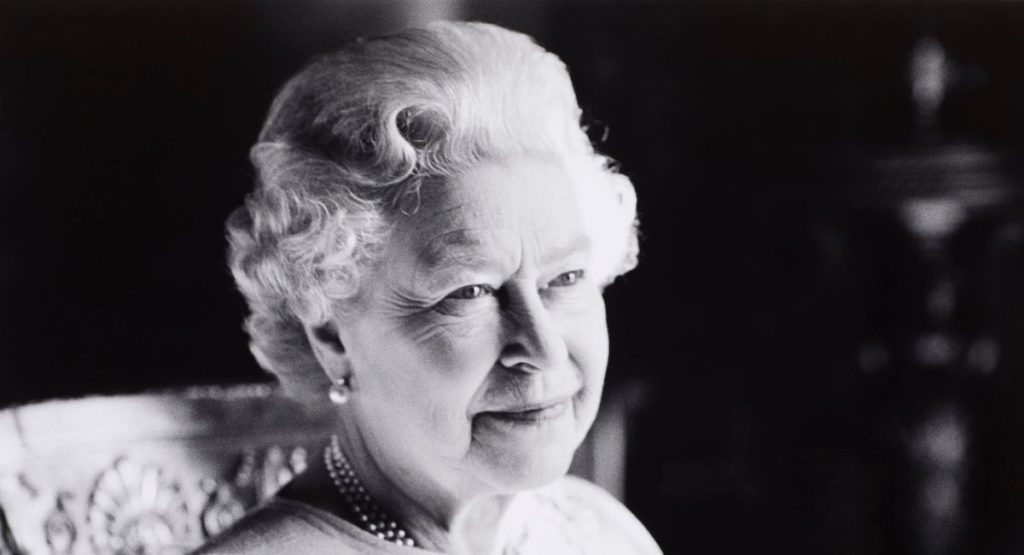
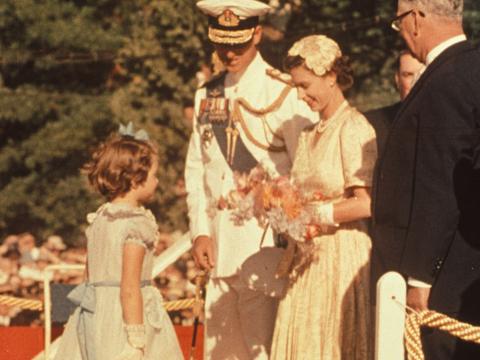
While the world is mourning the passing away of Queen Elizabeth II, Britain’s longest reigning monarch, who served the Commonwealth for 70 years, I am reflecting on my moment of fame “rubbing shoulders” with Her Majesty.
It was November 1, 1982. In January of that year, after completing high school, I had begun my journalism career as a cadet reporter for the then Fiji Sun, a daily newspaper in Fiji which was shut down at gunpoint during the 1987 military coup.
Not trained or told about the etiquette, I was ‘rostered’ to cover the Queen’s visit to Lautoka City, Fiji’s second largest city after the capital, Suva.
The Queen had arrived in Fiji to a thunderous welcome by the cheering, smiling, carefree Fijian communities who left their homes and paid duties to line up alongside the streets and main roads just to be able to wave to the queen.
I was covering her visit to the town hall where she planted a tree. Not familiar with the British accent, I had extreme difficulty grasping what the queen was saying. I was nervous about ‘missing the story’. Like any journalist would do instinctively, I pushed among the crowds to stand close to the Queen. I remember leaning forward as well. At this point her personal security guard appeared from nowhere, picked me up and put me away.
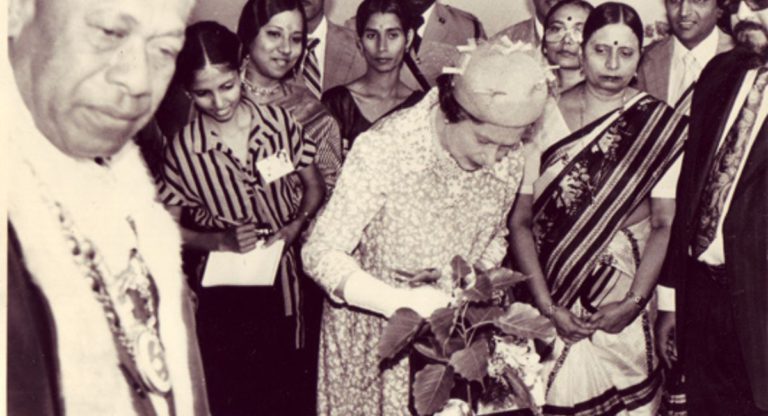
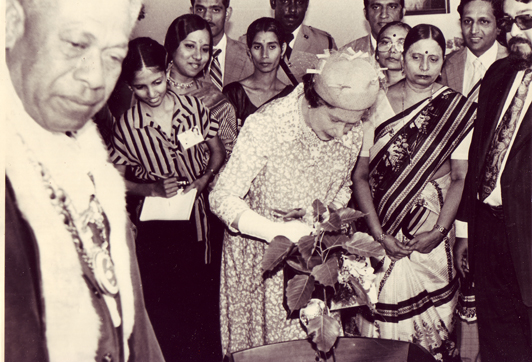
Dr Asha Chand, with notebook and pencil in hand, standing next to Queen Elizabeth II (Image source: Supplied).
This move sent across a wave of panic among the local Fijian police force. A senior inspector, the late Govind Raju, who had a few months earlier become my good source of information with the police force, came along and issued a strong verbal warning to me.
I am sure the police too did not know about the ‘physical distancing’ rules because I was warned not to speak!
I had no idea about my wrongdoing and continued listening carefully to get an exclusive story on the queen’s query about a tree that Princess Anne had planted as part of her visit to the city some years earlier.
Earlier that day the Queen had visited the Lautoka Hospital and I was instructed to wait for her arrival in the visitors’ lounge. Excited by the crowds of people who had lined up the streets and gathered outside the hospital, I remained outside, excited about seeing the Queen closely. My media pass gave me the opportunity of a privileged view.
The Queen had to duck to avoid an accident as the driver of the van failed to slow down or stop when approaching a concrete roof area at the entrance to the hospital.
The title of the story was “Queen ducks to avoid accident.”
The Queen came to the throne on 6 February 1952 and her coronation took place on 2 June 1953.
News Clipping from Fiji Sun dated 2 Novemeber 1982 (image source: Supplied).
Today I know that there is ‘no-touch’ rule for example when meeting the Queen. Visitors must wait until she extends her hand to take it. They are not supposed to grip it tightly or pump it, said Rachel Kelly, a public relations executive at VisitBritain, the United Kingdom’s official tourism office.
In 1992, Australian Prime Minister Paul Keating was assailed by the media when he put his arm around the Queen. It is generally not acceptable to touch Her Majesty in any kind of way, thus one could not hug, kiss on the cheek, or touch the shoulder of the Queen.
In 1997, Fiji’s then Prime Minister, Sitiveni Rabuka (who staged the 1987 military coup when he was brigadier general of the Fiji army), met with the Queen in London without his shoes. Rabuka was following the Fijian tradition of taking off one’s shoes before entering their (hosts) home.
This photo was published in the Fiji Times and in other media across the globe. I was covering the Commonwealth Heads of Government Meeting (CHOGM) for the Fiji Times and other Pacific media in Edinburgh, Scotland.
British women would normally curtsy the queen while men bow their heads when meeting Her Majesty.
Her Majesty’s first Commonwealth tour, as Queen, began on 24 November 1953, and included visits to Canada, Bermuda, Jamaica, Panama, Fiji, Tonga, New Zealand, Australia, the Cocos Islands, Ceylon, Aden, Uganda, Libya, Malta, and Gibraltar. The total distance covered was 43,618 miles.
Contributing Author: Dr Asha Chand is Associate Dean International in the School of Humanities and Communication Arts at the Western Sydney University, New South Wales.
Disclaimer: The opinions expressed within this article are the personal opinions of the author. The Australia Today is not responsible for the accuracy, completeness, suitability, or validity of any information in this article. All information is provided on an as-is basis. The information, facts, or opinions appearing in the article do not reflect the views of The Australia Today and The Australia Today News does not assume any responsibility or liability for the same.
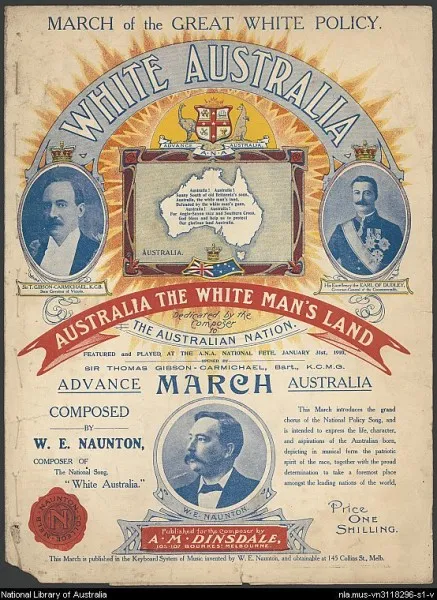
In my recent award-winning article entitled “’Behind the white curtain’: Indian students and researchers in Australia, 1901–1950,” published in the journal History of Education Review (with Prof. David Lowe, Deakin University), we looked at the experiences of Indian students in Australia during the first 50 years of the White Australia Policy (WAP).
Our key purpose in this article was to highlight the reasons behind the involvement of the Australian government in the provision of scholarships and fellowships to Indian students and researchers during the period of WAP.
Using contemporary Australian newspaper reports and exploring popular representations of sponsored Indian university-level students and researchers in Australian media, from 1901 to 1950, this article provided a historical account of their experiences in Australia in the first half of the 20th century.
Post-1901, some Australian intellectuals and diplomats made compelling arguments for productive collaborations between Australia and India, especially in education and training. With the prevailing ethos of equal rights among citizens of the British Empire, the rising wave of Indian nationalism, and the subsequent decline of the British Raj, educated and rich Indians wanted to engage with Australia within similar positions of privilege and power.
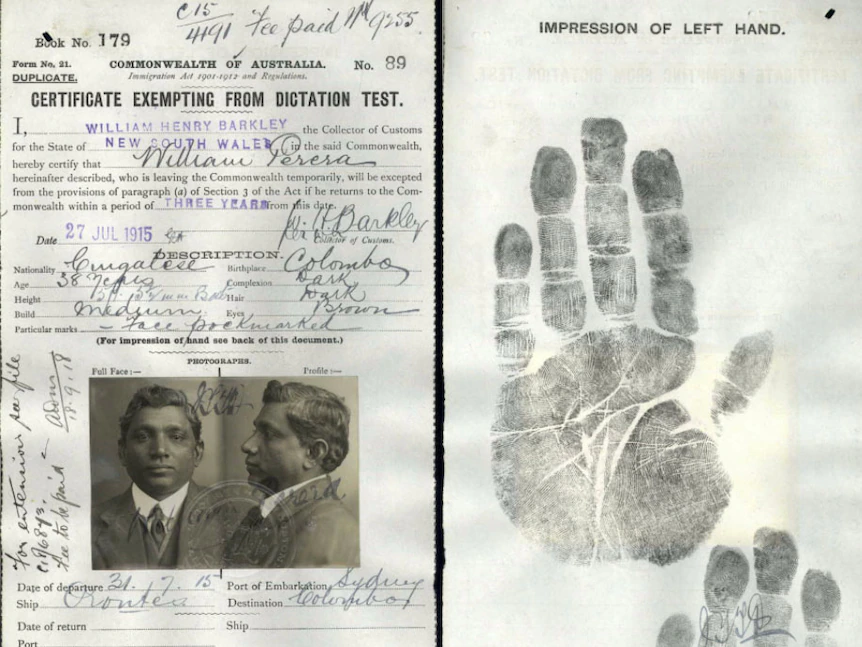
In 1904, the Australian government relaxed the administration of the Immigration Restriction Act (IRA) to allow “Indian merchants, students, and tourists” to enter the Commonwealth temporarily. People in these categories were often allowed to remain in Australia for up to 12 months (in rare cases seven years) with the condition that they must hold a valid passport issued by the government of India. Under this Act, only the Minister was empowered to grant a “certificate of exemption” from the dictation test. These were usually given to someone who would work in a local business of “community value”. However, the effect of the 1904 reforms was minimal in encouraging Indian students, as the maximum 12-month stay was hardly a good match with university study.
Representative image: Documentation for William Perera in 1915 (Source: National Archives of Australia)
In 1905, an Indian man named Mool Chand, obtained permission to enter Western Australia from Lahore as a former “Indian Civil Servant” or as an “Indian student”. It is not clear if he was an officer of the ICS or just a “babu” (clerk) or a student preparing for the ICS. The “List of Indian Members of the Indian Civil Service” does not have an entry on Mool Chand, which makes his claim as an ICS dubious. He was given only a six months’ Certificate of Exemption from the Dictation Test (CEDT) by the authorities in Freemantle.
However, it was later found out by Australian authorities that Mool Chand had overstayed his visa as a student and was illegally employed by another Indian, Messer Inder Singh, in his shop. After detailed inquiries by the local police, he was adjudged “a prohibited immigrant” under the IRA 1901 and on 24 July 1905, orders were issued for his immediate deportation from Australia. The local newspapers reported that two plainclothes constables located Mool Chand at Inder Singh’s residence in South Freemantle and kept him under surveillance.
On 25 July 1905, Mool Chand was delivered a letter requesting him to appear before the Collector of Customs in person the same day. Mool Chand immediately complied with the request as he had no idea of what was to befall him. From the Collector of Customs office, Mool Chand was unceremoniously deported without his luggage and belongings on RMS Orontes, which was on its way to London from Freemantle, to Colombo and from there on another ship to Madras.
Image source: RMS Orontes (Wikimedia Commons)
Onboard the ship Mool Chand told his plight to European passengers who in sympathy offered him some money to buy clothes and food. As soon as he set down in Madras, Mool Chand, with monetary help from his friends, started legal proceedings against the Australian government and customs officials.
Mool Chand, through Cecil John Reginald Le Mesurier, an orientalist and a barrister of the Western Australian Supreme Court, officially filed a case against the Western Australian government and Clayton Turner Mason, the Collector of Customs, claiming £10,000 in damages against assault, false imprisonment and illegal deportation. Another writ for £10,000 compensation was filed against the Federal authorities, particularly Alfred Deakin, then Prime Minister of Australia and also the Minister for External Affairs, for issuing the deportation order.
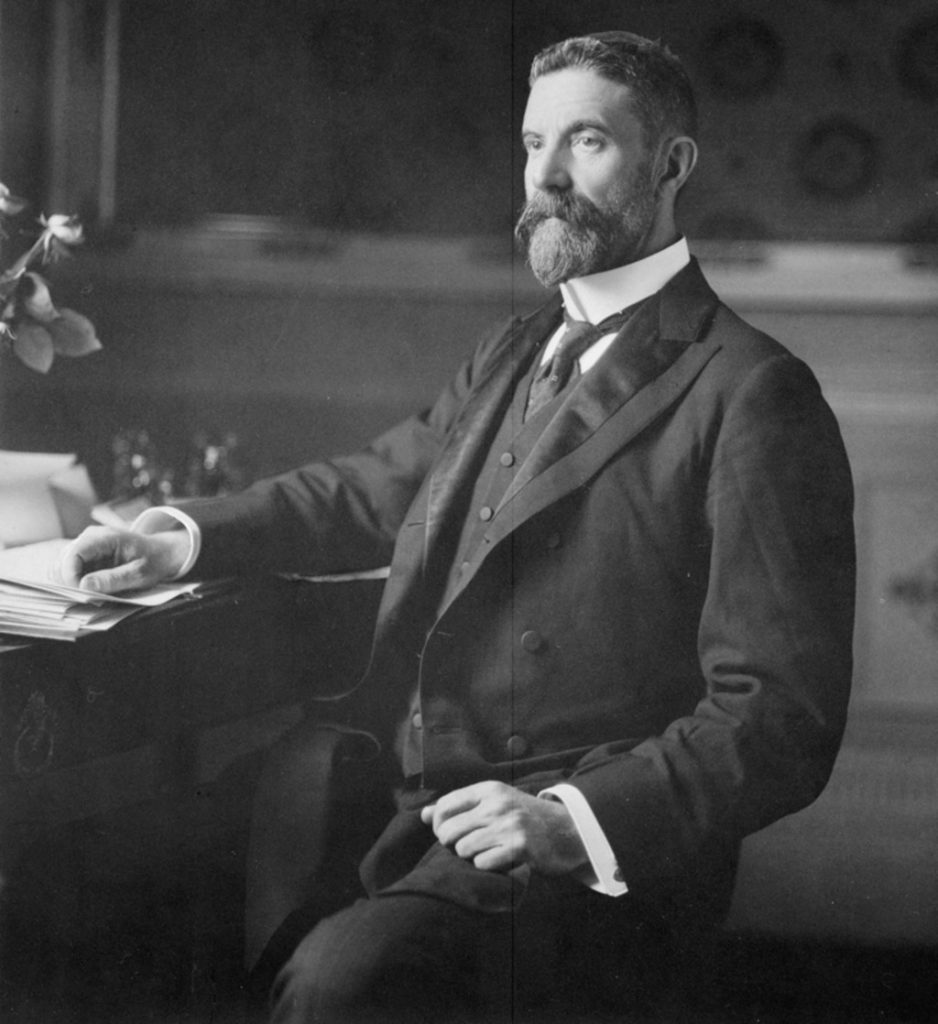
Image source: Prime Minister of Australia Alfred Deakin (Wikimedia Commons)
Although no direct action could have been taken against the Prime Minister, it was clear from the blame game and correspondences that IRA 1901 and deportations made under it were questionable. As expected, Mool Chand’s case was dismissed by the judge because he was not on a valid visa or a resident of any state in Australia at the time of his deportation.
As expected, the case of Mool Chand, “the deported Indian student”, “a deported Hindoo” or “a deported Afghan”, became historic and was reported sensationally in Australian newspapers as the first such case of its kind involving an Indian in Australia.
Amritsar-born and Mumbai-educated Bulchandani completed degrees in English and Psychology at St Xavier’s College in Mumbai, before moving to the US in 1990 to pursue a Master’s degree in communications from the University of South California.
Bulchandani most recently served as Global President and CEO of Ogilvy North America. Prior to joining Ogilvy, she spent 26 years at McCann in various leadership roles including President of McCann North America.
Ogilvy said in a press release that Bulchandani will be responsible for all aspects of the creative network’s business across 131 offices in 93 countries.
Mark Read, CEO of WPP, said in a statement:
“Devika is a champion of creativity who brings passion, purpose, and an uncompromising focus on generating impact to everything she does. In partnership with Andy and Liz Taylor, she has been instrumental in Ogilvy’s recent growth and development.”
Commenting on her elevation, Devika Bulchandani said:
“I am honored and humbled to take on this role, and to do it with all our incredibly talented people all over the world.”
With her appointment, Bulchandani will join the following growing group of Indian-origin business leaders at the helm of multinational corporations: Laxman Narasimhan – Starbucks, Sundar Pichai – CEO, Google LLC & Alphabet Inc, Satya Nadella – CEO, Microsoft, Parag Agrawal – CEO, Twitter, Leena Nair, Chanel, Arvind Krishna – CEO, IBM Group, Shantanu Narayen – CEO, Adobe Inc, and Ajaypal Singh Banga – CEO, Mastercard.
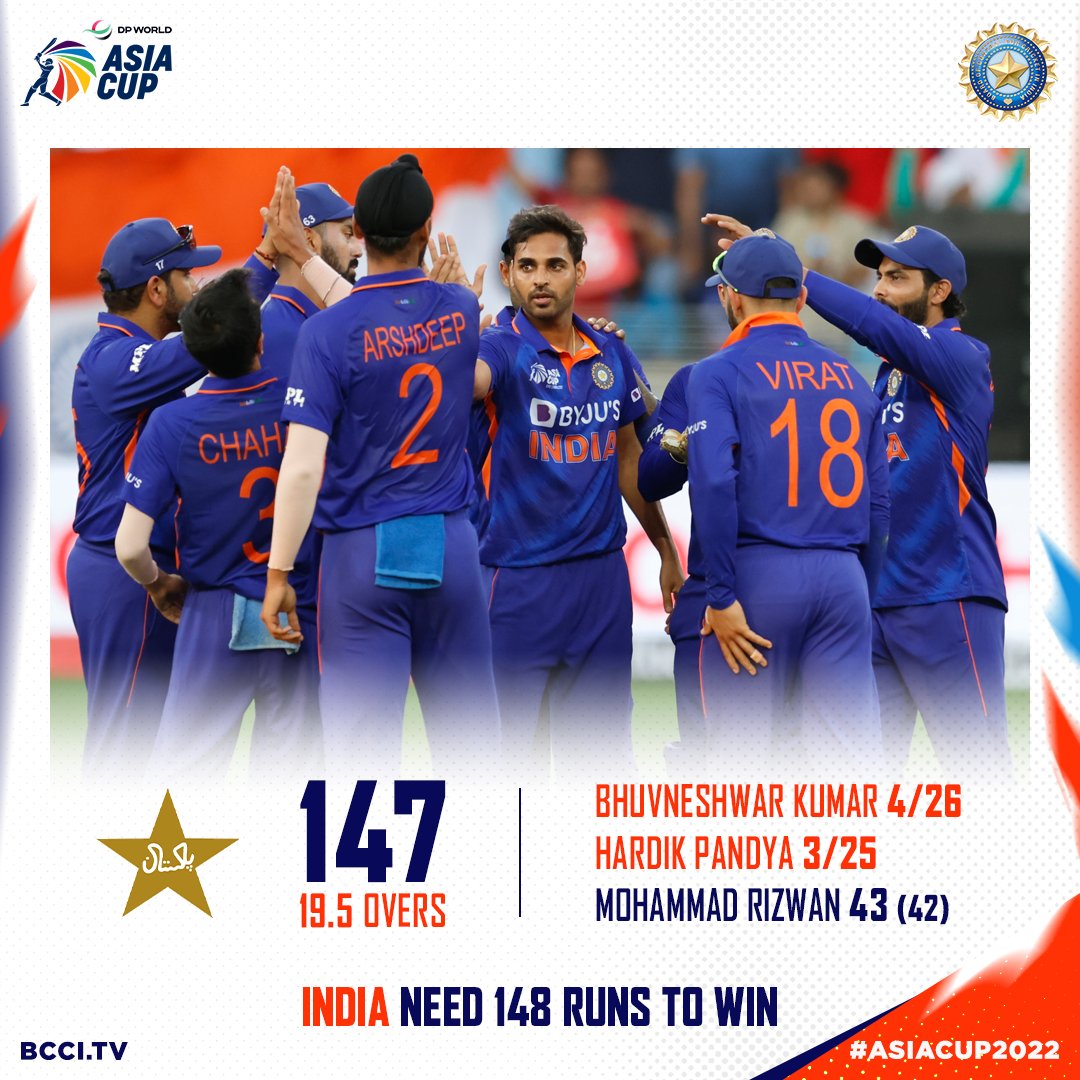
Star Indian batter Virat Kohli completed his much-anticipated 71st international century and powered India to a massive 212/2 in their 20 overs during their last Super Four clash against Afghanistan at the ongoing Asia Cup 2022 on Thursday.
Virat scored the highest individual score by an Indian player in T20 international cricket. He smashed an unbeaten 122 in just 61 balls with 12 balls and six sixes.
He has overtaken the score of 118 posted by Rohit Sharma against Sri Lanka in 2017. It is followed by 117 by Suryakumar Yadav against England in 2022, Rohit Sharma’s 111 not out against West Indies in 2018 and an unbeaten 110 by KL Rahul against West Indies in 2016.
This inning would be extremely memorable as not only did a 119-run stand between KL Rahul (62) and Virat Kohli (122) help Team India reach a huge score, but Virat also brought his much-anticipated ton after almost three years.
Put to bat first by Afghanistan, openers KL Rahul and Virat Kohli got Team India off to a great start. The running between the wickets by the duo was good as usual. Openers really started to open their arms in the third over, with Virat smashing pacers Fazalhaq Farooqi for two fours.
From that point on, KL and Virat feasted on Afghan bowlers. Virat Kohli looked in really good touch and hit spinner Mujeeb ur Rahman, for two fours and a six in the sixth over. At the end of six overs and the power play, India stood at 52/0, with Virat (25*) and Rahul (26*) unbeaten.
Virat and KL continued their domination over Afghanistan, even after the power play. The duo kept the scoreboard running at a good speed. At the end of 10 overs, India stood at 87/0, with Rahul (42*) and Virat (44*).
Virat brought up his 33rd half-century in the format with a single. KL Rahul helped the team cross the 100-run mark with a four in 11.2 overs and scored another four on the next ball to bring up his fifty. Medium-pacer Fareed Malik ended the 119-run stand between the duo in the 13th over, dismissing Rahul for 62 off 41 balls after the batter was caught by Najibullah Zadran at long-on.
Suryakumar Yadav was next and he started his innings with a six on the very first ball, but Fareed got his wicket on the very next ball.
Rishabh Pant was up on the crease. He continued to tick the scoreboard with Virat and took India into the final five without further damage. At the end of 15 overs, India was at 134/2, with Pant (6*) and Virat (59*).
Pant and Virat continued their assault on Afghanistan bowlers. Virat was the aggressor and mercilessly hit boundaries.
With two overs to go, Pant-Virat brought up their 50-run stand. Virat also entered into the 90s. Finally, he completed his much-anticipated 71st international century and his first in T20Is.
India finished its innings at 212/2, with Virat Kohli (122*) and Rishabh Pant (20*). Fareed Malik took 2/57 for Afghanistan.
“Elizabeth the Second, by the Grace of God Queen of Australia and Her other Realms and Territories, Head of the Commonwealth” has died. Given her advanced years, this has long been expected, yet it still seems incredible this woman who has been Australia’s queen for the duration of most Australians’ lives is no longer with us.
While the focus of the formalities and ceremony of the passing of Queen Elizabeth II will centre on London and the UK, there is no doubt it will be keenly observed by many Australians.
The queen liked Australia and Australians. She came here 16 times throughout her reign and was, famously, on her way to our shores in 1953 when she learned her father had passed on and she was now queen.
Her visits to Australia – from her first in 1954 through to her last in 2011 – offer a snapshot of the changing relationship Australians have had with their sovereign and with the monarchy.
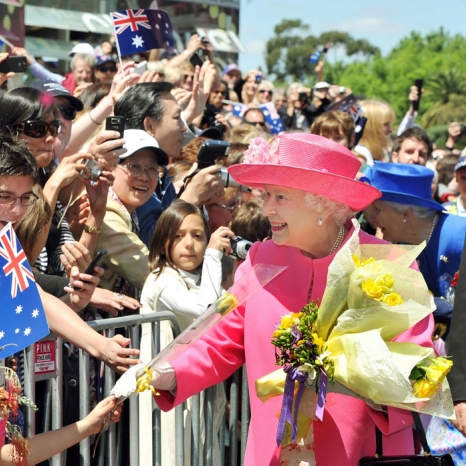
Queen Elizabeth II in Australia (The Royal Family)
An enthusiastic nation
The queen’s 1954 tour took place during a time described by historian Ben Pimlott as the age of “British Shintoism”. Deference to the Crown was paramount in Britain and the Commonwealth, and many Australians were madly enthusiastic about their queen.
After her arrival at Farm Cove in Sydney on February 3 1954, Elizabeth II became the first British monarch to set foot on Australian soil. The royal tour lasted nearly two months and consisted of a gruelling schedule taking in visits to every state and territory apart from the Northern Territory.
During the tour, the queen greeted over 70,000 ex-service men and women; drove in cavalcades that took in massive crowds; attended numerous civic receptions; and opened the Australian Parliament in Canberra. The tour saw Elizabeth travel 10,000 miles by air and 2,000 miles by road – including 207 trips by car and by appointed royal trains.
It is estimated as much as 75% of the population saw the queen and Prince Philip during this tour.
No Australian prime minister has ever had a reception on this scale or exposure to so many of the country’s citizens.
Queen Elizabeth II in Australia (The Royal Family)
A “new” and prosperous country
During her first two tours in 1954 and 1963, the Australia laid-out for display for the queen was depicted as having gone from being a small colonial settlement to a thriving economy that had ridden to prosperity “on the sheep’s back”.
The queen was treated to endless displays of sheep shearing, surf carnivals, wood chopping, whip cracking, and mass displays of dancing and singing by school children. Federal and state dignitaries, mayors and civic leaders from across the political divide jostled to meet and be seen with her; the country’s florists were emptied of flowers for the hundreds of bouquets presented to her by dozens of shy, nervous school children nudged gently forward by awe-struck parents.
During the early tours, Aboriginal Australians were kept at a discreet distance. Apart from a demonstration of boomerang and spear throwing, the closest the queen came to experiencing anything of Indigenous Australian culture was a ballet performed by the Arts Council Ballet titled Corroboree, with no Aboriginal dancers but dancers with blackened faces.
During the 1970 visit, the queen witnessed the re-enactment of Captain James Cook’s arrival at Botany Bay, with Cook and his crew meeting “the resistance of the Aborigines with a volley of musket fire”.
By 1973, Indigenous Australians were given a more significant role in the royal tours. Aboriginal actor Ben Blakeney, one of Bennelong’s descendants, gave the official welcome during the opening of the Sydney Opera House, and the then unknown actor David Gulpilil was among those performing a ceremonial dance.
Queen Elizabeth II (Twitter)
Invited guest, not ruler of the land
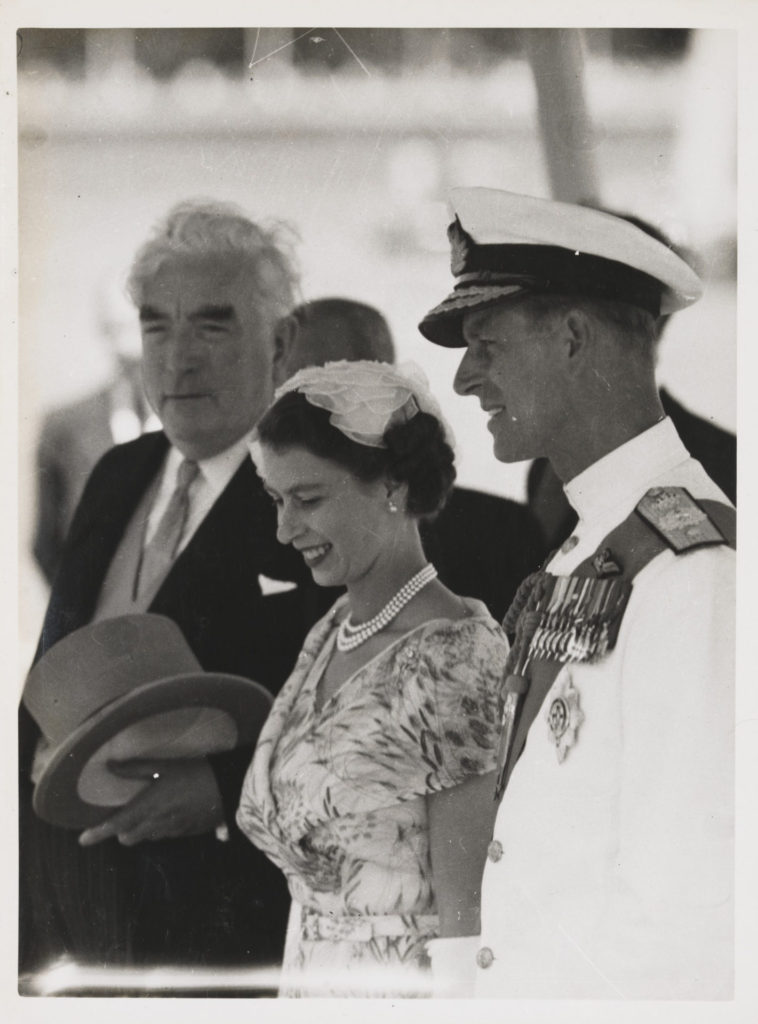
As early as the 1963 tour, the nation-wide royal fervour had dimmed a little. The 1963 visit witnessed smaller crowds and fewer mass public events. When Prime Minister Robert Menzies courted the queen with the now-famous line, “I did but see her passing by, and yet I love her till I die”, the ensuing blushes – including the queen’s own – reflected many Australians’ growing sense of embarrassment at public displays and unquestioning expressions of deference.
Despite this, Menzies’ displays of public ardour saw him being granted The Order of the Thistle shortly after, a bestowal which must surely remain the envy of some subsequent prime ministers.
The 1977 Silver Jubilee and 1988 Australian bicentenary visits perhaps marked the end of a period of royal tours as overt celebrations of Australia’s ties to Britain. This new flavour of tours positioned the sovereign as an invited guest to an independent, modern and multi-cultural nation.
On her 10th tour in 1986, the queen returned to sign the Australia Act, which brought to an end the ability of the UK to create laws for Australia.
Her role as our sovereign subtly transformed from cutting ribbons and opening Parliament to signing the documents that slowly, by degrees, contributed to the cutting of Australia’s ties to the UK and the Crown.
Queen Elizabeth II in Australia (NFSA archives)
A question of the republic
By the 12th tour in 1992, the cost of the queen’s visits to Australia were increasingly scrutinised by a public feeling largely indifferent about the royal family. The prime minister of the day, Paul Keating, was seen not so much as an entranced liege lord revelling in the opportunity to see his sovereign “passing by” as one who instead – unthinkingly – committed an act of lèse majesté by placing his bare hand on the royal back and waist as he guided her through the crowd.
The gloves, it seemed, were coming off.
The queen made it clear in her last visits to our shores that whether or not Australia should become a republic was a decision for its own citizens to make. Her official announcement after she learned of the result of the 1999 Republic Referendum confirmed this:
I have always made it clear that the future of the Monarchy in Australia is an issue for the Australian people and them alone to decide, by democratic and constitutional means. … My family and I would, of course, have retained our deep affection for Australia and Australians everywhere, whatever the outcome.
In the last decades of her life, the queen retained the affection of many. Her popularity seemed to grow in line with Australians’ increased disenchantment with their home-grown political leaders: the former prime ministers Malcolm Turnbull and Julia Gillard are right to have sensed that any discussion about an Australian republic would have to wait until after Elizabeth II’s death.
Queen Elizabeth II reigned across seven decades and her tours to Australia served as a marker of Australia’s changing relationship with the Crown as well as with its own colonial past and national identity.
Almost certainly, Elizabeth II’s reign as the stalwart, loyal, dutiful, and most cherished and admired of “Glorianas” is one we are unlikely ever to see again.
Albanese said “Australian hearts go out to the people of the United Kingdom”, remarking that she always performed her duty with “fidelity, integrity and humour”.
Anthony Albanese, the Prime Minister of Australia (Twitter)
Albanese added:
“With the passing of Queen Elizabeth the Second, an historic reign and a long life devoted to duty, family, faith and service has come to an end. The Government and the people of Australia offer our deepest condolences to the Royal Family, who are grieving for a beloved mother, grandmother and great-grandmother—the person whom for so long was their greatest inner strength.”
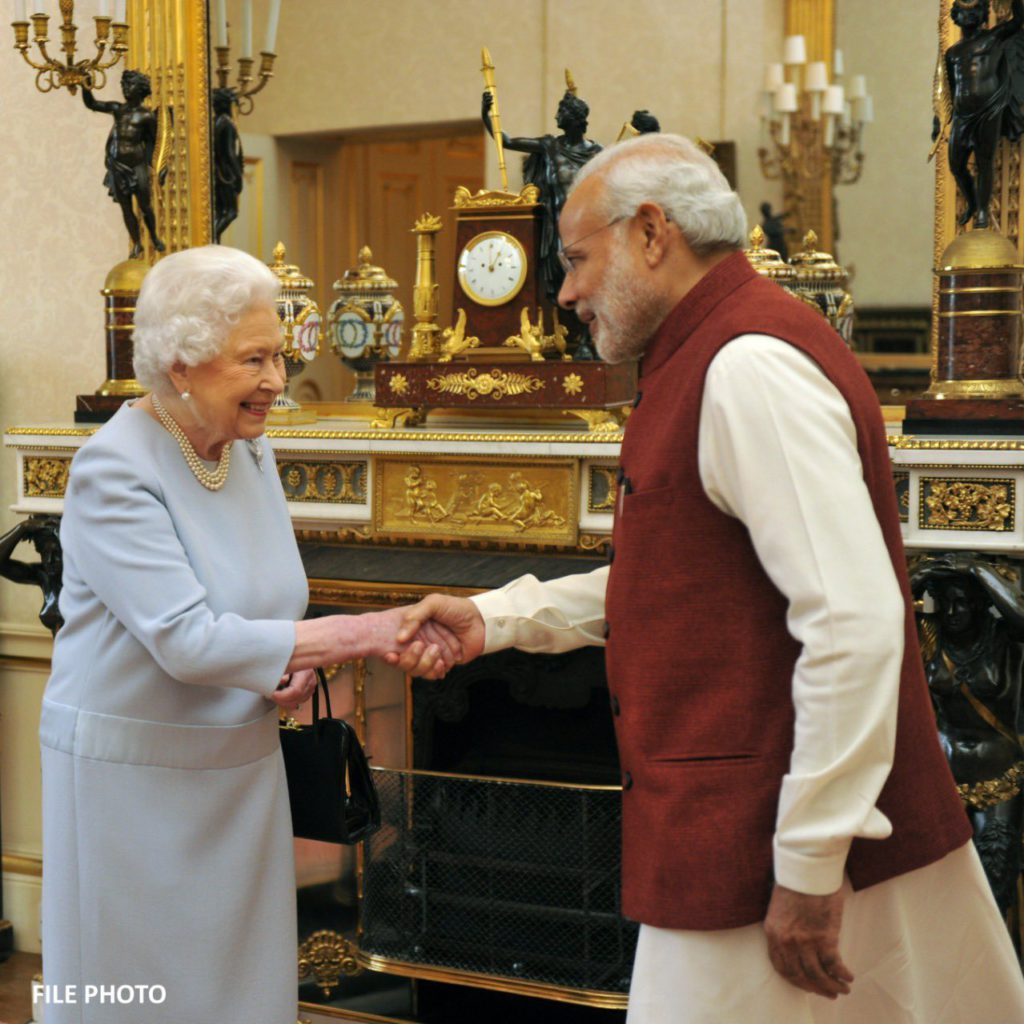
India’s PM Narendra Modi with Queen Elizabeth II (Twitter)
India’s Prime minister Narendra Modi has also paid tribute to the Queen. He recalled two memorable meetings with Her Majesty Queen Elizabeth II during his UK visits in 2015 and 2018.
“I will never forget her warmth and kindness. During one of the meetings she showed me the handkerchief Mahatma Gandhi gifted her on her wedding. I will always cherish that gesture.”
I had memorable meetings with Her Majesty Queen Elizabeth II during my UK visits in 2015 and 2018. I will never forget her warmth and kindness. During one of the meetings she showed me the handkerchief Mahatma Gandhi gifted her on her wedding. I will always cherish that gesture. pic.twitter.com/3aACbxhLgC
The Queen was born Elizabeth Alexandra Mary Windsor, in Mayfair, London, on 21 April 1926. Her father became King George VI and, at age 10, Lilibet, as she was known in the family, became heir to the throne. She came to the throne in 1952 and witnessed enormous socio-political changes.
Experts note that her commitment to the Commonwealth was a constant – she visited every Commonwealth country at least once.
Her son King Charles III said in a statement that the death of his beloved mother was a “moment of great sadness” for the family. He added:
“We mourn profoundly the passing of a cherished sovereign and a much-loved mother. I know her loss will be deeply felt throughout the country, the realms and the Commonwealth, and by countless people around the world.”
During the coming period of mourning, he said he and his family would be “comforted and sustained by our knowledge of the respect and deep affection in which the Queen was so widely held”.
The Queen died peacefully at Balmoral this afternoon.
The King and The Queen Consort will remain at Balmoral this evening and will return to London tomorrow. pic.twitter.com/VfxpXro22W
Senior royals had gathered at Balmoral after the Queen’s doctors became concerned about her health earlier in the day.
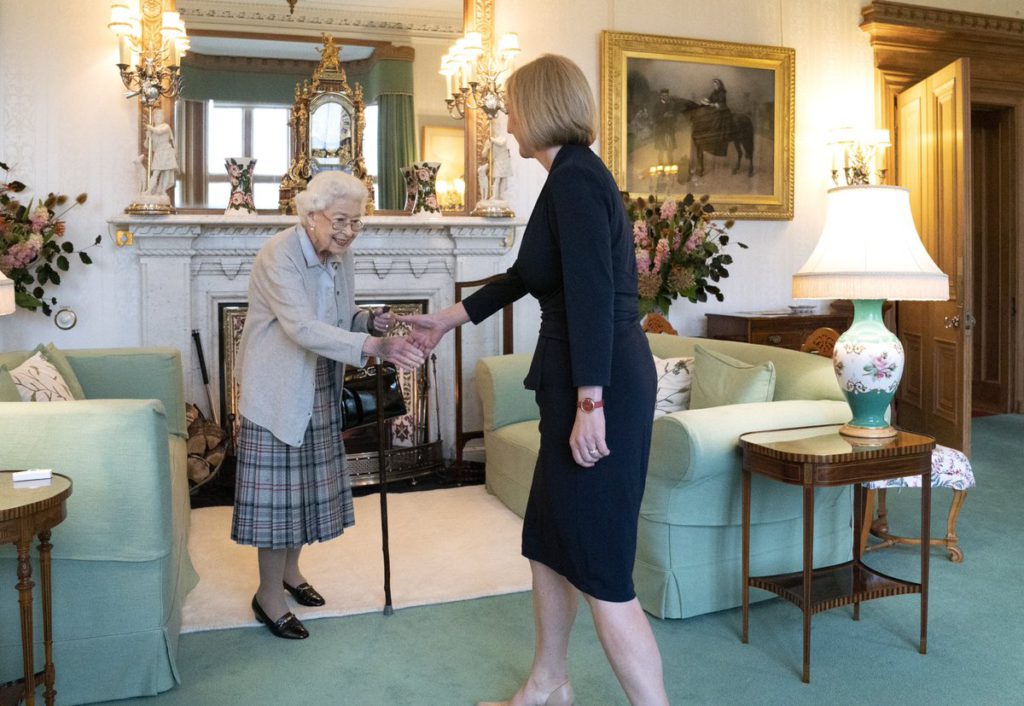
The UK’s new Prime Minister Liz Truss with Queen Elezabeth II (Twitter)
Prime Minister Liz Truss, who was appointed by the Queen on Tuesday, said the monarch was the rock on which modern Britain was built, who had “provided us with the stability and strength that we needed”.
“We offer him our loyalty and devotion, just as his mother devoted so much, to so many, for so long. And with the passing of the second Elizabethan age, we usher in a new era in the magnificent history of our great country, exactly as Her Majesty would have wished, by saying the words ‘God save the King’.”
On the Queen’s death, Prince William and his wife, Catherine, became the Duke and Duchess of Cambridge and Cornwall.
All the Queen’s children travelled to Balmoral, near Aberdeen, after doctors placed the Queen under medical supervision. The King and his wife, Camilla, now Queen Consort, will return to London on Friday, Buckingham Palace said. Her grandson and now heir to the throne, Prince William, and his brother, Prince Harry, also gathered there.
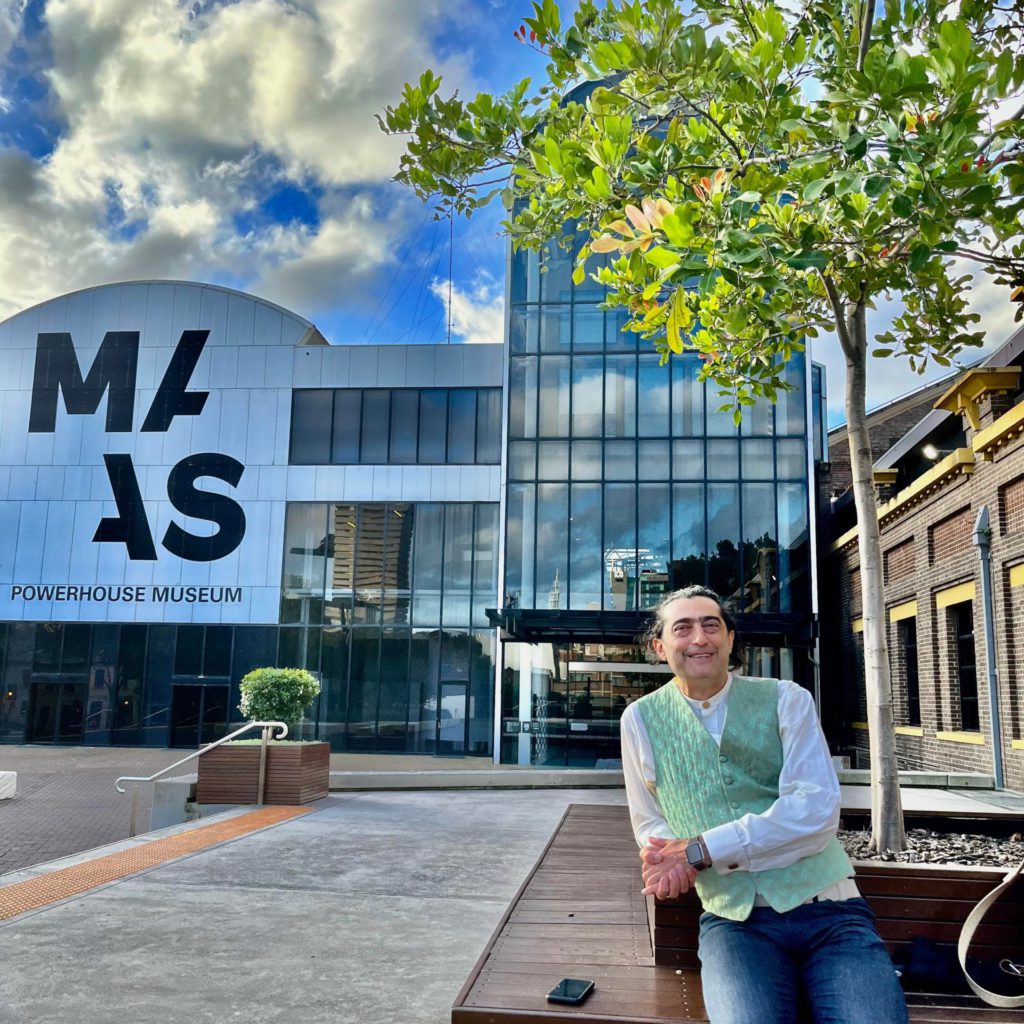
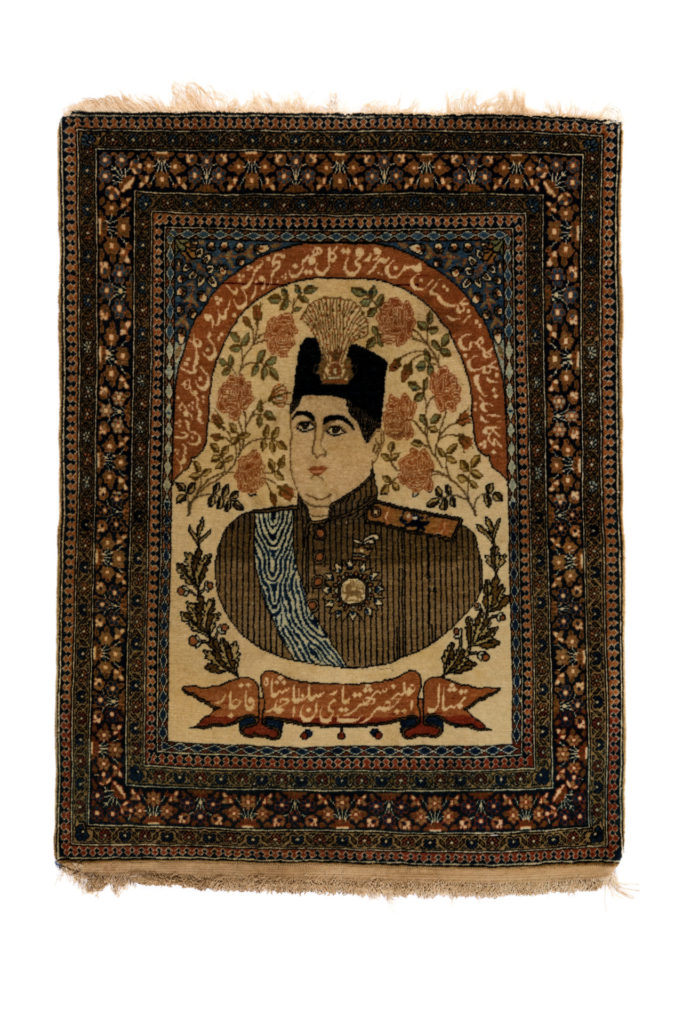
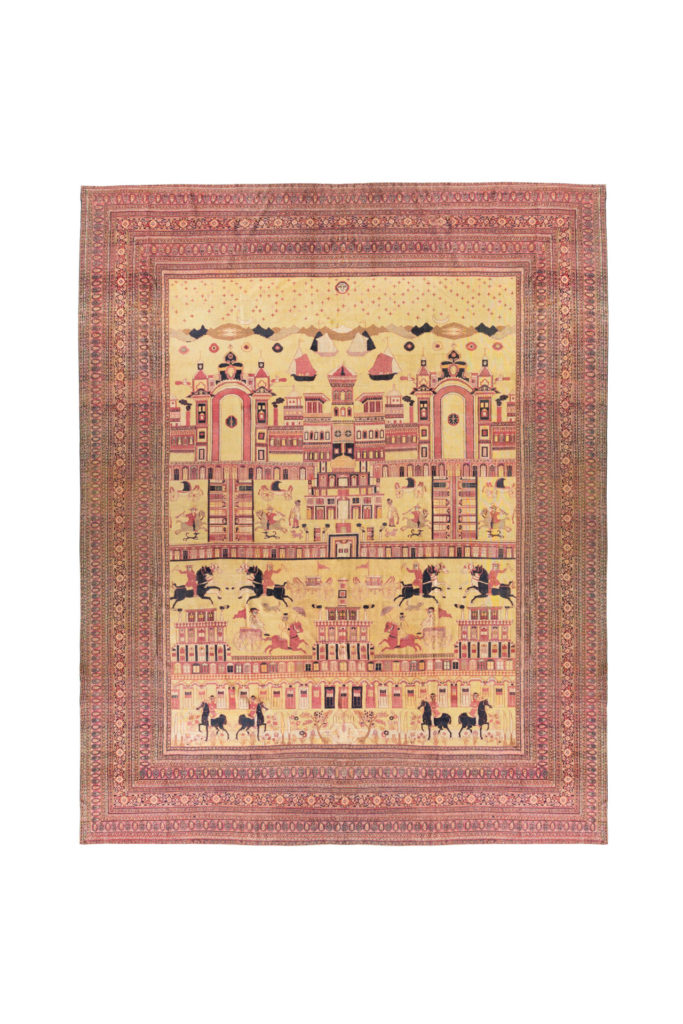
From today opens a marvellous exhibition, ‘Weavers, Merchants and Kings: Cadrys 70th Anniversary,’ at the Powerhouse Museum in Ultimo, New South Wales, celebrating the 70th anniversary of Cadrys, the first Persian-owned carpet business in Sydney.
Prof. Pedram Khosronejad with the Cadry family (Image source: LinkedIn)
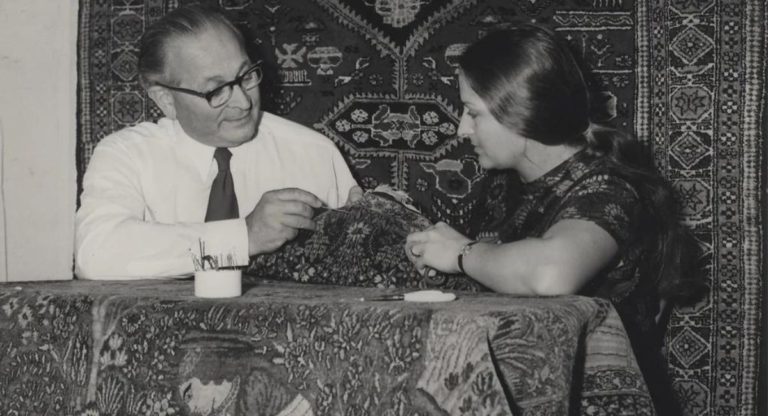
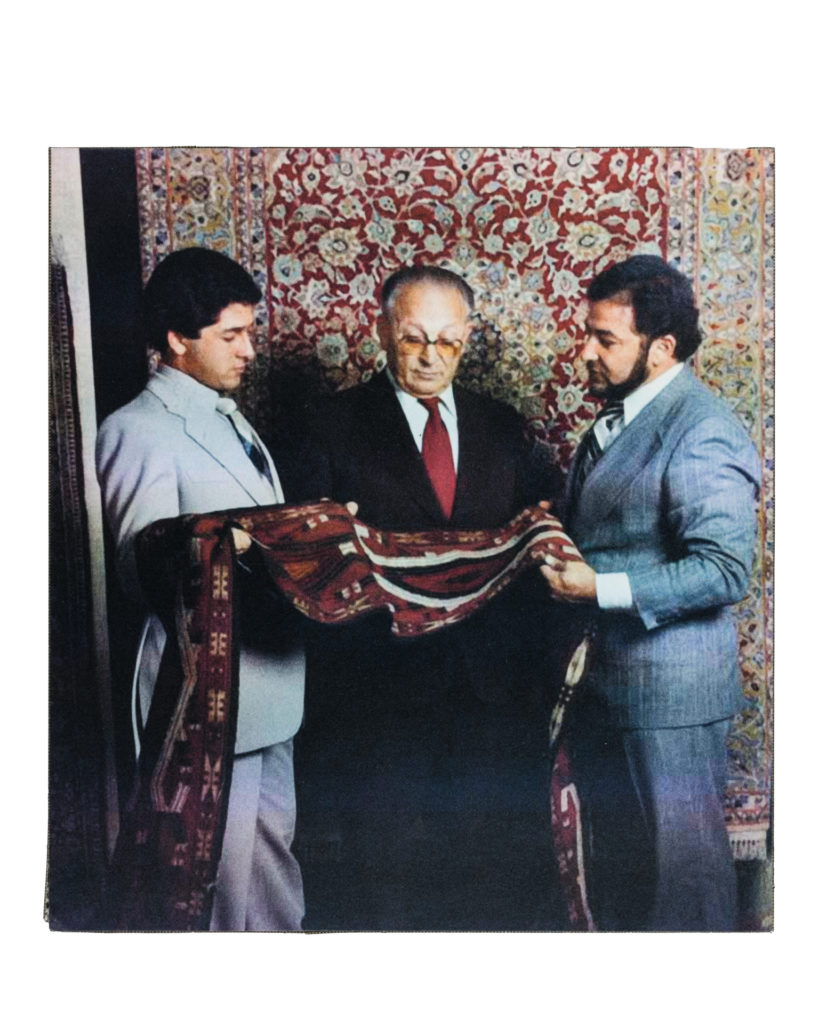
Sydney’s first Persian-owned carpet business was founded in 1952 by immigrant Jacques Cadry (1910–2003), who had been born into a Jewish family in the trade.
L5684/6 Family photograph, Sydney, Australia, 1990s (Image source: Supplied)
For 70 years, Cadrys Rugs has been at the forefront of introducing Australian designers and artists, including Florence Broadhurst, to the unique craftsmanship of Persian rugs.
Prof. Pedram Khosronejad (Image source: Facebook)
Prof. Pedram Khosronejad, who is the curator of Persian arts, says this will provide a rare glimpse into Indo-Persian history. He says:
“Loaned by Cadrys, it is one of only a handful of examples known to feature an architectural scene as the central design and provides a rare glimpse into a period of Indo-Persian history during the late 19th Century.”
The highlight of the exhibition for the visitors would be an antique Persian Dorokhsh carpet believed to have been created for a royal palace.
“Persian Dorokhsh carpets revived ancient textile-making traditions in Khorassan, a region renowned for woven art, and transformed the nomadic craft of carpet-weaving into a specialised artisan industry.”
Exceptional Persian artefacts from the Cadry family’s expansive collection and a selection of objects they have donated to the Powerhouse will also be displayed in the exhibition.
This will allow a whole new generation of enthusiastic and curious audiences to experience stories and folk traditions through eye-catching textile and craft pieces.
Exhibition highlights include four tempera illustrations by Paul Ratzer and an Asfar carpet previously owned by Ratzer and acquired by Jacques Cadry in 1983.
The exhibition (8 September 2022 – 29 January 2023) recognises the Cadry family’s decades of generosity as Powerhouse donors.
It will be complemented by documentary film screenings in the Kings Cinema and a scholarly panel at Powerhouse Ultimo on 15 October 2022 discussing the cultural significance of the objects on display.
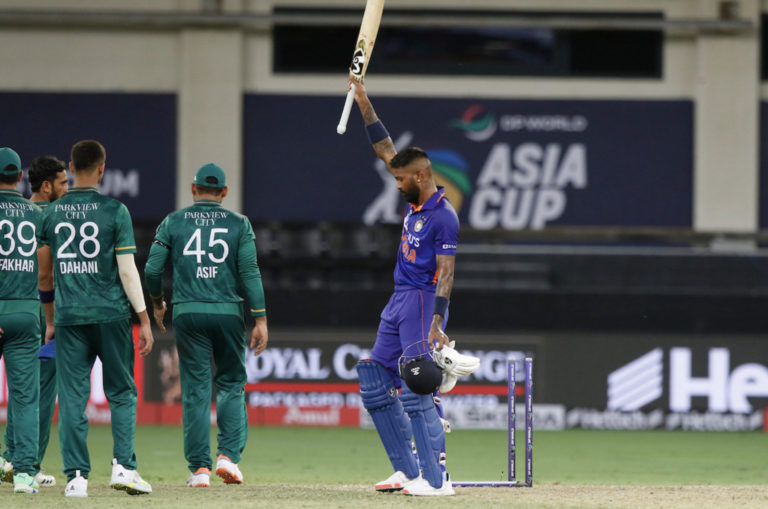
In a thrilling Super 4 match at the ongoing Asia Cup 2022 on Wednesday, Pakistan defeated Afghanistan in the last over but it left a sour taste for cricket lovers worldwide.
Pakistan’s Asif Ali went against Afghanistan’s Fareed Ahmad in a heated exchange. Both players exchanged words as Asif raised his bat close to Fareed´s face and they pushed each other before Afghanistan players rushed to separate the two.
As reported by several media outlets incident happened in the 19th over when Pakistan’s batsman Asif hit a huge six on the fourth ball of Fareed Ahmad. However, on the next ball, Fareed got his magic back and outsmarted the batter with a bouncer as Asif top-edged the delivery straight into the hands of the short fine-leg fielder.
Jubilant Afghan players were celebrating on the ground, After getting out Pakistan’s Ali wasn’t happy with the bowlers’ reaction and he immediately pushed the bowler Fareed Ahmad back for celebrating on his face.
While Fareed did not shy from standing his ground, Pakistan’s batter Ali went one step further as he hurled his bat at the Afghan bowler before the players and umpires intervened and brought the situation under control.
Afghanistan skipper Mohammad Nabi said after the match, “The boys were brilliant with the ball and the field. But again we didn’t finish well, we didn’t control our nerves at the end. We didn’t give up at any stage.”
Pakistan’s vice-captain Shadab Khan played down the incident, saying it happened “in the heat of the moment” and was best left on the field.
Most will leave incidents like this to the field however a lot of commentators have pointed out that Pakistan takes advantage of such incidents to score political points by dividing communities due to the social, cultural, political and religious complexities of the Indian subcontinent.
Meanwhile, coming to the game, after the win Pakistan team’s supporters were busy teasing and provoking Afghanistan supporters in the stadium.
Which defiantly didn’t go well for them as a fight broke between the two groups. Pakistan-based journalist Fakhr-e-Alam tweeted the video of the fight and called on International Cricket Council to take action, however, he didn’t say a word about Pakistan’s supporters.
“This behavior by Afghan cricket fans is so very shameful & disappointing… @ICC must ensure all cricketing venues are safe for fans..this violent behavior cannot be allowed. Hope local authorities take action against all the culprits. Very very sad and disgusting. #AsiaCup“
This behavior by Afghan cricket fans is so very shameful & disappointing… @ICC must ensure all cricketing venues are safe for fans..this violent behavior cannot be allowed. Hope local authorities take action against all the culprits. Very very sad and disgusting. #AsiaCuppic.twitter.com/QGQzFoSEmn
An Afghan journalist who is also the founder of Afghan Peace Watch tweeted, “Even Pakistani players act like terrorists, intimidating Afghans on the playground.”
He further said, “Terrorists will always be terrorists. #AFGvsPAK“
Just three days back after India- Pakistan match an Indian bowler Arshdeep Singh was targeted by Pakistan’s troll army. They used Arshdeep Singh’s religion to fuel tensions among the global Indian diaspora in the name of Khalistan propaganda.
What happened with Arshdeep?
Arshdeep became the target of vicious online trolling after he dropped a crucial catch in the death overs resulting in the defeat of his side against Pakistan in the Asia Cup game on Sunday night.
Criticism/trolling of players for poor performance or crucial misdeeds is part of the fan-player relationship. In the Indian subcontinent fans, sometimes take things to the far end when they run protests, and burn an effigy. However, in the social media age memes and redesigned pictures are in thing.
Vimal Kumar, an Indian senior cricket journalist told The Australia Today, “Some Indian fans trolled Arshdeep for the dropped catch which is understandable but pictures were shared on social media, stating that “he was named in Khalistan squad for the 2018 under-19 World Cup which is just insane.”
Vimal Kumar even confronted a person after the match who was trying to invoke Arshdeep Singh’s religious identity for dropping the catch
The word India was replaced with Khalistan on Singh’s Wikipedia page by an anonymous user even as these changes were shortly undone by another editor.
The edit history of Arshdeep’s Wikipedia page revealed that the user who made those changes was unregistered and was using the internet protocol (IP) address 39.41.171.125.
The address allocation records showed that the particular address was allocated to the Pakistan Telecommunication Company Limited (PTCL).
Following Sunday’s match, Arshdeep Singh became the top trend on social media with most users originating from Pakistan and North America.
A Delhi-based self-proclaimed fact-checker Mohammed Zubair, who was recently arrested for his allegedly misleading tweets jumped the gun again with allegedly misleading claims about Arshdeep trolling.
Delhi-based Sikh leader Manjinder Singh Sirsa sought a police probe into the role of fact checker Mohammed Zubair, alleging that his “screenshots” were used by Pakistani users to fuel a hate campaign and defame India as part of a “conspiracy”.
Mr Sirsa said he had lodged a police complaint regarding the attempt to create an anti-India narrative following an Asia Cup match where cricketer Arshdeep Singh dropped a sitter.
Taking to Twitter, Mr Sirsa claimed,
“Police complaint against @zoo_bear who worked with Pak agencies to set “Khalistani” narrative against #ArshdeepSingh in India. Zubair’s screenshots were used by Pak handles to defame India and fuel a hate campaign against Sikhs in India. He was a part of a planned conspiracy against Sikhs.”
According to Mr Sirsa, Zubair’s screenshots were used by Pak handles to defame India and fuel a hate campaign against Sikhs in India.
I have filed a police complaint against @zoo_bear as he was a part of Pak’s conspiracy to defame Sikhs and fuel hate campaign against Sikhs in India. His screenshots are used by Pak handles. I have demanded enquiry into who supported Zubair in creating this “Khalistani” agenda pic.twitter.com/xtc5U5yEsj
“This is a planned conspiracy to create communal disharmony in our nation. We demand an enquiry into who supported Zubair in creating this Khalistani agenda,” said Mr Sirsa.
In another tweet, he demanded a strong message from Wikipedia.
“Wikipedia must be given a strong message that they can’t let Pak Agencies use its platform to run a hate campaign in India. See how Pakistan agencies started this “Khalistani” campaign in the context of Arshdeep,” he said.
Another video went viral which explained the origin of most social media posts calling Arshdeep Singh as a Khalistani from Pakistan and North America.
Interesting video.
Khalistani trend on Arshdeep originated in Pakistan first.
Social Commentator Anshul Saxena explained how accounts from Pakistan were running Khalistan propaganda & calling Arshdeep a Khalistani.
Mr Saxena said, “Pakistan is running propaganda & fake news that Indian media channel ABP news is calling Arshdeep Singh a Khalistani. They are making a narrative that the people of India hate Sikhs.”
“It’s clear that accounts from Pakistan started targeting Arshdeep Singh by calling him Khalistani Sad part is that some people of India also fell into the trap & trolled Arshdeep in the same way This is what Pakistan wants,” he added.
1) Indian cricket player Arshdeep dropped a catch in the 2nd match of India Vs Pakistan, Asia Cup 2022.
And, now accounts from Pakistan are running Khalistan propaganda & calling Arshdeep a Khalistani.
This is not the first time Pakistan’s deep state using the religion of Indian players as a tool to plant their divisive agenda.
Indian ace bowler Mohammed Shami was also targeted in the same manner when India lost to Pakistan in the T20 World cup match.
1) When India lost to Pakistan in T20 cricket world cup, all India players were trolled on social media
But, Pakistan played major role in targeting Indian player Mohammed Shami so that they can make narrative that Shami was targeted only because of his religion.
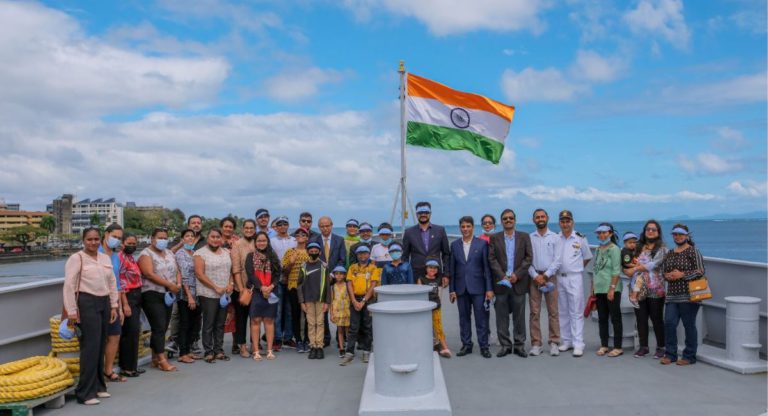
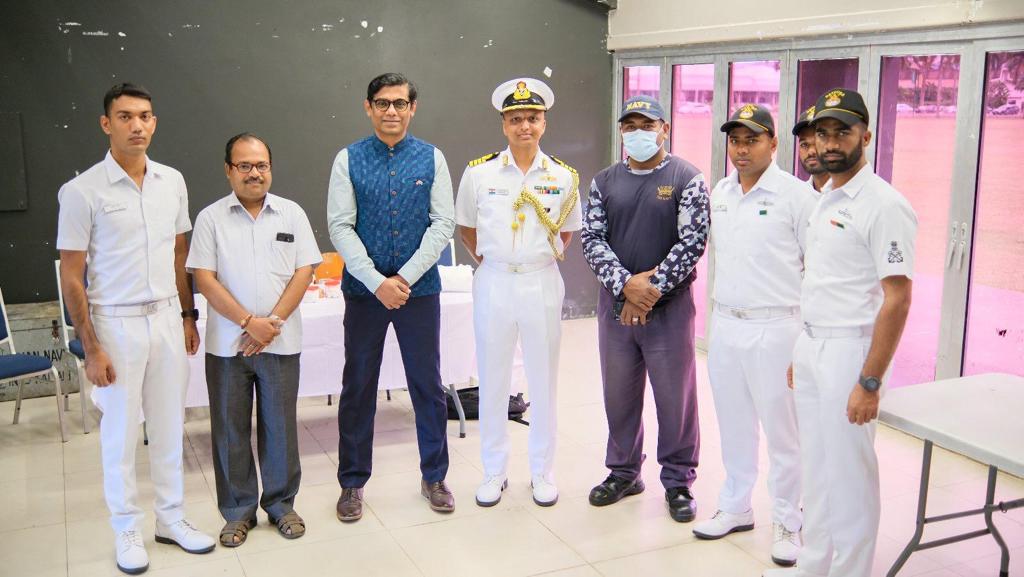
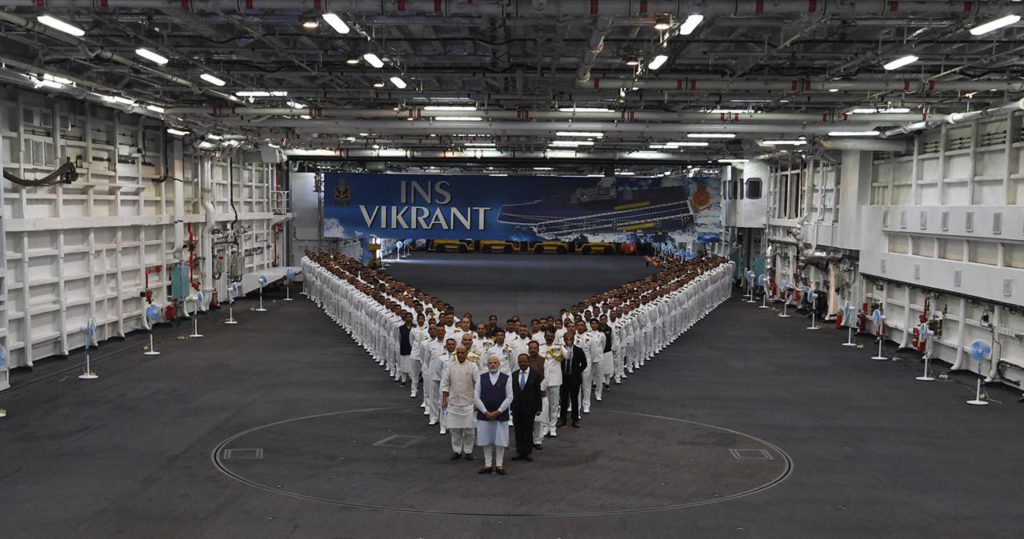
The Indian navy ship INS Satpura docked at the capital city of Suva, Fiji from 1 to 3 September 2022 with the goal of commemorating the 75 years of India’s Independence ‘Azadi Ka Amrit Mahotsav’ by visiting six continents, 3 oceans and 6 time zones.
INS Satpura displayed the Indian Navy’s capacity to assist national goals through global deployment. The Indian Navy’s INS Satpura is a 6,000-ton guided missile stealth frigate that was planned and constructed entirely in India. It can actively hunt down and kill aerial, surface, and submerged enemies.
Satpura literally means ‘Seven mountains’, the name is laid after the mountain ranges in Central India. INS Satpura is the first in four years to visit Fiji as a part of the operational deployment in the Pacific Region.
The “ship has a displacement of 6,300 tonnes, a length of 143 metres, beam of 17 metres and is capable of speed upto 30 knots. It is equipped with long-range surface-to-surface and surface-to-air missiles, medium and short range guns, anti-submarine rockets and an advanced electronic warfare and communication suite” (Chand, FT, 29 August, 2022).
This has the capacity to operate helicopters that makes it suitable for multitasking roles including coastal and offshore patrolling, monitoring of Sea Lines of communication, maritime diplomacy, counter-terrorism and anti-piracy operations. This vessel is a combat-ready asset of the Eastern Fleet’s Visakhapatnam home base.
INS Satpura is seen as a symbol of further strengthening the friendship and cooperation between Fiji-India. This was a goodwill visit that was welcomed by a spectacular live band parade at the port. After arriving, the captain invited the Indian High Commissioner to Fiji, P.S. Karthigeyan to visit and tour the ship.
On the first day, the ship was open to the members of the public for a short duration, but around 300 visitors thoroughly enjoyed touring it. This was later followed by social welfare activities and the planting of 10,000 mangrove saplings at the Nasese Foreshore in Suva.
The next Day, the Indian High Commissioner to Fiji, P.S. Karthigeyan organised a Yoga Session on the Deck of this navy ship, which was led by Yoga instructor from Swami Vivekananda Cultural Centre, which was well received and participated extensively by visitors and high officials.
A great way to start the day! Yoga session in INS SATPURA 🧘♀️ 🧘 🧘♂️, currently docked in the port of Suva🇫🇯. 🙏🏼🙏🏼🙏🏼 officers/staff of the @FijiNavy and Yoga enthusiasts for joining the crew members and officials of @HCI_Suva and @iccr_suva for the session. pic.twitter.com/vBsDI3iQaM
The officers from the INS Satpura laid a wreath at the National War Memorial, Suva to pay homage to the martyred soldiers who laid their lives to safeguard their nation.
‘Lest we forget’ 🙏 Capt. Saket Khanna, Commanding Officer INS Satpura accompanied by Defense Advisor, Capt. Akhilesh Menon laid a wreath at National War Memorial, Suva to pay homage to the fallen heroes & those who sacrificed their lives to safeguard their country. pic.twitter.com/NlmkGRNeD3
On 2 September 2022, the High Commissioner of India to Fiji also organized a Free Health Screening camp at Albert Park in Suva that was conducted in joint collaboration of INS Satpura, Sai Prema Foundation Fiji and the Fijian Navy. Over 240 people benefited from this free medical camp with expert cardiologists, General Physicians, dentists, Nutritionists and others.
Ongoing Health Screening Camp in Albert Park, #Suva 🇫🇯. On service, highly skilled Pediatric Cardiologist, General Physician, Dentist and Nutritionist. A joint initiative of the Doctors and Technicians from INS Satpura, @FijiNavy and @SaiPremaFiji Wishing you all good health. pic.twitter.com/h3I426jPeY
The visit of the ship ended with an evening dinner reception onboard the INS Satpura organized by High Commission of India and the INS Satpura. This was attended by Hon. Dignitaries of Fiji and many members of the Parliament, with members of the Diplomatic Core.
The next day, INS Satpura departed from Suva for its further journey. This short trip of INS Satpura must have given an opportunity to locals to establish connections and be part of the activities conducted onboard and inland activities.
History reveals that Fiji and India shares close friendship bond in the past, where India has been sending medical and relief help after many cyclones, donating COVID-19 vaccines to Fiji; handing over vehicles to Fijian Election office; sending disaster relief supplies; supporting Sri Sathya Sai Sanjeevani Children’s heart hospital in Fiji; supplying medical supplies to the government of Fiji; and many more welfare activities.
In this context, the coming of INS Satpura has added another chapter to the growing friendship between these two nations. India has been the frontrunner in supporting Fiji in technology and human capital. These developments strengthen the bond between the two nations. These efforts of the Indian government and the High Commissioner of India to Fiji is praiseworthy and it has further fostered the relations between India and Fiji.
Image source: High commissioner of India to Fiji with officers of INS Satpura (India t Fiji – Twitter)
The long-distance between India and Fiji can not create a barrier, as their bilateral relations are growing. Hoping, soon, one can have a direct flight from Fiji to India at an affordable price; more scholarships for Fiji students to do tertiary education in India; India to financially support Fiji’s academicians to lead projects on common themes.
Expect more medical experts to visit Fiji regularly to support the medical cause. Future seems progressive, that can only happen with the cooperation of both the nations, and the real benefit should come to commoners.
Contributing Author: Dr Sakul Kundra is an Associate Dean (Research) and Assistant Professor at the College of Humanities and Education at Fiji National University. The views expressed are his own and not of this newspaper or his employer. Email dr.sakulkundra@gmail.com
Disclaimer: The opinions expressed within this article are the personal opinions of the author. The Australia Today is not responsible for the accuracy, completeness, suitability, or validity of any information in this article. All information is provided on an as-is basis. The information, facts, or opinions appearing in the article do not reflect the views of The Australia Today and The Australia Today News does not assume any responsibility or liability for the same.
A single, pregnant rodent floating on driftwood across the treacherous waters between Asia and New Guinea 8.5 million years ago may be behind the eventual colonisation of native rodents in Australia, our new research suggests.
Today, Australia has more than 60 species of native rodents found nowhere else in the world. When you count their close relatives across New Guinea and island neighbours, there are over 150 species. These include the rakali, an otter-like rodent with webbed feet, and desert hopping mice that get around like tiny kangaroos.
Until now, we’ve had an incomplete picture of how there came to be so many species. Our new research unites genomic sequencing and museum collections to reconstruct the evolutionary tale of native rodents, including many extinct and elusive species – and they have a fascinating origin story.
Native rodents have also suffered the highest rate of recent extinction of any mammal group in Australia, with 11 mainland species declared extinct since European colonisation in 1788. Many surviving native rodents remain at serious risk of extinction, with urgent conservation action needed to secure their future.
New methods, old specimens
We extracted and sequenced DNA from museum specimens collected up to 180 years ago to unlock the secrets of the most elusive species.
In one case, we sequenced DNA from a specimen of Guadalcanal rat from the Solomon Islands collected over 130 years ago. The Guadalcanal rat was last seen alive when these specimens were collected in the 1880s, and hasn’t been recorded since.
Like the Guadalcanal rat, every single specimen we studied has its own fascinating history. Together, they tell an 8-million-year long evolutionary story.
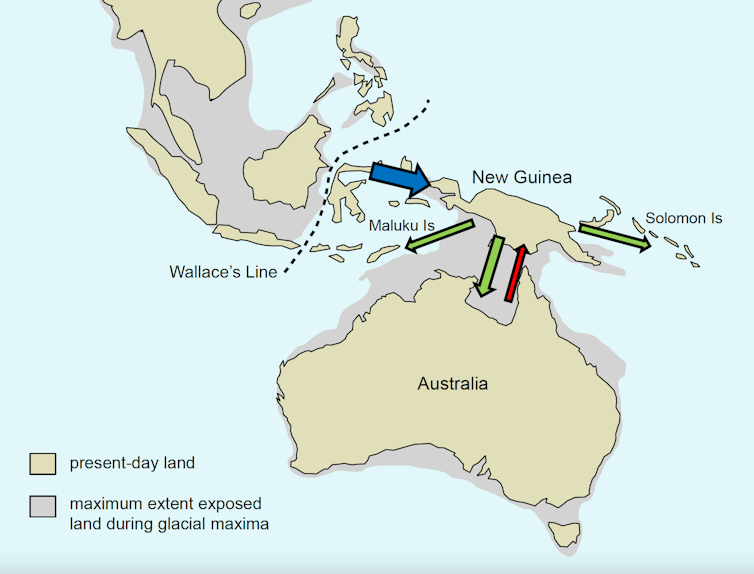
The genetic relatedness of distant rodent relatives tells us the ancestor of Australia’s native rodents originated in southeast Asia. There’s never been a land connection between Asia and New Guinea, and so we know this must happened via over-water colonisation – possibly on a piece of driftwood.
Our research dates this event to around 8.5 million years ago. Both New Guinea and Australia looked very different back then.
In contrast to the large and high-elevation island of modern New Guinea, 8.5 million years ago it was likely made up of a series of smaller, disconnected islands.
Our results show the earliest arriving rodent ancestors, probably tropical forest specialists, initially spread across this earlier New Guinea. But they then stayed put for 3.5 million years.
A shared evolutionary story
Around 5 million years ago, New Guinea experienced a big geological change. Tectonic activity triggered the uplift of an impressive mountain range through the centre of New Guinea, and led to the formation of expansive lowlands.
This expansion opened new environments for rodents to adapt to, and increased connectivity between New Guinea, Australia, and neighbouring islands.
From there, things really took off.
Rodent ancestors first arrived from New Guinea into Australia around 5 million years ago, probably via a land bridge exposed during a period of low sea level.
In Australia, they have adapted to many new environments including the harsh arid desert. In the last few million years, rodents have been especially mobile – repeatedly moving between New Guinea, Australia and neighbouring island archipelagos, generating many new species in the process.
Native rodents first arrived to New Guinea from Asia 8.5 million years ago, and then arrived to Australia 5 million years ago. Over the past few million years, they also have spread across the Solomon and Maluku Island archipelagos.
In our region alone rodents have transitioned between different geographic areas or islands at least 24 independent times in the past 5 million years.
Quite often, this has happened via over-water colonisation. Just like their ancestor, who crossed the waters from southeast Asia 8.5 million years ago, native rodents have continued to leverage their impressive rafting skills.
And yet, despite this remarkable flexibility across evolutionary time, native rodents have not been able to tolerate the dramatic changes to their environment that have occurred in the past 200 years.
Protecting native rodents
Since 1788, we’ve lost 11 native rodent species to extinction. These include the white-footed rabbit-rat and the lesser stick-nest rat, once common on the Australian landscape.
Native rodents are particularly susceptible to predation by feral cats and foxes, land clearing, competition with pest rodents, and introduced disease. These ongoing threats place surviving species at serious risk of extinction.
One of Australia’s most critically endangered mammals, the central rock-rat, is on the brink of extinction after extensive habitat loss and predation by cats and foxes. Captive breeding programs are underway to boost population numbers.
We know even less about the conservation status of many species in New Guinea, the Solomon Islands and Maluku Islands.
By combining genetic data from both modern and historical specimens, our new research takes stock of the diversity of native rodents, and will help to define and prioritise species for conservation efforts.
By understanding how our native rodents evolved, we can make more informed decisions about how best to protect them into the future.
Indian democracy gets a bum rap. The Merriam-Webster Dictionary defines a bum rap as an American slang term for “an unfair claim that someone has committed a crime or done something wrong,” that about covers it.
Despite a vibrant free press, a tenaciously independent judiciary, and 75 years of free and fair elections (including during the 1975-1977 Emergency, when the all-powerful Indira Gandhi called and lost the most important election in Indian history), India has somehow gained an international reputation as an authoritarian state bordering on fascism.
The Economist Intelligence Unit considers India a “flawed democracy”; Sweden’s Varieties of Democracy Institute calls India an “electoral autocracy”, and the Washington think tank Freedom House rates India as only “partially free”.
Academic commentators often use even harsher language. Thomas Blom Hansen, the Reliance Industries—Dhirubhai Ambani Professor of South Asian Studies at Stanford University, has said that “the Modi government is a regime of low-intensity terror”. Yale University professor Jason Stanley, the author of How Fascism Works, says that “India demonstrates just how global ethno-nationalism, and its more violent sibling, fascism, have become”.
And here in Australia, Craig Jeffrey, the former CEO of Melbourne University’s Australia-India Institute, has written that “Narendra Modi’s regime may be described as an instance of authoritarian populism”.
How can a country that has been so successful at developing democracy at home have such a bad reputation abroad?
It is often said that India is the world’s largest democracy. It is less well understood that India is by far the world’s poorest country to possess a well-institutionalised democratic system and to have maintained its democratic institutions throughout its entire history as an independent country.
Many of the criticisms levelled at Indian democracy are actually criticisms of poverty, and Indian democracy should be admired for its persistence in the face of deprivation, not discounted for the shortcomings of the Indian economy.
Other criticisms of Indian democracy are actually criticisms of outdated (often British colonial) institutions, and again Indian democracy should be admired for its longevity, not discounted for its age.
However, the most egregiously misplaced criticisms of Indian democracy are actually no more than criticisms of the Bharatiya Janata Party (BJP), often criticisms that are levelled at it by its domestic political opponents. These are then amplified and broadcast by academics, international organisations, and overseas Indian intellectuals.
In research published this month by Quadrant magazine (“Indian Democracy at 75: Who Are the Barbarians at the Gate?”), I have shown how the three major international evaluations of Indian democracy are “suffused with wanton speculation, misleading statistics, and uncritical reproductions of activist accusations” against Prime Minister Narendra Modi and the BJP.
In several specific incidences, the data presented by international critics as evidence of the declining quality of Indian democracy shows signs of intentional deception.
One obvious example of data misrepresentation is the claim that in 2021, more journalists were killed in India than in any other country outside China. Even taking the underlying data at face value, they show that India’s rate of deadly violence against journalists was 3.5 per billion people. The rate for the rest of the world outside China was 6.3 per billion people.
A fair appraisal would conclude that journalists are actually safer in India than in the rest of the world. But by failing to adjust for India’s extraordinarily large population (and accordingly a large number of journalists), the data are made to tell a different story.
Another misrepresentation is the claim that the BJP uses sedition laws to silence critics.
When carefully examined, the data adduced in support of this claim actually show no trend in the filing of sedition accusations. Moreover, those who make the claim routinely fail to note that in the Indian justice system, virtually anyone can file a First Indication (information) Report for sedition (or any other crime).
Thus of the thousands of sedition accusations filed during the period of the BJP government, very few have actually resulted in prosecution (there are no data on prosecutions under the previous Congress-led government).
One of the strangest findings of democratic decline concerns is the lack of Muslims winning seats in the Lok Sabha (Indian Parliament’s lower house). The number of Muslim Members of Parliament (MP) is in fact relatively low, compared to the concentration of Muslims in India’s overall population. But the number of Muslim MP’s has been rising since the BJP came to power, not falling.
If the number of Muslim MP’s is to be taken as an indicator of the quality of Indian democracy (a suggestion that is itself open to question), then the quality of Indian democracy has improved over the last eight years, not declined.
It is no secret that most Indian intellectuals vehemently oppose Narendra Modi and the BJP.
Understandably, International organisations would turn to Indian intellectuals—academics, journalists, think tank analysts, and award-winning writers—for insights into Indian democracy.
‘Prestigious organisations’ like the Economist Intelligence Unit, the Varieties of Democracy Institute, and Freedom House have a responsibility to be critical in their use of evidence and sceptical of highly politicised views. However, these organisations have themselves become politicised and are losing the credibility that made them prestigious in the first place by justifying these views.
Whatever individual Indians may think of Narendra Modi and the government he leads, all of the objective indicators show Indian democracy to be in good health. In fact, India’s democracy is in much better health than that of peer countries with similar levels of education and income.
At 75 years old, it might reasonably be said that Indian democracy is healthier than ever. Almost uniquely, India seems to have solved the problem of how to run a liberal democracy in a relatively poor country.
The world should be looking to India as a model, not of democratic backsliding, but of democratic success.
(In an exclusive interview with The Australia Today’s Editor, Pallavi Jain, Salvatore Babones said that internationally India enjoys tremendous goodwill at the official and geo-political level but that it was Indian intellectuals who were poisoning India’s reputation.)
Author: Salvatore Babones is an Associate Professor at the University of Sydney and the author of “Indian Democracy at 75: Who Are the Barbarians at the Gate?”, a research paper on India’s democracy rankings that appears in the September issue of Quadrant magazine.
Disclaimer: The Australia Today is not responsible for the accuracy, completeness, suitability, or validity of any information in this article. All information is provided on an as-is basis. The information, facts, or opinions appearing in the article do not necessarily reflect the views of The Australia Today and The Australia Today News does not assume any responsibility or liability for the same.
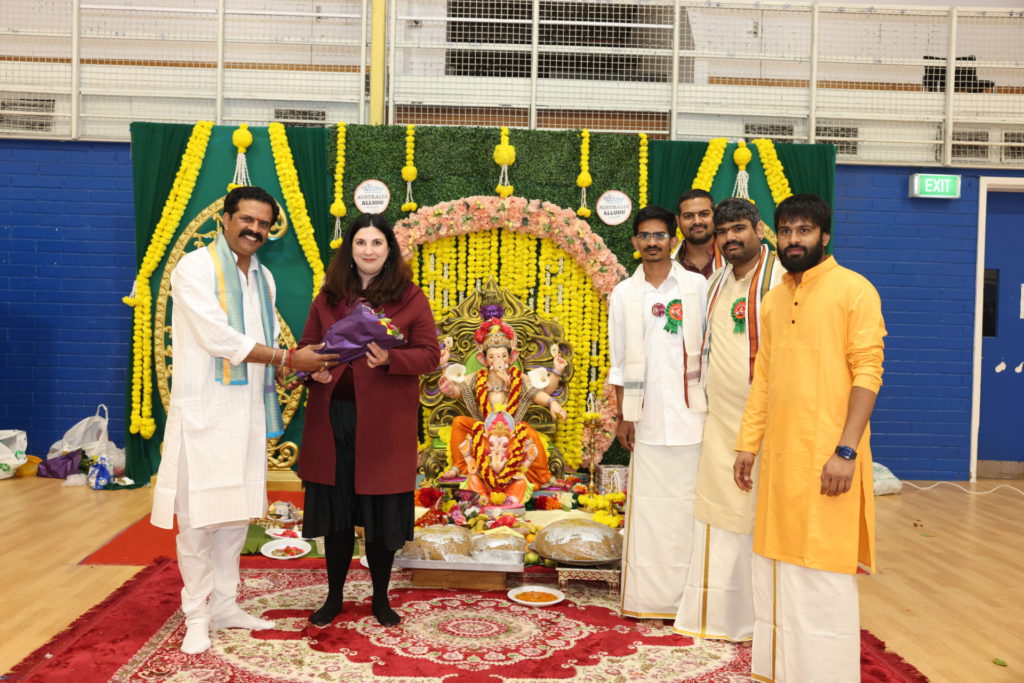
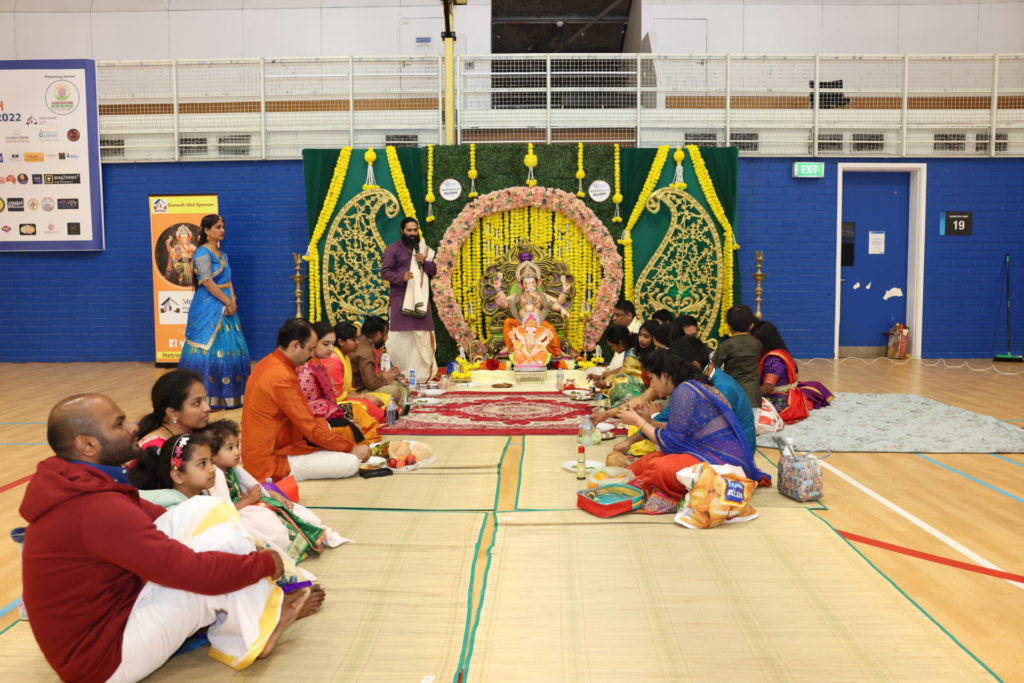
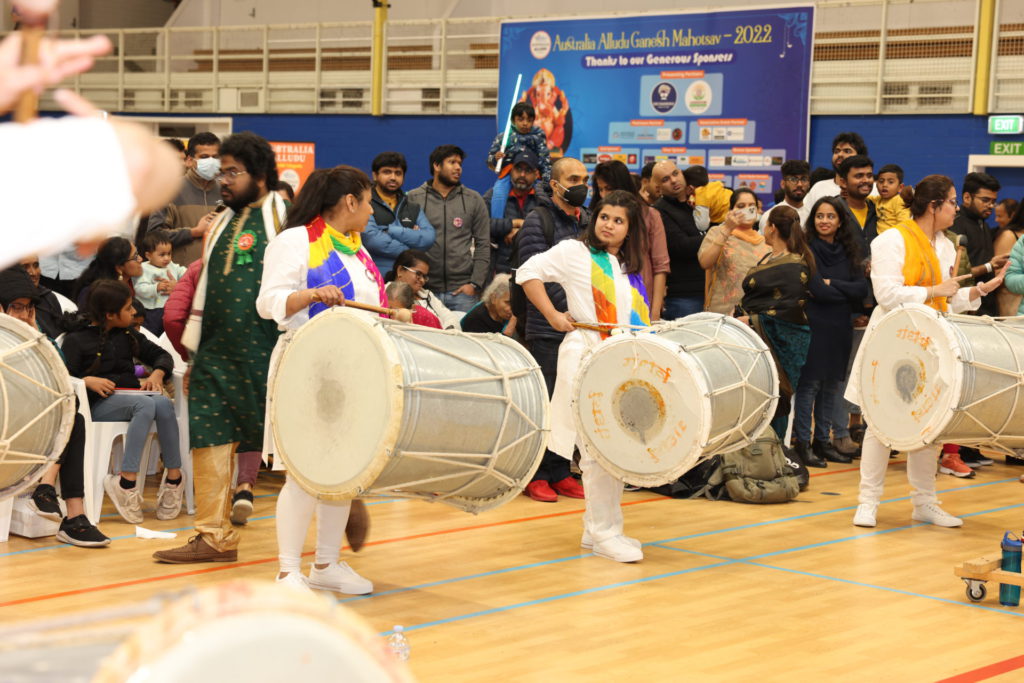
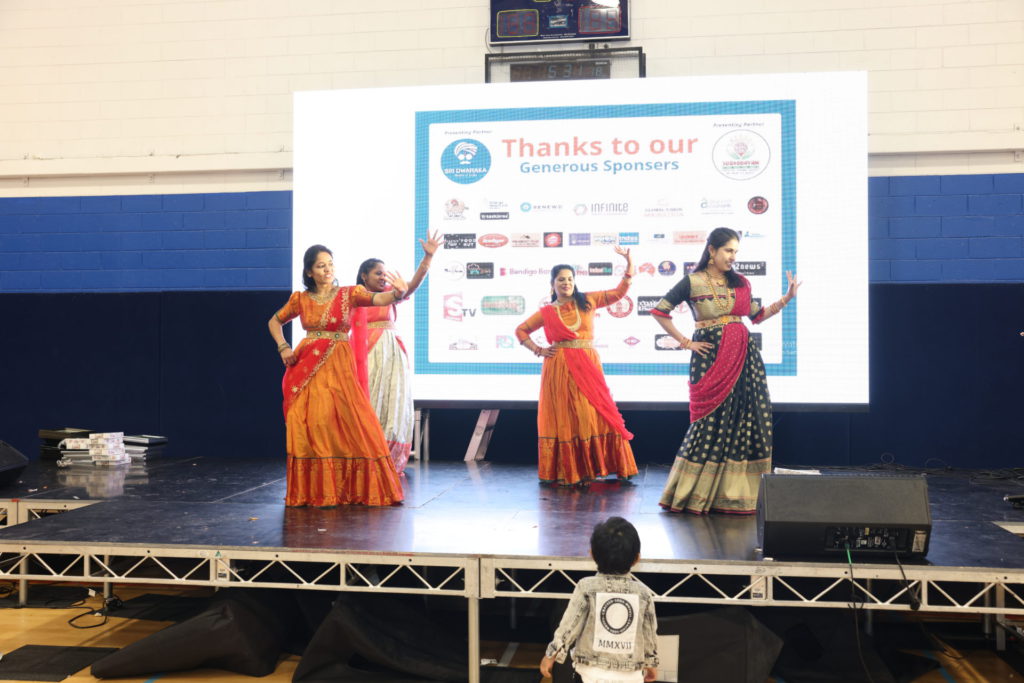
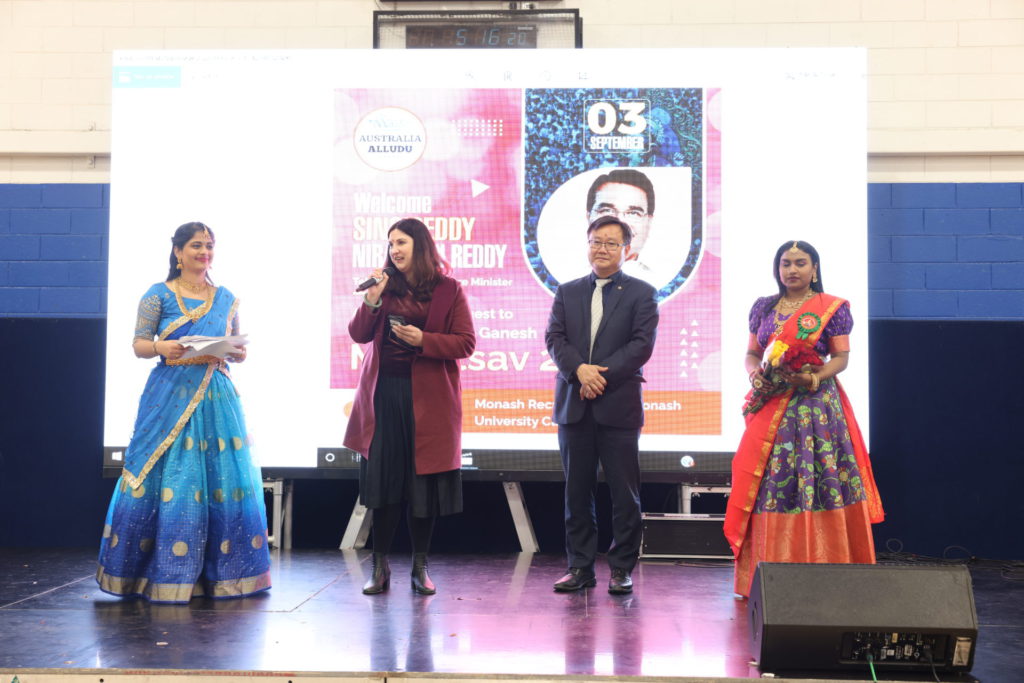
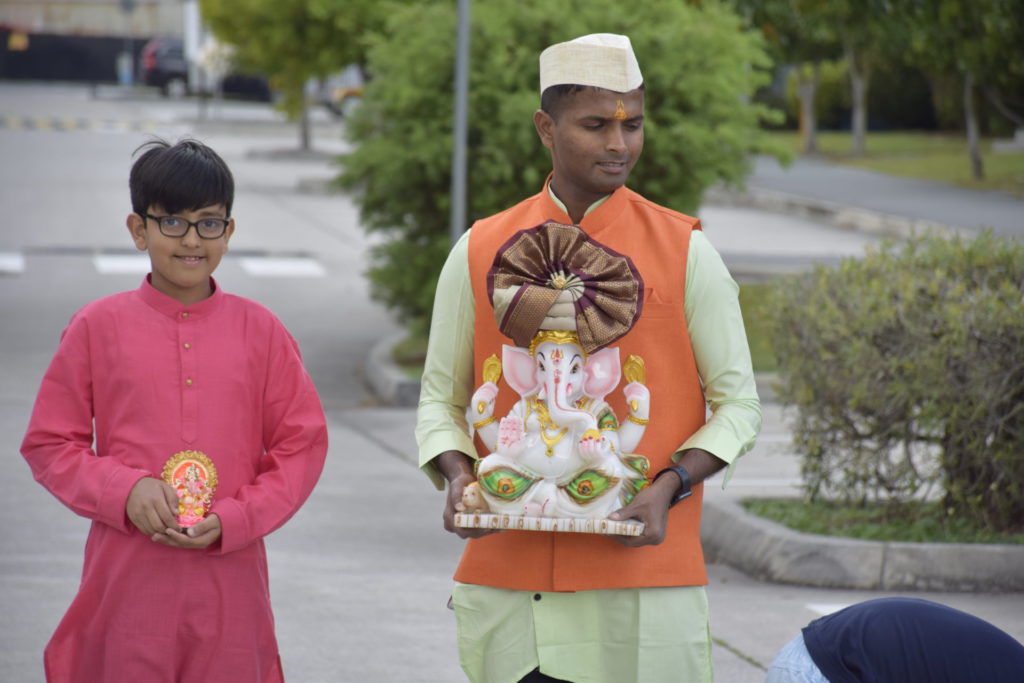
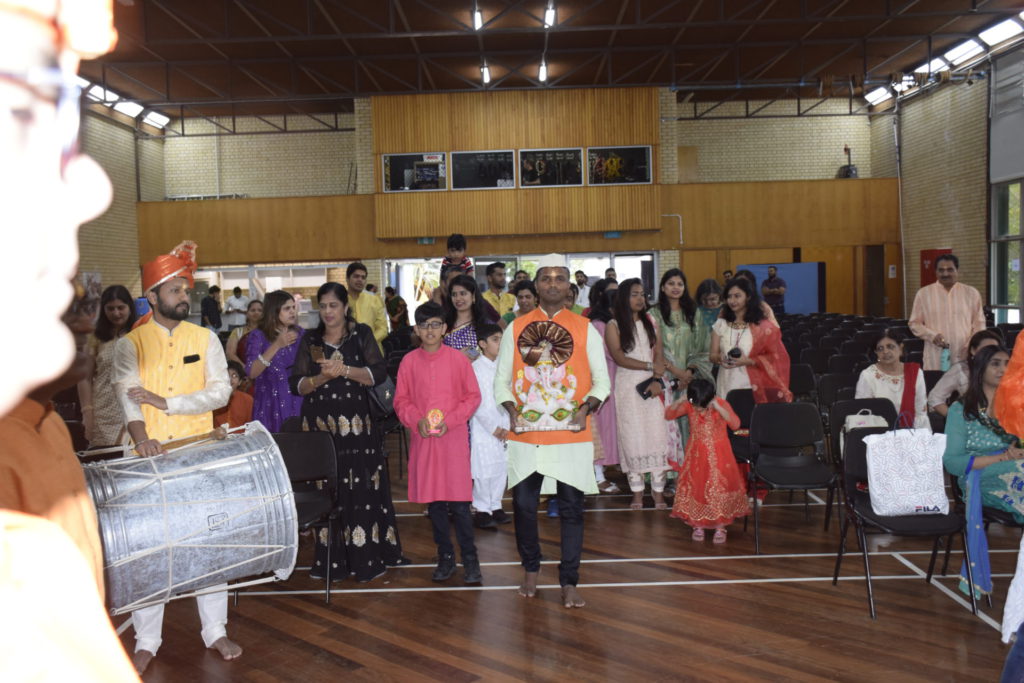
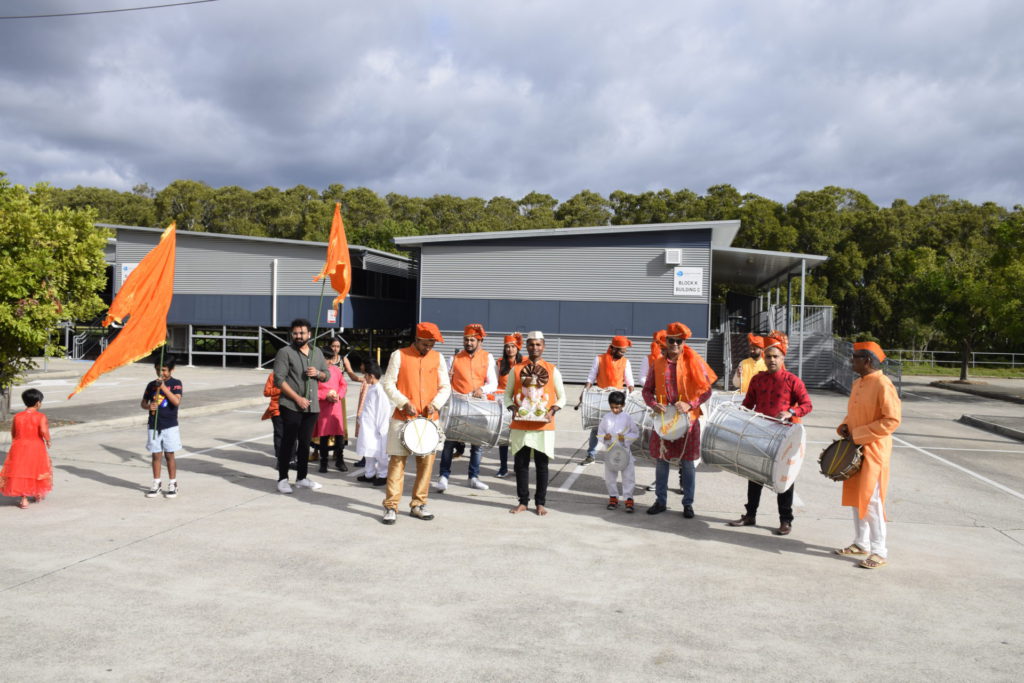
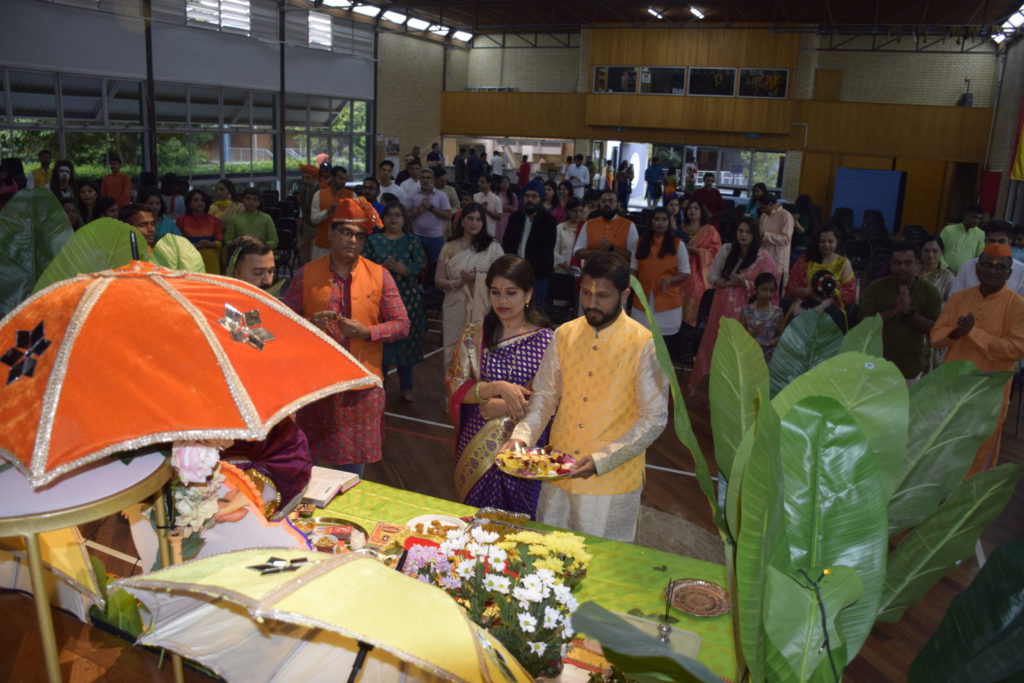
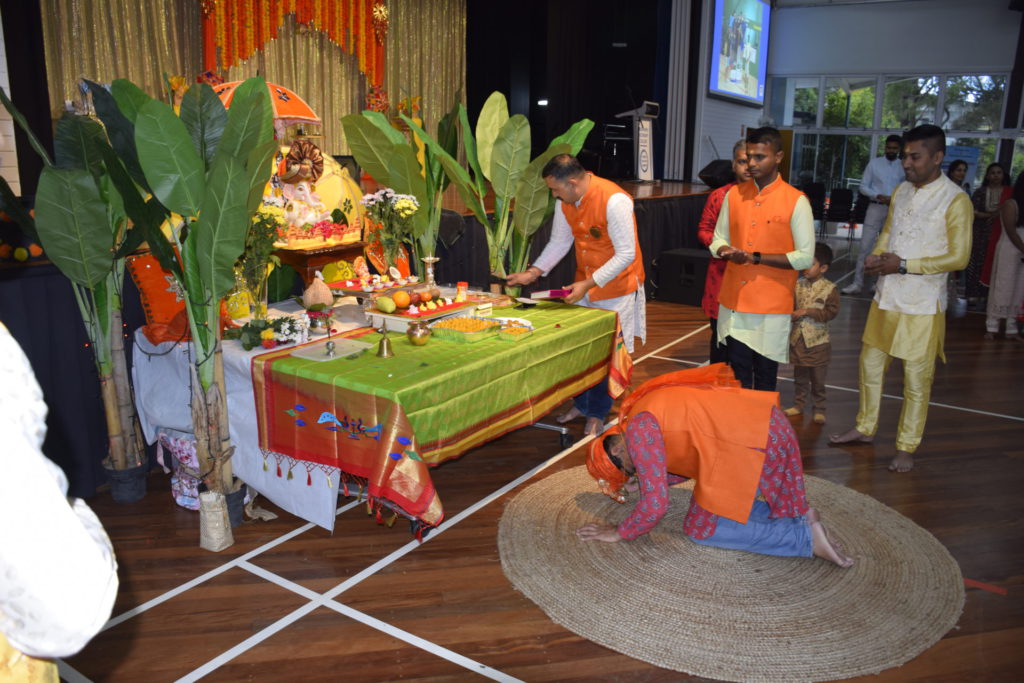
Australia Alludu, an Indian students association, organised a spectacular Ganesh Chaturthi celebration at Monash University’s Clayton campus in Melbourne.
Image source: Australia Alludu
Telangana Agriculture Minister Niranjan Reddy and many local Members of Parliament participated in this ceremony along with hundreds of Ganesh devotees.
Image source: Australia Alludu
The organisers of the event Pallavi and Charan told The Australia Today that the need to respect Indian culture and promote a multicultural vibe in Australia inspired them to organise this event. They said:
“This is the most incredible Ganesh Chaturthi celebration in Melbourne. We feel spiritually uplifted while attending the celebrations. The vibrant ambiance, colours, festive spirit, and coming together of the community are incredible.”
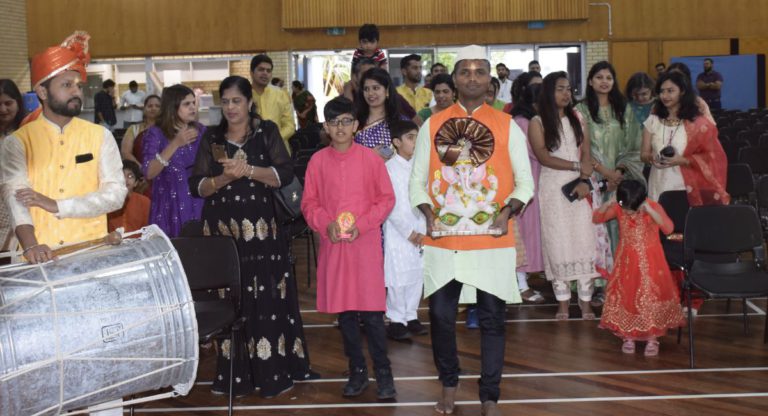
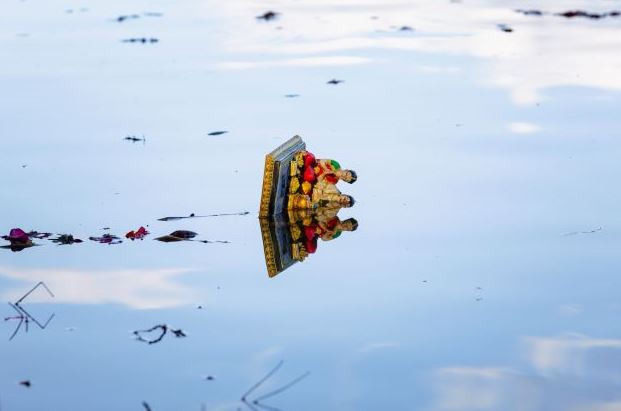
The event attracted hundreds of devotees to witness a majestic five-foot eco-friendly idol of Ganesh that was specially made in Hyderabad, India, and resplendent with rich adornments, artistic décor, lavish flowers, and fruit garlands.
Image source: Australia Alludu
The Ganesh Mahotsava celebrations began with Ganesh puja and special aarti. Throughout the day, elaborate Hindu rituals and archana were performed with shlokas and mantras by priest Murthy.
Ayyapa Seva Samithi Melbourne performed Ganesh Bhajans mesmerising everyone present at the Mahotsava.
Image source: Australia AlluduImage source: Australia Alludu
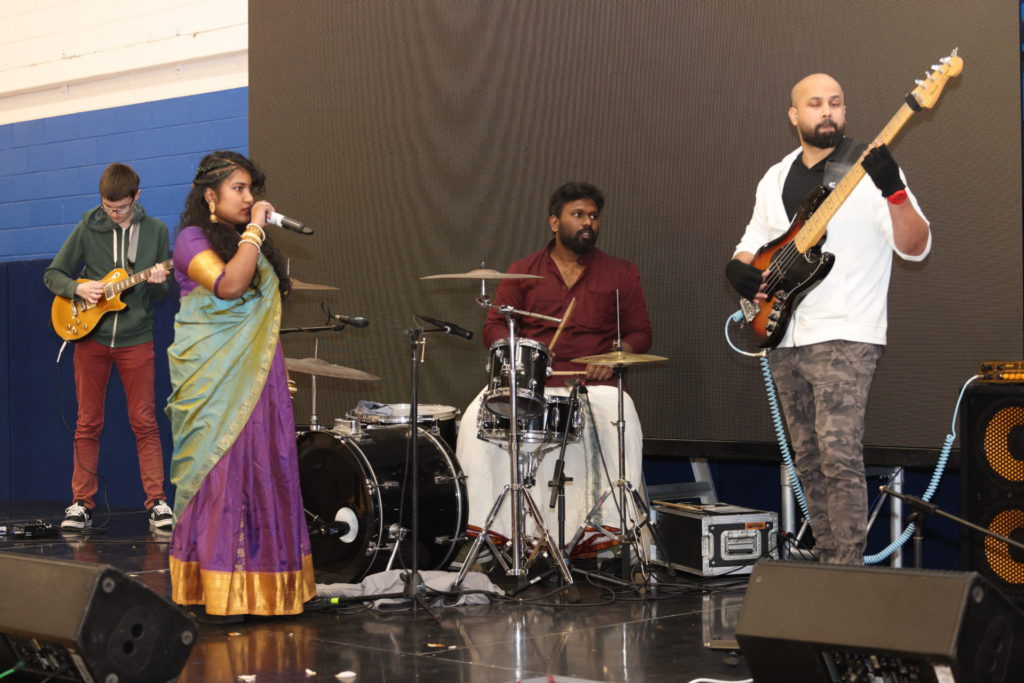
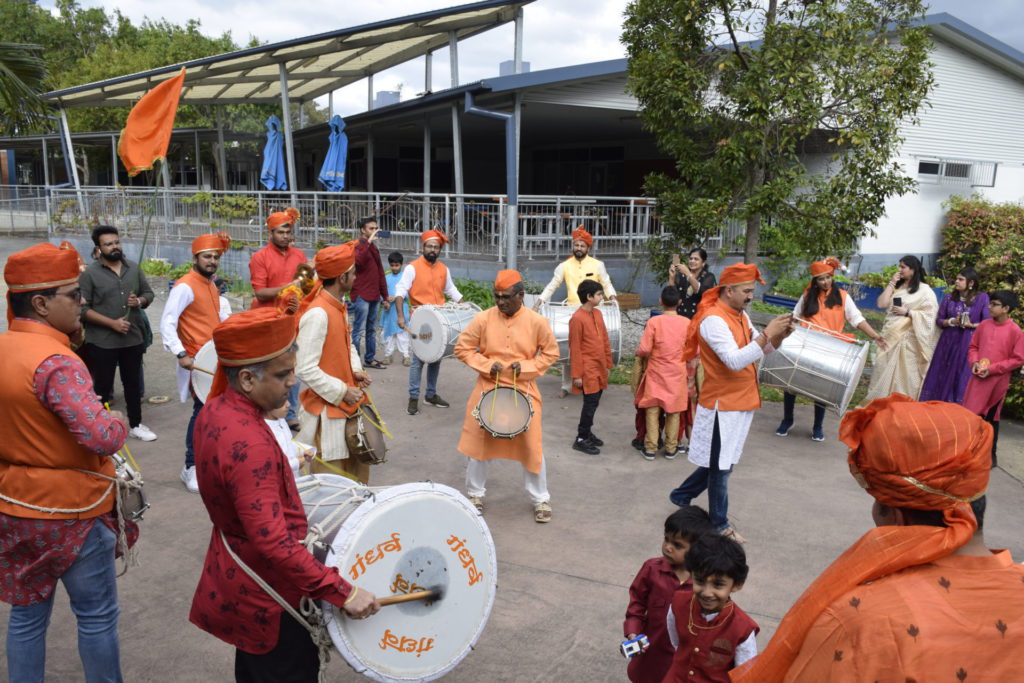
The day was also marked with nonstop entertainment and Dhol performances marked by a unique spiritual fervor.
Image source: Australia AlluduImage source: Australia Alludu
In the presence of devotees and special visitors, organisers conducted a Laddu Auction at the Ganesh Immersion. Through this auction, the organisers were able to raise $23,000.
Pallavi and Charan added:
“By participating in such events, our children can learn about the rich Hindu culture, festivals and traditions. We would recommend all Indians in Australia to attend such celebrations in their area and support the organisers. As such events and celebrations are not possible without active volunteers.”
Image source: Australia Alludu
The organisers said that they would like to thank Carina Garland MP for Chisholm, Julian Hill MP for Bruce, and Meng Heang Tak MP, State Labour Member of Parliament for Clarinda.
Australia is facing an “unprecedented” teacher shortage. The federal government projects a shortfall of more than 4,000 high school teachers by 2025, but shortages are being felt across the board, especially in rural and remote schools, and in maths and science.
One of the possible solutions being touted by politicians is bringing in more teachers from overseas. This has happened before: in response to teacher shortages in Australia in the 1970s, teachers were brought in from the United Kingdom, United States and Canada.
Education Minister Jason Clare has asked Home Affairs Minister Clare O’Neil to fast-track visas for those with teaching qualifications. As he said earlier this month:
One of the things that we’ve got to do is prioritise visas for teachers from overseas who want to come and work here.
Primary Teacher; Image Source: @Canva
New South Wales Education Minister Sarah Mitchell has even proposed fast-tracking citizenship for teachers. But how realistic is this strategy when similar countries have their own teacher shortages?
How does it work?
Teachers from New Zealand have automatic recognition of their qualifications. But those from other countries need to meet conditions imposed by state teacher registration boards, or similar bodies.
For urgent cases, employers can apply for limited registration, for individuals who do not (yet) meet such requirements. The Australian Institute for Teaching and School Leadership also provides skills assessment for overseas trained teachers, and it is also possible to do a bridging course.
Teachers want to quit in the UK
The signs from overseas, where COVID made pre-existing shortages worse, are not encouraging.
In England, a recent survey revealed 70% of teachers had considered resigning, with poor pay cited as a key factor by more than half of respondents. Another survey showed almost 50% of head teachers or principals planned to resign after the COVID pandemic, citing crushing workloads, poor pay and difficulties recruiting staff.
Lack of staff has already lead the UK to combine classes and it is now looking to recruit foreign teachers, including from Australia.
Primary Teacher; Image Source: @Canva
Extreme measures in the US
The US is following a similar trend: widespread teacher shortages compounded by the COVID pandemic. A pre-pandemic survey in 2018 estimated the shortage at 112,000, particularly in maths, science and special education.
A 2021 survey has since revealed 75% of school principals and districts were having trouble finding enough substitute staff to cover teacher absences.
States are having to resort to extreme measures to fill teaching positions during the pandemic. One school district in Texas asked parents to work as substitutes to fill the shortage. Some Texan schools have also moved to a four-day week.
Meanwhile, New Mexico has used National Guard members and state employees as volunteer substitute teachers to cover COVID shortages. Arizona now allows people without a college degree to begin teaching (as long as they’re enrolled in a degree).
Canada is also suffering from a significant teacher shortage, especially in special needs, early childhood and at the upper secondary level.
High levels of teacher attrition (as much as 40% in the first five years of service in some provinces) is blamed.
The pool of substitute teachers has also shrunk. In Quebec, British Columbia and Ontario, school boards are contacting retired teachers and instructors without certification to fill gaps. Saskatchewan and Ontario are offering final year education students temporary permits as substitute teachers.
Manitoba has introduced a “condensed training program” of 30 hours, that promises to teach basic classroom skills to those with a limited teaching permit.
Canada is also searching internationally. Somewhat like the priority accorded to skilled workers in Australia’s migration scheme, Canada’s Federal Skilled Worker program allocates substantial points to those with foreign education credentials, including teachers.
Primary Teacher; Image Source: @Canva
Migration unlikely to work
So, if migration is seen as a solution to Australia’s teaching shortage, the question needs to be asked: where are they going to come from?
Although poor pay in the UK and some states in the US might make Australia seem attractive, current teacher shortages in England, the US and Canada make it unlikely that many will be found there.
While it is possible teachers can be found in other countries, such as India, Malaysia and Singapore, they are unlikely to be found in significant numbers, partly due to lengthy registration procedures and some discrimination when seeking employment.
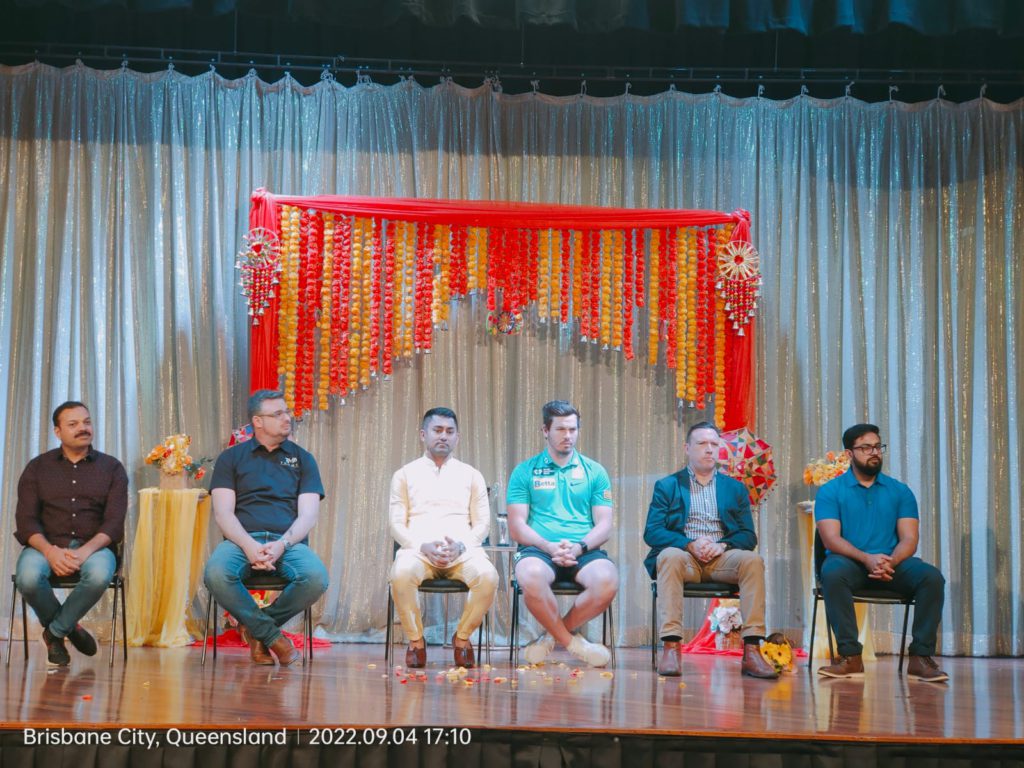
Brisbane Maratha Warriors and Brisbane Dhol Tasha Pathak celebrated the Ganesh Festival and annual Sports Prize Distribution on Sunday 4th September 2022.
Dr Amol Deshmukh the President of Dhol Tasha Pathak Brisbane told The Australia Today:
“Ganesh Mirvanuk has been etched into our memories since our childhood. The soulful sounds of drums bring alive sweet childhood memories and reinvigorate the spirit of community and multiculturalism. Our goal is to showcase our young generation’s centuries-old rich traditions and Motivate them to keep the culture and the passion alive.”
Brisbane Dhol Tasha Pathak’s performance was the highlight of the function where little Adit stole the heart of people with his power-packed Tasha performance.
Brisbane Maratha Warrior Sports club President Harry Sathe said:
“it is not just showcase of Marathi cultural but overall to promote the sport in the multicultural community and provide a sporting platform to young emerging kids and showcase their sporting talent while learning about our tradition.”
Mr Bhushan Joshi performed all the rituals and chanted all the shlokas for the Ganesh stahpana and explained it well to the wider community to understand why we celebrate the festival.
27-year-old Indian-origin auditor at Ernst and Young Aishwarya Venkatachalam died by falling from the 11th floor of her workplace building in Sydney’s CBD on August 27.
The tragic incident happened after when reportedly she had been kicked out of a work function and needed her house key from her office to go home – and told some kind, women, that building security would not let her in to get it.
Ms Aishwarya’s long-time friend Neeti Bisht told Daily Mail Australia she was dealing with bullying and racism at work.
“I think things had just started to brew then… Her colleagues and the racist angle was at play,”
Ms Bisht said.
An Ernst & Young spokeswoman told Daily Mail Australia that the company ‘has a zero-tolerance response to bullying, harassment and racism, and we take any allegations that relate to these issues very seriously.
She added:
‘The review we launched last week following this tragedy is ongoing and it would be inappropriate to comment further until it is complete. We are continuing to offer all our people counselling and support.’
We (The Australia Today) are absolutely not suggesting Ernst & Young, which is now known as EY, or Aishwarya’s co-workers, were in any way responsible for her death.
Aishwarya’s uncle, who lives in Canada, told Daily Mail Australia that the whole family is struggling to come to terms with her death.
He said:
‘She was very educated, beautiful and brilliant. She was a very good lady, she was brought up very well. I do not know how this could happen. Her mother and father are very caring and kind. They were supporting her, and she was supporting of them.’
In 2015, Aishwarya graduated from Symbiosis College of Arts and Commerce in Pune, and in 2019, she joined Grant Thornton LLP in Bengaluru as a senior auditor. In November 2021, she moved to Australia to join EY as a Senior Auditor and was thriving in her new role.
Aishwarya and Nakul (Image source: Instagram)
Aishwarya got married to Nakul in Chennai last year in January. Her close friend Neeti Bisht, who was a bridesmaid at her wedding, told Daily Mail Australia that she recently complained about ‘racism’ in Australia and ‘mean colleagues’. Neeti said
‘She was a happy soul and was finding her feet in Australia … She mentioned how mean some of her colleagues were.’
Ernst & Young building
It is reported that At 8 pm Aishwarya spoke on the phone to her husband, Nakul, in Singapore before he got on a flight back to Sydney after a work trip.
Further, three women told the Daily Mail Australia that they found Aishwarya ‘crying her eyes out’ in a nearby car park about 30 minutes before the fall.
Aishwarya Venkatachalam (image source: Instagram)
These women said when we tried to help Aishwarya, she initially flinched from us, saying ‘all white people are racist’ and cowering in a corner.
But we told her: ‘We are three women here to support you and be here for you and get you home safely. Tell us what’s going on…
‘She just kept repeating herself…. and how she got kicked out of her work function.
‘She said that over 10 times whilst crying her eyes out. She was having a panic attack and had been drinking but wasn’t completely drunk.
‘Once we calmed her down, she said she needed to get into her work office at EY as she forgot her house key and they wouldn’t let her up [but] she had her swipe tag.’
Helping women added: ‘She didn’t have anybody. I saw that she was wearing a wedding ring so I asked about her partner and she said he’s in Singapore and getting a flight back.
‘I asked if anyone else had a spare key to her home or if we can drop her somewhere safe or call her a cab – I even offered to pay for a cab if she didn’t have money.’
She said at that point another woman and two men appeared who offered to drop her off at the EY building to get her key.
‘I think they made a welfare call out to the police but it was too late,’ said one of the women.
It is also being reported that she allegedly fell in a ‘drunk and distraught’ state after returning to the office following a work function at the nearby Ivy nightclub.
NSW Police spokesman told media that a report continues to be prepared for the coroner. They were unable to comment on when Aishwarya’s body will be repatriated to India.
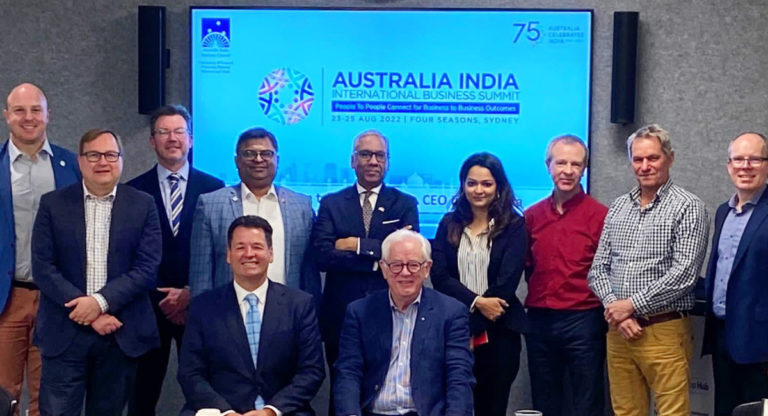
Invest India CEO and Managing Director Deepak Bagla was recently in Australia for the inaugural Australia India International Business Summit (AIIBS) organised by the Australia India Business Council (AIBC).
Invest India is the advisor, guide, and facilitator to every investor looking to make a home in India.
In an exclusive interview with The Australia Today, Mr Bagla said that India is going through one of the most unprecedented transformations in human history regarding the pace and scale of change.
Mr Bagla also spoke about the importance of the Diaspora in further strengthening the Australia-India bilateral relationship. He added that the time to invest in India is now!
Michael Sharpe, National Director of Industry, AMGC (Advanced Manufacturing Growth Centre Ltd) recently took part in a round table hosted by the AIBC after the business summit at Sydney StartUp Hub connecting with Investors, Startups and Manufacturing businesses looking to engage with India on market opportunities.
Mr Sharpe told The Australia Today that Australia and India will be stronger and that the new agreements between Australia and India are opening up vast opportunities for Australian manufacturers to partner with India.
He said that the opportunities in the manufacturing sector for the two countries are very vast and include everything ranging from food production to space industry and everything in-between. He added that Australian manufacturing needs to ramp up collaboration efforts with India.
James Stewart is Venture Partner at Loyal VC. Speaking with The Australia Today after the round table, Mr Stewart said that we are at one of the most exciting points in the history of the Australia-India economic relationship.
He added that it was about building understanding between the two communities to grasp opportunities.
The Chinese regime’s treatment of Uyghurs and other predominantly Muslim groups in the province of Xinjiang may constitute crimes against humanity, says a long-awaited report from the Office of the United Nations High Commissioner for Human Rights.
It describes as “credible” allegations of torture, including rape and sexual violence, discrimination, mass detention, forced labour and widespread surveillance.
Multiple reports over the past five years have documented human rights abuses in the far-western province. These include the arbitrary detention of at least 800,000 people, and possibly millions.
Former detainees have testifed about being forced to work in textile factories, producing goods possibly supplied to foreign companies.
In January 2021 the then US Secretary of State, Mike Pompeo, said he believed the Chinese government was committing genocide in a “systematic attempt to destroy Uyghurs”.
But this latest report, published just minutes before midnight on High Commissioner Michelle Bachelet’s last day in office, comes with the imprimatur of the United Nations.
It is no longer possible for anyone – including the many companies that continue to source products from Xinjiang – to claim plausible deniability.
Companies implicated in slave labour
Xinjiang is China’s largest region. Along with mining resources such as coal, gas, lithium, zinc and lead, it produces about 45% of the world’s polysilicon, a key component in photovoltaic solar panels.
It also produces the vast majority of cotton (84% is a commonly cited number) for China’s textiles and garment manufacturing industry.
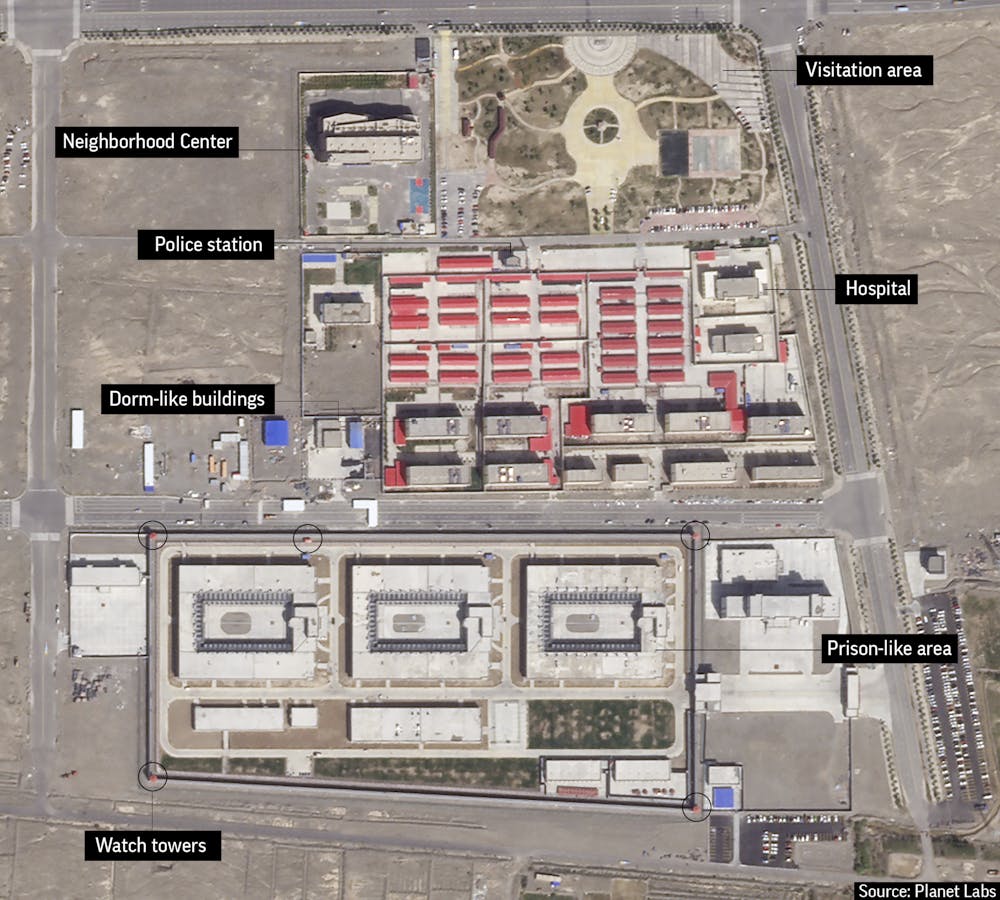
A 2018 satellite image shows detention camps built near the Kunshan Industrial Park in China’s Xinjiang region. Planet Labs/AP,
The following month the Chinese government finally acknowledged the existence of what it called “vocational training centres”.
But it justified these as necessary to counter “terrorism” and “extremism”.
The latest UN report leaves no doubt large-scale arbitrary detention has occurred. Attempts to pass off camps as vocational or training centres are simply not credible.
As well the possibility of goods sourced directly from Xinjing being made with slave labour, this new UN report also notes the “labour transfer schemes” that force people from Xinjiang to work elsewhere in China.
These transfers mean goods produced in factories throughout China may be tainted with modern slavery.
A 2020 report by the Australian Strategic Policy Institute identified 83 Chinese and foreign companies that allegedly benefit from the use of Uyghur workers outside Xinjiang.
The list featured Adidas, Amazon, Apple, BMW, Calvin Klein, Dell, Google, H&M, Hisense, Hitachi, Huawei, Lacoste, Mercedes-Benz, Microsoft, Mitsubishi, Nike, Nintendo, Sony, Victoria’s Secret, Volkswagen and Zara.
So where to next?
The UN report calls on the Chinese government to release those who have been arbitrarily detained, and to investigate the allegations of human rights violations. This is like asking a fox to guard the hen house.
What is needed is international action and pressure to force change.
This should also be a catalyst for individual nations to do more to stamp out modern slavery from supply chains, ensuring goods produced with forced labour – in China or elsewhere – cannot be imported.
This is also provides a clear signal for anyone doing business with China (not just Xinjiang) on the need to conduct adequate due diligence to ensure they are not benefiting indirectly from human rights abuses.
This includes technology companies that sell surveillance and security products to China.
Until there is broader access and independent verification of working conditions in Xinjiang, business should now assume that goods connected with this region are tainted with modern slavery.
Justine Nolan, Professor of Law and Justice and Director of the Australian Human Rights Institute, UNSW Sydney
The annual Insurance Business Awards is the leading independent awards event in the Australian insurance industry. These awards showcase the leading brokers, brokerages, insurers, underwriting agencies, BDMs, and much more across various categories. The award recognises the achievements, leadership, innovation, and excellence in the insurance profession.
Sumit Sopori and Tanushree Arora-Sopori (Image: supplied)
Sumit Sopori, the Founder and Managing Director of IIFS, told The Australia Today that he is very ecstatic about receiving this prestigious and iconic industry award.
He adds:
“My team and I feel really pleased to receive the national award as it’s quite a honourable award and well recognised in the insurance industry.
It is a reflection of our hard work and effort being recognised on a national level. It will only strengthen our motivation to serve the community even better.”
Sumit Sopori (Image: supplied)
Sumit who came to Australia in 2005 as an international student to study Business Management at Edith Cowan University, has over 13 years of experience working with broking giants and large insurers.
He says that he is always striving to create awareness about insurance among various communities and is always ready to mentor young graduates.
He adds:
“To create more awareness about the insurance industry among the culturally diverse communities and the fresh graduates about career pathways.
To combine technology with a human approach and work towards constant improvements by incorporating digitalisation to promote a user-friendly environment for the consumers. Promoting multiculturalism, equal opportunities, and meritocracy in the organisation.”
Insurance Business Awards 2022 (Image source: Insurance Business Australia website)
The Insurance Business Awards is presented by Insurance Business Australia magazine. On 2 September, after two years of virtual gatherings, the Insurance Business Awards 2022 were presented at a glamorous gala event in Sydney.
From Friday September 9, the isolation requirements for people with COVID and no symptoms will be cut from seven days to five days. Masks will no longer be required on domestic flights.
While Australian Medical Association President Steve Robson called for the release of the science behind the National Cabinet decision, the change shows we are now rapidly pushing towards a “business-as-usual” pandemic. This political strategy requires the elimination of protections or restrictions, so that life and business can go “back to normal”.
Setting a reasonable duration of isolation depends on balancing the risk to the community of ongoing transmission and the benefit of enabling individuals with COVID to go back to work, school and normal activities as quickly as possible. Seven days was already a compromise. And now New South Wales premier Dominic Perrottet has called for isolation to be scrapped altogether. Has the evidence changed with respect to this balance?
There are a number of recent studies in vaccinated people in the Omicron era evaluating how long people shed virus and are potentially infectious after testing positive for COVID. This fresh research shows a significant number of people (between one-third and one-half) remain infectious after a five-day isolation period. Another study shows two thirds are infectious after this time.
So, of the 11,734 people reported to be COVID positive on September 1, at least 3,900 would still be infectious on day five. If released from isolation, they could infect others.
With onward transmission, this could result in many additional COVID cases that would not have occurred if an isolation period of seven days had been retained.
While the reduction of the duration of isolation applies only to people who do not have symptoms, it is well accepted transmission without symptoms occurs. Unfortunately, our politicians have equated the absence of symptoms with the inability to transmit the virus to justify the changes. Decision-makers clearly need to be better informed.
But what about businesses?
Mandatory isolation places stress on people and businesses. But with numbers of COVID cases falling from the peaks of the BA.4/5 wave throughout Australia, fewer people are now testing positive for COVID than at any time this year. The pressure on individuals and businesses due to mandatory isolation is at a low point for 2022.
So why make the change now? Perhaps the hope is that while we are experiencing reduced transmission due to the large number of people recently infected with COVID, easing our protections will not lead to an immediate increase in cases.
In this confidence trick, politicians can make these changes with no apparent impact. They will continue to do so until all mitigations against transmission are gone. This is all part of a strategy which, in the words of the NSW premier, has “less reliance on public health orders and more reliance on respecting each other”. As if the two concepts are mutually exclusive instead of mutually reinforcing.
Unfortunately, reinfection is common, and we will face another epidemic wave in the future, likely before the end of the year. Then our systematic dismantling of all existing protections will make the next wave come on sooner and affect more people.
Mitigate transmission instead
Allowing a substantial proportion of people to go back to work while still infectious is not a solution to solving the workforce disruptions COVID is still causing. This is because there will be an increase of infections in workplaces and schools due to the shortened isolation. When our next wave comes, this will result in even more people being furloughed because they are sick with COVID or caring for others, defeating the ultimate purpose of the change.
And, as we have learned with the BA.5 wave – the highest number of people hospitalised with COVID in Australia since the beginning of the pandemic – reintroducing mandates once they have been removed does not happen even when medically advised. Once a protection is relaxed there is no going back – it’s a one-way road.
The best way to protect business interests and keep the economy productive is to mitigate transmission of SARS-CoV-2 (the virus that causes COVID) as best we can using a vaccine-plus strategy.
In other countries that have shortened the isolation and then abandoned it altogether, such as in the United Kingdom, transmission has only been worsened and the economic impacts compounded.
Removing mask mandates on planes will mean a greater risk of having your travel disrupted by COVID and also of airport disruptions because of flight crew off sick from increased exposure.
According to overseas studies, the reduction of the isolation period from 7 to 5 days means that of the 13,232 new COVID-19 cases reported today, around 6,500 will be infectious on Day 5 when they will take the virus to their workplaces, schools and shops where few wear masks.
By reducing isolation and thereby increasing workplace transmission, we make the workplace less safe. The rights of people to a safe workplace must be considered alongside business continuity.
Allowing increased transmission will impact the economy by resulting in higher numbers of people affected by long COVID. In the UK, the model we appear to be emulating, up to one in four employers are reporting their productivity is affected by long COVID.
The move to a business-as-usual pandemic leaves us unnecessarily vulnerable and will ultimately disrupt business even more.
The emergence of COVID variants that are more and more infectious and increasingly vaccine-resistant, along with the simultaneous removal of mitigations such as isolation and masks, dooms us to recurrent and disruptive waves of disease.
Our best chance of business continuity is not the one-way road to a disruptive business-as-usual pandemic but a layered strategy. This would include improved booster rates, safer indoor air, masks in public indoor settings and maintaining the current isolation period for those with COVID.
Hyderabad-based commercial Skyroot Aerospace, the rising star of India’s growing commercial space startup sector, has successfully raised $51 million through a Series-B financing round.
In a tweet, Skyroot Aerospace said: “We are elated to announce our US $51M (INR 403 Cr) Series-B #funding round led by GIC.”
We are elated to announce our US $51M (INR 403 Cr) Series-B #funding round led by GIC.
We are proud to welcome one of the world’s leading institutional investors as a long-term partner in our mission to #OpenSpaceForAll
With this round, Skyroot has expanded its shareholder base including Myntra & CultFit founder Mukesh Bansal, Greenko Group founders (Anil Chalamalasetty & Mahesh Kolli), Solar Industries India Limited, Google board member Ram Shriram’s Sherpalo Ventures, Neeraj Arora (Former-WhatsApp Global Business Chief), Wami Capital and others from past funding rounds.
Ajay Kumar, Defence Secretary in the Government of India congratulated Skyroot team in his LinkedIn post. He said:
“The ecosystem of innovation created through iDEX is creating waves in various sectors. An iDEX startup making waves in Space sector!!”
Skyroot Aerospace was founded in 2018 by former ISRO engineers Pawan Kumar Chandana and Naga Bharat Daka. The 200-member strong team is working on developing its flagship Vikram series of launch vehicles.
Skyroot completes 4 splendid years today!
We thank every member of Team Skyroot for keeping the fire burning throughout; our Investors, @isro and @INSPACeIND for all the support, and everyone who rooted for us over the years.
With $51 million back-up, this makes it the highest funding round ever in India’s space technology sector by far. This investment, led by the Singapore-headquartered long-term investment firm GIC, will help Skyroot Aerospace boost its launch vehicle capabilities. It will further help tap into the fast-expanding global space economy that was cumulatively worth $469 billion in 2021.
Image source: Naga Bharat Daka (Left) and Pawan Kumar Chandana (Right), co-founders of Skyroot Aerospace (Skyrrot.in)
Pawan Kumar Chandana, the Co-founder and CEO of Skyroot, told Business Today that this funding will enable them to build “infrastructure to meet high launch cadence” required by their satellite customers.
The space-tech startup aims to cater to the growing demand from the international small satellite market. Its Vikram series rockets built using an all-carbon fibre structure are capable of carrying up to 800 kg payloads to the Low Earth Orbit (LEO).
In a major milestone, we’re thrilled to announce #successful Proof Pressure Test (PPT) of ‘Kalam-250’ – the 2nd Stage of our #launch vehicle Vikram-1.
This was built with ultra-high-strength #carbon fibre and tested to the required maximum expected combustion pressure of 77 bar. pic.twitter.com/hLlQb7D2o9
Skyroot’s co-founder and COO Naga Bharat Daka says:
“We have validated all three propulsion technologies in our Vikram space launch vehicles, and completed a full duration test of one of our rocket stages in May this year. We are also planning a demonstrator launch to space this year.”
Skyroot has successfully built and tested India’s first privately developed cryogenic, hypergolic-liquid, and solid fuel-based rocket engines.
Skyroot (Twitter)
In 2021, Skyroot became the first space technology startup to ink an MoU with the national space agency, the Indian Space Research Organisation (ISRO) for sharing facilities and expertise.
Further, Accenture has recently announced that it has invested $25 million in Pixxel in a series A funding round and Chennai-based Agnikul Cosmos has raised $11 million in Series A funding, and Hyderabad-based Dhruva Aerospace has raised Rs 22 crore or around $2.7 million.
The global space launch services market is projected to grow from $14.21 billion in 2022 to $31.90 billion by 2029, at a CAGR of 12.25 per cent.
Fiji Times’s cover story ‘Gone With the Wind’ (18/8/2022), follow up story ‘Lawyer abdicated roles’ (19/8/2022) of a legal battle is making headlines. This case is about a “lawyer [who] failed to appear in court on Monday where he was sentenced to 10 months imprisonment by the High Court in Suva for contempt of court” (FT, 18/8/2022). Both parties have reputed lawyers, who may take the best legal options during the trial and after judgement.
Every litigation, when it comes on to the court, has some rules and precedents to be considered by the Hon judges and law professionals. Thus the theory of precedent is of huge importance in the eyes of law.
If a system of law lacks stability, then it would create a huge concern for many. This would create uncertainty in achieving the best possible legal advice, and giving the freedom to apply any judgement without binding on the earlier judgements made by higher courts would lead to losing the similarity to justice and fairness, and the impartiality of the Court could not be maintained (Catlett, 1946).
This op-ed enlightens a debatable concept in law, i.e. Stare Decisis, its benefit, limitations, and critics to comprehend the concept based on available sources. It is highly relevant in Pacific Island nations that have borrowed laws from imperial, colonial, customary, and post-colonial laws.
Court (Image: Wikimedia commons)
What is Stare Decisis?
Stare Decisis is a Latin word meaning “To let the decision stand and not to disturb settled matters” or “to maintain former adjudications” or “to uphold precedents” in the law that is a binding Case Law.
The simple meaning is that the case at hand is to be decided in accordance with the decisions of similar cases in the past with similar facts and similar legal issues.
The decisions taken by the competent court “will no longer be considered open to examination, or to a new ruling, by the same tribunal or those which are bound to follow its adjudications” and “the judges are bound to follow that decision so long as it stands unreversed unless it can be shown that the law was misunderstood or misapplied in that particular case” (The American Law Register, December 1886).
This was the authority in a similar case. The preceding decisions should have binding authority; otherwise, the previous decisions will merely have persuasive value. The past decisions are identified as precedents.
In the colonies, this idea was employed as the foundation for their judicial judgements, which originated in England. The doctrine of Precedent guarantees that law is certain, consistent, and clear. This gives stability, predictability, adaptability, uniformity, and integrity to the rule of law.
This applies when higher court judgement/decisions with similar facts and legal issues have a binding effect on the subordinate courts. Thus, many cases of law in lower courts will be decided based on precedent.
Similarly, judges are bound by the precedent that comes from the higher court above their court. It is useful, as every case is no longer susceptible to endless re-examination thanks to this doctrine. Judiciary trust increases when legal standards are regularly implemented and judged by an objective, non-personal and logical process.
Stare Decisis is important to know what the law says as it curtails the practice of the court to decide freely on its own merit, irrespective of similar cases that have the judgement in the past. It saves time in making decisions as well as eliminated ambiguity in making decisions for the lower court to follow the decision taken by the higher court. It also establishes uniformity in decision-making.
All judges in a jurisdiction must apply the ‘rule of law’ until it is overturned by a superior court. These legal rules assist the public in understanding the ramifications of their actions, which makes it easier for them to make informed decisions. The persuasiveness of precedent primarily dependent on the
The doctrine works in both horizontal and vertical manner, the horizontal Stare decisis means the court is referring to its precedent, whereas vertical stare decisis is applying the precedent from the judgements made in the higher court.
However, another scholar stated that Courts have consistently emphasised that Stare decisis is a flexible “principle of policy” as opposed to “inexorable command” (ct. Kozel, 2010). The scholar emphasised the reasons for overruling the precedent based on questions of logical and consequential considerations (soundness and practical workability); Temporal and Doctrinal Considerations ( evolving understandings, antiquity, Remnant and Anachronisms; Unclean hands; Synchronization); Technical consideration (Nature of Decision rule and voting margin and dissents); Reliance Lite; and Rethinking Reliance (Kozel, 2010).
Limitation and Critics
According to The American Law Register, December 1886, the principle of Stare decisis is the:
Overruled cases [where the decisions are overruled by the same court that gave the judgement or the court exercising appellate jurisdiction, that cannot be cited as a precedent];
Decision manifestly Erroneous [the incorrect decisions of the past will not be able to be corrected and the duty lies with the court to correct the mistakes done in the past as some past decision has become obsolete due to change in the circumstance and space];
Isolated cases [“A single decision upon any given point of law is not regarded as conclusive as a precedent in the same degree that a series of decisions upon that point would be”];
Obiter Dicta;
Illustration and Argument; and
Two extremes to be avoided.
Some criticize Stare Decisis for its effect of limiting the free development of law. The precedent has also been criticised for its rigidity and unwillingness to allow any change. Lastly, whatever mistake has been made in judicial decisions in the past continues to be used as a precedent law.
In the long run, courts are reluctant to depart from precedent, mainly if it has been considered authoritative law for a considerable period (Schubert, 2012). The weight of a precedent is also affected by the number of judgements issued on the same rule of law. As per general scholar views, courts need to overturn precedents when they are no longer relevant because of changing economic, political, and social situations to benefit society.
Conclusion
The ongoing high-profile legal case in Fiji will be judged based on the best legal judgement if it is challenged in appellate court. Every doctrine has benefits and limitations, but the best practice is to adopt the precedent to establish the uniformity of adjudication.
However, I do believe in the sociological theory of law which may have a different perspective compared to the positive and natural theory of jurisprudence. As a social scientist, I think that society’s expectations and requirements should be the principle to make changes in obsolete and erroneous precedents.
Contributing Author: Dr Sakul Kundra is an Associate Dean (Research) and Assistant Professor at the College of Humanities and Education, at Fiji National University. The views expressed are his own and not of his employer. Email dr.sakulkundra@gmail.com
Dr Sakul Kundra (Image: supplied)
Disclaimer: The opinions expressed within this article are the personal opinions of the author. The Australia Today is not responsible for the accuracy, completeness, suitability, or validity of any information in this article. All information is provided on an as-is basis. The information, facts, or opinions appearing in the article do not reflect the views of The Australia Today and The Australia Today News does not assume any responsibility or liability for the same.
No, it wasn’t Mumbai, It was actually Melbourne that shined with glitter, glamour and glory while celebrating the 75th anniversary of Indian independence by the Australia India Chamber of Commerce.
More than five hundred guests represented the success of the Indian Australian community and the depth of the Australia-India relationship after the trade agreement at a star-studded Gala Dinner.
The Chairperson of Australia India Chamber of Commerce, Chris Mooney set the tone of the evening by outlining the six most important factors about an upbeat India to open the celebrations.
Chris Mooney, Chairperson, Australia India Chamber of Commerce
“First, India is soon to be the world’s biggest population, proving that democracy and large populations can work.
Second, India is now a major regional security power in the Indo-Pacific Region.
Third, it is leading in many areas of innovation – for example, the two-wheeler market in India could reach 100% electric by 2026. Innovation and change.
Fourth, India is the world’s most diverse democracy with 22 separate official languages, a total of 121 languages and 270 mother tongues.
Fifth, the Indian economy is the fastest growing of all developed nations’ economies – showing the “can do” drive of modern India.
Sixth, India has gifted the practice of yoga and ayurvedic medicine to the world.”
The room was filled with cheers when Minister for Trade and Tourism Don Farrell announced next week he is leading a delegation of business leaders to India to strengthen the hard work of the Department of Foreign Affairs and Trade (DFAT) in the last couple of years.
Minister for Trade and Tourism Don Farrell; Image Source: The Australia Today
And yes, Minister Farrell didn’t miss to tease Melbournites about the sunny and hospitable weather of Adelaide, his home city and almost invited AICC to organise a similar event there.
Victorian Treasurer and Minister for Economic Development, Minister for Industrial Relations, and Minister for Trade Tim Pallas had to bite his tongue and leave it there on the weather.
However, Mr Pallas was quick to remind that Melbourne is one of the most attractive destinations for Indian international students, tourists and businesses looking for investment.
Victorian Treasurer and Minister for Trade Tim Pallas
Leader of opposition Peter Dutton and Shadow Minister for Multicultural Affairs Jason Wood’s presence in the evening indicates how important India and the Indian Australian community are for the future of Australia.
Leader of opposition Peter Dutton and Shadow Minister for Multicultural Affairs Jason Wood with AICC’s Harish Rao
Indian High Commissioner Manpreet Vohra characterised Australia-India relations as one of the best among the current world order.
Mr Vohra emphasised the need to strengthen business and community organisations to fully utilise the growing cooperation and collaboration between the two countries.
Manpreet Vohra, High Commissioner of India in Australia
Neeraj Das is Managing Director of ElecSome & Ojas Group. Ojas Group runs multiple projects in India and Australia in the sectors of renewable energy specializing in solar, wind and hydrogen upcycling.
Mr Das said, “Though Australia-India diplomatic relation was incepted in 1941, 2022 is the historic year of the Australia India Economic Co-Operation and Trade Agreement (ECTA).”
Neeraj Das, Managing Director of ElecSome & Ojas Group
“From here on it’s the only way up where Australia can assist India with next-gen infra n cutting edge research to manage waste for a truly circular economy. At the same time, India can assist Australia with the largest pool of young professionals to support its growth.”
Rebekah Grindlay is Assistant Secretary of the India Branch with the Department of Foreign Affairs and Trade.
Ms Grindlay told The Australia Today, “It’s wonderful to see so much energy in the Australia-India relationship. This event was a celebration of a special milestone for India but also for our close bilateral relationship.”
“It was an opportune time for the AICC to bring together government and business leaders ahead of Trade and Tourism Minister Farrell’s visit to India in September to further advance our trade and economic partnership.”
The evening was not a dull business conference, it was filled with some very exciting shows within. Sapphire Bollywood Dance group and Brad Blaze, Australia’s top International Speed Painter & Performance Artist lived up to their reputations to spellbound the guests.
Sapphire Bollywood Dance group
Brad Blaze’s paintings were sold in a silent auction to raise funds by Australian Friends of Asha for Slums’ work to support and raise awareness of the work of the internationally acclaimed Dr Kiran Martin and the Asha Society in Delhi, India. With a particular focus on advancing education as a means of breaking the cycle of poverty.
Brad Blaze, Australia’s top International Speed Painter
Molina Swarup Asthana is the National President of the Asian Australian Lawyers Association.
Ms Asthana told The Australia Today, “The AICC dinner was a great celebration of 75 years of India’s Independence bringing together business from both countries.”
Molina Swarup Asthana With Andrews Giles, Minister for Immigration
“Our bilateral relationship has never looked better and it can only go upwards from here based on our common values, particularly the rule of law and our people-to-people links.”
Molina Swarup Asthana is the National President of the Asian Australian Lawyers Association
Molina Asthana is also a sports diplomacy advocate. She says the business of sport and business with sports can be one of the best ways to discover possibilities between Australia and India.
Organisers interestingly had a good understanding of this fact and made the most uncompromising cricket player and former Australian captain Ricky Ponting part of it.
Former Australian captain Ricky Ponting with Chris Mooney, Chair, AICC and Harish Rao
Wine is one of the commodities which is turning out to be gaining the most benefits in a recent Australia-India Economic Co-Operation and Trade Agreement. Ricky Pointing perhaps knows this and is playing on the front foot to be in a commanding position through his brand ‘Ponting’.
Mitu Bhowmick Lange is the founder of Mind Blowing Films and the force behind the Indian Film Festival of Melbourne.
Mitu Bhowmick Lange, Founder, Mind Blowing Films with Indranil Halder
Ms Lange says I am so proud to be part of this historical movement to celebrate ‘Azadi Ka Amratmahotsav’ right in the heart of Melbourne.
She told The Australia Today, “It was wonderful to be at the AICC India at 75 celebrations and see how far we have come .”
“Listening to maestro Zubin Mehta talk about His father playing at clubs in India where Indians were not allowed during the Raj, was very special… there is so much to celebrate and look forward to as our two countries get closer and closer.”
Mitu just took away my lines, the heartbeat of the celebration was ‘Maestro Zubin Mehta’.
The only person in the room who was present at the Gateway of India, Mumbai when an Independent India was sending off the last British officer.
Maestro Zubin Mehta and Greta Bradman
Some tears were flowing under the dim lights in the room while the conversation between Maestro Zubin Mehta and Greta Bradman was time travelling us through the 75 years long journey of India.
Nirzari Seth, Director of Augment Group was one of those emotional souls who were wiping tears and smiling through the chat.
She says while we have assisted many individuals with accomplishing their extraordinary Australian dream of owning a house and making pathways for expats, however, listening to Mr Mehta has left me with a thirst to do more.
Nirzari Seth, Director, Augment Group with her associates
Ms Seth told The Australia Today, “We (Augment Group) feel privileged to be associated with AICC. As part of the business community, we embrace innovative ways of contributing to the rising India-Australia relationship.”
“The cultural diversity and bonding witnessed at the 75th anniversary is incredible and explains the long-lasting relationship between the two nations.”
The evening was such that a lot of people wanted it to go till maybe midnight.
Harish Rao, Executive Director of Australia India Chamber of Commerce was perhaps one of them.
Mr Rao says It was a dream evening celebrating the courage of India and complimenting it with the friendship of Australia and naming it a celebration of the 75th anniversary of Indian independence.
He doesn’t forget to remind, that Melbourne-based AICC is a National Organisation set up along the lines of national industry groups with a sectoral focus, initially in Tech & Innovation, Defence, Critical Minerals and Education.
Harish Rao, Executive Director of Australia India Chamber of Commerce
“We at AICC want to drive commercial outcomes between Australia and India with the strong support of DFAT and our business community.”
With leading corporates as premium members, the AICC in a short span of 3 years has become the go-to bi-lateral business body in Australia under the able guidance of the founding patron of Former Premier of Victoria, Ted Baillieu, AO.
You’ve heard of the gig economy and the portfolio career. Now quite popular terms, they come from the ways artists work. Think musicians gigging across small bars and large arenas, visual artists with portfolios of work in print, in galleries and online, or actors engaged on a range of short-term projects across a given year.
Once celebrated for flexibility and personal choice, these terms are now synonymous with exploitative, casual and precarious employment, or working conditions lacking entitlements, such as superannuation and sick leave.
But there is much to be learnt from the creative industries when it comes to understanding the future of work.
Creativity is complex. It’s not straightforward to teach and it’s not straightforward to understand. That’s what’s so exciting about it.
Learning creativity
“Innovation”, “disruption” and “agile thinking” are frequently touted as necessary for productivity and economic growth.
Often overlooked by political and business leaders, however, none of these innovations can be generated without a creative approach.
Developing creative skills requires a sophisticated approach to education and training. You don’t learn critical thinking, ideas generation and problem-solving by rote.
That kind of learning comes from art schools, design studios and humanities degrees. This is education that asks questions, delves deeply and takes time.
For artists and arts educators, the outcomes have been devastating.
But it’s not just artists who are impacted by a collapse in creative education. In 2020, leading epidemiologist Michael Osterholm told 7:30 that “the capacity to envision” the pandemic’s consequences would be crucial to saving lives.
When asked why the world was so woefully unprepared for COVID-19, Osterholm declared decision-makers “lack creative imagination”.
The ways our imaginations are trained and supported are vital to the skills and jobs of the future – and indeed, to securing that very future itself.
Working creatively
While more creative jobs and workplaces might be difficult to envision, the pandemic has already normalised the kinds of flexible working arrangements employers would previously have considered damaging to productivity or impossible to implement. Retaining that flexibility is now seen as crucial to retaining staff.
Care must be taken, however, to avoid the exploitative consequences of the gig economy and portfolio career. While it might once have been a bastion of freedom for an artist to have a wide-reaching and variable working life, we are now more aware than ever of how the gig economy can be synonymous with falling wages.
Questions of where and what hours we work are just the basics of workplace flexibility – and this flexibility shouldn’t be offered at the expense of other entitlements. Workers with multiple jobs generally aren’t entitled to the sick pay and leave provisions as someone working the same hours at just the one job. We need to move beyond those basics.
We need to start taking more adventurous approaches to understanding what work is, what skills are prized and how those skills are developed.
If we don’t, innovation and productivity will continue to suffer, and the most creative employees will continue to frustrate employers by engaging in classic workplace activism such as the work-to-rule or go-slow protests glamorised today as “quiet quitting”.
Worse, we won’t have any means for unlocking unexpected solutions to the unexpected problems we continue to face.
Ours is an era of compound crises – climate change, fires and floods, housing affordability, cost of living, the rapid spread of disease – and we’re not going to get through these by doing what we’ve always done before.
The best way to secure the jobs and skills of the future is to understand how artists train, and invest in the most creative approaches to education and professional development across our working lifetimes.
This means an approach to education that exercises the hands and the body as well as the mind: making, testing, crafting, performing and experimenting.
Arts education balances theory and practice, invites students to be inventive and rewards risk-taking. It trains an artist’s entire body to think differently and prepare for any scenario. And in doing so, it promotes wellbeing, self-esteem and resilience.
A creative future
Arts Minister Tony Burke – also Minister for Employment and Workplace Relations – held two industry roundtables on Monday to hear from arts leaders who could not attend the jobs summit.
Now, the summit must consider how creative skills can be taught extensively and affordably in Australia – well beyond art, design and humanities programs.
Employers must be trained to recognise and value creative skills, and understand how best to deploy them.
And we need to ensure the working conditions of the future are fair and supportive for everyone.
Only the most creative approaches will secure that future.
This article is part of The Conversation’s series looking at Labor’s jobs summit. Read the other articles in the series here. It has been republished from The Conversation under a Creative Commons license. Read the original article.
The Indian economy is forecast to become the fifth biggest by 2027 despite its large population which creates the lowest per-capita GDP.
This news comes after the Indian government put out the GDP data for the first quarter of 2022 according to which the Indian economy grew at 13.5 per cent year-on-year.
Image: Countries by Nominal GDP at Current U.S. Dollar Exchange Rates (Source: investopedia)
India’s ‘nominal” GDP on an adjusted basis using the dollar exchange rate on the last day of the March quarter of 2022 stood at $854.70 billion, while that of Britain was $816 billion.
Commissioning of the first Indian indigenous aircraft carrier INS Vikrant; Image Source: @PIB
Experts believe that India extended its lead in the first quarter, according to GDP figures from the International Monetary Fund (IMF).
The IMF’s forecasts show India overtaking the UK in dollar terms on an annual basis in 2022. This will put India behind just the US, China, Japan, and Germany.
Further, the Indian economy is forecast to grow more than 7% in 2021 as per calculations done using the IMF database and historic exchange rates on the Bloomberg terminal.
Rishi Sunak and Liz Truss (Photo: CNBC screenshot)
In 2021, Australia was the 13th-largest economy by nominal GDP and 18th-largest by PPP-adjusted GDP. Its economy grew 0.8% during the March quarter 2022 and 3.3% over the past year.
Almost ten years ago, China was in 13th place (now at 2nd) and India ranked 11th among the largest economies. The United Kingdom (UK) was 5th and has now slipped to 6th place as the people grapple with the increased cost of living and an unstable socio-political environment.
Indian Prime Minister Narendra Modi commissioned the first indigenous aircraft carrier INS Vikrant today. During the event, Prime Minister Modi also unveiled the new Naval Ensign (Nishaan), doing away with the colonial past and befitting the rich Indian maritime heritage.
Addressing the gathering, PM Modi said, “here on the coast of Kerala, India, every Indian, is witnessing the sunrise of a new future. This event being held on the INS Vikrant is a tribute to the rising spirits of India on the world horizon.”
He said,
We are seeing a manifestation of the dream of the freedom fighters where they envisioned a capable and strong India.”
A landmark step which will further national pride and rid our nation of colonial baggage. pic.twitter.com/2sirq92xAw
Prime Minister Modi exclaimed “Vikrant is huge, massive, and vast. Vikrant is distinguished, and Vikrant is also special. Vikrant is not just a warship. This is a testament to the hard work, talent, influence and commitment of India in the 21st century.”
“If the goals are distant, the journeys are long, the ocean and the challenges are endless – then India’s answer is Vikrant. The incomparable Amrit of Azadi ka Amrit Mahotsav is Vikrant. Vikrant is a unique reflection of India becoming self-reliant,”
He added
Commissioning of the first Indian indigenous aircraft carrier INS Vikrant; Image Source: @PIB
Every part of INS Vikrant has its own merits, a strength, and a development journey of its own. It is a symbol of India’s indigenous potential, indigenous resources and indigenous skills.
The steel installed in its airbase is also indigenous, developed by DRDO scientists and produced by Indian companies.
Explaining the massive proportions of the Carrier, the Prime Minister said it is like a floating city. It produces electricity that is sufficient to power 5000 households and the wiring used will reach Kashi from Kochi, he said.
The Prime Minister talked about the Indian Maritime tradition and naval capabilities. Chhatrapati Veer Shivaji Maharaj, he said, built such a navy on the strength of this sea power, which kept the enemies on their toes.
Commissioning of the first Indian indigenous aircraft carrier INS Vikrant; Image Source: @PIB
“When the British came to India, they used to be intimidated by the power of Indian ships and trade through them. So they decided to break the back of India’s maritime power. History is witness to how strict restrictions were imposed on Indian ships and merchants by enacting a law in the British Parliament at that time,” Prime Minister Modi said.
PM Modi noted that on the historic date of September 2, 2022, India has taken off a trace of slavery, a burden of slavery. The Indian Navy has got a new flag from today. Till now the identity of slavery remained on the flag of the Indian Navy. But from today onwards, inspired by Chhatrapati Shivaji, the new Navy flag will fly in the sea and in the sky.
As a symbol of Indian national pride, the erstwhile Indian Naval Ensign included the National Flag in the upper left canton, red vertical and horizontal stripes and a golden yellow State Emblem superimposed on the intersection of the red stripes.
The national motto ‘Satyamev Jayate’ engraved in the Devanagari script, was included underneath the State Emblem. This White ensign has been flown by all formations, ships and establishments of the Indian Navy till September 1.
The White Ensign identified nationwide with the Navy, now comprises two main constituents – the Indian National Flag in the upper left canton, and a Navy Blue – Gold octagon at the centre of the fly side (away from the staff). The Octagon is with twin golden octagonal borders encompassing the golden National Emblem (Lion Capital of Ashoka – underscribed with ‘Satyamev Jayate’ in blue Devnagri script) resting atop an anchor; and superimposed on a shield.
Below the shield, within the octagon, in a golden bordered ribbon, on a Navy Blue background, is inscribed the motto of the Indian Navy ‘Sam No Varunah’ in golden Devnagri script.
Commissioning of the first Indian indigenous aircraft carrier INS Vikrant; Image Source: @PIB
The design encompassed within the octagon has been taken from the Indian Naval crest, wherein the fouled anchor, which is also associated with a colonial legacy, has been replaced with a clear anchor underscoring the steadfastness of the Indian Navy.
The Navy Blue colour of the above octagonal shape depicts the Blue Water capabilities of the Indian Navy. The twin octagonal borders draw their inspiration from Shivaji Maharaj Rajmudra or the Seal of Chhatrapati Shivaji Maharaj, one of the prominent Indian kings with a visionary maritime outlook, who built a credible Naval Fleet that earned grudging admiration from European Navies operating in the region at the time.
Naval Ensigns are flags that naval ships or formations bear to denote nationality. The current Indian Naval Ensign consists of a St. George’s Cross — a red cross with white background.
The Octagonal shape also represents the eight directions (four cardinal and four intercardinal), symbolising the Indian Navy’s global outreach. The Octagon stands for good fortune, eternity, and renewal and draws positive energy from all directions. The new Naval White Ensign is thus, rooted in the glorious maritime heritage of India, as well as reflective of our Navy’s present-day capabilities.
The new Naval Ensign unveiled by @PMOIndia Shri @narendramodi on #02Sep 22, during the glorious occasion of commissioning of #INSVikrant, first indigenously built Indian Aircraft Carrier & thus, an apt day for heralding the change of ensign.
The President of India has approved the introduction of the new designs of the Naval Ensign, as also the Distinguishing Flags, Masthead Pennants and Car Flags for the Indian Navy. Formations, ships and establishments of the Indian Navy would be adopting the new Naval ensign, as also the new distinguishing flags, car flags and masthead pennants.
PM Modi said,
“INS Vikrant is a floating airfield, a floating town.”
INS Vikrant is 262 metres long and 62 metres wide. It is the largest warship built in India. The warship can accommodate a crew of nearly 1,600. INS Vikrant consist of 14 decks with 2,300 compartments that can carry around 1,500 sea warriors and to cater to the food requirements, around 10,000 chapatis or rotis are made in the ship’s kitchen, which is called the ship’s galley.
Commissioning of the first Indian indigenous aircraft carrier INS Vikrant; Image Source: @PIB
INS Vikrant is named after its predecessor, which played a key role during the 1971 war against Pakistan for the liberation of Bangladesh.
The ship would be capable of operating an air wing consisting of 30 aircraft comprising of MIG-29K fighter jets, Kamov-31, MH-60R multi-role helicopters, in addition to indigenously manufactured Advanced Light Helicopters (ALH) and Light Combat Aircraft (LCA) (Navy).
Using a novel aircraft-operation mode known as STOBAR (Short Take-Off but Arrested Landing), the INS is equipped with a ski- jump for launching aircraft, and a set of ‘arrester wires’ for their recovery onboard.
The Australian Government will increase the duration of post-study work rights of international students to strengthen the pipeline of skilled labour with Home Affairs Minister Clare O’Neil’s announcement to increase the permanent skilled migration number to 195,000.
It was earlier set at 160,000 places for 2022-23.
Home Affairs Minister Clare O’Neil; Image Source: Twitter
Speaking at the government’s jobs and skills summit in Parliament House she said,
“Based on projections, this could mean thousands more nurses settling in the country this year, and thousands more engineers.”
Minister for Education Jason Clare said at the moment, only 16 per cent of international students stay on after their studies end.
Federal Education Minister Jason Clare MP visiting Sacred Heart Primary School in Villawood (Image source: Twitter – Jason Clare MP)
Today’s announcement will mean they can stay on longer and use the skills they’ve gained in Australia to help fill some of the chronic skills shortages we have right now.
Post-study work rights for select degrees in areas of verified skill shortages will be increased from:
Two years to four years for select Bachelor’s degrees
Three years to five years for select Masters degrees
Four years to six years for select PhDs.
A working group will be established to advise the Ministers for Home Affairs and Education on the development of this and other relevant issues.
Members of the working group will include representatives from the Council of International Education, the National Tertiary Education Union, Universities Australia, and the Departments of Home Affairs and Education.
The group will report to Ministers by 28 October 2022.
No change to international students’ work hours
Minister O’Neil also announced today that work hours for international students will be capped again in June next year following feedback from stakeholders.
The number of hours will be subject to consultation with a view to striking the right balance between work and study.
Minister for Home Affairs Clare O’Neil argues, that there is nothing in this room without universal support, but an area where almost everyone agrees is that we need to lift the permanent migration numbers for this year.
“I want to emphasise that one of Labor’s priorities is to move away from the focus on short-term migrants, toward permanency, citizenship and nation-building.”
To the state and territory premiers, she clarified, “we are building in a big lift under the state and territory sponsored visas – from 11,000 last year to 31,000.”
Immigration Minister Andrew Giles said, “There were almost a million visas waiting for this government after the election, today, that number is around 900,000.”
Immigration Minister Andrew Giles; Image Source: @Twitter
He claims the government is getting on with the job of ending this crisis. To ease visa processing time an additional 180 staff are working on visa processing and another 190 staff are being on-boarded, and up to 200 staff are working regular overtime.
Now, the median number of days it takes for a person coming to Australia on a temporary skilled visa is down, from 53 days in May, to 42 days in July. And the median time taken to approve new businesses for sponsorship has halved, from 37 days to 18.
“In May, students outside of Australia had to wait on average 40 days for their visa. Today, that figure is down to 31.“
Importantly, over half of all working holiday visas for young people overseas are now finalised in less than a day.
Minister Giles said,
“We will invest 36.1 million dollars in visa processing, to surge staff capacity by 500 people for the next nine months.”
Minister Giles assured people waiting for visas that the backlog will be cleared.
These prizes are most comprehensive national science awards that honour excellence across the areas of research & innovation, leadership, science engagement, and school science.
Congratulations to the 2022 Australian Museum Eureka Prize winners! 👏👏👏
Their achievements demonstrate that we have the resources and ideas to tackle some of today's major global challenges.
— Australian Museum Eureka Prizes (@eurekaprizes) August 31, 2022
Prof. Sumeet Walia of RMIT University is a noted award-winning researcher as a named inventor on ten patents covering multi-sector technological innovations and products. He has been awarded with ‘Eureka Prize for Emerging Leader in Science.’
Image source: Prof. Sumeet Walia (Eureka Prize website)
In a tweet, Prof. Walia said: “Absolute honour for the recognition @eurekaprizes 2022. Brilliant science stories and the people behind them on display.”
Prof. Walia is an entrepreneurial leader whose research is being translated into products that improve lives and promote equity. His ground-breaking projects include artificial vision technologies, smart window coatings, UV exposure skin sensors, and infection prevention platforms. Prof. Walia is also a passionate advocate for diversity and inclusion in STEM and conducts public outreach programs in both English and Hindi.
Well-known scientist Prof. Veena Sahajwalla from the University of the New South Wales (UNSW) has been awarded ‘Celestino Eureka Prize for Promoting Understanding of Science.’
Image source: Prof. Veena Sahajwalla (Eureka Prize website)
In her tweet, she said: “Such an honour last night being named the Australian Museum’s 2022 Eureka Prize winner for Promoting Understanding of Science.”
Such an honour last night being named the Australian Museum's 2022 Eureka Prize winner for Promoting Understanding of Science
Prof. Sahajwalla is the pioneering inventor of a new generation of ‘green’ materials and sustainable products. Through her rigorous research and extensive community and industry engagement, Prof. Sahajwalla is shifting the mindset of the nation to see unwanted materials not as waste, but as a valuable resource.
Dr Arunima Malik from the University of Sydney is part of the team that was awrded ‘Eureka Prize for Excellence in Interdisciplinary Scientific Research.’
Image source: Prof. Manfred Lenzen, Prof. David Raubenheimer, Dr Arunima Malik, Dr Mengyu Li and Navoda Liyana Pathirana, University of Sydney (Eureka Prize website)
Dr Malik is Senior Lecturer in the Integrated Sustainability Analysis group. She coordinates and teaches postgraduate units for the Masters of Sustainability program.
Her reserach team from diverse fields such as economics, engineering and nutrition developed advanced data modelling techniques to trace billions of supply chains, linking food producers and consumers. Further, their work highlights the drivers of dietary choice and is informing policy for the United Nations and other international bodies.
Since the prizes were established in 1990, close to 500 Eureka Prizes have been awarded. This year 15 individuals and teams were recognised across categories in the 2022 Australian Museum Eureka Prize.
Laxman Narasimhan, 55-year-old, has been named as the new CEO of coffee chain giant Starbucks.
Starbucks today announced that Laxman Narasimhan will become the company’s next chief executive officer, working closely with Howard Schultz, before assuming the role and joining the Board on April 1, 2023. https://t.co/AQCCDiT0bt
Narasimhan holds a degree in Mechanical Engineering from the College of Engineering, University of Pune, India. He has an MA in German and International Studies from The Lauder Institute at The University of Pennsylvania and an MBA in Finance from The Wharton School of The University of Pennsylvania.
Narasimhan brings nearly 30 years of experience leading and advising global consumer-facing brands. He was most recently serving as CEO of U.K.-based Reckitt, which owns brands like Lysol, Durex and Mucinex. He announced earlier Thursday he was stepping down from that role.
Image source: Laxman Narasimhan (Twitter)
Narasimhan has previously worked at PepsiCo as its global chief commercial officer and as a senior partner at McKinsey. He join Starbucks in October 2022, learning about the company and its reinvention plan, before assuming the top job in April 2023.
He is also a trustee of the Brookings Institution, a member of the Council on Foreign Relations, served as a member of the UK Prime Minister’s Build Back Better Council, and is a member of Verizon’s Board of Directors.
Starbucks board chair Mellody Hobson said in a statement that “We really do believe that we have found an exceptional individual to be our next CEO. He’s a tested leader.”
Hobson added:
“His deep, hands-on experience driving strategic transformations at global consumer-facing businesses makes him the ideal choice to accelerate Starbucks growth and capture the opportunities ahead of us.”
Image source: Howard Schultz (Wikimedia commons0
Howard Schultz, who is presently the interim CEO of Starbucks, said in a statement that Narasimhan is “the right leader”.
Schultz observed
“When I learned about Laxman’s desire to relocate, it became apparent that he is the right leader to take Starbucks into its next chapter. He is uniquely positioned to shape this work and lead the company forward with his partner-centered approach and demonstrated track record of building capabilities and driving growth in both mature and emerging markets.”
In a tweet, Indian-American venture capitalist, Asha Jadeja Motwani said: “The humility & hard work ethic of Indian-born CEOs has strengthened corporate America like never before.”
Yet another Indian executive is brought in to lead an iconic American company, as it faces its largest Union battles.
The humility & hard work ethic of Indian born CEOs has strengthened corporate America like never before. https://t.co/CxXb5glAwL
Neil Saunders, who is the Managing Director of GlobalData Retail and founder of Conlumino, said ina. tweet that Narasimhan is “a good appointment for Starbucks CEO. A safe and proven pair of hands for the upcoming challenges of unionization and margin compression.”
I think Laxman Narasimhan is a good appointment for Starbucks CEO. A safe and proven pair of hands for the upcoming challenges of unionization and margin compression. Thanks to Axios for including my comments…https://t.co/R61N85Nftu
There were 33.83 thousand Starbucks stores worldwide in 2021. The company is also holding an investor day on September 13 in Seattle. It is expected that the management will reveal some more details about their planned changes.
Narasimhan will relocate from London to Seattle as incoming CEO in October and Howard Schultz will continue as interim CEO of the coffee chain giant till April 2023.
Melbourne-based Burger Road run by the husband-wife team of Ishu Singh Wadhawan and Anna Dewan is ready to move into the interstate competition.
Ishu came to Australia in 2006 with a degree in hospitality along with an extreme passion for cooking delicious food. He worked in the food industry for more than 12 years as Head Chef and Manager of a fine-dining restaurant.
Anna and Ishu’s Burger Road; Image Source: Supplied
In 2017, Ishu and Anna decided to open their own American-styled burger joint in the northside suburb of Fairfield. At present, Burger Road has three corporate stores and four franchisee-owned stores in Melbourne. Ishu and Anna plan to more than double their presence by next year with the opening of 15 new stores in Melbourne alone.
Burger Road (Supplied)
Although, like other restaurants and fast-food chains, Burger Road too is affected by the shortage of staff. However, Anna and Ishu told Buiness News Australia that they have devised a unique way through their dedicated recruitment strategy that consists of a six-week training program to address this shortage. Ishu says:
“We hire local staff and have made a number of changes to our onboarding, which includes offering in-house training; meaning anyone, regardless of their prior experience, can get a job at Burger Road, grow themselves, their skills and their career with our team.”
He adds that the purpose of their strict training is to equip the team with all the necessary tools to successfully operate their own Burger Road stores.
Burger Road (Supplied)
Anna says that Burger Road is on track to expand into Queensland, South Australia, and New South Wales. She says:
“Now that our stores are established and running strong in Melbourne, we want to expand further into franchising. We aim to open at least one corporate store in each state by 2023 and begin franchising.”
She adds that as part of interstate expansion assessment of suitable locations on the Sunshine Coast, Adelaide, Sydney, and Albury is underway.
Burger Road (Supplied)
The growth of Burger Road as a brand, according to Anna and Ishu, is driven by the success of their existing franchisees. Anna says that one franchisee has two sites and another one is also planning to open at an additional location. She adds:
“We encourage and aim for our franchisees to own multiple stores, as it’s beneficial for the entire Burger Road brand.”
Further, Anna and Ishu credit their success to focus on maintaining quality which is led by their signature Wagyu beef burgers of 100 per cent organic and premium grass-fed beef. Ishu says that Burger Road also has plant-based options and the chain uses and will continue to use, despite inflation, only fresh produce from local suppliers to ensure consistency and happiness of its customer base.
Further, the police added that Nirvair was on his way to a job site when he was struck by the out-of-control Kia. The car also hit two other vehicles and then a jeep.
The police said Nirvair died on the spot and the 23-year-old driver of the sedan has been arrested and charged by Victoria Police.
Nirvair Singh (Image source: Facebook)
The driver will now face charges of dangerous driving causing death and causing serious injury, reckless conduct endangering life, reckless conduct endangering serious injury, and unlicensed driving.
Thousands of kilometres away from India, students in a school in Sydney are learning Sanskrit as a part of their curriculum. Their chanting can leave you mesmerised.
The John Colet School in Sydney has been teaching Sanskrit for the last 37 years. It is an independent (private) school. Its sister school in Melbourne, Erasmus, also teaches Sanskrit to its students.
Headmaster of John Colet School, Julian Wilcock, told The Australia Today that teaching Sanskrit was part of the founding curriculum of the School in 1985.
“The School was fortunate to have members of staff who were skilled and passionate in Sanskrit. JCS operates what is often termed a dual curriculum, that is we follow the NSW Education Curriculum and also incorporate subjects and practices that are central to our vision. These include the teaching of Sanskrit, Choir, Philosophy and Shakespeare and the practice of regular mindfulness ‘pauses’ throughout the day. This program is taught from kindergarten.”
Headmaster Julian Wilcock with students
Headmaster Wilcock added that the School has seen an increase in the number of students enrolling in Sanskrit over the years.
“Parents are often unaware of Sanskrit and can be hesitant. We take time to explain to parents the reasons and benefits behind its study. Once students have been at the school for some time, parents are more appreciative, and many students decide to continue with Sanskrit, which is optional from 5th Class. The School has continued to see a steady increase in enrolments.”
John Colet School Sydney
“As our School has grown over the years, we have certainly seen more parents applying that are aware of Sanskrit and in many cases interested because we are offering its study.”
“Sanskrit has many benefits such as the grammar, sound, and history but also I believe in terms of overall brain development and transdisciplinary learning. We also teach it in a fun accessible way”, said Headmaster Wilcock.
Students at John Colet School Sydney
The Deputy Headmistress of the school, Diane Renshaw, told The Australia Today that Sanskrit has been taught at John Colet since its foundation in 1985 and was chosen for several reasons.
“The wealth of literature and spiritual texts, the beauty of the language and the precision of its grammar. The study of the language itself confers significant benefit to the intellectual development and agility of the students. Sanskrit prayers are learned by heart which also brings benefits in the form of stillness and presence”.
The Australia Today spoke to two students at the school, Eloise and Padma, who shared their experience of learning Sanskrit with us.
Ms Carine Chane’s son is currently studying in 6th class while her daughter graduated from John Colet School in 2021. Ms Chane told The Australia Today that she feels happy that her children have the opportunity to learn and recite Mantras in Sanskrit.
“I don’t have an Indian background, but I have been practising yoga and meditation, including chanting mantras, for some time now, visiting ashrams in NSW, and even learnt to become a yoga teacher. A few of the reasons we enrolled our children at John Colet School was the School’s practice of mindfulness, meditation, and pausing. Learning Sanskrit, and chanting, were an added bonus.”
Carine Chane, parent of a student who is studying Sanskrit at John Colet School
“I feel happy that my kids have the opportunity to learn and recite mantras and prayers in Sanskrit – I feel the ones the school chooses carry some universal wisdom, that (consciously or not) may open a “spiritual door” for them to explore maybe later in life, the same way they did for me. That’s my hope”.
Ms Chane has never visited India but going to India, visiting sacred places and staying in ashrams are on her bucket list. She added that she knew a little bit about Sanskrit before enrolling her children to learn the language and had learnt and chanted mantras in Sanskrit, and attended local kirtans, prior to the kids attending school.
Renu Natarajan and Libby Levay teach Sanskrit at the School. They told The Australia Today that students have expressed experiencing Stillness when chanting.
“When we talk about the richness and the fact that it’s the origin of all Indo-European language, they are highly engaged and curious to explore words in the English language which have derived from Sanskrit.”
Students chanting at John Colet School, Sydney
“The infant children love experimenting with the various mouth positions to sound the alphabets and the novelty makes the class lively. The primary children love translating Sanskrit to English and often describe it as putting the pieces of a puzzle together”.
“The children are ever fascinated by Krishna and Rama stories and they have often talked about how these characters and their lives have enriched their appreciation of our school values – Stillness, Truthfulness, Service, Courage and Respect”, added the teachers.
Students from John Colet School recently recited Sanskrit Mantras on International Yoga Day on 21st June 2022 at a programme organised by the Indian Consulate in Sydney.
The 2022-23 Migration Program has been designed to boost Australia’s economic recovery and drive social cohesion outcomes in the post-pandemic environment.
The Migration Program will have a planning level of 160,000 places with the following composition:
Skill (109,900 places) – this stream is designed to improve the productive capacity of the economy and fill skill shortages in the labour market, including those in regional Australia.
Family (50,000 places) – this stream is predominantly made up of Partner visas, enabling Australians to reunite with family members from overseas and provide them with pathways to citizenship.
From 2022-23, Partner visas will be granted on a demand-driven basis to facilitate family reunification. This will help reduce the Partner visa pipeline and processing times for many applicants.
40,500 Partner visas are estimated for 2022-23 for planning purposes, noting this estimate is not subject to a ceiling.
3000 Child visas are estimated for 2022-23 for planning purposes, noting this category is demand-driven and not subject to a ceiling.
Special Eligibility (100 places) – this stream covers visas for those in special circumstances, including permanent residents returning to Australia after a period overseas.
The Minister for Immigration, Citizenship, Migrant Services and Multicultural Affairs can redistribute places between Skill stream visa categories on an ongoing basis to respond to changing economic conditions as they occur.
Skilled Visa; Image Source: @CANVA
Migration Program planning levels as announced as part of the 2021-22 and 2022-23 Federal Budgets
Visa Stream
Visa Category
2021-22
2022-23
Skill
Employer-Sponsored
22,000
30,000
Skilled Independent
6,500
16,652
Regional
11,200
25,000
State/Territory Nominated
11,200
20,000
Business Innovation & Investment
13,500
9,500
Global Talent (Independent)
15,000
8,448
Distinguished Talent
200
300
Skill Total
79,600
109,900
Family
Partner* (Demand-driven: estimate, not subject to a ceiling)
72,300
40,500
Parent
4,500
6,000
Child* (Demand-driven: estimate, not subject to a ceiling)
3,000
3,000
Other Family
500
500
Family Total
77,300**
50,000
Special Eligibility
100
100
Total Migration Program
160,000
160,000
*Planning levels for these categories are estimates only as they are demand driven and not subject to a ceiling. **The total for the Family stream in 2021-22 does not include the Child category. For planning purposes, both Child and Partner visa categories are counted towards the total Family stream in 2022-23.
Skilled Visa; Image Source: @CANVA
Program size and composition
The size and composition of the Migration Program are set each year alongside the Australian Government’s Budget process.
To inform the planning levels and policy settings of the 2022-23 Migration Program, the Department of Home Affairs (the Department) consulted widely with state and territory governments, representatives of academia, industry, unions and community organisations between November and December 2021.
The Department also invited public submissions as part of the 2022-23 Migration Program planning process. This process has now closed. See Australia’s 2022-23 Migration Program for additional information.
Public submissions, economic and labour force forecasts, international research, net overseas migration and economic and fiscal modelling are all taken into account when planning the program.
State and Territory nominated visa categories – 2022-23 nomination allocations
Under the 2022-23 Migration Program settings, nomination allocations are made available to States and Territories in the following visa categories:
Skilled – Nominated (subclass 190)
Skilled Work Regional (Provisional) (subclass 491)
Business Innovation and Investment Program (BIIP)
Skilled Visa; Image Source: @CANVA
States and Territories each assess eligible applicants against criteria unique to their jurisdiction.
Further information on State and Territory nomination requirements can be found at:
Federal Resources Minister Madeleine King yesterday handed Australia’s fossil fuel industry two significant wins.
The minister announced oil and gas exploration will be allowed at ten new Australian ocean sites – comprising almost 47,000 square kilometres. And she approved two new offshore greenhouse gas storage areas off Western Australia and the Northern Territory, to explore the potential of “carbon capture and storage” (CCS) technology.
The minister said the new oil and gas permits will bolster energy security in Australia and beyond, and ultimately aid the transition to renewables. King also said controversial carbon-capture and storage was necessary to meet Australia’s net-zero emissions targets.
The world’s energy market is going through a period of disruption, largely due to Russian sanctions and the Ukrainian war. But expanding carbon-intensive fossil fuel projects is flawed reasoning that will lead to greater global insecurity.
Research shows 90% of coal and 60% of oil and gas reserves must stay in the ground if we’re to have half a chance of limiting global warming to 1.5℃ this century.
Ignoring the facts
The new sites for offshore gas and oil exploration comprise ten areas off the coasts of the NT, WA, Victoria, and the Ashmore and Cartier Islands. King’s announcement came at a resources conference in Darwin, where she said:
Gas enables greater use of renewables domestically by providing energy security. Australian [liquefied natural gas] is also a force for regional energy security and helps our trading partners meet their own decarbonisation goals.
The problem with this assessment is that it ignores two things.
First, Australia exports nearly 90% of domestically produced gas and lacks robust export controls to moderate this. Without these controls, increasing domestic production will not improve Australia’s energy security.
Second, gas can only enable greater use of renewables domestically and provide energy security where it is “decarbonised” through the use of carbon-capture and storage. If it isn’t decarbonised, using gas undermines energy security by risking further global warming.
However the deployment of CCS technology is complex, expensive and faces many barriers. To date it has a history of over-promising and under-delivering.
Carbon-capture and storage typically involves capturing carbon dioxide at the source (such as a coal-fired power station), sending it to a remote location and storing it underground.
Offshore CCS involves injecting and storing CO₂ in suitable rock formations. Doing so safely requires robust monitoring and verification, but challenging ocean conditions can make this extremely difficult.
For example, Chevron allegedly failed to capture and store CO₂ at its huge offshore Gorgon gas project, after the WA government approved the project on the condition the company sequester 80% of the project’s emissions in its first five years.
A report in February suggested the project emitted 16 million tonnes more than anticipated due to injection failure. King calls CCS a “proven” technology, but Chevron’s experience indicates this is far from the case.
King did say the federal government won’t rely entirely on CCS, adding “it’s one of the many means of getting to net-zero” and renewable energy remained central to Australia’s emissions reduction efforts.
But critics labelled the technology a “smokescreen” behind which fossil fuel companies can continue to pollute.
Fossil fuels are not the future
Putting gas in competition with renewable energy will end badly for the fossil fuel industry. As renewable energy’s market share expands, fossil fuels will become uneconomic due to their environmental impacts and higher costs.
Eventually, natural gas will be used only during periods of peak demand or when wind and solar are not producing electricity – in other words, when the sun isn’t shining and the wind isn’t blowing. It will not provide the steady, constant electricity supply that makes up our baseload power system. This reality will significantly reduce gas demand and negate the need for carbon-capture and storage.
Opening up new gas and oil exploration is a reactive and dangerous move that does not support Australia’s long-term energy future. Many of our international peers already acknowledge this.
The United Kingdom, for example, now generates 33% of its electricity from renewable sources such as onshore and offshore wind, solar and biomass. The subsequent decline of fossil fuels means the UK has reduced its greenhouse gas emissions by more than 50% on 1990 levels.
Gas in the UK is valuable for its ability to provide rapid, flexible power supply during peak periods, to integrate with other renewable technologies and to improve system flexibility. During periods of high demand, storage devices can discharge into the grid and maintain security of supply.
Wrong way, go back
Clearly, Australia is heading in the wrong direction by opening up new fossil fuel exploration.
The move will damage our longer-term security and undermine our climate imperatives. It ignores the glaring economic realities that will eventually push gas out of the market.
And opening new gas fields while carbon-capture remains uncertain is dangerous for the planet.
Recent analysis released from the Australian Bureau of Statistics has revealed more than half of baby boomers (50.4 per cent) had a long-term health condition reported in the 2021 Census.
Baby boomers (aged 55-74 years) represented 21.5 per cent of the Australian population.
According to the 2021 Census, baby boomers accounted for more than one third (34.2 per cent) of those who had at least one long-term health condition.
Dr David Gruen AO, Australian Statistician (ABS)
Statistician Dr David Gruen AO said that the data offers important insights for the planning and delivery of health care services across Australia. He observed:
“For the first time, provides a snapshot of these long-term health conditions for every community across Australia.”
Further, Dr Gruen said:
“The insights from the analysis about household income of people living with long term health conditions, or their cultural and/or linguistic backgrounds are similarly useful, as this impacts their ability to afford and access health care services.”
As per the data, most reported long-term health conditions varied between various states and territories.
Mental health was the most reported condition in Victoria, Queensland, Western Australia and the Australian Capital Territory. While, Asthma was a widely reported condition in New South Wales, South Australia and Tasmania it was arthritis, and in the Northern Territory.
Data also shows more than half (51.5 per cent) of people living in lone person households had a long-term health condition compared to 29.4 per cent of those living in other types of households.
Dr Gruen is hopeful that with such set of data Australians will be able to receive the required help. He said:
“By providing a picture of how Australians are living with long-term health conditions – where they live, whether they live alone, and whether they’re living with multiple conditions – we’re helping build a better understanding of the complex needs of people seeking health services.”
This long-term health information, captured in the 2021 Census, is now being analysed with other Census information, including the type of illnesses reported in each state and territory and what co-morbidities are most common.
You want your superannuation savings to be invested in things that also serve the planet’s long-term interests. But how can you be sure your fund’s values align with yours – or even its own claims?
This question has become increasingly pertinent as demand for environmentally and socially sustainable investments grows – and with it incentives for financial institutions to put the best spin on their offerings.
One consultancy specialising in “responsible investment” reckons 10% of the funds it has examined do not have the sustainability orientation they claim.
Among those accused of greenwashing in recent months is one of Australia’s biggest super funds, HESTA (the industry fund for health and community service workers), which has promoting its “clean energy” credentials while still holding shares in fossil-fuel companies Woodside and Santos.
So how can you check what your superannuation fund invests in?
Super funds are legally obliged to disclose how they invest your money in two different disclosure documents – a Product Disclosure Statement and a Portfolio Holdings Disclosure.
Both will be available on a super fund’s website, though how easily you can find them will vary.
The rest of this article is going to explain what information these documents provide, how useful this information is likely to be, and your best bet to ensure your super fund reflects your values.
The Product Disclosure Statement
Product disclosure statements are required by the financial regulator (the Australian Securities and Investments Commission) for all financial products.
This document outlines the most basic but important information of an investment product’s features, benefits, risks and costs, including fees and taxes. The format is standardised, with one section (Section 5) covering with “How we invest your money”.
The information it contains is broad. At best you’ll learn how the fund splits its investments between safe and riskier assets, and between different asset classes – Australian shares, international shares, property trusts, infrastructure trust, cash and so on.
Examples of the ‘how we invest your money’ sections in product disclosure statements from the REST and HESTA super funds. REST; HESTA, CC BY
Portfolio Holding Disclosure
For a comprehensive look at where your money is invested in, you can consider the Portfolio Holdings Disclosure.
This document lists a fund’s complete holdings – including the percentage and value of every single company stock held.
Portfolio holdings disclosures are relatively new, being obligatory only since March 2022 under legislation meant to improve transparency in the sector.
However, super funds aren’t obliged to provide this information in a consistent, easily understandable way.
For a non-expert who doesn’t know what to look for, the level of detail can be mind-boggling. You may find yourself scrutinising a spreadsheet listing thousands of items.
The Australian Retirement Trust’s Portfolio Holdings Disclosure for its “Lifecycle Balanced Pool”, for example, has more than 8,000 line items.
Some super funds have made the effort to provide this information in a more user-friendly format. An example is Future Super, which allows you to search and filter portfolio holdings by asset class and country of origin.
But if your concern is to avoid investing in some specific activity such as in mining fossil fuels or gambling, you’ll need to know the companies and other assets you want to avoid for this to be helpful.
Your best options
This is not to say portfolio holding disclosure obligations are useless. They are incredibly useful – a huge leap forward in the sector’s accountability. They just aren’t designed for consumers.
So there is still much work to be done to make the sector truly transparent.
What would really help is independent certification and ratings of super products, similar to government websites and programs that certify energy efficiency and allow comparison of electricity plans.
In the meantime, I can offer you one big tip.
Choose a specific superannuation product that markets itself on its environmental or social sustainability credentials. Most super funds now provide these choices alongside their more traditional investment options.
There is a variety of “screening” approaches to ethical investments. Some exclude entire sectors. Others include the best environmental and social performers even among “sinful” industries such as tobacco or weapons.
So just because a super product is marketed as “ethical” or “sustainable” doesn’t guarantee you will agree with all its investments.
But there is a much higher likelihood of it living up to its claims due to greater scrutiny by third parties such as environmental groups as well as the financial regulator.
The Australian Securities and Investments Commission put super funds on notice earlier this year with a “guidance note” about the growing risk of greenwashing in sustainability-related financial products.
It reminded funds that “making statements (or disseminating information) that are false or misleading, or engaging in dishonest, misleading or deceptive conduct in relation to a financial product or financial service” is against the law.
So super funds know their portfolios are being scrutinised.
Switching your investment option or fund is simpler than you think. You only need to fill out and lodge a form. Just be sure to compare fees and performance, and seek a second opinion from trustworthy adviser before “voting with your wallet”.
In a joint statement issued through the Office of the Human Rights Proceedings, New Zealand’s Auckland University of Technology (AUT) has unreservedly apologised to Australian Labor MP Dr Marisa Paterson for the handling of her complaint of sexual harassment.
AUT noted:
“We recognise that our investigation into your complaint was not adequate and our communication with you throughout the process failed to recognise and reflect the very sensitive and serious nature of the issues and the impact on you.”
The University added:
“AUT considers that the actions it has taken, including its apology to Dr Paterson, reflect the positive shift in institutional culture, and a survivor-centred approach.”
Dr Marisa Paterson was director of Australian National University’s (ANU) Centre for Gambling Research in 2020 when she publicly accused a high-profile academic of stalking and harassing her. In November 2021, she first laid a complaint with the Human Rights Commission but it was not resolved.
Today, there is some justice. The sexual harassment I experienced and the inadequate handling of my complaint are being publicly recognised. My voice is being heard – most importantly by Auckland University of Technology #AUT. @Alisonmauhttps://t.co/4OrkhLvn0P
In an interview with the ABC, Dr Paterson said she had made her complaint public after being supported by by ANU to do so.
“I believe my experience will contribute to AUT, and hopefully other NZ workplaces, being safer worker environments — and that does give me some peace.”
Following her complaint, an independent review was undertaken by Queen’s Counsel Kate Davenport, whose report and recommendations were accepted by AUT.
Marisa Paterson (Twitter)
Dr Paterson said she made the complaint because she wanted the harmful behaviour to stop and for the situation to be investigated. She added:
“My desperation in lodging a formal complaint was extreme – my career was everything to me and I knew that making a complaint would have significant implications. The independent report that was commissioned by AUT and this apology, are public recognition that I did not experience the appropriate or adequate response to the harm I experienced.”
She further observed:
“I have suffered long-term distress and implications from what I experienced and what I had to do to seek justice and resolution. But today, what I went through is being publicly recognised. And my voice today is being heard, most importantly by AUT. It is accounted for and it is being recognised as an equal through this joint statement. My statement today is not one of forgiveness. This is a public step in leadership.”
AUT’s Chancellor Rob Campbell said the university has offered its unreserved apology to Dr Paterson for its poor investigation into her complaint and lack of communication through the process. He added:
“We would also like to recognise your courage in coming forward, and to thank you for providing the opportunity for AUT to learn from this and initiate a process of culture change which we are confident will improve the experience of people learning and working in the university.”
In 2020, as a Member of the ACT Legislative Assembly Dr Paterson used her first speech to say that she had been a victim of sexual harassment while working at AUT.
AUT is now working to respond the 36 recommendations in the independent review, including the development of a stand-alone sexual harassment policy, a new three-tier complaints process, and training for all managers.
The Office of the Human Rights Proceedings told the media that the apology and joint statement was a positive outcome for both sides.
The Georges river flows through much of New South Wales and includes the Liverpool area. The river has served as a place of customs, traditions and rituals for many communities over time.
This led artist Jiva Parthipan to conceive The River Project – A walk along the Georges River, Casula, with performance, video, installation, sound and tree planting.
The project was created in partnership with Casula Powerhouse Arts Centre and was presented by the 23rd Biennale of Sydney and STARTTS.
The project involved collaboration between Indian and Indigenous artists with an immersive experience across the customs and rituals of many communities who want to pass on an unbroken link of traditions reimagining the Georges river. This one-of-a-kind project was a transformative event for the Australian Art landscape involving multiple communities sharing their lived traditions.
In 2020, when Jiva’s brother-in-law passed away, as per Hindu tradition, he looked for a place to immerse his ashes symbolically. At that time he came across Satyam Ghat, a council-approved space for this purpose along the Georges River.
The River Project (Image Source: NSW Service for the Treatment and Rehabilitation of Torture and Trauma Survivors)
This got Jiva thinking of the river’s ‘function’, and how we ascribe our personal, political, environmental and cultural histories to landscapes. Jiva’s late brother-in-law came to Australia to undertake his PhD on water pollution, so he was very attached to rivers in Australia.
Jiva says that as a river of sustenance in contemporary Australia, the Georges River has multiple living and concurrent histories. This includes ceremony, ritual and leisure, as ascribed to it by various communities who live near it. He adds:
“From Indigenous usage and histories, to the baptisms of the Mandaeans, a pre-Christian ethno religious group from Iraq, through Anglo Australians who use it for leisure and Hindus, Buddhists and Sikhs who use it for the immersion of cremated ashes.”
Artist Jiva says that the river flows, taking our DNA along with it. He observes:
“Connection to land and its waterways has been important to the Dharug people over millennia, in addition to it being a source of sustenance and ritual. In recent history many have etched their own meanings onto this river to find meaning and sense of place which at times has been heavily contested, including massacres and other dark histories.”
Jiva adds: “The Mandaeans in Sydney see it as a reimagining of Yardena, after the River Jordan, whilst for Hindus, it is the River Ganga (Ganges) in India, it has various significances. Georges River is the name given to it by British colonisers after King George III.”
(Image credit: Jiva Jehanathan Parthipan Facebook)The River Project (Image Source: NSW Service for the Treatment and Rehabilitation of Torture and Trauma Survivors)(Image credit: Jiva Jehanathan Parthipan Facebook)(Image credit: Jiva Jehanathan Parthipan Facebook)(Image credit: Chantel Bann)
One of the attendees, Sam Thabiplliai who visited The River Project said that this was an outstanding collaboration and he really enjoyed the ability to learn more about the river and the way in which diverse communities interact with the theme of water, natural environments and how these traditions have been adapted to Australia and the Georges River in particular.
“There were many artful touches that fused the different elements of the performances together and Jiva did a great job in anchoring the performance with the wider meta narrative of the Ganges and the Hindu rites of passage. I particularly enjoyed learning about the Mandaeans, the Indigenous traditions and the modern water skiing element was a lovely contemporary surprise too.”
(Image credit: Chantel Bann)(Image credit: Jiva Jehanathan Parthipan Facebook)(Image credit: Jiva Jehanathan Parthipan Facebook)The River Project (Image Source: NSW Service for the Treatment and Rehabilitation of Torture and Trauma Survivors)
Indian-origin classical dancer Hamsa Venkat was a part of this collaboration. She told The Australia Today that it was a great experience and an absolute privilege to work with the First Nations dancers.
“Presenting dance in a setting that is unconventional, as in an outdoor space was especially a big learning curve for us as dancers and it helped us explore possibilities which we would have never considered in a traditional stage string indoors. Hence, it was a great experience of creative exploration”.
Hamsa Venkat (Image credit: Chantel Bann)
“Working with the First Nations dancers, the Jannawi dance clan and Auntie Julie was an absolute privilege which we cherished and the positivity with which the groups encouraged each other and interacted was testimony to the passion that we all shared for our art and for the project.”
Ms Venkat added that the event was curated with a lot of clarity and sensitivity. This made it easy for many segments of the walk from different genres of dancing, sport, sculpture, and varied communities to flow seamlessly.
Queensland Premier Annastacia Palaszczuk has announced young Queenslanders will continue to have access to free TAFE and free apprenticeships until June 2023.
In a tweet, Palaszczuk said: “This will give young people access to 26 free TAFE programs and 139 free apprenticeship programs.”
BREAKING: Free TAFE and apprenticeships for Queenslanders under 25 will be extended until 30 June, 2023.
This will give young people access to 26 free TAFE programs and 139 free apprenticeship programs. pic.twitter.com/tvPrMpcDy6
The extension will see Queenslanders under the age of 25 will be able to apply for 26 free TAFE courses and 139 free apprenticeship programs until June 30, 2023.
As per the Queensland government, Queensland’s unemployment rate is at 3.8 per cent and this free TAFE and apprenticeships for under 25s initiative has already helped 56,000 Queenslanders get the skills and training employers value.
This initiative is an additional $21 million investment to provide young people with access to free certificate III TAFE courses across a wide range of specialities.
Minister for Training and Skills Development Di Farmer (Twitter)
Minister for Training and Skills Development Di Farmer told the media that she would urge “young Queenslanders is find out about these free courses and change your life by training for a career they are passionate about.” She added:
“With 83.9 per cent of TAFE graduates going on to employment or further study after completing their training it’s further proof of the Palaszczuk Government’s commitment to delivering good jobs, better services and a great lifestyle for Queenslanders.”
The initiative from the Queensland Government comes ahead of a National Cabinet meeting and the Jobs and Skills Summit. This Summit will focus on the current acute skills shortages affecting the Australian workforce.
As of next year, a Melbourne private school will open to online-only enrolments for years five to 12.
It will cost A$18,000 per year in fees, and parents will have to supervise their child the whole time they are “at school”. It is billed as giving families flexibility and providing opportunities for those who live far away from the school. This comes as new data shows there has been a 44% rise in students homeschooling in Victoria since 2019.
There are good reasons why the mainstream school system does not work for some students. And there are multiple options for families to explore if they are considering learning from home.
At-home education in Australia
With a small population spread across a vast continent, Australia has a long history of distance and at-home education. There are public distance education schools in all states and territories.
Access, and pricing, depends on your state or territory. In Queensland, for example, anyone can access state distance education. Those who are “homeschooling by choice” are required to pay around $1,600 for the service; those who are “homeschooling by limited choice” don’t have to pay. In Western Australia, it is also available to students who require more “flexibility” or who want to study subjects not available at their school.
It may also suit students who are geographically isolated or whose circumstances mean they are unable to access school on a regular basis, perhaps because of health issues or extracurricular commitments such as elite sports training.
We also know in-person learning may not suit students with special education needs, such as those with autism or ADHD, students who are bullied, or those who feel the school system does not suit them.
Learning away from the mainstream system can also help accelerate gifted students.
In the wake of COVID lockdowns, many of these children have drifted toward homeschooling or private, often Christian, distance education offerings instead of going back to in-person learning at school.
Homeschooling enrolments have been rising
Mainstream school has been losing enrolments for a number of years – even before COVID. Home education/homeschooling is the fastest-growingeducation cohort in the world.
A recent study found that, in Australia, it’s grown 53% compared with the next closest alternative, independent schools. There were around 26,000 young people home educating in Australia in 2021 out of about four million school students overall, and that number has grown since then.
But at-home learning is not limited to home educators, nor is it new. Distance education, particularly by choice and among those in city or regional areas, has also seen significant growth in the past few years.
There is some evidence that many parents would like to keep their children home, at least some of the time, if they could. Some parents report they wanted more time with their children, or they want more control over they way their children learn.
The issues faced by many young people in mainstream schools, as well as high rates of anxiety diagnosed among young people, suggests there is a market for more flexibility at school. School refusal also appears to be on the rise.
While it requires a lot of parental support, those families who can find the flexibility in their lives to support this school enrolment might find it suits their child, even for a limited period of time.
Some studies suggest this approach is effective because it allows parents and educators to better meet the child’s learning needs.
What options do you have?
Most parents and students prefer the mainstream system, but for some, it doesn’t meet their needs or they want something different.
If you would like to enrol your child in an online-only school, but don’t have the time to supervise your child all day or $18,000, there are some alternatives.
In Victoria, parents can enrol their child part-time in school and keep their child home the rest of the time. This option is at the principal’s discretion and needs to be negotiated with the school.
There are also other, private distance education schools that do not charge as much as this Victorian school. These include some secular options.
If your child is around 15 or older, TAFE might be an option and it may also provide avenues into higher education.
And there is always homeschooling, in which parents take full responsibility for their child’s learning, independent of a formal educational institution.
Whatever parents decide, if in-person, mainstream school is not working for your child, the chances are, if you look around, you’ll find something that might work better. Your options might be a lot cheaper than $18,000, too.
Aged care homes struggling to meet staffing needs are increasingly relying on externally contracted care workers to make up shortfalls.
However, our new study, shows homes that rely more heavily on externally contracted care staff provide significantly worse quality of care.
With the government convening a national jobs and skills summit next week, much attention is focused on addressing current staff shortages across the economy. Legislation has just been passed to increase the numbers of workers in aged care homes, and our research indicates workers’ employment conditions are critical to ensuring higher quality of care is provided to senior Australians.
‘Agency’ staff across the sector
Within the residential aged care sector, approximately 9% of all the registered nurses, enrolled nurses and personal care workers are external contractors. Employed by third-party labour hire agencies, these “agency” staff work across different aged care homes on a temporary basis.
This sort of employment arrangement can help homes deal with short-term fluctuations in demand and staffing shortfalls. So it’s not surprising that as shortages have become more acute, this workforce strategy has become more commonplace.
In particular, as homes have struggled to maintain sufficient staff during the COVID pandemic, the use of agency staff has increased across the sector.
As agency staff tend to work intermittently, there are concerns they lack familiarity with individual residents and their unique needs. This can be disruptive and distressing for residents and their families and undermine the continuity of their care.
Also, as agency staff frequently work across different homes, they tend to be less efficient and require more supervision. This can can increase workload pressures, stress and turnover of permanent workers.
The relationship between staffing and quality care
Our study of 1,709 aged care homes over five years investigated the relationship between the quality of care provided by aged care homes and their reliance on agency contract care staff.
We found the use of agency staff was relatively common, with the majority of homes using agency care staff at some point.
More importantly, we found homes that rely more heavily on agency staff have worse quality of care. Specifically, they have higher rates of workforce-related complaints to the regulator, occurrences of missing residents, reportable assaults, preventable hospitalisations and instances of non-compliance with accreditation standards.
While this is the first such study in Australia, these results align with international evidence. One striking similarity is how sensitive care quality is to even tiny increments of agency staffing. We found that even if just 5% of care time is delivered by agency staff, homes deliver significantly poorer quality outcomes.
But we’re in the middle of a workforce crisis
Our findings suggest one way to improve quality of care is for homes to reduce their reliance on contract care staff. This could involve efforts to improve the recruitment, retention and rostering of permanent nurses and care workers.
However, in the current context, this might be easier said than done. With the industry in the midst of a massive workforce crisis, homes may have no choice but to continue to rely on agency workers.
In such cases, homes should adopt strategies to mitigate the potential for bad outcomes. For example, they might improve residents’ continuity of care by drawing from a pool of regular agency workers and investing in better orientation and shift handover processes.
In terms of policy, much of the recent reform agenda has focused improving staffing numbers and skills in aged care, through funding for training programs, mandatory care minutes, 24/7 registered nurses and addressing workers pay.
Another of Labor’s election promises was to implement a recommendation from the Royal Commission to require aged care providers to preference direct employment over using contracted “agency” workers. This issue is now being investigated by the Productivity Commission, which will hand its report down next month.
No quick fixes
Simply putting limits on agency staff is unlikely to work in the current context. Imposing caps may result in homes providing less total care to residents.
Rather, the widespread use of agency across the sector reflects a need to understand and address its root causes. As will be discussed next week at the jobs summit, staffing shortages are not isolated to aged care but widespread across the economy.
Policymakers also will have to be mindful of the impact of other reforms in play. For instance, the use of contractors may well increase as providers attempt to increase staffing levels to meet incoming mandatory minimum standards, while managing the demands and disruptions of COVID outbreaks.
Despite these challenges our research highlights the importance of finding ways to sustainably curb the use of contract staff so as to deliver the quality of care all senior Australians deserve.
An Indian-American family based in New Jersey has installed a life-size statue of Bollywood superstar Amitabh Bachchan in their home.
Gopi Seth (Twitter)
It was reported that around 600 people gathered outside the home of Rinku and Gobi Seth as prominent community leader Albert Gassani officially unveiled the statue amidst dancing by Bachchan’s fan club.
This life-size statue showing Bachchan seated in the pose of his popular TV show “Kaun Banega Crorepati” was specially designed and manufactured in Rajasthan. The statute was then shipped to the United States, costing Seth more than US$75,000 for the entire project.
Amitabh Bachchan in “Kaun Banega Crorepati” (Twitter)
“Installing a statue in the United States involves a lot of challenges, and this one was more difficult than others.”
Gopi Seth, who is an Internet security engineer and migrated to the United States from Dahod in eastern Gujarat in 1990, told PTI that Amitabh is no less than a god. He added:
“The most important thing in him inspires me is not only his virgin life, but also real life … how he conducts himself in public, how he conveys and conveys … everything you know. He is very humble. His fans take care of him. He is not like many other stars That is why I thought I should have his place outside my house.”
Seth, who met Bachchan in 1991, has also been running www.BigBEFamily.com, a website for “Big B Extended Family”, for the past three decades.
Gopi Seth (Twitter)
The statue is in Edison which is popularly called Little India for being home to the Indian-origin population. According to Seth, the 79-year-old Bollywood superstar is aware of the statue.
The inaugural Australia India International Business Summit (AIIBS) organised by the Australia India Business Council (AIBC) in Sydney once again underscored the importance of the Australia-India bilateral relationship.
Our relationship is built on many things, but fundamentally, it is built on shared interests. And it is why we think of our relationship as one of dosti – our friendship. So together, there is just so much that our two nations can achieve, and your work is central to that. Our partnership extends well beyond the bilateral because we share a region and whichever region is being reshaped. Our relationship is profoundly important. It is profoundly important that countries with shared interests work together” said Senator Penny Wong, Foreign Minister of Australia, delivering the Australia India Address at the summit.
Senator Wong’s words were a powerful message signalling what lies ahead for these two democracies,
“Tonight we celebrate an extraordinary nation, an extraordinary nation’s past and present, for we look forward to an even brighter future. Jai Hind, Happy Independence Day”.
The three-day Summit (23-25 August 2022) emphasising the special significance of the bilateral trade relationship and celebrating the 75th Indian Independence Day included a large contingent of business leaders, from both Australia and India, dignitaries, Members of Parliament across the political spectrum and high ranking Government of India officials.
I was honoured to join @AIBC_Ltd to celebrate #IndiaAt75 – the world’s largest democracy.
The relationship between our countries is one of Dosti – friendship.
Among the guests were former Prime Minister of Australia Tony Abbott, Indian High Commissioner to Australia Manpreet Vohra, Australia’s Assistant Minister for Trade and Manufacturing Tim Ayres, CEO and Managing Director of Invest India Deepak Bagla, Australian Federal MP and former chair of Parliamentary Friends of India Julian Leeser, Former Leader of Opposition and Cabinet Minister in NSW Parliament Jodi Mckay, NSW Parliament MP and Government whip in the Legislative Council Scott Farlow and Council General of India, Sydney, Manish Gupta.
In an exclusive interview with The Australia Today on the first day of the summit, Australia’s Assistant Minister for Trade and Manufacturing, Tim Ayres, said that the Australia-India relationship is vital for the Indo-Pacific.
He further added,
“The Indian community in Australia is one of our great strengths as a multicultural society. 1 in 35 Australians has Indian heritage it’s something that we celebrate that enriches our culture enriches our economy and makes Australia a stronger place”.
Welcoming the Chief Guest, Foreign Minister Penny Wong and other eminent guests, National Chair of AIBC Jim VargheseAM said,
“AIBC applauds the Australian Indian diaspora celebrating the 75th Anniversary of Indian Independence Day. There are no boundaries to the India-Australia relationship.”
“India is the right partner for Australia and Australian businesses must look to India as a market to supply rather than a market for consumption. The partnership between Australia and India will generate trade in many sectors.”
High Commissioner of India in Australia, Manpreet Vohra, in his address, emphasised that it was time for Australian businesses to understand the potential India has to offer.
“India has emerged as the fastest economy in the world. As we celebrate the 75th Anniversary of Indian Independence, India-Australia relations have strengthened during the last decade and upgraded to CSP. This is an acknowledgement of our convergent views on geo-strategic and geo-economic issues, particularly in the Indo-Pacific region. ECTA is a watershed moment and opens large opportunities for businesses in both countries. It is time that Australian businesses appreciate New India. Even during the pandemic, the Foreign Direct Investment in India by many countries has grown tremendously. It is time the business leaders to understand this potential India offers.”
Indian High Commissioner to Australia, Manpreet Vohra (Image source: Natasha Jha Bhaskar Twitter)
Many Government and partner organisations including the Department of Foreign Affairs and Trade, High Commission of India Canberra, Consulate General of India, Sydney, Investment NSW, Invest India, Austrade, Kerala Start-up Mission, Confederation of Indian Industry, Business Council of Australia, Business NSW, Export Council of Australia, NSW Indigenous Chamber of Commerce, Australia India Travel & Tourism Council participated in the Summit deliberations, business showcase and B2B sessions held during the three days.
Second from left, Consul General of India, Sydney, Manish Gupta, second from right Fmr Leader of Opposition in NSW Parliament, Jodi McKay (Image source: Indranil Halder Facebook)
The business outcome-focused sessions, scheduled over the three days of the Australia India International Business Summit (AIIBS 2022), showcased the “New India – new bilateral business to business opportunities across several key industry sectors”.
These sessions included the participation of leaders from the Australian and the Indian Governments, Corporate leaders, AIBC member organisations, First Nations Businesses, AIBC business partners and Startup founders. Several sectors such as Education & Future of Learning, Defence, Aerospace, Cyber Security, Financial Services & Fintech, Tourism & Hospitality were showcased at the summit.
The program also included a strong focus on advanced manufacturing, smart/sustainable infrastructure, sustainable renewable energy, circular economy, and waste-to-energy solutions with large participation by several businesses across Australia and India both in person and digitally.
There were several business outcomes including a business launch, solution showcase and MOUs facilitated during the summit. The Annual address and a panel discussion hosted by Jodi McKay, with esteemed business and Govt delegates highlighted the need to create ongoing business-to-business connections, India opportunities literacy initiatives and a regular showcase of business case studies and success stories to build continued momentum on this bilateral engagement.
Jodi McKay spoke to The Australia Today about the momentum in the Australia-India bilateral relationship at the Australia India International Business Summit.
The Gala event held at the Four Seasons Sydney also showcased several business outcomes themed “Cultural Extravaganza” highlighting opportunities for collaboration in Art & Culture, First Nation businesses and Textile – Design Industry collaboration at scale with India.
Indigenous Australian dancers enthrall the guests with their rhythm at the AIIBS Gala dinner
President of AIBC NSW State Chapter and Chair of the AIIBS 2022 Business Summit, Irfan Malik, said
“For the first time in the history of Australia India trade programs, the AIBC Business Summit had a strong focus on Australia – India bilateral opportunities for the Indigenous and First Nations Businesses to leverage and accelerate engagement with the Indian market.”
In a special interview with The Australia Today preceding the summit, First Nations and Indigenous business owner and advocate, Susan Moylan-Coombs and Senior Atlantic Fellow Indu Balachandran, who were co-chairing the session around this initiative, highlighted its significance.
Mr Malik added,
“This summit is also expected to spark-off unprecedented levels of cross-industry engagement bringing industry bodies, university research centres, government agencies, startup ecosystems and business groups looking to collaborate on market validation and scaling up opportunities”.
Immediate Past National Chair of AIBC and co-organiser of the Business Summit,Sheba Nandkeolyar said “AIIBS 2022 Business Summit has created a huge momentum and successes to accelerate business to business outcomes and will be a key enabler for Australia India bilateral trade and engagement”.
Indian and Indigenous Australian dancers presenting a dance together at AIIBS Gala dinner
Speaking at the AIIBS Gala dinner CEO and Managing Director of Invest India, Deepak Bagla, said: “our journey has just begun”.
“There are huge opportunities for Australian businesses in India. We can work together in many sectors such as chemicals, pharmaceuticals, infrastructure, Airports and aviation services, Electric Vehicles, Renewable Energy, Hydrogen, logistics, biotech and Defence”.
Saree Fashion show by ‘Five Pleats by Poornima Menon’ at the AIIBS Gala dinner
AIBC also launched three new initiatives, AIBC Digital, AIBC Young Business Leaders Chapter and AIBC First Nation & Indigenous Chapter at this Business Summit.
Announcing another important milestone in bilateral relations at this Summit, Senator Wong said “my colleague, the Education Minister, Jason Clare, and his counterpart have discussed how Australian universities can help India deliver its plan to see 50% extraordinary objective 50% of young Indians enrolled in higher education by 2035. It is an extraordinary achievement. If they believe we can work together to do so“.
The crucial partnership between Ravindra Jadeja and Hardik Pandya helped India defeat arch-rivals Pakistan in a thrilling clash by five wickets in the second match of the Asia Cup 2022 here at Dubai International Cricket Stadium on Sunday.
Indian captain Rohit Sharma said after the match said, “Halfway through the chase, we still knew that we can win irrespective of the situation and did not panic. We had the belief and when you have that belief, these things can happen. It’s about giving clarity to the guys so that they know their roles well. It was a bit challenging but I’ll take wins like this any day over usual victories.
Asia Cup 2022; Image Source: @BCCI
“Yes, India’s pace bowling has come a long way in the last year or so and they have adapted well to different situations. Since the time Hardik has made his comeback, he’s been brilliant both with the bat and ball. He is a lot calmer now and more confident about what he wants to do.”
Asia Cup 2022; Image Source: @BCCI
Jadeja smashed 35 while Pandya hammered 33* in 17 balls. For Pakistan Mohammad Nawaz bagged three and Naseem Shah scalped two wickets. Chasing 148 runs, India got off to a bad start as they lost their opener, KL Rahul, without even scoring a run. Rahul’s wicket brought Virat Kohli out on the crease, who is playing his 100th T20I today.
With one wicket loss, the Indian experienced duo of Rohit Sharma and Kohli played with caution but kept smashing the boundaries to keep the scoreboard running.
Virat Kohli was in red-hot form as he kept smashing boundaries to keep India in a hunt of the run chase. Rohit also opened his hand but his stint was cut short as he was dismissed by Mohammad Nawaz after scoring 12 runs.
Asia Cup 2022; Image Source: @BCCI
Star all-rounder Ravindra Jadeja then came to bat on the crease. Nawaz struck again in the same over as he cut short Kohli’s blistering form sending his back to the pavilion after scoring 35 runs in 34 deliveries.
At that point, Kohli’s wicket put India under pressure, but that was instantly eased by Jadeja who smashed Nawaz for a six. After 10 over India’s score read 62/3.
Suryakumar Yadav then joined Jadeja in smashing Pakistan bowlers all around the ground. Both batters played some big shots with grit to keep India’s run chase hunt alive.
Asia Cup 2022; Image Source: @BCCI
Pakistan made a stunning comeback in the match as their bowler Naseem Shah bowled out Suryakumar Yadav after scoring 18 runs in 18 balls. All-rounder Hardik Pandya came to the crease to join hands with Jadeja.
In the 18th over equation for the win went down to 32 runs needed in 18 balls. Jadeja smashed a four and a six in the 18th over of the innings.
In the 19th over Pandya smashed three boundaries and took India to near the win as they needed seven runs in six balls. In the last over Nawaz gave a big blow to the Indian team as he dismissed Jadeja after scoring 35 runs in 29 balls.
Asia Cup 2022; Image Source: @BCCI
Dinesh Karthik then came to bat. Pandya then smashed a huge six on the fourth delivery of the last over and took his team home by five wickets against Pakistan.
Team India after winning the toss was successful in restricting Pakistan to a total of 147 courtesy of some fantastic bowling from Bhuvneshwar Kumar who picked 4 wickets giving away just 26 runs.
While the spinners contained the scoring from one end, it was Hardik Pandya who kept picking wickets at crucial times. Virat Kohli showing signs of form made a well-composed 35 to lay down a good foundation after the team lost a few early wickets.
Asia Cup 2022; Image Source: @BCCI
Hardik Pandya was judged the Player of the Match.
He said, “In bowling, it’s important to assess the situations and use your weapons. For me, bowling short and hard lengths have been my strengths. It’s about using them well and asking the right questions to make the batters commit a mistake.”
Asia Cup 2022; Image Source: @BCCI
“In a chase like this, you always plan over by over. I always knew that there is one young bowler and also one left-arm spinner. We only needed 7 off the last over but even if we needed 15, I’d have fancied myself. I know the bowler is under more pressure than me in the 20th over. I try to keep things simple.”
Asia Cup 2022; Image Source: @BCCI
Babar Azam, Pakistan Captain said, “We started well with the ball. In the end, we were about 10-15 runs short. Bowlers did really well to make a match of this. Our tail also stepped up to add those handy runs. The thought was to take the game deep. Idea was to create pressure but Hardik finished well.”
Victoria’s Premier Daniel Andrews; Picture Source: The Australia Today
In a statement, Premier Daniel Andrews said that Year 12 students who are thinking about studying nursing or midwifery will have their HECS fees covered. He added:
“Every health system in the country is under enormous pressure due to the pandemic. The best thing we can do to support our hardworking staff is give them more support on the ground – that’s why this package will train and hire more nurses than ever before.”
Through this $270 million boost to Victoria’s health system, more than 17,000 nurses and midwives will be recruited and trained as part of a massive hiring and upskilling initiative.
Further, more than 10,000 students will have the cost of their nursing or midwifery undergraduate studies paid for by the Victorian government. This will also include scholarships for thousands more students who plan to complete postgraduate studies in areas of need including intensive care, cancer care, paediatrics and nurse practitioner specialities.
All new domestic students enrolling in a professional-entry nursing or midwifery course in 2023 and 2024 will receive a scholarship of up to $16,500 to cover course costs.
Students will receive $9,000 while they study and the remaining $7,500 if they work in Victorian public health services for two years.
Minister for Training and Skills and Higher Education Gayle Tierney (Twitter)
Victoria’s Minister for Training and Skills and Higher Education Gayle Tierney said that by providing more pathways and incentives to education, the government is “giving our nurses and midwives the practical support that they need to continue caring for Victorians.”
The Andrews government is confident that with this initiative more midwives will join the workforce through an expanded postgraduate midwifery incentive program.
The initiative, together with the $12 billion Pandemic Repair Plan brings the number of nurses and midwives being supported to more than 20,000, including funding 13,000 nursing and midwifery positions and scholarships, and funding the upskilling of 8,500 nurses.
Minister for Health Mary-Anne Thomas (Twitter)
Minister for Health Mary-Anne Thomas said that this step is important in investing in hardworking nurses and midwives. She observed:
“You can’t deliver a health system with empty hospitals, which is why we are investing in hardworking nurses and midwives that are helping Victorian patients every single day.”
The package also includes:
Scholarships for postgraduate nurses to complete studies in specialty areas such as intensive care, emergency, paediatrics and cancer care – worth an average of $10,000
$11,000 scholarships for enrolled nurses to become registered nurses, covering course costs and boosting the number of registered nurses
$12,000 scholarships to support training and employment of 100 new Nurse Practitioners in both acute and community settings
More than $20 million to provide more support to the growing numbers of graduates and postgraduates as they transition to working in our hospitals – ensuring they have access to the clincial educators, preceptors and study time they need.
In the past eight years, the number of nurses in the public system has risen by more than 26 per cent – increasing by 9,400 to more than 45,000 nurses. The Labor Government has overseen a net increase of more than 22,000 healthcare workers in the system since 2014 – up by 27.6 per cent.
The masses approach the court for dispute resolution, but in pre-colonial eras, the settlements were done by warfare or by traditional authorities/leaders. The Europeans introduced the court system in the Pacific during the colonial period.
This court system saw modifications and regional inclusions, but most of the colonial drafted system remained in the post-independence phase. Many Pacific communities try to resolve their disputes via alternative dispute resolutions. The op-ed refers to one of the popular readings, Introduction of South Pacific Law by Jennifer Corrin and Don Paterson, 2007 to explain the complexity of the court of hierarchy in the Pacific Islands.
Many are unaware of the court hierarchy and their general jurisdiction, Original and Appellate jurisdiction, unlimited and limited jurisdiction, ordinary and special jurisdiction, Concurrent and exclusive jurisdiction, and review jurisdiction.
The Pacific Islands’ court structure or organisation has been shared with Anglo-American jurisdiction about the hierarchy of courts and the legal system. Some nations have a single court hierarchy, while others have dual court hierarchies (especially in Australia and FSM). The op-ed begins to discern the classification of courts followed by Pacific nation case studies.
Pacific Judicial System; Image Source: @CANVA
Classification of courts
Generally, the hierarchy of courts is based on a three-tiered level, where the highest is the Appeal/Appellate courts (including Court of Appeal, Supreme Court or Privy Council), followed by the Superior court (including High Court). The last is Inferior Courts (including Magistrate courts/specialised Courts and tribunals set up by Legislation). The variety of cases heard by these courts differs.
The higher courts have binding authority over the lower courts. The appeals courts do not exist permanently in every Pacific nation, and it meets between one to four times a year to hear the appeals (Corrin and Paterson, 2007). As the highest courts, their decisions usually have a binding effect on the lower courts. Most Pacific nations have a single appellate court, known as the Court of Appeal.
Foreign-appointed judges sit on the Court of Appeal in certain countries. Some nations have two types of appeals that courts of appeal handle: ‘first appeals’ from judgments made by superior courts in their original jurisdiction, and ‘further appeals’ from decisions made by superior courts operating in their appellate jurisdictions (Corrin and Paterson, 2007). Some nations allow an additional level of appeal to the Privy Council in England.
Pacific Judicial System; Image Source: @CANVA
The superior courts have the authority to handle petitions submitted under the constitution or concerning interpretation. These are usually below the appellate courts and above inferior courts. They are mostly referred to as High Courts, whereas nations like Nauru, Samoa, Tonga and Vanuatu refer to them as Supreme Court, while Fiji and some other nations have ‘Supreme Court’ is the highest appellate courts.
They are authorised to consider various cases, including civil, criminal and other concerns. The appeals from the lower courts are heard in the Superior courts. These courts have original, appellate and review jurisdictions’ powers.
In addition, some Pacific nations established separate courts to handle the customary and administer customary law. The inferior courts are subordinate or lower courts with limited jurisdiction. These courts preside over minor civil and criminal cases, whereas higher courts hear complicated cases. Some Pacific nations have Special Courts that hear over cases of special nature (mostly about land disputes) that ordinary courts do not hear.
Pacific Nations: Court of Hierarchy
It is pertinent to discuss the hierarchy of courts in the Pacific; Fiji’s final appellate is the Supreme Court (the Highest Court of Fiji hears appeals from lower appellate and also provides constitutional interpretations if requested; has ‘exclusive jurisdiction to hear and determine appeals from all final judgments of the Court of Appeal, with leave of the Court of Appeal or special leave of the Supreme Court’ (Corrin and Paterson, 2007).
Pacific Judicial System; Image Source: @CANVA
Below is the Court of Appeal (appellate), which hears and determines appeals from the High Court’s judgements. It also has civil and criminal jurisdiction. Next is the High Court (Superior with substantial civil and criminal jurisdiction) has original, inherent, Exclusive, concurrent, summary, Appellate and review jurisdiction. This has unlimited original jurisdiction to hear and determine civil cases and also has similar powers in criminal matters.
These courts also have specialised divisions. The cases of serious nature can be heard here at first instance. Followed by Magistrate Court (Inferior with limited civil and criminal jurisdiction). This nation also has special courts with limited jurisdiction that deal with specialised subject areas.
Corrin and Paterson (2007) explained that the Cook Islands has a three-tier Court hierarchy that includes the Privy Council, Court of Appeal, High Court (presided over by a judge) and High Court (presided over by judges of the peace); Kiribati has a Privy Council (in England on a limited range of matters) (Appellate), Court of Appeal (Appellate), High Court (Superior) and Magistrates’ Courts(inferior); The hierarchy of the courts of Samoa includes the Court of Appeal, Supreme Court, District Courts and Village fonos; The Solomon Islands has a Court of Appeal, High Court, and Magistrate Courts, and additional separate courts are set up to deal with customary land and minor local disputes. Also, they have the Local Court (a case may usually be brought to a local court when all traditional means have been used to resolve the dispute).
Pacific Judicial System; Image Source: @CANVA
The court of Tokelau has the Court of Appeal of New Zealand, High Court of New Zealand and Village courts. In contrast, Tonga consists of the Privy Council (of Tonga), Court of Appeal, Supreme Court, separate Land Court (consider cases relating to land disputes in the kingdom), and Magistrates Courts. Vanuatu has a Court of Appeal, Supreme Court, Magistrate Courts and Island Court.’
Conclusion
The awareness of the hierarchy of courts makes the citizens of the Pacific Islands much more informed about the law and will certainly help them to take their assistance to resolve their disputes.
Dr Sakul Kundra; Picture Source: Supplied
Author:Dr Sakul Kundra is an Associate Dean (Research) and Assistant Professor at the College of Humanities and Education at Fiji National University. The views expressed are his own and not of his employer. Email dr.sakulkundra@gmail.com
Disclaimer: The Australia Today is not responsible for the accuracy, completeness, suitability, or validity of any information in this article. All information is provided on an as-is basis. The information, facts, or opinions appearing in the article do not necessarily reflect the views of The Australia Today and The Australia Today News does not assume any responsibility or liability for the same.
Colonel Rajiv Chauhan is an astute professional with an impressive career of over four decades plus of experience in General Administration, Security Management, and Human Resource Management.
In a career spanning over 37 years of meritorious service in the Indian Army as a frontline soldier, Col. Chauhan has fought against insurgencies in Jammu & Kashmir, Punjab, Tripura, Assam, and other northeastern states.
He had the distinction of being selected on merit to represent India in the Indo-Canada Youth Exchange Program with the Government of Canada and the Government of India. He was also awarded a certificate for outstanding performance during the conduct of this program.
Col. Chauhan also had the opportunity of representing India at the 7th Summit Conference of Heads of State or Government of the Non-Aligned Movement in New Delhi in 1983and was detailed with the President and Prime Minister of India to receive all the Presidents and Prime Ministers of all the foreign Nations attending this meeting.
Here’s an exclusive interview with Col. Rajiv Chauhan who is currently serving as a Registrar of the Mahindra University in Hyderabad:
Keeping in mind the ongoing Exercise Pitch Black in Darwin, can you please comment on the importance of Australia-India collaboration in defence in the Indo-Pacific region?
The return of Exercise Pitch Black 2022 marked an excellent opportunity to strengthen partnerships and promote regional stability and foster close ties throughout the Indo-Pacific region. It’s a biennial exercise to enhance interoperability and strengthen relations among the participants. I believe it will also give a much-needed platform to our Indian Air Force (IAF) to exchange valuable knowledge and experience with the other participating countries in a dynamic warfare atmosphere hosted by Royal Australian Air Force (RAAF).
You were privileged to be commissioned in the 11th Battalion Jammu and Kashmir (J&K) Rifles. Please tell us about some stories of operations that lead to the clearings of Pakistani marauders as 11th battalion was one of the very first to fight for defending the integrity of our nation.
First of all, I feel very proud to be a second-generation officer joining the Indian defence forces from my family. My father Late Major R. L. Chauhan was the first Indian Officer to be decorated with the Veer Chakra from the corps of Artillery in 1947 operation in the battle of Mahura in J&K. I have had the privilege to operate in all the insurgencies in India from J&K, Punjab, Mizoram, Assam, Tripura, Manipur, and other eastern states.
Fighting insurgents in operational areas is a part and parcel of the job in the line of duty, but saving the lives of other troops when stuck up in adverse conditions is a very satisfying job where it’s a matter of just touch & go situation. There are a number of incidents, in one such situation I had six causalities on my air-maintained post in the peak of insurgency in Mizoram and the complete post was surrounded by floods due to heavy rains and these six Jawans were to be evacuated by air. The helicopter could not come due to bad weather and the condition of these six Jawans was very critical.
I could see the fear of death in their eyes for three days we were waiting for the weather Gods to clear up and their condition was going from bad to worse on the third day. There was a slight clearance of the clouds, a small window opened up in the sky for just about 15 to 20 minutes and we saw the helicopters approaching to lift the causalities from my air-maintained post. The input was got on very short notice, we moved these causalities to the helipad, the ray of hope that we could see in the eyes of these soldiers and the faith they had that our company commander would try his best to get them out to the hospital at all cost was seeming a dream come true for all of them. That faith kept them alive for these three days.
The daredevil pilots all came in and landed on our post. As we moved the six critical Jawans to the helicopters and before they all could leave, they got caught in bad weather, we saw these helicopters getting hard to get through this small window of clouds and looks of the six soldiers. I could not forget to date tears in their eyes as I waved goodbye to them. That’s the day I realized taking a life is so simple, but saving a life that’s what gives a tremendous amount of satisfaction and inner peace.
The Jammu & Kashmir Rifles (J&K) is a unique Indian Regiment raised in 1821, not by the British but by the Indian ruler Gulab Singh. What are your views and experiences being part of this regiment?
The Jammu and Kashmir Rifles from the erstwhile state forces of the Jammu and Kashmir state had the distinction of having captured territories up to Mongolia under Gen Zorawar Singh and the trophies of the captured flags still are kept in the Regimental museum in Jabalpur in our Regimental Centre of JAK RIF RC (Jammu & Kashmir Rifles Regimental Centre at Jabalpur). This Regiment has the distinction of being awarded 28 battles honours which it has won for its bravery and valour in various wars; also this is the only Regiment in the Indian army who are permitted to wear these battle honours on the buckle of their uniform belts.
The regiment has the distinction of being decorated with the two highest gallantry awards of Param Veer Chakras in one single battle which was achieved during the Kargil operation by 13 JAK Rifles. It is a regiment that any soldier worth his salt would love to be commissioned in as it has excellent troops who are professional fighters and have proven their worth on the battlefields.
With more than three decades of service in the active Army formations as a frontline soldier fighting all the insurgencies Pan India can you please tell us something about your roles and experiences of being part of the natural disaster management operation?
One such incident is a natural disaster operation when I was posted at my Regimental Centre of the Jammu & Kashmir Rifles at Jabalpur. Heavy rains caused a heavy flood situation in Madhya Pradesh and the army was put on alert to move their rescue columns into the Raipur division of Madhya Pradesh where the situation was very alarming. The army was requested to keep their operational flood relief columns ready to take a move out on zero notice of being requisitioned by the state government.
It was sometime in July 1994 we got the orders to move to Raipur division some time in 2nd week of July which had been inundated badly due to floods and a lot of property and lives had been lost. I was detailed as the last force commander to move with my troops from the army which had detachments from the core of engineers also as they hold the OBMs (out boat motors) and flood relief equipment. A column of approx. 100 troops from all arms with complimentary of engineering with their out-boat motors moved along with me as force commander for flood relief operation to Raipur subdivision which was approximately 375 km and we had to ford through all the flooded areas of Madhya Pradesh with the heavy flow of water current throughout our journey.
The column took off from Jabalpur immediately and we had about 10 vehicles en route, the areas were inundated and most of the bridges were submerged. We could only see the side pillars which were over the water. We tied a toe to all the vehicles and this is how managed with great risk to cross the roads & bridges and finally reached the next day after traversing the hazardous route where we had to face a lot of difficulties in driving on the tarmac road where we could hardly see the road because of them being submerged in water.
We pressed in to force one column for rescue operation and we moved out in our out boat motors. The current was very heavy but our operators of OBM were very good and experienced in handling the out boat motors in such current. We could see the people stuck on the rooftops, trees, and high-rise buildings of about 3 to 4 floors. They saw our boats from the army coming in and cheers came up on their faces as if a lease of life has come to them.
I wonder how on the tress they survived and kept clinging to the trees for 2-3 days without any food and sleep. When we got them down on our boat, the gratitude and tears in their eyes showed it all to us. The ray of hope and light generated into them, for them we were like demi-Gods. It gave such a pleasure to each one of us to save their lives from this disastrous rage of nature. Approximately 1000 plus lives were saved and rescued in this operation in the Raipur division of Madhya Pradesh during our stay for approximately a week plus operating under flood relief conditions.
The administration of the Raipur Subdivision was extremely grateful for the support and excellent work of relief done by the Indian army which has never failed in bringing the situation under control in relief operations undertaken by the Indian army. An appreciation from the Government of Madhya Pradesh and the division of Raipur was handed over by the collection of Raipur division in acknowledgement of the lives saved and good work done by the Indian Army troops deputed on flood relief operations in the water disaster-prone areas.
Operation Bluestar was an Indian Army operation that took place at Sikhism’s holiest shrine in Amritsar. The June 1984 Operation is among the most controversial events in modern Indian history. How would you narrate the entire operation and can you also please tell us if you had any experience of being a part of this Operation?
Operation Blue Star which took place in 1984 was a very sad incident to have happened. One of the finest Indian regiments, the Sikh Regiment and the Sikh Light Infantry Regiment got involved into this incident. A lot of innocent lives were lost during Operation Blue Star and one of most unfortunate incidents to have taken place with such a marshal race in my opinion.
It was a failure of the Intelligence system which had happened at the national level where they really did not have real-time information as to how so much of arms, ammunition, and explosives had moved into the state of Punjab, especially into the Golden Temple at Amritsar. To top it all the then Prime Minister Mrs Indira Gandhi was shot by her own security personnel who happened to be Sikh whereby riots broke out in the capital city of Delhi and other parts of India wherein the Sikhs had to bear the brunt and were brutally killed by the mobs for which really no one was held responsible.
I too was involved in this Operation and the planning of encircling the Golden temple on the outskirts of Amritsar. Apart from this, I was involved in controlling the highway coming from Pathankot to Amritsar and blocking any reinforcement being pumped into Amritsar by the Sikh villagers trying to move into Amritsar for saving the Golden Temple and blocking the armed forces in the conduct of their Operation. It was indeed a very sad state of affairs that the Indian army had to fight with their own mislead people but we had to carry out the operations for bringing the state of Punjab under control.
The people who were inside the Golden temple and were ready to fight the armed force tooth and nail unfortunately were trained by the retired army personnel from the Sikh background which caused very heavy causalities to the troops who entered the Golden temple as they were fired upon from well-fortified locations within the Golden Temple complex and they were not ready to surrender too till the last moment.
However, the army exhibited full restraint and used minimum firepower to minimise causalities and achieved the best of results whereby the army had to suffer a lot of causalities on their part. Overall, I feel very strongly that such situations could have been avoided, had our intelligence agencies worked in tandem and cohesiveness in collating the inputs from various intelligence agencies and disseminating the same to the various forces operating to bring the situation under control.
After your superannuation from the Indian Army, you became part of a few renowned Universities and presently you are a Registrar of Mahindra University. How would you describe the shift from being an active soldier to becoming a part of an educational institution?
I feel the shift from the Indian Army as a front-line soldier and now working with the universities, the change, of course, is dynamic and I feel that whatever I have learned during my service in the elite Indian army, it is my responsibility to give back to the society. It has been my endeavour to share these experiences with the present organisation to the best of my ability. It has been a great learning and an eye opener to step into the arena of higher education and get educated on the functional aspects of the administration at the higher education level i.e at the universities which are apex organizations for educational purposes in India.
I feel if the military services are made compulsory for all citizens of India it would go a long way in inculcating a sense of discipline, punctuality, responsibility, nationalism, comradery, interior economy, and oneness amongst the youth of India which are urgently required in today’s environment.
There has been an increase in ceasefire violations along the LOC in recent years. These indicate Pakistan’s insincerity towards maintaining peace and tranquillity along the borders. What are your views on POK infiltration and how to stop them.
There are far too many border violations on LOC by the Pakistanis. I am of firm opinion that root of the dialogue and diplomacy does not work wherein the Pakistanis are concerned. They only understand the rugged answers given to them with the form signal that we mean business with them and any loss of life will be retaliated with full force and a befitting reply would be given to them for any human and border violation.
I also feel that it is high time we take back PoK from the Pakistanis’ illegal occupation. Our territories should be recaptured and taken back from all concerned. Not an inch of land should be given to any other country due to forcible occupation or intrusion.
There is a broad national consensus towardforce modernization and self-reliance to reduce pitfalls of arms export control, induction of niche technology, and retain strategic autonomy. In your view, what are the priority areas that need to be brought to the notice of the defence ministry and policy-makers?
The modernization of Indian armed forces and self-reliance to reduce pitfalls of arms, export control, induction of niche technology, and retaining strategic autonomy is needed. I personally feel that every nation should rely on its own resources as in real time if you base your imports from other nations and if they do not supply the war equipment in time, it can be a disastrous situation.
The answer is to become self-reliant on the production of war-like equipment indigenously as that will never fail you in real-time. As regards the priority areas, modernization of war-like equipment and self-reliance in all such equipment should be preferred at all costs keeping our adversaries in view.
Do you think our progress on infrastructure development is slow? As per your view, what should be done to improve construction speed and remove bottlenecks?
Yes, I feel that progress in infrastructure development is a bit slow. In my view, R&D should be privatised and the indigenous private sector should be given an opportunity to develop the infrastructure and produce. Such equipment products within the country would tie up the fast production and bringing in the latest technology which suits our requirements as per our terrain.
Looking back, what has been your biggest achievement as an astute professional in an impressive career of over four decades?
The biggest achievement as a soldier, I feel, one can see the stand of India in fields today internationally be it Siachen Glacier, the Eastern sector China borders, the Pakistan borders, the UN forces and rescue operations all over the world, etc. The defence forces of India have etched their competency training and fighting capabilities all over the world.
I think this is an achievement that is creditable and we can very comfortably say that the Indian subcontinent is a force to reckon with the Indian Flag flying high. Our military technology with regard to the armament technology equipment and the leadership has jumped and improved in all areas of its implementation. It is a proud moment for the whole nation to feel safe and secure in India with such diverse culture and traditions but yet when it comes down to Mother Nation, there is only one voice that echoes loud and clear ‘Bharat Mata ki Jai.’
Do you think that there’s a need to increase the number of promotions from soldier ranks to commissioned officers in the Indian Army as some say that at the moment it is very less when compared to the Navy and Air Force?
I don’t think that the promotions are less as compared to the Indian Air Force and Navy. Marginal differences can be there but the system requires to be thought of where different entry levels at various ranks could be considered and taken up to a certain rank of officers in the Indian Army and proportional aspects are further improved.
This means that we could have a direct entry system of Havaldars, JCOs and promotion of other ranks through a merit-based system. The other ranks could be promoted up to lieutenant levels by qualifying for certain examinations. The direct entry Havaldar could be taken up to Captain level and JCOs could be promoted up to Major Level and each stage will have to qualify for promotion examinations to all these levels. This promotion procedure can be tested out and if found efficient could be executed in the promotion policies.
How did you imagine army life before you joined? Did your perceptions change after serving and was there anything you especially missed about civilian life?
Since my father was an Army officer and I too joined the Indian Army so I had seen seen the Army life. My perception before joining and after I joined the Indian Army did not change at all as my sole aim was to join the services from day one. I didn’t miss anything specifically from civilian life, I really do not feel that I missed anything as life in the services was far more challenging, interesting, and fulfilling for me! I enjoyed every moment of serving in the defence forces.
As a Retired Army official, what advice would you give to the youth of India looking forward to joining the Indian Army?
As a retired officer, the advice I will give to the youth of India is that the Indian Army is very disciplined, dedicated, and one of the best Armed Forces in the world. They should join in case they are found fit to serve their motherland with utmost dedication and enthusiasm.
The Indian Army groomed me to be a leader who has the compassion to understand his subordinates, camaraderie in the hour of need, fearlessness on the battlefield, capable of a tremendous amount of mental and physical stress, understanding of human psychology, looking after the welfare of subordinates, courage of conviction, tenacity, honesty and unrighteousness and to learn the art of being friendly but not familiar.
Contributing Author: Khushboo Agrahari is a journalist based in India. An alumna of the Indian Institute of Mass Communication (IIMC), she is also a special correspondent for well-known international agencies and magazines.
Disclaimer: The Australia Today is not responsible for the accuracy, completeness, suitability, or validity of any information in this article. All information is provided on an as-is basis. The information, facts, or opinions appearing in the article do not necessarily reflect the views of The Australia Today and The Australia Today News does not assume any responsibility or liability for the same.
By Tania Lewis, Andrew Glover, and Julian Waters-Lynch
In 2020, propelled by the pandemic and the push to work from home, thousands of Australian households made the decision to move from the city to the country. A significant swathe of these internal migrants were “e-changers”, workers holding on to their city jobs and working remotely.
During the thick of the lockdown period, as growing numbers of city slickers swapped their urban lifestyles to work in remote and rural settings, we undertook online interviews with householders in e-change coastal hotspots and “lifestyle towns” in Victoria, New South Wales and Queensland. We were interested in their experiences of lifestyle migration, including the challenges facing these pioneers of remote working and living. We then spoke to our e-changers one year later to see how they fared.
Author provided, Author provided
One of the early pandemic e-changers was Charles and his partner. They relocated to a coastal location two hours’ drive from Melbourne in March 2020.
Before the pandemic Charles was a busy librarian in a large inner-urban university. Working in the buzzing heart of the city, his day job involved regular face-to-face engagement with academic staff and students in the library and across the campus.
Fast forward to today and Charles’s daily routine when working remotely looks very different. His workday – now largely spent online – is still extremely busy, but it might start with a surf and end with a walk on the beach.
These days a workday for Charles might start with a surf and end with a walk along the beach. Author provided
To many, this scenario probably sounds like a dream lifestyle, especially for those of us who spent large chunks of the past two years under lockdown. But is the shift to remote regional work as idyllic as it seems? What kinds of people decided to become e-changers? And what have their experiences been?
3 kinds of e-changers
The e-changers in our study were a diverse group of people with various motivations for moving to the country. We found three broad groups of e-changers, marked by different stages of life.
The first group – represented by older couples like Charles and Di – had often been planning a lifestyle change for some time, in early anticipation of retirement.
The second group were younger couples and singles. They were often motivated by a desire to live closer to natural amenities such as beaches, forests or mountains. Research manager Irene and her partner, for instance, moved from inner Melbourne to Mt Macedon in Victoria in May 2020. Irene recalled:
We’d been talking about this for a while because we’re both from regional areas. But after the first Melbourne lockdown, we thought ‘let’s just do it’, so we found a rental here. For us it was about having greater access to the outdoors – we both enjoy biking, hiking, running and climbing.
The third and largest group were households with dependent children. They were generally seeking more affordable and larger homes with space for their children to spend time outdoors. Kevin, an engineer whose family relocated from Sydney to Wollongong, is a good example of these aspirations:
When we had our second child […] we wanted to buy a family house but were priced out of Sydney, so we cast our net around remote and regional areas – the Blue Mountains, the Central Coast, but Wollongong came top of the list based upon distance to my office, a more relaxed lifestyle, closer to beach and bush, good schools, good health care, wasn’t too small, wasn’t too large.
When Mick, a senior manager, and his wife moved to the country from Melbourne, he converted part of a farm shed into an office space. Author provided
Different groups, different outcomes
We spoke with our e-changers one year later. How were they finding the experience of living a significant distance from the cultural life and amenities of a major city?
While they miss the cosmopolitanism and vitality of the city, Charles and Di are still enjoying the calmness, daily encounters with wildlife and close connection to neighbours in their small coastal locale. But they now rent an Airbnb in Melbourne for a couple of nights a week. These regular commutes enable them to reconnect with colleagues and get a dose of urban vibrancy.
By contrast, Irene and her partner have returned to Melbourne from Mount Macedon. While the e-change experience was a “fun break from the city and an experience of regional life”, Irene’s commitment to her career meant she wanted to be near her office. Lengthy commutes on the train – made worse by service cancellations and delays – made her city workdays long and tiring.
Long-term e-changers Kevin and his family have no regrets about the move. They cannot imagine returning to the city. For Kevin, the flexibility of working from home has enabled him to share more of the role of home care, such as cooking dinner and doing school drop-offs, with his partner, a busy healthcare worker.
It’s [working from home] the way forward. I don’t think anyone’s gonna go back.
However, for professionals like Kevin, living and working remotely still has some limitations in terms of access to transport and airports.
We have to have access or a link to a major centre, whether through rail, public transport, so we never lose that ability to be able to go into a meeting in the city if they need to. And I think Australia is going to get better at that.
Kevin enjoys working from home but hopes public transport access to the city will improve. Author provided
Australia’s leading research-intensive universities are working toward boosting the number of high-value IT and Computer Science graduates.
The Group of Eight (Go8) is advocating for courses in ICT that are underpinned by research-led experience as part of a long-term strategy to address Australia’s workforce needs in this field.
Go8 CEO Vicki Thomson (go8.edu.au)
Go8 CEO Vicki Thomson said in a statement that the role of research is critical in underpinning the education of ICT students. She observed:
“Our focus, as the universities which educate 42 per cent of Engineering and 23 per cent of ICT students is very much on ensuring there is a strong, reliable long-term supply of graduates for roles that are increasingly high-value, high wage and will not be addressed solely by VET. The role of research is also critical in underpinning the education of our students.”
IT staff; Image Source: @CANVA
To achieve this goal, Go8 is organising ‘IT and Computing Workforce Summit’ that is bringing together industry, university, and government stakeholders.
Through this Summit the Go8 plans to identify the challenges which are a hindrance to the growth in this critical area of the workforce.
Thomson added that meeting the Australian Government and industry agreed objective of 1.2 million tech jobs by 2030 will require effort from all stakeholders. She said:
“The pandemic has delivered shocks to supply chains and other aspects of our economy. The nature of work and skills needed for Australia to remain economically competitive has changed and there is an unprecedented demand for a high skilled IT enabled workforce, requiring a university bachelor degree or higher.
We can all agree that there is a desperate shortage of IT professionals now, and that sustainable development of our economy and society requires exponential growth in future supply. This supply will need to be met from several sources.”
IT staff; Image Source: @CANVA
According to the Tech Council of Australia, job vacancy rates are 60 per cent higher than the national average. The ICT industry projections to reach 1.2 million tech jobs by 2030 will mean Australia needs an extra 653,000 by the end of this decade. To meet this need, the number of university and VET graduates will need to increase by a further 42,000 by 2030.
Thomson is confident that the Go8 is “well placed to deliver the highly skilled technology-enabled workforce Australia needs for the future.”
The Hon Ed Husic MPMinister for Industry and Science (Image source: https://www.minister.industry.gov.au/ministers/husic)
Participants in Go8 Summit include representatives from IBM Australia, Telstra, Oracle Labs Australia, Google Research Australia, Raytheon Australia, BAE Systems, Lockheed Martin, and Accenture Consulting.
The Summit will help provide recommendations to the Minister for Industry and Science Ed Husic to inform discussion at next week’s National Jobs and Skills Summit.
The 2022-23 General Skilled Migration (GSM) program is now open and the South Australian Government has published a revised skilled occupation list, outlining the skills it seeks to fill through overseas talent as well as migrants already living and working in South Australia.
The list is one of the nation’s most extensive, with skilled migrants, including highly talented international graduates, able to seek state nomination from over 500 occupations.
The number of occupations open to overseas migrants has returned to pre-COVID pandemic levels with over 470 occupations this year, up from 380 in 2021-22.
The 2022-23 Skilled Migration Program will prioritise nominations for skilled migrants
1- They should be with backgrounds in in-demand industries, such as Health, ICT, Education, Engineering, Agribusiness and Trades, or 2- Who can bring their skills to growing sectors such as Hi-Tech / Digital, Health and Life Sciences, Green Energy, Defence, Space and Cyber Security.
Humanitarian migrants seeking asylum in South Australia on the Safe Haven Enterprise visa (SHEV) are also set to benefit from more flexible pathways to permanent residency.
The state’s focus is to nominate migrants who are already living and working in South Australia—to retain those with in-demand skills—as well as nominate skilled and experienced migrants from overseas who can fill critical shortages.
Once a skilled migrant with the relevant skills and experience has been nominated by the South Australian Government, they are able to submit a visa application to the Australian Government’s Department of Home Affairs.
My phone pings and it’s a message from my brother. Do we have an old white dress my niece could borrow for a Book Week costume for school?
Book Week is upon us once again and all around Australia, family WhatsApp groups are lighting up with similar requests from parents and carers of primary school-aged children.
Mothers are staring at cardboard boxes wondering how they can help their child transform into a rainbow fish. Fathers are corralling children down the aisles of Spotlight trying to find the costume section. Carers are asking children about how they want to dress for the Book Week parade, and what’s needed to complete the look.
In the scramble for costumes, which can add to the work of already stressed parents and carers, the point of Book Week – for kids to fall in love with reading – can get lost.
Book Costume; Image Source: @CANVA
In fact, a vast body of research evidence shows what’s crucial to building a love of reading is allowing children the time and freedom to read what interests them.
Dressing up as a fictional character does have benefits
I’m not saying the Book Week costume is pointless; dressing up as your favourite book character is a great way to celebrate reading, particularly when all students and teachers take part.
In Australia – where most school students wear uniforms – every school day out of uniform has a sense of celebration.
Some children will use their Book Week costumes to play around with the fictional character and interact with the role.
Book Costume; Image Source: @CANVA
A child I know revelled in dressing up as Professor Snape from Harry Potter and playfully patrolled the playground in character. He was pursued by a gang of younger Potter fans with their house colours on, yelling out to him in role and giggling when he responded gruffly as Snape.
These children were playing but they were also learning; it was an opportunity to improvise scenes based on a novel they loved to read, and to celebrate this reading across the school.
“Snape” himself had read the novels when he was younger; his love of the text and pleasures of the fictional world spurred him on to read a much more difficult text than he normally would at that age.
What really matters is not the costume, but falling in love with reading
Extensive research shows reading for pleasure improves young people’s overall reading skills, as well as test outcomes.
Creating a culture of reading in school can help children fall in love with reading, where children read books they choose for their own pleasure.
Providing time for sustained, self-selected reading is important, as many children do not read for pleasure outside school time.
Finding a book they love, with help from another child, a teacher, or a librarian, can help a child to develop the habit of reading.
So what would work to help my child fall in love with reading?
Encourage your child’s reading of fiction and let them choose books for themselves.
Facilitate trips to the library if you can, and spend time with them selecting what interests them.
Book Costume; Image Source: @CANVA
Don’t judge your kids on what they love, and don’t force your kids to read what you deem a “worthy” book.
Too often kids experience what author and teacher Kelly Gallagher calls “readicide”: the “systematic killing of the love of reading, often exacerbated by the inane, mind-numbing practices of schools”.
It’s possible to commit readicide in the home if it becomes a forced, systematic chore where your child has no choice over what they are reading.
So, rather than judging, enjoy their pleasures and invite them to share their books with you.
Share your own reading with them, and make it visible to them.
I read novels on my phone, which I love, as I can read in bed with the light off. But it’s not as obvious when I am reading fiction as it would be if I was reading a printed book – so I try to bring up my reading in my conversations with my children.
It’s a small action, but anything you can to do help establish a culture of reading in the family helps establish reading for pleasure as a normalised behaviour.
So this Book Week, don’t stress about the costume, and don’t worry about what the other mums or dads are sewing or buying.
Just let your kid read what they want and enjoy it together.
Poornima Menon converted her love for Sarees into a business venture when she started ‘Five Pleats by Poornima Menon’ in Sydney in 2017.
‘Five Pleats by Poornima Menon’ takes you through the by-lanes of rural India where the artisans weave, and embroider this six-yard wonder with love. The brand was created to support the Indian handloom weavers and artisans, revive the love for sarees outside India and introduce the various Indian weaves to the Indian diaspora. All sarees are sourced directly from the weavers and the majority of the proceeds go back to the weavers.
Poornima Menon in a free-flowing interview told The Australia Today that as an Army wife she travelled across India and discovered the wonders of Indian weaves from different parts of the country and that inspired her to start her own venture here.
Poornima is also the founder of ‘The Saree Club’. She says it is “more than a six yard long connection where empowered women, empower women”.
“It is a network of passionate women who share their love for sarees through stories, culture, traditions and memories. Along the way they empower and educate each other on social issues, fund raise for purposeful causes and provide a safe space for support. They remain connected through their daily conversations and monthly catch-ups. Saree Club is a testament to the fact that from little things big things grow,” says Poornima Menon.
(Image source: Supplied)
Just this month on 14th August, in an Australian first, Poornima and her friends from ‘The Saree Club’ took part in City2Surf (Sydney’s popular road running event) wearing Sarees.
(Image Source: Supplied)
Poornima Menon is married to an ex Army officer and migrated to Australia with her family in 2003 as a trained teacher. She started her career in Australia as a high school English teacher in the public school system. Later she completed her Masters in Special Education and was part of the Executive team in two different schools in South West Sydney, first as Head Teacher Student welfare and later as the Head Teacher of a Support Unit with nearly 100 students with special learning needs.
She resigned from her career in teaching to join the family business in 2016.
Poornima’s two sons Nishant and Tushar started ‘My Muscle Chef’ in 2013. It is an Australian founded and owned company that started as a small family business in a small kitchen in Potts Point, Sydney.
(Image source: Supplied)
Currently ‘My Muscle Chef’ is the top rated ready meal delivery service that delivers over 2 million fresh, high protein meals, drinks and snacks to Aussies nationally every month. It is the story of two brothers who believed in their dream and through commitment, hard work and perseverance grew an idea into a leading brand.
By Kelly E Matthews, Jason M Lodge, and Melissa Johnstone
Each year tens of thousands of higher education students complete the Student Experience Survey. It’s a litmus test of student engagement, satisfaction and educational quality. But do the ways in which institutions and governments try to understand student experiences still add up?
The pandemic has transformed enrolment patterns and the ways in which students interact with their institutions and the courses they offer. We suggest the data from the 2021 survey released today no longer adequately capture students’ experience of study. The current version of the survey was designed for a time when modes of the study were more clearly defined than they have become since COVID-19 emerged.
The student survey is part of the Australian Quality Indicators of Learning and Teaching (QILT) suite of measures for higher education. The 2021 report shows ratings are more positive compared to 2020 for younger and internal (classroom-based) students. According to the report, this “can likely be attributed to some return to on-campus learning and also a change in the expectations and experience of students”.
But how are “internal” students engaging in their studies? Does learning look the same today compared to 2019, and should it?
New forms of flexibility in student mode of study have to be matched with new forms of support to enable students to make smart choices. The mode of study categorised as internal for the survey now includes so much variation that it no longer serves a useful function for reporting and analysis purposes.
Why QILT results matter
Individual higher education providers might use results to:
set key performance indicators – for example, “by 2030, we will be in the top 3 universities for learner engagement”
market themselves – “we are the top Australian university for teaching quality”
undertake evidence-informed planning – “develop sense-of-belonging roadmap to increase scores”.
Student survey data are also used in research that informs policymakers. Drawing on many years of survey results, social scientists analyse datasets to answer big, high-level questions.
It’s more than a matter of comparing universities and providers. Questions of equity and access are investigated. For example, how are rural and regional students engaging in higher education?
external: online, correspondence, and electronic-based (the language used for data-collection purposes shows how outdated it is)
multimodal: mix of internal and external.
In 2019, about 75% of Australian higher education students were enrolled as internal students. Multimodal studies accounted for roughly 14%.
Even at that time, it could have been argued that the lines between internal (classroom-based) and external (online) were already becoming blurred. Lecture recordings, learning management systems, flipped classrooms, endless debates about the “lecture”, and growth in digital technologies not only broadened access to knowledge but also enabled a mix of online and in-class interaction.
The use of existing technologies was a key reason the higher education sector could pivot online in a week when the pandemic hit in early 2020. Imagine if the pandemic had happened in 2005 instead of 2020? Higher education institutions would have simply shut down without these technologies.
Now we have had two years’ experience of online learning and new modes of study. Examples include attendance via Zoom rooms, live online, hi-flex (making class meetings and materials available so students can access them online or in person), swapping from on-campus to online due to lockdowns, students moving between internal and external study on a week-by-week basis. Does the either-or categorisation of modes of attendance – internal or external – still make sense?
Higher education; Image Source: @CANVA
5 problems with categorising attendance this way
We have identified at least five problems with the current survey categorisation of modes of attendance:
1. categorising attendance as purely one or other mode, rather than a combination of modes, stifles research and analysis of important national datasets
2. the existing categorisations stifle innovation, limiting institutions from creating distinctive blends of modes of teaching and learning
3. it perpetuates an outdated, either/or mindset that permeates discussion in the sector
4. it masks important implications of differences between new and established modes of attendance, including:
hidden workloads for staff, leading to questions of burnout and mental health
unclear expectations for students, which hinders decision-making and effective study approaches
hidden costs and unclear planning processes for differing modes of study
lack of clarity about blurred modes of study being offered, which can restrict access to higher education and create obstacles to success for equity students.
5. the sector is missing opportunities to gather relevant mass-scale data on modes of attendance to guide policy and practice.
The sector needs to agree on a new model
The crude categorisation of modes of study is hindering evidence-based decision-making. Across the sector, institutions are scrambling to sort out how best to maintain the flexibility many students now demand while ensuring students meet expected learning outcomes. And institutions need to do so in ways that are sustainable and healthy for staff.
As the chaos of the pandemic hopefully subsides, the higher education sector would benefit from a sector-wide process of developing an agreed way of describing the full range of modes of attendance. A framework is needed that enables a shared understanding of all these modes. This will enable institutions to better plan, resource, innovate and engage students and staff.
Such a framework could then inform ongoing national data collection, such as QILT, so social scientists and educational researchers can, in turn, better guide policy and practice.
The SA Science Excellence and Innovation Awards showcase the critical importance of science, research, and innovation to the development of industry and society as a whole. The awards page notes:
“The Awards provide a remarkable opportunity to recognise the work of inspiring Science, Technology, Engineering, Mathematics and Medicine (STEMM) leaders and teams working in research and education institutions, schools, industry and the community.”
Prof. Kumar holds a Bachelor of Applied Science in Physiotherapy, a Master of Physiotherapy in Manipulative and Sports Physiotherapy, a Graduate Diploma in Education Studies (Digital Learning), and a PhD from the University of South Australia.
In a tweet, Prof. Kumar said: “What a great honour to be a finalist in #SAScienceAwards and share this recognition with such amazing and talented people.”
Prof. Kumar is passionate about teaching and communicating science and research. Over a career spanning nearly two decades, he has taught thousands of allied health students. He is an active researcher, contributing to the evidence base of healthcare, and has supervised and mentored 28 research students.
Prof. Sarvana Kumar (Twitter)
Prof. Kumar is also involved in teaching beyond the classroom, especially with the New Colombo Plan. He strives to create a safe, friendly, and positive learning environment for students where they thrive and succeed. His teaching approaches and expertise have been widely sought by a global audience.
Prof. Kumar was the NHMRC NICS-MAC Fellow from 2008-2010 and in 2020 he was appointed as the UniSA – Calvary Clinical Lead. He has been repeatedly recognised for his outstanding teaching, including commendations, scholarships, and a national award as the Allied Health Educator of the Year in 2019.
He was also the finalist for the National Allied Health Inspiration Award (2017) and Physiotherapist of the Year (2019), and won the President’s Award from South Australian Indian Medical Association (2019).
The winners will be announced on 25 November 2022 and the STEMM Educator of the Year awardee will receive a prize to the value of $10,000 to use towards their career development.
Adani media arm AMG Media Networks Ltd’s (AMNL) wholly-owned subsidiary VCPL, which holds warrants of NDTV’s promoter group company RRPR Holding Private Ltd (RRPR) entitling it to convert them into 99.99 per cent stake in RRPR, has exercised the option to acquire 99.5 per cent stake in RRPR and acquire control of it.
RRPR holds 29.18 per cent stake in NDTV. The news channel made its announcement to BSE about the acquisition. 26% shares of NDTV is being purchased at Rs. 294 per share amounting to 492.81 Crores.
Image source: www.barandbench.com
NDTV is a leading media house that has pioneered the delivery of news for over three decades. The company operates three national news channels – NDTV 24×7, NDTV India, and NDTV Profit. It also has a strong online presence and remains one of the most followed news handles on social media with more than 35 million followers across various platforms.
NDTV recorded revenue of Rs 421 crore with an EBITDA of Rs 123 crore and net profit of Rs 85 crore in FY22 with negligible debt.
“This acquisition is a significant milestone in the journey of AMNL’s goal to pave the path of new age media across platforms,” its CEO Sanjay Pugalia said.
AMNL, a wholly-owned subsidiary of AEL, houses the media business of the Adani Group. The company was recently incorporated to set up a credible next-generation media platform with an emphasis on digital and broadcast segments, amongst others. VCPL, which was recently acquired by AMNL, is its wholly-owned subsidiary.
While legal challenges against federal and state vaccine mandates have come to nothing, in recent months two Australian workers have won unfair dismissal cases after being sacked for not complying with their employer’s vaccination orders.
These wins in the federal industrial relations tribunal, the Fair Work Commission, confirm employers do not have carte blanche to insist employees be vaccinated.
The victories do not signal a “change in the narrative” – or that future legal claims against government mandates in other courts may succeed. But they do affirm and refine principles previously applied in vaccination-related cases heard by the commission.
The cases have turned on matters of procedure.
The commission’s rulings have confirmed the general validity of employer-imposed vaccination policies but highlighted the need for fair processes when applying such policies.
Key to these two unfair dismissal rulings were that the employers went about things the wrong way and failed to consider individual circumstances.
Robyn Pskiet vs Nocelle Foods
One case involved Adelaide woman Robyn Pskiet, sacked on 12 January 2022 by Nocelle Foods, a food wholesaler and distributor.
Pskiet was working as a quality assurance manager alongside about 60 office and factory workers at Nocelle’s Adelaide factory. She had been with the company since 2005.
The company told staff in late November 2021 it was considering implementing a COVID vaccination policy, due to workplace health and safety concerns and increasing levels of community transmission after South Australia opened its borders on November 22.
It implemented its vaccination policy on December 29. Staff were required to show evidence of their first vaccination by January 10 2022. Pskiet was dismissed for failing to provide a vaccination certificate or medical exemption.
Pskiet’s case to the Fair Work Commission was that she was concerned about the safety of then available COVID vaccines but willing to take a “safer vaccine”, such as Novavax, which the Therapeutic Goods Administration did not provisionally approve until January 20 2022.
She argued Nocelle’s vaccination policy was not reasonable or lawful because it did not give her the option to work from home or grant her leave until Novavax was approved.
Commissioner Peter Hampton agreed.
He ruled Nocelle Foods’ vaccination policy was a lawful and reasonable direction, and refusing to comply was a valid basis for termination. But Pskiet’s dismissal was still unfair, because of her position and long-standing service, and the timing and manner of applying the policy to her.
He said “proper consideration of her circumstances” could have avoided, or at least delayed, the need to sack Pskiet.
He ordered the company to compensate her $3,462 plus superannuation. He did not, however, order the company to reinstate Pskiet – the first option when workers win unfair dismissal cases.
Bradley Dean vs Rex Airlines
The second unfair dismissal case involved pilot Bradley Dean, sacked by regional airline Rex, on December 1 2021, after 27 years of service, for breaching a policy requiring staff members to be fully vaccinated by November 1.
Dean’s position was similar to Pskiet’s. He wanted to wait for the Novavax vaccine. He asked to be given alternative duties – for example, working as a flight simulator – and requested more time to get vaccinated.
In finding for Dean, Commissioner Donna McKenna ruled the airline could validly dismiss an employee for failing to be vaccinated, but the way it had treated Dean had been unfair.
Rex’s failure to comply with procedural considerations included not discussing options to dismissal, despite assuring Dean it would.
Dean received his two Novavax vaccinations once they became available, after he was sacked. Commissioner McKenna ordered his reinstatement, with no loss in continuity of service.
Individual circumstances matter
A key message from these rulings is that employers making COVID vaccination a condition of employment is generally lawful and reasonable – at least where COVID remains a significant hazard and workers are in roles requiring proximity to others.
These principles were affirmed in a December 2021 decision of the Fair Work Commission’s full bench.
In that case, the Construction, Forestry, Maritime, Mining and Energy Union successfully challenged a vaccine policy introduced by the BHP subsidiary operator of the Mt Arthur coal mine in NSW’s Hunter Valley.
The full bench agreed the vaccination mandate was unreasonable because the employer had failed to properly consult with employees in introducing the policy – but confirmed the general validity of vaccination policies.
Procedure also counts when it comes to dismissing an employee for failing to comply with a vaccination requirement. The same general principles have also been upheld in unfair dismissal cases concerning mandatory influenza vaccination policies.
Employers can have a general vaccination policy but must treat every individual case on its own merits and circumstances – including the timing and manner of applying the vaccination policy to the particular employee.
Extra latitude must be given to longer serving, senior employees or those with good performance records.
Wine lovers in India now have an opportunity to experience South Australia’s best wines. In September 2021, the South Australian Government launched its ‘South Australian Indian Wine Expansion Program‘ (SA-IWEP).
SA-IWEP is a year-long multi-activity wine expansion program focused on “building consumer awareness and creating strong brand loyalty for South Australian wines entering India for the long-term.”
Further, the program aims to match South Australian wineries with consumers, buyers, importers, distributors, and stakeholders across India’s HoReCa and retail sector.
Image source: Sonal Holland MW.
This program is led by India’s only Master of Wine – Sonal Holland MW, in an official capacity as South Australia’s Wine Ambassador for India.
Under SA-IWEP, the Department for Trade and Investment – South Australia in India has partnered with R. E. Rogers India Private Limited as its official Logistics Partner and GEL Events Australia as its on-ground partners in Australia to work with both the established and the new-to-market South Australian wineries. They will further bridge a key component of market entry in wines and book clearance of samples.
image source: Varun Anthony, South Australia’s In-Market Representative for India (LinkedIn)
Varun Anthony, South Australia’s In-Market Representative for India, says key partnerships with industry stakeholders in India’s logistics, import and distribution network have been key to the Department for Trade and Investment – South Australia’s long-term strategy for India. He adds:
“The availability of samples in-market enables the overseas office to smoothly engage with industry stakeholders in showcasing South Australia’s quality and diverse New World Wines.”
As per Austrade, in 2021, Australia was India’s largest source of wine imports with Australia taking a total of 43% share of the Indian market valued at a record A$12 million.
Image source: South Australian wine (Department for Trade and Investment – South Australia in India).
The SA-IWEP will tap the opportunity in India’s wine sector through the Australia-India Economic Co-operation and Trade Agreement (AI-ECTA). Under this bilateral trade agreement, signed on 2 April 2022, tariffs and taxes paid on imports of premium Australian wine exports to India will be substantially reduced.
After facing flak over their latest advertisement featuring Hrithik Roshan, food delivery platform Zomato issued an apology for hurting people’s sentiments.
“We offer our sincerest apologies, for the intent here was never to hurt anyone’s beliefs and sentiments,” the company said in a Twitter post.
Zomato’s statement comes after priests and devotees of Ujjain’s Shree Mahakaleshwar Temple demanded immediate withdrawal of the particular advertisement in which Hrithik was seen ordering food from ‘Mahakal’ when he felt like having a ‘thali’.
“Mahakal temple does not deliver any thali. Zomato and Hrithik Roshan must apologize for this ad,” said priest Mahesh Sharma.
“The company has made misleading publicity about the Mahakal temple in its advertisement. The company should think before issuing such advertisements,” Sharma said, adding that the ad hurt religious sentiments.
Prasad is served to the devotees on a plate, but there is no provision for delivery if anyone asks for it, the priest added.
Priest Mahesh Sharma said their prasad is distributed among devotees on a plate (thali) free of cost and is not something that can be ordered online through a food delivery app. The Mahakal temple of Lord Shiva in Ujjain is one of twelve Jyotirlingas.
In its statement, the company said that the ad “referenced ‘thalis’ at ‘Mahakal Restaurant’, and not the revered Shree Mahakaleshwar Temple.”
“The video is part of a pan-India campaign for which we identified top local restaurants and their top dishes based on popularity in each city. Mahakal restaurant was one of the restaurants chosen for the campaign in Ujjain. We deeply respect the sentiments of the people of Ujjain and the ad in question is no longer running. We offer our sincerest apologies for the intent here was never to hurt anyone’s beliefs and sentiments,” the statement concluded.
Australian and Indian ministers of education held a bilateral meeting in Sydney to collaborate on education and skills development initiatives between the two nations.
India’s Minister of Education and Minister for Skill Development and Entrepreneurship Dharmendra Pradhan met with his Australian counterpart Jason Clare MP as part of the Australian India Education Council (AIEC) at Western Sydney University’s Parramatta City Campus.
Dharmendra Pradhan and Jason Clare (Twitter – Dharmendra Pradhan)
With AIEC 2022, India and Australia aim to collaborate in areas such as Ayurveda, Yoga & Agriculture, skill development, curriculum development and Digital University.
The education ministers launched two landmark initiatives – Australian Researcher Cooperation Hub-India (ARCH-India) and the Australia India Research Students Fellowship (AIRS Fellowship) program – that will boost bilateral research collaboration, and showcase research excellence of India and Australia.
I raised the issue of pending visas of Indian students going to Australia as well as areas our countries can work together, especially in advancing research collaborations in Ayurveda, Yoga & Agriculture, skill development, curriculum development and Digital University.
During his discussion, Minister Pradhan also raised the issue of the impact of visa backlog on Indian students who are hoping to come to Australia for further study. He told the media that the issue has been raised and his office has been assured by the Australian Government that the whole process will be sped up.
(Twitter – Dharmendra Pradhan).
Minister Pradhan added:
“Australian Government is happy – I believe I trust my friend. He assured me when our Prime Minister – both our Prime Minister discuss also this issue, and he personally assured me he will look into the backlog issue. Yes, backlog issue is a concern for India because a lot of student have already budgeted their fees and entrance charges and are waiting for coming to Australia for their career, so I’m confident my friend will look into that answer.”
Minister Clare added that the Australian Government is keen to address the issue of backlog of student visas. He observed:
“It’s a serious issue. Indian students have paid up. They’re keen to come here. We want them here in Australia being part of our higher education system.”
He further updated that the Department of Home Affairs has added an extra 140 staff to help speed up the visa processing task.
“We’re seeing double the number of Indian students having their visas processed and approved in July as happened in June, but there’s still a backlog. There’s still more work that we have to do, and I’m working closely with Clare O’Neil, the Minister for Home Affairs on that task.”
India is Australia’s second-largest source market for international student enrolments, accounting for 15.2% of international students in 2019, pre- COVID, and 16.3% in 2022. Indian international students studying in Australia contributed more than $6.4 billion to the economy in 2019, pre-COVID.
Dharmendra Pradhan, Jason Clare and Lisa Singh (Twitter – Dharmendra Pradhan).
Both ministers also discussed ways to recognize Indian education qualifications. Minister Clare said that he hopes this issue would be discussed at the Jobs and Skills Summit that will be held next week.
Minister Clare added:
“We want people with qualifications to be able to use them in Australia. We have a skills shortage at the moment. Australian businesses are screaming out for skilled workers. Brendan O’Connor, my colleague, the Minister for Skills, is looking at issues like this.”
Further, he was of the opinion that mutual recognition of educational qualifications “will help to underpin the growth in students studying here in Australia as well as Australian students being able to study in India.”
Currently, more than a quarter of permanent skilled migrants in Australia work in jobs that are beneath their skill level. Both ministers were hopeful that some progress on this front will be made by the end of this year.
The popularity of plant-based proteins, or “fake meat”, has increased in recent years as consumers look to eat fewer animal products. In fact, plant-based protein is projected to be a A$3 billion opportunity for Australia by 2030.
Many consumers believe these fake meats are better for their health, as well as better for the environment, but is that right?
What is fake meat?
It may sound obvious, but the first thing to say is that fake meat is not meat. Referring to these products as meat has been widely criticised by the meat industry, resulting in a recent Senate Committee report recommending mandatory regulation for the labelling of plant-based products.
Fake meats fall into two categories: plant-based proteins and cell-based proteins.
The plant-based burgers and sausages found on supermarket shelves are made by extracting the protein from plant foods, often pea, soy, wheat protein, and mushrooms.
But a myriad of additives are needed to make these products look and taste like traditional meat.
For example, chemically refined coconut oil and palm oil are often added to plant-based burgers to help mimic meat’s soft and juicy texture. Colouring agents, such as beetroot extracts, have been used in Beyond Meat’s “raw” burger to mimic the colour change that occurs when meat is cooked. And the additive soy leghemoglobin, produced by genetically engineered yeast, has been used to create the Impossible Foods “bleeding” burger.
Something not yet available on supermarket shelves in Australia is cell-based or “cultured” meat. This fake meat is made from an animal cell that is then grown in a lab culture to create a piece of meat. While it may sound like a far-off concept, Australia already has two cell-based meat producers.
Is fake meat healthier?
Not necessarily.
In good news, an audit of over 130 products available in Australian supermarkets found plant-based products were, on average, lower in calories and saturated fat, and higher in carbohydrates and fibre than meat products.
But, not all plant-based products are created equal.
In fact, there are considerable differences in the nutrition content between products. For example, the saturated fat content of plant-based burgers in this audit ranged from 0.2 to 8.5 grams per 100 grams, meaning some plant-based products actually contained more saturated fat than a beef patty.
Salt levels in plant-based products are high, but vary between products. Plant-based mince can contain up to six times more sodium than meat equivalent products, whereas plant-based sausages contain two thirds less sodium on average.
The question then is, does swapping animal-based foods for plant-based foods improve health?
An eight week trial of 36 US adults investigated this, and researchers found switching to eating more plant-based products (while keeping all other foods and drinks as similar as possible) improved risk factors for heart disease, including cholesterol levels and body weight. However, research in this area is still in its infancy, and longer term trials are needed.
The bottom line is most fake meats are classified as ultra-processed foods.
They have undergone extensive industrial processing and include substances of “no or rare culinary use”, which means you would not find them in your average kitchen cupboard.
There is an opportunity for government and the food industry to ensure these highly processed plant-based products are re-formulated to contain less saturated fat and sodium, and to minimise the use of chemically derived additives.
Is fake meat better for the environment?
Yes, it can be.
The US Beyond Meat burger claims to use 99% less water, 93% less land and produce 90% fewer greenhouse gas emissions than a traditional beef patty.
Yet, the environmental footprint of plant-based products is a contentious topic, especially since ultra-processed foods have been widely criticised as being environmentally unsustainable.
A study published this month in The Lancet Planetary Health looked at the ethical and economic implications of eating more plant-based products. Researchers concluded switching from beef to plant-based products would reduce the carbon footprint of US food production by 2.5–13.5%, by reducing the number of animals needed for beef production by 2–12 million.
However, researchers noted any benefits to the agricultural workforce and natural resources were less clear.
So, should we be eating fake meat?
Fake meats can be enjoyed as part of a healthy diet as a “sometimes food”.
When choosing plant-based products, check the label to choose lower salt and higher fibre options.
If you are looking for an alternative to meat that is both healthy for you and the environment, then whole plant foods are by far the best option for a plant-based or flexitarian diet.
Fresh or canned legumes, beans and chickpeas can be used to make your own meat-free burgers, and herbs and spices can add flavour to tofu.
Eating these whole plant foods also aligns with the Australian Guide to Healthy Eating, that recommends choosing lean meats and poultry, fish, eggs, tofu, nuts and seeds, and legumes/beans, and eating fewer processed meats such as salami, bacon, and sausages.
A path-breaking ‘Indigenous and First Nations business connect’ program has been initiated by the Australia India Business Council (AIBC). This program will host well-known First Nations and Indigenous business owner and advocate, Susan Moylan-Coombs, and Senior Atlantic Fellow, Indu Balachandran, both will be co-chairing the session.
Susan Moylan-Coombs is the founder of The Gaimaragal Group. She has extensive experience working with First Australian communities nationally and internationally, with specific expertise in community consultation, empowerment and the facilitation of voice and storytelling. She also previously held the positions of Executive Producer ABC’s Indigenous Programs Unit and Head of Production, NITV a division of SBS.
Indu Balachandran has over 20 years of experience in innovation and leadership in the Indigenous, arts and community development sectors. Her work has been recognised by the UTS Human Rights Award for Reconciliation, and as a Fellow of the Global Atlantic Fellowship for Social Equity.
In an exclusive interview with The Australia Today, Susan Moylan-Coombe and Indu Balachandran shared their insights into the significance of this initiative.
Susan Moylan-Coombs told The Australia Today that there are opportunities across the board for engagement. Indu Balachandran also emphasised that while areas like textiles, food, art and history are starting points, there are possibilities for Indian and Indigenous businesses to interact in every sector like infrastructure, cyber security, education or any of the traditional, conventional, large sectors.
Ms Moylan-Coombs said,
“We have the ability to share knowledge about different ways of doing business as Indigenous people so it’s not just that we are being included into this bigger opportunity that is I guess a ‘mainstream’ way of doing things.”
She further added, “as original people as Indigenous people and our world view which is about sustainability about caring for the planet and our way of original economies and how to do things that care deeply about humans but also country, whether it is India or Australia, it is still about being able to live sustainably on your home ground, that we also have something to offer mainstream.”
“It’s not just about profit and loss it’s a different lens through which we see success,” said Ms Moylan-Coombs
Indu Balachandran felt that the community should open up ‘Indianness’ to First Nations people. She said
“if we open up Indianness to the First Nations people here, my vision is that the Indian community can actually lead the way on what relationality and kind of lawful relationship between migrants, first people, business cultural social can look like and it’s a celebration.
It’s actually a celebration of coming together, that’s what it is and coming together respectfully, knowingly and truthfully”.
The Australia India Business Council (AIBC) is holding its inaugural Australia India International Business Summit (AIIBS) in Sydney this week (23-25 August). The summit will include many high-level programmes and sessions covering key sectors.
Australian and Indian ministers of education held a bilateral meeting in Sydney to collaborate on education and skills development initiatives between the two nations.
India’s Minister of Education and Minister for Skill Development and Entrepreneurship Dharmendra Pradhan met with his Australian counterpart Jason Clare MP as part of the Australian India Education Council (AIEC) at Western Sydney University’s Parramatta City Campus.
India’s Minister of Education Dharmendra Pradhan with his Australian counterpart Jason Clare MP at the Western Sydney University Campus (Twitter – Dharmendra Pradhan).
The education ministers have launched two landmark initiatives – Australian Researcher Cooperation Hub-India (ARCH-India) and the Australia India Research Students Fellowship (AIRS Fellowship) program – that will boost bilateral research collaboration, and showcase the research excellence of India and Australia.
In a tweet, Minister Pradhan said: “We had fruitful discussions on further strengthening our cooperation in education, skill development, research collaborations, innovation and entrepreneurship.”
Delighted to meet my Ministerial counterpart in Australia HE @JasonClareMP ahead of the 6th meeting of the AIEC.
We had fruitful discussions on further strengthening our cooperation in education, skill development, research collaborations, innovation and entrepreneurship. pic.twitter.com/Es6AbUg0zR
Minister Pradhan also raised the issue of pending visas of Indian students coming to Australia for further studies.
He tweeted:
“I raised the issue of pending visas of Indian students going to Australia as well as areas our countries can work together, especially in advancing research collaborations in Ayurveda, Yoga & Agriculture, skill development, curriculum development and Digital University.”
India and Australia are partners with a strong history of bilateral cooperation in education and research. Minister Pradhan has also welcomed Australian universities and TAFEs to set their campuses in India and explore areas of collaboration.
I welcomed Australian universities and skilling institutions to set their campuses in India and also explore areas of collaboration.
“Today’s meeting will reaffirm this partnership including through the Australian Researcher Cooperation Hub and the Australia-India Research Students Fellowship. These programs are run by the Australia India Institute and funded by the Australian Government to drive collaboration and innovation between our two countries.”
A great morning in Parramatta with Indian Education Minister @dpradhanbjp discussing ways 🇦🇺 and 🇮🇳 can work more closely together to tackle the skills challenges we both face. pic.twitter.com/ISHpa0z0fF
There are currently 59,000 Indian students in Australia. Both countries agreed to expand the cooperation in learning, skilling, and research.
HE @JasonClareMP and I agreed to expand our cooperation in learning, skilling and research and to take forward our engagements with a view to make education an important pillar under the India-Australia Comprehensive Strategic Partnership. pic.twitter.com/EZjEF5LaJI
Minister Clare said that he hopes Indian students enjoy and love Australia. He added:
“Indian students benefit from a world-class education at one of Australia’s quality higher education institutions. They take home new skills and knowledge to help create new businesses, drive research and innovation, to continue to grow India’s economy and contribute to Indian society.”
(Twitter – Dharmendra Pradhan).
The Australia India Institute’s CEO The Hon Lisa Singh also attended the launch of the Australian Researcher Cooperation Hub-India (ARCH-India) and the Australia India Research Students Fellowship (AIRS Fellowship) program.
In a statement, Ms Singh said:
“Australia and India have a long history of partnership and cooperation. Yet there remains untapped potential to deepen our research links. Both countries have advanced research and development capabilities. Here is an opportunity to reveal and connect the unique expertise of both nations and work together to address the complex challenges facing the Indo-Pacific and the world.”
ARCH-India is a digital platform designed to advance research linkages between Australia and India. It is a rich resource for researchers, providing information on 15 key areas of bilateral importance, funding opportunities, case studies of successful research collaboration, and more.
The new AIRS Fellowship program will support research students and early career researchers from India and Australia to undertake short-term research exchanges. Up to seventy fellowships will be offered with up to 35 grants to be offered to cohorts from each country.
Australia India Institute’s CEO The Hon Lisa Singh with India’s Minister of Education Dharmendra Pradhan and his Australian counterpart Jason Clare MP at the Western Sydney University Campus (Twitter – Lisa Singh).
These two initiatives will be delivered by the Australia India Institute and supported by funding from the Australian Government Department of Education as part of the India Economic Strategy to 2035 Action Plan.
While in Australia, Minister Pradhan will meet with Australian university leaders and representatives of various vocational education training and skills sectors to address challenges in Australia-India bilateral relationship and explore areas for cooperation.
Western Australia’s Government has made changes to its migration program to support skilled workers looking to migrate to Western Australia including increasing occupations eligible for skilled migration in WA by around 60 per cent.
New occupations have been added to the Western Australian Skilled Migration Occupation List Schedule 1 (WASMOL Schedule 1) and the Western Australian Skilled Migration Occupation List Schedule 2 (WASMOL Schedule 2).
They have also waived the $200 application fee and have made changes to the requirements for new applicants as of 1 July 2022, including:
Removal of the requirement to demonstrate sufficient funds for WA State nomination.
Reduction in the English requirements for applicants at the Manager and Professional occupation level to the “competent” level of English.
Changes to the document requirements for the WASMOL Schedule 1&2 and the Graduate Occupation lists based on the visa the applicant is being nominated for, as explained below.
190 Visa requirements
WASMOL Schedule 1
WASMOL Schedule 2
Graduate stream
Work Experience
At least one year of work experience onshore or overseas in the nominated (or closely related) occupation
N
N
Contract
Full Time employment contract in WA for a minimum of 6 months in the nominated (or closely related) occupation
Full Time employment contract in WA for a minimum of 6 months in the nominated (or closely related) occupation
N
Evidence of two years Western Australian study
N
N
Y
491 Visa requirements
WASMOL Schedule 1
WASMOL Schedule 2
Graduate stream
Work Experience
At least one year of work experience onshore or overseas in the nominated (or closely related) occupation
N
N
Contract
N
N
N
Evidence of two years Western Australian study
N
N
Y
Applicants who have a nominated occupation identified on the Western Australian skilled migration occupation list (WASMOL) or Graduate occupation list (GOL) may be eligible for Western Australian State nomination using one of the following visa subclasses:
The occupations identified on the occupation lists do not relate to any specific job vacancies, nor represent any guarantee of a job, but rather identify occupations that are considered a priority for the State. It is recommended that you research employment opportunities in Western Australia (in your occupation) before making the decision to migrate. State nomination applicants will have to compete with all potential employees in the Western Australian labour market to secure any available or advertised position.
Those considering applying for Western Australian nomination are advised to check with the appropriate licensing or registration authority to verify their suitability for licensing or registration.
Occupations available across all WA State Nomination streams (WASMOL schedule 1 and 2, and GOL) are now listed together for easy reference in the WA State nominated combined occupation list.
Using the new WA State Nomination – Combined occupation lists
Occupations may have the following status.
Eligible visas
WASMOL Schedule 1
WASMOL Schedule 2
Graduate
190 visa
491 visa
Occupation is available for nominations invitations.
Occupation is under review and invitations to apply for State nomination will be limited pending the outcome of the review.
Occupation is closed for invitations.
2022-23 WA State Nomination – Combined occupation list (WASMOL schedule 1 and 2, and GOL)
The GOL has been expanded to include 331 occupations.
The WASMOL – Schedule 1 has been expanded to include 90 occupations.
The WASMOL – Schedule 2 has been expanded to include 189 occupations.
ANZSCO code
Skilled occupation
Eligible visas
WASMOL Schedule 1
WASMOL Schedule 2
Graduate
*190 visa
**491 visa
141999
Accommodation and Hospitality Managers, nec
NEW
221111
Accountant (General)
252211
Acupuncturist
233911
Aeronautical Engineer
NEW
231111
Aeroplane Pilot
234111
Agricultural Consultant
NEW
233912
Agricultural Engineer
NEW
234112
Agricultural Scientist
311111
Agricultural Technician
334112
Airconditioning and Mechanical Services Plumber
342111
Airconditioning and Refrigeration Mechanic
323111
Aircraft Maintenance Engineer (Avionics)
NEW
323112
Aircraft Maintenance Engineer (Mechanical)
NEW
323113
Aircraft Maintenance Engineer (Structures)
NEW
411111
Ambulance Officer
NEW
311211
Anaesthetic Technician
NEW
253211
Anaesthetist
NEW
261311
Analyst Programmer
121311
Apiarist
121111
Aquaculture Farmer
362212
Arborist
232111
Architect
NEW
312111
Architectural Draftsperson
312199
Architectural, Building and Surveying Technicians, nec
** 491 – Skilled Work Regional (Provisional) visa (subclass 491)
*** For the purposes of Western Australian State nomination General stream schedule 1, only applicants with the specialisation of Medical Physicist are eligible. Any evidence required as part of your application must relate to this specialisation. Closely related occupations will not be considered. Visit the General stream WASMOL schedule 1 requirements page for more information on the requirements.
**** For the purposes of WA State nomination General stream schedule 2, only applicants with a specialisation in Mental Health are eligible. Any evidence required as part of your application must relate to this specialisation. Closely related occupations will not be considered. Visit the General stream – WASMOL schedule 2 requirements page for more information on the requirements.
***** For the purposes of WA State nomination General stream schedule 2, only applicants with the specialisation of Harbour Master are eligible. Any evidence required as part of your application must relate to this specialisation. Closely related occupations will not be considered.Visit the General stream – WASMOL schedule 2 requirements page for more information on the requirements.
Clueless actor Alicia Silverstone recently told a podcast she co-sleeps with her 11-year-old son, explaining she is “just following nature”.
“Bear and I still sleep together,” she told The Ellen Fisher Podcast last month. “I’ll be in trouble for saying that, but I really don’t care.”
As Silverstone predicted, a backlash followed. Fans accused her of “ruining” her child, while others called it “creepy”. One psychologist said it would create “boundary issues”.
I am a psychologist who directs a clinic specialising in sleep difficulties in children from birth to 18 years. I am also a researcher in paediatric sleep. I have seen first-hand the strong opinions people have about parents co-sleeping (or not) with their children.
While we need to be mindful of safety and SIDS when co-sleeping with infants, there is no problem with co-sleeping with older children in and of itself.
How common is co-sleeping?
Co-sleeping, like many aspects of parenting, is often the subject of vehement disagreements.
While proponents argue it nurtures the parent-child attachment, reduces children’s anxiety and helps children sleep, critics say it stunts a child’s independence and disrupts parents’ sleep and intimacy.
CO-SLEEPING WITH YOUR 11-YEAR-OLD? Alicia Silverstone, who has been outspoken about her unique style of parenting, revealed that she co-sleeps with her 11-year-old son — #TheView panel weighs in. https://t.co/cVclFZyKV0pic.twitter.com/RBfTaq7ah1
But it is more common than people may realise and is under-reported. I have found in my work that before their child is born, parents often say they don’t want to co-sleep, but often end up doing it over time.
Data of rates of co-sleeping in school-age children in western countries are scarce. But recent studies show in China, 25% of pre-adolescents co-sleep. In Brazil up to 47% of school-aged children sleep in their parents’ bed at least sometimes, while 30% of school-aged children co-sleep in Italy.
Why do western countries frown on co-sleeping?
In western societies, the idea that children should sleep on their own only emerged during the 19th century.
Before this, the communal house and communal bedroom, shared by siblings and parents, was the norm (and still is in many societies).
But with the emergence of nuclear families in Victorian times came the need for increased discipline with children who were independent from their parents. Bedrooms were “privatised” and sleeping alone was thought to instil self-regulation in children.
Co-sleeping was also seen as something “poor people” did, as wealthier families could afford a bed for each child.
By the early 20th century, there were fears over-indulgent parenting styles would spoil children and co-sleeping became synonymous with raising lazy, difficult children.
What does the research say?
As social animals, children are not biologically primed to sleep alone. This is something they often need to learn with support from a parent or other trusted adult. Gaining the confidence and resilience to sleep alone is not a given and some children, especially sensitive or anxious children, need more time and assistance.
There is no scientific time frame in which this needs to occur, only societal expectations. Indeed, research confirms supporting and nurturing a sensitive child while learning to sleep alone (if necessary or desired) is more effective than forcing them to sleep alone.
One of the key arguments against co-sleeping is that, children who co-sleep become more dependent on their parents both at sleep time and also in general. It is viewed as a bad habit that will be difficult to break.
Parents may be warned “once a co-sleeper always a co-sleeper”. The research does not support this claim.
In fact, research shows that while co-sleeping may result in a temporary dependence on a parent, in the longer term it results in a child who is more resilient, gaining the skill of solo sleeping when they are more able to cope.
A child who co-sleeps also does not necessarily continue to co-sleep. As they get older, sleeping alone is often simultaneous with increasing independence. Similar to all other learned habits in older children such as dressing and tidying their rooms, children will not always need their parents to do it for them, and when parents deem this appropriate they can be taught and guided to do it themselves.
There is no guideline for an age when co-sleeping should be stopped or started, just as there is no guideline for when comfort toys should be kept or discarded.
These factors are largely driven by societal expectations and parents’ own choice (which is of course, is influenced by society).
Worried your kids are ‘too old’ for co-sleeping?
If parents are enjoying co-sleeping with their children but think they “should” stop, keep these points in mind:
co-sleeping has a bad reputation. There are social myths that co-sleeping is “bad” and it develops inappropriate daytime or night-time behaviours, dependency on parents and bad habits for life. But co-sleeping does not have negative outcomes in an of itself
if your child is co-sleeping consider the reasons they doing this. Is it due to anxiety, sensitivity or sleep disturbance? If so, these can be effectively treated by a professional
maybe you just like co-sleeping. As long as there are no obligations – both parties are doing it because they want to – there is no issue
both parent and child can stop co-sleeping when they want. Co-sleeping is a learned behaviour, and can be unlearned at any time. Child psychologists and some GPs are increasingly offering interventions to get children used to sleeping alone, and offer parenting strategies to help this happen in a child friendly and supportive way.
Raksha Dubey Choubey’s, first collection of poems ‘Sahsa kuch nahin hota’ is reflective of an impeccable, highly emotional poet with a sensitive conscience. In today’s artificial world when everyone is hesitant to speak the truth, in these times of conspiratorial silence, in her conscious defense of duty, she considers it her dharma to write on pains, sufferings and burning issues.
In today’s times, when the so-called, self-proclaimed great writers of the literary world, patting themselves on their backs, are drenched in the conceit of pseudo-intellectuality, are afraid to write about important issues, Raksha writes impeccably and fearlessly. She exposes the naked truths about the sickly-contaminated mentality prevailing in society in her poems, unmoved by the fear of becoming controversial and making readers angry.
Raksha’s poems, expressing humanity with their ethos, are excellent poetic expressions with subtle sentiments. She describes the amalgamation of ancient and modern with its antiquity and cultural richness. Her poems are inspirational for budding writers. Those who’ve read her poems are convinced of her high intellect. She writes after a keen observation of happenings around her and influences the reader’s mind.
Raksha Dubey Choubey (Image source: Supplied)
Raksha’s short poems compel the mind to think deeply as to in which direction the society is heading. The experiences of the ironies, quirks, adversities prevailing in the society disturb her. Nothing escapes from her subtle eyes. The readers establish their identity with the characters of her poems, composed in simple style.
Many poems have women as central characters, other poems are based on diverse subjects in which along with the masks of lies, delusions, the bitter truths of society are exposed. The ironical current conditions of society like hunger and inequality are also well defined. Her expressions have a depth of emotion and latent sobriety.
Raksha has written in her poems about the downtroddens, poverty strickens who ask for alms to pacify their intestines’ appetite, poor marginalized class wandering around the vehicles to sell small goods, making a tamasha on the streets with the monkey-damru. They are seen with contempt and treated inhumanely.
Raksha does not talk about Feminism, but is well aware of the exploitation-oppression, pain and suffering of women. Raksha believes in equality as a protector of human values. In the characters of her poems, readers can easily recognize women of their families, relatives, acquaintances. Presenting half the population of the world, her poems define all forms of women like rural, urban, working, rebels, women following traditions, women adapting to the modern age, women with compromising attitudes, some following customs with settled conscience, few logical minded not blindly accepting traditions etc.
Imagw Source: Supplied
Raksha’s poems are literary and creative. Her compositions have indigenous, similar words, i.e, in the poem ‘Friend’, its ‘Garmaish’ instead of ‘warmth.’ In the poem ‘Roots’, there’s a combination of Arabic word ‘Khafeef’ and Persian word ‘Zumbish.’ She has used sophisticated Hindi words like ‘Utkanthita’, ‘abhisarika’, ‘vipralabdha’, ‘avartan’, ‘vasaksajja’ etc. She has used indigenous words beautifully such as ‘Chinhari’, ‘Paniyayi Aankh’, ‘Aamkatna’, ‘Luchai’, ‘Chupam-Chupai’, ‘Pachua-Purva’ and ‘Parchi-Duaar.’ She didn’t feel embarrassed writing these indigenous words, like the so-called other gimmicky conceits who are ashamed of writing indigenous words.
May Raksha continue walking on the thorny path of truth where there’s very little competition, exposing the forcibly imposed, rotten beliefs and unwanted inequalities prevalent in the society.
A few excerpts from Raksha’s hardhitting and moving poems….
‘Traffic Signal’ – The ruthless, naked truth narrating the boundless pain of women – ‘These girls of raw age are ready-to-sell ready-made goods.’
‘Pain’ – Unbelievable heartache – ‘No one knows what she counts on the tips of her fingers, the distance of uterus from the stomach, trembling desires in the water inside, slaps, sobs or those blood clots which could have been a woman.’
‘Majority of women’ – More or less the pain of every woman – ‘The sculpted body of other women glimmers in their man’s eyes in intimate moments’ / ‘Under what desire do they paint their hair, lips and nails?’
‘Product’ – ‘Earlier the market was in their range, now they are in the range of the market, like a product, for the cheap convenience of entertainment.’
‘Diyasalai’ (matchbox) – ‘Apart from lighting up, the candle and the match have the power to destroy the world.’
‘The evening of life’ – Plea of an old woman – ‘The only dream of her sleepy eyes is that besides being a woman, she should be treated as a human being too.’
‘Earth is expecting’ – ‘Women and earth are born together / The salt of creation constantly flows in the navels of both.’
‘That day’ – Depiction of a woman’s heartache – ‘The contractor does not call her to take her wages after dusk’ / ‘When all the phrases in abusive language, of making intimate relations with women will disappear from the language’ / ‘The day when instead of her body, the woman’s hard work, her sweat will be praised beautifully in the poetry’ / ‘The balance of the earth on its axis will be highest on that day.’
‘Feat’ – The bitter truth of poverty-starvation-helplessness- ‘No one can see the hunger between two stomachs from one end of the bamboo to the other, behind the skill and audacity of a man and a child.’
‘When will you come cloud’ – A description of the pathetic plight of farmers, dependent on rain.’
‘Defeated Father’ – Emotional expressions, similar to famous ‘Sarveshwardayal Saxena’s poem’, ‘To the late father.’
‘Volume of Tears’ – Like Poet Kedarnath’s poem ‘Weight of Tears’, with a deep meaning – ‘Floods on earth do not come only by raining of clouds, they also include the volume of tears.’
‘Strength’ – Recognition of the power of butterflies wing’s – ‘The growth of trees does not trample anyone’s chest.’
‘The grit of the eye’ – A flat statement of the workers’ relentless struggle, poverty and fervent livelihood.
‘Speak’ – A call to speak for the retaliation for injustice – ‘Speak so that our silent killers do not make the time fearless.’
Contributing Author: Sushma ‘Shandilya’ is a well-known Hindi poet and writer based in Bhopal, Madhya Pradesh, India. Her short stories, articles and plays have been published in leading Indian publications. Sushma ‘Shandilya’ writes on various contemporary issues including themes around women empowerment. She is also a yoga teacher.
Disclaimer: The opinions expressed within this article are the personal opinions of the author. The Australia Today is not responsible for the accuracy, completeness, suitability, or validity of any information in this article. All information is provided on an as-is basis. The information, facts, or opinions in the article do not reflect the views of The Australia Today and The Australia Today News does not assume any responsibility or liability for the same.
Australia-India relations today have moved beyond the three C’s (Curry, Cricket and Commonwealth) and encompass a broad range of sectors including space technology. As part of our National Science Week coverage in Australia (13th-21st August) we spoke to the Director of NCRA (National Centre for Radio Astrophysics) in India, Dr Yashwant Gupta, who is one of the key Indian scientists collaborating with his Australian counterparts in this sector.
Dr Yashwant Gupta – 2nd from Left (Image source: Supplied)
The NCRA is involved in the building of the Square Kilometre Array Telescope project which involves collaboration between Australia, India and several other countries. The NCRA is part of the Tata Institute of Fundamental Research (TIFR).
Hundreds of thousands and eventually up to a million low-frequency antennas will be located in Western Australia (Image Source: SKA CC BY 3.0)
Square Kilometre Array Telescope Project
The Square Kilometre Array (SKA) project is an international effort to build the world’s largest radio telescope, with eventually over a square kilometre (one million square metres) of collecting area. As one of the largest scientific endeavours in history, the SKA will bring together a wealth of the world’s finest scientists, engineers and policy makers to bring the project to fruition.
Both South Africa’s Karoo region and Western Australia’s Murchison Shire were chosen as co-hosting locations for many scientific and technical reasons, from the atmospherics above the sites, through to the radio quietness, which comes from being some of the most remote locations on Earth. India is one of the member countries in the SKA organisation and is involved in the design and operation of SKA (phase I)
Logo of SKA India. According to the designers, “The logo resembles a simple three antenna radio interferometric telescope with feeds on the top, also conveys a message ‘let us come together and join hands and chase our dream’. Together we can make it India’s most successful scientific endeavour.” (Image Source: NCRA Website)
One of the fundamental parts of this project is the ‘Telescope Manager’ (TM). The Telescope Manager element includes all hardware and software necessary to control the telescope and associated infrastructure. The TM includes the co-ordination of the systems at observatory level and the software necessary for scheduling the telescope operations. It also includes the central monitoring of key performance metrics and the provision of central co-ordination of safety signals generated by Elements of the SKA. The TM provides physical and software access to, and at, remote locations for transmission of diagnostic data and local control.
Dr Yashwant Gupta (Image source: Supplied)
Dr Gupta leads the TM consortium which involves the collaboration of nine institutions from seven countries including Australia’s CSIRO and India’s TCS Research and Innovation along with NCRA.
The NCRA also operates the Giant Metrewave Radio Telescope (GMRT) in India which has been at the forefront of making significant discoveries. Most recently it discovered the oldest known fossil radio galaxy in the Universe.
In an exclusive interview with The Australia Today, Dr Yashwant Gupta spoke about the SKA, GMRT and also about the collaboration between Australia and India in the space technology sector.
GMRT Discoveries
A team of Indian astronomers led by Dr Surajit Paul of Savitribai Phule Pune University recently discovered an extremely aged remnant of the ‘lobes’ of a once active radio galaxy. This pair of gigantic lobes of a radio galaxy spanning 1.2 million light-years is located inside the galaxy cluster Abell 980 and it was created about 260 million years ago. The detection of these ‘fossil lobes’ via their low radio-frequency radiation, became possible due to the high sensitivity of the Giant Metrewave Radio Telescope (GMRT) which is located near Khodad village, 80 km north of Pune.
This front-ranking radio telescope was established and is operated by the National Centre for Radio Astrophysics (NCRA). The other telescopes which contributed to this technically challenging study were the Very Large Array (VLA), Low Frequency Array (LoFAR) and Chandra X-ray observatory.
This the not the first time that the GMRT has been involved in a significant discovery. Among its many finds is the 2018 discovery of the most distant radio galaxy known so far in the Universe about 12 billion light years away.
Iluminated GMRT Antennas at Twilight (Image source: NCRA website)
The GMRT is one of the world’s largest telescopes and the biggest radio telescope of its kind. NCRA set up this facility for radio astronomical research using the metrewavelengths range of the radio spectrum. GMRT consists of 30 fully steerable gigantic parabolic dishes of 45m diameter each spread over distances of upto 25 km.
GMRT is an indigenous project and is one of the most challenging experimental programmes in basic sciences undertaken by Indian scientists and engineers.
The go-to defence of pretty much everyone who is entangled in the scandal of Scott Morrison’s self-appointment to five ministerial portfolios other than his own is that no laws were broken. But this alleged legality – which remains unclear – is barely relevant to any judgement that might be offered on the affair.
Australia’s system of government would cease to function without its actors being willing to observe conventions that do not have the status of law. It is no defence of one’s behaviour to say that no law was broken as a result of it.
Australia has a written constitution, but any casual reader of its text would gain little idea of how the political system actually works. Ministers hold office “during the pleasure of the Governor-General”. The document does not mention the office of prime minister. It does not speak of a cabinet.
The lifeblood of the system is convention and practice. They are not to be found in the ink of the Constitution. Many of these conventions and practices were inherited, and then adapted, from Britain. In Australia, following developments in Canada in the late 1830s and ‘40s, this agreed practice was sometimes called “responsible government”.
“Responsible government” was a colonial adaptation of a model that was also evolving in Britain. That is why we use the term “Westminster system” as a catch-all for Australia’s system of parliamentary government.
The most famous and influential account of the Westminster system appears in Walter Bagehot’s The English Constitution (1867). Its central feature, he said, distinguishing it from the more drastic separation of powers and antagonism between branches of government characteristic of the presidential system of the United States, was “the close union, the nearly complete fusion, of the executive and legislative powers”.
The lower house of a parliament, ostensibly elected to make laws, would in practice find “its principal business in making and in keeping an executive” that “should be chosen by the legislature out of persons agreeable to and trusted by the legislature”. Under Westminster convention, a cabinet required the confidence of the popularly elected chamber which, in turn, was the mechanism for the government’s accountability to the nation.
Morrison did not apparently see that in secretly having himself sworn into a range of portfolios, he was misleading parliament and preventing the accountability that Bagehot saw as the essence of the system. Instead, in seeking to justify his behaviour, he used a phrase that US President Harry S. Truman had as a sign on his desk: “The buck stops here”.
In this vein, during his press conference yesterday, Morrison referred multiple times to the popular expectations of him. He was responsible for “every drop of rain”. Morrison seems to imagine the public believed government started and ended with him.
President Harry S Truman’s famous sign on his desk – a saying from which Scott Morrison seems to have borrowed. Harry S. Truman library
Morrison has since apologised to cabinet colleagues for not having told them he signed up to their portfolios in secret. But it is telling that he has not apologised to the parliament for misleading it, nor to the Australian people for misleading them.
There was a time, not all that long ago, when phrases such as “individual ministerial responsibility” and “collective ministerial responsibility” were meaningful. The first was the principle that ministers were responsible to parliament and therefore to the people for what went on in their portfolios. They could not pass the buck to advisers or public servants, even if an error or misdeed had occurred in those quarters.
Collective ministerial responsibility referred to cabinet’s responsibility as a body for its own decisions. If a minister felt so strongly opposed to a decision agreed by cabinet that they could not publicly support it, the solution was clear. They would need to resign.
These were textbook concepts in high school Australian politics classes. It was widely understood that they were ideals and theories, that they would be applied differently according to context.
But they were understood as Westminster conventions with genuine force and importance, even if an abrogation of convention did not carry the same consequence as a breach of law.
In contrast, we now seem to have a system in which it is considered a legitimate defence of one’s highly unconventional behaviour to say that no law was broken. But this is not a legitimate defence in a system of parliamentary government that rests substantially on convention. It is rather a serious menace to democracy.
The electorate’s concerns with institutional integrity were manifested in this year’s federal election result. But Morrison’s highly secretive, underhanded accumulation of power would likely not be the fodder of a federal anti-corruption commission. This is all the more reason to be concerned at his “nothing to see here” attitude.
When the agreed way in which our politics is conducted is eroded, what happens then? Conventions are enforced by their usage. As the parliamentary practice guide notes, “conventions are subject to change by way of (political) interpretation or (political) circumstances and may in some instances be broken”.
But they cannot simply be set aside without serious and detrimental effects on the way we are governed.
The Chautauqua Institution, southwest of Buffalo in New York State, is known for its summer lectures – and as a place where people come seeking peace and serenity. Salman Rushdie, the great writer and influential public intellectual, had spoken at the centre before.
On Friday, August 12, he was invited to speak on a subject very close to his heart: the plight of writers in Ukraine and the ethical responsibility of liberal nation-states towards them. Rushdie has been an outspoken defender of writers’ freedom of expression throughout his career.
In the audience of around 2,500 at Chautauqua was Hadi Matar, 24, of New Jersey, who jumped on stage and stabbed Rushdie in the neck and the abdomen.
The fatwa and the spectre of death
It was more than 30 years ago – February 14, 1989 (Valentine’s Day) – when Ayatollah Ruhollah Khomeini, 88, the then spiritual ruler of Iran, condemned Rushdie to death via a fatwa, a legal ruling under Sharia Law. His crime was blasphemy against Prophet Muhammad in his novel The Satanic Verses, on a number of levels.
The most serious was the suggestion that Muhammad didn’t solely edit the message of Angel Gibreel (Gabriel) – that Satan himself had a hand in occasionally distorting that message. These, of course, are presented as hallucinatory recollections by the novel’s seemingly deranged character, Gibreel Farishta. But because of a common belief in the shared identity of author and narrator, the author is deemed to be responsible for a character’s words and actions. And so the author stood condemned.
Blasphemy against Muhammad is an unpardonable crime in Islam: a kind of divine sanctity surrounds the Prophet of Islam. The latter is captured in the well-known Farsi saying, Ba Khuda diwana basho; ba muhammad hoshiyar (Take liberties with Allah as you wish, but be careful with Muhammad).
Salman Rushdie attacked in New York
Since the fatwa, the spectre of death has followed Rushdie – and he knew it, even when the Iranian government ostensibly withdrew its support for the fatwa. (But without the important step of conceding that a fatwa by a qualified scholar of Islam – which Khomeini was – could be revoked.) Rushdie himself had not taken the occasional threats to his life seriously. He had lived more freely in recent years, often dispensing with security guards for protection.
Although Rushdie is now off a ventilator, his wounds remain serious. As his agent Andrew Wylie has said, he may lose an eye and perhaps even the use of an arm. He will recover, but it seems unlikely he’ll return as the raconteur of old (as I knew him during my visits to Emory University, Georgia, where for five years during 2006-2011 he was a short-term writer-in-residence, and where his archive had been installed).
Exposing fault lines between East and West
We do not know what motivated Hadi Matar to act in the manner in which he did, but his action cannot be de-linked to the 1989 fatwa, reported by Time magazine in a lead essay titled “Hunted by An Angry Faith: Salman Rushdie’s novel cracks open a fault line between East and West”.
Rushdie made it to the cover of Time on September 15, 2017, when the magazine profiled him, and praised his new novel, The Golden House. In the profile, Rushdie reflected on the effect of the fatwa and the controversy around The Satanic Verses on people’s perceptions of his writing. The humour in his books was overlooked, he said, and his later works began to acquire the “shadow of the attack” on The Satanic Verses.
The Satanic Verses was published more than 30 years ago – some years before Rushdie’s attacker, Hadi Matar, was born. But the insult to Islam felt by Rushdie’s detractors seems to have endured regardless of the decades that have passed.
The ongoing debate over Rushdie (as the 1989 Time essay on the fatwa implied) has exposed fault lines between the West and Islam that had once remained hidden. These fault lines insinuated the argument went, a radical difference between what constitutes artistic responsibility in the West and in the East (the latter narrowly defined as the Islamic Orient and what V.S. Naipaul called the nations of Islamic “converts”).
This discourse of radical difference had already entered European humanist scholarship, as Edward Said recorded in his magisterial 1979 book, Orientalism. Many have argued Salman Rushdie’s Satanic Verses gave the debate a focus – and a tangible object that could be pointed to as a definitive example of the West’s antagonism towards Islam.
To most readers who value the relative autonomy of the novel as a work of art, this is a false, even misleading reading of the mediated nature of the relationship between art and history. But as Rushdie’s recent stabbing shows, the reading is still potent.
Sadly, Rushdie is overwhelmingly identified (by some) with anti-Islamic sentiments. This has distracted from his achievement as a writer of some of the finest novels written in the long 20th century – a great writer whose name is regularly put forward as a likely recipient of the Nobel Prize for Literature.
More than a writer
Salman Rushdie, an Indian Muslim, was born into a secular Muslim household and grew up with books and cinema. The long-held wish of his father, Ahmed Rushdie, was to reorganise the Quran chronologically.
Rushdie was born a few months before India gained its independence. The India he experienced before he left for a prestigious English boarding school, Rugby, in 1961 was the unquestionably secular India of Nehru. That Nehruvian liberal vision, which India seems to have now lost, guided his writing and was the inspiration behind the spectacular success of his Booker prize-winning second novel, Midnight’s Children (1981) – and the critical acclaim that followed his more creative novels, namely, Shame (1983), The Moor’s Last Sigh (1995), The Ground Beneath Her Feet (1999) and The Enchantress of Florence (2008).
Like another writer of the global Indian diaspora, V.S. Naipaul, Rushdie had come to the West with the express purpose of becoming a novelist. The fatwa dramatically turned him into something more than a writer: in fact, into a cultural icon representing the importance of a writer’s freedom of expression.
This claim to freedom is different from the general freedom of speech enjoyed by all in liberal democracies. A writer’s freedom is of a different order. It is a freedom earned through labour and artistic excellence. This freedom is conditional: it is not available to any writer. It has to be earned, by entering the canon of world literature – though not necessarily in terms of a European definition of literariness. Rushdie’s body of work indicates that he has earned it.
But we cannot leave it at that. The Rushdie experience also presents the challenge of how to negotiate that freedom across cultures – especially with cultures governed by carefully defined moral and religious absolutes.
The violent hysteria engendered by Rushdie’s magical treatment of Muhammad in The Satanic Verses was ultimately limited to a small minority. But it is often this small minority that fails to read absolutes allegorically, as intended.
The Chautauqua incident should not have happened, but it did. It is a price that art periodically pays, especially when it is taken as an easy scapegoat for more complex historical differences.
By Luke Barnes, Miroslav Filipovic, Ray Norris, and Velibor Velović
Astronomers at Western Sydney University have discovered one of the biggest black hole jets in the sky.
Spanning more than a million light years from end to end, the jet shoots away from a black hole with enormous energy, and at almost the speed of light. But in the vast expanses of space between galaxies, it doesn’t always get its own way.
Taking a closer look
At a mere 93 million light-years away, the galaxy NGC2663 is in our neighbourhood, cosmically speaking. If our galaxy were a house, NGC2663 would be a suburb or two away.
Looking at its starlight with an ordinary telescope, we see the familiar oval shape of a “typical” elliptical galaxy, with about ten times as many stars as our own Milky Way.
The radio waves reveal a jet of matter, shot out of the galaxy by a central black hole. This high-powered stream of material is about 50 times larger than the galaxy: if our eyes could see it in the night sky, it would be bigger than the Moon.
While astronomers have found such jets before, the immense size (more than a million light years across) and relative closeness of NGC2663 make these some of the biggest known jets in the sky.
Shock diamonds
So, what did we see, when the precision and power of ASKAP got a “close-up” (astronomically speaking!) view of an extragalactic jet?
This research is led by doctoral student Velibor Velović of Western Sydney University, and has been accepted for publication in the journal Monthly Notices of the Royal Astronomical Society (preprint available here). Our Evolutionary Map of the Universe (EMU) survey sees evidence of the matter between galaxies pushing back on the sides of the jet.
This process is analogous to an effect seen in jet engines. As the exhaust plume blasts through the atmosphere, it is pushed from the sides by the ambient pressure. This causes the jet to expand and contract, pulsing as it travels.
As the image below shows, we see regular bright spots in the jet, known as “shock diamonds” because of their shape. As the flow compresses, it glows more brightly.
Black hole jets from NGC2663 compared to a jet engine. Top image: observations from the ASKAP radio telescope. Bottom: a methane rocket successfully being tested in the Mojave Desert. Note the patterns of compression ( Mike Massee/XCOR, used with permission, Author provided
Biggest one yet
As well as in jet engines, shock diamonds have been seen in smaller, galaxy-sized jets. We’ve seen jets slam into dense clouds of gas, lighting them up as they bore through. But jets being constricted from the sides is a more subtle effect, making it harder to observe.
However, until NGC2663, we’ve not seen this effect on such enormous scales.
This tells us there is enough matter in the intergalactic space around NGC2663 to push against the sides of the jet. In turn, the jet heats and pressurises the matter.
This is a feedback loop: intergalactic matter feeds into a galaxy, galaxy makes black hole, black hole launches jet, jet slows supply of intergalactic matter into galaxies.
These jets affect how gas forms into galaxies as the universe evolves. It’s exciting to see such a direct illustration of this interaction.
The EMU survey, which is also responsible for identifying a new type of mysterious astronomical object called an “Odd Radio Circle”, is continuing to scan the sky. This remarkable radio jet will soon be joined by many more discoveries.
As we do, we’ll build up a better understanding of how black holes intimately shape the galaxies forming around them.
Two years ago Murthy Muthuswamy created InSimplify, a highly innovative system that integrates every stage of a construction company’s process with a leading-edge cloud-based software system.
Murthy Muthuswamy with family in India (Image supplied)
Born in a rural village to a farming family in Karnataka, India, Murthy told The Australia Today that he used to work on his family farm and sold milk to make ends meet. He adds:
“I was born in India and grew up in a small village near a town called Hiriyur, three hours from Bangalore. We were an agricultural family and used to work on the farm every day. We would get up at 5am, milk the cows and buffaloes by hand, then take the milk by bicycle to the nearby town to sell. I used to sell milk, go to school, and then work on the farm again.”
Murthy Muthuswamy at the award ceremony; Image Source: Supplied
Murthy says that initially he never thought of doing a formal degree at university. However, when he finished school, someone suggested that he should consider studying engineering. So, Murthy enrolled in mechanical engineering and graduated in 2003. He observes:
“I ended up studying mechanical engineering, and when I graduated in 2003, everyone was going to Bangalore to find work in software engineering. They used to say: ‘You can’t throw a rock in Bangalore without hitting a dog or a software engineer.'”
Murthy’s passion and problem-solving ability landed him a role with IBM where he excelled. However, since Murthy’s brother was in Australia, in 2012, he too decided to migrate down under.
In Australia, Murthy started working as an IT manager with a property marketplace startup, Investorist, which then only had four other staff members.
Murthy Muthuswamy with his family (Image supplied)
Murthy says that it was while constructing his own family home in Tarneit that he started meeting local builders and noticed a big gap in communication and record management – “everything was on paper or in various excel sheets.” Here, Murthy got a breakthrough prototype idea for a start-up. He adds:
“I proposed to the builder that I build some software to address the issue. It was just a simple one-page application that could create quotes, but he got very excited and began asking other people to use it too. I didn’t have plans to launch a startup then, I just built it for him and to solve my own problem, but it became a kind of prototype for InSimplify.”
Murthy launched his start-up InSimplify in 2018 to offer software products for home builders in Australia. He adds:
“I bootstrapped the company from our savings. I began with just two builders, but have been acquiring about two construction companies on an average per month.”
Murthy Muthuswamy with the Director of Ashton Homes (Image supplied)
Murthy says that the company’s product is primarily for builders, but they can allow customers to access the system too. He explains:
“It’s an end-to-end solution for builders — they can use it for sales, capturing leads from different sources, online colour selection, construction, and maintenance. It allows builders and customers to rely on one system from start to finish.”
Using InSimplify builders can manage and document the customers’ preferences through the portal. murthy says that based on his own experience he realised that every customer is different:
“Everyone has different requirements when you’re building your own home — like different colours for different rooms — customers can select these through the software portal rather than having to go to the builder’s office.”
Murthy Muthuswamy at his family farm (Image supplied)
For his innovative startup idea, Murthy was also accepted into ‘Innovate to Excelerate’ by Wyndham Council in 2019. Here, Murthy connected with a business coach who helped him rebrand the product and become more commercially minded. He says:
“My vision is to create an offering for the entire construction industry in Australia, with modules for different suppliers or customers, but all connected internally, like the Google Suite for construction. This will give us an overview of data in the industry. Once we get several hundred builders on our platform, we’ll be able to produce some really good reports on the home construction industry.”
Murthy says he likes to give back to the local community. His startup supports Wyndham-based sports club, Westgate Cricket club, through sponsorship. He is also associated with the Australian India Foundation Inc (Aifi). Aifi is involved in promoting the backyard gardening project which helps more than 100 families in Wyndham to help grow their backyard garden before Covid and is planning to organise the same this year.
Murthy Muthuswamy at a local blood donation camp (Image supplied)
Further, Murthy has facilitated donations to Aifi through InSimplify’s clients and other channels. Murthy’s good work is not restricted to Australia, he has also helped some schools in remote India which need urgent infrastructure, academic, and technical support.
In 2020, InSimplify was one of the finalists in the Australian Construction Awards in the category Construction Software of the Year 2020. However, the finals event did not take place due to COVID-19 restrictions.
Today, through sheer hard work and with a keen interest in helping others, Murthy has successfully onboarded more than 100 home builders onto the InSimplify system from all over Australia, and once again his startup InSimplify is a finalist in the Wyndham Council Awards 2022.
A damaged boat was found near Harihareshwar Beach in Raigad, Maharashtra (India) by fishermen that had three AK-47 rifles, bullets, small arms, and important documents on it.
It is reported by local media that the Australian-owned boat was found 190 km from Mumbai.
The 16-meter boat, called ‘Lady Han’, belongs to an Australian woman, Hana Laundergun, and her husband, James Harbert, is the captain. They were travelling from Muscat to Europe and were rescued in June 2022 by the Korean navy amid rough seas.
Devendra Fadnavis, Maharashtra’s Deputy Chief Minister and Home Minister told the media that the boat had drifted towards the Maharashtra coast.
“The boat is owned by an Australian lady whose husband is captain… boat was travelling from Muscat to Europe (starting on) June 26. Captain gave a distress call after boat was caught in rough seas (and) Korean navy rescued and handed them over to Oman authorities.”
Fadnavis said that there was no visible terror angle:
“As of now, there has been no terror angle. But investigation is going on. We can’t rule out any angle as of now. I am just sharing primary information so there is no panic”.
However, he further added that Indian authorities should stay on high alert:
“We are not ruling out anything, investigating all aspects. Police have been asked to be on high alert.”
Boat with 3 AK-47s and 10 boxes of bullets found near Mumbai coast
Indian government officials have contacted the arms vendor and the serial numbers of the weapons found onboard have matched with the vendor’s inventory. An Indian official told local media:
“Since a yacht moves slowly, it is permitted to carry small weapons. When the people onboard abandoned the boat, they did not carry the weapons with them.”
Maharashtra Police and the Anti-Terror Squad are investigating the matter as from August onwards major religious festivals are to be celebrated in India.
The Powerhouse Museum in Sydney has a new exhibition, Charkha and Kargha, presenting highlights from the museum’s expansive collection of Indian textiles to celebrate 75 years of Indian Independence. The exhibition opened on 13 August 2022 and will run for six months.
This exhibition is being presented with the support of the Consulate General of India, Sydney.
Consul General of India Sydney Manish Gupta, Powerhouse Chief Executive Lisa Havilah [Image source: India in Australia (Consulate General of India, Sydney) Facebook]
Taking its title from Charkha (spinning wheel) and Kargha (loom), the exhibition features over 100 rare items that date back to the foundational collections of the Powerhouse acquired in the 1870s.
In addition to their beauty, many of the textiles featured in the exhibition incorporate spinning, weaving, dyeing and embroidery techniques. Highlights include block-printed textiles, known as Fustat fragments, believed to be made in Gujarat in the 1400s.
A fine pashmina shawl woven in Kashmir between 1840–60 exemplifies the double-interlock twill tapestry weave Kani, which has proven impossible for Europeans to replicate, nor match the extreme softness of pashmina shawls. The design reflects the reciprocal influence of French jacquard-woven shawls of the early to mid-1800s.
Image source: Dr Gaytri Singh Facebook
Another highlight is a textile embellished with iridescent jewel-like beetle wings, likely made in Chennai or Hyderabad in the 1800s. It is indicative of India’s successful export trade in dress panels, muslin stoles, flounces and table linen.
Textile length decorated with beetle wings, India. The powerhouse collection was acquired in 1883. Photo by Zan Wimberley
Traditional men’s clothing on display includes a hand-sewn silk coat with brocaded floral designs, made between 1900–25, and a silk and velvet vest featuring Zardozi (gold work embroidery), including Salma (densely set small coils) and sequins made in the Punjab region during the 1800s.
Charkha and Kargha, exhibition view, detail of Punjabi men’s vest with zardozi work (1850–59), Powerhouse Ultimo, Image: Zan Wimberley.
The exhibition also features a recently acquired work by artist Sangeeta Sandrasegar, What falls from view, 2019. The work features Khadi and silk pieces, hand-dyed in Indian indigo and Australian native cherry.
Charkha and Kargha, exhibition view, What Falls From View by Sangeeta Sandrasegar (2019), Powerhouse Ultimo, Image: Zan Wimberley.
Anu Kumar’s medium format photographs that document the Australian-Indian diaspora are another highlight of the exhibition. The opening of the Charkha and Kargha exhibition coincided with the 75th anniversary of India’s independence celebrated every year on 15 August.
Charkha and Kargha, exhibition view, including three untitled photographs from the Ghar project by Anu Kumar (2017–19) and a Kashmiri table cover (1850–1900), Powerhouse Ultimo Image: Zan Wimberley.
The exhibition demonstrates the role that textiles played in India’s movement towards independence from colonial rule. Charkha and Kargha feature live demonstrations of spinning and weaving in the Textile Centre, talks on Indian textiles, masterclasses on textile weaving, dyeing and spinning by Master Vankar Vishram Valji, daily storytelling of Indian folktales and documentary film screenings in the Kings Cinema.
The donation from the Indian Government’s Ministry of Textiles includes 60 exemplary examples of handwoven sarees, turban cloths and other textiles from across India, two handlooms from Hyderabad and Varanasi and two charkha models. 62 documentary films about textile production were also donated by the Indian Government’s Ministry of Information and Broadcasting.
(Video credit: Dr Astha Singh)
For the opening week of the exhibition, Powerhouse is hosting India Master Weaver Shri Naseem Ahmed, accompanied by assistant weaver Shri Tauseef Ahmad Ansari, providing weaving demonstrations on the traditional wooden Banarasi (Varanasi) loom.
Master Weaver Shri Ramesh Tadaka, accompanied by assistant weaver Shri Yadagiri Paladi, is also providing demonstrations on the Hyderabad loom.
Video Source: Dr Astha Singh
Consul General of India in Sydney, Manish Gupta, said that he commended the curatorial team at the Powerhouse for their nuanced and exemplary work.
“We are honoured by the opportunity to support the Charkha and Kargha exhibition in this landmark year. The Indian Ministry of Textiles has generously provided exquisite handwoven fabrics from different parts of India depicting its rich heritage, including silk and cotton sarees, textile accessories, and handlooms, and by sending highly accomplished master weavers from India for live demonstrations to complement the exhibition. Each item on display in the exhibition has its unique aesthetic signature and glorious history behind it”, said Consul General of India, Sydney, Manish Gupta
“Charkha and Kargha pays homage to the skill and creativity of generations of textile artisans and embroiderers from across India. Powerhouse is excited to be sharing this extraordinary collection with many of these objects being on display for the first time,” said Powerhouse Chief Executive Lisa Havilah.
Image source: Dr Gaytri Singh Facebook
“Textile production has always occupied an important place in India and among its craftspeople and weavers. Charkha and Kargha highlights a selection of unique Indian textiles collected by Powerhouse, shedding light on the diverse techniques of textile craft, design and production. These include botanical specimens used for dying, spinning wheels and loom; woodblock prints; and diverse Indian textiles and garments,” said Powerhouse Curator Pedram Khosronejad.
The Powerhouse Museum worked in collaboration with IABCA (India Australia Business & Community Alliance) to generate community engagement.
IABCA Founder Sonia Sadiq Gandhi with Powerhouse Chief Executive Lisa Havilah
India and Australia should work together in framing an ethical regulatory framework for the sixth generation (6G) technology, Australian High Commissioner to India Barry O’Farrell said on Wednesday.
Speaking at a conference organised by the Consumer Unity Trust Society (CUTS), O’Farrell highlighted the need for India and Australia to work together on framing an ethical regulatory framework for the emerging and critical 6G technology.
He called the two countries natural partners based on their shared democratic values and facing common cyber threats from state and non-state cyber actors.
Consumer Unity Trust Society (CUTS) organised a conference titled ‘Identifying Elements of Ethical and Regulatory Framework for 6G and Creating Opportunities for India Australia’, in partnership with the Australian Risk Policy Institute (ARPI), and the International Institute of Information Technology Bangalore (IIIT-B).
The conference was supported by the Australian Government’s Department of Foreign Affairs and Trade, and the Department of Telecommunication (DoT), Government of India. Recognising India as a leader in the Indo-Pacific region, he re-emphasised Australia’s commitment to invest in and collaborate with India to develop its potential in the cyber-space. Apart from government-to-government interaction, he called for close collaboration between different stakeholders (civil society organisations, think tanks, industry etc) from both countries to unlock opportunities in this regard.
The India-Australia partnership was also considered to be imperative for ensuring an open, safe, and resilient cyberspace in the Indo-Pacific region.
S P Kochhar, Director General, Cellular Operators Association of India (COAI), echoed similar views but called for a focus on the implementation of the India-Australia partnership on the subject, else the effort may remain an academic exercise. Thus, taking industry onboard from both countries assumes importance.
He also emphasised the importance of focussing not just on Information and Communication Technology (ICT) but expanding it to include Electronics and Cyberspace as well, calling it ICTEC. He also cautioned against individual countries trying to establish country-specific standards, which deviate from international standards and could be detrimental to a global and interoperable 6G.
Abhay Shanker Verma, Deputy Director General (Mobile Technologies), Telecom Engineering Centre, DoT, confirmed that India and Australia are already working together at the Quad level on relevant subject areas. He further traced India’s steps from being far behind and a mere adopter of international telecommunication standards at the time of 2G/ 3G, to now aspiring to become a contributor to the international 6G standards. He also mentioned that the DoT’s technology innovation group is currently preparing a vision document for 6G.
Pradeep Mehta, Secretary General, CUTS, said the emerging 6G technology will be crucial in bolstering artificial intelligence, the internet of things, blockchain and other advanced technologies. However, the uptake and success of such technologies were stated to be dependent upon framing optimal regulations on privacy, cyber-security, and consumer protection.
Lastly, he suggested the India-Australia partnership to also focus on bolstering mobile manufacturing in India and unlocking opportunities for enabling trade and investment between the two countries.
Yuvaraj Krishnan worked for almost six months in a clinical research position at Middlemore Hospital in Auckland, New Zealand.
It is reported that 30-year-old Krishnan allegedly used fake documents to secure this job as a doctor.
Image Source: Middlemore Hospital in Auckland, New Zealand.
When questions were raised about Krishnan’s medical qualifications and enquiries made he was charged with forgery and sacked from the position on 10 August 2022.
It is further reported that during this time Krishnan examined dozens of patients at the Middlemore Hospital.
New Zealand Police’s detective senior sergeant Veronica McPherson told the local media that they have now charged a Krishnan with forgery. McPherson said.
“We are not ruling out additional charges being laid but this will depend on our ongoing inquiries. As the matter is now before the Court, Police are unable to comment further.”
Krishnan allegedly used an annual practicing certificate to obtain a pecuniary advantage, knowing that the certificate was forged.
Image source: Manukau District Court.
Krishnan appeared at the Manukau District Court via a video link in front of Community magistrate Lauolefale Lemalu.
Meanwhile, Krishnan’s lawyer Steve Cullen sought his client to be remanded without a plea at this stage. He has been released on bail and asked not to have any contact with Te Whatu Ora staff and not to travel outside of New Zealand.
Krishnan will reappear in court on 7 September 2022.
Apple TV+ has finally released the first look of “Shantaram,” a new drama series starring Charlie Hunnam. In the series, Hunnam plays Lin Ford, an Australian prison escapee living a double life in 1980s Bombay — running a local health clinic by day and working for the local mafia.
Melbourne-based Indian-Australian actor Jeet Dhaliwal who has played a role in “Shantaram” told The Australia Today that he is excited about the opportunity to be part of a series based on such an acclaimed work.
Jeet Dhaliwal (Image source: Facebook)
He says:
“Working on this project’s been a great learning and rewarding experience! I am Grateful to have got the opportunity.”
Gregory David Roberts’ Shantaram.
The series is based on the internationally bestselling novel by Australian writer Gregory David Roberts. Shantaram had sold over 6 million copies and translated into more than 40 languages when Apple TV+ won the rights to adapt the novel in a 2018 bidding war.
Gregory David Roberts (Facebook – Shantaram)
This highly anticipated series is a thrilling epic adventure that follows an Australian’s journey to redemption through India that changes his life. It is a fictionalised account of Gregory David Roberts’ life, a convicted bank robber who escaped to India while serving 10 years time inside Pentridge Prison in Victoria.
A First Look shows Lin Ford riding a motorcycle through Mumbai’s slum. Ford is alone in an unfamiliar city and struggles to avoid the trouble he’s running from in this new place.
Charlie Hunnam in Shantaram as fugitive Lin Ford (Apple TV)
According to a release:
“Ford is committed to living under the radar and alone — a lifestyle that allows him to hold onto his freedom. But that freedom, and solitary existence, will be threatened when he meets Karla (Antonia Desplat) and questions if love is worth more than freedom.
Ford’s future will become a question between the two — freedom which may not be possible without his involvement in the illegal, and dangerous world of Bombay crime.”
The series is written and executive produced by Steve Lightfoot and directed by Bharat Nalluri. In addition to Hunnam, the series also stars Shubham Saraf, Elektra Kilbey, Fayssal Bazzi, Luke Pasqualino, Antonia Desplat, Alyy Khan, Sujaya Dasgupta, Vincent Perez, David Field, Alexander Siddig, Gabrielle Scharnitzky, Elham Ehsas, Rachel Kamath, Matthew Joseph and Shiv Palekar.
The first three instalments of the 12-episode series will premiere in mid-October with subsequent episodes airing each Friday through December.
As we celebrate 75 years of Independence entering the 76th year, memories of partition have not faded away, rather for many, these memories resurface whenever 15th August returns.
This year our family was more nostalgic and the sense of loss more hurting. All this seems very strange.
We lost Harbans Singh, my grandfather 103 years of age, this January 2022. With him, an experience of a lifetime was lost. Amongst us, he was the one who had witnessed and experienced partition horrors.
At 97 years of age, he was recorded by the partition archive, but the archive had lost his recording. I was at a complete loss when I got to know this, and then I decided to write about him, his life, and the times he belonged to. Since then, in one way or the other, I am trying to record him in various ways. This became more difficult for me as he grew older. He chose not to speak about the troubles of those times.
When my grandfather turned 100, we sat around him to listen to his experiences of life, but he was extremely selective in choosing what to speak.
My grandfather spoke about all the good times, his experience with the British officers at work, how systematic and organised they were, how kindhearted their wives were, and his tours with them. But then he cheekily mentioned how the white men abducted the women in the remote areas of the hilly estates of Punjab then, now Himachal.
Secretary S.K. Paul addressing the employees at my grandfather’s retirement as Undersecretary, Secretariat of Himachal Pradesh, 1977 (Image: Ishmeet Kaur Chaudhry)
My grandfather spoke about setting offices in the free and new India, working with the Red Cross initially, then the newly formed secretariat of Himachal Pradesh. He spoke about the important positions he held during his lifetime, and finally his retirement as an Under-secretary with the Himachal government.
What my grandfather didn’t speak was about partition or his experience with partition violence.
We were all expecting him to tell us the story of his return to Shimla from Lahore on a train that was full of dead bodies, how scared he was if he’ll be able to make it or not, and how he kept falling on the bodies smeared in blood. I triggered him a bit when he retorted:
“What is the point in remembering all this now?”
My grandfather then talked about his native village Kahuta in the Rawalpindi district, Pothohar region of Pakistan, and told us that it had a mountainous terrane, a river flowing beside, and the river was the life-giving force for the village. He often said that the air of that place was very pure. He talked about everyone visiting Gurdwara in the mornings and evenings.
People of that village were mostly merchants and had shops in the central market that catered to several villages around as Kahuta was a tehsil. Then suddenly, my grandfather sighed:
“All is left behind, no more ours, we all should move on, I don’t see any sense in reminiscing the past … for what should we do it … nothing will change now … yet a lot has changed in the last 100 years.…”
These words resonate in my ears even today.
But the truth is that Kahuta never left him, he never failed to remember, the memories haunted him.
Last year when my grandfather was 102, someone in our circle expired. He asked me where my parents were, and I told him that they had gone to attend the cremation of the deceased. My grandfather asked, “Who has expired? Did I know him? Was he from Kahuta?” I couldn’t stop my tears and told him that Kahuta was long lost, no one from Kahuta was around now, many people had expired, while his long life had left behind a long queue of memories and the deceased was not from there … he didn’t know him.
Today, when he is not amongst us, his association with Kahuta haunts us, his people, his family who are rootless, who have never associated with any village, whose clan scattered to many urban towns and cities, and those who have remained dislocated for the last 75 years and will remain so for many more.
Author: Dr Ishmeet Kaur Chaudhry is an Assistant Professor at the Center for English Studies, Central University of Gujarat, India.
Disclaimer: The Australia Today is not responsible for the accuracy, completeness, suitability, or validity of any information in this article. All information is provided on an as-is basis. The information, facts, or opinions appearing in the article do not reflect the views of The Australia Today and The Australia Today News does not assume any responsibility or liability for the same.
On August 14 1912, a small New Zealand newspaper published a short article announcing global coal usage was affecting our planet’s temperature.
This piece from 110 years ago is now famous, shared across the internet this time every year as one of the first pieces of climate science in the media (even though it was actually a reprint of a piece published in a New South Wales mining journal a month earlier).
So how did it come about? And why has it taken so long for the warnings in the article to be heard – and acted on?
This short 1912 article made the direct link between burning coal and global temperature changes. The Braidwood Dispatch and Mining Journal, National Library of Australia
The fundamental science has been understood for a long time
American scientist and women’s rights campaigner Eunice Foote is now widely credited as being the first person to demonstrate the greenhouse effect back in 1856, several years before United Kingdom researcher John Tyndall published similar results.
Her rudimentary experiments showed carbon dioxide and water vapour can absorb heat, which, scaled up, can affect the temperature of the earth. We’ve therefore known about the relationship between greenhouse gases and Earth’s temperature for at least 150 years.
Four decades later, Swedish scientist Svente Arrhenius did some basic calculations to estimate how much the Earth’s temperature would change if we doubled the amount of CO₂ in the atmosphere. At the time, the CO₂ levels were around 295 parts per million molecules of air. This year, we’ve hit 421 parts per million – more than 50% higher than pre-industrial times.
Arrhenius estimated doubling CO₂ would produce a world 5℃ hotter. This, thankfully, is higher than modern calculations but not too far off, considering he wasn’t using a sophisticated computer model! At the time, the Swede was more worried about moving into a new ice age than global warming, but by the 1900s he was startling his classes with news the world was slowly warming due to the burning of coal.
Climate science began on the fringe
The 1912 New Zealand snippet was likely based on a four-page spread from Popular Mechanics magazine, which drew from the work of Arrhenius and others.
When climate advocates point to articles like this and say we knew about climate change, this overlooks the fact Arrhenius’ ideas were generally considered fringe, meaning not many people took them seriously. In fact, there was backlash about how efficient carbon dioxide actually was as a greenhouse gas.
When the first world war began, the topic lost momentum. Oil began its rise, pushing aside promising technologies such as electric cars – which in 1900 had a third of the fledgling US car market – in favour of fossil-fuel technological developments and military goals. The idea humans could affect the whole planet remained on the fringe.
The Callendar Effect
It wasn’t until the 1930s that human-induced climate change resurfaced. UK engineer Guy Callendar put together weather observations from around the world and found temperatures had already increased.
Not only was Callendar the first to clearly identify a warming trend and connect it to changes in atmospheric carbon dioxide, he also teased apart the importance of CO₂ compared to water vapour, another potent greenhouse gas.
Guy Callendar’s 1938 results compared to recent global temperature trend calculations, as published in the latest IPCC assessment report. IPCC AR6 WG1
Just like the 1912 article, Callendar also underestimated the rate of warming we would see in the 80 years after his first results. He predicted the world would be only 0.39℃ hotter by the year 2000, rather than the 1℃ we observed. However it did get the attention of researchers, sparking intense scientific debate.
But at the end of the 1930s, the world went to war once more. Callendar’s discoveries swiftly took a backseat to battles, and rebuilding.
Fresh hope scuttled by merchants of doubt
In 1957, scientists began the International Geophysical Year – an intense investigation of the Earth and its poles and atmosphere. This saw the creation of the atmospheric monitoring stations tracking our steady increase in human-caused greenhouse gases. At the same time, oil companies were becoming aware of the impact their business was having on the Earth.
During these post-war decades, there was little political polarisation over climate. Margaret Thatcher – hardly a raging leftie – saw global warming as a clear threat during her time as UK Prime Minister. In 1988, NASA scientist James Hansen gave his now famous address to the US Congress claiming global warming had already arrived.
Momentum was growing. Many conservationists were encouraged by the Montreal Protocol, which more or less halted the use of ozone-depleting substances to tackle the growing hole in the ozone layer. Surely we could do the same to stop climate change?
As we now know, we didn’t. Phasing out a class of chemicals was one thing. But to wean ourselves off the fossil fuels on which the modern world was built? Much harder.
Climate change became politicised, with conservative pro-business parties around the world adopting climate scepticism. Global media coverage often included a sceptic in the interests of “balance”. This, in turn, made many people believe the jury was still out – when the science was becoming ever more certain and alarming.
With this scepticism came delays. The 1992 Kyoto Protocol aimed at reducing greenhouse gases took until 2005 to be ratified. Science — and scientists themselves — came under attack. Soon a vicious tussle was underway, with loud voices – often funded by fossil fuel interests – questioning overwhelming scientific evidence.
Sadly for us, these noisy efforts worked to slow action. People refusing to accept the science bought the fossil fuel industry at least another decade , even as climate change continued to increase, with supercharged natural disasters and intensifying heatwaves.
The best time to act was 1912. The next best time is now
After decades of setbacks, climate science and social movements are now louder than ever in calling for strong and meaningful action.
The science is beyond doubt. While the first Intergovernmental Panel on Climate Change report in 1990 stated global warming “could be largely due to natural variability”, the latest from 2021 states humans have “unequivocally […] warmed the atmosphere, ocean and land”.
We’ve even seen a welcome change in previously sceptical media outlets. And as we saw at May’s federal election, public opinion is on the side of the planet.
National and international climate policies are stronger than ever, and although there is still much more to be done, it finally seems that government, business and public sentiment are moving in the same direction.
Let’s use the 110th anniversary of this short snippet as a reminder to keep speaking up and pushing, finally, for the change we must have.
Indian national Gurveer Singh, who only arrived in Australia last month, has been granted bail. The 23-year-old was charged with negligent driving occasioning death after a man died after a crash between the ute driven by Mr Singh and the man’s motorcycle in Sydney’s Lidcombe.
According to NSW police at about 7 pm on 15 August 2022, emergency services were called to Olympic Drive near Childs Street, Lidcombe, after reports of a car and a motorcycle collision.
Police and firefighters conducted CPR on the rider until NSW Ambulance paramedics arrived.
Screen Shot: 7 News
They continued treatment, however, the rider could not be revived and died at the scene. The deceased is yet to be formally identified but is believed to be aged 49.
Officers from Auburn Police Area Command established a crime scene, which was examined by specialist forensic police.
Screen Shot: 7 News
An investigation into the circumstances surrounding the crash commenced.
Mr Singh was taken to Auburn Hospital for mandatory testing.
He was then taken to Auburn Police Station and charged with negligent driving occasioning death.
The Daily Telegraph reported that Magistrate Richard Funston granted Mr Singh bail yesterday (16th August) and imposed several conditions on him.
Screen Shot: 7 News
The conditions required Mr Singh to hand his passport to Auburn police within 24 hours, not leave Australia and not drive with an international or Australian licence.
Mr Singh is studying a master of office administration through Queensland University and resides in Sydney’s Homebush West.
The next hearing on the matter will be on August 30
The Migration Queensland (MQ) Program has been opened on 16 August 2022 for all new applications.
The important fact is that Queensland will have new nomination criteria and fact sheets for these applicants.
Skilled Migration Program
Migration Queensland will only accept a brand new EOI submitted on Skill select from 16 August 2022, updating existing EOIs submitted prior to 16 August 2022 will not be invited.
All applicants need to ensure they have carefully read and understood the new criteria relevant to their stream or pathway, and that they meet the criteria before submitting an Expression of Interest (EOI).
This 2022-23 financial year Skilled Migration Program will be open to both onshore and offshore applicants, and provide pathways for skilled workers, graduates, and small business owners.
Queensland Visa Application; Image Source: @CANVA
Business Migration Program
Migration Queensland has been allocated a limited interim nomination allocation from the Department of Home Affairs for the business program.
The business program will continue to be open to the 188 – Business Innovation stream, the 188 – Investor stream and the 188 – Significant Investor stream.
From 16 August 2022, the new 188 – Entrepreneur stream is also open.
Migration Queensland says state nomination is a highly competitive program and not everyone will be invited for nomination.
However, due to a big backlog of visa applications processing time has been hurting applicants for the last few months. Minister for Immigration, Citizenship and Multicultural Affairs has directed the Department of Home Affairs to devote more staff to address the current visa backlog.
The Immigration Department says it is prioritising the processing of key offshore caseloads – temporary skilled, students and visitors – so more people can travel to Australia and contribute to economic growth, and assist with labour shortages.
Minister for Immigration, Citizenship and Multicultural Affairs, Andrew Giles has tasked the Department with dealing with the backlog as quickly as possible.
Minister for Immigration, Citizenship and Multicultural Affairs, Andrew Giles
Minister Giles said the Department was working through large numbers of older cases, as well as seeing application volumes increase across key programs.
“The number of applications received in June 2022 is 6.5% higher than May 2022 – over the same period, there was a 10.6% increase in applications finalised,”
Minister Giles said.
“The former Government devalued immigration, with the visa application backlog increasing to nearly 1,000,000 on their watch. The Albanese Government is determined to reduce the backlog and restore the importance of the immigration function of our Government.” Minister Giles said.
A new research project headed by Deakin University researchers along with Tata Consultancy Services’ (TCS) Global Research & Development program has pointed to a correlation between higher levels of data maturity and increased performance, regardless of the size, and type, or maturity of the organisation.
Associate Professors Ambika Zutshi, Lemai Nguyen and William Yeoh from Deakin Business School
Dr Ambika Zutshi observes that their research identified that for “a digital transformation to be truly successful an organisation must take its people along the journey as well.” She adds:
“The people we spoke to in compiling this report emphasised the importance of finding a balance between the development of people, as well as technology, for holistic success in the different dimensions of digital.”
The researchers used TCS Datom™ (Data and Analytics Target Operating Model) framework “as a guideline for participants to self-assess their respective organisational levels of data maturity.”
Further, Deakin researchers used a mixed-methods research approach consisting of:
a cross-sector online questionnaire survey completed by 138 participants representing Chief Information or Technology Officers (CIOs / CTOs), other executive positions, and senior and middle managers;
Eight (8) semi-structured interviews conducted with Executive managers, Directors, Heads, and senior managers; and
a workshop conducted with twelve (12) participants to discuss the preliminary survey findings.
Alfred Deakin Professor Mike Ewing, Executive Dean of Deakin’s Faculty of Business and Law (Deakin University)
Alfred Deakin Professor Mike Ewing, who is the Executive Dean of Deakin’s Faculty of Business and Law, said in a statement that their study showed every organisation was forced to become a digital organisation during the pandemic.
“The pandemic reinforced the role of data and analytics for business survivability and performance. The digital change that would have previously happened over a decade happened in one year.”
Prof. Ewing notes that their report can help guide business decision-makers on leveraging the best-practices of data and analytics to keep driving their digital transformation journey post-pandemic. he adds:
“Unleashing the true potential of data enables faster decision-making, better customer experience and reveals new revenue opportunities. It helps organisations develop stronger business models, adapt to rapidly changing market dynamics, and deliver highly personalised products and services.”
According to the report, the average score from participating organisations was around three. This indicates that Australian businesses are faring better than others surveyed by TCS globally, where the average score is below two.
Further, more than 70 per cent of Australian participants said investment in data and analytics had increased during the pandemic.
Dinanath Kholkar, VP and Global Head, Analytics and Insights for TCS and Vikram Singh, Country Head for TCS Australia and New Zealand.
Dinanath Kholkar, VP and Global Head, Analytics and Insights for TCS says that business organisations must step up their game and “harness data from their ecosystem that includes their partners, suppliers, customers as well as open data to glean meaningful, actionable insights and foresights”. He adds:
“In a post-pandemic Next Normal, organisations must embrace digital transformation to stay relevant to their customers and drive growth at same time. Data being the DNA that guides this digital transformation, it has become a boardlevel agenda and a priority for CXOs.”
Vikram Singh, Country Head for TCS Australia and New Zealand, said “the increased adoption of digital transformation by Australian organisations meant that data and analytics had emerged as a critical element of supporting long-term business strategies.” He adds:
“Organisations that shift away from managing centralised data silos and connect data across their entire ecosystem will deliver the most impactful customer experiences.”
The report suggests that Australian businesses can grow data maturity in three important ways: “improve data literacy, evangelise data-centricity, and develop a holistic data strategy and roadmap.”
Data (Image source: Canva)
Australian organisations and educational institutions are working closely with their Indian partners such as TCS to fill the skills gap and innovate in emerging technologies to drive the future of global business.
Last Friday, Australia’s state and federal education ministers met with emotional teachers, who spoke of working on weekends and Mothers’ Day to cope with unsustainable workloads – and how they were thinking about leaving the profession.
This was part of their first meeting hosted by the federal minister Jason Clare. The top agenda item was the teacher shortage.
The issue has certainly reached a crisis point. Federal education department modelling shows the demand for high school teachers will exceed the supply of new graduate teachers by 4,100 between 2021 to 2025.
Meanwhile, a 2022 Monash University survey found only 8.5% of surveyed teachers in New South Wales say their workloads are manageable and only one in five think the Australian public respects them.
Ministers say they are working towards a plan to fix the crisis. But are they addressing the right issues?
What happened at the meeting?
On a positive note, all ministers agreed Australia has a problem and it is a national one. As NSW Education Minister Sarah Mitchell said, “no matter which state minister would be speaking to you […], we’re all dealing with the same issues and challenges”.
Clare told reporters the ministers had tasked their education departments to develop a national plan to address the problem. This will be brought back to the ministers’ next meeting in December for tick-off.
The “National Teacher Workforce Action Plan” will focus on five areas: “elevating” the teaching profession, improving teacher supply, strengthening teaching degrees, maximising teachers’ time to teach, and a better understanding of future workforce needs.
In the post-meeting press conference, Clare particularly emphasised the need for more opportunities for student teachers to get practical experience, more focus on how to teach maths and English and encouraging more teachers to mentor their colleagues.
Key questions are missing
Before the election, Labor promised to fix teacher shortages by attracting high-performing school graduates into teaching, paying additional bonuses to outstanding teachers, and importing experts from other fields to teaching.
Not surprisingly, these same ideas appear in the media release for the forthcoming national action plan.
One priority in the proposed new plan is to “maximise” teachers’ time to teach. In fact, Australian teachers already teach for more hours than their peers in other OECD countries.
What would improve teachers’ working conditions is not more time to teach per se, but enough time to plan and work with their colleagues to find more productive ways of teaching.
The workload is the most common reason for intending to leave the teaching profession. In the 2022 Monash University survey, teachers reported their workloads were intensifying and difficult to fit into a reasonable working week. This is due to overwhelming administration, reporting and paperwork for compliance purposes.
The detail we have so far from ministers is silent on how to fix current teacher workloads.
What about pay?
Another reason for teacher shortages is non-competitive pay, especially when it comes to salary progression over a teaching career.
So far, ministers are talking about “rewarding” high-performing teachers. International studies show unexpected things can happen when teachers strive for “excellence” to receive monetary bonuses. Performance-based pay can lead to declining creativity and collegiality in schools when test scores become the dominant driver of teachers’ work.
This also takes away from the main issue. Instead of paying some teachers more, every teacher in Australia deserves fair compensation that reflects the work they do.
A plan to have a plan
Australia is a Promised Land of action plans and working groups. But we are not so good at implementation.
But we struggle to turn these into practice. There is a real risk the new “National Teacher Workforce Action Plan” will just see more good intentions and little concrete action.
Australia can learn from other countries
The good news is, that Australia is not alone. The United States and England have suffered from a chronic shortage of teachers in their schools for some time.
Even in Estonia and Finland – the OECD’s highest-performing countries in education – teaching is not as attractive a profession as it used to be. So, there is an opportunity to learn how other countries deal with the teacher workforce challenge.
Every year since 2011 the OECD and Education International have organised the International Summit on the Teaching Profession with the world’s top-performing education systems. Here education ministers and education leaders from 20 countries explore current issues in the teaching profession. Collaboration between ministers and teachers’ unions is the key principle of the summit.
Australia has been invited to these summits since 2011 but has never attended. So, a decade of opportunities to work with other countries has been wasted.
But it is not too late, Clare could attend the 2023 summit that will be held in Washington DC. Not only to see what others do but to learn what might be improved in governments’ action plans and teacher policies.
This is what all “education nations” do. Why don’t we?
On August 15, Monday, We have marked 75 years of Independence of India as it gained freedom from the British on August 15, 1947.
As the Indian community globally has celebrated the 75th Independence Day along with millions of friends of India throughout the world, it is time to reflect on the importance of this day, the history of India, and the sacrifices made by millions of people to obtain independence. The Indian Flag reflects multicultural integration, Harmony, and Peace
India with many multicultural communities is a great example of Unity in Diversity
Over 700, 000 people the fastest growing Indian diaspora will be celebrating Indian Independence Day in Australia. This Indian diaspora with an average age below 40, is contributing significantly in Australia to entrepreneurship in a number of industry sectors identified in the India Economic Strategy by Hon. Peter Varghese and Australia Economic Strategy by Ambassador Anil Wadhwa.
The biggest advantage of the growing Indian diaspora is the high skill level of men and women which is driving their contribution to the economic growth of Australia in many fields such as education, health, manufacturing, finance, agriculture, startups, Information and Communication technologies. In line with the above bilateral economic strategies, the increasing people-to-people connection is providing further momentum to the cultural and economic relationship and bonding between India and Australia.
India has been and will continue to be a major partner in Australia’s economic growth. The cultural and economic engagements with India have always received bipartisan support in Australia during last many decades.
In fact, India is emerging as a strategic partner for Australia
Australian businesses at all levels now have an unrivalled opportunity to view India as a market to supply rather than just a market for consumption.
The recently signed AUSTRALIA INDIA ECONOMIC COOPERATION AND TRADE AGREEMENT(ECTA) enhances the partnership between Australia and India. It will generate trade in many sectors in the next few years.
The AIBC is very encouraged by this important development which we have been passionately driving and supporting for over a decade.
The initiative by the Prime Ministers of India and Australia to establish the AIBC over 35 years ago to assist in making these milestones happen is now positively vindicated. To effectively support bilateral trade, AIBC has established many Industry chapters and more recently the Australia India Business Enterprise Ltd (AIBE), as its commercial arm to focus on and facilitate business-to-business engagements.
The recent QUAD strategic agreement also places India and Australia on the same page in cooperation and partnership in Defence and Security. To effectively support emerging opportunities, AIBC has also established a Defence & Security Industry Chapter.
Commemorating 75 years of Independence and the history of India’s people, culture, and achievements, AIBC has organised its inaugural Australia India International Business Summit in Sydney between 23-25 August 2022.
This will be an exciting opportunity for Australian corporations and industries to consider India for partnering and achieving business-to-business outcomes.
With there no boundaries to the India-Australia relationship, AIBC applauds the Australian Indian community for celebrating the 75th Indian Independence Day.
On behalf of all AIBC Members and Team, I greet all Indian community members with a “Jai Hind” on this very important milestone and a great occasion.
Author: Jim Varghese AM is National Chair of Australia India Business Council
For much of the two thousand years of the Common Era, India was the largest economy contributing a third of the global output. Archaeological evidence traces the origins of ancient India’s Indus Valley Civilization to the 5th millennium before the Common Era. During medieval times India witnessed several glorious empires and great civilizations spread across millions of miles under enlightened emperors.
Towards the last quarter of the last millennium, India came under the influence of the East India Company for almost a century during the 18th and 19th centuries. Thereafter the Sepoy Mutiny or the First War of Independence in 1857 compelled the British to place India directly under the British Crown for another ninety years. For almost two centuries, therefore, India was anchored to Great Britain serving the interests of only the British Empire. Of all the colonies the British conquered, controlled and immensely benefited from it was India which was by far the biggest and the wealthiest and was often referred to as the Jewel in the (British) Crown.
Before finally leaving India the British divided the Indian subcontinent into two countries in three parcels – India, Pakistan West and Pakistan East. India’s population then was 330 million and the GDP was INR 2.7 trillion – a paltry 3% of the global GDP. A country that accounted for a third of the global output for much of two millennia before had thus been bled bone dry by the colonial masters.
Independent India
Independent India has witnessed seventeen free and fair Parliamentary Elections with fifteen Prime Ministers at the helm – each contributing his/her mite to the growth, stability and development of the Indian Nation, its society and economy. How individual Prime Ministers of India tried to build a modern India from the debris of two centuries’ rule by the British Empire is in itself a great story and has been narrated by many authors, Indian and foreign.
In the seventy-five years since independence, India has negotiated a difficult, at times treacherous, journey replete with five wars (1948, 1962, 1965, 1971 and 1999) and facing frequent occurrence of natural calamities i.e. floods, famines, droughts and epidemics. Two of its elected Prime Ministers were brutally assassinated and a third died mysteriously after signing the Ceasefire Agreement in the Soviet city of Tashkent post the India-Pakistan 1965 War. A stretch of 21 months during 1975-77 remains an aberration in India’s otherwise uninterrupted democracy when fundamental rights of Indian citizens were suspended during the period of national emergency.
Progress achieved
Much water has flown in the river Ganga since India attained its independence. During 1950-51 the contributions to Indian GDP by agriculture, industry and services sectors were 56%, 15% and 29% respectively. Agriculture employed the largest workforce of 72% with Manufacturing and Services providing 10% and 18% jobs respectively. Today the service sector accounts for 54% of Indian GDP. Industry and agriculture follow with 25.92% and 20.19% respectively.
Life expectancy on the eve of independence was 32 years. It has now gone up to 70 years. In 1950, the infant mortality rate in India was 145.6/1000 live births and the maternal mortality ratio in the 1940s was 2000/100,000 live births which declined to 1000 in the 1950s. There were just 50,000 doctors across the entire country and the number of primary healthcare centres was 725. Today, infant mortality is 27.7 per 1000 births and the maternal mortality rate is 103 per 100,000.
India now has more than 1.2 million doctors. There are 54,618 Sub-Health Centres (SHC), 21,898 Primary Health Centres (PHC) and 4,155 Urban Primary Health Centres (UPHC), as of December 8, 2021. There are as many as 70,000 public and private hospitals. As of April 5, 2022, there were 117,771 Ayushman Bharat-Health and Wellness Centres (AB-HWCs) operational in India apart from 748 e-Hospitals established across the country as part of the ‘Digital India’ initiative of the government.
As for education, when the British left India there were 210,000 primary schools, 13,600 middle schools and 7,416 higher secondary schools in India apart from 498 colleges and 27 Universities. Today there are 1.6 million schools, 42,343 colleges and a thousand Universities. More than 250 million children are going to school today in India and close to 40 million are enrolled in our Universities.
India survived a devastating once-in-a-century pandemic of COVID 19 and its economy contracted by 7.3% in the financial year 2020-21. It may be some consolation that this contraction was lower than in other major economies. As per the latest available estimates, the growth rate of GDP for 2021-22 is pegged at 8.7% which has to be seen in the context of a 7.3% contraction in the preceding year.
India is bound together as a great nation by the strength and stability of its democracy, the rule of law and a breathtaking diversity of its populace in terms of religion, language, culture, climate, history, geography and more.
At the time of India’s first census in 1951 Hindus were 305 million (84.1%), Muslims 35.4 million (9.8%), Christians 8.3 million and Sikhs 6.86 million (1.9%).
In 2022 the estimated population is 1090 million Hindus (79.80%), 200 million Muslims (14.23%), 31.2 million Christians (2.3%), 23.7 million Sikhs (1.72%), 9.6 million Buddhists (0.70%), 5.1 million Jains (0.37%) and 9.1 million (0.66%) other religions and 3.3 million (0.24%) religion not stated.
There are two million Hindu temples, 300,000 active mosques, 8,114 Jain temples a few of them abroad, more than 125 Buddhist temples, monasteries, stupas and pagodas, some 35 Jewish synagogues etc. At the time of independence, many predicted that India will splinter into pieces based on caste, creed, tribe, language, culture etc., but she has remained in one piece and stronger than ever.
Future Prospects
In the last ten years, despite a sliding down of growth rates since 2016 till the economy picked up this year and a significant unemployment burden haunting policymakers in the country, there is a quiet revolution taking place in the arena of technology, digitization and innovation spearheaded by young Indian companies. The government’s Atmanirbharta crusade has given an impetus to it.
The latest research on the Indian economy in the last ten years by analyst Ruchir Sharma has a few exciting revelations. In 2011 India had 55 Billionaires with a cumulative wealth of US $ 256 billion which was then equivalent to 13.5% of India’s GDP. Ten years later in 2021 India hosts 140 billionaires with a cumulative wealth of US$ 596 billion equivalent to 19.6% of the GDP. Sharma adds that 110 of these are new Billionaires created during the course of just the last decade. At the time of independence, India was the sixth largest economy in the world. In 2021 it retains the same position which is no mean achievement with India’s population has more than quadrupled.
Notwithstanding the above, there is no room for complacency because (a) India still has a large population that lives below the poverty line, estimated by the World Bank at 140 million which is 10% of the population, (b) the formal and informal sectors may not able to absorb the large number of educated young who are passing out of colleges (2022 estimate is 10.76 million), (c) external and internal factors will keep haunting the policy establishment in its effort to achieve double-digit GDP growth rate which is the need of the hour for India. Be that as it may, India also has several advantages – (i) median age of fewer than 30 years, (ii) a strong and focused government, (iii) a growing market, and, (iv) an innovative Indian youth. If India persists with its pursuit of building and consolidating its infrastructure, keeps the society cohesive and harmonious, and stabilizes predictable consistency in policy formulation and implementation, a brighter future can be ensured for its future generations.
Author: Ambassador A. R.Ghanashyam is a retired Indian diplomat who has served as Ambassador of India to Angola and High Commissioner of India to Nigeria.
Disclaimer: The Australia Today is not responsible for the accuracy, completeness, suitability, or validity of any information in this article. All information is provided on an as-is basis. The information, facts, or opinions appearing in the article do not reflect the views of The Australia Today and The Australia Today News does not assume any responsibility or liability for the same.
The Minister for Foreign Affairs Penny Wong has released the list of 2021-22 Australia-India Council (AIC) grant recipients.
In her statement, Wong said:
“The grants program is key to fostering understanding and encouraging collaboration between our two countries.”
India is marking 75 years of independence and on this anniversary, I’m delighted to announce the recipients of this year’s Australia-India Council grants.
India is a great friend of Australia’s and this funding will continue to build on the links between our countries. pic.twitter.com/auttZuVEUg
There are nine successful projects that will receive a share of $935,000 of funding. These include a space start-up exchange, research identifying drought-resilient chickpeas, and a disability‐inclusive virtual healthcare pilot among others.
Image source: The University of Newcastle project team members, Dr Jessica Siva (Left), Associate Professor Thayaparan Gajendran (Middle), Dr Kim Maund (Right), School of Architecture and Built Environment precinct, University of Newcastle, 16/05/22. Credit: University of Newcastle media team.
University of Newcastle project ($49,500.00 incl GST) aims to foster an Australian-Indian zero-carbon building construction network. This project will help deliver three dialogues between academia, government, and industry to develop an action roadmap toward achieving zero-carbon buildings.
Image source: James Makinson (Twitter)
The Hawkesbury Institute for the Environment at Western Sydney University’s investigation ($66,000incl GST) into mango cultivars and their pollinators will inform industry recommendations to both India and Australia to respond to the impacts of climate change.
Image source: Members of the University of South Australia’s Innovation & Collaboration Centre (ICC).
The University of South Australia’s (UniSA) space start-up exchange and trade visit ($49,500.00 incl GST) aims to connect deep technology space companies and their respective research, industry, and investment network.
The University of Western Australia’s (UWA) mapping of fish biomass on the continental shelves of India and Australia ($176,000.00 incl GST) aims to generate data on blue carbon storage capacity. The project will provide key information for India’s fisheries management to mitigate climate change and expand its marine conservation areas under its commitment to protect 30% of national waters by 2030.
Image source: Chickpea growing in a greenhouse at Flinders University, Adelaide. Credit: Ms Tania Bawden, Media Advisor, Office of Communication, Marketing and Engagement, Flinders University.
Flinders University’s collaboration with Murdoch University and the International Crops Research Institute ($176,000.00 incl GST) for the Semi-Arid Tropics will identify high-performing chickpea variants with low water and nitrogen requirements for increased drought tolerance and reduced fertiliser use.
The Nossal Institute’s “Virtu-Care” ($176,000.00 incl GST) will produce a telehealth care model that specifically meets the health and rehabilitation needs of people with disability.
Image source: Dipen Rughani and Natasha Jha Bhaskar (Twitter)
Newland Global Group’s project ($88,000 incl GST) aims to address the knowledge gap that currently persists in both markets on existing business successes.
Austmine Limited’s Australia-India Mining Innovation Program (AIMIP) will facilitate collaboration between Indian mining companies and Australian METS companies ($55,000.00 incl GST) to solve critical technology challenges in relation to increasing Environmental, Social and Governance (ESG) expectations.
Image source: AI for Digital Pathology: Mitigating Global Health Inequalities Based on A Novel Computational Framework for Detecting Malaria in Rural Communities. Credit: Girija Chetty.
University of Canberra’s project ($99,000.00 incl GST) aims to develop an innovative cyber-critical technology framework for early malaria pathogen detection. The proposed translational technology solution can be useful for other diseases and regions globally.
The announcement comes as India is celebrating its 75th year of independence. AIC, which too is celebrating its 30th year of formation, has helped advance Australia’s foreign policy and trade interests – strengthening the people-to-people and institutional bonds between Australia and India.
Australia is experiencing a national egg shortage. Prices are rising and supermarket stocks are patchy. Some cafes are reportedly serving breakfast with one egg instead of two. Supermarket giant Coles has reverted to COVID-19 conditions with a two-carton limit.
We became used to grocery shortages throughout the lockdowns of 2020 and 2021. These were due to changes in buying patterns, stockpiling and panic-buying. Eggs were temporarily part of this, along with flour, as people at home got baking.
But with lockdowns long past, what’s causing this egg shortage now?
News reports have quoted eggs producers blaming, at least in part, pandemic restrictions – because they reduced their laying flocks due to lower demand from restaurants and cafes.
That was the case in countries such as India, where misinformation about poultry being a source of COVID-19 led to a sharp decline in demand. But in Australia, an initial 30% drop from hospitality was compensated by a growth in retail sales.
What changed during that time was the way people got their eggs. Food delivery, food boxes and home cooking exploded for a time.
More fundamentally, this shortage reflects a long-term trend in egg-buying preferences, with a shift to free-range eggs, whose production is more affected by the colder, shorter days of winter.
Shifting to free-range eggs
Australians consume about 17 million eggs every day. In the 2020-21 financial year, egg farmers produced about 6.3 billion eggs. Of those, 52% were free-range. This compares to about 38% a decade ago.
This growth, however, has not been consistent. Between 2012 and 2017, free-range eggs’ share of the market grew about 10 percentage points, to about 48%. Growth in the past five years has been half that.
But with more rapid growth predicted, and the promise of higher profits, many egg farmers invested heavily in increasing free-range production. In New South Wales, for example, total flock size peaked in 2017-18.
Like many agricultural industries where farmers respond to price signals and predictions, this led to overproduction, leading to lower prices and profits. This in turn led to a 10% drop in egg production the next year.
Compliance costs also increased. In 2018 the Australian Competition and Consumer Commission introduced rules to police the marketing of eggs as “free-range”.
These rules mean hens need to have “meaningful and regular access” to an outdoor range during the daylight hours of their laying cycle (with a maximum density of 10,000 hens per hectare).
This experience has likely influenced farmers’ reticence to increase their flocks based on predictions of higher demand.
Winter affects free-range production
Producing free-range eggs is more expensive not just because it requires more land. Free-range hens are less consistent layers.
Hens kept in cages or barns are more regular producers because conditions are optimised to stimulate laying. Temperatures are constant, and hens are exposed to 16 hours of light every day.
Free-range hens are affected by hot or cold temperatures, wind and rain, and length of daylight. In winter months they have less energy and produce (on average) 20% fewer eggs than a chicken confined indoors in controlled conditions.
Pressures on farmers
The egg industry is flexible and adaptable – but the confluence of economic and environmental events in 2022 has made things difficult. Farmers will want to meet demand, but face time lags and cost pressures.
Increasing a laying flock takes about four months. An egg takes about three weeks to hatch. Under ideal conditions, chicks need another 17 weeks before they are ready to begin laying.
Any farmer who has begun this process in the past month will be producing more eggs by December. But then it will be summer, when they won’t need 20% more hens to make up for their winter slump.
Feed costs, which typically represent 60-70% of layer production costs, have been increasing along with transport, electricity and interest rates.
So farmers must be cautious if they are to stay in business. It is preferable to undersupply than go bankrupt through oversupply.
Are farmers willing to invest in increasing production in an uncertain economic environment, with interest rates and costs going up and a recession on the horizon? Probably not.
So a short-term fix seems unlikely. Weather forecasts are not favourable. The Bureau of Meterology expects a wetter August to October, with “more than double the normal chance of unusually high rainfall”. That means less daylight and more cold. Blame the negative Indian Ocean dipole, not the chickens.
Come spring, with longer days and milder temperatures, along with an agricultural visa program, things should return to “normal”.
Unless consumers are willing to pay more to ensure a constant supply in winter months, our shift to free-range eggs carries a higher likelihood of winter shortages.
We must do what we have done through every disruption in recent times: endure, adapt and prepare for the next crisis.
In what’s reported as a world-first achievement, biologists have grown mouse embryo models in the lab without the need for fertilised eggs, embryos, or even a mouse – using only stem cells and a special incubator.
This achievement, published in the journal Cell by a team led by researchers from the Weizmann Institute of Science in Israel, is a very sophisticated model of what happens during early mouse embryo development – in the stage just after implantation.
This is a crucial stage: in humans, many pregnancies are lost around this stage, and we don’t really know why. Having models provides a way to better understand what can go wrong, and possibly insights into what we may be able to do about it.
The tiniest cluster
What’s particularly interesting about the newly published model is its very complex structure; not only does it mimic the cell specification and layout of an early-stage body plan – including precursors of heart, blood, brain and other organs – but also the “support” cells like those found in the placenta and other tissues required to establish and maintain a pregnancy.
This eight-day-old mouse embryo model has a beating heart, a yolk sac, a placenta and an emerging blood circulation. The Weizmann Institute of Science.
The earliest stages of pregnancy are difficult to study in most animals. The embryos are microscopic, tiny clusters of cells, difficult to locate and observe within the uterus.
But we do know that at this stage of development, things can go awry; for example, environmental factors can influence and interfere with development, or cells fail to receive the right signals to fully form the spinal cord, such as in spina bifida. Using models like this, we can start to ask why.
However, even though these models are a powerful research tool, it is important to understand they are not embryos.
They replicate only some aspects of development, but not fully reproduce the cellular architecture and developmental potential of embryos derived after fertilisation of eggs by sperm – so-called natural embryos.
The team behind this work emphasises they were unable to develop these models beyond eight days, while a normal mouse pregnancy is 20 days long.
Are ‘synthetic embryos’ of humans on the horizon?
The field of embryo modelling is progressing rapidly, with new advances emerging every year.
In 2021, several teams managed to get human pluripotent stem cells (cells that can turn into any other type of cell) to self-aggregate in a Petri dish, mimicking the “blastocyst”. This is the earliest stage of embryonic development just before the complex process of implantation, when a mass of cells attach to the wall of the uterus.
Researchers using these human embryo models, often called blastoids, have even been able to start to explore implantation in a dish, but this process is much more challenging in humans than it is in mice.
Growing human embryo models of the same complexity that has now been achieved with a mouse model remains a distant proposition, but one we should still consider.
Importantly, we need to be aware of how representative such a model would be; a so-called synthetic embryo in a Petri dish will have its limitations on what it can teach us about human development, and we need to be conscious of that.
Ethical pitfalls
No embryonic modelling can happen without a source of stem cells, so when it comes to thinking about the future use of this technology, it is vital to ask – where are these cells coming from? Are they human embryonic stem cells (derived from a blastocyst), or are they induced pluripotent stem cells? The latter can be made in the lab from skin, or blood cells, for example, or even derived from frozen samples.
An important consideration is whether using cells for this particular type of research – trying to mimic an embryo in a dish – requires any specific consent. We should be thinking more about how this area of research will be governed, when should it be used, and by whom.
However, it is important to recognise that there are existing laws and international stem cell research guidelines that provide a framework to regulate this area of research.
In Australia, research involving human stem cell embryo models would require licensing, similar to that required for the use of natural human embryos under law that has been in place since 2002. However, unlike other jurisdictions, Australian law also dictates how long researchers can grow human embryo models, a restriction that some researchers would like to see changed.
Regardless of these or other changes to how and when human embryo research is conducted, there needs to be greater community discourse around this subject before a decision is made.
There is a distinction between banning the use of this technology and technologies like cloning in humans for reproductive use, and allowing research using embryo models to advance our understanding of human development and developmental disorders that we can’t answer by any other means.
The science is rapidly advancing. While mostly in mice at this stage, now is the time to discuss what this means for humans, and consider where and how we draw the line in the sand as the science evolves.
Today, as India celebrates its 75th Independence day, Australia recognises it as one of the most important Indo-Pacific partners. The relationship between the two nations is characterised by growing people-to-people links and close socio-economic cooperation supported by the governments.
Diplomatic relations were established between the two nations when the Consulate General of India was first opened as a Trade Office in Sydney in 1941. In March 1944, Lieutenant-General Iven Mackay was appointed Australia’s first High Commissioner to India and soon, in 1945, India’s first High Commissioner to Australia Sir Ragunath Paranjype arrived in Canberra.
L-R: Ramdas Paranjpe and Sir Raghunath Paranjpye at an event of felicitation at Pune Municipal Corporation, 1963 (Wikimedia Commons)
Here’s a brief look at the Australia and India relationship through selected images from our shared history and engagement.
Photo: Indian hockey team (1938) – Members of the Indian hockey team at the Sydney Cricket Ground.
Photo: The last gift made by the late Prime Minister of India, Pandit Jawaharlal Nehru, was shown to the Australian Prime Minister, Sir Robert Menzies, in Canberra. The gift is the Nehru Challenge Shield for the University of Adelaide Debating Club. A spokesman for the Indian High Commission in Australia said that the gift may set a pattern for similar torphies to be presented to universities all over the world – the Indian High Commissioner in Australia, Shri B K Massand (right) and Sir Robert Menzies, examine the shield in Sir Robert’s office in Parliament House, Canberra [photographic image] / photographer, Michael Brown (1964).
Photo: Presentation of Credentials – Sir Arthur Tange – India (13 May 1965) – Sir Arthur Harold Tange, High Commissioner-designate of Australia, presenting his Letter of Commission to the President of India, Dr Sir Sarvepalli Radhakrishan, at Rashtrapati Bhavan, New Delhi, 13 May 1965.
Photo: John Gorton with Indira Gandhi (21 May 1968) – The Australian Prime Minister, John Gorton (left), and Mrs Bettina Gorton (right), with Indira Gandhi, the first Indian Prime Minister to visit Australia, at a reception in her honour at the Indian High Commission.
Photo: Prime Minister of India Rajiv Gandhi with Australian Prime Minister Bob Hawke in Canberra (1986).
Photo: Minister for Foreign Affairs, Mr Alexander Downer, visits India (1) (23 April 2002) – Minister for Foreign Affairs, Mr Alexander Downer, with Indian Prime Minister, Mr Atal Bihari Vajpayee, in New Delhi on 23 April 2002.
Photo: Prime Minister John Howard and Indian Prime Minister Manmohan Singh discussed Australian uranium exports to India (March 2006).
Photo: The Leader of Opposition in Lok Sabha, Smt. Sushma Swaraj meeting the Prime Minister of Australia, Ms. Julia Gillard, in New Delhi (October 17, 2012).
Photo: Prime Minister being received by Mr Campbell Newman, Premier of Queensland on his arrival in Brisbane (November 2014).
Photo: Prime Ministers writes his message at the Agro Robot at Queensland University of Technology in Brisbane (November 2014).
Photo: Prime Minister Narendra Modi and his Australian counterpart Malcolm Turnbull at the Akshardham Temple in New Delhi (April 2017).
Photo: Prime Ministers Narendra Modi with his Australian counterpart Scott Morrison ahead of the Quad Leaders’ Summit in Washington (September 2021).
Photo: Prime Minister Narendra Modi met Ausrtralian Prime Minister Anthony Albanese on the sidelines of the QUAD Summit in Japan (May 2022).
Australia’s Prime Minister Anthony Albanese has sent his wishes on India’s 75th Independence Day: “I have fond memories of my travels to India, and remain strongly committed to deepening our partnership in the spirit of respect, friendship and cooperation….We also give thanks for the contribution of our Indian-Australian community to our society, to our culture, to our country, and to the links between our nations.With these thoughts in mind, I wish all those marking India’s Independence Day a wonderful celebration.”
Indian Prime Minister Narendra Modi on Monday hoisted the National Flag at the ramparts of the Red Fort and delivered his customary ‘Address to the Nation’, the ninth consecutive time he is doing so.
He started his address to the nation by congratulating the countrymen on the completion of 75 years of independence which is being celebrated in the country under the banner of Azadi Ka Amrit Mahotsav.
“I congratulate all Indians and those who love India on this Independence Day. It is a day to step towards a new direction with a new resolve.”
PM Modi said, “Our flag is flying high across the world and I wish all Indians across the world a Happy Independence Day. This is a historic day, a new day.”
Prime Minister Narendra Modi unfurling the Tricolour flag at the ramparts of Red Fort on the occasion of 76th Independence Day, in New Delhi on Monday. Image Source: PIB
Wearing a traditional tri-coloured motif safa (headgear) with a long trail, the Indian PM arrived at Red Fort after paying tribute to Mahatma Gandhi at his samadhi at Rajghat and was received by India’s Defence Minister Rajnath Singh and Minister of State Defence Ajay Bhatt.
Beginning his speech at the Red Fort marking India’s 75th Independence Day, Prime Minister Narendra Modi recalled the “architects of free India” who significantly contributed to India’s freedom struggle.
“During our freedom struggle, there was not one year where our freedom fighters did not face brutality and cruelty. Today is the day when, as we pay them our respects, we need to remember their vision and dream for India,” PM Modi said while addressing the nation from the Red Fort for the ninth consecutive time.
Prime Minister Narendra Modi greets after addressing the Nation on the occasion of 76th Independence Day from the ramparts of Red Fort, in New Delhi on Monday. Image Source: PIB
“Our country is grateful to Gandhiji, Bhagat Singh, Rajguru, Ramprasad Bismil, Rani Laxmi Bai, Subash Chandra Bose, and all other freedom fighters who shook the foundations of the British Empire. We salute not only those who fought for freedom but also the architects of free India such as Jawaharlal Nehru, Ram Manohar Lohia and Sardar Vallabhai Patel, amongst the many others,”
PM Modi said.
The Prime Minister also said that India has been home to great thinkers like Vivekanand, Aurobindo and Rabindranath Tagore. “Our heroes like Rajendra Prasad, Jawaharlal Nehru, Shyama Prasad Mukherjee, Lal Bahadur Shastri fought for our independence and moulded our country,” he said.
Addressing further on this historic day, the Prime Minister said that Adivasi freedom fighters such as Birsa Munda, Tirot Singh and Alluri Sitarama Raju played a pivotal role in keeping the freedom struggle alive in every corner of India.
Prime Minister Narendra Modi addressing the Nation on the occasion of 76th Independence Day from the ramparts of Red Fort, in New Delhi on Monday.
“This nation is thankful to Mangal Pandey, Tatya Tope, Bhagat Singh, Sukhdev, Rajguru, Chandrashekhar Azad, Ashfaqulla Khan, Ram Prasad Bismil and our innumerable revolutionaries who shook the foundation of the British Rule,” the prime minister said.
PM Modi also recalled the contributions of the women freedom fighters of India. “Every India is filled with pride when they remember the strength of the women of India, be it Rani Laxmibai, Jhalkari Bai, Chennamma, Begun Hazrat Maha,” PM Modi said.
PM Modi takes aim at ‘Parivaarwaad’, ‘Bhai Bhatijawad’ (Nepotism)
Mr Modi said that there is no place for corruption in our society and that the people of the country need to come together as a society to punish those who have propagated the evil of corruption.
“Today the nation shows anger towards corruption, but not the corrupted. Until and unless, people have the mentality of penalizing the corrupt, the nation cannot progress at optimum pace,”
Prime Minster Modi said.
Prime Minister Narendra Modi after addressing the Nation on the occasion of 76th Independence Day from the ramparts of Red Fort, in New Delhi on Monday. Image Source: PIB
“Another evil we need to come together against is nepotism. We need to give opportunities to those who are talented and will work towards the progress of the nation. Talent will be the basis of a New India. To cleanse every institute of India, let’s shift our mentality from ‘Bhai Bhatijawad’ and Parivaarwad and give an opportunity to the citizens who deserve it,” said PM Modi
5 pledges ‘Panch Prans’ (Five resolves) to fulfil dreams of the country in the next 25 years
Though India is faced with numerous challenges and restrictions, the PM highlighted that the country has the ability to overcome them all for a New India.
He talked about the five pledges the country needs to focus on for the next 25 years.
“The first pran is to move forward with bigger resolves and resolve of developed India. The second pran is to erase all traces of servitude. Even if we see the smallest things of servitude, inside us or nearby us, we have to get rid of them. The third is to take pride in our legacy. Four is the strength of unity for our dreams of ‘Ek Bharat Shreshtha Bharat’. The fifth pran is the duties of citizens which include the Prime Minister and the Chief Ministers also.“
Prime Minister Narendra Modi inspecting the Guard of Honour at Red Fort on the occasion of 76th Independence Day, in New Delhi on Monday. Image Source: PIBPrime Minister Narendra Modi after addressing the Nation on the occasion of 76th Independence Day from the ramparts of Red Fort, in New Delhi on Monday. Image Source: PIBPrime Minister Narendra Modi after addressing the Nation on the occasion of 76th Independence Day from the ramparts of Red Fort, in New Delhi on Monday. ( Image Source: PIBPrime Minister Narendra Modi addressing the Nation on the occasion of 76th Independence Day from the ramparts of Red Fort, in New Delhi on Monday.
This is a big pranshakti for fulfilling the dreams of the country in the next 25 years.
“We have to work with the vision of accomplishing what our freedom fighters dreamt of. By 100 years of independence, for the next 25 years we need to focus on the 5 resolves – first Viksit Bharat (Developed India), second Removing every ounce of Gulami (slavery) in us, third Work on the pride for our glorious heritage, fourth. Ensuring Unity among all, fifth. Fulfilling our fundamental Duties,”
said Mr Modi
The Prime Minister said, “When dreams are big, the hard work is equally strenuous. We need to be inspired by the Sankalp and the determination of our freedom fighters who dreamt of a free India. I urge the youth to dedicate the next 25 years of their lives to the development of the nation. We will work towards even the development of the entire humanity. That is the strength of India.”
Ahead of his speech at the Red Fort, Prime Minister Narendra Modi unfurled the National Flag amid a 21-gun salute by the indigenously developed howitzer gun, ATAGS. This was followed by a shower of flower petals by helicopters. Earlier in the day, PM Modi visited Rajghat to pay his respects.
It was in May 2020 that Indian Prime Minister Modi made a clarion call for a Bharat that was “Aatmanirbhar”. It is important to clarify what this meant and what it did not. While a rough translation of the word is no doubt “self-reliant”, it is nevertheless not the kind of self-reliance that India arguably believed and practised in the early years of its independence up until the seventies and eighties.
It is easy to state what it is not. It is certainly not autarchy; it is certainly not inward-looking, and it is most certainly not stopping imports and making every product at home. It may be more prudent to think of “Aatmanirbharta” as Self-Reliance 2.0.
As India's #AatmaNirbharta resonates around the world it has been named by Oxford Languages as its Hindi word of the year 2020.
The word embodies the resilient spirit with which India battled the pandemic & led to revival of a COVID-impacted economy. https://t.co/PTiwwA13Nd
There is little doubt that the global pandemic i.e. COVID-19, played a significant role in India’s push for Self-Reliance 2.0. Take the simple example of PPE (Personal Protective Equipment) and N-95 masks. At the beginning of the pandemic, India was not making any N-95 masks. Today, India manufactures at least 200,000 N-95 masks a day, if not more.
Even more impressive is India’s own record of vaccinating its mammoth population. In 2020 when COVID emerged, almost no one believed India could ever fully vaccinate its population and that such an exercise would take years and years. Yet, in July 2022, about 18 months after the first vaccination began, India completed 2 billion doses of vaccines for its citizens. The story of how this was achieved is worthy of a case study that will cover vital issues such as public-private partnership, centre-state cooperation and not to mention building awareness among citizens and getting their participation willingly in this exercise.
Indeed, the WHO and others have praised India and the best practices here will be emulated the world over. Proving that Self-Reliance 2.0 is not just for Indians, India also exported a large number of vaccines and PPE countries all over the world. The latest statistics from the MEA website talk of 240 million (approx) vaccines that have been delivered to 101 countries, of which there are developed, developing and least-developed countries. The story of India being the pharmacy of the world is too well known to bear any repetition here. All of this is real “aatmanirbharta” at work.
The COWIN platform that India used for distributing vaccines to its mammoth population was remarkable. COWIN is essentially a cloud-based IT solution for planning, implementing, monitoring and evaluating COVID vaccination in India. By July 2021, India decided to make this open platform available to all countries for their use. In the COWIN global conclave organized in July 2021, as many as 142 countries in the world expressed interest in adopting this platform. Again, this is Aatmanirbharta at work.
The war in Ukraine has had a profound impact not just in Europe, but more importantly on developing and least-developed countries. Specifically, the war has impacted food, energy and commodity prices adversely. Wheat shortage, in particular, is expected to affect Africa and the Middle East quite significantly. At a time like this, it is comforting to know that India’s position when it comes to food security for its huge population is satisfactory. This is yet another manifestation of Self-Reliance 2.0. Indeed, not only was India able to give away food grains and lentils to 800 million of its citizens as part of the Pradhan Mantri Garib Kalyan Yojana, but India was also able to carry out modest exports of food grains to low-income countries that needed it. Again, Aatmanirbharta is at work.
PM Modi’s call for #Aatmanirbharta (self-reliance) has acquired a new salience & ironically, achieving it requires astute global interlinkages & perhaps even more dense global networks for a country that houses a sixth of humanity: @samirsaran. https://t.co/C49cV3SQcT
Yet another amazing success story of Aatmanirbharta is the case of Unified Payments Interface (UPI), a government-backed centralized digital payment gateway widely popular in India. To understand the significance of UPI, consider this: India accounted for the largest number of worldwide digital transactions in 2021 at a whopping 48 billion, a number that is nearly three times bigger than China’s (18 billion) and is at least six times bigger than the transactions of US, Canada, UK, France and Germany combined. Voices in the US are saying that we must learn from India which is leapfrogging into the future. Again, Aatmanirbharta is at work.
The above is not to suggest that everything is rosy. India faces monumental challenges with regard to the eradication of poverty, job creation and investment in health/education/skills of its vast population. But the lessons are clear: India is sui generis and it is only an “Indian” model that will work for India and Indians. Hence, the capital importance of Aatmanirbharta. After all, as we have seen above, ‘Aatmanirbhar Bharat’ is not just good for India but also for the world at large.
Author: Ambassador (Dr.) Mohan Kumar is a former Indian Ambassadorand a full-time academic.
Disclaimer: The opinions expressed within this article are the personal opinions of the author. The Australia Today is not responsible for the accuracy, completeness, suitability, or validity of any information in this article. All information is provided on an as-is basis. The information, facts, or opinions appearing in the article do not reflect the views of The Australia Today and The Australia Today News does not assume any responsibility or liability for the same.
In 1947, when Australians were celebrating the 159th anniversary of ‘white settlement’, Britain’s Indian Empire came to an end. India gained independence from British colonial rule. Sir Raghunath Purushottam Paranjpye, the first High Commissioner of India to Australia, organised the hoisting of independent India’s flag in Australia just seven hours after India was officially recognised as a nation.
Sir Paranjpye was a well-known scholar actively involved in the political, educational, and literary life of India. He was the first Indian to be awarded the title ‘Senior Wrangler’ in 1899. This title was given to the topper among those getting First Class Honours in undergraduate Mathematics at Cambridge.
He worked as the head of the Mathematics Department at Fergusson College, Poona, then served as its Principal (1906-26), and then became Vice-Chancellor of Bombay and Lucknow Universities. He also founded the Indian Rationalist Association in Madras (1949) and remained its president for many years.
L-R: Ramdas Paranjpe and Sir Raghunath Paranjpye at an event of felicitation at Pune Municipal Corporation, 1963 (Wikimedia Commons)
Sir Paranjype was appointed India’s High commissioner to Australia in 1944. Soon after taking up residence in Canberra, he strongly advocated for forming a direct trade and shipping line between Australia and India.
Sir Paranjpye told local media that such an initiative would “result in an enormous increase in trade between the two countries” that had both pre-colonial and colonial links.
These included stong connections as the trade between Aborigines and Makassar seamen, the rum of the Rum Rebellion or Great Rebellion of 1808 came from India, lawyer John Lang who represented the Indian Queen of Jhansi in Court against the British was the first Australian-born novelist, the Ghans and hawkers who connected the outback with towns and cities, were brought from Northern India, an Australian named James “Rajah” Inglis made a fortune through his “Billy Tea” brand, and the Mahalaxmi Racecourse in Mumbai was designed after Caulfield and Randwick Racecourses.
Owing to many connections, even today, some Australian towns and pastoral properties carry Indian names reflecting a deep but sometimes fractured connection between colonial India and white Australia.
Indian flag hoisting in Australia, August 1947 (Image Source: trove.nla.gov.au)
The Australian settler colonies – the white man’s club – and British India had a very different relationship to the British Empire. Given the maritime and trade links between Australia and India, this celebration to mark India’s independence in Canberra, Australia was a momentous occasion as it was for the first time that independent India’s tricolour was officially hoisted in a foreign land.
Independent India’s new flag – horizontal stripes of saffron, white, and green, with Ashok Chakra at the centre – arrived by air from India.
To mark this occasion, Sir Ragunath Paranjpye was joined by 350 guests which included members of the Indian community in traditional dresses along with Australian federal ministers and official representatives of other countries.
After unfurling the Indian flag on the roof of the Prudential Building in Martin Place, Sir Paranjype explained the significance of the three colours to the gathered people:
“The saffron denoted courage and sacrifice, the white stood for purity and truth, and the green for devotion and chivalry. The blue wheel was the symbol of the law of duty.”
The magnitude of this occasion and its significance should not be underestimated as Indians took their destiny into their own hands.
Sir Paranjype further added that “India would always work for the liberty of all peoples of the world for peace among nations and the progress of humanity.”
Ben Chifley, the 16th Prime Minister of Australia (The National Museum of Australia)
Ben Chifley, the 16th Prime Minister of Australia, in a message to the Indian Prime Minister Pandit Jawaharlal Nehru, said “the Australian people rejoiced in India’s new status as a sovereign nation and warmly welcomed their fellow members of the British Commonwealth of Nations.”
Dr H. V. Evatt, Australia’s Minister for External Affairs (Evatt Foundation)
In his message, Dr H. V. Evatt, Australia’s Minister for External Affairs, said:
“Australia would watch India’s development with friendship and sympathy.”
He also announced the appointment of Sir Iven Mackay as the first Australian High Commissioner to independent India with headquarters in New Delhi.
After the flag hoisting ceremony, Sir Paranjype, Dr Evatt, and the High Commissioner of the United Kingdom (Mr Williams) drank a toast to “The New India.”
Have you ever wondered just how much water plants need to grow, or indeed why they need it? Plants lose a lot of water when they take in carbon dioxide from the atmosphere, so they need up to 300 grams of water to make each gram of dry plant matter.
But it doesn’t have to be that way. In a new paper published in Nature Plants, we report on a natural secret that could ultimately be used to help plants thrive while using less water.
An essential ingredient for plant growth
Plants are mostly made up of water – about 80% by weight. So we might expect plants would need around four grams of water for each gram of dry mass to achieve their ideal level of hydration.
That may be so, but they need a lot more water to grow. To produce one gram of new dry mass, a plant needs about 300 grams of water.
Why such a large difference between the amount of water required for hydration and the amount required for growth? Because almost all the water plants take up from the soil through their roots soon rises out into the atmosphere through their leaves.
Plant leaves are covered in microscopic valves called stomata. Stomata open to let in carbon dioxide from the air, which plants need for photosynthesis and growth.
But when the stomata are open, the moist internal tissue of the leaf is exposed to the drier outside air. This means water vapour can leak out whenever the stomata are open.
A long-held assumption
Plant scientists have long assumed the opening and closing of the stomata almost entirely controlled the amount of water evaporating from a leaf. This is because we assumed the air in small pockets inside the leaves was fully saturated with water vapour (another way to say this is that the “relative humidity” is 100%, or very close to it).
If the air inside the leaf is saturated and the air outside is drier, the opening of the stomata controls how much water diffuses out of the leaf. The result is that large quantities of water vapour come out of the leaf for each molecule of carbon dioxide that comes in.
Why did we assume the air inside the leaves has a relative humidity near 100%? Partly because water moves from more saturated places to less saturated places, so we thought cells inside leaves could not sustain their hydration if exposed directly to air with relative humidity much lower than 100%.
But we also made this assumption because we had no method of directly measuring the relative humidity of the air inside leaves. (A recently developed “hydrogel nanoreporter” that can be injected into leaves to measure humidity may improve this situation.)
A secret revealed
However, in a series of experiments over the past 15 years, we have accumulated evidence that this assumption is not correct. When air outside the leaf was dry, we observed that the relative humidity in the air spaces inside leaves routinely dropped well below 100%, sometimes as low as 80%.
What is most remarkable about these observations is that photosynthesis did not stop or even slow down when the relative humidity inside the leaves declined. This means the rate of water loss from the leaves stayed constant, even as the air outside increased its “evaporative demand” (a measure of the drying capacity or “thirstiness” of air, based on temperature, humidity and other factors).
If the leaves restricted their loss of water only by closing their stomata, we would expect to see photosynthesis slowing down or stopping. So it appears plants can effectively control water loss from their leaves while stomata remain open, allowing carbon dioxide to continue diffusing into the leaf to support photosynthesis.
Using water wisely
We think plants are controlling the movement of water using special “water-gating” proteins called aquaporins, which reside in the membranes of cells inside the leaf.
Our next experiments will test whether aquaporins are indeed the mechanism behind the behaviour that we observed. If we can thoroughly understand this mechanism, it may be possible to target its activity, and ultimately provide agriculturalists with plants that use water more efficiently.
Over the coming decades, global warming will make the atmosphere increasingly thirsty for evaporated water. We are pleased to report that nature may yet reveal secrets that can be harnessed to boost plant production with limited water resources.
The authors would like to acknowledge the contributions to this work of Graham Farquhar, Martin Canny (deceased), Meisha Holloway-Phillips, Diego Marquez and Hilary Stuart-Williams.
Ananda Shivaram, dressed in a grey sherwani (traditional Indian long coat) arrived in Australia in March 1947 at Port Melbourne on the SS Marella attracting the attention of photojournalists eager to capture him. He was the first Indian Kathakali artist to tour Australia. Kathakali is an ancient Indian dance. Historically it is an all-night traditional dance-drama performed in Hindu temples.
Ananda Shivaram, 1947. Photograph: Source unknown. Photograph from the Louise Lightfoot Bequest, Monash University. Photograph Courtesy: Music Archives of Monash University and Mary Louise Lightfoot.
Shivaram was received in Australia by an Australian ballet dancer and impresario Louise Lightfoot who spent several years in India learning different Indian classical dance forms including Kathakali, Bharatnatyam and Manipuri.
(Left to Right) Ananda Shivaram received by Louise Lightfoot at Port Melbourne on board SS Marella, 1947. Photograph: Source unknown. Photograph from the Louise Lightfoot Bequest, Monash University. Photograph Courtesy: Music Archives of Monash University and Mary Louise Lightfoot.
Shivaram, then in his early thirties, performed in all the major Australian cities: Melbourne, Sydney, Brisbane, Adelaide, Hobart and Perth. The Australian media overwhelmingly characterized him as an “exotic Hindu temple dancer.”
Ananda Shivaram posing and performing eye exercises for Australian journalists, May 31, 1947. Photograph: PIX Magazine. Photograph from the Louise Lightfoot Bequest, Monash University. Photograph Courtesy: Music Archives of Monash University and Mary Louise Lightfoot.
His first major show was organized at the National Theatre in Melbourne, under the patronage of the Indian High Commissioner to Australia, Sir Raghunath Purushottam Paranjpye. By the time Shivaram was leaving Australia he had already become a star.
A poster for Ananda Shivaram’s first dance recital at the National Theatre, Melbourne, Victoria, April 28 to May 3, 1947. Photograph from the Louise Lightfoot Bequest, Monash University. Photograph Courtesy: Music Archives of Monash University and Mary Louise Lightfoot.
When Shivaram boarded the SS Marella for Australia, India was still under British rule but when he left Australia and touched the shores of Mumbai (then Bombay) on his way to London he was in the seas of an Independent India.
Hindu temple home of all arts: Louise Lightfoot
This fascinating chapter in the history of Australian-Indian cultural relations was made possible by the Australian impresario Loiuse Lightfoot.
The Indian media saw this collaboration between Shivaram, Lightfoot and other Australian Ballet artists as a much-awaited “cultural union between the Orient and the Occident.”
Louise Lightfoot wearing a Sari. Photograph from the Louise Lightfoot Bequest, Monash University. Photograph: Mac Juster. Photograph Courtesy: Music Archives of Monash University and Mary Louise Lightfoot.
Louise was the first Australian and the first Western woman to study Kathakali. Born in May 1902 in Yangery in Victoria she first arrived in India in 1937. She learned Bharatnatyam, Kathakali and Manipuri during the many years that she spent in India over several visits. She also devoted her considerable talents—experiences drawn from promoting ballet in Australia—and energy to promote Indian classical dance in Australia.
Before Shivaram’s arrival in Melbourne, Louise successfully started preparing the public to receive him by publishing extensively on Hindu dance art in Australian newspapers and magazines, teaching selected Australian ballet students Indian dance and giving public talks at the Theosophical Society and at Ballet clubs.
Poster for Ananda Shivaram’s dance recitals, 1947. Photograph from the Louise Lightfoot Bequest, Monash University. Photograph Courtesy: Music Archives of Monash University and Mary Louise Lightfoot.
Louise spoke of discovering Indian dance, an ancient and perfect art, though in danger of extinction; of Indian dance being more than entertainment, being considered an approach to God; and how the Hindu temple was the home of all arts.
Seeing Louise’s dedication towards promoting Kathakali, Vallathol Narayana Menon, the great poet of Malabar and the founder of Kerala Kalamandalam, bestowed upon Louise the fond title of “Kathakali’s Australian mother.”
Kathakali in Australia
To popularise Kathakali in Australia, Louise thought it was best to infuse the Indian rhythms of this symbolic art with Western dance and vice versa. Here, Louise’s knowledge and training in architecture, sculpture and painting helped her in the elaborate planning of costumes, ornaments and stage design. Nevertheless, this experimentation could not have been possible without the active support of Ananda Shivaram—Louise’s teacher, friend and star artist.
Louise and Shivaram’s experimentation in the fusion of Eastern and Western practices and making a classical Indian form accessible to uninitiated audiences was an overwhelming success. Audiences and critics were bowled over by the eloquence, expressiveness, and range of characterization of Shivaram’s Kathakali performances.
Ananda Shivaram in his iconic Peacock Dance, 1947. Photograph: John Tanner. Photograph from the Louise Lightfoot Bequest, Monash University. Photograph Courtesy: Music Archives of Monash University and Mary Louise Lightfoot.
After his first tour, Shivaram attracted attention from journalists and public alike, in Australia, New Zealand and Fiji, as a picturesque figure with shoulder-length hair. The critical consensus was that the audiences had viewed the ancient temple dances as if on a “magic carpet” ride.
Australian connoisseurs of ballet were “profoundly interested” and “pleasantly impressed” with Shivaram’s “original demonstrations.” Comparing the dance style of Shivaram with that of the American modern dancer Ted Shawn, Alan Seymour wrote in The Mail: “… the most marvellous thing in Shivaram’s dancing is his virility, which makes such a deep impression … it unleashes before us a power and vitality completely masculine and astonishingly thrilling.”
Ananda Shivaram in a Man-Lion pose from Narasimha Avatar, 1947. Photograph: The Advertiser. Photograph from the Louise Lightfoot Bequest, Monash University. Photograph Courtesy: Music Archives of Monash University and Mary Louise Lightfoot.
Alan Seymour noted that during her stay in India, the “religious tradition” and the “deep spiritual content of Indian dance” had had “an over-whelming effect” on Louise and she had “absorbed its technique and emotional content” in her own presentations.
According to Moya Beaver, who was also an Australian ballet dancer and teacher, no Australian woman had done this before. Seymour also noted that “… unlike many Australians in the theatre world who have gone abroad and forgotten to come back, she has devotedly, and with passionate sincerity, attempted to bring something of culture, enlightenment, and international goodwill to the Australian people.”
(Sitting in the centre, from left to right) Ruth Bergner, Ananda Shivaram and Louise Lightfoot, Fiji, 1950. Photograph: Source unknown. Photograph from the Louise Lightfoot Bequest, Monash University. Photograph Courtesy: Music Archives of Monash University and Mary Louise Lightfoot.
While Shivaram was on his way to becoming an international star, a rich Indian-origin business owner invited Louise and Shivaram to Fiji. On their return to Melbourne, however, Louise and Shivaram were told by the officers of the immigration department that Shivaram’s visa was meant for Australia and his Fiji tour had led to its cancellation. On Louise’s request, the officials granted a few weeks’ stay to Shivaram to make arrangements for his travel back to India. But in any case, Shivaram was now ready to move on and explore Europe.
Louise and Shivaram boarded Marseilles from Freemantle bound for Ceylon and Bombay. But they did not get down at Bombay as planned and moved on to London to showcase India’s new cultural ambassador. However when Marseilles docked in Mumbai, India had gained independence from the British and Shivaram who had left British India touched the shores of a free India.
(Right to Left) Ananda Shivaram with his father and first guru Gopala Panikar. Photograph: Source unknown. Photograph from the Louise Lightfoot Bequest, Monash University. Photograph Courtesy: Music Archives of Monash University and Mary Louise Lightfoot.
From 1947-1950, Shivaram performed in Australia, Fiji, New Zealand and England with Louise as his trusted impresario. The Australian tours, 1947 and 1949-50, were made possible by the official assistance of state funding bodies, such as the Arts Council of Australia, the Adult Education Board (in Western Australia and in Tasmania), and the Council of Adult Education (in Victoria). Shivaram performed at prestigious theatres, such as the National Theatre in Melbourne, the Majestic Theatre in Adelaide, and the Repertory Theatre in Perth.
Shivaram was the “star of India” who enjoyed constant attention from an excited public. After his successful Australian tours, the Indian media hailed Shivaram as the true “cultural ambassador” of India in Australia. He interacted with both Australian artists and the common people to promote knowledge of his art and to bring Indian and Australian cultures and worlds closer together. In the 1950s, Shivaram returned to independent India to rest after years of touring continuously and Louise moved on to learn another traditional Hindu dance form of India – Manipuri.
75 years of free India are replete with stupendous achievements. These become more remarkable because the country had to make a ‘Tryst with Destiny’ bringing out an exploited 1/6th of the humanity from the vagaries of the colonial yoke.
The major challenges at the time of independence in 1947 included socio-economic development and nation-building through education and industrial development, eradication of poverty, and food self-sufficiency in a drought-hit era with a divided nation by the colonial masters who were forced to lift their colonial shackles by the Gandhian non-violent movements.
This was even more difficult as the world was divided into Cold War adversaries and bloc politics which India could not have subscribed to. Hence, India not only stood and helped in the emancipation of a large number of colonised countries but also created a third way with a more equitable force in the form of NAM (Non-Aligned Movement) to serve national interest and cause of peace and development, especially for the developing and underdeveloped world. It became a champion for the rights of oppressed people at the international fora while discharging its obligations as a responsible international actor and a voice of reason.
India, before the advent of the colonial powers, contributed to over a quarter of the global GDP which went down to less than 4% when they left with her industry decimated and an administrative system that was geared to serve the interests of the colonial masters.
In the last over seven decades, India has engineered Green, Yellow and White Revolutions with continuous upgradation in technology in the agricultural and food processing areas not only to meet the demand of a burgeoning population but has also emerged as a net exporter and helper to the world. India has also emerged as credible nuclear and space power in the world- the tools it intends to employ for the global good.
Prime Minister Narendra Modi while speaking at the inaugural of curtain raiser activities of the Azadi Ka Amrit Mahotsav reiterated and reaffirmed that “We are proud of our Constitution. We are proud of our democratic traditions. The mother of democracy, India is still moving forward by strengthening democracy. India, rich in knowledge and science, is leaving its mark from Mars to the Moon. Today, India’s startup ecosystem has become a centre of attraction in the world.
Today, India is moving out of the darkness of scarcity to meet the aspirations of more than 130 crores (1.3 bn) people.” India has the largest young aspirational population and the fastest growing market economy which is ready to cater to the needs of teeming billion-plus people who take pride in the Indian story.
As a result of umpteen initiatives by the present government, hundreds of archaic laws have been dispensed with. India‘s global ranking for DBI (Doing Business with India) has moved up significantly even as more needs to be done. India has become a favourite investment destination garnering the highest annual FDI inflow of $83.57 billion in FY21-22 despite the Pandemic.
Computer Software and Hardware became the top recipient sector of FDI Equity inflow with a share of around 25% which indicates that India figures prominently for the investors as the AI-driven Industrial Revolution 4.0 moves to a higher orbit. India also boasts of fast growth in billionaire Unicorns globally. Moreover, the FDI equity inflows in Manufacturing rose by 76% in FY 2021-22 well supported by the Indian policy framework and ‘Make in India’ and PLI ( Performance Linked Initiative) schemes. This is a remarkable achievement and a testament to Indian economic and political resilience.
Likewise, for the first time, Indian exports of goods and services reached over $600 billion in 2021-22 despite the global problems and supply constraints due to the pandemic and the ongoing Eurasian war. India has always been a trading nation and is working hard to reclaim that status yet again. Along with this, India is also focusing on self-reliance with a global footprint – ‘Atmanirbhar Bharat’, especially in the manufacturing sector and to be an integral part of alternate value and supply chains that are resilient and reliable for the national interest and the global good.
In this context, India’s participation in the I2U2, Quad, Indo-Pacific Economic Framework (IPEF) and other regional and sub-regional connectivity-oriented frameworks acquires a renewed salience and focus. Likewise, vigorous move to expeditiously implement INSTC (North-South Transport corridor), strategic connectivity projects like Chabahar in Iran to Afghanistan to Central Asia and Europe or North-Eastern India to ASEAN corridors aim at providing crucial trade and economic linkages for India’s centrality in global supply chains.
As India wishes to lead through the AI-driven Industrial revolution 4.0, its Digital India, Innovate, Start Up and Stand Up India campaigns have become the hallmark of a unique digital footprint. Some initiatives like access to the internet, banking at the doorstep and direct payment into accounts to nearly a billion Indians are the game changer and are providing the leadership position to India in the comity of nations. PM Modi recently, while speaking at the inaugural of the first bullion exchange, claimed that India already accounts for 40% of global digital payments.
India’s foreign policy has become more robust and confident with impeccable credentials as the country pursues a value-based foreign policy clearly driven by strategic autonomy to subserve her own national interests which are aligned with the global welfare and has emerged as a voice of reason at the global stage. India at the UNSC no longer pleads for a place on the horseshoe table but claims it on the basis of her credentials. Meanwhile, India continues to play the global leadership role as a voice of the developing and underdeveloped countries be it for the waiver of Intellectual Property Rights for Vaccines or at the WTO negotiations on fishing and agriculture and on the reforms for the multilateral institutions.
India is also at the forefront of the fight against Climate Change. The International Solar Alliance (ISA), Coalition of Disaster Resilient Infrastructure (CDRI) and ‘One Planet One Health’ are the initiatives that India has launched with and for the global community as it has emerged as a first responder in crisis situations from natural disasters to the pandemic.
With a clear focus on multilateralism and primacy of the UN Charter, India navigates her foreign and security policy with dignity and confidence as she engages with diverse partners across various groupings like the Quad, BRICS, SCO, G20 and Indo-Pacific Economic Framework (IPEF) where India becomes a pivot. Her Neighbourhood First, Act East and Link West and Africa for Africans policies provide her with the effective fulcrum for mutually beneficial partnerships.
India’s capacity-building assistance under the ITEC (Indian Technical and Economic Cooperation) to over 160 countries and supply of essential medicines, medical supplies and deputing professionals and paramedics during the pandemic have given it unparalleled heft as a responsible global-centric power always rising to the occasion. India has emerged as a first responder during the crises with the ‘Share and Care’ attitude, immensely adding to its Soft Power which has translated into unprecedented support for India at the international fora including at the declaration of June 21 as the International Yoga Day.
As a new global order emerges out of the current churn and transition, India is all set to take up a benign leadership role during the ‘Amrit Kaal’ – next 25 years with a strong polity, stronger economy and efficient foreign policy which is robust, resilient and result oriented and with the global good at the core.
Author: Anil Trigunayat is a former Indian Ambassador to Jordan, Libya and Malta.
Disclaimer: The opinions expressed within this article are the personal opinions of the author. The Australia Today is not responsible for the accuracy, completeness, suitability, or validity of any information in this article. All information is provided on an as-is basis. The information, facts, or opinions appearing in the article do not reflect the views of The Australia Today and The Australia Today News does not assume any responsibility or liability for the same.
Australian capital Canberra’s airport has been evacuated after a gunman fired shots in the check-in area of the terminal.
According to media reports, a man has been apprehended by police and a firearm was recovered.
The Australian Federal Police (AFP) were doing a security sweep of the airport.
Dan Bourchier, ABC newsreader, tweeted: “AFP is doing a “security sweep” of the airport after we were told the airport has been evacuated.”
Sitting on the tarmac of Canberra airport – where we are waiting on the plane, the captain just told us the AFP is doing a “security sweep” of the airport after we were told the airport has been evacuated.
ABC reporter Lily Thomson who was at the airport narrated her experience:
“I saw this grandma with a baby and the fear in her face and I knew it was something serious. So we all ran and I stayed with that grandma and her baby and hid behind an information desk. We stayed there for a couple of minutes until security told us to evacuate out to the car park. Everyone was hiding behind chairs and people were running. It was terrifying. We didn’t know what was going on. The look on people’s faces was quite terrifying.”
A number of planes are waiting on the tarmac as passengers wait patiently inside to disembark.
BREAKING: Pilot confirms “there has been an incident right at the entrance to the security screening area …. and some shots have been fired, gunshots, however the information – which is limited at the moment – is that nobody is believed to have been injured in the incident.”
Josh Butler, the political reporter for Guardian Australia, tweeted that four bullet holes can be seen in three large glass windows on the second floor of Canberra airport.
Bullet holes and cracked glass in windows at Canberra airport, following reports of gunshots earlier this afternoon @GuardianAuspic.twitter.com/RDYa3nCWhV
There have been no reports of injuries at this stage. AFP is treating Canberra Airport as a crime scene and has advised members of “the members of the public to not attend the airport at this time.”
India has approved the signing of an audiovisual co-production treaty with Australia with an aim to boost the joint production of films.
A still from Bollywood film ‘Salaam Namaste’ shot in Australia.
Audio-visual co-production treaties are enabling documents that facilitate the co-production of films between two countries. According to the agreement, producer contributions from the two countries can vary from 20% to 80% of the final total cost of the jointly produced work. The Indian government said in a statement:
“The proposed agreement will boost ties with Australia, lead to exchange of art and culture, showcase the soft power of our country and lead to generation of employment among artistic, technical as well as non-technical personnel engaged in audio visual co-production, including production and post-production work.”
The statement notes that in recent years Australia has emerged as a preferred destination for shooting of Indian films. The Indian government believes that India too is fast emerging as a major content hub for filmmakers looking for new projects. It adds:
“India has abundance of exotic locations, talent pool and relatively cheaper cost of production, making India a favoured destination of foreign filmmakers.”
This approval for co-production comes after Australia India Film Council (AIFC) signed an MoU with the Federation of Indian Chambers of Commerce and Industry (FICCI) in June 2022.
Anupam Sharma (Facebook)
Well-known Indian-Australian filmmaker Anupam Sharma who is also the chair of AIFC says “it is really encouraging to see the co-production treaty from India side, that too in the special year of 75 years of Indian Independence and Australia India Dosti.” He adds:
“As an Australian of Indian origin and a filmmaker who participated in the first discussions about Australia India co production treaty in 2001 at the then Australian Film Commission, it is so encouraging and rewarding to see this important dream finally getting closer to reality. Now the ball is in the Australian court!
Anupam Sharma with Brett Lee and Tannishtha Chatterjee.
Anupam, who has years of experience in film production and made his directorial debut with the 2015 Australian romantic comedy, further observes that Indian-Australian stories are waiting to be narrated on screen. He says:
“With the success of Australia India projects in the recent past, the Indian Diaspora is so important and big in numbers as per the current census, Australian stories are changing in their very definition. Australian stories which are India-centric are waiting to be narrated on screen and this co-production treaty will a huge boost to Australian and Indian filmmakers to collaborate at a deeper level. Australia and India don’t have to just service each other’s offshore shoot, we can co-produce and collaborate now after the treaty is ratified by Australia as well.”
Anupam’s next film, ‘Bollywood Down Under,’ aims to document the history, glory, globalisation, and Bollywoodisation of Indian cinema in Australia. The film is narrated in the voice of stars like Farhan Akthar, Anupam Kher, Sajid Nadiadwala, Ritesh Sidhwani, Srishti Behl, Siddharth Roy Kapur, Fardeen Khan, Ashutosh Gowariker, and Leena Yadav to name just a few.
Dev Patel (a still from Lion)
This new treaty with Australia also adds to the 15 co-production treaties India has with countries including Bangladesh, Brazil, Canada, China, France, Germany, Israel, Italy, New Zealand, Poland, Portugal, Korea, Russia, Spain, and the UK. The statement adds that utilization of Indian locales will lead to an inflow of foreign exchange into the country.
Australia currently has treaties with Canada, China, Germany, Ireland, Israel, Italy, Korea, Malaysia, Singapore, South Africa, and the United Kingdom. in addition, it is a signatory to MOUs with France and New Zealand. Australia is also negotiating co-production treaties with Denmark and is renegotiating the treaty with the United Kingdom.
As per regulations, official co-productions can only be made where Arrangements are in place between the countries. The first official project to apply for co-production funding under this treaty will be ‘The Laugh of Lakshmi,’ a film produced by John Maynard and directed by S. Shakthidharan. this film is set to be shot in India and Sydney in early 2023.
Review: The Matter of Everything: 12 experiments that changed the world – Suzie Sheehy (Bloomsbury)
The Matter of Everything tells the history of physics through experiments. Any book about the history of science for a general audience will, of necessity, be something of a distortion. The question is whether the distortion is useful: does it offer a new perspective on the history of physics? While there is much to like about the book, I found it to be largely polemic and unhelpful.
Here’s what I liked about the book: it is extremely detailed. It takes us through 12 important experiments within physics from roughly the last century and a half.
Simulation of lead ion collisions within the ALICE experiment at the Large Hadron Collider – one of eight detector experiments. CERN
The experiments range from the study of X-rays and the nature of light in the early 20th century, to the early development of particle accelerators to detect and study subatomic particles throughout the 20th century, culminating in the modern era of Big Science and the use of the Large Hadron Collider to find the Higgs boson. They are described in a manner that is rigorous and accessible.
Rigour and accessibility clearly trade off, at least for a non-technical audience. The book manages this trade off beautifully. Complex experiments are described in a manner that is easily understood.
The role that those experiments play in pushing forward the frontiers of particle physics – the study of an increasingly large array of very small pieces of reality, including those that constitute matter such as electrons, along with the forces that bind them – is also explained well.
It is done so without needing to take the reader through the details of some imposing theories, most notably: the various quantum field theories within the standard model of particle physics.
Author Suzie Sheehy, an Australian physicist with academic roles at Oxford and Melbourne universities, also does an incredible job of explaining the wider implications of the experiments considered. Sheehy is an expert in accelerator physics: the design and implementation of particle accelerators to conduct experiments.
Careful attention is paid to spin-off technologies developed in the course of building particle accelerators, including the development of Magnetic Resonance Imaging (MRIs) as well as the production of radio isotopes for use in medical imaging more generally.
The point is well-made that developing these technologies was not an aim of scientific investigation but an unpredictable by-product. A word of caution underlies much of the discussion of these technologies: industry should be in the service of science, and not the other way around.
I also loved the book’s relish for the ingenuity of the inventor. For each of the 12 experiments described a common story unfolds: there is something we want to test but we just don’t know how to do it.
Scientists must invent new ways of managing electricity, magnetism, and more just so they can carry out their experiments. The world of experimental particle physics feels suddenly familiar: scientists are tinkerers, hammering out new pieces of equipment in much the same way one might invent a new kitchen utensil on the fly with some duct tape and a healthy dose of optimism.
A distorted history
As noted, The Matter of Everything is an inevitable distortion of the history of physics. One of the main distortions lies with the central premise of the book. The 12 experiments chosen are from the realm of particle physics. Whether by design or by accident, the history of 20th century physics is recast as the history of particle physics.
To say that this leaves a lot out, is an understatement. The standard model of particle physics is rivalled, in rigour and experimental confirmation, only by the general theory of relativity.
Whereas the standard model describes the world of particles and particle interactions, general relativity describes the large-scale structure of the universe and gravity.
In the 20th century, general relativity was both motivated and ultimately confirmed by a fascinating array of experiments, starting from the ingenious interferometer experiments in the early 20th century to the detection of gravity waves in 2015.
The focus on experiments relating to particle physics not only paints a strange picture of 20th century physics, but it also tends to cast the standard model in a rosy light. For we now know that the standard model is, in some sense, incomplete. The standard model “conflicts” with general relativity. The two theories are in need of replacement.
A more balanced telling of the history of 20th century physics might have included a wider array of experiments. Of course, a single book cannot cover everything. But some remarks on what is being left out should be offered. Otherwise, an idiosyncratic take on the history of 20th century physics quickly turns into a polemic retelling of where the “real” physics lies.
Experiment and theory
Why experiments? This is a question I kept asking myself throughout the book. Ultimately, the answer appears to be a political one. The book works hard to impress upon the reader the importance of experimental physics. Experiments are where the action is in science. Progress can only be made through gathering empirical data.
This focus on the experimenter as the pioneer, forging a path into new scientific terrain, is at best, a half truth. Companion to the experimenter is the theoretician. Theoretical work and experimental work generally go hand-in-hand. Theoretical physics, however, seems to be downplayed throughout the book. This is perplexing, given that theories are essential to experimental work twice-over.
First, theories are typically needed to generate hypotheses for experimental testing. Much experimental work tests the predictions of known theories in order to confirm them. There are, of course, cases in which an experiment is conducted and produces results that challenge all known theories. But even then, it is the interplay between theory and experiment that drives science forward.
Second, theories are needed to make sense of empirical data. A theory of some kind is typically needed to understand how a given experiment works.
The Large Hadron Collider – a massive ring of electromagnets used to accelerate particles to high velocities before smashing them together, to see what they’re made of – is a case in point. The experiment is so complex that understanding it requires grasping an array of theories from different areas of science. Experimental data in a vacuum is virtually meaningless. Theories provide context for experimental data.
The suppression of theoretical work in physics is part of the book’s gimmick. But, again, the picture this conveys of 20th century physics is unrealistic. The story of 20th century physics is as much one of beautiful theory, as it is of ingenious experiment. Again, it is hard not to see the focus on experiment as something of a normative statement on how science ought to be done.
Lost voices
People play a large role in the Matter of Everything. Glorious experimental machinery is set against the backdrop of scientist-inventors who tinker and toil. This focus on people is welcome. It helps to humanise the story of 20th century physics, and give the reader a sense that they too could contribute to science, if only they mucked around in the shed long enough.
That being said, the book might have said more about scientists who are widely acknowledged to have been unjustly neglected in the history of their field. As the book itself acknowledges, there is, for example, a need to tell the story of women scientists.
Given this, I found the omission of Marie Curie, and her daughter Irene, striking. Marie and Irene pass in and out of the book at various places, but their story is never properly told.
Marie and Irene Curie. Wikimedia Commons
This is particularly odd given that both were involved in experimental work in particle physics, and one was a Nobel laureate. Ultimately, the book doesn’t fully heed its own warning, and what we are left with is a history of physics with notable gaps. This is a shame, since it was an opportunity to set the record straight.
Limitations
Overall, The Matter of Everything suffers from some serious limitations. It claims to be a history of 20th century physics but, at best, tells the story of experimental particle physics.
Theoretical work is missing, as are some of the experiments that relate to gravitational work in physics. The book also has significant gaps when it comes to the scientists themselves.
I thus don’t recommend the book as a complete history of 20th century physics. But read it if you’re interested in particle accelerators, and if you’re keen to know why they matter so much to everyday life, and not just big science.
Well-known Indian-origin writer Salman Rushdie, 75-year-old, was stabbed in the neck and abdomen on Friday by a Muslim fanatic during a lecture tour in New York.
Police identified the attacker as Hadi Matar, 24-year-old, from Fairview, New Jersey. He was arrested at the scene and was awaiting arraignment. Rushdie was flown to a hospital and underwent surgery. An eyewitness who is a doctor described Rushdie’s wounds as “serious but recoverable.”
An Associated Press reporter witnessed the attacker confront Rushdie on stage at the Chautauqua Institution and punch or stab him 10 to 15 times as he was being introduced to 2,500 people in the audience.
It was reported that Matar, dressed in black with a black mask, ran onto the stage and started beating Rushdie for about 20 seconds.
Henry Reese, the 73-year-old, moderator of the lecture was also attacked and suffered a facial injury. He and Rushdie were about to discuss the United States as a refuge for writers and other artists in exile.
New York Gov. Kathy Hochul told the media that Rushdie “is an individual who has spent decades speaking truth to power.” The governor added: “Someone who has been out there unafraid, despite the threats that have followed him his entire adult life it seems.”
Today's attack on Salman Rushdie was also an attack on some of our most sacred values — the free expression of thought.
We condemn all violence. We stand up to attacks on our fundamental rights. And we remain firm in our commitment to freedom to speak and to write truth. pic.twitter.com/rwRSNn40VU
While no response has come from the President of America Joe Biden or Vice-president Kamala Harris, the President of France Emmanuel Macron was among the first to tweet his support for Rushdie: “His fight is our fight; it is universal. Now more than ever, we stand by his side.”
For 33 years, Salman Rushdie has embodied freedom and the fight against obscurantism. He has just been the victim of a cowardly attack by the forces of hatred and barbarism. His fight is our fight; it is universal. Now more than ever, we stand by his side.
Prime Minister of Australia Anthony Albanese too in a tweet condemned the “senseless violence against a celebrated author is also an assault on global freedom of expression and deserves unequivocal condemnation.”
Terrible news of the sickening and cowardly attack on Salman Rushdie in New York. This senseless violence against a celebrated author is also an assault on global freedom of expression and deserves unequivocal condemnation. May he have a full recovery.
Well-known writer Taslima Nasreen, who had had to leave Bangladesh in 1990s due to death threats by Islamists, tweeted: “If he is attacked, anyone who is critical of Islam can be attacked.”
I just learned that Salman Rushdie was attacked in New York. I am really shocked. I never thought it would happen. He has been living in the West, and he has been protected since 1989. If he is attacked, anyone who is critical of Islam can be attacked. I am worried.
Masih Alinejad, the Iranian journalist and activist in exile, condemned the attack on Rushdie. In a tweet, she said: “You can kill us but you cannot kill the idea of writing & fighting for our dignity.”
You can kill us but you cannot kill the idea of writing & fighting for our dignity. I condemn the barbaric attack on Salman Rushdie. After surviving a kidnapping and an assassination plot in New York, I won’t feel safe on US soil until the US take strong action against terror. pic.twitter.com/AGEwlxWFxQ
PEN America said in a statement that they are “reeling from shock and horror at word of a brutal, premeditated attack.” PEN America CEO Suzanne Nossel said: “We can think of no comparable incident of a public violent attack on a literary writer on American soil. We hope and believe fervently that his essential voice cannot and will not be silenced.”
–@SuzanneNossel, CEO of PEN America, issued the following statement in response to the attack on author @SalmanRushdie:
“PEN America is reeling from shock and horror at word of a brutal, premeditated attack on our former President and stalwart ally, Salman Rushdie, who was…
Rushdie who is also a past president of PEN America is well-known for his advocacy of free expression and liberal causes. In the late-1980s, Rushdie received death threats and fatwa from Islamists for his lucidly written novel “The Satanic Verses” (1988). The novel was viewed as blasphemous by many Islamists, who saw one of the characters as an insult to the Prophet Muhammad, among various other objections.
The book was banned in Iran and Ayatollah Ruhollah Khomeini issued a 1989 fatwa calling for Rushdie’s death. The death threats led Rushdie to go into hiding under a British government protection program. In 1991, a Japanese translator of the book was stabbed to death; the same year an Italian translator survived a knife attack; and in 1993 a Norwegian publisher was shot three times. Even now, Rushdie has a bounty of $3 million on his head for anyone who kills him.
Kapil Komireddi, author of Malevolent Republic (2019), tweeted a scene from a 1990 Pakistani film that depicted Salman Rushdie as a satanic agent of Jews and Hindus out to destroy Islam.
A 1990 Pakistani film depicted Salman Rushdie as a satanic agent of Jews and Hindus out to destroy Islam. He's so evil that he has to be killed by flying Korans. The British refused to certify the film. Rushdie intervened and got the film cleared. pic.twitter.com/s240sYuEH1
State police Maj. Eugene Staniszewski told the media that Matar’s motive for stabbing Rushdie is still unclear. Meanwhile, Matar’s attorney, public defender Nathaniel Barone, declined to comment to media.
Atomic clocks, combined with precise astronomical measurements, have revealed that the length of a day is suddenly getting longer, and scientists don’t know why.
This has critical impacts not just on our timekeeping, but also things like GPS and other technologies that govern our modern life.
Over the past few decades, Earth’s rotation around its axis – which determines how long a day is – has been speeding up. This trend has been making our days shorter; in fact, in June 2022 we set a record for the shortest day over the past half a century or so.
But despite this record, since 2020 that steady speedup has curiously switched to a slowdown – days are getting longer again, and the reason is so far a mystery.
While the clocks in our phones indicate there are exactly 24 hours in a day, the actual time it takes for Earth to complete a single rotation varies ever so slightly. These changes occur over periods of millions of years to almost instantly – even earthquakes and storm events can play a role.
It turns out a day is very rarely exactly the magic number of 86,400 seconds.
The ever-changing planet
Over millions of years, Earth’s rotation has been slowing down due to friction effects associated with the tides driven by the Moon. That process adds about about 2.3 milliseconds to the length of each day every century. A few billion years ago an Earth day was only about 19 hours.
For the past 20,000 years, another process has been working in the opposite direction, speeding up Earth’s rotation. When the last ice age ended, melting polar ice sheets reduced surface pressure, and Earth’s mantle started steadily moving toward the poles.
Just as a ballet dancer spins faster as they bring their arms toward their body – the axis around which they spin – so our planet’s spin rate increases when this mass of mantle moves closer to Earth’s axis. And this process shortens each day by about 0.6 milliseconds each century.
Over decades and longer, the connection between Earth’s interior and surface comes into play too. Major earthquakes can change the length of day, although normally by small amounts. For example, the Great Tōhoku Earthquake of 2011 in Japan, with a magnitude of 8.9, is believed to have sped up Earth’s rotation by a relatively tiny 1.8 microseconds.
Apart from these large-scale changes, over shorter periods weather and climate also have important impacts on Earth’s rotation, causing variations in both directions.
The fortnightly and monthly tidal cycles move mass around the planet, causing changes in the length of day by up to a millisecond in either direction. We can see tidal variations in length-of-day records over periods as long as 18.6 years. The movement of our atmosphere has a particularly strong effect, and ocean currents also play a role. Seasonal snow cover and rainfall, or groundwater extraction, alter things further.
Space (Image source: Canva)
Why is Earth suddenly slowing down?
Since the 1960s, when operators of radio telescopes around the planet started to devise techniques to simultaneously observe cosmic objects like quasars, we have had very precise estimates of Earth’s rate of rotation. https://www.youtube.com/embed/59Bl8cjNg-Y?wmode=transparent&start=0 Using radio telescopes to measure Earth’s rotation involves observations of radio sources like quasars. NASA Goddard.
A comparison between these estimates and an atomic clock has revealed a seemingly ever-shortening length of day over the past few years.
But there’s a surprising reveal once we take away the rotation speed fluctuations we know happen due to the tides and seasonal effects. Despite Earth reaching its shortest day on June 29 2022, the long-term trajectory seems to have shifted from shortening to lengthening since 2020. This change is unprecedented over the past 50 years.
The reason for this change is not clear. It could be due to changes in weather systems, with back-to-back La Niña events, although these have occurred before. It could be increased melting of the ice sheets, although those have not deviated hugely from their steady rate of melt in recent years. Could it be related to the huge volcano explosion in Tonga injecting huge amounts of water into the atmosphere? Probably not, given that occurred in January 2022.
Scientists have speculated this recent, mysterious change in the planet’s rotational speed is related to a phenomenon called the “Chandler wobble” – a small deviation in Earth’s rotation axis with a period of about 430 days. Observations from radio telescopes also show that the wobble has diminished in recent years; the two may be linked.
One final possibility, which we think is plausible, is that nothing specific has changed inside or around Earth. It could just be long-term tidal effects working in parallel with other periodic processes to produce a temporary change in Earth’s rotation rate.
Do we need a ‘negative leap second’?
Precisely understanding Earth’s rotation rate is crucial for a host of applications – navigation systems such as GPS wouldn’t work without it. Also, every few years timekeepers insert leap seconds into our official timescales to make sure they don’t drift out of sync with our planet.
If Earth were to shift to even longer days, we may need to incorporate a “negative leap second” – this would be unprecedented, and may break the internet.
The need for negative leap seconds is regarded as unlikely right now. For now, we can welcome the news that – at least for a while – we all have a few extra milliseconds each day.
After a three-year gap caused by the COVID-19 pandemic, Indian Air Force (IAF) is on its way to participate in the exercise ‘Pitch Black’ that will take place in Australia from 19 August – 8 September 2022.
About 100 aircraft and 2,500 military personnel from 17 nations will take part in this two-week-long exercise in the Northern Territory. Earlier, Australia’s Department of Defence said in a statement:
“This exercise is the Royal Australian Air Force’s (RAAF) most significant International Engagement activity, with forces participating from a wide range of partner and allied nations, with the aim of developing and enhancing military relationships at all levels.”
Exercise Pitch Black, which includes day and night flying, is a biennial multi-national large force employment exercise that this year will be conducted from RAAF Base Darwin, RAAF Base Tindal, and RAAF Base Amberley.
Royal Australian Air Force tweeted: “100 aircraft from up to 15 nations from around the globe participating” in 2022 Pitch Black.
After a 3-year hiatus due to the pandemic, Exercise Pitch Black is back! #PitchBlack22 will take place 19 Aug – 8 Sep with around 2500 ppl & 100 aircraft from up to 15 nations from around the globe participating. 🌏✈️👥
— Royal Australian Air Force (@AusAirForce) June 29, 2022
Along with Australia and India, other participants this year are Canada, France, Germany, Indonesia, Japan, Malaysia, Netherlands, New Zealand, the Philippines, South Korea, Singapore, Thailand, UAE, the U.K., and the U.S.
IAF is again excited to participate in and continue the series of military exercises with countries in the Indo-Pacific. IAF contingent for the 2018 exercise consisted of 145 personnel, four Su-30MKI fighters, one C-130, and one C-17 transport aircraft.
IAF hosted a contingent of the French Air & Space Force which was on their way to Pitch Black 2022.
A contingent of the French Air & Space Force staged through an IAF base on their way to Ex-Pitch Black 2022 in Australia.
Air Commander Australia, Air Vice-Marshal (AVM) Darren Goldie said in a statement that exercises such as Pitch Black are important in strengthening our regional partnerships. He added:
“Exercises such as Pitch Black provide important training opportunities in a multi-nation coalition environment and are important for ensuring Air Force remains ready to respond, whenever the Australian Government requires.”
Through Exercise Pitch Black the RAAF will demonstrate Air Force’s commitment to building professionalism and enhancing military relationships for the safe and effective conduct of air operations with regional and partner nations.
Australia and India support a comprehensive strategic partnership and signed have also signed a deal, Mutual Logistics Support Agreement (MLSA), for reciprocal access to military bases for logistics support.
The 2020 edition of the exercise was canceled due to the COVID-19 pandemic. The Australian Navy was part of the ‘Malabar Naval Exercise’ hosted by India in 2020 and 2021.
The chief executive of WA’s Child and Adolescent Health Service (CAHS), Dr Aresh Anwar, has resigned. CAHS oversees the Perth Children’s Hospital.
Seven-year-old Aishwarya Aswath died at the hospital, after waiting for two hours at the Hospital’s emergency department, from organ failure resulting from sepsis, on 3rd April 2021.
The WA Department of Health confirmed that Dr Anwar had resigned from his role effective from 12th August 2022.
WA’s Health Director General Dr David Russell-Weisz said he had accepted Dr Anwar’s resignation.
According to the ABC a report released in November 2021 revealed extensive problems with the hospital’s handling of her case.
A coronial inquest into Aishwarya’s death will begin on 24th August 2022.
In a media release issued on Thursday, Dr Russell-Weisz acknowledged Dr Anwar’s efforts in charge of CAHS. He said that Dr Anwar brought to the role considerable expertise, a strong work ethic, dedication and integrity, and he has also been a trusted member of the broader WA Health executive team.
He added that among Dr Anwar’s many achievements, he oversaw the foundational phase of the flagship Perth Children’s Hospital and steered CAHS through a complex and challenging period while also leading CAHS’s outstanding response to COVID-19.
Dr Aresh Anwar (Image Source: CAHS website)
Dr Anwar was appointed to this role in 2018.
According to WAToday, a report into the circumstances of the little girl’s death in April last year found multiple staffing, equipment and policy failures could have contributed to her passing.
Chair of Perth Children’s Hospital board, Debbie Karasinski, had resigned from her role in May last year in the aftermath of this tragedy but Dr Anwar’s verbal offer of resignation was rejected by Dr Russell Weisz at the time.
A new report from Monash University academics looks critically into the common catch cry ‘women can do anything they choose’.
Monash Centre for Youth Policy and Education Practice (CYPEP) has released this report entitled Young Women Choosing Careers: Who Decides? to mark International Youth Day 2022 (Friday August 12).
The researchers have tried to answer how much choice do young Australian women really have? Further, the researchers look into the key idea or personality that shapes their choices?
Representative image (Source: Canva)
In their study, the authors found that young women:
Prefer tertiary education pathways that lead to traditional professional careers
Imagine only a narrow range of possible selves, which represents real risks for eventual realisation given current employment market realities
Feel constrained in their career choices and lack confidence about realising their possible selves given ‘who they are or where they come from’
Lack career direction and knowledge about what careers best suit them, despite thei imaginations of possible selves
Feel a high degree of career stress, triggered by career uncertainty, indecision, worries about job availability, and perceptions of constrained career choices
Rely on others (family, peers, school communities) to help make career decisions and craft their possible selves
Worry about others’ approval of their career choices and possible selves
This study is focused on young women in their final years of schooling and their post-school study and career aspirations. The researchers note in their paper:
“The data presented provides a window into young women’s experiences when choosing their career destinations in school, and how their transitions to post-school life are enmeshed in long-term social, political and economic change.”
Researchers point out that the study draws on the responses of more than 1,300 young women who were students in Years 10–12 (the final years of compulsory schooling in Australia) in 2018 at four schools in Victoria. The researchers add:
“It reveals the complexities involved in how young women develop and navigate their possible career selves. It also highlights the diverse career-related emotions, beliefs and experiences they have as they do this.”
Representative image (Source: Canva)
Other key findings of the report include:
A third of young women were highly stressed about choosing the right career
One in five young women were overwhelmed by the career information and choices they face.
Two in five young women said they had no career direction.
39% of young women were concerned about ever achieving a real career.
Nearly 40% of young women were worried that their studies will not lead to a “real” career.
Around a third of young women felt unemployable.
Over a third of young women who had chosen a career were still anxious about their future careers.
Representative image (Source: Canva)
In their conclusion, the researchers observe that “the results of this survey are complex and dense.”
“The results suggest a multiplicity of forces and factors shaping the development of our young women’s possible selves. It is worth reflecting on just a handful of them and the implications for those engaged in youth policy and education practice. Many careers educators throughout Australia work in a dynamic and rapidly changing environment shaped by wider forces, such as the changing labour market.”
The researchers suggest that to make Australia’s changing landscape more visible to students and families, better ways of informing parents and carers should be developed with the help of policy-makers, government departments, and other stakeholders.
Monash Centre for Youth Policy and Education Practice (CYPEP) team (Image: CYPEP website)
The authors of this study are Dr Joanne Gleeson, Professor Lucas Walsh, Dr Beatriz Gallo Cordoba, Dr Masha Mikola, Dr Catherine Waite, and Blake Cutler from CYPEP which is a multi-disciplinary research centre that undertakes research into the social, political, and economic factors that affect young people’s lives.