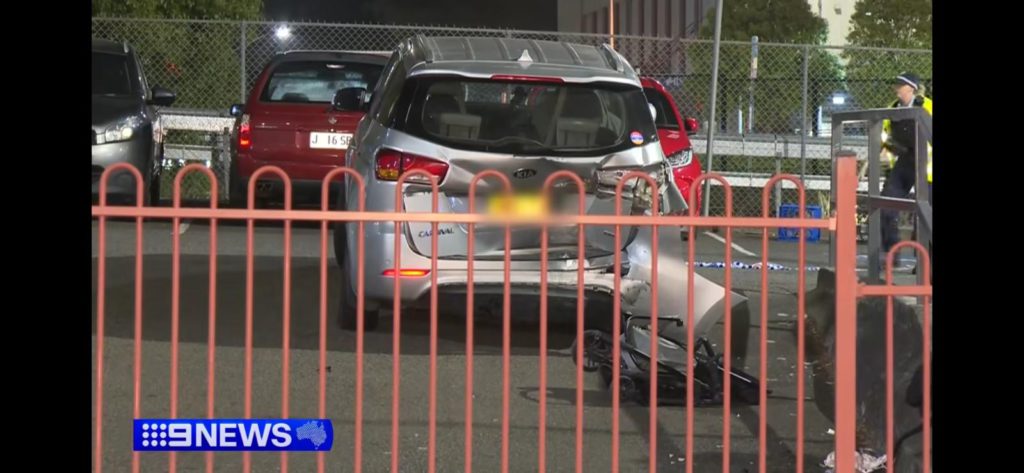
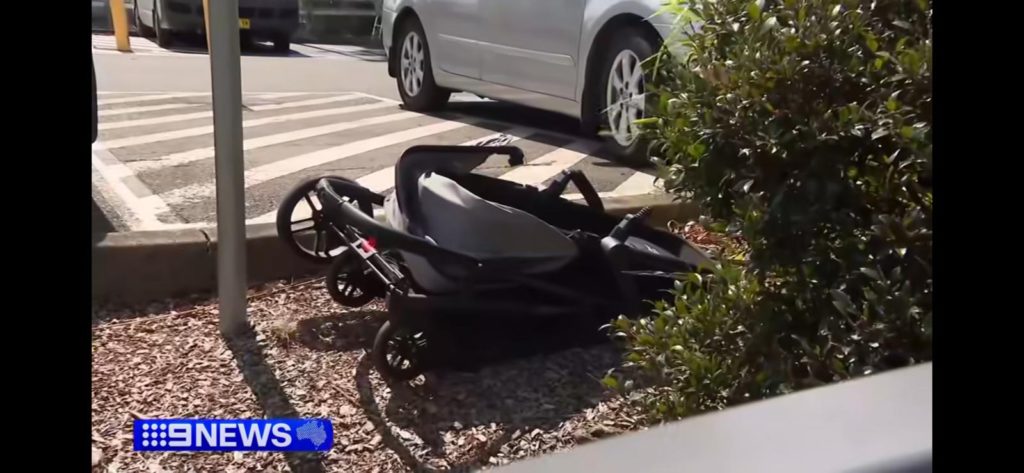
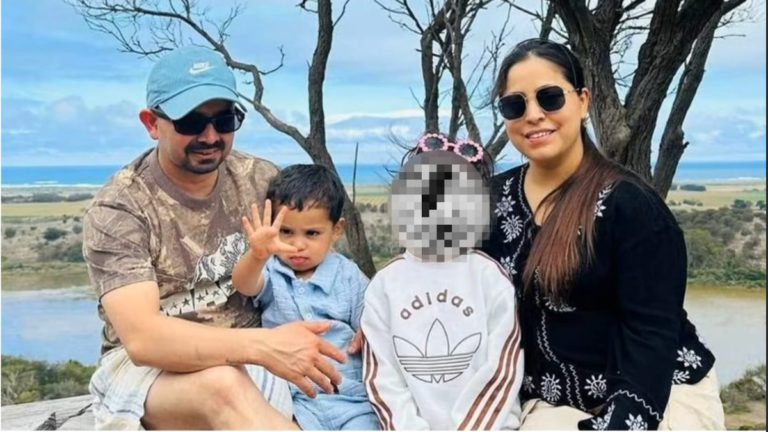
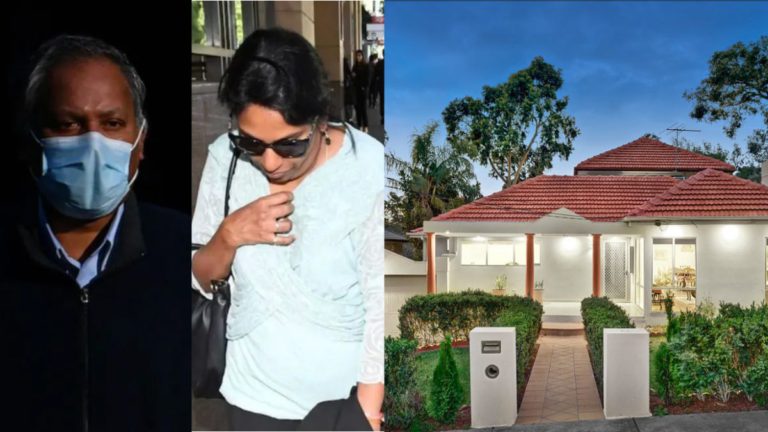
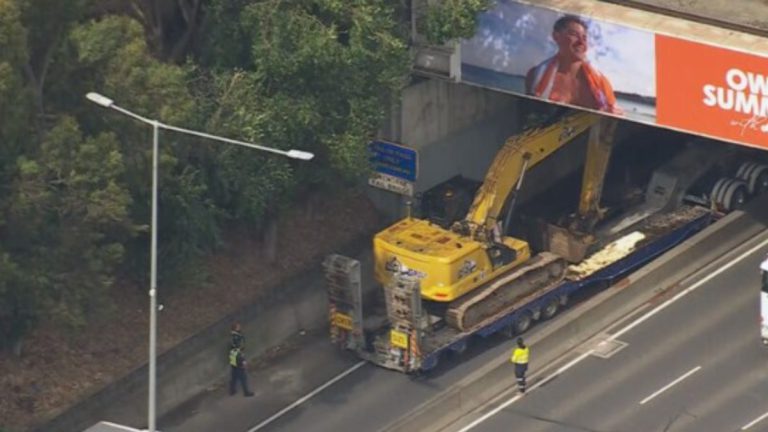
An Indian-origin woman who was eight months pregnant has died along with her unborn child after being struck in a horrific crash in Sydney’s north-west.
The woman was walking with her husband and three-year-old son when she was struck while crossing the entrance to a car park on George Street in Hornsby about 8pm yesterday.
Emergency services were called shortly after 8pm on Friday (14 November 2025) following reports of a pedestrian hit at the entrance of a carpark on George Street, Hornsby.
Screenshot 9NEWS
Police allege a BMW, driven by a 19-year-old, rear-ended a Kia Carnival, causing the Kia to be forced forward and strike the 33-year-old woman as she walked nearby
NSW Ambulance paramedics treated the woman at the scene before rushing her to Westmead Hospital in a critical condition. Despite extensive efforts, she and her unborn baby could not be saved.
Both drivers — the 19-year-old man behind the BMW and the 48-year-old man driving the Kia — were uninjured and underwent mandatory testing at Hornsby Hospital. No other occupants were in either vehicle.
Officers from Ku-Ring-Gai Police Area Command established a crime scene, which was examined by the Crash Investigation Unit.
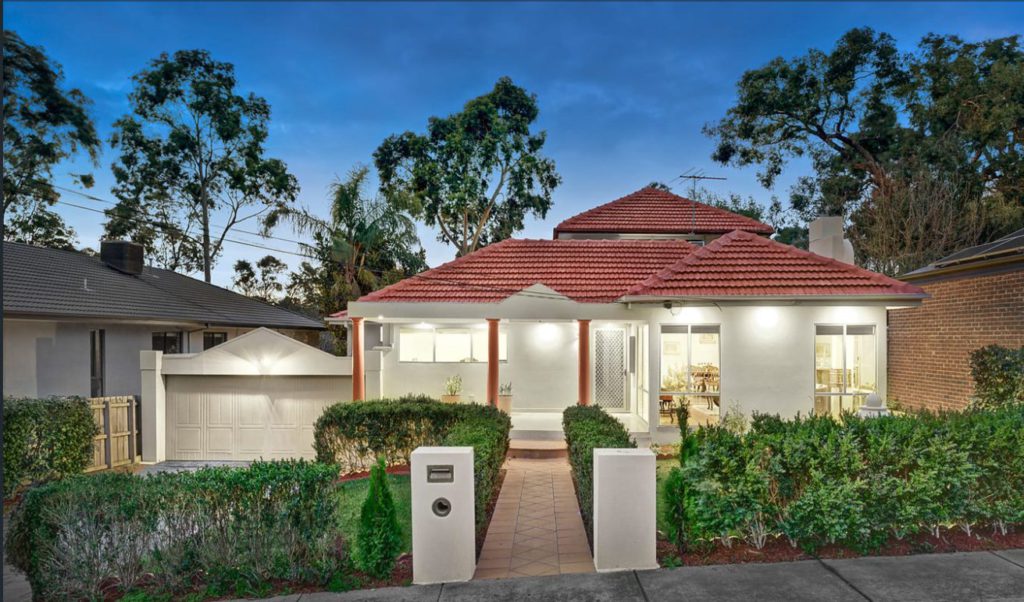
Police arrested the BMW driver, Aaron Papazoglu, at a Wahroonga home on Millewa Avenue about 12.45am on Saturday (15 November 2025). He was taken to Hornsby Police Station and charged with dangerous driving occasioning death – drive manner dangerous, negligent driving (occasioning death), and causing the loss of a foetus due to the death of a pregnant woman.
Support our Journalism
No-nonsense journalism. No paywalls. Whether you’re in Australia, the UK, Canada, the USA, or India, you can support The Australia Today by taking a paid subscription via Patreon or donating via PayPal — and help keep honest, fearless journalism alive.
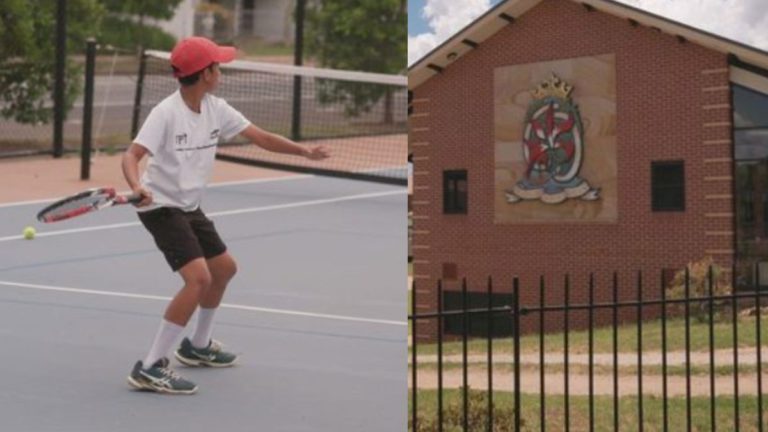
A 12-year-old Indian-origin student at one of Sydney’s independent schools has been expelled after attending a national tennis tournament, sparking outrage from his family.
Aarav, a budding tennis talent and high-achieving student, was at the first day of Tennis Australia’s invitational age championships when he learned he would not be allowed to return to Redeemer Baptist School in North Parramatta.
His parents, Lavanya and Hari, said they were shocked by the school’s decision, pointing out that Aarav had only missed two days of school this year for tennis. They told A Current Affair:
“I requested he be excused for this week and they came back with … we are withdrawing his enrolment and expelling him from the school.”
Headmaster Russell Bailey defended the decision, citing the school handbook, which requires parents to seek advance permission for absences for sporting or other non-school activities. He told A Current Affair:
“We will revoke an enrolment if a parent repeatedly fails to follow the school’s requirements and does not work with us in the interests of their child’s education.”
Aarav’s parents described their son’s dedication, saying he balances schoolwork and intense tennis training, often finishing school at 3.30pm before heading to the courts until 8.30pm.
“He works incredibly hard both in the classroom and on the court.”
Despite the setback, Aarav has already secured enrolment at a new school for next year. The young athlete dreams of one day winning a Grand Slam, inspired by his tennis idol Carlos Alcaraz.
Full statement from Russell Bailey, headmaster at Redeemer School (Source: A Current Affair)
As a place of education, our parent orientation and School Handbook reinforce ACARA’s common goal for children to attend school 90% of the time.
We require parents to seek advance permission when their child requires absence for sporting events or other activities that are not school-related – and this allows us to work with families to minimise any impact on education.
We have supported students with this approach as they have competed in high-level competitions across a range of inter-school, statewide, national and international competitions including in archery, golf, gymnastics, athletics, computing, football, music and science.
There are a number of inaccurate remarks in your questions, but unfortunately Privacy Laws prevent us from discussing individual students.
However, in general terms, we can say that we will revoke an enrolment if a parent repeatedly fails to follow the school’s requirements and does not work with us in the interests of their child’s education. At that point, there is no requirement to pay further fees.
Given our expectations are clear from the start, this happens very rarely, and it is a very sad and disappointing outcome for everyone.
Support our Journalism
No-nonsense journalism. No paywalls. Whether you’re in Australia, the UK, Canada, the USA, or India, you can support The Australia Today by taking a paid subscription via Patreon or donating via PayPal — and help keep honest, fearless journalism alive.
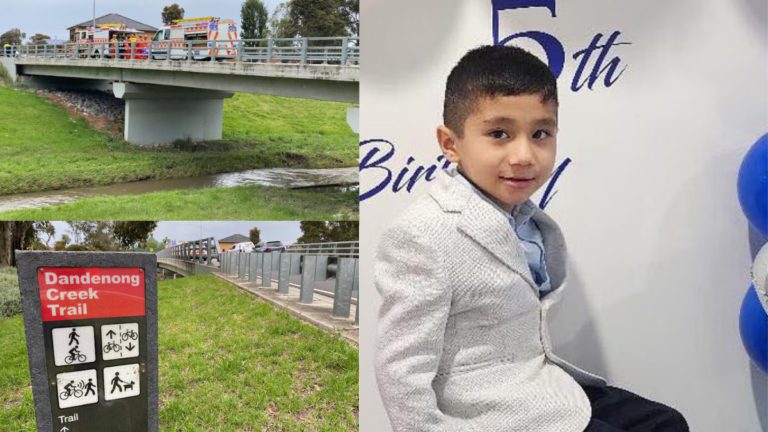
Fariba Hussainzada, 33, and her son Farzad were on Allan Street, Dandenong, on Monday afternoon when the young boy lost control of his scooter at the bridge and plunged into the fast-flowing creek. Ms Hussainzada immediately jumped in to try to save him, but both were swept away by the strong current.
Emergency services arrived quickly and performed CPR at the scene, but neither mother nor child could be revived. They are survived by Ms Hussainzada’s husband, Hamid, and the couple’s two younger children, aged four and one.
The pair’s deaths have left the local community and their extended family devastated. “She was a strong and caring mother who sacrificed everything for her children,” cousin Saleha Hussainzada said.
“Her love and devotion inspired everyone around her.”
Residents described the scene as “gut-wrenching” as emergency services struggled to save the pair, while others called for greater water safety awareness, particularly after heavy rain. Greater Dandenong Mayor Jim Memeti and local MPs extended their sympathies, praising the efforts of first responders who attended the incident.
Victoria Police confirmed a report will be prepared for the coroner, and anyone who witnessed the incident has been urged to contact CrimeStoppers.
Support our Journalism
No-nonsense journalism. No paywalls. Whether you’re in Australia, the UK, Canada, the USA, or India, you can support The Australia Today by taking a paid subscription via Patreon or donating via PayPal — and help keep honest, fearless journalism alive.
Nav Kaur has become the first woman of Indian and Punjabi origin to win a council election in the City of Swan, Western Australia’s largest local government area.
An accomplished public sector leader, community advocate, wife of a veteran and proud mother of two, Kaur brings over 15 years of experience in engineering, civil service and grassroots engagement to her role as Councillor for Altone Ward.
Image: Nav Kaur (Source: Facebook)
Kaur has worked across all three tiers of government, mentoring youth, women and skilled migrants through the Kaleidoscope Commonwealth Initiative — an employment program backed by Local Government WA and the Office of Multicultural Interests. Since 2020, she has helped hundreds of migrants re-enter the workforce and build meaningful careers.
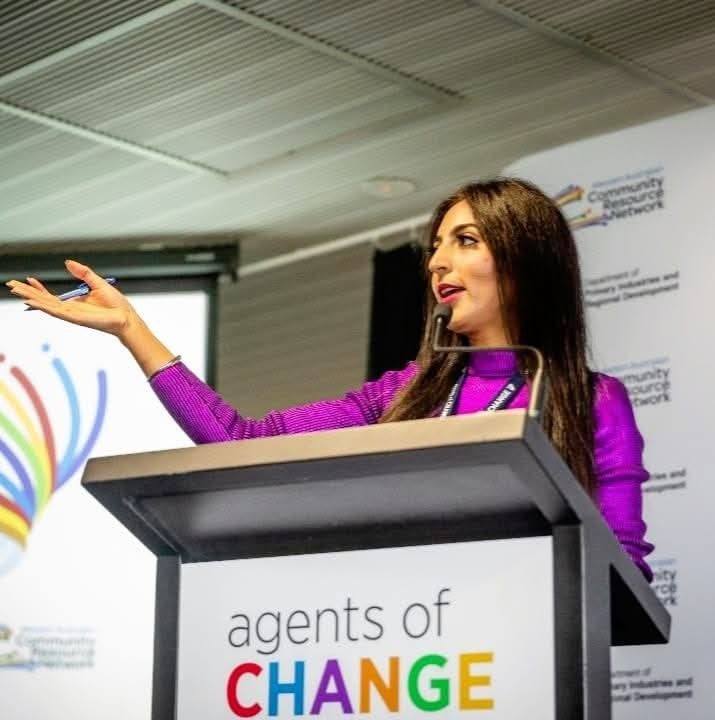
In 2022, she led the ministerial forum Agents of Change, advocating for regional digital connectivity across WA, and has continued to inspire girls in STEM as a keynote speaker for Women in Technology. Her contributions also extend to environmental conservation, sustainability, and water efficiency initiatives.
In 2018, Kaur played a key role in reviewing Western Australia’s TAFE fee structure, helping pave the way for fee-free training programs. She currently serves as a WA Training Awards judge and an Accredited Mental Health Champion, promoting awareness and resilience within communities.
Her leadership, grounded in science-based solutions and inclusive governance, reflects her deep commitment to community consultation and empowerment.
Image: Nav Kaur (Source: Facebook)
In a post, Kaur said she felt proud and humbled to represent the diverse and vibrant residents of Altone Ward, where she stood among ten candidates in this year’s local elections.
Born and educated in Punjab’s Sangrur district, Kaur completed her schooling at GGS General Gurnam Singh Public School before earning her engineering degree from Baba Banda Singh Bahadur Engineering College, Fatehgarh Sahib, where she was a state-level gold medallist. She later completed a Master’s degree from Curtin Graduate School of Business in Perth.
Support our Journalism
No-nonsense journalism. No paywalls. Whether you’re in Australia, the UK, Canada, the USA, or India, you can support The Australia Today by taking a paid subscription via Patreon or donating via PayPal — and help keep honest, fearless journalism alive.
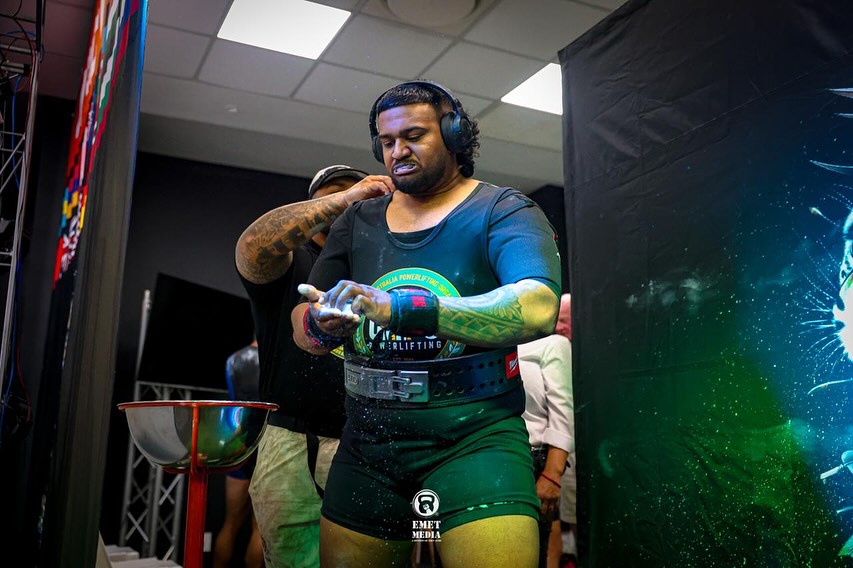
Indo-Fijian powerlifter Varun Lal has made history after winning four medals for Team Australia at the World Powerlifting Championship in South Africa from 4–9 November.
The 29-year-old, who grew up in Navau, Ba (Fiji), dominated the competition with three world titles and a silver medal. Lal claimed first place in the 140kg Raw Open, 125kg Single Ply, and 125kg Deadlift-only categories, and finished second in the 125kg Bench-only division.
Lal said he never imagined reaching the world stage when he first walked into Fortitude Barbell gym last year.
“I took up powerlifting seriously around mid-2023… once I started, I never looked back,” he told Fiji Times, crediting his coach “Big Jack” and teammates for convincing him to try equipped lifting.
He described preparing for the world championships as “one of the toughest but most rewarding phases” of his life, juggling late-night and early-morning sessions around his workload. His national results under the CAPO federation secured him a place on Team Australia.
Lal achieved his two main goals in South Africa — winning gold in his equipped category and setting a new national record.
“My biggest motivation came from my family — especially my dad, who was seriously injured last year. I dedicated every lift to him,” he said, thanking his coach Jack and partner Keisha for pushing him through the toughest moments.
The Fiji-born champion encouraged young aspiring lifters in Fiji to stay consistent, work hard and back themselves.
Lal made his debut for Australia in Chicago last year and continues to pursue elite competition while running his engineering business in Brisbane.
Support our Journalism
No-nonsense journalism. No paywalls. Whether you’re in Australia, the UK, Canada, the USA, or India, you can support The Australia Today by taking a paid subscription via Patreon or donating via PayPal — and help keep honest, fearless journalism alive.
A rideshare driver will not serve jail time after a crash in Sydney’s southwest killed a 12-year-old girl and her father, and injured her younger brother.
It is reported by 7News that MD Towhidur Rahman, 53, had been driving a sedan carrying Hailie Thien An Duong, her 10-year-old brother Justin, and their father Thanh Thai Duong to a weekend night out in May 2024 when a ute T-boned their vehicle at Milperra. The impact caused catastrophic injuries to Hailie and her 41-year-old father, while Justin suffered minor injuries.
Hailie’s mother, Le Boi Ngoc Truong, who was at a temple at the time, described the day as “the worst day of my life” and told 7News that her husband had loved and provided for their children despite the couple’s separation. In a victim impact statement, Truong said:
“I know that no sentence can bring back my husband and daughter, but I hope the court understands the depth of the pain, the suffering, and the permanent impact this has caused.”
Hailie, who was described as full of energy, dreams, and passion for gymnastics and swimming, was remembered by relatives as an “amazing” girl whose life was cut tragically short.
It is further reported that Rahman, who had driven professionally for 16 years across both taxi and rideshare platforms, pleaded guilty in October to negligent driving occasioning the deaths of Hailie and her father.
Rahman sustained injuries himself in the crash and was initially placed in a medically-induced coma. His lawyer told the court he has been diagnosed with post-traumatic stress disorder and will never drive for rideshare platforms again.
Police prosecutor Peter Boctor said Rahman breached his duty to the family by failing to take reasonable precautions when making a right turn into the path of oncoming traffic, which resulted in the collision. However, Magistrate Tania Johnson noted the fatal crash was a one-off incident against Rahman’s previously clean driving record, which included around 25,000 trips.
Instead of jail, Rahman was sentenced to an 18-month intensive corrections order and must complete 50 hours of community service by mid-2027. He was also disqualified from driving for three years.
As per 7News, acknowledging the family’s devastating loss, Magistrate Johnson said:
“The law has no capacity to restore the balance of your lives and I acknowledge that you will never recover from your tragic loss.”
She also considered Rahman’s genuine remorse and good character when handing down the sentence.
Rahman declined to comment to media outside court following the verdict.
Support our Journalism
No-nonsense journalism. No paywalls. Whether you’re in Australia, the UK, Canada, the USA, or India, you can support The Australia Today by taking a paid subscription via Patreon or donating via PayPal — and help keep honest, fearless journalism alive.
The Australian Taxation Office (ATO) has hit a major milestone, receiving over 300,000 tip-offs from the community about tax dodgers since launching its public whistleblower service in 2019.
In the last financial year alone, 9News reported, nearly 50,000 reports were lodged, mostly relating to the so-called “shadow economy”, where businesses demand cash payments or incorrectly claim expenses, the ATO said. These practices are estimated to siphon billions of dollars away from essential services such as health, education, and infrastructure.
ATO Assistant Commissioner Tony Goding warned that businesses evading tax and super obligations are effectively stealing from fellow Australians. “When someone cheats the system, they’re not just breaking the law, they’re freeloading on honest businesses and the rest of the community,” Goding said.
“Paying tax is not optional. Sooner or later, and probably sooner, if you’re operating in the shadow economy, the ATO will discover this… often as a result of a tip-off from your workers, customers or competitors.”
The industries generating the most reports this year were building and construction, cafés and restaurants, and hairdressing and beauty services. Tip-offs often come from customers, employees, other businesses, and even family and friends, highlighting the community’s growing intolerance for dodgy practices.
NSW led the country with 15,907 tip-offs in 2024–25, followed by Victoria with 11,890 and Queensland with 10,630. While Sydney and Melbourne topped the total number of reports, regional areas were also active, including Newcastle in NSW and Robina, Sunshine Coast Hinterland, Townsville, and Toowoomba in Queensland.
The ATO said tip-offs are highly reliable, with 85 per cent of reports last year deemed suitable for further investigation. Red flags include not only “cash only” operations but also lifestyle and operational inconsistencies, such as luxury cars outside businesses claiming financial struggles, busy cafés that never report profits, or employees paid entirely in cash without superannuation.
“People evading tax and super obligations are directly harming honest businesses and increasing the burden on other Australians,” Goding said.
“There really is no excuse. And when you’re caught, you’ll face not just the tax owed, but also significant penalties, interest, and possibly criminal sanctions.”
Support our Journalism
No-nonsense journalism. No paywalls. Whether you’re in Australia, the UK, Canada, the USA, or India, you can support The Australia Today by taking a paid subscription via Patreon or donating via PayPal — and help keep honest, fearless journalism alive.
A Mermaid Beach woman has been ordered to tear up the artificial turf she has kept in pristine condition for five years after a single anonymous neighbour’s complaint triggered action from the Gold Coast City Council.
Realestate.com.au reported that Resident Amanda Blair said she was stunned to receive a warning from council demanding she remove the synthetic grass from the front verge of her property — an area council owns but does not maintain.
“Some idiot has decided to ring council who now demand we rip it up and replace with real grass,” she wrote in her neighbourhood Facebook group.
“We wanted a low-maintenance yard. Our fake, high-quality grass has always looked immaculate.”
The post ignited a wave of frustration online, with many residents questioning why the council bans artificial turf on verges despite using it extensively across the city — including parks, playgrounds and popular beachfront areas in Burleigh and Miami.
“GCCC has fake grass on the nature strip between Burleigh surf club and the pavilion,” one woman commented.
“But that’s OK — hypocrisy.”
Others took aim at whoever lodged the complaint. “If the person that reported you is on here, you’re an absolute tw*t,” one commenter wrote. Another quipped:
“Gee we can’t have tidy gardens without pissing off a Karen or a Kevin.”
Some locals warned Ms Blair to comply or risk being fined, noting residents in affluent suburbs such as Sovereign Island and Hedges Avenue had already been forced to remove their artificial verges. Council has reportedly cited trip hazards and the risk of carpet burns as safety concerns.
“And yet it’s perfectly OK to walk on broken and uneven footpaths,” another resident responded.
Several urged Ms Blair to push back, suggesting she document examples of council-installed turf and ask why the rules differ for homeowners. Others offered creative — and not entirely serious — alternatives, such as blaming an unknown installer or concreting the verge.
Residents also noted that council provides mowing assistance for people unable to maintain natural lawns, with some services available to disabled residents who can supply a doctor’s letter.
Ms Blair said she has contacted local MP Ray Stevens for support and will update neighbours once she decides her next steps.
Support our Journalism
No-nonsense journalism. No paywalls. Whether you’re in Australia, the UK, Canada, the USA, or India, you can support The Australia Today by taking a paid subscription via Patreon or donating via PayPal — and help keep honest, fearless journalism alive.
On Thursday, the Liberals reversed their commitment to net zero by 2050. While it’s impossible to predict precisely what this decision means for climate action in Australia, the policies and laws already in place suggest momentum will continue.
There’s no question the climate policies of opposition parties matter – especially for investor and business confidence. But understanding the policies and laws already in place helps understand where progress will happen regardless.
Just this year, Australia published a Net Zero Plan, set its 2035 target and published six sector plans that include electricity and energy, transport and agriculture. These set out the frameworks and investments already locked in that are guiding progress towards Australia’s targets.
Existing targets
Australia has already legislated federal emissions-reduction targets, with the states and territories also having their own commitments to net zero alongside interim targets. The federal opposition reversing support for achieving the net zero goal won’t change what is already in place. In addition, most other countries are still working towards the goal of net zero by 2050.
In both the House of Representatives and the Senate, those who support climate action are in the majority – Labor, the Greens and climate-progressive independents, including the “Teals”. In the lower house they form a strong majority.
Yes, new policies and laws will be required to achieve Australia’s climate targets. However, given the current Labor government has the numbers to pass legislation through the lower house and the Senate, with the backing of the Greens, the Coalition alone won’t be able to play a blocking role.
Transition gathering steam
The economic transition from fossil fuel power generation to clean technologies is already well underway. Yes, there have been headwinds in recent years, including in the United States, but the momentum is still there. And the main Australian industry groups – the Business Council of Australia, the Australian Industry Group and the Australian Chamber of Commerce and Industry – are all still calling for net zero by 2050.
Industry wants consistency and clarity to help finesse their investment and business strategies. This also provides the clarity needed for long-term decisions. It’s worth noting the Department of Treasury, under successive governments, has found that action to reduce emissions and manage climate risks is more attractive to international investment and expected to lower the cost of finance.
Renewable energy is becoming much cheaper in Australia and globally, and is expected to become the majority of electricity generation within Australia as early as next year. It has already reached nearly an 80% share for short periods.
And it’s the detail of the transition that industry and investors are focused on. They want to know: is it cheaper to build renewable energy as coal-fired generators age and have to be shut down? What’s the cheapest way to provide energy in the years ahead? What about technology costs? What policies will drive investment?
There’s no question that industry and communities respond well when the major parties act together – across the different levels of government. But a multitude of factors affect investment far more than opposition policy.
Diplomatic shifts
Under the Paris Agreement, countries are expected to set interim emissions targets every five years. If countries backtrack or drop out, that can bring diplomatic and economic impacts, including with some of Australia’s key trade partners and neighbouring countries in the Pacific and South East Asia.
As an influential middle power, Australia can punch above its weight. Australia is also in the top 20 global emitters, and even moves much higher up the list if you add the emissions impacts of fossil fuel exports. So, what Australia does and says is important. At the moment the government is clear it wants to be seen as a good partner in supporting emissions reductions in the region, and that has been well received.
If Australia wins its bid to host COP31, it will need to demonstrate that a high-emitting economy is genuinely embarked on a transition. That the electricity sector is already above 40% share of renewables, at least in the connected grids, is a clear sign. The next step will be showing how Australia can make the most of its clean energy and mineral resources in a future economy that’s focused on net zero, rather than the economy of the past.
What now?
The clean energy transition isn’t only about having cheaper electricity or paying less for fuel. It’s about our health more generally. If you live in a well-insulated house that you can heat and cool at a reasonable cost, your health and welfare benefits.
For instance, our research shows that with climate-aligned home energy upgrades and appliance electrification, Australian households could save up to $2,000 a year, equating to average energy bills savings of as much as 50% per home.
The latest figures from the United Nations show how far the world has come. Without the Paris Agreement, the world was on track to reach about 4°C of warming above pre-industrial levels by 2100. To date, the commitments through the Paris agreement have reduced that to projections of limiting warming to 2.3–2.8°C. This is still above safe levels, but every fraction of a degree matters, for climate damage, for our health and our wellbeing.
It’s up to everyone who thinks climate action matters to ensure the public understands the economic, short- and long-term personal benefits a planned transition will bring.
No-nonsense journalism. No paywalls. Whether you’re in Australia, the UK, Canada, the USA, or India, you can support The Australia Today by taking a paid subscription via Patreon or donating via PayPal — and help keep honest, fearless journalism alive.
An Indian-Australian community figure was reportedly attacked in Sydney on Monday evening in what witnesses described as a racially motivated assault.
A source told The Australia Today that a woman has been arrested in connection with the alleged assault, with NSW Police continuing their inquires.
It is reported that the incident occurred around 5:30 p.m. near the Westfield Shopping Centre in Parramatta.
The victim, an active political and community leader who has been residing in Sydney for the past 21 years, remains under medical supervision, with critical tests scheduled to be conducted regularly.
Eyewitnesses said the victim was walking with colleagues to a Parramatta Council meeting when an Caucasian woman suddenly approached and punched him on the head, using racial slurs before fleeing the scene.
The attackers reportedly shouted, “F*** off, Indian. Go back to where you came from,” after the unprovoked assault as the victim was walking out of Level 2 at Westfield Parramatta.
A social media user also posted an account of the attack on Reddit, saying, “Witnessed a racial attack at Westfield Parramatta… an old Indian man being punched in the head by a white female… There were racist obscenities said by them too… I believe they got the man urgent care, and the CCTV systems are everywhere so they will be identified soon.”
The attack has sparked outrage among the Indian diaspora in Australia. Community leaders have condemned the assault as a hate crime, calling for swift and impartial action. They stressed that attacks like this threaten multicultural harmony and must not be tolerated.
Support our Journalism
No-nonsense journalism. No paywalls. Whether you’re in Australia, the UK, Canada, the USA, or India, you can support The Australia Today by taking a paid subscription via Patreon or donating via PayPal — and help keep honest, fearless journalism alive.
A close-knit Nepalese community in Victoria is in mourning after a devastating crash west of Melbourne claimed the lives of a couple and their three-year-old son.
Krishna and Sapana Bhandari, aged 41 and 31, and their son, Ruben, were killed instantly when their car collided with a B-double truck on Eurambeen-Streatham Road, near Stoneleigh, about 200 kilometres west of Melbourne, around 9.30 am on Tuesday.
The young family, who had migrated from Nepal in 2017 and lived in Armstrong Creek near Geelong, left behind their five-year-old daughter.
Sapana’s elderly mother, who was a passenger in the car, survived the horrific crash and was airlifted to The Alfred Hospital in Melbourne with life-altering injuries. Her condition has since stabilised.
President of the Geelong Nepalese Association, Niraj Karanjeet, said the tragedy had left the local community shattered.
“This has been very heartbreaking and has hit the community hard,” he told the Geelong Advertiser.
“It is the worst thing to happen to us in the 15 to 17 years since we formed.”
He described the Bhandari family as kind, caring, and deeply community-minded. “They were incredibly loving people who embodied a wonderful community spirit,” Mr Karanjeet said. “I also pray for the speedy recovery of the injured grandmother.”
In an emotional tribute posted online, the Geelong Nepalese Association expressed its grief and solidarity:
“Words cannot express the pain and sorrow we feel at this heartbreaking moment.
We extend our deepest condolences and prayers to their family and relatives.
May their beautiful souls rest in eternal peace, and may their loved ones find strength and comfort during this unimaginable time.”
Major Crash Investigation Unit detectives are examining the circumstances of the collision, with early reports suggesting the family’s vehicle may have missed a stop sign before colliding with the oncoming truck. The truck driver is assisting police with inquiries.
The tragedy has united the Nepalese community in grief, with many remembering the Bhandaris for their warmth, generosity, and devotion to family.
A 15-year-old student has been tasered and taken into custody after allegedly leaving a classroom armed with a knife at North Sydney Boys High School on Thursday afternoon.
Police were called to the Falcon Street campus about 12.40 pm following reports that a student was carrying a knife.
A NSW Police spokesperson said,
“Officers attached to North Shore Police Area Command attended and were told an altercation had occurred between two students in a classroom, before one of the students left in possession of a knife.”
The school was placed in lockdown while officers searched for the teenager. He was later located and tasered by police before being taken into custody and transported to the hospital.
The lockdown was lifted just after 1.30 pm.
A NSW Department of Education spokesperson confirmed the lockdown was implemented “as a precaution.”
They added that,
“All students and staff are safe, and students resumed classes after 1.30 pm.”
Police said inquiries into the incident are continuing.
Support our Journalism
No-nonsense journalism. No paywalls. Whether you’re in Australia, the UK, Canada, the USA, or India, you can support The Australia Today by taking a paid subscription via Patreon or donating via PayPal — and help keep honest, fearless journalism alive.
Cybercriminals are exploiting Australia’s national cybercrime reporting tool, ReportCyber, and posing as Australian Federal Police (AFP) officers in an elaborate scam targeting cryptocurrency users.
According to the AFP-led Joint Policing Cybercrime Coordination Centre (JPC3), scammers are illegally obtaining personal details — such as email addresses and phone numbers — and using them to lodge fake reports through ReportCyber to make their ruse appear legitimate.
In one case, a victim received a call from someone claiming to be from the AFP, who said their name had appeared in a cryptocurrency-related data breach. The scammer cited a genuine-looking ReportCyber reference number and directed the victim to verify it online, adding to the illusion of authenticity.
A second call then followed from a supposed representative of the cryptocurrency platform, urging the victim to transfer funds into a ‘Cold Storage’ account for “safekeeping”. The victim became suspicious and ended the call before losing any money.
AFP Detective Superintendent Marie Andersson warned that this scam’s sophistication lies in its convincing structure and use of official processes.
“These cybercriminals step through a process to verify the target’s personal information which may match common expectations,” she said.
“Because they move quickly from making the report to calling the target, they can create a sense of urgency.”
Det-Supt Andersson said the case demonstrated both the growing sophistication of online scams and the increasing cyber awareness among Australians who report such incidents.
“If you’re contacted about a ReportCyber report you didn’t lodge or authorise, hang up immediately and notify ReportCyber or call 1300 CYBER1 (1300 292 371),” she advised.
“Legitimate law enforcement officers will never ask for access to your cryptocurrency accounts, wallets, seed phrases, or banking information.”
The AFP reiterated that ReportCyber remains a safe and secure platform for reporting online crimes, and every report helps authorities track offenders and build intelligence on emerging cyber threats.
The JPC3 continues to work with industry and international partners to disrupt cybercriminal activity and protect Australians from financial and digital harm.
Support our Journalism
No-nonsense journalism. No paywalls. Whether you’re in Australia, the UK, Canada, the USA, or India, you can support The Australia Today by taking a paid subscription via Patreon or donating via PayPal — and help keep honest, fearless journalism alive.
New South Wales will need to train an additional 140,000 construction workers to meet demand for $469 billion worth of projects over the next five years, according to new analysis by Master Builders NSW.
Labour shortages are already putting pressure on costs and slowing the delivery of new housing, the latest Jobs and Skills Australia (JSA) report warns.
Master Builders NSW Executive Director Matthew Pollock said construction activity in the state is expected to increase by more than 18% compared to the previous five years.
Mr Pollock said,
“We need to see a corresponding increase in the construction workforce if we are to deliver the $469 billion in projects in the pipeline.”
Major projects are driving the surge, including the $57 billion Sydney Metro, Australia’s largest public transport project, which is scheduled for completion by 2032.
Adding to the challenge, a Build Skills Australia report estimates another 37,000 workers will be needed to meet the Federal Government’s housing accord targets in NSW.
Mr Pollock called for greater government investment in targeted, industry-led training programs, saying these initiatives have been effective in boosting apprentice numbers and improving completion rates.
“With the record pipeline of work ahead of us, there has never been a better time to take up a trades apprenticeship. We have more work to do than people to do it,” he added.
He added that encouraging more women and people from diverse backgrounds to join the industry will be key to meeting workforce demands.
Support our Journalism
No-nonsense journalism. No paywalls. Whether you’re in Australia, the UK, Canada, the USA, or India, you can support The Australia Today by taking a paid subscription via Patreon or donating via PayPal — and help keep honest, fearless journalism alive.
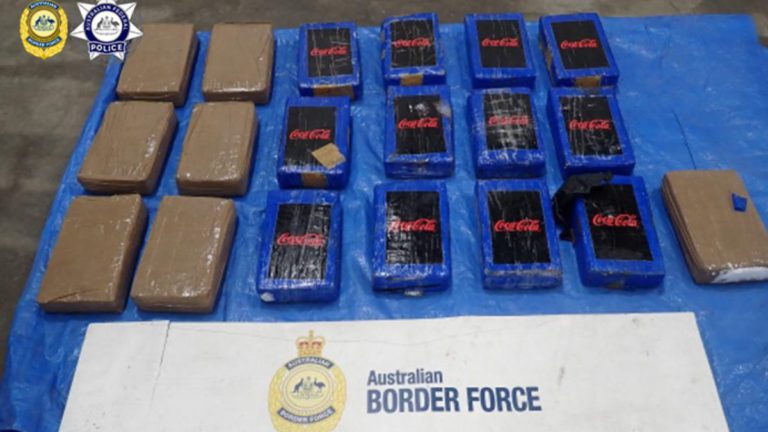
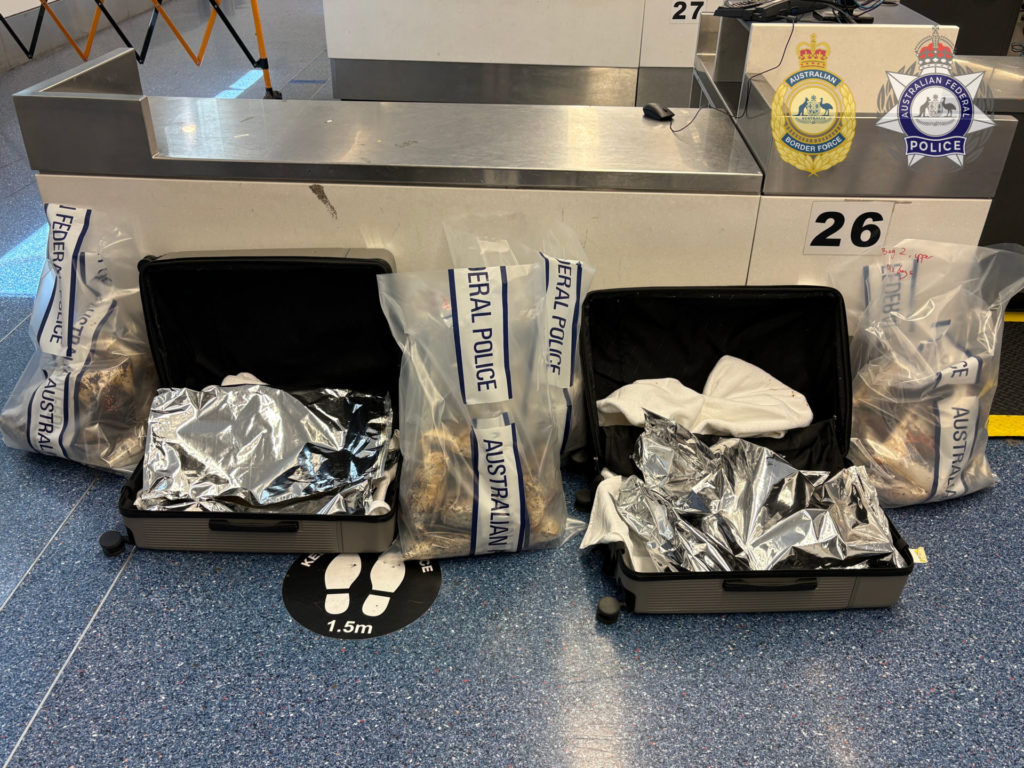
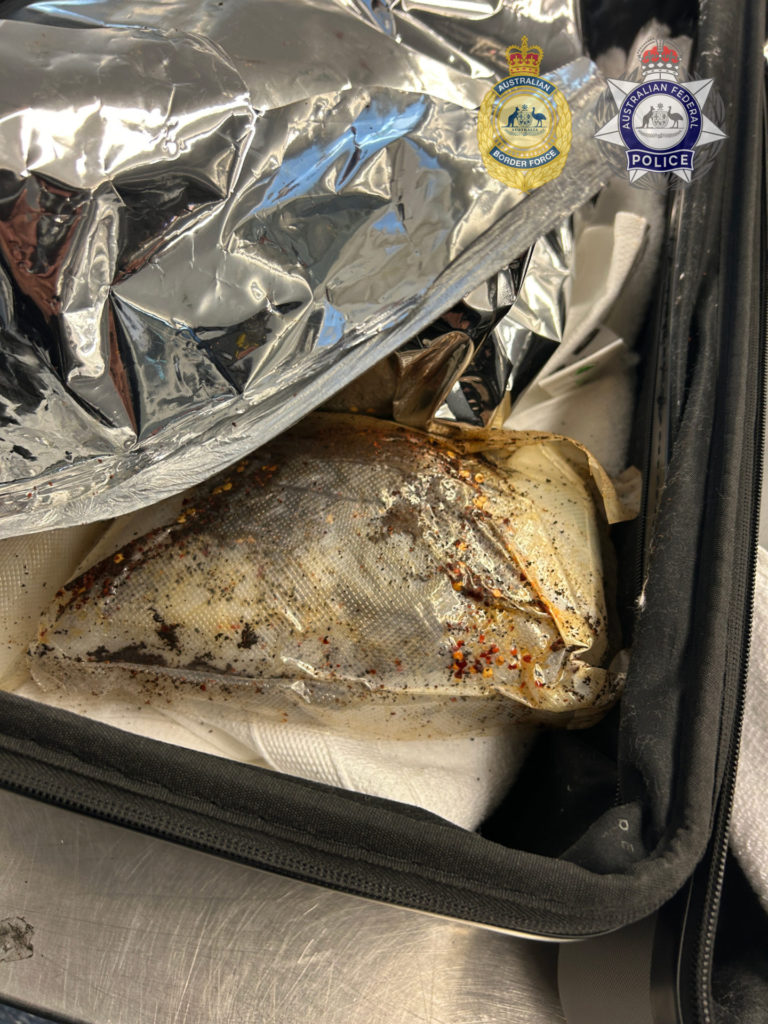
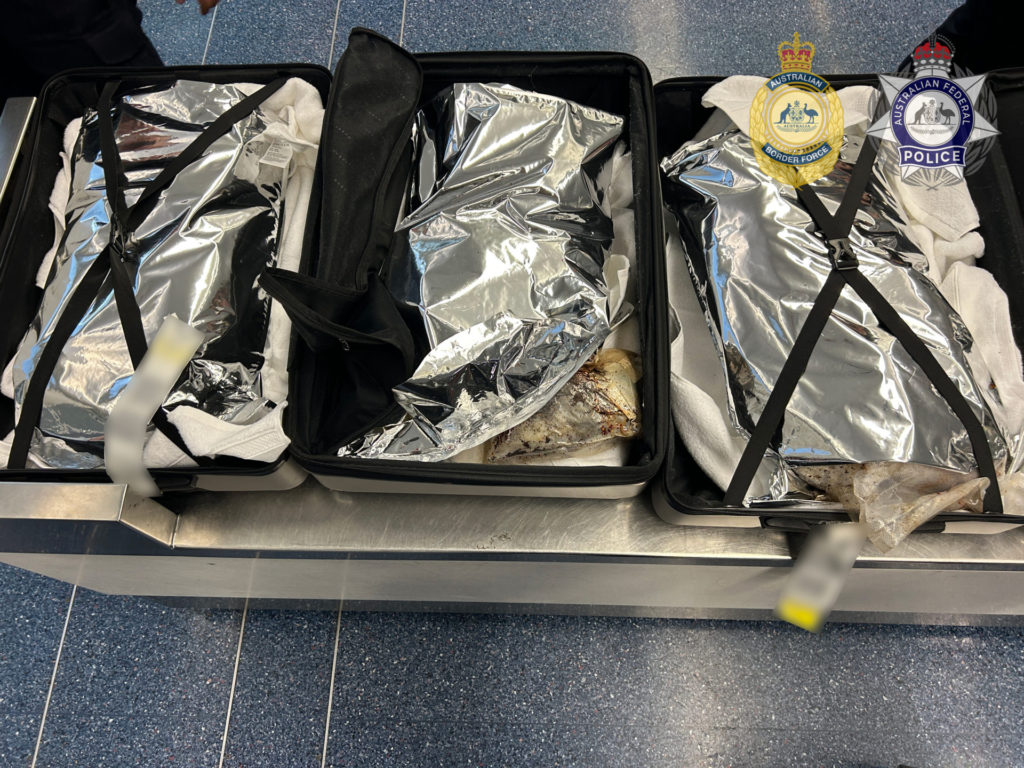
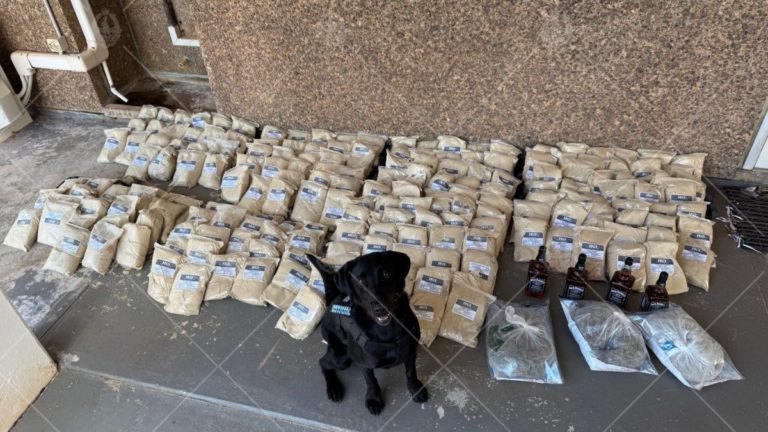
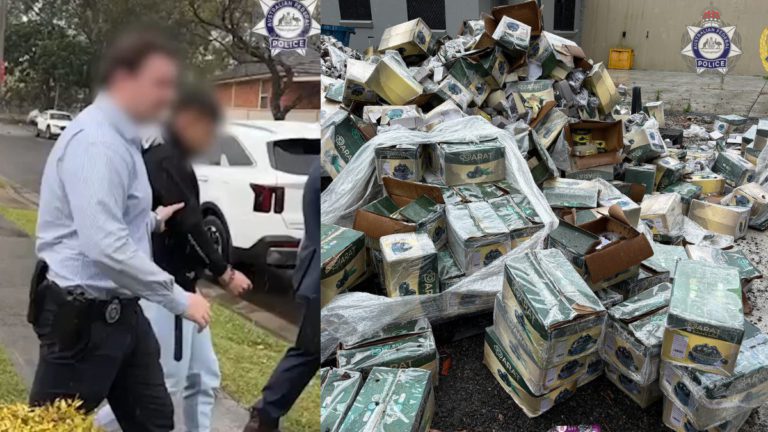
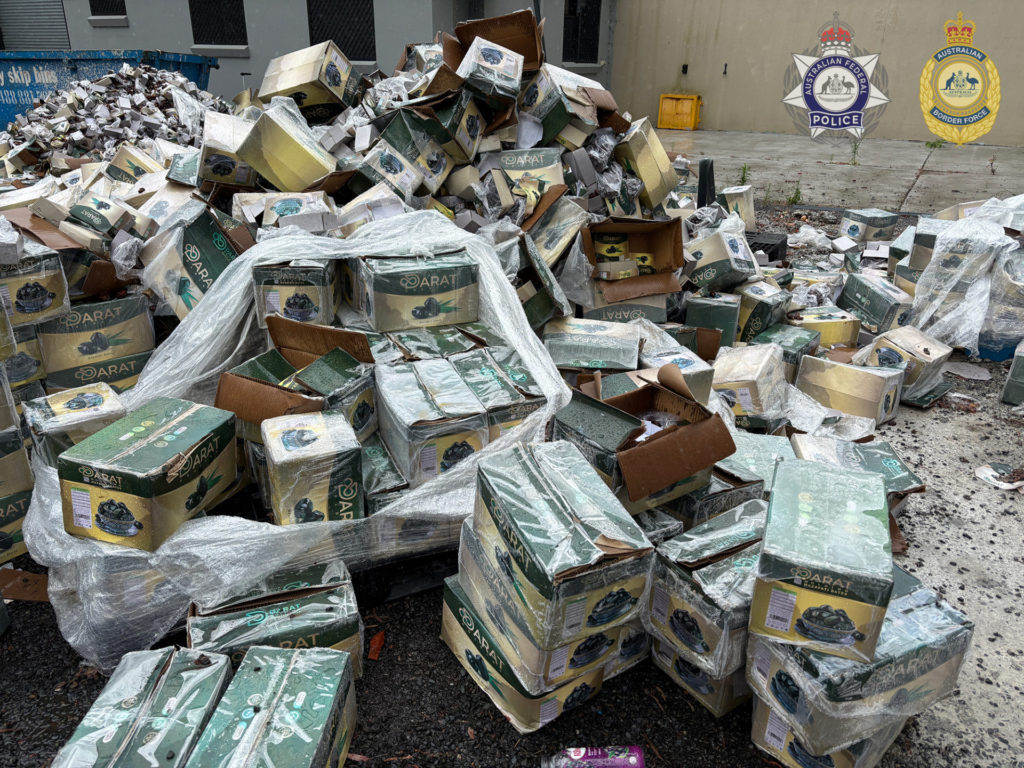
Australian authorities have foiled several criminal plots to smuggle nearly $50 million worth of cocaine into the country, uncovering about 145 kilograms of the drug concealed in refrigerated shipping containers since October.
Australian Border Force (ABF) officers made the discoveries during inspections at Port Botany, where cocaine was found hidden in motor compartments and other areas of refrigerated containers arriving from South America. The Australian Federal Police (AFP) have seized the drugs and launched further investigations.
On 9 November, officers detected 40 one-kilogram blocks of cocaine hidden inside a container, while earlier in October, 80 kilograms of cocaine and tracking devices were found across four containers after x-ray scans revealed anomalies. Another 25 kilograms, packaged with lion-head logos, were uncovered on 1 October.
AFP Detective Acting Superintendent Aaron Burgess said the seizures highlight the dangers of such smuggling attempts.
“In one of the seizures, a one-kilogram package of cocaine had been damaged, which resulted in frozen white powder strewn inside the shipping container,” he said.
“Cocaine is highly addictive and places significant pressure on the Australian healthcare system. Criminals should be warned, the AFP is watching.”
ABF Superintendent Matt O’Connor said officers were maintaining strict vigilance at ports and logistics facilities.
“Attempting to breach border controls is one thing but breaking into secure locations is reckless and incredibly serious,” he said.
“Individuals are placing themselves and others at physical risk and facing significant criminal consequences.”
Authorities said the discoveries reflect a growing trend of organised crime groups concealing cocaine in refrigerated containers and later attempting to break into docks or logistics depots to retrieve the drugs.
Earlier this year, four men aged between 22 and 32 were sentenced to prison terms ranging from three to seven years for trying to recover 42 kilograms of cocaine from a refrigerated container at a logistics park.
Support our Journalism
No-nonsense journalism. No paywalls. Whether you’re in Australia, the UK, Canada, the USA, or India, you can support The Australia Today by taking a paid subscription via Patreon or donating via PayPal — and help keep honest, fearless journalism alive.
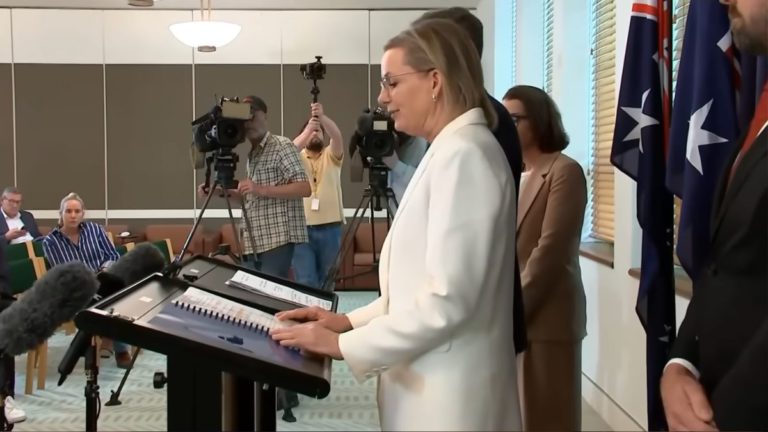
Opposition Leader Sussan Ley announced on Thursday that the Liberal Party was dropping its commitment to net zero and said a future Liberal government would repeal Australia’s present legislated 2030 and 2050 targets for reducing emissions.
After a meeting of the Liberal shadow ministers, Ley told a news conference: “We are not pursuing net zero, we are pursuing energy affordability and emissions reduction”.
In a fig leaf for the moderates who have fought the dropping of net zero, she said “while it is not our policy […] net zero would be welcome if we can get there with technology, with choice and with voluntary markets”.
The ditching of net zero follows Wednesday’s Liberal Party meeting at which speakers overwhelmingly rejected the 2050 target that the Morrison government signed up to in 2021. Liberal shadow ministers on Thursday discussed and ticked off on the details of the Liberal policy.
Representatives of the Liberals and Nationals will now negotiate to bring the policies of the two parties together before a joint party meeting, held virtually, on Sunday.
It seems certain the Coalition will agree on a common policy. Nationals leader David Littleproud said the Liberals’ decision “gives us great hope that in the coming days that we’ll sit down constructively with them”.
Pre-empting the announcement, Prime Minister Anthony Albanese said, “The Coalition are choosing to take Australia backwards. They’re walking away from jobs for Australians and investment certainty for business that is so important. And what business has been saying.”
Under questioning, Ley and energy spokesman Dan Tehan could not provide estimates for claims that energy prices would come down under the opposition’s policy.
Ley stressed that under the Liberals’ plan, “affordable and reliable energy will always come first. Our emissions reduction goals will never come at the expense of Australian families and this principle will guide every decision we make.”
The Liberal plan says emissions would be reduced on average, year on year, for every five-year period of Australia’s Nationally Determined Contribution under the Paris Agreement. They would be brought down “as far and as fast as technology allows without imposing mandated costs on families and industry.”
Ley struggled when questioned about how Australia could stay in the Paris Agreement when the Liberals said they would scrap Australia’s already-registered targets under the pact.
“We will look Australians in the eye and say this is a plan to bring down emissions and to provide affordable energy for you. And if there are reasons why people in Paris or in some United Nations organisation don’t like it, I can deal with that,” she said.
The Liberals’ plan says that unlike Labor, a Coalition government would harness “all available technologies to bring prices down”.
“This includes maintaining baseload power, supporting all forms of generation where it is required, unlocking new gas supply, and lifting the ban on zero emissions nuclear energy, which is already used or being developed in 19 of the world’s 20 richest countries.”
No-nonsense journalism. No paywalls. Whether you’re in Australia, the UK, Canada, the USA, or India, you can support The Australia Today by taking a paid subscription via Patreon or donating via PayPal — and help keep honest, fearless journalism alive.
A British-Pakistani businessman who threatened to “gang-rape” and murder a flight attendant on a London-to-Lahore flight has had his jail sentence more than tripled after an appeals court ruled his original punishment was far too lenient.
Salman Iftikhar, 38, from Iver, Buckinghamshire, became violent midair in February 2023 while travelling first class with his three children and one of his wives.
It is reported that after drinking champagne and helping himself to ice from the on-board bar, crew members asked him to return to his seat. “When told to stop, the defendant became irate, and started to film cabin crew with his phone, telling them, ‘Do not tell me what to do, you b—h,’” court documents stated.
Iftikhar then targeted senior flight attendant Angie Walsh with a tirade of abuse, threatening she would be dragged from her hotel room, “gang-raped” and set on fire. He also threatened to blow up the hotel floor where the crew were due to stay in Pakistan.
It is further reported that the abuse lasted throughout the eight-hour flight, with the captain even considering diverting the plane to Turkey.
Wife of shamed recruitment boss, Salman Iftikhar, 37, who was jailed for threatening to gang r*pe a Virgin Atlantic air stewardess, took to social media to defend her husband’s actions. Supermodel and actress, Abeer Rizvi, 37, declared ‘Mental health is not a joke. Behind every story there is pain’. Wealthy passengers aboard the flight watched in horror as the recruitment boss repeatedly called steward Angie Walsh a ‘f***ing b****’. Read the full story on DailyMail.com. 📷 Central News / Instagram #travel#airplane#mentalhealth#supermodel#news
Solicitor General Rt Hon Ellie Reeves MP said: “Salman Iftikhar made horrific threats of rape and violence against an air steward who was simply doing her job. His tirade of hate and abuse caused distress and anguish for the whole flight, and all of our thoughts today should be with the cabin crew and passengers who suffered from Iftikhar’s vile behaviour.”
Walsh, a 37-year veteran of the airline, said the incident left her “haunted and traumatised” and forced her to take 14 months off work. “I can’t quite believe that one passenger has had this much of an impact on my job, my career, and my life,” she said.
Iftikhar was arrested the following month and later pleaded guilty to threats to kill and racially aggravated harassment.
Despite having six previous convictions, he was initially sentenced in August 2025 to just 15 months in prison. Following public outcry and a referral under the UK’s Unduly Lenient Sentence scheme, the Court of Appeal increased his sentence to four years and three months.
Support our Journalism
No-nonsense journalism. No paywalls. Whether you’re in Australia, the UK, Canada, the USA, or India, you can support The Australia Today by taking a paid subscription via Patreon or donating via PayPal — and help keep honest, fearless journalism alive.
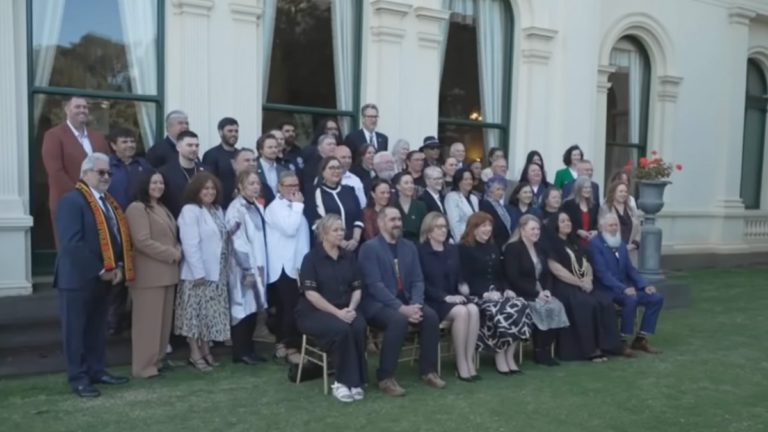
The first treaty between Indigenous peoples and an Australian government has been signed into law.
It is difficult to overstate the significance of Victoria’s treaty.
So, what is the treaty, will other states and territories follow suit, and how could this impact Australia as a whole?
Breaking new ground
While treaties have long formed part of the landscape in countries such as Canada, the United States and New Zealand, Australia has stood apart.
For generations, governments have resisted calls from Aboriginal and Torres Strait Islander peoples for a formal treaty or treaties.
The Victorian Statewide Treaty represents the first time an Australian government has not only listened, but acted.
This agreement answers questions that have shaped our national debate for decades.
It demonstrates that treaties with Indigenous Australians are both possible and practical – anchored not in radical change but in recognition, respect and partnership.
Rather than breaking from Australia’s system of government, the treaty provides a framework to acknowledge First Peoples’ enduring rights and to strengthen the relationship between Indigenous peoples and the state.
The settlement and negotiation process also offer valuable lessons for other jurisdictions as they consider their own paths toward treaty.
What is Victoria’s treaty?
The treaty was negotiated between the First Peoples Assembly of Victoria and the state government.
The innovative agreement establishes a new permanent representative and deliberative body for Traditional Owners and First Peoples in the state.
Intended to serve as a central institution within “the democratic life” of Victoria, the body (Gellung Warl) will advise, inform and engage with the government and the parliament – and hold the state to account.
It will bring First Peoples into the decision-making forums of the state, rectifying their longstanding exclusion.
The treaty also includes agreement on a range of other matters that reflect commitments to form a new relationship based on justice and respect.
These include commitments by government to revise the education curriculum, increasing the use of Traditional or Indigenous-language place names, and encouraging Gellung Warl to participate in the ceremonial life of the state.
Statewide treaties will cover matters that affect all First Peoples in Victoria.
Future agreements are likely to strengthen Gellung Warl. This may include transferring decision-making, rule-making and advisory powers from government to Gellung Warl.
These reforms will promote self-determination and are expected to lead to better outcomes for First Peoples.
Traditional Owner treaties, negotiated by Traditional Owners, will cover matters of importance to First Nations people and will likely differ according to the aspirations and priorities of each community.
One Traditional Owner group, the Dja Dja Wurrung, has already indicated it is ready to begin negotiations.
What’s next for Australia?
The outlook across the rest of Australia remains uncertain.
While Victoria’s experience shows treaty-making is possible, it also highlights how complex and demanding the process can be.
Like any agreement, the substance of a treaty is shaped by the negotiations that produce it.
If the process is unbalanced or dominated by one side, the outcome will reflect that imbalance. When power is too unevenly distributed, meaningful agreement becomes almost impossible.
Establishing fair and trusted institutions to support genuine negotiation takes considerable time and effort.
In Victoria, it took nearly eight years of groundwork before the parties were ready to begin formal treaty discussions. While preliminary treaty consultations are underway in New South Wales, no other jurisdiction has really started down this path.
Those early steps are crucial for another reason. With no history of treaty-making, many Australians have limited understanding of what a treaty involves or represents.
Entering into a treaty relationship requires a fundamental shift in how governments view and engage with Indigenous nations.
This change in mindset can be gradual and difficult to embed.
In Victoria, the nearly decade-long preparatory phase was vital – not only for building the right structures and institutions for treaty-making, but also for giving government time to grasp what a treaty means in practice.
Treaties as living agreements
The Victorian treaty proclaims it “marks the dawn of a new era in Victoria – an era of treaty-making”.
The agreement’s impact may reach far beyond the state’s borders, offering a model for how respectful partnerships can be forged between First Peoples and the state.
In time, the signing of the treaty may come to be seen not only as a turning point for Victoria but as the beginning of a new chapter in Australia’s history – one defined by recognition, respect and shared responsibility for the future.
No-nonsense journalism. No paywalls. Whether you’re in Australia, the UK, Canada, the USA, or India, you can support The Australia Today by taking a paid subscription via Patreon or donating via PayPal — and help keep honest, fearless journalism alive.
On the night of November 13, 2015, Paris witnessed one of the deadliest Islamist terror attacks in modern European history. Coordinated assaults by gunmen and suicide bombers linked to the terrorist group Islamic State (ISIS) struck several locations across the French capital — the Stade de France, busy cafés and restaurants, and the Bataclan concert hall — killing atleast 130 people and injuring more than 400.
The most horrific scene unfolded inside the Bataclan, where around 90 concertgoers were murdered during a performance by the American band Eagles of Death Metal. Three terrorists armed with assault rifles and wearing explosive vests stormed the venue, taking hostages and firing indiscriminately for more than two hours before police stormed the building. All three gunmen died at the scene. Two of them detonated their vests during the police assault, while the third was shot dead by security forces.
File Pic: X – @AntoineNogent
The Bataclan massacre was part of a wider ISIS plan targeting symbols of French culture and everyday life. According to investigators the attackers, most of them French or Belgian nationals, had recently returned from Syria where they had trained with the terror group. The coordinated bombings and shootings were among the deadliest terrorist attacks in France’s history and led to a nationwide state of emergency that lasted nearly two years.
A decade later, France continues to honour the victims with annual memorials and permanent plaques bearing their names. The main suspect and only surviving member of the terror cell, Salah Abdeslam, was convicted in 2022 and sentenced to life imprisonment without parole, the harshest sentence under French law.
File Pic: X – @AntoineNogent
Survivors and families say the trauma remains raw, even as France strengthens counterterrorism measures and community resilience. The Bataclan anniversary serves as both a day of remembrance and a stark reminder of the enduring threat of Islamist extremism in Europe.
Support our Journalism
No-nonsense journalism. No paywalls. Whether you’re in Australia, the UK, Canada, the USA, or India, you can support The Australia Today by taking a paid subscription via Patreon or donating via PayPal — and help keep honest, fearless journalism alive.
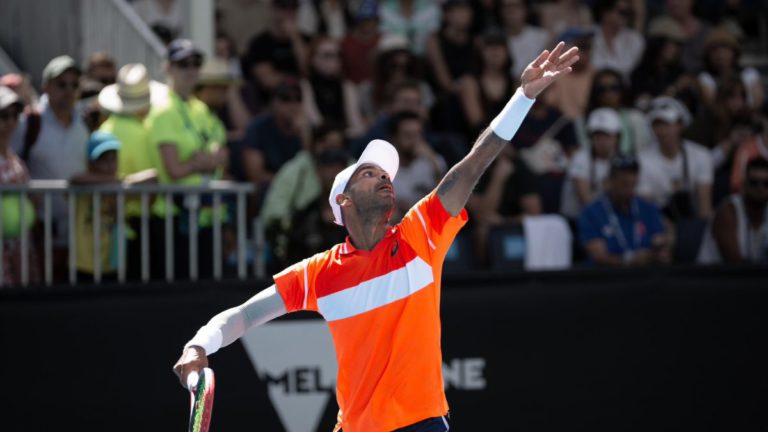
India’s top-ranked male tennis player, Sumit Nagal, has appealed to Chinese authorities after being denied a visa to compete in the Australian Open Asia-Pacific Wildcard Play-off, scheduled to begin on November 24 in Chengdu.
Nagal, who is currently ranked 275 in the ATP singles standings, took to social media on Tuesday to urge the Chinese Ambassador to India, Xu Feihong, and the Chinese Embassy for assistance.
“I am supposed to fly to China soon to represent India at the Australian Open Playoff, but my visa was rejected without reason. Your urgent help would be much appreciated,” he wrote.
The week-long tournament, held at the Sichuan International Tennis Centre from November 24-29, offers winners the chance to earn a main-draw spot at the 2026 Australian Open in Melbourne.
Nagal, 28, from Jhajjar, Haryana, has been part of India’s Davis Cup team since 2018. His career highlights include taking the opening set against Roger Federer at the 2019 US Open and winning the 2015 Wimbledon boys’ doubles title. Last year, he lost in the first round of the Australian Open and failed to qualify for the French Open and Wimbledon.
Ending my first year as a Top 100 player feels incredibly special. This year has been full of firsts, and I’m deeply grateful for all your support from India and around the world 🙏🏽🇮🇳
If the visa issue is not resolved swiftly, Nagal may miss the playoff, potentially jeopardising his chances to secure a wildcard entry into the 2026 Grand Slam season opener.
Support our Journalism
No-nonsense journalism. No paywalls. Whether you’re in Australia, the UK, Canada, the USA, or India, you can support The Australia Today by taking a paid subscription via Patreon or donating via PayPal — and help keep honest, fearless journalism alive.
Australia’s Miss Universe representative, Lexie Brant, has become the target of racist and exclusionary comments online, with critics claiming the 22-year-old Queenslander is “not Australian enough” to represent the nation on the world stage.
Brant, a Brisbane-born model and occupational therapy student, also appeared in a viral TikTok clip walking the runway at the Miss Universe pageant — only for viewers to flood the comments with claims that she “doesn’t look Australian” or should have “walked out for Miss Mexico.”
The bizarre criticism revealed how deeply ingrained racial stereotypes about “what an Australian looks like” still are. “I thought Australian women looked different,” another viewer wrote.
A racist social media comment reacting to the Miss Universe pageant also read:
“What has become of Australia. We now have an Indian as Miss Australia. Shame on you Albo!!”
The post, which wrongly linked the choice of a beauty pageant winner to the Prime Minister, reflects the persistence of racial ignorance and resentment towards Australia’s growing multicultural identity.
Experts believe such remarks ignore the reality that more than half of Australians are either born overseas or have at least one migrant parent, and that the nation’s identity is built on diversity.
Image: Indian-Australian Talent Mentor Raj Suri (Source: Supplied)
Indian-Australian Talent Mentor Raj Suri challenged narrow perceptions of Australian identity, emphasising the country’s diversity.
Suri told The Australia Today, “The notion that an Australian Indian woman ‘doesn’t look Australian enough’ is outdated. Australia is built on ‘coming from somewhere,’ and our strength is in our diversity. The ability to embrace proud Indian heritage while feeling unequivocally Aussie is what truly defines us as a progressive nation.”
“If an Australian Indian woman can go to the beach in a bikini one day and proudly walk in a sari the next, that should not be a problem—it is a celebration! … Traditional mainstream media must play a vital role in shaping awareness of our beautiful evolving Australian identity in the wider community, both locally and globally.”
https://www.instagram.com/p/DQ0Cr2-kuoY/
Previous Miss Universe Australia winners, including Francesca Hung, Priya Serrao, and Maria Thattil, all faced racist abuse questioning their legitimacy as “real Australians”.
The online vitriol directed at Brant underscores how racism and ignorance continue to shape perceptions of Australian identity. In a country proud of its multicultural roots, the backlash serves as a stark reminder that Australia’s beauty is not confined to one colour, background, or face — and never has been.
Support our Journalism
No-nonsense journalism. No paywalls. Whether you’re in Australia, the UK, Canada, the USA, or India, you can support The Australia Today by taking a paid subscription via Patreon or donating via PayPal — and help keep honest, fearless journalism alive.
Facing the Federal Circuit and Family Court is Satarupa Patel, a sole trader and former commission agent of the United Petroleum outlet on Princes Highway, Hallam.
The Ombudsman alleges Ms Patel paid an Indian national — who was on a temporary visa at the time — flat rates as low as $15 an hour, well below the lawful minimum rate of $28.38 per hour, and failed to pay overtime, weekend, and public holiday penalties.
According to the FWO, the alleged breaches under the Vehicle Repair, Services and Retail Award 2020 resulted in the worker being underpaid $9,271 between October 2020 and March 2021.
Fair Work Ombudsman Anna Booth said the severity of the alleged contraventions justified legal proceedings. “We allege the employer here was paying flat hourly rates that were only barely above half the worker’s owed minimum rates for ordinary hours, and about one-third for overtime,” Ms Booth said.
“These levels of underpayment will never be tolerated. Employers should also be aware that taking action to protect migrant workers is an enduring priority for the Fair Work Ombudsman.”
The regulator is seeking penalties of up to $13,320 per contravention, and an order requiring Ms Patel to repay all outstanding wages plus superannuation and interest. A directions hearing is scheduled for 3 December 2025 in Melbourne.
Ms Booth urged all workers, including migrants, to come forward if they believe they are being underpaid. “Migrant workers have the same workplace rights in Australia as any other worker,” she said.
“Protections for their visas exist if they call out any exploitation.”
This case marks the sixth legal action linked to United Petroleum outlets following a nationwide investigation into non-compliance across 20 sites.
To date, the FWO has recovered more than $230,000 in penalties from former United Petroleum operators, including $179,221 in Tasmania earlier this year and $38,500 in South Australia last month.
Between 2017 and 2024, the Fair Work Ombudsman filed 146 litigations involving visa holder workers, securing nearly $23 million in penalties.
Support our Journalism
No-nonsense journalism. No paywalls. Whether you’re in Australia, the UK, Canada, the USA, or India, you can support The Australia Today by taking a paid subscription via Patreon or donating via PayPal — and help keep honest, fearless journalism alive.
The stolen items, including a Camilla silk scarf, Fendi sunglasses and a GHD hair straightener, were taken from a store in domestic terminal 2 on three separate mornings in September (3rd and 7th) and October (29th).
AFP has released CCTV footage showing a woman in the area on those dates whom officers wish to speak with.
On one occasion, she was seen boarding a flight to Canberra.
The woman is described as being of Middle Eastern appearance, with long brown hair and a lisp. Each time she was seen, she carried a maroon handbag and a second black bag, with either a green or silver suitcase also visible in the footage.
Anyone with information about the thefts or the woman pictured is urged to contact Airport Watch on 131 237 (131 AFP).
Support our Journalism
No-nonsense journalism. No paywalls. Whether you’re in Australia, the UK, Canada, the USA, or India, you can support The Australia Today by taking a paid subscription via Patreon or donating via PayPal — and help keep honest, fearless journalism alive.
The Liberals are set to dump net zero after a strong majority at a special party meeting spoke against the existing commitment to it.
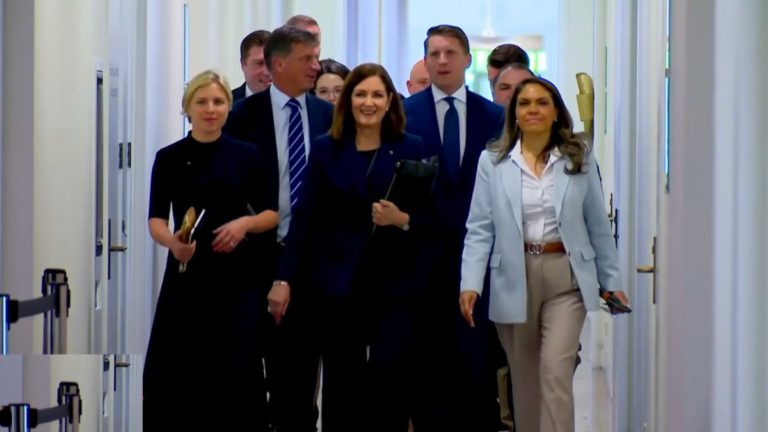
In a show of strength ahead of the debate, a phalanx of more than a dozen from the party’s conservative faction walked together down the corridor to the meeting.
At the front of the group were three women: Sarah Henderson, who was publicly critical of Opposition Leader Sussan Ley last week, Jacinta Nampijinpa Price, whom Ley forced off the frontbench, and new New South Wales Senator Jessica Collins.
Behind them, beside each other, were the two aspirants for leader, Angus Taylor and Andrew Hastie.
Liberal members of the shadow ministry on Thursday will meet to finalise the party’s policy, which Ley and energy spokesman Dan Tehan will then announce.
Negotiations with the Nationals – who have already dumped net zero – will follow. A joint parties meeting will be held, remotely, on Sunday. Based on where the Liberals have reached so far, agreement between the Coalition parties should be settled without too much difficulty.
Ley’s leadership is likely to be preserved in the short run, but her enemies will still be circling in the new year.
Ley said the five-hour meeting had been “excellent”. It had been “terrific to hear from all my Liberal Party colleagues,” she said.
According to counts, 17 people spoke in favour of retaining the commitment to net zero, while 28 spoke against.
Although there was strong opposition to retaining net zero, there was not a push at the meeting to leave the Paris climate agreement.
Tehan told reporters afterwards the meeting had endorsed two “foundational principles” underpinning policy development, as well as eight “guiding principles”.
The “foundational principles” are “having a stable, reliable energy grid which provides affordable power for households and businesses”, and “reducing emissions in a responsible, transparent way that ensures Australia does its fair share”.
The guiding principles include staying in the Paris agreement and committing to lifting the ban on nuclear energy.
Tehan said there was “pretty much unanimity” on the principles.
The meeting opened by hearing from Liberal Party federal director, Andrew Hirst. Presenting research on the issue, Hirst said it showed people saw net zero as a “proxy” for action on climate.
He said voters wanted to see sensible action on climate change, and rejecting net zero would be a political risk. But if a decision was taken to dump it, there were arguments, especially around costs, that could be deployed to seek to change people’s minds, Hirst said. His presentation was based particularly on focus group research recently undertaken by the party.
Hastie told the meeting a Coalition government should repeal legislation committing to net zero, and if necessary call a double dissolution if the Senate repeatedly blocked this.
Taylor, who was energy minister in the Morrison government and so part of crafting the net zero commitment in 2021, supported its scuttling.
Deputy leader Ted O’Brien also backed dropping the commitment, as did Alex Hawke, Ley’s numbers man.
Ley herself, once an advocate for net zero, has for some time been willing to jettison it to prop up her leadership. She did not present a view to the meeting.
Leaks poured out of the party room as fast as the contributions were made – they were so constant that it might as well have been live-streamed. Henderson complained about them, suggesting Ley needed to impose more discipline.
Members of the moderate faction fought against removing reference to net zero. They included Anne Ruston, who is deputy Liberal leader in the Senate, Andrew Bragg, Jane Hume, Andrew McLachlan, Julian Leeser, and Melissa Price.
James Paterson, a senior conservative who had earlier tried to promote a compromise, opposed net zero, advocating a sharp contrast with Labor.
No-nonsense journalism. No paywalls. Whether you’re in Australia, the UK, Canada, the USA, or India, you can support The Australia Today by taking a paid subscription via Patreon or donating via PayPal — and help keep honest, fearless journalism alive.
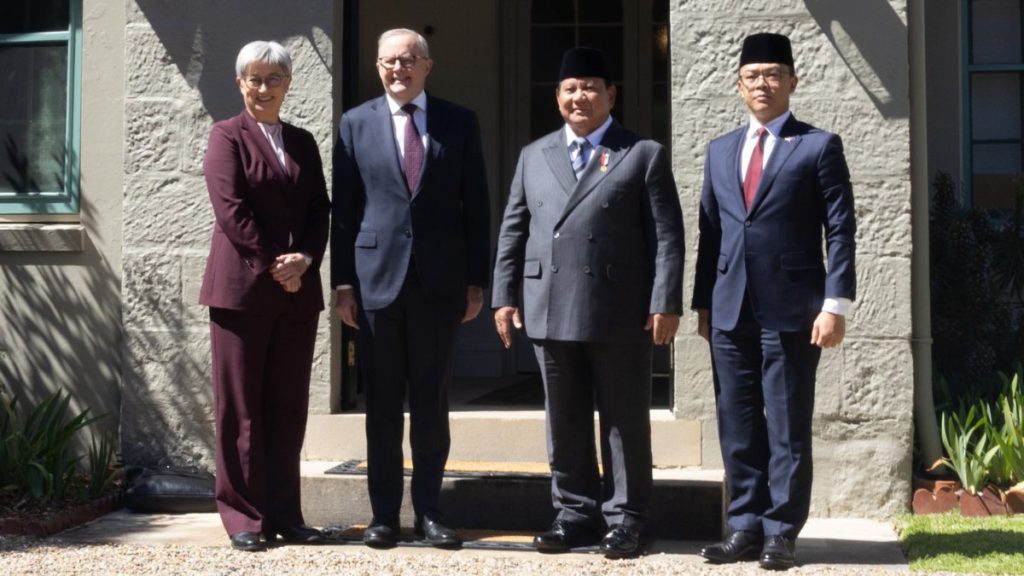
Australia and Indonesia have announced a landmark defence agreement that commits the two nations to regular consultation on security matters and strengthens strategic cooperation.
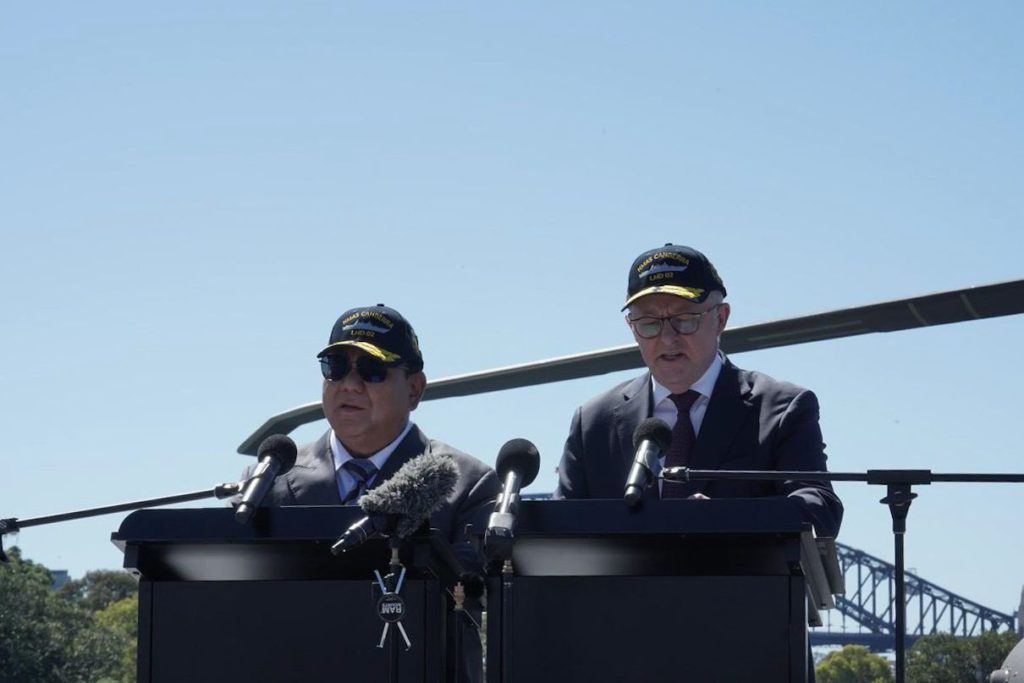
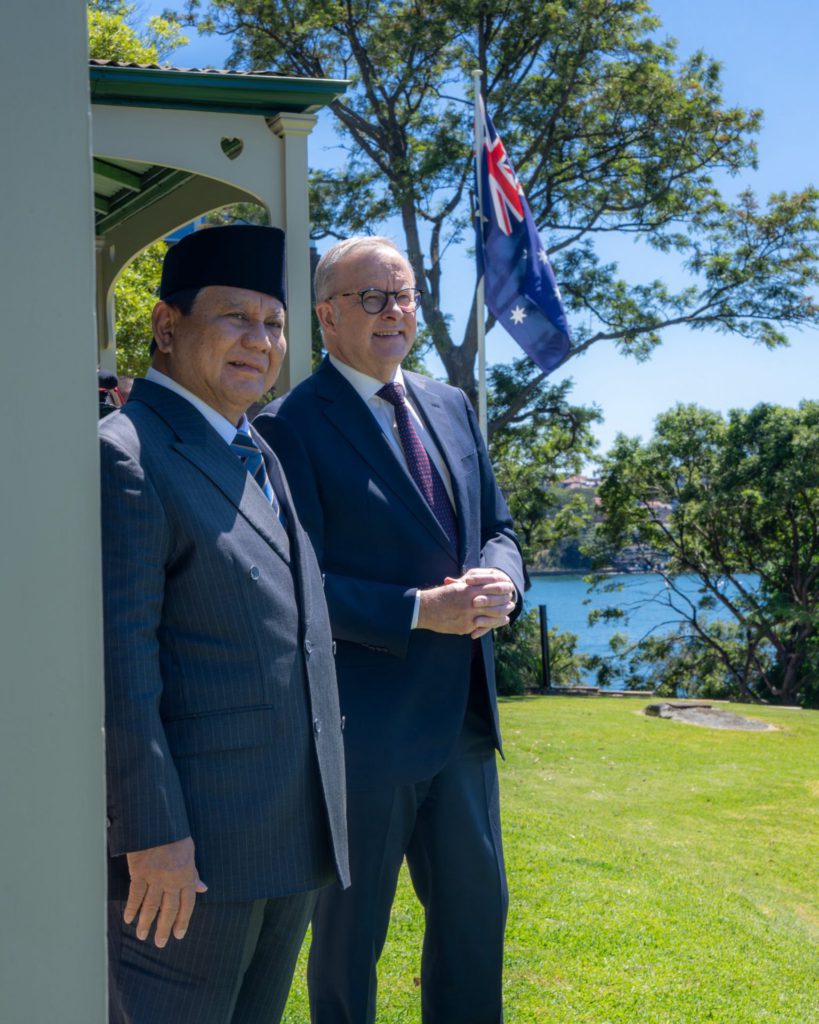
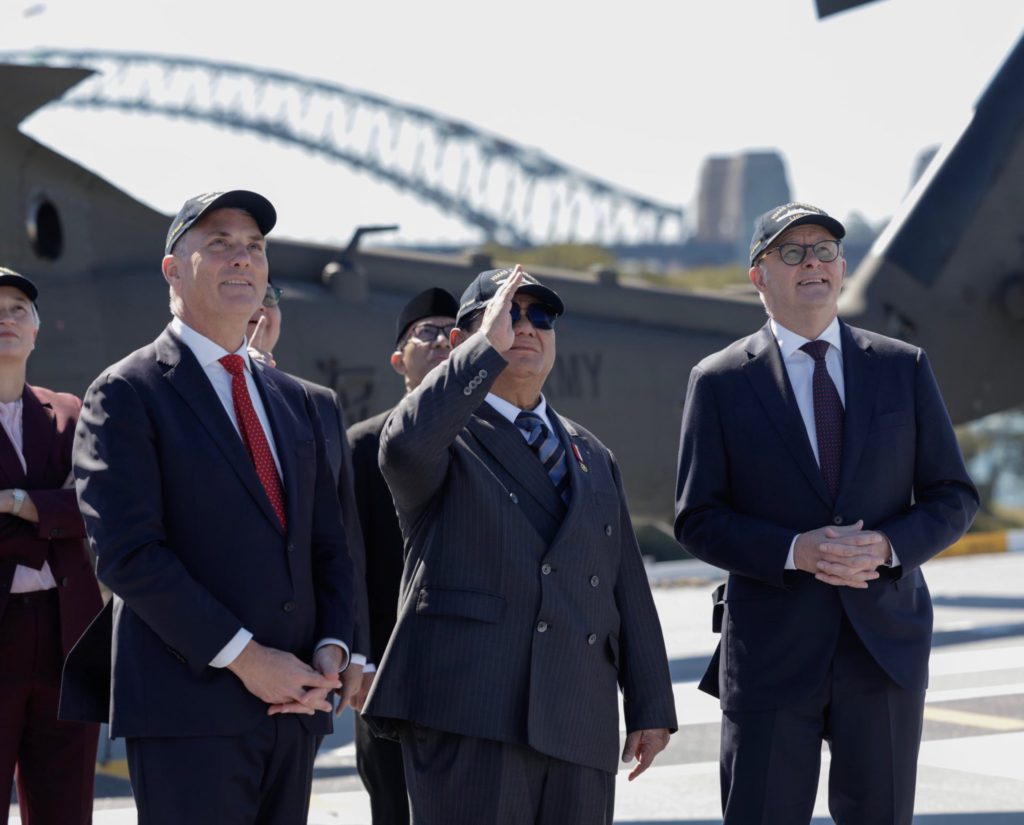
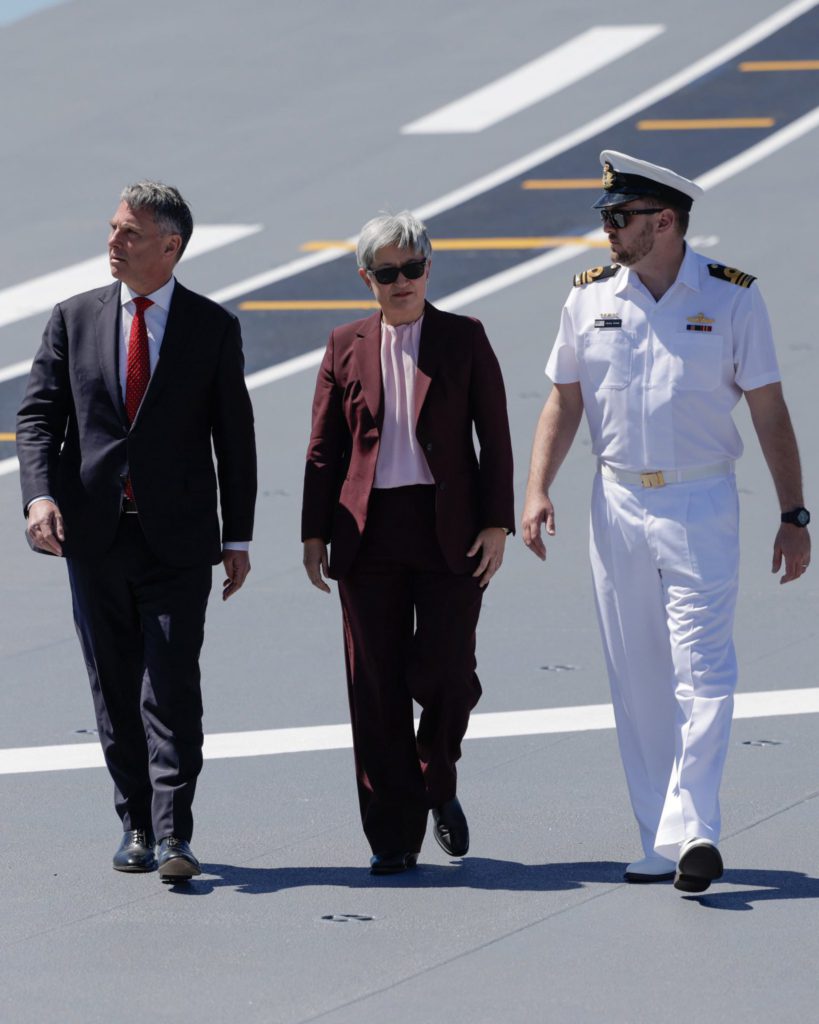
The announcement was made on Wednesday during Indonesian President Prabowo Subianto’s first state visit to Australia, where he appeared alongside Prime Minister Anthony Albanese at the Royal Australian Navy base at Garden Island in Sydney.
What the Treaty Covers
While the full text has not yet been published, key provisions of the treaty include:
A formal commitment to regular leader- and minister-level consultations on security issues.
A pledge to engage in mutually beneficial security activities and to consider individual or joint measures if either country faces a threat.
A model based on the 1995 agreement between the two countries, which lapsed in 1999, and which now seeks to apply lessons from past challenges.
Prime Minister Albanese described the treaty as a “major extension of our existing security and defence cooperation” and said it signalled a new era in the Australia–Indonesia relationship.
Image Source: Supplied
President Prabowo, referencing Indonesian cultural values, noted:
“When we face an emergency, it is our neighbour that will help us.”
Image Source: Supplied
Strategic Context
For Australia, the treaty strengthens ties with a key regional partner amid rising geopolitical uncertainty in the Indo-Pacific, including concerns about China’s growing influence.
For Indonesia, the agreement marks a balancing act: maintaining its non-aligned foreign policy while deepening practical security cooperation with Australia. Analysts note that although the treaty lacks a binding “mutual defence” clause, its diplomatic and symbolic weight is significant.
According to Australian government sources, the formal signing of the treaty is expected in early 2026, following further consultation and ratification processes in both countries.
Meanwhile, both nations have underscored the need to translate the agreement into concrete activities — including intelligence-sharing, joint training, maritime and aviation security cooperation, and broader defence interoperability.
Why It Matters
It sets the tone for closer Australia–Indonesia engagement at a time when regional stability is increasingly contested.
It reinforces Australia’s strategy of building partner-centric defence relationships in Southeast Asia, rather than relying solely on alliances centred on traditional Western powers.
For Indonesia, it signals responsiveness to the changing security architecture of the region while preserving its autonomy.
The treaty broadens the framework for non-traditional security challenges (such as maritime security, counter-terrorism, disaster relief) to be addressed collaboratively.
Bottom line: While the full impact of the treaty will depend on how swiftly it is implemented, the announcement marks a significant step in Australia and Indonesia’s strategic relationship. It underscores both countries’ recognition that regional security — and stability — requires active, consultative partnerships. With formal signing ahead, the real test will be in turning diplomatic intent into measurable action.
Support our Journalism
No-nonsense journalism. No paywalls. Whether you’re in Australia, the UK, Canada, the USA, or India, you can support The Australia Today by taking a paid subscription via Patreon or donating via PayPal — and help keep honest, fearless journalism alive.
In a celebration of culinary excellence, ‘Les Bistronomes’, in Campbell, ACT, has won the ‘Restaurant of the Year’ at the 2025 Restaurant & Catering Hostplus Awards for Excellence. The awards celebrate the best in Australia’s hospitality industry, recognising venues that demonstrate outstanding food, service, and innovation.
Pics: Les Bistronomes FB, Screenshots Clément Chauvin Owner & Executive Chef, Les Bistronomes (Pic: Les Bistronomes website screenshot)
Among other national winners, Delhi ‘O’ Delhi won in the Indian Restaurant category, reaffirming its reputation as one of Sydney’s most celebrated Indian dining destinations.
Screenshots Delhi ‘O’ Delhi website
“This incredible milestone is more than just an award — it’s a reflection of our passionate team, our talented chefs, and, most importantly, our wonderful guests who inspire us every single day,” said Javed Khan, founder of Delhi ‘O’ Delhi. “From our kitchen to your table, thank you for being part of our journey and for helping us keep the spirit of authentic Indian hospitality alive. Here’s to many more years of flavour, warmth, and memories shared together.”
Delhi ‘O’ Delhi expressed its gratitude to its guests, chefs, and staff, crediting them for their role in the restaurant’s success. The team reaffirmed its commitment to authentic Indian hospitality and excellence in dining, marking this national recognition as another step in its journey of culinary achievement.
The event highlighted the strength and diversity of Australia’s restaurant sector, with honours also going to venues such as Noosa Waterfront Restaurant & Bar and Moana Hall across other categories.
Other winners included ALT Pasta Bar in Melbourne which won the best Italian Restuarant. Savoey in Darlinghurst was judged the best ‘Asian Restaurant’ while Sandalford Wines Restaurant in Caversham, Western Australia, was the winner in the ‘Contemporary Australian Restaurant – Informal’ category.
Full list of Winners and Finalists:
Support our Journalism
No-nonsense journalism. No paywalls. Whether you’re in Australia, the UK, Canada, the USA, or India, you can support The Australia Today by taking a paid subscription via Patreon or donating via PayPal — and help keep honest, fearless journalism alive.
Preet Singh has been elected Deputy Mayor of Wyndham City Council following the council’s annual mayoral election held on Wednesday, 12 November 2025. The meeting also saw Cr Josh Gilligan elected as Mayor for the 2025–26 term.
Cr Singh represents the Bemin Ward, which covers parts of Truganina and Laverton North. A long-term resident of Wyndham, he has lived in the area for about 20 years. Away from his council duties, he runs a local solar-installation business.
Pic: Cr Preet Singh – Wyndham City Council – Facebook
He was first elected to Wyndham City Council in the 2024 local government elections. According to his official council profile, his priorities include enhancing community safety, ensuring infrastructure meets the needs of Wyndham’s rapidly growing population, supporting local businesses, improving transport accessibility, promoting sustainable development, and maintaining transparency in local government.
The Bemin Ward covers an area of 39.6 square kilometres and is one of the city’s most culturally diverse areas. About 65 per cent of its residents were born overseas, and 77 per cent speak a language other than English at home. Around 69 per cent of the ward’s working residents are employed outside Wyndham, the highest proportion among all wards in the municipality.
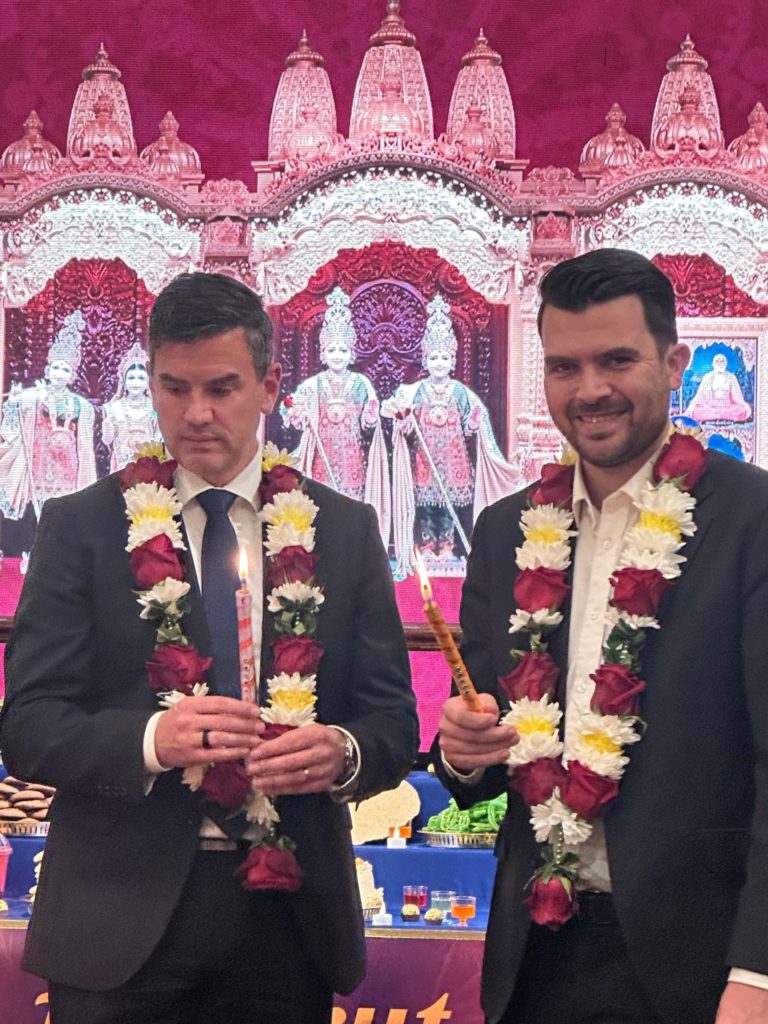
Cr Preet Singh with Maribyrnong Mayor Pradeep Tiwari (Pic: Cr Preet Singh – Wyndham City Council – Facebook)
Cr Singh’s appointment as Deputy Mayor reflects the community’s confidence in his leadership and his ongoing focus on delivering practical outcomes for Wyndham’s residents in areas of growth, sustainability, and local engagement.
Support our Journalism
No-nonsense journalism. No paywalls. Whether you’re in Australia, the UK, Canada, the USA, or India, you can support The Australia Today by taking a paid subscription via Patreon or donating via PayPal — and help keep honest, fearless journalism alive.
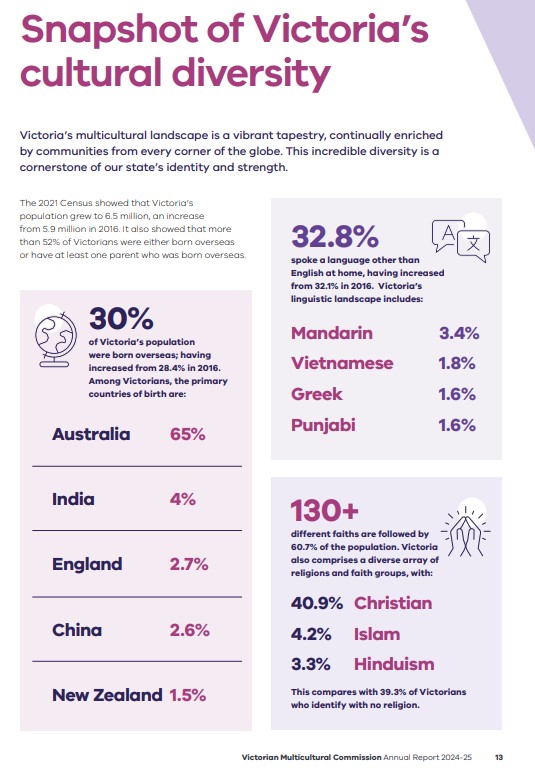
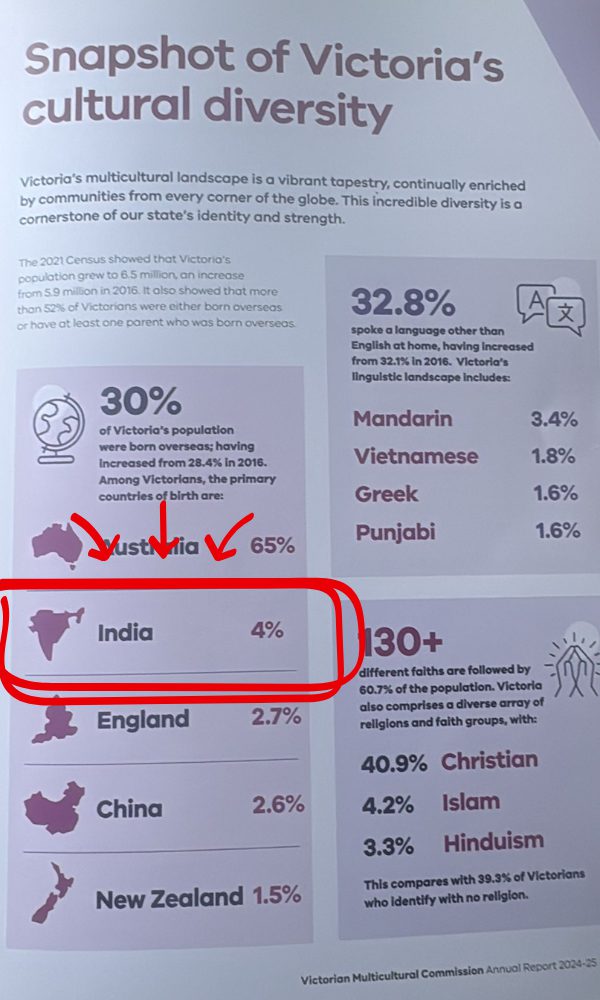
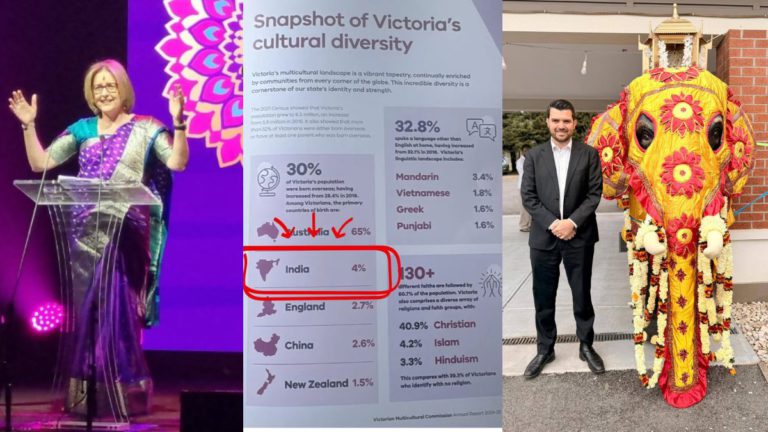
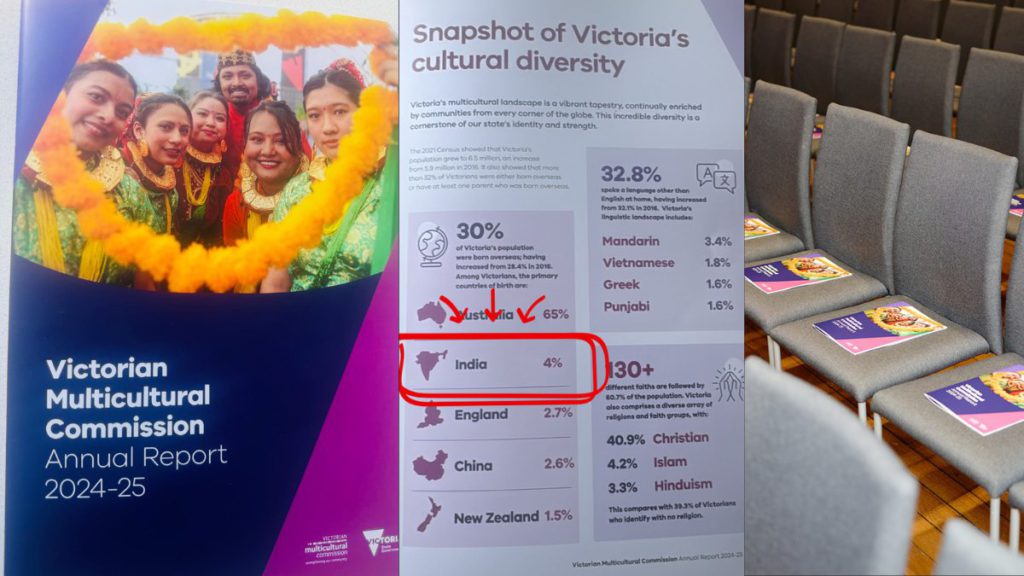
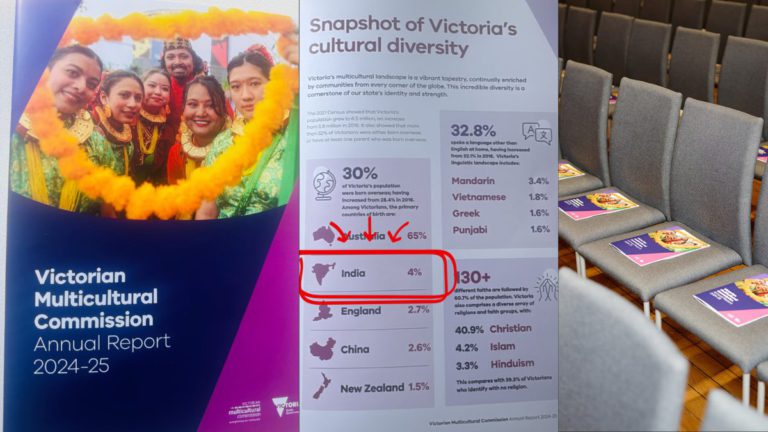
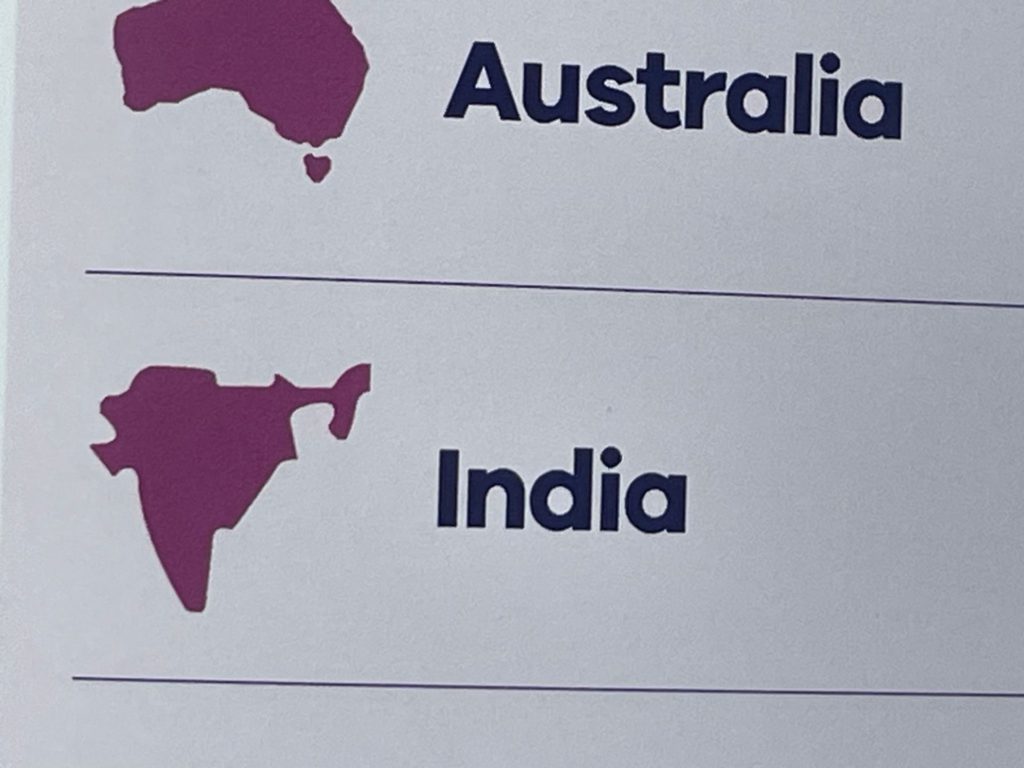
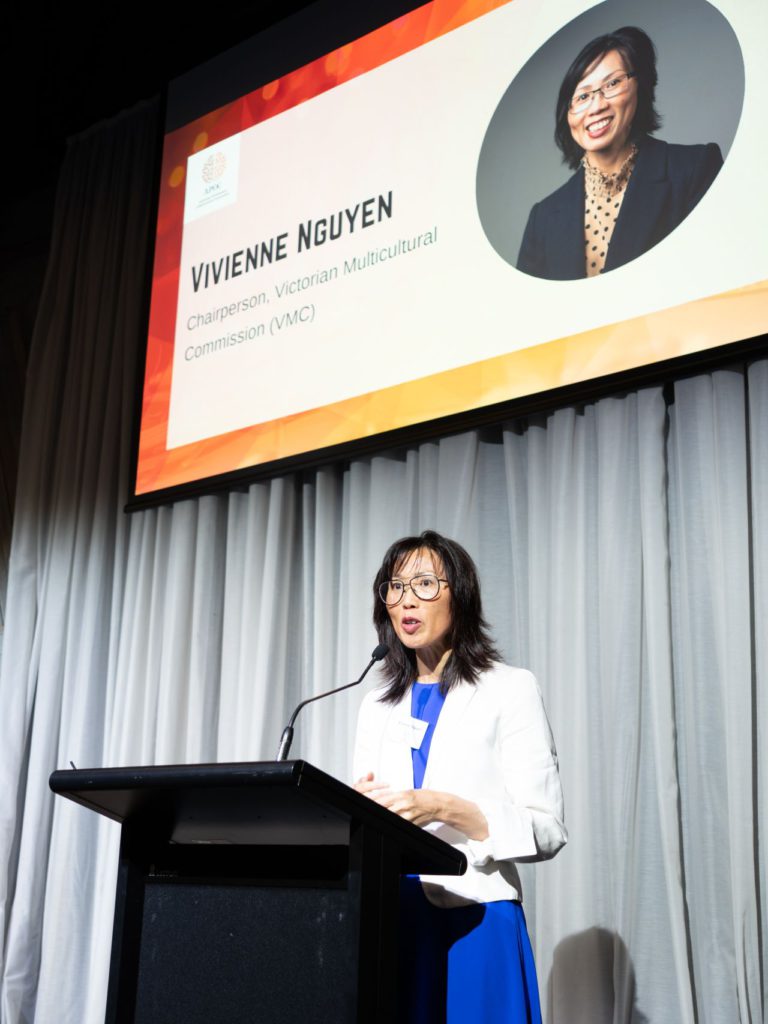
Victorian Multicultural Commission (VMC) Chairperson Vivienne Nguyen AM has issued an apology to the Indian-Australian community after the Commission’s Annual Report 2024–25 featured a distorted map of India, which sparked widespread outrage.
In a statement following the controversy, Nguyen acknowledged the mistake and expressed regret over the offence caused.
“I, however, acknowledge and regret that the report included a graphic representation of India – and I apologise for the offence that caused.”
“The VMC understands the concern among community members. We greatly value our relationship and friendship with Victoria’s Indian community,” she added.
The VMC took immediate steps to rectify the original publication’s digital version – removing the graphic in the digital publication and reaffirming our commitment to respectful representation of all communities.”
Nguyen added that the Annual Report captured “a year of achievements, advocacy and engagement, set against a backdrop of global uncertainty and local challenges.”
The event also featured an address from Minister for Multicultural Affairs Ingrid Stitt MP, who discussed the VMC’s role in promoting unity and harmony and outlined plans for the new body, Multicultural Victoria.
Image: (R) Shadow Minister for Multicultural and Multifaith Affairs Evan Mulholland (Source: Facebook)
Earlier, The Australia Today reported that Shadow Minister for Multicultural and Multifaith Affairs Evan Mulholland had condemned the publication of the distorted map, describing it as “a profound insult to every Indian-Australian in this state.”
“The VMC shows a stunning and offensive lack of cultural awareness,” Mulholland said in a statement.
He added, “How could a government body entrusted with inclusion erase parts of India from an official state document? This is the direct consequence of the Labor Government gutting and starving the VMC of resources. When you treat a vital body like the VMC as a political afterthought, you get this kind of reckless incompetence.”
“Jacinta Allan must immediately apologise to the Indian-Australian community for this inexcusable failure.”
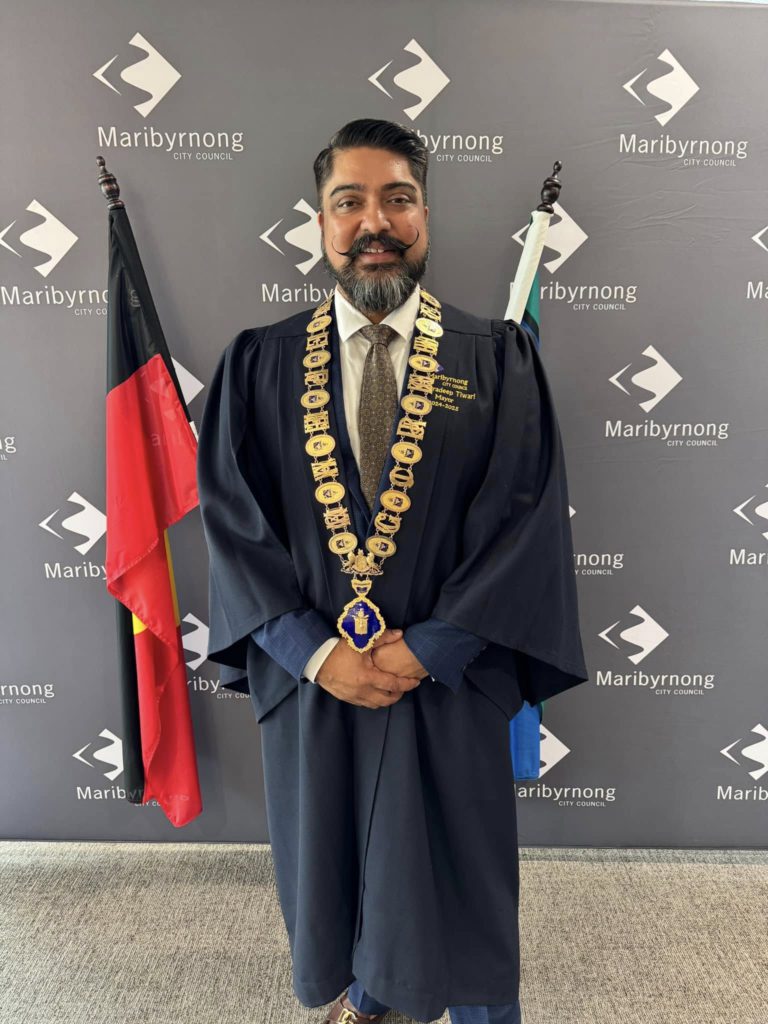
Image: Maribyrnong Mayor Pradeep Tiwari (Source: Facebook)
Maribyrnong Mayor Pradeep Tiwari has welcomed Victorian Multicultural Commission (VMC) Chair Vivienne Nguyen AM’s public apology over the publication of a distorted map of India in the Commission’s Annual Report.
“I would like to extend my sincere thanks to Vivienne Nguyen for her thoughtful acknowledgment and apology regarding the recent publication error.”
Mayor Tiwari commended Nguyen’s long-standing support for the Indian community and appreciated the VMC’s swift action to correct the issue.
“Your transparency and willingness to engage openly reflect the true spirit of collaboration that underpins Victoria’s multicultural success,” Tiwari added, saying he looked forward to continuing to strengthen unity and shared pride across the state.
The controversy began when community members shared screenshots from the report showing major Indian regions — including Punjab, Jammu and Kashmir, Ladakh, and parts of the north-east such as Sikkim, Nagaland, and Arunachal Pradesh — missing or misrepresented.
The Consulate General of India in Melbourne has also raised the issue with the Victorian Premier’s office, demanding “immediate correction and apology by the concerned authorities.”
Nguyen’s apology marks the first formal acknowledgement of the error from the Commission, following days of criticism and growing pressure from the community and opposition MPs.
Support our Journalism
No-nonsense journalism. No paywalls. Whether you’re in Australia, the UK, Canada, the USA, or India, you can support The Australia Today by taking a paid subscription via Patreon or donating via PayPal — and help keep honest, fearless journalism alive.
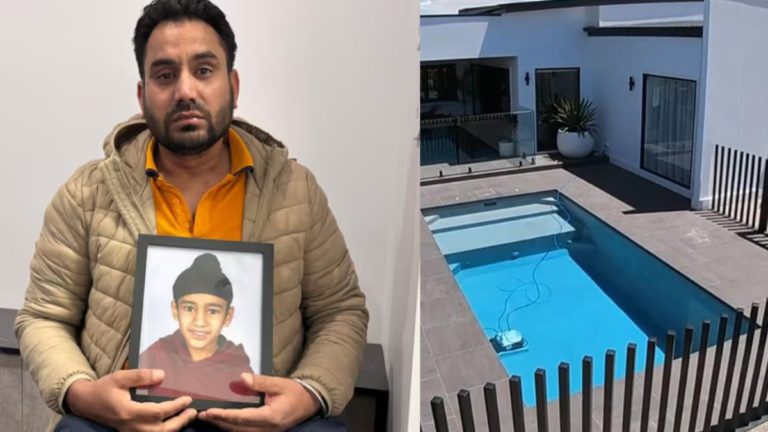
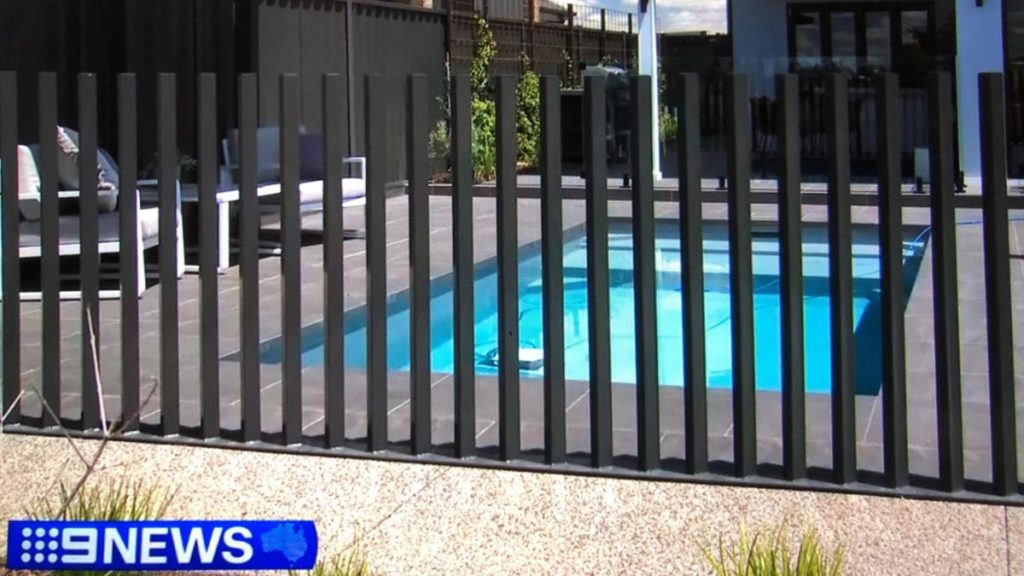
The heartbroken father of eight-year-old Gurshabad Singh has shared new details about his son’s death in a display home swimming pool near Shepparton, calling for urgent changes to prevent similar tragedies.
Talwinder Singh told the ABC he was running through the streets searching for Gurshabad, who was just weeks from his ninth birthday, when he was found unresponsive in the pool of a G.J. Gardner display home in Kialla shortly before 7 pm on Sunday. Paramedics performed CPR at the scene, but the boy could not be revived.
Gurshabad, who had autism, “just jumped” into the water, his father said. Mr Singh has urged authorities to mandate that pools at vacant homes be covered, saying it could have prevented his son’s death.
He said,
“Just cover the bloody pool so the kids can’t see, they can’t go in. Cover the pools, that’s all. That’s what I want.”
Mr Singh said Gurshabad’s little sister had been asking “difficult” questions about her brother, and that he and his wife were still trying to find the words to tell her.
Neighbours told 9News the boy had wandered away from a nearby family birthday celebration.
“We did hear that he did have special needs. The family was looking around,” said neighbour Mert Tetik.
“It’s quite devastating. It’s obviously shaken us as a community as well.”
A G.J. Gardner Homes spokesperson said the company was “devastated” by the accidental drowning and extended condolences to the family. The spokesperson confirmed the pool complied with all safety regulations, including fencing, and said staff were being supported through the tragedy.
“We will continue to do everything within our power to support the authorities with their investigation,” they said.
Life Saving Victoria described the incident as a “sad and timely reminder” of the risks children face around water. A spokesperson urged parents and carers to actively supervise children, enrol them in swimming and water safety lessons, learn CPR, and ensure all pool areas have compliant barriers.
Since 2020–21, 28 people have died in private pools in Victoria, accounting for around 10 per cent of all fatal drownings.
A report will be prepared for the coroner, and Gurshabad’s funeral is scheduled to take place in Melbourne on Friday.
Support our Journalism
No-nonsense journalism. No paywalls. Whether you’re in Australia, the UK, Canada, the USA, or India, you can support The Australia Today by taking a paid subscription via Patreon or donating via PayPal — and help keep honest, fearless journalism alive.
Shadow Minister for Multicultural and Multifaith Affairs Evan Mulholland has condemned the Victorian Multicultural Commission (VMC) for publishing a decapitated and distorted map of India in its Annual Report 2024–25, calling it “a profound insult to every Indian-Australian in this state.”
“The VMC shows a stunning and offensive lack of cultural awareness,” Mulholland said in a statement.
He added, “How could a government body entrusted with inclusion erase parts of India from an official state document? This is the direct consequence of the Labor Government gutting and starving the VMC of resources. When you treat a vital body like the VMC as a political afterthought, you get this kind of reckless incompetence.”
“Jacinta Allan must immediately apologise to the Indian-Australian community for this inexcusable failure.”
Image: Victorian Liberal Party Leader Brad Battin with Shadow Minister for Multicultural and Multifaith Affairs Evan Mulholland (Source: Facebook)
The issue surfaced when community members posted a screenshot from page 13 of the report, noting that major Indian regions — including Punjab, Jammu and Kashmir, Ladakh, and parts of the north-east such as Sikkim, Nagaland, and Arunachal Pradesh — were missing or misrepresented.
“This is shocking. Is this how multicultural respect works in Victoria?” one community member asked, while others described the error as “deeply disturbing and disappointing.”
A VMC spokesperson told The Australia Todaythat the commission had removed the image from the online version and informed the original correspondent of the changes, but no formal apology has been issued.
The Consulate General of India in Melbourne has also raised the issue with Premier Jacinta Allan’s office, demanding “immediate correction and apology by the concerned authorities.”
Image Source: The Australia Today
The controversy has sparked questions about the VMC’s internal review processes, particularly whether cultural and geopolitical checks were performed before publication.
The report itself highlights Victoria’s diverse population, with residents from over 300 ancestries, speaking more than 290 languages, and following over 200 faiths.
Support our Journalism
No-nonsense journalism. No paywalls. Whether you’re in Australia, the UK, Canada, the USA, or India, you can support The Australia Today by taking a paid subscription via Patreon or donating via PayPal — and help keep honest, fearless journalism alive.
Australia has joined India, Japan and the United States for Exercise Malabar, a major Indo-Pacific maritime drill aimed at strengthening cooperation and combat readiness among regional allies.
The Royal Australian Navy’s Anzac-class frigate HMAS Ballarat and a Royal Australian Air Force P-8A Poseidon maritime patrol aircraft are taking part in the exercise, being held in the West Pacific training area from 10 to 18 November.
Image: HMAS Ballarat sails into U.S. Naval Base Guam, to participate in Exercise MALABAR during Regional Presence Deployment 25-4 (Photo: LSIS Connor Morrison / Source: Australian Defence)
Chief of Joint Operations Vice Admiral Justin Jones AO, CSC, RAN, said Exercise Malabar plays a crucial role in maintaining stability in the region.
“Through Exercise Malabar, Australia and partner nations are strengthening Indo-Pacific security by tackling shared challenges, coordinating collective strength and closing gaps in global engagement.”
He added that the complex drills in anti-submarine warfare, air defence and replenishment at sea help nations build trust, interoperability and readiness to respond to collective security challenges.
Established in 1992 as a bilateral training activity between India and the United States, Exercise Malabar has evolved into a multilateral event bringing together key Indo-Pacific partners. Australia hosted the previous edition in 2023.
Commander Dean Uren, Commanding Officer of HMAS Ballarat, said his crew was eager to work with some of the region’s most capable naval forces. “Our participation in Exercise Malabar forms part of our three-month Regional Presence Deployment and is a fantastic opportunity to enhance interoperability with key Indo-Pacific partners,” Commander Uren said.
“Training alongside regional partners ensures our people and platforms are ready to respond to any challenge and deter coercion in the Indo-Pacific.”
Image: Petty Officer Communications and Information Systems Gabby Saunders on the starboard bridge wing of HMAS Ballarat as the ship sails into U.S. Naval Base Guam, to participate in Exercise MALABAR during Regional Presence Deployment 25-4 (Photo: LSIS Connor Morrison / Source: Australian Defence)
With a crew of 177 and an embarked MH-60R Seahawk helicopter, HMAS Ballarat brings significant capability to the exercise. The frigate is equipped to conduct air defence, surface and undersea warfare, surveillance, reconnaissance and interdiction missions, and can counter multiple threats simultaneously from aircraft, ships and submarines.
Support our Journalism
No-nonsense journalism. No paywalls. Whether you’re in Australia, the UK, Canada, the USA, or India, you can support The Australia Today by taking a paid subscription via Patreon or donating via PayPal — and help keep honest, fearless journalism alive.
Children aged 14 and above who commit violent crimes such as machete attacks, home invasions or carjackings will soon face adult sentences in Victoria, with the Allan Labor Government set to introduce its “Adult Time for Violent Crime” reform to Parliament this year.
Premier Jacinta Allan and Attorney-General Sonya Kilkenny announced the sweeping changes on Tuesday, saying the tough new measures will ensure courts treat violent youth offenders like adults — making jail more likely and sentences longer.
“There are too many victims, not enough consequences. That’s why we’re introducing Adult Time for Violent Crime,” Premier Allan said.
“We want courts to treat these violent children like adults, so jail is more likely and sentences are longer.”
It means violent youth offenders will be treated like adults, so jail is more likely, and sentences are longer. pic.twitter.com/T1sZpZQjGp
Under the reform, offenders aged 14 and above charged with serious violent crimes will automatically face adult sentencing in the County Court instead of the Children’s Court. These crimes include aggravated home invasion, aggravated carjacking, armed robbery, aggravated burglary and machete-related attacks.
Currently, only 34 per cent of children sentenced for aggravated home invasion or aggravated carjacking in the Children’s Court go to jail, compared to 97 per cent when sentenced in an adult court.
The new framework will also lift maximum penalties. The Children’s Court can impose a maximum sentence of three years, while the County Court can issue up to 25 years for aggravated home invasion and carjacking — and under the new plan, these offences will carry a potential life sentence for offenders aged 14 and over.
Attorney-General Kilkenny said the shift reflects the community’s demand for stronger consequences.
“Adult courts put more emphasis on victims, violence and community safety. When child offenders are sentenced in an adult court, most go to jail.”
Violent youth crime is hurting Victorians, devastating victims and our community. That's simply unacceptable. This week we'll announce our plan to reduce youth crime. pic.twitter.com/W3xIQPBxyO
The government will also reform sentencing principles in the Children’s Court to ensure community safety is prioritised and remove the current rule that jail must be a “last resort” for children.
Labor’s at it again – spinning headlines before doing the work. Today they announced laws they haven’t even written. The arrogance of this Government knows no bounds. pic.twitter.com/zi7jDfUBQU
Victoria’s Opposition has criticised the new youth crime reforms, accusing the government of rushing announcements. Victorian Liberal Party Leader Brad Battin said,
“Labor’s at it again – spinning headlines before doing the work. Today they announced laws they haven’t even written. The arrogance of this Government knows no bounds.”
While the government acknowledged there are no simple solutions to youth crime, Premier Allan said firm boundaries are essential.
“The threat of going to jail for breaking the law helps keep children within the guardrails and teaches them right from wrong.”
The “Adult Time for Violent Crime” Bill will be introduced to Parliament this year and is expected to take effect in 2026 as part of Victoria’s broader Serious Consequences – Early Interventions plan to curb violent youth crime.
Support our Journalism
No-nonsense journalism. No paywalls. Whether you’re in Australia, the UK, Canada, the USA, or India, you can support The Australia Today by taking a paid subscription via Patreon or donating via PayPal — and help keep honest, fearless journalism alive.
The Consul General of India attended the Bihar Jharkhand Samaj of Western Australia’s Diwali Milan 2025 and Jharkhand State Formation Day celebrations, which also marked the 150th birth anniversary of tribal icon Birsa Munda.
Image: Consul General of India attended the Bihar Jharkhand Samaj of Western Australia’s Diwali Milan 2025 and Jharkhand State Formation Day celebration 9Source: CGI Perth – Facebook)
The vibrant event, held in Perth, brought together members of the Indian diaspora for an evening of cultural performances, traditional festivities, and community bonding.
The Consul General praised the Bihar Jharkhand Samaj of WA for its efforts in promoting Indian culture and strengthening ties among the diaspora in Western Australia.
Image: Consul General of India attended the Bihar Jharkhand Samaj of Western Australia’s Diwali Milan 2025 and Jharkhand State Formation Day celebration 9Source: CGI Perth – Facebook)
This year’s celebration holds special significance as it marks the Silver Jubilee of Jharkhand’s formation on 15 November 2000. The date also commemorates the birth anniversary of Bhagwan Birsa Munda, a revered tribal freedom fighter who led the Munda Rebellion in the late 19th century against British colonial rule.
Image: Consul General of India attended the Bihar Jharkhand Samaj of Western Australia’s Diwali Milan 2025 and Jharkhand State Formation Day celebration 9Source: CGI Perth – Facebook)
Recognised as a symbol of indigenous pride and resistance, Birsa Munda’s legacy continues to inspire generations. In honour of his contributions, the Indian government declared his birth anniversary as Janajatiya Gaurav Diwas (Tribal Pride Day) in 2022.
Support our Journalism
No-nonsense journalism. No paywalls. Whether you’re in Australia, the UK, Canada, the USA, or India, you can support The Australia Today by taking a paid subscription via Patreon or donating via PayPal — and help keep honest, fearless journalism alive.
An Indian-Australian community figure was reportedly attacked in Sydney on Monday evening in what witnesses described as a racially motivated assault.
It is reported that the incident occurred around 5:30 p.m. near the Westfield Shopping Centre in Parramatta.
The victim, an active political and community leader who has been residing in Sydney for the past 21 years, remains under medical supervision, with critical tests scheduled to be conducted regularly.
Eyewitnesses said the victim was walking with colleagues to a Parramatta Council meeting when an Caucasian woman suddenly approached and punched him on the head, using racial slurs before fleeing the scene.
The attackers reportedly shouted, “F*** off, Indian. Go back to where you came from,” after the unprovoked assault as the victim was walking out of Level 2 at Westfield Parramatta.
A social media user also posted an account of the attack on Reddit, saying, “Witnessed a racial attack at Westfield Parramatta… an old Indian man being punched in the head by a white female… There were racist obscenities said by them too… I believe they got the man urgent care, and the CCTV systems are everywhere so they will be identified soon.”
The attack has sparked outrage among the Indian diaspora in Australia. Community leaders have condemned the assault as a hate crime, calling for swift and impartial action. They stressed that attacks like this threaten multicultural harmony and must not be tolerated.
New South Wales Police have confirmed the incident and are reviewing CCTV footage to identify the attacker. Authorities have urged anyone with information to come forward.
Support our Journalism
No-nonsense journalism. No paywalls. Whether you’re in Australia, the UK, Canada, the USA, or India, you can support The Australia Today by taking a paid subscription via Patreon or donating via PayPal — and help keep honest, fearless journalism alive.
The irregularities were detected during a July 2025 review of the licence conversion process, which revealed multiple cases of people submitting false or misleading information to secure local driving rights, RNZ reported.
Deputy Director of Land Transport, Mike Hargreaves, said NZTA’s systems are designed to catch and respond quickly to fraudulent behaviour.
“We have systems in place to identify, investigate and respond to suspected fraudulent activity, and we will act swiftly when we find it by holding people to account,” Hargreaves said, according to RNZ.
NZTA is now contacting the individuals involved to advise them that their licences have been revoked and must be surrendered.
Providing false or misleading information during a driver licence application is an offence under the Land Transport Act 1998 and carries an infringement fine of up to $750. The agency said it remains committed to protecting the integrity and safety of New Zealand’s transport system.
Support our Journalism
No-nonsense journalism. No paywalls. Whether you’re in Australia, the UK, Canada, the USA, or India, you can support The Australia Today by taking a paid subscription via Patreon or donating via PayPal — and help keep honest, fearless journalism alive.
Fiji’s HIV response has received a major boost after the Indian High Commission in Suva officially handed over a substantial consignment of Antiretroviral (ARV) drugs to the Ministry of Health.
India’s High Commissioner Suneet Mehta presented the shipment to Minister for Health and Medical Services, Dr Ratu Atonio Lalabalavu, in the presence of Assistant Minister Penioni Ravunawa, Permanent Secretary Dr Jemesa Tudravu, UNAIDS Ambassador Ratu Epeli Nailatikau and senior health officials.
The Indian High Commission described the moment as “Veilomani-Dosti,” emphasising the strong partnership and shared commitment between India and Fiji in advancing public health and ensuring access to high-quality and affordable medicines.
🇮🇳🤝🇫🇯 Veilomani-Dosti
Today marked a significant moment when a consignment of Antiretroviral (ARV) drugs for HIV patients in Fiji have been officially handed over by High Commissioner Suneet Mehta to Minister for Health & Medical Services Hon. Dr Ratu Atonio Lalabalavu, in the… pic.twitter.com/bDBRJKHce7
Dr Lalabalavu said the donation comes at a crucial time, supporting the HIV Unit’s plans to expand treatment and prevention efforts as Fiji strengthens its national response to HIV. He noted that with increased testing and screening, more cases are expected to be detected, making it essential for treatment services to expand accordingly.
He also confirmed that discussions between the Ministry of Health and the Indian High Commission on the 100-bed super-speciality hospital in Suva are progressing well, with the tender process nearing completion and construction set to begin soon. “Fiji is grateful to the Government of India for its continued support,” he said.
Image: India’s High Commissioner Suneet Mehta presented the shipment to Fiji’s Minister for Health and Medical Services Dr Ratu Atonio Lalabalavu (Source: Facebook – Fiji Government)
Indian High Commissioner Suneet Mehta said the handover marks another milestone in the growing health cooperation between the two nations. He explained that the shipment — around three tonnes of ARV medicines — is the largest consignment of HIV drugs India has ever donated to Fiji. He added that it is a direct outcome of agreements reached during Prime Minister Sitiveni Rabuka’s visit to India in August last year. Mehta reaffirmed India’s continued support, saying the upcoming hospital project will further strengthen bilateral ties and deliver long-term benefits for the Fijian people.
The National Federation Party welcomed the development, stressing the importance of consistent access to essential HIV treatment to protect lives, reduce transmission and support affected families. The party noted that the 2025–2026 National Budget allocated $10 million to address the HIV epidemic through expanded testing, counselling, prevention campaigns, needle and syringe programmes, and measures to reduce stigma and improve access to care.
Earlier reporting by The Australia Today highlighted India’s ongoing medical support to Fiji, including past ARV supplies and 100,000 COVID-19 vaccines during the pandemic. Ministry of External Affairs spokesperson Randhir Jaiswal described the initiative as “strengthening health partnership with the Global South,” reaffirming India’s long-standing commitment to Fiji’s public health and humanitarian needs.
🇮🇳-🇫🇯| Strengthening health partnership with the Global South.
A consignment of Anti-Retro Viral (ARV) drugs has been dispatched to Fiji to support its health program.
India remains committed to supporting Fiji in its public health response and humanitarian needs. pic.twitter.com/2LuB5wrPGw
The World Health Organization has warned of a sharp rise in HIV cases across the Western Pacific, with Fiji recording a tenfold increase over the past decade. WHO Regional Director Dr Saia Ma’u Piukala has cautioned that the escalating epidemic poses a broader national and regional threat.
This latest consignment, coupled with ongoing health cooperation and infrastructure commitments, underscores India’s continued role as a key partner in strengthening Fiji’s health system and supporting its fight against HIV.
Support our Journalism
No-nonsense journalism. No paywalls. Whether you’re in Australia, the UK, Canada, the USA, or India, you can support The Australia Today by taking a paid subscription via Patreon or donating via PayPal — and help keep honest, fearless journalism alive.
Premier Jacinta Allan joined key ministers, Melbourne Avalon Airport CEO Ari Suss and Jetstar executives to confirm that international flights from Avalon to Bali will resume from March, alongside the restart of the domestic Adelaide route and extra services to Brisbane.
Allan said the move signalled a turning point for the region. “Now arriving: more flights for Avalon and more jobs for Geelong,” she said, adding that the expansion underscored the airport’s growing importance as a gateway for both visitors and workers.
Now arriving: more flights for Avalon and more jobs for Geelong.
Today I joined Melbourne Avalon Airport and Jetstar to announce new international flights from Avalon to Bali.
Jetstar will also restart their domestic route to Adelaide and increase flights to Brisbane – bringing… pic.twitter.com/xRc2Owt0E5
Jetstar Chief Executive Stephanie Tully said the airline’s renewed investment will open doors for travellers across Victoria. She noted that the additional services would “see thousands more customers fly through Melbourne’s second airport gateway, supporting the economic growth of Melbourne, Geelong, the Surf Coast and the Bellarine Peninsula.”
Avalon Airport CEO Ari Suss said the long-running relationship between the airport and the airline was entering a promising new chapter. “The Avalon–Jetstar partnership is now into its 22nd year, and this renewed partnership across domestic and international services will deliver more frequency, better connections and the ability for people between Melbourne and Geelong to start their journey closer to home,” he said.
The expansion will add up to 320,000 new low-fare seats each year, including 120,000 seats on the new Bali service alone, operating five return flights a week. To accommodate the influx, the airport will undergo significant upgrades—1,000 new terminal seats, improved runway lighting, additional security and CCTV infrastructure, expanded water connections to the control tower and 500 extra parking spaces.
Minister for Industry and Advanced Manufacturing Colin Brooks said the improvements were part of a broader effort to boost local employment. “These new flights and services are a major boost for jobs and will give people easier access to the airport,” he said. The upgrades are expected to create more than 80 jobs, on top of the roles generated by increased tourism and aviation activity.
Public transport links will also improve, with the Government introducing Route 18—a new daily bus service connecting Lara Station to Avalon Airport. Minister for Public Transport Gabrielle Williams said the route would “deliver better public transport options for Avalon and ensure improved access for thousands of workers and passengers every day.”
Members for Lara, Geelong and Bellarine welcomed the transport and aviation enhancements, noting the flow-on effects for local businesses and communities. Christine Couzens said the changes meant “more jobs, more flights, more people and more money in the local economy,” while Alison Marchant added that the increased accessibility would help drive more visitors to the Bellarine.
Image: Avalon Airport (Avalon Airport – website)
The announcement builds on the recent opening of a freight processing facility at the precinct, supporting hundreds of jobs in logistics and distribution. Victoria’s aviation sector contributed $23 billion in economic activity and supported more than 138,000 full-time equivalent jobs in 2022–23.
With Jetstar headquartered in Victoria since 2004 and employing more than 3,000 people statewide, the strengthened Avalon network cements the airport’s role in supporting tourism, freight, international education and trade.
Support our Journalism
No-nonsense journalism. No paywalls. Whether you’re in Australia, the UK, Canada, the USA, or India, you can support The Australia Today by taking a paid subscription via Patreon or donating via PayPal — and help keep honest, fearless journalism alive.
A new federal Resolve poll has found 61% of respondents would struggle to afford an expense of a few thousand dollars, compared to just 24% who said they would not. The 37-point margin is the highest since Resolve began asking this question in February 2023.
When this question was last asked in December 2024, the margin was 50–36%.
On who to blame for rising living costs, 42% blamed the federal government, 16% global factors, 11% state governments, 7% the Reserve Bank and 7% businesses. In the next six months, 42% thought the economic outlook would get worse, 20% said it would improve and 29% said it would stay the same.
The poll for Nine newspapers – conducted between November 4-8 from a sample of 1,804 people – also gave Labor a 53–47% lead over the Coalition by respondent preferences, a two-point gain for the Coalition since the October Resolve poll.
Primary votes were 33% Labor (down one), 29% Coalition (up one), 12% Greens (up one), 12% One Nation (steady), 7% independents (down two) and 6% others (down one).
By 2025 election preference flows, Labor would lead by about 54.5–45.5%, a one-point gain for the Coalition.
Despite Labor’s drop on voting intentions, Anthony Albanese’s net approval improved six points to net zero, with 44% both giving him a good and poor rating.
Opposition Leader Sussan Ley’s net approval was down two points to -7. Albanese led Ley as preferred PM by 39–25% (40–23% previously).
Labor led the Liberals on economic management by 31–29% (29–28% in October). But on keeping the cost of living low, the Liberals led by 28–27%, reversing a 28–24% Labor lead in October.
When asked their most important issue, 42% of respondents said cost of living, with no other issue reaching double digits.
This poll was taken after the Australian Bureau of Statistics reported on October 29 that inflation in the September quarter rose 1.3%, its highest quarterly increase since March 2023.
There has also been a surge in the popularity of right-wing to far-right politicians since December 2024.
One Nation leader Pauline Hanson’s net likeability increased 21 points to +8, National MP Barnaby Joyce’s net likeability increased 14 points to -8 and Liberal MP Andrew Hastie’s net likeability increased four points to +8.
Unlike the late October Newspoll, this new poll did not show a surge for One Nation. Ley’s net approval in this poll is far better than in Newspoll (-7 vs -33).
Labor still far ahead in NSW Resolve poll
A NSW state Resolve poll for The Sydney Morning Herald – conducted with the federal October and November Resolve polls from a sample of more than 1,000 people – gave Labor 37% of the primary vote (down one since September), the Coalition 28% (steady), the Greens 10% (steady), independents 15% (up four) and others 11% (down one).
Resolve doesn’t usually give a two-party estimate for its state polls, but primary votes suggest little change from September’s estimate of 59–41% to Labor. The next NSW election will be held in March 2027.
Despite Labor’s continued dominance on voting intentions, Labor Premier Chris Minns slumped to his lowest preferred premier lead this term over Liberal leader Mark Speakman. Minns led by 31–19%, down from 37–16% in September.
Minns’ net likeability was up one point to +14, and has remained roughly steady since recovering from a slump to +10 in December 2024.
Speakman’s net likeability was up two points to +3, continuing a rebound from a low of -3 in April.
Coalition retains narrow lead in Victorian DemosAU poll
Primary votes were 37% Coalition (down one), 26% Labor (steady), 15% Greens (steady) and 22% for all Others (up one).
Opposition Leader Brad Battin led Labor Premier Jacinta Allan as preferred premier by 40–32% (37–32% previously). The Victorian election will be held in November 2026.
Upper house voting intentions were 30% Coalition, 21% Labor, 14% Greens, 11% One Nation, 5% Family First, 4% Libertarian and 3% Animal Justice. The combined vote for the Coalition and Labor is an unrealistic 12 points lower in the upper house than in the lower house.
All 40 of Victoria’s upper house seats will be elected in eight five-member electorates using proportional representation with preferences.
Liberals increase lead in Tasmanian DemosAU poll
A Tasmanian DemosAU state poll – conducted between October 16–27 from a sample of 1,021 people – gave the Liberals 41% of the vote (39.9% at the July election), Labor 24% (25.9%), the Greens 15% (14.4%), independents 14% (15.3%), the Shooters 2% (2.9%) and others 4%.
Tasmania uses a proportional system for its lower house elections, so a two-party estimate is not applicable. Liberal Premier Jeremy Rockliff led Labor leader Josh Willie by 46–34% as preferred premier.
Respondents were asked if they had positive, neutral or negative views of various Tasmanian politicians.
Rockliff was at net +5, but Deputy Premier Guy Barnett was at net -14 and Treasurer Eric Abetz at net -19.
Willie was at net -5, with former Labor leader Dean Winter much worse at net -33. Greens leader Rosalie Woodruff was at net -20.
Queensland byelection on November 29
A byelection for the Queensland state seat of Hinchinbrook will occur on November 29 after the Katter’s Australian Party MP, Nick Dametto, resigned to run for mayor of Townsville.
At the 2024 election, Dametto defeated the Liberal National Party’s Annette Swaine by 63.2–36.8%, from primary votes of 46.4% KAP, 28.2% LNP, 14.0% Labor, 4.6% One Nation, 3.6% Legalise Cannabis and 3.2% Greens.
The KAP, LNP and Labor have all announced candidates for the byelection, with others likely to follow.
US government shutdown set to end
For most legislation to pass the United States Senate, 60 votes out of the 100 senators are needed to end a “filibuster”. Republicans control the Senate by 53–47.
The House of Representatives still needs to approve the bill, which should happen in the coming days. This will end the longest US government shutdown.
US President Donald Trump’s ratings have slumped to a low this term following big wins by the Democrats in the New Jersey and Virginia state elections. This vote will widely be seen as Senate Democrats unnecessarily caving to Trump.
No-nonsense journalism. No paywalls. Whether you’re in Australia, the UK, Canada, the USA, or India, you can support The Australia Today by taking a paid subscription via Patreon or donating via PayPal — and help keep honest, fearless journalism alive.
An eight-year-old Indian-origin boy has died after being found unresponsive in the swimming pool of a G.J. Gardner display home in Kialla, just south of Shepparton, Victoria, on Sunday evening.
It is reported that emergency services were called shortly before 7:00pm after the child was discovered in the pool. Paramedics performed CPR at the scene, but the boy tragically could not be revived. Police will prepare a report for the coroner.
Neighbours told media that the boy had wandered away from a nearby family birthday celebration. “We did hear that he did have special needs. The family was looking around,” neighbour Mert Tetik told 9News.
“It’s quite devastating. It’s obviously shook us as a community as well.”
Image: Emergency services were called to reports of a boy found unresponsive in a swimming pool at a home in Kialla (Source: Nine News screenshot)
A spokesperson for G.J. Gardner Homes told 9News the company was “devastated” by the accidental drowning.
“We extend our sincere condolences to the family of the young boy, and our thoughts remain with them as they navigate this heartbreaking time.”
The spokesperson confirmed the pool area was fenced and compliant with all safety regulations and said staff were being supported through the tragedy.
Life Saving Victoria described the incident as a “sad and timely reminder” of the risks children face around water.
A spokesperson urged parents and caregivers to actively supervise children, enrol them in swimming and water safety lessons, learn CPR, and ensure all pool areas have compliant barriers.
“We encourage parents and caregivers to actively supervise children at all times when around water, enrol your child in swimming and water safety lessons, learn CPR so you can assist in an emergency, and restrict children’s access to pools and other water bodies by ensuring there are sufficient barriers in place.”
Since 2020–21, 28 people have died in private pools in Victoria, representing around 10 per cent of all fatal drownings, highlighting the ongoing importance of pool safety.
Support our Journalism
No-nonsense journalism. No paywalls. Whether you’re in Australia, the UK, Canada, the USA, or India, you can support The Australia Today by taking a paid subscription via Patreon or donating via PayPal — and help keep honest, fearless journalism alive.
The Victorian Multicultural Commission (VMC) is facing community outrage after publishing its Annual Report 2024-25 featuring a decapitated map of India.
The report, intended to highlight cultural diversity and community harmony, instead triggered frustration and hurt within the Indian diaspora.
Image: Map of India on page 13 of the published VMC’s Annual Report 2024–25 (Source: screenshot)
The issue surfaced when Indian-Australian community members posted on social media an image from page 13 of the VMC’s Annual Report 2024–25, questioning why major Indian regions — including Punjab, Jammu and Kashmir, Ladakh, and parts of the north-east such as Sikkim, Nagaland, and Arunachal Pradesh — were either missing or inaccurately depicted.
One user wrote:
“This is shocking. Is this how multicultural respect works in Victoria?”
Community members told The Australia Today that they don’t know if it was a mistake or purposeful mischief; either way, it’s “deeply disturbing and disappointing.”
One community member said that this showed a lack of cultural awareness from a government body tasked with promoting inclusion.
Image: Map of India on page 13 of the VMC’s Annual Report 2024–25 (Source: screenshot)
The error has ignited anger among Indian-Australians, with many viewing it not as a simple publishing slip but as a symbolic disregard for India’s recognised borders.
The controversy has raised questions about the VMC’s internal processes, including whether any cultural or geopolitical checks were performed before publication.
In a statement to The Australia Today VMC spokesperson said,
“The VMC confirms that it received correspondence recently from a member of the Indian-Australian community regarding an image in a VMC publication.”
“That publication is on the VMC website and has been updated to remove the image in question.”
“The VMC has written to the original correspondent, updating him on these developments.”
However Victorian Multicultural Commission has failed to apologise or issue a regret on the whole episode.
The Australia Today is given to understand that the Consulate General of India in Melbourne has taken up the issue with Victorian Premier Jacinta Allan’s office.
CGI Melbourne told The Australia Today,
“We are strongly taking up the matter of misrepresentation of India’s map in the VMC’s annual report with the Victorian authorities for immediate correction and apology by the concerned authorities for addressing this grave mistake.”
The Australia Today has also contacted the Premier’s office. We shall update the article once we receive a response.
Key highlights include that Victorians come from over 300 ancestries, speak more than 290 languages, and follow over 200 faiths. Additionally, the report notes that 40.9% of Victorians identify as Christian, followed by Islam (4.2%), Hinduism (3.3%), and Buddhism (3.1%), with 39.3% identifying with no religion.
Image: Map of India on page 13 of the online VMC’s Annual Report 2024–25 (Source: screenshot)
It appears that following the controversy, the VMC has removed the maps from the digital/online version of the publication.
Support our Journalism
No-nonsense journalism. No paywalls. Whether you’re in Australia, the UK, Canada, the USA, or India, you can support The Australia Today by taking a paid subscription via Patreon or donating via PayPal — and help keep honest, fearless journalism alive.
A Hawke’s Bay horticultural contractor has been jailed for more than 14 years for the rape and exploitation of two migrant women he employed, in a case detailed extensively by Stuffand RNZ.
46-year-old Parminder Singh was sentenced at the Napier District Court on Tuesday after a jury found him guilty of multiple sexual offences.
As reported by Stuff, Singh was convicted on five counts of rape, two counts of sexual violation, one charge of stupefying a victim, and two charges of exploiting temporary workers. He continued to deny all charges.
According to Stuff, the court heard that Singh used his position as an employer to manipulate and dominate vulnerable migrant women seeking work across Hawke’s Bay, Gisborne and Manawatū.
In September 2023, he hired a Vietnamese woman in her twenties under the guise of providing seasonal work. Stuff reported that he isolated her in a Hastings motor lodge, raped her on the second night, and continued to assault her throughout a two-month period in which he withheld her pay, making her financially dependent. He also raped her in Havelock North, Napier and Auckland and threatened her with supposed links to police and immigration authorities, warning that other Vietnamese workers would “suffer consequences” if she tried to leave.
It is reported that his second victim, an Argentinian woman on a visitor visa, was drugged and raped after Singh invited her for a drink while pretending to offer employment. She later escaped with help from another migrant worker and reported the assault to police, Stuff reported.
Crown prosecutor Clayton Walker described Singh’s actions as “premeditated” and said the first victim had been “effectively trapped”, urging a sentence of up to 16 years. Judge Richard Earwaker said Singh had committed a “severe breach of trust and power” and targeted women who were “vulnerable and in a foreign country”.
“There was a high level of premeditation about your offending,” the judge said, remarks reported by Stuff.
Singh, an Indian national who migrated to New Zealand in 1998, had previous convictions for assault, indecent assault, threats to kill and wounding with intent.
Judge Earwaker sentenced him to 14 years and two months’ imprisonment, with a minimum non-parole period of seven years, stressing the need to denounce his conduct and protect the community.
Last July, RNZreported that police had sought approval to charge Singh with human trafficking after a “distraught” victim raised the alarm. Detectives believed there may have been a migrant exploitation and trafficking operation in the region. However, the Solicitor-General declined consent, saying there was insufficient evidence to meet the legal threshold, RNZ reported. Singh’s name suppression was lifted in January 2024, and Stuff confirmed his identity.
Support our Journalism
No-nonsense journalism. No paywalls. Whether you’re in Australia, the UK, Canada, the USA, or India, you can support The Australia Today by taking a paid subscription via Patreon or donating via PayPal — and help keep honest, fearless journalism alive.
Australia and Fiji have committed to deepening their cooperation on media development, online safety, and tackling misinformation following high-level talks in Suva on 10 November 2025.
Fiji’s Minister for Information, Lynda Tabuya, met with Australian High Commissioner to Fiji, Peter Roberts, to discuss growing regional concerns around cyber safety and the rapid spread of false information online.
Image: Fiji’s Minister for Information Lynda Tabuya and Australian High Commissioner to Fiji Peter Roberts (Source: Facebook – Fiji Government)
Minister Tabuya stressed the need to strengthen Fiji’s capacity to detect and counter misleading content, noting the escalating impact of harmful digital behaviour—particularly on young people.
“We’re watching because, here in Fiji, TikTok use is growing rapidly and it’s not just among children, adults are setting the trend, and children are beginning to mimic their behaviour,” Minister Tabuya said.
“We’ve seen videos where children are using vulgar language and engaging in online bullying, often without realising the harm they’re causing,”
Image: Australian High Commissioner to Fiji Peter Roberts (Source: Facebook – Fiji Government)
High Commissioner Roberts outlined several steps Australia is taking to address online harms, including upcoming social media restrictions for users under 16. He also reaffirmed Australia’s commitment to supporting Fiji as it confronts rising digital risks, and confirmed that Australia will investigate the source of recent misinformation linked to the Pacific Australia Labour Mobility (PALM) scheme.
Australia has proposed a collaborative workshop with the Australian Associated Press (AAP) Fact Check team to provide specialised training for Fijian journalists on identifying and countering misinformation. The meeting also explored opportunities for further support through PACMAS and the Regional Media Support Fund, including training and equipment assistance.
Image: Fiji’s Minister for Information Lynda Tabuya (Source: Facebook – Fiji Government)
Minister Tabuya welcomed the renewed partnership, emphasising that Australia’s support would be crucial in ensuring that accurate and credible information reaches Fijian citizens.
Also in attendance were Australia’s Deputy High Commissioner to Fiji, Claire McNamara, and First Secretary (Political) Angus Coverdale.
Support our Journalism
No-nonsense journalism. No paywalls. Whether you’re in Australia, the UK, Canada, the USA, or India, you can support The Australia Today by taking a paid subscription via Patreon or donating via PayPal — and help keep honest, fearless journalism alive.
The stunning knock came during Meghalaya’s Plate Group clash against Arunachal Pradesh, with the 25-year-old — primarily a seam bowler — arriving at number eight after his side had already piled on 576 for 6. After a cautious start, Choudhary tore into left-arm spinner Limar Dabi, launching six balls in a row over the ropes.
The extraordinary feat places him alongside legendary figures Garry Sobers and Ravi Shastri, the only other players to hit six sixes in an over in first-class cricket.
He wasn’t finished. Facing off-spinner TNR Mohith in the next over, Choudhary thumped two more sixes to bring up his fifty in just nine minutes — the fastest in first-class history and quicker than the previous 12-ball record set by Leicestershire’s Wayne White in 2012. Only Clive Inman’s eight-minute blitz in 1965 was faster by time taken.
Choudhary ended unbeaten on 50 off 14 balls at an eye-watering strike rate of 357, prompting Meghalaya to declare at 628 for 6. He then backed up his batting heroics with the ball, taking 1 for 10 as Arunachal Pradesh folded for 73. Enforcing the follow-on, Meghalaya struck again early, with Choudhary removing the first two wickets to leave the visitors 29 for 3 at stumps.
🚨 Record Alert 🚨
First player to hit eight consecutive sixes in first-class cricket ✅
Fastest fifty, off just 11 balls, in first-class cricket ✅
Meghalaya's Akash Kumar etched his name in the record books with a blistering knock of 50*(14) in the Plate Group match against… pic.twitter.com/dJbu8BVhb1
Reflecting on the innings, Choudhary told ToI taht the team strategy allowed him to play freely. “It was a lucky day for me that I got good shots. My intentions are always right. I always give 100% in cricket. We had to declare quickly, so the coach messaged us to attack — that’s why I was able to play openly.”
He also shared an emotional response to India’s recent Women’s World Cup triumph, saying it would motivate young girls in his home state to take up the game. “I am feeling very proud, I have tears in my eyes after watching the video. Now women’s cricket will go much further. Even in our state, girls will play cricket at the grassroots level, and we can’t be more proud,” he said.
Support our Journalism
No-nonsense journalism. No paywalls. Whether you’re in Australia, the UK, Canada, the USA, or India, you can support The Australia Today by taking a paid subscription via Patreon or donating via PayPal — and help keep honest, fearless journalism alive.
The grand ballroom of The Langham Melbourne glimmered with purpose and pride on Monday evening as business leaders, government representatives, and members of the Indian diaspora gathered for the Australia India Business Council (AIBC) Victoria’s 2025 Annual Address and Gala Dinner.
Held under the theme “Partnership and Prosperity: Victoria in Focus,” the evening celebrated the ever-growing economic, cultural, and innovation links between India and Victoria — a partnership anchored in the Australia-India Economic Cooperation and Trade Agreement (AI-ECTA) and Victoria’s India Strategy.
The event was graced by Colin Brooks MP, Minister for Industry and Advanced Manufacturing and Minister for Creative Industries. Other dignitaries included Dr Sushil Kumar, Consul General of India in Melbourne, Deepak Raj Gupta OAM, National President AIBC and Roshena Campbell, Deputy Lord Mayor of the City of Melbourne.
Opening the evening, AIBC Victoria President and Prominent Lawyer Radhika Kanahi delivered a powerful address acknowledging the Traditional Owners of the land before welcoming guests to what she called “a thought-provoking and insightful evening celebrating our shared economic journey.”
She said,
“It is an occasion to celebrate the Council’s growing partnership with the Victorian Government and the business community.
AIBC has enjoyed bipartisan support for enhancing and value-adding to Victoria–India economic and cultural engagements,”
40 years of the AIBC legacy
AIBC National President Deepak-Raj Gupta OAM reflected on the Council’s legacy as it approaches its 40th anniversary in 2026.
“As we celebrate our achievements, let us renew our commitment to collaboration, to innovation, and to a future where Victoria and India continue to move forward together,”
He also announced that AIBC will mark this milestone with a national and international roadshow across Australia and India, culminating in a fashion and cultural showcase in Victoria celebrating four decades of partnership.
Delivering the keynote, Minister Colin Brooks highlighted Victoria’s growing role as the destination of choice for Indian international students, technology firms, and investors.
“Victoria’s India Strategy will take this relationship to new heights — fostering innovation, education, and investment that benefits both our economies,” he said.
Recognising India’s envoy and community leadership
Dr Sushil Kumar, Consul General of India in Melbourne, who is nearing the end of his posting, was felicitated for his contribution in strengthening business, community, and cultural links between India and Victoria.
He thanked AIBC for its partnership, saying, India is among the world’s fastest-growing major economies, and Australia remains a trusted partner with expertise in resources, clean energy, advanced technology, agriculture and education. Our complementarities are clear, and the opportunities for joint growth are significant.
“Victoria’s connection with India has evolved from shared trade interests into a true friendship built on mutual respect, innovation, and people-to-people ties.”
Melbourne’s Deputy Lord Mayor Roshena Campbell spoke passionately about the growing Indian diaspora in Victoria and the City of Melbourne’s plan to establish a ‘Little India’ precinct.
“With the largest and fastest-growing Indian diaspora in Australia, it’s only fitting we have a physical recognition of our community’s contribution,” she said.
“As the first Indian Australian to hold this office in 180 years, I’m deeply honoured to see this dream take shape.”
A night of reflection and celebration
The evening featured a mesmerising cultural performance by Sapphire Dance Group, blending Indian classical and contemporary styles — a fitting tribute to the fusion of two vibrant cultures.
Delivering the vote of thanks, AIBC Victoria Vice-President Richa Jain reflected on the council’s journey:
“Tonight has been more than a celebration — it has been a reminder of how far we’ve come and how much more we can achieve when Victoria and India stand together.
The next decade holds immense potential, and AIBC will continue to be the bridge that connects business, culture, and innovation.”
As glasses were raised and conversations flowed over Victorian wine and fine cuisine, the message was clear: the partnership between Victoria and India is not just enduring — it is evolving, ambitious, and filled with promise.
Support our Journalism
No-nonsense journalism. No paywalls. Whether you’re in Australia, the UK, Canada, the USA, or India, you can support The Australia Today by taking a paid subscription via Patreon or donating via PayPal — and help keep honest, fearless journalism alive.
Australia and Sri Lanka have reaffirmed their shared commitment to strengthening education and skills partnerships following a 10-day higher education delegation that travelled from Canberra to Sydney and Melbourne.
Image: Sri Lanka Higher Education and Skilling Delegation (Source: LinkedIn – Austrade South Asia)
Led by Vik Singh, Trade Commissioner (Education – South Asia), and Sandi Seneviratne, Director – Education, Sri Lanka, the inaugural program brought senior leaders from Sri Lanka’s higher education sector to Australia for a series of engagements aligned with the AIEC 2025 conference in Canberra.
Image: Sri Lanka Higher Education and Skilling Delegation (Source: LinkedIn – Austrade South Asia)
Beginning in the nation’s capital, the delegation highlighted Sri Lanka’s emergence as a mature and dynamic higher education landscape. Over ten days, participants met with Australian universities, TAFEs, and State Government agencies to explore future-focused collaboration, from skills development to workforce-aligned academic pathways.
Image: Sri Lanka Higher Education and Skilling Delegation (Source: LinkedIn – Austrade South Asia)
Officials said the mission created “valuable opportunities to strengthen Sri Lanka’s workforce-aligned education and future-skills delivery”, positioning both countries to deepen cooperation across transnational education, vocational training, and skills mobility.
With education long recognised as one of the most successful pillars of the Australia–Sri Lanka relationship — and Australia now Sri Lanka’s leading partner in higher education and increasingly in skilling — the visit is expected to pave the way for expanded joint initiatives in the years ahead.
Image: Sri Lanka Higher Education and Skilling Delegation (Source: LinkedIn – Austrade South Asia)
The momentum generated through the Colombo-to-Canberra journey, officials added, will support ongoing efforts to ensure Australia remains a trusted partner in meeting Sri Lanka’s evolving workforce priorities.
Support our Journalism
No-nonsense journalism. No paywalls. Whether you’re in Australia, the UK, Canada, the USA, or India, you can support The Australia Today by taking a paid subscription via Patreon or donating via PayPal — and help keep honest, fearless journalism alive.
A new regional research journal, Pacific Media, has officially launched today, bringing together a collection of papers examining the major challenges shaping the future of journalism across the Pacific.
Image: Award-winning TVNZ investigative journalist Indira Stewart speaking at the Pacific Media International conference in Suva, Fiji, in July 2024. Papers from the conference are featured in the inaugural edition of Pacific Media being published today (Source: Del Abcede/Pacific Media)
The journal draws on research presented at the first Pacific International Media Conference in 20 years, held at the University of the South Pacific (USP) in Suva in July last year.
“It was the first Pacific media conference of its kind in two decades, convened to address the unprecedented shifts and challenges facing the region’s media systems,” said conference coordinator and edition editor Dr Shailendra B. Singh, associate professor and head of journalism at USP.
“These include pressures arising from governance and political instability, intensifying geostrategic competition—particularly between China and the United States—climate change and environmental degradation, as well as the profound impacts of digital disruption and the COVID-19 pandemic.”
Dr Singh, who has three decades of experience in journalism, media education and Pacific media development, has researched widely on media freedom, regulation, conflict reporting and digital disruption. In 2020, he led a major survey of Pacific journalists across nine countries, helping fill long-standing gaps in global media scholarship.
Image: (L to R) Dr David Robie, Prof. Biman Prasad, PNG Communications Minister Timothy Marisu, Assoc. Prof. Shailendra Singh and Dr Amit Sarwal at the Suva conference 2024 (Source: Supplied)
The inaugural issue is co-edited by Dr Amit Sarwal, co-founder of The Australia Today and Adjunct Research Assoc. Prof. at Fiji National University (FNU). Dr Sarwal said the journal arrives at a crucial moment for Pacific media:
“Pacific Media aims to provide a platform where rigorous research and practical insights come together to address the complex challenges facing journalism in our region today.”
Topics in the inaugural issue range from how critical journalism can survive in the Pacific, to reporting the “nuclear Pacific”, behind-the-mic podcasting with Sashi Singh, the “coconut wireless” and community news in Hawai‘i, women’s political empowerment, partisan WhatsApp communication in Indonesia, and a major Pacific Islands News Association (PINA) project mapping the region’s media past and future.
Australian and New Zealand contributors add further depth, including an investigative journalism case study titled Blood on the tracks and an analysis of digital weather coverage in the Pacific.
APMN managing editor Dr David Robie welcomed the launch, saying the new journal would “carry on the fine and innovative research mahi (work) established by the Pacific Journalism Review during a remarkable 30 years contributing to the region”. Although PJR ceased publication last year, it remains ranked as a Q2 journal by SCOPUS.
Image:Participants at the 2024 Pacific Media International Conference in Suva last July (Source: USP)
The publication is jointly produced by the USP Journalism Programme and the Asia Pacific Media Network (APMN) in New Zealand, with design by Del Abcede of Pacific Journalism Review (PJR).
Pacific Media also aims to increase opportunities for community participation, with both the PJR and Pacific Media archives freely accessible through the Tuwhera digital collection at Auckland University of Technology.
Support our Journalism
No-nonsense journalism. No paywalls. Whether you’re in Australia, the UK, Canada, the USA, or India, you can support The Australia Today by taking a paid subscription via Patreon or donating via PayPal — and help keep honest, fearless journalism alive.
Australian researchers have developed a powerful new method to detect audio deepfakes, offering a major safeguard as synthetic voice scams grow more sophisticated.
Scientists from CSIRO, Federation University Australia and RMIT University have created a technique called Rehearsal with Auxiliary-Informed Sampling (RAIS), designed to determine whether an audio clip is genuine or artificially generated — and crucially, to keep pace as deepfake attack styles change.
Audio deepfakes have become a serious cybercrime threat, with criminals using cloned voices to bypass voice biometrics, impersonate public figures and spread disinformation. In Italy earlier this year, an AI-generated clone of the country’s Defence Minister demanded a €1 million “ransom” from prominent business leaders, convincing some to pay.
Dr Kristen Moore from CSIRO’s Data61, a joint author of the study, said current detection systems struggle because new deepfake techniques differ significantly from older ones.
“We want these detection systems to learn the new deepfakes without having to train the model again from scratch. If you just fine-tune on the new samples, it will cause the model to forget the older deepfakes it knew before,” Dr Moore said.
“RAIS solves this by automatically selecting and storing a small but diverse set of past examples, including hidden audio traits that humans may not even notice, to help the AI learn the new deepfake styles without forgetting the old ones.”
RAIS uses a selection process powered by a network that generates auxiliary labels — additional markers that go beyond simple “fake” or “real” tags. These labels help ensure the system retains a rich, representative mix of audio samples, boosting its ability to remember, adapt and stay accurate over time.
In testing, RAIS outperformed competing methods, recording the lowest average error rate — just 1.95 per cent — across five consecutive learning experiences. The model remains effective even with a small memory buffer, making it well-suited to real-world deployment as attackers develop more advanced techniques.
“Audio deepfakes are evolving rapidly, and traditional detection methods can’t keep up,” said Falih Gozi Febrinanto, a recent PhD graduate of Federation University Australia.
“RAIS helps the model retain what it has learned and adapt to new attacks. Overall, it reduces the risk of forgetting and enhances its ability to detect deepfakes.”
Dr Moore added that the approach “not only boosts detection performance, but also makes continual learning practical for real-world applications. By capturing the full diversity of audio signals, RAIS sets a new standard for efficiency and reliability.”
The code has been made publicly available on GitHub.
Support our Journalism
No-nonsense journalism. No paywalls. Whether you’re in Australia, the UK, Canada, the USA, or India, you can support The Australia Today by taking a paid subscription via Patreon or donating via PayPal — and help keep honest, fearless journalism alive.
In a deeply moving ceremony at the ANZAC Jawan Cenotaph, the 8th ANZAC Jawan Remembrance Day paid tribute to the Indian-origin ANZACs who served during World War I, reminding all in attendance that courage and sacrifice transcend borders.
Organised by the Australia India Cenotaph Committee and the Hindu Council of Australia, the event followed full Australian Remembrance Day protocol. Anand Manickam, Vice President of the Cenotaph Committee, guided the evening as Master of Ceremonies with poise and respect.
The ceremony opened with a welcome by Nihal Ahar AM, followed by a heartfelt keynote from Colonel Virender Sahni of the Indian Army. Reflections from Julian Leeser MP, Warren Waddell, Elayaraja of the Australian Defence Force, and Nirav Kumar, Deputy Consul General of India, underscored the shared legacy of honour, service, and friendship between India and Australia.
The evening saw a strong presence of defence and veteran representatives, including Brigadier Neil Turner AM RFD, George Main, John Zeller, Captain Chetan Khemlani, and Colonel Ranjeev, along with cadets from the 202 ACU Blacktown, led by LT(AAC) Connor Fleming. Civic leaders such as James Wallace MP, Mark Hodges MP, Mayor Michelle Byrne, Deputy Mayor Frank De Masi, and Councillors Reena Jethi and Sreeni Pillamarri stood in solidarity.
Students from the IABBV Hindi School performed hymns and national anthems, while Cherrybrook Technology High School students led the flag ceremony. Prayers by Jagdish Trivedi and Jagchanan Singh, followed by the solemn sound of the Last Post, the Rouse, and a minute’s silence, brought an air of reverence to the proceedings.
Delivering the vote of thanks, Nitesh Sethi acknowledged the tireless contributions of volunteers and community members who have sustained this annual tradition.
Since its inauguration in 2018, the ANZAC Jawan Cenotaph has stood as a proud emblem of multicultural remembrance — uniting communities in honouring the service and sacrifice of all who fought for freedom. Each year, its ceremony serves as a powerful testament to how remembrance continues to bridge nations, generations, and faiths in shared respect.
Support our Journalism
No-nonsense journalism. No paywalls. Whether you’re in Australia, the UK, Canada, the USA, or India, you can support The Australia Today by taking a paid subscription via Patreon or donating via PayPal — and help keep honest, fearless journalism alive.
A powerful explosion near Red Fort Metro Station in India’s capital on the evening of 10 November 2025 has killed at least eight people and injured several others.
According to Delhi Police Commissioner Satish Golcha, the blast occurred in a Hyundai i20 that had stopped at a traffic signal near the historic monument.
VIDEO | Blast near Delhi's Red Fort: New Delhi Police Commissioner Satish Golcha says, "Today at about 6.52 pm, an explosion occurred in a slow moving vehicle coming towards red light, passengers were there, with that other vehicles got affected. All the agencies, Delhi Police,… pic.twitter.com/LYbc1uOQTN
The impact of the explosion damaged several nearby vehicles and scattered debris across the busy area. Police sources described the blast as “very powerful,” and forensic teams, along with the National Investigation Agency (NIA), have been deployed to the site.
Preliminary reports suggest the vehicle was registered in Haryana under the name of one Nadeem, though officials said further verification is underway. Home Minister Amit Shah has directed a high-level investigation and ordered a review of CCTV footage from the area.
#BREAKING: Red Fort area after explosion reported inside a car few minutes ago. Many vehicles in the area completely destroyed and gutted. Several people injured. Investigations still underway. Officials haven’t confirmed any terror angle yet. pic.twitter.com/OeBC8kLLGn
Given the proximity to the historic Red Fort—a high-security tourist zone—the incident has heightened security alerts across the National Capital Region, with authorities increasing surveillance around metro stations, markets, and government buildings.
The Delhi Police, along with the National Investigation Agency (NIA), are examining CCTV footage and collecting forensic evidence to determine if the blast is linked to any larger terror network.
Indian Prime Minister Narendra Modi expressed condolences and said he had reviewed the situation with Home Minister Amit Shah and senior officials.
Condolences to those who have lost their loved ones in the blast in Delhi earlier this evening. May the injured recover at the earliest. Those affected are being assisted by authorities. Reviewed the situation with Home Minister Amit Shah Ji and other officials.@AmitShah
The explosion follows a string of counterterror raids across multiple states. on November 9 2025, in Faridabad, near Delhi, police recovered around 2,900 kilograms of ammonium nitrate, detonators, firearms, and timers.
Some of the suspects arrested were medical professionals working in government hospitals, which officials have described as a disturbing case of “white-collar terrorism.” Investigations revealed that these individuals were allegedly providing logistical support, handling finances, and coordinating the movement of explosive materials between Jammu and Kashmir, Haryana, and the National Capital Region.
🚨 Terror-related arrests of medical professionals in India this week:
~ Who & What
1. Dr Ahmed Mohiyuddin Saiyed, ~35, Hyderabad-origin (MBBS China-trained) was arrested in Gujarat near Adalaj. Allegedly part of a chemical-terror network tied to Islamic State Khorasan Province… pic.twitter.com/RMr8EMKFzM
On 7 November 2025, Gujarat ATS arrested Dr Ahmed Mohiyuddin Saiyed, 35, a Hyderabad-origin doctor, from near Adalaj in Gandhinagar for allegedly plotting a chemical-terror attack. According to officials, the team seized two Glock pistols, a Beretta, around 30 live rounds, and about 4 litres of castor oil — believed to be intended for making the deadly toxin ricin.
Investigators said Saiyed had conducted reconnaissance in Delhi, Ahmedabad, and Lucknow and was in contact with a suspected handler linked to the Islamic State–Khorasan Province (ISKP). Two youths from Uttar Pradesh, Azad Suleman Sheikh (20) and Mohammad Suhail Mohammad Saleem Khan (23), were also arrested in Banaskantha after their names surfaced from his call records.
The Gujarat ATS has busted a terror module, arresting three individuals with a cache of arms and ammunition. My compliments to ATS which has once again exhibited its capabilities for painstaking intelligence collection and smooth operations. @GujaratPolice remains steadfast.… pic.twitter.com/Fp6pU9VypL
Earlier, in July 2025, the Gujarat Anti-Terrorism Squad arrested four individuals with alleged ties to Al-Qaeda in the Indian Subcontinent (AQIS) for plotting coordinated attacks under an operation codenamed Sindoor.
Support our Journalism
No-nonsense journalism. No paywalls. Whether you’re in Australia, the UK, Canada, the USA, or India, you can support The Australia Today by taking a paid subscription via Patreon or donating via PayPal — and help keep honest, fearless journalism alive.
The Australia Today understands that Wyndham City Council’s governance committee has formally referred Councillor Larry Zhao to the Local Government Inspectorate (LGI) — the independent body responsible for investigating councillor conduct and breaches of the Local Government Act across Victoria.
Councillor Larry Zhao is at the centre of a diplomatic controversy after allegedly sending an unauthorised letter inviting a group of Chinese officials to Australia using council letterhead, which was understood to be “on behalf of council.”
He represents Wyndham City’s Harrison Ward and also serves as the President of the Asian Business Association of Wyndham, is accused of sending a formal invitation to six Chinese delegates for a business visit between October 19–23, without prior approval.
The letter, seen by The Australia Today, reportedly invited the delegation to tour RMIT University and Wyndham’s SPARK innovation centre to “learn about investment and science and technology innovation projects.”
It was signed “Cr Larry Zhao” and featured Wyndham City Council’s official branding.
Image Source: Facebook – Councillor Larry Zhao
Although the letter did not offer any financial sponsorship for the trip, the first line read that the invitation was being extended “on behalf of Wyndham City Council.”
The move signals that Wyndham City is treating the issue as an alleged potential breach of governance and ethical standards. The LGI will now assess whether Cr Zhao’s actions constitute misuse of position, unauthorised representation, or improper use of council resources.
If found in breach, the councillor could face penalties ranging from a formal reprimand to suspension or disqualification from office. Council officials said they would fully cooperate with the Inspectorate to ensure transparency and accountability throughout the process.
Sources familiar with the matter said that Cr Zhao’s initial request to host the delegates was formally denied by council officers in July, yet the letter was later sent regardless.
The situation escalated when the Australian Embassy in Beijing contacted Wyndham City Council after receiving six business visa applications from Chinese officials that included Cr Zhao’s invitation letter as supporting documentation.
Embassy officials requested clarification on whether the invitation had been authorised by the council.
In response, Wyndham officers confirmed that no such authorisation had been granted and that the council was unaware of the letter being issued.
When contacted by the media, Cr Zhao denied sending the letter, saying only,
“I didn’t send the letter and I won’t comment any further.”
Wyndham City Council declined to comment on whether an internal investigation was underway, stating:
“Wyndham City does not comment on any potential investigations involving individual councillors.”
Image Source: Facebook – Councillor Larry Zhao
Cr Zhao, who was elected to the council in November 2024, has been active in promoting business and trade ties through his role with the local Asian business community.
A Department of Home Affairs spokesperson told the Herald Sun that the department had “policies and procedures for managing and escalating concerns” relating to visa applications, but would not confirm whether the delegates’ applications were approved.
The spokesperson said,
“Our priority is to ensure all matters are handled in line with our legal obligations and internal guidelines. To protect the integrity of our processes and the privacy of those involved, we are unable to comment on whether concerns were flagged in any specific instance.”
The alleged incident has raised serious governance and diplomatic questions about protocol breaches and the misuse of official council identity in correspondence with foreign entities.
Support our Journalism
No-nonsense journalism. No paywalls. Whether you’re in Australia, the UK, Canada, the USA, or India, you can support The Australia Today by taking a paid subscription via Patreon or donating via PayPal — and help keep honest, fearless journalism alive.
A fugitive lawmaker from India’s ruling Aam Aadmi Party (AAP) in Punjab has fled to Australia, triggering a political uproar and raising diplomatic questions over cross-border accountability.
Harmit Singh Pathanmajra, the MLA representing Sanour in Punjab, is wanted by the Indian state of Punjab’s police in connection with an alleged rape and cheating case filed in September.
Despite multiple police raids and a lookout notice, Pathanmajra managed to leave India and has now surfaced in Adelaide, South Australia, where he appeared in a video interview defending himself and vowing not to return until he secures bail.
The development has caused deep embarrassment for the Punjab government and its police force, which have come under scrutiny for failing to prevent his escape.
Pathanmajra said in a video aired by an Australia-based Punjabi channel,
“I will return to Punjab only after getting bail.”
He dismissed the accusations as a “political conspiracy” designed to silence his criticism of AAP’s leadership, claiming, “Freedom of speech is being curtailed and honest voices are being targeted.”
Allegations and escape
Pathanmajra, a first-term legislator, faces charges under sections of India’s penal code relating to rape, cheating, and criminal intimidation. The complaint, lodged by a woman from Zirakpur, accuses him of deceiving her by claiming to be divorced before entering into a relationship in 2021. She alleges that he was already married and later subjected her to sexual exploitation, threats, and harassment.
Police say that when officers tried to arrest Pathanmajra on September 2 from a farmhouse in Haryana, his supporters allegedly pelted stones and fired shots, helping him evade capture. A Patiala court later declared him an absconder after he skipped multiple hearings.
Pathanmajra has denied these allegations, telling Indian media he fled because he feared being “killed in a fake encounter.”
Embarrassment for Punjab’s AAP government
The Aam Aadmi Party, which governs Punjab, has not issued a formal statement on Pathanmajra’s disappearance, but party insiders have called the case “deeply unfortunate.” Opposition leaders in Punjab have accused Chief Minister Bhagwant Mann’s government of shielding its own MLA and failing to uphold the rule of law.
Critics say the incident undermines AAP’s claims of running a corruption-free and transparent administration.
“When a sitting MLA facing rape charges can flee the country, it shows complete collapse of policing and accountability,” said a senior opposition leader in Chandigarh.
Extradition and legal hurdles
Punjab Police have now sought assistance from India’s central agencies to verify Pathanmajra’s location in Australia and to explore possible extradition under existing bilateral treaties.
Law enforcement officials told The Australia Today that if confirmed, the case has been referred through diplomatic channels for cooperation from Australian authorities. “A lookout notice and proclamation order are already in place,” one officer said.
“Next steps will depend on his confirmed presence in Australia.”
A test of accountability
Law-enforcement experts also note that Pathanmajra’s escape underscores long-standing concerns about how powerful individuals evade arrest, often exploiting jurisdictional gaps between states. One senior officer commented,
“When an MLA flees abroad while charges are pending, it indicates systemic failure—not isolated misconduct.”
In Australia, Pathanmajra’s presence could also highlight how foreign nationals facing serious criminal charges are handled upon entering the country.
With Pathanmajra promising to “return only after getting bail,” the focus now shifts to whether New Delhi will move quickly to initiate extradition — and how Canberra will respond if asked for assistance.
Until then, the fugitive politician’s video message from Australia stands as both a political embarrassment for Punjab’s AAP government and a test of India’s ability to hold its public representatives accountable beyond its borders.
Support our Journalism
No-nonsense journalism. No paywalls. Whether you’re in Australia, the UK, Canada, the USA, or India, you can support The Australia Today by taking a paid subscription via Patreon or donating via PayPal — and help keep honest, fearless journalism alive.
A 20-year-old Queensland woman is due to face the NSW Bail Court Division 7 today (7 November 2025) after the Australian Federal Police (AFP) charged her with allegedly importing 39kg of methamphetamine concealed in two suitcases.
Image: Queensland woman charged over alleged 39kg chilli-covered meth importation at Sydney Airport (Source: AFP)
AFP Detective Acting Inspector Amy Knox said the 39kg haul could have been sold as approximately 390,000 “street deals”, potentially generating about $36 million for criminal networks.
“We know the devastating impact methamphetamine and other drugs have on individuals and our communities – that’s why we’re working closely with ABF and other partners to stop the flow of illicit drugs,” Det A/Insp Knox said.
“Every detection at the border keeps Australia safer and cuts off profits to drug traffickers. If someone asks you to carry a suitcase or package overseas and you suspect it could be illegal, refuse and contact police immediately.”
Image: Queensland woman charged over alleged 39kg chilli-covered meth importation at Sydney Airport (Source: AFP)
Australian Border Force (ABF) officers allegedly uncovered the drugs during a baggage examination shortly after the woman arrived in Sydney from Los Angeles yesterday (6 November). A detailed search reportedly revealed packages of a substance coated in chilli flakes inside her luggage, with initial testing indicating it was methamphetamine.
The ABF alerted the AFP, and officers subsequently questioned the woman before charging her with importing a commercial quantity of a border-controlled drug, namely methamphetamine, under section 307.1(1) of the Criminal Code (Cth). The offence carries a maximum penalty of life imprisonment.
Image: Queensland woman charged over alleged 39kg chilli-covered meth importation at Sydney Airport (Source: AFP)
ABF Superintendent Elke West said travellers continued to underestimate the severe consequences of attempting to smuggle illicit substances into the country.
“Criminal syndicates are exploiting young travellers who may not understand the risks of importing border-controlled drugs into Australia, all for their own financial gain.”
Supt West added ABF intelligence-led screening was consistently intercepting significant quantities of illicit drugs. “Our officers will continue to work around the clock to ensure the border remains a hostile environment for those doing the wrong thing,” she said.
Support our Journalism
No-nonsense journalism. No paywalls. Whether you’re in Australia, the UK, Canada, the USA, or India, you can support The Australia Today by taking a paid subscription via Patreon or donating via PayPal — and help keep honest, fearless journalism alive.
As National Recycling Week 2025 begins, new research commissioned by Planet Ark has revealed overwhelming public support for a nationwide soft plastics recycling program — signalling that Australians are ready for stronger, coordinated action to tackle plastic waste.
The findings, compiled by research consultancy Pollinate, show that 79% of Australians believe a soft plastics recycling scheme is important, and 69% want local councils to collect soft plastics through kerbside bins. Another 76% believe drop-off points should be available in everyday locations such as supermarkets — highlighting that convenience and accessibility are key to restoring trust in recycling systems following the 2022 collapse of the REDcycle program.
“Australians clearly want to do the right thing — they just need clear, consistent systems that make recycling easy and effective,” said Planet Ark CEO Adam Culley.
“The message from the public is that they expect industry, retailers and government to work together to close the loop on soft plastics.”
A new path forward: Soft Plastics Stewardship Australia
To meet this demand, a new organisation — Soft Plastics Stewardship Australia (SPSA) — has been formed to manage the 300,000 tonnes of soft plastic currently being sent to landfill each year. The SPSA builds on the earlier Soft Plastics Taskforce, launched by Coles, Woolworths and Aldi to address REDcycle’s legacy waste.
Founding members include Coles, Woolworths, Aldi, Nestlé, Mars, and McCormick Foods, among others. Planet Ark is working closely with SPSA to design a nationally coordinated and credible soft plastics recycling scheme that operates across the full supply chain — from packaging producers to consumers.
“With collaboration and investment, we can rebuild public confidence and deliver the circular solutions people are calling for,” Mr Culley said.
The report also highlights changing public attitudes toward recycling and waste management. Australians over 35 displayed stronger knowledge of what can and cannot be recycled compared to younger respondents. However, younger Australians showed greater willingness to adopt new recycling habits — suggesting an opportunity for targeted education campaigns.
Encouragingly, Planet Ark’s data indicates a drop in contamination rates, showing that Australians are becoming more careful about what they put in recycling bins.
Running from 10–16 November, this year’s National Recycling Week invites Australians to “Join the Cycle” by taking small but meaningful steps to reduce waste, reuse materials and recycle correctly.
For those unsure of what can be recycled in their local area, Planet Ark’s “Recycling Near You” platform offers detailed council-specific recycling guides, repair and reuse resources, and waste reduction tips.
The 2025 campaign is supported by Coles (Major Sponsor), Coca-Cola Australia and Tetra Pak (Associate Sponsors), with MobileMuster, Australian Paper Recovery, Stone & Wood, and Cartridges 4 Planet Ark as Supporting Sponsors, and Seven West Media as Media Partner.
Founded in 1996, National Recycling Week has become one of Australia’s longest-running sustainability initiatives, helping millions of households and businesses make environmentally conscious choices.
This year, the message is clear: Australians want soft plastics recycling brought back — smarter, fairer, and stronger than before.
Support our Journalism
No-nonsense journalism. No paywalls. Whether you’re in Australia, the UK, Canada, the USA, or India, you can support The Australia Today by taking a paid subscription via Patreon or donating via PayPal — and help keep honest, fearless journalism alive.
A provocative neo-Nazi rally took place outside the New South Wales Police Force headquarters near the steps of the New South Wales Parliament in Sydney on Saturday morning. Around 60 men dressed in black participated, carrying a banner that read “Abolish the Jewish Lobby” and chanting slogans such as “Blood and Honour” — a motto associated with Nazi Youth.
The protest was organised by a group linked to the National Socialist Network (NSN) and operated under the state’s “Form 1” public assembly notification process. Because police did not formally oppose the application, the gathering was treated as “authorised” under the law.
Commissioner Mal Lanyon of the NSW Police acknowledged that he and senior officials were unaware that the protest had been approved — describing the lack of briefing as a “communication error.”
Screenshot 9NEWS
Premier Chris Minns condemned the event, calling it a “shocking display of hatred, racism and antisemitism” and stated that if the government had its time again the rally would not have been permitted. He confirmed a review will be conducted into police processes and hinted at possible legislative changes to prevent similar incidents.
Jewish community leaders decried the rally as a deeply troubling sign of emboldened hate extremism. Alex Ryvchin of the Executive Council of Australian Jewry described the spectacle as “grotesque” and called for more robust enforcement of existing laws.
Opposition leader Mark Speakman accused police of applying a double standard, noting that previous protests had been tightly regulated while this far-right demonstration was allowed to proceed unimpeded.
In response to the incident, both the Multicultural NSW Advisory Board and the NSW Faith Affairs Council released a joint statement, saying the event exposed “people who seek to create division, instil fear, spread hate and erode social harmony.” They reaffirmed that racism, religious intolerance, hate and extremism have no place in New South Wales, and expressed solidarity with the Jewish community.
The incident has reignited public debate about how to balance freedom of assembly with protections against hate speech and extremist gatherings. The forthcoming review will examine how protest approvals are processed, whether existing laws were breached in this case, and whether additional powers are needed for police to intervene earlier.
Support our Journalism
No-nonsense journalism. No paywalls. Whether you’re in Australia, the UK, Canada, the USA, or India, you can support The Australia Today by taking a paid subscription via Patreon or donating via PayPal — and help keep honest, fearless journalism alive.
Studies from the International Water Management Institute on Water User Associations (WUAs) across South Asia show that while barriers for women persist, change is possible and scalable. This article explores why women’s participation matters, the challenges they face, and how processes can be redesigned and scaled to make WUAs truly inclusive and effective.
WUAs were formalised from the 1980s to support decentralised and participatory irrigation management in most South Asian countries. These WUAs often introduced quotas for women of 10–33% to ensure balanced participation in water governance. Yet, decades later, women’s involvement remains uneven. Many are unaware of WUAs’ existence, others are nominal members, and some participate only through proxy representation by male relatives.
Shehnaz, a WUA committee member in Pakistan, said, “Irrigation is the duty of male members of the household. We are not supposed to interfere in these matters”.
In India, similar cultural norms reinforce exclusion. “We don’t go there,” said a woman when asked if she attends the meetings. “The men of the house go to Gram Sabha and discuss and make decisions. It doesn’t look nice for us to go there.”
Even a socially active rural woman in Nepal said: “I was never invited to the general meeting of the water user committee. I am not aware of when it was formed and how members were elected.”
These quotes reflect the norms that discourage women’s presence in water-related decision-making spaces.
Yet, change is emerging.
“As a young woman, I used to sneak out of the house to attend Self Help Group meetings, as we were not allowed to go out of the house and join meetings,” says Sonali from Purulia, India. “Today, our women-led WUA plans for the whole village — land and water resources, equitable access. No decision gets made without us.”
A male farmer says of the female chairperson of their WUA in Nepal: “She shows good leadership, and people believe in her. Even men can’t say no when she asks for help or contribution. The community sees women in leadership as more transparent.”
Women play a vital role in water management at every level — from households to farms. In Southern Asia, 71% of women in the labour force work in the agrifood system versus 47% of men. Yet women remain largely excluded from formal water governance. Their inclusion is not only a matter of equity; it strengthens governance, sustainability and resilience.
In India, an increasing number of women are leading farming practices to achieve financial freedom, and being involved in WUA enables better outcomes for their farming. In Nepal, male outmigration has increased women’s requirement to participate in irrigation decisions, it has also added to their overall responsibilities without corresponding institutional support. In Pakistan, 68% of women are employed in the agriculture, yet women’s involvement in decision-making on agricultural issues is only 3% and only 9% of men acknowledge that women can suffer from water shortages.
Policies in India, Nepal, and Pakistan acknowledge the disparity but implementation lags. Quotas are a starting point, without enabling environments, representation risks becoming symbolic rather than transformative.
WUAs have a long legacy in South Asia, evolving through farmer-led participatory irrigation management, government programs and donor-supported projects. They were designed to function via executive committees to implement decentralised water governance.
In India, WUAs oversee nearly 17 million hectares of irrigated land through about 87,000 associations, supported by legislation in 18 states and practiced in an additional 10 states. Yet only six Indian states mandate women’s participation. Nepal’s irrigation policy has enabled WUAs to manage over 570,000 hectares of land and introduced gender quotas (20%) in 1992, increasing them to 33% by 2013. Pakistan’s extensive irrigation network covering 13 million hectares, which was shaped by colonial-era laws, incorporated 33% gender quotas through the National Gender Policy, which also extended to water governance bodies.
Despite policy reforms and quotas, systemic barriers persist. Membership often depends on land titles, excluding women who rarely own land. In Pakistan, irrigation rights tied to land ownership leave most women out, while in India similar rules marginalise women farmers even in states with quotas. It is also assumed that such participation could serve as a gateway for women to claim land rights.
Even when women are included, their roles often remain ceremonial. WUA elections favor men with strong networks, and women are frequently nominated to meet quotas but represented by male relatives — a practice known as proxy participation. This undermines the spirit of inclusion and perpetuates male dominance in decision-making.
Time poverty adds another layer: women juggle household duties, farming and care work, leaving little time for WUA engagement. Cultural restrictions further limit their interaction with extension agents, reducing access to technical knowledge. Intersectionality compounds these challenges, as quotas often benefit women from dominant groups, sidelining marginalised voices and reinforcing inequality.
These patterns reveal a common challenge: quotas alone cannot deliver gender equity. Institutional intent often stops at representation, without addressing structural barriers and institutional design that prevent active participation.
Despite these barriers, examples across South Asia demonstrate that intentional design is an effective approach. In Purulia, West Bengal, women-led WUAs formed by PRADAN with support from the West Bengal Accelerated Development of Minor Irrigation Project managed irrigation, revived fallow lands and promoted high-value crops — boosting incomes and reducing child marriage rates. Improved institutional design, such as WUA meetings in the afternoons, made a significant difference in women’s involvement.
In pockets of Nepal, women-led WUAs peer support and projects that built women’s confidence through economic empowerment are allowing them to develop transparent water planning and income strategies, such as fisheries and collective farming, which foster community trust and improve social indicators. In Pakistan, progress is emerging through policy reforms mandating women’s representation.
Building on this momentum through gradual context-based institutional reforms, peer-support groups and men who strengthen women’s meaningful participation can turn tokenism into a transformative force.
Inclusive water governance is not symbolic — it is strategic. As climate risks intensify and irrigation systems face mounting stress, scaling gender inclusion in WUAs is critical for food security, resilience, and equity. We need to move beyond quotas to implement structural reforms, provide social support, and design institutions that are gender-transformative. Quotas alone cannot achieve this; structural reforms, social support and gender-transformative design of institutions are essential.
Successful examples from India and Nepal demonstrate that while intentional design takes time to take root, it ultimately delivers transformative results. Measures such has flexible meeting schedules, women-only spaces and redefining land requirements and rights can make WUA participation feasible and meaningful. Oversight via gender audits and participatory monitoring can ensure accountability. Finally, empowering women is not enough; men also need to be involved to create gender inclusive spaces
Scaling such models requires investment in women-centered institutional design, peer networks to support the work burden of leading and involvement, as well as empowerment and capacity-building programs to strengthen confidence and technical knowledge.
Empowering women in water governance is not just a policy goal — it is a pathway to stronger institutions and more resilient communities. By dismantling structural barriers, shifting institutional design, and fostering leadership, WUAs can evolve into inclusive platforms that reflect the realities of those who manage water daily and create engines of social and economic progress.
This oped was first published onthe Devpolicy Blogand is republished here with the kind permission of the editor(s). The Devpolicy Blog is based at the Development Policy Centre, Crawford School of Public Policy, College of Law, Governance and Policy, The Australian National University.Posts on the Devpolicy Blog are licensed under a Creative Commons Attribution-NonCommercial-ShareAlike 4.0 International License unless otherwise noted.
Contributing Author(s):Safa Fanaian is a Researcher at the International Water Management Institute in Nepal. She is a National Geographic Explorer and Honorary Lecturer at the Crawford School of Public Policy, Australian National University. Suchiradipta Bhattacharjee works as a National Researcher – Water Governance at the International Water Management Institute in India. Kanwal Waqar is Deputy Country Representative – Pakistan and Regional Researcher – Gender and Social Inclusion Specialist at the International Water Management Institute. Sumitra KC is a National Researcher – Policy and Water Governance specialising in Nepal at the International Water Management Institute.
Support our Journalism
No-nonsense journalism. No paywalls. Whether you’re in Australia, the UK, Canada, the USA, or India, you can support The Australia Today by taking a paid subscription via Patreon or donating via PayPal — and help keep honest, fearless journalism alive.
The Australian Federal Police (AFP) and Monash University are joining forces to blunt the growing power of cybercriminals by developing a new form of “digital poison” designed to sabotage malicious AI tools.
The AI for Law Enforcement and Community Safety (AiLECS) Lab — a long-running collaboration between the AFP and Monash University — is building a disruption technology capable of slowing down and even stopping criminals from generating AI-created child abuse material, extremist propaganda, and deepfake images and videos.
The emerging technique, known as “data poisoning”, subtly alters images so that AI systems trained on them produce corrupted, inaccurate or unusable results. Because AI models rely on vast amounts of online data, poisoning that data forces them to generate low-quality outputs and makes doctored images far easier for investigators to detect.
Image: Elizabeth Perry, Monash University (Source: AFP)
The new tool, called Silverer, is currently in prototype after 12 months of development led by AiLECS researcher and PhD candidate Elizabeth Perry. She said the name was inspired by the silver backing that creates reflections in mirrors — a metaphor for obscuring the real image from criminal manipulation.
“It’s like slipping silver behind the glass,” Ms Perry said.
“When someone tries to look through it, they get a useless reflection. Silverer alters the pixels so that any AI generations become blurry, low-quality, or completely unrecognisable.”
The tool can be used by ordinary social media users to poison their own images before uploading them — inserting patterns that force AI systems to learn the pattern instead of a victim’s face. This disrupts an offender’s ability to produce deepfakes or fine-tune AI models for exploitation.
AFP Commander Rob Nelson said the technology was still in its early stages but showing strong promise.
“Where we see the real value is in stopping the malicious use of AI,” he said.
“If a criminal tries to create AI-based imagery from poisoned data, the output is distorted or entirely different. We’re effectively putting speed bumps on an illegal drag strip — creating hurdles that make misuse much harder.”
Image: Original image (Source: AFP)Image: Deepfake image (Source: AFP)
The AFP has recorded a sharp rise in AI-generated child abuse material, with several Australian men charged across 2024 and 2025 for allegedly producing or possessing such content. Recent cases include:
a Queensland man, 31, and a NSW man, 38, charged in February 2025 as part of a global crackdown on AI-generated child abuse material
a Sydney man charged in October 2025 over allegedly importing a child-like sex doll and possessing AI-generated abuse content
a NSW South Coast man charged in August 2025 with offences involving more than 1000 illicit images and videos, including AI-generated material
a Tasmanian man jailed for two years in March 2024 for uploading and downloading AI-created child exploitation content — the state’s first conviction of its kind
a Melbourne man sentenced to 13 months’ imprisonment in July 2024 for creating nearly 800 manipulated images using AI.
Commander Nelson said technologies such as Silverer could dramatically cut the amount of fabricated content investigators need to sift through.
“Large-scale data poisoning has the potential to slow the rise of AI-generated harmful content, helping police focus on rescuing real children from harm.”
Image: Associate Professor Campbell Wilson, Monash University (Source: AFP)
AiLECS Co-Director Associate Professor Campbell Wilson said the rapid growth of open-source AI tools meant criminals and scammers now had a low barrier to generating hyper-realistic deepfakes. Fake celebrity endorsements have fuelled investment scams, which cost Australians more than $382 million in 2023–24.
The long-term aim of Silverer is to give everyday Australians simple, accessible tools to protect their online images from being manipulated.
“If a user can poison images before uploading them, it becomes significantly harder for criminals to generate malicious deepfakes,” Commander Nelson said.
“A dose of data poison can go a long way towards protecting your digital identity.”
Silverer is now undergoing evaluation for potential AFP internal use. The AiLECS Lab, established in 2019, continues to research next-generation AI technologies for ethical law enforcement and community safety. Its work is supported through the Federal Government’s Confiscated Assets Account.
Support our Journalism
No-nonsense journalism. No paywalls. Whether you’re in Australia, the UK, Canada, the USA, or India, you can support The Australia Today by taking a paid subscription via Patreon or donating via PayPal — and help keep honest, fearless journalism alive.
The Victorian Government has released the final Bridging the Gender Pain Gap report, marking a watershed moment in women’s healthcare in Victoria.
The findings, based on submissions from more than 13,000 women and girls aged 12 to 79, lay bare the widespread bias, dismissal, and inequities faced by women in seeking diagnosis and treatment for chronic pain.
Premier Jacinta Allan and Minister for Health Mary-Anne Thomas announced a series of immediate reforms — including the rollout of ‘green whistle’ pain relief, a new Women’s Pain Standard for hospitals, and a dedicated clinic for adolescent girls at the Royal Children’s Hospital.
Image Source: Victorian Government
“It’s time we stop hearing that our pain doesn’t exist,” said Premier Allan.
“These tangible steps will improve the lives of women and girls everywhere. The RCH clinic will be life-changing — because when young girls face delays in diagnosis and treatment, it can affect them permanently.”
The inquiry found that 90% of women experienced pain lasting more than a year, and 54% lived with daily pain.
Nearly 89% reported that chronic pain damaged their mental health, while 71% said healthcare professionals dismissed or ignored their symptoms.
Common conditions included menstrual and hormonal pain (40%), endometriosis (26%), and musculoskeletal disorders (26%).
Many also cited barriers to care — 68% said the cost of medical treatment was prohibitive, while others described discrimination based on gender, race, disability or body weight.
“This report makes clear what women have known for generations — our pain is too often dismissed as normal,” said Parliamentary Secretary for Women’s Health Kat Theophanous.
“We’re taking action to change that, expanding access to pain relief and giving women a voice in their healthcare.”
🩺 The ‘Green Whistle’ for pain relief
To help women undergoing intrauterine device (IUD) procedures, the government will introduce the ‘green whistle’ (Penthrox) at all 20 Sexual and Reproductive Health Hubs across Victoria.
The inhaler-style device allows women to self-administer pain relief during IUD insertion or removal — a procedure that many described as being “dismissed or minimised” by clinicians.
Image Source: Victorian Government
💬 Women’s Pain Standard
A new statewide benchmark will be created to ensure consistent, respectful, and evidence-based pain care. Developed in consultation with clinicians and patients, the standard will be progressively applied to all public hospitals, starting with women’s health clinics.
👩⚕️ Royal Children’s Hospital adolescent clinic
To address the early onset of chronic pelvic and reproductive pain in young people, a children and adolescent clinic will open at the Royal Children’s Hospital in 2026. It will specialise in conditions such as endometriosis, helping teens access diagnosis and treatment early, with clear referral pathways for regional patients.
Towards a Women’s Pain Action Plan
The government will now develop a Women’s Pain Action Plan over the next six months, building on the inquiry’s 27 recommendations. The plan will guide systemic reforms and ensure women’s pain is “recognised, understood, and treated” across all levels of the healthcare system.
“I want to thank the 13,000 Victorian women who made this possible,” said Minister Mary-Anne Thomas.
“It’s because of you that we’ll be able to create generational change in our health system.”
The initiative complements the government’s $153 million Women’s Health Package, which includes 20 women’s health hubs, mobile and virtual clinics, and a first-of-its-kind Aboriginal women’s health clinic.
To read the Bridging the Gender Pain Gap report, visit health.vic.gov.au/inquiry-into-womens-pain.
In Victoria, women’s pain is no longer invisible — it’s real, recognised, and ready to be treated with the dignity it deserves.
Support our Journalism
No-nonsense journalism. No paywalls. Whether you’re in Australia, the UK, Canada, the USA, or India, you can support The Australia Today by taking a paid subscription via Patreon or donating via PayPal — and help keep honest, fearless journalism alive.
The Australian High Commission in Fiji has moved quickly to dismiss a wave of fake social media posts falsely claiming the Pacific Australia Labour Mobility (PALM) scheme is under review or facing suspension, calling the claims “baseless” and the product of doctored content.
In a statement, the High Commission said it was “disappointed to see clear cases of disinformation circulating about the Pacific Australia Labour Mobility (PALM) scheme,” stressing that neither Prime Minister Anthony Albanese nor Australia’s 9 News network had issued any recent statements about PALM.
“Despite what you might have seen on your social media, the Australian Prime Minister has made no recent statements about PALM, nor has Australia’s 9 News network reported on any supposed recent PALM statements made by the Prime Minister,” the mission said.
The High Commission reaffirmed the ongoing value of the scheme, adding, “PALM workers make a critical economic contribution to Australia and enrich the culture of communities across the country.”
“Australia remains fully committed to PALM and the opportunities it creates for Fijians to take new work experience and skills home to their communities.”
The clarification follows a fabricated news post circulated on Saturday that used a mocked-up news card featuring Prime Minister Albanese, falsely alleging that the scheme was being reconsidered because of criminal cases involving Fijian workers.
The Fiji Government also issued a firm rebuttal, labelling the posts “fabricated and misleading”. The statement added:
“The Ministry of Foreign Affairs and External Trade wishes to advise the public that recent social media reports regarding the alleged suspension of the Pacific Australia Labour Mobility (PALM) Scheme are false.”
It added that, after verifying with Australian authorities, “no such statement has been issued by the Australian Government”. The ministry reassured workers and employers that the PALM partnership “remains strong and continues as normal,” urging the public not to share misinformation and to rely on official channels for updates.
The two governments say the scheme continues unaffected and that disinformation campaigns risk unnecessarily alarming workers, families, and employers.
Support our Journalism
No-nonsense journalism. No paywalls. Whether you’re in Australia, the UK, Canada, the USA, or India, you can support The Australia Today by taking a paid subscription via Patreon or donating via PayPal — and help keep honest, fearless journalism alive.
John Laws was one of the most influential, commercially successful yet polarising figures in the history of Australian radio broadcasting. He has died at the age of 90.
He was among a handful of pioneering presenters who swiftly took advantage of a critical change in the broadcasting laws in April 1967. Until then, regulations enforced by the Postmaster General’s Department and the Broadcasting Control Board prohibited telephone conversations being put to air.
Laws was at the Sydney station 2UE when this epochal change was made, and his deep resonant voice, combined with an instinctively combative style, gave him a competitive edge over his rivals. In his biography, Lawsie, Laws quotes Paul Keating as saying: “The most important thing to say about John Laws is he really made and created the medium of talkback radio in Australia.”
Keating, as federal treasurer and later as prime minister, understood the value of Laws and his connectedness to audiences all over the country. This was especially true in the western suburbs of Sydney, which contained then – as now – a number of marginal federal electorates. Keating also famously said: “Forget the press gallery. Educate John Laws and you educate Australia”.
The 1983 federal election, in which the Labor Party, led by Bob Hawke, defeated the Liberal-National Coalition led by Malcolm Fraser, became known in political circles as the “John Laws election”. This was because so many major campaign announcements were made by politicians on his show.
It was also on the Laws show that Fraser made a statement that was to go into Australian political folklore: that if Labor won, people would be safer keeping their money under the bed. This set up Fraser for Hawke’s equally famous riposte that there was no room under the bed because that’s where all the Reds (communists) were supposed to be.
Despite Laws’ substantial wealth, his listeners, who lived in far more straitened circumstances across Sydney’s “fibro” suburbs, were intensely loyal. This loyalty was based on a belief that Laws would stand up for them against government bullying and the depredations of criminals. One woman credited him with saving her son from the clutches of drug-traffickers by putting pressure on the local police to clean up the neighbourhood.
His was a voice for these otherwise voiceless people years before his great rival Alan Jones invented the term “Struggle Street”, using the platform of radio to put pressure on the powerful and creating a template for talkback that survives to this day.
John Laws was an iconic voice and so much more.
Generations of Australians trusted and respected him for telling it straight, digging deep and giving his guests and his listeners a chance to be heard.
John was always a thoroughly prepared and thoughtful interviewer – and…
The contrary view of Laws is captured in this passage from a communications academic, Glen Lewis:
[H]e foregrounds minority group negative stereotyping in his show … he specialises in moral crusades against the unrespectable weak – the unemployed, prisoners, homosexuals, anti-nuclear demonstrators – in the name of the upright citizen and honest taxpayer.
In November 2004, Laws and another 2UE presenter, Steve Price, were found guilty of breaking homosexual vilification laws after an on-air discussion about a gay couple appearing on a reality TV show in which they described the couple as “young poofs”.
Despite or perhaps because of this ugly side, Laws developed a high level of credibility among his listeners. This plus his distinctive voice – the “golden tonsils” – made him a highly-prized talent for the making of radio commercials. His voice became synonymous with a wide range of goods: cars, motor lubricants, pest sprays, dental products.
His endorsement meant millions – to the products and to Laws. This was fine so long as the endorsements were given in what were clearly advertising commercials. But then Laws and several other talkback hosts went too far. They began broadcasting what purported to be their own honestly held editorial opinions, but which were in fact paid endorsements. It became known as the “cash-for-comments” scandal.
In July 1999, the ABC TV program Media Watch broadcast an item alleging the Australian Bankers Association had struck a deal with Laws under which Laws would eliminate from his program negative comment about the banks in return for a consideration.
The Australian Broadcasting Authority announced an investigation but it had not even got off the ground before more allegations came to light, this time against Alan Jones, Howard Sattler in Perth and Jeremy Cordeaux in Adelaide.
The report of the investigation found that Laws had misled his listeners on numerous occasions, including in relation to Star Casino, the Trucking Association and the Australian Bankers Association.
Not that this did him any harm professionally or socially.
His program Laws ran on Foxtel from 1998 to 2000, and was part of a significant television career that continued on and off from the early 1960s, during which he appeared on programs including New Faces, Beauty and the Beast and Skippy. He also wrote poetry, some of which he set to music, recorded eight solo albums in the 1970s, and played a part in the production of a small number of films, including Ned Kelly. At the ARIA Music Awards in 2008 he was presented with a lifetime achievement award.
But it was the radio career that counted. In 2007, after 50 years at the microphone, he retired, but by 2013 he was back, this time at 2SM. The ugliness had not gone away. He asked a woman caller who said she had been the victim of sexual abuse whether she had been provocative. He told a listener who criticised him to “say something constructive, like you’re going to kill yourself”. This earned him and 2SM a rebuke from the Australian Communications and Media Authority.
This bullying-by-talkback had been a hallmark of his broadcasting style for years. It really created the “Sydney shock jock” phenomenon, a disfiguring feature of commercial broadcasting in Australia the resilience of which reflects the weakness of the nation’s media accountability mechanisms.
At the same time, for his ability to communicate with voters and so play an essential part in the democratic process, Keating called Laws the “broadcaster of the century”. That remained true until the end, for good and for ill.
No-nonsense journalism. No paywalls. Whether you’re in Australia, the UK, Canada, the USA, or India, you can support The Australia Today by taking a paid subscription via Patreon or donating via PayPal — and help keep honest, fearless journalism alive.
India’s Minister of Commerce and Industry, Piyush Goyal, has met Australian Trade Minister Don Farrell and Skills and Training Minister Andrew Giles in Melbourne to advance negotiations on a major bilateral trade agreement.
Senator Farrell said he was pleased to welcome his “good friend and counterpart” alongside Giles, noting that Australia’s partnership with India — the world’s largest democracy — extends beyond diplomacy to shared Commonwealth ties, deepening economic and security links, and the strength of migrant communities that now call Australia home.
Goyal’s visit on Saturday centred on accelerating work on the proposed Comprehensive Economic Cooperation Agreement (CECA), described by both sides as an ambitious and balanced deal aimed at unlocking the full potential of the India–Australia Economic Partnership.
Reflecting on the meeting, Goyal said he had concluded his two-nation visit:
“Our constructive discussions focussed on unlocking the full potential of the India-Australia economic partnership, including through an ambitious and balanced Comprehensive Economic Cooperation Agreement.”
Concluded my two-nation visit with a meeting with my dear friend and Minister for Trade & Tourism of Australia, Don Farrell, and Minister for Skills & Training @AndrewJGiles in Melbourne today.
Our constructive discussions focussed on unlocking the full potential of the… pic.twitter.com/bwNxM0d8l1
During the meeting, ministers reviewed progress under ongoing CECA negotiations and discussed next steps to elevate trade and investment. Talks spanned goods, services, investment flows, and broader areas of mutually beneficial cooperation.
Bilateral merchandise trade between India and Australia reached USD 24.1 billion in 2024–25, with India’s exports to Australia rising 14 per cent in 2023–24 and a further 8 per cent in the current financial year. Both sides reaffirmed their commitment to concluding a CECA “as early as possible”, building on the existing Economic Cooperation and Trade Agreement (ECTA), which came into force in December 2022.
Goyal also met select members of the Indian-Australian business community, joined by Farrell and Giles, to discuss opportunities to strengthen commercial ties. The ministers emphasised the role of diaspora entrepreneurs in advancing bilateral economic cooperation.
Support our Journalism
No-nonsense journalism. No paywalls. Whether you’re in Australia, the UK, Canada, the USA, or India, you can support The Australia Today by taking a paid subscription via Patreon or donating via PayPal — and help keep honest, fearless journalism alive.
The British Columbia government is moving to seize two multimillion-dollar homes in Surrey, claiming they were used as bases for a major drug-trafficking operation uncovered earlier this year.
As per Vancouver Sun, Police allege Aneeza Rehnaaz Ali and Mohammed Saiyad Ali were running a large-scale drug operation across the Lower Mainland and into regional communities.
It is reported that a civil forfeiture application lodged in the B.C. Supreme Court on 16 October alleges the properties — worth a combined AUD$6.2 million — were both instruments of crime and purchased using illicit proceeds.
The homes, located in the suburbs of Panorama Ridge and Fleetwood, became the centre of an RCMP investigation that began in February.
A major breakthrough came on 10 September, when officers raided the Fleetwood property and reportedly discovered 21 kilograms of methamphetamine, 15 kilograms of fentanyl and 10 kilograms of cocaine. Investigators also found industrial mixing equipment, drug-packaging materials, chemical dyes, respiratory masks, drug-mixing recipes, and mail addressed to the two alleged operators.
It is reported that although both Alis were arrested the same day for trafficking and possession for the purpose of trafficking, no criminal charges have yet been laid. The case has instead progressed through civil forfeiture, a mechanism increasingly used by Canadian authorities to disrupt suspected criminal enterprises even before convictions are secured.
According to court filings, reported by Vancouver Sun, the director of civil forfeiture claims the homes were used not only to produce and distribute illicit substances, but also to launder money, with the owners allegedly failing to declare taxable income. Records show the Fleetwood house, purchased in 2022, is valued at roughly AUD$2.2 million, while the Panorama Ridge property, bought in 2021, is assessed at about AUD$3.9 million.
RCMP officials told local media that the September seizure has significantly disrupted the drug supply chain in the region, with investigators believing the substances were destined for communities stretching from Vancouver through to the Okanagan.
Police are now preparing a detailed brief for federal prosecutors to consider potential criminal charges.
Support our Journalism
No-nonsense journalism. No paywalls. Whether you’re in Australia, the UK, Canada, the USA, or India, you can support The Australia Today by taking a paid subscription via Patreon or donating via PayPal — and help keep honest, fearless journalism alive.
At its height, the Roman empire covered some 5 million square kilometres and was home to around 60 million people. This vast territory and huge population were held together via a network of long-distance roads connecting places hundreds and even thousands of kilometres apart.
Compared with a modern road, a Roman road was in many ways over-engineered. Layers of material often extended a metre or two into the ground beneath the surface, and in Italy roads were paved with volcanic rock or limestone.
Roads were also furnished with milestones bearing distance measurements. These would help calculate how long a journey might take or the time for a letter to reach a person elsewhere.
Thanks to these long-lasting archaeological remnants, as well as written records, we can build a picture of what the road network looked like thousands of years ago.
A new, comprehensive map and digital dataset published by a team of researchers led by Tom Brughmans at Aarhus University in Denmark shows almost 300,000 kilometres of roads spanning an area of close to 4 million square kilometres.
The Roman road network circa 150 AD. Itiner-e, CC BY
The road network
The Itiner-e dataset was pieced together from archaeological and historical records, topographic maps, and satellite imagery.
It represents a substantial 59% increase over the previous mapping of 188,555 kilometres of Roman roads. This is a very significant expansion of our mapped knowledge of ancient infrastructure.
About one-third of the 14,769 defined road sections in the dataset are classified as long-distance main roads (such as the famous Via Appia that links Rome to southern Italy). The other two-thirds are secondary roads, mostly with no known name.
The researchers have been transparent about the reliability of their data. Only 2.7% of the mapped roads have precisely known locations, while 89.8% are less precisely known and 7.4% represent hypothesised routes based on available evidence.
More realistic roads – but detail still lacking
Itiner-e has improved on past efforts with improved coverage of roads in the Iberian Peninsula, Greece and North Africa, as well as a crucial methodological refinement in how routes are mapped.
Rather than imposing idealised straight lines, the researchers adapted previously proposed routes to fit geographical realities. This means mountain roads can follow winding, practical paths, for example.
Itiner-e includes more realistic terrain-hugging road shapes than some earlier maps. Itiner-e, CC BY
Although there is a considerable increase in the data for Roman roads in this mapping, it does not include all the available data for the existence of Roman roads. Looking at the hinterland of Rome, for example, I found great attention to the major roads and secondary roads but no attempt to map the smaller local networks of roads that have come to light in field surveys over the past century.
Itiner-e has great strength as a map of the big picture, but it also points to a need to create localised maps with greater detail. These could use our knowledge of the transport infrastructure of specific cities.
There is much published archaeological evidence that is yet to be incorporated into a digital platform and map to make it available to a wider academic constituency.
Travel time in the Roman empire
Fragment of a Roman milestone erected along the road Via Nova in Jordan. Adam Pažout / Itiner-e, CC BY
Itiner-e’s map also incorporates key elements from Stanford University’s Orbis interface, which calculates the time it would have taken to travel from point A to B in the ancient world.
The basis for travel by road is assumed to have been humans walking (4km per hour), ox carts (2km per hour), pack animals (4.5km per hour) and horse courier (6km per hour).
This is fine, but it leaves out mule-drawn carriages, which were the major form of passenger travel. Mules have greater strength and endurance than horses, and became the preferred motive power in the Roman empire.
What next?
Itiner-e provides a new means to investigate Roman transportation. We can relate the map to the presence of known cities, and begin to understand the nature of the transport network in supporting the lives of the people who lived in them.
This opens new avenues of inquiry as well. With the network of roads defined, we might be able to estimate the number of animals such as mules, donkeys, oxen and horses required to support a system of communication. https://www.youtube.com/embed/OTSe7MsJXbo?wmode=transparent&start=0
For example, how many journeys were required to communicate the death of an emperor (often not in Rome but in one of the provinces) to all parts of the empire?
Some inscriptions refer to specifically dated renewal of sections of the network of roads, due to the collapse of bridges and so on. It may be possible to investigate the effect of such a collapse of a section of the road network using Itiner-e.
These and many other questions remain to be answered.
No-nonsense journalism. No paywalls. Whether you’re in Australia, the UK, Canada, the USA, or India, you can support The Australia Today by taking a paid subscription via Patreon or donating via PayPal — and help keep honest, fearless journalism alive.
Communities across New Zealand are coming together to celebrate Punjabi Language Week, a week-long festival showcasing traditional music, bhangra and giddha dance, and vibrant cultural performances.
Now in its sixth year, the celebrations highlight efforts to preserve and promote Punjabi, which has become the fastest-growing language in New Zealand.
Image: Sixth New Zealand Punjabi Language Week celebration (Photo: Pin Frames Photography / Source: Facebook – Wellington Punjabi Women Association Inc)
According to the 2023 Census, the number of Punjabi speakers in New Zealand has grown by 45 percent since 2018, reaching nearly 50,000 people nationwide.
The increase reflects both immigration from India and Fiji as well as a strong effort by the diaspora to maintain and pass on their language and culture to younger generations.
Image: Sixth New Zealand Punjabi Language Week celebration (Photo: Pin Frames Photography / Source: Facebook – Wellington Punjabi Women Association Inc)
The festivities began in Wellington, where the Wellington Punjabi Women Association hosted community activities featuring live music, traditional dance performances, and authentic Punjabi cuisine.
Sukhdeep Singh, chair of Singh Sports and Cultural Club and Akaal Riders NZ, which organised the celebrations told RNZ:
“By celebrating Punjabi Language Week, we ensure that our children learn the language with pride, strengthen intergenerational bonds, and share our rich culture with the wider community.”
Events are planned across New Zealand throughout the week, including libraries in Hastings and Napier hosting language workshops and cultural activities for families. The celebrations will continue in major cities including Auckland, Tauranga, Dunedin, and Hamilton.
Image: Sixth New Zealand Punjabi Language Week celebration (Photo: Pin Frames Photography / Source: Facebook – Wellington Punjabi Women Association Inc)
Navtej Randhawa, a trustee of the NZ Punjabi Multimedia Trust, told RNZ that the week is an important opportunity for the Punjabi diaspora to celebrate their roots and for the wider community to engage with Punjabi culture.
“Punjabi Language Week helps keep our language and rich traditions alive here in New Zealand.”
The week also features poetry readings, storytelling, language workshops, and traditional food stalls, providing an immersive experience of Punjabi culture.
Community leaders have emphasised the importance of promoting Punjabi in schools and public life to ensure the language remains a living, thriving part of New Zealand’s multicultural landscape.
Image: Sixth New Zealand Punjabi Language Week celebration (Photo: Pin Frames Photography / Source: Facebook – Wellington Punjabi Women Association Inc)
Punjabi Language Week 2025 runs from 3 to 9 November, bringing together families, students, and cultural enthusiasts to celebrate one of New Zealand’s fastest-growing languages while sharing its vibrant culture with people across the country and abroad.
Support our Journalism
No-nonsense journalism. No paywalls. Whether you’re in Australia, the UK, Canada, the USA, or India, you can support The Australia Today by taking a paid subscription via Patreon or donating via PayPal — and help keep honest, fearless journalism alive.
Northern Territory Police have arrested four men and one woman after seizing large quantities of cannabis, alcohol and kava in two East Arnhem Land communities on Wednesday — bringing the total kava seizures in the region over the past five days to nearly 700 kilograms.
Superintendent Daniel Bell said substance misuse continues to have a damaging impact on the health, safety and cohesion of East Arnhem communities.
Image: Kava and cannabis seizure – East Arnhem Land (Source: NT Police)
“Alcohol, kava and cannabis misuse are directly linked to violence, anti-social behaviour and social harm,” Superintendent Bell said. “Police in East Arnhem remain committed to working with traditional leaders, community organisations, government partners and specialist policing units to reduce substance-related harm and build safer, stronger communities.”
“We will continue to target criminal networks that seek to profit from our vulnerable community members.”
Around 10am on 5 November, officers from Nhulunbuy, Gapuwiyak, Ramingining and the Dog Operations Unit intercepted a vehicle travelling along the Central Arnhem Highway near Gapuwiyak. A search uncovered 1.4 kilograms of cannabis, 200 kilograms of kava and a quantity of alcohol.
Two men, aged 38 and 39, were arrested at the scene and later charged with multiple offences, including possession and supply of a commercial quantity of a Schedule 2 drug and kava, supplying kava without a licence, and possessing liquor in a restricted area. Both men have been remanded in custody and transported to Darwin for a court appearance on Friday, 7 November.
Image: Kava and cannabis seizure – East Arnhem Land (Source: NT Police)
In a separate operation in the Milingimbi community, police arrested two men, aged 66 and 42, and a 58-year-old woman after seizing 52.1 kilograms of kava and $44,723 in cash. They were charged with possessing and supplying a commercial quantity of kava and supplying kava without a licence. All three have also been remanded in custody and will appear in Darwin court on Friday.
Support our Journalism
No-nonsense journalism. No paywalls. Whether you’re in Australia, the UK, Canada, the USA, or India, you can support The Australia Today by taking a paid subscription via Patreon or donating via PayPal — and help keep honest, fearless journalism alive.
Your alarm goes off. Somehow you manage to get dressed, drag yourself to the gym, and start squatting.
But why does it feel so hard? Your legs are heavy and the weight you lifted only a couple of days ago – in the afternoon – feels almost impossible.
No, you’re not imagining it. There’s a large body of evidence to suggest most of us are stronger, more powerful, and have better endurance later in the day.
There are several reasons exercising can feel much harder first thing in the morning. Here’s why, and how you can adjust to morning exercise if you need to.
Your circadian rhythm affects your workout
Your body has a natural 24-hour clock that regulates hormones, body temperature and when you feel most awake or ready for sleep.
This clock is called your circadian rhythm. It is controlled by the brain but can also be influenced by external factors such as sunlight. This might explain why exercising in the morning in winter can be especially hard for some of us.
Research shows your circadian rhythm is clearly linked to exercise performance, which tends to follow a daily pattern.
Most people reach their peak between 4 and 7pm. This means we tend to be stronger, faster and more powerful in the afternoon and early evening.
We don’t know exactly why. But there are a few potential explanations.
Your core body temperature is at its lowest around 5am, and steadily increases across the day. When your body temperature rises, your muscles contract more efficiently. We think this is part of the reason people are typically stronger and more powerful later in the day.
Hormonal fluctuations
Insulin – the hormone that regulates blood sugar (glucose) levels – tends to be highest in the morning. This leads to a decrease in blood sugar, meaning less glucose your body can use as fuel, likely affecting how hard you can push.
Nervous system function
While we don’t know exactly why, there is some evidence to suggest your nervous system is better at sending signals to your muscles throughout the day. This allows you to use more of your muscle fibres during exercise, essentially making you stronger.
But what if I’m a morning person?
Your sleep chronotype can also affect exercise performance.
This describes your natural inclination for sleep and wakefulness at certain parts of the day – basically whether you’re a “morning person” (an “early bird”), or feel more productive and alert in the evening (a “night owl”).
Research shows night owls with a late chronotype do notably worse when exercising in the morning, compared to people with an early chronotype.
While we don’t know why this is the case, it might be that night owls experience smaller fluctuations in hormones and temperature throughout the day – although this is just speculation.
Interestingly, being sleep deprived seems to affect physical performance in the afternoon more than in the morning. So if you’re staying up late and not getting much sleep, you may actually find it easier to exercise the next morning than the next afternoon.
So if you’re exercising to get bigger, stronger and fitter, the timing doesn’t actually matter.
Besides, when we exercise often comes down to motivation and convenience. If you like to exercise earlier in the day and that suits you best, there’s no reason to change.
But you can adapt if you need
If you have a sporting event coming up in the morning – and you usually train in the afternoon – you might want to prepare by doing some early exercise so you’re at your peak.
There is evidence to suggest that repeatedly training in the morning can close the gap between your afternoon and morning performance.
Basically, your body can get used to exercising at a particular time, although it will likely take a few weeks to adapt.
Finally, if you find exercising close to bedtime makes you feel too alert and is disrupting your sleep, you may want to try doing something more gentle at night and/or exercising earlier in the day.
No-nonsense journalism. No paywalls. Whether you’re in Australia, the UK, Canada, the USA, or India, you can support The Australia Today by taking a paid subscription via Patreon or donating via PayPal — and help keep honest, fearless journalism alive.
Jashanpreet Singh, who was behind the wheel of a semi-truck that slammed into several stopped vehicles, killing three people, now faces amended charges of vehicular manslaughter with gross negligence and reckless driving causing injury.
The San Bernardino County District Attorney’s Office confirmed that Singh’s blood tests came back negative, prompting prosecutors to remove the original driving under the influence charge.
BREAKING: According to court documents, Indian national Jashanpreet Singh has pleaded not guilty to vehicular mansla*ghter while intoxicated.
Singh pleaded not guilty to the new charges during a court appearance in Rancho Cucamonga on Tuesday. His lawyer described the crash as a “tragic accident”, urging the court to grant bail, noting his young age and lack of prior record.
SHOCK VIDEO: Moment truck driver slammed into traffic on the 10 freeway in California Tuesday, killing 3
The driver, a 21-year-old male, was arrested for driving under the influence of drugs.
However, prosecutors argued that Singh acted with reckless disregard for human life, claiming he saw the slowing traffic ahead but failed to brake. Dashcam footage obtained by ABC7 shows the semi-truck ploughing into an SUV before smashing into several more vehicles.
Meanwhile, Singh’s immigration and employment status has sparked a dispute between California state officials and the Department of Homeland Security (DHS).
DHS claims Singh is an undocumented Indian national who entered the U.S. illegally via Mexico in 2022, while California officials maintain he was issued valid employment authorisation and a REAL ID extending his work eligibility through to 2030.
This is tragic, and as with every tragedy over the last ten months, Secretary Noem has ordered Secretary Duffy to look for every opportunity to manipulate the facts to score cheap political points.
— Governor Newsom Press Office (@GovPressOffice) October 23, 2025
Adding to the controversy, the U.S. Department of Transportation has accused California of violating new federal rules on commercial driver licensing, which would have disqualified Singh based on his asylum status. The state has rejected the allegation, arguing that federal authorities themselves approved his work permits.
The case now centres on proving gross negligence – whether Singh’s failure to stop his vehicle before impact amounted to a reckless disregard for safety.
The fiery eight-vehicle pile-up claimed three lives, including a Pomona High School basketball coach and his wife, and left several others critically injured. Singh remains behind bars without bail.
The judge denied Singh bail, calling his conduct “reckless and dangerous.” He is due back in court on 6 November for a preliminary hearing.
Support our Journalism
No-nonsense journalism. No paywalls. Whether you’re in Australia, the UK, Canada, the USA, or India, you can support The Australia Today by taking a paid subscription via Patreon or donating via PayPal — and help keep honest, fearless journalism alive.
The accused — Sukhwant Sing, 22, Sayed Bilal Sadat, 31, Jarnail Singh, 34, Sami Tawil, 27, Mohit Dineshbhai Kanani, 31, Pujan Raut, 31, Ibrahim Abdalmalek, 27, and Omar Attar, 26 — all face one count of communication for the purpose of obtaining sexual services from a person under 18 years.
The two-day investigation, conducted between 28 and 29 October 2025, saw officers pose as minors on an online platform. It is alleged that the men, aged between 22 and 34, knowingly communicated with someone they believed to be under 18.
“In each case, the suspect males were aware that they were communicating with someone believed to be under the age of 18,” police said in a statement.
The operation was led by the Human Trafficking Unit with support from the Ontario Provincial Police (OPP). “Crime knows no boundaries, and neither do our efforts to combat it. Working with other police services and partner organisations strengthens investigations,” police added.
All eight men have been released from custody and are due to appear in court in London between 27 November and 11 December. Police said the sting underscores their commitment to tackling online child exploitation and protecting vulnerable youth.
Support our Journalism
No-nonsense journalism. No paywalls. Whether you’re in Australia, the UK, Canada, the USA, or India, you can support The Australia Today by taking a paid subscription via Patreon or donating via PayPal — and help keep honest, fearless journalism alive.
The 31-year-old Bengaluru FC winger, born in Perth to an Anglo-Indian mother from Mumbai, has been in the process of obtaining Indian citizenship for over a year.
Williams told the ToI, “When something feels right, you have to go for it.”
“The police had never seen someone coming in and handing over their Aussie passport.”
According to the All India Football Federation (AIFF), only a few formalities remain before his inclusion in the squad is made official.
Williams represented Australia at the under-20, under-23, and senior levels, earning his lone senior cap in a friendly against South Korea in 2019. He has also played for English clubs Fulham and Portsmouth before joining Indian Super League side Bengaluru FC in 2023.
AIFF President Kalyan Chaubey confirmed that Indian captain Sunil Chhetri first brought Williams’ case to his attention during a national camp in Kolkata earlier this year.
“Sunil Chhetri gave the first information about Ryan Williams, who wanted to play for India by giving up his Australian passport. From then on, the process started,” Chaubey told PTI.
The AIFF, with support from the Ministry of Youth Affairs and Sports, helped fast-track the complex documentation process that involved multiple government clearances.
“It’s a collective effort for expediting Ryan Williams’ passport process, which usually takes a lot of time,” Chaubey said, acknowledging the ministry’s role.
Ryan, we aren’t perfect. We have our flaws, and plenty of them. But what makes this place special is how people like you see beyond them. How you choose to belong not because it’s easy, but because it’s meaningful.
Williams’ selection signals a new and inclusive phase for Indian football, as the AIFF actively scouts Indian-origin and foreign-born players ready to commit to representing India. If cleared, he will join the squad in Dhaka for the 18 November qualifier — potentially becoming the first player to represent India after renouncing another nation’s citizenship.
Support our Journalism
No-nonsense journalism. No paywalls. Whether you’re in Australia, the UK, Canada, the USA, or India, you can support The Australia Today by taking a paid subscription via Patreon or donating via PayPal — and help keep honest, fearless journalism alive.
India produced a commanding all-round display to crush Australia by 48 runs in the fourth T20I at Carrara Oval on Thursday night, taking a 2-1 lead in the five-match series. On a pitch offering extra grip and bounce, India’s spinners and seamers combined brilliantly to bowl Australia out for just 119 after posting 167/8.
Captain Suryakumar Yadav hailed his side’s composure and adaptability, crediting both the batting and bowling units for executing the team’s plans to perfection.
Image Source: BCCI/X
Suryakumar said after the match,
“I feel credit goes to all the batters. The way Shubman (Gill) and Abhishek (Sharma) started, they knew this was not a 200-220 wicket. They batted very smartly. It was a complete team effort.”
Image Source: BCCI/X
India’s openers Gill (46 off 39) and Abhishek Sharma (28 off 21) showed patience and maturity through a cautious start, scoring 49 in the powerplay. Middle-order contributions from Shivam Dube (22 off 18) and Axar Patel (21 off 11)* helped India reach a competitive 167/8.
Despite dew later in the evening, India’s bowlers maintained discipline. Suryakumar credited head coach Gautam Gambhir for providing clear direction and empowering players to trust their instincts.
Image Source: BCCI/X
“The message is clear. Me and Gauti bhai are on the same page. There was a little dew but the bowlers adapted quickly,” the skipper said.
“Always good to have bowlers give you 2-3 overs. This combination suits us — people chipping in, raising their hands, bailing their side is great.”
Image Source: BCCI/X
The star of the night was Washington Sundar, who delivered a stunning spell of 3 wickets for just 3 runs, dismantling Australia’s lower order and sealing the victory. Supported by Axar Patel (2/20) and Varun Chakravarthy (1/19), Sundar’s precision spin stifled Australia’s scoring rate and dismantled their resistance.
Image Source: BCCI/X
Australia’s chase never found rhythm after early breakthroughs. Despite Mitchell Marsh’s 30 and Matthew Short’s 25, they collapsed from 59/2 to 119 all out in 18.2 overs.
All-rounder Shivam Dube, filling in for the injured Hardik Pandya, struck two crucial blows — dismissing Marsh and big-hitter Tim David in quick succession. Dube revealed how the management’s backing under Gambhir and bowling coach Morne Morkel gave him confidence to bowl with freedom.
Image Source: BCCI/X
“Yes, it was very important for me. When I got the chance, I knew I wanted to bowl,” Dube said.
“Gauti bhai backed me a lot. He told me to do bindas bowling — ‘We are here for you, just express yourself.’ Morne has also helped me fine-tune small things that made my bowling better.”
Image Source: BCCI/X
Asked about his dismissal of Tim David immediately after being hit for six, Dube smiled:
“When he got me for a six, I just thought, that’s a good shot. I should focus on my next ball.”
Image Source: BCCI/X
Since Gautam Gambhir took charge as India’s head coach last year, the team has blended youth and experience with a fearless approach. The Carrara win marked India’s fifth consecutive unbeaten T20I series.
July 2024: Clean sweep 3-0 vs Sri Lanka
October 2024: 3-0 whitewash vs Bangladesh at home
December 2024: 3-1 series win vs South Africa away
January 2025: 4-1 triumph over England in India
November 2025: Now lead 2-1 vs Australia
Image Source: BCCI/X
India’s resurgence in the shortest format under Gambhir has been defined by tactical discipline, fearless execution, and all-round balance — elements that were on full display in Carrara.
Match summary
India: 167/8 (Shubman Gill 46, Abhishek Sharma 28; Nathan Ellis 3/21, Adam Zampa 3/45) Australia: 119 all out (Mitchell Marsh 30, Matthew Short 25; Washington Sundar 3/3, Axar Patel 2/20, Shivam Dube 2/18) Result: India won by 48 runs Series: India lead 3–1 with one match remaining
Suryakumar’s men now head into the final T20I with momentum firmly in their favour, one win away from another landmark series triumph in the Gambhir era.
Support our Journalism
No-nonsense journalism. No paywalls. Whether you’re in Australia, the UK, Canada, the USA, or India, you can support The Australia Today by taking a paid subscription via Patreon or donating via PayPal — and help keep honest, fearless journalism alive.
A Victorian couple who kept an Indian woman in domestic servitude for eight years have been stripped of their home’s sale proceeds and ordered to pay a combined $140,000 in penalties to the Commonwealth.
The Australian Federal Police (AFP)-led Criminal Assets Confiscation Taskforce (CACT) restrained the couple’s Mount Waverley home in 2016 under the Proceeds of Crime Act (Cth) after they were charged with slavery offences.
The pair — a 61-year-old man and a 58-year-old woman — were found guilty by a jury in 2021 of enslaving a woman from India who had entered Australia on a tourist visa. The woman was sentenced to eight years’ imprisonment (eligible for parole in four), and the man to six years (eligible in three).
Their $1.4 million property was sold in 2016, with about $475,000 in equity held by the Official Trustee and later forfeited to the Commonwealth in 2022. In 2023, about $485,000 was granted to the victim as an ex-gratia payment by the Attorney-General.
In October 2025, the couple agreed to further pay pecuniary penalties — $100,000 by the woman and $40,000 by the man — reflecting the financial benefit they derived from enslaving the victim.
AFP National Manager for Criminal Assets Confiscation, Fraud and Corruption, Stefan Jerga, said the case showcased the reach of the CACT in targeting offenders who profit from exploitation.
Mr Jerga said,
“This result highlights the unique breadth of the CACT’s work in targeting a wide range of criminal activity, including forced labour, and the importance of the Commonwealth’s Proceeds of Crime Act in preventing offenders from benefiting from their crimes.”
Detective Sergeant Daisie Beckensall, from the AFP’s Human Trafficking Southern Command, said investigators remained steadfast in tackling human trafficking and domestic servitude.
She said,
“If you hold a person in domestic servitude or commit other human trafficking offences, our investigators will work tirelessly to ensure offenders are found, put before the courts, and victims are removed from harm.”
The CACT brings together the expertise of the AFP, Australian Border Force, Australian Taxation Office, Australian Criminal Intelligence Commission and AUSTRAC to trace, restrain and confiscate criminal assets.
Proceeds from forfeited assets are placed in the Confiscated Assets Account, managed by the Australian Financial Security Authority’s Official Trustee, and are reinvested into crime prevention and law enforcement programs across Australia.
Victims of human trafficking help
If you or someone you know is a victim of human trafficking or slavery offences, you can make a report to the AFP by calling 131AFP (131 237).
The AFP is the lead Australian investigative agency for all forms of human trafficking and modern slavery. For more information, including the signs a person may be at risk, visit the AFP website: href=”https://www.afp.gov.au/what-we-do/crime-types/human-trafficking/human-trafficking-slavery-indicators”>Human trafficking & slavery indicators | Australian Federal Police (afp.gov.au
The Support for Trafficked People Program is delivered nationally by the Australian Red Cross and is a key component of Australia’s response to support victims of human trafficking and modern slavery.
Information and confidential advice is also available from the Australian Red Cross (ARC), by calling (03) 9345 1800 or visiting the ARC website.
Support our Journalism
No-nonsense journalism. No paywalls. Whether you’re in Australia, the UK, Canada, the USA, or India, you can support The Australia Today by taking a paid subscription via Patreon or donating via PayPal — and help keep honest, fearless journalism alive.
Melbourne commuters endured long delays on 5 November afternoon after a truck carrying an excavator struck two separate bridges within the space of an hour, disrupting both road and rail traffic.
It is reported that the drama began around 2.35pm when the oversized vehicle hit the Alexandra Avenue bridge in Cremorne, sending the excavator’s bucket crashing onto the road. Less than an hour later, the same truck collided with a rail overpass at the Citylink outbound entrance near Batman Avenue and Punt Road.
Traffic quickly banked up behind the vehicle, with drivers forced to reverse to allow emergency crews to clear the scene. The truck was eventually moved to the left lane, with limited traffic flowing on the right.
All trains on the Sandringham, Frankston, Pakenham and Cranbourne lines were temporarily halted while engineers inspected the bridges for damage. Services resumed, but residual delays of up to 20 minutes were expected.
Witnesses described scenes of confusion and debris scattered across the road. One caller to 3AW Melbourne, Ron, said “nobody is going anywhere,” while another, Andrew, told radio host Jacqui Felgate that there was “concrete all over the place” and “the bridge has been smashed.”
Transport Victoria spokesperson Chris Miller confirmed that the truck driver was being questioned by Victoria Police. “The driver is in deep conversation with police,” Miller said.
Authorities have warned motorists and commuters to expect significant delays as clean-up and safety inspections continue.
Support our Journalism
No-nonsense journalism. No paywalls. Whether you’re in Australia, the UK, Canada, the USA, or India, you can support The Australia Today by taking a paid subscription via Patreon or donating via PayPal — and help keep honest, fearless journalism alive.
In a groundbreaking leap for sustainable science, researchers at the University of the South Pacific (USP) have unveiled an edible and biodegradable food coating made from cassava starch — a Pacific innovation that could transform global food packaging and preservation.
Led by Assoc. Prof. David Rohindra from USP’s Discipline of Chemistry, the research team has developed a cassava-based coating infused with agar, glycerol, and clove essential oil. The natural blend extends the shelf life of tropical fruits like mangoes by accelerating dehydration and deterring fruit flies from laying eggs.
“Cassava is abundant across the Pacific, and its starch has excellent film-forming properties,” said Dr Rohindra.
“By enhancing it with natural ingredients, we’ve created a safe, edible, and environmentally friendly alternative to plastic.”
The new coating builds on earlier research by Dr Rohindra’s team, which demonstrated cassava’s potential in preserving eggs by reducing microbial growth. Their latest study, published in Sustainable Food Technology (2025), confirms the coating’s effectiveness in protecting perishable produce while reducing waste.
With the global demand for sustainable packaging rising, this cassava-based innovation could open major economic opportunities for Fiji. Dr Rohindra believes the technology could make Fiji a key exporter of biodegradable food wraps, driving green industry growth across the region.
“This is more than a scientific milestone — it’s a catalyst for jobs, exports, and environmental leadership,” he said.
“Fiji’s cassava solution shows that small island nations can lead big changes in the global sustainability movement.”
Support our Journalism
No-nonsense journalism. No paywalls. Whether you’re in Australia, the UK, Canada, the USA, or India, you can support The Australia Today by taking a paid subscription via Patreon or donating via PayPal — and help keep honest, fearless journalism alive.
Australia’s Social Media Minimum Age laws are expanding to include Reddit and Kick, bringing the total number of restricted platforms to nine as the country moves to protect children from the harmful effects of social media.
Prime Minister Anthony Albanese said the legislation reflects the community’s demand for stronger protection of young Australians online.
“This isn’t a debate that’s come from government down – it’s come from parents and families, some who have tragically lost their children, demanding that social media companies show social responsibility,” Albanese said in an interview with ABC News.
From 10 December 2025, Facebook, Instagram, Snapchat, TikTok, YouTube, X (formerly Twitter), Threads, Reddit, and Kick will be required to take reasonable steps to prevent children under 16 from creating or maintaining accounts. Failure to comply could result in fines of up to $49.5 million under the Albanese Government’s world-leading legislation.
The assessment by the eSafety Commissioner determined that these platforms meet the criteria of having the “sole or significant purpose of enabling online social interaction”, making them subject to the new age restrictions.
Minister for Communications and Sport Anika Wells said the government is determined to curb the growing influence of social media on children’s wellbeing.
“There’s a time and place for social media in Australia, but there’s not a place for predatory algorithms, harmful content and toxic popularity meters manipulating Australian children,” Wells said.
“Online platforms can target children with chilling control. We are mandating that they use that same sophisticated technology to protect them.”
Wells said she had met with major tech companies in recent weeks to ensure they understood the new rules and the serious consequences of failing to implement them.
“I have made it clear to the platforms that there is no excuse for failure in implementing this law. We aren’t chasing perfection, we are chasing a meaningful difference,” she said.
She encouraged Australians to engage with the eSafety resources now available online, including webinars, checklists, conversation starters and how-to guides to help parents and carers understand the new laws and their purpose.
eSafety Commissioner Julie Inman Grant said the restrictions would give young Australians valuable time to grow and learn away from the pressures of algorithms and endless scrolling.
“Delaying children’s access to social media accounts gives them valuable time to learn and grow, free of the powerful, unseen forces of opaque algorithms and endless scroll,” she said.
“I strongly encourage parents, educators and young people to visit eSafety.gov.au, download our resources and register for a live webinar where we will explain the social media age restrictions and answer questions in sessions tailored for parents, carers and educators.”
Learning. Reading. Practicing guitar. Just a few things Flossie and her classmates said they’d do more of if they spent less time on social media.
I added mine to the list: walking your puppy.
Social media can be great, but it can also pile on pressures kids aren’t ready for.… pic.twitter.com/Whq2pgRZq0
The Prime Minister also praised young Australians like Flossie, a Year 6 student who presented a school project on the new age laws and their importance. As part of her research, Flossie interviewed neuroscientist Dr Lila Landowski and child psychologist Cassie Xintavalonis to explore how social media affects young brains.
For her exhibition, Flossie created a pledge for classmates under 16 to sign, promising not to use social media until they are old enough. She later presented her project to the Prime Minister and Minister Wells.
“I decided to choose this topic because I’ve always been super interested in how the brain works, and I’ve never been allowed social media. I wanted to see if the science actually backed up my parents’ reasoning,” Flossie said.
“And they were right – social media has lots of impacts that I wouldn’t want to be exposed to yet.”
When asked about her peers potentially finding ways around the ban, Flossie said it would be difficult and not worth it. “I think they are probably going to try find a way around it, but I don’t think it’s going to be that easy. I think they should be educated on the impacts social media actually has on them.”
Albanese said young advocates like Flossie show why the reforms matter. “People like her give me not just confidence but pride as Prime Minister. The world is watching what we’re doing here,” he said.
“We know it won’t be perfect from day one, but this is about setting clear expectations and giving young people a healthier, safer start in the digital world.”
As the December deadline approaches, the government expects platforms to comply fully with the law. The eSafety Commissioner will oversee enforcement and may issue penalties for non-compliance.
Support our Journalism
No-nonsense journalism. No paywalls. Whether you’re in Australia, the UK, Canada, the USA, or India, you can support The Australia Today by taking a paid subscription via Patreon or donating via PayPal — and help keep honest, fearless journalism alive.
Opioids, such as oxycodone, morphine, codeine, tramadol and fentanyl, are commonly prescribed to manage pain. You might be given a prescription when experiencing pain, or after surgery or an injury.
But while opioids may relieve pain in the short term, they provide little to no lasting improvement in pain or function beyond a few weeks for people whose pain isn’t caused by cancer.
Opioids can also cause side effects such as nausea, constipation and drowsiness, as well as serious risks such as dependence and overdose.
Over the past decade, Australia has introduced initiatives to reduce opioid use and related harm. This includes new guidelines that recommend reducing the dose or stopping opioids when the risks of continuing outweigh the benefits.
Many people can reduce or stop opioids without their pain worsening. Some people even experience less pain. However, for some people, reducing or stopping opioids can result in worse pain, mental health crises and even suicide.
Our new research, published today in the New England Journal of Medicine, explains how to safely reduce and stop taking prescription opioids.
How do you know when it’s time to stop? Then what?
Determining whether it is appropriate to reduce or stop opioids depends on several factors unique to each person. These include:
why opioids were prescribed
how long they’ve been used
what other treatments you’ve tried
how the medication affects your pain, function and quality of life
your life circumstances.
If it’s appropriate to trial reducing or stopping opioids, guidelines from Australia, the United Kingdom and the United States emphasise the following principles:
1) Shared decision-making
Shared decision-making is where health-care professionals and patients work together to set goals, weigh risks and benefits, and make informed choices.
This means collaboratively designing an opioid reduction plan that reflects the person’s needs, preferences and circumstances, rather than imposing a one-size-fits-all approach.
Stopping opioids suddenly can cause withdrawal symptoms such as anxiety, insomnia, and stomach upset. Rapid dose reductions can also increase the risk of overdose, mental distress and suicide.
To avoid these risks, opioids should be reduced gradually over weeks, months or even longer. The process should be flexible, allowing for pauses or adjustments to the reduction plan if needed.
When someone takes lower doses of opioids over time, their body’s tolerance decreases. If they return to a higher dose, there is a risk of overdose. For this reason, health-care professionals may recommend having naloxone available. This is a medication that can reverse an opioid overdose.
3) Set up other supports
Supportive strategies should be used before, during and after reducing opioids. These can include:
physical therapies such as physiotherapy
psychological approaches such as mindfulness
non-opioid medications
mental health support from health-care professionals, friends and family
education about pain self-management.
The evidence supporting specific interventions is often limited or uncertain. Choosing a strategy will depend on your individual preferences and access. The best approach is likely a combination of several different supports.
4) See your health-care provider for ongoing monitoring
Regular monitoring from a health-care professional is recommended during and after opioid reduction to assess pain, function, withdrawal symptoms and wellbeing.
This can help to ensure that any issues are identified early and are addressed.
If someone experiences a clear decline in their quality of life, for example, it may be necessary to pause or stop the taper and revisit it later, provide extra supports or implement strategies to manage withdrawal symptoms.
We need a health system that supports this process
Making opioid reduction safer and more effective requires putting these principles into practice. But many patients and health-care professionals still face challenges when doing so.
Consumer organisations and professional bodies have called for greater access to team-based pain services so more people, especially those living in rural and under-served areas, can access support.
Australian health-care professionals have also requested more education and training in pain management, prescribing and opioid reduction, as well as stronger evidence about what works, for whom and why. This is so they’re better able to tailor their care to each person’s needs.
Other strategies such as reducing the amount of opioids prescribed – including after surgery – have also been proposed to help prevent long-term opioid use and the need for reduction plans later on.
No-nonsense journalism. No paywalls. Whether you’re in Australia, the UK, Canada, the USA, or India, you can support The Australia Today by taking a paid subscription via Patreon or donating via PayPal — and help keep honest, fearless journalism alive.
Australia has taken a major step towards achieving its net zero goals with the release of a new roadmap outlining the nation’s potential to lead in novel carbon dioxide removal (CDR) technologies.
Developed by CSIRO, Australia’s national science agency, theAustralian Carbon Dioxide Removal Roadmapexplores how a new CDR industry could help the country – and the world – reach net zero emissions under the Paris Agreement.
According to the roadmap, Australia may need to remove between 133 and 200 megatonnes of CO₂ from the atmosphere every year by 2050. CDR differs from traditional carbon capture and storage (CCS) by targeting carbon already present in the atmosphere rather than preventing its release.
The report assesses several innovative approaches, including direct air capture and storage, biomass carbon removal, ocean alkalinity enhancement, and enhanced rock weathering. It also provides a framework for government, industry, researchers, and communities to work together in developing this emerging sector responsibly.
CSIRO CarbonLock Director and report co-author Dr Andrew Lenton said Australia’s renewable energy capacity and natural resources give it a strong edge in scaling up CDR.
“Australia’s unique combination of resources and technology expertise offers a competitive advantage for large-scale deployment of novel carbon removal. Emerging methods such as mineral carbonation will only strengthen this position.”
The modelling shows that even under conservative assumptions, Australia could remove up to 330 megatonnes of CO₂ annually by 2050 through these novel technologies. While only part of that capacity would be needed domestically, the surplus could help Australia participate in global carbon markets.
CSIRO Futures Associate Director Vivek Srinivasan said while the costs of novel CDR technologies remain high, their potential is growing rapidly.
“Across Australia and overseas, these technologies are already proving their viability. As costs decline and demand increases, we have a real opportunity to build a robust CDR industry here.”
The roadmap emphasises that achieving this potential will require investment in research, infrastructure, and workforce training, alongside transparent engagement with communities and Traditional Owners. Equitable benefit-sharing and cultural inclusion are seen as essential for long-term legitimacy and success.
Strong policy support, innovation-friendly regulation, and international collaboration will also be key to fast-tracking deployment.
The initiative is led by CSIRO in partnership with the Department of Climate Change, Energy, the Environment and Water, Google, Geoscience Australia, and several state governments. It builds on decades of CSIRO research in carbon management and climate innovation.
Support our Journalism
No-nonsense journalism. No paywalls. Whether you’re in Australia, the UK, Canada, the USA, or India, you can support The Australia Today by taking a paid subscription via Patreon or donating via PayPal — and help keep honest, fearless journalism alive.
New Zealand Prime Minister Christopher Luxon says he is confident that a free trade agreement (FTA) with India will be finalised before the end of his government’s term, as India’s Commerce and Industry Minister Piyush Goyal arrived in Auckland this week for a fresh round of negotiations.
Luxon said India was “a country of huge importance to New Zealand’s prosperity, security, and society,” adding that the government was “working hard on a New Zealand–India free trade agreement that would create massive opportunities for Kiwi businesses in the Indian market.”
The Prime Minister joined Trade Ministers Todd McClay and Piyush Goyal in Auckland on Wednesday to continue discussions, skipping Question Time in Parliament to attend the high-level meeting.
“The fact that he’s come down to New Zealand is a really big sign of the progress we’re making. It’s a really important relationship for New Zealand, so it’s important I spend some time with him,” Luxon said before flying north.
Goyal’s visit marks the fourth round of FTA talks, with negotiations officially launched in March 2025 following Luxon and McClay’s visit to India. The National Government had pledged to secure a trade deal with India within its first term.
Luxon dismissed any suggestion that his absence from Parliament was linked to difficulties in the negotiations.
“No, no, they are going well. They are tough, as you would expect, and quite reasonably so, but there is massive commitment,” he said.
“As Prime Minister, when we’ve got a lot invested in it, it’s not unhelpful that I’m there as well—just to say hello and build that relationship.”
Meanwhile, Goyal said he was “delighted to be in New Zealand to review the progress” of the ongoing negotiations.
In a post on X, he noted that both sides were working to expedite the process toward a comprehensive, mutually beneficial economic partnership, adding that he would also meet with industry leaders and investors “to explore new avenues for collaboration and investment.”
Truly delighted to have New Zealand’s Prime Minister @ChrisLuxonMP join me and my counterpart Todd McClay for an interaction with the media in Auckland.
India–New Zealand merchandise trade reached USD 1.3 billion in 2024–25, a 49 per cent increase on the previous year. India’s key exports include textiles, pharmaceuticals, refined petrol, agricultural machinery, and basmati rice, while New Zealand’s major exports are agricultural goods, fruits such as apples and kiwifruit, dairy and meat products, coal, timber, and wool.
Luxon reiterated that he, Indian Prime Minister Narendra Modi, and both trade ministers are “deeply committed” to achieving a deal that enhances trade and investment between the two Indo-Pacific partners.
Support our Journalism
No-nonsense journalism. No paywalls. Whether you’re in Australia, the UK, Canada, the USA, or India, you can support The Australia Today by taking a paid subscription via Patreon or donating via PayPal — and help keep honest, fearless journalism alive.
The Chhath Puja Samithi, supported by the Bihar Jharkhand Samaj of Western Australia, brought together the Indian diaspora in Perth with deep devotion and cultural pride to celebrate Chhath Puja at the serene riverbank of Burswood.
The atmosphere was filled with spiritual energy as devotees offered prayers to the Sun God, Surya Dev, and Chhathi Maiya, standing knee-deep in the river and singing traditional hymns.
This year marked a milestone for the community — for the first time, over 100 devotees gathered at the riverbank to perform the rituals, reflecting the growing strength and unity of Perth’s Indian community. Similar celebrations were held across Southern River, Piara Waters, and Willetton, each bringing together dozens of families to honour this sacred tradition from Bihar.
Chhath Puja, one of Hinduism’s most ancient festivals, is a four-day celebration dedicated to expressing gratitude to the Sun God, the ultimate source of life and energy.
The rituals began with Nahay Khay, symbolising purification of body and soul, followed by Kharna, where devotees fast without water all day and break it at night with kheer and roti before beginning their 36-hour-long fast.
Image Source: The Australia Today
On the third day, Sandhya Arghya, families and devotees offered lamps, fruits, and thekua (traditional prasad) to the setting sun in a breathtaking scene along the riverside.
Image Source: The Australia Today
The final day, Usha Arghya, began before dawn at 5 a.m., as devotees offered prayers to the rising sun and broke their fast by drinking water mixed with sugar and lemon, accompanied by thekua — marking the completion of a 36-hour waterless fast.
Image Source: The Australia Today
Women led much of the observance, their resilience and devotion reflecting the spirit of the festival. Yet, men and children also participated, creating an atmosphere of inclusion and shared faith.
Image Source: The Australia Today
Chhath Puja’s eco-friendly traditions and reverence for nature were on full display, with devotees using natural materials like bamboo baskets, clay lamps, and fresh produce for offerings. The riverbanks of Burswood resonated with folk songs, bhajans, and the fragrance of incense, transporting many to memories of home in Bihar and Jharkhand.
Image Source: The Australia Today
Across Perth, families described the experience as a “home away from home,” saying the celebration reminded them of their roots and the importance of unity in the Indian diaspora.
This year’s event, organised by local community volunteers, not only showcased the spiritual strength of the Bihari and Indian communities in Western Australia but also stood as a shining example of cultural continuity and harmony.
As the rising sun lit up the Perth skyline on the final day, devotees concluded their prayers with folded hands — symbolising gratitude, endurance, and the eternal connection between humanity and nature.
Support our Journalism
No-nonsense journalism. No paywalls. Whether you’re in Australia, the UK, Canada, the USA, or India, you can support The Australia Today by taking a paid subscription via Patreon or donating via PayPal — and help keep honest, fearless journalism alive.
The Central Bank of Egypt’s (CBE) recent decision to fine FAB Misr nearly $21 million has jolted Cairo’s financial establishment—and the aftershocks may not stop at Egypt’s borders.
Officially, the penalty was issued for violations of Article 104 of the banking law, citing FAB Misr’s alleged failure to monitor the purpose of credit facilities extended to Beltone Holding. But insiders and financial observers suggest a more complex, politically charged narrative is unfolding.
A Regulatory Ruling—or a Political Retaliation?
FAB Misr, the Egyptian arm of First Abu Dhabi Bank—the UAE’s largest lender—has strongly contested the fine, arguing that the loans in question were fully repaid and that its credit procedures were compliant.
What has raised eyebrows, however, is the abruptness and severity of the penalty, reportedly imposed without the usual procedural safeguards such as a formal review or right of reply.
Behind the scenes, the move is widely seen as the latest chapter in a long-running feud between current CBE Governor Hassan Abdalla and his predecessor, Tarek Amer. The two men have a storied history: Amer is said to have overseen investigations into Abdalla’s tenure at Arab African International Bank, which led to Abdalla’s ouster in 2018.
The current head of Beltone Holding, Dalia Khorshid—former investment minister and Amer’s spouse—adds a personal dimension to what many believe is a retaliatory strike cloaked in regulatory garb.
Investor Confidence Meets Cairo’s Power Politics
This perception of politicised regulation is troubling for Egypt’s investment climate. In a country already navigating a fragile economic recovery, high inflation, and a depreciating currency, investor confidence is a precious commodity.
The notion that regulatory decisions may be influenced by personal vendettas rather than institutional integrity could deter both regional and global investors.
The implications for Egypt’s Gulf relationships are particularly sensitive. The UAE has been a steadfast financial backer of Egypt, providing billions in aid, investments, and central bank deposits. A punitive move against a major Emirati bank—especially one perceived as unjust—risks straining this vital economic lifeline.
In a region where financial diplomacy is increasingly intertwined with strategic alignment, such tensions can have cascading effects.
Regional Ripples: From the Gulf to Mumbai and Tel Aviv
But the reverberations may extend even further. For non-Arab partners like India and Israel—both of which have deepening economic and strategic ties with Egypt—the episode serves as a cautionary tale.
India, a key investor in Egypt’s infrastructure and energy sectors, has been expanding its footprint in North Africa as part of its broader Indo-Pacific outreach.
Israel, meanwhile, views Egypt as a critical partner in regional stability and energy cooperation, particularly in the Eastern Mediterranean gas corridor.
For these nations, the FAB Misr case underscores the importance of regulatory predictability and institutional transparency in Egypt. While neither New Delhi nor Tel Aviv is directly implicated, the broader message is clear: foreign stakeholders must navigate not only market risks but also the undercurrents of domestic political rivalries.
Moreover, multilateral lenders and development institutions—many of which are closely monitoring Egypt’s economic reform trajectory—may view this incident as a red flag.
The IMF, which has extended multiple support packages to Cairo, has consistently emphasised the need for improved governance and institutional independence. Episodes like this could complicate Egypt’s efforts to secure future tranches or attract private-sector co-investment.
In the end, the FAB Misr fine is more than a regulatory footnote. It is a litmus test for Egypt’s financial governance and a signal to the region and beyond. Whether Cairo can reassure its partners that its institutions are insulated from personal politics will shape not only its economic recovery but also its standing in an increasingly interconnected Middle East.
Author: Zahack Tanvir, founder and editor of Milli Chronicle Media (UK), is an analyst and geopolitical commentator. He frequently appears on Indian and international media, offering insights on the Middle East, extremism, and the politics of South Asia. He posts under @ZahackTanvir.
Disclaimer: The opinions expressed within this article are the author’s personal opinions. The Australia Today is not responsible for the accuracy, completeness, suitability, or validity of any information in this article. The information, facts, or opinions appearing in the article do not reflect the views of The Australia Today, and The Australia Today News does not assume any responsibility or liability for the same.
Support our Journalism
No-nonsense journalism. No paywalls. Whether you’re in Australia, the UK, Canada, the USA, or India, you can support The Australia Today by taking a paid subscription via Patreon or donating via PayPal — and help keep honest, fearless journalism alive.
Prime Minister Anthony Albanese has called for global solidarity among workers and stronger protections for fair pay during his keynote address at the IndustriALL Global Union’s 4th Congress held on Tuesday at the International Convention Centre in Sydney.
Addressing delegates from across the world, Albanese paid tribute to the contributions of trade unions in promoting fairness, safety, and dignity in workplaces. “This is the first IndustriALL Congress held in Australia since the organisation was formed in 2012,” Albanese said.
“By definition, union values are universal values. The challenges faced by workers may differ, but solidarity must be global too.”
The Prime Minister praised the efforts of the Mining and Energy Union’s General President Tony Maher, who is retiring after 27 years of service, and commended IndustriALL’s leadership under General Secretary Atle Høie.
Work is always changing but our goals stay the same.
Good jobs. Fair pay. Respect for every worker.
That’s what Labor stands for.
And that’s what I spoke about at the IndustriALL Global Union Congress tonight. pic.twitter.com/T25PuqjDjE
Reflecting on his government’s industrial relations reforms, Albanese highlighted the Secure Jobs, Better Pay legislation introduced in 2022 and the Same Job, Same Pay law passed in 2023 as transformative steps for Australian workers. “When two people work side by side, wear the same uniform, use the same skills and do the same job, they should get the same pay,” he said.
“Since Same Job, Same Pay came into force, wages have increased by up to $60,000 per year in some workplaces, restoring fairness and dignity.”
Albanese noted that under his government, the gender pay gap has reached a record low, collective bargaining coverage has risen to over 2.6 million workers, and real wages are increasing after years of stagnation.
He also reaffirmed his government’s commitment to minimum wage rises, penalty rate protections, and ensuring that productivity and fairness grow together. “Fairness, decent wages and respect for workers don’t undermine economic growth — they drive it,” Albanese declared.
“Our government will never accept that prosperity should come at the expense of workers’ dignity.”
Concluding his speech, Albanese reminded delegates of the enduring purpose of the labour movement.
“Our mission is global, our values are universal, and our purpose is eternal. That’s why solidarity is forever.”
Support our Journalism
No-nonsense journalism. No paywalls. Whether you’re in Australia, the UK, Canada, the USA, or India, you can support The Australia Today by taking a paid subscription via Patreon or donating via PayPal — and help keep honest, fearless journalism alive.
Benalla came alive with colour, music, and festive cheer as the Benalla Migrants Association Inc hosted Diwali @ Mural on 3 November, celebrating the Festival of Lights with a vibrant showcase of Indian subcontinental culture.
Among the highlights was a soulful performance by Bishesh Gyawali, a Nepali musician and flutist based in Australia, who captivated audiences with his blend of Indian classical ragas and folk melodies.
Gyawali performed the renowned Carnatic Raaga “Hansadhwani”, known as the Raaga of Happiness, followed by traditional tunes from Nepal that resonated deeply with the crowd. The Raaga’s bright and uplifting notes echoed the festival’s spirit of joy, light, and new beginnings.
“Performing at Diwali @ Mural was an incredibly fulfilling experience,” Gyawali told The Australia Today.
“The Raaga Hansadhwani carries such positivity and joy, and it felt beautiful to share that energy with the community during the Festival of Lights.”
Image: Bishesh Gyawali (Source: Supplied)
The celebration featured an array of classical and contemporary performances, from Bharat Natyam and Nrityam to energetic Bollywood, Tollywood, and Bhangra numbers.
Visitors also enjoyed authentic Indian cuisine from local food trucks before the night concluded with a spectacular fireworks display over the river, symbolising unity and the triumph of light over darkness.
Reflecting on the evening, Gyawali added, “What made the event truly special was the sense of togetherness — people from different cultures coming together to celebrate light, music, and happiness. It was a reminder of how art and culture can connect hearts beyond boundaries.”
Diwali @ Mural has become one of the most anticipated cultural celebrations in the north-east, drawing thousands of locals and visitors to the lake precinct as part of the Benalla Festival.
Support our Journalism
No-nonsense journalism. No paywalls. Whether you’re in Australia, the UK, Canada, the USA, or India, you can support The Australia Today by taking a paid subscription via Patreon or donating via PayPal — and help keep honest, fearless journalism alive.
A feature story by University of the South Pacific (USP) journalism student Riya Bhagwan has won the Online Category at the 2024 Vision Pasifika Media Awards – Cleaner Pacific, earning recognition for highlighting Fiji’s growing plastic pollution crisis.
Riya’s award-winning story, Behind the stalled progress in Fiji’s plastic pollution battle, examines how plastic waste poses severe risks to human health and the environment — risks expected to rise if urgent action is not taken.
Speaking to The Australia Today, Riya said she was “truly honoured and overjoyed” by the recognition. “This achievement is not just a personal milestone but a proud moment for the entire USP Journalism cohort — a reminder for all of us to keep striving for excellence,” she said.
“I’m grateful for the chance to be part of an initiative that amplifies local voices and allows students like me to showcase our work.”
Launched during the 7th Pacific Media Summit by Niue’s Prime Minister, Dalton Tagelagi, the Vision Pasifika Media Awards celebrate excellence in environmental journalism across the Pacific region.
SPREP Director General Sefanaia Nawadra said Pacific media plays a vital role in raising awareness about waste management and pollution. “We are drowning under a sea of waste! The media not only informs and educates communities but also acts as a bridge between government officials and the public,” he said.
“These awards recognise that critical role and celebrate our collective commitment to addressing the plastic pollution crisis.”
Expressing her gratitude, Riya thanked the USP Journalism teaching team — Head of Journalism Dr Shailendra B. Singh and Teaching Assistant Monika Singh — for their “constant guidance and support.”
“Heartfelt appreciation also goes to my family, friends, and colleagues for their unwavering encouragement — this achievement would not have been possible without their support.”
Other winners included Moffat Mamu of the Solomon Star, who won the Print category for Managing Solid Waste in Gizo a tough task; Joeli Tikomaimaleya of Fiji TV, who took home the Television award for his story on the Vatuwaqa Rugby Club’s community clean-up efforts; and Niko Ratumaimuri of USP, who received the Student Journalism Award for highlighting youth calls for a plastic-free Fiji.
The awards are facilitated by the Secretariat of the Pacific Regional Environment Programme (SPREP) in partnership with the Government of Australia, Pacific Ocean Litter Project (POLP), Office of the Pacific Ocean Commissioner (OPOC), and the Pacific Islands News Association (PINA).
Support our Journalism
No-nonsense journalism. No paywalls. Whether you’re in Australia, the UK, Canada, the USA, or India, you can support The Australia Today by taking a paid subscription via Patreon or donating via PayPal — and help keep honest, fearless journalism alive.
Two Indian-origin innovators — Dr Vikram Sharma and Dr Nikhilesh Bappoo — have been recognised among Australia’s top scientific minds in the 2025 Prime Minister’s Prizes for Science, celebrating their groundbreaking contributions to quantum cybersecurity and accessible medical technology.
Prime Minister Anthony Albanese congratulated all 2025 recipients, saying, “Each year the Prime Minister’s Prizes for Science highlight our country’s exceptional achievements. Australia is a powerhouse of science, innovation and research which has a global impact.”
🇮🇳-origin quantum pioneer Dr Vikram Sharma is among the recipients of the 2025 Prime Minister’s Prizes for Science 🇦🇺. Dr Sharma has been recognised for his work in turning quantum research into world-leading cybersecurity solutions, keeping global data safe. Congratulations! pic.twitter.com/dKR3HDV4Ku
Dr Vikram Sharma, Founder and CEO of QuintessenceLabs, received the Prime Minister’s Prize for Innovation for turning advanced quantum science into world-leading cybersecurity solutions used by major organisations across Australia, North America, Europe and Asia — including Fortune 500 companies, defence contractors, and government agencies.
Recognising the potential of quantum cybersecurity as early as the 2000s, Dr Sharma returned to the Australian National University to collaborate with the Quantum Optics Group in the Department of Physics. From that partnership emerged QuintessenceLabs, now positioned as a global leader in quantum cybersecurity. Under his leadership, the company employs world-leading scientists and engineers, with plans to expand to around 150 staff in the next two years.
Dr Sharma’s visionary leadership has earned him multiple accolades, including the Pearcey State Award for Entrepreneurship (2013) and recognition as a Global Innovator by the World Economic Forum. QuintessenceLabs has also been honoured internationally — as a global runner-up in IBM’s SmartCamp competition, among Westpac’s Top 20 Businesses of Tomorrow, and as part of the CyberTech 100 and SINET16 Cyber Security Innovators.
A graduate of Stanford University and ANU, Dr Sharma’s academic achievements include master’s degrees in computer science and management, and a PhD in quantum physics. His popular TED Talk, How Quantum Physics Can Make Encryption Stronger, has garnered over 1.3 million views worldwide.
Meanwhile, Dr Nikhilesh Bappoo, co-founder of VeinTech and Lubdub in Western Australia, received the 2025 Prize for New Innovators for developing novel and accessible medical technologies aimed at saving lives and improving healthcare equity.
At VeinTech, Dr Bappoo led the creation of an ultrasound device that helps healthcare workers locate veins more accurately, improving the success rate of cannulation — one of the most common yet error-prone medical procedures.
Through Lubdub, he and his team developed a portable “heart health in a box” system that combines three breakthrough technologies: a wearable ECG patch to track heart rhythm, a saliva-based biosensor for rapid cardio biomarker detection, and a wearable ultrasound device for real-time imaging. This innovation allows patients to monitor heart health remotely, without frequent travel or specialist visits.
Driven by his belief that healthcare should be equitable, simple and accessible, Dr Bappoo is also mentoring emerging medtech talent and strengthening Australia’s innovation ecosystem in Western Australia.
Minister for Industry and Innovation Tim Ayres added, “Science, research, and innovation are core to the Albanese Government’s vision for Australia. Congratulations to all recipients and nominees for their incredible work contributing to a better and more innovative future.”
Support our Journalism
No-nonsense journalism. No paywalls. Whether you’re in Australia, the UK, Canada, the USA, or India, you can support The Australia Today by taking a paid subscription via Patreon or donating via PayPal — and help keep honest, fearless journalism alive.
The Melbourne Cup, a 3,200–metre race for horses more than three years old, has long been called “the race that stops the nation”.
Held each year on the first Tuesday in November at Flemington Racecourse in Melbourne, it attracts racehorses from overseas, politicians, sporting identities, fashionistas and others from among the wealthy and the famous.
It’s also a bonanza for betting companies. As Australia’s biggest one-day race gambling event, the total amount wagered currently exceeds that of any other Australian horse race by far.
So, is the Melbourne Cup still stopping the nation in the way it used to? Here’s what the numbers reveal.
Shrinking crowds
In 2003, in-person attendance at the Cup was nearly 123,000, the biggest crowd since the turn of the millennium. By 2024, that had declined to 91,000.
The largest crowd in the intervening years was in 2010, when over 110,000 attended.
The Victoria Racing Club argues active attempts were made to reduce crowd sizes after 2003, when it became clear that a crowd of over 120,000 people made for an uncomfortable day at the races.
But the trend for attendance has been on a downward trajectory throughout the 21st century. There has been a modest recovery post-pandemic restrictions, but crowds are still well down from the peak.
A TV broadcast watched by fewer people across the nation
What about the Melbourne Cup’s TV audience? Many workplaces around the country still stop work to watch the race on TV – even in the work-from-home era. Victoria has a dedicated public holiday.
The Australian Financial Review reports that before 2015, the TV audience was over 3 million. In 2021, that declined to 1.7 million, and in 2022 to 1.35 million.
A new broadcaster, the Nine network, took that viewership back up to 1.9 million in 2024. But it’s still well off its high.
Bookmakers’ big day – but it is falling
Bookmakers love the Melbourne Cup. It provides them with a major opportunity to sign up new, casual punters who open an account to place a bet on the day.
According to Racing Victoria, this remains the highest race turnover in Australia, well above the next placed. But it still represents a decline between 2022 and 2024 of about 13% in real terms (adjusted for inflation).
In recent years, total wagering turnover in Australia – meaning betting on any events, from sports to elections – has also surprisingly declined.
Total real wagering turnover was $22.3 billion in 2023-24, down from $31.2 billion in 2020-21 (again, in real terms).
A recent survey on gambling behaviour in New South Wales reported race wagering as a proportion of the NSW population declined from 24% in 2011 to 9.9% in 2024.
Participation in sports wagering in NSW, however, grew from 6.1% in 2019 to 7.6% in 2024, with stronger engagement among younger men.
Competition from ‘richer’ races
The Melbourne Cup also faces competition from relatively new entries in the prestige (group 1) race stakes.
For example, since 2017, Racing NSW has run The Everest, now a $20 million race, at Royal Randwick racecourse in Sydney, on Caulfield Cup day. It has since moved to second place in wagering turnover, surpassing every other race except the Melbourne Cup.
However, wagering turnover is well behind the Cup. Crowds are much smaller, too, at around 50,000. It needs to grow quite a bit to overshadow the Cup.
Societal shift
So, why is the Melbourne Cup, and horse racing generally, in decline?
Falling wagering overall, and the emergence of new gambling markets, go some way to explain it.
Researchers have also reported a societal shift towards “a strong animal ethics sentiment combined with a more generalised disdain towards the racing industry and its wider societal ramifications”.
The “#Nuptothecup” movement is credited with much of this shift. It runs a website listing alternative activities and providing arguments against animal racing.
The parent organisation of this movement, the Coalition for the Protection of Racehorses, runs a “deathwatch” cataloguing the number of racehorses killed in races: 175 in 2024-25. This has become an important issue for many.
Those who support the Melbourne Cup tend to rely on slightly opaque economic arguments: it employs people, generates revenue for Victoria and boosts business income because of tourism.
The Cup is still big business. But it’s not as big as it used to be, either culturally or even in dollar terms.
No-nonsense journalism. No paywalls. Whether you’re in Australia, the UK, Canada, the USA, or India, you can support The Australia Today by taking a paid subscription via Patreon or donating via PayPal — and help keep honest, fearless journalism alive.
The Western Australian Government, led by Premier Roger Cook, has voiced strong opposition to a federal proposal that would significantly reduce the number of skilled-migration places allocated to the state under the State Nominated Migration Program (SNMP).
Under figures outlined by the Department of Home Affairs, Western Australia’s allocation would fall from around 5,000 positions in 2024–25 to about 3,400 in 2025–26 — a reduction of roughly 30 per cent.
Premier Cook argues that such a cut would limit Western Australia’s ability to secure the skilled workers it needs and risk slowing economic growth. He says the state faces distinct workforce pressures compared with the rest of the country, citing major housing, infrastructure and defence projects — including those linked to the AUKUS program — that rely heavily on migrant labour.
Cook has warned that restricting skilled-migration places could delay the delivery of homes and public works at a time when labour shortages are already driving up costs across key industries.
The federal government, however, maintains that the change concerns the number of invitations states and territories can issue, not the total number of skilled visas to be granted nationally. Canberra says its aim is to better manage application backlogs and improve processing times rather than reduce the overall migration intake.
The dispute highlights ongoing tension between state and federal priorities. Western Australia is seeking flexibility to address its acute workforce shortages, while the Commonwealth is pursuing a more uniform system to streamline administration.
With unemployment near historic lows and large-scale projects underway across construction, housing and defence, the Cook Government continues to press for higher nomination numbers as discussions with the federal government continue.
Support our Journalism
No-nonsense journalism. No paywalls. Whether you’re in Australia, the UK, Canada, the USA, or India, you can support The Australia Today by taking a paid subscription via Patreon or donating via PayPal — and help keep honest, fearless journalism alive.
The Albanese Government has unveiled the single largest investment in Medicare since its creation more than 40 years ago, with an $8.5 billion package aimed at expanding bulk billing, increasing access to doctors, and lowering healthcare costs for Australian families.
Under the reforms, bulk billing incentives will now be paid to GPs for every patient they bulk bill, marking a major shift from the previous system, which limited incentives to children under 16 and concession card holders.
The Federal Government says the new investment will deliver an additional 18 million bulk-billed GP visits each year, helping ensure that nine out of ten GP visits are bulk-billed by 2030.
Prime Minister Anthony Albanese said the initiative reaffirms Labor’s legacy as the architect and defender of Medicare.
“Labor built Medicare, and now we’re strengthening it and improving health care for all Australians,” PM Albanese said.
Image Source: PM&C
“No Australian should have to check their bank balance to see if they can afford to see a doctor. That is not who we are, and that is not the future we want for Australia.”
According to the Government, the reforms will triple the number of fully bulk-billing practices across the nation from 1,600 to approximately 4,800 by the end of the decade.
Already, more than 1,000 GP clinics that previously used mixed billing have converted to full bulk billing, joining the 1,600 existing practices.
Australian patients and families are expected to save $859 million annually in out-of-pocket costs by 2030.
Health Minister Mark Butler said the expansion of the bulk billing system will make healthcare more equitable and accessible across every region.
“I want every Australian to know they only need their Medicare card, not their credit card, to receive the health care they need,” Minister Butler said.
Image Source: Mark Butler MP
“Every electorate in the country will now have GP practices that bulk bill every patient.”
Minister Butler said the reforms were also aimed at reversing the decline in bulk billing that followed “a decade of cuts and neglect” under the previous Coalition government.
“Bulk billing is the beating heart of Medicare, and that’s what the Albanese Government is delivering,” he said.
The Bulk Billing Practice Incentive Program (BBPIP) allows GP practices to calculate their financial benefit and register online through health.gov.au/BBPIP.
The Government says the funding builds on the three largest increases to Medicare rebates in decades, with a focus on restoring trust between patients and primary healthcare providers.
Prime Minister Albanese said the investment delivers on a key election commitment and reflects Labor’s philosophy of fairness and inclusion.
“Delivering more bulk billing for every Australian lifts up our entire nation,” he said.
“It ensures no one is held back, and no one is left behind.”
Key outcomes of the Medicare boost
$8.5 billion investment — largest in Medicare history
18 million additional bulk billed GP visits each year
9 in 10 GP visits bulk billed by 2030
4,800 fully bulk billing GP practices by 2030 (triple the current number)
$859 million in annual patient savings
With the new investment, the Government hopes to make it easier, fairer, and cheaper for Australians to see a doctor, reinforcing Medicare’s role as the cornerstone of the nation’s healthcare system.
Support our Journalism
No-nonsense journalism. No paywalls. Whether you’re in Australia, the UK, Canada, the USA, or India, you can support The Australia Today by taking a paid subscription via Patreon or donating via PayPal — and help keep honest, fearless journalism alive.
Allegations of sexual abuse by early childhood educators have rocked Australia in recent months.
Now, the ABC’s investigation into the childcare sector has revealed hundreds more cases – this time committed by children against other children.
But some distressed parents have told the ABC their concerns were not taken seriously by the centre or police because it happened between children.
So, when is sexual behaviour from children normal and when is it abusive? And how can we intervene to make sure it doesn’t keep happening?
What is child-on-child sexual abuse?
These kinds of incidents can be difficult to pin down – and even to describe.
Practitioners and researchers often use the term “harmful sexual behaviour” to acknowledge abusive behaviour can be driven by childhood trauma, and to avoiding stigmatising children who sexually harm.
But research I have done with colleagues interviewing victim-survivors shows they often prefer the term “child-on-child sexual abuse”. It also seems to be the term people are using to seek help and information on platforms such as Reddit and among some survivor advocates.
So, what is it?
Children’s sexual behaviour is typically understood on a continuum, from “normal” to “problematic” through to “harmful”.
At pre-school age:
normal sexual behaviour might involve playing “mummies and daddies” or using “rude” words to be funny
problematic sexual behaviour might mean children trying to expose their own genitals or those of other children, or trying to engage siblings or others in masturbation (touching themselves or each other).
harmful sexual behaviourcan involve forcing other children into penetrative acts, such as oral sex, or coercing other children into sexual “play”.
Victim-survivors of this kind of abuse may feel confused about their experiences, even as adults, because they were made to feel complicit or the abuse was not taken seriously. Adults may dismiss the behaviour as kids’ normal exploration or experimentation.
But child-on-child sexual abuse is not normal. The impacts on victim-survivors are profoundly negative and lifelong, comparable to adult-perpetrated sexual abuse.
What we know – and don’t know – about why it happens
We actually know very little about very young children in Australia who develop problematic sexual behaviours.
But the evidence we do have shows early childhood educators often receive training about mandatory reporting of child abuse, but no specific training about how to identify and intervene when child-on-child sexual abuse occurs.
One 2002 study from the United States looked at 37 preschool aged children with problematic sexual behaviours. It found more were female (65%) than male (35%), contrary to studies in school aged children. And while we know harmful sexual behaviour can stem from abuse, many (62%) did not have histories of sexual abuse.
However, the majority had been exposed to other forms of sexual activity: 35% had seen sexually explicit imagery and 27% had witnessed their parents have sex.
What should intervention involve?
Some evidence suggests most children who display harmful sexual behaviour do not go on to perpetrate abuse as adults.
This is true when children receive therapeutic intervention by a specialist practitioner who works with harmful sexual behaviour in children, such as a social worker, counsellor or psychologist.
They work with children and young people and their families, to develop safety plans and help them understand how and why the abusive behaviour developed, and what can be done to prevent abuse in the future.
But there is a gap in our understanding of how best to identify and most effectively address this growing issue. A new national framework for approaches to children with harmful sexual behaviours will help guide clinical practice when the National Office for Child Safety releases it. We don’t yet know when this will be.
Colleagues and I have also helped develop a program to address child-on-child sexual abuse, called “Power to Kids in Schools”. The program trains educators how to have “brave conversations” about healthy relationships, exploitation and sexual safety.
It also helps them identify problematic and harmful sexual behaviours and intervene appropriately. For example, an educator may notice behaviour changes and ask directly if the child is experiencing abuse or exploitation from another child.
This kind of program could be adapted to use in childcare centres, and help fill the gap so educators understand better how to actively intervene.
We are also developing a website and helpline called “What’s OK?” Australia, based on successful models in the United Kingdom and United States. School aged children and young people will be able to access anonymous help if they are worried about their sexual thoughts and behaviours.
What you can do
Attention this week has been on sexual abuse in childcare centres. But child-on-child sexual abuse can happen anywhere, to any child. There are particularly alarming forms of child-on-child sexual abuse emerging that are sadistic, often perpetrated by groups of teen boys and young men.
But it is equally important to target contextual factors, such as children’s access to sexually explicit material and platforms that facilitate sexual abuse.
As safe adults, it is also our responsibility to learn about this form of abuse and to stay vigilant.
If a child discloses sexual abuse by another child, do not dismiss it. Believe them, and act to make it stop.
If this story has raised any issues for you, please contact one of the services below:
Lifeline, 24-hour crisis support and suicide prevention: 13 11 14
Bravehearts, counselling and support for survivors of child sexual abuse: 1800 272 831
No-nonsense journalism. No paywalls. Whether you’re in Australia, the UK, Canada, the USA, or India, you can support The Australia Today by taking a paid subscription via Patreon or donating via PayPal — and help keep honest, fearless journalism alive.
The Indian women’s cricket team etched their name in history by clinching their maiden ICC Women’s World Cup title, defeating South Africa by 52 runs in the 2025 final at the Dr DY Patil Stadium in Navi Mumbai.
The triumph marked a defining moment for Indian cricket, as the team lifted the coveted trophy for the first time after finishing runners-up in 2005 and 2017. With this victory, Harmanpreet Kaur became the first woman — and only the third Indian captain after Kapil Dev and MS Dhoni — to lead India to a World Cup crown.
Indian Captain and Vice Captain Harmanpreet Kaur and Smriti Mandhana(Images: X – BCCI Women)
Indian Prime Minister Narendra Modi congratulated the team on their historic win.
A spectacular win by the Indian team in the ICC Women’s Cricket World Cup 2025 Finals. Their performance in the final was marked by great skill and confidence. The team showed exceptional teamwork and tenacity throughout the tournament. Congratulations to our players. This…
Batting first, India posted a formidable 298 for seven. Openers Shafali Verma (87) and Smriti Mandhana (45) set the tone with a century stand, while Deepti Sharma (58 off 58) and Richa Ghosh (34 off 24) added quick runs to push India close to the 300-run mark. South Africa’s Ayabonga Khaka was the pick of the bowlers with figures of three for 58.
Image: X – BCCI Women
South Africa’s chase was anchored by captain Laura Wolvaardt, who struck a fluent 101 off 98 balls, but the rest of the batting order could not provide enough support. From 209 for five, the side lost its last five wickets for just 37 runs and was bowled out for 246 in 45.3 overs. Deepti Sharma starred with the ball, claiming five for 39, while Shafali Verma’s part-time spin produced two crucial breakthroughs to seal the game.
Image: X – BCCI Women
This victory is India’s maiden triumph in the 13th edition of the Women’s Cricket World Cup. Until now, Australia had dominated the tournament with seven titles, followed by England with four. India’s win has been hailed as a turning point for women’s cricket in the country, highlighting the depth and maturity of the current squad.
Images: X – BCCI Women
“It’s an incredible feeling,” said Player of the Match Shafali Verma. “I said before that God has sent me to do something special, and today it happened. My family, especially my brother, have always stood by me, and I wanted to repay their faith. Smriti kept talking to me throughout, Harman di was backing me, and everyone gave me the freedom to play my natural game — that gave me confidence. And to see Sachin sir in the stands was unbelievable. Watching him there gave me goosebumps.”
Player of the Tournament Deepti Sharma described the win as “a dream come true.” She said, “Throughout the tournament, our focus was on improving with every match. A huge thank you to the fans who supported us in such big numbers — without them, none of this would’ve been possible. From 2017 to now, this team has evolved a lot. I just hope we keep playing more cricket and keep growing as a unit. Above all, I want to dedicate this trophy to my mom and dad — this one’s for them.”
Player of the Tournament Deepti Sharma (Image: X -BCCI)
South Africa captain Laura Wolvaardt praised India’s performance, saying, “India played a fantastic game, and credit to them. We had our ups and downs but it’s been an amazing tournament with many players stepping up. Shafali was outstanding today — she’s aggressive and fearless, and when she gets going, she can take the game away.”
Harmanpreet Kaur, who led India to the title, said, “I’m so grateful to this incredible crowd — they’ve stood by us through every high and low. Even after losing three games in a row, we never lost belief. Credit to every single player — they stayed positive and trusted the process. When Laura and Sune were batting, they looked solid, but I could see Shafali was ready. The way she stepped up for the team deserves a salute. Today’s pitch was different, and we knew 300 would be enough in a final. We believed if we stayed calm, we could turn it around — and that’s exactly what happened.”
Captain Harmanpreet Kaur (Image: X – BCCI Women)
The win has also drawn global recognition, with messages of congratulations pouring in from around the world, including from Microsoft CEO Satya Nadella, who praised the team for scripting a new chapter in Indian cricket.
Women in Blue = World Champions! 🏆🇮🇳
Respect to 🇿🇦 South Africa for making their first-ever final 👏
A truly historic day for women’s cricket—new chapters written, barriers broken, legends born.
With this triumph, the Indian women’s team has not only achieved sporting glory but also inspired millions across the nation, signalling their arrival at the pinnacle of world cricket.
(Image: X – BCCI Women)
Several prominent Indian cricketers publicly congratulated the women’s team on X and other social platforms, including cricketing legends like Sachin Tendulkar, Virat Kohli and Ravichandran Ashwin.
1983 inspired an entire generation to dream big and chase those dreams. 🏏
Today, our Women’s Cricket Team has done something truly special. They have inspired countless young girls across the country to pick up a bat and ball, take the field and believe that they too can lift… pic.twitter.com/YiFeqpRipc
Inspiration for generations to come, you’ve made every Indian proud with your fearless cricket and belief throughout. You guys deserve all the accolades and enjoy the moment to the fullest. Well done Harman and the team. Jai Hind 🇮🇳🇮🇳 pic.twitter.com/f9J34QIMuP
No-nonsense journalism. No paywalls. Whether you’re in Australia, the UK, Canada, the USA, or India, you can support The Australia Today by taking a paid subscription via Patreon or donating via PayPal — and help keep honest, fearless journalism alive.
An Australian mountaineer has died during an expedition on Nepal’s Himlung Himal after falling ill just a few hundred metres from the summit.
Chin Tark Chan, 49, became unwell at around 6,800 metres while attempting to climb the 7,126-metre peak near the Tibetan border. ABC reports.
Image: Chin Tark Chan (Source: GoFundMe)
According to his expedition organiser, 8K Expeditions, Sherpa guides began assisting him down the mountain, but he collapsed and could not be revived.
Rescue efforts were severely hampered by high altitude and worsening weather. Global Rescue, the company responsible for emergency evacuations, told The Guardian that a helicopter rescue was deemed unsafe due to altitude restrictions and poor visibility. Multiple attempts to reach him failed before he died below Camp 3 at approximately 6,500 metres.
Chan reportedly showed symptoms of snow blindness and later suffered frostbite and internal bleeding. Nepal’s Department of Tourism said heavy snow continues to hinder efforts to retrieve his body.
Lakpa Sherpa, managing director of 8K Expeditions, told the ABC that Chan had made several climbing trips to Nepal and was part of a team of nine climbers supported by ten Sherpas. He described the Australian as “a good friend and a mountaineer” and confirmed that the Australian embassy and the family had been notified.
Australia’s Department of Foreign Affairs and Trade said it was providing consular assistance to Chan’s family, offering condolences “at this difficult time.”
“While no words can ease this loss, we choose to honour Chinny’s memory by giving back to those who make high-altitude expeditions possible,” the family wrote.
They said the funds will be used to provide resources, training and care to Sherpa communities and mountain rescue teams.
Support our Journalism
No-nonsense journalism. No paywalls. Whether you’re in Australia, the UK, Canada, the USA, or India, you can support The Australia Today by taking a paid subscription via Patreon or donating via PayPal — and help keep honest, fearless journalism alive.
A 24-year-old man from western Sydney has been charged with multiple drug possession and supply offences following Australian Federal Police (AFP) raids connected to a major international drug shipment concealed in a container of dates.
Image: Western Sydney man charged after AFP bust linked to 700kg meth shipment hidden in dates (Source: AFP)
AFP Detective Acting Sergeant Brendan Hayler said investigations are ongoing to uncover the criminal syndicate behind the international operation. “It is very unusual to get the same consignment, which previously had illicit drugs in it, to arrive back in Sydney nine months later,” Det. a/Sgt Hayler said.
“We are seeking information from anyone who may have knowledge of the consignment or who has been offered bulk quantities of dates for sale recently.”
The AFP executed three search warrants yesterday at properties in Birrong, Smithfield and Cabramatta after identifying the man as a possible recipient of a shipping container involved in the case.
During the Birrong search, officers allegedly found 28 grams of suspected cocaine, nine MDMA pills, and drug paraphernalia in the man’s bedroom. He was arrested at the scene and charged with three counts of possessing a prohibited drug and one count of supplying a prohibited drug, under the Drug Misuse and Trafficking Act 1985 (NSW).
The charges stem from an AFP investigation that began in December 2024, when Australian Border Force (ABF) officers intercepted a container at Port Botany containing 701 kilograms of methamphetamine and 21 kilograms of heroin concealed in boxes of dates. The shipment had been loaded in the United Arab Emirates, with investigators believing it originated elsewhere in the Middle East.
Image: Western Sydney man charged after AFP bust linked to 700kg meth shipment hidden in dates (Source: AFP)
ABF Superintendent Jared Leighton said the seizure highlighted the strength of Australia’s border intelligence systems. “Criminals often attempt to conceal illicit drugs amongst legitimate goods, but our profiling and intelligence holdings mean we are one step ahead,” Supt. Leighton said.
“We will continue to stop dangerous drugs before they reach our communities.”
After the drugs were removed, the original consignment was returned overseas, only to resurface in Sydney nine months later. A second container—believed to be the same consignment of dates—arrived at Port Botany on 28 September 2025 and was later delivered to a premises in Smithfield, this time containing no illicit substances.
Support our Journalism
No-nonsense journalism. No paywalls. Whether you’re in Australia, the UK, Canada, the USA, or India, you can support The Australia Today by taking a paid subscription via Patreon or donating via PayPal — and help keep honest, fearless journalism alive.
All those thousands of hours that Australians put towards unpaid household work and care – cooking, cleaning and caring for family members – are an essential thread that keeps our economy stitched together.
But they’re not recognised in official economic statistics.
My new research puts a dollar value on what all this unpaid labour is worth to the economy: about A$688 billion. That’s equivalent to around one-third of gross domestic product – and is mostly contributed by women.
What happens when we count it in?
The System of National Accounts, which guides how countries worldwide define “production” and measure the size of their economy, is limited to activities that have a price tag or market wage.
Unpaid work and care falls outside this official definition.
In my new academic paper, published in the Economic Record, I calculate a dollar value of this unpaid productive activity by adding up how much it would cost if we were to pay someone an hourly wage do this work as their paid job.
For example, we can value each unpaid hour looking after children as the equivalent of a childcare worker’s average hourly wage.
Each hour spent on housework can be calculated by using a domestic cleaner’s wage as a proxy. And time spent on meal preparation can be proxied using a kitchen hand’s typical wage.
Women contribute the bulk (61.5%) of total time spent on unpaid work and care, based on data collected by the Australian Bureau of Statistics’ Time Use Survey.
The average time and type of unpaid work that women do, which tallies to 3 hours and 56 minutes per day, equates to A$771 worth of labour per week.
Men’s typical unpaid work and care, which averages 2 hours and 28 minutes per day, adds up to $493 weekly.
Tallying up for the population, women’s unpaid labour is worth the equivalent of $427.3 billion per year. Men’s unpaid work amounts to $261 billion. Yet none of this vital work is counted in our national accounts.
Let’s imagine we add another column to our national accounts ledger which now counts this invisible labour and adds it to our measurement of paid labour.
We see that women’s share of total labour effort in the economy expands to 47.2%. This compares with just 36.8% when we only count paid work.
One problem with this “replacement wage” methodology is many of these proxy occupations used to value unpaid work and care are female-concentrated – and systematically undervalued on the basis of gender.
We can fix this by estimating a wage equation, using HILDA Survey data, to measure the extent by which an occupation is systematically paid less (or more) on the basis of its gender composition. While we’re at it, we can also estimate the wage premium enjoyed by men irrespective of their industry and occupation.
When we adjust for these sources of gender-based undervaluation, women’s share of total labour climbs to 50.5%.
In other words, women and men are contributing roughly equal labour effort to our economy. But it’s not reflected in the way we measure our economy, or in the gender gaps that persist in pay, wealth, assets and control over resources.
These findings have practical use in setting wages, dividing up household assets, and even measuring productivity.
The observed decline in measured productivity – occurring at the same time the care sector is rapidly swelling in size – could very well be due to an economic system that is failing to fully recognise the value of female-concentrated sectors.
This is about more than just numbers
The invisibility and under-recognition of “women’s work” – that is, the work that society assigns to women – is not just a matter of numbers.
It’s an erasure and diminishing of the value of women’s capabilities and contributions to our economy.
The gender biases embedded in conventional economic architecture are a marker, and driver, of women’s lower status, power and decision-making authority.
Feminist economics have long been pointing out the shortcomings of economic frameworks that centre on the productive activities traditionally assigned to men. As feminist academic Marilyn Waring bluntly observed:
The laws of economics and those that govern the UNSNA [United Nations Systems of National Accounts] are creations of the male mind and do not reflect or encompass the reality of the female world. The conceptual models are limited to the world that the economist knows or observes, and housework is most certainly not part of that world.
Counting unpaid work and care is now possible with the Australian Bureau of Statistics bringing back the Time Use Survey in 2020–21. The survey was previously last conducted in 2006.
This ongoing investment in Australia’s data infrastructure is crucial for applying a gender lens to our economic statistics and policy analysis, undoing gender biases, and shining a spotlight on uncounted “invisible” work.
No-nonsense journalism. No paywalls. Whether you’re in Australia, the UK, Canada, the USA, or India, you can support The Australia Today by taking a paid subscription via Patreon or donating via PayPal — and help keep honest, fearless journalism alive.
India’s Aarti Hoodha defeated Fiji’s Laite Nanovu by unanimous decision in their lightweight contest at the Stratum Construction Zeg Kings Boxing Promotions held at the Vodafone Arena in Suva. The judges scored the bout 60–54, 59–55, and 59–55, all in favour of Hoodha.
Hoodha stunned Nanovu with a strong right to the cheek in the second round, raising expectations of an early finish. However, the determined Fijian held her ground till the final bell. The Indian fighter, clearly the more experienced and fitter of the two, maintained control throughout the six rounds, though she could not land the knockout she sought.
India’s Rohit also secured a win over Fiji’s Felise Nabua after the towel was thrown in during the sixth round, while compatriot Pawan Kumar went down to Australia’s Andrew Maloney, who was awarded a TKO victory in their Super Bantamweight clash.
🇮🇳🤝🇫🇯 Veilomani Dosti
High Commissioner Suneet Mehta attended Zeg Kings Boxing Promotion event last evening. The event was graced by Acting President of Fiji, Chief Justice Salesi Temo who presented a title, commended all boxers for their outstanding performances and spoke… pic.twitter.com/M4csvovTon
Indian High Commissioner to Fiji, Suneet Mehta, who attended the event along with Acting President Chief Justice Salesi Temo, congratulated the winners and highlighted the growing sporting ties between India and Fiji.
“Heartiest congratulations to Indian boxers Rohit and Aarti Hoodha on their impressive victories, and to Pawan Kumar for his spirited effort. Warm congratulations also to Fiji’s Junior Binnu Singh on securing the Super Bantamweight WBA Oceania Interim Title,” Mehta said, thanking organisers and participants for making the evening a memorable celebration of boxing and friendship.
🇮🇳🤝🇫🇯 High Commissioner Suneet Mehta met with Indian boxers Aarti Hoodha, Pawan Kumar, and Rohit ahead of the Zeg Kings Boxing Promotion event in Suva.
Best wishes to the boxers as they showcase their talent and spirit in Fiji.
Meanwhile, Isikeli Senidoko became the new Boxing Commission of Fiji Super Middleweight Champion, knocking out Junior Abhay Chand in the second round. Keanu Nadan also impressed, finishing off Apisai Naqica with a first-round knockout.
Earlier in the night, Fiji’s Mikaele Ravalaca claimed the WBA Oceania Lightweight title after a clinical seventh-round TKO win over Australia’s Francis Chua. Ravalaca’s powerful rights repeatedly rocked Chua, forcing the referee to stop the contest.
Other results saw Kimo Vakalalabure defeat Rev Anand on points, while New Zealand’s Larnce Claerk beat Senivalati Ratu by TKO. Ilikimi Saudromedrome outpointed William Korocawiri, and Fiji’s heavyweight champion Semi Dauloloma knocked out Savenaca Tuiratu in the second round.
Support our Journalism
No-nonsense journalism. No paywalls. Whether you’re in Australia, the UK, Canada, the USA, or India, you can support The Australia Today by taking a paid subscription via Patreon or donating via PayPal — and help keep honest, fearless journalism alive.
A major incident has been declared after a mass stabbing on a London-bound train left nine people with life-threatening injuries and another hospitalised near Cambridge, UK.
Prime Minister Sir Keir Starmer called the incident “deeply concerning” and thanked emergency services for their swift response.
The appalling incident on a train near Huntingdon is deeply concerning.
My thoughts are with all those affected, and my thanks go to the emergency services for their response.
Anyone in the area should follow the advice of the police.
Home Secretary Shabana Mahmood said she was “deeply saddened” and is receiving regular updates on the investigation, urging the public to avoid speculation.
I am deeply saddened to hear about the stabbings in Huntingdon.
My thoughts go out to all those affected.
Two suspects have been immediately arrested and taken into custody.
I am receiving regular updates on the investigation.
British Transport Police (BTP) said the attack occurred on the 6:25pm service from Doncaster to King’s Cross on Saturday evening. Armed officers stopped the train at Huntingdon Station, about 120 kilometres north of London, where two men were arrested.
Ten people have been taken to hospital following a multiple stabbing on a train in Cambridgeshire.
Nine are believed to have suffered life-threatening injuries.
Chief Superintendent Chris Casey described the attack as a “shocking incident” and said counter-terrorism officers were assisting the investigation. “We’re conducting urgent enquiries to establish what has happened, and it could take some time before we are in a position to confirm anything further,” he said, urging the public not to speculate about a motive.
The national “Plato” protocol — used in response to a potential marauding terror attack — was briefly activated and later rescinded. Emergency services declared a major incident and closed the A1307 road near the station.
The East of England Ambulance Service deployed multiple ambulances, critical care teams, and three air ambulances, confirming that several patients had been transported to nearby hospitals.
Witnesses described scenes of panic as passengers rushed to escape the attacker. One passenger told the BBC he initially thought the commotion was a post-Halloween prank until he saw “blood all over the chair” and his own hands. Another said a suspect was tasered by police while brandishing a large knife.
I have been on site at Huntingdon Station since 2110hrs liaising with emergency services and news media following the Major Incident.
Shortly after 12am this morning I met with the Chief Constable of Cambridgeshire Constabulary, Simon Megicks, at Huntingdon Police Station… https://t.co/EKlWOZus0M
Huntingdon MP Ben Obese-Jecty described the train stabbing as an “appalling and devastating attack,” confirming that ten people were injured, nine critically. In a post on X, Obese-Jecty said he had been at the scene since 9:10pm “liaising with emergency services and news media following the Major Incident.” He later met with Cambridgeshire Chief Constable Simon Megicks to discuss the response. He said the attack took place after the train left Peterborough, and the service made an unscheduled stop at Huntingdon where “two individuals were arrested at the scene.” Police responded “within minutes” under Operation Plato, the protocol for potential terror incidents.
Obese-Jecty praised the swift and brave response of first responders, noting, “The Response Officers from Cambridgeshire Constabulary were first to arrive on the scene with the suspect still armed and at large.” He added that British Transport Police has primacy in the investigation, supported by Cambridgeshire Constabulary and Counter Terrorism Policing.
Cambridgeshire Mayor Paul Bristow said reports of “horrendous scenes” on the train were “deeply distressing.”
London North Eastern Railway (LNER), which operates trains on the East Coast Main Line, said all lines remain blocked while emergency services respond. “We are experiencing major disruption across the LNER route. Our advice is ‘Do Not Travel’,” the operator said.
Police said their response at Huntingdon Station will continue for several hours, with cordons and transport disruptions expected to remain in place.
Support our Journalism
No-nonsense journalism. No paywalls. Whether you’re in Australia, the UK, Canada, the USA, or India, you can support The Australia Today by taking a paid subscription via Patreon or donating via PayPal — and help keep honest, fearless journalism alive.
What was meant to be a night of music and pride for thousands of Indian-Australians quickly turned tense on Friday evening, when members of the Sikhs for Justice (SFJ), a terrorist group designated by India, arrived at Melbourne’s AAMI Park, shouting slogans and threatening to “shut down” Diljit Dosanjh’s Aura Tour concert.
Videos from the scene show SFJ supporters using loudspeakers to abuse concertgoers, calling Sikh fans attending the show “traitors”.
Mr M Singh (name withheld on request), a member of Melbourne’s Sikh community who attended the concert, told The Australia Today that the actions were “a pathetic display” that insulted the wider community.
He said.
“Nothing can be as shameful as what these Khalistan supporters did. They not only showed their disregard for other people’s freedom but also brought a bad reputation to the Sikh community in Australia.”
Local bhangra artist “Diljit Kaur” (name changed on request) said the threats disrupted months of preparation for cultural performances that were meant to celebrate the singer’s global success.
Image Source: The Australia Today
“Shows like these create awareness and opportunities for us and other local artists to learn a thing or two.”
“We had planned a flash-mob dance outside the stadium, but we had to cancel it because of the threats issued via loudspeakers by Khalistani goons right across the road.”
Another attendee, Vineet Madan, criticised the Victoria Police response.
“Police should not have allowed them to stand so close to the crossing and harass us. Public safety was disregarded — we expect better from the government,” he said.
“When they spoke and abused in Punjabi, officers didn’t understand what was being said. My girlfriend and I were extremely uncomfortable hearing that nonsense while waiting to cross the road.”
Video Source: The Australia Today
From threats to intimidation
SFJ had earlier declared it would stage a “panthic shutdown” of Dosanjh’s 1 November concert — which coincides allegedly with the Sikh Genocide Remembrance Month — accusing the Punjabi superstar of “betraying Sikh victims” after he paid respect to Bollywood actor Amitabh Bachchan.
Friday’s attempted disruption in Melbourne marks a dangerous escalation in the group’s campaign, turning what began as an online threat into physical intimidation at a public event.
Victorian Sikh Community leaders have warned that such behaviour undermines Australia’s multicultural harmony and damages the global image of the Sikh faith — a community known for its compassion, service and resilience.
While SFJ continues to claim its actions are acts of remembrance, many Sikhs in Australia view them as attempts to hijack community identity for extremist politics.
Image Source: The Australia Today
As Mr Singh put it,
“Real Sikhs don’t silence others. Our Gurus taught us courage and respect — not hatred shouted through loudspeakers.”
Authorities are now expected to review crowd-management measures ahead of Dosanjh’s upcoming shows to ensure public safety and to reaffirm that Australia’s cultural spaces will not be held hostage by intimidation.
Support our Journalism
No-nonsense journalism. No paywalls. Whether you’re in Australia, the UK, Canada, the USA, or India, you can support The Australia Today by taking a paid subscription via Patreon or donating via PayPal — and help keep honest, fearless journalism alive.
India has dispatched a consignment of Anti-Retro Viral (ARV) drugs to Fiji to support the island nation’s public health programme and reinforce its commitment to the Global South.
Ministry of External Affairs spokesperson Randhir Jaiswal shared the update on X, posting, “Strengthening health partnership with the Global South. A consignment of Anti-Retro Viral (ARV) drugs has been dispatched to Fiji to support its health program.”
Jaiswal added that India remains committed to assisting Fiji in its public health response and humanitarian efforts.
🇮🇳-🇫🇯| Strengthening health partnership with the Global South.
A consignment of Anti-Retro Viral (ARV) drugs has been dispatched to Fiji to support its health program.
India remains committed to supporting Fiji in its public health response and humanitarian needs. pic.twitter.com/2LuB5wrPGw
Images of the shipment show boxes marked with the flags of both nations and the message, “Gift from the people and government of India.” This latest medical aid follows a series of recent collaborations between India and Fiji in areas such as health, education, mobility, and development cooperation.
File image: National Federation Party leader and former Deputy Prime Minister Prof. Biman Prasad with India’s MEA Dr S. Jaishankar (Source: X)
National Federation Party leader and former Deputy Prime Minister Prof. Biman Prasad thanked the Government of India, Prime Minister Narendra Modi, and the Indian High Commission in Suva for providing critical health support to Fiji.
Image: WHO Regional Director Dr Saia Ma’u Piukala (Source: WHO)
The World Health Organization (WHO) recently raised concerns over a surge in HIV cases across the Western Pacific, including Fiji, where infections have increased tenfold over the past decade. WHO Regional Director Dr Saia Ma’u Piukala warned that the epidemic poses a growing threat to national and regional security.
File image: Fijian Prime Minister Sitiveni Rabuka and Indian Prime Minister Narendra Modi (Source: X)
Earlier this year, Fijian Prime Minister Sitiveni Rabuka and Indian Prime Minister Narendra Modi reaffirmed their commitment to expanding cooperation across multiple sectors, including healthcare. PM Modi announced plans to build a 100-bed super-speciality hospital in Suva, establish dialysis units and sea ambulances, and open Jan Aushadhi Kendras (People’s Pharmacies) in Fiji to provide affordable medicines.
India also recently signed an MoU on the Recognition of Indian Pharmacopoeia, aimed at strengthening pharmaceutical collaboration and improving access to quality healthcare in Fiji.
This latest consignment continues India’s long-standing medical support to Fiji, which includes the supply of ARV drugs in the past and the donation of 100,000 COVID-19 vaccines during the pandemic.
Support our Journalism
No-nonsense journalism. No paywalls. Whether you’re in Australia, the UK, Canada, the USA, or India, you can support The Australia Today by taking a paid subscription via Patreon or donating via PayPal — and help keep honest, fearless journalism alive.
Minister for Planning Sonya Kilkenny has greenlit a 332-megawatt solar farm at Meadow Creek near Wangaratta and a large-scale battery energy storage system (BESS) in Hazelwood under the Development Facilitation Program (DFP), a fast-track process designed to deliver cheaper, cleaner energy projects.
Minister Kilkenny said, “Our fast-tracked pathway has unlocked nearly $8 billion worth of investment into renewable energy projects – helping provide cheaper and cleaner energy to hundreds of thousands of Victorian households.”
Since the DFP was expanded to include renewable energy last year, the Labor Government has unlocked over $7.8 billion in investment across 22 projects, creating more than 3,000 construction and operational jobs. Collectively, these projects will generate enough power to supply more than 700,000 homes annually, with battery storage systems capable of meeting peak evening demand for 1.8 million households.
The Meadow Creek solar farm will produce enough electricity to power 140,000 homes, while the 250-megawatt battery will support peak demand for around 85,000 homes. The project will create over 400 construction jobs and 60 ongoing roles once operational.
In Hazelwood, Eku Energy’s 300-megawatt BESS will power 104,000 homes during high-demand periods, creating 150 jobs during construction and five ongoing positions.
Both project proponents engaged with local communities and agencies such as the Country Fire Authority, Agriculture Victoria, DEECA, and regional water authorities.
Minister for Energy and Resources Lily D’Ambrosio added, “These projects will provide tens of thousands of Victorian households with cheaper and cleaner energy – creating more than 500 jobs in the process.”
Victoria’s renewable energy sector is projected to employ more than 67,000 workers by 2040 — more than double its current size — delivering long-term benefits for regional areas through new jobs and local business opportunities.
Support our Journalism
No-nonsense journalism. No paywalls. Whether you’re in Australia, the UK, Canada, the USA, or India, you can support The Australia Today by taking a paid subscription via Patreon or donating via PayPal — and help keep honest, fearless journalism alive.
The Australian Federal Police (AFP) launched an investigation in September after Australian Border Force (ABF) officers in Sydney intercepted an air cargo consignment from Chihuahua, Mexico, labelled as “conveyor belt gear”. Inside, officers allegedly found four kilograms of cocaine bound for Bass Hill, NSW.
Investigators say the 22-year-old man twice contacted the freight forwarder to inquire about the shipment. AFP officers later executed search warrants at properties in Auburn and Bass Hill on 31 October, seizing four mobile phones and several SIM cards.
The man was charged with importing a commercial quantity of a border-controlled drug, namely cocaine, under section 307.1(1) of the Commonwealth Criminal Code. He faces a maximum penalty of life imprisonment and has been remanded in custody.
If you or someone you know needs help with drug or alcohol issues, call the National Alcohol and Other Drug Hotline on 1800 250 015 or visit Turning Point for free, confidential 24/7 counselling and information.
Support our Journalism
No-nonsense journalism. No paywalls. Whether you’re in Australia, the UK, Canada, the USA, or India, you can support The Australia Today by taking a paid subscription via Patreon or donating via PayPal — and help keep honest, fearless journalism alive.
The period immediately after completing Year 12 can feel unexpectedly anticlimactic.
You have been building up to the end of school for years, then there is the intensity and pressure of exams and festivities of formals and graduation ceremonies. And then suddenly, it’s all over.
Irrespective of how much you enjoyed school, it can be a vulnerable time. The familiar structure of school is gone and the next chapter is murky.
Now, you may face weeks or months of waiting, for exam results or to start study or work. Perhaps there is the (exciting but perhaps terrifying) limbo of a gap year.
Any kind of transition – even a positive one – can be stressful.
You can’t remove the uncertainty. But here are some research-informed strategies to help support you as you navigate the next chapter.
Reflect and debrief
It can be useful to reflect on Year 12. You’ve just completed something major, what did you learn about yourself? This is a life skill that is transferable across a range of contexts and research shows it facilitates self discovery.
Ask yourself what worked, what surprised you, what values or strengths did you discover?
For example, if you’ve applied to do a science degree, but the thing you loved most about Year 12 was your art major work, do you need reconsider your uni preferences? Remember many degrees offer broadening units (units outside your major) which allow you to explore other interests as well.
Make a flexible plan
You may already have a plan for what you do next. Or maybe you don’t. This period is a good time to think through your options, away from the stress and focus of exams.
You also don’t need to map out your whole life. You could just include some small, manageable milestones. For example, “this week I’ll research options,” “by the end of the month I’ll have a shortlist of what I want to do next year”.
‘Active’ waiting
Rather than sitting around passively, waiting for “the next stage”, think of something different to do with your time.
This could include some paid work, volunteering or a project – such as starting a new sport, or joining a local community group. There are groups as diverse as tree planting through to visiting your local aged care home.
This is a time where you can explore a field of interest, gaining work, or volunteer experience or developing a new skill like obtaining a barista or responsible service of alcohol licence.
These can also widen your social circle and help you start to see what life outside school looks like.
This includes getting enough sleep and regular exercise.
Monitor wellbeing
Are you OK? This is a stressful time.
Watch for signs of demotivation, persistent anxiety, withdrawal from friends or things you usually like to do, or feeling hopeless. These can be early indicators of mental health strain.
Seek help from a trusted adult or your GP if you are worried – and don’t wait to speak up.
A note for parents
For any parents reading, this can also be a tricky time. Legally, your child may now be an adult or just about to become one.
Research tells us 17- and 18-year-olds do not develop in a linear way. This means they may be ready for some challenges and thrown by others.
So it becomes difficult to know when to provide support and when to pull back and even let young people make their own mistakes. Each young person is different. Some may know exactly what they want and others may need more exploration time. Research shows imposing pressure or controlling too tightly tends to backfire.
For parents it can help to:
stay emotionally present. Parental warmth and connection remain crucial even as the child seeks independence. So listen and validate uncertainty but resist the urge to “have all the answers”
understand the role shift. You’re becoming more of an adviser, rather than a director in your child’s life. Ask questions and listen carefully to their answers. Their experience will differ to yours, so try to avoid leaping in with your own stories
negotiate new boundaries. Maybe you paid their phone bill while they were at school, but this will change once they get a job. Talk this through. Clarity helps avoid resentment
monitor wellbeing. Is your child overly stressed or depressed? Do they need help from a health professional? If they are transitioning out of youth mental health services, ensure there’s appropriate handover to adult services or a GP.
If this article has raised issues for you or someone you know, contact Kids Helpline (for ages 5–25 and parents): 1800 55 1800 or kidshelpline.com.au.
No-nonsense journalism. No paywalls. Whether you’re in Australia, the UK, Canada, the USA, or India, you can support The Australia Today by taking a paid subscription via Patreon or donating via PayPal — and help keep honest, fearless journalism alive.
Over 100 multicultural changemakers recently gathered at Melbourne’s Cargo Hall for a dazzling evening — the 2025 APOC Gala & Awards Night. Hosted by the Australian Professionals of Multicultural Communities (APOC), the sold-out event was a powerful celebration of visionary leadership, cultural identity, and the evolving relationship between humanity and AI.
Founded by Vineti Anand, APOC is a community-led organisation dedicated to uplifting professionals from culturally diverse backgrounds. With a mission grounded in equity, representation, and inclusion, APOC connects, supports, and celebrates individuals and initiatives shaping Australia’s multicultural future. Vineti has devoted her career to building inclusive pathways for multicultural talent and envisioned APOC as a platform where leadership is empowered through authenticity.
The evening began with a keynote address by Vivienne Nguyen, Chairperson of the Victorian Multicultural Commission, who reflected on the deeper significance of representation. She emphasised that true representation goes beyond visibility — it becomes powerful when it channels lived experiences toward inclusion and equity. Her message set a purposeful tone for the night.
Later, Andrew Ko, Head of Strategy at Aware Super, delivered a forward-looking address on the intersection of AI, strategy, and cultural inclusion. “I shared my perspective on the powerful intersection between AI technology, strategic thinking, and cultural inclusion that can build a bridge between today and tomorrow,” he said.
His insights tied the Gala’s theme — Humanity + AI — to the challenges and opportunities facing multicultural leaders in a rapidly evolving world.
Following the keynotes, the evening honoured outstanding leaders across seven award categories:
• Allyship Award: Hugh Wareham, Dennis Banfield, and Steve Lansdell — co-founders of CALD2LEAD — for championing CALD women in leadership. • Community Champion Award: Dr Mehmet Aslan for his long-standing grassroots leadership and intercultural dialogue work. • Community Impact Award: Jon-Claire Lee, founder of JCL Productions, for his contributions to storytelling and cultural inclusion across arts and education. • Culturally Inclusive Workplace Champion: MOSAIC (Australian Financial Complaints Authority) for empowering multicultural staff and advancing workplace equity. • Emerging Multicultural Leader: Gloria Tabi for her anti-racism advocacy and for founding Everyday Inclusion. • Multicultural Excellence in Leadership: Dolly Cutinho, senior banking leader, for her transformative work in finance and inclusion. • Trailblazer Award: Molina Asthana for her legal and community leadership, breaking barriers as the first South Asian woman elected President-Elect of the Law Institute of Victoria.
(Images: Supplied)
The night also featured a powerful performance by the Hong De Lion Dance Association, whose vibrant display embodied strength, unity, and tradition. A dynamic panel discussion followed, with Dheeren Vélu, Abiola Akinbiyi, Mahesh Krishnan, and Divya Pasupuleti sharing insights on inclusive leadership, career transformation, and AI adoption through both lived and professional perspectives.
Yet beyond the program, the Gala was about connection — about recognising those who lead with integrity, who build bridges across cultures, and who see diversity not as a challenge to be managed but as a strength to be celebrated.
In an era when inclusion can sometimes feel like a buzzword, the 2025 APOC Gala & Awards Night was a timely reminder that leadership, when rooted in culture and community, has the power to transform not only organisations but society itself.
Support our Journalism
No-nonsense journalism. No paywalls. Whether you’re in Australia, the UK, Canada, the USA, or India, you can support The Australia Today by taking a paid subscription via Patreon or donating via PayPal — and help keep honest, fearless journalism alive.
BlackRock’s private-credit arm and several global lenders are racing to recover more than $500 million in what has been described as a “breathtaking” financial fraud allegedly orchestrated by Indian-origin telecom executive Bankim Brahmbhatt, according to an exclusive report by The Wall Street Journal.
Brahmbhatt, the owner of US-based telecom firms Broadband Telecom and Bridgevoice, is accused of fabricating invoices, forging customer emails, and creating fake contracts dating back to 2018 to secure hundreds of millions in loans from private-credit investors, including BlackRock’s HPS Investment Partners.
The lenders, who filed a lawsuit in August, claim that Brahmbhatt “created an elaborate balance sheet of assets that existed only on paper,” while allegedly moving funds offshore to India and Mauritius.
BlackRock’s private-credit arm was defrauded of over $500 million by an Indian named Bankim Brahmbhatt.
Brahmbhatt ran a telecom-financing firm named Carriox Capital and fabricated customer contracts and invoices from major telecom companies such as T-Mobile, Telstra, and… pic.twitter.com/RaCcXkSB9p
The alleged fraud was based on asset-backed financing, a structure where borrowers pledge future customer payments as collateral.
It is reported that Brahmbhatt’s companies reportedly claimed to finance receivables from major international telecoms such as T-Mobile, Telstra, and Telecom Italia Sparkle.
Investigators later discovered that the contracts and invoices were entirely fabricated. To maintain the illusion, Brahmbhatt allegedly created fake email domains that mimicked legitimate companies, allowing his team to send convincing but fraudulent verifications directly to lenders.
Auditing firms Deloitte and later CBIZ were engaged to verify the companies’ financial claims, but the complex fake infrastructure initially went undetected. BlackRock’s HPS began lending to Brahmbhatt-linked entities in September 2020, investing $385 million by early 2021 and increasing this to around $430 million by August 2024. French banking giant BNP Paribas reportedly financed nearly half of these loans through Brahmbhatt’s Carriox Capital and its affiliates.
The alleged scheme began to unravel in July 2025 when an HPS employee noticed irregularities in email domains during a routine verification process. When questioned, Brahmbhatt dismissed the concerns before ceasing all communication.
A subsequent visit by HPS officials to his Garden City, New York, office found it locked and abandoned. When The Wall Street Journal visited the site in late October, the office remained deserted, and neighbours confirmed that no staff had been seen in weeks. At his listed residence, several luxury cars, including BMWs, a Porsche, a Tesla, and an Audi, were found parked outside beside a dust-covered package.
It is reported that further investigation revealed that Belgian telecom company BICS had confirmed to Quinn Emanuel, a law firm hired by HPS, that it had no link to the emails provided by Brahmbhatt’s firms, describing the correspondence as “a confirmed fraud attempt.” The lenders’ review also found that every customer email used for invoice verification over the past two years was fake, and many contracts had been forged.
By August 2025, Brahmbhatt’s companies—including Broadband Telecom, Bridgevoice, Carriox Capital II, and BB Capital SPV—had all filed for bankruptcy, with Brahmbhatt personally declaring bankruptcy on the same day under Chapter 11 protection. The lawsuit further alleges that he transferred assets that should have been pledged as collateral to offshore accounts in India and Mauritius.
Sources cited by The Wall Street Journal say Brahmbhatt is currently believed to be in India. His lawyer has denied all allegations, calling them baseless.
Support our Journalism
No-nonsense journalism. No paywalls. Whether you’re in Australia, the UK, Canada, the USA, or India, you can support The Australia Today by taking a paid subscription via Patreon or donating via PayPal — and help keep honest, fearless journalism alive.
In a shocking and unprovoked attack, a 55-year-old Indian-origin businessman in Canada died after being assaulted by a stranger he found urinating on his car in Edmonton on 19 October.
Arvi Singh Sagoo was returning to his car with his girlfriend after dinner when they encountered the man.
It is reported that When Sagoo asked, “Hey, what are you doing?”, the stranger replied, “Whatever I want,” before punching him in the head.
Sagoo fell to the ground and lost consciousness. His girlfriend immediately called emergency services, but despite being placed on life support, he succumbed to his injuries five days later.
The accused, identified as Kyle Papin, 40, has been arrested by the Edmonton Police and charged with aggravated assault.
Canadian authorities confirmed that Sagoo and Papin were not known to each other before the incident. The Edmonton Police Homicide Unit is continuing the investigation, and additional charges are expected.
A close friend, Vincent Ram, has launched an online fundraiser to support Sagoo’s two children and help cover funeral and living expenses, describing him as “a very kind and loving father.”
Papin is scheduled to appear in court on 4 November.
Support our Journalism
No-nonsense journalism. No paywalls. Whether you’re in Australia, the UK, Canada, the USA, or India, you can support The Australia Today by taking a paid subscription via Patreon or donating via PayPal — and help keep honest, fearless journalism alive.