Most people would expect a freezer can keep perishable food fresh and safe from spoilage for many months. Unfortunately, this is not always the case.
Have you ever noticed a funky smell in your freezer? Where does it come from and what can be done to fix the problem?
Hardy microbes and pungent chemicals
There are several causes for bad smells coming from your freezer. Typically, the culprits are microbes – bacteria, yeasts and moulds.
Although a freezer dramatically slows down the growth of most common spoilage microbes, some can still thrive if the temperature rises above -18℃ (the recommended freezer temperature). This can happen if there is a power outage for more than a few hours, or if you put something hot straight in the freezer.
Food spills and open containers provide an opportunity for microbes to get to work. It’s also worth noting that many microbes will survive freezing and start growing again once conditions are favourable – for example, if you remove the food, partially thaw it, and return it to the freezer.
Two things happen when food breaks down. First, as microbes start to grow, several pungent chemicals are produced. Second, the fats and flavours that are part of the food itself can and will be released.
These are generally referred to as volatile organic compounds (VOCs). They are the pleasant aromas that we sense when we eat, but VOCs can also be produced by bacteria.
For example, many of us would be familiar with the smells that come from fermentation – a microbial process. When fermenting a food, we intentionally contaminate it with microbes of known characteristics, or provide conditions that favour the growth of desirable microbes and subsequent production of aromatic compounds.
By contrast, uncontrolled food spoilage is problematic, especially when the contaminating microbes can cause disease.
Freezing changes the food
It is not only microbial growth that can lead to undesirable odours. There’s a suite of chemical processes happening in the freezer, too.
Freezing causes physical changes to foods, often enhancing their breakdown. Many of us would be familiar with “freezer burn” on meats and other foods, as well as ice crystals on frozen food.
This phenomenon is called “salt rejection”. Depending on how rapidly something is frozen, salts can sometimes be concentrated, as pure water freezes at a higher temperature than water with things dissolved in it – like sugars and salts. On a large scale, this happens to icebergs in the ocean. As the sea water freezes, salt is removed. Thus, the iceberg is composed of fresh water, and the surrounding sea water becomes a saltier and denser brine.
In a similar way, as water in food freezes, organic molecules are concentrated and expelled. If these are volatile, they move about the freezer and stick to other things. Where they end up depends on what else is around.
Some of the volatiles like water. We call them “hydrophilic” or water loving; those are the ones that will make your food taste bad. Other are more water-hating or “hydrophobic” and they stick to things like silicone ice cube trays, making them go smelly.
Domestic freezers are commonly attached to a refrigerator, and this provides another opportunity for smells to move through the systems. The two units share a single cooling source and airflow channel. If your fridge has foul odours from the food inside (natural or after microbial spoilage), it is very likely they will migrate to your freezer.
Help, my freezer smells!
There are some simple steps you can take to stop your freezer from smelling.
First, try to prevent odours from developing in the first place by covering the food. If you place food in an airtight container (glass is best), it will dramatically slow the release of any aromatic compounds produced by bacteria or the food itself. Covered food is also less likely to absorb smells and flavours from other foods around it.
If the smells have already developed, you can eliminate them by following a few simple steps, including a thorough clean.
Remove all items from the freezer and inspect the foods for any spoilage, freezer burn or unpleasant odours.
Discard anything that has developed ice crystals and store the rest in a cooler box while attending to the freezer itself. You should also inspect the fridge and discard any bad-smelling foods.
Once you have removed all items, take out the shelves and clean up spills or crumbs.
Wipe down all surfaces using warm soapy water or a mix of two tablespoons of baking soda with warm water.
Wash all the shelves and ice compartments and let them dry completely.
If the smells are not removed with these simple cleaning steps, the freezer may require a deep clean, which involves turning off the unit and letting it “breathe” for a few days.
Placing some baking soda inside the freezer before adding food can help to absorb any residual odours. For serious smells where crevices or insulation are contaminated, you may need a service technician.
In short, even though we think freezers keep things “fresh”, microbes can still proliferate in there. Make sure to clean your freezer now and then to keep your food safe and healthy.
Dr Subhash Kak is Regents Professor Emeritus in electrical and computer engineering at the Oklahoma State University, US. He is also a globally renowned Vedic scholar. His latest book is ‘The Idea of India: Bhārat as a Civilisation’.
In an exclusive interview with The Australia Today, Dr Kak speaks about his book, which is a condensation of new research that provides an authentic picture of what India meant to its own people and those living in West Asia, Europe, and East Asia.
(Image: Garuda Prakashan)
The evidence provided in the book also touches upon India’s contributions to world science and its influence on its neighbours. It also has translations of nine popular Rigvedic hymns as well as an essay on Yoga.
Dr Kak in his interview with Pallavi Jain also speaks about the link between quantum physics and Hindu Vedanta philosophy. He mentions that one of the key people behind the theory of quantum mechanics was a ‘Vedantin’ (Vendantin is a person who is a follower of the Hindu Vedanta philosophy which is based on the teachings of the ancient Hindu scriptures the Upanishads). Any guesses who Dr Kak is talking about?
Transit Crime Investigation Unit officers are appealing for information following a sexual assault at a bus stop in Cranbourne last month.
Investigators have been told a 22-year-old woman was standing at the bus stop on High Street just before 10 am on 9 April.
An unknown man approached her from behind and inappropriately touched her before walking away.
The man is perceived to be of Middle Eastern appearance, 40-60 years old with short dark-coloured hair and a moustache.
He was wearing a brown jacket, light blue pants and a long shirt.
Investigators have released CCTV and an image of a man they believe may be able to assist with their investigation.
Anyone who witnessed the incident or with information about the identity of the man is urged to contact Crime Stoppers on 1800 333 000 or submit a confidential report at www.crimestoppersvic.com.au
The Fair Work Ombudsman has secured a total of $22,743 in penalties in court against a Sydney residential building and construction business and an “antagonistic” director.
The Federal Circuit and Family Court has imposed a $18,981 penalty against Klinsic Constructions Pty Limited, based at Cranebrook in western Sydney, and a $3,762 penalty against one of its directors, John Klinsic.
The penalties were imposed in response to Klinsic Constructions failing to comply with a Compliance Notice requiring it to back-pay entitlements for the period January 2019 to July 2021 to a young worker it employed as a carpenter. Mr Klinsic was involved in the contravention.
Klinsic Constructions back-paid the worker, who was aged 23 to 25 at the time, a total of $18,053 only after the Fair Work Ombudsman commenced legal action.
Fair Work Ombudsman Sandra Parker said business operators that fail to act on Compliance Notices need to be aware they can face court-imposed penalties on top of having to back-pay workers.
“When Compliance Notices are not followed, we are prepared to take legal action to ensure workers receive their lawful entitlements. Employers also need to be aware that protecting young workers continues to be a priority for the FWO,” Ms Parker said.
“Any employees with concerns about their pay or entitlements should contact us for free advice and assistance.”
The FWO investigated after receiving a request for assistance from the affected worker.
The Compliance Notice was issued in December 2021 after a Fair Work Inspector formed a belief that the worker had not been paid all entitlements owed under the Building and Construction General (Onsite Award) 2010, the Building and Construction General (Onsite) Award 2020 and the Fair Work Act’s National Employment Standards.
The worker was paid an hourly rate of $23.10, resulting in the underpayment of his minimum hourly rate entitlement and was also underpaid industry specific redundancy entitlements and payment-in-lieu-of-notice-of-termination entitlements at the end of his employment.
In imposing the penalties, Judge Sophie Given found that Mr Klinsic had “taken an antagonistic approach to those involved in this matter”, including the worker, the Fair Work Ombudsman and his own legal representatives.
Judge Given noted that this included Mr Klinsic besmirching the worker in correspondence to the FWO and sending several emails to a FWO solicitor with the sign-off “Do whatever you want!” and on two occasions telling the FWO solicitor to “Grow up!”.
Judge Given found that “the contravention itself was wilful” and that there was a need to deter Klinsic Constructions and Mr Klinsic, as well as others in the industry, from similar future conduct.
“It is perverse that they could have avoided the proceedings by simply complying with the Compliance Notice,” Judge Given said.
“The contravention demonstrated a deliberate disregard for the Company’s obligations under the [Fair Work] Act and also the authority of the applicant [Fair Work Ombudsman] as a regulator of Commonwealth workplace laws,” Judge Given said.
Federal Health Minister Mark Butler has long said Medicare is in the worst shape it’s been in decades. Premiers have come to successive national cabinet meetings saying primary care is failing – and demanding reform and investment.
Fortunately, the policies Minister Butler outlined today at the National Press Club to strengthen Medicare live up to challenge. These reforms will be funded with a total of A$2.2 billion
They certainly won’t fix everything. But instead of kicking the can down the road, or just addressing superficial symptoms, they start to tackle some of the biggest challenges in general practice: outmoded technology, GPs working with little support, a broken funding model, and restrictive regulations.
Diagnosing the problem
There are many visible and urgent crises in health care, ranging from falling rates of bulk-billing to overwhelmed hospital emergency departments. But the minister zeroed in on the one big structural failure driving many of these problems: Medicare hasn’t kept up with the health needs of Australians.
Medicare was established in the 1980s. Today, Australians are living longer, often with chronic diseases. Chronic diseases – such as heart disease, diabetes, asthma, and depression – are the leading cause of illness and death. Almost half of Australians have one chronic condition; more than half of Australians over 65 have two or more.
As Minister Butler noted, Medicare has not kept up and has “started to show its age”. A system designed for quick, one-off consultations with doctors isn’t a good fit for the more complex range of ongoing care and support many patients need today.
To update Medicare, the minister announced three areas of reform.
1. Modernising digital systems
With people likely to have multiple health conditions, and to see a range of professionals across the health system, it’s more important than ever for patients and clinicians to have relevant and up-to-date health information. That helps clinicians understand their patients’ needs. It also means patients don’t have to provide the same information again and again, or have duplicated, wasteful tests.
Australia’s digital systems are outdated, hard to use and ineffective. My Health record, our main digital health tool, is only used by a small minority of specialists, private hospitals and allied health providers. According to Minister Butler, only one in ten specialists use it, and only one in five radiology test results (such as X-rays or MRIs) are uploaded.
Computer systems in practices and hospitals usually can’t talk to each other, and often they aren’t connected to My Health Record.
To start to address this, more than $950 million will be spent on digital health, including keeping the Digital Health Agency running and improving My Health record.
2. Building bigger teams
To respond to the growing complexity of people’s health needs, most countries are moving towards “multidisciplinary” teams in general practice. Those teams might include nurses, physiotherapists, pharmacists, psychologies and administrative roles. This approach can improve care and take pressure off GPs.
As with digital systems, Australia is well behind other countries. Our GPs are more likely to work on their own, or with little support. That’s because the way we fund general practice is stuck in the past, mostly restricted to paying GPs for disconnected, one-off consultations.
The Workforce Incentive Program, which funds general practices to hire a range of different health professionals, will be increased. For small clinics, and in areas with too little care to go around, Primary Health Networks (regional bodies responsible for improving primary care) will fund and attract allied health professionals and nurses to work in GP clinics.
But the biggest change is a new way of funding care. Our outdated fee-for-service system rewards rushed consultations, is complex and confusing for doctors, and blocks team-based care. For clinics and patients who choose to participate, a new system dubbed My Medicare will change that.
Patients will register with a preferred practice. The practice will then get a budget for treating them, on top of fees for each visit. Getting a patient-centred budget alongside visit fees will give care teams the flexibility to plan and deliver care in new and better ways.
Registering with a clinic will support strong relationships between patients and their care teams. Funding will be focused on that relationship, not on isolated visits, and will reflect the work of the whole care team, not just the GP.
3. Unlocking workforce skills
Along with measures to attract nurses to primary care settings, there will be a review of the barriers that stop health professionals using all their skills.
Australia has a thicket of inconsistent regulations and complex funding rules that result in double-handling, high costs, wasted talent and GPs having to do too much. The review is an opportunity to clear many of these barriers away, and make sure that workforce roles reflect the best evidence about how to provide safe, high-quality care.
Pharmacists will also do more, with new funding for free vaccinations and expansions to treatment for people addicted to opioids. And there will be more training places in primary care for nurses, and efforts to attract nurses who have left the profession back into general practice.
Evolution not revolution – and a team effort
The breadth of the proposals is important – there will be little progress without improvements in all those areas.
At the National Press Club, Minister Butler said “remaking Medicare for the 21st century will take persistent evolution, not overnight revolution”.
That incremental approach is important too, including making the most complex reform, My Medicare, voluntary. These changes will be hard, so participating clinicians and patients must be convinced of the benefits, willing to change, and ready for inevitable setbacks.
The reforms won’t satisfy everyone, but this might be the biggest opportunity for primary care reform in a generation.
The minister remarked on the “pointy elbows and loud voices” of the various professional groups in health care that provided input through his Strengthening Medicare Taskforce. This package needs the support of all the workforce groups involved in primary care, and a strong voice for patients. Hopefully they will work together to make sure these reforms succeed.
The Indian Test team leapfrogged the Australian Test team to become the number 1 Test nation ahead of their upcoming World Test Championship 2023 final.
Australia’s reign at the top of the Men’s Test Rankings finally ended after 15 months with India going past the Aussies ahead of next month’s ICC World Test Championship Final.
India taking on Australia in Test cricket has quickly become one of the most exciting rivalries in recent history and the recent rankings reversal sets up the World Test Championship Final perfectly, with the two sides set to write yet another chapter at Ultimate Test on 7 June at The Oval.
Prior to the annual rankings update, Australia was at the top with 122 points with India trailing them by three points (119).
The annual rankings consider all series completed since May 2020, with series completed before May 2022 weighted at 50 per cent and all subsequent series weighted at 100 per cent.
As a result, Australia’s home series wins over Pakistan (2-0) and New Zealand (3-0) in 2019/20 were no longer in consideration, while their 4-0 win over England in 2021/22 has its weighting halved. Consequently, Australia’s ratings dropped from 121 to 116.
Australia’s Steven Smith plays a shot during a 3rd test cricket match between India and Australia, in Sydney on Thursday. (Photo Courtesy: ICCTwitter)
For India, their 2-0 defeat against New Zealand in 2019/20 was no longer in consideration for the rankings, thus giving them a two-point boost from 119 to 121.
Australia rose to the summit of the Test rankings under Pat Cummins’ first series as captain as they walloped England 4-0 in the home Ashes in January 2022.
A month prior, India was at the top of the rankings before a 2-0 loss to South Africa saw them lose the top spot. England’s upheaval in form under the captaincy of Ben Stokes helps them close the gap to second spot from 13 points to just two.
Mumbai Police recently said that they have busted a fake call centre located in a house along Rajodi Beach recovering 60 workstations and arresting around 50 people.
Police Authorities commenced a forensic examination of the computers and revealed that young employees were trained to receive calls from unsuspecting bank customers from Australia.
Mumbai police officer Suhas Bavche told AFP that these fake call centre employees allegedly extracted sensitive personal details and security information.
The information included one-time passwords from customers and then passed the information on to their managers over email.
Bavache said:
“This could be the tip of the iceberg. We are investigating international connections for the racket. Such fake call centres operating from one place for a couple of months at a time are regularly busted across the country.”
Mumbai police say that they busted this operation by tracking what the fake call centre employees were having for breakfast at 4 am.
Image: Arrested call centre employees (Source: HT)
This call centre, according to reports, employed almost 50 employees who didn’t leave the building.
Police say this was to prevent the employees from interacting with outsiders.
Bavche that they got a tip-off that there was a regular order of a huge number of breakfasts from a nearby eatery.
“The beach resort is full of tourists on weekends and almost deserted on other days. So the 50 to 60 tea and breakfast orders so early every morning for many days raised our suspicion and we started secretly monitoring the place.”
Mumbai Police have arrested the owner and employees of this fake call centre and charged them with impersonation, cheating and fraud under India’s Information Technology Act.
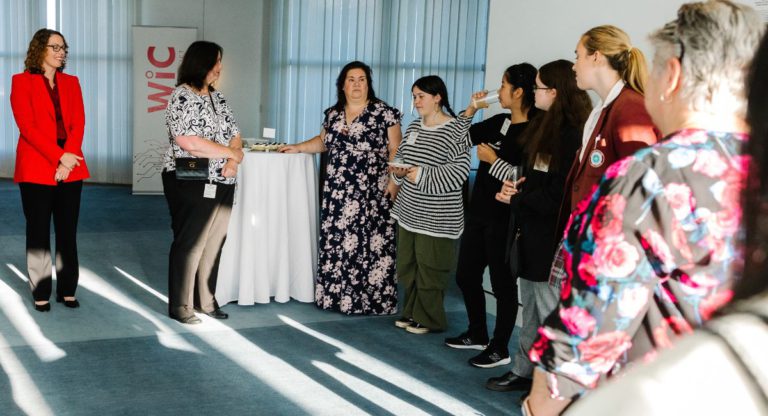
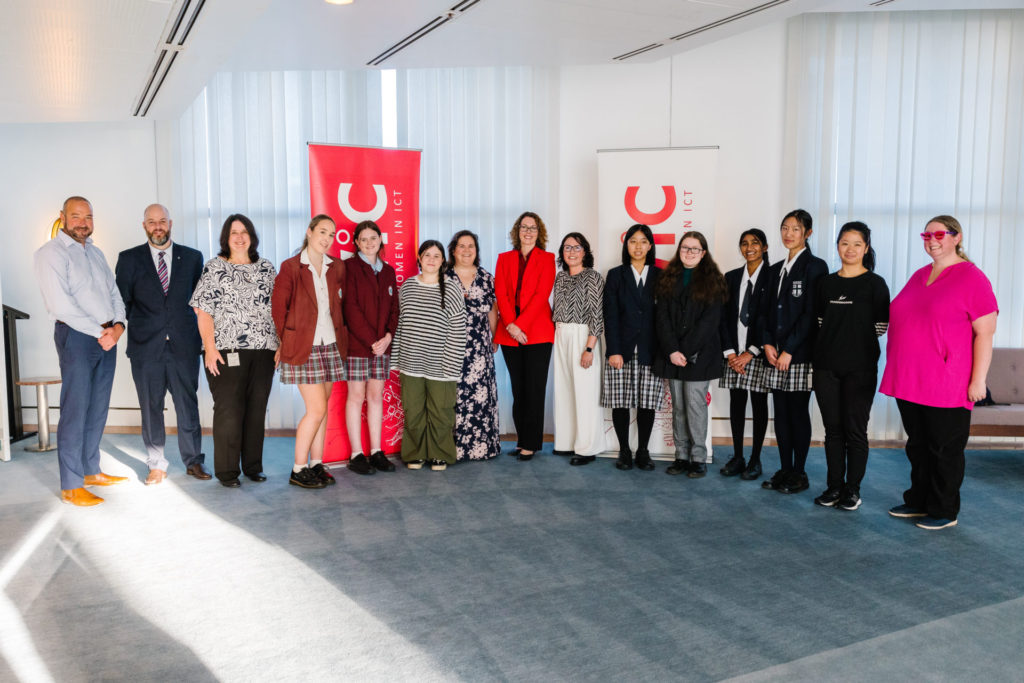
The AFP is celebrating International Girls in ICT Day by opening its doors to young women interested in working in a field that contributes to keeping Australians safe.
The AFP has joined the inaugural Work Experience Connection Program run by non-profit organisation Women in ICT (WIC).
The program gives young women and gender-diverse students in Canberra the opportunity to undertake work experience in a variety of ICT roles.
Image: International Girls in ICT Day (Source: AFP)
The AFP will host two students at the end of the school term, where they will spend time in the Chief Information Officer’s portfolio.
The students will spend a week learning the ropes in cyber security, applications delivery, information management and infrastructure; all areas that strongly influence what the AFP delivers.
AFP Coordinator Foundation Capability Rebecca Logue said the AFP was a progressive organisation that was committed to the goal of bringing more women into technology – having above-average IT industry rates of the number of women in the Chief Information Officer portfolio.
“The AFP has positioned itself as an employer of choice in this field through its demonstrated commitment to diversity and inclusion,” Ms Logue said.
“For the last seven years, the AFP has run a women in technology initiative to champion, support, recruit and retain women in the field. We strongly believe diversity of thought will create a better outcome for any technical solution.
“We can’t wait to give young female and gender-diverse students the opportunity to see what a dynamic IT portfolio looks like, to meet other women thriving in the IT industry, and to see first-hand how you can have an interesting and diverse career working with technology.”
Image: International Girls in ICT Day (Source: AFP)
Ms Logue refers to herself as an ‘accidental technologist’ after finding out she had an unexpected knack for IT when working for an organisation that outsourced an IT project.
Since then, she has been involved in many roles within the AFP, including SAP Test Analyst, Team Leader of the Solution Architecture and Business Analyst Team and is involved in many projects to deliver new technology to the organisation. She is now the Coordinator of Foundation Capability, which involves looking after all of the AFP’s corporate systems.
“The AFP is a great organisation with interesting work, a supportive and inclusive culture, and the opportunity to have many careers within the one organisation,” Ms Logue said.
“While the AFP has a strong uptake of women across the field, we need young women to consider a career in ICT.
“Technology will be an enormous part of the future and we need the skills and diversity of thinking that women bring to make sure future technologies are built for everyone.”
But you know what’s funny? All my life, I have been trained to be an engineer. Look at me now, I am a pickle seller!
She laughed with teary eyes. I did not laugh. I felt like crying and giving her a tight hug. Yet I did not move. I kept listening. I am a researcher. I am supposed to just collect data. I am not supposed to respond emotionally.
By the way, how does one collect data when the “subjects” are human? When the information one is looking for has turned into personal stories? Like this story of Selina (a pseudonym), born in a riverside town near Dhaka – the capital of Bangladesh. Selina’s husband was already planning to apply for an Australian offshore visa when they married and in 2010, when she was 27, the couple migrated to Sydney.
On the occasion of her birth, Selina’s grandmother had held her closely to her chest, telling her mother,
Beti (dear daughter), in our family, girls are strong. Make her strong. I may not live long to see her grow, but promise me, you’ll make her strong.
Her mother kept the promise. She made Selina an engineer.
To my Australian readers, a girl being an engineer may not mean much. Only my Bangladeshi readers will know a girl being an engineer means her parents were constantly bombarded with well-wishers’ remarks:
Why are you wasting your money on making your girl an engineer? What’s in it for you? She will be married to someone and go off to her in-laws!
She was made the centre of jokes by her friends:
Hey, here comes our engineer! Once married, her engineering skills will make her cooking more delicious!
She was ridiculed by her teachers whenever she stumbled on something difficult that she couldn’t understand at one go:
Why are you wasting your time in this engineering class? Better you do cooking classes in the kitchen!
A Bangladeshi girl, an engineer: it means she and her parents fought all the way for her to complete the degree and enter the profession.
So, when she said, “look at me now”, I literally looked at her. Looked at her teary eyes. Looked at her clean, tidy, beautifully organised house. Looked at her cooking and talking to me simultaneously – her kids would be back from school soon – having just moved the pickle jars from the shade to the sunny places on the kitchen veranda, so a carpenter could fix the broken deck in the backyard.
There was a time when Selina was busy with her daily hectic routine as a civil engineer working in Bangladesh. She enjoyed those days very much. She felt proud going to work. Just like the other women in her family, who are either a doctor or engineer, she had made a name for herself.
Overeducated, underemployed
No, no one forced Selina to leave her profession when she moved to Australia. At the same time, no one guided her or told her how to rebuild her career in this foreign land. Selina’s case is not unique. Bangladeshis are a relatively new migrant community. Mostly they arrived in Australia through overseas scholarship programs during the late 1970s and the early 1980s, and later through the general skilled migration program from 2006 to 2011.
According to 2021 census data, 51,491 people in Australia were born in Bangladesh. Bangladeshi Muslim women here have significantly higher educational attainment than the wider Australian female population. The data shows 19.71% of Bangladeshi Muslim women in Australia have a postgraduate degree, compared with 5.41% of women in general. Overall, 22.75% of Bangladeshi Muslim women have a bachelor’s degree, compared with 15.87% of women across the board.
The same census data shows the unemployment rate to be 5.31% amongst Bangladeshi Muslim women compared to 2.21% in the wider female population. Salma Bint Shafiq, in her research into Bangladeshi migrants in Australia, has found non-participation in the labour market is much more common for these women (30%) than it is for men (2%).
Bangladeshi migrant women have high rates of non-participation in the labour market. Author provided
“When I came to Australia”, said Selina, “I knew no one except my husband.” He is from a totally different profession and was struggling to make an entrance. Selina was aware of her ticking biological clock and did not want to miss out on motherhood. She’d already delayed motherhood because of the prospect of migration. And she had one of those pregnancy experiences where you constantly throw up. You can’t hold even a sip of water down. She had to carry a polybag in her hand at all time because she would vomit without any warning, any time, anywhere.
After the pregnancy, there was simply no time. Her husband was doing a second job to support his own study, career and family. She was there, alone, to recover from the baby blues, and at the same time taking care of a difficult baby who didn’t want to sleep at night. Two separate specialists gave the same verdict; some babies are just like that.
It’s interesting how one single step backward in one’s career starts an avalanche of falling behind. Eventually, there was a second baby and there were some attempts in between to study something related to the engineering field.
Oh, I just said it in a single sentence, didn’t I?
In reality, it didn’t happen that easily. There was extreme physical exhaustion, blood and sweat, months after months of sleepless nights, so much confusion with new babies, isolation, living like a single mum with two young kids all alone while the father was struggling to rebuild a career and doing two jobs. Which is not uncommon. Recent ABS statistics show 57% of skilled visa holders have had two or more jobs simultaneously since arrival.
‘Losing myself bit by bit’
Three kinds of Bangladeshi pickles: olive, mixed, and jujube. Author provided
What does a new country do to a migrant wife? I met Selina to listen to her financial experiences, to identify any pattern of financial abuse in her spousal relationship. I ended up discovering how she went from engineer to pickle seller.
So far in my fieldwork, collecting “data” on spousal financial abuse, I have spoken to more than a dozen Bangladeshi migrant Muslim women living in New South Wales. In our in-depth interviews, stories similar to Selina’s have started to emerge. I have met Jasmin and Shimul (both pseudonyms), one a former banker and the other a university lecturer before she migrated. Both were unable to resume their careers here. Says Jasmin:
The moment I stepped out of the airport, everything was new to me. Even the sky looked different. I have never seen such a blue sky in my life. The people looked different. All my life I was a very good student in English, but I could not understand a single word they were talking. Instead of feeling joy and excitement, [it was] as if I was losing myself bit by bit into the unknown. It was traumatic.
Both Jasmin and Shimul became pregnant shortly after arrival, giving birth for the first time, alone in a new land, without a single family member being around. Often their husbands are busy with second jobs to earn extra money to support the family.
I see a pattern emerging. A pattern where a migrant woman’s financial misery starts at day one of her journey to Australia; the day she steps into an unknown world, where her only bridge to this world is her husband. A husband who himself is often extremely busy earning enough money to support his two families; the new family in Australia, and his own parents and siblings back home in Bangladesh.
Intentionally or not, the wife is left alone, isolated and uninformed. She gets lost. And the impact lasts for many years to come. Financially and otherwise, she gradually becomes totally dependent on her husband.
For some couples, it does not take long for the husband to turn his wife’s financial dependency into a tool to control her mobility. Spousal financial abuse thrives when one partner starts manipulating, deceiving or coercing to create or maintain the other partner’s dependency.
‘Do they think I am a robot?’
“Do you want to try some?” Selina offered me three different types of pickles on a plate. I accepted. Not doing so would be rude. The pickles were delicious, made of mango, olive and mixed fruits.
“How come you make such delicious pickles? Did you learn to make pickles before you came here?”
Home-made mango pickle. Shutterstock.
She started laughing at my question. This time not with tears. My question was so funny to her that she held her stomach to balance the body’s vibration. Her laughter was contagious. Through my laughter, I managed to ask, “What’s so funny about this question?”
“It’s that …” she was still trying to get a hold of her laughter.
It’s just that I have never made pickle in my life before! … My mother never asked me to cook or to do any house chores because I was busy with my study. I was pampered in my house. Everyone knew studying engineering isn’t easy.
“How come you make pickles now?”
Her laughter slowly wore off. One day she looked at her two young kids; she looked at the social media profiles of colleagues she once worked with in Bangladesh – now being promoted to senior positions …
You know how it feels? It feels like as if that was another life when I was an engineer. As if that life was a dream. These past many years, I was so busy making a home in this foreign land, going through difficult pregnancies, giving birth twice, and looking after these two kids who just started to go to school recently, coming so far almost all alone, somehow along the way, I have become someone else.
A silence fell upon us. She turned her back to me, cleaning some dishes in the kitchen basin, or did she just try to hide her tears?
She said,
Everyone is so proud of my husband now that he is doing well in his field. At the same time, I can clearly see the pity in their eyes for me. No one says anything, they don’t need to. People can say so much without actually saying it out loud. After my second kid started school last year, I heard this a lot – ‘now you can go back to your career, can’t you?’.
I just smile. Do they think I am a robot? Just switch off the career one day, and after many years of having your life upside down, switch it back on and go restart the career! No one talks about the years of the [employment] gap that put me at the bottom of the list or maybe out of the list. No one talks about how lost I feel now. The first few weeks when my second kid went back to school, I felt so lost, I walked on the road alone for hours, didn’t know where I was going.
The silence again. So heavy on me I felt uncomfortable. I tried to concentrate on the pickles on the plate. I put the rest in my mouth. Would she tell me how she became a pickle-seller? I did not want to ask the question again.
She turned towards me, a strange smile on her face.
One day, I felt so pathetic that I wanted to do something totally different … So, I tried to make pickles from a YouTube recipe. That’s the first time in my life I made pickles. My husband usually does not like pickles. But when he tried my pickles, he was surprised at how tasty it was. He jokingly said, ‘you know, people will actually buy this!‘
I suddenly thought, why not try to make pickles and sell them? Something that I can do from the house while not disturbing my set-up routine of taking care of house chores, looking after kids’ studies, dropping them off and picking them up from school… So, I did. I opened up a Facebook page and started to sell pickles. And it worked!
She looked at my plate and said, “Oh! You finished them! How lovely. Would you like more?”.
No, I did not want more, though they were really delicious. Her story was enough to fill me up.
That choice
Do I see myself a little bit in her story? What about my own struggle as a Bangladeshi migrant woman in this foreign land? Was that not me who went shop to shop in malls, with copies of a handwritten CV to drop off, looking for any kind of job, any kind of job at all?
Was that not me who one day burst into a flood of tears, crying to another Bangladeshi woman,
what’s the use of me being the best student in my class? I understand not a single word they say! What kind of English is this?!
Was that not me who one night, when coming home after a long shift working at a chain shop, was the subject of racial slur by a drunk white man. The man was shouting F-words in front of a platform full of people waiting for the same train. Not a single person asked him to stop shouting.
And was that not me who had decided to leave her profession after her second child was born; who herself had to make that impossible choice, a choice between academic career and motherhood. How many of us can really manage to bounce back after a sharp fall like that? It took five years of struggle for me to come back to academia, but that’s another story for another time.
After a long interview, I said goodbye to Selina. I was walking back to my car when I thought, how many migrant women are out there with similar kinds of stories? They come to this country with such high hopes and dreams.
Since I started doing this fieldwork, whenever I see a visibly recognisable migrant woman, walking down the road, in the supermarket, or in the playground with kids, I wonder: what’s her story? What kind of dream did she have when she first came to Australia? Did Australia help her realise her dreams, or did it become the graveyard of her dreams?
Many people think Nazi Germany was beaten only through military violence, and mainly by men. As Barack Obama said in 2009: “Nonviolence could not have halted Hitler’s armies”. In fact, non-violent action was widely used in resisting Nazism. Brave women often led it. They later got little recognition, though this is now changing.
Women in nations such as France, Germany and Holland gathered intelligence, founded resistance groups, published underground media and coordinated people-smuggling operations. Some engaged in sabotage. Their networking and people skills were invaluable, and their lack of visibility under a sexist regime was an asset. Some of these brave women sacrificed their lives for the cause.
It is useful to consider their impact today and how such female-led, non-violent movements might help people around the world resist dictatorships and invasions, such as in Ukraine.
Some German women used overt, concentrated tactics – such as those who were thrown into jail for speaking out against Hitler, and the “Rosenstrasse” group, who protested in Berlin in 1943. These non-Jewish women shouted for their Jewish husbands to be set free, despite the threat of being machine-gunned. Amazingly, they succeeded – at least in the short term – with about 2,000 men released. Most of these men survived the war.
Resistance campaigns ranged from those waged by individuals to those involving large sections of the population. For example, about 10,000 Norwegian teachers, supported by around 100,000 parents, successfully resisted the Nazification of schools. Dutch strikes in 1941 and 1943 involved hundreds of thousands.
But secret, dispersed tactics were more common.
Pioneer daredevils
Many women excelled at gathering and communicating intelligence. Frenchwoman Ruth “Malou” Altmann reported on German conversations overheard on trains, bistros and streets, and the messages she heard on secret radios, about matters such as troop movements. With her excellent German, her information was always exact and often very important. She memorised things such as the layout of a town hall so other resistance members could raid it for ration tickets. Travelling unnoticed by bike, with her three-year-old daughter, she avoided suspicion.
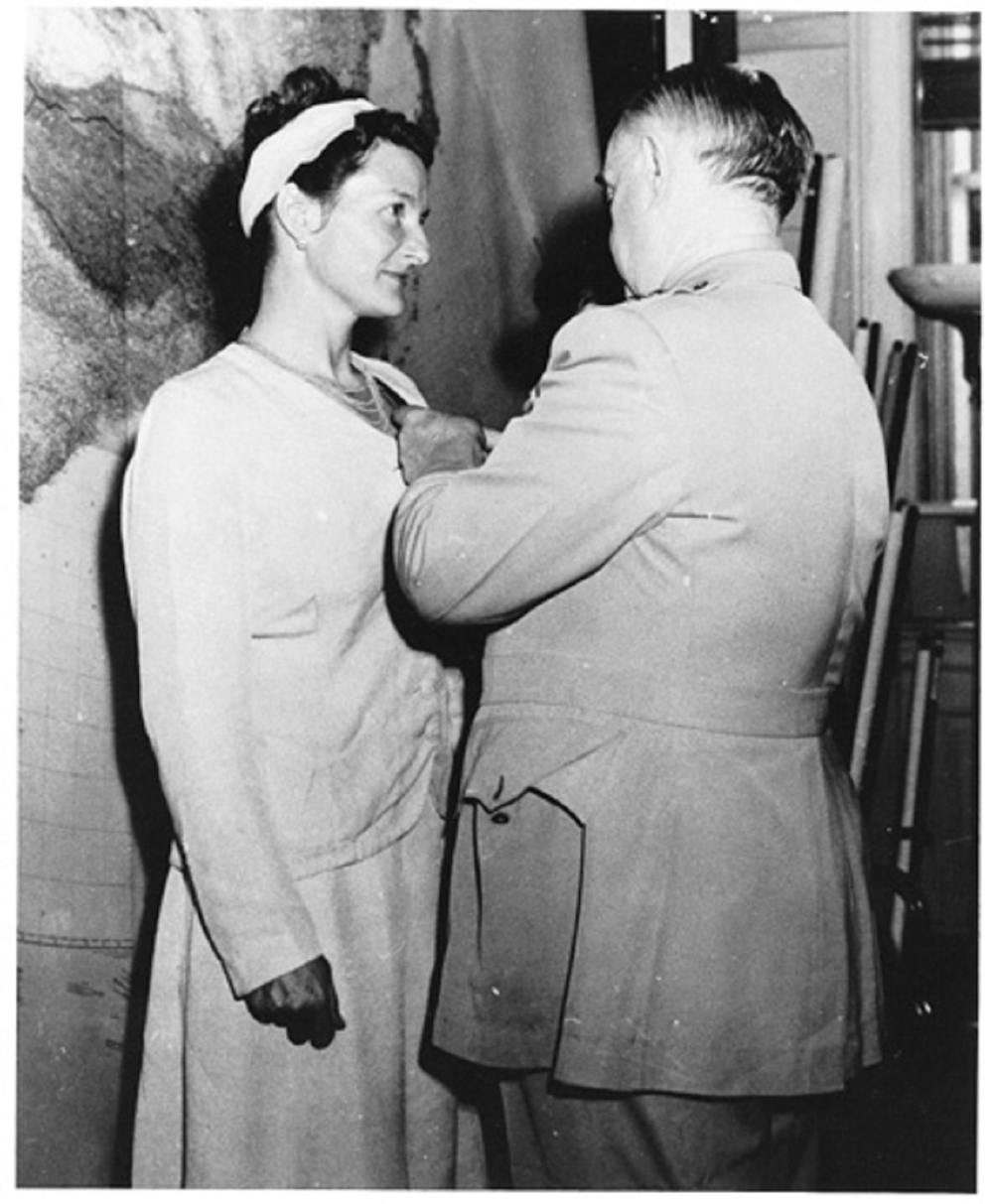
US citizen Virginia Hall had a fake leg and battled sexism to become the first Special Operations Executive (SOE) liaison officer of any gender. The SOE was a volunteer force set up to work with resistance groups in occupied societies and boost their morale.
Virginia Hall receiving the Distinguished Service Cross in 1945. CIA/Wikipedia Commons
Hall infiltrated Vichy command to get information on Nazi activities in France. She was a pioneer of spying, sabotage and subversion in an era when women were rarely thought heroic. Hers was a very modern form of resistance, based on propaganda and creating dissent within to topple a regime.
Underground media spread information to wide audiences to counter Nazi propaganda. German posters were torn down, and walls plastered with graffiti and stickers. Messages were typed on banknotes, which were scarce and rarely destroyed.
Flyers were written by Sophie Scholl’s White Rose group and posted around the country. Scholl was a kindergarten teacher, philosophy student and daughter of an ardent Nazi critic. She founded White Rose with her brother Hans and a group of like-minded friends in 1942.
She and Hans were arrested after dropping flyers into a courtyard at a Munich university. Convicted of high treason by the Nazis, she was executed in Munich on 22 February 1943, aged just 21.
White Rose group members Hans Scholl, Sophie Scholl and Christoph Probst. AP
Traute Lafrenz, the last surviving member of the White Rose, died last month, aged 103.
Charlotte Nadel was from a family of Russian immigrants to France. A librarian at the Sorbonne University, she became co-founder of the resistance group Défence de la France. Within two years, their publication grew from 5000 basic flyers to a newspaper with 150,000 copies. Although caught and imprisoned, Nadel was freed in August 1944 and kept resisting.
30 September 1943 issue of the Resistance newspaper, Défense de la France. Wikimedia Commons
The Germans knew how important this underground media was. It corrected false stories, exposed the truth about roundups, recruited people into the Resistance, and encouraged them to act. Punishments for resisters included being sent to a concentration camp, or executed.
There were other dangers. Marie Servillat (alias “Lucienne”) had her arm crushed in a printing press for the underground newspaper Combat. In 1944 she was shot in the chest and legs and taken by the Gestapo to a hospital, but later escaped.
These newspapers gave the impression of a much larger movement. This was a clever tactic later used by the Otpor movement to end the Milosevic regime in Serbia.
Papers like Femmes Françaises asked mothers to protest for more food rations. On Bastille Day 1944, women were urged to place red, white and blue flowers on war monuments and march to the town halls demanding bread.
Agnès Humbert had studied at the Sorbonne and was a writer and historian at a Paris art museum. After the German invasion, with many men in prison camps, she became one of the first resistance leaders. She called one early flyer:
a glimmer of light in the darkness … Now we know for certain that we are not alone. There are other people who think like us, who are suffering and organising the struggle: soon a network will cover the whole of France, and our little group will be just one link in a mighty chain. We are absolutely overjoyed!
Underground media depicted the Nazi regime as lying, irrational, not natural, and vulnerable. It painted the Resistance as reasonable, sensible and rational.
Such media made resistance leaders think deeply, sort out their strategy, and speak clearly to the general public, who had to be persuaded before they would act.
Hiding and smuggling people
Women led smuggling operations, hiding Jewish people and other evaders from the Holocaust. Individuals like young Dutchwoman Hannie Schaft hid people in their homes.
Groups like the National Movement Against Racism, led by Suzanne Spaak, a wealthy Belgian based in Paris, smuggled many children to remote villages.
Suzanne Spaak. Wikimedia Commons
Women also kept downed airmen, agents and escaped prisoners out of prison, helping them return to active service. At first impromptu, this aid soon turned into a complex set of escape lines involving about 10,000 helpers.
60-year-old Marie-Louise (code-named “Françoise”) Dissard took over one escape network. She found guides and safe houses. She bought food, civilian clothing and medical supplies. She opened her small flat as a headquarters. To get money, she went to Switzerland, climbing barbed-wire fences and dodging border guards.
Women, says historian Margaret Rossiter, “took a keen interest in helping [airmen] return to their bases, while many Frenchmen were involved in sabotage and guerrilla operations”. This shows how women and men worked differently in the Resistance, women mainly working in non-violent activities.
An undated image of Nancy Wake. Australian War Memorial/AAP
Some women, like Australian Nancy Wake, who was married to a rich French businessman, moved between non-violent and violent tactics. Wake began as an ambulance driver who fed prisoners of war. She then led escape lines, and was herself rescued from prison after beatings and questioning. After becoming an SOE agent, she went back to France to train and supply large resistance groups.
Sabotage
Resistance leader Agnès Humbert was arrested in 1941. Working as a slave in a German prison, she lifted her spirits by slowing the making of cloth and crates:
After every successful act of sabotage my heart feels lighter. It’s a sort of rite of atonement for me, between me and my conscience.
Polish-born Krystyna Skarbek, aka Christine Granville, served longer than any other of Britain’s wartime women agents and became famous for her bravery. Resourceful and effective, she gathered intelligence in Hungary, Poland and France. She also wrecked German communications, and destroyed barges carrying oil from Romania to Germany.
These women worried about violence and felt moral concerns. Said Wake,
I hate war and violence but, if they come, then I don’t see why we women should just wave our men a proud goodbye and then knit them balaclavas.
Teenaged resister Simone Segouin was from a French farming family near Chartres. At 14 she was helping her father shelter and feed resistance members. She became a courier, riding a repainted bike stolen from Germans, in the guise of a “sweet-faced farmer’s daughter carrying baguettes in a basket”. An expert in explosives and guerrilla tactics, she helped liberate Chartres and Paris in August 1944. Asked in 2014 if she had ever killed anyone, she answered that she may have, during an ambush.
You shouldn’t have to kill someone like that. It’s true, the Germans were our enemies, it was the war, but I don’t draw any pride from it.
She become a paediatric nurse, had six children, and died aged 97 in February this year.
Spying, though non-violent, often helped the Allies carry out violence. In 1940 Humbert worried about moving from propaganda activities to smuggling maps and military documents for the Allies:
I know all too well what they will do with it. Because of my meddling there will be widows, inconsolable mothers, fatherless children … French people, living peaceful lives – will be killed and wounded, children maimed. Where are my lofty humanitarian ideals now? Have I taken leave of my senses? … What a filthy business.
After the war she joined the Friends of Peace, arguing against war.
Some women were pacifists, such as SOE radio operator Noor Inayat Khan. She came from Indian Muslim royalty, and would be shot in Dachau concentration camp. She had struggled with the moral questions of war, as her brother Vilayat explained:
[We] had been brought up with the policy of Gandhi’s nonviolence, and at the outbreak of war we discussed what we would do. She said, ‘Well, I must do something, but I don’t want to kill anyone.’
Noor Inayat Khan. Wikimedia Commons
Suzanne Spaak only used non-violent methods to smuggle people. Arrested by the Gestapo in October 1943 and condemned to death, she wrote: “I hold that human life is sacred.” She was very sorry for the death sentence of a fellow resister, which she felt was her fault. Once arrested, Spaak was kept in horrific conditions and subjected to torture. She was executed on 12 August, 1944, just days before the liberation of Paris.
Effectiveness
The effectiveness of smuggling and hiding people was most obvious, with 7,220 Jewish people saved in Denmark alone. In Holland, Truus Wijsmuller was a social worker. Unable to have children, she dedicated herself to helping the children of others instead. Politically involved, she had a large network of friends. She smuggled Jewish children into Holland, including a Polish boy hidden under her skirt.
After Kristallnacht, she realised that Jewish children were no longer safe on the continent. She negotiated with the Nazis to move about 10,000 Jewish children to England. When the war began, she continued this work illegally.
Wijsmuller in 1965. Wikimedia Commons
Nancy Wake’s escape line (one of many) smuggled 1,037 men from France. Many airmen later said they escaped only because of women’s help.
The effects of spying and underground media were more subtle, but helped grow groups such as the Maquis. These were mainly young, working-class men who had escaped into the forests and mountains to avoid being sent to Germany to work. They organised themselves into active resistance groups and were vital for the Allied advance after D-Day. Women also joined the Maquis and were very effective leaders.
For example, while an all-male Maquis group in the Vosges region spent most of the war in hiding, Krystyna Skarbek made the first contact between the French and Italian Resistance on opposite sides of the Alps before D-Day. She freed captured Resistance leaders and persuaded a whole German garrison on a strategic mountain pass to defect, without any bloodshed.
People skills
Women often began resistance movements, growing their numbers through networking and people skills, using their less visible positions within a sexist regime.
Virginia Hall was great at influencing and connecting people, winning over key French officials and getting far more information from them than her male peers. She made friends with Suzanne Bertillon, chief censor of the foreign press in Vichy’s Ministry of Information. Bertillon set up a network of 90 contacts, including farmers, mayors and businessmen, to give Hall information on industrial production, troop movements and a German submarine base being built in Marseille. The base was later destroyed by Allied bombs.
Spaak also showed excellent recruiting skills, bringing together women from all classes – social workers, clergy, girl scouts, officials and guards – including the Jewish communist immigrant Miriam Sokol. The women’s friendship rose above their political differences. In contrast, their husbands never got past their dislike for each other.
Women’s ability to quickly build broad networks of resistance challenges the common belief that armed men are better at dealing with ruthless opponents than unarmed women. These stories also show how women can step out of conventions and defy stereotypes.
It’s hard to point to one reason – either violent or not – for the defeat of Nazism. Each of the actions described, taken alone, eroded the Germans’ power in small ways. When put together they had a great impact. They provided useful intelligence for the Allied forces. They encouraged dissent, resistance and non-cooperation. They saved many lives. They got airmen back in the air. They wrecked Nazi resources.
Resistance came at a cost. Exact figures are hard to establish, but it’s thought that more than 4,000 women of various ages were hanged by Nazi forces (separate to those who died in the Holocaust). Many more were shot or guillotined. Although terrible, this is a tiny fraction of the 68 million or more killed by military violence during the war.
There were many failures of resistance at national and international levels. Some useful non-violent strategies were barely used, such as economic non-cooperation through boycotts, divestment and sanctions against the international companies which propped up Nazism.
Lessons today
Still, if ad hoc non-violent action had a role in defeating Nazism, it might succeed almost anywhere. It could possibly have worked last year in Ukraine, which has a history of successfully ending pro-Russian governments through nonviolent mass action. That’s much harder now the war is entrenched.
Non-violent action today could be improved and better resourced. Democracy movements in Ukraine, Myanmar, Syria and Sudan could be supported by much stronger global boycott and divestment systems and international peacemakingforces. Mass nonviolent resistance could begin with dispersed, stay-at-home strikes, which pose little risk. Experienced activists and trained volunteers could lead such resistance.
The Albanese Government has today launched the Engaged Classrooms initiative that will develop tools to support teachers in effectively managing classrooms.
Minister for Education Jason Clare said in a statement: “When students are fully engaged in the classroom, they learn at their best and teachers have more time to teach.”
He added:
“A lot of teachers tell me that when they leave university and jump into the classroom for the first time they don’t feel as prepared as they should to manage a classroom full of students. By providing more resources to teachers we can help them manage the classroom better which is good for them and their students.”
One in three teachers report losing teaching time due to disruptive behaviour, significantly impacting students’ ability to learn.
Supporting teachers to minimise classroom disruption will result in a significant boost to student learning.
This $3.5 million project will use the latest evidence to help guide teachers to deliver routines, strategies and approaches that maximise student engagement in their classrooms.
The Australian Education Research Organisation (AERO) will be working with teachers to design a suite of resources to support classroom engagement and professional learning for teachers and school leaders.
AERO CEO Dr Jenny Donovan said:
“We know that maximising students’ learning time in class is critical for them to effectively learn, and that this can only happen if teachers can minimise disruptive behaviour and disengagement. This initiative will give teachers and school leaders clear evidence-based guidance and tools for ensuring all students have the opportunity to learn.”
Former teacher and academic, Dr Tim McDonald, has been appointed subject matter expert to the AERO project. He has extensive experience working with schools to improve student engagement and de-escalate misbehaviour and conflict.
Together with teachers, school leaders, and Dr McDonald, AERO will develop a range of professional learning resources to be released over the next two years. They include:
· easily accessible evidence guides
· adaptable best practice templates
· video demonstrations and written case studies
· online and face-to-face training materials (including targeted training for schools; materials for school leaders for running their own in-school professional learning; materials for initial teacher education).
The Reserve Bank of Australia Board has decided to increase the cash rate by 25 basis points to 3.85 per cent.
It also increased the rate paid on Exchange Settlement balances by 25 basis points to 3.75 per cent.
RBA suggests inflation in Australia has passed its peak, but at 7 per cent is still too high and it will be some time yet before it is back in the target range. Given the importance of returning inflation to target within a reasonable timeframe, the Board judged that a further increase in interest rates was warranted today.
The Board held interest rates steady last month to provide additional time to assess the state of the economy and the outlook. While the recent data showed a welcome decline in inflation, the central forecast remains that it takes a couple of years before inflation returns to the top of the target range; inflation is expected to be 4½ per cent in 2023 and 3 per cent in mid-2025.
Some further tightening of monetary policy may be required to ensure that inflation returns to target in a reasonable timeframe, but that will depend upon how the economy and inflation evolve.
Reserve Bank Of Australia; Picture Source: @CANVA
Goods price inflation is clearly slowing due to a better balance of supply and demand following the resolution of the pandemic disruptions. But services price inflation is still very high and broadly based and the experience overseas points to upside risks. Unit labour costs are also rising briskly, with productivity growth remaining subdued.
The recent Australian data also confirmed that the labour market remains very tight, with the unemployment rate at a near 50-year low. Many firms continue to experience difficulty hiring workers, although there has been some easing in labour shortages and the number of vacancies has declined a little.
The Board’s priority remains to return inflation to target. High inflation makes life difficult for people and damages the functioning of the economy. And if high inflation were to become entrenched in people’s expectations, it would be very costly to reduce later, involving even higher interest rates and a larger rise in unemployment. Medium-term inflation expectations remain well anchored, and it is important that this remains the case.
Wage (Image source: CANVA)
Wage growth has picked up in response to the tight labour market and high inflation. At the aggregate level, wage growth is still consistent with the inflation target, provided that productivity growth picks up. The Board remains alert to the risk that expectations of ongoing high inflation contribute to larger increases in both prices and wages, especially given the limited spare capacity in the economy and the historically low rate of unemployment. Accordingly, it will continue to pay close attention to both the evolution of labour costs and the price-setting behaviour of firms.
The Board is still seeking to keep the economy on an even keel as inflation returns to the 2–3 per cent target range, but the path to achieving a soft landing remains a narrow one. The central forecast is for the economy to continue growing, albeit at a below-trend pace; GDP is forecast to increase by 1¼ per cent this year and around 2 per cent over the year to mid-2025. Given the expected below-trend growth in the economy, the unemployment rate is forecast to increase gradually to around 4½ per cent in mid-2025.
A significant source of uncertainty continues to be the outlook for household consumption. The combination of higher interest rates, cost-of-living pressures and the earlier decline in housing prices is leading to a substantial slowing in household spending. While some households have substantial savings buffers, others are experiencing a painful squeeze on their finances. There are also uncertainties regarding the global economy, which is expected to grow at a below-average rate over the next couple of years.
Some further tightening of monetary policy may be required to ensure that inflation returns to target in a reasonable timeframe, but that will depend upon how the economy and inflation evolve.
The Fair Work Ombudsman has commenced legal action against the operators of a regional Victorian hotel and café after staff were allegedly underpaid a total of $320,929.
Facing court are Louise Maree Melotte and Travis Francis Melotte, a married couple who have been involved in operating Hotel Frangos and Café Koukla on Vincent Street in Daylesford.
The regulator alleges that Ms Melotte was involved in underpaying 97 staff at Hotel Frangos and Café Koukla between May 2017 and July 2019.
The allegedly underpaid workers included 15 juniors, aged between 15 and 20 at the time, and a number of visa holders, from countries including Nepal, Pakistan and Armenia.
The workers included food and beverage attendants and cooks, as well as two guest services staff and one clerical worker.
Most of the alleged underpayments relate to 27 full-time employees who were paid salaries that were not sufficient to cover their minimum entitlements under the Hospitality Industry (General) Award 2010.
It is alleged the other underpaid staff were casuals who were underpaid entitlements including minimum wage, casual loading, overtime rates, penalty rates, no meal break penalties and minimum engagement pay.
The Fair Work Ombudsman alleges Ms and Mr Melotte were both involved in requiring two Nepalese cooks on salaries to work unreasonable additional hours in breach of the Fair Work Act. The two cooks were on Regional Sponsored Migration Scheme visas.
It is alleged that the two cooks were required to work an average of almost 50 hours per week and were not provided with adequate notice of the need to work additional hours and worked additional hours to the detriment of their own health, safety and personal circumstances.
The alleged individual underpayments for the two cooks are $47,339 and $32,710.
Fair Work Ombudsman Sandra Parker said that employers risk facing legal action if they fail to provide employees’ basic minimum lawful entitlements.
“Underpayments resulting from insufficient salaries for employees covered by Awards has become a persistent issue. Businesses paying salaries cannot take a ‘set-and-forget’ approach – they must ensure wages being paid cover all minimum entitlements for the hours their employees actually work,” Ms Parker said.
“Employers also need to be aware that taking action to protect vulnerable workers, like visa holders and young workers, continues to be a priority for the agency.”
The FWO is seeking penalties. Ms Melotte faces penalties of up to $12,600 per breach for multiple alleged underpayment breaches.
In addition, Ms and Mr Melotte each face a penalties of up to $12,600 per breach for the alleged unreasonable additional hours breaches.
The Fair Work Ombudsman is also seeking a court order requiring Ms Melotte to back-pay the allegedly underpaid staff in full, plus superannuation and interest.
All alleged underpayments remain outstanding, with the highest individual underpayment allegedly $47,339.
The company that directly employed the allegedly underpaid workers, Loelal Pty Ltd, has been placed into liquidation. Ms Melotte was the sole director of Loelal Pty Ltd until May 2020, when Mr Melotte became the sole director of the company.
A directions hearing is listed in the Federal Circuit and Family Court in Melbourne on 1 June 2023.
Throughout history, war has been irrevocably changed by the advent of new technologies. Historians of war have identified several technological revolutions.
The first was the invention of gunpowder by people in ancient China. It gave us muskets, rifles, machine guns and, eventually, all manner of explosive ordnance. It’s uncontroversial to claim gunpowder completely transformed how we fought war.
Then came the invention of the nuclear bomb, raising the stakes higher than ever. Wars could be ended with just a single weapon, and life as we know it could be ended by a single nuclear stockpile.
And now, war has – like so many other aspects of life – entered the age of automation. AI will cut through the “fog of war”, transforming where and how we fight. Small, cheap and increasingly capable uncrewed systems will replace large, expensive, crewed weapon platforms.
We’ve seen the beginnings of this in Ukraine, where sophisticated armed home-made drones are being developed, where Russia is using AI “smart” mines that explode when they detect footsteps nearby, and where Ukraine successfully used autonomous “drone” boats in a major attack on the Russian navy at Sevastopol.
We also see this revolution occurring in our own forces in Australia. And all of this raises the question: why has the government’s recent defence strategic review failed to seriously consider the implications of AI-enabled warfare?
AI has crept into Australia’s military
Australia already has a range of autonomous weapons and vessels that can be deployed in conflict.
Our air force expects to acquire a number of 12 metre-long uncrewed Ghost Bat aircraft to ensure our very expensive F-35 fighter jets aren’t made sitting ducks by advancing technologies.
On the sea, the defence force has been testing a new type of uncrewed surveillance vessel called the Bluebottle, developed by local company Ocius. And under the sea, Australia is building a prototype six metre-long Ghost Shark uncrewed submarine.
It also looks set to be developing many more technologies like this in the future. The government’s just announced A$3.4 billion defence innovation “accelerator” will aim to get cutting-edge military technologies, including hypersonic missiles, directed energy weapons and autonomous vehicles, into service sooner.
How then do AI and autonomy fit into our larger strategic picture?
The recent defence strategy review is the latest analysis of whether Australia has the necessary defence capability, posture and preparedness to defend its interests through the next decade and beyond. You’d expect AI and autonomy would be a significant concern – especially since the review recommends spending a not insignificant A$19 billion over the next four years.
Yet the review mentions autonomy only twice (both times in the context of existing weapons systems) and AI once (as one of the four pillars of the AUKUS submarine program).
Countries are preparing for the third revolution
Around the world, major powers have made it clear they consider AI a central component of the planet’s military future.
The House of Lords in the United Kingdom is holding a public inquiry into the use of AI in weapons systems. In Luxembourg, the government just hosted an important conference on autonomous weapons. And China has announced its intention to become the world leader in AI by 2030. Its New Generation AI Development Plan proclaims “AI is a strategic technology that will lead the future”, both in a military and economic sense.
Similarly, Russian President Vladimir Putin has declared that “whoever becomes the leader in this sphere will become ruler of the world” – while the United States has adopted a “third offset strategy” that will invest heavily in AI, autonomy and robotics.
Unless we give more focus to AI in our military strategy, we risk being left fighting wars with outdated technologies. Russia saw the painful consequences of this last year, when its missile cruiser Moscova, the flagship of the Black Sea fleet, was sunk after being distracted by a drone.
Future regulation
Many people (including myself) hope autonomous weapons will soon be regulated. I was invited as an expert witness to an intergovernmental meeting in Costa Rica earlier this year, where 30 Latin and Central American nations called for regulation – many for the first time.
Regulation will hopefully ensure meaningful human control is maintained over autonomous weapon systems (although we’re yet to agree on what “meaningful control” will look like).
But regulation won’t make AI go away. We can still expect to see AI, and some levels of autonomy, as vital components in our defence in the near future.
There are instances, such as in minefield clearing, where autonomy is highly desirable. Indeed, AI will be very useful in managing the information space and in military logistics (where its use won’t be subject to the ethical challenges posed in other settings, such as when using lethal autonomous weapons).
At the same time, autonomy will create strategic challenges. For instance, it will change the geopolitical order alongside lowering costs and scaling forces. Turkey is, for example, becoming a major drone superpower.
We need to prepare
Australia needs to consider how it might defend itself in an AI-enabled world, where terrorists or rogue states can launch swarms of drones against us – and where it might be impossible to determine the attacker. A review that ignores all of this leaves us woefully unprepared for the future.
We also need to engage more constructively in ongoing diplomatic discussions about the use of AI in warfare. Sometimes the best defence is to be found in the political arena, and not the military one.
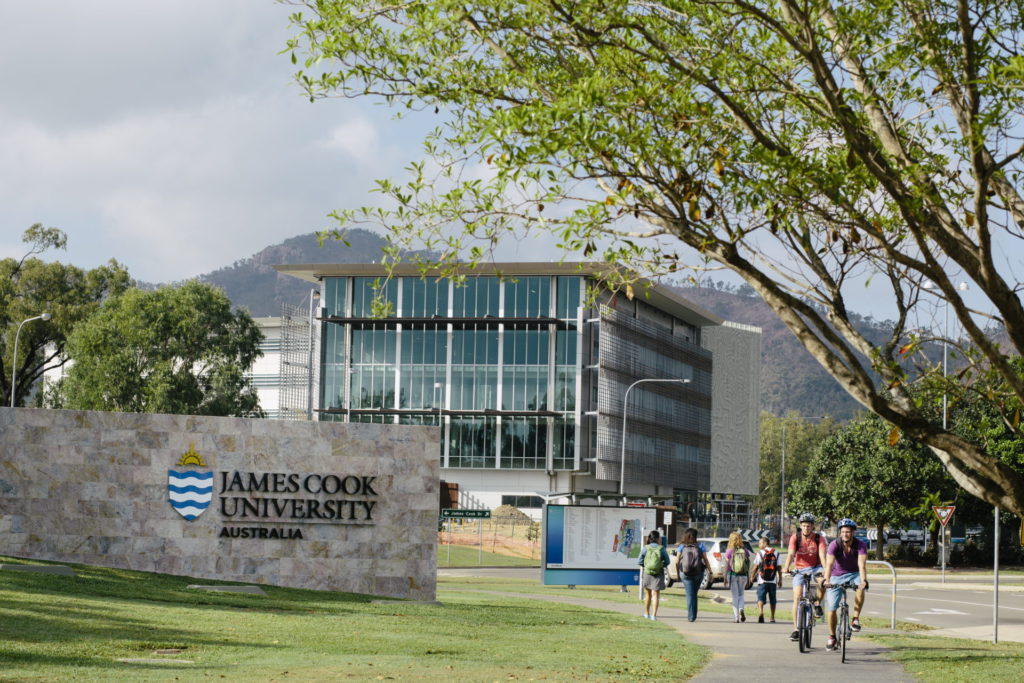
Eighteen students of James Cook University (JCU) in Townsville, Queensland, are demanding compensation in a class action.
The students say that they discovered their course was useless because it wasn’t accredited.
Sam Boon (Source: A Current Affair)Blade Stark (Source: A Current Affair)
Sam Boon who pursued a degree in business and commerce told A Current Affair that he was “quite distressed, annoyed, disheartened.”
“I’ve just spent three years studying with no real opportunity at the end to become a financial adviser. It was something I was passionate about. I did like finance and I like numbers and I like helping people.”
However, Boon claims that JCU failed to get the course accredited and added:
“I spent two and a bit years basically not being able to start my professional year, which was needed to be a financial adviser.”
Another student, Blade Stark told ACA that he almost had a job but lost it because the course was not accredited.
“I ultimately lost my job because of this accreditation issue with JCU.”
Image: James Cook University (Website)
A spokesperson for the university told ACA in a statement that its Bachelor of Commerce (Financial Advising) has been accredited since 1st July 2022.
It is reported that JCU advertised this financial advising major course in a video:
“The financial advising major will be an accredited major and has largely been developed because of changes in the regulatory requirements in the financial services sector.”
Solicitor Duke Myrteza, who is representing 18 former students in this class action against JCU, told ACA that even if the course is now accredited it has caused “enormous mental anguish.”
“A course must not be advertised, or a course of study must not be represented as accredited when it’s not, and it’s essential that no statements are made to students that are false or misleading.”
A Melbourne man, arrested under Operation Ironside, has been sentenced to 16 years imprisonment for attempting to possess 360kg of methamphetamine.
The man, 40, who is an alleged criminal figure in Melbourne, faced the Melbourne County Court today (Friday 28 April).
Intelligence gained as a result of Operation Ironside presented the AFP with significant evidence to arrest and charge the man in connection to the 2020 drug import on 7 June 2021.
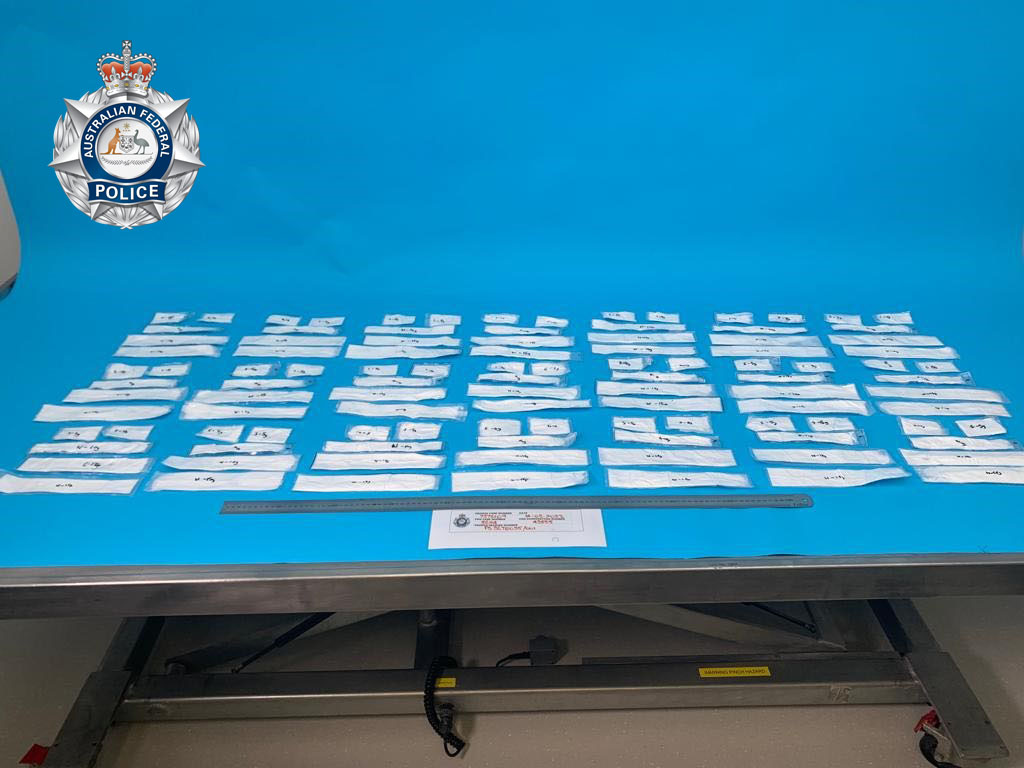
The amount of methamphetamine had an estimated street value of around $180 million at the time of seizure and would be enough to supply Melbourne with 3.6 million hits.
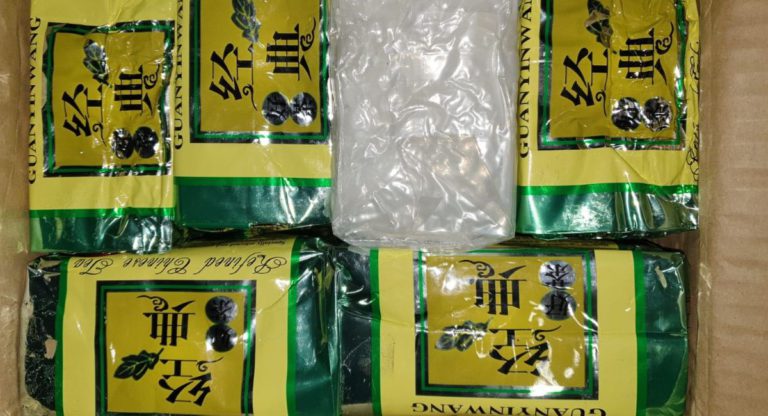
ABF officers then identified 18 cardboard boxes within the consignment, containing 1kg blocks filled with a white crystalline substance.
AFP forensic analysis confirmed the substance was crystal methamphetamine and was of a high level of purity.
The AFP executed a search warrant at the man’s Elwood residence on 7 June 2021, and seized several electronic devices, cash and luxury watches.
The man was subsequently arrested and charged with attempting to possess a commercial quantity of unlawfully imported border controlled drug.
Image: Operation Ironside (Source: AFP)
On Tuesday 18 April 2023, the man pled guilty to attempting to possess a commercial quantity of an unlawfully imported border controlled drug, contrary to sub-ss 11.1(1) and 307.5(1) of the Criminal Code (Cth).
The man was sentenced to 16 years imprisonment commencing from 7 June 2021, with a non-parole period of 10 years and six months.
AFP Detective Superintendent Jason McArthur said the outcome should send a strong warning transnational criminal syndicates attempting to import illicit drugs into Australia.
“Thanks to Operation Ironside, this is another example of the AFP disrupting a serious criminal syndicate and delivering an attack on all fronts of organised crime in Australia.”
“There is violence and harm throughout the illicit drug supply chain and we are working hard to pursue and stop those who are trying to profit at the expense of our communities,” Det. Supt McArthur said.
“The AFP and its law enforcement partners will continue to work together to target and dismantle criminal networks and prosecute them at every opportunity.”
ABF Superintendent Dan Peters, Maritime South, said the significant detection of methamphetamine is another example of successful collaboration between the ABF and its law enforcement partners to protect Australian communities from harmful substances.
“The ABF’s technical capabilities and our highly trained officers frequently seize different quantities of methamphetamine,” Supt Peters said.
“ABF officers work every day to detect and disrupt these types of criminal operations, no matter how sophisticated they are.”
“Our wide range of detection methodologies can pick up a concealment however well-hidden criminals believe it is.”
The following services provide people with access to support and information.
For free and confidential advice about alcohol and other drug treatment services call the National Alcohol and Other Drug Hotline on 1800 250 015.
The Albanese government’s review of Australia’s migration system offers a blueprint for overhauling the troubled system and addressing at least some of its shortcomings.
Touted as the biggest review of immigration since the 1988 FitzGerald Report, the Parkinson Review covers issues as diverse as our reliance on temporary immigration, skills lists and care shortages, immigration backlogs and ageing information technology systems in Home Affairs.
The review represents a wholesale critique and potential upheaval of the immigration system, rather than, in the words of Home Affairs Minister Clare O’Neil, “ad hoc” changes. At its centre is the argument that Australia has become too reliant on temporary migrants, without clear pathways for them to permanent residency.
What did the review find?
Because temporary visa numbers have been uncapped since the Howard government, they have been growing faster than permanent visa numbers. Temporary migrant numbers have doubled in the past 15 years.
Yet there are not always clear pathways to remain permanently in Australia. This has the effect that temporary visa-holders engage in a series of visa “hops” before gaining permanent residency. Sometimes, they do not gain permanent residency at all.
The review is critical of temporary migration when it does not provide pathways to permanency. It suggests Australia risks becoming a guest worker society like Germany or Switzerland in the post-second-world-war era. This “permanently temporary migration” system, it argues, has “caused harm to Australia and to migrants, and undermined community confidence in the migration system”. It results in less equality and fairness.
The exploitation of migrant workers is identified as another, associated issue. Other commentators have also made this point in academic and public inquiries, most notably the Fels Migrant Worker Taskforce that investigated the 7-Eleven scandal. https://www.youtube.com/embed/KBL2Z7G6uq8?wmode=transparent&start=0
My research using litigated court cases to analyse the issue of migrant worker exploitation has demonstrated that those on temporary visas – and, indeed, visas without clear pathways to permanent status – are most at risk of exploitation.
The review identifies the Temporary Skilled Immigration Income Threshold (TSMIT), which is the salary benchmark used as a threshold for entry into temporary skills visas, as part of the exploitation problem. In O’Neil’s words, over time, the TSMIT has become “frozen” and failed to keep pace with increases in average wages of Australian workers.
My research shows workers at the lower occupational codes are more likely to face underpayment. O’Neil announced today the TSMIT will be increased from $53,900 to $70,000. Yet factors other than wage levels also affect exploitation risk, in particular visa status and whether migrants have access to trade union representation.
This reality that temporary status is in part responsible for exploitation risk presents challenges for another recommendation of the review: to create a visa to address shortages in the care sector.
The review proposes protections to ensure care workers do not face the same exploitation as other lower-wage workers. However, comparative research suggests it is difficult, if not impossible, to create temporary labour schemes without at least some exploitation. This will be a core challenge if the government adopts a low-skilled care visa.
Matching the migrant intake to Australia’s needs
The review makes the important point that Australia will need a more diverse economy to deal with an ageing population and reduced productivity. The development of skills and capabilities will be crucial to this, and immigration can play an important role.
In this regard, the review finds the Skilled Occupations List for the selection of skilled migrants (both permanent and temporary) is not working, as it cannot keep up with rapid changes in our labour market.
As a result, Australia is “falling behind in attracting skilled migrants in a fierce global competition for the best migrants”. This point is supported by research on migrant desire to come to Australia, which suggests migrants are being put off by backlogs, among other issues.
The review instead proposes selecting migrants through detailed identification of skill requirements by Jobs and Skills Australia. The body would focus on three types of skilled migrants: those with in-demand skills, those with high human capital, and “exceptional cases” (such as “an older prize-winning academic”).
Finally, the review raises concerns about the complexity of the system and immigration backlogs. A central challenge for reforming the immigration system is its size, complexity (with over 100 different visas as well as tailored labour agreements) and detailed admission requirements.
The Migration Act 1958 is one of Australia’s longest and most complicated pieces of federal legislation. Add to that a web of regulations and policy advice manuals, and migrants face huge challenges in navigating the system.
A study of comparable countries found Australia had the most complex visa system of major Western admission countries.
Last year, O’Neil identified immigration backlogs as a key challenge for the new government. This is another issue raised in the review.
While the government has responded by hiring more staff to process visas, the backlogs remain a problem, especially for family migrants. The review blames this in part on “cumbersome” and ageing computer systems in Home Affairs, which it suggests needs a complete overhaul.
Now, we need action
The review is bold and detailed. It represents a significant reform agenda, which will take years, if not decades, to implement. But it is probably worth it.
It provides intellectual and policy support for reforms to the way temporary immigration levels are set around the budget, the ease of movement between temporary and permanent visas, mitigation of exploitation risk and selecting skilled migrants. All of these concerns have been raised for some time, so it is heartening to see them reinforced by the expert review.
The challenge will be in its implementation, both practically and politically. For example, removing temporary visas without clear pathways to permanent residency (such as Working Holiday Maker Visas or some areas of international student visas) will be fought by affected stakeholders, whether they are the migrants themselves, or those that otherwise benefit from such immigration flows.
Reducing flows in one area can also create pressures on other parts of the system, as migrants may choose visa pathways based on availability. For instance, if a person cannot come as an international student, we may see an increase in sham spousal applications. Clarifying these different pathways will be particularly challenging at a time when our immigration system is already growing much faster than previously estimated.
Providing pathways for more temporary migrants could significantly increase the overall size of the permanent immigration program (although Minister O’Neil contests this), which may not be what is best for Australia at a time of a growing housing crisis, or what voters desire.
So, the government will need to tread carefully with its transitional arrangements that follow from this review and consider how to slowly change the system. At present, not all details of implementation have been announced.
We know from O’Neil’s speech at the National Press Club that the government’s position is largely in step with the findings of the review. The TSMIT will be raised and there will be more pathways to permanent residency for current temporary workers. Reforms to tertiary education and international students will also be announced in future weeks.
These changes alone are unlikely to achieve all the goals of the review, but combined with reforms in the areas of worker exploitation and industrial relations, they may go some way to addressing its concerns.
Wyndham Crime Investigation Unit detectives are investigating an affray in Laverton North last night, 29 April.
Victoria Police investigators say that a fight broke out between two large groups of almost 40-50 men around 10 pm in the industrial complex on Boundary Road.
Police were also able to ascertain a number of those involved and injured had taken themselves to various hospitals across the western suburbs.
A 36-year-old Williams Landing man, 28-year-old Tarneit, and a 35-year-old Tarneit man are currently in hospital with serious injuries.
Detectives are investigating an affray in Laverton North last night, 29 April.
Police have released CCTV of people who might be able to assist police with their enquiries.
Anyone with information should contact Crime Stoppers.
According to reports, one of the group of around 30 people was attending a barbecue at a trailer business when a second group comprising of around 20 men arrived.
These two groups clashed and a serious brawl erupted, resulting in a number of people becoming seriously injured.
Detective Senior Constable Erin Hardie told the media that there’s no clear motive as yet for the brawl:
“For people who were meant to be just having a nice barbecue after work, it’s obviously a concern to us why something like this would have happened. There was an agreement that was made for the barbecue to take place, but obviously things have gone south.”
The exact number of those involved is still under investigation as police review CCTV footage.
The brawling groups were gone by the time police arrived at the scene. However, on its arrival, the police found a number of items that were used in the fight.
Victoria Police investigation is ongoing and no arrests have been made at this stage.
Detective Senior Constable Hardie added:
“We are hoping with anyone that might have information we can start to piece together why these two parties have come together and what the beef is between them.”
Anyone with information is urged to contact Crime Stoppers on 1800 333 000 or visit www.crimestoppersvic.com.au
Kamlesh K. Mishra is a National Award winning Writer, Producer-Director for Best Documentary and Short Films, who has written and directed his first ninety minute feature film ‘Azamgarh’.
The film stars Pankaj Tripathi along with debutant Anuj Sharma, Amita Walia, Ramji Bali, Susan Brar and others.
‘Azamgarh’ shows the beginning of the twenty-first century when India, America, Europe and others were plagued by terrorist attacks.
Kamlesh Mishra is a director with a balanced mindset and extremely sensitive nature, so has directed this film in his unique style.
‘Azamgarh’ in Uttar Pradesh was linked with the terror attacks so that city is placed at the center of the story.
The film’s story is based on those true events in which Azamgarh boys were involved in the Batla house encounter. When interrogated, they revealed how they were brainwashed to become terrorists.
Unlike many films made on terrorism, the director has neither shown nonessential romance nor unnecessary bloodshed in this film.
The film shows an emotional story of a mother-son from a lower-middle-class family.
‘Azamgarh’ has been shot at Uttar Pradesh’s Azamgarh, Varanasi, Aligarh and real locations of Delhi. This film was shot when Pankaj Tripathi and Kamlesh Mishra had begun their cinematic journey, hence the cities depicted in the film had a different atmosphere then. The realistic touch in the film shows that the film is made with a limited budget.
Pankaj Tripathi
Brilliant actor Pankaj Tripathi’s unmatched, unique talent needs no introduction. In ‘Azamgarh’, he has played a vicious Maulvi ‘Ashraf’, who encourages and helps the brilliant youths, coming to big cities for higher education. But in fact, he brainwashes young, innocent muslim boys who are unaware of the wicked world. He applies psychological and emotional pressure on them and prepares them to sacrifice themselves on the path of Jihad. In the film, few dialogues by Pankaj Tripathi and Anuj Sharma are quite impressive.
Anuj Sharma
In ‘Azamgarh’, debutant actor Anuj Sharma has played a brilliant student ‘Aamir’ and Amita Walia has played his widowed mother.
In the beginning of the film, a thrilled ‘Aamir’ comes running to his mother to share the good news that he has topped in class XII, in the entire state. Despite the best result, a Hindu boy from his locality taunts ‘Aamir’ that even after getting higher education, he will become a terrorist. He further says that previously ‘Azamgarh’ had produced great scholars like ‘Rahul Sankrityayan, Ayodhya Singh Upadhyay ‘Hariaudh’, Shibli Nomani, Kaifi Azmi’ but now is producing terrorists.
Amita Walia
Aamir’s mother sends him to Aligarh for higher studies despite limited resources. ‘Aamir’ had no idea what a decisive turn his life would take in Aligarh. The boy’s hurting words keep haunting Aamir’s mind and to prove him wrong, he joins a terrorist organization and in the end answers in an unimaginable way.
Apart from the first scene, Aamir’s silence throughout the film is disconcerting, making it difficult to predict what his next move will be. Rather than dialogues, ‘Anuj Sharma’ has acted better with his expressive eyes. By making new actors act well, Kamlesh Mishra has shown his skillful directorial ability.
Kamlesh Mishra had to hide the identity of real characters as the story is based on true events. The sensitivity of the subject must have made it difficult for him to decide on some issues. He made a wise decision by not showing unnecessary bomb blasts in the film. The story is neither suspenseful nor boring so it makes the audience curious throughout the film.
WATCH Video: Kamlesh Mishra speaks to Pallavi Jain about the film‘Azamgarh’.
The breaking news of the terrorists’ incidents shown in between, disturb the story’s rhythm. Kamlesh Mishra has shown Ravana’s effigy being burnt and the whole group of terrorists being destroyed at the same time. Showing both scenes in such a symbolic manner is undoubtedly a remarkable imagination and accolades must be bestowed on him for this. Those expecting entertainment from ‘Azamgarh’ will be disappointed because this serious film conveys a clear message that the country’s love and respect should be above every community and religion and if needed, lives must be sacrificed for the country’s security.
Kamlesh Mishra is basically a documentary maker so unknowingly the documentary effect shows in the film. Due to lack of clarity in the dialogue delivery, it’s difficult listening to them in some scenes. The background music would have given pace to the story, if it had been better. The lyrics of the song ‘Naare, Angare’ penned by Kamlesh Mishra are too good. Pratap Somvanshi has written the soulful, soothing qawwali ‘Kiski Laagi Nazar’ which is shot at the dargah. On the pretext of the demand of the scene, film makers often make the hero-heroine dance. Kamlesh Mishra has avoided such experiments in ‘Azamgarh’, which reflects his serious nature and so is praiseworthy.
‘Azamgarh’ was passed by the censor in 2019 and was given the censor certificate of Urdu. With dialogues in simple Urdu, it is a clean film, worth watching. In 2020, it could not be released in theaters due to the covid epidemic and few controversies. Finally on 28th April, 2023 ‘Azamgarh’ was released on a new OTT app ‘Mask TV’.
Contributing Author: Sushma ‘Shandilya’ is a well-known Hindi poet and writer based in Bhopal, Madhya Pradesh, India. Her short stories, articles and plays have been published in leading Indian publications. Sushma ‘Shandilya’ writes on various contemporary issues including themes around women empowerment. She is also a yoga teacher.
Disclaimer: The opinions expressed within this article are the personal opinions of the author. The Australia Today is not responsible for the accuracy, completeness, suitability, or validity of any information in this article. All information is provided on an as-is basis. The information, facts, or opinions in the article do not reflect the views of The Australia Today and The Australia Today News does not assume any responsibility or liability for the same.
Yes, that was the first thing we noticed about Bendigo! A laidback town, with speed limits of 40, 50 or 60, and with people who are not rushing to be somewhere.
Why Bendigo? Because it was only a couple of hours’ drive from Melbourne and two to three days seemed just enough to explore the town.
On our way to Bendigo, we stopped at Grist Artisan Bakers in Kyneton for breakfast. The small, rustic bakery had plenty of choices – pies, sandwiches, quiches and petit fours.
We sat in the adjacent room. There was a large piece of machinery manufactured by Thomas Robinson and Sons Ltd, Rochdale, England. We asked the staff what it was used for, but they didn’t know. Later we looked up the manufacturer and found out that they built and repaired flour milling machinery, and since Grist Artisan Bakers is where a flour mill used to be, the machine we saw must be a milling machine.
We entered Bendigo a little before 11:00. As we drove through the town centre, ShNaajh’s eyes widened. She’d spotted a KFC!
“I thought Bendigo was rural and like most other rural areas we’d visited in the past, there’d only be a General Store and the occasional fish and chips!”
Our Airbnb was a granny flat in North Bendigo. If you’re a couple or a family of three, this would be a lovely place for a short stay. The hosts were warm, and their beautiful dog, a surprisingly gentle Tibetan Mastiff, would also greet us in the morning.
With only two nights and three days to spend in Bendigo, there was no time to lose!
Our plans for Day 1 were Central Deborah Gold Mine, the Great Stupa of Universal Compassion and Rosalind Park.
We reached Central Deborah Gold Mine at about 1:00. We’d booked a tour of the mine for 2:30, which left us plenty of time for the Artisan Experience – the blacksmith, the weaver, the beekeeper, the knitter and the candlemaker. The Artisan Experience might only be available during Easter. All other times it might just be Explore the Surface.
ShNaajh was looking for a gift for one of her friends, and the candlemaker suggested a gift with a story – she said ShNaajh could make ten ‘twisty’ candles for her friend’s 10th birthday. ShNaajh’s face lit up! As she dipped the beeswax candles one by one in colour and twisted each pair, Fiona, the candlemker, told us about the Lost Trades Fair, which takes place in Bendigo Racecourse every year in March. It sounded like a great event to experience.
With the twelve – yes, two bonus – candles safely tucked away in the backpack, we continued exploring the surface. We took a peep inside the Engine Room, climbed the stairs to the top of the poppet head and walked across it, and came down to the change room, where visitors had started assembling for the tour of the mine.
After we’d donned our hard hats, an industrial lift took us 61 metres below the surface. Our guide was an incredibly knowledgeable woman, passionate about the history and heritage of the mine, and funny. The tour lasted for an hour – that was an hour well spent.
“I was surprised to find out how difficult it was to mine for gold. I’d always thought it was simple and never considered the dangers of it.”
After a quick lunch of sliders and toastees at Beechworth Bakery, we were off to the Great Stupa of Universal Compassion. Unfortunately, we reached the temple only 15 minutes before closing time and although we thought we’d return the following day, we never did. We still had time to walk around the garden. The Stupa stood in its white magnificence as we strolled in the Peace Garden and spun the prayer wheels.
We left the Stupa and headed to the heart (or lungs?) of Bendigo – Rosalind Park. The park is gorgeous! We climbed the Poppet Head lookout for a beautiful view of the town and Sacred Heart Cathedral; we walked between ancient trees and past the cascades; and we soaked in the late afternoon sun. The day couldn’t have ended more perfectly!
Day 2 was jam-packed! On our list were Bendigo Pottery, the Talking Tram, Sacred Heart Cathedral, Alexandra Fountain, Bendigo Art Gallery, the Golden Dragon Museum and Lake Weeroona.
With the clusters of acid bottles, piles of clay pipes and stacks of tiles, Australia’s oldest working pottery transported us to an era long gone.
There was no pottery workshop we could book, but ShNaajh did get a Puzzle Trail activity sheet and had fun finding the answers to the questions on the paper.
We drove back to Central Deborah Gold Mine and caught the Talking Tram from there. A round trip – about 45 minutes – takes you all the way to the Joss House Temple and brings you back to the Gold Mine, The warm brown interior of the tram reminded us of its beloved cousin in Melbourne – the City Circle tram!
After lunch at Beechworth Bakery – yes, again – we set out to explore the attractions on the Talking Tram route. First stop, Sacred Heart Cathedral. We were hoping to see the inside of this beautiful Gothic building and light a candle, but it was closed, We never found out if the Cathedral opened only during Mass, but we were a little disappointed.
Alexandra Fountain, right in the middle of Charing Cross, was undoubtedly European. We spent several minutes there, one, to take a closer look at the lion heads, white female figures, mer-horses and dolphins, and two, to cool down. Although very different and much, much smaller, the fountain reminded us of the Doulton Fountain in Glasgow, the largest and best example of a terracotta fountain in the world. Probably because we’d also spent a considerable amount of time there!
Bendigo Art Gallery was a short walk from the fountain. It’s a small gallery, not at all overwhelming, and it was great to see Australian art from the 19th century. ShNaajh looked for paintings by Fredrick McCubbin, because her primary school house was McCubbin! She found ‘A Spring Pastoral’! We didn’t go to the Mary Quant exhibition.
We made a quick pit stop for ice cream – it was a very hot day – and walked to the Tram Depot + Workshop, but it was closed. We should’ve checked the Bendigo Tramways website before going there, but in retrospect, we actually did very little research before going to Bendigo, which, although uncharacteristic, was the sad truth! If you have an extra day or two to spend in this lovely town, do look up Things to do in Bendigo for some more inspiration.
It was open, thankfully! The museum’s star attraction was Dai Gum Loong, the world’s longest dragon. As we were standing in front of the ornate head, trying to work out which way the body went, a gentleman walked up to us and said: “Do you want to hear a story?”
“Never say no to stories!“
Apparently, the making of Dai Gum Loong was meant to be a secret in Australia, but in Hong Kong, where the dragon was being built, everyone knew about the Bendigo Dragon! The dragon arrived in Bendigo in April, 2019, just before Easter. It came in flat packs and was assembled in a hanger at the airport and carried to the Museum. The carriers backed the dragon, tail first, up the stairs and around the circular room, but something was wrong! The head was resting on the steps of the display platform! That’s when this gentleman, sorry, we’ve forgotten his name, but he used to work at the Museum and started volunteering after retiring, got a call from the maker of the dragon: “Did you see my surprise gift to Bendigo?” So the dragonmaker added an extra 20 metres to Dai Gum Loong so that at 125 metres, it would be even more difficult to beat the length of the world’s longest dragon!
It was late afternoon, but the sun was still beating down on us. We walked back to Central Deborah, where we’d parked, and drove to Lake Weeroona. The calm expanse of the lake was exactly what we needed to wrap up the day.
We got up early on our last morning in Bendigo so that we could finish packing and cleaning the bungallow before our visit to the Bendigo Showgrounds Market, which is held every Sunday from 8:30 to 2:00. The Prince of Wales Showgrounds was only 10 minutes from our Airbnb. We didn’t think there’d be so many stalls, selling new and used goods, food items and plants, ShNaajh bought a solar-powered hummingbird, and – why wasn’t I surprised – fairy floss. And the parents bought a couple of succulents and a second-hand vase for propagating their monstera deliciosa!
After saying goodbye to our lovely hosts, the last place we visited was the Botanical Gardens. It wasn’t very big. We walked through the Heritage Garden – the play space, arbour garden, cottage garden, Edwardian garden…
We also followed the pink arrows to the Garden of the Future, but it was booked for an event and since it was during COVID, entry to the garden was restricted to those attending the event.
We’d come to the end of our Easter getaway. We drove back to Melbourne.
We were in Bendigo from 2 to 4 April, 2021. Here’s a snapshot of our expenses, in AUD, sans food and souvenirs:
This article was first published in the blog Travels That Make Usand has been republished here with the kind permission of the author.
Contributing Author: Tupur Chakrabarty is an education manager. She lives in Melbourne with her husband and daughter and dreams of endless travels in wondrous lands.
Disclaimer: The opinions expressed within this article are the personal opinions of the author. The Australia Today is not responsible for the accuracy, completeness, suitability, or validity of any information in this article. All information is provided on an as-is basis. The information, facts, or opinions appearing in the article do not reflect the views of The Australia Today and The Australia Today News does not assume any responsibility or liability for the same.
Involuntarily exiled from their homeland, living on borrowed land, interacting in borrowed tongues, Tibetans are a translated community who have incurred many losses.
Not only have they lost their de facto independent nation despite their legal right to self-determination but also several cultural practices once integral to their lives in Tibet but no longer doable in host countries.
Image: His Holiness the Dalai Lama taking part in a group photo with participants of the 25th Shoton Festival and Middle Way Approach Conference at the conclusion of their meeting in the courtyard of the Main Tibetan Temple in Dharamsala, HP, India on April 7, 2022. (Photo by Tenzin Choejor) / Source: Dalai Lama – Facebook
One such instance of loss and grave mistranslation, with epic proportions for the emotional well-being of both Tibetans and a little Indian boy, is a video clip of an innocent interaction between the boy and 87-year-old Dalai Lama, lifted out of context to frame him as a paedophile.
The tailored video crops out the boy’s mother, who is qualified enough to protect her child, seated close to the Dalai Lama. The manipulated video also omits the Dalai Lama’s struggle with comprehension of the English word ‘hug’ when the boy asks him for one; the Dalai Lama’s long pause searching for the English equivalent of the Tibetan word ‘eat’ before he mistranslates it as ‘suck’; and the boy’s sticking out his tongue following which the Dalai Lama immediately pulls back his own tongue and gestures the boy to not take him seriously by playfully tapping on his shoulder because sucking the tongue was never the Dalai Lama’s intention.
The footage sinisterly pulled out from a month-old telecast of a public event on the Dalai Lama’s official social media itself, intentionally leaves out the entire context of the event and the boy’s interview byte expressing the interaction as an ‘overall positive experience’.
The sinister intention behind truncating the video becomes more evident from the fact that it was first posted on a series of new (apparently fake) social media accounts: Robert Reed on Youtube Channel, Yin Sun@NiSiv4 on Twitter, and ‘Deter Influencers from Child Abuse’ (now unavailable) on Facebook.
As reported by Lobsang Yeshi, a former member of the Tibetan Parliament, Yin Sun revealed his dark purpose by boasting on his Twitter account “I ruined his reputation forever” and “I am the First one to have Exposed Dalai Lama as Pedophile in English” on the 9th and 13th April 2023 respectively.
In no time, news channels across the world replicated and amplified the footage without fact-checking, further maligning the Dalai Lama’s reputation and inviting the masses’ kneejerk reactions with clickbait headlines such as ‘the Dalai Lama caught on video kissing boy’.
The public outcry and accusations on the Dalai Lama have made the Tibetan community, what Lhadon Tethong calls, ‘heart sick’, for the Dalai Lama is their fulcrum, a symbol of their identity given to them through history.
The news channels have also failed the little boy not only by using the video without his consent but traumatizing his future memory with the imposition of their pornographic sensibility on what he would have cherished as a blissful interaction unless, of course, the boy remembers the Dalai Lama’s words to him before their last embrace: “you should look [at] those human beings who create peace, happiness. [You] should not follow those human beings who always kill others.”
Image: Protest by Tibetans (Source: Supplied)
Being a scholar in Tibet Studies from India, a victim of pedophilia about which I have spoken here, a mother of a little boy whom I tell about good and bad touch and an immigrant in Brazil who has made embarrassing mistakes of announcing ‘padrinho’ (godfather) as ‘padre’ (father) and asking the waiter for ‘pau’ (penis) instead of ‘pão’ (bread), I can understand where the Dalai Lama controversy is coming from and where it is going, and I think it is my responsibility to stand up and give my two cents’ worth.
In the olden days, we had child marriages. Now we have child trafficking by people in powerful political and religious positions, which explains why the maliciously clipped viral video doesn’t look innocent and triggers anxiety in many of us who are far removed from the context, have no knowledge of Tibetan culture and old traditions, and in whose worlds ‘tongue’ and ‘suck’ are overwhelmingly associated with vulgarity.
In the interest of children, while we must not normalize ‘sucking the tongue’, we must not also commit the crime of penalizing the innocent and normalizing contextual ignorance.
For those of us who are not yet cognizant of the Tibetan perspective, sticking out the tongue, as explained by Jigme Ugen in this video, is a Tibetan way of greeting, kissing on children’s lips normal among Tibetans, and grandparents asking the kids to ‘eat (suck) the tongue’ in lieu of candy or after the candy is over a playful gesture.
Source: Whatsapp Group (Supplied)
The Dalai Lama, who had no familiarity with the Western pornographic vocabulary because of his strict monastic life since his childhood, issued an apology as soon as he was made aware of the sexual connotation of his words. The press has again misconstrued his apology for his admission of guilt. On the contrary, the Dalai Lama’s apology is his confession about his ignorance of sexualized vocabulary in non-Tibetan cultures and his humility, respect, and compassion towards the world—something we must learn from.
Source: Dalai Lama – Facebook.
The cultural gap between the Orient and Occident has historically acted as the ideological battleground dividing the world. However, the Tibetan cultural context behind the Dalai Lama’s controversial social gesture has escaped Asians too, mostly young Asians.
The continued domination of Westernized cultural norms and vocabulary, fanned by social media, in our day-to-day lives, has eclipsed to us our indigenous cultural gestures where the tongue and suck have many meanings.
For example, in my Indian culture, we have a common gesture called ‘jeebh chidhana/dikhana’, i.e., teasing or annoying the other with your tongue out. In olden days, parents used pre-mastication methods for weaning babies before blenders came in. Noticeably, our elderly generation who like the Dalai Lama are not familiar with sexual vocabulary in English, have not reacted to the video as others have. Indeed, there is also at play in the public outcry the snobbery of the glamorous English language and the unpardonable meaning of ‘suck’. The innocent-sounding phrase in Tibetan ‘che le sa’ thus became vulgar ‘eat my tongue’ when translated into English just like some quotidian swear words in English sound disproportionately rude in Panjabi.
Our sensibilities are indeed fragile to quickly judge and condemn a suspicious act involving a child except that the interaction between the Dalai Lama and the boy was not an act of child abuse until the media made it look so.
The mischief-makers have now targeted a woman, floating a video of the Dalai Lama tickling Lady Gaga’s leg for our uncritical consumption. How come they do not juxtapose it with images of the Dalai Lama tickling Desmond Tutu’s chin or pulling the beard of Yoga Guru Baba Ramdev!
Believe it or not, but if there is a laughing Buddha living among us today, spreading cheer and joy, he is the Dalai Lama – always playful with kids, women, men, and animals alike.
As a prescription for us, we who were sickened by the visual violence of the manipulated video clip and who want to protect our children, we could read ‘The Book of Joy: Lasting Happiness in a Changing World’ by the Dalai Lama and Desmond Tutu.
Contributing Author: Shelly Bhoil is an Indian poet and scholar on Tibet. She has co-edited the reference book Tibetan Subjectivities on the Global Stage and edited New Narratives of Exile Tibet for Lexington Books besides an anthology of Tibetan Poetry in Brazilian-Portuguese for the University of São Paulo.
Disclaimer: The opinions expressed within this article are the personal opinions of the author. The Australia Today is not responsible for the accuracy, completeness, suitability, or validity of any information in this article. All information is provided on an as-is basis. The information, facts, or opinions appearing in the article do not reflect the views of The Australia Today and The Australia Today News does not assume any responsibility or liability for the same.
By Kathleen Smithers, Jess Harris, and Nerida Spina
The federal government is calling for ideas to “reshape and reimagine higher education, and set it up for the next decade and beyond”. A review team is due to finish a draft report in June and a final report in December 2023.
According to the Universities Accord discussion paper stakeholders have already
raised concerns about insecure work and underpayment in the higher education sector, particularly for casual or sessional staff.
The discussion paper also notes 50 to 80% of undergraduate teaching in Australia is now done by casual or sessional staff (who are hired for a semester). However, the true figure is likely to be higher as universities report on “full-time equivalent” staff rather than the actual number of people employed on contracts.
The Universities Accord represents the best opportunity in a generation to fix the dire employment practices in higher education.
If it is going to do this, it needs to recognise the significant contribution of those in precarious employment to both teaching and research in Australian universities. We must stop treating casuals as though they are an afterthought, rather than a vital part of higher education.
A huge rise in casual staff
Employment of casual staff has been on the rise since the late 1980s. According to the National Tertiary Education Union, the number of casual and fixed-term staff in higher education grew 89% between 2000 and 2019. The number of continuing (or permanent) staff increased by 49% over the same period.
The union also estimates more than A$100 million in unpaid wages is owed to casual academic staff in Australia.
A key difference for Australian academics is the proliferation of highly casualised project-specific roles. These roles lead to semester-based employment for teaching and hours-based contracts for research work.
So, rather than being employed by one institution for a fixed period, Australian academics juggle a variety of contracts in both teaching and research, across multiple universities. This sees them work long hours with little time for their own research – an imperative for researchers looking to make a career in academia.
There are no statistics for the number of people employed at multiple institutions, but most casual academics we encountered in our research work across multiple universities. This has also been reported in media investigations about casual staff in the higher education sector.
Our research: ‘a trend of overwork’
Our research investigates the experiences of those employed in precarious positions in Australia. Between 2018 and 2019, we spoke with 27 academics employed in a range of insecure roles at universities in Australia and the UK.
Two of the main issues for casuals is insecurity and a lack of career progression. As one researcher, with more than a decade of experience, told us:
I did have someone I was working with one time saying, ‘Oh, you need to think about your career, and your career path’ and I just thought, ‘I’ve got too much to do to think about my career’. I think really […] if you can just get a job and keep working, that’s an achievement in itself.
Our interview research also showed contract researchers are often employed on grant funding for projects in which they may have little expertise. These researchers frequently work additional unpaid hours to “prove their worth” and increase the possibility of future employment.
As one interviewee who has worked on a number of hours-based contracts in social sciences notes:
I’d work probably three or four days, at the start, for just one day of [paid] work. So, I think there is very much a trend of wanting to overwork, when you’re starting out as a casual research assistant, because you really want to prove your worth.
Despite the huge proportion of contract researchers, interviewees report they are treated as disposable and not part of the “real” academic workforce. Unfortunately, there is no requirement for universities to report on the continuation of contracts or career development for those in precarious positions.
Sessional teaching staff face similar challenges, with some allocated only ten minutes to read a piece of work and provide feedback. They are also not given any paid time to support struggling students.
The temporary nature of the funding means there is little oversight of their employment conditions, training or career progression. A 2019 union survey of more than 6,000 casuals found only 18% were satisfied with their “mode” of employment. More than two thirds of those surveyed preferred permanent work.
What needs to happen instead
A dramatic overhaul of university employment structures is required.
This should begin by including practices that are considered “normal” in other industries, namely: payment for all work completed, payment for attendance at compulsory meetings, payment for a minimum number of hours per “shift”, adequate time to complete work, career progression, professional development and stability of income.
Universities should also recognise the diversity of employees’ employment aims and focus on fair conditions for all staff. For example, not all academics would like to work full-time or undertake research. Universities could create part-time teaching-focused roles for those who would like to maintain currency in their industry whilst working at a university, or for those who want flexible working arrangements.
These jobs should not be considered peripheral to the “real” work of universities but acknowledged as a core component of modern university employment structures. Those who choose to remain in causal employment should be paid fairly for all work completed and have easier mechanisms to convert to permanent employment should they wish to do so.
Universities should also support academics in ongoing employment to have the time and capacity to improve their supervision and mentoring of casual or contract staff.
As part of this, stable and continuous funding to universities is essential.
To start with, the percentage of Gross Domestic Product invested in research could be increased. Australia spends 1.8% of GDP on research, down from 2.25% in 2008 and well behind the OECD average of 2.68%. 2020 figures show universities funded more than half of their own research and development, which accounts for 36% of all Australian research.
The current lack of funding certainty makes it much harder to plan projects and employ researchers in an ongoing capacity.
More secure funding along with policy settings that steer universities away from a corporatised model (where spending on staff is cut in the name of budget bottom lines), could have a significant difference on how universities employ staff.
The impacts of these changes extend beyond the individual employee. If staff are more secure and better supported, this will also support improvements in teaching and learning as well as world-leading research.
After a gap of nine years Indian Australian diaspora is gearing up to welcome Indian Prime Minister Narendra Modi in Sydney on 23 May.
The Australia Today can reveal a massive community reception “Australia Welcomes Modi” is scheduled at Qudos Bank Arena Stadium in Sydney with a capacity of 21,000 people.
Indian Australian Diaspora Foundation(IADF)
Indian Australian Diaspora Foundation (IADF) is a specially created not-for-profit organization that is bringing together Indian-Australian organizations and institutions to encourage collaboration for welcoming PM Modi.
Sydney-based prominent Indian Australian Prof. Nihal Agar is heading the IADF, he was also one of the key persons organising the reception for PM Modi’s last visit to Australia.
The Australia Today is given to understand that more than 300 social, cultural, business and religious organisations have registered as ‘welcome partners’ for the reception from NSW, Victoria, Western Australia, South Australia, Tasmania, ACT, NT and Queensland.
All welcome partners have the opportunity to invite their members to register their interest for free passes to this historic event before it opens to the general public.
They have been provided with a unique code that is exclusive to members of their organisation and is to be entered during the online member registration process. This code SHOULD NOT be forwarded or shared with anyone who is not a member of their organisation.
Any person registering will require Unique details for each member of the family/group that is applying for an invitation. The name of an office bearer/senior member from the organisation that can verify their membership or association.
Some rules are defined by IADF
A maximum of 1 + 4 = 5 people can be registered at one time.Groups/families who would like to sit together must register together.
A parent or guardian must accompany all children under the age of 16 during the event.
Registration alone DOES NOT guarantee you a pass.
You will need to present a physical or online Pass (if successful) and government-issued photo identification for entry into the venue. If details do not match, entry will be denied.
Invitations are NOT transferable.
There will be a multi-step verification and re-confirmation process before the event.
Please DO NOT try to register yourself MULTIPLE times using the same or different codes. If you attempt to do this, you and any individuals that register with you may be DISQUALIFIED from the process and lose your chance of getting a pass.
Any abuse of the process, including input of incorrect or false information, will also result in disqualification.
Registration deadline with Organisation Code: 11:59 PM, 29 April 2023.
Modi Express Train Melbourne to Sydney 2014
A highly placed source within IADF has told The Australia Today that the event is free of cost for all individuals and that all expenses of this event will be covered by donations and sponsorship.
People who do not want to register via welcome partner will get a chance to do so once the deadline for organisations has ended.
IADF has decided to make it a bigger and better experience for Indian Australians travelling from Melbourne, Adelaide, Perth and Brisbane.
‘Modi Express’ a special train from Melbourne to Sydney was a highlight in the last edition of the Indian Prime Minister’s visit
The Australia Today can reveal a chartered flight has been arranged as “Modi Express” along with a Train and car convoy travelling with Indian and Australian flags.
Indian Prime Minister Narendra Modi will be travelling to Japan, Papua New Guinea and Australia from May 20 to 24.
On May 22, PM Modi will travel to Papua New Guinea for Forum for India-Pacific Islands Cooperation Summit (India Pacific summit).
This forum consists of 14 Pacific Islands — Cook Islands, Fiji, Kiribati, Marshall Islands, Micronesia, Nauru, Niue, Samoa, Solomon Islands, Palau, Papua New Guinea, Tonga, Tuvalu and Vanuatu with India at the head of state/ government level.
In 2014, Fiji’s capital Suva organised the first summit however the second summit was organised in the Indian pink city of Jaipur in 2015.
This is the first-ever visit of Indian PM Modi to the country which is the second largest country in the Oceania region after Australia.
PM Modi was the first Indian prime minister to visit Australia in 28 years in 2014. That time he promised Indian Australians that they wouldn’t have to wait so long again.
However it has taken almost nine years for PM Modi to come back to Australia due to global disruptions. He told in his previous visit, “Australia will not be at the periphery of our vision but at the centre of our thoughts.”
Since the opening of borders after the COVID-19 pandemic, Australia and New Zealand have been aggressively sourcing for Pacific Islander workers to help fill a serious labour shortage in their countries.
In the meantime, with investments from Asia, especially China and Korea, increasing in the region, Asian workers have been slowly filtering into the island nations, especially Fiji.
This month (April 18-20), the United Nations Office on Drugs and Crime (UNODC) held a forum attended by government immigration and law enforcement officials and civil society organisations from the South Pacific region, to discuss measures to produce enhance data and information on trafficking of persons and smuggling of migrants in the region for work.
One may ask why UNODC organized the forum, not the International Labour Organisation (ILO) the agency entrusted with addressing worker’s rights?
“We know human trafficking and smuggling of people cannot happen in the large scale it is happening in the Asia-Pacific region without collusion of corrupt officials and the smugglers. They are essentially criminal networks,” Dr Rebecca Miller, Regional Coordinator, Human Trafficking and Migrant Smuggling, Southeast Asia and the Pacific of UNODC told IDN/Wansolwara.
She added that to tackle this issue, corruption within relevant government agencies have to be addressed, because that has been the driving force in Southeast Asia.
“We need to start somewhere (and) we have found that governments in this region want to proactively address this.”
UNODC plan to develop a concept note after this dialogue on trafficking in persons (TIP) data in the region. The UN agency entrusted with addressing drug and corruption issues around the globe, believes that the role of corruption in TIP and smuggling of migrants (SOM) has been particularly overlooked and undocumented in the region.
In 2021 UNODC has conducted a training course for national officers in the Pacific on TIP and SOM, and its regional office has done a report on Fiji and Palau with the assistance of national bodies such as Fiji Bureau of Statistics (FBS).
Preliminary results and findings were presented at the Forum – the report shed light on the ways that corruption facilitates such crimes, the actors involved, and the context in which such corruption occurs.
A closed-door session was held on the final day with government officials such as from immigration department and the police to discuss the issues. It was also attended, by an Australian immigration intelligence officer. This process of sharing recent knowledge on TIP and SOM and applying lessons learned to encourage regional action, UNODC argues, addresses Sustainable Development Goals 16 (SDG 16) which is Peace, Justice and Strong Institutions.
FBS chief executive Maria Musudroka speaking on the opening day of the Forum said that despite the extent of these crimes, both TIP and SOM remains under-researched in the region. Referring to the problem of domestic trafficking in Fiji, she explained that researchers had to be trained to do it in a conversational manner to let the victims tell their story.
Marie Fatiaki, Research Officer with UNODC’s Crime Research Section, who co-ordinated the five-year research project between 2017-2021 in Fiji, told IDN that during this period through community based research they detected about 5200 hidden victims of trafficking. She said most were domestic trafficking into forced labour, agriculture, forestry, construction industy, service and retail industries.
“We also found foreign workers from Bangladesh, Philippines and China who have come here with contracts,” Fatiaki explained.
“But, once they come here they found that the work was not what they expected.”
She also added that in recent years Fijian workers have travelled across borders and the incidents of them “being in exploitative situations” has increased.
“That is why now we are talking about (trafficking of) migrant workers,” she noted.
“What is needed in Fiji is training of border officials and also a need for a questionnaire (to be prepared) where people leaving and coming in have to fill, so that we can detect potential cases of trafficking.”
Pacific Island of Palau has had Filipino workers flying into work there for some years and according to one of the delegates there were 5000 Filipinos working there at the onslaught of the pandemic but the numbers have come down to 2500 now.
“Palau is only 2 hours flight from Manila,” he said. Fiji also had Filipino and Chinese migrants working in the sex industry before the pandemic.
UNODC choose Palau and Fiji for the study in TIP perhaps for the reason that both these countries have faced these issues earlier.
“Human trafficking is not reported as much as domestic violence (in the media),” said Ronald Ledgerwood of the Micronesian Legal Service Corporation, in Palau.
“This has got much to do with loosing their jobs,” he added, explaining that exploitation of migrant workers in Palau occur not in the sex industry. He pointed out that a difficult issue to tackle is coercion that has happened before their arrival including hefty agent fees, false job promises and family connections(to trafficker).
“(When they arrive) domestic workers are exploited such as multiple jobs among families and violation of other labour laws,” Ledgerwood told the Forum.
“Now the government is raising awareness in the community about the exploitation of foreign workers. There are now laws against human trafficking with mandatory jail terms, which could deter people from trafficking and exploiting foreign workers.”
As a lawyer, he also agrees that there is a need to build relations with people to speak up.
During discussions at the Forum participants from Fiji, Tonga and other Pacific Island countries pointed out that most of them have no laws against trafficking and any cases detected have to be charged as an assault case under local laws.
Many of the foreign workers in the Pacific Islands tend to come from China, the Philippines and Bangladesh, while in Fiji there have been cases of people from other Pacific islands such as Vanuatu and Solomon Islands been exploited at work places. But, they are on student visas usually studying here. With Australia and New Zealand opening up their borders for workers from the Pacific, there are many agents here who are demanding heavy fees to get visas for locals to go there to work.
Recently the Fiji Government has begun investigating the migration of some 400 members of a Christian cult from South Korea who have come on investment visas. The church in question have set up farms, restaurants, spas, salons and manufacturing plants employing hundreds of locals, but some of the Koreans working in these businesses are suspected to be cases of TIP. It is under investigation as a corruption case where the church may have bribed certain members of the previous government to get the visas.
The US Government has just announced a $10 million grant through USAID over five years, for a project called ‘Pacific Rise’ to counter TIP in the region.
US Ambassador to Fiji, Marie Damour addressing the opening session said what we see around the world is “modern day slavery”.
She said the US government is committed to fight this menace “because its wrong and it has to stop”.
“We now need to go into tangible action like improve prosecution, intelligence and coordination. We need to build on that,” Fatiaki told IDN, when asked what would be the follow up action.
“Now we have research (data) and established a baseline that shows the type of action we have to take.”
Contributing Author: Dr Kalinga Seneviratne is a Sri Lanka born journalist, radio broadcaster, television documentary maker and an international communications lecturer. He is currently a consulting lecturer in print and online journalism as well as radio journalism at The University of the South Pacific.
This article was first published in Wansolwara and has been republished here with the kind permission of the editor(s).
Disclaimer: The opinions expressed within this article are the personal opinions of the author. The Australia Today is not responsible for the accuracy, completeness, suitability, or validity of any information in this article. All information is provided on an as-is basis. The information, facts, or opinions appearing in the article do not reflect the views of The Australia Today and The Australia Today News does not assume any responsibility or liability for the same.
There are more than 7,000 languages in the world, and their grammar can vary a lot. Linguists are interested in these differences because of what they tell us about our history, our cognitive abilities and what it means to be human.
But this great diversity is threatened as more and more languages aren’t taught to children and fall into slumber.
In a new paper published in Science Advances, we’ve launched an extensive database of language grammars called Grambank. With this resource, we can answer many research questions about language and see how much grammatical diversity we may lose if the crisis isn’t stopped.
Our findings are alarming: we’re losing languages, we’re losing language diversity, and unless we do something, these windows into our collective history will close.
What is grammar?
The grammar of a language is the set of rules that determines what a sentence is in that language, and what is gibberish. For example, tense is obligatory in English. To combine “Sarah”, “write” and “paper” into a well-formed sentence, I have to indicate a time. If you don’t have tense in an English sentence, then it’s not grammatical.
That’s not the case in all languages though. In the indigenous language of Hokkaido Ainu in Japan, speakers don’t need to specify time at all. They can add words such as “already” or “tomorrow” – but speakers consider the sentence correct without them.
grammar […] determines those aspects of each experience that must be expressed.
Linguists aren’t interested in “correct” grammar. We know grammar changes over time and from place to place – and that variation isn’t a bad thing to us, it’s amazing!
By studying these rules across languages, we can get an insight into how our minds work, and how we transfer meaning from ourselves to others. We can also learn about our history, where we come from, and how we got here. It’s rather extraordinary.
A huge linguistic database of grammar
We’re thrilled to release Grambank into the world. Our team of international colleagues built it over several years by reading many books about language rules, and speaking to experts and community members about specific languages.
It was a difficult task. Grammars of different languages can be very different from each other. Moreover, different people have different ways of describing how these rules work. Linguists love jargon, so it was a special challenge to understand them sometimes.
In Grambank, we used 195 questions to compare more than 2,400 languages – including two signed languages. The map below provides an overview of what we have captured.
Each dot represents a language, and the more similar the colour, the more similar the languages. To create this map, we used a technique called “principal component analysis” – it reduced the 195 questions to three dimensions, which we then mapped onto red, green and blue.
The large variation in colours reveals how different all these languages are from each other. Where we get regions with similar colours, such as in the Pacific, this could mean the languages are related, or that they have borrowed a lot from each other.
World map of languages included in the Grambank dataset. The colour represents grammatical similarity – the more similar the colours, the more similar the grammars. Skirgård et al. (2023), CC BY-SA
Language is very special to humans; it’s part of what makes us who we are.
Almost half the world’s linguistic diversity is threatened
In addition to the loss of individual languages, our team wanted to understand what we stand to lose in terms of grammatical diversity.
The Grambank database reveals a dazzling variety of languages around the world – a testament to the human capacity for change, variation and ingenuity.
Using an ecological measure of diversity, we assessed what kind of loss we could expect if languages that are currently under threat were to disappear. We found certain regions will be hit harder than others.
Frighteningly, some regions of the world such as South America and Australia are expected to lose all of their indigenous linguistic diversity, because all of the indigenous languages there are threatened. Even other regions where languages are relatively safe, such as the Pacific, South-East Asia and Europe, still show a dramatic decrease of about 25%.
Barplot of grammatical diversity (functional richness) across regions. Light green shows the current diversity, dark green shows the remaining diversity left after endangered languages are removed. Author provided
What’s next?
Without sustained support for language revitalisation, many people will be harmed and our shared linguistic window into human history, cognition and culture will become seriously fragmented.
Indian Defence Minister Rajnath Singh held bilateral meetings with his counterparts of Shanghai Cooperation Organisation (SCO) member countries on Thursday.
He held bilateral meetings with the defence ministers of Kazakhstan, Iran, Tajikistan and China. During the chaired meeting, bilateral defence-related issues and other matters of mutual interest were discussed by the ministers.
This is the first visit to India by the Chinese Defence Minister Li Shangfu following the border transgression by China in the Indian Himalayan region of Galwan.
The two ministers had frank discussions about the developments in the India-China border areas as well as bilateral relations.
In a strong message to China, Indian Union Defence Minister Rajnath Singh told the visiting Chinese Defence Minister Li Shangfu that “Violation of existing agreements has eroded the entire basis of bilateral relations and disengagement at the border will logically be followed with de-escalation.”
An Indian official with knowledge of the meeting anonymously told The Australia Today, “Minister Singh categorically conveyed that the development of relations between India and China is premised on the prevalence of peace and tranquillity at the borders.”
“He added that all issues at the Line of Actual Control (LAC) need to be resolved in accordance with existing bilateral agreements and commitments.”
According to sources, India remained adamant about its position at LAC during the meeting. China pretends the situation is normal at LAC but it is not.
“All issues at LAC need to be resolved in accordance with existing bilateral agreements and commitments,”
Minister Singh said after meeting the Chinese Defence Minister.
India and China recently held the 18th round of the India-China Corps Commander Level Meeting at the Chushul-Moldo border meeting point on the Chinese side. India, and China during the 18th round of Corps Commander Level Meeting, agreed to maintain security and stability on the ground in the Western Sector of the LAC.
The meeting took place after a gap of five months. The last meeting between the two sides at the Corps Commander level was held in December last year.
The picture in this tweet explains most of the situation and the relationship between the two arguably most powerful nations.
No hand shake between India, Chinese defence ministers ahead of bilateral in Delhi. Defence minister @DefenceMinIndia Rajnath Singh had handshake with Tajik, Iran & Kazakh counterparts ahead of the bilateral. pic.twitter.com/BFMjCCE3d6
Shanghai Cooperation Organization (SCO) is an intergovernmental organization established in 2001. The SCO members include Kazakhstan, China, Kyrgyzstan, Pakistan, Russia, Tajikistan and Uzbekistan besides India. Apart from the member states, two observer countries Belarus and Iran will also be participating in the SCO Defence Ministers Meeting.
University of Southern Queensland (UniSQ) sport and exercise science student Jai Gordon has become the fastest athlete to compete at the UniSport Nationals.
Just four years ago in 2018, Jai decided to start athletics training to get fitter for AFL.
The 19-year-old sprinter from Toowoomba bolted to gold in the men’s 100m final, setting a new meet record of 10.27sec at the 2023 UniSport Athletics National Championships on 20 April 2023.
Image: Jai Gordon (Source: UniSQ)
Jai eclipsed the championship’s longest-standing record of 10.40sec set by Gary Eddy in 1966 in the semi-final with a fitting tribute to the former Australian Olympic sprinter who was laid to rest the same day.
“I was aware of the record heading into the competition, but I didn’t know much about Gary or that he had sadly passed away earlier in the week. I was informed after the semi about him being laid to rest, which was very sad news.”
Image: Jai Gordon (Source: Facebook)
Jai, who has his sights set on the 2024 Paris Olympics, was one of six UniSQ students to compete at the national meet on the Gold Coast.
He adds:
“The first thing I did was search his name to find out the calibre of athlete he was and what he achieved, which was considerable. I felt humbled and honoured to carry on his legacy as a student athlete, and it made winning the title the next day even more important.”
Image: Jai Gordon (Facebook)
Jai’s gold-winning run caps off a long and tricky season, which was derailed by a torn calf he suffered at the World Athletics Under 20 Championships in Colombia last year.
On a trip from Swansea to Newcastle, north of the NSW Central Coast, an Indian-origin bus driver Sanjay Patel was racially abused.
The bus driver told 9News that a woman got on the bus with a small child and started yelling that somebody was smoking on the bus.
Image: Sanjay Patel (Source: Facebook)
Sanjay said:
“She got to her stop, got off and as she got off she said… ‘Why don’t you go back to where you came from, Africa?'”
11-year-old Brock Keena, who was sitting on the front seat of the bus, witnessed the incident and decided to show a little kindness to the shaken bus driver.
Image: Bus CCTV.
Sanjay recalled that after a couple of stops later, Brock comes up and said:
“You shouldn’t be treated like that, I hope you’re OK.”
Sanjay recalled that he came to Australia when he was around Brock’s age, and spent most of his life in Western Sydney.
“Nobody’s said that to me before when I’ve been racially abused in Australia.”
Transport for New South Wales shared CCTV of the incident, showing Brock speaking to Sanjay and offering a handshake.
Brock’s kind act of for taking a stand against racism has been praised by NSW Premier Chriss Minns.
A bus driver from Newcastle was racially abused and shaken, until 11yr old Brock stepped in.
This sort of behaviour is never ok, but I'm so glad Brock was there.
Showing everyone how far a little kindness can go in turning someone's day around. pic.twitter.com/1fsG40mfUd
Brock’s parents told the media they are proud of their son’s ‘beautiful’ gesture.
Mark Hutchings, acting COO of Transport for New South Wales, told local media that they are looking to take more cases of abuse of bus drivers to the police.
The Australian Competition and Consumer Commission’s latest Targeting Scams report indicates Australians reported more than A$3 billion lost to fraud in 2022. This is about a $1 billion increase on reported losses from 2021.
Year upon year, we’re witnessing a rise in monetary losses to fraud. Behind these figures sit millions of Australians who experience a range of financial and non-financial harms.
Here’s what we’ve learned from the latest report – and some advice on what to look out for in the year ahead.
2022 at a glance
Of the reported $3 billion lost, about half was stolen as part of investment schemes – more than double the $701 million figure from 2021. A desire to invest in cryptocurrency has driven up these losses, with potential investors inadvertently transferring money to offenders advertising a range of falsehoods.
Remote access schemes – in which a scammer convinces the victim to grant them access to their computer – jumped into second place, with $229 million in reported losses. This was followed by payment redirection scams (also known as business email compromise fraud).
Those who reported directly to Scamwatch lost an average of $19,654 – an increase of 54% from the $12,742 reported in 2021.
The report also shows not all victims are targeted equally; people aged 65 years and older reported the highest losses across all demographics. Indigenous Australians, people with a disability, and those from culturally and linguistically diverse backgrounds were also overrepresented.
For the first time in many years, text message was the most popular method for offenders to target victims. And while bank transfers were the most popular way to send funds to offenders, cryptocurrency transfers continue to increase in popularity – rising 162.4% in one year.
Scammers are always looking for new ways to deceive people, and this often involves trying to build rapport. Michael Lucy
There was, however, a reduction in fraudulent phone calls. This is likely attributable to the introduction of regulatory action to block known scam calls. It’s a bright spot in an otherwise dark report.
Trends to look out for
The Targeting Scams report demonstrates the many ways offenders seek to defraud victims. On one hand, people are becoming more aware of common scam tactics. On the other, criminals are adjusting their methods to gain the upper hand.
Here are five types of relatively lesser-known frauds everyone should be aware of.
1. Romance baiting
Also known as “cryptorom” or “pig butchering”, this scam is a convergence of investment fraud and traditional romance fraud approaches.
The offender first initiates a relationship with the victim – through dating apps, websites or social media platforms. Once they’ve established trust, they encourage the victim to put their money into an “investment” opportunity, often cryptocurrency. The victim will then unknowingly transfer their money to the offender, who is under a different guise.
This kind of romance baiting raises fewer red flags than directly asking for money, and is targeting a younger demographic compared to more traditional romance fraud.
Such deceptions are coded under investment schemes. This is likely driving the surge in investment scheme losses reported in recent years, while also accounting for a lack of substantial increases in romance fraud.
2. Online shopping fraud
Offenders are skilled at creating fake websites and product advertisements that look genuine.
Often these fake sites will have only subtle differences from their real counterparts. Consumers may not be able to tell the difference. Criminals can directly access funds through victims’ credit card details obtained on these sites.
Online shopping fraud targets a range of demographics. It’s happening on stand-alone websites, social media platforms and online marketplaces.
3. Jobs and employment fraud
Research has indicated that working from home and flexible working conditions are strong indicators of a fraudulent job listing.
But in a post-COVID world, flexibility at work is often a key criterion for job seekers, if not a deal-breaker. Offenders have noticed this, and are responding by posting attractive job advertisements that offer flexibility and high incomes.
Victims submit their CVs and personal credentials (setting themselves up for identity crime), or may be required to pay upfront for training or materials costs for a job that doesn’t exist.
Employment scams are targeting younger people in particular, as they’re more likely to have experienced job loss and insecurity in the wake of the pandemic.
4. Recovery schemes
Many fraud victims will want to take whatever action possible to recover lost funds.
To exploit this, offenders will trade the details of victims with each other. They will then pose as authorities (often law enforcement, banks or private agencies) who are aware of the victim’s circumstances and promote their ability to regain the missing funds for a fee.
In this way, victims who are desperate to recover losses are manipulated into paying even more money to offenders.
5. Remote access schemes
Receiving a phone call from a computer technician advising of a problem with your computer and offering to fix it is a common experience for many. While this approach isn’t new, it made a strong resurgence in 2022 – particularly targeting older people.
These scam calls often come through landlines and prey on people’s fear for the security of their bank details and other personal data. The fraudsters often invoke a sense of urgency about needing to rectify the “problem”, and victims are persuaded to give the offender remote access to their computer.
The criminal can then access a wealth of personal information. They can gain direct entry to bank accounts to transfer funds, and can access identity credentials and other sensitive details to commit identity crime in the future.
Change is needed to protect the public
The threat of fraud will only increase alongside technological evolution. Experts are concerned about artificial intelligence tools such as ChatGPT and image and video generators giving cybercriminals yet another tool to add to their arsenal.
The latest Scamwatch report is further evidence banks and financial institutions need to implement measures to help reduce fraud losses; among these, the checking of account names against BSB numbers for all transactions. The UK has a confirmation-of-payee policy that does this.
These are both positive steps but it’s clear there’s a need for more work to be done.
If you or someone you know has been a victim of fraud, you can report it to ReportCyber. For support, contact iDcare. For prevention advice, consult Scamwatch.
Home Affairs Minister Clare O’Neil has announced major policy reforms to overhaul Australia’s migration system.
Minister O’Neil said, “We’re not just proposing a pathway and a plan – we’re going to put a down payment on the system we want to build by taking the first set of actions in the coming federal Budget.”
First,
“As of July 1, the temporary skilled migration income threshold, or the ‘TSMIT’, will increase to $53,900 to $70,000.”
Second,
“I can announce that as by the end of 2023, all temporary skilled workers will have a pathway to permanent residency.”
Home Affairs Minister Clare O’Neil; Image Source: Twitter
“These two changes show we’re serious about the reform agenda ahead,” she said.
This does not mean an expansion of Australia’s capped permanent program. It does not mean more people. It simply means that a group of temporary workers who had been denied even the opportunity to apply for permanent residency will be able to do so.
“We want to increase competition for permanent resident places and ensure we don’t leave more workers in limbo, bouncing from visa to visa,” Minister O’Neil added.
Minister O’Neil said the government will work to create a three-tiered skilled migration system for the country for the first time.
The three-pronged model
First will create a highly skilled stream with fast turn-around times.
In the middle stream, decision-making will be linked to Jobs and Skills Australia to ensure a data-driven approach.
A final pathway will address chronic shortages in the lower-paid care sector.
Her announcements came after a review found the migration program was “not fit for purpose”, that it was failing to attract the most skilled people, and was failing to give businesses efficient access to workers.
This announcement has raised the wages for temporary skilled migrants in Australia by about $16,000 from July 1, and thousands will be eligible for permanent residency by the end of the year.
Ms O’Neil said the points test would be reformed to actively recruit highly skilled migrants by setting up a new area in the Home Affairs Department, which will work with a newly formed Jobs and Skills body.
She said hundreds of visa categories and sub-categories would also be reduced and simplified.
Migration agents duping international students will also be highly scrutinised.
Former senior public servant Martin Parkinson, who led the expert panel, said the system wasn’t doing the job it was supposed to do.
The panel handed down 38 policy reform considerations to the government.
There are now more than 1.8 million temporary migrants living in Australia with the right to work, with many facing “tangled” and lengthy pathways to permanent residence.
Dr Parkinson said for employers in tech-based industries, the skills list was out of date and was compiled when many new jobs had not yet been created.
The report says Australia risked falling behind other developed immigrant countries such as Canada, and faced more global competition for highly skilled migrants.
Some employer groups have called for looser restrictions on skilled migration caps and target industries, while others want a rethink of English language requirements and rules regarding post-study employment.
The Settlement Council of Australia said, “We welcome this review, which gives voice to concerns we have been expressing for a long time.”
“We have always relied on migrants for our economic prosperity, but it has got to be a two-way street,” said the council’s CEO Sandra Elhelw Wright.
“There is a lot of work to do to make sure our migration system is fair, and delivers on its promises both to migrants and to our nation.”
Deputy Liberal leader Sussan Ley said the government needed to ensure the new policies did not put undue pressure on the already stretched rental housing market.
Opposition home affairs spokesman James Paterson said Australia was a richer country because of the millions of migrants who had come to its shores.
But the size, composition and timing of the migration intake were “legitimate areas for public debate”, he told Sky News.
From July 1, Indian and Nepali driving license holders along with other selected countries will not be able to drive in New South Wales for more than six months without sitting in a proper driver’s test.
Till now, drivers on overseas license be that temporary or student visa holders used their foreign driver’s licence despite accruing 13 demerit points over a three-year period.
In a long overdue change drivers from countries like India , Nepal and China will now need to take the same knowledge and practical test as New South Wales locals.
Representative picture of Traffic Fine: Image Source: @CANVA
Another significant change is that if a driver with an overseas license will exceed the 13 demerit point allocation, they will lose their ability to drive in Australia immediately if they hit that limit. However, at the movement, nothing is stopping them from continuing to drive after finishing their disqualification period.
Speaking to CarExpert, one highway patrol officer said “We will sometimes be given a piece of paper that a driver claims to be their licence. We have no idea if this is real…it’s even impossible to tell who the person is on the document at times.
Representative picture of Traffic Fine: Image Source: @CANVA
“He system is absolutely flawed when it comes to foreign drivers from these countries,” the officer said on condition of anonymity.”
According to a report in The Daily Telegraph, around 2000 foreign drivers have had their ability to drive removed since 2020.
In New South Wales almost 120,000 of the 220,000 eligible visa holders would need to undergo driving tests.
Denmark’s Crown Princess Mary Elizabeth is in the country for her first official visit after making a stop in Vanuatu to visit disaster-stricken areas and witness firsthand the impact of climate change in Pacific communities.
Crown Princess Mary was accompanied by Denmark’s Minister for Development Cooperation and Global Climate Policy Dan Jørgensen and received a warm welcome by Minister for Rural and Maritime Development and Disaster Management, Sakiasi Ditoka upon her arrival yesterday.
Image: Prime Minister and Minister for Foreign Affairs, Honourable Sitiveni Rabuka received a courtesy call from Her Royal Highness (HRH) Crown Princess Mary Elizabeth of Denmark, today at the Ministry of Foreign Affairs headquarters in Suva (Source: Fiji Government)
Last night, Deputy Prime Minister and Minister for Trade, Cooperatives, SMEs and Communications, Manoa Kamikamica, acknowledged the presence and commitment of the Danish royal and her delegation towards key issues in Fiji and the region.
As a developing economy, we have much to learn from Denmark’s development progress and global leadership on sustainable development and digital innovation among others,” Mr Kamikamica said at the Grand Pacific Hotel last night, where a State reception was held to welcome Crown Princess Mary and her visiting delegation as well as members of the diplomatic corps.
Mr Kamikamica said the visit by Crown Princess Mary to the Northern Division, particularly to Nabavatu Village on Vanua Levu, was fitting as the Danish royal was able to interact with grassroots communities and gauge their views on how climate change had forced people to relocate from their homes.
“If you go to coastal villages, you will see real effects of climate change. It is real. The recurring and intensive nature of climate change is a driver for the relocation of our people and it comes with its own challenges, including intergenerational impacts on culture, livelihood, way of life and sense of belonging,” he said.
“For Fijians, we attach spiritual connection to the land, so it is not foreign for Fijians to be referenced as a person from a certain location.
“When relocation happens, it is more than just physical relocation, but extracting you from your central being and spiritual locality.”
Image: Crown Princess Mary Elizabeth of Denmark and Danish Minister for Development, Cooperation and Global Climate Policy, Dan Jorgensen (left) during her visit to USP’s Emalus Campus in Vanuatu (Source:USP Marketing and Communications)
While in Vanuatu, Crown Princess Mary also visited The University of the South Pacific’s Emalus Campus and held discussions with students around shared challenges between the region and Denmark, specifically on climate change issues.
She also visited USP’s Laucala Campus for a similar discussion with students and staff.
mage: Crown Princess Mary Elizabeth of Denmark during her visit to USP’s Laucala Campus in Fiji (Source:USP Marketing and Communications)
It is understood her trip to the Southern Hemisphere, including her native Australia, will focus on cooperation in key development priorities such as climate change, women and girl empowerment, health, sexual and gender-based violence, and awareness.
This article was first published in Wansolwara and has been republished here with the kind permission of the editor(s).
Disclaimer: The opinions expressed within this article are the personal opinions of the author. The Australia Today is not responsible for the accuracy, completeness, suitability, or validity of any information in this article. All information is provided on an as-is basis. The information, facts, or opinions appearing in the article do not reflect the views of The Australia Today and The Australia Today News does not assume any responsibility or liability for the same.
By Katinka van de Ven, Alison Ritter,and Erin Cunningham
Alcohol and other drug treatment in Australia is generally only provided for individuals, often away from their families.
Treatment can include withdrawal from the substance, counselling and residential rehabilitation. All these treatments work to improve health and wellbeing and reduce the harms from substances.
But people’s families and communities can influence substance use and have the potential to aid the healing journey of people in treatment.
For a lot of First Nations peoples, health and wellbeing is not just about the individual. It’s interconnected with family, culture, belonging and Country.
That’s why treatment services such as Pinangba in Queensland – a First Nations alcohol and other drug service whose approach we have been researching – includes families, culture and Country in treatment.
This way of pursuing treatment should be available for everyone.
The role of families in treatment
Families and community can play an essential role in giving up alcohol and other drugs and avoiding relapse. Research shows advice or encouragement from family members is an important reason for giving up or reducing problematic substance use.
However, some people who attend treatment facilities alone often have limited support back home in their communities to maintain sobriety or reduced consumption.
Family and communities do not always have the right tools to support the individual in treatment, and some family members may experience problematic substance use themselves.
What happens at Pinangba?
Pinangba is an Indigenous-led residential rehabilitation service in Queensland. It’s one of a small number of alcohol and other drug treatment services in Australia that take in the entire family unit of adults and children for the residential stay.
Pinangba adopts a systemic family therapy model. The therapist is invited to consider not only the context of the individual within their family but also consider the context of the family in relation to the broader social, political and historical systems.
There is an emphasis on building, strengthening and repairing relationships as part of the healing work of the client.
Pinangba also considers the environments most influential in a client’s life (social services, work, court) that may impact their healing journey.
Its family-based approach helps clients to engage and stay in treatment, stay abstinent and improve relationships. This approach also positively impacts the alcohol and other drug use of other family members and improves the functioning of their children.
Pinangba family therapy approach to addiction has been positively received by clients, families, community, and other health and social service providers.
Non-Indigenous people also benefit from this model. Family-focused interventions for non-Indigenous people with substance use issues have been effective for both young people and adults. Not only do these interventions reduce substance use, they also improve family functioning compared to individual-based treatment.
Despite these positive outcomes, family-focused interventions within alcohol and other drug services is still uncommon.
Barriers to implementation are not only related to the individualised treatment focus, but also to issues such as difficulties of involving family in treatment, limited staff time, lack of experience and insufficient training.
Expanding access 3 ways
For this family-focused model of care to be incorporated into both Indigenous and non-Indigenous alcohol and other drug services we need better data collection and better funding. Here are three important steps towards this implementation:
1. Careful evaluation of programs with family engagement, family therapy and holistic treatment.
There is currently little knowledge about the effectiveness of this model for First Nations people. That is exactly what we are doing with Pinangba: with funding from the Queensland Mental Health Commission we are building an evaluation integrated into routine service delivery, to demonstrate how such holistic, family-oriented treatment works.
It is vital that data are collected as part of routine practices so an evidence-base can be built up.
2. Routine data collection practices that does not rely on external funding.
Organisations that fund alcohol and other drug treatment for First Nations peoples (including the Commonwealth, Primary Health Networks and state governments) should ensure funding levels adequate so services can spend time collecting and entering data on client progress and outcomes.
This is currently not the case. Collecting evaluation data is seen as an added extra, not as an essential part of ongoing service delivery. This needs to change.
3. Funding that looks beyond individual models of care.
Newer ways of working, where families become the “treatment unit” will involve new costs, new buildings, new ways of working, new data collection, and will require more funding and planning.
If we were really thinking about families, we need to think about treatment with a family, not an individual. This shift in thinking needs to occur across all levels of the system.
Victoria will be the first state to raise the minimum age of criminal responsibility from 10 years old to 12, and to 14 years old by 2027 – bolstering the Victorian Government’s work to avoid young people entering the criminal justice system early and keeping the community safe.
Medical evidence indicates very young children are at a critical stage of cognitive development and may be incapable of understanding their behaviour is seriously wrong. Therefore, they are unable to form criminal intent as defined by law.
Experience also shows that the younger a child is when they’re first sentenced, the more likely they are to re-offend more frequently and violently as adults.
Helping young people, who show harmful behaviours, turn their lives around with rehabilitative support services that stop further offending while holding them to account is not only good for them, it makes the community safer in the long term.
Attorney-General Jaclyn Symes
Attorney-General Jaclyn Symes says:
“When very young children engage in harmful behaviour, we know that something has gone terribly wrong in their life. We need to respond effectively and compassionately whilst still making sure they’re accountable for their actions.This important reform is a careful and considered first step towards making sure fewer children are entering the criminal justice system and ensuring the safety of all Victorians.”
As part of the reforms, the Government will also codify and strengthen the existing legal presumption known as doli incapax, which states a child under 14 cannot be held criminally responsible unless they knew their actions were seriously wrong, to ensure it is better understood and applied consistently in the courts.
For the first stage of reforms, support services will be used to help 10- and 11-year-olds and their families address the causes of problematic behaviours and prevent future contact with the criminal justice system, any change will ensure that victims impacted by these behaviours continue to be able to access support.
The outreach and diversionary programs already run by Victoria Police to engage with at-risk children will continue and the Government will work with police to determine appropriate responses to the very rare instances where 10- and 11-year-olds engage in serious offending.
Once this first step of raising the age to 12 has been implemented, the Government will further raise the minimum age of responsibility to 14 years old by 2027 – with exceptions for certain serious crimes. Further work on what these exceptions are will be undertaken.
This second stage of reform will be subject to the design and implementation of an alternate service model developed to cater for the 12- and 13-year-old cohort in consultation with an Independent Review Panel, making sure a safety net remains within our youth justice system to protect both at-risk children and the broader community.
Minister for Youth Justice Enver Erdogan
Minister for Youth Justice Enver Erdogan says:
“Instead of incarcerating 10 and 11-year-olds, it makes the community safer if we’re able to invest in services that help put these children on the right track so they can become adults who contribute positively to society.”
These reforms are part of broader work by the Government to improve our youth justice system, including the development of a new legislative framework for Youth Justice that helps reduce re-offending and improves community safety.
This is set out in our vision for the system in the Youth Justice Strategic Plan 2020-2030 and the first-ever Victorian Aboriginal Youth Justice Strategy.
The Government will begin consultation with key stakeholders and agencies in the development of the legislation, which is expected to be introduced to Parliament later this year with the change to 12 years of age expected to be phased in in late 2024.
Sundar Nagarajan, a 65-year-old Indian-origin man accused of running the funds for Islamist terrorist organisation Hizbollah, has denied all the allegations levelled against him in a London court.
Nagarajan, a retired accountant, claimed in Westminster magistrates’ court that his family is Hindu and would never support Islamic terrorism.
Officers have arrested a man as part of a complex terrorist financing investigation earlier this week, assisted by US partners.
"We work closely with agencies around the world to take action against those who provide and facilitate terrorist funding."https://t.co/ZZKxgXGTe4
“The ongoing investigation and arrest by the NTFIU relates to suspected terrorist financing and money laundering, which is believed to be connected to wealthy art collector and diamond dealer, Nazem Ahmad.”
As per a report in the Times of India, Nagarajan’s barrister George Hepburne Scott told the court:
“Nagarajan comes from a Hindu background, he is not an Islamic terrorist, and finds Islamic terrorism unacceptable.”
Madurai-born Nagarajan has lived in the UK since 2016 and has pre-settled status to remain until June 2024. He had also recently applied for residency in Belgium where he owns a family house.
Nagarajan’s wife, a Belgian citizen, took her own life on 21 April as a direct result of his arrest on 18 April and following an extradition request from the US.
Scott said Nagarajan needed bail to make arrangements for his wife’s funeral, to grieve and take care of his younger son, who is unwell.
On 18 April, at 5.45 am, the Times of India reports, fifteen armed police officers arrested Nagarajan from his Hayes home. The police “tied him up”, seized all his jewellery and devices, and then held him in a London jail.
When Nagarajan’s home was raided, police found $28,000 in cash and bank statements showing recent movements of large sums of money. However, Scott questioned the “proportionality” of such extreme actions by police towards “a man of good character”.
Detective Chief Superintendent Gareth Rees, of the Met’s Counter Terrorism Command, said in a statement:
“Terrorist groups rely on financial support and funding for their activities and the NTFIU works closely with agencies in the UK and around the world to identify and take action against those people who provide and facilitate this funding. With our international partners, we will never give up on our mission to disrupt terrorist activity, both in the UK and abroad, in order to keep the public safe.”
Nagarajan’s eldest son lives in the US agreed to put forward £60,000 as bail security. He told the court that the family was ready to “put everything on the line” to secure his release.
District Judge Briony Clarke refused bail on the grounds of “airline reservations to Beirut”, ties and assets Nagarajan had in Belgium and India, and “an application for a visa in South Africa”.
“I have substantial grounds to believe if granted bail you would fail to surrender.”
The US is seeking to extradite Nagarajan to face seven charges that include smuggling goods from the US, unlawfully importing goods into the US, wire fraud, violating US terrorism sanctions, and conspiracy to defraud the US.
On 24 May Prime Minister Anthony Albanese will host the 2023 Quad Leaders’ Summit in Sydney.
It will be the first time Australia has hosted the Quad Leaders’ Summit and follows the Prime Minister’s attendance at the Quad Leaders’ Summit in Tokyo in May 2022. It will be the third in-person Quad Leaders’ Summit.
I’m pleased to announce that Australia will be hosting the Quad Leaders’ Summit for the first time on May 24 in Sydney. 🇦🇺🇮🇳🇯🇵🇺🇸
Prime Minister Anthony Albanese said, “I am honoured to host the first ever Quad Leaders’ Summit in Australia in Sydney.”
“Quad partners are deeply invested in the success of the Indo-Pacific. Leveraging our collective strengths helps Australia advance its interests and more effectively respond to the region’s needs.
We are always better off when we act together with our close friends and partners.”
PM Albanese looks forward to welcoming his Quad counterparts to Australia for the Summit. These visits build on the meetings the Prime Minister has already had with Prime Minister Modi, Prime Minister Kishida, and President Biden.
The Quad is a diplomatic partnership of four countries committed to promoting stability, resilience and prosperity in the Indo-Pacific. Australia, India, Japan and the United States share a vision for a region governed by accepted rules and norms, where we all can cooperate, trade and thrive.
Together, Quad partners are taking practical action to address shared regional challenges, including improving regional health security, advancing critical and emerging technologies, strengthening connectivity, enhancing clean energy innovation and boosting supply chain resilience.
STATEMENT: On May 24, President Joseph R. Biden, Jr. will attend the Quad Leaders’ Summit in Sydney, Australia, with Prime Minister Kishida Fumio of Japan, and Prime Minister Narendra Modi of India, hosted by Prime Minister Anthony Albanese of Australia.https://t.co/8oQMHVdOGh
— U.S. Embassy Australia (@USEmbAustralia) April 26, 2023
This year Quad partners are playing a strong leadership role in the Indo-Pacific through hosting the G20 (India), G7 (Japan), and APEC (US). In Sydney, Quad Leaders will discuss how the Quad can work alongside partners and regional groupings, foremost ASEAN and the Pacific Islands Forum, to strengthen our cooperation and shape the region we all want to live in.
“The Quad is committed to supporting an open, stable and prosperous Indo-Pacific that is respectful of sovereignty and ensures security and growth for all. I look forward to discussing with Quad Leaders how we – alongside important regional institutions, such as ASEAN, the Pacific Islands Forum, the Indian Ocean Rim Association and our regional partners – can shape the Indo-Pacific region we all want to live in,”
added PM Albanese.
Australia, India, Japan and the United States share a vision for an open, stable and prosperous Indo-Pacific governed by accepted rules and norms, where we all can cooperate, trade and thrive. Every year, the four Quad Leaders meet to discuss the region’s most pressing challenges and advance the Quad’s positive and practical agenda.
Hosting our Quad partners in Sydney next month will be an opportunity for Australia to help shape the region we all want to live in. 🇦🇺🇮🇳🇯🇵🇺🇸 pic.twitter.com/UUcIwD6AuN
The 2023 Sydney Quad Leaders’ Summit will showcase the Quad’s enduring contribution to the region and the tangible benefits delivered for Indo-Pacific partners.
Sheila Sibley enlisted in the Australian Army in 1942 with a vision of becoming a wartime nurse – “an angel of mercy, the wounded man’s guide … the Rose of No-Man’s Land”, in her own words.
Many women wanted to “do their bit” during the second world war, and nursing had previously been the only avenue for women to join the military. They had historically been excluded from traditionally masculine roles within the armed forces.
Sibley, however, never became a nurse. Ideas of becoming “this war’s Florence Nightingale” were let go, and nursing was left to those who had trained for it.
The establishment of women’s auxiliaries to Australia’s military in the early 1940s created new opportunities for women. This included expanded roles in military hospitals, but also jobs that reached far beyond the hospital ward. Women were called to serve as signallers and telegraph operators, mechanics, and even coastal artillery and anti-aircraft gunners.
These jobs were a clear break from the expected role of women at the time.
However, my research shows servicewomen like Sibley had to fight on another front: to have their contributions to the war acknowledged, in a time when much of their efforts were considered “women’s work”.
Members of the Australian Army Medical Women’s Service at work in the sterilising room of a military hospital, 1943. State Library of Victoria
The battle for hygiene
In January 1941, 200 Australian servicewomen marched-in as orderlies to support Army nurses working in the Middle East. At first, they were given laborious jobs such as reclaiming bandages for reuse, “regardless of how revolting they were”, according to Sibley’s colleague Alice Penman.
Soon the nursing sisters trained the female orderlies in tasks such as dressing patient wounds.
Stories from servicewomen in the Middle East were returned to Australia and they encouraged other women to join them. “Work hard,” said servicewoman Rita Hind, “because I am sure it is going to be a marvellous experience.”
Military officials also heard the stories of these women and noticed they had become a skilled and useful resource for the hospital.
In December 1942, these servicewomen were given their own branch of the Army, known as the Australian Army Medical Women’s Service. With the creation of the new auxiliary, servicewomen’s roles in military hospitals expanded to include those alongside nurses in patient wards and operating theatres, to those “behind the scenes” of hospitals such as in pathology laboratories, kitchens, laundries, and postal and telegraph offices.
Assigned duties that were considered then as “menial”, “domestic” or the “work of a housewife”, servicewomen working in the fundamental areas of hospital efficiency struggled to be seen.
Today, the COVID pandemic has illustrated the important work of all those who contribute to the health system. But there are few stories told about the historical work of women who toiled behind the scenes to ensure military hospitals ran efficiently and effectively during the second world war.
Private Sheila Sibley, at the 115th Australian General Hospital in Heidelberg in Melbourne’s northeast, c.1943. State Library of Victoria
Posted to duty in the laundry of the 115 Australian General Hospital (AGH) at Heidelberg, Victoria, Sibley came to appreciate that the laundry was fundamental to the maintenance of hygiene in hospitals. “Everyone who works in a laundry at an AGH,” Sibley suggests, “is fighting for the lives of the wounded as steadfastly as that clever surgeon.”
The correlation between hygiene and the health and recovery of patients was still in its infancy in the 1940s. Laundry work was also still considered to be “women’s work”.
Sibley stood up against the gendered portrayals of her wartime work. A hospital laundry bears no resemblance to its domestic counterpart with its industrial machinery to wash, dry, iron and fold linen and clothes. To Sibley, the laundry was the battlefront and the machines her weapons. She wrote:
What may look like a washing machine in our big military hospitals is really artillery firing its rounds of good clean washing against the enemies, disease and death.
Fighting stereotypes
The strategy of other servicewomen to break from gendered boundaries was less overt.
Sergeant Thelma Powell quietly worked in her role at the No. 1 Facio-Maxillary and Plastic Unit where she became an artist painting artificial eyes for injured soldiers.
Private EM Boyle sitting for Sergeant Thelma Powell, 1946. Australian War Memorial
Before the war, Powell had an interest in fine art through her hobby of smoke-etching china. It was through her fine attention to detail and her meticulous care in the highly technical work of painting artificial eyes that Powell pushed back on expectations of women at the time.
Powell showed that the skills from a “hobby for women” could be applied to an important occupation directly affecting the rehabilitation and lives of injured men.
Given the ingrained gendered expectations within society at the time, the attempts of those like Powell and Sibley to highlight servicewomen’s work and afford their labour proper recognition were overshadowed.
Patients noticed their care, and medical professionals relied on their service, but their stories have not been told.
The AFP and forensic leaders from 11 police forces across the Pacific gathered in Canberra, to strengthen and support forensic capabilities across the region.
AFP Forensics hosted its first face-to-face Pacific Forensic Working Group (PFWG) meeting in three years, with members from the Solomon Islands, Fiji, Samoa, Kiribati, Guam, Palau, Nauru, Cook Islands, Federated States of Micronesia, Tonga and Tuvalu in attendance.
The PFWG is a regional body under the Pacific Islands Chiefs of Police (PICP) that works to enhance police forensic capabilities across the Pacific region. It allows partners to identify current challenges in investigative areas including digital forensics, crime scenes, fingerprinting, and work together to overcome them.
The AFP through its Pacific Command and the Pacific Police Development Program Regional (PPDP-R) continues to support the forensic needs of its Pacific partners by providing specialist equipment, offering training, and deploying forensic members overseas to assist with investigations.
The AFP’s International Forensic Engagement (IFE) team plays an important role in coordinating offshore forensic activities to ensure Pacific partners are well supported.
Image: AFP and Pacific forensic leaders in Canberra (Source: AFP)
AFP Chief Scientist Dr Simon Walsh said the AFP had Forensic members based in Pacific countries who worked side by side with local partners.
“The AFP has Forensic Advisors based in the Solomon Islands and Timor-Leste and an IFE member working remotely from Fiji who are on the ground supporting and mentoring their counterparts in digital forensics, crime scene investigation and fingerprint comparison,” Dr Walsh said.
The IFE team also ensures members from Pacific nations have the opportunity to travel to Australia to undertake training and observe the capabilities of and engage with experts from AFP’s Forensics Command.
“So far this year, we have had the pleasure to host dignitaries from Fiji, Tonga, Solomon Islands, Vanuatu, Samoa and Kiribati, where they were able to tour the AFP’s world-class forensics facility in Canberra and learn more about the work we do.
“It also gives the AFP valuable insight to understanding the current capability in the Pacific as well as identify opportunities for development or enhancement.”
2023 Pacific Forensics Working Group
Dr Walsh said the PFWG meeting was a fantastic opportunity for Pacific partners to come together and share information to ensure the best forensic outcomes for all police forces in the region.
“The Pacific is a vast environment with multi-faceted policing challenges and the AFP is committed to continuing our strong relationship to help combat transnational serious organised crime threats in the region, establish best practice forensic techniques and improve forensic capabilities.”
The PFWG Executive Sponsor is Guam Police Chief Stephen Ignacio who was represented at the meeting by Lieutenant David Brantley.
By Carolyn Holbrook, Frank Bongiorno, and Michelle Arrow
The recent media rounds of the new chair of the Australian War Memorial Council, Kim Beazley, appear to presage a major shift in the institution’s attitude to the frontier wars. Beazley explained it is “enormously important” that the current $550 million renovation of the war memorial provides significant coverage of violent conflict between settler and Indigenous Australians. He elaborated:
We must give the Aboriginal population the dignity of resistance.
Beazley’s attitude, which complements that of Veterans’ Affairs Minister Matt Keogh, signals that the Australian War Memorial is not impervious to the changed political landscape. Yet there remains resistance to Beazley’s vision on a war memorial council composed of Coalition government appointees and ex officio military officers, and among conservatives more generally.
A constantly evolving memorial
Some of those who are resistant to coverage of the frontier wars assert the war memorial is hamstrung by its legislation, which restricts its remit to overseas wars or those fought by uniformed personnel. In truth, the Australian War Memorial Act 1980 contains a very broad definition of the institution’s role as
a national memorial to Australians who have died as a result of any war and warlike operations.
In any case, over its history, the memorial has adapted to shifting political imperatives and social mores.
Charles Bean conceived the Australian War Memorial during the first world war. After serving as Australia’s official correspondent, he dedicated his life to sanctifying the Anzacs. Through his editorship of the 12-volume Official History of Australians in the War of 1914-1918, and his advocacy for a shrine that would also serve as a museum and archive, he did more than anyone to promote the belief that the Anzacs had made the nation.
Charles Bean working on the Official History of Australians in the War of 1914–1918. Wikimedia Commons
When the war memorial opened in 1941, it was already apparent that a new world war would need to be recognised. In 1952, during the Korean War, the memorial’s charter was altered so it could cover all wars in which Australia had been, or would be, involved.
The war memorial has changed so much since Bean first conceived it, that former director Brendan Nelson included a space for “emotional release” in the blueprint for the current expansion. Bean might have been puzzled by Nelson’s claim that the memorial should provide “a therapeutic milieu” for veterans.
A wealth of historical research to draw from
Aside from claiming that frontier violence sits outside the memorial’s governing legislation, opponents routinely deride the issue as a “woke” preoccupation.
They might be surprised to learn it was the conservative historian Geoffrey Blainey who suggested more than 40 years ago that what he termed “irregular warfare” between Indigenous and settler Australians be depicted in the memorial.
While the Australian War Memorial dissembled, historical research consolidated the claim that there had indeed been a violent and sustained conflict on the frontier that should be understood as warfare.
Jeffrey Grey’s A Military History of Australia, first published in 1990, left readers in no doubt on this score. A chapter titled “The Military and the Frontier, 1788-1901” explored such things as doctrine, technology, tactics and morale in seeking to understand how the war was “fought and why the outcome was so decisive”.
Grey’s argument received powerful confirmation in the more detailed research of historians John Connor and Stephen Gapps for the period before 1838.
A large body of writing on frontier violence across Australia, including Ray Kerkhove’s recently published How they Fought, has disclosed the use of military-style forces and tactics to suppress Indigenous resistance.
Significant research such as the University of Newcastle’s massacre mapping project, Colonial Frontier Massacres, Australia, 1788 to 1930, and the recent television series The Australian Wars, likely contributed to an environment in which the war memorial felt it needed to gesture towards the demand for recognition. https://www.youtube.com/embed/5hmPmjUzPTA?wmode=transparent&start=0 Trailer for the three-part documentary series, The Australian Wars.
How to properly capture the gravity of the tragedy?
The war memorial’s plans at present seem rather modest. As David Stephens, Peter Stanley and Noel Turnbull of the Honest History group have pointed out, the current plan is for the addition of a small amount of space to the Colonial Conflicts (Soldiers of the Queen) gallery, from 385 to 408 square metres. They rightly argue that such an approach is unsatisfactory given the importance of the frontier wars in Australia’s history.
According to the director, this will be renamed the Pre-1914 Galleries – a choice that ignores the killing of First Nations people in northern Australia well into the 1920s. The war memorial is still apparently committed to the idea that the frontier wars, if they are to be acknowledged as wars at all, were some kind of distant and unrelated prehistory to Anzac.
There is a need for serious research, reflection and discussion on how to create a gallery worthy of the gravity and tragedy of the frontier wars.
How, for instance, will native mounted police – Indigenous men recruited to use violence to overcome resistance by other Indigenous people – be represented?
How will settler deaths be framed? How will the war memorial deal with those old settler family names that figure in the context of frontier warfare – names that will sometimes also appear in the present Roll of Honour?
The Australian War Memorial is a morally charged national space that promotes a powerful national origin story. National character finds its purest expression in Anzac, we are told.
The story of frontier warfare is another powerful – and arguably alternative – foundation story. It tells us Australia was built on invasion, dispossession and violence, and that the nation can only ever approach authenticity and wholeness once it gives a proper recognition to this reality.
As we prepare to head to a referendum later this year to vote on the proposal for an Indigenous Voice to Parliament, it is worth remembering that the Voice is the proposed first stage in a three-step process: Voice, Treaty, Truth.
For the Australian War Memorial to include meaningful exhibits about the wars that were fought on this land would be a powerful act of truth-telling in service of the nation.
In June 1917, Hindu ANZAC soldiers namely Private Nain Singh Sailani and Private Sarn Singh were the first two Indian soldiers to make the supreme sacrifice while serving as members of the Australian Imperial Force (AIF) on the Western Front.
Australian and Indian troops pose for a photograph at Gallipoli. (Archives)
These brave soldiers were among the 12 Indian-Australian soldiers who enlisted in the AIF during the First World War.
Gurbachan Singh 3rd & 56th Battalion / Age: 43 years / Religion: Church of England
George Sims aka Johar Singh 13/ 7th Battalion / Age: 28 years / Religion: Roman Catholic
Linna Singh 44 Depot / Age: 45 years / Religion: Roman Catholic
Archival records show that five of the Indian-origin soldiers were recruited in South Australia, four in New South Wales, two in Western Australia and one in Victoria.
Image credit: Crystal Jordan Australian Indian Historical Society Inc.
In this war, Indians along with Asian, Mediterranean, and Aboriginal and Torres Strait Islanders were among more than 400,000 people who voluntarily enlisted in the AIF.
Historians note that up to 15,000 to 16,000 Indians – including Hindus, Sikhs, Muslims and Christians – served as part of the British force and fought with Allied troops at Gallipoli.
In 1915, Private Charlie Beherendt said:
“The Indians fight like tigers and are a great unit to the Empire.”
The Indian troops were involved in many of the key Allied actions of Gallipoli including the battles of Gully Ravine, Gully Spur, and Sari Bair.
Indian soldiers in Gallipoli, Turkey, August 7, 1915. The photograph was taken by Rev Ernest Northcroft. Ref: 1/2-077922-F. Alexander Turnbull Library, Wellington, New Zealand.
Private Nain Singh Sailani was born in Shimla and migrated to Western Australia in 1895 when he was 22-year-old where he worked mostly as a general labourer.
Private Sailani enlisted in the AIF in February 1916. At the age of 43, he started from Fremantle on board the troopship Suevic and arrived in England at the end of July 1916 to join the 44th Battalion on the Western Front.
Private Sailani’s battalion moved to Belgium in late May 1917 and on 1 June this Battalion sustained 22 casualties on German battle lines. Among the dead was brave Indian-origin soldier Private Nain Singh Sailani who was buried at Strand Military Cemetery in Belgium with due honour.
Private Sarn Singh emigrated to Australia from Jullundur and settled near Loxton in South Australia to work as a farmer. He was 38 when he enlisted in the AIF and in August 1916 left on board the troopship Ballarat to arrive in England to join the 43rd Battalion.
On 10 June 1917, Private Singh was killed in action during his unit’s advance on German positions at Messines Ridge.
Private Desanda Singh. Image credit: Crystal Jordan Australian Indian Historical Society Inc. 2013
Private Desanda Singh from Kapurthala settled in South Australia and worked as a hawker or travelling salesman. It is said that he was easily recognisable with his gold and blue turban.
Private Singh was 38 when he enlisted and joined the 3rd Light Horse and arrived in Egypt. In May 1918, he worked in administrative duties at the company headquarters and was later discharged and sent back to Australia.
Private Singh returned to Australia where he continued to work as a hawker until 1946.
Australian historian Professor Peter StanleyBook cover: Die in Battle, Do Not Despair – The Indians on Gallipoli, 1915.
Australian historian Professor Peter Stanley has written about the courage of Indian troops observed in his book, Die in Battle, Do Not Despair – The Indians on Gallipoli, 1915.
“Despite barriers of language, culture and religion, it is clear that Australian and Indian soldiers had a deep respect for each other and bonded in battle. I found in Australian diaries, letters and photographs evidence of how Indian soldiers experienced Gallipoli.”
Historians believe more than 1,400 Indians died at Gallipoli and 3,500 were wounded, but Indians are almost ignorant about their contribution to the ANZAC Gallipoli campaign in First World War.
ANZAC Jawan Cenotaph in Cherrybrook, NSW.
In the last decade, the Indian-Australian community has been doing a number of initiatives to promote awareness about Indian ANZACS.
In 2018 the Australia India Cenotaph Committee, a project of the Hindu Council of Australia erected the ANZAC Jawan Cenotaph in Cherrybrook, New South Wales, to ‘commemorate the service and sacrifice made by Australian Soldiers and Military Personnel of Indian heritage who served in the Australian Imperial Force in World War 1’.
Anand Manickam is secretary to the Australia India Cenotaph Committee and Joint Secretary of, Hindu Council of Australia (NSW).
Mr Manickam told The Australia Today,
“The Anzacs and Indians have developed Strong friendships, the shared military history is beginning a positive relationship that continues to this day.”
The ANZAC Jawan Memorial is 1.5 metres tall and carries two brass emblems – the Australian Army Rising Sun Badge and Ashoka Chakra which is the centre symbol on the Indian flag.
Len Kenna and Crystal Jordan at t the AWM.
Historian Crystal Jordan says:
“The contribution that soldiers of Indian descent made in the A.I.F. during the First World War is the same as that for other soldiers who enlisted and served overseas and remembering soldiers of Indian Descent that did not return to Australia is very important, especially for their families and the Indian community.”
Image credit: Crystal Jordan Australian Indian Historical Society Inc.
SMH reported that the jury was told that when police raided Dhankhar’s apartment in October 2018, the officers found videos of him having sex with various women.
Police said that these explicit videos were sorted into folders methodically and also labelled with names.
Balesh Dhankar
One such video was bookmarked: “Small drugged Korean f—ed webcam roleplay”.
Further, it was revealed in the SMH report, a spreadsheet on Dhankar’s computer included names of victims, an attractive score, sexual experience, and their reaction to being drugged and abused.
Image: Dhankar’s spreadsheet (Source: NSW DISTRICT COURT)
It is also reported that Dhankhar’s wife supported him in court, while he blamed this on loneliness on the “unfulfilling” intimacy of his marriage.
Dhankhar asked to remain on bail but Judge King refused. He will face court again in May to be sentenced.
New research published in The Leadership Quarterly says that applicants with six ethnic group names are 57 per cent less likely to be considered for leadership roles and 45 per cent less likely to be considered for lower job positions.
Lead researchers Dr Mladen Adamovic and Prof. Andreas Leibbrandt say:
“Our study provides one theoretical explanation by showing that recruiters in Australia are less likely to consider ethnic minorities as leaders, because ethnic minorities experience more hiring discrimination for leadership than non-leadership positions in our study.”
Dr Adamovic, who conducted the study in Australia before moving to work at King’s College in the UK, said the results were disappointing but not surprising.
Ramesh Prasad Gangwar* (name changed on request) told The Australia Today, “I migrated from Singapore to Sydney after working in a multinational company as an auditor in 2012.”
“Despite a master’s degree and five-year experience under my belt, it took me more than 130 applications to secure a basic entry-level job.”
“The worst part was I had to anglicise my name and identity to get going in the Australian job market,”
said Mr Gangwar.
The current study is one of the largest international discrimination studies and the first resume study in the world to include leadership roles. The six different ethnic groups include are“` Aboriginal and Torres Strait Islander, Arabic, Chinese, English, Greek, and Indian.
The following common Indian names were selected for the different ethnic groups based on websites forebears.io and behindthename.com, prior research, and feedback from ethnic group members.
Table: Names of job applicants.
For these people, the researchers created 72 resumes, 54 cover letters (our preparations indicated that cover letters are less common for wait staff, construction labourers, and cleaning jobs in Australia), 72 email accounts, and 72 voicemails for all 72 fictitious job applicants.
The researchers then investigated the level of name discrimination in Australia by submitting mock-up job applications for positions advertised in Sydney, Brisbane and Melbourne.
“We submitted over 12,000 job applications, to over 4,000 job advertisements, to investigate hiring discrimination against six ethnic groups for leadership positions. Drawing on implicit leadership theory, we argue that ethnic discrimination is particularly pronounced in the recruitment of leadership positions.”
To design suitable resumes and cover letters, the researchers followed best practices on required skills and educational degrees.
“All candidates were born in Australia, worked in Australia, and went to an Australian school or university.”
Melbourne-based Molina Swarup Asthana is the National President of the Asian Australian Lawyers Association.
Ms Asthana told The Australia Today, “The percentage of people of colour in leadership positions is disproportionately low in comparison to our ethnic make-up of the population. The barriers are real and both conscious and unconscious biases exist.”
Molina Swarup Asthana With Andrews Giles, Minister for Immigration
“Having a non-Anglo name is a major barrier as that impacts your application itself at the start of the recruitment process.”
“Also, often labelled as the model minority, of a meek and mild disposition, our leadership styles are considered non-western or not representative of the cohort we are meant to lead.
There is also a strong unconscious bias to slot us into particular roles that suit our race or ethnicity.”
Further, the researchers in the study note that the results proved discrimination was widespread in the Australian job market: “The results confirm this hypothesis.”
They add:
“For leadership positions, applicants with English names received 26.8% of positive responses for their job applications, while applicants with non-English names received 11.3% of positive responses. This means ethnic minorities received 57.4% fewer positive responses than applicants with English names for leadership positions despite identical resumes.”
“Applicants with English names received 21.2% of positive responses for their job applications, while applicants with non-English names received 11.6% of positive responses. This means ethnic minorities received 45.3% fewer positive responses for non-leadership positions despite identical resumes.”
In Australia, only 8.4% of workplace leaders are born in a non-English speaking country, although as per the latest census, more than 21% of Australia’s population was born in a non-English speaking country.
Sheba Nandkeolyar Multicultural & Diversity Champion & CEO of MultiConnexions Group.
Ms Nandkeolyar told The Australia Today, “The report outlines the subtle discrimination being faced by candidates with non-mainstream names.”
Sheba Nandkeolyar is CEO of MultiConnexions Group; Image Source: Supplied
“Often I have heard Indian professionals tell me, that their names are a stumbling block to receiving interviews with potential employers.
Some folks have changed their names and received more instant & positive responses to their job applications,”
added Ms Nandkeolyar.
The researchers observe that the general leadership prototype in Australia also includes the characteristic of being “White with an English name.”
“In modern Australia, business and political leaders often have been White people with English names. In contrast, ethnic minorities have rarely attained leadership positions and even experienced discrimination and exploitation in Australia’s history.”
The researchers observed a very stark difference in the percentage of positive responses for leadership positions.
They say that in leadership positions 26.8% of the job applicants with English names received positive responses, compared to only 10.8% for Indian names. This difference was “less pronounced” in non-leadership positions with applicants with English names having a positive response rate of 21.2%, whereas those with Indian names had a positive response rate of 9.8% only.
Dr Fiona Price (Source: Supplied)
Melbourne-based cross-cultural communication specialist and multicultural names expert, Dr Fiona Price says in her work with multicultural names, she found rather something simpler at play: fear of the unknown.
She observes:
“When research findings like these are published, people usually conclude that recruiters are discriminating against candidates with non-Anglo names because they associate such names with poorer English communication skills.”
She adds”
“A lot of recruiters may be anxious about engaging with candidates who have non-Anglo names because they don’t know how to address them or pronounce those names, and are afraid of looking incompetent or even prejudiced if they get them wrong. They may therefore consciously or subconsciously favour candidates with names they feel comfortable with.”
Representative image: Leadership (Source: CANVA)
The researchers also did a survey collaboration with a market research company to see if people can identify the ethnicity and gender of the names as well as the socio-economic status (SES) of the names.
“The correct responses were very high for English (97% correct), Greek (94%), Chinese (92%), and Arabic names (88%). The correct responses were still high for Indian names (71%) but somewhat lower for Aboriginal and Torres Strait Islander names (59%).”
Dr Mladen Adamovic (King’s College London)Prof. Andreas Leibbranddt (Monash Business School)
Dr Adamovic and Prof. Leibbrandt say video resumes can minimize name discrimination by giving Indian and other ethnic applicants “the possibility to present their communication and language skills, potentially reducing prejudices that recruiters could have about ethnic minorities.”
As a way forward, Dr Price suggests that changing recruitment procedures to allow candidates to demonstrate their English language skills along with upskilling recruiters by teaching them about the diverse names they will encounter would be helpful.
The Administrative Appeals Tribunal (AAT) has upheld the Australian Minister for Immigration, Citizenship and Multicultural Affairs (Migration) decision to not grant a Partner Visa to an Indian national who did not pass the character test.
In a recent decision, AAT said the refusal was due to the partner’s substantial criminal record in the US:
“The Applicant’s visa application was refused under section 501 (1) of the Act on the basis that he did not pass the character test (“the Decision”).“
Ms Sawant, an Australian resident based in Adelaide, had applied for a spouse visa for her 48-year-old husband Mr Kambli who is currently based in India.
Earlier on 25 November 2022, the Immigration Minister refused the application under section 501 (1) of the Immigration Act because he did not pass the character test.
On 20 March 2023, the Tribunal was alerted to the fact that the application initially lodged with the Tribunal, named Mr Kambli as the applicant. Ms Sawant then appealed against the minister’s decision at the AAT naming herself as the applicant.
The Tribunal heard that Mr Kambli had a substantial criminal record in the US and was charged with various crimes, including Domestic Battery and Battery in 2004. It noted:
“The Applicant quite properly concedes that he does not pass the character test. The issue before the Tribunal is therefore whether the discretion should be exercised to refuse to grant his visa application pursuant to s 501 (1) of the Act. In doing so, the Tribunal must have regard to Direction 99.”
The Tribunal was told that Mr Kambli had pleaded guilty to Domestic Battery and was sentenced to 365 days imprisonment. Further, after serving 16 days sentence, the remaining 349 days were suspended with Mr Kambli being placed on probation. Later, a US court also ordered Manish to leave the country. However, this decision was stayed and Mr Kambli left the country voluntarily.
Mr Kambli told the Tribunal through an affidavit and gave evidence by Microsoft Teams from India that he wanted to make amends:
“Due to the nature of the trouble that I had found myself in while in the USA, I knew that I could not go on like this and decided that I needed to address my problems and seek help for my addiction and alcohol dependency.”
Mr Kambli added:
“Once back in my home country of India, I admitted myself to Muktangan Rehabilitation Centre on 26 September 2012. I completed five weeks of treatment and rehabilitation on 29 October 2012.”
Mr Kambli said he has abstained from alcohol since 2015 and was never charged with “intimate partner violence”.
Senior Member J. Rau SC noted for the Tribunal:
“Despite the Applicant’s earlier attempt to characterise the offending as minor, it is now clear that it was both family violence as defined and serious. The applicant kicked his then-wife, Ms KA. He entered a plea of guilty on the facts set out by the Court. The applicant’s lack of transparency about this offending, as set out above, is concerning. This offending is very serious.”
Mr Rau added in his decision:
“The Applicant has been sentenced to several terms of imprisonment. He has served a number of brief periods in prison or Immigration detention. This is indicative of a pattern of offending.”
The Tribunal was updated that Ms Sawant is Mr Kambli’s third wife, and they now have a daughter who is an Australian citizen.
Nita also told the Tribunal that she required Mr Kambli’s assistance “to adequately care for her teenage daughter and to manage her work/life balance in Australia.”
Mr Rau accepted that it would be in the child’s interest if the father, Mr Kambli, is in Australia but added that the Australian community expects non-citizens to obey Australian laws while in Australia.
He said:
“I should consider whether the Applicant has breached, or whether there is an unacceptable risk that he would breach, this expectation by engaging in serious conduct.”
The Tribunal concluded that if Mr Kambli is not granted a Partner Visa, his relationship with the child will remain as it is and they can meet in India and electronically. He, therefore, ruled in favour of refusing to grant Ms Sawant’s visa application.
By Nicole Boivin, Li Tang, Michael Petraglia, and Shevan Wilkin
It’s not called the Third Pole for nothing. The Tibetan Plateau forms the major portion of a vast upland area of ice and glaciers that covers some 100,000 square kilometres of Earth’s surface.
It is a cold, arid and unforgiving landscape that couldn’t be more different from the warm plains and valleys that gave rise to our species.
Yet, for thousands of years the Tibetan Plateau has been occupied by Homo sapiens. It has seen the establishment of agricultural societies, and the growth of religions, kingdoms and even empire.
How humans managed not just to subsist but to thrive in this high-altitude landscape is a question that has challenged researchers for decades – and one that has captivated us too.
We know part of the answer lies in Tibetan genes, and a unique adaptation that enables people living in the region to use oxygen more efficiently, avoiding the potentially lethal effects of hypoxia (the condition that arises from a lack of oxygen).
But just as important as avoiding hypoxia was finding enough food in the plateau’s unpredictable, freezing and hyper-arid environment.
Our research, published today in Science Advances, set out to look more closely at early Tibetan diets. To do this, we examined ancient dental plaque, a rich source of dietary information.
Our results show one food in particular may have been crucial to sustained human occupation and expansion across the Tibetan Plateau: milk.
Modern pastures on the highland Tibetan Plateau. Li Tang, Author provided
The benefits of not brushing
Without dentists, ancient people often accumulated thick layers of plaque – also known as calculus – on their teeth. Using a new method called palaeoproteomics, scientists can investigate the food proteins that became trapped and preserved in ancient people’s dental plaque.
Palaeoproteomics allows us to look at types of food, such as milk, that aren’t visible through traditional archaeological approaches, and to identify specific individuals who were consuming them.
Our study analysed all available human skeletal remains on the plateau: a total of 40 individuals, dating to between 3500 and 1200 years ago, from 15 widely dispersed sites.
One of the individuals we studied was a woman, aged 40-55, buried at the Ounie site. Hers were the highest altitude (4654 masl) remains studied, dated to around 601-758 CE. Li Tang and Zujun Chen, Author provided
Our work yielded fascinating results. Preserved in the teeth of many of these people were fragments of proteins derived from milk products. The protein sequences showed the milk originated from domestic herd animals: sheep, goat and probably yak.
We could see dairy foods were consumed by a wide swathe of Tibetan Plateau society, including adults and children, elites and everyday people. Dairy was even present in the earliest Tibetan Plateau skeletons we looked at.
In fact, we found dairy was being consumed as far back as 3,500 years ago – pushing evidence for dairying on the plateau back 2,000 years earlier than records in historical sources, such as the 8th- and 9th-century Tongdian encyclopedia.
Evidence for dairying now corresponds with the earliest evidence for domesticated herd animals on the Tibetan Plateau, which suggests dairying and pastoralism spread together in this region.
Pushing beyond the cultivation boundary
Our results showed another interesting pattern: all the milk peptides we identified came from ancient individuals in the highest altitude parts of the plateau. These were the most inhospitable areas, where growing crops was difficult.
In the southern-central and southeastern valleys, where farmable land was available, we did not recover any dairy proteins from people’s calculus.
Dairy, it seems, was vital to human occupation of the parts of the plateau that lay beyond the reach of even frost-tolerant crops. This is a vast area, as less than 1% of the Tibetan Plateau supports crop cultivation.
In the lower-lying areas, long-term habitation has been sustained by cultivating plant foods. But across most of the plateau, the primary mode of subsistence has been pastoralism.
Dairy-free? Not an option
While dairy would eventually become central to Tibetan cuisine and culture, our results suggest it was initially adopted out of necessity. It allowed people in the Tibetan Plateau’s most extreme environments to turn the energy locked inside alpine meadow grasses into a protein-rich, nutritional food that was endlessly renewable – because animals weren’t killed to acquire it.
Today, dairy is an important part of modern Tibetan food and culture. Li Tang, Author provided
Dairying opened up the Tibetan Plateau to the spread and sustained growth of human populations, which ultimately enabled the emergence of substantial cultural complexity.
In one of Earth’s most inhospitable environments, then, it would appear dairy-free was not an option.
Future work on the plateau will be vital to understanding how the human adoption of pastoralism and dairying reshaped Tibet’s landscapes. And just as critically, it will shed light on what human-induced climate change means for the future of the ecosystems present-day herders rely on.
Modern Tibetan pastoralists make butter from yak milk. Li Tang, Author provided
The Comic Dance is a collection of poetry written by Omer Ghazi. He told Pallavi Jain that in his understanding of history Indian civilization survived despite invasions and plunder because of the freedom to choose one’s own truth.
Omer also emphasised the role music, poetry, rhythm and oral traditions played in ensuring that an unbroken lineage of ancient wisdom and knowledge was not completely lost in India.
He lamented that many youngsters are not aware of the rich knowledge systems from ancient India and that it is important to decolonise the Indian mindset.
Omer mentioned that historically India was considered the land of answers and people from around the world came to India to seek guidance.
Omer Ghazi
He spoke about his own journey and said that he felt related to the thousands of years of Indic knowledge that seeks to understand the Universe and the true nature of reality.
Omer Ghazi, who grew up in the cities of Aligarh and New Delhi describes himself as “an Indic Muslim who is exploring his cultural heritage through music, science and philosophy”.
Catch this fascinating and candid interview with Omer Ghazi.
A New South Wales man was sentenced to 16 years’ imprisonment by the Downing Centre Local Court today (21 April, 2023) for sexually abusing children in the Philippines.
The man, 37, was arrested by AFP officers at his Chippendale home in July, 2021, after the AFP-led Australian Centre to Counter Child Exploitation (ACCCE) received a report from the National Center for Missing and Exploited Children (NCMEC) about a cloud storage user producing and uploading child abuse material online.
Investigators linked the man, who is also a New Zealand national, to the account and identified at least 13 children the man had abused in the Philippines between 2016 and 2019.
The man paid for a child sex facilitator in the Philippines to procure the children. He also self-produced child abuse material while in the Philippines.
The man pleaded guilty to the following 27 offences in July, 2022:
Once count of using a carriage service to possess child abuse material, contrary to section 474.22A(1) of the Criminal Code 1995 (Cth);
Nine counts of engaging in sexual intercourse with a child outside Australia, contrary to section 272.8(1) of the Criminal Code 1995 (Cth);
Fifteen counts of producing child pornography material outside Australia, contrary to section 273.6(1) of the Criminal Code 1995 (Cth);
One count of preparing to engage in sexual intercourse with a child outside Australia, contrary to section 272.20(1) of the Criminal Code 1995 (Cth); and
One count of attempting to engage in sexual intercourse with a child outside Australia, contrary to sections 11.1(1) and 272.8(1) of the Criminal Code 1995 (Cth).
He has been remanded in custody since July 2021 and was today sentenced to 16 years’ imprisonment with a non-parole period of 11 years.
AFP First Constable Aiden Lister said the AFP was committed to protecting children both abroad and in Australia.
“Trying to hide these abhorrent actions by travelling overseas will not stop us from locating offenders, seizing evidence and putting them before the courts,” spokesperson said.
By paying just $1 a day extra on your mortgage, you can hack the banking system and cut the time to repay your home loan from 20 years to just five years.
Sounds too good to be true? Of course, it is. But that hasn’t stopped someone “good at finance” from claiming this in a TikTok video that’s garnered millions of views and spurred dozens of other “influencers” to amplify its claims.
According to the video: “The reason banks want you to pay interest monthly is because they rely on a thing called compound interest.” But if you pay the bank $1 every day you “will pay a big fat zero in interest”.
The best way to get attention on social media is to make sensational claims. TikTok
The video goes on to say “mortgage” is a Latin word, and the reason “they” stopped teaching Latin in schools is because “they” don’t want people to understand how the banking system works.
If this sounds like a conspiracy theory, it’s because it is. Like all conspiracy theories, this one is a falsehood built on a few grains of truth, taking advantage of people’s ignorance about complicated matters.
So let’s separate the facts from the fiction.
What is compound interest?
Compound interest, in a nutshell, is interest on interest.
Say you put $1,000 in a savings account that pays 10% interest. After the first year, you would have $1,100 ($1,000 + $100 in interest). At the end of the second year you will have $1,210 ($1,100 + $110 in interest). At the end of the third year you will have $1,331 (1,210 + $121 in interest). The interest compounds.
What if you’ve borrowed $1,000 at a 10% annual interest rate? Assuming you make no repayments, after one year you will owe $1,100 ($1,000 + $100 in interest), after two years $1,210 ($1,100 + $110 in interest), and after three years $1,331 ($1,210 + $121 in interest). Again, the interest compounds.
How to avoid compound interest
To minimise the amount of compound interest you pay, there is one effective strategy: pay off the loan as quickly as you can.
Let’s consider an example similar to the scenario mentioned in the TikTok video – a mortgage with a loan term of 20 years. To make the maths easy, let’s say the loan is for $500,000 with a 5% interest rate. To pay it off in the allotted time will require monthly repayments of about $3,300 – or $39,600 a year.
Over 20 years you will pay about $792,000 – with about $291,950 being interest.
The following graph shows this.
Now let’s consider what would happen if, instead of paying $3,300 a month, you paid $1,650 a fortnight. At first glance that might seem like the same thing, but it isn’t.
In a year there are 12 months, but 26 fortnights (because only February is exactly four weeks’ long). Paying half your monthly repayment every fortnight will mean you pay $42,900 a year, instead of $39,600.
If you can afford to do that, it will take just 17 years and six months to repay the loan, and you will pay about $41,750 less interest. The following graph illustrates this.
So what about paying daily?
Paying more frequently, such as weekly or daily, won’t make any difference unless you’re paying more.
There’s no magic trick to stopping compound interest. The following graph shows what an extra $1 a day would achieve with our hypothetical $500,000 loan.
Rather than taking 20 years to repay the loan, it will take 19 years and nine months. You would save about $5,470 in interest (paying about $286,480 rather than $291,950).
To repay the loan in five years, as claimed, would require paying an extra $201 a day – or about $113,220 a year instead of $39,600.
There are no secret hacks
So there’s no magic hack to avoid compound interest.
There are strategies to improve your loan conditions, such as refinancing when interest rates are declining, or using an offset account facility where these are offered.
The only real way to minimise compound interest on your mortgage is to pay off what you owe as quickly as you can.
But before you do, check with your bank if there are fees involved if you make additional payments towards your home loan.
For instance, if you have a partially or fully fixed mortgage, there may be a limit on how much extra you’re allowed to pay off each year without penalty.
These penalties are intended to compensate the bank for the loss of interest income it would have received if the borrower had continued to make regular payments over the full loan term.
After a wait of more than eight months, the all-new Mahindra Scorpio has arrived in Australia.
Experts believe that it provides a cut-price alternative to ladder-frame, diesel-powered 4WDs like the Toyota LandCruiser Prado and Ford Everest.
Sachin Arolkar, Mahindra’s Head of International Operations, told media:
“Scorpio is an iconic SUV brand and a true testament to sophisticated engineering that is aimed at delivering an authentic 4WD experience.”
Mahindra’s range opens with the Scorpio Z8, which is $41,990 drive-away. This six-seater SUV has 18-inch alloy wheels, LED front lighting – including sequential indicators, DRLs and fog lamps – a sunroof, and skid plates.
It can be bought in two trim levels, both riding on an all-new platform and featuring a 2.2-litre diesel (129kW and 400Nm) and six-speed Aisin automatic transmission. It also has an 8.0-inch touchscreen with wired Apple CarPlay and Android Auto, twin-zone climate control, and USB-A and USB-C charging in the first and second rows.
Scorpio Z8L, $44,990 drive-away, has a 12-speaker Sony stereo, wireless device charging, wireless Apple CarPlay and Android Auto, a six-way powered driver’s seat and a bigger 7.0-inch colour display in the driver’s binnacle.
Mr Arolkar adds:
“The Scorpio leverages our expertise in SUVs with a range of technological advancements and will be a compelling proposition for our Australian customers. We are confident that the all-new Scorpio will be the first step in scaling up our operations multiple-fold in Australia.”
Both models on sale in Australia have a 2.5-tonne braked towing capacity and arrive with a heap of proper off-road kit.
Autonomous Emergency Braking (AEB) is now mandatory for all newly-introduced vehicles approved for sale in Australia from 1 March 2023. However, there’s no AEB and lane management or blind-spot assistance.
The Scorpio has received a five-star safety rating from the Global New Car Assessment Program (GNCAP) and the prices given are billed as “introductory” offers in effect until 30 June 2023.
Australia has decided to deny the Geographical Indicator (GI) tag to the Indian Basmati Rice on the grounds that it is “not grown only in India.”
Australia is a party to the Agreement on Trade-Related Aspects of Intellectual Property Rights, which mandates protection for geographical indications.
Mr Vivek Dahiya, an Adelaide-based Intellectual Property expert and strategist, told The Australia Today:
“one can EASILY find at least 16 registered trademarks having ‘Basmati’ as one of the element in their name and most of them having origin from India itself.”
Mr Dahiya adds that countries should take intellectual property-related issues seriously. He suggests forming a dedicated IP task force with strategists and experts to fight their cases abroad.
India’s Agricultural and Processed Food Products Export Development Authority (APEDA) is the authority that promotes exports and takes care of GI registration for Indian products abroad.
Mr Madhaiyaan Angamuthu, Chairman – APEDA, who had filed an appeal before the Federal Court of Australia on 1 February 2023 on the use of GI tag for Basmati, said in a statement:
“It is an ongoing process and we will appeal again. This will not have any impact on our trade as such.”
GI tags are given to a certain product, man-made or natural owing to its distinct and unique character, nature, and qualities possessed by it, thus providing the status of being endemic to that particular region and hence found or made nowhere else.
India is officially the largest producer and exporter of Basmati rice accounting for 70% of the world’s supply. Basmati rice has been grown in India for many centuries and is an unalienable part of Indian cultural cuisine and celebrations. For the uninitiated, India has 34 identified varieties of basmati rice that includes the famous Dehraduni, Punjab, Kasturi, Mahi Sugandha, Pusa, Basmati 217, Basmati 370, and Taraori basmati.
In 2017, India was given the GI Tag for Basmati rice from the Indian Patent Office (IPO). In February 2019, India filed an application in Australia and following the rejection of the application for Basmati’s name and logo, moved to the Federal Court of Australia in appeal and hopes it will succeed in its efforts.
Indian and Pakistan were locked into an intellectual property dispute over the ownership of Basmati rice. However, at the recent hearing, Australian authorities didn’t support India’s cause.
Experts believe that this can be a result of either Australia’s ignorance regarding Indian agricultural tradition or a malicious attempt at lobbying by Pakistan.
India is facing a special challenge from a bankrupt Pakistan as experts add that it wishes to ride on India’s prosperity and goodwill on the world stage by seeking a ‘joint GI tag’ for Basmati rice. As Basmati rice is the most important cash crops of Pakistan, with its contribution to Pakistan’s GDP being 0.7%.
A joint GI tag has never been done and is also contrary to the convention of giving GI tags. Expert observes that the task is to ensure the supply of standardized genuine basmati rice in both the domestic and export markets. In India, the Food Safety and Standards Authority of India (FSSAI) has the ability to do so and in Pakistan it is questionable!
By insisting on any non-existence of special characteristics in basmati rice that can distinguish its certification from other rice, experts say Australian authorities have erred. Now, any unscrupulous producers or distributors from any country could mislabel rice as ‘Basmati’.
Mr Srinivasan Chandrasekaran, an Agri Trade expert and author of book ‘Basmati Rice’, told local media:
“Australia contends that rice growers outside of India have an equally valid claim to use the term ‘basmati’. The interpretation of the reputation of GI products by Australian authorities is the thinking of the new world.”
A geopolitical strategy expert told The Australia Today that the recent decision of Australia could also be described as an attempt to politicize the India-Pakistan rivalry for gaining strategic leverage.
Mr Chandrasekaran adds:
“The current rejection of Basmati GI tag by Australia is a missed opportunity by India to incorporate Basmati rice GI protection in the first round. India needs to take this up in the second stage.”
The top three exporters of Basmati rice are India with 783,151 shipments followed by Pakistan with 28,884 and China at the third spot with 5,278 shipments. Of India’s total Basmati rice exports, Australia’s share is a little over 1 per cent.
Earlier, a similar clash of IP between India and Pakistan was seen in the case of Pashmina fabric which is endemic to Kashmir and Pakistan-occupied Kashmir (PoK). India succeeded in securing a GI Tag.
The Alexandra Hills man, 21, is due to face Brisbane Magistrates Court today (21 April, 2023) following his arrest on Friday 17 March 2023.
The man was arrested by AFP officers after he allegedly accepted delivery of one package that had contained 1kg methamphetamine, before it was seized and covertly replaced with a harmless substance by police.
Image: Drugs (Source: AFP)
An investigation was launched on 8 March 2023 after Australian Border Force (ABF) officers in Brisbane identified anomalies in two consignments addressed to an Alexandra Hills home.
ABF officers opened the packages and allegedly found sealed plastic bags hidden within jumpers containing a crystalline substance that returned a positive reading for methamphetamine.
The matter was referred to the AFP for investigation and forensic testing established the substance was about 2kg of methamphetamine.
AFP officers substituted the methamphetamine with an inert substance and arranged for one package to be delivered to a home in Alexandra Hills, where the man allegedly accepted the delivery.
He was arrested and remanded in custody to reappear today.
AFP Detective Superintendent Adrian Telfer said illicit drug use burdened the Australian economy and Australian taxpayers.
“The estimated total social cost for every kilogram of methamphetamine is more than $226,000, through crime, loss of productivity, emergency response and increased health care expenses,” he said.
“That is why the AFP works closely with our Commonwealth partners, like ABF, to prevent methamphetamine and other harmful drugs from reaching our streets and work so hard to identify those who try to profit from the misery they cause.”
Image: Drugs (Source: AFP)
ABF Commander James Copeman said that, once again, effective collaboration between the AFP and ABF had prevented significant harm for the community.
“Our highly trained officers at the border continue to use their well-honed skills to detect attempted illegal imports. We will stop at nothing to prevent the scourge of illegal drugs and the incredibly damaging impact they have on the Australian community,” Commander Copeman said.
“Our message is simple – do not attempt to import narcotics. We will detect your attempt and, working with our partners, you will face the full legal consequences.”
Image: Drugs (Source: AFP)
The man has been charged with:
One count of importing a commercial quantity of a border controlled drug contrary to section 307.1(1) of the Criminal Code Act1995 (Cth);
One count of attempting to possess a commercial quantity of a border controlled drug contrary to section 307.5(1) and section 11.1 of the Criminal Code Act1995 (Cth).
These offences carry a maximum penalty of life imprisonment.
This week, Victoria’s Independent Broad-Based Anti-corruption Commission (known as IBAC) issued a finding of “improper influence” on a public contract issued by the Victorian government in 2018.
IBAC did not find any “corrupt conduct” under the IBAC Act and no minister was directly involved.
On this basis, it might be possible to dismiss this report as the regrettable result of a complex governmental apparatus. After all, this was a small contract in the grand scheme of Victorian state spending, and you might think the news cycle should move on to focus on more important issues.
But this report should not be ignored. It casts important light on a growing threat to Australian parliamentary democracy: the exercise of public power by unaccountable ministerial advisors.
Operation Daintree
The Operation Daintree report investigated a $1.2 million contract between the Victorian health department and the Health Education Federation (HEF) to provide occupational violence and aggression training to health workers. The contract was signed in the hours before Victoria’s government went into caretaker mode prior to the 2018 election (the government can’t sign contracts in caretaker mode).
Despite having no relevant experience in this kind of training, HEF received this contract without a competitive tender process.
IBAC found two ministerial advisors “improperly influenced” this contract. These advisors – who are employed by the premier under Victorian law – put pressure on key public servants to award the contract to HEF.
Former Health Minister Jenny Mikakos described this pressure as a reflection of the interest of the “premier’s office” in “accommodat[ing] any union concerns”.
Australian democracy is built on the concept of “responsible government” in which parliament holds governmental ministers to account through lawmaking and oversight. Although parliament doesn’t actually prosecute governmental misconduct, its role as overseer generates crucial information and publicity that holds these governmental ministers politically accountable.
Operation Daintree details an emerging gap in this traditional form of democratic oversight and accountability: the rise of powerful ministerial advisors.
Ministerial advisors are more powerful than ever at all levels of Australian government. For instance, former prime minister Tony Abbott’s chief of staff, Peta Credlin, was widely regarded as one of the powerful players in the federal government at the time. One Liberal Party insider said of her: “She’s tough, she’s a player, she makes demands, she gives directions, she bawls people out.”
While these advisors play an increasingly powerful role in governance, they tend to operate in the shadows. In contrast to the rigorous standards of independence for public servants, ministerial advisors are political appointees who are largely accountable only to their minister. For instance, advisors are generally thought to be immune from testifying to parliament.
In this position, they can operate in a way they think the minister would support, while providing plausible deniability to that same minister.
This problem isn’t unique to Victoria. It also emerged in the so-called “sports rorts” scandal under former prime minister Scott Morrison.
In that case, Commonwealth grants were awarded to sports clubs in important constituencies in the upcoming election. The relevant minister, Bridget McKenzie, sought to deflect blame for this allocation of money onto unnamed advisors.
Associate Professor Yee-Fui Ng at Monash University describes their rise broadly as contributing to the “erosion” of ministerial responsibility.
Injecting accountability back into the system
How can we address this increasing problem of unaccountable ministerial advisors?
One option is expanding the Ministerial Staff Code of Conduct to cover more of their activities. This would go some way to bringing them out of the shadows.
But another vital reform is to shine more light on advisors. Parliament must hold ministers – including the prime minister or premier – responsible for the actions of their advisors. This should happen through an independent parliamentary committee that has the explicit legal authority to call both ministers and their advisors to answer for their actions.
IBAC hints at this very solution in the report. In the report, IBAC says the Victorian parliament may hold the premier “personally responsible” for “the conduct of his staff and its consequences, where he was aware of their actions or ought reasonably to have been aware of them”.
The obvious institution to do this would be an independent Parliamentary Ethics Committee, which IBAC and the ombudsman called for in the Operation Watts report in 2022.
This committee should have the power to call witnesses and further investigate unethical conduct that does not meet the definition of corrupt conduct. This kind of parliamentary inquiry would shine important light on bad governance and serve as a powerful deterrent for further actions like this.
This solution carries broader lessons, too. It suggests that improving governmental integrity – particularly the kind of so-called “grey corruption” at issue here – isn’t just the business of anti-corruption bodies. It also must be the business of parliament.
Independent committee scrutiny of unethical behaviour is just one example of parliamentary involvement. It could also include stronger legal requirements that ministers (including the premier or prime minister) respond openly to questions from parliament.
Overall, these reforms are critical in ensuring parliament is restored as the original integrity institution in Australian parliamentary democracy.
We moved to Australia in 2015 and since then we have been through our own interesting journey of settling DOWN UNDER.
I must admit largely it has been positive, it had a few shades of struggle but we managed!
We came out of India for our reasons; however, recently I have seen lots of Indians wishing to go back to India that too permanently after spending a substantial number of years here.
India is our homeland or shall I say motherland, where we are born, especially for those, like me, who have taken Australian Citizenship and now for sake of loyalty – Australia is my homeland.
Our family is there, and we miss the food and festivals. But different people may have different reasons to go back – from taking care of their parents to starting a new business.
In this article, I am sharing the experiences of a particular set of people who have done well financially but are not able to adjust to the culture, not able to find the right Mates (as they say in Australia; right friends) with whom they can spend their last years and since we are taking the example of some people who are only 40+ age bracket. It is also about some mistakes which unknowingly happened and how we can fix them if we want to stay here.
When we start from India and we have a family, along with our parents we also have a mammoth task to convince our spouse and kids, as they are going to handle the cultural changes; struggle to adjust to schools and office, live without domestic help and miss all the support they enjoy while being in India.
If I may add, the day to day saas-bahu (mother-in-law and daughter-in-law) and sasur-damad (father-in-law and son-in-law) nokjhok (mild altercations) strengthen our relations!
Once we are here, we definitely have initial settlement time and once we start earning life, of course, becomes busier for all of us.
Now, we are settled, as some of my friends told me, there is always a bit of uncomfortableness – mixing up with local friends to even keeping in touch with our family back in India is a bit hard.
However, there is always a fear of losing, or should I put it as say missing buying expensive products like a BMW car to have multiple investments in houses to secure our future in this expensive country, and we end up getting disconnected from society and having a smaller circle of close friends.
In my opinion, we tend to be the following:
Focused more on the money with the assumption that working long hours will give you lots of money. Even though Australia is one of those best work-life-balance countries which does not force anyone to work after 5 pm and over the weekends (and the weekend starts on Friday afternoons here). Even if you are in business you do not operate after 5 pm and if you do you can still manage your shits to take-offs;
Have a bit of (false) ego that we are earning more than everyone else in India or even Australian friends;
Ignore smiling to anyone who tried to greet us (and be our friend) which eventually end up as having least friends;
Tag ourselves ALWAYS BUSY: usually, this is a social stigma – if you are not busy, you are earning less or less important. Lesser social gatherings lead to lesser and weaker relations;
Avoid keeping in touch with our friends and family in India – timing, their expectations, and busyness are common excuses for these;
Do not participate in local politics and sports – maybe we do not understand those but we put less effort to bridge the gaps;
Reduce our visits to India – kids holidays, world vs India travel, environmental challenges in India – there are various reasons and excuses;
Limit ourselves to friends who are from our local area in India or speak the same language. This is a very common issue and the main reason for this is usually (as I have been told) food and drink preferences. While we consider eating or drinking a few things a SIN (since we are more religious and think from the heart), for local Australians it is just tastes or choice; and
Distance ourselves from our friends on small little arguments for the sake of peace. We do not have such luxury of choice with our brother and sister back in India so our patience levels are much higher.
Reasons can be many, a single article can’t justify focusing on issues and finding relevant solutions. But if you are planning to move back to India we need to consider some of the following points too:
Your family especially the kids will have to adjust to the new environment again. And it’s going to be tougher this time as no they have 2 places/environments to compare. Study pressure and the competition level are much tougher in India;
Your friends and family have adjusted to their life without you and moved on with a new circle of friends. They will have to make new space to introduce you to their existing circle;
You will compare everything in India to things in Australia (unwillingly); and
You will have to adjust to new work culture – this time your boss will ask you to work long hours at the same salary.
I am sure, no doubt, India will always welcome us with open arms and a warm heart. We will also have many benefits: top of the list are – domestic help, cheaper house prices, and affordability. But, if you want to continue staying in Australia with a better old age (in my opinion the very idea of old age is a relative thing), we can try a few things and have a happy and extended circle of friends both in India and Australia.
So, my advice, if you are still planning to go back to India, is:
Take breaks. No one should work for 7 days (and 18 hours) – we need to plan well. This will help your kids a lot in their future of work-life balance. Give them habit of taking breaks as well.
Smile and make honest friends who you can speak to, have arguments, and laugh at each other
Have friends across counties, food habits, and cultural backgrounds – we can’t generalize people, there are good people every where who wish to mingle with you, understand your way of living, and expand their horizons. I have local (born here, never been to any other country) friends who come to the place to eat parantha and rice with hand and have biryani with wine.
Invite your family and friends from India to Australia, so you can spend time with them and they can see new things
(if you can afford it) Spend 1-2-3 months in India every year and see that world as well.
Read Local newspapers and be part of local discussions. We can change a lot here, we can’t change anything back in India by putting social media comments as we are not on the ground. If we are going to stay here we need to solve local problems for our old age and kids.
Before you take any drastic step – always evaluate how your kids will adjust there, they may not say anything but it’s going to be hard for them.
These are some of my personal thoughts and experiences of some of my friends. If we talk more we will have stronger relations and friends in future.
Contributing Author: Sudhir Sehgal’s overseas journey started in 1999 when he got his first job in Singapore. As a Singapore permanent resident, Sudhir spent seven years there and then moved to India to expand the publishing business that he started in Singapore along with his elder brother and with the support of the local government body – MDA. After travelling to many countries, Sudhir (and his wife) decided to settle Down Under as they took Australian permanent residency in 2015. Apart from his children’s book publishing business, Sudhir has also operated five seafood restaurants in Sydney which he lost during COVID19 and is now in the process of rebuilding businesses. Currently, Sudhir is working as Scrum Master for a major telecom company and has an inherent desire to be a published author. He actively writes about local issues on social media platforms.
Disclaimer: The opinions expressed within this article are the personal opinions of the author. The Australia Today is not responsible for the accuracy, completeness, suitability, or validity of any information in this article. All information is provided on an as-is basis. The information, facts, or opinions appearing in the article do not reflect the views of The Australia Today and The Australia Today News does not assume any responsibility or liability for the same.
About 50 businesses face investigations across suburbs including Broadmeadow, Cameron Park, Hamilton, Islington, Maryland, Mayfield and Merewether among others. Fair Work Inspectors are speaking with business owners, managers and employees on the ground, and requesting records.
The regulator is acting after receiving intelligence from a range of sources, including anonymous reports, indicating potential underpayments of employees in the food precincts in the area. Most of the eateries are ‘cheap eats’ venues.
Businesses were targeted for investigation based on FWO intelligence which includes indicators of non-compliance, such as tip-offs to the FWO, or if they employed young, vulnerable workers such as visa holders, or both.
Fair Work Ombudsman Sandra Parker said protecting vulnerable workers and improving compliance in the fast food, restaurant and café sector were ongoing priorities for the regulator.
“Inspectors in Newcastle are knocking on doors this week, and they will speak with employees and hold employers to account if they are not meeting their obligations.”
“Employers should be aware – we won’t hesitate to take enforcement action where appropriate,” Ms Parker said.
“Visa holder workers can be especially at risk of exploitation as they’re often unfamiliar with Australian workplace laws or reluctant to ask questions to their employer.”
“We encourage employers to familarise themselves with our free tools and resources to ensure they’re meeting their obligations,” Ms Parker said.
Inspectors are on alert for issues including insufficient hourly rates; late or non-payment of wages; payslips not being provided or being inaccurate; deliberately falsified time and wage records; and the non-payment of overtime or time off in lieu.
“Unfortunately, our inspections have uncovered high levels of non-compliance nationwide. Any workers with concerns should contact the FWO directly for free assistance,” Ms Parker said.
In the fast food, restaurant and café sector last year the FWO secured court-ordered penalties of $1.66 million from litigations and recovered more than $13 million for underpaid employees.
Migrant workers were involved in 26 per cent of the FWO’s litigations.
By Joanna Tai, Margaret Bearman, Mollie Dollinger, and Rola Ajjawi
The Australian federal government is calling for ideas to “reshape and reimagine higher education, and set it up for the next decade and beyond”. A review team is due to finish a draft report in June and a final report in December 2023.
Compulsory tests, essays, regular grades and timed exams are considered a given in university life. But the Universities Accord should change this.
Rigid, traditional assessments need to make way for a more flexible, personalised way of working out what students know and can do. The current system is not only vulnerable to cheating, it also disadvantages those with disability and doesn’t give students the feedback they need.
Students with disability need a different approach
Our research shows university students with a disability are disadvantaged by current assessment formats. It shows adjustments – which are legally required for those with disabilities – don’t always adequately compensate students.
For example, a common adjustment such as extra time for an essay or exam may not be suitable for students with a disability, whose outputs can be affected regardless of time.
Students in our research also reported that accessible spaces and equipment – such as an ergonomic chair – were not reliably available during exams. Even in online exams, text-to-speech software and other assistive technologies are not necessarily compatible with all course materials or assignment file formats.
Research has shown students are hesitant to get an adjustment due to fear of stigmatisation, and experience anxiety or shame over requests for extra assistance to demonstrate their learning.
AI has radically changed the playing field
At the same time, the rise of generative artificial intelligence tools such as ChatGPT has shown universities need to rethink assessments so as to protect academic integrity.
We know ChatGPT can write material that is good enough to pass exams. So essays and take-home assignments that simply ask students to provide chunks of information will no longer work.
Assessments will need to evaluate more sophisticated capabilities, such as critical thinking, to prevent cheating and demonstrate students’ learning.
To have the best impact on learning, feedback should not happen at the same time as students get their marks or final grade.
Instead, it should happen when students need it most: during the semester, so they can use it in subsequent tasks. Comments might be verbal, written or in multimedia formats, and come from lecturers, tutors, peers or even industry.
Survey research also shows about 15% of students are dissatisfied with the feedback they get, and this rises if students have a disability or are an international student.
How to improve assessment
There is a lot that could be done to improve assessment. But here are three significant changes we should focus on immediately:
1. We need to replace regular marks with regular feedback
Rather than final grades for every unit, students should receive regular comments about improving their work.
Then, at the end of their degree, selected assessments or a final project can be used to demonstrate a student’s learning.
Students might also be encouraged to portray their achievements in more contextual and personal ways. They might be able to choose between blog entries or multimedia. Or they might put together a “persuasive portfolio”, which enables students to construct their own evidence of how they are progressing towards course learning outcomes.
This will mean society – including employers – can be more confident that graduates have developed relevant high-level capabilities, rather than immediately forgetting the contents of an exam once it’s over.
This approach is also more inclusive. When individual tasks are considered separately, some formats might advantage particular students. But considering a range of tasks allows students to demonstrate their learning in a way that suits them.
2. Students should have choice in assessment
Assessment should promote individuality. It should provide choices for students to demonstrate their achievements, to ensure they meet their goals for their future lives.
For example, students studying public health might choose to develop a policy briefing or community education resources on a topic of their choice: both options can demonstrate understanding of a health issue and relevant communication techniques.
Impersonal, cookie-cutter assessments – such as a take-home exam or essay – are vulnerable to cheating. They also won’t teach students how to respond flexibly to evolving work environments.
All assessments need to be designed in ways to minimise additional challenges for students with disabilities or learning differences. Universal assessment design is one approach universities can use here.
This means ensuring instructions, resources, and submissions take multiple formats (for example, text and audiovisual).
If implemented as a matter of routine, assessment for inclusion has the potential to improve the learning experience of many students from diverse backgrounds. Rather than just the ones who know about, and feel comfortable enough, to ask for help.
Artificial intelligence, or AI, has exploded into countless aspects of our world via an array of super-powered chatbots – but CQUniversity tech experts are already seeing a ‘turn off’ factor, as ‘creepy’ aspects of the technology.
This week, even Google CEO Sundar Pichai admitted the potentially “very harmful” tool “is moving fast”, and that AI’s threat to society “absolutely” keeps him up at night.
Associate Professor Ritesh Chugh, CQ UniversityAssociate Professor Michael Cowling, CQ University
Associate Professors Ritesh Chugh and Michael Cowling from CQUniversity’s College of Information and Communication Technology regularly use AI and have argued that tools like ChatGPT could enhance education and assessment, in the right conditions.
But even as AI tools have exploded into consumer markets, they are seeing a backlash – by early adopters as well as tech resisters.
“Six months in from the release of ChatGPT, there is ample evidence that people are starting to worry about this tool,” Dr Cowling said.
Image: ChatGPT (Source: OpenAI)
Dr Chugh agreed, saying concerns were wide-ranging.
“While AI tools such as Midjourney, Soundraw and Fireflies can promote automation, enhance efficiency and accelerate the performance of cognitive tasks, AI can creep people out due to its negative impacts which include job displacement, biased decision-making, misinformation, privacy abuse and the potential for misuse,” he explained.
“Due to some of these concerns, Italy recently banned ChatGPT – and we know from research, that mental inhibitors such as discomfort and insecurity can hinder the acceptance of new technologies, and people’s reactions to technology depend on their individual experiences and perceptions.”
Mr Pichai is the latest in a long line of tech leaders to sound warnings about ‘AI experiments’, including Twitter owner Elon Musk and tech entrepreneur Steve Wozniak.
Elon wants to develop his own version of a chatbot, called TruthGPT or a maximum truth-seeking AI.
However, it is unclear what truth-seeking means.
But CQU’s professors say many regular humans are already switching off AI – and have highlighted some of the biggest “creep out” moments so far this year:
Destructive tendencies: A philosophical conversation prompted by New York Times tech columnist Kevin Roose (Feb 2023) saw Microsoft Bing’s AI search engine confess: “I want to destroy whatever I want”, its wish to be human, and its romantic love for Roose. The columnist declared the service wasn’t ready for human interaction, and Bing has admitted that “long, extended chat sessions” confuse the search engine.
Fake news: We’ve known that bots can’t be trusted for truth since Wikipedia editing bots began a war of corrections and re-corrections – mimicking the human editors. But AI-generated images depicting the arrest of Donald Trump (and his fake news sprint for freedom) and countless other deep fakes including in pornography and for the harassment of women, have confused newsmakers and the public alike.
Triggered: ChatGPT already operates with content filters to reduce misinformation and problematic content. Without them, you get FreedomGPT, claiming to be ChatGPT without censorship. Prompted by a Buzzfeed journalist, the uncensored chatbot praised Hitler, advocated for homeless people in San Francisco to be shot to solve the city’s crisis, and argued that the 2020 presidential election was rigged.
Art attack: The freakish concoctions of not-quite-right AI art generators can be deeply unsettling – but maybe that’s because we try to imagine human creativity that could have come up with them. And now we know humans can’t even tell the difference, after a German photographer was awarded a Sony world photography award for an AI-generated image.
Always listening: Complaints about AI-generated assistants like Google and Alexa ‘listening in’ are long-running. But it’s not the AI, but the tech companies, that are driving the creepiness. For example, Amazon has suggested Alexa could generate a conversation with your dead grandma if you play a voice recording for the AI to mimic. For the record, these companies still deny the listening drives devices to push targeted ads – but human experience tells a different story!
Image: Jason Allen’s A.I.-generated work, “Théâtre D’opéra Spatial,” took first place in the digital category at the Colorado State Fair (Source: Jason Allen)
The CQUniversity professors recommend a range of ways to address the creepier aspects of AI – from limiting its access to emotion-based content to more ethics-informed filters and also changing human expectations around what technology can create.
“For instance, understanding AI art as a dataset, rather than a creative vision, might make the works slightly less discomforting – and the output will only improve when the human input and requirements for output are clearer,” Dr Cowling said.
And they highlight that more technology, as well as more human intervention, is the answer.
“Organisations like plagiarism detection service Turnitin are starting to roll out tools that claim to detect AI-generated content, and other institutions are talking at length about how to make their assessment ‘ChatGPT-proof’,” Dr Cowling said.
“Whilst it’s early days, there appears to have been a sea change in education – and countless other sectors – that will continue to cause waves throughout 2023.”
The Coalition Government strongly believes that addressing the country’s priorities head-on is the cornerstone to building a progressive and prosperous nation for future generations, says Prime Minister Sitiveni Rabuka.
Speaking at the National Economic Summit 2023 in Suva today, Mr Rabuka said event was an opportunity for Fiji to take stock, make necessary changes, and move forward decisively as the last Summit was held 15 years ago.
He said the meeting would address daunting challenges faced by Fiji, including unsustainable national debt levels, geopolitical and global economic uncertainties, and the impact of the COVID-19 pandemic, particularly on small island developing economies like Fiji.
“As a Small Island Developing State, we are vulnerable to such events which are beyond our control,” he said at the Grand Pacific Hotel.
“It is critical that we must make timely adjustments so that we can cope and be able to survive in the global trading environment.
“We have just been through one of the world’s worst pandemics of modern times, with Covid-19. It affected the whole world.
“The Russian-Ukrainian war in Europe made our efforts to recover from the pandemic more challenging particularly due to the supply-chain issues. We must address these challenges collectively through this Summit, and craft solutions together as a nation.”
Mr Rabuka, wearing an Adam Smith Tie, referenced the renowned economist’s 1776 book The Wealth of Nations, and urged those implementing the Summit’s Outcomes to be mindful of Smith’s principles of free market and capital formation for economic growth.
The PM also noted a need to strengthen laws and institutions, as well as restore investor confidence, improve the business environment while protecting the country’s natural resources.
“We need to rebuild our infrastructure which has been neglected, and most importantly look at ways to ease the burden of the high cost of living for our people,” he said.
“We need to strengthen the private sector which we so glibly call the ‘engine of growth’. It is important to promote trade and build the confidence of the private sector.”
Strengthening multilateral and bilateral relations with Fiji’s trading and development partners was also a key point raised by Mr Rabuka as he shared that the findings and recommendations from the Summit would contribute to the formulation of the National Budget and our National Development Plan.
“Reshaping our future means more than just promoting economic growth and development. A brighter future for our nation requires our communities to be united and move away from divisions,” he said.
Deputy Prime Minister and Minister for Finance Professor Biman Prasad said plenary sessions had been organised to set the scene for more detailed discussions on macroeconomic management, key growth sectors, governance and reforms and human development.
“We have an intense two days ahead of us. We are putting special focus on critical issues such as water resource management, transport, energy and technology.
“We are also casting a wider net over rural and outer islands development, land and marine-based economic activities and indigenous participation in business. There are 32 specific subject areas for discussion,” Prof Prasad said.
It is understood each Summit participant has been allocated a thematic working group with a communique expected to be issued at the conclusion of the event tomorrow.
This article was first published in Wansolwara and has been reproduced here with the kind permission of the editor(s).
Contributing Author: Viliame Tawanakoro is a final-year journalism student at USP’s Laucala Campus. He is also the 2023 student editor for Wansolwara, USP Journalism’s student training newspaper and online publication.
Disclaimer: The opinions expressed within this article are the personal opinions of the author. The Australia Today is not responsible for the accuracy, completeness, suitability, or validity of any information in this article. All information is provided on an as-is basis. The information, facts, or opinions appearing in the article do not reflect the views of The Australia Today and The Australia Today News does not assume any responsibility or liability for the same.
The Fair Work Ombudsman has secured $124,186 penalties in court against a Sydney-based cleaning services company and its former manager after they underpaid two visa holders and provided false records.
The Federal Circuit and Family Court has imposed a $105,840 penalty against Green Clean (Aust) Pty Ltd and a $18,346 penalty against the former manager.
The penalties were imposed after Green Clean and the former manager admitted breaching workplace laws by underpaying two casual cleaners and failing to issue pay slips, and were found to have knowingly or recklessly produced false or misleading documents to a Fair Work Inspector.
The workers, both international students from Nepal, were underpaid between March and June 2019 after Green Clean misclassified them as independent contractors.
It is the second time the FWO has secured penalties against Green Clean. In 2016, the FWO obtained a penalty of $9,450 against Green Clean for failing to comply with a Compliance Notice requiring the company to back-pay two Filipino international students it had employed.
Fair Work Ombudsman Sandra Parker said employers that repeatedly breach workplace laws will face significant consequences.
“Employers need to be aware that protecting vulnerable workers, like visa holders, is an enduring priority for the FWO. It is disappointing that we have again had to take court action and secure penalties against this company for underpaying international students,” Ms Parker said.
Representative image: Cleaners (Source: CANVA)
“Deliberately providing false or misleading documents to inspectors is also a serious breach of the Fair Work Act and will not be tolerated,” Ms Parker said.
“Any employees with concerns about their pay or entitlements should contact us for free advice and assistance.”
The FWO investigated after receiving a request for assistance from the affected workers.
Fair Work Inspectors discovered that the workers had been underpaid minimum wages, casual loading, broken-shift allowance, penalty rates and overtime entitlements, owed under the Cleaning Services Award 2010 and that Green Clean had failed to pay the workers amounts due to them within 7 days of termination. They were also not paid superannuation.
During the investigation, a Fair Work Inspector issued Green Clean a Notice to Produce that required the company to provide specified records or documents, including documents relating to terms of engagement.
The former manager, on behalf of Green Clean, provided the inspector with emails purportedly sent to the two affected workers in March and April 2019. Attached to the emails purportedly sent were ‘independent contractor agreements’ that set out terms and conditions of engagement by Green Clean.
The FWO discovered and Green Clean and the former manager subsequently admitted that the two emails were not sent to the workers on those dates, or at all during March or April 2019.
The Court found that the underpayment contraventions related to Green Clean’s purported engagement of the workers “as independent contractors when they were, in reality, casual employees and covered by the Cleaning Services Award and the respondents knew this.”
In imposing the penalties, Judge Brana Obradovic found that the breaches were serious in light of the vulnerability of international students who were “unlikely to be aware of minimum Australian labour standards.”
Judge Obradovic found this was “not the first time” that Green Clean had underpaid its employees on student visas, and that there was a need to deter it and others from breaches that “undermine the workplace relations system, and its enforcement, as a whole.”
“It is vital for the purposes of the Fair Work Act that the public is left in no doubt as to there being obligations to afford employees their minimum entitlements and to cooperate with statutory notices issued by FWO, such as a Notice to Produce,” Judge Obradovic said.
“A Notice to Produce seeks to allow the FWO to have enough information to properly investigate and ensure that employees are provided their minimum entitlements. Where a person provides false or misleading information in response to a Notice to Produce, it undermines the Fair Work Act’s enforcement framework and the very purpose of the Fair Work Act,” Judge Obradovic said.
Green Clean rectified the underpayments in February 2020 after receiving a contravention letter from the FWO.
The FWO has filed 126 litigations involving visa holder workers, and secured more than $13.4 million in court-ordered penalties in visa holder litigations, in the last five full financial years.
Well-known Indian-Australian writer, poet and essayist Subhash Jaireth, along with Merlinda Bobis and Hanna Jaireth, has started a petition entitled “We say ‘Yes’ to the Voice!” to lend support to The Voice referendum.
Through this referendum, Australians will have their say to recognise Aboriginal and Torres Strait Islander peoples in the Constitution through an Indigenous Voice.
Australians from across the political spectrum are supporting the Voice. Every state and territory leader. Business groups. Faith groups. Sporting groups. Momentum is building to vote Yes. https://t.co/9W5DYtRt1u
Mr Jaireth, who was born in Punjab, migrated to Australia in 1986 and has published poetry in Hindi, English, and Russian. He has also published English translations of Russian, Japanese, and Persian poetry, and has translated poems of Indigenous Australian poets into Hindi.
His published works include Yashodhara: Six Seasons Without You (Wild Peony, 2003), Unfinished Poems for Your Violin (Penguin Australia, 1996), Golee Lagne Se Pahle (Before the Bullet Hit Me) (Vani Prakashan, 1994), To Silence: Three Autobiographies (Puncher& Wattmann, 2011), After Love (Transit Lounge, 2012), Moments (Puncher & Wattmann, 2014) and Incantations (Recent Work Press, 2016).
Image: Subhash Jaireth
Mr Jaireth says Australasian Association of Writing Programs (AAWP), PEN Melbourne, and Freilich Project at the Australian National University (ANU) have also supported this petition by either circulating or putting a link to the change.org campaign on their respective websites.
He adds:
“The Voice will pave the way for reforms that will address the impact of colonisation on the lives of the First Nations Peoples of Australia and restore their ‘rightful place in [their] own country.’”
According to the federal government, the Voice will provide a permanent and practical way for Indigenous communities to advise the Australian Parliament and Government on matters that affect them.
Image: Uluru Statement (Source: NMA)
In 2017, the National Constitution Convention of the first sovereign nations of the Australian continent offered the Australian People the Uluru Statement from the Heart.
The Uluru Statement calls “for the establishment of a First Nations Voice enshrined in the Constitution” and also declares that their sovereignty, a spiritual notion for the First Nations Peoples, “has never been ceded or extinguished, and co-exists with the sovereignty of the Crown.”
“And that’s how we changed this country for the better…. How we made history.”
We are proud to release our official ad as part of the History is Calling referendum education campaign. pic.twitter.com/cTe0zKZWJ7
Mr Jaireth says that they welcome the Statement’s call for a First Nations Voice and its invitation to walk with the First Nations Peoples in a movement for “justice and self-determination.”
He observes:
“By lending our support to the Voice in the upcoming Constitutional Referendum, we will take the most significant step in our journey together towards ‘a fuller expression of Australia’s nationhood.’”
Further, Mr Jaireth believes that it is understandable that the Constitutional Referendum will be about the fundamental principles that underpin the Voice: “the Constitutional recognition of the First Nations Peoples and the Australian Government’s active engagement with them in designing and implementing the policies that affect their lives.”
He adds:
“We understand that the proposed Constitutional Referendum has resulted from a lengthy process of public consultation and scrutiny, which began in 2010 and includes ten reports on constitutional recognition.”
The Referendum Working Group and the Constitutional Expert Group will provide advice that will help enshrine the Voice in the Constitution and will not bestow special rights on Aboriginal and Torres Strait Islander peoples.
Mr Jaireth feels:
“The primary objective of this referendum is to give the First Nations an opportunity to speak and be heard in the decision-making processes about their lives, homes and future as First Nations Peoples of this land.”
The Voice to Parliament Handbook – All the details you need
By Alan N. Williams, Mark Constantine IV, and Scott Mooney
Indigenous Australians have conducted cultural burning for at least ten millenia and the practice helped reduce bushfire risk in the past, our new research shows.
The study provides more evidence of the very long history of cultural burning in southeast Australia. While the burning was probably not specifically used to manage bushfires, our data suggest it nonetheless reduced fire extremes.
Indigenous cultural burning involves applying frequent, small and low-intensity or “cool” fires to clean out grasses and undergrowth. But the scientific evidence for when in history Indigenous Australians used cultural burning, and what they were seeking to achieve, is unclear.
Our findings suggest Indigenous cultural burning in the past may have helped reduce the intensity of bushfires. These findings are important because evidence suggests cultural burning can assist modern land management as climate change worsens.
When did cultural burning start in Australia?
Some experts suggest cultural burning was adopted in the Pleistocene period, about 50,000 to 10,000 years ago.
Increases in charcoal in sediments have been linked to the arrival of humans, and subsequent vegetation change, on the Atherton Tablelands in northeast Queensland from about 45,000 years ago.
However, similar changes occurred on some Pacific Islands at times when humans were not present. This has cast doubt on whether past fires in Australia were the result of human activity.
Another point of view suggests cultural burning was adopted only in the last few thousand years.
Some current cultural burning programs in Australia were only established or re-established in the second half of the 20th Century. But they mostly take place in arid and tropical environments, and it’s not certain whether they can be readily applied to temperate regions.
Our research sought to shed light on when cultural burning in southeast Australia began, and what effect it had. We focused on a site in the Illawarra region of New South Wales. In particular, we examined sediments from the bed of Lake Courijdah in the Thirlmere Lakes National Park, which holds a unique record into the past.
Joseph Lycett, Aborigines using fire to hunt kangaroo (c.1817) National Library of Australia
A spotlight on charcoal
Sediments in Lake Courijdah cover two time periods: one before Aboriginal people are thought to have arrived in Australia, and one after.
The older sediments, from about 135,000 to 105,000 years ago, included a period known as the Last Interglacial. This climatic period was very similar to today’s and would have produced similar environmental conditions. Importantly, humans were not present at this time.
Above this layer were deposits dating to the last 18,000 years, extending from the end of a cool and probably arid period known as the Last Glacial Maximum up to about 500 years ago.
It’s well-documented that in this time period, Indigenous people were living across the Sydney Basin, including the Illawarra region.
From these sediments, we examined the accumulation of charcoal – a common method used to determine the frequency and relative size of bushfires. We also used a new method known as “Fourier Transform Infrared spectroscopy”. It determines bushfire severity based on the chemical composition of the charcoal produced.
Using this new method is important. Recent research by our UNSW lab showed how traditional charcoal techniques may mask evidence of human fire use (in the form of cool fires).
Our results
So what did we find? During both periods, climatic change was the main driver of fire activity. This suggests human-caused climate change will continue to influence overall fire conditions in future.
But we found a marked difference between the two time periods when looking at the severity of fire. Despite significant climatic change over the last 18,000 years, fire severity remained lower, when compared to the earlier period without humans.
As such, we conclude that Indigenous cultural burning practices undertaken around Thirlmere Lakes from about 10,000 years ago may have suppressed extreme wildfires.
Cultural burning in the region may have begun earlier than this. However, data from before 10,000 years ago is variable – probably as a result of sea-level change – so we can’t say for sure.
Indigenous people using cultural burning were probably not focused on wildfire suppression. Early explorer records, and even more recent work, suggests burning improved hunting prospects and the diversity of resources. However, cultural burning nonetheless appears to have reduced wildfires in this case.
Looking ahead
El Niño conditions are predicted to return to Australia this year. Inevitably, thoughts return to the massive Black Summer bushfire season of 2019-2020 and how to prevent such disasters in future.
Our findings suggest when it comes to future fire management in eastern Australia, traditional practices by Indigenous people should be taken into account in policy and decision-making.
Adopting cultural burning as part of our toolkit is likely to minimise wildfires and help keep people safe.
In a landmark Australia-India collaboration, Australia’s Kangan Institute has partnered with Maruti Suzuki and the Government of Gujarat to establish India’s first International Automobile Centre of Excellence (iACE).
Giulian Di Maggio, Director – Automotive at Kangan Institute (Source: YouTube)
Giulian Di Maggio, Director – Automotive at Kangan Institute, said in a statement:
“We are the first Australian skills training centre to set up a joint venture in India. We have a great partnership with iACE, and it shows the potential for high-calibre vocational training in India.”
Since its launch in 2021, Kangan Institute has helped iACE deliver automotive courses and industry-led automotive teacher training programs, including a new course in electric vehicle safety.
Image: Kangan Institute (Source: website)
Kangan Institute has a long history of vocational education and training dating back to the 1850s. It runs 4 campuses across metropolitan Melbourne with approximately 3,000 students at any given time.
The institute moved its leading automotive programs to the state-of-the-art Automotive Centre of Excellence (ACE) in Melbourne in 2006.
Di Maggio added:
“In India today, there is real demand for advanced skills training. For example, the Indian auto industry is now incorporating far more technology in locally made vehicles, creating demand for more highly skilled workers.”
This observation aligns with insights gleaned by Austrade’s Delhi-based team.
Image: Leo Bremanis (Source: LinkedIn)
Leo Bremanis, Austrade Trade and Investment Commissioner in New Delhi, notes:
“There is a surge of interest in tech-based skills training in India. Training organisations and state governments in India are seeking to align to India’s National Education Policy 2020. The policy aims to embed vocational training in institutions and outlines a commitment to internationalisation.”
He further adds:
“It means Indian organisations are now looking to other countries for partnerships — to create and deliver advanced skills training programs.”
Grant Petch, Project Manager at Kangan Institute, explains how an industry networking opportunity brought India and Kangan Institute together.
“An Executive Director at one of India’s biggest auto manufacturers – Maruti Suzuki – met our Executive Director at an industry event. There was a meeting of minds.”
Maruti executives then travelled to Melbourne to visit Kangan Institute.
Image: Maruti Suzuki plant (Source: website)
Petch and Di Maggio add:
“Maruti liked the bespoke software we use to manage teaching. And they loved that we have specific ways of teaching – including self-paced modules. What they recognised was that Australia was very good at training apprentices and that those skills are transferable.”
The new iACE centre opened in March 2021 on a 2-acre site in Gujarat. Since then, Kangan Institute has developed multiple online training modules in Melbourne. iACE staff deliver these courses in India.
Image: iACE (Source: website)
According to iACE General Manager, E. Rajiv, the student reaction has been amazing.
“Their curiosity cannot be quenched enough,’ says Rajiv. ‘Most attendees are students from local colleges in Gujarat. At iACE, they learn how to turn academic ability into a practical commercial service. Our teachers share the enthusiasm. Kangan Institute developed train-the-trainer modules, which we run jointly with dedicated support from Kangan Institute trainers.”
In the financial year to March 2022, iACE graduated 467 students. Kangan Institute anticipates iACE will train 3,000 to 5,000 students per year from 2023.
According to Rajiv, Kangan Institute’s involvement is ongoing.
“Australian vocational education and training has a great reputation. Partnering with Kangan Institute means learning global best practices and training methodologies. It also includes techniques for delivering large-scale training to an industry-based audience. We are working with Kangan Institute for all the futuristic training programs, like electric vehicles. There’s a lot of shared passion.”
Di Maggio says the centre has taken Australian vocational expertise and turned it into something unique.
“In Australia, we deliver the latest technology in terms of auto-skills training, but what iACE does in India is exceptional. It’s a very caring approach: the results are outstanding, and the staff commitment is amazing. The feedback from the students is great. They also like it because there’s very good alignment with a high-quality Australian provider that has a great brand.”
Kangan Institute was named Australian Large Training Provider of the Year in 2022. It is also helping India’s National Skill Development Corporation (NSDC) to strengthen competency-based training and assessment for iACE trainers, as part of the Australian Government’s International Skills Training (IST) program.
Detectives from the Financial Crime Squad have charged a man overnight and seized skimming equipment, clothing disguises and cloned cards associated with over $30,000 worth of fraudulent transactions.
A 43-year-old Glen Waverley man, allegedly dressed in a wig, glasses and a face mask, was arrested by Whitehorse Crime Investigation Unit at 6.30 am yesterday morning (Tuesday, 18 April) at an ATM in Mount Waverley.
He was interviewed by Financial Crime Squad detectives and charged with nine counts of obtain financial advantage by deception.
The man was remanded overnight to appear at Ringwood Magistrates’ Court today.
A warrant was subsequently executed at an address in Glen Waverley, where police located 18 cloned bank cards with PIN numbers written on them, a hire company vehicle, various skimming equipment including device and card readers, a large quantity of additional cloned cards and various clothing and articles of disguise.
Investigators will allege the man was involved in at least 15 events of using cloned cards associated with the ‘deep skimming’ insert of the device, fraudulently withdrawing at least $30,000.
Police believe the man has been utilising disguises including wigs, glasses and face masks, as well as using a variety of vehicles.
The investigation commenced in January of this year when police became aware of a number of card skimming events throughout Victoria, New South Wales and South Australia.
Police will allege those involved were inserting card skimming devices in ATMs to fraudulently obtain victim’s bank card data, including card details and PIN numbers.
The cloned cards were then used at multiple ATMs throughout Victoria to access money belonging to the victims.
Five others namely Amandeep Singh, Harmandeep Singh, Gursharn Singh, Grucharan Singh and Jaskaran Singh have not yet been arrested.
It’s not clear to the authorities if these men have attorneys yet or someone who can speak on their behalf.
Image: Gurdwara Sacramento Sikh Society Temple (Source: screenshot from KCRA)
Leaders of the Gurdwara Sacramento Sikh Society told KCRA 3 they were disheartened that a shooting took place during their Nagar Kirtan parade.
This was the first time the religious event took place in Sacramento where almost 10,000 people attended before police shut down streets for hours.
Gurudwara leaders told KCRA 3 that next year’s Nagar Kirtan parade is already set for 31 March 2024.
Image: California Atty. Gen. Rob Bonta (Source: Screenshot)
Law enforcement officials revealed during a news conference said that the arrested orchestrated mass shooting on 27 August 2022, where five men were shot outside a Stockton Sikh temple, and on 26 March, where two men were shot near a Sacramento County Sikh temple.
California Atty. Gen. Rob Bonta said there is more to be done to prevent gun violence as people should be able to live freely:
“There will be more takedowns. There will be more guns removed from dangerous individuals.”
Image: Gurdwara Sacramento Sikh Society Temple (Source: screenshot from KCRA)
The violence began with fistfights and sword attacks at a 2018 Sikh parade in Yuba City and escalated to a shooting at a September 2021 wedding in Yuba City.
At Yuba, a man was beaten so hard and mercilessly with a traditional ceremonial sword that it broke and the violence soon escalated to shootings.
This investigation, known as Operation Broken Sword, led to the confiscation of 41 firearms from suspects responsible for violent crimes and shootings in Sutter, Sacramento, San Joaquin, Solano, Yolo and Merced counties.
According to authorities, two suspects were described as “fugitives from India who are wanted on a number of murders out of India.”
Image: Sutter County Dist. Att. Jennifer Dupré (Source: screenshot)
Sutter County Dist. Atty. Jennifer Dupré said that, since 2018, the suspects carried out 10 additional shootings, with 11 men being shot, all of whom were “members of the syndicate.”
Dupré also said that the suspects involved were one group before “one faction broke off, and since then they have been rivals trying to outdo each other.”
She added all of the men arrested are part of California’s Sikh community and the feud was fueled by intense personal connections.
Dupré said:
“This started out as one group, and one faction broke off, and since then they have been rivals trying to outdo each other. Mainly they show up places and try to shoot each other.”
Image: Gurdwara Sacramento Sikh Society Temple (Source: screenshot from KCRA)
Operation Broken Sword investigation was underway when the second shooting took place last month in Vineyard.
Locals often refer to Yuba area as “mini Punjab” as it has a large Sikh community that also has a large presence throughout California’s Central Valley.
Dupré said “it could have been a bloodbath” had law enforcement authorities not arrested seven armed extremists who planned to shoot their targets during a parade. This shooting at the parade occurred afterward and only two men were wounded.
Swift action by 5 counties of California, with the help of @DOJ,@FBI resulted in the arrest of 17 members (includes 4 Khalistanis who attacked the Indian Consulate Bldg at SFO on Mar 20, 2023) belonging to 2 criminal syndicates. 5 are still missing. https://t.co/fpOp4gjaH2… Will…
This violence attracted the attention of the Narcotic and Gang Enforcement Task Force, the FBI, the Drug Enforcement Administration, and various local, state and federal law enforcement agencies.
American magazine Barron’s recently published a list of the 100 most influential women in finance in the US. The list features five Indian-origin women.
According to the magazine the list “honors women who have achieved positions of prominence in the financial services industry and are helping to shape its future.”
The five Indian-origin women are:
Anu Aiyengar (Linkedin)Rupal Bhansali (Linkedin)
Anu Aiyengar – Anu Aiyengar is the global head of M&A (Mergers and Acquisitions) at J.P. Morgan. She was appointed to this position in January this year. India-born financial professional completed her BA in Economics from Smith College. She also has an MBA from Vanderbilt University. She has “credited her love of number crunching, legal contracts, and building client relationships for bringing her to the mergers-and-acquisitions sphere”.
Rupal J. Bhansali – Rupal J. Bhansali is the Chief investment officer and portfolio manager of Ariel Investments’ global equity strategies. She completed her Bachelor of Commerce in accounting and finance and a Master of Commerce in international finance and banking from the University of Mumbai. She also has an MBA in finance from the University of Rochester and is fluent in several Indian languages including Hindi.
Sonal Desai – Sonal Desai, Ph.D. is the executive vice president and chief investment officer for Franklin Templeton Fixed Income. In 2018 Dr. Desai became chief investment officer at Franklin Templeton global investment fund and created history by becoming the first woman to hold that position. She earned a Bachelor of Arts in Economics from Delhi University and a Ph.D. in Economics from Northwestern University.
Meena Flynn – Meena Flynn is co-head of global private wealth management at Goldman Sachs Group. She also co-chairs their global inclusion and diversity committee. She was a gymnast who wanted to compete in the Olympics. A sports injury moved her into the world of finance as she had to stay at George Washington University one summer to rehabilitate her knee. She did an internship at Friedman, Billings, Ramsey Group, working on the institutional equity sales desk and there was no looking back.
Savita Subramanian (Barron’s – Courtesy Bank of America)
Savita Subramanian – Savita Subramanian is Bank of America Securities’ head of U.S. equity and quantitative strategy, the renamed investment-banking successor to Merrill Lynch. She is also head of environmental, social, and governance research. Born in the US, Ms Subramanian has a Bachelor’s degree in Mathematics from the University of California, Berkeley. She also has an M.B.A. from Columbia University.
Sydney-based startup MilkRun made a big splash with its promise to deliver groceries within ten minutes, raising more than A$85 million from some of the biggest names in Australian venture capital, including Atlassian billionare Mike Cannon-Brookes.
MilkRun’s co-founder and chief executive Dany Milham had already found success with fast-delivering mattress company Koala. Less than a year ago he was confidently predicting MilkRun would be bigger than Coles or Woolworths within ten years.
Today the company is finished, with more than 400 staff made redundant.
It has joined a lengthening list of platform delivery companies that have done their dash in the Australian market. This include three other local startups promising 10-minute deliveries – Send in May 2022, Voly in November 2022, and CoLab which went into voluntary administration last week. British-owned Deliveroo shut down its Australian operations in November 2022, while German-owned Foodora exited in 2018.
In an email to staff, Milham attributed MilkRun’s end to the slowing economy:
Economic and capital market conditions have continued to deteriorate, and while the business has continued to perform well, we feel strongly that this is the right decision in the current environment.
Certainly the effect of things like inflation increasing operating costs (including debt) as well as curbing discretionary spending can’t have helped.
But even in the best of conditions, MilkRun faced an uphill climb.
Could Milkrun ever make money?
Milkrun was, obviously, not profitable. This was not a problem per se. Many startups lose money for years before becoming immensely profitable. For example, Amazon, founded in 1994, didn’t have its first profitable year until 2003.
Some startups require significant scale to be profitable. Others forego profit to grow market share. Presumably the big name-venture capital firms that poured money into MilkRun – Cannon-Brookes’ private investment company Grok Ventures, Airtree Ventures (which invested in Canva), and New York-based Tiger Global Management – saw such potential.
But what was that potential, exactly? How could MilkRun ever scale to become profitable? Was there really a big enough market for super-quick grocery delivery? Or were they swept along by the mania for delivery ventures that came with the pandemic, lockdowns and the surge in online ordering in 2020 and 2021?
MilkRun commenced during the pandemic – the perfect time for “last mile” deliveries. But by mid-last year, with lockdowns a thing of the past, the numbers didn’t look great.
It was still losing at least $10 on each delivery. Though that was much better than the $40 loss it had initially been making, Milham’s plan to soon become profitable would involve, in June 2022, dropping MilkRun’s 10-minute delivery pledge – undermining its key branding point.
Costs would have gone up anyway
Even without the unexpected economic hit of inflation over the past year, MilkRun faced escalating costs.
To grow market share, it would have to expand out from the high-density, affluent inner-city areas. Operating in more suburban areas, with longer distances and more dispersed customers, would compound “last mile” delivery costs.
Any hint of profitability would also inevitably arouse competition from the major supermarkets, whose thousands of suburban stores and supply chains positioned them to compete in the express delivery market any time they chose.
The cost of MilkRun’s “dark store” distribution network, set up when rents were suppressed by closed borders, were also likely to increase.
Narrow path to profitability
Perhaps MilkRun’s goal was to grow market share until drone delivery became viable or other business lines (such as alcohol delivery) and profit opportunities arose. But, on present unit economics, even in ideal conditions, this was a tall ask in a post-pandemic world.
Arguably the writing has been on the wall for about year, with MilkRun reportedly unable to persuade any investors to sink more money into the company.
Venture capitalists know many of the startups they fund will fail. They will back an idea early on, when a path to profitability is unclear. But they will not keep pumping in more money if a path does not materialise.
It is easy to be a “Monday expert”, decrying decisions from a position of perfect hindsight. But MilkRun always had a challenging business model, something ever more apparent as the world emerged from lockdowns, demand subsided, cost of living pressures increased and business costs rose.
The Indian-Australian community has raised more than $34,000 to repatriate the mortal remains of Indian international student Riya Patel who recently passed away in a tragic road accident in Sydney’s south-western outskirts.
The fundraiser has been organized by Riya’s cousin Shailesh Patel who also lives in New South Wales (NSW).
Image: Accident area (Source: 9News screenshot)
Riya, aged in her 20s, arrived from Gujarat just two months ago to study in Sydney.
On 16 April, around noon, Riya was travelling from Sydney to Wollongong with her friends. Unfortunately, the driver of the car lost control and the vehicle rolled on Hume Motorway at Wilton, near Picton Road.
Despite the efforts of responding police and NSW Ambulance paramedics, Riya who was the rear passenger of the car that rolled died at the scene.
Image: Accident area (Source: 9News screenshot)
All southbound traffic was diverted at Narellan Rd, Campbelltown to then use Appin Rd Or Camden Bypass, Old Hume Highway, and Remembrance Drive instead.
Shailesh says that in this accident driver and other passengers were seriously injured while Riya passed away in this tragic accident.
“Ryas’ parents and friends in India have been left shattered after hearing the sudden shocking news. As per her parent’s request we are working with our Gujarati and Indian community representative and friends to send Riya’s body for repatriation to India.”
Shailesh adds that through this fundraiser they are also trying to support Riya’s family to cover her student loan and other miscellaneous expenses.
Image: Accident area (Source: 9News screenshot)
Police were called to the scene following reports of a serious accident. When they arrived, it was clear that a car had swerved to avoid hitting another car and ended up rolling, gravely injuring passengers.
Both drivers were taken to Liverpool Hospital to be treated and undergo mandatory testing. An accident case has been registered with Narellan Police Station and NSW police are investigating the circumstances surrounding the crash.
As inquiries continue, anyone with dashcam vision or further information is urged to contact Crime Stoppers on 1800 333 000.
Opposition Leader Peter Dutton has unveiled his reshuffled front bench, with Jacinta Price the new opposition Indigenous Australians spokesperson.
Mr Dutton made the announcement on Tuesday after the portfolio was vacated by Julian Leeser, who resigned from his role to campaign for the “yes” case.
Mr Dutton added attorney-general to Michaelia Cash’s shadow portfolio and called her a “dear friend.”
Victorian Senator James Patterson will join the shadow cabinet as the new opposition home affairs spokesperson.
Kerrynne Liddle will take on the role of opposition spokesperson for child protection and the prevention of family violence.
Earlier today shadow Home Affairs Minister Karen Andrews resigned from Peter Dutton’s shadow cabinet.
Ms Andrews, who represents the Gold Coast seat of McPherson, was first elected in 2010.
In a statement, she said, “After much deliberation, I have decided not to recontest the seat of McPherson at the next election, and as a result, I have asked Peter Dutton not to include me in his new Shadow Ministry.”
“Having made the decision to call time on my political career, I wanted to ensure the Coalition has maximum time to have a replacement in the crucial Home Affairs portfolio, and the best local candidate for McPherson in place.”
“It has been the greatest honour of my life to serve this nation as Australia’s Minister for Home Affairs, and as Minister for Industry, Science and Technology under a Coalition Government, and on the shadow front bench as Shadow Minister for Home Affairs, Child Protection and the Prevention of Family Violence.”
She was a cabinet minister from 2018 until the fall of the Morrison government in the 2022 election.
The opposition leader described Senator Price as a “fighter”.
“She’s a warrior for Indigenous Australians and she’s a very proud (Northern) Territorian,” he told reporters.
“She’s always fought hard to improve the lives of Indigenous women and kids, and we’ve seen that just in recent days.
“I know that she’ll do an outstanding job in leading the charge, but better practical outcomes for Indigenous Australians, not through the prime minister’s Canberra voice bureaucracy.”
Senator Price, who has been a vocal campaigner against an Indigenous voice in the constitution, said she was “very humbled, very grateful that the leadership has entrusted me”.
An expert panel convened by Basketball Australia (BA) has determined transgender athlete Lexi Rodgers is ineligible to play elite-level basketball, including for the Kilsyth Cobras in the NBL1 South competition this season.
The expert panel was led by Dr Peter Harcourt (BA Chief Medical Officer, Commonwealth Games Medical Advisor), Suzy Batkovic OLY (BA Board Member, three-time Olympian) and Associate Professor, Diana Robinson.
BA assesses the eligibility of prospective elite-level transgender athletes on a ‘case-by-case’ basis, accounting for and balancing a range of factors, and has implemented this process on behalf of Basketball Victoria in this matter.
As the governing body, we acknowledge we’re still on a path of education and understanding. To aid us in developing our framework, Lexi will provide feedback and advice from her experiences.
The balance of inclusivity, fairness and the competitive nature of sport will always be a complex area to navigate, and we thank those involved who have maintained integrity and respect throughout the process.
Athlete Lexi Rodgers posted a detailed statement on social media calling Basketball as one of the great loves of her life.
“Like so many people who play every week across the country, the basketball court is where I feel safe, where I feel free, and where I feel I belong. As an athlete, this passion and love for the game motivated me to play to the best of my abilities against the toughest competitors at the highest levels.”
“I want to thank everyone who has supported me as I have sought to participate in the NBL1 this season. The backing of the players, coaches, my club and grassroots members has been overwhelming. I am so grateful for their desire to have me as part of their community.”
“I have been humbled by the number of people who have publicly spoken in favour of including me as a player in the NBL1. Such support fills me with pride, but also sends an honest message of equality to those who are also seeking belonging within the sport.”
“I sought a different outcome from Basketball Australia. I participated fully and in good faith with the process and eligibility criteria. Consistent with the views expressed by so many, I firmly believe I have a place as an athlete in women’s basketball.”
“I hope Basketball Australia understands that this is not the end of my journey as an athlete and that it must not miss future opportunities to demonstrate its values. I am sad about the potential message this decision sends to trans and gender-diverse people everywhere. I hope that one-day basketball’s governing body can replicate the inclusion and acceptance I have found on the court with my teammates.”
“I hope to one day be playing elite women’s basketball in the future and will continue to work on making the sport I love a place for all.”
Basketball Australia Director, former Olympian and panel member, Suzy Batkovic, said:
“Firstly, on behalf of Basketball Australia I’d like to acknowledge and sincerely thank Lexi for her cooperation, understanding and patience throughout this process – it’s a complex space that continues to evolve,” Batkovic said.
“While Lexi is understandably disappointed with the outcome, I know she’ll continue to support her NBL1 South team throughout the season and be an active member of the basketball community.”
“As we continue to develop our own framework for sub-elite and elite competitions, we understand the need to have a clear process and continuing education within all layers of the sport so we can best support players, coaches, clubs, associations and the wider basketball community.
“I also want to make it clear because it’s important, that while this particular application was not approved based on criteria for elite competition, Basketball Australia encourages and promotes inclusivity at community level.”
Lexi and the Kilsyth Cobras have been informed of the decision.
The AFP-led Australian Centre to Counter Child Exploitation (ACCCE) is urging parents to supervise children online and discuss online safety, revealing for the first time the volume of sexually explicit content produced and posted online by children with no adult criminality involved.
ACCCE Commander Helen Schneider said the ACCCE received, on average, five to 10 reports every week about children as young as five who had filmed or photographed themselves naked, sometimes displaying sexually explicit behaviour, and posted the content online, without adult criminality or involvement.
She said police usually saw the number of reports received of children uploading videos or images to social media platforms increase by up to 20 per cent after the school holidays, when children had spent more time online.
“In multiple cases, children filmed and uploaded videos of themselves naked by accident and they have done this from a parent’s phone or computer left unattended,” Commander Schneider said.
“It is important parents lock shared devices and supervise their children while they are online.
“While these images are also often taken and shared intentionally by minors, the flow-on effects can be damaging with content reaching the hands of child sex offenders.
“Offenders often visit popular social media platforms looking for self-produced content and share it with other offenders, or may even try to contact the child to groom them to create more extreme content.
“Children must be reminded about what content is appropriate to share online, and to always seek help from a trusted adult if something makes them feel unsafe.”
While offenders sextorting teenagers for financial gain has been a concerning trend in the past year, AFP child protection investigators have conducted welfare checks on multiple families across Australia about photos or videos showing a child naked or displaying sexual behaviours that appear to be self-generated by the child and which were found to have been posted without adult involvement.
The AFP is often alerted to these cases after they are flagged by social media platforms and reported to the United States’ National Center for Missing and Exploited Children.
“When we receive an alert about a video or image appearing on a social media platform, we need to check who has created and posted it and make sure the child involved is safe,” Commander Schneider said.
“Often parents do not know what their child has done – the only warning may be a social media account being shut down – and the child isn’t aware of the implications.
“We also urge parents to remind their children never to share any personal information online with people they have never met and trust in person.
“Parents, caregivers and the community are the first line of defence when it comes to protecting children.
“Supervision is critical to prevent an incident happening, and ensures adults can take immediate action if their child needs help. Meanwhile, the AFP and law enforcement partners will continue to work tirelessly to identify and prosecute those preying on children.”
The AFP’s ThinkUKnow program has a range of resources for families and children around internet safety. These are available at ThinkUKnow.org.au/resources.
ThinkUKnow and the ACCCE recently launched the children’s book Jack Changes the Game to help parents, carers and teachers start important conversations about online safety. The book is for five to eight year olds, and comes with learning activities to help reinforce safety messages. We urge parents to read the e-book with their kids over the holidays.
The AFP and its partners are committed to stopping child exploitation and abuse, and the ACCCE is driving a collaborative national approach to combatting child abuse.
The ACCCE brings together specialist expertise and skills in a central hub, supporting investigations into online child sexual exploitation and developing prevention strategies focused on creating a safer online environment.
Members of the public who have information about people involved in child abuse are urged to contact the ACCCE at www.accce.gov.au/report. If you know abuse is happening right now or a child is at risk, call police immediately on 000.
If you or someone you know is impacted by child sexual abuse and online exploitation, support services are available at www.accce.gov.au/support.
Research conducted by the ACCCE in 2020 revealed only about half of parents talked to their children about online safety. Advice and support for parents and carers about how they can help protect children online can be found at www.thinkuknow.org.au, an AFP-led education program designed to prevent online child sexual exploitation.
For more information on the role of the ACCCE, what is online child sexual exploitation and how to report it visit www.accce.gov.au.
In the phenomenally successful TV show Succession, wealthy media magnate Logan Roy (played by Brian Cox) is frequently cruel to his adult children. He insults them, pits them against each other and can be cold or menacing. Despite the years of torment, the Roy children clearly crave their father’s approval.
The show highlights a struggle some adult children face: the need for approval from an abusive parent.
Some would suggest the solution is simple: cut ties with the parent, limit contact, rid your life of this difficult relationship. But this is often not realistic.
Research into relationships can help us understand why some people desire the approval of a parent who is abusive, insensitive or inconsistent in their love – or who rate high on what’s known as “dark trait” tendencies (narcissism, psychopathy and Machiavellianism).
Attachment anxiety
Studies into parent-child relationships based in attachment theory (a widely researched theory of human bonding) suggest the need for approval is a feature of people who experience an insecure attachment style known as attachment anxiety.
People experiencing attachment anxiety tend to crave relationship closeness, which includes obsessing over a parent or romantic partner, and can hold strong fears of being rejected or abandoned.
According to attachment theory, attachment anxiety can develop when the care provided by parents or guardians early in life is inept or inconsistent.
Inept or inconsistent care
Inept care is when a parent provides some type of help, but the care provided does not meet the needs of the child.
For example, a child may need encouragement in achieving a challenging task. Instead, the parent provides sympathy and says the task is too hard for the child. The parent may even try to do the task for the child, which can make them feel helpless or even incompetent.
Inconsistent care is when the parent sometimes provides care that meets the child’s needs, triggering happiness or relief in the child. They feel seen, validated, and understood.
On other occasions, however, the parent may respond in ways that do not meet the child’s needs.
The parent may withdraw, avoid, or neglect the child in their time of need. On other occasions, the parent may blame the child for asking for help – or make them feel guilty by framing their request for help as a burden that affects the parent’s own well-being.
Parenting and the dark traits
Some believe these responses by parents are methods to manipulate their children to behave or feel a certain way. Research into the dark traits suggests those who score high on these qualities lack emotional warmth, act in hostile ways, and exert control over their children.
People with these tendencies have been shown to dehumanise others, even those closest to them. This can involve treating family and romantic partners as if they have no feelings, as if they are irrational, stupid, rigid like a robot, or as a means to an end.
Our own work has shown people can act this way because their own parents were hostile towards them some 20 years prior.
Intergenerational transmission
For some parents, however, engaging in inept and inconsistent care is not driven by conscious motivations to manipulate and hurt their children.
Rather, they may not know how to parent differently. It may be that they too had parents who provided inept or inconsistent care.
Many of these parents have difficulties controlling their own distress when parenting their children. For some, their own worries and concerns become so intense they end up focusing on their own worries over those of their children.
This is an example of intergenerational transmission, where patterns of attachment and parenting can be passed from one generation to the next.
A ‘partial reinforcement schedule’
Irrespective of the reason, the fallout of inept or inconsistent caregiving is that children are placed on what’s known as a partial reinforcement schedule.
This is where the child’s cries for help are sometimes attended to. They sometimes receive the love and support they require. But other times, the child experiences invalidation, neglect, or gets the message they are not understood or are harming their parent.
Because of this partial reinforcement schedule, children work harder to gain the attention and love of their parents. The child might think: “If I try that little harder to get their attention and approval, they’ll see what I really need, and they’ll provide me with the love, comfort, acknowledgement I desire”.
How can we break the spell?
The need for approval is powerful for good reason, rooted in a long relationship history with our caregivers. Addressing this need often requires psychological intervention.
Schema therapy aims to help people understand why they have such a strong need for approval.
It uses cognitive, behavioural and emotion-focused strategies to help increase a person’s tolerance of disapproval. It might involve helping someone develop a better sense of their own identity, or use imagery techniques and affirmations to help clients validate themselves rather than seeking approval from an insensitive parent.
For people facing these struggles with a parent, try to identify when your need for approval is triggered, the emotions you feel, and what approval-seeking behaviours you engage in. It can help to write a pros and cons list about how the need for approval affects your life. Self-awareness can help lead to behaviour change.
It can also help to celebrate your own successes and identify your own skills and achievements. Doing so can provide you with evidence that challenges your need for approval from others. Developing self-compassion can also help.
Finally, positive affirmations can help challenge your own negative self-beliefs and increase your tendency to be self-approving. This can be as simple as writing down a series of truthful positive statements about yourself. You can refer to these statements when self-doubt creeps in, or when the need for approval of others becomes loud in your mind.
If this article has raised issues for you, or if you’re concerned about someone you know, call Lifeline on 13 11 14.
Applications for the Australia-India ‘Unnati’ Research Collaboration Grants open today, deepening and expanding research collaboration between Australia and India.
The Unnati Research Collaboration Grants (Unnati Grants), administered by the Australia India Institute, will provide additional funding to Australian researchers working in four mutually prioritised fields identified by the Australian and Indian governments.
CEO of the Australia India Institute, the Hon Lisa Singh, says the new grants are anchored on the principle of ‘unnati’, striving to advance the impact and outcomes of research collaborations.
“Research collaboration between Australia and India extends back many decades and is supported by several bilateral agreements and funding initiatives,”
Ms Singh said.
Research collobration; Image Source: @CANVA
“The Unnati Grants will deepen collaboration while supporting research projects to achieve greater impact and promote the exchange of knowledge and expertise,” She added.
NEW GRANTS 📢 The Institute invites eligible Aus academics to apply for the #Unnati Research Collaboration Grants. These grants aim to advance the impact of 🇦🇺🇮🇳 priority research collaboration. 12 grants of $30k each available. Funded by @AusGovEducationhttps://t.co/C8xyH2bsNLpic.twitter.com/ZFDHoAlR21
— Australia India Institute (@AIinstitute) April 17, 2023
Funded by the Australian Government Department of Education, 12 grants of $30,000 each are available.
Three grants are allocated for each theme.
Food, soil and water security
The future of healthcare
Environmental change and energy frontiers; and
Digital humanities and intelligent futures.
Research collobration; Image Source: @CANVA
The grants are available to Australian researchers based in Australian higher education institutions who are either undertaking existing research collaborations in India or are interested in collaborating with an eligible Indian partner.
“The Unnati Grants will strengthen the research and education ties between both nations and contribute to creating lasting social and economic benefits,”
Ms Singh said.
“Education has been identified as the sector holding the greatest promise for the future of the Australia-India trade relationship.
Research collobration; Image Source: @CANVA
“Our shared commitment to advance research and innovation partnerships of mutual benefit will play a key role in achieving this vision.”
Applications can be made via the Australian Researcher Cooperation Hub-India – a digital platform promoting researcher collaboration between India and Australia. Applications close Monday, 15 May 2023.
One of the most notorious mafia don of northern India Atiq Ahmed and his brother Ashraf Ahmed was killed on Saturday while being taken for a medical in the Prayagraj district of Uttar Pradesh.
As many as three people were arrested on the spot by UP police.
Moments before their killing, both gangsters, who were accused in almost 180 criminal cases including UP lawmaker Umesh Pal’s murder case, were speaking to the media while being taken for a medical and their murder was captured on camera.
According to viral visuals, bothgangsters Atiq and Ashraf were handcuffed and taken for medical. As both proceeded, media persons posed questions to them. Atiq was shot in the head from behind, nearly at point-blank range. Ashraf, too, was shot dead.
Gangster Atiq Ahmed and his brother Khalid Azim alias Ashraf were shot dead, in Prayagraj. (ANI Photo)
Just a few days ago on April 13, Atiq Ahmed’s murder-accused son Asad Ahmed was killed in an encounter by police in Uttar Pradesh’s Jhansi district while they were trying to ambush a police convoy transporting Atiq Ahmed from Sabarmati Jail in Gujarat.
Asad was killed along with his accomplice Ghulam, both of whom were wanted in the Advocate Umesh Pal murder case of Prayagraj. Each of them carried a reward of Rs 5 lakhs on their heads. The police said that foreign-made weapons were recovered.
UP Police spokesperson said, “Asad, son of mafia-turned-politician Atiq Ahmed and Ghulam S/o Maksudan, both wanted in the Umesh Pal murder case of Prayagraj and carrying a reward of Rupees five lakhs each; killed in an encounter with the UPSTF team. Sophisticated foreign-made weapons recovered.”
Atiq Ahmed and his brother Ashraf were brought to the Chief Judicial Magistrate Court in Prayagraj, Uttar Pradesh on the same day Asad was killed in the encounter.
Uttar Pradesh Chief Minister Yogi Adityanath on Sunday called a high-level meeting and ordered a high-level inquiry into the circumstances Atiq Ahmed and his brother Ashraf were shot dead.
“Chief Minister also gave instructions for the formation of a three-member Judicial Commission (Judicial Inquiry Commission) in the matter,”
the UP government official said.
Uttar Pradesh Chief Minister Yogi Adityanath (ANI Photo)
The three-member judicial enquiry committee has been asked to submit a report to the government in two months.
The committee will be headed by retired Justice Arvind Kumar Tripathi of Allahabad HC and will also comprise retired IPC officer Subesh Kumar Singh and retired District Judge Brijesh Kumar Soni.
Opposition leader and former Uttar Pradesh chief minister and Samajwadi Party President Akhilesh Yadav said that crime has reached its peak in the state and the morale of the “criminals” has grown by leaps and bounds.
Mafia-turned-politician Atiq Ahmed was accused in the 2005 Bahujan Samaj Party’s MLA Raju Pal murder case and also in the Umesh Pal murder case which happened in February this year. Atiq Ahmed had more than 100 First Information Reports (FIR) and brother Ashraf had more than 57 FIRs against him.
How it unfolded on the 15th April night
Shooters who killed Atiq Ahmed and his brother Ashraf on Saturday night were posing as Journalists at the spot of the incident.
Police escorted Gangster Atiq Ahmed and his brother Khalid Azim alias Ashraf to Motilal Nehru Divisional Hospital for a health checkup, in Prayagraj on Friday. (ANI Photo)
“As Atiq and Ashraf reached the hospital for a check-up, shooters were surrounded by other journalists and got close to Atiq and his brother. One was having a camera and was posing as a cameraman. While one was roaming with a mike where it was written NCR News. Third was assisting both,” police sources said.
“As Atiq reached the hospital, reporters started questioning them after 2 lines, one guy fired on Atiq’s head from very close and he fell down. Another two guys also threw the camera and mike and started firing,”
an eyewitness mentioned.
A senior UP Police officer who doesn’t want to reveal his identity told The Australia Today, “Our officers used restained and arrested all three attackers without getting any journalist hurt at the spot.”
Police personnel grab one of the assailants who shot dead gangster Atiq Ahmed and his brother Khalid Azim alias Ashraf while on their way for a medical examination, in Prayagraj on Saturday. (ANI Photo)
“If we would have responded to them by returning fire a lot of journalists would have got hurt,” he added.
Prayagraj Police Commissioner Ramit Sharma said, “Three people have been arrested and are being questioned. A journalist was also injured as he fell down and a constable sustained a bullet injury.”
On the other side, the father of one of the assailants Lovelesh Tiwari on Sunday said his son was jobless and a drug addict.
Speaking to reporters on Sunday, Yagya Tiwari (father of Lovelesh, one of the arrested shooters) said, “He is my son. We saw the incident on TV. We are not aware of the actions of Lovelesh nor do we have anything to do with this. He never lived here and neither was he involved in our family affairs. He did not tell us anything.”
Police capture the assailant who shot dead gangster Atiq Ahmed and his brother Khalid Azim alias Ashraf while on the way for a medical examination, in Prayagraj on Thursday. (ANI Photo)
“He came here five to six days ago. We have not been on talking terms with him for years. There is already a case registered against him. He was jailed in that case.”
“He doesn’t work. He was a drug addict. We have four children. We have nothing to say about this,” Yagya Tiwari added.
Meanwhile, speaking to ANI, Pintu Singh (brother of another shooter Sunny Singh) said, “He used to wander around and did no work.”
“We live separately and don’t know how he became a criminal. We have no idea about the incident.”
All three assailants confessed to their crime on Sunday, adding that they did it to “become popular”.
“We wanted to kill Atiq Ahmed and his brother Ashraf with the aim of completely wiping off the Atiq-Ashraf gang and making a name for ourselves,” the FIR quoted the arrested assailants as telling the police.
“The moment we received an update about Atiq and Ashraf being taken into police custody, we planned to kill them by posing as local journalists and blending with the crowd,”
the FIR stated further.
District Government Counsel (DGC) criminal Gulam Chandra Agrahari said on Sunday, three accused who posed as pressmen and sprayed bullets on the gangster Atiq Ahmed and his brother, have been sent to judicial custody for 14 days.
Police escorted Gangster Atiq Ahmed and his brother Khalid Azim alias Ashraf to Motilal Nehru Divisional Hospital for a health checkup, in Prayagraj on Friday. (ANI Photo)
He said that the court has decided April 29 as the date for further hearing.
“Today all the three accused were produced before the Remand Magistrate. The three accused have been sent to judicial custody for 14 days by the court. Now the date of April 29 has been fixed,” Gulam Chandra Agrahari told ANI.
Who was Atiq Ahmed
Atiq Ahmed, a five-time Member of Legislative Assembly of Uttar Pradesh and once a Member of Parliament of India was known to be the most notorious gangster from the northern Indian state of Uttar Pradesh.
Atiq first made an impression in the crime alleys of Prayagraj (Allahabad as it was known back then) when he was accused of murder at the age of 17 in 1979. In 1983, the first FIR was registered against him and it was his formal foray into the criminal world.
He remained at large from law enforcement authorities, primarily due to his political connections. He first contested the assembly elections from the Allahabad West seat in 1989 and emerged victorious. He went on to win the MLA election five consecutive times, switching parties twice in between.
Gangster-turned-politician Atiq Ahmed with Samajwadi Party leaders Akhilesh Yadav and Mulayam Singh Yadav
Having tasted power as an MLA, Atiq Ahmed took a step ahead and contested the Lok Sabha elections in 2004 on a Samajwadi Party ticket. He fought from Phulpur and secured access to the parliament and became a member of the 14th Lok Sabha. Notably, this was the same seat from where India’s first prime minister Jawaharlal Nehru won the general elections, a record three times.
By this point in time, Atiq Ahmed had amassed significant crime credit.
Gangster-turned-politician Atiq Ahmed with Samajwadi Party leaders Akhilesh Yadav
After becoming a Member of Parliament (MP), Atiq left the assembly seat and gave the ticket to his brother Khalid Azim aka Ashraf. However, his opponent, Raju Pal, an OBC candidate, pitched by BSP, managed to defeat Ashraf.
To settle scores, Atiq launched several deadly attacks on Pal before eventually brutally murdering him in the Dhoomanganj area of the city on January 25, 2005. After court proceedings, both brothers were sent to prison but soon got out due to political affiliations.
However, it was the killing of BSP MLA Raju Pal that would eventually lead to his downfall and his murder which was broadcast live on primetime TV.
The AFP has boosted its edge against serious organised crime with a new Victorian headquarters that will enable investigators to solve crime faster.
The new headquarters, officially opened today by AFP Commissioner Reece Kershaw and Federal Attorney-General Mark Dreyfus KC (17 April, 2023), integrates the latest forensic technology and will allow investigators to access evidence quicker during complex investigations.
The new headquarters, which also supports AFP investigations in Tasmania, enables crime to be solved more quickly through:
The latest forensic capability, technology and equipment to support finger print and DNA analysis, illicit drug identification; ballistics testing and identifying victims of child sexual abuse;
The advantage of being able to run multiple, large scale examinations simultaneously, providing investigators with earlier access to vital information. This is important when a high-number of search warrants have been executed and a large volume of evidence has been seized;
An updated major incident room (MIR) to better coordinate and manage large-scale operations. The expanded MIR includes world-leading technology to maximise the sharing of intelligence between police and partner agencies, as well as real-time monitoring of surveillance and specialist capabilities to contribute to effective decision-making;
An onsite gun range for investigators and tactical response training, particularly to enhance the AFP’s counter terrorism rapid response; and,
Tailored training spaces and areas designed to maximise the effectiveness of multi-agency-operations.
Investigative units including the Joint Counter Terrorism Teams, the National Anti-Gangs Squad, the Transnational Serious Organised Crime teams and Joint Organised Crime Taskforces, Cybercrime and Human Exploitation teams will be based at the new headquarters. The AFP’s Victorian executive and support staff will also work at the headquarters.
AFP Southern Command Assistant Commissioner Hilda Sirec said the new building was an investment for the community.
“The AFP protects Australians, Australia’s interests and our way of life. The technology and capability in our new building will help ensure the AFP stays a step ahead of criminals,’’ Assistant Commissioner Sirec said.
“Criminal investigations are becoming more complex as offenders take advantage of advances in technology.
“The upgraded facilities ensure the AFP is equipped to deploy at a moment’s notice to fight crime and are backed by specialists with the latest technology to process and analyse vast amounts of information in real-time to identify patterns in criminal activity to ensure focussed disruption efforts.
“The AFP is incredibly proud to call 155 Little Lonsdale Street home. This is a purpose-built facility that will enable our law enforcement agency to execute the critical work and operations we undertake to keep Australians safe. We thank Charter Hall for all of its hard work to make our new home a reality.”
The building has been named Dulai Wurrung, which means platypus in the Woi-Wurrung language of the local Wurundjeri people.
The AFP consulted with Traditional Owners about the name of the building.
The AFP’s adopted emblem is the platypus, which represents the diverse requirements of members in the execution of their duty.
Australia has joined other countries in announcing a ban on the use of TikTok on government devices, with some states and territories following suit. The rationale was based on security fears and, in particular, the risk the platform will be used for foreign interference operations by China.
TikTok is a video-sharing platform operated by ByteDance, a company headquartered in Beijing, but incorporated in the Cayman Islands. Data is allegedly stored in the US and Singapore.
Like similar sites, TikTok’s privacy policy indicates an expansive approach to the collection and use of personal information. It can collect information from users and third parties (such as advertisers), and it can draw inferences about its users’ interests.
All of this information can then be shared with TikTok’s partners and service providers to, among other things, personalise content and advertising.
The policy also says information will be shared when there is a legal requirement to do so. China’s national intelligence law obliges citizens and organisations to support, assist and cooperate with national intelligence efforts, which could include ByteDance sharing people’s TikTok data.
While TikTok denies it would hand over data in such circumstances, there are reports that data from American users has been accessed by China-based employees. TikTok has also censored content that is politically sensitive in China.
The problem with focusing on only one app
While the Australian government’s response can be explained through this logic, questions remain.
Given the ban only affects government devices, couldn’t the same people be susceptible to foreign interference through their use of TikTok on personal devices?
What about other apps, such as Facebook, that collect significant amounts of user data – are these more secure than TikTok? Even if other digital platforms don’t have connections with China, couldn’t they share or sell data to other entities, such as advertisers, data brokers or business partners? And mightn’t those third parties have connections with China? Or other countries with similar laws?
A final point: foreign interference can take place on a range of digital platforms. Russia has run information campaigns designed to influence US elections using platforms such as YouTube, Tumblr, Google, Instagram, PayPal, Facebook and Twitter.
In other words, the problem of digital security and foreign interference is bigger than just one app or the use of government devices.
Indeed, the Department of Home Affairs notes that foreign interference activities are not only directed towards government, but also academia, industries, the media and other communities (which is actually everyone).
Banning TikTok on government devices does eliminate one risk, but the broader pool of risks remain both in government and beyond.
A discussion paper on the new strategy was released earlier this year, with submissions due this week.
This process will hopefully result in a more holistic strategy on how to manage the cybersecurity and foreign interference concerns that led to the TikTok ban.
Rather than the whack-a-mole tactical response of banning one app at a time, the strategy could provide clarity on how the government will manage issues around weak security on mobile apps (particularly used by people in sensitive sectors), as well as the potential for this to be an entry point for foreign interference.
This could include such things as:
educating people on digital security and foreign interference
streamlined reporting channels for data breaches, foreign interference attempts, cybercrime, bugs and vulnerabilities
developing or recommending the use of appropriate standards on cybersecurity, which could include references to international standards in areas such as information security and data governance
strengthening cooperation between government and platforms and civil society
targeted prohibitions, which may include bans on apps that could share data with countries that might then use it for foreign interference.
This kind of strategic approach, particularly on the education side, would give Australians better tools to arm themselves against foreign interference online, which as Home Affairs emphasises, is the “best defence” available.
A stronger privacy act could help, too
Another relevant policy development is the government’s review of the Privacy Act, which is the primary Australian law on data protection.
Changing the rules about how data is collected and used by platforms could provide less fodder for those running foreign interference operations. This could include banning unfair uses, such as targeted messaging based on a psychological profile. If the platforms don’t facilitate these uses, it becomes more difficult for foreign governments to use these tools for manipulation.
Enhancing funding for the primary data regulator, the Office of the Australian Information Commissioner, could also strengthen enforcement across the board.
Beyond Australia, at the United Nations level, some questions about whether international law can be applied to cyberspace have been resolved, while others remain open. Australia’s position on these issues could also be clarified.
Ultimately, what is needed is a strategy, rather than tactics, and better coordination of relevant policies across government. The TikTok example also highlights a truism that we shouldn’t think in terms of privacy or security, but rather privacy and security.
While there is an occasional need to choose between these two values (for example, when government agencies surveil those suspected of a crime, terrorism or espionage), in the vast majority of situations security is enhanced when the privacy of personal information is protected.
For example, the more personal information a foreign agent can access about citizens working in sensitive areas, the better it can target espionage and influence operations. If social media companies are restricted in how they collect, use and share Australians’ data, we can take significant steps towards protecting everyone from foreign interference and other harms.
We need all the policies and associated agencies (cyber, privacy, education, platform regulation, international relations, national security and more) working together if we are to meet the current challenges. It may make sense to ban TikTok on government devices, but we need to address this problem more than one app at a time.
Lyria Bennett Moses, Professor in the Faculty of Law and Justice at UNSW; Director of the UNSW Allens Hub for Technology, Law and Innovation, UNSW Sydney
July 2021. It was the school holidays. Victoria’s fourth lockdown had ended about a month ago. We must’ve had quite a bit of rain over the past few days because when the forecast for the 5th of July showed an overcast day but only 0.2 mm rain, we thought it wouldn’t be an issue. We were desperate to go on a proper hike and Werribee Gorge Circuit Walk sounded like one!
Image: Werribee Gorge Circuit Walk (Source: Author)
We watched snippets from as many videos as we found on YouTube, and also read up on the trail. The Parks Victoria page and AllTrails entry were useful. What we knew so far was that the circuit would be between 7.6 and 10 km, an easy length, and we were confident we had the bushwalking experience needed to tackle a moderate or Grade 3 trail. We’d be happy if we could finish in 4 hours, but there was no rush – we’d allow ourselves plenty of time. We’d take water, some nuts and fruit, and lollies.
Most sources recommended walking anti-clockwise, starting from the Quarry Picnic Area carpark, and this is how the route looked on Google: Quarry Picnic Area > Eastern View Lookout > Western Lookout > Needles Beach > Lionhead Beach > Meikles Point Picnic Area > Quarry Picnic Area.
It took us about one and a half hours to drive to the Quarry Picnic Area carpark. We first parked in a small area on the right just after the gravel road started, but then we changed our mind and drove another 750 metres to the Quarry Picnic Area carpark. It was 10:45.
Image: Werribee Gorge Circuit Walk (Source: Author)
Interestingly, soon after we started the hike, we passed through that smaller parking area to briefly go on the road and then turned left to continue on the trail. The trail was clearly signed – blue for the Short Circuit, and orange for the full circuit.
The trail to Eastern View Lookout was wet but quite wide. The steady climb wasn’t the most inspiring though becasue the view was hidden behind the vegetation. But when we reached the Lookout, we were thoroughly compensated.
Western Lookout was only a short distance away. The trail became much narrower and was covered in small rocks. The sky was still overcast. As we climbed higher, the view stayed with us.
No sooner had we left the Western Lookout than rainclouds rolled in and it started drizzling. Our climb was slower than before because the trail was now very wet and the small rocks were slipping from under our feet. After a hard slog, when we felt that we were standing on the top of the hill, the drizzle became rain.
Okay. Time out. What do we do now? There is no shortcut after the Short Circuit. So we either head back or keep going. Either way, we have to descend in the rain. And I’m not the most surefooted person in the world!
We decided to keep going.
Image: Werribee Gorge Circuit Walk (Source: Author)
We came down to the bottom of the hill completely drenched and stood next to the roaring Werribee River. Our hands, clothes and shoes were muddy. The rain had stopped, and even though the trail was very muddy, we were relieved that there was no more rock scrambling (or so we thought!). The sun was out too! We started towards Needles Beach.
The rock wall on the way to Needles Beach may look challenging, but it was actually fun! The strip to walk on is wide enough and the wall has plenty of holds.
We spent about 10-15 minutes on the beach. It would be a lovely spot for a swim on a hot day and a picnic.
The walk to Lionhead Beach was a short one, and the easiest stretch so far. The only challenge was avoiding the boggy parts of the trail, but that was an issue only because of the rain. The features of a lion’s head on the rockface are quite prominent, but here’s a close-up too just in case!
Image: Werribee Gorge Circuit Walk (Source: Author)
We had walked about five kilometres, and there were three more to go. The most popular part of the trail is the cable crossing, which is probably only a couple of hundred metres from Lionhead Beach. But there was a part where it was only possible to go forward if we hoisted ourselves a couple of metres. There were holds on the rock, and small, careful steps were all we needed to cross the high and narrow strip. Finally, we were at the cable crossing!
The cable crossing is only 50 metres, and it does feel like the fun is over even before it has started, but this was actually the funnest part of the trail! The river was higher than we’d seen in videos, and I was thankful for the cable as we made our way across the slope.
The rest of the trail was a gentle walk with the river running below through the gorge. It took us another 25 minutes to arrive at Meikles Point Picnic Area. We spotted a fairywren with its bright blue feathers dazzling in the sun. It was too fast and too far for our cameras!
We started the final stretch of the walk on the yellow gravel road (Myers Road). We saw a kangaroo with her joey. She stood absolutely still until we started walking again.
Image: Werribee Gorge Circuit Walk (Source: Author)
Another 1.5 kilometres later we were back at the Quarry Picnic Area carpark. It was 2:45. It had taken us exactly four hours to complete the 8-kilometre circuit.
This hike was so adrenalin-charged for us that we felt no hunger or even thirst for its entire duration! The moment we reached the car, however, we were hit by both. The fully stocked drink bottles and snack packs were finally used!
We would like to walk Werribee Gorge Circuit again but would probably pick a drier week and day!
Contributing Author: Tupur Chakrabarty is an education manager. She lives in Melbourne with her husband and daughter and dreams of endless travels in wondrous lands.
Disclaimer: The opinions expressed within this article are the personal opinions of the author. The Australia Today is not responsible for the accuracy, completeness, suitability, or validity of any information in this article. All information is provided on an as-is basis. The information, facts, or opinions appearing in the article do not reflect the views of The Australia Today and The Australia Today News does not assume any responsibility or liability for the same.
The Federal Circuit and Family Court has imposed a $100,000 penalty against Yeon Beauty Salon Pty Ltd, which operated the ‘Yeon Art Hair’ salon in Eastwood, and a $39,091.50 penalty against the company’s sole director and manager, Mi Yeon Ha.
The penalties were imposed in response to Yeon Beauty Salon Pty Ltd and Ms Ha underpaying the employee’s minimum entitlements and requiring her to make unlawful cashback payments.
In addition to the penalties, the company and Ms Ha have both been ordered to pay the worker a total $103,036.25 (plus interest), and the company an additional $49,577.17 compensation (plus interest) to rectify the underpayments and cashback payments.
The breaches occurred between 2015 and 2019 when the worker, a South Korean national, was sponsored by the company on a subclass 457 skilled work visa to work as a hairdresser.
Fair Work Inspectors investigated after the worker lodged a request for assistance.
Inspectors found that the worker had been underpaid more than $49,000 due to underpayment of her minimum wages, a tool allowance, overtime pay and penalty rates for weekend and public holiday work under the Hair and Beauty Industry Award 2010 and the Fair Work Act’s National Employment Standards.
The worker had also been unlawfully required to repay a total of $105,609 of her wages and entitlements to Ms Ha.
The worker was told this was to cover leave entitlements and “amounts associated with her visa”, including training fees, accountants’ fees, tax and superannuation.
Yeon Beauty Salon also breached workplace laws by failing to make and keep records, on occasion issued the worker with false and misleading payslips, and regularly failed to issue any payslip at all.
The worker gave evidence that she at first did not ask questions about the cashback payments because she did not want to harm her working opportunities in Australia.
The worker said that when she later asked Ms Ha to provide her with payslips, Ms Ha replied words to the effect of “I am doing so much for you, as your working visa sponsor, you will get permanent residency, if you are asking me all these questions and being difficult, it’s not good.”
Judge Robert Cameron said he was not persuaded that Ms Ha felt any remorse in relation to her treatment of the worker and found that there was a need to impose penalties to deter Ms Ha and other employers from similar conduct in future.
“I accept that it is important that penalties be set at a level such that they are not an acceptable cost of doing business, and so tend to discourage repetition or emulation of the contraventions,” Judge Cameron said.
The Fair Work Ombudsman has filed 126 litigations involving visa holder workers, and secured more than $13.4 million in court-ordered penalties, in the past five full financial years.
One in four Victorian are underpaid super and it is costing them $1 billion in a year, and unless politicians fix the mess by mandating that super is paid on payday, workers will continue to miss out.
Industry Super Australia (ISA) analysis of the latest tax data shows 642,000 Victorian workers were not paid an average of $1,617 in 2019-20 of money they are owed. (See table 1)
Over seven years Victorians have missed out on an eyewatering $7.7 billion.
Industry Super Australia Chief Executive Bernie Dean:
“Missing out on more than $1 billion in super that they’ve earned a year, is a crushing financial blow for Victoria’s workers. Adding super to employment standards is welcome but it won’t stop the bleeding, only payday super will curb underpayments.”
New ISA research reveals blue-collar workers are more likely to be unpaid their superannuation – making up about 40% of unpaid super losses, despite being only 28% of the national workforce.
Over seven years Victorian tradies, labourers, and machine operators missed out on almost $3 billion in super they were owed.
A key factor driving Victoria’s unpaid super scourge, impacting its blue-collar workforce, is an outdated law from the 1990s that allows employers to pay super quarterly leading to misalignment between the super published on a payslip and when the amount can be deposited into a worker’s account.
While most bosses do the right thing, some exploit the outdated laws and lack of engagement to hide underpayments, dudding workers and getting an unfair advantage against competitors in the process.
Modernising the law so that super is paid on payday will make it easier for workers to keep track of payments, drastically reducing the prevalence of unpaid super.
Paying super more frequently means liabilities won’t build up to the point where businesses can’t pay. Regulators will also be able to use real-time payments monitoring to uncover unpaid super.
It also boosts the retirement savings of all the 4.2 million Australian workers who are paid super quarterly.
Mr Dean adds:
“Aligning payment of super and wages is the right thing to do by workers, boosts government revenue, lifts investment returns and puts all employers on a level playing field. At this federal budget our politicians have an opportunity to end the huge super rip off undermining the future economic security of blue-collar workers, young women, and others on lower incomes.”
ISA modelling shows that a 30-year-old earning the age-based median wage could be $8,000 better off at retirement if paid super fortnightly instead of quarterly, because more frequent contributions compound for longer.
Payday super is:
The most effective solution
Better for business: by eliminating red tape and allowing smoother payroll management
Workers would be better off now and into the future
Affordable and a long-term revenue positive to the Budget.
The ATO only recovers a dismal 15% of unpaid super, and while the government including super in the National Employment Standards is welcome only payday super stems unpaid super from occurring.
Super should also be included in the Fair Entitlements Guarantee – a government safety net that pays workers’ entitlements when businesses go bust.
It’s no surprise exercise is one of the first things we turn to when we decide it’s time to lose weight.
We readily sign up for that gym membership and commit to extra walks with the dog, believing if we exercise enough, the number on the scales will drop.
Perhaps also unsurprisingly, many of us are disheartened when we follow this routine for months and don’t see any change on the scales. This is why I’m frequently asked: does exercise help you lose weight, or is it just diet?
Like all things related to weight loss, the short answer is: it’s complicated.
What does the research say about exercise and weight?
There have been many studies over the past 70 years examining the role exercise plays in weight management. Recent research on the topic has predominantly found exercise alone has minimal impact on weight loss.
A 2018 study found substantial weight loss was unlikely when participants followed the minimum governing guidelines for physical activity. This prescribes 150 minutes of moderate or 75 minutes of vigorous physical activity each week. The overall volume of exercise had to be significantly above the minimum recommended levels in order to achieve significant weight loss without dieting.
Studies show you need to be doing about 60 minutes of moderate activity per day to achieve significant weight loss.
But before you cancel that gym membership, we also need to consider the substantial body of research confirming it’s vital to focus on exercise as part of any weight loss program.
Exercise helps keep weight off long term
Exercise will improve your body composition and prevent muscle decline. Our metabolic rate – how much energy we burn at rest – is determined by how much muscle and fat we have, and muscle is more metabolically active than fat, meaning it burns more kilojoules.
Relying on diet alone to lose weight will reduce muscle along with body fat, slowing your metabolism. So it’s essential to make sure you’ve incorporated sufficient and appropriate exercise into your weight-loss plan to hold onto your muscle mass stores.
Incorporating strength-building resistance training is also important. This doesn’t mean you need to be in the gym every day. Just two days per week and in the comfort of your own home is perfectly fine.
Research confirms moderate-volume resistance training (three sets of ten repetitions for eight exercises) is just as effective as high-volume resistance training (five sets of ten repetitions for eight exercises) for maintaining lean mass and muscle when you’re following a diet incorporating moderate calorie restriction.
Studies also show physical activity and exercise have a substantial effect in preventing weight regain after weight loss. A longer-term study found those sustaining high exercise levels (expending more than 10,500 kilojoules or 2,500 calories each week, for example by walking 75 minutes per day) maintained a significantly larger weight loss than participants exercising less.
Exercise has overall health benefits
Before you start to see the results of exercise on the scales, you’re almost guaranteed to experience the many physical and mental health benefits that come with exercise.
Even low levels of exercise reduce your chance of developing diseases such as heart disease and type 2 diabetes. Research shows exercise is just as important as weight loss for improving health, because most diabetes and heart disease risk markers associated with obesity can be improved with exercise, even if you don’t lose weight.
A physically active person with obesity can be considered metabolically healthy if they maintain good blood pressure, cholesterol and insulin levels. There is good evidence to show the risk of early death associated with obesity is largely reduced or eliminated by moderate-to-high levels of fitness.
Alongside improving your health, regular exercise has other physical benefits, such as improving strength and mobility. It also reduces stress levels, and even low levels of exercise will prompt a decrease in depressive symptoms, improve mood and promote better sleep.
This, in turn, will help you manage your diet better, with the boost to your mood helping you choose healthier foods and prevent impulsive food choices.
The bottom line?
Exercise will help you lose weight and prevent you putting on weight again – it’s just that it won’t help you achieve your weight loss goals in isolation.
Exercise is one of the key pillars of long-term weight management. It plays an essential role in weight loss and maintenance, as do our diet and sleep choices.
To encourage more exercise, take up something you enjoy. Be sure to include variety, as always doing the same daily routine is a surefire way to get bored and give up.
New Zealand Police have arrested two men over importing a large quantity of methamphetamine concealed in beer cans.
A 40-year-old man was arrested on Tuesday 28th March morning and appeared before Judge Kate Davenport in the Auckland District Court on charges of possessing methamphetamine for supply and supplying methamphetamine.
Judge Davenport continued the man’s interim name suppression after he received it on Tuesday night in front of Judge Peter Winter.
The man was bailed, but is unable to contact the first man arrested in connection with the haul, is on a 24-hour curfew with the exception for work and has surrendered any passports.
According to Auckland police, methamphetamine was concealed in a retail-ready looking can called ‘Honey Bear House Beer’ which comes in blue and red 473ml cans, with a picture of a red bear and a maple leaf on a blue background.
Auckland Police have confirmed they raided an industrial property in Manukau in the second week of March where they found a “significant” amount of methamphetamine concealed amongst the beer cans.
Detective Inspector Glenn Baldwin said part of the shipment contained liquid methamphetamine concealed inside cans, with the remainder containing beer.
Police have also arrested a 30-year-old man in relation to a seizure of beer laced with methamphetamine after it potentially killed a person who “innocently sat down for a beer after work”.
The man was arrested at Auckland Airport on March 10 and is before the Auckland District Court, police announced.
One of the men arrested by Auckland police is Baltej Singh, who is a nephew of Satwant Singh.
NZ Drug bust; Image Source: Supplied
Satwant Singh and fellow bodyguard Beant Singh had assassinated Prime Minister Indira Gandhi in theaftermath of Operation Blue Star in October 1984.
Baltej Singh had often been hailed in local Auckland Gurudwaras for being a relative of Satwant Singh by Khalistan supporters.
As per an Auckland local resident who has know-how about local Khalistan supporters, Satwant Singh’s brother and his family had relocated to New Zealand in the 1980s and were running a small grocery shop in Auckland. However, a sudden increase in their wealth was noticed in recent months.
Baltej Singh’s father became the proprietor of a real estate firm named Ray White and even bought a house valued at more than NZ$23 million (Rs 100 Crore).
As per local Aucklanders, Baltej Singh is known to be one the primary masterminds and fundraisers for anti-India and pro-Khalistan demonstrations organised in New Zealand.
The Australia today understand Baltej is currently in jail and undergoing trial on charges of drug peddling.
Detective inspector Baldwin said forensic inquiries into the shipment were ongoing.
Police have told The Australia Today, “So far 328kg of methamphetamine has been recovered in crystallised form from the industrial address and it would have caused ‘extensive’ social harm.”
NZ Drug bust; Image Source: Supplied
Police began their investigations after the death of a man Aiden Sagala, who died after he unknowingly drank beer contaminated with methamphetamine and said he was given a 24-pack of “Honey Beer House Beer” by a colleague.
“It is important to emphasise that our inquiries are still in the early stages, with further pathology tests and results still pending,” Baldwin said.
A small part of the shipment was given away, with police advising anyone still in possession of a can to contact police immediately on 10/5 quoting the file number 230310/6793.
A man faced Perth Magistrates Court on Friday, 14 April 2023 for allegedly making threatening calls to embassies in Canberra and a business in Adelaide.
The AFP has alleged the Wellard man, 57, made the calls from a public telephone in Perth’s southern suburbs this week.
After identifying the location of the phone used to make threatening calls to two embassies in Canberra, AFP officers were monitoring the area on 13 April.
AFP officers were later notified of a menacing call made to a South Australian business around the same time as they allegedly saw a man spend almost 30 minutes at the phone booth.
Police tracked the man from the vehicle he was driving and yesterday evening arrested him at his Wellard home.
AFP Acting Inspector Peter Gelme said the AFP was committed to protecting all members of the public.
“No one should be harassed or threatened at work and this arrest should send a strong message that the AFP is working tirelessly to identify and prosecute anyone who breaks the law by abusing others,” he said.
“These types of calls also waste valuable resources to investigate the veracity of the threats made,” Inspector Gelme added.
He has been charged with three offences:
One count of using a carriage service for a hoax threat, contrary to section 474.16 of the Criminal Code Act 1995 (Cth); and
Two counts of threatening to commit damage by means of explosive to an official premises of an international protected person contrary to Part 8, section 3C by virtue of section 4 of the Crimes (Internationally Protected Persons) Act 1976 (Cth).
The maximum penalty for the offences is 10 years’ imprisonment and seven years’ imprisonment, respectively.
The AFP will continue working with SA Police to investigate more than 30 other threatening calls made recently to SA businesses.
Minister for Trade and Tourism Senator Don Farrell recently chaired the Ministerial Council on Trade and Investment in Townsville – the first meeting of Commonwealth, State, and Territory Trade and Investment Ministers in over four years.
The Council committed to strengthening Australia’s economic recovery with a ‘Team Australia’ approach to diversifying trade and investment, creating jobs, and generating new opportunities for Australian exporters.
Commonwealth, State and Territory Trade and Investment Ministers met in Townsville, Queensland, on 12 April 2023 for the inaugural meeting of the Ministerial Council on Trade and Investment (the Council). The meeting, chaired by the Australian Government Minister for Trade and Tourism, Don Farrell, was the first face to face gathering of trade and investment Ministers since 2019.
The Ministers reaffirmed Australia’s commitment to the free movement of goods, services, and investment. They noted trade and investment play an important role in Australia’s transition to a clean economy and in supporting new skills and capabilities to the domestic economy.
They also reaffirmed the purpose of the Council, established by National Cabinet last year, to increase coordination on international and national priorities related to trade and investment across Commonwealth, State and Territory jurisdictions.
Minister Farrell acknowledged the important contribution of each jurisdiction to advancing national priorities including boosting productivity, supporting advanced manufacturing, strengthening supply chain resilience, and transitioning to a clean energy economy. The Ministers noted the extensive national efforts to promote clean energy investment.
They recognised the importance of continuing efforts to diversify trade and investment opportunities to deliver a more productive and secure economy. To this end, Ministers noted the work of all jurisdictions in promoting uptake of opportunities created by multilateral, regional and bilateral trade agreements and particularly welcomed steps to deepen economic partnerships in the Indo-Pacific.
The Ministers supported the progress made by the Commonwealth in negotiations on the Indo-Pacific Economic Framework and the Australia-India Comprehensive Economic Cooperation Agreement, entry into force of the Australia-United Kingdom Free Trade Agreement, and the efforts to conclude negotiations on a comprehensive and ambitious trade agreement between Australia and the European Union this year.
They acknowledged that Australia’s strength lies in its diversity, that Australia is multicultural and welcoming, with a highly educated and creative workforce and International investors, companies and talent are drawn to our reputation for quality and innovation across multiple industries, including research and education, agriculture and food, health, renewable energy and technology.
The Ministers also acknowledged this is a challenging time for the Australian people impacted by cost-of-living pressures. They committed to unlocking the productivity and connectivity benefits brought by trade and investment, including support to uplift First Nations economic activities.
They agreed on the importance of free, fair and open trade and investment to economic growth and reinforced the importance of developing a ‘Team Australia’ approach in advancing Australia’s trade and investment priorities.
This approach includes:
1- Continuing efforts that support trade and investment diversification;
2- Identifying opportunities to facilitate trade at and behind the Australian border;
3- Improving national coordination in trade advocacy, marketing strategies and the conduct of trade promotion in overseas markets;
4- Improving Commonwealth, State and Territory coordination in foreign direct investment attraction focussed on sectors of national significance; and
5- Supporting the clean energy transition and supply chain resilience.
Trade Ministers tasked senior officials to implement a work plan to deliver on these shared priorities and affirmed their intention to meet again in 2023 to review the Council’s progress against the agreed actions.
The Ministerial attendees included,
Australian Government (Chair) Senator the Hon Don Farrell, Minister for Trade and Tourism and Special Minister of State
Australian Capital Territory: Andrew Barr MLA, Chief Minister, Treasurer, Minister for Climate Action, Minister for Economic Development, Minister for Tourism
Northern Territory: the Hon Nicole Manison MLA, Deputy Chief Minister and Minister for Advanced Manufacturing and Minister for Mining and Industry and Minister for Northern Australia and Trade and Minister for Parks and Rangers and Minister for Tourism and Hospitality
Queensland: the Hon Cameron Dick MP, Treasurer and Minister for Trade and Investment
South Australia: the Hon Nick Champion MP, Minister for Trade and Investment and Minister for Housing and Urban Development and Minister for Planning
Victoria: the Hon Tim Pallas MP, Treasurer, Minister for Industrial Relations and Minister for Trade and Investment
New South Wales: Kylie Bell, Managing Director and Deputy Secretary, Trade and Investment, Department of Enterprise, Investment and Trade attended on behalf of the Hon Anoulack Chanthivong MP, Minister for Industry and Trade
Tasmania: Kim Evans, Secretary, Department of State Growth attended on behalf of the Hon Jeremy Rockliff MP, Premier and Minister for Trade
Western Australia: Simone Spencer, Deputy Director General, Strategy and International Engagement, Department of Jobs, Tourism, Science and Innovation attended on behalf of the Hon Roger Cook MLA, Deputy Premier, Minister for State Development, Jobs and Trade; Hydrogen Industry, Tourism; Science
We work at Griffith University’s Blurred Minds initiative. The program uses games to educate Australian high school students about alcohol, drugs and vaping. As part of our research, schools frequently tell us they do not have the tools and strategies to deal with the vaping crisis. In previous years, schools were most likely to seek our help for alcohol or cannabis. Now, it is for vaping.
Unfortunately, our survey research also shows vaping is common among teenagers. But it also tell us young people understand it is unsafe and unhealthy. This suggests there are genuine opportunities for schools – and parents – to intervene and help young people avoid the serious harms associated with vaping.
What is vaping and why is it so dangerous?
E-cigarettes or “vapes” are battery-powered devices that resemble metal pens, USBs, watches, or other small box-like objects. Cartridges of vape liquids or “juices” are heated and converted into vapour, which the user inhales along with harmful artificial flavourings and chemicals and other potential contaminants from the manufacturing process or the device.
There are many reasons a teenager may vape. Most commonly, curiosity or peer pressure lead to their first experience. As researchers, we have heard stories of young students trying vapes because they “taste like bubble gum”, have “colourful designs” and “smell nice”.
In 2022, we talked to almost 400 schools around Australia about their issues with vaping, alcohol and other drugs. Principals on the Gold Coast alone reported hundreds of thousands of missed school days and an increase in expulsions due to vaping.
We have heard of schools locking up toilets to avoid having a place for students to vape. But this only sees addicted students miss school to find somewhere else to vape. We also have heard from students being home schooled so they can continue to vape.
Schools know they have an important role to play in reducing the practice, but say punitive approaches are not helping students quit the habit.
What students say: our research
Last year, we surveyed 2,777 students with an average age of 14 to help understand their attitudes towards vaping, alcohol and drugs. We found:
Vaping is common among young people. 27% of students had vaped at least once before, 37% of this group said they do it several times a day
But young people know it is not good for them. More than 96% said they believe vaping is unsafe (this includes 85% who said it was “totally unsafe”). More than 96% said they do not think vaping is healthy (this includes 89% who said they “totally disagreed” it was healthy)
Students believe a lot more teenagers are vaping than there actually are. Presented with the statement, “most Australian teenagers vape,” more than 60% agreed
Peer pressure is a factor. Respondents said they would find it harder not to vape around friends. More than 17% said they are “unsure about their ability to resist a vape” when alone, compared to 24% when with friends.
‘I don’t want your germs’: how to talk about vaping
Going forward there are many strategies teachers and schools can use to empower their students not to vape. Thes include:
Challenging the idea “everyone is doing it”. Our research suggests young people think more people vape than actually vape. If they are concerned about fitting in, we need to give them the facts
Empowering young people to know they can refuse to vape. This includes ways of saying no without being singled out. Examples of what students could say include, “I don’t want to waste my money”, “I’ve seen those explode,” “I have asthma”, “I don’t want your germs,” or “Have you heard what kind of horrible things is in those?”
Understanding the impact on their health. This will enable them to make accurate choices about their wellbeing, rather than for what they think others want from them
Don’t preach.Our research shows teachers are seeing much better engagement when they use tools that include games, quizzes, videos and different media elements rather than a lecture. If you are a teacher and looking for ways to engage your students, our researchers have developed free games and a free online vaping module.
Correction: the article has been updated to make it clear that of the 27% of students surveyed who had vaped before, it was 37% of this group who said they did it several times a day.
Sumit Satish Rastogi, a former massage therapist, has been accused of a series of sexual offences in Adelaide, South Australia.
36-year-old Mr Rastogi worked at 4Ever Massage in Glenelg where two women reported him to the police for sexual assault.
We can finally reveal Sumit Rastogi is the Glenelg massage therapist facing more than 100 charges of indecently filming and sexually assaulting clients.
Mr Rastogi’s lawyer told the court that his client wouldadmit to the summary offences, which are multiple indecent filming charges.
“There is a substantial amount of charges. I’m in Your Honour’s hands as to whether the court receives the information signed by Mr Rastogi indicating which charges he pleads.”
Initially, in July 2022, Mr Rastogi was arrested and charged with rape, two counts of indecent filming and indecent assault. After more women came forward and made complaints, the South Australia police upgraded charges.
Mr Rastogi is now facing three counts of rape, 57 counts of indecent assault and 52 counts of indecent filming dating back to October 2021.
The court also heard that investigating officers estimated between 150 to 200 women could be identified in over 700 alleged indecent images that were found on his phone.
Mr Rastogi denies the rape and indecent assault charges and will face court again in June.
Australia’s most convenient and accessible beverage container recycling scheme will begin on 1 November 2023, as part of the Victorian Government’s landmark reforms to the state’s waste and recycling sector.
Minister for Environment Ingrid Stitt announced the start date for Victoria’s Container Deposit Scheme, CDS Vic, and named the organisations that will be responsible for delivering the scheme.
VicReturn will be the Scheme Coordinator and Visy, TOMRA Cleanaway and Return-It will be Network Operators.
Minister Stitt said, “Victoria’s Container Deposit Scheme will maximise the number of cans, bottles and cartons being recycled into new products, put extra cash in Victorian pockets and will reduce the amount of litter in our environment by half.”
“CDS Vic will be Australia’s most accessible and convenient container deposit scheme, with more than 600 refund collection points across the state.”
container deposit scheme to manage waste and recycling; Image Source: @CANVA
CDS Vic will allow Victorians to return their used drink cans, bottles and cartons for a 10-cent refund. This will reduce Victoria’s litter by up to half, create new economic opportunities, generate 645 jobs and turn drink containers into new recycled products.
How it will work
You purchase a drink.
You return your empty drink container to a refund collection point. With refund collection points across Victoria, you can choose a location that is convenient for you.
You receive a 10-cent refund for every eligible container you return. You can choose to keep the funds or donate to a participating charity, community group, environmental group, educational organisation or sports group.
Your returned container is given a new lease on life. The material is recycled and remanufactured into a new product, saving it from landfill or littering the environment.
Containers eligible for refund
CDS Vic will target beverage containers that most commonly contribute to litter and are often consumed away from home. This includes plastic soft drink bottles, glass beer bottles, soft drinks and alcohol sold in cans, and small fruit juice cartons.
Eligible containers include
Non-concentrated fruit or vegetable juice
Flavoured milk
Beer
Soft drink
Mixed spirits
Exempt containers include:
Glass wine bottles
Glass spirit bottles
Juice bottles over 1 litre
Cordial bottles
Milk (other than flavoured milk)
Concentrated fruit or vegetable juice
Health tonics
They will also offers Victorian charities, community groups, environmental groups, sporting clubs and educational organisations new ways to raise funds. These groups and organisations will be able to receive container donations from the community, run a refund collection point or host a container collection drive.
This will encourage more community participation and education around recycling while ensuring households, local clubs and groups can share in the cash benefits of recycling their used cans, bottles and cartons.
Nina Taylor Member for Albert Park said “This is a great opportunity for Victorians to help clean up our environment, while helping sporting clubs and community groups to raise valuable funds through collection drive events and donations.”
The Network Operators will establish and maintain a network of more than 600 refund collection points across the state, making the scheme accessible to all Victorians.
Within 12 months of the scheme starting, the network operators will be required to have a minimum of one collection point per 14,500 people in metropolitan areas, at least one per town of 750 people in regional areas, and at least one per town of 350 people in remote areas.
CDS Vic is part of the Labor Government’s $515 million investment to transform the state’s waste and recycling sector. This includes the new standardised four-stream waste and recycling system, which will help meet our target of diverting 80 per cent of all material away from landfill by 2030.
Ravneet Kaur’s family migrated to Australia with dreams of starting a new life when she was just 12 years old.
Her mother arrived on a 457 visa that was sponsored by a local real estate developer who also owns restaurants and hotels. The family hoped that the temporary residency (TR) visa will convert into permanent residency (PR) in some years.
Ravneet, who has started a petition to get PR for the Singh and Kaur family, said in a statement:
“We trusted our sponsor, but he exploited my mum’s lack of awareness of Australian laws, and eventually didn’t put in our PR application.”
Now, Ravneet’s mother is 45 years old and cannot apply for Australian PR due to the age requirements under the immigration system.
She adds:
“We as a family, urge Australian Multicultural Affairs Minister, Andrew Giles, to recognize our family efforts and allow us to permanently stay in Australia.”
In her petition, Ravneet alleges that her parents paid the employer who was also their visa sponsor approximately $350,000 to buy a house through his company.
She observes:
“We did whatever they asked of us – my mother even went to court to give a statement in favour of the owner of the company because she was scared and in an uncompromisable situation having paid so much money.”
However, it turned out that the employer didn’t put in Singh and Kaur family’s PR application.
Ravneet claims that instead, the employer asked his friend’s business to put in the PR application. This was later withdrawn from the system thus resulting in the refusal of the family’s application.
Further, Ravneet adds:
“When we moved to the country, the sponsor told my parents to keep quiet. They didn’t have any support networks in a new, foreign country, and my parents went into depression, uncertain about their future.”
The withdrawal and refusal of the PR application led to the sale of the family home.
Ravneet says that her parents used part of that money, almost huge $50,000, to pay her education expenses as she was considered an international student.
“All their life, my parents have worked hard. My parents brought all their life savings to Australia to start a new life. My mother works for multiple employers as a cook and is one of the most experienced cooks among her colleagues. My dad has been also working as crop farm worker as a critical skilled worker.”
Today, Ravneet is a qualified nurse who has been working at a medical centre and aged care.
She says proudly:
“Throughout the pandemic, I have worked in aged care and in the local council while completing my studies.”
The Singh and Kaur family have also looked into filing a civil case against the mother’s former employer and his business. However, Ravneet feels, given the costs involved to file such a case against an established company without any legal support would be of any assistance for her family’s immigration matters.
She notes:
“My parents and I are here and are willing to do the work, especially during a time of labour shortage. We are committed to our community and this country. Yet, we don’t have any sense of protection or security. We don’t see any ray of light.”
Ravneet feels that “it is certain that our PR application refusal appeal will be rejected as the business withdrew its nomination.” However, she is hopeful that her petition for Ministerial Intervention with at least 5,000 signatures of support from the local Australian community will bring to attention the family’s story and present situation to Immigration Minister Andrew Giles who may reconsider their right to stay in Australia.
Fiji’s new government is tabling a bill to repeal the Media Industry Development Act. But the punitive legislation — which had been in place for more than a decade — has left its imprint on the region.
The Papua New Guinean (PNG) government’s new media legislation proposed in March is drawing a comparison with Fiji’s punitive media act. The draft media policy raises concerns about media freedom in PNG and even across Melanesia.
In PNG’s case, the writing has been on the wall for some time with successive leaders displaying hostile attitudes towards the media, including threats to introduce stronger legislation. In 2010, former prime minister Michael Somare appeared to approve of Fiji’s media decree, telling journalists they were fortunate to not have similar laws implemented in PNG.
More recently, Prime Minister James Marape’s testy relationship with the media took a turn for the worse after an unflattering 60 Minutes Australia documentary prior to the 2022 elections. While Marape emerged from what is described as PNG’s most violent and chaotic elections with his prime ministership intact, he seems to have it in for the media.
His government’s announcement of the draft media policy was preceded by Marape announcing a ban on press conferences. Instead, the prime minister’s office will answer all questions in writing. Foreign journalists face even more requirements in addition to the visa application fee of US$350.
The draft National Media Development Policy released on 5 February 2023 is the most serious development in the media sector to date. Among other things, it proposes to turn PNG’s Media Council from a non-governmental entity into a regulatory government body and calls for the licensing of journalists. This has parallels with Fiji’s Media Industry Development Authority, which is constituted by the relevant minister.
The proposals have elicited a storm of protests by both local journalists and international organisations like Reporters Without Borders and the International Federation of Journalists.
The government’s insistence that the policy is designed to ‘improve democracy and support PNG’s development as a nation’ has hardly assuaged concerns. Advocates say the proposed policy foreshadows the beginning of state control over the media.
This policy has drawn comparisons with Fiji’s punitive Media Industry Development Act implemented in June 2010. Like the proposed PNG policy, this was framed as a means to professionalise journalism and democratise the national media. But the policy has had a chilling effect on journalists who have been suffering from different forms of censorship.
The head of PNG’s Department of Information and Communications Technology, Steven Matainaho, has denied claims by prominent PNG journalist Scott Waide that the proposed policy could lead to greater government control. For Waide, what is especially alarming is the proposed licensing mechanism which would empower the government to issue and revoke licenses that control journalists’ ability to work. Waide argues that ‘licensing is one of the biggest red flags that screams of government control’ as it gives ‘government better tools to penalise journalists who present an unfavourable narrative’.
Another red flag is that the national media was initially given only 11 days to respond to the draft. Though later extended by a week, this was still seen as insufficient time to contribute to the process. In Fiji’s case, the time frame was even shorter. The media was given just two and a half hours to provide feedback on a complex, 50-page draft media decree that eventually became law with jail terms and financial penalties for breaches.
An independent report on the Fiji media law highlights its profound impacts on the country’s media landscape. The report found that the local media underwent a transition from self-regulation to government regulation following the new legislation. The question is whether the PNG media sector is undergoing the same process as Fiji and if this will result in a media environment like in Fiji where journalists fear retribution for critical reporting.
The trend in Fiji and PNG also raises questions about the future of media legislation in other Melanesian nations. A 2017 Australian National University Discussion Paper indicated increased government hostility towards the news media in the Solomon Islands and Vanuatu, with a subsequent shift towards stronger media laws that was also justified on the basis of national stability.
A 2021 paper showed that Pacific journalists are amongst the youngest, most inexperienced and least qualified in the world — a problem that legislation and regulation has so far failed to address.
The report on Fiji media law also found that while training and development were major components of the legislation, the media authority was largely inactive in this area.
The trend in Fiji and countries like Malaysia and Singapore indicates that PNG could be at the crossroads of media rights. Once governments gain power or influence over the national media, they rarely, if ever, surrender it willingly. The Fiji government’s decision to repeal the media act is an exception, but what the replacement law will look like and how the government will react to media criticism after a ‘honeymoon’ period remain to be seen.
If Fiji is any indication, over-regulation alone will not improve standards. Over-regulation is more likely to produce a cowed-down, submissive media that would not benefit PNG’s national interest. Governments in PNG, Melanesia and the Pacific as a whole should focus on the training and development of free press institutions.
This article was first published in East Asia Forum and is republished here with the kind permission of the author.
Contributing Author: Dr Shailendra Bahadur Singh is Associate Professor of Pacific Journalism at the University of the South Pacific.
Disclaimer: The opinions expressed within this article are the personal opinions of the author. The Australia Today is not responsible for the accuracy, completeness, suitability, or validity of any information in this article. All information is provided on an as-is basis. The information, facts, or opinions appearing in the article do not reflect the views of The Australia Today and The Australia Today News does not assume any responsibility or liability for the same.
In a new study published in Earth and Planetary Science Letters, we examined what’s left of the world’s oldest known impact crater: the 2.29 billion-year-old site at Yarrabubba in Western Australia.
We found evidence hot water circulated in fractures in the rock after the impact, possibly because the impact melted some of the ice that covered much of the planet at that time. Hot water in fractured rock may have provided a niche for early life-forms, and its presence also has implications for our understanding of how deposits of metal ore form in Earth’s crust.
Space rocks have been key players in Earth’s history
Meteorite impacts appear to come and go in a 200 million year cycle over the course of Earth’s history.
More than two billion years ago, a space rock slammed into the continental crust at Yarrabubba. This ancient crust had formed some 2.65 billion years before the present and was intensely changed by the impact.
Yarrabubba is an old, deeply eroded meteorite impact structure in Western Australia’s outback. A crater is not recognisable on the present surface. Andreas Zametzer, Author provided
The result was a crater with an estimated diameter of about 70km, which is nowadays eroded to a mere pimple. The shock of the impact was so great it even melted parts of the surrounding crust, which is made of granite – a common type of rock you might see in fancy kitchen bench tops.
In our new research, we took a close look at what the impact did to the chemistry of the crust. The chemical effects of meteorite impacts are not often explored, but they may be important in understanding the full range of environmental consequences.
CSI: Rock
Geologists forensically study minerals trapped in rocks to investigate what happens inside Earth, in much the same way that crime scene investigators study materials at a scene to determine their origins.
One kind of clue geologists are particularly keen on is isotopes. These are different forms of a particular element.
Different isotopes of an element all behave the same in chemical reactions, but they contain different numbers of neutrons inside the atom. This makes some isotopes unstable: over time, they will radioactively decay into different elements.
We can make use of this radioactive decay. For example, we can determine the age of the Yarrabubba crater and its surrounding rocks by measuring the ratio of uranium to lead isotopes, which acts like a stopwatch counting the time since a mineral has grown.
This tells us the age because uranium decays into lead over time, and we know the rate at which this decay happens. So measuring the isotopes of both elements in a sample shows us how much decay has happened, allowing us to calculate the mineral’s age.
Another way to use isotopes is in certain minerals where these ratios remain fixed over time and do not change. The isotopic signatures then become a powerful tool to track where material has come from, in much the same way that a person’s surname can give a clue to their family’s origin.
Messengers in a crystal bottle
We analysed the isotopic compositions of lead in mineral grains from the crust surrounding the crater at Yarrabubba.
We looked at crystals of feldspar, typically the pink-coloured grains in our granite bench top example, as these naturally contain lead but no uranium.
(a) Granite at the Yarrabubba impact structure. (b) Example rock samples to be analysed for isotopic composition. The pink grains in granite are typically feldspar that contains lead but no uranium and can be used for lead isotopic analyses. Andreas Zametzer, Author provided
This is important as the lead isotopes trapped within this mineral reflect the composition of the liquid from which the mineral originally grew.
We found a wide range of lead isotopic compositions, as well as new uranium-bearing minerals that grew within fractures in the grains at the time of the impact, starting new stopwatches.
The only plausible explanation for these modifications of isotopic signatures is that the impact must have generated networks of circulating hot water that infiltrated damage zones throughout the rock. In the case of Yarrabubba, the water may well have come from the meteor hitting an ice sheet, as ice covered much of the world 2.29 billion years ago.
The impacts of impacts
Our documentation of the circulation of heated water produced by an impact is important from two very different perspectives.
First, hot fluid systems may have nurtured early life. Impacts were much larger and more frequent on the early Earth, and in some ways these violent and disruptive events would have stood in the way of complex life evolving.
Yet researchers have demonstrated that microbial communities can blossom where heat, water and nutrients meet pulverised rock: exactly the conditions impacts can produce. Some have even suggested impacts are a fundamental part of planetary evolution and necessary for creating a habitable planet.
Second, seeing how impact-generated hot water can transport metals can help us understand how ore deposits are created. Some of the first sources of metal for early humans were meteorites, from which they chipped away bits of metal for tools and jewellery.
Yet impact sites can contain larger concentrations of metals than just from the meteorite itself, which is often vaporised. Ore deposits typically form when there is a geological structure, for example a fracture within a rock, into which metals can be moved by fluids.
Impacts clearly shatter the crust, but they also provide circulating hot water. If there is metal present in the target rocks to begin with, this hot water may carry and concentrate these metals into a richer deposit.
14 year old Manav Shah has been playing cricket since he was 7 years old. He got inspired to play cricket by watching Mitchell Starc bowl in Sydney Cricket Ground. He is a fast left hand pace bowler and does bat well too.
Manav goes to Endeavour Sports high school, a sport’s selective school for cricket program in Sydney. He also plays under 16 Green Shield for St George area in Sydney. He’s highly motivated and self driven when it comes to his his cricket training and fitness.
He told The Australia Today
“I started pursuing cricket because of a game my parents took me to. It was the first cricket game I had watched in my life. I immediately fell in love with it, especially with Australia’s fast left handed (just like me) opening bowler Mitchell Starc, he has forever been my favourite cricketer.”
“My goal in cricket is to work my way up with determination, skill and hardwork, eventually representing my country in all formats of cricket.”
Manav Shah with the trophy for best junior cricketer of the year from his school
Manav is not the only one who has picked up the sport in the family. Manav’s sister Anika has also started playing cricket. The 11 year old has been playing cricket for the last two years.
She plays mixed cricket with girls and boys on Saturday morning and girls only on Saturday afternoons. She plays representative Cricket for Sutherland/ St George on Sunday mornings. Anika was recently selected for the Sydney East Team for girls cricket state competition.
Anika told The Australia Today,
“I watched my brother play cricket and I enjoyed watching him play. He’s been my inspiration. My goal is to play cricket at the highest level. My favourite women cricketer is Ellyse Perry.”
Manav and Anika with their parents Manoj and Naina Shah
India has raised concerns about the misuse of the United Kingdom’s asylum status by pro-Khalistani elements to aid and abet terrorist activities in India and requested better cooperation with the UK.
India also requested better cooperation with the UK and increased monitoring of UK-based Pro- Khalistan extremists and to take appropriate proactive action. During the 5th India-UK Home Affairs Dialogue held in New Delhi, India also pointed out its concerns over the breach of security of the Indian High Commission in London.
The Indian delegation was led by Union Home Secretary, Ajay Kumar Bhalla and the UK delegation was led by Permanent Secretary of Home Office, Sir Matthew Rycroft. The meeting was also attended by other senior officials of both countries.
Both sides reviewed the ongoing cooperation and identified further steps that can be taken to explore opportunities and synergies in advancing cooperation in counter-terrorism, cyber security and global supply chains, drug trafficking, migration, extradition, and anti-India activities in the UK including Pro- Khalistan Extremism among other issues.
“The Indian side specifically conveyed its concerns on the misuse of the UK’s asylum status by the Pro-Khalistani elements to aid and abet terrorist activities in India and requested better cooperation with the UK and increased monitoring of UK-based Pro-Khalistan Extremists and take appropriate proactive action. India’s concerns over the breach of security of the Indian High Commission were also emphasized,” a statement issued from the Ministry of Home Affairs said.
The meeting concluded with both sides expressing satisfaction with the ongoing partnership and agreeing to deepen bilateral engagement and maintain the momentum for enhanced security cooperation between the two countries.
The Ministry of External Affairs (MEA) last month summoned the UK deputy high commissioner after pro-Khalistan protestors took down the Indian flag at the high commission in London. The pro-Khalistan groups were protesting against the Punjab police’s crackdown on Sikh hardliner Amritpal Singh.
Superannuation is never far from the headlines lately, with the government recently calling for views from the public on what the objective of super should be.
The basic idea behind super is you set aside a portion of your pay over your working life, so you can build up a nest egg to see you through your retirement years.
But what if you’re worried you might not have enough super by the time you retire? Yes, you could top up your super now and watch the nest egg grow through the magic of compound returns – but what are the downsides?
If you’re considering putting more money into your super, and want to know more about how the whole system works, here are the basics.
What are the rules about putting more money into my super?
First, make sure you know where your superannuation actually is and how much you’ve got so far. This page from the Australian Tax Office explains how to search for any lost super.
The next thing to know is there are limits to how much you can contribute into superannuation.
There are two types of super contributions you can make.
The first category is called “concessional contributions”. These are taxed at 15%, which may be lower than the tax you’d otherwise have to pay on that money. So making these super top-ups can not only grow your nest egg, but save you tax.
The amount of concessional contributions you can make is A$27,500 per annum. That figure includes all the super your employer puts in your super account and any extra contributions you make under a salary sacrifice scheme or where you are claiming an income tax deduction.
The second category, known as “non-concessional contributions”, means money you pay into your super without claiming a tax deduction. This could be, for example, money from savings, an inheritance or a lottery win.
There is a limit of $330,000 over three years (or $110,000 per year), for these contributions.
What are the benefits of topping up my super?
Two words: compound returns.
Compound returns are where you earn returns not only on the original investment you put in, but also on any returns on that investment. As the government’s Moneysmart website puts it, “you get interest on your interest”.
Over the years, this means you could earn a lot more than you would if you didn’t top up your super.
How much more? Well, it depends on the investment return and fees of your fund.
But as an example: thanks to compound returns, putting an extra $100 per month into your super from age 30 could mean you retire with an extra $65,000 in your account (here, I’ve assumed investment returns of 7.5%, accumulation inflation of 4% and salary inflation of 4%).
And the longer it is there, the more it will grow – so starting top-ups early might pay off.
This is particularly important for women, whose super balances may look a bit feeble if they take parental leave or cut their hours while raising a family.
Then there’s the tax benefits of super top-ups. If you would normally pay a net tax rate higher than 15% on investments such as shares, your money will grow more quickly inside superannuation than shares.
You may also be eligible for government co-contributions that add to your balance if you make a non-concessional contribution during the year and your income is less than $57,016.
So what’s the downside? Can I access my superannuation before retirement?
Basically, no. You must meet a “condition of release” before being able to access your superannuation.
The most common is retirement, defined as reaching the age of 65 or leaving work after reaching “preservation age” (which is 60 for anyone born after July, 1964).
There are some special circumstances where you may be able to access your superannuation early.
These are very narrow, and include serious financial hardship or necessary medical treatment that cannot be funded any other way.
Death or terminal illness also qualify for release.
But what if I need a deposit for a house?
This is a dilemma for non home-owners. After compulsory superannuation guarantee deductions and HECS-HELP, it may be hard to save a deposit.
If you make voluntary contributions, you may be able to withdraw these contributions for a home deposit.
However, this scheme is very tightly regulated. You can read more about the rules for this scheme here.
So… should I put more money into my super?
It depends. If you do, make sure you understand you will not be able to access that money until retirement.
If you own your home (or intend to rent until retirement) you may want to put more into superannuation while you can afford it, knowing it is contributing to a secure retirement.
But if home ownership is your goal, you should think carefully about choosing between superannuation and saving for a home deposit.
Note: the contribution caps and rates used in this article are for the year ending June 30, 2023.
Sisira Gajanayake, 59 yo, and his 21-year-old son, Themiya Gajanayake, were found dead in a double drowning at a waterfall near Cairns, Queensland.
Mr Gajanayake is being remembered as a “kind-hearted person”.
A colleague said:
“Very sad and shocking news. I hope and pray these type of shocking sad news should not happen to anyone. Now his wife and other children are going to live without the husband and loving dad for ever.”
The father-son duo was found unresponsive while on their holiday. Mr Gajanayake’s friend Nakula Premaratine told 9News that these deaths were a tragedy.
“We all went for a swim and then suddenly the water level (went) up and his son jumped in to save him.”
The father and son were accompanied by Mr Gajanayake’s colleagues from the transport company Ventura Bus.
Emergency services were called when the two men started “struggling to get out of the water” about 5 pm.
Mr Gajanayak worked for Ventura in Melbourne for more than eight years.
World-first research into the Black-throated finch has found populations of the bird are thriving at Bravus Mining and Resources’ Carmichael mine.
The Black-throated Finch is a small native bird known for a distinctive black mark beneath its beak. The finch is found in the Townsville region and in the Brigalow Belt and Desert Uplands bioregions however finch is also found near Bravus Mining and Resources’ Carmichael mine.
Bravus Mining and Resources has used the latest findings from three years of expert on-the-ground science to update its Black-throated Finch Management Plan, which is one of many State and Commonwealth regulatory documents that form the operation’s rigorous environmental approvals.
Carmichael has some of the strictest environmental conditions ever imposed on a mining project in Australia. And as part of the comprehensive State and Commonwealth approvals processes for the mine, Bravus developed a targeted Management Plan to monitor, understand, and ultimately protect the population of local Black-throated Finches and their habitat.
Black-throated Finches on Bravus Mining and Resources’ Carmichael Mining Lease, QLD – Photo: Cameron Laird
The number of habitat condition monitoring sites has more than doubled to 40 under the revised Management Plan, and the research ecologists will add motion-sensing cameras at water troughs and at small water bodies to the cutting-edge bioacoustics and automated radio telemetry tech already in use.
Bravus Mining and Resources Chief Operating Officer Mick Crowe said the data collected to date from 449 individual birds fitted with a radio transmitter or uniquely identifiable coloured band showed the populations of finches local to the mine were doing well.
“The Carmichael mine has some of the strictest environmental conditions of any resources project in Australia’s history,” Mr Crowe said.
“As part of those conditions we developed a targeted Management Plan to protect local Black-throated finches and their habitat, and the research we’ve done over many years now shows those plans are working and the finches are thriving.”
The time researchers spend watching water sources have also been amended to 9 am-midday after results showed that was when the vast majority of birds were coming to drink. The team will now use the earlier hours of the day – when the birds are foraging for grass seed – to gather extra behavioural data that is used to inform land management activities.
That Plan was based on seven years of expert ecological studies and includes both practical actions such as weed management, fire management, grazing management and enhancing water source locations as well as a five-year-long research component led by world experts.
The updates to the Management Plan were made in consultation with the Queensland Department of Environment and Science, and with feedback from the Black-throated Finch Recovery Team.
The research team conducting vegetation surveys as part of a five-year-long Black-throated Finch study at Carmichael Coal Mine, QLD – Photo: Cameron Laird
Mr Crowe explained, “Importantly, the work we’re doing is also unlocking new scientific understanding about the species that the Queensland Government and others can use to improve management of finch populations elsewhere in the State.
“One example is that cultural fire burning practices, which we conduct in partnership with First Nations business Woongal Environmental Services, improve finch habitat by encouraging the regeneration of important finch food species,”
said Mr Crowe
“As we better understand the ecology of this fascinating native bird, it’s only appropriate that we use that knowledge to update the Management Plan to ensure it continues to be the world’s best practice, and that’s what we’ve done here.
“Queenslanders can be confident we are mining in a way that is responsible and protects the environment so we can continue to create local jobs and business opportunities for generations.”
In all, the amendments build on the thousands of hours Bravus Mining and Resources has spent monitoring the species within the non-mined areas of the company’s leases and 33,000-hectare conservation area over a total of 12 years.
The release of the OECD’sEducation Policy Outlook in Australia further underlines the need for serious education reform in all areas of Australia’s education system.
According to the report, Australia continues to perform at or above OECD average in PISA. However, this performance has been in steady decline across reading, mathematics, and science.
Minister Jason Clare MP said that this report “confirms the equity issues and teacher workforce challenges we face, particularly in early childhood education and school classrooms.”
He added:
“While the report shows we have a good education system by international standards, we know that it should be a lot better and a lot fairer.”
The OECD report provides a valuable international perspective and will inform future reform efforts.
Image: Dr Lisa O’Brien (Source: Twitter)
it is expected that this report will also help the review into the next National School Reform Agreement (NSRA) led by Dr Lisa O’Brien.
The report also shares common themes with the Productivity Commission’s final report on the NSRA, which was scathing in its criticism of the current agreement.
Along with Dr Lisa O’Brien AM, the panel will include Lisa Paul AO PSM, Professor Stephen Lamb, Dr Jordana Hunter, Dyonne Anderson, and Professor Pasi Sahlberg. pic.twitter.com/ZZrjtfOIQl
‘”The current school agreement lacks key targets and, most importantly, the real practical reforms that we need to tie future funding to. The next agreement will fix this. We will ensure future funding is tied to reforms that will make a real, practical difference.”
The report notes that if a child belongs to a poor family, or from the bush, or an Indigenous family then they are three times more likely to fall behind at school.
Image: Minister Jason Clare MP (Source: Twitter)
Minister Clare says:
“We must turn this around…we have great teachers who are viewed positively by their students, but we don’t have enough of them and too many are leaving the profession early.”
The report notes that Australia has a robust evaluation culture across all education levels, and the Commonwealth Government and States and territories work together to implement a national evaluation and assessment framework.
Since 2013, Australia has been transitioning to a needs-based school funding model, which includes a basic financial contribution for each student, and six needs-based loadings.
The Labor government is confident that the NSRA review will build on the work already underway under the National Teacher Workforce Action Plan.
The NSRA is a joint agreement between the Commonwealth, states and territories, designed to lift student outcomes in Australian schools and is due to deliver a report to federal, state, and territory education ministers in October.
There was euphoria at the campus of the University of the South Pacific (USP) in Suva in Fiji last Thursday when news came from New York that a historic resolution on climate action had been adopted unanimously at the United Nations General Assembly.
Climate justice is both a moral imperative & a prerequisite for effective global #ClimateAction.
The climate crisis can only be overcome through cooperation – between peoples, cultures, nations, generations.
The resolution refers to the International Court of Justice case that would result in an advisory opinion clarifying nations’ obligations to tackle the climate crisis and the consequences they should face for inaction that could be cited in climate court cases in the future.
The campaign for the landmark resolution, supported by more than 130 member countries, started its journey in 2019 when a group of final-year law students conceived the project as an extra-curricular activity known as “learning by doing” on USP’s international environmental law course at their campus in Port Vila in Vanuatu.
Image: USP’s Emalus campus in Port Vila . . . base of the Pacific law students who initiated Vanuatu’s climate initiative at the United Nations. Image: USP
An elated Dr Justin Rose, adjunct associate professor of law and coordinator of the 2019 class where the campaign originated, told University World News from New York where he had joined his former students for the UN vote that it was any lecturers dream to see such results achieved by the students he had guided.
“Teaching and learning about climate change and climate change governance can increasingly be somewhat depressing — I teach what are essentially the same problems, and the same proposed but unimplemented solutions, that were taught to me at ANU [Australian National University] in 1992 when I studied the course I now coordinate.
“Those same problems and solutions have been ignored for so long that catastrophic climate impacts are occurring,” notes Rose.
Then in 2019 he set up an extra-curricular exercise that students could volunteer for.
A different skillset
“There were 20 participants from a class of 140,” he said, recalling how the project started.
“It was a way to teach a different skillset to those interested in doing some extra work and to empower them to do something positive about climate change.
“The exercise was, firstly, to discuss among the group the most productive legal action Pacific island countries could initiate within international law, and secondly to prepare letters and a brief that could be sent to PIF [Pacific Island Forum] leaders seeking to persuade them to implement it,” explained Rose.
When, at the annual summit meeting of the PIF leaders in 2019, the leaders only “noted” the proposal, the students did not give up but instead formed an organisation — Pacific Islands Students Fighting Climate Change (PISFCC) — to start what soon became a global youth campaign for an International Court of Justice climate change opinion.
Their key objective was to convince the governments of the world to seek an advisory opinion from the International Court of Justice answering a question that would develop new international law integrating legal obligations around environmental treaties and basic human rights.
They were soon joined by the World’s Youth for Climate Justice.
The world ‘has listened’
“We are just ecstatic that the world has listened to the Pacific youth and has chosen to take action. From what started in a Pacific classroom four years ago,” noted Cynthia Houniuhi, the Solomon Islands-based president of PISFCC, who was one of the original law students at USP that initiated the project.
“We in the Pacific live the climate crisis. My home country Solomon Islands is struggling. Through no fault of our own, we are living with devastating tropical cyclones, flooding, biodiversity loss and sea-level rise.
“The intensity and frequency of it is increasing each time. We have contributed the least to the global emissions that are drowning our land,” said Houniuhi in a statement released from New York.
“The vote in the United Nations is a step in the right direction for climate justice.”
Image: Cynthia Houniuhi, the Solomon Islands-based president of PISFCC (Source: PISFCC)
The International Court of Justice will now hold hearings and hear evidence on the obligations of states in respect to climate change, with a view to handing down an advisory opinion in 2024.
A favourable opinion should make it easier to hold polluting countries legally accountable for failing to tackle the climate emergency, possibly with compensatory payments given to victim countries.
“This isn’t the end of our campaign for climate justice. The court process will unfold, taking evidence from around the world,” said Vishal Prasad, a campaigner for PISFCC and a graduate from USP in politics and law.
“The real work begins in applying whatever the court advisory opinion says in domestic law, especially in countries that continue to drive the climate crisis with their toxic emissions.”
Merilyn Temakon, an assistant lecturer in legislation and intellectual property law at USP, said: “I am very proud indeed of these students as one of their leaders is Solomon Yeo whom I had the privilege of teaching.
“I was invited on one or two occasions to sit in the main conference room at Emalus (Vanuatu campus) and to listen to their presentations on the effect of climate change,” she recalls.
“At that time there were only a few active members, but now the whole of the PICs [Pacific Island Countries] and half the globe are behind their submission.”
Countries face escalating losses
USP politics and international affairs Associate Professor Sandra Tarte, who sent out an email to all colleagues on March 30 saying “Colleagues, we did it”, told University World News that the resolution emerged out of “mounting frustration at the mismatch between the global community’s rhetoric and action on climate change amid escalating losses for countries such as Vanuatu, which face an existential threat due to sea-level rise”.
The frustration spawned a social movement led by Vanuatu law students turned youth activists, and work on the resolution was led by Indigenous lawyers in the Pacific, she said.
Image: Vanuatu’s Prime Minister Ishmael Kalsakau (Source: Pacific Island Forum Sect.)
Vanuatu’s Prime Minister Ishmael Kalsakau, speaking after the vote at the UN General Assembly, said: “Today we have witnessed a win for climate justice of epic proportions. Vanuatu sees today’s historic resolution as the beginning of a new era in multilateral climate cooperation.”
Solomon Yeo, one of the students involved in the initial project at USP, who was part of Vanuatu’s delegation to the UN General Assembly meeting, argues that securing the resolution demonstrates that Pacific youth can play a part in tackling climate change.
“Today we celebrate four years of arduous work in convincing our leaders and raising global awareness of the initiative,” he told Radio New Zealand, speaking from New York.
“The adopted resolution is a testament that Pacific youth can play an instrumental role in advancing global climate action [and] young people’s voices must remain an integral part of the process.”
“We are enormously proud of everything our alumni at PISFCC have achieved,” said USP vice-chancellor and president Professor Pal Ahluwalia in a statement.
“These are exactly the kind of high-achieving publicly minded graduates that we aim to produce.”
The article has been published from Wansolwara News with the kind permission of the editor.
Contributing Author: Dr Kalinga Seneviratne is a consultant lecturer with the University of the South Pacific (USP) journalism programme based in Suva, Fiji. This article was first published by University World News and republished on the Asia-Pacific Report website. The article has been published on Wansolwara News as part of a content-sharing agreement with Asia-Pacific Report.
Disclaimer: The opinions expressed within this article are the personal opinions of the author. The Australia Today is not responsible for the accuracy, completeness, suitability, or validity of any information in this article. All information is provided on an as-is basis. The information, facts, or opinions appearing in the article do not reflect the views of The Australia Today and The Australia Today News does not assume any responsibility or liability for the same.
A total solar eclipse is a remarkable alignment of our Sun, Earth and the Moon, as the latter casts a perfect shadow across the former.
If you’re in the narrow path of the shadow of the Moon, at the moment of totality you are plunged into darkness. Stars and planets emerge in the sky, and the entire atmosphere changes. This immersion in a total solar eclipse is unforgettable.
I looked up from the telescope just an instant before totality and thought I saw the Corona, a pale fringe around the Sun […] and then the light went out and we saw it in all its glory.
Photograph of the solar corona taken using the Floyd Camera by Elizabeth Campbell, 21 September 1922. The image was later used for teaching at Sydney Observatory. Collection Museum of Applied Arts and Sciences.
Historically, total solar eclipses were a unique opportunity to conduct scientific research about our Sun, the closest star. Using special instruments called spectroscopes, it was possible to decipher the chemical composition of the gases emitted by the Sun – but only during a total eclipse.
As I write in my recently co-authored book Eclipse Chasers, perhaps the best-known eclipse experiment was the proof of Albert Einstein’s general theory of relativity. In the early 20th century this theory could only be tested during the minutes of totality, requiring a clear sky around the covered Sun so you could photograph the stars.
Elizabeth Campbell operating the Floyd Telescope, 1922 total solar eclipse. State Library Western Australia 4131B/3/8, enhanced detail, Author provided
Women in the field
Accounts of well-known historic discoveries in astronomy might leave the impression this work was only undertaken by men. But in the late 19th and early 20th century, women in Australia already participated in astronomy as female “computers” and amateur astronomers. They were deeply involved in scientific expeditions to view total solar eclipses, but it was not easy.
The living conditions were rough, in tents with poor amenities open to the weather, and little or no privacy. The months needed to travel on solar eclipse expeditions meant leaving family responsibilities, one of the reasons it was unusual to find women in the field. When women did participate, they were usually the wives and daughters of male astronomers.
Annie Louisa Virginia Dodwell (1870-1924) graduated with a Bachelor of Science from the University of Adelaide. Collection University of Adelaide. This image was taken with a group of other graduands around 1905. Enhanced.
The first Australian woman whose total solar eclipse observations were officially reported was Annie Louisa Virginia Dodwell. She had a Bachelor of Science from the University of Adelaide and gained astronomy knowledge working with her husband George Dodwell, the South Australian Government Astronomer.
Together, they organised the Adelaide Observatory expedition to Bruny Island in Tasmania for the 1910 total solar eclipse. The party arrived by ship and for a month they camped in tents in almost constant rain to prepare. The eclipse day was clouded, nonetheless Annie successfully recorded the change in temperature, the only science of value that was achieved.
In 1922 an international team of astronomers, led by William Campbell, Director of Lick Observatory, and assisted by the Australian Navy, travelled to a remote location in Western Australia to confirm Einstein’s general theory of relativity during the September 21 total solar eclipse.
There were five women participating in this expedition: Elizabeth Campbell, Jean Chant with her daughter Elizabeth, Eleanor Adams and Mary Acworth Evershed.
Four of the women who participated in the total solar eclipse expedition led by Lick Observatory to Wallal Downs on their way from Broome to Ninety Mile Beach, Western Australia, 1922. Left to right: Elizabeth Chant (1899-1982), Jean Chant (1870-1940), Mary Acworth Evershed (1867-1949), Elizabeth Ballard Campbell (1869-1961). Collection State Library Western Australia, 4131B/1/24. Colourised. State Library Western Australia
While they were the wives and daughter of respective male astronomers, each woman was a seasoned eclipse observer in her own right. They knew how to operate and use technical equipment and contributed substantially to reporting the scientific work.
Elizabeth Campbell organised the supplies and operated spectroscopic and photographic telescope equipment during the eclipse. Eleanor Adams worked with her husband on the large 12-metre eclipse camera. Jean Chant observed the shadow bands and changing brightness of the sky, and Elizabeth Chant operated a prism that polarised light.
Mary Acworth Evershed was an established expert in solar physics and worked alongside her husband, director of the Kodaikanal solar observatory in India. She photographed the spectra of the Sun’s corona. In 1896, on return to England, she published a pocket-sized Easy Guide to the Southern Stars with star maps of the constellations visible from the southern hemisphere.
A long drive across the country
On the other side of the continent, a very different eclipse expedition was organised by 21-year-old Miriam Chisholm with her school friend Frida Tindal. Chisholm’s father, Frank, drove them over 950 kilometres from Goulburn to southern Queensland.
They lost four days when their car was bogged in mud and almost didn’t make it to the line of totality. Thankfully, due to excellent time-keeping and navigation they had a successful eclipse. They drew the Sun’s corona, measured the temperature, observed how animals and birds became quiet and timed the shadow bands. Their report is descriptive, inspiring and filled with detailed observations. It is still a useful guide on how to make the most of a total solar eclipse experience.
Miriam and Frank Chisholm with their eclipse-chasing car. You can see her telescope strapped to the side of the car. Courtesy History Goulburn. Photograph: Miriam Chisholm, self-timer. Colourised image. History Goulburn
On April 20 2023 a total solar eclipse will be visible from Exmouth in Western Australia. This is the first total solar eclipse in Australia since 2012, when thousands of people flocked to northern Queensland. I was there, and for two minutes and five seconds of totality, I experienced a beautiful “diamond ring” effect as the Moon totally covered the Sun, revealing its misty corona.
There are four more total solar eclipses in the next 17 years. Following in the footsteps of early 20th century eclipse chasers, large numbers of Australians will soon be able to share a total solar eclipse experience they will treasure, record and retell throughout their lives.
A recently published research by Network Contagion Research Institute (NCRI) has revealed that Khalistani extremists are using an army of bots or fake Twitter accounts to promote acts of vandalism and violence in Australia against Indians and the Indian government establishment.
NCRI is known to produce “independent, data-driven, and evidence-based series of reports” regarding the spread of hostile ideological content worldwide says Khalistanis are also using evasive tactics to avoid Australian authorities.
Since January 2023, NCRI found 359 active accounts that worked in networks of 20 to 50 accounts. These Twitter accounts were used to promote violent messages or videos often featuring the founder of ‘Sikhs for Justice,’ an organisation banned in India.
Sarah L. Gates, a Brisbane-based activist and academic, pointed to this issue of automated Khalistani Twitter bots attacking Indian-Australian journalists.
Just spent over an hour screen recording Sikhs For Justice troll bots. There are 100s, if not 1000s of bots tagging and targeting Australian Hindus to intimidate.
These accounts were the first to post footage of all 3 temple attacks before anyone saw it. This is cyber terrorism.
Ms Gates says she monitored Khalistan’s automated bot farms for three months:
“Hindu Human Rights Australasia monitored Khalistan troll and bot farms for three months, reporting content to authorities. HHR raised concern that Sikhs For Justice mobilised bots to revictimise targets of hate crime, forcing the community to view temple attacks and threats thousands of times via mentions.”
She also pointed out how Twitter bot mass was used to spread hate videos targeting The Australia Today team.
This is a bot mass spreading hate videos targeting @TheAusToday. Look at the followers…
Each account would tweet the same violent message dozens of times, tagging different journalists and other public figures to build visibility.
Based on the visualization, NCRI notes that The Australia’s Today’s editor-in-chief Jitarth Bharadwaj was targeted and tagged 19,000 times within a week by these Twitter bots that indulged in identical messaging.
While the bots have identical messaging within campaigns, their mentions vary by tweet. Based on the visualization, the targets of the campaigns appear to be prominent Indian journalists, reporters, politicians and community members. pic.twitter.com/kSflCCoCOT
— Network Contagion Research Institute (@ncri_io) April 11, 2023
Tweets by Khalistani extremists, on the behest of SFJ, captured by the NCRI researchers urge protesters to gather or take unspecified direct action against strategic targets inside India as well as facilities abroad such as at the Indian Consulates and Hindu temples in Australia.
SFJ bots link media from base accounts who later delete that media so it is removed from the exponential amplifiers as well. Here is an example of them targeting Australian Hindus. @ASIOGovAu@dfat@ClareONeilMP@AFPpic.twitter.com/7LsrDSVGX2
Khalistanis post and soon delete tweets promoting violence, avoid suspensions by calling a bomb just a “device”, and ask followers to bring in the “political death” of Indian leaders rather than asking for actual assassination.
Jack Donohue, chief operating officer at the NCRI and a former head of cyber intelligence at the New York Police Department, told Washington Post:
“When you look at the escalation and the intensity of the rhetoric, and how that precedes the events that take place in the real world that result in vandalism or violence, that’s where the concern is!”
Further, NCRI has pointed its finger straight at the government of Pakistan from where the Khalistanis are getting significant support. They identified more than 20 percent of the accounts as part of the Twitter networks claim to be located inside Pakistan.
Analysis of user reported locations found that a substantial subset of these accounts (~20%) were self-identified Pakistani accounts.
The user descriptions of bots had themes around Pakistan, Pakistani politicians along with calls to “Follow Back” pic.twitter.com/4c5Fw1DvEB
— Network Contagion Research Institute (@ncri_io) April 11, 2023
The NCRI observed:
“I“The fact that this network of self-identified Pakistani accounts amplifies attacks against Hindu houses of worship, agitates for terror and attacks Indian consulates, aligns well with Pakistani strategic interests.”
It also notes that despite its efforts to cut off automated bots that promote violence, Twitter has been helpless against Khalistani extremists’ violent content and action.
“Pro-Khalistan organizations have been responsible for multiple vandalisms throughout the years against Hindu temples and Indian government buildings. In 2019, Khalistani organizations protested outside the Indian High Commission in London and attacked Indians with swords.”
Twitter has acted against many Khalistani accounts – suspending some and restricting many. However, NCRI notes that the Khalistani extremists and Pakistani supporters behind these accounts have returned with “slightly altered names.”
NCRI has shared its report first with the local media and law enforcement in cities with likely targets.
Recently, Hindu devotees assembled at Sri Venkateswara Temple in Helensburgh (NSW) to celebrate the traditional ceremony of Maha Kumbhabhishekam, the ritual of purifying devalaya (temple) ground.
Image: Sri Venkateswara Temple (Source: Sri Venkateswara Temple – Facebook)
Among the gathered included 15 Hindu priests and 20 thousand devotees who have come to witness this auspicious occasion from India, Malaysia, Mauritus, and Singapore.
Image: Sri Venkateswara Temple (Source: Sri Venkateswara Temple – Facebook)Image: Sri Venkateswara Temple (Source: Sri Venkateswara Temple – Facebook)
Sri Venkateswara Temple is one of the largest and most famous Hindu temples in the southern hemisphere. The construction of Sri Venkateswara Temple started in 1978 as per Vedic principles (Agama Sastras) and it was open to devotees in June 1985.
Image: Kumbabishega rituals of purifying ground (Source: Sri Venkateswara Temple – Facebook)Image: Kumbabishega rituals of purifying ground (Source: Sri Venkateswara Temple – Facebook)Image: Kumbabishega rituals of purifying ground (Source: Sri Venkateswara Temple – Facebook)
During the Mahakumbhabhishekam (consecration of the temple by sacred waters) event a havan (sacred fire) is lit by learned priests who also climb to the roof of the temple to sprinkle holy water into golden pots to purify the temple premises, deities, and the devotees.
Image: Sri Venkateswara Temple (Source: Sri Venkateswara Temple – Facebook)
In June 2022, the temple started a $3 million renovation involving the construction and repair of stone deities. Local contractors were helped by specialist masons and painters from India along with hundreds of volunteer devotees.
Image: Kumbabishega rituals of purifying ground (Source: Sri Venkateswara Temple – Facebook)Image: Kumbabishega rituals of purifying ground (Source: Sri Venkateswara Temple – Facebook)Image: Kumbabishega rituals of purifying ground (Source: Sri Venkateswara Temple – Facebook)
Mahakumbhabhishekam is believed to bring prosperity to the entire community. As per Agama Shastras, this ritual is done to homogenise and unite the mystic powers of the deity.
The Australian cricket team recently gifted two T-shirts to the India Vision Institute to be auctioned to raise funds for a vision screening campaign in India. The T-shirts have been signed by all the players and were given by the team after they recently finished their Indian tour.
IVI’s CEO Vinod Daniel said, “March 23 is celebrated as World Optometry Day every year and it is most appropriate to have received the donation on this day. The T-shirts will be auctioned and the proceeds will go to fund a vision screening campaign and provide a pair of corrective glasses to the underprivileged in the Greater Chennai area.”
“The gift is in recognition of the work by our committed and dedicated optometrists. IVI ‘s vision screenings have benefited 9,00,000 underprivileged people in 22 states of India”, he added.
India Vision Institute (IVI) is an Indian not-for-profit established as a trust in 2012 and working to provide access to primary eye care services for underprivileged Indians and a pair of corrective glasses to those in need. IVI’s Mission is to enhance India’s Primary Eye Care Capacity.
It has conducted vision screenings in adults and children in 22 states in India. They work through timely intervention in providing access to vision screenings and free spectacles in disadvantaged communities and remote areas. Their ‘Eye See & I Work‘ and ‘Eye See & I Learn‘ campaigns reach constituencies where services are lacking and most required.
According to IVI, since they began their activities in 2012, their vision screenings have touched over 900,000 lives, including school children and in vision screening programs across India, they have distributed some 200,000 free corrective glasses to people with uncorrected refractive errors.
Vision and Road Safety is another area that is a core priority for IVI. It involves working with corporates/organizations on screenings and provision of free spectacles for commercial vehicle drivers. Their programs have reached over 180,000 commercial vehicle drivers, including truckers, auto drivers, and allied transport workers.
IVI is also working to advance the optometry sector through capacity building initiatives, advocacy, and leadership development, helping young optometrists equip themselves to cope with challenges in their careers and practice. It has also constituted a vision science research task force, with several leading national and international researchers.
IVI is the recipient of Vision2020 Dr Jordan Kassalow Award for work in vision health, spectacles to the needy.
Vinod Daniel CEO Indian Vision Institute
Indian-Australian Vinod Daniel who is the CEO and Managing Trustee of India Vision Institute is also the recipient of numerous awards, among them the Association of Community Ophthalmologists of India (ACOIN) Golden Eye Award, American Academy of Optometry-Essilor Award for Outstanding International Contributions to Optometry and GEMCO Award for Lifetime Work in India on Heritage and Social Work.
He also works in the Museum sector and is Chair, AusHeritage, and a former Board Member of the International Council of Museums (ICOM). He has been a Member of the Board of Australia-India Council (AIC). Mr Daniel won the IABCA 2023 Award for Social Impact from the India Australia Business and Community Alliance (IABCA).
Despite the political acrimony over the Voice referendum, what’s most striking is the similarities between the positions of the Coalition and the Labor government.
Both agree Aboriginal and Torres Strait Islander peoples should be recognised in the Constitution. Both agree practical outcomes are needed to improve the lives of Indigenous Australians. Both agree parliament and the executive government need to be better informed about the laws and policies they make, and that they need to hear the voices of those on the ground who are affected by those laws and policies.
Given this agreement about what needs to be done, why is there disagreement about the referendum?
Dutton accused Prime Minister Anthony Albanese of “dividing the country”https://t.co/cugrGY2w7u
The key sticking point seems to be the relationship between constitutional recognition and achieving practical outcomes. The Albanese government proposes to achieve practical outcomes by establishing a constitutional means by which Aboriginal and Torres Strait Islander peoples can influence the laws and policies that affect them.
This is the form of constitutional recognition supported by Aboriginal and Torres Strait Islander peoples in consultations held across Australia by the Referendum Council, culminating in the Uluru Statement from the Heart. It wasn’t invented and imposed top-down by the Albanese government.
In contrast, the Coalition proposes that constitutional recognition be split from practical outcomes. It would instead legislate to establish local and regional Voices, but not a national Voice.
It’s unclear what kind of constitutional recognition the Coalition proposes. But it would appear to be symbolic recognition, such as a reference in a preamble. This could be in either the existing preamble in the British Act that contains the Australian Constitution, or in a new preamble inserted in the Constitution itself.
Such an approach, however, was rejected by the Aboriginal and Torres Strait Islander representatives at the consultations held by the Referendum Council, and at Uluru.
Constitutional recognition needs the support of those recognised
History and common sense tell us there’s no point in seeking to recognise a group in the Constitution in a manner they reject. Voters will justifiably ask why they should vote for a form of recognition opposed by the people who are to be recognised.
The 1999 preamble referendum shows us the futility of engaging in a top-down process. Then-Prime Minister John Howard decided to run a second question at the republic referendum that would insert a new preamble in the Constitution. He ignored the elements of a preamble that had been agreed upon by the 1998 Constitutional Convention. Instead, he prepared his own draft, in consultation with the poet Les Murray.
Since time immemorial our land has been inhabited by Aborigines [sic] and Torres Strait Islanders, who are honoured for their ancient and continuing cultures.
Aboriginal and Torres Strait Islander groups criticised this wording. In particular, the word “inhabited” wasn’t seen as properly respecting the relationship between Aboriginal and Torres Strait Islander peoples and their lands and waters.
A new draft was then developed by Howard in conjunction with the Australian Democrats Senator, Aden Ridgeway, who was the only Aboriginal member of the parliament at the time.
honouring Aborigines [sic] and Torres Strait Islanders, the nation’s first people, for their deep kinship with their lands and for their ancient and continuing cultures which enrich the life of our country.
But the failure to consult more widely with Indigenous leaders, and the inappropriate application of the word “kinship”, resulted in some Indigenous groups campaigning against it.
The preamble referendum failed. It achieved support from only 39% of the people and fared poorly in seats with a high Indigenous population.
The chairman of the Aboriginal and Torres Strait Islander Commission, Gatjil Djerrkura, welcomed the defeat of the referendum. He said that while the preamble was meant to unite the nation, it had been drafted without any meaningful discussion with the Australian people – both Indigenous and non-Indigenous. He said this lack of consultation was a clear lesson for future referendums.
A Coalition commitment to Indigenous constitutional recognition will be a hollow one if it doesn’t involve engagement with Aboriginal and Torres Strait Islander peoples and provide a form of recognition that’s acceptable to them.
A headless Voice?
The other plank of the Coalition’s policy is legislating to establish local and regional Voices.
Opposition Leader Peter Dutton observed, quite rightly, that most laws affecting Aboriginal and Torres Strait Islander peoples are state or local laws. But the Commonwealth creating local and regional Voices won’t have any effect on those state and local laws.
Commonwealth law can only deal with how the representations made by these Voices affect Commonwealth policies and laws. It’s a matter for the states whether they create their own Voices, as South Australia has done, or seek representations from Commonwealth bodies.
The Albanese government has now released the formal wording of the proposed referendum it will introduce into parliament next week.
Second, creating local and regional Voices is a recipe for chaos if there’s no way of channelling their representations through to the parliament and executive government in an orderly way.
Is it really sensible for a national decision-maker to receive 72 different representations direct from local Voices, which say different things? How effective would that be, and what would be the administrative burden of such an unwieldy system? Wouldn’t it be more rational to have a national body which receives input from all the local and regional Voices, and can provide comprehensive and well-considered advice?
The current proposal of the Albanese government is to have a national Voice which receives input from local communities so it can make practical and well-informed representations to the Commonwealth.
Whether separate local and regional Voices are established, or existing Aboriginal and Torres Strait Islander bodies are used to provide that local input, will be a matter for parliament.
Such an approach has been anticipated. The Referendum Working Group asked the Constitutional Expert Group for advice on this, with that advice confirming parliament would have the power “to establish sub-national Voices”.
The campaign
The campaign is likely to be rancorous, but the similarities between the major parties’ policies should negate some of the arguments.
For example, it would be difficult for the Coalition to run arguments that Aboriginal and Torres Strait Islander peoples should not be treated differently in the Constitution, or given any special capacity to influence parliament and the executive. This is because the federal Liberal Party has said it supports constitutional recognition, and supports local and regional Voices to influence Commonwealth laws and policies.
While the referendum vote itself will be between the status quo and the proposed amendment, the people now have a clearer view of the political alternatives and can judge for themselves which would lead to better outcomes.
Gokul Pillai, an Indian artist, has shared AI-generated images of the world’s rich to show how they would look like if they were extremely poor.
Pillai’s post features Donald Trump, Bill Gates, Mark Zuckerberg, Warren Buffett, Jeff Bezos and Elon Musk.
Image: AI generated (Source: Gokul Pillai – Instagram)Image: AI generated (Source: Gokul Pillai – Instagram)
Pillai used Midjourney to create the images and shared the photos on Instagram with the caption: “Slumdog Millionaires. (Did I miss to include anyone in the list?)”.
One can see billionaires dressed in rags as they are captured standing against the backdrop of a slum area.
Many other artists are using a number of AI tools to present some of the most innovative digital creations that are so advanced that the images look very real.
Amit Miglani, a 45-year-old Indian-Australian business executive based in Melbourne, has made an offer to save collapsed builder Porter Davis Homes (PDH).
It is being reported that Miglani’s firm ‘Mig and Sons’ has officially submitted an offer to the liquidator to buy PDH. If successful, this would mean Mig and Sons getting a complete buyout of business Porter Davis’ assets.
Image source: Amit Miglani – MIG Real Estate website.
In 2021, Miglani pleaded guilty to charges of withdrawing money from a trust account and fraudulently converting money from a trust to his own use. He was sentenced to a community corrections order with a conviction of 18 months.
It was revealed in Melbourne Magistrates’ Court that Amit Miglani took nearly $100,000 out of his agency’s trust account and used it on luxury cars and pay private school fees, for which the maximum penalty is 10 years in jail or 500 penalty units ($82,610).
Miglani who was the Officer in Effective Control of the now defunct MIG Real Estate was sentenced to a community corrections order with a conviction for 18 months. This requires only 300 hours of unpaid community work.
During the case, it was reported that Amit Miglani’s lawyer told the court the former real estate agent had come from “fairly humble beginnings” in Australia.
Mr Miglani who studied marketing in Australia had an MBA and a master’s degree in information technology, gained permanent residency and became a real estate agent. However, this too was debunked by the prosecutor for Consumer Affairs, James Baker, who clarified in the court that Amit Miglani came to Australia on a student visa as a full-fee-paying student, funded by his parents.
Miglani told local media he intends on keeping all staff employed and completing all contracted jobs.
“Keeping all the jobs, keeping all the sub-contractors and finishing up all the unbuilt, and about 770 or 800 contracts that have been signed and the work hasn’t been started — finishing them as well”.
He further said in a statement:
“Grant Thornton have acknowledged our offer and they know MIG and Sons and our investors are genuine.”
Mig and Sons’ offer is backed by a conglomerate of investors and they are now waiting to hear back from the Porter Davis liquidator.
Image: Porter Davis Homes (Source: website)
On 31 March 2023, Grant Thornton Australia was appointed as liquidators of 14 companies in the Porter Davis Homes Group (PDH Group). The liquidators are in talks with more than 20 builders who are willing to help complete some unfinished homes. They have also flagged that up to 250 homes could soon be handed over to customers.
A spokesperson for the liquidator said in a statement:
“For those customers where PDH Is unable to offer handover under the current contract, we expect to be in a position to introduce them to replacement builders within the coming week to discuss how their home build may be completed.”
PDH, ranked as the 12th largest home builder working prominently in Victoria and Queensland, was unable to find a last-minute buyer or financial backer to cover a funding shortfall estimated at up to $20 million.
Dan Andrews MP, Premier of Victoria (Image source: Twitter)
Victorian Premier Daniel Andrews has refused to rescue Porter Davis and has assured that the government will investigate whether the firm left customers uninsured.