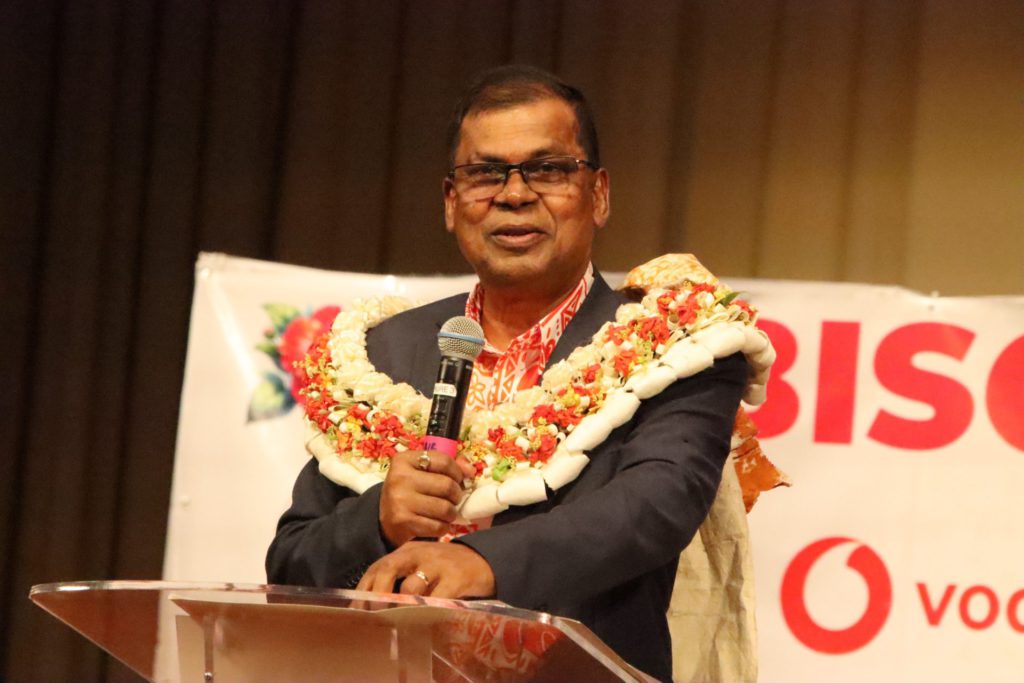
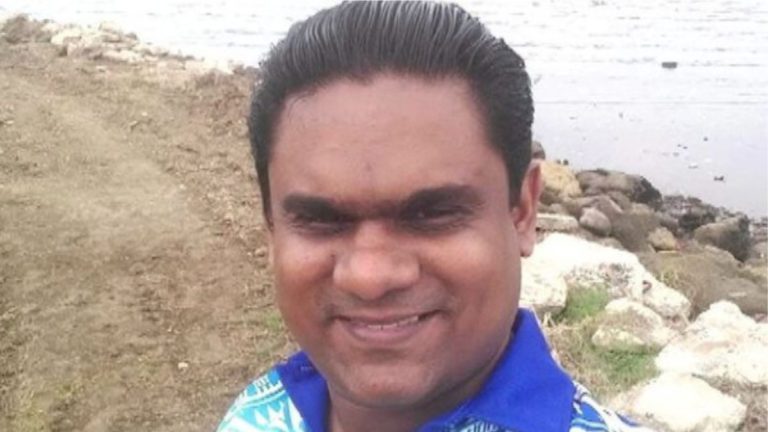
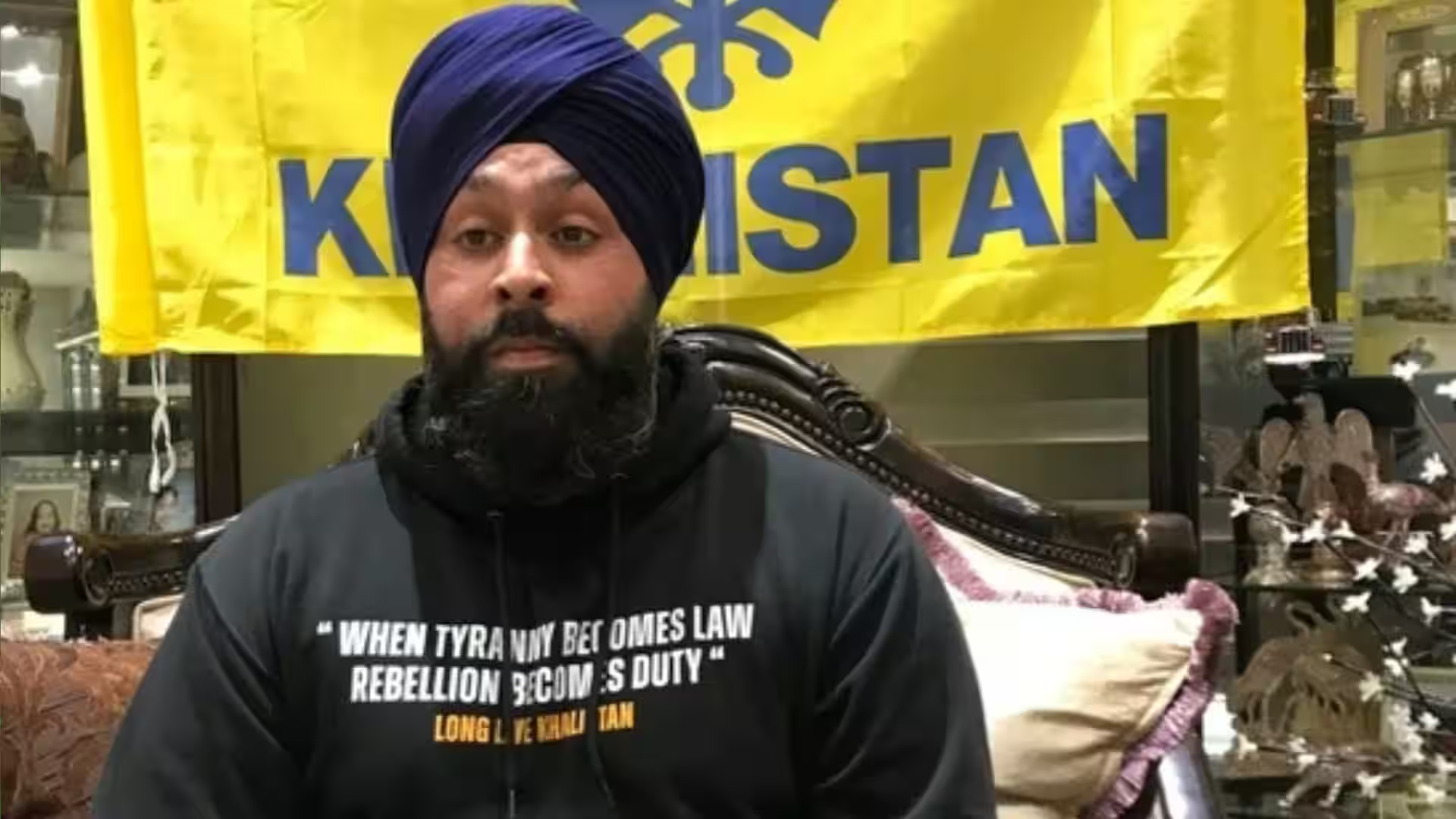
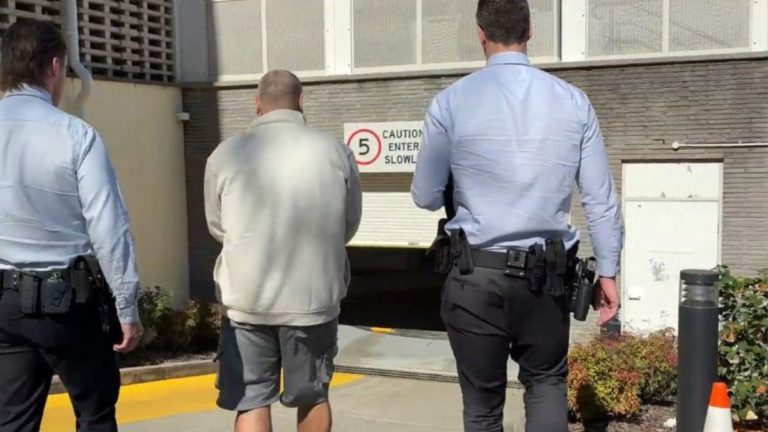
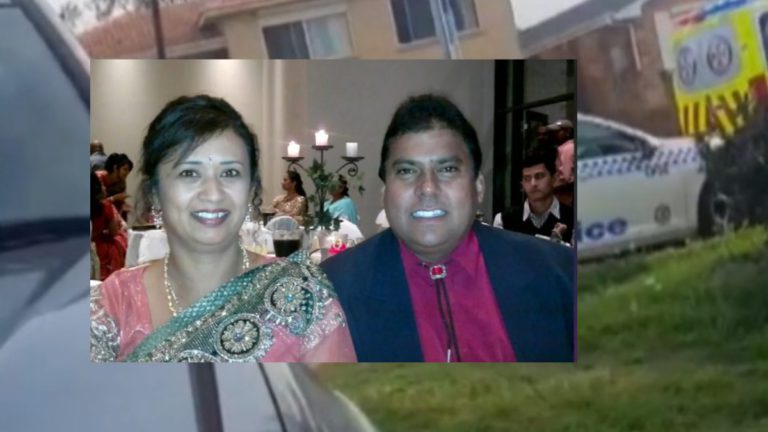
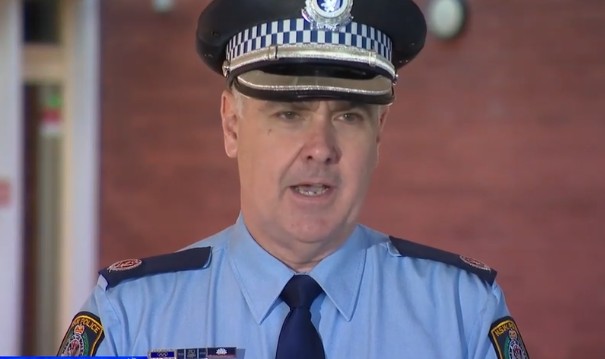
Dr Rashmi Kant, 51, from Havelock North has been sentenced to home detention after being convicted of indecently assaulting three students he tutored, Stuff.co.nz reports.
Dr Kant appeared in Napier District Court, where Judge Bridget Mackintosh handed down an 11-month home detention sentence, followed by six months of conditions including counselling and no contact with the victims.
It is reported in local media that Dr Kant, who holds a doctorate in entomology and worked as a senior scientist, was found guilty by a jury earlier this year on 11 charges of indecent assault.
RNZ reports that the offending occurred over several months in late 2023 and early 2024, involving inappropriate touching of the students during tutoring sessions.
During sentencing, as per RNZ, Judge Mackintosh said the victims had been “seriously affected” by the incidents, experiencing ongoing psychological and emotional challenges. She noted the young women had initially been hesitant to report Dr Kant, as they valued his tutoring and academic support.
According to Stuff.co.nz, Dr Kant’s lawyer highlighted his previous community contributions, lack of prior convictions, and steps taken to engage in counselling. A probation report indicated he was unlikely to reoffend.
It is reported that the Crown emphasised the age difference between Dr Kant and the students, the repeated nature of the assaults, and the breach of trust involved.
Judge Mackintosh acknowledged Dr Kant’s professional qualifications and standing in the community but said the jury’s verdicts made clear the impact of his actions. As per RNZ, she described the sentence as a “significant fall from grace” for the former tutor and scientist.
Dr Kant, as per local media reports, has also offered payments to the victims to compensate for emotional harm and to refund their tutoring fees.
Support our Journalism
No-nonsense journalism. No paywalls. Whether you’re in Australia, the UK, Canada, the USA, or India, you can support The Australia Today by taking a paid subscription via Patreon or donating via PayPal — and help keep honest, fearless journalism alive.
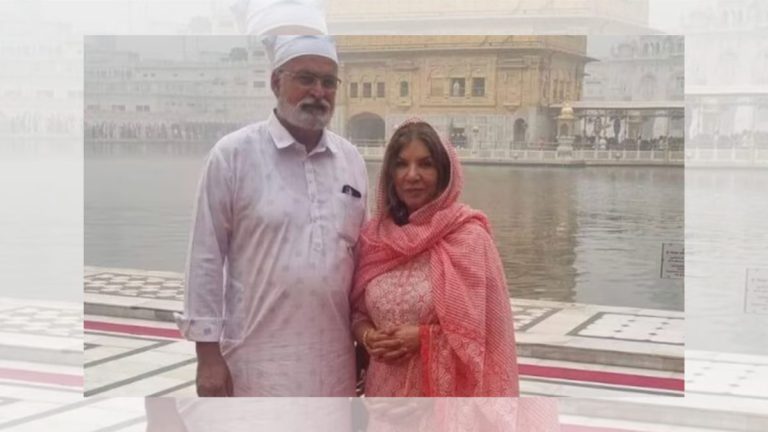
Gujarat police say an Indian-origin couple from Melbourne has apologised after a video of them kissing during a Garba event in Vadodara went viral and drew sharp criticism on social media.
The clip, filmed on 26 September at the United Way Garba in Vadodara’s Kalali ground, showed the couple dancing before the husband lifted his wife and kissed her.
The event, among the world’s largest Navratri celebrations, attracts 30,000–35,000 participants each night, including thousands of NRIs.
It is reported in Indian media that once shared online, the video triggered divided reactions. While some defended the kiss as a display of affection, others labelled it “obscene” and disrespectful to the religious and cultural spirit of Navratri.
It is further reported that several complaints were lodged at Atladra Police Station.
Police traced the couple and called them in. As per reports, they submitted a written apology, admitting their mistake. No legal action was pursued, and the couple was later allowed to leave. Officers confirmed they have since returned to Australia.
Support our Journalism
No-nonsense journalism. No paywalls. Whether you’re in Australia, the UK, Canada, the USA, or India, you can support The Australia Today by taking a paid subscription via Patreon or donating via PayPal — and help keep honest, fearless journalism alive.
A new butcher in Auckland, New Zealand, has had to discard several lamb carcasses after a food safety officer deemed their temporary storage potentially unsafe, following a photo that went viral on social media.
The image, shared in the Otara 274 Facebook community group, showed carcasses in cardboard boxes stacked on a supermarket trolley amid wooden pallets at Shefco Meats on Dawson Rd in Flat Bush.
The post drew widespread criticism, with one commenter writing, “A-grade yeah nah.”
Shefco Meats’ manager, Hasan Zuberi, told Stuff.co.nz that the photo was misleading. The lamb had only been on the trolley for 15 minutes during the store’s opening day while a meat rail was being installed. “Absolutely nothing was placed on the floor,” Zuberi told Stuff.
“We take hygiene and food safety very seriously and are proud of the standards we uphold.”
Auckland Council confirmed that while no complaints had been received, the temporary storage of the meat appeared improper.
Council’s environmental health response team leader, Alan Ahmu, told Stuff.co.nz that a food safety officer visited the site and directed that all meat exposed to contamination in the photo be thrown out. The instruction was complied with on the spot. “The chiller storage temperature was compliant, and the hanging rail had been installed,” Ahmu said.
“This is a new business yet to start trading, and once it opens, its food control plan will be verified by the council.”
Zuberi added the social media reaction had been overwhelming. “People are jealous… They destroy my hard work,” he said, adding that some comments attacked his ethnicity and religion.
“I was crying in the morning with my wife. We’ve worked very hard to get this business running.”
New Zealand’s Food Act 2014 and Food Regulations Act 2015 require all food on the premises of a food business to meet strict health and safety standards.
Support our Journalism
No-nonsense journalism. No paywalls. Whether you’re in Australia, the UK, Canada, the USA, or India, you can support The Australia Today by taking a paid subscription via Patreon or donating via PayPal — and help keep honest, fearless journalism alive.
After a deadly stampede at Tamil Nadu’s Karur claimed 41 lives during actor-turned-politician Joseph Vijay Chandrasekhar’s rally, local police have arrested Tamilaga Vettri Kazhagam (TVK) Karur West District Secretary V. P. Mathiyazhagan, holding him responsible for lapses that led to the tragedy.
Image: A deadly stampede at Tamil Nadu’s Karur claimed 41 lives during actor-turned-politician Joseph Vijay Chandrasekhar’s rally (Source: X)
Mathiyazhagan faces charges of culpable homicide not amounting to murder, attempt to commit culpable homicide, endangering life, and disobedience of orders, among other offences.
Senior TVK leaders, including General Secretary Bussy Anand and Joint General Secretary Nirmal Sekar, have also been booked.
The FIR, filed on a police complaint, names Vijay himself, alleging that his deliberate four-hour delay before appearing at the rally triggered restlessness in a crowd that had swelled to over 25,000—more than double the expected turnout.
Image: A deadly stampede at Tamil Nadu’s Karur claimed 41 lives during actor-turned-politician Joseph Vijay Chandrasekhar’s rally (Source: X)
Authorities say the actor-politician also held an unauthorised roadshow, violated conditions, and fuelled “unnecessary expectations” among supporters.
The stampede unfolded on Saturday as exhausted attendees, many without food or water under the scorching sun, surged forward. Barricades broke, makeshift structures collapsed, and panic spread.
Of the 41 victims, at least 10 were children and 18 were women.
Karur Horror: Lives Lost, Gross Negligence Behind Actor Vijay’s Rally
At least 31 people have lost their lives after collapsing at a rally addressed by (TVK) president and actor Vijay in Karur on 27 September 2025. This horrific incident took place as part of Vijay’s ongoing… pic.twitter.com/lwuql1aDK8
Vijay, expressing himself “shattered and in inexplicable pain,” announced compensation of Rs 20 lakh (AUD 360,000) for the families of the deceased and Rs 2 lakh (AUD 36,000) for the injured.
In his first video statement, Vijay insisted neither he nor his organisers acted negligently, alleging instead that political rivals were conspiring to pin blame on TVK. he told the Chief Minister:
“If you want revenge, do anything to me. Don’t touch my people.”
The Tamil Nadu government has stressed that organisers failed to deploy sufficient volunteers and ignored repeated warnings, noting that the venue was approved only for 10,000 people.
Officials defended police preparedness but admitted the crowd far exceeded estimates.
Image: TVK branch secretary at Villupuram Ayyappan. (Right) The suicide note left behind by Ayyappan (Source: X)
Vijay vowed that despite the tragedy, “our political journey will continue with more strength and more fearlessness.”
Support our Journalism
No-nonsense journalism. No paywalls. Whether you’re in Australia, the UK, Canada, the USA, or India, you can support The Australia Today by taking a paid subscription via Patreon or donating via PayPal — and help keep honest, fearless journalism alive.
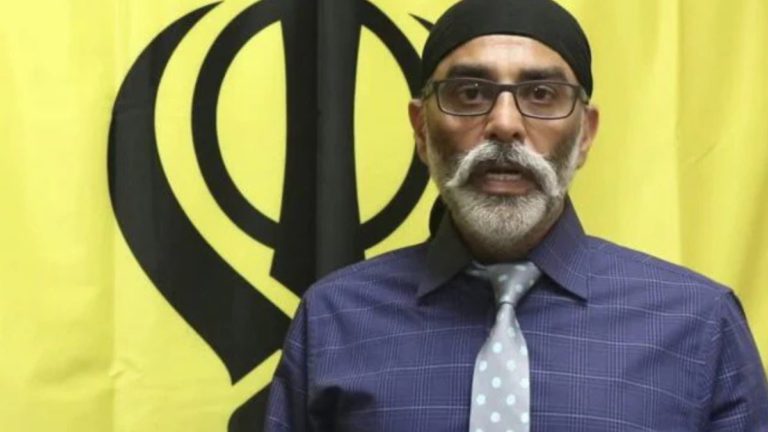
India’s National Investigation Agency (NIA) has registered a case against US-based Khalistani Gurpatwant Singh Pannun after he allegedly announced a reward of ₹11 crore (AUD 2 million) for ‘Sikh soldiers’ to stop Prime Minister Narendra Modi from hoisting the national flag at the Red Fort on Independence Day.
According to the First Information Report (FIR) accessed by Indian media, Pannun, who serves as the General Counsel for the India banned extremist outfit Sikhs For Justice (SFJ), allegedly made the announcement on 10 August during a “Meet the Press” event at the Lahore Press Club in Pakistan, addressing journalists via video link from Washington.
At the event, the India designated terrorist also unveiled a new “Delhi Banayga Khalistan” referendum map that incorporated Punjab, Delhi, Himachal Pradesh and Uttar Pradesh. It is reported that he further allegedly claimed that SFJ had formed a “Shaheed Jatha” to fight against India.
As per reports, the NIA stated that Pannun’s actions were aimed at disrupting India’s sovereignty, territorial integrity, and national security while spreading disaffection among Sikhs. The case has been filed under sections of the Bharatiya Nyaya Sanhita (BNS) and the Unlawful Activities (Prevention) Act (UAPA).
The Union Home Ministry, which directed the NIA to investigate, noted that Pannun allegedly used the Lahore event to reject India’s sovereignty over Punjab, promote Khalistan, and appeal for international support. Given the alleged gravity of the offence and its global ramifications, the ministry said the case warranted an NIA probe to unearth the larger conspiracy.
Pannun and SFJ have long been accused by India of working with Pakistan’s ISI and international gangster-terror networks to fuel separatism. Despite little traction within India, the group has stageda bogus Khalistan “referendum” votes across Australia, the UK, Canada, and other countries to amplify its anti-India campaign.
Support our Journalism
No-nonsense journalism. No paywalls. Whether you’re in Australia, the UK, Canada, the USA, or India, you can support The Australia Today by taking a paid subscription via Patreon or donating via PayPal — and help keep honest, fearless journalism alive.
De Kretser headed a winners’ list that confronts moments of crisis and care. The six books – across fiction, nonfiction, Australian history, poetry, young adult literature and children’s literature – reckon with histories of illness and inequality. They consider what it means to live according to one’s principles.
These books shed fresh light on the way our institutions, social relations and personal imaginations are shaped – and how they might be remade. Taken together, they map the pressures and possibilities of contemporary Australian life.
Each winner receives A$80,000, with the shortlisted writers receiving $5,000 each – all tax-free.
Mean Streak
Rick Morton’s Mean Streak (Fourth Estate) investigates how institutional power causes personal suffering. He details how, over four painful years, a federal government scheme to recover fake welfare debts spiralled into one of Australia’s most significant public policy failures, resulting in physical suffering, financial ruination – and in some cases, death.
Linking the personal and the political, Morton dissects the bureaucratic, obfuscatory language that masked the scheme’s illegality. The task he sets himself is to understand how structural injustice is felt in the body. He conveys how such external pressures are rendered visible in moments of distress, despair and resistance.
The judges commended Mean Streak as an “excellent example of the fusion of thorough journalistic methods with an empathetic understanding of the humans at the heart of the story”. They were especially taken with Morton’s “single-minded determination” to turn a government’s wrongdoing into a profound, enthralling account of “what happens when we lose our collective conscience”.
Theory and Practice
“I succeeded in doing what I set out to do, which is to write a novel that doesn’t read like a novel; that reads like fact, like life captured on the wing,” said Michelle de Kretser earlier this year.
Moving between fictional, autofictional and essayistic modes, Theory and Practice (Text Publishing) is, as the judges note, “elegant, playful and razor sharp”.
Set in 1980s St Kilda, among a community of university students, it features an unnamed protagonist who is writing a thesis about Virginia Woolf, while confronting difficult views found in Woolf’s diaries – and navigating an affair. The novel scrutinises the tensions between political idealism and the messy intricacies of existence. It tests “the limits of the novel as a form to investigate power in all its complexity,” said the judges.
Reviewing the book for The Conversation, writer and critic Eda Gunaydin praised it for taking “women’s art and interiority seriously”, concluding it is “something de Kretser is able to accomplish because she herself is a serious artist”.
Critical Care
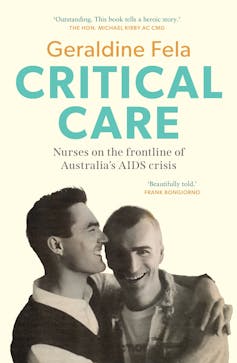
HIV and AIDS devastated communities in the 1980s and 1990s. Bringing together stories from across the country, Geraldine Fela demonstrates how, amid this crisis, nurses offered vital care to those living with and dying from the virus. They dealt with prejudice and negotiated complex family dynamics, while defending the rights of their patients.
Based on interviews with more than 30 nurses and many survivors of HIV, Critical Care (New South), in the words of the judges, “maps the human response to a public health emergency with compassion, insight, and an acute eye for telling detail”.
In a moment when “public health is a matter of urgent concern”, concluded the judges, “Critical Care is both an original and revealing history of Australia’s response to AIDS and a valuable source of guidance for the future”.
The Other Side of Daylight
David Brooks’ The Other Side of Daylight (UQP) comprises selections from Brooks’ five previous collections and a treasury of 48 new poems.
In her review for The Conversation, Ann Vickery observed Brooks’ poetry is “deeply personal, even when he is reflecting on broader historical or global patterns”.
The Other Side of Daylight develops Brooks’ longstanding preoccupation with ideas of justice, and human and non-human animal relations. Many of his poems, Vickey notes, “speak not only of animals’ sentience, but an empathetic community that contrasts with the violence and disregard humans show towards their environment and each other”.
The collection’s lyrical, finely wrought observations of rural life in the Blue Mountains shine with what the judges called “a passionate conviction for animal welfare and environmental conservation”.
Leo and Ralph
Combining emotional depth with striking monochrome visuals, Peter Carnavas’ Leo and Ralph (UQP) centres on the imaginative world of a young boy finding his place in the world.
Shy and socially uncertain, Leo occasionally struggles to express himself in the company of others. In the absence of kindred spirits, he invents Ralph, an imaginary companion who hails from outer space. Ralph’s presence provides Leo with support and guidance as he grows up and gains agency.
Carnavas “shares his kind and perceptive insights about young people who may not quite fit within the norm”, said the judges.
They emphasised Carnavas’s empathetic, imaginative approach and his ability to advocate for “the value of being different in a satisfying, age-appropriate way”.
The Invocations
Krystal Sutherland won the young adult literature prize for The Invocations (Penguin). The judges called it “a work from a novelist at the height of her powers”.
A thrilling, atmospheric tale of witchcraft, grief and resilience, The Invocations follows three young women who join forces in an attempt to confront a series of figurative and literal demons.
As the judges attest, it “explores grief, control, found family and agency through an original lore of witchcraft, spells and curses”.
Despite being subject to isolation and traumatic experiences, her characters show they are “willing to fight the forces that would seek to control their minds, bodies and futures”.
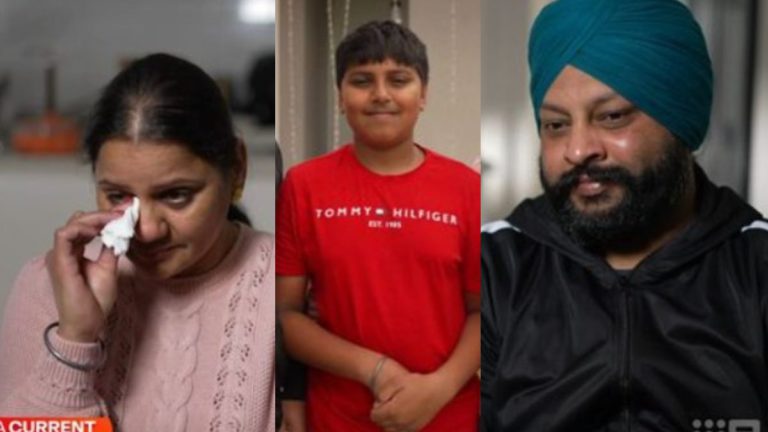
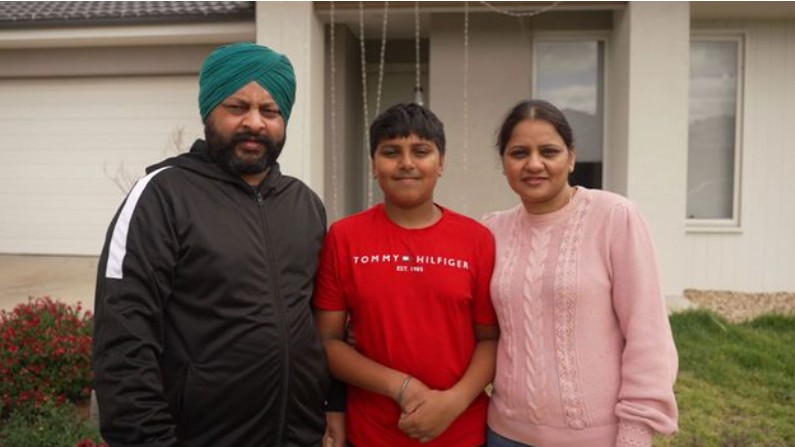
Twelve-year-old Abhijot Singh’s Australian dream now hangs in the balance as a federal government decision could see his Indian-born parents, who have lived in Australia for 16 years, deported, as per A Current Affair report.
Image: Abhijot with parents Amandeep and Stiven Singh (Source: Screenshot – A Current Affair – 9News)
A Current Affair reports that Amandeep and Stiven Singh arrived in Australia in 2009 and settled in Wyndham Vale, Melbourne’s west. For years, they lived on bridging visas while awaiting permanent residency. Earlier this year, they were informed their permanent residency would not be granted and were instructed to leave by November.
Because Abhijot was born in Australia, he is an Australian citizen and is technically allowed to remain. “He’s never lived without us,” Amandeep, who works in airport security, told A Current Affair.
“We both work full time and pay tax. We didn’t commit any crime.”
After unsuccessful appeals through tribunals, the family took their case to Immigration Minister Tony Burke, hoping for intervention.
A Current Affair obtained a classified government briefing prepared by the Department of Home Affairs, which outlined possible pathways to allow the Singhs to stay. Despite this, it is being reported that the Assistant Immigration Minister Matt Thistlethwaite decided not to intervene.
Image: Amandeep and Stiven Singh (Source: Screenshot – A Current Affair – 9News)
The family’s lawyer, former immigration tribunal member Joseph Italiano, called the decision unprecedented. He told A Current Affair that children born in Australia to foreign parents automatically gain citizenship at age 10.
“The minister could say the child is not being asked to leave — he’s Australian — but seriously? I think the public will be horrified.”
The decision appears at odds with new ministerial guidelines, which prioritise cases where a minor child is an Australian citizen or permanent resident.
Immigration Minister Tony Burke issued a brief statement. “The Indian Australian community has a proud history of working strictly within the law and abiding by the Migration Act.”
“This couple has been told to leave. They should show their respect for Australian law, leave and then apply offshore.”
Italiano said the family does not qualify to “apply offshore” and are now considering appealing to the High Court.
Support our Journalism
No-nonsense journalism. No paywalls. Whether you’re in Australia, the UK, Canada, the USA, or India, you can support The Australia Today by taking a paid subscription via Patreon or donating via PayPal — and help keep honest, fearless journalism alive.
“Australia welcomes President Trump’s plan to bring peace to Gaza after almost two years of conflict and a devastating loss of civilian life,” Albanese said. He urged Hamas to disarm, release all remaining hostages, and embrace the proposal, commending its emphasis on “Palestinian self-determination and statehood” and its “clear rejection of annexation and forced displacement.”
Together with our partners, Australia will continue to work towards a just and sustainable two-state solution. pic.twitter.com/GyhMkmfgeX
Opposition Senate Leader Michaelia Cash also welcomed the initiative, saying:
“Hamas must promptly release all the remaining Israeli hostages and lay down their weapons. We encourage the Albanese Government to back the US plan.”
Indian Prime Minister Narendra Modi also endorsed the initiative, calling it “a comprehensive plan to end the Gaza conflict” that offers “a viable pathway to long term and sustainable peace, security and development for the Palestinian and Israeli people, as also for the larger West Asian region.”
We welcome President Donald J. Trump’s announcement of a comprehensive plan to end the Gaza conflict. It provides a viable pathway to long term and sustainable peace, security and development for the Palestinian and Israeli people, as also for the larger West Asian region. We…
The 20-point plan, unveiled at the White House by Trump alongside Israeli Prime Minister Benjamin Netanyahu, calls for an immediate ceasefire, an exchange of hostages and prisoners, Hamas disarmament, a phased Israeli withdrawal from Gaza, and a transitional administration led by an international “Board of Peace” before governance is transferred to the Palestinian Authority.
Trump called the proposal as “a historic day for peace,” declaring it could extend beyond Gaza to reshape the Middle East. “This is a big, big day, a beautiful day, potentially one of the great days ever in civilisation,” he said. Warning Hamas against rejection, Trump pledged that “Israel would have my full backing to do what you would have to do.”
Netanyahu praised Trump as “the greatest friend that Israel has ever had in the White House” and insisted the plan achieved Israel’s war aims.
“It will bring back to Israel all our hostages, dismantle Hamas’s military capabilities and its political rule, and ensure that Gaza never again poses a threat to Israel.”
The plan has won cautious support from Arab and Muslim-majority nations, including Saudi Arabia, Jordan, Egypt, Qatar, Turkey, Pakistan, Indonesia, and the UAE, all signalling readiness to work with Washington.
The new US initiative to deliver an end to the war in Gaza is profoundly welcome. pic.twitter.com/N1UxkEHY1J
In Europe, UK Prime Minister Keir Starmer urged Hamas to “end the misery” by accepting the deal, while French President Emmanuel Macron insisted Hamas had “no choice but to follow this plan.”
I welcome President @realDonaldTrump’s commitment to ending the war in Gaza and securing the release of all hostages.
I expect Israel to engage resolutely on this basis. Hamas has no choice but to immediately release all hostages and follow this plan.…
Critics, however, note that the proposal closely mirrors earlier blueprints, including the Biden administration’s February 2024 roadmap and a French-Saudi plan recently backed at the UN, raising doubts over whether it represents a genuine breakthrough or simply a repackaging.
Gaza will be a deradicalised terror-free zone that does not pose a threat to its neighbours.
Gaza will be redeveloped for the benefit of the people of Gaza, who have suffered more than enough.
If both sides agree to this proposal, the war will immediately end. Israeli forces will withdraw to the agreed-upon line to prepare for a hostage release. During this time, all military operations, including aerial and artillery bombardment, will be suspended, and battle lines will remain frozen until conditions are met for the complete staged withdrawal.
Within 72 hours of Israel publicly accepting this agreement, all hostages, alive and deceased, will be returned.
Once all hostages are released, Israel will release 250 life sentence prisoners plus 1,700 Gazans who were detained after October 7th 2023, including all women and children detained in that context. For every Israeli hostage whose remains are released, Israel will release the remains of 15 deceased Gazans.
Once all hostages are returned, Hamas members who commit to peaceful co-existence and to decommission their weapons will be given amnesty. Members of Hamas who wish to leave Gaza will be provided safe passage to receiving countries.
Upon acceptance of this agreement, full aid will be immediately sent into the Gaza Strip. At a minimum, aid quantities will be consistent with what was included in the January 19, 2025, agreement regarding humanitarian aid, including rehabilitation of infrastructure (water, electricity, sewage), rehabilitation of hospitals and bakeries, and entry of necessary equipment to remove rubble and open roads.
Entry of distribution and aid in the Gaza Strip will proceed without interference from the two parties through the United Nations and its agencies, and the Red Crescent, in addition to other international institutions not associated in any manner with either party. Opening the Rafah crossing in both directions will be subject to the same mechanism implemented under the January 19, 2025, agreement.
Gaza will be governed under the temporary transitional governance of a technocratic, apolitical Palestinian committee, responsible for delivering the day-to-day running of public services and municipalities for the people in Gaza. This committee will be made up of qualified Palestinians and international experts, with oversight and supervision by a new international transitional body, the “Board of Peace,” which will be headed and chaired by President Donald J. Trump, with other members and heads of State to be announced, including Former Prime Minister Tony Blair. This body will set the framework and handle the funding for the redevelopment of Gaza until such time as the Palestinian Authority has completed its reform program, as outlined in various proposals, including President Trump’s peace plan in 2020 and the Saudi-French proposal, and can securely and effectively take back control of Gaza. This body will call on best international standards to create modern and efficient governance that serves the people of Gaza and is conducive to attracting investment.
A Trump economic development plan to rebuild and energise Gaza will be created by convening a panel of experts who have helped birth some of the thriving modern miracle cities in the Middle East. Many thoughtful investment proposals and exciting development ideas have been crafted by well-meaning international groups, and will be considered to synthesise the security and governance frameworks to attract and facilitate these investments that will create jobs, opportunity, and hope for future Gaza.
A special economic zone will be established with preferred tariff and access rates to be negotiated with participating countries.
No one will be forced to leave Gaza, and those who wish to leave will be free to do so and free to return. We will encourage people to stay and offer them the opportunity to build a better Gaza.
Hamas and other factions agree to not have any role in the governance of Gaza, directly, indirectly, or in any form. All military, terror, and offensive infrastructure, including tunnels and weapon production facilities, will be destroyed and not rebuilt. There will be a process of demilitarisation of Gaza under the supervision of independent monitors, which will include placing weapons permanently beyond use through an agreed process of decommissioning, and supported by an internationally funded buy back and reintegration program all verified by the independent monitors. New Gaza will be fully committed to building a prosperous economy and to peaceful coexistence with their neighbours.
A guarantee will be provided by regional partners to ensure that Hamas, and the factions, comply with their obligations and that New Gaza poses no threat to its neighbours or its people.
The United States will work with Arab and international partners to develop a temporary International Stabilization Force (ISF) to immediately deploy in Gaza. The ISF will train and provide support to vetted Palestinian police forces in Gaza, and will consult with Jordan and Egypt who have extensive experience in this field. This force will be the long-term internal security solution. The ISF will work with Israel and Egypt to help secure border areas, along with newly trained Palestinian police forces. It is critical to prevent munitions from entering Gaza and to facilitate the rapid and secure flow of goods to rebuild and revitalise Gaza. A deconfliction mechanism will be agreed upon by the parties.
Israel will not occupy or annex Gaza. As the ISF establishes control and stability, the Israel Defense Forces (IDF) will withdraw based on standards, milestones, and timeframes linked to demilitarisation that will be agreed upon between the IDF, ISF, the guarantors, and the United States, with the objective of a secure Gaza that no longer poses a threat to Israel, Egypt, or its citizens. Practically, the IDF will progressively hand over the Gaza territory it occupies to the ISF according to an agreement they will make with the transitional authority until they are withdrawn completely from Gaza, save for a security perimeter presence that will remain until Gaza is properly secure from any resurgent terror threat.
In the event Hamas delays or rejects this proposal, the above, including the scaled-up aid operation, will proceed in the terror-free areas handed over from the IDF to the ISF.
An interfaith dialogue process will be established based on the values of tolerance and peaceful co-existence to try and change mindsets and narratives of Palestinians and Israelis by emphasising the benefits that can be derived from peace.
While Gaza re-development advances and when the PA reform program is faithfully carried out, the conditions may finally be in place for a credible pathway to Palestinian self-determination and statehood, which we recognise as the aspiration of the Palestinian people.
The United States will establish a dialogue between Israel and the Palestinians to agree on a political horizon for peaceful and prosperous co-existence.
Support our Journalism
No-nonsense journalism. No paywalls. Whether you’re in Australia, the UK, Canada, the USA, or India, you can support The Australia Today by taking a paid subscription via Patreon or donating via PayPal — and help keep honest, fearless journalism alive.
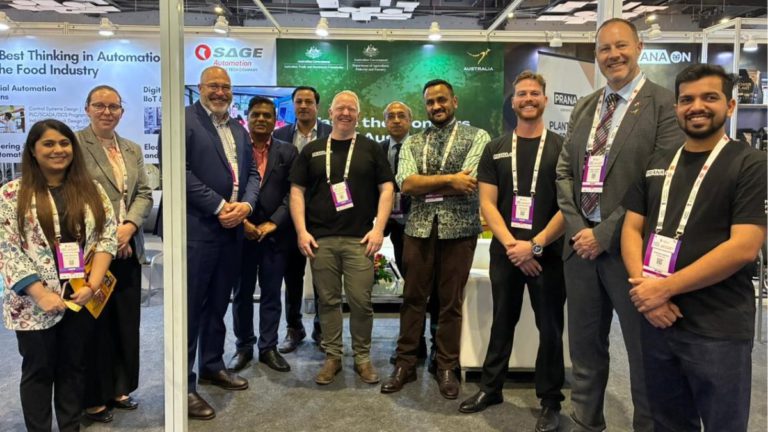
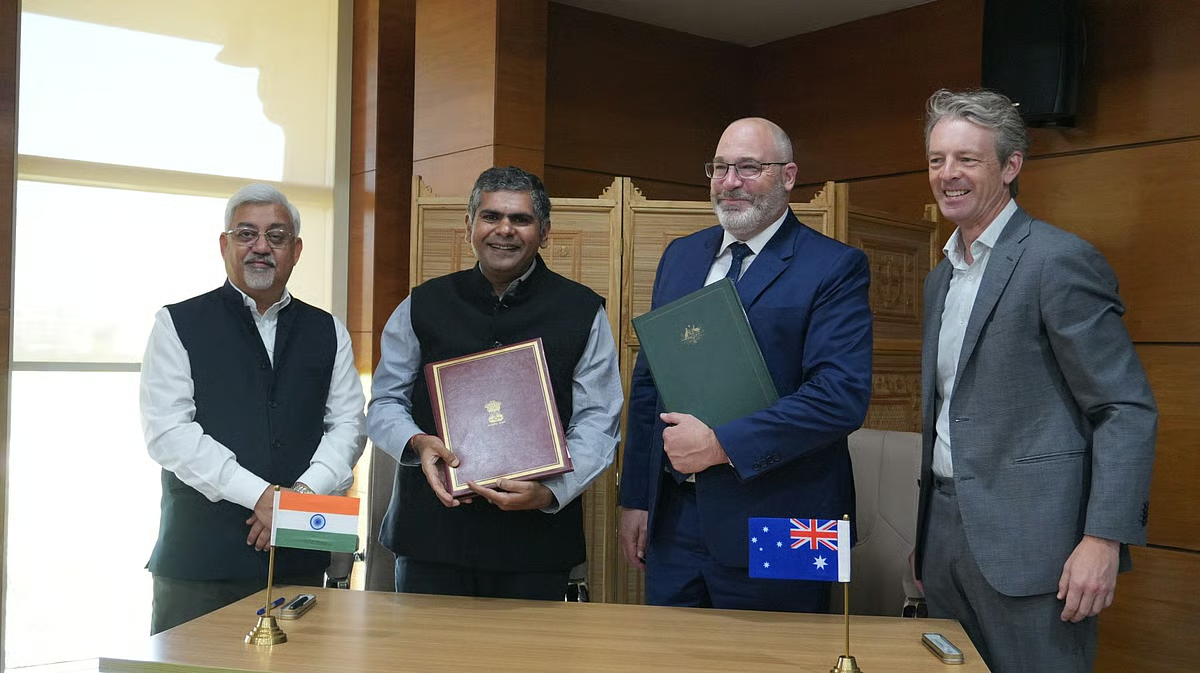
Australia has showcased its agrifood innovation at World Food India 2025, positioning itself as a partner in India’s growing food processing industry.
Held from 25–28 September at Pragati Maidan, New Delhi, the global event brought together more than 90 countries and over 2,000 exhibitors.
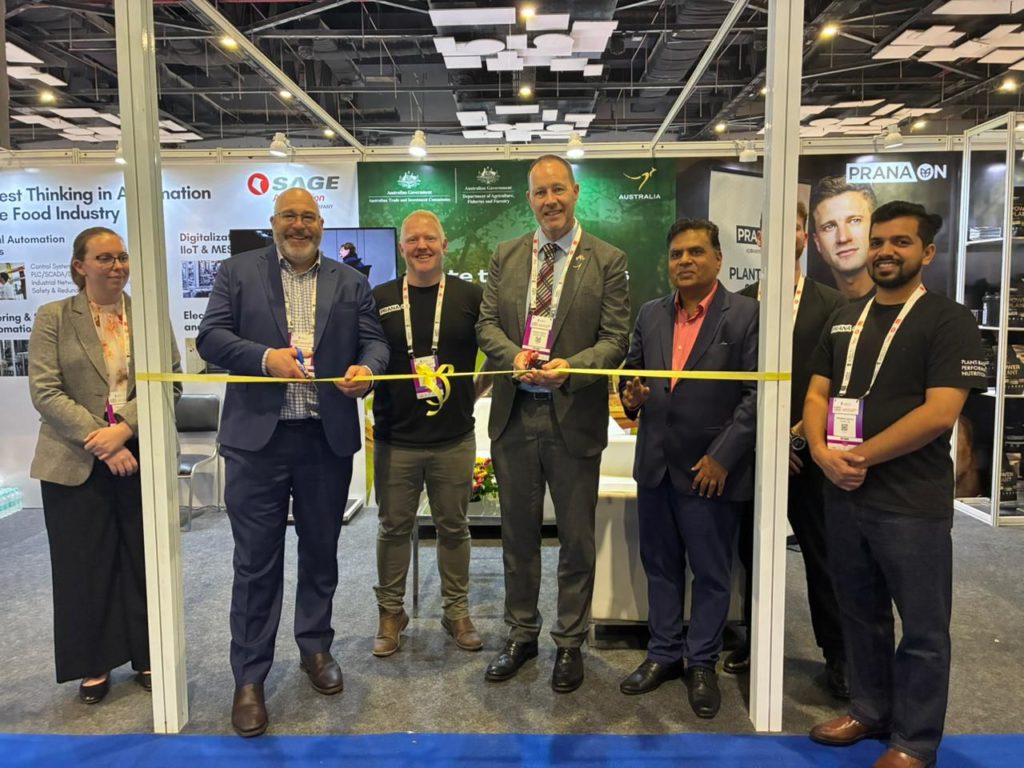
The pavilion was formally opened by Tom Black, Assistant Secretary, DAFF; Kiran Karamil, Counsellor (Agriculture); and Murray Spence, Austrade’s Trade & Investment Commissioner for Agribusiness in South Asia.
Image: Australian Trade and Investment Commission (Austrade) partnered with Department of Agriculture, Fisheries and Forestry to present the Australia Pavilion at World Food India 2025 (Source: LinkedIn)
The Australian Trade and Investment Commission (Austrade), in partnership with the Department of Agriculture, Fisheries and Forestry (DAFF), led the Australia Pavilion.
The pavilion featured two innovative agribusinesses: SAGE Automation, which presented advanced automation solutions for food processing and manufacturing, and Flavour Makers, highlighting its plant-based sports nutrition and wellness brand, Prana On.
Image: Australian Trade and Investment Commission (Austrade) partnered with Department of Agriculture, Fisheries and Forestry to present the Australia Pavilion at World Food India 2025 (Source: LinkedIn)
Over the four-day event, the Australian delegation connected with Indian companies and MSMEs, explored emerging industry trends, and engaged with potential partners, distributors, and customers.
Austrade said the platform was a strong opportunity to underline Australia’s strengths in food processing, automation, and premium organic product lines while supporting the Australian Government’s trade ambitions as CECA negotiations with India continue.
Support our Journalism
No-nonsense journalism. No paywalls. Whether you’re in Australia, the UK, Canada, the USA, or India, you can support The Australia Today by taking a paid subscription via Patreon or donating via PayPal — and help keep honest, fearless journalism alive.
Today, our government listed the Bishnoi Gang as a terrorist entity. Violence, terror, and the intimidation of communities will never be tolerated in Canada.
Public Safety Minister Gary Anandasangaree announced the decision, describing the gang as a transnational criminal organisation that has fuelled fear in Canadian diaspora communities through murder, shootings, arson and extortion.
“Specific communities have been targeted for terror, violence and intimidation by the Bishnoi gang,” Anandasangaree said.
“Listing this group of criminal terrorists gives us more powerful and effective tools to confront and put a stop to their crimes.”
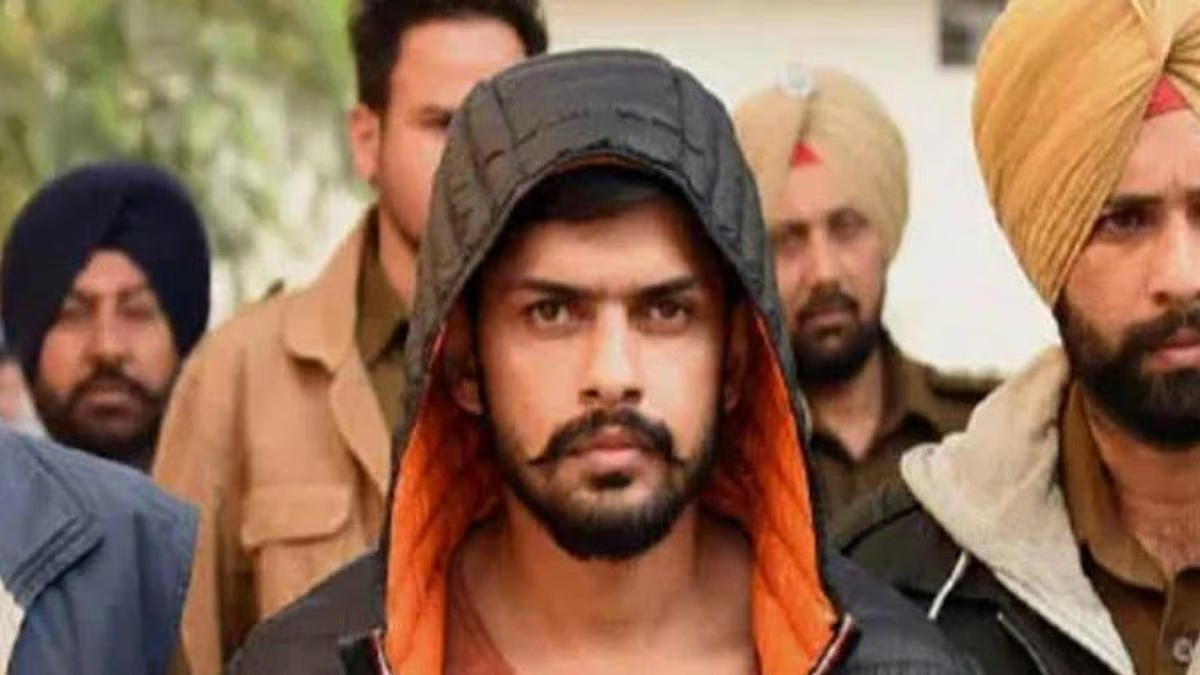
Image: Lawrence Bishnoi (Source: X)
The gang, led by Lawrence Bishnoi from his Indian prison cell, has hundreds of members and is linked to high-profile killings in India, including the 2022 murder of Punjabi rapper Sidhu Moose Wala. Canadian police have alleged the group is also connected to targeted attacks and extortion in Canada.
Bishnoi was a close criminal associate of Canadian gangster Satinderjeet Singh aka Goldy Brar, but it is beleived that the two parted ways earlier this year. The fallout reportedly stemmed from Lawrence Bishnoi’s anger at Goldy Brar and Sachin Godara over their handling of his brother Anmol’s case in the United States.
India’s National Investigation Agency (NIA) report revealed the Bishnoi and Brar’s criminal activities have links to banned Babbar Khalsa International (BKI) and several other pro-Khalistan terrorist outfits based in Canada and the US.
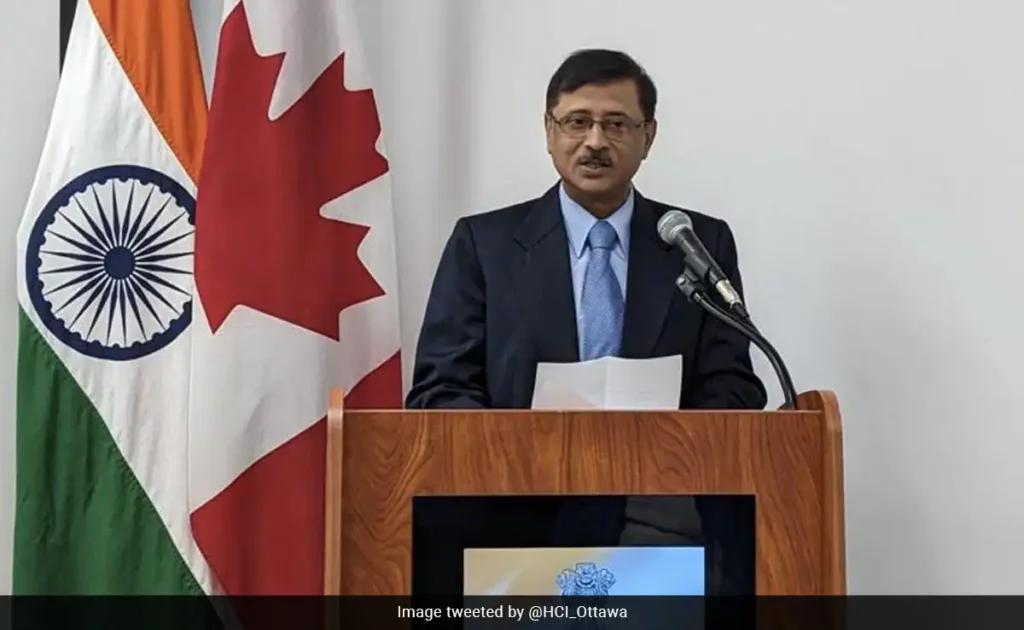
Image: Indian High Commissioner to Canada Sanjay Kumar Verma (Source: NDTV)
In 2024, Indian High Commissioner to Canada Sanjay Kumar Verma said in an interview that Canada’s inaction against Khalistanis despite India’s repeated requests and information sharing has “emboldened the extremists.” “We have told them about the links between Goldy Brar and Lawrence Bishnoi. Goldy Brar openly runs extortion rackets in Canada,” he added.
“Khalistanis run a business in Canada. They are into extortion. They use the money to live a lavish life and work against India.”
In fact just last month, Goldy Dhillon, a member of the Bishnoi Gang, took responsibility for gunfire at actor-comedian Kapil Sharma’s newly opened Kaps Cafe in Surrey, marking the second shooting at the location in less than a month, the first occurring on 10 July 2025.
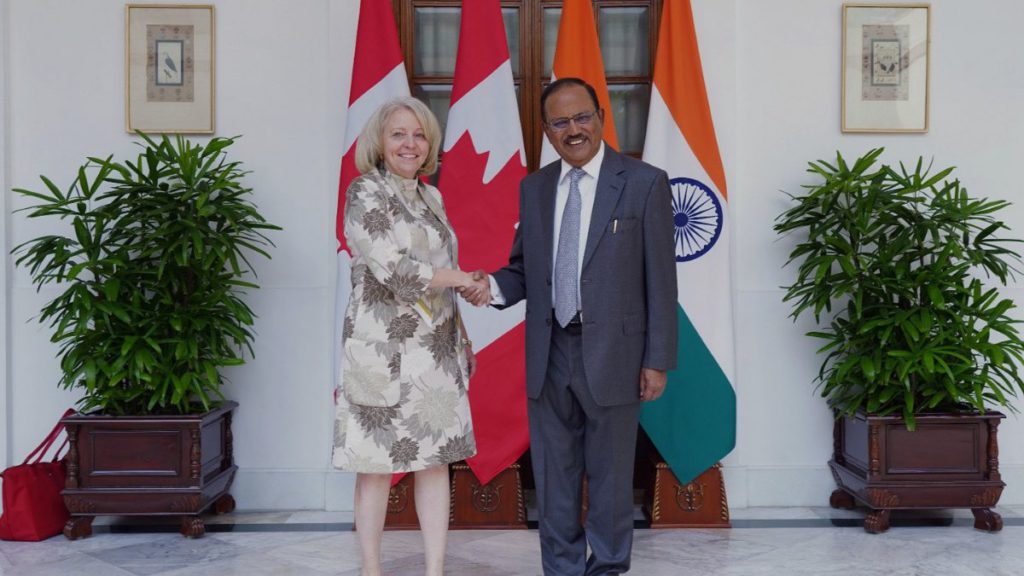
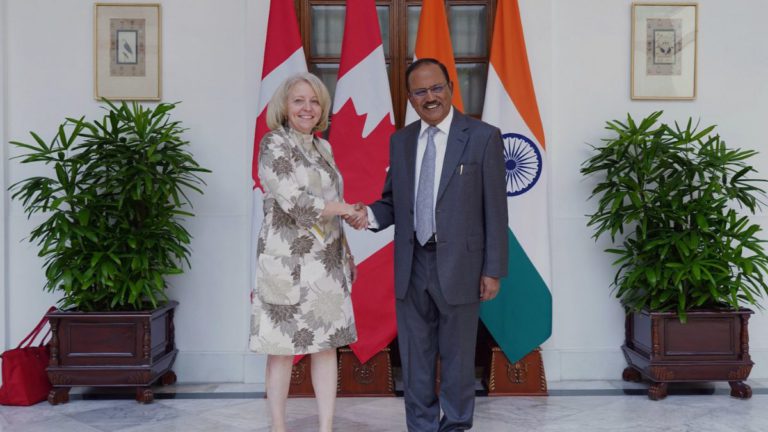
Image: Nathalie G. Drouin with Ajit Doval (Image: X)
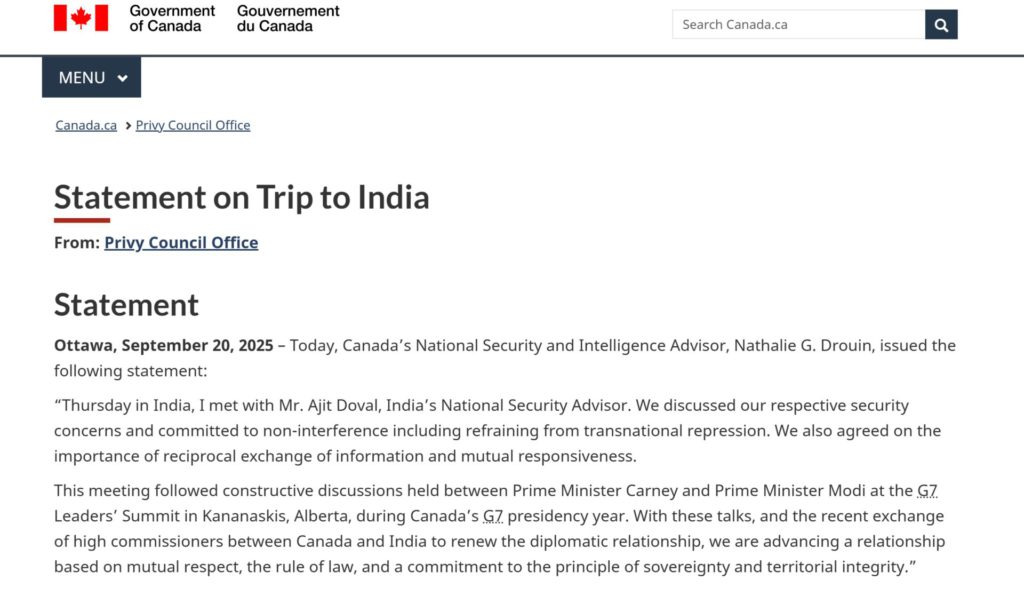
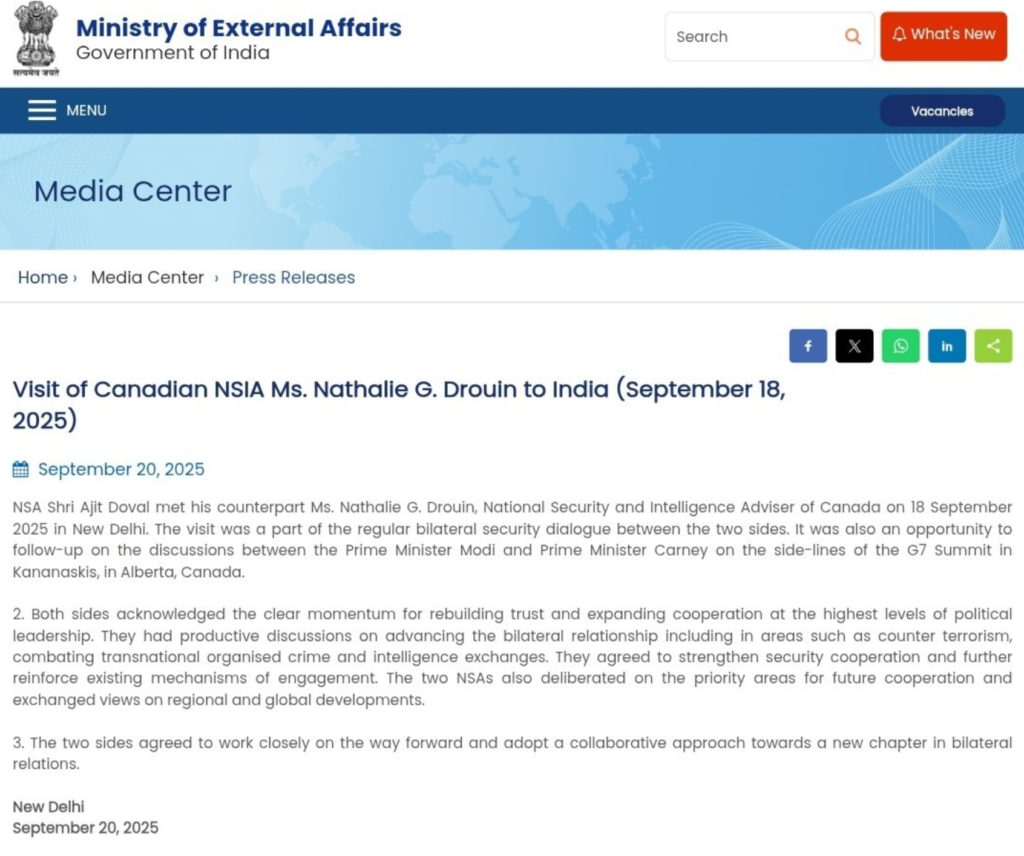
India’s MEA described the meeting as part of the regular security dialogue, with agreements to enhance counter-terrorism, intelligence exchanges and cooperation against organised crime. The engagement coincides with the restoration of full diplomatic representation, with new High Commissioners in place and follow-up consultations underway.
Canada now has 88 organisations designated as terrorist entities. With this listing, the Bishnoi gang joins Khalistani extremist organisations already banned in Canada under the Criminal Code, including Babbar Khalsa International (BKI) and the International Sikh Youth Federation (ISYF). These groups have long been recognised by Canadian authorities for their involvement in violent extremism, highlighting Ottawa’s broader commitment to tackling both ideologically motivated and organised criminal threats.
Support our Journalism
No-nonsense journalism. No paywalls. Whether you’re in Australia, the UK, Canada, the USA, or India, you can support The Australia Today by taking a paid subscription via Patreon or donating via PayPal — and help keep honest, fearless journalism alive.
Caltech has appointed Indian-American Prof. Mansi Manoj Kasliwal as the new Director of its historic Palomar Observatory, marking the first time a woman will lead the facility.
Born in Indore, India, Kasliwal moved to the United States at age 15 and completed her undergraduate studies in applied and engineering physics at Cornell University.
A Professor of Astronomy at Caltech, Kasliwal is a globally recognised leader in time-domain and multi-messenger astrophysics. Her research focuses on “cosmic fireworks” — powerful stellar explosions and transients that reveal how stars live, die, and create the elements around us.
Kasliwal has played a central role in developing Palomar’s cutting-edge discovery tools, including the Zwicky Transient Facility (ZTF), the infrared survey instruments Palomar Gattini-IR (PGIR) and WINTER, and the recently commissioned Next Generation Palomar Spectrograph (NGPS). Internationally, she leads the GROWTH initiative, a network of observatories that tracks fast-changing cosmic events around the clock.
Her scientific achievements include the prestigious Breakthrough Prize in Physics in 2022, over 440 refereed publications, and an h-index of 100. She has also spearheaded major campaigns following up on gravitational wave events, establishing herself as a prominent voice in modern astrophysics.
Kasliwal has deep ties to Palomar, having earned her Ph.D. at Caltech and helped design the Palomar Transient Factory. As Director, she plans to harness the Observatory’s unique capabilities to explore the dynamic universe.
The Zwicky Transient Facility, a public-private partnership funded equally by the US National Science Foundation and an international consortium, scans the entire Northern sky every two days. Its wide-field surveys enable astronomers to study phenomena ranging from near-Earth asteroids to distant superluminous supernovae.
Support our Journalism
No-nonsense journalism. No paywalls. Whether you’re in Australia, the UK, Canada, the USA, or India, you can support The Australia Today by taking a paid subscription via Patreon or donating via PayPal — and help keep honest, fearless journalism alive.
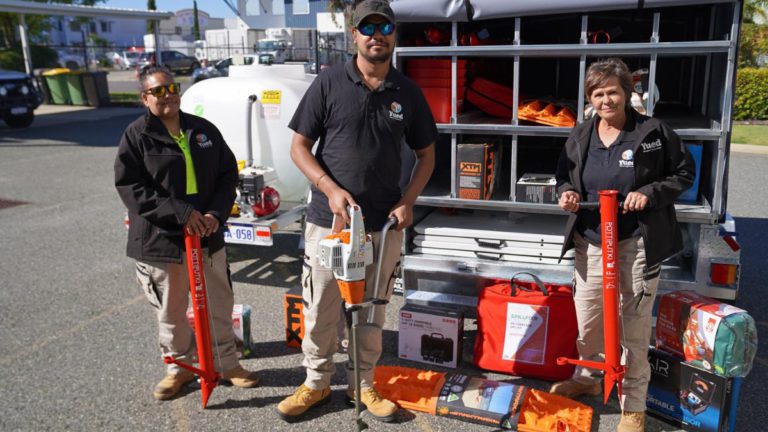
Rural communities across Australia are stepping up with innovative climate solutions, after the Foundation for Rural & Regional Renewal (FRRR) awarded more than $650,000 to 24 community-led projects.
Announced on 29 September, the Community Led Climate Solutions (CLCS) program will back not-for-profit groups in remote, rural and regional areas to tackle local climate impacts and navigate the transition away from fossil fuels. More than half of the initiatives funded will benefit First Nations communities.
The $652,740 in grants range from $19,186 for a native plant nursery in Moora, Western Australia, to $75,000 for an Indigenous STEM education program to be delivered in multiple remote communities nationwide.
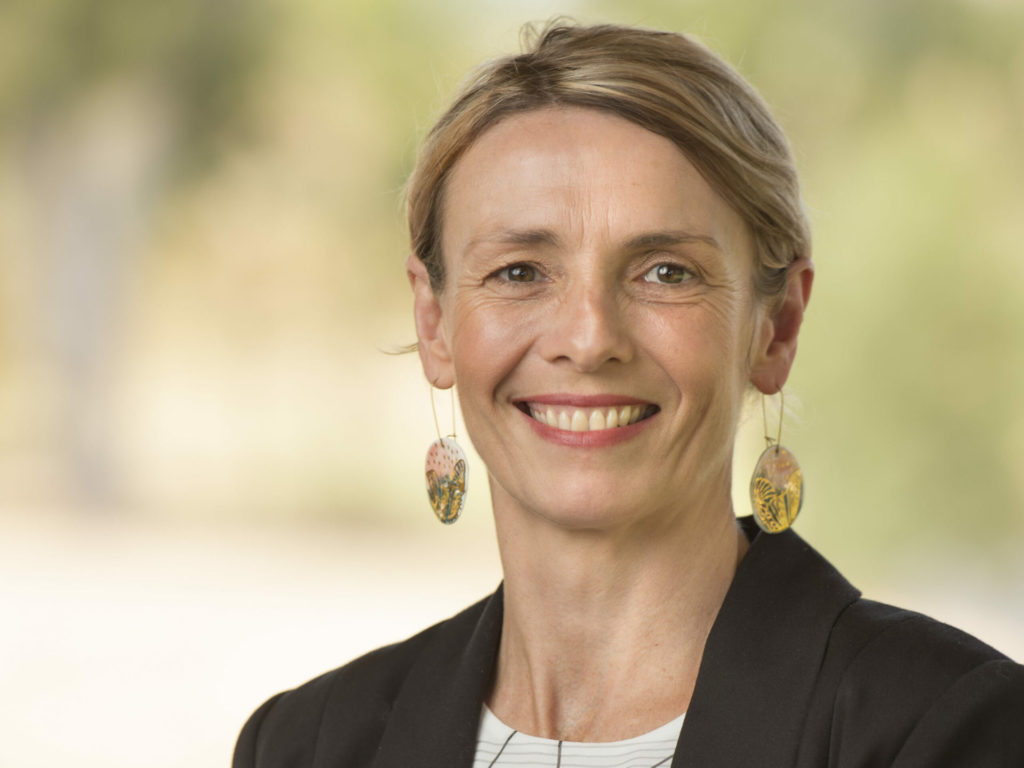
Image: The Foundation for Rural & Regional Renewal CEO Natalie Egleton (Source: FRRR)
FRRR CEO Natalie Egleton said rural communities want to take charge of climate action while also having a say in transition planning and investment. “The projects we’re funding present a range of climate solutions that showcase future-focused community-led responses,” she said.
“A strong theme is the engagement of young people, as well as sharing contextualised and culturally responsive knowledge and skills with the wider community.”
Two of the 24 funded projects are First Nations-led, while 11 involve partnerships with Traditional Owner groups. Ms Egleton added:
“We’re particularly pleased to see this strong engagement, as these projects will benefit many remote and very remote communities.”
Under the Engage and Deliver stream, nearly $400,000 will be shared among 20 organisations in grants of up to $20,000. A further four groups will share almost $255,000 through the Scaling stream, which supports larger projects that expand existing local initiatives and help communities lead climate adaptation and mitigation.
The CLCS program is supported by partners including Hand Heart Pocket – The Charity of Freemasons Queensland, the Paul Ramsay Foundation, Elders Insurance (backed by the QBE Foundation), and the PNI Foundation.
Now in its 25th year, FRRR has delivered more than $200 million to over 15,000 projects, reinforcing its role in strengthening the social and economic fabric of Australia’s rural, regional and remote communities.
Support our Journalism
No-nonsense journalism. No paywalls. Whether you’re in Australia, the UK, Canada, the USA, or India, you can support The Australia Today by taking a paid subscription via Patreon or donating via PayPal — and help keep honest, fearless journalism alive.
A Ballarat County Court jury has found 42-year-old Gunaseelan Manoharan guilty of multiple sexual assault offences involving a minor and an adult.
Manoharan, who moved to Australia from India in 2014, could face deportation if his visa is cancelled by the federal government.
Daily Mail reports that the court heard that Manoharan, who previously ran Rooh Indian Contemporary Restaurant and Bar in Horsham, sexually assaulted a teenage staff member between March 2021 and January 2022, as well as an adult employee. The restaurant, located at a Horsham Rural City–operated site, closed in March 2023.
It is reported that during the hearing, Manoharan caused a dramatic scene after being remanded in custody. He briefly fled the dock, embracing family members in court before being escorted back into custody.
It is further reported by Daily Mail that the teenage victim provided a statement detailing the lasting impact of the assaults, describing struggles with anxiety, mistrust, and the need for professional support to cope with trauma.
The adult victim also described inappropriate physical contact, which led her to leave the workplace.
Judge John Kelly will sentence Manoharan on November 12.
Support our Journalism
No-nonsense journalism. No paywalls. Whether you’re in Australia, the UK, Canada, the USA, or India, you can support The Australia Today by taking a paid subscription via Patreon or donating via PayPal — and help keep honest, fearless journalism alive.
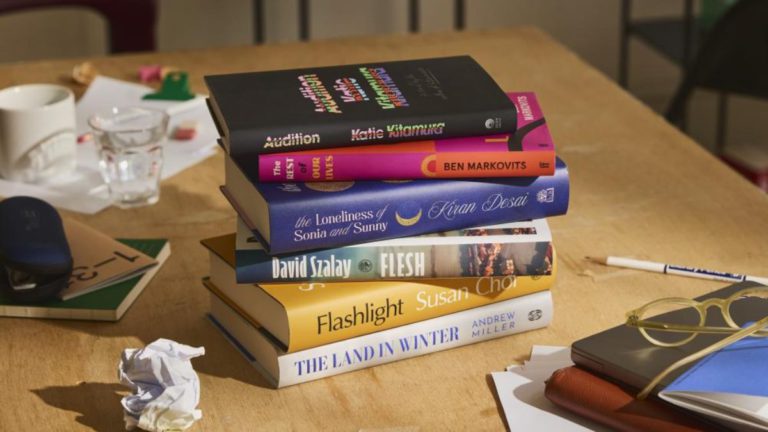
The Times has described the 2025 Booker Prize shortlist as “revenge of the middle-aged author”“. If the phrase sounds derogatory, it isn’t meant that way: the review also describes the shortlist as “novels for grown-ups”, with the prize privileging “maturity over novelty” and supporting “unpretentious, old-fashioned literary fiction”.
This is reinforced by the Booker Prize website, which highlights the previous winner (Kiran Desai) and two previously shortlisted authors (Andrew Miller and David Szalay) on the list, while noting that all six authors have long-established literary careers.
The Booker Prize and the International Booker Prize celebrate the best English-language fiction.
💻 Visit https://t.co/xj0R0qqXQD, and subscribe to our newsletter, for the latest news and features
— The Booker Prizes (@TheBookerPrizes) June 27, 2025
A book prize should reward novelty, though – and the Booker is, after all, a book prize, not an author prize like the Nobel. But if novelty isn’t obvious from the authors themselves, it can be detected in their books.
Their ages should not be a big surprise. Several literary prizes focus on older writers, including the newly launched Pioneer Prize for female writers over 60, established by Bernardine Evaristo to “acknowledge and celebrate pioneering British women writers” in all genres. Evaristo notes that the prize intends to correct the problem that “older women writers tend to be overlooked” – 91-year-old Maureen Duffy was its first recipient.
Perhaps these prizes and Booker nominations respond in part to society’s emphasis on youth, reflected in publishing initiatives such as Granta’s best young novelists, Penguin’s authors under 35 to watch and previously, The New Yorker’s 20 under 40 list.
It will be interesting to see whether the Booker winner this year reflects the suggested trend of overlooking older women writers, or responds to it. Three of the shortlisted authors are women, and according to my students and the bookies’ odds, Desai’s The Loneliness of Sonia and Sunny and Susan Choi’s Flashlight are likely contenders for the prize, with Ben Markovits’ The Rest of Our Lives behind them.
My students were drawn to the specific historical context of Flashlight, which conveys the lives of several generations of a family beginning in 1940s Japan, then moving through suburban America and North Korea. They valued the less-documented migration story, and suggested the mystery fiction aspect added wide appeal.
Markovits’ The Rest of Our Lives was seen as a typical Booker shortlist by my students, who identified the extra-marital affair, the road trip across America, and the internal-monologue narration of the eloquent and thoughtful university lecturer protagonist as factors which might make the book very popular.
Beyond this, the plot shares with Flashlight a fundamental uncertainty, with characters feeling out of place in their own lives. In The Rest of Our Lives, Tom’s life is gradually unbuttoned when he and his wife decide to stay together until their youngest child leaves home, following her affair. Rather than a dramatic upheaval, the narrator decides to undertake a picturesque road trip.
Image: 2025 Booker judges Ayobami Adebayo, Chris Power, Roddy Doyle, Sarah Jessica Parker and Kiley Reid. Neo Gilder (Source: Booker Prize Foundation)
An extra-marital affair is also at the centre of Miller’s The Land in Winter, in which the harsh winter of 1962-63 in England’s West Country forces two couples to confront their uncomfortable relationship dynamics, when they are forced to stay indoors to avoid the weather.
Disaster looms in the countryside through unpredictable people like Alison Riley, who is “the kind of person who might choose to bring the house down simply to find out what kind of noise it made”.
The uncertainty of individual identity, driven by unconventional and challenging family relationships, is the fundamental connecting factor between all six books, and Katie Kitamura’s Audition expresses this most directly.
Written in two parts, the novel considers the relationship between its protagonist and a younger adult male who may or may not be her son. The novel suggests, as the Booker judges note, that we play roles every day, like the actor protagonist of this novel – who first rejects the suggestion that the young man is her son, then later changes position to live alongside him as if he were.
But perhaps the novel that stands out most to me is Szalay’s Flesh. While this book likewise conveys the unravelling of life into uncertainty and risk, its plot concerns a 15-year-old boy in a relationship with a woman of his mother’s age. Flesh is written in lengthy dialogue, rendering the story sparse and sharp.
Having written about both of Desai’s previous novels as a scholar of post-colonial studies, I am eager to read The Loneliness of Sunny and Sonia, which was published on the day of the Booker shortlist announcement – an auspicious sign perhaps.
Only her third novel in a long career, it is described as a romance. Publishers have recently pointed to an upturn in the popular romance genre fiction, including subgenres like romantasy. This might offer favourable conditions for the book – helped by judge Sarah Jessica Parker’s association with romance, and a new wave of literary romance screen adaptations including Emerald Fennell’s Wuthering Heights and a new Netflix series of Pride and Prejudice in 2026.
The Loneliness of Sunny and Sonia begins with a 55-year-old protagonist whose parents control minute details of her life, but is centrally concerned with the epic and transnational love affair of its two eponymous characters.
The novel maintains Desai’s trend of changing literary direction between novels. Having herself lamented Hullaballoo in the Guava Orchard as “exoticist”, she responds to that accusation in The Loneliness of Sunny and Sonia, where protagonist Sonia is accused of writing “orientalist nonsense”. In a Guardian interview, Desai explained that the character expresses her own concern about how to write about India for a western readership.
Desai’s second novel, The Inheritance of Loss, was set in the aftermath of violence resulting from the claim for a separate state in post-Partition India. It won the Booker Prize in 2006 when Desai was 35, then the youngest woman to win the award – in 2013, it went to an even younger Eleanor Catton. This statistic suggests the Booker winner, at least, tends to be an older author.
The novels in this year’s shortlist all convey the overwhelming impact of uncertainty and change, and privilege introspective responses to disruptions that are sometimes hidden for decades. While (mostly) stories about middle age, they are anything but safe and comfortable.
Looking for something good? Cut through the noise with a carefully curated selection of the latest releases, live events and exhibitions, straight to your inbox every fortnight, on Fridays. Sign up here.
No-nonsense journalism. No paywalls. Whether you’re in Australia, the UK, Canada, the USA, or India, you can support The Australia Today by taking a paid subscription via Patreon or donating via PayPal — and help keep honest, fearless journalism alive.
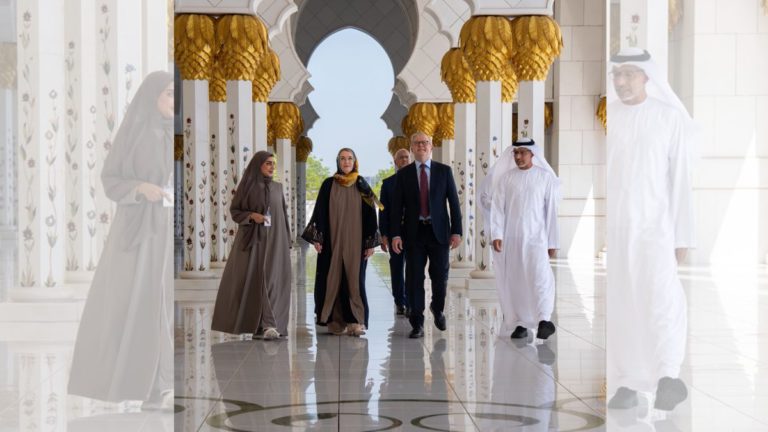
Prime Minister Anthony Albanese has begun the final leg of his longest overseas trip as leader with a symbolic visit to Abu Dhabi’s Sheikh Zayed Grand Mosque alongside partner Jodie Haydon, ahead of the launch of Australia’s first trade agreement in the Middle East.
Thank you to Her Excellency Reem Al Hashimy for the warm welcome to the United Arab Emirates. pic.twitter.com/XTRVA9PD7h
Albanese arrived in the United Arab Emirates on Monday and toured the vast white-marble mosque, which can host up to 7,800 worshippers and serves as the resting place of the nation’s founding father, Sheikh Zayed bin Sultan Al Nahyan.
The prime minister will also meet UAE President Mohamed bin Zayed Al Nahyan during his stopover, underscoring efforts to strengthen diplomatic and trade ties.
The Australia-UAE free trade agreement, finalised in September 2024, will officially take effect on 1 October 2025. The deal will make nearly all Australian exports to the UAE tariff-free once fully implemented, saving exporters up to $204 million annually. The agreement is seen as a gateway for Australian businesses to expand into the Middle East, even as negotiations with the European Union continue.
Support our Journalism
No-nonsense journalism. No paywalls. Whether you’re in Australia, the UK, Canada, the USA, or India, you can support The Australia Today by taking a paid subscription via Patreon or donating via PayPal — and help keep honest, fearless journalism alive.
Remembrance Day is being observed today to honour police officers who have lost their lives in the line of duty across Australia.
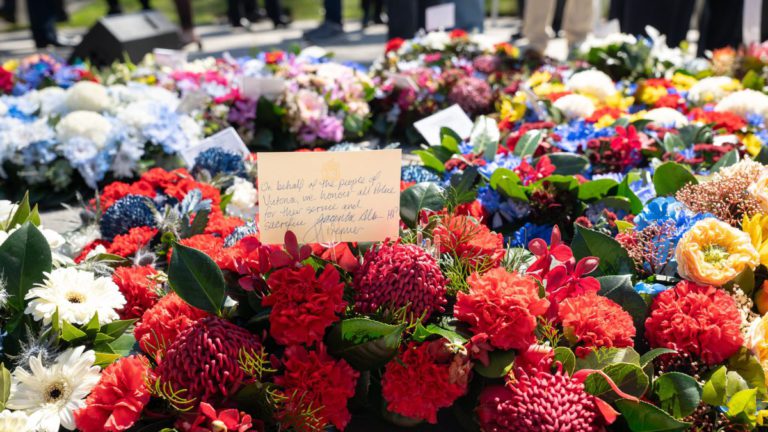
No matter what happens overseas, we are united by our common commitment to Australia, and by our care and respect for each other as fellow Australians.
NSW Premier Chris Minns paid tribute, saying: “Every day, we ask our officers to walk into terrible situations as an ordinary part of their job. The truth is we don’t have a choice – we need them. But with that comes a debt.”
“We owe them our gratitude, our resources, our unwavering support, and when the worst happens, we owe them our undying memory.”
This year, the state honours Constable Keith Smith from Tasmania, and Detective Neal Thompson and Senior Constable Vadim De Waart from Victoria, who were recently killed while on duty. Eight historic officers have also been added to the honour roll, alongside twelve officers and administrative staff who passed away in the past year. In total, 284 NSW Police officers have died in relation to their duties.
Today, on National Police Remembrance Day, we remember the 178 Victoria Police officers who have lost their lives in the line of duty since Victoria Police was established in 1853.
This day is a solemn occasion every year. But today, it feels especially heavy. pic.twitter.com/v77Zj4B0gM
Victoria Premier Jacinta Allan said: “Today, on National Police Remembrance Day, we remember the 178 Victoria Police officers who have lost their lives in the line of duty since Victoria Police was established in 1853. This day is a solemn occasion every year. But today, it feels especially heavy. Just one month after the loss of Detective Leading Senior Constable Neal Thompson and Senior Constable Vadim De Waart-Hottart.”
“I want to acknowledge their families, and the loved ones of every officer who paid the ultimate sacrifice – to protect and serve our community. We will never forget them. With honour they served.”
The Australian Federal Police (AFP) is joining forces with police across the nation to pause and remember those who have given their lives in service. The commemoration holds added poignancy following the brutal murder of Thompson and De Waart-Hottart in Porepunkah, Victoria, on 26 August 2025.
While Thompson and De Waart-Hottart will be added to the National Police Memorial in Canberra next year, a touchstone commemorating Constable Keith Smith, who was fatally shot in North Motton, Tasmania, on 16 June 2025, will be placed this year alongside 831 other officers. Smith was 57.
AFP Commissioner Reece P. Kershaw APM highlighted the dangers and sacrifices inherent in policing.
“Today, it is important to reflect on the very rewarding, but also very dangerous, job police perform all across Australia – the lives they touch, the communities they protect, and the countless ways they make a difference.”
Support our Journalism
No-nonsense journalism. No paywalls. Whether you’re in Australia, the UK, Canada, the USA, or India, you can support The Australia Today by taking a paid subscription via Patreon or donating via PayPal — and help keep honest, fearless journalism alive.
Melbourne-based deep-tech startup, Akula Tech, recently achieved a milestone with the successful launch of its AI-powered smart satellite, Nexus-01, aboard SpaceX’s Falcon 9 rocket via Dhruva Space’s LEAP-1 mission from Vandenberg Space Force Station in California.
We’ve established successful contact with #Nexus-01 🛰️ This milestone validates most advanced AI-powered Smart Satellite Technology and marks the beginning of a new era in space-based intelligence. 🚀
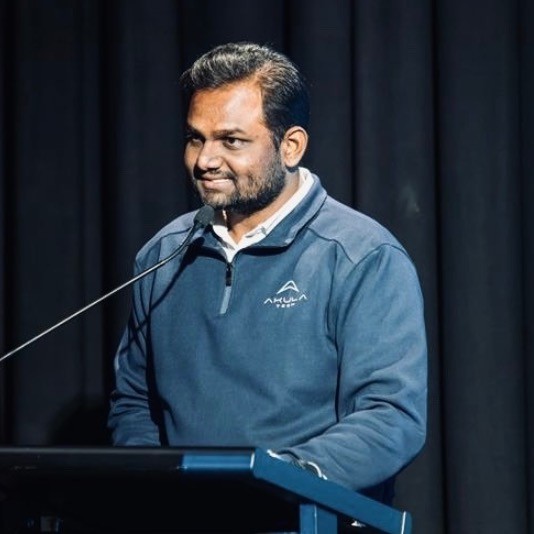
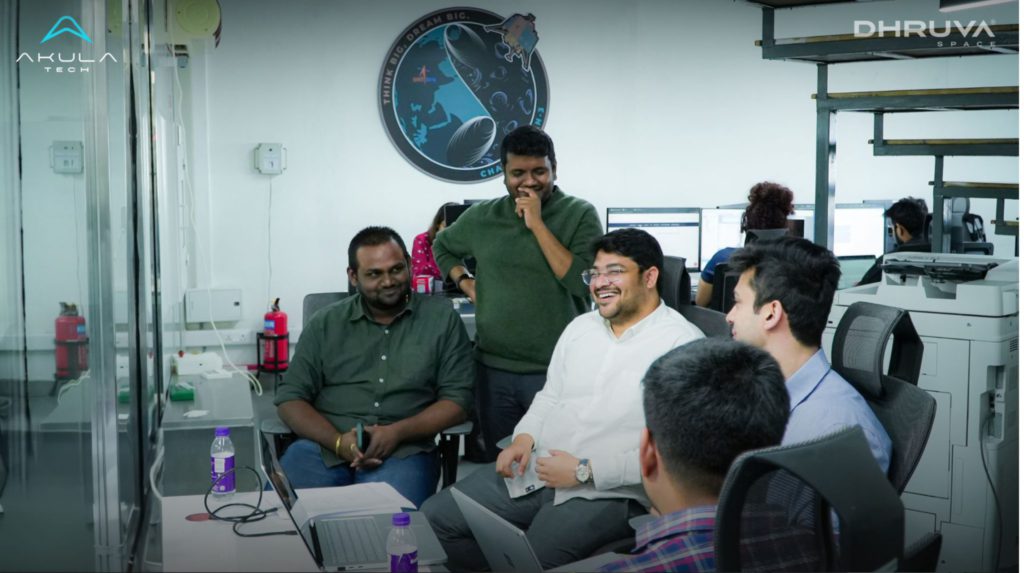
Founded by Indian-origin entrepreneur Preetham Akula, the startup partnered with Hyderabad-based Dhruva Space under the Launching Expeditions for Aspiring Payloads (LEAP) program. The mission also carries Esper Satellites’ OTR-2 hyperspectral imager, creating an end-to-end in-orbit data acquisition and processing ecosystem.
Preetham Akula (Image: LinkedIn)
Nexus-01 is being hailed as Australia’s most advanced AI-powered satellite, showcasing next-generation on-orbit artificial intelligence. Its onboard computing module processes hyperspectral data from Level 0 to Level 3 and runs multiple AI models simultaneously to deliver real-time insights directly from space.
🇮🇳🇦🇺 Presenting the details and the official mission patch for Dhruva Space’s LEAP-1 mission!
The breakthrough technology has far-reaching applications in defence, disaster response, climate monitoring, mining, shipping, agriculture and more.
By shifting from the traditional model of downlinking massive datasets for later Earth-based processing, Nexus-01 enables near-instant onboard analysis, slashing latency from days to minutes. This means insights can be delivered when they matter most—such as during floods, wildfires or other emergencies.
(Image: LinkedIn)
“This is more than a satellite, it’s a vision becoming reality,” said Akula Tech founder and CEO Preetham Akula. “Our AI engine can analyse complex data in orbit and deliver actionable insights with minimal delay. This mission is a stepping stone toward software-defined smart satellites and next-generation real-time intelligence infrastructure.”
🛰️ LEAP-1 FLIES TONIGHT!#DhruvaSpace's first commercial satellite venture built on the P-30 satellite bus is hosting two innovative In-Orbit Demonstration (IOD) payloads developed by Australia-based @AkulaTech and @EsperSats.
Akula Tech’s leadership highlighted the adaptability of the system, which can retrain AI models in orbit, adjust to new data, and operate across multiple use cases in parallel. The satellite also enables continuous improvement by retraining on live sensor data, laying the groundwork for an autonomous constellation of AI-enabled satellites working as a swarm.
(Image: LinkedIn)
Industry experts say the launch not only strengthens Australia’s standing in intelligent satellite systems but also underscores the growing contribution of Indian-origin innovators to global space technology.
Before lift-off at Vandenberg Space Centre, Dhruva’s co-founders, Sanjay Nekkanti, CEO, and Abhay Egoor, CTO, sporting our official mission LEAP-1 mission T-shirts! pic.twitter.com/S0c9K2S1NC
No-nonsense journalism. No paywalls. Whether you’re in Australia, the UK, Canada, the USA, or India, you can support The Australia Today by taking a paid subscription via Patreon or donating via PayPal — and help keep honest, fearless journalism alive.
India’s record-extending ninth Asia Cup title over Pakistan on Sunday in Dubai turned into a celebration of national pride, patriotism, and resilience both on and off the field.
Indian Cricket Captain for the tournament, Suryakumar Yadav, announced he would donate his match fees from the tournament to support India’s Armed Forces and the families of victims of the Pahalgam terror attack. “You always remain in my thoughts. Jai Hind,” Yadav said.
I have decided to donate my match fees from this tournament to support our Armed Forces and the families of the victims who suffered from the Pahalgam terror attack. You always remain in my thoughts 🙏🏽
The five-wicket win capped India’s unbeaten run in the tournament, with Tilak Varma’s unbeaten 69 anchoring the successful chase of 147 after Pakistan collapsed from 84-1 to 146 all out. Spinner Kuldeep Yadav led India’s bowling attack with figures of 4-30.
Celebrations were tempered by a tense post-match presentation, where India refused to accept the trophy from Asian Cricket Council (ACC) president and Pakistan Cricket Board chairman Mohsin Naqvi. Individual awards were presented to Indian players by other dignitaries, while Pakistan captain Salman Agha received the runners-up cheque from Naqvi.
When the game is done, only the champions will be remembered and not the picture of a 🏆 pic.twitter.com/0MbnoYABE3
“We have decided not to take the Asia Cup trophy from the ACC chairman, who happens to be one of the main leaders of Pakistan,” BCCI secretary Devajit Saikia told ANI. “It is unfortunate, but we hope the trophy and medals will be returned to India soon.”
Suryakumar Yadav described the unusual circumstances: “A champion team denied a hard-earned trophy — I feel we deserved it. But my real trophies are the 14 players and support staff who stood together throughout this journey.” The Indian team celebrated on the podium without the silverware, lifting an “imaginary trophy” to the delight of fans.
Special win, special team 🇮🇳💙 Every effort, every moment counted. Grateful to be part of this unit. The ASIA CUP CHAMPIONS 🏆 pic.twitter.com/1DcubDyLAq
Indian Prime Minister Narendra Modi congratulated the team on their unbeaten run, referencing their winning streak with a nod to national pride: “Operation Sindoor on the games field. Outcome is the same – India wins! Congrats to our cricketers.”
The team’s refusal to engage in post-match handshakes with Pakistan comes following the recent military conflict between the two countries after the Pahalgam terror attack in India in April this year. 25 Hindu tourists were targeted and killed by Islamist terrorists in this horrific terror attack. One Christian tourist and a local Muslim pony rider were also killed by the terrorists who were allegedly operating from Pakistan.
India responded with Operation Sindoor, a swift counter-terror operation that eliminated several terror operatives and struck Pakistani military bases. Modi hailed the operation as a demonstration of India’s intelligence capabilities and zero-tolerance stance on terrorism, warning that anyone threatening India’s security and dignity would face consequences.
Support our Journalism
No-nonsense journalism. No paywalls. Whether you’re in Australia, the UK, Canada, the USA, or India, you can support The Australia Today by taking a paid subscription via Patreon or donating via PayPal — and help keep honest, fearless journalism alive.
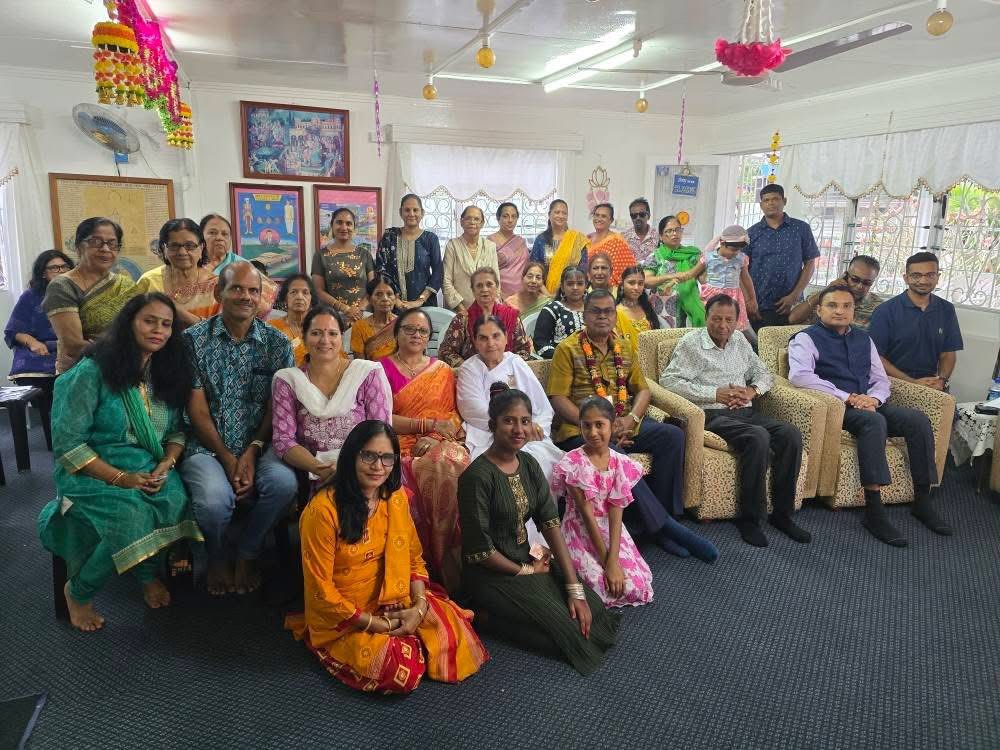
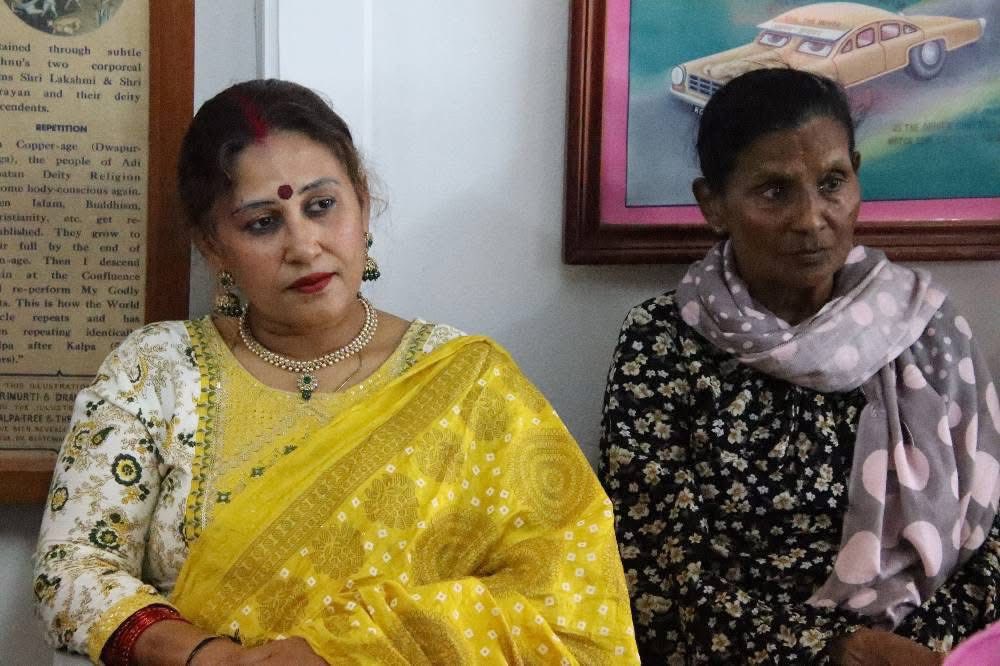
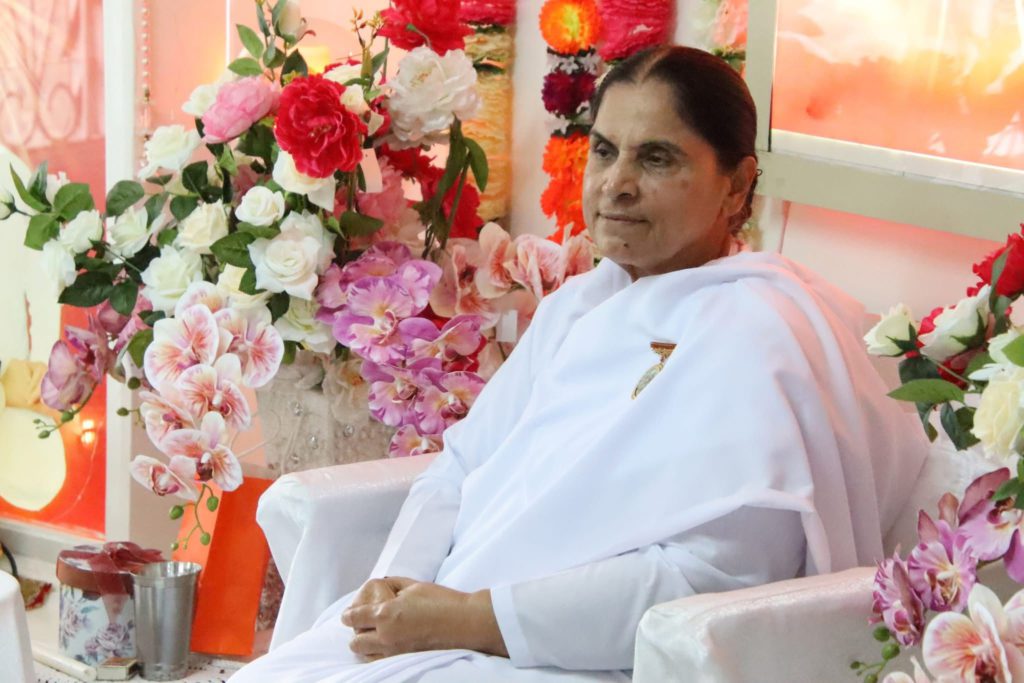
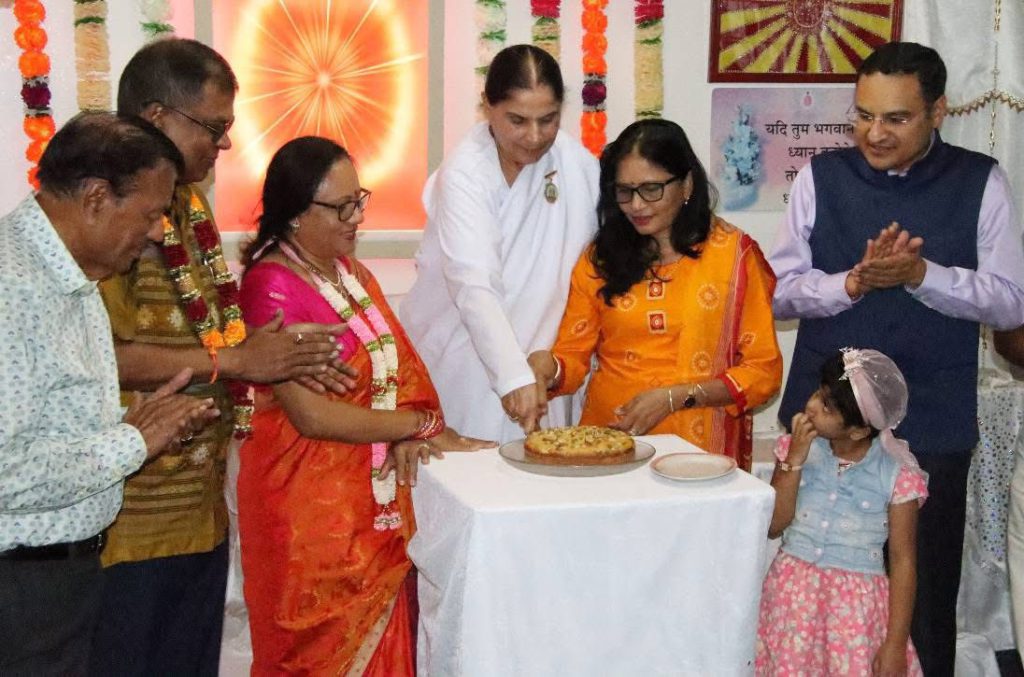
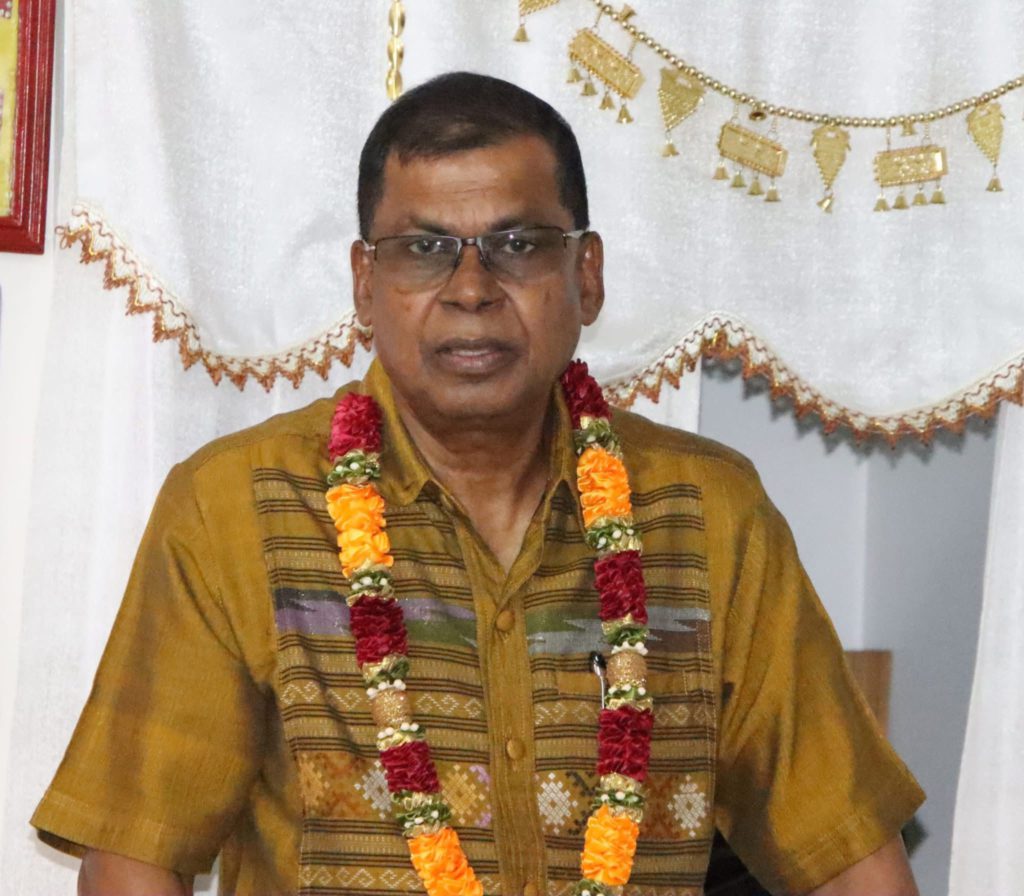
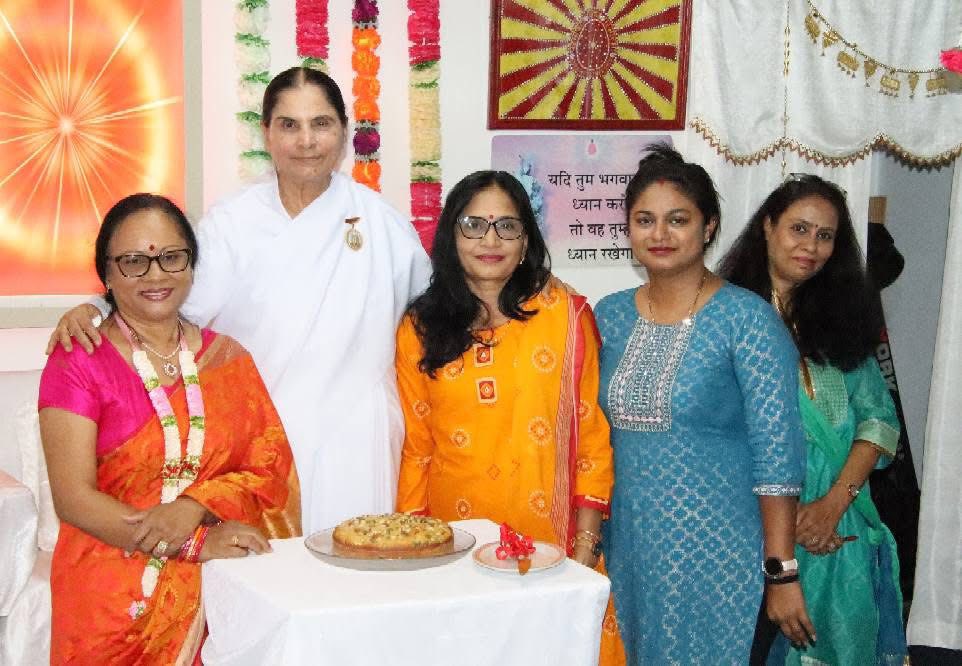
Fiji’s Acting Prime Minister and Minister for Finance, Prof. Biman Prasad, attended the Ram Navratri Puja at the Fiji Brahma Kumari Rajyoga Centre, celebrating one of Hinduism’s most revered festivals.
Ram Navratri, observed over nine nights, honours the victory of good over evil and is a time for reflection, devotion, and cultural celebration.
(Image: Biman Prasad DPM Facebook)
The festival holds deep spiritual significance for the Hindu community worldwide, including Fiji, where a vibrant Indian diaspora preserves and promotes traditional practices.
In his address to the devotees, Prof. Prasad emphasised the empowerment of women, recognising the countless sacrifices they make for their families and communities. He also expressed concern about the rising cases of domestic violence in Fiji, calling for collective action to ensure safety and equality for all citizens.
(Fiji’s Acting PM Biman Prasad – Image Facebook)
“Equal opportunities for everyone are vital for a just and inclusive society,” he said, underscoring the Government’s commitment to social equity.
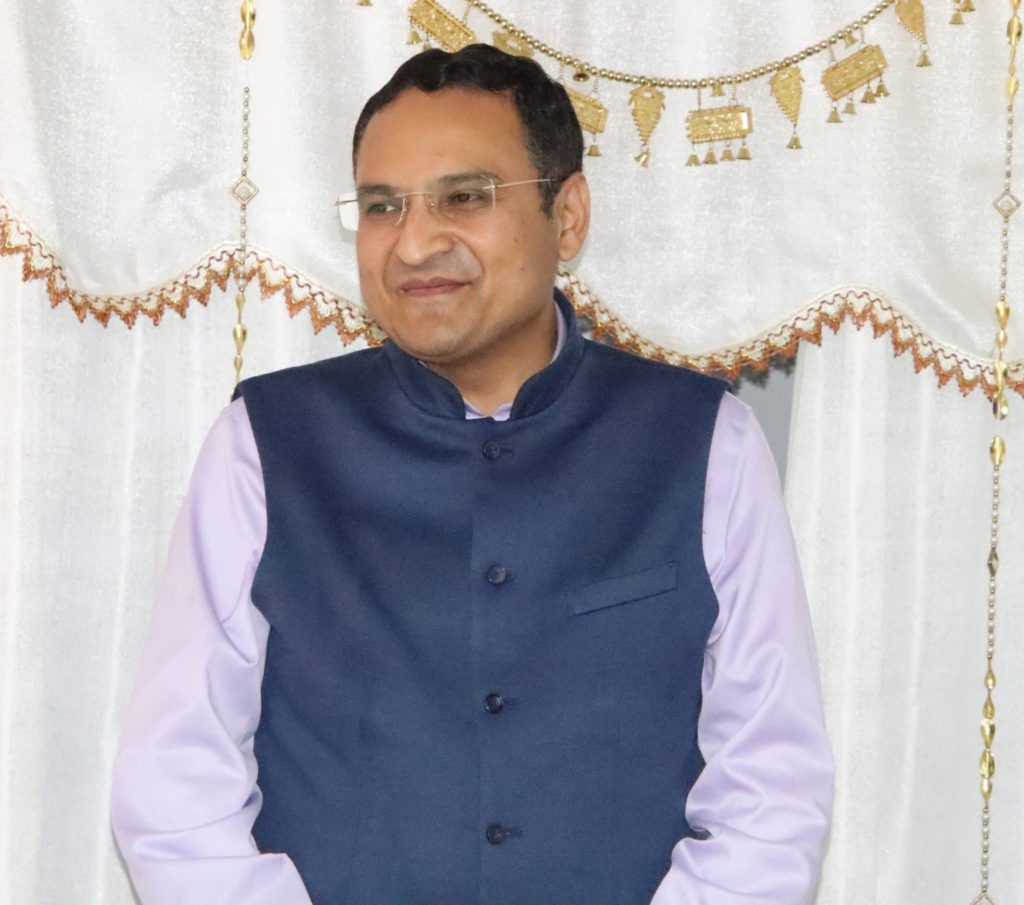
The event, attended by the Indian High Commissioner Suneet Mehta, also highlighted the strong cultural and diplomatic ties between Fiji and India, reflecting shared values and ongoing collaboration in promoting Indian traditions, festivals, and community welfare initiatives in Fiji.
Indian High Commissioner Suneet Mehta (Image: Biman Prasad DPM Facebook)
Support our Journalism
No-nonsense journalism. No paywalls. Whether you’re in Australia, the UK, Canada, the USA, or India, you can support The Australia Today by taking a paid subscription via Patreon or donating via PayPal — and help keep honest, fearless journalism alive.
A new report from Australia’s national science agency, CSIRO, estimates that a coordinated national platform for searching and accessing human biospecimens and data could generate up to $39 million in annual benefits. The savings and efficiencies would come from improved coordination across Australia’s more than 200 biobanks and cohort studies, enhancing research outcomes and accelerating scientific discovery.
Launched today in partnership with the NCRIS Health Group, NSW Health, University of Sydney, Medical Advances Without Animals Trust, Queensland Health, and University of New South Wales, the Valuation of increased coordination in Australian biobanking report aims to inform the country’s National Research Infrastructure Roadmap.
Australia stores over four million biospecimens, critical resources for biomedical, clinical, public, and population health research. These collections allow researchers to make better use of existing materials, ensure studies reflect the diversity of Australia’s population, and guide evidence-based health decisions.
Greg Williams, CSIRO Futures’ health and biosecurity lead, said national coordination offers major benefits. “Coordination at a national level reduces the time required to search and access biospecimens or data, accelerates research progress, promotes the use of existing biobanks, guides decisions about establishing or retiring collections, and improves overall risk management,” he said. “These aspects are essential to foster international collaborations, attract biopharmaceutical investment, and boost biobank outputs.”
Michael Dobbie, CEO of Phenomics Australia and steering committee member for the report, highlighted the longstanding need for national coordination. “Biobanks across all states and territories represent years of work by researchers, investment from funders, and trust from participants. Coordinating them nationally will maximise their value and accelerate lifesaving research,” he said.
Professor Jennifer Byrne, Director of Biobanking at NSW Health, noted that improving access and visibility could directly impact health outcomes. “For instance, a researcher studying a rare cancer could access biospecimens from multiple institutions, linked with rich clinical and genomic data, potentially uncovering new biomarkers that improve treatment responses and survival rates,” she said.
The report also outlines key recommendations for improving national coordination, including conducting a comprehensive survey of biobanks and cohort studies, implementing a shared national discovery and access platform, establishing a national governance framework, promoting a consistent quality management approach, and creating a national steering committee to guide coordination initiatives.
Bev Muhlhausler, Senior Principal Research Scientist at CSIRO, said the report provides a foundation for further discussions on connecting Australia’s biobanks through federated digital environments and consistent governance frameworks.
Support our Journalism
No-nonsense journalism. No paywalls. Whether you’re in Australia, the UK, Canada, the USA, or India, you can support The Australia Today by taking a paid subscription via Patreon or donating via PayPal — and help keep honest, fearless journalism alive.
The win capped India’s unbeaten run in the tournament, their third victory over Pakistan in this edition, with Tilak Varma’s unbeaten 69 anchoring a successful chase of 147 after Pakistan collapsed from 84-1 to 146 all out. Spinner Kuldeep Yadav starred with 4-30 in the bowling effort.
Indian Prime Minister congratulated the team on their Asia Cup victory over Pakistan, praising their performance with a playful reference to their winning streak.
However, the post-match presentation was delayed for over an hour, with India declining to collect the trophy from Naqvi. Instead, individual awards were handed to Indian players by other dignitaries, while Pakistan captain Salman Agha received the runners-up cheque directly from Naqvi.
“We have decided not to take the Asia Cup trophy from the ACC chairman, who happens to be one of the main leaders of Pakistan,” BCCI secretary Devajit Saikia told ANI.
𝗖. 𝗛. 𝗔. 𝗠. 𝗣. 𝗜. 𝗢. 𝗡. 𝗦 🏆
A dominant performance capped by an unbeaten campaign 💪
“It is unfortunate, but we hope the trophy and medals will be returned to India soon.”
India’s captain Suryakumar Yadav said he had never experienced anything like it in his career. “A champion team denied a hard-earned trophy — I feel we deserved it. But my real trophies are the 14 players and support staff who stood together throughout this journey,” he told reporters.
The Indian team eventually celebrated on the podium without the silverware, lifting an “imaginary trophy” to the delight of their fans in the stands.
Special win, special team 🇮🇳💙 Every effort, every moment counted. Grateful to be part of this unit. The ASIA CUP CHAMPIONS 🏆 pic.twitter.com/1DcubDyLAq
India had already made its stance clear during the tournament, avoiding handshakes with Pakistani players at the toss and post-match rituals, heightening tensions following the Pakistan’s support to terrorism resulting in recent military conflict.
The Board of Control for Cricket in India is now set to lodge a formal protest at the next ICC meeting in Dubai this November.
Support our Journalism
No-nonsense journalism. No paywalls. Whether you’re in Australia, the UK, Canada, the USA, or India, you can support The Australia Today by taking a paid subscription via Patreon or donating via PayPal — and help keep honest, fearless journalism alive.
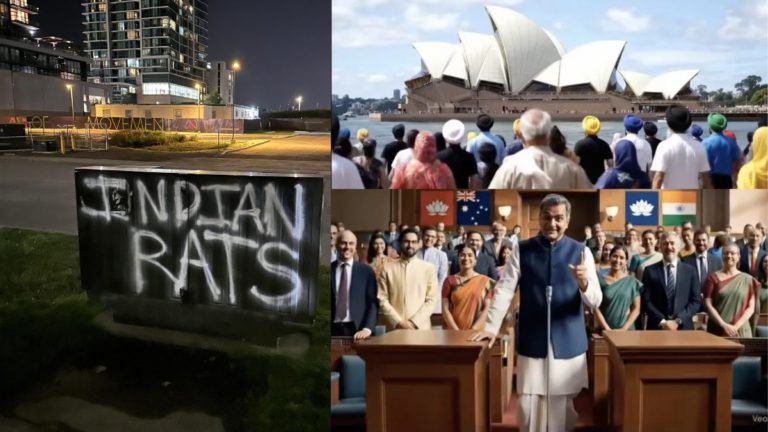
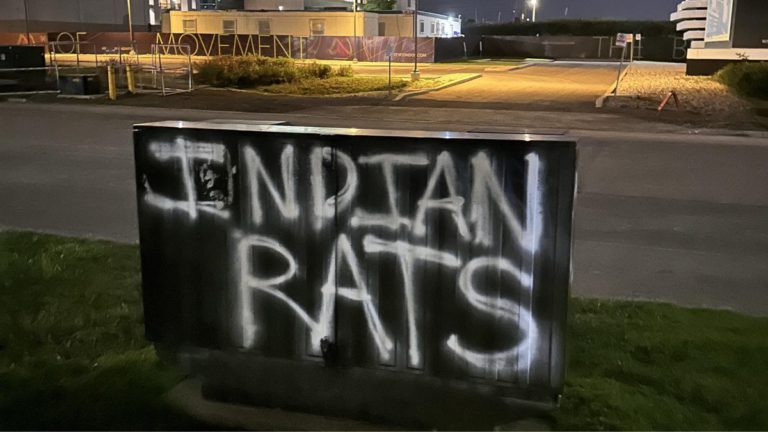
A hateful act of vandalism in Mississauga, where graffiti reading “Indian Rats” was discovered near a children’s park, has ignited outrage and renewed fears about a growing wave of racism and Hinduphobia directed at the Indian diaspora.
The Council of Hindus of North America (CoHNA) described the graffiti as “deeply disturbing” and part of a “broader pattern of intimidation and discrimination.” The group urged Peel Police to investigate the case as a hate-motivated crime and called for stronger anti-hate mechanisms at all levels of government.
🚨 We are deeply disturbed by the hateful graffiti discovered next to a children’s Park in Mississauga with the words “Indian Rats.”
For the Indian immigrant who photographed the graffiti, the attack felt deeply personal. “The Canada I chose to immigrate to had a reputation of being a country of the nicest people on God’s green earth. But in my three years here, I’ve faced so many incidents of racism that I’ve lost count,” they said, recounting repeated experiences of being mistaken for low-wage workers and subjected to “random” shopping cart checks.
“I’ve paid hundreds of thousands in taxes, rent, and services. I’m still committed to contributing, but can Canada do its part? At the very least, can we adhere to basic social decency?”
This story of prejudice is not confined to Canada. In Australia, a growing Indian community—long recognised for contributions in education, science, business, and healthcare—is facing a new wave of digital attacks fuelled by generative AI.
Cybersecurity experts warn these clips, while framed as satire, are anything but harmless. Others have cautioned that such content blurs the line between humour and propaganda, normalising bias and encouraging harassment.
The danger of this normalisation has already spilled offline. After an Air India Express plane crash in Ahmedabad claimed more than 270 lives, social media platforms were flooded with racist slurs targeting Indian victims.
One could argue that hateful graffiti and inflammatory memes have become rallying tools for the anti-immigration protests held across Sydney, Melbourne, Adelaide and other cities.
As a result, many young Indian-Australians say they feel unsafe after facing racist taunts, while others report receiving threats linked to these rallies. The growing hostility is also seeping into the political discourse, further deepening divisions. Some in opposition even suggesting that the Indian diaspora votes predominantly for Labor.
“Australia’s cohesion is not fixed—it requires active engagement and empathy.”
From playground walls in Canada to TikTok feeds in Australia, the Indian diaspora is increasingly caught in a crossfire of prejudice—both on the streets and in the digital sphere. Community leaders argue that while these attacks may appear isolated, together they signal a global trend of targeting a visible, peaceful and prosperous minority.
Support our Journalism
No-nonsense journalism. No paywalls. Whether you’re in Australia, the UK, Canada, the USA, or India, you can support The Australia Today by taking a paid subscription via Patreon or donating via PayPal — and help keep honest, fearless journalism alive.
In 2024, more than A$2.03 billion was lost to scams in Australia across 494,732 reported cases. Most of these scams were enabled by technology, with scammers contacting their victims either online or on the phone. However, about 600 of these scams happened in person.
All of us are vulnerable to being scammed – it’s rooted in who we are as human beings. If you think you’re immune, you are not. Police officers fall for scams. Even cyber security professionals fall for scams. So what hope is there for the rest of us?
What does help is to understand the underlying techniques online scammers rely on, so that you can better spot them. These psychological tactics are similar to those used in offline scams, street cons and social engineering in general. But they’re also reminiscent of techniques used in advertising, marketing and any other industry where the goal is to persuade you.
Unmasking the influence principles
The goal of a scammer is to try and influence you to part with your money or other valuable possessions. They rely on classic persuasion and influence principles that take advantage of our psychology and other aspects in our lives.
The reason we pay attention to scammers in the first place is because they rely on the need and greed principle, promising us something we need or desire. In romance scams, that’s love. In investment scams, that’s money. It could also be a job or status.
Scammers may use the authority principle, such as pretending to be your boss and requesting you to transfer money, a scam known as business email compromise.
Or they may use the kindness principle to get you to donate to some bogus humanitarian cause in what are known as fake charity scams.
The principle underlying some of the most costly scams in Australia, such as impersonation, romance, and payment redirection scams is the distraction principle. This relies on us missing the scammers’ “sleight of hand” and clues as to their real intentions.
We are all social animals and believe in safety in numbers. Scammers know this and will use the herd or social proof principle to convince us that we are missing out on those hard-to-get concert tickets, for example.
An insidious form of a foot-in-the-door technique relies on the dishonesty principle. In this case, the scammers might entice you to install a VPN (which happens to be malware) to bypass your organisations’ firewalls or to provide use of your bank account for some international money transfer in money mule scams.
American psychologist Robert Cialdini has noted many of these principles are what salespeople use to get you into buying something you didn’t really want. They are also the principles that politicians, friends and family use to get you to agree to their requests. In other words, they’re not always a sign that you’re being scammed.
To identify a scam, ask yourself these three simple questions:
what is the intent?
who benefits?
do I have a free, informed choice?
Rushing to pay for a holiday booking because the countdown timer indicates you have two minutes left relies on the same scarcity principle as when you transfer your savings into a once-in-a-lifetime investment opportunity. The former is a legitimate transaction, while the latter is an investment scam in which you lose.
Ultimately, the core problem is that every day, we are constantly exposed to such nudges – in the media, online, and in our daily interactions. Over time, it can become difficult to recognise when these nudges are used for negative ends (called “sludges”), and in scams.
This is why anyone can be scammed
Anything that makes us human can be exploited to influence us. Our perception, emotions, relationships, thinking and beliefs can be used to influence our behaviours.
While not everyone will fall for common or generic scams, any of us can fall for a targeted and well-executed one. Demographics play a role in whom scammers choose to target to increase their success rates.
In Australia in 2024, elderly people were commonly targeted in investment and romance scams, while mothers lost thousands to “Hi Mum” scams where someone posing as a family member asks for money. Young people fell prey to threat-based scams. Men tended to lose money in investment scams, while women were more vulnerable to romance scams.
Don’t be too confident
Importantly, overconfidence in our scam savviness can work against us. When we have high trust in our abilities, we tend to assess situations as less risky, taking mental shortcuts in decision-making. Such mental shortcuts can cause us to miss critical cues and red flags.
Different sectors in Australia are working together to warn us all about scams. The “Stop. Check. Protect” approach recommended by Scamwatch also provides very helpful tips to better protect yourself.
Remember today could be the day you get scammed. Prepare accordingly and stay vigilant.
No-nonsense journalism. No paywalls. Whether you’re in Australia, the UK, Canada, the USA, or India, you can support The Australia Today by taking a paid subscription via Patreon or donating via PayPal — and help keep honest, fearless journalism alive.
Canadian authorities are being urged to investigate after hateful graffiti reading “Indian Rats” was discovered near a Mississauga children’s park, raising serious concerns about rising racism and Hinduphobia in Canada.
The Council of Hindus of North America (CoHNA) Canada described the incident as “deeply disturbing” and said it reflects a broader pattern of intimidation and discrimination faced by Indo-Canadians.
“The hate is growing more visible, but the actions from law enforcement and lawmakers have not kept pace,” CoHNA said, calling on Peel Police to treat the incident as a hate-motivated crime and advocating for stronger anti-hate measures at municipal, provincial, and federal levels.
🚨 We are deeply disturbed by the hateful graffiti discovered next to a children’s Park in Mississauga with the words “Indian Rats.”
The person who took the photo, an Indian immigrant who regularly walks past the area with their family, shared their personal experience with racism in Canada.
“The Canada I chose to immigrate to had a reputation of being a country of the nicest people on God’s green earth. But in my three years here, I’ve faced so many incidents of racism that I’ve lost count,” they said.
They described repeated experiences of being mistaken for a store employee or Uber Eats delivery driver, and being subjected to random checks while shopping.
“At first, I ignored these incidents or justified them as profiling, but over time I started to realise it was racism. And now this? This is right next to a children’s park. What did I even do to not deserve a respectful life here?”
Person who took the photo:
As an immigrant of Indian descent who routinely strolls past this walkway with my family, I feel hurt by racism like this. The Canada I chose to immigrate to had a reputation of being a country of the nicest people on God’s green earth.
The photo-taker highlighted their contributions to Canada’s economy, noting that in three years they have paid significant taxes, rent, and spent on local services.
“I’m still committed to contributing, but can Canada do its part? At the very least, can we adhere to basic social decency?” they said, warning that persistent racism could drive top talent away from the country.
CoHNA reiterated the urgent need for recognition of Hinduphobia as a distinct form of hate alongside other forms of racism and called for immediate action to address such incidents.
Support our Journalism
No-nonsense journalism. No paywalls. Whether you’re in Australia, the UK, Canada, the USA, or India, you can support The Australia Today by taking a paid subscription via Patreon or donating via PayPal — and help keep honest, fearless journalism alive.
India on Saturday ridiculed Pakistan Prime Minister Shehbaz Sharif’s claim of “victory” during the May Operation Sindoor conflict, calling his UN General Assembly speech “absurd theatrics” that glorified terrorism.
Exercising India’s right of reply at the 80th UNGA session, Indian diplomat Petal Gahlot said Pakistan’s military had “pleaded” with India to cease fighting on May 10, exposing Sharif’s claim of a win as misleading. “If destroyed runways and burnt-out hangars look like victory, Pakistan is welcome to enjoy it,” Gahlot said, highlighting images of damaged air bases and military infrastructure during India’s strikes.
Gahlot further accused Pakistan of harbouring terrorists and sponsoring attacks on Indian civilians, including the April 22 Pahalgam massacre. She warned that India would hold both terrorists and their sponsors accountable and reiterated that any issues between New Delhi and Islamabad must be addressed bilaterally, with “no room for any third party.”
Sharif had presented Pakistan as the winner of the May escalation, claiming a ceasefire achieved “from a position of strength” with help from US President Donald Trump. India, however, maintained that the cessation of hostilities was a result of direct military talks.
Calling Pakistan a country “long steeped in the tradition of deploying and exporting terrorism,” Gahlot cited Operation Sindoor’s success in destroying terror camps of Lashkar-e-Taiba, Jaish-e-Mohammad, and Hizbul Mujahideen, killing over 100 terrorists, and leaving Pakistan’s military infrastructure damaged.
She concluded by stressing that Pakistan must dismantle its terror infrastructure to show any sincerity for peace and warned against using nuclear threats to shield terrorism.
“India will never bow to such threats. The message to the world is clear: zero tolerance for terrorism.”
Support our Journalism
No-nonsense journalism. No paywalls. Whether you’re in Australia, the UK, Canada, the USA, or India, you can support The Australia Today by taking a paid subscription via Patreon or donating via PayPal — and help keep honest, fearless journalism alive.
New Zealand has decided against recognising the State of Palestine at this stage, with Foreign Minister Winston Peters reaffirming the country’s long-standing “when not if” position during his address to the UN General Assembly in New York.
Peters said the decision reflects current realities in the region, where Hamas remains the de facto authority in Gaza, violence continues, and there is no clear path forward.
“With a war raging, Hamas remaining the de facto government of Gaza, and no clarity on next steps, too many questions remain about the future State of Palestine for it to be prudent for New Zealand to announce recognition at this time.”
“With a war raging, Hamas remaining the de facto government of Gaza, and no clarity on next steps, too many questions remain about the future State of Palestine for it to be prudent for New Zealand to announce recognition at this time.”
He warned that recognising Palestinian statehood prematurely could harden the positions of both Israel and Hamas, making a ceasefire and meaningful negotiations more difficult to achieve.
“Recognition at this time, we also think, is open to political manipulation by both Hamas and Israel. Hamas will seek to portray our recognition as a victory, while Israel will claim it rewards Hamas.”
New Zealand continues to support a two-state solution and Palestinians’ right to self-determination, but Peters stressed the need for “dialogue, diplomacy and leadership – not further conflict and extremism.”
He also voiced strong concerns about the humanitarian crisis in Gaza, condemning both Hamas’ hostage-taking and Israel’s “grossly disproportionate” military actions and illegal settlement activity in the West Bank.
To support urgent humanitarian needs, New Zealand announced an additional $10 million in funding to international partners delivering emergency supplies into Gaza, bringing its total contribution to $47.5 million.
Cabinet papers show Peters presented two options in August: immediate recognition of Palestine with conditions, or continuation of New Zealand’s current approach. Cabinet endorsed the latter on 15 September, with the decision confirmed by Peters and Prime Minister Christopher Luxon ahead of the UN Assembly.
Peters acknowledged the “good intentions” of countries that have recognised Palestine but argued New Zealand’s recognition should come at a time when it can make a tangible contribution to peace.
“We have one opportunity to recognise Palestinian statehood,” Peters said.
“It makes better sense to do so when the conditions offer the greatest prospects for peace.”
New Zealand’s position leaves it aligned with countries such as Singapore, Japan, South Korea and the United States, who have also held back from recognition.
Support our Journalism
No-nonsense journalism. No paywalls. Whether you’re in Australia, the UK, Canada, the USA, or India, you can support The Australia Today by taking a paid subscription via Patreon or donating via PayPal — and help keep honest, fearless journalism alive.
Humans are finite beings; we tend to perceive time in a linear fashion, as a sequence of the past, present and future, often measured through the changes we observe around ourselves. Days follow nights, weeks roll into months, and our lives unfold in an order that seems fixed. Yet, while we may live within this line of time, our experience of it is often anything but straight.
We remember differently than we live. We group moments by similarity, not by sequence, and we return again and again to the same events, even when years have passed.
Literature has long understood this contradiction. Writers bend and fracture time in their stories, creating structures that feel closer to the workings of memory than to the ticking of a clock. The result is that time in books often mirrors human consciousness itself: layered, cyclical, interrupted, and sometimes haunting. Henri Bergson described this as durée—a lived time where the past is never gone but constantly flows into the present. Marcel Proust dramatised it when a taste of cake reawakened a childhood world—not as a memory filed away, but as a past relived in the now.
Virginia Woolf’s Mrs Dalloway offers a clear example. The novel takes place over the course of a single day in London, yet through the consciousness of its characters we move freely between decades. Clarissa recalls her youth, Peter his old love, Septimus the horrors of war. The tolling of Big Ben anchors the present, but the characters’ thoughts drift and return unpredictably. Woolf shows us how one moment in the present can be filled with the shadows of many pasts, and how a single day can contain a lifetime.
In William Faulkner’s The Sound and the Fury, the sense of time is even more fragmented. The first section, narrated by Benjy, collapses past and present into one continuous flow. For Quentin, time presses down like a weight, while Jason treats it as something purely mechanical. The Compson family’s story cannot be told in order because each consciousness experiences time differently. Heidegger reminds us that human life is always “being-in-time”: we do not leave the past behind, but carry it into every moment of the present. Faulkner’s fractured clocks echo this truth.
Other writers show how time itself seems to repeat. Gabriel García Márquez in One Hundred Years of Solitude shapes Macondo as a place where generations circle back on themselves, repeating names, mistakes, and desires. The past is not gone but alive, echoing through descendants. Toni Morrison’s Beloved works with a similar idea, though in a different register. Sethe’s memories of slavery do not remain buried in the past. They erupt into the present, returning with the force of ghosts. Here Morrison mirrors what trauma theorists like Cathy Caruth have noted: traumatic events are not remembered in order but intrude belatedly, disrupting the flow of time itself.
Perhaps the most striking challenge to linear time comes in Kurt Vonnegut’s Slaughterhouse-Five. Billy Pilgrim becomes “unstuck in time,” slipping without warning from one moment of his life to another. He experiences his wedding, his captivity during the firebombing of Dresden, and even his abduction by aliens all as part of the same disordered sequence. This randomness reflects how trauma lingers: war veterans do not recall their experiences neatly in order, but are struck by sudden and involuntary returns. Vonnegut’s novel captures the sense that time, especially in the face of suffering, is not a smooth river but a series of jarring interruptions.
These literary experiments feel so familiar because they resonate with how human beings actually live and remember. Time is not only the hours on a clock or the pages on a calendar. Sometimes a single task stretches endlessly, while whole months seem to vanish in hindsight. Years that felt unbearable while we endured them can later appear to have flown by in an instant. We do not tell the story of our lives by reciting each day in order. Instead we remember in clusters and themes: the childhood summers, the difficult year at university, the period of grief, the season of joy.
Writers who fracture time remind us that human life is not best understood as a straight line. Our perception bends and folds, linking what is alike and splitting apart what is not. Memory interrupts the present, and the present constantly reshapes our memory of the past. By breaking away from chronological order, literature reveals something profound about us. We live linearly, but we carry our pasts in ways that resist order. Perhaps time itself is less a line and more a pattern—a constellation of moments that shine differently depending on where we stand.
Support our Journalism
No-nonsense journalism. No paywalls. Whether you’re in Australia, the UK, Canada, the USA, or India, you can support The Australia Today by taking a paid subscription via Patreon or donating via PayPal — and help keep honest, fearless journalism alive.
The 69th Hibiscus Festival has been praised as a celebration of Fiji’s culture, unity and community spirit, with Acting Prime Minister and Minister for Finance, Prof. Biman Prasad, describing it as “the beating heart of our nation.”
Alongside Miss Hibiscus 2025 Rhyelle Aisea (Miss National Fire Authority), Miss Unique Rubber Stamps Temalesi Tuiwalese was named first runner-up, and Miss Leleuvia Resort Tiare Colavoli took second runner-up.
Image: Fiji’s Acting PM Prof. Prasad greeting Miss Hibiscus 2025 Rhyelle Aisea (Miss National Fire Authority) (Source: Facebook)
Speaking at the festival’s closing ceremony in Suva, Prof. Prasad congratulated the newly crowned Miss Hibiscus 2025 and commended all ten contestants for their “grace, intelligence and poise.”
“To the ten contestants, you have embodied the festival’s spirit, and you have inspired us all.”
The Acting Prime Minister also thanked the festival’s major sponsor, Flour Mills of Fiji, as well as Vodafone, Coca-Cola, Holiday Inn, Fiji Water, Fiji Airways, Fiji TV, Fiji Times, contestant sponsors and other partners for their contribution.
Image: Fiji’s Acting PM Prof. Prasad at Miss Hibiscus 2025 (Source: Facebook)
Prof. Prasad applauded the Suva City Council, the Hibiscus Committee, WWF Pacific, All Nations Youth, and the many volunteers who ensured the festival was safe, clean and family-friendly.
“The Hibiscus Festival is not just a carnival but a platform that empowers our women and youth, strengthens our communities, and reminds us of the power of coming together.”
He described this year’s event as a “resounding success” and said he looked forward to the milestone 70th festival next year.
Image: Miss Hibiscus 2025 Rhyelle Aisea (Miss National Fire Authority), Miss Unique Rubber Stamps Temalesi Tuiwalese was named first runner-up, and Miss Leleuvia Resort Tiare Colavoli took second runner-up (Source: LinkedIn – Prof. Biman Prasad)
Prof. Prasad, who personally presented the winner’s bouquet, said it was a privilege to take part in the crowning ceremony and offered his best wishes to the new queen and her fellow contestants.
Support our Journalism
No-nonsense journalism. No paywalls. Whether you’re in Australia, the UK, Canada, the USA, or India, you can support The Australia Today by taking a paid subscription via Patreon or donating via PayPal — and help keep honest, fearless journalism alive.
In late July, during a visit to the National Gallery of Australia, three Buddhist bodhisattva statues caught my attention.
All three were created in the ancient Champa Kingdom that flourished from the 2nd to 19th centuries across present-day Vietnam, Cambodia and Laos. They were purchased by the National Gallery (NGA) in 2011, before being “repatriated” to the Kingdom of Cambodia in 2023 (and displayed in the NGA on loan).
Champa Kingdom, Avalokiteshvara Padmapani, Vajrapani and Avalokiteshvara Padmapani, 9th–11th century, National Gallery of Australia, Kamberri/Canberra, Acquired 2011, deaccessioned 2021, repatriated 2023, On loan from the Kingdom of Cambodia, 2023–2026.
But the Champa Kingdom bore little resemblance to Cambodia’s current borders. What does repatriation mean when the political geography of a place has entirely transformed?
As my research has shown, museums, schools and state institutions can help sanction certain versions of history, while marginalising others. The quiet presence of the bodhisattvas in a museum case embodies much larger questions about cultural heritage, political legitimacy, and who gets to define historical “truth”.
Decades of marginalisation
The decision to return the Cham artefacts to Cambodia, and to exclude Vietnam and Laos, highlights how contemporary politics shape our understanding of cultural heritage.
Although most Cham people today are Muslim, the statues were made between the 9th and 11th centuries during a pre-Islamic era. This period was marked by strong Hindu and Buddhist influence, and a lack of nation-state borders.
After receiving the repatriated statues in 2023, Cambodian Ambassador to Australia, Cheunboran Chanborey, said:
Indeed, putting looted artefacts to their countries of origin can have significant and positive impacts on local communities and their involvement in preserving their cultural heritage. It can foster a sense of pride, national identity and cultural continuity as artefacts hold immense value for the communities to which they belong.
But the very cultural tradition that created the bodhisattvas now finds itself sidelined in a modern nation-state claiming ownership of them.
The three sculptures were made between 9th-11th centuries in the Champa Kingdom. Author provided
Lootings by the Khmer Rouge
The historical context of how the Cham poeple’s artefacts were looted is crucial and disturbing.
Journalist Anne Davies’ account in the NGA’s documentation notes organised looting networks were “often headed by members of the military or the Khmer Rouge”. The Khmer Rouge was the political party that ruled Cambodia from 1975–79 under the notorious Pol Pot, carrying out a genocide of the Cham people (as well as other ethnic groups).
However, this looting actually took place in the 1990s, after the Khmer Rouge was overthrown by the precursors to the present-day Cambodian People’s Party.
In other words, the looting happened on the current government’s watch. Davies writes “members of the military” of the Royal Cambodian Armed Forces worked with former Khmer Rouge soldiers who continued to occupy parts of northern Cambodia, especially areas protected by thick forest.
Looted artefacts moved from the hands of former Khmer Rouge members to the Cambodian military, and eventually to international markets.
A revealing 2009 photograph shows Douglas Latchford, the antiquities dealer who sold the statues to the NGA, examining artefacts at the National Museum of Cambodia, alongside Sok An, the then-deputy prime minister of the Cambodian People’s Party. Latchford is wearing a medal signifying Cambodian knighthood, suggesting a collaborative relationship.
Parallels to other illegal trades
After retreating to border forests in 1979, the Khmer Rouge began systematic, illegal timber logging, selling the wood throughout Thailand and Cambodia. Global Witness has documented how the ruling elites in both countries have profited substantially from this trade.
The connections between logging and looting are striking: both involved illegal acts by former Khmer Rouge soldiers that ultimately enriched ruling parties.
When I saw photos of the Cambodian Ambassador to Australia formally receiving the repatriated statues in 2023, the irony was inescapable. His party, the Cambodian People’s Party, was likely complicit in the original theft.
Historical context transforms repatriation’s meaning. Rather than restoring cultural heritage to rightful guardians, these ceremonies may serve as elaborate exercises in political laundering, allowing those who profited from cultural destruction to rebrand themselves as cultural preservationists.
A new framework
The implications of this extend far beyond Cambodia. In a world where borders have been redrawn countless times, and where many cultural traditions transcend boundaries, we need new frameworks for thinking about cultural heritage.
The NGA says it followed the Protection of Movable Cultural Heritage Act 1986 in returning the bodhisattvas to Cambodia. But the wall text for the statues acknowledges their complexity:
While the works were almost certainly created in Vietnam […] the archaeological site where they were found is in Cambodia.
The wall text at the gallery explains how the statues were acquired by Douglas Latchford, before being sold to the NGA and eventually repatriated. NGA
The statutes were found in a different country from where they were created because the borders of those territories shifted over time.
Borders in the Mekong region of Southeast Asia have long been porous. It was only in 2012 that the last border marker between Cambodia and Vietnam was agreed on. We have also seen recent fighting over the Cambodian–Thai border.
Contested sovereignty remains a live political issue affecting how we understand cultural heritage. Is country of “origin” determined by where objects were created, or where they were discovered?
Perhaps genuine cultural justice requires acknowledging complexity rather than seeking simple solutions. Instead of asking which modern nation-state deserves these artefacts, we might ask: how can cultural heritage serve all peoples who share connections to it?
The three bodhisattvas remind us repatriation is never simply about returning objects to their “rightful” place. It’s about who gets to define that place, whose version of history becomes officially sanctioned, and whether cultural justice might sometimes serve to obscure, rather than remedy, historical injustice.
No-nonsense journalism. No paywalls. Whether you’re in Australia, the UK, Canada, the USA, or India, you can support The Australia Today by taking a paid subscription via Patreon or donating via PayPal — and help keep honest, fearless journalism alive.
The new rule, effective immediately, bans states from granting CDLs to non-citizens unless they hold valid employment visas and pass mandatory immigration checks through the federal SAVE system. Licences must also expire within one year or when a driver’s lawful presence ends, whichever comes first.
“What our team has discovered should disturb and anger every American,” Duffy said.
“Licences to operate massive, 80,000-pound trucks are being issued to dangerous foreign drivers – often times illegally. This is a direct threat to the safety of every family on the road.”
California was singled out as the worst offender, with federal investigators finding more than a quarter of non-domiciled CDLs reviewed had been improperly issued.
The Department of Transportation has ordered California to immediately halt the issuing of non-domiciled CDLs, audit all outstanding licences, and revoke any that fail to meet the new federal standards. The state has 30 days to comply or risk losing nearly $160 million in federal highway funding, a figure that would double in the second year of non-compliance.
“California’s reckless disregard is frankly disgusting and an affront to the millions of Americans who expect us to keep them safe,” Duffy warned.
“If California doesn’t comply, I will not hesitate to pull millions in funding.”
The crackdown comes amid heightened scrutiny of truck licensing rules. Since January, at least five fatal crashes involving non-domiciled CDL holders have been reported, including a Texas pile-up in March that killed five people and an August crash in Florida that claimed three lives.
UPDATE: Harjinder Singh, an illegal alien from India who killed three innocent people, FAILED an English Language Proficiency assessment. Singh provided correct responses to just 2 of 12 verbal questions and only accurately identifying 1 of 4 highway traffic signs.
The crash, which occurred on 12 August near mile marker 171 in St. Lucie County, happened when Harjinder Singh attempted to make an illegal U-turn through an “official use only” median cut reserved for emergency vehicles. His 18-wheeler blocked all northbound lanes, forcing a Chrysler Town & Country minivan to slam into the trailer.
Two passengers – a 37-year-old woman from Pompano Beach and a 54-year-old man from Miami – died at the scene, while the 30-year-old driver from Florida City later died in hospital.
3 innocent people were killed in Florida because Gavin Newsom’s California DMV issued an illegal alien a Commercial Driver’s License—this state of governance is asinine.
It was reported that Singh and his brother Harneet escaped unharmed and later fled Florida, flying to California on 13 August. A nationwide manhunt ensued, with the U.S. Marshals Service capturing Harjinder Singh in Stockton on 16 August. He now faces three counts of vehicular homicide and is being held on an ICE detainer.
Today, I personally escorted the thug who took the lives of three Floridians. Harjinder Singh should never have been in this country, and he never should have been granted a CDL by California. Governor @GavinNewsom's reckless policies put communities at risk, and Florida won't… pic.twitter.com/KvbVGRLfcJ
The move builds on President Donald Trump’s executive orders earlier this year emphasising stricter highway safety standards, including enforcing English-language proficiency for truck drivers and strengthening oversight of state licensing systems.
Image: U.S. Department of Transportation (USDOT) Secretary Sean P. Duffy signed an order at a trucking event in Austin announcing new guidelines to strengthen English language enforcement for commercial truck operators (Source: United States Department of Transportation)
Duffy insisted the measures were necessary to protect the public:
“America First means safety first. Unsafe foreign drivers will no longer be allowed to put American families at risk on our highways.”
Other states, including Colorado, Pennsylvania, South Dakota, Texas and Washington, were also cited for irregularities in issuing non-domiciled CDLs and may face enforcement actions in the coming months.
Support our Journalism
No-nonsense journalism. No paywalls. Whether you’re in Australia, the UK, Canada, the USA, or India, you can support The Australia Today by taking a paid subscription via Patreon or donating via PayPal — and help keep honest, fearless journalism alive.
Dr Preethi Suraj, President of the Federation of Indian Communities of Queensland (FICQ), Jim Varghese AM, Chair of the Springfield City Group Board, and FICQ team joined Shyane Neumann MP to welcome Assistant Minister for Immigration Matt Thistlethwaite MP to the future site of the “House of India” community and cultural centre in Greater Springfield.
Image: Dr Preethi Suraj, President of the Federation of Indian Communities of Queensland (FICQ), Jim Varghese AM, Chair of the Springfield City Group Board, and FICQ team welcomed Assistant Minister for Immigration Matt Thistlethwaite MP and Shayne Neumann MP to the future site of the “House of India” community and cultural centre in Greater Springfield. (Source: Facebook / FICQ)
During the visit, officials toured the site and outlined the vision for the project, which is supported by a $5.5 million Labor election commitment aimed at fostering multiculturalism and community engagement in the region.
The “House of India” will serve as a vibrant hub for Queensland’s Indian community, hosting cultural programs, language classes, sporting activities, and community events. It is also designed as an inclusive space for all Ipswich residents, providing facilities for crisis accommodation, education programs, food relief initiatives such as Meals on Wheels, and youth engagement.
Image: Dr Preethi Suraj, President of the Federation of Indian Communities of Queensland (FICQ), Jim Varghese AM, Chair of the Springfield City Group Board, and FICQ team welcomed Assistant Minister for Immigration Matt Thistlethwaite MP and Shayne Neumann MP to the future site of the “House of India” community and cultural centre in Greater Springfield. (Source: Facebook / FICQ)
Shyane Neumann MP said: “This $5.5 million commitment delivers a new home for the Indian community, but it will also be a shared community space for Ipswich. Our government stands with Indian Australians and recognises the significant contribution they make to our society.”
FICQ has championed the project for decades, reflecting the growth of the Indian diaspora in the Western Corridor, which now numbers around 10,000 people in Ipswich and Greater Springfield. The centre will provide a permanent space for Indian associations and cultural groups to hold events, meet, and carry out charitable work, while also welcoming the wider community.
Image: Dr Preethi Suraj, President of the Federation of Indian Communities of Queensland (FICQ), Jim Varghese AM, Chair of the Springfield City Group Board, and FICQ team welcomed Assistant Minister for Immigration Matt Thistlethwaite MP and Shayne Neumann MP to the future site of the “House of India” community and cultural centre in Greater Springfield. (Source: Facebook / FICQ)
Dr Preethi Suraj added that the vision for the centre is to bring generations together, offering a platform for cultural exchange, storytelling, and stronger community connections. Land for the project has been provided by Springfield City Group, with strong support from local stakeholders across party lines.
Queensland’s Indian-born population has grown by nearly 60 per cent between 2016 and 2021, with areas such as Springfield and Ipswich emerging as key centres for the community. The “House of India” is expected to meet both cultural and practical needs, reinforcing heritage while serving daily community functions.
Support our Journalism
No-nonsense journalism. No paywalls. Whether you’re in Australia, the UK, Canada, the USA, or India, you can support The Australia Today by taking a paid subscription via Patreon or donating via PayPal — and help keep honest, fearless journalism alive.
The 39-year-old off-spinner is regarded as one of the most decorated cricketers of the modern era, boasting 765 international wickets in 287 matches for India — including 537 Test scalps, ranking him eighth all-time in the format.
A two-time IPL champion with Chennai Super Kings, Ashwin has also lifted the 2011 ICC Cricket World Cup and the 2013 Champions Trophy, and was named both ICC Cricketer of the Year and Test Cricketer of the Year in 2016.
Ashwin’s signing is considered the biggest overseas acquisition since the BBL’s inception, with his arrival in early January set to ignite Thunder’s push for back-to-back Finals appearances.
“Thunder were crystal clear about how they’d use me and brave enough to back it,” Ashwin said in a statement.
“I love how Dave Warner plays the game, and it’s always better when your leader shares your mindset. I can’t wait to perform for the Thunder Nation.”
Sydney Thunder general manager Trent Copeland praised the signing, saying Ashwin would bring “fresh energy and world-class bowling” as well as invaluable leadership. “From the first time we spoke, Ashwin impressed everyone at the Thunder with his passion, desire to win and understanding of what makes our club special,” Copeland said.
“Perhaps most excitingly, Ashwin’s connection with the rapidly growing Indian diaspora in Western Sydney will inspire a new wave of members and fans to join the Thunder Nation.”
After retiring from international cricket and the IPL earlier this year, Ashwin becomes a free agent in global franchise cricket. His BBL debut will also require Cricket Australia to grant an exemption, as he did not nominate for the league’s overseas draft.
Ashwin’s signing adds further depth to a spin-heavy Thunder line-up featuring Chris Green, Tanveer Sangha and Tom Andrews, perfectly suited to the slow deck at Sydney Showground Stadium. His inclusion is also expected to boost ticket sales and television viewership, particularly among Australia’s large Indian community.
Thunder will begin their BBL|15 campaign on 16 December with a grand final rematch against the Hobart Hurricanes before returning home to ENGIE Stadium for a blockbuster Sydney Smash against the Sixers on 20 December.
The current Thunder squad includes Wes Agar, Tom Andrews, Ravichandran Ashwin (IND), Cameron Bancroft, Sam Billings (ENG), Ollie Davies, Lockie Ferguson (NZ), Matthew Gilkes, Chris Green, Ryan Hadley, Shadab Khan (PAK), Sam Konstas, Nathan McAndrew, Blake Nikitaras, Daniel Sams, Tanveer Sangha and David Warner.
Support our Journalism
No-nonsense journalism. No paywalls. Whether you’re in Australia, the UK, Canada, the USA, or India, you can support The Australia Today by taking a paid subscription via Patreon or donating via PayPal — and help keep honest, fearless journalism alive.
Fiji’s Prime Minister Sitiveni Rabuka delivered his nation’s address at the 80th session of the United Nations General Assembly in New York on Friday, emphasising the role of the Pacific region in promoting global peace, development, and human rights.
Congratulating the new UN General Assembly President, Annalena Baerbock, Rabuka said,
“Fiji reiterates its long-standing support for multilateralism and the role the international rules-based order plays for the status and interests of small states.”
Highlighting Fiji’s ongoing commitment to peacekeeping, he noted, “Eight years after independence, Fiji volunteered to be a troop contributing country to the United Nations’ peacekeeping effort.”
“Our commitment is unwavering. We continue to be the largest per capita contributor to United Nations peacekeeping for over four and a half decades.”
Rabuka introduced the “Ocean of Peace” concept, which he first presented in 2023, as the Pacific’s contribution to global order. “The vision of the Pacific as an Ocean of Peace is rooted in the noble values of mutual respect for sovereignty, territorial integrity, and political independence. It embodies the essence of our commitment to peace and unity,” he said, adding that Pacific leaders recently adopted the Ocean of Peace Declaration, asserting “the right of our people to peace.”
Addressing ongoing global conflicts, Rabuka urged balance and fairness. “We cannot be talking about ending the war without guaranteeing Israel its right to peaceful existence, nor the peaceful existence of the Ukrainian people,” he said.
“Building peace and sustaining it in the next 80 years demands of us to be truthful as the necessary first step.”
Climate change featured prominently in his address, with Rabuka urging greater responsibility from major emitters. “Science is clear, the powerful G20 Group has been responsible for 80 per cent of total emissions. Those who shoulder the blame must foot the bill,” he said, calling for a “Loss and Damage Fund that meets the scale of the challenge” and support for a “just energy transition.”
Rabuka also stressed the importance of regional solidarity and preparation for climate displacement. “Some of our smaller Pacific Island communities are struggling to stay above sea level…”
“Today, my government is looking at ways to host these island communities if it is not possible to remain on their islands. The dignity of the people that are forced to leave their homes is fundamental.”
On ocean conservation, he said, “One of the biggest victims of the climate crisis is the ocean itself.”
“Fiji depends on the health and wealth of the ocean. We need to step up efforts to sustainably use and manage our ocean resources.”
The Prime Minister highlighted other priorities, including Fiji’s constitutional reform, establishment of a Truth and Reconciliation Commission, combating drug trafficking, addressing non-communicable diseases, and engaging the Fijian diaspora as national development partners.
Concluding his address, Rabuka urged global unity and moral responsibility:
“Our shared humanity depends on our courage to act as one. In those values, there, you will find Fiji standing with you. Thank you, and may God bless us all.”
Support our Journalism
No-nonsense journalism. No paywalls. Whether you’re in Australia, the UK, Canada, the USA, or India, you can support The Australia Today by taking a paid subscription via Patreon or donating via PayPal — and help keep honest, fearless journalism alive.
The Hindu Temple and Cultural Centre in Florey presented their annual showcase, Navrang, with vibrant performances of music, dance, folk traditions and performing arts from across India.
Bollywood comes to Canberra.🎵A joyful celebration of India’s music and dance at the Hindu Temple & Cultural Centre’s annual cultural showcase. 🇮🇳 #Canberrapic.twitter.com/koxMcvdAym
Assistant Minister for Productivity, Competition, Charities and Treasury, Dr Andrew Leigh, joined families and community members at the event, celebrating the rich cultural diversity on display.
Image: The Hindu Temple and Cultural Centre in Florey presented their annual showcase (Source: Supplied)
From traditional attire to regional songs and dances, the performances reflected India’s vast cultural variety, while the packed audience showed strong community support for the artists.
Image: The Hindu Temple and Cultural Centre in Florey presented their annual showcase (Source: Supplied)
Established in 1987, the Hindu Temple and Cultural Centre is one of Canberra’s earliest Hindu temples. The centre not only serves as a place of worship but also as a hub for educational, cultural and social activities, including Indian language classes, meditation and cultural programming.
Image: The Hindu Temple and Cultural Centre in Florey presented their annual showcase (Source: Supplied)
The cultural showcase reaffirmed the centre’s role as both a spiritual sanctuary of Hinduism and a vibrant space for cultural connection, bringing Indian arts and heritage into the heart of Canberra.
Support our Journalism
No-nonsense journalism. No paywalls. Whether you’re in Australia, the UK, Canada, the USA, or India, you can support The Australia Today by taking a paid subscription via Patreon or donating via PayPal — and help keep honest, fearless journalism alive.
Prime Minister Anthony Albanese has wrapped up his first visit to the United Nations General Assembly, using the platform to reinforce Australia’s commitment to tackling global challenges while advancing national interests.
“Global challenges require global action, and it’s only together we can solve the problems we face as an international community.”
During the 80th session, Mr Albanese delivered Australia’s National Statement, emphasising strong support for the UN and the multilateral system.
Australia has everything it needs to be a renewable energy superpower.
Our natural resources, our technology and our people. And Labor is investing to help make it happen.
I sat down with Somini Sengupta, at the New York Times Climate Forward event, to talk about our plans. pic.twitter.com/Z150uBbZfi
At UN Headquarters, he hosted world leaders at a forum on protecting children in the digital age, highlighting Australia’s landmark social media minimum age laws. He also unveiled Australia’s 2035 emissions reduction target at the Secretary-General’s Special High-Level Event on Climate Action.
Showcasing Australia as a destination for investment, Albanese met with senior US business leaders to promote the Future Made in Australia agenda and the opportunities of the global net zero transformation.
In a significant diplomatic move, the Prime Minister joined international partners in announcing Australia’s recognition of the State of Palestine and addressed the Two-State Solution Conference hosted by France and Saudi Arabia.
Stronger together. Plus fort ensemble. Sterkari saman.
Fresh from New York, Albanese travelled to the United Kingdom where he joined world leaders at the Global Progress Action summit, a gathering of progressive leaders and policy experts from more than 20 countries.
Great to catch up with my friend, @AlboMP, in London today.
Canada and Australia share massive opportunities in key sectors like defence and critical minerals. We’re working to grow our industries together and strengthen our trade, to the benefit of our workers and businesses. pic.twitter.com/UCaQZo5Jes
Albanese shared the stage with Canadian Prime Minister Mark Carney, Iceland’s Kristrun Frostadottir, Spanish Prime Minister Pedro Sánchez and UK Prime Minister Sir Keir Starmer, whose political struggles stand in contrast to the ascendant Australian leader.
Albanese later held one-on-one talks with Starmer at Downing Street, praising the UK-Australia Free Trade Agreement that came into force in May 2023 and noting rising exports, particularly in food and agriculture. He said the two leaders also discussed the AUKUS agreement and new cooperation on critical minerals.
Australia and the UK have a shared history, traditions and values – which means we will always be great partners.
Today I met with @KemiBadenoch, the leader of the opposition in the UK. To talk about the importance of the enduring relationship between our two nations. pic.twitter.com/D2bA5zrXlV
The Prime Minister also held what he called a “constructive” meeting with UK opposition leader Kemi Badenoch and senior Conservatives, highlighting the bipartisan strength of the Australia-UK relationship.
Albanese’s visit to Britain continues with an audience at Balmoral with King Charles III and a speech at the Labour Party Conference in Liverpool, underscoring his alignment with the progressive movement.
Albanese’s final stop before returning to Australia will be in the United Arab Emirates, where he will meet President Sheikh Mohammed bin Zayed Al Nahyan to advance negotiations on the Australia-UAE Comprehensive Economic Partnership.
Reflecting on his international tour, Albanese said it was an opportunity to advocate for Australia’s economic and strategic interests while pushing forward on global issues such as climate change, online safety and peace in the Middle East.
Support our Journalism
No-nonsense journalism. No paywalls. Whether you’re in Australia, the UK, Canada, the USA, or India, you can support The Australia Today by taking a paid subscription via Patreon or donating via PayPal — and help keep honest, fearless journalism alive.
Two men have been charged after Australian Border Force (ABF) officers allegedly intercepted hundreds of litres of drug precursor chemicals following a three-month investigation.
In July 2025, ABF officers identified multiple suspicious consignments arriving from Southeast Asia via sea cargo. The shipments, declared as clothing, kitchen appliances and paper towels, contained bottles of clear liquid.
Testing confirmed the substance as methylamine – a chemical with legitimate industrial uses but one also misused by criminal groups to manufacture MDMA and methamphetamine.
Image: Two men charged after border force uncovers massive drug precursor imports (Source: ABF)
During a search warrant at a Thornleigh property on 25 July, investigators seized 479 litres of methylamine, around 100 kilograms of BMK glycidic acid, and several digital assets.
A 48-year-old man was arrested and charged with three counts of importing a commercial quantity of a border-controlled precursor under the Criminal Code Act 1995, and one count of importing tier one goods under the Customs Act 1901. He remains before the courts.
A second 48-year-old man was arrested at Sydney International Airport on 23 September after arriving from the Philippines. An intelligence-led baggage and device search allegedly uncovered messages and images linking him to the precursor imports. He was charged with the same four offences and was formally refused bail in court on 24 September.
ABF Investigations NSW Superintendent Shaun Baker said detecting precursor substances at the border is critical to disrupting the domestic drug trade. “Criminals involved in drug manufacture do not care about the harm they cause, they put our community at risk for their own benefit, funding further criminal ventures,” Supt Baker said.
“Our detection processes, whether it be by land, air, or sea, are extremely thorough – we must continue to make the Australian border a volatile environment for organised crime, maintaining its integrity and protecting the Australian community.”
Both men are due to reappear at Parramatta Local Court on 14 November 2025.
Support our Journalism
No-nonsense journalism. No paywalls. Whether you’re in Australia, the UK, Canada, the USA, or India, you can support The Australia Today by taking a paid subscription via Patreon or donating via PayPal — and help keep honest, fearless journalism alive.
In the face of Australia’s housing crisis and current cost-of-living pressures, young people today continue to miss out on housing opportunities earlier generations could largely grasp.
The prospect of owning a home in the foreseeable future is out of reach for many young people. Census data shows rates of young adults buying a home have been declining since the 1980s.
But even an affordable rental property is not a given, with younger age the strongest predictor of “rental stress” – paying more in rent than is deemed liveable by standard measures.
In our own research, published last year, we interviewed female and gender diverse Australians aged between 18 and 30 about their housing experiences. Many, such as this woman in her late 20s, described the mental toll of housing precarity:
The constant cycle of living in a place for a year, getting a massive rent increase, having to find a new place and move again is exhausting, financially unsustainable and demoralising.
For young adults, unmet housing aspirations can negatively affect identity, mental health and wellbeing, and their ability to plan for the future.
What’s more, all this means young people often live at home with their parents for longer than in years gone by, which, for some, can present additional challenges.
How does staying at home longer affect wellbeing?
Recent Australian survey data showed 54% of young men aged 18–29 and 47% of young women in the same age group are still living under the same roof as at least one of their parents.
For some young adults, multigenerational living for longer periods works well, even when driven by the cost of living. They may benefit from a mix of private and shared spaces in the family home, and extra care and support.
For other young adults, the inability to secure affordable, accessible and independent housing can affect mental health and wellbeing. As a woman in her late 20s told us in our 2024 research:
It’s like you don’t pay with money to live with family […] but you pay with your mental health.
Another participant, a non-binary person in their early 20s, explained:
Even now I’m like learning how to like be my own person while still being under my parents’ roof […] still living at home is a bit emotionally kind of weird.
Young people aren’t the only generation affected
The impacts of declining housing affordability are intergenerational. Parents of young adults may now be at midlife, and facing their own difficulties. Many midlife adults are approaching retirement age with mortgages or rental costs.
Some in this demographic, sometimes called the “sandwich generation”, may be living with and caring for older generations, and perhaps children as well.
Young people, too, sometimes need to provide in-home care and housing-related financial support for older family members. One participant in our research, a young woman in her early 20s, acutely felt the burden of helping her single mother pay the mortgage:
I honestly don’t want to end up […] getting married anytime soon because when I wanna be with my partner, I wanna be able to help him with, if we end up having a house or renting or whatever, not having to think about my mum and her mortgage and what’s gonna happen to her.
The effects of housing precarity may also flow on to future generations. Millennials and members of Gen Z are having fewer children than their predecessors, in part because of housing costs.
As a non-binary person in their mid-20s told us:
The biggest negative impact of being stuck on the lowest end of the rental market is that it severely limits my ability to plan to start a family. My partner and I both want a child but are terrified of the idea of not being able to afford rent with a new baby and limited family support.
Solutions rely on looking at the whole picture
There’s no doubt younger generations are missing out on housing advantages that were more widely available to their parents’ and grandparents’ generations, and for many, this is taking a toll on their wellbeing.
But to inform improved housing policy and innovation, we should consider the housing challenges of one generation in relation to those of other generations. Ideally, this will mean policy interventions can address different generations’ challenges pertaining to housing at the same time.
When housing models innovate to include intergenerational components, wellbeing effects can be magnified. Community-led housing models, such as co-housing, housing co-operatives and collaborative forms of home ownership, are gaining momentum in Australia. These have been linked to wellbeing benefits across different life stages.
A large national study exploring the benefits of living in rental housing co-operatives in the community housing sector is a case in point. Findings show residents across different ages and life stages identify the intergenerational care, friendship, exchange, and support of mixed-generation housing as a core aspect that makes their housing a home.
Purpose-built environments, for example where aged care accommodation is co-located with childcare, enabling regular interactions between different generations, have also shown benefits across age groups. Intergenerationally focused urban planning and housing design has the potential to reduce isolation and loneliness among older generations, and increase support and connectivity for children and young people.
But we also need adaptation, to tweak policies and housing stock we already have. This could mean, for example, adjusting policies to make share housing a better option at any life stage, or adapting dwellings for multigenerational living.
No-nonsense journalism. No paywalls. Whether you’re in Australia, the UK, Canada, the USA, or India, you can support The Australia Today by taking a paid subscription via Patreon or donating via PayPal — and help keep honest, fearless journalism alive.
Partap Singh, an illegal immigrant from India, caused a devastating multi-car pileup on 20 June 2024 while driving a commercial 18-wheeler in California, forever changing the life of five-year-old Dalilah Coleman and her family.
Image: Partap Singh (Source: Homeland Security)
Singh, who had crossed the southern border illegally in October 2022, was issued a commercial driver’s licence by the California Department of Motor Vehicles.
It is reported that investigators say he drove at unsafe speeds and failed to stop for traffic and a construction zone. The crash injured several people, including Dalilah’s stepfather, Michael Krause, and left Dalilah with critical, life-altering injuries.
Image: Dalilah (Source: Homeland Security)
Dalilah was airlifted to hospital in a coma, suffering skull fractures, a broken femur, and other severe trauma. She underwent a craniectomy, leaving her without half of her skull for four months, and spent six months in intensive care before returning home. She now faces lifelong therapy for diplegic cerebral palsy, global developmental delay, and continued challenges with walking, speaking, and eating.
Image: Accident site (Source: Homeland Security)
The San Bernardino County Sheriff’s Department led the investigation, which was referred to the district attorney’s office. On 29 August 2025, ICE arrested Singh in Fresno under a federal warrant. He remains in custody pending immigration proceedings.
Dalilah Coleman’s life was forever changed when an illegal alien driving an 18-wheeler slammed into her and her family. The crash resulted in her inability to walk, talk, eat orally, or attend kindergarten as planned. She was in a coma for three weeks and required six months of… pic.twitter.com/8oG3IrUiwP
“She is a bright, brave little girl, but she will need care and therapy for the rest of her life. No parent should have to go through this.”
The US authorities emphasised that Singh’s immigration and legal status will be determined through federal proceedings, while the case continues to draw attention to public safety concerns and licensing regulations in California.
Support our Journalism
No-nonsense journalism. No paywalls. Whether you’re in Australia, the UK, Canada, the USA, or India, you can support The Australia Today by taking a paid subscription via Patreon or donating via PayPal — and help keep honest, fearless journalism alive.
Brisbane, set to host the 2032 Olympic Games, is gearing up for the “Run for Viksit Bharat 2025”, a global event celebrating India’s vision for a developed and self-reliant future.
The event is being organised by the Consulate General of India in Brisbane and is part of a worldwide initiative that includes 125 cities such as London, Paris, New York, and Moscow.
The run, led by India’s Ministry of Youth Affairs and Sports in collaboration with Indian missions abroad, emphasises the Swadeshi spirit, community service, environmental sustainability, youth engagement, and diaspora empowerment.
Participants will unite under the theme “Run to Serve the Nation”, highlighting a shared commitment to India’s growth and global contributions.
Central to the initiative is Prime Minister Narendra Modi’s vision of “Viksit Bharat by 2047”, aiming for India to become a fully developed nation by the centenary of its independence.
The Indian diaspora in Brisbane is eager to support this vision, using the run to strengthen cultural ties, foster collaboration, and showcase its enduring connection to India’s future.
As Brisbane prepares to welcome the world for the 2032 Olympics, the event underscores growing ties between India and Australia and the key role of the diaspora in shaping shared global futures.
The event is open to the Indian community, local Australians, students, professionals, and families, offering a celebration that transcends borders and generations.
Support our Journalism
No-nonsense journalism. No paywalls. Whether you’re in Australia, the UK, Canada, the USA, or India, you can support The Australia Today by taking a paid subscription via Patreon or donating via PayPal — and help keep honest, fearless journalism alive.
Indian Navy Ship Kadmatt, an indigenously built Anti-Submarine Warfare Corvette, has arrived at the port of Cairns for a scheduled operational turnaround.
Image: Indian warship INS Kadmatt docks in Cairns (Source: X)
India’s High Commissioner to Australia, Gopal Baglay, held a teleconference with Commander Kutuhal Limaye, Commanding Officer of INS Kadmatt, warmly welcoming the ship and its crew.
Image: Indian warship INS Kadmatt docks in Cairns (Source: X)
He congratulated the Commanding Officer on the vessel’s successful participation in Papua New Guinea’s 50th Independence Day celebrations and its recent port call in Suva, Fiji.
G’Day & Welcome to Cairns!
INS Kadmatt, currently deployed in the Indo Pacific, enters Cairns for a quick operational turn around. The High Commissioner of India to Australia welcomed the Commanding Officer Commander Kutuhal Limaye and conveyed his appreciation to the crew of… pic.twitter.com/F6u4bvprvj
Mr Baglay praised the ship’s officers and crew for their professionalism and dedication in advancing India’s maritime cooperation with regional partners.
Image: Indian warship INS Kadmatt docks in Cairns (Source: X)
During the visit, the Commanding Officer of HMAS Cairns boarded INS Kadmatt for discussions with Commander Limaye. The two officers explored opportunities for mutual cooperation between the Indian Navy and the Royal Australian Navy.
Image: Indian warship INS Kadmatt docks in Cairns (Source: X)
The deployment of INS Kadmatt highlights India’s commitment to peace, stability, and security in the Indo-Pacific, aligned with Prime Minister Narendra Modi’s vision of ‘Mutual and Holistic Advancement for Security and Growth Across Regions (MAHASAGAR)’.
Support our Journalism
No-nonsense journalism. No paywalls. Whether you’re in Australia, the UK, Canada, the USA, or India, you can support The Australia Today by taking a paid subscription via Patreon or donating via PayPal — and help keep honest, fearless journalism alive.
Australia has used its national statement at the United Nations General Assembly in New York to call for an immediate ceasefire in the Middle East, recognition of Palestine, and stronger collective action to defend peace, security and human dignity.
“Eighty years ago, the people of our nations came together and put their trust in each other’s humanity,” the Australian leader told delegates on Wednesday.
“Out of the grief and ruin of war, that generation found the courage, the wisdom and the compassion to work together for a better peace.”
Reaffirming support for the United Nations, Australia argued that the institution’s strength lies in inclusivity.
“The reason this institution has endured is because it belongs to all of us. And it is up to all of us to bring new strength to the United Nations’ enduring mission.”
Australia will always do our part to shape a better future. 🇦🇺
The speech announced two key foreign policy steps: a bid for a UN Security Council seat in 2029–30 and a joint Pacific-hosted COP31 climate summit. It also underscored Australia’s climate commitments.
“We will meet our 2030 target of 43 per cent emissions reduction on 2005 levels. And last week we set our target for 2035: cutting emissions by 62 to 70 per cent.”
Climate change is not a challenge we can tackle alone.
Australia is doing our part – protecting our environment, creating jobs and powering our economy with clean energy.
Working with our global partners at the Climate Summit 2025, we’re driving the clean energy transition and… pic.twitter.com/Lp5xNCsgQC
In a hard-hitting message, Australia condemned authoritarian regimes, cyber-enabled threats, terrorism and antisemitism. “Just last month, Australian security agencies confirmed that the Iranian regime orchestrated the firebombing of a synagogue in Melbourne and a Jewish restaurant in Sydney.”
“We expelled the Iranian Ambassador… and here at the United Nations we repeat to the world, there is no place for antisemitism.”
Turning to global conflicts, the statement delivered Australia’s clearest stance yet on the Middle East.
“Australia is calling for a ceasefire. For the immediate release of the hostages. For aid to flow to those in desperate need. And for the terrorists of Hamas to have no role in Gaza’s future. And this week, Australia recognised the State of Palestine.”
On Ukraine, Australia pledged continued solidarity. “We stand with the courageous people of Ukraine in their struggle against Russia’s illegal and immoral invasion.”
Climate change, women’s rights, and Indigenous knowledge were also emphasised as pillars of Australia’s global engagement. Citing pioneering Australian Jessie Street’s role in 1945, the speech reaffirmed a long-standing commitment to gender equality:
“Where the rules are silent, women are not usually considered.”
The statement closed with a call for renewed international cooperation.
“More than ever, we must choose to succeed together rather than risk failing alone. More than ever, we must work to build a future true to the United Nations’ noble purpose and worthy of our people’s greatest qualities.”
Support our Journalism
No-nonsense journalism. No paywalls. Whether you’re in Australia, the UK, Canada, the USA, or India, you can support The Australia Today by taking a paid subscription via Patreon or donating via PayPal — and help keep honest, fearless journalism alive.
The Albanese Government has secured new opportunities for Australian organic producers, with an agreement granting access to India’s rapidly expanding organic food market.
Image: Australia and India have signed a Mutual Recognition Arrangement (MRA) on organics equivalence (Source: PIB)
The deal means Australian producers can now market their goods as organic in India under Australia’s own National Standard for Organic and Biodynamic Produce.
File image: Minister for Agriculture, Fisheries and Forestry Julie Collins (Source: X)
Minister for Agriculture, Fisheries and Forestry Julie Collins said the deal underscores the Government’s commitment to expanding trade opportunities for farmers.
“This new agreement represents a significant opportunity for Australian organic producers, who will gain increased access to the Indian organic market.”
As per report the eligible exports include unprocessed plant products (excluding seaweed, aquatic plants and greenhouse crops), processed foods of plant origin, and organic wine.
India’s organic market was worth nearly $2.9 billion in 2024 and is forecast to soar by 20 per cent annually to reach $16.5 billion by 2033 — creating a lucrative opening for Australian producers.
File image: Trade Minister Don Farrell with India’s Commerce and India’s Industry Minister Piyush Goyal (Source: X)
The agreement builds on commitments made under the India–Australia Economic Cooperation and Trade Agreement (ECTA) in 2022 and complements a new Memorandum of Understanding (MOU) on food safety, signed to strengthen collaboration on food regulation, international standards, and emerging safety issues.
Ms Collins added, “India is predicted to become the world’s third-largest economy by 2028, and its organic food market is expected to grow significantly, driven by rising interest in the health benefits of organic foods.”
Image: Australian Organic Limited CEO Jackie Brian (Source: Website)
Australian Organic Limited CEO Jackie Brian said the arrangement validates Australia’s world-class standards.
“This deal not only cuts red tape but also reinforces the value and integrity of Australian organic certification, providing streamlined access to a key emerging market.”
Between July 2022 and June 2025, the Albanese Government has achieved 231 agricultural market access milestones, including opening 29 new markets and restoring 17 where trade was previously lost.
Image: Australia and India have signed a Mutual Recognition Arrangement (MRA) on organics equivalence (Source: PIB)
The agreement was signed at Vanijya Bhavan, New Delhi, in the presence of Commerce Secretary Sunil Barthwal, APEDA Chairman Abhishek Dev, and Australia’s First Assistant Secretary, Department of Agriculture, Fisheries and Forestry (DAFF), Tom Black. Senior officials, including Joint Secretary in the Department of Commerce Petal Dhillon, FSSAI Advisor Dr. Alka Rao, and Australia’s Deputy High Commissioner to India Nick McCaffrey, also attended the ceremony.
Support our Journalism
No-nonsense journalism. No paywalls. Whether you’re in Australia, the UK, Canada, the USA, or India, you can support The Australia Today by taking a paid subscription via Patreon or donating via PayPal — and help keep honest, fearless journalism alive.
Over 25 community volunteers from the Dawoodi Bohra community of Adelaide teamed up with Conservation Volunteers Australia (CVA) for World Clean Up Day at Magazine Creek Wetlands in Port Adelaide. The cleanup aimed to restore and protect this vital local habitat.
Image: Dawoodi Bohras join forces with volunteers to clean Magazine Creek Wetlands (Source: Supplied)
Part of the global “Turning the Tide Against Plastic Pollution” movement, the initiative highlights the importance of sustainability and waste reduction while fostering community engagement.
The Magazine Creek Wetlands provide a critical refuge for both local wildlife and migratory shorebirds that travel thousands of kilometres along the East Asian–Australasian Flyway. Species such as the Red-necked Stint, Sharp-tailed Sandpiper, Red Knot, Eastern Curlew, Grey Plover, and Ruddy Turnstone rely on these wetlands for rest and feeding.
Image: Dawoodi Bohras join forces with volunteers to clean Magazine Creek Wetlands (Source: Supplied)
“Protecting Magazine Creek Wetlands is not just about maintaining a local green space,” said Jacqui Wilson from CVA.
“It is about safeguarding an internationally significant stopover for migratory birds and ensuring biodiversity is preserved for generations to come. We are grateful to the Dawoodi Bohra community for their active support and participation.”
— The Dawoodi Bohras of Australia & New Zealand (@Bohras_AUSNZ) September 20, 2025
Arwa Lighwala, representing the Adelaide Dawoodi Bohra community, said, “We are grateful to Conservation Volunteers Australia for their collaboration and look forward to working with them again.”
“Cleanliness is at the heart of our faith, and this is a great opportunity for us to give back to the city we call home.”
Eleven-year-old volunteer Sakina Adenwala added, “It felt amazing to be part of something so much bigger and meaningful.”
“Knowing that I’m helping make my city cleaner and healthier, even in a small way, fills me with pride.”
The event also aligns with the Dawoodi Bohra community’s global philanthropic initiative, ‘Project Rise’, which focuses on improving lives through healthcare, education, nutrition, and environmental care.
Image: Dawoodi Bohras join forces with volunteers to clean Magazine Creek Wetlands (Source: Supplied)
The Dawoodi Bohras are a Muslim community emphasising compassion, service, and environmental responsibility. With members in over 40 countries, they actively support local and global initiatives in education, health, and sustainability.
Image: Dawoodi Bohras join forces with volunteers to clean Magazine Creek Wetlands (Source: Supplied)
Conservation Volunteers Australia is a national, not-for-profit organisation that partners with communities to protect and restore Australia’s natural environment through practical conservation projects.
Support our Journalism
No-nonsense journalism. No paywalls. Whether you’re in Australia, the UK, Canada, the USA, or India, you can support The Australia Today by taking a paid subscription via Patreon or donating via PayPal — and help keep honest, fearless journalism alive.
The man was charged yesterday (24 September, 2025) following an investigation that began in March 2025, when the Northern Territory Joint Anti Child Exploitation Team (NT JACET) – comprising AFP and NT Police – received a tip from the United States’ Homeland Security Investigations (HSI).
The report alleged that an online user was seeking sexually explicit images from a person believed to be a 14-year-old girl in the US.
AFP investigators allegedly linked the man to the activity and executed a search warrant at his home in April 2025, seizing a mobile phone. Forensic analysis reportedly uncovered sexually explicit material connecting him to the HSI report.
AFP Superintendent Greg Davis said the team was “relentless in its pursuit of offenders seeking to harm children online.”
“The work of NT JACET is pivotal to protecting children, wherever they live, and to ensure anyone who tries to harm them is identified and brought before the courts.”
Det Supt Davis added, “For those who seek to harm our vulnerable young people, know that there is nowhere to hide.”
Northern Territory Police Acting Senior Sergeant Sarah Firth described the offences as “atrocious” and emphasised that police would continue working with partners to hold offenders accountable.
“Trust that if you are engaging in these crimes, you will be found next,” a/Sgt Firth said.
The man faces one count of procuring a child to engage in sexual activity outside Australia and one count of using a carriage service to transmit indecent communications to a person under 16. The maximum penalties for these offences are 15 years and 10 years’ imprisonment respectively.
Support our Journalism
No-nonsense journalism. No paywalls. Whether you’re in Australia, the UK, Canada, the USA, or India, you can support The Australia Today by taking a paid subscription via Patreon or donating via PayPal — and help keep honest, fearless journalism alive.
The assembled United Nations dignitaries gave Donald Trump 13 seconds of applause as he approached the podium for his address to the 80th anniversary general debate on September 23. They clapped for 20 seconds when he finished speaking.
In between, having been asked to confine his remarks to 15 minutes (like all other speakers), the US president gave the room a lengthy address that lasted 57 minutes. It veered from the many shortcomings of the previous US administrations, to why UN migration policies were ruining the world, to the climate change “con job”, to a warning to the assembled leaders that “your countries are going to hell”.
At points in between, Trump congratulated himself, for turning the US into the “hottest country anywhere in the world”, for repelling a “colossal invasion” of migrants at America’s southern border and for ending seven wars – for which he repeated his line that he should have been given the Nobel peace prize.
He also savaged the UN, which he said “did not even try to help in any” of the conflicts. “The UN is such tremendous potential. I’ve always said it. It has such tremendous, tremendous potential, but it’s not even coming close to living up to that potential. For the most part, at least for now, all they seem to do is write a really strongly worded letter and then never follow that letter up.” He added: “Empty words don’t solve war.”
Questioning whether the UN could play a productive role, Trump offered “the hand of American leadership and friendship to any nation in this assembly that is willing to join us in forging a safer, more prosperous world”. In other words, UN-led multilateralism is out, to be replaced, perhaps, by a series of bilateral relationships dominated by the US.
Eight decades after its founding in the wake of the second world war, it is not a good time for the UN. It is currently mired in a budget crisis: US$2.4 billion (£1.77 billion) in unpaid dues from member states against an overall budget of US$3.5 billion for 2025. Of this, the US owes the most, about US$1.5 billion.
The Trump administration is applying a much-reduced budget that includes zero funding for UN peacekeeping operations. This decision has been made despite the fact that the US has an obligation to pay at least one-quarter of the UN’s peacekeeping costs. It has also paused most other funding to the body.
Trump’s speech did not shy away from other issues of critical importance. He highlighted the need to “stop the war” in Gaza and negotiate peace. He also chastised Russia for its invasion of Ukraine. But his views on these conflicts were largely aimed at individual states as opposed to the UN – and multilateralism – in general.
When it came to Gaza, he was critical of the states that “unilaterally” recognised Palestinian statehood. Talking about Ukraine, Trump criticised European states for not cutting off purchases of Russian energy and energy products. The UN, and its efforts in addressing these catastrophic situations, was not mentioned.
Migration and climate
But Trump was most savage when it came to migration. He opened his section on migration by stating that “your countries are being ruined”, stating: “The United Nations is funding an assault on western countries and their borders.” Claiming that the UN provides cash assistance towards migrants journeying to the US, Trump then stated: “The UN is supposed to stop invasions, not create them.”
The rest of his discussion on migration was aimed at Europe. Within that he offered unsubstantiated claims about London – with whose mayor, Sadiq Khan, he has a longstanding disagreement: “Now they want to go to sharia law” he said.
His language here will (rightly) cause considerable concern for many. It may reflect his belief in the role of sovereign borders, particularly in the US. But the attachment – in particular with regards to European states – of the idea of sovereignty to a way of life that is somehow endangered by migration is one which could embolden anti-migrant sentiment on a global level.
Trump’s views on climate change will also grab headlines. Interestingly though, given his other criticisms of the UN, while he called climate science and the idea of man-made global warming “the greatest con job ever perpetrated on the world”, his scorn wasn’t particularly aimed at the UN.
Granted, the UN has been in the driving seat for many of the steps taken in attempting to tackle the climate crisis – so by implication, the UN was in the US president’s sights. But he instead he took the opportunity to direct his slurs towards China which – he said – builds wind turbines “and they send them all over the world but they barely use them”.
So what can be taken from this? It may not have been a worst-case scenario for those who support international cooperation. He didn’t explicitly pull the US out of any other UN programmes.
But there’s very little to take reassurance from a multilateral perspective when viewing Trump’s 57 minutes at the lectern. In his view, the UN is not up to speed with attempts to build peace, it doesn’t function properly, it’s secondary to bilateral efforts, and – when it comes to the US – it has supported an “invasion” by migrants.
And, reading between the lines, Trump’s perspectives on sovereignty, climate change and migration may embolden other political leaders who want to push similar agendas. It has the danger of going beyond rhetoric.
The US president’s disdain for multilateralism and the UN system may mean other members reprioritise their budgets, cutting funding still further. This would further fracture a UN system which is already seriously under pressure.
No-nonsense journalism. No paywalls. Whether you’re in Australia, the UK, Canada, the USA, or India, you can support The Australia Today by taking a paid subscription via Patreon or donating via PayPal — and help keep honest, fearless journalism alive.
Independent Wentworth MP Allegra Spender has criticised the way immigration is being discussed in Australia, warning that the debate risks being “abused and weaponised” by politicians.
“Just a few days ago, President Trump made false claims on immigration to the United Nations, and last week white nationalists, encouraged by Elon Musk, took to the streets of the United Kingdom to stoke division and conflict,” Spender said in a statement.
She highlighted Australia’s multicultural reality: “Australia is a nation where half the population was either born overseas or had at least one parent born overseas.”
“I don’t want to see conflict encouraged here, but already we’ve seen neo-Nazi organised anti-immigration rallies.”
Spender also drew a parallel between Liberal MP Andrew Hastie’s comments and historical rhetoric. “Yesterday Andrew Hastie used words that echoed those of English white nationalist Enoch Powell and his infamous ‘Rivers of Blood’ speech. Powell told the 1968 Conservative Party conference that white British people found themselves ‘made strangers in their own country’ and yesterday Andrew Hastie repeated very similar words in relation to migration numbers when he said ‘we’re starting to feel like strangers in our own home.’”
Spender said her own background made her sensitive to the debate. “I may look like an Anglo-Australian of generations, but I am proudly half ‘wog’ as we used to be called when I was a child.”
“My mum taught me to stand up for myself and multiculturalism… No Australian can make me feel like a stranger in my country.”
She called for respectful, fact-based discussion on migration: “Words matter. The cohesion of our society matters.”
“We must have a fact-based and respectful discussion on immigration policy… Every public policy matter needs to be able to be discussed. But how that discussion is conducted matters.”
Image: Senator Jacinta Price (Source: Facebook)
The statement prompted a strong response from Senator Jacinta Price, who said on Facebook that she “entirely disagrees” with Spender but welcomed her contribution.
“Concerns about mass migration are not from a fringe movement. They are grassroots issues driven by Canberra’s failures,” Price wrote.
“This is a national conversation our country must have. Many Australians are struggling under the cost of living, locked out of home ownership, and burdened by the pressures of mass migration.”
Price defended those who took part in a recent August rally. “Thousands of Australians, from all backgrounds, peacefully marched. They waved our national flag, sang our national anthem, and expressed their love for our country.”
“Many marched because they have legitimate concerns about Labor’s mass migration agenda and its effects on housing, infrastructure, essential services, and social cohesion.”
She also criticised Spender for labelling the marches as “neo-Nazi organised anti-immigration rallies.”
“Their objective is clear: to impugn the motives of those who marched and delegitimise the reasonable concerns that millions of Australians have about mass migration.”
Price stressed that Australia has welcomed millions of migrants, but warned of those unwilling to embrace Australian values: “We must wake up to the fact that there are people in our country today who do not want to change for Australia, but want Australia to change for them…”
“Our culture, our values, and our way of life are worth remembering, protecting, and defending. And that’s what I will always fight for.”
Support our Journalism
No-nonsense journalism. No paywalls. Whether you’re in Australia, the UK, Canada, the USA, or India, you can support The Australia Today by taking a paid subscription via Patreon or donating via PayPal — and help keep honest, fearless journalism alive.
On 22 September, the Department of Foreign Affairs and Trade (DFAT) published a new Smartraveller advisory page devoted to Palestine. It urges Australians:
“Do not travel to Gaza and the West Bank (excluding Jerusalem) due to the volatile security situation, ongoing military activity, armed conflict, civil unrest and terrorism. We advise reconsider your need to travel to Jerusalem.”
The page details the risks of terrorism, kidnapping, civil unrest and violent clashes. It notes that foreign nationals have been caught in crossfire and subject to arbitrary detention. Australians are warned that consular services are “very limited”, with DFAT having suspended its operations in Ramallah and withdrawn staff. Citizens are told instead to seek support via Australian missions in Jordan or Israel.
“Under Palestinian law, which is enforced in the West Bank (excluding Jerusalem), authorities may enforce the death penalty for treason, helping an enemy and deliberate killing.”
Other warnings highlight the enforcement of Islamic law in Gaza, the Palestinian Authority’s use of the death penalty, strict punishable local laws restricting same-sex relationships, and the need for conservative dress and behaviour in public.
“Islamic (Sharia) law applies in Gaza. The application of laws and legal processes can’t be guaranteed. Drinking alcohol and same sex acts were prohibited. Unmarried or same sex couples are not allowed to live together in Palestine (excluding Jerusalem) and aren’t allowed to share hotel accommodation either.”
Travellers are cautioned that violence can flare without warning, with attacks on buses, cafes and public spaces.
Image: Prime Minister Anthony Albanese (Source: X)
The travel advisory stands in sharp contrast to the government’s diplomatic messaging this week. In New York, Prime Minister Anthony Albanese said Australia had joined other allies in recognising Palestine to signal support for peace.
“Today, I’m pleased … to announce … the Commonwealth of Australia recognises the state of Palestine,” Mr Albanese told reporters.
“We recognise the legitimate and long-held aspirations of the people of Palestine of a state of their own. Australians want the killings to stop … a future of greater hope, true security and real peace.”
Foreign Minister Penny Wong added that recognition would now be reflected across government: “The practical steps of recognition will begin now … official documents, public facing websites, government systems, policies and operating procedures will refer to the State of Palestine.”
“Further steps will follow, such as establishing embassies … to follow progress on reforms committed to by the Palestinian Authority.”
The Albanese Government has stressed its recognition is conditional on the Palestinian Authority excluding Hamas and committing to democratic and governance reforms. Canberra is also coordinating with London and Ottawa to ensure consistent messaging on both recognition and expectations of the Palestinian leadership.
Support our Journalism
No-nonsense journalism. No paywalls. Whether you’re in Australia, the UK, Canada, the USA, or India, you can support The Australia Today by taking a paid subscription via Patreon or donating via PayPal — and help keep honest, fearless journalism alive.
A Federal Court judge on Wednesday ordered Optus to pay a A$100 million fine for its “appalling” high-pressure sales tactics over several years up to 2023. More than 400 people were pressured or misled into buying phones or contracts they didn’t want, couldn’t afford – or in some cases couldn’t even use.
The court’s decision approves an agreement reached between Optus and the Australian Competition and Consumer Commission (ACCC) in June, under which Optus admitted it had engaged in “unconscionable conduct” and accepted the penalty, as well as various remediation measures.
Optus chief executive Stephen Rue (who only joined the company in November last year) was asked about the fine earlier in the day, while giving an update on last week’s Triple Zero outage.
Rue said the sales had been “totally and utterly unacceptable” and that the company had since overhauled its sales processes, incentives and bought back some of the franchises at stores where they had taken place.
But as Financial Counselling Australia’s director of First Nations policy Lynda Edwards told ABC News, a $100 million fine was “not a lot of money” to a large company like Optus:
What is it going to take for these companies to actually look after vulnerable people in our communities? You know, our telcos in Australia, they’re given free reign on how they self regulate their business.
So, will this fine really teach Optus a lesson? Given the parallels with a similar scandal at Telstra in the not-so-distant past, what is it going to take to actually stop this happening again?
What Optus did wrong
Between August 2019 and July 2023, staff across 16 Optus stores were found to have engaged in “inappropriate sales conduct” with more than 400 people.
As summarised by the court, Optus engaged in conduct that included:
undue pressure and influence, a failure to explain the terms and conditions of contracts, a failure to conduct coverage checks, a failure to conduct credit checks, mis-selling and overselling of accessories, identity verification failures, and inappropriate conduct in relation to debt collection.
Many of the customers were in a position of vulnerability, including people who were homeless, unemployed, who didn’t speak English as their first language or were living with a mental disability.
A number of those targeted for the high-pressure sales tactics were First Nations people from regional, remote and very remote parts of Australia.
The size of the penalty
$100 million seems like a sizeable figure. But what was the maximum penalty Optus could have been given?
While the amounts vary according to the year the conduct took place, for conduct occurring after 2022, the maximum possible penalty is in the order of $50 million per contravention.
In that light, Optus’ decision to accept the $100 million penalty looks cost effective, and also saves litigation costs. And it’s still less than its underlying net profit for the 12 months to March 31 this year, which was reportedly $136 million. https://www.youtube.com/embed/He0BcUimuIU?wmode=transparent&start=0
Bigger penalties just aren’t cutting it
Optus’ systemic conduct in this case was palpably and patently wrong. Yet it was not the first time one of Australia’s biggest telecommunications companies had engaged in predatory sales practices that targeted First Nations and regional communities.
In 2021, the Federal Court ordered Telstra to pay $50 million in penalties for unconscionable conduct.
The conduct in question involved the “mis-selling” (where a customer is misled in a sale) of mobile phone contracts to more than 100 Indigenous consumers across three states and territories, which they did not understand and could not afford.
You might think the risk of penalties resulting from poor sales practices could have easily been foreseen by any other telecommunications company, including Optus. Yet here we are again.
So, we need to be asking – is the current approach of deterrence via civil penalties working?
Holding directors to account
One possible response to this kind of egregious conduct by companies would be to impose financial penalties and stronger incentives for oversight on directors.
For example, in response to the recent record penalty imposed on ANZ for unconscionable conduct and other misconduct, corporate law expert Helen Bird suggested the bank’s senior executives should have their bonuses “cancelled or clawed back”.
Certainly, in this case, the court was scathing of the lack of a timely response by Optus senior management, saying they “abrogated any semblance of responsible corporate behaviour”.
But we may still want more by way of supervision.
Demanding proof of real change
As part of the consent agreement, Optus has undertaken to implement a review of its sales and complaint handling processes.
But at this point, promising “we will do better” may not be enough. Regulators – and the public – should be demanding proof that systems and processes for preventing predatory practices are working.
It may be time for a robust safety overhaul of the entire telco sector – and not just for Triple Zero calls.
There are many regimes that monitor safety, including food safety, aircraft safety and in the financial sector. At a minimum, a safety model applied to telcos would have to incorporate:
a risk assessment
agreed responses
designated safety officers
training for all staff.
But most importantly, repeat offenders should have to show that all of these measures are actually working. This means more than just “sincere apologies for failing customers” – we need hard data and real time supervision.
No-nonsense journalism. No paywalls. Whether you’re in Australia, the UK, Canada, the USA, or India, you can support The Australia Today by taking a paid subscription via Patreon or donating via PayPal — and help keep honest, fearless journalism alive.
NSW Premier Chris Minns praised the appointment, saying: “Mal has been chosen to be the 24th Commissioner of the NSW Police Force because of his exceptional leadership skills.”
“I am confident he has the vision and experience to guide the force into its next chapter.”
The appointment, to be officially presented by the Minister for Police and Counter-terrorism to the Governor later this week, follows a merit-based recruitment process involving senior government officials.
Police Minister Yasmin Catley said Mr Lanyon’s leadership and breadth of experience would “take the force into a new, bright era.”
Mr Lanyon, who has served in the force for nearly four decades, brings extensive experience from senior command roles in field operations, State Crime Command, and major disaster recovery efforts, including his leadership of the Northern Rivers flood recovery in 2022 and his recent tenure as Chief Executive Officer of the NSW Reconstruction Authority.
Over his career, he has spearheaded operations against organised crime and domestic violence offenders, overseen metropolitan policing, and played central roles in emergency management.
Mr Lanyon described the role as an honour, pledging to prioritise tackling organised crime, strengthening regional safety, and supporting victims of domestic and family violence.
He replaces Commissioner Karen Webb APM, who steps down on 30 September after 38 years of service, including her leadership in advancing domestic and family violence reforms.
Acting Commissioner Peter Thurtell will return to his duties following the transition. He welcomed the appointment saying, “Commissioner-elect Lanyon is a highly accomplished and respected leader.”
“Having worked alongside him for many years, I can attest to his operational expertise and commitment to community safety, which has earned him the respect of colleagues across the organisation.”
This is Mr Lanyon’s second bid for the top job, having previously been overlooked in 2021 when Ms Webb became the first woman to lead the force.
With more than 37 years of policing experience, including modernising the State Crime Command and leading high-stakes recovery efforts, Mr Lanyon now takes charge of Australia’s largest police force at a time when it faces pressing challenges including recruitment, youth crime, organised crime, and domestic violence.
Support our Journalism
No-nonsense journalism. No paywalls. Whether you’re in Australia, the UK, Canada, the USA, or India, you can support The Australia Today by taking a paid subscription via Patreon or donating via PayPal — and help keep honest, fearless journalism alive.
Hundreds of passengers were evacuated from Perth Airport after smoke alarms went off and the smell of smoke was reported inside the international terminal.
A Department of Fire and Emergency Services spokesman said a triple-0 call was made on Tuesday afternoon after smoke was detected on level two of the terminal. While external fire crews were initially dispatched, they were later stood down as airport emergency teams managed the situation.
A Perth Airport spokesman confirmed passengers were evacuated from Terminal 1 just before 3pm local time. “Following an investigation by Emergency Services, the terminal commenced reoccupation about 10 minutes later,” the spokesman said.
The alarm forced travellers to exit the building, with all passengers required to be re-screened before re-entering. The process caused flight delays, although the full extent of disruptions remains unclear.
Fire and police crews confirmed the terminal was safe and operations have since resumed.
Support our Journalism
No-nonsense journalism. No paywalls. Whether you’re in Australia, the UK, Canada, the USA, or India, you can support The Australia Today by taking a paid subscription via Patreon or donating via PayPal — and help keep honest, fearless journalism alive.
An Indo-Fijian childcare worker charged with allegedly raping a four-year-old girl has fled Australia before facing trial, leaving the child’s devastated family demanding answers from authorities.
9News reported that Arvind Ajay Singh, 39, was accused of sexually assaulting a girl in his care at a Sunshine Coast childcare centre in 2022.
It further reported that Singh was remanded in custody before being granted bail in April 2023, with strict conditions including the surrender of his passport and a ban on entering airports.
However, after repeated delays in the case, Singh was found by Australian Border Force in May this year and placed in immigration detention as an “illegal non-citizen.”
It is reported that despite his bail conditions, Singh somehow regained access to his passport and, in July, was allowed to voluntarily return to Fiji.
In August, he failed to appear at Maroochydore District Court, leaving the trial in limbo. Prosecutors must now pursue extradition orders.
The little girl’s parents told A Current Affair they felt utterly betrayed by the system. “I don’t understand how the whole system could fail a four-year-old little girl,” her father said.
“Why aren’t all these departments talking to each other? How does this even happen?”
Her mother demanded urgent reforms to prevent accused offenders leaving Australia ahead of trial. “No other family or child should be put through this,” she said. “It’s fallen down at every step.”
A Home Affairs spokesperson told Daily Mail that it could not comment on individual cases for privacy reasons, while Minister Tony Burke also declined to comment.
The case returns to Maroochydore District Court on Friday for a pre-trial hearing. The Office of the Director of Public Prosecutions confirmed that if Singh does not return, a warrant will be sought for his extradition.
Statement from the Office of the Director of Public Prosecutions
“The defendant was taken into immigration detention by Australian Border Force in May 2025.
“Australian Border Force removed the defendant from the country on 5 July 2025.
“Australian Border Force was made aware of the active charges and court proceedings in relation to Singh in June 2023.
“The matter is listed for a pre-trial hearing in the Maroochydore District Court on 26 September 2025.
“The Office will be requesting that the matter be given a trial listing, and if the defendant fails to return, the ODPP will apply for a warrant and apply for extradition.”
Statement from the Home Affairs Department
For privacy reasons, the Department cannot comment on individual cases.
All non-citizens who wish to travel to, enter or remain in Australia must satisfy the requirements of the Migration Act 1958 (the Act) and the Migration Regulations 1994, including identity, health, character and security requirements.
Statement from Queensland Police
The following can be attributed to a QPS spokesperson:
A 39-year-old Fijian national was charged with one count of rape by Queensland Police on the 19 May 2022 and released on bail pending further court proceedings.
In April 2023, the matter was committed to the District Court, and the individual remained on bail.
During the course of these proceedings, the individual’s visa was cancelled.
In May 2025, the person was located by Australian Border Force and placed in detention.
Throughout this process, the Queensland Police Service worked collaboratively with partner agencies, including the Department of Home Affairs and the Office of the Director of Public Prosecutions, to ensure all legislative and procedural requirements were met.
The Queensland Police Service remains committed to ensuring all persons criminally charged are held to account for their actions and will explore all avenues available, including extradition, if appropriate to facilitate this.
As this matter relates to ongoing criminal proceedings, it would not be appropriate to provide further comment.
Support our Journalism
No-nonsense journalism. No paywalls. Whether you’re in Australia, the UK, Canada, the USA, or India, you can support The Australia Today by taking a paid subscription via Patreon or donating via PayPal — and help keep honest, fearless journalism alive.
A 71-year-old Victorian man faced Broadmeadows Magistrates’ Court after being charged with allegedly indecently assaulting a female passenger on an international flight from the United States.
The woman told airline crew on the 22 September flight that the man had allegedly touched her inappropriately and reached inside her clothes while she was trying to sleep.
Crew members moved her to another seat for the rest of the journey and alerted the Australian Federal Police (AFP), who interviewed the man and witnesses when the plane landed.
The man was arrested and charged with one count of act of indecency without consent under section 60 of the Crimes Act 1900 (ACT).
AFP Detective Superintendent Stephen Cook said the agency took such allegations very seriously.
“Every traveller on an aircraft should be able to feel safe from harm and should be confident that the AFP always takes action when we receive reports of alleged crime,” he said.
“As passenger numbers rise for the busy school holiday period, I’d also like to remind passengers that being in the air does not alleviate the consequences of alleged illegal behaviour.”
The offence carries a maximum penalty of seven years in prison. He was granted bail to appear before the Broadmeadows court.
Support our Journalism
No-nonsense journalism. No paywalls. Whether you’re in Australia, the UK, Canada, the USA, or India, you can support The Australia Today by taking a paid subscription via Patreon or donating via PayPal — and help keep honest, fearless journalism alive.
Tourism spending in Victoria has soared to a record $43.7 billion, driven by a 20 per cent jump in international visitor spending in the 12 months to June 2025, according to the latest figures from Tourism Research Australia.
The surge has been credited to the Allan Labor Government’s major events calendar and strategic international partnerships.
Minister for Tourism, Sport and Major Events Steve Dimopoulos said the visitor economy remains a key driver of economic growth in Victoria. “Tourism supports and creates jobs and we’re making sure those opportunities continue to grow,” he said.
“By strengthening ties with international markets, we’re driving new waves of visitors and seeing incredible momentum from overseas visitors.”
Victoria now holds 24.7 per cent of Australia’s total visitor spend, overtaking Queensland to claim the second highest market share among states and territories.
International visitor nights increased by 21.5 per cent, while visitation rose 11.5 per cent, supported by partnerships with airlines and global businesses.
Victoria led all states in visitors, nights, and expenditure from the Indian market, with spending up a staggering 78.9 per cent compared to last year.
The state’s India Strategy, launched last year, along with high-profile events like the Boxing Day Test, have been credited for the growth.
China remains Victoria’s top market for international visitor spend, with $3.1 billion spent in the year ending June 2025, up 24.6 per cent from the previous year.
Melbourne continues to outperform Sydney as the top interstate destination, with travellers staying three million nights in the June 2025 quarter. Hotels in Melbourne CBD and Greater Melbourne recorded their busiest-ever months from January through August.
Regional Victoria is also benefiting, with Victorians spending $1.8 billion across 9.8 million nights, while international visitors contributed $832 million in the past financial year.
Visit Victoria CEO Brendan McClements said, “From blockbuster sporting events to cultural activity and regional festivals, there is a huge calendar of events delivering benefits right across Victoria.”
“Whether visitors are travelling from across the country or just down the road, Victoria’s compact diversity means there is something for everyone here to enjoy.”
The figures follow Premier Jacinta Allan’ announcement in China last week of a $43 million investment to promote Victoria internationally. The visitor economy supports more than 288,000 jobs across the state, with major upcoming events including the AFL Grand Final, the NBAxNBL Melbourne Series, French Impressionism at the National Gallery of Victoria, and regional events like the Australian Diamonds in Bendigo.
Support our Journalism
No-nonsense journalism. No paywalls. Whether you’re in Australia, the UK, Canada, the USA, or India, you can support The Australia Today by taking a paid subscription via Patreon or donating via PayPal — and help keep honest, fearless journalism alive.
Australia now has fewer than 1,000 people in immigration detention, but the number of rejected asylum seekers remaining in the country has surged past 100,000 for the first time.
Andrew Hastie MP, Shadow Minister for Home Affairs, said in a post on Facebook the Albanese Government was failing to maintain the integrity of the system.
“We need a dramatic change to our nation’s immigration system. But Labor can’t even keep rejected asylum seekers out,” Mr Hastie said.
“More than 100,000 people are now living in Australia despite having their asylum claims rejected. The system is out of hand. This is unacceptable. It’s an affront to all Australians.”
According to the latest Department of Home Affairs figures, there were 965 people in immigration detention facilities as of 31 July. Of those, nearly 90 per cent had a criminal history, while 4.9 per cent were being held in alternative sites such as hotels and serviced apartments.
The breakdown shows 561 detainees were in custody due to visa cancellations for criminal matters, 191 were visa overstayers, 123 were unlawful maritime arrivals, 28 failed airport arrivals, and 62 others had visas cancelled for various reasons.
At the same time, the number of asylum seekers whose claims have been rejected reached 100,157 in August, with another 26,017 still awaiting a decision. It remains unclear how many of this group are detained, as many file appeals, gain bridging visas, or become undocumented workers.
Just 14 per cent of asylum seeker applications finalised last financial year were approved.
Last week the Australian Border Force revealed it had deported or was deporting seven “scam migration agents” linked to organised crime.
Operating illegally in Queensland and Victoria, the group charged 470 tourists exorbitant fees to lodge fraudulent protection visa applications, netting $1.4 million.
Support our Journalism
No-nonsense journalism. No paywalls. Whether you’re in Australia, the UK, Canada, the USA, or India, you can support The Australia Today by taking a paid subscription via Patreon or donating via PayPal — and help keep honest, fearless journalism alive.
Prime Minister Anthony Albanese has pitched Australia as a global hub for clean energy and advanced manufacturing, telling American investors in New York that “a Future Made in Australia is a ready-made opportunity.”
Speaking at Macquarie Group’s headquarters alongside Australia’s Consul-General Heather Ridout and Minister for Climate Change and Energy Chris Bowen, Mr Albanese said Australia had the “resources, workforce and stability” to deliver high-value manufacturing powered by renewable energy.
“High-skill workers, making high-value products – with lower production costs and greater certainty.”
The Prime Minister emphasised Australia’s vast deposits of lithium, nickel, zinc and rare earths, as well as its status as the world’s sunniest continent. “If you started with a blank piece of paper and wrote down every asset and resource you would need to thrive in this new economic environment, at the end of it you would hold in your hand a list of Australia’s strengths,” he said.
Foreign investment creates jobs and industry in Australia.
That’s because Australia is the best place in the world to do business – with critical resources, skilled workers and world-leading technology.
Mr Albanese highlighted his government’s Future Made in Australia agenda, which includes production tax credits for critical minerals and renewable hydrogen, a $15 billion National Reconstruction Fund, and fast-tracked approvals for major projects.
“Put simply, our plan invests in the full life-cycle of projects – from upfront capital and research to production incentives,” he said.
“Every investment decision begins with a review of the fundamentals. And Australia’s fundamentals are as good as anywhere in the world: low inflation, low unemployment, accelerating growth, and a AAA credit rating.”
Minister Bowen told investors the policy settings were “ambitious, achievable and investable.” He said the response in New York had been “very strong,” pointing to interest in Australia’s world-leading rooftop solar penetration and rapidly expanding battery sector.
“The private sector is raring to go,” Mr Bowen said.
“Investors have told me our targets are realistic and ambitious enough to provide a very strong investment signal.”
Asked about former US president Donald Trump’s remarks at the UN dismissing climate change and renewable energy, Mr Albanese was measured: “My job is to be the Australian Prime Minister and to seize the opportunities that are there for Australia.”
“We have a challenge of climate change, but we also have an opportunity to grow jobs and benefit our economy.”
Mr Albanese confirmed he will meet Mr Trump at the White House on 20 October, saying he expected “constructive discussions.”
He also promoted Australia’s joint bid with Pacific nations to host a future UN climate summit, arguing it would showcase the region’s leadership. “The Pacific is important,” he said.
“This is a joint bid, and we’re working constructively with our neighbours.”
Ms Ridout said the agenda set out by the Prime Minister and Minister Bowen was “ambitious, exciting, and extremely well received.”
Mr Albanese closed with a simple pitch to American investors:
“In a time of global economic uncertainty – you can be certain about Australia.”
Support our Journalism
No-nonsense journalism. No paywalls. Whether you’re in Australia, the UK, Canada, the USA, or India, you can support The Australia Today by taking a paid subscription via Patreon or donating via PayPal — and help keep honest, fearless journalism alive.
A 32-year-old Indian national who was sentenced to 10 months’ imprisonment for committing multiple sexual offences against a 12-year-old girl in Hobart in April 2021 has lost his bid to avoid deportation.
Court documents state the man pleaded guilty to six charges, including indecent assault and penetrative sexual abuse.
According to The Noticer, the man arrived in Tasmania on a student visa and worked as an Uber, taxi, and truck driver.
The offences occurred after the girl, who had left her family home without telling anyone, arranged to meet him at a Kmart in New Town via the dating app Grindr. He took her to his home in Lenah Valley, where the offences were committed, before returning her to New Town, where police later found her.
The offender voluntarily attended a police interview in May 2021 and made full admissions, claiming he believed the girl was 18 or 19.
The Supreme Court of Tasmania found he did not take reasonable steps to verify her true age, as required under Tasmanian law. Chief Justice Alan Blow noted aggravating factors, including the victim being under 13, but also considered mitigating factors such as the man’s lack of prior convictions, cooperation with police, early guilty plea, and remorse.
The court also cited a psychological report which found no evidence of mental illness and assessed the man as posing a low to average risk of reoffending, with no sexual attraction to children.
The judge noted previous cases involving the same victim where other men received more lenient sentences but concluded that imprisonment was the only appropriate penalty in this case.
After serving six months—the non-parole portion of his sentence—his visa was cancelled for failing the character test under the Migration Act 1958.
The man unsuccessfully sought to overturn the revocation at the Administrative Appeals Tribunal and subsequently appealed to the Federal Court. Earlier this month, Justice John Snaden upheld the tribunal’s decision, confirming the visa cancellation. The man is now required to return to India.
Support our Journalism
No-nonsense journalism. No paywalls. Whether you’re in Australia, the UK, Canada, the USA, or India, you can support The Australia Today by taking a paid subscription via Patreon or donating via PayPal — and help keep honest, fearless journalism alive.
The Finance Sector Union (FSU) has blasted Westpac’s decision to cut 200 teller roles, warning the move will strip away vital face-to-face services and force loyal staff out of work.
In May, The Australia Todayhas reported that the bank’s new chief executive, Anthony Miller, is driving a cost-cutting campaign aimed at simplifying systems and technology under a transformation program dubbed “Unite.”
The bank confirmed it will phase out the positions over the next 12 months, replacing them with concierges who will steer customers towards its app, ATMs and online banking.
At the same time, Westpac plans to hire 200 new home and business lenders to grow its loan book as part of a major restructure that could ultimately see more than 1500 roles cut.
FSU national secretary Julia Angrisano accused Westpac of disguising mass redundancies as “digital transformation,” saying workers were being told to help customers migrate online — effectively eliminating their own jobs.
“Communities still rely on face-to-face banking and workers should not be sacrificed for cost-cutting dressed up as innovation,” Angrisano said in a statement.
“Our expectation is clear: no worker should lose their job. We will hold Westpac to account every step of the way.”
The union is demanding redeployment and retraining for affected staff, and has questioned the effectiveness of a $5 million “development fund” announced by the bank to help employees upskill.
Westpac defended the cuts, saying they reflected changing customer behaviour, with 96 per cent of transactions now conducted online.
“In the past year, 33 staff have moved from branches to become home finance managers, and we expect this trend to continue,” Westpac’s general manager of retail banking Damien MacRae said in an email to staff quoted by AFR.
“Over the coming year, we will appoint around 200 more lenders and bankers to achieve our home lending and small business ambitions. At the same time, we will need around 200 fewer tellers and personal bankers’ roles in retail banking.”
A Westpac spokesman added that the bank tries to keep as many employees as possible within the group through retraining and redeployment, while continuing to invest $200 million over the next three years in digital services, ATMs and branch upgrades.
But the FSU insists Westpac’s plans are a test case for how employers manage technological change, warning that workers must be reskilled and redeployed, not discarded.
The Westpac cuts follow a broader trend across the banking sector. ANZ recently announced 3500 redundancies, NAB shed 410 jobs and offshored 127 roles, while Bendigo Bank and Bank of Queensland have also slashed staff and closed branches.
Unions warn the growing wave of cuts will not only devastate employees but also reduce access to essential banking services, especially in regional communities where face-to-face banking remains a lifeline.
Support our Journalism
No-nonsense journalism. No paywalls. Whether you’re in Australia, the UK, Canada, the USA, or India, you can support The Australia Today by taking a paid subscription via Patreon or donating via PayPal — and help keep honest, fearless journalism alive.
A reported surge in this year’s enrolment of overseas students, particularly from India and Nepal, helped to fuel anti-Indian sentiment in large anti-immigration rallies across Australia at the end of August, with protesters claiming “Indians” were flooding the country, exacerbating a housing crisis and taking away jobs.
The SBS network, reporting from Melbourne, said Indian students stayed off the streets during the recent protests, fearing physical attacks. Parents back home, who largely fund their education, became agitated about their children’s safety after seeing the protests on television.
“Our family back home [is] worried about our safety … and told us to stay indoors,” University of Melbourne master’s student Varada Nair told SBS.
“There was someone who came and started throwing stones at us, calling on us to go home.”
Shadow over the brand
Federation of Ethnic Communities’ Councils of Australia chair Peter Doukas told SBS international students have felt especially targeted in recent times.
“These incidents occurring around the country will cast a shadow over the brand of Australia as a safe place for international students to study,” he said.
“International students have been scapegoated for, among many things, property prices and other economic issues, which they’re not responsible for.”
In the 2023 to 2024 financial year, temporary students were the largest group of migrant arrivals at 207,000 people, according to Australian Bureau of Statistics data.
In the same period, international education contributed AU$51 billion (US$33.59 billion) to the Australian economy – AU$30.2 billion paid as goods and services and AU$20.6 billion paid as tuition fees. Education exports are Australia’s fourth-largest export behind iron ore, coal and natural gas, and the largest services export.
India’s Business Standard newspaper, in an article on 5 September, argued that “Indians power the economy, not flood it”.
Jordan Tew, a Melbourne-based immigration specialist, told the newspaper that Indians make up 17% of international students, the second-largest cohort.
With a large migrant intake via the skilled migration programme, Indian migrants are “central” to the system and are not straining it, he is quoted as saying. “They are working as nurses, doctors, teachers and IT professionals and supporting universities and their communities across the country,” he said.
“The narrative of blame misses the bigger truth: Indian students and workers are not overwhelming Australia; they are helping it to thrive.”
Earlier this year, in the lead-up to the new academic year, there were public allegations that educational and labour recruiting agents were manipulating the system to bring in illegal migrants.
Minimal support
Writing in the international education news website Koala.com earlier this year, Ewen Hollingsworth, co-founder of Spark Finance, an Australian fintech company that provides financial assistance for international students, claimed that the Australian government treats international students as ATMs and does little to include support systems for them.
“In 2023, Australia increased the minimum savings required for a student visa by 17% … to AU$24,505. Then, in 2024, we doubled down with a 125% hike in student visa fees to US$1,600 – making them amongst the highest globally,” he said.
Hollingsworth argued that international students keep regional universities open, support small businesses, and help sustain Australia’s higher education system “in the face of domestic enrolment decline”.
There has been concern in the media here that foreign students, particularly from India and Nepal, are bringing their family members to work in Australia, undermining government (and opposition) policies aimed at reducing migrant numbers to stem a public housing crisis in urban areas.
Under a scheme known as “485 visas”, family members are allowed to work in Australia up to 48 hours a fortnight, and so are students.
“Australian governments and universities actively promote education in India and Nepal along with permanent residency pathways. On the other hand, students are unfairly blamed for broader systemic issues like housing – issues that existed long before their arrival,” noted Dr Amit Sarwal, founding convenor of the Australia-India Interdisciplinary Research Network and co-founder of The Australia Today.
Dr Sarwal told University World News that most Nepali students come to study and work in the hospitality industry.
“For them, it’s a way to use their prior experience and get to work in their field quickly, thus sending money home to support their families.”
South Asian community leader and social entrepreneur Ash Gholkar says that most Indian and Nepali students come to Australia to enjoy the safe and clean environment, as well as the opportunities available to work (due to Australia’s skills shortage).
He added that for Nepalis there is the added issue of economic instability following the major earthquake there in 2015, as well as the current political turmoil.
Gholkar argues that since Australia has a declining population problem with a threat of many rural communities closing down due to a lack of people to work in farms and mines, “it is common sense to make sure that those who are potentially going to be future citizens and residents of this country come along with their families”.
He told University World News he drove 3,000 kilometres from Cairns through the interior of Queensland to Sydney in January, and it was amazing to see Indians and Nepalis living in mining and farming communities, operating services and working in the farming, retail and cleaning sectors.
“While they are studying, thanks to the government allowing remote study, online lectures and so on, they are working in these areas that otherwise will be closed.”
“They are working in areas that are underserviced, that Australians don’t want to work in,” he said.
Group of Eight (G8) CEO Vicki Thomson told University World News the network’s universities are stringent in their enrolment processes, and thus such activities would not impact on the integrity of their institutions.
“[We get] precisely the high-quality international students Australia needs to attract and retain to find solutions to the pressing challenges we face as a society and to build a sustainable workforce.”
A ‘broken’ system
Back in April, Australian authorities raised the alarm over a surge in “non-genuine” student applications, cases in which education was not the primary intent but a façade for residency ambitions or unauthorised employment.
“If there is intention to complete your education legitimately and then work for the purpose of permanent residence, there isn’t anything wrong with that,” Aman Gupta, head of SAARI Collective, a South Asian community media network in Melbourne, told University World News.
“Right now, it seems to be a bit broken, where the system can take advantage of disadvantaged students or the students find loopholes to take advantage of a ‘broken’ system.”
“The system needs to support the needs and requirements of an individual that comes here to study but also to live,” he argued.
“However, once that education is complete, their pathway to permanent residency or back home needs to be clear and should not be exploited by either students or the system.”
This article was first published in University World News and is republished here with the kind permission of the author.
Support our Journalism
No-nonsense journalism. No paywalls. Whether you’re in Australia, the UK, Canada, the USA, or India, you can support The Australia Today by taking a paid subscription via Patreon or donating via PayPal — and help keep honest, fearless journalism alive.
Fiji’s Acting Prime Minister Prof. Biman Prasad has praised the work of the Fiji Truth and Reconciliation Commission (FTRC) following a progress briefing in Suva.
Prof. Prasad met with FTRC Chairperson Marcus Brand and Commissioners Rajendra Dass and Sekove Naqiolevu to review the Commission’s efforts over recent months.
Established by Parliament in December 2024, the FTRC is tasked with facilitating open, safe and inclusive truth-telling around Fiji’s coup years of 1987, 2000 and 2006.
FTRC’s mission is to promote healing for survivors of human rights violations and to strengthen national reconciliation.
The Acting Prime Minister welcomed the Commission’s outreach and consultations with survivors, NGOs, youth groups, faith leaders and the media.
Prof. Prasad stressed the importance of ensuring community voices are central to the reconciliation process. “The Commission’s work is vital to addressing Fiji’s long-standing racial and social divisions and to building a more unified and democratic future,” he said.
To support its mandate, the Coalition Government has allocated $1.5 million in the 2025–2026 National Budget for FTRC operations.
The Government reaffirmed its full commitment to the Commission, saying it remains dedicated to advancing peace, national cohesion and sustainable democratic development for all Fijians.
Support our Journalism
No-nonsense journalism. No paywalls. Whether you’re in Australia, the UK, Canada, the USA, or India, you can support The Australia Today by taking a paid subscription via Patreon or donating via PayPal — and help keep honest, fearless journalism alive.
AFP Leading Senior Constable Anthony Martin said the fraud was carefully designed to exploit the system. “This scheme was deliberately set out to exploit the financial and legal system,” he said.
“It disadvantages honest businesses and the broader Australian community. Anyone involving themselves in these types of practices is engaging in criminal behaviour and you will be caught.”
The 68-year-old used his law firm to invent fictitious personal debts for two clients, allowing them to secure favourable outcomes during bankruptcy and insolvency proceedings. In return, he gained financial benefit for his practice.
To execute the scheme, the lawyer fabricated and backdated documents that falsely raised a debt owed to a Hong Kong company, which he secretly controlled through a straw director. Insolvency proceedings based on these fraudulent records were then lodged in the Victorian Supreme Court.
By making the Hong Kong company appear as the largest creditor, the lawyer ensured that personal insolvency agreements (PIAs) proposed by his clients were approved. The agreements allowed the clients to repay only a fraction of their debts, with funds channelled back to the law firm and the clients.
He pleaded guilty in November 2024 to one count of attempting to pervert the course of justice—an offence carrying a maximum penalty of 25 years’ imprisonment—and two counts of obtaining financial advantage by deception, which each carry a maximum of 10 years.
The two clients involved were charged under the Bankruptcy Act in 2016. One was fined and convicted, while the other’s offence was proven without conviction.
Australian Financial Security Authority CEO Tim Beresford urged people in financial distress to seek advice only from trusted professionals. “Unfortunately, there are people who deliberately manipulate the system to their personal advantage,” he said.
“AFSA is committed to ensuring that individuals or businesses which cause harm and exploit the system are investigated and held accountable.”
Support our Journalism
No-nonsense journalism. No paywalls. Whether you’re in Australia, the UK, Canada, the USA, or India, you can support The Australia Today by taking a paid subscription via Patreon or donating via PayPal — and help keep honest, fearless journalism alive.
United States President Donald Trump has urged pregnant women to avoid paracetamol except in cases of extremely high fever, because of a possible link to autism.
Paracetamol – known as acetaminophen or by the brand name Tylenol in the US – is commonly used to relieve pain, such as back pain and headaches, and to reduce fever during pregnancy.
Australia’s Therapeutic Goods Administration today re-affirmed existing medical guidelines that it’s safe for pregnant women to take paracetamol at any stage of pregnancy.
Paracetamol is classified as a Category A drug. This means many pregnant women and women of childbearing age have long used it without increases in birth defects or harmful effects on the fetus.
It’s important to treat fevers in pregnancy. Untreated high fever in early pregnancy is linked to miscarriage, neural tube defects, cleft lip and palate, and heart defects. Infections in pregnancy have also been linked to greater risks of autism.
How has the research evolved in recent years?
In 2021 an international panel of experts looked at evidence from human and animal studies of paracetamol use in pregnancy. Their consensus statement warned that paracetamol use during pregnancy may alter fetal development, with negative effects on child health.
Last month a a group of researchers from Harvard University examined the association between paracetamol and neurodevelopmental disorders including autism and attention-deficit hyperactivity disorder (ADHD) in existing research.
They identified 46 studies and found 27 studies reported links between taking paracetamol in pregnancy and neurodevelopmental disorders in the offspring, nine showed no significant link, and four indicated it was associated with a lower risk.
The most notable study in their review, due to its sophisticated statistical analysis, covered almost 2.5 million children born in Sweden between 1995 and 2019, and was published in 2024.
The authors found there was a marginally increased risk of autism and ADHD associated with paracetamol use during pregnancy. However, when the researchers analysed matched-full sibling pairs, to account for genetic and environmental influences the siblings shared, the researchers found no evidence of an increased risk of autism, ADHD, or intellectual disability associated with paracetamol use.
Siblings of autistic children have a 20% chance of also being autistic. Environmental factors within a home can also affect the risk of autism. To account for these influences, the researchers compared the outcomes of siblings where one child was exposed to paracetamol in utero and the other wasn’t, or when the siblings had different levels of exposure.
The authors of the 2024 study concluded that associations found in other studies may be attributable to “confounding” factors: influences that can distort research findings.
A further review published in February examined the strengths and limitations of the published literature on the effect of paracetamol use in pregnancy on the child’s risk of developing ADHD and autism. The authors noted most studies were difficult to interpret because they had biases, including in selecting participants, and they didn’t for confounding factors.
When confounding factors among siblings were accounted for, they found any associations weakened substantially. This suggests shared genetic and environmental factors may have caused bias in the original observations.
Working out what causes or increases the risk of autism
A key piece to consider when assessing the risk of paracetamol and any link to neurodevelopmental disorders is how best to account for many other potentially relevant factors that may be important.
We still don’t know all the causes of autism, but several genetic and non-genetic factors have been implicated: the mother’s medication use, illnesses, body mass index, alcohol consumption, smoking status, pregnancy complications including pre-eclampsia and fetal growth restriction, the mother and father’s ages, whether the child is an older or younger sibling, the newborn’s Apgar scores to determine their state of health, breastfeeding, genetics, socioeconomic status, and societal characteristics.
It’s particularly hard to measure the last three characteristics, so they are often not appropriately taken into account in studies.
Other times, it may not be the use of paracetamol that is important but rather the mother’s underlying illness or reason paracetamol is being taken, such as the fever associated with an infection, that influences child development.
I’m pregnant, what does this mean for me?
There is no clear evidence that paracetamol has any harmful effects on an unborn baby.
But as with any medicine taken during pregnancy, paracetamol should be used at the lowest effective dose for the shortest possible time.
If you’re pregnant and develop a fever, it’s important to treat this fever, including with paracetamol.
If the recommended dose of paracetamol doesn’t control your symptoms or you’re in pain, contact your doctor, midwife or maternity hospital for further medical advice.
Remember, the advice for taking ibuprofen and other NSAIDS when you’re pregnant is different. Ibuprofen (sold under the brand name Nurofen) should not be taken during pregnancy.
No-nonsense journalism. No paywalls. Whether you’re in Australia, the UK, Canada, the USA, or India, you can support The Australia Today by taking a paid subscription via Patreon or donating via PayPal — and help keep honest, fearless journalism alive.
Canadian authorities have arrested Inderjit Singh Gosal, a 36-year-old organiser for the banned Sikhs for Justice (SFJ) group and a close aide to India-designated terrorist Gurpatwant Singh Pannun, on multiple firearms-related charges.
According to court documents obtained by Global News, Gosal has been charged with a dozen offences, including careless use of a handgun and possession of unlicensed firearms.
It is reported that Ontario Provincial Police officers arrested him in Whitby, Ontario, on Friday. He appeared in court in Oshawa on Monday alongside Arman Singh, 23, of Toronto, and Jagdeep Singh, 41, a resident of New York.
The arrest comes just days after India’s National Security Adviser Ajit Doval met his Canadian counterpart Nathalie G. Drouin in New Delhi on 19 September 2025.
It was reported by The Australia Today that both sides agreed to strengthen cooperation on counter-terrorism and transnational crime.
Reports suggest Indian agencies had already supplied Ottawa with dossiers linking Gosal to Pannun, including evidence of financial transactions.
A Brampton resident, Gosal rose to prominence within the Khalistani extremist network after the June 2023 killing of Hardeep Singh Nijjar in Surrey, British Columbia.
It is reported that following Nijjar’s death, Gosal became a key SFJ Khalistan movement coordinator in Canada, organising rallies and providing personal security for Pannun.
Earlier, Gosal has tried to portray himself as a victim by claiming that he had received a stream of warnings from local police that his life is in imminent danger.
The violent Khalistani group, Sikhs for Justice, is confirming that its Canadian organizer, Inderjeet Gosal, was just arrested for multiple weapons charges.
Gosal was previously arrested for assault with a weapon by @PeelPolice after this attack on a Hindu temple in Brampton. https://t.co/gfwzPUjeYc
This is not Gosal’s first brush with Canadian authorities. In November 2024, he was arrested by Peel Regional Police for assault with a weapon after a violent clash at the Hindu Sabha Mandir in Brampton. The incident drew sharp condemnation from India, which labelled it “extremist violence.”
Gosal’s latest detention marks one of the strongest moves by Canadian authorities against SFJ, banned in India as a terrorist outfit in 2019. Pannun himself was designated a terrorist by New Delhi in 2020.
Had an excellent meeting with Prime Minister Mark Carney. Complimented him and the Canadian Government for successfully hosting the G7 Summit. India and Canada are connected by a strong belief in democracy, freedom and rule of law. PM Carney and I look forward to working closely… pic.twitter.com/QyadmnThwH
International experts say Gosal’s arrest could signal a new approach by Ottawa under Prime Minister Mark Carney as Canada seeks to repair strained relations with India and deal with Khalistan extremists.
Support our Journalism
No-nonsense journalism. No paywalls. Whether you’re in Australia, the UK, Canada, the USA, or India, you can support The Australia Today by taking a paid subscription via Patreon or donating via PayPal — and help keep honest, fearless journalism alive.
Prime Minister Anthony Albanese has launched a fierce defence of his government’s recognition of the State of Palestine, framing it as a necessary step towards peace while fending off a storm of international and domestic criticism.
Speaking from New York, where he is attending the United Nations General Assembly, PM Albanese said Australia’s decision — taken in coordination with the United Kingdom and Canada — was “about ending decades of bloodshed and moving towards a two-state solution.”
“When Israel was created in 1948, the vision was always two states living side by side in peace and security,” he told ABC News Breakfast.
“Recognition of Palestine is a step forward towards realising that vision.”
The move, praised by some Middle East observers as a diplomatic breakthrough, has drawn sharp condemnation from Israel, the United States, and Australia’s conservative opposition.
The response to the latest attempt to force upon us a terror state in the heart of our land will be given after my return from the United States. Stand by.
Israeli Prime Minister Benjamin Netanyahu slammed the decision as “an absurd prize for terrorism.” Senior US Republicans also accused Australia and its allies of undermining Israel’s security, warning of repercussions for future relations.
Britain, Canada, and Australia are caving to Hamas by pushing for recognition of a Palestinian state. It’s a shame our allies are more concerned about pleasing Hamas than releasing the hostages and ending the war.
Senator Jacinta Nampijinpa Price also condemned the Albanese Government’s recognition of the State of Palestine, calling it “one of the lowest lows” in Australia’s foreign policy. She said the move was “ill-timed, impulsive, irrational, immoral and ideologically-driven,” and amounted to “an endorsement of Hamas’ use of terrorism to achieve political ends.” Price argued recognition was impossible “until Hamas is defeated,” adding it was “deeply insensitive” while hostages remain in captivity. “All too often, the Albanese Government uses foreign policy to grandstand … driven by virtue signalling instead of values,” she said.
“Prime Minister Albanese and Foreign Minister Wong, you are a disgrace.”
Australia has a respectable record of achievement in foreign policy. But today marks one of the lowest lows.
The Albanese Government’s decision to recognise a Palestinian state is ill-timed, impulsive, irrational, immoral and ideologically-driven.
The Prime Minister rejected those claims, insisting the recognition was not a concession to Hamas but a signal of support for moderate Palestinian leadership and democratic reform. He pointed to the Arab League’s recent resolution calling for Hamas to disband, affirming Israel’s right to exist, and pressing for elections in the Palestinian territories.
Under Canberra’s plan, full diplomatic recognition — including embassies and state-to-state relations — will be contingent on the Palestinian Authority implementing sweeping reforms. These include holding long-delayed elections, strengthening governance, and guaranteeing Israel’s security.
Supporters argue the timing of the announcement, alongside Canada and Britain, was designed to maximise diplomatic impact at the UN General Assembly.
Today I had productive discussions with His Majesty King Abdullah II, of Jordan. 🇦🇺 🇯🇴
This week we will work together at the UN General Assembly towards a two-state solution.
PM Albanese also met Jordan’s King Abdullah and is scheduled to attend events with US President Donald Trump during the week, using the global stage to argue that recognition can create pressure for peace.
Still, sceptics say Australia risks isolating itself from Washington’s Republican leadership and alienating Jewish communities at home.
HEADLINE SAYS IT ALL
The Australian Labor government has now formally aligned with Hamas and other Islamic jihadist terror groups. It indeed rewards terror and violence.
This will NOT advance peace but makes this worse by emboldening the terrorists. It will also further fuel… pic.twitter.com/mYn0wcsUQ5
No-nonsense journalism. No paywalls. Whether you’re in Australia, the UK, Canada, the USA, or India, you can support The Australia Today by taking a paid subscription via Patreon or donating via PayPal — and help keep honest, fearless journalism alive.
India’s wealth creation story is taking shape at the base of the pyramid rather than the very top, with the country minting millionaires at a record pace while billionaire growth remains highly selective, according to the Mercedes-Benz Hurun India Wealth Report 2025.
The report shows India now has 8,71,700 millionaire households (net worth US$1 million / AUD 1.63 million), a 90% jump from 4,58,000 in 2021. This group represents 0.31% of all households in the country. Between 2017 and 2025, households worth more than US$1 million grew 445%, but only 5% crossed into the ultra-high-net-worth (UHNI) category of US$12 million, and a mere 0.01% became billionaires.
“I am struck by the extraordinary upward mobility we’re witnessing in India,” said Anas Rahman Junaid, Founder and Chief Researcher at Hurun India.
“In less than a decade, the number of Indian households worth over US$1 million has skyrocketed by 445% – a surge that underlines how wealth creation is reaching a broader base of society. Yet it’s also telling that only about 5% of 2017’s millionaires have become UHNIs and just 0.01% reached billionaire status. The climb to the very top remains steep.”
At the pyramid’s apex are 360 billionaire households, with a combined net worth of ₹185 lakh crore (over AUD 3.33 quadrillion). Below them, 66,800 households hold wealth above ₹100 crore (AUD 18 million), while the affluent base expands sharply at the millionaire level.
The report highlights regional wealth hubs, with Mumbai, Delhi, and Bengaluru maintaining their lead, while cities such as Hyderabad, Pune, Ahmedabad, and Chennai are emerging as new centres of affluence.
Notably, seven Tier II cities – Ahmedabad, Surat, Jaipur, Vadodara, Nagpur, Visakhapatnam, and Lucknow – feature among the top 10 wealth creators, showing the spread of prosperity beyond India’s metros.
With the economy projected to double in the next decade, Hurun expects India’s millionaire households to also double, reaching between 1.7 to 2 million by 2035.
The wealth surge is also reshaping spending patterns. Luxury real estate, premium cars, jewellery, international travel, and global investments are among the top preferences of India’s rich. Meanwhile, digital payments, regional-language wealth advisory services, and wealthtech platforms are helping spread financial services into smaller towns.
Support our Journalism
No-nonsense journalism. No paywalls. Whether you’re in Australia, the UK, Canada, the USA, or India, you can support The Australia Today by taking a paid subscription via Patreon or donating via PayPal — and help keep honest, fearless journalism alive.
The announcement came on 22 September 2025, following a referral from the Minister for Education, Jason Clare MP.
Tim Watts MP, Chair of the Committee and Special Envoy for Indian Ocean Affairs, said in a post that Australians have long known that the nation’s future security and prosperity will be shaped by the Indo-Pacific region.
File image: Tim Watts MP, Chair of the Committee and Special Envoy for Indian Ocean Affairs (Source: X)
“Forty years of government reports have warned that if Australia wants to shape our own future, we need to build greater knowledge of the languages, cultures and history of our neighbours.”
Watts observed in an oped that despite this, Australia’s Asia capability has been in decline for decades, particularly in language learning.
Since the 2010 Australia in the Asian Century white paper, which aimed for all Australian students to study an Asian language continuously throughout school, enrolments in Chinese, Japanese, and Indonesian have fallen by 25 per cent to just 3.3 per cent. The number of year 12 students studying these languages is now lower than in 1989, when the Hawke government’s Australia and the Northeast Asian Ascendancy report first mapped the country’s Asia capability strategy.
Watts further added that university enrolments have also plummeted. Between 2004 and 2022, Southeast Asian language enrolments fell by 75 per cent, and in 2023, only around 500 of more than one million domestic students studied Bahasa Indonesia nationwide.
Watts warned, “Unless we make developing Asia capability a national priority, we are leaving our future security and prosperity to be determined by others.”
“As a nation, we must choose Asia and develop this sovereign capability, or risk watching regional changes from the sidelines.”
The Committee is now seeking written submissions addressing the inquiry by Friday, 7 November 2025. Submissions should ideally be no longer than 10 pages. Contributions are reviewed by the Committee Secretariat and may be authorised for publication.
Watt said that the inquiry builds on decades of reports, including the Garnaut Report, which stressed that educating a new generation of Australians with familiarity with East Asia is “the most important task” for regional engagement—a goal first championed by former Prime Minister Bob Hawke, who called it the most significant reorientation of Australian attitudes since World War II.
Support our Journalism
No-nonsense journalism. No paywalls. Whether you’re in Australia, the UK, Canada, the USA, or India, you can support The Australia Today by taking a paid subscription via Patreon or donating via PayPal — and help keep honest, fearless journalism alive.
Unusual research questions took centre stage Thursday as the 2025 Ig Nobel Prizes were announced in a virtual ceremony.
The awards, established in 1991, celebrate “achievements that first make people laugh, and then make them think,” with a campy ceremony featuring miniature operas, scientific demos, and ultra-short lectures.
Among the winners, Indian researchers Vikash Kumar and Sarthak Mittal from Shiv Nadar University (SNU) in Uttar Pradesh received the Engineering Design Prize for studying “how foul-smelling shoes affect the good experience of using a shoe-rack.”
Image: Vikash Kumar (L) and Sarthak Mittal (R) have won the 2025 Ig Nobel Prize for creating shoe-racks fitted with UV lamps to fight foul odour (Source: LinkedIn)
Kumar and Mittal’s study, conducted with 149 first-year SNU students, found that shoe odour is a common problem in India, exacerbated by heat, humidity, and lack of proper ventilation.
The team discovered that more than half of students felt uncomfortable about their own or others’ smelly shoes, while 90% used shoe racks to store footwear.
To tackle the problem, Kumar and Mittal designed a shoe rack equipped with UV-C light to kill odour-causing bacteria. Testing on the shoes of SNU athletes showed that two to three minutes of exposure was enough to eliminate the smell.
“Every Ig Nobel prize winner has done something that first makes people laugh, and then makes them think,” said Marc Abrahams, founder of the awards.
The winners will also give free public talks in the weeks following the ceremony, which will be posted on the Improbable Research website.
Other categories recognised achievements across literature, biology, and beyond, proving that even the quirkiest research can have serious scientific merit.
Support our Journalism
No-nonsense journalism. No paywalls. Whether you’re in Australia, the UK, Canada, the USA, or India, you can support The Australia Today by taking a paid subscription via Patreon or donating via PayPal — and help keep honest, fearless journalism alive.
A 35-year-old Keilor Park man, a 28-year-old Albion man and a 54-year-old Echuca man were arrested and charged, while a 39-year-old Fraser Rise man was released pending further inquiries.
Image: Three men allegedly linked to organised crime arrested in Melbourne (Source: AFP)
The AFP and Victoria Police began investigating the syndicate in November 2024, suspecting it of trafficking significant quantities of drugs into Australia. On Friday, 19 September 2025, officers executed multiple search warrants across Victoria, including Keilor, Fraser Rise, Albion, Keilor Park, Laverton North, Mill Park, Sunshine North and Echuca.
Police seized more than $200,000 in suspected proceeds of crime, deal bags of cocaine, an imitation firearm, drug paraphernalia and multiple encrypted communication devices.
Image: Three men allegedly linked to organised crime arrested in Melbourne (Source: AFP)
At warehouses in Mill Park and Laverton North, investigators uncovered cannabis cultivation facilities hidden inside industrial shipping containers, fitted with hydroponic equipment. Around 86 mature cannabis plants and 25kg of dried cannabis were seized, with a potential street value of nearly $690,000.
AFP Acting Commander Raymond Imbriano said the operation reflected the AFP’s strong commitment to tackling organised crime. “We are committed to reducing the threat posed by organised crime to the lives, welfare and hip pockets of Australians and ensuring we keep Victoria as hostile an environment as possible for anyone seeking to profit from the misery caused by illicit drugs.”
A/Commander Imbriano added: “I want to acknowledge the dedication and professionalism of all the AFP members involved in these investigations, from investigators and intelligence members to all other support capabilities. Thank you for all you do, day-in, day-out, to keep the community safe.”
“I also wish to thank our partners at Victoria Police, in particular the Botany Unit, for their specialist and expert assistance in responding to the significant quantities of cannabis seized during the operation.”
Image: Three men allegedly linked to organised crime arrested in Melbourne (Source: AFP)
Victoria Police Superintendent Matt Volk, from the Organised Crime Division, said the seizure was a major result and a warning to criminal groups.
“Victoria Police has zero tolerance for those bringing harm to our community by importing and trafficking drugs of any type. We will continue to target these syndicates in any and every way possible,” Supt Volk said.
“Our work does not stop with this seizure and these arrests. Alongside our law enforcement partners, we will continue to disrupt the importation of illicit drugs into Victoria.”
The Keilor Park man and Albion man are due to face the Melbourne Magistrates Court today (22 September). The Echuca man will face court on 16 December.
Further arrests are expected as the investigation continues.
Support our Journalism
No-nonsense journalism. No paywalls. Whether you’re in Australia, the UK, Canada, the USA, or India, you can support The Australia Today by taking a paid subscription via Patreon or donating via PayPal — and help keep honest, fearless journalism alive.
In May, immediately after the 2025 election, debate swirled about whether the Coalition agreement would survive. The consensus was that it would be madness for the Liberals and the Nationals to part ways. Nonetheless they did so, briefly, before awkwardly reconciling. It was not a convincing display.
Fast forward four months and the Liberals are riven by factional conflicts on net zero and immigration, driven by actors from the National Party, including former leaders Barnaby Joyce and Michael McCormack, and recent Nationals defector Jacinta Nampijinpa Price. Some who have been touted as future party leaders are threatening to quit the frontbench over a net zero target 25 years away.
Many will be asking how the Liberals got to this point. But I think the more interesting question is where they might be headed.
Internal conflict has a long history
The first thing to note is that conflicts over immigration and climate change are not new.
The Liberal Party is a hybrid conservative-liberal party. This means it’s an awkward coalition of liberal and conservative interests, which united to oppose organised Labor more than a century ago, and have undergone various transformations and iterations since.
From an ideological perspective, some principles these different groups hold are contradictory. These include, for example, how much the state should get involved in people’s private lives, or an ongoing tension between economic or social “progress” and tradition. These differing worldviews can cause problems.
The Nationals add an additional layer of complexity, because the shared Coalition party room allows members of the Liberal Right to form policy coalitions across the party divide, placing additional pressure on the moderate faction.
Within the Liberal Party, ideological differences are usually managed by the disciplining incentive of government or an overwhelming desire to win government. But at times like these, on the back of two catastrophic election losses, those guardrails are nowhere to be found.
Unlike Labor, the Liberal party doesn’t have a formal factional system, which means it doesn’t have a bargaining infrastructure to help manage disputes. This means the way the Liberals resolve internal conflicts is through leadership change and, inevitably, one faction dominating the other.
Again, the Nationals complicate this, because their additional numbers in the Coalition party room create more opportunities for policy entrepreneurs within the Liberal Right to push conservative policy positions. It’s not just numbers, but powers too, as Opposition Leader Sussan Ley is limited in her ability to exercise authority over Nationals members who are not in the shadow cabinet.
In many ways, the events of the past week have a familiar pattern to political observers. But the difference is the overall political landscape.
Australia is undergoing a realignment in how citizens vote. This means Australian voters are no longer as rusted onto a particular party as they have been in the past. It also means the Australian party system, like those in other Western democracies, is in flux.
So, is this the beginning of the end for the Liberal Party?
Unlikely.
Despite all the existential talk about the Liberal Party, there remain significant institutional ballasts and supports. These range from public funding (including payments to help parties run administration and IT security), party infrastructure, volunteer networks, bricks-and-mortar buildings, brand recognition and even exemptions from Australia’s privacy laws.
There are also all the privileges the Liberal Party receives as the official opposition, including additional salaries, staff and resources to assist with policy formation, and the rights and powers of our legislative chambers such as question time or the budget reply.
It is really hard to build a successful new party – most fail – so while the Liberal Party might be in serious institutional decline, it remains worth fighting for.
But something is happening to the Liberals
On top of the advantages listed above, voters think of the Liberals as the natural governing alternative to Labor.
However, as noted above, the Australian party system is in flux. The 2025 election saw the return of most of the teal independents. With each election cycle, the habit of voting Liberal weakens, particularly as fewer voters are switching to conservative parties as they age. The cohort of “rusted-on” Liberals is ageing and is not being replaced at the same rate.
If the Liberals spend multiple cycles not engaging with the median voter, and can’t articulate a credible alternative story about the Australian economy, it does raise the question: who will voters turn to when they decide to throw Labor out?
To be clear, it is healthy for political parties to debate policy. But the crucial thing happening to the Liberal Party while it undertakes these policy debates is that Australians are voting out the moderates from the party. By switching to the teals in the Liberals’ former blue-ribbon seats, voters are removing the traditional elite of the party.
If you don’t believe me, consider the example of the Victorian Liberals, who keep losing to a long-lived and unpopular Labor government. The risk for the Liberals is that there comes a point where there is no viable future for a moderate Liberal in the party. It is no longer worth fighting over the remaining institutional infrastructure and brand advantage. In this situation, those candidates (and their voters) would need to find a new political home.
That could lead to a situation where there are three parties on the right needing to cooperate to form a governing coalition. Another alternative might be a merged National and Liberal Party that would form a coherent conservative party and would seek to work with a new liberal force.
This is why the debate inside the Liberal Party is important. But that’s also why it matters that it does not appear to be happening in a constructive way that would lead to a new consensus. Instead, it looks like a set of factional power plays.
Incidentally, immediately after losing the 2022 election, Scott Morrison advocated for a future in which the Liberals and Nationals merged and a new Liberal force emerged in the centre. Morrison was always highly rated as a numbers man. Perhaps he will be right about the Liberal Party’s future, too.
No-nonsense journalism. No paywalls. Whether you’re in Australia, the UK, Canada, the USA, or India, you can support The Australia Today by taking a paid subscription via Patreon or donating via PayPal — and help keep honest, fearless journalism alive.
Prabhjot Singh arrived in Australia three years ago as an international student with a heart full of ambition and the determination to build a brighter future for his family back home in Haripura village, Sirsa, Haryana.
Emergency services rushed to the scene, but the 27-year-old could not be saved. Reports indicate that after completing his work, Prabhjot was closing a door when a loader, reversing without checking the area, struck him. He became trapped between the trailer and the loader and tragically died at the scene from the impact.
For his loved ones, both in Australia and India, the news has been crushing. Prabhjot’s sudden death has left a deep emotional void and placed his family in an unimaginable situation — facing the grief of loss while also struggling with the financial burden of repatriating his body home for his final rites.
His friend, SP Sandhu, has now launched a community fundraiser to support the grieving family. “Prabhjot was a kind, hardworking, and loving soul who touched the lives of everyone around him,” Sandhu said.
“We are reaching out to friends, community, and anyone who can help us bring him back home and support his family.”
Funds raised will go directly toward covering the costs of transporting Prabhjot’s body to India, arranging funeral and prayer services, and providing some financial stability for his parents as they navigate life without him.
Image: Cleanaway Coolaroo Material Recovery Facility in the Melbourne’s north (Source: 9News screenshot)
Cleanaway expressed its condolences, saying the team was “deeply saddened by the loss of life.” A company spokesperson said:
“Our priority is supporting those impacted by the incident, in particular family, colleagues, and our workers at the site.”
For many in Melbourne’s Indian-Australian community, Prabhjot’s story is tragically familiar — of a young migrant leaving behind family and homeland to chase opportunity, only for fate to intervene. The outpouring of support reflects not just shared grief, but also the collective spirit of a community determined to honour one of its own.
As the fundraiser gains momentum, Prabhjot’s friends hope that generosity will help ease the family’s burden and ensure he is laid to rest in his village, surrounded by the love of those who raised him.
Police confirmed a report will be prepared for the coroner, while WorkSafe Victoria has launched an investigation into the incident.
Support our Journalism
No-nonsense journalism. No paywalls. Whether you’re in Australia, the UK, Canada, the USA, or India, you can support The Australia Today by taking a paid subscription via Patreon or donating via PayPal — and help keep honest, fearless journalism alive.
The 2025 National Agriculture Show, held last week in Nadi, Fiji, concluded with 28-year-old crop farmer Mohammad Afzal Iqbal of Valelawa, Dreketi, being honoured with the prestigious Young Farmer of the Year award.
Iqbal, who grows watermelon, cucumber, pumpkin, maize, cabbage, and dhania, dedicated the award to the memory of his late father, crediting him as the inspiration behind his farming journey.
After a short stint in hospitality, he returned to farming full-time and has since built a thriving enterprise with the support of government services.
He highlighted the role of the Ministry of Agriculture and Waterways in his success, citing ploughing services, subsidised fertilisers, chemicals, and advisory support as key enablers.
“Agriculture officers have always been there for us. They helped with ploughing, provided subsidised fertilisers and chemicals, and most importantly, gave us the knowledge to expand our farms,” he said.
Encouraging other youths to pursue farming, Iqbal said modern tools like Google, YouTube, and online resources had also been instrumental in learning and applying new farming methods.
The conclusion of the 2025 National Agriculture Show once again underscored Fijian Government’s commitment to supporting farmers, boosting food security, and inspiring the next generation to view agriculture as a rewarding career.
Support our Journalism
No-nonsense journalism. No paywalls. Whether you’re in Australia, the UK, Canada, the USA, or India, you can support The Australia Today by taking a paid subscription via Patreon or donating via PayPal — and help keep honest, fearless journalism alive.
New York City Mayor Eric Adams has launched a blistering attack on Democratic mayoral hopeful Zohran Mamdani, branding him “divisive, dangerous, and anti-Hindu” in a post on X.
Adams wrote shortly after the release of the city’s sample ballot for the 4 November election:
“Zohran Mamdani’s record is clear: divisive, dangerous, and anti-Hindu. New Yorkers deserve a mayor who unites, not one who spreads hate.”
Zohran Mamdani’s record is clear: divisive, dangerous, and anti-Hindu. New Yorkers deserve a mayor who unites, not one who spreads hate. pic.twitter.com/zzDVjRlOxF
Adams has been increasingly vocal in his criticism of his rival, telling the New York Post that Gen Z voters backing Mamdani have made the current electoral season the “nastiest” he has ever seen. He accused left-leaning institutions of radicalising young people, claiming they were being taught to “hate their city and country.”
Despite calls for him to step aside, Adams has vowed to stay in the race. “I am in this race. And I am the only one who can beat Mamdani,” he said.
“Everyday New Yorkers are not giving up … so their mayor is not going to do that.”
In the past, he accused Assemblywoman Jenifer Rajkumar — the first Hindu-American elected to the New York State Assembly — of being a puppet of “Hindu fascists.”
He also joined a 2020 protest in Times Square against the Ram Mandir in Ayodhya, where some demonstrators were filmed chanting anti-Hindu slogans. Mamdani has further courted controversy with remarks about global politics, including criticism of Indian Prime Minister Narendra Modi.
NYC Candidate for Mayor Zohran Mamdani led a mob of protestors in Times Square calling Hindus as bastards and heaping abuses upon Lord Rama, who is worshipped by Hindus
If elected, Mamdani would become New York’s first Muslim mayor. The son of acclaimed filmmaker Mira Nair and Columbia University professor Mahmood Mamdani, he remains a polarising figure in a race now increasingly framed as a showdown between his brand of democratic socialism and Adams’ appeal for unity.
Support our Journalism
No-nonsense journalism. No paywalls. Whether you’re in Australia, the UK, Canada, the USA, or India, you can support The Australia Today by taking a paid subscription via Patreon or donating via PayPal — and help keep honest, fearless journalism alive.
Fiji’s Prime Minister, Sitiveni Rabuka, has arrived in New York to participate in the 80th Session of the United Nations General Assembly (UNGA80).
The annual gathering brings together leaders from all 193 UN member states to discuss pressing global issues and negotiate multilateral solutions.
Speaking ahead of the session, Prime Minister Rabuka said this year’s UNGA is particularly significant for Fiji and the Pacific region. He will champion the “Pacific as the Ocean of Peace” vision—a declaration recently adopted by Pacific Leaders in Honiara, Solomon Islands—which promotes the region as a zone of peace, free from geopolitical rivalry, and guided by shared responsibility to protect the ocean and its communities.
First introduced by Rabuka at UNGA78 in 2023, the Ocean of Peace initiative seeks to strengthen regional unity and encourage international partners to collaborate in resolving issues peacefully through the Pacific Way.
During his visit, Prime Minister Rabuka and his delegation received a briefing from Fiji’s Permanent Representative to the UN, Ambassador Filipo Tarakinikini, at the Fiji Mission in New York. He is scheduled to speak at high-level side events on climate action, security, sustainable development, and migration, as well as engage in bilateral meetings and roundtable discussions with global leaders and organisations.
Fiji’s active presence at UNGA80 underscores the importance of small island developing states having a unified voice in shaping international peace and security, especially amid growing global tensions and climate challenges.
Joining the Prime Minister are Minister for Environment and Climate Change Mosese Bulitavu, Minister for Health and Medical Services Ratu Atonio Lalabalavu, Mrs Suluweti Rabuka, and senior government officials including Dr Lesi Korovavala and Dr Raijeli Taga.
The UNGA80 general debate runs from 23 to 29 September.
Support our Journalism
No-nonsense journalism. No paywalls. Whether you’re in Australia, the UK, Canada, the USA, or India, you can support The Australia Today by taking a paid subscription via Patreon or donating via PayPal — and help keep honest, fearless journalism alive.
Indian-Australians in Adelaide have celebrated Indian Prime Minister Narendra Modi’s 75th birthday with two community initiatives — a blood donation drive and an Aboriginal charity donation.
On 14 September, volunteers from the Overseas Friends of Bharatiya Janata Party (OFBJP), South Australia Chapter, partnered with the Australian Red Cross at the Modbury Donor Centre, where 14 participants donated blood and plasma.
Organisers said the effort reflected the Indian value of seva bhava (service with compassion). Red Cross staff welcomed the contribution, noting its lifesaving impact.
Image: Community blood donation and Aboriginal charity drives in Adelaide mark Indian PM Modi’s 75th birthday (Source: Supplied)
On 19 September, Indian-Australians collaborated with Nukuwarrin Yunti of South Australia to support Aboriginal families.
Donations included food items, personal care products, and 100 warm blankets provided by the Playford Hotel. The initiative was described as an expression of inclusivity and solidarity across communities.
The celebrations came as Prime Minister Anthony Albanese extended warm birthday greetings to Prime Minister Modi, calling him a “friend” and praising the strong ties between India and Australia.
In a video message shared on X, PM Albanese said he was “proud” to share such a strong friendship with India and lauded the “incredible contribution” of the Indian community in Australia.
“Happy Birthday to my friend Prime Minister Modi. Australia is proud to share such a strong friendship with India and we’re grateful every day for the incredible contribution of the Indian community here in Australia. I look forward to catching up with you soon, Prime Minister, and many more years of friendship and progress,” PM Albanese said.
Under PM Modi’s leadership, India and Australia have deepened their partnership across trade, defence, and education, with growing people-to-people ties forming the backbone of bilateral relations.
Image: Community blood donation and Aboriginal charity drives in Adelaide mark Indian PM Modi’s 75th birthday (Source: Supplied)
The Comprehensive Strategic Partnership signed in 2020 has expanded cooperation in areas such as critical minerals, clean energy, and maritime security, while student mobility and cultural exchanges continue to strengthen community bonds.
Support our Journalism
No-nonsense journalism. No paywalls. Whether you’re in Australia, the UK, Canada, the USA, or India, you can support The Australia Today by taking a paid subscription via Patreon or donating via PayPal — and help keep honest, fearless journalism alive.
A 37-year-old South Australian man faced Adelaide Magistrates Court on 19 September 2025, accused of serious online child abuse offences, including live streaming.
The South Australian Joint Anti Child Exploitation Team (SA JACET), made up of Australian Federal Police (AFP) and South Australia Police officers, launched an investigation earlier this month after a referral from United Kingdom authorities about an online user allegedly broadcasting sexually explicit material involving children.
Detectives linked the man to the offending and raided his Heathpool home on 18 September 2025, where they allegedly uncovered hundreds of images and videos of child abuse material stored across mobile phones and hard drives. The devices were seized for forensic examination.
Police allege the man also communicated with overseas-based victims and facilitators through social media to exploit minors.
He has been charged with four counts of possessing child abuse material under section 474.22A of the Criminal Code (Cth), an offence carrying a maximum penalty of 15 years in prison.
AFP Detective Superintendent Melinda Adam said the case highlighted the determination of Australian and international law enforcement agencies to protect children from online predators.
“Our message to offenders is clear: there is nowhere to hide. SA JACET investigators will continue to pursue those who prey on vulnerable young people and bring them to justice,” she said.
Support our Journalism
No-nonsense journalism. No paywalls. Whether you’re in Australia, the UK, Canada, the USA, or India, you can support The Australia Today by taking a paid subscription via Patreon or donating via PayPal — and help keep honest, fearless journalism alive.
Canada’s National Security and Intelligence Advisor Nathalie G. Drouin met with India’s National Security Advisor Ajit Doval in New Delhi last week, signalling a fresh reset in bilateral relations after years of strained ties.
In a statement released by Canada’s Privy Council, Drouin said both sides had committed to non-interference, including refraining from transnational repression, and agreed on the importance of sharing information and improving responsiveness.
“With these talks, and the recent exchange of high commissioners between Canada and India to renew the diplomatic relationship, we are advancing a relationship based on mutual respect, the rule of law, and a commitment to sovereignty and territorial integrity,” she said.
The meeting built on constructive discussions between India’s Prime Minister Narendra Modi and Canadian Prime Minister Mark Carney during the G7 Leaders’ Summit in Kananaskis earlier this year.
India’s Ministry of External Affairs (MEA) described the visit as part of the “regular bilateral security dialogue” and an opportunity to follow up on talks at the highest political level.
Both sides agreed to strengthen security cooperation in areas including counter-terrorism, combating organised crime and intelligence exchanges, while also reviewing regional and global developments.
The engagement comes as New Delhi and Ottawa reactivate stalled dialogue mechanisms and restore full diplomatic representation.
High Commissioners have recently returned to both capitals, while Canada’s Deputy Foreign Minister David Morrison and India’s Secretary (East) P Kumaran also led follow-up consultations in New Delhi.
Support our Journalism
No-nonsense journalism. No paywalls. Whether you’re in Australia, the UK, Canada, the USA, or India, you can support The Australia Today by taking a paid subscription via Patreon or donating via PayPal — and help keep honest, fearless journalism alive.
India began their Super Four campaign in the Asia Cup with a commanding six-wicket victory over arch-rivals Pakistan in Dubai, thanks to a blistering opening partnership between Abhishek Sharma and Shubman Gill.
Chasing 172, India made light work of the target with seven balls to spare, finishing at 174 for four. Abhishek blasted 74 from just 39 deliveries, striking six fours and five sixes, while vice-captain Gill hammered 47 off 28 balls. Their 105-run stand in less than nine overs dismantled Pakistan’s attack and set the tone for India’s second win over their rivals in the tournament.
Abhishek, who launched the innings with a six off the very first ball, showed aggression not only with the bat but also in his exchanges with Pakistan’s bowlers, notably Shaheen Shah Afridi and Haris Rauf. Gill complemented him with crisp boundaries, including a sequence that rekindled memories of past Indo-Pak clashes as he gestured towards Afridi after dispatching him through extra cover.
Pakistan had earlier posted 171 for five, led by Sahibzada Farhan’s 58 from 45 balls. Despite dropped catches and erratic fielding by India, which gifted Pakistan 42 runs in the final three overs, the target proved insufficient. Shivam Dube was the pick of India’s bowlers with 2 for 33, while Jasprit Bumrah endured a difficult night, conceding 45 in his four overs.
After Gill’s dismissal by Faheem Ashraf and Suryakumar Yadav’s early exit, Abhishek carried on the assault before falling to Abrar Ahmed at long-on. Tilak Varma then steadied the chase, finishing unbeaten on 30 from 19 balls alongside Hardik Pandya, who struck the winning runs in the 19th over.
Pakistan’s bowlers struggled to contain India’s top order, with Haris Rauf taking 2 for 26 as the only bright spot. Despite Farhan’s fifty and Faheem’s late cameo, Pakistan were left ruing dropped chances and missed opportunities.
India’s victory extends their dominance over Pakistan in the tournament, having already won the group-stage clash comfortably. The result puts India in a strong position to reach the Asia Cup final, while Pakistan face mounting pressure to stay alive in the Super Four stage.
Brief scores: Pakistan 171/5 in 20 overs (Sahibzada Farhan 58; Shivam Dube 2/33) lost to India 174/4 in 18.5 overs (Abhishek Sharma 74, Shubman Gill 47; Haris Rauf 2/26).
Support our Journalism
No-nonsense journalism. No paywalls. Whether you’re in Australia, the UK, Canada, the USA, or India, you can support The Australia Today by taking a paid subscription via Patreon or donating via PayPal — and help keep honest, fearless journalism alive.
Australia has formally recognised the independent and sovereign State of Palestine, marking a historic shift in its foreign policy. The announcement was made on 21 September 2025 by Foreign Minister Penny Wong. The government said the move reflects its belief that a secure Israel and a viable Palestinian state are essential for lasting peace in the region.
Australia’s recognition was coordinated with the United Kingdom and Canada. It comes amid ongoing conflict in Gaza, triggered by the brutal Hamas-led terrorist attacks of October 2023. The statement emphasised that any path forward must include the release of all hostages still held since the October 2023 attacks, alongside an immediate and sustained ceasefire and unhindered humanitarian aid.
Recognition is conditional on reforms by the Palestinian Authority. Canberra’s statement specified that the Palestinian leadership must recognise Israel’s right to exist, commit to democratic governance, improve financial transparency, reform education, and ensure Hamas plays no role in government. Australia will now refer to the State of Palestine in all official documents and is considering future diplomatic steps, including the possible establishment of embassies once the conditions are met.
The move has generated sharp reactions. Israel condemned the decision as counterproductive and argued that Palestine does not yet meet the criteria for statehood, such as defined borders and a fully functioning government.
In response to the statement of the U.K. and some other countries regarding the recognition of a Palestinian state: Israel categorically rejects the one-sided declaration of the recognition of a Palestinian state made by the United Kingdom and some other countries. This…
Within Australia, opposition politicians warned that recognition during ongoing conflict could embolden extremists or complicate security cooperation. Analysts also caution that without follow-through on governance and human rights reforms, recognition risks remaining symbolic rather than transformative.
Britain, Canada, and Australia are caving to Hamas by pushing for recognition of a Palestinian state. It’s a shame our allies are more concerned about pleasing Hamas than releasing the hostages and ending the war.
Supporters argue the decision strengthens global efforts toward a two-state solution and signals a more independent Australian foreign policy, less tethered to traditional alignments. Diplomats believe it could increase pressure on all parties to return to negotiations and might encourage other nations to take similar steps. Critics counter that the path to peace remains uncertain and that recognition alone cannot resolve core disputes over borders, refugees, and the status of Jerusalem.
Support our Journalism
No-nonsense journalism. No paywalls. Whether you’re in Australia, the UK, Canada, the USA, or India, you can support The Australia Today by taking a paid subscription via Patreon or donating via PayPal — and help keep honest, fearless journalism alive.
The detention of 73-year-old grandmother in California has sparked protests and outrage, with supporters demanding her immediate release from an immigration centre.
Harjit Kaur who has lived in the United States for more than three decades awaiting asylum, was taken into custody by US Immigration and Customs Enforcement (ICE) on 8 September during a routine check-in in San Francisco.
Kaur, a widow who arrived in the US in 1991 with her two young sons, had her final asylum appeal rejected in 2012 but continued to live in the US.
An ICE spokesperson told NBC News in a statement (that misspelled Kaur’s last name), “She is an illegal alien who has litigated her case since 1991, over 34 years now. She was ordered removed by an immigration judge in 2005 — over 20 years ago — and she didn’t leave. Kauer has filed multiple appeals all the way up to the 9th Circuit Court of appeals and LOST each time.”
“Now that she has exhausted all legal remedies, ICE is enforcing U.S. law and the orders by the judge; she will not waste any more U.S. tax dollars.”
It is reported that Kaur was arrested and transferred in handcuffs to the Mesa Verde ICE Processing Centre in Bakersfield.
No-nonsense journalism. No paywalls. Whether you’re in Australia, the UK, Canada, the USA, or India, you can support The Australia Today by taking a paid subscription via Patreon or donating via PayPal — and help keep honest, fearless journalism alive.
Australia Women have extended their unbroken streak in bilateral ODIs against India, winning a pulsating series decider in Delhi by 43 runs. Close to 800 runs were scored in the final clash, with both teams delivering fireworks at a breakneck pace, setting the tone ahead of the Women’s World Cup 2025.
Chasing a mammoth 413, India looked on course for a miracle when Smriti Mandhana and captain Harmanpreet Kaur brought the score to 206 for 3 in just over 20 overs.
Mandhana, who finished the series with 300 runs and claimed the Player of the Series award, smashed 125 off 63 balls in the decider, registering the second-fastest century by an Indian batter. In Women’s ODIs, this is behind the record effort of Australian Meg Lanning, who got there in 45 balls against New Zealand in 2012.
Harmanpreet added a 32-ball 50 before India’s middle order collapsed under relentless pressure. Deepti Sharma kept hopes alive with a 58-ball 72, but India ultimately fell short at 369 all out.
For Australia, Beth Mooney’s blistering 138 off 75 balls – her fourth ODI century – powered the side to 412, supported by Georgia Voll’s 81 and Ellyse Perry’s 68.
Healy, the Australian captain, described the pitch as one of the flattest she had ever played on and said the team approached the match like a T20, squeezing every opportunity.
Mooney reflected on her innings, saying it was important to keep building partnerships and putting pressure on the bowlers, noting that playing in these conditions ahead of the World Cup was valuable.
Mandhana said she focused on keeping things simple, trusting the wicket and the fast outfield, and just reacting to the ball rather than overthinking. “Winning the series would have made it even better, but it was still a very good contest,” she added.
Healy emphasised the team’s mindset going into the World Cup, saying that while you cannot defend a World Cup, you have to beat every side to lift the trophy. She praised India’s performance and predicted they would be a strong side in the tournament.
Harmanpreet highlighted the positives for India despite the loss, praising the depth of the batting and the options available for combinations, which she said would be key in the World Cup. She also noted that fielding remained an area of focus, but the competitive series had given her team valuable learnings.
The series showcased the attacking prowess and resilience of both sides, with Mooney and Mandhana setting new benchmarks for fast scoring in women’s ODIs. As Australia take momentum into the World Cup, India will aim to convert these lessons into success on home soil.
Support our Journalism
No-nonsense journalism. No paywalls. Whether you’re in Australia, the UK, Canada, the USA, or India, you can support The Australia Today by taking a paid subscription via Patreon or donating via PayPal — and help keep honest, fearless journalism alive.
A 34-year-old international student in Canberra has allegedly been defrauded of more than $42,000 while attempting to secure a permanent Australian visa, in what police have described as a sophisticated scam.
The alleged fraud began in January 2021 when the student met a 51-year-old man from Western Sydney. The man reportedly offered to help her obtain a Sponsored Investor Visa, a pathway that allows foreign nationals to gain permanent residency in Australia by making significant investments.
It is reported that over the following nine months, the woman engaged with the man and a network of fake associates he created to deceive her. During this period, she made 29 deposits to the man, amounting to more than $42,000, according to ACT Police.
The woman became suspicious and reported the matter to the police in December 2021, prompting an investigation into the alleged visa scam.
Detectives later executed a search warrant at the man’s residence in Middleton Grange, Western Sydney, in June 2024. He was subsequently issued a summons in November 2024 but failed to appear in court.
On Thursday, 18 September 2025, ACT Policing’s Major Crime Squad extradited the 51-year-old man to the ACT. He has been charged with 29 counts of obtaining property by deception and appeared before the ACT Magistrates Court on Friday.
ACT Police have issued a warning to international visitors and those seeking visas to exercise caution. “It is crucial to conduct thorough due diligence by verifying the credentials and legitimacy of immigration agents before engaging their services,” a police spokesperson said.
Visa scams targeting international students and migrants have become increasingly common, with fraudsters exploiting the complexity of Australia’s immigration system.
Authorities urge prospective migrants to only deal with registered migration agents and to report suspicious activity immediately.
Support our Journalism
No-nonsense journalism. No paywalls. Whether you’re in Australia, the UK, Canada, the USA, or India, you can support The Australia Today by taking a paid subscription via Patreon or donating via PayPal — and help keep honest, fearless journalism alive.
Emergency services were called to a home on Bligh Avenue, Lurnea, about 4.05pm on Friday, where they found a 58-year-old woman with serious head injuries.
Image: Renuka Chand and Simon Chand (Source: 9News screenshot)
Police allege that Renuka Chand’s husband Simon Chand assaulted her with a weapon before fleeing the scene.
A neighbour told 9News that Renuka had fled to their home for help after being attacked. She was later taken to Liverpool Hospital in a serious condition where she is recovering from her injuries.
Image: Renuka Chand (Source: 9News screenshot)
It is further reported that about an hour later, police and paramedics located Simon at a home on Spica Street, Sadleir, after his brother-in-law raised the alarm.
Simon was arrested while being treated for a suspected drug overdose.
NSW Police Acting Assistant Commissioner Trent King told media that the man was briefly handcuffed but the restraints were removed at the request of ambulance staff as his health deteriorated.
Simon was taken to Westmead Hospital, where he was declared dead shortly after arrival.
Image: NSW Police outside Renuka and Simon Chand’s home (Source: 9News screenshot)
NSW Police have declared a critical incident, with detectives from Auburn Police Area Command investigating under the oversight of the Professional Standards Command and the Law Enforcement Conduct Commission.
A weapon was recovered at the scene, police confirmed to media and now a report will be prepared for the Coroner.
Support our Journalism
No-nonsense journalism. No paywalls. Whether you’re in Australia, the UK, Canada, the USA, or India, you can support The Australia Today by taking a paid subscription via Patreon or donating via PayPal — and help keep honest, fearless journalism alive.
A Senate inquiry has recommended capping the pay of vice-chancellors and senior executives at Australian universities, after finding they were “rewarded way too generously” compared to other staff and international peers.
The interim report into university governance, released on Friday, delivered a scathing assessment of the sector, accusing it of fostering a “culture of consequence-free, rotten failure” that has fuelled damaging restructures, job losses, wage theft and a growing sense of distrust.
“There’s no other sector in the country where failure is rewarded so handsomely and with so little scrutiny,” said Labor senator Tony Sheldon, who chaired the inquiry.
“We need universities run with integrity, not secrecy and this report is a warning shot to those who think the rules don’t apply to them.”
The report found that 21 vice-chancellors were paid more than $1 million in 2023—exceeding the salaries of state premiers and the prime minister. Evidence from the Australian Institute showed their pay had grown much faster than staff wages for decades.
Key recommendations include:
A new remuneration tribunal to work with university councils on executive pay ranges.
Publishing council meeting minutes online.
Creating a conflict-of-interest register for council members and executives.
Ensuring staff and students on governing bodies are treated equally.
Greater transparency around consultant spending and FOI requests.
“We strongly welcome the committee’s recommendations to boost transparency, cap vice-chancellor salaries, reform university councils, and strengthen the powers of the regulator TEQSA.”
Education Minister Jason Clare acknowledged the challenges, saying the report will be discussed with ministers next month.
The recommendations follow high-profile controversies, including the resignation of the ANU vice-chancellor over a conflict-of-interest scandal and backlash at UTS over course cuts and revelations of lavish executive travel.
Support our Journalism
No-nonsense journalism. No paywalls. Whether you’re in Australia, the UK, Canada, the USA, or India, you can support The Australia Today by taking a paid subscription via Patreon or donating via PayPal — and help keep honest, fearless journalism alive.
In an interesting anecdote, a German officer once visited the Spanish artist, Pablo Picasso, where he saw his famous painting, Guernica. Seeing the painting that reflected the suffering and chaos caused during the Spanish Civil War, the officer astonishingly asked Picasso, “Did you do this?” And Picasso responded, “No, you did this.”
This failure to recognise the true cause of the chaos can be largely attributed to the selective amnesia of many of our ideologues, for whom truth is not a matter of concern. What matters most is the causation of the problem, which can be conveniently pinned down to a particular ideology or a group, because the imaginational stretch has lost its rigour. And because every problem must be wedded to a single idea. This is exactly what we find in a recent editorial, “When a Poet is Cancelled,” penned by the former Delhi Lt. Governor, Najeeb Jung, published in The Indian Express on 18th September 2025.
The West Bengal Urdu Academy had cancelled a literary event in Kolkata, which was to feature the renowned Urdu writer and poet, Javed Akhtar. As we are aware, Akhtar is well known for his broadside statements on all types of fundamentalism, including Islamic fundamentalism. He has often been accused of not being a patriotic spokesperson for the Muslims. Citing such reasons, the event was called off, thus depriving the audience of a sterling performance. This does immeasurable injustice to his creative reputation because the organisers deliberately failed to see that Akhtar has always been against any kind of radicalism.
But then comes another version of selective amnesia. Najeeb Jung demonstrates a kind of intellectual feebleness by narrowing down this episode to the recent meeting between the Muslim clerics and the RSS. He asserts, “The Kolkata episode comes against the backdrop of some individuals, Muslim clerics, reaching out to the Hindu community, and the RSS Chief coming forward to meet them.” He goes on to suggest, “Therefore, when an academy funded by a secular state acts as if only one theological reading confers the right to share a stage, it reduces Urdu’s cosmopolitan soul and makes the tent smaller for community.” In the entire article, he tries his best to evade the major cause behind this event. Even when he comes very close to that source, it is only in the form of a conjunction: “The immediate fallout of this incident is an embarrassment for Muslims in India, Muslims in West Bengal, and Muslims, and for the government of West Bengal that let this happen.”
The dexterity with which he avoids using a certain name is an art of amnesia, as it is to link all the Muslim problems to the RSS. It is a reflection that ideological certitudes are more vital than commonsensical convergences. It also reflects a breathtaking insensitivity toward epistemic justice. One can say that selective amnesia has no cure because it is often dogmatic and resolutely averse to seeing the other side. In politics, selective amnesia is a war with oneself, with one’s set-in-stone ideology, because one refuses to see the Otherness, not only of one’s own but also of the other. The Other, then, becomes a perennial evil because the hyper self has divorced itself from the Other. This internalisation of amnesia is more pervasive in most of our demagogues, in our religious leaders, and of course, in the language of the capital.
But I am not going to talk about the capital perversion here. What struck me while reading this recent editorial was a sense of extremity and fanatical disavowal that only demonstrates intellectual feebleness. Both the syntax and semantics of the editorial singularly are stoked with a fundamental problem, which is to blame the right wing for all the wrongdoings. This repetitive stoking then assumes the shape of a Goebbelsian truth: “The historians all along have been adopting a Goebbelsian technique that if you keep repeating a lie a thousand times it will become the truth.” The truth becomes subservient to ideological stubbornness because the truth itself becomes authoritative and also self-serving in nature.
Javed Akhtar’s creativity should not be linked to any religion or to any party. His achievements are far too many to be restricted to any one religion. Who is afraid of Javed Akhtar? That should be the major question that needs to be investigated in this eulogisation and legitimisation of cancel culture in West Bengal. As Akhtar brilliantly sums up in one of his couplets: Kabhi jo khwab tha woh paa liya hai, magar jo kho gayi woh cheez kya thi.
Support our Journalism
No-nonsense journalism. No paywalls. Whether you’re in Australia, the UK, Canada, the USA, or India, you can support The Australia Today by taking a paid subscription via Patreon or donating via PayPal — and help keep honest, fearless journalism alive.
First launched over 20 years ago to highlight Australia’s interests in African mining and energy, the Africa Down Under Conference has become the largest African-focused mining event outside the African continent. This year’s gathering in Perth once again brought together senior African and Australian officials and business leaders.
Among them was Guinea’s Minister for Planning and International Cooperation, Ismael Nabé, who described Guinea as “the most Australian country in Africa”. He pointed to parallels in mining and agriculture, noting both countries’ reliance on these sectors.
The comparison has merit. Guinea is home to Simandou, the world’s largest undeveloped high-grade iron ore deposit. Australian companies, notably Rio Tinto, have been engaged there for years. This month it was revealed that Rio Tinto and its Simandou iron ore partners will receive tax discounts of more than 50% from the current Guinean government on crucial parts of their $35 billion project. The government has pledged that the resulting revenues from the “Simandou 2040” project would finance increased social spending, some of which would fund scholarships for Guineans to study abroad, including in Australia.
The optimism in Perth contrasts with the political reality in the capital of Guinea, Conakry. The conference coincided with the fourth anniversary of Guinea’s 2021 coup, when Colonel (now General) Mamady Doumbouya ousted President Alpha Condé. It also came just weeks before a constitutional referendum scheduled for 21 September 2025.
The 2021 coup was initially welcomed by many Guineans, weary of Condé’s controversial third term. The junta pledged a return to constitutional order by the end of 2024. That timeline has slipped. The process is now described not as a political “transition” but as a broader “refoundation” of the state.
The draft constitution removes a key safeguard from the transitional charter that barred military officers from running for office. This omission has reinforced suspicions that the junta is seeking to entrench its power rather than effect a genuine democratic transition. At the same time, a nationwide campaign has elevated Doumbouya as the likely next president. In the absence of an official date for the presidential elections, many observers view the referendum less as a vehicle for constitutional reform than as a proxy vote on his leadership.
The conditions for the referendum are highly uneven. The pre-election environment shows serious shortcomings: an incomplete and contradictory legal framework, elections managed directly by the Ministry of Territorial Administration and Decentralisation (MTAD) through its General Directorate of Elections rather than an independent commission, the militarisation of public life, and the heavy use of state resources for the “Yes” campaign.
Growing suppression has frozen political activity, journalism and civic engagement. Although the 2021 coup was largely bloodless for civilians, civic and political space has progressively deteriorated. High-profile cases of forced disappearances, as well as torture and judicial harassment of opposition leaders, journalists and former officials, have further deepened the climate of fear and weakened dissent. Security forces, accused of abusing their authority, maintain a visible presence in public life.
Political parties have been weakened by a 2022 decision banning all public protests and confining them to their offices. A sweeping review carried out by MTAD led to political party suspensions and dissolutions, amid accusations of government interference aimed at destabilising the opposition.
Exiled political leaders — including former president Alpha Condé and opposition figure Cellou Dalein Diallo of the Union of Democratic Forces of Guinea — face imprisonment if they return, effectively excluding them from political participation.
Since 2023, the government has shut down several media outlets, reducing citizens’ access to balanced information at a critical moment. These closures have often been justified on compliance grounds, with authorities invoking regulatory violations or accusing outlets of engaging in “illegal activity”. Instead of creating space for neutral voter education, authorities campaigned for the Yes vote through rallies, cultural events and sports activities.
Although a campaign to enrol voters for the new electoral roll took place, the absence of an independent audit risks undermining trust in the register, given Guinea’s history of disputed voter lists. Concerns also remain that the uneven distribution of voter cards, which began on 6 September 2025, could be used to suppress voting in certain areas.
Guinea’s electoral law restricts observation to polling day, limiting scrutiny of the broader process. The risk of “fake observers” — aligned with the government — further threatens credibility. The Supreme Court is charged with resolving disputes but its independence is widely questioned.
Guinea’s international and regional obligations — under the International Covenant on Civil and Political Rights, the African Charter on Human and Peoples’ Rights, the African Charter on Democracy, Elections and Governance and the Protocol on Democracy and Good Governance of the Economic Community of West African States — require respect for political freedoms, independent institutions and credible elections.
The 2021 coup d’état and its prolongation under the concept of “refoundation” directly contradict the prohibition on unconstitutional changes of government. At the same time, enforced disappearances and torture raise serious concerns under the Rome Statute of the International Criminal Court.
Instead of restoring constitutional order, the referendum risks consolidating authoritarian rule and deepening Guinea’s legitimacy crisis. As referendum day approaches, several risks stand out.
Informed choice undermined. Citizens may be denied access to balanced information, limiting their ability to make a genuine electoral choice.
Escalation of repression. Intimidation of opposition parties, journalists and civil society could intensify.
Legitimacy deficit. Excluding key opposition forces risks producing a constitution without sufficient authority to guide the post-transition phase.
Militarisation of politics. A heavy security presence risks normalising elections as military operations rather than civic processes.
Instrumentalised observation. Government-aligned or “fake” observer groups could be used to legitimise a flawed process.
Weak international accountability. With global attention focused elsewhere, external pressure on Guinea to uphold democratic standards is likely to remain limited.
Mining revenues will flow not only to Guinean state coffers but, indirectly, to Australia. However, for Australia, Guinea matters not only as a mining partner but also as a test of responsible international engagement. Past experiences, such as that of Panguna in Bougainville, show how poorly managed resource wealth can drive conflict and undermine governance.
As Guineans head to the polls, Australian stakeholders must act responsibly to avoid the risks of exacerbating local tensions, empowering authoritarian actors or fueling instability.
Disclosure: From September 2024 to May 2025, the author was the Chief of Party for the Citizen Observation for Democratic Elections program in Guinea, implemented by Democracy International and The Carter Center, with funding from the United States Agency for International Development.
Contributing Author: Ancuta (Anna) Hansen is an international expert in democracy, foreign affairs and international development, with over two decades of global experience advancing inclusive political participation, electoral integrity, civic engagement and conflict transformation.
Support our Journalism
No-nonsense journalism. No paywalls. Whether you’re in Australia, the UK, Canada, the USA, or India, you can support The Australia Today by taking a paid subscription via Patreon or donating via PayPal — and help keep honest, fearless journalism alive.
Three people have died after a botched Optus network upgrade on Thursday prevented around 600 emergency calls to Triple Zero across South Australia, Western Australia and the Northern Territory.
South Australian police have confirmed the deaths linked to the outage – which Optus only revealed to the public, emergency services and state/territory leaders on Friday evening at a press conference – included an eight-week-old baby from Gawler West, about 43 kilometres north of Adelaide, and a 68-year-old woman from the Adelaide suburb of Queenstown. The third person who died was from Western Australia, but no further details have yet been released.
The outage – plus Optus’s delayed response to it – has sparked fury and condemnation. “I have not witnessed such incompetence from an Australian corporation in respect to communications worse than this,” South Australian premier Peter Malinauskas said.
This isn’t the first time a blunder by Optus has meant people in crisis have been unable to call emergency services. So what exactly went wrong? And what could be done to prevent a similar tragedy occurring again?
What happened?
Telecommunications companies routinely conduct network upgrades. Ideally, the upgrades should include a suite of tests performed beforehand as well as immediately afterwards. These tests can quickly identify any network or system problems. If a problem is identified, the upgrade can be reversed. Alternatively, what’s known as a failover system can be used if the upgrade will take some time to implement. A failover system is one that has not been upgraded.
On Thursday, Optus conducted a network upgrade. In the process of doing so it failed to identify a technical failure, which impacted Triple Zero calls.
Normal calls were still connecting during this Triple Zero outage. That’s because Triple Zero is a cooperative service that involves telecommunications companies, as well as the governments and emergency services in each state or territory. The Triple Zero core components are implemented separately, meaning any issue with them does not affect calls on the normal network.
The Telecommunications (Emergency Call Service) Determination 2019 sets out obligations on telecommunications companies to ensure they have arrangements in place for dealing with emergency calls. For example, they must provide access to the Triple Zero call service free of charge. They must also have what’s known as a “camp-on” mechanism in place. This allows your mobile phone to connect to another network to make Triple Zero calls if your network has failed.
On Friday afternoon, Optus CEO Stephen Rue apologised to the families of the people who died, as well as the broader community, for the outage.
“You have my assurance that we are conducting a thorough investigation and once concluded we will share the facts of the incident publicly”. https://www.youtube.com/embed/eHO29pLnTo0?wmode=transparent&start=0
Not the first time
That might sound familiar. That’s because this isn’t the first time a telecommunications blunder of this kind has happened.
On March 1 2024, a Telstra network disruption resulted in 127 calls to Triple Zero failing – thankfully without fatal consequences. In that case, the Australian Communications and Media Authority (ACMA) fined Telstra A$3 million.
On November 8 2023, Optus was responsible for another network meltdown which prevented more than 2,100 people from accessing Triple Zero. Optus also failed to conduct 369 welfare checks on people who had attempted to make an emergency call during the outage.
Nobody died as a result of that failure either. Optus, however, was hit with a A$12 million fine by the ACMA for breaching emergency call regulations. It was also subject to a formal review, commissioned by the Australian government and completed in April, which made 18 recommendations to prevent similar incidents occurring again.
These recommendations included establishing a “Triple Zero custodian” who would have oversight and overarching responsibility for the efficient functioning of the Triple Zero ecosystem. They also included more clearly and explicitly articulating precisely what is expected of network operators in regard to ensuring calls are delivered to Triple Zero, and requiring telecommunications companies to share real time network information detailing outages with emergency services and other relevant parties.
Following the most recent outage, federal Communications Minister Anika Wells said the Australian government has “accepted all recommendations from the previous Optus Outage Review and has fully implemented 12 of the 18 recommendations, with the remaining six underway”.
But the fact three people are dead because they couldn’t reach Triple Zero due to yet another network outage highlights the urgent need for more action.
Encouraging all telcos to lift their game
The federal government should consider even stronger minimum performance standards for telecommunications companies that provide the foundation for enforcement. These standards could stipulate, for example, minimum download and upload speeds. They could also require telecommunications companies to make a public notification about an outage within a specified time period – ideally as soon as they themselves are aware of it.
There should also be a mandated requirement for telecommunications companies to establish reasonable engineering practices to help prevent updates taking out part or the whole network. These practices could include automated testing before and after updates are carried out.
And while the ACMA will soon launch an investigation into this recent outage, the Australian Competition and Consumer Commission could also investigate it. Specifically, the commission could look at whether the actions of Optus amounts to unconscionable conduct, and issue more severe fines.
This may serve to encourage Optus and other telecommunications companies to lift their game and better protect public safety.
No-nonsense journalism. No paywalls. Whether you’re in Australia, the UK, Canada, the USA, or India, you can support The Australia Today by taking a paid subscription via Patreon or donating via PayPal — and help keep honest, fearless journalism alive.
The Trump administration’s announcement to impose a $100,000 fee on H-1B visas is sending shockwaves across the technology sector, but it also presents a historic opportunity for countries like India and Australia.
He also signed an executive order to roll out new $US1 million “gold card” visas, offering a potential pathway to US citizenship for wealthy foreigners.
By making the United States a far more expensive and restrictive destination for global talent, America risks losing the very innovators and high-calibre professionals it has long relied on. And yet, in this challenge lies an opportunity for others.
President Trump signs an Executive Order to open new pathways for extraordinary people who are committed to supporting the United States to come and contribute to America through expedited immigration. 🇺🇸
As Amitabh Kant, Former CEO of India’s Niti Aayog, observed, “Donald Trump’s 100,000 H-1B fee will choke U.S. innovation, and turbocharge India’s. By slamming the door on global talent, America pushes the next wave of labs, patents, innovation and startups to Bangalore and Hyderabad, Pune and Gurgaon.”
“India’s finest Doctors, engineers, scientists, innovators have an opportunity to contribute to India’s growth & progress towards #ViksitBharat. America’s loss will be India’s gain.”
Donald Trump’s 100,000 H-1B fee will choke U.S. innovation, and turbocharge India’s. By slamming the door on global talent, America pushes the next wave of labs, patents, innovation and startups to Bangalore and Hyderabad, Pune and Gurgaon . India’s finest Doctors, engineers,…
The numbers underline the scale of the potential shift. India was the largest beneficiary of H-1B visas last year, accounting for 71% of approved visas, while China accounted for just 11.7%.
In the first half of 2025 alone, Amazon had over 12,000 H-1B approvals, while Microsoft and Meta had more than 5,000 approvals each. The H-1B program currently provides 65,000 visas annually, with an additional 20,000 for workers with advanced degrees, making this fee hike a substantial barrier to mobility for skilled Indian professionals.
Intelligence, imagination, and drive will be the forces behind a future made in Australia.
Australia is also well-positioned to benefit, with Prime Minister Anthony Albanese noting that “intelligence, imagination, and drive will be the forces behind a future made in Australia.”
The National Innovation Visa (NIV, subclass 858), introduced in December 2024, offers a permanent visa for exceptionally talented migrants. This visa stream targets global researchers, entrepreneurs, innovative investors, athletes, and creatives who can contribute directly to Australia’s economic prosperity by creating jobs and driving productivity growth in key sectors. Unlike the increasingly prohibitive H-1B, the NIV prioritises high-calibre talent and leadership and actively encourages those who can make measurable contributions to Australia’s future prosperity.
The timing could not be better. India has a vast pool of highly skilled professionals accustomed to working in technology, healthcare, and research-intensive sectors. Meanwhile, Australia’s welcoming immigration framework for top-tier talent and its stable, high-quality ecosystem for research and innovation make it an attractive alternative for those now facing prohibitive fees and uncertainty in the U.S.
For Indian innovators, the message is clear: there is now a dual opportunity. Domestically, they can play a central role in India’s growth story, leveraging government initiatives and private investment to build the next generation of global tech hubs.
Australia’s NIV offers a pathway to a permanent presence in a country that prizes talent, innovation, and measurable contributions to the economy.
Ultimately, Trump’s H-1B overhaul illustrates a broader truth: innovation knows no borders, and talent will gravitate to opportunities that recognise and reward it. As the U.S. risks stifling its own creative engines, India and Australia stand ready to absorb the global talent that fuels the next wave of scientific, technological, and entrepreneurial breakthroughs. For these nations, America’s loss could indeed become their strategic gain.
India’s Prime Minister Narendra Modi on Friday met a Sikh delegation that submitted recommendations for the safekeeping and public display of the holy ‘Jore Sahib’—the footwear of Guru Gobind Singh Ji, the founder of the Khalsa Panth, and Mata Sahib Kaur Ji.
Union Minister Hardeep Singh Puri who led the delegation said he, along with a committee of eminent Sikh leaders, had the privilege of presenting recommendations to PM Modi for the safekeeping and display of the sacred ‘Jore Sahib’.
Puri highlighted that his family has been performing seva of the relics for over 300 years, with the last custodian being his late cousin Sardar Jasmeet Singh Puri.
I was very happy to receive the distinguished and accomplished members of the Sikh delegation who handed over their recommendations with regard to the safekeeping and befitting display of the immensely sacred and invaluable holy 'Jore Sahib' of Sri Guru Gobind Singh Ji and Mata… https://t.co/37Zo3zWd3t
“I was very happy to receive the distinguished and accomplished members of the Sikh delegation who handed over their recommendations with regard to the safekeeping and befitting display of the immensely sacred and invaluable holy ‘Jore Sahib’ of Sri Guru Gobind Singh Ji and Mata Sahib Kaur Ji,” PM Modi said.
The Prime Minister underlined that the relics are an integral part of Sikh history and also form a vital part of India’s cultural ethos.
“The holy relics will inspire future generations to follow the path of courage, righteousness, justice and social harmony shown by Sri Guru Gobind Singh Ji.”
The meeting also witnessed an emotional moment when noted singer Harshdeep Kaur recited the Mool Mantra. PM Modi, seen with his head covered and hands folded, later shared the clip on X, calling it a heartwarming moment. Harshdeep Kaur responded, saying it was “a moment I will cherish forever.”
Puri, in a social media post, said his family was “immensely blessed” to have performed seva of the ‘Jore Sahib’ for more than 300 years, tracing back to when Guru Gobind Singh Ji and Mata Sahib Kaur Ji themselves bestowed them upon his ancestors.
Alongwith with a committee of several eminent and well known members of the Sikh Sangat, I was deeply privileged to call on Hon’ble PM Sh @narendramodi Ji to submit the recommendations of the committee for the safekeeping and befitting display of holy ‘Jore Sahib’, belonging to… pic.twitter.com/IoP5uTPTxV
The Ministry of Culture has examined the relics, and carbon testing has been conducted to establish their authenticity. A committee has now submitted detailed recommendations for their preservation and display.
The ‘Jore Sahib’ consist of two pieces of footwear: one belonging to Guru Gobind Singh Ji (11” by 3½”) and the other to Mata Sahib Kaur Ji (9” by 3”).
I was humbled by the kind words from the distinguished members of the Sikh community on various efforts of the Central Government.
I consider it my honour that the respected Sikh Gurus have taken Seva from me and their blessings have enabled me to work for society. pic.twitter.com/8jqHZ0QL3f
This is part of PM Modi’s longstanding engagement with the Sikh community. In 2022, he hosted 37 prominent Sikhs at his official residence in Delhi, coinciding with the final day of campaigning for the Punjab assembly elections.
During the 2022 meeting, Modi described himself as a “Sikh at heart” and highlighted initiatives such as the opening of the Kartarpur corridor, farmer welfare, youth empowerment, drug-free society, the National Education Policy, skilling, employment, technology, and Punjab’s overall development.
Through these interactions, PM Modi has consistently underlined his personal connection with the Sikh community while emphasising the preservation of its sacred heritage and contributions to India’s social and cultural fabric.
Support our Journalism
No-nonsense journalism. No paywalls. Whether you’re in Australia, the UK, Canada, the USA, or India, you can support The Australia Today by taking a paid subscription via Patreon or donating via PayPal — and help keep honest, fearless journalism alive.
NSW Labor MP for Strathfield, Jason Yat-sen Li, has condemned a racist slur directed at him on social media after he attended the International Students Convention at Homebush Boys High School last week.
Image: NSW Labor MP Jason Yat-sen Li attended the International Students Convention at Homebush Boys High School last week (Source: Facebook)
The annual convention, held under the theme “Unity in Education – Cultivating Cross-Cultural Excellence”, brought together students from across the region to celebrate culture, connection and shared identity.
Li, who attended the event alongside fellow MP Sally Sitou, praised international students for the energy and vision they bring to schools and the wider community.
However, his social media post about the event drew a vile response that read:
“Spot the Aussie. F** off traitor go back to China.”*
“It is so disappointing that views like this are still held and Australians from diverse backgrounds still must endure this sort of racial abuse, mostly in silence,” Li said in response.
“I am determined to keep using my voice to call out this vile racism that diminishes and threatens our democracy. ”
Supporters quickly rallied behind him, with one commenter hitting back at the abuse, saying:
“You and this comment is what is wrong with this country.”
Born and raised in Sydney’s south-west to parents who migrated from Hong Kong in the 1960s, Li has had a distinguished career in law, business, and community advocacy before entering parliament in 2022. A strong advocate for diversity and inclusion, he also serves as Pro-Chancellor of the University of Sydney and sits on several national boards.
Image: NSW Labor MP Jason Yat-sen Li attended the International Students Convention at Homebush Boys High School last week (Source: Facebook)
Li said he remains committed to representing Strathfield residents of all backgrounds,
“Diversity is what makes Australia the great nation that we are. To everyone who experiences racism, I stand with you. We belong in Australia.”
Support our Journalism
No-nonsense journalism. No paywalls. Whether you’re in Australia, the UK, Canada, the USA, or India, you can support The Australia Today by taking a paid subscription via Patreon or donating via PayPal — and help keep honest, fearless journalism alive.
The petition highlights that Diwali, also known as Deepavali, is already a public holiday in countries such as Fiji, India, Malaysia, Singapore, Sri Lanka, Mauritius and, most recently, New York in the United States.
Supporters argue that with over 208,000 Hindus in New South Wales and more than 684,000 across Australia, the time has come to formally recognise Diwali as a public holiday. According to the 2021 Census, Hinduism is Australia’s third-largest religion, comprising 2.7% of the population. This marks a 55.3% increase since 2016, making it the fastest-growing major religion in the country.
Last year, Prime Minister Anthony Albanese celebrated Diwali at Sydney’s Murugan Temple, noting that “Deepavali celebrates the victory of light over darkness.”
Wishing a happy Festival of Lights to all those celebrating over the coming days. pic.twitter.com/7cAphPD2Cp
Similarly, NSW Premier Chris Minns hosted the state’s Diwali celebrations at the Museum of Contemporary Art, while Victoria’s Premier Jacinta Allan held a Diwali dinner.
Image: NSW Premier Chris Minns hosted the annual NSW Government’s Diwali celebrations at the Museum of Contemporary Arts at The Rocks (Source: Facebook)Image: Victoria’s Premier Jacinta Allan held a Diwali dinner (Source: Facebook)
Describing Hindus as one of the “most peaceful, law-abiding and highest tax-paying communities,” the petition urges Australian leaders to introduce Diwali as a public holiday in major cities including Sydney, Melbourne, Brisbane, Adelaide and Perth.
Diwali, which means “row of lights” in Sanskrit, celebrates the triumph of good over evil and honours Lakshmi, the Hindu goddess of wealth. Homes and temples are decorated with lamps and candles, symbolically inviting prosperity and blessings.
The five-day celebration, observed by Hindus, Sikhs, Buddhists and Jains, also includes family gatherings, gift exchanges and community festivities.
🚨 Californians! We’re so close — AB 268, the Diwali Day bill, has passed the Assembly & Senate. Now it’s up to @CAgovernor to sign it into law. Let’s make Diwali a CA state holiday so families can celebrate together. Take action now 👇https://t.co/Ld4mAUmRBo
Meanwhile, across the Pacific, California is moving closer to designating Diwali as an official state holiday. Last week, the state legislature passed Assembly Bill 268, which would add Diwali to California’s list of 11 recognised public holidays. If signed into law by Governor Gavin Newsom before 12 October, the bill would allow schools and state employees to observe the festival.
California has the nation’s largest Indian population, and leaders say the move would help future generations feel included and represented. Pennsylvania became the first U.S. state to designate Diwali as an official holiday in 2024, followed by Connecticut earlier this year. New York City schools also close for Diwali, a change introduced in 2023.
Advocates in Australia hope Sydney will now follow suit, with one community leader noting: “Recognising Diwali as a public holiday gives us the chance to celebrate openly without juggling work or school, while also acknowledging the contribution of one of Australia’s fastest-growing communities.”
Support our Journalism
No-nonsense journalism. No paywalls. Whether you’re in Australia, the UK, Canada, the USA, or India, you can support The Australia Today by taking a paid subscription via Patreon or donating via PayPal — and help keep honest, fearless journalism alive.
Santa Clara police in California, USA, shot dead 32-year-old Indian techie Mohammed Nizamuddin from Telangana’s Mahabubnagar district on September 3 after responding to a 911 call about a stabbing incident at his residence.
Police said officers encountered Nizamuddin armed with a knife and involved in a violent altercation with his roommate, who was injured in the incident. He was taken to hospital but later died.
The police defended the action as necessary to prevent further harm and said two knives were recovered from the scene.
Image: Mohammed Nizamuddin and his father Mohammad Amsuddhin. (Source: NDTV screenshot)
Nizamuddin’s family, however, allege that he was racially harassed at work and wrongfully terminated from his job.
Nizamuddin declared in a LinkedIn post, “I have been a victim of racial hatred, racial discrimination, racial harassment, torture, wage-fraud, wrongful termination and obstruction of Justice”
“Today I decided to raise my voice against all odds. Enough is enough, white supremacy / racist white American mentality has to end. Oppression of corporate tyrants must end and everyone involved in it must be punished severely. I have faced a lot of hostility, poor / unacceptable environment, racial discrimination, and racial harassment. In addition to that the company committed a salary fraud.
I was not paid fairly, not in accordance to DOL wage-levels. They altogether wrongfully terminated my employment. It did not end there. They continued their harassment, discrimination and intimidating behavior by the help of a racist detective and team.
Lately, situation has deteriorated and become worse. My food was poisoned and now I am being evicted out of my current residence for fighting against unjust. Main aggressors – Colleagues, employer, client, detective and their community altogether are the main aggressors.
They are the trouble makers and oppressors behind the current chaos, not me. It is happening with me today, and it can happen with anyone tomorrow. So I ask the world to do the needful in demanding justice against the oppression and wrong-doings of people involved. I totally understand I am no saint, but they need to understand they are no God. I will upload the remainder of the files in the another post.“
The 32-year-old had moved to the US in 2016 to pursue a Master’s degree in Computer Science and later worked for Google through IT consultancy EPAM Systems before losing his job.
Nizamuddin’s family described him as a quiet and religious person who frequently complained about racial discrimination and mistreatment at work.
Relatives in India said they were informed of Nizamuddin’s death 15 days after the shooting through friends, not US authorities.
Nizamuddin’s father, Mohammed Hasnuddin, has appealed to External Affairs Minister Dr S. Jaishankar to help bring his son’s body back to Mahabubnagar.
The Santa Clara County District Attorney’s Office and the Santa Clara Police Department have launched a joint investigation into the officer-involved shooting.
Support our Journalism
No-nonsense journalism. No paywalls. Whether you’re in Australia, the UK, Canada, the USA, or India, you can support The Australia Today by taking a paid subscription via Patreon or donating via PayPal — and help keep honest, fearless journalism alive.
So far, 2025 has been a horror year for early education and care. Much of the recent media and political coverage about childcare has focused on safety. This is understandable, given the numerous, shocking allegations of abuse in the sector.
But early childhood education should be doing more than keeping children safe. It is also supposed to help them learn and develop and ultimately, be on track for school.
Our latest study suggests early education is not making as much of a difference as it should when it comes to young children’s development and learning.
We compared data on children’s development with their attendance at daycare, preschool and other early learning services. We found improvements in early childhood education quality since 2009 have not been accompanied by improvements in Australian children’s development.
How do we track development?
The Australian Early Development Census tracks the development of all Australian children in their first year of formal school. Information for the census is collected by teachers.
It looks at five areas:
physical health and wellbeing
social competence
emotional maturity
language and cognitive skills
communication skills and general knowledge.
The latest 2024 results revealed a decreased percentage of children assessed “developmentally on track” – from 54.8% in 2021 to 52.9% in 2024.
There was also in increase in children flagged as “developmentally vulnerable” in two or more areas – from 11.4% in 2021 to 12.5% in 2024. This is the highest percentage of developmentally vulnerable children starting school since data collection started in 2009.
Our research
Going to high-quality early childhood education or preschool is one way to ensure children do not fall behind before they even start school.
So in our study, we set out to investigate what was happening to Australian children who attend an early learning service. Our study looked at census data from 2009 to 2021.
How does learning in early education work?
Since 2009, the Early Years Learning Framework has been used in Australian early childhood education and care to ensure consistent quality across services.
It is billed as a national guide to “extend and enrich children’s learning from birth to 5 years and through the transition to school”.
It’s not prescriptive like the school curriculum, given it is for young children. For example, the framework wants to see children develop a strong sense of identity, be confident learners and effective communicators.
At the same time, the quality of services is assessed against the National Quality Standard. Overall, quality ratings assessed against the National Quality Standard show enormous improvement. In 2013, 59% of rated services were at least meeting the national quality standards. By 2021, 87% were at least meeting the standards.
Outcomes for children in early education settings
Our research showed from 2009 to 2021, the proportion of Australian children attending early education and care in the year before they start school increased from 83% to 86%. In particular, attendance in the year before school jumped from 66% to 81% for children in very remote locations, and from 72% to 87% for children in remote locations.
Because service quality has increased and the number of children attending early learning has increased, we expected to find improvements in children’s development from 2009 to 2021.
In our study, we grouped the developmental data for children who attended early education and care in the year before school. Then we grouped the developmental data for children who did not attend early learning in the year before school. We compared averages of the two groups over time.
We found children who attended early learning and care had higher developmental scores on all five areas in every year of assessment from 2009 to 2021. This was good to see.
Shouldn’t we be seeing more improvements?
But since quality and attendance had both increased, we expected to see the gap between the two groups increasing over time.
We expected the average for children who had attended early learning and care would steadily increase because the quality of early childhood education and care was reported to have improved over the same period.
But we did not find this. As you can see from the charts above (on cognitive skills) and below (on language skills and general knowledge) averages for the two groups stayed pretty stable despite improvements in quality according to the national quality standards.
So, what’s going on?
It is hard to know for sure.
It could be the Australian Early Development Census is not precise enough to pick up on the aspects of children’s learning and development that are supported by attending early childhood education and care programs.
We definitely need more information about how frequently children attend early learning and care, how much time they spend there, and the quality of the services children are attending because this varies a lot.
It is possible children who spend the most time in early learning are going to services of lower quality. Or that services “meeting” the national quality standards may not be of high enough quality to improve children’s learning outcomes.
A 2019 study found some services rated as “exceeding” the national quality standards (the highest possible level) were rated at basic levels of quality using other, research-based scales.
Other studies have found services need to be “exceeding” the standards to reduce a child’s developmental vulnerability.
Why do the development census results matter?
Federal and state governments are spending huge amounts of money to encourage families to send children to early childhood education and care settings and to preschool/kinder.
For example, in December 2024, the federal government pledged an extra A$1.47 billion to build more centres and for new fee subsidies. Next year, all eligible Australian children will be able to access three days of subsidised early learning and care a week.
We need to know that attending early childhood education and care programs will make a difference to children’s learning and development. Looking at the whole group of children attending early childhood education and care from 2009 to 2021, we did not see this.
We may need to collect better data from the development census (and researchers are currently looking at how to improve this). Alternatively – and this would be a significant change – policymakers may need to look more carefully at what aspects of early childhood education are prioritised in Australia, and to identify what makes the most difference to children’s early learning and development.
No-nonsense journalism. No paywalls. Whether you’re in Australia, the UK, Canada, the USA, or India, you can support The Australia Today by taking a paid subscription via Patreon or donating via PayPal — and help keep honest, fearless journalism alive.
The Australian Government has welcomed the historic visit of His Majesty King Tupou VI and Queen Nanasipau’u of Tonga, who are in Australia from 18 to 24 September to deepen ties between the two nations.
During the visit, King Tupou VI and Australia’s Governor-General, Sam Mostyn AC, joined Tongan Deputy Prime Minister Dr Taniela Fusimālohi and Australia’s Attorney-General Michelle Rowland MP to witness the signing of Kaume’a Ofi—a statement of intent to elevate bilateral relations with a comprehensive and enduring agreement.
Australia and Tonga's relationship is built on deep cultural and personal connections spanning 200 years.
It was an honour to welcome Their Majesties King Tupou VI and Queen Nanasipau’u of the Kingdom of Tonga for their first official visit to Australia. pic.twitter.com/GPrD12bZGd
Meaning “close friends,” Kaume’a Ofi symbolises warmth, trust, mutual respect and shared values. The two nations also signed a Memorandum of Understanding on Cyber Cooperation to bolster national security, combat cyber threats and harness emerging technologies.
The visit highlights 200 years of cultural and personal connections between Australia and Tonga and will celebrate defence ties, health innovation, and shared faith traditions.
Tongan Australians will gather in Sydney for a special church service led by Reverend Charissa Suli, the first Tongan-Australian to serve as President of the Uniting Church in Australia. His Majesty will also honour Tongan Australians who assisted during the 2022 Hunga-Tonga-Hunga Ha’apai volcanic disaster with the Royal Order of the Crown of Tonga and Coronation Medals.
Her Majesty Queen Nanasipau’u will lend her support to Australian researchers working to combat cervical cancer, underscoring the partnership’s focus on people-centred cooperation.
Support our Journalism
No-nonsense journalism. No paywalls. Whether you’re in Australia, the UK, Canada, the USA, or India, you can support The Australia Today by taking a paid subscription via Patreon or donating via PayPal — and help keep honest, fearless journalism alive.
Punjab police have uncovered a chilling murder case involving a 71-year-old US citizen of Indian origin who travelled to Ludhiana in July to marry a UK-based Non-Resident Indian (NRI).
The victim, Rupinder Kaur Pandher, who had flown from Seattle, was allegedly bludgeoned to death with a baseball bat, her body burnt, and the remains stuffed into sacks before being dumped in a drain near Ghungrana village.
Police say the crime was allegedly carried out at the behest of Charanjit Singh Grewal, a 75-year-old England-based NRI originally from Ludhiana, who was to marry Pandher but later refused.
Image: 71-year-old US citizen of Indian origin who travelled to Ludhiana in July to marry a UK-based Non-Resident Indian (Source: NDTV screenshot)
It is reported that Grewal allegedly contracted Sukhjeet Singh alias Sonu, a local court typist, promising him ₹50 lakh and help to move abroad in exchange for the killing.
Sonu, who has since been arrested, allegedly confessed to murdering Pandher in his house on 12 July before burning the body and disposing of it. Some skeletal remains and her damaged iPhone have been recovered.
The case came to light when Pandher’s sister, Kamal Kaur Khairah, raised the alarm after her phone went unanswered on 24 July. She contacted the US embassy in New Delhi, which pressed Ludhiana police to investigate.
Police revealed that Pandher and Grewal had met through a matrimonial website. She had transferred money to Grewal before her visit and even given power of attorney to Sonu, raising suspicions of financial motives behind the crime.
DIG (Ludhiana Range) Satinder Singh told local media that Grewal, who remains in the UK, has been named the main accused and is currently absconding. Investigations are ongoing to recover more evidence.
Support our Journalism
No-nonsense journalism. No paywalls. Whether you’re in Australia, the UK, Canada, the USA, or India, you can support The Australia Today by taking a paid subscription via Patreon or donating via PayPal — and help keep honest, fearless journalism alive.
The annals of military history are filled with stories of courage and comradeship, but few are as poignant and enduring as that of my father Major Chint Singh IC5802 of the 2nd Dogra Regiment, whose resilience in the jungles of Papua New Guinea (PNG) during World War II and deep bonds with Australian Defence Forces remain a shining testament to soldierly values.
Enlisted as a sepoy in the 2/12th Frontier Force Regiment (his parent regiment), my father was deployed to Singapore. When the city fell to Japanese forces in 1942, around 3,000 Indian soldiers, taken as prisoners of war, were transported to PNG under harsh captivity.
Among those, only 191 survived the three-year ordeal in the jungle. My father, then a Jamedar, was the sole survivor among the working party of 500 Indian soldiers. His story is one of survival against extraordinary odds, defined by courage, loyalty, resilience, leadership, and an unwavering sense of duty.
Major Chint Singh at Wewak, Papua New Guinea in 1970 (Image: Supplied)
After his rescue, Australian forces found that he had recorded crimes committed by Japanese officers and soldiers during his captivity. According to Lt Monk “…on the back of labels from Japanese food tins, on bamboo leaves and on anything else that would support writing.” Subsequently, he was a chief witness against the Japanese officers at the Australian War Crimes Commission at Wewak and Rabaul where he gave powerful testimony about the things he had experienced and seen.
These records, coupled with the testimonies of his experience, highlight the horrific conditions: Indian prisoners subsisted on grass, frogs, snakes, and insects, enduring inhuman treatment and unimaginable hardship. Yet, throughout their captivity, these men upheld the highest virtues of soldiering.
On 30 September 1945, Australian forces contacted the surviving Indian soldiers. Lieutenant F.O. Monk, the first to encounter them, was overcome with emotion when the emaciated soldiers lined up in military formation, saluting him with dignity intact. Soon, they were transported to Wewak by the Australian Navy, and it was during this time that another enduring bond of mateship was born – between my father and Lieutenant Commander Marsden Hordern. Hordern later recounted their first meeting in his memoir, A Merciful Journey.
Major Chint Singh with Australian Naval officer, Mr Marsden Hordern (Image: Supplied)
In Wewak, the Indian soldiers received medical treatment from the 15th Australian Field Ambulance. Sergeant Ron Bader, one of the attending medical staff, took it upon himself to write letters to the families of the Indian soldiers, assuring them that their loved ones were safe and receiving care.
Tragedy struck shortly thereafter. On 16 November 1945, ten of my father’s comrades were killed in a plane crash while en route to Rabaul to board a ship back to India. Lt. Monk wrote to him: “I will never forget the picture of you and your men as you all came ashore at Angoram. It will be with me as long as I live.” This moving reflection encapsulates the profound camaraderie forged in shared adversity.
My father, retained as a key witness in the War Crimes Commission, was attached to the 6th Australian Division. There, he shared a tent with Captain Bruce of the 30th Australian Infantry Battalion, further strengthening the bond between the Indian and Australian military personnel. In a farewell letter to the 6th Division in January 1946, he wrote:
“The sympathy, love, and affection shown by every individual of the Division will always be with us, and we and our countrymen will be very proud of it… hoping that the friendship of your country and India will continue for all the time.”
Major Chint Singh with Captain Dough Bruce (Image: Supplied)
This letter is preserved in the archives of the Australian War Memorial (AWM) in Canberra and remains a powerful symbol of wartime mateship.
In an extraordinary gesture, the Australian Army invited Major Singh to sign the Japanese surrender flag, now on display at the AWM. This rare honour illustrates the depth of respect he earned among his Australian peers.
Japanese surrender flag (Image: Supplied)
His relationship with the Australian Army did not end with the war. In 1947, he was recalled to Australia to provide testimony for the War Crimes Commission. While in Perth, he was hosted by Major General Whitelaw, GOC Western Command, who introduced him to Field Marshal Montgomery, who was visiting Perth at the time.
Later, in 1970, my father was invited by the National branch of the Returned and Services League (RSL) of Australia to attend the 25th anniversary commemorations of the end of WWII, in Wewak, Papua New Guinea (PNG). He received extensive media coverage and spoke on the evolving geopolitical landscape. During the visit, he paid his respects to fallen comrades in PNG war cemeteries and held a solemn remembrance with Lt. Hordern at the Sepik River, where their friendship had begun.
The following year, in 1971, the RSL National Office erected a memorial at Angoram, PNG, in honour of the 2,800 Indian soldiers who perished in captivity. Sadly, this memorial was later destroyed in flooding from the Sepik River.
Among the many Indian POWs, there had been a solemn pact: those who survived must tell the world their story. Major Singh carried that responsibility. Though he passed away in 1983 in a Military Hospital in Lucknow, his family discovered that he had been working on a memoir. A note in his diary instructed the family, “Inform my friends in Australia of the death.” This is a testament of how much he valued his friendship with Australian mates.
In a deeply personal condolence letter, Lt. Commander Marsden Hordern wrote:
“Our friendship commenced in terrible times of cruelty, murder, privation, and suffering, and yet in all this, your father shone out as one of the bright stars of heaven… Because your father was disciplined, intelligent, and courageous, he was never defeated by the most terrible cruelties and because he was a leader of men, he encouraged others to fight against impossible odds.”
Christmas 1946 with Australian mates
“I will never forget our association, and many letters and photographs I have from him are among my most treasured possessions. Many other Australians who knew him in those hard times and since have been enriched by his friendship.”
In 2021, his memoir Maj Chint Singh – The Man Who Should Have Died was published which chronicles not only the harrowing tale of survival but also the enduring spirit of mateship that transcended borders and decades. A revised edition followed in 2023, adding reflections from my mother Kalawati, who lived for more than three years without news of her husband’s fate.
At the end of the war, Sepoy Jai Ram, who died just one day before being rescued, on 29th Sept 1945, said to Major Singh, “Sir, I know I will not see India and the new world, but I am happy now to know we are no longer a prisoner of war. When you reach home, see my parents, and tell them Jai Ram died a peaceful death, and there is no need for them to worry”.
Such lasting words remind us of the Indian soldiers who lived by the core values of loyalty, freedom, justice, duty, honour, resilience, bravery, and comradeship. They stood ready to make the ultimate sacrifice in defence of these ideals. Today, we should bow our heads in a silent prayer for the 2,800 Indian soldiers who never returned to their loved ones.
Thank you letter by Major Chint Singh at the Australian War Memorial
This story remains a powerful reminder of the price of war, the bonds forged in adversity, and the importance of preserving the legacy of those who endured it. The story of Major Chint Singh and his Australian comrades is not just a historical account – it is a call to remember, to honour, and to never let such courage be forgotten in the jungles of Papua New Guinea. In 2022, I submitted a proposal to the Australian High Commission, New Delhi, to build a monument in Canberra to honour the 2800 Indian soldiers.
Every generation has a moral responsibility to keep these wartime stories and mateship alive. These shared wartime stories, like the one of Major Chint Singh and his Australian mates, form the foundations for building strong bilateral relationships based on mutual respect and trust and enhancing people-to-people contact in various sectors.
Contributing author: Narinder Singh Parmar is Major Chint Singh’s son and a Careers Adviser at Smith’s Hill High School, Wollongong.
Disclaimer: The opinions expressed within this article are the author’s personal opinions. The Australia Today is not responsible for the accuracy, completeness, suitability, or validity of any information in this article. The information, facts, or opinions appearing in the article do not reflect the views of The Australia Today, and The Australia Today News does not assume any responsibility or liability for the same.
Support our Journalism
No-nonsense journalism. No paywalls. Whether you’re in Australia, the UK, Canada, the USA, or India, you can support The Australia Today by taking a paid subscription via Patreon or donating via PayPal — and help keep honest, fearless journalism alive.
Authorities in Brampton, Canada, are investigating the sudden death of Bhupinderjit Singh Sidhu, 24, an Indian international student from Lehra Mohabbat village in Bathinda, Punjab, who was found in his room on September 14.
It is reported that friends discovered him in the morning when they went to wake him; the cause of death is suspected to be a heart attack.
Sidhu had moved to Canada three years ago on a study visa and had recently completed his studies. He had applied for a work permit and was reportedly in good health, leaving family and friends in shock over his unexpected passing.
Relatives in Punjab have appealed for his remains to be repatriated so that last rites can be performed.
In a fundraising petition, a cousin, Lovepreet Singh, wrote, “Bhupinderjit tragically left us in his sleep… his sudden passing has cut short his dreams, leaving our family and friends devastated.”
Sidhu, who lived alone in Canada while his immediate family remains in India, has left behind both an emotional and financial burden for his loved ones.
Friends and relatives are coordinating with Brampton Crematorium to arrange for his funeral and the transport of his remains back to Punjab.
The family has called on friends, extended family, and the community for support, stating that any contribution will help cover funeral expenses and repatriation costs.
Support our Journalism
No-nonsense journalism. No paywalls. Whether you’re in Australia, the UK, Canada, the USA, or India, you can support The Australia Today by taking a paid subscription via Patreon or donating via PayPal — and help keep honest, fearless journalism alive.
Following an extensive homicide investigation, Victoria Police executed morning raids across multiple suburbs on September 19. Seven teenagers aged between 15 and 19 were arrested from areas including Thornhill Park, Caroline Springs, Wollert, and several northwestern suburbs of Melbourne. They are being held for interviews as part of the probe.
Melbourne was rocked by tragedy on September 6, 2025, when two young boys—12-year-old Chol Achiek and 15-year-old Dau Akueng—were ambushed and fatally stabbed while walking home from a basketball game in Cobblebank, in Melbourne’s western suburbs.
Police say the attack was carried out by a group of masked males armed with machetes and other bladed weapons. The incident has deeply unsettled the local community.
While investigators believe the attack showed “the hallmarks of youth gang crime,” they have also noted that neither victim was known to be involved in gang activity. One of the emerging leads is a possible case of mistaken identity, though no definitive motive has been confirmed.
The boys were on their way home late Saturday evening from a local basketball match. They were ambushed on separate streets as part of what police call a violent, machete-wielding assault. Chol was found on Marble Drive; Dau was found on Cobble Street. Both died at the scene.
The deaths have triggered an outpouring of grief within Cobblebank and the surrounding suburbs. Vigils have been held for Chol and Dau, with hundreds coming together to honour their memory. Family, schoolmates, basketball clubs, and coaches have spoken of the boys’ kindness, energy and passion—especially Dau, a talented and dedicated basketballer, and Chol, described by loved ones as warm-hearted and full of potential.
Victoria’s Premier, Jacinta Allan, has expressed her condolences, meeting with leaders from the South Sudanese community and promising that governments will take steps to address what many are calling a crisis of youth violence. Allan said more needs to be done to ensure community safety and prevent such tragedies from occurring again.
Police continue to investigate, urging anyone with information about the attack or the assailants to come forward—either through Crime Stoppers or directly. The arrests are a significant step, but no charges have been confirmed at the time of reporting.
Authorities are also increasing patrols in Cobblebank and engaging with local schools and community groups to rebuild trust and reassure residents. There are calls for tougher penalties for youth violence, more resources for early intervention, and better support for vulnerable families.
The Cobblebank killings have become more than a criminal case—they are a stark reminder of the growing pressure on suburban communities to contend with serious youth violence. For many locals, these boys weren’t just victims; they represented hope, talent, and everyday normalcy.
Their deaths have reopened debates about bail laws, youth crime policies, policing, community support, and the relationship between government and marginalised communities.
Support our Journalism
No-nonsense journalism. No paywalls. Whether you’re in Australia, the UK, Canada, the USA, or India, you can support The Australia Today by taking a paid subscription via Patreon or donating via PayPal — and help keep honest, fearless journalism alive.
South Australia’s political landscape was shaken when Premier Peter Malinauskas announced that both Deputy Premier Susan Close and Treasurer Stephen Mullighan would be stepping down from Cabinet immediately and retiring from Parliament at the upcoming state election in March 2026.
The double departure creates a sudden vacuum at the heart of the government, with the final stretch toward the election now lacking two of its most senior and trusted ministers.
But, Why They’re Leaving
Though the timing has surprised many, both ministers cite personal/family considerations rather than scandal or political tension as their reasons. Ms Close, first elected in 2012 and Deputy Labor Leader for over seven years, spoke of wanting to leave “while still energised” and being drawn by life outside politics, including caring for an aging family.
Mr Mullighan, in office since 2014, emphasised that after decades in senior government, he wishes to spend more time with family and explore other opportunities. Premier Malinauskas said he was “taken aback” and “sad” at their decisions, having tried unsuccessfully to persuade them to remain.
The Political Implications
Cabinet Reshuffle & Talent Gaps The departure of two senior ministers so close to an election forces Premier Malinauskas to quickly identify replacements who can match experience, competence, and electoral appeal. There is also pressure on Labor to maintain stability and reassure voters that the government is capable of delivering through to the next term.
Perception of Instability The Opposition has already seized on these resignations to question the cohesiveness and durability of Malinauskas’ leadership. Criticism is likely to intensify if any gaps in policy delivery occur between now and March.
Electoral Risks With Close and Mullighan both well-known names in South Australia, their absence may leave exposed electorates or portfolios that could shift the balance. Voter confidence could hinge on how convincingly Labor fills these roles.
What This Means for SA Labor’s Election Strategy
Premier Malinauskas will need to balance continuity with fresh faces. The incoming ministers must not only manage existing portfolios but also be credible from Day One. The party must guard against messaging that sounds like retreat or internal disarray.
Labor will likely lean on policy successes so far—economic performance, environment, infrastructure—to offset the shock. Public communication will be crucial; projecting unity and personal sacrifice may help mitigate voter concern about the departures.
Support our Journalism
No-nonsense journalism. No paywalls. Whether you’re in Australia, the UK, Canada, the USA, or India, you can support The Australia Today by taking a paid subscription via Patreon or donating via PayPal — and help keep honest, fearless journalism alive.
Australians are now paying the highest average rate of income tax in more than two decades, raising concerns too much of the tax burden may be falling on Australian workers in their prime.
That’s according to the latest annual report from the Household, Income and Labour Dynamics in Australia (HILDA) survey, released today. I am co-director of the survey, which has followed the same people every year since 2001, making it possible to examine how the lives of Australians have changed across several aspects.
Among people aged 15 and over, the average share of income paid as income tax rose to 11.7% in the 2022-23 financial year (up from 10.1% the previous one). For full-time workers, this figure was higher, at 20.3% (up from 18.1%).
This sharp increase wasn’t because the federal government hiked income tax rates in 2022-23. It was driven entirely by rising nominal incomes and the fixed thresholds in our tax system – a phenomenon called “bracket creep”. Here’s why that matters to us all.
Why taxes keep creeping up
In Australia, unlike many comparable countries, the income thresholds at which higher tax rates apply are not indexed to inflation.
This creates an interaction between our progressive tax system with fixed marginal tax rate thresholds and incomes that grow over time – known as bracket creep.
To understand how bracket creep works, it helps to illustrate with a really simple example. Imagine a worker, Mark, who earned A$18,200 in 2013 – right on the level of the tax-free threshold. Mark pays no tax on his earnings that year.
If Mark’s wage went up with annual pay rises that keep up with inflation, by this year he’d be earning $25,662. This looks like a higher wage, but remember: inflation means it has roughly the same purchasing power as $18,200 gave Mark back in 2013.
Meanwhile, the tax-free threshold is still the same: $18,200. So he’s now being taxed at 16% on every dollar earned over this threshold (although his tax is reduced by the Low Income Tax Offset).
Setting the thresholds at fixed dollar values means even if incomes aren’t growing in real terms, the share of people’s income going to tax tends to rise as over time, as the nominal “dollar amount” of their incomes increase.
Between 2011 and 2023, the average household income before tax grew by 48% in nominal terms (or dollar amount). But it only went up 10% in real terms – what people could afford to buy.
Tax getting a bigger slice of the pie
While Australians currently face the highest average tax rates seen since the HILDA Survey started in 2001, the trend in that time hasn’t always been upwards.
Between 2006 and 2011, the average tax rate for full-time workers actually fell, from 19.4% to 15.7%. Since 2011, however, the trend has overwhelmingly been upwards.
Periodically, the government does adjust the income tax schedule to counteract the effects of bracket creep. Since 2011, there have been three significant changes to the thresholds and tax rates. These took place in the 2012-13, 2020-21 and 2024-25 financial years.
However, as experience between 2011 and 2023 demonstrates, these periodic changes do not guarantee all bracket creep is eliminated.
Despite this, the 2024-25 “Stage 3” tax cuts will have gone some way to reduce bracket creep. My analysis of Bureau of Statistics data on average weekly earnings shows the cuts reduced the income tax share of a full-time worker on the average wage by approximately 2 percentage points (from 23% to 21%).
But without indexation of tax brackets, the trend for bracket creep to raise average tax rates will continue in coming years.
35- to 54-year-olds lose the biggest slice of their income
As the figures below from the new HILDA report show, average tax rates differ substantially by age group.
On average, people aged 35 to 54 contribute the highest share of their income to income taxes.
Those who pay least are those aged 75 and over, followed by people aged 65 to 74.
These differences by age group largely reflect differences in income levels. But the low rates seen for people aged 65 and over also reflect the concessional tax treatment of retiree incomes. Most important is the tax-exempt status of most superannuation of retirees.
Why does the rise in the average tax rate on income – particularly income from work – matter?
There is no magic number for the ideal average tax rate. And if we want the government to deliver more services – for example in health care, disability support and childcare – then tax revenue needs to rise to sustainably fund these services.
But there are legitimate questions about how this additional revenue should be raised.
Politically speaking, bracket creep is arguably the easiest way for the government to grow revenue. It happens “automatically”, without announcing any policy change.
This does not make it the best way. There is growing concern that we are increasingly putting too much of the tax burden on people aged in their mid-30s to mid-50s. We may also be reducing incentives to engage in paid work.
There are many alternatives to bracket creep we could explore. One option could be to reduce concessions that exist for non-labour income, such as from superannuation and capital gains.
The government could also consider increasing revenue from sources such as the goods and services tax, and examine to other sources of tax revenue, such as road user charges, broad-based land taxes and inheritance taxes.
All of these alternatives should all be on the table to achieve a fairer and more efficient tax system.
No-nonsense journalism. No paywalls. Whether you’re in Australia, the UK, Canada, the USA, or India, you can support The Australia Today by taking a paid subscription via Patreon or donating via PayPal — and help keep honest, fearless journalism alive.
Australian Prime Minister Anthony Albanese has faced growing criticism following a string of high-profile diplomatic setbacks in the Pacific—most notably his failure to finalise defence agreements with Papua New Guinea (PNG) and Vanuatu.
These are times of strategic flux in the Indo-Pacific, during which Australia, under Albanese, has been pushing security deals to counter the growing influence of China. But rather than solid wins, what’s emerging are headline promises that crumble when push comes to shove.
Albanese returned from Port Moresby having announced his expectation that a mutual defence treaty with PNG would be signed during the visit. But PNG’s Prime Minister James Marape never got the cabinet to meet after failing to secure a quorum, and no deal was finalised—only a communique citing that the treaty text was agreed upon in principle, pending internal approvals.
Similarly, just days earlier, Vanuatu declined to ink a security and economic pact that had been touted in Canberra as imminent. These failures raise serious questions: Was the Albanese government overconfident? Did they misread the political environments in these countries, or was this diplomacy driven more by optics than by substance?
The Costs of Over-Promising & Under-Delivering
The Albanese government’s pattern of declaring “done deals” risks eroding credibility both in the Pacific and at home. Opposition critics label these episodes “foreign policy embarrassment,” arguing that when promises don’t translate into binding agreements, they do more damage than good. Pacific nations, meanwhile, are increasingly cautious about entering into deals that seem rushed or insufficiently transparent.
There is also a danger that Canberra’s failure to deliver on these treaties could be seized upon by other regional actors—especially China—as evidence of Australia’s unreliability. If Albanese’s Pacific strategy aims to build trust, honour agreements, and limit foreign influence, then these stalled agreements undercut that strategy. The Prime Minister’s presence at independence celebrations, his speeches in PNG, and public statements about readiness to push through treaties look increasingly like photo opportunities rather than diplomatic groundwork.
What Needs to Change
Deeper Pre-Negotiation Engagement: It’s not enough to draft treaty text; ground-level political buy-in in partner countries is essential. Understanding concerns about sovereignty, cabinet processes, and local priorities must drive the timing and presentation of deals.
Honest Communication with the Public: Announcing treaties as “imminent” sets public expectations. When internal approvals are missing, a more cautious framing could prevent the backlash Albanese now faces.
Strategic Patience Over Speed for Headlines: In diplomacy, durable agreements matter more than fast ones that fall apart. Building trust through gradual steps—security cooperation, personnel exchanges, mutual infrastructure or aid commitments—can create the foundation for legally binding treaties.
Transparency and Follow-Through: Once treaties are proposed, ensuring cabinet or parliamentary support in partner countries (and clear timelines) is crucial. Australia must commit to clear, measurable outcomes—not just aspirational statements.
Impact on Australia-US Relations vs China
These failed agreements carry broader strategic consequences beyond the Pacific. The United States has consistently urged Australia to deepen its regional partnerships as part of collective efforts to maintain a “free and open Indo-Pacific.” Washington sees Canberra as a linchpin in pushing back against China’s assertive diplomacy and infrastructure deals. Every missed opportunity by Australia to lock in security pacts with its Pacific neighbours raises quiet doubts in Washington about whether Canberra can deliver when it counts.
For Beijing, these setbacks are an opening. China has been steadily increasing its economic footprint in the Pacific through infrastructure projects, aid, and soft-power diplomacy. The inability of the Albanese government to finalise agreements that it had publicly flagged as imminent risks creates space for Beijing to present itself as a more consistent, dependable partner. This undercuts the perception of Australia as the Pacific’s “first choice” ally.
In the short term, US officials are unlikely to publicly criticise Albanese, but the gap between expectations and delivery could surface in future discussions—especially when Canberra seeks American backing for larger initiatives, such as AUKUS or regional security cooperation. Meanwhile, China will almost certainly capitalise on the narrative that Australia promises much but secures little, highlighting its own ability to sign deals without the same domestic hurdles.
The risk for Australia is that without recalibration, it could find itself squeezed: pressured by Washington to “do more” in the Pacific, while watching Beijing steadily strengthen its hold on regional partners.
Support our Journalism
No-nonsense journalism. No paywalls. Whether you’re in Australia, the UK, Canada, the USA, or India, you can support The Australia Today by taking a paid subscription via Patreon or donating via PayPal — and help keep honest, fearless journalism alive.
The ruling by Judge Jamee Comans, based in Jena, Louisiana, was issued last week but came to light on Wednesday in court filings submitted by Khalil’s lawyers.
The judge found Khalil had “willfully misrepresented material facts” in his application to adjust immigration status and denied his request for a waiver.
The judge called Khalil an intelligent, Ivy League-educated individual” who should’ve known disclosure was required. “This Court finds that the judge said the respondent’s lack of candour on his [immigration forms] was not an oversight by an uninformed, uneducated applicant,” the judge wrote.
“Rather, this Court finds that Respondent willfully misrepresented material fact(s) for the sole purpose of circumventing the immigration process and reducing the likelihood his application would be denied.”
Khalil, who was detained by Immigration and Customs Enforcement in March before being released in June, has been at the centre of a years-long legal battle that began under the Trump administration.
Khalil’s lawyers said they plan to appeal to the Board of Immigration Appeals within 30 days. They also stressed that a separate federal court order continues to block his immediate removal while his habeas corpus case proceeds in New Jersey.
Support our Journalism
No-nonsense journalism. No paywalls. Whether you’re in Australia, the UK, Canada, the USA, or India, you can support The Australia Today by taking a paid subscription via Patreon or donating via PayPal — and help keep honest, fearless journalism alive.