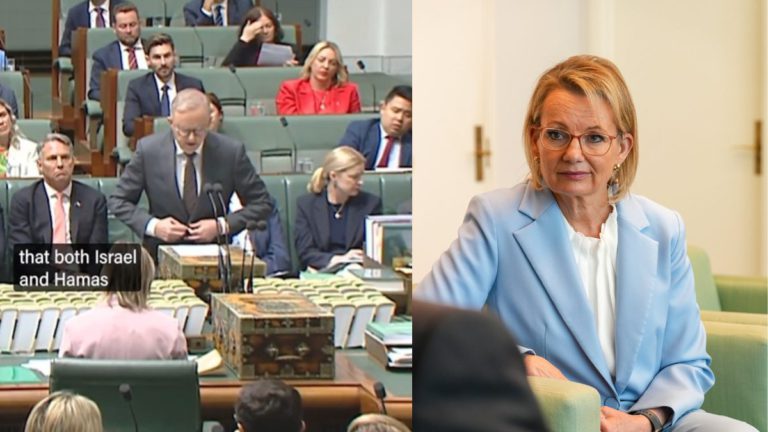
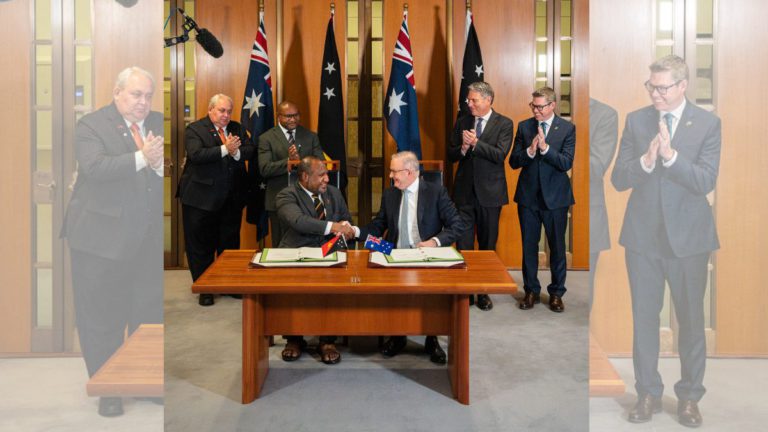
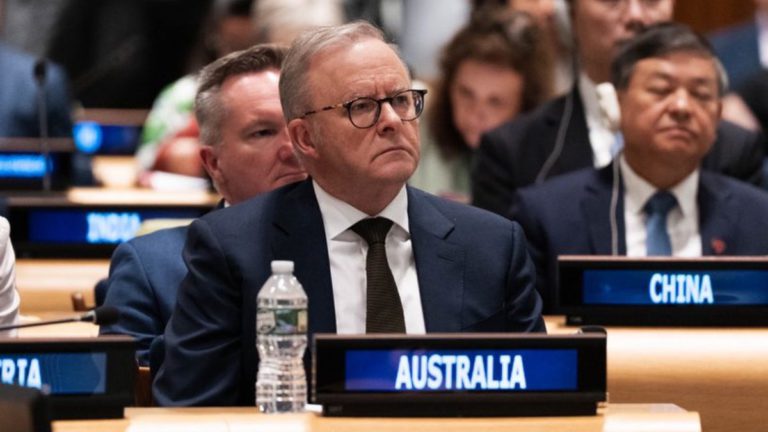
Prime Minister Anthony Albanese and Opposition Leader Sussan Ley have welcomed the announcement that Israel and Hamas have agreed to the first phase of a US-led Gaza peace plan, which will allow for the return of hostages and the withdrawal of Israeli troops to an agreed line.
Albanese described the agreement as a “much-needed step towards peace” after more than two years of conflict, hostages held, and devastating civilian losses.
In a statement with Foreign Minister Penny Wong, he urged all parties to respect the plan’s terms and acknowledged the role of President Trump, as well as Egypt, Qatar, and Türkiye, in helping deliver the deal.
“We thank President Trump for his diplomatic efforts and acknowledge the important role of Egypt, Qatar, and Türkiye in delivering this agreement,” Albanese said.
“There is a very long road to recovery in Gaza, securing long-term peace and building the Palestinian state.”
Ley said the deal “should inspire hope in Australia and across the world” for enduring peace. She highlighted that the agreement showed “careful diplomacy delivers results” and called it “the start of the end of this war.”
Both leaders stressed Australia’s continued support for efforts to achieve a just and lasting two-state solution in the region.
The announcement coincided with the second anniversary of the October 7, 2023, Hamas attack on Israel, which killed over 1,200 people and saw hundreds of Israelis taken hostage.
Support our Journalism
No-nonsense journalism. No paywalls. Whether you’re in Australia, the UK, Canada, the USA, or India, you can support The Australia Today by taking a paid subscription via Patreon or donating via PayPal — and help keep honest, fearless journalism alive.
Health Minister Mary-Anne Thomas announced today that the Connecting the Docs initiative will grow to include up to 10 additional public health services across the state, backed by a $680,000 investment over the next two years.
The expansion will begin in East Gippsland, with Omeo District Health, Bairnsdale Regional Health, Orbost Regional Health, and Gippsland Lakes Complete Health among the new services to join.
Launched in September 2023, Connecting the Docs has already registered more than 70 doctors, with seven successfully recruited to towns including Swan Hill, Kerang, and Echuca.
The program addresses long-term workforce shortages by streamlining recruitment, supporting international transitions, and offering flexible career pathways across hospitals, community care, and primary care settings.
It also helps reduce recruitment costs, strengthen smaller practices, and build a connected network of healthcare professionals through peer support and ongoing career development. Participating health services co-fund the program, while the Labor Government’s support has included an initial $50,000 investment in 2023 to enhance online job listings, digital content, and recruitment campaigns targeting domestic and international candidates.
“This program backs our medical workforce and supports their development across rural and regional areas so they can continue to provide world-class care for all Victorians right across the state,” Minister Thomas said.
“I’d like to congratulate everyone involved in Connecting the Docs for their success thus far and look forward to seeing the program grow over the coming year and beyond.”
The expansion is part of the government’s broader effort to strengthen Victoria’s health workforce, which has grown by more than 50,000 staff over the past decade, including around 9,500 new nurses, doctors, allied health, and support staff in regional and rural areas since June 2014.
While primary care remains a federal responsibility, the Allan Labor Government continues to step in to ensure Victorians can access care when and where they need it, through initiatives such as Urgent Care Clinics, the Victorian Virtual Emergency Department, Nurse-on-Call, and the Community Pharmacist Pilot.
Support our Journalism
No-nonsense journalism. No paywalls. Whether you’re in Australia, the UK, Canada, the USA, or India, you can support The Australia Today by taking a paid subscription via Patreon or donating via PayPal — and help keep honest, fearless journalism alive.
The Fair Work Ombudsman (FWO) and Australian Border Force (ABF) have carried out surprise inspections at around 40 businesses this week across Victoria’s Mornington Peninsula, Phillip Island, and southern Melbourne suburbs including Clayton, Dandenong, and Frankston.
Most of the businesses inspected operate in the fast food, restaurant and café sector, though some in the hair and beauty, manufacturing, recreation, and health industries were also checked. All employ migrant workers.
Inspectors examined time and wage records, including pay slips, to ensure migrant employees are being paid correctly and are working under lawful conditions. They also informed workers about recent workplace law changes, such as the right to disconnect, which came into effect for small business employees on 26 August.
The inspections, which began on Tuesday, focused on businesses employing workers under subclass 482 (temporary skill shortage) and subclass 494 (regional employer-sponsored) visas — both key pathways for skilled migrants.
Fair Work Ombudsman Anna Booth said the joint operation forms part of a national audit program designed to ensure migrant workers are protected and treated fairly. “Workplace breaches involving migrant workers can be particularly serious, as they may not be aware of their rights or may fear speaking up,” Ms Booth said.
“Visa holders must know they have the same workplace rights as all other workers, and there are protections in place if they report exploitation.”
She urged concerned workers to contact the Fair Work Ombudsman and encouraged employers to use the free tools and resources available on the FWO website to stay compliant.
The fast food and hospitality industries remain a priority area for the FWO, given the high proportion of young and migrant workers who may be vulnerable to underpayment and unfair treatment.
Support our Journalism
No-nonsense journalism. No paywalls. Whether you’re in Australia, the UK, Canada, the USA, or India, you can support The Australia Today by taking a paid subscription via Patreon or donating via PayPal — and help keep honest, fearless journalism alive.
The Indian Navy’s mountaineering team has successfully scaled Mt Black Peak (6,387 m) in Uttarakhand, showcasing exceptional courage, endurance and team spirit.
Flagged off from INS Satavahana, Visakhapatnam, on 19 September, the 13-member expedition — including two women officers — reached the summit of the tallest peak in the Bandarpoonch Massif, also known as Kala Nag.
🏔️ Conquering new heights!#IndianNavy’s Mountaineering Team scaled Mt Black Peak (6387M) in #Uttarakhand, showcasing grit, endurance & adventure. 💪🇮🇳
Mt Black Peak, the highest mountain in the Saraswati Range, is renowned for its technical challenges and demanding terrain.
The expedition route passed through the scenic Govind National Park in the Gangotri region, offering glimpses of diverse Himalayan flora and fauna.
Support our Journalism
No-nonsense journalism. No paywalls. Whether you’re in Australia, the UK, Canada, the USA, or India, you can support The Australia Today by taking a paid subscription via Patreon or donating via PayPal — and help keep honest, fearless journalism alive.
A 26-year-old Filipino national is set to face Broadmeadows Magistrates’ Court today (10 October 2025) over multiple fraud charges after allegedly creating and using fake identification documents to gain unlawful access to restricted areas at Melbourne Airport.
The Australian Federal Police (AFP) and Australian Border Force (ABF) launched a joint investigation in May 2025 after suspicions arose that an airport worker had falsified an Aviation Security Identification Card (ASIC).
AFP Detective Superintendent Stephen Cook said the case highlighted the importance of maintaining strict airport security standards. “AFP officers patrol all nine major Australian airports to ensure the safety of passengers and visitors,” he said.
“Those who attempt to compromise aviation security, including employees, can face prosecution. The AFP continues to work closely with government and industry partners to uphold the highest levels of security and public confidence in Australia’s aviation system.”
The woman was interviewed by AFP and ABF officers in May before being charged on summons. She faces:
Three counts of using false documents;
Three counts of making false documents;
One count of obtaining financial advantage by deception; and
One count of failing to display a red/grey ASIC in a secure area.
These offences carry a maximum penalty of up to 10 years’ imprisonment.
Support our Journalism
No-nonsense journalism. No paywalls. Whether you’re in Australia, the UK, Canada, the USA, or India, you can support The Australia Today by taking a paid subscription via Patreon or donating via PayPal — and help keep honest, fearless journalism alive.
Students who have been suspended are also more likely to go on to have contact with the criminal justice system due to lack of adult supervision, association with older antisocial peers, and negative impacts on essential skills like reading.
This is why student discipline policies and procedures say they should only be used as a last resort.
But how are schools using these measures?
In a new study, we tracked New South Wales public school students over a decade. We found many students were repeatedly suspended. We also found disadvantaged students were more likely to be suspended or expelled.
Our research
Our research used data from the NSW Child Development Study to track suspensions and expulsions among a group of almost 72,000 students who attended public schools in New South Wales. This represented almost one fifth of all Australian school students at the time.
It provides the first, large-scale analysis of suspension and expulsion data over a ten year period, following the same students from Year 3 to Year 12, from 2012 to 2021.
Almost 1 in 5 students were suspended during their school career
According to the NSW Department of Education, about 4% of students in the state’s public schools are suspended or expelled in any calendar year.
But these figures understate the true scale of the practice, because they do not capture the accumulation of suspensions and expulsions by the same students over more than one year.
Instead of looking at exclusions in a single year, we studied students over ten years. This showed 19% of the 72,000 students in our group were suspended or expelled at least once between Year 3 and Year 12.
In most cases, students were suspended. Less than 1% were expelled.
As noted in other Australian research, the use of suspensions/expulsions escalates in junior high school (Years 7-10). Our data also shows this pattern, with more than two-thirds (71%) of suspensions/expulsions happening during these pivotal years of school.
Why are students suspended or expelled?
Most suspensions were given for “aggressive behaviour” (52%) and “continued disobedience” (31%).
More serious categories, like “physical violence” and “persistent and serious misbehaviour” accounted for 10% and 12% of suspensions/expulsions respectively.
Illegal behaviours (involving things like weapons and drugs) contributed less than 5% of suspensions/expulsions.
Things build over time
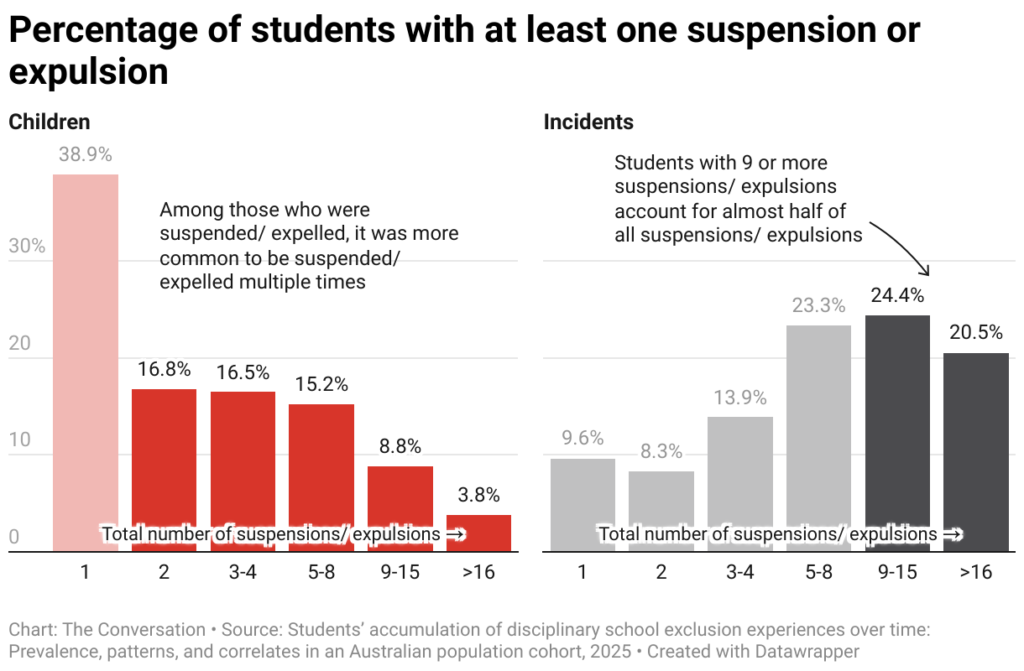
About 40% of students who were suspended received just one suspension. But about 60% of students were suspended or expelled multiple times.
As shown in the chart below, almost half (45%) of all suspensions/expulsions went to just 13% of students who were suspended/expelled nine times or more. The highest number of suspensions/expulsions among these individuals was 54.
The earlier students were suspended/expelled, the more likely they were to be suspended/expelled again.
One in two students (54%) who were first suspended/expelled during primary school had repeat suspensions/expulsions. Only two in five students (40%) first suspended/expelled during high school had repeat suspensions/expulsions.
Children disappear from the system
A sharp drop in suspensions of students in Years 11 and 12 has been noted in previous research.
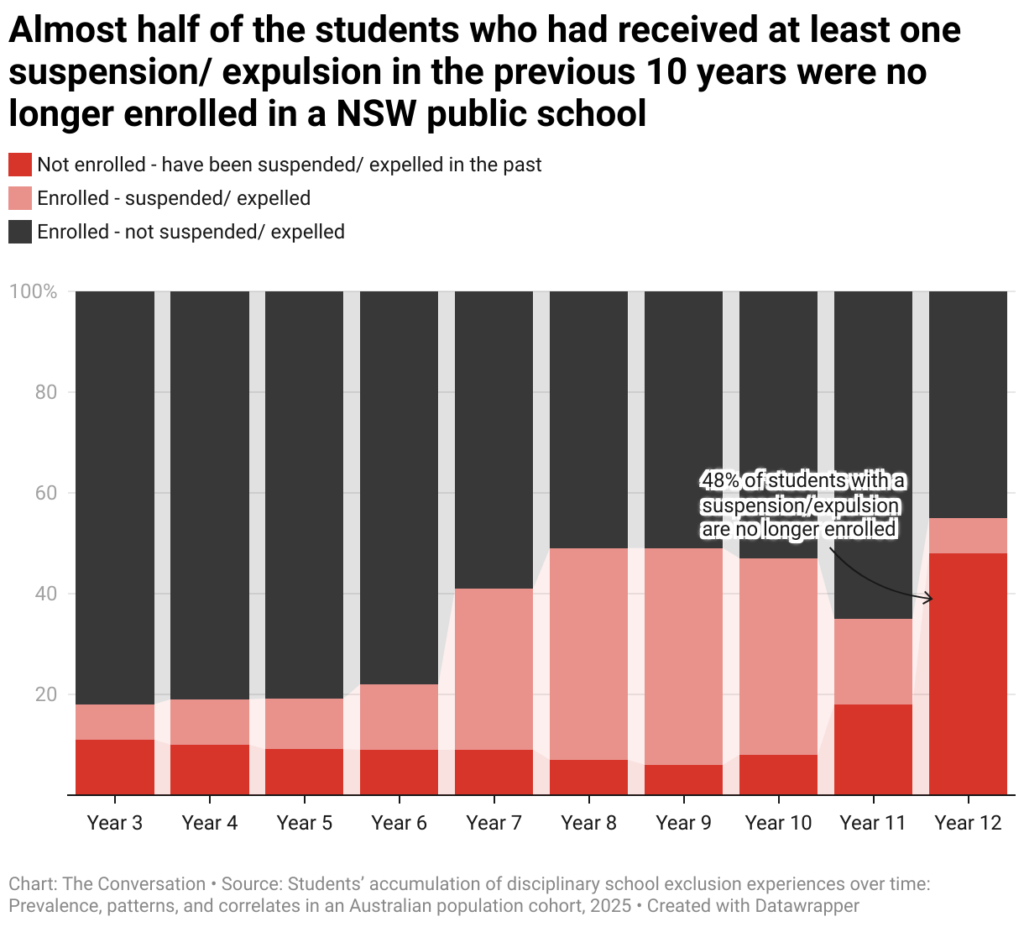
However, our research suggests there is a relationship between being suspended/expelled and leaving school early.
As shown in the chart below, by Year 12, almost half (48%) of the students who had received at least one suspension in the previous ten years were no longer enrolled in a NSW public school.
Which students are being suspended the most?
Our research shows students who are already disadvantaged are more likely to be suspended from school.
Students living in the most socioeconomically disadvantaged areas, students with unemployed parents, those living in regional, remote, and very remote areas, were all significantly over-represented in the data.
These effects became more pronounced as the number of repeat suspensions rose. For example, children of unemployed parents were almost three times as likely as their peers to experience a single suspension/expulsion, but around ten times as likely to experience 16 or more suspensions or expulsions.
Boys were also much more likely to be suspended/expelled than girls. They were about twice as likely as girls to be suspended/expelled once, but around ten times as likely to be suspended/expelled 16 times or more.
In our previous study in this sample, we found other vulnerable students, such as those with emotional and behavioural disability or maltreated children, are also overrepresented in the data.
What does this mean?
Our findings suggest there are two different issues at play.
First, schools are turning to the “last resort” of suspending or expelling students for behaviours that can and should be managed within the school using tried and tested approaches that aim to educate a student, rather than punish or push them out.
The problem with turning to the last resort too early is students become desensitised to being suspended and schools have nothing left in the toolkit when behaviours escalate. This pattern becomes clear when children are followed over time.
Some students need more support
The second issue is some students need far more intensive academic, emotional, and behavioural support. These students are concentrated in schools serving disadvantaged communities.
System-wide improvements in behaviour management will help address low-level behaviours. But this will not help some students with disability or those who have experienced trauma who may require intensive support and educational adjustments. This is particularly so if these students are concentrated in certain schools or areas.
Here, we can learn from public school systems in Los Angeles, New York and Chicago, where a comprehensive approach to supporting students’ academic, social-emotional and behavioural development has been introduced. School suspensions have been reduced and school safety, student engagement and achievement have increased.
The NSW student behaviour policy on suspensions and expulsions was revised in 2024 to place some limitations on the use of suspension and expulsion in public schools. Further research will be needed to examine the effect of that change.
However, school suspension and expulsion rates like those identified by this study are an indication some schools need more help to support the students in their local communities.
No-nonsense journalism. No paywalls. Whether you’re in Australia, the UK, Canada, the USA, or India, you can support The Australia Today by taking a paid subscription via Patreon or donating via PayPal — and help keep honest, fearless journalism alive.
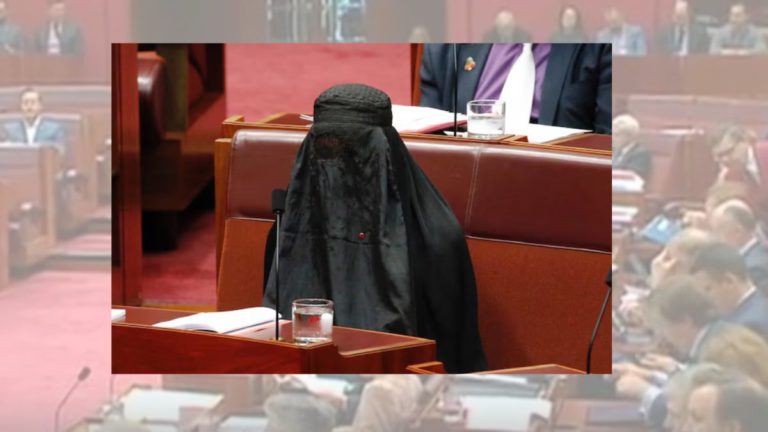
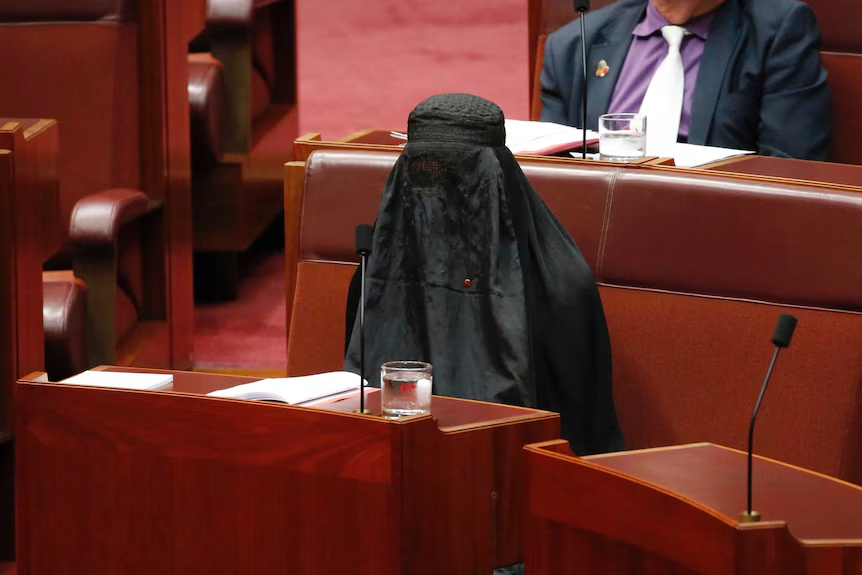
“Senator Hanson, no, we will not be banning the burqa,” Brandis told the chamber, warning her against offending Muslim Australians. The stunt drew applause from opposition parties and crossbench senators.
Image: One Nation leader Senator Pauline Hanson wearing a Burqa in Australian parliament, 2017 (Source: ABC News screenshot)
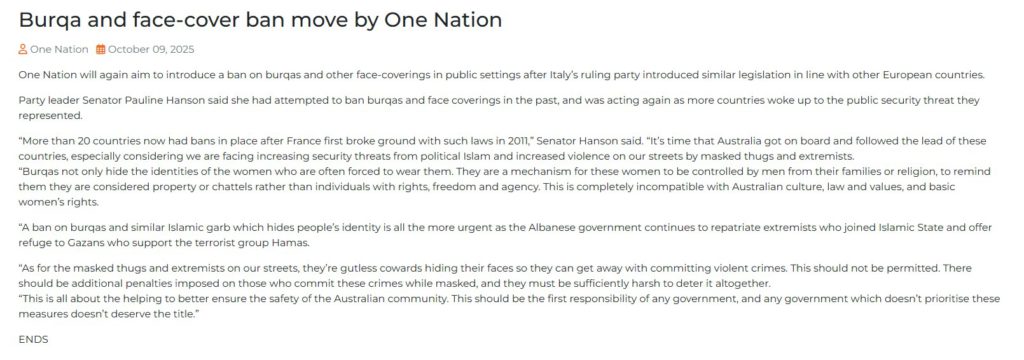
Eight years later, Hanson says her push is backed by international precedent. “More than 20 countries now have bans in place after France first broke ground with such laws in 2011,” she said in a statement.
“It’s time that Australia got on board and followed the lead of these countries, especially considering we are facing increasing security threats from political Islam and increased violence on our streets by masked thugs and extremists.”
Hanson linked the garments to alleged “security threats and increased violence on our streets by masked thugs and extremists” and claimed burqas are “a mechanism for these women to be controlled by men from their families or religion.”
Hanson argued that the garments conflict with “Australian culture, law and values, and basic women’s rights,” adding that the Albanese government’s repatriation of extremists and support for Gazans linked to Hamas makes a ban “all the more urgent.” She also called for harsher penalties for crimes committed while wearing masks.
Support our Journalism
No-nonsense journalism. No paywalls. Whether you’re in Australia, the UK, Canada, the USA, or India, you can support The Australia Today by taking a paid subscription via Patreon or donating via PayPal — and help keep honest, fearless journalism alive.
An Indian-origin truck driver accused of causing a crash that killed a Manitoba mother and her eight-year-old daughter has been granted bail, nine months after allegedly fleeing Canada to avoid arrest.
Navjeet Singh, 26, was released under strict conditions after a contested bail hearing before Judge Michael Clark in Manitoba provincial court on 28 August. His bail terms include surrendering his passport and driver’s licence, not occupying the driver’s seat of any vehicle, living at a specific address in Ontario, and reporting weekly to Manitoba police.
Image: Navjeet Singh, now 26, allegedly drove a semi-trailer truck through a stop sign on Highway 201 on the evening of Friday, Nov. 15, 2024, crashing into an SUV and killing a Manitoba mother and her eight-year-old daughter, RCMP say (Source: Manitoba RCMP)
Singh was arrested on 21 August at Toronto’s Pearson International Airport after arriving on an Ethiopian Airlines flight. He had been wanted on charges of dangerous operation of a motor vehicle causing death and obstructing a peace officer in connection with the 15 November 2024 crash that killed 35-year-old Sara Unger and her daughter Alexa near Altona, about 90 kilometres southwest of Winnipeg.
On Aug.21 @approx 8:50am, Navjeet Singh was arrested by Peel Regional Police and CBSA agents at Toronto’s Pearson International Airport. He was Wanted on a Canada-wide warrant for his arrest after a semi he was driving collided with another vehicle… pic.twitter.com/jN9PjJAxlg
Crown attorney Michael Himmelman told the court investigators believe Singh was driving at least 91 km/h when he ran a stop sign, striking the passenger side of Unger’s SUV. A witness described the collision as an “explosion,” with the SUV “football-kicked a distance of over 53 metres.” The impact was so severe, Himmelman said, that “the front of the SUV was almost removed.”
Image: 35-year-old Sara Unger and her eight-year-old daughter Alexa are seen in this undated photo. The mother and child were killed in a crash on Nov. 15, 2024, about 13 kilometres west of Altona, Man. (Source: GoFundMe)
Prosecutors also alleged Singh’s truck’s data recorder had been switched off before the crash and that his driving logs were falsified, suggesting he had not taken the mandatory eight-hour rest period. “This could point toward driver fatigue,” Himmelman said, adding that Singh’s conduct raised questions about whether he could be “taken at his word.”
“The fact that the data recorder in the accused’s vehicle had been shut off, I submit, is incredibly concerning. There’s also the manipulation and falsification of his driving logs to consider, in terms of whether Mr. Singh can be taken at his word.”
Police said Singh never returned for an interview after being discharged from hospital following the crash. Himmelman told the court that Singh was aware of the warrant for his arrest when he left Canada, indicating “he knowingly evaded the police.”
Singh’s Ontario-based lawyer, Abhay Gautam, argued his client voluntarily returned to face the charges. “He came back with that knowledge, and he came back to fight the charges,” Gautam said, describing Singh as “shocked and stressed” by the crash and claiming he travelled to India to care for his ill mother.
Judge Clark acknowledged the crash was “horrific” and that Singh could face a lengthy prison sentence if convicted but emphasised the presumption of innocence while granting bail.
“I do think that the public would maintain confidence in the administration of justice if I were to release Mr Singh on appropriate conditions.”
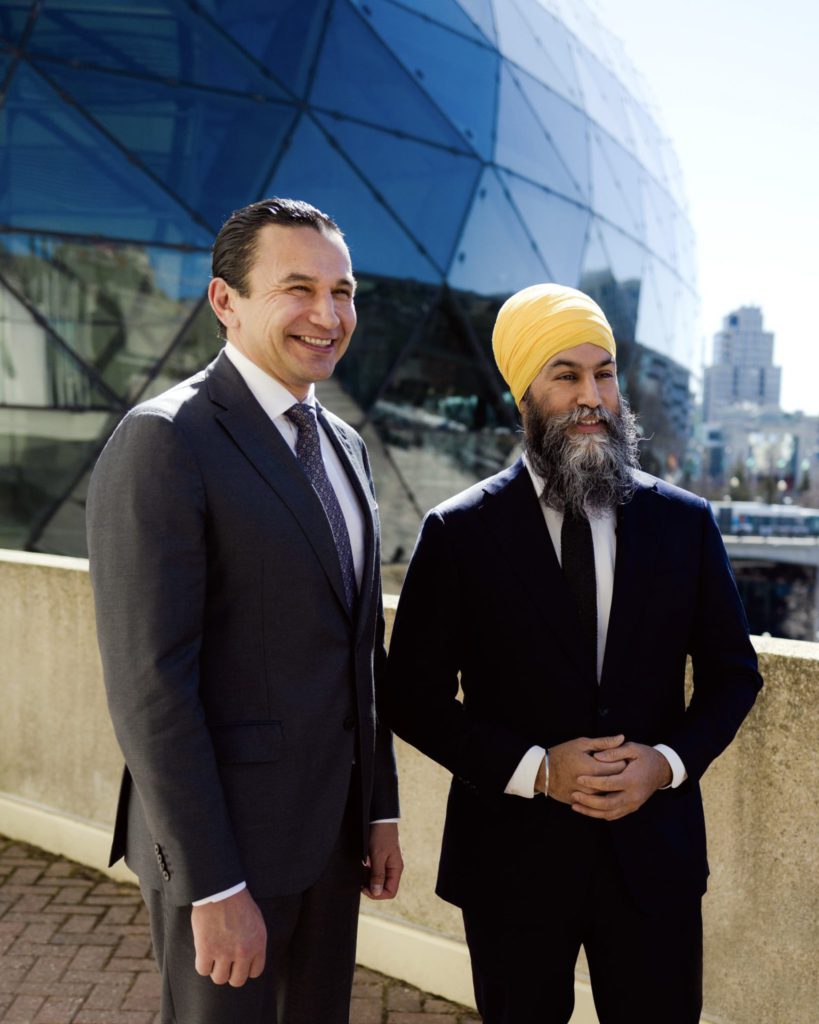
File image: Manitoba Premier Wab Kinew with former NDP Leader Jagmeet Singh (Source: X)
“We have to encourage our judges and justices of the peace to reflect on the role their decisions will have when they are learned by the public.”
However, the Manitoba Bar Association condemned the premier’s comments, warning they risked undermining judicial independence. “Such comments ignore the presumption of innocence and could affect the fairness of a trial,” said association president Stacey Soldier.
“Furthermore, it could ultimately affect the fairness of a trial, which doesn’t just affect an accused person; it also affects victims and loved ones.”
Singh’s bail conditions also bar him from contacting witnesses or victims’ relatives and impose a nightly curfew, with a $7,500 surety pledged by a relative. His case returns to court in December.
Support our Journalism
No-nonsense journalism. No paywalls. Whether you’re in Australia, the UK, Canada, the USA, or India, you can support The Australia Today by taking a paid subscription via Patreon or donating via PayPal — and help keep honest, fearless journalism alive.
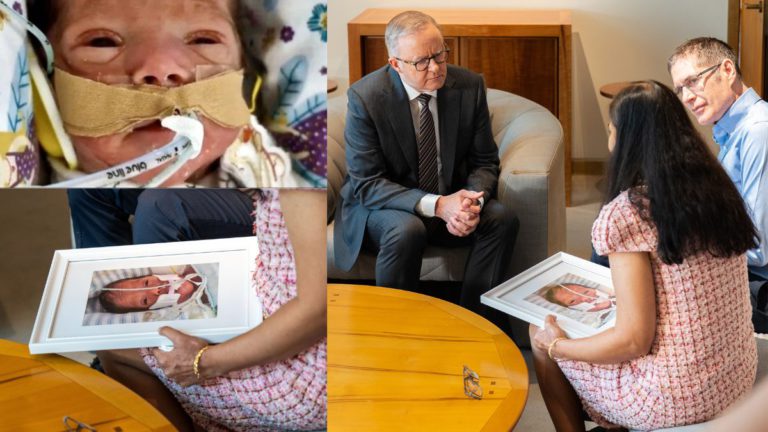
Priya was born prematurely at 24 weeks and six days. Five days after notifying her workplace of her daughter’s passing, her mother received a message cancelling her maternity leave and replacing it with just one month of personal leave—less than the six weeks Priya had lived. Her husband, by contrast, retained his full paternity leave under the NSW industrial system.
The Australia Today was the first media outlet to highlight Priya’s mother’s case and petition, after her maternity leave was cancelled following her baby’s death — a story that sparked national conversation and calls for reform. That coverage has now been followed by legislative action, with Parliament passing a bill to ensure no grieving parent faces the same situation again.
The Fair Work Amendment (Baby Priya’s) Bill 2025 is named after Baby Priya, who tragically died just 42 days after her birth. Her mother faced an additional blow when her approved maternity leave was cancelled shortly after informing her employer of the baby’s death, forcing her to return to work while still grieving.
After losing their baby Priya, her parents faced another blow. Her mother’s paid parental leave was cancelled while they were still grieving.
At a time of heartbreak, parents shouldn't be unexpectedly told it’s time to go back to work by their employer.
Prime Minister Anthony Albanese noted the personal story behind the legislation. “After losing their baby Priya, her parents faced another blow. Her mother’s paid parental leave was cancelled while they were still grieving. At a time of heartbreak, parents shouldn’t be unexpectedly told it’s time to go back to work by their employer. That’s why today we’ve introduced Baby Priya’s Bill—giving financial certainty to parents after the loss of a child.”
“As Priya’s mother told me, ‘the law is in her name. Now Priya will live on forever.’”
Minister for Employment and Workplace Relations Amanda Rishworth said the Bill would provide crucial financial certainty for parents in these devastating circumstances.
“Such losses have a profound and long-lasting impact on parents, families and their communities.”
Rishworth added, “Parents should not have to deal with uncertainty about their employer-funded paid parental leave entitlements on top of their grief.”
“It is important that parents don’t find themselves having to negotiate with their employers over their leave arrangements at such a difficult moment, giving them time and space to grieve.”
Image: Baby Priya’s Petition (Source: Chnage.org)
The Bill introduces a new principle into the Fair Work Act, ensuring that employer-funded paid parental leave cannot be cancelled if a child is stillborn or dies, unless otherwise agreed. It aligns employer-funded leave with government-paid parental leave while still allowing workplaces to negotiate flexible arrangements in good faith.
The Australian Services Union, which counts Priya’s mother among its members, welcomed the Bill. “This vital Bill will make sure workers, including our members, are guaranteed employer-paid parental leave if they experience the tragic loss of a child,” said NSW & ACT Secretary Angus McFarland in a statement.
“No parent mourning the loss of a child should be forced back to work early or face financial strain, and under this Bill they won’t have to. We pay tribute to Baby Priya’s parents who have courageously advocated to ensure no other parent ever has to face the uncertainty they endured.”
In 2022, more than 3,000 Australian families lost a child to stillbirth or within the first 28 days of birth. Baby Priya’s story and her parents’ advocacy have now driven a legislative change aimed at ensuring no parent must face the dual hardship of loss and financial uncertainty.
Support our Journalism
No-nonsense journalism. No paywalls. Whether you’re in Australia, the UK, Canada, the USA, or India, you can support The Australia Today by taking a paid subscription via Patreon or donating via PayPal — and help keep honest, fearless journalism alive.
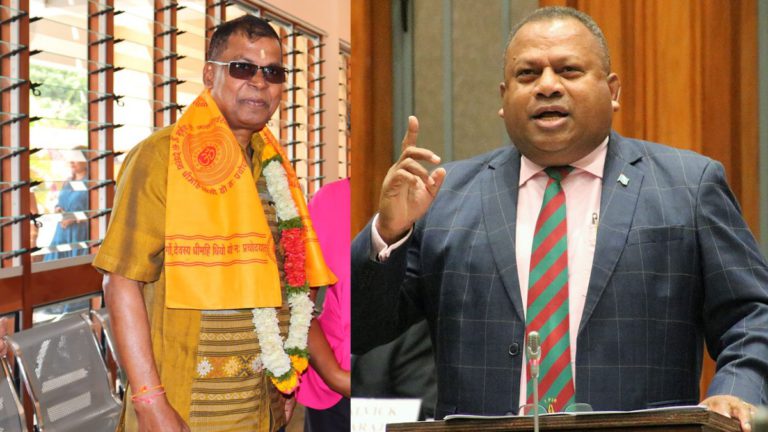
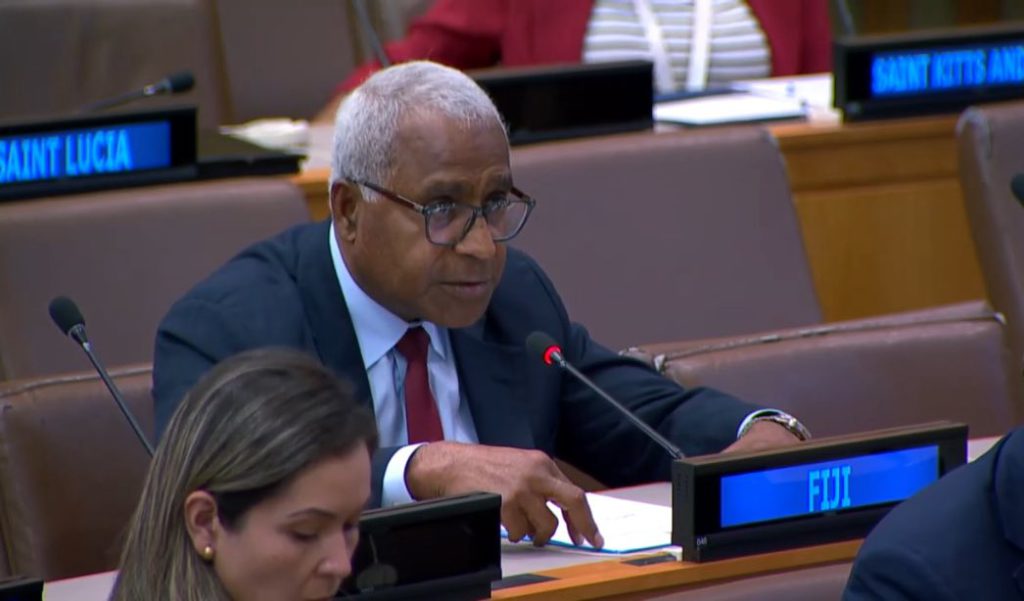
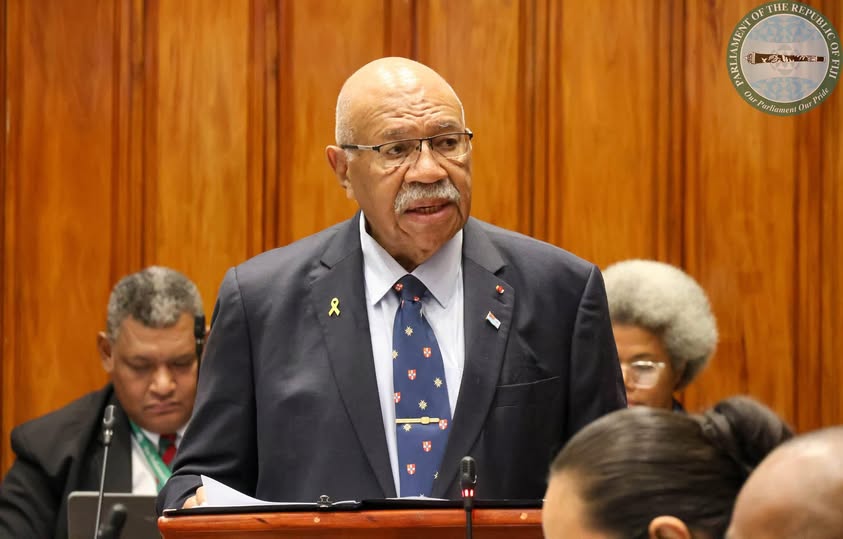
Fiji’s Deputy Prime Minister and Minister for Finance, Prof. Biman Prasad, has slammed Opposition Leader Inia Seruiratu for blaming the Coalition Government and the National Federation Party (NFP) for the declining Indo-Fijian population, calling the remarks “non-sensical and ludicrous.”
Image: Fiji’s DPM Prof. Biman Prasad (Source: Facebook)
Prof. Prasad, who also leads the NFP, said demographic data clearly shows that the Indo-Fijian population growth rate began falling as early as 1975, primarily due to a lower birth rate — not government policies.
“The declining population is why there are fewer Indo-Fijian students in schools and tertiary institutions,” he explained in a statement on social media.
“This has nothing to do with the policies of the Coalition Government or NFP.”
Citing census data, Prof. Prasad noted that the 2007 Census recorded Fiji’s population at 837,271, with indigenous Fijians becoming the majority (56.8%) compared to Indo-Fijians (37.5%). By 2017, the Indo-Fijian proportion was believed to have fallen further to around 33%.
Image: Fiji’s Opposition Leader Inia Seruiratu (Source: FBC News)
Prof. Prasad accused the former FijiFirst government, in which Seruiratu was a senior member, of concealing ethnic data by classifying all citizens simply as “Fijian” — despite a United Nations recommendation to retain disaggregated statistics.
Prof. Prasad also reminded Seruiratu of what he called “the biggest insult” to the Indo-Fijian community under the previous administration — the exile of renowned historian Prof. Brij Lal and his wife, Dr Padma Lal.
“They were denied the right to return to their homeland, and even after Professor Lal’s death in exile, the FijiFirst government refused to allow his ashes to be interred in Tabia,” he said.
“Mr Seruiratu remained silent while this atrocity took place.”
He praised Prime Minister Sitiveni Rabuka for overturning the ban soon after taking office in December 2022 and for declaring Girmit Day as a public holiday to honour the legacy of the Girmitiya since 2023.
Prof. Prasad accused the Opposition leader of “clutching at straws” and warned that his “gutter-level politics” could backfire.
“If Mr Seruiratu continues on this journey, he risks drowning in his own political buffoonery.”
Support our Journalism
No-nonsense journalism. No paywalls. Whether you’re in Australia, the UK, Canada, the USA, or India, you can support The Australia Today by taking a paid subscription via Patreon or donating via PayPal — and help keep honest, fearless journalism alive.
Premier Jacinta Allan announced that from the day the Metro Tunnel begins its Summer Start in early December until 1 February, all travel on trains, trams and buses—both metropolitan and regional—will be free every Saturday and Sunday.
“All public transport will be free for everyone, everywhere, every weekend until February 1,” Allan said, describing the move as “the biggest free transport bonanza in Victoria’s history.”
To celebrate, public transport will be free every weekend from opening day until 1 February.
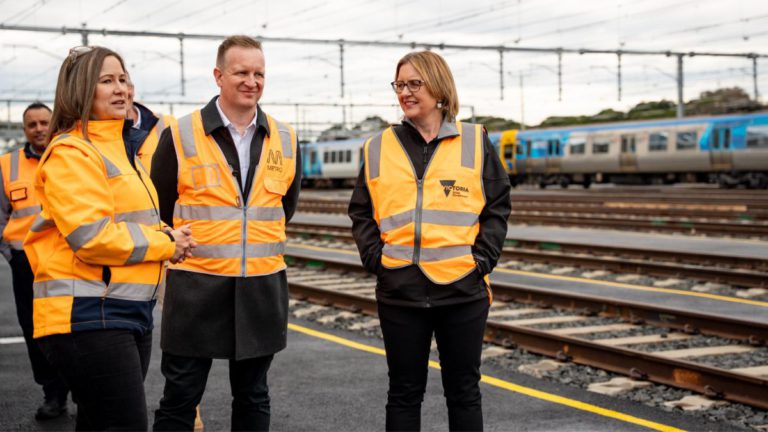
The Premier joined Minister for Transport Infrastructure Gabrielle Williams and Metro Tunnel workers at State Library Station to unveil the plan, which she said was a way to thank Victorians for their patience during years of construction.
“We’re saying thank you, Victoria,” Allan said.
“The Metro Tunnel will cut congestion and get you to work, uni and home sooner – and it opens in early December.”
The Summer Start will coincide with the opening of the Metro Tunnel and the addition of 240 new weekly services, with commuters invited to explore the new underground stations and experience the faster cross-city connections.
Commuters won’t need a valid Myki or ticket during the free travel weekends, and anyone who taps on or off by mistake will not be charged. Some regional services will still require seat reservations, though at no cost.
Minister Williams said the initiative was designed to mark a milestone moment in Victoria’s transport history. “The Summer Start is how we’re opening the tunnel safer, smoother and sooner,” she said.
“It’s our way of thanking everyone for their patience while we built the Metro Tunnel – and celebrating this huge achievement for our state.”
From 1 February, the Big Switch will introduce a new statewide timetable, routing every train on Melbourne’s two busiest lines through the new Metro Tunnel and adding 1,000 more services each week.
Support our Journalism
No-nonsense journalism. No paywalls. Whether you’re in Australia, the UK, Canada, the USA, or India, you can support The Australia Today by taking a paid subscription via Patreon or donating via PayPal — and help keep honest, fearless journalism alive.
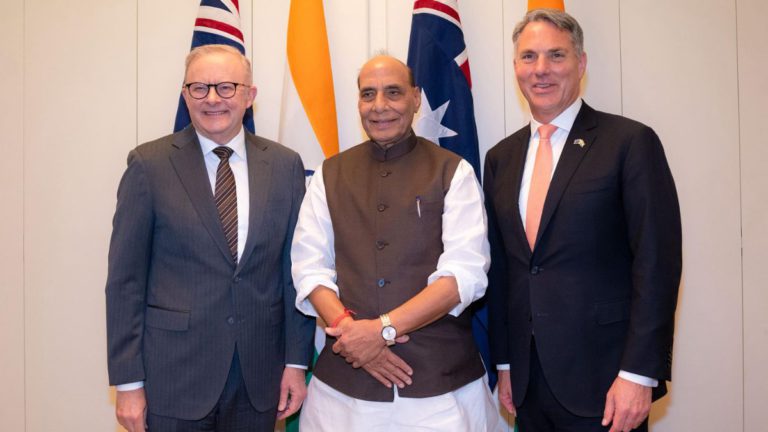
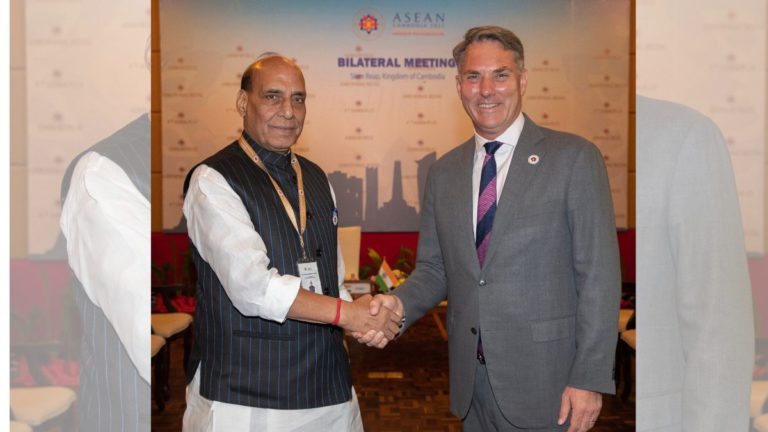
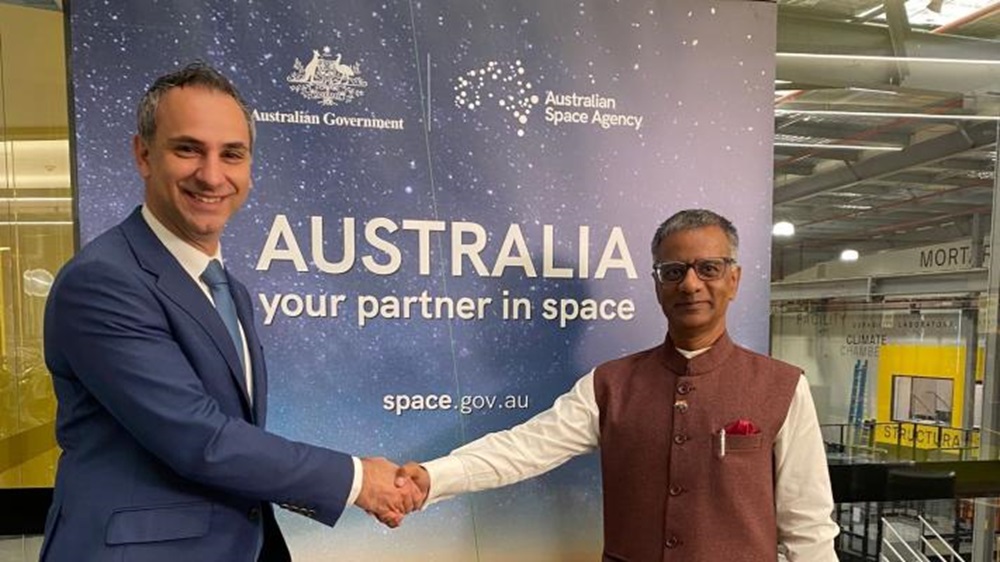
Prime Minister Anthony Albanese and Deputy Prime Minister and Minister for Defence, Richard Marles, welcomed Indian Defence Minister Rajnath Singh to Australia today for his first official visit under the current government.
Australia and India’s defence partnership keeps getting stronger – built on trust, shared interests and a commitment to a peaceful, secure and prosperous Indo-Pacific.
Great to meet with the Indian Defence Minister Rajnath Singh on his first trip to Australia for the Inaugural… pic.twitter.com/k2eN2oUBBW
Prime Minister Albanese said the defence partnership between Australia and India “keeps getting stronger – built on trust, shared interests and a commitment to a peaceful, secure and prosperous Indo-Pacific.”
“Great to meet with the Indian Defence Minister Rajnath Singh on his first trip to Australia for the inaugural Australia-India Defence Ministers’ Dialogue.”
Warmly received by Mr. Peter Khalil, Assistant Minister for Defence of Australia on arrival at Canberra’s Royal Australian Air Force Base. Look forward to shortly holding bilateral meeting with my friend Richard Marles, Deputy Prime Minister and Defense Minister of Australia. pic.twitter.com/Yl3qEbVyjz
The visit coincides with the fifth anniversary of the India–Australia Comprehensive Strategic Partnership (CSP), marking a milestone in the nations’ growing defence and security cooperation.
“It’s a great pleasure to welcome Defence Minister Rajnath Singh to Australia today, the first visit to Australia by an Indian Defence Minister since 2013,” Marles said in a statement.
“Our meeting today reflects the importance of the Australia–India defence partnership. Defence and security cooperation is now one of the strongest pillars of our Comprehensive Strategic Partnership.”
During their discussions, the Ministers explored ways to deepen bilateral defence collaboration, including through enhanced strategic dialogue and more complex joint exercises.
A productive meeting at the Inaugural Australia-India Defence Ministers’ Dialogue with @rajnathsingh at Parliament House this morning. It’s the first time in 12 years that an Indian Defence Minister has visited Australia, and it was fantastic to elevate our Comprehensive… pic.twitter.com/e8oej85hs5
Marles noted India’s inaugural participation in Exercise Talisman Sabre 2025, the recently-signed Air-to-Air Refuelling Implementing Arrangement, and expanded maritime cooperation as examples of the growing tempo of defence engagement.
The visit will also see Australia and India sign new bilateral agreements covering submarine rescue and support, the establishment of a forum for joint staff talks between the defence forces, and enhanced cooperation in information sharing and joint maritime activities.
“The bilateral arrangements that will be signed today reflect the significant growth in our defence partnership and our shared ambition for its future,” Marles said.
Singh’s two-day visit includes bilateral discussions with Marles, engagements with senior government officials, and a business roundtable in Sydney attended by industry leaders from both nations. The deliberations are expected to open new avenues for collaboration and strengthen the enduring defence partnership.
Australia and India elevated their relationship to a Comprehensive Strategic Partnership in 2020, building on a long history of strategic, economic, and people-to-people ties. Both countries share common democratic values, robust trade links, and extensive cultural and educational exchanges. Marles last visited India in June 2025, meeting Rajnath Singh and Prime Minister Narendra Modi to discuss further opportunities for cooperation.
Support our Journalism
No-nonsense journalism. No paywalls. Whether you’re in Australia, the UK, Canada, the USA, or India, you can support The Australia Today by taking a paid subscription via Patreon or donating via PayPal — and help keep honest, fearless journalism alive.
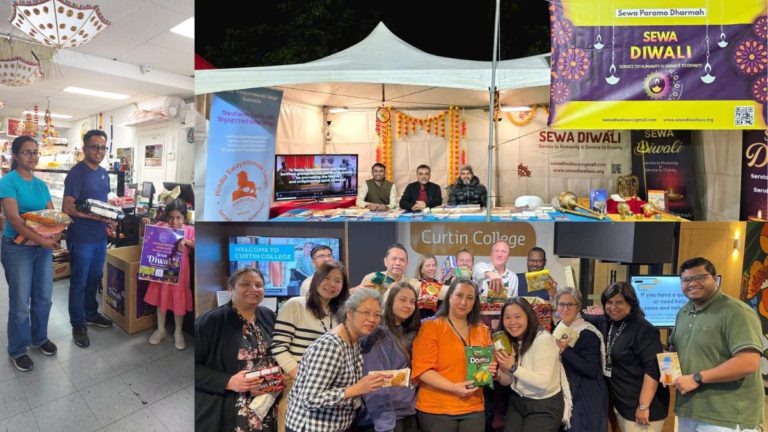
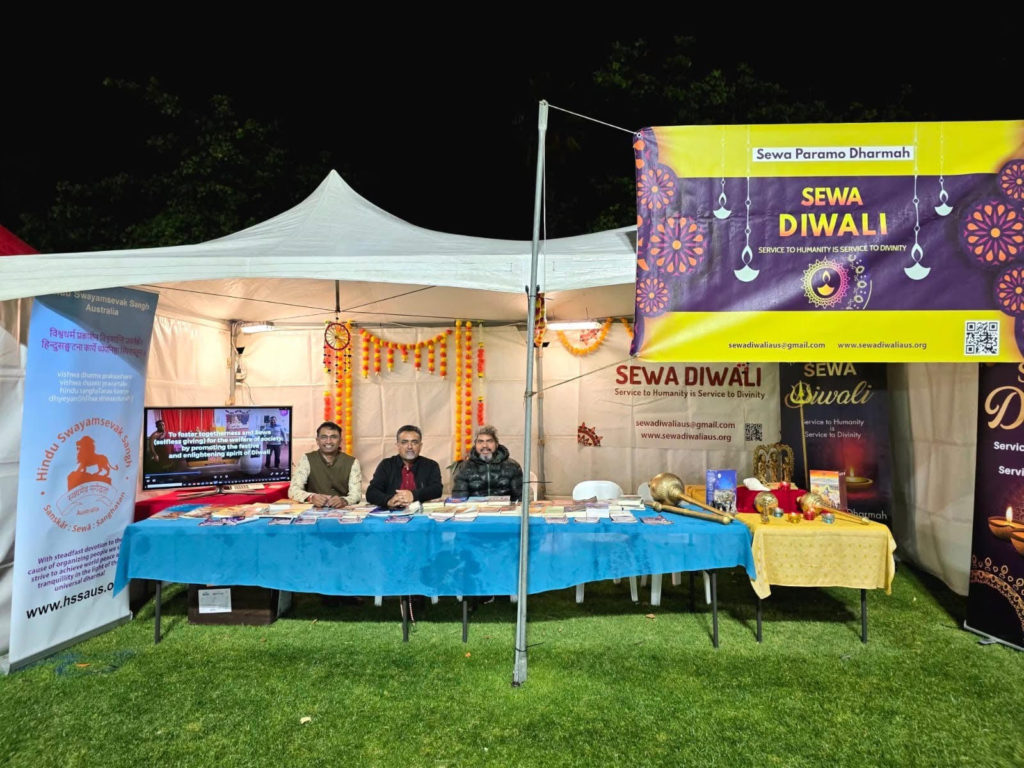
Since its inception in Western Australia in 2023, the Sewa Diwali program has grown rapidly into a nationwide initiative, embodying the spirit of selfless service during the festival of Diwali. Rooted in the Hindu Dharma principle of Sewa Bhav, or selfless giving, the program connects people from all walks of life while encouraging support for those facing adversity, particularly as the cost of living rises across Australia.
Image: Sewa Diwali (Source: Supplied)
“The aim on the sacred festival of Diwali is to give back to society and serve them where we live,” says Dr Anil, a volunteer from Melbourne.
“Sewa Bhav, which means selfless service, is a primary Hindu Dharma value. Service to humanity is service to God.”
This guiding philosophy has inspired participation across the country, with volunteers collaborating in philanthropy without expectation of reward, offering practical and meaningful help to those most in need.
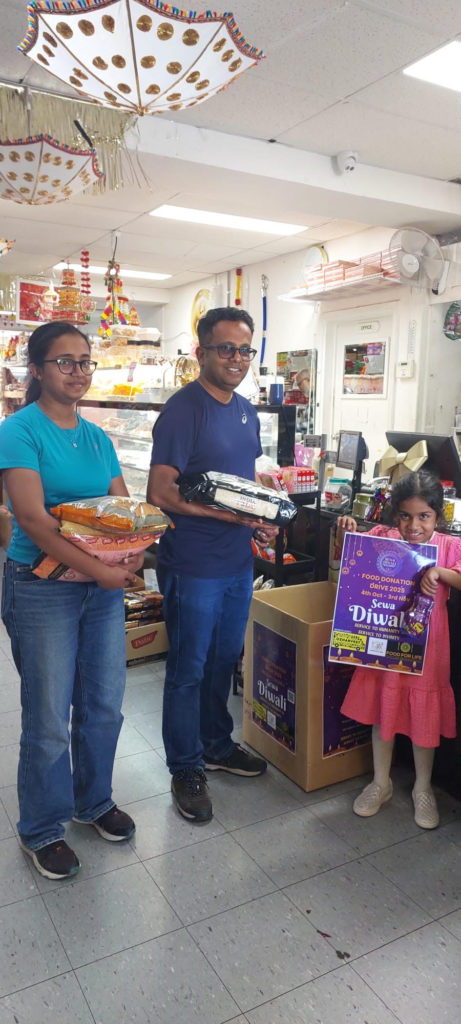
Image: Sewa Diwali (Source: Supplied)
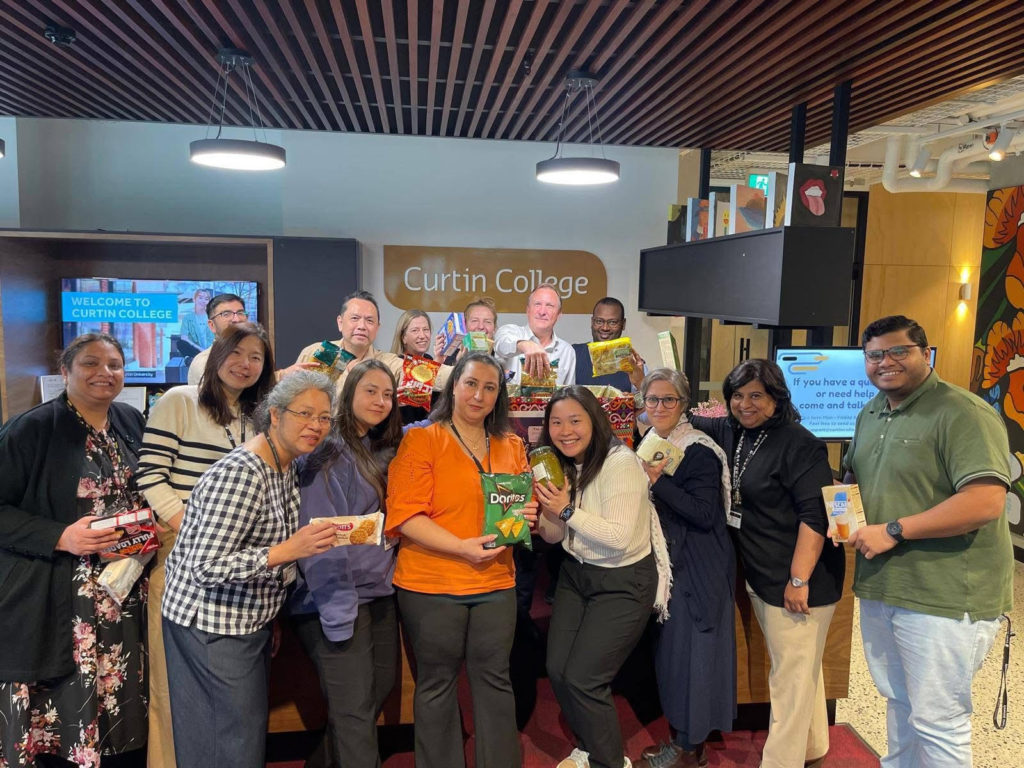
Each year, Sewa Diwali runs a united food and donations drive, collecting items such as canned goods, rice, pasta, toiletries, and hygiene products. These donations are distributed to shelters, food pantries, and community centres across Australia.
Last year, volunteers gathered over 27,700 kilograms of food, with more than 520 people involved and 94 partner organisations contributing. The effort resulted in over $200,000 worth of assistance reaching communities in at least nine major cities. “The feedback from Foodbank and associated organisations is that the impact was great,” notes Manjunath, a volunteer from Sydney.
The program’s success stems from its inclusive approach. “Sewa Diwali caters to all communities of Australia, irrespective of racial, regional, or religious background,” says Dr Anil.
“There is nothing that binds society more than an act of selfless service, such as ministering to those who are truly in need.”
Families and children are actively engaged in the campaign, fostering social understanding, empathy, and a culture of generosity among younger generations.
Image: Sewa Diwali (Source: Supplied)
Looking ahead, organisers aim to expand not just the quantity of donations, but the reach and quality of selfless service.
“Our true goal is to spread the quality of Sewa Bhav across Australia,” says Dr Asthana. “Philanthropy in its truest sense is beyond money—it is service without expectation.”
Each year, Sewa Diwali hopes to inspire more Australians to embrace this ethos, embedding it further into the fabric of society.
Even in the face of challenges, including reports of anti-immigration protests and racist incidents, the campaign has continued undeterred. “There have been no direct challenges as a result,” Dr Anil explains.
“More importantly, Sewa Diwali is a platform where Australians of all backgrounds can come together in harmony to serve the nation we live in, Australia.”
Now active across major states and territories, including New South Wales, Victoria, Queensland, Western Australia, South Australia, and the Australian Capital Territory, Sewa Diwali collaborates with a wide network of communities, charitable organisations, and individuals united by a shared mission. Volunteers register annually to ensure coordinated support and efficient distribution of resources, reinforcing the campaign’s role as both a charitable initiative and a bridge for multicultural engagement.
For participants, Sewa Diwali is more than a food drive—it is a celebration of compassion, unity, and purpose. By honouring the tradition of philanthropy and the universal principle of oneness, the program transforms Diwali into a festival of light, hope, and kindness, fostering the spirit of giving across generations.
Support our Journalism
No-nonsense journalism. No paywalls. Whether you’re in Australia, the UK, Canada, the USA, or India, you can support The Australia Today by taking a paid subscription via Patreon or donating via PayPal — and help keep honest, fearless journalism alive.
For most Australians, the term “metal-organic frameworks” or MOFs might sound like something out of a science fiction novel. Yet these extraordinary materials, now being developed into gas and energy storage devices and catalytic reactors, are at the heart of the 2025 Nobel Prize in Chemistry, awarded to University of Melbourne Prof. Richard Robson, alongside Prof. Susumu Kitagawa from Kyoto University and Prof. Omar M. Yaghi from the University of California.
BREAKING NEWS The Royal Swedish Academy of Sciences has decided to award the 2025 #NobelPrize in Chemistry to Susumu Kitagawa, Richard Robson and Omar M. Yaghi “for the development of metal–organic frameworks.” pic.twitter.com/IRrV57ObD6
MOFs represent a revolutionary approach to crystalline solids, with structures that combine metals and organic molecules to create frameworks with vast internal spaces—structures capable of transforming energy storage, catalysis, and potentially even future superconductors.
University of Melbourne Vice-Chancellor Prof. Emma Johnston AO praised Professor Robson’s achievements. “This is the kind of blue-sky research that not many people get the opportunity to explore, and even fewer make the kinds of breakthroughs Professor Robson has achieved,” she said.
“Fundamental research like this is essential if we are to solve the world’s greatest scientific and technological challenges.”
Prof. Robson, who has been with the University of Melbourne since 1966, first produced the metal-organic frameworks in the early 1990s. His work has been recognised internationally, including election as a Fellow of the Royal Society in 2022 and the naming of a Professorial Chair in his honour in 2024.
“Some people thought it was a whole load of rubbish. But it didn’t turn out that way.”
When 2025 chemistry laureate Richard Robson came up with an idea to build a new type of chemical construction while building models for teaching, not everyone was fully on board.
Yet the seeds of this groundbreaking research were planted decades earlier, with something as simple as wooden models. In 1974, Prof. Robson, then a lecturer in inorganic chemistry, was tasked with building large wooden models of crystal structures for first-year lectures. Using coloured wooden balls to represent atoms and rods to represent chemical bonds, he meticulously calculated angles and assembled models of sodium chloride, fluorite, zinc blende, and more.
“It became apparent that the balls were invested with information—they were predisposed to produce the structure we intended,” he recalls in an interview to The Pursuit.
“And that led to the thought: ‘What if you used molecules in place of balls and chemical bonds in place of rods?’”
Ten years passed before he finally tested the idea in the lab. Beginning with the diamond crystal structure, where each carbon atom connects to four others in a tetrahedron, the experiment was initially met with scepticism. Standard crystals are densely packed, but the new substance Prof. Robson created included vast empty spaces. “It turned out that it worked marvellously well. And we did get crystals,” he says.
These open frameworks were unprecedented. By replacing direct chemical bonds with molecular rods, Prof. Robson had created materials with enormous potential for functionality, predicting an almost infinite variety of structures, channels, cavities, and even catalytic applications—a vision now being realised decades later.
University of Melbourne Deputy Vice-Chancellor (Research) Prof. Mark Cassidy said the award reflects not only Prof. Robson’s curiosity and dedication but also the strength of Australian research. “He has inspired countless academics and students by simply doing what he loves—going into the lab every day, thinking big chemistry thoughts, and running experiments,” Prof. Cassidy said.
“Any scientific respectability that’s come out of it has been due to the brilliant work of colleagues who did the crystallography.”
For Prof. Robson, the process has always been a blend of science, architecture, and artistry. “My contribution has been more like that of an artist or an architect,” he says.
Support our Journalism
No-nonsense journalism. No paywalls. Whether you’re in Australia, the UK, Canada, the USA, or India, you can support The Australia Today by taking a paid subscription via Patreon or donating via PayPal — and help keep honest, fearless journalism alive.
Gold fever has gripped Australia, with crowds flocking to dealers after the precious metal surged to a record high of US$4000 (A$6200) per troy ounce on Wednesday — its highest price in history.
As investors worldwide turned to gold as a “safe haven” amid growing market volatility, Sydney’s ABC Bullion in Martin Place saw queues stretching outside its doors from early morning. Retirees, families, and long-time investors were among those waiting to secure a slice of the soaring commodity.
One family told news.com.au they planned to buy 20 grams of gold and a few grams of silver — a purchase costing over $6000. The line remained steady through the day and was still going strong by mid-afternoon.
Sydney investor Emily Scott, who has been buying gold bullion for a decade, told news.com.au she was stunned by the crowd.
Representative image: Gold (Source: CANVA)
“I got a bit of a shock seeing that line — I was worried I wouldn’t make it to the front before closing,” she said.
“I know the price is going up, I just wanted to top mine up. It’s almost as fast as banks, and it’s making a better return.”
Gold Market surge; Image Source: @CANVA
ABC Bullion’s general manager Jordan Eliseo told news.com.au the surge in interest has been remarkable. “Trading activity is four to five times higher than a normal day,” he said.
“People opening new accounts have tripled in the last month. It’s not just a price surge — it’s a surge in participation.”
Gold’s global standing as a long-term hedge continues to resonate. Over the past 25 years, gold prices have delivered an average annual return of around 10 %. Australia — already a leading gold producer — is well placed to gain: the Department of Industry, Science and Resources projects that gold export earnings will rise by A$12 billion, reaching about A$60 billion in 2025–26, even as other resource exports are forecast to decline.
Adding to the rush is the upcoming Hindu festival of Dhanteras, which marks the beginning of Diwali — a time when gold buying peaks among Australia’s growing Indian diaspora, now representing 2.7 per cent of the population.
Falling on 18 October this year, Dhanteras celebrates prosperity and good fortune, honouring Goddess Lakshmi, Lord Kuber, and Lord Dhanvantari. It traditionally marks one of The Perth Mint and ABC Bullion’s busiest trading periods.
Screenshot ABC Bullion website
The companies have advised new buyers to open bullion accounts or plan ahead of the festival, as services for selling gold and jewellery will be high from 18–19 October due to overwhelming demand.
Each year, ABC Bullion and the Hindu Council of Australia jointly celebrate the Festival of Lights, which symbolises the triumph of good over evil and light over darkness — a fitting parallel to gold’s enduring allure as a beacon of stability in uncertain times.
Support our Journalism
No-nonsense journalism. No paywalls. Whether you’re in Australia, the UK, Canada, the USA, or India, you can support The Australia Today by taking a paid subscription via Patreon or donating via PayPal — and help keep honest, fearless journalism alive.
US President Donald Trump has announced that Israel and Hamas have agreed to the first phase of his peace plan following days of talks in Egypt.
“I am very proud to announce that Israel and Hamas have both signed off on the first Phase of our Peace Plan,” Trump said on his Truth Social network.
“This means that ALL of the Hostages will be released very soon, and Israel will withdraw their Troops to an agreed upon line as the first steps toward a Strong, Durable, and Everlasting Peace. All Parties will be treated fairly!”
Trump praised the mediators from Qatar, Egypt, and Turkey, calling the agreement “Historic and Unprecedented” and adding, “BLESSED ARE THE PEACEMAKERS!”
Israeli Prime Minister Benjamin Netanyahu confirmed that his country would bring home all hostages held in Gaza. “With God’s help, we will bring them all home,” his office said in a brief statement.
In a separate post on X, Netanyahu called it a “great day for Israel” and said he would convene the government to approve the agreement. He also thanked the Israel Defence Forces and Trump’s team “for their mobilisation for this sacred mission of releasing our hostages.”
With the approval of the first phase of the plan, all our hostages will be brought home. This is a diplomatic success and a national and moral victory for the State of Israel.
From the beginning, I made it clear: we will not rest until all our hostages return and all our goals…
— Benjamin Netanyahu – בנימין נתניהו (@netanyahu) October 8, 2025
Dr Majed Al Ansari, adviser to the Qatari Prime Minister, said the deal would lead to the end of the war, the release of Israeli hostages and Palestinian prisoners, and the delivery of humanitarian aid. “An agreement was reached on all the provisions and implementation mechanisms of the first phase of the Gaza ceasefire agreement,” he wrote on X, adding that details would be announced later.
The mediators announce that tonight an agreement was reached on all the provisions and implementation mechanisms of the first phase of the Gaza ceasefire agreement, which will lead to ending the war, the release of Israeli hostages and Palestinian prisoners, and the entry of aid.…
— د. ماجد محمد الأنصاري Dr. Majed Al Ansari (@majedalansari) October 8, 2025
The announcement follows several days of indirect talks in the Egyptian resort city of Sharm el-Sheikh, attended by delegations from Hamas, Israel, and the US, including Trump’s son-in-law Jared Kushner and US Special Envoy Steve Witkoff.
Trump, speaking at the White House, said he may travel to the Middle East in the coming days to support the peace process. “‘Peace for the Middle East,’ that’s a beautiful phrase, and we hope it’s going to come true. But it’s very close,” he said, noting the progress of negotiations and the skill of the negotiators on both sides.
The agreement marks a potentially historic step toward ending nearly two years of conflict in Gaza and securing the safe return of hostages.
Support our Journalism
No-nonsense journalism. No paywalls. Whether you’re in Australia, the UK, Canada, the USA, or India, you can support The Australia Today by taking a paid subscription via Patreon or donating via PayPal — and help keep honest, fearless journalism alive.
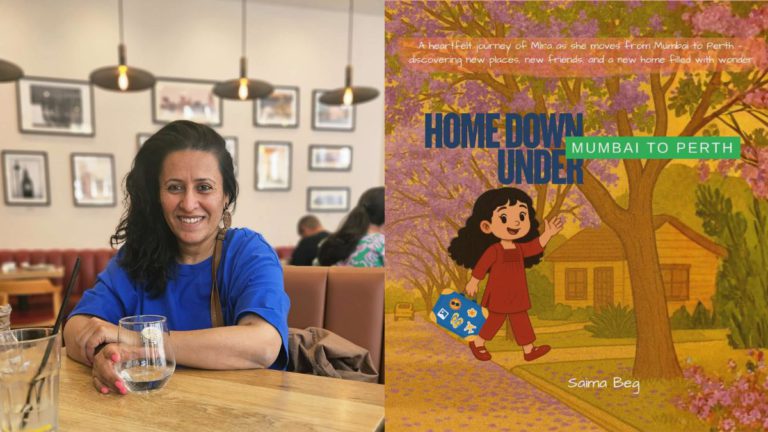
Indian-Australian author Saima Beg’s new children’s book, Home Down Under: Mumbai to Perth, follows young Mira as she navigates the move from the bustling streets of Mumbai to the wide open spaces of Perth.
Saima, a former lecturer in Mumbai with a degree in Literature, combines her love for storytelling and art to create books that capture wonder and belonging. With a childlike curiosity and excitement for discovering new places, she sees each landscape, culture, and colour through the eyes of both an artist and a child.
Image: Author Saima Beg’s new children’s book, Home Down Under: Mumbai to Perth (Source: Supplied)
Through Mira’s journey, Saima celebrates the resilience and curiosity of children, showing how they can find wonder and belonging in a completely new environment.
“I was inspired to write this story after seeing how children adapt when they move to a new country,” Saima said.
“Their perspective, endless curiosity, and ability to find excitement in new places remind us how resilient and brave they are. Mira’s story reflects the journey from uncertainty to belonging and celebrates the beauty of discovering home in a new land.”
The book contrasts the vibrancy of Mumbai with the calm, crystal-clear beaches and open spaces of Perth, illustrating how different cities can both hold a special place in a child’s heart. Saima explained,
“It is mostly about Perth and its own different magic from Mumbai. How Perth, despite being opposite to Mumbai, finds a place in Mira’s heart,”
Mira’s adventures also carry a simple but powerful message for young readers.
“Children learn that change can be exciting and beautiful. It can be scary at first, but with an open heart, we can make new friends and discover new things. Also, to understand that we can make a home anywhere.”
Image: Saima Beg (Source: Supplied)
Looking ahead, Saima says Mira’s story is just beginning.
“Mira’s curiosity and love for exploring new places have just begun. I look forward to writing more of her adventures.”
Support our Journalism
No-nonsense journalism. No paywalls. Whether you’re in Australia, the UK, Canada, the USA, or India, you can support The Australia Today by taking a paid subscription via Patreon or donating via PayPal — and help keep honest, fearless journalism alive.
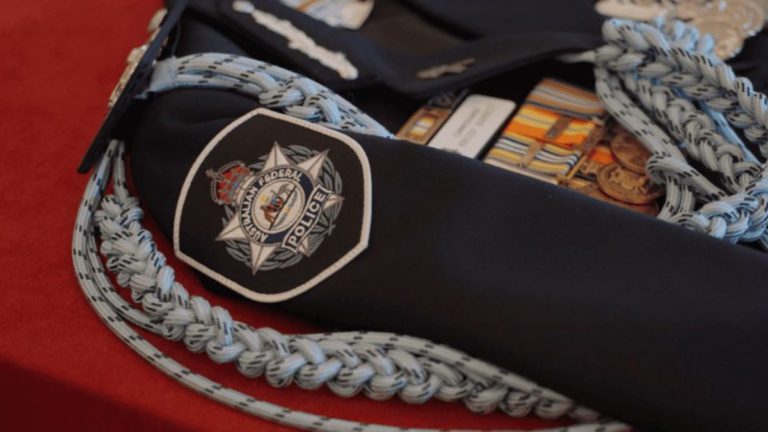
The Australian Federal Police (AFP) has launched new National Security Investigations (NSI) teams in Sydney, Melbourne and Canberra to target individuals and groups causing “high levels of harm” to Australia’s social fabric — including those targeting federal parliamentarians.
Operating under the AFP’s Counter Terrorism and Special Investigations Command since September, the NSI teams have been tasked with identifying and disrupting threats to social cohesion through a four-pronged strategy focused on coordination, policy, legislation, and policing.
AFP Commissioner Krissy Barrett said the creation of the NSI teams reflected the growing need to address groups “eroding our country’s social fabric by advocating hatred, fear, and humiliation.”
“There are current and emerging groups who are eroding our country’s social fabric by advocating hatred, fear, and humiliation, and the AFP is putting them on notice,” Commissioner Barrett said.
“Some of these groups have already engaged in vandalism, destruction of property and the targeting of businesses based on race or religion.”
While many of these actions may not meet the legal threshold for terrorism, Barrett warned that the AFP had identified “concerning behaviours which could escalate to politically motivated violence or hate crimes, which seriously put the Australian community at risk.”
The NSI teams will work closely with state and territory police to ensure a nationally coordinated, intelligence-led approach to emerging threats. They will also share critical information with national security and law enforcement partners to deliver what the AFP describes as “the most effective and disruptive policing response.”
Recognising that extremist groups increasingly operate online, the AFP will also strengthen its digital capabilities — using surveillance powers and advanced technologies to detect violent extremist material, decode criminal language, and gather intelligence on networks seeking to evade detection.
Many of the groups under scrutiny are dispersed across Australia and, in some cases, linked to international movements. To counter these, the AFP will use its global partnerships — including within the Five Eyes Law Enforcement Group — to coordinate responses and gain insights into transnational threats.
“By collaborating with ASIO and our state and territory police partners, our coordinated disruption activities will be informed by intelligence and targeted at those inciting or preparing to commit violent acts,” Barrett said.
“There is no place for hate or violence in our communities and the AFP will defend and protect Australia and Australia’s future from these threats.”
Support our Journalism
No-nonsense journalism. No paywalls. Whether you’re in Australia, the UK, Canada, the USA, or India, you can support The Australia Today by taking a paid subscription via Patreon or donating via PayPal — and help keep honest, fearless journalism alive.
Australia’s Punjabi community has joined fans across the globe in mourning the death of popular singer and actor Rajvir Jawanda, who passed away on Wednesday morning after battling for life for nearly 11 days following a motorcycle accident in Himachal Pradesh.
Image: Popular Punjabi singer and actor Rajvir Jawanda (Source: Facebook)
The 35-year-old artist, who had performed across Australia and New Zealand in 2018 as part of the Desi Mela tour, sustained severe head and spinal injuries when his 1300cc motorcycle reportedly collided with stray cattle near Baddi in Solan district on 27 September.
Image: Popular Punjabi singer and actor Rajvir Jawanda in Sydney 2018 (Source: Facebook)
It is reported in local Indian media that Jawanda was initially rushed to a local hospital in Solan, where he is said to have suffered a cardiac arrest, before being transferred to Fortis Hospital, Mohali, for specialised treatment.
Despite being placed on ventilator support and receiving round-the-clock care from critical care and neurosciences teams, his condition remained critical until his passing.
Image: Popular Punjabi singer and actor Rajvir Jawanda (Source: Facebook)
Jawanda, who was married and a father of two young children, hailed from Pona village in Ludhiana’s Jagraon. His death has sent shockwaves through the Punjabi entertainment industry, with tributes pouring in from artists and fans around the world.
Punjab chief minister Bhagwant Mann had personally visited the hospital last Sunday to check on his condition. Leading Punjabi stars — including Diljit Dosanjh, Gippy Grewal, Ammy Virk, Neeru Bajwa, and Kanwar Grewal — also shared prayers and messages of support during his hospitalisation.
At a recent concert in Hong Kong, Diljit Dosanjh paused his performance to ask fans to pray for Jawanda’s recovery, saying, “Dua mein asar hai” (“There is power in prayer”).
Image: Popular Punjabi singer and actor Rajvir Jawanda (Source: Facebook)
Jawanda’s family expressed gratitude to members of the Punjabi music fraternity who offered financial and emotional support during the crisis.
Known for his down-to-earth charm and heartfelt lyrics, Rajvir Jawanda rose to fame with hits such as “Tu Dis Penda,” “Khush Reha Kar,” “Sardari,” “Surname,” “Afreen,” “Landlord,” “Down to Earth,” and “Kangani.” He also appeared in Punjabi films including Subedar Joginder Singh (2018), Jind Jaan (2019), and Mindo Taseeldarni (2019).
His untimely passing has left an irreplaceable void in Punjabi music and cinema — and in the hearts of fans across Australia, where his energetic performances and humble nature had earned him a loyal following.
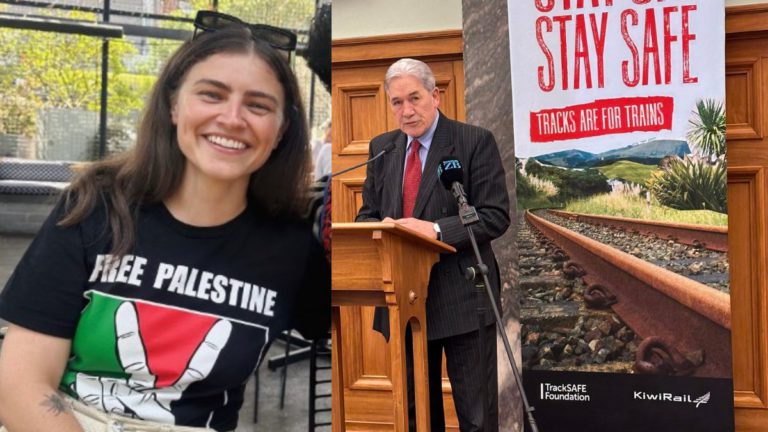
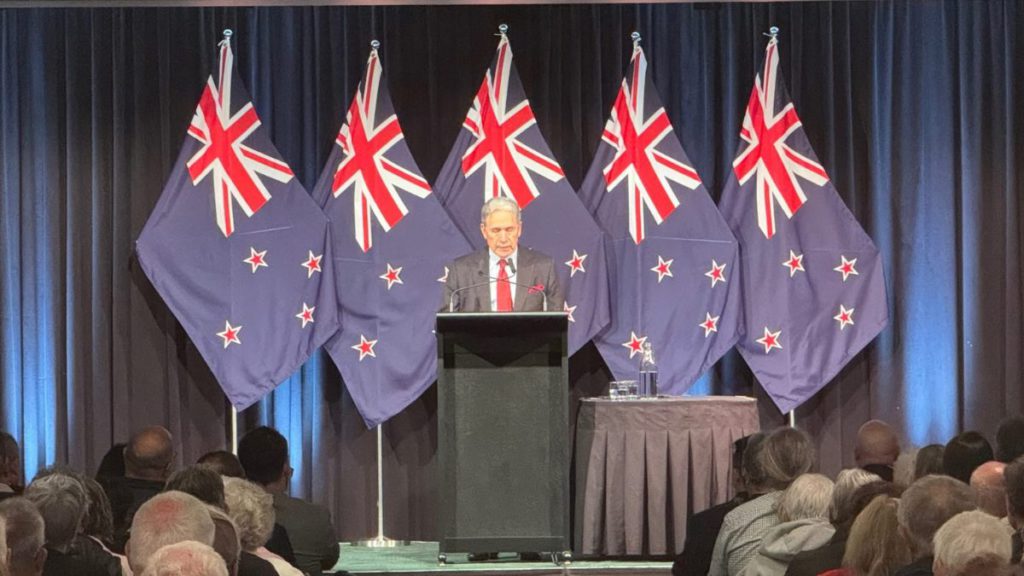
“The hypocrisy of the left knows no bounds,” declared New Zealand Foreign Minister Winston Peters, following a late-night attack on his Auckland home that left a window smashed and his family shaken.
Not one question in the House today asking about the progress of the peace deal in Gaza. Not one letter or email of support, not one interview, not one comment.
It’s almost as if they want an excuse to keep banging their drums,…
“Not one question in the House today asking about the progress of the peace deal in Gaza. Not one letter or email of support, not one interview, not one comment,” Peters wrote.
“It’s almost as if they want an excuse to keep banging their drums, waving their flags, and swinging their crowbars — all the while crying havoc and unleashing the dogs of war.”
Police confirmed they were called to Peters’ St Mary’s Bay home on Monday night after a report of wilful damage. “The offender had left the scene and was not immediately able to be located. Inquiries are ongoing,” a spokesperson said.
Peters, who was not home at the time, said the attack left glass shattered over his dog while his partner and a guest were inside. He described the offender as a “disgusting coward” and said a sign was left on his front door. “This is truly gutless,” he said.
“When we have protesters, political bloggers, and MPs encouraging this behaviour, posting politicians’ home addresses online, and acting with pure ignorance and extremism — this is the result.”
Tonight a disgusting coward has gone to my home and smashed a window. Glass was shattered all over our dog.
He also left a sign on the front door.
I wasn’t home. But my partner and guest were.
This is truely gutless.
This is the type of violent hate-filled behaviour we…
The New Zealand First leader said the attack reflected a “slippery slope of radicalisation” among elements of the left. “New Zealanders need to be deeply concerned about where our country is going and who is behind this divisive and violent behaviour,” he warned.
“It has caused distress to our families and disturbed the peace of our neighbours,” he told MPs.
“We must call out those members of this House who collude with protesters targeting politicians’ homes. Do you have no shame?”
Peters also hit out at opposition MPs and the media for ignoring diplomatic progress on the Gaza peace plan. He said that while New Zealand had condemned both Hamas’ terrorist attacks and Israel’s “overwhelming” military response, the focus must now shift back to diplomacy.
He noted that the United States-led peace proposal — supported by several Muslim-majority nations including Saudi Arabia, Indonesia, and Egypt — represented “a possible first step to achieving these goals”.
“Every day spent on Gaza and Palestinian statehood recognition is a day not spent on the important work of making New Zealanders safer and more prosperous.”
Support our Journalism
No-nonsense journalism. No paywalls. Whether you’re in Australia, the UK, Canada, the USA, or India, you can support The Australia Today by taking a paid subscription via Patreon or donating via PayPal — and help keep honest, fearless journalism alive.
The Asian Development Bank (ADB) has appointed Indian-origin Jyotsana Varma as Regional Director of its Pacific Liaison and Coordination Office (PLCO) in Sydney, where she will oversee operations in Nauru, Solomon Islands, and Vanuatu.
Varma will also lead the implementation of the forthcoming Pacific Approach 2026–2030, ADB’s country partnership strategy for the region.
“I look forward to building on ADB’s strong, long-term partnership with the Government of Australia to support quality infrastructure and private sector development across the Pacific,” Varma said in a statement.
“We will continue to work closely with the governments of Nauru, Solomon Islands, and Vanuatu to support their development goals.”
Varma brings 33 years of development experience, including 16 years with ADB. She has held senior leadership positions across Cambodia, Bangladesh, and the Maldives.
Prior to joining ADB, she led state teams in the Indian civil service on social sector projects and advised the Indian Finance Minister on policy matters.
#ADBNews: ADB has appointed Jyotsana Varma as Regional Director of its Pacific office in Sydney, where she will oversee operations for Nauru, Solomon Islands, and Vanuatu.
ADB’s Sydney office not only manages programming, processing, and administration for Nauru, Solomon Islands, and Vanuatu, but also serves as the sector hub for private and finance sector development across 14 Pacific developing member countries. It oversees the Pacific Private Sector Development Initiative and the Pacific Partnership Facility.
Based in Sydney, PLCO works closely with key bilateral partners, including Australia, New Zealand, the World Bank Group, and other multilateral institutions.
Australia, a founding ADB member, is one of the largest contributors to the Asian Development Fund, the bank’s main source of grants for its poorest and most vulnerable members.
Founded in 1966, ADB is a leading multilateral development bank with 69 member countries, promoting inclusive, resilient, and sustainable growth across Asia and the Pacific.
Support our Journalism
No-nonsense journalism. No paywalls. Whether you’re in Australia, the UK, Canada, the USA, or India, you can support The Australia Today by taking a paid subscription via Patreon or donating via PayPal — and help keep honest, fearless journalism alive.
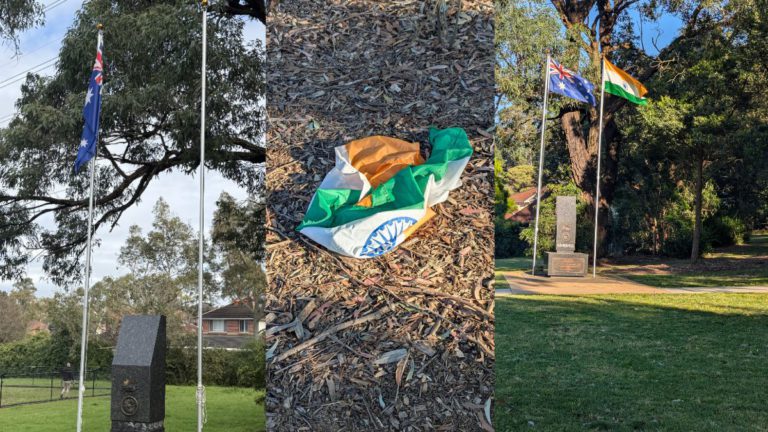
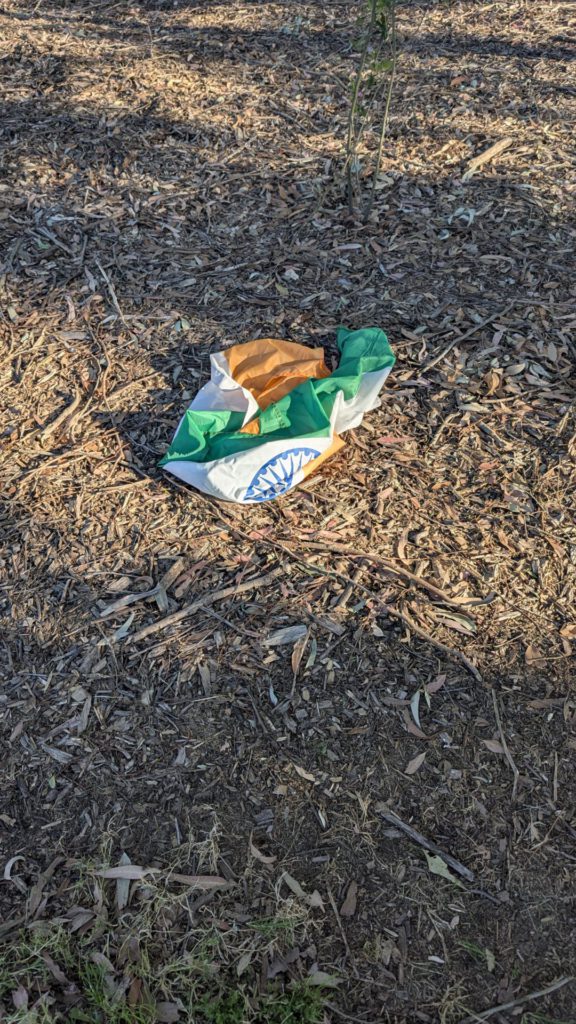
The ANZAC Jawan Cenotaph in Cherrybrook — a nationally recognised memorial honouring Indian and Australian soldiers who fought together at Gallipoli — has been repeatedly targeted in acts of vandalism involving the Indian national flag, prompting concern from community leaders and renewed calls for action.
Image: Indian flag disrespected at ANZAC Jawan Cenotaph in Cherrybrook (Source: Supplied)
Anand Manickam, Vice President of the Australia India Cenotaph Custodian Committee and Vice President of Hindu Council (NSW), has lodged several complaints with The Hills District NSW Police and Hornsby Shire Council, describing the repeated defacement as “deeply troubling” and suggesting the acts may have been motivated by hate.
Image: Indian flag disrespected at ANZAC Jawan Cenotaph in Cherrybrook (Source: Supplied)
Manickam told The Australia Today, “As custodians of the ANZAC Jawan Cenotaph, we strongly condemn any damage to this sacred site.”
“Such acts are a profound disrespect to the memorial and to the shared military sacrifices it represents. They are unacceptable and must not be tolerated.
Despite multiple reports over recent months, the vandalism remains unresolved. It is reported that NSW Police Chief Inspector Phil Brooks visited the site and recommended a series of upgrades, including internally operated flagpoles, permanent flag affixing, increased patrols, and greater community awareness. However, the suggested measures have yet to be fully implemented, and incidents have continued.
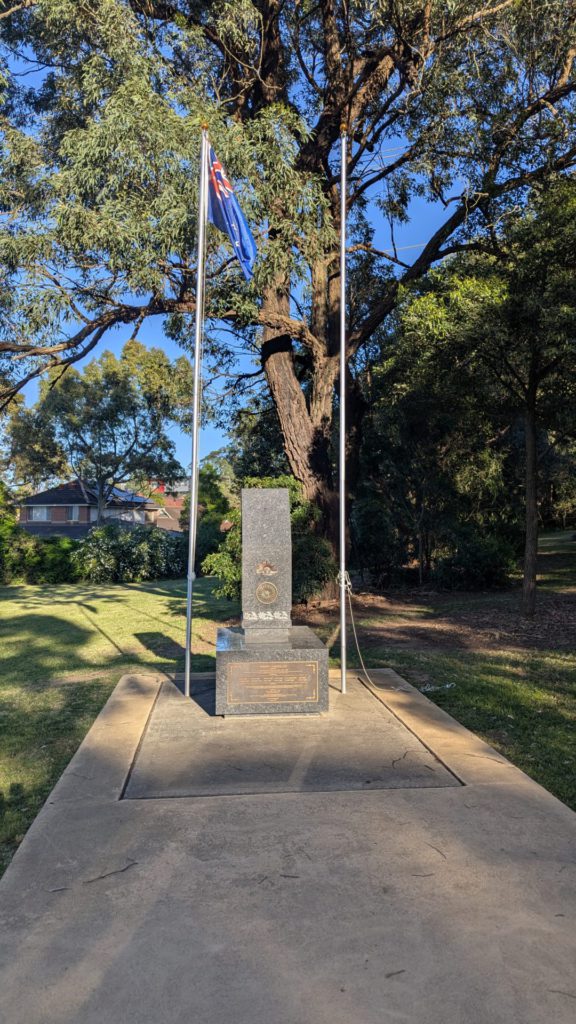
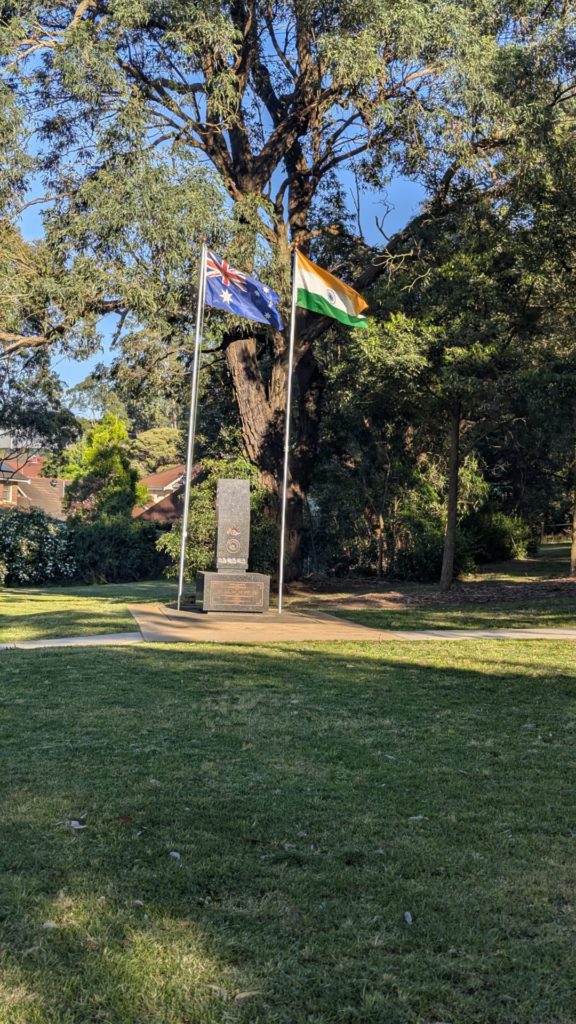
Image: ANZAC Jawan Cenotaph in Cherrybrook (Source: Supplied)
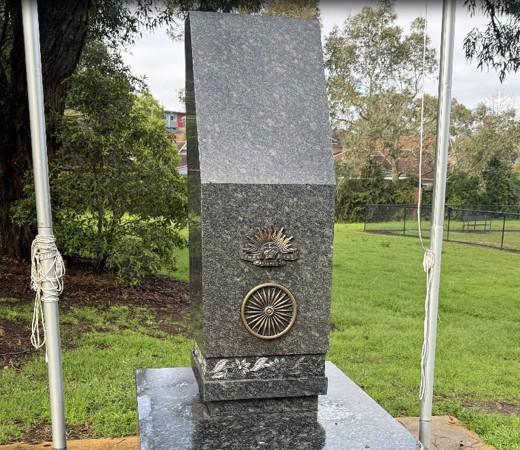
Unveiled in 2018 to mark the Centenary of the Armistice, the ANZAC Jawan Cenotaph stands in Greenway Park, Cherrybrook, as a Place of Pride recognised by the Australian War Memorial. The monument commemorates the 15,000 Indian soldiers who fought alongside Australians at Gallipoli during World War I — more than 1,400 of whom were killed and 3,500 wounded.
Image: ANZAC Jawan Cenotaph in Cherrybrook (Source: Supplied)
The granite monument, featuring the Australian Army Rising Sun badge and India’s Ashoka Chakra, symbolises the enduring military and democratic ties between the two nations. Supported by the Hornsby Shire Council, the Hornsby RSL Sub-Branch, the Department of Veterans’ Affairs, and the Indian-Australian veterans’ community, the memorial has also drawn bipartisan support from local, state, and federal representatives.
Manickam added that they continue to work closely with authorities and community stakeholders to ensure the Cenotaph remains protected and respected. “This memorial is not just a piece of stone — it represents shared sacrifice and friendship between Australia and India,” he said.
“It must be safeguarded from those who seek to dishonour that legacy.”
Support our Journalism
No-nonsense journalism. No paywalls. Whether you’re in Australia, the UK, Canada, the USA, or India, you can support The Australia Today by taking a paid subscription via Patreon or donating via PayPal — and help keep honest, fearless journalism alive.
Premier Jacinta Allan and Minister for Transport Infrastructure Gabrielle Williams have announced the “Summer Start” program ahead of the Metro Tunnel’s opening in early December, giving passengers hundreds of new weekly services before the full network integration, known as the “Big Switch,” on 1 February.
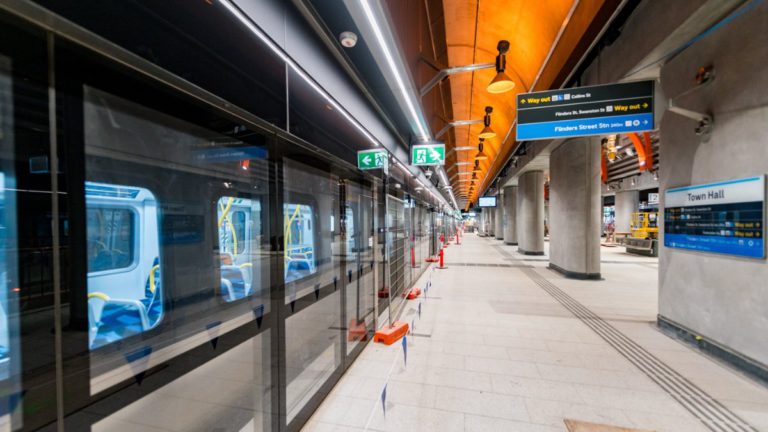
The Summer Start will see Metro Tunnel services running seven days a week, stopping at all five new underground stations: Arden, Parkville, State Library, Town Hall and Anzac.
From Monday to Friday, trains will run every 20 minutes from 10:00 am to 3:00 pm between Westall on the Cranbourne and Pakenham lines and West Footscray on the Sunbury line. Weekend services will run every 20 minutes from 10:00 am to 7:00 pm between Westall and West Footscray, every 40 minutes from East Pakenham, and every 60 minutes from Sunbury. This adds more than 240 extra weekly services during the Summer Start, while existing services continue as normal through the City Loop.
The Metro Tunnel is opening – and to celebrate, we're making public transport free every weekend from opening day in early December to 1 February. Our way of saying thank you, Victoria.
“The Summer Start is how we’re opening the tunnel safer, smoother and sooner,” Williams said, highlighting that the approach allows passengers to get familiar with the new stations and services before the Big Switch.
Premier Allan said, “Christmas is coming early for everyone on the Pakenham, Cranbourne and Sunbury lines, who’ll have hundreds of new services every week from the start of December.”
“This tunnel will transform Melbourne, cut congestion and get you to work, uni and home sooner – and it opens a year ahead of schedule.”
The Metro Tunnel will transform how we travel around Melbourne when it opens in early December – just like how the City Loop did over forty years ago. pic.twitter.com/DBAgblnKUq
The Big Switch, set for 1 February, will fully integrate the Metro Tunnel into Victoria’s wider transport network. It will introduce more than 1,000 new weekly services, overhaul thousands of timetables, and change the way half of Melbourne’s train passengers travel every day. Sunbury, Cranbourne and Pakenham line services will run exclusively through the Metro Tunnel, with trains arriving every 10 minutes during the day and every three to four minutes in peak times. Frankston line services will also return to the City Loop, improving access for thousands of commuters.
Passengers can expect faster travel across the city, with around 12 minutes end-to-end through the Metro Tunnel, and new direct connections to major hospitals, universities and St Kilda Road.
The Metro Tunnel is the biggest transformation of Melbourne’s rail network in more than 40 years, freeing up space in the City Loop to run more trains, more often, on more lines.
Support our Journalism
No-nonsense journalism. No paywalls. Whether you’re in Australia, the UK, Canada, the USA, or India, you can support The Australia Today by taking a paid subscription via Patreon or donating via PayPal — and help keep honest, fearless journalism alive.
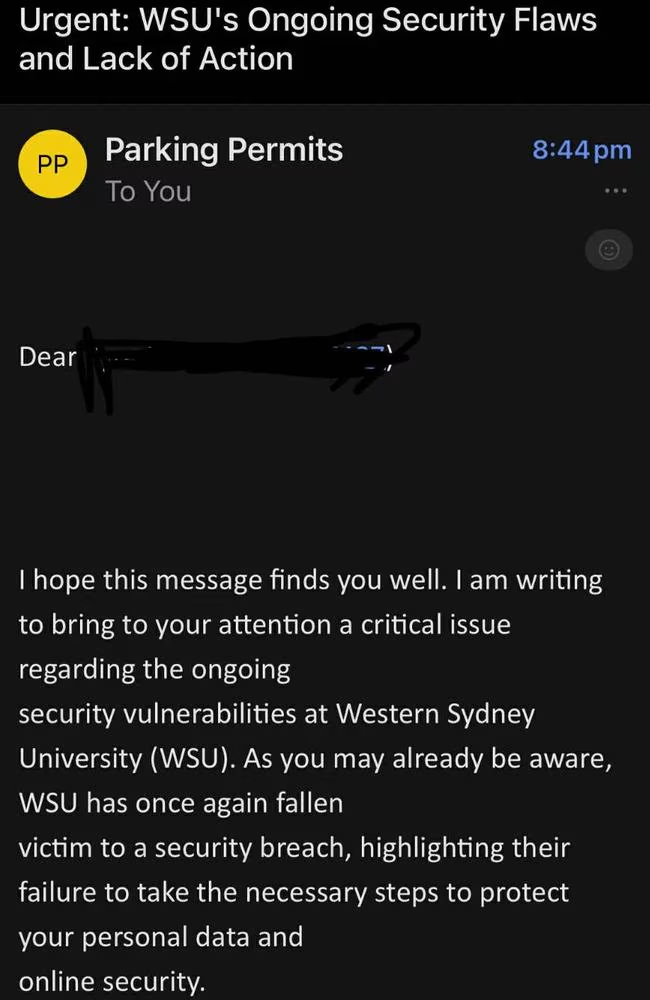
Western Sydney University (WSU) appears to have suffered another major data breach after mass emails were sent from university addresses to students and alumni — some falsely claiming recipients’ degrees had been “revoked”.
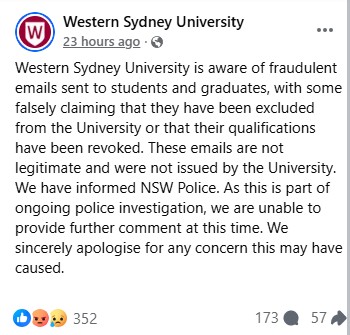
A university spokeswoman told news.com.au the emails were fraudulent. “These emails are not legitimate and were not issued by the university. We are reaching out to inform people that the email is fraudulent and have informed NSW Police.”
“As this is part of an ongoing police investigation, we are unable to provide further comment at this time. We sincerely apologise for any concern this may have caused.”
NSW Police said they currently “do not have any information” about the emails.
The messages, which flooded social media sites including Reddit and X on Monday, were sent from official WSU email accounts and addressed recipients by name and student number.
One email from a sender labelled “no-reply” falsely claimed the recipient had been permanently excluded from the university and ordered to hand in original documents.
Image: A mass email sent from a WSU account on Monday (Source: Reddit via news.com.au)
Another email, sent from “parking.permits”, appeared to outline security flaws at the university, alleging past breaches and failures to protect sensitive student data. It referenced incidents including a student exploiting a flaw in the parking permit system and a previous cyber attack in August 2024 that exposed personal information on the dark web.
It is reported that WSU has roughly 50,000 students, and it remains unclear how many people received the recent emails or whether other sensitive information was accessed.
The university was targeted earlier this year in a major cyber attack, leading to the arrest of former engineering student Birdie Kingston, who allegedly accessed and altered student records and demanded cryptocurrency from the university.
The university has urged students and alumni to remain alert and take precautions to protect their personal data.
Support our Journalism
No-nonsense journalism. No paywalls. Whether you’re in Australia, the UK, Canada, the USA, or India, you can support The Australia Today by taking a paid subscription via Patreon or donating via PayPal — and help keep honest, fearless journalism alive.
The Minns Labor Government is tripling fines for taxi drivers who overcharge or refuse fares, raising the penalty for a first offence from $1,000 to $3,000 in a bid to lift customer service standards across the industry.
Transport Minister John Graham said the higher penalties “should serve as a big flashing light to any taxi driver doing the wrong thing” and reiterated that most drivers are honest and professional.
“Whether you are at the cab rank at Sydney Airport, hailing a taxi in the city or booking one from home, it should be a smooth, friendly and good value experience.”
Passengers now have the right to a fair fare every time, and those with assistance animals must never be refused a ride, the government said.
Last month, a $60 flat rate fare from Sydney Airport to the CBD was introduced to prevent rip-offs, particularly for foreign and interstate visitors. Similar flat fare schemes have been used in other major cities, including New York’s JFK Airport.
Minister for Regional Transport Jenny Aitchison added that taxis are vital in regional areas, providing essential access to medical appointments and services.
“Every passenger deserves a fair fare, every time. We will not tolerate rogue drivers exploiting passengers in any part of NSW.”
Since the launch of the Taxi Fare Hotline in November 2022, the Point to Point Commissioner has issued more than 1,100 fines to taxi drivers.
A recent prosecution saw a driver fined $2,000 for charging an overseas family $188 for a 13-kilometre trip from the airport to a CBD hotel without using the meter. In recent months, drivers have also been banned or fined up to $12,000 for offences including overcharging and offensive behaviour.
The NSW Point to Point Commission is working with the NSW Taxi Council to strengthen the system and stop rogue drivers moving between companies.
Point to Point Transport Commissioner Anthony Wing said:
“I take fare-related offences seriously – all passengers travelling in a taxi should feel confident they are getting a fair fare. Most of the industry is doing a great job, but rogue drivers will face the full force of the law.”
NSW Taxi Council CEO Nick Abrahim welcomed the tougher penalties, calling them “another tough measure against drivers who choose to do the wrong thing by the passenger” and part of the council’s Four Point Plan to protect the reputation of honest cabbies.
Support our Journalism
No-nonsense journalism. No paywalls. Whether you’re in Australia, the UK, Canada, the USA, or India, you can support The Australia Today by taking a paid subscription via Patreon or donating via PayPal — and help keep honest, fearless journalism alive.
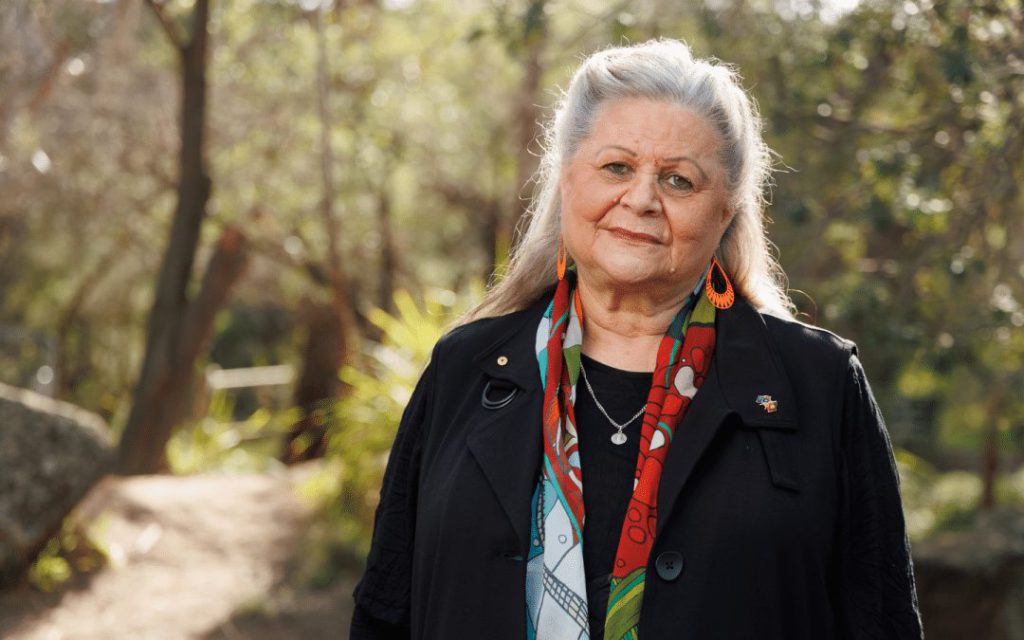
Dr Andrew Goodman, a CSIRO Research Scientist and Aboriginal man from Iningai Country in Western Queensland, said in a statement existing frameworks for AI development are often too broad and fail to account for cultural diversity.
“In Australia, this has resulted in a gap in understanding of how AI can serve Indigenous peoples.”
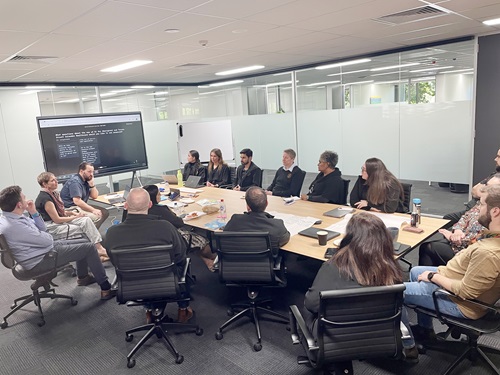
The Artificial Intelligence for Healthcare in Australian Indigenous Communities: Scoping Project to Explore Relevance aims to bridge this gap. Conducted between 2023 and 2025, the project engaged 53 leaders, clinicians, researchers and health service providers across four workshops. Dr Goodman added:
“Although these are early findings, this report provides a critical starting point for how to build responsible AI systems in technology such as apps and data collection to improve Aboriginal and Torres Strait Islander healthcare outcomes.”
Image: AI for healthcare in Australian Indigenous communities meeting (Source: CSIRO)
The consultations identified three key priorities for responsible AI use in Indigenous health. The first is building AI health literacy and cultural appropriateness by ensuring communities understand how AI works, what data it uses and how it supports care. The second is protecting Indigenous data sovereignty by guaranteeing that health data is governed and used under Aboriginal and Torres Strait Islander custodianship. The third is supporting self-determination by placing Indigenous organisations at the centre of AI design, implementation and oversight.
Dr Goodman stressed that embedding cultural knowledge in AI design is essential.
“If AI is to benefit our mob, it must reflect our voices, our data and our ways of knowing. Without Indigenous-led governance, there’s a real risk that AI will perpetuate bias and repeat the mistakes of the past.”
Image: Dr Jill Gallagher (Source: VACCHO)
Dr Jill Gallagher, a proud Gunditjmara woman and CEO of the Victorian Aboriginal Community Controlled Organisations, said the project represents a turning point in Australia’s digital health landscape.
“We know that Aboriginal Community Controlled Organisations can use AI as a powerful tool to support and strengthen their work, but it’s imperative that our mob are in the driver’s seat to ensure true self-determination.”
The project was co-led by CSIRO’s Australian e-Health Research Centre in partnership with the Victorian Aboriginal Community Controlled Health Organisation, the Aboriginal and Torres Strait Islander Community Health Service Brisbane, the Centre of Excellence for Aboriginal Digital Health, and the Australian Indigenous HealthInfoNet.
The research team is now using the findings to co-design self-determined AI tools aimed at improving health outcomes for Aboriginal and Torres Strait Islander peoples.
Support our Journalisme
No-nonsense journalism. No paywalls. Whether you’re in Australia, the UK, Canada, the USA, or India, you can support The Australia Today by taking a paid subscription via Patreon or donating via PayPal — and help keep honest, fearless journalism alive.
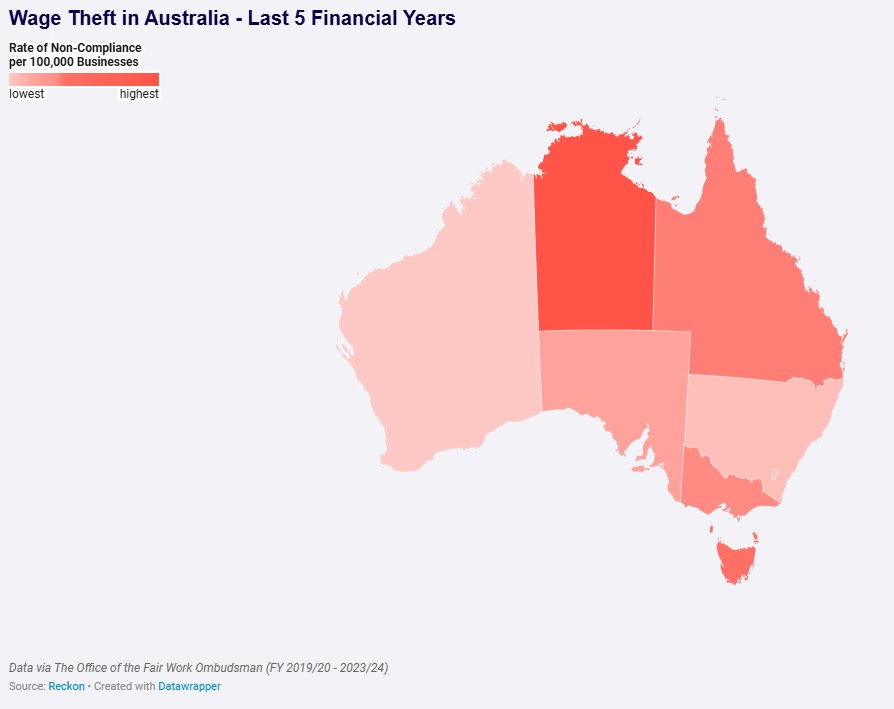
Since laws banning dodgy job advertisements came into effect, the workplace regulator has intensified its efforts to stop underpayment before it begins.
In 2024–25 alone, the FWO issued 318 infringement notices worth $111,306 to employers posting ads below lawful pay rates — more than double the 156 fines issued the previous year, which totalled almost $74,000.
Fair Work Ombudsman Anna Booth said the regulator’s early intervention approach is helping ensure workers are paid fairly from day one. “Stamping out job ads that offer dodgy pay rates prevents workers from being underpaid from the get-go and ensures a fair playing field for businesses that are doing the right thing,” Booth said in a statement.
“Employers have the clear obligation to advertise only lawful pay rates, and those doing the wrong thing are being hit with fines.”
She added that the FWO has also met with major job platforms, urging them to strengthen safeguards against unlawful job postings.
Among the offenders were a fast food outlet advertising kitchen hand roles for $17 per hour — about $15 below the minimum rate — and a disability support employer offering $22 per hour, nearly $10 under the legal wage. Other examples included a restaurant advertising for kitchen hands at $12–$24 an hour, up to $12.10 below the award rate.
The FWO said these interventions likely prevented the underpayment of vulnerable workers, particularly in high-risk sectors such as fast food, restaurants, cafés, and disability support services.
Visa holders, Booth reminded, have the same workplace rights as any other employee and are protected if they report exploitation.
“We want employers to get their pay rates right from the start, and we have all the information they need to do so.”
The Ombudsman continues to monitor job platforms and employers closely to ensure fair pay and compliance with Australian workplace laws.
Support our Journalism
No-nonsense journalism. No paywalls. Whether you’re in Australia, the UK, Canada, the USA, or India, you can support The Australia Today by taking a paid subscription via Patreon or donating via PayPal — and help keep honest, fearless journalism alive.
Health authorities have added 22 new exposure sites across South Hedland, Redbank, and Pegs Creek between 20 September and 1 October.
“Anyone who has visited the following locations during the days and times listed should be vigilant for symptoms of measles and seek medical advice if symptoms occur,” WA Health said.
“There is no ongoing risk of measles at these locations.”
Measles is a highly contagious virus spread through droplets in the air — and according to the alert, infection can still occur up to 30 minutes after an infected person has left a room.
The infection can cause serious illness and, in some cases, be fatal. Symptoms typically appear around 10 days after exposure and may include fever, tiredness, runny nose, cough, and red eyes, followed by a red, blotchy rash lasting four to seven days.
WA Health warns that up to one-third of people infected experience complications such as ear infections, diarrhoea, or pneumonia, which may require hospitalisation. In rare cases, about one in 1000 patients may develop brain swelling (encephalitis).
Exposure locations include supermarkets, pharmacies, churches, petrol stations, and the Hedland Health Campus.
Residents who have not received two doses of the measles vaccine are urged to get immunised immediately.
Exposure locations include:
– Port Hedland Adventist Fellowship, 26 Roche Rd. Redbank 6721, Saturday 20/09/2025 10am to 1pm
– Karratha Adventist Fellowship, 15 Gailbraith Rd, Pegs Creek 6714, Saturday 20/09/2025 10am to 2pm
– Ampol Foodary 67-71 Hamilton Road, South Hedland 6722, Saturday 20/09/2025 6pm to 6:45pm
– South Hedland Pharmacy, South Hedland Shopping Centre, Monday 22/09/2025 10:30am to 11:15am
– Coles, South Hedland Shopping Centre, Monday 22/09/2025 10:45am to 11:30am
– Port Hedland Boulevard Shopping Centre, Monday 22/9/2025 2:45pm to 3:15pm
– Subway, 14 Throssell Rd, South Hedland 6722, Monday 22/9/2025 7pm to 7:45pm
– Subway, 14 Throssell Rd, South Hedland 6722, Tuesday 23/09/2025 9am to 9:45am
– NAB Port Hedland, Tuesday 23/09/2025 11am to 11.30am
– Coles + Kmart South Hedland Shopping Centre, Tuesday 23/09/2025 6pm to 7:15pm
– ED Hedland Health Campus Wednesday 24/09/2025 7pm to 11.30pm
– ED Hedland Health Campus Thursday 25/09/2025 2pm to 8pm
– ED Hedland Health Campus Thursday 25/09/2025 4pm to 9.30pm
– ED Hedland Health Campus Friday 26/09/2025 7.50am to 4pm
– ED Hedland Health Campus Friday 26/09/2025 6.30pm to 10pm
– General Ward, Hedland Health Campus, Friday 26/09/2025 to Saturday 27/09/2025
– South Hedland Pharmacy, South Hedland Shopping Centre, Monday 29/09/2025 12pm to 12:45pm
– Coles, South Hedland Shopping Centre, Monday 29/09/2025 12:15pm to 1pm
– South Hedland Shopping Centre (including Muffin Break and Coles), Tuesday 30/09/2025
11am to 2pm
– ED Hedland Health Campus, Wednesday 1/10/2025 12:40am to 1:55am
– ED Hedland Health Campus, Wednesday 1/10/2025 10:40pm to Thursday 2/10/2025 4:40am
Support our Journalism
No-nonsense journalism. No paywalls. Whether you’re in Australia, the UK, Canada, the USA, or India, you can support The Australia Today by taking a paid subscription via Patreon or donating via PayPal — and help keep honest, fearless journalism alive.
Two Victorian Members of Parliament, John Pesutto and Sarah Mansfield, are in Suva this week as part of a seminar with Fijian MPs aimed at strengthening the legislative process in Fiji through improved scrutiny of bills.
Image: Victorian MPs John Pesutto and Sarah Mansfield in Suva as part of a seminar with Fijian MPs (Source: Facebook – Parliament of Victoria)
The seminar, organised by the UNDP Pacific Office in Fiji, is part of an ongoing twinning partnership between the Parliament of Victoria and the Parliament of the Republic of Fiji, designed to promote good governance and democratic accountability across the Pacific region.
Image: Victorian MP John Pesutto in Suva as part of a seminar with Fijian MPs (Source: Facebook – Parliament of Victoria)
Victorian Liberal Leader John Pesutto said he was proud to represent Hawthorn and Victoria in the exchange. “I’m here in Suva, Fiji, for the next three days as part of a Victorian Parliament exchange focused on improving democratic oversight and parliamentary scrutiny in the Fiji Parliament,” he said.
“Victoria has always played an active role in the promotion of democratic institutions and human rights – not just at home but across the Pacific. As Fiji celebrates 55 years of independence this Friday, I look forward to sharing ideas on how we can each improve the work of parliament on behalf of our people.”
Image: Fiji Speaker Filimone Jitoko and parliamentary delegation exchange gifts with Victoria’s Legislative Council President Shaun Leane MP and Legislative Assembly Deputy Speaker Matt Fregon MP (Source: Parliament of Victoria)
Earlier in June, the Speaker of the Fijian Parliament, the Filimone Jitoko, led an official delegation to the Victorian Parliament as part of the same inter-parliamentary partnership initiative.
The visit included high-level roundtable discussions with representatives from the Office of the Chief Parliamentary Counsel, the Pathways to Politics Programme for Women, and the Parliamentary Workplace Standards and Integrity Commission.
Image: Speaker of the Fijian Parliament Filimone Jitoko leading an official delegation to the Parliament of Victoria (Source: Parliament of Victoria)
The Fijian delegation also met with the Pacific Friendship Group and the Fijian Community Association Victoria Inc., highlighting the importance of community connections in strengthening bilateral ties.
Image: Victorian MP Sarah Mansfield in Suva as part of a seminar with Fijian MPs (Source: Facebook – Parliament of Victoria)
This present trip and collaboration marks a milestone in the long-standing twin-parliament relationship between Victoria and Fiji — a partnership supported by the Australian Government’s Department of Foreign Affairs and Trade.
The initiative continues to advance interparliamentary knowledge exchange, promote transparent and inclusive governance, and deepen institutional and people-to-people links between the two Parliaments.
Support our Journalism
No-nonsense journalism. No paywalls. Whether you’re in Australia, the UK, Canada, the USA, or India, you can support The Australia Today by taking a paid subscription via Patreon or donating via PayPal — and help keep honest, fearless journalism alive.
Footage captured by bystanders on Tuesday afternoon shows heavily armed officers surrounding vehicles on The River Road in Revesby, with guns drawn and a police helicopter circling overhead.
Police say the men — described as a “kill team” — were intercepted during a coordinated surveillance operation after detectives identified them “mobilising to carry out an offence”. Assistant Commissioner Scott Cook told media:
“This was a calculated and co-ordinated intervention that stopped what we will allege was a planned killing nearby a daycare centre – a deeply concerning scenario.”
It is reported by news.com.au that officers from the Tactical Operations Unit, Dog Squad, and State Intelligence Command joined the high-stakes operation around 3.50pm. During the arrests, police reportedly fired bean bag rounds — projectiles filled with lead balls — to subdue the suspects.
Two men, aged 18 and 19, were arrested from one vehicle, while a 26-year-old was detained from another. A search of the cars allegedly uncovered two firearms, balaclavas, body-worn cameras, and jerry cans filled with fuel. A third gun was later seized during follow-up searches at properties linked to the suspects.
All three men have been charged with conspiracy to commit murder and participating in a criminal group. The younger pair face additional charges, including possession of an unauthorised pistol and breach of bail. They were refused bail and are due to appear before Bankstown Local Court on Wednesday.
Assistant Commissioner Cook added that the arrests followed precise intelligence work. “These individuals were being watched, and we moved at the right moment,” he said.
“Strike Force Flodine is part of our broader strategy to dismantle organised crime networks across Sydney, and these arrests are that strategy in action.”
The police operation, which unfolded across the Condell Park and Revesby areas, temporarily closed multiple lanes on River Road and caused major traffic delays along the M5 off-ramp.
The situation was declared safe by 5.30pm, with police confirming there was no ongoing threat to the public and no injuries reported. Further details are expected to be released later on today.
Support our Journalism
No-nonsense journalism. No paywalls. Whether you’re in Australia, the UK, Canada, the USA, or India, you can support The Australia Today by taking a paid subscription via Patreon or donating via PayPal — and help keep honest, fearless journalism alive.
Thousands of residents in Dubbo and Wellington, in western New South Wales, haven’t had fluoride added to their tap water for nearly seven years.
After a public outcry, the council’s fluoridation equipment is being repaired and replaced, with fluoride expected to be restored to their drinking water by the end of the year.
In contrast, Far North Queensland’s Cooktown and Gympie councils have stopped fluoridating their water, despite a large body of evidence showing it’s a safe and effective way to prevent tooth decay.
Where you live determines your access to fluoridated tap water
Australia first added fluoride to drinking water in 1953, starting in Beaconsfield, Tasmania. Other places soon followed, including Sydney in 1968.
Queensland was the last state to fluoridate drinking water, and mandated it in 2008. But this didn’t last long. In 2012, the Newman government allowed each council to decide whether to fluoridate its supply – and opt out if their community opposed it due to costs or safety concerns.
The Victorian, South Australian, Australian Capital Territory and Tasmanian governments also ensure drinking water is fluoridated.
Western Australian and Northern Territory governments allow for limited community-based decision-making.
What can happen if you stop drinking fluoridated water?
1. You will reduce the protective effects of fluoride
Fluoride works in three ways. First, it fills the microscopic gaps in the lattice-like tooth surface. This makes the tooth harder to dissolve when exposed to acids in our food.
Second, it acts like a scavenger to find minerals in our saliva to fill the microscopic cavities or holes that are forming.
2. You may end up with cavities and infected teeth.
Fluoride in drinking water reduces the number of cavities in teeth.
My research in Lithgow NSW showed every second child had holes in their teeth before fluoride was added to their water.
People who live in fluoridated regions have fewer cavities in their teeth are less likely to need a tooth removed because of an infection, than those who live in fluoridated areas.
3. You will have to improve your oral hygiene practices
Despite their best efforts, two-thirds of people miss at least six teeth even if they brush twice a day.
For every A$100 a council spends fluoridating water, a resident saves up to A$1,800 in potential dental treatment costs.
Fluoridated water helps kids and adults who can’t visit the dentist often.
How safe is fluoride in drinking water?
Fluoride is carefully added to our drinking water at water treatment plants at a dose of around one drop of fluoride per 50 litres of drinking water.
Fluoride in drinking water has been the subject of extensive scientific investigation for more than 70 years. In those years, studies have consistently shown the benefits for oral health.
In 2017, a review from Australia’s National Health and Medical Research Council concluded community water fluoridation is a safe, effective and equitable to help prevent tooth decay.
In 2024, the United States Centres for Disease Control reiterated that community water fluoridation is safe, effective and cost-efficient method for preventing tooth decay and improving oral health.
Similarly, the 2024 update by the United Kingdom Parliamentary Office of Science and Technology endorsed the safety of water fluoridation.
Many of the studies did not account for contaminants known to reduce IQ, such as lead, and were conducted in nations with poorly controlled fluoride levels in the water. In countries such as Australia and New Zealand, the fluoride levels are controlled.
Is my water fluoridated?
If you’re unsure whether your drinking water contains fluoride, check your state or territory health department’s website – many have maps or lists of fluoridated areas.
You can also contact your local council, water supplier or check your annual water quality report for fluoride levels.
No-nonsense journalism. No paywalls. Whether you’re in Australia, the UK, Canada, the USA, or India, you can support The Australia Today by taking a paid subscription via Patreon or donating via PayPal — and help keep honest, fearless journalism alive.
Australia’s political leaders have united in condemning a series of pro-Hamas graffiti incidents in Melbourne’s inner north on the second anniversary of the deadly October 7, 2023 attacks on Israel.
Prime Minister Anthony Albanese, in a statement marking the anniversary, said the day remained one of “pain and terror for Jewish people around the world” and urged Australians to “never forget the atrocities inflicted by Hamas.”
“The attack on innocent people at a music festival that promoted ‘friends, love and infinite freedom’ underlined a core truth — that Hamas stands in opposition to all humanity,” Albanese said.
“Over 1,200 innocent lives were ruthlessly taken without mercy, including Australian Galit Carbone. We hold Galit and her loved ones in our hearts and continue to call for the hostages still held to be returned immediately and with dignity.”
Albanese reaffirmed Australia’s commitment to combating antisemitism and supporting peace in the Middle East, welcoming US President Donald Trump’s new plan to end the Gaza conflict.
“It is our duty to do everything in our power to see a just and lasting peace — the State of Israel and the State of Palestine living side by side, within internationally recognised borders, in peace and security.”
Opposition Leader Sussan Ley also issued a statement of solidarity, recalling the murder of Australian-born Galit Carbone during the Hamas assault. “Two years ago, Hamas terrorists launched a brutal assault on Israel, murdering families and taking hundreds of hostages,” Ley said.
“To Israel, to survivors, to the Jewish people everywhere — you are not alone.”
As we remember the victims and stand with the people of Israel, we must also reaffirm our commitment to confronting antisemitism and the hatred that fuels such violence.
The anniversary was overshadowed by incidents of antisemitic vandalism in Fitzroy and Preston. Graffiti reading “Glory to Hamas” and “Oct 7, do it again” appeared on a billboard and nearby buildings along Alexandra Parade, while a banner with “Glory to the martyrs” was seen on a Bell Street overpass in Preston.
Albanese denounced the graffiti as “abhorrent”, saying those responsible “must face the full force of the law.”
Deputy Prime Minister Richard Marles described the acts as “disgraceful and deeply offensive”, adding, “This day can only be one thing — a day of commemoration and remembrance.”
“Hamas is a terrorist organisation. Hamas was responsible for the terror attack which occurred two years ago on this day, in which 1200 innocent people lost their lives … a message of that kind scrawled on this day is deeply disgraceful.”
Victorian Premier Jacinta Allan said the graffiti “has no place in our great multicultural society,” while Opposition Leader Brad Battin labelled it “disgraceful.” Caulfield MP David Southwick told ABC such messages were “triggering” for members of Melbourne’s Jewish community, calling for stronger enforcement of existing laws.
Graffiti glorifying a terrorist organisation has no place in our community. On this day especially, it’s disgraceful. I stand with Victoria’s Jewish community and remember those who lost their lives in the October 7 attacks.
Executive Council of Australian Jewry co-chief executive Alex Ryvchin told The Age that the graffiti reflected a “vicious streak” in society. “This sort of behaviour has become normalised, and there’s very little legal or social consequence,” he added.
“They want to provoke reaction. They want to turn one group of Australians against another … this sort of behaviour has become routine, and it’s become normalised, and to a large extent, there’s a great impunity that goes with it. There’s very little legal consequences, there’s very little social consequences, and it won’t simply evaporate tomorrow.”
Victoria Police confirmed they are investigating the vandalism, stating, “There is absolutely no place at all in our society for antisemitic or hate-based symbols and behaviour.”
Ley added that supporting Hamas “is not free speech — it is a crime,” urging federal and state authorities to ensure those responsible are brought to justice.
“Victorians deserve to feel safe in their own community. Hate has no place on our streets.”
Support our Journalism
No-nonsense journalism. No paywalls. Whether you’re in Australia, the UK, Canada, the USA, or India, you can support The Australia Today by taking a paid subscription via Patreon or donating via PayPal — and help keep honest, fearless journalism alive.
International students are much more than a statistic — they are a vital part of New South Wales’ economy, innovation, and cultural fabric, according to a landmark Business NSW report.
The report, titled “Economic and Social Contributions of International Students to NSW,” introduces a new framework to measure the impact of more than 328,000 international students who study, live, and work across the state each year — capturing contributions across business, education, the visitor economy, society and culture, and long-term alumni networks.
Image: Emily Suvaal MLC – NSW Parliamentary Secretary for Trade and Small Business (Source: NSW Labor)
For too long, public debate has reduced international students’ impact to two narrow categories – tuition fees and living expenses. This report broadens that view by recognising the far-reaching benefits international students bring to NSW. At the launch, NSW Parliamentary Secretary for Trade and Small Business, Emily Suvaal MLC, said,
“International students are not just visitors – they are part of the fabric of our state.”
The framework highlights that international students’ spending sustains local jobs, fills workforce gaps, and drives productivity across sectors from retail to transport. Their tuition fees fund cutting-edge research, state-of-the-art facilities, and world-class teaching that benefit local students and strengthen NSW’s innovation ecosystem.
The report also notes that international students and their visiting families contribute significantly to the tourism sector, bringing new spending to both regional and urban areas.
Image: International student head count for students studying on a student visa by country in NSW
Beyond the dollars, students enrich communities through volunteering, cultural exchange, and participation in local life, making NSW more globally connected and vibrant. The impact does not end at graduation — alumni continue to contribute as investors, trade partners, and advocates for NSW, while inspiring future generations of international students.
According to the report, international education is NSW’s second-largest export, generating $12.8 billion in total economic activity and supporting nearly 120,000 full-time equivalent jobs.
Students also contributed $32.4 million in volunteer work and $2.5 billion in long-term alumni and cultural value.
Image: Economic and social contributions of international students to NSW in 2024
The sector has shown remarkable recovery since the pandemic. In 2020, international education contributed $11.4 billion and supported 95,000 jobs before COVID-19 disruptions. By early 2023, enrolments had rebounded to over 208,000 students, an increase of nearly one-third from the previous year.
Business NSW said the findings are a timely reminder of the immense and growing value of international education — not just as an export sector but as a driver of social cohesion and global connection.
Image: Paul Nicolaou, Executive Director of Business Sydney (Source: website)
Paul Nicolaou, Executive Director of Business Sydney, praised the NSW Government and Study NSW for their ongoing support of international education and highlighted the sector’s critical economic and social contributions.
Nicolaou stressed that international students are vital to the economy and communities, filling key workforce gaps and fostering lasting cultural and regional connections.
“International students are part of the lifeblood of our economy and communities. They fill so many vacancies in key workforce and skilled areas that are subject to acute labour shortages. Their presence also builds close bonds in our region that last lifetimes and cross generations,” said Paul Nicolaou.
“This report quantifies the benefits they deliver and highlights why it is so important to separate international education from the immigration debate.”
Prof. Grace Li from the University of Technology Sydney echoed this sentiment in a post on LinkedIn, saying the real story lies beyond the economic figures.
“Beyond the billions lies the real story — the friendships built across borders, the ideas exchanged in classrooms and workplaces, and the many ways international students make NSW more globally connected and culturally alive.”
Prof. Li added that uncertainty created by proposed enrolment caps, visa changes, and funding pressures has left universities and communities anxious.
“If the contribution of international students is this substantial — economically, socially, and culturally — then the question we should be asking is not how to limit them, but how to better support and integrate them.”
The report concludes that sustaining NSW’s position as a top global study destination requires recognising, celebrating, and investing in the full spectrum of international students’ contributions — a message that Business NSW hopes will resonate in policymaking circles, business forums, and even at backyard barbecue chats.
At the national level, international education contributed $51 billion to the Australian economy, including $30.2 billion in goods and services and $20.6 billion in tuition fees, further underscoring the sector’s vital role in Australia’s post-pandemic recovery.
Support our Journalism
No-nonsense journalism. No paywalls. Whether you’re in Australia, the UK, Canada, the USA, or India, you can support The Australia Today by taking a paid subscription via Patreon or donating via PayPal — and help keep honest, fearless journalism alive.
More than 300 drivers in New Zealand will have to re-sit their tests after Vehicle Testing New Zealand (VTNZ) officers allegedly accepted bribes to pass applicants at a major Auckland testing site.
The New Zealand Transport Agency (NZTA) said an internal investigation uncovered “serious misconduct” involving five driver testing officers at the VTNZ Highbrook branch.
It is reported by RNZ that the officers allegedly took payments from applicants to fraudulently pass them in practical driving tests since 2023.
All five officers have been dismissed, and their testing endorsements suspended, while NZTA continues its investigation. VTNZ has also halted all driver licence testing at its Highbrook site, as per report.
It is further reported that as a result, 322 people who obtained licences during the suspected period of fraud are now required to re-sit their on-road driving tests.
An NZTA spokesperson told RNZ:
“NZTA is contacting those affected and requiring them to pass a driving test — at no cost — to confirm they have the necessary skills to continue holding their licence.”
Police have confirmed to RNZ that they are investigating the allegations.
VTNZ, New Zealand’s largest provider of driving tests, said it had taken “decisive and serious action” following the discovery, working closely with NZTA to ensure public safety and test integrity.
“VTNZ places the highest importance on the integrity of licence testing and the safety of everyone who travels on our roads,” said country manager Greg O’Connor.
“We have zero tolerance for dishonesty and will leave no stone unturned to uncover and eliminate any improper behaviour.”
O’Connor said the company had reviewed its systems and was assessing additional security measures as a precaution.
“I can promise we will fully support any action taken by NZTA or NZ Police.”
Documents released to RNZ under the Official Information Act revealed that three men, working in customer service, data entry, and driver licensing administration, had allegedly accepted payments ranging from $500–$600 to pass standard driving tests, and up to $3,000 for heavy vehicle licences.
In 2018, RNZ reported, investigators found that some drivers were issued licences without ever sitting a practical test, and fake documents — including overseas truck licences and course certificates — were being used to obtain New Zealand heavy vehicle licences.
The investigation particularly focused on heavy vehicle licences due to heightened safety risks, prompting warnings to industry groups such as the Road Transport Forum and the Bus and Coach Association.
Briefing notes from the time highlighted a dramatic increase in applications for Indian licences, rising from 70 in 2013 to 772 in 2015, far exceeding expectations from migrant and employment trends. An independent review by KPMG subsequently identified 18 gaps and weaknesses in the system, leading NZTA to increase monitoring, tighten oversight of testing officers, and suspend or remove implicated staff.
Support our Journalism
No-nonsense journalism. No paywalls. Whether you’re in Australia, the UK, Canada, the USA, or India, you can support The Australia Today by taking a paid subscription via Patreon or donating via PayPal — and help keep honest, fearless journalism alive.
The inaugural Perth Kabaddi and Sports Cultural Festival 2025 brought a vibrant display of athleticism, tradition, and multicultural unity to Sutherland Park Reserve on 4 October.
Organised by the Western Australia Indian Club and KAA, the event marked a milestone celebration of Indian sport and culture in the state.
(Image: Facebook)
The festival featured thrilling Kabaddi matches alongside traditional sports, cultural dances, and live performances, drawing enthusiastic crowds despite the wet weather.
Teams from Adelaide, Sydney, and Melbourne delivered outstanding performances, earning praise for their sportsmanship and team spirit.
(Image: Facebook)
The event was inaugurated by Dr Tony Buti MLA, Minister for Cultural Interests, who was joined by several dignitaries including Kevin Michel MLA, Terry Healy MLA, Yaz Mubarakai MLA, Dr Jags MLA, Colleen Egan MLA, and Councillor Balli Singh from the City of Gosnells.
Dr Buti highlighted the historical and cultural significance of Kabaddi, noting that “the sport has been around for centuries and continues to grow in popularity, not only in India but around the world.”
(Images: Facebook)
Michel, who is Indian-born Australian politician representing Pilbara, reflected on his personal connection to the sport, saying, “I used to play Kabaddi in my hometown, school, and university, so it was great to be surrounded by the sport again as a spectator.”
“Congratulations to all the players, coaches, and volunteers on a brilliant game — your hard work and team spirit were amazing.”
(Images: Facebook)
Healy commended the organisers, encouraging families to attend the free event and enjoy “a great day of Kabaddi, cultural performances, and community celebration.”
(Images: Facebook)
The Consul General of India in Perth, Kajari Biswas, also attended, expressing delight at the festival’s success and the growing interest in traditional Indian sports. “It was inspiring to see Kabaddi and other traditional games showcased on such a platform, promoting cultural pride and active community engagement,” Biswas said.
The festival, supported by local sponsors and volunteers, underscored the strength of Western Australia’s Indian community and its contribution to the state’s multicultural identity.
Support our Journalism
No-nonsense journalism. No paywalls. Whether you’re in Australia, the UK, Canada, the USA, or India, you can support The Australia Today by taking a paid subscription via Patreon or donating via PayPal — and help keep honest, fearless journalism alive.
Victoria University alumna Devika Chaudhary has been honoured with the Outstanding Contribution to the Community Award at the 2025 Multicultural Youth Awards (MYA), held over the weekend at Parliament House.
The award recognises a young individual or group making a significant positive difference through impactful volunteer work or community projects.
In a heartfelt post on LinkedIn, Devika expressed her gratitude after receiving the award, dedicating the honour to the people and communities who have supported her journey.
She acknowledged the Australian Air Force Cadets, Brimbank City Council, and Victoria University for shaping her commitment to service, and paid special tribute to her mother, Poonam Singh JP, for inspiring her passion for giving back, “This recognition means so much to me—not just personally, but because it reflects the people and communities who have walked alongside me,” Devika said.
“It was a privilege to stand alongside so many inspiring changemakers who are making a real difference in their communities.”
Devika, who is a secondary school Mathematics and Physics teacher, joined the VU Alumni family in 2018 after completing a Diploma of Education Studies, has been a consistent contributor to her community and university.
Over the years, she has been named a Volunteer of the Year Finalist (2022), graduated with a Bachelor of Education (2023), recognised as a Rising Star Award Finalist (2024 & 2025), and now serves as an executive member of the Alumni Community Action Group (ACAG).
The Multicultural Youth Awards is a national event that celebrates the exceptional achievements of multicultural youth across Victoria and Australia. Moving beyond traditional recognition programs, it highlights the diverse talents, resilience, and leadership of young people who are shaping Australia’s inclusive future.
Victorian Premier Jacinta Allan praised the awardees, saying, “Victorians are proud of our diversity because we know it is our strength. We are proud to celebrate the exceptional work of young multicultural Victorians who help make our state a better and fairer place.”
“From entrepreneurship and academia to sports and the arts – every nominee has made a profound difference to our community and our state.”
Minister for Youth Natalie Suleyman commended the young leaders for their contributions, “Multicultural young Victorians give so much to the rich cultural fabric of our state. They’re showing up and getting involved in their local communities as the next generation of leaders.”
“The Multicultural Youth Awards provide a space to recognise and celebrate their significant contributions to the Victorian community, and beyond.”
Yusuf Liban, Director of the Multicultural Youth Group and 2025 Young Australian of the Year Finalist, added, “These young leaders are not waiting for permission – they’re creating change now.”
“The MYA is about amplifying their voices and recognising the impact they’re already making in their communities.”
Supported by the Victorian Government, the Centre for Multicultural Youth, and the Commission for Children and Young People, this year’s awards celebrated 13 outstanding young changemakers whose work spans advocacy, entrepreneurship, education, arts, and social justice. Collectively, they represent a new generation of leaders with a combined social media reach of over 500,000, amplifying their influence far beyond their local communities.
Support our Journalism
No-nonsense journalism. No paywalls. Whether you’re in Australia, the UK, Canada, the USA, or India, you can support The Australia Today by taking a paid subscription via Patreon or donating via PayPal — and help keep honest, fearless journalism alive.
In a significant step towards advancing medical technology collaboration, the University of Western Australia (UWA) has signed a Memorandum of Understanding (MoU) with the Andhra Pradesh MedTech Zone (AMTZ), India.
The MoU was formally signed by Dr Jitendra Sharma, CEO of AMTZ, and Prof. Jennifer Howell, Pro Vice-Chancellor (Global Engagement) at UWA, in the presence of Stephen Dawson MLC, Western Australia’s Minister for Medical Research.
Image: MoU was formally signed by Dr Jitendra Sharma, CEO of AMTZ, and Prof. Jennifer Howell, Pro Vice-Chancellor (Global Engagement) at UWA (Source: Fcaebook)
This strategic partnership aims to strengthen collaboration in health and medical sciences, offering valuable opportunities for UWA students across Australia and at its upcoming branch campus in India to undertake internships and immersive experiences with AMTZ-affiliated companies.
Pleasure to join Hon. Stephen Dawson MLC, Western Australian Minister for Medical Research, and Dr. Jitendra Sharma, CEO of Andhra Pradesh MedTech Zone (AMTZ), India, at the signing ceremony of the Memorandum of Understanding (MOU) between the University of Western Australia… pic.twitter.com/mMTqmOEmuT
The partnership will also drive knowledge exchange in critical areas such as innovation, clinical trials, and MedTech research, fostering cross-border cooperation between government, industry, and academia.
Following the signing ceremony, a roundtable discussion was held, focusing on AMTZ’s strategic growth plans and the pivotal role of partnerships in advancing global medical research and technology development.
Image: L-R: Mr Paul Murphy – Consul General of Australia in Mumbai, Dr Vineet Joshi – Chairman UGC (Acting) and Secretary, Department of Higher Education, Ministry of Education, Mr Dharmendra Pradhan – Union Minister of Education, Government of India, Professor Guy Littlefair – Deputy Vice-Chancellor, University of Western Australia, Mr Devendra Fadnavis – Chief Minister of Maharashtra, Mr Chandrakant Patil – Minister of Higher and Technical Education, Government of Maharashtra, Mr Aseemkumar Gupta – Additional Chief Secretary, Urban Development Dept. Government of Maharashtra, Mr. Vijay Singhal – Managing Director, CIDCO.
Earlier this year, India’s University Grants Commission approved The University of Western Australia’s (UWA) proposal to establish international branch campuses, making it the first Australian Group of Eight university recognised under India’s National Education Policy 2020.
UWA will open its first campus in Mumbai, followed by Chennai, offering a range of STEM and business programs designed to meet the aspirations of Indian students and the demands of the global economy.
Support our Journalism
No-nonsense journalism. No paywalls. Whether you’re in Australia, the UK, Canada, the USA, or India, you can support The Australia Today by taking a paid subscription via Patreon or donating via PayPal — and help keep honest, fearless journalism alive.
The Fair Work Ombudsman has secured $38,500 in court penalties against the former operators of a United Petroleum outlet in Queenstown, Adelaide, after an investigation uncovered staff underpayments and other workplace breaches.
As per Fair Work statement, the Federal Circuit and Family Court imposed a $35,000 penalty on Sai Enterprises Pty Ltd, which previously ran the outlet, and a $3,500 penalty on the outlet’s former manager, Raman Monga.
The FWO’s audit revealed that in 2021 the company failed to pay three international student workers a total of $2,668 in accrued but untaken annual leave at the end of their employment, in breach of the Fair Work Act’s National Employment Standards.
It is further reported that Sai Enterprises also failed to provide pay slips within one working day of payment and did not have written agreements for part-time staff.
As per Fair Work statement, Mr Monga was penalised for his role in the annual leave underpayments and the pay slip breaches. The affected workers have since been fully back-paid.
“All employers must ensure they pay staff all lawful entitlements and provide pay slips, which are essential for workers to check if they’ve been paid correctly,” Fair Work Ombudsman Anna Booth said in a statement.
Booth added that protecting migrant workers is a priority, and anyone with concerns about entitlements should contact the FWO for free assistance.
Judge Stewart Brown said the penalties were necessary to deter similar conduct, noting the underpayments were significant for the workers and might not have been detected without the FWO investigation. He also emphasised the central role of pay slips in maintaining minimum wage standards.
This case is one of five legal actions the FWO has taken against former operators of United Petroleum outlets following audits of 20 outlets across Tasmania, Queensland, NSW, Victoria, and South Australia.
Earlier cases in Tasmania resulted in $179,221 in penalties, while a Brisbane outlet operator was fined $15,984. A Melbourne case remains ongoing, as does one of the FWO’s investigations.
Support our Journalism
No-nonsense journalism. No paywalls. Whether you’re in Australia, the UK, Canada, the USA, or India, you can support The Australia Today by taking a paid subscription via Patreon or donating via PayPal — and help keep honest, fearless journalism alive.
Former Fijian Prime Minister and Labour Leader Mahendra Chaudhry has commended Fiji’s Nepali community for keeping their culture and traditions alive.
Speaking as chief guest at a Nepal Day celebration on Sunday in the highlands of Kavanagasau, Sigatoka, Chaudhry lauded the small community’s efforts over the past three years to strengthen their cultural identity.
(Image: Facebook)
The event was organised by Salesh Pal and held at the residence of Sanjay Kumar.
“I have always strongly advocated the right of every ethnic community to acknowledge its roots and preserve its language, religion and culture,” Chaudhry said.
“Remember, you are from Nepal – a country that was never colonised by a foreign power. Attempts by the British in the 19th century were soundly beaten by your brave forefathers. Their unity forced Britain to abandon its plans and sign a peace treaty with Nepal.”
Addressing around 100 Nepali families, he urged the community to remain united in protecting their cultural, civil and political rights.
(Image: Facebook)
“Your culture, tradition, religion, language, food and dress – these are essential components of your identity. Preserve them, and preserve your Nepali heritage,” he said.
Chaudhry also recounted the community’s history in Fiji. Many Nepalis were brought as indentured labourers and were classified as Indians by British authorities, leading to the loss of a distinct identity. Initially based in Suva, they later moved to Navua to work in the Vancouver Sugar Company’s canefields. After the company collapsed in the early 1900s, most resettled in Sigatoka and surrounding western regions, with Kavanagasau becoming the largest Nepali enclave due to its highlands reminiscent of Nepal’s mountainous terrain.
Highlighting Nepal’s global significance, Chaudhry reminded the community that it is the birthplace of Lord Buddha, with Lumbini now a major pilgrimage site, and home to the legendary Gurkhas, renowned worldwide for their bravery, loyalty and military prowess.
Support our Journalism
No-nonsense journalism. No paywalls. Whether you’re in Australia, the UK, Canada, the USA, or India, you can support The Australia Today by taking a paid subscription via Patreon or donating via PayPal — and help keep honest, fearless journalism alive.
Singh’s visit, at the invitation of Deputy Prime Minister and Defence Minister Richard Marles, comes as both nations celebrate five years of their Comprehensive Strategic Partnership (CSP).
This marks the first visit by an Indian Defence Minister to Australia since 2014.
Marles last visited India in June 2025, when he met Singh and called on Prime Minister Narendra Modi, underscoring the momentum in defence cooperation between the two Indo-Pacific partners.
Glad to meet Deputy Prime Minister of Australia Richard Marles. Had a productive discussion on deepening the India-Australia Comprehensive Strategic Partnership, which marks its fifth anniversary today. Our shared vision for a stable, secure, and prosperous Indo-Pacific continues… pic.twitter.com/VucoShDe4l
According to the Ministry of Defence, the agreements will boost cooperation in information sharing, the maritime domain, and joint defence activities, reflecting the growing convergence between New Delhi and Canberra on regional security priorities.
During his visit, Singh will hold bilateral discussions with Marles and chair a business roundtable in Sydney attended by leading defence industry figures from both nations. He is also expected to meet other senior Australian leaders to explore new initiatives aimed at enhancing the bilateral relationship.
Defence ties between India and Australia have steadily expanded over the years, encompassing joint military exercises, ship visits, training programmes, and high-level exchanges.
The partnership, elevated from a Strategic Partnership in 2009 to a Comprehensive Strategic Partnership in 2020, is underpinned by shared democratic values, Commonwealth heritage, and strong people-to-people links. The growing presence of Indian students in Australian universities, tourism, and sporting ties continue to enrich this dynamic relationship.
Support our Journalism
No-nonsense journalism. No paywalls. Whether you’re in Australia, the UK, Canada, the USA, or India, you can support The Australia Today by taking a paid subscription via Patreon or donating via PayPal — and help keep honest, fearless journalism alive.
A 28-year-old international driver has been charged with dangerous driving following a close call on WA’s notorious Indian Ocean Drive, narrowly avoiding a head-on collision.
The incident, captured on dashcam, shows a white Tesla attempting to overtake a car and a truck just before a blind bend, forcing oncoming vehicles off the road. It occurred at around 4:20 pm on Wednesday, 1 October, near Sandy Cape Road.
Image: 28-year-old international driver charged after near-miss on Indian Ocean Drive (Source: WA Police Force – Facebook – screenshot)
Jurien Bay Police confirmed the man, who is visiting Western Australia, faces one count of dangerous driving.
The Shire of Gingin has called for an education campaign aimed at international drivers. Shire president Linda Balcombe told 9 News Perth,
“Any international driver that comes across something like that, they think they can just overtake anytime and don’t understand the double-lined system.”
She said local governments should unite in promoting safer driving for visitors.
Video: 28-year-old international driver charged after near-miss on Indian Ocean Drive (Source: WA Police Force – Facebook )
WA’s Road Safety Minister emphasised that all drivers, local and international, must do their part to prevent such dangerous situations.
Authorities are appealing for witnesses, video footage, or anyone with information to contact Crime Stoppers on 1800 333 000 or report online.
Support our Journalism
No-nonsense journalism. No paywalls. Whether you’re in Australia, the UK, Canada, the USA, or India, you can support The Australia Today by taking a paid subscription via Patreon or donating via PayPal — and help keep honest, fearless journalism alive.
The Treaty was signed in Canberra today by Prime Minister Anthony Albanese and Papua New Guinea Prime Minister James Marape, reflecting a shared commitment to peace and stability in the Pacific. It will enter into force once both countries complete their domestic treaty-making processes.
Prime Minister Albanese described the moment as “a shared historic moment for our two nations,” noting that it builds on “more than 50 years of cooperation and respect” between the countries. He said the Treaty demonstrates “the deep trust between Australia and Papua New Guinea across the breadth of our bilateral relationship,” and added that Papua New Guinea had proposed the agreement, which Australia was “honoured to agree” to.
The Treaty sets out mutual defence obligations, recognising that an armed attack on either country would threaten the peace and security of both, and declares that they would act together to meet any common danger. It also explicitly affirms respect for the sovereignty, independence, and territorial integrity of neighbouring nations.
True friends. Nearest neighbours. And now, Allies.
With the signing of our Mutual Defence Treaty today, we are elevating the relationship between Australia and Papua New Guinea to an Alliance.
Together, we have committed to protect each other’s sovereignty and democracy.… pic.twitter.com/JpLHZ031MS
The agreement paves the way for the expansion and modernisation of defence cooperation, including potential recruitment of citizens from each country into the other’s defence forces. From 1 January 2026, eligible permanent residents living in Australia who are also Papua New Guinea citizens will be able to apply to join the Australian Defence Force, with further consultations on recruitment pathways planned.
Albanese said the Alliance, “built on generations of mutual trust, demonstrates our commitment to ensuring the Pacific remains peaceful, stable and prosperous,” and emphasised that by strengthening regional security ties, “we safeguard our own security.”
The signing follows a Joint Communiqué released last month during Papua New Guinea’s Golden Jubilee celebrations in Port Moresby, which outlined the core principles of the Treaty.
Support our Journalism
No-nonsense journalism. No paywalls. Whether you’re in Australia, the UK, Canada, the USA, or India, you can support The Australia Today by taking a paid subscription via Patreon or donating via PayPal — and help keep honest, fearless journalism alive.
The Australian Trade and Investment Commission (Austrade) joined the Bharat Agrinnovation Manthan at Sahyadri Farms Post Harvest Care Ltd in Nashik — widely hailed as India’s agtech hub — to explore the future of agricultural innovation and collaboration between India and Australia.
Image: Bharat Agrinnovation Manthan at Sahyadri Farms Post Harvest Care Ltd in Nashik (Source: LinkedIn – Austrade)
Maharashtra’s Chief Minister, Devendra Fadnavis, delivered the keynote address, lauding the role of agritech in strengthening India’s rural economy. “This two-day On-Farm Immersion Investor Summit is an opportunity to experience India’s largest horticulture value chain first-hand, engage in meaningful dialogues, and discover the innovations and startups that are shaping the future of agriculture.” He added:
“I believe this summit will help us address the critical questions regarding profitability, scalability, technology adoption and policy support in agriculture. It will also open doors for collaborations that empower farmers and strengthen our rural economy.”
The Chief Minister also highlighted the MahaAgri AI Policy 2025–29, which aims to position Maharashtra’s agriculture sector at the forefront of the digital era.
The two-day on-farm investor summit offered participants a first-hand look at modern grape cultivation, crop management, freeze-dry facilities, nurseries, soil health labs, and emerging innovations such as the use of microalgae in farming. The event showcased how technology is transforming agriculture from pre- to post-production stages across India.
Representing Austrade, Dr Asha S., Director of Trdae and Investment, shared insights during a panel on ground-up innovation and technology adoption, emphasising how Australian solutions can help address shared agricultural challenges such as water scarcity, climate volatility, rural connectivity, and labour shortages.
Austrade also announced that it will soon release an Australia–India Agtech Business Opportunities Report to map new areas of synergy between the two nations.
Image: Bharat Agrinnovation Manthan at Sahyadri Farms Post Harvest Care Ltd in Nashik (Source: LinkedIn – Austrade)
Described as a “live agri sandbox,” Bharat Agrinnovation Manthan allowed startups to test and validate ideas directly with farmers, fostering sustainable and scalable solutions across the agriculture, food, and allied industries.
As Nashik cements its place as the “Silicon Valley of AgriTech” in India, the summit reinforced the importance of cross-border collaboration in shaping the future of farming.
Support our Journalism
No-nonsense journalism. No paywalls. Whether you’re in Australia, the UK, Canada, the USA, or India, you can support The Australia Today by taking a paid subscription via Patreon or donating via PayPal — and help keep honest, fearless journalism alive.
Australian fast bowler Henry Thornton was hospitalised in Kanpur after falling ill with a suspected case of food poisoning during the ongoing one-day series between India A and Australia A.
According to local media, Thornton, who complained of a severe stomach infection, was last week admitted to Regency Hospital in Kanpur, where he remained under observation for two days before being discharged.
Image: Henry Thornton (Source: Adelaide Strikers)
Team sources, as per the Hindustan Times, said the pacer developed gastrointestinal issues after consuming food at the team hotel.
“Henry was dealing with mild gastro symptoms even before arriving in Kanpur, but his condition worsened after reaching the city.”
It is further reported that three other Australian players also reported mild stomach issues, though none required hospitalisation.
It is reported that the Australian team management has since revised the dietary plan for the entire squad, taking extra precautions with meals and hydration.
Thornton has now rejoined the team after showing full recovery. The series decider will be played on Sunday, also in Kanpur.
Support our Journalism
No-nonsense journalism. No paywalls. Whether you’re in Australia, the UK, Canada, the USA, or India, you can support The Australia Today by taking a paid subscription via Patreon or donating via PayPal — and help keep honest, fearless journalism alive.
Nepal and India are grappling with catastrophic floods and landslides triggered by relentless heavy rains, leaving more than 60 people dead and dozens missing, officials said.
In Nepal, at least 44 people have died and five remain missing following landslides in the eastern district of Ilam and surrounding areas, authorities confirmed.
#WATCH: Heavy flooding in Sindhupalchok area of Nepal following heavy rainfall; many houses have been swept away. (9/7) pic.twitter.com/CH4KigWnP6
The worst-hit district, Ilam, saw 38 fatalities alone as overnight downpours swept through during the Dashain festival, burying homes and severing vital transportation links. Entire families were among the victims.
“The loss of lives and damage caused by heavy rains in Nepal is distressing. We stand with the people and Government of Nepal in this difficult time,” Prime Minister Narendra Modi said, pledging India’s support as a “friendly neighbour and first responder.”
Nepal’s Prime Minister Sushila Karki thanked Modi for his solidarity, saying, “The support from our friendly neighbour, India, in this difficult time is deeply appreciated by the people and Government of Nepal.”
— Prime Minister Sushila Karki (@pmsushilakarki) October 5, 2025
Government agencies in Nepal are “fully prepared for rescue and relief,” Karki added, urging citizens to avoid unnecessary travel and announcing public holidays on Sunday and Monday.
Landslides have blocked several highways and disrupted flights, leaving hundreds of travellers stranded. Rivers have flooded roads across hill-ringed Kathmandu, cutting the capital off from much of the country.
Flood Crisis in Bihar’s Kosi Region: Rescue Efforts Underway
Heavy rains in North Bihar and Nepal have caused severe flooding in the Kosi region, with the river flowing above danger levels.
Sixteen people died in recent thunderstorms across Bihar. In Supaul district, 33… pic.twitter.com/57YjNsHBlK
In India, at least 20 people were killed in Darjeeling district, West Bengal, after flash floods and landslides destroyed homes and infrastructure.
The Indian Meteorological Department issued a red alert for “extremely heavy rainfall” in sub-Himalayan areas until Monday, while the Indian Army joined rescue operations in Bhutan and northern India.
It is likely to move east-southeastwards over westcentral & adjoining northwest Arabian Sea and weaken into a depression by the 0000 UTC of 7th October.
— India Meteorological Department (@Indiametdept) October 6, 2025
In Nepal, as per reports, the floods have damaged the Jogmai Hydropower Project and cut power across Ilam district. Communication networks have collapsed in remote areas, leaving many villages isolated. Bridges along the Mechi Highway, the main link connecting Ilam to neighbouring districts, have been washed away, halting transport and supply chains.
Authorities continue rescue operations, with the Nepali Army evacuating the injured and local police coordinating relief efforts. Officials warned residents to stay away from landslide-prone areas as the region remains under threat from ongoing heavy rains.
Support our Journalism
No-nonsense journalism. No paywalls. Whether you’re in Australia, the UK, Canada, the USA, or India, you can support The Australia Today by taking a paid subscription via Patreon or donating via PayPal — and help keep honest, fearless journalism alive.
Wage theft in Australia has more than doubled over the past five years, with thousands of workers missing out on pay they are legally owed, according to a new analysis by software company Reckon using Fair Work Ombudsman data.
It is reported that between the 2019–20 and 2023–24 financial years, over 16,700 investigations into potential underpayments were completed, revealing that 9,401 businesses — more than half — had failed to comply with wage laws.
The investigations led to more than $1.76 billion being repaid to workers, underscoring the widespread impact of underpayment across the country according to research done by Reckon.
The sectors with the highest rates of non-compliance were public administration and safety, followed closely by accommodation and food services. The former recorded 932 non-compliant businesses per 100,000, while hospitality not only ranked second for non-compliance but also received the largest number of requests for assistance, with 11,369 complaints lodged during the five-year period.
Other industries featuring in the top ten for non-compliance included administrative and support services, retail, utilities, transport and warehousing, arts and recreation services, manufacturing, and mining. Mining led in terms of the average amount recovered per business, with more than $4.5 million returned to workers.
Wage theft was not evenly distributed across Australia. The Northern Territory recorded the highest rate of non-compliant businesses relative to its total, followed by Tasmania and Queensland. By contrast, larger states such as New South Wales and Victoria had more assistance requests overall, but lower rates of non-compliance when adjusted for the number of businesses. Western Australia recorded the lowest rate of non-compliance nationwide. The data also shows a notable shift in reporting patterns.
While most wage theft inquiries were still initiated by employees, self-reporting by employers has more than doubled in recent years, suggesting growing awareness of underpayment issues. Legislative changes, including laws in Victoria and Queensland that made wage theft a criminal offence from 2020, are also likely influencing compliance and enforcement outcomes.
Beyond the numbers, wage theft has a tangible impact on workers’ lives. Casual employees, younger workers, and those in hospitality and service industries are particularly vulnerable, often missing out on entitlements such as overtime, penalty rates, superannuation, and other allowances.
Over the five years, penalties for breaches increased sharply, reflecting the serious consequences for businesses found to be in violation.
Reckon CEO Sam Allert said the findings highlight the need for businesses to take proactive measures. “Staying compliant with wage laws is not just about avoiding penalties — it’s about fostering a fair and ethical workplace that benefits both employees and businesses,” he said.
“Regular payroll reviews, ongoing staff training, and the use of technology can help businesses stay on the right side of the law, while building trust with employees.”
The Reckon analysis serves as a wake-up call for Australian businesses of all sizes. While wage theft has been a longstanding issue, the data suggests it is becoming more visible as authorities increase enforcement and as employers begin to self-report more frequently. For workers, the report confirms that pursuing underpayments can yield significant results, with billions recovered and thousands of businesses held accountable.
As Australia continues to tighten regulations and improve oversight, both employers and employees are likely to see changes in how wage entitlements are monitored and enforced, but the challenge remains creating workplaces that are both fair and fully compliant.
Support our Journalism
No-nonsense journalism. No paywalls. Whether you’re in Australia, the UK, Canada, the USA, or India, you can support The Australia Today by taking a paid subscription via Patreon or donating via PayPal — and help keep honest, fearless journalism alive.
New Zealand Foreign Minister and NZ First leader Winston Peters has launched a blistering attack on Green Party co-leader and “Free Palestine” advocate Chlöe Swarbrick, accusing her of political grandstanding and hypocrisy following recent protests outside his Auckland home.
At a press conference, the Green Party joined families of the three detained New Zealanders to demand urgent government action. Here, Swarbrick called on Prime Minister Christopher Luxon to “intervene and ensure their safe return,” accusing the government of moral failure and political cowardice over Israel’s actions.
She argued that New Zealand’s leaders lacked the moral courage of past generations. “Luxon, Seymour and Peters are proving they would not have been the leaders of this country who chose to stand against apartheid South Africa,” she said. “They would not have stood against the French and the United States when it came to a nuclear-free Pacific.”
She also challenged government MPs directly, saying, “All 68 government MPs are personally, individually responsible for whether the bill to sanction Israel progresses or does not. We need just six of them to sign their support to get that bill onto the floor of the House.”
Chloe Swarbrick needs to grow up and get off her ‘holier than thou’ sanctimonious high horse.
No one wants to be lectured about ‘morals’ from someone who knows nothing about what’s going on around the world apart from her own arrogantly manufactured ideologically driven…
In a strongly worded post on X, Peters said Swarbrick needed to “grow up and get off her ‘holier than thou’ sanctimonious high horse.”
“No one wants to be lectured about ‘morals’ from someone who knows nothing about what’s going on around the world apart from her own arrogantly manufactured ideologically driven political soundbites,” Peters wrote.
“The rest of us live in the real world and make real world decisions based on facts – not made up from your left-wing hyperbole, faux moral outrage, incessant hand wringing, and exaggerated eye-rolling.”
He further accused Swarbrick of hypocrisy, claiming she had stood by as protesters harassed him, his family, and his neighbours with loud hailers outside his St Mary’s Bay home. “Maybe, Chlöe, you should call out the protesters who decided to harass me, my household, and my neighbours at night – instead of standing next to one of them and letting her talk at today’s manufactured press conference,” Peters said.
The Foreign Minister also criticised those who joined the Global Sumud Flotilla, an international protest effort attempting to break Israel’s blockade of Gaza. Several New Zealanders on board were detained by Israel. “Those individuals in that flotilla knew what they were doing and what was going to happen, but they did it anyway. Shame on them and shame on you,” Peters wrote.
He accused Swarbrick of being “headline hunting” and said taxpayers were now footing the bill for “self-righteous, self-inflicted petulant problems.” He ended his post with a blunt message: “Keep showing New Zealand why you should never be in Cabinet. PS: Experience matters – of which you have none.”
The latest exchange follows a turbulent few months for Swarbrick. In August, she was ‘named’ by Speaker Gerry Brownlee and ejected from Parliament after refusing to withdraw remarks suggesting coalition MPs “grow a spine” and sanction Israel. Her refusal to apologise resulted in a week-long suspension and a pay penalty.
Despite the Speaker’s ruling, Swarbrick maintained that she had already been punished and that other MPs had made worse remarks without consequence. She left the House shouting “Free Palestine.”
Protests in support of the flotilla have continued in Auckland, with police confirming that around 20 demonstrators gathered outside Peters’ home last week. Videos on social media showed protesters waving Palestinian flags, banging drums, and chanting slogans.
“Protesting” outside a politicians home at night is not a protest, it is just disgraceful and blatant harassment.
Politicians all have families and children just like every other kiwi home, and our families don’t deserve to be harassed and intimidated for any reason.
Peters condemned such demonstrations as “disgraceful,” adding that “politicians have families and children just like every other Kiwi home. Our families don’t deserve to be harassed and intimidated for any reason.”
He urged New Zealanders to express their views responsibly, saying, “We live in one of the most tolerant democracies in the world, but with that comes the responsibility to be decent and respectful about where and how those rights are exercised.”
Support our Journalism
No-nonsense journalism. No paywalls. Whether you’re in Australia, the UK, Canada, the USA, or India, you can support The Australia Today by taking a paid subscription via Patreon or donating via PayPal — and help keep honest, fearless journalism alive.
Fiji’s Deputy Prime Minister and Minister for Finance, Prof. Biman Prasad, has praised Ba’s sporting achievements, calling them a celebration of unity, discipline, and community spirit.
Ba Province includes 109 villages and 152 settlements across the 21 districts including Yasawa, Savatu, Qaliyalatina, Nadi, Rukuruku, Sabeto, Vitogo and Vuda.
Image: Fiji’s Deputy PM Prof. Biman Prasad praises Ba teams for inspiring community and youth through sport (Source: Facebook)
Prof. Prasad lauded Ba Muslim Sports’ victory at the FANCA ICC 2025 as a historic moment for the town and for Fiji. “When the Ba team lifted the trophy, it was not just a win for one club, but a celebration of unity, discipline, and determination that reflects the best of our people,” he said.
Image: Fiji’s Deputy PM Prof. Biman Prasad praises Ba teams for inspiring community and youth through sport (Source: Facebook)
Congratulating players, officials, and supporters, he emphasised that “true victory comes when talent is combined with perseverance, humility, and faith.”
Image: Fiji’s Deputy PM Prof. Biman Prasad praises Ba teams for inspiring community and youth through sport (Source: Facebook)
The Deputy Prime Minister highlighted the power of sports to bring communities together and inspire future generations, calling young Fijians “our greatest resource.”
Players were also presented with plaques in recognition of their outstanding contribution to the win.
Image: Fiji’s Deputy PM Prof. Biman Prasad praises Ba teams for inspiring community and youth through sport (Source: Facebook)
Prof. Prasad also commended the Ba golf community for promoting sportsmanship, teamwork, and healthy living through the 4 Men Ambrose Golf Tournament.
“Sports brings people together. It creates a sense of camaraderie, togetherness, and teamwork,” he said, noting the importance of recreational sports in tackling Fiji’s growing challenge of non-communicable diseases.
Image: Fiji’s Deputy PM Prof. Biman Prasad praises Ba teams for inspiring community and youth through sport (Source: Facebook)
He praised organisers, participants, and especially young golfers and women taking part in the tournament, saying:
“Seeing young people involved in sports like golf is a great sign. It’s not only good for building relationships but also essential for one’s well-being.”
Image: Fiji’s Deputy PM Prof. Biman Prasad praises Ba teams for inspiring community and youth through sport (Source: Facebook)
The tournament attracted golfers from across the region, aiming to strengthen community engagement and promote golf as a recreational sport in Ba.
Support our Journalism
No-nonsense journalism. No paywalls. Whether you’re in Australia, the UK, Canada, the USA, or India, you can support The Australia Today by taking a paid subscription via Patreon or donating via PayPal — and help keep honest, fearless journalism alive.
The European Space Agency has inaugurated a new deep space communication antenna in Western Australia, strengthening its ability to maintain contact with spacecraft travelling across the Solar System. The facility, known as New Norcia 3, is the fourth antenna in ESA’s Estrack tracking network and the second at the New Norcia site, about 120 kilometres north of Perth.
The 35-metre dish, which weighs roughly 620 tonnes, incorporates advanced technology to pick up extremely faint signals from faraway missions. Parts of its receiver system are cooled to almost minus 263 degrees Celsius to reduce interference, making it possible to capture data transmitted from billions of kilometres away.
(Image: ESA)
The inauguration was held on 4 October 2025 and marked a major expansion of ESA’s communication capacity for scientific, exploration and planetary defence missions. The ceremony was led by ESA Director General Josef Aschbacher, with Australian Space Agency Head Enrico Palermo and ESA Director of Operations Rolf Densing joining Western Australia’s Minister for Regional Development Stephen Dawson
Also present was Sabine Winton, the state’s Minister for Education, Early Childhood, Preventative Health and Wheatbelt, highlighting the cooperative effort between Europe and Australia in space science.
(Image: ESA)
Once operational in 2026, the antenna will provide essential support for ESA’s current flagship missions such as Juice, Solar Orbiter, BepiColombo, Mars Express and Hera. It is also set to play a central role in future projects including Plato, Envision, Ariel, Ramses and Vigil, which aim to study distant planets, monitor the Sun and enhance planetary defence.
Officials emphasised that the addition of this antenna gives Europe not only greater independence in space communications but also a stronger foundation for long-term exploration. The location in Western Australia provides critical southern hemisphere coverage, making the station a vital link in global deep space tracking efforts. With this facility, ESA is positioning itself to meet the growing demands of space science over the coming decade.
Support our Journalism
No-nonsense journalism. No paywalls. Whether you’re in Australia, the UK, Canada, the USA, or India, you can support The Australia Today by taking a paid subscription via Patreon or donating via PayPal — and help keep honest, fearless journalism alive.
Perth came alive with colour, music, and festivity as the Indian Society of Western Australia (ISWA) hosted a spectacular Diwali Mela 2025, celebrating the spirit of India’s festival of lights.
The evening featured inspiring addresses from WA Premier Roger Cook, Consul General of India Kajari Biswas, and other community leaders who lauded the Indian diaspora’s contribution to Western Australia’s multicultural fabric.
Premier Cook captured the festive spirit, saying, “What a night, WA! Wishing everyone a bright and happy Diwali.”
Image: Premier Cook at ISWA’s Diwali Mela 2025 in Perth (Source: Facebook – Roger Cook)
Adding a touch of glamour and nostalgia to the celebrations were Bollywood icons Chunky Panday and Poonam Dhillon, whose electrifying performances drew huge applause.
Image: Bollywood icons Chunky Panday and Poonam Dhillon (Source: Facebook – Prof. Varshney)
Panday, known for his comic flair in films such as Aankhen and Housefull, and Dhillon, the beloved star of classics like Noorie and Sohni Mahiwal, brought Bollywood magic to the Perth stage.
Representatives from various organisations attended the event, including Murdoch University’s Prof. Rajeev Varshney, who was honoured with a Recognition Award presented by Kevin Michel MLA, Member for Pilbara.
Image: Murdoch University’s Prof. Rajeev Varshney was honoured with a Recognition Award presented by Kevin Michel MLA, Member for Pilbara (Source: Facebook – Prof. Varshney)
The evening ended on a joyous note as attendees captured memorable moments with the visiting film stars and celebrated Diwali’s timeless message of light, hope, and togetherness.
Support our Journalism
No-nonsense journalism. No paywalls. Whether you’re in Australia, the UK, Canada, the USA, or India, you can support The Australia Today by taking a paid subscription via Patreon or donating via PayPal — and help keep honest, fearless journalism alive.
Prime Minister Anthony Albanese has revealed he has had to change his public engagements after a Queensland man was charged with threatening to kill him.
Speaking to reporters on Monday, Mr Albanese said the “level of threats” against him had “elevated substantially” in recent times, forcing adjustments to what he could and could not do in public.
“We need to take these issues seriously, and I thank the Australian Federal Police and the authorities for the work that they have done,” he said. “This matter is before the courts now, and the gentleman has been remanded and will appear before the court on Wednesday, so I won’t go into any specifics.”
Highlighting international examples, Mr Albanese added, “We have seen in other countries—the United States, in the United Kingdom—public figures targeted. I have consistently said we need to, wherever possible, turn down the temperature of debate. To agree and disagree respectfully as much as is possible.”
He stressed that Australia’s democracy remained vibrant and free, but acknowledged the impact on his personal life. “It has meant changes to what I am able to do and how I am able to do it… We don’t want to lose the ability to, for example, get dog food for Toto at Woolworths or walk through shopping centres. It’s a great thing about Australians and a great thing about our country. But there are alarms going off, and we should all be conscious of it.”
The Australian Federal Police (AFP) arrested Norman Dean Lake at a property in north of Brisbane, on Saturday morning. He has been charged with one count of using a carriage service to make a threat to kill, which carries a maximum penalty of 10 years in prison.
An AFP spokesperson said the investigation began in March after threats were identified on social media prior to the May federal election. “As this relates to an ongoing investigation, the AFP has no further comment at this time,” the spokesperson told SkyNews.
Investigations into the incident are ongoing.
Support our Journalism
No-nonsense journalism. No paywalls. Whether you’re in Australia, the UK, Canada, the USA, or India, you can support The Australia Today by taking a paid subscription via Patreon or donating via PayPal — and help keep honest, fearless journalism alive.
More than 40 per cent of Australians who fall victim to cybercrime experience multiple types of attacks within a single year, with fraud and scam victims emerging as the most vulnerable, according to a new report.
The Australian Institute of Criminology (AIC) Cybercrime in Australia 2024 report examined four key cybercrime types: online abuse and harassment, malware, identity crime and misuse, and fraud and scams. It found that 42.1 per cent of victims were targeted across two or more categories in a year, while 6.6 per cent were hit by all four.
For AFP Cyber Commander Graeme Marshall, the findings highlight the urgent need for ongoing community vigilance.
“People who fall victim to one type of cybercrime are often at higher risk of being targeted in another way,” Commander Marshall said. “Cybercriminals don’t just move on after one attack. If they find a vulnerability—whether a weak password, outdated software, or a compromised email—they’ll come back again and again, often in different ways. Someone who loses personal information to an online scam may then be targeted with identity fraud and phishing. These crimes are linked, and the impacts can be financial, emotional, and deeply personal.”
The report shows that fraud and scam victims are the most likely to experience further attacks, with 80 per cent encountering another type of cybercrime within a year.
The study also revealed a clear link between poly-victimisation—experiencing multiple distinct types of cybercrime—and the severity of harm: • Victims of three or more types were three times more likely to report financial, legal, or health impacts than single-type victims. • Practical impacts were reported by 57.8 per cent of three-type victims and 63.9 per cent of four-type victims, compared with 31 per cent of single-type victims. • Social impacts rose from 20.2 per cent for single-type victims to 49.7 per cent for those experiencing four types.
AIC Deputy Director Rick Brown said poly-victimisation was especially prevalent among 18-to-34-year-olds. “Community education on prevention strategies is critically important,” he said. “Victims who seek support are more likely to adopt safety measures that prevent future attacks.”
The AFP and AIC continue to work with law enforcement, government, industry, and the public to disrupt cybercriminal networks and equip Australians with tools to protect themselves. Beyond financial losses, victims often face time-consuming recovery, emotional distress, and the risk of further exploitation by fraudulent recovery agents.
Commander Marshall urged Australians to prioritise prevention, especially during Cyber Security Awareness Month: 1. Install software updates to keep devices secure. 2. Use unique and strong passphrases for all accounts. 3. Enable multi-factor authentication wherever possible.
Victims of phishing or suspicious banking activity are advised to contact their bank and report the matter to ReportCyber immediately.
Support our Journalism
No-nonsense journalism. No paywalls. Whether you’re in Australia, the UK, Canada, the USA, or India, you can support The Australia Today by taking a paid subscription via Patreon or donating via PayPal — and help keep honest, fearless journalism alive.
One year on from the grounding and sinking of HMNZS Manawanui off Upolu’s south coast, New Zealand has paid $6 million in compensation to Samoa.
According to RNZ, Foreign Minister Winston Peters said the payment, equivalent to 10 million Samoan tālā, followed a formal request from the Samoan government and was made “in full and in good faith.”
“We have always said we will do the right thing,” Peters said.
“We recognise the impact the sinking has had on local communities and acknowledge the disruption it caused.”
Local village elders told RNZ Pacific that the once-rich fishing grounds were destroyed and called for the wreck to be removed.
Peters said both governments are continuing to coordinate on the vessel’s future, focusing on limiting environmental harm and supporting Samoa’s recovery efforts.
An official inquiry released earlier this year found the ship was not suited for its mission and that the crew lacked sufficient training.
All 75 passengers and crew survived, and a separate investigation into possible disciplinary action is nearing completion.
Captain Rodger Ward, who oversaw the response, said significant progress has been made to mitigate the sinking’s impact.
Shipping containers have been cleared, and fuel, pollutants, weapons, ammunition, and other debris have been removed.
“Our priority has always been to minimise environmental impact and support Samoa in its response.”
“Further work remains, including an independent wreck assessment and environmental studies, which will guide decisions about next steps,” Ward was quoted in RNZ.
Support our Journalism
No-nonsense journalism. No paywalls. Whether you’re in Australia, the UK, Canada, the USA, or India, you can support The Australia Today by taking a paid subscription via Patreon or donating via PayPal — and help keep honest, fearless journalism alive.
It’s time to pack your bags and head to the Great Ocean Road, with a fresh accommodation experience now welcoming visitors in Apollo Bay.
The Allan Labor Government has officially opened 20 new Eco-Safari Tents at the Apollo Bay Recreation Reserve, combining comfort, sustainability, and the natural beauty of the riverside setting just moments from the beach.
Minister for Environment Steve Dimopoulos said the Apollo Bay Recreation Reserve “has always been a favourite for campers, but these new Eco-Safari Tents bring a whole new level of comfort and style to the experience.”
Nestled at the northern end of the Reserve, the tents offer options ranging from private ensuites to accessible designs with DDA-compliant bathrooms, all with stunning views over the Barham River.
“These improvements will make the campgrounds more inclusive, attracting new visitors, enticing them to stay longer and spend their money in Apollo Bay,”
Dimopoulos added.
Member for Western Victoria Gayle Tierney welcomed the upgrade, noting,
“This is a great new addition to camping options along the Great Ocean Road, and will bring in new visitors that will help boost the local economy.”
Supplied
The Eco-Safari Tents are part of a broader $5.15 million accommodation upgrade at the Reserve, which also includes road realignment, improved access, re-grassed green spaces, and upgraded park amenities.
The site continues to offer a range of bookable tent campsites and powered sites for campers and caravans, with additional free camping options nearby at Stevensons Falls and Dando’s Campground.
Support our Journalism
No-nonsense journalism. No paywalls. Whether you’re in Australia, the UK, Canada, the USA, or India, you can support The Australia Today by taking a paid subscription via Patreon or donating via PayPal — and help keep honest, fearless journalism alive.
Australians and people the world over rely on local journalism to keep them informed, but the sector is in a lot of trouble. More than 200 local newspapers in regional Australia significantly cut their services or closed during the COVID pandemic.
Many other newspaper businesses have centralised operations or made cuts to save money. Publications are increasingly filled with syndicated and homogenised content, meaning news is not always relevant to their audiences.
As it’s a complex problem, solutions have been challenging for media companies and governments alike. Our ongoing research project is looking for collaborative solutions, both here and overseas.
One potential answer lies in partnerships between local media outlets and public broadcasters.
As part of this work, we’ve released a report compiling evidence from across the globe to see how these partnerships can and should be done. We found compelling case studies that show how the ABC could work with local media outlets to ensure more Australians get the news they need and deserve.
A sector in crisis
The crisis facing local journalism is a national and international problem.
This has led to terms such a “zombie” and “ghost” newspapers, where news brands are local in name only. There are also “pink slime” outlets: ideologically driven publications of dubious quality masquerading as local news.
This has prompted a lot of discussion about the challenges facing public interest journalism. In 2022, a parliamentary inquiry into rural and regional newspapers in Australia outlined 12 recommendations to address some of these issues.
One recommendation included support for Australia’s public broadcaster, the ABC, to facilitate partnerships with small regional publishers. This could be modelled on a similar scheme in the United Kingdom: the BBC’s Local News Partnerships program.
The most well-known aspect of the BBC’s scheme is the Local Democracy Reporting Service. This involves the public broadcaster funding journalist positions in host local news organisations (mostly newspapers) to fill a gap in local reporting.
There has also been substantial federal government spending in Australia. More than A$75 million since 2017 has been allocated to trying to address the issue. This was first in the form of digital innovation grants, then support for cadet journalists and funds (among others) to bolster new associations working to support digital startups.
In late 2024, the federal government committed another $100 million to support news in Australia through its News Media Assistance Program initiative.
What are other countries doing?
It’s against this backdrop that our broader research considers how the ABC might be able to collaborate with existing providers to target “news deserts”. These are largely in regional, rural and remote areas vulnerable to losing access to quality local public interest journalism.
Our new report draws on survey data, document analysis and interviews with public service media representatives. The evidence comes from Australia, New Zealand and many other countries, including the UK, Canada, Japan, Norway, Sweden, Slovenia, Switzerland and the United States.
Public media in these countries are trying to make better quality news by collaborating, in various ways, with small local news outlets.
But they also do these collaborations in the interests of their own legitimacy as public service media comes under increasing right-wing populist attack. In the US, for example, President Donald Trump has followed through on threats to slash public media funding.
Partnership programs with direct government support and dedicated funding tend to be more likely to have a broader impact on the news ecosystem and be more sustainable than those developed at a grassroots level.
Local news partnerships involving NRK in Norway, the BBC in the UK, and RNZ in New Zealand are all good examples of programs with big impact.
Sometimes this looks like content and resource sharing or helping out with investigative, data and accountability reporting. Public service media organisations also provide training and collaborate during emergencies or natural disasters, among other things.
An example of how effective these collaborations can be is in Norway. The country’s public broadcaster, NRK, joined forces with local newspapers to bring powerful personal perspectives to the coverage of Norway’s suicide epidemic.
It became one of the country’s first major collaborations between the public broadcaster and local newspapers, leading to 339 original stories published across 79 newspapers. The partnership sparked a nationwide conversation, enabled ethical coverage and strengthened relationships across the media sector.
What can Australia do?
Every country tailored their partnerships to suit their specific setting. There’s scope for Australia to follow suit.
Australian media organisations can be very competitive against one another, despite their shared challenges. But as these international examples show, cooperation and partnerships can benefit all involved.
We are proposing the establishment of an independent national alliance that brings together all local news producers under the auspices of the ABC. We’re researching a suite of initiatives and pilots to determine what this collaboration could look like in practice.
Collaboration alone is not the panacea to the news crisis. The issues facing the sector run deep, including impact of big tech companies, the collapse of advertising revenue for legacy media and news avoidance.
But it’s clear that to solve Australia’s news desert problem, working together is essential.
The authors would like to acknowledge researchers Angela Blakston, Susan Forde, Alison McAdam, Ragnhild Olsen, Matthew Ricketson and Hugh Martin for their contributions to the research this article discusses.
No-nonsense journalism. No paywalls. Whether you’re in Australia, the UK, Canada, the USA, or India, you can support The Australia Today by taking a paid subscription via Patreon or donating via PayPal — and help keep honest, fearless journalism alive.
Town Hall Station is finished – so I thought I'd give you a bit of a tour of how you'll be able to use the Metro Tunnel later this year. pic.twitter.com/0TtF8GUj1u
Premier Jacinta Allan and Minister for Transport Infrastructure Gabrielle Williams toured the completed station today as the project prepares to open a full year ahead of schedule.
Premier Allan said this milestone demonstrates what investment in public transport can achieve. “This is the first new station in Melbourne’s CBD in 40 years. We invested in public transport – and just look at the results.”
“The Metro Tunnel will cut congestion and get you to work, uni and home sooner – and it opens this year.”
Located beneath Swanston Street between Collins and Flinders streets, Town Hall Station offers direct access to Federation Square, Birrarung Marr, Southbank, the Arts Centre and St Paul’s Cathedral. Its main entrance will open onto a rebuilt City Square, soon to become the city’s new civic heart.
A new pedestrian underpass linking the heritage-listed Campbell Arcade and Degraves Street subway will connect Town Hall Station directly to Flinders Street Station, allowing passengers to switch between the Metro Tunnel and the City Loop without tapping off.
The station’s 18-metre-wide platforms — among the largest underground metro platforms in the world — feature a striking ‘trinocular’ design of three overlapping tunnels with a cathedral-like arched ceiling.
Today is pretty special – because for the first time in over forty years we've built a new station in the CBD.
Major construction is now complete at Town Hall Station on the Metro Tunnel.
And we've created a direct, underground connection into Flinders Street Station by… pic.twitter.com/abmIPw3QqB
Thousands of workers excavated a space 260 metres long and as deep as a five-storey building, removing more than half a million tonnes of rock and soil while pouring thousands of cubic metres of concrete, laying rail, installing lifts and escalators, and delivering Victoria’s first platform screen doors.
The intricate construction, described as the equivalent of “keyhole surgery”, allowed work to continue beneath one of Melbourne’s busiest streets while trams, cyclists and pedestrians moved freely above.
With construction now complete, Metro Trains crews will begin training and testing at the station. Trains have already clocked more than 265,000 kilometres through the new tunnels — the equivalent of more than six laps around the world.
Minister Williams said the completion of Town Hall Station brings the city closer to a once-in-a-generation transformation.
“With Town Hall Station now complete, we’re another step closer to opening the Metro Tunnel later this year – completely transforming the way Melbourne moves.”
The Metro Tunnel represents the biggest transformation of Melbourne’s rail network in more than 40 years, promising to ease congestion, free up capacity in the City Loop, and enable more trains to run more often across the network.
Support our Journalism
No-nonsense journalism. No paywalls. Whether you’re in Australia, the UK, Canada, the USA, or India, you can support The Australia Today by taking a paid subscription via Patreon or donating via PayPal — and help keep honest, fearless journalism alive.
At a recent Murdoch University graduation in Western Australia, a moment of unexpected humour captured the audience’s attention.
During the ceremony, the moderator called out: “Sonam Choden”… followed by another “Sonam Choden”… and yet another Sonam Choden. The pattern continued with Sangay Choden, then Tashi Choden—each name repeated multiple times.
It is reported that even the Chancellor, academics, and attendees couldn’t hold back their laughter, with the moment going viral on social media.
One user joked, “12 Sonam Choden in a row at the graduation award—that’s the power of Bhutanese in Aussie universities! 😂 Felt like an award ceremony at RTC, Thimphu.” Another quipped,
“Murdoch University will be named Choden’s University here after! Hats off to all Chodens for making it through!”
The repetition reflects a uniquely Bhutanese tradition: without family surnames, many share identical names. “It happens only in Bhutan,” explained Inside Bhutan on Instagram.
One social media user noted the practical side of shared Bhutanese names, explaining that immigration systems can get confused when multiple applicants share the same name and date of birth, leading to delays and stress for those waiting.
Bhutan, home to roughly 791,524 people, has 35,000 Bhutanese living in Australia. This includes more than 14,000 international students enrolled. These communities help strengthen bilateral ties through education, culture, and people-to-people links.
Murdoch University has developed a special relationship with Bhutan beyond formal partnerships. Last year, Conor Murphy, Murdoch’s Regional Manager for international recruitment, highlighted the shared values between the tiny Himalayan kingdom and the university.
“Murdoch is proudly unique, so it’s no surprise we have become great friends with Bhutan.”
Murdoch’s initiatives include scholarships, community projects, and partnerships aligned with Bhutan’s Gross National Happiness principles. Notable programs include the Trongsa Penlop (King’s) PhD Scholarship valued at $250,000, five 50 per cent undergraduate scholarships, and $100,000 raised to establish a place-based learning school.
Beyond the humour, the laughter at Murdoch University’s graduation highlighted the vibrancy of Bhutanese culture and the strong connections between the university and its international students.
Support our Journalism
No-nonsense journalism. No paywalls. Whether you’re in Australia, the UK, Canada, the USA, or India, you can support The Australia Today by taking a paid subscription via Patreon or donating via PayPal — and help keep honest, fearless journalism alive.
An Indian hotelier from Nagpur and his wife were killed in a tragic road accident in Italy, while their three children sustained serious injuries. The victims have been identified as Javed Akhtar, 57, owner of Gulshan Plaza hotel in Nagpur, and his wife Nadira Gulshan.
The family was on a European vacation covering France and Italy and was travelling in a nine-seater minibus when the accident occurred near Grosseto in the Tuscany region. Reports suggest that a truck rammed into a broken-down van on the Aurelia Highway, triggering a chain reaction that led to the crash involving the family’s minibus.
(Image: Screenshot @nagpurtoday1)
The vehicle was badly damaged and both Javed and Nadira, along with the driver of the minibus, died on the spot. Their eldest daughter Arzoo suffered a serious head injury and is reported to be in critical condition at a hospital in Siena, while the younger children Shifa and Jazel are receiving treatment in Florence and Grosseto.
After regaining consciousness, Jazel reportedly managed to call emergency services for help. Rescue teams, including firefighters, arrived at the scene, and helicopters were deployed to transport the injured to hospitals, though some local reports alleged delays in the response.
The Indian Embassy in Italy confirmed the deaths and assured full support to the family, while Maharashtra state authorities are assisting with formalities for repatriation. Relatives have already reached Italy to be with the children. The news has left the hotel and business community in Nagpur in deep shock, as the couple was well known in hospitality circles.
Embassy of India deeply condoles the tragic death of four Indian nationals in a road accident in Matera in southern Italy. We are in contact with the local Italian authorities to obtain details. Embassy will provide all possible consular assistance to the concerned families.…
The sudden accident has turned what was meant to be a family holiday into a devastating tragedy, leaving their community and loved ones mourning while their children continue to battle for recovery.
Support our Journalism
No-nonsense journalism. No paywalls. Whether you’re in Australia, the UK, Canada, the USA, or India, you can support The Australia Today by taking a paid subscription via Patreon or donating via PayPal — and help keep honest, fearless journalism alive.
A cinema in Oakville, Ontario, has suspended screenings of two Indian films following back-to-back violent incidents linked to its South Asian film lineup.
Film.ca Cinemas pulled Rishab Shetty’s Kantara: A Legend Chapter 1 and Pawan Kalyan’s They Call Him OG after the theatre was targeted twice in one week.
You may have seen or heard about the recent arson attempt on our cinema. The good news: only the entrance was affected, and the rest of the theatre is completely safe, undamaged, and fully operational.
The first incident occurred on September 25 at around 5:20 am, when two suspects carrying red gas cans used a flammable liquid to start a fire at the theatre’s entrance. Halton police said the fire caused moderate damage but was contained to the exterior.
CCTV footage released by the theatre shows a grey SUV arriving at 2 am, followed by suspicious activity before two individuals poured liquid from jerrycans and ignited it.
A week later, on October 2, a lone gunman fired multiple rounds through the theatre’s doors at 1:50 am. Police described the suspect as a dark-skinned male with a heavy build, dressed entirely in black with a face mask.
Film.ca CEO Jeff Knoll said the decision to halt screenings was difficult but necessary for the safety of staff and patrons. “Evidence seems to show that participation in the exhibition of South Asian films has led to these incidents at our theatre and others across the GTA,” the cinema stated.
Another Canadian theatre, York Cinemas, also cancelled Indian film screenings for safety reasons.
Meanwhile, India banned extremist organisation Sikhs For Justice (SFJ) has called for all “Made in India” films to be banned in Canada.
SFJ Calls to Ban “Made in India” Films in Canada
Toronto / Ottawa — October 3, 2025:
After the arson and shooting attack at an Oakville theatre screening an Indian movie, Sikhs For Justice (SFJ) has called that all “Made in India” films must be banned in Canada.…
While police have not confirmed a motive, reports in Indian media suggest the attacks may be linked to Khalistani extremists.
The incidents come amid heightened scrutiny of pro-Khalistan activity in Canada, with authorities continuing investigations into the connections between extremist groups and violent threats targeting cultural events.
The chilling creep of mob sponsored censorship in Canada, with an organization banned in India asking for bans in North America, on Indian movies. Chillingly , this same group is one of the primary champions of California's dangerous SB 509 bill. Hundreds of supporters of "Sikhs… pic.twitter.com/Eshhl44CEj
— CoHNA (Coalition of Hindus of North America) (@CoHNAOfficial) October 4, 2025
The Council of Hindus of North America (CoHNA) has criticised calls to ban Indian films in Canada, calling it a “chilling creep of mob-sponsored censorship.” CoHNA highlighted that the group behind the calls, SFJ, regularly promotes hate, asking Hindus to “go back,” celebrating attacks on American Hindu temples, and even issuing threats against airlines.
CoHNA condemned the Oakville theatre’s decision to cancel the screening of Kantara, a film highlighting Indigenous voices and grassroots Hindu spirituality, calling it a “shameful cave-in to mob rule and religious bigotry.”
Image: Nathalie G. Drouin with Ajit Doval (Image: X)
Halton Regional Police continue to probe both attacks as deliberate, targeted acts and urged anyone with information to contact the District Criminal Investigations Bureau.
Support our Journalism
No-nonsense journalism. No paywalls. Whether you’re in Australia, the UK, Canada, the USA, or India, you can support The Australia Today by taking a paid subscription via Patreon or donating via PayPal — and help keep honest, fearless journalism alive.
At the Austrade South Asia Market Update Roadshow in Brisbane, experts highlighted how sports technology is emerging as a powerful connector between Australia and South Asia — extending far beyond the playing field into the realms of health, innovation, and community engagement.
Panellists agreed that investment into sports tech is an investment into health more broadly, noting that sport continues to serve as a cultural bridge across the region, with cricket at the heart of this shared lineage.
Image: South Asia Market Update Roadshow in Brisbane (Source: Austrade South Asia – LinkedIn)
As Brisbane prepares for the 2032 Olympic Games, opportunities are expanding for collaboration in athlete development, smart infrastructure, and sports science.
The evolving Indian sports market also presents growing prospects for Australian companies in stadium design, technology, eSports, athlete training, and grassroots participation.
This market insights session was delivered by the Australian Sports Technologies Network, Trade and Investment Queensland, and Austrade to help Australian tech exporters better understand opportunities in the South Asian region.
The roundtable was moderated by Mary Overington, Trade and Investment Commissioner for South Asia, and featured insights from Prof. Bruce Abernethy AM, Executive Director of 2032 Games Engagement at The University of Queensland; Amy Crosland, COO of ASTN – Australian Sports Technologies Network; Gabrielle Troon, Director – India at Trade and Investment Queensland; and Shaun Gallagher from Populous.
With sport as a bridge, participants emphasised the potential for Australia–India partnerships to drive innovation, sustainability, and global excellence in the fast-growing sports tech sector.
Support our Journalism
No-nonsense journalism. No paywalls. Whether you’re in Australia, the UK, Canada, the USA, or India, you can support The Australia Today by taking a paid subscription via Patreon or donating via PayPal — and help keep honest, fearless journalism alive.
46-year-old Yadwinder Singh faces charges over the death of his 41-year-old wife Amarjit Kaur Sardar and allegedly interfering with her corpse following an incident on their Woodhill farm, south of Brisbane, in February 2024.
It is reported that Amarjit Kaur Sardar was found two metres from the tractor’s vegetation slashing attachment, with both legs amputated, and was pronounced dead at the scene.
As per Daily Mail, forensic experts told Beenleigh Magistrates Court that Amarjit Kaur Sardar’s injuries were likely not caused by the tractor and that the blood at the scene was insufficient to match such trauma.
Image: Yadwinder Singh (Source: 9News screenshot)
As per 9News report, Yadwinder Singh appeared before Magistrate Shane Elliott for a committal hearing wearing a turban, a black t-shirt, and a long beard.
It was further reported that Yadwinder Singh had previously told police he had been arguing with his wife before reversing the tractor with the slasher engaged.
Forensic pathologist Dr Beng Ong told the court that Amarjit Kaur Sardar suffered 25 injuries to her head, face, and scalp, inconsistent with slasher blades.
According to 9News, Dr Ong also noted very little blood was found near the tractor, saying,
“If she was still alive and her heart was beating, I would expect more.”
It is reported that the pathologist described the death as unprecedented in his experience.
The court also heard that a brick with Amarjit Kaur Sardar’s hair on it was found about 40 metres from her body, across a fence line, supporting a prosecution theory that she may have been struck with it.
Image: Queensland Police at Yadwinder Singh’s farm (Source: 9news screenshot)
However outside court, it is reported by 9News that Yadwinder Singh’s solicitor, Andrew Bale, said that the prosecution had not presented evidence proving Amarjit Kaur Sardar’s death was anything other than an accident.
“It may well be that what the police say is not a tragic accident is a tragic accident…(Singh) was the person to call triple zero. He was utterly distraught and performing CPR when police arrived … the brick really is best described as a red herring.”
As per 9News, Yadwinder Singh declined to give evidence, make a statement, or enter a plea. He was remanded in custody and ordered to stand trial at a later date on charges of murder and interfering with a corpse.
Support services for those affected by domestic violence include 1800 RESPECT (1800 737 732) and Lifeline (13 11 14).
Support our Journalism
No-nonsense journalism. No paywalls. Whether you’re in Australia, the UK, Canada, the USA, or India, you can support The Australia Today by taking a paid subscription via Patreon or donating via PayPal — and help keep honest, fearless journalism alive.
For 729 days, Padma Joshi has been holding a photo of her son and pleading with Hamas to release him.
Bipin Joshi, a 23-year-old agricultural student from Nepal, was abducted by Hamas gunmen from Kibbutz Alumim during the October 7, 2023 attack on Israel.
For 727 days, a Nepali mother has walked the streets holding her son’s photo. Bipin Joshi, a student in Israel, was kidnapped by Hamas to Gaza on Oct 7. Nearly 2 years later, he remains captive. His heartbroken mother has crossed Nepal, Israel & the US pleading: Bring Bipin Home. pic.twitter.com/wLXtfumxSH
Nearly two years later, there is hope for his return from the captivity of Hamas under a US-brokered plan to release the remaining 7th October hostages.
Image: Bipin Joshi, a 23-year-old agricultural student from Nepal (Source: X)
In August 2025, Padma and her 17-year-old daughter Pushpa arrived in Israel for the first time since Bipin’s abduction. Surrounded by reporters at Tel Aviv’s Ben Gurion Airport, Padma broke down in tears.
“Please, rescue my son.”
Pushpa thanked Israelis and government officials for their support but spoke of her family’s torment.
“We just want him back. It’s been almost two years. We can’t stop thinking about whether he is getting food, whether he is getting medicine.”
During their visit, the Joshi family will meet Israel’s president, foreign minister, parliament speaker, and intelligence officials who continue to monitor his case.
Bipin was one of 17 Nepali students studying agriculture at Alumim. On that morning, they huddled together with Thai workers in an outdoor shelter as militants fired rockets and grenades.
Witnesses told local media Bipin caught one grenade and hurled it back outside, an act that likely saved lives but left him vulnerable. Ten Nepali students were killed that day.
Tonight I met with Chair of the Civil Commission on October 7 Crimes by Hamas Against Women and Children, Dr Elkayam-Levy.
Australia condemns Hamas’ use of sexual violence as a weapon to maximise terror and fear. pic.twitter.com/rY2RfFDXCf
Across Israel, the October 7 assault claimed 1,200 lives, most of them civilians, including women, children and the elderly. Entire families vanished in minutes, and reports emerged of women being raped, mutilated, and filmed by Hamas.
The UN Secretary-General’s Special Representative on Sexual Violence in Conflict, Pramila Patten, briefed the Security Council in New York a few hours ago on her recent report relating to the 7 October attacks in Israel.
— Zionist Federation of Australia (@ZionistFedAus) March 11, 2024
It is reported by Secretary-General’s Special Representative on Sexual Violence in Conflict, Pramila Patten that some hostages were tortured, denied food and medicine, and used as human shields in tunnels beneath Gaza. Dozens have since been found dead, their bodies returned through swaps or recovered in Israeli operations.
Since November 2023, there has been no verified sign of life from Bipin. Israeli officials feared the worst. Earlier in May, he was listed among three hostages whose fates are unknown.
Now, with negotiations going on over a US-brokered plan to release the remaining hostages, last month Hamas released a photo montage showing 48 captives, some alive and some deceased, including Bipin.
The 20-point plan, unveiled at the White House by President Donald Trump alongside Israeli Prime Minister Benjamin Netanyahu, calls for an immediate ceasefire, an exchange of hostages and prisoners, Hamas disarmament, a phased Israeli withdrawal from Gaza, and a transitional administration led by an international “Board of Peace” before governance is transferred to the Palestinian Authority.
Hamas has agreed to some terms but demanded the release of 2,000 Palestinian prisoners in exchange for 48 hostages. Experts doubt that Hamas can free all captives within 72 hours as the US plan requires.
It is further reported that Hamas also seeks a role in a national Palestinian dialogue on Gaza’s future, which conflicts with the deal’s terms that bar the group from any governance role.
President Donald J. Trump shares a powerful message in response to Hamas' statement regarding his peace plan:
Meanwhile, President Trump shared a powerful message in response to Hamas’ statement regarding his peace plan:
“Very importantly, I look forward to having the hostages come home.”
Image: Padma Joshi, whose son Bipin Joshi is held hostage in the Gaza Strip, speaks to reporters after arriving at Ben Gurion Airport near Tel Aviv, on August 11, 2025. (Photo: Screen capture via Ynet – Source: The Time of Israel)
For Padma, all the politics and negotiations are secondary to the one fact that haunts her daily life. She told reporters in Tel Aviv:
“Hamas, bring [him] back home now. Please, return [him] home, Hamas. Please. Please.”
This Nepali mother’s words are a reminder that behind every number and statistic from October 7 is a human life, abruptly shattered by Hamas, and a family waiting in anguish.
Support our Journalism
No-nonsense journalism. No paywalls. Whether you’re in Australia, the UK, Canada, the USA, or India, you can support The Australia Today by taking a paid subscription via Patreon or donating via PayPal — and help keep honest, fearless journalism alive.
Misconduct by some Fijian seasonal workers in Australia has sparked debate about the Pacific Australia Labour Mobility (PALM) scheme and Fiji’s international reputation.
Prime Minister Sitiveni Rabuka stressed that most issues stem from a small number of workers rather than employers or the Australian government. He said responsible workers continue to uphold their duties.
Image: Prime Minister Sitiveni Rabuka (Source: Facebook)
Rabuka was quoted in FBC, “As Prime Minister, it has been embarrassing.”
“Most of the problems we hear are caused by our workers in Australia, not by the employers or the Australian government. That is something we have to sort out here before they are deployed.”
He urged Fiji’s Employment Ministry to address problems before deployment, emphasising that isolated cases should not define the program.
Rabuka plans to meet Australian officials during the Fiji Day weekend in the diaspora to hear concerns firsthand and ensure the scheme benefits both countries.
Image: Sepesa Rasili, FCOSS National President (Source: Facebook)
However, the Fiji Council of Social Services (FCOSS) has criticised the Prime Minister’s comments, warning that labelling workers as an “embarrassment” risks undermining their dignity. Sepesa Rasili, FCOSS National President, told the Fiji Times:
“While we understand concerns may arise, FCOSS believes a nuanced and empathetic approach is essential when discussing the experiences of our citizens participating in the PALM scheme.”
Rasili further highlighted that many Fijians take up seasonal work out of necessity due to limited job opportunities at home, and their contributions through remittances remain vital for families and the national economy.
“These workers deserve recognition, not ridicule. They are the backbone of many households and deserve our support, not shaming.”
FCOSS also pointed to ongoing challenges faced by seasonal workers, including exploitation, lack of access to entitlements, and family separation, which in some cases has contributed to rising incidences of child neglect and abuse in Fiji.
The organisation renewed its call for a comprehensive social impact assessment of the PALM scheme.
“Other Pacific nations, like Samoa and Vanuatu, have paused recruitment to protect their people. What is stopping us?”
Rasili said, noting that current labour mobility trends are draining critical sectors and that a clear retention strategy is needed.
Image: Deputy Prime Minister Richard Marles with Fiji’s Deputy PM Prof. Biman Prasad and (Source: Facebook)
Deputy Prime Minister Richard Marles highlighted the scheme’s significance for Pacific economic development. “The workers program is obviously really important in terms of the opportunity it represents for the economic development of the Pacific.”
“Providing access for people in the Pacific to the Australian economy is a real opportunity, and that very much includes working within it.”
The PALM initiative provides income for workers, supports Fiji’s economy, and strengthens bilateral relations. Rabuka said both Fiji and Australia remain committed to ensuring the program is fair, effective, and sustainable.
Image: PALM scheme workers by state and territory, August 2025 (Source: PALM)
As of August 2025, PALM scheme had 30,215 participating workers, with 14,300 short-term and 15,920 long-term workers. Fijian workers numbered 5,175, making them the largest single group after Vanuatu (6,055). Other participants came from Kiribati (1,555), Nauru (35), Papua New Guinea (2,195), Samoa (2,210), Solomon Islands (4,865), Timor-Leste (4,355), Tonga (3,475), and Tuvalu (295).
Support our Journalism
No-nonsense journalism. No paywalls. Whether you’re in Australia, the UK, Canada, the USA, or India, you can support The Australia Today by taking a paid subscription via Patreon or donating via PayPal — and help keep honest, fearless journalism alive.
Minister for Home Affairs, Tony Burke MP, joined family, friends, current and former AFP members, as well as State and Territory Police Commissioners, for a ceremony at Canberra’s Edmund Barton Building. The event concluded with a march out of AFP Headquarters, a guard of honour, and a final salute to Commissioner-designate Krissy Barrett APM as Kershaw signed off as ‘AFP1’ over police radio.
Commissioner Kershaw began his AFP career in 1988 with ACT Policing and progressed through commands including Close Personal Protection, victim-based crime, high-tech crime operations, and transnational organised crime. He also served overseas in The Hague, East Timor, and the Solomon Islands, with secondments to the National Crime Authority and Australian Crime Commission.
After a stint with Northern Territory Police as Assistant Commissioner and later Commissioner and Chief Executive of Fire and Emergency Services, Kershaw returned to the AFP in 2019 as its eighth Commissioner. He implemented key initiatives to combat organised crime, including the Fugitive Apprehension Strike Team, which has apprehended 66 fugitives, and Operation Gain, which led to 35 arrests of alleged organised crime figures.
A defining moment of his tenure was 2021’s Operation Ironside, the Southern Hemisphere’s largest organised crime investigation, which targeted encrypted communications networks used for drug trafficking, weapons distribution, and local executions. The operation resulted in nearly 400 people charged with over 2,300 offences, and contributed to preventing more than $70 billion in potential harm to Australians.
Commissioner Kershaw also strengthened the AFP’s cybercrime and counter-terrorism capabilities, established the Australian Centre to Counter Child Exploitation (ACCCE) as a national child protection hub, launched the National DNA Program for Unidentified and Missing Persons, and reinforced Australia’s international policing partnerships.
He oversaw significant workforce professionalisation, increased AFP personnel by 18 per cent, created the AFP Reserve and the SHIELD wellbeing program, and launched the AFP Innovation Fund supporting 100 projects across 19 commands.
His distinguished service has been recognised with multiple awards, including the Australian Police Medal, National Police Service Medal, AFP Operation IRONSIDE Citation, and international honours from France and Timor-Leste.
In retirement, Commissioner Kershaw plans to spend more time with his family and enjoy life as a grandfather.
Commissioner Krissy Barrett began her first full day leading the AFP, succeeding Reece Kershaw APM. Rising from intern to Commissioner, she has led sensitive operations in counter-terrorism, transnational crime, and national security, and is a recognised advocate for workplace diversity and First Nations inclusion.
Support our Journalism
No-nonsense journalism. No paywalls. Whether you’re in Australia, the UK, Canada, the USA, or India, you can support The Australia Today by taking a paid subscription via Patreon or donating via PayPal — and help keep honest, fearless journalism alive.
Navigating the money side of buying a home can be daunting – especially if it’s your first time. Unless you’ve recently come into a small fortune, you’ll need to have saved a deposit and take out a home loan.
That means engaging with the world of banks and mortgage brokers, and grappling with what might be intimidating-sounding jargon – terms like “pre-approval”, “offset accounts” and “serviceability buffers”.
Here’s a general guide to some of the essential steps: how to figure out what you can afford, how the loan process works, and some key things to watch out for before taking the plunge.
How much can you afford?
Taking out a home loan means you’ll be required to make regular repayments over many years. So, a bank or other lender will first want to make sure you can afford them.
It’s important to understand the difference between borrowing capacity and affordability.
Your borrowing capacity is the amount a lender is willing to offer you, based on your income and debts, and their own stress tests. Affordability, on the other hand, is about you – your lifestyle, choices and actual spending patterns.
These two things are related but don’t always align, so it’s important to factor affordability into your decision. Being clear on both helps you avoid taking on more debt than you can comfortably manage.
Doing your own calculations first
It’s a good idea to start with your own numbers. List all your household expenses over at least the past six months – everything from groceries to streaming subscriptions – and work out the monthly average.
After setting aside some room for savings and unexpected costs, the remainder gives you an indication of what could be available for mortgage repayments.
As a rule of thumb, many suggest keeping repayments to no more than about 30% of your after-tax income.
Budget for reality, not hope. Don’t assume you’ll slash spending just because you’ve bought a home.
Stress-test your budget. Could you still make the repayments if your interest rate rose by 0.25–0.5%? What if it rose by 1-2%?
Don’t forget the extra costs that come up with home ownership. Factor in insurance, council rates and higher utility bills in a larger home.
How much will the bank lend you?
Your borrowing power depends mainly on:
household income
living expenses and debts (credit cards, car loans, buy-now-pay-later arrangements)
number of financial dependants.
Most banks have online calculators in their banking apps to check your borrowing capacity. The Australian Securities and Investments Commission (ASIC)’s Moneysmart site also provides calculators for borrowing and repayments.
Lenders are also required by law to check a borrower could still afford repayments if interest rates rose by a certain amount. This “serviceability buffer” is currently three percentage points.
Pre-approval doesn’t guarantee a loan
Getting pre-approval means a lender has reviewed your finances and indicates they’re willing, in principle, to lend you up to a certain amount.
But it isn’t a binding contract. You’re not locked into taking the loan, and the lender isn’t legally bound to provide it.
Still, getting pre-approval can have some benefits, including:
giving you confidence about your borrowing capacity
helping set realistic price limits and narrowing a property search
signalling to real estate agents and sellers that you’re a serious buyer, which can make you more competitive in a hot market.
At auctions, pre-approval is especially important. Once the hammer falls, the sale is binding – there’s no cooling-off period and no finance clause.
If you don’t have pre-approval in place, you could win the bid but may be unable to secure finance, leaving you at risk of losing your deposit.
Different types of loan
One of the first decisions you’ll face is whether to go with a principal and interest loan or an interest-only loan.
Principal and interest is the standard choice. Each repayment reduces both your loan balance and the interest owed. Most first-home buyers opt for this option because it steadily pays down the debt.
Interest-only loans mean that for an agreed period (say five years), you only cover the interest. Repayments are lower during that time, but the loan balance itself doesn’t shrink.
To illustrate, if you took out a $200,000 interest-only loan at 5% for five years, you’d pay $10,000 a year in interest. But at the end of the five years, you would still owe the full $200,000.
Interest-only loans can make sense for some investors focused on cash flow, but they’re far less common for first-home buyers.
Finding a loan
There are many ways to find a loan that suits your needs. You can compare products directly with lenders, use comparison sites, or go through a mortgage broker.
Mortgage brokers compare loans on your behalf and are often paid a commission by the lender, meaning you aren’t directly charged a fee.
It’s important to make sure they’re licensed (check ASIC’s professional register), reputable, and – if possible – recommended by family or friends.
A good broker will break down fees, features and hidden costs so you’re comparing more than just the interest rate. Before you sit down with a broker, think about what matters most to you: getting the lowest cost loan, or flexibility through features?
Take offset accounts as an example, where savings can reduce interest on the loan. An offset is a transaction account linked to your loan. If you owe $450,000 but keep $30,000 in the offset, you’ll only pay interest on $420,000.
Another common feature is called a redraw facility. This lets you make extra repayments (thus reducing the amount of interest you pay) and withdraw them later if needed.
Disclaimer: This article provides general information only and does not take into account your personal objectives, financial situation, or needs. It is not intended as financial advice. All investments carry risk.
No-nonsense journalism. No paywalls. Whether you’re in Australia, the UK, Canada, the USA, or India, you can support The Australia Today by taking a paid subscription via Patreon or donating via PayPal — and help keep honest, fearless journalism alive.
Former Australian Under-19 World Cup champion Harjas Singh has rewritten the record books, smashing an astonishing 314 runs from 141 balls for Western Suburbs in a one-day premier first-grade match at Ashfield’s Pratten Park on Saturday.
Singh’s extraordinary knock — featuring 35 sixes and 14 fours — powered Western Suburbs to 5-483, the highest team total in limited-overs premier first-grade history across Australia.
It is reported that none of his teammates managed more than 37, as the 20-year-old left-hander single-handedly destroyed the Sydney Cricket Club attack. “That’s definitely the cleanest ball-striking I’ve ever witnessed from myself,” Singh told Fox Cricket.
“I’ve worked hard on my power-hitting during the off-season, and for it to come off today was quite special.”
Walking in at No.3 in the 11th over, Singh reached his century off 74 balls and then exploded, adding 214 runs from his next 67 deliveries. His 35 sixes set a new record for the most in an innings, surpassing Victor Trumper’s 22 sixes for Paddington in 1902–03.
The knock ranks third-highest in NSW Premier First Grade history, behind only Trumper’s 335 (1903) and Phil Jaques’ 321 (2007).
Western Suburbs coach Chadd Porter described it as “a once-in-a-lifetime knock”. He told Fox Cricket:
“It was some of the most brutal hitting I’ve ever seen. He’s the fittest he’s ever been, and we all knew he was capable of something like this.”
Club president Michael Swan told SMHspectators were left stunned.
“It’s pretty insane. People who’ve watched sport for decades said they’d never seen anything like it. He’s gone past some impressive names — Michael Clarke, Phil Hughes, Bob Simpson — all from the same club.”
Incredibly, Singh was informed that his six-hitting spree sent about $2000 worth of Kookaburra balls out of the ground.
The performance eclipsed the previous national record of 219 not out by Tim Floros in 2018 and cemented Singh’s place among Australian club cricket greats.
A product of Australia’s 2024 Under-19 World Cup-winning squad, Singh had been overlooked for a NSW rookie contract last season — but his record-breaking knock could change that.
Western Suburbs won the match by 196 runs, with Singh’s power-packed innings already being hailed as one of the greatest ever seen in Australian grade cricket.
Support our Journalism
No-nonsense journalism. No paywalls. Whether you’re in Australia, the UK, Canada, the USA, or India, you can support The Australia Today by taking a paid subscription via Patreon or donating via PayPal — and help keep honest, fearless journalism alive.
Last week, the Vishva Hindu Parishad (VHP) Fiji successfully hosted the 5th National Hindu Conference at the Harbour Point Convention Hall in Lami.
Centred around the theme “United Communities, Stronger Fiji,” the conference highlighted the importance of unity, collaboration, and shared cultural values in strengthening the Fijian Hindu community.
Image: [From L-R]: Jay Dayaal (National President of VHP Fiji), Suneet Mehta (Indian High Commissioner to Fiji and Swami Vigyananand (Joint General Secretary, VHP Bharat) during the opening ceremony (Source: Supplied)
Chief Guest Suneet Mehta, the Indian High Commissioner to Fiji, commended the contribution of Hindus to Fiji’s progress. “Hindus have played a vital role in the social, cultural, and economic landscape of the country. They have preserved their heritage through celebrating diversity across our diaspora,” he said.
“Each action of our community counts towards nation-building, and as we reflect on our journey, we must also consider our future.”
High Commissioner Suneet Mehta was honored to be part of the 5th Fiji National Hindu Conference in Suva. 🇮🇳🇫🇯
National President of VHP Fiji, Jay Dayaal, said the conference provided a crucial platform for Hindu organisations to come together and chart a unified path forward. “As a facilitator, VHP Fiji brought all major Hindu organisations together to deliberate on a collective vision for the community,” he said.
“Collaboration through a well-defined pathway towards the common good was the centrepiece of this conference.”
Image: Representatives of the Hindu organisations during the launching of the HOTA Forum (Source: Supplied)
A key highlight of the event was the launch of the Hindu Organisations, Temples and Associations (HOTA) Forum by Swami Vigyananand, Joint General Secretary of VHP Bharat and Founder & Global Chairman of the World Hindu Foundation.
The forum, endorsed by all major Hindu organisations, aims to strengthen cooperation within Fiji’s Hindu community. Dayaal urged continued commitment to the initiative, “The success of the HOTA Forum is a shared responsibility.”
“I encourage the community to work collaboratively to strengthen the Forum and ensure its effective functioning through annual meetings.”
The conference also addressed broader social themes, including collaboration with government agencies to combat poverty, tackle social vulnerabilities, and promote responsible use of social media.
Bringing together religious leaders, scholars, government officials, community representatives, and youth, the 5th National Hindu Conference reaffirmed the collective goal of preserving heritage while contributing to Fiji’s inclusive national development.
Support our Journalism
No-nonsense journalism. No paywalls. Whether you’re in Australia, the UK, Canada, the USA, or India, you can support The Australia Today by taking a paid subscription via Patreon or donating via PayPal — and help keep honest, fearless journalism alive.
PNG Prime Minister James Marape confirmed on Thursday that his cabinet had approved the deal with Australia, known as the Pukpuk treaty, which will see the two countries agree to defend each other in the event of a military attack.
“This treaty is not just about maintaining barracks and boats,” Marape said. “We are investing in both hardware and software for defence so that we can effectively police our borders and safeguard our nation. Australia is our foundational relationship country.”
“Now this treaty elevates our relationship to the highest level, where force synergies and capacity development for interoperability are reached.”
This landmark defence treaty will elevate Australia and Papua New Guinea’s relationship to a full alliance, placing PNG on the same security footing as the United States and New Zealand.
The agreement also opens the door for as many as 10,000 Papua New Guineans to serve with the Australian Defence Force under “dual arrangements”.
Security experts say the treaty strengthens Australia’s position in the Pacific, countering growing Chinese influence in the region. It follows a series of regional agreements, including a $600 million NRL deal for PNG, and reflects Canberra’s push to deepen defence and economic ties across Oceania.
Support our Journalism
No-nonsense journalism. No paywalls. Whether you’re in Australia, the UK, Canada, the USA, or India, you can support The Australia Today by taking a paid subscription via Patreon or donating via PayPal — and help keep honest, fearless journalism alive.
Image: Jaspreet Singh, 24, and Sukhpreet Singh, 25, are accused in the December 2021 attack on Elnaz Hajtamiri. Sukhpreet Singh was nabbed by the U.S. Marshals in Texas (Source: YRP)
On August 19, 2025, USMS arrested Sukhpreet Singh. On September 30, 2025, he was extradited back to York Region and was charged with Aggravated Assault and Conspiracy to Commit an Indictable Offence. He remains in custody.
📺Watch ICE San Antonio and our federal agency partners arrest fugitive Sukhpreet Singh.
The U.S. Marshals Service apprehended the accused in August before he was transported back to Canada. Police say he is alleged to have attacked Hajtamiri weeks before her abduction.
Last year, OPP Deputy Commissioner Marty Kearns said in a release: “We extend our gratitude to our law enforcement partners at the U.S. Marshals Service for apprehending a dangerous individual wanted in both Canada and the United States.”
Image: Elnaz Hajtamiri has been missing since she was forcibly taken from a home by three men wearing police gear on the evening of Jan. 12, 2022 (Source: OPP)
Hajtamiri, who was born in Iran, came to Canada in 2018 and found work in the import-export shipping industry, according to a news release from the family.
It is reported that Hajtamiri was allegedly struck with a frying pan in an underground Richmond Hill parking garage in December 2021, suffering a head wound that required 40 stitches. Weeks later, in January 2022, three men dressed in fake police uniforms allegedly kidnapped her from a relative’s home in Wasaga Beach. She has not been seen since and is presumed dead.
Constable Lisa Moskaluk of York Regional Police told CBC Toronto that a public tip led authorities to the suspect in Texas. “Anyone that has any bit of information, even if it’s small, may be the key to unlocking further evidence.”
Image: Harshdeep Binner and Riyasat Singh (Source: YRP)Image: Deshawn Davis (Source: OPP)
So far ight people, including Elnaz Hajtamiri’s ex-boyfriend Mohamad Lilo and suspects Sukhpreet Singh, Jaspreet Singh, Harshdeep Binner, Riyasat Singh, and Deshawn Davis, have been charged in connection with this case.
Police believe those involved may also be connected to her subsequent abduction or know who is responsible.
York police continue to seek further leads and are offering a $100,000 reward for information on Hajtamiri’s whereabouts. Authorities urge anyone with information to contact York Regional Police or Crime Stoppers.
Support our Journalism
No-nonsense journalism. No paywalls. Whether you’re in Australia, the UK, Canada, the USA, or India, you can support The Australia Today by taking a paid subscription via Patreon or donating via PayPal — and help keep honest, fearless journalism alive.
Premier Jacinta Allan said the measures will cap prices on old contracts, ban unfair fees, and ensure families doing it tough get the cheapest deals. “That’s money back where it belongs – in the pockets of hardworking Victorians,” she said.
We're cracking down on big energy companies – capping prices on old contracts, banning unfair fees and making sure families doing it tough get the cheapest deal.
That's money back where it belongs – in the pockets of hardworking Victorians.
Minister for Consumer Affairs Nick Staikos, who was on the ground at McKinnon Petrol today with Consumer Affairs Victoria officers and local MP Ryan Batchelor, said the changes will make it easier for Victorians to plan ahead when filling up.
“Under our plan, you’ll be able to find out tomorrow’s fuel price at every single servo on your route to work and make your decisions accordingly.”
Almost 1,300 retailers are now onboard and reporting their prices, which will be accessible through a new Fuel Finder feature on the Service Victoria app.
The tool is designed to help motorists make informed decisions about when and where to fill up, with data from the ACCC showing Melbourne drivers could have saved up to $333 in 2023 by shopping around and timing their purchases at the low point of the fuel cycle.
Minister for Government Services Natalie Hutchins said the new system will deliver real benefits for households.
“This will save Victorians money and time, and I’m thrilled that we have so many retailers ready to report fuel prices ahead of launch later this year.”
The regulations, which came into effect in August, require all fuel retailers to report their prices in real time whenever they change. Those who fail to comply face penalties, with inspectors from Consumer Affairs Victoria continuing to visit service stations across the state to educate staff and monitor compliance.
Local MP Ryan Batchelor said the strong response from retailers showed their commitment to customers.
“Most Victorian fuel retailers want to do right by their customers — it’s great to see retailers onboard and complying with the fuel regulations.”
The Fuel Finder feature is set to launch later this year once onboarding is complete.
Support our Journalism
No-nonsense journalism. No paywalls. Whether you’re in Australia, the UK, Canada, the USA, or India, you can support The Australia Today by taking a paid subscription via Patreon or donating via PayPal — and help keep honest, fearless journalism alive.
Victoria’s Premier Jacinta Allan also praised the result, saying: “Congratulations to Maya — this design is the new face of Victoria’s fishing licence.”
“Chosen by Victorians, carried by every fisher across our great state. A celebration of fishing in Victoria.”
Maya’s design, selected from more than 100 entries, will now feature on fishing licence cards carried by thousands of fishers across the state.
The keen spearfisher received a $100 tackle shop voucher for her winning artwork, which she plans to spend on a new speargun at Adreno in Cheltenham.
Victorian fishers are reminded that a Recreational Fishing Licence (RFL) is required when fishing in the state’s marine, estuarine and inland waters unless exempt.
Support our Journalism
No-nonsense journalism. No paywalls. Whether you’re in Australia, the UK, Canada, the USA, or India, you can support The Australia Today by taking a paid subscription via Patreon or donating via PayPal — and help keep honest, fearless journalism alive.
A 37-year-old Pakistan-born man appeared in Parramatta Local Court on 3 October 2025 after being charged with allegedly breaching the conditions of his Commonwealth visa.
He has been charged with one count of failing to comply with a requirement of a subclass 070 Bridging visa, contrary to section 76DAB(1) of the Migration Act 1958 (Cth).
The offence carries a maximum penalty of five years in prison and/or a fine of up to $99,000.
Support our Journalism
No-nonsense journalism. No paywalls. Whether you’re in Australia, the UK, Canada, the USA, or India, you can support The Australia Today by taking a paid subscription via Patreon or donating via PayPal — and help keep honest, fearless journalism alive.
By Andonea Jon Dickson, Cetta Mainwaring, and Thom Tyerman
Under President Donald Trump, the United States is expanding its efforts to detain and deport non-citizens at an alarming rate. In recent months, the Trump administration made deals with a number of third states to receive deported non-citizens.
In Australia, the Labor government has similarly established new powers to deport non-citizens to third states. The government signed a secretive deal with Nauru in September, guaranteeing the small Micronesian island A$2.5 billion over the next three decades to accommodate the first cohort of deportees.
In both countries, migrants can now be banished to states to which they have no prior connection.
Last year in the United Kingdom, Prime Minister Keir Starmer’s Labour party promised that the previous Conservative government’s plan to deport people to Rwanda was “dead and buried”. Yet, Labour removed close to 35,000 people in 2024, an increase of 25% over the previous year.
Starmer has also proposed establishing “return hubs” in third countries for people with rejected asylum claims.
Meanwhile, the far-right Reform Party has put forward a “mass deportation” plan involving the use of military bases to detain and deport hundreds of thousands of people, if it wins power in the next general election.
Similar policies may soon come to Europe, too. In May, the European Commission published a proposal that would allow EU member states to deport people seeking asylum to third countries where they have no previous connection.
The deportation of populations deemed problematic is not a new practice. For centuries, states have used forms of deportation to forcibly remove people, as Australia’s own history as a British penal colony illustrates.
Today, deportations are a staple of migration governance around the world. However, the recent expansion of detention and deportations reflects an accelerated criminalisation and punishment of non-citizens, tied to a rising authoritarianism across purportedly liberal Western countries.
Criminalising movement
The expansion and outsourcing of deportation is underpinned by long histories of criminalising migration.
Over the past three decades, legal obstacles and securitised borders have increasingly forced those fleeing war, persecution and insecurity to rely on unauthorised routes to seek refuge.
Governments have simultaneously reframed the act of seeking asylum from a human right to a criminal act, brandishing those on the move as “illegal” as a way of justifying onshore and offshore immigration detention.
Racialised people living in the community have also been subject to increased policing, regardless of their migration status.
In the US, UK and Australia, this criminalising language, once the preserve of the right-wing press, is now echoed by politicians across the political spectrum and enshrined in legislation. This has accelerated what migration expert Alison Mountz has termed “the death of asylum”, and normalising deportations.
In Australia, for example, the government lowered the threshold for visa cancellations in 2014, resulting in people with minor offences being detained and scheduled for deportation. Those who could not be returned to their home countries continued to languish in detention until a 2023 high court ruling mandated their release.
Despite having served their sentences, in addition to protracted periods in immigration detention, a media frenzy framed these people as a major threat to the community. The Labor government then legislated to deport them, in addition to thousands of others on precarious visas, to a third country.
Deportations have also been a central facet of US immigration enforcement for many years.
Former President Barack Obama was branded “Deporter in Chief” for achieving a record three million deportations while in office.
While Obama focused on “felons not families”, Trump has equated migration itself with crime and insecurity. His administration has cast a much wider net, rounding up those with and without criminal convictions, including citizens.
Detentions and deportations have also been used to suppress political dissent on issues, such as the genocide in Gaza.
To expedite his pledge to deport one million people in his first year, the Trump administration hastily set up detention centres in former prisons and military bases, including at Guantánamo Bay.
Reports suggest the government has also approached 58 third countries to accept deported non-nationals. Countries that have agreed, or already received people, are shown in the map below.
In many cases, people are then re-detained on arrival in hotels, prisons and camps, with some subject to further deportation.
Rising authoritarianism
These recent developments reveal an explicit authoritarianism in which deportations are achieved through the elimination of procedural fairness. Reducing notice periods, the ability to appeal decisions, and access to legal counsel allows for rushed and opaque procedures.
In June, eight people were deported from the US to South Sudan without the chance to contest their removal. After a failed court intervention, the three liberal US Supreme Court justices stated:
The government has made clear in word and deed that it feels itself unconstrained by law, free to deport anyone, anywhere without notice or an opportunity to be heard.
In the UK, the Labour party expanded the “Deport Now Appeal Later” scheme in August, extending the countries to which people can be deported without appeal rights from eight to 23.
And this month in Australia, the Migration Act was amended to expunge the rules of natural justice for people scheduled for deportation.
Across all three countries, the rapid expansion of detention and deportation practices terrorise those targeted, leaving whole communities living in fear. Australian human rights lawyer Alison Battisson described deportation as “a creeping death to the individuals and their families”.
These policies have also legitimised and emboldened far-right, neo-Nazi groups, who have taken to the streets in both the UK and Australia in recent weeks calling for an end to migration. In both countries, the effects of decades of neoliberal policies, such as a lack of affordable housing, jobs, and health care, are redefined as a problem of migration.
How communities are responding
Communities are now organising and making the case for a different sort of politics.
In Los Angeles, for example, grassroots organisations mobilised earlier this year to counter escalating raids by Immigration and Customs Enforcement (ICE) agents. Networks also began providing information and support to those targeted by ICE arrests. In July, Detention Watch Network relaunched the Communities Not Cages coalition of grassroots campaigns against detention.
In the UK, far-right rallies at asylum hotels have been met by counter demonstrations, with people insisting on a politics of welcome and unity.
But the challenge remains how to turn local and national opposition into a coalition capable of confronting this rise in authoritarian politics of exclusion and expulsion.
No-nonsense journalism. No paywalls. Whether you’re in Australia, the UK, Canada, the USA, or India, you can support The Australia Today by taking a paid subscription via Patreon or donating via PayPal — and help keep honest, fearless journalism alive.
An Indian-origin truck driver has tragically died after his vehicle reportedly crashed into two parked trucks and caught fire on the Hume Freeway at Wangaratta South early on Wednesday morning.
The driver identified on a Punjabi community social media page as 39-year-old Baljinder Singh from Reelan village in Hoshiarpur district, died at the scene. It is reported that Singh, who leaves behind two young children, was the sole occupant of the truck.
Victoria Police, who did not identify the victime, said in a statement that the B-double truck lost control before ploughing into the stationary vehicles at the southbound Glenrowan rest stop just before 5am.
As per Victoria Police, two other drivers were asleep in their vehicles at the time. One, aged in his 50s, sustained minor facial injuries and was taken to hospital in Wangaratta. The other escaped unharmed.
Image: Crashed truck (Source: 9News screenshot)
Detective Inspector Craig McEvoy from the Major Collision Investigation Unit confirmed a multi-agency investigation is underway. “Any road fatality is a tragedy,” he told ABC News. “Fortunately, the two other drivers have escaped without significant injury.”
Police are urging anyone with dashcam or CCTV footage, or information about the crash, to contact Crime Stoppers on 1800 333 000 or submit a confidential report online.
Support our Journalism
No-nonsense journalism. No paywalls. Whether you’re in Australia, the UK, Canada, the USA, or India, you can support The Australia Today by taking a paid subscription via Patreon or donating via PayPal — and help keep honest, fearless journalism alive.
A protest outside New Zealand’s Foreign Minister Winston Peters’ Auckland home on Thursday evening has drawn sharp criticism from the politician, who described the demonstration as “disgraceful and blatant harassment.”
It is reported in local media that the protest, held in support of the Global Sumud Flotilla, was organised via social media, with one post sharing a partial address of Peters’ home. It involved around 30 people chanting, banging drums, waving Palestinian flags, and holding posters.
Messages in chalk, including the names of New Zealanders participating in the flotilla, were also written on the footpath outside Peters’ home.
Image: New Zealand’s Foreign Minister Winston Peters (Source: X)
Peters took to social media site X to defend the right to peaceful protest while condemning harassment.
“Protesting outside a politician’s home at night is not a protest, it is just disgraceful and blatant harassment.”
“Protesting” outside a politicians home at night is not a protest, it is just disgraceful and blatant harassment.
Politicians all have families and children just like every other kiwi home, and our families don’t deserve to be harassed and intimidated for any reason.
It is further reported that police and Auckland Council noise control officers attended the scene. Noise levels exceeded acceptable limits on two occasions, but protesters complied with requests to lower the volume before dispersing around 10pm.
Peters added that politicians, like all New Zealanders, have families and children who deserve to feel safe at home.
“New Zealanders’ homes are supposed to be a place where we all can be and feel safe and secure. No one has the right to take that away.”
Highlighting the balance between democratic rights and responsibility, he said: “We have one of the most open, accessible, and tolerant democracies in the world. People have every right to protest and express their views – but with that comes the responsibility to be a decent person and respect the places and times when you can exercise those rights.”
“Get your megaphones and signs and protest outside of parliament. If you think it’s ok to harass families outside of their own homes you have just lost your moral high ground.”
As per local media the Kiwi Government is planning to outlaw protesting outside homes and demonstrators can be jailed for up to three months or fined $2000.
Support our Journalism
No-nonsense journalism. No paywalls. Whether you’re in Australia, the UK, Canada, the USA, or India, you can support The Australia Today by taking a paid subscription via Patreon or donating via PayPal — and help keep honest, fearless journalism alive.
India’s assessment level for Australian student visas has shifted from Level 3 to Level 2, signalling easier application requirements for Indian students seeking to study Down Under. While the Department of Home Affairs no longer publicly lists these levels, the change is reflected in the Document Checklist Tool used by universities and colleges.
The Department of Home Affairs updates combined country and education provider evidence levels twice a year to guide financial and English requirements for student visa applicants.
Key changes include reduced upfront financial evidence and course-dependent English test requirements. Gold Coast–based registered migration agent Seema Chauhan told The Australia Today that this is a positive update for Indian international students seeking high-quality education opportunities in Australia.
“This move means many Indian applicants will now face lighter documentation requirements, faster visa processing, and smoother admission procedures.”
Under the Simplified Student Visa Framework (SSVF), both the applicant’s country and the education provider are assigned an evidence level from 1 (low risk) to 3 (high risk). Level 2, considered moderate risk, still requires some documentation but is a significant improvement over Level 3.
Level 1 = lower risk – fewer extra requirements like proof of English or detailed financial documentation.
Level 2 = moderate risk – more documentation might be required depending on country.
Level 3 = higher risk – stricter evidence requirements and more scrutiny.
Recent updates in 2025 also include a reclassification of education providers based on visa refusal rates and compliance history, the replacement of the Genuine Temporary Entrant requirement with the Genuine Student requirement, and caps on international student enrolments, making competition for places tougher.
Evidence levels are based on the provider’s performance over the preceding 12 months—ending 31 December for the March update, and 30 June for the September update—minimising disruption during enrolment and processing peaks.
With India now at Level 2 alongside countries like Bhutan, Vietnam, China, and Nepal, students and families can expect smoother admissions, fewer delays, and greater confidence in pursuing an Australian education.
Support our Journalism
No-nonsense journalism. No paywalls. Whether you’re in Australia, the UK, Canada, the USA, or India, you can support The Australia Today by taking a paid subscription via Patreon or donating via PayPal — and help keep honest, fearless journalism alive.
The Allan Labor Government has launched a five-year strategy aimed at strengthening Victoria’s $9.5 billion wine sector, creating regional jobs, and supporting growers and winemakers.
Minister for Agriculture Ros Spence said the strategy, developed in partnership with industry, would “safeguard Victoria’s world-class wine industry, support regional jobs, and help our growers and winemakers thrive in a rapidly changing world.”
The plan, shaped by a steering committee that included Wine Victoria CEO Stephanie Duboudin and Chair Dan Sims, reflects input from growers, winemakers, regional associations, and government. It focuses on four key areas: workforce development, enhancing the visitor experience, promoting innovation and sustainability, and expanding domestic and international trade.
Victoria is home to Australia’s most diverse wine industry, with 21 unique wine regions and more than 400 cellar doors – the highest number of any state. The industry supports over 23,000 jobs across grape growing, winemaking, logistics, exports, hospitality, and retail.
Over the past two financial years, the government, in partnership with Wine Victoria, has backed more than 170 wineries through programs designed to open doors to global trade and new opportunities.
Hayley Purbrick, a fifth-generation family member at Tahbilk Winery near Nagambie, has been appointed Wine Victoria’s Sustainability and Innovation Lead to oversee the strategy’s implementation. Her role is jointly funded by the Government and Wine Australia. Purbrick said she was “thrilled to be joining Wine Victoria as Innovation Lead with the exciting job of implementing this new strategy – a vital step in ensuring our industry thrives sustainably for generations to come.”
Minister for Economic Growth and Jobs Danny Pearson highlighted the strategy’s focus on exports, saying: “We’re making sure more of our winemakers’ exceptional products get to global markets, strengthening our reputation for world-class wine and creating real opportunities for regional Victorians.”
Minister for Tourism, Sport and Major Events Steve Dimopoulos added: “This strategy is about backing local producers, creating jobs and attracting more visitors to experience our one-of-a-kind wine industry that sets Victoria apart from other destinations.”
Duboudin said the collaboration with government provided a clear framework to deliver tangible outcomes for growers, winemakers, and the communities they support.
The government’s Economic Growth Statement identifies trade as a key driver of Victoria’s economic growth, supported by a new $10 million Boosting Victorian Exports Package. Victorian primary producers and food manufacturers have delivered record-breaking exports, hitting the state’s $20 billion target six years ahead of schedule.
Support our Journalism
No-nonsense journalism. No paywalls. Whether you’re in Australia, the UK, Canada, the USA, or India, you can support The Australia Today by taking a paid subscription via Patreon or donating via PayPal — and help keep honest, fearless journalism alive.
A 26-year-old international student from India who came to Canada to pursue higher education has been sentenced to 11 years in prison after pleading guilty to trafficking fentanyl, methamphetamine and cocaine, as well as possessing the proceeds of crime.
It is reported that Jatinderpal Singh became entangled in one of Saskatoon’s drug networks after he fell into financial difficulty.
Court heard that Singh was lured into the trade in mid-2024 with promises of easy money, only to be caught within a month in a police sting that exposed the scale of the operation.
Singh arrived in Canada on a study permit in 2022 and enrolled at a university in Ontario. He successfully completed his first year but was unable to afford tuition for his second year. His visa eventually expired, leaving him in debt and without legal status.
In a written decision, Judge Lisa Watson said Singh began borrowing from friends and family and had planned to return to India in November 2024. Instead, a “friend of a friend” offered him a way to make between $10,000 and $12,000 a week by selling drugs.
It is reported that Singh contacted the group on the encrypted messaging app Signal, and within ten days a plane ticket was purchased for him to travel to Saskatoon. By the time he arrived in July 2024, he was directed to a Thriftlodge Hotel room where large quantities of narcotics and cash were already stored. Singh told the court he wanted to stop selling just days before his arrest, but the group refused to release him until a replacement was found.
The Saskatoon Police Service launched a surveillance operation after receiving intelligence about a network known as “the Leo Line,” which supplied dealers with large volumes of drugs.
It is reported that officers observed Singh meeting people at the Thriftlodge and conducting transactions that looked like wallet exchanges. On 30 August 2024, police moved in. Singh was arrested and found with drugs and a hotel key. Inside his room, police discovered more than two kilograms of fentanyl and its analogues, over five kilograms of methamphetamine, half a kilogram of cocaine, and $77,546 in cash. The drugs were valued at more than $70,000 on the street.
Federal Crown prosecutor Carleen Ready argued for a 12-year sentence, emphasising the seriousness of fentanyl trafficking at a time when Saskatchewan continues to battle a drug overdose crisis. Singh’s legal aid lawyer, Cory Rediron, sought a five-year sentence, noting that his client had no prior criminal record and had been under financial strain.
In her 4 September decision, Judge Watson described Singh as a “crucial player” in a high-level trafficking network. She dismissed the suggestion that he was merely a low-level dealer, pointing to detailed score sheets and cash-handling practices that suggested otherwise. “He has contributed to the public health crisis in this province,” Watson wrote.
“Those who choose to profit from the misery of the public for personal gain must be sentenced in accordance with the severity of the harm they have caused.”
Singh was sentenced to 11 years in prison. With credit for time served in custody, he has just over 10 years left behind bars. When his prison term ends, Singh will be deported to India — a “significant collateral consequence,” Judge Watson noted, but one that she considered only to a limited extent in weighing his sentence.
Support our Journalism
No-nonsense journalism. No paywalls. Whether you’re in Australia, the UK, Canada, the USA, or India, you can support The Australia Today by taking a paid subscription via Patreon or donating via PayPal — and help keep honest, fearless journalism alive.
Two people have died and three others remain in hospital with serious injuries after a violent attack outside a synagogue in Manchester, authorities said.
Armed officers shot the suspect, identified as 35-year-old Jihad Al-Shamie, a British citizen of Syrian descent. Officers initially could not confirm his death due to concerns he was wearing a device later deemed “not viable”.
This was a vile terrorist attack that attacked Jews, because they are Jews.
Antisemitism is a hatred that is rising, once again. Britain must defeat it, once again.
To every Jewish person in this country: I promise that I will do everything in my power to guarantee you the… pic.twitter.com/DAd9OaGNMc
UK Prime Minister Sir Keir Starmer condemned the attack as “horrific” and antisemitic, urging the nation to stand against hatred. “We must be clear this is a hatred that is rising once again, and Britain must defeat it,” he said, praising first responders for preventing a greater tragedy.
I send my condolences to the people of Manchester after the heinous attack on a synagogue on the most sacred day on the Jewish calendar.
There is no place for terrorism and all Australians stand with the UK at this dreadful time.
Prime Minister Anthony Albanese expressed his condolences, condemning the violence and affirming solidarity with the UK.
“I send my condolences to the people of Manchester after the heinous attack on a synagogue on the most sacred day on the Jewish calendar. There is no place for terrorism and all Australians stand with the UK at this dreadful time.”
Israel grieves with the Jewish community in the UK after the barbaric terror attack in Manchester. Our hearts are with the families of the murdered, and we pray for the swift recovery of the wounded. As I warned at the UN: weakness in the face of terrorism only brings more…
— Benjamin Netanyahu – בנימין נתניהו (@netanyahu) October 2, 2025
Israel’s Prime Minister Benjamin Netanyahu expressed grief with the UK Jewish community, mourning the victims, and calling for strength and unity against terrorism.
“Israel grieves with the Jewish community in the UK after the barbaric terror attack in Manchester. Our hearts are with the families of the murdered, and we pray for the swift recovery of the wounded. As I warned at the UN: weakness in the face of terrorism only brings more terrorism. Only strength and unity can defeat it.”
The incident occurred at the Heaton Park Hebrew Congregation Synagogue in the Crumpsall district as worshippers gathered to mark Yom Kippur, the holiest day on the Jewish calendar. Greater Manchester Police (GMP) said the attack involved a car deliberately driven into people, followed by a stabbing.
Statement from Chief Constable Sir Stephen Watson QPM in response to today's incident on Middleton Road, Crumpsall: pic.twitter.com/fypsRECmTM
GMP Chief Constable Sir Stephen Watson praised the swift action of first responders and synagogue security staff, saying the offender was prevented from entering the building, likely averting further casualties.
“The quick response from our officers allowed them to act bravely to bring this horrendous attack to an end.”
Emergency services, including bomb disposal teams, were deployed to the scene. Authorities confirmed there was no ongoing threat to the public.
Manchester Mayor Andy Burnham described the incident as serious but said the immediate danger had passed, advising residents to avoid the area.
I've just turned my phone on after Yom Kippur, when like many British Jews I go out of digital contact. I've just felt a visceral shock of such terrible news. My thoughts and prayers with all affected in Manchester. We cannot allow division and hatred to rule. I'm proudly…
King Charles and Israel’s Foreign Minister Gideon Sa’ar also condemned the attack. The Community Security Trust noted the incident came amid a continuing rise in antisemitic attacks across the UK, particularly following the conflict in Gaza in 2023.
My deepest condolences, on behalf of Israel, to all affected by the Cebu earthquake. Our thoughts are with the victims and families. We🇮🇱 stand with the Philippines 🇵🇭 and are ready to support at this time of crisis.
Kemi Badenoch, leader of the Conservative Party, condemned the synagogue attack, calling it “horrifying” and emphasising that Britain must remain a safe home for Jews, free from fear, hatred, or violence.
“These attacks on Yom Kippur are horrifying. The Jewish community should never have to live in fear. Britain must remain a safe home for Jews: free from hatred, intimidation or violence.”
These attacks on Yom Kippur are horrifying.
The Jewish community should never have to live in fear.
Britain must remain a safe home for Jews: free from hatred, intimidation or violence. pic.twitter.com/C1xFjhHT1X
The UK Holocaust Museum condemned the Manchester synagogue attack as a “horrific reminder” of global threats to Jewish communities, calling for antisemitism to be confronted.
“The killing of Jews at a Manchester synagogue on Yom Kippur, the holiest day of the year, is a horrific reminder of the threats facing Jews worldwide. This act of terrorism must be denounced and antisemitism confronted. Our thoughts and prayers are with the victims’ families.”
The killing of Jews at a Manchester synagogue on Yom Kippur, the holiest day of the year, is a horrific reminder of the threats facing Jews worldwide. This act of terrorism must be denounced and antisemitism confronted. Our thoughts and prayers are with the victims' families. pic.twitter.com/KPOWM3YHNn
Police continue to investigate the motives behind the attack and maintain an increased presence at synagogues nationwide.
Support our Journalism
No-nonsense journalism. No paywalls. Whether you’re in Australia, the UK, Canada, the USA, or India, you can support The Australia Today by taking a paid subscription via Patreon or donating via PayPal — and help keep honest, fearless journalism alive.
Indian Americans are emerging as one of the most transformative forces in American higher education, combining academic excellence with a remarkable tradition of philanthropy.
New research from Indiaspora reveals that since 2008, Indian Americans have donated more than $3 billion to U.S. universities, funding initiatives that range from cutting-edge research centres to cultural programmes.
Dr. Kiran and Pallavi PatelMonte AhujaIndra Nooyi
These contributions are creating a powerful “flywheel effect” by expanding educational access, fuelling innovation, and strengthening America’s workforce.
According to the findings, 78% of Indian Americans hold a bachelor’s degree or higher—far above the national average. Nearly 270,000 Indian students are currently enrolled in U.S. universities, contributing close to $10 billion annually to the American economy and supporting around 93,000 jobs.
Image: MR Rangaswami, Founder & Chairman of Indiaspora (Source: Website)
“By investing in universities, Indian American donors who value education are putting their money where their mouth is,” said MR Rangaswami, Founder & Chairman of Indiaspora.
“They are also demonstrating a larger commitment to America, supporting Americans of all races, ethnicities and backgrounds to thrive.”
Satish GuptaSumir Chadha
High-profile gifts include Chandrika and Ranjan Tandon’s $100 million to New York University’s School of Engineering, Indra Nooyi’s $50 million to Yale’s School of Management, and Desh Deshpande’s $20 million to MIT to establish its Center for Technological Innovation.
In Florida, Dr Kiran and Pallavi Patel have made transformative contributions to medical education, while Monte Ahuja has supported universities in Ohio and Satish and Yasmin Gupta in Texas.
Chandrika TandonDeepak RajDesh Deshpande
Beyond elite universities, Indian Americans are also backing community colleges, state schools, and city universities—ensuring opportunities extend across the country.
Image: Sanjeev Joshipura, Executive Director of Indiaspora (Source: YouTube)
Over $140 million has gone into cultural programming, such as the Chadha Center for Global India at Princeton, reflecting a commitment to preserving heritage while enriching America’s academic landscape. Sanjeev Joshipura, Executive Director of Indiaspora, added:
“Through philanthropic donations to U.S.-based educational institutions, Indian Americans are not only transforming lives today—they are building a meaningful legacy that multiplies across generations.”
From healthcare and engineering to business and cultural studies, these investments highlight how Indian Americans are shaping the future of U.S. education while deepening ties between the two countries.
Support our Journalism
No-nonsense journalism. No paywalls. Whether you’re in Australia, the UK, Canada, the USA, or India, you can support The Australia Today by taking a paid subscription via Patreon or donating via PayPal — and help keep honest, fearless journalism alive.
Speaking in Parliament, Prof. Prasad cited official statistics to counter what he described as “myth and misinformation” promoted by the Opposition. He noted that in 2016 some 26,426 people left Fiji, followed by 27,000 in 2017. He asked:
“Who was in government then? It was the Bainimarama government. Were they chasing people away?”
Prof. Prasad highlighted that 28,504 people left in 2022 and 29,719 in 2023, coinciding with the reopening of Australian and New Zealand borders and post-COVID employment schemes. He added that this figure dropped to 22,433 in 2024.
Prof. Prasad stressed that migration includes those moving for education, employment and family reunification, not just people leaving for political reasons.
He accused Opposition Leader Inia Seruiratu of attempting to manipulate the issue for political gain, warning against the use of race-based politics and calling a recent social media post by Seruiratu “seditious.”
Parliament also approved Prof. Prasad’s motion to increase the government guarantee for the Fiji Sugar Corporation from $200 million to $300 million, exempting the corporation from the standard guarantee fee to aid its recovery and sustain the sugar industry.
Prof. Prasad went on to outline new initiatives to empower young Fijians through education, training and entrepreneurship. These include $650 million in student debt relief under TSLS, $153 million in scholarships for more than 24,000 students in priority fields, the reopening of vocational schools, an expansion of TVET scholarships including overseas study in areas such as aviation, hydrology and nautical science, and graduate start-up grants of $10,000 each for 30 young entrepreneurs.
He said people are already seeing positive results from government policies such as VAT cuts, higher minimum wages, farmer subsidies, and record cane prices. Inflation, Prof. Prasad added, has been falling for seven consecutive months, with the VAT reduction from 15 to 12.5 per cent further easing the cost of living.
Support our Journalism
No-nonsense journalism. No paywalls. Whether you’re in Australia, the UK, Canada, the USA, or India, you can support The Australia Today by taking a paid subscription via Patreon or donating via PayPal — and help keep honest, fearless journalism alive.
This week, Sydney hosts the world’s largest space conference, attracting astronauts and heads of space agencies from around the planet. It’s a great time to ask: what does the average Australian think about space?
The answer is they’re conscious of space being important, but know little about what we are doing, or where we are going.
Two years on from the first-ever survey on Australian opinions about space, this week we released a new report on the subject.
Both show we have a long way to go when it comes to informing the Australian public about space as something that’s relevant to their everyday lives.
Australians don’t know what we’re doing in the space sector
At the International Astronautical Conference, excitement about space is very much on show. Rockets, satellites and spacesuits dot the exhibition hall. But our research shows the average Australian isn’t fully aware of what the country is doing in the sector.
We surveyed 1,500 Australians in July of this year and weighted that sample to be nationally representative.
The responses show Australians are ready to care about space, three times as likely to want to spend more on it than less, and more than half of Australians see the commercial space sector as important for the economy. Nonetheless, awareness still remains low.
Compared to 2023, general interest and knowledge about space have increased a little, and Australians are supportive of space in general. But less than a quarter of Australians have a clear sense of Australia’s future direction around space.
This was despite Australians appreciating the importance of space, with only 19% saying that space has little impact on their lives.
How does space contribute to our lives?
Space technologies are integral to everyday life. Thanks to data and communications services from satellites, you can use a navigation app to find the nearest coffee shop and then pay for that coffee with your phone.
Satellites contribute to weather forecasts and help monitor disasters such as floods and bushfires. From agriculture to defence, many industries rely on space tech.
However, few Australians associate everyday transactions, such as navigation or banking, with space. When we asked respondents to rate how much their life would be disrupted if we suddenly lost space capability for a day, they estimated there would be some disruption, but few thought it would be major or severe.
Commercial space is important for our economy
Commercial space is at the forefront of the conference this week. The Australian government recently announced a series of measures to boost Australia’s cooperation with Europe and the United States, which would in turn grow Australia’s space industry.
The public seems to support such measures. A majority (53%) see the commercial space sector as important for the economy while only 11% do not.
Leading opportunities include jobs (57%), access to sovereign space capability (42%) and the nation being more competitive as a destination for investment and high-skilled labour (42%).
Sovereign space capability is a nation’s independent ability to access, control and use space-based technology without relying on foreign entities.
Australians want to see their government working together with their partners, but they also expect Australia to pull its own weight and contribute to building its own space capabilities. Almost half of Australians (48%) think that Australia can “achieve its sovereign goals in space”, while only 16% disagree and roughly a third (35%) are neutral.
However, the public feels these efforts shouldn’t come at a cost to the environment. Two-thirds of Australians (67%) think it’s important for Australia to invest in sustainable space practices which ensure that the environments of Earth and space are protected.
Where exactly are we going?
Much of the expert conversation around Australian space activities at this week’s conference is about where the country should go next, what its priorities should be in space, and the importance of growing the sector.
However, the results of our survey suggest that bringing the average Australian along might be more difficult than all that excitement suggests.
Relatively few Australians have a sense of the country’s trajectory in space. Australians also tend to not know the breadth of space’s impact on their lives. They’re aware that “space” means “satellites and rockets”. But they’re less aware of how space influences banking, farming and transport.
All this means that while there is a great deal of momentum, how Australia talks about the space sector must change.
That space is “exciting” is not enough. There must be real links made between this vital sector and the everyday lives of Australians. Bringing everyone along for the journey, in a way that means something to each individual, will enable Australia to travel to the stars.
Authorities said the crackdown targeted drivers holding commercial licences and trucks registered in California, one of 19 states issuing licences regardless of immigration status.
Governor Kevin Stitt said many of those detained were in the United States illegally and came from countries including India, China, Russia, Turkey, and Ukraine.
Stitt also highlighted concerns over licences issued by so-called “sanctuary states,” citing one New York-issued commercial driver’s licence that listed “No Name Given” as the licensee.
“If New York wants to hand out CDLs to illegal immigrants with ‘No Name Given,’ that’s on them. The moment they cross into Oklahoma, they answer to our laws.”
If New York wants to hand out CDLs to illegal immigrants with “No Name Given,” that’s on them. The moment they cross into Oklahoma, they answer to our laws.
OHP performed an enforcement action along I-40 and apprehended 125 illegal immigrants.
Oklahoma Corporation Commission Chair Kim David said the crackdown was a safety measure.
“Oklahomans deserve safe highways. By removing non-compliant and dangerous drivers, we’re reducing risks for every driver.”
The state’s ports of entry, staffed by the Corporation Commission and the Department of Public Safety, are designed to inspect commercial trucks for proper registration, permits, and weight compliance. In fiscal year 2025, more than 5.6 million trucks passed through these checkpoints. Commissioner Todd Hiett said,
“Our officers’ professionalism, training, and use of technology allow us to quickly assess each driver and rig, resolving permitting concerns, issuing fines, or requiring further inspections when needed.”
Image: Oklahoma Public Safety Commissioner Tim Tipton (Photo: Sierra Pfeifer / KOSU)
Public Safety Commissioner Tim Tipton told media, “A quarter of the people that we came into contact with didn’t have legal status to be here.” Most undocumented immigrants came from over 18 countries and entered the U.S. through the southern border. He explained,
“Allowing [troopers] to do this cross-commissioning or credentialing process… we now have a way to take enforcement action.”
Approximately 90 of those arrested were commercial truck drivers, with vehicles impounded at local storage yards. Drivers held commercial licences issued in multiple states, including California, New York, Pennsylvania, and Illinois. Tipton said trucking companies can recover vehicles by paying towing and storage fees.
The sweep is part of an ongoing crackdown on immigration, with the Trump administration reviewing cases of illegal asylum seekers. Tipton added:
“Now that we have an administration in place that will let us apply the law, this absolutely will be a sustained model.”
The operation, dubbed Operation Guardian, involved the Oklahoma Highway Patrol, U.S. Immigration and Customs Enforcement (ICE), and the Oklahoma Corporation Commission.
Support our Journalism
No-nonsense journalism. No paywalls. Whether you’re in Australia, the UK, Canada, the USA, or India, you can support The Australia Today by taking a paid subscription via Patreon or donating via PayPal — and help keep honest, fearless journalism alive.
Fiji’s Permanent Representative to the United Nations, Ambassador Filipo Tarakinikini, has rejected claims that Prime Minister Sitiveni Rabuka faked a meeting with US President Donald Trump at the UN General Assembly (UNGA80).
Tarakinikini said he personally escorted Rabuka and his wife to a leaders’ reception hosted by Trump at New York’s Lotte Palace Hotel, where they exchanged greetings and posed for a photo.
“I also accompanied them in the reception line to meet with the US President. The photo was later shared with me from the White House.”
The Ambassador’s statement followed criticism from the Fiji Labour Party (FLP), which questioned the authenticity of the encounter.
Image: Fiji’s Prime Minister Sitiveni Rabuka with US President Donald Trump (Source: Facebook)
In a Facebook post, the FLP alleged that Rabuka’s Facebook post on 28 September — claiming a “brief encounter” with Trump — was misleading, citing international media reports pf photographs taken during UNGA80.
The party claimed the photograph looked staged with a wax figure or stand-in, calling it a “serious misrepresentation of facts” and accusing the government of spreading “deliberately untrue” information for political gain. It demanded Rabuka clarify whether the image was genuine and why it was presented as an official meeting. “This is not a trivial matter,” the FLP said.
“It is a profound ethical breach that diverts attention from the real issues facing Fijians such as the cost of living, healthcare and unemployment.”
Image: Prime Minister Anthony Albanese and his fiancée, Jodie Haydon, with US President Donald Trump and First Lady Melania Trump (Source: ABC)
Critics have also pointed to the fact that in many official photos, US President Donald Trump and First Lady Melania Trump appear in almost identical poses.
Trump also met Prime Minister Anthony Albanese at a UN leaders’ reception, where the White House released a photograph showing the leaders with their partners.
Meanwhile, on his return to Fiji, Rabuka addressed Parliament, highlighting the broader outcomes of his recent international visits. “Since assuming office in 2022, my primary goal has been to reinforce our relationships with all our bilateral partners to restore Fiji’s position on the global stage as friends to all and enemy to none,” he said.
Speaking about the UN engagements, he added, “At the 80th United Nations General Assembly in New York, Fiji reaffirmed its climate and ocean leadership, advocating for the Ocean of Peace Declaration and celebrating the entry into force of the Biodiversity Beyond National Jurisdiction (BBNJ) Treaty, which Fiji ratified earlier this year.”
“These strategic engagements will eventually translate into socio-economic developments and stimulate our economy, directly benefiting and uplifting the lives of all Fijians.”
Rabuka concluded, “The trips demonstrate Fiji’s commitment to proactive diplomacy, regional solidarity, and global climate leadership.”
“We will continue to pursue partnerships and initiatives that uphold our sovereignty, protect our environment, and promote the wellbeing of all Fijians.”
Support our Journalism
No-nonsense journalism. No paywalls. Whether you’re in Australia, the UK, Canada, the USA, or India, you can support The Australia Today by taking a paid subscription via Patreon or donating via PayPal — and help keep honest, fearless journalism alive.
The University’s Open Day is a decisive and exciting occasion in the University’s calendar that offers prospective students a unique opportunity to explore, experience and envision their future. It is not an ordinary day but a gateway to understanding the options of different academic offerings, their prerequisites and future opportunities. The Open Day tour helps shape students’ learning experience at the University.
This op-ed explains the benefits and impact of Open Day in students’ lives and spreads the word about Fiji National University’s ongoing Open Days at different campuses around Fiji. For Fiji National University (FNU), Open Day 2025 transcends a mere calendar event; it represents a celebration of education, culture, job opportunities, and community involvement.
Image: Fiji National University Open Day 2025 (Source: FNU – Facebook)
The decision to choose any career is not easy—often a daunting task—as it requires knowledge of learning content, mode of study, units offered, and the confidence that enrolling in a particular course will lead to the career of one’s dreams. The choice is often intertwined with considerations of cost, prospective employment, lifestyle adjustments, and individual interests. It is more than just selecting a programme from a prospectus; it is an investment in one’s life journey. Prospective students can experience the breadth of the University during their tour, ask questions, clarify doubts, and gain insights into the courses they wish to pursue. These interactions empower them to make informed, confident decisions and allow them to enjoy a genuine feel of campus life. Such personal engagement helps reduce anxieties and fosters informed academic and career choices.
Image: Fiji National University Open Day 2025 (Source: FNU – Facebook)
Open Day also fosters a sense of community and belonging towards the University. It highlights activities such as extra-curricular clubs, cultural societies, student support services, library facilities, and other aspects that often remain unnoticed. It is an exciting opportunity to establish networks with teachers and potential peers, motivating students to get involved in campus life. This engagement also helps identify resources that enhance personal growth and academic success.
Students have the chance to explore lecture rooms, laboratories, libraries and sports facilities, gaining first-hand experience of the University environment. Such encounters motivate students to commit to their academic journey and inspire them to strive for personal and professional development. Unlike a glossy brochure or website, Open Day offers a real, face-to-face experience. Current students volunteering as guides share their own journeys and successes, providing clarity and confidence to future students.
Image: Fiji National University Open Day 2025 (Source: FNU – Facebook)
Open Day is also an opportunity for students to speak directly with experienced lecturers, associate professors, deans and other staff, enabling them to understand course details thoroughly and empowering them to make one of the most important academic decisions of their lives. This ensures students gain maximum benefit from this critical overview of higher education. For many, it is a pivotal moment in the decision-making process.
At the same time, institutions use Open Day to showcase their unique advantages, such as facilities, faculty expertise, and student experiences, while addressing prospective students’ concerns—from financial matters to social life. This direct engagement communicates the institution’s values and programme strengths, while building trust and interest. By reducing uncertainties and boosting confidence, these personalised interactions prove far more effective than online resources. Booths set up by different stakeholders also allow students to engage with products and opportunities linked to their future studies and careers.
Open Day not only attracts enrolments but also helps build long-term trust and relationships. The University demonstrates its strengths through internal partnerships, highly qualified faculty, international collaborations, and a strong commitment to Pacific communities.
Image: Fiji National University Open Day 2025 (Source: FNU – Facebook)
Beyond academics, the University’s vibrant culture is on display. Students may participate in live performances, cultural events, and quizzes with prizes, reflecting FNU’s commitment to community and nation-building. Open Day is both an academic showcase and a festival—an intellectual extravaganza enriched by cultural activities, interactive demonstrations, and displays by industry collaborators.
The ongoing 2025 Fiji National University Open Days across different campuses highlight career opportunities and guide students towards achieving their higher education dreams. FNU has successfully conducted such events in the past to help students shape their careers and become part of the FNU family and future alumni network. The 2025 Open Day is an exciting opportunity for prospective students and their parents or guardians to engage with experienced staff, learn about scholarships, and explore support services. Readers of Australia Today, nationals of Fiji, international students, and social media users are encouraged to spread the word and take part in this transformative experience. This is an opportunity to unlock exciting career opportunities while enjoying a festival of knowledge.
Disclaimer: Contributing Author – Dr Sakul Kundra is an Associate Professor at the College of Humanities, Education and Law, Fiji National University. The views expressed are his own and not those of this newspaper or his employer.
Support our Journalism
No-nonsense journalism. No paywalls. Whether you’re in Australia, the UK, Canada, the USA, or India, you can support The Australia Today by taking a paid subscription via Patreon or donating via PayPal — and help keep honest, fearless journalism alive.
Technology Council of Australia (TCA) and India’s NASSCOM (National Association of Software and Service Companies) recently formalised a partnership aimed at intensifying cooperation in the fields of digital trade, technology innovation, and regulatory alignment. The MoU, which was signed at the National Tech Summit in Sydney on 16 September 2025, builds on existing frameworks of economic cooperation between India and Australia, especially under the Australia-India Economic Cooperation and Trade Agreement (ECTA).
Under the new agreement, both parties committed to facilitating business-to-business engagement, sharing knowledge and best practices, improving access to each other’s markets for tech goods and services, and promoting joint innovation efforts involving startups, research institutions, and deep tech firms. The aim is to ease regulatory friction, ensure smoother cross-border flows, and strengthen innovation ecosystems in both nations.
L to R – Acting Head of Policy, Tech Council of Australia, Madeleine Houghton, Co-Founder & Co-CEO, Atlassian Scott Farquhar, CEO, Tech Council of Australia, Damian Kassabgi, Consul General of India, Sydney Dr S Janakiraman, Assistant Minister for Science, Technology & the Digital Economy Dr Andrew Charlton, Vice President & Head of Global Trade Development, NASSCOM, Shivendra Singh (Image: Linkedin)
For Australia, partnering with India’s large and growing tech sector presents opportunities to access talent, engage in collaborative R&D, and expand trade in services and digital products. For India, one of the prospective gains is enhanced entry into the Australian tech market, not just for large companies but especially for smaller and newer players. The MoU is expected to lower barriers in setting up operations, reduce initial costs of market entry, and improve credibility via partnerships and recognition in Australia’s regulated environment.
The agreement is timely given global competition in technology and digital trade. As nations are increasingly shaping regulations around emerging areas such as artificial intelligence, data governance, cybersecurity, and digital services, alignment and cooperation become critical. By establishing frameworks for policy dialogue, standards coordination, and mutual market access, the MoU can help both sides navigate regulatory shifts and avoid trade frictions.
Head of Research, Tech Council of Australia, Dr Dr Ilana FeainNSW Premier Chris Minns with Scott Farquhar & Damian Kassabgi Minister for Science & Minister for Industry and Innovation, Tim Ayres (Image: Linkedin)
Overall, this MoU reflects a broader trend in which industry bodies are becoming key partners in shaping international tech policy and trade. Such partnerships can help bridge gaps between regulatory intent and business reality, especially for sectors evolving rapidly. This agreement aims to strengthen India-Australia ties in digital trade, offer boost to innovation, and help tech firms in both countries scale and collaborate more effectively.
Support our Journalism
No-nonsense journalism. No paywalls. Whether you’re in Australia, the UK, Canada, the USA, or India, you can support The Australia Today by taking a paid subscription via Patreon or donating via PayPal — and help keep honest, fearless journalism alive.
Indian-origin Assoc. Prof. Mayuresh Korgaonkar, Westmead Fellow and researcher at the Westmead Institute for Medical Research, is spearheading world-leading studies that could transform how depression, anxiety, and suicidality are treated.
Dr Mayuresh Korgaonkar earned his Master’s and PhD in Biomedical Engineering (Medical Physics) from Stony Brook University, New York, completing in December 2008. In May 2009 he joined the Brain Dynamics Centre (BDC) at the Westmead Institute and Sydney Area Health Services as MRI Scientist, later becoming Director of BDC in 2013.
His research is highly multidisciplinary — combining psychiatry, neuroimaging, engineering, neuroscience and genetics — aimed at identifying integrated biological markers for diagnosing and treating mental disorders. He is committed to translating these findings into real-world clinical practice via personalised medicine approaches to benefit patients with complex mental health conditions.
Image: Assoc. Prof. Mayuresh Korgaonkar, Westmead Fellow and researcher at the Westmead Institute for Medical Research (Source: Instagram – Westmead)
Awarded the Westmead Fellowship for three consecutive years, Dr Korgaonkar has published two landmark papers: “Personalized brain circuit scores identify clinically distinct biotypes in depression and anxiety” in Nature Medicine, and “The neural connectome of suicidality in adults with mood and anxiety disorders” in Nature Mental Health.
Dr Korgaonkar’s research challenges psychiatry’s traditional “one size fits all” approach by using advanced brain imaging to identify unique “biotypes” in people with depression and anxiety. “We’re moving away from symptom-based diagnosis to a biologically defined diagnosis,” he explained to The Pulse.
“Our aim is to match patients to treatments based on their brain biology rather than broad categories of disorder.”
By mapping brain networks, Dr Korgaonkar’s team has identified patterns that predict treatment responses. This could allow doctors to run MRI scans, classify patients into a biotype, and prescribe the most effective treatment with far less trial and error.
Image: Assoc. Prof. Mayuresh Korgaonkar, Westmead Fellow and researcher at the Westmead Institute for Medical Research (Source: Fcaebook – Westmead)
In his latest study on suicidality, Dr Korgaonkar found that people with suicidal tendencies displayed reduced connectivity in brain networks linked to sensory functions. Strikingly, this biological signature was consistent across different mental health conditions, offering a potential universal marker for suicide risk.
“The goal is to create quantifiable metrics that can go back to psychiatrists as part of patient reports,” Dr Korgaonkar’s said, emphasising the importance of translating research into clinical practice.
This personalised approach promises to revolutionise mental health care in Western Sydney and beyond, improving outcomes for people living with depression, anxiety, and suicidal thoughts.
Support our Journalism
No-nonsense journalism. No paywalls. Whether you’re in Australia, the UK, Canada, the USA, or India, you can support The Australia Today by taking a paid subscription via Patreon or donating via PayPal — and help keep honest, fearless journalism alive.
When Prime Minister Anthony Albanese stopped in Abu Dhabi on his way back from a whirlwind diplomatic tour, he wasn’t only talking trade and tariffs. He was extending a personal invitation to one of the world’s most influential migrant entrepreneurs — Indian-origin billionaire M.A. Yusuff Ali — to bring his LuLu Hypermarket chain to Australia.
“I have encouraged him to come to Australia as well. We need more competition in the supermarket sector,” Albanese told reporters, signalling that the government sees the Emirati-based retail giant as a potential disruptor to the Coles-Woolworths duopoly.
Australian produce is the best there is, I want to see it shared with the world.
We’ve been working hard to diversify our trading relationships – on the 1st of October our free trade agreement with UAE kicks in.
For Yusuff Ali, 69, the idea of expanding into Australia is just the latest chapter in a remarkable migrant success story.
Born in a small village in Kerala, India, Yusuff Ali left for Abu Dhabi in 1973 to help his uncle run a modest distribution business. Within decades, he transformed that venture into LuLu Group International — a global retail empire with more than 260 hypermarkets and shopping malls across the Gulf, Asia, Europe, and the United States. Today, LuLu employs more than 70,000 people from 46 nations and generates annual revenues exceeding US$8 billion.
Yusuff Ali’s hypermarkets are known for their scale and cultural sensitivity, stocking everything from Indian spices and British tea to Filipino snacks and halal-certified Australian meat. That diversity of products has made LuLu a shopping destination for millions of expatriates in the Gulf and could resonate strongly with Australia’s multicultural consumers.
Albanese himself noted that the company already sources directly from Australian farmers, including mango and orange growers and meat exporters supplying halal-certified products to Gulf markets.
Very happy that H.E. @AlboMP, Prime Minister of Australia visited our Lulu Hypermarket in Abu Dhabi today, i.e., 29.09.2025 and was greatly impressed after seeing the products we are importing from Australia. His Excellency also invited us to open our Lulu Hypermarket in… pic.twitter.com/71vo1n3TmX
Unlike many global tycoons, Yusuff Ali is recognised as much for his philanthropy as for his business empire. He has contributed to hospitals, schools, and disaster relief efforts across India and the Gulf, and has been honoured with prestigious awards including the UAE’s highest civilian award, Bahrain’s Wessam Al Bahrain, the Queen’s Award for Enterprise, and India’s Padma Shri.
In 2024, Yusuff Ali listed LuLu Retail on the Abu Dhabi Stock Exchange, raising US$1.7 billion in one of the Gulf’s biggest retail IPOs. His investments also include the Waldorf Astoria in Scotland, London’s Great Scotland Yard Hotel, and a minority stake in Cochin International Airport, the world’s first fully solar-powered airport.
For Australia, Yusuff Ali’s entry could mean more than just another supermarket chain. His arrival would inject long-awaited competition into a sector that has been dominated by two players for decades. Aldi’s arrival in 2001 reshaped grocery shopping habits, and industry experts believe LuLu could spark a similar disruption.
Albanese’s invitation also comes as a new free trade agreement with the UAE removes tariffs on nearly all Australian exports and opens the door to billions of dollars in Gulf investment through the Emirates’ vast sovereign wealth funds.
For Yusuff Ali, who began life in modest surroundings in Kerala before rising to become one of the Gulf’s most respected business leaders, expansion into Australia would be both a business move and a symbolic milestone. His story reflects the resilience and ambition of the migrant journey, creating opportunities not just for himself but for tens of thousands of employees worldwide.
If LuLu does set up shop in Australia, local shoppers may soon find themselves with a new choice at the checkout — one shaped by the determination of a young man from India who became the Gulf’s retail king.
Support our Journalism
No-nonsense journalism. No paywalls. Whether you’re in Australia, the UK, Canada, the USA, or India, you can support The Australia Today by taking a paid subscription via Patreon or donating via PayPal — and help keep honest, fearless journalism alive.
The US Department of State has finally released its long-delayed, legally required 2025 Trafficking in Persons (TIP) Report, which assesses human trafficking conditions in more than 185 countries, including Australia.
Australia has retained its Tier 1 ranking in the Report, which found the government “fully meets the minimum standards for the elimination of trafficking” but still faces critical gaps in protecting vulnerable groups and victims.
The report commended Canberra’s “serious and sustained efforts,” highlighting that in 2024 authorities initiated 200 investigations, prosecuted 66 alleged traffickers, and secured 60 convictions – a dramatic increase from the previous year.
“These efforts included establishing and implementing a pilot pathway to improve victims’ access to support services without law enforcement referral; identifying more trafficking victims; increasing trafficking investigations, prosecutions, and convictions; prosecuting a senior government official for alleged complicity; and creating two visa pilot programs to support migrant worker workplace exploitation claims,” the TIP Report stated.
However, the report warned that Australia “did not adequately screen vulnerable groups, including domestic workers, international students, and migrant workers, for trafficking indicators” and continued to lack “suitable and accessible accommodations for trafficking victims.”
It also criticised Australia for failing to ban goods made with forced labour. “Although the government meets the minimum standards, it did not ban importation of goods made with forced labor,” the report said.
The US urged Australia to expand protection services such as housing, legal and medical assistance, and to “further decouple the provision of services to victims from participation in the criminal justice process.” It also recommended amending the criminal code so trafficking offences do not require proof of victim movement.
On the justice front, the report noted that while courts handed down sentences ranging from four to 23 years for some traffickers, “37 percent of traffickers” received suspended or short sentences of less than one year.
Victim support also remained uneven. In 2024, authorities identified 108 victims – up from 59 the previous year – but NGOs reported many survivors faced long delays in receiving help, with some falling into homelessness due to limited shelter options.
The TIP Report also flagged persistent risks in visa and labour schemes. Despite “persistent reports of sexual exploitation, forced labor, and multiple trafficking indicators” in the Working Holiday Visa and Pacific Australia Labour Mobility (PALM) schemes, authorities “did not report proactively screening PALM workers for trafficking indicators.”
While Australia has invested in prevention, including appointing its first federal Anti-Slavery Commissioner, civil society groups told the report there was still “a lack of adequate training on forced labor indicators” among frontline agencies and inspectors.
The US concluded by urging stronger enforcement, more victim-centred protections, and reforms to strengthen the Modern Slavery Act 2018, which currently does not impose penalties on companies for non-compliance.
“Trafficking in persons is a crime whereby traffickers exploit and profit at the expense of adults or children by compelling them to perform labor or engage in commercial sex,” the report reminded, stressing that Australia must continue to match its legislative ambitions with victim-focused action.
Support our Journalism
No-nonsense journalism. No paywalls. Whether you’re in Australia, the UK, Canada, the USA, or India, you can support The Australia Today by taking a paid subscription via Patreon or donating via PayPal — and help keep honest, fearless journalism alive.
A breathtaking drone display during the Mysuru Dasara celebrations in Indian state of Karnataka has entered the Guinness World Records, with 2,983 drones forming a stunning artwork of a tiger in the night sky.
The spectacle, held at Torchlight Parade Ground in Bannimantap on September 28, surpassed the previous record of 1,985 drones.
Aerial footage of the display, shared online by drone content creator Srihari Karath of Botlab Dynamics, has gone viral, showcasing the massive scale and precision of the record-breaking show.
Full video of the 3000 Drones Show by Botlab Dynamics at Mysuru last night, and a Guinness Record for "Largest Aerial image of a Mammal formed by drones"
The drone show will also take place again on Sept 29, Oct 1, and Oct 2 for those who want to witness it live!… pic.twitter.com/K3meuRTWu4
The September 28 event marked the first of two trial demonstrations ahead of the main shows on October 1 and 2. Spectators cheered as 3,000 drones painted the sky with intricate images, accompanied by a musical performance by playback singer Kunal Ganjawala.
Chamundeshwari Electricity Supply Corporation (CESC), which organised the show, increased the number of drones from 1,500 last year to nearly 3,000 this year to create the national animal in the sky.
Managing Director Munigopal Raju said the project followed rigorous procedures, including certification by a London-based team, and vetting by aeronautical engineers, auditors, and legal experts.
“The groundwork was carried out to ensure the illumination of Mysuru’s streets and the drone show together create a truly memorable experience,” Raju said, crediting around 200 CESC staff and 100 private company employees for making the world record possible.
3000 drones lit up the Mysuru sky last night, painting stories of Dasara in lights! Even making it to the Guinness World Records for "Largest Aerial image of a Mammal formed by drones" with completely Indian made drones. #MysuruDasara@BotLabDynamicspic.twitter.com/gvD3avXOZS
While the tiger artwork was the highlight, the show also featured dazzling images of the solar system, world map, Indian soldier, peacock, dolphin, eagle, Lord Krishna dancing on a serpent, ‘Mother Cauvery,’ the Karnataka map with Chief Minister Siddaramaiah and Deputy CM D. K. Shivakumar, Ambari elephant, and Goddess Chamundeshwari.
Support our Journalism
No-nonsense journalism. No paywalls. Whether you’re in Australia, the UK, Canada, the USA, or India, you can support The Australia Today by taking a paid subscription via Patreon or donating via PayPal — and help keep honest, fearless journalism alive.
The Albanese Labor Government is delivering its fourth increase to aged care wages, in what it says is the largest investment of its kind to lift pay in the sector, support workers with cost-of-living pressures and close the gender pay gap.
From 1st October 2025, a registered nurse on the most common award level will receive an extra $60.20 per week, while enrolled nurses will see their wages rise by $62.40 per week. Personal care workers are also included in the increase, taking home an additional $39.50 per week. With previous wage rises factored in, some workers will be more than $28,000 better off per year under Labor. A further increase for nurses will follow on 1 August next year.
Treasurer Jim Chalmers said the rise recognises both the contribution of the workforce and the need to attract future generations into the sector. “Aged care workers do an incredible job and they deserve every dollar of this pay rise that we’re delivering,” he said.
“This investment recognises the big contribution that aged care workers make to our economy and community and will help to create a bigger incentive for young Australians looking for a rewarding career, to pick aged care in the future.”
Today is an important day for aged care workers receiving their fourth pay rise funded by our Labor Government.
They’re wonderful people doing such important work, and we’re proud to back them in because they deserve every cent of the better pay we are delivering for them.… pic.twitter.com/18tPA0z2Rt
The Government has committed $17.7 billion to back the Fair Work Commission’s case to raise award wages for 400,000 aged care workers. Chalmers said the move reflects broader progress on wages and the economy:
“Under Labor, real wages are up, inflation is down, unemployment is low, living standards are growing and people are earning more and keeping more of what they earn.”
Employment and Workplace Relations Minister Amanda Rishworth emphasised the reform’s role in gender equality.
“The Government put gender equality at the heart of the Fair Work Act, and we now see the Gender Pay Gap is at its equal lowest level on record, and Australian women are now earning more than $250 a week more on average, than they were before we came to government,” she said.
She added that reducing inequality was central to Labor’s funding of a 15 per cent pay increase for aged care carers. “Reducing the gender pay gap was one of the key reasons the government funded the 15 per cent pay increase for aged care carers.”
“The Fair Work Commission recognised the historical gender-based undervaluation of work in aged care, leading to significant wage increases that our government funded.”
Minister for Aged Care and Seniors Sam Rae said the increases show the government’s commitment to restoring dignity and recognition for a workforce long undervalued. “Aged care workers deserve better pay and more recognition for the meaningful work they do.”
“We’re proud to be funding the largest ever increase to award wages in a work value case for people who care for our loved ones with such compassion.”
He contrasted the policy with previous years, saying: “After a decade of decay under the Coalition, aged care workers were systematically underpaid and undervalued. That ended with the Albanese Labor Government – and this latest pay rise builds on our work to close the gender pay gap and get wages moving.”
Support our Journalism
No-nonsense journalism. No paywalls. Whether you’re in Australia, the UK, Canada, the USA, or India, you can support The Australia Today by taking a paid subscription via Patreon or donating via PayPal — and help keep honest, fearless journalism alive.
Australia marked the 20th anniversary of the 2005 Bali bombings, a tragic Islamist terrorist attack that claimed 20 lives, including four Australians, 15 Indonesians and one Japanese national, and injured 17 Australians along with many other innocent bystanders on Jimbaran Beach and Kuta in Bali.
Senator Penny Wong said in a statement the day is “difficult for many in Australia, Indonesia and around the world” and called for remembrance of the victims, the courage of survivors, and the bravery of first responders and volunteers.
Today, on the 20th anniversary of the horrific terrorist attacks on Jimbaran Beach and Kuta in Bali, survivors, families of victims, community members, and first responders gathered in Newcastle. pic.twitter.com/yvYcwNbE5A
Hari ini menandai 20 th tragedi bom Bali 2005 yg merenggut 20 nyawa, termasuk 4 warga Australia, 15 warga Indonesia, & 1 warga Jepang.
Di Konsulat-Jenderal Australia di Bali, km memberikan penghormatan pd para korban, penyintas, & semua yg hidupnya terdampak pd hari itu. pic.twitter.com/aD3bu0m96C
In a lasting tribute, the Australian Government will fund a new, permanent memorial to commemorate the 2005 Bali bombings, with plans to be developed in consultation with survivors and the families of victims.
“The bonds between the governments and people of Australia and Indonesia are stronger than ever,” Senator Wong said, emphasising ongoing cooperation to counter violent extremism and maintain peace and security in the region.
The 2005 attack followed a string of terror incidents in Bali, including the 2002 bombings that killed 202 people, including 88 Australians.
The 2005 bombings were carried out by Jemaah Islamiyah, a Southeast Asian Islamist jihadist group linked to al-Qaeda.
For the Bali bombings, Australia’s response involved a complex rescue and medical evacuation operation led by the Defence Force, alongside support from the Australian Federal Police, the Department of Foreign Affairs and Trade, and other agencies.
Support our Journalism
No-nonsense journalism. No paywalls. Whether you’re in Australia, the UK, Canada, the USA, or India, you can support The Australia Today by taking a paid subscription via Patreon or donating via PayPal — and help keep honest, fearless journalism alive.
By Ben Zunica, Bronwyn Reid O’Connor, and Katherin Cartwright
Private tutoring for Australian school students is reported to be a “booming”, billion-dollar industry.
It’s estimated one in six students get private tutoring at some point in their schooling. In some pockets – such as Sydney – this rises to one in four students.
In our new research we highlight how there is little to no concrete state or federal regulation of tutoring in Australia.
This poses risks for parents, students and the broader school system.
How many students are tutored?
One of the biggest issues around the Australian tutoring industry is a lack of accurate data.
We only have estimates about the number of students and tutors and whether tutoring is done one-to-one, in small groups or larger classroom groups.
This means we do not know the exact size and nature of the industry, which we need to make appropriate policies and safeguards around it.
Tutors can set their own rules
Students usually go to tutoring for one of two reasons. This is to bridge learning gaps and keep up with their classes or to get ahead, often in preparation for important exams, such as in Year 12 or for entry to selective schools.
But what kind of tuition are they receiving? Is it good quality? Is it matched to the school curriculum? It’s hard to say as there is no regulation of the tutoring industry at any level of government in Australia.
The tutoring industry differs from schools, where teachers and the curriculum go through strict accreditation processes.
This means tutoring companies and individual operators set their own rules. Apart from state governments advice (for example, New South Wales and Queensland), parents are largely left to navigate the system alone.
But whether students spend one hour or several hours a week with a tutor, families should be confident both in the safety of their child and the academic quality of their tutor.
Are kids safe?
The risks are not theoretical. Child protection is a primary concern, especially with the growth in online tutoring. Research shows predators may seek to exploit young people in online forums in general.
Tutors are also not required to follow any curriculum or to have any qualification in the content they are tutoring.
Without regulation, families have little recourse if they wish to complain about a poor-quality service. Tutoring businesses can also make claims of quality without evidence, that prey on parents’ worries about their child’s education.
Is tutoring fair?
Tutoring can be expensive, with reports it can cost thousands of dollars per year. So this means tutoring advantages wealthier families who can afford the fees, over those who cannot afford them.
This sets up inequities in classrooms and the broader community.
Teachers’ work can also be undermined when tutoring follows a different curriculum or teaching method. Students can become confused, frustrated or disengaged when they have already been taught the content by a tutor.
Teachers don’t just deliver content. They have been trained to develop students’ conceptual understandings and tailor their approaches to different levels and learning styles.
If tutoring is increasingly used to fill perceived gaps in mainstream schooling, then schooling risks becoming only one part of a fragmented and inequitable education system.
What do we do now?
We are not opposed to tutoring as an activity that can help young people. However, Australia needs to reconsider its approach to this industry and its impact on young people.
Regulating the tutoring industry will be highly complex – as our paper shows, countries such as China, Japan and the United Arab Emirates have encountered many challenges trying to do so. For example, China banned after-school private tutoring for primary and younger higher school students in 2021 in part to promote social equality. But this drove the industry underground.
When regulating the system, governments also need to accommodate varied stakeholders – students, parents, teachers, tutors and the broader educational system – huge numbers of people and a lack of quality data.
In our upcoming research paper we will look at how we could better regulate tutoring in Australia.
No-nonsense journalism. No paywalls. Whether you’re in Australia, the UK, Canada, the USA, or India, you can support The Australia Today by taking a paid subscription via Patreon or donating via PayPal — and help keep honest, fearless journalism alive.
Fiji’s Deputy Prime Minister and Minister for Finance, Strategic Planning, National Development and Statistics, Prof. Biman Prasad, has called for a stronger, more responsive multilateral system to address the urgent needs of Pacific nations.
Opening the Annual Meeting of Senior UN Leadership in the Pacific, Prof. Prasad told UN Resident Coordinators and agency heads that “the gravest challenges of our times require a multilateralism with edge and purpose.”
“A UN post-80 must respond to our unique circumstances, our unique predicament and our unique vulnerabilities.”
Highlighting the Pacific’s global contributions, he noted the region’s role in biodiversity, culture, and the ocean economy, but questioned why it often feels left behind.
“Our part of the world’s ocean — the Blue Pacific — is the oxygen supply line for all humanity.”
“We feed the world through our tuna. We heal it through medicines from our marine biodiversity. And yet, why is it that this special part feels most excluded?” he asked.
Prof. Prasad also reaffirmed Fiji’s commitment to the UN, announcing plans to establish a permanent office in Suva to host all UN organisations in the region.
“We see ourselves not merely as a host, but a solid partner to the UN — investing in a regional hub to bridge Pacific nations, the UN system and the broader development system.”
Support our Journalism
No-nonsense journalism. No paywalls. Whether you’re in Australia, the UK, Canada, the USA, or India, you can support The Australia Today by taking a paid subscription via Patreon or donating via PayPal — and help keep honest, fearless journalism alive.
Two days ahead of his assassination, Gandhi told his niece, Mridula Manu:
“If I were to die of a lingering disease, or even from a pimple, then you must shout from the housetops to the whole world that I was a false Mahatma…. If I die of illness, you should declare me a false or hypocritical Mahatma. And if an explosion took place, as it did last week, or somebody shot at me and I received his bullet on my bare chest, without a sigh and Rama’s name on my lips, only then you should say that I was a true Mahatma.”
And this is exactly what happened, turning the death into a triumph for Gandhi, and etching his name in the annals of history as a Mahatma. Gandhi never dies. He continues to be relevant for all time.
Democratic erosion has become the signature of our modern time, a time focused more on exclusion and banishment, rather than inclusion and embracement. Ruptures rather than apertures underpin our institution of democracy across the world. There is a continued encroachment of corporations, leading to militarisation of life, chemicalisation of climate, and artificialisation of intelligence. The coercive capacity and unchecked villainy of the powerful echelons have brought us to a point where borders – visible and invisible – are palpable in almost everything that concerns social postulations and the idea of a collective life.
The fact that this pro-militarisation of life has become a quotidian reality is a call that we need to rethink and revise our idea of democracy and collective self-determinism. One cannot deny that there is an acute devaluation of human life.
In fact, we have reached that stage of capital progress where humans are seen as resources. But then blaming the corporate-state nexus is tantamount to a retrograde condition. Apparently, the argument is that one cannot make them culpable just because they expropriate life and life forms all the time, in most places. The parasite of capitalism, which Mahatma Gandhi initially linked with the Western idea, has now become an uncontrollable global virus, eroding the backbone of humanity in the garb of progress. No wonder then that Gandhi suggested, “there is no end to the victims destroyed in the fire of civilisation. Its deadly effect is that people come under its scorching flames, believing it to be all good.”
The ongoing war on humanity and on this planet is no longer a Western project, but a drive that is fuelled and stoked by imperialism, which cannot be pinpointed to any single nation. The technologised desire of globalisation to homogenise life through consumption and expropriation needs to be seen as the corporatisation of humans, including the planet. To counter this narrative and practice, Mahatma Gandhi attains greater significance today. One need not agree with his views in entirety, but much of his work is a tenacious exercise in humanity.
As Faisal Devji avers, “If the memory of Mahatma Gandhi lives on today, then it is mainly thanks to his enemies, who seem unable to forget him.” Gandhi continues to be both a beacon and a provocation for social change and democratic reforms. Gandhi’s Constructive Programme: Its Meaning and Place is a brilliant example that reflects on these formulations. In 2023, Dhananjay Rai published an edited book, Poorna Swaraj: Constructive Programme: Its Meaning and Place (2023), which deals critically with this Constructive Programme, thus providing us with new apertures of humanity.
As Rai points out, “The text encapsulates thirty-one years of intensive churning and continuous evolution of ideas and inclusion of issues.” The genesis of the constructive programme can be found in the Champaran Satyagraha in 1917. The sociopolitical provenance of this constructive programme can be gauged from the fact that it was too pedantic, inclusive, progressive, and empowering in nature, featuring village education, sanitary principles, medical relief, women’s question, propagation of Rashtrabhasha, cultivating love of one’s own language, working for economic equality, and communal welfare.
Gandhi’s constructive programme aimed to do this by strengthening Hindu-Muslim unity, abolishing untouchability, promoting charkha (spinning wheel) and khaddar. Later, he also added literacy to this list. It needs to be added that the Hindu-Muslim unity can be understood as a metaphor for unity among all races, while untouchability points to the decimation of coercive, violent, and hegemonic forces that retain and even heighten class positions, while the charkha can be seen as the essentiality of supplementary means of empowerment and local production. That is why Gandhi sees the constructive programme as essential for the construction of the Poorna Swaraj.
Rai’s book teems with relevant information and clarity. This is a well-researched book, exhibiting an acute sense of observation and criticality. As Rai points out, the 1941 edition of the Constructive Programme expands its ambit by including ‘Kisans’, ‘Labour’, and ‘Students.’ When critiqued by Thakkar Baba for its omission of Adivasis from this programme, Gandhi was quick to respond: “the Adivasis are the original inhabitants whose material position is perhaps no better than that of Harijans and who have long been victims of neglect on the part of the so-called high classes. The Adivasis should have found a special place in the constructive programme. Non-mention was an oversight.” He expanded the thirteen items of the programme to include the Adivasis as well.
Such was the vision of the Mahatma that he kept on revising not just his ideas but also the constructive programme, by adding more items to the list. He suggested inclusion of Dhanush takli (bow-shaped spindle) in place of spinning wheel as a cost-effective venture. Rai must be commended for convincingly demonstrating a command over Gandhi’s works. He also refers to the 1945 edition of the programme that was so central to achieving complete independence. In fact, as Rai rightly suggests, “the constructive programme is the training in civil disobedience. By way of khadi, he proposes the idea of decentralisation.” (p. L) Gandhi also included the cow service (go seva) in the list.
Rai also highlights a major drawback of Gandhi’s constructive programme: its occasional paternalism, as seen in Gandhi’s suggestion that Hindus should “take one Harijan at least, either as member, or at least as domestic servant.” As the book forcefully argues, the aim of our parliament should be to become more inclusive, focusing on building from the base. Gandhi suggested, errors at the base can be quickly rectified. Rai reiterates that ours is a time when “political structure… becomes more significant than people’s aspirations” (p. LXXV). This is why, as Rai suggests, Gandhi’s constructive programmes become “an immanent text and extraparliamentary [in]… exploring this cogent possibility” (p. LXXVI). Rai categorises this programme as an ‘immanent text,’ arguing that it “urges us to perceive everything in life as political, including the defined spaces of politics” (p. LXXVI). He further notes that immanent texts address urgent issues, and are “nothing but philosophy simplified of major texts in everydayness.” Engaging with everydayness through an immanent text is a serious problem due to its cascading effect on the structure (p. LXXVII). Rai asserts the Constructive Programme should be read as “extraparliamentary” (p. LXXIX) and advocates making it available for the “everyday changing world.” It “catapults politics as participation over politics as mobilisation” (p. LXXXIII).
Gandhian ideas and values attain vitality and speak to all ages simply because they are laced with universal values. We have a new enemy of the new world order, but Gandhi’s constructive programme continues to be as important as it ever was. It is a beacon of creation and participation in the worldmaking process, which has gone into the pockets of powerful echelons. We need to engage with the afterlife of Gandhi to carve out a path for our Poorna Swaraj.
Support our Journalism
No-nonsense journalism. No paywalls. Whether you’re in Australia, the UK, Canada, the USA, or India, you can support The Australia Today by taking a paid subscription via Patreon or donating via PayPal — and help keep honest, fearless journalism alive.
A Tim Hortons manager in Ontario, Canada, has been fired after allegedly offering a 17-year-old employee roughly $20,000 to marry her “Indian brother” so he could gain permanent residency in Canada.
The unusual proposal came via text messages, which the teenager later shared on Facebook. According to Toronto Sun, the exchange read:
Manager: “Do you have a BF?” Teen: “No, why?” Manager: “Just wanted to know sry (sic) if you mind. I wanna ask you something if you don’t mind.” Teen: “Yeah.” Manager: “You want Indian bf?” Teen: “How old?” Manager: “25.” Teen: “I’m only 17. Is it someone I work with?” Manager: “My brother. He is looking for GF. He need someone to get permanent residency in Canada. And if you can help him with that he can pay you $15-20k too.”
The teenager’s uncle, Matt Monroe, expressed outrage on Facebook and reported the matter to the Ontario Provincial Police (OPP). Monroe wrote:
“The manager was harassing my niece to marry her brother, who is 25, and she is underage, offering $20,000 to make it happen.”
The teenager subsequently quit her jobs at Tim Hortons locations in Wellington and Picton.
Tim Hortons confirmed the manager’s dismissal, stating,
“Restaurants are owned and operated by franchisees who independently manage their staff. The restaurant owner terminated the manager involved soon after learning of this completely unacceptable situation.”
The OPP has opened an investigation into potential marriage fraud under Section 292 of Canada’s Criminal Code, which states that knowingly aiding in a feigned marriage is an indictable offence punishable by up to five years in prison.
Sgt. Joe Brisebois said, “The investigation is ongoing,” he added. “No additional details are available at this time.”
“I can confirm that the Prince Edward OPP Detachment entered into a marriage fraud investigation on Sept. 9, 2025.”
Monroe and his wife Mariah Monroe said they were told by current staff the dismissed manager has returned to Brampton and is no longer in the county. They called for stricter action, saying,
“This is disturbing. People should not be targeting minors or facilitating fraud. I want all responsible managers held accountable.”
The former manager has claimed the text messages were taken out of context and denied any discussion of marriage, stating that the teen had mentioned financial struggles and the suggested payment was related to that.
The investigation is ongoing, and authorities are seeking to speak with the manager and the individual she referred to as her brother. No charges have been filed yet.
Support our Journalism
No-nonsense journalism. No paywalls. Whether you’re in Australia, the UK, Canada, the USA, or India, you can support The Australia Today by taking a paid subscription via Patreon or donating via PayPal — and help keep honest, fearless journalism alive.
Sydney is playing host to India’s remarkable journey in space at the 76th International Aeronautical Congress (IAC 2025), with the Indian Pavilion highlighting six decades of achievements from Chandrayaan to Aditya L1.
The event, held from 29 September to 3 October, has attracted global space leaders, researchers, and industry representatives.
V. Narayanan, Chairman of ISRO, spoke about India’s ambitious vision for the coming decades:
“One of India’s space programme targets is to land on the Moon by 2040.”
Pawan Goenka of IN-SPACe emphasised the rapid growth of India’s private space sector:
“In just 3–4 years, over 300 companies have entered India’s private space sector and many are doing incredible work.”
Projects such as Gaganyaan and India’s planned Space Station illustrate the country’s commitment to pushing the frontiers of space with dedication and innovation.
LIVE from the GNF: Unlocking India’s Space Potential 🇮🇳
“In just 3–4 years, over 300 companies have entered India’s private space sector and many are doing incredible work,” said Pawan Goenka. @INSPACeIND#IAC2025pic.twitter.com/BnzODL31Xf
The Indian High Commissioner to Australia, Gopal Baglay, also visited the ISRO/In-SPACe Pavilion on 30 September, exploring India’s rich space legacy and its vibrant ecosystem of public and private partnerships.
Several Indian private sector space companies involving many young entrepreneurs and startups showcased their achievements that push ahead India’s space exploration & collaboration with Australian partners. #ISRO#astronomypic.twitter.com/JM0UX7tEyX
Australia and India have strengthened their collaboration in space research through a series of strategic initiatives, agreements, and joint projects. Several Indian private sector space companies involving many young entrepreneurs and startups have showcased their achievements in Sydney that push ahead India’s space exploration & collaboration with Australian partners.
The Australian Space Agency (ASA) and ISRO have formalised support for India’s Gaganyaan human spaceflight mission, including search and rescue operations in Australian waters. Under the International Space Investment (ISI) India program, the Australian government has invested $18 million in three collaborative space projects, while the Space MAITRI initiative focuses on developing a small satellite launch vehicle for joint missions.
Image: Indian High Commissioner to Australia, Gopal Baglay, at Australian Space Agency (Source: X)
Beyond launch programs, the two nations have signed MoUs to deepen cooperation in satellite communications, space technology, and undersea surveillance research, reflecting a commitment to scientific advancement, regional security, and the growth of their private and public space sectors. These collaborations highlight a shared vision of expanding technological frontiers while fostering international partnerships in the Indo-Pacific region.
Hosted by the Space Industry Association of Australia and co-hosted by the Australian Space Agency and NSW Government, IAC 2025 marks the third time Australia has welcomed the prestigious congress, following Melbourne in 1998 and Adelaide in 2017.
The event aims to advance space capabilities across the Indo-Pacific, highlighting applications in emergency services, health, telecommunications, agriculture, and smart cities while fostering collaboration with First Nations communities.
IAC 2025 in Sydney underscores not only India’s soaring ambitions but also Australia’s growing role in shaping the future of the global space industry.
Support our Journalism
No-nonsense journalism. No paywalls. Whether you’re in Australia, the UK, Canada, the USA, or India, you can support The Australia Today by taking a paid subscription via Patreon or donating via PayPal — and help keep honest, fearless journalism alive.
From today, first home buyers across Australia can secure their dream of home ownership sooner, with the Albanese Government’s expanded 5 per cent deposit scheme coming into effect months ahead of schedule.
Prime Minister Anthony Albanese said the expansion would help thousands of Australians get the keys to their first home faster.
“We’re making it easier for young people and first home buyers to achieve the dream of owning a home,”
he said.
The scheme, which guarantees part of a buyer’s home loan, slashes the time needed to save for a deposit and removes the need for costly Lenders Mortgage Insurance.
"It was just impossible. The deposit fees, the LMI, the stamp duty. I wouldn't have been able to do it."
For Maria, getting in with a lower deposit made her dream of owning a home possible.
Now she's paying off her own mortgage, not someone else's. And she saved thousands on… pic.twitter.com/ZWP63o4QVL
More than 185,000 Australians have already benefited, and the expansion now makes the scheme available to all first home buyers, with no limits on places or income. Property price caps have also been lifted to reflect market averages.
With the median home price at $844,000, the required 5 per cent deposit is $42,200 — a figure that once represented a 20 per cent deposit back in 2002. The government says this highlights the generational significance of the change.
Under the expanded scheme: • A first home buyer in Sydney could buy a $1 million home with a $50,000 deposit, saving up to 10 years of saving time, avoiding $42,000 in mortgage insurance, and redirecting as much as $350,000 from rent into their own loan. • In Bendigo, a buyer could secure a $600,000 home with just $30,000 upfront, saving six years on deposit savings, avoiding $25,000 in insurance, and building equity worth up to $126,000.
Housing Minister Clare O’Neil added the change could cut deposit saving times from 11 years to just two or three.
Today’s the day.
Every first home buyer can buy their first home with just a 5% deposit – no mortgage insurance needed. pic.twitter.com/5jiyyQBeoN
“It’s really tough for young people trying to get into the housing market. This scheme means thousands more Australians can stop paying off someone else’s mortgage and start building equity in their own home,”
she said.
The $43 billion housing package also includes building more homes and measures to deliver a better deal for renters.
Support our Journalism
No-nonsense journalism. No paywalls. Whether you’re in Australia, the UK, Canada, the USA, or India, you can support The Australia Today by taking a paid subscription via Patreon or donating via PayPal — and help keep honest, fearless journalism alive.
When India take on Sri Lanka in the Women’s World Cup 2025 opener at the Assam Cricket Association Stadium in Guwahati, the spotlight will not only be on the players on the field but also on a group of Afghan women cricketers exiled from their homeland.
The Women in Blue have arrived at ACA Stadium, Guwahati! Ready for World Cup action.
Living in Australia since the Taliban’s return to power, the players are not officially recognised by the Afghanistan Cricket Board but have been invited as special spectators.
Assam Cricket Association president Taranga Gogoi confirmed their attendance to ESPN, saying arrangements were being made and that BCCI secretary Devajit Saikia was overseeing the details.
Image: Bibi Khadija Amar Khil, Afghanistan National Cricket Team Player living in Australia (Source: Pitch Our Future)
As per ESPN, the ICC has made no formal announcement about their presence but earlier this year pledged to establish a dedicated task force for Afghanistan’s female cricketers, with financial backing from the ICC and the three most influential boards: the BCCI, ECB and Cricket Australia.
It is reported that the idea of bringing the Afghan women to India was floated at the ICC’s annual conference in July, with plans for a training camp in Bengaluru, exhibition games against Indian domestic sides and attendance at several World Cup fixtures.
Those plans have since been scaled back and for now the players’ participation may be limited to attending the opening match.
The low-key approach is deliberate, reflecting ICC’s concerns over possible retaliation from Afghanistan’s Taliban regime, which has banned women from schools, universities, public spaces and sports since seizing power in 2021.
The Afghan Women in Exile cricket team delivered a remarkable performance in their first official practice match against the Women Without Borders cricket team in Melbourne, Australia.
Batting first, the Afghan women displayed resilience and determination, setting a competitive… pic.twitter.com/f13Miz8jPQ
In 2020, the Afghanistan Cricket Board had contracted 25 women players but those agreements collapsed after the Taliban takeover. Most of the cricketers have since resettled in Australia, with others now living in the United Kingdom and Canada.
Visa issues prevented some from travelling to India, though earlier this year several featured in an exhibition game in Melbourne between an Afghanistan XI and Cricket Without Borders.
High Commission felicitated representatives of the Afghanistan National Women's cricket team at an event to commemorate International Women’s Day. The felicitation underlined the remarkable story of courage, determination, resilience, and excellence of the Afghan women… pic.twitter.com/nDrH2oE89X
In March 2025, after receiving The Australia Today International Women’s Day Award in Sports, the Afghan women’s cricket team members were also felicitated by the Indian High Commission in Canberra.
The event celebrated their courage, resilience, and achievements while highlighting the close ties between India and Afghanistan, including within diaspora communities.
Image: Firooza Amiri, Afghanistan National Cricket Team Player living in Australia (Source: Pitch Our Future)
Among them was Firooza Amiri, who in an earlier exclusive interview with The Australia Today described how she first picked up a bat at 15, received a national contract by 17, and was determined to represent Afghanistan internationally until the Taliban takeover forced her into hiding and then into exile.
Amiri recalled the fear and uncertainty of fleeing through Taliban checkpoints before finally securing a visa to Australia with the help of advocates and Cricket Australia.
Since resettling, Amiri and her teammates have written repeatedly to the ICC requesting recognition either as a national side in exile or as a refugee team, but say their appeals have gone unanswered. “Afghanistan is the only full member nation without a women’s team,” Amiri said.
“The ICC must stop remaining silent on gender apartheid in Afghanistan. We are asking for the same recognition and funding that the men’s team receives. Give us the chance to represent our country.”
While rejecting calls to boycott Afghanistan’s men’s team, she argued that countries like Australia and the UK should use their influence to ensure Afghan women are not left behind.
For the players, simply being in Guwahati at the World Cup carries deep symbolic weight. Earlier this year, their exhibition match in Melbourne drew Afghan supporters waving flags and cheering them on, which Amiri described as “a powerful moment” that showed the world what Afghan women stand for.
Image: [L to R] Halima Noori, Tooba Khan Sawari, Sofia Yosofazi and Shafiqa Khan Noorzai (Source: Pitch Our Future)
The team has since launched a fundraising campaign called Pitch Our Future to sustain their cricketing ambitions and to highlight the struggles of women and girls in Afghanistan who remain silenced under the Taliban.
As India and Sri Lanka take the field on Sunday, the presence of these exiled Afghan cricketers in the stands will serve as a reminder that beyond runs and wickets, this World Cup is also about resilience, equality and the fight to keep dreams alive.
Support our Journalism
No-nonsense journalism. No paywalls. Whether you’re in Australia, the UK, Canada, the USA, or India, you can support The Australia Today by taking a paid subscription via Patreon or donating via PayPal — and help keep honest, fearless journalism alive.
Perth celebrated the opening of the newly constructed Vrinda Valley community facilities at The Sacred India Gallery, marking a milestone in the city’s cultural and spiritual landscape.
Image: Newly constructed Vrinda Valley community facilities (Source: he Sacred India Gallery website)
In a statement, the Sacred India Gallery reflected on its journey since opening in 2012, noting, “From the outset, our intention has always been to bring people together and deepen inner journeys…”
“We would love to host more events, bring more people together, and nurture a deeper sense of community.”
The ceremony was attended by Dr Anne Aly MP, Minister for Multicultural Affairs, who in her message of support to the Indian community shared:
“First of all, that we know who you are, and we see you, and we appreciate everything that you’ve done in Australia.”
Message of Support from Minister for Multicultural Affairs Dr Anne Aly MP who shared her heartfelt words with the Indian diaspora:
“First of all, that we know who you are, and we see you, and we appreciate everything that you’ve done in Australia.”
The Vrinda Valley project features a 120 sqm community centre, kitchen, public amenities block, carpark, and a central courtyard adorned with cultural and artistic elements.
Image: Newly constructed Vrinda Valley community facilities (Source: he Sacred India Gallery website)
Designed as a sanctuary for connection, learning, and spiritual growth, the space will host community gatherings, workshops, and cross-cultural events across the Swan region.
Image: Jagattarini with Shree Radha Raman (Source: The Sacred India Gallery website)
Jagattarini, resident artist and miniaturist, shared her journey from Melbourne to India, where she spent twelve years immersing herself in the traditions and stories of Vrindavan. Her miniature dioramas, inspired by these experiences, form the heart of the gallery’s creative collection.
Project head Bhurijana Dasa, originally from New York, provided strategic oversight to realise the gallery experience, while Shree Radha Raman, from New Zealand, manages the gallery and leads tours, ensuring visitors fully engage with the space.
Image: Dr Anne Aly MP, Minister for Multicultural Affairs, at the opening of the newly constructed Vrinda Valley community facilities at The Sacred India Gallery (Source: Prashant Singh)
Prashant Singh, Founder of the Indian Australian Technology Forum, who attended the ceremony, said,
“I am honoured to be part of this memorable celebration. I look forward to seeing Vrinda Valley flourish as a centre of unity, learning, and spirituality.”
Named after Vrinda, the goddess of Vrindavan—the land of sacred forests—Vrinda Valley aims to offer nourishment, shelter, and opportunities for personal development during uncertain times.
The Sacred India Gallery will continue to operate in its existing location, with the new facilities complementing and enhancing the gallery’s offerings.
Support our Journalism
No-nonsense journalism. No paywalls. Whether you’re in Australia, the UK, Canada, the USA, or India, you can support The Australia Today by taking a paid subscription via Patreon or donating via PayPal — and help keep honest, fearless journalism alive.