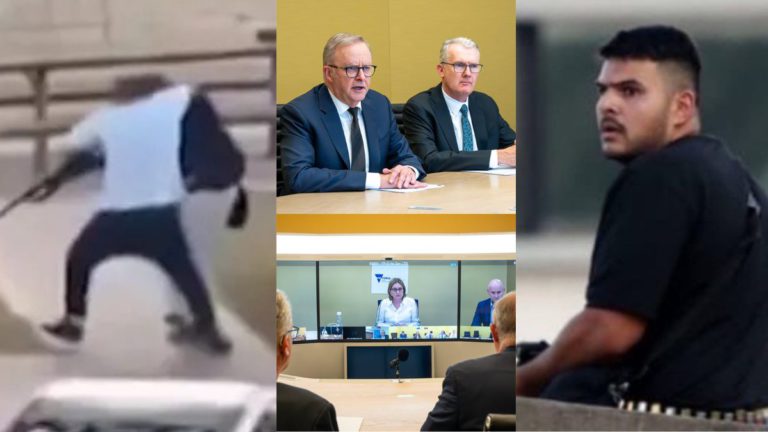
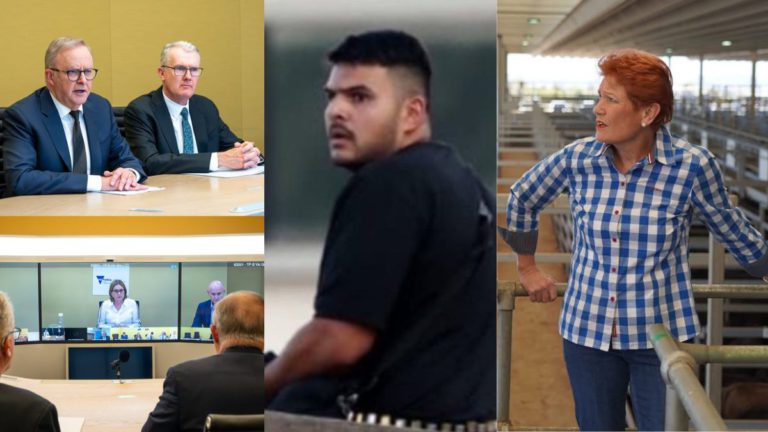
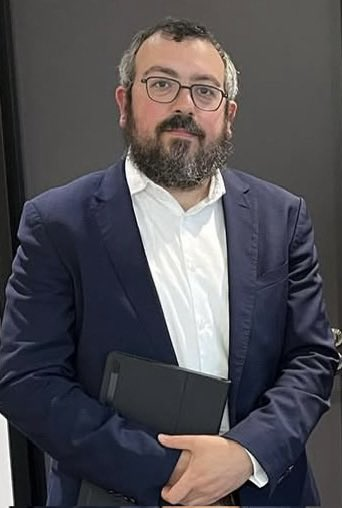
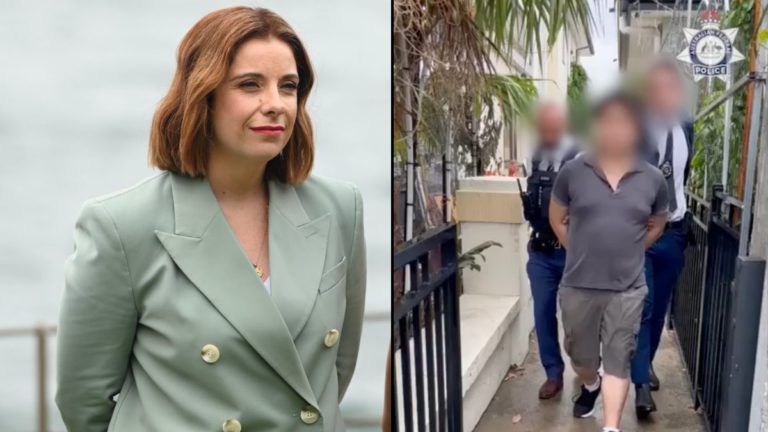
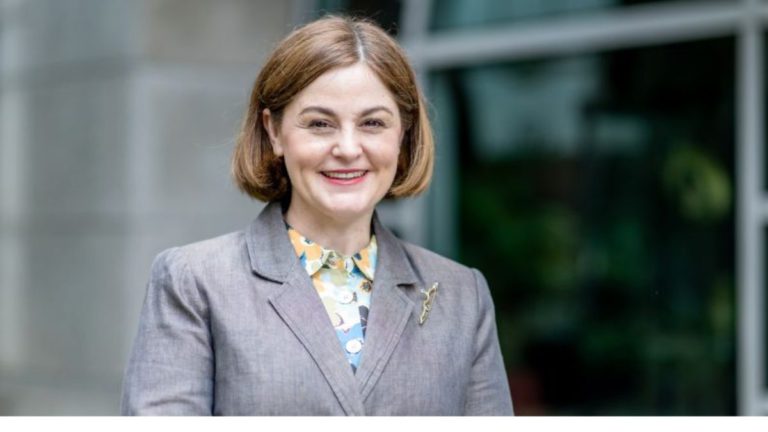
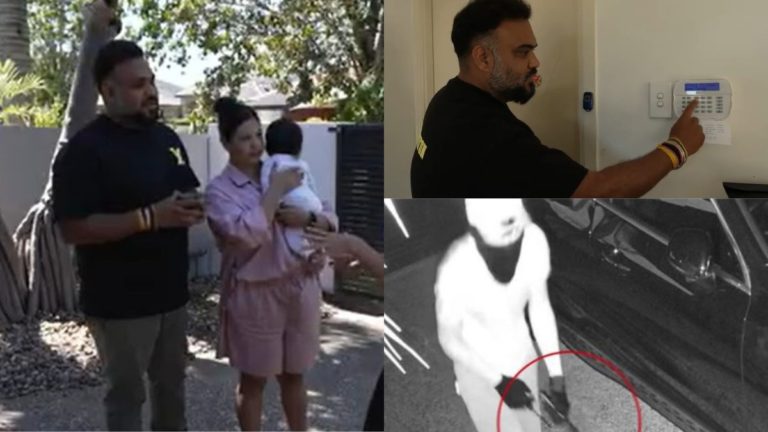
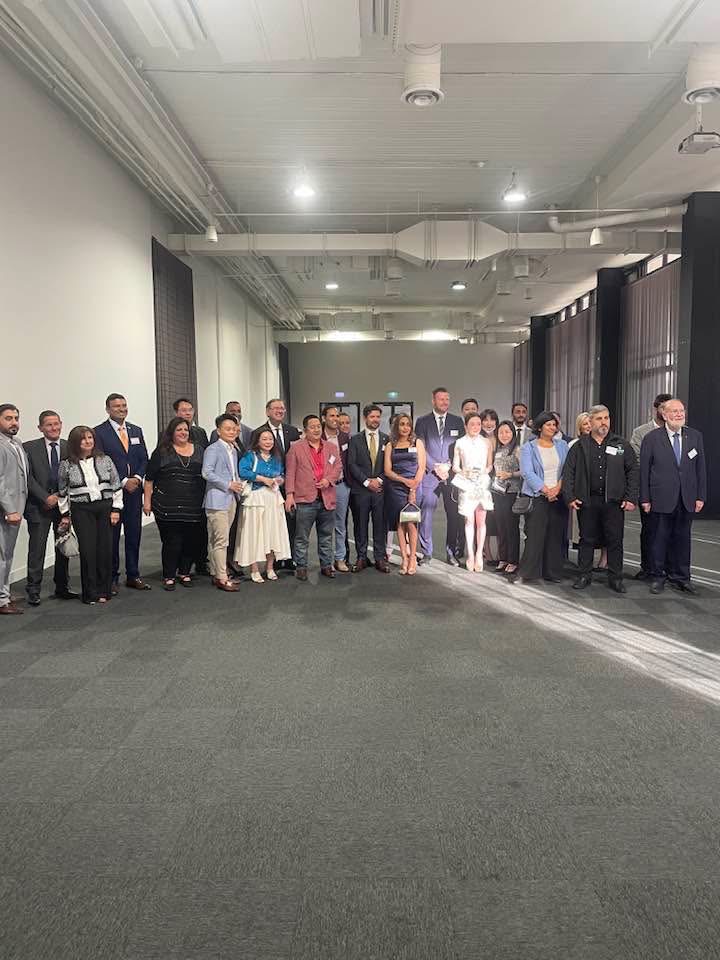
Victorian Premier Jacinta Allan has apologised after revealing her husband, Yorick Piper, was caught drink-driving in Bendigo, saying the incident left her “disappointed and embarrassed”.
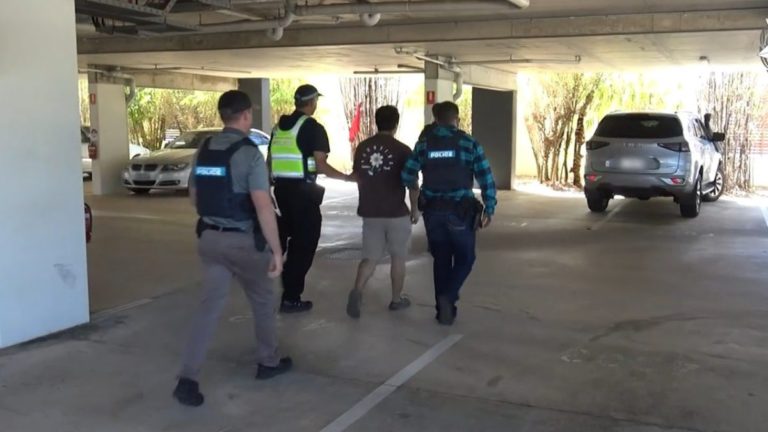
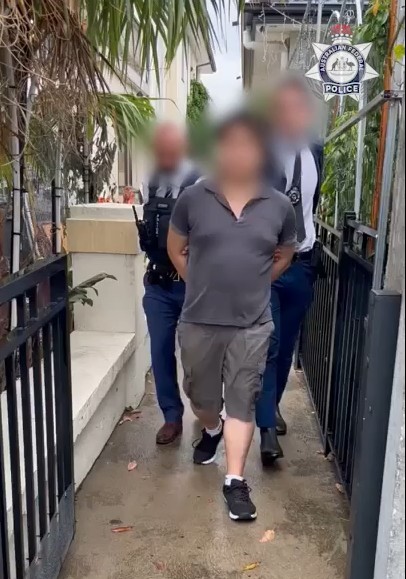
Premier Allan said her husband Piper, was driving to a supermarket on Thursday morning when he rear-ended another vehicle at an intersection. The drivers were not injured and exchanged details at the scene before Mr Piper was later pulled over for a random roadside breath test.
She said the breath test returned a reading of 0.05, and Mr Piper was issued with an on-the-spot fine and a three-month licence suspension due to take effect from 16 January 2026.
Speaking publicly on Friday, Premier Allan said the family had been at a local pub the night before to celebrate their son’s birthday. She said Mr Piper was taking medication and believed it may have interacted with alcohol consumed the previous evening, and that he should not have driven the following morning.
“Drink driving is an incredibly serious issue,” Ms Allan said, adding that she was “shocked” when told what had happened.
Ms Allan said she and her husband had made a $1,000 donation to Amber Community, a Victorian not-for-profit that provides counselling, support and education programs for people affected by road trauma. The Transport Accident Commission has previously noted Amber Community’s role in supporting Victorians impacted by road trauma through counselling and road safety education.
Victoria’s road rules require most fully licenced drivers to remain under a 0.05 blood alcohol concentration, with zero-BAC rules applying to learner and probationary drivers and several other categories.
The incident has sparked renewed attention on the risks of driving after drinking, including the way alcohol can linger into the next day and the added dangers when combined with some medications.
Support our Journalism
No-nonsense journalism. No paywalls. Whether you’re in Australia, the UK, Canada, the USA, or India, you can support The Australia Today by taking a paid subscription via Patreon or donating via PayPal — and help keep honest, fearless journalism alive.
More than 140,000 Australians have now signed an online petition calling on Prime Minister Anthony Albanese to resign in the wake of Sunday’s deadly terrorist attack at Bondi Beach.
The Change.org petition was launched after the attack in which at least 15 people were killed and dozens more injured, with authorities describing the violence as a targeted assault on Sydney’s Jewish community.
Supporters of the petition argue that the tragedy has intensified public concern about national leadership and community safety.
The petition accuses the Prime Minister of failing to address gun violence effectively. It claims the government is increasingly out of step with community views on immigration, citing polling that suggests significant public opposition to current migration levels.
“In light of recent tragic events at Bondi Beach and pressing national concerns, it is time to address the leadership of our country,” the petition states, adding that many Australians believe the promise of a safer and more prosperous future made when Mr Albanese took office has not been delivered.
Petition organiser said the attack had highlighted what he described as an urgent need for stronger leadership and clearer, more accountable policies. He called for decisive action on public safety and immigration, guided by transparent public consultation and rigorous debate.
The growing public backlash has been echoed by prominent commentators and political figures. Former Sydney radio host Ray Hadley accused the Prime Minister of a weak response to the tragedy, saying he should step aside from office.
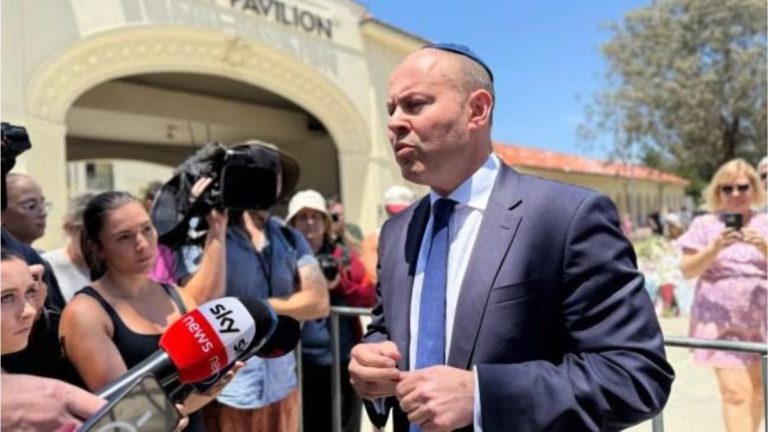
Former federal treasurer Josh Frydenberg also delivered a blistering speech at the site of the attack, telling Mr Albanese that he and his government had failed the community and urging him to either fulfil the responsibilities of leadership or hand the role to someone else.
While the petition carries no legal weight, its rapid growth to more than 90,000 signatures underscores the depth of public anger and grief following the Bondi attack, increasing political pressure on the Prime Minister as the nation continues to confront the fallout from one of Australia’s deadliest terrorist incidents.
Support our Journalism
No-nonsense journalism. No paywalls. Whether you’re in Australia, the UK, Canada, the USA, or India, you can support The Australia Today by taking a paid subscription via Patreon or donating via PayPal — and help keep honest, fearless journalism alive.
In the wake of the Bondi terror attack, the government is under pressure to do more to address antisemitism in Australia.
Many have raised a report by antisemitism envoy Jillian Segal as holding the answers we need. Released back in July, the government is yet to formally respond.
But what does the report recommend, and how much of it is useful for tackling antisemitism? While there are some good ideas in it, it’s not a fix-all for this deeply complicated problem.
A highly charged environment
In response to rising numbers of antisemitic incidents, the Albanese government appointed Segal in July 2024 as the nation’s first special envoy to combat antisemitism. The government also commissioned a plan with recommendations to address the issue.
One year later, Segal published her plan, which set out those recommendations.
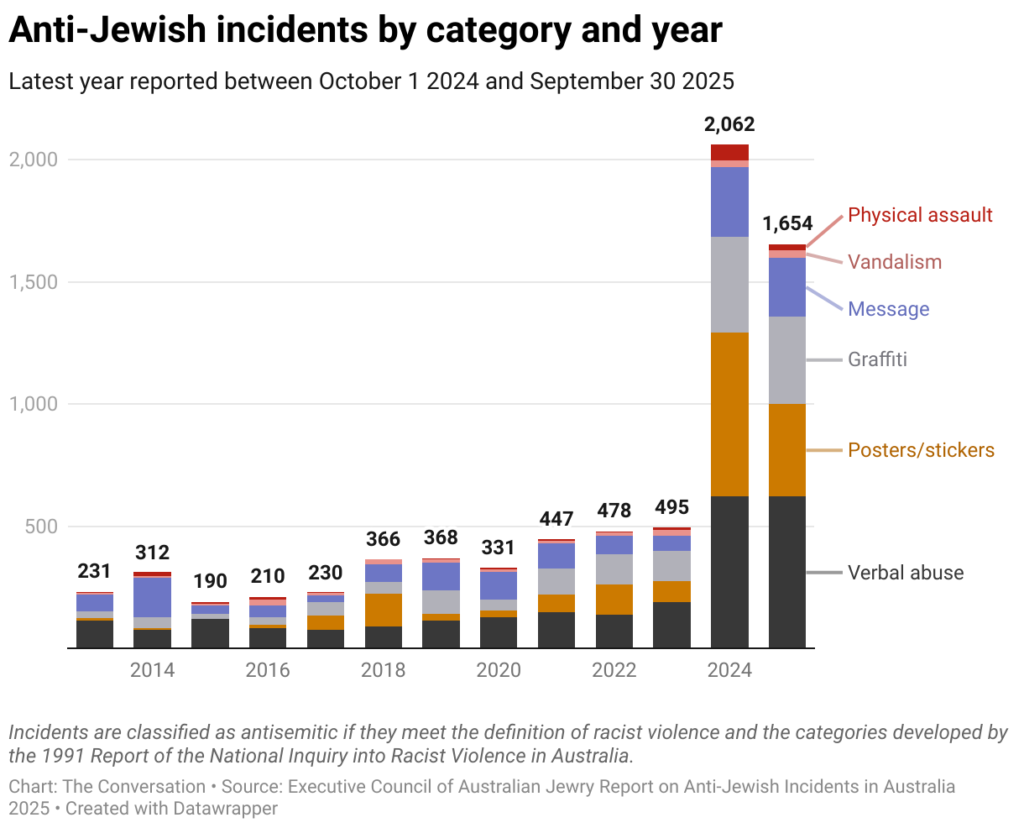
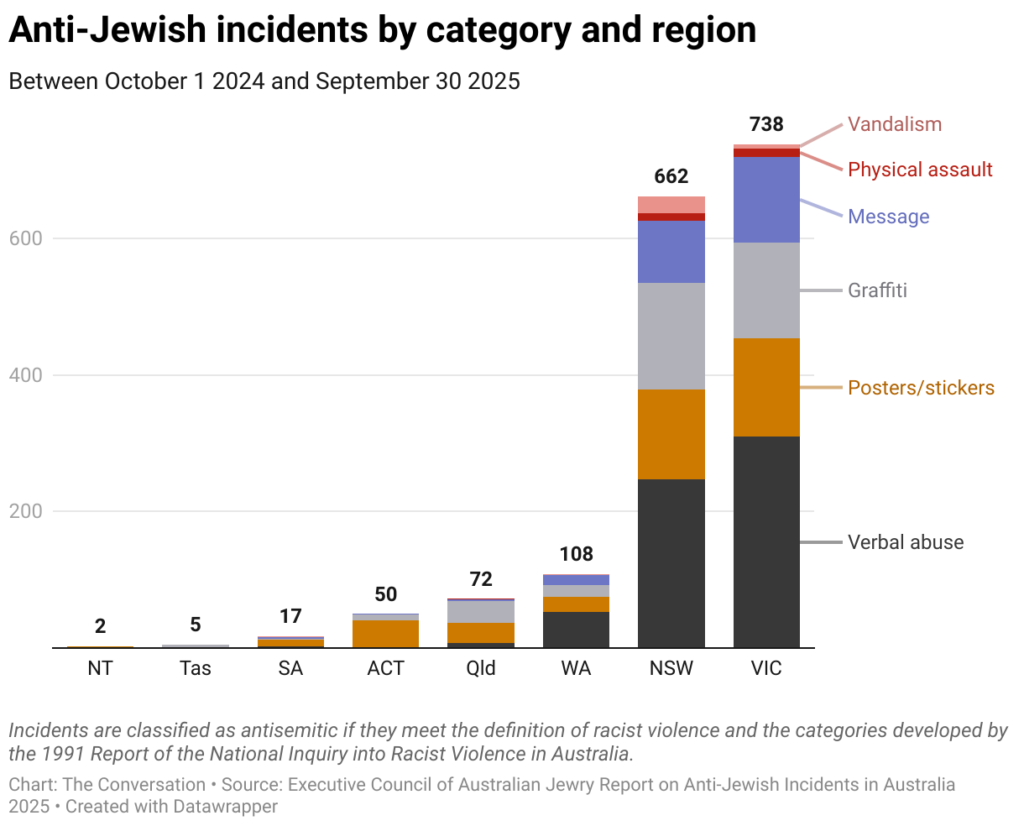
The context was highly charged. Jewish organisations were warning of rising hate. This included hate speech, discrimination, bullying, vandalism and physical assaults, and reported increases in both volume and severity.
Other voices pushed back, arguing the numbers were inflated and legitimate criticism of Israel was being counted as antisemitism.
Released amid an already polarised debate, the report became an additional focal point for existing disagreements.
As I have written for The Conversation before, a central limitation of the plan was its failure to engage with the most contested issue in public debate: how to clearly distinguish between antisemitism and legitimate criticism of Israel.
This distinction is complex, but it’s essential to combat antisemitism in the current context.
Because the plan did not clarify this difference, many people rejected it outright.
Which recommendations might help?
But the plan included several constructive recommendations, particularly those focused on skills, education and coordination.
For example, it proposed working with government departments to ensure consistent recording of antisemitic hate crimes and incidents through a national database. It also called for reviving interfaith work that has stalled in recent years.
This work is especially important for rebuilding trust and social cohesion, particularly after the Bondi attack.
The plan asked online platforms such as X and Meta to take greater responsibility for content on their sites. This included more transparency in moderation decisions and clearer rules for how algorithms shape what people see.
In practice, however, the opposite has happened. Since Elon Musk took over X (formerly Twitter), and following the election of US President Donald Trump, major platforms have relaxed hate-speech moderation.
As a result, extreme content often remains online, even after the Bondi attacks. This includes praise for Hitler, denial of the Holocaust, and other serious attacks against Jewish people that are not removed by the platforms.
The plan further called for stronger coordination between law enforcement agencies to prevent and respond to antisemitic threats, as well as continued government funding for operational security at Jewish institutions and events. Such measures may have helped at Bondi, where security was clearly inadequate.
Which recommendations aren’t so useful?
The more punitive recommendations in Segal’s plan were unlikely to reduce antisemitism. These included withdrawing funding or imposing penalties on universities, cultural institutions or media organisations that did not comply with antisemitism standards set by the envoy.
Rather than helping, these measures inflamed the debate and shifted attention away from antisemitism itself to disputes about free speech and institutional autonomy. Without clear guidelines distinguishing legitimate criticism of Israel from antisemitism, such measures could be used politically. https://www.youtube.com/embed/FWt7uY7i7gE?wmode=transparent&start=0
The plan missed an opportunity to address difficult conversations in a constructive way. For example, it called for widespread adoption of the International Holocaust Remembrance Alliance definition of antisemitism as a first objective, without discussing why some people resist it.
The approach prioritised compliance over persuasion, limiting its capacity to address underlying disagreement.
What else should we do?
Antisemitism is not one single thing. There is no single solution.
To reduce prejudice and discrimination against Australian Jews, education and sustained community efforts are essential, alongside better coordination across institutions, civil society and technology companies to limit the spread of hateful ideologies. The Jewish community, alongside all communities targeted by hate, should all stand in solidarity rather than in isolation.
But to reduce the risk of violent attacks such as the one in Bondi, the envoy’s recommendations are not enough. Better laws are required to combat terrorism and limit access to firearms – the latter of which the government has already flagged.
Law enforcement agencies need to engage constructively with communities to detect early signs of risk, without infringing on people’s rights and freedoms, as research on the issue has shown. The success of these interventions depends on participation across society and collaboration, so it’s important to build bridges across communities.
For this reason, we should resist authoritarian temptations. Silencing dissenting voices, banning opinions because they feel unpleasant or offensive, or relying on mass surveillance of anyone deemed suspicious will not solve the problem.
These approaches are likely to make it worse. They will antagonise large segments of society instead of fostering collaboration.
The worst terrorist attack on Australian soil struck the Jewish community, and it struck all of us. It is time to collectively reflect on what has happened and how to rebuild lasting social cohesion.
No-nonsense journalism. No paywalls. Whether you’re in Australia, the UK, Canada, the USA, or India, you can support The Australia Today by taking a paid subscription via Patreon or donating via PayPal — and help keep honest, fearless journalism alive.
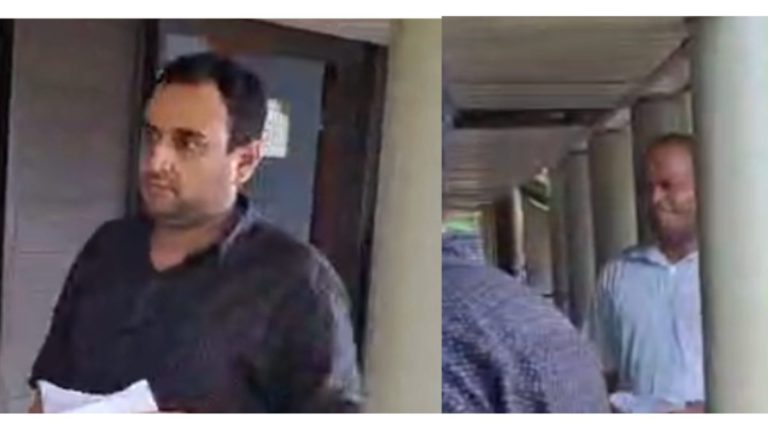
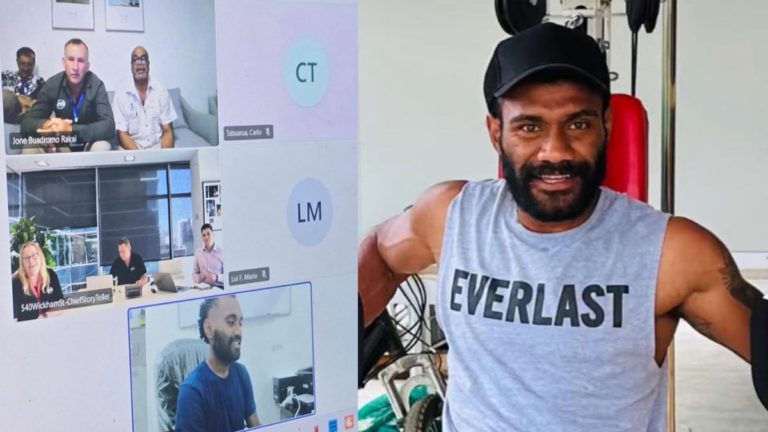
A Pakistani national has been charged with multiple offences after allegedly using forged documents to obtain official identification in Fiji.
According to the Fiji Times, Mohammed Junaid appeared before the Lautoka Magistrates Court, where he was charged with a total of 12 offences related to the possession and use of falsified documents, as well as providing false information to public officials.
Prosecutors allege Junaid arrived in Fiji on October 27, 2024, on a visitor’s visa that expired 32 days later. It is further alleged that he subsequently obtained a Fijian birth certificate under the name Mohammed Iqbal Khan, which he then used to apply for a Fijian passport, a driver’s licence and a Tax Identification Number (TIN) card.
A former Births, Deaths and Registrations clerk, Jone Matawalu, is charged alongside Junaid in connection with the alleged scheme.
Matawalu faces four charges, including abuse of office, receiving a bribe of $3,000, issuing a false certificate as a public officer, and falsification of documents. Junaid, meanwhile, is charged with four counts of possessing false documents, four counts of using false documents, two counts of giving information derived from false documents, and two counts of providing false information to a public servant.
Both accused appeared in court yesterday afternoon, where Magistrate Semi Babitu remanded them in custody. The matter has been adjourned to December 31.
Support our Journalism
No-nonsense journalism. No paywalls. Whether you’re in Australia, the UK, Canada, the USA, or India, you can support The Australia Today by taking a paid subscription via Patreon or donating via PayPal — and help keep honest, fearless journalism alive.
The Bondi Beach terror attack has shaken the conscience of society, not merely because of its violence, but because of the cold-blooded depravity with which it was carried out. The nature of the act leaves little room for euphemism or moral hesitation; it must be called by its rightful name: terrorism, antisemitism, and a crime against humanity.
What unfolded in Sydney is not an isolated eruption of madness, nor can it be dismissed as an aberration in an otherwise peaceful order; it is part of a disturbing and accelerating pattern of targeted attacks against the Jewish community worldwide, a pattern that brutally reasserted itself with the heinous October 7 massacre at the Nova Music Festival, where Jewish civilians were slaughtered with calculated intent. To view the Bondi attack in isolation is to miss the larger and far more unsettling reality that antisemitic violence has once again found ideological validation, operational confidence, and deadly momentum.
(Pic: Isreal in Australia Facebook)
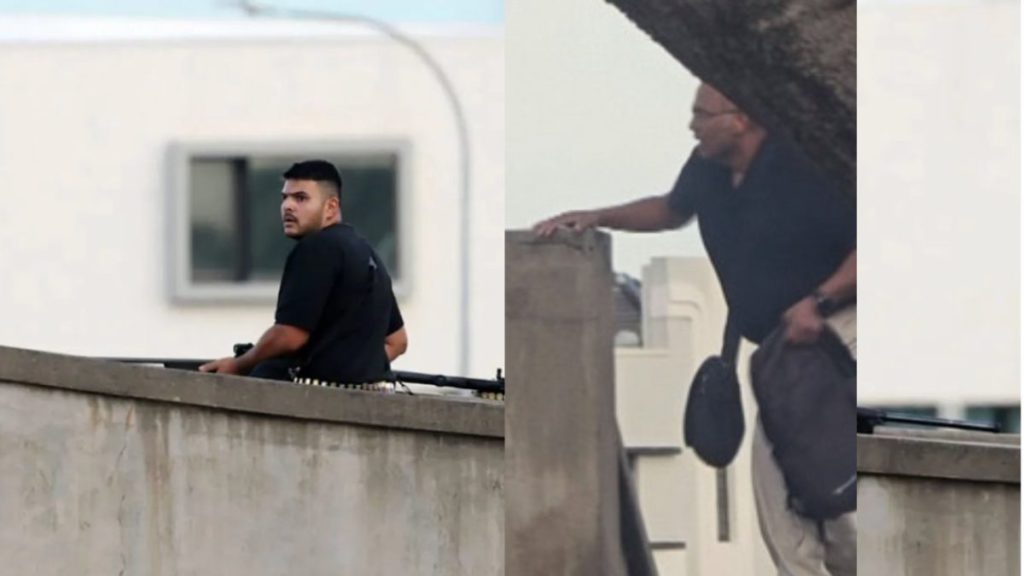
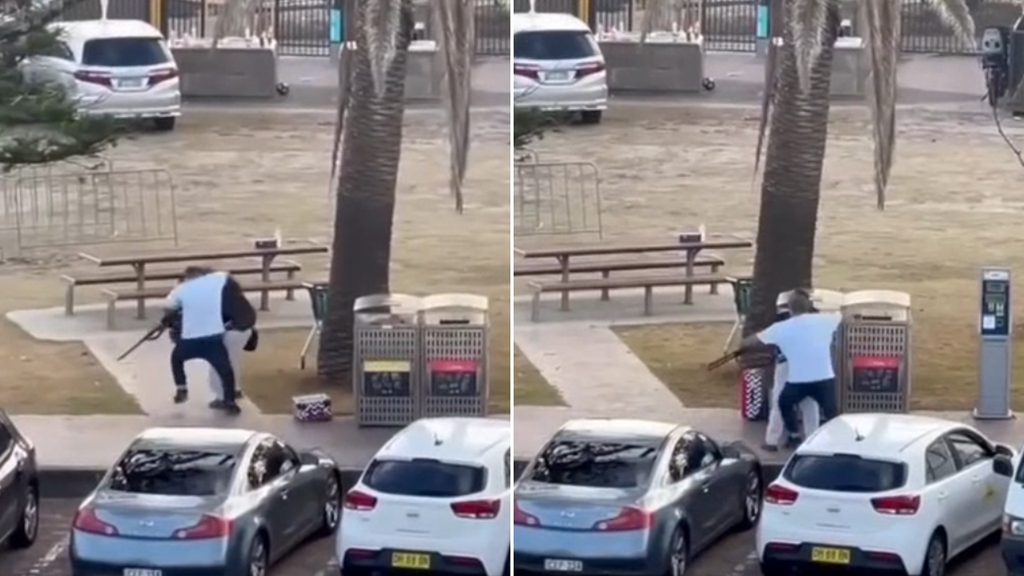
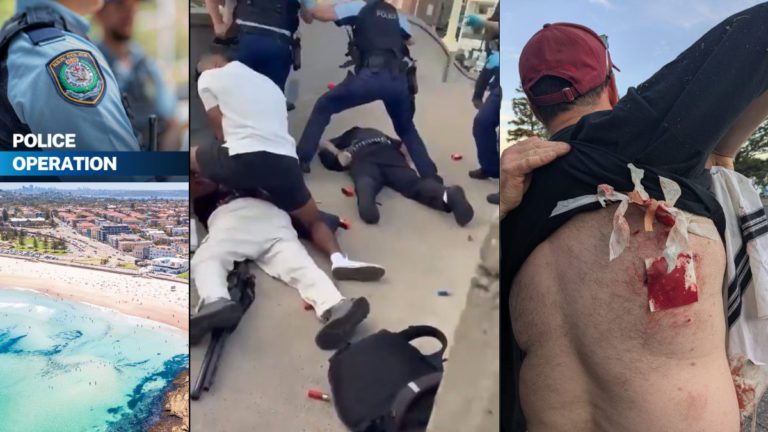
A father and son, identified as Sajid Akram and Naveed Akram, opened fire on a Jewish gathering that had assembled on the beach to celebrate Hanukkah with their families. While Sajid Akram is reported to be originally from Hyderabad, India, official records confirm that he had lived in Australia for nearly twenty-seven years and maintained only limited contact with his family in India during that period.
Senior Indian police officials have stated that there is no evidence of any operational or ideological link between his alleged radicalisation and India. More tellingly, two flags of the terror group Islamic State were recovered from the attackers’ vehicle. This categorically shows that it’s not a matter of individual pathology or social alienation; it is a clear manifestation of organised Islamist ideology translating into violence.
The Bondi attack also sits within a demonstrable surge in antisemitic violence over the last two years, with Jewish communities and synagogues increasingly treated as legitimate targets by extremists. In the United States, the Anti-Defamation League recorded 9,354 antisemitic incidents in 2024, the highest ever captured in its annual audit, reflecting sustained harassment, vandalism and physical assaults.
In the United Kingdom, the Community Security Trust recorded 3,528 antisemitic incidents in 2024, the second-highest annual figure on record, with London and Manchester again emerging as major pressure points for intimidation and attacks. France, too, saw nearly 1,600 antisemitic acts in 2024, even as authorities investigated high-profile attempts to attack synagogues, including the widely reported attempted arson incident at La Grande Motte in August 2024. Canada has witnessed the same pattern, with Jewish institutions in Montreal facing repeated firebombing attacks, prompting public calls for urgent action.
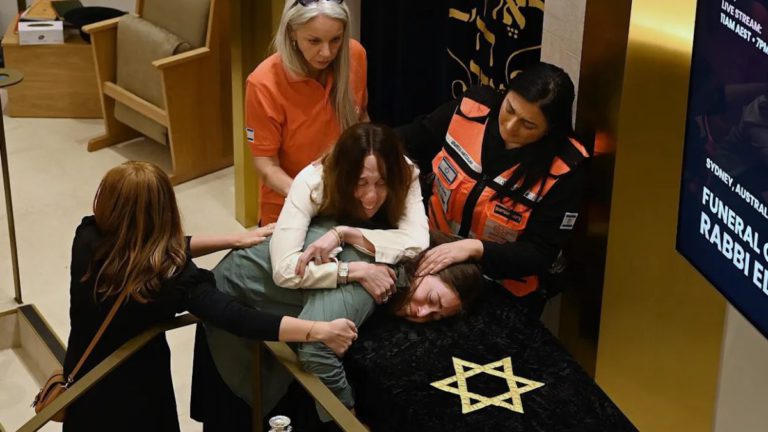
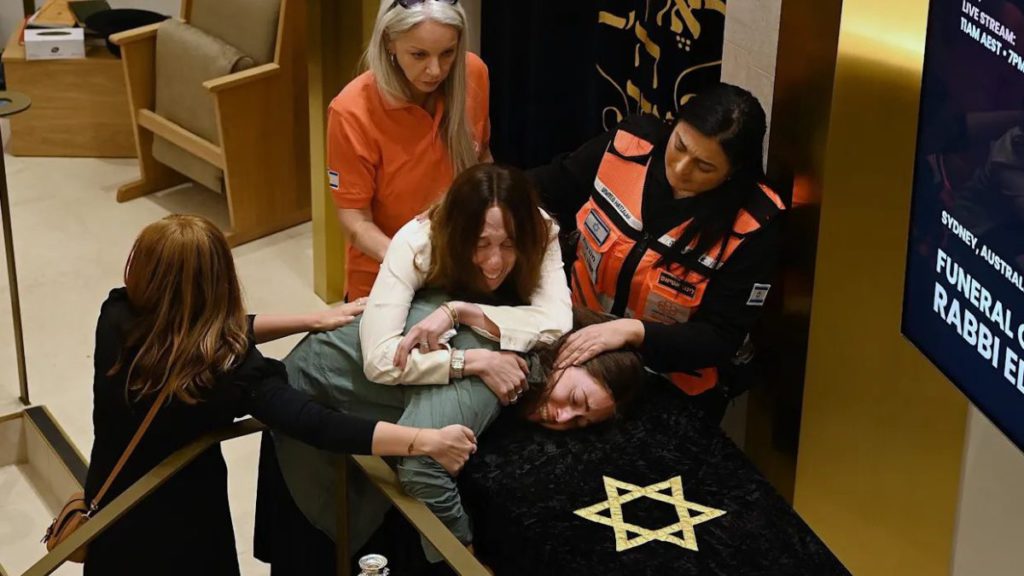
Rabbi Eli Schlanger being laid to rest after his murder in the Bondi terror attack (Pic: Israel in Australia Facebook)
Australia has been no exception, with reporting pointing to a sharp rise in antisemitic incidents nationally alongside attacks such as the arson assault on a Melbourne synagogue, forcing authorities and community bodies to treat routine worship as a security event.
Apologists of radical antisemitism have attempted to obscure the moral depravity of such attacks by lazily attributing them to the ongoing Israel–Hamas war. This line of argument collapses under even minimal scrutiny. Wars, however tragic, are fought by soldiers on battlefields. The victims at Bondi Beach and the Nova Music Festival were innocent, unarmed civilians, and those who opened fire on them were not combatants but cowardly, radicalised, brainwashed, and suicidal extremists. Bondi Beach was not a battlefield, the Nova Music Festival was not a military installation, and rabbis praying in synagogues across the world are not participants in any war.
These facts expose the intellectual dishonesty behind slogans such as “anti-Zionism is not antisemitism,” which function less as principled distinctions and more as deliberate distractions from the ideological roots of the violence. In reality, the causal arrow points in the opposite direction. The Israel–Hamas war is not the source of rising antisemitism; rather, deeply entrenched antisemitism is what enables atrocities like October 7, which in turn ignite wider conflicts. To deny this is not nuance, but complicity through obfuscation.
Youngest victim of the horrific antisemitic Bondi terror attack, 10 year old Matilda (Pic: Israel in Australia Facebook)
To treat this ideological menace as anything less heinous or morally depraved than Nazism would be an act of profound dishonesty. Among those present at Bondi Beach were Alexander and Larisa Kleytman, both Holocaust survivors who had endured the horrors of Europe’s darkest chapter as children. They grew up under the shadow of extermination, displacement, and terror, with Alexander’s memories marked by the brutal conditions of Siberia, where he, his mother, and his younger brother fought simply to stay alive. Having survived genocide, rebuilt their lives, and found refuge in Australia, they should have been living their final years in peace.
Instead, Alexander Kleytman was killed while shielding his wife from gunfire, a final act of courage that tragically mirrors the resilience that once allowed him to survive Nazism itself. That a man who escaped the machinery of twentieth-century fascism was ultimately murdered by a new, radicalised incarnation of the same genocidal hatred is not a coincidence; it is a grim reminder that antisemitism, when left ideologically unchecked, does not evolve into something benign. It merely rebrands itself, waiting for another moment, another target, and another victim.
Alex and Larisa Kleytman (Pic: Israel in Australia Facebook)
It must also be understood that an individual does not become a terrorist overnight; radicalisation is a cumulative process, sustained through years of ideological conditioning that slowly normalises violence and dehumanisation, often beginning in childhood, which in itself amounts to a grave form of child abuse. This reality places an unavoidable responsibility on governments to scrutinise the value systems being imparted to young minds, to exercise strict oversight over religious schools and madrasas, and to subject their curricula to rigorous review.
It also necessitates firmer intervention when individuals display clear and persistent signs of extremist alignment. In the Bondi Beach case, these warning signs were not absent. Australia’s intelligence agencies had previously investigated one of the alleged gunmen for links to the Islamic State, with the Australian Security Intelligence Organisation examining the son as early as 2019. Naveed Akram was reportedly closely connected to an Islamic State operative arrested and later convicted in July 2019 for preparing a terrorist act in Australia, and counter-terrorism officials believe the attackers had pledged allegiance to the group. These facts raise uncomfortable but necessary questions about gaps between intelligence awareness and preventive action.
Naveed Akram (Pic: Supplied)
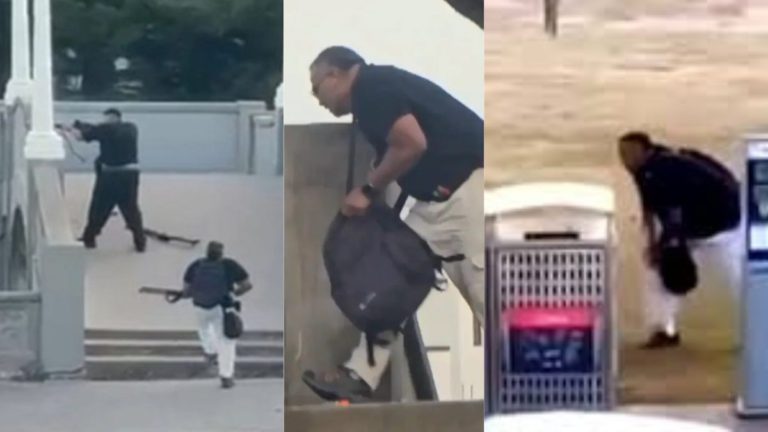
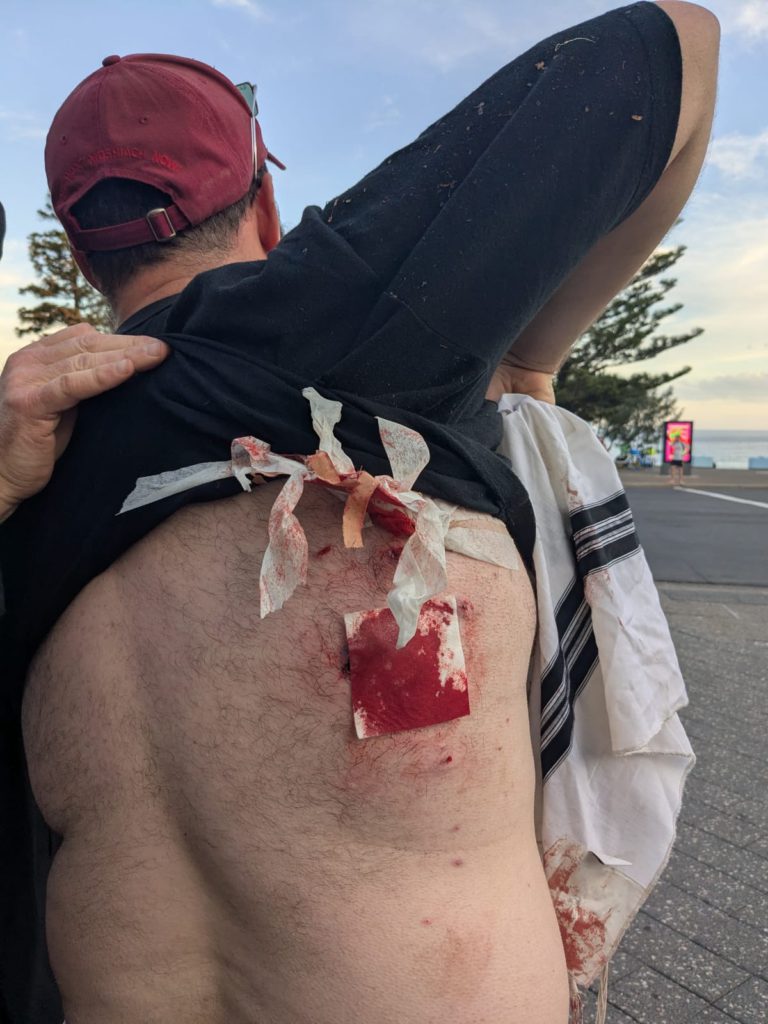
Amid this bleak surge in antisemitic violence, acts of individual courage stand out precisely because they cut across the false civilisational binaries that extremists seek to impose. One such figure is Ahmed al Ahmed, who risked his life by physically tackling one of the attackers and wrestling the firearm from him, an intervention that almost certainly prevented further loss of life. Ahmed was subsequently shot by one of the gunmen, sustaining serious injuries in the process.
In the days that followed, thousands of people donated more than 1.4 million Australian dollars to a GoFundMe campaign established to support him through recovery and to honour what many rightly described as an act of extraordinary bravery. According to Australian officials, Ahmed’s parents had arrived in the country as refugees from Syria, a detail that exposes the moral bankruptcy of narratives that seek to conflate entire communities with extremist violence. His actions reaffirm a simple but often ignored truth: the line dividing barbarism and humanity does not run between religions or ethnicities, but between those who embrace murderous ideology and those who are willing to stand against it, even at the cost of their own lives.
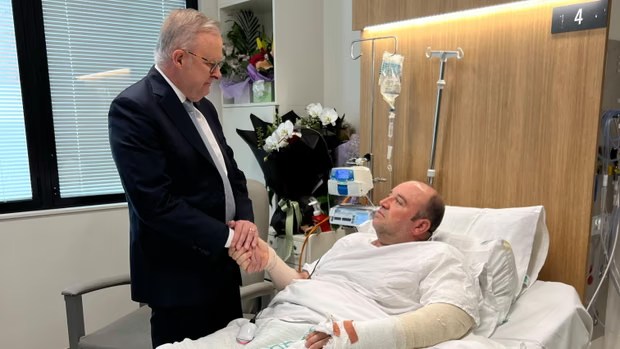
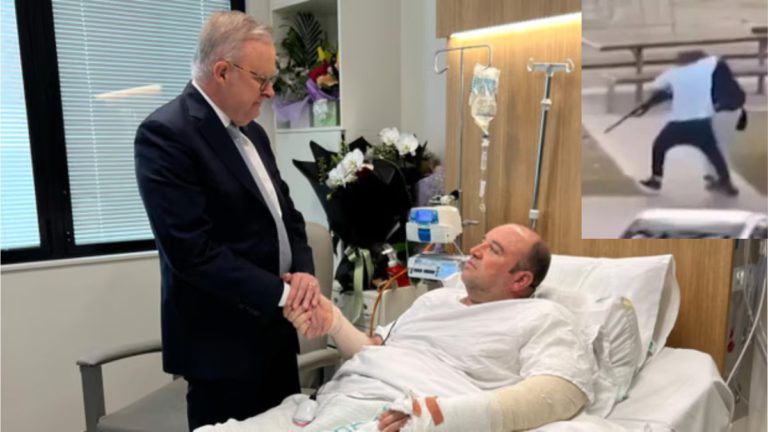
Image: Prime Minister Anthony Albanese praises Bondi hero Ahmed al-Ahmed as ‘best of our country’ (Source: X)
Ultimately, the lesson from Bondi Beach is neither abstract nor negotiable. A society that hesitates to name ideological violence for what it is, that dilutes antisemitism through euphemism, or that treats radicalisation as a cultural inconvenience rather than a civilisational threat, only postpones the next atrocity.
The price of such hesitation is always paid by innocents going about ordinary life, celebrating faith, music, or family in places that should never require armed protection. Antisemitism, whether dressed up as grievance, geopolitics, or activism, is not a reaction to events; it is an animating ideology that seeks victims and waits for opportunity. If liberal democracies are serious about preserving pluralism, safety, and moral clarity, they must abandon denial, confront radicalisation at its roots, and enforce red lines without apology. Anything less is not tolerance, but abdication.
Contributing Author: Omer Ghazi is a proponent of religious reform and extensively writes on geo-politics, history and culture.
Disclaimer: The opinions expressed within this article are the author’s personal opinions. The Australia Today is not responsible for the accuracy, completeness, suitability, or validity of any information in this article. The information, facts, or opinions appearing in the article do not reflect the views of The Australia Today, and The Australia Today News does not assume any responsibility or liability for the same.
Support our Journalism
No-nonsense journalism. No paywalls. Whether you’re in Australia, the UK, Canada, the USA, or India, you can support The Australia Today by taking a paid subscription via Patreon or donating via PayPal — and help keep honest, fearless journalism alive.
Cameron Green headlined the 2026 Indian Premier League auction, becoming the most expensive overseas player in the tournament’s history and setting the tone for a mixed night for Australian cricketers as franchises weighed proven pedigree against form, fitness and balance.
The Australian all-rounder was snapped up by Kolkata Knight Riders for ₹25.2 crore (about A$4.2 million) after a spirited bidding contest with Rajasthan Royals and Chennai Super Kings. The price eclipsed the previous overseas record set by fellow Australian Mitchell Starc, also with KKR, reinforcing the premium placed on elite Australian fast-bowling all-rounders in the world’s richest T20 league.
Despite the headline figure, Green will pocket closer to A$3 million. Under a new IPL regulation, payments to overseas players are capped at ₹18 crore, with the excess from KKR’s winning bid flowing to the Board of Control for Cricket in India for player development and welfare. The 26-year-old received confirmation of the deal while preparing to represent Australia in the Ashes, adding a significant off-field boost ahead of the marquee series.
Green’s value was driven by both performance and versatility. Although initially listed as a batter due to an administrative error, he later confirmed he was fully fit to bowl after back surgery, prompting franchises to push bidding well beyond the new cap. Across 29 IPL matches, Green has averaged 41.6 with the bat at a strike rate above 153, including a century, while also contributing regularly with the ball. He previously represented Mumbai Indians and Royal Challengers Bengaluru, and missed the 2025 season due to injury.
While Green dominated the auction narrative, the night produced sharply contrasting outcomes for other Australians. Josh Inglis secured a lucrative deal with Lucknow Super Giants, while Ben Dwarshuis and emerging all-rounder Cooper Connolly were picked up by Punjab Kings. Matt Short landed at Chennai, and Jack Edwards was signed by Sunrisers Hyderabad as the only uncapped overseas recruit.
In stark contrast, veteran star Steve Smith endured another disappointing auction, remaining unsold after no franchise requested to bid for him. It marked the third time Smith has missed out since last appearing in the IPL in 2021, despite his stated ambition to return to top-level T20 cricket ahead of the LA28 Olympic cycle.
Several other Australians were also overlooked, highlighting the increasingly unforgiving nature of the mini-auction format, where availability, role clarity and recent form often outweigh reputation. At the same time, a number of Australians will return in retained roles, including Starc at Delhi Capitals, Pat Cummins and Travis Head at Sunrisers Hyderabad, and Josh Hazlewood at Royal Challengers Bengaluru.
By the close of the auction, 16 Australians had secured places across IPL squads for the 2026 season, underscoring the enduring demand for Australian talent even as new financial rules reshape how much of the auction windfall actually reaches the players. The tournament begins on March 26, with Green set to carry both record expectations and national interest into his new chapter with Kolkata.
Support our Journalism
No-nonsense journalism. No paywalls. Whether you’re in Australia, the UK, Canada, the USA, or India, you can support The Australia Today by taking a paid subscription via Patreon or donating via PayPal — and help keep honest, fearless journalism alive.
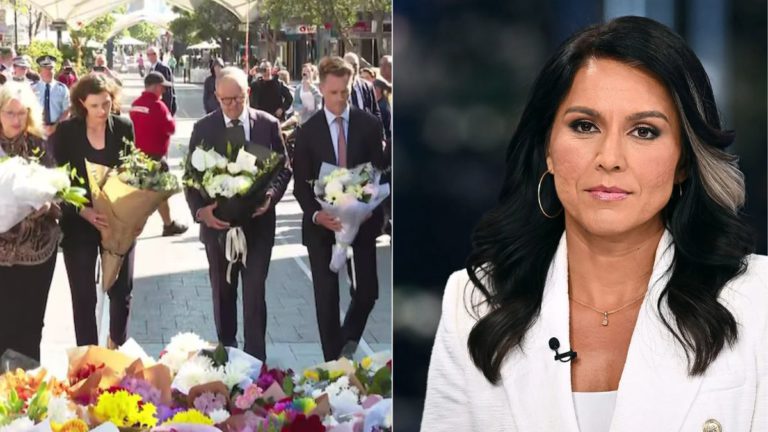
International and domestic political fault lines have sharpened following the deadly Bondi Beach terror attack, with senior US official Tulsi Gabbard directly linking the violence to immigration while Australian leaders spar over whether tighter gun laws address the root causes of extremism.
In a post on X, Gabbard, the Trump administration’s Director of National Intelligence, described the shooting at a Hanukkah celebration as an “Islamist terror attack” and claimed it was the “direct result of the massive influx of Islamists to Australia”.
She warned that the goal of Islamism was the “Islamisation” of countries around the world, adding that it was “probably too late for Europe — and maybe Australia”.
The tragic Islamist terror attack against those at a Hanukkah celebration in Australia sadly should not come as a surprise to anyone. This is the direct result of the massive influx of Islamists to Australia. Their goal is not only the Islamization of Australia but the entire…
Gabbard contrasted Australia’s approach with that of the United States, praising President Donald Trump for prioritising border security, deportations of “known and suspected terrorists”, and halting what she described as “mass, unvetted migration”.
Her comments came as Albanese government formally designated the Bondi shooting a terrorist incident.
Image Source: The Australia Today
Authorities allege two gunmen opened fire on a large crowd, killing 15 people and injuring dozens more. One suspect was killed at the scene, while the surviving alleged attacker has since been charged with multiple counts, including terrorism and murder.
In the face of terrorism, coming together is the most important thing we can do.
Federal and state governments, AFP and New South Wales Police are working together to keep Jewish Australians safe.
There's a lot more work ahead for our police. But we'll be with them today and… pic.twitter.com/E4nHXkrKgF
Back in Australia, conservative politicians have echoed Gabbard’s framing, accusing the Albanese government of deflecting attention from extremism by focusing on firearms reform. Prime Minister Anthony Albanese has flagged further tightening of Australia’s already strict gun laws in response to the attack.
Former deputy Liberal leader Josh Frydenberg launched a scathing attack on Albanese. In a passionate speech heavily targeting Albanese personally, Frydenberg said,
“We, as a Jewish community, have been abandoned and left alone by our government”.
Today I visited the site of the Bondi massacre, where terrorists murdered 15 innocent people, including 10-year old, Matilda. It’s time for accountability and action, and for our leaders to turn back the tsunami of hate. Here are my remarks👇https://t.co/HW0GfNd7mV
Opposition Leader Sussan Ley has issued a stark warning to those who promote hatred, glorify terrorism or incite violence, vowing deportation for non-citizens and arrest for Australian citizens if she becomes prime minister, following the deadly attack at Bondi Beach.
“My message to those who preach hatred, glorify terrorism or incite violence is very clear,” Ley said.
“If I am Prime Minister and you are not an Australian citizen, you will be deported. If I am Prime Minister and you are an Australian citizen, you will be arrested.”
My message to those who preach hatred, glorify terrorism or incite violence is very clear.
If I am Prime Minister and you are not an Australian citizen, you will be deported.
If I am Prime Minister and you are an Australian citizen, you will be arrested. pic.twitter.com/FDWtfBcJWZ
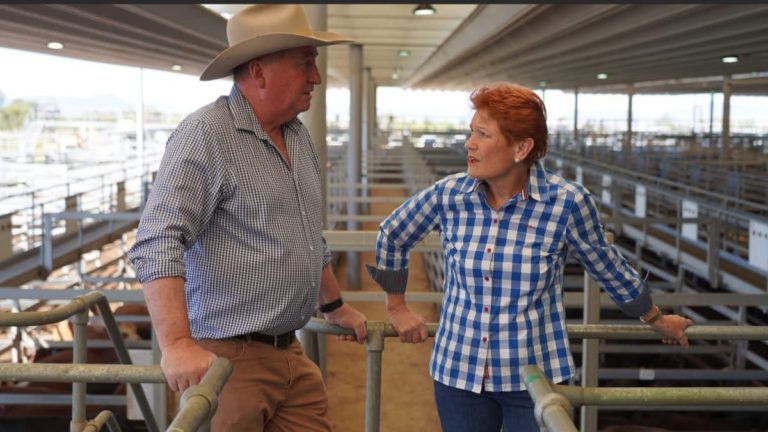
Independent MP Bob Katter said the proposed gun law changes were a “diversionary tactic”, arguing the real issue lay with immigration settings. “A gun doesn’t shoot people; a person holding a gun shoots people,” he told reporters, claiming Australia had allowed entry to people from violent and intolerant regions.
Former prime minister John Howard, who led landmark gun law reforms after the Port Arthur massacre in 1996, also warned against narrowing the post-attack debate. He said focusing solely on firearms risked avoiding a broader national conversation about antisemitism and hatred directed at Jewish communities.
In heart-warming scenes, former prime minister John Howard was met with chants, hugs, and emotional stories of survival as he showed his support for the Jewish community at the Bondi vigil.https://t.co/g8R1XHs3e6
The government has rejected claims it is using gun reform as a smokescreen. Treasurer Jim Chalmers said Australia was capable of confronting antisemitism, violent extremism and gun safety at the same time. “It’s not an either-or,” he said, arguing that stronger gun laws remained an important part of the response to mass violence.
Our hearts break for everyone impacted by the horrific attack on Jewish families at beautiful Bondi: for those who lost loved ones to a violence which is unfathomable and unspeakable; for all the witnesses and those who comforted the hurt and still comfort the hurting; for the…
Security experts have also weighed in, cautioning that while tighter gun controls may help, they do not address the ideologies that drive terrorist acts. Former intelligence chiefs and analysts have urged a stronger focus on counter-extremism, including the use of immigration, financial and tax laws to disrupt potential threats.
Support our Journalism
No-nonsense journalism. No paywalls. Whether you’re in Australia, the UK, Canada, the USA, or India, you can support The Australia Today by taking a paid subscription via Patreon or donating via PayPal — and help keep honest, fearless journalism alive.
A 23-year-old Northern Territory man has been sentenced to 18 months’ home detention for his role in a people smuggling venture linked to illegal boat arrivals in 2024, with the court warning that those who facilitate unlawful entry into Australia will face serious consequences.
The Muirhead resident was sentenced in the Northern Territory Supreme Court on Monday after pleading guilty earlier this year to a single count of people smuggling under section 233A(1) of the Migration Act 1958. In addition to home detention, the man is subject to an Intensive Community Correction Order.
The court heard that in July 2024, investigators from the Australian Federal Police identified the man’s involvement in a scheme in which he was paid to collect unlawful non-citizens arriving by boat in the Northern Territory. A search warrant was executed at his former home in the Darwin suburb of Johnston on 1 August 2024, and he was arrested and charged the same day.
AFP Commander Melinda Phelan said the sentencing highlighted the agency’s commitment to dismantling people smuggling operations through close cooperation with domestic and international partners.
“The AFP works closely with law enforcement partners both on and offshore to disrupt those attempting to facilitate the unlawful entry of individuals or groups into Australia,” Commander Phelan said, noting that the AFP operates as part of a whole-of-government effort under the Joint Agency Task Force.
She said people smugglers routinely put lives at risk for personal profit, adding that even those who play supporting roles, such as collecting people on arrival, would be held to account. “Those who engage in this illegal activity … will face the consequences of the law,” she said.
Commander of the Joint Agency Task Force Operation Sovereign Borders, Rear Admiral Brett Sonter RAN, said the outcome reinforced the effectiveness of the multi-agency operation.
“Operation Sovereign Borders’ mission is clear: to prevent the permanent settlement in Australia by people seeking to come irregularly by boat,” Rear Admiral Sonter said.
He added that the operation’s 16 federal government agencies would continue working together to disrupt criminal networks and uphold a fair and lawful migration system.
Support our Journalism
No-nonsense journalism. No paywalls. Whether you’re in Australia, the UK, Canada, the USA, or India, you can support The Australia Today by taking a paid subscription via Patreon or donating via PayPal — and help keep honest, fearless journalism alive.
In a stark reminder of the strong Jewish backlash against the prime minister, Anthony Albanese was not invited to attend the Wednesday funeral of Rabbi Eli Schlanger, among the first of the Bondi massacre victims to be farewelled.
Those present at the emotional gathering held at the Chabad of Bondi Synagogue included New South Wales Premier Chris Minns, former Prime Minister Scott Morrison, Opposition leader Sussan Ley, and Labor MP Josh Burns, who is Jewish. Albanese had said earlier he would attend any funerals he was invited to.
As both anger and action continue to mount in the massacre’s aftermath, former deputy Liberal leader Josh Frydenberg launched a scathing attack on Albanese, while Minns announced the NSW parliament will be recalled on Monday and Tuesday to pass tougher state gun laws. Minns is also looking to restrict demonstrations while there is a terror alert.
In a passionate speech heavily targeting Albanese personally, Frydenberg said,
“We, as a Jewish community, have been abandoned and left alone by our government”.
Today I visited the site of the Bondi massacre, where terrorists murdered 15 innocent people, including 10-year old, Matilda. It’s time for accountability and action, and for our leaders to turn back the tsunami of hate. Here are my remarks👇https://t.co/HW0GfNd7mV
Albanese had allowed Australia to become radicalised on his watch, said Frydenberg, who was speaking at Bondi.
“It is time for him to accept personal responsibility for the death of 15 innocent people, including a 10-year-old child. It is time our prime minister accepted accountability for what has happened here. And it’s time our leaders stood up and led at last.”
“Your government has failed us. You sit in a chair. It is time you earned that title. If you don’t want to do the job, give it to somebody who will.”
Responding to Albanese’s pursuit of gun reform in the wake of the massacre, Frydenberg said, “Let me tell you, guns may have stolen the life of 15 innocent civilians, but it was radical Islamist ideology that pulled the trigger.”
“Prime minister, I am going to give you some ideas about what you need to do,” Frydenberg said. In his list, he called for a royal commission into what happened at Bondi and into the recent spike in antisemitism.
Urging a ban on hate preachers. he said, “The shooters here, who did this, were linked to a factory of hate in Bankstown. How can that factory of hate be allowed to open its doors for one day more?
The younger of the father and son gunmen, Naveed Akram, was a follower of Jihadist preacher Wissam Haddad, of the Al Madina Dawah Centre in Bankstown, known for his inflammatory antisemitic language.
Announcing a suite of new gun controls, Minns also outlined his fears about protests.
“My concern is that a mass demonstration in this combustible situation with our multicultural community could light a flame that would be impossible to extinguish.
“We’re looking at reforms whereby, when there’s a terrorism designation in the state, the police commissioner may not accept applications for protests on the grounds it will both stretch police resources and, secondly, add to community disharmony and as a result, a combustible situation in the state,” he said.
Federal cabinet’s national security committee met again on Wednesday afternoon to further consider the government’s response. Work is being done on the possible tightening of hate speech provisions, among other possible measures.
Albanese is under pressure from Jewish and other critics to implement the full report of the government’s envoy to combat antisemitism, Jillian Segal.
But many in the government believe the more radical recommendations in her report, including stripping funds from universities and cultural organisations that fall short in combating antisemitism, are impractical or undesirable or both.
Asked about his priorities in responding to the Segal report, Albanese said on Wednesday that he had spoken to her “daily”.
“We’re continuing to work through a whole range of the measures in the Segal report” he said, “This isn’t a set-and-forget report, this is something that will be an evolving position.”
“Jillian Segal is doing an extraordinary job. We’ll continue to engage with her on an ongoing basis, including any lessons that arise from this atrocity.”
Pressed to nominate any specifics, Albanese said, if necessary, the government would further strengthen hate speech provisions.
The response to the massacre has become deeply partisan. The opposition has set up a taskforce on antisemitism, extremism and counter-terrorism, led by Ley.
Ley said: “Every single day for the last two years Jewish Australians have watched the rising tide of antisemitism. And they have looked to their leaders in Canberra and they have looked to Prime Minister Albanese and he has failed them.
“We are calling for leadership. … Leadership on cracking down on hate speech. Leadership on cracking down on antisemitism.”
On Wednesday, Akram was charged with 59 offences, including 15 counts of murder. His father was killed at the scene.
No-nonsense journalism. No paywalls. Whether you’re in Australia, the UK, Canada, the USA, or India, you can support The Australia Today by taking a paid subscription via Patreon or donating via PayPal — and help keep honest, fearless journalism alive.
Opposition Leader Sussan Ley has issued a stark warning to those who promote hatred, glorify terrorism or incite violence, vowing deportation for non-citizens and arrest for Australian citizens if she becomes prime minister, following the deadly attack at Bondi Beach.
“My message to those who preach hatred, glorify terrorism or incite violence is very clear,” Ley said.
“If I am Prime Minister and you are not an Australian citizen, you will be deported. If I am Prime Minister and you are an Australian citizen, you will be arrested.”
My message to those who preach hatred, glorify terrorism or incite violence is very clear.
If I am Prime Minister and you are not an Australian citizen, you will be deported.
If I am Prime Minister and you are an Australian citizen, you will be arrested. pic.twitter.com/FDWtfBcJWZ
Earlier, Ley said Australians were in “deep mourning” after hateful violence struck “at the heart of an iconic Australian community” during the Chanukah by the Sea celebration. She described the gathering as a moment of peace and hope that was “severed by hate”.
She said the loss of life was significant and joined Prime Minister Anthony Albanese in urging Australians to follow official advice from police and relevant authorities. Ley said her heart was with Australia’s Jewish community, particularly those in Sydney’s eastern suburbs, and acknowledged the swift and courageous response of New South Wales Police and paramedics.
The Prime Minister has said he will do whatever it takes to deal with antisemitism. That must now start with a clear commitment to implement his own Antisemitism Envoy’s report in full.
For two years, Jewish Australians have been warning that antisemitism is rising and that… pic.twitter.com/haEJofxDaQ
“Those who ran towards the danger — everyday Australians, our police and paramedics — are heroes,” she said, offering the Coalition’s “full and unconditional support” to Commonwealth and state agencies responding to the tragedy.
Ley has also said gun reform “must be on the table”, signalling a shift after earlier avoiding whether the Coalition would back tighter firearm laws. She said “everything must be on the table when it comes to looking at reforms and weapons access”, as the Prime Minister vowed tougher gun control measures following the shooting.
Many Australians have expressed their anger that antisemitism has been allowed to take hold in this country. There has been a clear failure of leadership to keep Australians safe, particularly members of the Jewish community.
In a separate statement, Ley said many Australians were angry that antisemitism had been allowed to take hold, citing attacks on synagogues, vandalism of public spaces, threats on university campuses and warnings from ASIO that antisemitism represents the greatest risk of loss of life from terrorism in Australia. She urged the government to fully implement its Antisemitism Envoy’s report, saying the Coalition stood ready to support decisive action to keep Australians safe.
Sajid Akram, Bondi beach gunman: Born in India, radicalised in Australia, no link to family back home
Indian authorities have said there is no evidence linking India to the radicalisation of Sajid Akram, one of the perpetrators of the deadly… pic.twitter.com/XHlzctBZCO
Earlier, it was reported that the Indian authorities have firmly ruled out any India link to the radicalisation of the Bondi Beach attackers, saying the violence was neither planned nor influenced from India. In an official statement, Telangana Police confirmed that Sajid Akram, originally from Hyderabad, had no criminal or security record before leaving India in 1998 and maintained only limited family contact thereafter, with no signs of extremist beliefs.
Police said the factors leading to the radicalisation of Sajid and his Australian-born son, Naveed Akram, had “no connection whatsoever” to India or Telangana.
While Sajid retained an Indian passport, authorities stressed that his life, family and alleged extremist trajectory were rooted entirely overseas, with Australian investigators increasingly pointing to Islamic State–inspired ideology, a view echoed by Prime Minister Anthony Albanese as the attack was formally declared an act of terrorism.
Naveed Akram, alleged Bondi Beach gunman, charged with 59 offences over one of Australia’s deadliest terror attacks
Today, NSW Police have since charged the surviving alleged gunman, Naveed Akram, with 59 offences, including one count of committing a terrorist act, 15 counts of murder and dozens of serious wounding charges. He was charged from his hospital bed and bail was refused.
In this moment of shared grief, we stand with a community that has shown extraordinary strength.
We will do whatever it takes to press for the strongest possible action from government to keep Australians safe, to protect our Jewish community. pic.twitter.com/CT7QcEouG5
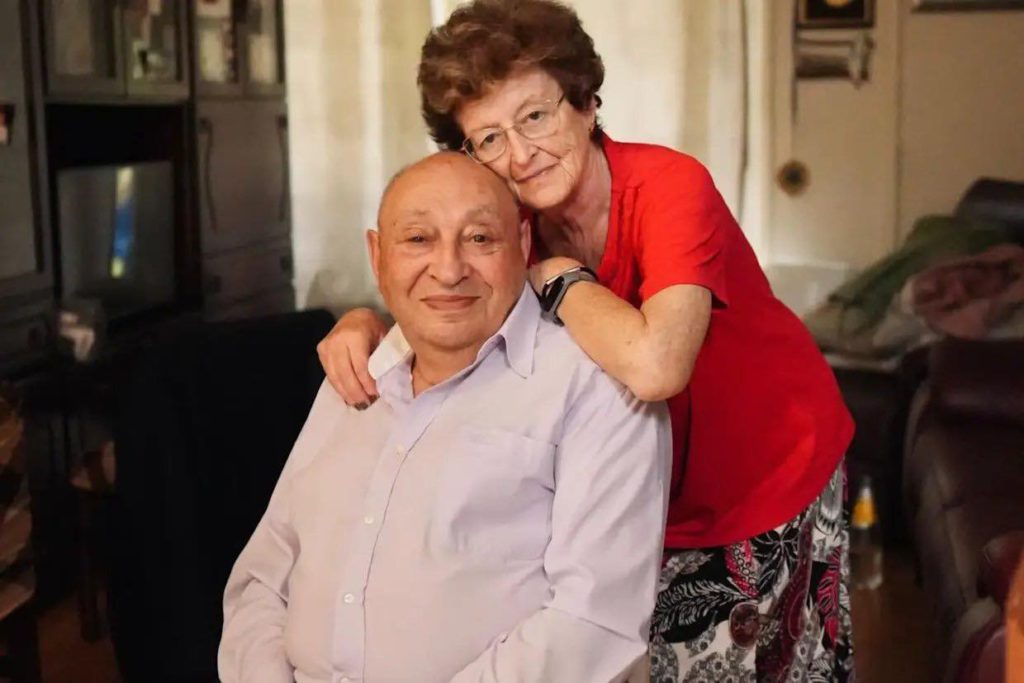
Thirteen of the 15 victims have now been formally identified, including French national Dan Elkayam, Rabbi Yaakov Levitan, Alex Kleytman, Reuven Morrison, Peter Meagher, Tibor Weitzen and Marika Pogany. The youngest victim was Matilda, who had just turned 10. A further 41 people, including four children, were injured in the attack. Twenty victims remain in hospitals across Sydney.
The Bondi Beach shooting has been formally declared a terrorist incident as investigations continue.
Support our Journalism
No-nonsense journalism. No paywalls. Whether you’re in Australia, the UK, Canada, the USA, or India, you can support The Australia Today by taking a paid subscription via Patreon or donating via PayPal — and help keep honest, fearless journalism alive.
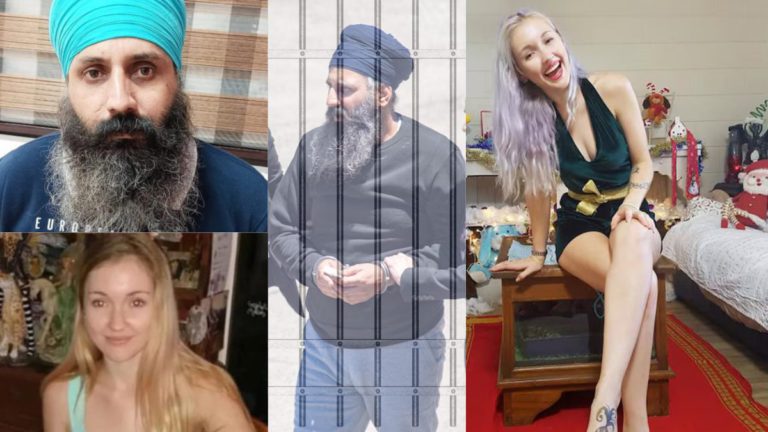
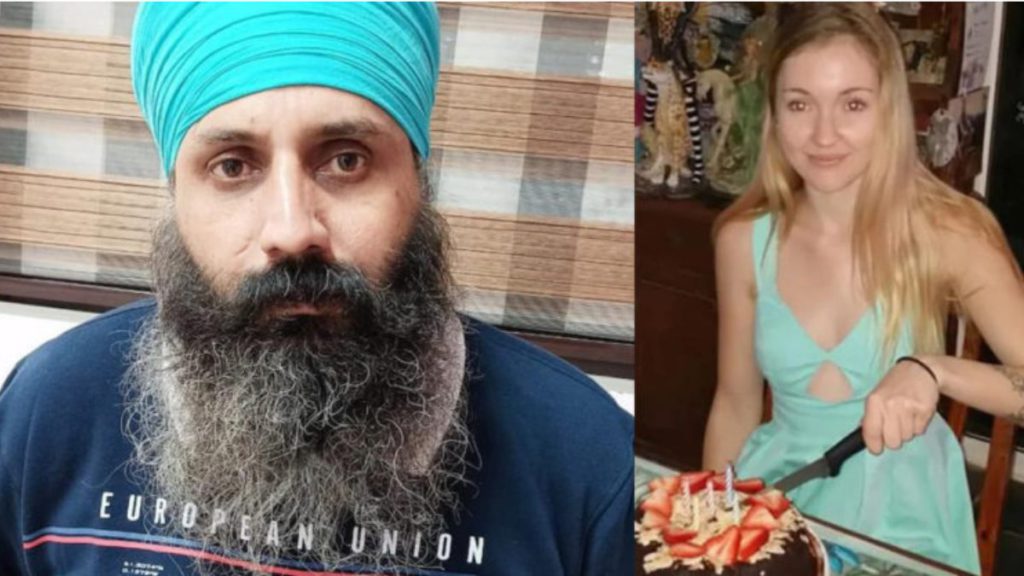
The surviving alleged gunman from the Bondi Beach massacre has been charged with 59 criminal offences, including terrorism and murder, over the mass shooting that left 15 people dead during a Jewish community event in Sydney.
Naveed Akram
Naveed Akram, 24, was formally charged on Wednesday afternoon from his hospital bed, a day after waking from a coma sustained during the police shootout that ended the attack. He did not appear in bail court and made no application for bail, which was formally refused.
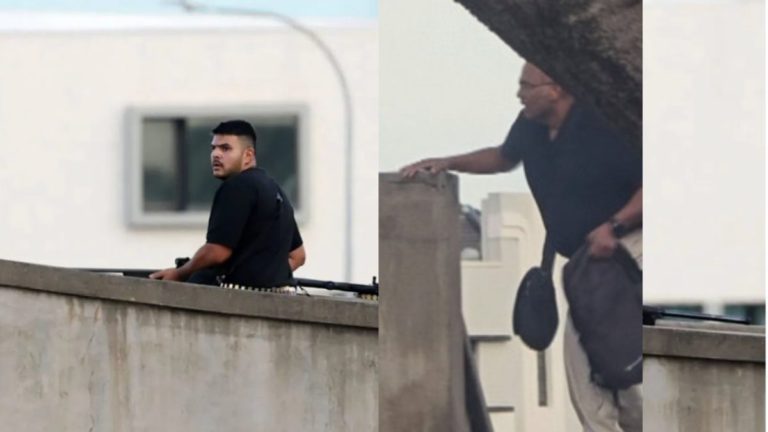
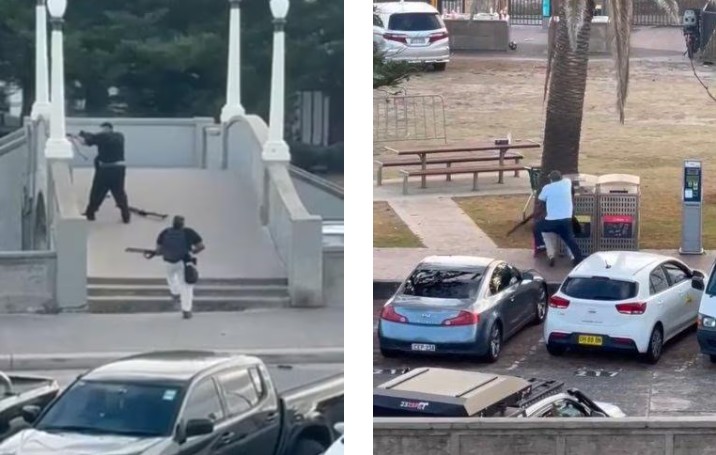
Police allege Akram and his father, Sajid Akram, 50, opened fire on crowds attending the Chanukah By The Sea celebration at Bondi Beach on Sunday night.
Sajid Akram
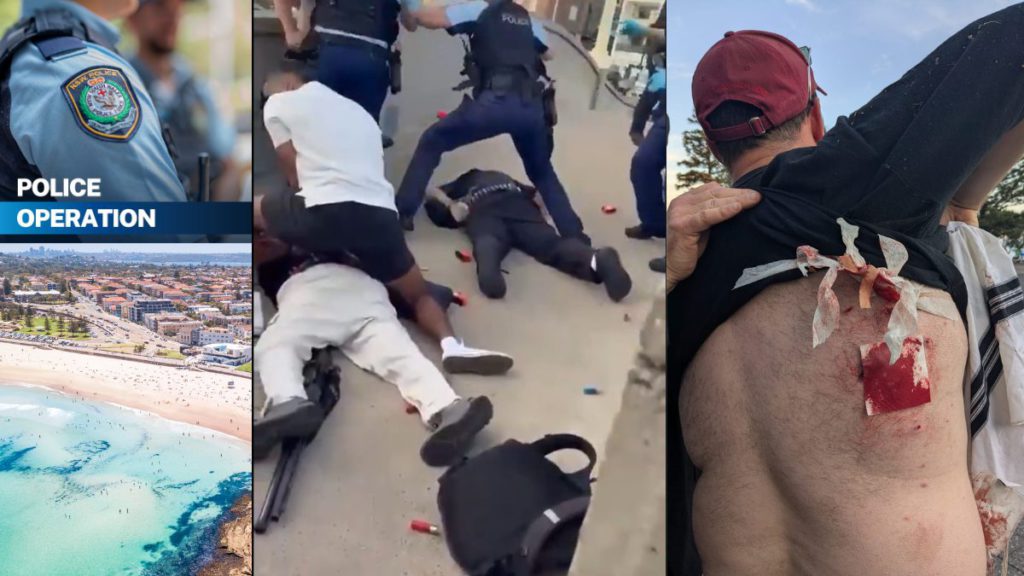
Sajid Akram was shot dead by police at the scene, while Naveed was critically injured and taken into custody.
According to NSW Police, Akram has been charged with one count of committing a terrorist act, 15 counts of murder, and 40 counts of causing wounding or grievous bodily harm with intent to murder. He also faces additional charges, including discharging a firearm with intent to cause grievous bodily harm, publicly displaying a prohibited terrorist symbol, and placing an explosive in or near a building with intent to cause harm.
In a statement, police said they will allege the accused “engaged in conduct that caused death, serious injury and endangered life to advance a religious cause and create fear in the community”. Investigators have said early indications suggest the alleged attack was inspired by Islamic State ideology.
Akram, who is from Bonnyrigg in Sydney’s south-west, was represented in court by barrister Ken Buckman, appearing on behalf of Legal Aid NSW. His matter was mentioned briefly in online bail court on Wednesday afternoon. He is due to return to court on Monday, when prosecutors are expected to seek a suppression order over court documents, before the case resumes again in April.
As authorities continue to identify victims of the attack, Boris Tetleroyd was named on Wednesday as the latest of the 15 people killed. Jewish community leader Edith Brutman, vice-president of B’nai B’rith NSW, was also among those who lost their lives.
Image Source: Daily Mail video
Married couple Boris Gurman, 69, and Sofia Gurman, 61, were killed while attempting to intervene and stop Sajid Akram during the shooting. Thirteen of the 15 victims have now been formally identified, including French national Dan Elkayam, Rabbi Yaakov Levitan, Alex Kleytman, Reuven Morrison, Peter Meagher, Tibor Weitzen and Marika Pogany. The youngest victim was Matilda, who had just turned 10.
A further 41 people, including four children, were injured in the attack. Twenty victims remain in hospitals across Sydney.
Two police officers were also wounded in the exchange of gunfire. Probationary Constable Jack Hibbert, 22, survived gunshot wounds to his head and shoulder but has lost sight in one eye. Constable Scott Dyson, 24, sustained a shoulder injury and underwent emergency surgery.
The Bondi Beach shooting has been formally declared a terrorist incident, marking one of the deadliest attacks in Australia in recent years.
Support our Journalism
No-nonsense journalism. No paywalls. Whether you’re in Australia, the UK, Canada, the USA, or India, you can support The Australia Today by taking a paid subscription via Patreon or donating via PayPal — and help keep honest, fearless journalism alive.
New Zealand’s immigration minister has rejected renewed calls to lower English-language requirements for migrant bus drivers, despite warnings that hundreds could be forced to leave just as the country faces another looming driver shortage.
As per The Post, Erica Stanford said the government had no plans to change the English standard for residency, insisting it was reasonable to expect migrants to be fluent.
Stanford’s comments come as bus drivers on temporary visas petitioned Parliament, arguing the current benchmark is unfair and was never clearly explained when they were recruited.
Stanford said the requirement had been in place for many years and that more than 400 drivers had already met it. “There’s plenty of time for them to improve their English,” she said.
“It’s what we expect from all migrants.”
The drivers, many of whom arrived in 2022 and 2023 to address acute workforce shortages, say they were promised a pathway to residency without being told they would need to meet what they describe as a postgraduate-level English test.
It is reported that some families sold businesses and relocated in the hope of building a long-term future in New Zealand.
Around 20 per cent of the bus driver workforce – about 1,000 drivers – is currently on temporary visas. To qualify for skilled residence, applicants must score at least 6.5 in International English Language Testing System or meet equivalent scores in other tests.
It is further reported that the threshold is higher than the English requirement for entry into undergraduate study at the University of Auckland.
An open letter from the Bus and Coach Association has urged the government to reduce the score to 5.5, warning the existing standard risks destabilising public transport services nationwide.
Opposition MPs and local leaders have accused the government of moving the goalposts. Labour’s immigration spokesperson Phil Twyford said it was unfair to recruit drivers during an “hour of need” and then subject them to what he called “ridiculously high” standards. He also criticised exemptions for wealthy migrants under investor visa categories, calling the policy inconsistent and discriminatory.
Drivers themselves say the test bears little resemblance to the language skills required on the job.
Edvin Vridush Prisad, recruited from Fiji, told The Post that he only learned about the test after arriving. “If we could do 6.5, we wouldn’t be driving buses,” he said. His wife, Ashnita Mala, sold her $30,000 hair salon to move to New Zealand. “If we had known about this requirement, no one would have come to struggle,” she said, raising concerns about their children being forced to leave after settling into school.
Green MP Ricardo Menéndez March told The Post employers, not immigration officials, should assess whether drivers can communicate effectively with passengers.
“Behind every bus driver is a family and a livelihood now at risk.”
Local authorities have also sounded the alarm. Greater Wellington Regional Council public transport committee chair Ros Connelly warned that losing drivers would lead to overcrowded buses and cancelled services, recalling previous disruptions when staff numbers fell.
In October 2025, RNZ reported that the Bus and Coach Association expected a nationwide shortage unless the language requirement was reviewed. Chief executive Delaney Myers said fears over failing English tests were already pushing drivers to consider returning home, with many visas expiring in 2026.
“Around 20 percent of our urban public transport driver workforce is here on a temporary work visa, and those visas are expiring in 2026.”
The issue is not limited to buses. Truck drivers have also raised concerns, saying they are required to demonstrate academic-level English despite minimal written communication in their roles. Several drivers told RNZ they had spent thousands of dollars on repeat tests, with fees exceeding $400 per attempt.
Stanford has dismissed claims of an impending crisis, arguing transport operators should prioritise recruiting locally. She pointed to rising numbers on the Jobseeker Work Ready benefit and said employers should work with Ministry of Social Development before turning to migrant labour.
Industry leaders counter that English proficiency is already assessed during hiring and that the residency test goes far beyond what is needed for safe, effective work. The Bus and Coach Association says it has raised the issue repeatedly with New Zealand Transport Agency and the Ministry of Business, Innovation and Employment, warning that services could again be at risk.
Auckland Transport previously declared an end to the city’s driver shortage in 2023 following international recruitment. Myers said withdrawing residency pathways now would be “cruel” to workers who helped stabilise the system. “They came to New Zealand to help keep services running,” she told RNZ.
“Taking that future away at this point sends the wrong message.”
Support our Journalism
No-nonsense journalism. No paywalls. Whether you’re in Australia, the UK, Canada, the USA, or India, you can support The Australia Today by taking a paid subscription via Patreon or donating via PayPal — and help keep honest, fearless journalism alive.
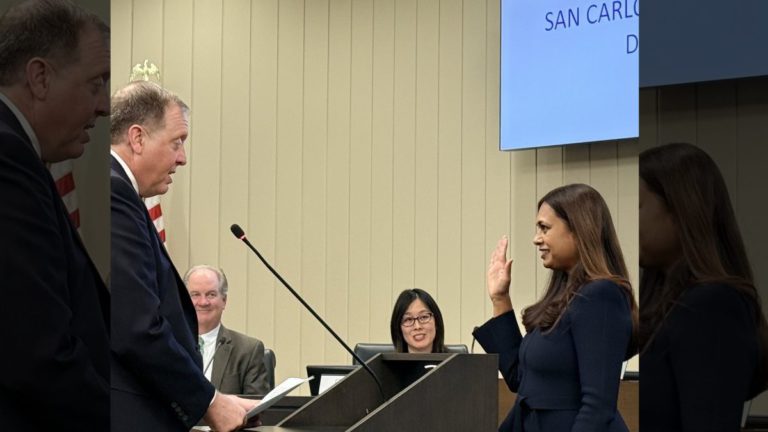
Pranita Venkatesh, a member of the Indo-Fijian diaspora, has made history as she was unanimously sworn in as Mayor of San Carlos, California. Her appointment marks her as one of the city’s youngest mayors and one of its first South Asian leaders.
The Fiji Trade Commission in North America praises Venkatesh’s elevation to the role, noting that her leadership reflects both the city’s diversity and the significant contributions of Fijians abroad. “Her achievement sends a powerful message: Fijians can have a seat at the table and shape inclusive communities,” the Commission said.
Born in Fiji, Venkatesh moved to California with her family at the age of four and has lived in San Carlos for the past 15 years.
Image Source: Fiji Trade Commission – North America
Married for 16 years, she and her husband have two children. She credits her Indian heritage and upbringing with instilling discipline, respect, and a strong sense of community—values that now guide her public service.
“Leadership is within reach for young Fijians and all diaspora communities,” the Commission added, describing her journey to public office as a source of pride for Fijians worldwide.
Mayor Venkatesh has also been active in promoting cultural awareness, emphasising the importance of celebrating Asian-American and Pacific Islander Heritage Month as a way to honour diverse cultures and contributions. “It’s a time to appreciate your own heritage and respect others’, while highlighting the positive impact our cultures have had globally,” she said.
Her appointment is seen as a landmark moment for San Carlos, highlighting the growing presence and influence of diaspora communities in civic life.
The city and the Fijian diaspora alike are celebrating this milestone, looking forward to her tenure marked by purpose, integrity, and community engagement.
Support our Journalism
No-nonsense journalism. No paywalls. Whether you’re in Australia, the UK, Canada, the USA, or India, you can support The Australia Today by taking a paid subscription via Patreon or donating via PayPal — and help keep honest, fearless journalism alive.
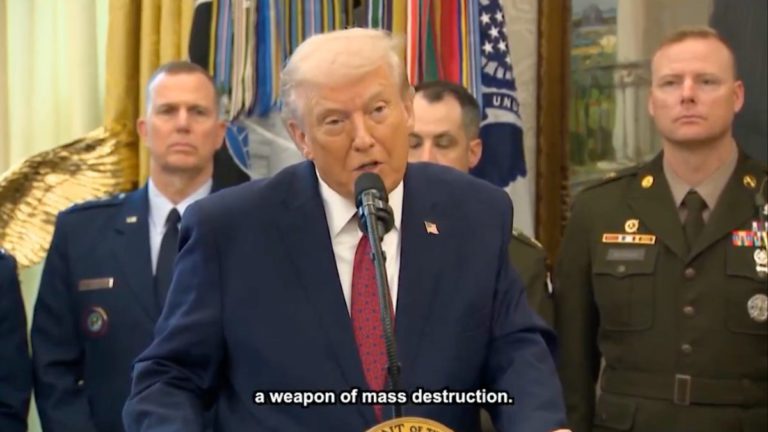
US President Donald Trump has signed a new Executive Order formally designating illicit fentanyl and its key precursor chemicals as weapons of mass destruction, dramatically escalating the federal government’s response to the deadly drug trade.
Under the order, the Attorney General is instructed to immediately pursue tougher criminal charges and seek harsher penalties in fentanyl trafficking cases. The move is designed to strengthen prosecutions and allow courts to impose longer sentences on those involved in the manufacture, distribution and sale of the drug.
The Executive Order also directs the Secretary of State and the Secretary of the Treasury to take action against assets, financial networks and institutions linked to fentanyl production and trafficking, targeting the financial lifelines of criminal and transnational networks.
In a further step, the Secretary of War and the Attorney General have been tasked with assessing whether additional national security resources should be deployed to support the Department of Justice during emergencies involving weapons of mass destruction. The Secretary of War, working with the Secretary of Homeland Security, has also been ordered to update chemical incident response plans to explicitly include the fentanyl threat.
Homeland Security agencies will meanwhile be required to identify and disrupt fentanyl smuggling networks using intelligence typically reserved for weapons of mass destruction and non-proliferation threats.
The White House said the decision reflects the scale of harm caused by fentanyl, which has become the leading cause of death among Americans aged 18 to 45. Officials argue the drug’s extreme potency — with as little as two milligrams considered potentially fatal — places it closer to a chemical weapon than a conventional narcotic.
The administration has also warned that profits from fentanyl trafficking are being used by cartels and foreign terrorist-linked organisations to finance violence, assassinations and insurgent activity, while cautioning that the drug could be exploited for large-scale terror attacks.
BREAKING: President Trump just declared FENTANYL a WEAPON OF MASS DESTRUCTION.
This critical step unleashes every tool to combat the cartels & foreign networks responsible for flooding communities with this deadly substance—the leading cause of death among Americans aged 18-45. pic.twitter.com/C9YXC53kzK
By classifying illicit fentanyl as a weapon of mass destruction, the President said the federal government would be able to deploy a fully coordinated national security response to confront what it describes as a chemical threat to public safety.
The order builds on earlier actions taken by President Trump, including declaring a national emergency at the southern border, designating several major cartels as Foreign Terrorist Organisations, imposing tariffs linked to cross-border drug flows, authorising military operations against narco-trafficking networks, and signing the HALT Fentanyl Act, which permanently placed fentanyl-related substances in the most restrictive drug category under US law.
The White House said the latest move signals a renewed commitment to dismantling cartels, cutting off drug supply chains and protecting American families from what it calls one of the deadliest threats facing the nation.
Support our Journalism
No-nonsense journalism. No paywalls. Whether you’re in Australia, the UK, Canada, the USA, or India, you can support The Australia Today by taking a paid subscription via Patreon or donating via PayPal — and help keep honest, fearless journalism alive.
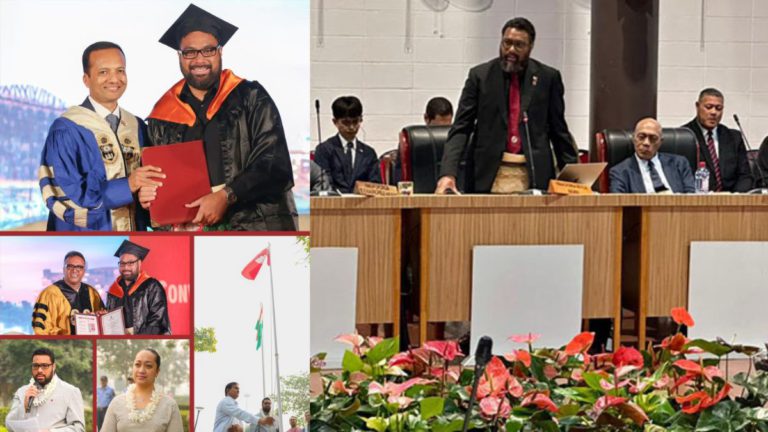
India-educated leader Lord Fatafehi Fakafanua has been elected as the 20th Prime Minister of the Kingdom of Tonga, securing a clear majority in a secret ballot of Members of Parliament and unseating caretaker Prime Minister Dr ‘Aisake Eke.
Lord Fakafanua completed a Master of Arts in Diplomacy, Law and Business at O.P. Jindal Global University in India, studying at the Jindal School of International Affairs, an academic experience that has shaped his diplomatic and policy outlook.
A member of Tonga’s royal family through his mother, a granddaughter of Queen Salote Tupou III, Lord Fakafanua also has noble lineage through his father. His sister is married to the Crown Prince. Outside politics, he is the president of Tonga Rugby League.
The vote was held in Parliament on Monday, three weeks after Tongans went to the polls on November 20. Lord Fakafanua won 16 votes to Dr Eke’s 10 in the 26-member Legislative Assembly.
At 40, Lord Fakafanua becomes one of the youngest prime ministers in Tonga’s history and only the second noble to hold the office since the country’s 2010 constitutional reforms. Those reforms significantly altered the balance of power in Parliament, strengthening the role of the 17 people’s representatives elected by the general public, alongside nine nobles’ representatives chosen through a separate process.
Before voting began, Lord Fakafanua told fellow MPs that his bid for the prime ministership was driven by a desire to unite the House. He said both nobles’ and people’s representatives ultimately answer to the citizens they serve and must work collectively for Tonga’s future.
Image: Lord Fakafanua, flanked by Noble’s Representatives, addresses the House as the second nominee for Prime Minister. Nuku’alofa, 15 December 2025 (Photo: Matangi Tonga)
In his acceptance speech, he thanked MPs for their support and again called for unity, urging all representatives to work together in the national interest. Dr Eke also addressed Parliament, thanking his supporters, congratulating Lord Fakafanua and pledging his cooperation as the country moves forward.
Dr Eke, the Tongatapu 5 representative, exits the prime minister’s office less than a year after taking over from Hu‘akavameiliku Siaosi Sovaleni, who resigned last December ahead of a no-confidence vote. In Monday’s ballot, Dr Eke lost the backing of several senior cabinet figures, including Deputy Prime Minister Taniela Fusimalohi and Paula Piukala, both of whom supported Lord Fakafanua.
Lord Fakafanua is a nobles’ representative for Ha‘apai and entered Parliament at the age of 24. At 27, he was elected Speaker of the Legislative Assembly, becoming the youngest person ever to hold the position in Tonga. He later returned to Parliament and again served as Speaker following subsequent elections.
Under Tonga’s constitutional process, Dr Eke will remain caretaker prime minister until King Tupou VI formally appoints Lord Fakafanua. The incoming prime minister must then nominate a cabinet for royal approval.
Following the leadership vote, Parliament elected Lord Vaea as Speaker and Lord Tu‘ihagaana as Deputy Speaker, positions that are reserved for nobles.
Image: Elected Members of the Legislative Assembly of Tonga for a four-year term 2026-29. Parliament House, Nuku’alofa. 15 December 2025 (Photo: Matangi Tonga)
As the new Parliament prepares to begin its four-year term, attention is also turning to falling voter participation. Turnout at the November election was 49.4 per cent, prompting renewed discussion about improving the electoral roll and exploring overseas voting options to include Tongans living abroad.
Support our Journalism
No-nonsense journalism. No paywalls. Whether you’re in Australia, the UK, Canada, the USA, or India, you can support The Australia Today by taking a paid subscription via Patreon or donating via PayPal — and help keep honest, fearless journalism alive.
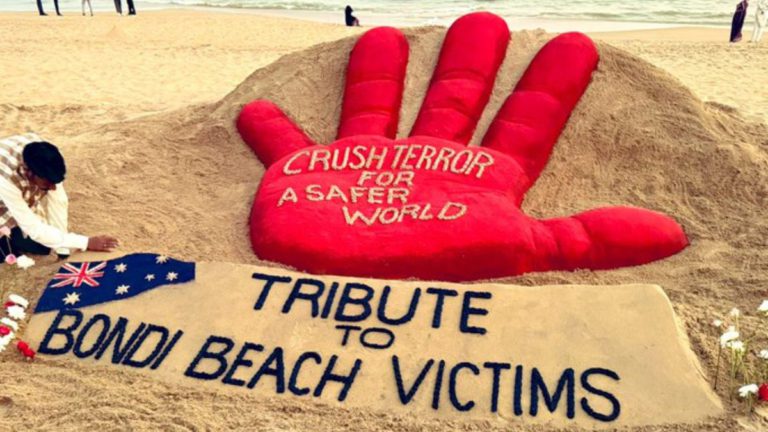
A striking sand art tribute created in India and a sombre memorial gathering in Sydney have together reflected the depth of global grief following the Bondi Beach terror attack that killed 15 people and shattered a community.
In Puri, India, internationally renowned sand artist and Padma Shri awardee Sudarsan Pattnaik paid tribute to the victims through a large-scale sand installation carrying the message, “Crush Terror for a Safer World.”
The artwork, created as a gesture of solidarity, drew attention from tourists and locals alike, with Pattnaik stating that India stood firmly with Australia in condemning terrorism and violence.
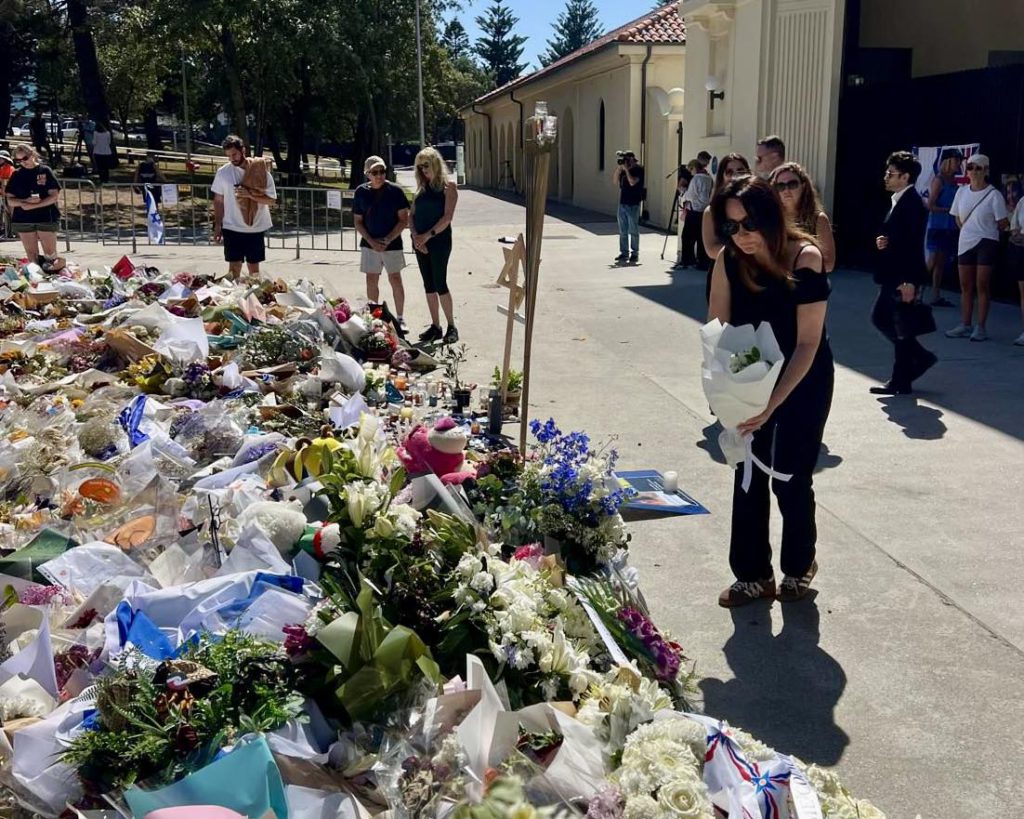
Thousands of kilometres away in Sydney, a heavy stillness descended on the forecourt of Bondi Pavilion as mourners gathered to remember those killed in Sunday evening’s attack during a public Hanukkah celebration near Bondi Beach.
🇦🇺 PM Anthony Albanese has paid tribute to the victims of the Bondi terror attack with a clear message of unity:
“Australia will not be divided by hate or violence. We will confront it head-on. And we will stand together in solidarity with Jewish Australians and with one… pic.twitter.com/8lxo4GWelM
The grief of the crowd centred on 10-year-old Matilda, the youngest victim of the attack. Her father, speaking briefly through tears, told mourners she was their first child born in Australia and symbolised the future they believed they had found here.
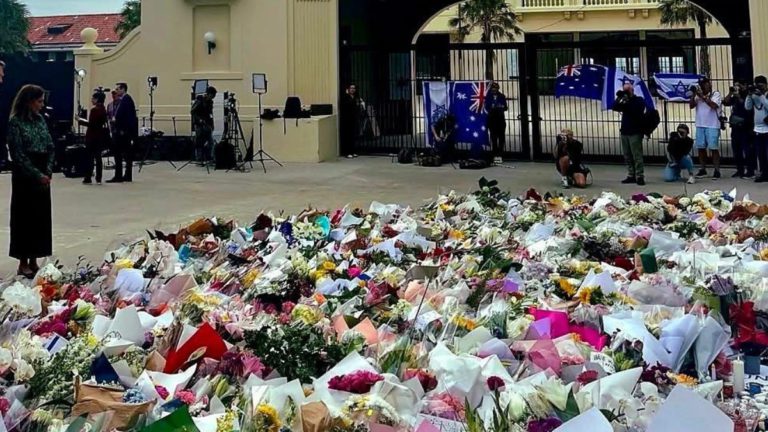
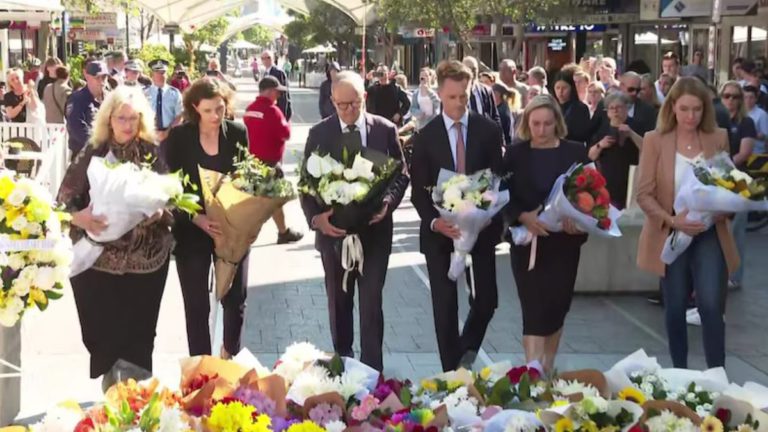
What began as a small vigil grew steadily into a gathering of thousands. Flowers, candles and photographs filled the space outside the pavilion, transforming the beachfront into a place of collective mourning.
Community leaders read aloud the names of those identified so far — including religious leaders, volunteers, Holocaust survivors, professionals and family members — many remembered for acts of courage and selflessness in their final moments.
Some mourners spoke of narrow escapes, of children shielded from gunfire and families forever changed. Others stood silently, clutching portraits or lighting candles, their grief too raw for words.
Fundraising efforts began alongside the memorial, with volunteers collecting donations for families left behind, particularly those with young children. Within days, hundreds of thousands of dollars had been raised, reflecting a city determined to support those most affected.
Jewish community leaders, students and all sides of politics gathered tonight with the Governor General to stand in solidarity with Jewish Australians and every Australian affected by the antisemitic terror in Bondi.
Faith leaders from across Sydney addressed the crowd, calling on Australians of all backgrounds to confront hatred and antisemitism together. Prayers in Hebrew were followed by Advance Australia Fair, as candles were lit and the menorah prepared once again — a symbol, speakers said, of refusing to let violence extinguish faith or community.
Sajid Akram, Bondi beach gunman: Born in India, radicalised in Australia, no link to family back home
Indian authorities have said there is no evidence linking India to the radicalisation of Sajid Akram, one of the perpetrators of the deadly… pic.twitter.com/XHlzctBZCO
As the memorials continue, investigations into the attack remain underway. Indian authorities have formally ruled out any connection between India or the state of Telangana and the radicalisation of Sajid Akram, one of the perpetrators. Telangana Police confirmed Akram had no criminal or security record in India before migrating to Australia in 1998 and said there was no evidence of any local influence contributing to his actions.
In the face of terrorism, coming together is the most important thing we can do.
Federal and state governments, AFP and New South Wales Police are working together to keep Jewish Australians safe.
There's a lot more work ahead for our police. But we'll be with them today and… pic.twitter.com/E4nHXkrKgF
Australian authorities have declared the Bondi Beach shooting a terrorist attack, with Prime Minister Anthony Albanese stating investigators are increasingly confident it was ideologically motivated, citing evidence recovered at the scene.
Support our Journalism
No-nonsense journalism. No paywalls. Whether you’re in Australia, the UK, Canada, the USA, or India, you can support The Australia Today by taking a paid subscription via Patreon or donating via PayPal — and help keep honest, fearless journalism alive.
For many people it’s real but temporary, while a smaller proportion develop longer lasting symptoms. Human threat detection systems evolved to respond quickly to danger, prioritising survival over nuance.
When threat systems activate, they mobilise the body and narrow focus. You may feel on high alert, lose sleep, have intrusive thoughts or images, feel irritable, or feel driven to seek information and certainty. These responses say nothing about a person’s strength. They’re common patterns from a nervous system experiencing uncertainty, though people’s responses vary widely in intensity.
The feeling of threat also spreads socially. Humans are sensitive to others’ emotions, especially in unclear situations. After terror attacks such as the one in Bondi, people look to others for cues about what’s happening, who’s at risk, and what to do. This can steady people, but it can also amplify fear.
Modern crises are further shaped by media exposure. Research shows heavy exposure to mass violence coverage is linked with higher short-term stress and post-traumatic stress symptoms.
This can even show up in people not directly involved. Distress can lead to repeatedly checking the news, and news coverage can in turn prolong distress. Either way, frequent replay can keep threat responses switched on long after the immediate danger has passed.
Distance matters
Distance from an event isn’t just geographic. It includes what you saw or heard, perceived ongoing risk, and how close the event feels through your community or identity group.
For survivors and bereaved families, the early phase is often dominated by shock, grief and practical demands. Coping may look less like emotional “processing” and more like survival through hours that feel unreal.
Witnesses, first responders and locals may develop place-based fear, where familiar places start to feel dangerous. Communities who feel targeted can experience a shared sense of threat. In those cases, being on high alert reflects an understandable change in their sense of safety.
Remote observers are not immune. Vivid imagery and emotionally charged discussion can trigger the body’s threat response, even from a distance. The nervous system shifts into fight or flight mode, but there’s no direct action to take and no clear endpoint.
Rumours, rage and scapegoating
Under threat, uncertainty itself becomes stressful. Clear stories feel safer than unresolved ones, even when facts are incomplete. This makes people more likely to spread rumours after attacks.
Research suggests being exposed to rumours during crises is linked to higher distress, which can drive more searching for information and create a feedback loop.
Early false claims can still stick emotionally after correction, because high stress strengthens emotional memory. Social media accelerates these dynamics. On many platforms, fast, emotionally charged content tends to travel further than slow, verified corrections, because most platforms reward engagement more than accuracy.
For example, a Sydney man named Naveed Akram, who was falsely accused online of being one of the alleged Bondi beach gunmen, was targeted with abuse, and became afraid to leave home.
Artificial intelligence (AI) tools can add further confusion. For example, X’s chatbot Grok misidentified a bystander who disarmed one attacker, and mislabelled verified footage of the attack. This serves as a reminder that confident AI outputs can be wrong in fast-moving crises.
Outrage spreads for similar reasons. Anger can focus fear and reduce helplessness. For those directly affected, it may support survival. For those at a distance, it can become performative or inflaming, especially when rewarded with attention.
Scapegoating is another common response – blaming a whole group for one person’s actions. Under high stress, focus can narrow and complex explanations can be harder to think through.
Blame can feel empowering because it reduces uncertainty, making scapegoating more likely. But it can increase risk for innocent people and deepen fear for targeted communities, adding secondary harm.
Reducing secondary harm
Disaster psychology separates the event itself from the conditions that shape recovery. Those conditions include safety, trust, connection and manageable exposure.
Psychological first aid, widely used in disaster response, focuses on reducing the feeling of being overwhelmed, strengthening social support, and connecting people to reliable information and services.
These principles don’t just apply to individuals – they also apply at a population level when it comes to what we see and share online.
There are three evidence-based ways the wider public can help:
1. Reduce unwanted exposure. Repeated sharing of graphic footage can worsen distress for survivors and families and heighten fear in targeted communities. Avoid reposting graphic content where possible. Before sharing, ask: is this verified and necessary, or just amplifying fear?
2. Slow down information. Early information is often incomplete. Prioritise verification over speed to reduce false claims that can fuel fear long after correction.
3. Avoid group blame. Condemning violence doesn’t require suspicion of whole groups. Scapegoating breaks trust and increases risk, undermining recovery for everyone.
The Bondi beach terror attack aimed to spread fear beyond its victims. With these steps, we can help fight it and ensure the community heals after such horror.
No-nonsense journalism. No paywalls. Whether you’re in Australia, the UK, Canada, the USA, or India, you can support The Australia Today by taking a paid subscription via Patreon or donating via PayPal — and help keep honest, fearless journalism alive.
Indian authorities have said there is no evidence linking India to the radicalisation of Sajid Akram, one of the perpetrators of the deadly Bondi Beach shooting in Sydney that has been declared a terrorist attack by Australian authorities.
In an official press note, Telangana Police confirmed that Sajid Akram (50), originally from Hyderabad, had no adverse criminal or security record in India prior to leaving the country in 1998. Police said the factors that led to the radicalisation of Sajid and his son Naveed Akram (24) appear to have no connection with India or any local influence in Telangana.
The attack occurred on Sunday evening, December 14, during a public Hanukkah celebration near Bondi Beach, killing at least 15 people and injuring dozens more.
Sajid Akram was shot dead by police at the scene, while Naveed Akram survived and remains hospitalised under police guard.
Authorities have said the incident is being treated as a terrorist attack, with growing evidence pointing to inspiration from Islamic State ideology.
According to the Telangana Police statement, Sajid Akram completed a Bachelor of Commerce degree in Hyderabad before migrating to Australia in November 1998 in search of employment. He later married Ms Venera Grosso, a woman of European origin, and settled permanently in Australia. The couple have two children — Naveed and a daughter — both of whom were born in Australia and are Australian citizens. Sajid Akram continued to hold an Indian passport.
Indian police officers said Sajid had only limited contact with his family in Hyderabad over the past 27 years. He reportedly visited India on six occasions after migrating, mainly for family-related matters such as property issues and visits to his elderly parents. Authorities noted that he did not return to India even at the time of his father’s death.
Family members in Hyderabad have told investigators they were unaware of any radical beliefs or activities and expressed shock at Sajid’s involvement in the attack. Telangana Police said the family had no knowledge of the circumstances that led to his radicalisation.
Indian authorities have visited the family residence in Hyderabad as part of routine verification and are continuing to coordinate with central agencies and Australian counterparts. Further questioning of relatives may be undertaken if required.
Meanwhile, New South Wales Police Commissioner Mal Lanyon said the surviving attacker could face criminal charges depending on his medical condition. He confirmed there were no other suspects and that Sajid Akram was a licensed firearms holder who legally owned six registered weapons.
Australian and Philippine authorities have also confirmed that the father and son travelled to the Philippines last month, staying for 28 days before returning to Australia.
Philippine immigration officials told The Australia Today that Sajid travelled on an Indian passport, while Naveed used an Australian passport, with Davao listed as their destination. The purpose of the trip remains under investigation, though Australian officials said the travel had not been flagged by intelligence agencies.
Prime Minister Anthony Albanese has said investigators are increasingly confident the attack was ideologically motivated, citing evidence recovered from the scene, including homemade explosives and improvised Islamic State flags.
Support our Journalism
No-nonsense journalism. No paywalls. Whether you’re in Australia, the UK, Canada, the USA, or India, you can support The Australia Today by taking a paid subscription via Patreon or donating via PayPal — and help keep honest, fearless journalism alive.
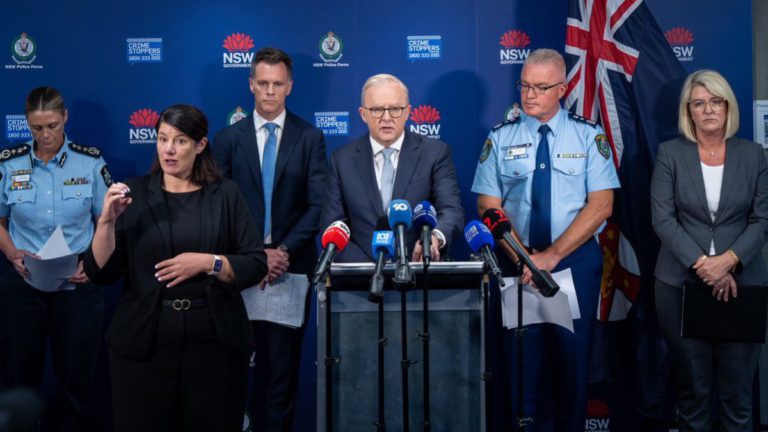
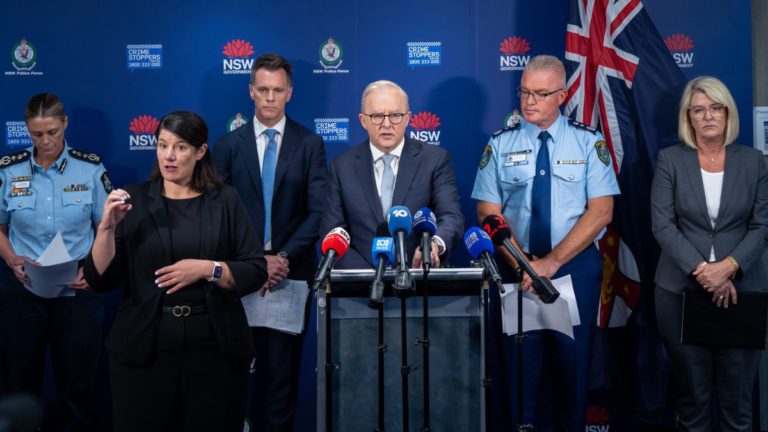
Australia’s political and policing leaders have pledged national unity, stronger gun laws and sustained action against antisemitism following what authorities have described as a terrorist attack targeting Jewish Australians at Sydney’s Bondi Beach.
Speaking at a joint press conference in Sydney on Tuesday, Prime Minister Anthony Albanese said the nation would not allow terror to fracture social cohesion. “My message to Jewish Australians is that we stand with you as a nation. We embrace you at what is a terrible time,” Mr Albanese said.
“These antisemitic terrorist attacks will not be successful with their objective, which is to divide us as a nation.”
Mr Albanese confirmed he had met Ahmed El Ahmed, who intervened during the attack, at St George Hospital earlier in the day. “I thanked him for the lives that he helped to save, and I wished him all the very best with his surgery that he will undertake tomorrow,” the Prime Minister said.
“In the worst of times, we see the best of Australians.”
He also urged those affected to seek mental health support, pointing to expanded federal services. “I encourage all Australians affected by this tragedy to consider accessing the mental health support,” he said, citing Lifeline, Beyond Blue, Kids Helpline, Headspace and Medicare Mental Health Centres.
New South Wales Premier Chris Minns said the state’s response to the “horrifying tragedy” would be comprehensive, long-term and already underway. “Our response to this horrifying tragedy must be comprehensive and has begun already,” Mr Minns said.
“Our approach to this terrible crime in New South Wales is multifaceted.”
Mr Minns outlined four key priorities: counter-terrorism cooperation, combating antisemitism, tightening gun laws and community healing. “I’m determined to bring in the toughest gun laws in Australia and they’ll be significantly tightened in New South Wales,” he said.
“Fighting antisemitism … will not be done in a week or a month. It’s a long-term important project.”
He also appealed for blood donations, revealing a surge in public response. “There has been 50,000 appointments to give blood in New South Wales, which I understand is a fivefold increase,” the Premier said.
“For somebody in trauma they may need 100 individual donations to save their life.”
Support for affected small businesses in Bondi will be announced within 24 hours, he added.
“Part of our job … is to ensure that we lift back up the Bondi community and we give people a place to come together and to return to a semblance of normal life.”
New South Wales Police Commissioner Mal Lanyon confirmed two parallel investigations were underway: a critical incident review and a joint counter-terrorism operation with the Australian Federal Police. “This will be a thorough investigation,” Commissioner Lanyon said.
“I apologise for the disruptions … but I’m sure all of the community understands the importance of investigating this abhorrent matter.”
He confirmed the two suspects had travelled to the Philippines last month, with the purpose of the trip still under investigation, and said a vehicle linked to the younger man contained improvised explosive devices and ISIS flags.
“We continue to work through the motive of this tragedy.”
Commissioner Lanyon also corrected earlier information about the gun licence held by 50-year-old Sajid Akram. “The application lapsed in 2016,” he said of the first licence attempt. “A second Category A/B licence was applied for … and issued in 2023.”
Australian Federal Police Commissioner Krissy Barrett described the attack in stark terms, calling it an act of terrorism inspired by extremist ideology. “This was a barbaric attack against Australians, Jewish Australians,” Commissioner Barrett said.
“On Sunday, Jewish Australians were hunted down in broad daylight at an iconic Australian beach.”
She said early indications pointed to an attack inspired by Islamic State ideology, stressing the distinction between terrorism and religion.
“These are the alleged actions of those who have aligned themselves with a terrorist organisation, not a religion.”
Commissioner Barrett said the investigation would be relentless. “This investigation will be highly visible, precise and it will operate around the clock,” she said.
Addressing criticism of the police response, Premier Minns strongly defended officers at the scene. “The New South Wales Police acted with bravery and integrity. They didn’t take a backward step,” he said.
“Police officers … put their lives on the line to save people in this state.”
At the national level, Mr Albanese confirmed National Cabinet had agreed to strengthen gun laws across jurisdictions. “The very nature of our gun laws means that they are only as strong as the weakest link,” he said.
“That is why we want to make sure that they are strengthened across the country.”
The Prime Minister rejected claims that antisemitism was sidelined in national discussions. “The report is not accurate,” he said.
“We are busy implementing the work of the Antisemitism Envoy and we talked about that yesterday.”
Concluding the press conference, Mr Albanese said the moment demanded unity rather than politics. “This is not a time for politics. This is a time for national unity,” he said.
“What terrorists seek to do is to create division … and we can’t allow their objective to be successful.”
Support our Journalism
No-nonsense journalism. No paywalls. Whether you’re in Australia, the UK, Canada, the USA, or India, you can support The Australia Today by taking a paid subscription via Patreon or donating via PayPal — and help keep honest, fearless journalism alive.
Prime Minister Anthony Albanese visited Ahmed in hospital, describing him as “an Australian hero.” Albanese said:
“Ahmed, you put yourself at risk to save others, running towards danger on Bondi Beach and disarming a terrorist. In the worst of times, we see the best of Australians. And that’s exactly what we saw on Sunday night. On behalf of every Australian, I say thank you.”
Ahmed, you are an Australian hero.
You put yourself at risk to save others, running towards danger on Bondi Beach and disarming a terrorist.
In the worst of times, we see the best of Australians. And that's exactly what we saw on Sunday night.
The 44-year-old, unarmed and acting alone, confronted an armed gunman in the attack that claimed 16 lives, including a child, and left 29 others injured.
Authorities say Ahmed wrestled a rifle from one of the attackers while under fire from a second gunman, likely preventing further fatalities.
Footage shows Ahmed moving cautiously through Campbell Parade car park, using parked cars for cover before launching himself at the attacker. NSW Health Minister Ryan Park praised his courage, saying,
“He put his entire life at risk for complete strangers. Without his heroic behaviour, this situation could have been even worse.”
Ahmed, a business owner from Sydney’s Sutherland Shire with no known firearms experience, was visiting Bondi when he witnessed the attack.
NSW Premier Chris Minns also hailed Ahmed’s bravery, calling his actions “extraordinary acts of personal courage” in the face of terror. Governor-General Sam Mostyn visited Ahmed, bringing flowers and commending his heroism on behalf of the public and King Charles.
A GoFundMe campaign supporting Ahmed has raised more than $2 million, including a $99,999 donation from US billionaire William Ackman.
Support our Journalism
No-nonsense journalism. No paywalls. Whether you’re in Australia, the UK, Canada, the USA, or India, you can support The Australia Today by taking a paid subscription via Patreon or donating via PayPal — and help keep honest, fearless journalism alive.
Pakistani cricketer Shaheen Shah Afridi had a night to forget on his Big Bash League debut, being removed from the attack for bowling two full-toss no-balls above waist height as Melbourne Renegades defeated Brisbane Heat by 14 runs at GMHBA Stadium in Geelong.
Afridi, playing his first BBL game, conceded 0-45 from just 2.4 overs before the umpires deemed him a danger to the batsmen.
The setback came in a dramatic 18th over, forcing acting captain Nathan McSweeney to complete the over, which eventually went for 22 runs. Commentator Theo Doropoulos said Afridi “had an off night” and struggled with his pace variations, while Aaron Finch added that it was a tough start for the Pakistan one-day captain in Australia.
Meanwhile, Renegades opener Tim Seifert scored his maiden BBL century, blasting 102 from 56 balls, with Ollie Peake contributing 59 from 29. The pair put on 121 runs for the fourth wicket, helping Melbourne reach 5-212 — the highest score at the Geelong venue.
Despite half-centuries from Heat batsmen Colin Munro (55) and Jimmy Peirson (50), Brisbane were restricted to 8-198, with Will Sutherland (3-33) and Xavier Bartlett (1-24) doing the damage. Seifert, who sustained a side muscle injury while batting, was rested behind the stumps, with Mohammad Rizwan taking over as wicketkeeper.
Support our Journalism
No-nonsense journalism. No paywalls. Whether you’re in Australia, the UK, Canada, the USA, or India, you can support The Australia Today by taking a paid subscription via Patreon or donating via PayPal — and help keep honest, fearless journalism alive.
Philippine authorities have confirmed to the media that the father accused of killing 15 people at Bondi Beach last week travelled to the country in November on an Indian passport.
Bureau of Immigration spokesperson Dana Sandoval has confirmed to The Australia Today that,
“Sajid Akram, 50 arrived in the Philippines on Indian passport, together with Naveed Akram 24 last November 1, 2025 from Sydney, Australia.”
Both reported Davao as their final destination. They left the country on November 28, 2025 on a connecting flight from Davao to Manila, with Sydney as their final destination.
They left on 28 November, with Davao listed as their final destination before connecting to Manila on their return, the Philippines Bureau of Immigration told Bloomberg.
The purpose of the visit remains under investigation.
NSW Police Commissioner Mal Lanyon confirmed to the media that the father and son’s trip to the Philippines had not been flagged by intelligence agencies, but said this did not indicate a failure.
“The reason that the Akrams travelled to the Philippines, where they went, is unknown at this stage and subject to the investigation,” he said.
Earlier, Minister for Home Affairs Tony Burke indicated the father held permanent residency in Australia, without giving details of his nationality. Burke said he arrived in the country on a student visa in 1998. Later, in 2001, he transferred to a partner visa and subsequently obtained a Resident Return Visa after trips overseas. The son, he said, is an Australian-born citizen.
Prime Minister Anthony Albanese said there is growing evidence the Bondi Beach attack was inspired by Islamic State ideology. “What we know already is that it goes to motive and what is being investigated,” he said.
“It would appear that there is evidence that this was inspired by a terrorist organisation, by ISIS. Some of the evidence being procured, including the presence of Islamic State flags in the vehicle that has been seized, are part of that.”
Commissioner Lanyon also clarified earlier reports about Sajid Akram’s firearms licence. He first applied for a licence in October 2015, but it lapsed in 2016 without being finalised. A second Category AB licence applied for in 2020 was issued in 2023, and the seized firearms were properly registered under this licence.
Investigators have recovered homemade explosives and two homemade Islamic State flags at the crime scene.
The attack has shocked those who knew the shooters. Lachie, a Sydney bricklayer who worked with Naveed Akram for several years, said he was horrified to see his former colleague implicated in the massacre. “It made me feel a bit sick that I spent so much time with someone, for them to be a monster like that,” he told A Current Affair.
Naveed Akram, critically injured in a shootout with police, remains under hospital guard. He was not on a terrorism watchlist but had previously been investigated by ASIO in 2019 over alleged links to an ISIS-associated cell.
The Bondi Beach shooting has been officially declared a terrorist incident. At least 15 people were killed, including a 10-year-old girl, and 40 others were injured, five critically. Two police officers remain in serious but stable condition.
Support our Journalism
No-nonsense journalism. No paywalls. Whether you’re in Australia, the UK, Canada, the USA, or India, you can support The Australia Today by taking a paid subscription via Patreon or donating via PayPal — and help keep honest, fearless journalism alive.
Three Indian international students were injured in the Bondi Beach terrorist attack, according to early reports, with at least two believed to be receiving treatment in the hospital.
The Australia Today understood the students sustained injuries to their thigh and leg during the shooting, though their identities and exact condition have not yet been formally confirmed.
Prime Minister Anthony Albanese said the attack has been declared a terrorist incident and confirmed that investigators are examining evidence suggesting it may have been inspired by Islamic State ideology.
“What we know already is that this goes to motive,” the Prime Minister said.
“It would appear that there is evidence that this was inspired by a terrorist organisation, by ISIS.
Some of the evidence being procured, including the presence of Islamic State flags, forms part of that investigation.”
NSW Police Commissioner Mal Lanyon said the investigation remains complex and is expanding as new information emerges, including international travel by the alleged attackers and the discovery of extremist material.
Commissioner Lanyon confirmed police located homemade explosives and two homemade Islamic State flags following the attack, and that the matter was being jointly investigated by NSW Police, the Australian Federal Police and ASIO under terrorism powers.
He also clarified earlier information about firearms linked to the attack, confirming the deceased alleged gunman, Sajid Akram, held a Category AB firearms licence issued in 2023, after an earlier application lapsed.
The Commissioner said the two alleged attackers had travelled to the Philippines in November, with the purpose of the trip still under investigation. He stressed the travel had not been flagged by intelligence agencies but said this did not constitute an intelligence failure.
“I don’t believe it was an intelligence failure at all,” Commissioner Lanyon said.
“We are finding information post the event, and this will be a thorough investigation.”
At least 15 people were killed in the attack, including a 10-year-old child, while 40 others were injured. Five victims remain in critical condition, and two injured police officers are in serious but stable condition.
The attack unfolded during the Hanukkah by the Sea celebration, marking the first day of Hanukkah, when hundreds gathered near Campbell Parade.
Naveed Akram, 24, and his father, 50, opened fire on the gathering shortly before 7pm on Sunday. The father, who held six firearms licences, was killed by police at the scene, while Naveed remains in hospital in critical condition.
The attack killed 15 civilians and one of the attackers. Thirty-eight people were hospitalised, including police officers. One suspect remains in critical condition, while investigators continue to examine the scene.
Authorities have urged caution around unconfirmed reports as they continue to identify victims and notify families, with consular officials expected to be involved where foreign nationals are affected.
This is a developing story and will be updated as more information becomes available.
Support our Journalism
No-nonsense journalism. No paywalls. Whether you’re in Australia, the UK, Canada, the USA, or India, you can support The Australia Today by taking a paid subscription via Patreon or donating via PayPal — and help keep honest, fearless journalism alive.
Australia’s domestic spy agency is under intense scrutiny after ASIO director-general Mike Burgess confirmed one of the Bondi Beach gunmen was “known” to the agency before the Hanukkah terror attack that left 16 people dead and dozens injured.
The revelation has triggered a wave of anger from Jewish and multicultural community leaders, civil liberties advocates and some politicians, who argue that public trust in ASIO’s leadership has been badly shaken and are demanding clear accountability — up to and including Burgess’ resignation.
Bondi gunman linked to earlier IS cell
ASIO’s role came under the spotlight when Burgess told reporters that one of the gunmen was on the agency’s radar, though not assessed as an “immediate threat”.
Asked whether either of the Bondi shooters had appeared on ASIO watchlists, Burgess said:
“One of these individuals was known to us, but not in an immediate-threat perspective, so we need to look into what happened here.”
Subsequent reporting has revealed that ASIO examined 24-year-old Naveed Akram six years ago over his close ties to a Sydney-based Islamic State (IS) cell. That investigation began soon after the 2019 arrest of Isaak El Matari, who later admitted planning an IS-inspired insurgency and is now serving a seven-year sentence.
Sources quoted by the ABC say Akram was “closely connected” to El Matari and other men convicted of terrorism offences, yet was ultimately judged not to pose an imminent threat. An IS flag was later found in the Akrams’ vehicle after the Bondi massacre, reinforcing investigators’ belief the attack was ideologically driven.
For many critics, the pattern is depressingly familiar: a major attack followed by the admission that at least one perpetrator had been known to authorities but assessed as low-risk.
‘Known to us’ is not good enough, critics say
Community leaders and some MPs now argue that “known to us” has become an unacceptable refrain from security agencies after mass-casualty attacks.
Jewish representatives say the Bondi shooting — which targeted a Hanukkah celebration and killed Rabbi Eli Schlanger and 14 others — has left families asking whether more could and should have been done to neutralise the threat earlier.
Australian Jewish Association’s CEO Robert Gregory told The Australia Today, “We are concerned by the fact that one of the suspects appears to have been on the radar or intelligence agencies and was not appropriately monitored.”
“We hope that this is an isolated example,” he added
“The Jewish community believes that the Australian government has not taken the threat of Islamic terrorism or Islamist terrorism and anti Semitism seriously enough.
And we hope that the intelligence agencies are reviewing their methods.”
Civil liberties and human-rights advocates, while wary of over-reaction, are also calling for far greater transparency around how ASIO judges when a person moves from “of interest” to “immediate threat”, and what oversight exists when such judgments later prove fatally wrong.
Several federal and state politicians have privately questioned whether Burgess can credibly lead the internal review ASIO has promised, arguing that an independent inquiry, with the powers of a royal commission, is needed.
Some are openly suggesting the director-general should consider his position to help restore public confidence in the system.
Mr Gregory also said,
“By ignoring repeated warnings, the Prime Minister and his senior ministers are responsible for this. The honourable thing would be for them to resign.”
Burgess’ record under the microscope
Mike Burgess, a former ASD (Australian Signals Directorate) executive, was appointed ASIO director-general in 2019. In annual “threat assessment” speeches, he has repeatedly warned that espionage and foreign interference now pose a greater long-term danger to Australia than terrorism, and has overseen a shift in resources to counter those threats.
Under his tenure, ASIO says it has helped disrupt numerous terror plots and has downgraded the national terror threat level from “probable” to “possible” in 2022, reflecting what it described at the time as a reduced likelihood of a terrorist attack in Australia.
Supporters of Burgess point to those disrupted plots and to the legal and practical constraints ASIO operates under. Intelligence agencies cannot detain or charge suspects; they collect information and pass it to police and prosecutors. They must also balance surveillance with civil liberties and finite resources — a constant triage between thousands of people “of interest” and a much smaller subset considered actively dangerous.
But critics argue that the Bondi attack exposes deeper weaknesses: risk-assessment frameworks that failed to recognise the escalation pathway of a man previously linked to a hardened IS cell; an apparent over-confidence in the downward trend of jihadist terrorism; and a lack of visible accountability when those judgments go catastrophically wrong.
A wider pattern of pressure and missed warning signs
The Bondi massacre is not the first time Australian authorities have had to acknowledge that terrorists were on their radar before they struck. The perpetrator of the 2018 Bourke Street knife attack in Melbourne, Hassan Khalif Shire Ali, had been investigated by ASIO in 2015 over possible extremist ties but was later assessed as no longer a significant threat.
Those earlier cases predate Burgess’ time as director-general, but they form part of a longer pattern that critics say should have prompted a more profound overhaul of how “known” individuals are monitored and re-evaluated.
Now, with 15 people dead at Bondi and the director-general again conceding prior awareness of at least one attacker, pressure is building for a fundamental reset — including at the very top of ASIO.
Calls for an independent inquiry – and for Burgess to go
Security experts are divided on whether a change of leadership would materially improve outcomes. Some argue that sacking Burgess could amount to scapegoating one official for systemic problems: legal thresholds for disruption, resourcing limits, and the inherent difficulty of predicting who will move from radical rhetoric to violent action.
Others counter that leadership does matter — in setting priorities, challenging institutional assumptions and fostering a culture of healthy scepticism. They say only a robust, independent inquiry, empowered to examine ASIO’s internal decision-making around Naveed Akram and his associates, can determine whether those standards were met.
What is clear is that a growing number of critics, particularly within affected communities, now see Burgess as the public face of an intelligence system that failed to prevent one of the worst mass shootings in modern Australian history. For them, a change at the top is a necessary step toward rebuilding trust.
A test of transparency and trust
In the coming months, ASIO and the Joint Counter Terrorism Team will piece together how a previously investigated extremist, allegedly inspired by IS, was able to arm himself and carry out a devastating attack on a Jewish festival at one of Australia’s most iconic locations.
Whether Mike Burgess can retain the confidence of victims’ families, the Jewish community and the broader public while leading that process is now a central question.
For some, the answer is simple: only a new director-general, appointed after an independent inquiry, can convince Australians that lessons from Bondi will be learned — and acted upon — rather than simply filed away as another case where a killer was “known” but not stopped.
Support our Journalism
No-nonsense journalism. No paywalls. Whether you’re in Australia, the UK, Canada, the USA, or India, you can support The Australia Today by taking a paid subscription via Patreon or donating via PayPal — and help keep honest, fearless journalism alive.
Two elderly bystanders who tried to wrestle a rifle from one of the Bondi Beach terrorists have been hailed as heroes, after images emerged showing them confronting the gunman just moments before they were shot dead.
Fifteen people were killed, and dozens were injured on Sunday night when Naveed Akram, 24, and his father, 50-year-old Sajid Akram, allegedly opened fire on crowds gathered for the “Hanukkah by the Sea” celebration near Campbell Parade in Bondi.
Police allege the pair positioned themselves on a footbridge overlooking the beach and began shooting into the crowd of families and children marking the first night of the Jewish festival.
A photograph circulating on social media now shows a man falling to the road beside Sajid Akram, grappling for control of the gun the attacker had been wielding. A woman stands close by, just metres from the assailant’s vehicle.
“Many people may not know that at the very beginning of the incident, two individuals were among the first to identify the gunman and bravely attempted to disarm him,” one post said.
“Tragically, they were shot and killed in the process. They were heroes too. They stepped forward in the face of extreme danger.”
A second image taken later shows the pair lying motionless on the ground near the car, as emergency services swarm the scene.
‘He is a hero’
Witnesses have described the desperate early struggle with the gunman as a crucial moment that likely saved lives by disrupting his attack.
“We saw this man heroically try to disarm this evil terrorist. His family needs to know he was trying to save lives. He is a hero,” one witness wrote.
Another local witness, identified only as Jenny, told Chinese outlet Xiaoxiang Morning Post that she initially thought she was hearing fireworks as she parked her car near the bridge.
“I was stunned at the time,” she said. “Looking back on this scene afterward, I was deeply shocked, because everyone was running away at the time.”
Jenny said she saw Sajid get out of a car before being rushed by an older man — whom she estimated to be in his 70s or 80s — who tackled him and snatched away the long gun. A thin, older woman was behind the man as he lunged at the attacker, she said.
When she then saw shots being fired from the footbridge, Jenny fled towards the beach to collect her family and drove them home.
“I’ve lived in Australia for over 20 years, and I can say this is the most horrific attack Australia has ever suffered since its founding,” she said.
Father-of-two tackled gunman under fire
Among those critically injured on Sunday night was 43-year-old tobacconist owner Ahmed Al-Ahmed, who has also been widely praised for confronting one of the attackers.
Dramatic footage shows Mr Al-Ahmed grabbing Sajid Akram from behind and wrestling away his firearm. The gunman falls backwards to the ground as Mr Al-Ahmed lifts the rifle and points it towards him but does not fire.
Akram retreats as Mr Al-Ahmed props the weapon against a tree. A second bystander throws an object at the shooter as he backs away. All of this unfolds while Naveed Akram allegedly stands on the footbridge above with a gun in hand.
Mr Al-Ahmed, a Syrian-born father of two young daughters, was shot in the shoulder and arm as he sought cover behind the tree. He remains in St George Hospital in a serious condition.
Prime Minister Anthony Albanese said he intends to visit Mr Al-Ahmed when possible, after NSW Premier Chris Minns met him in hospital.
“I spoke to the premier after he visited; he told me he’s a great character, and he asked about whether I’d be visiting him – he’s a hero,” Mr Albanese said, hinting that official recognition may follow. “His bravery needs to be recognised.”
Innocent lives lost
Nine of the 15 victims have so far been publicly identified, including 10-year-old Matilda, the youngest killed in the attack.
Those confirmed dead also include:
Rabbi Eli Schlanger, 41, a Bondi Chabad leader who recently helped organise a memorial for the Jewish emissaries murdered in the 2008 Mumbai attacks
Dan Elkayam, 27, a French national
Holocaust survivor Alex Kleytman
Tibor Weitzen, a beloved husband and father
Reuven Morrison, an assistant at the Wellington Street synagogue
Marika Pogany, 82, a visitor from Slovakia
Retired NSW Police detective sergeant Peter Meagher
Twelve people remain in a critical condition, and another 26 are being treated in seven Sydney hospitals for injuries ranging from gunshot wounds to crush injuries sustained in the stampede to escape.
One of the alleged gunmen, Sajid Akram, was shot dead by police at the scene. His son Naveed was critically injured and remains in the hospital under guard.
A community in grief — and looking for its heroes
Flags across Australia have been lowered to half-mast as the country observes one of the deadliest mass shootings in its history. Bondi Beach, usually a symbol of sun and surf, has become the focal point of national mourning.
Jewish community leaders have spoken of deep fear and anger, but also of gratitude for the bystanders who ran towards danger.
For many, the newly surfaced images of the unidentified man and woman confronting the gunman — and the now-familiar footage of Ahmed Al-Ahmed wrestling away a rifle — have come to symbolise that courage.
Police are yet to formally confirm the identities of the couple seen in the early photographs. Friends and community members have begun sharing tributes online, calling for their bravery to be recognised alongside that of first responders.
As floral tributes continue to grow along Campbell Parade and on the sand, the families of those who stepped forward in the first moments of terror are being told one simple truth by strangers and leaders alike: they died trying to save others.
Support our Journalism
No-nonsense journalism. No paywalls. Whether you’re in Australia, the UK, Canada, the USA, or India, you can support The Australia Today by taking a paid subscription via Patreon or donating via PayPal — and help keep honest, fearless journalism alive.
The Development Policy Centre and the World Bank recently carried out consultations in Australia, New Zealand and several Pacific countries to listen to stakeholders involved in Australia’s Pacific Australia Labour Mobility (PALM) scheme and New Zealand’s Recognised Seasonal Employer (RSE) scheme. These consultations inform the design and implementation of the second wave of the Pacific Labour Mobility Survey (PLMS).
While the PALM and RSE schemes share many features, their different settings, while allowing helpful comparative analyses, mean generalisations cannot be made across the two.
In this article, we share insights from our visits to various locations in the worker-receiving countries — Australia and New Zealand. Our stops included Blenheim and Napier in New Zealand as well as Queensland and the Riverina in Australia. We spoke with nearly 200 Pacific workers from Vanuatu, Tonga, Samoa, Fiji, Papua New Guinea and Timor-Leste, and 15 PALM and RSE employers, hearing both workers’ and employers’ perspectives in the same context.
During these consultations, workers reported challenges they sometimes face when working and living overseas. These include limited financial literacy which can impede workers’ understanding of wage rates, payslips, deductions and remittance channels, poor workplace and living conditions and prolonged family separation. These wellbeing concerns are generally the exception rather than the rule. Such concerns have been raised repeatedly over the lifetime of the PALM and RSE schemes, documented carefully in PLMS Wave One, and have prompted a variety of policy changes and additional regulatory measures.
Improvements to workers’ conditions, however, have led to a growing regulatory burden, and associated financial costs, on approved PALM and RSE employers.
As the consultation visits relied on the voluntary participation of employers, we mostly met with medium to large employers who were open to engaging with researchers. Conversations with these employers revealed a deep appreciation for the schemes, a genuine concern for their Pacific workforce and a willingness to invest in workers’ wellbeing.
Many employers have undertaken in-country recruitment themselves, building long-term relationships with workers’ households and communities. Most employ full-time staff dedicated solely to managing the schemes and addressing workers’ needs. Several have introduced, or are exploring, opportunities for formal and informal skills and training. Some have offered services and support beyond the schemes’ requirements, including investments in dedicated health clinics, gyms, sporting facilities and places of worship to support workers’ health and welfare while overseas.
However, even these caring and capable employers face challenges. As one PALM employer joked, they could “spend days talking about the problems”. In Australia, common concerns relate to the increasing complexity of the PALM scheme and rising costs to recruit, mobilise and accommodate PALM workers.
PALM employers must now have accommodation approved by the Department of Employment and Workplace Relations ready before recruitment begins, and the recruitment process itself has stretched to more than double the six-week standard. This not only creates operational challenges but also forces employers to hold empty accommodation for long periods, resulting in high overheads — and unnecessarily empty housing when Australia is in the middle of a housing crisis. Some reporting requirements, such as notifying authorities when workers change transport modes or move between approved houses, are widely viewed as adding little value while consuming considerable administrative resources.
For some PALM horticulture employers, the seasonal nature of the work makes it difficult to consistently meet the minimum requirement to pay for 120 hours of work over four weeks, and they have adjusted their recruitment to better reflect the natural ebbs and flows of their businesses. Concerns were also raised about the duplicative, redundant and complicated nature of the two welfare floors they must now comply with (minimum hours over four weeks and minimum weekly take-home pay) when it comes to workforce planning and reporting.
Worker disengagement in Australia is another concern. Although the disengagement rate has fallen substantially in recent periods, the issue still warrants attention as even moderate levels of disengagement impose significant costs on employers and the sizeable cohort of already-disengaged workers continues to pose reputational risks for the scheme. In both Queensland and the Riverina, disengagement has been widespread. What is striking is the extent of the networks between current PALM workers and those who have disengaged. The incentives to disengage are wide-ranging, and can include the lure of being paid cash-in-hand by rogue employers, with no tax obligations, or encouragement to apply for asylum which results in the issuance of a bridging visa, legal work rights and access to Medicare.
Despite these incentives, most PALM workers remain committed to their jobs, motivated by a strong sense of responsibility to their families and communities and a belief in the long-term benefits of remaining in the scheme. For employers, the loss of workers who choose to disengage is not only frustrating, but also a stark reminder of their limited ability to prevent worker departures. Yet, many employers accept and respect that this is a rational choice for some workers and just do their best to keep them happy and engaged.
During consultation visits in New Zealand, RSE employers generally expressed fewer frustrations about how the scheme is administered. But they share with their Australian counterparts concerns about the growing regulatory burden of RSE participation and associated costs of compliance. In a horticultural sector that is export-driven, with tight profit margins and limited ability to pass costs onto overseas consumers, rising RSE operational costs are a significant challenge.
A common theme during the consultations was the need to strike a careful balance between tighter government regulations, increased compliance and oversight to protect workers’ rights and welfare, and ensuring participation in the PALM and RSE schemes remains cost effective and financially viable for approved employers.
In response to rising scheme costs, approved employers under both schemes are considering, or already working towards, reducing their reliance on PALM and RSE labour and diversifying to other sources, including backpackers, other temporary migrants and permanent migrants, as well as sponsorship options for their PALM workers outside the scheme. Most of these changes have direct implications for workers, many of whom have expressed concerns about reduced working hours and uncertainty over future participation in the schemes. Fundamentally, both the PALM and RSE schemes are employer driven; without employer demand for Pacific labour, the schemes would cease to exist.
Given all the above, the PLMS Wave Two has an important role to play in providing robust evidence about the experiences of workers and their families, and rigorous statistics on how things have changed following recent reforms undertaken after Wave One was completed. This evidence can be used to help inform future PALM and RSE policy settings and ensure the policies continue to deliver positive outcomes.
This oped was first published onthe Devpolicy Blogand is republished here with the kind permission of the editor(s). The Devpolicy Blog is based at the Development Policy Centre, Crawford School of Public Policy, College of Law, Governance and Policy, The Australian National University.Posts on the Devpolicy Blog are licensed under a Creative Commons Attribution-NonCommercial-ShareAlike 4.0 International License unless otherwise noted.
Disclosure: This research was supported by funding from the Australian Department of Foreign Affairs and Trade. The views expressed are those of the authors only.
Contributing Authors:The authors who contributed to this article are Ryan Edwards, Charlotte Bedford and Huiyuan Liu from the Development Policy Centre, and Thomas Walker, Dung Doan, Trang Luu and Robyn Kingston from the World Bank.
Support our Journalism
No-nonsense journalism. No paywalls. Whether you’re in Australia, the UK, Canada, the USA, or India, you can support The Australia Today by taking a paid subscription via Patreon or donating via PayPal — and help keep honest, fearless journalism alive.
Meticulously tracking the flow of cryptocurrency across global blockchains may sound daunting, but for Australian Federal Police forensic accountant Abigail Gibson, it is both a passion and a powerful crime-fighting tool.
“I love detailed work. Explaining to people what I think has happened in a way they can understand is one of my greatest achievements,” Ms Gibson said.
Since 2022, Ms Gibson has been part of the AFP’s specialist cryptocurrency team, where she applies forensic accounting expertise to assist criminal investigations and the Criminal Assets Confiscation Taskforce.
Her work involves analysing blockchain data, preparing detailed reports and appearing in court as an expert witness — a skill set growing in importance as criminals increasingly turn to cryptocurrency to conceal illicit profits.
Blockchains are public digital ledgers that record cryptocurrency transactions outside the traditional banking system. Each transaction contains dates, times, values, codes and blockchain addresses, offering investigators crucial clues about who is sending and receiving funds.
“Cryptocurrency transactions stay in ledgers forever and are visible to the whole world,” Ms Gibson said.
“These ledgers don’t require the usual forms of identification to move funds, but there are clues if you know how and where to look. I’m looking for information that links an individual to money from scams, fraud, money laundering or illicit darknet markets, and proving real-world assets were bought with criminal proceeds.”
The rapid growth of cryptocurrency has only sharpened the need for specialist expertise. When Ms Gibson joined the AFP’s crypto team, Bitcoin was trading at about USD 31,000 (AUD 44,000). By December 2025, its value had surged to around USD 90,600 (AUD 135,000).
Ms Gibson said criminals are drawn to cryptocurrency for its pseudo-anonymity, speed and global reach.
“This area is fast-paced and constantly changing, but our team has the skills and capability to keep up with evolving criminal uses of blockchain technology,” she said.
The AFP regularly trains and collaborates with international law enforcement agencies, allowing officers like Ms Gibson to stay ahead of emerging threats.
“I’m constantly learning and upskilling,” she said. “I’ve worked with law enforcement partners across Europe, North America, the Middle East and Asia.”
In June 2025, Ms Gibson attended a Europol cryptocurrency conference in The Hague, joining investigators from 44 countries to exchange best practice in digital asset investigations.
After studying accounting at university, Ms Gibson worked in insolvency and forensic accounting before joining the AFP in 2017, when the organisation had just nine forensic accountants. Today, that number has grown to more than 25, all focused on tackling complex financial crime.
Over her career, Ms Gibson estimates she has examined the accounts of more than 400 businesses and worked on over 200 financial crime and proceeds-of-crime matters, including money laundering, company phoenixing, tax avoidance and fraud.
“I once created a short animation to explain the flow of funds in a complex phoenixing case,” she said. “I love problem-solving and thinking outside the box. Sometimes the challenge isn’t financial — it’s how to explain complex information to non-financial people.”
Away from the spreadsheets and blockchains, Ms Gibson is learning Japanese, hoping one day to collaborate more closely with Japanese law enforcement and prosecutors who are highly experienced in cryptocurrency investigations.
As criminals adapt to new technologies, investigators like Ms Gibson are proving that even in the digital world, money always leaves a trail.
Support our Journalism
No-nonsense journalism. No paywalls. Whether you’re in Australia, the UK, Canada, the USA, or India, you can support The Australia Today by taking a paid subscription via Patreon or donating via PayPal — and help keep honest, fearless journalism alive.
Australians have watched on in horror as more details have come to light about the shooters in the Bondi terror attacks.
As people grapple with the tragedy, many wonder how such a thing could have happened in a country that has long prided itself on its tough gun laws.
The 50-year-old father, Sajid Akram, and 24-year-old son, Naveed Akram, had six guns. Police confirmed all of them were registered firearms. The father, who was fatally shot by police, had a recreational hunting licence and was a member of a gun club.
National Cabinet has since committed to a raft of new gun laws, including renegotiating the National Firearms Agreement, caps on the amount of firearms any one person can own and limiting open-ended licensing.
So how easy is it to get a gun in Australia currently, and how might the reforms work?
The laws of gun ownership
Gun control laws vary slightly in each state and territory, but are broadly similar. We’ll look here at the laws in New South Wales.
The first step is to apply for a firearms licence. As part of this, authorities will conduct a background check to ensure there’s no criminal history, including mental health orders or domestic violence charges.
The applicant must also pass the “fit and proper person” test. NSW Police says this test checks someone is “of good character, law abiding, honest, and shows good judgement”. https://www.youtube.com/embed/F4MLeXVaXts?wmode=transparent&start=0
If these standards are met, a firearms licence is granted.
But in order to actually buy a firearm, people must apply for a “permit to acquire”. This is linked to the specific firearm they’d like to purchase.
If it’s their first gun, there’s a 28 day waiting period before they can have it in their possession. Subsequent guns do not need a waiting period as long as it’s in the same category they already have approval to own.
They must also pass a safety course, with both practical and theoretical components, including a written test.
Firearms, once acquired, must be stored in a specific way. Guns cannot be stored while loaded, for instance, and ammunition must be kept in a separate safe.
Finally, someone must have a “genuine reason” to buy a firearm. These include working as a primary producer, or participating in recreational hunting, among others. They need to prove a genuine reason for each and every firearm purchase. Personal protection is not a a genuine reason.
Applicants need to prove their reason is truthful. This may be proof of membership to a gun club, or a letter with express permission from the landowner on whose property they intend to hunt.
Importantly, if someone holds a firearm licence for recreational purposes, they must compete in a certain amount of competitions each year. In NSW, it’s two to four.
What works well?
Many parts of Australian gun control laws work well.
The genuine reason provisions are particularly useful. By requiring people to engage with the firearm-owning community, it stops so called “lone-wolves” from buying a gun just to have.
My research with gun clubs has also shown members can be a crucial grassroots safety check. They typically look out for each other and check in if there’s a concerning shift in someone’s attitudes or beliefs.
If things seem particularly dangerous, many report fellow members to the police so they can investigate further. The gun owning community also want our communities to be safe.
It raises the question of how engaged the shooter in this case was with his local gun community.
What could change?
While the exact circumstances for these two shooters are still emerging, we know one of the men was known to ASIO (the Australian Security Intelligence Organisation). The guns were registered to the father.
National Cabinet has agreed to a list of measures, including speeding up work on a national firearms register and limiting gun licences to Australian citizens.
They will also move to cap the number of guns a person can own. Western Australia did this earlier this year. Recreational shooters in WA can have up to five firearms, while primary producers and competition shooters can have up to ten.
It’s not uncommon for people to have more than one firearm. Licensed firearm owners in NSW have an average of about four, according to a 2025 report.
While it’s reasonable to examine the working of our current gun control measures, it’s unclear how effective such a measure would be. In the case of the Bondi attack, we need more information about the sorts of guns that were used and how many were used.
Plus, under the current laws across the country, people can’t buy more guns just because they feel like it. They have to prove a genuine reason to own another one.
What about reviewing licences?
National Cabinet also decided to limit open-ended firearm licensing.
As it stands, licences are usually not granted for life. Renewal periods differ depending on the jurisdiction, but in NSW most licences are issued for somewhere between two and five years. We don’t yet know if any changes would make these renewal periods more frequent.
But licensing mechanisms, like recent concerns over working with children checks in the childcare sector, only capture what we know has happened. Unless people have already fallen foul of the law, authorities won’t necessarily find any concerning behaviour.
Indeed, authorities have said the Bondi shooter who owned these firearms had “no incidents” with his licence. Renewing it more regularly may have unearthed something important, or it may not have. We don’t know enough about this incident yet to say if such a law change would have been useful here.
If reviews were made much more frequent, that would require a large-scale increase in police resources.
One change that might help would be to actively involve firearms dealers in these legal changes. They have the most contact with those purchasing guns and may have valuable intelligence about how their customers are behaving and thinking.
So while changes in the letter of the law may or may not help monitor firearms owners, we have to ensure it’s implemented effectively too. This means resourcing authorities properly, working closely with communities and making sure legal changes would actually tell us what we need to know to prevent deadly gun violence.
No-nonsense journalism. No paywalls. Whether you’re in Australia, the UK, Canada, the USA, or India, you can support The Australia Today by taking a paid subscription via Patreon or donating via PayPal — and help keep honest, fearless journalism alive.
India has appointed senior diplomat Nagesh Singh as the next High Commissioner to Australia, with the experienced Indian Foreign Service (IFS) officer set to move to Canberra after serving as Ambassador to the Kingdom of Thailand.
Singh, a 1995-batch IFS officer, is currently India’s envoy in Bangkok. Before taking up that role, he served as Chief of Protocol in the Ministry of External Affairs from July 2018 to October 2022, overseeing high-level visits, state ceremonies and diplomatic protocol for visiting heads of state and government.
Over nearly three decades in the foreign service, Singh has held a series of key postings in New Delhi and overseas that have given him experience across multilateral diplomacy, South Asia, West Asia, Africa, Europe and North America.
In New Delhi, he has worked as:
Consul General of India in Atlanta (2015–2018), where he engaged closely with the Indian diaspora, US officials and business
Joint Secretary and Officer on Special Duty to the Vice-President of India (2012–2015)
Director dealing with Pakistan, Afghanistan and Iran in the Ministry of External Affairs (2010–2012)
Private Secretary to the Minister of State for External Affairs (2003–2006)
Under Secretary handling Pakistan in the ministry (2002–2003).
His overseas assignments have included work at India’s Permanent Mission to the United Nations in New York, where he handled administrative and budgetary issues at the UN, and postings to the embassies in Paris and Dakar. While in Dakar, he was also accredited to several West African countries, including Cape Verde, Guinea-Bissau, Mali, Mauritania and The Gambia.
Singh studied economics at the University of Delhi and went on to complete a Master’s degree at the Delhi School of Economics. He speaks Hindi, English and French, and is married to Pragjna Singh; the couple have a son and a daughter.
His posting to Australia comes at a time when New Delhi and Canberra are deepening cooperation in trade, defence, education and technology, underpinned by a large and growing Indian diaspora.
As High Commissioner, Singh will be expected to play a central role in advancing those ties, supporting Indian nationals in Australia and strengthening political, business and people-to-people links between the two countries.
Support our Journalism
No-nonsense journalism. No paywalls. Whether you’re in Australia, the UK, Canada, the USA, or India, you can support The Australia Today by taking a paid subscription via Patreon or donating via PayPal — and help keep honest, fearless journalism alive.
Prime Minister Anthony Albanese has moved to tighten Australia’s gun laws following the anti-Semitic terrorist attack at Sydney’s Bondi Beach, as One Nation leader Pauline Hanson launched a fierce attack on Labor governments, accusing them of deflecting blame and failing to stop radical extremism.
National Cabinet met urgently after the ISIS-inspired attack targeting members of the Jewish community celebrating Chanukah, pledging to eradicate anti-Semitism and strengthen national coordination on counter-terrorism, intelligence sharing and community safety.
Leaders agreed to pursue urgent gun law reform, including renegotiating the National Firearms Agreement, expanding intelligence checks in licensing, limiting the number and type of firearms individuals can own, and tightening import controls on weapons and emerging technologies.
Today I convened National Cabinet to respond to the act of terror and antisemitism in Bondi last night.
We stand with Jewish Australians and we stand against hatred and violence.
Australia is stronger than those who try to divide us and we will come through this together. pic.twitter.com/LjdYO6CRYZ
But Senator Hanson said the focus on firearms reform amounted to “yet another failure of leadership”, arguing the real issue was radical Islam and intelligence failures.
In a strongly worded media release, Hanson blamed both the Albanese and Minns governments for failing to seize six firearms from a household linked to the attackers.
“This is a disastrous failure by the Albanese and Minns Governments,” she said. “Why was the father allowed to possess guns while living with his son, who authorities had on a terrorism watch list? Police in NSW have the power to revoke or suspend a firearm licence on the spot if they deem the licence holder not to be a fit and proper person.”
Hanson, herself a licensed firearm owner, said rigorous background checks meant it was inconceivable that someone connected to a suspected extremist could meet the required standards.
“You cannot tell me that a person on a terror watch list, or those living in the same house as a suspected violent extremist, is a fit and proper person,” she said.
The One Nation leader accused Prime Minister Albanese and NSW Premier Chris Minns of having “blood on their hands”, arguing the attack was not the result of failures by lawful gun owners.
“This horrendous event was not perpetrated by Australian farmers or any other legitimate firearm user; it was perpetrated by radical Islamic fundamentalists with alleged connections to ISIS,” Hanson said.
She also pointed to the discovery of three improvised explosive devices in a vehicle linked to the attackers, saying it proved the perpetrators were intent on killing regardless of access to firearms.
“Guns or no guns, they were out to kill with whatever means possible,” she said. “Farmers and lawful firearm owners will not accept responsibility for the Albanese and Minns governments, who continue to avoid the real issue in preference for prosecuting law-abiding citizens.”
For nearly three decades I have been warning Australia about the dangers of letting people into this country who refuse to integrate and assimilate with our way of life.
We must take a stronger stance on the people and cultures that we allow into the country. pic.twitter.com/ZfAHtQxFuj
Hanson further criticised Australia’s intelligence agencies, questioning how a person on a terrorism watch list was not more closely monitored.
“After all of the money invested into ASIO, ASIS and the Federal Police, they have all failed to follow through on a person on their own watch list,” she said. “That’s not the farmers’ and sporting shooters’ fault.”
She also accused the Prime Minister of failing to explain decisions on migration and national security, including allowing people from conflict zones into Australia and assisting the return of women and children linked to ISIS.
“One Nation will not support changes to the already stringent gun laws in Australia,” Hanson said. “Instead, let’s deal with the real debate on radical Islam that is proving more deadly than anything else in this country.”
The Albanese government has rejected suggestions it is deflecting responsibility, insisting the National Cabinet response reflects the need for decisive, coordinated action to protect communities, prevent terrorism and confront hate in all its forms.
Leaders reiterated that the Bondi attack had no place in Australia and that anti-Semitism, extremism and political violence must be eradicated.
No-nonsense journalism. No paywalls. Whether you’re in Australia, the UK, Canada, the USA, or India, you can support The Australia Today by taking a paid subscription via Patreon or donating via PayPal — and help keep honest, fearless journalism alive.
New Zealand Police have released the name of the young man whose body was recovered from Lake Wainamu after a drowning incident last week, confirming him as 23-year-old Shubham Kumar.
Shubham had gone to the lake near Bethells Beach for an evening outing with three friends on 8 December 2025. Emergency services were called to the scene at about 6.10pm after he failed to resurface while swimming.
Speaking to The Indian Weekender, one of Shubham’s friends, who asked not to be identified, said the group arrived at the lake around 6pm and had been in the water for only a short time.
“Four of us, including Shubham, reached Lake Wainamu around six in the evening,” the friend said.
“We had only been swimming for one or two minutes. Shubham was right next to me.”
He described the area as appearing safe at first glance, with a beach-like section that seemed shallow and stable. However, he said the group was unaware of a sudden drop-off in the lake bed.
“It was like a hole,” he said.
“My friend’s body, when recovered, was found in deep water.”
The friend said they shouted for help when Shubham went under, but there was no immediate assistance available.
“There was nobody present to help, no diver, and no sign warning us that the lake is deep.”
Police earlier said Shubham was in waist-deep water with his friends when he took a few steps forward, fell into a deeper section and did not resurface.
The Police National Dive Squad was deployed to assist with the search, alongside lifeguards from the Bethells Beach Surf Lifesaving Club. Police confirmed just after 5pm on Tuesday, 9 December, that a body had been recovered from the lake.
Shubham’s friend, who said he had known him for 12 years, added that they grew up together and moved to New Zealand at the same time. He urged others to take care around unfamiliar waterways.
“My main concern is please stay away from water if you don’t know how to swim,” he said.
“My friend also did not know how to swim.”
Police confirmed Shubham’s family has been informed and arrangements are being made to repatriate his body to India. His death has been referred to the Coroner.
Support our Journalism
No-nonsense journalism. No paywalls. Whether you’re in Australia, the UK, Canada, the USA, or India, you can support The Australia Today by taking a paid subscription via Patreon or donating via PayPal — and help keep honest, fearless journalism alive.
Australia’s domestic intelligence agency, ASIO, had previously examined Bondi gunman Naveed Akram over his links to a Sydney-based Islamic State (IS) terror cell, it has emerged, raising fresh questions about how security agencies assess and manage potential threats.
Akram, 24, and his father, 50-year-old Sajid Akram, killed at least 15 people and injured dozens more when they opened fire on the “Chanukah by the Sea” celebration at Bondi Beach on Sunday evening. The mass shooting, targeting a Jewish community event on the first night of Hanukkah, has been described as one of the deadliest terrorist incidents in modern Australian history.
Previous ASIO interest
Security sources told the ABC that the Australian Security Intelligence Organisation (ASIO) took an interest in Naveed Akram about six years ago because of his close association with a group of Sydney men who were later convicted of Islamic State-related offences. The assessment followed the July 2019 arrest of IS supporter Isaak El-Matari, who was jailed for plotting attacks in Australia and for attempting to establish himself as the group’s “Australian commander”.
El-Matari was part of a small IS network in Sydney that has since been broken up through a series of counter-terrorism operations. Investigators now believe Akram was closely connected to several members of that circle, prompting ASIO to review his activities at the time.
However, officials say he was ultimately assessed as not posing an “immediate threat”, meaning he was not subject to ongoing intensive monitoring.
ASIO Director-General Mike Burgess confirmed on Sunday that one of the Bondi attackers had been known to the agency, but declined to identify which of the two men.
He said,
“One of these individuals was known to us, but not in an immediate-threat perspective, so we need to look into what happened here.”
The Joint Counter Terrorism Team (JCTT) — which brings together ASIO, NSW Police, the Australian Federal Police and the NSW Crime Commission — is now examining how Akram’s case was handled and whether any warning signs were missed.
Alleged Islamic State allegiance
Investigators believe the father and son pledged allegiance to the Islamic State before the attack. An IS flag was reportedly found in their car near Bondi Beach, according to a senior JCTT official quoted by the ABC.
Authorities have already classified the Bondi massacre as a terrorist incident motivated by violent antisemitism. Worshippers and families had gathered near Campbell Parade for the Hanukkah celebration when the gunmen opened fire, sending crowds fleeing for cover as police rushed to the scene.
One gunman, Sajid Akram, was shot dead by police at the scene; the second, Naveed Akram, was taken into custody after being wounded. Police later reported recovering a suspected improvised explosive device from a vehicle linked to one of the attackers.
How prior terror links are assessed
Revelations that Akram was examined by ASIO years before the attack are likely to intensify scrutiny of how agencies assess individuals with ideological ties but no clear operational plans.
Counter-terrorism experts say it is common for agencies to briefly investigate people who appear on the periphery of extremist networks, but resource constraints and legal thresholds mean only those judged to pose an imminent threat are subject to sustained surveillance or disruption operations.
Mr Burgess has previously warned that Australia faces a “crowded threat environment”, with ASIO monitoring both Islamist and far-right extremists as well as individuals radicalised largely online. In recent annual threat assessments, he has emphasised that many persons of interest never progress beyond rhetoric — but that a small number can escalate quickly, sometimes without clear warning.
The Bondi case will now test whether those systems need further overhaul, particularly in relation to individuals with earlier connections to disrupted terror cells.
Ongoing JCTT investigation
The Joint Counter Terrorism Team is continuing to piece together the attackers’ movements, communications and online activity in the lead-up to the shooting. Detectives are examining digital devices, social media accounts and financial records in an effort to map any support network and determine whether others were aware of the plot.
Authorities have not announced any additional arrests. They say there is no evidence of an ongoing active threat, but a highly visible police presence remains in Jewish community precincts and major public places.
NSW Police and ASIO have both confirmed they are reviewing what information was held on the gunmen before the attack and how it was shared between agencies. Any formal lessons-learned process is expected to take months and could include oversight by the Independent National Security Legislation Monitor or parliamentary committees.
National shock and demands for answers
The Bondi attack has sparked grief and anger across Australia and overseas. Community vigils have been held in Sydney and other cities, while synagogues and Jewish organisations have reported heightened anxiety and calls for stronger security support.
Prime Minister Anthony Albanese has condemned the shooting as a “targeted attack on Jewish Australians” and vowed that the country “will not be divided by hate or violence”. He has pledged full transparency about what intelligence agencies knew and how the attackers were able to strike.
For now, ASIO and the JCTT face two urgent tasks: fully dismantling any remaining support structures around the Bondi gunmen, and explaining to a shocked public how a man once linked to an Islamic State cell could return to the radar only after lives were lost.
Support our Journalism
No-nonsense journalism. No paywalls. Whether you’re in Australia, the UK, Canada, the USA, or India, you can support The Australia Today by taking a paid subscription via Patreon or donating via PayPal — and help keep honest, fearless journalism alive.
Rabbi Eli Schlanger, who recently helped organise a memorial for the Chabad emissaries murdered in the 2008 Mumbai attacks, was among those killed in Sunday’s terror attack at Bondi Beach.
His cousin, Rabbi Zalman Lewis, announced the tragedy on social media: “My dear cousin, Rabbi Eli Schlanger, was murdered in today’s terrorist attack in Sydney. He leaves behind his wife, young children, and family. He was truly an incredible person.”
The attack unfolded during the Hanukkah by the Sea celebration, marking the first day of Hanukkah, when hundreds gathered near Campbell Parade. Two gunmen opened fire, killing 15 civilians and one of the attackers. Thirty-eight people were hospitalised, including police officers. One suspect remains in critical condition, while investigators continue to examine the scene.
Rabbi Schlanger had served as head of Bondi’s Chabad mission for 18 years, supporting Jewish life as a rabbi and chaplain.
Chabad described him as “a devoted rabbi and chaplain, working tirelessly to support Jewish life in the Bondi community.” He was also one of the organisers of the event that became the target of the attack.
Prime Minister Anthony Albanese condemned the violence as a targeted terrorist attack on Jewish Australians. “This is a targeted attack on Jewish Australians on the first day of Hanukkah, which should be a day of joy.
An attack on Jewish Australians is an attack on every Australian,” he said. Albanese noted the location, Bondi Beach, a place of celebration and community gathering, made the attack especially shocking.
NSW Liberal Leader Kellie Sloane described the attack as “a horrific assault on our community and on our way of life,” praising the courage of emergency responders, volunteers, and bystanders who rushed to help. Jewish leaders voiced deep concern for community safety, while international leaders, including Indian Prime Minister Narendra Modi, condemned the attack and expressed solidarity with Australia.
Rabbi Eli Schlanger, the Rabbi who organized the Chanukah celebration in Sydney on the Bondi beach was murdered by the terrorist/ along with twelve members of his community.
Flags across the country flew at half-staff as Australians mourned one of the deadliest mass shootings in the nation’s history. Chabad paid tribute to Rabbi Schlanger’s dedication, noting his lifelong commitment to supporting and enriching Jewish life.
Support our Journalism
No-nonsense journalism. No paywalls. Whether you’re in Australia, the UK, Canada, the USA, or India, you can support The Australia Today by taking a paid subscription via Patreon or donating via PayPal — and help keep honest, fearless journalism alive.
At least 16 people were killed when two attackers opened fire near a Jewish community gathering celebrating the first night of Hanukkah on Sunday evening.
It is reported that one gunman was shot dead at the scene, while the second remains in custody in critical condition.
Image: Bondi Beach shooting (Source: AJA – X)
A senior law enforcement official confirmed Akram was one of the attackers. His driver’s licence lists his address as Bonnyrigg, where police later swarmed a property believed to be connected to him. Streets were sealed off as tactical officers and detectives conducted urgent searches in the hours following the shooting.
According to sources one of the attackers identified in the horrific #BondiBeach terrorist attack is Naveed Akram. He is allegedly from Sydney’s south-west and police are reportedly conducting a raid at his Bonnyrigg residence. pic.twitter.com/8kxxgW07g0
NSW Police Commissioner Mal Lanyon and ASIO Director-General Mike Burgess said one of the alleged gunmen was known to authorities but had not been assessed as an immediate threat prior to the attack. Burgess confirmed that ASIO is urgently investigating anyone who may have known the attackers or had similar intent.
Federal and state leaders have called for unity and strong action in response to the attack. Prime Minister Anthony Albanese said, “Australia mourns tonight for those who lost their lives in this cowardly act.”
“Our hearts are with the Jewish community and all those affected. We will leave no stone unturned in bringing all responsible to justice and ensuring the safety of Australians.”
NSW Premier Chris Minns described the attack as “horrifying” and “a targeted assault on Sydney’s Jewish community during a sacred festival,” adding that authorities were treating the incident as terrorism.
“This was an attack on our values and on the freedoms we hold dear. The full resources of the state are committed to the investigation and support of victims and their families.”
This is a massive, complex investigation that has only just begun.
Shadow Attorney-General Andrew Wallace also weighed in, highlighting the issue of firearms: “It appears the attackers were armed with semiautomatic shotguns, although investigations are ongoing. Australians expect leadership on firearms control and a strong stance against antisemitism, much like the response after the Port Arthur tragedy.”
Utterly shocked and deeply distressed by the horrific events at Bondi Beach. My thoughts are with the victims, their families and all affected. I thank police, paramedics and brave civilians. Tonight is about unity, compassion and rejecting hate. pic.twitter.com/aCCeUI1q2y
NSW Opposition Leader Kellie Sloane, who was present at Bondi Beach during the attack, said,
“It was a horrific assault on our way of life and a very targeted attack on our Jewish community. We are all deeply shaken but must remain resolute against hatred and violence.”
The national terrorism threat level remains at “probable,” Burgess said, warning that while there is no indication of further immediate threats, investigations are ongoing.
Authorities initially investigated reports of a third shooter but later confirmed there were only two attackers.
The identity of the second alleged attacker has not yet been released, and police say further details will be made public as investigations continue.
Support our Journalism
No-nonsense journalism. No paywalls. Whether you’re in Australia, the UK, Canada, the USA, or India, you can support The Australia Today by taking a paid subscription via Patreon or donating via PayPal — and help keep honest, fearless journalism alive.
Ahmed el Ahmed did not run away when gunfire erupted at Bondi Beach. He ran towards it.
In a moment of extraordinary courage, the 43-year-old father of two wrestled a rifle from one of the gunmen during Sunday’s mass shooting, an act authorities say may have saved countless lives.
It is reported that Ahmed was later shot at least twice and is now recovering in hospital, hailed by leaders and witnesses alike as a hero.
Footage from the scene shows Ahmed moving cautiously through the Campbell Parade car park, using parked cars for cover before launching himself at the armed attacker. He overpowered the gunman, prised the weapon from his hands and forced him to retreat, before placing the rifle aside and backing away. Moments later, Ahmed was hit by bullets to his upper arm and hand.
“He put his entire life at risk for complete strangers,” NSW Health Minister Ryan Park said on Monday.
“Without his heroic behaviour, this situation could have been even worse.”
Ahmed, who owns a fruit business in Sydney’s Sutherland Shire and has no known experience with firearms, had been visiting Bondi when he saw the attack unfolding.
His cousin, Mustafa, told Seven News outside St George Hospital that the family was anxiously awaiting updates as Ahmed underwent surgery. “He’s a hero, 100 per cent,” Mustafa said.
“We just hope he will be fine.”
The attack has now claimed 16 lives, including a child, according to Park, who confirmed the updated death toll during an interview on the Today show. Four injured patients were transferred to Sydney Children’s Hospital, where one later died.
***IMPORTANT INFORMATION***
Police can confirm 16 people have died and 40 people remain in hospital following yesterday's shooting at Bondi.
As Monday morning broke, Bondi Beach remained an active crime scene. Streets near the beachfront were closed, while personal items lay scattered across footpaths and parkland.
***IMPORTANT INFORMATION***
Bondi Beach and surrounding roads in the Bondi area will be closed today as investigators continue to work through the crime scene.
Aircrafts including drones are prohibited from flying over the crime scene.
Ryan Park said Australia’s gun laws remain among the toughest in the world, but stressed that questions about how the weapons were obtained would be addressed by police as the investigation continues. He said it was unclear how long Bondi would remain closed, describing the inquiry as extensive.
Above all, Park urged calm. “We need police to do their investigative work. We need our healthcare workers and paramedics to do theirs,” he said.
“At the heart of our nation is tolerance — and that must guide us now.”
Support our Journalism
No-nonsense journalism. No paywalls. Whether you’re in Australia, the UK, Canada, the USA, or India, you can support The Australia Today by taking a paid subscription via Patreon or donating via PayPal — and help keep honest, fearless journalism alive.
Warning: This story contains details that may be distressing to some readers.
NSW Police have confirmed that 10 people are dead following a mass shooting at Sydney’s Bondi Beach, including nine victims, with one shooter killed during the incident. Authorities say there is no longer an active threat.
Police said the shooting occurred just after 6.40pm near a Jewish community gathering at Bondi Beach, where hundreds of people had assembled for a Chanukah by the Sea event. Two people were taken into custody, and the broader police operation has now moved into an investigation phase.
NSW Police say the shooter they have in custody is in a critical condition. The other shooter died earlier this evening.
UPDATE: A police operation is ongoing after a public place shooting by two men at Bondi Beach earlier today.
Ten people have been confirmed dead, including a man believed to be one of the shooters. The second alleged shooter is in a critical condition.
Prime Minister Anthony Albanese described the scenes as “shocking and distressing”, confirming he had spoken with the Australian Federal Police Commissioner and NSW Premier Chris Minns.
“Police and emergency responders are on the ground working to save lives. My thoughts are with every person affected,” the Prime Minister said. “I urge people in the vicinity to follow information from the NSW Police.”
NSW Ambulance said it responded to reports of multiple people shot at 6.45pm, deploying at least 25 resources including helicopters, intensive care paramedics and special operations units. Several people were treated at the scene for gunshot wounds, with others taken to St Vincent’s Hospital, Royal Prince Alfred Hospital and St George Hospital. The extent of injuries has not been disclosed.
Opposition Leader Sussan Ley said Australia was “in deep mourning”, condemning what she described as “hateful violence” in a place “we all know so well and love”.
“This attack occurred as our Jewish community came together at the Chanukah by the Sea celebration — a celebration of peace and hope for the future, severed by hate,” Ley said.
“My heart is with Australia’s Jewish community tonight, particularly those in Sydney’s eastern suburbs.”
Today we stand together as Australians against hate in this moment of profound tragedy and shock. pic.twitter.com/NVPawp3PWo
Alex Ryvchin, co-chief executive of the Executive Council of Australian Jewry, said the shooting took place during a family-oriented Jewish community event. He said people heard dozens of gunshots before panic erupted.
Vision from the scene showed a chaotic aftermath, with injured people lying on the grass as paramedics worked to save lives. Footage circulating online also showed a member of the public tackling and disarming one of the alleged gunmen before police intervened.
The Australian Jewish Association (AJA) has expressed alarm following the incident at Bondi Beach, linking it to long-standing security concerns raised with the government.
In posts shared on X, the AJA said footage showed a man appearing to “stomp on a suspected terrorist,” adding,
“How many times did we warn the Government? We never felt once that they listened. Tragic but no surprise.”
The group further claimed the shooting occurred at a Chanukah event, urging public support and prayer for the Jewish community.
“Please pray for the Australian Jewish community. We warned so many times that this was coming. We never once felt the Government took the warnings seriously.”
Bondi Beach
Man appears to stomp on a suspected terrorist.
How many times did we warn the Government? We never felt once that they listened.
NSW Police have warned the public that details remain subject to confirmation and have asked people to avoid the area as investigations continue.
Support our Journalism
No-nonsense journalism. No paywalls. Whether you’re in Australia, the UK, Canada, the USA, or India, you can support The Australia Today by taking a paid subscription via Patreon or donating via PayPal — and help keep honest, fearless journalism alive.
A major police operation is under way at Bondi Beach after reports of multiple gunshots and several casualties, prompting authorities to urge the public to avoid the area and take shelter.
🚨🇦🇺BREAKING: FOOTAGE OF BONDI BEACH SHOOTING – POSSIBLE MASS CASUALTY EVENT
2 people, dressed in black, were firing rifles towards the iconic beach.
The shooting happened during Hanukkah, though the motive remains unclear.
NSW Police confirmed that two people are in custody but said the operation remains active. Officers have established police lines around the popular beachfront and warned people not to cross them.
“We continue to urge people to avoid the area,” police said.
“Please obey all police directions and do not cross police lines.”
Police are responding to a developing incident at Bondi Beach and are urging the public to avoid the area.
Anyone at the scene should take shelter.
Police are on scene and more information will be provided when it comes to hand. pic.twitter.com/0oNDxplNzx
The alert was issued shortly before 7pm, after residents reported police vehicles streaming into Bondi and large crowds fleeing the beach and nearby Campbell Parade. Witnesses said hundreds of people were in the area at the time.
Police sources indicated one man, believed to be a shooter, was shot by officers, while another man was arrested. Authorities have not yet confirmed the number of casualties.
The Australian Jewish Association (AJA) has expressed alarm following the incident at Bondi Beach, linking it to long-standing security concerns raised with the government.
In posts shared on X, the AJA said footage showed a man appearing to “stomp on a suspected terrorist,” adding,
“How many times did we warn the Government? We never felt once that they listened. Tragic but no surprise.”
Bondi Beach
Man appears to stomp on a suspected terrorist.
How many times did we warn the Government? We never felt once that they listened.
The group further claimed the shooting occurred at a Chanukah event, urging public support and prayer for the Jewish community.
“Please pray for the Australian Jewish community. We warned so many times that this was coming. We never once felt the Government took the warnings seriously.”
NSW Premier Chris Minns described the reports and images emerging from Bondi as “deeply distressing” and said the government was receiving ongoing briefings from police.
The Prime Minister’s office also confirmed to media that they are aware of an “active security situation” and urged people in the vicinity to follow NSW Police advice.
Police have asked anyone in the area to remain sheltered while officers work to determine what has occurred. The beach remains locked down as investigations continue, with further information to be released when confirmed.
Support our Journalism
No-nonsense journalism. No paywalls. Whether you’re in Australia, the UK, Canada, the USA, or India, you can support The Australia Today by taking a paid subscription via Patreon or donating via PayPal — and help keep honest, fearless journalism alive.
Independent MP Dai Le has defended Fairfield Council’s recent crackdown on unapproved street vending in Cabramatta, saying the move was necessary to protect public safety and hygiene, even as locals accuse authorities of eroding the suburb’s cultural vibrancy.
Image: Independent MP Dai Le (Source: Facebook)
Ms Le this week shared a video on Facebook showing John Street lined with informal vendors selling vegetables, cooked food and other items on crowded footpaths.
In her post, she said the council’s actions had followed growing safety and health concerns and were not intended to target vulnerable residents.
“While it can look like council is acting harshly, it is actually about protecting our community,” she wrote, noting that many vendors were older residents trying to supplement their income during difficult economic times.
“That does not change the fact that street vending without approval is illegal and unsafe.”
Image: ‘We are not in a third world environment,’ Ms Le wrote alongside the footage (Source: Facebook/@DaiLeMP)Image: ‘We are not in a third world environment,’ Ms Le wrote alongside the footage (Source: Facebook/@DaiLeMP)
Ms Le said the situation escalated when a young man began selling puppies on the footpath, prompting urgent intervention. According to her, footpaths had become overcrowded, creating risks for pedestrians, families with prams, people with disability and the elderly.
“This was not about being heartless,” she said.
“It was about preventing harm before it happens and making sure food sold in our community meets basic health standards. If something were to go wrong, someone would have to take responsibility.”
She also raised concerns about food being sold near rubbish bins and argued that unregulated vending was unfair to local shop owners who comply with licensing, rent, insurance and wage requirements.
Image: ‘We are not in a third world environment,’ Ms Le wrote alongside the footage (Source: Facebook/@DaiLeMP)Image: ‘We are not in a third world environment,’ Ms Le wrote alongside the footage (Source: Facebook/@DaiLeMP)
However, the footage and Ms Le’s description of the scene as resembling “a third world environment” sparked backlash from many residents, who said the informal markets were an important part of Cabramatta’s identity.
One resident wrote that such markets were “more than buying and selling”, providing vital social interaction for elderly migrants who may otherwise experience isolation.
Image: ‘We are not in a third world environment,’ Ms Le wrote alongside the footage (Source: Facebook/@DaiLeMP)Image: ‘We are not in a third world environment,’ Ms Le wrote alongside the footage (Source: Facebook/@DaiLeMP)
While many disagreed with the crackdown, there was broad support for compromise. Residents suggested designated areas for small vendors, special low-cost licences, restrictions on what could be sold, or even partial pedestrianisation of John Street to safely accommodate stalls.
Ms Le maintained that enforcement was about maintaining standards and safety, but acknowledged the strength of feeling in the community.
Support our Journalism
No-nonsense journalism. No paywalls. Whether you’re in Australia, the UK, Canada, the USA, or India, you can support The Australia Today by taking a paid subscription via Patreon or donating via PayPal — and help keep honest, fearless journalism alive.
A California-based semi-truck driver accused of causing a fatal three-vehicle crash on a busy Washington state highway has been granted bail as investigators examine allegations of dangerous driving and logbook falsification.
Bill Melugin, a congressional correspondent for Fox News, said on X that a senior Immigration and Customs Enforcement (ICE) source told him the driver, Kamalpreet Singh, 25, is an Indian national who was previously detained and released after illegally crossing the US border in December 2023. Those claims have not been independently verified by local authorities and were attributed to federal sources.
Responding to the crash, White House Press Secretary Karoline Leavitt said on X that “unqualified illegal alien drivers are a public safety threat.” She added that President Trump and Secretary Duffy “will aggressively enforce our laws to protect the safety of American truckers, drivers, and passengers by ensuring anyone behind the wheel of a commercial vehicle is here legally, properly qualified, AND proficient in our national language — English!”
As I said during the @WhiteHouse Press Briefing yesterday, unqualified illegal alien drivers are a public safety threat.
Singh, of Elk Grove, California, was arrested on Thursday morning and is under investigation for vehicular homicide following the crash on northbound State Route 167 near the SR-18 interchange in Auburn.
A King County judge later set bail at US$100,000 and ordered that Singh must not drive if he posts bond. He remains in custody at the King County Jail.
According to the Washington State Patrol (WSP), the crash occurred shortly after 7.14am when a 2020 Freightliner Cascadia semi struck a blue 2010 Mazda 3 that was stopped behind a white 2016 Peterbilt truck in heavy traffic. Troopers said the impact forced the Mazda into the Peterbilt, crushing the passenger car between the two trucks.
The Mazda’s driver, Robert B. Pearson, 29, of Bonney Lake, was pronounced dead at the scene.
My brother was the one killed. Leaving being his wife and 2 young boys ages 4 and 1. They are absolutely suing the company, her family has lawyers on it already. He was amazing, loving person who should still be here. https://t.co/AqyPN4H4Pa
As per Auburn Examiner, the court documents presented at Singh’s first appearance allege he made no attempt to brake or take evasive action before the collision. Investigators also claim Singh falsified his electronic logbook by listing a co-driver, with data suggesting the logbook may have been altered or disconnected.
The driver of the Peterbilt told police he was fully stopped in traffic and felt a single, heavy impact consistent with being hit by a large commercial vehicle.
UPDATE 5: Two right lanes of SR 167 remain blocked at SR 18 due to an ongoing investigation after a collision.
As part of the investigation, authorities seized two iPhones from Singh pending a search warrant to examine factors including driving hours and possible distraction. Police have said there were no immediate signs of impairment.
ICE has lodged a detainer with King County law enforcement, according to Melugin’s post, while the State Patrol continues its investigation. Prosecutors stressed that a first appearance hearing is not a charging decision and that no felony charge has yet been filed, though a referral is expected in coming days. Singh is presumed innocent unless and until proven guilty in court.
Support our Journalism
No-nonsense journalism. No paywalls. Whether you’re in Australia, the UK, Canada, the USA, or India, you can support The Australia Today by taking a paid subscription via Patreon or donating via PayPal — and help keep honest, fearless journalism alive.
By Penny Van Bergen, Amy Bird, and Kellie Buckley-Walker
For the class of 2025, the next week may be particularly nerve wracking, as ATAR or Australian Tertiary Admission Rank results are released online. Victoria is the first state to release results on Thursday.
Some students will be overjoyed with their ATARs and will be happy to share them publicly. Newspapers will inevitably feature stories of students who have achieved the best outcomes in each state.
This can be a tough time for students who are disappointed in their rank, or who simply see this as private information and don’t want to share. How can you think about and approach this time?
What an ATAR can and can’t show
The ATAR gives Year 12 students a rank between 0.00 and 99.95. In simple terms, the ATAR shows students where they sit compared to others in their cohort.
Importantly, the ATAR is not a mark or score. Think of it like a running race. Your initial subject scores are similar to the time you ran – they reflect your own performance and not anyone else’s. Your ATAR, on the other hand, is your place in the race (first, 20th, 100th). The rank is relative to others.
Universities use the ATAR to rank applicants for entry into courses. The higher the ATAR, the more doors (or courses) it can open. But ultimately, you only need to focus on the course you want.
And if you don’t quite get there, there are other options.
The end of school is way more than a number
Keep in mind finishing high school is a time of major change. This can see several transitions happening at once, including:
starting work, an apprenticeship or university
increasing personal independence, from changing friendships to travel and moving away from home
The ATAR result reflects only one of these domains, yet it can come to represent all “achievement” for students and their families. To protect young people’s wellbeing, it’s important to place the ATAR in context and see what’s happening around it.
You don’t have to talk about what you got
For students who would rather not share their ATAR with friends or family, there are plenty of ways to deflect. Consider planning a few lines in advance.
Some might find it easiest to discuss their ATAR in more general terms, without comparing ranks. This may mean sharing an overall sense of satisfaction (“I’m happy enough!”) or disappointment (“it wasn’t as high as I wanted, but I’ll spend some time weighing up different options”).
Or you could say something like – “I’m in a good mood, let’s not talk about that now!”. Give yourself permission to be assertive about what kind of conversation you’d like to have.
Broaden the scope of conversation
If you are chatting with close friends about the end of the school years, it can be helpful to reframe discussions.
Instead of the number, reflect on what you’ve learned most about or enjoyed the most. What new knowledge and skills have been gained across the year? Where can these take you?
Are you a curious relative?
For friends and family who are curious, or simply making small talk, remember there are multiple things which may be important to a young person at the moment. This could include a growing savings account and part-time job, progress in music performance, artistic creativity, or a strong and healthy friendship group.
Helpful end-of-school discussions could also include talking about what the young person is most proud of or excited about.
Disappointment is normal
If your ATAR is less than you hoped, remember disappointment is a normal part of life. Importantly, reflecting on the source of disappointment, stress, or negativity can also be a driver of growth.
For students who received a lower rank because they didn’t work as hard as they could have, what lessons can be taken to support future study or career plans? For those who had a rough year, what personal insights or stories of resilience emerge?
Even if you worked really hard, it’s important not to let a single result define you. Take some time to grieve, then reflect on your positive values (for example, “I never give up” or “I am resourceful”) and next steps.
Much of this reflection and insight is internal, but close friends and family can provide valuable social support. Consider whether there is someone suitable to talk through these reflections with.
There is more than one way forward
Remember there are multiple pathways into universities. You don’t have to rely on your ATAR.
For example, bridging courses offer the opportunity to develop aligned knowledge and skills, while degrees with lower entry requirements may offer the opportunity to study similar subjects and transfer later.
Although you might not want to talk to curious friends and family, do make time to talk to a teacher, a careers advisor, a trusted relative, or a university admissions team. There are lots of people ready to help.
No-nonsense journalism. No paywalls. Whether you’re in Australia, the UK, Canada, the USA, or India, you can support The Australia Today by taking a paid subscription via Patreon or donating via PayPal — and help keep honest, fearless journalism alive.
A Sydney man has been charged over alleged online death threats made against federal Minister Anika Wells and her family, with police confirming the offences pre-date recent controversy surrounding the minister’s travel expenses.
Image: 31-year-old Bankstown resident allegedly sent two threatening emails to Ms Wells’ office in late November (Source: AFP)
The 31-year-old Bankstown resident allegedly sent two threatening emails to Ms Wells’ office in late November. The emails were immediately flagged and referred to the Australian Federal Police’s National Security Investigations (NSI) team.
The AFP said the minister’s office reported the emails last month, prompting an investigation that allegedly linked the man to the messages. Officers executed a search warrant at a Bankstown property on Friday, arresting the man and seizing multiple electronic devices for forensic examination.
The man appeared before Bankstown Local Court the same day, charged with one count of using a carriage service to threaten to kill, an offence that carries a maximum penalty of 10 years’ imprisonment under Commonwealth law.
AFP Detective Superintendent Jeremy Staunton said threats against politicians would not be tolerated.
“Freedom of speech and political expression are keys to a healthy democracy; however, threats towards politicians, and particularly their families, are taken extremely seriously,” Det Supt Staunton said.
“Police have the tools and resources to identify individuals or groups who seek to promote hate and fear within our community, even if they believe they are hiding behind the anonymity of a keyboard or email account.”
The AFP established its National Security Investigations teams in September to focus on individuals and groups causing significant harm to Australia’s social cohesion, including those targeting federal parliamentarians.
The Daily Mail reported the alleged threats occurred before Ms Wells came under public scrutiny over her use of parliamentary travel and allowances.
The minister recently referred herself to the parliamentary expenses authority following media reports about her expenditure, a move Prime Minister Anthony Albanese has publicly defended, saying she had acted appropriately and that the matter was now independent of government.
Police and prosecutors have stressed there is no connection between the alleged threats and the subsequent political controversy.
The court granted the man conditional bail. As part of his bail conditions, the man was ordered to surrender his passport and is prohibited from contacting or approaching Minister Wells or any of her offices. He is due to reappear in court on 23 December.
Support our Journalism
No-nonsense journalism. No paywalls. Whether you’re in Australia, the UK, Canada, the USA, or India, you can support The Australia Today by taking a paid subscription via Patreon or donating via PayPal — and help keep honest, fearless journalism alive.
A High Court jury in Dunedin, New Zealand, has found 35-year-old Rajinder guilty of murdering 27-year-old Gurjit Singh, bringing a harrowing case to a close nearly a year after the fatal attack.
As per RNZ report, the jury delivered its verdict about 24 hours after retiring, including an overnight break. Rajinder, who is referred to by a single name in court documents, remained expressionless as Justice Rachel Dunningham read the verdict.
Gurjit Singh, an Indian-origin Dunedin-based technician, was discovered unresponsive and covered in blood outside his Liberton home on 28 January 2024. He had been stabbed 47 times and partially decapitated.
Speaking outside court, Singh’s father, Nishan Singh, described his son as “honest and hard-working” and expressed hope that justice would provide some peace for his family. He said through a translator:
“Rajinder had killed my son. I know this will not bring him back, but at least justice has been served.”
The family believes a rejected marriage proposal from Rajinder to a woman who later married Gurjit Singh may have been a factor in the killing. Nishan Singh added,
“I hope he someday confesses why he did it, and that will give me more peace in life.”
Detective Senior Sergeant Nik Leigh, who led the investigation, called the murder “tragic and senseless” and praised the thorough work of nearly 80 police staff. “It got the right result,” he said.
During the three-week trial, the court heard that Rajinder purchased gloves, a knife, and a scarf before the attack, and DNA evidence tied him to the scene. The Crown argued that Rajinder lied to police multiple times and left forensic evidence linking him directly to Singh’s murder.
Prosecutor Richard Smith highlighted the brutality of the attack and the premeditated nature of the crime. As per RNZ, Smith told the jury:
“His blood and hair at the scene, the hair in the victim’s hands, the thumb of the glove left behind—these point directly to him. Apply your common sense; it’s not rocket science.”
Rajinder’s defence, led by Anne Stevens KC, denied he had any motive and challenged the reliability of the DNA evidence. She also questioned the Crown’s theory that jealousy over a rejected marriage proposal could have triggered the killing, calling it “implausible” and a “fantasy of the Crown.”
The victim’s widow, Kamaljeet Kaur, was preparing to move to New Zealand to start a new life with Gurjit Singh when he was killed. The court heard that Rajinder had previously been approached for marriage via a matchmaker but that Gurjit had married Kaur instead.
Rajinder, who did not give evidence in his defence, remains in custody and will be sentenced on 1 April. Nishan Singh and the family hope he receives a life sentence.
“This has ruined not just our lives but his family’s as well,” Nishan Singh said.
“I just hope he someday explains why he did it, and that will give me some peace.”
Support our Journalism
No-nonsense journalism. No paywalls. Whether you’re in Australia, the UK, Canada, the USA, or India, you can support The Australia Today by taking a paid subscription via Patreon or donating via PayPal — and help keep honest, fearless journalism alive.
The Fijian Government has reaffirmed its commitment to protecting the welfare of its citizens working abroad, with Minister for Employment, Productivity and Workplace Relations, Agni Deo Singh, meeting recently with Country Liaison Officers (CLOs) under the PALM Scheme and New Zealand’s Recognised Seasonal Employer (RSE) Work Scheme.
The three-day internal review of the Labour Mobility Programme, held in Nadi, focused on strengthening coordination, clarifying roles, and ensuring Fijian workers in Australia and New Zealand are treated fairly. CLOs were reminded of their responsibility to safeguard workers’ rights, guarantee safe working and living conditions, and provide timely support when issues arise.
Minister Singh thanked the officers for their dedication and congratulated the newly appointed CLOs for Queensland, Peceli Kabu, and for New Zealand, Gregory Traill. He also highlighted the continued growth of the PALM Scheme, which now operates with four CLOs in Australia and one in New Zealand.
Over the past three years, the Minister noted, improved employer compliance and stronger pastoral care had been achieved through the active presence of CLOs handling complaints, resolving disputes, and supporting workers overseas.
Despite recognising many responsible employers, Minister Singh raised concerns over ongoing breaches, including unfair deductions and unethical charges for accommodation and transport. The discussions also addressed issues such as workers “jumping ship” and the spread of misinformation within diaspora communities.
The review concluded with a call for CLOs to remain vigilant, working closely with employers, host authorities, and partners to protect the dignity and welfare of all Fijian workers. Minister Singh reiterated the Government’s focus on strengthening monitoring, enforcement, and support mechanisms under the labour mobility programmes.
Support our Journalism
No-nonsense journalism. No paywalls. Whether you’re in Australia, the UK, Canada, the USA, or India, you can support The Australia Today by taking a paid subscription via Patreon or donating via PayPal — and help keep honest, fearless journalism alive.
Australia’s geological past unexpectedly collided with mythology this week after a video of Indian spiritual guru and kathavachak Aniruddhacharya went viral, claiming the continent was created when Lord Ram ordered divine weapons to be discarded into the sea after the Ramayana war.
Aniruddhacharya narrates that following the battle between Lord Ram and Ravana in Lanka, the battleground was littered with “thousands and lakhs of swords” left behind after countless soldiers were killed.
He says the sheer number of fallen warriors — including what he describes as Ravana’s “one lakh sons” and “one and a quarter lakh grandchildren” — resulted in mountains of weapons. The speaker claims Lord Ram then instructed his forces to load the weapons onto ships and throw them thousands of kilometres away to ensure they would never be misused.
According to this explanation, the site where these arms were deposited became known as “Astralay” — eventually, he asserts, evolving into the modern name Australia.
The video has triggered sharp, and often amused, reactions online. Many social media users criticised the claim as misleading, while others circulated memes highlighting the growing trend of mythological reinterpretations being presented as historical fact.
Historians and scientists were quick to dismiss the statement, noting that no archaeological or geological evidence supports any link between the Ramayana and the formation of Australia. Experts reiterated that continents form through tectonic activity over millions of years, not through the disposal of ancient weapons.
Researchers also cautioned that such unverified claims spread rapidly on social media, often blurring the line between cultural storytelling and factual history.
In fact, the name Australia has nothing to do with “Astraalay” or any mythological armoury. It comes from the Latin term terra australis, meaning “southern land”. Early European mapmakers used the phrase to describe a hypothetical large landmass in the southern hemisphere. When the continent was eventually charted by European explorers, the name Australia became formally adopted in the early 19th century.
In short, Australia’s name is rooted in geography and Latin etymology — not ancient weapons, ships, or the Ramayana.
Support our Journalism
No-nonsense journalism. No paywalls. Whether you’re in Australia, the UK, Canada, the USA, or India, you can support The Australia Today by taking a paid subscription via Patreon or donating via PayPal — and help keep honest, fearless journalism alive.
The Australian Federal Police will significantly expand its Pinkenba Hub in Brisbane, positioning it as the operational and training backbone of the Pacific Policing Initiative (PPI) — a Pacific-led, Australian-supported effort to strengthen law-enforcement cooperation, safety and security across the region.
Image: Pacific policing leaders in Brisbane for the first anniversary of the Pinkenba Hub under the Pacific Policing Initiative (Source: Facebook – AFP)
AFP Commissioner Barrett said the initiative reflects the region’s collective commitment to strengthening shared security.
“The PPI is a Pacific-led initiative that is strengthening policing capacity and coordination in the region — for the Pacific, by the Pacific.”
Under the plan, the Pinkenba site will become home to the Pacific Police Support Group (PPSG), a multinational deployment team created to assist Pacific nations during major events and in times of crisis. The group has already been active across the region, including deployments to the Palau 2025 Pacific Mini Games, Vanuatu’s post-earthquake recovery efforts, and last year’s Commonwealth Heads of Government Meeting in Samoa.
To accommodate its growing role, the Hub is set for a major build-out, including a chapel, sporting fields, expanded training spaces, a full mess facility, and traditional gathering and cooking areas to reflect Pacific customs and community life.
The expansion plans were unveiled during the Hub’s first anniversary celebrations in December, which brought together police chiefs, ministers and dignitaries from across the region for the inaugural PPI Leadership Board. The event also included the opening of a Leaf Hut — a structure designed to honour Pacific meeting traditions — along with demonstrations by PPSG officers showcasing public order and capability exercises.
Image: Pacific policing leaders in Brisbane for the first anniversary of the Pinkenba Hub under the Pacific Policing Initiative (Source: Facebook – AFP)
During the celebrations, member countries also signed Memorandums of Understanding to formalise the PPI’s operating arrangements and outline how future Pacific police deployments will function. Initial signatories included Palau’s Minister of Justice Jennifer Olegeriil, Tonga’s Minister for Police Paula Piveni Piukala, New Zealand Police Minister Mark Mitchell and Australia’s Home Affairs Minister Tony Burke.
Barrett said recent discussions with leaders across Papua New Guinea, Fiji and other nations confirmed a strong appetite for deeper cooperation.
“The message from Pacific leaders is clear. As a Pacific bloc, they have the ambition and determination to find solutions for our shared security challenges.”
She added that the threats facing Pacific nations are the same threats confronting Australia, making collaboration essential.
“Together we will continue to build our resilience because the threats challenging the Pacific are also the threats that challenge Australia.”
Barrett said she was “humbled” by the insights offered by Pacific leaders and signalled that the AFP would pursue “further goals to keep our communities safe” in the coming year.
Support our Journalism
No-nonsense journalism. No paywalls. Whether you’re in Australia, the UK, Canada, the USA, or India, you can support The Australia Today by taking a paid subscription via Patreon or donating via PayPal — and help keep honest, fearless journalism alive.
Australia and the United States have unveiled sweeping new defence, security and economic initiatives following the 40th Australia–US Ministerial Consultations in Washington, with both sides declaring the alliance stronger than ever as regional tensions rise.
US Secretary of State Marco Rubio and Secretary of War Pete Hegseth hosted Foreign Minister Penny Wong and Deputy Prime Minister and Defence Minister Richard Marles on 8 December, building on momentum from the October meeting between President Donald J. Trump and Prime Minister Anthony Albanese.
Thank you to @SecRubio for welcoming me so warmly to Washington DC ahead of AUSMIN.
For 40 years, AUSMIN has enabled foreign and defence consultations during periods of great strategic change and challenge.
Secretary Rubio said the United States had “no better friend, partner or ally than Australia”, adding that the consultations would “continue to build momentum behind the many priorities we share”.
Senator Wong thanked her counterpart “for welcoming me so warmly to Washington… Together, we’re working to shape the Indo-Pacific for the better.”
Excellent meeting with Foreign Minister @SenatorWong ahead of the 35th Australia-U.S. Ministerial Consultations. The United States has no better friend, partner, or ally than Australia. We look forward to expanding our joint efforts to promote a free and open Indo-Pacific. pic.twitter.com/MhACM7Mjkm
From the outset, the ministers stressed the need to promote a free and open Indo-Pacific and resist growing threats to regional stability. Officials committed to new deterrence and economic-resilience initiatives and pledged to work closely with regional partners through mechanisms such as the Quad. They agreed to help counter economic coercion, promote transparent development, and strengthen trusted technologies across Southeast Asia and the Pacific.
Australia will collaborate with the United States, the Philippines and Japan to advance the Luzon Economic Corridor, while both countries deepen their partnership with Papua New Guinea through digital infrastructure, telecommunications reform, and major development at Lae Port. Washington will increase support for PNG’s disaster-management capabilities through its National Disaster Centre, a move described as a demonstration of continued commitment to Pacific resilience.
Both countries applauded the completion of the Vaka Submarine Cable to Tuvalu, a US–Australia–Taiwan–New Zealand–Japan project worth USD $56 million, and agreed to explore further ICT investment opportunities across the region. They also committed to enhancing trilateral cooperation with Japan on training and sharing air and missile defence data, and to continue maritime activities in the South China Sea with the Philippines and others.
A joint working group will be established to combat online scam operations, and the renewed AUSTRAC–FinCEN agreement will expand financial-intelligence sharing to disrupt transnational crime. Cybersecurity coordination will increase through more than USD/AUD $10 million in new investments aimed at bolstering the Pacific’s cyber resilience, including a future Pacific Cyber Week.
The ministers described 2026 – the 75th anniversary of the ANZUS Treaty – as a milestone year and reaffirmed their commitment to deeper defence integration. They noted the “full steam ahead” directive from President Trump and Prime Minister Albanese on AUKUS and welcomed progress on submarine-industrial cooperation. Australia will soon deliver its next USD $1 billion contribution towards enhancing US submarine-building capacity, bringing its total to USD $2 billion.
Force-posture cooperation will also expand, with plans to upgrade facilities at RAAF Bases Tindal, Darwin and Amberley to support rotations of US bombers, fighters and surveillance aircraft. The Marine Rotational Force–Darwin will grow through new logistics and infrastructure support, including the prepositioning of MV-22 Osprey aircraft. Both nations confirmed plans for northern and southern logistics hubs and a new US Oversight and Support Group in Australia to coordinate posture initiatives.
The ministers reaffirmed the goal of establishing Submarine Rotational Force-West at HMAS Stirling as early as 2027 and endorsed a two-year pathway for the Guided Weapons and Explosive Ordnance Enterprise. This includes hypersonic co-production, deeper missile-sustainment work, and new cooperation on maritime-strike and interceptor capabilities. Expanded use of export-control exemptions will continue to streamline defence-industrial collaboration.
Economic security featured strongly in the talks, with both nations committing to accelerate implementation of the Critical Minerals Framework. They welcomed rapid progress by Alcoa towards gallium production in 2026 and supported coordinated financing—via Export Finance Australia and the US EXIM Bank—worth USD $600 million for Tronox’s rare-earths expansion in Australia. Canberra will also establish an EFA office in Washington to deepen strategic-finance coordination.
.@SecWar and I welcomed Australian Deputy Prime Minister and Defence Minister Richard Marles and Australian Foreign Minister Penny Wong to the @StateDept today for the Australia-U.S. Ministerial Consultations. Our alliance with Australia is incredibly strong, and we will continue… pic.twitter.com/0xYxm3ujx4
The two countries are exploring reserve mechanisms and new offtake arrangements to secure critical-mineral supply chains. People-to-people ties will also strengthen, with Global Entry opening to all Australian citizens from 15 December. Both sides are considering a Customs Mutual Assistance Agreement to improve investigations into customs violations.
Secretary Rubio said the alliance would “continue to expand our joint efforts to promote a free and open Indo-Pacific”, while Senator Wong emphasised that AUSMIN had guided the partnership “through periods of great strategic change and challenge”.
Support our Journalism
No-nonsense journalism. No paywalls. Whether you’re in Australia, the UK, Canada, the USA, or India, you can support The Australia Today by taking a paid subscription via Patreon or donating via PayPal — and help keep honest, fearless journalism alive.
It seemed inevitable – politically at least – that the federal government would step in to save Tomago Aluminium in New South Wales, Australia’s largest aluminium smelter.
Rio Tinto, the owners of Tomago, has enjoyed attractively priced electricity for a long time, most recently with AGL. But this contract ends in 2028. Unable to find a replacement at a price it could accept, Rio Tinto warned that Tomago was facing closure. Tomago produces more than one-third of Australia’s aluminium and accounts for 12% of NSW’s energy consumption.
On Friday, Prime Minister Anthony Albanese announced a Commonwealth-led deal for electricity supply beyond 2028. This deal will provide the smelter with billions of dollars in subsidised power from the Commonwealth-owned Snowy Hydro through a portfolio of renewables, backed by storage and gas. This follows months of negotiation to avoid the smelter closing and sacking its roughly 1,000 workers.
We're backing Australian workers with a plan to keep the Tomago aluminium smelter open. pic.twitter.com/JW29p2u0Xe
The government has provided funding to support other struggling manufacturers such as the Whyalla steelworks and the Mount Isa copper smelter, and wants to see aluminium production continue in Australia. About 30–40% of the cost of making aluminium is the energy, so it’s a huge input. Electricity from the market would have been considerably more expensive, so the government is subsidising the commercial price.
The deal may have been a necessary and immediate solution to a political problem with local economic and social impacts. However, it raises several important questions about the risks involved and the longevity of the plant.
Risks and benefits
First, to what risk is the federal government exposed? Commodity markets such as aluminium are prone to difficult cycles, and there’s a chance Tomago might not survive at all, in which case the government is off the hook.
Not only are we looking to subsidise Tomago’s electricity, but we are looking for Snowy Hydro to invest in renewable energy projects and build more renewable energy in NSW. The history of building renewable energy and its support transmission infrastructure suggests that both cost and time constraints become problematic. The NSW government may have a role in supporting this side of the deal.
The Commonwealth’s case for making this deal is presumably underpinned by its Future made in Australia policy. This says we should be supporting industries where there’s a national interest in a low-emissions world. So if, for example, we can see a future where subsidising Tomago’s electricity for five or ten years would mean it can produce low-emission aluminium the world wants to buy, that would be a success.
But what happens if, after five or ten years, the world hasn’t sufficiently changed to provide enough renewable energy to make our electricity cost less? What if the rest of the world wants green, low-emissions aluminium, but that’s not what Australia produces? If the risks the government is underwriting crystallise in a bad way, does the government have an exit strategy?
We’ve been here before
In 1984, under the leadership of John Cain, the Labor government signed a joint venture agreement with Alcoa to build an aluminium smelter at Portland, including a deal to subsidise electricity until 2016. Forty years later, we’re still pay for it.
With Tomago, we don’t want Australian taxpayers exposed to something over which we have no control – the global price of aluminium. If the price of aluminium collapses, or Snowy Hydro is permanently uncompetitive or China dominates the world market, the hypothesis that Tomago can be competitive in the long term collapses.
Interestingly, this deal is very different to the one the Commonwealth and Queensland governments have done to support Rio Tinto’ Boyne smelter in Gladstone.
In October, Rio Tinto announced plans to possibly bring forward the closure of Gladstone Power Station to 2029, six years ahead of the current schedule, and supply the smelter with predominantly renewable electricity. The move was welcomed by environmental groups, as Gladstone is Queensland’s oldest and largest coal-fired station.
But some commentators have said closing the plant in four years’ time is unrealistic, and a staged phase-out would be better.
The announcement this week, welcomed by the business and its workers, is probably unsurprising. But we haven’t seen the detail. The government may very well have a case for this deal, but the future of the plant and its power supply remain unknowable. The risks with taxpayer funds may have been worth taking, but they should be clearly explained and justified.
No-nonsense journalism. No paywalls. Whether you’re in Australia, the UK, Canada, the USA, or India, you can support The Australia Today by taking a paid subscription via Patreon or donating via PayPal — and help keep honest, fearless journalism alive.
New Zealand’s transport regulator will allow more than 300 commercial drivers, mostly from the state of Punjab in India, caught up in a major licence fraud investigation to re-sit their tests, rather than permanently lose their right to drive heavy vehicles.
Waka Kotahi NZ Transport Agency confirmed to RNZ that 335 drivers whose commercial licences were suspended for submitting allegedly falsified or altered documents during the overseas licence conversion process will be given the chance to sit fresh theory and practical exams.
The decision follows weeks of discussions with transport industry representatives, who had warned that wholesale cancellations could leave operators short of drivers in the busy lead-up to Christmas.
An NZTA spokesperson told RNZ that the agency had originally planned to cancel 459 commercial licences linked to suspected fraudulent documentation. However, after consulting industry stakeholders, it opted to suspend the drivers instead, noting that each held a valid overseas licence.
“NZTA sees this as a pragmatic approach that supports the continued operation of the commercial transport industry, while not compromising public safety,” the spokesperson said. The agency considers the 335 drivers being offered supervised re-testing to be “low risk”.
Suspensions will remain in place until each driver passes the required assessments, which NZTA expects to complete by 23 January.
It is reported that the remaining 124 licences have been cancelled outright. Those drivers were either deemed “high risk” or failed to respond to requests to verify the legitimacy of their documents. They will now be required to go through the full licensing process again and will not be offered supervised re-testing.
NZTA also confirmed it will revoke any dangerous goods (D) endorsements due to the heightened safety risk.
The decision comes after a wider internal audit uncovered extensive use of alleged fraudulent paperwork in heavy vehicle licence applications, including forged training certificates and incomplete competency assessments.
More than 440 licences were initially revoked during the crackdown.
Authorities are now examining whether criminal charges should be laid against those who knowingly submitted or approved fraudulent documents.
“Where fraud by these drivers is proven, they will face penalties,” the NZTA spokesperson said, adding that the agency’s immediate priority was addressing safety risks and restoring confidence in the commercial licensing system.
The audit is one of the largest licensing investigations in recent years and has prompted NZTA to tighten its verification processes, including real-time checks and independent audits of training providers. Industry leaders have acknowledged potential short-term driver shortages but say public safety must remain paramount.
Support our Journalism
No-nonsense journalism. No paywalls. Whether you’re in Australia, the UK, Canada, the USA, or India, you can support The Australia Today by taking a paid subscription via Patreon or donating via PayPal — and help keep honest, fearless journalism alive.
India’s Prime Minister Narendra Modi has held his third phone call with US President Donald Trump in less than five months, as New Delhi steps up pressure for relief from steep American tariffs that are hitting some of its key exports.
Modi said he spoke with Trump by phone on Thursday evening, describing it on X as a “good discussion” that covered trade, energy cooperation and regional security.
The call comes after Washington imposed “secondary tariffs” on India over its continued purchases of Russian oil, effectively doubling duties on a range of Indian goods to around 50 per cent from late August.
Had a very warm and engaging conversation with President Trump. We reviewed the progress in our bilateral relations and discussed regional and international developments. India and the U.S. will continue to work together for global peace, stability and prosperity.…
The US introduced a 25 per cent “secondary tariff” on Indian exports in August, on top of existing border taxes, in an effort to penalise New Delhi for buying large volumes of discounted Russian crude since the invasion of Ukraine. The measures took effect on 27 August and lifted overall tariffs on affected products to about 50 per cent.
American officials argue India is profiting from “arbitrage” – importing cheap Russian oil, refining it and reselling it as fuel, including into Europe and Ukraine. US Treasury Secretary Scott Bessent has publicly accused India of “buying cheap Russian oil, reselling it as product,” signalling Washington’s willingness to use trade tools to pressure New Delhi.
Image Source: White House
New Delhi rejects the criticism, insisting its energy purchases from Moscow are legal, comply with Western price caps and are necessary to protect a developing economy from global price shocks. Indian officials have also stressed that refined fuels can incorporate crude from multiple sources, making it difficult to identify any single origin.
Third call since July
Thursday’s phone call is Modi’s third direct conversation with Trump since the tariff announcement in July. India has dispatched senior officials to Washington twice in recent months for talks on trade and sanctions policy, but with limited progress so far.
According to people familiar with the discussions, India is seeking:
a rollback or suspension of the extra 25 per cent duty on its goods
clearer exemptions for sectors such as pharmaceuticals, textiles and certain engineering products
assurances that future US-Russia-related sanctions won’t automatically trigger new trade penalties on India
In return, US officials have pressed India to slow or cap purchases of Russian crude and to provide greater transparency on the origin of refined fuels exported to third countries, including Ukraine.
Impact on Indian exporters
Industry groups in India say the higher tariffs are already squeezing exporters’ margins, particularly in sectors where profit margins are thin, and competition from other Asian suppliers is intense.
Federations representing engineering goods, chemicals and some consumer products warn that orders bound for the US are being delayed or diverted as buyers look for cheaper sources. Some exporters have begun lobbying New Delhi for targeted subsidies or support to weather the higher tax burden while talks continue.
Economists note that while the tariffed goods represent only a slice of overall India–US trade, the move could have an outsized psychological impact by reviving memories of earlier disputes – including Washington’s 2019 decision to strip India of preferential market access under the Generalised System of Preferences.
Image Source: White House
Threat of WTO challenge
Indian officials have publicly signalled they are prepared to challenge the US measures at the World Trade Organisation if bilateral talks fail. New Delhi argues that sanctions linked to Russia’s war should not be used to unilaterally rewrite trade terms with third countries, especially where binding WTO commitments are in place.
However, analysts point out that the WTO’s dispute system is weakened, with its appeals body effectively paralysed, and that any case could take years to resolve even if India were to win. That reality adds to the pressure on both sides to find a negotiated compromise.
Strategic ties under strain
The tariff dispute comes at a sensitive moment in India–US relations. The two countries have deepened defence, technology and intelligence cooperation in recent years as part of efforts to balance China’s power in the Indo-Pacific.
So far, both governments have been at pains to stress that the trade spat will not derail the broader strategic partnership. Modi’s office framed Thursday’s call as part of “regular high-level contact”, while the White House has described previous conversations as “constructive” and “friendly”.
But diplomats warn that prolonged economic friction could complicate cooperation in other areas, especially if businesses on either side begin to see the partnership as politically risky.
Domestic pressures on both leaders
At home, both leaders face pressure to look tough.
Trump has made aggressive use of tariffs as a signature tool of his economic agenda, promising to punish countries he accuses of “cheating” the US and of helping Russia evade Western sanctions. India, as a large democracy buying Russian oil, has become an obvious target for that rhetoric.
Modi, heading into another election cycle, must balance India’s long-standing ties with Russia, its need for affordable energy and its desire to strengthen strategic links with the US. Being seen as giving in to American pressure on oil or trade could prove politically costly, especially among nationalist voters.
What happens next
Officials in New Delhi say working groups on trade and energy will continue meeting in the coming weeks to explore possible adjustments, such as phased reductions in Russian crude purchases or carve-outs for specific Indian exports.
For now, though, Indian exporters will continue to face higher costs on goods bound for the US, and both capitals will have to manage a relationship that is strategically important but newly burdened by hard-edged trade politics.
Support our Journalism
No-nonsense journalism. No paywalls. Whether you’re in Australia, the UK, Canada, the USA, or India, you can support The Australia Today by taking a paid subscription via Patreon or donating via PayPal — and help keep honest, fearless journalism alive.
Fiji’s Minister for Information Lynda Tabuya has reaffirmed the government’s commitment to upholding freedom of speech, urging all media platforms to foster open expression while creating safe and inclusive spaces for every Fijian.
In her congratulatory message to the media fraternity following the Fiji Achievement in Media Excellence (FAME) Awards 2025, Ms Tabuya said every journalist played a vital role in strengthening democracy.
“The return of the FAME Awards after 17 years serves as a powerful recognition of the dedication, courage, and resilience of our media professionals, who work tirelessly, both on screen and behind the scenes, to keep our nation informed.”
Ms Tabuya also emphasised the government’s commitment to continue working with media organisations to ensure people have access to accurate, reliable, and trustworthy information at all times.
The awards night was held in Suva on Saturday, 6 December, where 22 individuals and organisations were recognised across various categories.
The top award – Journalist of the Year – went to veteran journalist and Fiji Times managing editor (Digital), Anish Chand. The 54-year-old thanked The Fiji Times for giving him a platform to share stories that matter.
Fiji Media Association (FMA) president and acting publisher of the Fiji Sun, Rosi Doviverata, urged journalists to dig deeper beneath the surface of ministerial statements and corporate publicity to hold the powerful to account.
According to Ms Doviverata, excellence demands challenging the status quo, asking difficult questions, and uncovering stories that matter most to communities. “For 17 years, the FAME has been silent. And yet through all those years, Fiji’s media never went quiet. Tonight is special because this is not just a return of an awards night — it is a return of confidence,” she said.
“The repeal of media laws opened a new space in Fiji — not just the legal space, but the emotional space. Creative space. Courageous space. And the return of the FAME Awards is proof.”
FMA general secretary and MaiTV director, Stanley Simpson, celebrated the resilience of Fiji’s media, calling the event a symbol of victory.
“Tonight feels personal. In a battle of wills against a brutal regime that took a lot out of many of us, tonight feels like freedom has won.”
He reflected on the challenges journalists faced since the FAME Awards were last fully held in 2008, recalling censorship, threats, and the fear of punishment for reporting the truth.
Despite these hardships, Mr Simpson emphasised that Fiji’s journalists “did not stop. We did not bow. We did not break,” continuing to report and ask difficult questions in the face of danger.
The event also included the induction of five individuals into the Fiji Media Hall of Fame for their outstanding contributions to the industry.
FAME 2025 Winners
Top Honours
Journalist of the Year: Anish Chand (The Fiji Times)
Print Journalist of the Year: Anish Chand (The Fiji Times)
Overall Television Journalist of the Year: Isoa Vuki (Mai TV)
Radio Journalist of the Year: Vijay Narayan (fijivillage News)
Print & Journalism
Scoop of the Year: Anish Chand (The Fiji Times)
Best Print Article (News/Sports): Ivamere Nataro (Fiji Sun)
Best Feature Article (Print): John Kamea (The Fiji Times)
Best Business Journalism: Waisea Nasokia (Fiji Sun)
Best Sports Journalism: Lusi Banuve (Mai TV)
Best News Photography: Ronald Kumar (Fiji Sun)
Best Sports Photography: Leon Lord (Fiji Sun)
Young Journalist of the Year: Ioane Asioli (Fiji Sun)
Television & Video
Best News Report (TV/Video): Vijay Narayan (fijivillage News)
Best Camera Work (TV/Video): Isoa Vuki (Mai TV)
Best Sports Report (TV/Video): Taina Basiyalo (FBC)
Best Current Affairs Report: FBC (Coverage of Tui Nayau Installation)
Radio & Personality Categories
Best Show or Personality (English): Alex Elbourne & Victoria Vollmer (Legend FM Breakfast Show)
Best Show or Personality (Hindi): Masala Mix Show – Satya Nand, Anamika Maharaj, Jai Prasad & Jessica Lal (Radio Navtarang)
Best Show or Personality (Vosa Vakaviti): Matakavou Show (Bula FM)
Best Male Commentator: Satish Narayan (FBC)
Best Female Commentator: Sesalina Cakau (FBC)
Digital, Marketing & Advertising
Most Innovative Digital Team: The Fiji Times
Most Innovative Storytelling (Digital): Mai TV (Coke Games coverage)
Best TV Advertisement: Isoa Vuki (Mai TV)
Best Print Advertising: Gaurav Tyagi (Fiji Sun)
Best Radio Advertisement: John Vakaloloma (“Eyes up, phones down”)
Fiji Media Hall of Fame – Class of 2025
Vijendra Kumar: The first local editor of The Fiji Times, who steered his newsroom through coups, closure, and intense political pressure, earning lasting respect as a champion of press freedom.
Masimeke Latianara: A broadcasting icon whose 55-year career made him one of Fiji’s most recognisable and trusted voices.
Laisa Taga: Honoured for her achievements as Fiji’s first female editor of a daily newspaper, a regional publishing leader, and an advocate for principled journalism.
Keith Broadbridge: The legendary radio newsreader whose voice defined national bulletins on FBC and Gold FM for decades, earning him public admiration and national honours, including the Officer of the Order of Fiji.
William Parkinson: Co-founder of Communications Fiji Limited, who won the government bid to establish private radio in 1984 at just 22. Forty years on, his influence on the media and leadership landscape remains unparalleled.
This article was first published on Wansolwara News and has been republished with permission.
Support our Journalism
No-nonsense journalism. No paywalls. Whether you’re in Australia, the UK, Canada, the USA, or India, you can support The Australia Today by taking a paid subscription via Patreon or donating via PayPal — and help keep honest, fearless journalism alive.
Thompson, hailed in the past as a “trailblazer of the Australian Public Service”, has spent her career shaping economic strategy, development finance and cross-regional partnerships. She is currently serving as Australia’s Executive Director at the Asian Development Bank and will complete her term there in early 2026.
Her previous roles include senior positions across government and multilateral institutions, notably a dual posting as Senior Treasury Representative at the Australian Embassy in Beijing and Alternate Director on the board of the Asian Infrastructure Investment Bank.
Well regarded for her work strengthening Australia’s links with Asia and the Pacific, Thompson is expected to spearhead Asialink’s renewed strategic direction as it sharpens its focus on the nation’s regional priorities.
“It is an honour to join Asialink at such a transformative moment for Australia’s engagement with Asia.”
She added that she looked forward to working with the Asialink team, the University of Melbourne and partners across the region to build deeper, more creative and more influential connections.
University of Melbourne Deputy Vice-Chancellor (Global, Culture and Engagement) Prof. Michael Wesley said the appointment would position Asialink strongly for its next phase of growth.
“With her extensive leadership experience, deep understanding of Asia and the Pacific, and global connections, she is ideally placed to steer Asialink through its next phase and shape its future impact.”
Thompson will succeed Martine Letts, who has led Asialink since 2022. Letts’ tenure saw the rollout of the One Asialink Strategy, a consolidation of digital platforms, and the refurbishment of the organisation’s headquarters in the Sidney Myer Asia Centre.
Thompson will begin in February 2026 after returning from Manila, while Letts will remain until March to support a smooth transition.
Based at the University of Melbourne, Asialink works across education, arts, diplomacy and business to enhance Australia’s Asia capability and foster stronger regional ties.
Support our Journalism
No-nonsense journalism. No paywalls. Whether you’re in Australia, the UK, Canada, the USA, or India, you can support The Australia Today by taking a paid subscription via Patreon or donating via PayPal — and help keep honest, fearless journalism alive.
Bupa has been hit with a $35 million penalty after the Federal Court found the private health insurer misled thousands of policyholders, hospitals and medical practitioners about their entitlements.
9News reports that between May 2018 and August 2023, the insurer incorrectly advised members that they were not eligible for benefits for mixed-coverage treatments or claims involving uncategorised items—despite those benefits being part of their policies. The court ruled that more than 4100 affected claims were handled in a manner that was false, misleading, deceptive and unconscionable.
The errors largely involved hospital procedures where multiple treatments were performed during the same admission, or where only portions of the treatment were included under a policy. It is reported that as a result, patients, clinicians and hospitals were left out of pocket.
The Australian Competition and Consumer Commission (ACCC) launched legal action against Bupa in June. In its judgment handed down today, the Federal Court imposed the $35 million fine and ordered a five-year injunction preventing the insurer from further breaches.
ACCC Deputy Chair Catriona Lowe said the conduct was “extremely serious”, noting that many affected members faced financial strain and, in some cases, delayed or cancelled essential medical care based on incorrect advice.
“Private health insurance represents a major household cost, and consumers deserve confidence that they will receive the coverage they have paid for.”
In a statement, Bupa acknowledged the ruling and issued an apology.
“We remain deeply sorry for these errors and for the impact on our customers and their families. We have taken steps to ensure this does not happen again.”
Bupa has already repaid customers approximately $14.3 million linked to the impacted claims.
Support our Journalism
No-nonsense journalism. No paywalls. Whether you’re in Australia, the UK, Canada, the USA, or India, you can support The Australia Today by taking a paid subscription via Patreon or donating via PayPal — and help keep honest, fearless journalism alive.
Victoria’s Transit Crime Investigation Unit detectives are appealing for public assistance after an alleged upskirting incident on a tram in Docklands late on 25 October.
Police said the victim, a woman in her 40s, was travelling with a friend when they boarded a route 70 tram outside Marvel Stadium just before midnight.
It is reported that partway through the journey, another passenger noticed a man sitting opposite the woman allegedly using his mobile phone to film under her skirt.
The passenger raised the alarm, prompting the woman and her friend to confront the offender. They compelled the man to delete the footage before he exited the tram along Flinders Street.
Investigators have now released a digital image of a man they believe may be able to assist with enquiries. He is described as being of Indian appearance, aged in his late 30s to early 40s, with short black hair and a solid build. At the time, he was wearing a denim jacket with a white sheepskin-style collar.
Anyone who witnessed the incident or has information that could help identify the man is urged to contact Crime Stoppers on 1800 333 000 or make a confidential report via the Crime Stoppers Victoria website.
Support our Journalism
No-nonsense journalism. No paywalls. Whether you’re in Australia, the UK, Canada, the USA, or India, you can support The Australia Today by taking a paid subscription via Patreon or donating via PayPal — and help keep honest, fearless journalism alive.
The University of Canberra’s Faculty of Business, Government and Law has concluded a transformative professional training and cultural exchange program for a 16-member delegation of senior officers from the Indian Army, Navy and Air Force, along with representatives from the Indian Institute of Public Administration.
Image: University of Canberra wraps up transformative training program for Indian defence and public administration officers (Source: LinkedIn)
Designed and delivered by UC academics, the tailored program drew on the Faculty’s expertise in defence leadership, strategic planning, financial management, human resources, and branding and communication. Across seven expert-led sessions held in UC’s moot court, participants engaged with leading Australian scholars and practitioners.
The visiting delegation also undertook field visits to key national institutions including the Australian War Memorial and Parliament House, deepening their understanding of Australia’s defence history, governance and strategic environment.
Image: University of Canberra wraps up transformative training program for Indian defence and public administration officers (Source: LinkedIn)
Contributors to the program included Professor Peter Leahy, Dr Mike Kelly, Professor Sascha-Dominik Dov Bachmann, Professor Lorne Cummings, Professor Rebekah Russell-Bennett, Associate Professor Michael Jensen and Dr Robin Ladwig.
Special recognition was given to Dr Sarvjeet Kaur Chatrath for her exceptional coordination, which ensured the success and impact of the initiative.
The program marks a significant step in strengthening Australia–India defence engagement through academic exchange and professional development.
Support our Journalism
No-nonsense journalism. No paywalls. Whether you’re in Australia, the UK, Canada, the USA, or India, you can support The Australia Today by taking a paid subscription via Patreon or donating via PayPal — and help keep honest, fearless journalism alive.
Australian households earning less than six figures are increasingly being priced out of the rental market, with new data showing families now need to earn more than $112,000 a year to afford the median-priced house in a capital city.
The Domain report reveals the income required to avoid rental stress—defined as spending more than 30 per cent of earnings on rent—has skyrocketed 51 per cent since 2019, jumping from $74,533 before the pandemic to today’s much steeper threshold.
Rents have surged far faster than wages over the past five years, leaving large parts of the country unaffordable for ordinary households and pushing living standards down.
Employers, particularly in outer and middle suburbs, are also finding it increasingly difficult to attract essential workers who can no longer afford to live nearby.
Across the capital cities, a two-income household on average wages now spends 21.1 per cent of its combined earnings on a typical rental home.
Domain senior economist Joel Bowman told AAP as per Daily Mail single-income renters face the sharpest pressure, with average individual earnings sitting at around $80,200.
“For those single-income renters, it can be quite a struggle to be able to rent a typical-priced house in most markets.”
Unsurprisingly, Sydney remains the nation’s toughest market, where households need $135,200 annually to rent a median house and $130,000 for a median unit. Even in the city’s few remaining affordable pockets—such as Willmot, where an income of $84,933 covers the median rent—options closer to the CBD are out of reach for most. In Vaucluse, Australia’s least affordable suburb, renters need a staggering $511,333 household income to secure a typical property.
Other capitals are not far behind. Perth, Brisbane and Adelaide have all recorded steep jumps in rental costs since 2019, with median house rents now consuming more than 21 per cent of typical household income. Perth has seen the sharpest shift: five years ago, house rents accounted for just 13.9 per cent of median income.
Nationally, median rent hit $671 a week in September, data from property firm Cotality shows—an increase of 53.3 per cent over five years. Over the same period, median incomes rose only 20 per cent, underlining the widening affordability gap.
Support our Journalism
No-nonsense journalism. No paywalls. Whether you’re in Australia, the UK, Canada, the USA, or India, you can support The Australia Today by taking a paid subscription via Patreon or donating via PayPal — and help keep honest, fearless journalism alive.
Officers allege a range of substances — including cocaine, ketamine, MDMA, GHB, methylamphetamine and cannabis — were destined for Schoolies events on the Peninsula before being intercepted.
Detectives from the Mornington Peninsula Divisional Response Unit executed eight warrants across Capel Sound, Carrum Downs, Dromana, Frankston South, Mornington, Rosebud and Rye between late September and the end of November.
Mornington Peninsula Divisional Response Unit Acting Detective Sergeant Laura Davenport said drug trafficking was far from a victimless crime.
“Dealing drugs isn’t just a transaction – it creates victims and fuels further crimes such as burglaries, thefts, assaults and road trauma,” she said.
“It’s also a false short cut; it may initially come with quick money, but the consequences of getting caught are long lasting. Anyone who sees drug activity in their neighbourhood is urged to report it. This can be done anonymously via Crime Stoppers, but it can prove invaluable for police.”
“We will continue to target those who choose to cause harm, and we remain committed to making our streets safer.”
The operation resulted in nine arrests, including:
A 24-year-old Dromana man, arrested on 18 November at a Beach Street home, where police seized a commercial quantity of cocaine valued at $70,000, dozens of MDMA pills, three prohibited knives, prescription medication, 1,4-Butaendiol, ketamine and cash. Police allege he was trafficking drugs across Dromana, Rosebud and Rye, intending to supply Schoolies. He was charged with trafficking and possessing ecstasy and bailed to appear in Frankston Magistrates’ Court on 10 December.
Two men aged 25 and 55, arrested in Rye on 23 October, after police uncovered cocaine, GHB, methylamphetamine, ketamine, ecstasy, cannabis, four imitation firearms, a machete and cash. Both are accused of trafficking in the southern Peninsula. The younger man was charged with trafficking, drug possession and possessing prohibited weapons; he was bailed and will reappear in Frankston Magistrates’ Court later this month. The older man was charged with cultivating and possessing a commercial quantity of cannabis and is due back in Dromana Magistrates’ Court on 22 January 2026.
A 45-year-old Carrum Downs man, charged with trafficking and possessing methylamphetamine and committing an indictable offence while on bail. A warrant has been issued for his arrest after he failed to appear in court.
Two men aged 23 and 26 from Frankston South, who police allege were trafficking cocaine from their home. Both were charged with trafficking cocaine and possessing an imitation firearm. They are expected to appear in Frankston Magistrates’ Court in the New Year.
A 45-year-old Rosebud man, after officers located and dismantled a cannabis crop house on York Street. He was charged with cultivating a narcotic plant and possessing cannabis and will appear in Dromana Magistrates’ Court on 11 December.
A 56-year-old Mornington woman, who received a caution after being charged with possessing cannabis.
In total, detectives seized $172,000 worth of illicit substances.
Support our Journalism
No-nonsense journalism. No paywalls. Whether you’re in Australia, the UK, Canada, the USA, or India, you can support The Australia Today by taking a paid subscription via Patreon or donating via PayPal — and help keep honest, fearless journalism alive.
There has been massive global interest in the new social media legislation introduced in Australia aimed at protecting children from the dangers of doom‑scrolling and mental‑health risks potentially posed by these platforms during their developmental years.
Image: eSafety’s Facebook post from September 9th alluding to what services are covered by the additional codes (Source: Facebook)
What are the new restrictions?
While families grapple with the social media ban, Australia is about to dial up the volume on increased measures to further regulate the internet through the impending industry codes. These will eventually be implemented across services including search engines, social media messaging services, online games, app distributors, equipment manufacturers and suppliers (smartphones, tablets and so on) and AI chatbots and companions.
Over the Christmas break we’ll start to see hosting services (and ISPs/search engines) that deliver sexual content including pornography, alongside material categorised as promoting eating disorders and self-harm, start to impose various restrictions, including increased age checks.
From December 27 (with some measures coming in later), sites delivering content that fall under the new industry codes will be required to implement “appropriate age assurance”. How they will do this is largely left to the providers to decide.
While much of the media coverage has focused on the social media ban, the industry codes have been much quieter, and arguably more difficult to understand. Discussion has focused on the impact and extent of the code with little focus on the very people that the changes are designed to impact: young people. https://www.youtube.com/embed/FOFHZHND_p0?wmode=transparent&start=0
The quiet voices
Our new research explores the view of Australia’s teens on various age-verification and age-assurance measures – views that don’t appear to have been fully taken into consideration by policymakers.
Teens believe governments and industry should be “doing more” to make online spaces safer, but are sceptical about age verification measures. Unsurprisingly, consistent with other research, teens confess they will find ways around the ban, such as the use of VPNs, borrowed ID or using images of adults to overcome age verification and assurance measures. Biometric measures such as facial identification have also shown concerning racial, gender and age bias.
Miles, 16, told us:
There are nifty little ways around it. […] I think that’s one thing that all kids have, [a] knack to kind of — there’s a little thing, “oh I can get ‘round it, it’s a bit of fun”[…] There will be loopholes that people will find, there’ll be younger generations finding little knickknacks [VPNs] there’ll be ways around.
Previous research has indicated scepticism around the safety of allowing third parties to host such personal data. This raises justified security and privacy concerns for all Australian users – especially following the recent Discord data leak that disclosed photos used for age verification of Australian account holders.
In the United Kingdom (where on the day of implementation, one VPN platform saw a 1,400% surge in uptake, minors are now using unstable free VPNs to overcome Ofcom’s age-assurance measures to access blocked pornographic content. While functional for the end-user, their use leaves them susceptible to sensitive personal data leaks and phishing, further compromising their safety.
Such concerns are exacerbated by uncertainty over the kind of data being captured by third parties and government bodies, (particularly if digital ID or temporary digital tokens are to be used as a measure in future). For teens, this possibility was of particular concern when considering access to online sexual content as the new rules come into force. As Miles told us:
What you’re consuming I think is a little bit too far. I think there are certain limits and prying into people’s personal sexual lives is a little bit too far [capturing] personal sexual interests and viewings.
Teens note that by restricting access to content, the government may actually be making the desire to access content more enticing too. Some may even see it as a challenge to find ways around the restrictions. Tiffany, 16, told us:
[I] don’t know if they [restrictions] actually work that much ‘cause I feel like where people lock something or disallow something it makes [them] want to look at it more, and see it more, so I feel it’s more incentive.
More relevant measures than age
Interestingly, some teens suggest that maturity would be a better measure of emotional and cognitive readiness for content than age. Tiffany put it this way:
[because] some people, they could be 13 or 14, and they could act much older than they are, and have an intellectual level much higher than their age, and then some people could be that same age, but their intellectual level is much younger. So, there’s a big variation in people’s personalities and their lives and how they think.
However, they conceded this would be very difficult to measure.
Teens argue that independence and autonomy is key in these crucial years of development as emerging adults. Tiffany said
[Teens] can’t really be their own person if somebody doesn’t have trust in them and let them have their own independence. It’s a necessity for somebody to be able to grow into their own person.
Many participants stressed they are able to self-regulate. Arguably, teens will inevitably access content, whether it be social media or sexual content online, and benefit from chances to build these skills. https://www.youtube.com/embed/oaBt0J5Zj0U?wmode=transparent&start=0
What lessons need to be learned?
Such measures often overlook young people’s fundamental rights, including their sexual rights, and policymakers need to consider the views of young people themselves. Until recently, these views have been strikingly absent from these debates but represent valuable contributions that should be appropriately considered and integrated into future plans.
Findings indicate there is a growing need to separate older teens from children in policy. Teens also overwhemingly recognised education (including digital literacy and lessons relating to sexual health and behaviours) in offline and online spaces as powerful tools – that should not be withheld or restricted unnecessarily.
No-nonsense journalism. No paywalls. Whether you’re in Australia, the UK, Canada, the USA, or India, you can support The Australia Today by taking a paid subscription via Patreon or donating via PayPal — and help keep honest, fearless journalism alive.
Police are investigating after the Victoria Police Memorial on St Kilda Road was defaced with red paint and anti-police slogans overnight.
Officers were called to the memorial on Friday morning after unknown offenders sprayed phrases including “good cop, dead cop” and “shame” across the stone structure, which honours police officers who have died in the line of duty. Red paint was splashed across parts of the monument, which sits near the Shrine of Remembrance at the edge of Melbourne’s CBD.
Victoria Police said the circumstances surrounding the incident are still being investigated and detectives are reviewing CCTV and other vision from the area. No arrests have been made and police have not yet released a description of any suspects.
Local council workers are expected to attend the site to remove the graffiti and restore the memorial. Police have urged anyone who was in the St Kilda Road precinct overnight, or who may have dashcam or CCTV footage, to come forward. Information can be provided to Crime Stoppers on 1800 333 000 or via a confidential online report.
In a statement, the Victorian Shadow Minister for Police condemned the vandalism as a “disgraceful” attack on officers and their families.
The opposition noted that police have “endured an incredibly difficult year, including the tragic loss of two officers”, yet continue to serve the community, support victims and respond to emergencies every day.
The statement added that the Liberals and Nationals “stand with” Victoria Police against what it called a cowardly act,
“We are fortunate to have men and women who put their lives on the line to protect our community and uphold our freedoms.”
The memorial, located on the tree-lined boulevard leading to the Shrine, is a focal point for annual remembrance services and a place of quiet reflection for current and former officers, as well as families of those killed on duty.
Police say they are treating the incident as a serious matter and are keen to speak to anyone who may have seen suspicious activity around the memorial overnight or in the early hours of Friday morning.
Support our Journalism
No-nonsense journalism. No paywalls. Whether you’re in Australia, the UK, Canada, the USA, or India, you can support The Australia Today by taking a paid subscription via Patreon or donating via PayPal — and help keep honest, fearless journalism alive.
Forbes has highlighted Australian tech entrepreneur Robin Khuda for his landmark philanthropic contribution of A$100 million to the University of Sydney, a gift aimed at creating a 20-year pathway for girls from Western Sydney into STEM (science, technology, engineering and mathematics) education and careers.
The donation is the largest single philanthropic gift in New South Wales and one of the biggest global investments in women in STEM.
The program, backed by the Khuda Family Foundation, will begin in Year 7 and provide students with tutoring, mentoring and university scholarships, guiding them from school through to tertiary STEM studies and careers.
Vice-Chancellor of the University of Sydney, Prof. Mark Scott, said the initiative “will create life-changing opportunities for girls and women from Western Sydney and lead to a generational change in diversity, skills and participation in STEM.”
Image: Robin Khuda with Vice-Chancellor and President of the University of Sydney Professor Mark Scott (Source: Uni Sydney)
Khuda, founder and CEO of AirTrunk, the Asia-Pacific’s leading hyperscale data centre provider, established the Khuda Family Foundation in 2020 to increase STEM skills and the representation of women in technology.
Originally from Bangladesh, he moved to Western Sydney at the age of 18, pursuing education and opportunity. He launched AirTrunk in 2017 and quickly grew it into a global leader in hyperscale data centres.
The donation was also recognised at the 2025 Sydney Awards, where Khuda was named Sydneysider of the Year. Eamon Waterford, CEO of the Committee for Sydney, said:
“Robin’s journey from a determined migrant seeking education to a visionary entrepreneur shows how ambition and community spirit can transform lives. His generosity will inspire the next generation of women in STEM.”
Image: Robin Khuda at the University of Sydney (Source: Uni Sydney)
In 2024, Khuda made headlines for giving $22 million in bonuses to more than 300 employees after AirTrunk’s $24 billion acquisition by US private equity firm Blackstone. Now, he says he wants to leverage his success to make a long-term societal impact:
“I want to give back and create opportunities for girls in STEM. Education is the most powerful investment in a person’s future.”
Khuda chose the University of Sydney over other local institutions because of its outstanding research, academic reputation and teaching quality. The STEM program will directly address the underrepresentation of women in traditionally male-dominated fields, ensuring students from Western Sydney have the support needed to excel in STEM subjects at school and beyond.
Support our Journalism
No-nonsense journalism. No paywalls. Whether you’re in Australia, the UK, Canada, the USA, or India, you can support The Australia Today by taking a paid subscription via Patreon or donating via PayPal — and help keep honest, fearless journalism alive.
Australia and India have unveiled a major expansion of their education partnership, with ministers from both nations meeting in New Delhi for the 3rd Australia–India Education and Skills Council (AIESC) meeting and confirming a raft of new initiatives, including a Letter of Intent for the University of New South Wales to establish a campus in India.
The Australia India Education and Skills Council met this week in India.
Australia has some of the best universities in the world, and as a result higher education is one of our biggest exports.
This is an industry worth more than $50 billion to Australia, but it doesn’t just… pic.twitter.com/R0pCNVxhJ7
Education Minister Jason Clare said the partnership reflected the growing strength of bilateral ties and the scale of opportunity for both nations.
“Australia has some of the best universities in the world, and as a result higher education is one of our biggest exports,” Clare said.
“This is a win–win. It is good for Australia and it is good for India.”
He highlighted UNSW’s announcement this week that it would open a campus in India—making it one of seven Australian universities now committed to offshore campuses under India’s National Education Policy.
India’s Education Minister Dharmendra Pradhan welcomed Clare, Skills Minister Andrew Giles and Assistant Minister for International Education Julian Hill, saying their visit “reflects the strength of India–Australia friendship that is built upon shared values, ambition and future”.
The high-level council meeting, co-chaired by Pradhan, Minister of State Jayant Chaudhary, Clare and Giles, reviewed progress across school education, higher education, research, skills and mobility. Senior officials, university leaders and sector representatives from both countries attended.
Honoured to welcome my dear friend Minister @JasonClareMP, Minister @andrewjgiles, Minister @JulianHillMP and the Australian delegation who are touring our Parliament and Museum today.
Their visit to our sacred symbols of democracy reflects the strength of India-Australia… pic.twitter.com/fUkHstuq3Q
A key outcome was the formal handover of a Letter of Intent to UNSW—ranked 20th globally—under new regulations allowing foreign universities to operate campuses in India. The LoI adds to approvals granted earlier this year to La Trobe, Victoria University, Western Sydney University and the University of Western Australia.
With this addition, seven Australian universities now have approval to establish eight campuses across India.
India also announced ₹9.84 crore (AUD 1.64 million) for 10 new joint research projects under the SPARC program in fields including artificial intelligence, energy, MedTech, sustainability and space. Of SPARC’s 865 funded projects to date, 129 involve top Australian universities.
The two nations also exchanged multiple MoUs covering agritech innovation, marine sciences, teacher training, disaster resilience, global job readiness, mining and skills development.
Other collaborative initiatives include:
Alignment of early childhood education curricula between CBSE and Australian ECEC qualifications
Partnerships between Australian TAFEs and India’s National Skills Training Institutes
Joint work on sports integration in school and higher education
Discussions on establishing a CBSE-affiliated school in Australia
Cooperation on hackathons addressing real-world challenges
Giles said the growing partnership was “invaluable to progressing both nations’ skills and training capabilities”, while Hill said the UNSW announcement demonstrated the depth of Australia’s commitment to providing “world-class education directly to Indian students”.
Clare also held bilateral talks with Pradhan and Hill, with discussions focused on strengthening collaboration “from preschool to PhD”, boosting critical-thinking skills, and preparing an AI-ready generation.
Pradhan noted that education, skills and research were “key pillars” of the India–Australia strategic partnership, urging all stakeholders to implement the fresh commitments “with clear timelines and stronger bridges”.
Australia has invited India to the 4th AIESC meeting, to be held next year.
Support our Journalism
No-nonsense journalism. No paywalls. Whether you’re in Australia, the UK, Canada, the USA, or India, you can support The Australia Today by taking a paid subscription via Patreon or donating via PayPal — and help keep honest, fearless journalism alive.
The Australian Government has appointed seasoned diplomat and policy specialist Ryan Neelam as the new Chief Executive Officer of the Centre for Australia–India Relations (CAIR), with his term to begin in mid-January 2026.
Neelam joins CAIR after leading the Public Opinion and Foreign Policy Program at the Lowy Institute, where he oversaw the flagship Lowy Institute Poll, the Global Diplomacy Index and contributed extensively to research on climate diplomacy and multilateral affairs.
We’re excited to welcome Ryan Neelam as the new CEO of the Centre for Australia–India Relations, commencing in January 2026.
— Centre for Australia-India Relations (@AusIndiaCentre) December 10, 2025
With more than 15 years’ experience in international diplomacy and policy, Neelam previously served at Australia’s Consulate-General in Hong Kong and at the Australian Mission to the United Nations in New York.
During his UN posting, he helped negotiate the Sustainable Development Goals, worked on Australia’s term on the Security Council and led on climate change initiatives. His career has seen him manage major bilateral and multilateral relationships, develop policy and represent Australia across global economic, climate, human rights, and peace and security issues.
Australia’s High Commissioner to India, Philip Green, welcomed the appointment, saying Neelam brings “considerable diplomatic experience” alongside a strong understanding of Indian culture and society.
Hearty thanks @AusHCIndia! Really looking forward to working with you and the teams across India on such a critical relationship.
Established in 2023, the Centre for Australia–India Relations is a national platform designed to strengthen collaboration between the two countries across government, industry, academia and civil society. The Centre aims to deepen understanding of the fast-growing bilateral relationship and expand opportunities emerging from Australia’s ties with India.
Support our Journalism
No-nonsense journalism. No paywalls. Whether you’re in Australia, the UK, Canada, the USA, or India, you can support The Australia Today by taking a paid subscription via Patreon or donating via PayPal — and help keep honest, fearless journalism alive.
Deepavali, also known as Diwali, the Hindu festival of lights celebrated by millions across India and the world, has been officially inscribed on UNESCO’s Representative List of the Intangible Cultural Heritage of Humanity.
The announcement was made during the 20th session of UNESCO’s Intergovernmental Committee, hosted at Delhi’s historic Red Fort from 8–13 December.
The inscription marks a major cultural milestone for India, recognising Deepavali as a living tradition that supports social cohesion, strengthens community bonds, and carries deep spiritual, cultural, and social significance.
Prime Minister Narendra Modi welcomed the global recognition, saying the festival “personifies illumination and righteousness” and is “the soul of our civilisation”. He added that UNESCO’s decision would help “contribute to the festival’s global popularity even further”.
People in India and around the world are thrilled.
For us, Deepavali is very closely linked to our culture and ethos. It is the soul of our civilisation. It personifies illumination and righteousness. The addition of Deepavali to the UNESCO Intangible Heritage List will… https://t.co/JxKEDsv8fT
India’s Culture and Tourism Minister Gajendra Singh Shekhawat called the listing a proud moment for the nation.
“This UNESCO tag is also a responsibility; we must ensure Deepavali remains living heritage.”
Deepavali becomes the 16th Indian element on UNESCO’s intangible heritage list. India nominated the festival for the 2024–25 cycle, with the dossier highlighting its inclusive nature, diverse regional practices, connection to mythology, and its role in supporting traditional artisans, craftspeople and small businesses.
Deepavali is celebrated on Kartik Amavasya—usually in October or November—with homes, streets and temples illuminated by oil lamps symbolising the triumph of light over darkness. The five-day festival includes Dhanteras, Naraka Chaturdashi, Lakshmi Puja, Govardhan celebrations and Bhai Dooj, each carrying its own cultural and historical significance.
Its narratives span India’s major epics and traditions—from the return of Lord Rama to Ayodhya in the Ramayana, to Krishna’s victory over Narakasura, to Mahavira’s attainment of Nirvana, and the worship of Goddess Kali in eastern India.
Beyond its religious symbolism, Deepavali fuels India’s economic activity nationwide, with artisans, potters, sweet-makers, florists, textile workers and small traders relying on the festive season for livelihoods.
The festival’s emphasis on charity, community gatherings and public cleanliness also aligns with several UN Sustainable Development Goals. UNESCO noted that the nomination process for Deepavali was built on extensive community participation across India and the diaspora, making the inscription a “tribute to every home that has ever lit a diya”.
The festival was inscribed alongside other cultural elements from across the world, including Ghana’s highlife music and dance, Ethiopia’s Gifaataa New Year festival, Egypt’s koshary culinary tradition, Iceland’s swimming pool culture, Cyprus’s Commandaria wine tradition, and Yemen’s Hadrami Dan gatherings.
Support our Journalism
No-nonsense journalism. No paywalls. Whether you’re in Australia, the UK, Canada, the USA, or India, you can support The Australia Today by taking a paid subscription via Patreon or donating via PayPal — and help keep honest, fearless journalism alive.
Victoria’s Parliament has formally apologised to the State’s First Peoples for generations of harm inflicted through the actions and inactions of the State and its colonial predecessors.
Premier Jacinta Allan, speaking in Parliament on Tuesday, said the apology marks “a place of reckoning” for all Victorians and recognises the profound impact of past decisions on generations of First Peoples.
“All of us who call Victoria home must confront the truths revealed by the Yoorrook Justice Commission,” Ms Allan said, highlighting that the Commission found the sovereignty of First Peoples in Victoria was never ceded. She described colonisation as “rapid and violent,” noting lands and waters were taken without consent, communities displaced, languages silenced, children removed, and lives lost.
The Premier said the laws and policies of colonial and state governments were deliberately designed to enable these harms, the effects of which continue today.
Victoria has taken another important step towards building a shared understanding of our history and addressing past injustices, with a formal apology to First Peoples in the Victorian Parliament.
The apology comes as Victoria moves forward with a Statewide Treaty, described by Ms Allan as “a negotiated agreement between equals” and a key step towards ensuring past wrongs are never repeated.
Ms Allan expressed sorrow for a litany of historic injustices, including the forced removal of children, the criminalisation of culture, the theft of lands and sacred sites, and the silencing of Indigenous languages. She acknowledged the continuing impact of these policies on First Peoples, saying the State will work to address ongoing injustice.
“We offer this apology with open minds, open eyes and open hearts,” she said. “Through Treaty, we commit to building a future where the power taken is returned, where the voices silenced are heard, and where the relationship between First Peoples and the State is remade — not in the image of the past, but in a future of equality and respect.”
Ms Allan concluded: “Victoria will not look away. Not from the truth. Not from the work. Not from you.”
Support our Journalism
No-nonsense journalism. No paywalls. Whether you’re in Australia, the UK, Canada, the USA, or India, you can support The Australia Today by taking a paid subscription via Patreon or donating via PayPal — and help keep honest, fearless journalism alive.
A 26-year-old West Ryde man has faced a NSW Local Court accused of helping to import more than 16kg of illicit drugs concealed in international air-cargo packages.
He is the second person charged in an Australian Federal Police investigation that began in 2022, after Australian Border Force officers intercepted consignments containing liquid methamphetamine and cocaine hidden inside packages labelled as mashed potato packets, ink cartridges and coffee-machine parts.
Between July and September 2022, the parcels were addressed to locations in southwest Sydney, triggering a joint probe across multiple suburbs. In October that year, AFP investigators raided homes in Denham Court, Prestons and Warwick Farm, seizing 21 mobile phones, numerous SIM cards, drug paraphernalia, $18,000 in cash and small quantities of illicit substances.
A forensic review of one seized phone uncovered encrypted messages allegedly discussing drug deliveries to Warwick Farm and Denham Court, as well as anticipated profits. A 27-year-old man was charged in 2022 with attempting to possess and trafficking a commercial quantity of border-controlled drugs. His matter remains before the court.
Following further inquiries, AFP officers arrested the 26-year-old man at a West Ryde home about 11.20am on Monday (9 December). He has been charged with four counts of attempting to import a commercial quantity of a border-controlled drug — offences that carry a potential maximum penalty of life imprisonment.
Police will allege he used an encrypted communications platform to help facilitate the importation of 14.6kg of pure methamphetamine and 1.7kg of cocaine.
He was granted bail during his appearance on Tuesday (10 December) and is due back in Downing Centre Local Court on 3 February 2025.
AFP Detective Superintendent Peter Fogarty said the arrest showed the AFP’s determination to protect the community from illicit drugs.
“Stopping those allegedly responsible for bringing harmful drugs from reaching our community is not just a victory for law enforcement — it’s a win for every Australian,” he said.
ABF Superintendent Asha Patwardhan said joint intelligence efforts continued to unmask criminal groups attempting to exploit Australia’s borders.
“Detection capabilities only continue to improve and develop… regardless of time lapsed, our joint intelligence will flush out those who exploit the community for their own financial benefit,” she said.
Support our Journalism
No-nonsense journalism. No paywalls. Whether you’re in Australia, the UK, Canada, the USA, or India, you can support The Australia Today by taking a paid subscription via Patreon or donating via PayPal — and help keep honest, fearless journalism alive.
An extensive government review of the Reserve Bank of Australia (RBA) in 2023 made 51 specific recommendations to enable “an RBA fit for the future”. But the narrow terms of reference confined the review to an economic lens.
The failure to investigate the effectiveness of monetary policy setting through a demographic lens has resulted in an RBA which is no longer fit for purpose.
The Reserve Bank has just one policy tool – the setting of official interest rates – to manage the economy and achieve its twin goals of:
low and stable inflation
full employment.
From a demographic perspective, the reality is that a large and growing proportion of the population is retired, with tax-free income thanks to superannuation and secure home ownership. They are immune to interest rate changes and may actually be fuelling inflation because their spending is not affected by interest rate rises.
A changing nation
After the second world war, Australia transformed economically and socially, driven by industrialisation, social movements and education reform, building on the foundations for a modern welfare state.
Demographic change was also underway. These transformations led to a sustained period of economic growth and wealth accumulation for many, but not all, Australians. The Reserve Bank of Australia was established by an act of parliament in 1959.
Australia was relatively young, economically and demographically. A larger proportion of the population was either school age or working age (15 to 64 years). Rising levels of education and workforce participation meant stronger economic growth, rising incomes and wealth accumulation.
In the post-war years, home ownership became the “great Australian dream”. The post-war baby boom continued until 1971. As a result, the working age population continued to increase until it peaked in 2010.
The great Australian dream
By the 1990s, a large proportion of the population held mortgages. So changes in official interest rates flowed straight through to households. The Reserve Bank’s main policy tool was highly effective.
Over half (54.2%) of those born between 1947 and 1951 were home owners by the time they were 25 to 29 years old, increasing to 77.8% by the time they were 45 to 49 years at the 1996 census and 81.9% by 2021, aged 70 to 74 years.
Now, the post-war baby boomers are in retirement, or close to it. They have very high levels of home ownership, and so their spending patterns are mostly immune to interest rate changes.
When RBA moves had bite
High levels of home ownership and exposure to interest rates meant the RBA could meaningfully manage the economy by shaping household spending and business investment.
Baby boomers reached their peak earnings capacity as the super system matured and also benefited from strong asset price growth. Those born before 1960 could access super pensions from age 55. Now in retirement phase, they receive guaranteed, tax-free income streams.
This tax-free income has further helped to insulate their spending from interest rate moves.
An ageing population
By 2024, the number of Australians aged 65 or older had increased by 437% since 1960 and 85.2% since 1992, according to calculations based on Australian Bureau of Statistics data.
And the majority are homeowners. According to the 2021 Census, 61.9% of Australians aged 60 or older owned their homes outright, 16.7% owned had a mortgage, and 13.8% rented. Based on life expectancy data, they can look forward to more than 20 years of future spending ahead, unaffected by moves in interest rates.
For the RBA, this really matters.
High rates of outright home ownership insulate people from mortgage rate fluctuations. Superannuation pensions provide stable income, regardless of movements in official interest rates.
In fact, for retirees with savings in term deposits or similar accounts, higher interest rates can actually boost discretionary spending, and thus feed through to inflation.
Immune to the RBA’s moves
Wealth accumulated by those born in the post-war era through home ownership and superannuation stimulates the economy. Spending by retirees on recreation, leisure and health, combined with wealth transfers, such as helping children with housing deposits, mortgage repayments or school fees, continues regardless of changes in interest rates.
The demographic reality is the growing over-65 population is not working, is financially and housing secure, and is immune to interest rate levers. The smaller, younger, working age families with mortgages are bearing the brunt of the RBA’s policy decisions. This risks widening inequity in Australia further.
Other structural reforms should be considered. To achieve long-term economic prosperity and equity for all Australians, reform of tax settings around wealth, superannuation, housing and intergenerational transfers needs to be prioritised.
Without a demographic lens informing economic and social policy-making, Australia, and its governing institutions, risk failing future generations of students, workers and families.
No-nonsense journalism. No paywalls. Whether you’re in Australia, the UK, Canada, the USA, or India, you can support The Australia Today by taking a paid subscription via Patreon or donating via PayPal — and help keep honest, fearless journalism alive.
A major money-laundering syndicate accused of washing more than $150 million in criminal proceeds and linked to large-scale illicit tobacco importation has been dismantled following a joint Australian Federal Police and NSW Police Force investigation.
Four men have been charged after coordinated raids across western Sydney, supported by AUSTRAC and the Australian Border Force–led Illicit Tobacco Taskforce. Officers executed 14 search warrants at homes and storage sites, seizing 10 tonnes of illicit tobacco, more than $200,000 in cash and a money-counting machine.
The investigation, launched in May 2025, targeted a criminal network believed to be laundering funds for organised crime groups. Police allege the operation relied on “straw directors” — people paid to open bank accounts and register fake companies, which were then taken over by syndicate members and used to move large sums of criminal cash.
The money was allegedly layered through a series of complex, high-volume transactions, sent offshore and then returned to Australia disguised as legitimate business payments. Financial records showed almost no legitimate business expenses such as rent, insurance or tax.
Image Source: AFP
A 38-year-old alleged senior syndicate member was arrested during a raid at his Dundas Valley home on 8 December, where police seized several mobile phones. He is accused of managing multiple straw directors and laundering about $23 million through the network. He has been charged with three counts of dealing with proceeds of crime worth $1 million or more and was refused bail to appear before the NSW Bail Court.
A second alleged member, a 29-year-old Merrylands man, was charged on 14 November with laundering more than $7.8 million. A search warrant executed at his home uncovered four mobile phones, bank cards, a pistol revolver, ammunition and documents. He faces multiple Commonwealth proceeds-of-crime offences, firearm charges and two counts of failing to comply with a digital evidence access order. He was refused bail and is due back in Parramatta Local Court in January 2026.
Image Source: AFP
NSW Police also arrested two men on 8 December after search warrants were executed in Burwood, Auburn and Wentworth Point. Officers located $108,000 in cash, about 1.1 million illicit cigarettes, 2kg of loose-leaf tobacco, a Rolex watch and electronics. A truck stopped in Chester Hill soon after was allegedly carrying another 1 million illicit cigarettes, bringing the total seized to 2.1 million with an estimated street value of $2.1 million.
A 32-year-old man has been charged with possessing tobacco 50 times more than the commercial quantity and dealing with proceeds of crime under $100,000. Another man, aged 26, has been charged with knowingly dealing with proceeds of crime and failing to comply with a digital evidence access order. Both were refused bail.
Through the AUSTRAC-led Fintel Alliance, multiple bank accounts linked to the syndicate have been frozen as inquiries continue.
Support our Journalism
No-nonsense journalism. No paywalls. Whether you’re in Australia, the UK, Canada, the USA, or India, you can support The Australia Today by taking a paid subscription via Patreon or donating via PayPal — and help keep honest, fearless journalism alive.
Prime Minister Anthony Albanese has declared Papua New Guinea and Australia “allies in prosperity,” using the PNG Investment Week Leaders Summit in Sydney to outline a new phase of partnership built on shared values, history and a rapidly expanding economic relationship.
Addressing business and government leaders from across the Pacific and beyond, Albanese said the forum was about “working together to find new pathways for investment and development” and strengthening a trade partnership that already brings billions into both economies.
He emphasised the close ties between the two nations, recalling his friendship with PNG Prime Minister James Marape. “We are the nearest of neighbours. We are the closest of friends. And with the signing of the Pukpuk Treaty – we are allies, too,” Albanese said.
“It formalises a deep and enduring truth: we are mates, we are equals.”
Quoting Marape, he added:
“Australia and PNG are equal partners – relating, coexisting, working side by side going forward into the future.”
Albanese highlighted the record $8.1 billion in goods traded between the two nations last financial year, noting PNG’s exports to Australia were “flourishing,” particularly high-quality vanilla, coffee and cocoa. “Australian markets are hungry for PNG’s exceptional produce,” he said.
He outlined major infrastructure projects including upgrading 47 kilometres of the Wau Highway in Morobe Province, a commitment to seal the Kokoda Highway, and more than $600 million to upgrade five critical ports across PNG.
“All of these projects are about backing local jobs, construction and supply chains,” Albanese said.
“The benefits flow straight back into PNG.”
The prime minister also stressed investment in people, education, skills, healthcare, and resilient energy and communications. “These are the building blocks for stronger communities and better lives,” he said. “They are investments in a more dynamic, more productive and more prosperous economy.”
Albanese pointed to the anticipated entry of the PNG Chiefs into the NRL as another driver of economic growth. “It’s about furthering the love of the game and backing PNG to flourish, grasping with both hands the investment that flows with elite sport,” he said.
He welcomed Qantas’ announcement that direct flights between Sydney and Port Moresby will resume in March, calling it “part of embracing a country which has given so much to rugby league.”
He urged participants to view the summit as another step in strengthening the Pacific family. “Our prosperity belongs to both our peoples—and so does our mateship,” he said. Quoting Marape once more, Albanese concluded:
“Papua New Guinea and Australia are two houses, with one fence. And we all benefit from a neighbourhood that is more peaceful, more stable and more prosperous.”
Support our Journalism
No-nonsense journalism. No paywalls. Whether you’re in Australia, the UK, Canada, the USA, or India, you can support The Australia Today by taking a paid subscription via Patreon or donating via PayPal — and help keep honest, fearless journalism alive.
“Effective immediately, Florida is designating the Muslim Brotherhood and the Council on American-Islamic Relations (CAIR) as foreign terrorist organisations,” DeSantis posted on X, adding that agencies must “undertake all lawful measures” to prevent any unlawful activity, including denying privileges or resources to individuals providing “material support”.
The executive order instructs all Florida executive and cabinet agencies to bar the two groups — and those associated with them — from receiving state contracts, employment, or funding.
EFFECTIVE IMMEDIATELY
Florida is designating the Muslim Brotherhood and the Council on American-Islamic Relations (CAIR) as foreign terrorist organizations.
Florida agencies are hereby directed to undertake all lawful measures to prevent unlawful activities by these… pic.twitter.com/2s48yYfEg7
The move mirrors a similar declaration issued in Texas last month, when Governor Greg Abbott designated CAIR and the Muslim Brotherhood as foreign terrorist and transnational criminal organisations. Abbott’s order also prohibited the groups from purchasing land in Texas, claiming they sought to “subvert our laws through violence, intimidation, and harassment”.
CAIR-Florida has condemned the move as defamatory and politically motivated, announcing it will file a lawsuit against the governor. In a statement on social media, the organisation said “we are not backing down”, arguing the order is an attack on civil rights and free speech, and vowing to continue working with civil rights and interfaith partners to “defend civil liberties” and “uplift marginalised voices”.
Neither CAIR nor the Muslim Brotherhood is listed as a foreign terrorist organisation by the U.S. federal government.
CAIR, founded in 1994, is claimed to be one of the country’s largest Muslim civil rights and advocacy organisations, with 25 chapters nationwide. The Muslim Brotherhood, established in Egypt nearly 100 years ago, operates as a broad Islamist movement with various branches around the world.
Support our Journalism
No-nonsense journalism. No paywalls. Whether you’re in Australia, the UK, Canada, the USA, or India, you can support The Australia Today by taking a paid subscription via Patreon or donating via PayPal — and help keep honest, fearless journalism alive.
Australia’s temporary visa population has climbed to a record 2.93 million, intensifying pressure on the Albanese government as critics warn the migration surge is worsening housing shortages and stretching public services.
New Home Affairs figures show temporary migrants now make up roughly 10 per cent of the population, with numbers rising by nearly 1.2 million since 2019.
As at the end of October, the cohort included 731,234 New Zealand citizens, 638,166 international students, 240,332 temporary graduates, 402,652 bridging visa holders, 238,322 temporary skilled workers, 226,962 working holiday makers and 360,214 tourists.
Former Immigration Department deputy secretary Abul Rizvi described the rise as unprecedented, telling news.com.au nearly all visa categories had grown over the past decade except for tourism, which has not returned to pre-COVID-19 levels.
The number of bridging visa holders is now almost eight times higher than a decade ago, driven largely by a surge in asylum claims from Chinese and Malaysian nationals between 2015 and 2020. Experts say some people were “gaming” the system, but argued the larger issue lay in visa design, underfunded processing systems and outdated policy settings.
Failed asylum seekers who remain in Australia have passed 100,000 for the first time, reaching 101,976 as of 31 October, with a further 26,298 claims awaiting decisions. Deportations remain extremely low, averaging about a dozen a month last financial year and fewer than five in October.
The Administrative Review Tribunal is overwhelmed by a backlog of more than 124,000 cases, largely due to a sharp rise in student visa appeals. Of the migration-related matters before it, 46,601 involve student visas, and 40,427 relate to protection visa refusals. Just 9 per cent of protection visa cases were overturned between July and September, compared with 45 per cent of student visa appeals. Tribunal chief executive Michael Hawkins told Senate Estimates the body lacked the resources to triage the caseload.
Australia’s population reached 27.5 million in March, up 1.6 per cent in a year. Net overseas migration accounted for 315,900 people, far exceeding natural population growth. Updated migration forecasts are expected later this month, while full-year net migration data will be released on 18 December.
Although net migration has fallen from its peak of 536,000 in 2022–23, it remains well above pre-pandemic levels. Permanent and long-term migrant arrivals reached a record 415,760 in the first three quarters of 2025. The Institute of Public Affairs told news.com.au the figures showed the government was pursuing a “Big Australia” approach without community consent, arguing housing, infrastructure, and services cannot keep pace.
The government maintains its reforms are stabilising the system, citing a 26 per cent fall in student visa lodgements and a 31 per cent drop in temporary graduate visa applications in 2024–25. It has tightened English-language rules, reinstated capped working hours for students and ended onshore student visa applications from visitor and graduate visa holders. Home Affairs told news.com.au most bridging visa holders are simply waiting on substantive visa applications lodged while they still hold valid visas.
Support our Journalism
No-nonsense journalism. No paywalls. Whether you’re in Australia, the UK, Canada, the USA, or India, you can support The Australia Today by taking a paid subscription via Patreon or donating via PayPal — and help keep honest, fearless journalism alive.
TIME magazine has named YouTube chief executive Neal Mohan its 2025 CEO of the Year, recognising his role in guiding the video platform through a period of historic growth and cultural influence.
The Indian-American business leader, known for his measured and understated style, has overseen YouTube’s rise as a dominant force in entertainment, advertising and the creator economy.
Since taking charge in 2023, Mohan has strengthened YouTube’s hold on global audiences despite intense competition. The platform, which turned 20 this year, now draws more than 2 billion daily visitors and has firmly established itself in living rooms through both YouTube TV and the main app. Half of all viewing now takes place on TV screens, while YouTube Shorts attracts around 2 billion logged-in users each month, rivalling Meta’s Reels.
YouTube’s revenue has surged under Mohan’s leadership. Last year it generated over US$36 billion in advertising income and US$14 billion from subscriptions, with both figures rising sharply in 2025. The platform continues to drive the shift toward creator-led marketing, with advertisers expected to spend US$37 billion in the creator economy this year, 25% more than in 2024.
TIME highlights Mohan’s calm, approachable persona, contrasting it with the often high-profile style of other tech leaders. Despite running what the magazine calls “the world’s most powerful distraction machine,” Mohan prefers ordinary routines: watching sport, attending his daughters’ dance recitals and keeping a low public profile.
A technologist at heart, Mohan has championed YouTube’s rapid expansion into AI-driven tools. In September, the company unveiled more than 30 new AI programs to help users create, edit and translate videos, tripling last year’s output. The aim is to make content creation more accessible at a time when becoming a creator ranks as a top dream career for teenagers.
Mohan’s personal journey is marked by resilience and global experience. Born in Indiana, he moved with his family to Lucknow at age 12, where he studied Hindi and Sanskrit before returning to the United States to attend Stanford University. His early work at NetGravity and DoubleClick helped shape modern digital advertising, and he later served as YouTube’s Chief Product Officer before becoming CEO.
He continues to navigate complex challenges, including growing concerns about youth safety online. Australia’s ban on YouTube for under-16s comes into effect this month, prompting Mohan to reiterate the platform’s commitment to ensuring young users benefit from a safe and valuable experience. This year, YouTube also settled a US$20 million lawsuit with former US President Donald Trump over his post-January 6 suspension, choosing to resolve the matter to focus on the platform’s future.
TIME describes Mohan as a culture-shaping figure whose decisions influence what billions watch every day. As YouTube expands its reach across devices, demographics and markets, the magazine says Mohan’s steady leadership and focus on innovation have made him one of the most significant tech executives of the decade.
Support our Journalism
No-nonsense journalism. No paywalls. Whether you’re in Australia, the UK, Canada, the USA, or India, you can support The Australia Today by taking a paid subscription via Patreon or donating via PayPal — and help keep honest, fearless journalism alive.
From today, Australia’s new social media age laws are in effect, making it illegal for major platforms to provide accounts to children under 16. The rules, which the federal government has billed as a world-leading move, are designed to reduce cyberbullying, self-harm content and other online harms facing young people.
The laws introduce a legal minimum age of 16 for the biggest social media and messaging-style platforms, including TikTok, Snapchat, Instagram, Facebook, X (Twitter), YouTube, Reddit and others with large Australian user bases.
Platforms are now required to take “reasonable steps” to verify users’ ages using approved age-assurance methods and to block or remove under-16s. Significant civil penalties can apply if companies fail to comply.
For children and teenagers, the most immediate impact is that existing accounts may be shut down or locked if platforms believe the user is under 16. New sign-ups will be much harder: rather than just ticking a box, young people will increasingly be asked for some kind of age check, such as an ID-based process or third-party age estimation, before they can create an account.
The ban does not make it a criminal offence for a child to try to use social media. The legal duty sits with the platforms, not individual kids. But in practice, many under-16s will find themselves suddenly cut off from accounts they use to chat with friends, follow pop culture or access support communities. Schools and youth workers are already warning that some young people may attempt to get around the rules using fake details or overseas services, which could push them toward less regulated corners of the internet.
For parents, the new laws change the default setting: instead of endless arguments about whether “everyone else has TikTok”, parents can now point to a clear legal line at age 16. The eSafety Commissioner is urging families to use this moment as a circuit-breaker to reset online habits, talk about mental health, and agree on new house rules around devices, gaming and messaging.
In practical terms, parents should expect a transition period while platforms roll out age-verification systems and clean up existing underage accounts. During that time, it’s sensible to:
Talk to children in advance about which apps they are likely to lose and why
Help them stay connected with friends through safer options such as supervised group chats, family-shared devices or age-appropriate platforms
Watch for emotional fallout if they feel isolated or “left out”, especially around school and peer groups
Keep an eye on any sudden move to obscure or lesser-known apps that may not have basic safety tools.
Privacy is another major concern. To enforce the age limit, platforms will have to collect or process more information about users’ ages. The government says accredited age-assurance providers will be required to minimise data collection and protect privacy, but civil-liberties and digital-rights groups argue that any large-scale age-verification system carries risks of data breaches or mission creep.
Experts are also divided on the broader impact. Child-safety advocates have welcomed the reforms as a long-overdue step to reduce exposure to self-harm content, sexual exploitation, bullying and extreme material. Others warn that simply pushing teens off mainstream platforms won’t fix underlying issues like mental-health pressure, and could cut young people off from positive communities, information and helplines they rely on.
For now, what’s clear is that Australia has chosen a hard age line where much of the world is still debating guidelines. The success or failure of the ban will depend less on teenagers’ honesty at sign-up and more on how rigorously platforms enforce the rules, how carefully age-verification is handled, and how well families, schools and services support young people through a major change in their online lives.
Support our Journalism
No-nonsense journalism. No paywalls. Whether you’re in Australia, the UK, Canada, the USA, or India, you can support The Australia Today by taking a paid subscription via Patreon or donating via PayPal — and help keep honest, fearless journalism alive.
Toyah Cordingley’s killer, Rajwinder Singh, has been sentenced to life in prison for what a judge described as an “opportunistic” and “brutal” attack on the 24-year-old at Wangetti Beach in 2018.
The former nurse, 41, was handed a non-parole period of 25 years in the Supreme Court in Cairns — five years longer than the mandatory minimum — one day after a jury found him guilty following a four-week retrial.
It is reported by ABC News that Singh stood motionless, head bowed, as Justice Lincoln Crowley delivered the sentence.
Image of Rajwinder Singh (Image source: Delhi Police) and Toyah Cordingley (Image source: Facebook)
As per ABC News, Justice Crowley said Singh’s motive remained “unknown”, but told the court the evidence pointed to a “shocking and sickening act of violence”, likely triggered when Cordingley confronted him over behaviour of a sexual nature.
Cordingley, an animal shelter volunteer, had gone to the beach to walk her dog Indie. Her father Troy found her body buried in a shallow grave the next morning. Indie was discovered tied to a tree nearby.
Justice Crowley said Singh’s attempts to conceal the crime — including burying Cordingley and fleeing to India the next day — worsened the moral gravity of his actions.
“Your conduct provides some insight into the selfish and heartless individual you truly are,” he said, adding that Singh had shown no remorse and continued to shift blame, including towards Cordingley’s boyfriend, Marco Heidenreich.
Singh spent four years in hiding before his arrest at a New Delhi gurdwara in 2022, shortly after Queensland police announced a $1 million reward. He was extradited to Australia in early 2023.
ABC News reports that Cordingley’s mother, Vanessa Gardiner, supported by her husband Darren, told the court her daughter’s “precious life” had been stolen in the most “horrendous” way.
“You stole something not of material value — you stole the precious life of our daughter,” she said.
“We will never, ever forgive you.”
Her father Troy — who discovered his only child’s body — described years of trauma, including PTSD, insomnia, flashbacks and crippling anxiety.
“Ask anyone who knew Toyah and they will tell you what a kind, caring person she was,” he said.
“As a consequence of her passing, I will never have grandchildren … Everything reminds me of her and the pain is unbearable.”
Family members and supporters applauded at the end of each statement, while Singh sat in the dock with his head down.
Justice Crowley addressed the family directly in his sentencing remarks:
“You had your head down, Mr Singh, but I hope you listened to the depth of their pain. You have left a void in their lives that can never be filled.”
Support our Journalism
No-nonsense journalism. No paywalls. Whether you’re in Australia, the UK, Canada, the USA, or India, you can support The Australia Today by taking a paid subscription via Patreon or donating via PayPal — and help keep honest, fearless journalism alive.
The NSW Government has appointed internationally recognised water specialist Dr Amit Chanan CF to the Dam Safety NSW Board, bringing decades of engineering, governance and flood-management experience to the state’s dam oversight body.
Dr Chanan, whose 2013 Fellowship examined best-practice flood operating procedures for major gated dams across the United States, Canada and Europe, has long advocated for modern, risk-based approaches to flood preparedness. His study tour included visits to Folsom Dam, Hoover Dam, the Missouri River Basin, the Grand River Conservation Authority and the British Dam Society.
Key lessons from his work emphasised separating flood-management and water-resource (conservation) functions to ensure clear accountability, and recognising growing community expectations for dams to play a wider role in integrated flood-management strategies.
Dr Chanan currently serves as Senior Water Industry Advisor at the International Finance Corporation (IFC), where he leads technical due diligence for global water and wastewater infrastructure financing. In 2025 alone, he has advised on projects in India, South Africa, Brazil, Indonesia, Uzbekistan and the Philippines.
His career spans major leadership roles, including Chief Executive Officer of the Water Authority of Fiji, where he oversaw delivery of the transformative Viria Water Treatment Plant—one of the largest water infrastructure projects in the South Pacific—now supplying clean water to about 360,000 people from Suva to Nausori. He also led the development of Fiji’s first National Water Sector Strategy 2050, an $8.5 billion roadmap for climate-resilient water and sanitation services.
In January 2025, fijivillage reported that Chanan would not seek another term as Water Authority CEO as his contract neared completion. The organisation’s chair, Ratu Savenaca Seniloli, praised Chanan’s leadership, commitment to staff culture and focus on long-term infrastructure reform during his tenure.
Before his Fiji appointment, Chanan held senior roles in Australia, including Director of City Projects and Property at the City of Sydney—where he led delivery of major urban infrastructure such as the six-star Green Square redevelopment—and Chief Operating Officer at NSW State Water Corporation, responsible for some of the state’s largest multi-purpose dams.
A Fellow of Engineers Australia, Chanan holds a PhD in Engineering and is an Adjunct Professor at the University of Technology Sydney. He also chairs the International Water Association’s Specialist Group on Water Security and Safety Management.
Support our Journalism
No-nonsense journalism. No paywalls. Whether you’re in Australia, the UK, Canada, the USA, or India, you can support The Australia Today by taking a paid subscription via Patreon or donating via PayPal — and help keep honest, fearless journalism alive.
HCLTech and The University of Western Australia (UWA) have announced a new collaboration to co-develop globally accessible micro-credential programs in artificial intelligence and cybersecurity, aimed at fast-tracking advanced digital skills for learners around the world.
The partnership, unveiled as part of UWA’s Enterprise Education ecosystem, will create short, stackable courses that blend university-level teaching with industry projects in areas such as machine learning, natural language processing, ethical hacking and secure coding. The initiative is the first global micro-credential project under UWA’s Enterprise Education framework, which is designed to connect academic learning with real-world job readiness.
The new micro-credentials are designed for students, early-career professionals and mid-career workers needing to upskill or reskill as AI and cyber threats reshape workplaces. Each program will be co-branded, with participants receiving certificates recognised by both UWA and HCLTech, and clear pathways into further study or industry roles.
“At HCLTech, we’ve been working with universities and enterprises to make learning practical, accessible and aligned with real-world job opportunities,” said Srimathi Shivashankar, Corporate Vice President and Global Head, EdTech Business at HCLTech.
“Through our collaboration with The University of Western Australia, we will enable learners to build skills that matter, empowering them to apply their knowledge to real opportunities and drive meaningful impact.”
The courses will use a blended model, combining online delivery with hands-on, project-based learning drawn from real industry use cases. Learners will work on problems reflective of current enterprise needs, from adversarial attacks on AI systems to incident response in complex corporate networks.
The announcement comes as UWA Vice-Chancellor Professor Amit Chakma leads a 10-day mission to India, where the university is preparing to open its first overseas campuses in Mumbai and Chennai. UWA will be the first member of Australia’s Group of Eight (Go8) universities to establish a physical teaching presence in India.
Professor Chakma said the HCLTech partnership is a key part of UWA’s strategy to offer “future-focused, flexible learning” to a global audience.
“We are passionate about tech innovation and global learning, where this new partnership will further equip learners with the skills and confidence required to thrive in a fast-changing digital world.”
The micro-credentials will sit within UWA’s broader Enterprise Education ecosystem, which focuses on scalable, industry-connected pathways – from short courses and professional certificates to full degrees – tailored for workers who need to upskill without stepping out of the workforce.
The initiative has won support from the Australian Government as an example of deepening Australia–India education and technology ties.
Australia’s High Commissioner to India, Philip Green OAM, said the collaboration reflects “Australia-India economic synergy”, combining UWA’s academic expertise with HCLTech’s experience delivering large-scale technology solutions across AI, cloud and cybersecurity.
He said, noting that India is one of the world’s fastest-growing markets for advanced digital skills,
“UWA and HCLTech’s partnership will deliver a future-ready, job-ready education opportunity in AI and cybersecurity direct to India’s youth.”
HCLTech, which employs more than 226,000 people in 60 countries and reported US$14.2 billion in revenue over the 12 months to September 2025, has identified AI-powered cybersecurity and ecosystem partnerships as central to its global strategy. Its own research suggests more than 80 per cent of enterprise security leaders expect to face a cyberattack within a year, underscoring the demand for specialists who can combine AI with cyber defence.
By co-designing the curriculum, UWA and HCLTech say they want to ensure learners are not only certified but also job-ready.
Participants who complete the micro-credentials will be able to:
gain co-branded digital certificates recognised by both UWA and HCLTech
stack multiple micro-credentials towards further study options with UWA
build portfolios based on real industry projects
access potential internship or employment pathways through HCLTech and its clients.
Pro Vice-Chancellor (Global) Monty Singh said the micro-credentials are intended to make “world-class, industry-aligned qualifications” accessible to a much wider group of learners, particularly in India and across the Indo-Pacific.
With the construction of UWA’s India campuses underway and the micro-credential program moving into implementation, both partners say the collaboration will help build a pipeline of AI and cyber talent capable of supporting digital transformation across the region.
Support our Journalism
No-nonsense journalism. No paywalls. Whether you’re in Australia, the UK, Canada, the USA, or India, you can support The Australia Today by taking a paid subscription via Patreon or donating via PayPal — and help keep honest, fearless journalism alive.
A 43-year-old United Kingdom citizen living in Queensland has been charged by the Australian Federal Police (AFP) for allegedly displaying prohibited Nazi symbols, in a case that unfolded just as the agency launched a week-long national blitz targeting hate imagery and extremist material.
The AFP’s National Security Investigations (NSI) teams carried out the coordinated crackdown, resulting in further action against a 21-year-old Queensland man and a 25-year-old man from Sydney’s northwest. The operation was part of a broader effort to disrupt individuals and groups undermining Australia’s social cohesion.
Investigators from the AFP’s Brisbane NSI team began probing the UK citizen in October, alleging he used two different X (formerly Twitter) handles to post the Nazi Hakenkreuz, promote pro-Nazi ideology, express hatred towards the Jewish community and advocate violence. The AFP claims the man continued posting after X blocked his main account, creating a second, similarly named profile to resume sharing “offensive, harmful and targeted” material between 10 October and 5 November 2025.
A search warrant executed at a Caboolture home on 21 November uncovered a mobile phone and several weapons, including axes, knives and swords marked with swastika imagery. The man was charged with three counts of publicly displaying prohibited Nazi symbols and one count of using a carriage service to menace or harass. The offences carry maximum penalties of five and three years’ imprisonment respectively. He faced Caboolture Magistrates Court last Wednesday, with the matter adjourned to 7 January 2026.
The wider NSI operation, which concluded on 4 December, targeted the importation and sale of prohibited symbols across New South Wales, Queensland, Western Australia and Victoria. Fourteen disruption activities resulted in the voluntary surrender of multiple items, as well as the seizure of two flags and two extremist publications.
One Brisbane man, aged 21, was arrested after AFP officers found a large quantity of Nazi-themed flags and literature allegedly imported into the country. Investigators also claim they uncovered violent extremist material on his electronic devices. He has been charged with two counts of possessing or controlling violent extremist material and will reappear in court on 16 January 2026.
In Sydney, a 25-year-old Castle Hill man was issued a court attendance notice after allegedly performing a Nazi salute at a recent public event. He has been charged with performing a Nazi salute in public, an offence that carries a mandatory minimum sentence of 12 months’ imprisonment.
The blitz relied on intelligence provided by Australian Border Force, which flagged several consignments containing prohibited symbols. While importing such items is not itself an offence, the AFP used the intelligence to assess potential risks and issue warnings to recipients.
AFP Assistant Commissioner Stephen Nutt said the operation was aimed at both enforcement and education. “This week of disruption was as much about ensuring people were not inadvertently committing criminal offences as it was about bolstering our efforts to safeguard social cohesion,” he said.
“The AFP will not tolerate intimidation, threats or calls for violence against vulnerable communities. If these symbols are being used to fracture social cohesion, we will act swiftly.”
ABF Assistant Commissioner Tony Smith said frontline border visibility and intelligence were essential to identifying extremist-related imports. “This week of action reinforces that we will work diligently with our partners to identify and intercept those who may threaten our community safety and cohesion,” he said.
The AFP established the NSI teams in September 2025 to monitor and disrupt individuals and groups posing high-risk threats to Australia’s social cohesion, including the targeting of Jewish communities.
Support our Journalism
No-nonsense journalism. No paywalls. Whether you’re in Australia, the UK, Canada, the USA, or India, you can support The Australia Today by taking a paid subscription via Patreon or donating via PayPal — and help keep honest, fearless journalism alive.
Mitchell Starc’s latest Ashes heroics may have dominated the scorecard, but behind his record-breaking spell stands the Indian heritage coach who first saw greatness in a teenage wicketkeeper from Homebush—Neil D’Costa.
Born in Sydney to Anglo-Indian parents from Madras (now Chennai), Tamil Nadu, D’Costa realised early that his calling lay not in first-grade cricket but in developing others. He began coaching at 19; decades later, his legacy is stamped across generations of Australian cricket—from Test stars to the next wave of multicultural talent.
Image: Neil D’Costa (Source: Website)
Starc finished the second Test with 420 career wickets, overtaking Pakistan great Wasim Akram to become the most successful left-arm fast bowler in Test history. Only Sri Lankan spinner Rangana Herath (433) sits ahead of him among left-armers. His blistering opening spells also placed him in rare company—Starc is just the second bowler ever to take a wicket in the first over of four consecutive Test innings, matching a feat last achieved by Sri Lanka’s Dhammika Prasad in 2015.
This Ashes series has been extraordinary even by Starc’s own standards. His six-for in Brisbane made him only the sixth fast bowler to claim six wickets in three consecutive Tests, joining names that echo across 140 years of cricket: Lohmann, Richardson, Imran, Marshall and Muzarabani. It was also only the second time he topped both the bowling and batting charts in the same Test—his 77 complementing figures of 6-75. Not since Ian Botham in 1981 has a player taken six wickets and scored more than 75 in an Ashes innings.
Starc walked away with his third straight Player-of-the-Match award—something only Michael Hussey had previously achieved for Australia. His 18 wickets across the first two Ashes Tests make him the first bowler since Shane Warne in 1994 to start the series so explosively.
But long before the accolades, long before the comparisons with legends, there was a 14-year-old boy keeping wicket at Homebush Boys High School—until D’Costa intervened.
Image: Mitchell Starc at Homebush Boys High School (Source: Facebook – NSW Department of Education)
The NSW Department of Education summed it up in a Facebook post:
“The most successful left-arm fast bowler in the history of Test cricket was once a wicketkeeper at Homebush Boys High School… that all changed when renowned coach Neil D’Costa saw him as a 14-year-old, converting him to a fast bowler.”
For D’Costa, spotting talent early and transforming careers has become second nature. Over nearly four decades, the Sydney-based coach has worked with some of the brightest names in Australian and global cricket—Michael Clarke, Phillip Hughes, Marnus Labuschagne, Nick Compton, Umesh Yadav, VVS Laxman and many others.
His academic grounding—degrees in sports science, coaching and psychology—has shaped a coaching style that blends technical mastery with a deep understanding of athletes’ mental development.
Today he runs Stars Cricket Academy, where hundreds of players pass through its nets weekly. The current crop is rich with potential: Harjas Singh, Param Uppal and Hunar Verma, Shivani Mehta, and Smit Raval.
D’Costa’s influence stretches well beyond Australia. As head coach of the first full-time BCCI academy in Vidarbha, he helped shape the squad that would later claim its maiden Ranji Trophy title. His High Performance Academy at East Sydney Cricket Centre continues to attract young players seeking the kind of transformative guidance Starc once received.
Starc’s world-record wicket tally may headline the Ashes, but the story behind the story begins years earlier in a suburban schoolyard, where a teenage keeper met the Indian heritage coach who changed his life.
Support our Journalism
No-nonsense journalism. No paywalls. Whether you’re in Australia, the UK, Canada, the USA, or India, you can support The Australia Today by taking a paid subscription via Patreon or donating via PayPal — and help keep honest, fearless journalism alive.
The University of New South Wales will establish its first international campus in Bengaluru by 2026, marking one of the most significant Australia–India education partnerships to date.
The move positions UNSW Sydney as the first Australian university to open a full-fledged overseas campus in India, offering local students access to degrees from a global top-20 institution at a time when demand for higher education far exceeds available university places.
Australia’s Federal Education Minister Jason Clare announced the new campus at a ceremony in New Delhi alongside India’s Education Minister Dharmendra Pradhan, describing the development as a milestone in the bilateral relationship.
“Education is one of Australia’s biggest exports. And it is not a one-way street,” Mr Clare said. “UNSW coming to India will create the highest-ranked university in the country. It will open up new opportunities for young people in India and bring our two countries even closer together.”
The Bengaluru campus will operate under India’s National Education Policy 2020, which encourages top global universities to set up branch campuses to strengthen the nation’s higher education sector and produce job-ready graduates.
UNSW Vice-Chancellor Professor Attila Brungs said the venture aligns with the university’s long-term strategy to expand its global footprint.
“Education is one of the most powerful forces for global progress,” he said. “We are very excited to make UNSW’s world-class education more accessible to Indian students who can now study locally at a comprehensive education and research campus in Bengaluru.”
He said the campus would help meet India’s substantial unmet demand for tertiary places, while giving students the opportunity to earn qualifications identical to those awarded in Australia and recognised globally.
Courses offered in Bengaluru will mirror UNSW’s existing undergraduate programs in business, media, computer science and data science, along with a postgraduate degree in cybersecurity. Academic quality will be overseen jointly through UNSW’s governance and Academic Board.
Deputy Vice-Chancellor Global Professor Colin Grant said UNSW’s physical presence in India reflects shifting global dynamics in both education and industry.
“Bengaluru is a strategic hub with a strong innovation culture,” he said. “Establishing a base there will deepen our engagement with government, industry, academia and the country’s broader innovation ecosystem.”
UNSW expects the campus to play a key role in strengthening research partnerships across areas including renewable energy, health, transport and education, as well as diversifying its international student markets.
Support our Journalism
No-nonsense journalism. No paywalls. Whether you’re in Australia, the UK, Canada, the USA, or India, you can support The Australia Today by taking a paid subscription via Patreon or donating via PayPal — and help keep honest, fearless journalism alive.
A Fijian worker in Australia has become the first person to receive a major insurance payout under a new scheme designed to support Pacific labourers, after a small weekly decision transformed into a life-changing safeguard for his family.
Mosese Soqeta Saresarevata, who arrived in Victoria in June to work in the meat-processing industry, quietly opted into a voluntary life insurance scheme costing just AUD $6 a week — less than the price of a coffee. The program was created specifically for PALM workers to provide support in cases of serious illness or death.
Shortly after enrolling, Saresarevata received devastating medical news. What first appeared treatable was later confirmed to be a terminal illness. As his health worsened, the decision he made in his early weeks in Australia became a vital safety net.
This week, the Ministry of Employment confirmed that Saresarevata has been granted an AUD $200,000 payout — the first-ever claim to be approved since the insurance initiative was launched in September after nearly two years of development. The payment ensures his family will not face financial hardship as he confronts the final stages of his illness.
Permanent Secretary for Employment, Productivity and Workplace Relations, Maritino Nemani, said Saresarevata’s choice reflects “courage, foresight and love,” noting that many workers spend more on unhealthy habits than on securing their family’s future.
“Mosese may never have imagined the impact of his decision, but today it sends a powerful message to every Fijian in the PALM scheme,” Nemani said. “For six dollars a week, he protected the people he cares about most even as he faced the greatest battle of his life. This is more than insurance — it is an act of love and responsibility.”
He urged other PALM workers to consider the long-term value of small sacrifices, saying even the smallest weekly contribution can one day create “a life-changing difference” for loved ones.
The payout was formally presented by Nemani and Regional Workforce Management CEO Brad Scagrott, marking a significant milestone in Fiji’s efforts to strengthen the welfare of its overseas workers.
Support our Journalism
No-nonsense journalism. No paywalls. Whether you’re in Australia, the UK, Canada, the USA, or India, you can support The Australia Today by taking a paid subscription via Patreon or donating via PayPal — and help keep honest, fearless journalism alive.
Barnaby Joyce has finally made the jump to One Nation and will lead its New South Wales Senate ticket for the 2028 federal election.
Pauline Hanson said on social media: “It’s official! We have made our announcement on 88.9FM in Tamworth.”
“Welcome on board.”
In a statement Hanson said, “I am pleased he’s chosen One Nation, and I welcome his experience, his advice and his determination to get a fair go for farmers and regional Australia. Mr Joyce strengthens One Nation’s position in parliament just as many Australians are strengthening our position in the polls.”
The One Nation leader flew to Joyce’s New England electorate for the announcement.
Joyce told local radio, “Pauline made an offer to me to come to One Nation, and I have taken that up”.
The move has been an open secret for weeks, but Joyce has made the transition in stages. During the last parliamentary sitting he confirmed he was leaving the Nationals but left unclear his future with One Nation. Earlier he had stopped attending Nationals party meetings.
Joyce is a major catch for One Nation, which has been surging in the polls, at around 15% and even rising up to 18%.
Joyce started his parliamentary career in the Senate after winning at the 2004 election. Later he moved to the House of Representatives. He has made it clear that one motive for his leaving the Nationals has been that Nationals leader David Littleproud relegated him to the backbench after the May election. He was also confined to his own seat during this year’s campaign.
Joyce will sit for the rest of this term as a One Nation member in the House of Representatives.
Littleproud said in a statement, “Today, Barnaby’s decision breaks the contract he made with the people of New England at the 2025 federal election.
“It is disappointing for the people of New England and disappointing for the loyal National Party members who worked day and night volunteering to support him.
“The Nationals supported Barnaby through many difficult times, including during his darkest moments.
“Barnaby has chosen to turn his back on The Nationals and on his electorate and instead join a party of protest, which is never able to achieve anything other than headlines. I have never had a personal issue or problem with Barnaby Joyce. This issue is about Barnaby wanting to be the Leader of a party.”
No-nonsense journalism. No paywalls. Whether you’re in Australia, the UK, Canada, the USA, or India, you can support The Australia Today by taking a paid subscription via Patreon or donating via PayPal — and help keep honest, fearless journalism alive.
Colonel Prateek Roy of the Indian Army has received the prestigious Geddes Gavel Award after completing the Defence Strategic and Studies Course at the Australian Defence College.
The Indian High Commission in Canberra announced the achievement on Saturday, describing the award as recognition for the student who best demonstrates a deep grasp of the political, diplomatic, military, cultural and economic factors that shape regional relationships and decision-making.
In a post on X, the High Commission congratulated Colonel Roy, noting that the award reflects his outstanding understanding of the forces influencing strategic affairs across the Indo-Pacific.
Congratulations Col Prateek Roy from #Indian Army for being awarded the Geddes Gavel Award/ Commander Australian Defence College Award on completion of the #Defence Strategic and Studies Course at #Australian Defence College. The award is in recognition of the student who… pic.twitter.com/Hmh6Ner77E
The accolade comes at a time of steadily strengthening defence cooperation between India and Australia. Recent high-level engagements have reinforced the Comprehensive Strategic Partnership, with both nations expanding collaboration across defence, security, education, research, technology and people-to-people ties.
During Australian Foreign Minister Penny Wong’s visit to India in November, alongside External Affairs Minister S. Jaishankar, both sides reviewed progress across key partnership pillars and reaffirmed their commitment to a free, open and secure Indo-Pacific.
In October, Defence Minister Rajnath Singh’s trip to Australia saw the signing of significant defence agreements. Australian Defence Minister Richard Marles later described the new arrangements as a “hugely significant step” towards deeper operational cooperation between the two armed forces, reflecting growing strategic alignment.
Colonel Roy’s award is seen as another marker of the maturing India–Australia defence relationship and highlights India’s growing presence in international military education and strategic studies.
Support our Journalism
No-nonsense journalism. No paywalls. Whether you’re in Australia, the UK, Canada, the USA, or India, you can support The Australia Today by taking a paid subscription via Patreon or donating via PayPal — and help keep honest, fearless journalism alive.
Rajwinder Singh has been found guilty of murdering Cairns woman Toyah Cordingley, whose body was discovered buried on a secluded Far North Queensland beach in 2018.
As per ABC, a Supreme Court jury in Cairns on Monday unanimously ruled that Singh, 41, fatally stabbed the 24-year-old animal shelter volunteer and cut her throat at Wangetti Beach before fleeing to India the following morning. He spent more than four years on the run before his arrest in 2022.
It is reported that Cordingley had gone to the beach on 21 October 2018 to walk her dog Indie. When she failed to return home, her father Troy searched through the night and found her body the next morning. Indie was found alive, tied tightly to a tree nearby.
It took the jury about seven hours to reach its verdict at the end of a four-week retrial — eight months after Singh’s first trial ended in a hung jury.
It is reported by the ABC that as the verdict was read, emotions surged through the public gallery. “Rot in hell, you bastard,” Cordingley’s father was heard saying, while Singh sat motionless in the dock.
Cordingley’s death triggered an outpouring of grief across Far North Queensland, where hundreds marched against violence towards women and vehicles displayed bumper stickers calling for justice.
The latest retrial commenced on 10 November and heard evidence from more than 80 witnesses over three weeks.
Police identified Singh as a suspect within three weeks of the murder after matching the movements of his blue Alfa Romeo to the path of Cordingley’s phone.
It is reported that the morning after her death, Singh booked a one-way flight to New Delhi, claiming his grandfather was gravely ill. He told his wife he would be away only a few days, but he did not contact his family for more than four years, during which they lost their home.
Singh was arrested at a Sikh gurdwara in New Delhi in November 2022, less than a month after Queensland police announced a $1 million reward for information on his whereabouts. He did not contest extradition and returned to Australia in early 2023.
His initial trial, scheduled for 2024, was delayed after defence lawyers raised concerns about a large volume of late-disclosed material. A subsequent trial in February–March 2025 ended without a verdict after three days of jury deliberations.
The newly concluded retrial also faced disruption when a juror was dismissed midway through proceedings, ABC reported.
A note from another juror alleged the man had shown “clear bias” against police evidence, claimed he had “heard all he needs”, admitted to a personal history of violence and behaved disrespectfully towards another juror.
Defence counsel Greg McGuire KC argued the entire jury should be discharged due to possible prejudice, but Justice Crowley allowed the trial to continue after the remaining jurors assured the court they could remain impartial. By then, 62 witnesses had already given evidence.
It is further reported that a non-publication order prevented any reporting of the juror’s dismissal until after the verdict.
The court will return on Tuesday for sentencing submissions, marking the next step in finalising the long-running case.
Support our Journalism
No-nonsense journalism. No paywalls. Whether you’re in Australia, the UK, Canada, the USA, or India, you can support The Australia Today by taking a paid subscription via Patreon or donating via PayPal — and help keep honest, fearless journalism alive.
The University of Western Australia (UWA) has stepped up its engagement with India and the Indo-Pacific, launching a multi-city mission designed to deepen partnerships in education, research, skills and innovation.
Vice-Chancellor Professor Amit Chakma is leading the visit from 3–13 December as part of an official delegation headed by Australia’s Education Minister, Jason Clare. The trip comes as UWA prepares to become the first Group of Eight (Go8) university to establish a physical academic presence in India, with campuses planned in Mumbai and Chennai.
Image Source: Supplied
Professor Chakma said the mission marked a “defining moment” in Australia–India education cooperation.
“We’re not simply expanding our footprint,” he said.
“We’re building shared pathways for talent, discovery and impact across both our nations, focused on the skills, research and innovation that will shape the next century.”
Key engagements on the mission have included meetings with India’s Minister for Education, Dharmendra Pradhan, Minister of State for Education, Jayant Chaudhary, and Principal Scientific Adviser Ajay Kumar Sood. Discussions centred on technology, capability development and industry-aligned learning, as both countries seek to strengthen talent pipelines in priority sectors such as critical minerals, advanced manufacturing and health.
UWA also met with Australia’s High Commissioner to India, Philip Green, to reaffirm the broader Australia–India partnership across the Indo-Pacific and the growing role of universities in diplomacy, skills development and innovation.
A major feature of the visit was the launch of the inaugural Research and Technology Cluster Conference, bringing together leaders from universities, industry and government. Supported by Australia’s Department of Industry, Science and Resources, the conference is aimed at accelerating joint research, commercialisation and workforce development across key technology areas.
In a significant skills milestone, UWA signed a new agreement with the Skill Council for the Mining Sector and FIMA (SCMS), backed by India’s Ministry of Skill Development and Entrepreneurship.
Image Source: Supplied
The partnership will deliver micro-credentials in Tailings Management and Critical Minerals, designed to create vocational-to-university pathways and “future-ready” skills aligned with both countries’ economic and energy transition priorities.
Professor Chakma said mining and critical minerals were natural focus areas for collaboration.
Image Source: Supplied
“India and Australia share common interests in secure, sustainable supply chains for critical minerals,” he said.
“By co-designing skills programs and pathways, we can support safer, more responsible resource development while opening new opportunities for students and workers in both countries.”
India’s High Commissioner to Australia, Gopal Baglay, welcomed UWA’s growing presence.
He said it was encouraging to see an Australian Go8 university aligning so closely with India’s National Education Policy and its emphasis on expanded access and global mobility.
Image Source: Supplied
“Providing Indian students with a Group of Eight education on their home soil is an important step,” he said.
“UWA’s campuses in Mumbai and Chennai will strengthen the Australia–India partnership and create new pathways for skills development and innovation in key economic hubs.”
Image Source: Supplied
To lead the next phase of growth, UWA has appointed David Das as Chief Operating Officer for UWA India. He will oversee the establishment and operational readiness of the new campuses, while an expanded India-based team will focus on partnerships, student engagement and program development.
The mission will also see Professor Chakma announce initiatives in areas such as healthcare, sports science and widening participation in higher education, all designed to support India’s national priorities and deepen long-term collaboration.
UWA says the India strategy is part of its broader commitment to the Indo-Pacific, positioning the university as a key partner for governments, industry and communities across the region.
Image Source: Supplied
“India’s ambitions and Australia’s strengths are highly complementary,” Professor Chakma said.
“By working together over the long term, we can create opportunities for students, deliver impact through research and contribute to a more skilled, resilient Indo-Pacific.”
Support our Journalism
No-nonsense journalism. No paywalls. Whether you’re in Australia, the UK, Canada, the USA, or India, you can support The Australia Today by taking a paid subscription via Patreon or donating via PayPal — and help keep honest, fearless journalism alive.
A month-long Home Office crackdown on illegal working has led to the arrest of 171 people across the United Kingdom (UK), with 60 delivery riders now facing deportation following targeted enforcement in the gig-economy sector.
Immigration officers carried out operations in multiple regions, releasing footage showing arrests on busy streets, including one man being led into an enforcement van and another detained beside his bike. Home Secretary Shabana Mahmood joined officers during an operation in Streatham, south London.
Those arrested included Chinese nationals at a restaurant in Solihull in the West Midlands, Bangladeshi and Indian riders in Newham, east London, and Indian delivery workers in Norwich.
The nationwide action forms part of the government’s renewed effort to curb illegal working as a deterrent to irregular migration. Mahmood announced extensive asylum system reforms in November, aimed at reducing incentives for people to enter the UK unlawfully and speeding up removals.
Border Security Minister Alex Norris said the results demonstrate the government’s tougher approach. “If you are working illegally in this country, you will be arrested and removed,” he said, adding that the law is being tightened to tackle abuse in the delivery sector and “root out this criminality from our communities”.
Home Office figures show arrests for illegal working rose to 8,232 in the year to September — a 63 per cent increase on the previous 12 months.
Ministers have been working with delivery companies, including Deliveroo, Just Eat, and Uber Eats, to strengthen identity checks and address account-sharing concerns. In July, the Home Office also agreed to share asylum-hotel locations with these firms to identify potential hotspots of illegal work.
The crackdown coincided with the commencement of the new Border Security, Asylum and Immigration Act, which closes a loophole allowing casual, temporary or subcontracted workers to avoid proving their right to work. Employers who fail to carry out proper checks now face penalties of up to five years’ imprisonment, fines of £60,000 per illegal worker, and potential business closure.
Support our Journalism
No-nonsense journalism. No paywalls. Whether you’re in Australia, the UK, Canada, the USA, or India, you can support The Australia Today by taking a paid subscription via Patreon or donating via PayPal — and help keep honest, fearless journalism alive.
Victoria has switched on the country’s largest operating battery near Melton, marking the State Electricity Commission’s first major project since its revival — and the first publicly owned energy asset since the SEC was sold off in the 1990s.
The Melbourne Renewable Energy Hub (MREH), jointly owned by the SEC and Equis Australia, is now fully operational after completing energisation and commissioning. The massive installation brings all 444 battery units online, providing 1.6 gigawatt hours of storage — enough to supply evening peak power to around 200,000 homes.
Minister for the State Electricity Commission Lily D’Ambrosio said the project shows how public ownership can help ease cost-of-living pressures. She said families “want help with the cost of living”, adding that the SEC’s return is designed to “help lower power prices” by storing cheap renewable energy when it is plentiful and supplying it when demand is high.
The big battery will absorb surplus rooftop solar and grid energy during the day, easing pressure on wholesale prices. It will also unlock an additional 1.8 gigawatts of new renewable generation, strengthening Victoria’s clean-energy transition and keeping downward pressure on future bills.
Construction of the hub created more than 1,200 jobs, including opportunities for over 70 apprentices, cadets and trainees. Residents in the City of Melton and surrounding areas will share in a $100,000-a-year Community Benefit Fund, with consultations now underway on how the money should be allocated.
The project is the SEC’s first publicly owned storage asset and will supply 100 per cent renewable energy — generated by SEC projects — to power public schools, hospitals, police stations, trains and other essential services.
D’Ambrosio said the hub represents “a publicly owned asset that keeps profits in the hands of Victorians – where they belong”.
Local MP Natalie Hutchins said the investment has already delivered jobs in Plumpton and will contribute to lowering energy bills across the state.
The MREH adds to the Victorian Government’s expanding renewable energy portfolio, which has helped maintain some of the lowest wholesale power prices in Australia.
Support our Journalism
No-nonsense journalism. No paywalls. Whether you’re in Australia, the UK, Canada, the USA, or India, you can support The Australia Today by taking a paid subscription via Patreon or donating via PayPal — and help keep honest, fearless journalism alive.
Chasing just 65 for victory on day four of the day-night Test, Steve Smith finished the job in style, pulling Gus Atkinson for six as Australia cruised home in 10 overs and deepened the gloom around Ben Stokes’ team.
But the real story of Brisbane was Michael Neser. Picked ahead of veteran spinner Nathan Lyon in a bold selection call, the 34-year-old Queensland quick grabbed his first Test five-wicket haul, taking 5-42 in England’s second innings and shredding what remained of their resistance.
Neser justifies “horses for courses” gamble
With Pat Cummins and Josh Hazlewood both sidelined, Australia went all-pace on a Gabba pitch that rewarded discipline more than raw speed. Neser, playing his first Test since 2022, made the most of the opportunity.
After England had clawed their way into a lead through a stubborn stand between Ben Stokes and Will Jacks, Neser broke the partnership just before the second-session drinks break, drawing an edge from Jacks that Smith clung onto in the slips with a diving catch. He removed Stokes in his next over, finding a faint nick through to Alex Carey to leave England 8-227 with a lead of just 50.
The tail offered little resistance. Gus Atkinson, Brydon Carse and Jofra Archer all fell cheaply as Neser cleaned up the innings and walked off with career-best figures and the ball under his arm.
Speaking after play, Neser said returning to the Gabba in a baggy green was “pretty special” and admitted the long wait for another Test had driven him.
“I’ve had to be patient, but you never stop believing. To do it here, in an Ashes Test, means a lot,” he said.
England unravels again
While this defeat was not as brutal as their two-day collapse in Perth, England were outplayed in all facets again. Their batting showed only “a flicker of resistance”, as Stokes and Jacks reined in their natural attacking instincts to grind through the first two hours on Sunday, adding 59 runs and briefly hinting at a contest.
But once that partnership was broken, the familiar pattern returned. Poor shot selection, loose bowling and sloppy fielding left England exposed. They conceded 511 in Australia’s first innings after dropping five chances, then slipped to 6-134 under lights on day three to hand control back to the hosts.
Stokes later admitted his side had not handled pressure well enough across the first two Tests, saying they had failed to “stand up in the big moments” and needed to show more resilience when Australia applied the squeeze.
Smith steadies, Australia in command
If Neser broke England’s spirit, Smith supplied the finishing touch. Installed as stand-in captain in Cummins’ absence, he marshalled his bowlers smartly on a surface that rewarded full, straight bowling under lights and then anchored the tiny chase with trademark calm.
Australia did lose Travis Head and Marnus Labuschagne cheaply, but at no point did the game feel in doubt. Smith, supported by Jake Weatherald, knocked off the runs with minimal fuss, underlining the gulf between the sides in composure and execution.
Smith said the performance showed the depth and adaptability of the squad.
“We’ve asked guys to step into different roles and they’ve done it brilliantly. To be 2–0 up, missing a couple of senior quicks, is really pleasing,” he said.
Ashes dream slipping away for England
The result leaves England needing something close to a miracle to regain the Ashes. Australia now lead 2–0 with three Tests to play in Adelaide, Melbourne and Sydney and look increasingly confident on home soil.
Questions will again be asked about England’s high-risk “Bazball” approach after another match where rushed strokes and misjudged aggression contributed to collapses. On a Gabba pitch that rewarded patience, their more cautious batting on day four came only after the game had largely slipped from their grasp.
For Australia, the story is far more positive. They have unearthed another reliable weapon in Neser, reaffirmed the Gabba as a fortress, and shown they can control a Test over four days with different personnel and a different style to Perth.
As the series moves south, the equation is simple: one more win secures the urn. After Brisbane, it is hard to argue that Australia aren’t already halfway there.
Support our Journalism
No-nonsense journalism. No paywalls. Whether you’re in Australia, the UK, Canada, the USA, or India, you can support The Australia Today by taking a paid subscription via Patreon or donating via PayPal — and help keep honest, fearless journalism alive.
A NSW National Parks and Wildlife Service firefighter has died after being struck by a falling tree while working to contain a dangerous bushfire near Bulahdelah, as authorities warn fire risks will remain high for months and disaster support is rolled out across parts of the state.
The man was hit about 10.45 pm on Sunday while tackling a fast-moving blaze on the Mid North Coast. Paramedics were called to the scene, but he died from his injuries. Efforts are still being made to notify his family and colleagues.
Prime Minister Anthony Albanese expressed his condolences to the firefighter’s loved ones and praised crews working in hazardous conditions across NSW, saying the government would continue to support emergency services and communities as the fire season unfolds.
He said the firefighter’s death was a stark reminder of “the real human cost” of increasingly dangerous conditions and paid tribute to those who “run towards danger to keep others safe”.
My heart goes out to the loved ones and colleagues of the firefighter who has tragically lost their life in the Bulahdelah bushfire. All Australians are thinking of you in your time of grief.
This terrible news is a sombre reminder of the dangers that our emergency services…
The fatality comes as disaster assistance is activated for six local government areas following days of intense fire activity, with homes destroyed and significant damage reported across the Central Coast, Mid Coast, Upper Hunter, Muswellbrook, Warrumbungle and Dubbo council areas.
Early assessments indicate multiple houses were lost, along with extensive damage to private land, critical infrastructure, fencing, farm assets, and sections of the national park. Rural Fire Service crews are still working through affected communities to confirm the full extent of the destruction.
Under joint Commonwealth–state Disaster Recovery Funding Arrangements, residents whose homes have been damaged may be eligible for emergency accommodation, essential household items and grants to repair or restore their properties to a safe, liveable standard. Support will also be available for low-income households without insurance.
Small businesses and primary producers will be able to apply for concessional loans of up to $130,000, alongside freight and transport subsidies to move stock and fodder. Not-for-profit groups can apply for loans of up to $25,000, and local councils will receive assistance to clear debris and rebuild damaged public assets. Funding will also support counter-disaster operations carried out by emergency services.
Federal Emergency Management Minister Kristy McBain said conditions on the fire ground had been “extremely challenging” and acknowledged the emotional toll on residents.
“We know this has been a distressing period for so many people,” she said, thanking first responders and local volunteers for their efforts to keep communities safe.
NSW Minister for Recovery Janelle Saffin said the blazes had taken a heavy toll on those in the fire zones. “Some residents have lost homes, livelihoods and their sense of security,” she said.
“The NSW Government will continue to stand with affected communities every step of the way as they clean up, rebuild and recover.”
Authorities have warned that hot, dry conditions and lingering fuel loads mean the risk of dangerous bushfires will persist over the coming months, even as cooler weather offers short-term relief in some regions. Communities in fire-prone areas have been urged to review their bushfire survival plans, stay across local warnings and avoid driving or entering fire-affected zones unless necessary.
Impacted residents can call Service NSW on 13 77 88 or visit the website for information on grants, accommodation and other recovery support. Members of the public have been asked not to send unsolicited physical donations to fire-affected areas; instead, official relief partner GIVIT is coordinating requested items and financial contributions to ensure help reaches those who need it most.
Support our Journalism
No-nonsense journalism. No paywalls. Whether you’re in Australia, the UK, Canada, the USA, or India, you can support The Australia Today by taking a paid subscription via Patreon or donating via PayPal — and help keep honest, fearless journalism alive.
A Sydney warehouse worker fired by text message within two weeks of telling her employer she was pregnant has won her job back, along with A$15,000 in backpay.
The recent Fair Work Commission ruling about an Adecco contractor working at an Amazon warehouse highlights how employers and employees can interpret the rules on pregnancy and workplace discrimination very differently – sometimes leading to disputes.
Whether you’re newly pregnant or you’re a boss trying to look after your staff, these are the legal rights and obligations you need to know about.
I’m pregnant and applying for work. Do I have to mention it?
No, you don’t. As the Sex Discrimination Act makes clear, an employer can’t ask you about it either.
Even indirect questions – “Are you planning to have a baby in the future?” – are not allowed.
I’ve found out I’m pregnant. Do I have to tell my boss?
No. When you tell them will depend on your job, your pregnancy and your preferences.
But you might want to tell your boss if you need some adjustments for the pregnancy, such as if you do a lot of physical work or travel that’s not possible in your particular circumstances.
I’ve had fewer opportunities since telling work I’m pregnant. Is that allowed?
But discrimination often isn’t as obvious as being fired or demoted.
In a 2022 study, we found about 14% of calls to a Victorian employment rights service were about pregnancy and breastfeeding discrimination.
We found pregnant women felt they had to leave work because their jobs weren’t being modified, even when they weren’t asking for much – such as reduced travel during periods of bad morning sickness.
But things have changed for the better in just the past few years.
You have to have worked for your employer for 12 months and you need to put your request in writing, detailing what you’d like to change and why. Then your employer has to reply within 21 days. They can only refuse on reasonable business grounds after a discussion with you.
That’s a significant change and applies right across Australia.
Can I ask for my job to be modified?
Yes, you can ask for a “safe job” or “no safe job leave”. That’s true for casual workers too.
A pregnant employee who’s generally fit for work, but can provide evidence that they can’t do their current role because of illness, risk to their pregnancy or hazards at work can ask to be transferred to a “safe job”.
Your employer can ask for evidence, such as a medical certificate. And that’s reasonable: the employer has workplace health and safety obligations to meet too.
If there’s a safe alternative role, the business has to transfer you to it.
But if none is available, you can ask to be placed on paid or unpaid “no safe job” leave.
Check if there’s an enterprise agreement in place at your work; that may include other requirements on how you document any requests.
The challenge for employers – especially smaller businesses
There are lots of good employers wanting to do the right thing. But especially for smaller businesses without a human resources department, it isn’t easy.
Our 2022 study not only found pregnant women were struggling to understand the law; they told us their employers weren’t always sure either.
The following are two common questions employers ask.
My employee’s told me they’re pregnant. Do I have to do anything now?
The Sex Discrimination Act now contains an obligation known as a “positive duty”. It came into force in late 2022.
It means employers need to take reasonable and proportionate measures to eliminate sex discrimination – including discrimination because of pregnancy.
Now you need to be proactive and look for ways to eliminate potential discrimination and accommodate a worker’s pregnancy. This may well change as the pregnancy progresses.
Start by asking yourself if you need to modify the job so your employee can continue to work.
What if I’m worried my worker can’t safely do the job while pregnant?
In the recent Adecco unfair dismissal case, the warehouse worker told her employer she was newly pregnant because she had safety concerns after getting dizzy on a ladder.
Her job required her to be able to lift 12kg. Her doctor recommended she lift less and not use a ladder, but gave her a medical certificate saying she was otherwise “fit to work”.
She did two light-duties shifts. Then she was told no other light-duties shifts were available and her future shifts were “on hold” – including shifts to train to work in a different position. No one from Adecco responded to her subsequent text or email.
If you’re an employer, even if you have genuine safety concerns you can’t unilaterally decide a pregnant worker can’t do their job.
Many jobs can be adjusted for pregnancy. Employers need to work with their employees to figure out the best solutions.
No-nonsense journalism. No paywalls. Whether you’re in Australia, the UK, Canada, the USA, or India, you can support The Australia Today by taking a paid subscription via Patreon or donating via PayPal — and help keep honest, fearless journalism alive.
Fiji has unveiled a fully redesigned series of polymer banknotes, marking a major milestone in its currency modernisation and national storytelling. The launch in Suva, officiated by President Ratu Naiqama Lalabalavu, signals both technological advancement and renewed recognition of Fiji’s diverse cultural heritage — including a Girmitiya woman who features prominently on the new $50 note.
President Lalabalavu described the new currency as a symbol of progress, prosperity and unity, noting that the updated designs strengthen the nation’s identity while modern security features reinforce public trust. “This is more than ink on polymer,” he said.
“The strength of our currency reflects the strength of our economy and our shared pride in who we are as a nation.”
While maintaining existing front designs and colours, the redesigned reverse sides highlight key aspects of Fiji’s environment, people and history.
The $5 note now shows the endangered Vonu Dina (green turtle), the $10 depicts children planting mangroves, the $20 displays the Reserve Bank of Fiji building, the $50 pays tribute to Girmit history with the image of a Girmitiya woman and the vessel Leonidas, and the $100 honours indigenous tradition with an iTaukei man holding a bilo of yaqona.
Reserve Bank of Fiji Governor Ariff Ali said the redesign process began in 2021 and involved extensive research and security planning. The new series is the first produced with Crane Currency, a global banknote manufacturer with more than two centuries of expertise.
Ali added that the enhanced security features and the shift to polymer will improve durability, reduce costs and raise the overall quality of Fiji’s currency. He also remarked that the new $100 note could be a contender for international design awards.
Sustainability is a core component of the project. Polymer notes last longer and generate less waste, while the RBF has offset carbon emissions from production by funding a solar energy project in Nakida village, Naitasiri. Work is also under way to recycle shredded polymer notes into new products as part of the bank’s broader environmental commitments.
The new notes will enter circulation on 2 January 2026. Existing notes will be gradually withdrawn throughout the year and fully demonetised on 31 December 2026. Collector sets are now available through the Reserve Bank.
Support our Journalism
No-nonsense journalism. No paywalls. Whether you’re in Australia, the UK, Canada, the USA, or India, you can support The Australia Today by taking a paid subscription via Patreon or donating via PayPal — and help keep honest, fearless journalism alive.
Victoria has cemented its reputation as a national leader in vocational education and training (VET), securing seven honours at the 2025 Australian Training Awards in Darwin on Friday night.
Federal Minister for Skills and Training Andrew Giles praised the winners from the outset, saying they were “great ambassadors for Australia’s world-leading vocational education and training sector”. He added that VET remained “the engine room delivering the skilled workforce our communities need and rely on every day”.
Among Victoria’s standout achievements was student Shirley Darcy, who was named Aboriginal and Torres Strait Islander Student of the Year for her work empowering First Nations learners through The Gordon Institute. When the institute launched a First Nations pilot of the Certificate IV in Training and Assessment, Darcy “jumped at the chance”. The program, she said, was life-changing and has since led her into a career supporting the next generation of Aboriginal and Torres Strait Islander students through accessible and inclusive learning environments.
Victoria’s largest VET provider, Bendigo TAFE and Kangan Institute, also took out Large Training Provider of the Year (Gold). With more than 150 years’ combined experience across nine campuses and over 450 industry partnerships, the institute was recognised for shaping a job-ready workforce for emerging industries. Victorian Minister for Skills and TAFE Gayle Tierney said the win demonstrated “the strength, passion and innovation that define our state’s training system”.
In the VET Teacher/Trainer of the Year category, Tarmi A’Vard was named runner-up. After two decades in the justice sector and a stint as a criminology lecturer, A’Vard now delivers VET programs at Bendigo TAFE using trauma-informed methods, simulations and flipped classrooms to prepare students for careers in justice and community services.
The Civil Contractors Federation Victoria secured Small Training Provider of the Year (Silver) for delivering high-quality, industry-aligned programs that support Victoria’s growing civil construction workforce. Meanwhile, HYDAC earned Silver in the Australian Apprenticeships Employer category for its innovative apprenticeship program, delivered in partnership with AI Group Training.
Regional operator V/Line Corporation picked up Large Employer of the Year (Bronze) for providing equitable and inclusive staff training to support Victoria’s expanding rail infrastructure network.
Rounding out Victoria’s success, the Geelong Early Engagement Social Procurement (GEESP) Program received Bronze in the Industry Collaboration Award for its work embedding employment pathways in major projects such as the Nyaal Banyul Geelong Convention and Event Centre.
Minister Giles highlighted the Albanese Government’s commitment to strengthening the VET sector, noting its $12.6 billion contribution through the National Skills Agreement and the strong uptake of Free TAFE, which recently surpassed 725,000 enrolments.
Minister Tierney said Victoria was proud to champion high-quality training because “it gives Victorians the skills and support they need to get into meaningful, well-paid jobs”.
Victorian winners will now continue as ambassadors for the VET sector, joining national finalists from across Australia.
Support our Journalism
No-nonsense journalism. No paywalls. Whether you’re in Australia, the UK, Canada, the USA, or India, you can support The Australia Today by taking a paid subscription via Patreon or donating via PayPal — and help keep honest, fearless journalism alive.
US immigration authorities have arrested several Afghan nationals who entered the country under the Biden administration’s emergency evacuation programs, prompting a sweeping review of Afghan immigration cases and deepening anxiety among the 190,000-strong Afghan community resettled since 2021.
Immigration and Customs Enforcement (ICE) confirmed to Fox News that multiple Afghan evacuees had been taken into custody over past convictions, including offences such as sexual assault, kidnapping and assaults involving minors. The individuals had arrived under Operation Allies Refuge or Operation Allies Welcome during the chaotic withdrawal from Afghanistan.
The Department of Homeland Security (DHS) blamed the Biden administration’s vetting processes for creating what it described as a “major national security failure,” claiming the Trump administration is now attempting to correct the situation.
Amid the fallout, the US State Department has paused issuing visas for anyone travelling on an Afghan passport. US Citizenship and Immigration Services (USCIS) has also halted processing of Afghan asylum and residency cases, and launched a full review of all green cards issued to nationals from 19 “countries of concern.”
Among those detained by ICE are:
Qesmat Din Zafran, arrested in August, who was convicted of lewd acts with a minor under 16.
Mansour Walizada, arrested in October, previously convicted of sexual battery and arrested for child fondling.
Mohammad Tabesh Rasoli, arrested in June, convicted of a hit-and-run that caused serious injury.
Javid Ghamgeen, taken into custody in May after convictions for burglary, drug offences and aggravated assault.
Asirullah Khalid-Khan, arrested in October with a kidnapping conviction and rape allegation.
Said Mohammad Tanai, arrested in July, convicted of assault with intent to commit sexual abuse.
DHS officials say they are “working around the clock” to locate and deport individuals considered public-safety risks.
Meanwhile, the arrests and policy shift have triggered deep concern among Afghan refugees, many of whom fled the Taliban after assisting US forces. Community leaders warn that the actions of a single individual are being used to justify broad restrictions that will affect families still navigating legal pathways.
Advocates say Afghans are already reporting heightened fear and discrimination. Some are avoiding public conversations, while others worry about being targeted by immigration authorities despite years of service alongside US troops.
USCIS’ decision to freeze Afghan immigration processing has left thousands unsure of their legal status, work rights and ability to reunite with family members still overseas.
With ICE now tracking more than 1,800 Afghans with outstanding deportation orders, community leaders expect uncertainty and fear to intensify in the coming weeks.
Support our Journalism
No-nonsense journalism. No paywalls. Whether you’re in Australia, the UK, Canada, the USA, or India, you can support The Australia Today by taking a paid subscription via Patreon or donating via PayPal — and help keep honest, fearless journalism alive.
In the sprawling universe of digital culture, few artefacts have captured collective fascination and endurance as completely as Loss (2008), the four-panel strip from Tim Buckley’s webcomic Ctrl+Alt+Del.
Intended as a dramatic narrative shift from Buckley’s usual video game humour, the strip shows Ethan rushing into a hospital, speaking to a receptionist, entering a room and standing beside Lilah, who has suffered a miscarriage.
Source: https://cad-comic.com/comic/loss/
Its sudden gravity felt out of place amid the comic’s established absurdity, and its earnestness soon became a point of mockery. Yet over the years, Loss has outlived its origin as failed melodrama to become something more enduring: a meme that continually reshapes itself, an archetype of form, a modern myth recognised through structure rather than content.
To understand this transformation, it is helpful to turn to Claude Lévi-Strauss’s structuralist conception of myth. In The Structural Study of Myth (1955), Lévi-Strauss argues that myths share deep structural patterns across cultures. Beneath their varied surfaces lie recurring binaries such as life and death, presence and absence, sincerity and irony, held together by mediators who move between these oppositions. Myths, he suggested, operate like language. Their meaning rests not in what is told but in the relations between elements. Variants do not replace one another; they coexist as transformations of a single structure.
Seen through this lens, Loss becomes a myth of digital life. Its countless parodies preserve its skeleton even as they revise its surface. The meme evolves like a tribal story retold through new symbols while maintaining its fundamental pattern.
The Mythic Grammar of Loss
If diagrammed structurally, Loss can be expressed as four units, each forming a component within a mythic sequence:
Column 1: Entry into hospital (approach, initiation)
Column 2: Inquiry (dialogue, crossing of public and private)
Column 3: Revelation (threshold, confrontation with the unseen)
Column 4: Mourning (death, recognition of loss)
This rhythm of approach, inquiry, revelation and mourning has become the meme’s genetic code. Every parody retains this underlying structure even when presented through different cultural languages.
In one variant, Indiana Jones approaches a golden idol, the panels shifting between his face, his companion, the idol and the final realisation that the idol has fallen.
In another, an ape speaks with a strand of DNA, repeating a dialogue about pattern recognition until the sequence itself becomes the revelation that this is Loss.
What unites these variants is the moment of recognition. The viewer identifies the arrangement of elements and understands that they are witnessing Loss, even when stripped of all narrative content. The meme becomes a ritual of initiation into internet literacy, a symbolic exchange between those who recognise its pattern.
Binary Oppositions in Digital Myth
For Lévi-Strauss, myths arise from the need to reconcile contradictions that cannot be logically resolved. In Loss, the tension lies between tragedy and comedy. The original comic sought tragedy, while the meme’s afterlife transformed it into humour. The meme becomes both death and resurrection: a grief narrative reborn through parody.
The Indiana Jones parody echoes Ethan’s futile rush toward salvation through cinematic suspense. The DNA version frames pattern recognition as evolutionary survival, turning the act of recognising the meme into a metaphor for adaptation. The poetic variant reduces the structure to symbols of creation and decay. The Rick Astley version merges two digital myths, revealing how modern storytelling often relies on layering and intertextual play.
Each variation mediates contradictions central to digital culture: sincerity and irony, presence and abstraction, personal grief and collective performance. In an environment where emotion is flattened into replicable content, Loss survives because it exposes and plays with these contradictions.
The Structure of Recognition
Lévi-Strauss argued that myth transforms historical events into timeless structures. Loss does not explain grief, but its memetic life provides a pattern through which discomfort can be processed. The humour appears not in the tragedy itself but in the recognition of structure, the rhythm of repetition that neutralises emotional weight.
Minimalist recreations, from lines and dots to the iconic “| || || |_”, strip the comic to pure form.
Meaning persists even as representation dissolves, showing how contemporary myth-making often relies on abstraction. Just as oral cultures used symbolic shorthand, digital communities use minimal arrangements to evoke shared understanding.
Meta-Humor and the Trickster Principle
In many mythologies, the trickster moves between opposites, disrupting order through humour. Loss, through its endless parodies, performs a similar function.
When flow charts, Calvin and Hobbes strips or anime scenes replicate its panel structure, they not only parody the original comic but also the act of pattern recognition itself.
Loss becomes a question about how much structure meaning can hold before collapsing into pure form.
From Myth to Meta-Myth
Over time, Loss has evolved from a comic about miscarriage into a meme about its own structure. The phrase “Is this Loss?” marks the moment the meme becomes a pure pattern.
Each reinterpretation becomes what Lévi-Strauss called a bundle of relations: coexisting, conflicting, sustaining the myth’s vitality. To freeze Loss would be to destroy it; its power lies in mutability.
Conclusion
For Lévi-Strauss, myth exists to think through contradictions. The Loss meme, in its many transformations, performs this function for the digital age. Every variant repeats the same ritual sequence of approach, inquiry, revelation and mourning, the four beats of human experience translated into internet syntax.
Loss endures because it is good to think with. It speaks to a modern tribe that gathers around screens, telling and retelling a story that survives by changing form. Like myth and language, it lives only through continual use and reinvention.
Support our Journalism
No-nonsense journalism. No paywalls. Whether you’re in Australia, the UK, Canada, the USA, or India, you can support The Australia Today by taking a paid subscription via Patreon or donating via PayPal — and help keep honest, fearless journalism alive.
On Wednesday, the Australian Curriculum, Assessment and Reporting Authority released the school-level results for this year’s NAPLAN tests. This reporting includes scores for years 3, 5, 7 and 9 across literacy and numeracy.
Parents received children’s individual reports in July. Now we can see how individual schools performed.
Parents and the community can see how schools performed in absolute terms and how their students performed compared to other students with a similar background. They can also see how a school’s student cohort has progressed compared to other children with similar starting scores and similar backgrounds.
It is a refreshing change to see positive stories of school improvement and student progress rather than the relentless doom-and-gloom of the last few years. However we should still be careful to acknowledge there is no silver bullet when it comes to improving students’ reading and numeracy.
It’s hard to pinpoint the exact cause
Looking at the news coverage about NAPLAN, it’s clear different stakeholders have different explanations about why some schools make more progress than others.
Some attribute NAPLAN success to explicit teaching methods – where teachers clearly explain and demonstrate what students need to learn. Others talk about community support for parents, wraparound services for students who need extra help, or intensive language learning support for students learning English as an additional language.
These are all positive approaches and all of them likely support students’ academic success in different ways, depending on the school context and the specific needs of their students. But it is difficult to identify any one of these programs or approaches as the definitive cause of a school’s NAPLAN growth.
For example, explicit teaching is mandated in NSW public schools. But not every public school is making above average progress. Many schools outside of the NSW public system have also made above-average progress without the explicit teaching mandate.
What about other schools?
We also need to be careful about holding up exemplar or “top” schools, particularly when there might be many other schools following the same practices but not seeing the same NAPLAN results.
The good news stories remind us principals and teachers in these schools are clearly doing a wonderful job. But there are other principals and teachers at other schools doing equally good work, but not seeing those same results. Some schools might see above average progress one year, but average progress the next.
We risk making school leaders and teachers feel disillusioned if they are doing the same things but not seeing the same results.
A more complex picture
The NAPLAN coverage makes creating academically successfully schools seem straightforward, when the research tells us this is complex to achieve and can take time.
Schools understand the needs of their unique student groups, but providing support, programs and the teaching approaches they need is a continually evolving project.
Staffing and resources
Meanwhile, funding continues to be patchy across Australian schools. Public schools in some states will not be fully funded until 2034.
Specialised supports, programs and staff all cost money. Some schools also find it very difficult to find the teachers they need.
Principals may have a great vision. But if they don’t have enough teachers it is extremely challenging to implement new ideas or embark on a program of school improvement.
What if your school has performed below average?
Remember the numbers reported on the MySchool website are school year-level averages. These tell us something about the group of students at the school each year, but not a lot about individual students.
NAPLAN results on their own are not necessarily going to tell you whether any school is best for your child or family.
So don’t be alarmed if you don’t see your school making above-average progress this year. That’s only one aspect of what a school is doing. It’s more important to look at whether your child is being supported to learn, enjoy school and progress academically.
No-nonsense journalism. No paywalls. Whether you’re in Australia, the UK, Canada, the USA, or India, you can support The Australia Today by taking a paid subscription via Patreon or donating via PayPal — and help keep honest, fearless journalism alive.
The UK government has imposed landmark counter-terrorism sanctions on a British Sikh man with alleged ties to pro-Khalistan extremist groups, marking the first use of the country’s Domestic Counter-Terrorism Regime.
In a statement HM Treasury alleges Rehal was involved in supporting Babbar Khalsa and Babbar Akali Lehar, both linked to violent extremist activity in India.
The Treasury said it assessed Rehal to be “promoting and encouraging, carrying out recruitment activities for, and providing financial services to” the groups, including involvement in purchasing weapons and military materiel. A related organisation, Babbar Akali Lehar, has also been sanctioned.
Pakistan-backed pro-Khalistan terrorist financer, Gurpreet Singh Rehal sanctioned by the UK government under the Domestic Counter-Terrorism Regime
The United Kingdom sanctioned Gurpreet Singh Rehal under the Domestic Counter-Terrorism Regime has advanced its efforts against the… pic.twitter.com/Hc8K2kUt2f
All assets owned or controlled by Rehal or Babbar Akali Lehar in the UK are now frozen and cannot be accessed or used without a Treasury licence. UK individuals and entities are prohibited from dealing with their funds or providing financial services to them. Rehal is additionally barred from acting as a director or participating in company management.
The enforcement action follows close cooperation between HM Treasury and policing agencies. Economic Secretary to the Treasury Lucy Rigby KC MP said the measures underscored Britain’s resolve to prevent extremist networks from exploiting the country’s financial system.
“We will not stand by while terrorists exploit Britain’s financial system,” she said.
“This landmark action shows we are prepared to use every tool at our disposal to choke off funding for terrorism. The UK stands firmly with peaceful communities against those who promote violence and hatred.”
It is reported that Rehal had been a visible figure during Panjab Warriors’ acquisition of Morecambe FC earlier this year, despite not being listed as a shareholder or director. Following the sanctions, Morecambe FC and Panjab Warriors issued a joint statement distancing themselves from him.
“An individual who previously held a consultancy role in marketing and communications with our organisations is no longer affiliated with either Morecambe FC or Panjab Warriors.”
The role “carried no strategic, financial or operational authority”, they added.
“Following recent serious concerns that have come to light, we took immediate and decisive action, and his association with both organisations has been fully removed.”
The club and ownership group said they would now strengthen due diligence processes for key personnel.
Statement from Morecambe Football Club and Panjab Warriors.#UTS 🦐
As per BBC, the Independent Football Regulator has also stepped in, saying it is working with relevant authorities to assess the matter “urgently”. The regulator this week brought forward the introduction of a new owners’ and directors’ test to prevent unsuitable individuals from entering English football.
The Treasury has reminded the public that breaches of the sanctions may carry severe penalties, including up to seven years’ imprisonment or civil fines of up to £1 million. The restrictions also apply to entities owned by Rehal, including Saving Punjab CIC, Whitehawk Consultations Ltd and an unincorporated association, Loha Designs.
Babbar Khalsa, also known as Babbar Khalsa International, is a proscribed terrorist organisation in the UK. HM Treasury considers Babbar Akali Lehar to be an associated group involved in similar activities.
According to The Guardian, Rehal was photographed earlier this week meeting National League chief executive Phil Alexander on behalf of Morecambe, shortly before the sanctions were announced. A LinkedIn post from last week also showed him receiving an award in Parliament from the All-Party Parliamentary Group for British Sikhs.
From 4 December 2025, UK law prohibits dealing with the funds or economic resources of Rehal or Babbar Akali Lehar, providing services to them, or allowing Rehal to hold any company directorship.
Government officials say the action signals a new phase in Britain’s efforts to disrupt extremist financing networks.
Support our Journalism
No-nonsense journalism. No paywalls. Whether you’re in Australia, the UK, Canada, the USA, or India, you can support The Australia Today by taking a paid subscription via Patreon or donating via PayPal — and help keep honest, fearless journalism alive.
Australia has strengthened its education and technology ties with India, backing Telangana’s plan to set up a new AI University while positioning the nation’s critical minerals sector at the centre of a fast-growing partnership.
Image: Minister for International Education, Julian Hill (Source: Facebook)
In Hyderabad, Telangana’s Minister for IT and Industries, Sridhar Babu Duddilla, and Minister for International Education, Julian Hill, signed an MoU to support the state’s upcoming AI University at Future City. As part of the agreement, Deakin University will help establish a Centre of Excellence focused on advanced AI research and high-end training.
“With MoU being signed at the Secretariat with Australia’s Minister for International Education Mr Julian Hill, a major step was taken towards strengthening Telangana’s AI ambitions,” Duddilla said.
He said the partnership would help develop globally competitive talent across governance, healthcare, education, life sciences and IT, and support the state’s vision of attracting world-class universities.
“This collaboration reflects Telangana’s commitment to welcoming world-class universities and future-focused skill development. With Deakin’s expertise and opportunities for high-end training in Australia, the state’s innovation ecosystem gains strong momentum and moves closer to becoming a gateway for Digital India.”
With MoU being signed at the Secretariat with Australia’s Minister for International Education Mr. Julian Hill, a major step was taken towards strengthening Telangana’s AI ambitions. The partnership with Deakin University to set up a Centre of Excellence within the upcoming AI… pic.twitter.com/3OQXN5ukXG
Speaking at the India–Australia Business Summit 2025 in New Delhi, Hill framed the education partnership as part of a widening relationship underpinned by clean energy, critical minerals and skills development.
He said Australia’s vast reserves of lithium, nickel, copper and cobalt were emerging as a key pillar of cooperation, helping power India’s ambitions in renewable energy and electric mobility.
“Australia produces over half the world’s lithium and we have the world’s second-largest reserves of nickel, copper and cobalt,” Hill said.
“These resources sit at the heart of the clean-energy superhighway between our two countries.”
Image: Minister for International Education, Julian Hill (Source: Facebook)
Canberra has been pushing to deepen critical minerals ties with India amid global efforts to diversify supply chains. The Quad Critical Minerals Initiative, launched in July by India, Australia, the US and Japan, aims to strengthen access to minerals used in defence, electronics, renewable energy and EVs.
The initiative gained urgency after China halted rare earth magnet exports earlier this year, prompting India to fast-track domestic manufacturing, including a ₹7,280 crore approval for five new rare earth magnet facilities.
Image: Minister for International Education, Julian Hill (Source: Facebook)
Hill said bilateral trade had doubled in the past five years following the 2022 Economic Cooperation and Trade Agreement (ECTA), with strong growth in Indian exports to Australia in agriculture, automotive and apparel, and rising Australian shipments of ore and minerals to India.
But he warned against complacency, noting that India still accounts for less than 20 per cent of Australia’s trade volume with China.
“Australia and India are now negotiating to upgrade ECTA into a comprehensive economic cooperation agreement, which we’re confident will unlock more trade and investment,” he said.
Hill also highlighted Australia’s multicultural identity and the strength of the Indian diaspora, remarking that “the most common surname among Australian-registered cricket players is Singh”.
Support our Journalism
No-nonsense journalism. No paywalls. Whether you’re in Australia, the UK, Canada, the USA, or India, you can support The Australia Today by taking a paid subscription via Patreon or donating via PayPal — and help keep honest, fearless journalism alive.
Pragya and her partner, Sourabh, say they are traumatised and more than $1 million out of pocket after two allegedly armed youths broke into their Gold Coast home while their newborn baby was asleep.
Image: Pragya and Sourabh (Source: Screenshots – A Current Affair)
The couple, who had CCTV, security alarms and a guard dog, told A Current Affair that the intruders allegedly forced their way in through the laundry door using a knife before fleeing with two cars.
According to Pragya, the pair later returned with a third accomplice and took the remaining three vehicles used for the family’s business.
Image: Armed youths steal cars from Gold Coast home (Source: Screenshots – A Current Affair)
The ordeal has left the young parents shaken and struggling to cope.
“As a new mum. How can it feel? Already you are going through a lot. And I had my dad pass away a couple of weeks ago, and I was already carrying a lot on myself,” Pragya said.
“And suddenly this incident happened.”
Image: Sourabh at his Gold Coast home (Source: Screenshots – A Current Affair)
She now finds it difficult to sleep, while Sourabh wakes every 30 minutes to check that the house remains secure.
Police inquiries are continuing.
Support our Journalism
No-nonsense journalism. No paywalls. Whether you’re in Australia, the UK, Canada, the USA, or India, you can support The Australia Today by taking a paid subscription via Patreon or donating via PayPal — and help keep honest, fearless journalism alive.
Tasmania is positioning itself to capture a larger share of India’s booming outbound travel market, with Liberal MP Jane Howlett highlighting new engagement efforts and growing demand from Indian visitors.
Howlett said Tourism Tasmania’s international strategy now targets India as a key market, noting her recent meeting with Indian Consul General Dr Sushil Kumar and Honorary Consul Dr Navpreet Kaur.
“We talked about the growing number of Indian travellers to Australia and Tasmania, including the potential for direct flights from Singapore to Hobart.”
She added that Indian tourists’ strong interest in nature, adventure, food and wine, arts and culture aligns closely with Tasmania’s strengths.
“The interest of Indian travellers in nature experiences, adventure activities, connecting with locals, food and wine, and arts and culture, also align well with our tourism offerings. So much opportunity.”
“So much opportunity,” Howlett said, thanking Dr Kumar for gifting her a copy of India @100.
The comments come as Tasmania’s tourism sector continues to be held up as one of the state’s success stories. Premier Jeremy Rockliff last year said visitors inject $3.5 billion into the local economy each year, helping fund schools, roads and hospitals.
“For every dollar visitors spend in Tasmania, another 83 cents is generated in our economy.”
Under the government’s 2030 Strong Plan for Tasmania’s Future, the state aims to attract 1.6 million interstate visitors and 400,000 international visitors by 2030 — an increase of around 750,000 travellers and an expected rise in visitor spending to $5.6 billion.
To support this growth, the government is investing an additional $12 million into the 2030 Visitor Economy Strategy, which sets out plans to grow the tourism workforce, draw more business events to the state, deliver a decade-long infrastructure plan and stimulate private sector investment.
Support our Journalism
No-nonsense journalism. No paywalls. Whether you’re in Australia, the UK, Canada, the USA, or India, you can support The Australia Today by taking a paid subscription via Patreon or donating via PayPal — and help keep honest, fearless journalism alive.
As I walked into the Maron Function Centre in Thornbury, a few curious eyes from multicultural Liberal members followed me to my seat. The unspoken question on some faces seemed obvious enough: why are you here? Within minutes, that hesitation softened into handshakes, smiles and hugs from familiar faces.
And the immediate realisation, if the Victorian Liberal Party wants to reset its image with multicultural communities, this is exactly the sort of room it needs to win over — and keep.
The Communities Engagement Committee’s multicultural dinner carried a clear tagline: “A fresh start for Victoria.” It comes at a crucial political moment. The party is in the middle of finalising lower house candidates in seats without sitting MPs, and several multicultural hopefuls made sure they were seen and heard. This was as much about internal signalling as external outreach.
New Victorian Liberal Leader Jess Wilson was the star attraction, even if only briefly. Because it was a parliamentary sitting day, she arrived tight on time and left just as quickly, heading back to Spring Street after her speech. But in her short window, she did what matters most in politics right now: she connected.
Wilson reminded the room that one of her first major outings as leader was an African Day event at Federation Square, where she joined the dancing and, by all accounts, stole more of the crowd’s attention than the Premier.
“If we want to earn the trust of every community, we can’t just turn up for the photo,” she told the room.
“We have to show up, listen and stay — not just in election years, but in the quiet years too.”
For many in the audience, her ease on stage and willingness to reference community events they actually attend felt like a small but welcome shift.
Shadow Multicultural Minister Evan Mulholland was meant to moderate the evening but, like Wilson, was delayed at Parliament. He slipped into the room just before the Leader finished, taking the microphone with his usual mix of humour and blunt honesty.
He couldn’t resist a nod to history.
“Not that long ago,” he joked, “Jess Wilson was a Young Liberal leader, and I worked under her leadership. Now she’s our parliamentary leader. That should tell everyone in this room that the party is changing and that no one should underestimate the next generation.”
Mulholland’s message to the party faithful and would-be candidates was clear: this is not the time for spectators.
“This is the moment for us to work hard,” he said.
“Bring your ideas, bring your time and, yes, bring your donation bags. If we want a different Victoria, we have to build it together.”
As the event broke for dinner came a new issue.
For all the talk of renewal, the dinner itself fell short of the mark. With a “multicultural dinner” comes the complexity of different dietary needs and cultural expectations, and to be fair, organisers seemed to have thought about variety — there were options that reflected the diversity in the room. But what they didn’t plan for was quantity.
Plates were being cleared so quickly that it felt as if we’d all turned up having not eaten in days. Many guests were left wandering between tables looking for food that had already disappeared, and the mood in the room shifted from celebratory to quietly forlorn. For an event built around inclusion, it was hard to ignore that there simply wasn’t enough on offer for everyone who showed up.
Then came the man who likes to say he brings sunshine whenever he lands in Melbourne. Senator Paul Scarr, the federal Shadow Minister for Multicultural Affairs, has become a familiar figure in community halls across the country. He knows how to read a room of migrants, business owners, faith leaders and local volunteers.
“Every time I come to Melbourne,” he said with a smile, “the sky seems a little brighter — and it’s not because of the weather. It’s because I see the future of Australia sitting in rooms like this.”
But Scarr’s speech wasn’t just warm words. He made a sharper argument about where the Liberal Party needs to stand.
“If we are serious about governing Australia and Victoria again,” he said,
“We must be the party that says to every migrant, every family building a life here: you belong at the centre of our story, not at the edges of it.”
One of the most quietly powerful moments of the evening came from a guest who had travelled the furthest: Northern Territory Minister for Multicultural Affairs, Linson Charls. An Indian Australian, former registered mental health nurse and now Liberal minister, his very presence on the program was deliberate.
“I came to this country as someone who looked different, sounded different and worked shifts that most people don’t see,” he told the crowd.
“I stood in hospital corridors at 3 am, speaking with patients in crisis. I never imagined I would one day stand in a parliament as a minister.”
Looking across the room, he added:
“If a kid from a migrant family, with an accent and a nursing badge, can become a minister in a Liberal government, then people who look like us do have a future in this party.
But we have to step forward — and the party has to open the door wider.”
For many multicultural Liberals and community leaders in the audience, that was the line that landed hardest. It was both an invitation and a challenge.
Throughout the night, the conversations at the tables were as telling as the speeches from the podium. Aspiring candidates quietly worked the room, others tested the mood after the bruising years of leadership churn and electoral defeat. Some attendees spoke openly of a party that had long felt “too distant” from migrant communities.
“For the first time in a while, I feel like they’re actually listening,” one long-time community organiser said.
“But listening once isn’t enough — they’ll have to keep showing up.”
The evening closed with a vote of thanks from Melbourne’s Deputy Lord Mayor, Roshena Campbell, one of the most prominent multicultural Liberal voices in the state. She stitched together the themes of the night: renewal, responsibility and the ticking clock of an election now less than a year away.
“We don’t get many chances like this,” she told the gathering.
“If we say we want a Liberal Party that looks like modern Victoria, then we have to build it now — not in the final week of the campaign.”
She thanked the Communities Engagement Committee and urged everyone in the room not to see the dinner as a one-off event but as “the start of the work, not the end of it”.
The question, of course, is whether “A fresh start for Victoria” will become more than a slogan on an invitation. The party still carries the baggage of being seen, fairly or not, as too “male, pale and stale” in parts of multicultural Melbourne. One dinner in Thornbury cannot erase that.
But it can signal intent. And on this night, intent was on display: a new leader who seems comfortable in multicultural spaces, a shadow minister who knows the numbers have to change, a federal senator making the case for a broader Liberal story, and an Indian Australian minister from the Territory reminding the room that the path into power is open — if both sides of the equation do their part.
Whether this gathering will be remembered as a turning point or just another polite party function will depend on what happens next: who is preselected, which communities are backed, and whether the party’s policy platform reflects the stories told in rooms like Maron Function Centre.
For now, though, the message from the stage and the floor was the same: if the Victorian Liberal Party wants to write a new chapter, multicultural Victoria will have to be co-author, not just a prop in the campaign photos.
Support our Journalism
No-nonsense journalism. No paywalls. Whether you’re in Australia, the UK, Canada, the USA, or India, you can support The Australia Today by taking a paid subscription via Patreon or donating via PayPal — and help keep honest, fearless journalism alive.
A Hindu temple in Brampton, Ontario (Canada), was robbed in broad daylight during Thanksgiving week, leaving devotees stunned and prompting calls for stronger protection of places of worship.
The Hindu American Foundation described it as a “disturbing incident”, saying:
“A local Hindu temple was robbed in broad daylight, with bystanders seemingly frozen, possibly fearing the thieves were armed. Our places of worship must be protected.”
🚨 Disturbing incident last week during Thanksgiving in Brampton: a local Hindu temple was robbed in broad daylight, with bystanders seemingly frozen, possibly fearing the thieves were armed. Our places of worship must be protected. https://t.co/PbxbHFYWRv
Footage of the robbery at the Ganesh (Vinayagar) Temple went viral within minutes. The video shows a masked man lifting the donation box and calmly walking out as the alarm blares and red lights flash.
At least four devotees and the priest were inside the temple at the time. Shocked and unsure how to react, none intervened as the thief left with the box. The priest can be seen staring in disbelief, while other worshippers also appear frozen.
The incident sparked widespread dismay online, with users posting messages and emojis expressing astonishment and heartbreak over the brazen theft.
Support our Journalism
No-nonsense journalism. No paywalls. Whether you’re in Australia, the UK, Canada, the USA, or India, you can support The Australia Today by taking a paid subscription via Patreon or donating via PayPal — and help keep honest, fearless journalism alive.
A 21-year-old Perth man has been remanded in custody after facing Perth Magistrates Court on Friday, accused of possessing violent extremist material and repeatedly breaching bail.
The charges follow a search by the Western Australia Joint Counter Terrorism Team (WA-JCTT) on Thursday at a Westminster property, where officers seized two computers and a mobile phone. The WA-JCTT includes the AFP, Western Australia Police Force and ASIO.
Investigators allege one of the electronic devices contained online material deemed to promote violent extremism. They further claim the man had used a device to send messages seeking assistance with explosive devices, military and tactical training, weapons manufacturing, combat techniques and the creation of fake documents.
A forensic review of the devices allegedly uncovered a series of messages and phone calls to a woman known to the accused. He was already on bail after being charged in October with assaulting and threatening to kill the same woman.
The man now faces one count of possessing or controlling violent extremist material, which carries a maximum penalty of five years’ imprisonment, and four counts of breaching bail, which together carry a maximum penalty of up to three years’ jail and/or a $10,000 fine.
AFP Commander Nick Read said young people accessing extremist content remained a significant concern. He warned that “extremist groups target vulnerable and young individuals online for radicalisation as they are more susceptible to being influenced”, adding that authorities were focused on keeping Australians safe from those “who seek to harm or radicalise them”.
Commander Read urged families to be alert to warning signs.
“We urge parents, carers, family and friends to speak out if they see any signs of radicalisation in people they are close to.”
WA Police Detective Superintendent Ricky Chadwick said the case highlighted that digital behaviour was not anonymous.
“Accessing and engaging in online platforms that promote violence and extremist content has consequences, which can lead to criminal prosecution.”
He stressed that those involved in illegal online conduct were making deliberate decisions with “serious consequences”, adding that law enforcement continued to monitor online spaces where harmful material circulates.
“The WA Police Force work with and support our Commonwealth law enforcement and intelligence partners to identify and disrupt people who are engaging in criminal conduct,” Det-Supt Chadwick said.
The man is due to reappear in court on 10 December.
Support our Journalism
No-nonsense journalism. No paywalls. Whether you’re in Australia, the UK, Canada, the USA, or India, you can support The Australia Today by taking a paid subscription via Patreon or donating via PayPal — and help keep honest, fearless journalism alive.
By David Masters, David Lemon, Dianne Mayberryand Sonja Dominik
You might know Australia’s dietary guidelines from the famous infographics showing the types and quantities of foods we should eat to have a healthy diet.
Last updated 12 years ago, the National Health and Medical Research Council is now revising them to consider not only how food affects our health but also how sustainable our foods are. At least 37 other countries have already added sustainability to their dietary guidelines.
Many countries use global load indicators to assess the environmental impact of specific foods, based on the planetary boundaries within which humanity can safely operate. While useful to compare between countries, these indicators don’t match Australia’s environmental risks and priorities.
Unlike many other countries, locally produced food represents around 90% of what Australians eat. The environmental footprint of these foods is shaped almost entirely by the country’s unique landscapes, climates and farming systems.
Our recent research suggests forthcoming guidelines need to take local conditions into account. If global load indicators are the sole way to measure impact, the guidelines won’t capture Australia’s specific environmental challenges in producing food.
Local indicators matter
Global load indicators include greenhouse gas emissions, how much land is used per kilo of food, water use, land and water pollution and biodiversity loss.
This is how we get common figures such as the statistic that it takes 1,670 litres of water to produce 1 kilogram of rice.
While global measures are useful in comparing between countries and products, they don’t always match local environmental risks and priorities.
For example, using 1,670L of water to produce a kilo of rice in the contested and controlled Murray Darling Basin will have a different impact compared to using the same volume in Western Australia’s Kununurra irrigation system, where water is more abundant and has fewer alternative uses. Growing a kilo of rice in Italy will differ again.
If we want dietary guidelines to encourage real improvements on farm and in rural landscapes, environmental indicators must reflect the challenges rural stakeholders actually face.
Consumer preferences have already shifted several food production systems. Rising demand for free-range eggs and grass-fed beef has changed how farmers operate. It’s important to get this right.
One size does not fit all
Australia’s agricultural lands are diverse.
By area, more than 80% of our farmland falls in the rangelands. Here, cattle and sheep graze with minimal human intervention on vast tropical savannas, woodlands, shrublands and grasslands. Low rainfall and poor soils mean livestock are kept at low densities. Other food production options haven’t proved viable.
If we used global load indicators, food from rangelands would be assessed as having a high environmental impact due to large land use, lots of potentially polluting nutrients (dung and urine) and use of rainfall to grow forage vegetation.
But the main environmental issues for Australia’s rangelands are different, including methane emissions from livestock, land degradation, invasive weeds such as buffel grass and biodiversity loss.
Australian food production systems are diverse. Rangelands and natural pasture account for the largest area, followed by mixed crop-livestock zones (in light blue and yellow). Author provided, CC BY-NC-ND
Australia’s next largest area of agriculture is mixed crop and livestock, found in regions such as the Mallee in Victoria and Western Australia’s Wheatbelt. Most crops and 40% of livestock are produced in these areas, characterised by reliable rainfall patterns and low to medium rainfall of around 250–450 millimetres a year.
Farming here can make soils more acid due to high levels of nitrogen from fertilisers, alongside issues such as dryland salinity, erosion, biodiversity loss and greenhouse gas emissions. These issues have degraded some land so much it can’t sustain farming.
For these two types of agriculture, local indicators work better.
By contrast, the intensive and productive irrigated farms of the Murray–Darling Basin have environmental impacts more aligned to global indicators. Environmental issues here include greenhouse gases, competition for land and water use, nutrient pollution (primarily fertilisers) and biodiversity loss.
Good for your health – and the environment?
While previous Australian studies have assessed the environmental footprint of different foods or focused on a narrow description of environmental impact derived from overseas studies, these haven’t accounted for local environmental priorities or trade-offs.
Trade-offs are common. For instance, plant-based diets may result in lower greenhouse gas emissions but can increase pressure on soil health and biodiversity, as crops are commonly grown as monocultures with high fertiliser and pesticide use.
Common Australian diets mixing plant and animal foods can have a lower impact on biodiversity and soil health but higher greenhouse gas emissions, as mixed diets entail a more diverse range of cultivated plants and animals but rely more on methane-producing livestock.
Recognising and balancing these trade-offs will be essential if Australia’s updated dietary guidelines are to support healthy people and a healthy environment.
What’s next?
Ideally, Australia’s updated dietary guidelines will capture the unique pressures and challenges of producing food locally. This won’t be easy, given impacts will vary across different foods, regions and production systems. But the tools are already available.
Farm software can track every aspect of the production in a local environmental context, making it possible to predict impacts on the natural capital of individual farms – if agreements to share and aggregate data can be negotiated.
Gathering these data will allow local environmental indicators to be embedded in dietary guidelines. If this is done, it will become possible to link recommended diets to sustainability reporting. Farms, retailers and banks are increasingly required to report sustainability metrics, which can be linked to foods.
That means Australians could see the environmental credentials of their food on the labels, based not on global averages – but on how the specific farm is doing.
No-nonsense journalism. No paywalls. Whether you’re in Australia, the UK, Canada, the USA, or India, you can support The Australia Today by taking a paid subscription via Patreon or donating via PayPal — and help keep honest, fearless journalism alive.