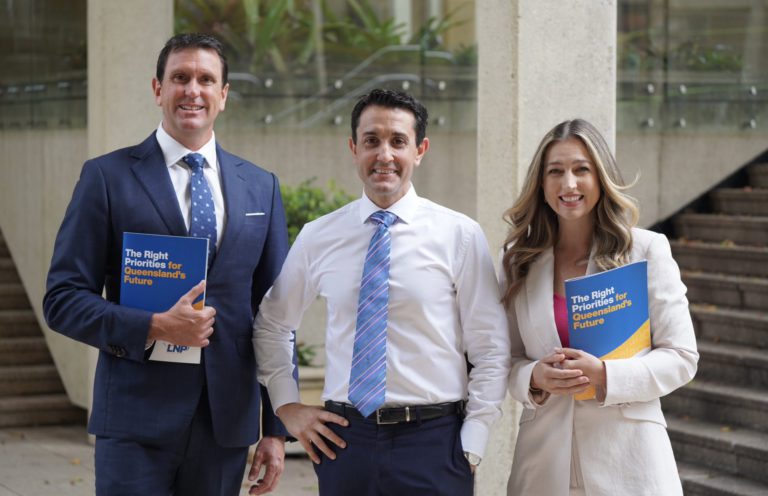
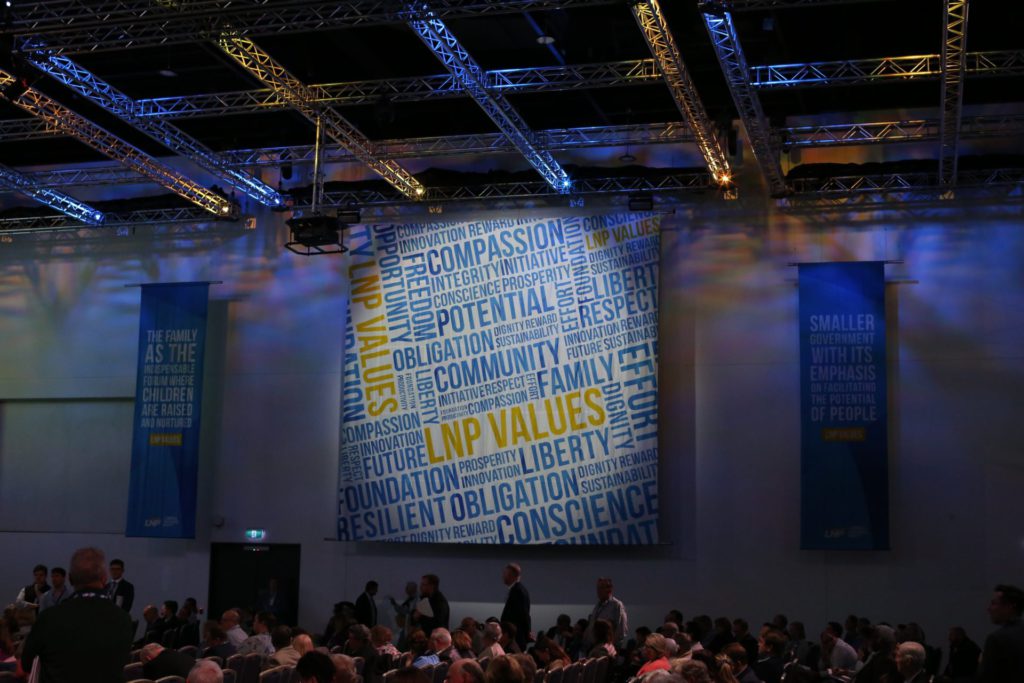
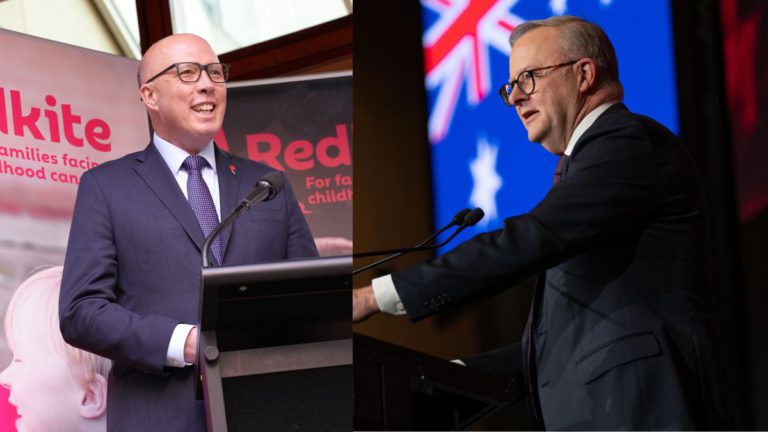
Juveniles convicted of serious crimes in Queensland will face the same harsh penalties as adult offenders under a major pre-election promise by the Liberal National Party (LNP). Opposition Leader David Crisafulli announced during the annual LNP state convention on Sunday, positioning law and order as a central theme of his campaign, just 111 days before the October 26 election.
Addressing party supporters in Brisbane, Crisafulli vowed that youths found guilty of crimes such as murder, manslaughter, grievous bodily harm, dangerous operation and unlawful use of a motor vehicle would be sentenced as adults.
There must be consequences for actions and we must unshackle the judiciary.
Adult crime, adult time.
— David Crisafulli (@DavidCrisafulli) July 8, 2024
“If you make the choice to commit adult crimes, you should know we have made the choice to ensure there are consequences for that behaviour,” Crisafulli declared.
“We will restore consequences for actions for young criminals – adult crime, adult time.”
The Labor government’s handling of youth justice has been under scrutiny following a series of violent incidents involving young people, raising public concerns about rising youth crime across the state. However, Crisafulli’s proposal is expected to face backlash from legal and children’s rights groups who may view the policy as overly punitive.
Image Source: x/Twitter @LNPQLD
Crisafulli accused the current state government of “cuddling young criminals” and outlined plans for intensive post-release supervision to aid in the rehabilitation of young offenders.
“We can’t just release a young offender into society,” he said.
“We’ll partner with the community sector to work with young people in detention, in partnership with their youth justice caseworker, to develop a relationship which can be maintained when they are released.”
The proposed policy includes funding for individual 12-month post-release plans to help young offenders reintegrate into society and prevent recidivism. This approach aims to ensure continuous support and supervision for youths after their release from detention.
According to an Australia Bureau of Statistics crime report published in February, there were nearly 11,000 offenders aged 10 to 17 in Queensland in 2022/23, a six per cent increase from the previous year. The most common offences were acts intended to cause injury (23 per cent) and theft (17 per cent).
The Making Queensland Safer Laws will be our first order of business if given the opportunity to govern in October. pic.twitter.com/FdJQqhnHb1
— David Crisafulli (@DavidCrisafulli) July 1, 2024
Queensland Premier Steven Miles dismissed Crisafulli’s proposal as “just another slick slogan.”
He emphasised the importance of early intervention and crime prevention. “The fact is that we want to intervene early and prevent crimes before they occur, and that’s why we have a comprehensive community safety program,” Miles said.
In addition to his law and order agenda, Crisafulli pledged to provide live hospital data within 100 days if the LNP wins government. This promise came after federal coalition Leader Peter Dutton criticised the Labor government’s handling of health services at the convention on Saturday, highlighting issues such as ambulance ramping, which has reached a record 45 per cent.
Dutton endorsed Crisafulli as a thoughtful and practical leader with a clear plan to “end Queenslanders’ despair” and rejuvenate the state.
“The LNP’s policies are not only practical, they offer hope for Queenslanders that better times are ahead,”
Dutton stated.
While Crisafulli avoided addressing the federal party’s nuclear energy plans, the topic remains a point of contention. Dutton supports building reactors to supply nuclear energy, a stance not shared by Crisafulli, who has repeatedly stated that nuclear energy is not part of his plan. Queensland currently bans nuclear reactors under the Nuclear Facilities Prohibition Act 2007.
As the election approaches, the LNP’s focus on tougher penalties for juvenile offenders and improvements in public services aims to resonate with voters concerned about crime and quality of life in Queensland.
Support Our Journalism
Global Indian Diaspora and Australia’s multicultural communities need fair, non-hyphenated, and questioning journalism, packed with on-ground reporting. The Australia Today – with exceptional reporters, columnists, and editors – is doing just that. Sustaining this needs support from wonderful readers like you.
Whether you live in Australia, the United Kingdom, Canada, the United States of America, or India you can take a paid subscription by clicking Patreon and support honest and fearless journalism.
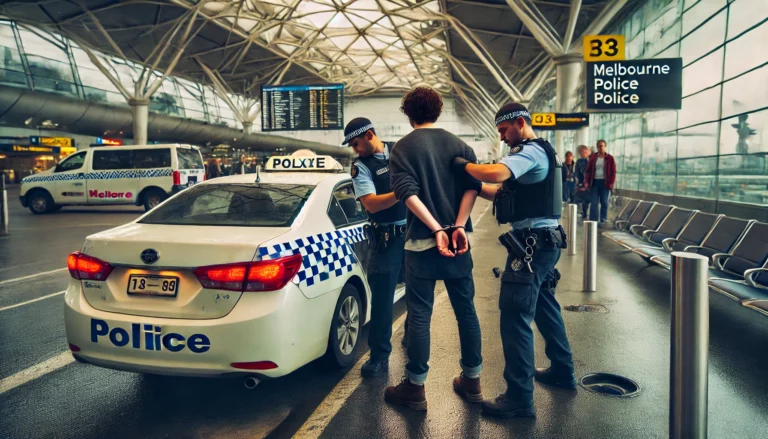
A Melbourne taxi driver has been accused of allegedly sexually assaulting a woman during a 45-minute journey from the city’s centre to Wantirna South.
Satinder Satinder, 28, appeared in the Melbourne Magistrates Court on Thursday via video link from prison.
According to the police, 7 News reports, Satinder picked up the 30-year-old woman from Collins Street at approximately 3:30 am on June 27. During the 35km trip, he allegedly sexually assaulted her multiple times and stole her engagement ring.
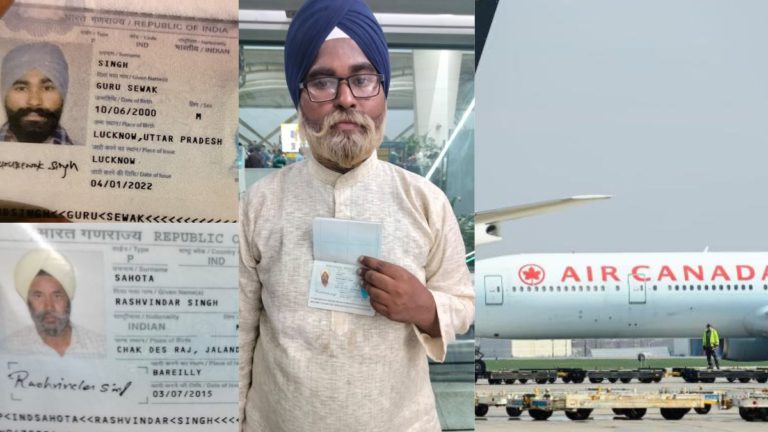
Satinder was apprehended at Melbourne International Airport around 2:30 pm on June 29, just before he was about to board a flight to India. He has been charged with 15 counts of sexual assault and one count of theft.
7 News reported that the prosecutor informed the court that the police have yet to obtain a statement from the alleged victim, who had travelled interstate. This statement is expected to be obtained on Tuesday, after which prosecutors will determine if the charges should be escalated. An adjournment was sought to allow these processes to occur.
The court was also told that the entire incident was captured on the car’s interior cameras, providing crucial evidence for the case.
Magistrate Leon Fluxman remanded Satinder in custody, with a return to court scheduled for July 18.
Support Our Journalism
Global Indian Diaspora and Australia’s multicultural communities need fair, non-hyphenated, and questioning journalism, packed with on-ground reporting. The Australia Today – with exceptional reporters, columnists, and editors – is doing just that. Sustaining this needs support from wonderful readers like you.
Whether you live in Australia, the United Kingdom, Canada, the United States of America, or India you can take a paid subscription by clicking Patreon and support honest and fearless journalism.
When residents of Guam celebrate Independence Day at one of the island’s two major U.S. military bases on Thursday, the festivities will be tinged with irony.
The small U.S. territory is one of 17 remaining colonies around the globe. While Guamanians have American citizenship, they cannot elect the U.S. president and have only a single, non-voting representative in the U.S. Congress.
As a territory, Guam has no say in foreign policy either, restraining its ability to engage with Pacific island neighbours on regional concerns ranging from climate change to growing militarization.
But that could soon change. Last month, the U.S. State Department officially endorsed Guam’s application to upgrade its standing at the Pacific Islands Forum (PIF), the region’s peak diplomatic body.
Guam along with two other U.S. Pacific territories, American Samoa and the Northern Mariana Islands (CNMI), currently hold observer status with PIF, but American Samoa and Guam have applied to join as non-voting associate members.
Washington had vetoed the territories’ ability to apply for member status since 2011. Permission now comes with the caveat that they can’t take foreign policy positions.
On Monday, PIF’s new secretary general, Baron Waqa, said the applications would be discussed in August at the forum’s 53rd leaders meeting in Tonga.
“I’m not in a position to anticipate [the result],” Waqa said at a press conference at the PIF secretariat in the Fijian capital of Suva.
“The prerogative is on the leaders to decide. This will be debated well enough to get a truthful outcome at the Tonga meeting.”
The forum, founded in 1971, comprises 18 members from across Melanesia, Micronesia and Polynesia. Two French territories, New Caledonia and French Polynesia, are PIF members while also being on the United Nations decolonisation list.
In June, at the Micronesian Islands Forum hosted by Guam, the leaders of Palau, Marshall Islands and the Federated States of Micronesia said they would support the U.S. territories’ bids to join PIF.
Pacific Power
Guam, which lies about 1,600 miles (2,600 km) east of the Philippine capital Manila, has a population of slightly more than 150,000, according to the 2020 U.S. census.
The island hosts two U.S. military bases – Andersen Air Force Base in the north and Naval Base Guam in the south – and has an economy reliant on military investments and tourism.
The U.S. military holds about 25% of Guam’s land and stations thousands of troops on the island. Another 5,000 American marines will begin relocating from Japan’s Okinawa islands to Guam in December, as part of a 2006 agreement between Washington and Tokyo.
As geopolitical competition between the U.S. and China heats up in the Pacific, Guam’s significance in supporting American naval and air operations is growing. The U.S. military sees the island as an essential logistics centre in the event of potential conflict over Taiwan or in the South China Sea.
The U.S. Department of Defense plans to spend U.S. $11 billion to upgrade military infrastructure on the island to accommodate the increasing number of servicemen, with Japan covering U.S. $ 6 billion of the projected costs.
In addition, the U.S. has earmarked at least U.S. $1.5 billion to build an integrated missile defence system on the island.
While the U.S. military presence forms the backbone of the economy, it is a point of contention for many Chamorro, the indigenous people of Guam.
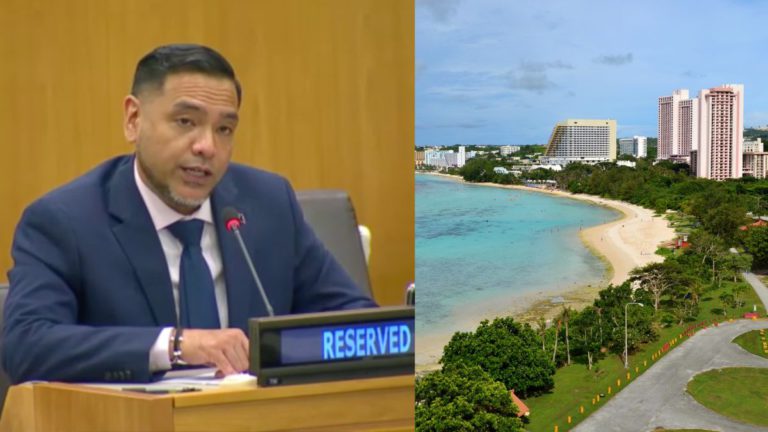
“As long as our island remains a non-self-governing territory, our relationship with our administering power on matters of expanded militarisation will always be based on consultation and not consent,” Melvin Borja, executive director of the Guam Decolonisation Commission, told the U.N. Special Committee on Decolonisation on June 10.
“This is not an equitable arrangement,” he added.
The arrangement put Guam at risk of attack from enemies of the U.S., as well as environmental and socio-cultural impacts caused by an increased military presence on the island, Borja said.
Guam is within range of Chinese and North Korean ballistic missiles.
Stalled self-determination efforts
Guam’s push for self-determination has been decades in the making.
A non-binding plebiscite that asked Guamanians to choose between independence, statehood or free association with the U.S. was originally scheduled for 1991. But it has been on the backburner ever since due to conflict over voter eligibility.
In 2019, the 9th U.S. Circuit Court of Appeals struck down a controversial local law that sought to limit the vote to “native inhabitants of Guam.” The court ruled that the “racially discriminatory” law was unconstitutional.
Despite the ruling, Guam’s Governor Lou Leon Guerrero is reluctant to open up the plebiscite to non-native voters and the ballot is yet to be scheduled.
With the status quo, the territory doesn’t have the power to challenge its position in U.S. homeland defence. In the meantime, local leaders are compromising by seeking to leverage the federal spending that keeps the local economy afloat.
“Our focus remains on finding a balance between adapting to the changing circumstances and safeguarding our people and assets, all while upholding the nation’s defence capabilities,” Leon Guerrero said during a meeting with military officials last month.
Carlotta Leon Guerrero, the governor’s chief advisor for military and regional affairs, said Guam shares the same goals as PIF.
“Guam, like every member of PIF, has fully endorsed the 17 UN Sustainability Goals and we are coordinating our compliance via the Guam Green Growth initiative,” she said in a statement to BenarNews.
Carlotta Leon Guerrero said Guam’s contribution to combatting the consequences of climate change on local, regional and global levels “can also serve as a useful template for other Pacific governments to replicate.”
“It shows our fellow Pacific leaders that the U.S. listens to Guam and works with us to advance our shared goal of taking a greater role in improving the lives and well-being of Pacific peoples,” she said.
Disclaimer: This article was originally published in Benar News and is re-published here with the editor(s)’ kind permission. The views expressed in this article are those of the original author and do not necessarily reflect the views of our publication. We are not responsible for any errors or omissions in the content. For the original version and more stories, please visit Benar News.
Support Our Journalism
Global Indian Diaspora and Australia’s multicultural communities need fair, non-hyphenated, and questioning journalism, packed with on-ground reporting. The Australia Today – with exceptional reporters, columnists, and editors – is doing just that. Sustaining this needs support from wonderful readers like you.
Whether you live in Australia, the United Kingdom, Canada, the United States of America, or India you can take a paid subscription by clicking Patreon and support honest and fearless journalism.
In an Australian first, the AFP is advancing its forensic capabilities with the rollout of a new program aimed to enhance evidence collection from aquatic crime scenes.
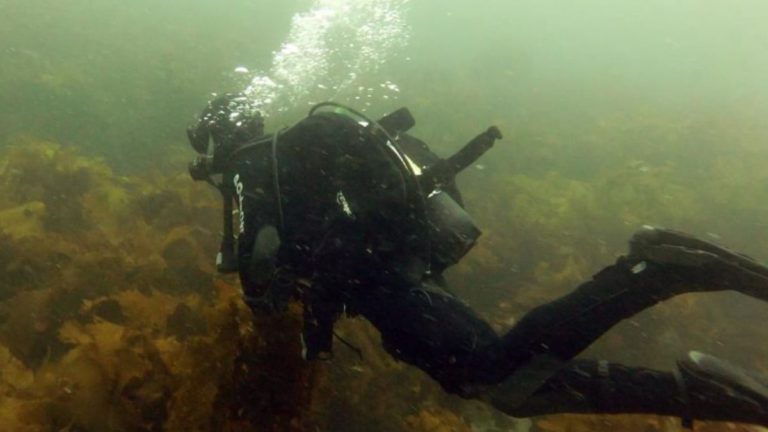
The underwater search and evidence recovery (USER) program provides training and techniques to AFP police divers for the recovery of crucial forensic evidence from submerged items including murder weapons, vehicles or bodies.
Image: AFP USER Pilot Divers (Source: AFP)
AFP Forensics officer Dr Eva Bruenisholz, who helped create the AFP program, said there was a common misconception that forensic evidence was washed away if an object or person was underwater.
“While water does have an effect on forensic traces, applying USER techniques maximises the chances of recovering forensic evidence such as DNA, fingerprints and firearm and bullet striations,” she said.
“Australia’s extensive coastline and numerous inland lakes and rivers where criminals might try to conceal or dispose of evidence make it important to explore any techniques to enhance the AFP’s ability to collect and preserve evidence from aquatic scenes.”
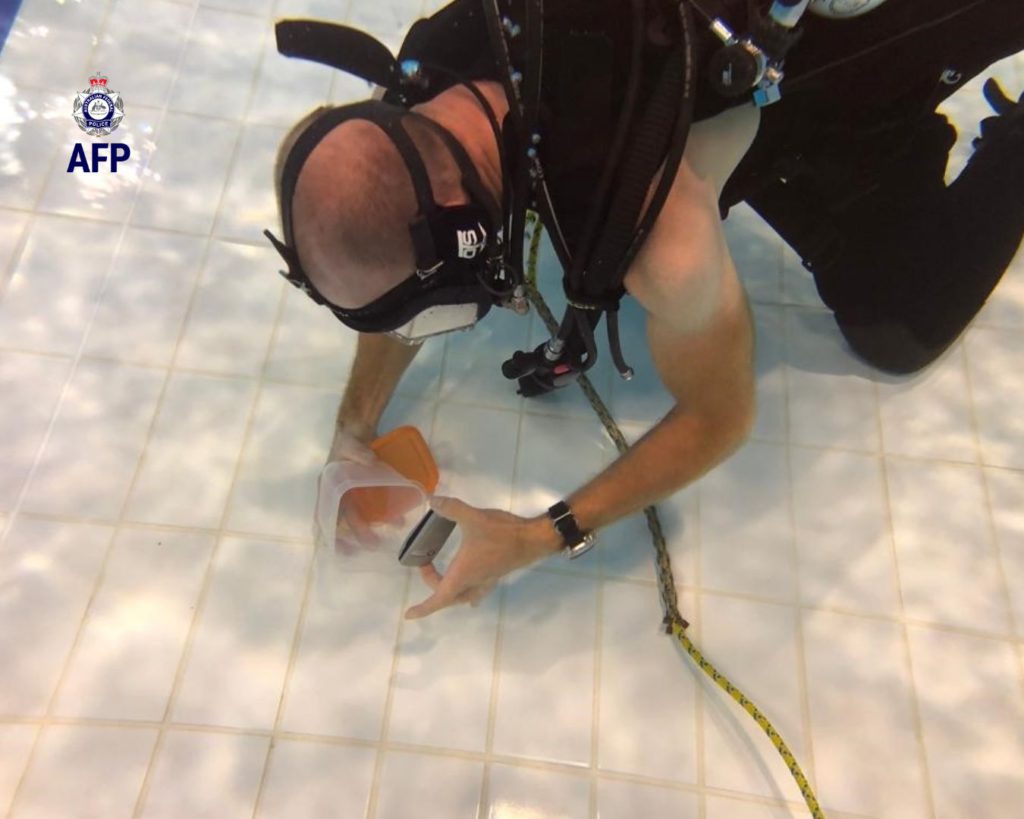
Dr Bruenisholz said the program taught divers how to minimise the handling – and therefore the potential contamination – of submerged items during collection, as well as how to package exhibits while underwater and take photographs and videos during the search process.
“AFP divers are often searching in rivers or lakes where they have very limited visibility, so they are searching for evidence by feel rather than sight,” she said.
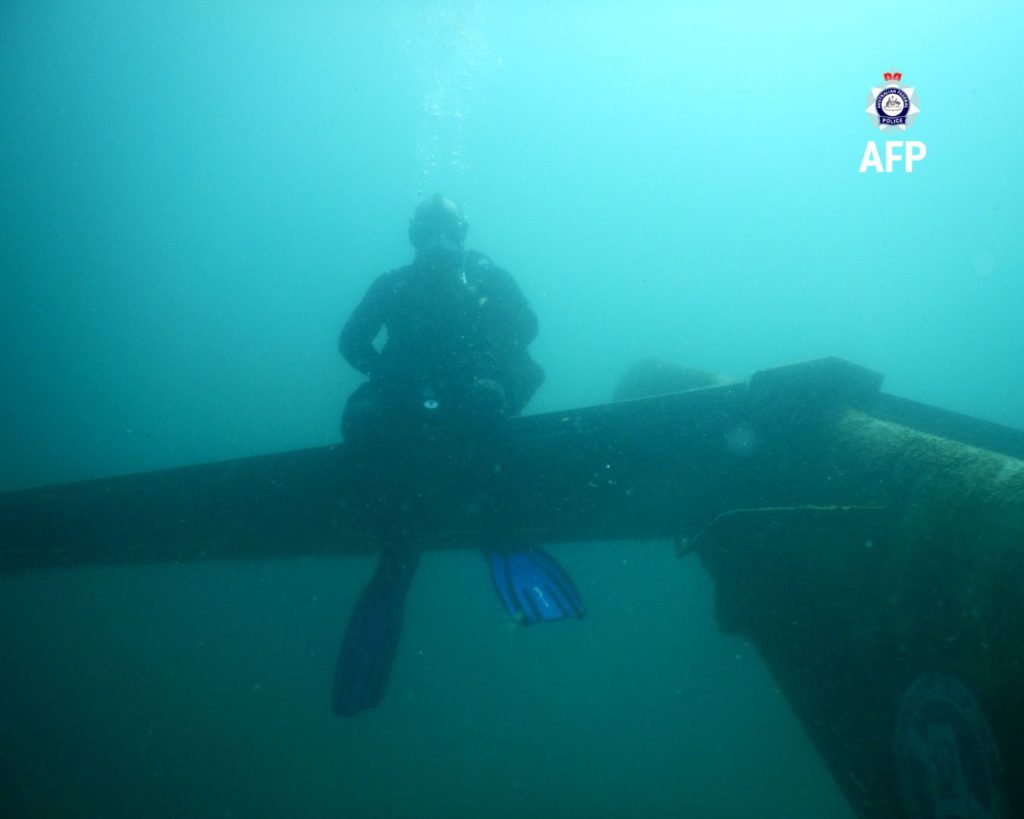
“While this means underwater photographs may not always be possible, divers can also set up buoys on the water surface to indicate where submerged items were found.
“This can then assist investigators to establish how and why a person or an item was found at a particular place – such as did they fall or were they thrown, or did water currents impact the location.”
Image: AFP USER Pilot Divers (Source: AFP)
As part of the program, AFP divers are given basic forensic training and awareness. During underwater searches they can communicate via radio with forensic crime scene specialists on dry land.
The AFP’s participation in an Underwater Criminal Investigations (UCI) dive course in the United States in October 2022 was the catalyst for developing the program.
AFP Maritime Team Detective Senior Constable Chris Markcrow said AFP maritime members spent eight days in Columbus, Georgia, training alongside a range of American dive teams, including state police, the Drug Enforcement Administration (DEA) and local state fire departments.
“During the trip, AFP police divers assisted the local Muscogee Sheriff’s Department in Columbus search the Chattahoochee River for a murder weapon from one of their active investigations,” Det Sen-Const Markcrow said.
“The AFP divers were able to learn from their US counterparts in a real-life scenario, while also navigating the dangers of the waterway – including keeping themselves safe from an alligator seen only a few hundred metres downstream.”
Image: AFP USER Pilot Divers (Source: AFP)
When they returned, the Maritime members reached into AFP Forensics to learn more about the AFP’s collection of underwater forensic evidence.
Collaboration between the two areas resulted in a combined effort to improve forensic awareness in underwater search and evidence recovery within the AFP. It was identified that no USER program had been established in Australia, so a pilot program was developed based on a project produced for French and Swiss Police divers.
Dr Bruenisholz said by equipping divers with specialist skills in underwater evidence search and recovery, the AFP believed it would increase the ability to resolve crimes that included aquatic crime scenes.
“Similar to DNA 30 years ago, we don’t know what technological advances may happen in the future to enable better exploitation of forensic evidence from items that have been in water,” she said. “This makes it important to collect and store items for potential future investigations.
“We owe it to the community to introduce new techniques to solve crimes and protect the Australian community.”
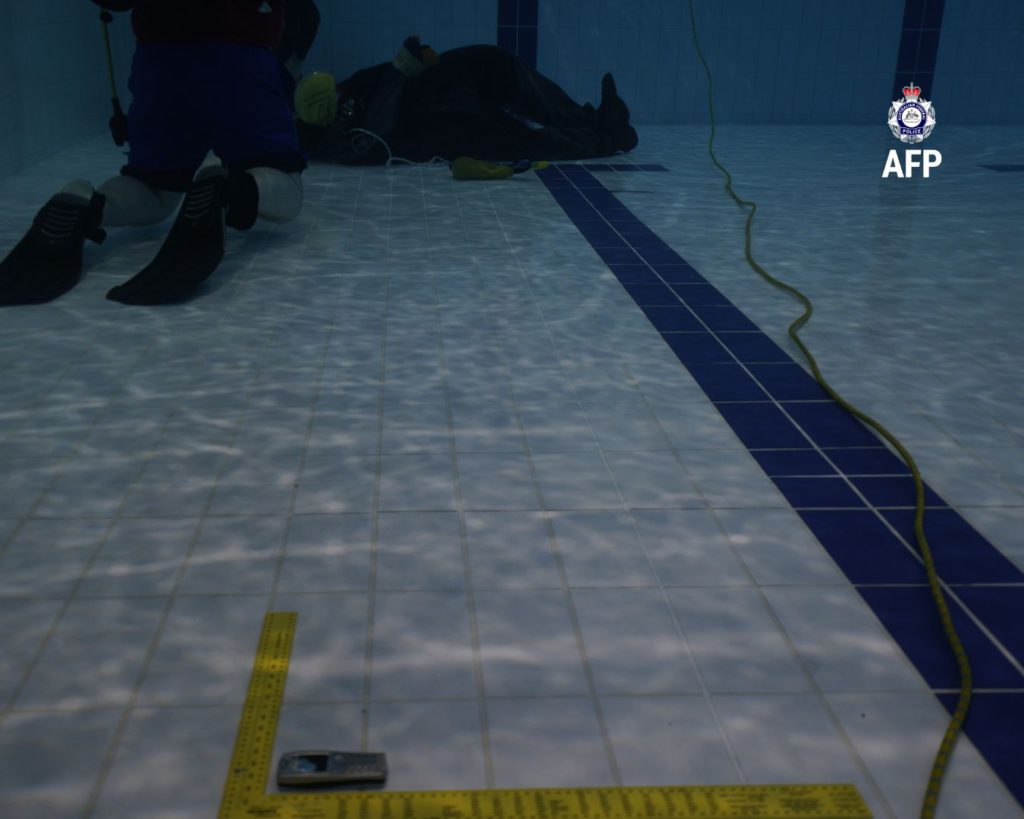
Image: AFP USER Pilot Divers (Source: AFP)
AFP Crime Scene Investigator Simon Gardner, who participated in the development of the program, said the success of processing an underwater crime scene relied heavily on collaboration.
“The communication between police divers and crime scene investigators is a key component of the underwater search and evidence recovery,” he said.
“The program places a strong emphasis on the importance of AFP crime scene investigators engaging early with police divers to ensure the work underwater considers forensic needs and takes into consideration any diving limitations.
“The program will be rolled out across AFP maritime members in Australia over the next 12 months. We will also continue to liaise with international law enforcement partners to refine and develop new USER techniques and concepts.
“Depending on interest, there could be an opportunity to expand the training to other Australian law enforcement agencies in collaboration with their Crime Scene Investigation units.”
Det Sen-Const Markcrow said an AFP diver had successfully recovered a crime victim’s belongings from Canberra’s Lake Tuggeranong since receiving the training.
He said the techniques included using search patterns, which had enabled a new AFP diver to find small items, including keys and a phone.
Support Our Journalism
Global Indian Diaspora and Australia’s multicultural communities need fair, non-hyphenated, and questioning journalism, packed with on-ground reporting. The Australia Today – with exceptional reporters, columnists, and editors – is doing just that. Sustaining this needs support from wonderful readers like you.
Whether you live in Australia, the United Kingdom, Canada, the United States of America, or India you can take a paid subscription by clicking Patreon and support honest and fearless journalism.
There are renewed calls this week for the Australian government to implement a range of measures aimed at improving our diets. These include restrictions on junk food advertising, improvements to food labelling, and a levy on sugary drinks.
This time the recommendations come from a parliamentary inquiry into diabetes in Australia. Its final report, tabled in parliament on Wednesday, was prepared by a parliamentary committee comprising members from across the political spectrum.
The release of this report could be an indication that Australia is finally going to implement the evidence-based healthy eating policies public health experts have been recommending for years.
But we know Australian governments have historically been unwilling to introduce policies the powerful food industry opposes. The question is whether the current government will put the health of Australians above the profits of companies selling unhealthy food.
Diabetes Australia has welcomed recommendations from the Parliamentary Inquiry into Diabetes that will help arrest the diabetes epidemic in Australia. Twenty-three key recommendations are included in the report following the landmark inquiry. More: https://t.co/JQsut2thh2pic.twitter.com/KBXqZSQhJl
Diabetes is one of the fastest growing chronic health conditions in the nation, with more than 1.3 million people affected. Projections show the number of Australians diagnosed with the condition is set to rise rapidly in coming decades.
Type 2 diabetes accounts for the vast majority of cases of diabetes. It’s largely preventable, with obesity among the strongest risk factors.
This latest report makes it clear we need an urgent focus on obesity prevention to reduce the burden of diabetes. Type 2 diabetes and obesity cost the Australian economy billions of dollars each year and preventive solutions are highly cost-effective.
This means the money spent on preventing obesity and diabetes would save the government huge amounts in health care costs. Prevention is also essential to avoid our health systems being overwhelmed in the future.
What does the report recommend?
The report puts forward 23 recommendations for addressing diabetes and obesity. These include:
restrictions on the marketing of unhealthy foods to children, including on TV and online
improvements to food labelling that would make it easier for people to understand products’ added sugar content
a levy on sugary drinks, where products with higher sugar content would be taxed at a higher rate (commonly called a sugar tax).
There was universal support from the committee for the government to consider regulating marketing of unhealthy food to children.
Public health groups have consistently called for comprehensive mandatory legislation to protect children from exposure to marketing of unhealthy foods and related brands.
An increasing number of countries, including Chile and the United Kingdom, have legislated unhealthy food marketing restrictions across a range of settings including on TV, online and in supermarkets. There’s evidence comprehensive policies like these are having positive results.
In Australia, the food industry has made voluntary commitments to reduce some unhealthy food ads directly targeting children. But these promises are widely viewed as ineffective.
The government is currently conducting a feasibility study on additional options to limit unhealthy food marketing to children.
But the effectiveness of any new policies will depend on how comprehensive they are. Food companies are likely to rapidly shift their marketing techniques to maximise their impact. If any new government restrictions do not include all marketing channels (such as TV, online and on packaging) and techniques (including both product and brand marketing), they’re likely to fail to adequately protect children.
Food labelling
Food regulatory authorities are currently considering a range of improvements to food labelling in Australia.
For example, food ministers in Australia and New Zealand are soon set to consider mandating the health star rating front-of-pack labelling scheme.
Public health groups have consistently recommended mandatory implementation of health star ratings as a priority for improving Australian diets. Such changes are likely to result in meaningful improvements to the healthiness of what we eat.
Regulators are also reviewing potential changes to how added sugar is labelled on product packages. The recommendation from the committee to include added sugar labelling on the front of product packaging is likely to support this ongoing work.
But changes to food labelling laws are notoriously slow in Australia. And food companies are known to oppose and delay any policy changes that might hurt their profits.
A sugary drinks tax
Of the report’s 23 recommendations, the sugary drinks levy was the only one that wasn’t universally supported by the committee. The four Liberal and National party members of the committee opposed implementation of this policy.
As part of their rationale, the dissenting members cited submissions from food industry groups that argued against the measure. This follows a long history of the Liberal party siding with the sugary drinks industry to oppose a levy on their products.
The dissenting members didn’t acknowledge the strong evidence that a sugary drinks levy has worked as intended in a wide range of countries.
In the UK, for example, a levy on sugary drinks implemented in 2018 has successfully lowered the sugar content in UK soft drinks and reduced sugar consumption.
The dissenting committee members argued a sugary drinks levy would hurt families on lower incomes. But previous Australian modelling has shown the two most disadvantaged quintiles would reap the greatest health benefits from such a levy, and accrue the highest savings in health-care costs.
Globally, a range of countries facing rising epidemics of obesity and diabetes are starting to take such strong preventive action.
In Australia, after years of inaction, this week’s report is the latest sign that long-awaited policy change may be near.
But meaningful and effective policy change will require politicians to listen to the public health evidence rather than the protestations of food companies concerned about their bottom line.
Global Indian Diaspora and Australia’s multicultural communities need fair, non-hyphenated, and questioning journalism, packed with on-ground reporting. The Australia Today – with exceptional reporters, columnists, and editors – is doing just that. Sustaining this needs support from wonderful readers like you.
Whether you live in Australia, the United Kingdom, Canada, the United States of America, or India you can take a paid subscription by clicking Patreon and support honest and fearless journalism.
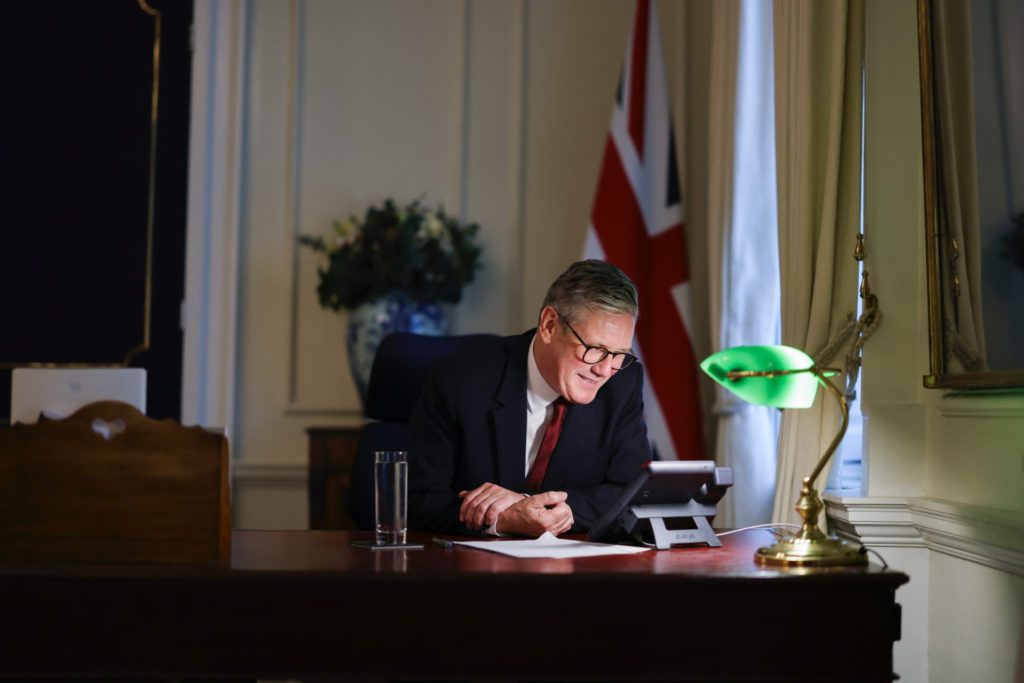
Welcome to the grand theatre of international relations, where Keir Starmer, the UK’s new Prime Minister, takes centre stage. This isn’t just another political shuffle; it’s a high-stakes performance that could redefine the UK-India relationship. Let’s delve into Starmer’s diplomatic dance.
Picture this: A leaflet flutters in the wind, causing a storm that ripples across continents. It’s 2021, and Labour’s ill-fated campaign strategy has just set the British-Indian community ablaze. Fast forward to today, and we find Keir Starmer, Labour’s new maestro, stepping onto the world stage. Can he choreograph a new dance between the UK and India, or will he stumble over the ghosts of Labour’s past?
Act I: The Misstep
This story opens with a political faux pas. Labour’s controversial leaflet, featuring Modi and Johnson in an awkward handshake, didn’t just ruffle feathers – it caused a full-blown peacock revolt. The message was clear: Labour had two left feet when it came to Indian diplomacy.
In 2021 the backlash was swift, with many in the British-Indian community feeling alienated and offended. This incident underscored the delicate nature of UK-India relations and the potential pitfalls of political messaging. Keir Starmer, though Labour’s knight in shining pragmatism, promises to “take the heat out of politics” and forge a “new strategic partnership with India.”
His vision includes collaboration on global security, climate change, and economic growth. Starmer’s approach represents a significant shift from the previous Labour leadership, emphasising diplomacy and practical engagement over ideological posturing. He aims to rebuild trust with the Indian community in the UK and strengthen bilateral ties with India. This incident shows how political strategies can inflame sentiments among the Indian diaspora.
Starmer, as the new UK Prime Minister, must address Labour’s historical tensions with India while fostering a constructive bilateral relationship. His leadership offers an opportunity to reset these relations, moving away from past missteps and building a more positive and collaborative future.
Starmer must navigate historical tensions – Kashmir, minorities, Khalistan – through constructive engagement. His cool approach should be like a master illusionist keeping all balls in the air while maintaining a calm demeanour. These issues are deeply rooted in historical and political contexts, and any misstep could have significant repercussions.
Keir Starmer will also have to keep in mind that the India of 2024 is not the India of 1990. The then leadership of England could have easily suppressed India’s concerns. Narendra Modi has come and adopted a strong and assertive foreign policy over the last decade. Particularly in the past five years, Indian Foreign Minister S. Jaishankar’s cryptic replies and statements have created a sensation at the international level, earning respect among Indians. Whether responding to Canada in its own language or mirroring the US’s policy towards India, India’s stance has been assertive and clear.
On issues like Palestine and Israel, and maintaining an impartial role in the tensions between Ukraine and Russia, India has stood its ground despite criticism from the European Union. Therefore, the British Prime Minister must remember that a lot of water has flowed under the bridge; this is no longer an India that can be easily controlled or manipulated. Any attempt to do so could backfire.
Labour’s past interactions with India have been fraught with tension, especially concerning Kashmir and the treatment of minorities. Labour’s support for pro-Khalistan elements adds another layer of complexity. The election of pro-Khalistan Sikh leader Amritpal Singh and Kashmiri leader Sheikh Abdul Rashid to the Lok Sabha reflects the nuanced political landscape Starmer must navigate. These figures represent significant and contentious issues within Indian politics, and their prominence could complicate efforts to strengthen UK-India ties.
Post-Brexit Britain needs new partners, and India’s economic rhythm is irresistible. Starmer aims for an economic ballet, combining British ingenuity with Indian innovation in emerging tech sectors. The UK’s departure from the European Union has necessitated a reevaluation of its global trade relationships, and India, with its burgeoning economy and technological advancements, presents a valuable opportunity.
Starmer envisions a future where British and Indian businesses collaborate on cutting-edge projects, from green energy solutions to digital innovations. This economic partnership could not only boost both economies but also create jobs and foster technological advancements.
Starmer’s pragmatic and centrist stance represents a departure from Labour’s radical elements. He aims to “take the heat out of politics,” signalling a commitment to diplomacy and balanced international relations. His vision for a “new strategic partnership with India” emphasises collaboration on global security, climate change, and economic growth. This approach seeks to align UK-India relations with broader international objectives, fostering a sense of shared purpose and mutual benefit.
Starmer recognises the importance of strengthening trade ties with India, particularly post-Brexit. He supports an India-UK Free Trade Agreement and highlights potential collaboration in emerging technologies. His focus on inclusive diplomacy acknowledges the significant role of the British-Indian community and aims to address their concerns through constructive engagement. This includes adopting a balanced stance on contentious issues like Kashmir, emphasising bilateral dialogue and human rights while steering clear of polarising rhetoric.
The potential economic benefits of a closer UK-India partnership are substantial. Trade between the two countries has been growing steadily, but there is still significant untapped potential. By removing trade barriers and fostering a more collaborative business environment, both nations stand to gain economically. Starmer’s vision includes leveraging India’s expertise in sectors like information technology, pharmaceuticals, and renewable energy to complement the UK’s strengths in finance, education, and scientific research.
Starmer’s leadership offers a chance to redefine UK-India relations. By focusing on pragmatic economic collaboration and strategic alignment, he aims for deeper bilateral cooperation. This contrasts with the inward-looking policies of the recent Conservative regime, positioning the UK as a proactive and reliable partner for India. The emphasis on mutual interests and shared goals could help to overcome historical tensions and build a more resilient and forward-looking partnership.
Overcoming Labour’s “anti-India” perception requires sustained diplomatic efforts and tangible policy shifts. Building trust with the Indian government and diaspora is crucial. Navigating UK domestic politics, especially with the British-Indian community’s influence, necessitates careful policymaking. Starmer must demonstrate a genuine commitment to addressing their concerns and fostering a positive relationship with India.
Starmer’s ascent heralds a potential reset in UK-India relations. His pragmatic approach, focused on economic collaboration and strategic alignment, presents a promising pathway for renewed bilateral ties. Overcoming historical tensions and building trust will require sustained engagement and inclusive policymaking. As Labour navigates these challenges under Starmer, the future of UK-India relations holds promise for deeper cooperation and mutual benefit.
As UK-India relations unfold, the audience watches closely. Will Starmer earn a standing ovation or face criticism? His pragmatic approach could redefine ties, but even the most graceful dancers occasionally step on toes. One thing is certain – this geopolitical spectacle will be one to watch. Starmer’s success will depend on his ability to navigate these complex dynamics while maintaining a focus on shared interests and mutual respect.
Author: Anurag Punetha is a New Delhi-based Senior journalist with over 25 years of experience covering Indian foreign policy, sports, and politics. He currently serves as the Head of Media at the Indira Gandhi National Centre for the Arts (IGNCA), India’s premier art institution.
Support Our Journalism
Global Indian Diaspora and Australia’s multicultural communities need fair, non-hyphenated, and questioning journalism, packed with on-ground reporting. The Australia Today – with exceptional reporters, columnists, and editors – is doing just that. Sustaining this needs support from wonderful readers like you.
Whether you live in Australia, the United Kingdom, Canada, the United States of America, or India you can take a paid subscription by clicking Patreon and support honest and fearless journalism.
The 2024 general election has resulted in a historic moment for the UK Parliament, with a record 29 Indian-origin members taking their seats in the House of Commons.
The Labour Party, which secured a landslide victory, boasts the most People of Indian Origin (PIO) MPs, with 19 representatives, including 12 first-time MPs. This influx signifies a transformative shift in the political landscape and highlights the increasing diversity within British politics.
Labour Party’s Indian-Origin MPs
Preet Kaur Gill: Retaining Birmingham Edgbaston, Preet Kaur Gill was born in Birmingham to Indian parents. Her father was the president of Guru Nanak Gurdwara, Smethwick, the UK’s first gurdwara. Gill has served as the Shadow Minister for International Development.
Tanmanjeet Singh Dhesi: Dhesi retains his seat in Slough. Born in Berkshire, Dhesi received much of his early education in Punjab before returning to the UK. He has degrees from University College London, Oxford, and Cambridge, and has been the MP for Slough since 2017.
Seema Malhotra: Holding onto Feltham and Heston, Malhotra co-founded the Fabian Women’s Network. She has been the MP for Feltham and Heston since 2011 and has served as a Shadow Minister for various departments.
Valerie Vaz: The sister of Keith Vaz, Valerie Vaz retained Walsall and Bloxwich. She set up Townsend Vaz as a qualified solicitor and became a Deputy District Judge. Vaz has been an MP since 2010 and has served as the House of Commons shadow leader.
Lisa Nandy: Winning in Wigan, Nandy has been an MP since 2010. She has served as Shadow Cabinet Minister for International Development and has degrees from Newcastle University and Birkbeck, University of London.
Navendu Mishra: Retaining Stockport, Mishra has been an MP since 2019. Before entering politics, he was a trade unionist and an organiser for Unison.
Nadia Whittome: Holding Nottingham East, Whittome was first elected in 2019 at the age of 23, becoming the UK’s youngest MP. She studied law at the University of Nottingham and worked as a care worker.
New Labour Entrants
Baggy Shanker: Winning Derby South, Shanker is a Sikh who works for Rolls-Royce. He has a history in local politics as a Labour councillor and was the leader of Derby City Council until June 2023.
Gurinder Singh Josan: Josan won the safe seat of Smethwick. Aged 51, he was appointed a CBE in 2019 for political service. He was previously a trustee of Guru Nanak Gurdwara, Smethwick.
Harpreet Uppal: Becoming Huddersfield’s first female MP, Uppal was born and raised in Fartown. Her father was a textile worker who emigrated from India in 1962.
Jas Athwal: Winning Ilford South, Athwal was born in Punjab and moved to the UK at the age of seven. He has been active in local politics for decades.
Dr Jeevun Sandher: Taking Loughborough from the Conservatives, Sandher is a British Sikh economist who leads the economics team at the New Economics Foundation.
Kanishka Narayan: Narayan won Vale of Glamorgan, becoming the first ethnic minority MP for a Welsh constituency. He has degrees from Oxford and Stanford and has advised ministers in the Cabinet Office.
Kirith Entwistle: Winning Bolton North East, Entwistle is of British Punjabi descent. Her family emigrated from Kenya and Delhi.
Satvir Kaur: Holding the Southampton Test, Kaur is a former Labour leader of Southampton City Council.
Warinder Juss: Winning Wolverhampton West, Juss has been active in the Labour Party for over 25 years and worked at a trade union law firm.
Sojan Joseph: Becoming the first Keralite MP in the British Parliament, Joseph won Ashford. He moved to the UK 22 years ago to work as an NHS nurse.
Sonia Kumar: Winning Dudley, Kumar is Dudley’s first-ever female MP.
Sureena Brackenbridge: Securing Wolverhampton North East, Brackenbridge served as Mayoress of Wolverhampton in 2021-22.
Conservative Party’s Indian-Origin MPs
Rishi Sunak: The outgoing Prime Minister retained his seat in Richmond and Northallerton. Despite his party’s overall losses, Sunak remains a prominent figure.
Suella Braverman: Winning Fareham and Waterlooville, Braverman has represented Fareham since 2015. She has a Goan-origin father and a Tamil-origin mother.
Priti Patel: Retaining Witham in Essex, Patel has been an MP since 2010. She is known for her strong stance on Brexit and has served in various ministerial roles.
Claire Coutinho: Holding East Surrey, Coutinho has been an MP since 2019. She has a background in social justice and government advisory roles.
Gagan Mohindra: Retaining South West Hertfordshire, Mohindra has been active in politics since 2002 and was first elected as an MP in 2019.
Shivani Raja: Winning Leicester East, Raja contested against fellow Indian-origin Labour candidate Rajesh Agrawal. The campaign focused on local issues such as the city’s Diwali lights.
Liberal Democrats and Independents
Munira Wilson: Retaining Twickenham, Wilson has been a significant figure for the Liberal Democrats, contributing to their gains in the election.
Iqbal Mohamed: Gaining Dewsbury and Batley as an Independent, Mohamed’s parents arrived in the UK from India in the 1960s.
Shockat Adam: Winning Leicester South, Adam is of Indian-Gujarati Muslim origin. His family moved to the UK from Malawi when he was three.
Historic Labour Victory
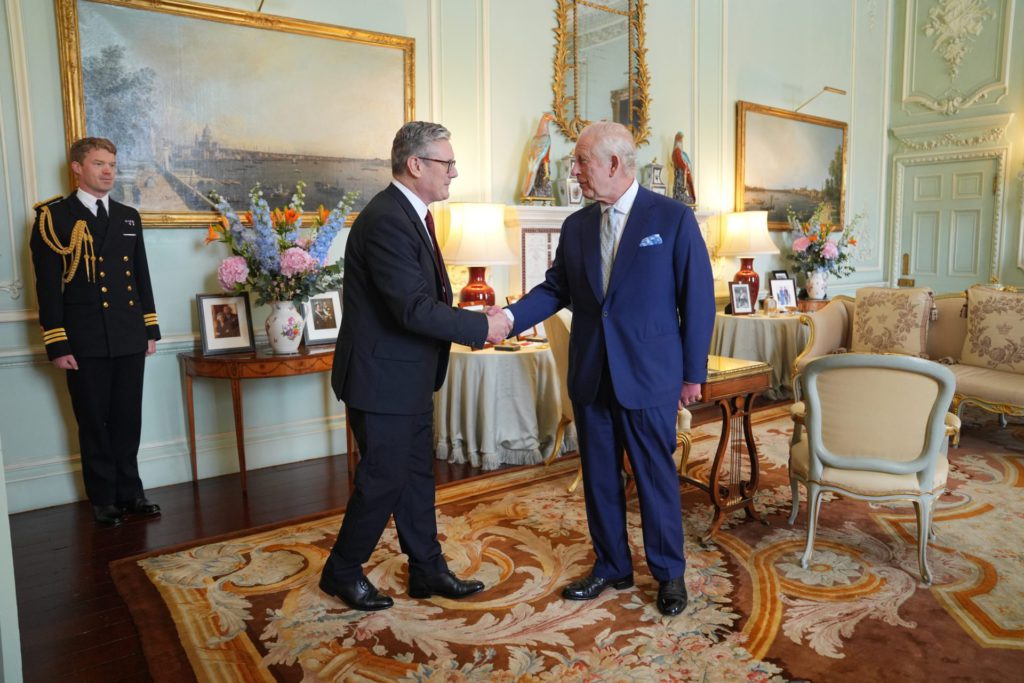
Keir Starmer’s appointment as the new Prime Minister marks the end of 14 years of Conservative rule. The general election not only brought a historic number of Indian-origin MPs into the House of Commons but also signalled a transformative shift in the UK’s political landscape. The new Parliament, with its diverse representation, reflects the evolving demographics and priorities of the nation.
Support Our Journalism
Global Indian Diaspora and Australia’s multicultural communities need fair, non-hyphenated, and questioning journalism, packed with on-ground reporting. The Australia Today – with exceptional reporters, columnists, and editors – is doing just that. Sustaining this needs support from wonderful readers like you.
Whether you live in Australia, the United Kingdom, Canada, the United States of America, or India you can take a paid subscription by clicking Patreon and support honest and fearless journalism.
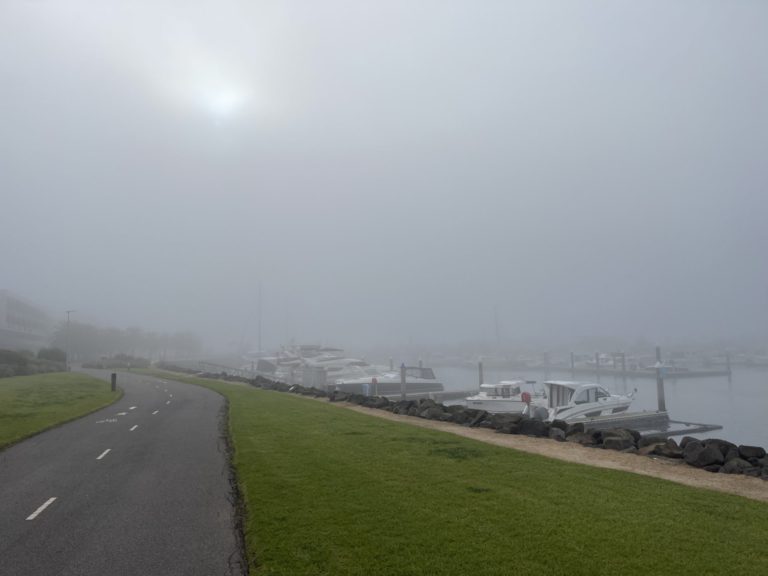
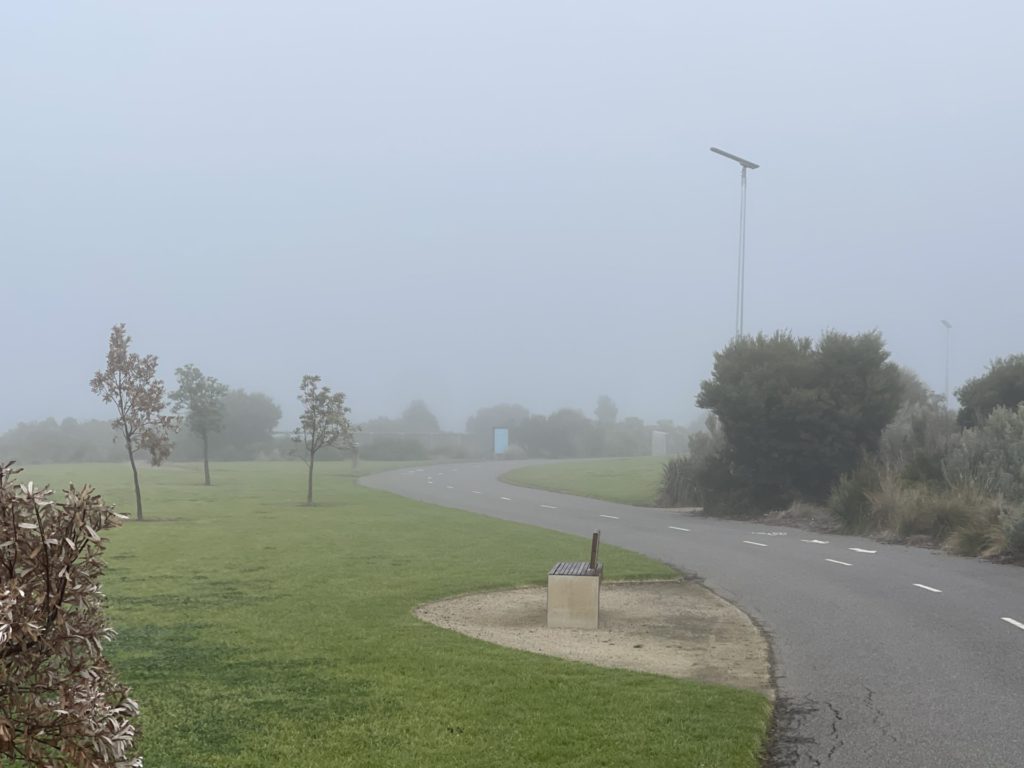
People living in southern Australia won’t have failed to notice how cold it is. Frosty nights and chilly days have been the weather for many of us since the start of July.
As winter continues, we are left wondering how unusual the cold is and whether we can expect several more months of this. Warmer conditions are in the forecast but winter has a long way to go. Further cold snaps could occur.
Image Source: The Australia Today
Cold conditions have been in place across southern Australia for the past few days. Temperatures have fallen below zero overnight in many places.
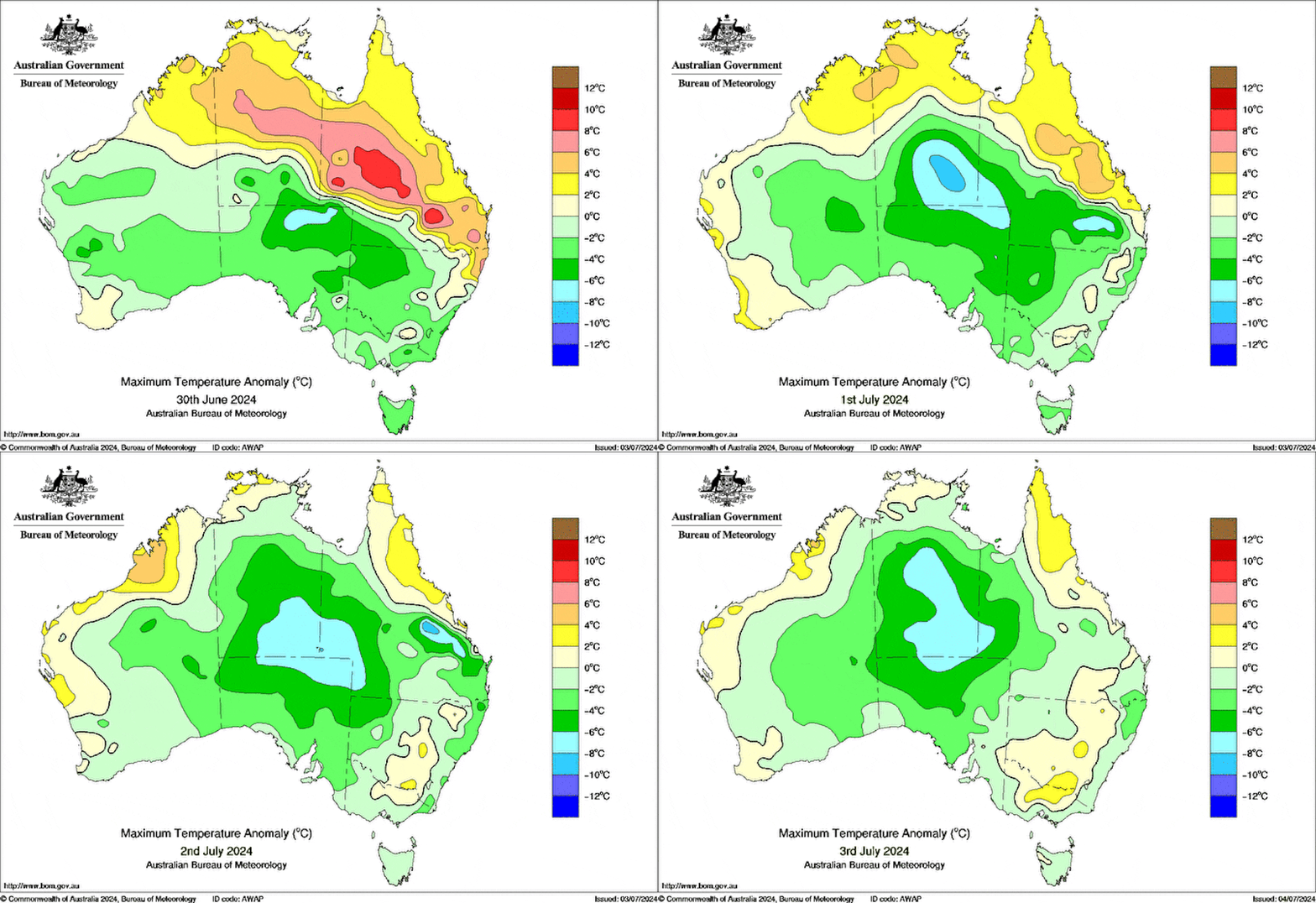
It’s not just the nights that have been cold. Maximum temperatures have also been below or well below average across most of the country.
Maximum temperatures have been below average across most of the continent since the last day of June. Bureau of Meteorology, CC BY
What’s causing the cold?
A persistent and strong high-pressure system has been hanging around over southeast Australia. The atmospheric pressure was so high it approached the Australian record of 1,044.3 hPa set on June 7 1967. An initial observation of a new record has since been disregarded, but nonetheless, this is an exceptional, near-record high-pressure pattern.
This high-pressure system has kept the weather dry but clear nights have allowed strong cooling of the land surface. The long nights and short days of early July mean that temperatures struggle to rise during the day and can fall quickly in the evenings.
Image Source: The Australia Today
In winter we expect cold weather across most of Australia and occasional cold snaps that bring widespread frosty and icy conditions. However, this current cold weather is pretty unusual and we are seeing some records fall.
Notably, Tasmania has had its lowest July temperature on record and the second-lowest minimum temperature for any time of year with –13.5°C at Liawenee in central Tasmania early on Thursday morning.
While Tasmania has produced the most remarkable records, the cold conditions have been unusual elsewhere too. Adelaide recorded its lowest temperature in 18 years on Wednesday morning. And many suburbs of Melbourne experienced a sub-zero night and consecutive nights of ground frost.
Frost made a return to many suburbs of Melbourne this week. PxHere
Winters are warming but cold spells still occur
As the world is warming, it might seem surprising we can still break cold records. Indeed, across Australia winters have been warming. The frequency and intensity of very low temperatures have been decreasing over the past few decades.
We also see many more hot records than cold records being set in Australia and around the globe. This is due to human-caused climate change. However, when we have the right weather conditions, cold records are still occasionally broken locally.
As we continue to warm the planet, it’s getting harder for us to find cold records, particularly over larger regions or longer time periods. While we still see record cold temperatures at individual weather stations, we won’t see another cold record in the global average temperature and probably not even in the Australian average temperature.
Image Source: The Australia Today
As this week shows, we still occasionally get daily cold records in the current climate. But it’s much harder to get record cold months, and record cold years at a given location are almost impossible.
As we average weather conditions across locations or over time, the climate change signal becomes clearer over background weather variability. It makes new cold records much less likely to occur.
The climate change signal is becoming clearer as Australia’s annual average temperature continues to increase with each decade, widening the difference from the long-term mean. Bureau of Meteorology, CC BY
How much longer will this cold snap last?
Southern Australia is experiencing a cold snap at close to the coldest time of year. It’s not long after the winter solstice, when we experience the longest night of the year. We still have a few more cold days and nights ahead in parts of southeastern Australia.
By early next week, the forecast suggests warmer conditions will return as the high-pressure system moves east and winds turn northerly.
The outlook for the rest of winter points firmly to above-average daytime and night-time temperatures. This is partly because a historical average (1981–2018) is used and warming since then means above-average temperatures are going to happen most of the time.
In any winter, Australia has cold outbreaks. So, even if the next few months are likely to be warmer than normal, we should expect a few cold days and nights at some point. Learning to live with the cold and improving the quality of insulation in Australian homes would help make our winter cold snaps seem a lot less harsh.
Global Indian Diaspora and Australia’s multicultural communities need fair, non-hyphenated, and questioning journalism, packed with on-ground reporting. The Australia Today – with exceptional reporters, columnists, and editors – is doing just that. Sustaining this needs support from wonderful readers like you.
Whether you live in Australia, the United Kingdom, Canada, the United States of America, or India you can take a paid subscription by clicking Patreon and support honest and fearless journalism.
This is a historic moment in British politics. It’s a huge win for Labour. It’s a historic loss for the Conservatives. It also seems to have been the product of one of the lowest turnouts in history.
Disaffection is rife. There is a strong sense that this was a vote against the Conservatives more than a vote for Labour.
But for the Labour Party, a win is win, as they say. Exit polls suggest Labour will end up with 410 of the 650 seats in the new parliament, with the Tories predicted to claim just 131.
The UK’s new prime minister will be Sir Keir Starmer. Knighted for his pre-parliamentary career as a senior public servant, Starmer has worked hard to change the Labour Party’s image since the 2019 loss under the left-wing Jeremy Corbyn. Starmer and his colleagues have positioned the party in the centre ground of British politics – and reaped the rewards as the Conservatives tacked rightwards.
Yet this victory may be a castle made of sand, albeit one protected by the size of its majority. The electorate is still volatile, as it was in 2015, 2016, 2017 and 2019. It raises the question of whether this win is a seachange in British politics in Labour’s favour – and in contrast to the direction of politics in Europe – or another instance of electoral volatility.
Dull defeats disastrous
In the short term, this campaign made little difference.
Labour’s election campaign was the equivalent of watching a 0-0 draw that qualified your soccer team for the finals: cautious, safe, got the job done, but failed to excite.
The Conservatives’ election campaign had all the drama of a funeral on Eastenders: you knew it would go off the rails at some stage, but weren’t quite sure when or how often that would be. (And it did.)
The parties that had the best campaigns were the radical-right Reform UK led by Nigel Farage and the centrist Liberal Democrats. This hurt the Conservatives in two ways: the right-wing vote split, and moderate conservative voters moved to the centre. Labour lost some support but that barely touched this sides of its consistent 20-point poll lead.
In the medium term, the Conservatives effectively lost the election back in 2022. This was due to Boris Johnson’s lack of integrity and Liz Truss’s experiment in think-tank-inspired, retro-Thatcherite economics. The Conservatives lost the already wavering trust of the electorate at that point.
In the long term, demographic change has done its bit, as seats that analysts used to assume were “Labour” or “Conservative” now aren’t. The scale of the majority suggests graduates, home owners and the poor have joined what may prove to be a broad and unstable electoral coalition that Starmer will need to manage.
Labour’s moment
Nonetheless, this is still a historic win for Labour.
Electorates tend to use Labour governments as correctives to Tory misrule. This victory seems to fit that pattern and we are in for one of the few periods of Labour government since 1945.
Although votes are still being counted, this win will compare to the landslide under Tony Blair in 1997. Labour’s small-target electoral strategy made sense, but the public’s engagement with the party’s policies and its leader has consequently been limited.
Labour’s manifesto promised “mission-driven government”. The new government’s immediate focus will be on economic growth, green energy provision, more policing, more childcare, better education and – as always in England and across the UK – improving the beloved National Health Service (NHS), which is in a perpetual state of crisis.
Also look out for votes for 16-year-olds, and – given the size of the majority – House of Lords reform. The latter could be turned into an elected chamber representing the nations, regions and cities of the UK. Whether this will effectively address forces of disintegration in the UK remains to be seen.
Ideologically, this looks like a win for “left conservatism”. Even if the UK appears to be bucking the European trend of heading to the right, the centre of political gravity has shifted rightwards.
The strange death of conservative England?
Amid the popping of champagne bottles at Labour HQ, spare a thought for the losers. Or maybe don’t. Its hard to feel that the party that brought the UK austerity, Brexit, a hapless response to the pandemic, and Liz Truss’s grasp of economics deserves much sympathy. There is a deep sense that Britain is broken.
But schadenfreude aside, there is legitimate cause for concern about where the Conservatives might go after this. One of the winners of the election was Reform UK. Led by Farage, Reform UK is the sort of xenophobic, pro-Putin radical right party that is established on continental Europe.
With all the losses in seats once considered solidly Conservative, moderate voices will be swamped by those who look to Giorgia Meloni, Viktor Orbán, Marine Le Pen and, of course, Donald Trump for ways to revitalise right-wing parties and win elections on divisive platforms.
Reform has about 17% of the overall vote, according to the most recent pre-election polls, and an estimated 13 seats in Parliament. His party’s relatively good showing will give Farage a lot of leverage over the Conservatives as they seek to comprehend the scale of their defeat.
Since Brexit the right has courted socially conservative voters, usually men, and shaped politics as a series of culture war, “anti-woke” issues (think “your uncle at Christmas after a few sherries”, but worse). This can and should change immediately to help restore badly damaged trust in politics that the low turnout reflects.
So to prevent a France-like collapse of the political centre, the Conservatives need to be a truly centrist party in tune with the social changes of the past two generations. This will help preserve public civility and prevent democratic backsliding.
Assuming there is no great change in Starmer’s shadow cabinet, David Lammy will become foreign minister. Lammy is keen to make the case of what he calls “progressive realism”. This means ongoing support for Ukraine, but also closer relations with the European Union short of joining the customs union, notwithstanding the very real prospect of a far-right party dominating French politics during Labour’s years in power.
It also means AUKUS is locked in from the UK’s perspective: it’s good for jobs in the north of England. The main threat to AUKUS and support for Ukraine comes from a Trump presidency in Washington.
But, for now, Labour can enjoy the rare feeling of an election win.
Global Indian Diaspora and Australia’s multicultural communities need fair, non-hyphenated, and questioning journalism, packed with on-ground reporting. The Australia Today – with exceptional reporters, columnists, and editors – is doing just that. Sustaining this needs support from wonderful readers like you.
Whether you live in Australia, the United Kingdom, Canada, the United States of America, or India you can take a paid subscription by clicking Patreon and support honest and fearless journalism.
India’s stock exchange the BSE Sensex reached a historic high closing at 80,049.67 on Thursday. The Nifty 50 also closed at an all time high of 24,302.15
The Sensex has seen a rise of over 10% since January this year.
India’s GDP growth for FY24 also beat expectations with the Indian economy growing at a staggering 8.2%.
Market-Mantra-Stocks; Picture Source: @CANVA
India is also expected to remain the world’s fastest growing major economy for FY25.
India is currently the fifth largest economy in the world in nominal terms (third biggest on purchasing power parity) behind US, China, Germany and Japan. However, it is expected to surpass Japan by 2025.
Stock exchanges in Japan and Taiwan also hit an all time high with mostly a rally in Asia-Pacific markets.
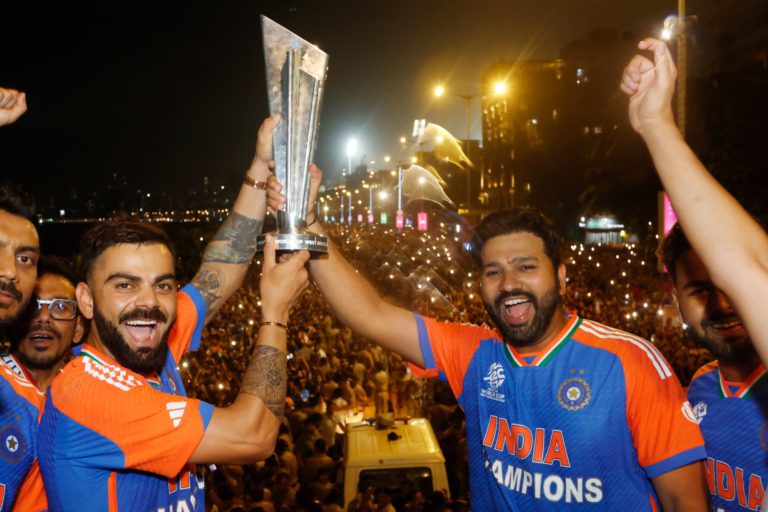
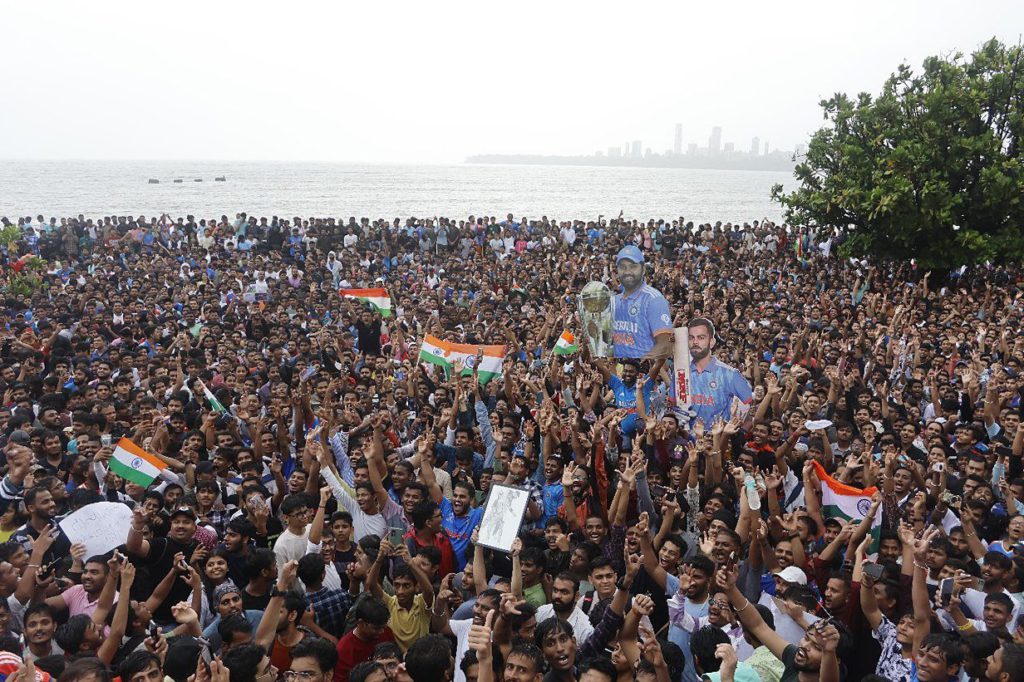
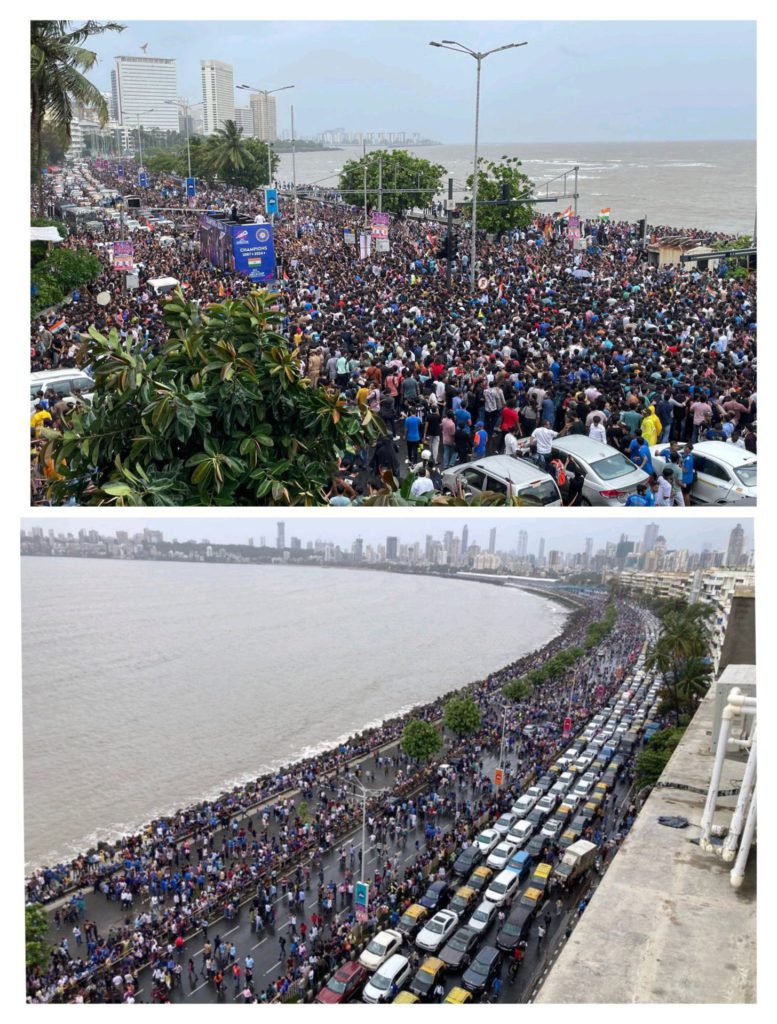
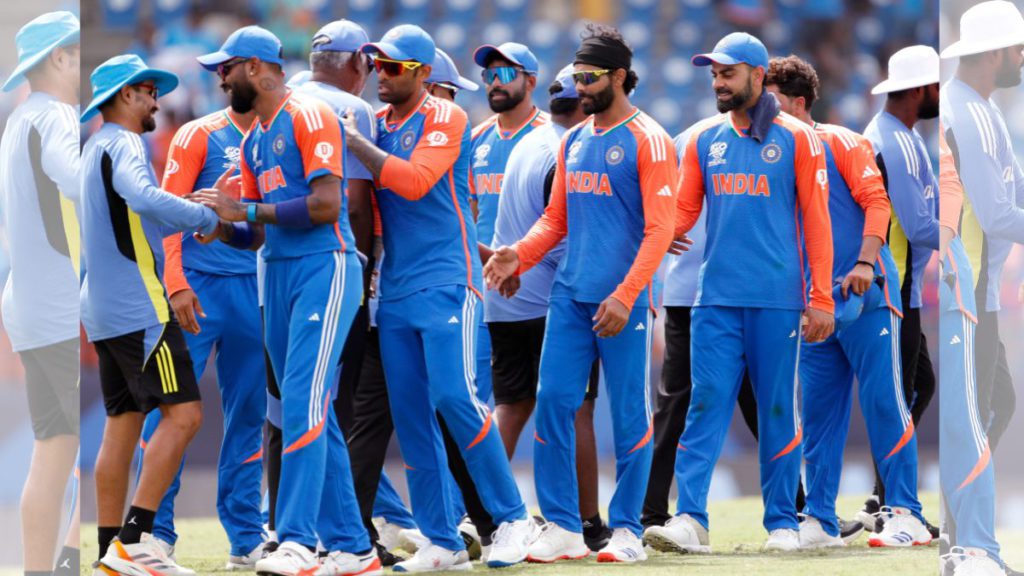
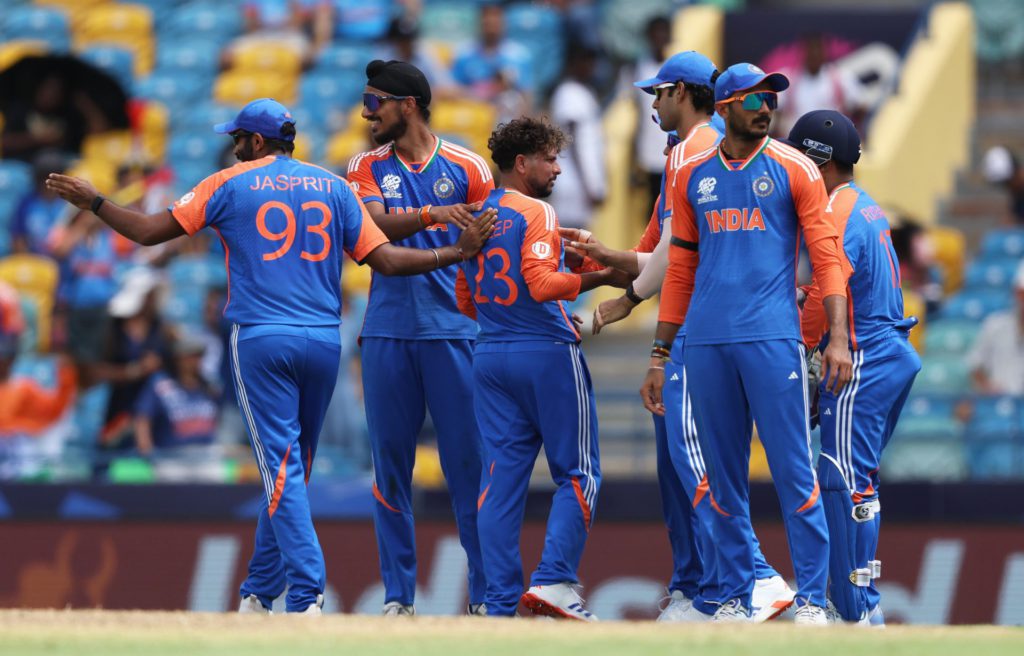
Members of the T20 World Cup-winning Indian team were greeted to a rapturous welcome during the victory parade from the Marine Drive to Wankhade Stadium in an open-top bus after they arrived in Mumbai from Delhi on Thursday.
A sea of joyous fans, riding on high emotions of a World Cup victory, greeted the team with clapping and shouts. The team members reciprocated the feelings as they smiled and waved at the fans.
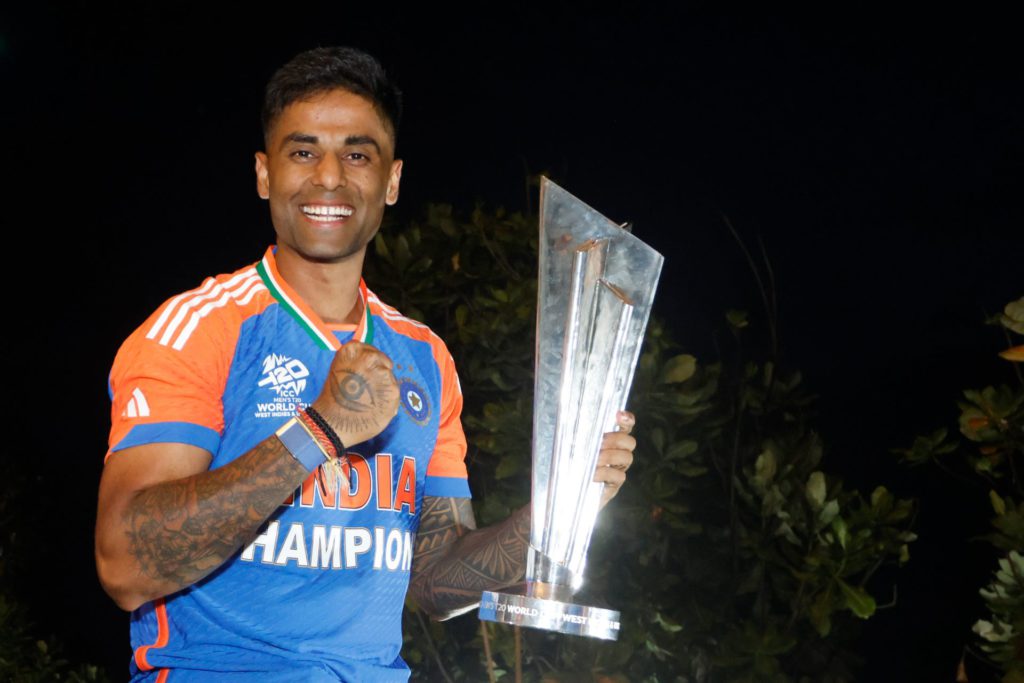
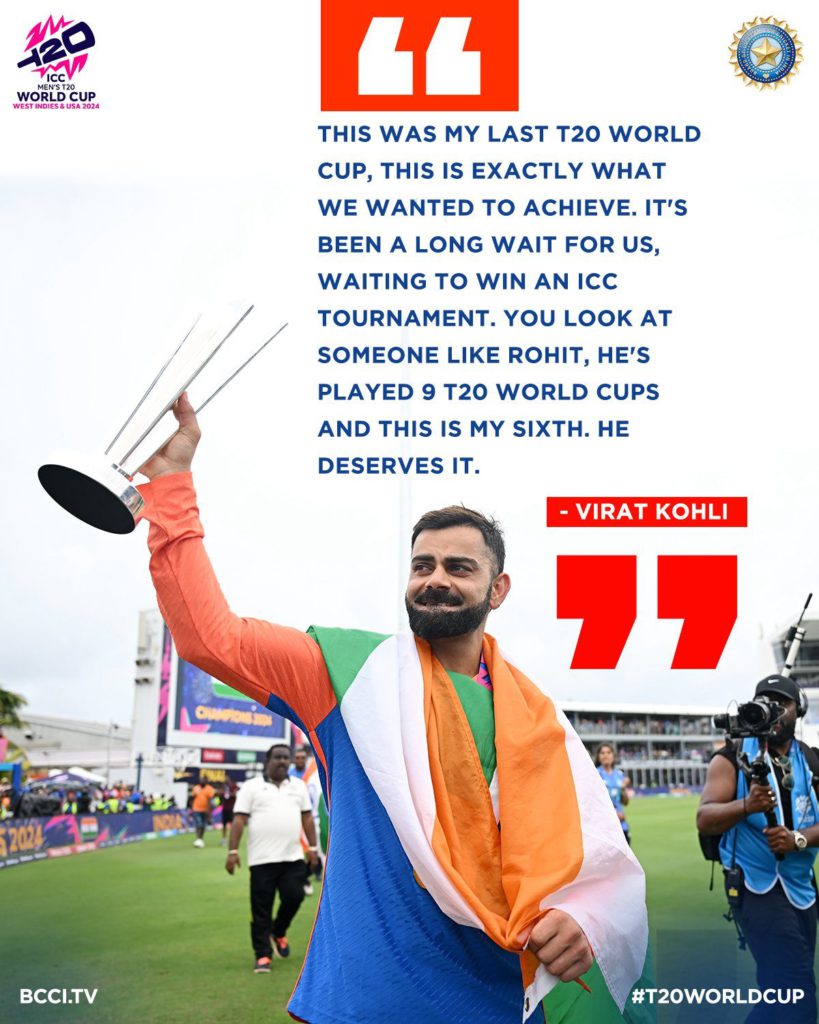
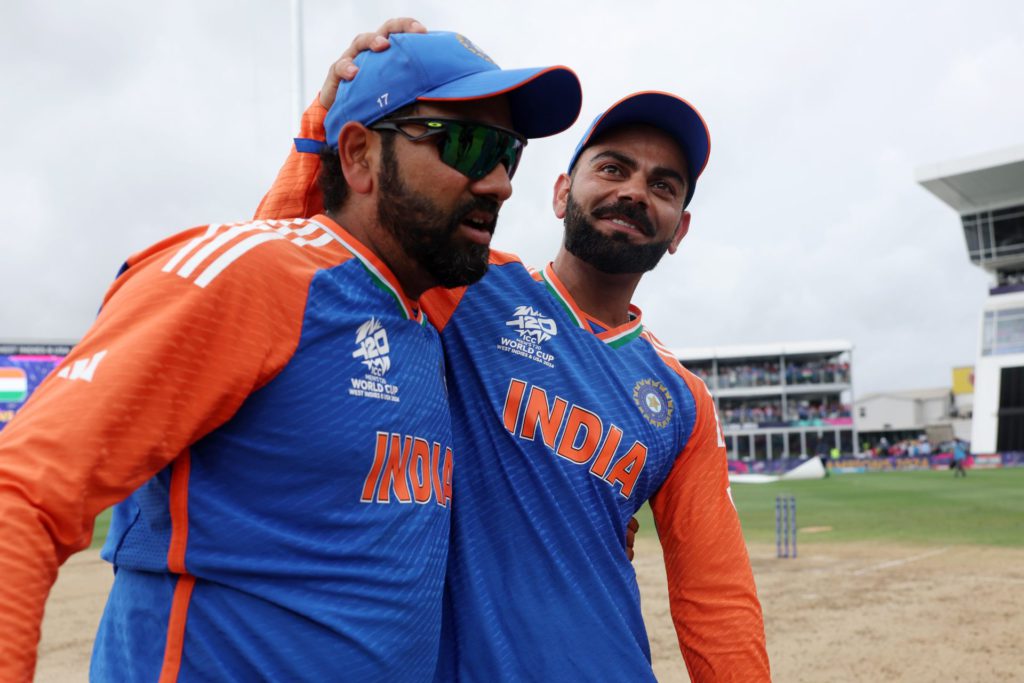
Captain Rohit Sharma and star batter Virat Kohli lifted the T20 World Cup 2024 trophy and showed it to the fans gathered in large numbers all along the route.
Board of Control for Cricket in India (BCCI) secretary Jay Shah and Board vice president Rajiv Shukla were also with the players on the bus to celebrate the occasion.
Players also wrapped themselves with the Tricolour during the celebrations. Virat Kohli, Kuldeep Yadav, and Yuzvendra Chahal were among the players who wore the national flag during the journey of the Vijay Rath.
Image Source: X/Twitter @BCCI
A few team fans also climbed on the trees to get a better look of the players. Players held the trophy as they waved to the enthusiastic cricket fans.
Image Source: X/Twitter @BCCI
Rohit held hands of team’s head coach Rahul Dravid and batter Suryakumar Yadav and the three clasped towards the sky marking triumph of the team. The team later reached the Wankhede Stadium.
Image Source: X/Twitter @BCCI
Earlier, Team India landed in Mumbai to a heroic welcome for the victory parade. A sea of fans are present at Marine Drive to welcome the team which displayed grit, determination, and resilience to win the World Cup in West Indies. India is the first team to lift the prestigious title by remaining undefeated in the tournament.A felicitation ceremony will be held in Wankhade Stadium following the victory parade.
Image Source: X/Twitter @BCCI
Indian T20I vice-captain Hardik Pandya was seen holding the trophy in his hands when the team came out of the Mumbai airport. Fans had also gathered in large numbers outside the airport to express their admiration for the Men in Blue.
At the Mumbai International Airport, the Indian team walked through a Tricolour-draped aerobridge and was showered with flower petals as they walked through the arrival corridor.
The air echoed with traditional music, with Maharashtrian Dhol Tasha, Tutari, and Lezim used in the grand welcome for the Men in Blue. The airport also rolled out a red carpet culminating in a celebratory cake-cutting ceremony.
Maharashtra Chief Minister Ekanth Shinde has given directions to the Mumbai Police Commissioner to ensure that there is no mismanagement of traffic or inconvenience to the fans at Marine Drive and Wankhede Stadium.The police have been asked to ensure proper crowd and traffic management today at Marine Drive.
Image Source: X/Twitter @BCCI
Earlier today, the T20 World Cup-winning Indian team touched down in the national capital, to a warm welcome from fans, who were eagerly waiting to catch a glimpse of their favourite heroes and the trophy.
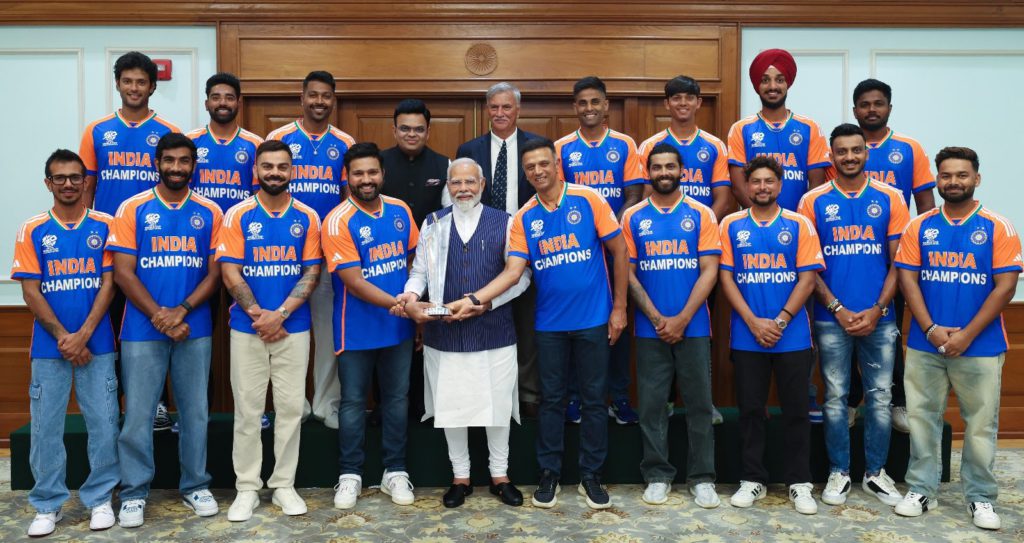
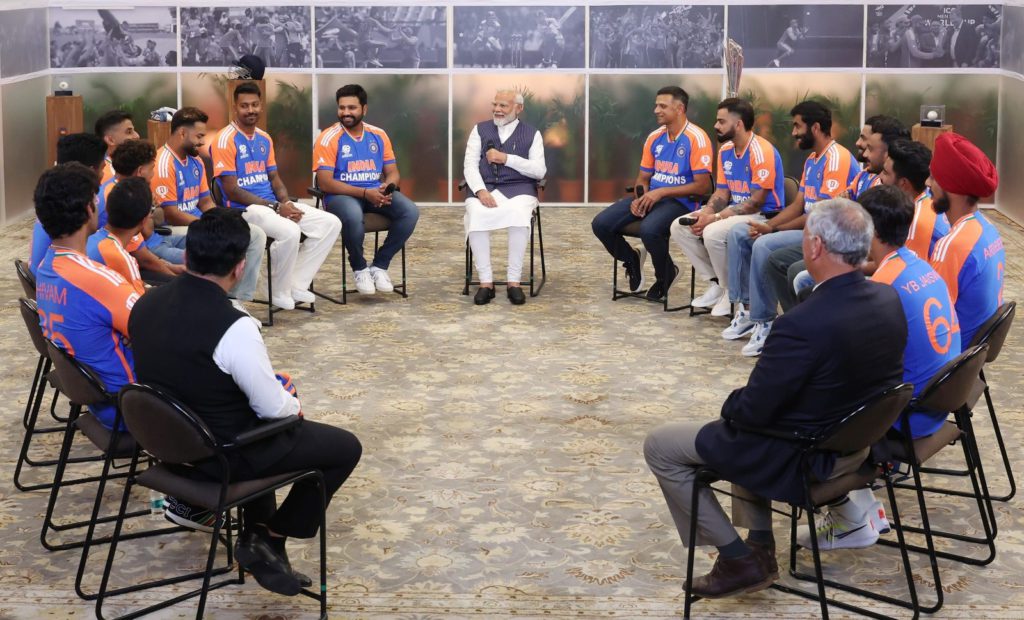
PM Modi interacted with the World Cup-winning team at his residence. During their meeting with the Prime Minister, the ‘Men in Blue’ wore a special jersey sporting two stars over the BCCI’s emblem. The stars represented the two T20 World Cup wins. The word ‘CHAMPIONS’ was written on the jersey in bold letters.
After their arrival in the national capital, Team India reached the ITC Maurya Hotel, where they also cut a special cake featuring the T20 World Cup trophy to celebrate the historic win.
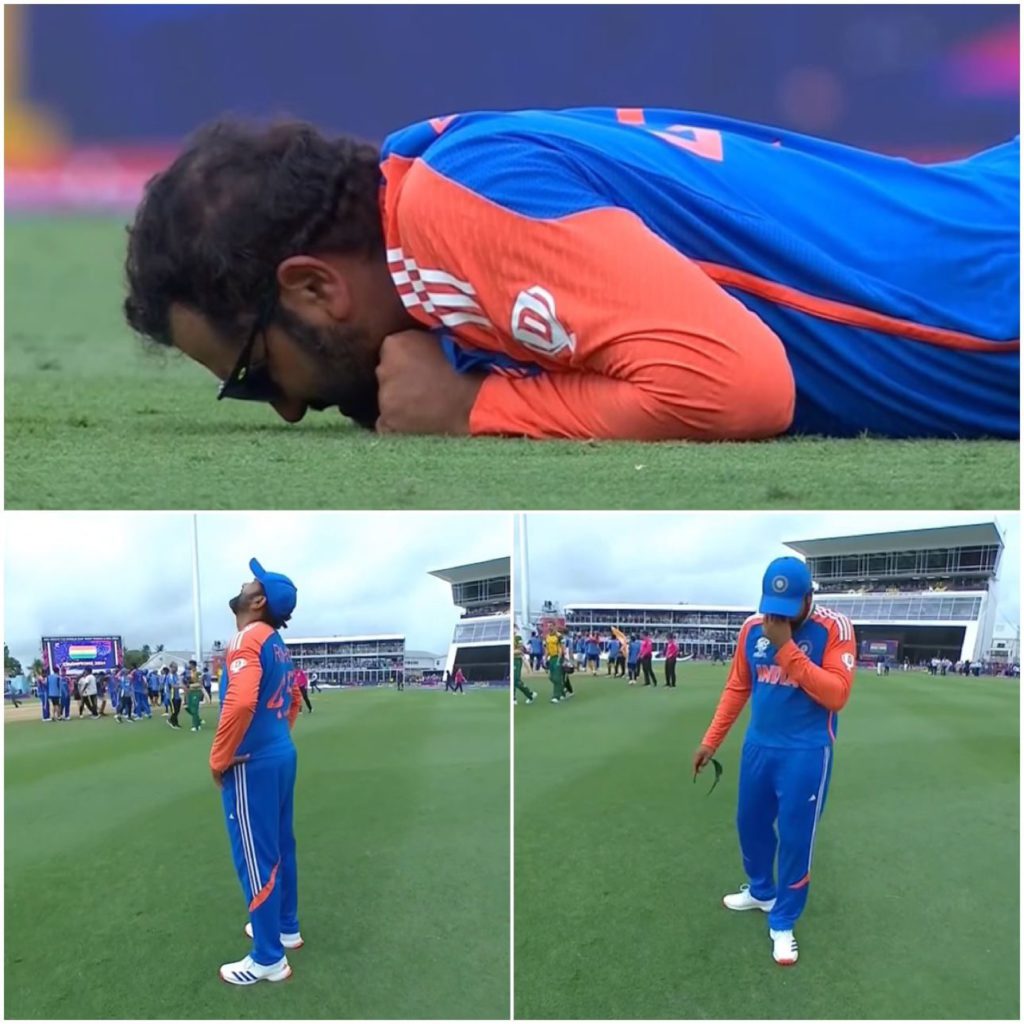
India ended a 13-year ICC World Cup trophy drought with a historic victory in Barbados. The team defeated South Africa in the final by 7 runs in a thrilling encounter.
Support Our Journalism
Global Indian Diaspora and Australia’s multicultural communities need fair, non-hyphenated, and questioning journalism, packed with on-ground reporting. The Australia Today – with exceptional reporters, columnists, and editors – is doing just that. Sustaining this needs support from wonderful readers like you.
Whether you live in Australia, the United Kingdom, Canada, the United States of America, or India you can take a paid subscription by clicking Patreon and support honest and fearless journalism.
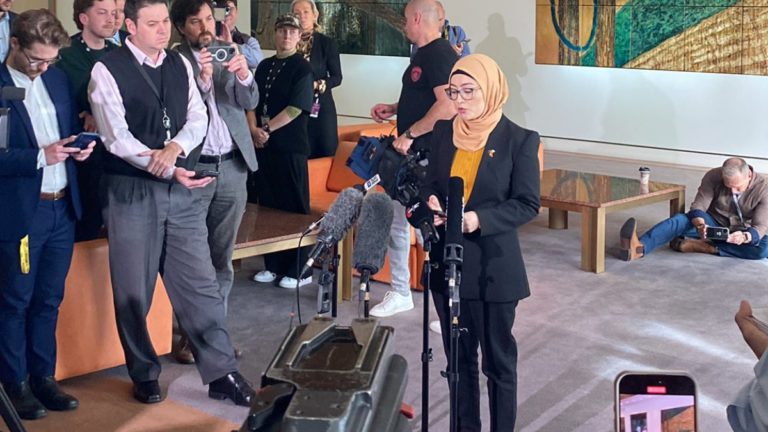
Senator Fatima Payman, who announced on Thursday she was quitting her party, has now officially joined that well-known club of “Labor rats” – those who have been thrown overboard or jumped ship.
Notable past members include then prime minister Billy Hughes, expelled during the First World War conscription crisis, and Joe Lyons, a minister during the great depression when Labor fractured.
But the “club” has never had someone like Payman, a religious, hijab-wearing young Muslim woman who reflects one slice of the modern, increasingly diverse Australian community.
Payman, now a crossbencher, said she had been “deeply torn”. She’d had “immense support” from rank and file Labor members urging her to “hang in there” and fight for change within the Labor. On the other hand, she had been pressured to conform to caucus solidarity and toe the party line.
“I see no middle ground and my conscience leaves me no choice,” she said at her resignation news conference where she performed strongly and answered multiple questions. She was resigning from the Labor Party “with a heavy heart but a clear conscience”.
From Western Australia, Payman has only been in the Senate since the last election. Born in Afghanistan, her family fled the Taliban; her father came to Australia by boat in 1999 and was detained. She said on Thursday,“My family did not flee from a war-torn country to come here as refugees for me to remain silent when I see atrocities inflicted on innocent people.”
Payman attended the Australian Islamic College in Perth, and then the University of Western Australia. Working as an organiser for the United Workers Union helped elevate her to third place on the WA Labor Senate ticket.
Nationally, Payman hasn’t had a high profile, beyond the usual publicity around her “firsts”, including the first hijab-wearing woman in parliament. Until the last couple of weeks, few people would have heard of her. But for the Israel-Hamas war, that would probably have remained the case for a long time.
For Labor that war – in which Australia has no role or influence – has become a domestic political nightmare. Whether it is the government trying to get its policy pitch right, or attempting to manage the politics, the conflict has put great strains on Labor.
— Australian Labor (@AustralianLabor) July 4, 2024
Internally, in the days before her resignation Payman had support from some Labor Party branches. In the prime minister’s own electorate, the Leichhardt branch passed a motion of “solidarity” with her.
In the run-up to her defection, Labor heavyweights simultaneously briefed against her while declaring that many Labor figures had reached out to her.
Albanese believes the Payman saga amounts to an orchestrated plot that had been in the works for weeks.
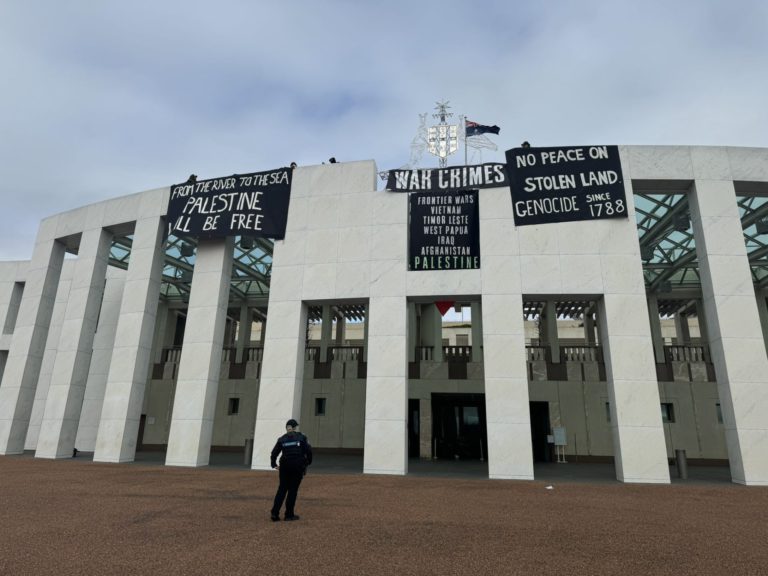
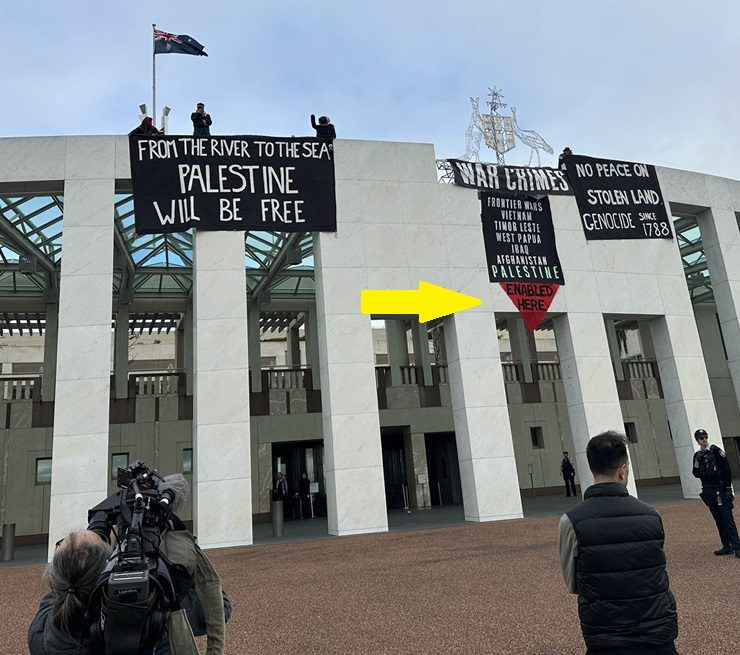
This is a serious and dangerous breach of security by pro-Palestinian activists at Parliament today which included the display of antisemitic slogans.
— Senator Sarah Henderson (@SenSHenderson) July 4, 2024
Payman rejects that, insisting she finally decided to cross the floor while in the chamber. The government has made much of her not speaking up in the caucus about her concerns. She said she’d had individual conversations with colleagues and had used caucus committee and factional channels to raise the Palestine issue.
“I felt I exhausted every opportunity to raise my concerns.”
After her defection, government sources argued the differences between its line and Payman’s position on Palestine were small, revolving around timing. The government rejected her claims members had tried to intimidate her.
The claims and counterclaims about her conduct often come down to “they say, she says”, and individual perceptions.
The local fallout from the Middle East war is signalling that Australian multiculturalism has moved into a new, more challenging phase, fraying its fibre. As Albanese has repeatedly said, the Middle East war is straining our social cohesion.
This is a particularly worrying development because multiculturalism has been one of this country’s great achievements. The spectre of a political party or movement arising based on religion raises concerns among many in politics, beyond the possible implications for Labor’s vote.
Muslim activists are organising ahead of the next election, in southwestern and western Sydney, but what this will amount to is unclear.
Community leaders have recently had meetings (one of them attended by Payman) with Glenn Druery, “the preference whisperer” who has long worked with micro-parties.
“The Muslim Vote” group proclaims itself “dedicated to empowering Australian Muslims in the electoral process”.
Late Thursday The Muslim Vote issued a statement declaring it was “not a political party”. “We support campaigns and candidates across Australia and support anyone who shares our principles of justice and fairness,” the statement said, adding, “The Muslim Vote is not a religious campaign but a political one”.
Image Source: X/Twitter @AustralianJA
Labor is fearful, not least because the threat is still inchoate; Labor is unable to judge its nature and potential power to do damage.
The potential “Muslim” vote – to the limited extent such a vote would be solid – is significant in a batch of seats in Sydney’s west and southwest, several occupied by ministers.
Labor holds such seats with big majorities and challenges from an organised Muslim vote would seem unlikely to be able to dislodge their members. But they would be disruptive and would force leading ministers to spend more time in their electorates than they normally would. In Victoria, there is some fear that Muslim pressure could worsen the position of Peter Khalil, in the Melbourne seat of Wills, already under strong pressure from the Greens.
On its last day of the parliamentary session and hours before Payman’s statement, MPs were shocked by a protest that saw four demonstrators scale the security fence to get onto the roof of Parliament House. That fence was erected a few years ago to make the building, where security has progressively increased, impregnable.
Meanwhile, inside, the opposition successfully moved a motion in the Senate reaffirming “Israel’s inherent right to self-defence, whether attacked by Hamas, Hezbollah, Iran or any other sponsor of terrorism”. The Greens announced they will put a motion in the Senate at the start of the August sitting calling for the government “to sanction members of the extremist Netanyahu government”, including the prime minister and defence minister.
While this war continues to rage, the fissures it is bringing in Australian politics and society more generally will continue to widen. Even when it finally ends, the divisions and wounds will not be healed easily or soon.
Global Indian Diaspora and Australia’s multicultural communities need fair, non-hyphenated, and questioning journalism, packed with on-ground reporting. The Australia Today – with exceptional reporters, columnists, and editors – is doing just that. Sustaining this needs support from wonderful readers like you.
Whether you live in Australia, the United Kingdom, Canada, the United States of America, or India you can take a paid subscription by clicking Patreon and support honest and fearless journalism.
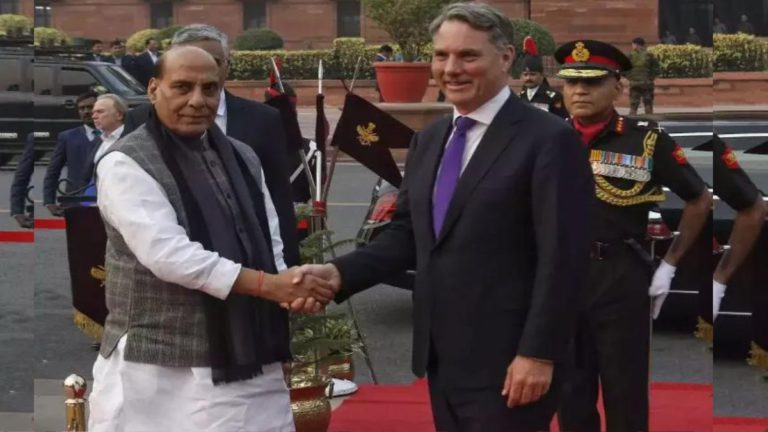
Australian Deputy Prime Minister and Minister of Defence, Richard Marles held talks on Thursday with Indian Defence Minister Rajnath Singh, to review various aspects of defence cooperation and explore closer collaboration in the Indo-Pacific region.
Deputy PM Richard Marles congratulated Minister Rajnath Singh on his reappointment as ‘Raksha Mantri’ for a second term and praised the robust democratic process in India, which saw a high voter turnout. He also congratulated Singh on Team India’s victory in the T20 World Championship.
Minister Rajnath Singh emphasised the importance of the Comprehensive Strategic Partnership between India and Australia.
On social media platform X, he shared, “Spoke with Australia’s Deputy Prime Minister and Minister for Defence Mr. @RichardMarlesMP. We reviewed a range of issues pertaining to defence cooperation and discussed closer collaboration between India and Australia in the Indo-Pacific. We place great value on India-Australia Comprehensive Strategic Partnership with Australia.”
During the meeting, the two ministers acknowledged the significant progress in defence cooperation under the comprehensive strategic partnership framework. They appreciated the momentum achieved since the last India-Australia 2+2 Ministerial Dialogue, held in November 2023.
According to a press release from the Indian Ministry of Defence, Australia considers India a top-tier security partner, as highlighted in their National Defence Strategy document released in 2024.
In recent years, the relationship between India and Australia has seen transformative growth. The Indian High Commission in Canberra noted that bilateral cooperation has expanded significantly within existing frameworks and has opened up new possibilities at both bilateral and global levels.
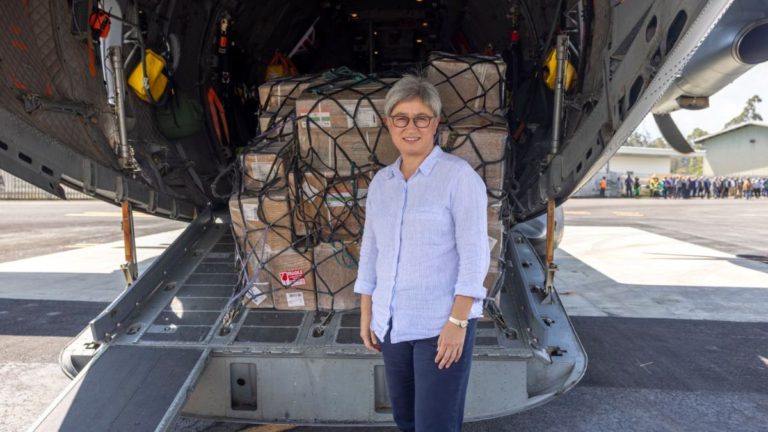
The collaboration extends beyond defence. In June, External Affairs Minister S. Jaishankar expressed gratitude to his Australian counterpart, Penny Wong, for coordinating with India to deliver Humanitarian Assistance and Disaster Relief (HADR) to the landslide-affected Enga Province in Papua New Guinea.
“So glad we could coordinate FM @SenatorWong. #IndiaAustraliaDosti delivering HADR assistance in the Indo-Pacific,” Jaishankar posted on X.
Penny Wong highlighted Australia’s efforts in coordinating with partners to deliver essential aid to Papua New Guinea. She mentioned, “Australia is coordinating with partners to ensure the delivery of much-needed assistance to our Papua New Guinean family. We were pleased to transport a package of Indian supplies to the landslide-affected Enga Province as we visited the disaster zone,” she stated on X.
The ongoing collaboration and mutual support between India and Australia underscore the strengthening of their strategic partnership, particularly in the Indo-Pacific region, which is critical for maintaining regional stability and addressing shared security challenges.
Support Our Journalism
Global Indian Diaspora and Australia’s multicultural communities need fair, non-hyphenated, and questioning journalism, packed with on-ground reporting. The Australia Today – with exceptional reporters, columnists, and editors – is doing just that. Sustaining this needs support from wonderful readers like you.
Whether you live in Australia, the United Kingdom, Canada, the United States of America, or India you can take a paid subscription by clicking Patreon and support honest and fearless journalism.
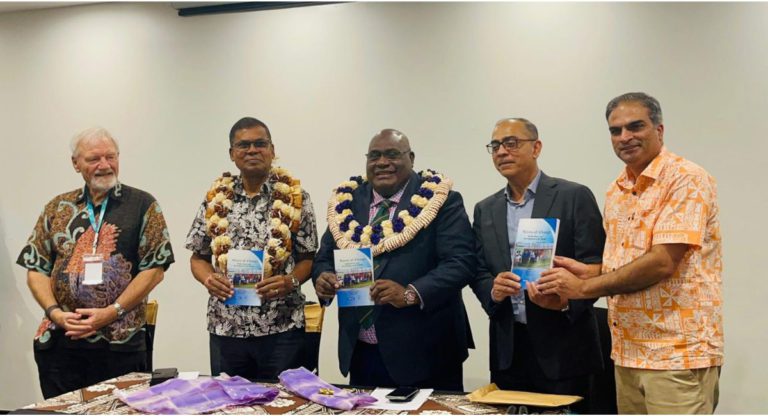
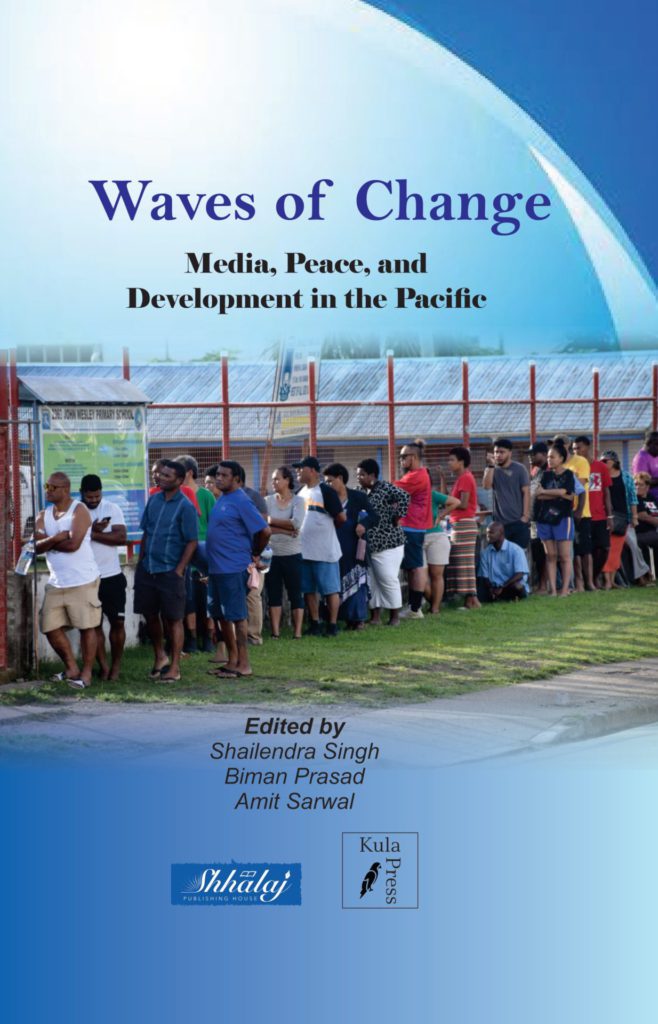
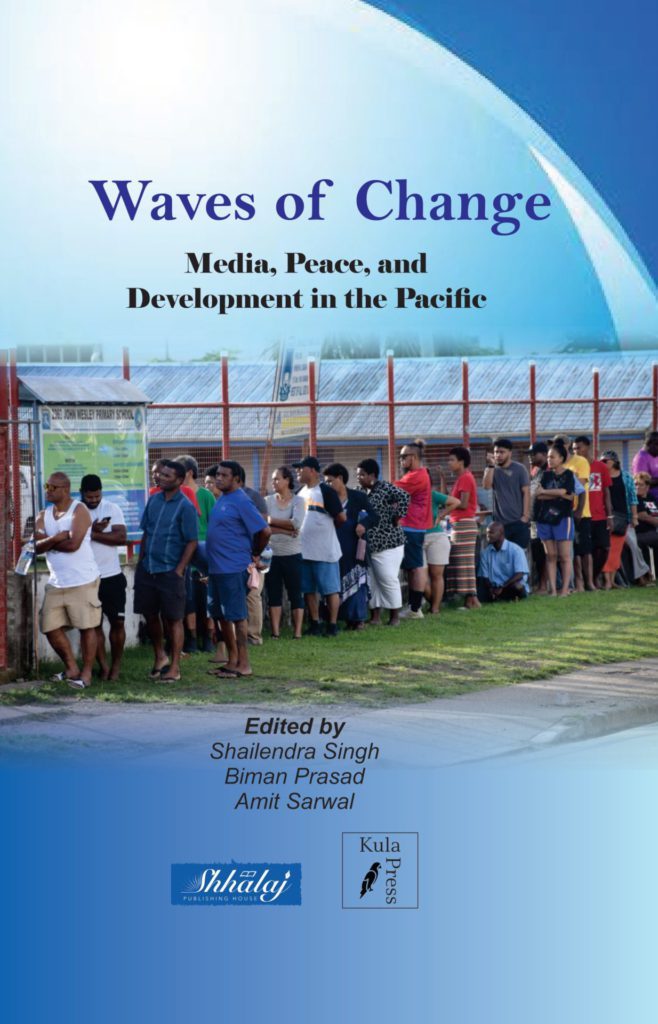
A pivotal book, ‘Waves of Change: Media, Peace, and Development in the Pacific,’ edited by Prof. Biman Prasad, Dr Shailendra Singh, and Dr Amit Sarwal has been released at the 2024 Pacific International Media Conference hosted by the University of the South Pacific (USP) from 4-6 July 2024 in Suva.
This conference, the first of its kind in 20 years, serves as a crucial platform to address the pressing challenges and core issues faced by Pacific media.
Assoc. Prof. Shailendra Singh, the convenor of the conference, emphasised the conference’s primary goals: to stimulate research, discussion, and debate on Pacific media, and to foster a deeper understanding of its challenges.
“Our region hasn’t escaped the calamitous impacts of the two biggest events that have shaken the media sector — digital disruption and the COVID-19 pandemic. Both events have posed significant challenges for news media organisations and journalists, to the point of being an existential threat to the industry as we know it. This isn’t very well known or understood outside the news media industry,” Dr Singh added.
‘Waves of Change: Media, Peace, and Development in the Pacific’ offers a comprehensive collection of interdisciplinary research, insights, and analyses at the intersection of media, conflict, peacebuilding, and development in the Pacific – a region experiencing rapid and profound change.
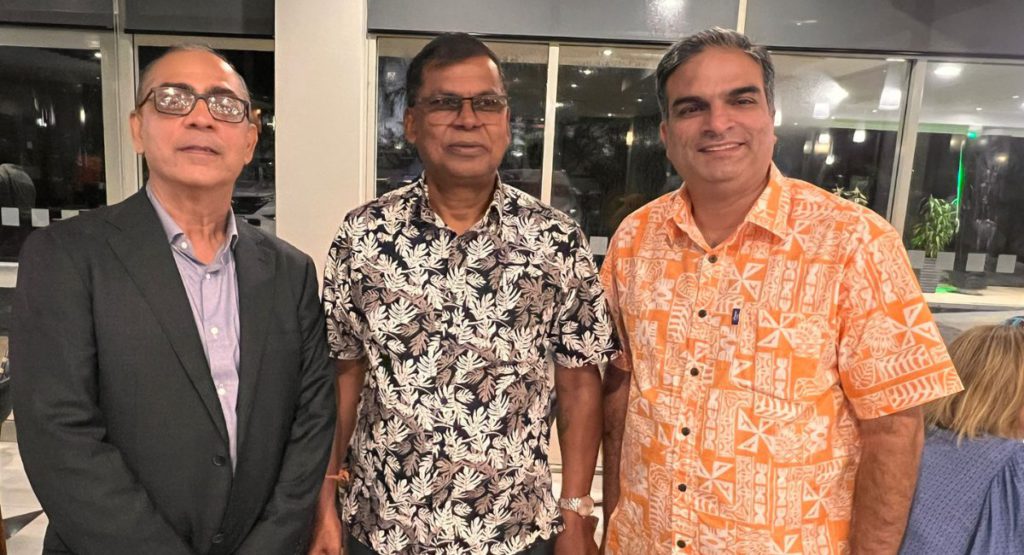
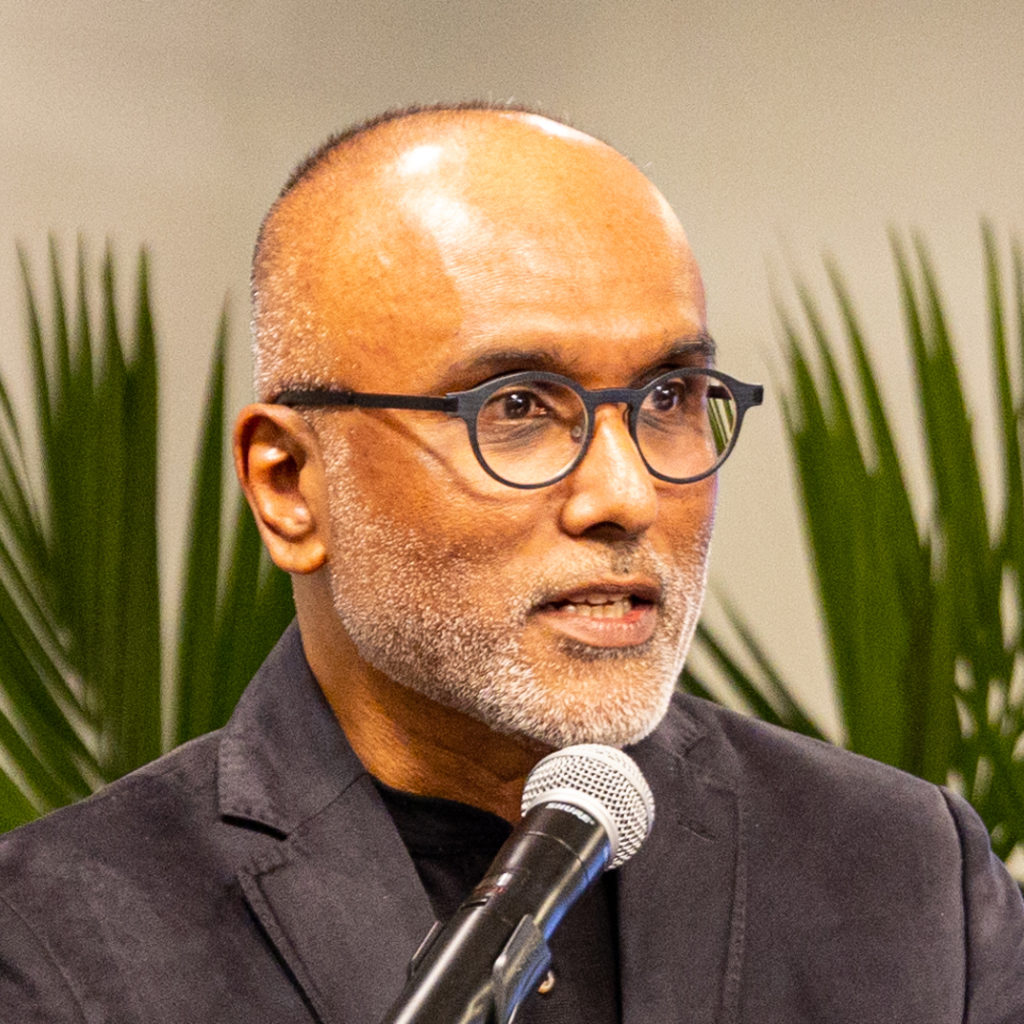
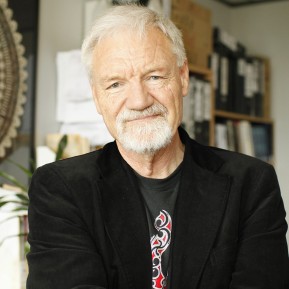
Dr Shailendra Singh, Prof. Biman Prasad, and Dr Amit Sarwal
The book builds on Dr Singh’s earlier work with Prof. Prasad, ‘Media and Development: Issues and Challenges in the Pacific Islands,’ published 16 years ago. Dr Singh noted that media issues have grown increasingly complex due to heightened poverty, underdevelopment, corruption, and political instability.
“Media and communication play vital roles in the framing of conflict, security, and development in public and political discourses, ultimately influencing progression or regression in peace and stability. This is particularly true in the era of digital media,” Dr Singh observed.
Dr Amit Sarwal stated that the primary aim of the new book is to address and revisit critical questions linking media, peacebuilding, and development in the Pacific. He expressed a desire to bridge gaps in training, publishing, and enhance practical applications in these vital areas particularly amongst young journalists in the Pacific.
Fiji’s Deputy Prime Minister and esteemed academic Prof. Biman Prasad is hopeful that this collection will shed light on the intricate relationship between media, peace, and development in the Pacific. He stressed the importance of prioritising planning, strategising, and funding in this sector.
“By harnessing the potential of media for peacebuilding, stakeholders in the Pacific can work towards a more peaceful and prosperous future for all,” Prof. Prasad added.
‘Waves of Change: Media, Peace, and Development in the Pacific’ has been published under a joint collaboration of Australia’s Kula Press and India’s Shhalaj Publishing House. The book features nine chapters authored by passionate researchers and academics, including David Robie, John Rabuogi Ahere, Sanjay Ramesh, Kalinga Seneviratne, Kylie Navuku, Narayan Gopalkrishnan, Hurriyet Babacan, Usha Sundar Harris, and Asha Chand.
The 2024 Pacific International Media Conference has been organised in partnership with the Pacific Islands News Association (PINA) and the Asia Pacific Media Network (APMN).
Support Our Journalism
Global Indian Diaspora and Australia’s multicultural communities need fair, non-hyphenated, and questioning journalism, packed with on-ground reporting. The Australia Today – with exceptional reporters, columnists, and editors – is doing just that. Sustaining this needs support from wonderful readers like you.
Whether you live in Australia, the United Kingdom, Canada, the United States of America, or India you can take a paid subscription by clicking Patreon and support honest and fearless journalism.
The Australian Border Force (ABF), in collaboration with partner agencies, has intensified efforts to tackle criminal activity within the aviation supply chain through Operation JETENGINE.
This high-visibility disruption operation at Melbourne International Airport aims to identify, monitor, and disrupt illicit activities in the aviation sectors across Victoria and Tasmania.
ABF officers, particularly those in Air Border Security teams at Melbourne International Airport, are focused on employees exploiting their access to customs-controlled areas for criminal purposes. These officers are adept at detecting vulnerabilities within the aviation supply chain, utilising advanced tools and technology to thwart criminal activities.
Over the past 12 months, Operation JETENGINE has achieved significant milestones:
Inspected over 1,300 arriving and departing commercial aircraft.
Examined up to 500 airline crew and employees.
Conducted more than 1,000 vehicle and foot patrols.
During the operation, officers uncovered evidence of airline crew members involved in illicit drug use and the domestic distribution of illicit substances.
Additionally, international airline crew members were found with illicit cigarettes and tobacco products concealed within false bottom suitcases, attempting to evade significant duty amounts. Some crew members were caught smuggling high-value dutiable goods and undeclared currency, violating Anti-Money Laundering and Counter-Terrorism Financing legislation.
Two international crew members were detected under the influence of illicit substances while on duty, resulting in the cancellation of at least one international crew travel authority (visa).
The ABF’s efforts also extended beyond the airport precinct, completing over 1,000 foot patrols and identifying aviation security vulnerabilities, including the removal of a squatter from an abandoned building.
More than 1,300 search activities were undertaken on aircraft both arriving and departing Melbourne International Airport. These searches aimed to ensure compliance with customs regulations, including inspections of flight decks, sleeping cabins, and cargo spaces.
In addition to enforcement actions, the ABF has engaged in over 70 industry engagements to educate, foster relationships, and encourage the reporting of suspected criminal activity in the aviation environment.
Superintendent Kelly-Anne Parish highlighted the ongoing nature of Operation JETENGINE, with referrals to domestic and international law enforcement partners concerning individuals linked to trans-national organised crime groups.
“Our officers are committed to detecting, deterring, and disrupting criminal activity in the aviation environment through world’s best practice activity, intelligence, and training,” Superintendent Parish said.
“ABF officers are called upon for their expertise recognised by international law enforcement partners and have been working closely with the World Customs Organization (WCO) to establish a best practice approach in tackling the threat of trusted insiders at airports.
“They work closely with Industry who have an invested interest in protecting and securing the aviation supply chain and are pivotal to safeguarding this environment.
“Ensuring a safe environment from criminal exploitation of the aviation supply chain for the Australian community and those who work in the aviation industry is a top priority for the ABF, and I strongly encourage those working in the aviation industry or members of the public who have information on persons conducting criminal activity at airports to report it.”
Operation JETENGINE continues to ensure that the aviation supply chain remains secure and free from criminal exploitation, reinforcing the ABF’s commitment to protecting Australia’s borders.
Support Our Journalism
Global Indian Diaspora and Australia’s multicultural communities need fair, non-hyphenated, and questioning journalism, packed with on-ground reporting. The Australia Today – with exceptional reporters, columnists, and editors – is doing just that. Sustaining this needs support from wonderful readers like you.
Whether you live in Australia, the United Kingdom, Canada, the United States of America, or India you can take a paid subscription by clicking Patreon and support honest and fearless journalism.
Australia and India have emerged as leaders in corporate renewable energy procurement, accounting for 80 per cent of the 5.4 gigawatts (GW) of renewable contracts announced in the Asia-Pacific region during the first quarter of 2024, according to a recent report by S&P Global Commodity Insights (GCI).
As global momentum for renewable energy accelerates, India’s significant contribution underscores its commitment to scaling up renewable energy capacity, aiming to meet ambitious climate goals and reduce reliance on fossil fuels. This surge represents a 31 per cent year-on-year growth in the region.
Indian corporations have been increasingly proactive in adopting renewable energy solutions, not merely in response to regulatory pressures but also as a strategic move to enhance sustainability and reduce operational costs. Key players in the nation’s corporate sector, including giants in technology, manufacturing, and services, are showing a keen interest in clean energy procurement.
The global trend in corporate renewable energy procurement has shown remarkable growth in 2024, with 15.8 GW of corporate renewable capacity contracted globally in the first quarter alone. This reflects a 36 per cent year-on-year increase. Europe led in terms of capacity, while the Asia-Pacific region, particularly India and Australia, dominated in the number of deals, highlighting the significant role of corporate entities in driving the renewable energy agenda.
Corporate power purchase agreements (PPAs) have played a critical role in this trend. Companies secured 25 per cent of new wind and solar capacity additions worldwide, excluding mainland China, compared to a mere 5 per cent in 2015. Solar photovoltaic (PV) technology remains the preferred choice for corporate contracting, accounting for 50 per cent of the deals in the first quarter of 2024. Offshore wind also gained traction, especially in Europe, reaching a quarterly high of 1.7 GW and contributing to 30 per cent of the regional capacity signed.
In North America, particularly the United States, corporations are increasingly entering PPAs with nuclear projects, reflecting a diversified approach to clean energy adoption. The mineral extraction sector emerged as the second-largest in corporate clean energy procurement, driven by significant deals in Australia, such as those by mining giant Rio Tinto.
The manufacturing sector in the Asia-Pacific region has maintained its momentum in clean energy procurement, emphasising the industry’s focus on reducing carbon footprints and enhancing energy efficiency. In contrast, the services sector in Asia-Pacific saw a slight dip in procurement, decreasing by 0.6 GW quarter over quarter. Nonetheless, technology companies in the services sector continued to be major players in North America and Europe, contributing to nearly 40 per cent of the deals in the latter region.
The green energy attribute markets remained dynamic across most regions in the first quarter, with varying price trends observed. In Europe, demand for EU guarantees of origin (GOs) slightly decreased due to factors such as the phaseout of EU GOs in the UK and economic stagnation. However, issuance grew by 23 per cent, primarily driven by wind energy expansion, leading to downward pressure on prices.
Globally, the international renewable energy certificates market expanded significantly, with a record quarterly redemption growth of 43 terawatt-hours (TWh), a 72 per cent increase. The UAE, mainland China, and Chile were among the leaders in demand growth, with hydro-energy accounting for 52 per cent of the increased demand.
As India and Australia continue to lead the charge in corporate renewable energy procurement, the global push for sustainable energy solutions remains strong, promising a greener and more sustainable future.
Support Our Journalism
Global Indian Diaspora and Australia’s multicultural communities need fair, non-hyphenated, and questioning journalism, packed with on-ground reporting. The Australia Today – with exceptional reporters, columnists, and editors – is doing just that. Sustaining this needs support from wonderful readers like you.
Whether you live in Australia, the United Kingdom, Canada, the United States of America, or India you can take a paid subscription by clicking Patreon and support honest and fearless journalism.
Fatima Payman has resigned from the Labor Party following her suspension for crossing the floor on a pro-Palestinian motion. The West Australian senator announced on Thursday, citing isolation and exclusion by her caucus colleagues after siding with the Greens.
“The ongoing genocide in Gaza is a tragedy of unimaginable proportions,” Payman stated in Canberra.
“I am torn, deeply torn … sadly, I do not believe our principles align with those of the leadership of the Labor Party.”
“With a heavy heart but a clear conscience, I announce my resignation from the Australian Labor Party.”
Earlier in the week, rumours were swirling in Canberra as Prime Minister Anthony Albanese flagged the potential defection of suspended Senator Fatima Payman from the Labor Party within days. This comes after her controversial decision to cross the floor in support of a Greens motion on Palestinian statehood.
Senator Payman, representing Western Australia, was suspended from the Labor caucus after her defiant move and has since expressed feelings of isolation from her colleagues. The Prime Minister hinted at further developments during Question Time on Wednesday.
PM Albanese told parliament, addressing the speculation surrounding Senator Payman’s future with the party,
“I expect further announcements in the coming days which will explain exactly what the strategy has been over now more than a month.”
Political Turmoil and Community Reactions
The controversy has sparked significant unrest within the Labor Party and the broader community. Labor MPs privately voiced their frustration, not with Payman’s stance, but with her approach to the issue. According to insiders, there was a conscious effort not to isolate her, yet anger brewed over her method of pushing for change externally rather than through internal party channels.
Underscoring the delicate balance required in handling such matters NSW Police Minister Yasmin Catley said,
“We have to make sure that we wrap services and support around these kids who are being radicalised online and their families.”
Calls for Forgiveness and Unity
Labor MP Peter Khalil called for a more forgiving approach towards Senator Payman.
“I would love to see Fatima back in our caucus. People make mistakes all the time and it’s important to forgive people,”
he told ABC radio.
Khalil stressed that all parties aimed to alleviate human suffering and end overseas conflicts. However, the Greens seized the opportunity to push for more stringent actions against Israel, including sanctioning its Prime Minister and expelling the ambassador. They have also planned a door-knocking campaign targeting Labor MPs with significant Muslim voter bases, including Khalil.
Potential Political Repercussions
Kos Samaras, a former Labor strategist-turned-pollster, warned of potential political repercussions, stating that losing just a few thousand votes to an Independent in certain seats could place Labor MPs in precarious positions.
“It’s extraordinary that the Labor Party is sanctioning one of their own, Senator Payman, more strongly than they’re prepared to sanction a genocide or the Israeli government,”
commented Greens Senator Nick McKim.
Labor’s Stance on Statehood
Prime Minister Albanese reiterated Labor’s stance on Palestinian statehood, emphasising a two-state solution. However, he acknowledged the delicate position Payman had placed herself in, stressing that unity and adherence to party processes were crucial.
“This is the most united caucus I’ve been a part of,” Albanese asserted during the party room meeting, reiterating his openness to Payman’s return if she pledged to respect party processes.
Internal Struggles and External Pressures
The controversy has led to calls for increased humanitarian aid and support for those affected by the conflict, with significant political and social implications. Health Minister Mark Butler defended the party’s handling of the situation, stating that established party policy was followed, and efforts were made to reach out and support Senator Payman.
Deputy Liberal Leader Sussan Ley urged an investigation into any allegations of bullying against Payman, calling for better leadership to prevent such incidents from recurring.
As the situation unfolds, all eyes will be on Senator Payman and her next steps, which could significantly impact the Labor Party and Australian politics.
Support Our Journalism
Global Indian Diaspora and Australia’s multicultural communities need fair, non-hyphenated, and questioning journalism, packed with on-ground reporting. The Australia Today – with exceptional reporters, columnists, and editors – is doing just that. Sustaining this needs support from wonderful readers like you.
Whether you live in Australia, the United Kingdom, Canada, the United States of America, or India you can take a paid subscription by clicking Patreon and support honest and fearless journalism.
Damodar Shreshta, a 79-year-old man visiting from Nepal, has tragically died after being struck by a car on Abell Road in Melonba, Sydney’s west, late on Sunday night.
NSW Police are urgently searching for the driver who allegedly fled the scene without stopping.
Police have released images of a small dark coloured sedan or coupe they believe can assist with inquiries into a fail to stop crash in Sydney’s west overnight.
Emergency services were called to the scene around 11:45 pm, following reports of an injured man on the side of the road. Paramedics worked tirelessly to save the elderly man, but he succumbed to his injuries and was pronounced dead at the scene.
Image: Damodar Shreshta, the 79-year-old man visiting from Nepal (Source: 9News Screenshot)
The victim, who was in Australia to celebrate his daughter’s 25th wedding anniversary, was described by his grieving family as a “lovely family man” who always cared for his loved ones.
His daughter, too distraught to appear on camera, expressed her heartbreak on Sunrise, condemning the driver for their cowardly actions in fleeing the scene.
Initial investigations suggest the man was hit by a purple or blue coupe travelling eastbound on Abell Road. CCTV footage released by the police shows the suspected vehicle speeding through the area.
Image: Investigators have appealed for the public’s help in identifying the car and those who may have been travelling inside(Source: NSW Police)
Specialist officers from the Crash Investigation Unit have established and forensically examined a crime scene to uncover more details.
The police have appealed to the public for assistance in identifying the vehicle and any potential witnesses. They are seeking anyone with dashcam footage from the area or any information related to the incident to come forward.
A report is being prepared for the coroner to determine the exact circumstances surrounding the crash. Investigators continue to piece together the events of that fateful night.
Anyone with information is urged to contact Crime Stoppers on 1800 333 000. Your assistance could be crucial in bringing justice to the grieving family of the deceased.
Support Our Journalism
Global Indian Diaspora and Australia’s multicultural communities need fair, non-hyphenated, and questioning journalism, packed with on-ground reporting. The Australia Today – with exceptional reporters, columnists, and editors – is doing just that. Sustaining this needs support from wonderful readers like you.
Whether you live in Australia, the United Kingdom, Canada, the United States of America, or India you can take a paid subscription by clicking Patreon and support honest and fearless journalism.
The issue of online radicalisation among young people has come under renewed scrutiny following a troubling incident at the University of Sydney.
A 14-year-old boy is currently under investigation for terrorism-related activities after allegedly stabbing a 22-year-old university student with a kitchen knife. The attack took place on Tuesday morning at the university’s Camperdown campus.
Counter-terrorism police were called to the scene after the teenager allegedly stabbed the victim in the neck around 8:30 am. The victim was swiftly transported to Royal Prince Alfred Hospital for treatment and has since been released.
The 14-year-old suspect was arrested after arriving at the same hospital for treatment of his own injuries. He underwent a mental health assessment following his arrest.
Previous Offences and Current Deradicalisation Program Engagement
In 2023, the teen had been charged with other offences but had his case dismissed in court. NSW Police Minister Yasmin Catley revealed that the boy had been participating in a program run by the Community and Justice Department aimed at addressing radicalisation.
“We have to make sure that we wrap services and support around these kids who are being radicalised online and their families,”
Ms Catley told ABC News Breakfast.
She urged anyone noticing behavioural changes in young people to come forward to allow authorities to provide the necessary help.
Government and Law Enforcement Responses
Home Affairs Minister Clare O’Neil addressed the issue on Seven’s Sunrise program, indicating that the incident had not yet been classified as a terrorist act. She noted the growing concern over youth radicalisation, which is increasingly influenced by social media and technology.
Minister O’Neil emphasised the need for robust deradicalisation programs, though she acknowledged that these initiatives are state-run and face various regional challenges.
NSW Police Assistant Commissioner Mark Walton commented on the complex nature of the teenager’s ideological influences, referring to it as a “salad bar of ideologies.” He stated that the teen’s motivations were not religious but stemmed from exposure to extreme violent content online.
“A lot of these vulnerable people, they’re not linked to one particular ideology, they will move as they’re exposed to different things,” he said.
“It might be of white supremacist neo-Nazi, it can easily flip into a religious ideation, it’s a very complex environment that some of these vulnerable people are engaged in, not a linear position.”
University’s Reaction
The University of Sydney is cooperating with authorities, and a university spokeswoman mentioned that there might be an increased security and police presence on campus as investigations continue.
The Broader Issue of Online Radicalisation
This incident has highlighted the pervasive issue of online radicalisation, particularly among young, impressionable individuals. The accessibility of extreme and violent content online poses a significant challenge for law enforcement and social services aiming to prevent radicalisation and its potentially violent outcomes.
The federal and state governments and various law enforcement agencies continue to explore more effective measures to combat this growing threat. This includes tightening regulations around online content, enhancing surveillance of suspicious activities, and bolstering support systems for those at risk of radicalisation.
The recent stabbing at the University of Sydney serves as a stark reminder of the urgent need for comprehensive strategies to address the complex issue of online radicalisation and ensure the safety of all citizens.
As the investigation into this alarming incident unfolds, authorities are determined to uncover whether the act was an isolated event or part of a larger, more sinister conspiracy. The collaboration between various government agencies, law enforcement, and community programs is crucial in tackling the root causes of radicalisation and preventing similar occurrences in the future.
Support Our Journalism
Global Indian Diaspora and Australia’s multicultural communities need fair, non-hyphenated, and questioning journalism, packed with on-ground reporting. The Australia Today – with exceptional reporters, columnists, and editors – is doing just that. Sustaining this needs support from wonderful readers like you.
Whether you live in Australia, the United Kingdom, Canada, the United States of America, or India you can take a paid subscription by clicking Patreon and support honest and fearless journalism.
Australian and Indian researchers are again joining forces to tackle some of the world’s most pressing issues through the Australia-India Strategic Research Fund (AISRF).
Round 15 of the AISRF will back five innovative projects, spanning nanomaterials, e-waste, artificial intelligence, and the development of new medicines to combat superbugs, with a total funding of $3.8 million.
Minister for Industry and Science, Ed Husic, highlighted the importance of international collaboration in addressing complex global challenges.
“The world isn’t short of complex issues, with collaboration between nations playing an essential role in delivering scientific breakthroughs that will make a difference,” said Minister Husic.
“From tougher strains of bacteria to e-waste and AI, our bilateral research partnership puts Australia’s brightest minds to creating better solutions for the world’s ongoing and emerging challenges.”
The collaborative projects include:
Developing an AI platform to monitor soil health and prevent degradation in vulnerable areas.
Creating sustainable technology to maximise the recycling of metals from discarded mobile devices.
Designing nanomaterials for affordable and scalable water remediation using solar-thermal energy.
Using components of the immune system to guide the design of new antimicrobials to treat drug-resistant infections.
Improving diagnostics to detect bacterial infections and developing novel therapeutics to treat them.
The Australian recipients of this round’s funding are the Australian National University, Monash University, the University of Adelaide, the University of Queensland, and the University of Sydney. Their Indian counterparts include the Indian Institute of Science, Indian Institute of Technology Delhi, AbGenics, and Indian Institute of Technology Bombay.
Dr. Jitendra Singh, India’s Minister for Science and Technology, underscored the role of collaboration in fostering sustainable development and addressing global challenges.
“I am sure the projects which emerged out of collaboration would result in significant scientific discoveries and technological advancements in areas of mutual interest.”
“I feel collaboration is crucial in this modern era to address critical global challenges and in fostering sustainable development. The AISRF is a testament to the enduring partnership between India and Australia,” Dr. Singh stated.
Established in 2006, the AISRF is Australia’s largest bilateral science cooperation initiative, supporting collaboration between Australia and India’s leading universities, research institutions, and scientific innovation end users. Over its 18-year history, the fund has delivered more than $100 million in grants, supporting 368 collaborative research projects, workshops, and fellowships, including 143 collaborative research projects over 14 rounds and 181 early and mid-career fellowships.
Minister Husic, further emphasised the significance of the AISRF in keeping Australia at the forefront of global research initiatives.
“The Australia-India Strategic Research Fund has delivered more than 360 collaborative research projects in the past 18 years, ensuring our nation’s universities and research institutions have remained at the forefront of global research initiatives.”
Indian Minister Dr Singh also reinforced India’s commitment to building a vibrant innovation ecosystem with Australia.
“While reinforcing our commitment to build a vibrant innovation ecosystem with Australia, I congratulate all the researchers involved with these projects for a prosperous and sustainable future.”
This collaboration marks a significant step in addressing some of the most critical challenges facing the world today, showcasing the power of international cooperation in advancing scientific and technological innovation.
Global Indian Diaspora and Australia’s multicultural communities need fair, non-hyphenated, and questioning journalism, packed with on-ground reporting. The Australia Today – with exceptional reporters, columnists, and editors – is doing just that. Sustaining this needs support from wonderful readers like you.
Whether you live in Australia, the United Kingdom, Canada, the United States of America, or India you can take a paid subscription by clicking Patreon and support honest and fearless journalism.
A stampede at a religious event in India’s largest state Uttar Pradesh’s Hathras district claimed at least 116 lives and left 18 others injured. The incident, which occurred during a ‘Bhole Baba’ program, has prompted a thorough investigation by the Uttar Pradesh government to determine if it was an accident or a conspiracy.
Chief Minister of Uttar Pradesh (UP) Yogi Adityanath’s Response
Chief Minister Yogi Adityanath, addressing the media on Tuesday, expressed his commitment to uncovering the truth behind the incident. “The government is already sensitive in this matter and will get to the bottom of whether this is an accident or a conspiracy, and give appropriate punishment to all those responsible for this incident,” he stated.”
“Doing politics instead of expressing condolences on such an incident is extremely unfortunate and condemnable.”
To ensure a comprehensive investigation, a team led by Additional DG Agra has been formed to provide a detailed report. Additionally, the Chief Secretary and DGP of the state, along with three state ministers, Chaudhary Laxmi Narayan, Sandeep Singh, and Asim Arun, are on-site to oversee the situation.
Etah, July 02 (ANI): Police personnel outside a hospital in Etah talking to the victims of the tragic incident of a stampede at ‘Satsang’ (religious event) that occurred in Hathras where 100 people killed and many injured on Tuesday. (ANI Photo)
Details of the Incident Describing the scenario that led to the stampede, UP CM Yogi explained, “Local organisers had organised a program of ‘Bhole Baba’. After the program, when the preacher of the Satsang was coming down from the stage, suddenly a crowd of devotees started going towards him to touch him and when the ‘sevadars’ stopped them, this accident happened there.”
Government’s Support and Condolences Indian Prime Minister Narendra Modi and Union Home Minister Amit Shah have expressed their deep sorrow and condolences to the bereaved families. Both the Government of India and the state government have announced compensation of Rs 2 lakh each to the families of the deceased and Rs 50,000 each to the families of the seriously injured.
Hathras, July 02 (ANI): A view from Uttar Pradesh’s Hathras where a stampede occurred during a Satsang, claiming the lives of 116 people, on Tuesday. (ANI Photo)
Emergency Response and Medical Aid Aligarh Commissioner Chaitra V confirmed, “116 people have been confirmed dead. 18 people are injured. Treatment is being ensured for the injured in Aligarh district. Primary investigation is being carried out.”
Aligarh District Magistrate Vishak added that a total of 23 bodies have been received in Aligarh, with 15 at Aligarh Medical College, 6 at Malkhan Singh Hospital, and 2 at the PM House.
Hathras, July 02 (ANI): People outside a hospital mourn near the mortal remains of victims of the tragic incident of a stampede at ‘Satsang’ (religious event) that occurred in Hathras where 100 people killed and many injured on Tuesday. (ANI Photo)
India’s President Droupadi Murmu expressed her heartfelt condolences, describing the incident as “heart-wrenching”.
“The news of the accident in Hathras district of Uttar Pradesh, resulting in the deaths of many devotees, including women and children, is heart-wrenching. I express my deep condolences to the families who have lost their loved ones and wish for the speedy recovery of the injured,”
she stated.
Indian Prime Minister Narendra Modi also expressed his condolences and wished for the speedy recovery of the injured. He assured that all necessary help would be provided to the victims and reiterated his condolences during his reply to the motion of thanks on the President’s address in Lok Sabha.
Etah, July 02 (ANI): Police personnel gather outside a hospital in Etah after around 100 people killed and many injured in a tragic incident of a stampede at ‘Satsang’ (religious event) that occurred in Hathras on Tuesday. (ANI Photo)
Political Reactions Leader of Opposition Rahul Gandhi emphasised the need for sensitive government support, stating, “The government should help people sensitively. I offer my condolences to all the families who have lost their loved ones.”
Samajwadi Party Cheif Akhilesh Yadav questioned the government’s preparedness, asking, “What was the government doing when such an incident took place? So many people have lost their lives. It is sad that if the government knew that there would be a large gathering at an event, what did they do for their safety?”
He also stressed the importance of providing help to the families of the deceased and ensuring the best treatment for the injured.
The investigation into the Hathras stampede continues as the state and central governments work together to provide support and uncover the truth behind this tragic incident.
Support Our Journalism
Global Indian Diaspora and Australia’s multicultural communities need fair, non-hyphenated, and questioning journalism, packed with on-ground reporting. The Australia Today – with exceptional reporters, columnists, and editors – is doing just that. Sustaining this needs support from wonderful readers like you.
Whether you live in Australia, the United Kingdom, Canada, the United States of America, or India you can take a paid subscription by clicking Patreon and support honest and fearless journalism.
Not too long ago reports in the Chinese Communist Party mouthpiece, The Global Times, suggested that Australia was America’s dog. This enraged me as a proud Indian-Australian. I had felt then that given the brazenness of Chinese insults, Australia would undertake serious course correction and reduce its enormous economic exposure to China given the national security and economic risks.
In terms of numbers, in 2020, before Covid 19 shook the world, 39% of all Australian goods were exported to China and 27% of all goods imported were from China. Now to have this level of exposure even with a friendly country with a shared value system could be concerning enough but to have it with a country that is a potential threat to your national security was alarming.
In order to reduce its dependency on China, Australia would have to slowly but steadily expand its trade relations with other countries and obviously one of the first countries that would come to anyone’s mind would be India. The one country which could enable Australia to tangibly hedge its risks.
Image source: Prime Minister of India Narendra Modi with Australian Prime Minister Anthony Albanese – Twitter.
However, it seems that instead of weaning off from China, there are allegedly vested interests within Australia who are hell bent on derailing Australia’s relationship with India, a fellow democracy and the fastest growing major economy in the world.
One glaring example of this is the escalating propaganda against India and more recently the brazen demonising of the Indian diaspora in Australia by some sections of the mainstream media.
A recent report by the ABC was so preposterous that two notable political figures commented on it. Former High Commissioner of Australia to India, Barry O’Farrell while speaking to local media suggested that the report was one-sided while Labour MP from Parramatta, Dr Andrew Charlton, issued a statement saying that media coverage should be balanced.
The media in Australia, left or right leaning, rarely publicises positive news on India and has mostly covered India through the stereotypical western colonial lens. However, the kind of blatant propaganda that one has seen post Covid seems unlikely to be a coincidence.
It has now reached a point where alleged extremist sympathisers are being condoned putting the security of all Australians at risk. Some sections of the mainstream media in Australia are condoning Khalistan extremism, a movement with a known history of unlawful violence including the assassination of India’s former Prime Minister Indira Gandhi in 1984 and the worst aviation terror attack before 9/11, the bombing of Air India Flight 182 in 1985.
Khalistan Terrorism
India was rocked by Khalistan terrorism through the 1980s. Thousands of Hindus and Sikhs were killed in the Indian state of Punjab by terrorists who were supported by Pakistan’s intelligence agency the ISI. The Khalistani terrorists fought against India for a separate state for the Sikhs carved out only from Indian Punjab, not from the large region of Punjab that remains in Pakistan.
When India was partitioned based on the communal agenda of leaders like Mohammed Ali Jinnah who believed that Muslims can’t live with Hindus, Punjab was partitioned too. Given the communal nature of the new state carved out of India, not just the Hindus but all other minorities in these areas suffered a huge blow (the very few left continue to do so).
Before the partition of India, it is estimated that over 2 million Sikhs lived in what is now the territory of Pakistan, especially in Pakistan’s Punjab region. Today that figure ranges between 10,000 to 50,000 approximately around 0.01% of Pakistan’s population.
On the other hand in India the Sikh population has grown by over 200% during the corresponding period to over 20 million. Sikhs are involved in every sphere of activity in India with two of the past ten Army Chiefs in India belonging to the Sikh faith. India had a Sikh Prime Minister, Dr Manmohan Singh, for ten years (2004-2014).
Former Prime Minister Dr. Manmohan Singh (Government of India – PIB)
The birthplace of the founder of Sikhism, Guru Nanak Devji, is located in Nankana Sahib, Pakistan. The Pakistani city of Lahore was the capital of the Sikh King Ranjit Singh (popularly known as Sher-e-Punjab or the ‘Lion of Punjab’) who ruled in the early half of the 19th century. Given the near ethnic cleansing of the Sikhs from Pakistan in spite of the rich Sikh history of the region, the agenda of the Khalistani separatists has been a matter of grave concern for Sikhs in India and around the world.
While Khalistan terrorism was brought to an end by India within its territory almost thirty years ago, some groups of Khalistani separatists and their supporters have remained active in some western countries allegedly with support from Pakistan’s ISI.
India’s late Prime Minister, Indira Gandhi, belonged to the Congress party which is currently in opposition in India. She was shot dead by her own Sikh bodyguards during the height of Khalistan terrorism in 1980s. Her assassination was tragically followed by mass murders of Sikhs (the official death count is over 3000 in New Delhi and over 8000 across India) allegedly by members of Mrs. Gandhi’s political party. The BJP led NDA government in India is pursuing some cases related to those killings and was thanked by Sikh leaders in India for doing so.
But the one-sided reporting on this issue in some sections of Western media including Australia inaccurately seem to suggest that this issue is driven by tensions between Hindus and Sikhs in the diaspora predominantly because of the current government in India. Not only is this intentional propaganda against India but it is also racial and religious vilification of the hugely successful Indian diaspora and the Hindu and Sikh communities.
Most Sikhs are proud Indians. According to a Pew Research in (2021) 98% of Sikhs said that respecting India was important to them while 97% of Sikhs said that they are proud to be Indian. The same survey also says that 70% of Sikhs say that you cannot be a Sikh if you disrespect India.
Some sections in the media here repeatedly call Khalistani extremists ‘Sikh activists or Sikh separatists’ (which is like calling Neo-Nazis ‘Christian activists’ or members of IRA ‘Catholic separatists’). This is to give an extremist movement a false veneer of legitimacy. They cherry pick information in order to paint a fake narrative. For instance while reporting on Hardip Singh Nijjar, a Khalistani extremist, who was shot in Canada, the reporting will intentionally omit the fact that he was on a US and Canadian no-fly list and had an interpol red-corner notice against him. According to the US Transportation Security Administration (TSA) “The No Fly List” is a small subset of the U.S. government Terrorist Screening Database (also known as the terrorist watchlist).
The reporting also fails to mention that before Mr Nijjar was murdered there was another high profile figure related to Khalistan who was murdered in Canada in July 2022. Ripudaman Singh Malik was a former Khalistan extremist but had more recently thanked the Indian PM Modi for taking positive steps for Sikhs. He was shot dead outside his family business in Surrey B.C. in Canada. Information like this is intentionally omitted in reports by western media to give the impression that only anti-India Sikhs are getting targeted in Canada. The Indian government has provided several dossiers to the Canadian government for several years now warning them of the dangers of harbouring Khalistani extremists and criminals and how it could result in gang wars between different factions on Canadian soil. Omissions like these are deliberate as mentioning them would validate India’s position.
In one of the deadliest terror attacks in aviation history before 9/11, 329 people were killed by Khalistani terrorists on Air India flight 182 which was flying from Montreal to Mumbai via London and New Delhi on 23 June 1985.
Newspaper clippings related to the bombing of Air India flight 182: Supplied
The Khalistani terrorists planted a bomb on the flight which blew up mid-air while flying from Montreal to London killing everyone on board. Among those killed were 268 Canadian citizens, 27 British citizens and 24 Indian citizens.
Khalistan extremists are known to viciously attack people who are opposed to their ideology. A glimpse of this violence was visible when Khalistan supporters were caught on camera attacking Indian-Australians who were peacefully protesting against their propaganda at Melbourne’s Federation Square in January last year. Shockingly though no charges have been filed against anyone so far. The attackers endangered public safety in Australia but have not been held accountable by law enforcement or the media in Australia.
Warning: Disturbing visuals of vicious attack by Khalistan supporters in Federation Square Melbourne
The mainstream media here, perhaps intentionally, also did not cover the brutal attack on Harnek Singh in Auckland, a Sikh broadcaster who challenged Khalistani extremism. He was stabbed over 40 times outside his house. One of the people convicted for his attempted murder was Gurinderpal Brar, a known religious leader, who had established Gurudwaras (Sikh Temples) in New Zealand.
The Alleged Pakistan Connection
Pakistan, which allegedly has been a supporter of Khalistani extremists, is the same country where the world’s most notorious terrorist Osama Bin Laden was found living in a garrison city (Abbottabad) right next to a military cantonment, in a big house in a sprawling compound. It is the same country that took money from the West as it was supposedly an ally in the ‘war on terror’ but then gave money to terrorists like the Taliban to murder innocent Afghans and Western soldiers. “We fooled them” said the former chief of ISI, General (Retd) Asad Durrani, in a televised interview. Thousands of Afghans and 41 Australian soldiers were killed and innumerable wounded by terrorists aided by Pakistan. Not surprisingly then, the Taliban overran Afghanistan in 2021. The horrors that have followed in Afghanistan which was once the land of Bamiyan Buddhas are well documented.
But besides Pakistan’s links to international terrorism (it was also on FATF’s grey list from 2018 to 2022), it has a special doctrine called ‘bleed India by a thousand cuts‘ which involves using non-state actors like terrorists against India as it cannot win against India in a conventional war.
Not surprisingly then the one politician in Australia who routinely indulges in anti-India rhetoric and anti-Hindu bigotry is also the one who received the Tamgha-e-Quaid-I-Azam (‘Medal of the Great Leader’), one of the highest civilian awards, from the President of Pakistan.
So it was with real humility that I received the Tamgha-e-Quaid-I-Azam award today, conferred by the President of Pakistan, for human rights work in support of the people of Jammu and Kashmir. pic.twitter.com/bXC5LvdLP2
While Mr Shoebridge never seems to miss an opportunity screeching against India, he seemingly doesn’t have time to speak up against the horrific crimes happening in the Islamic Republic of Pakistan even as he is fine receiving awards from them. That list is pretty long but most recently a man was burnt alive in Pakistan for allegedly committing blasphemy. This was not the first such case but in any case blasphemy and apostacy are punishable by death in Pakistan. Yes, such a thing does exist is some countries in the 21st century! While most sane people in the world would consider laws like this horrific, subhuman and belonging to the dark ages, Mr Shoebridge seems to be completely comfortable with it given that he has never once spoken about it.
In between all of this it has been reported that fake China based social media networks that were encouraging Australian Sikhs to protest were identified and shut down by Meta.
Not surprising is also the fact that China and Pakistan are the best of friends. Their friendship in their own words is higher than the mountains and deeper than the seas.
Lindt Cafe Terror Attack
This brings me to the Lindt Cafe terror attack that shook Australia in 2014. The terrorist in question Man Haron Monis was a fugitive who had an arrest warrant against him in Iran. He sought political asylum in 1996 in Australia which was granted in 2001. Requests for his extradition by Iran were repeatedly rejected by Australia. He was also interviewed by ABC Radio National in 2001, who called him Ayatollah Manteghi Boroujerdi then, for their ‘The Religion Report’ program (audio is not available anymore but here is the link confirming the same). At the time of the attack in 2014 he was on bail for 40 sexual assault charges and accessory to murder.
The point being that if the authorities had been more careful about who they were giving political asylum to or if the ABC had been more diligent about who they were platforming perhaps Australia’s worst terror attack could have been prevented, perhaps.
“Field of Flowers” Martin Place on 19 December 2014 (By Kel O’Shea -https://www.flickr.com/photos/patchesonfire/16077508912/, CC BY-SA 2.0, https://commons.wikimedia.org/w/index.php?curid=38343378)
One must also always remember Hillary Clinton’s words about snakes in your backyard that she used in reference to Pakistan. If any country shelters terrorists, fugitives and criminals from other countries, it is bound to have repurcussions for their own security.
The Lindt Cafe terror attack was a blaring example where government security agencies, in spite of red flags, gave political asylum to a man who clearly had a problematic history to put it mildly. Ofcourse the Islamic Republic of Iran is a religious theocracy ruled by a ‘Supreme Leader’ committing horrific crimes against its own people, so one can give some degree of latitude to the authorities for giving an Iranian fugitive political asylum.
But it is simply shocking that in spite of the violence on January 2023 in the heart of Melbourne and the history of terrorism associated with Khalistani extremists, the Government and security establishment in Australia seem to have done nothing against those who seek to attack the sovereignty of a fellow democracy by any means possible, including violence.
Warning: Disturbing visuals of vicious attack by Khalistan supporters in Federation Square Melbourne
As journalists one can interview anyone but it is unethical to publish interviews of members of extremist groups without including the context of their activities. One can also have opinion pieces and debates on media outlets as to how far a country should go for national security. For instance, was it correct for the US to kill Osama or Baghdadi on foreign soil. Or was it ok for the US to drop nuclear bombs on Japan? These can be valid arguments. But what is not ok is to call Osama Bin Laden a ‘Muslim activist’ and make it seem that President Obama was a far-right Christian fanatic turning US into a fascist state and hence gunning for Osama. What is not ok is to do a one-sided propaganda which endangers the people of Australia.
‘Electoral autocracy’
India has one of the most dynamic and vibrant press in the world with over 146,000 newspapers and periodicals in over 200 languages. India also has over 350 News and Current Affairs TV channels and innumerable news websites in various languages. The daily readership of Newspapers in India is around 400 million. Hence, when the so called ‘World Press Freedom Index’ ranked India below Taliban ruled Afghanistan in 2023 in its rankings it made a mockery of itself. It can be argued whether press freedom in India has increased or decreased or remained the same under the current government but you would have to be living on another planet to take these rankings seriously.
The recent results of the Indian General Election hopefully will also put the fake news of India turning into an ‘electoral autocracy’ to rest. Prime Minister Modi has returned to power for a third time in India as the BJP led NDA (National Democratic Alliance) got a majority. However, unlike the previous two elections his party the BJP has not secured a simple majority on its own, a result that surprised many as most opinion and exit polls were giving it a clear majority. This proved to the world just how democratic India is.
The Indian Opposition fared way better than perhaps even they expected so fortunately one has been spared of the relentless propaganda about India’s Election Commission (and other institutions) being compromised or EVMs (Electronic Voting Machines) being tampered with which happens after every election cycle where BJP wins. But neither of the above seem to be an issue when BJP loses and other parties win like in regional elections where the Trinamool Congress won in Bengal or DMK in Tamil Nadu, Congress in Telangana or the Aam Aadmi Party in Punjab. Hence it is difficult for any neutral person to take these allegations seriously.
But even if PM Modi had won with a thumping majority it would still in no way mean that India has become an ‘electoral autocracy’. People who use words like fascism, dictatorship, autocracy etc for the world’s biggest democracy do not seem to have a conscience as they are insulting the people who have lived through horrors (and millions still do) under those kind of regimes.
India is not perfect and it has many big and serious challenges. Mr Modi is also not a perfect Prime Minister, no Prime Minister is. But democracy means that you accept the verdict of the people whether you like or dislike the leaders that people elect. And India has had an impeccable history of peaceful transfer of power since its Independence. Almost a billion people were eligible to vote in the recently held Indian General elections and over 640 million people voted in the biggest democratic elections in the history of humankind. In India the election commission is required to set up a booth no more than 2kms away from every voter. This included a booth set up for just one voter.
#ECI has set up a polling booth for only one voter, Mahant Haridasji Udasin in Banej (93-Una AC) in the dense jungles of Gir.
In a world where one can see a real erosion of the values of enlightenment in the West like freedom of speech and where less then half of the countries in the world are liberal, secular, democracies, the western media’s demonisation of India in recent years does not appear above board.
India is the world’s largest secular, liberal, democracy. It is also the world’s most populous country and among the oldest surviving urban civilisations of the world. It inherited several socio-economic faultlines given the baggage of history but it has proved to the world that democracy can thrive even in the most challenging circumstances and countries can make social and economic progress even if they have suffered deep civilisational trauma.
Equally dangerous are the vicious lies and racial and religious vilification of the Indian diaspora that is among the most educated, wealthiest, law-abiding and highest tax paying in Australia.
The attacks on India and particularly the Indian diaspora by some sections of the Australian media (as opposed to fair criticism and balanced reporting) don’t seem just that. In a chaotic world with unreliable partners, who would want to derail Australia’s relationship with India (a fellow secular democracy and an economic powerhouse)?
Each of us who deeply cares about Australia, must remember, that sometimes it just takes a few Trojan horses to bring down an empire.
Support Our Journalism
Global Indian Diaspora and Australia’s multicultural communities need fair, non-hyphenated, and questioning journalism, packed with on-ground reporting. The Australia Today – with exceptional reporters, columnists, and editors – is doing just that. Sustaining this needs support from wonderful readers like you.
Whether you live in Australia, the United Kingdom, Canada, the United States of America, or India you can take a paid subscription by clicking Patreon and support honest and fearless journalism.
Redistributions are held to keep the number of enrolled voters in each seat roughly equal. In Australia, this equal population per seat is possible for a particular state or territory’s seats, but not for all seats in the House of Representatives.
ABC election analyst Antony Green said in June 2023 that all original states are entitled to at least five House seats, so Tasmania has five seats even though its population should only give it three.
Redistributions are needed when the population of a state increases or decreases relative to the overall Australian population, such that the state is entitled to either add a seat, or a seat is removed from that state.
A year after the first sitting of parliament following an election, the electoral commission determines state seat entitlements based on the latest available population data.
In June 2023, the Australian Bureau of Statistics published population estimates nationally and for all states. Green said these population estimates would require the loss of a seat in both Victoria and New South Wales, while Western Australia would gain a seat. The overall size of the House would fall from 151 to 150 seats since the 2022 election.
These changes occurred because, relative to Australia’s overall population, Victoria and NSW’s population decreased, mainly due to the COVID immigration shutdowns. WA’s population increased relative to Australia.
When states are to lose seats, lower-enrolment seats within that state are targeted for axing. States that gain seats have the new seat created in a high-enrolment area. Axing or creating seats causes knock-on effects to existing seats, which either have to absorb the axed seats, or pull back from created seats.
Redistributions also take place in states that haven’t had a change in House seat numbers for at least seven years, to correct inequalities in population dispersion within that state. There is currently a redistribution in progress for the Northern Territory, which has had two seats for a long time.
Changes from the Victorian, NSW and WA redistributions
The determination of state seat entitlements began the redistribution process in Victoria, NSW and WA. On May 31, the electoral commission released draft redistributions for Victoria and WA, and on June 14 the NSW draft redistribution was released. I covered the Victorian and WA redistributions on May 31 and the NSW redistribution on June 17.
These redistributions are drafts, and it is expected to take a few more months before they are finalised. Changes can occur from the draft redistributions to the final ones. Until finalisation, redistributions cannot be used at an election.
In Victoria, the Labor-held seat of Higgins was abolished, while the new seat of Bullwinkel was created in WA. In NSW, North Sydney, held by teal independent Kylea Tink, was abolished. This means that unless MPs in abolished seats can win a different seat or become a senator, they will not be in the next parliament.
Using booth data, election analysts are able to estimate new margins for seats after a redistribution. Sometimes this results in a seat currently held by one party becoming a notional seat for another party. For example, a marginal Liberal-held seat may now include strong Labor booths that were previously in another seat, so it becomes a notional Labor seat.
According to estimates from William Bowe (The Poll Bludger), the newly created WA seat of Bullwinkel is notionally Labor by a 52.9–47.1 margin against the Liberals. All other WA seats will be held by their previous party, with the biggest change a 4.7-point lift in Labor’s Hasluck margin to 60.7–39.3.
However, I previously wrote that Labor would be worried about a large swing to the Coalition in WA, as WA has been historically weak for Labor but had over a 10% swing to Labor to be Labor’s best state at the 2022 federal election. If there is a large swing to the Coalition at the next election, Bullwinkel and Tangney (also on a 52.9–47.1 Labor margin) are vulnerable.
In Victoria, while Labor-held Higgins was abolished, Liberal-held Menzies will be notionally Labor by 50.7–49.3 after Labor gained 1.3 points, and the Liberal-held Deakin line ball at 50.0–50.0 after Labor gained 0.2 points. But Labor’s margin in Chisholm was reduced to 52.8–47.2, a 3.6-point swing to the Liberals.
Teal independent-held seats of Goldstein and Kooyong now take in areas that did not have a teal candidate at the previous election. The Poll Bludger’s estimates imply that Kooyong (held by Monique Ryan) will be harder for the teal to retain than Goldstein (held by Zoe Daniel).
In NSW, Tink’s North Sydney was abolished. The Poll Bludger’s estimates say Bennelong was the only change in notional party alignment, with a 1.1% swing to the Liberals barely putting them ahead of Labor. In Bradfield, the Liberal margin over a teal independent was reduced to 52.5–47.5, a 1.8-point swing to a teal. The Liberal-held Hughes swung 3.7 points to Labor, with the Liberals still ahead by 53.3–46.7.
The redistribution’s impact on the next election
I don’t think the changes to the electoral map will have a major impact on the next election, due by May 2025. If Labor loses, it’s likely that anger over the continued high cost of living will be far more important than the redistributions.
Analyst Kevin Bonham, using the draft redistributions, said his seat model would give Labor 79 of the now 150 House of Representatives seats if there was no two-party swing from the 2022 election, which Labor won by 52.1–47.9. This would be a one-seat gain for Labor from the current House.
Assuming no changes to the crossbench, Labor would have an even chance of retaining its majority with a 51.1–48.9 national two-party win, about where polls are now. The Coalition would need a 51.3–48.7 two-party split in its favour to win more seats than Labor, and a 53.4–46.6 split to win a majority.
Global Indian Diaspora and Australia’s multicultural communities need fair, non-hyphenated, and questioning journalism, packed with on-ground reporting. The Australia Today – with exceptional reporters, columnists, and editors – is doing just that. Sustaining this needs support from wonderful readers like you.
Whether you live in Australia, the United Kingdom, Canada, the United States of America, or India you can take a paid subscription by clicking Patreon and support honest and fearless journalism.
On July 1, 2024, Sam Mostyn was officially sworn in as Australia’s 28th Governor-General in a ceremony held in Canberra. Mostyn, a prominent businesswoman and advocate for gender equality, emphasised her commitment to bringing a humanitarian approach to the role, aiming to foster kindness, care, and respect throughout her tenure.
“I will be an optimistic, modern, and visible governor-general, committed to the service and contribution that all Australians expect and deserve from the holder of this office,”
Mostyn declared following her swearing-in.
The ceremony, presided over by High Court Chief Justice Stephen Gageler, featured traditional military fanfare and concluded with a 21-gun salute. It also included an Indigenous smoking ceremony outside Parliament House, symbolising a new chapter in Australia’s governance.
Image Source: Supplied
Prime Minister Anthony Albanese praised Mostyn’s appointment, highlighting her intelligence, compassion, and integrity.
“In Sam Mostyn, our nation has the right leader. She represents the best of modern Australia,”
he said.
Image Source: Supplied
Born in Canberra, Mostyn began her professional journey as a lawyer and later served as a communications advisor to former Prime Minister Paul Keating. Her diverse career includes roles on the boards of major corporations like Transurban, Virgin Australia, and Citibank Australia. Notably, in 2005, she became the first female commissioner of the AFL, playing a key role in establishing the women’s league.
Mostyn’s extensive experience in non-profit organisations, including the Climate Council and Beyond Blue, and her Women’s Economic Taskforce leadership underscore her commitment to social causes.
Reflecting on her new role, Mostyn said,
“Care is that gentle thought and the outstretched hand that Australians have always been ready to share when great challenges present themselves. Care is the quieter, better part of ourselves.”
Image Source: Supplied
The ceremony marked a significant transition as Mostyn took over from David Hurley, who had served since 2019. She acknowledged Australia’s challenges, including climate change, cost-of-living pressures, and the lingering effects of the COVID-19 pandemic, but expressed optimism for the nation’s future.
“Despite all these challenges, I will always feel tremendous optimism for Australia,”
Mostyn affirmed.
Opposition Leader Peter Dutton also commended Mostyn’s appointment, emphasising her diverse qualifications and her ability to connect with everyday Australians and international dignitaries.
As Governor-General, Mostyn will serve a five-year term, acting as the monarch’s representative in Australia. Her appointment, recommended by Prime Minister Albanese to King Charles, signals a progressive and compassionate approach to the role, aligning with the evolving values of modern Australia.
Support Our Journalism
Global Indian Diaspora and Australia’s multicultural communities need fair, non-hyphenated, and questioning journalism, packed with on-ground reporting. The Australia Today – with exceptional reporters, columnists, and editors – is doing just that. Sustaining this needs support from wonderful readers like you.
Whether you live in Australia, the United Kingdom, Canada, the United States of America, or India you can take a paid subscription by clicking Patreon and support honest and fearless journalism.
High-profile, award-winning journalists and journalism academics will join their regional media counterparts to address the 2024 Pacific International Media Conference in Suva, Fiji, this week.
They include a three-time Emmy Award-winning television news producer from the United States, a widely published award-winning journalism academic and author based in Hong Kong, a recently honoured Member of the New Zealand Order of Merit, a finalist in the 2017 Pulitzer Prize, and a renowned investigative journalist from New Zealand.
Professors Emily Drew, Cherian George, and David Robie, alongside Irene Liu and Indira Stewart, will speak on wide-ranging topics related to media and development in the Pacific, from an international perspective.
Among the vibrant roster of local presenters is the dynamic Fiji and Pacific gender equality advocate, Executive Director of the Fiji Women’s Rights Movement, Nalini Singh.
Nalini Singh, Executive Director of the Fiji Women’s Rights Movement; Image Source: Supplied
Organised and hosted by The University of the South Pacific, in collaboration with the Pacific Islands News Association and the Asia Pacific Media Network, the conference will be held at the Suva Holiday Inn from July 4-6, under the theme “Navigating Challenges and Shaping Futures in Pacific Media Research and Practice.”
The opening ceremony on July 4 will feature Fiji’s Deputy Prime Minister and Minister for Trade, Co-operatives, Small and Medium Enterprises, and Communications, Manoa Kamikamica as the chief guest. Papua New Guinea’s Minister for Information and Communication Technology, Timothy Masiu, will also attend and serve as the chief guest at the conference dinner on the first day.
With three Emmy Awards and seven nominations to her name, Professor Drew is currently teaching on a fellowship at her alma mater, Davidson College in North Carolina, where she holds the position of visiting James K. Batten Professor of English.
Prof. Emily Drew, a fellow at Davidson College in North Carolina; Image Source: Supplied
She will speak on “Investigative Journalism in the Age of Newsroom Burnout: Causes, Symptoms, and Strategies.”
Regarded as a thought leader in media studies, and known for his groundbreaking research on censorship and press freedom, Hong Kong-based Professor George, originally from Singapore, will speak on the topic of, “Cracks in the Mirror: When Media Representations Sharpen Social Divisions.”
Hong Kong-based Professor Cherian George; Image Source: Supplied
Former coordinator of USP Journalism, Dr Robie, will deliver a keynote address on “Frontline Media Faultlines: How Critical Journalism Can Survive Against the Odds.
Dr David Robie, Former coordinator of USP Journalism; Image Source: Supplied
Ms Irene Liu will host a roundtable discussion on “Media Sustainability in the Pacific: The Role of Government, Industry, and Funders.” She is focusing on a grant program aimed at supporting Pacific media.
Irene Liu; Image Source: Supplied
This session will provide media representatives and stakeholders an opportunity to explore potential support and collaborations.
Television New Zealand’s award-winning journalist Stewart, known for her fearless reporting and in-depth investigations, will facilitate a Talanoa session titled “Experts on Deadline: Enriching News Reporting on Complex Topics in the Pacific through Science — Climate Change, Natural Hazards, Health Crises, Food Security.” Steward was the finalist for two Voyager Media Awards and a NZ Radio Award.
New Zealand’s award-winning journalist Indira Stewart; Image Source: Supplied
Conference Theme
Associate Professor in Pacific Journalism and conference convener, Shailendra Singh, emphasised the importance of addressing Pacific media issues in light of global changes affecting the sector, hence the lineup of international and Pacific regional speakers.
“Pacific media have not escaped global trends such as digital disruption and the impacts of the COVID-19 pandemic, not to mention recent geopolitical developments,”
said Dr. Singh, who heads the USP Journalism Program.
He added, “Journalism’s advertising-based revenue model has been upended, raising major concerns about the financial sustainability of media organisations. Editorial viability hinges on financial stability, posing potential risks to the future of journalism.”
“These are some of the issues the conference aims to address through discussions and research, to arrive at viable solutions. This is not just about journalism but about democracy and freedom of speech as a whole.”
The conference will also celebrate the 30th anniversary of the Pacific Journalism Review and launch the book, ‘Waves of Change: Media, Peace, and Development in the Pacific,’ co-edited by Dr Shailendra Singh, Deputy Prime Minister and Minister for Finance Professor Biman Prasad, and Dr Amit Sarwal, the book has been published under a collaboration of Australia’s Kula Press and India’s Shhalaj Publishing House.
In addition to the conference, a side cultural event “Connecting Diaspora: Pacific Prana” exhibition has also been organised from 3 July to 28 August at the USP Oceania Arts Centre on the Laucala Campus.
The conference will feature more than 50 speakers from 11 countries —Australia, Cook Islands, Fiji, Hong Kong, Indonesia, Malaysia, New Zealand, Papua New Guinea, Solomon Islands, Singapore and Tonga.
The major sponsors of the conference are the United States Embassy in Fiji, Kiribati, Nauru, Tonga and Tuvalu and the International Fund for Public Interest Media, based in Paris. The other supporters include the Pacific Assistance Media Scheme, the Fiji Women’s Rights Movement, the New Zealand Science and Media Centre, and the Pacific Women Lead from the Pacific Community (SPC).
Contributing Author: Monika Singh is editor-in-chief of Wansolwara, the online and print publication of the USP Journalism Programme.
Support Our Journalism
Global Indian Diaspora and Australia’s multicultural communities need fair, non-hyphenated, and questioning journalism, packed with on-ground reporting. The Australia Today – with exceptional reporters, columnists, and editors – is doing just that. Sustaining this needs support from wonderful readers like you.
Whether you live in Australia, the United Kingdom, Canada, the United States of America, or India you can take a paid subscription by clicking Patreon and support honest and fearless journalism.
Indian-Australian student Manpreet Kaur was going to visit her family after four years but tragically died just before her flight could take off from Melbourne for New Delhi on 20th June 2024.
News.com.au reported that according to a friend, Ms Kaur reportedly “felt unwell” hours before arriving at the airport but managed to board the flight without any issues. However, when she went to put on her seatbelt, she apparently fell to the floor and “died on the spot”.
The plane was still attached to the gate in Melbourne when cabin crew and emergency services rushed to help added the report.
Her friend Gurdip Grewal told the Herald Sun that when she got on the plane, she was struggling to put her seatbelt on.
“Just before her flight started, she fell in front of her seat and died on the spot.”
According to the the Herald Sun it is understood that Ms Kaur likely died of tuberculosis.
Her roommate, Kuldeep told the Herald Sun that Ms Kaur had worked at Australia Post while studying cookery, with dreams of one day becoming a chef.
“She was kind and honest, she loved to travel with her friends around Victoria.”
Ms Kaur first moved to Australia in March 2020 and was returning to India for the first time in four years to see her parents.
Ms Kaur’s friend Gurdip Grewal has created a GoFundMe page for her family after her sudden demise.
“Hi, my name is Gurdip Grewal and I’m fundraising for Manpreet Kaur. She was student from my village and going to home. She died in a plane during take off at Melbourne Airport.
Our dear friend Manpreet left us too soon, leaving a void in our lives that can never be filled. As we grieve her passing, we want to come together to honor her memory and support her family in their time of need.
As we say our final goodbyes, Every contribution, big or small, brings us closer to our goal. Your support means the world to us and Manpreet’s family.”
A Qantas spokesperson told news.com.au that their “thoughts are with her family and loved ones”.
In a surprise move the Albanese Government has announced a substantial increase in the fee for international student visas, effective from 1 July 2024.
The fee will rise from $710 to $1,600, a 125% increase that has drawn both praise and criticism from various sectors.
Highlights
Significant Fee Increase: From July 1, 2024, the fee for international student visas will rise from $710 to $1,600, marking a substantial increase of 125%. T
Education and Migration Reforms: The additional revenue from the visa fee hike will help fund key initiatives such as making HECS fairer, supporting paid practical experiences, and expanding FEE-Free Uni Ready courses.
Enhanced Integrity Measures: The reforms will also introduce measures to increase the Temporary Skilled Migration Income Threshold (TSMIT) and implement new compliance laws to prevent the exploitation of migrants.
The government argues that this increase is a reflection of the rising value of education in Australia and underscores their commitment to restoring integrity in the international education sector.
Minister for Home Affairs and Cyber Security, Clare O’Neil, highlighted the need for these reforms.
“When we came to government we inherited a migration system that was broken and dysfunctional, and an international education system which was being compromised by rorts and exploitation. Reform was essential, after a decade of neglect under the former government.”
The additional funds raised from the increased visa fees will be directed towards several key initiatives in education and migration. These include measures recommended by the Universities Accord, such as making HECS fairer, providing paid practical placements, and offering FEE-Free Uni Ready courses.
Minister for Education, Jason Clare, emphasised the importance of these reforms:
“International education is an incredibly important national asset and we need to ensure its integrity and quality. These changes will strengthen integrity in the international education system and help to fund important reforms.”
Alongside the visa fee increase, several elements of the Migration Strategy will come into effect, including raising the Temporary Skilled Migration Income Threshold (TSMIT) from $70,000 to $73,150.
This marks the second increase under the current government, following a decade-long freeze at $53,900.
Additionally, the duration of Temporary Graduate Visas will be shortened, and the age eligibility will be reduced. The government also aims to curb ‘visa hopping’ by closing loopholes that allow students and other temporary visa holders to extend their stay indefinitely.
Furthermore, the Vocational Education and Training sector will benefit from financial support for apprentices and their employers, and the ongoing implementation of the Migration Strategy will receive a boost.
Minister for Skills and Training, Brendan O’Connor said,
“Australia has a world-class education sector, one that draws international students from around the globe – so we need to make sure all students are getting the quality of education they pay for.”
The measures also include enhancing mobility for temporary skilled migrants by extending the period they can remain in Australia between employer sponsors from 60 days to 180 days. The implementation of the Strengthening Employer Compliance Bill 2023 will introduce new criminal measures against employers exploiting migrants. Additionally, the Workplace Justice Visa Pilot will enable temporary visa holders to stay in Australia for a short period when pursuing workplace justice.
Minister for Immigration, Citizenship and Multicultural Affairs, Andrew Giles, added: “Our reforms will help vulnerable workers speak up, while we crack down on employers doing the wrong thing.
“We’re getting on with the job of delivering higher wages for skilled migrants and Australians after a decade of the former Liberal Government deliberately keeping wages low.”
However, the steep increase in visa fees has not been without controversy. Critics argue that the hike could deter potential students from choosing Australia as their study destination, potentially impacting the country’s international education sector.
There are also concerns about the financial burden on students and their families, especially those from developing countries.
The government maintains that the reforms are necessary to ensure the sustainability and integrity of Australia’s education and migration systems. As these changes take effect, the debate continues how best to balance the interests of international students, educational institutions, and the broader Australian community.
For further information and updates, stay tuned to The Australia Today.
Support Our Journalism
Global Indian Diaspora and Australia’s multicultural communities need fair, non-hyphenated, and questioning journalism, packed with on-ground reporting. The Australia Today – with exceptional reporters, columnists, and editors – is doing just that. Sustaining this needs support from wonderful readers like you.
Whether you live in Australia, the United Kingdom, Canada, the United States of America, or India you can take a paid subscription by clicking Patreon and support honest and fearless journalism.
Cricket NSW has launched its first ever South Asian Engagement Strategy (SAES) after months of consultation with community leaders and the LOTE agency.
The strategy will be implemented with the assistance of $1million in funding from the NSW Government over the next four years, enabling cricket to play a greater role in the lives of communities throughout the state from Bangladesh, Bhutan, India, the Maldives, Nepal, Pakistan, Sri Lanka and Afghanistan.
With the rapid growth of South Asian communities in NSW and their inherent love of cricket, an eight-member Cultural Advisory Council (CAC) was established to support Cricket NSW and the LOTE agency develop the strategy and provide an important link to the South Asian communities.
The CAC was able to offer a variety of different lived experiences and cultural backgrounds, including insights into NSW’s South Asian cricket communities.
The SAES will aim to increase participation and improve the participation experience for South Asian communities, provide the best opportunity for high-performing South Asian players, coaches, umpires and administrators to excel within elite pathways, and grow engagement of South Asian cricket fans with W/BBL, Australian and NSW teams.
NSW Minister for Multiculturalism and Minister for Sport, Steve Kamper, spoke to media about Cricket NSW’s South Asian Engagement Strategy during the launch of the Sydney Thunder Tape Ball League at Cricket Central in Sydney Olympic Park.
Minister Kamper also said, “The NSW Government recognises the critical role that sport plays in engaging multicultural communities.
“Cricket in particular brings South Asian cultures and communities together and their passion for the sport is unmatched.
“The NSW Government’s $1 million partnership with Cricket NSW through the South Asian Engagement Strategy will see more people from these communities participate in cricket on and off the field, and I look forward to the seeing the next Usman Khawaja, Tanveer Sangha or Fawad Ahmed walk out to the middle of the SCG in a Baggy Green.”
Cricket NSW CEO Lee Germon said “The Cricket NSW South Asian Engagement Strategy is one of the most important strategies in our history, ensuring that we instil a greater connection to cricket with the state’s South Asian communities, inspiring more people to play and love cricket.
“Our consultation process with the LOTE agency and leaders in those communities was extensive and we would like to thank the members of the Cultural Advisory Council, Raj Panchal, Abdul Hameed Kherkah, Giles Gunesekera OAM, Joydeep Hor, Darshak Mehta OAM, Sheba Nandkeolyar, Hamish Solomons and Mahjabeen Zaman for their passion and commitment.
“The research and consultation process was an informative two-way engagement and what we learned from this will have a far reaching, sustained impact on both cricket in NSW and the communities we serve.
“We would also like to thank Minister Kamper and the NSW Government for their funding support to bring this exciting strategy to life.”
Cultural Advisory Council member, Mahjabeen Zaman, added,
“The CAC is a fantastic group of individuals with a mix of professional and cultural backgrounds, allowing for great diversity of thought in our discussions.
“The CAC members were forthcoming with their views across cricket and engagement with the South Asian community and Cricket NSW was extremely receptive to the insights and hosted a fantastic discussion.
“Overall, the consultation process was collaborative, transparent, and inclusive, getting the best of the diverse inputs.
“It is pleasing to see that CNSW has considered our feedback and have designed a superb engagement strategy for CNSW.”
The launch of the SAES came a day before Sydney Thunder launched the Sydney Thunder Tape Ball League with a free South Asian cultural festival at Cricket Central in Sydney Olympic Park. The festival featured casual tape ball games, food trucks and henna painting, along with appearances from current Thunder stars Tanveer Sangha and Phoebe Litchfield, as well as Pakistani-born former Australian international and Thunder representative Fawad Ahmed.
Festival guests were also be able to hear from comedian and MC Nazeem Hussain, watch performances from Bhangra dancers and Dhol drummers, amongst a host of activities for children.
The Sydney Thunder Tape Ball League will start on Monday August 26 and be played over six weeks at Blacktown International Sportspark.
Tape ball, traditionally played on the streets with a tennis ball wrapped in electrical tape, is to Pakistan culture what backyard cricket is to Australians. After originating in the streets of Karachi in the 1960’s, the format has also become popular amongst Indian, Bangladeshi, Sri Lankan and Nepalese communities.
Starting July 1, more than 9.2 million Australians will see an automatic boost to their superannuation contributions, thanks to an increase in the Super Guarantee rate from 11 per cent to 11.5 per cent.
Key findings include:
This year, 9.27 million people will receive a super boost, almost evenly split between men (4.7 million) and women (4.5 million).
More than half of the beneficiaries are under 40, with those in their 30s seeing the most significant boost.
A third of those receiving the increase earn less than $50,000 annually, and almost 60% earn less than $75,000 annually.
The average West Australian will receive an extra $367 this year, the highest average super boost of any state.
2.1 million professionals and almost 2.7 million tradies, machine operators, and labourers will also benefit.
This change will add an extra $340 in employer-paid super contributions annually for the average Australian worker.
The 0.5 per cent rise in the Superannuation Guarantee, combined with next year’s increase to 12 per cent, could provide a typical 30-year-old with an additional $34,000 by retirement. This significant boost underscores the power of compounding returns over a working lifetime.
Misha Schubert, CEO of the Super Members Council, emphasised the importance of these legislated increases.
“Each of these increases might be small, but they are mighty – thanks to the power of compounding returns inside super over our working lives. This latest super boost will mean thousands more for millions of everyday Australians at retirement,”
Schubert said.
In retirement, this additional money will enhance the quality of life for many Australians, funding extra basics or even luxuries such as trips, dining out, and spoiling grandchildren, providing greater financial freedom and peace of mind.
Schubert highlighted the global envy of Australia’s super system for its ability to boost retirement savings, reduce taxpayer-funded pension pressure, and deliver investment capital to Australian companies.
The Super Members Council’s analysis of large-scale de-identified tax and ABS data reveals that younger Australians and those on lower incomes will benefit the most from this increase.
The Super Guarantee is essential for funding the retirement of Australia’s ageing population. Before compulsory super was introduced in 1993, only 10 per cent of retirees listed super as an income source.
Approximately 90 per cent of people aged between 30 and 50 have superannuation. This shift significantly reduces pressure on the taxpayer-funded age pension, with super payouts now surpassing pension benefits.
Despite the projected doubling of Australians over 65 and tripling of those over 85 by 2063, the Intergenerational Report indicates that the age pension’s cost as a percentage of GDP will decline, even as other costs associated with an ageing population rise.
As the Super Guarantee rate increases, Australians can look forward to a more secure and comfortable retirement, reflecting the strength and effectiveness of the country’s superannuation system.
Support Our Journalism
Global Indian Diaspora and Australia’s multicultural communities need fair, non-hyphenated, and questioning journalism, packed with on-ground reporting. The Australia Today – with exceptional reporters, columnists, and editors – is doing just that. Sustaining this needs support from wonderful readers like you.
Whether you live in Australia, the United Kingdom, Canada, the United States of America, or India you can take a paid subscription by clicking Patreon and support honest and fearless journalism.
Minister for Education Jason Clare said in a statement:
“The safety and protection of children in early childhood education is our highest priority. Australia has a very good system of early childhood education and care, but more can be done to make sure safety guidance and measures are fit-for-purpose.”
He added:
“That’s why Education Ministers are acting on this key recommendation to make sure the right rules are in place to keep our children safe while they are in early education and care.”
The Code and Guidelines also outline the strict controls that must be in place for taking, sharing and storing images or videos.
Providers of centre-based early childhood education and care are strongly encouraged to adopt the Code under which, personal devices can only be carried or used in limited circumstances such as for health or family reasons.
The Code and Guidelines form part of a range of actions Federal, State and Territory Governments are taking to respond to the 16 recommendations of the Australian Children’s Education and Care Quality Authority (ACECQA) Review of Child Safety Arrangements under the National Quality Framework.
Minister for Early Childhood Education Dr Anne Aly observed:
“We’re ensuring child safety measures in early childhood education and care services remain contemporary and fit-for-purpose. This is about helping early childhood education and care providers to embed a child-safe culture in their services. We will continue to act swiftly to ensure all early childhood education and care services remain safe for our children.”
All Education Ministers are committed to progressing work across all recommendations related to physical and online safety, child supervision and staffing requirements, and are actively considering regulatory reform.
Centre-based early childhood education and care services will be guided by the voluntary Code and Guidelines while further child safety regulatory reforms are being progressed.
Support Our Journalism
Global Indian Diaspora and Australia’s multicultural communities need fair, non-hyphenated, and questioning journalism, packed with on-ground reporting. The Australia Today – with exceptional reporters, columnists, and editors – is doing just that. Sustaining this needs support from wonderful readers like you.
Whether you live in Australia, the United Kingdom, Canada, the United States of America, or India you can take a paid subscription by clicking Patreon and support honest and fearless journalism.
Australia’s highest-paid vice chancellors are earning six times more than their most senior professors, prompting the tertiary education union to demand an inquiry into escalating wage theft scandals.
Analysis by the SMH indicates that approximately half of Australia’s vice chancellors now earn over $1 million, often surpassing the salaries of their peers at some of the world’s most prestigious institutions.
Recent annual reports of the universities reveal that five of Victoria’s eight universities compensated their vice chancellors over $1 million last year. Similarly, about half of Sydney’s universities also paid their vice chancellors seven-figure salaries.
Former Monash University vice chancellor Margaret Gardner topped the list, earning nearly $1.6 million before her departure last year. This was about $190,000 more than her 2022 salary, including entitlements.
The University of Sydney’s vice chancellor, Mark Scott, received a $75,000 pay rise in 2023, bringing his total earnings to over $1.17 million.
Outgoing Melbourne University vice chancellor Duncan Maskell was paid more than $1.4 million, despite taking a $60,000 pay cut compared to the previous year.
Similarly, Latrobe University’s then VC, John Dewar, saw a roughly $20,000 reduction in his pay. However, most universities awarded their vice chancellors a pay increase in 2023, even those running at a deficit.
Despite many challenges that Australian universities face, vice chancellor salaries continue to outpace those of prime ministers and premiers.
Further, union analysis reveals that wage theft in the sector exceeds previous estimates, with a conservative tally topping $380 million nationally. Recent annual reports from nine universities included $168 million in provisions for staff underpayments not previously disclosed.
Melbourne University accounted for nearly $10 million of this amount, while Sydney University and the University of New South Wales each accounted for over $70 million.
The tertiary education union’s call for an inquiry highlights the growing concern over wage theft and the disparity in earnings within the sector.
Support Our Journalism
Global Indian Diaspora and Australia’s multicultural communities need fair, non-hyphenated, and questioning journalism, packed with on-ground reporting. The Australia Today – with exceptional reporters, columnists, and editors – is doing just that. Sustaining this needs support from wonderful readers like you.
Whether you live in Australia, the United Kingdom, Canada, the United States of America, or India you can take a paid subscription by clicking Patreon and support honest and fearless journalism.
Within minutes of the conclusion of this week’s presidential debate between Joe Biden and Donald Trump, it became clear to many that the 81-year-old Biden may not be capable of winning the general election in November.
His inability to clearly communicate during the 90-minute debate earned harsh criticism from across the US political spectrum, most notably among Democrats.
Van Jones, a former official in the Obama administration and CNN analyst, said about Biden:
He had a test to meet tonight to restore confidence in the country and of the base, and he failed to do that.
We’re still far from our convention. And there is time for this party to figure out a different way forward.
Biden did land a few blows on his predecessor over Trump’s various personal indiscretions and the January 6 2021 insurrection on the US Capitol, saying at one point, “you’ve got the morals of an alley cat”.
But it was not enough to persuade many sceptics that Biden is capable of fighting off the Trump campaign, not to mention performing the duties of US commander-in-chief and the hardest job in the world for another four years.
If polls over the weekend show Biden is losing support after his dreadful debate performance, which seems highly likely, the move to replace him as the Democrats’ candidate will become even more intense and, ultimately, irresistible.
How would this play out in the next few weeks?
Folks, I might not walk as easily or talk as smoothly as I used to.
Even with the withering criticism from his party, Biden remains in control of his fate. He won 99% of the pledged delegates in the Democratic primary process earlier this year, meaning he is entitled to the nomination. As a result, any decision to move to a different candidate starts with Biden himself.
Absent dramatic health news or his removal under the 25th amendment to the Constitution, which allows for such action by the vice president and a majority of his cabinet if the president is “unable to discharge the powers and duties of his office”, Biden would have to agree to step down as the party’s nominee.
We should be realistic here: Biden is a very stubborn man. You don’t get to be the president of the United States without being enormously self-confident. Biden may not be the smartest or most talented politician, but he is dogged and relentless in his ambitions.
He ran for president twice before his success in 2020. He didn’t let a brain aneurysm, plagiarism charges, familial dramas or personal tragedy stop him seeking the highest office in the land. The day after the debate with Trump, he shook his fist at a campaign event in North Carolina and asserted, “When you get knocked down, you get back up”.
Persuading Biden to step down would require collaboration with his wife, First Lady Jill Biden. “Dr Jill”, as she is known, has taken a hands-on role in managing the president’s daily life and public appearances.
There are very few Democratic Party elders who can be influential with the Bidens. The list probably starts and stops with former President Barack Obama and former House Speaker Nancy Pelosi. If those two go to the first lady and forcefully urge Biden’s withdrawal, it could be very difficult to resist.
How could Biden save face?
If Biden withdraws from the race before the Democratic convention in mid-August, his delegates could then vote for a new nominee at the event. Potential nominees include Vice President Kamala Harris, California Governor Gavin Newsom, Michigan Governor Gretchen Whitmer and Pennsylvania Governor Josh Shapiro.
Notably, except for Harris, none of these candidates has been vetted publicly during the Democratic primary process for the world’s most scrutinised job.
If Biden were to withdraw from the race after the convention, a special meeting of the members of the Democratic National Committee would decide on the new nominee. This committee includes around 500 leading party members from all US states and territories. (Whitmer is one of three vice chairs.)
A question senior Biden confidants might be asking themselves is, which scenario offers Biden a more graceful and successful exit?
He may want to anoint a successor and he would want to choose the method that offers him the most control. That may be the convention route, where he at least can claim the allegiance of his primary delegates.
This would require an announcement in the next few weeks. The sooner the better, so as to build as much public support as possible for a new nominee. Biden could salvage a significant amount of his reputation if his handpicked successor then defeated Trump in November.
Things look grim for Democrats right now, but in the long run, they may be in a strong position. Trump is very unpopular with most Americans. The 2021 insurrection remains a massive stain on his legacy. His vote ceiling among probable voters in November is still likely below 50%.
Veteran Obama strategist David Axelrod warned Republicans after the debate:
If, for whatever reason, there’s a change at the top of the ticket, you guys are in trouble with Donald Trump. Because the guy who was up there tonight is not a guy who’s going to inspire people.
A tough and nimble Democratic candidate who can communicate clearly could be very successful in November.
Global Indian Diaspora and Australia’s multicultural communities need fair, non-hyphenated, and questioning journalism, packed with on-ground reporting. The Australia Today – with exceptional reporters, columnists, and editors – is doing just that. Sustaining this needs support from wonderful readers like you.
Whether you live in Australia, the United Kingdom, Canada, the United States of America, or India you can take a paid subscription by clicking Patreon and support honest and fearless journalism.
The man, 42, is expected to appear in Perth Magistrates Court today (28 June, 2024) to face nine charges for alleged cybercrime offences.
Analysis by the AFP’s Western Command Cybercrime Operations Team of data and devices seized from the man has allegedly identified dozens of personal credentials belonging to other people as well as fraudulent WiFi pages.
Police charged the man last month (May, 2024) after launching an investigation in April, 2024, when an airline reported concerns about a suspicious WiFi network identified by its employees during a domestic flight.
AFP investigators searched the man’s baggage when he returned to Perth Airport on a flight from interstate on 19 April, 2024 and seized a portable wireless access device, a laptop and a mobile phone from his hand luggage. They also searched his Palmyra home.
After an initial examination of the seized devices, the AFP executed another search warrant at the man’s home on 8 May, 2024, which resulted in his arrest and charges.
Police will allege the man used a portable wireless access device to create ‘evil twin’ free WiFi networks, which he used at multiple locations to lure unsuspecting users into believing they were legitimate services.
The AFP alleges that when people tried to connect their devices to the free WiFi networks, they were taken to a fake webpage requiring them to sign in using their email or social media logins. Those details were then allegedly saved to the man’s devices.
The email and password details harvested could be used to access more personal information, including a victim’s online communications, stored images and videos or bank details.
AFP cybercrime investigators have allegedly identified data relating to the use of the fraudulent WiFi pages at airports in Perth, Melbourne and Adelaide, on domestic flights and at locations linked to the man’s previous employment.
The analysis is ongoing to determine the extent of the alleged offending.
“To connect to a free WiFi network, you shouldn’t have to enter any personal details– such as logging in through an email or social media account,” she said.
“If you do want to use public WiFi hotspots, install a reputable virtual private network (VPN) on your devices to encrypt and secure your data when using the internet.
“When using a public network, disable file sharing, don’t do anything sensitive – such as banking -while connected to it and once you finish using it, change your device settings to ‘forget network’.
“We also recommend turning off the WiFi on your phone or other electronic devices before going out in public, to prevent your device from automatically connecting to a hotspot.”
Det-Insp. Coleman encouraged people to increase their online security by replacing passwords with passphrases, never using the same passphrase for multiple accounts, using an online password manager and installing all software updates.
Anyone who connected to free WiFi networks in airport precincts and on domestic flights is recommended to change their passwords and report any suspicious activity on their accounts via cyber.gov.au.
The man has been charged with:
Three counts of unauthorised impairment of electronic communication, contrary to section 477.3 of the Criminal Code Act 1995 (Cth). The maximum penalty for this offence is 10 years’ imprisonment;
Three counts of possession or control of data with the intent to commit a serious offence, contrary to section 478.3 of the Criminal Code Act 1995 (Cth). The maximum penalty for this offence is three years’ imprisonment;
One count of unauthorised access or modification of restricted data, contrary to section 478.1 of the Criminal Code Act 1995 (Cth). The maximum penalty for this offence is two years’ imprisonment.
One count of dishonestly obtain or deal in personal financial information (being usernames and passwords) contrary to section 480.4 of the Criminal Code Act 1995 (Cth); The maximum penalty for this offence is five years’ imprisonment; and
One count of possession of identification information with the intention of committing, or facilitating the commission of, conduct that constitutes the dealing offence, contrary to section 372.2 of the Criminal Code Act 1995 (Cth). The maximum penalty for this offence is three years’ imprisonment.
Support Our Journalism
Global Indian Diaspora and Australia’s multicultural communities need fair, non-hyphenated, and questioning journalism, packed with on-ground reporting. The Australia Today – with exceptional reporters, columnists, and editors – is doing just that. Sustaining this needs support from wonderful readers like you.
Whether you live in Australia, the United Kingdom, Canada, the United States of America, or India you can take a paid subscription by clicking Patreon and support honest and fearless journalism.
Yesterday marked a historic moment for Indian cricket fans and the nation as their team proudly clinched the T20 World Cup title for the second time, defeating South Africa by 7 runs in a thrilling final in Barbados.
Image: Indian team after winning the ICC T20 World Cup (Source: BCCI – X)
Indian diaspora communities worldwide, particularly from Fiji, Australia, and the Pacific, rallied behind the Indian team.
Virat Kohli’s commanding innings of 76 runs and Rohit Sharma’s strategic leadership were instrumental in this victory, with Kohli also earning the Player of the Match award. This win signals a transition to a new generation post-Kohli and Rohit, who are poised to continue the legacy with determination in future tournaments.
Image: Virat Kohli and Rohit Sharma after winning the ICC T20 World Cup (Source: BCCI – X)
The Indian cricket team displayed exceptional performance throughout the ICC World Cup 2024, showcasing unparalleled talent and backed by unwavering support from Indians worldwide. They outclassed opponents in batting, fielding, and bowling to secure the coveted trophy.
As the saying goes, until the last ball is bowled, the outcome of any match remains uncertain. India’s journey to triumph was fraught with challenges, which they overcame with grit and determination to emerge as champions. Their ability to perform under pressure, coupled with exceptional skills, talent, and leadership, was evident throughout the tournament.
St Lucia, Jun 24 (ANI): Player’s exchange handshake after the Super 8 Group 1 match between Australia and India in the ICC Mens T20 World Cup 2024, at Daren Sammy National Cricket Stadium, Gros Islet, in St Lucia on Monday. (ANI Photo/Surjeet Yadav)
The semi-final against Australia was a nail-biting encounter where the Indian team displayed composure and made crucial decisions that led to their victory. Every player made significant contributions to this remarkable achievement.
Overseas Indian cricket enthusiasts showered their love and jubilation for the Indian team’s stellar performance. While many nations like Fiji and Australia faced time differences, supporters eagerly watched every moment of the matches, united in their excitement and unwavering support. This collective pride and sense of accomplishment transcended barriers of age, location, and background. The deep-rooted passion for the game and country spurred the Indian diaspora to stand firmly behind their team.
Rohit Sharma: Image Source: X @BCCI
The victory not only marks a significant milestone for Indian cricket but also underscores the steadfast support provided by overseas fans. This triumph in the 2024 Cricket World Cup will be celebrated and cherished worldwide for years to come. In the Pacific region, cricket enthusiasts celebrated into the late hours, each in their own unique way, to honour this achievement. The diaspora community shares in the excitement of this extraordinary win and remains optimistic about the future of Indian cricket on the global stage.
Contributing Author: Dr Sakul Kundra is an Associate Dean (Research) and Associate Professor at the College of Humanities and Education at Fiji National University. The views expressed are his own and not of this newspaper or his employer. E-mail dr.sakulkundra@gmail.com
Support Our Journalism
Global Indian Diaspora and Australia’s multicultural communities need fair, non-hyphenated, and questioning journalism, packed with on-ground reporting. The Australia Today – with exceptional reporters, columnists, and editors – is doing just that. Sustaining this needs support from wonderful readers like you.
Whether you live in Australia, the United Kingdom, Canada, the United States of America, or India you can take a paid subscription by clicking Patreon and support honest and fearless journalism.
In a heart-wrenching and memorable moment for Indian cricket, star batter Virat Kohli announced his retirement from T20 Internationals (T20Is) following India’s thrilling seven-run victory over South Africa in the ICC T20 World Cup final.
Kohli’s match-winning knock of 76 runs proved pivotal in securing India’s second T20 World Cup title, ending an 11-year ICC trophy drought for the nation.
A Farewell Amidst Victory
Speaking during the post-match presentation, an emotional Kohli confirmed that this was his last T20I match for India.
“This was my last T20 World Cup, this is exactly what we wanted to achieve. One day you feel like you cannot get a run and this happens, God is great. Just the occasion, now or never kind of situation. This was my last T20 game playing for India.”
“We wanted to lift that cup. Not something that I was not going to announce even if we had lost. Time for the next generation to take the T20 game forward. It has been a long wait for us, waiting to win an ICC tournament. You look at someone like Rohit, he has played 9 T20 World Cups and this is my sixth. He deserves it,” Kohli said.
The Match That Made History
India won the toss and opted to bat first in the high-stakes final at Kensington Oval, Barbados. The start was rocky as India was reduced to 34/3, but Kohli’s calm and composed innings, coupled with Axar Patel’s explosive 47 off 31 balls, stabilised the innings. Kohli’s 76 off 59 balls, laced with six boundaries and two sixes, alongside Shivam Dube’s cameo of 27 in 16 balls, propelled India to a competitive total of 176/7.
South Africa’s chase was tumultuous, with early breakthroughs by Jasprit Bumrah and Arshdeep Singh setting them back at 12/2. Despite valiant efforts from Quinton de Kock and Heinrich Klaasen, the disciplined death bowling by Hardik Pandya (3/20), Bumrah (2/20), and Arshdeep (2/18) curtailed South Africa to 169/8, securing India’s victory.
Kohli’s Glorious T20I Career
Kohli leaves T20Is as one of the format’s greatest batsmen. His career in T20 World Cups is unparalleled, amassing 1,292 runs in 35 matches at an average of 58.72 and a strike rate of 128.81. His overall T20I career boasts 4,188 runs in 125 matches, with an average of 48.69 and a strike rate of 137.04, including one century and 38 fifties.
Reflecting on his journey, Kohli said, “I’ve enjoyed it since the time I started playing this format. No better time to say goodbye to this format. I’ve loved every moment of this. This is what I wanted – I wanted to win the cup.”
A Tribute to Team and Coach
Kohli dedicated the victory to coach Rahul Dravid, appreciating his monumental contributions to Indian cricket.
“What he has done for Indian cricket for the past 20, 25 years, this was the only thing left. I am very happy on behalf of the entire team that we could do this for him,”
he expressed.
Kohli also praised his teammates, especially highlighting the performances of bowlers Arshdeep Singh and Jasprit Bumrah, and acknowledged the efforts of Rohit Sharma, who also recently announced his retirement from T20Is.
The End of an Era
As Kohli steps away from T20Is, he leaves behind a legacy of unmatched dedication and excellence. His departure, alongside Rohit Sharma’s, marks the end of an era for Indian cricket. The nation celebrates their contributions, cherishing the moments they’ve created and the victories they’ve brought home.
With India’s first ICC title since 2013, Kohli’s retirement symbolizes not just an end, but a new beginning for the next generation of cricketers to take Indian cricket forward.
India’s triumph in Barbados will be remembered not just for the trophy, but for the emotional farewells and the beginning of a new chapter in Indian cricket.
Support Our Journalism
Global Indian Diaspora and Australia’s multicultural communities need fair, non-hyphenated, and questioning journalism, packed with on-ground reporting. The Australia Today – with exceptional reporters, columnists, and editors – is doing just that. Sustaining this needs support from wonderful readers like you.
Whether you live in Australia, the United Kingdom, Canada, the United States of America, or India you can take a paid subscription by clicking Patreon and support honest and fearless journalism.
Indian cricket icon Rohit Sharma announced his retirement from the T20 format after leading India to a triumphant victory in the T20 World Cup final in an unexpected and poignant turn of events.
This momentous victory not only marked India’s first T20 World Cup title in 17 years but also served as the curtain call for Rohit’s illustrious T20 career.
Rohit’s journey in T20 internationals began with India’s victory in the inaugural T20 World Cup in 2007, and it has now come full circle with this latest triumph in 2024. His decision to retire from T20Is came shortly after his teammate Virat Kohli also bid farewell to the shortest format of the game.
A Triumphant Farewell
In his post-match press conference, an emotional Rohit Sharma confirmed that the final match against South Africa would be his last T20I game.
“This was my last game as well,” he said, echoing the sentiment of Virat Kohli’s earlier announcement.
“I’ve enjoyed it since the time I started playing this format. No better time to say goodbye to this format. I’ve loved every moment of this. This is what I wanted – I wanted to win the cup.”
Rohit’s retirement marks the end of an era for Indian cricket. His contributions to the team over the years have been immense, and his leadership has been pivotal in India’s success in recent years. He expressed his gratitude towards coach Rahul Dravid, dedicating the T20 World Cup victory to him.
“What he has done for Indian cricket for the past 20, 25 years, this was the only thing left. I am very happy on behalf of the entire team that we could do this for him,”
Rohit said.
Celebrating a Stellar Career
Rohit also took the opportunity to laud his teammates, especially bowlers Arshdeep Singh and Jasprit Bumrah, and his long-time compatriot Virat Kohli.
“I am very lucky to have players like this in my squad, players who are playing for me and Team India – really, really grateful as well,”
he added.
Reflecting on his career, Rohit acknowledged the significance of this victory, describing it as one of the greatest moments of his life.
“This has to be the greatest time. I can say that. It’s only because of how desperately I wanted to win this. All the runs that I’ve scored in all these years, it does matter but I’m not big on stats and all of that. Winning games for India, winning trophies for India – that is what I look forward to all the time,” he said.
A Legacy of Greatness
Rohit Sharma leaves the T20 format as one of the most successful players in the history of the game. With 4231 runs in 159 matches, he is the format’s highest run-scorer and holds the record for the most hundreds (five) in T20 internationals.
His legacy includes two T20 World Cup victories: the first as a young player in 2007 and the latest as the captain in 2024.
The sight of Rohit lifting the trophy, reminiscent of his contributions to India’s first T20 World Cup win, symbolised the culmination of a remarkable journey. As he stood at the centre stage, the memories of past heartbreaks faded, replaced by the joy and pride of achieving the ultimate victory.
The Final Bow
As Rohit Sharma and Virat Kohli, two pillars of Indian cricket, bid adieu to T20 internationals, the cricketing world celebrates their contributions and the legacy they leave behind. Their departure marks the end of an era but also paves the way for new talents to rise and continue the tradition of excellence in Indian cricket.
In the words of Rohit Sharma, “This is what I wanted – I wanted to win the cup.” And with that, he exits the stage, leaving behind a legacy of triumph, dedication, and unmatched passion for the game.
Support Our Journalism
Global Indian Diaspora and Australia’s multicultural communities need fair, non-hyphenated, and questioning journalism, packed with on-ground reporting. The Australia Today – with exceptional reporters, columnists, and editors – is doing just that. Sustaining this needs support from wonderful readers like you.
Whether you live in Australia, the United Kingdom, Canada, the United States of America, or India you can take a paid subscription by clicking Patreon and support honest and fearless journalism.
In a thrilling display of skill and determination, India secured their second ICC T20 World Cup title by defeating South Africa by seven runs in a nail-biting final at Kensington Oval on Saturday.
This victory marks the end of India’s 11-year wait for an ICC trophy, their last being the Champions Trophy in 2013.
India’s triumph was built on standout performances from both bat and ball. Virat Kohli’s masterful 76 and Axar Patel’s explosive 47 were pivotal in setting a challenging target.
The Indian bowlers, led by Arshdeep Singh, Jasprit Bumrah, and Hardik Pandya, delivered a stellar performance to defend their total of 176/7 against a formidable South African side.
Early Setbacks and Recovery
South Africa’s chase of 177 started poorly with Jasprit Bumrah and Arshdeep Singh striking early to dismiss Reeza Hendricks and Aiden Markram, respectively, reducing them to 12/2. However, Quinton de Kock and Tristan Stubbs counter-attacked to stabilise the innings, reaching 42/2 by the end of the powerplay.
Axar Patel then dismissed Stubbs for 31, ending a threatening partnership and leaving South Africa at 70/3. Despite continued aggression from de Kock and Heinrich Klaasen, the Indian bowlers maintained their composure.
De Kock eventually fell to Arshdeep for 39, and Hardik Pandya’s crucial breakthrough in dismissing Klaasen for 52 turned the game in India’s favour.
Nail-Biting Conclusion
The match reached its climax in the final overs. With 22 runs needed off the last three overs, Bumrah and Arshdeep bowled tight overs to increase the pressure. Hardik Pandya’s final over sealed the victory, taking the key wicket of David Miller and dismissing Kagiso Rabada.
South Africa finished at 169/8, falling short by seven runs.
Hardik Pandya (3/20) was the pick of the bowlers, supported ably by Bumrah (2/18) and Arshdeep (2/20). Axar Patel also contributed with a crucial wicket.
Batting Highlights
Earlier, India’s batting faced early setbacks, losing Rohit Sharma, Rishabh Pant, and Suryakumar Yadav within the powerplay.
However, a partnership between Virat Kohli and Axar Patel revived the innings. Kohli’s 76 and Axar’s 47 helped India post a competitive 176/7.
Kohli’s inning was a blend of aggression and finesse, featuring key boundaries and strategic strike rotation.
Indian fans and players celebrated the historic win with great fervour.
“This victory is for all the fans who stood by us through thick and thin. It’s a dream come true,”
said Virat Kohli in the post-match presentation.
Coach Rahul Dravid praised the team’s resilience, saying, “The boys showed great character and composure. This win is a testament to their hard work.”
South African captain Aiden Markram expressed his disappointment but congratulated India on their well-deserved victory.
“It’s heartbreaking to come so close and fall short. Credit to India for playing exceptional cricket,”
he said.
Looking Ahead
India’s win sets the stage for an exciting future in international cricket, with the team eyeing further glory in upcoming tournaments. The victory also serves as a morale booster, ending a long-standing drought and reinforcing India’s dominance in the T20 format.
South Africa: 169/8 (Heinrich Klaasen 52, Quinton de Kock 39; Hardik Pandya 3-20)
The final will be remembered for its intense competition, strategic brilliance, and the resurgence of a champion team. As India lifts the trophy, the cricketing world celebrates a new chapter in the legacy of the Men in Blue.
Support Our Journalism
Global Indian Diaspora and Australia’s multicultural communities need fair, non-hyphenated, and questioning journalism, packed with on-ground reporting. The Australia Today – with exceptional reporters, columnists, and editors – is doing just that. Sustaining this needs support from wonderful readers like you.
Whether you live in Australia, the United Kingdom, Canada, the United States of America, or India you can take a paid subscription by clicking Patreon and support honest and fearless journalism.
A vibrant celebration of the International Day of Yoga was hosted at the Point Cook Community Centre. The event, centred around the theme “Yoga for Self and Society,” attracted participants from diverse backgrounds, marking the tenth session of the International Day of Yoga (IDY).
The highlight of the event was a rejuvenating yoga session conducted by Dr. Vidhi Sirohi, the founder of YogicVidhi Yoga Studio. Dr. Sirohi, a trained yoga instructor certified by the Ministry of AYUSH, India, and Yoga Alliance, USA, brought her expertise and guidance to the attendees, fostering a sense of inner peace and collective harmony.
Yoga for Self and Society, conducted by Dr. Vidhi Sirohi, the founder of YogicVidhi Yoga Studio; Image Source: Supplied
Dr. Sirohi’s session emphasised holistic well-being and community spirit through yoga practice. Participants engaged in various yoga postures, breathing exercises, and meditation techniques, experiencing the transformative power of this ancient practice. The event successfully raised awareness about the benefits of yoga for personal health and its role in building a healthier society.
The celebration was marked by its success in fostering a sense of unity and wellness among the attendees. Participants expressed their gratitude for the opportunity to engage in yoga under the guidance of Dr. Sirohi, highlighting the event’s impact on promoting physical and mental well-being.
In addition to the yoga session, the event featured discussions on the importance of integrating yoga into daily life, promoting mental health, and enhancing the overall quality of life. The theme “Yoga for Self and Society” resonated with the participants, emphasising the importance of personal well-being as a foundation for a healthier community.
Yoga for Self and Society, conducted by Dr. Vidhi Sirohi, the founder of YogicVidhi Yoga Studio; Image Source: Supplied
The International Day of Yoga, established by the United Nations in 2014, aims to raise awareness worldwide of the many benefits of practising yoga. This year’s celebration at the Point Cook Community Centre exemplified this mission, bringing together individuals to celebrate and practice yoga, ultimately contributing to a more harmonious society.
Dr. Vidhi Sirohi’s involvement added significant value to the event, with her extensive training and dedication to promoting yoga. Her session not only provided immediate physical benefits to the participants but also inspired them to incorporate yoga into their daily routines for long-term health benefits.
Yoga for Self and Society, conducted by Dr. Vidhi Sirohi, the founder of YogicVidhi Yoga Studio; Image Source: Supplied
The organisation of the event demonstrated commitment to community wellness and the promotion of healthy lifestyles. The efforts in hosting such a significant event underscore the growing importance of yoga in contemporary society and its potential to bring about positive change.
The International Day of Yoga 2024 celebration at the Point Cook Community Centre highlights the transformative power of yoga for individual and societal well-being. It was also a memorable and impactful experience for all participants.
Support Our Journalism
Global Indian Diaspora and Australia’s multicultural communities need fair, non-hyphenated, and questioning journalism, packed with on-ground reporting. The Australia Today – with exceptional reporters, columnists, and editors – is doing just that. Sustaining this needs support from wonderful readers like you.
Whether you live in Australia, the United Kingdom, Canada, the United States of America, or India you can take a paid subscription by clicking Patreon and support honest and fearless journalism.
Even amidst the bustling schedules of shooting her latest movie ‘The Bluff’ in Queensland, global star Priyanka Chopra ensures she dedicates precious moments to her family. The actress recently shared a series of heart-warming photos on Instagram, offering fans a glimpse into her life off the set.
A Romantic Snapshot
The first photo captures a tender moment between Priyanka and her husband, singer Nick Jonas, against the stunning backdrop of a serene lake. In the image, Nick is seen holding Priyanka lovingly in his arms, showcasing the couple’s undeniable chemistry and love.
Image Source: Instagram @priyankachopra and @nickjonas
Daddy-Daughter Moments
Another adorable picture features Nick Jonas with their daughter, Malti Marie, as they enjoy an encounter with a cartoon character from Paw Patrol.
Image Source: Instagram @priyankachopra and @nickjonas
Nick’s joyful expression as he interacts with Malti highlights the precious bond between the father-daughter duo.
Image Source: Instagram @priyankachopra and @nickjonas
Nick Jonas Shares More Family Fun
Nick Jonas also took to Instagram to share more delightful moments with Malti. In one photo, he is seen hugging his daughter, while another shows them walking hand-in-hand through the streets of Australia.
The series of pictures also includes a playful pose with Paw Patrol characters and Priyanka’s mother, Madhu Chopra, capturing the family’s joy during these bonding moments.
Image Source: Instagram @priyankachopra and @nickjonas
On-Set Injuries
Priyanka also gave fans a peek into the more challenging aspects of her work, sharing images of injuries she sustained while filming action sequences for ‘The Bluff.’ Despite the bruises, her dedication to the role shines through, earning admiration from fans and industry peers alike.
As soon as the photos were posted, the comment section was flooded with love. Nick Jonas himself dropped heart emojis, showing his support and affection.
Image Source: Instagram @priyankachopra and @nickjonas
One fan commented, “Queen showing us how to balance love, life, and career,” encapsulating the admiration many feel for Priyanka’s ability to juggle her demanding career with her personal life.
An Adorable Compilation Video
Recently, Priyanka shared an endearing video compilation featuring Malti, her mother Madhu Chopra, and family friends. The video showcases fun beach outings and painting sessions with Malti’s bestie, Thiaan Dutt. These snippets offer a touching glimpse into the actress’s life as a doting mother and daughter.
Image Source: Instagram @priyankachopra and @nickjonas
About ‘The Bluff’
Directed by Frank E. Flowers, ‘The Bluff’ is an adventurous film set in the 19th-century Caribbean. Priyanka plays a former female pirate who must protect her family from the consequences of her past. The film, produced by the Russo Brothers’ AGBO Studios and Amazon MGM Studios, promises thrilling action and compelling storytelling.
Priyanka’s ability to balance her professional commitments with family time continues to inspire her fans worldwide. As she shares these intimate moments, she reinforces the importance of cherishing family amidst the hustle and bustle of life in the limelight.
Stay tuned for more updates on ‘The Bluff’ and Priyanka Chopra’s multifaceted journey as a global icon, dedicated artist, and loving family woman.
Support Our Journalism
Global Indian Diaspora and Australia’s multicultural communities need fair, non-hyphenated, and questioning journalism, packed with on-ground reporting. The Australia Today – with exceptional reporters, columnists, and editors – is doing just that. Sustaining this needs support from wonderful readers like you.
Whether you live in Australia, the United Kingdom, Canada, the United States of America, or India you can take a paid subscription by clicking Patreon and support honest and fearless journalism.
The Australian Federal Police (AFP) investigation began in February 2018 after a 35-year-old Afghani woman living in Australia on a partner visa reported being deceived by her husband into travelling to Afghanistan.
The court heard that the man, an Australian citizen, persuaded his wife to accompany him under the false pretext of undertaking charity work in Afghanistan in January 2018.
AFP Detective Acting Sergeant Sarah Manning highlighted the seriousness of exit trafficking, noting that it often involves coercion, force, or threats to compel someone to leave Australia against their will.
“Exit trafficking is an insidious offence that is often underreported despite it being a criminal offence in Australia,” she said.
“No one has the right to ‘cancel’ another person’s visa, including the visa sponsor. This type of behaviour is a Commonwealth offence and carries a potential 12-year jail term. We commend the bravery of the victim for coming forward and trusting our officers with the investigation.”
The 44-year-old man booked a return flight for himself but only a one-way ticket for his wife, fabricating a false itinerary under her name to suggest they would return together on 13 February 2018. The couple left Australia on 27 January 2018, but the man returned alone on 1 February 2018. The following day, he wrote to the Department of Home Affairs, seeking to withdraw his sponsorship of his wife’s visa.
The woman, with the help of her relatives, managed to return to Australia on 5 February 2018. AFP officers executed a search warrant at the man’s Merrylands home on 27 March 2018, leading to his subsequent arrest and charge.
On 13 October 2023, the man pleaded guilty to one count of facilitating the exit of a person from Australia by using deception, contrary to section 271.2(1A) of the Criminal Code Act 1995 (Cth). He was sentenced on 21 June 2024 by the District Court of New South Wales to two years and one month imprisonment, with 12 months to be served in custody and the remainder on a two-year good behaviour order.
Support Our Journalism
Global Indian Diaspora and Australia’s multicultural communities need fair, non-hyphenated, and questioning journalism, packed with on-ground reporting. The Australia Today – with exceptional reporters, columnists, and editors – is doing just that. Sustaining this needs support from wonderful readers like you.
Whether you live in Australia, the United Kingdom, Canada, the United States of America, or India you can take a paid subscription by clicking Patreon and support honest and fearless journalism.
Following Joe Biden’s performance in the first televised debate with presidential challenger Donald Trump – which has variously been called “rambling”, “weak”, “meandering and confused” – giving the impression of a man “20 years older” than his rival, many senior Democrats are reported to be seriously discussing whether to replace him as their candidate on November 5.
The US press carried reports that “panicked” Democrats were examining ways that the president might be replaced in time to mount a credible challenge before the general election on November
Until now – and as you’d expect – Biden has commanded the loyalty of his party and those prominent Democrat leaders who might otherwise have challenged for the party’s nomination. But the sense now is that this will change. So who might emerge as a possible replacement for the 46th US president?
Kamala Harris
As the current vice president, Kamala Harris would appear to be the obvious second choice if Biden decides not to run. But, much like the president, she has done very poorly in approval ratings. In mid-June, she had a negative approval rating of 60%.
While a vice president’s approval ratings have historically been tied to those of the president, Harris would have to find a balance between setting herself apart from Biden and not diminishing the administration’s efforts.
Harris fiercely defended Biden after the debate, saying: “People can argue about style points, but ultimately this election … has to be about substance. And the contrast is clear.”
Stacey Abrams
When Georgia flipped blue in 2020, many credited Stacey Abrams for the success. The former minority leader of the Georgia House of Representatives was a prominent campaigner for Democrats ahead of the 2020 election.
But despite this success in the south being attributed to her, Abrams comes with a difficult electoral record. She stood for governor in Georgia in 2018 and 2022 and lost both times, which could certainly cast some doubts on her electability within the party and among the voting public.
Pete Buttigieg
Pete Buttigieg went from local to national politics within the span of just a few months. The former mayor of South Bend, Indiana, ran for the Democratic nomination for president in 2020 and won the Iowa caucuses. But he dropped out of the race shortly thereafter. When Biden took office, he appointed Buttigieg as transport secretary – and since his move to Washington, Buttigieg has continued to make a name for himself.
Within the Democratic party, he appears to enjoy much popularity. He was “the most requested surrogate on the campaign trail” ahead of the 2022 midterms. If elected, Buttigieg would be the youngest ever president and the first openly gay man to become president.
But Buttigieg may face challenges on the campaign trail as he has previously had significant difficulties securing support from minority voter groups.
Amy Klobuchar
The first woman elected to represent Minnesota in the US Senate, Amy Klobuchar has been on the national political stage since 2007. During the confirmation hearings for supreme court associate justice Brett Kavanaugh, she made headlines and drew praise for her sharp line of questioning. Klobuchar previously ran for president in 2020 and put her support behind Biden after exiting the race.
She is seen as a moderate, someone who could unite both sides of the party and might be a close alternative to Biden. However, she has lower name recognition than her possible opponents within the party and had difficulties securing excitement for her campaign in 2020, an issue that could block her path again.
Gavin Newsom
California governor Gavin Newsom, who won a second term at the midterms, made headlines last year when he paid for billboards in conservative states like Texas and Indiana advertising that abortion is still legal in California.
Newsom is less disliked than Biden and Harris but is still polling in the single digits, according to latest data. But this may be explained by his slightly lower name recognition among voters. Data from the January Granite State Poll in New Hampshire shows that some voters felt they do not know enough about him to form an opinion yet.
Asked after the debate if he was considering running to replace Biden, Newsom said: “Our nominee is Joe Biden – I’m looking forward to voting for him in November.”
Elizabeth Warren
Elizabeth Warren, the senator for Massachusetts since 2013, previously ran for president in 2020 and quickly became known as the candidate with the most detailed plans for every issue on the agenda. While she did not win the nomination, she has since continued to make waves on Capitol Hill with passionate speeches on issues such as abortion rights. https://www.youtube.com/embed/LwNzORXFd8Q?wmode=transparent&start=0 ‘Angry’: Elizabeth Warren decries the supreme court decision over abortion rights, May 2022.
Behind Biden and Harris, who naturally have high name recognition due to their positions, Warren is best known among potential candidates. Additionally, she is less disliked than the president and vice president.
Latest data from YouGov US polling shows Warren with a 47% approval rating against 24% who said they disliked her.
Gretchen Whitmer
After winning a second term as governor in the November 2022 midterms, defeating a Trump-backed Republican and increasing her win margin from 2018, Gretchen Whitmer has entered the 2024 stakes as a wild-card contender.
Whitmer was first elected to the Michigan House of Representatives in 2000, and gained national attention for her speech on abortion rights in 2013, where she revealed that she had been sexually assaulted as a young woman. She was the target of a kidnapping plot thwarted by the FBI in October 2020.
Whitmer is well known for her ability to work across the aisle and has passed more than 900 bipartisan bills as governor. With Michigan poised to move up in the Democratic primary calendar, Whitmer could have an early home advantage if she decides to run.
Whether vice president or wild card favourite, no Democrat except Biden has declared an intention to run. Amid increased calls for him to step aside following his performance in Thursday’s debate, however, the Democratic party may consider their options ahead of the Democratic National Convention in August.
Global Indian Diaspora and Australia’s multicultural communities need fair, non-hyphenated, and questioning journalism, packed with on-ground reporting. The Australia Today – with exceptional reporters, columnists, and editors – is doing just that. Sustaining this needs support from wonderful readers like you.
Whether you live in Australia, the United Kingdom, Canada, the United States of America, or India you can take a paid subscription by clicking Patreon and support honest and fearless journalism.
The man deceived five couples, charging between $700 and $1000 for his services as a fake marriage celebrant between March 2022 and April 2023. During this period, he conducted ceremonies in Victoria that were later deemed invalid due to his lack of authorisation.
AFP Detective Superintendent Donna Tankard said this was a unique case that could have had serious repercussions for the couples who were married under deceptive circumstances.
“Impersonating an authorised and registered marriage celebrant in Australia is an extremely deceitful act and this could have had serious financial, religious, and legal consequences for the couples who were victims of this deception.”
The Australian Federal Police (AFP) began investigating the case after the fifth couple could not find the man’s name on the register of authorised celebrants. Following confirmation from the Attorney-General’s Department that he was not registered as a marriage celebrant under the Commonwealth, the AFP arrested him on 19 February 2024.
On 24 June 2024, the man appeared in the Melbourne Magistrates’ Court, where he pled guilty to four counts of solemnisation of a marriage by an unauthorised person, contrary to Section 101 of the Marriage Act 1961 (Cth), and one count of impersonation of a public official, contrary to Section 148.1(3) of the Criminal Code Act 1995 (Cth). He received a six-month Community Corrections Order (CCO) with a condition to perform 50 hours of community work.
Support Our Journalism
Global Indian Diaspora and Australia’s multicultural communities need fair, non-hyphenated, and questioning journalism, packed with on-ground reporting. The Australia Today – with exceptional reporters, columnists, and editors – is doing just that. Sustaining this needs support from wonderful readers like you.
Whether you live in Australia, the United Kingdom, Canada, the United States of America, or India you can take a paid subscription by clicking Patreon and support honest and fearless journalism.
Melbourne’s art scene is set to be invigorated this winter as Bengaluru’s renowned textile artist, Kaimurai, takes up residence at the Australian Tapestry Workshop (ATW) in South Melbourne.
This exciting Indian-Australian textile collaboration promises to warm the hearts of art enthusiasts with Kaimurai’s unique artistic approach.
Image: Kaimurai (Source: ArchitecureAU)
Abishek Ganesh Jayashree is the creative force behind the artistic identity of Kaimurai. His work is a vibrant dialogue between organic forms and the energy flow of the Western Ghats, ancient South Indian art, rituals, architecture, and Carnatic music.
Kaimurai, known for his exquisite indigo paintings on khadi cloth, will be creating new works and sharing his rich expertise with ATW’s weavers and dyers, as well as the local creative community.
Michelle Wade, Commissioner – South Asia at Global Victoria, said on LinkedIn:
“Looking for warm things to do this winter – this exhibition will surely warm your heart as well!”
Kaimurai’s art captures raw energy and inherent vibrations often obscured by daily chaos. Using natural indigo, his works feature repeated markings that are both calm and aggressive, embodying the organic essence of his vision.
Image: Kaimurai’s Malayamarutham (III) (Source: blueprint.12)Image: Kaimurai’s Amrutavarshini I (Source: blueprint.12)Image: Kaimurai’s Nara I (Source: blueprint.12)
He draws inspiration from the material of natural indigo, organic forms, and the mysticism of Carnatic music, creating art through a meditative process that bridges the physical and metaphysical realms.
Abishek graduated from the National Institute of Fashion Technology (NIFT) in 2005 and initially led design teams for major apparel brands before dedicating himself fully to art. Earlier, he has also participated in notable group exhibitions such as Sutr Santati at Melbourne Museum (2023).
Image: One of Kaimurai’s past textile installs (Source: ArchitectureAuU)
During his three-week residency, Kaimurai will also deliver a lecture on 29 June, providing an insightful glimpse into his creative process and artistic journey.
Kaimurai’s residency will culminate in an exhibition showcasing his works, running until 16 August. This residency and exhibition are supported by prestigious awards including the Irene Davies International Residency Scholarship, backed by Alayne and Alan Davies, and the Hancock Fellowship. The Hancock Fellowship aims to bring international artists to the ATW, fostering an exchange of expertise through exhibitions and lectures, while immersing them in Australia’s contemporary art and creative industries.
Support Our Journalism
Global Indian Diaspora and Australia’s multicultural communities need fair, non-hyphenated, and questioning journalism, packed with on-ground reporting. The Australia Today – with exceptional reporters, columnists, and editors – is doing just that. Sustaining this needs support from wonderful readers like you.
Whether you live in Australia, the United Kingdom, Canada, the United States of America, or India you can take a paid subscription by clicking Patreon and support honest and fearless journalism.
A portion of the roof at Delhi Airport’s Terminal 1 collapsed this morning, resulting in the death of at least three persons and injuring several others. The incident occurred amid heavy rainfall and caused significant damage to vehicles in the terminal’s pick-up and drop-off area.
In an official statement, Delhi Airport attributed the collapse to the heavy rain, which began early this morning. “There are injuries reported, and emergency personnel are working to provide all necessary assistance and medical aid to those affected. We sincerely regret this disruption and apologize for any inconvenience caused,” the statement read.
The collapse, reported to Delhi Fire Services (DFS) around 5:30 am, involved the roof sheet and support beams falling onto parked cars. Rescue teams worked swiftly, extracting a man from a vehicle struck by an iron beam.
As a result, all departing flights from IndiGo and SpiceJet at Terminal 1 have been cancelled until 2 pm. Union Minister of Civil Aviation, Ram Mohan Naidu Kinjarapu, has stated that he is “personally monitoring” the situation. “First responders are working at the site. Also advised the airlines to assist all affected passengers at T1. The injured have been evacuated to hospital,” he posted on X.
Personally monitoring the roof collapse incident at T1 Delhi Airport. First responders are working at site. Also advised the airlines to assist all affected passengers at T1. The injured have been evacuated to hospital. Rescue operations are still ongoing.
The heavy rainfall, marking the second consecutive day of downpours, has brought relief from the intense heat but also caused widespread waterlogging throughout the national capital.
Delhi Airport officials have temporarily suspended all departures from Terminal 1 and closed the check-in counters as a precautionary measure. Terminal 1 handles only domestic flights.
Support Our Journalism
Global Indian Diaspora and Australia’s multicultural communities need fair, non-hyphenated, and questioning journalism, packed with on-ground reporting. The Australia Today – with exceptional reporters, columnists, and editors – is doing just that. Sustaining this needs support from wonderful readers like you.
Whether you live in Australia, the United Kingdom, Canada, the United States of America, or India you can take a paid subscription by clicking Patreon and support honest and fearless journalism.
India stormed into the ICC T20 World Cup 2024 final, defeating England by 68 runs at Providence Stadium, Guyana in a dazzling display of skill and strategy. The victory sets up a thrilling showdown against South Africa on Saturday at Kensington Oval, Bridgetown, Barbados.
Match Highlights:
India posted 171/7, with Rohit Sharma scoring 57 and Suryakumar Yadav adding 47.
Chris Jordan took 3-37 for England.
England was bowled out for 103, with Harry Brook top-scoring with 25.
Axar Patel and Kuldeep Yadav took three wickets each, leading India to a comprehensive victory.
Guyana, Jun 28 (ANI): India’s Axar Patel and Suryakumar Yadav celebrate after the semi-final match against England in the ICC Mens T20 World Cup 2024, at Providence Stadium in Guyana on Thursday. (ANI Photo)
India’s spinners played a crucial role in the victory, avenging their 2022 World Cup semi-final defeat to England. The Rohit Sharma-led side performed exceptionally, breaking England’s defence and dashing their hopes of defending their crown.
England’s start was promising, with captain Jos Buttler and Philip Salt easily finding the boundary. However, Arshdeep Singh kept things tight, and soon, Axar Patel’s introduction turned the tide. Axar dismissed Buttler for 23, followed by a series of wickets that saw England crumble under pressure.
Guyana, Jun 28 (ANI): India’s Axar Patel and teammates celebrate a wicket during the semi-final match against England in the ICC Mens T20 World Cup 2024, at Providence Stadium in Guyana on Thursday. (ANI Photo)
Jasprit Bumrah joined the attack, taking down Salt with a perfect slower off-cutter. Axar continued to dominate, removing Jonny Bairstow for a three-ball duck. The Indian spinners were relentless, with Kuldeep Yadav joining the fray to remove Sam Curran and Harry Brook, ensuring England’s batting lineup fell apart.
Guyana, Jun 28 (ANI): India’s Jasprit Bumrah celebrates a wicket during the semi-final match against England in the ICC Mens T20 World Cup 2024, at Providence Stadium in Guyana on Thursday. (ANI Photo)
Axar’s third wicket came with Moeen Ali’s dismissal, and Kuldeep sealed England’s fate by taking out Chris Jordan and causing a crucial mix-up leading to Liam Livingstone’s run-out. England eventually folded for 103, with Jofra Archer’s brief resistance ending with a couple of boundaries.
Guyana, Jun 28 (ANI): India’s Kuldeep Yadav and captain Rohit Sharma celebrate the wicket of England’s Chris Jordan during their semi-final match in the ICC Mens T20 World Cup 2024, at Providence Stadium in Guyana on Thursday. (ANI Photo)
Earlier in the innings, India posted a competitive total of 171/7, thanks to notable contributions from Suryakumar Yadav (47) and Hardik Pandya (23 off 13).
India captain Rohit Sharma got off with a boundary in the first over. Rohit got a thick outside edge that went off for a boundary through point.
Guyana, Jun 27 (ANI): India’s Rohit Sharma (c) and Virat Kohli run between the wickets during the semi-final match against England in the ICC Mens T20 World Cup 2024, at Providence Stadium in Guyana on Thursday. (ANI Photo/Surjeet Yadav)
However, in the third over, India suffered a massive blow as Reece Topley hit the bail of the leg stump, sending out of-form batter Virat Kohli for 9.
Guyana, Jun 27 (ANI): India’s Virat Kohli walks back to the pavilion after getting clean bowled by England’s Reece Topley during their semi-final match in the ICC Mens T20 World Cup 2024, at Providence Stadium in Guyana on Thursday. (ANI Photo)
India captain kept the aggressive approach going, hammering Topley for two boundaries, gathering 11 runs in the 5th over. After 5 over India’s score read 40/1.
Sam Curran brought his team back into the game as he removed Rishabh Pant, who played a poor shot that landed in the hands of Jonny Bairstow, waiting for this opportunity at short mid-wicket.
Guyana, Jun 28 (ANI): India’s Suryakumar Yadav plays a shot during the semi-final match against England in the ICC Mens T20 World Cup 2024, at Providence Stadium in Guyana on Thursday. (ANI Photo/Surjeet Yadav)
India were 65/2 after eight overs when rain stopped play for just over an hour, with Virat Kohli bowled by Reece Topley for 9, and Rishabh Pant caught by Jonny Bairstow off the bowling of Sam Curran for just 4.
Guyana, Jun 28 (ANI): India’s Hardik Pandya plays a shot during the semi-final match against England in the ICC Mens T20 World Cup 2024, at Providence Stadium in Guyana on Thursday. (ANI Photo/Surjeet Yadav)
With a magnificent six Rohit brought up his back-to-back half-century. India captain Rohit and Suryakumar Yadav stitched up fifty runs to keep the team’s momentum going. The duo smoked Curran for 19 runs in the 13th over.
Adil Rashid broke a crucial 73-run partnership between the Indian duo, removing well-set batter Rohit for 57.
Guyana, Jun 28 (ANI): India’s Ravindra Jadeja plays a shot during the semi-final match against England in the ICC Mens T20 World Cup 2024, at Providence Stadium in Guyana on Thursday. (ANI Photo/Surjeet Yadav)
In the 18th overs, Hardik Pandya smoked Chris Jordan for back-to-back two maximums before the pacer struck back to remove India vice-captain for 23. On the very next ball, Jordan sent Shivam Dube packing for a duck.
A superb effort from Axar Patel and Ravindra Jadeja in the final two overs helps India post 171 runs for the loss of 7 wickets in Guyana. In the last over India managed to pick up 12 runs to post 171/7 thanks to Ravindra Jadeja’s unbeaten 17.
Guyana, Jun 28 (ANI): India’s Axar Patel plays a shot during the semi-final match against England in the ICC Mens T20 World Cup 2024, at Providence Stadium in Guyana on Thursday. (ANI Photo/Surjeet Yadav)
Chris Jordan was England’s standout bowler, returning with figures of 3-37. However, it was not enough to contain the Indian batting onslaught.
India will now face South Africa in the final, hoping to clinch their first T20 World Cup title in a decade. The match promises to be a thrilling encounter, with both teams showcasing top form throughout the tournament.
Brief Scores:
India: 171/7 (Rohit Sharma 57, Suryakumar Yadav 47; Chris Jordan 3-37)
Global Indian Diaspora and Australia’s multicultural communities need fair, non-hyphenated, and questioning journalism, packed with on-ground reporting. The Australia Today – with exceptional reporters, columnists, and editors – is doing just that. Sustaining this needs support from wonderful readers like you.
Whether you live in Australia, the United Kingdom, Canada, the United States of America, or India you can take a paid subscription by clicking Patreon and support honest and fearless journalism.
In a groundbreaking move for international space cooperation, Space Machines Company, an Australian-Indian in-space servicing firm, has signed a significant Launch Service Agreement with NewSpace India Limited (NSIL), a government entity under the Department of Space and the commercial arm of the Indian Space Research Organisation (ISRO).
NSIL, India has signed a Dedicated Launch Service Agreement with Space Machines Company (SMC), Australia for launch of Optimus spacecraft on-board NSIL/@isro's Small Satellite Launch Vehicle (SSLV) slated for launch during 2026. https://t.co/bGxA1JTEUOpic.twitter.com/nlvsoaA2Ja
This pioneering agreement heralds the launch of Space Machines Company’s second Optimus spacecraft, a 450kg marvel that stands as the largest Australian-designed and built spacecraft to date.
Scheduled for a dedicated launch aboard NSIL’s Small Satellite Launch Vehicle (SSLV) in 2026, this mission represents a monumental step for both Australia and India in the realm of space collaboration.
Image: Space Machines Company has secured a dedicated launch for their next Optimus spacecraft with NewSpace India Limited (NSIL) (Source: LinkedIn – Space Machines Company)
Dubbed Space MAITRI (Mission for Australia-India’s Technology, Research, and Innovation), this mission epitomises the strategic partnership between the two nations in the space sector. It fosters stronger connections among commercial, institutional, and governmental space organisations from both countries. With a focus on debris management and sustainability, the mission aligns with the core values and objectives of Australia and India, promoting responsible space operations and addressing the escalating threat of space debris.
The formal announcement of the Launch Service Agreement was made at the India Space Congress 2024 in Delhi by Rajat Kulshrestha, CEO and Co-Founder of Space Machines Company, and Mr Radhakrishnan Durairaj, Chairman and Managing Director of NSIL.
“This collaboration with Space Machines Company exemplifies the spirit of international cooperation in space and highlights the strategic partnership between Australia and India,” said Mr Radhakrishnan Durairaj.
“As a launch service provider for the Optimus spacecraft, we are not only fostering the growth of our respective space industries but also contributing to the sustainable exploration and utilisation of space.”
In April 2024, Space Machines Company announced that the Space MAITRI project had secured an $8.5 million grant from the Australian Government through the Australian Space Agency’s International Space Investment India Projects (ISI India Projects) programme.
🚀 Exciting news! Space Machines Company has secured a dedicated launch for our next Optimus spacecraft with NewSpace India Limited (NSIL)! 🇦🇺🤝🇮🇳
— Space Machines Company (@SpaceMachinesCo) June 27, 2024
“The Space MAITRI mission and our collaboration with NewSpace India Limited represent a significant leap forward for Australia’s space industry,” stated Rajat Kulshrestha.
“By combining our innovative spacecraft capabilities with India’s proven launch expertise, we are not only strengthening the ties between our nations’ space sectors but also demonstrating our shared commitment to sustainable space operations.”
The mission sees collaboration between several Australian and Indian partners, including Digantara, Ananth Technologies, The University of Adelaide, The University of Sydney, The University of Technology Sydney, LeoLabs, Advanced Navigation, and the Australian Strategic Policy Institute (ASPI).
Terrific to witness the signing of a historic Launch Service Agreement b/w 🇦🇺@SpaceMachinesCo & 🇮🇳@NSIL_India. This Space MAIT-RI Mission will mark a defining moment in our space collaboration- the first time an 🇦🇺firm has commissioned an 🇮🇳-made SSLV- launch to begin in 2026. pic.twitter.com/xhpjaFdDUn
“It is terrific to see this historic launch agreement signed today between Space Machines and NewSpace India Limited. Australia and India are important strategic and natural partners in the space sector, an inherently global industry,” said Philip Green OAM, High Commissioner of India.
“We share an understanding of the importance of space to support progress here on Earth, and Australian companies are well prepared to support joint projects with India for critical space-related products and services. From Australia’s geographical location and world-leading technologies to our R&D, human and talent capital, Australia has much to offer when it comes to space.”
Image: Space Machines Company has secured a dedicated launch for their next Optimus spacecraft with NewSpace India Limited (NSIL) (Source: LinkedIn – Space Machines Company)
Enrico Palermo, head of the Australian Space Agency, remarked that the agreement is a crucial step towards enhancing Australia’s space heritage and strengthening its relationship with India.
“This formal agreement and mission will leverage our countries’ respective capabilities and unique strengths to make space activities more sustainable,” Palermo said.
“Like India, Australia’s commercial space sector is rapidly growing, and we are producing innovative space technologies that benefit life on Earth. The mission will inspire future explorers and further enhance international cooperation in this critical domain.”
The Space MAITRI mission underscores Space Machines Company’s unwavering commitment to fostering sustainable space operations. With the rapid proliferation of satellites launched by various entities, the ever-growing cloud of space debris poses an escalating threat to future space endeavours and astronaut safety. Through this groundbreaking collaboration, Space Machines Company, NSIL, and mission partners will lead the development of solutions to mitigate space debris, raise global awareness, and revolutionise in-space services, ensuring the long-term sustainability of space.
Support Our Journalism
Global Indian Diaspora and Australia’s multicultural communities need fair, non-hyphenated, and questioning journalism, packed with on-ground reporting. The Australia Today – with exceptional reporters, columnists, and editors – is doing just that. Sustaining this needs support from wonderful readers like you.
Whether you live in Australia, the United Kingdom, Canada, the United States of America, or India you can take a paid subscription by clicking Patreon and support honest and fearless journalism.
The new generation will be spared the “death and dislocation” of nicotine addiction, says Health Minister Mark Butler, after world-leading vaping reforms passed federal parliament.
The changes, effective from Monday, will restrict the sale of vapes to pharmacies only.
Pharmacists will be allowed to sell vapes with limited nicotine content over the counter, but only after discussing health harms and confirming that the buyer is over 18. This reform aims to protect young people from being hooked on nicotine through vaping.
“We are not going to stand by and let our new generation be recruited to nicotine addiction, not after all of the death and the dislocation and the grief that we have seen for decades and decades because of tobacco,” Minister Butler stated in parliament on Thursday.
“This product was sold to us as a therapeutic good. It was never presented as a recreational product, particularly not one that would be so cynically, so transparently, marketed to our children.”
The new laws also stipulate that vapes will only be sold in plain packaging and without flavouring to protect children. Individuals under 18 will require a prescription to buy vapes. Although these are federal laws, they will be enforced by state and territory police.
However, the laws have faced criticism from independent MPs, who claim they are a diluted version of the original legislation. The initial proposal required people to obtain a prescription to access vapes, but this was changed after negotiations in the Senate.
Independent MP Zali Steggall expressed her disappointment, saying,
“We now have a situation where pharmacies are going to be asked to sell over the counter a product that we know, from a health perspective, is dangerous, has a negative impact on people’s health.”
“I cannot see how this is a positive development for the government to have caved in for these amendments,” he added.
Minister Butler defended the legislation, emphasising that it balances therapeutic access to vapes while banning recreational sales from general retail stores. He highlighted the increasing evidence of vaping’s harms, particularly to young lungs and mental health.
“Almost every month, we are gathering new evidence about the harms that vaping is causing to young lungs, the harms, particularly that nicotine addiction is causing to the mental health of young Australians. Most insidiously, we know this is a gateway to cigarettes, and that was the intention of big tobacco.”
The new reforms represent a significant step in Australia’s fight against nicotine addiction, aiming to protect future generations and mitigate the health risks associated with vaping.
Support Our Journalism
Global Indian Diaspora and Australia’s multicultural communities need fair, non-hyphenated, and questioning journalism, packed with on-ground reporting. The Australia Today – with exceptional reporters, columnists, and editors – is doing just that. Sustaining this needs support from wonderful readers like you.
Whether you live in Australia, the United Kingdom, Canada, the United States of America, or India you can take a paid subscription by clicking Patreon and support honest and fearless journalism.
The Victorian government has announced the impending closure of Port Phillip Prison and Dhurringile Prison, raising questions about the financial implications and future use of the sites.
Corrections Minister Enver Erdogan confirmed the closures on Wednesday, with Port Phillip Prison set to close by the end of 2025 and Dhurringile Prison shutting by September 2024.
Port Phillip Prison, a maximum-security facility operated by multinational security company G4S since its opening in September 1997, has a capacity of 1,087 inmates. The contract with G4S was renegotiated in 2015 to extend beyond 2017 for up to 20 years, depending on performance.
Minister Erdogan stated that the government gave notice to G4S last week of its intention to close the prison but declined to comment on whether taxpayers would be liable for ending the contract, citing commercial confidentiality.
“I’m not going to go into details of the contract (as it’s) commercial in confidence … and several other reasons,” Erdogan said.
“But we’re exercising our rights and we believe we’re within our rights to shut down that prison.”
G4S acknowledged the decision in a statement but did not address whether it would legally challenge the termination of its contract. “G4S will work with our staff and partners to ensure a smooth closure and staff are redeployed where possible,” the statement read.
Approximately 720 inmates from Port Phillip will be transferred to the new Western Plains Correctional Centre in Lara, north of Geelong, from mid-2025. This $1.1 billion, 1,200-bed facility was completed in November 2022 but has remained largely empty.
Minister Erdogan explained that the delay in moving prisoners was to ensure a safer transfer and adequate staff training.
“We don’t have the capacity issue so we’re going to take the time to get this right,”
Erdogan said.
“We are talking about a maximum-security cohort.”
Dhurringile Prison, which is 59 years old, will see its roughly 70 inmates likely moved to the Beechworth minimum security prison. Staff at both closing prisons will have opportunities to work elsewhere within Victoria’s justice system or receive redundancy packages.
Community and Public Sector Union Victorian secretary Karen Batt emphasised the importance of job security for G4S officers.
“However, there’s plenty of vacancies across the whole correctional system and a need to pull together a full job complement for the new Western Plains prison with plenty of lead time,”
Batt said.
“Dhurringile prison closure however needs more transition time as regional location makes job opportunities harder to find.”
Western Plains Correctional Centre boasts high-tech features, including artificial intelligence for tracking people through CCTV and a workforce of about 600 staff. Inmates will have increased access to specialist training and employment facilities.
The future of the prison sites remains undecided, but the Victorian Aboriginal Legal Service has called for the sites to be repurposed to support community members linked to the criminal justice system. Despite making up two per cent of the Victorian population, Aboriginal people represent about 20 per cent of inmates at Port Phillip and Dhurringile.
“Privately run, profit-driven prisons are extremely unsafe places for our people,” chief executive Nerita Waight said.
“A prison sentence shouldn’t be a death sentence, and our people’s lives are not something to profit from.”
The closure of these prisons highlights significant changes in Victoria’s correctional system and raises important questions about the future use of these sites and the implications for taxpayers and affected communities.
For more information and support:
13YARN: 13 92 76
Lifeline: 13 11 14
Support Our Journalism
Global Indian Diaspora and Australia’s multicultural communities need fair, non-hyphenated, and questioning journalism, packed with on-ground reporting. The Australia Today – with exceptional reporters, columnists, and editors – is doing just that. Sustaining this needs support from wonderful readers like you.
Whether you live in Australia, the United Kingdom, Canada, the United States of America, or India you can take a paid subscription by clicking Patreon and support honest and fearless journalism.
ABC News has publicly corrected a video featuring Avani Dias that falsely claimed India’s constitution originally contained the words “secular socialist.”
In a complaint by advocacy group Hindu Human Rights it was pointed out that “in ‘The story behind India’s Narendra Modi’ between 9.19-9.37, an inaccurate statement is made that India’s original 1947 Constitution contained the word ‘secular’. The word secular was inserted by Indira Gandhi during her famous ‘emergency’ ‘42nd amendment’.”
“This is a breach of editorial policy point 2: accuracy. Do issue a correction to include the full context of the emergency at the time of the insertion as the script appears to obscure the historic autocratic practices of Congress.”
In response to number of complaints by concerned members of the Indian-Australian community, ABC News posted on the ABC’s Corrections and Clarifications page:
“A video documentary profile of Narendra Modi, originally broadcast on June 5, incorrectly implied that India’s original constitution included the word ‘secular’”
“While the Supreme Court of India affirmed during the 1960s that secularism is a basic feature of India’s 1950 constitution, the word was inserted in a constitutional amendment in 1976, changing the description of India from “sovereign, democratic republic” to “sovereign, socialist, secular, democratic republic,” the statement further adds.
The false claim was made in a video titled ‘The story behind India’s Narendra Modi’ with the objective to portray that India’s secularism was somehow in danger under the leadership of PM Modi.
At about 9:19 minutes into the video, Avani Dias alleged, “Just so you’re across it, when India was founded in 1947 after it got independence from the British, its constitution was written to say India is a secular country, which means it has to be neutral and open to all religions.”
“The word secular is right there on page 33 in capital letters,” she further claimed.
A member of the Indian-Australian community told The Australia Today, that it is good to see ABC News taking some initiative to correct the misinformation about India’s constitution.
“Accurate representation of historical facts is crucial for fostering understanding and respect between cultures. This correction helps ensure that viewers are informed correctly about India’s constitutional history and its commitment to secularism, which is a fundamental aspect of our national identity.”
Earlier in April 2022, Avani Dias allegedly spread disinformation about the CAA. Then prominent Indian journalist Aditya Raj Kaul and columnist Abhijit Iyer Mitra corrected her yet Dias persisted with her inaccurate claims until she quietly deleted her grossly misinformed tweet.
Support Our Journalism
Global Indian Diaspora and Australia’s multicultural communities need fair, non-hyphenated, and questioning journalism, packed with on-ground reporting. The Australia Today – with exceptional reporters, columnists, and editors – is doing just that. Sustaining this needs support from wonderful readers like you.
Whether you live in Australia, the United Kingdom, Canada, the United States of America, or India you can take a paid subscription by clicking Patreon and support honest and fearless journalism.
Tarikjot Singh, who was convicted last year for the gruesome murder of his former girlfriend Jasmeen Kaur, has had his non-parole period extended by more than five years.
Singh was originally sentenced to life in prison with a non-parole period of 22 years and 10 months. Now, he will be required to serve 28 years and six months before being eligible for parole.
The extension comes after the Court of Criminal Appeal reconsidered the case on Thursday, following an appeal by the Director of Public Prosecutions (DPP), who argued that the original non-parole period was “manifestly inadequate.”
Image: Jasmeen Kaur Image: Jasmeen Kaur
In March 2021, when Singh, then 20, abducted the 21-year-old nursing student Jasmeen Kaur from her workplace in Adelaide’s western suburbs. It was reported that after binding her with tape and cable ties, Singh drove Kaur to Moralana Creek, near Hawker in the Flinders Ranges, where he buried her alive.
Kaur and Singh had been in a relationship that ended in early 2021. Shortly after their breakup, Kaur reported to police that Singh had been stalking her. Singh was cautioned by police in early February 2021, less than a month before the murder.
Justice Adam Kimber, who presided over the initial sentencing, described the murder as “horrific” and “callous in the extreme,” expressing his inability to adequately convey the terror Kaur must have felt in her final moments.
“I am unable to find words to adequate describe how Ms Kaur must have felt when you placed her in the grave and buried her,” Justice Kimber said.
“The terror she felt when she was abducted, restrained and kept in the car during the long drive to Moralana Creek is difficult enough to estimate. I cannot describe the terror Ms Kaur must have been experiencing when she realised you were burying her alive.”
The court also heard that Singh had not disclosed the details of how he abducted Kaur or what transpired in the hours leading up to her death.
Image: Tarikjot Singh Image: Tarikjot Singh
Singh’s crime was characterised as premeditated and methodical, with Singh having ample time to reconsider his actions but choosing to proceed with the murder.
Initially, Singh misled police by claiming he could not remember when he last saw Kaur and asserting he was at home on the night of the murder. Later, he led police to the burial site, where Kaur’s personal items, including her shoes, glasses, and work name badge, were discovered in a bin alongside looped cable ties.
Image: SA Police at Jasmeen Kaur’s shallow garve (Source: SAPOL)
In 2021, Jasmeen’s family and friends visited the shallow grave where she was buried and planted native plants, laid teddies and flowers, and prayed.
Singh also pleaded not guilty to murdering Ms Kaur but changed his plea a month before his Supreme Court trial was due to start in March 2023.
Singh, now 24, will be eligible to apply for parole in September 2049, at which time he will be 49 years old. He is an Indian national who came to Australia to study IT at university and also worked as a respite carer. After serving his extended sentence, it is anticipated that Singh will be deported to India upon his release.
Support Our Journalism
Global Indian Diaspora and Australia’s multicultural communities need fair, non-hyphenated, and questioning journalism, packed with on-ground reporting. The Australia Today – with exceptional reporters, columnists, and editors – is doing just that. Sustaining this needs support from wonderful readers like you.
Whether you live in Australia, the United Kingdom, Canada, the United States of America, or India you can take a paid subscription by clicking Patreon and support honest and fearless journalism.
A 19-year-old man will appear in court today as the Joint Counter Terrorism Team (JCTT) Sydney continues its investigation into an incident that occurred in a Newcastle office yesterday.
A man will appear in court today as the Joint Counter Terrorism Team (JCTT) Sydney continues to investigate an incident in an office in Newcastle yesterday. https://t.co/qlZraynbv0
Around 12:30 PM on Wednesday, 26 June 2024, officers from the Newcastle City Police District responded to an incident at a premises on Workshop Way.
The man was found and arrested shortly after midday yesterday a short distance away at the Newcastle Museum with weapons and tactical equipment.
Earlier in a statement, Member for Newcastle Tim Crakanthorp acknowledged there was an incident at his office.
“I have spoken with police and they are managing the situation and have assured me that nobody was harmed. I have been advised that the individual briefly walked in and out of my office. He left before making any contact with my staff.”
Police seized several items during a search, which have been taken for further analysis.
The man was taken to Newcastle Police Station and charged with one count of “Other acts done in preparation for, or planning, for a terrorist act,” contrary to Section 101.6 of the Criminal Code Act 1995 (Cth).
Subsequent inquiries revealed the circulation of a document to several public figures and media outlets. The man, who is from Raymond Terrace, has been refused bail and will appear before Newcastle Local Court today, Thursday 27 June 2024.
Authorities have assured the public that there is no ongoing threat to the community related to this investigation. Inquiries are continuing.
The Joint Counter Terrorism Team Sydney comprises members from the NSW Police Force, Australian Federal Police, Australian Security Intelligence Organisation (ASIO), and NSW Crime Commission.
Support Our Journalism
Global Indian Diaspora and Australia’s multicultural communities need fair, non-hyphenated, and questioning journalism, packed with on-ground reporting. The Australia Today – with exceptional reporters, columnists, and editors – is doing just that. Sustaining this needs support from wonderful readers like you.
Whether you live in Australia, the United Kingdom, Canada, the United States of America, or India you can take a paid subscription by clicking Patreon and support honest and fearless journalism.
To bolster bilateral relations, Australia announced a commitment to partner with India in the space sector. On Wednesday, Australian High Commissioner to India, Philip Green expressed Canberra’s eagerness to collaborate with New Delhi on various space projects, marking the signing of the first Memorandum of Understanding (MoU) between the two nations under this initiative.
High Commissioner Green highlighted Australia’s keen interest in supporting India’s space exploration efforts. He revealed that the Australian government has allocated a USD 18 million grant to fund joint India-Australia space projects.
“Here today we are saying that we are keen to be partners for India in its space journey. We’re already strategic and quad partners with India, and we want to do more with space, and my government is backing it,”
Green stated.
The first of three MoUs was signed, representing a crucial step in the collaborative space projects funded by the grant.
“Today we’re signing the first MOU of three that has been settled as a result of a USD 18 million grant from my government specifically for India-Australia space collaborations,”
Green added.
S. Somanath India’s Secretary for the Department of Space and Chairman of ISRO said,
“Bringing down the cost of access to space is a global trend; space must inspire generations to innovate for the human race.”
Green emphasised the complementary skills that both nations bring to the table. He noted that Australia’s vast, sparsely populated continent offers unique advantages for space tracking due to its dark skies and advanced capabilities.
“We’re very excited about the Indian space sector, and we’re particularly excited about the fact that Australia has different and complementary skills,” Green said.
“We have great abilities in terms of space tracking.”
Image Source: Supplied
The Australian High Commissioner also extended congratulations to Indian Prime Minister Narendra Modi on his re-election and expressed anticipation for even closer cooperation in the future.
“We congratulate Modi and his government on re-election. We look forward to working even more closely as we go forward. There are three powerful drivers in our bilateral relationship: our new strategic alignment, the very strong complementarity between our economies, and what we call the human bridge, the more than a million people of Indian origin who now make Australia their home,” Green remarked.
Looking ahead, Green hinted at high-level visits between Australia and India to further solidify the partnership. “We’re planning visits. I’m not going to announce them to you today, but I can assure you there will be high-level visits by Australia and India to galvanise what is already a strong partnership,” he added.
Image Source: Supplied
This announcement follows the Australian Government’s funding declaration on April 30, supporting three collaborative space projects aimed at strengthening the space economy for both nations.
The projects will receive a total of AUD 18 million (Rs 98 crore) through the International Space Investment India (ISI) Projects program. Each project will involve multiple Australian and Indian partners, focusing on addressing climate change, boosting manufacturing, and advancing artificial intelligence, among other goals.
This collaboration between Australia and India marks a significant milestone in their relationship, emphasizing the shared commitment to innovation and the advancement of space technology. The partnership promises to yield substantial benefits for both countries, enhancing their capabilities and contributions to the global space community.
Support Our Journalism
Global Indian Diaspora and Australia’s multicultural communities need fair, non-hyphenated, and questioning journalism, packed with on-ground reporting. The Australia Today – with exceptional reporters, columnists, and editors – is doing just that. Sustaining this needs support from wonderful readers like you.
Whether you live in Australia, the United Kingdom, Canada, the United States of America, or India you can take a paid subscription by clicking Patreon and support honest and fearless journalism.
India’s central government has officially operationalised The Public Examinations (Prevention of Unfair Means) Act, 2024, by notifying the necessary rules on Monday, June 24.
This anti-cheating legislation, passed by Parliament in February, came into force on June 21 following its notification in the official gazette.
The new rules, issued by the Ministry of Personnel, Public Grievances and Pensions, establish a detailed framework to curb unfair practices in public examinations. Key measures include the appointment of Centre Coordinators, venue in-charges, and Regional Officers to oversee the examination process.
This move comes amid significant pressure from opposition parties and student protests nationwide, following the postponement of major competitive exams such as UGC-NET, CSIR UGC NET, and NEET PG. The Central Bureau of Investigation (CBI) is also probing a paper leak in the NEET UG examination in Bihar.
CBI REGISTERS CASE IN THE MATTER RELATED TO ALLEGATIONS OF IRREGULARITIES IN NEET-2024 EXAMINATION pic.twitter.com/Bm5GbKt1F4
— Central Bureau of Investigation (India) (@CBIHeadquarters) June 23, 2024
A major component of the new rules is the regulation of Computer-Based Tests (CBT). The rules cover all aspects of CBTs, including candidate registration, centre allocation, issuance of admit cards, and the secure handling and distribution of question papers. The National Recruitment Agency will develop specific norms and guidelines for CBTs, which will be notified by the Centre once finalised.
Additionally, the rules stipulate the appointment of Centre Coordinators, who can be current or retired government employees or individuals from related public sectors. The Centre Coordinator will act as the representative of the examination authority, ensuring compliance with all norms and standards.
The law defines “public examination” as any examination conducted by listed public examination authorities or other authorities notified by the Central Government. The Schedule includes five key authorities: Union Public Service Commission (UPSC), Staff Selection Commission (SSC), Railway Recruitment Boards (RRBs), Institute of Banking Personnel Selection (IBPS), and National Testing Agency (NTA).
Section 3 of the Act outlines 15 actions that constitute unfair means, such as leaking question papers, tampering with answer sheets, and conducting fake exams. The rules provide a detailed framework for reporting and addressing such incidents, with venue in-charges required to prepare reports for any detected offences, which may lead to the filing of First Information Reports (FIRs).
Indian Medical Association welcomes Central Government’s response to concerns about NEET UG 2024 examination and handing over investigations into allegations of irregularities to CBI.
“We are also thankful to the Government for removing the Director-General of the NTA…
— Kanchan Gupta (Hindu Bengali Refugee)🇮🇳 (@KanchanGupta) June 23, 2024
The Act aims to address the recurring issue of exam malpractices, which have disrupted recruitment processes across the country. In the past five years, there have been at least 48 instances of paper leaks affecting over 1.5 crore applicants. The legislation seeks to enhance the transparency, fairness, and credibility of public examinations, reassuring the youth of a fair evaluation process.
The Act also includes provisions for severe penalties, including fines of up to Rs 1 crore (AUD 179,245) and imprisonment for up to 10 years, and may serve as a model for state-level legislation.
Support Our Journalism
Global Indian Diaspora and Australia’s multicultural communities need fair, non-hyphenated, and questioning journalism, packed with on-ground reporting. The Australia Today – with exceptional reporters, columnists, and editors – is doing just that. Sustaining this needs support from wonderful readers like you.
Whether you live in Australia, the United Kingdom, Canada, the United States of America, or India you can take a paid subscription by clicking Patreon and support honest and fearless journalism.
Fair Work Inspectors have issued 151 Infringement Notices (fines) to employers since March 2023 when the national workplace regulator received the power to issue fines on employers who post job ads offering illegally low rates of pay.
In one example, the FWO received an anonymous tip-off from a member of the public, which alleged that ads for full-time/part-time bar staff positions were being posted by a hospitality business, offering just $7 to $10.50 an hour.
Fair Work Ombudsman Anna Booth said the regulator would write to major online job websites to make clear both FWO and the public expect them to play their part in stamping out unlawful ads and to seek their cooperation with the FWO’s compliance activities.
“Dodgy job ads are unlawful, and some of them are scams. We want to stop dodgy ads before they appear,” Ms Booth said.
“We are calling on all job websites to maximise awareness to employers, recruiters and the public about the importance of advertising legal minimum wages.
“We are also requesting job websites make it easier for employers to put legal wage rates in their ads, such as by allowing advertising employers to enter their own specific wage figures rather than having preset ranges.”
“Employers should do the right thing when recruiting their workforce – and those who break the law are paying the price.
“Advertising your intention to pay employees $7 per hour, for example, is precisely the sort of unacceptable conduct that the Fair Work Ombudsman wants to stamp out,” she said.
An inspector in the $7 per hour matter confirmed an ad on the company’s website was live and formed a reasonable belief the employer had contravened the Fair Work Act. The inspector issued a fine for $313 and the job ad was then removed from the website.
Fair Work Inspectors routinely search public job advertisement websites and contact employers both to issue Infringement Notices and provide education. The FWO is looking at ways to increase its capabilities to undertake wider scale surveillance of job ads and to detect non-compliant job ads through the use of enhanced detection tools.
Ms Booth said the regulator took dodgy job ads seriously, including because they often deliberately targeted vulnerable people, such as migrants.
“We want to stop exploitation at the earliest moment – and trying to take advantage of migrant workers who may be desperate for income or unaware of their rights is appalling,” she said.
The law bans employers from advertising pay rates that fail to meet the minimum rates required by the Fair Work Act or an industrial instrument (such as a modern award, enterprise agreement, workplace determination or Fair Work Commission order).
In another example, a Fair Work Inspector spotted an advertisement for a casual food and beverage attendant at a café with a pay rate as low as $13.36 per hour. When the inspector contacted the employer, they claimed the lowest range was “close” to the introductory rate for someone younger than 17 and they should “only receive a warning”.
The inspector said employers engaging staff to conduct recruitment activities are responsible to make sure those staff are educated as to the legal minimum rates of pay, and if a business is seeking junior employees, they need to make that clear in their ads.
The business paid their fine of $1,375. The employer was given further education and a couple of months later, rang the inspector to clarify the new ad to be placed was compliant.
Support Our Journalism
Global Indian Diaspora and Australia’s multicultural communities need fair, non-hyphenated, and questioning journalism, packed with on-ground reporting. The Australia Today – with exceptional reporters, columnists, and editors – is doing just that. Sustaining this needs support from wonderful readers like you.
Whether you live in Australia, the United Kingdom, Canada, the United States of America, or India you can take a paid subscription by clicking Patreon and support honest and fearless journalism.
Oranges – and all the things we can make from them – are big business. But the industry is facing a severe crisis.
About 50 million tonnes of oranges are grown each year, 34% of them in Brazil. Brazil is also the world’s biggest exporter of orange juice by far, producing about 70% of global supply.
But Brazil’s orange-growing regions have recently endured extreme drought and heat stress in the crop’s flowering period, as well as alarming rates of citrus greening disease – an incurable bacterial infection.
As a result, Brazil’s orange production is now forecast to fall by more than 24% in the 2024–25 season, which would be the country’s smallest harvest since the late 1980s.
The situation in Brazil has been exacerbated by declining production in other major orange-growing regions such as Florida, Israel, Spain and Argentina.
Combined, these pressures saw the futures price of frozen concentrated orange juice – which represents a contract for future delivery – hit an all time high last week.
So how might these global pressures impact Australia – and the breakfast rituals of so many?
Where does Australia get its juice?
Australia certainly grows a lot of oranges itself, with major plantations in the Riverina, Murray Valley and Riverland. We’re the world’s 12th-biggest producer of the fruit.
Despite this, strong demand means we still rely heavily on imports of frozen orange juice concentrate for about half of what is consumed here. About 80% of these imports come from Brazil, followed by Israel at about 10%.
Australian consumers have not yet been as severely affected as those in Europe and the US, as local orange growers have been able to somewhat fill the supply gap in the domestic market. However, it’s likely our over-reliance on orange concentrate from Brazil will eventually lead to a supply crunch here.
At this stage, it’s hard to know exactly what the full effect on consumers will be. Frozen concentrated orange juice is typically used for cheaper retail orange juice, but the shortage will put upward pressure on the price of orange juice more broadly.
Orange juice concentrate has also been used for a wide range of commercial uses, including cosmetics, cleaning products, vitamin supplements and beverage blends. Many of these products rely on orange concentrate as a key ingredient. Therefore, we could also see significant supply disruptions and price spikes across a range of other products.
The situation could prompt consumers and producers to choose alternatives. In the breakfast beverage market, products blending orange juice with apple, mango or pineapple may become increasingly attractive to consumers on cost alone.
Mandarins may be a particularly promising alternative given how closely their taste and nutritional value aligns with orange juice.
Will the crisis benefit Australia’s orange industry?
In theory, the global shortage could be a boon for Australia’s local industry, given our favourable climate and well-established orange production regions.
Increasing our domestic production of oranges would not only help meet domestic demand, but could also help capitalise on the current shortage by increasing exports.
Australian producers will probably enjoy higher prices for orange juice in the short term, but our local citrus industry isn’t in the best shape. Some orange growers have been leaving the business due to rising production costs, poor supermarket prices and competition from imported products.
Rising input costs and a stubborn shortage of farm workers have intensified financial pressures, making profits elusive. On top of this, the market dominance of Australia’s two major supermarket chains has limited growers’ bargaining power, leading to unfavourable contract terms for many producers.
How could our growers become more resilient?
There’s no quick fix for the current supply shortage of orange juice. But there are a number of steps that could at least make Australia’s citrus industry more resilient to this and any future supply shocks.
In Australia, labour accounts for a substantial amount of total production costs. More investment in automation could decrease the industry’s reliance on labour and ultimately push prices down.
Recognising these technologies may be out of reach for many small and medium-sized growers, governments may need to investigate subsidising them.
Growers could increase their bargaining power against the big supermarkets by further diversifying who they sell to. This could include through direct-to-consumer sales, increasing their presence at farmer markets and engaging in collaborative marketing.
Establishing more fruit-processing facilities and getting better access to the international markets should also be priorities.
And lastly, Australia is highly vulnerable to the severe disruption that climate change poses to the agri-food sector, including orange production. We should prepare for this by conducting more comprehensive research into climate-resilient varieties, renewable energy sources, and offering education programs to growers.
Global Indian Diaspora and Australia’s multicultural communities need fair, non-hyphenated, and questioning journalism, packed with on-ground reporting. The Australia Today – with exceptional reporters, columnists, and editors – is doing just that. Sustaining this needs support from wonderful readers like you.
Whether you live in Australia, the United Kingdom, Canada, the United States of America, or India you can take a paid subscription by clicking Patreon and support honest and fearless journalism.
AGL and Elecsome Pty Ltd. have entered into a Memorandum of Understanding (MOU) to conduct a feasibility study to establish a solar panel recycling plant and a solar cable manufacturing facility at AGL’s Hunter Energy Hub Bayswater e-Recycling Precinct.
The feasibility study will focus on determining the engineering and infrastructure requirements and the key environmental and regulatory approvals needed for the development, construction, and operation of these facilities.
A Vision for Renewable Energy Integration
AGL’s General Manager, Energy Hubs, Travis Hughes, highlighted the significance of this collaboration, stating, “Since the closure of Liddell Power Station one year ago, we have signed MOUs that could bring battery recycling with Renewable Metals and solar panel manufacturing with SunDrive to the Hunter Energy Hub. Today we add solar panel recycling and solar cable manufacturing to that list of partners.”
He further added,
“If successful, the establishment of a solar panel recycling plant and solar cable manufacturing plant with Elecsome will mean we are hosting several parts of the solar energy value chain with both manufacturing and recycling of grid-scale and residential solar panels at the Hunter Energy Hub.”
Pioneering Solar Panel Recycling in NSW
When developed, the recycling plant will be Elecsome’s first commercial-scale solar panel recycling facility in New South Wales, potentially upcycling up to 500,000 residential and grid-scale solar panels annually.
Elecsome has also developed a patented technology that repurposes the glass from solar panels, which constitutes over 70 per cent of their composition, into SolarCrete—a pre-mixed concrete suitable for construction activities such as driveways and footpaths. This innovative product will be part of the feasibility study at the Hunter site.
Elevating Resource Recovery and Onshore Manufacturing
Elecsome CEO, Neeraj Das, expressed excitement about the partnership, stating,
“We are thrilled to join the Hunter Energy Hub and contribute to the journey toward net zero, while also advancing resource recovery and onshore manufacturing.”
Elecsome has already successfully commissioned its first solar PV upcycling facility in Melbourne, where it transforms solar panels into new products used in the construction and manufacturing industries.
The proposed second stage of the recycling facility at the Hunter site will focus on extracting high-value materials from solar panels, such as silicon wafers for reuse in PV and battery-grade silicon, electric conductors for electrical appliances, and silver and copper for other industries. Aluminium frames will also be repurposed for cans and new solar PV frames.
Solar Cable Manufacturing for a Greener Future
The solar cable manufacturing plant is expected to produce up to 20,000 kilometres of solar cable annually, intended for use in residential and commercial solar installations, as well as utility-scale solar farms.
The new plants, if successful, are projected to create approximately 20 jobs during the two-year construction phase and about 50 jobs once fully operational.
A Circular Economy Vision
AGL’s vision for the Hunter Energy Hub is to create a low-carbon integrated energy hub designed with circular economy principles, bringing together industries that can positively contribute to the energy transition. This includes renewable energy generation, grid-scale batteries, green advanced manufacturing, and associated industries.
The partnership between AGL and Elecsome marks a significant step towards achieving a sustainable energy future while boosting the local economy and creating new job opportunities in the renewable energy sector.
Support Our Journalism
Global Indian Diaspora and Australia’s multicultural communities need fair, non-hyphenated, and questioning journalism, packed with on-ground reporting. The Australia Today – with exceptional reporters, columnists, and editors – is doing just that. Sustaining this needs support from wonderful readers like you.
Whether you live in Australia, the United Kingdom, Canada, the United States of America, or India you can take a paid subscription by clicking Patreon and support honest and fearless journalism.
The country that has the highest Railway bridge in the world is India. The bridge is constructed on the river Chenab and is located in Raesi district of Jammu and Kashmir. The arch shaped engineering marvel is constructed on the Chenab at a height of 359m (1,178 feet) above the riverbed.
Indian Railways recently conducted train trials on the bridge.
— Ministry of Railways (@RailMinIndia) June 21, 2024
Several netizens shared their excitement at the breathtaking videos of the trial train crossing the world’s highest railway bridge.
The first train to cross the world’s highest railway bridge—the Chenab Bridge in India.
Since it’s Yoga Day, it’s the perfect image to signify that our infrastructure is stretching itself as far towards the skies as possible….🙂pic.twitter.com/T73OnJBGup
The Indian Ministry of Railways recently said in a statement “After an extensive inspection of the newly constructed Chenab Bridge by senior officers from Railway Board, Northern Railway and Konkan Railway, a trial run was conducted on a 46-km-long electrified line section between Sangaldan in Ramban district and Reasi at a speed of 40 kmph,”
According to the ministry this marked the inaugural full train crossing on the iconic bridge between Dugga and Bakkal stations over the Chenab river, the highest arch railway bridge globally.
“After conduction of a series of such tests, this bridge would be open to run all train services which will be a monumental stride towards the seamless integration of the Kashmir valley with Jammu and the broader Indian landscape,” said the ministry.
Support Our Journalism
Global Indian Diaspora and Australia’s multicultural communities need fair, non-hyphenated, and questioning journalism, packed with on-ground reporting. The Australia Today – with exceptional reporters, columnists, and editors – is doing just that. Sustaining this needs support from wonderful readers like you.
Whether you live in Australia, the United Kingdom, Canada, the United States of America, or India you can take a paid subscription by clicking Patreon and support honest and fearless journalism.
“The price of freedom is eternal vigilance” is a famous quotation usually attributed to Thomas Jefferson, a founder of US democracy.
For Julian Assange, the price of freedom has been five years in jail while he fought extradition to the United States to face charges no democracy worthy of the name should ever have brought.
JULIAN ASSANGE IS FREE
Julian Assange is free. He left Belmarsh maximum security prison on the morning of 24 June, after having spent 1901 days there. He was granted bail by the High Court in London and was released at Stansted airport during the afternoon, where he boarded a…
It is profoundly heartening news to see Assange’s release from London’s Belmarsh prison and flight home to Australia via a US territory in the western pacific. He’ll face a hearing and sentencing this morning in Saipan in the Northern Mariana Islands, to formalise a plea deal with the US government.
It is profoundly disheartening, though, to see the lengths to which a nation state has gone to punish a publisher who released documents and videos that revealed US troops allegedly committing war crimes in the Iraq war two decades ago.
Assange has been a controversial international figure for so many years now it’s easy to lose sight of what he has done, why he attracted such fiercely polarised views, and what his incarceration means for journalism and democracy.
What did he do?
Assange, an Australian national, came to prominence in the 2000s for setting up WikiLeaks, a website that published leaked government, military and intelligence documents disclosing a range of scandals in various countries.
Most of the documents were released in full. For Assange, this fulfilled his aim of radical transparency. For critics, it led to the release of documents that could endanger the lives of intelligence sources.
This remains a point of contention. Some have asserted Assange’s attitude toward those named in leaked documents was cavalier and that the publication of some documents was simply unnecessary.
But critics, especially those in the US military, have been unable to point to specific instances in which the release of documents has led to a person’s death. In 2010, Joe Biden, the then vice-president, acknowledged WikiLeaks’ publications had caused “no substantive damage”. Then US Defense Secretary Robert Gates said at the time countries dealt with the US because it was in their best interests, “not because they believe we can keep secrets”.
The key to WikiLeaks’ success was that Assange and his colleagues found a way to encrypt the documents and make them untraceable, to protect whistleblower sources from official retribution. It was a strategy later copied by mainstream media organisations.
WikiLeaks became famous around the globe in April 2010 when it released hundreds of thousands of documents in tranches known as the Afghan war logs, the Iraq war logs and Cablegate. They revealed numerous alleged war crimes and provided the raw material for a shadow history of the disastrous wars waged by the Americans and their allies, including Australia, in Afghanistan and Iraq following the September 11 2001 terrorist attacks.
Documents are one thing, video another. Assange released a video called “Collateral Murder”. It showed US soldiers in a helicopter shooting and killing Iraqi civilians and two Reuters journalists in 2007.
Apart from how the soldiers in the video speak – “Hahaha, I hit them”, “Nice”, “Good shot” – it looks like most of the victims are civilians and the journalists’ cameras are mistaken for rifles.
When one of the wounded men tries to crawl to safety, the helicopter crew, instead of allowing their US comrades on the ground to take him prisoner as required by the rules of war, seeks permission to shoot him again.
The soldiers’ request for authorisation to shoot is granted. The wounded man is carried to a nearby minibus, which is then shot to pieces with the helicopter’s gun. The driver and two other rescuers are killed instantly while the driver’s two young children inside are seriously wounded.
US army command investigated the matter, concluding the soldiers acted in accordance with the rules of war. Despite this, US prosecutors didn’t include the video in its indictment against Assange, leading to accusations it didn’t want such material further exposed in public.
Equally to the point, the public would never have known an alleged war crime had been committed without the release of the video.
Going into exile
Assange and WikiLeaks had no sooner become famous than it all began to come to a halt.
He was alleged to have sexually assaulted two women. He holed up the Ecuadoran embassy in London for seven years to avoid being extradited to Sweden for questioning over the alleged assaults, from where he could then be extradited to the US. Then he was imprisoned in England for the past five years.
It has been confusing to following the byzantine twists and turns of the Assange case. His character has been reviled by his opponents and revered by his supporters.
Even journalists, who are supposed to be in the same business of speaking truth to power, have adopted contradictory stances towards Assange, oscillating between giving him awards (a Walkley for his outstanding contribution to journalism) and shunning him (The New York Times has said he is a source rather than a journalist).
Personal suffering
After Sweden eventually dropped the sexual assault charges, the US government swiftly ramped up its request to extradite Assange to face charges under the Espionage Act, which, if successful, could have led to a jail term of up to 175 years.
Until this week, most of the recent headlines about Assange have been about this extradition attempt. Most recently, he was granted the right to appeal the UK Home Secretary’s order that he be extradited to the US.
This brings us to now, where if all goes according to legal planning, Assange will plead guilty to one count under the US Espionage Act, then fly back to Australia.
But the long, protracted and very public case, legal or otherwise, has raised questions yet to be fully reckoned with.
Nils Melzer, the United Nations Special Rapporteur on Torture, thoroughly investigated the case against Assange and laid it out in forensic detail in a 2022 book.
In it, he wrote:
The Assange case is the story of a man who is being persecuted and abused for exposing the dirty secrets of the powerful, including war crimes, torture and corruption. It is a story of deliberate judicial arbitrariness in Western democracies that are otherwise keen to present themselves as exemplary in the area of human rights.
He’s also suffered significantly in legal and diplomatic processes in at least four countries.
Since being imprisoned in 2019, Assange’s team says he’s spent much of that time in solitary confinement for up to 23 hours a day, has been denied all but the most limited access to his legal team, let alone family and friends, and was kept in a glass box during his seemingly interminable extradition hearing.
His physical and mental health have suffered to the point where he has been put on suicide watch. Again, that seems to be the point, as Melzer writes:
The primary purpose of persecuting Assange is not – and never has been – to punish him personally, but to establish a generic precedent with a global deterrent effect on other journalist, publicists and activists.
So while Assange himself is human and his suffering real, his lengthy time in the spotlight have turned him into more of a symbol. This is true whether you think of him as the hero exposing the dirty secrets of governments, or as something much more sinister.
If his experience has taught us anything, it’s that speaking truth to power can come at an unfathomable personal cost.
Global Indian Diaspora and Australia’s multicultural communities need fair, non-hyphenated, and questioning journalism, packed with on-ground reporting. The Australia Today – with exceptional reporters, columnists, and editors – is doing just that. Sustaining this needs support from wonderful readers like you.
Whether you live in Australia, the United Kingdom, Canada, the United States of America, or India you can take a paid subscription by clicking Patreon and support honest and fearless journalism.
In a landmark meeting, Anthony Albanese MP, Prime Minister of Australia, warmly welcomed Jeremiah Manele, Prime Minister of Solomon Islands, to Canberra.
This significant visit marks PM Manele’s first international trip as Prime Minister, underscoring the deep and enduring relationship between the two nations.
The meeting comes on the heels of recent visits to Honiara by Australian Deputy Prime Minister Richard Marles and Foreign Minister Penny Wong, reflecting the high priority Australia places on its partnership with the Solomon Islands.
Australia and Solomon Islands are close friends and partners.
Today, Prime Minister Jeremiah Manele visited Canberra.
It was an opportunity for us to discuss our connected future, and to strengthen our partnership. pic.twitter.com/3qyaNzbaMt
“Australia and Solomon Islands are family with interconnected futures – we share a region, an ocean and a history of partnership. Australia is Solomon Islands’ partner of choice – with the largest development and security cooperation programs in the Solomon Islands, and substantial infrastructure cooperation, economic and people-to-people links.”
During their discussions, the leaders celebrated several recent milestones, including the successful delivery of secure elections and the Pacific Games in the Solomon Islands, supported by the Pacific Islands Forum members (Australia, Fiji, New Zealand, and Papua New Guinea).
Looking to the future, the leaders outlined a vision for a transformational Australia-Solomon Islands partnership, committing to work together to overcome challenges and achieve shared ambitions.
Image: Anthony Albanese MP, Prime Minister of Australia, welcomed Jeremiah Manele, Prime Minister of Solomon Islands to Canberra on 26 June 2024 (Source: X)
Economic growth and job creation are central to Solomon Islands’ future, and Australia is committed to supporting these priorities.
The leaders discussed ways to attract increased international investment to provide secure and quality infrastructure for the Solomon Islands. The Bina Harbour development was highlighted as a key priority, along with the benefits of the Pacific Australia Labour Mobility scheme, which fosters important community and people-to-people connections. The new Pacific Engagement Visa will further deepen these linkages.
Recognising Australia as the Solomon Islands’ security partner of choice, the leaders discussed a request from the Solomon Islands to assist in expanding and enhancing the Royal Solomon Islands Police Force (RSIPF).
The Solomon Islands Government aims to increase its police force from 1,500 to 3,000 officers, with a long-term goal of 5,000 officers. This decadal programme aims to enhance regional stability and strengthen Solomon Islands’ sovereignty.
Australia’s continued support for the RSIPF is pivotal in enabling the Solomon Islands to meet its own security needs and reduce reliance on external partners. The leaders endorsed Solomon Islands’ three-tier security arrangement, focusing on enhanced domestic capability, assistance from Melanesian Spearhead Group countries, and support from Pacific Islands Forum members. This framework is crucial for bolstering the Solomon Islands’ sovereignty, stability, and resilience.
The leaders also reaffirmed the importance of the Pacific Islands Forum and its associated statements, including the 2050 Strategy for the Blue Pacific Continent and the 2018 Boe Declaration on Regional Security. As the Solomon Islands prepares to assume the chair of the Pacific Islands Forum, both leaders committed to strengthening Pacific policing capabilities and furthering the Pacific Policing Initiative. They look forward to discussing regional policing and law enforcement outcomes at the Pacific Islands Forum Leaders’ Meeting in August 2024. Australia will assist the Solomon Islands in hosting the Forum Leaders’ Meeting in 2025.
Addressing the critical issue of climate change, the leaders agreed to continue working together to tackle its impacts. This includes support for the Pacific Resilience Facility and Australia’s bid to host COP31 in partnership with the Pacific.
Health systems and outcomes in the Solomon Islands were also a key focus. The leaders noted Solomon Islands’ aspirations to eliminate domestic malaria transmission by 2030 and eradicate the disease by 2035, alongside reversing the incidence of non-communicable diseases. Australia is committed to supporting these health strategies.
Reflecting on the strong ties between their countries, the leaders reaffirmed their commitment to building on these foundations and advancing their shared vision for a peaceful, prosperous, and resilient Pacific.
Support Our Journalism
Global Indian Diaspora and Australia’s multicultural communities need fair, non-hyphenated, and questioning journalism, packed with on-ground reporting. The Australia Today – with exceptional reporters, columnists, and editors – is doing just that. Sustaining this needs support from wonderful readers like you.
Whether you live in Australia, the United Kingdom, Canada, the United States of America, or India you can take a paid subscription by clicking Patreon and support honest and fearless journalism.
Melbourne’s classical Indian dance community recently gathered to honour the illustrious Tara Rajkumar OAM, celebrating her remarkable 40-year career as a dancer, teacher and mentor.
Image: Felicitation of Smt. Tara Rajkumar OAM on her life-time contribution to music and dance in Australia, 8th June 2024 (Source: Facebook – InConcert Music & Laya Vidhya Centre)
Tara Rajkumar, the founder of Natya Sudha, has played a pivotal role in elevating Mohiniyattam and Kathakali dance styles in Australia. Since establishing Natya Sudha in 1986, after teaching in the UK from 1979 to 1986, she is widely recognised as a trailblazer in classical Indian arts in Australia.
Born in Kerala to T. M. B. Nedungadi, former chairman of Kerala Kalamandalam, Tara Rajkumar began learning Kathakali at age four. Her extensive training under legendary gurus, including Kalamandalam Krishnan Nair, Kalyanikutty Amma, and Mani Madhava Chakyar, has endowed her with unparalleled expertise in Indian classical arts.
Image: Tara Rajkumar in Mohiniattam (Source: narthaki.com)Image: Tara Rajkumar in Kathakali (Source: narthaki.com)
Tara Rajkumar’s work is featured in the Immigration Museum in Melbourne in recognition of her contribution to the community as an immigrant to Australia. Her numerous acclaimed productions from Melbourne have been toured in Australia, the United Kingdom, India, New Zealand and Thailand. he developed, for the first time in Australia, a course, New Dance form Old Cultures, for undergraduate students at Monash University.
Image: The Louise Lightfoot Legacy & Tara’s Temple Dreaming (Source: Monash University Flyer)
Tara Rajkumar’s research led to the creation of “Temple Dreaming,” which she produced for the opening of the Performing Arts Centre at Monash University in 1996. The performance reflects Tara’s thoughts on Lightfoot, highlighting her identity, achievements, and ideals. Due to its success, Tara was invited to present “Temple Dreaming” at India’s Golden Jubilee in 1997, celebrating the 50th anniversary of India’s independence, and to tour the subcontinent.
In 2009, Tara Rajkumar became the first member of the Indian arts community to receive the Order of Australia Medal (OAM). In 2018, for her contributions to art, she was selected to receive the Victorian Premier’s Award for Community Harmony.
Image: Felicitation of Smt. Tara Rajkumar OAM on her life-time contribution to music and dance in Australia, 8th June 2024 (Source: Facebook – Natya Sudha)
Senior students of Natya Sudha, including Nithya Gopu Solomon, Dharani Kommalapati, Abhi Jayam, and Roma Narayan, performed a Mohiniyattam dance presentation, enchanting the audience with their skill. The live orchestra, led by Tara and Chandana Brijesh on nattuvangam, featured vocals by Uthra Vijayaraghavan, violin by Murali Kumar, veena by Malathi Vasudevan, mrudangam by Venkat Ramakrishnan, and edakka by Pradush Narayanan, creating an evening of exquisite dance and music.
The gala also showcased performances by renowned Carnatic vocalists Sriranjani Santhanagopalan and Ranjani-Gayatri, instrumental music by the Mysore brothers on violin, and a duet by Lalgudi GJR Krishnan and Vijayalakshmi, along with a Hari Katha by Vishaka Hari, enriching the celebration of Tara Rajkumar’s extraordinary contributions to the arts.
The felicitation was followed by a short film by Vinod Mankara of M4TV productions, chronicling Tara Rajkumar’s life from her early training in Kerala to her contributions in the UK and Australia.
Image: Felicitation of Smt. Tara Rajkumar OAM on her life-time contribution to music and dance in Australia, 8th June 2024 (Source: Facebook – InConcert Music & Laya Vidhya Centre)
The feliciatation ceremony was organised by InconcertMusic which is the performance arm of Sridhar Chari’s music school. Sridhar Chari presented Tara with an oil painting by Veena maestro Ramnath Iyer.
Image: Felicitation of Smt. Tara Rajkumar OAM on her life-time contribution to music and dance in Australia, 8th June 2024 (Source: Facebook – InConcert Music & Laya Vidhya Centre)
The event included speakers such as Sonya Russel (Deputy Mayor of Knox Council), Mary Doyle (Federal MP for Aston), Prof. Margaret J Kartomi (Head of Music at Monash University), and Tej Krishen from the Indian Consulate in Melbourne, who praised Tara Rajkumar and the Indian diaspora for preserving classical arts far from home. Attendees included key figures who have been part of Tara’s journey, such as Vasan Srinivasan of FIAV and FIMDV, C Srinivasan (formerly of the Victorian Multicultural Commission), veteran dance teacher Shanthy Rajendran, and many others.
Support Our Journalism
Global Indian Diaspora and Australia’s multicultural communities need fair, non-hyphenated, and questioning journalism, packed with on-ground reporting. The Australia Today – with exceptional reporters, columnists, and editors – is doing just that. Sustaining this needs support from wonderful readers like you.
Whether you live in Australia, the United Kingdom, Canada, the United States of America, or India you can take a paid subscription by clicking Patreon and support honest and fearless journalism.
The Australia-India Youth Dialogue (AIYD) has announced the initial list of delegates for the 2024 Dialogue, scheduled to take place in Canberra and Sydney from 19-22 August.
Bodean Hedwards, AIYD Co-Chair, said in a statement that 2024 cohort consists of “incredible young leaders from across sectors to now explore and define the future of leadership, and what is needed to ensure young people can lead and respond to these trends.”
“At the heart of the AIYD is the unshakable belief that young people have to be at the table as our countries redesign the way we respond to the issues that affect Australia, India and the world and play a meaningful role in shaping one of the region’s most important bilateral relationships.”
For over a decade, AIYD has brought together 30 outstanding young leaders from Australia and India—15 from each nation—alternating between the two countries each year.
Image: Guests at AIYD 2024 launch event (Source: AIYD)
The Dialogue aims to foster connections, encourage collaboration, and address significant issues for future bilateral leaders.
How good was AIYD 2023?
Well, we are super excited to be announcing delegates at our launch event for AIYD 2024 tomorrow. Watch this space! pic.twitter.com/9ce1JOWDw1
— Aus-IndYouthDialogue (@AIYouthDialogue) June 24, 2024
The 2024 Dialogue will kick off in Melbourne, where AIYD will reveal the 2024 delegates and release the 2023 AIYD Trends Report. This report identifies key trends shaping Australia, India, and the broader region:
Decline in Social Cohesion: Highlighting the urgent need for bold leadership.
Women’s Potential: Emphasising significant investment required to unlock women’s potential across all sectors.
Climate Change: Recognised as the central issue for young people.
Human Experience in Data and AI: Necessitating a refocus on integrating human experience in data and AI.
Values-Driven Workforce: The next generation prioritises values, influencing bilateral business and education engagement.
The 2024 Dialogue will explore the Future of Leadership, focusing on politics, the knowledge economy, sport, business and entrepreneurship, arts and culture to strengthen the Australia-India relationship. Delegates will engage with speakers and participate in various discussions to define the leadership needed for both nations.
“The AIYD has helped deepen my connection with the world around me and influenced the way I approach my work in music. I look forward to seeing what comes of our exploration of the Future of Leadership.”
The diverse Australian cohort includes:
Justin Narayan, 2021 MasterChef winner
Arvind Ramana, Director Space Programs, Australian Space Agency
Charishma Kaliyanda MP, NSW Member for Liverpool
Arth Tuteja, Electorate Officer, Office of the Hon. Tim Watts MP
Drew Ambrose, Senior Correspondent and Documentary Maker, Al Jazeera
Olivia Thornton, CEO Cricket ACT
Aayushi Khillan, PhD Student, Murdoch Children’s Research Institute
Aster Haile, Program Manager, Asia Society
Shannon D’Souza, Founder, KCROASTERS
William Stoltz, Lecturer & Expert Associate, National Security College
Nikhil Kulkarni, Group Product Manager, Atlassian
Eliza Archer, Adviser, Department of the Prime Minister and Cabinet
Sally Scales, Chairperson APY Executive Board and Artist
Jack Batty MP, South Australian Member for Bragg
Image: Indian delegates AIYD 2024 (Source: AIYD)
The Indian delegation features:
Zainab Kakal, Regional Innovation Specialist, United Nations Development Programme
Anshul Gupta, Managing Director, Madhya Pradesh State Electronics Development Corporation
Neha Mehta, CEO & Founder, FemTech Partners
Anurag Maloo, Regional Director (Asia-Pacific), Seedstars, Mountaineer, SDG Advocate, Climbing4SDGs
Golan Naulak, Senior Manager, Earth Tree
Lalit Gautam, CEO, Sensegrass Inc
Juhi Jain, Senior Investments Coordinator, Strategy and Management, Bill and Melinda Gates Foundation
Narayana Subramaniam, Director of Head and Neck Surgery and Oncology, Director of Clinical Innovation, Sparsh Hospitals, Bengaluru
Misha Mehrotra, Senior Director Marketing, Australian Trade and Investment Commission
Chaitanya Marpakwar, Assistant Editor, Times of India, Mumbai
Akshay Tyagi, Head-Diversity, Equity & Inclusion, The Lalit Suri Hospitality Group
Anish Gawande, Founder, Pink List India
The final Australian and two additional Indian delegates will be announced soon.
Image: Guests at AIYD 2024 launch event (Source: AIYD)
These delegates will join AIYD’s esteemed alumni network of over 300 individuals, including Olympians, Paralympians, best-selling authors, Walkley Award-winning journalists, entrepreneurs, academics, economists, social activists, politicians, and foreign policy experts.
Image: University of Sydney Vice-Chancellor and President, Prof. Mark Scott (Source: USyd)
University of Sydney Vice-Chancellor and President, Prof. Mark Scott, commented:
“Our continued partnership with AIYD reflects our commitment to fostering innovation, and mutual understanding between Australia and India. We are proud to again be a distinguished Sponsor of this important initiative and look forward to the impactful outcomes it will undoubtedly achieve.”
Image: Monash University’s Dean of the Faculty of Arts, Prof. Katie Stevenson (Source: Monash University)
Monash University’s Dean of the Faculty of Arts, Prof. Katie Stevenson, added that Monash Arts is proud to support this vital bilateral relationship.
“These cross-cultural dialogues play a crucial role in identifying urgent issues and key opportunities that are of utmost importance to the mega-challenges our world faces.”
Image: Ravneet Pawha, Vice President (Global Alliances) and CEO (South Asia), Deakin University (Source: Deakin University)
Ravneet Pawha, Vice President (Global Alliances) and CEO (South Asia), Deakin University, is happy to support the AIYD.
“At the heart of the AIYD is the unshakable belief that young people must be at the table as our countries redesign responses to critical issues. Young leaders are best placed to address the trends shaping our nations and the world, from climate change to social cohesion.”
“By engaging in this dialogue, we look forward to shaping their futures and driving impactful change for both nations and beyond. The ideas and partnerships formed here are instrumental in strengthening the Australia-India relationship. Simply, we are stronger together, and we are proud to be part of this extraordinary journey,” she adds.
Image: Guests at AIYD 2024 launch event 9Source: AIYD)
The 2024 AIYD promises to be a transformative experience, continuing its legacy of impactful partnerships and initiatives benefiting both Australia and India.
The AIYD is supported by a dedicated network of partners committed to shaping the next generation of bilateral leaders. The 2024 event is supported by founding sponsor Global Victoria, the University of Sydney, Monash University, Deakin University, and Bluescope Steel. Western Sydney University, the CEO Forum, and the India Australia Business and Community Alliance will also host the delegation.
Support Our Journalism
Global Indian Diaspora and Australia’s multicultural communities need fair, non-hyphenated, and questioning journalism, packed with on-ground reporting. The Australia Today – with exceptional reporters, columnists, and editors – is doing just that. Sustaining this needs support from wonderful readers like you.
Whether you live in Australia, the United Kingdom, Canada, the United States of America, or India you can take a paid subscription by clicking Patreon and support honest and fearless journalism.
Afghanistan secured their first-ever T20 World Cup semi-final berth by defeating Bangladesh by eight runs (DLS method) at the Arnos Vale Ground in St. Vincent.
The nail-biting finish saw Afghanistan triumph in a low-scoring thriller, outplaying Bangladesh in a crucial Group 1 decider that included Australia. The victory means Afghanistan will face South Africa in Wednesday’s semi-final at the Brian Lara Stadium in Trinidad.
“We wanted to make history, and today we did it. Our bowlers were exceptional under pressure,”
said Afghanistan skipper Rashid Khan.
Afghanistan’s bowlers delivered a stellar performance, defending a modest target and keeping Bangladesh’s batters in check. The team required just a simple win or even a no-result to advance, while Bangladesh needed to chase down 116 runs in 12.1 overs to qualify. Despite the challenging conditions, Afghanistan emerged victorious, sending the Australian team packing.
Rain Adds to the Drama
The match saw frequent rain interruptions, particularly after the first innings, which added to the suspense. With Bangladesh’s target revised to 114 in 19 overs during their chase, it became clear that Afghanistan was on the brink of making history.
At 80/7 in the 11th over, Bangladesh still had hopes of a win, with Litton Das (54* off 49) holding firm.
However, Afghanistan’s bowlers held their nerve, with Naveen-ul-Haq delivering two crucial wickets in the 18th over, ultimately bundling out Bangladesh for 105 in 17.5 overs.
Player of the Match, Naveen-ul-Haq; Image Source: @ACBofficials
Naveen-ul-Haq and Rashid Khan were the stars with the ball, each claiming four wickets and ensuring Afghanistan’s spot in the semi-finals.
Naveen-ul-Haq, who was named Player of the Match, added,
“The conditions were tough, but we believed in ourselves. This victory means everything to us.”
Opting to bat first, Afghanistan aimed to post a challenging total but found themselves struggling on a tricky pitch. Rahmanullah Gurbaz top-scored with 43 off 55 balls, but no other batter managed to cross the 20-run mark.
The middle order faltered under pressure, with Rashid Khan trying to provide a late surge by hitting three sixes. However, Afghanistan could only muster 115/5 in their 20 overs. Rishad Hossain was the standout bowler for Bangladesh, picking up three wickets.
Bangladesh: 105 in 17.5 overs (Litton Das 54*; Rashid Khan 4/20, Naveen-ul-Haq 4/21)
As Afghanistan prepares to face South Africa in the semi-finals, the cricketing world watches with anticipation to see if they can continue their historic run in the tournament.
Support Our Journalism
Global Indian Diaspora and Australia’s multicultural communities need fair, non-hyphenated, and questioning journalism, packed with on-ground reporting. The Australia Today – with exceptional reporters, columnists, and editors – is doing just that. Sustaining this needs support from wonderful readers like you.
Whether you live in Australia, the United Kingdom, Canada, the United States of America, or India you can take a paid subscription by clicking Patreon and support honest and fearless journalism.
Qantas is optimistic about its expansion in India, driven by robust economic factors and a surge in inbound travel to Australia.
Image: Qantas International CEO Cam Wallace (Source: Qantas)
Qantas International CEO Cam Wallace toldBusinessline.
“We are quite ambitious about the future of travel between Australia and India. It is a small part of the network with about 3 per cent of the capacity but obviously economic fundamentals in the market are really compelling for us. So we are going to invest more in the market.”
Last month, Qantas announced additional services from Sydney to Bengaluru in its winter schedule, adding over 12,000 seats over four months between December and March. Additionally, Qantas will operate thrice-weekly flights between Melbourne and Delhi.
Wallace highlighted that the new flights to India offer a significant opportunity for inbound travel to Australia.
“We can potentially look at ways and means to expand the relationship with IndiGo. They are a good partner for us…India is an emerging market and we have a lot of confidence in it.”
While Air India and Qantas operate non-stop flights, about 70 per cent of the traffic between India and Australia travels via hubs like Bangkok, Kuala Lumpur, and Singapore.
Image: Melbourne Airport CEO Lorie Argus (Source: AAA Board)
Australian airports are also keen on enhancing direct connectivity with India. Melbourne Airport CEO Lorie Argus has earlier said:
“I think the opportunity for India is extraordinary. Post Covid-19 pandemic we have seen 330 per cent growth on direct services between Melbourne and India.”
Indian tourist arrivals in Australia have surpassed pre-pandemic levels, with over 410,000 visitors in the twelve months ending March. India emerged as the fifth largest source market for Tourism Australia by March-end, climbing two places from seventh position in 2019.
Support Our Journalism
Global Indian Diaspora and Australia’s multicultural communities need fair, non-hyphenated, and questioning journalism, packed with on-ground reporting. The Australia Today – with exceptional reporters, columnists, and editors – is doing just that. Sustaining this needs support from wonderful readers like you.
Whether you live in Australia, the United Kingdom, Canada, the United States of America, or India you can take a paid subscription by clicking Patreon and support honest and fearless journalism.
The Benalla Migrants Association Inc. recently hosted a book launch ceremony for “A Benalla Story,” a bilingual children’s book that beautifully illustrates the contributions of Siva Singh to the multicultural migrant community.
Image: Book “A Benalla Story” (Source: CGI Melbourne – X)
“A Benalla Story” is authored by Alice Crichton, Parminder Singh, and Punarji Gunaratne with beautiful illustrations by Swarangi Bhave.
The book launch event was graced by the Consul General of India, who attended the ceremony and took part in the celebrations.
CG attended‘A Benalla Story’book launch ceremony organised by Benalla Migrants Association.This children book beautifully illustrates contribution of Shri Siva Singh to the multicultural migrant community. CG also interacted with Mayor,Councillors and community members in Benalla pic.twitter.com/g2mLOl673B
The book launch was a significant event, highlighting the importance of recognising the historical contributions of Indian migrants like Siva Singh. His story, vividly brought to life through the book’s illustrations and narrative, serves as an educational resource for children, showcasing the rich multicultural heritage of Australia.
Image: The plaque commemorates farmer and hawker Siva Singh (Photo: John Howship / Source: www.monumentaustralia.org.au)
Siva Singh, who arrived in Victoria in 1896, worked as a hawker in the Benalla region, selling groceries and goods to local farms. By 1915, he owned 422 acres of land, including a 320-acre farm in Benalla Shire. The first confirmed reading of an Akhand Path took place on 16 December 1920 at Siva Singh`s farm at Benalla.
Despite being struck off the electoral roll in 1915 due to the racist White Australia Policy (WAP), Siva Singh contested this decision, taking his case to the High Court of Australia to fight for the rights of Indian migrants. Although he initially lost, he was reinstated on the electoral roll in 1925.
During the event, the Consul General interacted with the Mayor, local councillors, and community members of Benalla, further strengthening the ties between the Indian community and the broader Benalla population.
Image: Management committee members of Benalla Migrants Association Inc. (Source: Website)
Benalla, located approximately 200 kilometers north of Melbourne, Victoria, and one hour south of Albury via the Hume Highway, is part of the Benalla Rural City. This region includes several rural villages such as Baddaginnie, Devenish, Goorambat, Swanpool, Tatong, Thoona, and Winton.
The Benalla Migrants Association Inc., a not-for-profit organisation, plays a crucial role in uniting and supporting the migrant community while promoting cultural diversity within society.
This gathering provided a platform for meaningful dialogue and community engagement, celebrating the shared history and diverse cultural fabric of the region.
Support Our Journalism
Global Indian Diaspora and Australia’s multicultural communities need fair, non-hyphenated, and questioning journalism, packed with on-ground reporting. The Australia Today – with exceptional reporters, columnists, and editors – is doing just that. Sustaining this needs support from wonderful readers like you.
Whether you live in Australia, the United Kingdom, Canada, the United States of America, or India you can take a paid subscription by clicking Patreon and support honest and fearless journalism.
Building on the cricket fever sweeping North America with the successful ongoing T20 cricket showpiece, GT20 Canada 2024 is ready to captivate fans from July 25 to August 11 in Brampton, Ontario.
The Canada Cricket League aims to popularise cricket and build a robust cricketing ecosystem in North America and this time tournament promises a blend of local and international talent, ensuring high-quality cricket entertainment
GT20 Canada has become a staple on the Canadian, North American, and global cricketing calendars, showcasing the sport’s growth, especially after Canada’s historic debut in the ICC T20 World Cup and impressive performances from homegrown stars.
Gurmeet Singh Bhamrah, Founder of GT20 Canada, emphasised the league’s role in developing cricket in North America:
“The GT20 Canada continues to play a vital role in the development of the game in Canada. When top international stars regularly rub shoulders with the best domestic talent, it makes a lasting impact on the game’s growth in the region.”
Cricket Superstars to Grace GT20 Canada 2024
The tournament will feature international cricket superstars alongside North America’s finest local talent. Among the big names are:
David Warner and Marcus Stoinis from Australia
Babar Azam and Shaheen Afridi from Pakistan
Caribbean stars Sunil Narine and Carlos Brathwaite
Bangladesh’s Shakib Al Hasan
Afghan talents Mohammad Nabi and Naveen-ul-Haq
Each of the six franchises will include six players from ICC Full Member nations and four from Associate nations, alongside eight Canadian players per team, fostering local talent development.
Joy Bhattacharya, CEO of GT20 Canada, highlighted the league’s goals, “The league was formed with the goal of unlocking the tremendous potential for cricketing growth in the region.”
“By attracting global superstars and providing a platform for local talent, GT20 Canada 2024 is set to elevate the sport, inspire new generations of players and fans, and firmly establish cricket as a major sporting fixture in North America,”
he added.
Local and International Talent Showcase
The entire Canadian national squad will participate, including captain Saad Bin Zafar, top run-scorer Nicholas Kirton, and Aaron Johnson, who recently scored a half-century on the challenging New York pitch during the ICC T20 World Cup. Joining them are Andries Gous, the highest run-scorer at the World Cup, and Harmeet Singh Baddhan, both instrumental in the United States’ memorable ICC T20 World Cup campaign.
Teams and Players
Brampton Wolves: Headlined by David Warner.
Toronto Nationals: Bolstered by Shaheen Afridi and Romario Shepherd.
Vancouver Knights: Featuring Babar Azam, Mohammad Amir, and Mohammad Rizwan.
Surrey Jaguars: Powered by Marcus Stoinis and Sunil Narine.
Bangla Tigers Mississauga: Strengthened by Shakib Al Hasan, Rahmanullah Gurbaz, and Hazratullah Zazai.
Montreal Tigers: Champions of the 2023 edition, featuring Naveen-ul-Haq, Chris Lynn, and Sherfane Rutherford.
The detailed schedule of the tournament will be announced soon. Cricket fans in North America can look forward to a summer filled with thrilling matches and exceptional performances.
Disclaimer: The content being published in this article is provided under arrangements by a PR agency.
Support Our Journalism
Global Indian Diaspora and Australia’s multicultural communities need fair, non-hyphenated, and questioning journalism, packed with on-ground reporting. The Australia Today – with exceptional reporters, columnists, and editors – is doing just that. Sustaining this needs support from wonderful readers like you.
Whether you live in Australia, the United Kingdom, Canada, the United States of America, or India you can take a paid subscription by clicking Patreon and support honest and fearless journalism.
In a recent incident, a video showed a member of South Indian superstar Nagarjuna’s security team pushing a fan away at an airport.
Nagarjuna (in a black shirt and beige pants) didn’t react to the incident but kept walking even though another actor Dhanush (in a blue track suit) was seen looking back a few times.
As Nagrjuna walked a cafe staff approached him but a bodyguard immediately pushed the fan away, making the person stumble and fall.
Nagarjuna is a very prominent figure in Indian cinema and has carved a niche for himself with a career spanning over three decades. He received two National Film Awards namely, for Ninne Pelladata (1996), which he produced won the Best Feature Film in Telugu and a Special Mention as actor for Annamayya (1997); ten state Nandi Awards, and three Filmfare Awards South.
Well-known for his versatile acting skills in Telugu, Tamil, and Hindi films, Nagarjuna has made significant contributions through philanthropy and business ventures.
Revered as a superstar, Nagarjuna continues to be an influential force in the industry, inspiring a new generation of actors and filmmakers.
Addressing the situation, Nagarjuna issued a heartfelt apology on X: “This just came to my notice … this shouldn’t have happened!! I apologise to the gentleman and will take necessary precautions that it will not happen in the future!!”
This just came to my notice … this shouldn’t have happened!! I apologise to the gentleman 🙏and will take necessary precautions that it will not happen in the future !! https://t.co/d8bsIgxfI8
The recent incident highlights the delicate balance between celebrities’ security needs and fans’ enthusiasm. While security teams of stars such as Nagarjuna strive to ensure safety for everyone involved, fans must also respect personal boundaries and security protocols.
Support Our Journalism
Global Indian Diaspora and Australia’s multicultural communities need fair, non-hyphenated, and questioning journalism, packed with on-ground reporting. The Australia Today – with exceptional reporters, columnists, and editors – is doing just that. Sustaining this needs support from wonderful readers like you.
Whether you live in Australia, the United Kingdom, Canada, the United States of America, or India you can take a paid subscription by clicking Patreon and support honest and fearless journalism.
Not far inland from Port Campbell in Victoria lie three depleted gas fields. These underground sandstone reservoirs now have a second life, as the state’s main gas storage, responsible for 30% of the state’s winter gas demand.
Last week, these underground reserves began running low. Victorians were firing up their gas heating to combat the intense cold snap gripping Australia’s south-east. Problems at Longford, the gas plant that receives most of the gas from offshore fields in Bass Strait, meant production dropped. And the weather – cold, clear and with minimal wind – meant energy from wind turbines dropped, while solar languished.
In response, Australia’s energy market operator, AEMO, warned of a risk to gas supply in the southeast, including New South Wales, Victoria, South Australia, Tasmania and the Australian Capital Territory.
The fact that Australia, one of the world’s top gas exporters, could face a potential gas shortage is a sign that something needs to change. As the saying goes, never waste a good crisis.
The gas problem is largely a Victorian problem
While many states could be affected, Victoria would be worst hit by any shortage. The state’s almost seven million residents are the nation’s largest users of gas, in their homes and businesses.
That’s because Bass Strait has plentiful gas supplies. Since gas was discovered in these wild seas in the 1960s, billions have been spent on extracting this fossil fuel, to the tune of eight trillion cubic feet. Two million Victorian households rely on gas in their homes. Almost 90% of the state’s households use gas appliances, according to a 2023 survey. Gas cook tops are widespread (68%), which is unusual in most other parts of Australia. Half of Victoria’s households have gas heating.
The state government has introduced a gas substitution plan, including banning gas connections to newly built houses and giving households incentives to replace gas with efficient electric appliances. But because Victoria has been gas-dependent for so long, it will take years to shift the dial. Large industrial users may take longer.
A public resource without the public interest
Natural gas resources are owned by our relevant state government, which can then determine which company or public entity can exploit it.
This is embedded in our laws because gas is a public resource, meaning that the state owns it on behalf of the public. When exploiting gas, the state must act in accordance with public benefit.
If this system was working well, the states would choose companies to exploit and sell the gas, redistribute the royalties and taxes to the public and ensure an adequate supply of gas for domestic markets.
But the system is not working well. The federal government’s Petroleum Resource Rent Tax is not adequately charging companies for the enormous profits associated with the gas export market. State royalty schemes often give gas producers a free pass. In contrast to other fossil fuel giants such as Norway, Australia has done very poorly out of these resources.
The legal notion of the public benefit has long focused on money. If a company wanted to exploit and sell gas, the public benefit was satisfied when it returned some of these profits to the government. But as the climate emergency intensifies, the idea of the public benefit has changed.
Gas is a major contributor to climate change, through direct burning of the fuel as well as underestimated methane emissions escaping from pipelines and coal seam gas mines. Public benefit today is not just about making the most money possible from fossil fuels. It is also about ensuring fossil fuels do not cause irreparable global warming.
Opportunity more than crisis
Does Victoria face another potential gas crisis? The prospect takes us back to 1998 when an explosion at the Longford plant meant the state largely lost access to gas overnight. Many of us remember months of cold showers, or losses to business.
While some coverage suggested a new shortage was imminent, it’s unlikely this time around. Gas prices have fallen after rising sharply last week. Southern and eastern states have a large network of gas pipelines.
AEMO predicts supply will return to sufficient levels if the Longford plant increases production as expected, gas pipelines from Queensland run at maximum capacity, southern state gas production facilities operate at full production as per normal and demand for gas-generated electricity does not spike.
But what would happen if the cold snap and production problems outpaced domestic supplies?
If this happened, it might finally force the federal government to act. Australia’s “gas trigger” laws are a last resort legal avenue allowing the government to force gas exporters to reserve some gas for domestic use.
The problem is, the gas trigger has to be pulled ahead of time. The government would have had to decide in November last year that 2024 would be a shortfall year. They did not.
If the Albanese government pulled the gas trigger in November (the next possible date), it would address potential gas supply problems for 2025.
A better and more immediate option would be to implement a gas reservation policy for the East Coast gas market, similar to Western Australia’s 2006 policy requiring exporters to reserve 15% of their gas for local use. This policy has stabilised domestic gas prices on the west coast.
What this week’s gas warning shows us is the need for other states – especially Victoria – to take it seriously. The Longford plant is getting long in the tooth. Production has dropped due to unplanned maintenance.
This is against a longer backdrop of declining output, as ExxonMobil and partner Woodside plan to progressively shut the plant in the coming years as gas reservoirs are emptied. By July this year, the oil and gas companies plan to permanently close one of the four gas plants at the site, followed by a second later this decade.
For their part, the Energy Users Association – representing large manufacturers and industrial gas users – see this shortfall as a “very clear early warning” to get more gas flowing.
Even if this gas supply crunch is quickly solved, it’s forcing us to pay attention to core issues around gas in Australia: greenhouse gas emissions, a largely unregulated East Coast export market, large fluctuations in supply and dramatic price hikes. None of this is consistent with public benefit.
‘Global Indian Diaspora and Australia’s multicultural communities need fair, non-hyphenated, and questioning journalism, packed with on-ground reporting. The Australia Today – with exceptional reporters, columnists, and editors – is doing just that. Sustaining this needs support from wonderful readers like you.
Whether you live in Australia, the United Kingdom, Canada, the United States of America, or India you can take a paid subscription by clicking Patreon and support honest and fearless journalism.
In a groundbreaking move, the Australian Federal Police (AFP)-led Australian Centre to Counter Child Exploitation (ACCCE) has entered into a new agreement with ANZ to intensify efforts against potential child sex offenders. This collaboration marks a significant stride in the fight against child sexual abuse.
Under this joint agreement, an ANZ specialist will be embedded within the ACCCE. Their role will involve real-time monitoring of suspicious financial transactions and cash movements both domestically and internationally. This initiative aims to identify potential criminal activities with greater speed and accuracy.
This partnership is a first for the financial sector, as ANZ becomes the inaugural financial institution to place a specialist within the ACCCE, underscoring a formal commitment to real-time intelligence sharing in support of the AFP’s mission to combat child abuse.
Image: ACCCE / ANZ June 2024 (Source: AFP)
Effective from today, 24 June 2024, the Letter of Exchange (LoE) will facilitate a member of ANZ’s Financial Crime Team joining the ACCCE’s Intelligence Fusion Cell. The agreement is set for a 12-month duration.
The primary goal of this partnership is to enhance collaboration between ANZ and law enforcement, aiming to more effectively target and prosecute offenders involved in the distribution and purchase of sexually abusive material of children for profit.
Helen Schneider, AFP Commander of Human Exploitation at the ACCCE, highlighted the importance of this collaboration in bolstering efforts to identify, locate, and rescue victims and children at risk of sexual abuse and exploitation.
“Child sexual abuse offenders can earn significant amounts of money from harming and abusing children. This new partnership between the AFP and ANZ will aid our investigators in targeting and disrupting criminals involved in sextortion, live online child sexual abuse, and organised child sexual abuse networks,” Cmdr Schneider stated.
She added, “The partnership between the AFP and ANZ is crucial, enhancing the investigative capabilities of both agencies. By sharing real-time intelligence, we can dismantle child sexual abuse networks more efficiently. The AFP remains committed to countering serious crimes against children, and this agreement exemplifies the effectiveness of working with our partners.”
Image: ACCCE / ANZ June 2024 (Source: AFP)
Milan Gigovic, ANZ Executive and Head of Financial Crime Threat Management, expressed ANZ’s long-standing support for the AFP’s efforts to combat serious crimes, including money laundering, cybercrime, terrorism, fraud, and child exploitation.
“Our dedicated financial crime team designs specialised algorithms to detect potential threats against the most vulnerable members of our communities. Using sophisticated in-house intelligence tools, we analyse billions of transactions across the financial services sector to produce actionable intelligence, ensuring that perpetrators of serious crimes are swiftly identified and brought to justice,” Mr Gigovic said.
He emphasised the necessity of strong collaboration in tackling complex and cross-border financial crimes. “By embedding a dedicated resource within the ACCCE to share industry insights and financial intelligence, ANZ will play a crucial role in aiding the AFP and its partners to successfully identify, investigate, and prosecute child sex offenders,” Gigovic added.
This landmark agreement highlights the power of collaboration between financial institutions and law enforcement in the ongoing fight against child exploitation, setting a new standard for future partnerships.
Support Our Journalism
‘Global Indian Diaspora and Australia’s multicultural communities need fair, non-hyphenated, and questioning journalism, packed with on-ground reporting. The Australia Today – with exceptional reporters, columnists, and editors – is doing just that. Sustaining this needs support from wonderful readers like you.
Whether you live in Australia, the United Kingdom, Canada, the United States of America, or India you can take a paid subscription by clicking Patreon and support honest and fearless journalism.
India secured their place in the T20 World Cup semi-finals with a 24-run victory over Australia, thanks to a dazzling innings from skipper Rohit Sharma and impactful spells from bowlers Arshdeep Singh, Jasprit Bumrah, and Kuldeep Yadav.
The win ensures India will face England in the semi-final at Providence Stadium, Guyana on June 27.
Rohit’s Blazing Start
Put to bat first, Rohit Sharma set the tone early, smashing Australian bowlers to all corners of the ground. His 92 off 41 balls included eight massive sixes, propelling India to a formidable total of 205/5.
St Lucia, Jun 24 (ANI): India’s captain Rohit Sharma celebrates his half-century during the Super 8 Group 1 match against Australia in the ICC Mens T20 World Cup 2024, at Daren Sammy National Cricket Stadium, Gros Islet, in St Lucia on Monday. (ANI Photo)
Despite losing Virat Kohli for a duck to a bouncer from Josh Hazlewood, Rohit found support from Suryakumar Yadav (31) and a late blitz from Hardik Pandya (27*).
“Rohit was in sublime form today, his aggression put us on the back foot right from the start,”
admitted Australian captain Mitchell Marsh.
St Lucia, Jun 24 (ANI): India’s captain Rohit Sharma and teammate Rishabh Pant celebrate their partnership during the Super 8 Group 1 match against Australia in the ICC Mens T20 World Cup 2024, at Daren Sammy National Cricket Stadium, Gros Islet, in St Lucia on Monday. (ANI Photo/Surjeet Yadav)
Key Contributions
The Indian innings was marked by its aggressive approach, with Shivam Dube also contributing 28 off 20 balls.
St Lucia, Jun 24 (ANI): Australia’s Josh Hazlewood and teammates celebrate the wicket of India’s Virat Kohli during the Super 8 Group 1 match in the ICC Mens T20 World Cup 2024, at Daren Sammy National Cricket Stadium, Gros Islet, in St Lucia on Monday. (ANI Photo/Surjeet Yadav)
Australia’s bowling attack struggled, with Mitchell Starc and Pat Cummins conceding runs heavily, though Josh Hazlewood managed to maintain some control with figures of 1/14 from his four overs.
“Rohit’s innings was just what we needed, and our bowlers backed it up superbly,”
said Indian coach Rahul Dravid
Australia’s Rocky Chase
Chasing 206, Australia got off to a shaky start as Arshdeep Singh removed David Warner on the last ball of the first over.
Image Source: X/@T20WorldCup
Despite a promising partnership between Marsh and Travis Head, the latter’s dismissal for 76 by Jasprit Bumrah triggered a collapse.
Maxwell (20) and Stoinis (2) couldn’t stabilize the innings, leaving too much for the lower order.
St Lucia, Jun 24 (ANI): India’s Rohit Sharma (c) and Axar Patel celebrate the dismissal of Australia’s Marcus Stoinis during their Super 8 Group 1 match in the ICC Mens T20 World Cup 2024, at Daren Sammy National Cricket Stadium, Gros Islet, in St Lucia on Monday. (ANI Photo)
Kuldeep Yadav’s spin proved crucial, removing key players and finishing with figures of 2/24.
Arshdeep Singh was equally impressive with 3/37.
St Lucia, Jun 24 (ANI): India’s Arshdeep Singh celebrates the wicket of Australia’s David Warner during the Super 8 Group 1 match in the ICC Mens T20 World Cup 2024, at Daren Sammy National Cricket Stadium, Gros Islet, in St Lucia on Monday. (ANI Photo)
“India bowled brilliantly, and Kuldeep’s spell really turned the game in their favour,”
said Australian all-rounder Glenn Maxwell.
St Lucia, Jun 24 (ANI): Australia’s Mitchell Marsh (c) and Travis Head run between the wickets during the Super 8 Group 1 match against India in the ICC Mens T20 World Cup 2024, at Daren Sammy National Cricket Stadium, Gros Islet, in St Lucia on Monday. (ANI Photo/Surjeet Yadav)
A Night of Spectacular Catches
The highlight of the match was Axar Patel’s one-handed stunner at the boundary to dismiss Marsh, shifting momentum back to India.
“Axar’s catch was simply outstanding and came at a crucial moment,”
praised Rohit Sharma.
St Lucia, Jun 24 (ANI): India’s Virat Kohlu and Australia’s Marcus Stoinis exchange handshake after their Super 8 Group 1 match in the ICC Mens T20 World Cup 2024, at Daren Sammy National Cricket Stadium, Gros Islet, in St Lucia on Monday. (ANI Photo/Surjeet Yadav)St Lucia, Jun 24 (ANI): India’s Virat Kohli and Australia’s David Warner exchange handshake after their Super 8 Group 1 match in the ICC Mens T20 World Cup 2024, at Daren Sammy National Cricket Stadium, Gros Islet, in St Lucia on Monday. (ANI Photo/Surjeet Yadav)St Lucia, Jun 24 (ANI): India’s captain Rohit Sharma and Australia’s Mitchell Starc exchange handshake after their Super 8 Group 1 match in the ICC Mens T20 World Cup 2024, at Daren Sammy National Cricket Stadium, Gros Islet, in St Lucia on Monday. (ANI Photo/Surjeet Yadav)
Semi-Final Beckons
With this win, India tops Group 1 with two victories in as many games. Australia’s chances now hinge on the outcome of the Afghanistan vs. Bangladesh match. If Afghanistan wins, Australia will be knocked out.
India will now prepare to take on England, aiming to continue their unbeaten run in the tournament.
“Facing England in the semi-finals will be challenging, but our team is ready and in great form,”
said Rohit Sharma.
St Lucia, Jun 24 (ANI): India’s Vice Captain Hardik Pandya and Australia’s Pat Cummins exchange handshake after their Super 8 Group 1 match in the ICC Mens T20 World Cup 2024, at Daren Sammy National Cricket Stadium, Gros Islet, in St Lucia on Monday. (ANI Photo/Surjeet Yadav)
This thrilling win not only keeps India’s hopes alive but also sets the stage for an exciting semi-final clash against England.
Support Our Journalism
‘Global Indian Diaspora and Australia’s multicultural communities need fair, non-hyphenated, and questioning journalism, packed with on-ground reporting. The Australia Today – with exceptional reporters, columnists, and editors – is doing just that. Sustaining this needs support from wonderful readers like you.
Whether you live in Australia, the United Kingdom, Canada, the United States of America, or India you can take a paid subscription by clicking Patreon and support honest and fearless journalism.
Prime Minister Anthony Albanese has announced the appointment of Matt Kean as the new Chair of the Climate Change Authority (CCA), succeeding Grant King, who is stepping down to focus on other roles.
This transition marks a significant step in Australia’s climate policy framework, with Kean’s appointment expected to bolster the nation’s efforts in managing the energy transition.
Expert Leadership for Climate Action
The Climate Change Authority is an independent statutory body that provides expert advice on climate change policy to the Australian Government.
PM Albanese emphasised the importance of the CCA’s role, stating, “The energy transition is a huge opportunity for our nation to create jobs, grow our economy, and lower power prices.”
“We are proud to appoint Mr. Kean today for this important role and as part of the expert team that will deliver these benefits for our economy,”
He added.
As the former Treasurer and Minister for Energy and Environment in New South Wales, Kean brings extensive experience and a proven track record in climate action.
Minister for Climate Change and Energy Chris Bowen noted, “Good climate and energy policy is good economic policy – the Albanese Government gets that and so does Matt Kean.”
“Our ambitious but achievable policies are ensuring our approach is credible and delivers benefits for all Australians.”
Continued Commitment to Climate Goals
Kean’s predecessor, Grant King, has been instrumental in restoring the CCA’s pivotal role under the current government. During his tenure, King led significant initiatives, including the establishment of Annual Progress Advice to the Minister, legislative reviews of the Carbon Credits Act, and the National Greenhouse and Energy Reporting Scheme.
King will deliver the CCA’s advice on sectoral decarbonisation pathways, supporting Australia’s transition to net zero by August 1, before his resignation takes effect in early August.
Minister Bowen expressed gratitude for King’s contributions, saying,
“I thank Grant King for his leadership of the Climate Change Authority, which has seen the Authority restored to its proper role in supporting the Government’s responsible climate goals.”
New Member Appointment
In addition to Kean’s appointment, Ms Patty Akopiantz has been named as a new member of the Authority. This move is expected to further strengthen the CCA’s expertise and capacity to drive Australia’s climate agenda.
With these strategic appointments, the Albanese Government reaffirms its commitment to effective and inclusive climate action, aiming to harness the full potential of the energy transition for the benefit of all Australians.
Support Our Journalism
Global Indian Diaspora and Australia’s multicultural communities need fair, non-hyphenated, and questioning journalism, packed with on-ground reporting. The Australia Today – with exceptional reporters, columnists, and editors – is doing just that. Sustaining this needs support from wonderful readers like you.
Whether you live in Australia, the United Kingdom, Canada, the United States of America, or India you can take a paid subscription by clicking Patreon and support honest and fearless journalism.
In a thrilling encounter at the Arnos Vale Ground, Afghanistan pulled off one of the biggest upsets in the T20 World Cup, defeating Australia by 21 runs. The victory was orchestrated by an outstanding bowling performance led by Gulbadin Naib and Naveen-ul-Haq, leaving the Australian team and fans in disbelief.
Afghanistan’s Dominance with the Ball
Afghanistan’s bowlers set the tone for the match with a disciplined and fiery spell. Gulbadin Naib was the standout performer, taking 4/20, while Naveen-ul-Haq chipped in with 3/20. The duo’s exceptional bowling dismantled the Australian batting lineup, which was chasing a modest target of 149 runs.
Image Source: X/@ACBofficials
Travis Head’s early dismissal for a three-ball duck, bowled by Naveen-ul-Haq, set the tone for Afghanistan’s defence. Skipper Mitchell Marsh and David Warner attempted to stabilize the innings but fell prey to Naveen and Mohammad Nabi, respectively. With wickets tumbling at one end, Glenn Maxwell tried to anchor the chase with a gritty 59.
However, his dismissal by Gulbadin Naib was the final nail in the coffin for Australia, who eventually succumbed to 126 all out.
Image Source: X/@ACBofficials
A Historic Victory for Afghanistan
This victory keeps Afghanistan’s hopes of reaching their first T20 World Cup semifinal alive, although their chances remain slim. They are now level on points with Australia, both teams having two points each. However, Australia’s superior net run rate (0.224) places them second in Group 1, while Afghanistan’s net run rate of -0.650 puts them in third.
Image Source: X/@ACBofficials
Afghanistan’s captain expressed his pride and excitement after the match.
“This win is a testament to our team’s hard work and determination. We played with heart and believed in ourselves. It’s a special moment for Afghanistan cricket,”
he said.
Australia’s Struggles
The Australian team, known for its strong performances in ICC tournaments, was left reeling from the unexpected defeat. Glenn Maxwell, despite his heroic efforts, couldn’t hide his disappointment.
Image Source: X/@ACBofficials
“We didn’t execute our plans well and credit to Afghanistan for playing exceptionally. We need to regroup and focus on the upcoming matches,”
he remarked.
Afghanistan’s Strong Start
Image Source: X/@ACBofficials
Earlier in the match, Afghanistan’s opening pair, Rahmanullah Gurbaz and Ibrahim Zadran, laid a solid foundation with a 118-run partnership. Gurbaz scored a fluent 60, while Zadran added a steady 51.
Image Source: X/@ACBofficials
Their efforts helped Afghanistan post a competitive total of 148/6, despite a late collapse triggered by Australia’s Adam Zampa and Pat Cummins.
Image Source: X/@T20World Cup
Cummins’ second successive hat-trick in the final over brought some respite for the Aussies but wasn’t enough to prevent the defeat.
Looking Ahead
Afghanistan will look to build on this victory and push for a semifinal spot, while Australia needs to bounce back quickly to stay in contention. The upcoming matches in the Super 8 stage promise more excitement and unexpected twists in the T20 World Cup.
Brief Scores:
Afghanistan: 148/6 in 20 overs (Rahmanullah Gurbaz 60, Ibrahim Zadran 51; Pat Cummins 3/28)
This victory marks a historic moment for Afghanistan cricket, showcasing their potential to compete and triumph on the world stage.
Support Our Journalism
Global Indian Diaspora and Australia’s multicultural communities need fair, non-hyphenated, and questioning journalism, packed with on-ground reporting. The Australia Today – with exceptional reporters, columnists, and editors – is doing just that. Sustaining this needs support from wonderful readers like you.
Whether you live in Australia, the United Kingdom, Canada, the United States of America, or India you can take a paid subscription by clicking Patreon and support honest and fearless journalism.
Image: Shishir Dholakia, a PhD student at the University of Southern Queensland (UniSQ) Centre for Astrophysics (Source: UniSQ)
Using observations by NASA’s TESS (Transiting Exoplanet Survey Satellite) and many other facilities, two international teams of astronomers have discovered a planet between the sizes of Earth and Venus only 40 light-years away.
Reflecting on his journey into astrophysics, initially sparked by a passion for astrophotography, Mr Dholakia said: “The moment we were actually looking at this for the first time, it was the Eureka moment of, ‘Wow, this could really be something special going on’.”
“It’s been very special; it’s been really nice to learn from everyone who has so much more experience than we do. At the same time, it’s been great to share the expertise that we have at UniSQ with the rest of the world.”
To confirm their initial findings, Mr Dholakia and his team sought additional data. Utilising resources from UniSQ’s Mt Kent Observatory and the European Space Agency’s CHEOPS satellite, they embarked on further investigations. The project saw collaboration with University of Edinburgh PhD student Larissa Palethorpe and NASA researchers.
The newly discovered planet, now named Gliese 12 b, was confirmed to be Earth-sized and temperate, raising the possibility of it being habitable.
“Gliese 12 b could be at the right temperature for liquid water to pool on its surface, and that’s important because we tend to think liquid water is an essential ingredient for life as we know it,” Mr Dholakia explained.
We made this discovery with NASA's TESS satellite, which originally flagged this planet candidate with an ambiguous orbital period. We obtained data from ESA's CHEOPS satellite and ground-based telescopes to determine the period and improve our estimate of the planet's size. pic.twitter.com/qrk2BX9VTA
In the ongoing quest to discover habitable planets, Gliese 12 b presents a promising candidate. Situated just 40 light-years away, it is one of the closest potentially habitable planets to Earth. This proximity allows astronomers to utilise the largest space telescopes to gain a deeper understanding of the planet.
Gliese 12 is a cool red dwarf located in the constellation Pisces. The star is only about 27% of the Sun’s size, with about 60% of the Sun’s surface temperature. It orbits every 12.8 days and is Earth’s size or slightly smaller — comparable to Venus. Assuming it has no atmosphere, the planet has a surface temperature estimated at around 107 degrees Fahrenheit (42 degrees Celsius).
Image: Gliese 12 b’s estimated size may be as large as Earth or slightly smaller — comparable to Venus in our solar system. This artist’s concept compares Earth with different possible Gliese 12 b interpretations, from one with no atmosphere to one with a thick Venus-like one. Follow-up observations with NASA’s James Webb Space Telescope could help determine just how much atmosphere the planet retains as well as its composition. NASA/JPL-Caltech/R. Hurt (Caltech-IPAC)
Mr Dholakia noted that Gliese 12 b might also provide insights into the stark atmospheric differences between Earth and Venus.
“Earth is this haven for life as we know it, but Venus is hot enough to melt lead on its surface. The difference between these two planets is largely because Venus has a very hostile atmosphere,” he said.
“We think that Gliese 12 b, which is right between Earth and Venus in terms of the amount of light that it gets from its Sun, could actually bridge the gap between Earth and Venus and help us understand why the two turned out to be so different.”
The discovery of Gliese 12 b marks a significant milestone in the search for habitable planets and underscores the collaborative spirit of the global scientific community.
A paper led by the team which includes Masayuki Kuzuhara, a project assistant professor at the Astrobiology Center in Tokyo and Akihiko Fukui, a project assistant professor at the University of Tokyo, was published 23 May 2024 in The Astrophysical Journal Letters. The findings from Larissa Palethorpe and Shishir Dholakia were published in Monthly Notices of the Royal Astronomical Society on the same day.
TESS is a NASA Astrophysics Explorer mission managed by NASA Goddard and operated by MIT in Cambridge, Massachusetts.
Support Our Journalism
‘Global Indian Diaspora and Australia’s multicultural communities need fair, non-hyphenated, and questioning journalism, packed with on-ground reporting. The Australia Today – with exceptional reporters, columnists, and editors – is doing just that. Sustaining this needs support from wonderful readers like you.
Whether you live in Australia, the United Kingdom, Canada, the United States of America, or India you can take a paid subscription by clicking Patreon and support honest and fearless journalism.
The 39-year-old man pleaded guilty on 19 October 2023 to conspiring to import a commercial quantity of a border-controlled precursor and dealing with money suspected to be the proceeds of crime. He was charged in June 2021.
AFP Detective Inspector Luke Wilson stated that the amount of pseudoephedrine could have been used to produce approximately 95kg of methamphetamine.
“These precursors would likely have been made into illicit drugs to sell on our streets, meaning we have stopped about $80 million going into the pockets of those involved in this illegal venture.”
Intelligence gathered during Operation Ironside, a three-year covert investigation into organised crime syndicates, was crucial in disrupting the plan.
The investigation targeted groups using the dedicated encrypted communications device AN0M to traffic illicit drugs and weapons into Australia.
Australian Border Force (ABF) officers selected the consignment, described as denim material, for examination when it arrived in Sydney in October 2020.
An initial examination revealed 155kg of a compressed white crystalline substance inside plastic packages wrapped in fabric. AFP forensic analysis later confirmed the substance was pseudoephedrine, with a total pure quantity of 127kg.
Detective Inspector Wilson added:
“The AFP is working closely with partners around the world to make Australia as hostile as possible for drug traffickers and stop them from profiting at the community’s expense.”
In June 2021, AFP officers executed search warrants at the man’s home in East Hills and another residence in Casula. During the searches, officers seized a Louis Vuitton backpack containing $14,000 in cash, a plastic bag containing $110,000 in cash, and three electronic devices.
The man was sentenced to seven years’ imprisonment with a non-parole period of three years and six months. The $124,000 seized during the search was forfeited to the Commonwealth.
Nestled along the central coast of Serua Province, the village of Qarasarau has always been a picturesque haven blessed with stunning coastal views and a thriving marine ecosystem. For generations, the villagers lived in harmony with the sea, drawing their sustenance from its abundant resources.
However, the serenity of this coastal paradise has been shattered by an insidious threat – coastal erosion – driven by the relentless forces of climate change and rising sea levels. Elders recount tales of a time when the shores were stable, and the fishermen could easily catch fish close to the village.
Image: Sea erosion biting into Fiji’s major highway – Queens Road (Picture: SALOTE ESIRA)
Eseta Seavula , the eldest person in Qarasarau Village, recounts her experience on the changes in the shores throughout the years due to climate change. “The change in weather brought in by climate change has truly affected our shores,” she says, adding, “if you take a walk along the roadside, you could find seashells and sands on roads. This has also affected medicinal herbs”.
“It has become endangered. These medicinal herbs help treat wounded curves and even fever. Due to the rise in sea levels and also strong tidal waves, the herbs are being uprooted and are getting extinct,” Eseta says sadly.
Even the fishermen could no longer catch fish for their families on the near river. They had to go out in the open. The village headman, with a voice tinged with sorrow, explains how the community has been forced to adapt.
“I was born here in Qarasarau. My parents were born here and my grandparents have been living here for the past 70 years. Over the years, we’ve seen the coastal lake has been eroded,” says Lorosio Seavula, the headman of Qarasarau Village.
“And it’s been diminishing. It’s been taken away by the wind. Before, a lot of coastal trees used to grow along the coastline, but because of the erosion, these trees have been taken away by the sea.
“The main effect of the coastal erosion is some of the native trees that used to grow along the coastline is no longer there. And even some of the herbal medicine that we use that grows along the coastline, it’s no longer there because of this coastal erosion,” says Lorosio, shaking his head.
“So that’s the main effect of coastal erosion affecting Qarasarau Village. And we can also see it’s coming closer to the Queens Road. So very soon it will affect the Queens Road.”
Queens Road is the main highway that circles Fiji’s largest island Viti Levu.
Image: Villagers during a beach clean-up. To address the issue of coastal erosion, the villages of Qarasarau implemented local solutions (Picture: SALOTE ESIRA)
To address the issue of coastal erosion, the villages of Qarasarau implemented local solutions.
“There was one project we undertook back 10 years ago. It was putting sand, bags of sand, along the coastline. And I think there is also discussion with the government to put rocks along the coastline to minimise the impact of high tides and waves taking with coastal soil,” headman Lorosio told Wansolwara.
The villagers also approached the government, resulting in the initiation of a rock placement project carried out by the Hot Spring Road Construction Company. Asaeli Vosayaco, the project leader explained the project to Wansolwara.
“This is the initiative from the infrastructure survey. So with any coastal erosion, the only thing that we have is to do with this repair job. We’re putting on boulders to protect government assets, especially the road network, on the Queen’s highway,” said Vosayaco.
“We understand the environment of the area and climate change. Climate change, it keeps on increasing everyday, it keeps on rising on the sea, with the high water level,” explained Vosayaco. “ As it rises, so all what we do is to protect the (government) assets.”
The help which the villagers received were not enough. The villagers feel that insufficient efforts have been made to combat the impacts brought by climate change on their environment. They feel they are being victimised by the activities of other nations that have caused a major stir in climate change.
The village has yet to try several options to survive the growing problem that has affected their source of livelihood, which is fishing.
Leaving the village, one feels sad and feel for the villagers who see their ancestral land and heritage washed away from rising sea levels that they have had no role in creating.
“It is time to stand up for ourselves and take action and responsibility in saving our number one source of livelihood,” says village elder Imeri Gavidi.
This article was first published in Wansolwara and has been republished here with the kind permission of the editor(s).
Contributing Author: Salote Esira is a journalism student at the University of the South Pacific.
Disclaimer: The opinions expressed within this article are the personal opinions of the author. The Australia Today is not responsible for the accuracy, completeness, suitability, or validity of any information in this article. All information is provided on an as-is basis. The information, facts, or opinions appearing in the article do not reflect the views of The Australia Today and The Australia Today News does not assume any responsibility or liability for the same.
Support Our Journalism
Global Indian Diaspora and Australia’s multicultural communities need fair, non-hyphenated, and questioning journalism, packed with on-ground reporting. The Australia Today – with exceptional reporters, columnists, and editors – is doing just that. Sustaining this needs support from wonderful readers like you.
Whether you live in Australia, the United Kingdom, Canada, the United States of America, or India you can take a paid subscription by clicking Patreon and support honest and fearless journalism.
Russian President Vladimir Putin’s recent trips to North Korea and Vietnam are noteworthy for the timing and focus, not to mention for highlighting his contempt for the rule of law.
Coming hard on the heels of the Swiss-hosted Ukraine peace summit last weekend, Putin’s foray to the Asia-Pacific was intended to show Russia is not without friends after all.
In targeting two of the Kremlin’s historical partners – North Korea and Vietnam – it clearly signalled Russia is not ceding pre-eminence in the Asia-Pacific to the United States or, for that matter, China.
Beijing will be keenly aware that Moscow is dealing itself back into two of China’s own key relationships. South Korea and Japan will have taken notice, as well.
Putin’s newfound reliance on North Korea
High-level visits like this are hallmarked by the signing of substantive and symbolic agreements, public flourishes of fealty, and lots of talk about the deepening, strategic and enduringly robust nature of bilateral relations.
But it would be short-sighted to overlook the more corrosive message woven into Putin’s tour. Since Putin unleashed his war in Ukraine, the Kremlin has persistently spun a tale of solidarity with the “Global South” in opposition to the “neo-colonialist” policies of the West, in particular the United States.
🇰🇵 The official welcome ceremony of the President of the Russia Vladimir Putin by Chairman of State Affairs of the DPRK Kim Jong Un took place in Pyongyang's Kim Il Sung Square, during which the two Heads of State introduced members of their delegations.#RussiaDPRK 🇷🇺🇰🇵 pic.twitter.com/mfq7mr0YCp
That narrative has traction in the region and beyond. In Africa, for instance, there has been scant support for punitive measures against Russia for its illegal and unjustifiable invasion of Ukraine. Collectively, Western governments are failing to counter Moscow’s accusation that they selectively absolve themselves of rules and standards they apply to others.
Of course, Moscow’s sanctimony glosses over its own failure to honour its repeatedcommitments to respect Ukraine’s sovereignty and existing borders.
Writing in North Korea’s Rodong Sinmun newspaper on the eve of his visit, Putin extolled more than seven decades of fraternal bonds between Moscow and Pyongyang, emphasising their common cause in countering US oppression.
The United States is going out of its way to impose on the world what it calls the ‘rules-based order’, which is essentially nothing more than a global neo-colonial dictatorship relying on double standards.
Nations that disagree with such an approach and pursue an independent policy face increasing external pressure. The US leadership views such a natural and legitimate aspiration for self-reliance and independence as a threat to its global dominance.
The hypocrisy here is glaring, if perhaps not surprising.
From 2006 to 2017, Russia supported nine UN Security Council resolutions imposing sanctions and other measures against North Korea over its ballistic missile and nuclear weapons programs.
Yet, in March of this year, Russia – with China’s support – ended the mandate of a UN panel that had been monitoring implementation of these unanimously adopted measures.
In exchange for busting the international sanctions against North Korea, Russia seeks essential military support for its war in Ukraine.
Reinforcing this was the rejuvenation of a Cold War-era defence and security pact between the two countries. It could provide a veneer of legitimacy to more overt and expansive North Korean support for Putin’s war.
That sends an alarming message about the brittleness of the global commitment to the non-proliferation of nuclear and other weapons of mass destruction.
It also signals to would-be nuclear states that Russia has their backs.
And it falls well short of Russia’s obligations as a permanent member of the UN Security Council and an architect and guarantor of the system of international security since 1945.
Meanwhile, China – a similarly privileged Security Council permanent member – is disturbingly and unacceptably mute about Russia’s actions. Beijing is busy pursuing its own rapid and non-transparent military build-up, including the modernisation and expansion of its strategic nuclear arsenal.
People look at the Rodong Sinmun newspaper showing the news on the visit by Russian President Vladimir Putin, in the Kaeson Station of the Pyongyang Metro in Pyongyang on on June 20, 2024.
Beyond undermining US alliances and security partnerships around the world, Moscow – like Beijing – is intent on breaking up the US dollar-dominated international financial system.
In the same Rodong Sinmun newspaper article, Putin said Russia and North Korea “will develop alternative trade and mutual settlements mechanisms not controlled by the West” and jointly oppose “illegitimate unilateral restrictions”, such as sanctions.
He echoed this economic decoupling theme in Vietnam. In his Hanoi press conference, Putin noted:
Our countries are consistently pursuing the transition to settlements in national currencies and striving to create sustainable channels of cooperation in lending activities and banking.
In contrast to the overtly military focus of his visit to North Korea, Putin’s emphasis in Vietnam was on cultural diplomacy and trade relations, especially in energy, including oil and gas, renewables and nuclear.
Russian President Vladimir Putin was given a grand welcome with a 21-gun salute on Thursday after arriving in old ally Vietnam on a trip that is likely to be promoted by Moscow as more evidence of the West’s failure to isolate him over the invasion of Ukraine.#Putin#Russiapic.twitter.com/yMFj0pAfY4
This focus on economic cooperation was presumably to accommodate his hosts’ concern not to arouse the ire of the United States, which is one of seven countries with a “comprehensive strategic partnership” with Vietnam.
🇷🇺🇻🇳 Russia's President Vladimir Putin to General Secretary of the Communist Party of Vietnam Central Committee Nguyen Phu Trong:
💬 Russia and Vietnam hold similar positions on numerous pertinent international issues.
Nonetheless, Putin did ensnare Vietnam in his wider strategic security agenda. In his press conference, he observed:
Russia’s and Vietnam’s respective stances on [current international matters] are largely in accord or closely aligned.
During our discussion on the situation in the Asia-Pacific region, we expressed mutual interest in building a strong and reliable security architecture in the Asia-Pacific region based on the principles of the non-use of force and peaceful settlement of disputes, with no room for closed military-political blocs.
Why this matters
The US and its regional allies, such as Australia, Japan and South Korea, should take heed. Russia is now the chief disruptor of the global system built on the rule of law. As such, it poses challenges for smaller and middle-ranking nations like Australia, which lack the intent or capacity to impose their will on others through economic or military coercion.
It is not a matter of choosing one “bloc” over another. Rather, it is about countries like ours acting together to preserve the international rules that underpin national sovereignty and agency.
To do that effectively, we need to re-invest in “Russia literacy” and competency in our higher education and policymaking communities.
Since the dissolution of the Soviet Union in 1991, in Australia, at least, we have failed to take Russia seriously enough. Putin’s latest foray into our region – and the common cause Russia increasingly seeks to make with countries that matter to us – should be a clarion call to action.
‘Global Indian Diaspora and Australia’s multicultural communities need fair, non-hyphenated, and questioning journalism, packed with on-ground reporting. The Australia Today – with exceptional reporters, columnists, and editors – is doing just that. Sustaining this needs support from wonderful readers like you.
Whether you live in Australia, the United Kingdom, Canada, the United States of America, or India you can take a paid subscription by clicking Patreon and support honest and fearless journalism.
India continued their impressive run in the ICC T20 World Cup Super Eights with a comprehensive 50-run victory over Bangladesh at the Sir Vivian Richards Stadium on Saturday. The win, highlighted by Hardik Pandya’s all-round performance and Kuldeep Yadav’s destructive spell, places India firmly at the top of the Group 1 points table with two wins from two matches.
A Solid Start and Early Setbacks
Opting to bat first, India posted a formidable total of 196/5 in their allotted 20 overs. The innings were anchored by Hardik Pandya’s unbeaten 50 off 27 balls, a knock studded with four boundaries and three sixes. Virat Kohli provided a solid foundation with a brisk 37 off 28 balls, while Rishabh Pant contributed a valuable 36 off 24 balls.
Antigua, Jun 22 (ANI): India’s captain Rohit Sharma (c) and Virat Kohli celebrate their partnership during the Super 8 Group 1 match against Bangladesh in the ICC Mens T20 World Cup 2024, at Sir Vivian Richards Stadium in Antigua on Saturday. (ANI Photo)
Bangladesh’s bowlers had moments of brilliance, with Tanzim Hasan Sakib and Rishad Hossain each claiming two wickets. However, they struggled to contain India’s aggressive batting lineup, allowing the Men in Blue to set a challenging target.
Pandya and Kuldeep Shine
Chasing 197, Bangladesh started with positive intent, with openers Tanzid Hasan and Litton Das taking on India’s bowlers. However, their partnership was broken by Hardik Pandya, who dismissed Litton for 13. Bangladesh’s middle order struggled to build on the start, with Kuldeep Yadav proving particularly effective, taking 3/19 in his four overs.
Hardik Pandya, reflecting on his performance, said,
“It feels great to contribute to the team’s success. The plan was to play positively and it worked out well today. We are in a good position, and we need to keep the momentum going.”
Antigua, Jun 22 (ANI): India’s Hardik Pandya plays a shot during the Super 8 Group 1 match against Bangladesh in the ICC Mens T20 World Cup 2024, at Sir Vivian Richards Stadium in Antigua on Saturday. (ANI Photo)
Kuldeep’s scalps included the crucial wickets of Tanzid Hasan (29) and Shakib Al Hasan (11), putting Bangladesh on the back foot. Jasprit Bumrah and Arshdeep Singh also bowled brilliantly, taking two wickets each and ensuring that Bangladesh never recovered from their early setbacks.
Antigua, Jun 22 (ANI): India’s Rishabh Pant plays a shot during the Super 8 Group 1 match against Bangladesh in the ICC Mens T20 World Cup 2024, at Sir Vivian Richards Stadium in Antigua on Saturday. (ANI Photo)
Bangladesh’s Struggles Continue
Despite a fighting 40 from skipper Najmul Hossain Shanto, Bangladesh could only manage 146/8 in their 20 overs. Their lower order could not withstand India’s disciplined bowling attack, leading to a comprehensive defeat. The loss means Bangladesh is now out of the semifinal race with two defeats in the Super Eights.
Antigua, Jun 22 (ANI): India’s Jasprit Bumrah celebrates the dismissal of Bangladesh’s captain Najmul Hossain Shanto during their Super 8 Group 1 match in the ICC Mens T20 World Cup 2024, at Sir Vivian Richards Stadium in Antigua on Saturday. (ANI Photo)
India Eyes Semifinals
With this victory, India remains unbeaten and sits atop Group 1, setting the stage for a crucial match against second-placed Australia on June 24. A win in this fixture would secure India’s place in the semifinals, continuing their quest for the T20 World Cup title.
Antigua, Jun 22 (ANI): India’s Kuldeep Yadav and teammates celebrate the dismissal of Bangladesh’s Towhid Hridoy during the Super 8 Group 1 match of the ICC Mens T20 World Cup 2024, at Sir Vivian Richards Stadium in Antigua on Saturday. (ANI Photo)
Kuldeep Yadav, named Player of the Match, added,
“I focused on bowling in the right areas and it paid off. Getting those crucial wickets at the right time was very satisfying. We have a strong unit, and I am confident we will perform well in the upcoming matches.”
Brief Scores:
India: 196/5 in 20 overs (Hardik Pandya 50*, Virat Kohli 37, Tanzim Hasan Sakib 2/32)
Bangladesh: 146/8 in 20 overs (Najmul Hossain Shanto 40, Tanzid Hasan 29, Kuldeep Yadav 3/19)
India’s emphatic win over Bangladesh has boosted their confidence and brought them one step closer to the semifinals, setting the stage for a thrilling clash against Australia.
Support Our Journalism
‘Global Indian Diaspora and Australia’s multicultural communities need fair, non-hyphenated, and questioning journalism, packed with on-ground reporting. The Australia Today – with exceptional reporters, columnists, and editors – is doing just that. Sustaining this needs support from wonderful readers like you.
Whether you live in Australia, the United Kingdom, Canada, the United States of America, or India you can take a paid subscription by clicking Patreon and support honest and fearless journalism.
Many untold stories are buried in repositories, but when presented on the silver screen, such as in “Chandu Champion,” a biographical sports drama, they reflect the spirit of perseverance, resilience, and triumph.
This story is about the extraordinary undefeated hero, Murlikant Petkar, who made his nation proud by achieving the country’s first Paralympic gold medal in freestyle swimming in Heidelberg, Germany (1972).
Petkar had a childhood dream of achieving an Olympic gold medal in wrestling, joined the army, and later changed his sport to boxing. He was a veteran of the 1965 war. Despite partial paralysis, he showed a spirit of conviction and perseverance, surpassing innumerable odds to compete in the international Paralympics and win a gold medal in swimming. It is a journey from adversity to triumph that motivates and inspires.
The morale resonates far beyond the idea of winning in sports, teaching invaluable lessons about the power of the human spirit and resilience, which this op-ed attempts to capture.
This captivating film focuses on the journey and life of Murlikant Petkar, a child who was discouraged by fellow mates and labelled a “loser” or “chandu,” rather than a “champion.”
Usually, children are told to dream within the confines of their means and abilities, limiting their objectives and falling short of reaching their respective dreams. Some youths break these shackles with perseverance when life surrounds them with hurdles. This is the essence of the untold saga, where youths must choose between the options available to determine their future goals.
Real life is full of challenges like a battlefield, and only a few are able to conquer the peak of their dreams, while many make compromises and choose substitute professions.
Petkar’s expedition serves as a reminder that true greatness is not only determined by achievements such as medals and records. Instead, it is defined by the bravery to get up again after each failure, the fortitude to persist in the face of adversity, and the ability to transform setbacks into opportunities for progress.
The relentless pursuit of excellence and never losing heart in front of challenges should be the spirit of every individual. It is crucial to realise one’s potential, decide on dreams, and make inroads to achieve them, irrespective of any career. This inspires generations to believe in the spirit of determination and strive to achieve excellence.
The message is simple: keep the spirit alive despite challenges and make the nation proud.
After teaching for half a decade in prestigious overseas colleges, I commenced teaching Fijian students, where I felt this unwavering determination in many students. Not everyone is in the same position to financially support their living and studies, but despite these odds, some students of Fiji continue to follow their struggle to achieve success with perseverance.
The passion for achieving the goal is significant in triumphing over adversity and defying all expectations. Setting up goals and long-term plans are useful steps to envision the journey and execute it. Staying focused and having unwavering faith in one’s own abilities equips the road map towards achieving goals.
Teachers and mentors play a significant role in the journey of inspiring students. “Chandu Became a Champion” reflects the path-breaking contribution of his mentor, who was a boxing trainer and later a para-athlete swimming trainer. The punchline by Chandu was “Mai bhi Champion Banega” (I will also become a champion). If every student makes resolutions to become a champion and continues to work towards its achievement, it is highly likely they will achieve glory and make their family, friends, and nation proud.
I believe it is a must-watch film that reflects the emotion of perseverance and resilience. Fiji has produced many such champions in various fields on international platforms. They may not have thought they could compete with advanced Global North nations, but their spirit towards achieving success with hard work and practice brought glory to their nation.
Note: An earlier version of this article, titled “A Tale of Chandu Champion: Untold Story of Resilience and Perseverance,” appeared in the Fiji Times. It has been republished here with the kind permission of the author.
Contributing Author: Dr Sakul Kundra is an Associate Dean (Research) and Associate Professor at the College of Humanities, Education and Law at Fiji National University. The views expressed are his own and not of this newspaper or his employer.
Support Our Journalism
‘Global Indian Diaspora and Australia’s multicultural communities need fair, non-hyphenated, and questioning journalism, packed with on-ground reporting. The Australia Today – with exceptional reporters, columnists, and editors – is doing just that. Sustaining this needs support from wonderful readers like you.
Whether you live in Australia, the United Kingdom, Canada, the United States of America, or India you can take a paid subscription by clicking Patreon and support honest and fearless journalism.
The WGEA’s Commonwealth Public Sector Gender Equality Scorecard: Key Employer Results from 2022 marks the first time the agency has compared gender pay gaps and overall gender equality between Australia’s private sector and the Commonwealth public sector.
Image: WGEA CEO Mary Wooldridge (Source: Facebook)
WGEA CEO Mary Wooldridge said in a statement taht the Scorecard sets a baseline to inform employer action and improvement to accelerate progress to reduce the gender pay gap.
“A key message from this first Commonwealth Public Sector Gender Equality Scorecard is that good policies alone do not translate into outcomes. Positive change takes thought and deliberate action.”
The report reveals a total remuneration average gender pay gap of 13.5 per cent in the Commonwealth public sector, which is 8.2 percentage points lower than the 21.7 per cent gap observed in the private sector. On average, women working full-time in the federal public sector earn $19,000 less than their male counterparts.
In the Commonwealth public sector, the median gender pay gap is lower than that of the private sector, with 50 per cent of employers having a median total remuneration gender pay gap above 6.9 per cent, compared to 9.1 per cent in the private sector.
Management positions in the Commonwealth public sector are notably gender-balanced. Nearly half (48 per cent) of all employers have a gender-balanced management team, while 21 per cent have male-dominated management and 31 per cent have female-dominated management. In contrast, the private sector has 27 per cent gender-balanced management, 57 per cent male-dominated, and 23 per cent female-dominated teams.
Ms Wooldridge added:
“Commonwealth public sector employers are also taking actions to deliver flexibility that helps empower more women to take leadership roles and drives gender balance in key management positions. But more does need to be done across all employers to continue to reduce the gender pay gap, including to combat stereotypes that deter men from taking parental leave and around women in non-manager roles.”
Full-time workforce participation is higher in the Commonwealth public sector, with 75 per cent of employees working full-time compared to 54 per cent in the private sector. Additionally, 73 per cent of women in the Commonwealth public sector work full-time, compared to only 41 per cent in the private sector where 59 per cent of women work part-time or casually.
However, men are more likely to occupy higher-paid roles than women in the public sector, with men being 2.5 times more likely to be in the highest paying quartile compared to 1.9 times in the private sector.
The report also identifies issues with men taking parental leave in the public sector. Only 11 per cent of employees taking either universal or primary carer’s leave were men, compared to 14 per cent in the private sector.
Furthermore, although almost all employers (99 per cent) offer paid parental leave, only 13 per cent of Commonwealth public sector employers provide it universally, without designating “primary” or “secondary” carer roles. This is lower than the 21 per cent seen in the private sector.
The Scorecard is the first of a new annual report series publishing the results from Commonwealth public sector Gender Equality Reporting to WGEA against the 6 gender equality indicators (GEIs). This report underscores the ongoing challenges and disparities in achieving gender equality in the workplace, despite some areas of progress in the Commonwealth public sector.
Support Our Journalism
‘Global Indian Diaspora and Australia’s multicultural communities need fair, non-hyphenated, and questioning journalism, packed with on-ground reporting. The Australia Today – with exceptional reporters, columnists, and editors – is doing just that. Sustaining this needs support from wonderful readers like you.
Whether you live in Australia, the United Kingdom, Canada, the United States of America, or India you can take a paid subscription by clicking Patreon and support honest and fearless journalism.
First Nations peoples have been present on the Australian continent for more than 65,000 years. During this time, they have managed to develop and maintain continuous, unbroken connections with the land, water and sky.
Understanding the deep interrelatedness between humans and their (human and nonhuman) kin and ancestors instilled a sense of responsibility, through custodianship of their environment. The aim of this was to survive, and to promote a sense of ecological and cosmological balance.
More than two-thirds of young Australians are experiencing eco-anxiety, while almost half of Australians believe our country is in “decline”. First Nations spiritualities may have some answers.
In a general sense, spirituality captures the relationship between self, others and “God”.
In an Indigenous context, spirituality is the basis of First Nations peoples’ existence. Essentially, it is a way of life that informs their relationships with all of creation, including plant and animal kin.
The notion of creation itself is informed by cosmologies that are specific to each group. A deeply seeded belief in creative forces that have shaped – and continue to shape – all things is personified as Dreaming Ancestors.
These entities can take many forms and pervade all parts of the universe. They are also said to exist in “time outside of time”, otherwise known as The Dreaming.
The presence of these entities, along with the paths they travelled, the conflict and interactions they experienced, and in some cases, their subsequent deaths, scored Earth’s surface.
The areas and landmarks they occupied in The Dreaming are now depicted as sacred or culturally significant places. The memory of their existence is honoured through rituals and ceremonies that hold the laws and customs for each community.
Cultural practices such as stories, songs and dances have been used as memory aids to transmit knowledge across thousands of generations, and to maintain the Laws and customs handed down by each Dreaming Ancestor.
Kombumerri and Mununjahli law scholar Christine Black suggests these cosmologies define First Nations peoples’ principles, ideals, values and philosophies. In turn, this promotes an overarching Law of Relationship, which teaches us about the importance of Aboriginal protocols for promoting balance and harmony, while also honouring diversity and relational interconnectedness across species.
Songlines, which intersect and connect across the entire continent, support individual groups in trading materials and intellectual properties, propagating spiritual practices and processes that centre social and ecological health.
Maintaining balance and harmony
Despite the vast differences between Aboriginal and Torres Strait Islander groups, the primary aim of their spiritualities tends toward developing, maintaining and sustaining cosmological order through balance and harmony.
Balance as a dynamic, fluctuating process plays a crucial role in the workings of the universe. This is also true for many of the fundamental laws of physics, as well as the human body, and at quantum levels. This concept is also reflected in First Nations Australian languages.
Warraimaay historian Victoria Grieves-Williams describes how Yarralin people of the Central Northwest area of the Northern Territory say a person is “punyu” when they are feeling fully alive. This means they are good, happy, strong, healthy, smart, responsible, beautiful and clean.
Similarly, punyu can also refer to the time when people burn off the tall grass in the correct season. Yarralin peoples describe the application of cultural burning in this way as making the country “happy to be taken care of” and “clean and good”.
Australian anthropologist Deborah Bird Rose suggested when the cosmos is punyu, it is homeostatic. This means it is always working towards perfect balance and harmony, of which humans may be regarded as key facilitators (custodians).
Grieves-Williams extends this notion of homeostasis to capture balance in relation to the human body, too. This suggests punyu is the closest word for the caretaking of living systems (both personal and planetary), health and the overall functions of wellbeing.
Australia’s ability to connect with First Nations spiritualities through Indigenous cosmologies may be a doorway into finding deeper meaning in ourselves and the universe – and the vital role of humans as a custodial species and facilitators of a greater cosmological order.
Rekindling our connections
First Nations spirituality promotes a strong sense of interrelatedness and interconnectedness between all things, particularly people and the planet.
Aboriginal Elders have told us we are a reflection of the Country: if the land is sick, so are we. If the land is healthy (or punyu), so are we. Wik First Nations scholar Tyson Yunkaporta says our collective wellbeing can only be sustained through a life of communication with a sentient landscape and all things on it.
In a time when we as a global human population are navigating the complex challenges of modernity, an immersion into First Nations’ spirituality may help us better live in harmony with all things – and importantly, ourselves and each other.
We can explore the depths of these teachings and learn to appreciate them (rather than appropriating them) by reconnecting with the land in meaningful ways, under the guidance of First Nations Elders and Traditional Custodians.
This article is part of a series on Religion and Spirituality. You can read other articles in the series here.
‘Global Indian Diaspora and Australia’s multicultural communities need fair, non-hyphenated, and questioning journalism, packed with on-ground reporting. The Australia Today – with exceptional reporters, columnists, and editors – is doing just that. Sustaining this needs support from wonderful readers like you.
Whether you live in Australia, the United Kingdom, Canada, the United States of America, or India you can take a paid subscription by clicking Patreon and support honest and fearless journalism.
The 39th anniversary of the Air India Flight 182 bombing, often referred to as ‘the darkest day’ in Canadian history, will be solemnly commemorated on 23 June 2024.
High Commission of India in Ottawa, Canada, said on X: “India stands at the forefront of countering the menace of terrorism and works closely with all nations to tackle this global threat.”
India stands at the forefront of countering the menace of terrorism and works closely with all nations to tackle this global threat.
June 23, 2024 marks the 39th Anniversary of the cowardly terrorist bombing of Air India flight 182 (Kanishka), in which 329 innocent victims… pic.twitter.com/zIOKPAGZQO
On June 23, 1985, Air India Flight 182, en route from Toronto to London, England, was destroyed by a bomb, killing all 329 people on board, including 86 children, the majority of whom were Canadians. Only 131 bodies were retrieved from the sea.
The cause, as per BBC report, was a bomb in a suitcase that was transferred to the flight even though the ticket holder had not boarded.
Canadian investigators from the Royal Canadian Mounted Police (RCMP) beleived that the bombings were planned by Khalistani extremists as revenge for the Indian army’s 1984 action against terrorists hiding in the Golden Temple in Punjab.
Representative image: Air India Flight Flight 182 bombing; Picture Source; Supplied
According to the BBC, RCMP arrested Talwinder Singh Parmar, the leader of the now-banned extremist group Babbar Khalsa, and Inderjit Singh Reyat, on various weapons, explosives, and conspiracy charges.
In 2000, Canadian police also arrested Ripudaman Singh Malik and Ajaib Singh Bagri from British Columbia, on several charges, including mass murder and conspiracy.
However, the RCMP case against Parmar was weak, leading to his release and, in 2005, both Malik and Bagri were also acquitted of all charges as RCMP has allegedly made factual errors.
Additionally, it was reported, in the 1990s two Sikh journalists who may have been key prosecution witnesses, were murdered in separate incidents in the UK and Canada.
Bagri, a “militant Sikh terrorist,” gave a speech in New York that urged the killing of H!ndus in the drive for a separate Sikh state of Khalistan, Wright said. In a July 21, 1984, speech at Madison Square Garden, Bagri said: “Until we k!ll 50,000 Hindus, we will not rest.” pic.twitter.com/tkUjj8WFzk
Inderjit Singh Reyat was convicted and sentenced to 10 years in the UK for his involvement in the Japan bombing. In 2003, he pleaded guilty to manslaughter in a Canadian court for the bombing of Air India Flight 182, receiving an additional five-year prison sentence. Later, he was also convicted of perjury during the trial of Ripudaman Singh Malik and Ajaib Singh Bagri, resulting in yet another jail sentence.
Tributes :AI 182: 23 June1985 Masterminds: Inderjit S.Reyat (pleaded guilty in2003), got 15 yrs of jail; Talwinder S. Parmar. Killed 329 people. world's deadliest act of aviation terrorism.Investigation lasted 20 yrs & trial cost $130M. Only witness Tara S. Hayer was murdered. pic.twitter.com/m9hMdXcV3g
Canadian authorities have faced massive criticism for not doing enough to prevent the attack and for mishandling the investigation.
The BBC then reported that the verdict was greeted with shock, with victims’ relatives sobbing in the courtroom.
In 2006, Canadian lawyer Richard Quance, after meeting with some of the relatives of the victims in India, told the BBC that people have a lot of questions about the process that led to the acquittals of Khalistani leaders Malik and Bagri.
In the same year, Canadian government established a public inquiry led by a former Supreme Court judge which concluded in 2010 that a “cascading series of errors” had resulted in the “largest mass murder in Canadian history.”
To this day, Kanishka bombing remains the most heinous terrorist attacks attack in Canadian history. However, a study released by the Angus Reid Institute around the 38th anniversary of the Air India bombing found that the tragedy is still “a relatively unknown piece of Canadian history.”
In his statement to the Canadian parliament, Chandra Arya MP said: “Recent celebration of the assassination of Hindu Indian Prime Minister Indira Gandhi by Khalistan supporters, glorifying violence and hate, shows that the dark forces have been energized again and point to dreadful times ahead. Hindu-Canadians are rightfully concerned. I stand in solidarity with the families of the victims of Air India bombing.”
June 23, 2024 marks the 39th anniversary of the 1985 Air India bombing by Canadian based Khalistani terrorists. On Tuesday I made a statement in our parliament (text below). Wherever possible, please attend the memorial services on June 23. Ottawa: Air India Flight 182 Monument… pic.twitter.com/xxGdSQwqme
Last year, Canadian Prime Minister Justin Trudeau said: “The bombing of Air India Flight 182 shook our country to its core. The deadliest terrorist attack in Canada’s history, the bombing killed all 329 people on board – including 280 Canadians. Today, we pause to remember them and all those whose lives were taken in acts of terror.”
The bombing of Air India Flight 182 shook our country to its core. The deadliest terrorist attack in Canada's history, the bombing killed all 329 people on board – including 280 Canadians. Today, we pause to remember them and all those whose lives were taken in acts of terror.
The Government of Canada has provided a one-time ex gratia payment to the families of the passengers and crew who died on Air India Flight 182 on June 23, 1985. In 2007, a program was launched to establish three new memorials and refurbish an existing one in Ottawa, ensuring that the tragedy is never forgotten.
In 2011, the government also announced a $10M initiative, the Kanishka Project, which, over five years, invested in research on pressing questions for Canada on terrorism and counter-terrorism, such as preventing and countering violent extremism.
⚫️ BLACKEST DAY IN CANADIAN HISTORY: Bombing of AirIndia flight 182(Kanishka) on 23rd June1985
329 innocent human life's lost, including 86 children.Victims' families paying tributes on the memorial. This was one of the most heinous acts of terror in civil aviation. @HCI_Ottawapic.twitter.com/vtrYczXMdm
The Indian-Canadian community, along with supporters from various multicultural backgrounds, will gather at the following places to remember the victims:
Ottawa: Air India Flight 182 Monument at Commissioner’s Park, Dow’s Lake at 12:00 PM.
Toronto: Memorial Site in Queen’s Park (Ontario Legislative Assembly Grounds) South Lawn at 12:00 PM.
Montreal: Memorial Site in Monk Island, Lachine (1255 Saint-Joseph Blvd) at 2:00 PM.
Vancouver: Memorial Site in Stanley Park’s Ceperley Playground area at 6:30 PM
Support Our Journalism
‘Global Indian Diaspora and Australia’s multicultural communities need fair, non-hyphenated, and questioning journalism, packed with on-ground reporting. The Australia Today – with exceptional reporters, columnists, and editors – is doing just that. Sustaining this needs support from wonderful readers like you.
Whether you live in Australia, the United Kingdom, Canada, the United States of America, or India you can take a paid subscription by clicking Patreon and support honest and fearless journalism.
AFP Detective Superintendent Tim Stainton highlighted the serious implications of identity theft for victims, stating,
“The theft of someone’s identity can have serious implications for victims and is a serious criminal offence punishable by significant time in prison. A stolen identity and the use of associated fraudulent documentation can have a devastating impact on people’s lives if sold online or used for criminal purposes.”
The conviction followed an international investigation into a website selling fraud-enabling technology, responsible for over $1 million in stolen funds from Australian victims. The AFP’s Operation Stonefish was launched in August 2022 after UK authorities began investigating a website offering spoofing services for as little as £20.
The case came to light when a NSW-based victim reported identity theft via Report Cyber, an Australian Government website. The victim discovered a bank account had been created without consent. Subsequent AFP inquiries identified the Melbourne man had used fraudulent driver licences, incorporating real victims’ details with his own image, to set up accounts on two cryptocurrency platforms.
In November 2022, AFP officers executed a search warrant at the man’s Boronia address, seizing numerous items including:
A blank Victorian driver’s licence with no name, photo or licence number.
A number of false NSW driver licences containing a photograph of the offender but the names of other people.
A People’s Republic of China passport and an Australian passport, which had been reported as lost.
A Medicare card, cryptocurrency exchange cards and a debit card in the names of other people.
Officers also found an encrypted messaging platform open on the man’s computer with conversations about identity-based crime, as well as manuals on creating false identity documents. During the search, the man failed to provide correct access codes to his mobile phone, laptop, and tablet device.
The Melbourne man was convicted of several offences, including providing false or misleading information, dealing with proceeds of crime, producing and possessing false documents, and failing to comply with a section 3LA order of the Commonwealth Crimes Act 1914. He was sentenced to two years’ imprisonment with a non-parole period of ten months.
Support Our Journalism
‘Global Indian Diaspora and Australia’s multicultural communities need fair, non-hyphenated, and questioning journalism, packed with on-ground reporting. The Australia Today – with exceptional reporters, columnists, and editors – is doing just that. Sustaining this needs support from wonderful readers like you.
Whether you live in Australia, the United Kingdom, Canada, the United States of America, or India you can take a paid subscription by clicking Patreon and support honest and fearless journalism.
Sisters Sukhnoor and Khushnoor Rangi who represented Australia in the 2024 Oceania Athletics Championship in U18 Pole Vault have won Gold and Silver medal respectively.
Image: Sukhnoor and Khushnoor Rangi (Source: Diamond Sports Club Melbourne – Instagram)
The twin sisters from Melbourne are counted amongst the top female pole vaulters in the under-18 category, both in Australia and globally, and are making a significant impact in the athletics world.
Born to Indian migrant parents Manpreet Kaur and Navdeep Singh Rangi, Sukhnoor owns a personal best of 3.70m, whilst Khushnoor has cleared heights of 3.50m.
Earlier, at the Australian Track and Field 2024 event in Adelaide, both Sukhnoor and Khushnoor showcased their competitive spirit.
Sukhnoor participated in both the U20 and U18 age groups, winning Gold in the U18 category and Silver in the U20 category.
Although Khushnoor had a challenging start in the U20 competition, she overcame the pressure in the U18 event and secured a Silver medal.
Image: Sukhnoor and Khushnoor Rangi (Source: Diamond Sports Club Melbourne – Instagram)
Australia’s established and emerging stars participated in one of the most important opportunities including the strong Victorian contingent.
An eight-day festival of athletics awaits in Suva, Fiji as the region’s best athletes touch down for the 2024 Oceania Athletic Championships, with a star-studded Australian contingent continuing their paths to Paris, Peru and beyond 💚💛#ThisIsAthleticshttps://t.co/VmpBlpn9Z9
The championships were held in Suva, Fiji from 1-9 June 2024.
Support Our Journalism
Global Indian Diaspora and Australia’s multicultural communities need fair, non-hyphenated, and questioning journalism, packed with on-ground reporting. The Australia Today – with exceptional reporters, columnists, and editors – is doing just that. Sustaining this needs support from wonderful readers like you.
Whether you live in Australia, the United Kingdom, Canada, the United States of America, or India you can take a paid subscription by clicking Patreon and support honest and fearless journalism.
But this does not mean we should dismiss tutoring programs. As Grattan Institute research shows, they can be very effective if done well.
And Australians students need more help. About one in three students in years 3, 5, 7 and 9 did not meet proficiency benchmarks in literacy and numeracy in the 2023 NAPLAN assessments.
When children struggle to keep up with classroom learning, it can spark a vicious cycle. Lack of understanding can lead to frustration and disengagement, which can make learning harder.
What is the Victorian program?
The program is called the “Tutor Learning Initiative” and is designed to provide a short-term learning boost for struggling students.
It was rolled out in 2021 in response to disruptions to schools during the pandemic and is due to run until 2025. More than 1,500 government schools and 600 low-fee non-government schools have been involved each year. In 2023, the initiative involved more than 170,000 students across primary and high schools.
Under the program, tutors – who are qualified teachers – are funded to work with groups of up to five students in tutoring sessions scheduled during the school day.
What did the Auditor-General find?
Beyond the impact on student learning, the Victorian Auditor-General considered four implementation measures in its report: was tutoring timely, targeted to the right students, appropriate to the school context and appropriate to student needs?
It found nearly all schools delivered timely tutoring in 2023, despite workforce shortages.
But fewer than one-third of schools achieved “fully effective practice” on the other measures. Primary schools generally had more effective tutoring than high schools.
The audit concluded the Victorian Education Department should do more to improve schools’ delivery of the initiative. It found the department has data on school-level implementation, but isn’t using it to drive system-wide improvement.
The Auditor-General recommended the state Education Department collects more detailed data on the tutoring models schools use and how much tutoring they offer.
This would help schools to better understand how effective their tutoring has been and help the department to better target extra help to struggling schools. The audit also calls for rigorous pilot studies to help the department and schools to better understand which practices work and in what contexts.
The department has accepted these recommendations in full or in-principle
We know this can work
The findings of this audit are not surprising. Catch-up tutoring can be challenging to deliver, particularly in high schools.
In a 2022 survey of nearly 400 secondary teachers and school leaders, run by the Australian Education Research Organisation, only about half said their school consistently provided catch-up support to students struggling with reading or maths. About one in two teachers were not confident in their school’s approach to helping students catch-up.
But we also know tutoring can be very effective. Studies suggest when implemented well, it can add four months to a student’s learning over a single year. A 2020 systematic review of 96 randomised controlled trials (the “gold standard” for evidence), found consistently large, positive results from catch-up tuition on maths and reading across grade levels.
Even when classroom teaching is highly effective, studies estimate about 20% of students may need additional intensive learning support to develop strong foundational literacy and numeracy skills. These students can benefit from small-group tutoring or one-on-one support.
But we need to get the delivery right. As our research shows, ideally tutoring sessions should be no more than an hour, and be held at least three times a week, over one or two school terms.
What should the government do now?
In a 2023 report, Grattan Institute set out a five-year plan for all Australian governments to embed high-quality small-group tuition in all schools. Along with the Victorian Auditor-General’s recommendations, this would help Victoria tackle underachievement in its schools.
Tutoring is most effective when it is embedded within a broader “Response-to-Intervention” model for teaching and learning.
Under this model, classroom teaching is based on best practice, evidence-informed approaches. Small-group tutoring supplements this. It provides short bursts of additional teaching to help struggling students catch up and stay on track.
The Victorian government should now closely review schools’ capacities to implement this model and identify the most effective ways to help struggling schools.
It should start with a deeper examination of a sample of 25-to-50 schools, examining their approaches to monitoring student learning, the extent to which their teaching is evidence-informed, and whether teachers have access to high-quality assessments, training and materials.
Small-group tutoring in schools is a practical way to help teachers and students. But it is not a magic wand. Students won’t get benefits unless the government gets the implementation right.
Global Indian Diaspora and Australia’s multicultural communities need fair, non-hyphenated, and questioning journalism, packed with on-ground reporting. The Australia Today – with exceptional reporters, columnists, and editors – is doing just that. Sustaining this needs support from wonderful readers like you.
Whether you live in Australia, the United Kingdom, Canada, the United States of America, or India you can take a paid subscription by clicking Patreon and support honest and fearless journalism.
International Yoga Day 2024 was celebrated in Suva’s Albert Park with Fiji’s Prime Minister Sitiveni Rabuka gracing the occassion as Chief Guest and leading hundreds of yoga enthusiasts in doing asanas.
In his address, PM Rabuka stated that yoga promotes peace, harmony, emotional stability, and physical fitness, which are crucial for the well-being of citizens.
He highlighted the significance of yoga beyond mere exercise, emphasising its role in fostering a sense of oneness with ourselves, the world, and nature.
Further, he underscored the People’s Coalition Government’s commitment to protecting, promoting, and supporting the health of all Fijians, particularly in light of the national emergency posed by the crisis of non-communicable diseases.
PM Rabuka elaborated on the holistic benefits of yoga, describing it as a practice that unites mind and body, thought and action, and offers a balanced approach to health and well-being.
Additionally, he noted that yoga encourages individuals to step back and address problems with a clear, focused mind, fostering solidarity and mutual reflection.
Fiji’s Deputy Prime Minister Prof. Biman Prasad, dignitaries, diplomats, locals, and students participated in large numbers to show their support to yoga.
This year’s celebration centred around the theme “Yoga for Self and Society,” highlighting the importance of yoga in enhancing personal and communal well-being.
Support Our Journalism
‘Global Indian Diaspora and Australia’s multicultural communities need fair, non-hyphenated, and questioning journalism, packed with on-ground reporting. The Australia Today – with exceptional reporters, columnists, and editors – is doing just that. Sustaining this needs support from wonderful readers like you.
Whether you live in Australia, the United Kingdom, Canada, the United States of America, or India you can take a paid subscription by clicking Patreon and support honest and fearless journalism.
India defeated Afghanistan by 47 runs in their ICC T20 World Cup Super Eights clash at Barbados on Thursday night. This victory was marked by an explosive half-century from Suryakumar Yadav and top-class bowling spells from Jasprit Bumrah and Arshdeep Singh.
Reflecting on the match, Indian captain Rohit Sharma praised the team’s all-round performance.
“The way our bowlers executed their plans was exceptional. Suryakumar and Hardik’s partnership was the turning point in our batting,”
he said.
Match Highlights
India’s batting innings saw a mix of resilience and aggression. After opting to bat first, India faced an early setback when skipper Rohit Sharma struggled to get going and was caught by Rashid Khan for just eight runs. Despite this, India scored 47/1 by the end of the powerplay, thanks to Rishabh Pant and Virat Kohli’s efforts.
Suryakumar Yadav’s entry at the crease greatly boosted India’s innings. He formed a crucial 60-run partnership with Hardik Pandya, displaying a combination of skilful shots and aggressive batting.
INDVsAFG Image Source- X @T20WorldCup
Suryakumar’s half-century came off just 27 balls, featuring five fours and three sixes. His outstanding performance was instrumental in pushing India’s total to 181/8 in their 20 overs.
Afghanistan’s bowlers had their moments, with Rashid Khan and Farooqi taking three wickets each. However, their efforts were not enough to contain the Indian batsmen.
Afghanistan’s Run Chase
Chasing a target of 182, Afghanistan started with a promising display from Rahmanullah Gurbaz, who hit a four and a six in the first over. However, Jasprit Bumrah quickly removed Gurbaz for 11 runs, setting the tone for India’s bowling attack. Afghanistan struggled to build partnerships, losing wickets at regular intervals.
INDVsAFG Image Source- X @T20WorldCup
By the end of the powerplay, Afghanistan was at 35/3, with Bumrah and Arshdeep Singh dismantling their top order. Gulbadin Naib and Azmatullah Omarzai tried to stabilize the innings but were soon dismissed by Kuldeep Yadav and Ravindra Jadeja, respectively.
Bumrah’s brilliant spell saw him take three wickets for just seven runs, while Arshdeep Singh also impressed with three wickets for 36 runs.
INDVsAFG Image Source- X @T20WorldCup
Afghanistan’s innings ended at 124 all out, giving India a 47-run victory.
Afghanistan’s skipper Rashid Khan acknowledged the challenge posed by the Indian team.
“We started well but lost momentum. Credit to India’s bowlers for their disciplined performance,”
he noted.
Looking Ahead
With this win, India is now positioned strongly in the Super Eights, needing solid performances in their upcoming matches against Bangladesh on June 22 and Australia on June 24 to secure a spot in the semifinals. Afghanistan, on the other hand, will need to regroup and come back stronger in their remaining games.
India’s dominant performance against Afghanistan in their T20 World Cup Super Eights clash showcased their depth in both batting and bowling, setting them up for a strong campaign ahead.
Support Our Journalism
‘Global Indian Diaspora and Australia’s multicultural communities need fair, non-hyphenated, and questioning journalism, packed with on-ground reporting. The Australia Today – with exceptional reporters, columnists, and editors – is doing just that. Sustaining this needs support from wonderful readers like you.
Whether you live in Australia, the United Kingdom, Canada, the United States of America, or India you can take a paid subscription by clicking Patreon and support honest and fearless journalism.
Chirag Joshi has been honoured with two distinguished awards at the Australian Cyber Security Awards Night, including the top accolade, the Excellence Award.
Mr Joshi is the Founder and Chief Executive of 7 Rules Cyber – a cyber security consulting and thought leadership company focused on enabling businesses to be secure in a cost-effective and efficient manner.
He expressed his profound gratitude and excitement on LinkedIn, stating that words could not fully convey his emotions.
“Grateful. Excited. Thrilled. None of these capture do justice to how I feel. Being recognised with not one but two prestigious cyber awards in our nation’s capital is truly something else.”
The event, held amidst numerous notable figures from the Australian cyber industry, featured several esteemed CISOs. Winning the Excellence Award, which signifies exceptional contributions to cyber security, is an extraordinary achievement for Desai.
In addition to the Excellence Award, Mr Joshi also received the Cyber Security Consultant of the Year award in the SME category. This recognition highlights the innovative approach to cyber security championed by his firm, 7 Rules Cyber.
His areas of expertise include CISO advisory, cyber risk management, cyber strategy and architecture, security and technology governance, cyber transformation programs and security culture.
Image: Chirag D. Joshi, Founder and Chief Executive of 7 Rules Cyber (Source: LinkedIn)
Reflecting on his journey, Mr Joshi recounted the significant leap of faith he took when he founded 7 Rules Cyber just over a year ago. Leaving a secure, well-paying job was not easy, but he believed that stepping out of comfort zones is essential for achieving great things.
“These recognitions motivate me to push myself even further. I know I stand on shoulders of giants. So many people have made many sacrifices for me to achieve these accomplishments.”
Mr Joshi extended his congratulations to all the winners and finalists and expressed his gratitude to everyone who supported him. He offered special thanks to Cyber Daily for organising such a fantastic event.
“The work continues. We will find a way to be even better or we will make one!!”
The Australian Cyber Security Summit 2024 offered attendees the opportunity to hear directly from Australia’s foremost experts on the latest trends, intelligence and strategies in the cyber security industry.
The awards are organised by Cyber Daily which delivers breaking news, information, market intelligence, and education to a cross section of the Australian economy.
Support Our Journalism
‘Global Indian Diaspora and Australia’s multicultural communities need fair, non-hyphenated, and questioning journalism, packed with on-ground reporting. The Australia Today – with exceptional reporters, columnists, and editors – is doing just that. Sustaining this needs support from wonderful readers like you.
Whether you live in Australia, the United Kingdom, Canada, the United States of America, or India you can take a paid subscription by clicking Patreon and support honest and fearless journalism.
A new report suggests that Australia’s economy stands to benefit significantly from maximising the skills of migrant workers already residing in the country.
Research conducted by non-profit organisation SSI reveals that over 620,000 migrant workers in Australia are unable to fully utilise their skills, despite often possessing higher qualifications than their Australian-born counterparts.
This first ot its kind report in Australia quantifies the potential economic impact of aligning migrant professionals’ skills with their jobs, akin to Australian-born workers. It expands on previous research by assessing the state-level economic impacts and national wage implications of skill mismatches among migrants.
This underutilisation represents a substantial economic opportunity lost as the report estimates that aligning migrant workers’ jobs with their skill levels could inject an impressive $70 billion into the Australian economy over the next decade.
This initiative would also create approximately 51,000 full-time jobs, elevate wages across the board, and bolster productivity in key sectors such as construction, manufacturing, trade, and financial services.
According to the research findings, recent migrants are 1.7 times more likely to hold university-level qualifications compared to their Australian-born counterparts. However, they collectively earn $3.9 billion less annually than they would if employed at their skill levels.
Industries set to gain the most from better utilisation of migrant skills include professional services, public administration, and education, alongside notable productivity gains in construction and manufacturing.
The economic benefits of optimising migrant skills would extend nationwide, with significant impacts projected for states such as New South Wales (anticipated gains of $2.5 billion and 12,357 jobs), Victoria ($2.2 billion and 12,351 jobs), Queensland ($1.8 billion and 9,706 jobs), and Western Australia ($1 billion and 4,148 jobs).
The report explores the broader benefits of maximising migrant skills, encompassing productivity gains, increased employment, enhanced wages, and impacts on various industries and economies across states and nationally. It also highlights disparities in skill utilisation, particularly affecting migrant women, individuals from non-OECD countries, secondary applicants, and humanitarian entrants.
The study received funding from SSI, Allianz Australia, LinkedIn, Business NSW, and Business Western Sydney to delve into the nationwide economic implications of optimising the skills of migrant professionals, contributing to the Billion Dollar Benefit initiative, focused on eliminating employment obstacles for refugees and migrants.
Support Our Journalism
‘Global Indian Diaspora and Australia’s multicultural communities need fair, non-hyphenated, and questioning journalism, packed with on-ground reporting. The Australia Today – with exceptional reporters, columnists, and editors – is doing just that. Sustaining this needs support from wonderful readers like you.
Whether you live in Australia, the United Kingdom, Canada, the United States of America, or India you can take a paid subscription by clicking Patreon and support honest and fearless journalism.
EAL, formerly AP Eagers, is an Australian public company that operates automotive dealerships in all Australian states and territories, and also in New Zealand. The parties to the EU are five of its subsidiaries, acquired in 2019.
The underpaid employees mainly worked across the greater areas of Newcastle, Sydney, Brisbane, Melbourne and Perth.
Fair Work Ombudsman Anna Booth said an EU was appropriate as the underpayments that are the subject of the EU largely relate to past non-compliance identified by EAL following an acquisition of previously separate entities.
The companies have cooperated with the FWO’s investigation and demonstrated a strong commitment to both rectifying underpayments and changes to ensure they are not repeated.
“Under the Enforceable Undertaking, the subsidiaries of Eagers Automotive Limited have committed to implementing stringent measures to ensure all their workers are paid correctly. These measures include commissioning, at their own cost, an independent auditor to check they are appropriately meeting all lawful entitlements,” Ms Booth said.
Ms Booth said the matter serves as a warning to all employers about what is at stake if they fail to ensure rigorous compliance with awards and enterprise agreements.
“In this matter, long-term breaches resulted from a lack of a consistent time and attendance system along with reliance upon manual paper timesheets, and a decentralised payroll system – plus a lack of awareness of workers’ legal entitlements,” Ms Booth said.
“The companies’ disappointing, unchecked breaches left them significant staff underpayments and related rectification costs.
“It’s pleasing that EAL proactively looked for issues in its new acquisitions, then self-reported to FWO and endeavoured to rectify them. Large employers need to place a higher priority on having systems and processes in place that ensure employees’ full lawful entitlements are met, year-in, year-out.
“It is also a good example of the importance of conducting thorough compliance checks when acquiring businesses, and implementing centralised, consistent compliance processes to avoid ongoing issues.”
EAL operates dealerships that collectively sell almost all major vehicle brands, including Toyota, Ford, Mercedes-Benz, Kia, Volkswagen and Hyundai among many others.
In 2019, AP Eagers acquired Automotive Holdings Group Limited (AHG). AHG was the holding company for 19 businesses. As a holding company, EAL is now Australia’s largest car dealership business, with annual revenue of $9.85 billion.
EAL self-reported the underpayments to the regulator in June 2021 after it initiated a review of the companies’ payroll after acquisition, and found anomalies in relation to 19 AHG subsidiaries.
The self-report revealed that EAL subsidiaries unlawfully failed to pay in line with award progression; incorrectly classified employees; did not pay overtime, annual leave and annual leave loading; did not pay for training; and failed to pay, as required, when employees were sent home due to no work. They also made unauthorised deductions.
Eagers Automotive Limited (on behalf of the five entities) has back-paid 13,277 current and former employees of those entities $16.2 million, including about $12.1 million in wages, $1.1 million in superannuation, and $3 million in interest. The underpayments occurred between 2013 and 2021.
Rectifications outside of the requirements of the EU include an additional $1.9 million, including interest and superannuation, back-paid to 701 current and former employees of 14 other subsidiary companies.
About $200,000 is still owed to employees who cannot be found – under the EU, payments must be completed within 120 days or be paid into FWO’s unclaimed monies fund.
Employees affected by the breaches were engaged full-time, part-time and casually across car and truck dealerships in the network as finance officers, and in car sales, parts sales, and servicing employees.
The EU is with the five largest companies: AHG Newcastle Pty Ltd; AHG Services NSW Pty Ltd; AHG Services Qld Pty Ltd; AHG Services Vic Pty Ltd; and AHG Services WA Pty Ltd.
Under the EU, the five companies must also make a combined $450,000 contrition payment to the Commonwealth’s Consolidated Revenue Fund.
Individual back-payments to employees range from less than $1 to $69,298, and the average back-payment is about $1,217 including superannuation and interest.
The workers’ entitlements were owed under the Clerks – Private Sector Award 2020; Vehicle Repair, Services and Retail Award 2020; Banking, Finance and Insurance Award 2020; and eight different enterprise agreements, as well as the Fair Work Act.
The EU also requires the five companies to engage an independent provider to operate an employee hotline for three months at their own cost; write to affected staff to tell them the EU has begun; and give FWO evidence of mechanisms in place to identify and rectify compliance issues associated with any future acquisitions.
Support Our Journalism
‘Global Indian Diaspora and Australia’s multicultural communities need fair, non-hyphenated, and questioning journalism, packed with on-ground reporting. The Australia Today – with exceptional reporters, columnists, and editors – is doing just that. Sustaining this needs support from wonderful readers like you.
Whether you live in Australia, the United Kingdom, Canada, the United States of America, or India you can take a paid subscription by clicking Patreon and support honest and fearless journalism.
The return of Narendra Modi to office for a third term, despite a reduced mandate, marks a pivotal moment in India’s geopolitical strategy.
Additionally, the continuity of key cabinet positions, with External Affairs Minister Dr S. Jaishankar and National Security Advisor Ajit Doval retaining their posts, underscores India’s unwavering foreign policy stance, particularly toward China.
Met President Xi Jinping. We spoke about India-China relations and how to further improve ties. pic.twitter.com/67aPIi6GFF
The Sino-India Relations under Modi’s regime are evolving. Sensing an opportunity in Modi’s narrower mandate, China has escalated its aggressive rhetoric.
Despite India’s longstanding adherence to the One China policy, which was reinforced in Nehru’s era and reiterated in 2003 and 2008, there has been a notable silence on this policy since 2008, causing discomfort in Beijing. The ongoing four-year standoff at the Line of Actual Control (LAC) has further solidified India’s resolve to counter Chinese aggression.
Image: India-China meeting 2017 (Source: X)
Relations between India and China appear frosty as Modi begins his third term. While global leaders swiftly congratulated Modi on his coalition government, Xi Jinping’s delayed response, conveyed through the Foreign Ministry spokesperson and later the Chinese premier, starkly contrasted with previous terms, highlighting the growing rift between the two leaders.
Strengthening Ties with Taiwan: A Subtle yet Bold Move
The newly elected Taiwanese President extended congratulations to Modi on social media, to which Modi responded with diplomatic caution, avoiding terms like “President,” “Taiwan,” and “Indo-Pacific.” This interaction, though restrained, marked the first public engagement between the leaders of India and Taiwan, signaling a subtle yet bold move by Modi.
Thank you @ChingteLai for your warm message. I look forward to closer ties as we work towards mutually beneficial economic and technological partnership. https://t.co/VGw2bsmwfM
Beijing officially and immediately protested India’s engagement with the Taiwanese President, and with the Global Times, the official newspaper of CCP, warned that Modi’s actions could make India pay a price. Nonetheless, Modi 3.0 appears committed to maintaining its strategic approach towards China, evidenced by the retention of key ministers and ongoing military buildup at the Himalayan borders.
India’s Strategic Pivot on Tibet
A week after Modi’s swearing-in, reports emerged of his administration preparing a stronger stance against Chinese aggression by reigniting the Tibet independence debate.
Spoke to His Holiness @DalaiLama and conveyed heartfelt greetings to him on his 88th birthday. Wishing him a long and healthy life.
The Indian government has approved the renaming of 30 places in Tibet, including 4 rivers, 12 mountains, 11 villages, and a lake, based on original Tibetan names sourced from historical texts.
This move is not seen by experts as merely a tit-for-tat response to China’s renaming of India’s territory Arunachal Pradesh but see it is as a well-researched effort to assert historical, genetic and cultural ties with reference taken from original Tibetan and Indian texts.
The Modi 3.0 has approved the renaming of 30 places in Tibet. The move signals a strong response to China’s renaming of 30 places in Arunachal Pradesh in April.
Historically, India and Tibet were peaceful neighbors with strong cultural, genetic, and religious connections, serving as a buffer between India and China until China’s occupation of Tibet in 1950s. This new development could garner global support and signifies India’s strategic shift from its traditional adherence to the One China policy, a move certain to provoke China.
India’s Assertive Leadership and Diplomatic Initiatives
Under Modi’s assertive leadership, India has become a significant challenger to Chinese aggression, not only along the LAC but across the wider Indo-Pacific region.
China now faces a delicate balancing act between potential hostility and diplomatic engagement, evidenced by Xi’s lack of direct congratulations to India’s new government and the Global Times’s soft urge to India to send positive signals towards improving Sino-India relations, but India maintains that bilateral ties cannot progress without resolving the border standoff. This deadlock poses a strategic dilemma for China, as backing down could embolden India in other areas of bilateral relations.
Today, it was my honor to join a bipartisan Congressional delegation to meet with His Holiness, the 14th @DalaiLama, in Dharamsala, India.
In our meeting, we strongly reaffirmed Congressional support for the people of Tibet. pic.twitter.com/MUoAPFc4vB
The recent visit by a U.S. delegation to India, after US congress passed the bill “Resolve Tibet Act’, included a meeting with the Dalai Lama, underscores the active stance of India despite understanding the sensitivities involved, particularly for India, given its extensive land border with China. Unsurprisingly, the strong protest and criticism from China was immediate and called this visit as interference in internal Chinese matters.
Quiet Diplomacy: Reviving Tibet’s Independence Movement
India’s recent strategic moves and US’s planned visit with India’s agreement, indicate a deliberate opening of the Tibet front to distract China’s attention from Taiwan. The inclusion of Nancy Pelosi in the U.S. delegation visiting the Dalai Lama highlights the intensifying focus on Tibet.
China’s aggressive response to former U.S. House Speaker Nancy Pelosi’s visit to Taiwan in 2022 sparked significant tensions, following Pelosi’s departure, China initiated military exercises encircling Taiwan, leading to a frosty phase in U.S.-China relations, and without any surprise similar response can be anticipated in the future, and India’s willingness to let USA use its territory for this theater demonstrates its assertiveness to counter Chinese aggression. Now, the focus shifts to China’s reaction, as the stakes are high for India. However, whatever the outcome, it will be potentially critical for regional dynamics.
India is strategically employing a systematic approach to challenge the One China policy. This includes reigniting Tibet’s non-violent independence movement on the global stage, coinciding with the U.S. delegation’s visit and their agreement to meet the Dalai Lama on Indian soil. However, the moves are warmly being welcomed by Tibetans in India.
HHDL holding a copy of The Resolve Tibet Act, a bipartisan bill to enhance US support for Tibet and promote dialogue between the People's Republic of China and the Dalai Lama toward a peaceful resolution of the long-standing dispute between Tibet and China, presented to him… pic.twitter.com/B5uIBjj9hd
India’s strategic shift signals a refusal to be intimidated and readiness to challenge China’s ambitions through diplomacy and global partnerships. This move could recalibrate regional power dynamics, positioning India as a pivotal player in fostering stability and advocating for oppressed regions like Tibet, while also expanding its diplomatic space with Taiwan.
The global reaction will be crucial in determining the success of this strategy. If major powers and international organizations back these actions, it could lead to a significant diplomatic victory for New Delhi. Conversely, a lukewarm response might necessitate a reassessment of India’s approach.
Ultimately, India’s decision to spotlight Tibet’s independence movement is a calculated maneuver to counter China’s aggression on a broader scale, with the potential for substantial diplomatic gains.
Contributor: Sagina Walyat writes on India-China Relations, a researcher, an AsiaGlobal Fellow, The University of Hongkong and a delegate of Australia-India Youth Dialogue (AIYD).
Disclaimer: The opinions expressed within this article are the personal opinions of the author. The Australia Today is not responsible for the accuracy, completeness, suitability, or validity of any information in this article. All information is provided on an as-is basis. The information, facts, or opinions appearing in the article do not reflect the views of The Australia Today and The Australia Today News does not assume any responsibility or liability for the same.
Support Our Journalism
Global Indian Diaspora and Australia’s multicultural communities need fair, non-hyphenated, and questioning journalism, packed with on-ground reporting. The Australia Today – with exceptional reporters, columnists, and editors – is doing just that. Sustaining this needs support from wonderful readers like you.
Whether you live in Australia, the United Kingdom, Canada, the United States of America, or India you can take a paid subscription by clicking Patreon and support honest and fearless journalism.
In a statement on X, Australian Minister for Foreign Affairs Senator Penny Wong said: “Australia is coordinating with partners to ensure the delivery of much needed assistance to our Papua New Guinean family. We were pleased to transport a package of Indian supplies to the landslide affected-Enga Province as we visited the disaster zone.”
Australia is coordinating with partners to ensure the delivery of much needed assistance to our Papua New Guinean family.
We were pleased to transport a package of Indian supplies to the landslide affected-Enga Province as we visited the disaster zone. pic.twitter.com/HS4D6KTLMm
Further, the Australian Government has pledged additional monetary support. This assistance aims to bolster essential services and infrastructure in the affected region.
The announcement came during a visit to the landslide site in Mulitaka, attended by PNG Defence Minister Dr Billy Joseph and Enga Governor Sir Peter Ipatas.
The scale of the devastation caused by the Enga landslide is heartbreaking.
Australia’s commitment includes $2 million to restore critical services, particularly focusing on local infrastructure, healthcare facilities, and educational institutions that have been severely impacted.
Senator Wong after meeting PNG’s Prime Minister Marape in Port Moresby said: “Australia and Papua New Guinea are close neighbours, friends and equals. … Together, we’re working to ensure a stable, peaceful, prosperous Pacific.”
Australia and Papua New Guinea are close neighbours, friends and equals.
An honour to join colleagues to meet with Prime Minister Marape ahead of the 30th Australia-PNG Ministerial Forum in Port Moresby.
Key among the priorities is the restoration of road access, essential for delivering vital services and maintaining supply chains for food and fuel. The funding responds directly to PNG’s urgent appeal to reconnect the Highlands Highway, a vital transport lifeline for the area.
Specifically, Australia will allocate $220,000 towards healthcare services at the Mulitaka Health Centre and the Pokolip Health Post. This funding will provide crucial equipment and supplies for maternal health services, facilitating the reopening of delivery rooms at both facilities.
Furthermore, Australia will distribute 1,170 learning packs through its Partnerships for Improved Education program, ensuring children in the region can continue their education amidst the recovery efforts.
These initiatives build upon Australia’s initial emergency assistance of $2.5 million, which supported immediate relief efforts, humanitarian organisations, and the deployment of technical experts, including a Disaster Assistance Response Team.
Thank you to my good friend @TkatchenkoMP for hosting us in PNG and co-chairing the 30th Australia-PNG Ministerial Forum with me.
PNG is the only country with which Australia has a Forum like this and our senior delegation shows the importance we place on this relationship. pic.twitter.com/XMGVmhOUAs
On the successful completion of 30th Australia-PNG Ministerial Forum, Senator Wong observed: “PNG is the only country with which Australia has a Forum like this and our senior delegation shows the importance we place on this relationship.”
Acknowledging the commendable efforts of local authorities, including the Enga Provincial Administration and the PNG Defence Force, in spearheading the disaster response, Australia reaffirmed its commitment to standing by Papua New Guinea in its time of need.
Highlighting the enduring friendship and partnership between Australia and Papua New Guinea, officials emphasised their readiness to extend further assistance to support the people and government of Papua New Guinea during this challenging period.
We look forward to continuing our important work – to shape a better future for our countries and our region. pic.twitter.com/9K4BObvSp6
Senator Wong was in PNG to participate in the 30th Australia-PNG Ministerial Forum along with Richard Marles MP, Deputy Prime Minister and Minister for Defence, and Pat Conroy MP, Minister for International Development and the Pacific.
Support Our Journalism
‘Global Indian Diaspora and Australia’s multicultural communities need fair, non-hyphenated, and questioning journalism, packed with on-ground reporting. The Australia Today – with exceptional reporters, columnists, and editors – is doing just that. Sustaining this needs support from wonderful readers like you.
Whether you live in Australia, the United Kingdom, Canada, the United States of America, or India you can take a paid subscription by clicking Patreon and support honest and fearless journalism.
On this World Refugee Day, I reflect on my journey as an Australian Indian migrant and the stories of resilience and hope I have encountered within the refugee community in Australia.
As someone who has navigated the complexities of migration, I feel a profound connection to those who have been forced to leave their homelands under far more dire circumstances.
Today, I want to celebrate the indomitable spirit of refugees from Afghanistan, Bhutan, Vietnam, Mid-East Asia and Africa who are rebuilding their lives and contributing to our diverse society.
Ethiopian Story: The Hope, Hope and Hope
I met ‘Mary’ an African Australian from Ethiopia on the bus route 494X going towards Adelaide city in 2010. She looked at me smiled and sat next to me. That was the first time in two months someone sat next to me on that daily bus journey.
She was a mature student at the University of South Australia studying Nursing at that time. I started seeing her at least three times a week as she used to attend the city campus. After knowing each other for a few weeks she asked me a question that changed my view towards life and struggles in Australia.
Mary asked, “Jitarth, why don’t you smile? You seem worried.” I told her, “It’s just I am struggling to establish myself in Australia and keep comparing what I had in India, a good job, friends and fun.”
That was the time Mary told me her story of how she reached Australia via three countries waiting years for refugee agencies to clear her name to be accepted in Australia. Lost half the family to the turmoil in her home country.
Despite this, She was looking forward to being a nurse, contributing to the healthcare sector of Australia and one day reuniting with her family members.
She told me,
“never lose hope and ability to work towards a better future.”
I was young at that time and started calling her ‘Mother Mary’ for her kind words with full of life. Even today if I find myself in a pickle always think what Mother Mary would say and do.
Afghan Story: From War-Torn Lands to New Beginnings
Afghanistan has long been plagued by conflict, forcing countless families to seek refuge in safer lands. In Australia, I have met several Afghan refugees who are eager to build a new future.
One such individual is Ahmad*, a former teacher from Kabul. He and I both worked on a project supporting CALD community members during the difficult period of COVID. He doesn’t want his pictures to be published because of the fear that his extended family will be targeted in Afghanistan for extortion money (this story some other time).
Ahmad says, “In Australia, I see the possibility of a stable life for my children,”
“I want to contribute to the community by helping other refugees learn English and navigate their new environment.”
Ahmad’s determination is mirrored in the Afghan community’s collective efforts to preserve their rich cultural heritage while integrating into Australian society. They organise cultural festivals, participate in community service, and are increasingly engaging in local businesses and education.
Bhutanese Resilience: From Displacement to Community Building
The Bhutanese refugee community, primarily composed of Lhotshampa people who faced expulsion from Bhutan, has shown remarkable resilience. Resettled in Australia after years in refugee camps, individuals like Maya have turned their adversities into strengths.
I met Maya at Sri Durga Temple in Melbourne’s West, where her daughter was volunteering for an awareness campaign on Domestic Violence. Maya and her daughter both now work as community support workers and are deeply involved in promoting mental health awareness among refugees and migrant communities.
When I asked her why you do this work, Maya said, “Having gone through the trauma of displacement, I understand the importance of mental health.”
“Australia has given us a second chance, and I am dedicated to helping others find their footing here.”
Vietnamese Refugees: From Boats to Brighter Futures
The Vietnamese refugee crisis, which saw thousands fleeing the aftermath of the Vietnam War, left an indelible mark on Australia’s refugee history. Many arrived on perilous boat journeys, hoping for a better future. Today, the Vietnamese Australian community is a testament to the hard work and dedication of those early refugees.
Tran, who arrived in Australia as a child, recalls his family’s struggles and triumphs. “We started with nothing, but the community support was incredible,” Tran said.
“Now, I run a successful restaurant in Footscray and make it a point to hire refugees and give back to the community that supported us.”
(Food is incrediable at her place)
African Refugees: Overcoming Barriers and Fostering Hope
Refugees from various African nations, including Sudan, Somalia, and the Democratic Republic of Congo, have also found a new home in Australia. Their journeys are often fraught with challenges, but their contributions are invaluable.
Amina Hussein, a refugee from Somalia, has become a voice for women’s empowerment within her community. I met her in a University program where I was asked to address young women who want to join journalism.
A very confident Amina told me “I want to ensure that women, especially those who have faced similar hardships, have the resources and support they need to succeed.”
Her work with local non-profits and community groups underscores the vital role refugees play in enriching Australian society.
Building a Brighter Future Together
As we honour World Refugee Day, it is essential to recognise the courage and perseverance of refugees. They bring with them not only their cultural heritage but also a wealth of experiences and aspirations that enrich our society. The Afghan teacher, the Bhutanese health worker, the Vietnamese entrepreneur, and the Somali advocate each represent a thread in the vibrant tapestry of Australia’s multicultural identity.
Refugees, despite their past traumas, show us the power of hope and the human spirit’s ability to rebuild and flourish. It is incumbent upon us, as a society, to support their integration, respect their contributions, and work together to create an inclusive environment where everyone can thrive.
In the words of Nelson Mandela, “It always seems impossible until it’s done.” On this World Refugee Day, let us commit to making the impossible possible for those who have already overcome so much.
Support Our Journalism
Global Indian Diaspora and Australia’s multicultural communities need fair, non-hyphenated, and questioning journalism, packed with on-ground reporting. The Australia Today – with exceptional reporters, columnists, and editors – is doing just that. Sustaining this needs support from wonderful readers like you.
Whether you live in Australia, the United Kingdom, Canada, the United States of America, or India you can take a paid subscription by clicking Patreon and support honest and fearless journalism.
Disclaimer: All images have been generated by AI to protect the identity of the interviewees.
A 24-year-old Indian man allegedly impersonating a 67-year-old elderly man bound for Canada has been apprehended by the Central Industrial Security Force (CISF) at the Delhi International Airport.
The suspect, identified as Gursewak Singh, was intercepted on Tuesday evening at Terminal 3 of the Indira Gandhi International (IGI) Airport.
Vigilant CISF personnel intercepted a passenger bound for Canada involved in human trafficking & impersonation. The pax attempted to travel by impersonating an aged person and using false documents. The passenger was handed over to Delhi Police.@HMOIndia@MoCA_GoIpic.twitter.com/Ivwj6qRoVI
It is reported that CISF personnel on seeing suspicious activities questioned Mr Singh.
Mr Singh initially produced his identity in the form of a passport bearing the name 67-year-old Rashvindar Singh Sahota. However, uUpon closer inspection the officers found that Mr Singh has just dyed his hair and beard white and was wearing glasses to enhance his elderly disguise.
CISF also found a photograph of a passport with Mr Singh’s real name on his mobile phone. Mr Singh has been handed over to the Delhi Police.
In September 2019, Jayesh Patel, a resident of Ahmedabad in Gujarat, has also coloured his hair and beard white, arrived on a wheelchair to board a flight to New York from the Indira Gandhi International Airport.
In two separate incidents, #CISF nabbed two passengers, one each for impersonation and carrying dual passports at IGI Airport, New Delhi. Passengers handed over to Delhi Police officials. pic.twitter.com/Mo7Gazeeox
Mr Patel was allegedly using a fake passport with the name of Amrik Singh, aged 81 years. LOcal media then reported that Mr Patel had allegedly been in touch with an agent, who gave him his documents and provided a makeup artist. He too was handed over to immigration officials on charges of impersonation and further probe.
Support Our Journalism
‘Global Indian Diaspora and Australia’s multicultural communities need fair, non-hyphenated, and questioning journalism, packed with on-ground reporting. The Australia Today – with exceptional reporters, columnists, and editors – is doing just that. Sustaining this needs support from wonderful readers like you.
Whether you live in Australia, the United Kingdom, Canada, the United States of America, or India you can take a paid subscription by clicking Patreon and support honest and fearless journalism.
Yoga has garnered significant attention for its holistic health benefits, including its positive impact on gut health. The intricate relationship between yoga and the gastrointestinal system can be attributed to several physiological and psychological mechanisms.
As a GI surgeon, I intuitively knew of this but could never bring myself to experience it for many reasons (excuses). Until one day (about 11 years ago) one of my mentors at the time mentioned something that resonated very deeply.
“You only know something if you are able to teach it to someone else.”
A decision was made that day.
For the next two years I embarked on the journey to become a Yoga teacher. A mission achieved successfully, and I am proud to say that more than anyone else, I was the one who got to experience the difference this time-tested practice had to bestow in my own life.
As a Gastrointestinal surgeon many of the patients I see are struggling with poor metabolism from having been on extreme diets and medications which are all contributing to slowing down the metabolism.
While the word Yoga may scare many of these individuals, aspects of Yoga such as mindful breathing and managing the stress response with gently mind body movement, will certainly help calm the patterns of reactionary choice making that so many of us engage in.
The mind-body connection that Yoga fosters encourage mindful eating habits. By enhancing body awareness, individuals practicing yoga may develop better dietary choices and eating patterns, thereby make healthy choices. This supports gut microbiota diversity and health. Emerging research suggests that a diverse gut microbiome is essential for maintaining a robust immune system and boosting metabolism.
On the subject of gut health, there is no convincing needed that while yoga cannot fix acute attacks of biliary colic or a ruptured appendix, the regular practice of yoga allows one to develop and maintain gut resilience.
The practice of yoga incorporates many physical postures, known as asanas, that can directly influence our digestive system. Certain asanas (postures) such as twists and forward bends, are designed to massage the internal organs, promote the movement of food through the digestive tract, and enhance nutrient absorption. This mechanical stimulation can alleviate common digestive issues such as constipation and bloating, which is the starting point of many gastrointestinal ailments.
Another aspect of Yoga is breath control (pranayama) and mindfulness, both of which play a crucial role in modulating the autonomic nervous system. Chronic stress is a well-documented factor that exacerbates gut-related issues, including irritable bowel syndrome (IBS) and inflammatory bowel disease (IBD). Yoga practice reduces stress by activating the 10th cranial nerve – the Vagus nerve which triggers the parasympathetic nervous system (PNS), often referred to as the “rest and digest” system. This helps to decrease gut motility problems and reduce inflammation.
As we approach the International Yoga Day on 21st June, let’s make an endeavour to integrate the practice of yoga into our daily routine. This practice when applied with faith and consistency, offers a multifaceted approach to improving gut health. Besides improving digestive function, this practice reduces stress, enhances the mind-body connection and empowers us to make healthier choices.
Possible Roles of Cyclic Meditation in Regulation of the Gut-Brain Axis.doi: 10.3389/fpsyg.2021.76803
Contributor: Dr Arun Dhir, FRCS (Edinburgh), FRACS is a Melbourne based Gastrointestinal Surgeon. He has practiced in many tertiary institutions and is a Senior lecturer with University of Melbourne. He is the author of nine books that bring to light various aspects of the need to adopt an integrative approach to our health and wellness. One of his more popular titles being “Happy Gut, Healthy Weight”. Dr Arun is also a Yoga and Meditation teacher credentialed by Yoga Australia. He is a Specialist Reserve Surgeon with the Royal Australian Army and also a member of the Vic State Committee of the Royal Australasian College of Surgeons (RACS). For further details at www.DrArunDhir.com
Disclaimer: The opinions expressed within this article are the personal opinions of the author. The Australia Today is not responsible for the accuracy, completeness, suitability, or validity of any information in this article. All information is provided on an as-is basis. The information, facts, or opinions appearing in the article do not reflect the views of The Australia Today and The Australia Today News does not assume any responsibility or liability for the same.
Support Our Journalism
‘Global Indian Diaspora and Australia’s multicultural communities need fair, non-hyphenated, and questioning journalism, packed with on-ground reporting. The Australia Today – with exceptional reporters, columnists, and editors – is doing just that. Sustaining this needs support from wonderful readers like you.
Whether you live in Australia, the United Kingdom, Canada, the United States of America, or India you can take a paid subscription by clicking Patreon and support honest and fearless journalism.
These resources, developed in collaboration with the eSafety Commissioner, include advice sheets for parents and carers, and conversation cards for families. They have been translated into simplified Chinese, Arabic, and Punjabi.
These resources will be available online and distributed by AFP community liaison teams, human exploitation community officers, and through the ThinkUKnow online child safety programs presented in schools across Australia. The goal is to educate and engage diverse communities about online child sexual exploitation and abuse, including warning signs and how to seek assistance or report to the police.
Image: AFP Commander Helen Schneider (Source: YouTube)
AFP Commander Helen Schneider emphasised the importance of these resources in reaching some of Australia’s largest non-English speaking communities.
“Having open and honest conversations can help families feel empowered to tackle unsafe situations online. The advice sheets and conversation cards have been carefully designed to help parents and carers understand online child sexual exploitation, know how to handle uncomfortable or unsafe situations, make a report to the police, and get support for their child.”
Commander Schneider highlighted that educating families about online grooming, sextortion, and child exploitation materials gives them the power to protect their children and assist the police.
““Australia is a proud multicultural country and we want to educate as many Australian families as possible to protect children from the threat of online child sex offenders. These resources help us get that vital message into the community.”
Parents are advised to remain calm and supportive if their child reports abuse, reassure them, collect evidence, and report to the ACCCE for support.
Image: eSafety Commissioner Julie Inman Grant (Source: eSafety Commissioner)
eSafety Commissioner Julie Inman Grant noted that online games, social media, and messaging apps can be gateways for predators. She stressed the importance of parents having ongoing conversations about online safety, suggesting that smaller, everyday discussions can be more effective.
The ACCCE is committed to stopping child exploitation and abuse, driving a national collaborative approach to combatting these crimes. It brings together specialist expertise to support investigations and develop prevention strategies, creating a safer online environment for Australian children.
Support Our Journalism
‘Global Indian Diaspora and Australia’s multicultural communities need fair, non-hyphenated, and questioning journalism, packed with on-ground reporting. The Australia Today – with exceptional reporters, columnists, and editors – is doing just that. Sustaining this needs support from wonderful readers like you.
Whether you live in Australia, the United Kingdom, Canada, the United States of America, or India you can take a paid subscription by clicking Patreon and support honest and fearless journalism.
Marcus Stoinis has surged to the top spot in the recently released ICC Men’s T20I All-rounder Rankings. This ascent follows his exceptional performances in the ongoing T20 World Cup 2024, propelling him ahead of other notable players in the international cricketing arena.
Stellar Performances in the T20 World Cup
Stoinis has been a key player for Australia in the T20 World Cup. His remarkable bowling figures 2/9 were instrumental in Australia’s dominant victory over Namibia. However, his crucial knock of 59 runs from 29 balls against Scotland truly underscored his value to the team. Coming to the crease with Australia at a precarious 60/3 in the ninth over, Stoinis’ explosive batting ensured a vital win, solidifying his position at the top of the rankings.
The ICC acknowledged his achievements, stating, “Mohammad Nabi’s stay at the top of the ICC Men’s T20I All-rounder Rankings has been short, with some stunning performances boosting Australia’s Marcus Stoinis to the summit.”
Shifts in the Rankings
Stoinis’ rise has resulted in significant reshuffles within the ICC rankings. Sri Lanka’s Wanindu Hasaranga and Bangladesh’s Shakib Al Hasan occupy the second and third spots, respectively, while Mohammad Nabi has slipped to fourth place.
The T20I Bowling Rankings also witnessed notable movements, with West Indies’ Akeal Hosein climbing six places to second, just behind England’s Adil Rashid, who retains the top spot. Alzarri Joseph and Gudakesh Motie of the West Indies have made impressive strides, moving up six and 16 places, respectively.
Batting Rankings
While the top four in the Men’s Batting Rankings remain unchanged with Suryakumar Yadav, Phil Salt, Babar Azam, and Mohammad Rizwan maintaining their positions, the rankings below have seen significant shifts. Australian opener Travis Head has moved up five places to fifth, while Nicholas Pooran of the West Indies has climbed eight places to 11th. Sherfane Rutherford’s spectacular 68* against New Zealand has propelled him up 43 places to 42nd, showcasing his rising influence in the tournament.
Looking Ahead
As the T20 World Cup progresses, these rankings highlight the dynamic nature of the sport, with players consistently pushing boundaries and elevating their game. Marcus Stoinis’ climb to the top is a testament to his hard work, versatility, and crucial contributions to the Australian team.
With Australia securing their place in the Super 8, the team, along with its star all-rounder, will aim to continue their dominant run and strive for the championship. The upcoming matches promise more thrilling performances and potential shifts in the rankings, keeping cricket enthusiasts on the edge of their seats.
This rise in rankings and the overall stellar performance of players like Stoinis not only boost their individual careers but also enhance the competitive spirit and excitement surrounding the T20 World Cup 2024.
Support Our Journalism
‘Global Indian Diaspora and Australia’s multicultural communities need fair, non-hyphenated, and questioning journalism, packed with on-ground reporting. The Australia Today – with exceptional reporters, columnists, and editors – is doing just that. Sustaining this needs support from wonderful readers like you.
Whether you live in Australia, the United Kingdom, Canada, the United States of America, or India you can take a paid subscription by clicking Patreon and support honest and fearless journalism.
Redistributions are held to keep the number of enrolled voters in each seat roughly equal. In Australia, this equal population per seat is possible for a particular state or territory’s seats, but not for all seats in the House of Representatives.
ABC election analyst Antony Green said in June 2023 that all original states are entitled to at least five House seats, so Tasmania has five seats even though its population should only give it three.
Redistributions are needed when the population of a state increases or decreases relative to the overall Australian population, such that the state is entitled to either add a seat, or a seat is removed from that state.
A year after the first sitting of parliament following an election, the electoral commission determines state seat entitlements based on the latest available population data.
In June 2023, the Australian Bureau of Statistics published population estimates nationally and for all states. Green said these population estimates would require the loss of a seat in both Victoria and New South Wales, while Western Australia would gain a seat. The overall size of the House would fall from 151 to 150 seats since the 2022 election.
These changes occurred because, relative to Australia’s overall population, Victoria and NSW’s population decreased, mainly due to the COVID immigration shutdowns. WA’s population increased relative to Australia.
When states are to lose seats, lower-enrolment seats within that state are targeted for axing. States that gain seats have the new seat created in a high-enrolment area. Axing or creating seats causes knock-on effects to existing seats, which either have to absorb the axed seats, or pull back from created seats.
Redistributions also take place in states that haven’t had a change in House seat numbers for at least seven years, to correct inequalities in population dispersion within that state. There is currently a redistribution in progress for the Northern Territory, which has had two seats for a long time.
Changes from the Victorian, NSW and WA redistributions
The determination of state seat entitlements began the redistribution process in Victoria, NSW and WA. On May 31, the electoral commission released draft redistributions for Victoria and WA, and on June 14 the NSW draft redistribution was released. I covered the Victorian and WA redistributions on May 31 and the NSW redistribution on June 17.
These redistributions are drafts, and it is expected to take a few more months before they are finalised. Changes can occur from the draft redistributions to the final ones. Until finalisation, redistributions cannot be used at an election.
In Victoria, the Labor-held seat of Higgins was abolished, while the new seat of Bullwinkel was created in WA. In NSW, North Sydney, held by teal independent Kylea Tink, was abolished. This means that unless MPs in abolished seats can win a different seat or become a senator, they will not be in the next parliament.
Using booth data, election analysts are able to estimate new margins for seats after a redistribution. Sometimes this results in a seat currently held by one party becoming a notional seat for another party. For example, a marginal Liberal-held seat may now include strong Labor booths that were previously in another seat, so it becomes a notional Labor seat.
According to estimates from William Bowe (The Poll Bludger), the newly created WA seat of Bullwinkel is notionally Labor by a 52.9–47.1 margin against the Liberals. All other WA seats will be held by their previous party, with the biggest change a 4.7-point lift in Labor’s Hasluck margin to 60.7–39.3.
However, I previously wrote that Labor would be worried about a large swing to the Coalition in WA, as WA has been historically weak for Labor but had over a 10% swing to Labor to be Labor’s best state at the 2022 federal election. If there is a large swing to the Coalition at the next election, Bullwinkel and Tangney (also on a 52.9–47.1 Labor margin) are vulnerable.
In Victoria, while Labor-held Higgins was abolished, Liberal-held Menzies will be notionally Labor by 50.7–49.3 after Labor gained 1.3 points, and the Liberal-held Deakin lineball at 50.0–50.0 after Labor gained 0.2 points. But Labor’s margin in Chisholm was reduced to 52.8–47.2, a 3.6-point swing to the Liberals.
Teal independent-held seats of Goldstein and Kooyong now take in areas that did not have a teal candidate at the previous election. The Poll Bludger’s estimates imply that Kooyong (held by Monique Ryan) will be harder for the teal to retain than Goldstein (held by Zoe Daniel).
In NSW, Tink’s North Sydney was abolished. The Poll Bludger’s estimates say Bennelong was the only change in notional party alignment, with a 1.1% swing to the Liberals barely putting them ahead of Labor. In Bradfield, the Liberal margin over a teal independent was reduced to 52.5–47.5, a 1.8-point swing to a teal. The Liberal-held Hughes swung 3.7 points to Labor, with the Liberals still ahead by 53.3–46.7.
The redistribution’s impact on the next election
I don’t think the changes to the electoral map will have a major impact on the next election, due by May 2025. If Labor loses, it’s likely that anger over the continued high cost of living will be far more important than the redistributions.
Analyst Kevin Bonham, using the draft redistributions, said his seat model would give Labor 79 of the now 150 House of Representatives seats if there was no two-party swing from the 2022 election, which Labor won by 52.1–47.9. This would be a one-seat gain for Labor from the current House.
Assuming no changes to the crossbench, Labor would have an even chance of retaining its majority with a 51.1–48.9 national two-party win, about where polls are now. The Coalition would need a 51.3–48.7 two-party split in its favour to win more seats than Labor, and a 53.4–46.6 split to win a majority.
‘Global Indian Diaspora and Australia’s multicultural communities need fair, non-hyphenated, and questioning journalism, packed with on-ground reporting. The Australia Today – with exceptional reporters, columnists, and editors – is doing just that. Sustaining this needs support from wonderful readers like you.
Whether you live in Australia, the United Kingdom, Canada, the United States of America, or India you can take a paid subscription by clicking Patreon and support honest and fearless journalism.
Prime Minister Anthony Albanese has hailed Premier Li Qiang’s visit to Australia as a pivotal moment in stabilising the relationship between Australia and China.
Highlighting the importance of high-level engagement and dialogue, Albanese emphasised the role of such interactions in the Comprehensive Strategic Partnership between the two nations.
“My Government has restored high-level dialogue and engagement with China through our patient, calibrated and deliberate approach. Dialogue is key to making progress on areas of shared importance, such as trade, education and climate change—and it allows us to pursue the national interest,” PM Albanese said in a statement.
Australia is proudly home to 1.4 million people of Chinese ancestry.
They're an important part of our national story, and an integral part of our national identity. pic.twitter.com/SO2uTvwQ6V
Premier Li’s visit, the first by a Chinese Premier since 2017, featured a series of political, business, and cultural activities across Adelaide, Canberra, and Perth. The visit marked a significant step towards enhancing bilateral ties.
In Canberra, the leaders convened for their Annual Leaders’ Meeting, building on discussions held in Beijing in November 2023.
Today Chinese Premier Li Qiang and I signed agreements to further our collaboration on climate action, education, culture, and to enhance our Free Trade Agreement. pic.twitter.com/eOdlg9gvrV
During the meeting, Prime Minister Albanese addressed a wide range of Australia’s interests, including consular issues, human rights, trade, maritime incidents, as well as regional and multilateral matters. This comprehensive dialogue underscored the critical importance of open communication in advancing shared interests and managing differences.
Premier Li Qiang said on Sunday that China will loan a new pair of giant pandas to #Australia to continue with the cooperative research on the conservation of the globally loved animal as he visited Adelaide Zoo in Adelaide, South Australia. #Panda#Chinapic.twitter.com/UJtTNjgnI7
— Chinese Consulate General in Sydney (@ChinaConSydney) June 16, 2024
Following the discussions, Australia and China signed several agreements aimed at fostering closer cooperation in areas such as trade and economic issues, education, climate change, and culture. The leaders also welcomed renewed collaboration in fields of mutual interest, including competition, food safety, measurement standards, intellectual property, and tourism.
Trade supports one in four Australian jobs. And with China our biggest trading partner, stabilising our relationship matters.
The recent removal of trade barriers is already making a difference for Australian families, workers and businesses. pic.twitter.com/Nmm9zlEVqv
PM Albanese observed: “Trade remains the cornerstone of our relationship and my Government’s steady engagement has resulted in the removal of almost all trade impediments on Australian exports to China, but there is still more work to do. Our renewed engagement is critical to managing our differences and underpins our approach to this important relationship.”
In Perth, the Australia-China CEO Roundtable—the first since 2017—provided a platform for business leaders from both countries to exchange perspectives and strengthen trade and investment ties. This meeting underscored the significance of economic collaboration, with two-way trade with China reaching a record $327 billion in 2023, accounting for 27 per cent of Australia’s total goods and services trade.
Here in Perth, along with Chinese Premier Li Qiang, we celebrated the incredible contributions that Chinese-Australians have made to Australia. pic.twitter.com/uJTiC7I80c
The Government’s consistent engagement with China has successfully led to the removal of almost all trade barriers on Australian exports to China. Prime Minister Albanese used this visit as an opportunity to advocate for the elimination of the remaining impediments.
In addition to political and economic engagements, Prime Minister Albanese and Premier Li attended an event celebrating Chinese–Australian communities, recognising their valuable contribution to Australian society.
Overall, Premier Li’s visit marks a significant milestone in the ongoing efforts to stabilise and enhance the Australia-China relationship.
Support Our Journalism
‘Global Indian Diaspora and Australia’s multicultural communities need fair, non-hyphenated, and questioning journalism, packed with on-ground reporting. The Australia Today – with exceptional reporters, columnists, and editors – is doing just that. Sustaining this needs support from wonderful readers like you.
Whether you live in Australia, the United Kingdom, Canada, the United States of America, or India you can take a paid subscription by clicking Patreon and support honest and fearless journalism.
In a significant shift in political sentiment, Opposition Leader Peter Dutton has overtaken Prime Minister Anthony Albanese as the preferred leader, according to recent polling data.
The latest Resolve Political Monitor survey, conducted for the SMH, reveals a narrow lead for Dutton, who has secured 36 per cent of voter support compared to Albanese’s 35 per cent.
This marks the first occasion Dutton has surpassed Mr Albanese in these surveys.
The polling results indicate growing voter dissatisfaction with the Albanese administration, with 36 per cent of respondents approving of the prime minister’s performance, while 50 per cent rated it poorly.
Conversely, Dutton received positive feedback from 42 per cent of voters, though 40 per cent viewed his performance unfavourably.
Support for the Coalition has remained stable at 36 per cent over the past month. However, Labor’s primary vote has plummeted to a three-year low of 28 per cent. This decline in support is mirrored in various critical policy areas.
Cost of living issues, a major concern for Australians amidst rising prices and interest rate hikes, see Dutton preferred by 32 per cent of voters, while Albanese is favoured by 25 per cent. This is in line with the 54 per cent of respondents who identified cost of living as the most crucial policy issue.
On environmental and climate issues, Albanese and Labor have an edge, attracting 24 per cent of the vote compared to Dutton and the Coalition’s 22 per cent.
Despite these setbacks, both major parties are evenly matched regarding jobs and wages, with each receiving 32 per cent support.
Support Our Journalism
‘Global Indian Diaspora and Australia’s multicultural communities need fair, non-hyphenated, and questioning journalism, packed with on-ground reporting. The Australia Today – with exceptional reporters, columnists, and editors – is doing just that. Sustaining this needs support from wonderful readers like you.
Whether you live in Australia, the United Kingdom, Canada, the United States of America, or India you can take a paid subscription by clicking Patreon and support honest and fearless journalism.
India’s Tata Communications has announced a five-year agreement to provide host broadcasting services for the World Athletics Series of events, starting in 2025. This strategic partnership aims to revolutionise the coverage and audience engagement for athletics events on a global scale.
Elevating Global Athletics Coverage
The collaboration between Tata Communications and World Athletics is set to commence in a significant year for the sport, which includes the World Athletics Indoor Championships in Nanjing in March, the World Athletics Relays in Guangzhou in May, the World Athletics Road Running Championships in San Diego in September, and the marquee World Athletics Championships in Tokyo from September 13-21, 2025. The World Athletics Championships, a flagship event, attracts a global viewing audience of one billion people.
Dhaval Ponda, Global Head of Media & Entertainment Business at Tata Communications, expressed his excitement about the partnership, stating, “It is an exciting time of new content and changing viewer demands. We offer the global footprint and scalable, resilient solutions necessary to carry these stories from arenas directly to viewers, whether from the UK, Tokyo, USA, or beyond.”
“Tata Communications is ideally placed as a global connectivity provider to help World Athletics meet its ambition of bringing athletics and inspirational stories to fans around the world.”
Part of the Tata Group, Tata Communications is a global digital ecosystem enabler operating in more than 190 countries and territories. The company provides collaboration and connected solutions, core and next-gen connectivity, cloud hosting, security solutions, and media services, serving 300 Fortune 500 companies and connecting businesses to 80% of the world’s cloud giants.
Transformative Broadcasting Capabilities
Under this agreement, Tata Communications will serve as the host broadcaster for World Athletics, responsible for delivering customized, world-class live content to broadcasters across continents. This role includes creating immersive coverage for World Athletics events globally and enabling broadcasters to enhance the viewer experience with localized regional feeds.
The company’s global media platform, supported by a video native edge platform and application stack, will ensure reliable end-to-end coverage for the sport’s extensive calendar of international events.
World Athletics President Sebastian Coe commented on the partnership, “World Athletics is committed to increasing the reach of the sport across the world.”
“Tata Communications shares this vision with us and will support our initiatives within India, helping us to bring the vibrancy of global athleticism to screens and inspire the next generation of sporting excellence.”
World Athletics, the international governing body for athletics (track & field and running events), aims to use the power and accessibility of athletics to create a healthier and fitter world. With 214 national athletics federations, World Athletics works closely with these federations and local organizing committees to stage major international athletics events, engaging fans globally.
Sustainability and Innovation
Beyond broadcasting, Tata Communications and World Athletics are united in their commitment to sustainability. The partnership will leverage technology to advance World Athletics’ sustainability efforts, which are central to its future strategy.
Ponda emphasized this aspect, saying,
“As we bring the vibrancy of global athleticism to screens, I’m eager to see those stories inspire the next generation of Indian sporting excellence while also promoting sustainability.”
Impact on the Global Sports Landscape
This deal signifies a major step for Tata Communications in the realm of sports broadcasting, enhancing the company’s profile as a leader in digital transformation and connectivity solutions. By integrating cutting-edge technology and innovative broadcasting methods, Tata Communications aims to elevate the experience of athletics fans worldwide.
The partnership also reflects a broader trend of increased collaboration between technology providers and sports organizations, aimed at leveraging digital solutions to enhance fan engagement and operational efficiency.
With this partnership, Tata Communications and World Athletics are set to transform the global athletics landscape, bringing innovative and engaging content to fans around the world and promoting a sustainable future for the sport.
Support Our Journalism
‘Global Indian Diaspora and Australia’s multicultural communities need fair, non-hyphenated, and questioning journalism, packed with on-ground reporting. The Australia Today – with exceptional reporters, columnists, and editors – is doing just that. Sustaining this needs support from wonderful readers like you.
Whether you live in Australia, the United Kingdom, Canada, the United States of America, or India you can take a paid subscription by clicking Patreon and support honest and fearless journalism.
Victoria’s Government has introduced the Youth Justice Bill 2024 to Parliament, marking a significant overhaul aimed at enhancing community safety, reducing reoffending, and providing young people with genuine opportunities for rehabilitation.
This bill, Victoria’s first stand-alone Act for the youth justice system, follows key recommendations from the landmark Youth Justice Review and Strategy conducted by Penny Armytage and Professor James Ogloff AM, aligning with the Youth Justice Strategic Plan 2020–2030.
Premier Jacinta Allan highlighted the dual approach of the new laws, stating,
“The new laws mean stronger consequences for serious, high-risk and repeat offending, but they also enable earlier intervention and diversion for young lower-level offenders so they have a chance to turn their lives around.”
Reforming the Frontline Response
The bill introduces a legislated scheme for warnings, cautions, and early diversion, providing police with more tools to handle anti-social behaviour before it escalates into a community safety risk or court case.
According to the bill, verbal or written warnings can be issued on the spot for minor offences, while more serious offences require formal cautions authorised by a Sergeant. This approach aims to divert children from the justice system effectively.
Victoria will be the first state to raise the minimum age of criminal responsibility to 12, ensuring that younger children remain in school rather than entering the criminal justice system. The bill also closes loopholes to prevent the exploitation of children in criminal activities by lowering the age of prosecution for recruiting children into crime from 21 to 18 years old.
Minister for Police Anthony Carbines remarked, “Victoria Police do an incredible job diverting young people away from the justice system and keeping everyone safe.”
“We’re continuing our strong support of their work and giving them more ways to respond to repeat offenders.”
Tailoring the Court System
The bill enhances the Children’s Court’s capacity by adding an additional Magistrate to ensure consistency in hearings for repeat youth offenders. A two-year trial of electronic monitoring will be implemented alongside intensive bail supervision to keep young people engaged in education and employment programs, addressing the root causes of offending.
Attorney-General Jaclyn Symes emphasised the importance of addressing underlying issues, saying,
“When young people engage in crime, something has gone wrong in their life. We owe it to them and to all Victorians to respond in a way that addresses this while still making sure they’re accountable for their actions.”
Addressing Victims’ Concerns and Strengthening Custodial Settings
New sentencing principles will be introduced to recognise the impact on victims and promote restorative justice measures. A Youth Justice Victims Register will be established, allowing victims to receive updates and provide information to the Youth Parole Board.
The custodial framework will be strengthened to safeguard young people in youth justice facilities and the staff working with them. Eligibility criteria for those aged 18 to 21 to be placed in youth justice facilities will be tightened, and mechanisms for transferring young people aged 16 and over to adult prisons will be fortified.
Promoting Aboriginal Self-Determination
For Aboriginal children, the bill mandates that sentences take self-determination into account, supporting family, Elders, and community to strengthen the child’s connection to their culture and reduce over-representation in the justice system. Courts will be required to provide reasons when sentencing an Aboriginal child to custody, outlining how cultural considerations were factored in.
Minister for Youth Justice and Victim Support Enver Erdogan underscored the bill’s holistic approach stating,
“The best way to keep Victorians safe is to address the root causes of offending. Our changes will support more young people get back on the right path and put victims’ voices into decision-making.”
The Youth Justice Bill 2024 represents a comprehensive reform of Victoria’s youth justice system, emphasising stronger consequences for serious offences and earlier intervention for lower-level offences. By addressing the root causes of youth crime and enhancing the support system for rehabilitation.
Premier Allan’s vision for the youth justice system encapsulates a balanced approach to justice,
“We will cooperate where we can, we will disagree where we must and we will engage in our national interest.”
These reforms mark a significant step towards a more effective and compassionate youth justice system in Victoria, reflecting the state’s commitment to both justice and rehabilitation.
Support Our Journalism
‘Global Indian Diaspora and Australia’s multicultural communities need fair, non-hyphenated, and questioning journalism, packed with on-ground reporting. The Australia Today – with exceptional reporters, columnists, and editors – is doing just that. Sustaining this needs support from wonderful readers like you.
Whether you live in Australia, the United Kingdom, Canada, the United States of America, or India you can take a paid subscription by clicking Patreon and support honest and fearless journalism.