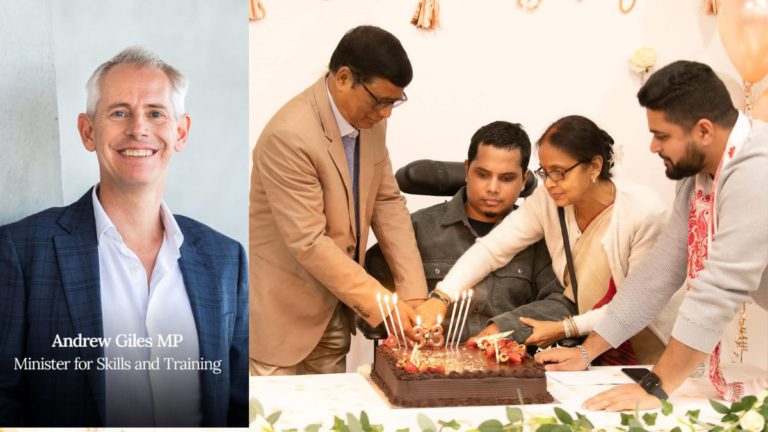
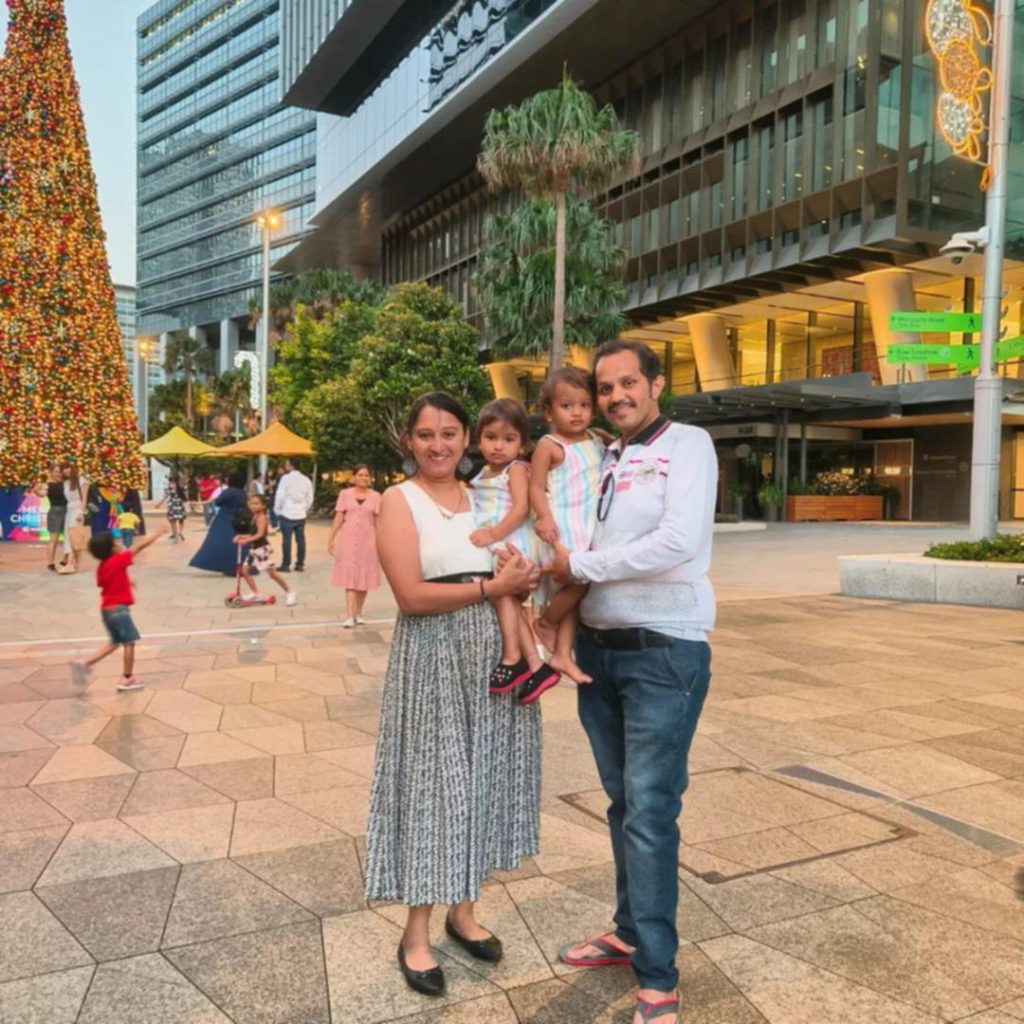
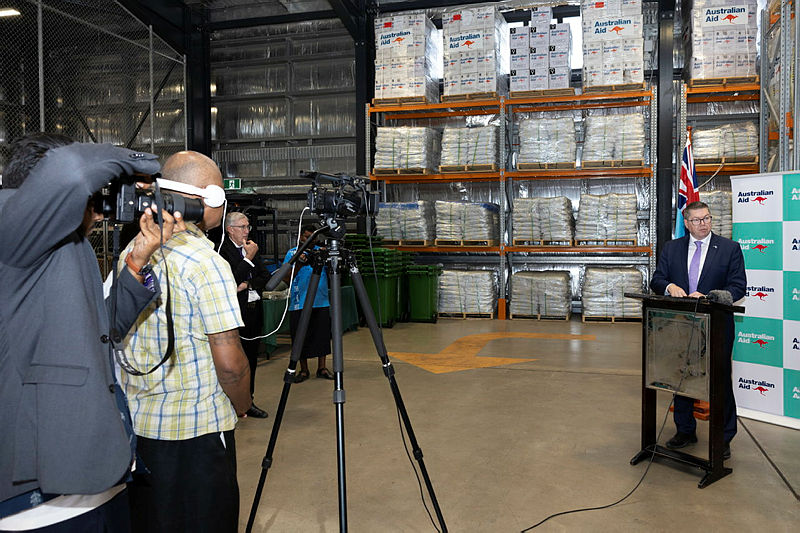
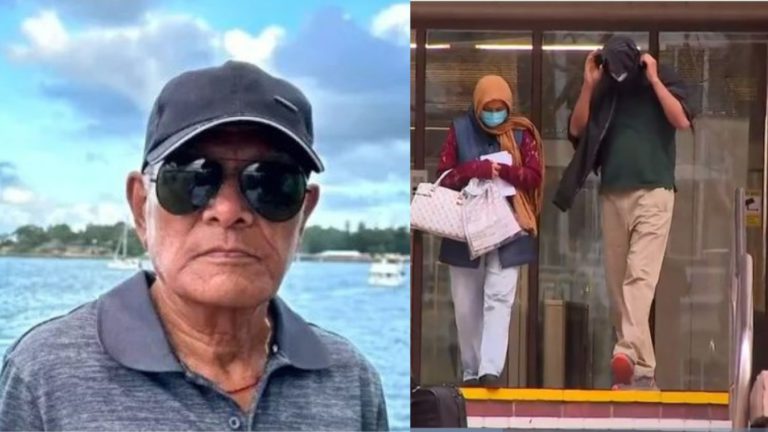
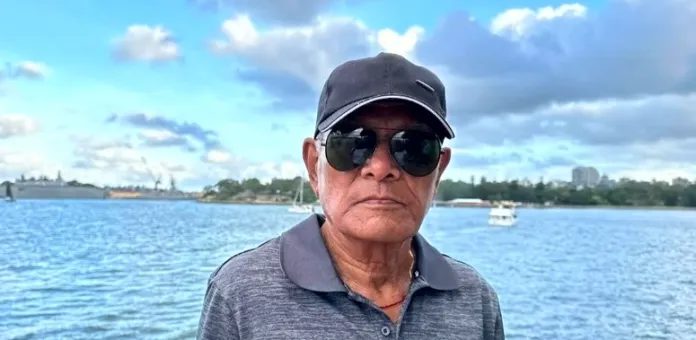
Devarshi Deka, an Indian international student who was left paraplegic following an alleged attack in Hobart, has been granted permanent residency in Australia. Late on Sunday, outgoing Immigration Minister Andrew Giles approved the visa, a decision that brought immense relief to Mr Deka and his supporters.
Rick Kaushik, a friend and advocate for Mr. Deka, shared the emotional moment on social media. “Dev was so happy … he was in tears. And now he doesn’t have to go back to India, his care can be taken care of,” Mr Kaushik said.
He added, “I was just with his family … it’s been a struggle. It was not easy. It tested every bit of everybody involved in this process. We had to work really, really hard, but at the end, we did get the result.”
Screenshot
The announcement came just an hour after Mr Deka’s student visa expired. Mr Kaushik recounted the moment the news arrived.
“His parents cried out really loud, they were thanking him [the government officer], thanking the government,”
he said.
Mr Deka, a 33-year-old University of Tasmania student, was placed in an induced coma last November following an alleged assault during a night out with friends in Hobart. Upon waking months later, he was found to have lost significant brain function, was gradually losing his sight, and was unlikely to walk again.
Since the incident, Mr Deka has been receiving care at Hobart’s repatriation hospital. However, his family and friends were deeply concerned about his future, particularly given that his student visa did not grant access to Centrelink or the National Disability Insurance Scheme. The fear was that without these supports, returning to India might be his only option.
Rick Kaushik led efforts to secure Mr Deka’s permanent residency, including raising funds through crowdfunding and advocating through a community campaign.
“In the last few weeks, things have moved very quickly. They (the department) have asked for documents from Dev … for the ministerial intervention,” Mr Kaushik explained.
The campaign saw support from various quarters, including Tasmanian Labor MP Josh Willie and Greens MP Helen Burnett.
Minister Giles had sought a briefing on visa options for Mr Deka in June, and in what appeared to be one of his final acts as Immigration Minister, he granted the visa via ministerial intervention.
“This is not just a visa, it’s an entire life,” Mr. Kaushik emphasised.
“They’ve actually given him a second life by keeping him here and giving him the care he deserves.”
The decision to grant permanent residency to Mr Deka underscores the importance of compassion and support for those in vulnerable positions. As Mr. Kaushik poignantly noted, this move by the federal government is about more than legal status; it’s about giving someone a chance at a better quality of life.
Support Our Journalism
Global Indian Diaspora and Australia’s multicultural communities need fair, non-hyphenated, and questioning journalism, packed with on-ground reporting. The Australia Today – with exceptional reporters, columnists, and editors – is doing just that. Sustaining this needs support from wonderful readers like you.
Whether you live in Australia, the United Kingdom, Canada, the United States of America, or India you can take a paid subscription by clicking Patreon and support honest and fearless journalism.
At approximately 10:43 am on Sunday, 28 July, emergency services were called to Macklin Street in Adelaide, South Australia, following reports that a child riding a bike had been allegedly struck by a taxi.
Image: CCTV footage (Source: 7News screenshot)
The child, a four-year-old boy, was taken to the hospital for treatment of serious injuries, which were not considered life-threatening.
The driver, a 51-year-old man, was not injured, and his vehicle was towed from the scene for examination. He is assisting police with their enquiries.
South Terrace was closed for several hours but has since reopened.
Image: CCTV footage (Source: 7News screenshot)
Major Crash Investigators attended the scene to assist local traffic officers with the investigation.
Police are asking anyone who may have witnessed the incident or who may have dashcam footage to contact Crime Stoppers on 1800 333 000 or visit www.crimestopperssa.com.au.
Support Our Journalism
Global Indian Diaspora and Australia’s multicultural communities need fair, non-hyphenated, and questioning journalism, packed with on-ground reporting. The Australia Today – with exceptional reporters, columnists, and editors – is doing just that. Sustaining this needs support from wonderful readers like you.
Whether you live in Australia, the United Kingdom, Canada, the United States of America, or India you can take a paid subscription by clicking Patreon and support honest and fearless journalism.
The accused – two relatives of the boy and one relative of the girl – appeared in Perth Magistrates Court on 26 July 2024. Each faces one count of causing a person to enter into a forced marriage in circumstances of aggravation, contrary to sections 270.7B(1) and 270.8 of the Criminal Code 1995 (Cth). The case has been adjourned until August 2024.
The maximum penalty for this offence is nine years’ imprisonment.
Police allege that the teenagers, aged between 13 and 15 and 17 respectively, wanted to date each other but were compelled to marry for cultural reasons by their relatives. The men allegedly facilitated the marriage in a religious ceremony last year (2023).
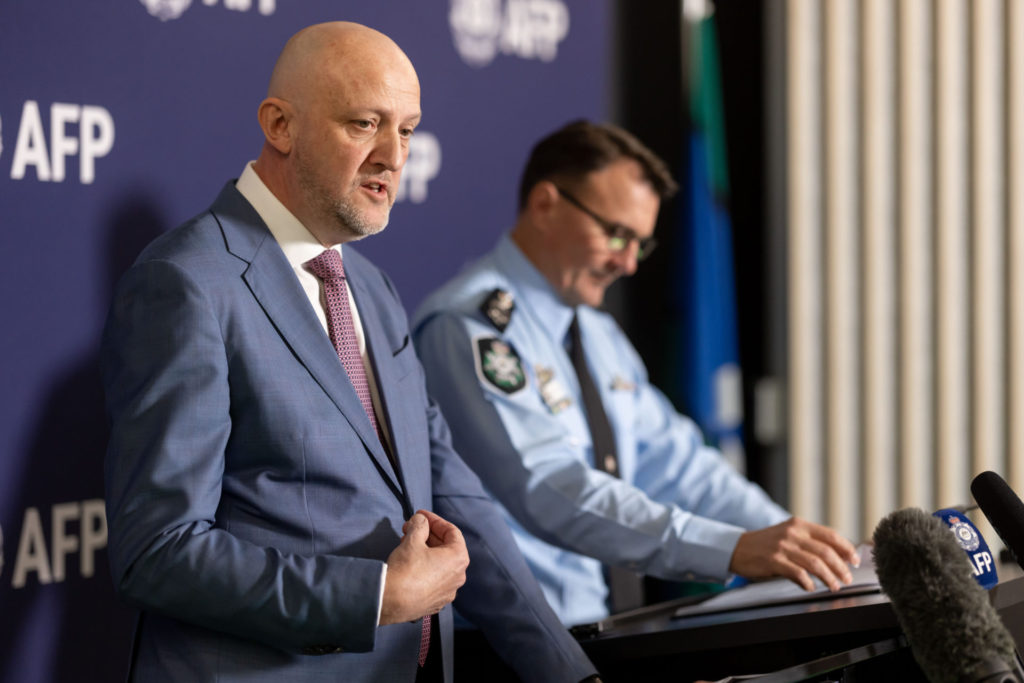
AFP Detective Superintendent Peter Chwal explained that a forced marriage occurs when a person marries without freely and fully consenting, due to coercion, threats, deception, or incapacity to understand the marriage ceremony due to age or mental capacity.
“The legal age for marriage in Australia is 18; and while a child aged 16 to 18 can obtain permission from a court to marry, the person they wed must be an adult,” said Det-Supt Chwal.
He highlighted the complexity of forced marriage cases, noting that they often involve family members as both victims and perpetrators. The AFP prioritises the wellbeing and safety of victims.
“Our key focus is to disrupt and prevent this crime by raising awareness of Australian laws, recognising the warning signs of forced marriage, and providing support to victims,” he stated.
Det-Supt Chwal urged victims to seek help from various services and agencies if they are uncomfortable speaking directly to the police.
“Forced marriage is not limited to any cultural group, religion, or ethnicity. Anyone can be a victim, regardless of their age, gender, or sexual orientation,” he added.
Forced marriage has been illegal in Australia since 2013. This law applies to legally recognised marriages, cultural or religious ceremonies, and marriages occurring both within Australia and abroad. It also covers the conduct of those facilitating forced marriages.
Support Our Journalism
Global Indian Diaspora and Australia’s multicultural communities need fair, non-hyphenated, and questioning journalism, packed with on-ground reporting. The Australia Today – with exceptional reporters, columnists, and editors – is doing just that. Sustaining this needs support from wonderful readers like you.
Whether you live in Australia, the United Kingdom, Canada, the United States of America, or India you can take a paid subscription by clicking Patreon and support honest and fearless journalism.
Social media is a problem for economists. They don’t know how to value it.
It has long been argued that it ought to be in the national accounts as part of gross domestic product. One 2019 study estimated Facebook alone is worth US$40 to US$50 per month for consumers in the United States.
But that’s not what we pay. Social media isn’t charged for, and the national accounts measure only the things we pay for, no matter how significant they are in our lives and how many hours per day we spend using them.
As the Australian Senate prepares to hold an inquiry into the impact of social media, economists meeting in Adelaide at the annual conference of the Economic Society of Australia have been presented with new findings about the value of social media that point in a shocking direction. They suggest it is negative.
That’s right: the findings suggest social media is worth less to us than the zero we pay for it. That suggests we would be better off without it.
Better off without social media?
Leonardo Bursztyn of the University of Chicago presented the findings in the keynote address to the conference.
The findings are shocking because they upend one of the tenets of modern economics – that we value the things we do. Put differently, it’s that our behaviour is the best indication of our preferences. The man who developed this theory of revealed preference went on to win the Nobel Prize in Economics.
Here’s what Bursztyn and his colleagues did.
They surveyed more than 1,000 US university students, asking a series of questions about TikTok, Instagram and Google Maps (more about maps later).
The first set of questions was designed to ascertain how much they would need to be paid (or would be prepared to pay) to be off TikTok and Instagram for a month.
What’s it worth to disconnect for a month?
The questions get at the answer by repeatedly offering different prices until one is accepted. The students are told one of them will be chosen at random to actually get (or pay) the money and be monitored to ensure they stick to the deal.
The answers suggest users value these platforms a lot, on average by US$59 per month for TikTok and $47 for Instagram. An overwhelming 93% of TikTok users and 86% of Instagram users would be prepared to pay something to stay on them.
Encouragingly, these figures are in the ballpark of those found by otherstudies.
Then Bursztyn and colleagues asked a second set of questions:
If two-thirds of the students on your campus sign up to deactivate, how much would you need to be paid (or be prepared to pay) to sign up too?
Here the answers – obtained by the same sort of repeated offers and an assurance that that previous studies had found nearly all of those who signed up would comply – were in the opposite direction.
Most of the TikTok users (64%) and almost half of the Instagram users (48%) were prepared to pay to be off them, so long as others were off them, resulting in average valuations across all users of minus US$28 for TikTok and minus $10 for Instagram.
Many users would prefer TikTok didn’t exist
The finding is a measure of the extent to which many, many users hate TikTok and Instagram, even though they feel compelled to use them.
To make clear the bizarre nature of his finding, Bursztyn drew the the conference’s attention to another product, a refrigerator.
Could you imagine, he asked, 60% of refrigerator owners saying they wished fridges didn’t exist?
The relationship he has uncovered is more like the co-dependence seen in a destructive relationship, or the way we relate to addictive products such as tobacco that we know are doing us harm.
Bursztyn and his colleagues wanted to make sure it wasn’t repugnance towards technology and big tech that was driving their findings. So they asked questions about digital maps.
Whereas 57% of Instagram users would prefer a world without Instagram, only 4% of maps users would prefer a world without digital maps.
Fear of missing out drives staying in
Asked why those users who would prefer a world without their platform continued to use it, three-quarters of Instagram users and one-third of TikTok users gave an answer that was coded as fear of missing out, or FOMO.
The phrases used included “if I stop using it, I will be completely out of the loop”.
Other important reasons were classified as “entertainment” (37% for TikTok, 21% for Instagram) and “addiction” (34% and 10%).
To test for these product market traps outside of social media, Bursztyn and colleagues surveyed owners of luxury brands such as Gucci, Versace, Rolex and found 44% would prefer to live in a world without them.
That non-users would like to wipe these brands from the face of the earth isn’t new. What seems to be new is the finding that actual users feel the same way.
iPhone users want fewer new models
In the case of iPhones, users would simply like fewer new models. Bursztyn and colleagues found an astonishing 91% of iPhone owners would prefer Apple to release a new model only every second year, instead of every year.
It’s advice Apple doesn’t need to heed. Many of these customers will keep buying the new models because they don’t want to miss out, even though they would rather not be placed in that situation.
For economists, the findings suggest there’s an unusual class of products that are worth less than people are prepared to pay for them, even when that price is zero.
For the Australian Senate, about to begin an inquiry, the findings suggest that it’s okay to crack down hard on social media, even though a lot of people use it. Many of them would be grateful.
Global Indian Diaspora and Australia’s multicultural communities need fair, non-hyphenated, and questioning journalism, packed with on-ground reporting. The Australia Today – with exceptional reporters, columnists, and editors – is doing just that. Sustaining this needs support from wonderful readers like you.
Whether you live in Australia, the United Kingdom, Canada, the United States of America, or India you can take a paid subscription by clicking Patreon and support honest and fearless journalism.
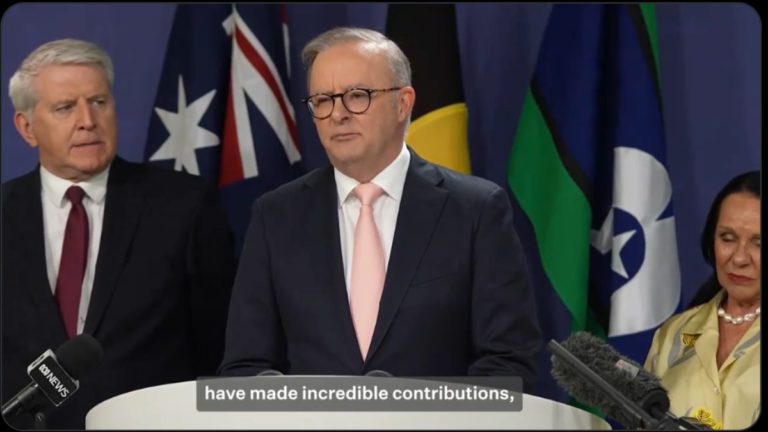
Prime Minister Anthony Albanese has announced changes to the Cabinet and Ministry, drawing on the strength and depth of the Parliamentary Labor Party. The reshuffle comes as senior ministers Linda Burney and Brendan O’Connor prepare to retire at the next federal election, alongside the resignation of Senator Carol Brown from her Assistant Minister role due to health reasons.
“I am proud to lead a talented and united cabinet government that is focused every day on continuing to deliver better outcomes and more opportunities for all Australians,” Albanese stated.
“Our Ministers work together, listen to each other and acts decisively with purpose. We are proud of what we have delivered for Australians and the progress we have made together.”
Key Cabinet Changes
Tony Burke MP has been appointed Minister for Home Affairs, Minister for Immigration and Multicultural Affairs, Minister for Cyber Security, and Minister for the Arts, while retaining his role as Leader of the House.
Julie Collins MP will take on the roles of Minister for Agriculture, Fisheries and Forestry, and Minister for Small Business.
Senator Murray Watt has been promoted to Minister for Employment and Workplace Relations.
Clare O’Neil MP will now serve as Minister for Housing and Minister for Homelessness.
Senator Malarndirri McCarthy has been named Minister for Indigenous Australians.
Pat Conroy MP will assume the roles of Minister for Defence Industry and Capability Delivery, and Minister for International Development and the Pacific.
Ministry Changes
Andrew Giles MP is the new Minister for Skills and Training.
Senator Jenny McAllister will serve as Minister for Cities and Minister for Emergency Management.
Assistant Ministry Changes
Matt Thistlethwaite MP is the new Assistant Minister for Immigration.
Patrick Gorman MP will be Assistant to the Prime Minister, Assistant Minister for the Public Service, and Assistant Minister to the Attorney-General.
Ged Kearney MP has been appointed Assistant Minister for Health and Aged Care, and Assistant Minister for Indigenous Health.
Senator Tim Ayres will be Assistant Minister for a Future Made In Australia, and Assistant Minister for Trade.
Senator Anthony Chisholm takes on roles as Assistant Minister for Education, Assistant Minister for Regional Development, and Assistant Minister for Agriculture, Fisheries and Forestry.
Kate Thwaites MP is the new Assistant Minister for Social Security, Assistant Minister for Ageing, and Assistant Minister for Women.
Josh Wilson MP has been appointed Assistant Minister for Climate Change and Energy.
Julian Hill MP is the new Assistant Minister for Citizenship and Multicultural Affairs.
Special Envoy Changes
Peter Khalil MP will serve as Special Envoy for Social Cohesion.
Luke Gosling MP is appointed as Special Envoy for Defence, Veterans’ Affairs and Northern Australia.
Andrew Charlton MP will be Special Envoy for Cyber Security and Digital Resilience.
Prime Minister Albanese paid tribute to the outgoing ministers, stating, “We pay tribute to Brendan O’Connor and Linda Burney for their outstanding contribution to our Government and our nation, and after decades of public service, we respect their decision to retire at the next election.”
The reshuffle aims to maintain stability and certainty while elevating new voices within the government. The new members of the Ministry are expected to be sworn in tomorrow, Monday, July 29, 2024.
Support Our Journalism
Global Indian Diaspora and Australia’s multicultural communities need fair, non-hyphenated, and questioning journalism, packed with on-ground reporting. The Australia Today – with exceptional reporters, columnists, and editors – is doing just that. Sustaining this needs support from wonderful readers like you.
Whether you live in Australia, the United Kingdom, Canada, the United States of America, or India you can take a paid subscription by clicking Patreon and support honest and fearless journalism.
Solomon Islands news organizations suspect they have been targeted in an orchestrated complaints campaign after social media giant Facebook started deleting posts and blocking their stories.
Outlets said their reportage started disappearing from the platform this week after receiving notices from parent-company Meta advising their posts went against its community standards, were spam, or were shared to get likes and follows in a misleading way.
Facebook is by far the most widely and frequently used social media platform in the Pacific, according to research published by Australia’s Lowy Institute.
Investigative news website In-depth Solomon Islands said 125 of their posts were taken down in what it called a “disaster” for their distribution.
“All our big stories relating to geopolitics were removed on Wednesday. On Tuesday, we published three stories on Prime Minister Manele’s return from China, which were all removed as well,” In-depth Solomon Island journalist Charley Piringi told BenarNews.
Facebook representative Cheryl Seeto said the content was removed due to a technical error and has since been restored.
“There was nothing deliberate involved,” she told BenarNews.
All of the 125 In-depth Solomons posts removed by Meta were restored on Friday.
Despite the reappearances, a leading Solomon Islands opposition parliamentarian, Peter Kenilorea Jr, posted to Facebook on Friday that an In-depth Solomons story he shared in January about Chinese interference in local media had been classified by Meta as spam and removed.
Numerous comments on his post reported a similar experience.
Two other independent media outlets in Solomon Islands – Tuvali News and SBM Online – also told BenarNews some of their stories had been taken down by Facebook.
Solomon Islands controversially switched diplomatic recognition from Taiwan to China in 2019, making it a main focus of the geo-strategic contest for influence in the Pacific with Australia, United States and their allies.
Media in the Pacific island nation of 740,000 people have seen an upsurge of funding, training and material support from foreign governments, donors and media organizations – including the BBC and Australian Broadcasting Corporation – while China has funded trips to Beijing for journalists.
The Media Association of Solomon Islands last September warned the country’s media is “seen primarily as a tool for propaganda rather than as a vital partner in the democratic process.”
An In-depth Solomons investigation in 2023 reported the Solomon Star newspaper received U.S. $140,000 in funding from the Chinese government in exchange for promoting “the truth about China’s generosity and its true intentions to help develop” the country.
Solomon Star then editor Alfred Sasako repeatedly said the paper remains independent and accepted the money from China only after having for years failed to source funding from Australia.
In-depth Solomon Islands editor Ofani Erema, an affiliate of the Organized Crime and Corruption Reporting Project, suspects they were the victims of bogus terms of service complaints to Meta.
“We firmly believe we’ve been targeted for the journalism we are doing here in Solomon Islands,” Eremae told BenarNews on Thursday.
He said their content removal may have been the result of a coordinated campaign by critics to file bogus terms of service complaints to Facebook.
“We don’t have any evidence at this stage on who did this to us, but we think people or organizations who do not want to see independent reporting in this country may be behind this.”
Disclaimer: This news article was originally published in Benar News and is re-published here with the editor(s)’ kind permission. The views expressed in this article are those of the original author and do not necessarily reflect the views of our publication. We are not responsible for any errors or omissions in the content.
Support Our Journalism
Global Indian Diaspora and Australia’s multicultural communities need fair, non-hyphenated, and questioning journalism, packed with on-ground reporting. The Australia Today – with exceptional reporters, columnists, and editors – is doing just that. Sustaining this needs support from wonderful readers like you.
Whether you live in Australia, the United Kingdom, Canada, the United States of America, or India you can take a paid subscription by clicking Patreon and support honest and fearless journalism.
In the next 40 years in Australia, it’s predicted the number of Australians aged 65 and over will more than double, while the number of people aged 85 and over will more than triple.
If you’re not really interested in aged care, you should be. Given these figures, you will almost certainly be engaging with aged care services at some stage – either for yourself, or supporting family members or friends seeking aged care.
One service you are likely to encounter is residential aged care homes. In the past few years this sector has been under more scrutiny than ever before. Changes to legislation, workforce and funding are in motion. But the question remains as to whether these changes can happen fast enough to meet our ageing population’s needs.
One area of need not being adequately met at present is nutrition. In a new study, we’ve found four in ten older Australians living in residential aged care are not receiving enough of the right types of nutrients, resulting in loss of weight and muscle. This is known as malnutrition.
Good nutrition is essential for healthy ageing
Malnutrition in older people is associated with poorer overall health, such as increased risk of falls and infections. This can accelerate loss of independence for older people, including the need for extra assistance with basic activities such as bathing and dressing.
Older people are at increased risk of malnutrition for a range of reasons. These can include decreased appetite, difficulties with chewing and swallowing, and the presence of other chronic diseases such as Parkinson’s disease or dementia.
Importantly, ensuring adequate nutrition is about more than just offering healthy foods. We eat not only to meet nutritional requirements, but for enjoyment and socialisation. We each have different preferences around what we want to eat, when and with whom.
Food provision poses a challenge for residential aged care providers who must navigate the range of residents’ preferences together with dietary restrictions and texture modifications. This must also be balanced against the practicalities of having the right number of appropriately trained kitchen and mealtime assistance staff, and working within funding constraints.
Understanding more about who is malnourished in aged care can help providers better address this problem.
Malnutrition is an ongoing problem in aged care
We looked at more than 700 aged care residents in New South Wales, Queensland and South Australia. We assessed participants for malnutrition using a screening tool that collects data on medical history and dietary intake, and includes a physical examination of muscle and fat.
We found 40% were malnourished, including 6% who were severely malnourished. This likely underestimates the true rate of malnutrition, as residents with dementia were excluded. International studies have shown an average of 80% of aged care residents with dementia are malnourished or at risk of developing malnutrition.
Our findings are broadly in line with a synthesis of 38 international studies, which reported an average malnutrition rate in residential aged care of 52%.
In Australia, malnutrition was highlighted as a priority for immediate attention in the 2021 Royal Commission into Aged Care Quality and Safety. Its report cited an Australian study of 215 residents, published in 2017, which found 68% were malnourished or at risk of malnutrition.
It’s difficult to directly compare malnutrition rates between studies due to differences in diagnostic measurements. But it’s clear malnutrition is an ongoing challenge in aged care.
What can we do about it?
Since the royal commission, we’ve seen the strengthening of the quality standards to be included in the new Aged Care Act, anticipated to be introduced to parliament in 2025.
The strengthened quality standards provide an important framework to guide action by aged care providers on malnutrition. Key requirements include partnering with residents to design food options, regular assessment and reassessment of resident nutrition requirements, developing systems to monitor and improve satisfaction with food, designing pleasant dining environments, and providing staff with the training they need to achieve all of the above.
However, achieving these standards will require investment of money and time. At the moment, 64% of residential aged care providers in Australia are operating at a financial loss. While we know carers and facility managers want to provide the best care possible, it’s difficult to achieve this when contending with underlying financial problems.
As such, our teams at Monash and Griffith universities are focusing on strategies that minimise the burden on staff and providers.
We are working on automating malnutrition screening. Current tools take 10–15 minutes and should be used when a new resident moves into an aged care home and regularly during their stay. But anecdotal evidence suggests providers lack the staff and funding needed to routinely carry out this screening.
Instead, we aim to use existing data from aged care providers, including quarterly reports from the National Aged Care Mandatory Quality Indicator Program, to detect malnutrition automatically. This will allow staff to focus more on care.
Given the complexity of malnutrition, it’s likely that addressing the issue at a national scale will take some time. In the short term, for those with loved ones in aged care homes, we encourage you to be actively involved in their care, including noticing and speaking up if you think more can be done to optimise their nutrition.
Global Indian Diaspora and Australia’s multicultural communities need fair, non-hyphenated, and questioning journalism, packed with on-ground reporting. The Australia Today – with exceptional reporters, columnists, and editors – is doing just that. Sustaining this needs support from wonderful readers like you.
Whether you live in Australia, the United Kingdom, Canada, the United States of America, or India you can take a paid subscription by clicking Patreon and support honest and fearless journalism.
The Paris Olympics 2024 opening ceremony left many Australians frustrated, fearing they had missed the Aussie team’s grand arrival. The event began at 7:30 pm local time (3:30 am Saturday AEST) and featured athletes parading in barges along the River Seine for six kilometres.
Hundreds of thousands of people, including 320,000 ticket-holders, lined the Seine’s banks, while an estimated three billion viewers tuned in worldwide.
French President Emmanuel Macron acknowledged the ambitious nature of the river ceremony, saying, “At the beginning, it seemed to be a crazy and not very serious idea. But we decided it was the right moment to deliver this crazy idea and make it real.”
As the host of Brisbane 2032, Australia was positioned third last in the order of nations, before the United States (hosts of Los Angeles 2028) and France.
However, as rain and cold weather dampened the atmospherea little bit, and Australian sports fans were left puzzled. With countries joining the parade in alphabetical order, viewers took to social media when Bahrain appeared before Australia, thinking Australia had been left out.
This detail was unclear, and when Lady Gaga appeared on screen, many believed the Australian athletes were excluded.
As tradition, Greece leads the Parade of Nations, then Refugee Olympic Team, then countries alphabetically in French. Last 3 teams in the parade are current/future Summer #Olympics hosts — in parade order, Australia (2032), USA (2028), France (2024 host) #OpeningCeremonypic.twitter.com/LgK8znJPK7
Eventually, the Australian team did appear and seemed to enjoy themselves. Proudly waving the flag from the top deck of the boat as they led the Australian Team, both Jessica Fox (canoe slalom) and Eddie Ockenden (hockey) carved their own history on the eve of the Games.
Jessica, as the first Australian to compete in Canoe Slalom at four Olympic Games, and Eddie, the first Australian hockey player to compete at five Games, joined the illustrious list of Australians to have carried the flag before them.
Paris Olympic ceremony was notably different, featuring dancers on every bridge along the parade route and performances by Lady Gaga and Celine Dion. The ceremony fused sport and art to take athletes and spectators out of a stadium and onto the streets of Paris.
Over the next 16 days, the country will rally together to cheer on the 460-strong Australian Team competing across 33 sports.
Support Our Journalism
Global Indian Diaspora and Australia’s multicultural communities need fair, non-hyphenated, and questioning journalism, packed with on-ground reporting. The Australia Today – with exceptional reporters, columnists, and editors – is doing just that. Sustaining this needs support from wonderful readers like you.
Whether you live in Australia, the United Kingdom, Canada, the United States of America, or India you can take a paid subscription by clicking Patreon and support honest and fearless journalism.
In a significant breakthrough, Indian authorities have arrested and charged a man this week in connection with the alleged sexual abuse and intimidation of a girl from Western Australia (WA).
It is reported that the alleged abuse, which began when the girl was just 11 years old, took place on social media platforms Instagram and WhatsApp.
The case came to light in 2023 when Detectives from Child Exploitation Operations (CEO) were alerted to the distressing situation involving the young girl, who was a victim of the alleged online grooming, sextortion, and other offences dating back to 2020. The prolonged abuse resulted in severe trauma for the girl.
Upon investigation, CEO detectives identified that the perpetrator was residing in India. The detectives shared their findings with the National Centre for Missing and Exploited Children (NCMEC). Following extensive inquiries, the matter was escalated to Indian authorities via Interpol.
India’s Central Bureau of Investigation (CBI) took swift action, arresting a man from Indore, Madhya Pradesh.
The man has now been charged with criminal intimidation, transmitting material depicting children in sexually explicit acts, and sexual harassment of a child with sexual intent.
The CBI utilised advanced geolocation techniques to track the suspect and executed a search warrant, leading to the seizure of incriminating materials.
This arrest marks a crucial step in addressing the global issue of online child exploitation and ensuring justice for the young victim.
Support Our Journalism
Global Indian Diaspora and Australia’s multicultural communities need fair, non-hyphenated, and questioning journalism, packed with on-ground reporting. The Australia Today – with exceptional reporters, columnists, and editors – is doing just that. Sustaining this needs support from wonderful readers like you.
Whether you live in Australia, the United Kingdom, Canada, the United States of America, or India you can take a paid subscription by clicking Patreon and support honest and fearless journalism.
In celebration of the 25th anniversary of its launch, NASA’s Chandra X-ray Observatory has released 25 stunning, never-before-seen images of a variety of cosmic objects.
These images, showcasing data from Chandra, highlight how X-ray astronomy allows us to explore the universe’s farthest reaches.
By integrating X-rays from Chandra with data from other space-based observatories and ground-based telescopes, astronomers can address some of the most profound questions and long-standing mysteries of the cosmos.
Launched on July 23, 1999, aboard the space shuttle Columbia, Chandra was the heaviest payload ever carried by the shuttle at that time. With Commander Eileen Collins at the helm, the Columbia crew successfully deployed Chandra into a highly elliptical orbit, extending nearly one-third of the distance to the Moon.
“For a quarter century, Chandra has made discovery after amazing discovery,” said Pat Slane, director of the Chandra X-ray Center at the Smithsonian Astrophysical Observatory in Cambridge, Massachusetts.
“Astronomers have used Chandra to investigate mysteries that we didn’t even know about when we were building the telescope — including exoplanets and dark energy.”
X-rays, a highly penetrating form of light, reveal extremely hot objects and energetic physical processes in space. Chandra has been instrumental in studying various celestial phenomena, such as the debris from exploded stars and material swirling around black holes. Stars, galaxies, and even planets emit X-rays that can be studied using Chandra.
“Chandra has been a great success story for humanity and its pursuit of knowledge,” said Andrew Schnell, acting project manager of NASA’s Chandra X-ray Observatory at the Marshall Space Flight Center in Huntsville, Alabama.
“Chandra’s incredible accomplishments are made possible by the team’s hard work and dedication.”
The newly released images are a sample from nearly 25,000 observations Chandra has conducted during its 25 years in space. The mission that eventually became Chandra was first proposed to NASA by Riccardo Giacconi and Harvey Tananbaum in 1976.
Chandra was later selected as one of NASA’s “Great Observatories,” alongside the Hubble Space Telescope and the now-retired Compton Gamma Ray Observatory and Spitzer Space Telescope, each observing different types of light.
In 2002, Riccardo Giacconi was awarded the Nobel Prize in Physics for his pioneering contributions to astrophysics, which led to the discovery of cosmic X-ray sources and laid the groundwork for Chandra’s development and launch.
For 25 years, @chandraxray has given us the x-ray vision to see galaxies and star clusters form, peer into black holes, and study worlds beyond our solar system.
Today, astronomers continue to use Chandra data alongside other powerful telescopes, including NASA’s James Webb Space Telescope and the Imaging X-ray Polarimetry Explorer (IXPE).
Recent collaborations between Chandra and Webb have led to the discovery of evidence for two of the most distant black holes ever observed. Additionally, work with IXPE has uncovered the “bones” of a ghostly cosmic hand, created by a pulsar.
Chandra’s scientific contributions have led to over 700 PhDs and have supported a diverse talent pool of more than 3,500 undergraduate and graduate students, 1,700 postdocs, and over 5,000 unique principal investigators worldwide. The telescope remains in high demand, with only about 20% of requested observing time approved.
Scientists have published over 10,000 peer-reviewed papers based on Chandra data, amassing almost half a million citations, making it one of NASA’s most productive astrophysics missions.
“On behalf of the STS-93 crew, we are tremendously proud of the Chandra X-ray Observatory and its brilliant team that built and launched this astronomical treasure,” said Eileen Collins, commander of the Columbia mission that launched Chandra.
“Chandra’s discoveries have continually astounded and impressed us over the past 25 years.”
The Chandra program is managed by NASA’s Marshall Space Flight Center, with the Smithsonian Astrophysical Observatory’s Chandra X-ray Center overseeing science from Cambridge, Massachusetts, and flight operations from Burlington, Massachusetts. Northrop Grumman in Redondo Beach, California, was the spacecraft’s prime contractor.
Support Our Journalism
Global Indian Diaspora and Australia’s multicultural communities need fair, non-hyphenated, and questioning journalism, packed with on-ground reporting. The Australia Today – with exceptional reporters, columnists, and editors – is doing just that. Sustaining this needs support from wonderful readers like you.
Whether you live in Australia, the United Kingdom, Canada, the United States of America, or India you can take a paid subscription by clicking Patreon and support honest and fearless journalism.
Australia was slow to introduce minimum building standards for energy efficiency. The Nationwide House Energy Rating Scheme (NatHERS) only came into force in 2003.
Older homes tend to have very poor energy efficiency. They need more electricity or gas to heat to a comfortable temperature, and more electricity to cool them in summer. This can get expensive.
We now suspect the energy efficiency of a person’s home also shapes how they respond to electricity rates that vary with time of use.
Our research suggests people in homes with low energy efficiency are turning off their heaters more when they’re on time-of-use rates, which likely means colder homes. But those in more efficient homes didn’t reduce their use or save money on time-of-use rates, even though they should be more able to shift demand to cheaper off-peak times without causing themselves discomfort.
What’s the point of time-varying rates?
Time-varying rates are becoming more common. Their purpose is to provide an incentive (lower rates) for people to use more electricity when it’s plentiful, and less electricity when expensive gas peaking plants need to be turned on at times of high demand (when higher “peak” rates apply).
For time-of-use rates (a subset of time-varying rates), peak times usually follow a set schedule. Costs are higher in the early morning and in the evening, matching when people leave for work and return home.
By nudging demand to better match supply, these rates might allow us to defer expensive upgrades to the power grid and investments in batteries (or, worse, more gas-fired generation with its carbon dioxide emissions).
However, these time-varying rates rely on the assumption that people can shift their electricity use to times when it’s cheaper. That’s not always the case.
People might not be home during the day to do laundry or dishes at off-peak times. They might have to organise meals, entertainment and cleaning around work and school schedules. They might not know which appliances are most energy-hungry and end up shifting minor uses while keeping major uses during peak times. Or they might simply not be able to shift their electricity use without their home getting too cold or too hot.
How inefficient homes have knock-on effects
Heating and cooling account for up to 50% of energy use in Australian homes, varying by climate zone and heating technology. A simple fan heater or bar heater uses three to six times as much electricity as a reverse-cycle air conditioner to produce the same amount of heat.
If your old home with old technology loses heat almost as fast as you add it, you don’t have many options. You can turn the heater off and avoid the on-peak charges in a chilly house, or leave the heater on and bear the cost.
To understand which option people were choosing, we analysed changes in electricity use and estimated bills for households in the ACT that had moved between time-of-use rates and flat rates. Utility company ActewAGL Retail provided the data.
It looks like people in homes with low energy efficiency are going with the option of turning off their heaters when on time-of-use rates. This saves money – bills for low-efficiency homes were cheaper for those on time-of-use rates than on flat rates.
Because we only have quarterly electricity bills to analyse, we don’t know for certain these people actually felt colder or were turning off the heating as opposed to other electricity uses. But households that relied on electricity for heating reduced their use on time-of-use rates – and it’s pretty hard to be warm in a Canberra winter if your heater is off.
In energy-efficient homes, you should be able to “pre-heat” or “pre-cool” your home during an off-peak time. You can then turn off the heating to avoid higher on-peak costs and your home should stay reasonably comfortable for a while.
But, interestingly, people in high-efficiency homes didn’t reduce their electricity use when on time-of-use rates. Their bills didn’t decrease either.
Where we did see a change for high-efficiency homes, bills and energy use tended to be slightly higher – the opposite of what we expected. We can only speculate on the reasons, but it’s clear time-of-use rates weren’t having the intended effect.
Difference in electricity use when on time-of-use rates instead of flat rates. (90% confidence intervals. Where the confidence interval crosses the zero line, the direction of change is not statistically significant. Full sample is 3,145 households with a mix of heating types; no gas is 1,901 households that do not have gas for heating.) L. White 2024
Building efficiency isn’t the only complication
Time-varying rates can disadvantage vulnerable households in other ways. A study in a US state with a hot climate found electricity bills rose for the elderly and those with disabilities after switching to time-of-use rates.
Both groups are likely to need more electricity to keep their homes warm or to run equipment essential for their health. This means they have less flexibility about when they need to use electricity.
That same study found ethnic minorities had more heat-related health problems after switching to time-of-use rates, although they had lower bills. Households where someone had a disability had both higher costs and worse health outcomes.
What does this mean for Australian homes?
These differences in response to time-varying rates could further widen the gap in home comfort between those who can secure an energy-efficient home and those who can’t. These rates could pinch households even further in a cost-of-living crisis.
If they are on a quarterly billing cycle, this adds to their problems. People can better understand and shift their electricity use when they receive immediate feedback such as through in-home displays.
If households can’t shift their electricity use, time-varying rates won’t achieve the goal of better matching supply and demand. As Australia rolls out these rates, we need to remember not everyone is able to respond to these price signals.
Our housing stock is shaping the way people respond. The divide in energy efficiency will continue to shape a divided response to interlinked energy costs and comfort.
Time-varying rates should be accompanied by more immediate feedback on energy use, more support to upgrade energy efficiency, and ways for people to opt out if these rates aren’t working for them financially. These simple measures have been recommended before, but still aren’t universally in place.
Global Indian Diaspora and Australia’s multicultural communities need fair, non-hyphenated, and questioning journalism, packed with on-ground reporting. The Australia Today – with exceptional reporters, columnists, and editors – is doing just that. Sustaining this needs support from wonderful readers like you.
Whether you live in Australia, the United Kingdom, Canada, the United States of America, or India you can take a paid subscription by clicking Patreon and support honest and fearless journalism.
Four-year-old Jalebi, once a stray dog on the streets of Patiala in Punjab, India, now enjoys a life of comfort with her Alicia and Arun in Melbourne, Australia.
Bringing Jalebi from India to Australia was a very complex and costly mission for Alicia and Arun that cost two years of meticulous planning, extensive paperwork, and an expenditure of approximately $15,000 USD.
In their mission to bring Jalebi home, they received crucial assistance from Pankaj of ‘Guardians of all Voiceless’ in Patiala and the pet relocation company Pet Fly.
Global Indian Diaspora and Australia’s multicultural communities need fair, non-hyphenated, and questioning journalism, packed with on-ground reporting. The Australia Today – with exceptional reporters, columnists, and editors – is doing just that. Sustaining this needs support from wonderful readers like you.
Whether you live in Australia, the United Kingdom, Canada, the United States of America, or India you can take a paid subscription by clicking Patreon and support honest and fearless journalism.
In a spirited prelude to cricket’s anticipated return to the Olympic stage in 2028, the world of defence cricket is set to witness an exhilarating contest at Exercise Pitch Black 2024.
Today Darwin will host a thrilling four-nation T10 tournament featuring elite teams from the Australian Air Force, Indian Air Force, New Zealand Defence Force, and Royal Air Force (UK).
This exciting cricketing tournament promises to showcase not just the prowess of these formidable cricket teams but also the camaraderie and sportsmanship that transcends national boundaries.
Cricket won’t be an Olympic Sport until 2028, but we’re getting in early at exercise #PitchBlack24.🏏
— Royal Australian Air Force (@AusAirForce) July 23, 2024
Exercise Pitch Black 2024, held in Australia from July 12 to August 2, is the largest in its 43-year history, with over 140 aircraft and 4,435 personnel from 20 countries participating.
The participating countries include Australia, Brunei, Canada, Fiji, France, Germany, India, Indonesia, Italy, Japan, Malaysia, New Zealand, Papua New Guinea, the Philippines, Singapore, South Korea, Spain, Thailand, the UK, and the USA.
Another significant development in Pitch Black 2024 is the substantial European involvement, with France, Germany, Italy, Spain, and the UK participating.
During Ex Pitch Black 24, #IAF’s Su-30 MKI performed a spectacular flypast, painting the canvas over Mindil Beach in Australia.@AusAirForce
Air Commodore Peter Robinson, Officer Commanding Exercise from the Royal Australian Air Force (RAAF), stated,
“We have brought like-minded nations that will come together and exercise together. We build capabilities together, we build friendships together, we build relationships together, and we leave the exercise much stronger as partners.”
The unprecedented scale of the exercise underscores growing alarm over Chinese intentions in the Indo-Pacific region and beyond.
However, participants have emphasised that Pitch Black scenarios are not aimed at any single country, such as China. Instead, interoperability is the key aim, as allies must know how to operate together in peacetime, in case they are ever required to fight side by side.
While Exercise Pitch Black 2024 is a testament to the growing unity amongst nations concerned about regional security threats, this four nations T10 Cricket Tournament highlight the global appeal and growing popularity of the game.
Support Our Journalism
Global Indian Diaspora and Australia’s multicultural communities need fair, non-hyphenated, and questioning journalism, packed with on-ground reporting. The Australia Today – with exceptional reporters, columnists, and editors – is doing just that. Sustaining this needs support from wonderful readers like you.
Whether you live in Australia, the United Kingdom, Canada, the United States of America, or India you can take a paid subscription by clicking Patreon and support honest and fearless journalism.
As two senior Labor ministers, Linda Burney and Brendan O’Connor, prepare to retire, speculation mounts over who will fill their positions in the Australian cabinet.
Both ministers will step down at the next federal election in 2025 but are exiting their cabinet roles immediately to allow fresh leadership ahead of the polls.
The resignations have triggered a flurry of activity among Labor heavyweights, who are currently deliberating over potential successors for these key Left faction positions.
Linda Burney and Brendan O’Connor have made an outstanding contribution to our nation.
Today, they have announced they will retire at the next election. They will also step down as Ministers. pic.twitter.com/NYsnMxB9sv
Minister for NDIS Bill Shorten, while addressing the matter on the Today show, emphasised the importance of merit in the selection process, stating, “Loyalty is not always rewarded but merit should be.”
Among the frontrunners is Indigenous Senator Malarndirri McCarthy, who serves as assistant minister to Linda Burney and is widely viewed as her likely successor. Also in the running are NSW Left faction senators Tim Ayres and Jenny McAllister, both considered strong performers, and Queensland Senator Anthony Chisholm, all of whom currently hold assistant minister roles.
Further changes may also be on the horizon for Home Affairs Minister Clare O’Neil and Immigration Minister Andrew Giles. Following significant criticism over the handling of asylum seekers released from immigration detention, there is speculation that Giles might be reassigned.
Opposition Leader Peter Dutton has been vocal about this potential move, remarking,
“If Andrew Giles doesn’t get the flick, I don’t know who does.”
The forthcoming cabinet reshuffle is expected to address the need for more senators in ministerial roles, a move designed to better manage the workload during busy parliamentary sessions. Names such as lower house MPs Ged Kearney and Julian Hill, as well as Northern Territory MP Marion Scrymgour, are being mentioned by insiders.
Prime Minister Anthony Albanese’s decisions, particularly whether to maintain the current size of the cabinet, will determine the final lineup. If Senator McCarthy is promoted, one cabinet spot will remain open, providing opportunities for other potential candidates such as Pat Conroy, another trusted ally of Albanese.
As the NSW and Victorian party branches gear up for pre-selection processes, Linda Burney has expressed her commitment to supporting her successor in the inner-Sydney seat of Barton, which she secured with a significant majority in the 2022 federal election. Meanwhile, Brendan O’Connor’s outer Melbourne seat of Gorton remains a safe Labor seat despite a notable swing towards the Liberals in the last election.
With the full extent of the cabinet shake-up set to be revealed on Sunday, the political landscape is poised for significant changes as Labor positions itself for the upcoming federal election.
Support Our Journalism
Global Indian Diaspora and Australia’s multicultural communities need fair, non-hyphenated, and questioning journalism, packed with on-ground reporting. The Australia Today – with exceptional reporters, columnists, and editors – is doing just that. Sustaining this needs support from wonderful readers like you.
Whether you live in Australia, the United Kingdom, Canada, the United States of America, or India you can take a paid subscription by clicking Patreon and support honest and fearless journalism.
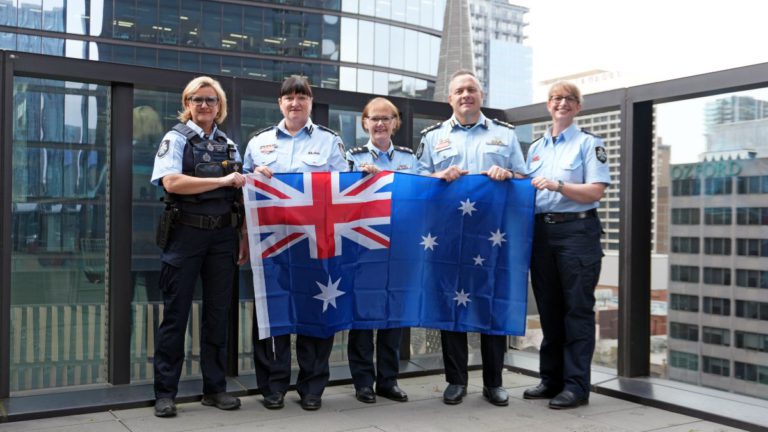
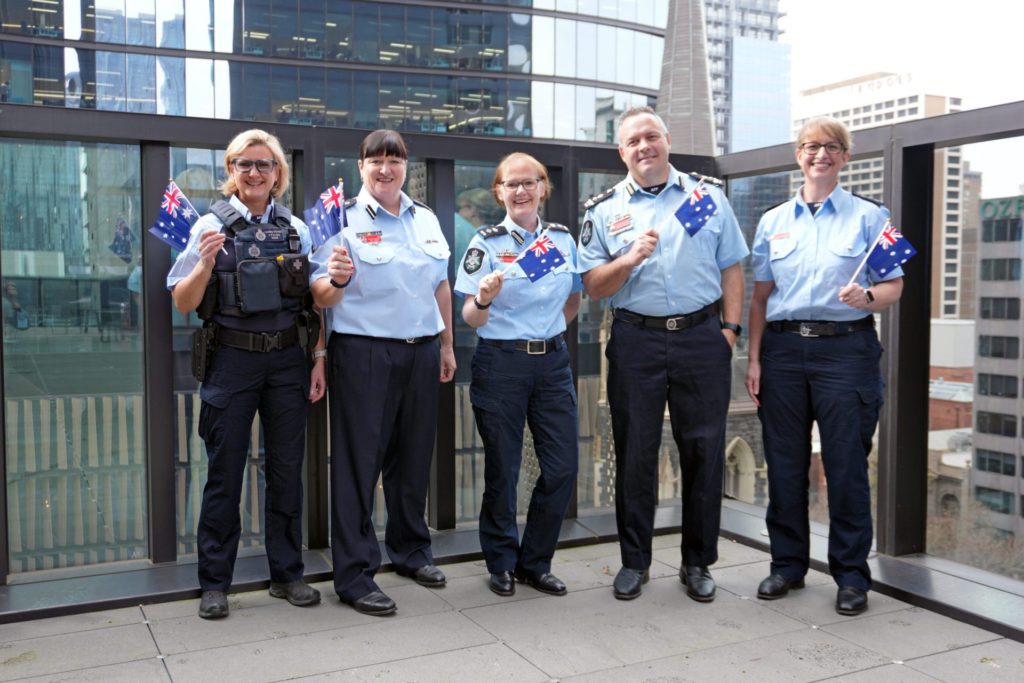
A contingent of AFP officers is deployed in Paris to assist French authorities with the safe and secure delivery of the the 2024 Olympic and Paralympic Games.
The AFP deployment sees AFP officers form part of the major international policing presence at and around the events, with more than 2000 officers from around the world working to support the French Police and Gendarmerie.
A contingent of AFP officers will be deployed to Paris ahead of the 2024 Olympic and Paralympic Games, assisting French authorities with the safe and secure delivery of the events.https://t.co/dKGwFEgXQn
The officers are undertaking joint patrols to enhance the security of sites and surrounds, share intelligence and liaise with international law enforcement partners, and provide security to Australian athletes, dignitaries and attendees, in consultation with French authorities.
They are also supporting their French colleagues in welcoming foreign visitors.
AFP Detective Superintendent Peta Maddigan, the Police Forward Commander for the Paris Olympics, said being invited by French authorities to assist with the Olympic Games demonstrated the strength of the AFP’s relationship with its international policing partners.
“We are proud to be representing the AFP, supporting Australians competing and attending, and contributing to the safe and secure execution of this once-in-a-lifetime event,” Det-Supt Maddigan said.
“The AFP has more than 200 personnel located in 34 countries as part of its international network, which proves to be highly beneficial when organising and representing Australian interests for global events such as the Olympics and Paralympics”.
“These operations highlight the strength of our working relationships with our international partner agencies as well as our relationships with industry, particularly the Australian Olympic Committee and Paralympics Australia,” she said.
Image: Members of AFP deployed in Paris (Source: AFP)
AFP security liaison officers are also working closely with the Australian Olympic Committee and Paralympics Australia to assist with providing a safe and secure environment for Australian athletes and officials.
The AFP Special Events Planning Team (SEPT) will oversee the coordination of the AFP response to the Olympic and Paralympic Games with the provision of operational support until the end of the Games.
The SEPT is responsible for protecting Australians and Australia’s interests at events of national significance. This includes conducting risk assessments, sharing intelligence and coordinating security arrangements.
The team has previously been involved in security planning for the 2023 FIFA Women’s World Cup and the Association of Southeast Asian Nations (ASEAN) Summit in Melbourne this year.
The AFP’s Paris Post, which officially opened in November 2023, will also provide significant logistical support to French Police and the Gendarmerie in the lead up to the event.
Support Our Journalism
Global Indian Diaspora and Australia’s multicultural communities need fair, non-hyphenated, and questioning journalism, packed with on-ground reporting. The Australia Today – with exceptional reporters, columnists, and editors – is doing just that. Sustaining this needs support from wonderful readers like you.
Whether you live in Australia, the United Kingdom, Canada, the United States of America, or India you can take a paid subscription by clicking Patreon and support honest and fearless journalism.
Migrant worker exploitation is entrenched in workplaces across Australia. Tragically, a deep fear of immigration consequences means most unlawful employer conduct goes unreported.
On Wednesday, however, the government officially launched a two-year pilot of innovative visa reforms that could bring these workers out of the shadows.
A new short-term “workplace justice visa” will allow migrant workers to stay and work in Australia for six months while they pursue a labour claim.
There will also be new visa protections for migrants who want to take action against their employers, but might otherwise have stayed silent because they had breached their visa conditions.
These reforms may go much further than recovering entitlements for individual workers. This matters to us all – when claims aren’t pursued, all information about exploitative employers is lost, creating a cycle of impunity.
The innovative structure of these visa protections may substantially expand labour enforcement in Australia.
Why is migrant exploitation so hard to detect?
In previous surveys of thousands of migrant workers, we found three-quarters were paid less than the casual minimum wage. Among underpaid workers, nine in ten told nobody.
Many migrant workers fear that speaking out will jeopardise their current or future visas. And when they reach the end of their stay – and could potentially pursue a labour claim without risking their job or visa – they must swiftly return home.
This problem has existed as long as large numbers of migrants have worked on temporary visas. But the government labour regulator, the Fair Work Ombudsman, has limited enforcement capacity. On top of this, most migrant workers are extremely reluctant to seek its assistance.
In 2017, the federal government attempted to encourage migrants to approach the Fair Work Ombudsman by implementing an “assurance protocol”.
Under this scheme, the Department of Home Affairs committed to generally not cancel a worker’s visa for breaching work conditions, if that worker was assisting the Fair Work Ombudsman with its inquiries. But it has not been effective, with only around 13 migrants gaining protection each year.
This regulatory failure has broader implications. Exploitative employers have come to expect they will not be held to account. Underpayment of migrant workers has become a successful business model, meaning that in some industries, employers who are doing the right thing become uncompetitive.
It also makes it difficult for businesses to detect wage theft or modern slavery in supply chains because migrant workers will not report it to auditors or the regulator.
Bringing workers out of the shadows
The government’s pilot introduces a new temporary “workplace justice visa”. This will allow a migrant to stay in Australia while they pursue a labour claim against their employer, which could include for underpayment, workplace injury, sexual harassment or discrimination.
Importantly, there is no application charge and visa holders will have the right to work in Australia while they pursue any claims.
We proposed these reforms in our 2023 Breaking the Silence report (with Sanmati Verma from the Human Rights Law Centre) and participated in a co-design process with the Department of Home Affairs.
Implementing our recommendation, to apply for the visa in the pilot, a migrant must obtain formal certification. This includes evidence they have experienced workplace exploitation and they are committed to seeking redress.
But significantly, it’s not just the government who can provide this certification. Other third parties that migrants trust – including community-based legal services, trade unions or university legal services – can also play this role.
This is critical because many migrants would never report directly to government – either because they fear the government of their home country or are simply terrified of jeopardising their precious foothold in Australia. Using third-party certifiers means migrants can be highly confident of qualifying for the visa before an application is lodged.
For affected migrants, this transforms the accessibility of justice.
For example, a sponsored worker who was injured at work but too afraid to take action could access a short-term visa to pursue workers compensation before returning home.
Or an exploited backpacker who was about to leave Australia but didn’t want to report sexual harassment during their fruit-picking job could stay for an additional six months to hold their employer to account.
A guarantee against visa cancellation
The Department of Home Affairs is now also prohibited from cancelling the visas of some migrants who have breached their work conditions, as long as they’ve obtained a similar labour claim certification.
For example, an underpaid international student who had worked more than 48 hours a fortnight in breach of their visa – possibly to make ends meet on unlawfully low wages – could now bring a claim against their employer, knowing their visa wouldn’t be cancelled because they’d worked too many hours.
Expanding the enforcement of labour law
By permitting workers to obtain certification from trusted third parties, the pilot visa program provides choice and agency in how they assert their labour rights. This is without precedent anywhere else in the world.
Unlike a scheme which depends on government certification of claims alone, this pilot encourages migrants to join unions and equips unions with a new tool to organise and represent them.
Not only will this embolden exploited workers to come forward, it will also expand the universe of labour law enforcement beyond the Fair Work Ombudsman to union and community lawyers.
This sets the new global best practice for countries seeking to realise migrant workers’ access to justice and business’ accountability for labour exploitation.
Global Indian Diaspora and Australia’s multicultural communities need fair, non-hyphenated, and questioning journalism, packed with on-ground reporting. The Australia Today – with exceptional reporters, columnists, and editors – is doing just that. Sustaining this needs support from wonderful readers like you.
Whether you live in Australia, the United Kingdom, Canada, the United States of America, or India you can take a paid subscription by clicking Patreon and support honest and fearless journalism.
in a further shocking turn of events, 39-year-old grief-stricken Poonam Runwal and Hiya could face deportation from Australia in the coming days in the wake of the Carlton Train station tragedy.
Poonam, originally from Rajasthan, and Anand who grew up in Bangalore, celebrated their 14th wedding anniversary.
Image: Anand and Poonam Runwal (Source: Facebook)
The Runwal family moved to Sydney from India in October 2023 after 40-year-old Anand Runwal secured a job at an IT firm in North Sydney.
On Anand’s skilled worker’s visa application, Daily Mail Australia has revealed that Poonam and the two girls are listed as dependants. This visa was due to expire on 1 August 2024 and Anand was in the process of having it renewed.
It has been revealed that five weeks ago Anand also sought advice on a Facebook community page about the process for applying for fast-tracked passports for both him and his wife, as they were needed to apply for the new visa.
Anand wrote:
“My visa is going to expire on 1 August 2024, whereas my passport has [an] expiry date of February 2025. As per my employer, I need to have at least 12 months expiry date from today on my passport to extend my visa.”
As Poonam’s visa is reliant on her husband’s working visa, her right to stay in Australia is now at risk as she grapples with the heartbreaking tragedy.
Daily Mail Australia has contacted the Department of Home Affairs for comment who are investigating the case.
Poonam Runwal who lost her husband, Anand, and young daughter, Hilal, in a horrific train accident, has implored people not to raise funds for her shattered family. She fears that her husband and daughter’s tragic deaths will be exploited by unscrupulous online scammers.
Poonam’s plea comes as members of her extended family – including her sister and brother-in-law – arrive in Sydney to help her contend with the devastating ordeal.
Image: Anand and Poonam Runwal with their daughters Hilal and Hiya (Source: Facebook)
The 39-year-old had been on a family outing with her IT engineer husband Anand and their twin two-year-old daughters, Hilal and Hiya, when the girls’ pram rolled onto the train tracks at Carlton Station, in Sydney’s south, around 12:25 pm.
Anand desperately leapt down onto the tracks in a heroic attempt to save his daughters before a passing train struck and killed him and one of the little girls, Hilal. Her sister, Hiya, escaped virtually unscathed.
The surviving toddler was taken to St George Hospital with her mother where they were assessed by doctors before being released.
This afternoon we saw a tragedy unfold at Carlton Train Station.
This is a very confronting and sad day for the family and the St George community.
I want to thank police, emergency services, and Sydney Trains staff who've handled this scene in the face of this tragic accident. pic.twitter.com/HeB2oSg7KS
NSW Premier Chris Minns, who lives within 100 metres of the station, said the father died while performing an “extraordinary, instinctual act of bravery”.
“He gave his own life to try and save his children.”
Nadeen Ahmed, who runs the Indians in Sydney Facebook group, told the Daily Mail Australia that the entire community had been devastated by the tragedy and was rallying around Poonam Runwal to support her in any way possible.
“It’s been a very hard situation as they only moved here in October last year, so she doesn’t have any family here to help. The wife has been a part of our group since then and we have been doing everything we can to look after her and care for her and her (surviving) daughter. We even started organising a fundraiser for them but the family got in touch and asked us not to do that.”
Nadeem added that right now the family is worried that online scammers would exploit Anand Runwal and Hilal’s deaths by setting up fake fundraising accounts designed to defraud genuine supporters.
“The family didn’t want anyone to use this tragedy to steal people’s money. I don’t think they would be able to handle seeing fake fundraising accounts online.”
Infosys, Anand’s employer, has offered to assist the family with their ongoing expenses and help them take care of all funeral arrangements. They have also appointed someone to be with the family to make sure everything is taken care of.
An Infosys spokesperson said in a statement that everyone at the company was heartbroken by the tragedy and that they were doing everything they could to assist the family.
“We are deeply shocked and saddened by the tragic passing of our colleague and his small child on Sunday. Our prayers are with his wife, his other child, extended family and colleagues. We are providing every possible support to his family during this time of grief, and are also in touch with local authorities.”
Westpac, where Anand Runwal worked as an IT consultant provided by Infosys, has also stepped up and offered to help Poonam and Hiya.
Westpac Chief Information Officer Scott Collary said in a statement:
“Anand was a much-loved member of our technology team, working with us as one of our IT service providers. We’re devastated by this tragic accident and our hearts go out to Anand’s family and friends at this difficult time. We’re providing support to his family and his colleagues here at Westpac. He will be greatly missed.”
A man and child have died after a pram fell onto tracks at Carlton Railway Station today. Buses are replacing trains – visit @TransportforNSW website for up to date information. MORE INFORMATION ➡️ https://t.co/MTLPt854Dm
NSW Police Superintendent Paul Dunstan said the parents appeared to have taken their hands off the pram for a “very short period of time” before it rolled towards the tracks. He added that police were investigating what caused the pram to roll and said it could have been something as simple as a “gust of wind”.
In the wake of this tragedy, Sydney commuters have called for more safety provisions at train stations.
NSW Premier Chris Minns has said an investigation will assess whether there were any additional safety measures that could be introduced to prevent similar tragedies from occurring.
Support Our Journalism
Global Indian Diaspora and Australia’s multicultural communities need fair, non-hyphenated, and questioning journalism, packed with on-ground reporting. The Australia Today – with exceptional reporters, columnists, and editors – is doing just that. Sustaining this needs support from wonderful readers like you.
Whether you live in Australia, the United Kingdom, Canada, the United States of America, or India you can take a paid subscription by clicking Patreon and support honest and fearless journalism.
Australia has been ranked fifth in the world, tied with Portugal in an announcement from the Henley Passport Index. Australian and Portuguese passport holders can access 189 destinations without a visa or with a visa, visitor’s permit, or electronic travel authority (ETA) obtainable upon arrival.
This positions Australia among the most powerful passports globally, reflecting its strong international mobility.
Singapore has reclaimed its title as the world’s most powerful passport, breaking away from the six countries that previously shared the top spot at the beginning of the year. Singaporean citizens now enjoy visa-free access to 195 travel destinations out of 227 worldwide, setting a new record score.
France, Germany, Italy, Japan, and Spain have dropped to joint second place, each with visa-free access to 192 destinations. Meanwhile, Austria, Finland, Ireland, Luxembourg, the Netherlands, South Korea, and Sweden now sit in third place, each with access to 191 destinations without a prior visa.
The UK, along with Belgium, Denmark, New Zealand, Norway, and Switzerland, holds fourth place, despite its visa-free destination score falling to 190. The US, however, continues its decade-long decline, dropping to eighth place with access to 186 destinations visa-free. Once a dominant force, the UK and US jointly held the top position in 2014. Afghanistan remains the world’s weakest passport, offering its citizens access to only 26 countries visa-free, the lowest score recorded in the index’s 19-year history.
India has made some uptick in global mobility, now ranking 82nd on the Henley Passport Index as of July 2024. This ranking marks an improvement of two spots from the previous year. Indian passport holders can access 61 destinations without needing a visa, including popular tourist spots such as Thailand and Malaysia.
Screenshot
Overall, India’s incremental improvements indicate positive developments in its diplomatic relations and international standing, but there remains substantial room for growth to match the world’s most powerful passports.
Commenting on the July 2024 edition of the Henley Global Mobility Report, Dr. Christian H. Kaelin, Chairman of Henley & Partners and the inventor of the passport index concept, stated,
“The general trend over the past two decades has been towards greater travel freedom, with the global average number of destinations travellers are able to access visa-free nearly doubling from 58 in 2006 to 111 in 2024.”
“However, the global mobility gap between those at the top and bottom of the index is now wider than it has ever been, with top-ranked Singapore able to access a record-breaking 169 more destinations visa-free than Afghanistan.”
IATA (International Air Transport Association) highlights that airlines will connect nearly 5 billion people over 22,000 routes on 39 million flights in 2024, transporting 62 million tonnes of air cargo, facilitating an astonishing USD 8.3 trillion in trade.
Willie Walsh, IATA’s Director General, remarked on the industry’s tight margins, stating,
“Our industry expects to record revenues of almost USD 1 trillion this year. Expenses, however, will also be at a record high of USD 936 billion.”
“Net profit will be USD 30.5 billion. This translates to a modest net margin of around 3%, making the profit per passenger just USD 6.14 — barely enough for a single espresso in a typical hotel café. Additionally, this year, the return on invested capital is projected at 5.7%, significantly below the average 9% cost of capital. Despite this, the real cost of air travel has fallen 34% over the last decade.”
Biggest Climbers and Fallers
The UAE has made a historic entry into the Top 10, having added 152 destinations since 2006, rising from 62nd to 9th position.
Dr Juerg Steffen, CEO of Henley & Partners, attributed this ascent to “deliberate and concerted efforts by the Emirati government to position the UAE as a global hub for business, tourism, and investment. Our research has consistently shown a strong correlation between a country’s visa-free score and its economic prosperity. Nations with higher visa-free scores tend to enjoy greater GDP per capita, increased foreign direct investment, and more robust international trade relationships.”
China and Ukraine are notable climbers, with China moving from 83rd to 59th place and Ukraine from 53rd to 30th place over the past decade. Conversely, Russia has fallen from 38th to 45th place. The most significant decline has been seen in Venezuela, which dropped from 25th to 42nd, reflecting its ongoing economic and political turmoil.
Visa Rejections and Disparities
Henley & Partners’ research also shed light on the disparity in visa rejection rates, particularly for African applicants. Prof. Mehari Taddele Maru’s study revealed that 30% of African Schengen visa applicants were rejected, compared to 10% worldwide. Algeria, Guinea-Bissau, Nigeria, Ghana, Senegal, Guinea, and Mali had the highest rejection rates. By contrast, only one in twenty-five applicants from the US, Canada, or the UK faced rejection.
Prof. Maru emphasised the bias against African applicants, stating, “While factors such as per capita income, the incidence of illegal overstays, and the low rate of return and readmission of Africans illegally present in Europe partially explain these higher rejection rates, they do not fully account for the significantly greater restrictions against African Schengen visa applicants.”
“It is highly likely that European migration policies, shaped by national identity politics, play a more significant role in these discriminatory restrictions than is officially acknowledged.”
Impact on Economic Prosperity
The Henley Global Mobility Report 2024 also highlighted the correlation between travel freedom and economic prosperity. Andrew Amoils, Head of Research for New World Wealth, noted, “The ability to travel visa-free or having the option to move your business to a more favourable city have become crucial elements in international wealth and legacy planning for affluent individuals. Increasing numbers of global investors are utilising investment migration as a mechanism to invest in, access, and operate across a range of wealth hubs worldwide.”
As nations continue to navigate the complexities of global mobility, the Henley Passport Index remains a crucial barometer of the evolving dynamics of travel freedom and its profound impact on economic and social landscapes worldwide.
Support Our Journalism
Global Indian Diaspora and Australia’s multicultural communities need fair, non-hyphenated, and questioning journalism, packed with on-ground reporting. The Australia Today – with exceptional reporters, columnists, and editors – is doing just that. Sustaining this needs support from wonderful readers like you.
Whether you live in Australia, the United Kingdom, Canada, the United States of America, or India you can take a paid subscription by clicking Patreon and support honest and fearless journalism.
The Arrell Global Food Innovation Awards, presented annually by the Arrell Food Institute at the University of Guelph in Canada, celebrate outstanding achievements and impact in food innovation by researchers and individuals worldwide.
— Prof Brajesh Singh (@Prof_Braj_Singh) July 24, 2024
Expressing his gratitude for this international recognition, Prof. Singh thanked his global team and collaborators for their invaluable contributions.
“It is collective efforts that bring transformative change, and I am lucky to be a part of these global teams.”
A global leader in soil biological health and ecosystem ecology, Prof. Singh has made significant contributions to agricultural science, food systems, and climate change. His work has influenced global policy decisions, including those at the United Nations, significantly enhancing productivity and profitability for key stakeholders.
Amongst his most impactful achievements are leading contributions to the establishment of the Global Initiative of Sustainable Agriculture and Environment to promote sustainability, creating a global atlas of soil microbes and crop pathogens, and highlighting the critical role of soil biodiversity in ecosystem functions and climate change mitigation and adaptation.
Image: Prof. Evan Fraser, Director of the Arrell Food Institute (Source: Arrell)
Prof. Evan Fraser, Director of the Arrell Food Institute, extended his congratulations, emphasising the importance of recognising leaders who inspire innovative approaches to enhancing global food systems.
“These awards are designed to recognise and reward those who are making important contributions to improving global food systems. This year’s winners are leaders who inspire us all to think in new and creative ways about how to do more with less.”
Launched in 2018, the Arrell Global Food Innovation Awards are adjudicated annually by a panel of internationally recognised researchers and community activists. This year’s adjudicators included Simon Winter, Executive Director of the Syngenta Foundation for Sustainable Agriculture; Leticia (Ama) Deawuo, Executive Director of SeedChange; and Mohamad Yaghi, Vice President of Innovation Hub and AgExpert at Farm Credit Canada.
Support Our Journalism
Global Indian Diaspora and Australia’s multicultural communities need fair, non-hyphenated, and questioning journalism, packed with on-ground reporting. The Australia Today – with exceptional reporters, columnists, and editors – is doing just that. Sustaining this needs support from wonderful readers like you.
Whether you live in Australia, the United Kingdom, Canada, the United States of America, or India you can take a paid subscription by clicking Patreon and support honest and fearless journalism.
Australia is experiencing a “baby recession,” with births across the country falling by 4.6 per cent year-on-year, according to a recent analysis by KPMG Australia.
In 2023, the number of births reached its lowest level since 2006, driven by the growing cost-of-living pressures affecting younger Australians.
Throughout 2023, Australia saw 289,100 births, a stark decrease from the 315,200 births recorded during the 2021 post-lockdown spike.
Image: Total births by region 2019-2023 9Source: KPMG)
KPMG Urban Economist Terry Rawnsley noted that while weak economic growth often leads to reduced birth rates, the current cost-of-living crisis is having a particularly profound impact.
“Birth rates provide insight into long-term population growth as well as the current confidence of Australian families,” Rawnsley explained.
“We haven’t seen such a sharp drop in births in Australia since the economic stagflation of the 1970s, which coincided with the initial widespread adoption of the contraceptive pill.”
Rawnsley added that following the uncertainty of pandemic lockdowns, many people who had delayed having children decided to start families.
The record-low unemployment rate and economic stimulus money had encouraged this trend. However, the current rise in living expenses is now putting pressure on household finances, causing many Australians to delay starting or expanding their families. This combination of the pandemic and rapid economic changes explains the spike and subsequent sharp decline in birth rates over the past four years.
“This is against the backdrop of a long-term decline in the total fertility rate, which has decreased from over two children per woman in 2008 to 1.6 in 2023,” said Rawnsley.
Capital Cities See Pronounced Declines
The decline in birth rates is more pronounced in Australia’s capital cities:
Sydney births dropping to 60,860 down 8.6 per cent from 2019
Melbourne with 56,270 births down 7.3 per cent
Perth with 25,020 births down 6.0 per cent
Brisbane with 30,250 births down 4.3 per cent
Notably, Canberra was the only capital city to maintain steady birth rates, with 5,530 births in both 2019 and 2023.
Support Our Journalism
Global Indian Diaspora and Australia’s multicultural communities need fair, non-hyphenated, and questioning journalism, packed with on-ground reporting. The Australia Today – with exceptional reporters, columnists, and editors – is doing just that. Sustaining this needs support from wonderful readers like you.
Whether you live in Australia, the United Kingdom, Canada, the United States of America, or India you can take a paid subscription by clicking Patreon and support honest and fearless journalism.
The Liberal National Party Queensland (LNP) has recently taken a bold step in its political strategy by employing artificial intelligence (AI) to shape public perception of the current premier, Steven Miles. This move has not only highlighted the innovative potential of AI in political campaigning but also sparked significant debate about its ethical implications.
Globally, the use of AI in political campaigns is on the rise. In recent elections worldwide, AI has been harnessed to analyse voter behaviour, craft targeted messages, and even generate persuasive content.
We saw the use of AI in the UK general elections through the development of an AI-generated politician. In February 2024, there was another powerful use of AI in Pakistan when Imran Khan and his Pakistan Tehreek-e-Insaf party generated an AI video of Khan to deliver a victory speech written while in prison.
However, the LNP’s approach in Queensland marks a notable escalation in the Australian context, albeit with a much more light-hearted approach. This video depicts Miles in a realistic portrayal of dancing to a popular early 2000s song with the caption:
POV: my rent is up $60 a week, my power bill is up 20%, but the premier made a sandwich on TikTok.
It aims to sway voter opinion by casting doubt on Miles’ leadership.
It’s clever, but is it ethical?
While technologically impressive, the role of AI in political campaigning is in question. Negative campaigning is a common strategy used worldwide. Society has come to expect negative posts or commentary from opposing parties. For instance, during the 2022 Australian federal election, the Labor Party used technology and video editing tools to manipulate images of then prime minister Scott Morrison.
What makes the Queensland LNP example unique is the use of AI to manipulate the individual’s actual form.
The Labor Party also came under scrutiny recently for an AI-generated TikTok video featuring opposition leader Peter Dutton.
This video leverages AI to manipulate Dutton’s appearance and behaviour. It also exemplifies how AI technology can be used to create realistic and persuasive content.
AI’s ability to be convincing yet misleading at the same time challenges the boundaries of acceptable political debate. It also underscores the need for robust regulatory frameworks.
The Electoral Commission of Queensland has said that while the state’s electoral act does not explicitly mention AI, it does cover the publication of false statements about a candidate’s character or conduct. However, political freedom of expression does allow for negative campaigning.
When politics and pop culture collide
From an election campaigning perspective, there has been a significant shift towards a more lighthearted and culturally relevant approach. Short-form video platforms serve as an excellent method to engage a generation of people who may not yet be politically aligned.
These platforms are exceedingly powerful tools. But platforms like TikTok are driven by algorithms, requiring content to be crafted to capture the algorithm’s interest. One effective strategy to achieve this is incorporating elements of popular culture and current trends. This can transform a serious topic into more entertainment-driven content.
Consequently, for politicians, governments, and large organisations to use these platforms effectively, they must adopt these popular culture methods, regardless of the seriousness of the topics being addressed. This has resulted in a rising trend of “politainment” by political figures.
However, politicians are also increasingly engaging with these platforms to develop a sense of authenticity. In Queensland, the two party leaders are using personal accounts to portray themselves as an “ordinary” Australian. The techniques they use to do this centre around domestic tasks such as cooking. A connection to food has been seen internationally, particularly in Italy, but is a relatively new approach in Australia.
Scott Morrison used to delight in showcasing his cooking skills. However, this was not always to positive effect. https://www.youtube.com/embed/x3ACCKRfT8U?wmode=transparent&start=0
Ultimately, political parties are not new to using digital manipulation for strategic purposes. However, the question remains whether there should be rules governing the use of AI in election campaigns.
AI is mostly fine – but it should be clearly labelled as such
While freedom of speech in political campaigning is crucial, clear identification of AI use is essential to maintain transparency and trust. Restricting official accounts might push AI-generated content to more unofficial, harder-to-regulate sources, complicating the issue further.
The case in Queensland highlights the opportunities and challenges of integrating advanced technologies into political campaigns. As AI continues to evolve, its role in shaping political landscapes will grow.
Political parties, regulators, and the public must navigate this terrain carefully, ensuring that the integrity of democratic processes is upheld while embracing the innovative potential of AI.
Global Indian Diaspora and Australia’s multicultural communities need fair, non-hyphenated, and questioning journalism, packed with on-ground reporting. The Australia Today – with exceptional reporters, columnists, and editors – is doing just that. Sustaining this needs support from wonderful readers like you.
Whether you live in Australia, the United Kingdom, Canada, the United States of America, or India you can take a paid subscription by clicking Patreon and support honest and fearless journalism.
The Federal Government has released the much-anticipated report of the Multicultural Framework Review, marking the first comprehensive examination of the state of Australian multiculturalism in a generation.
This independent report assesses the health of the nation’s multicultural society and offers recommendations to strengthen it for future generations.
“We have made the executive summary available in 33 languages on the Home Affairs website, ensuring that all individuals, no matter their English language proficiency, have the opportunity to access the outcomes of the review,” the Government announced.
Minister for Immigration, Citizenship, and Multicultural Affairs, Andrew Giles with Dr Bulent Hass Dellal AO, Ms Nyadol Nyuon OAM, and Ms Christine Castley; Image Source: Supplied
Minister for Immigration, Citizenship, and Multicultural Affairs, Andrew Giles, emphasised the importance of the review, stating,
“Multiculturalism is one of the great successes of modern Australia, but there is still much work remaining to ensure all communities feel safe and can be proud of who they are, regardless of their religious, ethnic, or cultural background.”
He added, “The Review writes a new chapter in our multicultural story and will inform how we can work together to achieve a vibrant, prosperous multicultural future. Our shared values of respect, unity, and compassion will underpin our multicultural nation, and the report reflects how these principles can guide us towards peace and understanding.”
“Our diversity is our greatest strength, and this review showcases an Australia that we can build together as one united nation.”
Australia’s last major review of multiculturalism was over half a century ago. Since then, the country has transformed into a vibrant, multicultural nation welcoming people from nearly every country on Earth. More than half of Australians are either born overseas or have at least one parent who was.
A Panel of three eminent Australians Dr Bulent Hass Dellal AO,Ms Nyadol Nyuon OAM, and Ms Christine Castley led the review. They travelled the country, engaging with over 1,430 individuals and 750 organisations, including community groups, in more than 200 consultation events. The review received 796 submissions in all community languages through written submissions, audio, or video messages. Remarkably, 126 submissions were in languages other than English.
Minister for Immigration, Citizenship, and Multicultural Affairs, Andrew Giles with Dr Bulent Hass Dellal AO, Ms Nyadol Nyuon OAM, and Ms Christine Castley; Image Source: Supplied
The report, titled “Towards Fairness – A Multicultural Australia for All,” highlights the importance of education, English language learning, and effective translation services in ensuring that all Australians can enjoy the benefits of living in the country. It also calls on governments and citizens to actively combat racism, which remains a significant issue for many Australians. The review found that experiences of discrimination and racism were among the top ten themes identified in the submissions.
The Panel’s comprehensive approach included listening to voices across various sectors, from schools and sports clubs to places of worship, arts, culture, and business. They engaged with diverse community and First Nations organisations, all tiers of government, and over a thousand ordinary Australians. Messages about the review were published in 35 community languages.
The Albanese Government has committed more than $100 million to support a stronger multicultural Australia. This funding will be invested in language services, community engagement, and enhancing amenities for multicultural organisations, enabling them to better serve their communities and the broader society.
Reflecting on Australia’s transformation, Minister Giles noted, “When the post-war immigration program began just after World War Two, Australia was a country of seven million people, 90 per cent of them of British and Irish descent. It was institutionally racist through its formal embrace of the White Australia policy.”
“Today, we welcome people from all over the world and invite them to become citizens and enrich our society and nation, as 7.5 million migrants in the past 75 years have done before them.”
The review underscores that multiculturalism is not merely a policy document but a lived reality thriving in communities, workplaces, institutions, sports grounds, streets, and homes. It acknowledges the strain placed on Australian society and its multiculturalism by recent challenges such as the COVID-19 pandemic, natural disasters, and overseas conflicts.
The Albanese Government’s commissioning of the Multicultural Framework Review marks a renewal of the vision introduced by former Immigration Minister Al Grassby, who, half a century ago, observed that while Australians had created “one of the most cosmopolitan societies on Earth,” the voices from migrant communities seeking a stronger place in the nation could not be ignored. This insight remains relevant today, as the Government seeks to embrace those who have settled in Australia rather than focusing on exclusion.
The review also highlights the growing cultural diversity of regional, rural, and remote Australia, and emphasises the role of First Nations peoples in the multicultural fabric of the nation. It calls for greater understanding and celebration of these cultures and their contributions.
The report includes a unique online gallery featuring 100 artworks by children and young people, depicting their perspectives on multicultural society and belonging in Australia. These works provide optimistic and colourful insights into the future of multiculturalism.
Minister Giles concluded,
“The Multicultural Framework Review while sounding an important caution that multiculturalism is always a work in progress, provides powerful grounds for optimism that our extraordinary achievement not just endure but continue to evolve so that everyone really belongs. I invite all Australians to read the report and engage with its findings.”
The Multicultural Framework Review is set to shape future policy outcomes, ensuring that Australia’s multicultural society continues to thrive and evolve, building a nation where everyone feels they truly belong.
Support Our Journalism
Global Indian Diaspora and Australia’s multicultural communities need fair, non-hyphenated, and questioning journalism, packed with on-ground reporting. The Australia Today – with exceptional reporters, columnists, and editors – is doing just that. Sustaining this needs support from wonderful readers like you.
Whether you live in Australia, the United Kingdom, Canada, the United States of America, or India you can take a paid subscription by clicking Patreon and support honest and fearless journalism.
In a dramatic turn of events, Kimberly Cheatle, the director of the US Secret Service, has tendered her resignation, according to a report by CNN. This decision comes in the wake of an attempted assassination of former US President Donald Trump during a rally in Pennsylvania earlier this month.
The resignation follows intense scrutiny from lawmakers and an internal government watchdog investigating the agency’s handling of Trump’s safety. The incident, which took place on July 13, involved a gunman who nearly succeeded in killing Trump, then a Republican presidential candidate for Pennsylvania.
🚨BREAKING- Chairman James Comer and Ranking Member Jamie Raskin call for United States Secret Service Director Kimberly Cheatle to resign.
Director Cheatle:
On July 13, 2024, the United States Secret Service under your leadership failed to protect former President Donald Trump… pic.twitter.com/rTgMjmyGzr
The shooting incident has sparked a bipartisan outcry, with members of Congress demanding Cheatle’s resignation. House Republicans had been particularly vocal, pressing for her impeachment in the aftermath of the attack. Cheatle’s resignation was further fuelled by her Monday public hearing before the House Oversight Committee, where her refusal to answer several questions left lawmakers outraged.
During her testimony, Cheatle acknowledged “significant” and “colossal” issues with the rally’s security but initially refused to step down.
“I think I am the best person to lead the Secret Service at this time,” Cheatle asserted on Monday. However, her stance was met with increasing pressure, culminating in her eventual resignation. US House Speaker Mike Johnson remarked that the resignation was “overdue.”
Cheatle, who was appointed by President Joe Biden to head the Secret Service in 2022, had previously stated her intent to remain in her position despite the security lapse. In an interview with CNN last week, she admitted that the Secret Service was “solely responsible” for the security planning and execution at the Pennsylvania rally. The rally saw a gunman, identified by the FBI as Thomas Matthew Crooks, 20, from Bethel Park, Pennsylvania, open fire from an unguarded rooftop near the stage.
The attack resulted in the death of one rally-goer and injuries to several others. Trump narrowly escaped harm, with a bullet grazing the upper part of his right ear. The incident occurred as Trump was addressing the crowd, leading to a swift response from Secret Service agents who stormed the stage.
While U.S. Secret Service Director Kimberly Cheatle refused to answer most of the questions asked of her today, here are a few things we did learn:
1. Nine days after an assassination attempt on President Donald Trump’s life, the director of the U.S. Secret Service DOES NOT have… pic.twitter.com/V29Hpu7rOt
Following the shooting, Trump described the harrowing experience, noting how close he came to being fatally injured. The FBI’s identification of the shooter as Crooks has since raised questions about the security measures in place and the potential oversight that allowed such a breach.
Cheatle’s resignation marks a significant development in the ongoing investigation into the Secret Service’s protocols and the broader implications for the agency’s leadership and operational effectiveness. As the probes continue, the focus will likely remain on ensuring robust security measures for high-profile political figures and preventing similar incidents in the future.
Support Our Journalism
Global Indian Diaspora and Australia’s multicultural communities need fair, non-hyphenated, and questioning journalism, packed with on-ground reporting. The Australia Today – with exceptional reporters, columnists, and editors – is doing just that. Sustaining this needs support from wonderful readers like you.
Whether you live in Australia, the United Kingdom, Canada, the United States of America, or India you can take a paid subscription by clicking Patreon and support honest and fearless journalism.
The National Payments Corporation of India (NPCI) has announced the rollout of the ‘UPI One World’ wallet for inbound travellers from across all nations visiting India.
This initiative aims to provide international visitors with a seamless, real-time digital payment experience through the Unified Payments Interface (UPI), enhancing their ability to explore India’s cultural wonders and vibrant landscapes with ease.
Enhancing Visitor Experience with UPI
Unified Payments Interface (UPI) is India’s popular mobile-based real-time payment system that enables instant personal and merchant payments. With the introduction of the UPI One World wallet, foreign visitors can now enjoy the convenience and security of India’s ‘made in India’ technology, eliminating the need to carry cash or deal with the complexities of foreign exchange transactions.
The UPI One World wallet was first introduced during the G20 summit hosted by India last year. It will now be available to travellers from many more countries, allowing them to experience the benefits of UPI payments.
The wallet can be availed through authorised Prepaid Payment Instruments (PPI) issuers at airports, hotels, designated money exchange locations, and other touchpoints following a full KYC process based on a passport and valid visa.
Once issued, the wallet can be loaded either in cash or through other payment modes.
Simplified Payments for International Travelers
International travellers can use the UPI One World app to make payments at merchant locations by simply scanning the QR codes.
Any unused balance can be transferred back to the original payment source in accordance with foreign exchange regulations.
This enablement has been made possible by the joint efforts of NPCI, IDFC First Bank, and Transcorp International Limited, under the guidance of the Reserve Bank of India.
Speaking on this significant development, an NPCI spokesperson said, “We are thrilled to offer UPI experience to the international guests visiting India through UPI One World. This move aims to enhance the experience for visitors by equipping them with UPI, the most preferred payment choice among Indians.”
“International travellers can organise their financial needs using UPI One World. It allows for convenient loading and enables the transfer of any unused balance back to the original payment source.”
“By enabling foreign travellers to experience the real-time payments system developed by India, we are taking a significant stride towards creating a more interconnected global digital payments ecosystem.”
Showcasing India’s Digital Leadership
This initiative by NPCI showcases India’s leadership in the global digital payments landscape and provides an opportunity for the international community to engage with and benefit from India’s Digital Public Infrastructure (DPI) success story.
In June 2024, UPI processed close to 14 billion transactions valued at INR 20.07 trillion (~USD 240 billion). In 2023, UPI processed about 80% of all digital payment transactions in India and is one of the largest real-time payment systems in the world.
The introduction of the UPI One World wallet is set to revolutionise the way international visitors manage their finances while in India, making it easier and more convenient to explore the country’s rich culture and diverse experiences. This move not only enhances the visitor experience but also strengthens India’s position as a leader in the global digital payments ecosystem.
Support Our Journalism
Global Indian Diaspora and Australia’s multicultural communities need fair, non-hyphenated, and questioning journalism, packed with on-ground reporting. The Australia Today – with exceptional reporters, columnists, and editors – is doing just that. Sustaining this needs support from wonderful readers like you.
Whether you live in Australia, the United Kingdom, Canada, the United States of America, or India you can take a paid subscription by clicking Patreon and support honest and fearless journalism.
Once upon a time, China participated in large multilateral military exercises, with RIMPAC in Hawaii being a notable example. However, China’s increasingly assertive stance in regional territorial disputes has led to its exclusion from Western-led military exercises. Despite this, China indirectly contributes to such exercises by encouraging concerned nations to come together and train, presenting a united front against aggressive Chinese behaviour.
This dynamic is currently unfolding in Exercise Pitch Black 2024, held in Australia from July 12 to August 2. This year’s exercise is the largest in its 43-year history, with over 140 aircraft and 4,435 personnel from 20 countries participating. The unprecedented scale of the exercise underscores growing alarm over Chinese intentions in the Indo-Pacific region and beyond.
The participating countries include Australia, Brunei, Canada, Fiji, France, Germany, India, Indonesia, Italy, Japan, Malaysia, New Zealand, Papua New Guinea, the Philippines, Singapore, South Korea, Spain, Thailand, the UK, and the USA. This diverse list features numerous countries with direct territorial disputes with China, such as India, Japan, and the Philippines. Notably, the Philippines is participating in Pitch Black for the first time, deploying four FA-50PH light fighters, marking the first overseas deployment of its fledgling fighter force.
Colonel Randy M. Pascua, Contingent Commander of the Philippine Air Force, emphasised the exercise’s significance for his country’s operational capability development.
“For us, this is not a preparation for anything that is happening in our country. Our main purpose for being here is to develop our operational capability, focusing on the development of the skills of the fighter pilots, as well as the maintenance, which is necessary when we get the higher level of aircraft, which is the multirole fighter,” he said.
This statement aligns with Manila’s ongoing competition to acquire new multirole fighters, driven by the perceived threat from China’s People’s Liberation Army (PLA).
Another significant development in Pitch Black 2024 is the substantial European involvement, with France, Germany, Italy, Spain, and the UK participating.
These countries are expressing their alarm at China’s disregard for international norms and regulations in critical regions like the South China Sea and Taiwan Strait. Italy and Spain are joining the exercise for the first time, with Italy sending its aircraft carrier Cavour as part of a broader five-month deployment around the Indo-Pacific region. Additionally, France, Germany, and Spain are conducting a complex air force deployment called Pacific Skies, training progressively in Alaska, Hawaii, Japan, Australia, and India.
The consistent refrain from participating nations highlights partnership, interoperability, and shared values.
Air Commodore Peter Robinson, Officer Commanding Exercise from the Royal Australian Air Force (RAAF), stated,
“We have brought like-minded nations that will come together and exercise together. We build capabilities together, we build friendships together, we build relationships together, and we leave the exercise much stronger as partners.”
Similarly, Lieutenant Colonel Ryan Nickell, US Air Force (USAF) Pitch Black Detachment Commander, remarked, “Pitch Black is a great opportunity for us to exercise closely with our allies and partners to bolster our combined and joint capabilities.”
“True integration takes understanding and trust. This is our opportunity to learn from each other and contribute to stability in the region through longstanding partnerships,”
Colonel Nickell added.
Participants have emphasised that Pitch Black scenarios are not aimed at any single country, such as China. Instead, interoperability is the key aim, as allies must know how to operate together in peacetime, in case they are ever required to fight side by side.
Group Captain Gary Sadler of the RAAF responded to inquiries about the exercise’s focus, saying, “The simple answer is no, there isn’t a particular threat, if you like, that we’re trying to address. All of the countries get to be both blue and red [forces] in this scenario, because that’s where we get the maximum benefit for all of the countries and the combinations of different types of aircraft in the airspace at the same time.”
The logistical effort to run such a large, multinational exercise in Australia’s Northern Territory is substantial. Here, the threat from China plays a role. Australia’s National Defence Strategy document, released in April, lists six priorities for the Australian Defence Force. These include improving the ability to operate from northern bases in Australia, “holding an adversary at risk farther from our shores,” and employing a strategy of denial.
Major renovations and expansions of facilities at air bases such as Darwin and Tindal are part of this strategy. At Tindal, new aprons are being constructed to accommodate USAF B-52 bombers. In any conflict with China, northern Australia would play a vital role. Australia is also overhauling other remote air bases across the north to ensure they can be used in an expeditionary manner if needed.
France, as Europe’s only “Pacific nation,” is preparing for conflict in the region. France’s Ambassador to Australia, Pierre-Andre Imbert, noted, “These air combat training exercises provide us with a great opportunity to develop interoperability between the latest-generation fighters (F-35, Rafale), so as to be ready for tomorrow’s high-intensity conflicts.”
Last year, a deployment of Rafale fighters to New Caledonia saw the aircraft rehearsing countering a notional enemy attacking from the north, the direction PLA forces would likely take if planning to invade the South Pacific.
Numerous countries in the Asia-Pacific are preparing in similar ways. No. 75 Squadron of the RAAF, which flies the F-35A fighter from Tindal Air Base, is at the forefront of countering threats from the north. Group Captain Sadler added, “I think this sort of activity reflects the commitment to transparency, to make sure that everybody is fully aware of what we’re trying to achieve and how we’re going about it.”
“Bringing all these countries together, it’s about the shared values that we have for security, stability, peace, and prosperity in the region for all participants.”
As this coalition of nations builds, major powers like the USA are keen to broaden the base and deepen relationships.
Lieutenant Colonel Ty Bridge of the USAF explained, “Well, it reflects the mutual trust and respect, in my opinion, and the intent for everyone to be able to come together and focus on air tactics regardless of policy or politics that may be out there. It has been extremely impressive to be able to see the variety of different aircrews and the professionalism they have…”
With 20 countries participating in Exercise Pitch Black 2024, it highlights China’s limited circle of friends. The Pentagon’s most recent report on the PLA states that Beijing will “continue to expand the PLA’s global military presence through humanitarian assistance, naval escorts and port calls, peacekeeping operations, arms sales, influence operations, and bilateral and multilateral military exercises.”
China often relies on senior military visits, bilateral and multilateral exercises and training, peacekeeping, and military assistance to promote its foreign policy objectives.
In July, China was working militarily with Russia in a naval exercise called Joint Sea-2024 in waters near Zhanjiang in southern China. Zhang Xiaogang, spokesperson for China’s Ministry of National Defence, stated, “The ongoing exercise is to demonstrate the resolve and capabilities of the two sides in jointly addressing maritime security threats and preserving global and regional peace and stability.”
Exercise Pitch Black 2024 is a testament to the growing unity among nations concerned about regional security threats. As these countries continue to collaborate and strengthen their ties, they send a clear message of solidarity and preparedness in the face of evolving challenges.
Support Our Journalism
Global Indian Diaspora and Australia’s multicultural communities need fair, non-hyphenated, and questioning journalism, packed with on-ground reporting. The Australia Today – with exceptional reporters, columnists, and editors – is doing just that. Sustaining this needs support from wonderful readers like you.
Whether you live in Australia, the United Kingdom, Canada, the United States of America, or India you can take a paid subscription by clicking Patreon and support honest and fearless journalism.
South Australia resident Omkar Palav is all set to become the “typing man of Australia.”
Omkar has impressively typed out each letter of the alphabet using only his nose in a remarkable 20 seconds and 51 milliseconds.
“As per Guinness World Record guidelines, I have to put my hands behind me and type out the alphabet with a space between each letter from A to Z,” Omkar told ABC Radio Adelaide.
Image: Omkar Palav (Source: 7News screenshot)
To ensure the legitimacy of his attempt, Omkar employed a photographer and videographer to record the event at the Findon Community Centre over the weekend, along with the necessary officials.
The feat involved two independent witnesses who are lawyers and two professional timekeepers from Athletics SA and the SA Athletic Leagues.
Image: Robert Hunter with Omkar Palav (Source: 7News screenshot)
Robert Hunter who acted as a timekeeper said on Facebook:
“Omkar Palav was able during 10 attempts break the old world record Twice. It was for typing the alphabet with a space between each letter correctly in order with his nose and hands behind the back. Time was now around 21seconds. Try it with a finger.”
Omkar has uploaded the evidence for Guinness World Records to analyse and confirm, a process that could take up to three months for a standard application.
Image: Omkar Palav (Source: ABC news screenshot)
Sid Palav, brother of Omkar, proudly said on Facebook:
“Today, my brother Omkar Palav has officially broken a Guinness World Record! His dedication, hard work, and relentless spirit have paid off in the most spectacular way possible.”
An IT worker for 15 years, Omkar had been training for a month to achieve this feat, marking his first attempt at the record.
“I was determined and committed to make this happen but, mostly, I have to bend continuously and move my nose and my face across for different letters at different angles along with the space bar. It was quite challenging, but I was able to figure out that sequence and make it happen.”
Looking ahead, Omkar told media that he is now eyeing records involving typing the alphabet with only his “pinkies” and typing “100 decimal digits of the mathematical constant pi”.
How quickly could you type the alphabet with your nose (with spaces)? India's Vinod Kumar Chaudhary did it in 26.73 seconds ⌨️👃 pic.twitter.com/IBt7vghVai
While Omkar’s attempt awaits verification by Guinness World Records, early evidence suggests that he may have surpassed the previous record set by another Indian Vinod Kumar Chaudhary, who accomplished the same feat in 25.66 seconds in May 2024.
After breaking the record, Vinod said he’s become known as the “Typing Man of India.” 44-year-old Vinod first claimed the title in 2023 with a time of 27.80 sec, then bringing the time down to 26.73 sec later that year and then smashed it with with a time of 25.66 sec.
Support Our Journalism
Global Indian Diaspora and Australia’s multicultural communities need fair, non-hyphenated, and questioning journalism, packed with on-ground reporting. The Australia Today – with exceptional reporters, columnists, and editors – is doing just that. Sustaining this needs support from wonderful readers like you.
Whether you live in Australia, the United Kingdom, Canada, the United States of America, or India you can take a paid subscription by clicking Patreon and support honest and fearless journalism.
The Vishwa Hindu Parishad (VHP) Canada has strongly condemned the recent Hinduphobic graffiti and vandalism at the BAPS Mandir in Edmonton.
In a statement released today on X, the organisation urged all levels of government in Canada to take decisive action against the growing extremist ideology fuelling hate against the peace-loving Hindu community in the country.
VHP Canada strongly denounces Hinduphobic graffiti & vandalism at BAPS Mandir in Edmonton. We urge all levels of Government in Canada to act decisively against the growing extremist ideology propelling hate against peace loving Hindu community in our country. @JustinTrudeau… pic.twitter.com/N1zGpzGULM
The Canadian Hindu Chamber of Commerce confirmed that the BAPS temple in Edmonton became the latest Hindu temple targeted for an attack early this morning.
“We are outraged by this latest incident that mirrors several previous attacks—many blamed on pro-Khalistan activists,” the Hindu American Foundation stated.
The @chcconline is confirming that the @BAPS temple in Edmonton, Canada became the latest Hindu temple targeted for an attack early this morning. The temple was defaced with slurs threatening @AryaCanada, one of a few Hindu Members of the Canadian House of Commons.
— Hindu American Foundation (@HinduAmerican) July 22, 2024
The temple was defaced with slurs threatening Chandra Arya, one of the few Hindu Members of the Canadian House of Commons.
The Hindu American Foundation added:
“Canadian authorities, including the RCMP Alberta and the Canadian Security Intelligence Service, must immediately investigate this vandalism of another Hindu temple and the implied threat to a sitting MP. They must also remain vigilant as the upcoming ‘Khalistan referendum’ in Calgary, sponsored by Sikhs for Justice, carries the potential for more strife in the region.”
Chandra Arya MP has been vocal in condemning all forms of violence including Khalistan supporters’ public celebration of assassination of former Indian Prime Minister Indira Gandhi by her bodyguards. He has even called on law enforcement agencies in Canada to take immediate action against Khalistan supporters.
“This is continuation of threats with a similar float in Brampton couple of years back and few months back Pannu of Sikhs for Justice asking Hindus to go back to India,” he stated on X.
Khalistan supporters in Vancouver with posters, of Hindu Indian prime minister Indira Gandhi body with bullet holes with her bodyguards turned assassins holding their guns, are again attempting to instil fear of violence in Hindu-Canadians. This is continuation of threats with a… pic.twitter.com/ia8WQL4VtH
Chandra Arya has also highlighted how Hindu temples have remained targets for attacks over the past years.
“Hindu temples have been attacked many times during the last couple of years. Hate crimes are being committed against Hindu-Canadians. Allowing these things to continue to be done openly and publicly is not acceptable,” Arya observed.
Last week Khalistan supporters verbally abused a Sikh family outside a Sikh Gurdwara in Surrey BC according to some reports. Now it appears the same Khalistan group want to create trouble at the Hindu Laxmi Narayan Mandir in Surrey. All these are being done in the name of… https://t.co/szTznICBo0
On the present vandalising of Hindu temple with hateful graffiti, Chandra Arya said in a statement:
“Gurpatwant Singh Pannun of Sikhs for Justice last year publicly called for Hindus to go back to India…Like a broken record, I again call on Canadian law enforcement agencies to take this issue seriously before these rhetorics get translated into physical action against Hindu-Canadians.”
The Hindu temple BAPS Swaminarayan Mandir in Edmonton is vandalized again. During the last few years, Hindu temples in Greater Toronto Area, British Columbia and other places in Canada are being vandalized with hateful graffiti. Gurpatwant Singh Pannun of Sikhs for Justice last… pic.twitter.com/G0a8ozrrHX
India’s Consul General in Vancouver, BC, has condemned the defacing of the Hindu temple: and “requested the Canadian authorities to investigate the incident and take prompt action against the perpetrators.”
We condemn the defacing of BAPS Shri Swaminarayan Mandir in #Edmonton with anti-India graffiti. We have requested the Canadian authorities to investigate the incident and take prompt action against the perpetrators.@HCI_Ottawa@GAC_Corporate@BAPS@MEAIndia@IndiainToronto
The VHP Canada and Hindu American Foundation have also highlighted an ongoing pattern of attacks against Hindu temples and communities.
Earlier this year, several US Congress members, including Congressman Raja Krishnamoorthi, Shri Thanedar, Ro Khanna, Pramila Jayapal, and Ami Bera, signed a joint letter requesting a briefing from the US Civil Rights Division on the status of similar temple attacks in the United States.
The VHP Canada calls on Canadian authorities to take immediate and effective action to protect the Hindu community and ensure such hate-driven incidents do not recur.
Last year in June, the walls of BAPS Swaminarayan Mandir in Melbourne’s northern suburb of Mill Park were painted with “Hindu-stan Murdabad” (death to Hindu-place). Then, BAPS Swaminarayan Mandir provide a statement to The Australia Today, “We are deeply saddened and shocked by these acts of vandalism and hate.” Hindu community leaders across Australia stood with the BAPS Swaminarayan Mandir community and condemned the attack.
Support Our Journalism
Global Indian Diaspora and Australia’s multicultural communities need fair, non-hyphenated, and questioning journalism, packed with on-ground reporting. The Australia Today – with exceptional reporters, columnists, and editors – is doing just that. Sustaining this needs support from wonderful readers like you.
Whether you live in Australia, the United Kingdom, Canada, the United States of America, or India you can take a paid subscription by clicking Patreon and support honest and fearless journalism.
An uneasy calm prevailed in Bangladesh’s capital Dhaka on the third day of a nationwide curfew Monday, as authorities said they had arrested hundreds of people for their alleged involvement in violence during protests that turned deadly last week.
While there were no protests or street clashes, two people badly hurt in the earlier violence succumbed to their injuries on Monday.
This took the death toll to at least 138 in a week of street clashes that began as protests against a discriminatory quota system for government jobs and became a wider agitation against Prime Minister Sheikh Hasina’s 15 years in power.
Hasina and other government officials blamed opposition groups for last week’s deadly violence, according to footage from Channel 24 distributed by Reuters news agency.
But university students, who began the protests after the quotas were reinstated by a court last month, have alleged that it was members of the student wing of Hasina’s Awami League, aided by the police, who incited the clashes.
U.S. State Department spokesman Matthew Miller on Monday said the U.S. condemns “reported shoot-on-sight orders” that are part of a crackdown on the protests.
“The United States is concerned by reports of ongoing telecommunications disruptions in Bangladesh,” Miller told reporters, referring to a state-imposed internet and mobile connectivity shutdown that continued Monday, reported Reuters.
Habibur Rahman, Dhaka Metropolitan Police’s commissioner, told reporters on Monday that police have arrested more than 600 people, mostly in Dhaka, for violent acts during the protests.
A senior official from the main opposition Bangladesh Nationalist Party, Zahir Uddin Swapon, and a minor party’s leader, Md. Tarek Rahman, were arrested Monday.
Tarek’s wife, Tamanna Ferdosi Sikha, told BenarNews that a joint force of police, border guard and soldiers entered their house at about 2:30 am and picked up Tarek and his brother.
“They seized a computer and other digital devices from our house,” she said.
Students give a 48-hour ultimatum
After the curfew that was imposed Friday was indefinitely extended on Sunday, Bangladesh Army chief Waker-uz-Zaman told reporters that more time was needed to “normalize” the situation.
“Many state properties were vandalized … there are many ways of staging protests,” he said Monday. “But carrying out attacks on state properties is not wise.”
Several government buildings and properties were set on fire last week during the clashes, including the state broadcaster and a train station.
The protesting students were not mollified by the Supreme Court on Sunday ending most of the quotas in civil service jobs.
The court lowered the number of reserved jobs to 7% from 56%. A key plank of the quota system was the reservation of civil service jobs for relatives of those who fought in Bangladesh’s 1971 independence war.
The students also demanded that the internet be restored and security forces be withdrawn from university campuses.
“We are issuing an ultimatum … 48 hours to stop the digital crackdown and restore internet connectivity,” Hasnat Abdullah, coordinator of the Anti-Discrimination Student Movement, told the Associated Press.
“Within 48 hours, all law enforcement members deployed at different campuses should be withdrawn, dormitories should reopen and steps should be taken so that students can return to the [residence] halls.”
Asif Nazrul, a professor in Dhaka University’s law faculty, said protesting students might only be satisfied if authorities apologize for unlawful actions, arrest armed cadres of the ruling Awami League’s student and youth wings and arrest police and elite Rapid Action Battalion members who fired on unarmed civilians.
“Over 150 people died and thousands of protesters were injured in the uprising. I think the protest will not end with the judgment of the Supreme Court. Bangladesh’s people are not so foolish,” he told BenarNews.
The Rapid Action Battalion has previously been accused of enforced disappearances, extrajudicial killings and the use of torture and the U.S. has imposed financial sanctions on it for “serious human rights abuses.”
Some students are also demanding Hasina apologize or retract her comments from a week ago, when she said anti-quota protesters were akin to collaborators with Pakistan in the 1971 war Bangladesh fought to separate from that nation.
The protests spread after Hasina’s comments.
Reuters video showed her telling business leaders at a meeting in her Dhaka office that opposition forces were responsible for vandalism, arson and murders during the protests.
Hasina’s advisor, Salman F. Rahman, said the student movement had been hijacked by people who wanted to overthrow the government.
“There was a big conspiracy, they tried to ensure the fall of the government,” Rahman said.
Another Hasina administration member, Nasrul Hamid, state minister for power and energy, claimed that the clashes caused U.S. $85 million in damages to power equipment.
“We are trying to identify the people involved in such sabotage and they must be prosecuted,” he said.
Meanwhile, average Bangladeshis are bearing the brunt of the curfew, according to their accounts and those of vegetable, fruit and meat sellers.
Abdul Baten, who operates a garment factory in an area called Mirpur-11, told BenarNews that prices of staple foods have risen.
“We mainly depend on potato, egg, broiler chicken skin and leg, and lentils. A dozen eggs now costs 160 taka, up from 135,” he said.
The problem, said vegetable trader Nur Mohammad, is that no produce is coming into Dhaka.
“There is an abundant supply of vegetables outside Dhaka. But due to the curfew it cannot be transported here,” he told BenarNews.
“Unless the supply chain is restored, the prices will not come down,” said the trader from the Mirpur-6 area.
The president of the Bangladesh Bus Truck Owners’ Association, Ramesh Ghosh, said thousands of trucks transporting goods to Dhaka are unable to enter the capital.
“Every day at least 3,000 trucks carrying vegetables, chicken, eggs and fish enter Dhaka from across Bangladesh. But now troubles at the entry points … have stopped the movements of cargo trucks,” he told BenarNews.
“It must affect the consumers in the end, creating a crisis in the supply of essentials.”
Disclaimer: This news article was originally published in Benar News and is re-published here with the editor(s)’ kind permission. The views expressed in this article are those of the original author and do not necessarily reflect the views of our publication. We are not responsible for any errors or omissions in the content.
Support Our Journalism
Global Indian Diaspora and Australia’s multicultural communities need fair, non-hyphenated, and questioning journalism, packed with on-ground reporting. The Australia Today – with exceptional reporters, columnists, and editors – is doing just that. Sustaining this needs support from wonderful readers like you.
Whether you live in Australia, the United Kingdom, Canada, the United States of America, or India you can take a paid subscription by clicking Patreon and support honest and fearless journalism.
Geopolitics in the Pacific has become so intense that it permeates the national life of some island countries. Jostling for influence between the United States, China, their allies and partners was one of the hot topics of the recently concluded 2024 Pacific International Media Conference in Suva, Fiji (July 4-6) hosted jointly by the University of the South Pacific Journalism Program, the Pacific Island News Association (PINA) and the Asia Pacific Media Network (APMN).
Given the intensifying situation, journalists, academics and experts joined to state the need for the Pacific, including its media, to re-assert itself and chart its own path, rooted in its unique cultural, economic and environmental context.
The tone for the discussions was set by Papua New Guinea’s Minister for Information and Communications Technology Timothy Masiu, chief guest at the official dinner of the Suva conference.
Masiu asked how Pacific media was being developed and used as a tool to protect and preserve Pacific identities in the light of “outside influences on our media in the region”. He said the Pacific was “increasingly being used as the backyard” for geopolitics, with regional media “targeted by the more developed nations as a tool to drive their geopolitical agenda”.
Masiu is the latest to draw attention to the widespread impacts of the global contest on the Pacific, with his focus on the media sector, and potential implications for editorial independence.
In some ways, Pacific media have benefitted from the geopolitical contest with the increased injection of foreign funds into the sector, prompting some at the Suva conference to ponder whether “too much of a good thing could turn out to be bad”. Experts echoed Masiu’s concerns about island nations’ increased wariness of being mere pawns in a larger game.
To illustrate how the #BRI vision has become a reality over the past decade, Global Times reporters recently visited a variety of countries and regions in Southeast Asia, Central Asia, Africa, Central and Eastern Europe, and the South Pacific, where they witnessed first-hand the… pic.twitter.com/kEMioecWM7
Fiji offers a compelling example of a nation navigating this complex landscape with a balanced approach. Fiji has sought to diversify its diplomatic relations, strengthening ties with China and India, without a wholesale pivot away from traditional partners Australia and New Zealand.
Some Pacific Island leaders espouse the “friends to all, enemies to none” doctrine in the face of concerns about getting caught in the crossfire of any military conflict. This is manifest in Fiji’s recently elected prime minister, Sitiveni Rabuka’s incessant calls for a “zone of peace” during both the Melanesian Spearhead Group Leaders’ meeting in Port Vila in August, and the United Nations General Assembly debate in New York in September.
Rabuka expressed fears about growing geopolitical rivalry contributing to escalating tensions, stating that “we must consider the Pacific a zone of peace”.
Papua New Guinea, rich in natural resources, has similarly navigated its relationships with major powers. While Chinese investments in infrastructure and mining have surged, PNG has also actively engaged with Australia, its closest neighbour and long-time partner.
“Don’t get me wrong – we welcome and appreciate the support of our development partners – but we must be free to navigate our own destiny,” Masiu told the Suva conference.
Masiu’s proposed media policy for PNG was also discussed at the Suva conference, with former PNG newspaer editor Alex Rheeney stating that the media fraternity saw it as a threat, although the minister spoke positively about it in his address.
In 2019, Solomon Islands shifted diplomatic recognition from Taiwan to China, a move that was met with both criticism and praise. While this opened the door to increased Chinese investment in infrastructure, it also highlighted an effort to balance existing ties to Australia and other Western partners.
President Xi Jinping met with PNG PM James Marape. PNG is the 1st Pacific island country to sign #BRI cooperation documents with China. China looks forward to continued high-quality Belt&Road cooperation with PNG to share development opportunities&contribute to PNG’s drive for… pic.twitter.com/EQWH2PleKL
Samoa and Tonga too have taken significant strides in using environmental diplomacy as a cornerstone of their international engagement. As small island nations, they are on the frontlines of climate change, a reality that shapes their global interactions. In the world’s least visited country Tuvalu, population 12,000, “climate change is not some distant hypothetical but a reality of daily life”.
One of the outcomes of the debates at the Suva conference was that media freedom in the Pacific is a critical factor in shaping an independent and pragmatic global outlook. Fiji has seen fluctuations in media freedom following political upheavals, with periods of restrictive press laws. However, with the repeal of the draconian media act last year, there is a growing recognition that a free and vibrant media landscape is essential for transparent governance and informed decision-making.
But the conference also heard that the Pacific media sector is small and under-resourced, so its ability to carry out its public interest role is limited, even in a free media environment. The Pacific media sector’s vulnerability had worsened due to the financial damage from the digital disruption and the Covid-19 pandemic. It underscored the need to address the financial side of the equation if media organisations are to remain viable.
For the Pacific, the path forward lies in pragmatism and self-reliance, as argued in the book of collected essays Waves of Change: Media, Peace, and Development in the Pacific, edited by Shailendra Bahadur Singh, Biman Prasad and Amit Sarwal, launched at the Suva conference by Masiu.
No doubt, as was commonly expressed at the Suva media conference, the world is watching as the Pacific charts its own course. As the renowned Pacific writer Epeli Hau’ofa once envisioned, the Pacific Islands are not small and isolated, but a “sea of islands” with deep connections and vast potential to contribute in the global order. As they continue to engage with the world, the Pacific nations will need to carve out a path that reflects their unique traditional wisdom, values and aspirations.
This article was first published in the Lowy Institute’s The Interpreter and has been republished here with the kind permission of the author(s) and editor(s).
Assoc. Prof. Shailendra Bahadur Singh is Deputy Head of School (Research) and Head of Journalism at The University of the South Pacific (USP) in Suva, Fiji. He was also the 2021 Pacific Research Fellow at the Australian National University’s Department of Pacific Affairs.
Dr Amit Sarwal is co-founder and editor of The Australia Today. He was Senior Lecturer and Deputy Head of School (Research) at the University of the South Pacific (USP) in Suva, Fiji.
Support Our Journalism
Global Indian Diaspora and Australia’s multicultural communities need fair, non-hyphenated, and questioning journalism, packed with on-ground reporting. The Australia Today – with exceptional reporters, columnists, and editors – is doing just that. Sustaining this needs support from wonderful readers like you.
Whether you live in Australia, the United Kingdom, Canada, the United States of America, or India you can take a paid subscription by clicking Patreon and support honest and fearless journalism.
AFP Acting Sydney Airport Police Commander Dom Stephenson emphasised the importance of safety for all travellers, asserting that offensive behaviour would not be tolerated.
“When travelling through the airport and when on a plane, people are bound by Australian law and where there is evidence that someone has committed a criminal offence, the AFP will take action.”
The incident occurred on a flight from Dubai to Sydney, where the man allegedly harassed a fellow passenger. The distressed passenger promptly alerted the airline crew, who then informed the Australian Federal Police (AFP).
Upon the aircraft’s arrival at Sydney Airport on 27 April 2024, AFP officers boarded the plane and conducted an investigation. This included interviewing passengers and the airline crew to gather evidence.
On 10 June 2024, the accused attended the AFP office at Sydney Airport and was issued a court attendance notice. He is facing one count of an act of indecency without consent, in violation of section 60(1) of the Crimes Act 1900 (ACT).
Det. A/Supt Stephenson added: “The AFP is committed to supporting airport staff and aviation partners and will continue to protect law-abiding Australians while maintaining zero tolerance for inappropriate behaviour.”
Support Our Journalism
Global Indian Diaspora and Australia’s multicultural communities need fair, non-hyphenated, and questioning journalism, packed with on-ground reporting. The Australia Today – with exceptional reporters, columnists, and editors – is doing just that. Sustaining this needs support from wonderful readers like you.
Whether you live in Australia, the United Kingdom, Canada, the United States of America, or India you can take a paid subscription by clicking Patreon and support honest and fearless journalism.
President Joe Biden’s decision to step aside as the Democratic nominee in this year’s presidential election certainly had a sense of inevitability about it.
Yet, it is still unprecedented in the modern era for a sitting president to drop out of a presidential race this late in the process. We are really in uncharted waters for American politics.
So, how where does the race go from here – and what does it mean for both the Democrats and Donald Trump, the Republican nominee?
Will the Democrats now unite behind Kamala Harris?
Biden has endorsed his vice president, Kamala Harris, as the nominee, which I believe he was always going to do. Not anointing Harris as his successor would have been politically unthinkable for Biden simply because it would have undermined his own decision-making when he chose her to be his running mate before the 2020 election.
His endorsement will also have a big impact on the decision-making of the Democratic Party as a whole. Anybody who challenges Harris now might well be taking on the establishment of the party. And the party would be wary of increasing perceptions of disunity at this point.
So, it certainly seems the Democrats will unite behind her as the candidate.
Any Democrats who may have been looking to challenge Kamala Harris for the nomination "would be committing political suicide," given that President Biden endorsed Harris within minutes of withdrawing his candidacy, @margbrennan reports. pic.twitter.com/6LkhZGxySl
That said, it’s not out of the realm of possibility that she could be challenged by another presidential hopeful. This may well depend on her performance – and the broader reactions to her – in the next couple of days.
Potential rivals will have political ambitions of their own – we can’t discount that.
There will also be significant calculations about whether Harris can do the job – if she can win a national election campaign against Trump. Unfortunately, there’s a lot of wariness in the United States about what it would mean to be have a Black woman running against Trump, and how that would be received.
And lastly, there is a lot of very real angst within the Democratic Party – and more broadly – about what a Trump victory would mean for the country. In many people’s views, the best way to avert what Democrats see as a potential catastrophe is to nominate the candidate with the best chance of beating him. Whether or not the party settles on Harris as that person remains to be seen.
What are the potential risks and rewards for the Democrats?
The risks are quite obvious. There’s a real wariness about the unprecedented nature of this decision and how it will rattle the party.
One risk is Harris turns out not to be the right candidate and that the presidential race would be difficult for her to win, especially given how badly her first campaign for the presidency went in 2020.
The risks to American politics more broadly are also quite serious, given the level of vitriol and hatred that will be directed at the Democratic Party if a Black woman is the head of the ticket.
But I think it’s also entirely possible this is the circuit breaker the Democrats needed. The party had been slipping into a morass of despair after Biden’s debate performance against Trump last month and the subsequent assassination attempt against the former president. In a recent poll, two-thirds of Democrats said they believed Biden should withdraw from the race.
Given that both Biden and Trump are so disliked by the American population, Harris (and her running mate) could represent a huge opportunity for the Democrats.
A key strength of Harris is on the critical issue of reproductive rights. She has owned this issue in the campaign so far because Biden has difficulty with abortion politically as a devout Catholic – and we saw how he struggled with the messaging on this issue in the debate.
It’s entirely possible it will be a hugely mobilising factor in this year’s election, as it was in the 2022 midterm elections. As such, Harris would have a significant advantage in persuading the Democratic base to turn out to vote on that issue, in addition to other voters.
Let’s be clear: Donald Trump would sign a national abortion ban and restrict access to contraception if given the chance.
Assuming Harris does become the nominee, Trump’s pick of J.D. Vance as his vice presidential running mate may turn out to have been a mistake. Like much of the movement that supports Trump, Vance is virulently anti-abortion and committed to further regulations on reproductive rights.
This could be a significant vulnerability for Trump, who doesn’t perform as well with women voters compared to men.
And it seems the Trump campaign knows this, which is why it has been campaigning against Harris even before it was clear Biden was going to drop out.
The attacks on Harris from the right have been very brazen in their misogyny and racism. For example, the New York Post published a column earlier this month saying Harris would be the country’s first “DEI president”, referring to diversity, equity and inclusion. This is a way of dismissing anybody who’s not white and not a man as not being worthy of the position they’ve earned.
Trump rose to national prominence prosecuting the same kind of racist campaign against the presidency of Barack Obama.
I think we can expect there to be a push for the Trump campaign not to go down that road any further. But we’ve seen in the past how Trump completely ignores that kind of conventional wisdom, and just how much that incites his base.
This remains a dangerous and unpredictable era in American politics. There are no rules for what happens next.
Global Indian Diaspora and Australia’s multicultural communities need fair, non-hyphenated, and questioning journalism, packed with on-ground reporting. The Australia Today – with exceptional reporters, columnists, and editors – is doing just that. Sustaining this needs support from wonderful readers like you.
Whether you live in Australia, the United Kingdom, Canada, the United States of America, or India you can take a paid subscription by clicking Patreon and support honest and fearless journalism.
Tech billionaire Elon Musk has once again made headlines with his latest social media post. On Monday, Musk, the CEO of X (formerly Twitter), SpaceX, and Tesla shared an AI-generated video featuring prominent global leaders, including Indian Prime Minister Narendra Modi, US Vice President Kamala Harris, US President Joe Biden, former US Presidents Donald Trump and Barack Obama, among others, dressed in futuristic fashion.
“It’s time for an AI fashion show,” Musk announced in his post on X, introducing the video that has since gone viral. The video showcases PM Modi walking the virtual runway with confidence, sporting chic sunglasses, white shoes, and a vibrant patchwork ensemble adorned with modern motifs.
Screenshot
The AI fashion show also depicted former US President Barack Obama in various outfits, including a gladiator-inspired ensemble and a basketball uniform. Russian President Vladimir Putin appeared in a sleek Louis Vuitton suit, while Biden was shown in a wheelchair. Musk himself made an appearance dressed as a superhero in a futuristic Tesla and X outfit.
Other notable figures featured in the video include North Korean leader Kim Jong Un, seen in a sweatshirt and a striking gold necklace, former US House Speaker Nancy Pelosi, Canadian Prime Minister Justin Trudeau in a dress, Apple CEO Tim Cook with an iPad, and Chinese President Xi Jinping carrying a purse.
Image Source: Created by TAT Team from a Video posted by Elon Musk
In addition to the fashion show, Musk engaged in a lively exchange on the X platform with Indian-origin entrepreneur Vinod Khosla, a prominent donor to the Democratic Party.
Image Source: Created by TAT Team from a Video posted by Elon Musk
Following US President Joe Biden’s announcement that he would not seek re-election in the upcoming November election, Khosla called for an “open convention” for the Democrats to nominate a more moderate candidate.
Hard for me to support someone with no values, lies, cheats, rapes, demeans women, hates immigrants like me. He may cut my taxes or reduce some regulation but that is no reason to accept depravity in his personal values. Do you want President who will set back climate by a… https://t.co/2E7FqQUjH2
Khosla tweeted, “Time to have an open convention and get a more moderate candidate who can easily beat @realDonaldTrump. @GovWhitmer and @GovernorShapiro would be a great thing for America not held hostage between MAGA extremists and DEI extremism. Unique opportunity for a better moderate path. Every socially liberal, climate and fiscal voter should want it to balance our approach.”
Image Source: Created by TAT Team from a Video posted by Elon Musk
Musk responded with, “Come on, Vinod. Trump/Vance LFG!!,” sparking further debate. Khosla replied, “Hard for me to support someone with no values, lies, cheats, rapes, demeans women, hates immigrants like me. He may cut my taxes or reduce some regulation but that is no reason to accept depravity in his personal values. Do you want a President who will set back the climate by a decade in his first year? Do you want his example for your kids as values?”
ScreenshotImage Source: Created by TAT Team from Video posted by Elon Musk
The exchange highlighted the ongoing political discourse in the US and the differing perspectives within the tech community regarding the future leadership of the country.
Support Our Journalism
Global Indian Diaspora and Australia’s multicultural communities need fair, non-hyphenated, and questioning journalism, packed with on-ground reporting. The Australia Today – with exceptional reporters, columnists, and editors – is doing just that. Sustaining this needs support from wonderful readers like you.
Whether you live in Australia, the United Kingdom, Canada, the United States of America, or India you can take a paid subscription by clicking Patreon and support honest and fearless journalism.
Anand Runwal, 40, tragically lost his life on Sunday while trying to save his twin two-year-old daughters from an oncoming train at Carlton Railway Station. Witnesses were horrified as a pram carrying the girls rolled onto the tracks.
Mr Runwal, responding to his wife Poonam’s screams to save their babies, leapt onto the tracks. Despite bystanders’ efforts to alert the train, it was too late.
Mr Runwal and one of the twins were struck and killed. The other girl was pulled from between the train’s wheels and survived. The family’s recent move from India to Sydney in October 2023 marked a new chapter in their lives, which has now been irrevocably altered by this tragedy.
Poonam Runwal, second from right, and her surviving daughter have been discharged from hospital. Credit- Poonam Runwal: Facebook
A Tragic Incident Unfolds
CCTV footage shows the family walking along a footpath, with Mr Runwal pushing the pram and Mrs Runwal pulling a trolley bag. They had arrived on the platform via an elevator and momentarily let go of the pram, which then rolled onto the tracks.
NSW Police Superintendent Paul Dunstan described the incident, explaining that a gust of wind might have caused the pram to move. He commended Mr. Runwal’s instinctive parental reaction. Responding officers heard crying from underneath the train and rescued the surviving girl, reuniting her with her mother.
Community in Mourning
The local Indian community and friends are supporting Mrs. Runwal and her surviving daughter, who were discharged from St George Hospital. Tributes poured in on social media, with friends expressing their condolences.
NSW Premier Chris Minns highlighted Mr Runwal’s bravery, acknowledging the profound loss for the St George community.
Emergency services arrived at Carlton Railway Station at 12:25 PM, following reports of the incident. Multiple investigations, including a coronial inquiry, are underway to determine necessary safety improvements. Sydney Trains CEO Matt Longland confirmed that all relevant information, including CCTV footage, has been handed over to the police. The National Rail Safety Regulator has been notified, and a report will be prepared for the coroner.
Credit- Poonam Runwal: Facebook
The tragic death of Anand Runwal has shocked and saddened the community. His heroic attempt to save his daughters has been acknowledged as an extraordinary act of bravery. The incident underscores the importance of safety measures at train stations to prevent such heartbreaking accidents in the future.
Support Our Journalism
Global Indian Diaspora and Australia’s multicultural communities need fair, non-hyphenated, and questioning journalism, packed with on-ground reporting. The Australia Today – with exceptional reporters, columnists, and editors – is doing just that. Sustaining this needs support from wonderful readers like you.
Whether you live in Australia, the United Kingdom, Canada, the United States of America, or India you can take a paid subscription by clicking Patreon and support honest and fearless journalism.
India’s skipper Harmanpreet Kaur has etched her name in the annals of cricket history by surpassing former Australia captain Meg Lanning to become the second-highest run-scorer in women’s T20 Internationals.
Harman achieved this landmark during the Women’s Asia Cup 2024 match against the UAE, where she played an impressive 66-run innings off 47 balls, boasting a strike rate of 140.43. This stellar performance elevated her T20I run tally to 3415, edging past Lanning’s 3405 runs. New Zealand’s Suzie Bates remains at the top of the chart with 4348 runs.
Harman’s achievement in the Asia Cup match not only advanced her position in the run-scoring charts but also marked the highest individual score by a captain in the Women’s T20 Asia Cup. She surpassed former Pakistan cricketer Bismah Maroof’s record of 62 runs against Malaysia in 2018.
The match against the UAE saw India winning the toss and opting to bat first in Dambulla. Harman’s 66 runs, combined with Richa Ghosh’s explosive 64* off 29 balls, powered India to a formidable total of 201/5. Shafali Verma also contributed significantly with a brisk 37 off 18 balls. Kavisha Egodage led the UAE’s bowling attack, taking two wickets in her four-over spell.
In response, the UAE managed to score 127/7, falling short by 78 runs. Kavisha Egodage (40* off 32 balls) and skipper Esha Rohit Oza (38 off 36 balls) were the top performers for the UAE. Deepti Sharma led the Indian bowling attack, taking two wickets and helping defend the 202-run target successfully. Richa Ghosh’s outstanding performance earned her the ‘Player of the Match’ title.
Harmanpreet Kaur has been a cornerstone of the Indian women’s cricket team since her debut in 2009. Known for her aggressive batting style and leadership skills, Harman has played a crucial role in many of India’s significant victories. Her consistency and ability to perform under pressure have made her one of the most respected figures in women’s cricket globally.
Her journey to becoming the second-highest run-getter in women’s T20Is is a testament to her dedication and hard work. Harman has not only excelled in T20Is but also has impressive records in ODIs and Test cricket, making her a versatile and invaluable player for India.
As the Women’s Asia Cup progresses, Harman’s form will be pivotal for India’s success. Her recent performances indicate that she is at the peak of her career, and fans can expect more record-breaking innings from her. India’s chances in the tournament look promising with Harman leading from the front and a strong supporting cast of players like Richa Ghosh and Shafali Verma.
Support Our Journalism
Global Indian Diaspora and Australia’s multicultural communities need fair, non-hyphenated, and questioning journalism, packed with on-ground reporting. The Australia Today – with exceptional reporters, columnists, and editors – is doing just that. Sustaining this needs support from wonderful readers like you.
Whether you live in Australia, the United Kingdom, Canada, the United States of America, or India you can take a paid subscription by clicking Patreon and support honest and fearless journalism.
Now that Joe Biden has dropped out of the 2024 presidential race and endorsed Vice President Kamala Harris to be the nominee, it will ultimately be up to Democratic National Convention delegates to formally select a new nominee for their party.
This will mark the first time in over 50 years that a major party nominee was selected outside of the democratic process of primaries and caucuses.
Many Democrats had already begun discussing how to replace Biden. They worried that having the convention delegates, the majority of whom were pledged at first to Biden, select the nominee would appear undemocratic and illegitimate.
The Republican Speaker of the House has claimed that having the convention replace Biden would be “wrong” and “unlawful.” Others have conjured up the image of the return of the “smoke-filled room.”
This term was coined in 1920 when Republican party leaders gathered in secret in Chicago’s Blackstone Hotel and agreed to nominate Warren G. Harding, a previously obscure and undistinguished U.S. senator from Ohio, for the presidency. He won that year, becoming a terrible president.
President’s Biden statement on his intention to drop out of the presidential race, writing that it’s ‘in the best interest of my party and the country for me to stand down.’ X.com
The tradition of picking a nominee through primaries and caucuses – and not through what is called the “convention system” – is relatively recent. In 1968, after President Lyndon B. Johnson announced he would not run for reelection, his vice president, Hubert Humphrey, was able to secure the Democratic nomination despite not entering any primaries or caucuses. Humphrey won because he had the backing of party leaders like Chicago Mayor Richard Daley, and these party leaders controlled the vast majority of the delegates.
Many Democrats saw this process as fundamentally undemocratic, so the party instituted a series of reforms that opened up the process by requiring delegates to be selected in primaries or caucuses that gave ordinary party members the opportunity to make that choice. The Republican Party quickly followed suit, and since 1972 both parties have nominated candidates in this way.
Some Democrats are worried that a new nominee, selected by the convention, will, like Humphrey, lack legitimacy since she or he will have secured the nomination without direct input from Democratic voters around the country.
In response, they’ve suggested what’s being called a “blitz primary” in which Democratic voters will decide on a nominee after a series of televised candidate town halls hosted by politicians and celebrities like Barack and Michelle Obama, Bill and Hillary Clinton, Oprah Winfrey and Taylor Swift.
From the perspective of a scholar who studies political parties and elections, this proposal seems like wishful thinking since there’s no mechanism for setting up a workable election process in such a short period of time. The usual process of primaries and caucuses takes months, if not years, of preparation.
US President Joe Biden; Image Source- X:Twitter @POTUS
Some good picks in the past
While many associate the convention system with less than impressive nominees, like Harding, the record isn’t that bad.
The convention system in both parties went on to nominate Abraham Lincoln, Ulysses S. Grant, Woodrow Wilson, Franklin D. Roosevelt, Dwight D. Eisenhower and John F. Kennedy, all of whom were elected president. Of course, conventions also nominated lesser figures like Horatio Seymour, Alton Parker and John W. Davis.
But who’s to say that the current system has done any better to produce electable candidates?
Yes, there’s Ronald Reagan and Barack Obama, but there have also been less successful candidates like George McGovern, and weaker presidents like Jimmy Carter and George W. Bush.
Furthermore, had the old system been in place this year, there’s a chance that the Democrats might have avoided their current predicament.
A way to avert trouble
To the extent that Democratic Party leaders were aware of Biden’s decline, they might have been able to ease him out in favour of a better candidate – if they had been in control of the nominating process. In fact, Party leaders in previous decades often knew more about the candidates than the public at large and could exercise veto power over anyone they thought had serious vulnerabilities.
For example, in 1952, U.S. Sen. Estes Kefauver of Tennessee came into the Democratic National Convention the clear favourite in party-member polls. He also won the most primaries and had the most delegates.
Party leaders, however, had serious reservations about Kefauver since they considered him too much of a maverick who might alienate key Democratic constituencies. The party bosses also knew that Kefauver had problems with alcohol and extramarital affairs.
As a result, party leaders coalesced around Illinois Gov. Adlai Stevenson, who was not even a candidate before the convention started. Stevenson ran a losing but respectable race against the immensely popular and probably unbeatable Dwight D. Eisenhower. In addition, Stevenson’s eloquence and intelligence inspired a generation of Democratic Party activists. Not bad for a last-minute convention choice.
With Biden’s withdrawal, it remains to be seen if the new Democratic nominee will be a strong candidate or, if elected, a good president. But there’s no reason to think that this year’s unusual path to the nomination will have any effect on those outcomes.
Global Indian Diaspora and Australia’s multicultural communities need fair, non-hyphenated, and questioning journalism, packed with on-ground reporting. The Australia Today – with exceptional reporters, columnists, and editors – is doing just that. Sustaining this needs support from wonderful readers like you.
Whether you live in Australia, the United Kingdom, Canada, the United States of America, or India you can take a paid subscription by clicking Patreon and support honest and fearless journalism.
A man and a child have tragically died after a pram rolled onto the train tracks at Carlton Railway Station in Sydney’s south on Sunday.
Emergency services were called to the scene at approximately 12.25pm following reports that the pram, carrying two children, had rolled off the platform.
Allow extra travel time due to an incident requiring emergency services at Carlton.
Trains between Wolli Creek and Hurstville will stop at or between stations for longer than normal.
Sadly, a two-year-old daughter and a 40-year-old Indian man were pronounced dead at the scene. Another two-year-old girl and a 39-year-old woman, who were also involved, were not injured and are currently being assessed by paramedics.
Officers from the St George Police Area Command have established a crime scene. However, NSW Police have indicated that the incident is not believed to be suspicious at this time.
Train services between Wolli Creek and Hurstville on the T4 line have been suspended, with the public advised to avoid the area.
Transport for NSW has reached out to bus companies to provide replacement services, but these are not yet available on site. Passengers are encouraged to listen to announcements and check information displays for updates.
In a post to X (formerly Twitter), the police urged the public to steer clear of the area, stating, “The investigation is ongoing.”
Emergency services are at Carlton Railway Station after an incident on the tracks.
The public is urged to avoid the area.
The investigation is ongoing.
Buses will be replacing trains – visit @TransportforNSW 's website for the most up-to-date information.
Sydney Trains has advised passengers to delay their trips and seek alternative travel arrangements during this time.
This afternoon we saw a tragedy unfold at Carlton Train Station.
This is a very confronting and sad day for the family and the St George community.
I want to thank police, emergency services, and Sydney Trains staff who've handled this scene in the face of this tragic accident. pic.twitter.com/HeB2oSg7KS
NSW Premier Chris Minns, who lives just 100 metres from the train station and is the area’s local member, paid tribute to the father: “He gave his own life to try and save his children. It’s a very confronting and sad day for the St George community and for that family from the Kogarah area.”
NSW police superintendent Paul Dunstan told media that one of the toddlers was largely untouched and was found by responding officers between the tracks.
Support Our Journalism
Global Indian Diaspora and Australia’s multicultural communities need fair, non-hyphenated, and questioning journalism, packed with on-ground reporting. The Australia Today – with exceptional reporters, columnists, and editors – is doing just that. Sustaining this needs support from wonderful readers like you.
Whether you live in Australia, the United Kingdom, Canada, the United States of America, or India you can take a paid subscription by clicking Patreon and support honest and fearless journalism.
A massive IT outage is currently affecting computer systems worldwide. In Australia and Aotearoa New Zealand, reports indicate computers at banks, media organisations, hospitals, transport services, shop checkouts, airports and more have all been impacted.
The outage is unprecedented in its scale and severity. The technical term for what has happened to the affected computers is that they have been “bricked”. This word refers to those computers being rendered so useless by this outage that – at least for now – they may as well be bricks.
The widespread outage has been linked to a piece of software called CrowdStrike Falcon. What is it, and why has it caused such widespread disruption?
What is CrowdStrike Falcon?
CrowdStrike is a US cyber security company with a major global share in the tech market. Falcon is one of its software products that organisations install on their computers to keep them safe from cyber attacks and malware.
Falcon is what is known as “endpoint detection and response” (EDR) software. Its job is to monitor what is happening on the computers on which it is installed, looking for signs of nefarious activity (such as malware). When it detects something fishy, it helps to lock down the threat.
This means Falcon is what we call privileged software. To detect signs of attack, Falcon has to monitor computers in a lot of detail, so it has access to a lot of the internal systems. This includes what communications computers are sending over the internet as well as what programs are running, what files are being opened, and much more.
In this sense, Falcon is a bit like traditional antivirus software, but on steroids.
More than that, however, it also needs to be able to lock down threats. For example, if it detects that a computer it is monitoring is communicating with a potential hacker, Falcon needs to be able to shut down that communication. This means Falcon is tightly integrated with the core software of the computers it runs on – Microsoft Windows.
An update alert from the CrowdStrike website informing customers about the Windows crashes related to Falcon. The Conversation/Crowdstrike
Why did Falcon cause this problem?
This privilege and tight integration makes Falcon powerful. But it also means that when Falcon malfunctions, it can cause serious problems. Today’s outage is a worst-case scenario.
What we currently know is that an update to Falcon caused it to malfunction in a way that caused Windows 10 computers to crash and then fail to reboot, leading to the dreaded “blue screen of death” (BSOD).
This is the affectionate term used to refer to the screen that is displayed when Windows computers crash and need to be rebooted – only, in this case, the Falcon problem means the computers cannot reboot without encountering the BSOD again.
Why is Falcon so widely used?
CrowdStrike is the market leader in EDR solutions. This means its products – such as Falcon – are common and likely the pick of the bunch for organisations conscious of their cyber security.
As today’s outage has shown, this includes hospitals, media companies, universities, major supermarkets and many more. The full scale of the impact is yet to be determined, but it’s certainly global.
Why aren’t home PCs affected?
While CrowdStrike’s products are widely deployed in major organisations that need to protect themselves from cyber attacks, they are much less commonly used on home PCs.
This is because CrowdStrike’s products are tailored for large organisations in which CrowdStrike’s tools help them monitor their networks for signs of attack, and provide them with the information they need to respond to intrusions in a timely way.
For home users, built-in antivirus sofware or security products offered by companies such as Norton and McAfee are much more popular.
How long will this take to fix?
At this stage, CrowdStrike has provided manual instructions for how people can fix the problem on individual affected computers.
However, at the time of writing there does not yet appear to be an automatic fix for the problem. IT teams at some organisations may be able to fix this problem quickly by simply wiping the affected computers and restoring them from backups or similar.
Some IT teams may also be able to “roll back” (revert to an earlier version) the affected Falcon version on their organisation’s computers. It’s also possible some IT teams will have to manually fix the problem on their organisation’s computers, one at a time.
We should expect that in many organisations it may take a while before the problem can be resolved entirely.
What is ironic about this incident is that security professionals have been encouraging organisations to deploy advanced security technology such as EDR for years. Yet that same technology has now resulted in a major outage the likes of which we haven’t seen in years.
For companies like CrowdStrike that sell highly privileged security software, this is a timely reminder to be incredibly careful when deploying automatic updates to their products.
Global Indian Diaspora and Australia’s multicultural communities need fair, non-hyphenated, and questioning journalism, packed with on-ground reporting. The Australia Today – with exceptional reporters, columnists, and editors – is doing just that. Sustaining this needs support from wonderful readers like you.
Whether you live in Australia, the United Kingdom, Canada, the United States of America, or India you can take a paid subscription by clicking Patreon and support honest and fearless journalism.
There can’t have been many worse times for taking on the task of defending the public value of universities. The steady drip of bad news stories has been endless. Just over this last month or so we have been told that universities are continuing to engage in wage theft on an industrial scale, that domestic student enrolments are in steady decline, that drop-out rates are on the increase, that vice-chancellors’ remuneration is excessive, that universities are hotbeds of anti-semitism, and that potentially violent protest encampments have taken over our campuses. To top it all off, while international students, who make up less than 4% of renters nationally, have been fingered as the primary cause of the national housing crisis, some have warned that the proposed capping of their numbers is likely to cost the sector ‘billions’.
Simply ‘academic’
And then there are the standard culture wars attacks on what the universities actually do — on the focus and content of their teaching and their research. The targets vary according to the political climate of the times, but the rationale remains the same. Unless there is a clear and immediate vocational or commercial payoff for the knowledge acquired, it is dismissed as useless. The accusation that some knowledge is just simply ‘academic’ has always been perjoratively anti-intellectual, but now it is actually driving higher education policy and commentary.
There is plenty of criticism within the sector itself, of course. But it has quite different concerns. Mostly, the criticism is aimed at the consequences of decades of funding cuts and the rise of the corporate university. The gap between university academic staff and university management has widened as their ideas about the fundamental purpose of a university drift further apart. As management strategies align more closely with government objectives in shaping the contemporary university in Australia, the disaffection of academic staff has grown and deepened. Government, for its part, however, is not at all interested in what these staff think and the Accord Review of the system also paid little attention to their concerns.
Universities, politics and the media
Given how university affairs are reported in the media, and how dismissively successive governments have treated the sector, one wonders just what the public might make of the current situation –or, indeed, if they care? While politicians have always argued there are no votes in universities — hence their disregard — it would be worrying if the rest of the population actually shared their degree of disinterest. That prospect seems to be with us now, with so few outside the sector moved to speak in the university’s defense.
At the same time, curiously enough, opinion polls tell us that the general public still has an exceptionally high degree of trust in the universities and their expertise. Conversely, those the public trusts least — politicians and the media –are precisely the ones who are most actively driving the bandwagon in any campaign challenging the legitimacy of the university as an institution, the expertise of those it employs, and the authority of the knowledges it creates.
Why is this so? For the politicians, of course, the universities are an easy target for a populist shot at ‘the elites’ as they justify existing policy settings. Sadly, too, we know that the contemporary politician dislikes being challenged by different, and especially critical, ideas. Criticism based on legitimate expertise discomforts them. With the media, it is more puzzling. You would think journalists would be on the side of knowledge rather than power, and, these days, many are themselves university graduates. However, a notable feature of the development of Australia’s journalism degree programs has been their ambivalence about their location within the university. That ambivalence has generated long-running debates about the comparative importance of academic knowledges and practical experience for their profession.
In the end, though, for our politicians and for those in the media, it comes down to a contest over power and authority. The disciplined production of knowledge is a threat to the prevailing norms in the conduct of contemporary politics as well as to the purveying of disinformation that has so comprehensively polluted the production of news and information.
The ‘broken’ sector
Unfortunately, well-informed and independent criticism of the sector has never been more warranted and necessary. Notwithstanding their standing in the international rankings and their massive expansion in size, the breadth and depth of the education our universities can now offer has shrunk along with their funding. Collectively, as teaching institutions, they are now less comprehensive, less diverse, and less innovative than they were before the Dawkins reforms. Whole departments and disciplines have disappeared under the pressure of reduced funding, market competition, and corporate rationalization.
More fundamentally, we are witnessing the gradual dismantling of the traditional concept of the university, along with its focus upon the generation of knowledge and the contest of ideas. As that concept loses its purchase, the status of the university within the public mind, let alone within public policy, is diminished. Academics have long protested at the vocationalisation and marketization of the sector, and the consequences for teaching, research, and the traditional function of the university in maintaining the nation’s knowledge base. These tendencies have also changed what the university means for the rest of the nation.
Killing off the traditional university
The idea that the university should provide an education – rather than just ‘skills’ or training — has become an anachronism. It has been killed off by successive campaigns against the idea that a university education is intrinsically valuable, that each educated citizen is a benefit to the society as a whole, and that the work of the university should be independent of political, commercial, and ideological influence. The aim of those campaigns may have been strategic at the time — to contest the university sector’s claims on government funding, for instance — but the cumulative effect has been to undermine the legitimacy of these institutions altogether.
Shorn of its fundamental public role, the modern university is without a purpose of its own. This leaves it open to deployment in the service of all kinds of other policy agendas. Consequently, the university has been repurposed as an instrument of policy in a number of extrinsic commercial and political contexts: in industry policy, in trade and foreign affairs, and most recently immigration. Everything, that is, but what once might have been its core purpose — the production, preservation, curation, and dissemination of the nation’s knowledge.
Why we should care
Recently the federal government released a discussion paper on the development of the Australian Tertiary Education Commission, a body recommended by the Accord to provide national ‘stewardship’ of the tertiary sector. One of the three purposes the discussion paper nominates for this new body is to oversee the development of a tertiary sector that will create a ‘strong civic democracy through institutions that foster robust debate and critical inquiry and contribute to Australia’s cultural and intellectual life’.
This is precisely the kind of broad national purpose with which the traditional university has long been identified.
But it is also the purpose which has most consistently been undermined by successive iterations of higher education policy, which has long been the target of conservative criticism within politic and the media, and which remains now as the last idea standing in the way of the final destruction of the traditional university and its public value.
This opinion piece has been republished with the kind permission of the author from the blog at graemeturner.org.
Contributor: Graeme Turner is Emeritus Professor of Cultural Studies at the University of Queensland and the author of The Shrinking Nation (UQP, 2023).
Support Our Journalism
Global Indian Diaspora and Australia’s multicultural communities need fair, non-hyphenated, and questioning journalism, packed with on-ground reporting. The Australia Today – with exceptional reporters, columnists, and editors – is doing just that. Sustaining this needs support from wonderful readers like you.
Whether you live in Australia, the United Kingdom, Canada, the United States of America, or India you can take a paid subscription by clicking Patreon and support honest and fearless journalism.
The Anti-Scam Taskforce of Fiji is launching a major campaign to combat the increasing number of online scams targeting Fijians. In a recent meeting, the Taskforce unveiled a comprehensive strategy designed to raise public awareness and implement proactive measures to address this growing threat.
The Taskforce’s multi-faceted approach aims to create a safer online environment for Fijians. Key priorities include enhancing public awareness, strengthening institutional frameworks, pursuing legal reforms, and launching targeted educational initiatives. The Fiji Government continues to actively inform and alert the public about various scams that threaten their hard-earned money.
In a significant step, the Taskforce announced the first-ever National Anti-Scam Awareness Week, scheduled for 26-30 August 2024.
Image: Fiji’s Acting PM and Minister for Trade, Co-operatives, Small and Medium Enterprises and Communications Honorable Manoa Kamikamica at the Anti-Scam taskforce meeting (Source: Facebook)
“Scam threats continue to evolve. Every single one of us must be vigilant and have the know-how to detect and easily identify scams,” said Acting Prime Minister and Minister for Trade, Co-operatives, Micro, Small and Medium Enterprises, and Communications, Manoa Kamikamica.
He highlighted the collaborative efforts of Taskforce members to review legislation, identify gaps, and most importantly, advocate and raise awareness about emerging scams.
The Acting Prime Minister also expressed appreciation for the support from the United Nations Capital Development Fund (UNCDF), which is helping to equip individuals, from business owners to students, with the knowledge and skills to recognise, report, and avoid scams. “We are proud to lead this significant initiative, which is the first of its kind in Fiji. Scam Awareness Week will provide an invaluable platform for educating the public about the various forms of scams and the measures they can take to protect themselves,” said Chief Executive Officer for CCoF, Ms Seema Shandil.
Throughout the week, a series of activities, including workshops, seminars, and public forums, will be conducted nationwide to engage and educate the public. Key topics will include identifying common scams, understanding fraudsters’ methods, and knowing where and how to report suspicious activities.
Image: Fiji’s Acting PM and Minister for Trade, Co-operatives, Small and Medium Enterprises and Communications Honorable Manoa Kamikamica at the Anti-Scam taskforce meeting (Source: Facebook)
UNCDF Regional Programme Manager, Mr Ali Akram, emphasised the importance of this initiative: “Online scams erode trust and confidence in digital finance services. We are happy to support this major initiative, with backing from our donors, including the European Union and the Australian and New Zealand Governments. This will help equip the public with the information they need to navigate the digital world with ease, confidence, and good judgement.”
The Taskforce also provided updates on new scams and ongoing cases, particularly eBay scams, which have significantly affected many Fijians. The Fiji Police Force reported that of the 104 fraudulent cases charged, two have led to convictions and sentences, demonstrating that justice is being served. “No one is above the law. Those responsible will be held accountable for their actions,” affirmed Acting Prime Minister Kamikamica.
The Taskforce is also mandated to review and examine existing legislation with relevant agencies to strengthen enforcement and advocacy powers to combat scams. To report new scams, the public can contact CCoF’s toll-free hotline at 155.
Support Our Journalism
Global Indian Diaspora and Australia’s multicultural communities need fair, non-hyphenated, and questioning journalism, packed with on-ground reporting. The Australia Today – with exceptional reporters, columnists, and editors – is doing just that. Sustaining this needs support from wonderful readers like you.
Whether you live in Australia, the United Kingdom, Canada, the United States of America, or India you can take a paid subscription by clicking Patreon and support honest and fearless journalism.
Access to nature is essential for our health and wellbeing. However, as our cities become increasingly crowded, it becomes more and more challenging to find ways to connect with nature in urban spaces.
We know urban parks are key places to engage with nature. However, our research suggests informal green spaces – despite being unplanned, untended and often overlooked – are equally important. We have found people use informal green spaces, such as vacant lots and vegetated areas along railway lines, to engage with nature just as much as in formal green spaces.
This raises the question: should we be doing more to embrace these neglected spaces?
Being connected with nature is good for us
People living in cities are increasingly disconnected from nature. This has potentially far-reaching consequences.
People who do not interact regularly with nature have been shown to be less likely to engage with broader environmental issues. It’s a worrying trend, given the environmental crises we are facing.
Despite the known benefits, interacting with nature is becoming increasingly difficult for people in cities. Urban areas are becoming more densely populated, increasing pressure on accessible green spaces.
At the same time, the amount of green space in many cities is declining. This is due to rising urban density as well as changing housing trends. Traditional backyards are shrinking in countries such as Australia.
In light of this, there is a growing need to use the green space available to us more effectively.
The neglected value of informal green spaces
Informal green spaces are the overlooked areas of vegetation scattered throughout our cities and towns. Think of the tangle of greenery thriving along railway lines, flowers growing on vacant lots, or the unmown grassy patches under power lines. These areas are not usually recognised or managed as part of a city’s official green infrastructure, but provide a unique type of green space.
People report liking these spaces for their wild, unmanaged nature, in contrast to more neatly manicured parks. We know people use these spaces for a range of activities, from taking shortcuts or dog walking to creating community gardens. However, the extent to which people use informal green space to engage with nature has not been well understood until now.
Our recent study sheds light on the importance of informal green space for access to nature in urban areas. We analysed data from citizen science apps such as iNaturalist.
This enabled us to study how often people recorded sightings of animal and plant species in informal green spaces compared to their more formal counterparts, such as parks. It provided a measure of their interaction with nature. We found people use informal green spaces to engage with nature just as much as formal green spaces.
Areas along railway lines and utility corridors were most popular. This may be due to their fixed land tenure. It allows people to become familiar with them and gives nature a better chance to establish on these sites.
Street verges were also important. The data suggest they are as popular as private gardens for connecting with nature.
While parks remain crucial, these findings highlight the important role of informal green spaces in giving people access to nature in cities.
Rethinking how we manage green space in cities
Our works shows the need to expand our thinking about how to improve people’s connection to nature in cities. It’s important to start recognising informal green spaces as a legitimate part of urban green space networks.
We can then begin to consider how best to manage these spaces to support biodiversity while encouraging public use. This will present its own challenges. We’ll need to balance the needs of people with the need to leave enough quiet spaces for nature to thrive.
A majority of the world’s people already live in cities. As urban populations continue to grow, so will the need for accessible green space.
Formal parks will always be important to ensure people have regular, meaningful interactions with nature for the sake of their health and wellbeing. But we need to broaden our perspective to include a more diverse selection of green spaces. By valuing and integrating informal green spaces better into existing green space networks, we can ensure nature remains part of urban life.
Allowing urban residents to connect with nature will promote healthier, happier and more environmentally engaged communities.
Global Indian Diaspora and Australia’s multicultural communities need fair, non-hyphenated, and questioning journalism, packed with on-ground reporting. The Australia Today – with exceptional reporters, columnists, and editors – is doing just that. Sustaining this needs support from wonderful readers like you.
Whether you live in Australia, the United Kingdom, Canada, the United States of America, or India you can take a paid subscription by clicking Patreon and support honest and fearless journalism.
The cracks beneath US President Joe Biden’s feet continue to widen.
While the shock of the assassination attempt on former President Donald Trump seemed like it might relieve some of the pressure on Biden, the story of his viability as both president and candidate continues to feed on itself.
Ever since his disastrous debate performance against Trump on June 27, the 81-year-old incumbent has been dogged by relentless questions about whether he should be running for a second term as the Democratic nominee.
And this week, the pressure has continued to mount. Senate Majority Leader Chuck Schumer, one of the most senior members of the party, “forcefully made the case” for Biden to step aside in a one-on-one conversation, according to reports. (Schumer’s spokesperson has called the reporting “idle speculation”.) Another top Democrat, Adam Schiff, has publicly called for him to exit the race, as well.
As if things couldn’t get any worse, the White House announced today that the president has COVID.
It is all getting very hard to watch.
Biden and his team need to realise there is no way for him to allay these concerns over his decline simply because he cannot get younger. He cannot prove he is not too old because he istoo old.
As such, there is no good way for Biden and his campaign to approach the problem – it is, largely, unsolvable. And it is hard not to argue the efforts of the president and his surrogates to persuade the public he is still a viable candidate have only made things worse.
A growing sense of betrayal
Biden and his team have blamed his debate performance on a cold and the effects of jet lag from an overseas trip 12 days earlier. But if a president is hit so hard by a mere cold and jet lag, of course questions will be asked about his capacity to continue to lead, not just now but over the next four years.
Being the president of the United States is arguably the hardest job in the world. The person who does it, fairly or not, needs to be able to push through when they are tired and sick.
Perhaps all of this would have been eventually surmountable, though, if Biden’s political appeal – as opposed to his personal one – had any traction.
Over the last several weeks, however, Biden’s message appears to have degenerated into simply pointing out that he is not Trump. The entire point of his candidacy now appears to be a negative one – to beat Trump.
Yes, beating Trump is critical to Democrats. But Biden appears to have lost the ability to persuade Americans he can stop the deepening divisions that still plague the US and cause many to fear it is splitting apart. It is not clear what Biden’s vision for the future is or what he is offering other than another temporary stay in a much longer historical catastrophe.
This was evident at Biden’s “big boy” press conference at the end of the NATO Summit in Washington. Biden spoke at length and in great detail about foreign policy, an area he and his supporters have long considered one of his greatest strengths. But his vision for the United States’ role in the world was muddled and included some misleading comments and gaffes.
His comments on Israel, too, highlighted a much deeper problem on the electoral horizon. A day after the press conference, The New York Times published a video montage of voters explaining they cannot vote for Biden because of his administration’s support of Israel’s war in Gaza.
To these voters and others, it is hard to underestimate the depth of Biden’s betrayal, both political and personal.
In 2020, Biden’s successful pitch to the American people centred on his own compassion, his ability to see the suffering of other people, really feel and share it, and then to work to ameliorate it. He promised to both listen and to be a generational bridge. He has done neither.
His support among Democratic voters continues to decline. In a new survey this week, in fact, two-thirds of Democrats now believe he should withdraw from the race.
A party historically wary of division
Succession planning should be a critical part of any president’s job. And yet Biden – the oldest sitting president in American history – has no obvious successor, not even his own vice president, Kamala Harris. And no one else in the Democratic Party has any authority to lead until and unless he steps aside. Everything now becomes a matter of risk calculations for a party not good at making them.
For decades, Democrats have been scarred by the inherited “lessons” of the 1968 contested convention. This was a tumultuous meeting of party members to choose a nominee for that year’s presidential election, which revealed deep divisions over the Vietnam War. The Democratic nominee, Hubert Humphrey, went on to lose the election to Richard Nixon.
Since then, Democrats have been very wary of public conflict. So it is entirely possible Biden will remain the candidate in this year’s election, that Democrats will kick the figurative can down the road until November.
However, given the stakes, they may also decide – either individually or collectively – that the risk Biden poses for “down-ballot” races (those Democrats running for the House and Senate) might outweigh the risk of ditching him so late in the campaign.
For some, this will be a question of personal risk to political careers; for others, it is a question of small-“d” democratic survival. Ensuring the Democrats do not lose both houses of Congress is widely regarded as critical to stymieing Trump’s anti-democratic agenda, should he beat Biden.
If more high-profile Democrats continue to put pressure on Biden, which appears likely, he may eventually be persuaded to step aside of his own accord, for Harris or someone else. Biden is, if nothing else, loyal to his party. This would leave time to choose another candidate and revamp the campaign.
But American politics is often wildly unpredictable. It is entirely possible there is a circuit breaker on the horizon. A candidate no one expected may emerge to unite the party, Harris may step up, or some outside event may change everything in an instant (such as the attempted assassination on Trump).
The current crisis embroiling the Democratic Party was entirely foreseeable and avoidable. But nothing is inevitable.
Global Indian Diaspora and Australia’s multicultural communities need fair, non-hyphenated, and questioning journalism, packed with on-ground reporting. The Australia Today – with exceptional reporters, columnists, and editors – is doing just that. Sustaining this needs support from wonderful readers like you.
Whether you live in Australia, the United Kingdom, Canada, the United States of America, or India you can take a paid subscription by clicking Patreon and support honest and fearless journalism.
The funeral service for 11-year-old Gurmantar Gill, who tragically died after being struck by a bus, will be held in Buderim, Queensland today.
Gurmantar sustained life-threatening injuries when he was hit by a school bus on Jingellic Drive near Karawatha Drive in Buderim on the Sunshine Coast at around 3.45 pm on Tuesday. Despite being swiftly taken to Sunshine Coast University Hospital, he sadly succumbed to his injuries.
It is being reported that at the time of the accident, Gurmantar, a Year 6 student, was riding his bike home from school and was believed to be only about 50 metres from his house.
Daljinder Gill told media that his son Gurmantar wanted to ride to school.
“Normally we pick him up but yesterday he wanted to ride. I still can’t believe we don’t have him.”
Gurmantar was a part of Maroochy River Golf Club and dreamed of turning his golfing talent into a career. He regularly participated in local junior tournaments and the local community realised that the young boy had a promising future in the sport.
Sunshine Coast Golf Zone said in a statement that Gurmantar was “very well liked member of our junior golfing community:
“A well mannered, positive and cheery youngster who made friends easily. Our condolences and sympathies go out to his family and friends during this most difficult time.”
Image: Gurmantar Gill playing golf.
The talented young golfer is being remembered as a spirited and talented individual whose presence left a lasting impact on everyone who knew him.
“With profound sadness and heavy hearts, we announce the untimely passing of our beloved son, Gurmantar Singh Gill, who was tragically taken from us in an accident,” the family wrote in a statement on his funeral notice.
“Though Gurmantar Singh Gill was with us for only a short time, his spirit touched the hearts of all who knew him. We come together to remember the joy and love he brought into our lives, even in the midst of our sorrow.”
A spokeswoman for CDC, the company that operates the bus, said staff were devastated by the incident. The investigation into the fatal crash is ongoing.
The bus driver, a man in his 60s, was uninjured, as were the six children who were on board the bus at the time. Another person was taken to Sunshine Coast University Hospital on Tuesday in a stable condition. It’s understood the man was also a passenger on the bus.
Authorities are urging any witnesses to come forward if they have not already done so, to aid in the investigation.
Support Our Journalism
Global Indian Diaspora and Australia’s multicultural communities need fair, non-hyphenated, and questioning journalism, packed with on-ground reporting. The Australia Today – with exceptional reporters, columnists, and editors – is doing just that. Sustaining this needs support from wonderful readers like you.
Whether you live in Australia, the United Kingdom, Canada, the United States of America, or India you can take a paid subscription by clicking Patreon and support honest and fearless journalism.
In a significant development, two men have been charged following the seizure of more than 300 prohibited weapons in an ongoing investigation under Strike Force Dudi.
This investigation was initiated by the South Sydney Police Area Command in March 2024, following an affray involving multiple individuals on Elizabeth Street, Waterloo.
Image: Strike Force Dudi (Source: NSW Police – X)
Since the establishment of Strike Force Dudi, several individuals have been charged and are currently before the courts. During the course of the investigation, officers discovered that prohibited weapons were allegedly being sold from businesses in Haymarket.
Yesterday (Thursday 18 July 2024), the investigation reached a crucial point when officers executed search warrants at businesses on Hay Street, Haymarket, and homes in Amos Street, Westmead, and Shepherd Street, Cherrybrook.
The searches resulted in the seizure of over 300 prohibited weapons, including flick knives, sheath knives, butterfly knives, Zombie knives, push daggers, and concealed blades.
Image: Strike Force Dudi (Source: NSW Police – X)
Two men, aged 45 and 60, were arrested in Haymarket and subsequently taken to Day Street Police Station. They have been charged with multiple offences, including:
Possessing or using a prohibited weapon without a permit
Selling a prohibited weapon to a person without a permit
Dealing, buying, or manufacturing a prohibited weapon without a permit
Buying a prohibited weapon without authorisation to possess it
Contravening section 23A on three or more separate occasions
Possessing or using a prohibited weapon without a permit
Image: Strike Force Dudi (Source: NSW Police – X)
Both men were refused bail and are scheduled to appear at Downing Centre Local Court today (Friday 19 July 2024) and investigations under Strike Force Dudi are ongoing.
Support Our Journalism
Global Indian Diaspora and Australia’s multicultural communities need fair, non-hyphenated, and questioning journalism, packed with on-ground reporting. The Australia Today – with exceptional reporters, columnists, and editors – is doing just that. Sustaining this needs support from wonderful readers like you.
Whether you live in Australia, the United Kingdom, Canada, the United States of America, or India you can take a paid subscription by clicking Patreon and support honest and fearless journalism.
In a significant move to bolster friendships and working relationships at the junior officer level, Indian officers have been welcomed by Australia under the General Rawat Young Officers Exchange.
This programme, designed to establish enduring bonds between the future strategic leaders of both nations, honours the legacy of India’s first Chief of Defence Staff, General Bipin Rawat PVSM UYSM AVSM YSM SM VSM ADC.
The General Rawat India-Australia Young Defence Officers’ Exchange Program, named in memory of the esteemed General Rawat, aims to expose young officers from both countries to each other’s training philosophies and capabilities.
Fantastic to welcome the GEN Rawat 🇮🇳 🇦🇺 Young Officers Exchange to Australia and to connect with #YourADF friends old and new. An important program to build strong and enduring ties | #MakePMEFunAgainpic.twitter.com/R4PrFnA2K1
— Australian Defence College (@ADC_Australia) July 16, 2024
Initiated in 2022 through an agreement between then Australian Prime Minister Scott Morrison and Indian Prime Minister Narendra Modi, the exchange programme underscores the commitment of both nations to deepen their defence cooperation.
Last year, 15 officers from Australia and 15 from India participated in the exchange. These officers visited a variety of operational units, military academies, and research-and-development facilities. In addition, they engaged in numerous cultural exchanges and visits, enriching their understanding and appreciation of each other’s defence and cultural practices.
“The hospitality shown throughout the tour by the Indian defence forces eclipsed our expectations. The bar has been set very high and we look forward to reciprocating next year by showing them what Australia has to offer.”
By fostering people-to-people links, the programme is poised to strengthen the bilateral relationship between India and Australia.
Australia’s High Commissioner to India posted on X that Australian “participants look forward to visiting India in 2025 for the program’s third year.”
Australia is pleased to be hosting the General Rawat 🇮🇳🇦🇺 Young Officers Exchange Program this year, fostering greater understanding and cooperation between our #militaries. 🇦🇺 participants look forward to visiting India in 2025 for the program's third year #dosti#defencehttps://t.co/FTZMA2dfjU
The success of this exchange marks a significant step forward in the collaborative defence efforts of India and Australia, laying a strong foundation for future strategic partnerships.
Support Our Journalism
Global Indian Diaspora and Australia’s multicultural communities need fair, non-hyphenated, and questioning journalism, packed with on-ground reporting. The Australia Today – with exceptional reporters, columnists, and editors – is doing just that. Sustaining this needs support from wonderful readers like you.
Whether you live in Australia, the United Kingdom, Canada, the United States of America, or India you can take a paid subscription by clicking Patreon and support honest and fearless journalism.
Consensus has been reached by Pacific leaders with Japan to address the controversial release of treated nuclear wastewater from the Fukushima nuclear power plant into the Pacific Ocean.
Wonderful to be in Tokyo for the 10th Japan-Pacific Islands Leaders Meeting, which brings together Pacific Islands Forum leaders and Japan.
As custodians of the Pacific Ocean, we are stronger together.
In August last year, Japan began discharging waste from about 1,000 storage tanks holding 1.34 million metric tons of contaminated water collected after an earthquake and tsunami in 2011 that caused the meltdown of the Fukushima nuclear plant.
The agreement came at the Japanese hosted 10th Pacific Island Leaders Meeting (PALM10) on Thursday in the capital Tokyo attended by most of the Pacific Islands Forum country leaders.
PM Kishida: I’m currently hosting #PALM10, having bilateral summit meetings and hosting a banquet at the State Guest House for visiting Leaders and Representatives from the Pacific Islands. (1/2) #PALM10kizunapic.twitter.com/fh35iRlH7f
Japan’s Prime Minister Fumio Kishida assured the PIF leaders the discharge was being conducted in compliance with international safety standards and practices.
He emphasised Japan’s commitment to ongoing collaboration with the International Atomic Energy Agency to ensure the process’ safety and transparency.
“The discharge is in line with relevant international safety standards and practices, and we will continue to work closely with the IAEA,” Kishida said.
Cook Islands prime minister and chair of the PIF, Mark Brown, led talks to reach the deal, centred on a decade’s long process to release the treated water from the TEPCO-owned nuclear power station.
Pacific leaders emphasized the importance of a shared commitment to safeguarding the health, environment, and marine resources of the Pacific region and a need for transparency from Japan.
“This process must be based on scientific evidence and conducted in a highly transparent manner, ensuring it never endangers the wellbeing and livelihoods of the Pacific people or adversely affects human health and the marine environment,” Brown said.
On July 18, 2024, the #IAEA published a report on its second review mission conducted in April 2024 after the start of the discharge of the ALPS treated water from TEPCO’s Fukushima Daiichi Nuclear Power Station (FDNPS) into the sea.#ALPSTreatedWaterhttps://t.co/YnrM3dlmWs
Japan in turn will support the development of regional scientific capacity through the IAEA, as requested by the PIF leaders.
“We appreciate Japan’s commitment to enhancing our scientific capabilities. The IAEA’s involvement will be crucial in ensuring the safety and transparency of this process,” Brown said.
TEPCO uses a process known as Advanced Liquid Processing System involving special filters which remove from the contaminated water most of the 62 types of radioactive materials, radionuclides such as cesium, strontium, iodine and cobalt but not tritium.
The leaders agreed to keep the ALPS treated water issue as a standing agenda item for future PALM meetings with Japan, supported by an ongoing review process. Their decision reflects concerns about addressing the long-term implications and ensuring continuous monitoring and evaluation.
While consensus was reached at the summit, the wastewater release continues to be questioned by some scientists.
Director of the Kewalo Marine Laboratory at the University of Hawaii, Research Professor Robert Richmond, said concerns remain regarding the efficacy of the ALPS treatment and the contents of the thousands of storage tanks of radioactive wastewater.
“The long-term effects of this discharge on Pacific marine ecosystems and those who depend on them are still unknown. Even small doses of radiation can cause cancer or genetic damage,” Richmond said in a statement to BenarNews after the agreement.
He criticised the current monitoring program as inadequate and poorly designed, failing to protect ocean and human health.
“The discharge, planned to continue for decades, is irreversible. Radionuclides bioaccumulate in marine organisms and can be passed up the food web, affecting marine life and humans who consume affected seafood,” Richmond said.
He also expressed concerns about the additional stressors already impacting the Pacific Ocean, such as pollution, overfishing, and climate change. He urged Japan to reconsider its approach, suggesting that the nation could transform this challenge into an opportunity for responsible disaster management.
“Japan can set a new direction for handling such disasters, supporting the health of the people of Japan, the Pacific, and the world. True leadership would embrace this unprecedented and critical opportunity,” he said.
Fiji-Japan bilateral relations have been further enhanced with the signing of a Memorandum of Cooperation for implementation of an Early Warning Satellite System (EWSS) using the Quasi-Zenith Satellite System (QZSS) "Michibiki". MoC was signed at the margins of PALM 10. 🇫🇯🤝🇯🇵 pic.twitter.com/KPxtDeaSPc
— Fiji Ministry of Foreign Affairs (@Fiji_MOFA) July 17, 2024
As the meeting closed, Prime Minister Brown reaffirmed the PIF leaders’ commitment to addressing the economic challenges facing the Pacific region through innovative and collective approaches.
“To realize the potential of our people and resources, we must explore new strategies and work together to overcome our shared challenges,” he said.
Disclaimer: This news article was originally published in Benar News and is re-published here with the editor(s)’ kind permission. The views expressed in this article are those of the original author and do not necessarily reflect the views of our publication. We are not responsible for any errors or omissions in the content.
Support Our Journalism
Global Indian Diaspora and Australia’s multicultural communities need fair, non-hyphenated, and questioning journalism, packed with on-ground reporting. The Australia Today – with exceptional reporters, columnists, and editors – is doing just that. Sustaining this needs support from wonderful readers like you.
Whether you live in Australia, the United Kingdom, Canada, the United States of America, or India you can take a paid subscription by clicking Patreon and support honest and fearless journalism.
Melbourne is set to be the epicentre of Indian cinema as the 15th annual Indian Film Festival of Melbourne (IFFM) kicks off, bringing together some of the biggest names in Indian cinema to celebrate films, culture, and creativity. With over 65 films, including six world premieres, this year’s IFFM promises a vibrant and diverse program that highlights the best of Indian storytelling.
Star-Studded Opening Night
The festival will launch with the world premiere of My Melbourne, directed by four iconic Indian filmmakers: Onir, Rima Das, Imtiaz Ali, and Kabir Khan.
Filmed entirely in Melbourne, My Melbourne presents four unique stories based on true incidents, focusing on diverse themes such as sexuality, gender, disability, and race. The opening night will be a grand affair, attended by all four directors, key cast, and crew members, setting the stage for an exciting festival.
Celebrating Diversity and Female Filmmakers
This year, IFFM is proud to showcase 20 films directed by women, many of which challenge societal norms and bring powerful voices to the forefront.
“Our 15th annual IFFM will showcase so many important voices from India, telling poignant stories of human rights, identity and family, to love, loneliness and coming of age,” said Mitu Bhowmick Lange AM, IFFM Festival Director.
“We’re thrilled to see a huge increase in the number of female filmmakers who are pushing boundaries and challenging stereotypes” .
A Galaxy of Stars
Among the luminaries gracing Melbourne for IFFM are award-winning actress Rani Mukerji, known for her roles in classics like Kuch Kuch Hota Hai and many more successful films.
Also making an appearance is revered filmmaker Karan Johar. He will attend the IFFM Awards Night on August 16 at the Palais Theatre, a highly anticipated event on Melbourne’s cultural calendar.
Exciting Screenings and World Premieres
One of the most successful filmmakers in India, Rajkumar Hirani, known for 3 Idiots, will also attend the festival. His presence, along with the screening of several anticipated films, promises to draw significant attention. Some of the highlights include:
Little Thomas, directed by Kuashal Oza, tells the story of a young boy yearning for a sibling amidst family dynamics.
The Zebras – Dark Start, directed by Aneek Chaudhuri, explores a photographer’s journey in Kolkata.
Manorajyam, directed by Rasheed Parakkal, revolves around the intertwined lives of friends in Melbourne.
Wild Swans, directed by Rajni Basumatary, set in Northeast India, delves into the impacts of militarization and patriarchy.
Musical and Dance Highlights
Adding to the excitement, Grammy and Oscar-winning composer A.R. Rahman will attend the world premiere of Headhunting to Beatboxing: A Musical Renaissance, a documentary capturing the Naga tribe’s cultural revival. Rahman will also participate in IFFM Chats at The Edge in Federation Square on August 17.
The annual Remitly IFFM Dance Competition will take place on August 17 at Federation Square, judged by Indian actress Malaika Arora, Canadian dancer Nora Fatehi, and versatile actor Lakshya. This event promises to be a showcase of dazzling talent and energy.
Closing Night and More
The festival will close with Girls Will Be Girls, directed by Shuchi Talati, a coming-of-age story that premiered at the Sundance Film Festival 2024.
Other notable screenings include Mrs, directed by Arati Kadav and starring Sanya Malhotra, which delves into a woman’s journey to find her voice post-marriage.
The Indian Film Festival of Melbourne 2024 is not just an event but a celebration of Indian cinema’s rich tapestry, promising memorable experiences for all attendees. With a packed program and a galaxy of stars, IFFM 2024 is set to be an unmissable event in Melbourne’s cultural landscape.
Support Our Journalism
Global Indian Diaspora and Australia’s multicultural communities need fair, non-hyphenated, and questioning journalism, packed with on-ground reporting. The Australia Today – with exceptional reporters, columnists, and editors – is doing just that. Sustaining this needs support from wonderful readers like you.
Whether you live in Australia, the United Kingdom, Canada, the United States of America, or India you can take a paid subscription by clicking Patreon and support honest and fearless journalism.
Primanavia, a remarkable choir composed of Pasifika Prima Voce and ManaVia, joined forces to represent Fiji on the global stage.
The 10-day World Choir Games, known as the “Olympics of singing,” are the largest choral competition globally, drawing over 11,000 singers from more than 30 countries.
Soko described the win as surreal and a testament to their rigorous preparation of the members aged between 11 and 40:
“We started but we only had a month and three weeks at that time. We had to think about logistics, production, and the cost.”
Despite the challenges, Soko and his sister organised fundraisers and reached out to corporate organisations for sponsorship. Their efforts were rewarded when Fiji Airways, the Fiji Arts Council, and the New Zealand Foreign Affairs Ministry provided the necessary support.
Image: Members of the Fijian Choir Primanavia (Source: Facebook)
Interestingly, for many of the choir members, this was their first experience travelling by plane. Soko shared:
“Seventy percent of our kids are on the plane for the first time. I’m so thankful that we not only represented Fiji, but we also represented the Pacific.”
Soko believes that singing is part of the Fijian DNA:
“We sing at funerals, when we have kava, we sing everywhere. This is something that we can do really well. We do not have to mimic any other style.”
Nagaland Madrigal Singers, a relatively young ensemble founded in 2023, represented India at the games. Based in Dimapur, this talented Indian group presented their exceptional vocal skill and the rich musical heritage of Nagaland.
Earlier, Nagaland’s Chief Minister Neiphiu Rio has expressed his support and best wishes to the choir: “I wish them the best and hope they bring laurels to the country, and make us proud.”
The Nagaland Madrigal Singers called on me. I am happy to know that they will be representing India in the 13th World Choir Games at Auckland, New Zealand from July 10-20, 2024. I wish them the best and hope they bring laurels to the country, and make us proud. pic.twitter.com/v9jshfHyYA
The biennial event World Choir Games, established in 2000, have grown into the largest festival and competition globally. INTERKULTUR, a German company dedicated to fostering international understanding through choral music, organises the World Choir Games.
Fiji’s Primanavia is now gearing up for the Tri-Nations competition set to be held in Denmark next year, where elite choirs who have won competitions like the World Choir Games will compete.
Support Our Journalism
Global Indian Diaspora and Australia’s multicultural communities need fair, non-hyphenated, and questioning journalism, packed with on-ground reporting. The Australia Today – with exceptional reporters, columnists, and editors – is doing just that. Sustaining this needs support from wonderful readers like you.
Whether you live in Australia, the United Kingdom, Canada, the United States of America, or India you can take a paid subscription by clicking Patreon and support honest and fearless journalism.
The investigation commenced after AFP criminal investigators executed search warrants at a warehouse and hotel rooms in Malaga and Innaloo in September 2022. These locations were allegedly linked to two men and yielded the discovery of about 5.7kg of methamphetamine, the cash, and the two luxury watches.
Image: AFP confiscates more than $640,000 cash and luxury watches (Source: AFP)
Following the seizure, the CACT investigated the origins of the assets and applied to the District Court of Western Australia under the Proceeds of Crime Act 2002 (Cth). The court approved the restraint and forfeiture of the cash and watches, with the consent of the two suspects involved.
The two men have been charged with trafficking a commercial quantity of methamphetamine and money laundering. Their cases are currently before the courts.
Image: AFP confiscates more than $640,000 cash and luxury watches (Source: AFP)
AFP Criminal Assets Confiscation Commander Allison Buck emphasised the importance of restraining criminal assets to prevent offenders from enjoying lavish lifestyles funded by illegal activities.
“Many law-abiding Australians are feeling the pain of cost-of-living pressures, but people who gain money illegally can buy properties or enjoy lives of luxury without the same financial restraints,” Commander Buck said.
“The AFP and its partners will ensure people are able to lawfully justify the wealth and assets they accumulate. The successful restraint and forfeiture of these assets is testament to the ongoing collaboration of AFP criminal and CACT investigators and litigators, who work hard every day to see the legal process through to completion. It is satisfying for our members to maximise their impact on the criminal environment.”
Image: AFP confiscates more than $640,000 cash and luxury watches (Source: AFP)Image: AFP confiscates more than $640,000 cash and luxury watches (Source: AFP)
Australia’s proceeds of crime laws provide robust mechanisms for restraining both proceeds and instruments of crime, as well as financial penalty and unexplained wealth orders, based on a civil standard of proof. These laws can operate independently of any criminal prosecution and even in the absence of a related criminal investigation or prosecution.
The CACT combines the resources and expertise of the AFP, Australian Border Force, Australian Taxation Office, Australian Criminal Intelligence Commission, and AUSTRAC. Together, these agencies trace, restrain, and ultimately confiscate criminal assets.
Image: AFP confiscates more than $640,000 cash and luxury watches (Source: AFP)
Once forfeited to the Commonwealth, assets are liquidated by the Official Trustee in Bankruptcy. The proceeds are placed into the Confiscated Assets Account, managed by the Official Trustee on behalf of the Commonwealth. These funds can then be distributed by the Attorney-General to benefit the community through crime prevention measures, diversion programs, and other law enforcement initiatives across Australia.
Support Our Journalism
Global Indian Diaspora and Australia’s multicultural communities need fair, non-hyphenated, and questioning journalism, packed with on-ground reporting. The Australia Today – with exceptional reporters, columnists, and editors – is doing just that. Sustaining this needs support from wonderful readers like you.
Whether you live in Australia, the United Kingdom, Canada, the United States of America, or India you can take a paid subscription by clicking Patreon and support honest and fearless journalism.
The tragedy of OceanGate Titan that met a catastrophic end on 18 June 2023 claimed five lives.
Submarine experts attribute the implosion to a tiny crack in the carbon fibre composite hull, formed under the high-pressure environment of the deep sea.
Dr Nisa Salim from Swinburne University of Technology’s School of Engineering is working on making the future of submarine safety look promising.
Image: Dr Nisa Salim
Dr Salim’s research focuses on developing carbon fibre reinforced polymer composites that can self-identify microcracks and self-heal. Her vision is to develop smart, engineered materials that are enablers for digitalization and the internet of things – living materials that sense, actuate, and harvest energy.
“The structure would have the ability to self-sense stresses and defects and report them in real-time. The material could even self-repair such micro-cracks in a matter of time.”
“The concept is that materials can behave like a living organism where they can sense, respond and adapt immediately,” adds Dr Salim.
Dr Salim’s innovative designs are inspired by nature, creating multifunctional composite structures. The material utilises graphene, a “magic” material that makes fibres into individual layers acting as sensors, providing continuous real-time information about the health of the composites.
Image: Dr Salim with composite gabric (Source: Swinburne University)
In the event of a crack, the material self-heals. Users receive real-time information while the submarine repairs itself. “Our specialised polymer system can heal any microcracks itself by breaking and reforming chemical bonds via exchange reactions,” Dr Salim explains.
“By integrating self-sensing and self-healing functionalities into carbon fibre composites, we bring such materials to life and make them autonomous.”
Additionally, Dr Salim’s team is developing an invisible battery pack, eliminating the need for a traditional battery that can occupy up to 30 per cent of the craft’s weight.
“We need such autonomous materials to stop catastrophic accidents from happening ever again. It’s not science fiction, it’s the future of technology and innovation,” asserts Dr Salim.
Dr Salim, originally from Kochi in Kerala, after finishing her Masters had offers from Ireland and Germany. However, she chose Australia as it had good research guidance and lifestyle.
Dr Salim received her PhD from Deakin University in 2013 in materials engineering where her research mainly focused on advanced carbon materials and functional fibres. She has also been selected for the National Committee for Materials Science and Engineering (NCMSE) of the Australian Academy of Science.
Support Our Journalism
Global Indian Diaspora and Australia’s multicultural communities need fair, non-hyphenated, and questioning journalism, packed with on-ground reporting. The Australia Today – with exceptional reporters, columnists, and editors – is doing just that. Sustaining this needs support from wonderful readers like you.
Whether you live in Australia, the United Kingdom, Canada, the United States of America, or India you can take a paid subscription by clicking Patreon and support honest and fearless journalism.
The Construction, Forestry and Maritime Employees Union (CFMEU) is in crisis. Amid the headlines and allegations of standover tactics, thuggery and kickbacks, the construction division of the union has been placed in administration.
The peak body for unions, the Australian Council of Trade Unions, has also resolved to suspend the construction arm of the CFMEU.
Some have welcomed the union’s overhaul, and the resignation of Victorian Branch Secretary John Setka, as a good thing for women in the sector.
But in an industry notorious for its blokey culture, administrators are unlikely to be able to get big improvements for women in construction. Gender discrimination is baked into the sector’s practices and norms. It is perpetuated by a culture of denial and resistance from business, government and unions.
Women sent packing
The construction sector is a valuable economic sector in the Australian economy and is highly political. It is also the most male-dominated employment sector in the country.
The drivers behind gender inequality in construction are multifaceted and structural. How we work in construction, what stories are told, and what behaviours are valued and revered all work to maintain gender inequality. It’s the product of a historical gender legacy.
Take work practices, for example. Construction contractors are incentivised by their public and private sector clients to deliver projects quickly. As a result, construction workers are financially incentivised to work long work hours, often over a six- or seven-day work week. On average, tradespeople and construction workers work more than 60 hours per week, exceeding the national employment standards of 38 hours per week and International Labour Organisation recommended maximum threshold of 48 hours per week.
On top of the work hours on site, my research finds workers travel long distances, in some cases three hours a day, to get to construction sites. Workers who adhere to these practices are valued. This is despite abundantevidence that these work practices harm men’s health. Construction workers experience higher-than-average levels of suicide and report poor physical and mental health and greater substance abuse.
For women, who undertake the bulk of society’s care work, fitting in care responsibilities with construction’s existing work practices is almost impossible. It sends women packing. It was one of the reasons I left the sector 12 years ago. I worked as a construction project manager for almost two decades in Australia and the Middle East.
In terms of behaviour, it’s not unusual to see aggressive behaviour on site, where swearing is the norm and punctuates sentences. When I shadowed construction workers for my research, I experienced this behaviour and pushback first-hand, not from CFMEU representatives, but from construction professions (such as project managers and supervisors).
When I politely asked to interview him, one manager raised his fist and screamed “what the fuck” at me across the open-plan office. I found in our research, he wasn’t the only man or group of men to make me feel like a stranger spoiling a good time.
When my male colleague, with whom I conducted the research, and I compared notes, we were treated differently. He was made to feel like one of the boys. He was given a nickname and men swore freely in front of him without filter. He wasn’t subjected to any pushback.
Yet both of us were exposed to the sexualisation of women. This included sexualised commentary, sexist and pornographic graffiti. Our 2018 research found a widespread tolerance of sexism and sexist behaviour in construction. The Australian Human Rights Commission’s Respect@Work report also found there is a high prevalence of sexual harassment and discrimination towards women in both trade and professional roles.
Yet despite this, the sector has moved at a glacial pace to prevent and respond to sexual harassment on construction sites.
A bigger problem than the CFMEU
There is much work to do in making the construction sector a safer and more inclusive place for all workers. For example, it’s essential that government and construction clients recognise how they procure and build projects has unintended consequences on gender equality and worker wellbeing in construction.
The construction sector needs to move to a five-day working week. Research found it resulted in better wellbeing for workers and their families.
Sounds like a simple suggestion, but there remains resistance from business groups, government and trade unions including the CFMEU. The sector needs to adopt and enforce the evidence-based Culture Standard that is focused on improving diversity, wellbeing and time for life.
There also needs to be a greater focus by the trade unions, business and government on the needs of women in construction, especially those working within small to medium size companies.
For example, moves to support tradespeople and construction workers – men and women – taking parental leave, are important. A 2024 Victorian CFMEU survey found more than 70% of members supported parental leave allowances and levies. The sector should consider a “long-service leave” type levy that supports workers on parental leave.
However, these provisions must be extended to tradeswomen navigating pregnancy too. Construction work during a time when the body is undergoing dramatic change requires more support.
For too long the trade union and business groups have shaped policy and practice around the perceived needs of their members, who are, for the most part, men. To shift gender equality in construction and make it a place where parents will encourage their daughters to pursue a career, and where women want to work and will thrive, we must focus on the needs of a future workforce: women.
Global Indian Diaspora and Australia’s multicultural communities need fair, non-hyphenated, and questioning journalism, packed with on-ground reporting. The Australia Today – with exceptional reporters, columnists, and editors – is doing just that. Sustaining this needs support from wonderful readers like you.
Whether you live in Australia, the United Kingdom, Canada, the United States of America, or India you can take a paid subscription by clicking Patreon and support honest and fearless journalism.
Get ready for an exhilarating cinematic experience as Sanya Malhotra’s much-anticipated film ‘Mrs’ gears up for its Australian premiere at the Indian Film Festival of Melbourne (IFFM) 2024. This event promises to be a festival highlight, bringing together fans, critics, and cinephiles for a celebration of storytelling and performance.
A Thrilling Premiere
Sanya Malhotra, known for her dynamic acting skills and captivating screen presence, expressed her excitement about ‘Mrs’ making its Australian debut at IFFM.
“Working with Arati Kadav and the entire team has been a profound experience,” said Malhotra.
“This film is incredibly special to me as it explores the complex and nuanced journey of a woman trying to find her own voice amidst the expectations of society.”
A Tale of Self-Discovery
‘Mrs’ dives deep into a woman’s life, portrayed by Malhotra, who is not just a trained dancer but also a dedicated dance teacher. Her journey takes a poignant turn post-marriage, as she grapples with the dual roles of being a wife and an individual striving to carve out her own identity. The narrative resonates with anyone who has faced societal pressures while trying to pursue personal aspirations.
From Malayalam Roots to Hindi Heights
The film is a Hindi remake of the critically acclaimed Malayalam film “The Great Indian Kitchen.” It also stars the talented Kanwaljit Singh and Nishant Dahiya in pivotal roles, adding further depth and richness to the story.
Director Arati Kadav shared her enthusiasm, stating,
“IFFM is a prestigious platform, and we are excited to showcase ‘Mrs’ here.”
This film delves into the emotional and societal intricacies of a woman’s life, and having it as a centrepiece at IFFM is a testament to its universal appeal and relevance.”
A Festival of Diverse Narratives
The Indian Film Festival of Melbourne has always been a significant platform for celebrating diverse narratives, and this year is no exception. Running from August 15 to August 25, the festival will feature an array of films that highlight various aspects of life, culture, and human experiences.
Malhotra added, “I believe the story will resonate with audiences everywhere, and I can’t wait to share it with the viewers at IFFM.”
“The festival has always been a significant platform for celebrating diverse narratives, and I am grateful for the opportunity to be a part of it.”
With ‘Mrs’ set to premiere, attendees can look forward to a film that not only entertains but also sparks thoughtful discussions about individuality, societal expectations, and the quest for self-expression.
This premiere is bound to be one of the most talked-about events of the festival, highlighting Sanya Malhotra’s versatility and the compelling directorial vision of Arati Kadav.
So mark your calendars and get ready to immerse yourself in the captivating world of ‘Mrs’ at the Indian Film Festival of Melbourne 2024. It’s not just a film; it’s an experience you won’t want to miss!
Support Our Journalism
Global Indian Diaspora and Australia’s multicultural communities need fair, non-hyphenated, and questioning journalism, packed with on-ground reporting. The Australia Today – with exceptional reporters, columnists, and editors – is doing just that. Sustaining this needs support from wonderful readers like you.
Whether you live in Australia, the United Kingdom, Canada, the United States of America, or India you can take a paid subscription by clicking Patreon and support honest and fearless journalism.
The picture above is from the wedding of America’s Republican Party’s Vice Presidential pick J.D. Vance and his Indian origin wife Usha Chilukuri Vanca. Usha is a successful lawyer. She has a Bachelor’s degree in History from Yale University, is a Gates Cambridge Scholar and a graduate from Yale Law School. She met J. D. Vance at Yale Law School.
38-year-old J. D. Vance is a US marine veteran, lawyer, author of the best-selling book Hillbilly Elegy: A Memoir of a Family and Culture in Crisis (which was made into a movie), venture capitalist and junior Senator from the state of Ohio. Republican Presidential nominee and former US President Donald Trump officially announced J.D. Vance as his running mate at the ongoing Republican National Convention in Milwaukee, Wisconsin.
Former President Trump recently survived a miraculous assassination attempt on his life while he was addressing a crowd of supporters in Butler, Pennsylvania. The convention was his first public appearance after the attack on his life.
Senator Vance is also a classmate of another prominent Republican figure Vivek Ramaswamy. Ramaswamy, who is a self-made business tycoon, had also put his hat in the fray for becoming the Republican nominee for the Presidential election but eventually put his support behind former President Donald Trump.
— Team Trump (Text TRUMP to 88022) (@TeamTrump) July 15, 2024
Support Our Journalism
Global Indian Diaspora and Australia’s multicultural communities need fair, non-hyphenated, and questioning journalism, packed with on-ground reporting. The Australia Today – with exceptional reporters, columnists, and editors – is doing just that. Sustaining this needs support from wonderful readers like you.
Whether you live in Australia, the United Kingdom, Canada, the United States of America, or India you can take a paid subscription by clicking Patreon and support honest and fearless journalism.
The Chennai Super Kings (CSK), one of the most celebrated teams in the Indian Premier League (IPL), is expanding its global footprint with the launch of the Super Kings Academy in Sydney.
This marks the third international destination for the Super Kings Academy, following successful centres in the USA (Dallas) and the UK (Reading), alongside several in India.
Located at Cricket Central, 161 Silverwater Road, Sydney Olympic Park, this state-of-the-art facility will offer year-round indoor and outdoor training for boys and girls, beginning in September. The academy aims to provide world-class coaching and foster young cricket talent in Australia.
Strengthening a Special Bond
CSK’s CEO, KS Viswanathan, expressed his excitement about this new venture, highlighting the strong connection between CSK and Australian cricket.
“We are happy to extend our special journey with Australia, which began with the inception of IPL in 2008. Australia is a champion country with a strong sporting culture and rich cricketing legacy,”
said Viswanathan.
He emphasised that the Super Kings Academy will help groom both boys and girls, adding to the already robust cricket system in Australia.
Viswanathan noted the shrinking geographical boundaries in cricket, stating, “With a presence in India, USA, UK, and now Australia, we have the opportunity to develop the next generation of cricketers through our world-class facilities, strong coaching curriculum, exchange programmes, and more.”
This expansion underscores CSK’s commitment to nurturing global cricket talent.
Anand Karuppiah, Director of Echelon Sports Management, the franchise partner of Super Kings Academy in Sydney, shared his enthusiasm for the project.
“We are excited to collaborate and bring Super Kings Academy to Australia. Sydney is a city with rich cricketing history and a land of cricket-loving multicultural society,” he said.
“We will do our bit to assist the young talents to fulfil their aspirations and dreams by providing the academy in Sydney.”
Karuppiah also highlighted the potential exchange opportunities with other Super Kings Academy centres in India, the UK, and the USA, which will benefit upcoming cricketers from the region.
The launch of the Super Kings Academy in Sydney represents a significant milestone in CSK’s journey, further solidifying the franchise’s special relationship with Australia. As the academy gears up to welcome its first batch of young cricketers, there is a shared excitement about the future of cricket talent development and the strengthening of ties between India and Australia.
For more information on the Super Kings Academy in Sydney and upcoming registration details, visit the official CSK website and stay tuned for updates from the Chennai Super Kings.
Support Our Journalism
Global Indian Diaspora and Australia’s multicultural communities need fair, non-hyphenated, and questioning journalism, packed with on-ground reporting. The Australia Today – with exceptional reporters, columnists, and editors – is doing just that. Sustaining this needs support from wonderful readers like you.
Whether you live in Australia, the United Kingdom, Canada, the United States of America, or India you can take a paid subscription by clicking Patreon and support honest and fearless journalism.
At least six people died and hundreds were injured during a third day of student protests in Bangladesh on Tuesday against a quota system for government jobs that has sparked escalating violence and brought parts of the country to a standstill.
The government deployed the Border Guard Bangladesh in Dhaka and other cities to quell street fighting and clear roads occupied by students, who said they have faced an onslaught of attacks by pro-government youth groups. The Ministry of Education announced it has closed all schools and colleges until further notice.
“We want justice for those who killed and injured – our brothers across the country,” a protest leader, Nahid Islam, told a rally at Dhaka University, while vowing to continue the protests.
Unrest could dissipate on Wednesday because it is Ashura, an Islamic holy day, in the predominantly Muslim country of about 175 million people.
The student protests began last week after the High Court in June reinstated a quota that reserves 30% of civil service jobs for relatives of those who fought in the 1971 war that resulted in Bangladesh’s independence.
Protesters claim the quota will benefit only those who support Prime Minister Sheikh Hasina and the ruling Awami League, even as the government mounts a legal challenge to the High Court’s decision. The government ended the quota in 2018.
Hasina added to the unrest over the weekend by likening the protesters to “Razakar” traitors who had betrayed the Bangladesh side in the 1971 war by collaborating with Pakistani forces.
Student groups have been a source of dissent and political opposition in Bangladesh where Hasina’s government has been criticized by the United States and other countries over its human rights record.
BenarNews based its death toll on reports provided by hospital officials in several cities.
Dhaka Medical College Hospital received the bodies of two protesters and admitted more than 50 injured people following clashes between protesters and Bangladesh Student League members, according to Bachchu Mia, officer in charge of the hospital’s police post. BSL is the student wing of the Awami League.
BSL President Saddam Hussain has denied allegations of his group’s clashes with other students. He has alleged that agitators who want to revive Razakar politics are behind the unrest.
“None of our activists attacked anyone anywhere. But our leaders and activists have come under attack at various places,” he told BenarNews.
Rangpur death
Ishrarul Haque, information officer at Rangpur’s Medical College Hospital in Northwest Bangladesh, told BenarNews the hospital had the body of a student who was shot and was treating 16 injured people following a clash between police and students of Begum Rokeya University.
The university’s proctor, Shariful Islam, identified the dead student as Abu Saeed, 22, a coordinator of the university’s quota reform movement.
Rangpur Metropolitan Police Commissioner Md. Moniruzzaman told reporters that students from various schools and colleges joined the agitating students and clashed with police.
“Many policemen were injured in the students’ attack,” he said.
Meanwhile, Brig. Gen. General Mohammad Taslim Uddin, Chittagong Medical College Hospital director told BenarNews that three people died in the clashes in that city.
Two were brought in dead with gunshot wounds and another appeared to have been beaten to death, he said. One of the deceased was a 32-year-old furniture shop employee who was walking through a protest area, Uddin said.
Home Minister Asaduzzaman Khan Kamal told reporters that no one would be exempted from the force of law if they cause destruction, bloodshed and disturbances such as blocking roads.
“Let them [the protesters] move off the streets without causing trouble. I urge them to wait for the court’s direction,” he said.
Attorney General A.M. Amin Uddin told reporters on Tuesday that the government has asked the Supreme Court to hear an appeal of the High Court’s reinstatement of the job quotas.
Disclaimer: This news article was originally published in Benar News and is re-published here with the editor(s)’ kind permission. The views expressed in this article are those of the original author and do not necessarily reflect the views of our publication. We are not responsible for any errors or omissions in the content.
Support Our Journalism
Global Indian Diaspora and Australia’s multicultural communities need fair, non-hyphenated, and questioning journalism, packed with on-ground reporting. The Australia Today – with exceptional reporters, columnists, and editors – is doing just that. Sustaining this needs support from wonderful readers like you.
Whether you live in Australia, the United Kingdom, Canada, the United States of America, or India you can take a paid subscription by clicking Patreon and support honest and fearless journalism.
As the sound of gunshots interrupted Donald Trump’s rally in Butler, Pennsylvania, on July 13, the former US president clutched his right ear before squatting to the ground.
Members of the Secret Service quickly surrounded Trump, who fiercely pumped his fist towards the crowd. It was during this moment an instantly iconic photo was taken as Trump stood, fist raised, in front of the US flag – blood running from his ear to his cheek.
Almost immediately, conspiracy theorists from all parts of the political spectrum began to speculate over the attempted assassination.
BOMBSHELL.🚨
Thomas Matthew Crooks, the 20-year-old gunman who attempted to assassinate former President Donald Trump at a campaign rally in Butler, Pennsylvania, was spotted on the roof 26 minutes before the shooting occurred.
I’m a researcher who studies how conspiracy theories are formed online, with a particular focus on those that impact democratic proceedings. Following this incident, my investigation across several platforms reveals how various conspiracy theories have rapidly emerged – and what they might mean for democratic proceedings in the future.
Conspiracy theorists ask: who is responsible?
Just hours after the incident, the FBI released the shooter’s identity: 20-year-old Thomas Matthew Crooks, of Bethel Park, Pennsylvania. Crooks fired multiple shots from a nearby rooftop outside the rally venue, killing one attendee and critically injuring two others. He himself was also killed at the event. A motive has not yet been determined.
Despite the shooter’s identity being released, one major conspiracy adopted by both the political left and right is that the assassination attempt was staged and/or planned. But who is supposed to have staged it? This is up for debate depending on which online circles you frequent.
Left-wing conspiracy theories seem to point the finger at the Republican party. Their supposed “evidence” is that there was no blood on Trump’s face until he raised his hand to his cheek (although this is difficult to confirm based on videos posted online). Nonetheless, they claim Trump used a squib to release fake blood.
Other “evidence” is that the Secret Service allowed Trump to stand and pose as he was escorted offstage. According to these theories, if there was an active shooter Trump would have been taken away with much more urgency.
Right-leaning supporters of the “staged” theory point to either President Joe Biden, the US Department of Justice, or other powerful actors as being either explicitly or implicitly responsible.
Their “evidence” also involves the Secret Service. Many have said the shooter should have been clearly visible and interrupted by the Secret Service before the attack. Some conspiracy theorists go as far as to say the shooter knew which roof he could conduct the shooting from without being interrupted.
They either point to the Secret Service as being remiss in the security planning of the rally, or actively complicit in the shooting.
A political opportunity
In 2022, a study based in the United States found belief in conspiracy theories can be strongly associated with certain psychological traits and non-political worldviews.
Specifically, the researchers found conspiratorial thinking isn’t consistently associated with a particular political party, but with how extreme a person’s beliefs are. This is seen both for extreme-left and particularly for extreme right-wing political beliefs.
It’s also reflected in what is emerging online following the Trump assassination attempt, wherein social media users of various political leanings are helping spread the conspiracy that the incident was staged.
The reasons for conspiratorial beliefs can be psychological, social or political. They may range from seeking a sense of identity and community, to distrust in the government and other institutions.
For political figures and other influential actors, conspiracy theories are weaponised for personal gain.
With Senator J.D. Vance having been chosen as Trump’s running mate, we can expect to see more fuel added to the flames. Vance is one of the most prominent politicians claiming the Biden administration is responsible (whether directly or indirectly) for the assassination attempt.
Today is not just some isolated incident.
The central premise of the Biden campaign is that President Donald Trump is an authoritarian fascist who must be stopped at all costs.
That rhetoric led directly to President Trump's attempted assassination.
Meanwhile, X (formerly Twitter) chief Elon Musk has reposted multiple messages from an alt-right political activist asking how the shooter was able to crawl onto the closest roof to a presidential nominee, suggesting the Secret Service was intentionally remiss. One of these posts has garnered some 91 million views so far.
Extreme incompetence or it was deliberate. Either way, the SS leadership must resign. https://t.co/0vYGrj6yuH
While X has served as a hotbed for conspiracy theories following the event, the comment sections of other platforms and news articles have also become places of debate. Anywhere users can deliberate and share their views, conspiratorial thinking can propagate.
The politicians amplifying the conspiracy theories are contributing to increased tension in the lead-up to a highly contentious election. This includes Vance, who may well end up in the US presidential line of succession if Trump wins the election in November.
What are the consequences?
Beyond highlighting the deeply partisan nature of US politics, what might these conspiracy theories mean in the long run?
Previous findings indicate presenting explicit conspiracy theories to people results in lowered trust in elections. As voters from both sides of the political spectrum are exposed to conspiratorial thinking (and increasingly adversarial discussions) around the assassination attempt, it may become difficult for people to trust the democratic proceedings accompanying the 2024 election.
A poll conducted earlier this year found 25% of Americans believe it was possible the January 6 Capitol attack was organised by the FBI. This is despite an extensive investigation by the US Congress and hundreds of legal cases involving participants in the riot.
Research also suggests distrust in the government and institutions can lead to people changing the way they interact with the political system. Some may be pushed to vote for governmental change or independent candidates in a bipartisan system, while others may withdraw from engaging with democracy altogether.
One might hope the recent escalation in political violence will lead to a more tempered approach to politics in the upcoming months. But if the current state of things is any guide, the outlook for democracy is concerning.
Global Indian Diaspora and Australia’s multicultural communities need fair, non-hyphenated, and questioning journalism, packed with on-ground reporting. The Australia Today – with exceptional reporters, columnists, and editors – is doing just that. Sustaining this needs support from wonderful readers like you.
Whether you live in Australia, the United Kingdom, Canada, the United States of America, or India you can take a paid subscription by clicking Patreon and support honest and fearless journalism.
In a heart-wrenching turn of events, a major search and rescue operation ended in tragedy at a popular waterfall in Far North Queensland.
Two young men, Chaitanya Mupparaju and Surya Teja Bobba, both international students from India, tragically lost their lives at Millaa Millaa Falls in the Cairns Tablelands.
Emergency services, including a rescue helicopter and ambulance crews, were dispatched to the scene around 8:50 am on Tuesday after reports emerged that the two men had disappeared beneath the water’s surface.
Queensland Police later confirmed that the two men, along with a third companion, had been visiting the renowned swimming spot when the incident occurred.
According to Inspector Jason Smith, one of the men began to struggle shortly after entering the water from the shore. In an effort to assist, his friend entered the water to help, but tragically, neither resurfaced. Their bodies were located around midday.
Image: Chaitanya Mupparaju and Surya Teja Bobba (Source: GoFundMe)
The devastating news has left the families and loved ones of Chaitanya Mupparaju and Surya Teja Bobba shattered.
In this time of profound grief, the Indian-Australian community is rallying to support their families. A fundraising campaign has been initiated to help alleviate the financial burden of funeral expenses and provide some relief during this unimaginably difficult period.
“We are deeply saddened by the loss of these promising young students,” a spokesperson for the campaign said.
“Please join us in honouring the memories of Chaitanya and Surya by contributing what you can and sharing this campaign with others who may wish to help. Even the smallest gesture will make a difference in providing comfort and support to their grieving families.”
Water safety experts and police have once again emphasized the importance of caution when entering any body of water, urging people to always be aware of their surroundings.
Support Our Journalism
Global Indian Diaspora and Australia’s multicultural communities need fair, non-hyphenated, and questioning journalism, packed with on-ground reporting. The Australia Today – with exceptional reporters, columnists, and editors – is doing just that. Sustaining this needs support from wonderful readers like you.
Whether you live in Australia, the United Kingdom, Canada, the United States of America, or India you can take a paid subscription by clicking Patreon and support honest and fearless journalism.
Are you a newcomer to Australia or know someone who is? We’ve got something special just for you! Welcome to Navigating Australia: A Guide for New Migrants, our latest podcast designed to make your journey to Australia smoother, more informed, and utterly exciting.
This Podcast is brought to you by ANZ Plus – a new home for your money in Australia. T&Cs apply. Consider if right for you. Discover ANZ Plus at https://www.anz.com.au/plus/new-to-australia/
Join us as we delve into essential topics that will empower you on your Australian adventure:
✅ Visa and Immigration Processes
✅ Finding Your First Home
✅ Employment Opportunities and Job Search Tips
✅ Healthcare and Education Systems
✅ Cultural Insights and the Australian Lifestyle
Whether you’re already in Australia or planning to make it your new home, our podcast will be your go-to resource for valuable insights, expert advice, and inspiring stories from fellow migrants who’ve successfully navigated their way Down Under.
Listen to the Podcast:
Let’s build a stronger, more connected migrant community together.
Support Our Journalism
Global Indian Diaspora and Australia’s multicultural communities need fair, non-hyphenated, and questioning journalism, packed with on-ground reporting. The Australia Today – with exceptional reporters, columnists, and editors – is doing just that. Sustaining this needs support from wonderful readers like you.
Whether you live in Australia, the United Kingdom, Canada, the United States of America, or India you can take a paid subscription by clicking Patreon and support honest and fearless journalism.
The VHP Australia Children’s Camp has once again concluded successfully, providing all participants with an enriching and joyous experience. This year’s camp was marked by various activities designed to foster learning, community spirit, and cultural appreciation.
Image Source: SuppliedImage Source: Supplied
The camp, which has been a staple event since its inception in 1996, was attended by numerous children who engaged in activities that emphasised teamwork, cultural education, and personal development.
From yoga sessions to educational workshops, the camp offered a holistic environment for children to immerse themselves in Hindu dharma and general life skills.
Image Source: Supplied
A highlight of the event was the presence of Phillip Ruddock, Mayor of Hornsby Shire Council, who joined to celebrate the occasion. Mayor Ruddock acknowledged Chandra Kant Kulkarni of Hindu Swayamsevak Sangh for his long-standing service to the community.
Image Source: Supplied
Mr Kulkarni, the visionary behind the camp, has been instrumental in its success and continues to inspire with his dedication and leadership.
The camp was made possible by the tireless efforts of volunteers from Hindu Youth Australia (HYA), SEWA Australia, and Vishwa Hindu Parishad Australia. Their dedication ensured the smooth running of all activities and the safety and enjoyment of all participants. Special thanks were extended to these volunteers for their unwavering support and commitment.
Image Source: Supplied
In his remarks, Mayor Ruddock highlighted the importance of such events in fostering community cohesion and cultural understanding. He praised the camp for its role in promoting unity and multiculturalism in Australia, aligning with the broader objectives of VHP Australia to promote social cohesion and inclusiveness.
Image Source: Supplied
The camp’s theme this year was “All for one, one for all,” which encouraged participants to work together and support each other, mirroring the values of unity and collective success. Children made new friends, learned valuable life skills, and created lasting memories through various engaging and fun activities.
Image Source: Supplied
Looking ahead, VHP Australia is committed to continuing this tradition of growth and learning. The organisation’s vision of “Vasudhaiva Kutumbakam” – the world is one family – remains at the heart of its initiatives, striving to build a harmonious and inclusive community for all.
Image Source: Supplied
For more information on future events and activities, visit the official VHP Australia website.
Support Our Journalism
Global Indian Diaspora and Australia’s multicultural communities need fair, non-hyphenated, and questioning journalism, packed with on-ground reporting. The Australia Today – with exceptional reporters, columnists, and editors – is doing just that. Sustaining this needs support from wonderful readers like you.
Whether you live in Australia, the United Kingdom, Canada, the United States of America, or India you can take a paid subscription by clicking Patreon and support honest and fearless journalism.
A Victorian man appeared in Southport Magistrates Court on 15 July, 2024 charged with dealing in the proceeds of crime after the AFP allegedly found $830,000 in cash in his luggage at Gold Coast Airport.
An AFP cash and drug detection dog and AFP canine operations officer identified the bags as items of interest as the man prepared to fly from the Gold Coast to Mildura in March, 2024.
The Mildura man, 34, was charged after the AFP searched his checked and carry-on baggage and allegedly seized $830,000 in cash.
Image: $830,000 in cash found at Gold Coast Airport (Source: AFP)
AFP Detective Acting Superintendent Mary Bolton said the AFP worked tirelessly to take the profit out of organised crime.
“Organised crime groups are driven by greed and try to hide their ill-gotten wealth from authorities,’’ Detective Acting Superintendent Bolton said.
“Removing the profit from crime is key to disrupting organised criminal activity and delivering maximum damage to the criminal environment. The AFP has ensured this money will not be used to fund other criminal activities.”
The Mildura man, 34, man was charged with one count of dealing with cash or property reasonably suspected of being proceeds of general crime – money or property worth $100,000 or more, contrary to section 400.4(2a) of the Criminal Code (Cth).
The maximum penalty for the offence is 10 years’ imprisonment.
Support Our Journalism
Global Indian Diaspora and Australia’s multicultural communities need fair, non-hyphenated, and questioning journalism, packed with on-ground reporting. The Australia Today – with exceptional reporters, columnists, and editors – is doing just that. Sustaining this needs support from wonderful readers like you.
Whether you live in Australia, the United Kingdom, Canada, the United States of America, or India you can take a paid subscription by clicking Patreon and support honest and fearless journalism.
MEDIA professionals have been urged to undergo gender sensitisation training to produce more inclusive, accurate and ethical representation of women in the news.
Fiji Women’s Rights Movement executive director Nalini Singh emphasised that such training would help avoid reinforcing harmful stereotypes and promote diverse perspectives, ensuring media coverage reflects the realities of all genders.
She made these comments during her keynote address at a panel discussion on “Gender and Media in Fiji and the Pacific”, at the 2024 Pacific International Media Conference at the Suva Holiday Inn in Fiji from 4-6 July.
L-R: Head of USP Journalism Associate Professor Shailendra Singh, ABC journalist Lice Movono, Communications adviser for Pacific Women Lead, Jacqui Berrell, Tavuli News editor Georgina Kekea and Fiji Women’s Rights Movement executive director Nalini Singh, during the panel discussion on Gender and Media in the Pacific. Picture: MONIKA SINGH
In her presentation, Ms. Singh highlighted the highest rates of gender violence and other forms of discrimination against women in the region.
She said the Pacific region had, amongst the high rates of gender-based violence in the world, with ongoing efforts to provide protection mechanisms and work towards prevention.
She highlighted that women in Fiji and the Pacific carry a disproportionate burden of unpaid care work, spending approximately three times as much time on domestic chores and caregiving as men. This limits their opportunities for income-generating activities and personal development.
According to Ms. Singh, women’s labour force participation remains low—34% in Samoa and 84% in the Solomon Islands. The underemployment of women restricts economic growth and perpetuates income inequality, leaving families with single earners, often males with less financial stability.
She highlighted that women were significantly underrepresented in leadership positions as well. In Fiji, women held only 21% of board seats, 11% of board chairperson roles, and 30% of chief executive officer positions.
Despite numerous commitments from the United Nations and other bodies over the past decades, including the Beijing Platform for Action and the Convention on the Elimination of All Forms of Discrimination against Women (CEDAW), Ms. Singh pointed out that gender equality remains a distant goal.
The World Economic Forum estimates that closing the overall gender gap will take 131 years, with economic parity taking 169 years and political parity taking 162 years at the current rate of progress.
Ms. Singh shared that women were more negatively impacted by climate change due to limited access to resources and information, adding that media often depicted women as caregivers and community leaders during climate-related disasters, highlighting their increased burdens and risks.
The efforts made by FWRM in addressing sexual harassment in the workplace was also highlighted at the conference, with a major reference to the research and advocacy by the organisation that has contributed to policy changes that include sexual harassment as a cause for disciplinary action under employment regulations.
Ms. Singh challenged the conference attendees to prioritise creating safer workplaces for women in media. She urged academics, media organisations, students, and funders to take concrete actions to stop sexual harassment and gender-based violence.
“We must commit to fostering workplaces and online platforms where everyone feels safe and respected. Together, we can create environments free from fear and discrimination. Enough is enough,” Ms. Singh urged, emphasising the need for collective commitment and action from all stakeholders.
The conference, which was the first of its kind in 20 years, was organised by The University of the South Pacific’s Journalism Programme, in collaboration with the Pacific Islands News Association and the Asia Pacific Media Network.
It was officially opened by chief guest Deputy Prime Minister of Fiji and the Minister for Trade, Co-operatives, Small and Medium Enterprises and Communications Manoa Kamikamica.
Mr. Kamikamica said the Fijian Government stood firm in its commitment to safeguarding media freedom, as evidenced by recent strides such as the repeal of restrictive media laws and the revitalisation of the Fiji Media Council.
Papua New Guinea Minister for Communication & Information Technology, Timothy Masiu was also present at the official dinner of the conference at the Holiday Inn, Suva, on 4 July.
He said the conference theme “Navigating Challenges and Shaping Futures in Pacific Media Research and Practice” was appropriate and timely.
“If anything, it reminds us all of the critical role that the media continues to play in shaping public discourse and catalyzing action on issues affecting our Pacific.”
L-R: Fiji Women’s Rights Movement’s Programme director Laisa Bulatale, Tavuli News editor Georgina Kekea, ABC journalist Lice Movono and Head of USP Journalism Associate Professor Shailendra Singh. Picture: MONIKA SINGH
An official dinner held on 4 July included the launch of the 30th anniversary edition of the Pacific Journalism Review (PJR) and launch of the book Waves of Change: Media, Peace, and Development in the Pacific, which is edited by the Head of USP Journalism Associate Professor Shailendra Singh, Deputy Prime Minister and Minister for Finance Professor Biman Prasad and Dr Amit Sarwal, a former senior lecturer and Deputy Head of School (Research) at USP.
The PJR is the only academic journal in the region that publishes research specifically focused on Pacific media.
The conference was sponsored the United States Embassy in Fiji, Kiribati, Nauru, Tonga and Tuvalu, the International Fund for Public Interest Media, the Pacific Media Assistance Scheme, Fiji Women’s Rights Movement, New Zealand Science Media Centre and the Pacific Women Lead – Pacific Community.
With more than 100 attendees from 11 countries, including 50 presenters, the conference provided a platform for discussions on pertinent issues and the way forward.
The core issues that were raised included media freedom, media capacity building through training and financial support, the need for more research in Pacific media, especially in media and gender, and some other core areas, and challenges facing the media sector in the region, especially in the wake of the digital disruption and the Covid-19 pandemic.
This article was first published in Wansolwara and has been republished here with the kind permission of the editor(s).
Contributing Author: Ivy Mallam is a final-year Journalism student at The University of the South Pacific, Laucala Campus.
Support Our Journalism
Global Indian Diaspora and Australia’s multicultural communities need fair, non-hyphenated, and questioning journalism, packed with on-ground reporting. The Australia Today – with exceptional reporters, columnists, and editors – is doing just that. Sustaining this needs support from wonderful readers like you.
Whether you live in Australia, the United Kingdom, Canada, the United States of America, or India you can take a paid subscription by clicking Patreon and support honest and fearless journalism.
Have you ever walked or ridden a bike along a street, and thought to yourself, “Gosh, it’s noisy”, or “This feels unpleasant”? Odds are you were on a stroad.
Maybe you’ve seen someone on social media talking about a “loud, polluted, car-filled, congestion-blocked, unbearably hot, decaying concrete nightmare” of a street. Yep, that’s definitely a stroad.
The term stroad – a portmanteau of street and road – is said to have been coined over a decade ago by “recovering engineer” Charles Marohn to describe a hybrid street and road.
Stroads are trying to be both a thoroughfare for vehicles, and a place for people.
It is truly the worst of all possible approaches. Our neighborhoods are filled with stroads.
What’s wrong with stroads?
Stroads have an inherent conflict between their role as a movement corridor and their role as a place. While they try to be everything to everyone, they become nothing to anyone.
Focusing on movement funnels more cars and trucks into a street, making it more like a road.
This lessens the sense of place, which is the very reason people wanted to go there in the first place.
The end result is a stroad, something which is neither a good street for people nor a good road for drivers. In some cases, they can be a good road to drive on, but a particularly unpleasant street for pedestrians and cyclists to be on.
In the United States, where the term originated, the term stroad largely refers to highways with shops along the sides.
Many major roads in large Australian cites are stroads. Think of Parramatta Road or Cremorne’s Military Road in Sydney, and City Road in Melbourne. In Brisbane, consider Ann Street and Wickham Street. In Perth, think of Charles Street or Beaufort Street. Or, lastly, Sir Donald Bradman Drive or Anzac Highway in Adelaide.
We also find stroads in our many shopping strips. King Street in Sydney or Sydney Road in Melbourne spring to mind.
Again, movement of cars and trucks gets prioritised above people and sense of place. This results in a significant imbalance in space allocation between motorists and other users.
The development of stroads is a reflection on an older way of thinking, which views all streets and roads as places for cars and trucks. As one Victorian government document put it:
Traditionally, roads and streets are considered only movement corridors to get us from A to B. [But] streets not only keep people and goods moving, they’re also places for people to live, work and enjoy.
Thinking has changed on how we should use street space. Many Australian states have begun implementing a framework called “movement and place”.
This shifts away from seeing streets as things that support movement of cars and trucks, and toward a view they move people and goods, but also have a place function.
“Movement and place” frameworks can be used to identify what a street’s role is, and where it may be lacking. However, this only diagnoses the problem, it does not solve it.
To truly solve the stroad, we need to change the priority of the street. We need to remove some space given to cars (both driving and parking), and give that space to people and place.
And yes, it can be done. There is a concept called complete streets. This re-imagines how our streets are laid out, giving more space to people and public transport. These makeovers improve overall flow of people and benefit the local economy.
Many major stroads have benefited from street makeovers. Prominent examples include:
in 2009 traffic was removed from New York City’s Times Square
the Sydney light rail has offered the opportunity to transform the stroad of George Street into a vibrant and welcoming place
Smaller scale, temporary initiatives, such as parklets, can help too. This is where parking spaces are converted to public space, as either parks or outside dining space. We saw pop-up parklets across Australia during COVID, to help with physical distancing. These temporary measures can be a great way to see how change could look.
Opposition to change
Such proposals often meet fierce opposition.
In 2015, then-NSW opposition leader Luke Foley called a plan to replace cars on George Street with light rail “stupid”, claiming it would worsen traffic.
In Melbourne, Robert Doyle ran for, and won, the 2008 mayoral race on a promise to reopen Swanston Street to traffic.
We now have two bustling civic places of which we should all be proud, both replacing unpleasant stroads which ran through the heart of each city.
While urban change can sometimes be controversial, it can help to consider the counter-factual. How would we feel if things were the other way around?
For example, if we currently had trams, widened footpaths, and bicycle lanes down Sydney’s Parramatta Road or Melbourne’s City Road, would we rip them out to build six lane stroads?
Global Indian Diaspora and Australia’s multicultural communities need fair, non-hyphenated, and questioning journalism, packed with on-ground reporting. The Australia Today – with exceptional reporters, columnists, and editors – is doing just that. Sustaining this needs support from wonderful readers like you.
Whether you live in Australia, the United Kingdom, Canada, the United States of America, or India you can take a paid subscription by clicking Patreon and support honest and fearless journalism.
Adelaide University launched its new logo this morning at the Adelaide Convention Centre, with 3,000 staff and officials in attendance. The new logo prominently features the university’s initials – AU – in white on a dark blue backdrop.
Professor David Lloyd, UniSA Vice Chancellor and co-Vice Chancellor of Adelaide University, explained that the design incorporates elements inspired by the Adelaide Festival Centre and South Australia’s geography.
The new university website showcases a colour palette of purple and lighter blue. Lloyd described the AU monogram as “tilted forward to convey momentum and future focus,” reflecting the angles of the Adelaide Festival Centre.
He further noted that the monogram balances stability and agility, with its curvature and shape echoing the shields of the founding institutions and subtly embodying the broader state of South Australia with harmony and openness.
Lloyd said:
“The dark blue is a clear nod and legacy and honour to the shared heritage of our institutions and inspires trust. The accent colour, North Terrace purple – trademarked – represents optimism. It represents wisdom and it represents independence. The bright blue is future-facing: it’s digital-first and vivid.”
Prof. Peter Høj, University of Adelaide Vice Chancellor and fellow co-Vice Chancellor of Adelaide University, announced that Adelaide University is set to officially open on 1 January 2026. A subset of around 200 coursework programmes are being opened for international admissions for entry in 2026.
Høj highlighted plans for a large-scale international student campaign targeting India, China, Vietnam, Hong Kong, Malaysia, Bangladesh, Sri Lanka, Kenya, and Singapore.
“Our go to market 2024 approach aligns with our ambition for growth in key global markets and the decision-making timelines for international student applications. We know that international students typically start to consider their study options 18 months prior to commencements… so this allows sufficient time for prospective students to consider Adelaide University as a study destination of choice.”
Today, Adelaide University launches to the world 🌏
We're combining our strengths and legacy with the @UniversitySA to create a driving force for good – with transformative impact in our world and yours.
Adelaide University has been created through a merger of the University of Adelaide and University of South Australia.
On 8 March 2024, Adelaide University was established as a new entity under the Adelaide University Act 2023.
On 28 May 2024, Adelaide University received necessary registration from the Tertiary Education Quality and Standards Agency (TEQSA) as a new Australian University higher education provider.
On 14 June 2024, Adelaide University received approval of the new institution’s CRICOS provider registration.
The new university forecasts that the combined institution could educate an additional 6,000 new international students by 2034. It is expected that Adelaide University’s activities will contribute an estimated $4.7 billion a year to the Australian economy.
Support Our Journalism
Global Indian Diaspora and Australia’s multicultural communities need fair, non-hyphenated, and questioning journalism, packed with on-ground reporting. The Australia Today – with exceptional reporters, columnists, and editors – is doing just that. Sustaining this needs support from wonderful readers like you.
Whether you live in Australia, the United Kingdom, Canada, the United States of America, or India you can take a paid subscription by clicking Patreon and support honest and fearless journalism.
Australian batter and World Cup-winning captain Ricky Ponting will no longer be the head coach of the Indian Premier League (IPL) franchise Delhi Capitals (DC). Ponting’s seven-year association with the team has concluded ahead of the mega auction for the 2025 edition of the cash-rich league.
As per ESPNCricinfo, the franchise did not achieve the desired results under Ponting’s guidance, leading the owners to decide to part ways with the cricketing legend.
The official X handle of the franchise confirmed the development on Saturday, tweeting,
“After 7 seasons, Delhi Capitals has decided to part ways with Ricky Ponting. It’s been a great journey, Coach! Thank you for everything.”
Ponting’s tenure as coach began in 2018 when the franchise was still called Delhi Daredevils. During his leadership, Delhi Capitals qualified for the playoffs three times, in 2019, 2020, and 2021. Notably, in the 2020 season, DC reached the finals for the first time in its history, ultimately losing to the Mumbai Indians (MI).
However, over the past three years, DC failed to progress to the final four stages. This year, the franchise finished in sixth place, narrowly missing out on the playoffs based on net-run-rate, with a record of seven wins and seven losses.
Despite the setbacks, the season had its positives. Skipper Rishabh Pant returned to competitive cricket following a life-threatening accident, and several young players like Jake Fraser McGurk, Tristan Stubbs, Abhishek Porel, and Rasikh Salam Dar showcased their potential, setting a promising foundation for DC’s future.
In a heartfelt post on social media, DC expressed their gratitude and emotions, saying,
Screenshot
“As you move on as our head coach, we are finding it incredibly hard to put this down in words. The four things you told us about in every huddle–care, commitment, attitude, and effort – sum up our seven summers together. Seven summers of you being hands-on, but also hands-off, so that we could become better. As athletes, yes, but more importantly, as human beings.”
“Seven summers of you reaching every training session first, and leaving last. Seven summers of you sprinting out of the dugout during strategic timeouts, and biting your nails off until there were none left.”
The post continued, “Seven summers of your dressing room speeches – the speeches, Oh! (Separate post for that loading) Seven summers of your hugs, shoulder pats and fist pumps for us all–newcomer, superstar… and everyone in between.”
“Thank you for everything, Coach! Like you often close out, ‘Let’s leave this here, mate, grab a beer, get back to work tomorrow, yeah?'”
As Ponting departs, the remaining DC coaching staff includes director of cricket Sourav Ganguly, assistant coach Pravin Amre, bowling coach James Hopes, and fielding coach Biju George. The team will now look ahead to the upcoming mega auction and the new season, hoping to build on the foundations laid during Ponting’s tenure.
Support Our Journalism
Global Indian Diaspora and Australia’s multicultural communities need fair, non-hyphenated, and questioning journalism, packed with on-ground reporting. The Australia Today – with exceptional reporters, columnists, and editors – is doing just that. Sustaining this needs support from wonderful readers like you.
Whether you live in Australia, the United Kingdom, Canada, the United States of America, or India you can take a paid subscription by clicking Patreon and support honest and fearless journalism.
India’s Prime Minister Narendra Modi has become the world’s most followed leader on the social media platform ‘X’ (formerly Twitter) with over 100 million followers.
Since joining the platform in 2009, PM Modi has used X to organically engage with his followers and public.
On his achievement on social media, PM Modi said: “Looking forward to an equally engaging time in the future as well.”
Compared to PM Modi, India’s Leader of Opposition (LoP) Rahul Gandhi has 26.4 million followers. He is also way ahead of other key world leaders including US President Joe Biden (38.1 million followers), HH Sheikh Mohammed (11.2 million), and Pope Francis (18.5 million).
Further, Modi is ahead of influencers and sports personalities such as Taylor Swift (95.3 million), Lady Gaga (83.1 million), and Kim Kardashian (75.2 million), Virat Kohli (64.1 million), Neymar Jr (63.6 million), and LeBron James (52.9 million).
Last year, the Australian Prime Minister, Anthony Albanese, said during an event in Sydney: “Prime Minister Modi is the Boss!”
Due to PM Modi’s popularity on social media, most world leaders are eager to engage with him and India to boost their own engagements and posts.
Support Our Journalism
Global Indian Diaspora and Australia’s multicultural communities need fair, non-hyphenated, and questioning journalism, packed with on-ground reporting. The Australia Today – with exceptional reporters, columnists, and editors – is doing just that. Sustaining this needs support from wonderful readers like you.
Whether you live in Australia, the United Kingdom, Canada, the United States of America, or India you can take a paid subscription by clicking Patreon and support honest and fearless journalism.
The wedding of Asia’s richest man and India’s mega-business tycoon Mukesh Ambani’s son Anant Ambani with Radhika Merchant has been a high-profile affair with all the features of a a grand red-carpet event.
Image: Anant Ambani with Radhika Merchant
The billionaire heir, 29-year-old, who is the youngest son of Mukesh and Nita Ambani, and Merchant, 29-year-old, the daughter of pharmaceutical tycoons Viren and Shaila Merchant.,
The couple, who got engaged in December 2023 and the wedding festivities, estimated to have cost $US600 million ($887 million), began in March with a three-day party for 1,200 guests featuring performances by Rihanna, Akon, and Diljit Dosanjh.
Australia’s High Commissioner to India Philip Green OAM also joined the guests to “wish them [Anant-Radhika] all the very best for their future.”
I was very pleased to attend the #AnantRadhikawedding & wish them all the very best for their future. It was also an opportunity to connect with a range of friends from India’s political & economic leadership – all big supporters of 🇦🇺🇮🇳 bilateral relationship. #AmbaniWeddingpic.twitter.com/3xFaNIrgbI
India’s Prime Minister Narendra Modi and leaders from all major political parties were on the guest list. A video showed Anant and Radhika touching Prime Minister’s feet to seek his blessings.
Image: India’s Prime Minister Narendra Modi with Anant and Radhika.
The U.S. Secretary of State John Kerry, former British prime ministers Boris Johnson and Tony Blair, former Canadian prime minister Stephen Harper, former Italian prime minister Matteo Renzi and World Trade Organization Director-General Ngozi Okonjo-Iweala alos attended the wedding function.
Other notable attendees included Bollywood megastars Amitabh Bachchan, Shah Rukh Khan, and Ranbir Kapoor, and legendary cricketers Sachin Tendulkar and Mahendra Singh Dhoni.
Earlier, Tech tycoons like Mark Zuckerberg and Bill Gates also attended the functions.
Image: Bill Gates and Mark Zuckerberg
In May, the Ambani family has also hosted a three-day cruise from Italy to France, with performances by Katy Perry and Pitbull.
Last week, a pre-wedding concert featured performances by Justin Bieber, Alia Bhatt, Ranveer Singh, and Salman Khan.
John Cena, Kim and Khloe Kardashian along with Nick Jonas and Priyanka Chopra were also in attendance for the Indian wedding affair of the year.
Support Our Journalism
Global Indian Diaspora and Australia’s multicultural communities need fair, non-hyphenated, and questioning journalism, packed with on-ground reporting. The Australia Today – with exceptional reporters, columnists, and editors – is doing just that. Sustaining this needs support from wonderful readers like you.
Whether you live in Australia, the United Kingdom, Canada, the United States of America, or India you can take a paid subscription by clicking Patreon and support honest and fearless journalism.
Australia is hosting the Prime Minister of Tuvalu, Feleti Teo OBE, this week in a visit that provides a crucial platform to discuss the Falepili Union, a joint initiative designed to safeguard peace, security, and sovereignty for both nations.
Delighted to welcome Prime Minister Feleti Teo of Tuvalu to Australia.
We discussed the Falepili Union our countries signed last year, and ways to promote peace and security in our Pacific region. pic.twitter.com/3iNsFE9wjU
To enhance people-to-people ties and connectivity, Australia has announced up to $40 million in aviation and connectivity support. This funding aims to foster greater interaction and cooperation between the two countries.
Undersea Telecommunications Cable: Tuvalu’s first undersea cable, which promises transformative digital access and improved connectivity, is set to begin construction in August after thorough planning.
Tuvalu Coastal Adaptation Project: Following the successful completion of Phase 1, which added significant land to Funafuti, the next phase will commence soon.
Budget Support: The first tranche of budget support for critical services has been provided. A design team will visit Tuvalu in July to support a new economic governance programme.
Guardian-class Patrol Boat: Australia has confirmed the arrival of a new Guardian-class Patrol Boat in the third quarter of this year.
This historic partnership prioritises the well-being of people, aiming to protect Tuvalu’s identity and culture while strengthening ties between Australia and Tuvalu.
Prime Minister Teo announced that the Tuvalu Government intends to open a new diplomatic mission in Canberra. This move highlights the growing bilateral relationship and will support the expanding Tuvaluan diaspora in Australia, facilitated by the Albanese Government’s Pacific Engagement Visa and the upcoming mobility pathway between Australia and Tuvalu.
Prime Minister Teo will also meet with Senator Simon Birmingham during his visit. This follows Australia’s bipartisan visit to Tuvalu in May 2024 and demonstrates Australia’s bipartisan commitment to Tuvalu and the broader Pacific region.
Prime Minister Teo’s itinerary includes visits to Brisbane, Adelaide, and Tamworth, where he will meet with Prime Minister Anthony Albanese, senior government and opposition members, PALM workers, and the Tuvaluan diaspora.
Support Our Journalism
Global Indian Diaspora and Australia’s multicultural communities need fair, non-hyphenated, and questioning journalism, packed with on-ground reporting. The Australia Today – with exceptional reporters, columnists, and editors – is doing just that. Sustaining this needs support from wonderful readers like you.
Whether you live in Australia, the United Kingdom, Canada, the United States of America, or India you can take a paid subscription by clicking Patreon and support honest and fearless journalism.
If you feel like you’re paying a lot for your child’s private school education, that’s because you probably are.
When we look at the international data, we see that Australian households are contributing a lot more to their children’s education than other countries in the OECD.
Why is this happening? And why is it a problem?
What is the data?
I looked at the most recent OECD data on education (released in September 2023). This shows us how much private sources, including households, contribute to the costs of school education.
While the data does not specify which type of education (government, independent or Catholic), the OECD’s notes on how this data is collected refer to “private schooling”.
The analysis looks at primary and “upper secondary” school. In Australia, we generally understand this to be years 11 and 12.
For primary school, the OECD data shows “private spending” on education. This includes both households and sources such as companies and non-profit organisations. For upper secondary school, the OECD data shows household spending.
Private School; Image Source- @CANVA
What do Australians spend compared to the rest of the world?
On average, private sources contribute 10% to primary education across the OECD. But in Australia, they contribute 20%. This makes Australia the fourth highest out of 40 countries.
But in Australia, households provide 21.4% of the total funding for these years. The only other countries with a slightly higher proportion are Hungary and Türkiye. The United Kingdom provides about 16% and New Zealand provides 6.5%. In Finland it is only 0.4%.
Australians contribute so much to the costs of their children’ education because so many students go to private fee-charging schools. This proportion is much higher than in other OECD countries.
According to the Australian Bureau of Statistics, about 36% of Australian students go to non-government private schools with 64% going to public schools.
But enrolment significantly differs between primary and secondary schools. For primary, almost 69% of students are enrolled in public schools. For high school, this shrinks to 58%.
We are seeing this “user-pays” mentality in public education, with parents being asked to donate funds for things such as school facilities and resources, as well as rising costs for basic items such as uniforms.
In Australia, private schools receive government funding without any regulation of how much they charge or how they enrol students. This is unusual in world terms.
If a private school can charge high fees, this can act as a barrier for some students. It means high-fee schools in Australia overwhelmingly enrol students from wealthy families. Researchers describe taking the students who come from the wealthiest backgrounds as “cream skimming”.
This means schools maximise their image by having students from high socioeconomic backgrounds without needing to improve their educational quality. As my 2017 research has shown, a key factor for parents choosing a school is who their child’s peers will be. Wealthy families tend to choose schools with children from similar backgrounds.
Private School; Image Source- @CANVA
What can we do instead?
International research shows high-performing school systems are also equitable systems. This means they provide good quality education for the broad majority of students (not only those who can afford to pay).
From these figures, we can see how Australian households contribute far more towards school education than many other OECD countries. Beyond the individual pressure on families, this has an impact on how fair our system is and how well it provides for all students.
We know some other countries do not allow private schools to receive government funds and set their own fees. While this debate would be a controversial one, it does suggest we need to have a serious conversation about how private school fees are regulated in Australia.
Global Indian Diaspora and Australia’s multicultural communities need fair, non-hyphenated, and questioning journalism, packed with on-ground reporting. The Australia Today – with exceptional reporters, columnists, and editors – is doing just that. Sustaining this needs support from wonderful readers like you.
Whether you live in Australia, the United Kingdom, Canada, the United States of America, or India you can take a paid subscription by clicking Patreon and support honest and fearless journalism.
Former President Donald Trump was the target of an assassination attempt during a rally in Pennsylvania on Saturday, just days before he was set to accept the Republican nomination for a third time.
Trump was shot in the ear and swiftly taken to a safe place by the Secret Service agents, defiantly pumping his fist to reassure supporters of his well-being.
American President Joe Biden, who is running against Trump, spoke to Trump several hours after the shooting, the White House said.
I have been briefed on the shooting at Donald Trump’s rally in Pennsylvania.
I’m grateful to hear that he’s safe and doing well. I’m praying for him and his family and for all those who were at the rally, as we await further information.
World leaders have joined in to condemn this assassination attempt on President Trump.
Australian Prime Minister Anthony Albanese tweeted: “I am relieved to hear reports that former President Trump is now safe.”
The incident at former President Trump’s campaign event in Pennsylvania today is concerning and confronting. There is no place for violence in the democratic process.
I am relieved to hear reports that former President Trump is now safe.
India’s Prime Minister Narendra Modi wished his friend President Trump a “speedy recovery.”
Deeply concerned by the attack on my friend, former President Donald Trump. Strongly condemn the incident. Violence has no place in politics and democracies. Wish him speedy recovery.
Our thoughts and prayers are with the family of the deceased, those injured and the American…
The Trump campaign has confirmed that the presumptive GOP nominee was doing “fine” following the incident, despite the bullet piercing the upper part of his right ear.
“I knew immediately that something was wrong when I heard a whizzing sound and shots, and immediately felt the bullet ripping through my skin. There was much bleeding,” Trump wrote on his social media platform, Truth Social.
Following the incident, Trump was taken to a local Pennsylvania hospital before flying to New Jersey. He landed shortly after midnight at Newark Liberty International Airport.
The US authorities confirmed that one attendee was killed and two spectators were critically injured in the attack, all of whom were identified as men.
Further, the FBI identified the shooter as Thomas Matthew Crooks, a 20-year-old from Bethel Park, Pennsylvania. The Secret Service neutralised the suspected shooter, who they said had attacked from an elevated position outside the rally venue. The investigation remains active and ongoing, according to the agency.
Support Our Journalism
Global Indian Diaspora and Australia’s multicultural communities need fair, non-hyphenated, and questioning journalism, packed with on-ground reporting. The Australia Today – with exceptional reporters, columnists, and editors – is doing just that. Sustaining this needs support from wonderful readers like you.
Whether you live in Australia, the United Kingdom, Canada, the United States of America, or India you can take a paid subscription by clicking Patreon and support honest and fearless journalism.
An Indian Air Force (IAF) contingent has touched down at the Royal Australian Air Force (RAAF) Base in Darwin, Australia, to participate in Exercise Pitch Black 2024.
Scheduled to run from 12 July to 2 August 2024, this biennial, multinational exercise is hosted by the RAAF.
The name ‘Pitch Black’ underscores the emphasis on night-time flying over vast, unpopulated areas.
Hello Australia!#IAF contingent has reached Australia for participating in Ex Pitch Black 24, hosted by Australian Air Force from 12 Jul to 02 Aug. The exercise involves participation of 140 aircraft from various air forces including Su-30MKI, C-17, C-130 & IL-78 aircraft from… pic.twitter.com/04262nKqna
This year’s edition promises to be the largest in the 43-year history of Exercise Pitch Black, featuring participation from 20 countries.
The exercise will involve over 140 aircraft and 4,400 military personnel from various air forces around the world.
Indian Air Force's contingent for 'Ex-Pitch Black 2022' operating from Darwin, Australia. The multi-nation exercise commenced on 19th August. pic.twitter.com/iPNzsZuJk8
It will also focus on Large Force Employment warfare, aimed at strengthening international cooperation and enhancing the operational experience of the IAF’s Su-30 MKI as they operate alongside the F-35, F-22, F-18, F-15, Gripen, and Typhoon fighter aircraft.
The IAF contingent consists of over 150 highly skilled Air Warriors, including pilots, engineers, technicians, controllers, and other experts. They will be operating the formidable Su-30 MKI multirole fighters, with the C-17 Globemaster and the IL-78 Air-to-Air Refuelling aircraft in supporting combat roles.
An Indian Air Force contingent has landed at RAAF Base Darwin, Australia for Exercise Pitch Black 2024! This biennial, multi-national exercise from 12 July to 2 August will see participation from 20 countries, with over 140 aircraft and 4400 military personnel.@SpokespersonMoDpic.twitter.com/jIfHpCOrpL
— PRO, GUWAHATI, MINISTRY OF DEFENCE, GOVT OF INDIA (@prodefgau) July 11, 2024
This exercise offers the IAF a valuable opportunity for force integration with participating nations and the mutual exchange of best practices.
— Royal Australian Air Force (@AusAirForce) August 8, 2020
Exercise Pitch Black 2024 provides an excellent opportunity to enhance the participating nations’ capabilities to deploy over large distances, support integrated operations in the Indo-Pacific region, and build strong aviation partnerships in a highly challenging environment.
The IAF has previously participated in the 2018 and 2022 editions of this exercise, continuing its tradition of international collaboration and skill enhancement.
Support Our Journalism
Global Indian Diaspora and Australia’s multicultural communities need fair, non-hyphenated, and questioning journalism, packed with on-ground reporting. The Australia Today – with exceptional reporters, columnists, and editors – is doing just that. Sustaining this needs support from wonderful readers like you.
Whether you live in Australia, the United Kingdom, Canada, the United States of America, or India you can take a paid subscription by clicking Patreon and support honest and fearless journalism.
Aboriginal Elders in Perth are working with mainstream mental health service leaders to improve mental health services for their community.
The Looking Forward research project, which I lead, has enabled mental health service providers in Perth and Nyoongar Elders to be active partners in a steady and sustained engagement process. In this part of the project, four elders worked with one mental health service leader for eight years to pass on this knowledge and transform the way his service treats Aboriginal and Torres Strait Islander consumers.
Our latest research paper, published as a case study in the journal Social Sciences, shows how Perth-based mental health services are now becoming more culturally informed and responsive, with Aboriginal people more likely to feel acknowledged, respected and safer when accessing services.
The Elders stressed it was vital to work boss to boss, or biddiya to biddiya in Nyoongar language. Strong leadership is needed to ensure changes are embedded across all levels of services.
As Nyoongar Elder Uncle Peter Wilkes explains, this way of working is informed by an Aboriginal cultural approach to leadership:
Biddi is actually a path and biddiya is someone who leads down that path. [… The bosses are] protecting whoever is following. So, that’s what we’re doing. So, they call us biddiyas [cultural bosses]: we’re doing things now for people [the future generations] to come.
What’s the problem?
It is unrealistic to expect quick-fixes and rapid changes to the western medical model, which tends to function in a transactional and clinical way. There is limited scope and time for service providers to interact more personably, so consumers often feel unheard and alienated.
So we know what’s not working well: a transactional mental health system that fails to accommodate consumers’ needs for human connection and understanding. This means people struggling with mental illness have had little or no capacity to be involved in improving their social and emotional wellbeing.
For Aboriginal people in particular, the western medical model has done very little for them to feel culturally safe. Cultural safety requires an understanding of their specific needs, as well as the time and commitment of service providers to be respectful and responsive.
Change starts with relationships
Our research over the past ten years has involved 15 mental health and drug and alcohol support services, in partnership with over 30 Elders living in the Perth region. This research has extended to the Kimberley, where we have worked with Yawuru Elders and young people, and youth mental health services.
One of the main messages from Looking Forward’s consultation with Elders and the broader Aboriginal community was the need:
to be part of the process and to have input into all policies.
For this to occur, trust needs to be built between mental health services and the community. And relationships are essential for understanding and trust to grow.
Engaging in a “relational” way means slowing down and dedicating time and space to connect, listen and learn. Doing so opens a space for dialogue so people feel heard and included.
Very few non-Aboriginal people have meaningful relationships with Aboriginal people. Our research participants remark on how much they value the opportunity to build a relationship with Elders and the Aboriginal community. It is more likely that people will trust one another when they get to know each other.
The Elders make a big impression by communicating their love for their Country (the term used for different groups’ distinct ancestral land) and their desire for their community to build self-determination.
In contrast to the often transactional nature of cultural training, this engagement enables service providers to understand the deep and enduring connection Aboriginal people have with kin, culture and Country.
Breaking down the transactional mindset
Our research has found most organisations, and the people working in them, are eager to be more relational, to the extent that many want to take immediate action. But we stress the need to go steady – debakarn – and to build relationships first.
The Elders stressed the importance of not rushing.
Over time, participants move beyond a narrowly transactional mindset and become more relational and culturally flexible in their everyday workplace. Importantly, participants build their confidence in relating with Aboriginal Elders and community members.
Many organisation leaders and their staff describe this steady relationship-building experience as being transformational. As one leader pointed out:
[Y]ou’ve got to be personally invested. Unless you’re personally invested in this, you will not make a change.
Another said they want their organisation to:
[get to a place] where we’re actually accountable to the Aboriginal people. Where the Elders feel they have a strong enough relationship with us so they can come to us and say, ‘This isn’t good enough; we want you to do this.’
The latest Looking Forward case study identified five key elements for successfully collaborating with Elders to improve health services:
openness and humility to be teachable
commitment, listening and responding
unlearning to apply new learning
integrating new leadership practices
stewarding resources to facilitate decisions that impact Aboriginal clients.
The real test is for mental health services, led by Elders, to keep walking the path in a sustained working relationship with the Aboriginal community so constructive changes are co-designed to benefit consumers. Doing so not only creates positive and lasting change for Aboriginal people’s social and emotional wellbeing, it’s good for all mental health consumers.
Global Indian Diaspora and Australia’s multicultural communities need fair, non-hyphenated, and questioning journalism, packed with on-ground reporting. The Australia Today – with exceptional reporters, columnists, and editors – is doing just that. Sustaining this needs support from wonderful readers like you.
Whether you live in Australia, the United Kingdom, Canada, the United States of America, or India you can take a paid subscription by clicking Patreon and support honest and fearless journalism.
The Albanese Government has announced a groundbreaking Indo-Pacific Broadcasting Strategy designed to broaden access to credible news sources, deliver high-quality content, and promote engagement across the region.
The Albanese Government is launching a new Indo-Pacific Broadcasting Strategy.
It was an election commitment Labor made to help restore Australia’s place in the world. pic.twitter.com/O4VZyZIufH
Minister for Foreign Affairs, Senator the Hon Penny Wong, said in a statement: “Media plays a crucial role in elevating the voices and perspectives of our region and strengthening democracy.”
“The Government is committed to supporting viable, resilient and independent media in the region, by deepening media connections and sharing content that builds a richer understanding of modern, multicultural Australia.”
This initiative, a key election promise by the Labor Party, aims to strengthen Australia’s ties with neighbouring countries, re-establishing the nation as a preferred partner in the pursuit of a peaceful, stable, and prosperous world.
Central to the Strategy is the goal of cultivating a vibrant and independent media sector, combating misinformation, portraying modern multicultural Australia, and fostering deeper people-to-people connections.
Key Focus Areas of the Strategy:
Engaging Content Creation: The Strategy will support the development and distribution of compelling Australian content that not only captivates audiences but also underscores Australia’s commitment to the Indo-Pacific region.
Trusted Media Access: Efforts will be made to enhance regional access to reliable media sources, including news and current affairs, ensuring communities receive accurate information.
Strengthening Media Capacity: The Strategy aims to bolster the media infrastructure and capabilities within the region, facilitating stronger links between Australian and Indo-Pacific media and content creators.
To aid media organisations across the Pacific, Southeast Asia, and South Asia in providing quality media services, the Government is launching the Indo-Pacific Media Fund. One of the inaugural initiatives of this fund is to assist the Australian Associated Press in offering targeted training and access to news content in the Pacific.
Image: Pat Conroy, Minister for International Development and the Pacific and Minister for Defence Industry toured the Humanitarian Warehouse with Minister Pio Tikoduadua, Minister for Home Affairs and Immigration of Fiji at the Blackrock Peacekeeping and Humanitarian Assistance and Disaster Relief Camp in Nadi on the afternoon of Wednesday, 1 May 2024 (Source: Alexandra Peek / DFAT)
Minister for International Development and the Pacific, Pat Conroy MP, added: “Australia and the Pacific share close cultural and people-to-people links, and an enduring love of sport. These connections will be further enriched by the boost in Australian content, allowing us to watch, read, and listen to shared stories across the region – from rugby to news and music.”
“We also look forward to continuing and expanding our support for media development, including through the new phase of the Pacific Media Assistance Scheme and future opportunities through the Australia-Pacific Media and Broadcasting Partnership.”
The Government is investing $40.5 million over five years from 2022-23 in the ABC to create new content, enhance digital engagement, offer continuous support to media partners in the Pacific, Southeast Asia, and South Asia, and extend Radio Australia’s FM reach across the Pacific.
Image: Australian media in the Indo-Pacific (Source: ABC / Minister for Foreign Affairs media release)
Additionally, the PacificAus TV initiative will receive $28.4 million over the same period to reinforce the sustainability of Pacific regional media and broaden access to Australian commercial television programs.
These contributions build upon Australia’s long-standing support for the region, such as the Pacific Media Assistance Scheme and the PNG-focused Media Development Initiative, which have bolstered the resilience, independence, and professionalism of the Pacific media sector for over a decade.
Minister for Communications, the Hon Michelle Rowland MP, observed: “This Strategy continues Australia’s longstanding commitment to supporting a robust media sector in our region.”
“By leveraging Australia’s strengths, we can partner with the region to boost media connections, and foster a diverse and sustainable media landscape.”
To reflect the diverse media landscapes and Australia’s multifaceted relationships across the region, the Strategy is complemented by the Australia-Pacific Media and Broadcasting Partnership, the Australia-Southeast Asia Media and Broadcasting Initiative, and the Australia-South Asia Media and Broadcasting Initiative.
This comprehensive approach underscores Australia’s commitment to fostering a well-informed and interconnected Indo-Pacific region.
Support Our Journalism
Global Indian Diaspora and Australia’s multicultural communities need fair, non-hyphenated, and questioning journalism, packed with on-ground reporting. The Australia Today – with exceptional reporters, columnists, and editors – is doing just that. Sustaining this needs support from wonderful readers like you.
Whether you live in Australia, the United Kingdom, Canada, the United States of America, or India you can take a paid subscription by clicking Patreon and support honest and fearless journalism.
A six-hour deluge beginning about 6 a.m. Friday in Dhaka submerged the capital’s roads, stalling vehicles, forcing shops to stay closed and closeting people indoors.
Although it is the monsoon season in the country, Dhaka is ill equipped to handle long and heavy rain because of poor drainage.
Image: Merchants at the New Market in Dhaka try to save some of their goods as flood waters rise, July 12, 2024. [Sony Ramany/BenarNews]
Areas around Agargaon, Sheorapara, Green Road, Shantinagar, Mintu Road, Segunbagicha, Nayapaltan, Shantinagar and Fakirapool remained submerged until after the rain stopped around noon.
One trader in the capital bemoaned his loss of earnings for the day.
“Our business has stopped today due to water … all the shops are closed and there are no customers,” he told BenarNews.
Another Dhaka resident who is an auto-rickshaw driver, said vehicles were stuck on the roads because the high levels of water – 130 mm (5.1 inches) – affected their engines.
Image: Rickshaw drivers struggle to move their vehicles on the flooded Green Road, one of the busiest areas in Dhaka, July 12, 2024. [Sony Ramany/BenarNews]
Meanwhile, Cox’s Bazar in southeastern Bangladesh recorded 309 mm (12.1 inches) over 24 hours, according to the Bangladesh Meteorological Department. It warned of the possibility of landslides.
Disclaimer: This article was originally published in Benar News and is re-published here with the editor(s)’ kind permission. The views expressed in this article are those of the original author and do not necessarily reflect the views of our publication. We are not responsible for any errors or omissions in the content.
Support Our Journalism
Global Indian Diaspora and Australia’s multicultural communities need fair, non-hyphenated, and questioning journalism, packed with on-ground reporting. The Australia Today – with exceptional reporters, columnists, and editors – is doing just that. Sustaining this needs support from wonderful readers like you.
Whether you live in Australia, the United Kingdom, Canada, the United States of America, or India you can take a paid subscription by clicking Patreon and support honest and fearless journalism.
The University of Wollongong India (UOW India) has launched its Women Leaders in FinTech Scholarship to support female participation in the rapidly growing financial technology industry in India.
The scholarship is available to students applying for the Master of Financial Technology (FinTech) or Master of Financial Technology (Extension) courses, starting in November 2024. Eligible students will automatically be considered for a 50 per cent fee waiver, awarded to three outstanding candidates based on merit.
University of Wollongong India campus (Pic: Supplied)
UOW Interim Vice-Chancellor and President Professor John Dewar AO said the University is dedicated to promoting participation of women in STEM and providing excellent teaching and learning environments.
“FinTech is transforming the financial services industry, and it is important that we promote an inclusive environment that supports and encourages the participation of women in this field,” Professor Dewar said.
“The Women Leaders in FinTech Scholarship at UOW India represents our commitment to diversity and excellence in education. We are excited to offer these scholarships to deserving students and support future female leaders in FinTech.”
The Master of Financial Technology (FinTech) and Master of Financial Technology (Extension) courses are designed to equip students with the skills and knowledge required to navigate the evolving landscape of financial technology.
University of Wollongong India campus (Pic: Supplied)
These programs offer a comprehensive curriculum that covers blockchain technology, artificial intelligence, cybersecurity, data analytics, and more, ensuring graduates are well-prepared to meet the demands of the FinTech sector.
UOW India Campus Director Nimay Kalyani said this initiative aligns with UOW’s commitment to promoting gender diversity and empowering women to excel in technology-driven sectors.
“We are delighted to introduce the Women Leaders in FinTech Scholarship as part of our ongoing efforts to promote gender diversity in technology and finance,” Mr Kalyani said.
“By providing financial support and recognising academic excellence, we aim to create opportunities for women to thrive in the FinTech industry and contribute to its growth and innovation.”
Applications for the November 2024 intake are now open, and interested students are encouraged to apply early to take advantage of this unique scholarship opportunity.
According to the The University of Wollongong they are among the top one per cent of universities in the world for teaching and research, ranked equal 167th globally in QS World University Rankings 2025; and 16th in the Times Higher Education Young University Rankings 2024.
UOW’s students and staff are diverse, coming from more than 100 nations around the world. UOW is only the second foreign University after Deakin University (also from Australia) to open a campus in India. The official launch of the campus at GIFT City Gujarat is expected this month.
Support Our Journalism
Global Indian Diaspora and Australia’s multicultural communities need fair, non-hyphenated, and questioning journalism, packed with on-ground reporting. The Australia Today – with exceptional reporters, columnists, and editors – is doing just that. Sustaining this needs support from wonderful readers like you.
Whether you live in Australia, the United Kingdom, Canada, the United States of America, or India you can take a paid subscription by clicking Patreon and support honest and fearless journalism.
Prerana brings a wealth of experience from her tenure at CSIRO, where she led the Strategic Partnerships Group, enhancing the organisation’s national and global engagements. Her strategic acumen was pivotal in driving CSIRO’s collaborations and expanding its international influence.
Image: Prerana Mehta at AustCyber event at the World Economic Forum Annual Cyber Security Summit in Geneva (Source: LinkedIn)
In a post on LinkedIn, Prerana said: “It has been a privilege and such a joy to have lead an extraordinary team at CSIRO – thank you to those that have patiently guided me.”
She told The Australia Today:
“I look forward to furthering ACOLA’s objective to harness the multidisciplinary expertise vested in Australia’s five Learned Academies to elevate ACOLA’s proven track record of evidence based advice for world class decision-making.”
Image: Prerana Mehta at CSIRO event announcing the India – Australia Rapid Innovation and Startup Expansion (RISE) Accelerator at G20 (Source: LinkedIn)
Beyond her work at CSIRO, Prerana has held several Board positions, including with emerging deep technology startups in space, medtech, and cybersecurity, as well as with NGO/non-profit organisations.
Her extensive experience spans roles such as Deputy CEO and Chief of Ecosystem Development at AustCyber, and Minister Counsellor, Senior Trade and Investment Commissioner in Singapore.
Prerana has developed extensive experience living and working in Asia and the Pacific region in both public and private sectors. As a consultant for DFAT in Jakarta Indonesia, with Deloitte in Papua New Guinea and with International SOS in Hanoi, Vietnam.
Image: Dr Katherine Woodthorpe AO FTSE FAICD, ACOLA Board Chair (Source: LinkedIn)
Dr Katherine Woodthorpe AO FTSE FAICD, ACOLA Board Chair, praised Prerana’s appointment:
“Prerana’s comprehensive understanding of the value of partnerships and expert thinking in transforming policy will be a key asset to ACOLA and all of Australia’s Learned Academies.”
Dr Woodthorpe also expressed gratitude to former CEO Ryan Winn for his significant contributions and to Dr Christina Parolin for serving as Interim CEO during the extensive recruitment process.
Image: Prerana Mehta at an event celebrating International Women’s Day organised at the High Commission of India in Canberra (Source: LinkedIn)
Prerana’s Board roles extend to organisations like SisterWorks, BraveHER, and the ACT Australia Indonesia Business Council.
Her collaborative style and international perspective, shaped by her extensive time in Asia and the Pacific, are expected to bolster ACOLA’s mission to harness multidisciplinary expertise and support excellence in research and innovation.
Dr Woodthorpe added:
“Prerana’s collaborative style will help further ACOLA’s objective to harness the multidisciplinary expertise vested in Australia’s five Learned Academies to support excellence in research and innovation, and to elevate ACOLA’s proven track record of evidence based advice for world class decision-making. We look forward to this new chapter for ACOLA under Prerana’s expert guidance.”
ACOLA is the forum whereby Australia’s five Learned Academies come together to contribute expert advice to inform national policy; and to develop innovative solutions to complex global problems and emerging national needs.
Support Our Journalism
Global Indian Diaspora and Australia’s multicultural communities need fair, non-hyphenated, and questioning journalism, packed with on-ground reporting. The Australia Today – with exceptional reporters, columnists, and editors – is doing just that. Sustaining this needs support from wonderful readers like you.
Whether you live in Australia, the United Kingdom, Canada, the United States of America, or India you can take a paid subscription by clicking Patreon and support honest and fearless journalism.
Yesterday morning, the Australian Federal Police arrested a Russian-born Australian couple for spying.
Police allege Kira Korolev, an Australian Defence Force (ADF) army private, undertook undeclared travel to Russia while on long-term leave. While there, she allegedly instructed her husband, Igor Korolev, to log on to her work account and access defence force material to send to her.
It is alleged the couple intended to provide the information to Russian authorities. The Korolevs have been charged with “preparing for an espionage offence”, which could see them in jail for up to 15 years.
Two Russian-born Australian citizens accused of obtaining Australian Defence Force material to share with Russian authorities will face Brisbane Magistrates Court today after being charged with an espionage-related offence. https://t.co/QF00KZ4jb3
This is a significant case and one worth watching. Not only is it the first time that someone has been charged with an espionage offence since new laws were introduced in 2018, but it is only one of a handful of known espionage charges that have ever been laid in Australia. The Korolevs have also been charged with a standalone “preparatory” national security offence, which only existed in the terrorism context prior to 2018.
the theft of information by someone acting on behalf of a foreign power, or intending to provide information to a foreign power which is seeking advantage over Australia.
Image: Op Burgazada (Source: AFP)
Espionage has been a crime in Australia since the first world war.
In 2018, Australia completely overhauled its espionage offence framework to better address the threat of modern espionage. Espionage today targets a wide range of information from many different people (not just those in intelligence or the military). It can be engaged in by any foreign power, not only those considered to be “enemies”, and is increasingly conducted using cyber-espionage.
The 2018 offences include “underlying” espionage offences, a “solicitation” offence and a “preparatory” offence. A standalone offence of “preparing for espionage” did not exist prior to 2018.
There has only ever been one recorded case in Australia in which a person has been prosecuted for an espionage offence.
In R v Lappas, a Defence Intelligence Organisation employee was convicted of the 1914 offence of “making a sketch, plan, model or note that might or was intended to be useful to an enemy”. He had passed annotated documents that revealed sources of ongoing intelligence to a third party, who was to sell them on to a foreign power. The attempted sales were unsuccessful.
While Lappas faced up to seven years in jail, he was sentenced to two years.
Pre-crimes on top of pre-crimes
The Korolevs are the first people to be charged under the 2018 espionage law reforms.
Unlike Lappas, who was found to have committed an offence similar to the 2018 underlying offences, the Korolevs have been charged with “preparing for espionage”.
“Preparing for espionage” is a broad offence that makes it a crime for a person to engage in any conduct. However, in doing so, they must intend to prepare for an underlying espionage offence. If found guilty, a person faces up to 15 years in jail.
The similar offence of “preparing for terrorism” has a maximum penalty of life in prison. It has been the foundation of a number of successful prosecutions in which defendants have been sentenced to very lengthy periods of imprisonment. https://www.youtube.com/embed/c6rZHWaT13c?wmode=transparent&start=0
Standalone preparatory offences such as preparing for espionage or terrorism aim to prevent harm from occurring in the first place. However, they expand the criminal law beyond its traditional bounds because they punish people for crimes that may occur in the future, not for substantive crimes that have already been committed. For this reason, they can be considered “pre-crimes”.
Preparatory crimes are a type of “inchoate” offence: an offence relating to a substantive crime that has not been committed. Other inchoate offences in the Commonwealth Criminal Code include attempt, incitement and conspiracy. Each inchoate offence has different elements that must be proved.
Because “preparing for espionage” is a standalone offence, the general inchoate offences in the Criminal Code can “attach” to the preparatory offence to create “pre-pre-crimes”. For example, a person could be charged with “conspiracy to prepare for espionage”.
This kind of offence broadens the scope of the law even more by criminalising conduct a further step removed from the commission of any substantive offence.
These offences can be easier to prove than both the substantive offence and the preparatory offence, yet defendants could still face many years in jail. For example, the offence of “conspiring to prepare for terrorism” has been routinely used in the terrorism context in Australia and has supported sentences of up to 28 years in prison.
The Korolevs have been charged with “preparing for espionage”, but could conceivably have been charged with “conspiring to prepare for espionage” given two parties were involved.
Authorities are still investigating whether the couple did in fact share information with Russian authorities. If they did, police have confirmed that further charges could be laid. This includes charges for underlying espionage offences, which carry maximum penalties of 15 years to life in prison.
Image: Op Burgazada (Source: AFP)
Legal test case
The Korolev case will be one of the most significant national security cases to watch. If it proceeds to trial, it will provide an opportunity to clarify the operation of Australia’s 2018 espionage offences and resolve some of the key issues with the offences.
For example, many key terms and phrases used in the espionage offences are not clearly defined or are defined with significant breadth. This creates offences that are unclear and have the potential to be inappropriately wide-reaching.
For example, many of Australia’s espionage offences could apply to the legitimate conduct of journalists, sources or academics. Even where the person’s conduct is more obviously nefarious, there are uncertainties as to how the offences operate.
Some of the issues with the espionage offences also extend to other offences that were introduced in 2018, such as the secrecy, foreign interference and sabotage offences.
Apart from clarifying the operation of the law, the Korolev case joins only a small number of other known cases in Australia in which a person has been charged with spying. So keep your eyes peeled – you’ll be watching history in the making.
Global Indian Diaspora and Australia’s multicultural communities need fair, non-hyphenated, and questioning journalism, packed with on-ground reporting. The Australia Today – with exceptional reporters, columnists, and editors – is doing just that. Sustaining this needs support from wonderful readers like you.
Whether you live in Australia, the United Kingdom, Canada, the United States of America, or India you can take a paid subscription by clicking Patreon and support honest and fearless journalism.
In a remarkable cultural celebration, the Sydney Sanskrit School recently launched a Sanskrit Band in Australia. This historic event featured children singing the Australian National Anthem ‘Advance Australia Fair’ in Sanskrit, showcasing the rich linguistic heritage and the harmonious blend of modern Australian and ancient Hindu cultures.
The launch signifies a unique milestone in promoting classical languages and fostering multicultural understanding within the community. Almost all the children who sang the anthem in Sanskrit are born and raised in Australia. They are all students of the Sydney Sankrit School and are dedicated to the pursuit of Sanskrit language studies.
Exclusive: Children singing Australian National Anthem ‘Advance Australia Fair’ in Sanskrit
The anthem which is perhaps the first of its kind in the world is written by the Sydney Sankrit School (and copyrighted to them). We are sharing it on popular demand.
Australian National Anthem in Sanskrit (copyright Sydney Sankrit School)
The event was part of the Paniniyam Grammar Camp 2024 (6-9 July) organised by Sydney Sanskrit School.The camp that started with just 13 students in 2015, saw a gathering of 70 plus participants this year across Basic, Intermediate, and Advanced learning levels. The students, most of whom are born and raised in Australia, are dedicated to the pursuit of Sanskrit language studies.
Dr Meena Srinivasan is the founder and principal of Sydney Sanskrit School. She told the The Australia Today that her students are her prerna (inspiration).
Dr Meena Srinivasan speaking with Pallavi Jain
The camp had yoga and meditation sessions along with intensive learning of Sanskrit grammar. Some of the students of the Sydney Sanskrit School have now grown to become senior teachers at the school.
Children singing Sanskrit shlok ‘Asato Ma Sadgamaya’ (Take me from untruth to the truth)
NSW MP Charishma Kaliyanda, who is the first India born Australian to become a member of the NSW Legislative assembly also attended the inauguration of the camp this year and emphasised the importance of preserving our culture, tradition, and languages.
NSW MP from Liverpool Charishma KaliyandaPaniniyam Summer Camp in Heathcote Sydney
The highlight of the camp was the launch of the Sanskrit musical band who also delighted everyone with their songs in Sanskrit.
They also sang a song describing the beauty of Campbell (a suburb in Sydney)
Founded in 2006, Sydney Sanskrit School is the first such school in the southern hemisphere
Support Our Journalism
Global Indian Diaspora and Australia’s multicultural communities need fair, non-hyphenated, and questioning journalism, packed with on-ground reporting. The Australia Today – with exceptional reporters, columnists, and editors – is doing just that. Sustaining this needs support from wonderful readers like you.
Whether you live in Australia, the United Kingdom, Canada, the United States of America, or India you can take a paid subscription by clicking Patreon and support honest and fearless journalism.
Indias’s Captain Avhilash Rawat and his crew from the oil tanker Marlin Luanda have been recognised as winners of the prestigious International Maritime Organisation (IMO) 2024 Award for Exceptional Bravery at Sea.
The accolade was awarded for their “extraordinary courage” displayed during a perilous rescue mission in the Red Sea.
The IMO 2024 Award for Exceptional Bravery at Sea to go Captain and crew of the oil tanker Marlin Luanda; and the Captain and crew of the tugboat Pemex Maya. Full story: https://t.co/hkHQXILzlMpic.twitter.com/EHnvdpva84
— International Maritime Organization (@IMOHQ) July 10, 2024
The announcement was made by the IMO on Wednesday, highlighting the “determination and endurance” shown by Captain Rawat and his crew in coordinating firefighting and damage control efforts after their vessel was struck by an anti-ship missile reportedly fired by Iranian-backed Houthi rebels earlier this year.
The Marlin Luanda was carrying 84,147 tonnes of Naphtha en route from Suez to Incheon when the missile attack ignited a cargo tank, creating a significant fire hazard with flames exceeding five metres.
Despite the severe damage, extreme danger and the constant threat of further attacks, Captain Rawat and his crew promptly organised firefighting efforts, ensuring the crew’s safety and maintaining the ship’s navigability amidst the chaos.
After battling the blaze for four and a half hours on their own, assistance arrived from the merchant tanker Achilles, the French frigate FS Alsace, and the United States frigate USS Carney, which provided additional firefighting foam and support. The Indian warship INS Visakhapatnam also joined the efforts.
Due the valiant efforts of Captain Rawat and his crew, twenty-four hours after the missile strike, the Marlin Luanda sailed to safety under naval escort.
Congratulations to Captain Avhilash Rawat and the Indian seafarers on Marlin Luanda for the IMO 2024 Award for Exceptional Bravery at Sea! 🎖️ This award is special and showcases the technical prowess and unwavering dedication, skill, resilience and bravery of Indian seafarers. pic.twitter.com/9a12VesAdF
— Directorate General of Shipping, Govt. of India (@dgship_goi) July 11, 2024
Captain Brijesh Nambiar and the crew of the Indian Navy ship INS Visakhapatnam have been conferred a Letter of Commendation for their crucial support to the oil tanker in distress.
Captain Rawat and his crew were nominated for the award by the Marshall Islands and will be honoured alongside Captain Jorge Fernando Galaviz Fuentes and the crew of the tugboat Pemex Maya, nominated by Mexico, at the annual ceremony.
The event will be held at the IMO Headquarters in London on December 2, during the 109th session of the Maritime Security Committee.
Support Our Journalism
Global Indian Diaspora and Australia’s multicultural communities need fair, non-hyphenated, and questioning journalism, packed with on-ground reporting. The Australia Today – with exceptional reporters, columnists, and editors – is doing just that. Sustaining this needs support from wonderful readers like you.
Whether you live in Australia, the United Kingdom, Canada, the United States of America, or India you can take a paid subscription by clicking Patreon and support honest and fearless journalism.
The vibrant and diverse culinary landscape of Melbourne has a new addition that promises to quench thirst and nourish bodies with a unique blend of flavour and wellness. Lassi Waves, founded by esteemed hospitality expert Minid Patel, is now open, offering Australians the refreshing taste of traditional Indian lassi with a modern twist.
Stay Fresh and Healthy with Lassi Waves
Lassi Waves aims to take customers on a journey to a better world where everyone enjoys a variety of lassi. This new outlet merges the flavours of Indian cuisine with the diverse palates of Australians, creating a cultural fusion that offers a unique, authentic beverage experience. The timing aligns perfectly with Australia’s growing emphasis on health and wellness, providing a refreshing drink that pleases the taste buds and offers numerous health benefits.
Image Source: Supplied
A Commitment to Excellence and Growth
At the helm of this exciting new venture is Indian Australian Minid Patel, who brings over 14 years of experience in the hospitality industry. With a background as a restaurant and F&B manager in renowned international hotels like the Grand Hyatt Melbourne and Rendezvous Hotel, Mr Patel’s expertise in customer service and management is unparalleled. Since 2018, he has successfully managed Honest Restaurant and KBC Pan House in Dandenong, Melbourne, demonstrating his strategic vision and hands-on approach even through the challenges posed by the COVID era.
Mr. Patel’s focus on diverse business areas, coupled with adept digital marketing strategies, has significantly contributed to the success of his ventures. His commitment to excellence, growth strategies, and unwavering dedication to customer service make him a valuable asset to the Lassi Waves.
Minid Patel says, “Embarking on a journey that transcends taste, Lassi Waves is not just a brand; it’s a dream project.”
“The vision is to redefine the beverage experience by bringing the rich heritage of Indian culture to the forefront,”
explains Mr Patel.
With an ambitious plan to open 10 stores within the next year, Lassi Waves aims to weave the tapestry of tradition with modernity, introducing the everyday joy of lassi to discerning palates across Australia.
Exciting Flavors of Lassi Waves
At Lassi Waves, indulge in the creamy delight of traditional Indian yogurt drinks, packed with a variety of exciting flavours that offer both refreshment and health benefits.
Image Source: Supplied
Experience the tropical sweetness of Mango Mania Lassi, the delicate touch of Strawberry Daisy Lassi, or the vibrant mix in our Mix Fruit Fusion Lassi. For those craving something exotic, try the luscious Lychee Lassi or the tangy Pineapple Punch Lassi.
Image Source: Supplied
Lassi Waves also offers unique blends like the rich and satisfying American Cream Lassi and the decadent Butterscotch Lassi, alongside traditional favourites such as the nutty Nut Therapy Lassi and the aromatic Kesar Pista Lassi.
Image Source: Supplied
Just when you think Lassi Waves has delighted your taste buds with its range of refreshing lassis, they surprise you with delectable kulfi flavours.
Indulge in the rich creaminess of our Mango Kulfi, bursting with tropical mango goodness, or savour the traditional sweetness of Rabri Kulfi. For a royal treat, try Kesar Pista Kulfi, infused with the luxurious flavours of saffron and pistachio. Nut lovers will find satisfaction in the crunchy delight of Nut Therapy Kulfi, while chocolate enthusiasts can dive into the velvety bliss of Chocolate Kulfi.
Image Source: Supplied
And for those seeking a classic dessert experience, Cassata options, including the Classic and Chocolate Orange, offer a perfect finish to your culinary journey.
Image Source: Supplied
Each sip and bite not only tantalizes the taste buds but also supports local agriculture by using always fresh milk and fruit. Whether you’re after a sweet treat or a healthful refreshment, Lassi Waves promises a delightful experience in every cup.
The Growth Plan
Lassi Waves envisions expanding its presence to 50 stores across Australia in the next two years, with sights set on international horizons. Within one year, Lassi Waves plans to make its mark on the global stage, reaching out to the United States and Canada. This ambitious stride towards international acclaim is a testament to the belief that Lassi Waves has the potential to become a global household name, inviting everyone to savour the essence of Indian culture in a single, refreshing sip.
Joining Minid Patel in this venture is Alap Patel, the visionary director steering the course for Lassi Waves. With a Master’s in Accounting and extensive experience in Inventory Management, Finance Management, and Sales and Marketing Audits. He brings a robust understanding of business operations and market intricacies.
To ensure the successful growth of Lassi Waves, Minid Patel will leverage his extensive experience in the hospitality industry, strategic vision, and hands-on approach. Partnering with Alap Patel, a co-founder with a robust understanding of business operations and market intricacies, the duo will blend their expertise to drive the venture forward. Alap’s background in accounting, and inventory management, and his role as a restaurant manager specialising in British Indian cuisine, provide a strong foundation for operational efficiency and culinary excellence.
Together, their complementary skills and shared passion for the culinary arts will propel Lassi Waves towards a promising and delectable future.
Join the Journey
Lassi Waves is more than just a drink; it’s a journey of taste, tradition, and triumph. With every sip, customers experience the rich heritage of Indian culture, crafted with natural ingredients and a dedication to wellness. As Lassi Waves embarks on this exciting venture, it invites everyone to join in and enjoy the refreshing taste of tradition and modernity combined.
For more information and to experience the delightful flavours of Lassi Waves, visit the new outlet in Dandenong today. If you want to be part of growing Frenchie check lassiwaves.com.au for more details.
Support Our Journalism
Global Indian Diaspora and Australia’s multicultural communities need fair, non-hyphenated, and questioning journalism, packed with on-ground reporting. The Australia Today – with exceptional reporters, columnists, and editors – is doing just that. Sustaining this needs support from wonderful readers like you.
Whether you live in Australia, the United Kingdom, Canada, the United States of America, or India you can take a paid subscription by clicking Patreon and support honest and fearless journalism.
In a landmark announcement at the Pacific International Media Conference, the International Fund for Public Interest Media (IFPIM) introduced a new grant program to support independent media in the Pacific region.
— Dr Amit Sarwal 🇮🇳 🇦🇺 🇨🇦 (@DrAmitSarwal) July 7, 2024
The event, hosted by the University of the South Pacific, in collaboration drew distinguished attendees and numerous media professionals. The Regional Director of IFPIM for Asia and the Pacific Irene Jay Liu unveiled a new grant program designed to bolster the resilience and sustainability of independent media in the Pacific region.
Image: Irene J Liu, the Regional Director, Asia & the Pacific at the International Fund for Public Interest Media, left, and Fiji Sun acting publisher Rosi Doviverata at the 2024 Pacific International Media Conference (Picture: MONIKA SINGH)
Ms Liu, a former journalist with extensive experience in Asia and the Pacific, emphasised the increasing challenges faced by traditional media particularly in the wake of the internet revolution and the COVID-19 pandemic illustrated the reality of the importance of supporting independent journalism, which serves as a bulwark against corruption and a vital source of trustworthy information.
“The need for trustworthy information has never been greater,” she said.
The new grant program aims to provide resources that will help Pacific media organisations navigate and thrive amidst the current upheavals in the journalism business model, not only to survive but to flourish despite the evolving challenges of the modern media landscape.
Image: The International Fund for Public Interest Media (IFPIM) introduced a new grant program to support independent media in the Pacific region. (Picture: MONIKA SINGH)
The new grant program is poised to play a vital role in fostering economic resilience and leveraging new technologies to enhance the delivery of information.
“Independent journalism, at its best, gives people the information they need to make critical choices for themselves and their families,” Ms. Liu noted.
“It helps us step into the shoes of another, creating understanding in this interconnected world.”
The IFPIM, launched just over a year ago on World Press Freedom Day, is the first multilateral fund dedicated to supporting independent public interest media on the global level.
This article was first published in Wansolwara and has been republished here with the kind permission of the editor(s).
Contributing Author: Vahefonua Tupola is a first-year Journalism student at The University of the South Pacific, Laucala Campus.
Support Our Journalism
Global Indian Diaspora and Australia’s multicultural communities need fair, non-hyphenated, and questioning journalism, packed with on-ground reporting. The Australia Today – with exceptional reporters, columnists, and editors – is doing just that. Sustaining this needs support from wonderful readers like you.
Whether you live in Australia, the United Kingdom, Canada, the United States of America, or India you can take a paid subscription by clicking Patreon and support honest and fearless journalism.
Image: Damodar Shreshta, the 79-year-old man visiting from Nepal (Source: 9News Screenshot)
Paramedics worked tirelessly to save the elderly man, but tragically Mr Shreshta succumbed to his injuries and was pronounced dead at the scene.
The victim, who was in Australia to celebrate his daughter’s 25th wedding anniversary, was described by his grieving family as a “lovely family man” who always cared for his loved ones.
His daughter, too distraught to appear on camera, then expressed her heartbreak on Sunrise, condemning the driver for their cowardly actions in fleeing the scene.
Police have released images of a small dark coloured sedan or coupe they believe can assist with inquiries into a fail to stop crash in Sydney’s west overnight.
Initial investigations suggest the man was hit by a purple or blue coupe travelling eastbound on Abell Road. CCTV footage released by the police shows the suspected vehicle speeding through the area.
Following thorough investigations, police apprehended the suspect upon his arrival at the airport.
The man faces multiple charges, including failing to stop and assist after a collision and dangerous driving occasioning death.
Support Our Journalism
Global Indian Diaspora and Australia’s multicultural communities need fair, non-hyphenated, and questioning journalism, packed with on-ground reporting. The Australia Today – with exceptional reporters, columnists, and editors – is doing just that. Sustaining this needs support from wonderful readers like you.
Whether you live in Australia, the United Kingdom, Canada, the United States of America, or India you can take a paid subscription by clicking Patreon and support honest and fearless journalism.
Genus Power Infrastructures Limited, a prominent leader in smart meter technology, has announced the successful shipment of its first Smart Ultrasonic Water Meter DN20 to Australia. This milestone signifies Genus’s strategic expansion into water management solutions, leveraging its expertise in smart electricity meters to address global water management challenges.
These advanced water meters are equipped with LoRa communication technology, enabling remote monitoring and management of water distribution systems. Compliant with international standards OIML R49 and MID, the meters boast R400 accuracy and an IP68 rating, ensuring high performance and durability. The NMI-approved meters also feature WaterMark™ approval, underscoring their adherence to stringent quality and safety standards.
“Our Smart Ultrasonic Water Meters offer unparalleled reliability and longevity,” said Jitendra K. Agarwal, Joint Managing Director of Genus.
“WaterMark™ approval attests to our commitment to safety and consumer trust, ensuring no harmful substances leach into the water supply,”
He said.
Listed on the BSE and NSE, Genus is one of India’s largest producers of end-to-end energy measurement solutions, including electricity, gas, and water meters. The company holds ISO 9001 and 14001 accreditations, alongside other national and international certifications. Genus operates state-of-the-art manufacturing facilities in Jaipur, Haridwar, and Guwahati, with cutting-edge in-house R&D accredited by the Ministry of Science and Technology, Government of India.
The company is renowned for its forward and backward integration and lean implementation strategies.
MD Agarwal emphasised the strategic importance of this expansion, noting, “Our entry into the smart water meter market is a strategic move to diversify our offerings and meet the global demand for intelligent water management solutions.”
“We are excited to bring our expertise to the Indian and global markets and contribute to more efficient water management practices.”
“This meter will save Australia and New Zealand millions of litres of water waste through ‘cutting edge’ leak detection technology.”
The Smart Ultrasonic Water Meters provide accurate water usage data through real-time monitoring and reporting. They feature wireless communication, automated meter reading, and data analytics, ensuring seamless integration with modern smart grid infrastructures. Rigorous testing has validated their durability and long-term performance, meeting international standards.
Genus is poised to revolutionise water management in India by introducing these advanced smart water meters to address the country’s water deficit crisis and promote efficient resource usage.
For more information on Genus Power Infrastructures Limited and their smart water meters, please visit Genus Power Infrastructures.
Support Our Journalism
Global Indian Diaspora and Australia’s multicultural communities need fair, non-hyphenated, and questioning journalism, packed with on-ground reporting. The Australia Today – with exceptional reporters, columnists, and editors – is doing just that. Sustaining this needs support from wonderful readers like you.
Whether you live in Australia, the United Kingdom, Canada, the United States of America, or India you can take a paid subscription by clicking Patreon and support honest and fearless journalism.
It’s July, which means if they haven’t already, many Australians will be thinking about and filing their tax returns.
You’d be hard-pressed to find someone who likes paying taxes, but they fund essential public services such as health care, education, infrastructure, defence spending and social services.
In Australia, we tax individuals under a progressive tax system – the tax rate increases as your income rises. Such a system is designed to ensure those who earn more contribute a larger percentage of their income towards the country’s revenue.
But this isn’t the only way to tax individuals’ income. Some countries including Estonia and Bolivia have a “flat” tax system that imposes the same income tax rate on everyone, no matter how much they earn.
So how does Australia’s tax system work for individuals – and how has it just been changed?
First, working out what you earn
Each financial year, every taxpayer must either lodge a tax return – detailing their income and any deductions or offsets to which they are entitled – or submit a “non-lodgement advice” form.
To prepare a tax return, a taxpayer has to work out their taxable income, which the Australian Taxation Office (ATO) defines as “assessable income minus any allowable deductions”.
Representative image: Taxes (Source: CANVA)
At one end of the scale, a person’s assessable income might just include their salary or wage payments made over the course of a financial year.
But for others with diverse income streams – which could include interest, investments, government payments and profits from owning a business – preparing a tax return will be more complicated. These income streams may face their own tax implications before being taxed progressively.
Taxpayers are often able to make deductions against their taxable income, including for certain work-related expenses, charitable donations and educational costs.
Depending on their income and level of private health coverage, individuals may also have pay to a Medicare levy.
It’s important to note that our discussion here is only general in nature, and tax laws are always evolving. Consider seeking professional advice to manage your own tax return.
The more you earn, the more you pay
Once we’ve worked out how much someone has earned, we tax them on a progressive scale, where tax rates increase with income.
But you don’t pay a higher rate of tax on all of your income, only on your respective earnings above and within certain thresholds.
For example, under the tax brackets for the last financial year (2023–24), Australian residents faced marginal tax rates of:
Bracket creep
But there’s a problem. Over time, inflation in an economy increases the general cost of goods and services, eroding the purchasing power of money. As a result, people demand higher wages so their living standards don’t decrease.
Over the years, these higher incomes amid high inflation can push people into new tax brackets, meaning they might pay higher rates of income tax without seeing any improvement in purchasing power. This is called “bracket creep” or “tax creep”.
As the Parliamentary Budget Office explains, even those who aren’t pushed into new tax brackets can still be impacted by bracket creep. This is because the design of our system means the more a taxpayer earns, the greater the proportion of their income will be paid in tax.
Put simply, they face a higher average tax rate – total tax calculated as a proportion of total taxable income – as their income increases, even if they stay in the same bracket (excluding those below the tax-free threshold).
Image source: ATO – Wikipedia.
Avoiding bracket creep was one of the key rationales for Australia’s recent income tax cuts, stage three of which came into effect on July 1. As you might remember, these cuts were changed from what was originally planned.
The previous Coalition government’s original plan was to eliminate the 37% tax rate, reduce the 32.5% bracket rate to 30% and expand it to cover earnings all the way up to $200,000, and apply the 45% tax rate to earnings over $200,000.
But the current Labor government ended up instead lowering the 19% rate to 16%, reducing the 32.5% rate to 30% for earnings up to $135,000, keeping the 37% rate above this higher threshold, and applying the 45% marginal tax rate to earnings above $190,000.
These changes mean that over the current financial year (2024–25), Australian residents will face the following new marginal rates of income tax:
The changes have reduced some of the tax savings for those on high incomes. For example, a worker earning $200,000 will see a tax saving this year of $4,529, down from $9,075 under the original plan.
Not the only way to tax
It’s sometimes argued that an alternative system of flat taxes – applying the same tax rate to everyone no matter how much they earn – could increase simplicity and economic efficiency.
But like many other countries, Australia’s progressive tax system is designed to ensure that those who earn more contribute more accordingly. One of the biggest challenges is ensuring it stays fair over time.
This article is part of The Conversation’s “Business Basics” series where we ask experts to discuss key concepts in business, economics and finance.
Support Our Journalism
Global Indian Diaspora and Australia’s multicultural communities need fair, non-hyphenated, and questioning journalism, packed with on-ground reporting. The Australia Today – with exceptional reporters, columnists, and editors – is doing just that. Sustaining this needs support from wonderful readers like you.
Whether you live in Australia, the United Kingdom, Canada, the United States of America, or India you can take a paid subscription by clicking Patreon and support honest and fearless journalism.
Through Australia’s trade agreement with India, Brisbane-based Heat and Control company’s Indian subsidiary imports parts and design expertise from Australia, fabricates bespoke food-manufacturing equipment in Chennai, and exports it worldwide.
Image: Brisbane-based Heat and Control (Austrade India – X)
India’s food manufacturing sector is on a rapid growth trajectory, with the Economic Times of India predicting it will be worth US$535 billion by 2025–26. To maintain self-sufficiency in food manufacturing, India must embrace the latest technology.
Brisbane-based Heat and Control is a leading global manufacturer of food processing and packaging equipment. Whether a food manufacturer needs equipment to cook, bake, fry, season, or coat, Heat and Control has the solution.
Image: Brisbane-based Heat and Control (Austrade India – X)
Heat and Control first expanded into India in 2006, initially selling equipment to produce Western-style snacks. It wasn’t long before they began receiving requests for equipment to make ‘namkeen’ – traditional Indian savoury snacks.
“Australian engineers came to India, looked at how namkeen is made, then engineered a solution,” says Paul.
“We opened a factory in Chennai and began assembling machinery using parts imported from Australia. The machines could make namkeen at a rate of 500 kilograms per hour.”
These machines quickly gained popularity. The company soon developed machines with increased capacity, first producing one tonne per hour, then three tonnes per hour. This demand spurred investment, and by early 2024, the Chennai factory employed over 600 people across manufacturing, sales, and administration.
The removal of trade restrictions between Australia and India, following the implementation of the Australia-India Economic Cooperation and Trade Agreement (AI-ECTA), has facilitated this growth.
“AI-ECTA helps us a lot,” says Paul. “We were part of the original study for the trade agreement. We worked with trade officials to explore how removing barriers would benefit both countries. We can use AI-ECTA because we can freely import parts from Australia to build the machines here in Chennai. And we can send machinery back to Australia without duties as well.”
Image: Brisbane-based Heat and Control (Source: X)
The benefits extend to Indian businesses, particularly small, family-run operations.
“There has been a definite shift in automation in the last 10 years,” says Paul. “Food processing used to be very manual. Now, automation is not only the norm, it is essential. With our advanced state-of-the-art machinery, small, local food-makers in India can aspire to become big food manufacturers.”
Combining Australian design and Indian manufacturing has proved to be a winning strategy globally. Recently, Heat and Control secured an order to supply high-output machinery to South America, capable of producing French fries at a rate of 25 tonnes per hour, all assembled in India.
“It’s our mix of expertise that gives us an edge,” says Paul. “For the South American order, the lead engineering designer was based in Australia. We did the detailed design and assembly here in India, including the risk assessment work. Our machines are built to global food-safety standards, which helps with global compliance. Much of what we do is designed in Australia, made in India, and exported to the rest of the world.”
Image: Brisbane-based Heat and Control (Austrade India – X)
Austrade manufacturing specialists in India have provided invaluable on-the-ground support for over 20 years.
“Austrade officials have been very supportive,” says Paul. “They facilitated interactions with the Indian Government, which is very valuable for an Australian company working in India.”
Austrade also helped executives from Heat and Control participate in official investor events organised by the state government of Tamil Nadu, which ultimately led to the necessary approvals to start production in Chennai. Additionally, Austrade organised industry events where executives met potential customers in India.
“India will inevitably become one of the biggest and most advanced food-manufacturing economies in the world,” says Paul. “Australian engineering is helping to make that happen.”
Support Our Journalism
Global Indian Diaspora and Australia’s multicultural communities need fair, non-hyphenated, and questioning journalism, packed with on-ground reporting. The Australia Today – with exceptional reporters, columnists, and editors – is doing just that. Sustaining this needs support from wonderful readers like you.
Whether you live in Australia, the United Kingdom, Canada, the United States of America, or India you can take a paid subscription by clicking Patreon and support honest and fearless journalism.
The Indian Film Festival of Melbourne (IFFM) 2024 has unveiled its nominations, showcasing a diverse array of films and digital series that highlight the depth and richness of Indian cinema. As the largest Indian film festival held on foreign soil, the IFFM is renowned for its celebration of storytelling, talent, and cultural exchange.
Returning for its 15th edition, the IFFM continues to be a significant event on the international film festival circuit. Supported by the Victorian Government, the festival is scheduled to run from August 15th to August 25th, culminating in a grand gala night on August 16th at Melbourne’s iconic Palais Theatre.
This year’s nominations reflect the festival’s commitment to showcasing the best of Indian cinema, both on the big screen and digital platforms.
Leading Film Nominations
This year’s film nominations are led by “Jawan,” a high-octane action thriller starring Shah Rukh Khan, and “Chandu Champion,” a gripping sports drama.
Other notable nominees include “12th Fail,” a poignant narrative about the struggles and triumphs of students, “Kaathal,” a tender love story, “Maharaja,” a captivating period drama, and “Laapataa Ladies,” which delves into the lives of missing women in India. These films exemplify the diversity and creativity flourishing in Indian cinema today.
OTT Series Take Centre Stage
In the OTT category, “Made in Heaven 2,” which explores the intricate world of Indian weddings, leads the nominations.
It is joined by “Kohrra,” a gritty crime drama, and “Poacher,” which highlights the dark realities of the illegal wildlife trade. These nominations underscore the rising prominence and quality of digital content in the Indian entertainment landscape.
Star-Studded Competition
The Best Actor Male category promises to be a closely contested one, with Shah Rukh Khan facing competition from other talented actors such as Vikrant Massey, Fahadh Faasil, Ranveer Singh, Kartik Aaryan, and Mithun Chakraborty.
In the Best Actor Female category, Alia Bhatt is nominated alongside veteran actresses Jyothika and Parvathy Thiruvothu, as well as emerging talents Nitanshi Goel and Pratibha Ranta from “Laapataa Ladies.”
The IFFM’s nominations not only celebrate established stars but also shine a spotlight on new and emerging talents. In the OTT category, series like “Heeramandi,” “Poacher,” and “Made In Heaven Season 2” reflect the festival’s recognition of innovative storytelling and production excellence in the digital realm.
Anticipation Builds for the Gala Night
The excitement is building as the festival approaches its annual gala night on August 16th, when the winners of the prestigious IFFM 2024 Awards will be announced. The event, held at the Palais Theatre, promises to be a glittering evening celebrating the achievements of Indian cinema.
The Indian Film Festival of Melbourne 2024 is poised to be a memorable celebration of cinematic excellence, diversity, and cultural exchange. With a stellar lineup of nominations, this year’s festival reaffirms its position as a premier platform for showcasing the best of Indian cinema to the world.
As anticipation grows, the IFFM continues to inspire and captivate audiences, bridging cultures through the powerful medium of film.
Support Our Journalism
Global Indian Diaspora and Australia’s multicultural communities need fair, non-hyphenated, and questioning journalism, packed with on-ground reporting. The Australia Today – with exceptional reporters, columnists, and editors – is doing just that. Sustaining this needs support from wonderful readers like you.
Whether you live in Australia, the United Kingdom, Canada, the United States of America, or India you can take a paid subscription by clicking Patreon and support honest and fearless journalism.
New Caledonia elected a pro-independence candidate to France’s national assembly for the first time in nearly four decades, another setback for French loyalists as unrest continues in the Pacific island territory despite substantial security reinforcements.
Official results released on Monday for New Caledonia’s two constituencies in the national assembly showed the island also elected a loyalist candidate, even as the pro-independence bloc got more votes overall.
The results highlight the divisions in New Caledonia which has been rocked by unrest since May when pro-independence activists rioted in response to a proposed constitutional change that would dilute the voting power of indigenous Kanaks. The arrest of pro-independence activists and their removal to France for trial has also fueled protests.
France’s High Commission, in a regular security update on Monday, said “the public order situation has improved” in recent days, helped by the presence of 3,500 regular and paramilitary police. However it also mentioned that schools had been set on fire.
An update last week said police were still clearing roadblocks in the capital Noumea, nearly two months after the unrest first erupted, and that operations to regain control of the Noumea neighborhood of Mont-Dore were continuing.
🔴Emmanuel Tjibaou, fils de Jean-Marie Tjibaou, leader indépendantiste assassiné en 1989, est élu député de la 2e circonscription de #NouvelleCalédonie. Il devient le 1er indépendantiste à siéger à l'Assemblée nationale, 42 ans après Rock Pidjot pic.twitter.com/vWTnvk8ARJ
The election results, part of France’s snap national election on the weekend, showed indigenous Kanak Emmanuel Tjibaou won 57.4% of votes in New Caledonia’s 2nd constituency to defeat his loyalist opponent in a second-round contest.
Loyalist Nicolas Metzdorf triumphed in the 1st constituency with 52.4% of votes. Overall, about 158,000 New Caledonians voted and the pro-independence bloc outpolled loyalists by some 10,000 votes.
However, loyalist leader Sonia Backès said the election was undermined by insecure conditions in New Caledonia and a lack of oversight at some polling locations.
Last year, New Caledonia elected a pro-independence candidate, Robert Xowie, to France’s Senate for the first time.
Tjibaou is the son of a Kanak independence leader Jean-Marie Tjibaou who was assassinated in 1989. A newcomer to politics, Emmanuel Tjibaoul’s campaign emphasized a return to dialogue with France and loyalists to achieve the independence movement’s goals.
“We must recreate the conditions for dialogue,” Tjibaou said in an interview Sunday with New Caledonia’s public broadcaster. “It’s a cry for help, it’s a cry for hope,” he said of the election results.
Kanaks are about 40% of New Caledonia’s 270,000 people but are marginalized in their own land – they have lower incomes and poorer health than Europeans who make up a third of the population and occupy most positions of power in the territory.
The weeks of unrest, in which at least nine people have died, is the worst political violence in the Pacific territory located between Australia and Fiji since the 1980s.
The riots erupted May 12 as the lower house of France’s parliament debated and subsequently approved a constitutional amendment to unfreeze New Caledonia’s electoral roll, which would give the vote to thousands of French immigrants.
Final approval of the amendment requires a joint sitting of France’s lower house. Such a vote now appears unlikely following the snap general election in France called by President Emmanuel Macron, which produced a plurality for centrist and left-wing parties but no outright majority.
France’s control of New Caledonia gives the European nation a significant security and diplomatic role in the Pacific at a time when the United States, Australia and other Western countries are pushing back against China’s inroads in the region. New Caledonia also has valuable nickel deposits that are among the world’s largest.
Backès, the leader of New Caledonia’s loyalists, said the French state failed to ensure the election was “democratic and transparent.”
“In the vast majority of polling stations on the East Coast, no assessor could attend due to lack of ability to get there, let alone safety,” she said in a Facebook post.
“On Mont-Dore, the road blockage and violence against people trying to cross weakened the outcome of this election,” she said.
Disclaimer: This article was originally published in Benar News and is re-published here with the editor(s)’ kind permission. The views expressed in this article are those of the original author and do not necessarily reflect the views of our publication. We are not responsible for any errors or omissions in the content.
Support Our Journalism
Global Indian Diaspora and Australia’s multicultural communities need fair, non-hyphenated, and questioning journalism, packed with on-ground reporting. The Australia Today – with exceptional reporters, columnists, and editors – is doing just that. Sustaining this needs support from wonderful readers like you.
Whether you live in Australia, the United Kingdom, Canada, the United States of America, or India you can take a paid subscription by clicking Patreon and support honest and fearless journalism.
As year 12 students across Australia ponder their next move, the world of work is undergoing a seismic shift. Artificial intelligence (AI) and automation are reshaping industries, creating new opportunities, and rendering some traditional roles obsolete.
Many young adults may be fretting about how to factor AI into their decision about what to study after school.
But before you panic, let’s unpack what AI means for the future careers of today’s school leavers.
Tech skills in demand – but that’s not the whole story
AI seeks to transform the world of work.
As colleagues and I have pointed out in a recent book, this tech revolution is indeed creating both opportunities and challenges for the workforce.
AI can help us do things that just a while ago seemed, as robotics researcher Navinda Kottege put it in our book, “too dull, too dirty, too dangerous or too devilishly impossible” to contemplate.
There is obviously a demand for more tech experts to help in that endeavour.
But despite all the AI hype, wages for jobs using AI skills in Australia are comparativelylow; lower than in the United States, United Kingdom or Singapore.
It seems Australia isn’t quite ready to pay top dollar for tech talents just yet. So, by all means, pursue a career based on AI development, if it interests you and you don’t mind moving abroad to achieve the top incomes.
But don’t assume there’s no future for non-tech skills and degrees.
Comprehension, communication and articulation
It’s not just about technical know-how anymore. As pointed out in our book, while robots might steal some jobs, new roles will emerge that mix tech skills with uniquely human abilities.
For example: even as AI technology becomes more complex and sophisticated, its successful application depends on the AI being user-friendly.
This means we don’t all need to become data scientists and we don’t all need to be able to design or build AI tools; we just need to learn how to use them. In other words, don’t feel you need to rush out and enrol in a degree on how to become an AI engineer (unless, of course, that is where your interest and passion lie!)
The real challenge lies with educators and tool designers who need to bridge the gap between complex AI systems and user-friendly applications.
So yes, AI is set to become omnipresent, with tools that automate various tasks becoming increasingly sophisticated and widespread.
But we shouldn’t lose sight of the need to train for those essential skills that help us run and fix the everyday appliances and applications we use at home or at work.
And whatever we run or fix, we will need to document that and explain the process to others.
Tech skills will be in demand, but employers will also need people with good comprehension, communication and articulation skills.
Critical thinking is crucial
We’ll also need to harness our ability to think critically and discern truth from fiction.
This skill involves not just identifying false information, but also recognising when true information is being used to draw inappropriate conclusions.
Universities and vocational institutions will specifically need to teach students how to:
evaluate sources critically
understand context
recognise faulty reasoning and misleading statistics
differentiate between correlation and causation
identify potential biases in AI-generated content.
Students should be looking for tertiary education and training institutions that understand how to teach these skills and why they’re crucial.
So, what’s a school-leaver to do?
Thanks to the astonishing pace of AI development and adoption, the world is still in considerable flux – and will likely remain so for some time.
Perhaps the best plan is to not allow AI to totally shape your decisions about what to study after school. Follow your passion and keep an eye on the job market but remember the future isn’t set in stone.
Trying to predict now exactly what the job market will look like in ten years is folly. The job you do and love in future may not even exist yet.
Instead, stay curious, stay flexible, never stop learning and don’t be afraid to chart your own course.
Global Indian Diaspora and Australia’s multicultural communities need fair, non-hyphenated, and questioning journalism, packed with on-ground reporting. The Australia Today – with exceptional reporters, columnists, and editors – is doing just that. Sustaining this needs support from wonderful readers like you.
Whether you live in Australia, the United Kingdom, Canada, the United States of America, or India you can take a paid subscription by clicking Patreon and support honest and fearless journalism.
Two men have faced court yesterday over their alleged involvement in a transnational crime syndicate that imported 211kg of cocaine and 30kg of ketamine into Sydney.
Operation Drake began in December 2022 after the AFP received intelligence about a criminal syndicate allegedly importing cocaine concealed inside refrigerated commercial shipping containers.
The AFP and the NSWPF Organised Crime Squad began an investigation and in 2023, identified a Mascot man, 39, suspected of being a facilitator for the criminal network, with intelligence suggesting he was coordinating the drug imports into Australia.
Image: 241kg of illicit drugs seized (Source: AFP)
AFP Commander Kate Ferry said these illicit drugs caused psychological, financial and social harm to users, those around them and the broader community.
“These seizures demonstrate the importance of collaboration between law enforcement – the AFP is working tirelessly with partners to disrupt attempts by organised crime to import large quantities of illicit drugs into Australia and profit at the expense and health of our community,” Commander Ferry said.
“Ketamine specifically is a dangerous sedative; its dissociative effects block sensory brain signals and can cause memory loss, feelings of being detached from one’s body and the inability to perceive dangers.”
“Investigations like these show the resolve of our people in making Australia a hostile environment for organised crime.”
Director of State Crime Command, Detective Chief Superintendent Jason Weinstein said this is another great example of the NSWPF working closely with partner agencies to focus on the supply chain, both here and abroad.
“The seizure not only shows our capabilities to identify and detect illicit drugs, but it also gives a snapshot into how real the problem is,” Det Ch Supt Weinstein said.
“We remain committed to working alongside our partner agencies in the fight against drugs – and will continue to pool intelligence and resources like this to stop the importation and large-scale supply of drugs which continue to plague our community.”
Image: 241kg of illicit drugs seized (Source: AFP)
ABF Acting Commander Graeme Campbell said the ABF works incredibly closely with law enforcement partners to stem the flow of dangerous illegal substances into Australian communities.
“Our officers are highly trained, with skills and expertise regarding cargo and the international supply chain, which is invaluable in disrupting transnational crime networks,” Acting Commander Campbell said.
“These significant detections and subsequent arrests are a tangible example of the cooperation of law enforcement agencies towards a common goal, to outsmart criminal syndicates and their illicit drug operations.”
Police obtained evidence which linked the Mascot man to the planned importation of 50kg of cocaine concealed in a refrigerated shipping container.
The AFP alerted the New Zealand Customs Service (NZCS), resulting in the NZCS seizing 50kg of cocaine in April, 2023, concealed within a shipping container destined for Australia.
The AFP will allege the Mascot man was responsible for coordinating the importation of the 50kg of cocaine from South America. A third drug importation was allegedly orchestrated by the man when ABF officers in Port Melbourne, Victoria, intercepted 111kg of cocaine in four duffle bags inside a container which arrived into the port.
The total estimated street value of the cocaine in the three seizures across both countries is $68,575,000.
Image: 241kg of illicit drugs seized (Source: AFP)
In March, 2024, police obtained information suggesting the Mascot man was facilitating a fourth importation attempt. The information linked the man to 30kg of ketamine concealed within three commercial vehicles imported from overseas.
Investigators identified a bulk cargo carrier transporting three new vehicles believed to contain the drugs. ABF officers examined the vehicles on the vessel and found drugs concealed under the vehicle’s seats.
The AFP seized 30kg of ketamine and replaced it with a harmless substance. This amount of ketamine has an estimated wholesale value of $7.35 million.
Investigators conducted a controlled delivery of the drugs inside a van to a public carpark in Maroubra.
It will be alleged the Mascot man contacted a man from the north-western Sydney suburb of Angus, 23, to collect the drugs from the vehicle.
Image: 241kg of illicit drugs seized (Source: AFP)
AFP officers arrested the Angus man when he accessed the vehicle, allegedly finding three communications devices inside the vehicle he had driven to the drop-off location.
A simultaneous search warrant was executed at the Mascot man’s apartment, where police arrested the man while he was in possession of a dedicated encrypted communications device.
Police also seized $37,000 in currency and additional mobile phones, which are the subject of further forensic examination.
The Mascot man was charged with four counts of attempt to import a commercial quantity of a border-controlled drug, contrary to sections 307.1(1) and 11.1(1) of the Criminal Code (Cth).
The 23-year-old Angus man was charged with one count of attempt to possess a commercial quantity of unlawfully imported border-controlled drug, contrary to section 307.5, and 11.1(1) of the Criminal Code (Cth).
The offences carry a maximum penalty of life imprisonment.
Support Our Journalism
Global Indian Diaspora and Australia’s multicultural communities need fair, non-hyphenated, and questioning journalism, packed with on-ground reporting. The Australia Today – with exceptional reporters, columnists, and editors – is doing just that. Sustaining this needs support from wonderful readers like you.
Whether you live in Australia, the United Kingdom, Canada, the United States of America, or India you can take a paid subscription by clicking Patreon and support honest and fearless journalism.
The Supreme Court of India sought a response from the Indian state of Odisha Government regarding the premature release of Dara Singh, who is serving a life sentence for his involvement in the 1999 death of Australian missionary Graham Staines and his two minor sons.
A bench of Justices Hrishikesh Roy and SVN Bhatti issued the notice in response to Singh’s plea for release.
Background of the Case
Rabindra Kumar Pal, alias Dara Singh, was arrested in February 2000 for the killing of Australian Christian missionary Graham Staines and his sons in Manoharpur village, Keonjhar district of Indian state Odisha. The three were burned to death outside a church, an incident that drew international condemnation and highlighted religious tensions amid allegations of conversion to Christianity by foreign missionaries in India.
Details of the Plea
Dara Singh, represented by Advocate Vishnu Shankar Jain, has filed a plea seeking his release in line with the Guidelines for Premature Release of Life Convicts. According to the plea, Singh, now 61 years old, has already served more than the 14 years stipulated in the policy dated April 19, 2022, and has been in actual imprisonment for over 24 years without remission.
“It is noteworthy that the petitioner has never been released on parole and even when his mother passed away, he could not perform her last rites as he was not allowed to be released on parole,”
the plea mentioned.
Today I approached the Hon’ble sc on behalf of Dara singh and requested for his premature release. He is under incarceration from past 24 years and 5months. The Hon’ble court has issued notice in the matter to odhisa govt. https://t.co/Q92qeZFRP6
— Vishnu Shankar Jain (@Vishnu_Jain1) July 9, 2024
The petition highlights several precedent cases where the Court granted early release or remission to convicted individuals. For instance, AG Perarivalan, one of the assassins of former Indian Prime Minister Rajiv Gandhi, was released by the court despite initially receiving a confirmed death sentence that was later commuted to life imprisonment. Other convicts in the Rajiv Gandhi assassination case, such as R.P. Ravichandran and Nalini, were also released.
Another case cited in the petition is Madan v. State of U.P. Here, the accused, along with others, was convicted of murdering six people and was awarded capital punishment, later commuted to life imprisonment.
The Court’s decision was based on several factors:
The Court considered both the ‘crime test’ and the ‘criminal test’ during sentencing.
The convict’s Prison Conduct Report showed good behaviour.
There was a possibility of the convict’s reformation and rehabilitation.
In this case, the convict was released after serving 18 years of imprisonment. In comparison, Dara Singh has already served over 24 years.
Odisha Government’s 2022 Guidelines
The petition also references the resolution passed by the Odisha Government in 2022, which standardises the criteria for determining if a convict should be released early.
According to these guidelines:
Para 5 of the 2022 Guidelines states: “Save as provided in these guidelines, every convicted prisoner, whether male or female, undergoing a sentence of life imprisonment and covered by the provisions of section 423 A of the Code of Criminal Procedure, 1973 (Cr.P.C.), shall be eligible to be considered for premature release from the prison immediately after serving a sentence of fourteen years of actual imprisonment, i.e., without remissions.”
Explanation: Completion of fourteen years in prison alone does not automatically entitle a convict to release. The Board has the discretion to release a convict considering the circumstances of the crime and other factors, including: a. Whether the convict has lost the potential for committing crimes based on overall conduct in jail during the fourteen years of incarceration. b. The possibility of reclaiming the convict as a useful member of society. c. The socio-economic condition of the convict’s family.
Based on these factors, the petition argues that the court should independently determine whether Dara Singh should be released prematurely.
Singh’s Statement and Regret
In his petition, Singh acknowledges and deeply regrets his actions from over two decades ago. Singh also emphasised that there was no personal animosity towards the victims and that a distorted sense of patriotism and reaction to historical grievances drove his actions.
“In the fervour of youth, fuelled by impassioned reactions to the brutal history of India, the petitioner’s psyche momentarily lost restraint,”
he stated.
He elaborated, “In a zealous endeavour to safeguard and defend Mother India, regrettable offences were committed.”
Argument for Reform and Release
Singh’s plea also highlights the principle of reformative justice, which focuses on rehabilitating offenders rather than viewing them as inhuman creatures.
“The basic principle of the reformative theory emphasises the renewal of the convict and the beginning of a new life for him,”
he stated.
Singh argued that he has understood and repented the consequences of his actions and now seeks mercy to contribute positively to society.
“The Petitioner is reaching the twilight of his lifetime but remains incarcerated, without any hope of him being released prematurely, by the State Government and thus, his right under Article 21 of the Constitution is being infringed,” the plea argued.
Claims of Discrimination
Singh’s petition also claims he is being discriminated against, as similarly situated individuals have been released prematurely. “He is being discriminated as similarly situated persons who have been incarcerated for the same or lesser period have been released prematurely whereas the Petitioner’s case is not being considered due to which his right under Article 14 of the Constitution is being infringed affecting his right to life under Article 21 of the Constitution,” the petition added.
Interestingly, the District Magistrate of Auraiya recommended Dara Singh’s premature release in 2018, but he was not released. Similarly, in 2022, the Office of the Superintendent of District Jail, Keonjhar, issued a character certificate attesting to Singh’s good behaviour in jail. Despite this, and another recommendation for premature release from the Superintendent of Police, Auraiya in 2022, Singh was not released.
The petition underscores that Dara Singh has been incarcerated for over 24 years, surpassing the period required for consideration of premature release, and argues that he has shown reformative behaviour warranting his release.
Shortly after the sentencing of Dara Singh, the wife of missionary Graham Staines, Gladys issued a statement saying that she had forgiven the killers and had no bitterness towards them.
In 2004, she decided to return to Australia to stay with her daughter and father. In 2005, she was awarded the Padma Sree, a civilian award from the Government of India, in recognition of her work in Orissa, India.
Next Steps
The Supreme Court’s notice to the Odisha Government marks a crucial step in Singh’s pursuit of premature release. The government’s response will be pivotal in determining whether Singh’s plea will be granted. The case underscores the broader issues of reformative justice and the rights of convicts under the Indian Constitution, particularly the right to life and equality before the law.
As the legal process unfolds, this case will likely continue to attract attention, given its historical context and the significant implications for India’s justice system.
Support Our Journalism
Global Indian Diaspora and Australia’s multicultural communities need fair, non-hyphenated, and questioning journalism, packed with on-ground reporting. The Australia Today – with exceptional reporters, columnists, and editors – is doing just that. Sustaining this needs support from wonderful readers like you.
Whether you live in Australia, the United Kingdom, Canada, the United States of America, or India you can take a paid subscription by clicking Patreon and support honest and fearless journalism.
The Ministry of Home Affairs (MHA) of India has announced the extension of the ban on the terrorist organisation Sikhs For Justice (SFJ) for an additional five years.
This decision, effective from July 10, 2024, has been made under the Unlawful Activities (Prevention) Act, 1967 (UAPA), citing the group’s involvement in activities that threaten the nation’s sovereignty and territorial integrity.
Background and Legal Framework
The SFJ has been previously banned for its alleged involvement in anti-India and subversive activities. The organisation’s primary objective is to carve out a sovereign Khalistan from Indian territory, a goal that the Indian government views as a direct threat to the nation’s unity and security.
Image Source: Screenshot for a video posted on x/Twitter by @SFJ
The MHA’s latest notification reinforces the seriousness of these threats, stating that SFJ’s activities are “prejudicial to the internal security of India and public order.”
Activities and Allegations
According to the MHA, the SFJ has been actively supporting violent extremism and militancy, particularly in the Indian state of Punjab, and has maintained close ties with various militant outfits. The notification alleges that the organisation has been encouraging and aiding secessionist activities, with the potential to destabilise the government established by law.
Gurpatwant Singh Pannu, Head of Sikh for Justice, an India-designated Khalistan group issuing threats to Australian journalists; Image Source; The Australia Today
The MHA expressed concerns that if the SFJ’s activities are not curbed, the organisation may escalate its subversive efforts, propagate anti-national sentiments, and incite violence across the country. This assessment is based on SFJ’s history and ongoing activities, which have been closely monitored by Indian security agencies.
Legal Provisions and Government Actions
The extension of the ban is exercised under sub-sections (1) and (3) of section 3 of the UAPA, which grants the Central Government the authority to declare any association unlawful if it is involved in activities deemed harmful to the nation’s security and integrity. This move follows a similar ban imposed in 2019, reflecting the government’s ongoing efforts to counter separatist and militant activities.
Image Source: Screenshot for a video posted on x/Twitter by @SFJ
The notification states:
“Now, therefore, in exercise of the powers conferred by sub-sections (1) and (3) of section 3 of the Unlawful Activities (Prevention) Act, 1967 (37 of 1967), the Central Government hereby extends the declaration of the Sikhs For Justice (SFJ) as an unlawful association and directs that this notification shall, subject to any order that may be made under section 4 of the said Act, have effect for a further period of five years from 10th day of July 2024.”
Implications and Future Steps
The extension of the ban on SFJ is seen as a significant step by the Indian government to strengthen its stance against separatist movements and maintain national security. This decision highlights the government’s commitment to countering threats to India’s sovereignty and ensuring public order.
The ban will remain in force for five years unless revoked or modified by the government. During this period, the government is expected to continue its vigilance and take necessary actions to prevent any resurgence of SFJ’s activities.
The ongoing monitoring and legal actions against organisations like SFJ demonstrate India’s robust approach to dealing with internal security challenges. By extending the ban, the government aims to curb the spread of extremist ideologies and maintain peace and stability within the country.
Support Our Journalism
Global Indian Diaspora and Australia’s multicultural communities need fair, non-hyphenated, and questioning journalism, packed with on-ground reporting. The Australia Today – with exceptional reporters, columnists, and editors – is doing just that. Sustaining this needs support from wonderful readers like you.
Whether you live in Australia, the United Kingdom, Canada, the United States of America, or India you can take a paid subscription by clicking Patreon and support honest and fearless journalism.
Australian cricket stalwart David Warner has officially confirmed his retirement from international cricket, yet he has intriguingly left the door ajar for a potential return at next year’s ICC Champions Trophy. The announcement, which Warner shared on Instagram, follows a phased retirement over the past year from various formats of the game.
Warner retired from Test cricket in December 2023 after Australia’s three-match series against Pakistan. He subsequently bid farewell to the 50-over format following Australia’s historic sixth ODI World Cup victory in India last year. Last month, Warner’s international career seemingly concluded when Australia exited the T20 World Cup during the Super 8 stage.
Image Source: Instagram davidwarner31
Despite these retirements, Warner has indicated his willingness to represent Australia in the Champions Trophy 2025, set to be held in Pakistan in February.
“I will continue to play franchise cricket for a while, and I am also open to playing for [Australia] in the Champions Trophy if selected,” Warner posted on Instagram.
Australia’s Test and ODI captain, Pat Cummins, has shared his views on Warner’s potential one-off return for the Champions Trophy. In January, Cummins suggested that it might be time to give other players a chance in the 50-over format.
“I think it’s probably time to give some others a crack [in ODIs], but knowing that he’s going to still be playing cricket. So it might be more of a kind of break glass in an emergency option.
But, you know, David is going to be scoring runs somewhere in the world. So you never quite know that this is (the end),”
Cummins said.
Despite the open possibility of a Champions Trophy appearance, Warner has officially concluded his international career. Reflecting on his journey, he expressed gratitude and pride.
“Chapter closed!! It’s been an unbelievable experience to play at the highest level for such a long period. Australia was my team. The majority of my career was at the international level. It’s been an honour to be able to do this. 100+ games in all formats is my highlight.”
“I want to say thanks to everyone out there who has made this possible. My wife and my girls, who sacrificed so much, thank you for all your support,”
Warner wrote on Instagram.
During his illustrious career, Warner made 112 Test appearances, scoring 8786 runs at an average of 44.6, including 26 centuries and 37 half-centuries. In T20Is, he played 110 matches, amassing 3277 runs at an average of 33.4 with a strike rate of 142.5, which includes one century and 28 fifties. In ODIs, Warner accumulated 6932 runs at an average of 45.3, with 22 centuries and 33 fifties, a record second only to former Australian captain Ricky Ponting.
Image Source: Instagram davidwarner31
As Warner transitions from international cricket to franchise leagues, his legacy as one of Australia’s most explosive and dynamic batsmen remains firmly intact. Fans worldwide will undoubtedly watch with interest to see if Warner dons the green and gold once more for the Champions Trophy in 2025.
Support Our Journalism
Global Indian Diaspora and Australia’s multicultural communities need fair, non-hyphenated, and questioning journalism, packed with on-ground reporting. The Australia Today – with exceptional reporters, columnists, and editors – is doing just that. Sustaining this needs support from wonderful readers like you.
Whether you live in Australia, the United Kingdom, Canada, the United States of America, or India you can take a paid subscription by clicking Patreon and support honest and fearless journalism.
The AFP-led Australian Centre to Counter Child Exploitation (ACCCE) is rolling out updated presentations for students, parents, carers, and teachers as part of the award-winning ThinkUKnow program. This evidence-based initiative, delivered nationally in partnership with state and territory police and industry, aims to prevent online child sexual exploitation.
The new presentations cover crucial topics such as the importance of privacy, self-generated child abuse material, online grooming, sexual extortion, and, most importantly, help-seeking behaviours.
In the 2022-23 financial year, the ACCCE Child Protection Triage Unit received 40,232 reports of online child sexual exploitation, up from 36,600 the previous year. During the same period, ThinkUKnow presentations reached 17,756 parents, carers, and teachers, and over 2515 presentations were delivered to an estimated 209,544 students across Australia.
The updates to the ThinkUKnow presentations are based on current research in education and child wellbeing, intelligence, case studies, and real-life reports made to the ACCCE, AFP Child Protection Operations, and Joint Anti Child Exploitation Teams nationwide. Subject matter experts reviewed the content, and it was tested with students to ensure it provides appropriate information to help prevent online child sexual exploitation.
AFP Commander Human Exploitation Helen Schneider, from the ACCCE, emphasised the need for education programs to be evidence-based and to keep pace with technology.
“The threats to children and young people online, how they are targeted, and how they can protect themselves is always changing, and our education programs have to adapt and change with the online environment,” Commander Schneider said.
“These presentations aim to help children and young people, parents, and carers to face the online challenges of today, to protect them into tomorrow.”
The ACCCE’s Online Child Safety Team updates the ThinkUKnow presentations every two years to ensure the content is current and reflects the issues children and young people face online. ThinkUKnow has over 1200 volunteers and presenters from state and territory police, AFP, and industry partners, including the Commonwealth Bank, Datacom, Microsoft, and Neighbourhood Watch Australasia.
Commander Schneider highlighted the importance of these volunteers to the program’s success.
“The ThinkUKnow presenters and volunteers make all of this possible; without them, we would not have been able to deliver presentations to parents, carers, teachers, and students across Australia,” she said.
“I can’t thank them enough for all of their hard work and dedication to educating children and families on how to stay safe online.”
The program is delivered to parents, carers, and teachers by industry and law enforcement volunteers, and to children and young people by AFP and state and territory police. The presentations educate the community about online child sexual exploitation, with updated information on self-generated child abuse material, online grooming, sexual extortion, and where to get help and support.
Student presentations, tailored to different age groups from Foundation to Year 12, are linked to the current Australian Curriculum to ensure they are age-appropriate and relevant. Schools and community groups can book presentations for students, parents, and carers on the ThinkUKnow website.
This initiative follows the launch of new education resources by the AFP and eSafety to help culturally and linguistically diverse families discuss online child safety. Parents and carers can find advice and support on the ThinkUKnow website.
ThinkUKnow, recognised for its impact, won the bronze award at the 2023 Australian Crime and Violence Prevention Awards.
Support Our Journalism
Global Indian Diaspora and Australia’s multicultural communities need fair, non-hyphenated, and questioning journalism, packed with on-ground reporting. The Australia Today – with exceptional reporters, columnists, and editors – is doing just that. Sustaining this needs support from wonderful readers like you.
Whether you live in Australia, the United Kingdom, Canada, the United States of America, or India you can take a paid subscription by clicking Patreon and support honest and fearless journalism.
At a warm welcome reception, Xu Feihong, the newly appointed Chinese Ambassador to India, emphasised the importance of China-India relations and the potential for future cooperation between the two nations.
Appointed by President Xi Jinping, Ambassador Xu is the 17th Chinese envoy to India and is committed to enhancing bilateral ties during this critical juncture.
Thank you all for coming to the reception last night. Your enthusiasm and warmth inspired me with courage and confidence to work hard for a sound and steady China-India relationship. pic.twitter.com/zS7oBidUFT
Reflecting on his first visit to India ten years ago, Ambassador Xu shared his excitement about his new role.
“It is an honour to return to this incredible country and work with Indian friends from all walks of life to promote China-India relations,” he remarked.
Share with you some video clips at the Welcome Reception last Friday, that are also my thoughts on China-India relations.https://t.co/3HBUfMI9ty We should stick to the important consensus reached by the leaders of the two countries, and push China-India relations back on the… pic.twitter.com/6TxPDEkKUg
Since taking office nearly two months ago, Ambassador Xu has engaged with numerous Indian counterparts, gaining insights into their perspectives on China-India relations. Despite the challenges, there is a shared recognition of the importance of these ties and confidence in their future.
“The confidence comes from the strategic guidance of the leaders of the two countries,” Xu stated.
“President Xi Jinping and Prime Minister Narendra Modi attach great importance to China-India relations. They reached important consensus that China and India are cooperation partners and development opportunities, not competitors or threats, and charted the course for the development of bilateral relations.”
Premier Li Qiang echoed this sentiment in his congratulatory message to Prime Minister Modi, emphasising that a sound and steady China-India relationship benefits both nations, the region, and the world.
We should mutually respect and accommodate each other’s core interests and major concerns, manage differences through dialogue and consultations, and properly handle the pending issues between the two countries. pic.twitter.com/jyy0aNKKld
Highlighting the practical need for cooperation, Ambassador Xu noted the complementary nature of the Chinese and Indian economies. “China is India’s largest trading partner, with a bilateral trade volume of 136.2 billion USD last year,” he said.
“There are many Indian friends visiting China every day, and 80% are for business purpose. This fully shows the vitality of economic and trade cooperation and people-to-people exchanges between the two countries.”
Ambassador Xu also underscored the deep historical ties and cultural exchanges between China and India. “In China, Dr. Kotnis and Gurudev Rabindranath Tagore are well-known, and Bollywood films and Yoga enjoy great popularity,” he observed.
“The Chinese people are willing to be friends and development partners with the Indian people forever.”
Addressing the broader context of global changes, Xu highlighted the shared responsibilities of China and India as major countries with ancient civilisations. “We have the wisdom and capabilities to find the way for major neighboring countries to get along well,” he asserted. He referred to the Five Principles of Peaceful Coexistence, jointly advocated by China, India, and Myanmar seventy years ago, as a “golden key” guiding China-India relations.
China stands ready to work with India and other sides to carry forward the spirit of the Five Principles, shoulder the responsibility of building a community with a shared future for mankind, and make unremitting efforts toward a brighter future of humanity. pic.twitter.com/RxiGRHmC4Z
Xu reiterated President Xi Jinping’s recent address at the Conference Marking the 70th Anniversary of the Five Principles of Peaceful Coexistence. Xi stressed the importance of sovereign equality, mutual respect, peace and security, and inclusive prosperity.
“China stands ready to work with India and other sides to carry forward the spirit of the Five Principles, shoulder the responsibility of building a community with a shared future for mankind, and make unremitting efforts toward a brighter future of humanity,” Xu said.
Ambassador Xu emphasised that the improvement and development of bilateral relations require joint efforts. He outlined several key areas for cooperation:
Enhancing Political Mutual Trust
Advancing Exchanges and Cooperation
Managing Differences Properly
Close Cooperation in International Fora
China and India are close neighbors. If we only look through our own perspective, neither of us can see the whole picture of the Himalayas. Only if we stand high, can we look far with vision and conviction. I deeply believe that under the guidance of our two leaders and with the… pic.twitter.com/85ARTcfqnS
Concluding his address, Ambassador Xu drew on a powerful metaphor:
“China and India are close neighbors. If we only look through our own perspective, neither of us can see the whole picture of the Himalayas. Only if we stand high, can we look far with vision and conviction. I deeply believe that, under the guidance of our two leaders and with the joint efforts of the two peoples, China-India relations will definitely proceed further along the sound and stable track, and bring more benefits to our two peoples and the world.”
Ambassador Xu expressed deep belief that under the guidance of their leaders and with the joint efforts of their peoples, China-India relations will advance along a sound and stable track, bringing more benefits to both nations and the world.
Support Our Journalism
Global Indian Diaspora and Australia’s multicultural communities need fair, non-hyphenated, and questioning journalism, packed with on-ground reporting. The Australia Today – with exceptional reporters, columnists, and editors – is doing just that. Sustaining this needs support from wonderful readers like you.
Whether you live in Australia, the United Kingdom, Canada, the United States of America, or India you can take a paid subscription by clicking Patreon and support honest and fearless journalism.
There is no place for violence, hatred or discrimination of any kind in Australia.
And as part of my Government's work to promote social cohesion, we have appointed Jillian Segal AO as Special Envoy to combat Antisemitism. pic.twitter.com/e1OMFS76Ih
“There is no place for violence or hatred of any kind in Australia. The appointment of Jillian Segal AO is a critical step in easing the tensions that we see playing out here at home, as a result of the devastating conflict in the Middle East.”
“Australians are deeply concerned about this conflict, and many are hurting. In times like this, Australians must come together, not be torn apart. We have built our nation’s social cohesion together,” he added.
Ms Segal's experience, intellect and advocacy will play an important role in this.
I want all Australians, regardless of race or religion, to feel safe and at home here.
The recent escalation of conflict in the Middle East has resonated deeply within Australian communities. In response, the government has intensified its push for a ceasefire, the protection of civilians, the delivery of humanitarian aid to Gazans in need, and the release of all hostages. Australia’s advocacy for a two-state solution continues to be a focal point on the international stage, particularly at the United Nations.
There is no place for racism, prejudice or hate in Australia.
That's why the Albanese Government has just announced Jillian Segal AO as Special Envoy to combat Antisemitism, and we'll soon be announcing a Special Envoy to combat Islamophobia. pic.twitter.com/Pu3CHbkAhH
Minister for Immigration, Citizenship and Multicultural Affairs Andrew Giles added that the Albanese Government has zero tolerance for prejudice or hatred of any kind.
“Antisemitic behaviour in Australia, including its recent rise, is unacceptable and the appointment of Ms Segal demonstrates our Government’s firm commitment to tackling Antisemitism head-on.”
“Ms Segal’s extensive leadership experience, and decades of advocacy for Jewish Australians will be invaluable as she works with Government to engage with community and take decisive steps to combat Antisemitic behaviour,” he further observed.
Ms Segal’s role as Special Envoy will involve extensive engagement with Jewish Australians, the broader community, experts in religious discrimination, and various government levels. Her mission is to develop and implement effective strategies to combat antisemitism across the country. Her upcoming attendance at the World Jewish Congress in Argentina will place her among global counterparts dedicated to the same cause.
Image: Jillian Segal AO as Special Envoy to combat Antisemitism (Source: X)
With a career that spans both the public and private sectors, including her tenure as the former President of the Executive Council of Australian Jewry and Chair of the Australia-Israel Chamber of Commerce, Ms Segal brings a wealth of experience and leadership to her new role. Her lived experiences and professional background are expected to significantly contribute to the government’s efforts in fostering a cohesive society where Jewish Australians feel secure and empowered.
Special Envoy to Combat Antisemitism Ms Jillian Segal AO said that combating Antisemitism in Australia has never been more important than it is today.
“The Jewish community in Australia is experiencing valid feelings of fear in the face of increasing Antisemitism. Jewish Australians want to feel free to live their day-to-day lives, and also want to feel safe to practice and express their religion without fear. They also want to be able to contribute as they have previously to the vibrant multicultural society that we value in Australia.”
“I look forward to working with stakeholders across the community to deliver a safer future for my community, and to strengthen social cohesion and drive a strong, informed and deliberate approach to combating Antisemitism,” she said.
Ms Segal’s three-year term will see her report directly to the Prime Minister and the Minister for Immigration, Citizenship, and Multicultural Affairs. Her appointment is a key component of the government’s nearly $90 million investment in initiatives aimed at mitigating the impacts of the Hamas-Israel conflict within Australia. This appointment underscores the government’s dedication to addressing the concerns of affected communities and ensuring a united and inclusive Australia.
The Australian Jewish Association (AJA) welcomed the appointment of a special envoy to combat antisemitism after lengthy delays by Labor. AJA CEO Robert Gregory said; “Jillian Segal AO is an accomplished communal leader and businesswoman. We look forward to working with her on combatting antisemitism.”
MEDIA STATEMENT – LABOR APPOINTS ANTISEMITISM ENVOY
The Australian Jewish Association (AJA) welcomes the appointment of a special envoy to combat antisemitism after lengthy delays by Labor.
— Australian Jewish Association (@AustralianJA) July 9, 2024
Additionally, the Federal Government has announced plans to appoint a Special Envoy for Islamophobia, with further details to be revealed soon.
Support Our Journalism
Global Indian Diaspora and Australia’s multicultural communities need fair, non-hyphenated, and questioning journalism, packed with on-ground reporting. The Australia Today – with exceptional reporters, columnists, and editors – is doing just that. Sustaining this needs support from wonderful readers like you.
Whether you live in Australia, the United Kingdom, Canada, the United States of America, or India you can take a paid subscription by clicking Patreon and support honest and fearless journalism.
Russian President Vladimir Putin and Indian Prime Minister Narendra Modi held an informal meeting on Monday at the Novo-Ogaryovo residence near Moscow. The meeting is part of PM Modi’s two-day official visit to Russia, aimed at strengthening the long-standing relationship between the two nations.
The Russian Foreign Ministry shared a video on social media platform X, depicting a warm greeting between the two leaders. The clip shows PM Modi and President Putin embracing, underscoring their shared personal rapport.
Russian President Vladimir Putin and Indian Prime Minister Narendra Modi; Image Source: PIB
“You are welcome here, friend. I’m really happy to see you,” Putin said as he welcomed Modi to his residence.
The informal meeting, according to the Russian Foreign Ministry, focused on the prospects for further development of traditionally friendly Russian-Indian relations and current international and regional issues. The pleasant atmosphere was highlighted by Putin taking PM Modi on a ride in his electric car around the Novo-Ogaryovo residence, a gesture that was also shared in a video by the Russian Embassy in India.
In response, PM Modi expressed his gratitude on X, stating,
“Gratitude to President Putin for hosting me at Novo-Ogaryovo this evening. Looking forward to our talks tomorrow as well, which will surely go a long way in further cementing the bonds of friendship between India and Russia.”
PM Modi arrived in Moscow earlier in the day to attend the 22nd India-Russia Annual Summit. He was received at the Vnukovo-II Airport by Russia’s First Deputy Prime Minister Denis Manturov and was accorded a ceremonial welcome.
Russian President Vladimir Putin and Indian Prime Minister Narendra Modi; Image Source: PIB
This visit marks PM Modi’s first trip to Russia since the onset of the conflict between Moscow and Kyiv in 2022. The leaders have met 16 times over the past decade, with their last in-person meeting taking place on the sidelines of the Shanghai Cooperation Organisation (SCO) Summit in Samarkand, Uzbekistan, in 2022.
In a testament to their strong relationship, PM Modi was awarded Russia’s highest state honour, the ‘Order of the Holy Apostle Andrew the First,’ in 2019.
Following his visit to Russia, PM Modi is scheduled to travel to Austria, marking the first visit by an Indian Prime Minister to the nation in 40 years. This tour aims to further bolster India’s diplomatic ties and explore new avenues for cooperation with both Russia and Austria.
The meeting at Novo-Ogaryovo sets a positive tone for the upcoming formal discussions, reflecting the mutual respect and commitment to deepening bilateral ties between India and Russia.
Support Our Journalism
Global Indian Diaspora and Australia’s multicultural communities need fair, non-hyphenated, and questioning journalism, packed with on-ground reporting. The Australia Today – with exceptional reporters, columnists, and editors – is doing just that. Sustaining this needs support from wonderful readers like you.
Whether you live in Australia, the United Kingdom, Canada, the United States of America, or India you can take a paid subscription by clicking Patreon and support honest and fearless journalism.
One notable moment captured on film featured a transgender man at a parade, dressed as an Indian woman and waving a Palestinian flag.
Image: Transgender man at a Pride parade dressed as Indian woman (Source: Sky News screenshot)
“Wouldn’t you love to see him belly dance his way onto the Gaza strip, shimmying his way through the enclave,” commented De Giorgio full of sarcasm.
A remark highlighting the ban on same-sex sexual activity in Gaza under the British Mandate Criminal Code Ordinance 1936, which carries a maximum penalty of ten years’ imprisonment, applicable only to men.
During question time in the European Parliament it was highlighted how in 2000 four Palestinians were killed for being homosexual, and hundreds were forced to flee to Israel.
Image: Sky News host Danica De Giorgio (Source: X)
As a reporter, De Giorgio is well-known to have covered major breaking news events including the 2022 Northern Rivers Flood Disaster, the NSW Black Summer Bushfires, and WA’s worst mass shooting: the Margaret River Massacre.
Her recent comments may spark controversy, drawing particular attention to the complex intersection of LGBTQ+ rights, political activism and cultural sensitivity.
Support Our Journalism
Global Indian Diaspora and Australia’s multicultural communities need fair, non-hyphenated, and questioning journalism, packed with on-ground reporting. The Australia Today – with exceptional reporters, columnists, and editors – is doing just that. Sustaining this needs support from wonderful readers like you.
Whether you live in Australia, the United Kingdom, Canada, the United States of America, or India you can take a paid subscription by clicking Patreon and support honest and fearless journalism.
Boosted by the Australia-India Economic Cooperation and Trade Agreement (AI-ECTA), Indian consumers are now enjoying premium Australian macadamias. The first container shipment from Marquis Macadamias arrived in India in September 2023, following reduced import tariffs.
The Australian Macadamia Society predicts that the Indian market for macadamias could grow to 3000 tonnes within 3 to 5 years. George Hagios, Chief Sales Officer at Marquis, concurs, citing the AI-ECTA as a game-changer.
“India is a great market for us. Consumers have a great appetite for nuts and dried fruits. It was always on our radar, but with the previous 30% tariff, the price meant we couldn’t be competitive. So it was never really viable before.”
Marquis Macadamias, a grower-owned company, processes over 28,000 tonnes of nut-in-shell annually, making it Australia’s largest grower and marketer of macadamias. The industry, while still small, is rapidly expanding, with global production set to double in the next 5 to 10 years.
India, already a significant consumer of nuts, shows promising potential for macadamias, which are currently seen as luxury snacks and festival gifts. The recent Australian Macadamia Festival in Mumbai showcased the versatility of macadamias, featuring dishes from chocolates to curries.
Hagios adds:
“As an exporter, we need import partners to see a future for the product in their market, to make it worthwhile for them to invest as well. Even as a luxury product, the price had to be within reason.”
🇦🇺 Marquis Macadamias cracks the nut-loving Indian market! Reduced import tariffs under the 🇦🇺🇮🇳 #ECTA – have enabled greater access to the 🇮🇳market for premium Australian macadamias. A great #ECTA success story! https://t.co/J1MLl9TmRzpic.twitter.com/ytVl6K2D9N
The AI-ECTA has significantly reduced tariffs from 30% to 17.1%, with a progressive decrease to zero by 2028. This has made macadamias more affordable and attractive to Indian importers and consumers. Austrade’s support has been crucial in navigating trade regulations and fostering partnerships.
“Austrade’s introductions to Indian counterparts helped with some of those challenges. The trade agreement itself also sends an important signal that our governments want to work together. And that flows down through the layers of authority.”
With India’s large nut consumption, especially during festivals, and a growing interest in plant-based diets, the potential market for macadamias is vast. Hagios says:
“Australian macadamias can be an ingredient in foods ranging from confectionary to traditional Indian cuisine, salads, sauces, oil and nut milks. That also brings opportunity for Indian companies to add value by further processing product locally.”
Marquis is focused on meeting initial demand and building a supply pipeline, confident in the long-term growth of the market.
Support Our Journalism
Global Indian Diaspora and Australia’s multicultural communities need fair, non-hyphenated, and questioning journalism, packed with on-ground reporting. The Australia Today – with exceptional reporters, columnists, and editors – is doing just that. Sustaining this needs support from wonderful readers like you.
Whether you live in Australia, the United Kingdom, Canada, the United States of America, or India you can take a paid subscription by clicking Patreon and support honest and fearless journalism.
Cuts to the U.S. State Department’s 2025 budget proposed by the House of Representatives would be “deadly” and “devastating” to American efforts to counter China’s growing power in the Indo-Pacific region, two senior diplomats told Congress on Thursday.
As part of a cost-cutting campaign, the Republican-led House is pushing appropriations bills that significantly differ from requests made by the Biden administration, including apparent proposals to remove Secretary of State Antony Blinken’s annual salary entirely.
The proposed appropriations bill for the State Department would cut its budget by 11% to about U.S. $52 billion a year from nearly $60 billion this year, and falls short of the White House’s 2025 request for $64 billion.
It would, for instance, provide only $108 million in funding for U.S.-led international development projects, rather than the $544 million requested by the Biden administration, and only $4 million for global economic support, instead of the $204 million requested.
Testifying before the House Foreign Affairs Committee’s Subcommittee on the Indo-Pacific, Assistant U.S. Secretary of State for East Asia and the Pacific Daniel Kritenbrink said the proposals would hamstring U.S. efforts to counter China’s growing footprint in the region.
“These cuts would be devastating,” Kritenbrink said. “It would be devastating to our ability to stand up to China [and] devastating to our ability to continue to offer alternatives to our partners.”
“We have to be able to deliver tangible benefits and alternatives in infrastructure investments and connectivity,” he said, explaining that countries were assessing their relationships with the United States and China on the basis of which was providing more “practical benefits.”
“Also, cuts to the diplomatic engagement funding would cause us, potentially, to have to reduce our staffing and presence in the region at the time we should be stepping it up,” Kritenbrink added.
The White House has said it “strongly opposes” the proposed budget cuts. It issued a statement on Monday that accused House Republicans of “wasting time with partisan bills” meant to appeal to their base.
The “sharp reductions” would “hinder the ability to successfully implement these programs in the Indo-Pacific region, erode the U.S. diplomatic presence around the globe, and cede diplomatic and development ground to the People’s Republic of China,” it said.
Yet House Republicans have defended the proposal.
House Appropriations Committee Chair Tom Cole, a Republican from Oklahoma, called the proposed budget cut an effort to slash needless spending by America’s diplomatic bureaucracy.
“This bill prioritizes our national security and reduces wasteful spending,” Cole said in a statement on Monday.
But at the hearing on Thursday, Michael Schiffer, the assistant administrator for Asia at the U.S. Agency for International Development, said the cuts would reverse hard-earned inroads into countering China’s high-spending diplomacy in the Indo-Pacific.
The aid agency had just reopened a Pacific mission in Fiji and an office in Papua New Guinea, he noted, and was striving to make its presence in the region as well-known as Beijing’s Belt and Road Initiative.
“It would be absolutely deleterious,” he said. “It would be deadly.”
Radio Free Asia (RFA), a news service affiliated with RFA, produced this report.
Disclaimer: This article was originally published as “US diplomats: Budget cuts would be ‘devastating’ and ‘deadly’” in Benar News and is re-published here with the editor(s)’ kind permission. The views expressed in this article are those of the original author and do not necessarily reflect the views of our publication. We are not responsible for any errors or omissions in the content. For the original version and more stories, please visit Benar News.
Support Our Journalism
Global Indian Diaspora and Australia’s multicultural communities need fair, non-hyphenated, and questioning journalism, packed with on-ground reporting. The Australia Today – with exceptional reporters, columnists, and editors – is doing just that. Sustaining this needs support from wonderful readers like you.
Whether you live in Australia, the United Kingdom, Canada, the United States of America, or India you can take a paid subscription by clicking Patreon and support honest and fearless journalism.
Australia’s eSafety Commissioner has announced she’s given the major tech platforms six months to develop enforceable codes for protecting children from online pornography and other “high-impact” content like self harm.
This follows recent announcements that the federal government is trialling “age assurance” technology to prevent children accessing online porn.
Parents of school-aged children are all too aware of why such efforts are needed. The commissioner’s own research indicates the average age children encounter pornography online is 13. Some stumble upon it by accident much younger.
Age verification is an incredibly challenging technical problem – especially for adults’ access to pornographic content. Currently, the most reliable age verification methods are government-issued identities (whether physical or digital). Yet few people would be willing to reveal their porn habits to the government.
What then might tech platforms like Google, Apple and Meta implement? Let’s look at the options.
eSafety has issued notices to key members of the online industry giving them 6 months to draft enforceable codes that will protect children from graphic pornography and other high-impact content 🔞 Read more: https://t.co/EHei44cIsQpic.twitter.com/2QZOo0x4Kc
— eSafety Commissioner (@eSafetyOffice) July 1, 2024
What’s on the table?
While crystal-ball gazing is always fraught, we can draw some clues about what the commissioner has in mind. The codes are set to apply broadly and are not just limited to porn sites or social media platforms like Instagram and Snapchat.
Instead, the commissioner envisages codes that cover the entire online ecosystem. Apps and app stores, websites (whether porn or otherwise) and search engines like Google are covered. Also, service and equipment providers that power online platforms and build smartphones and other devices.
Finally, the codes are set to also cover instant messaging and chat, and even multi-player gaming and online dating services.
An accompanying discussion paper details the sorts of measures being considered. These include things that would be relatively straightforward to implement, like ensuring search engines like Google have Safe Search features turned on by default. These filter out content that may be inappropriate for children to view from appearing in search results.
Parental controls, which already exist in various forms, are also in scope. However, the focus seems to be on avoiding an “opt-in” model in which parents have to do all the heavy lifting. (Anyone who has configured Screen Time on an iPhone to limit their child’s smartphone use knows how burdensome this can be.)
Of course, age assurance technology is also in scope. The codes will be developed in parallel with the government’s ongoing age assurance technology trial. Age assurance covers methods like facial recognition for estimating somebody’s age, as well as methods for verifying somebody’s age, such as government-issued digital IDs.
However, we already know many existing age assurance technologies can’t feasibly regulate access to pornography. Technology based on facial recognition is inherently unreliable and insecure.
And having to show your government-issued digital identity (such as your MyGovID) to sign-up for access to adult content raises significant privacy concerns.
How might this work in the future?
The discussion paper recognises the need to carefully balance online safety and privacy concerns. It notes that age assurance technology should protect people’s privacy while minimising the amount of data required to be collected about people.
Reading between the lines, what the online regulator seems to be angling for is a holistic approach in which smartphone manufacturers and companies like Google and Apple – who manage the major app stores – work together with online platforms like Meta (who owns Facebook and Instagram).
This is yet another big ask from a relatively small Australian regulator. But it may be worth trying.
We’ll have to wait for the actual codes to emerge in December. However, based on currently available technology, one speculative way this might all play out could be the following.
Imagine you’ve just purchased a new smartphone for your child. When setting up the phone, you’re asked if you would like to turn on child safety features.
These features could include things like having Safe Search turned on by default on the phone, plus blocking access to porn sites. App stores already include age ratings for their apps, so under this scenario the phone could refuse to install age-inappropriate apps.
Other child safety features could include having the phone automatically scan images displayed in apps (whether Instagram, WhatsApp or Snapchat) to detect ones that appear to contain nudity or high-impact content. The phone could then be set to either display a click-through warning, or to blur or refuse to display those images. Those same protections could also be applied to photos taken by the phone’s camera.
If platforms implement this sort of filtering, they will have to navigate difficult choices, including balancing a parent’s right to control their child’s exposure to harmful content and the child’s right to access high-quality sexual education materials.
Can tech giants work together?
For all this to work, the Apple or Google account used to download apps would need to be integrated with those child safety features. That way, if a child downloads the Google Chrome browser on their iPhone, Chrome could be instructed to turn on Safe Search or block access to porn sites.
This scheme has the advantage that it doesn’t require fallible age estimation technology, nor heavy-handed digital identification, nor privacy-invasive surveillance.
However, it would require tech firms to work together to implement an integrated and comprehensive set of safety measures to enhance online child safety.
That goal is laudable and may well be achievable. However, whether it can be done in just six months remains to be seen.
Global Indian Diaspora and Australia’s multicultural communities need fair, non-hyphenated, and questioning journalism, packed with on-ground reporting. The Australia Today – with exceptional reporters, columnists, and editors – is doing just that. Sustaining this needs support from wonderful readers like you.
Whether you live in Australia, the United Kingdom, Canada, the United States of America, or India you can take a paid subscription by clicking Patreon and support honest and fearless journalism.
This NAIDOC Week, we have the privilege to celebrate and honour the rich history, vibrant culture, and significant achievements of Aboriginal and Torres Strait Islander peoples.
Running from July 7 to 14, the 2024 theme “Keep the Fire Burning! Blak, Loud & Proud” calls on all Australians to amplify the voices of First Nations communities and acknowledge the oldest continuous living cultures on earth.
Embracing the 2024 NAIDOC Theme
The theme “Keep the Fire Burning! Blak, Loud & Proud” highlights the resilience and enduring spirit of Aboriginal and Torres Strait Islander cultures. It symbolizes the unbroken chain of knowledge and traditions passed down through generations, despite the numerous challenges faced.
The fire represents a deep connection to the land, to each other, and to the rich tapestry of traditions that define these communities. This year’s theme is a powerful call to action for unity, pride, and the unapologetic celebration of Indigenous identity.
Honoring Achievements and Traditions
NAIDOC Week provides an opportunity for all Australians to engage with and learn from First Nations cultures. Activities across the country will include arts-based events such as painting, dancing, crafts, and storytelling, as well as community and family fun days, cultural and Elders activities, and sporting competitions.
These events are designed to promote reconciliation and foster a deeper understanding of the contributions of Aboriginal and Torres Strait Islander peoples to our national heritage.
Supporting First Nations Voices
Standing in solidarity means not only celebrating but also advocating for justice and equality. This week is an invitation to listen, learn, and engage in meaningful dialogue. It’s about reclaiming narratives, amplifying voices, and ensuring that the stories and achievements of First Nations communities are recognized and valued.
A Message from NAIDOC Leaders
NAIDOC Committee Co-Chair Aunty Lynette Riley emphasised the theme’s significance: “We honour the flame of the fire, kindling the sparks of pride and unity, igniting a renewed commitment to acknowledging, preserving, and sharing the cultural heritage that enriches our nation” (NAIDOC).
Similarly, Co-Chair Steven Satour noted, “’Blak, Loud and Proud’ encapsulates the unapologetic celebration of Indigenous identity, empowering us to stand tall in our heritage and assert our place in the modern world” (NAVA).
Moving Forward Together
As we celebrate NAIDOC Week, let’s commit to keeping the fire burning. By standing together and embracing the rich cultural heritage of Aboriginal and Torres Strait Islander peoples, we can contribute to a future where their stories, traditions, and achievements are cherished and celebrated.
Global Indian Diaspora and Australia’s multicultural communities need fair, non-hyphenated, and questioning journalism, packed with on-ground reporting. The Australia Today – with exceptional reporters, columnists, and editors – is doing just that. Sustaining this needs support from wonderful readers like you.
Whether you live in Australia, the United Kingdom, Canada, the United States of America, or India you can take a paid subscription by clicking Patreon and support honest and fearless journalism.
With an eye on the 2014 General Elections, Congress scion Rahul Gandhi was entrusted with the leadership of the grand old party as its Vice-President, thus making him the presumptive prime ministerial candidate.
However, what followed were three consecutive defeats in the 2014, 2019 and 2024 general elections, and Rahul Gandhi was derisively labelled as ‘Pappu’ (a failure or somewhat incompetent). This moniker was imposed by his opponents, especially from the Bharatiya Janata Party (BJP), to present him as a non-serious political candidate.
To protect the Constitution is the duty of every patriotic Indian.
Political pundits who follow Congress’ social media chairperson Supriya Shrinate widely agree that Rahul Gandhi has shed his earlier image of being a reluctant politician and has now trying to reinvent himself as the saviour of Indian constitution.
Supriya Shrinate, a journalist with over 17 years of experience in the Indian print and electronic media, has been tweeting various facets of Rahul Gandhi’s image makeover for the last couple of years, particularly during the much-hyped Bharat Jodo Yatra (Unite India Rally).
Rahul Gandhi’s Bharat Jodo Yatra triggered hundreds of social media posts presenting him in branded t-shirts, delivering tips to youth on love, logistics, and leadership. This intimate image of Rahul Gandhi as someone full of love and empathy challenges the strongman image of Prime Minister Narendra Modi.
In fact, Supriya Shrinate has said in a tweet that “There are multiple reasons why I am so proud to call Rahul Gandhi my leader… He’s a staunch feminist.”
There are multiple reasons why I am so proud to call Rahul Gandhi my leader.
But something as simple as ‘it is a woman’s decision to wear what she chooses to’ makes him the rockstar that he is.
I remember a few months back he was interacting with a bunch of youngsters – men…
Through this significant political program undertaken since losing power to the BJP in 2014, Congress successfully projected Rahul Gandhi as someone who is fearless and now interested in purposeful politics that transcends mere electoralism and communalism.
This grand rally allowed the 53-year-old Rahul Gandhi to embark on his own Bharat Ek Khoj program—a nod to the popular historical drama based on the book The Discovery of India (1946) by his great-grandfather and India’s first Prime Minister, Jawaharlal Nehru.
Congress’ aim was simple: Rahul Gandhi should discover the real India and also give India another chance to rediscover Rahul Gandhi beyond the ‘Pappu’ image.
Image: Rahul Gandhi (Source: X)Image: Karl Marx (Source: Wikipedia)
Over the course of the rally and election, Rahul Gandhi emerged with his “coming-of-age” look—unkempt hair and an overgrown salt-and-pepper beard—reminiscent of the Communist guru Karl Marx. The new image of Rahul Gandhi that emerged was that of a bourgeois leftist activist who aspires to power to implement drastic changes for the benefit of the Indian proletariat.
Image: 2024 India election results (Source: Reuters)
No doubt, Rahul Gandhi has withstood continuous mocking and criticism from his opponents who are active in politics and media. From the 2024 General Election results, although not entirely in favour of Rahul Gandhi, Congress’ effective use of social media shows that his image has changed somewhat for the better. However, it remains unclear to both his supporters and opponents what this transformed image and its universal appeal mean for the future of Rahul Gandhi, Congress party and INDI Alliance.
Support Our Journalism
Global Indian Diaspora and Australia’s multicultural communities need fair, non-hyphenated, and questioning journalism, packed with on-ground reporting. The Australia Today – with exceptional reporters, columnists, and editors – is doing just that. Sustaining this needs support from wonderful readers like you.
Whether you live in Australia, the United Kingdom, Canada, the United States of America, or India you can take a paid subscription by clicking Patreon and support honest and fearless journalism.