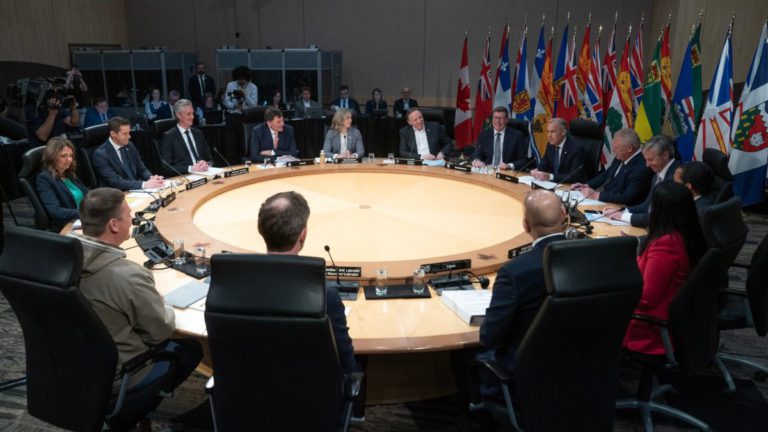
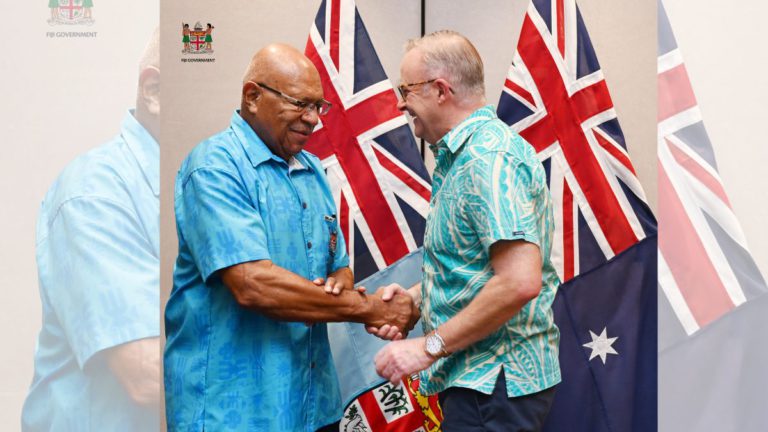
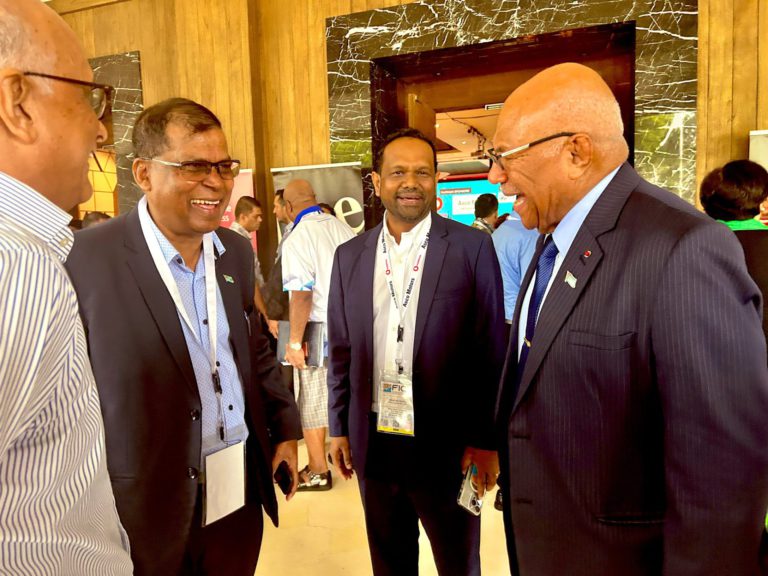
With just weeks before a steep 32 per cent tariff on Fijian goods is reinstated, Fiji’s government has signalled its willingness to send a delegation to the United States in a final bid to renegotiate the trade terms under President Donald Trump’s controversial reciprocal tariff regime.
“We’ve certainly tried to argue as best we can over the case of Fiji and why we think the tariffs are too high,” Kamikamica said. “We are willing to even travel to the U.S. if that’s required.”
The looming deadline—9 July—marks the potential reinstatement of the full 32% tariff initially announced by President Trump in April 2025. That decision formed part of a sweeping “kind reciprocal” global tariff framework targeting 57 countries with perceived trade surpluses against the US.
Earlier reporting by The Australia Today in April detailed how Fiji was included in this crackdown, despite charging U.S. imports an average tariff of 63%. At the White House announcement, Trump pointed to trade partners like Fiji as examples of long-standing imbalances, remarking, “In many cases, the friend is worse than the foe in terms of trade.”
Although the U.S. later softened Fiji’s tariff to 10% to allow space for negotiations, failure to reach an agreement will see the original 32% rate snap back into effect, threatening key Fijian exports.
Fiji’s Ministry of Finance previously expressed concern about the disproportionate nature of the measure, arguing it unfairly targets a long-standing trade and development partner. “The United States is an important trade partner for Fiji, accounting for around 10 per cent of total trade and over 30 per cent of remittance inflows,” said Minister for Finance Prof. Biman Prasad.
Prasad also noted that over 70% of U.S. goods entering Fiji were duty-free last year, countering Trump’s assertion of an unfair trading environment. Fiji applies a tiered tariff system, with the highest rates reserved for luxury items and goods with excise implications, such as sugary drinks and motor vehicles.
But the country’s most vulnerable sector is its bottled water industry, which exported $241 million worth of product to the U.S. in 2023, making the U.S. both the largest and fastest-growing destination for Fijian water. Water is Fiji’s number one export, and the country ranks as the world’s fourth-largest water exporter.
With U.S. imports from Fiji—including water, kava, sugar products, fish, and wood artefacts—now facing higher duties, analysts warn of substantial pressure on Fiji’s export economy, especially as its trade surplus with the U.S. has already shrunk from $293 million in 2022 to just $63 million in 2024.
Meanwhile, the U.S. exports high-value items to Fiji, such as aircraft parts, electrical machinery, and medical equipment, reflecting a mutually beneficial trade corridor.
Kamikamica said Fiji is hopeful that its close diplomatic ties with the United States will be factored into any final decision. “We hope the long-standing relationship between the two countries will be considered in the decision-making,” he said.
With the countdown to 9 July now underway, Fiji’s proposed diplomatic push marks a critical juncture in its efforts to shield vital industries from what could be a major economic setback
Support our Journalism
No-nonsense journalism. No paywalls. Whether you’re in Australia, the UK, Canada, the USA, or India, you can support The Australia Today by taking a paid subscription via Patreon or donating via PayPal — and help keep honest, fearless journalism alive.
We are at a dinner party in suburban Perth, a home away from home for our diaspora. As guests arrive, a Persian ballad plays in the background: Morq-e Sahar (Dawn Bird), a freedom song, a century-old protest against dictatorships and tyranny in Iran. This version was sung by the late Mohammad-Reza Shajarian, Iran’s most decorated maestro.
Dawn bird, lament! Make my brand burn even more. With the sparks from your sigh, break And turn this cage upside down.
Shajarian’s virtuoso voice frames an old question. One I’ve heard, it seems, at every Iranian gathering since my childhood. It hangs in the air like a cloud, unanswered, as guests greet each other with customary bowing and rooboosi (cheek kissing). We settle around a table laden with âjil (trail mix), fruit and wine, the smell of saffron rice and ghorme sabzi (herb stew) all around.
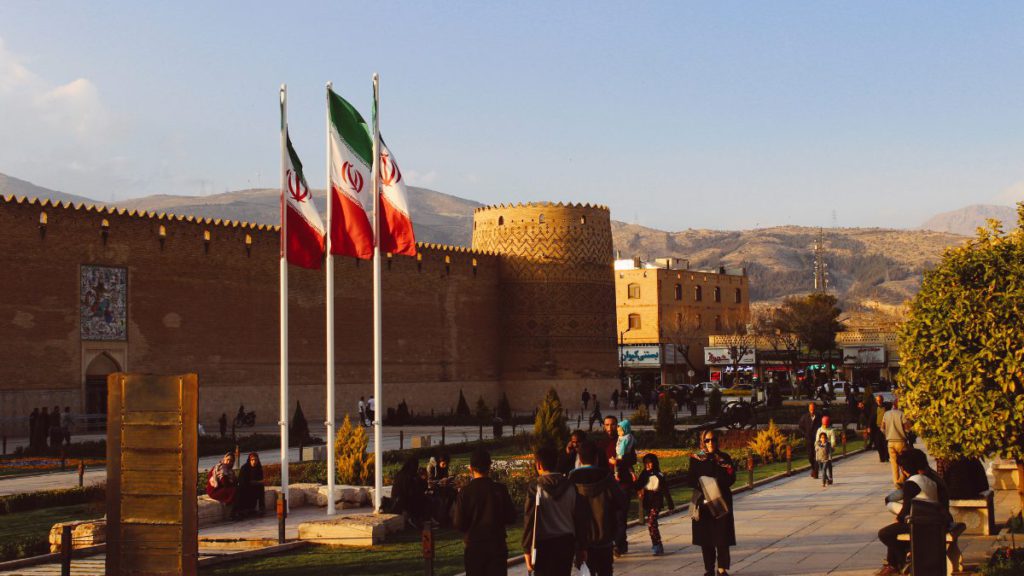
Iran- Image Source; CANVA
For me, the scene is both familial and familiar. As is the question, which circles back around. “When will this regime change?” someone asks. The “regime” is Nezâm-e Jomhuri-ye Eslâmi-ye Irân, or the Regime of the Islamic Republic of Iran.
A missing voice
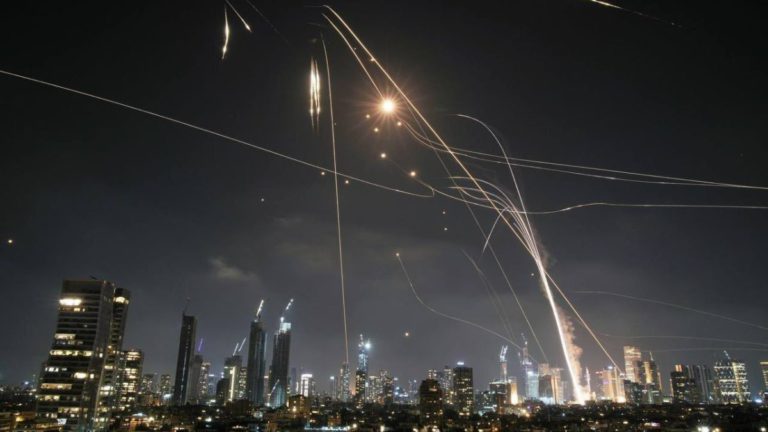
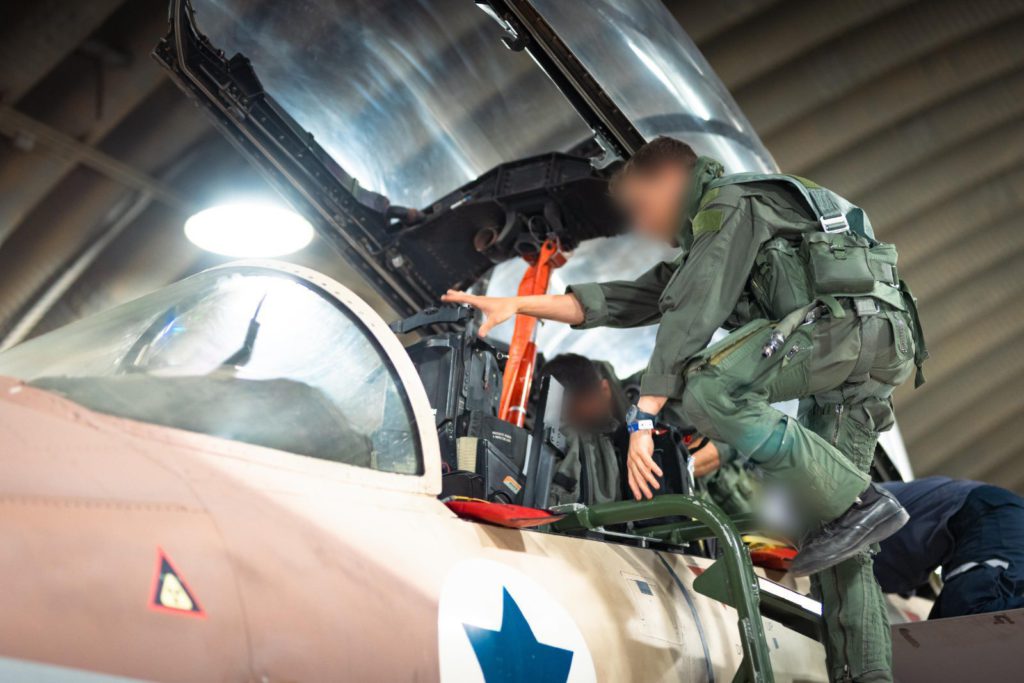
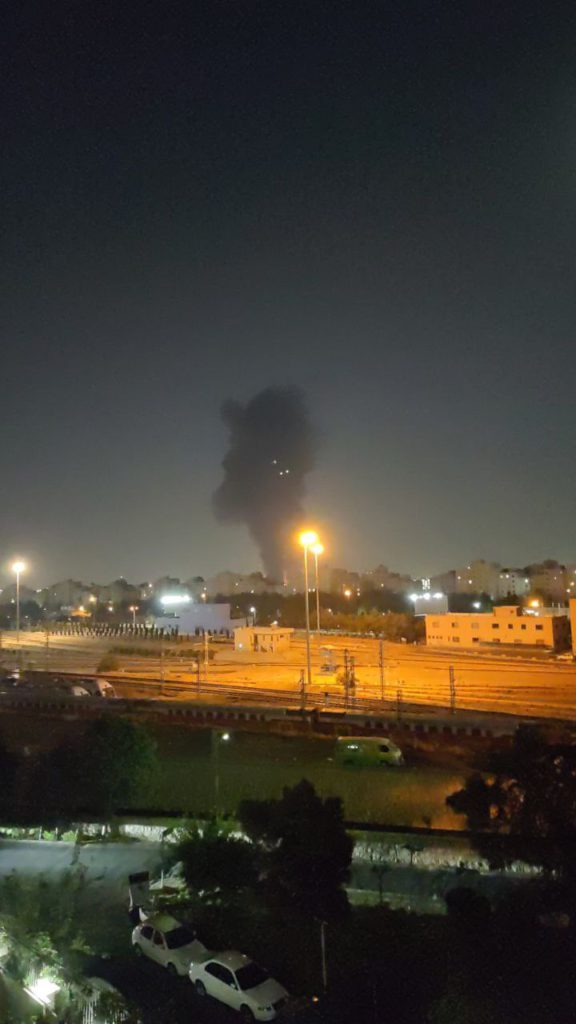
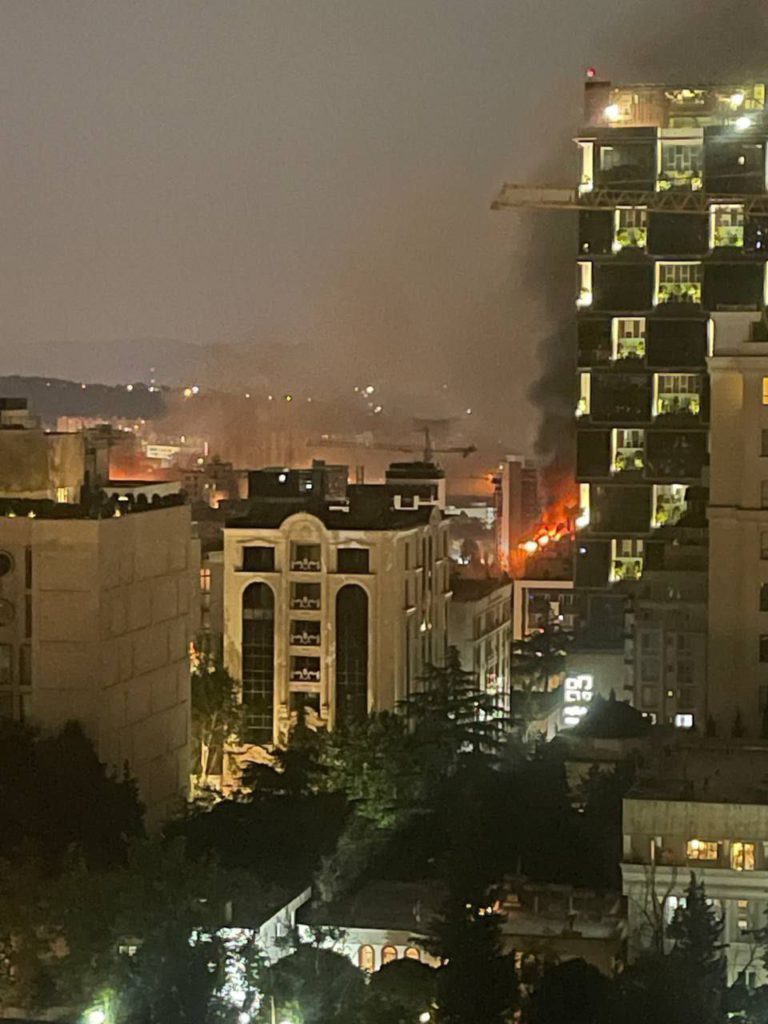
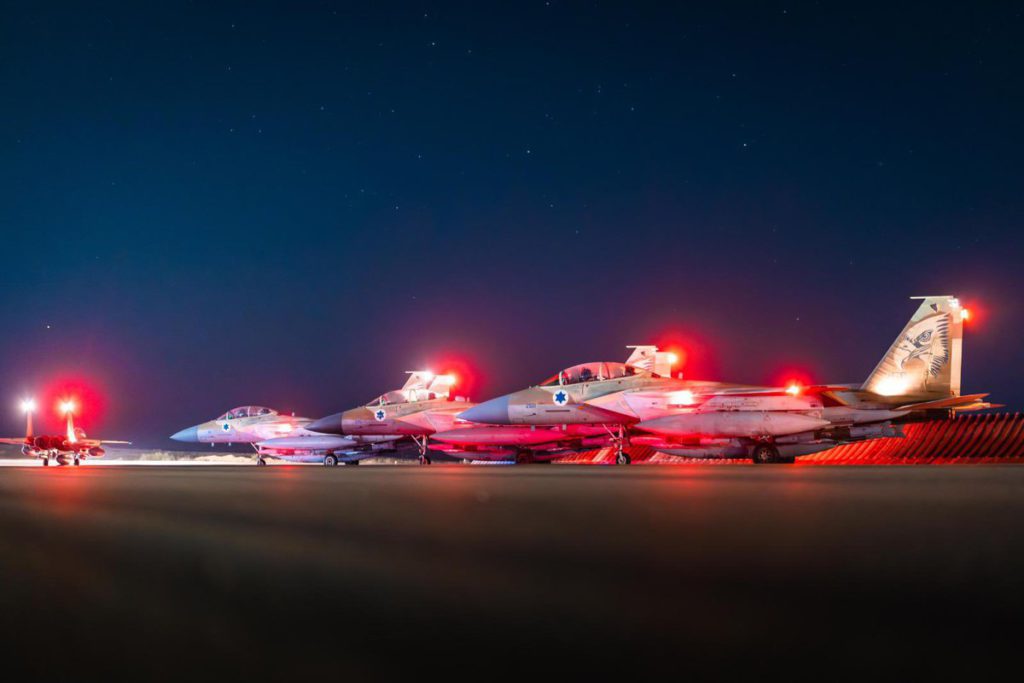
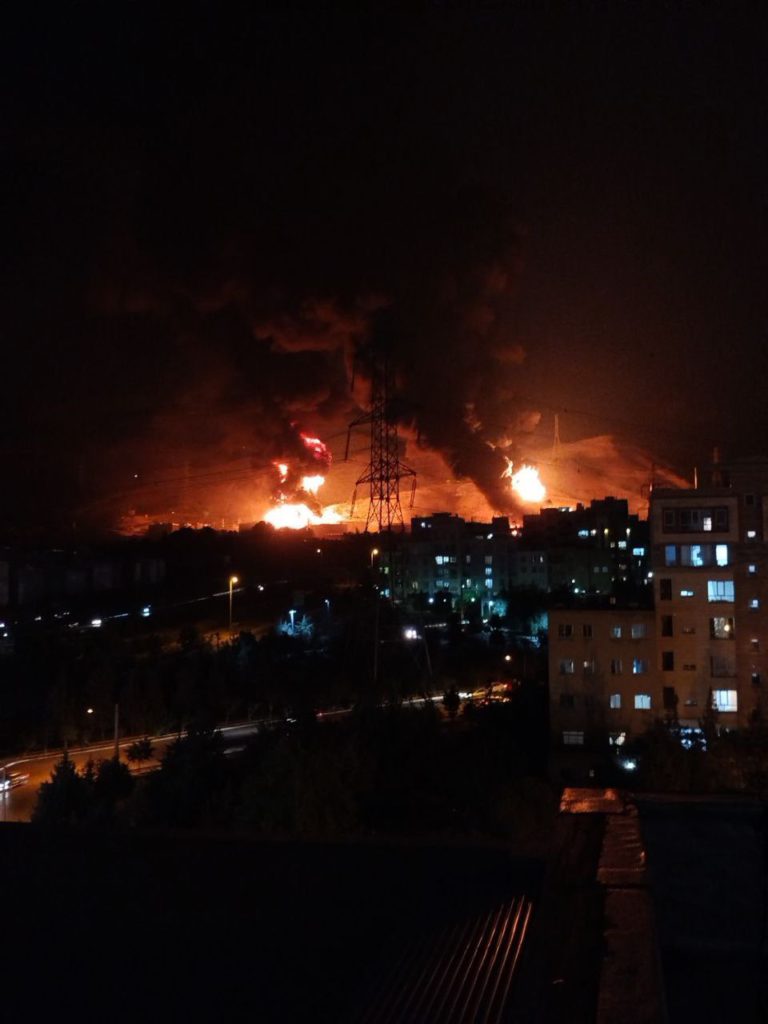
Since the launch of Israel’s Operation Rising Lion against Iran last week, there has been a voice sometimes missing in the mainstream coverage – that of the Iranian people themselves.
“Israel is not our enemy, the regime is our enemy,” chant many Iranians in Tehran and in the diaspora, a common sentiment in our community. They cite the regime that they have endured for 46 years since the 1979 Islamic Revolution: a government most of them oppose and reject, with the vast majority of Iranians preferring democratic, if not secular, reform.
I hear some Iranians, on social media and in conversation with people who live there, commending Israel’s prime minister Benjamin Netanyahu for assassinating Iran’s top military brass. These are the leaders of the Sepah, or the Islamic Revolutionary Guards Corps (IRGC), the most powerful branch of the Iranian Armed Forces. Together with the mullahs – Iran’s Shia Muslim clerical class – they form the backbone Iran’s government and economy.
So far, Israel has assassinated Hossein Salami, the head of the Revolutionary Guards, as well as Mohammad Kazemi, its intelligence chief, plus senior nuclear scientists and dozens of other officers. Israel has also indicated an interest in killing Ayatollah Ali Khomenei, Iran’s supreme leader.
“Damet garm, aghayeh Netanyahu,” some Iranians are saying, literally “may your breath be warm”, or “good job, Netanyahu”. Amid the terror and confusion – not to mention the civilian deaths, so far, of over 200 Iranians – there is a rare and distinct sense of hope.
State of corruption
In view of Israel’s ongoing campaign in Gaza, this support for Israel may come as a surprise to many Australians, and Western liberals in general. Certainly, reconciling Israel’s role in Gaza versus Iran is jarring.
But for now, I hear some Iranians saying “maybe our regime can finally be toppled”. Maybe Iran can reclaim its place in the international community, as the proud and prosperous nation it should be? As this crisis escalates, as buildings collapse and distressed Tehranis, including my family, flee the capital for the safety of the countryside, there is a heady sense of possibility.
Wing-tied nightingale come out of the corner of your cage, and Sing the song of freedom for human kind. With your fiery breath ignite, The breath of this peopled land …
I understand the allure of this hope; to an extent, I feel it myself. My family lives in Australia, not Iran, precisely because of the Iranian regime’s tyranny. We fled Iran in 1983 due to political persecution, after most of the adults in our extended family were arbitrarily arrested and imprisoned by the government.
Two of my imprisoned uncles and one of my aunties were executed. Another uncle was beaten to death in custody. My grandfather, a noble old man, was imprisoned and tortured. We were far from unique; during the 1980s, the government imprisoned tens of thousands of its own people, executing many thousands of them.
Little has changed since then. The Iranian regime and the Revolutionary Guards have shown a pervasive disregard for human rights. They execute more of their own people than any country except China. They are a world leader in the use of torture; they deny freedoms of expression and press, association and assembly; they discriminate against women, girls, religious minorities, LGBTI people, and refugees. Tightly controlled elections ensure the success of desired candidates.
Freedom House, a nonprofit organisation based in the US, gives Iran a score of 11 out of 100 for its provision of political rights and civil liberties. For many Iranians, it felt overdue when, in 2019, the US listed the Revolutionary Guard as a terrorist organisation, a decision followed by other countries, including Canada and Sweden. In 2023, the European parliament overwhelmingly voted for a resolution to do the same, with calls to expedite this motion in early 2025.
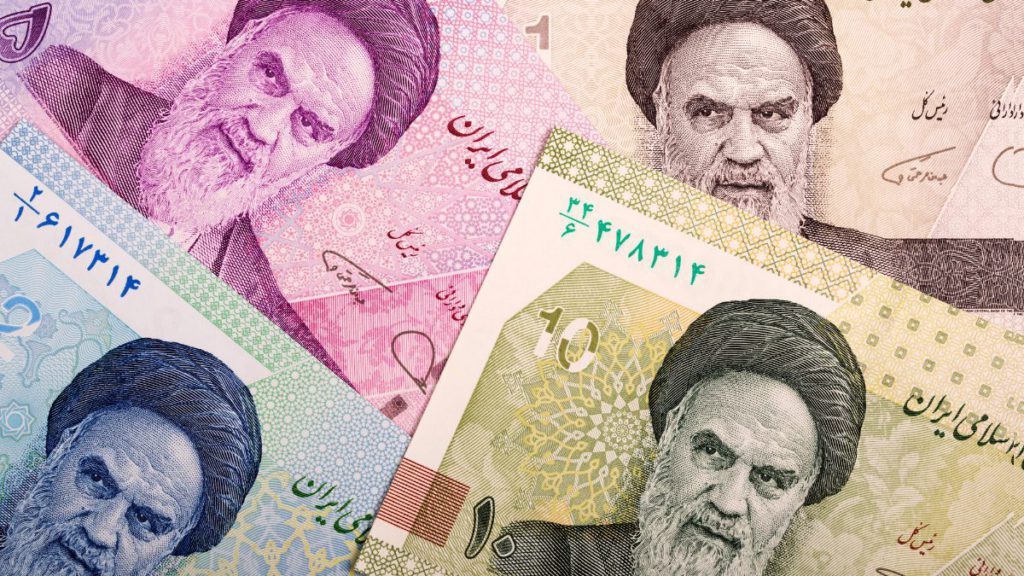
In parallel to their human rights abuses, the Revolutionary Guard has hobbled the Iranian economy. Their corruption, financial incompetence and operation of black markets have compounded the effects of international sanctions. Consequently, the Iranian rial hit a historic low this year. It is now worth around one twentieth of its value in 2015.
People’s life savings have dwindled in value, rendering older Iranians financially vulnerable. Inflation was 38.7% in May of this year, down from highs of over 40%. My family in Iran experience this as grocery and commodity prices that may rise in a single day, higher in the afternoon than in the morning. Some cities have experienced water cuts and power outages.
While it hasn’t yet qualified as a failed state, Iran has been failing.
All of this has occurred despite the country being richly endowed with the second- and third-highest natural gas and oil reserves in the world, respectively. Iran has a GDP of over $US404 billion – 36th in the world. Its youth are highly educated and literate, with more women enrolled in universities than men.
Rather than accelerating the nation’s domestic development, however, the Iranian government has by its own admission spent tens of billions of dollars to expand its empire by funding terrorist proxies: Hamas in Palestine, Hezbollah in Lebanon, the recently deposed Assad regime in Syria, and Houthi rebels in Yemen.
The Iranian people have suffered financially, but the Revolutionary Guards have not. They are estimated to control at least 10%, and up to 50%, of the country’s total economy, including up to an estimated 50% share of Iran’s US$50 billion per year oil profits. They have achieved this by commandeering an industrial empire, made up of hundreds of commercial companies, trusts, subsidiaries and nominally charitable foundations.
A further US$2 billion or more per year comes from the government’s military budget, with periodic boosts during crises. Add to this the alleged shadowy operation of black markets, extortion, and the smuggling of alcohol, narcotics and weapons, accounting for an estimated US$12 billion per year in revenue.
Contemplating this corruption, I am reminded of an anecdote from a personal associate who worked for a firm affiliated with the Revolutionary Guard. They shared stories of officers, the nation’s purported “guardians of Islam”, hosting parties where alcohol, firearms and sex workers were readily available.
My associate recounted several instances of fraud and theft, one of them monumental in scale. In this “tea smuggling scandal”, the Revolutionary Guard defrauded billions of dollars from a government fund by illicitly exchanging some funds on the open market, falsely labelling cheap tea to on-sell as superior quality tea, and falsely labelling domestically produced machinery as “Made in Germany”.
“They’re untouchable, and they know it”, my associate said. Another Iranian community member described them to me as “Iran’s super-mafia”.
Speaking to family in Iran, they say many of the middle tier Revolutionary Guards live in their own shahrak-ha (towns) with dedicated markets, schools and resorts. Many of the Guards’ elite, meanwhile, live in mansions in the exclusive parts of north Tehran, with children who pursue conspicuously American “lifestyles of the rich and famous”. For an organisation that leads the chants of “marg bar America!” (death to America), one wonders if they see the irony in this.
Turn our dark night to dawn
I find myself sickened by the events of this war, and the harm it is causing. Struck with anxiety, some of our family members in Tehran haven’t slept for days. “The Israeli bombardments are non-stop, and so loud,” one family member told me.
This week our extended family has struggled frantically to leave Tehran. Petrol is hard to come by and, in a mass exodus, the bumper-to-bumper traffic stands still for hours. I know some of the neighbourhoods being bombed; we lived in one of them in my childhood.
“For every military commander that’s assassinated, a whole building might collapse, and with a dozen civilians trapped or killed,” another person told me, intimating that the civilian toll is higher than official counts.
I am also worried about the raised hopes of Iranians. I have seen this before, when a spark – sometimes an inspirational act of courage from an ordinary citizen – leads to public surges in solidarity. At these moments during my childhood, my parents would tell me that the regime’s time was limited, it’s downfall inevitable. Iranians would see better days and people power would prevail.
Truth and goodness rise like cream, my Dad would say, as if echoing Dr Martin Luther King’s arc of the moral universe bending towards justice.
A beautiful sentiment no doubt, but one that has become difficult to believe over time. It often appears that the universe’s arc bends towards power, not justice. Fairness seems the exception, hardly the rule. At the time, Dad’s reassurances were protective, even noble. But as the 1979 revolution and its aftermath have shown, might beats right most days of the week.
The cruelty of the cruel and the tyranny of the hunter Have blown away my nest. O God, O Heavens, O Nature, Turn our dark night to dawn.
As I explain to Australian friends, how can a people surpass a government that has (1) the military on its side, (2) a stranglehold on oil revenue, and (3) a purported mandate from God?
Guns, money and a holy book – a hard trifecta to crack, and powerful enough to attract a sufficient minority of cronies, bottom feeders and sycophants.
What’s the size of this ruling minority? It’s difficult to be sure, but a 2023 survey of 158,000 respondents within Iran found that only 15% supported the Islamic Republic. Small, but sufficient to produce crowds burning American and Israeli flags. I’ve always marvelled at the regime’s ability to manufacture these images; I’m told by associates that they now use AI to produce some of these.
Women Life Freedom
As current events unfold, I find myself deeply sceptical of all the political actors, whether Iranian, Israeli, American, Arab or Russian. Since the Islamic revolution in 1979, none of them have shown any serious interest in supporting democratic reform in Iran. “They’ve all profited from this government,” a senior community member told me. “Why would that change now?”
For the sake of sanity, I find myself searching for credible sources of hope. The only one I settle on is faith in the Iranian people themselves. This the culture that has surrounded me since childhood, the qualities I’ve seen first hand in my countrywomen and men, whether young or old, home or abroad, Muslim, Bahai or secular: a resilience, a resourcefulness, a propensity for joy, a confidence and pride in culture, and an ability to prevail, over and again.
It’s a new spring, roses are in bloom… …O rose, look towards this lover, Look again, again, again.
These qualities are periodically staged for the world to see. Iranian people have not taken their oppression lying down, rising in (mainly) peaceful protests. There have been some 10 mass protests since the inception of the Islamic Republic in 1979. The largest of these was the Green Movement in 2009, when it was estimated that over a million citizens marched in Tehran alone. As recently as May 2025, strikes took place in over 150 cities, involving hundreds of thousands of workers.
For the most part, these demonstrations have been met with severe repression by state authorities. One episode, from September 2022, deserves special mention. The world watched in horror as the regime cracked down on young women in Iran. This was their response to the Zan Zendegi Azadi (Woman Life Freedom) movement, where mass protests were triggered by the death in custody of Mahsa Jina Amini.
Amini was a 22-year-old Kurdish-Iranian woman who had been detained by the government’s “Morality Police” for wearing an improper hijab. Three days into her detention she died under suspicious circumstances. A leaked CT scan showed a skull fracture and brain haemorrhage. This corroborated eyewitness accounts that Amini had been severely beaten by police.
Intentionally or not, a dress code infringement had been punished by death. Even for Iranians long accustomed to state violence, this was too much. Mass protests erupted in more than 100 cities across all of Iran’s 31 provinces.
The protests were led by women, many of them defiantly removing their headscarves. True to its nature, the regime responded violently. In the months that followed, over 20,000 protesters were imprisoned, many later testifying to having been tortured through electric shock, flogging, waterboarding and rape.
Human Rights Watch estimates that over 500 civilians – including 68 children and adolescents – were killed by security forces, which included the paramilitary Basijis, Revolutionary Guard Corps, police and prison guards.
Things would get darker. That December the regime was accused of deliberately poisoning over 1,200 students at Kharazmi and Ark universities on the eve of a planned protest. Soon thereafter, there were allegations of toxic gas attacks against thousands of schoolgirls, in apparent retaliation for removing their hijabs. By 2024, the UN had accused Iran of a coordinated campaign of crimes against humanity, a claim rejected by the regime.
As an eye surgeon, I was distressed to read a letter signed by over 100 Iranian ophthalmologists detailing eye injuries among protesters. The letter alleged that security forces had deliberately targeted people’s eyes with teargas canisters, rubber bullets and shotgun fire, resulting in traumatic injuries and irreversible blindness among protesters.
Dew drops are falling from my cloudy eyes This cage, like my heart, is narrow and dark. O fiery sigh set alight this cage O fate, do not pick the flower of my life.
If we didn’t know it already, Zan Zendegi Azadi reminded us of the risks, if not futility, of advocating for change in Iran.
When mass civil movements like this, performed ten times over, have not worked, what alternatives are the people left with? Brutalised and impoverished by their own government, should we be surprised when a traditionally Islamic people welcome a Jewish state’s decapitation of their political leaders? Is it not tempting, even if lazy, to invoke the historical comparison of Cyrus the Great, Persian King of the Achaemenid Empire, who freed the Jewish people from Babylonian captivity?
For the people of Iran and Israel, at the risk of naivety and romanticism, are we approaching an age of karma?
O rose, look towards this lover, Look again, again, again. O heart-lost bird, shorten, shorten, shorten, The tale of separation.
An uncertain scenario
Regarding Operation Rising Lion, it is safe to say that Iranians, like any healthy community, hold a diversity of views.
At one end of the spectrum, those who unconditionally condemn Israel’s attack should consider that the Iranian government has stockpiled over 400 kilograms of 60% enriched uranium. While not enough to build a nuclear warhead, this is far more enriched uranium than is needed for peaceful purposes.
The Iranian government has also vowed to “wipe Israel off the map” for decades. Iran’s Ayatollah Khamenei lauded the October 7 terrorist attack by Hamas on Israeli civilians. In other words, Iran has said to Israel “we want to annihilate you, we’ll celebrate your deaths, and we could do it with nuclear weapons if we wished to”.
On the other side of the coin, Iranians who salute Israel and the US as their saviours should take caution. The US director of national intelligence Tulsi Gabbard, declared as recently as March 2025 that there was no evidence that Iran was actively pursuing nuclear weapons, a finding corroborated by over a dozen other US intelligence elements, including the CIA, the National Security Agency, and the Institute for Defence Analyses.
One cannot ignore the disturbing echoes of the 2003 war on Iraq, where the absence of evidence for weapons of mass destruction was intentionally misrepresented by the US and UK governments. The consequences for Iraq have been disastrous.
As for Netanyahu and his administration, they have shown a ruthless pursuit of narrow self-interest in Gaza. The deaths and injuries inflicted by the Israeli Defence Forces on more than 50,000 Palestinian children appear to have done nothing to quell their ambitions.
What can Iranians learn from this? The evidence suggests this could be a war of passion and opportunism for Israel, rather than one of legitimate self-defence. In any case, they are not waging it for the benefit of Iranians.
Israel has a tendency to set ambitious military goals that it can’t achieve. While it promises Operation Rising Lion will soon end, its track record suggests otherwise.
A protracted conflict would see Iran’s civilian toll rise much higher. Power outages and fuel shortages have already begun; what happens once water, medical and food scarcity set in? Since Iran doesn’t allow many international aid agencies onto its soil, who will come to the rescue of Iranians as things escalate?
Truth’s life has come to an end Faith and fidelity have been replaced by the shield of war. Lover’s lament and beloved’s coyness, Are but lies and have no power.
Even if Israel succeeds in capturing or killing Iran’s supreme leader, Ali Khamenei, what happens next? With the Revolutionary Guard’s roots in place, there is no guarantee, and in fact a low likelihood, of true democratic reform. In recent times, foreign interference in the region has not gone well. Look at Libya, Afghanistan, Iraq and Syria: all evidence of catastrophic worsening after the removal of autocrats.
This is a complex and uncertain scenario with little room for moral grandstanding. Disabling Iran’s nuclear and ballistic capabilities could be a net win, but the manner in which it is being done sets a dangerous precedent. For the Iranian people, Netanyahu’s ambitions could ultimately prove both heroic and villainous.
The cup of the rich is full of pure wine, Our cup is filled with our heart’s blood. O anxious heart, cry out aloud And avoid those who have powerful hands.
As I watch coverage of the war, I find myself drifting back to Shajarian’s voice and to Morq-e Sahar, probably for distraction and comfort. What is real is my faith in my fellow Iranians. Many examples comes to mind. One, during a trip to Iran, was when I stayed with family at a roadhouse. That evening, we heard music emanating from the courtyard and followed some steps into an dark basement beneath the accommodation.
There we found a large gathering of young Iranians, two dozen or more men and women risking the law by hanging out together to sing. We joined them as strangers, seated on the floor and holding hands at times. In the dim light, the group sang and sang, a couple of them playing instruments.
I can’t say I knew the songs or comprehended all the lyrics; I didn’t need to, to understand their meaning. You may force our people underground, you may cage them, bombard and even kill them. But you will never extinguish their eternal Persian spirit.
O rosy-cheeked cup-bearer, give the fiery water, Play a joyful tune, O charming friend. O sad nightingale lament from your cage. Because of your grief my heart is Full of sparks, sparks, sparks.
No-nonsense journalism. No paywalls. Whether you’re in Australia, the UK, Canada, the USA, or India, you can support The Australia Today by taking a paid subscription via Patreon or donating via PayPal — and help keep honest, fearless journalism alive.
A 27-year-old East Melbourne man has been arrested after a stolen white Toyota Land Cruiser careered through Northland Shopping Centre in Preston during an afternoon police pursuit on Wednesday.
Shortly after 4 pm on 18 June, security guards first spotted the off-white Land Cruiser, stolen from an Ivanhoe East address on 2 June, near the Murray Road precinct. Officers moved in to intercept the vehicle at about 4:07 pm in the centre’s outdoor carpark, but rather than stop, the driver “took evasive action” and drove straight into the mall.
Image Source- 9 News Screenshot
Shoppers and staff watched in horror as the stolen 4WD smashed through glass doors, tore past storefronts and upended a safety bollard along the mall’s main thoroughfare. No one was physically injured, though one woman was transported to the hospital in shock.
“He took out all the doors all the way through,” said witness Wayne O’Connor.
“He actually stopped for a little kid—made sure no one was crossing. It was terrifying, but he didn’t hit anyone.”
Image Source- 9 News Screenshot
Superintendent Kelly Lawson of Victoria Police described a chaotic scene:
“Officers responding to reports of a stolen vehicle attempted to block it in.
The driver rammed a police patrol car twice, then drove through the shopping centre and exited at the first available opportunity. Fortunately, no serious injuries were reported.”
Image Source- 9 News Screenshot
Within an hour of fleeing the centre, the Land Cruiser was found abandoned on Beavers Road in Northcote at 5:10 pm. Detectives executed a search warrant at a Hoddle Street address in East Melbourne on Thursday morning, arresting a 27-year-old man and seizing an electronic key reprogramming tool—the device allegedly used to steal the vehicle without its keys.
As Victoria Police continue their investigation, Superintendent Lawson warned:
“While we were relieved no one was hurt, this incident demonstrates the lengths offenders will go to evade arrest.
We urge anyone with information to come forward so we can hold those responsible to account.”
Image Source- 9 News Screenshot
This brazen incident follows a violent machete confrontation at Northland less than a month ago, underscoring ongoing security concerns at one of Melbourne’s largest shopping hubs. Police are not seeking any further suspects but have appealed for anyone with dashcam or CCTV footage to contact Crime Stoppers on 1800 333 000.
Support our Journalism
No-nonsense journalism. No paywalls. Whether you’re in Australia, the UK, Canada, the USA, or India, you can support The Australia Today by taking a paid subscription via Patreon or donating via PayPal — and help keep honest, fearless journalism alive.
In a significant shift in tone and policy, Canada has for the first time officially designated Khalistani extremists as a national security threat, acknowledging their continued use of Canadian soil to plan, fund, and promote violence — primarily targeting India.
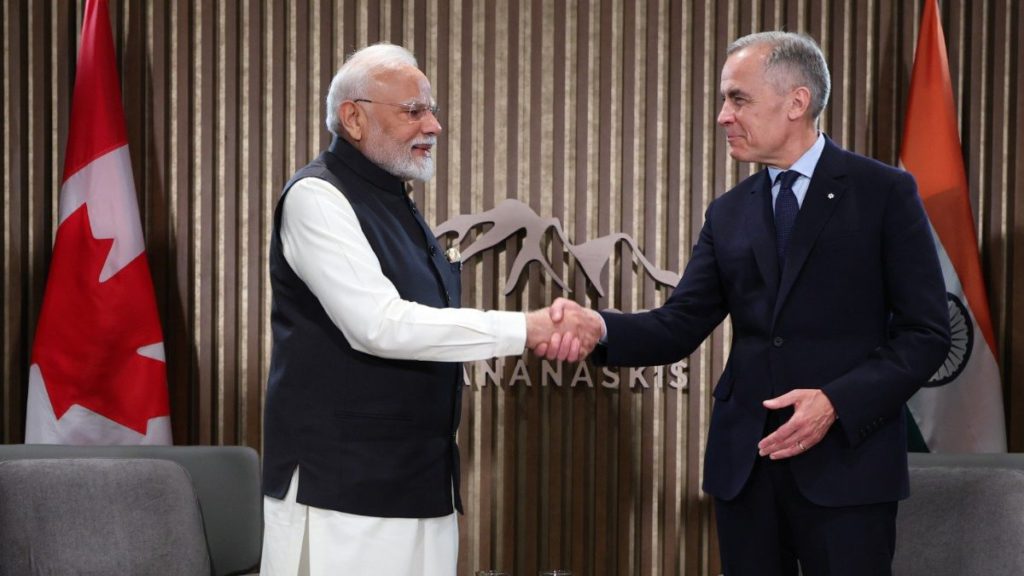
This landmark admission comes from the 2024 annual report of the Canadian Security Intelligence Service (CSIS), tabled in Parliament just a day after Prime Ministers Narendra Modi and Mark Carney held bilateral talks during the G7 Summit in Alberta. The meeting led to a reset in strained ties, with both nations agreeing to appoint new high commissioners and resume trade talks.
CSIS stated that “Canada-based Khalistani extremists (CBKEs) continue to pose a national security threat to Canada and Canadian interests,” even though no violent attacks linked to CBKEs occurred on Canadian soil in 2024.
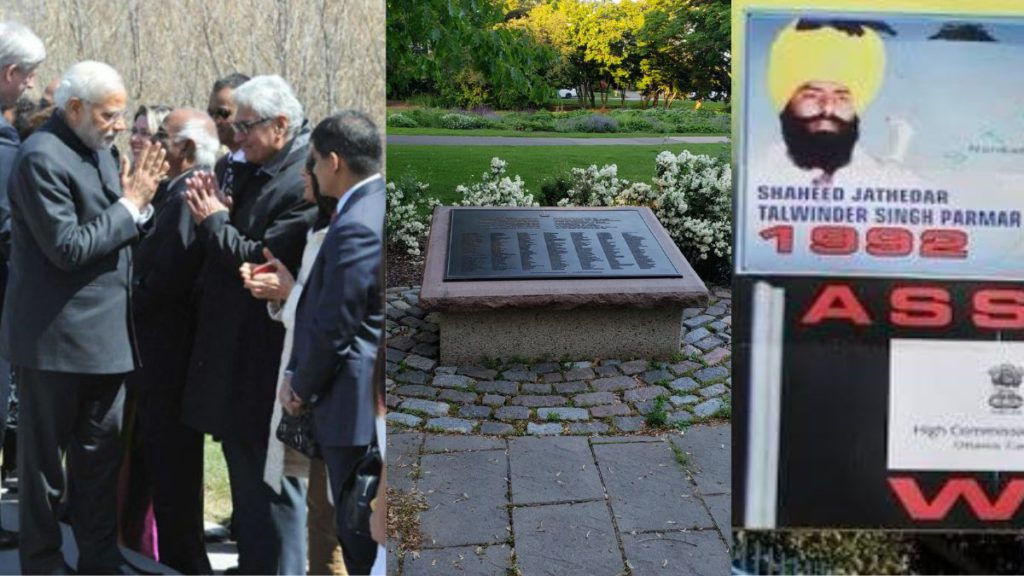
Image: Khalistan poster Canada (Source: X)
The report stressed that only a group of individuals based in Canada are involved, but they remain active in “promotion, fundraising or planning of violence primarily in India.”
Crucially, this marks the first time the Canadian government has used the term “extremists” to describe supporters of the Khalistan separatist movement operating within its borders — a longstanding demand from India, which has repeatedly raised concerns about the safe haven these groups enjoy in Canada.
The CSIS report acknowledges a major intelligence failure in its early years regarding the Khalistan movement. Referring to the 1985 Air India bombing by Canada-based extremists, it states:
“In 1985, Canada-based extremists planted and detonated a bomb on Air India Flight 182, killing all 329 people onboard, the majority being Canadian… The failure to disrupt this event provided several hard lessons for CSIS to learn as a young security intelligence service.”
The 1985 Air India bombing—Canada’s deadliest terrorist attack, claiming 329 lives—proved a watershed for CSIS’s security posture and still clouds Canada–India relations today.
Image: Indian PM Modi at Air India Flight 182 Bombing: commemorating event
The CSIS report notes that “real and perceived Khalistani extremism emerging from Canada continues to drive Indian foreign interference activities in Canada,” highlighting the ripple effects of the issue on domestic politics and international diplomacy.
India has in recent years handed over more than 20 extradition requests for individuals linked to Khalistani violence. The current Canadian acknowledgement is likely to be seen in New Delhi as a diplomatic breakthrough.
Learn more about national security and CSIS’ role in protecting all Canadians today: https://t.co/xruGEQdqNb 4/4
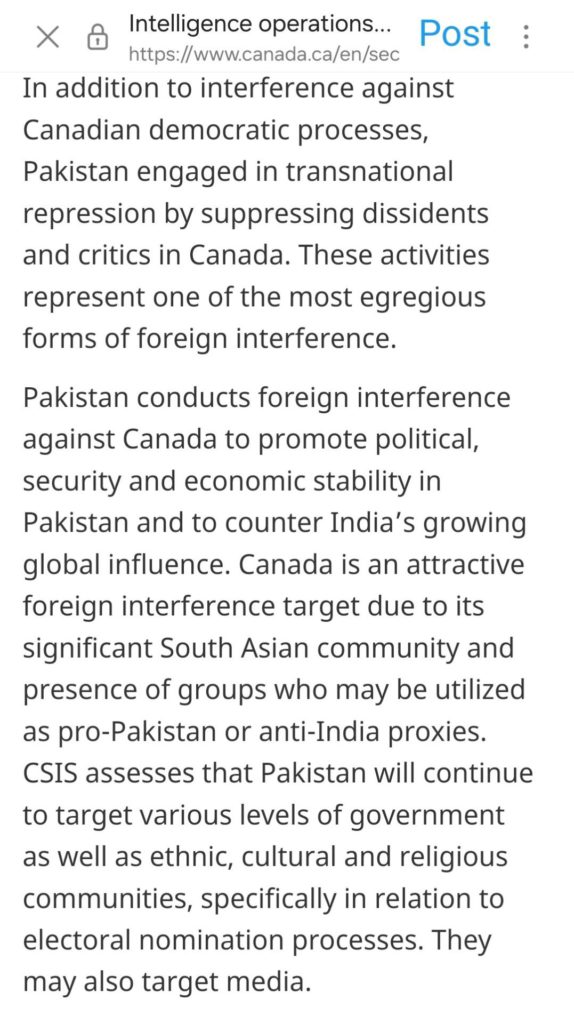
Beyond the Khalistan issue, the CSIS report also pointed fingers at Pakistan for its role in transnational repression and foreign interference, including meddling in Canadian elections. It said Pakistan attempted to influence the nomination of candidates sympathetic to its interests and targeted critics in Canada’s South Asian diaspora.
“Pakistan will continue to target various levels of government as well as ethnic, cultural and religious communities, specifically in relation to electoral nomination processes. They may also target media,” the report warned.
Marking the 40th anniversary of CSIS, the report presents a candid overview of Canada’s evolving threat landscape — from politically motivated violent extremism (PMVE) to foreign state interference. It affirms that politically motivated groups, including CBKEs, seek to “establish new political systems or entities” through global planning, financing, and facilitation of violence.
Image: Indian PM Narendra Modi meets Canadian PM Mark Carney (Source: PIB)
While freedom of speech is protected, the Canadian intelligence community has now clearly drawn a red line between free expression and violent extremism — a distinction that is expected to shape future policy and counter-terrorism cooperation with India.
Support our Journalism
No-nonsense journalism. No paywalls. Whether you’re in Australia, the UK, Canada, the USA, or India, you can support The Australia Today by taking a paid subscription via Patreon or donating via PayPal — and help keep honest, fearless journalism alive.
The Prime Minister participated in a key session on the future of global energy security, where leaders discussed the urgent need to diversify energy sources and fortify critical minerals supply chains.
Whether it’s economic resilience, peace and security, critical minerals or climate action – today’s G7 discussions are about practical solutions to global challenges and opportunities.
Australia formally endorsed the G7 Critical Minerals Action Plan, which aims to boost cooperation in building standards-based markets, mobilising investment, and fostering innovation. This agreement offers promising opportunities for the expansion of Australia’s critical minerals and rare earths industries.
In addition to energy, the summit highlighted innovation in emerging technologies such as artificial intelligence and quantum computing, emphasising their potential to drive productivity and economic growth.
Albanese also joined fellow leaders in endorsing the Kananaskis Wildfire Charter, a global initiative to improve prevention, response, and recovery from increasingly severe bushfires—a disaster Australia knows all too well.
Reflecting the close firefighting partnership between Australia and Canada, the Prime Minister acknowledged the recent deployment of 97 Australian firefighters to support Canada’s wildfire season, reciprocating aid provided during Australia’s devastating Black Summer fires in 2019–20.
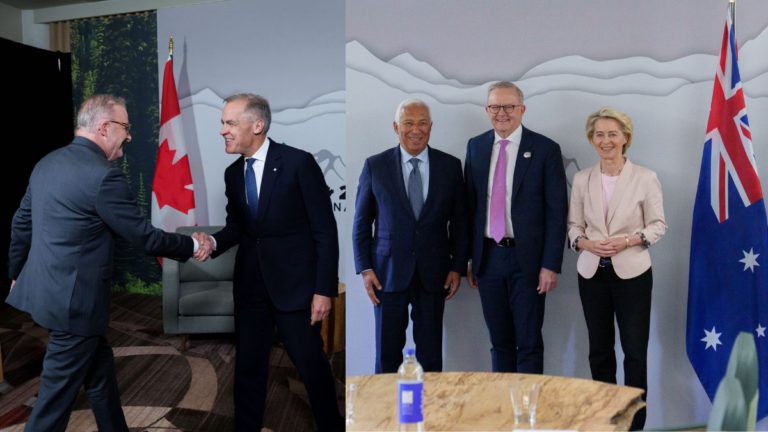
Significantly, Prime Minister Albanese announced the commencement of negotiations with the European Union on a Security and Defence Partnership (SDP). This framework will strengthen cooperation on defence industry collaboration, cybersecurity, and counter-terrorism without obligating military deployment. The move signals deepening Australia-EU ties alongside ongoing efforts to finalise a Free Trade Agreement.
At a press conference, Albanese emphasised the importance of Australia’s participation in the G7 as a platform to advance sustainable economic growth and global security. He expressed gratitude to Canadian Prime Minister Mark Carney for hosting and highlighted productive bilateral meetings with leaders from Germany, the United States, Japan, the United Kingdom, France, India, South Africa, Mexico, and Italy.
For decades, the Alliance between Australia and the United States has underpinned our relationship.
Our free-flowing trade and investment has supported American and Australian workers, businesses, and investors – making both our countries more prosperous.
Responding to questions, Albanese addressed the rescheduling of a planned meeting with US President Donald Trump, postponed due to Middle East tensions, affirming ongoing constructive engagement with US officials on trade and tariffs.
On trade, he expressed optimism about concluding the Australia-EU Free Trade Agreement, stressing that any deal must serve Australia’s national interest. He also reiterated Australia’s commitment to counter Russia’s war in Ukraine and support the rules-based international order.
Australia is deepening our trade, security and defence ties with the EU.
Today we've agreed to negotiate a Security and Defence Partnership.
This will be a framework for our current and growing collaboration in areas like defence industry, cyber, and counter-terrorism.
European Commission President Ursula von der Leyen and European Council President António Costa welcomed the new Security and Defence Partnership negotiations, recognising the strategic connection between Europe and the Indo-Pacific region.
Support our Journalism
No-nonsense journalism. No paywalls. Whether you’re in Australia, the UK, Canada, the USA, or India, you can support The Australia Today by taking a paid subscription via Patreon or donating via PayPal — and help keep honest, fearless journalism alive.
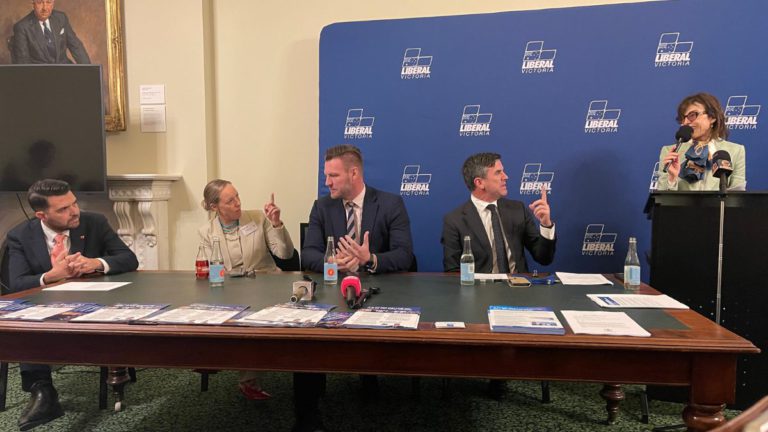
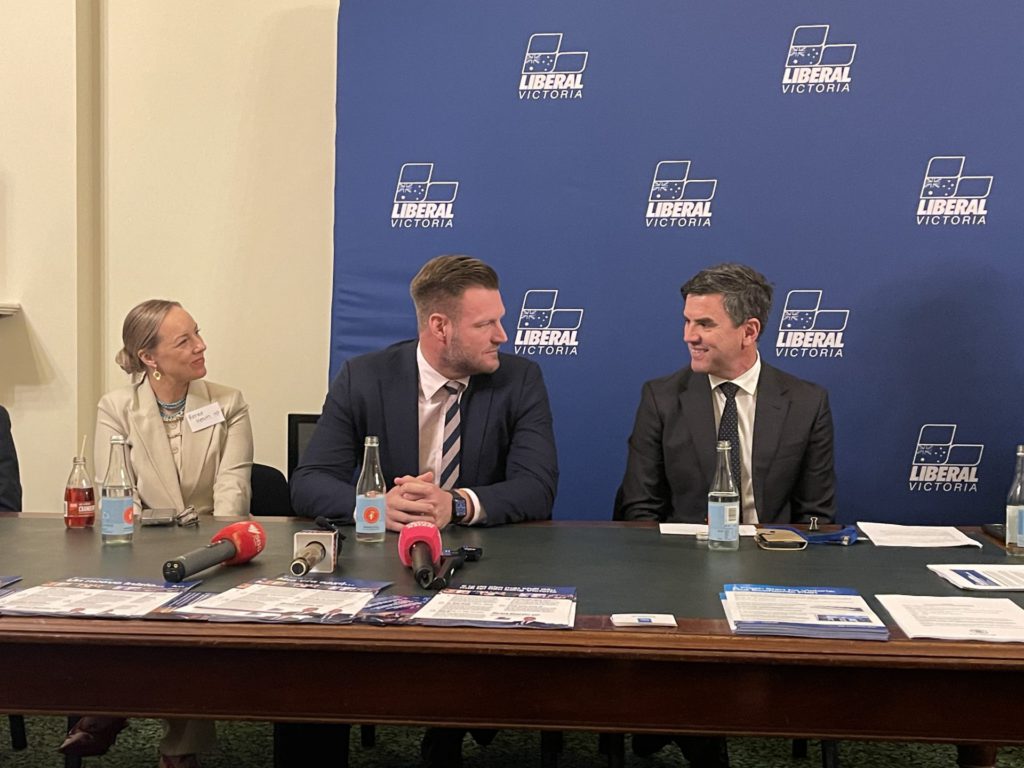
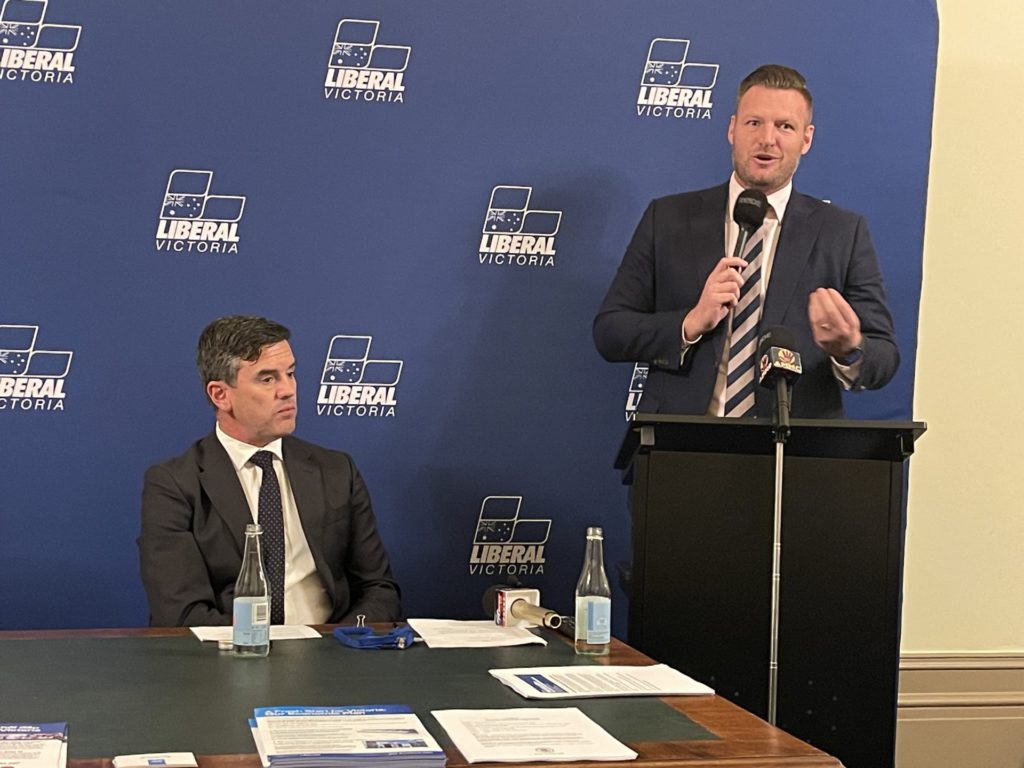
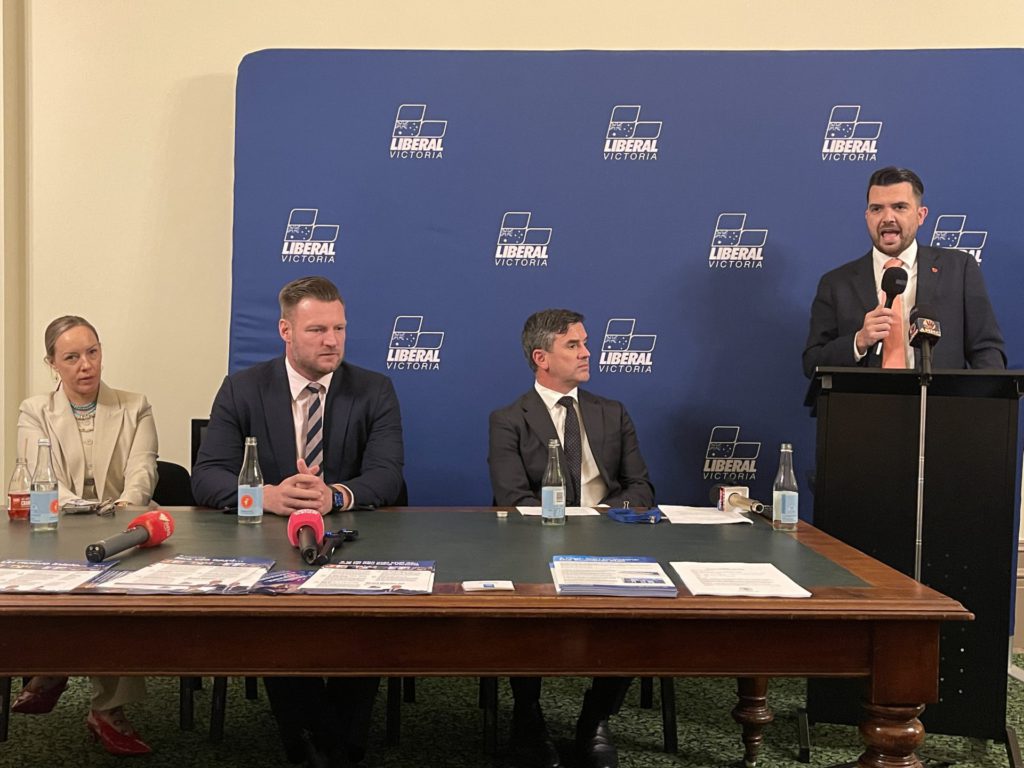
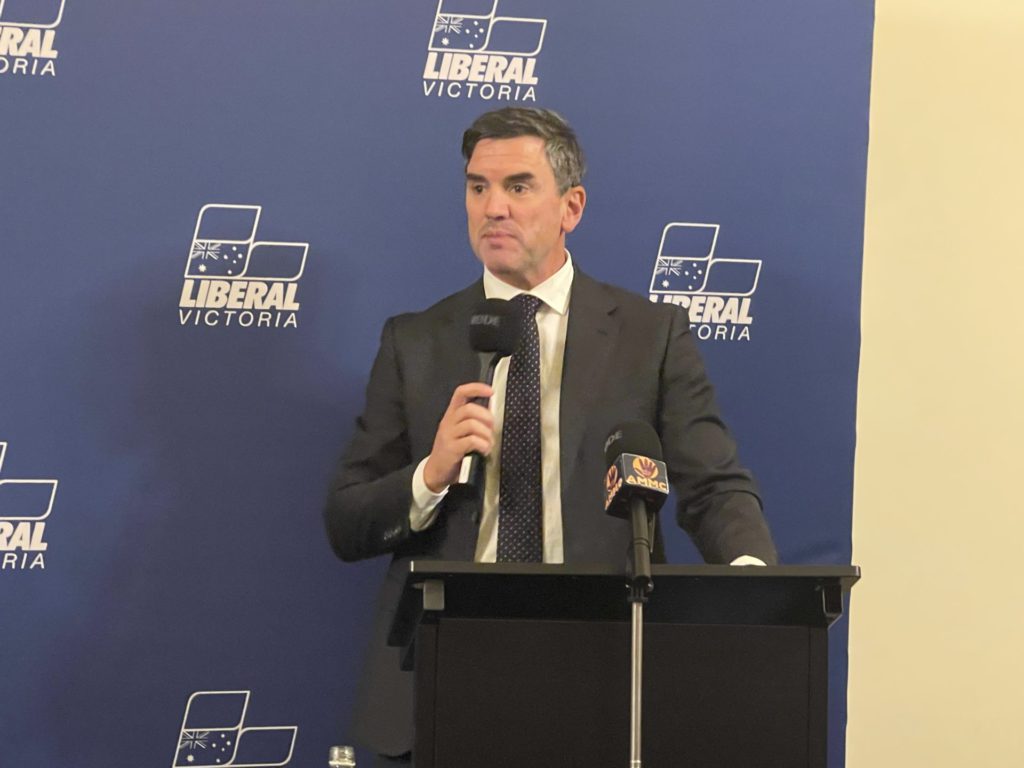
Opposition Leader Brad Battin staged a press conference at Parliament House, extending a hand to Victoria’s vibrant multicultural media sector and signalling a fresh strategic direction for the Liberal Party after its disappointing federal election showing.
Joined by Deputy Opposition Leader Sam Groth, Shadow Minister for Multicultural Affairs Evan Mulholland, Shadow Assistant Ministers Renee Heath (Multicultural Affairs) and Kim O’Keeffe (Regional Multicultural Affairs), Member for Nepean and Shadow Minister for Energy & Resources David Davis, and other frontbenchers, Mr Battin positioned the Liberal opposition as attuned to the needs of Victoria’s diverse communities.
Liberal Party Press Conference- Image Source- The Australia Today
Crime and Community Safety A former police officer and Member for Berwick—one of the few Liberals holding a safe seat in Melbourne’s south-east—Battin opened with law and order, accusing the Jacinta-Labor government of leaving Victorians “unsafe in their own homes, shopping centres, cafés and on our streets.”
He vowed:
“When the Liberal Party comes to government, we will ensure the safety of people.
You break bail, you go to jail.”
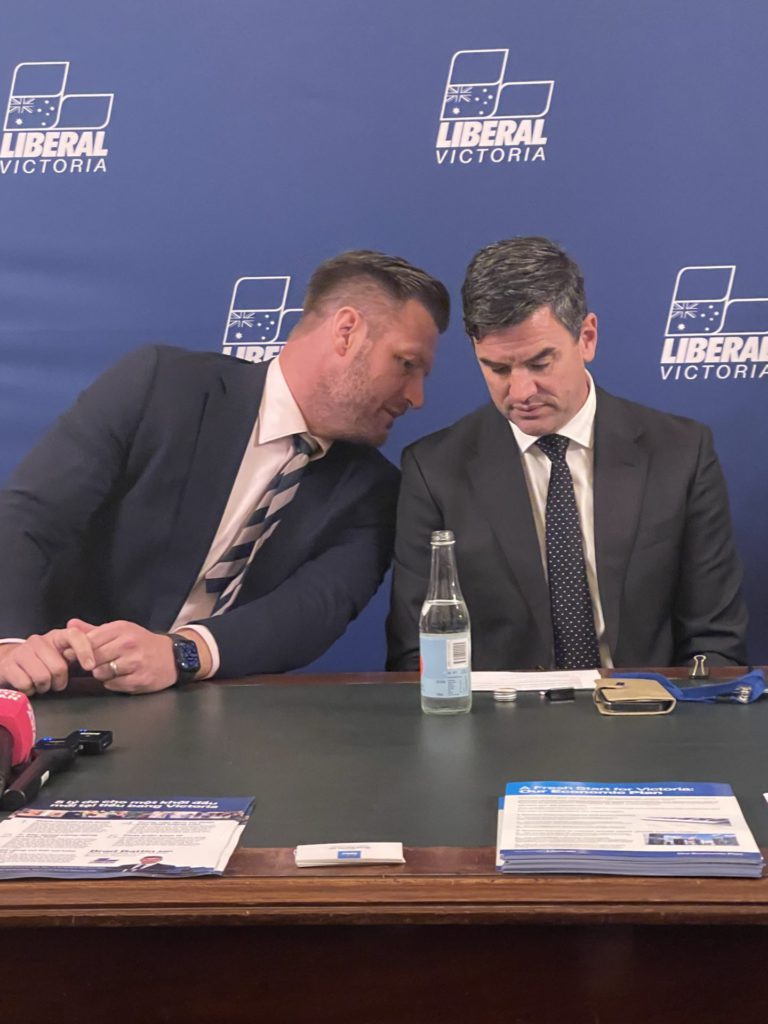
Liberal Party Press Conference- Image Source- The Australia Today
Pressed on the risk of increased youth incarceration, Mr Battin stressed a “multilayered youth correction system,” noting:
“It can’t be a one-solution-fits-all approach.
We must give young offenders every chance to turn their lives around.”
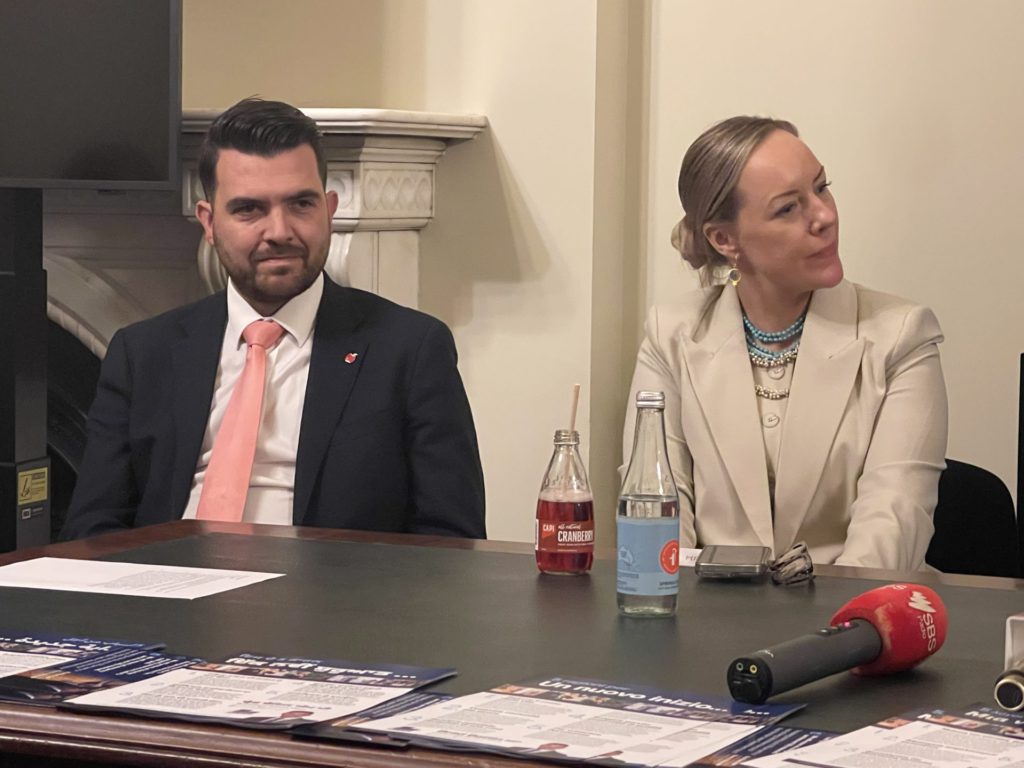
Liberal Party Press Conference- Image Source- The Australia Today
A Fair Go on Homeownership Homeownership took centre stage as Battin decried skyrocketing prices amid a cost-of-living squeeze. He pledged that under a Liberal government, first-home buyers purchasing homes up to $1 million would pay no land tax, saving them up to $55,000, roughly their deposit.
“Victorians deserve a fair go. This government has failed to plan and provide alternatives,”
he said.
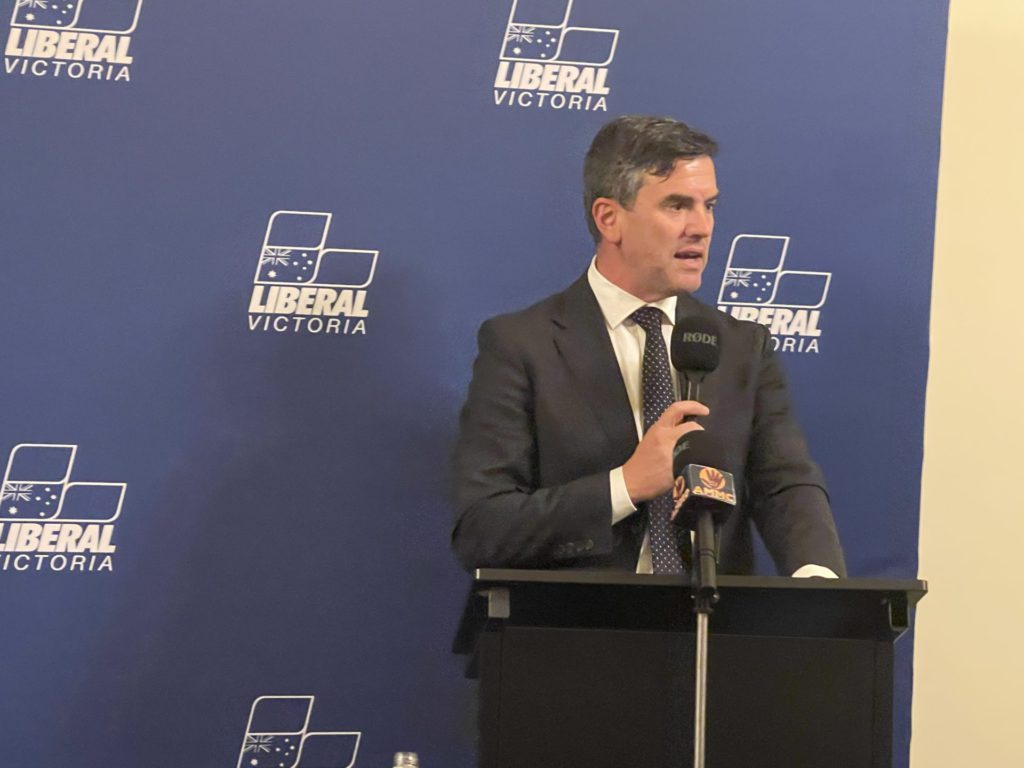
Liberal Party Press Conference- Image Source- The Australia Today
Standing alongside his colleagues, Deputy Opposition Leader Sam Groth stressed the urgency of the Liberals’ outreach, saying, “We’ve heard loud and clear that too many communities feel left behind—so today we’re making a promise: your stories, your struggles and your successes will shape our agenda.”
Groth, the Member for Nepean, emphasised that engaging multicultural communities wasn’t just a symbolic gesture but “a foundational step to crafting policies that work for every family in Victoria, no matter where they come from.”
Liberal Party Press Conference- Image Source- The Australia Today
Keeping the Gas Tap On Energy policy also featured prominently: Battin vowed to reverse Labor’s ban on gas connections in new homes and to renew and expand gas-exploration contracts.
“We will keep the gas tap on. We can’t bring people to a stage where they have to choose between keeping the home warm or having dinner.”
Shadow Minister David Davis added that a reliable gas supply was “vital for families and businesses in regional and metro Victoria alike.”
Education and Multicultural Representation Addressing the multicultural media gathered, Mr Battin lamented that Victoria, despite having the highest proportion of overseas-born residents, boasted just four prestigious selective schools, compared to more than 20 in New South Wales. He criticised Labor’s new payroll tax on private and religious schools, which he said “adds $1,000 a year to fees and hurts families seeking the best for their children.”
Shadow Minister Evan Mulholland reinforced the outreach theme by moving a Legislative Council motion urging the Special Broadcasting Service (SBS) to expand beyond its Western Sydney stronghold into Melbourne’s diverse suburbs such as Broadmeadows and Dandenong.
Liberal Party Press Conference- Image Source- The Australia Today
“Victoria is the multicultural capital of Australia, and SBS must reflect that reality—or risk becoming the Sydney Broadcasting Service,”
Mulholland declared.
Deepening India–Victoria Ties Battin concluded by announcing that under Liberal leadership, India would become Victoria’s top partner for business, education and tourism—an overture to the state’s large Indian diaspora.
“We will build on existing trade and student-exchange links and welcome more Indian investment in our booming technology and clean-energy sectors,”
he said.
A Course Correction? Months into his leadership, Brad Battin’s multicultural media convocation—complete with senior shadow ministers and regional representatives—appears designed to “course-correct” the Liberal Party’s outreach strategy. As battleground seats grow more diverse, today’s gathering at the Victorian Parliament may mark a turning point in how the opposition connects with Victoria’s communities of origin.
Support our Journalism
No-nonsense journalism. No paywalls. Whether you’re in Australia, the UK, Canada, the USA, or India, you can support The Australia Today by taking a paid subscription via Patreon or donating via PayPal — and help keep honest, fearless journalism alive.
Media freedom is a crucial element of a functioning democracy. In the Pacific Islands region, media freedom levels differ. This post analyses the latest media freedom rankings for Pacific nations and suggests two ways the re-elected Albanese government could add to its support for the Pacific media sector.
In May every year, Reporters Without Borders (RSF) updates the rankings of 180 countries with respect to their media freedom levels. The latest figures reveal that the four Pacific Island countries included are situated in the top half of the rankings. Of the four, Fiji performed the best in 2025, followed by Samoa and Tonga. Papua New Guinea’s ranking is well below those of the other three Pacific countries included in the index.
Much has been made of Fiji’s improved ranking following the repeal in 2023 of the punitive 2010 Media Industry Development Act, which was widely regarded as the harshest media law in the region. While RSF rankings since then signal progress, underlying threats to media freedom are not reflected.
United Nations representative Hieke Alefsen recently described the repeal of the media act as a “critical turning point” but emphasised that legal reforms must continue in Fiji, especially regarding sedition laws, under which news executives were prosecuted in 2017.
Indeed, Fiji’s Prime Minister Sitiveni Rabuka, while assuring the media that the dark days of oppression are over, has also noted that “with our recent history, let us not take this freedom for granted”.
Samoa is not far behind Fiji in RSF’s index. Quality print outlets are said to provide a solid foundation for Samoa’s diverse media sector. Media freedom in Samoa faces challenges and there are concerns that recent online harassment of journalists could dent the public’s faith in the news media.
The Tongan government is a key source of advertising revenue for media businesses in Tonga. Indeed, media outlets in many small Pacific states have a similar reliance on their governments for such income. When three Tongan broadcasters were suspended from their jobs in 2020, accused of bias against the government, the incident spread fear among journalists and demonstrated the challenges media workers can experience.
In Papua New Guinea, media freedom has been considered to be “reasonably healthy” but vulnerable. Last year, Papua New Guinea’s RSF ranking dropped substantially after a draft media policy was announced. The first version raised a great deal of a great deal of concern about its negative implications for media freedom, with comparisons made to Fiji’s now-repealed law. Following a consultation process, the fifth version of the policy was approved by cabinet in January this year.
Concerns remain about what regulation of the media sector could mean for media freedom in Papua New Guinea. The country’s RSF ranking is worrying. And in March 2025, the PNG government took the unprecedented step of shutting down Facebook for a day, nationwide. Even so, PNG is well above the poorest performing countries, which include Myanmar, Afghanistan, Iran, China and North Korea.
Most Pacific Island countries are not included in RSF’s index. A valuable resource that addresses this gap is the Pacific Islands Media Freedom Index, launched last year. The index includes 14 countries. The criteria for ranking countries bear some similarities to RSF’s, although a gender category has been added in an attempt to take into account the challenges faced by female journalists.
The Pacific index draws on the perspectives of media professionals working in Pacific Island countries. Of the 14 countries included, the top two are Palau and Niue. The bottom two are Papua New Guinea and Nauru.
All media workers in Nauru are public servants because there is no independent media. Foreign journalists face difficulties securing visas to enter, despite or perhaps because of international interest in Australia’s offshore asylum processing centre in Nauru. According to Amnesty International, the centre was holding 100 detainees in January 2025. Facebook was banned in Nauru for nearly three years, from May 2015 to January 2018.
The area referred to as West Papua by independence supporters is not included in the RSF or Pacific indices but it is important to note that there is limited media access to the area, which has perhaps the most egregious level of media freedom in the Pacific.
Media freedom is essential in democracies, enabling citizens to be informed. Media professionals should be able to conduct investigations without fear of reprisal. Media freedom is not guaranteed in the small island states of the Pacific region. It is worth advocating for media freedom and striving to protect it.
ABCID’s work in the Pacific region has included media capacity building, strengthening national media associations, empowering female journalists, and delivering practical training in specific priority areas. It produces research, including reports on the state of the media landscape in Pacific Island countries.
The re-elected Albanese government would do well to continue this support and implement two specific recommendations.
Typically, journalists in the Pacific are less educated than those in other regions. The first tangible way in which Australia could support the Pacific media sector would be to assist journalism education programs offered by universities such as the University of the South Pacific, the University of Papua New Guinea and Divine Word University. To date, Pacific journalism schools have received little attention from the Australian aid program.
The Pacific’s small media environments generate marginal returns on investment, making it difficult to retain staff or reinvest in infrastructure. The Fiji Media Association General Secretary, Stanley Simpson, recently stated that some Fiji media organisations were only a month or two away from shutting down.
Given the financial difficulties of operating media businesses in states with small populations, a second option for Australia would be to consider direct support to media businesses. To ensure that the editorial independence of media outlets is maintained, such grants could perhaps be administered by media industry associations. For example, in Samoa, there are two organisations that may be suitable: the Media Council and the Journalists Association of Samoa. If such an approach were to be adopted, the industry associations might need financial assistance to hire staff to administer grant processes.
Media freedom can never be taken for granted. It would be prudent to collaborate with and support journalism training institutions and media businesses as part of Australia’s existing long-term strategy to promote media sustainability and resilience in the Pacific region.
Disclosure:The Pacific Research Program is an independent Pacific-focused research program that supports evidence-based policy-making in the Pacific and collaborative research relationships across the region. The PRP is co-funded by the Australian Department of Foreign Affairs and Trade and the consortium partners’ parent bodies. The views are those of the authors only.
Contributing Author(s): Amanda H A Watson is a researcher with the Department of Pacific Affairs at the Australian National University. Her research interests include information and communication technologies in the Pacific Islands region and the role of the media sector in Pacific Island countries. Shailendra B. Singh is Associate Professor of Pacific Journalism at The University of the South Pacific, based in Suva, Fiji, and a member of the advisory board of the Pacific Journalism Review.
Support our Journalism
No-nonsense journalism. No paywalls. Whether you’re in Australia, the UK, Canada, the USA, or India, you can support The Australia Today by taking a paid subscription via Patreon or donating via PayPal — and help keep honest, fearless journalism alive.
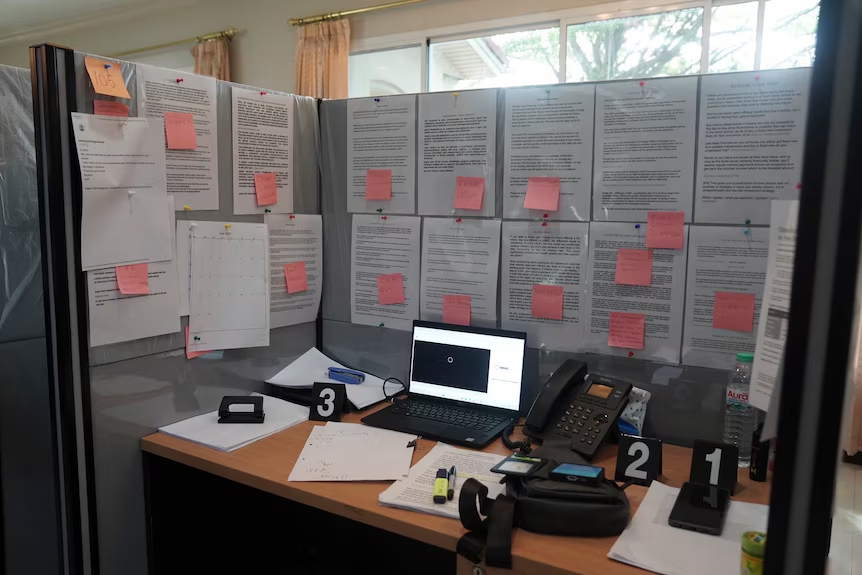
Thirteen people, including five Australian citizens, have been arrested in Thailand after authorities dismantled a scam operation accused of fleecing Australians out of millions of dollars through a fake investment bond scheme.
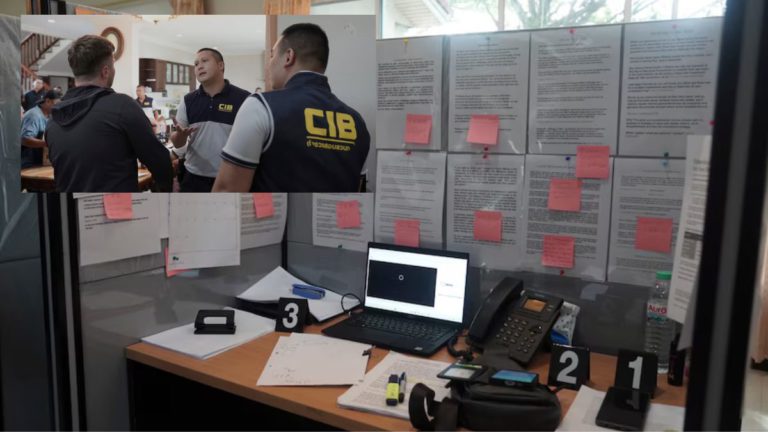
Thai police raided the illicit operation—a so-called “boiler room” set up in a six-bedroom house on the outskirts of Bangkok—on Monday, 16 June, following an investigation launched under Operation Firestorm, a joint effort between the Australian Federal Police (AFP) and the Royal Thai Police (RTP).
Thirteen people, including five Australians, who allegedly ran a Thai-based scam centre set up to fleece Australian victims out of millions of dollars have been arrested after Thai authorities shut down the scam centre on the outskirts of Bangkok, Thailand.https://t.co/XbdHeUZltx
The arrested individuals include five Australians, six British nationals, one Canadian, and one South African. They were charged under section 210 of the Thai Criminal Code with conspiracy to commit an offence, which carries a maximum penalty of five years in prison.
Authorities allege the group operated a highly sophisticated investment scam, pretending to represent international financial firms and using fake high-yield fixed-income bonds to lure Australian victims. Investigators believe the syndicate stole over $1.9 million from Australians in just two months of operation, having set up shop in April this year.
Image: Thai police have shut down a compound set up to fleece Australians out of millions of dollars. (AP: Thailand Central Investigation Bureau)
Assistant Commissioner Richard Chin of the AFP described the scam as one of the most elaborate investment frauds the AFP has encountered.
“This will be the first takedown in Thailand under Operation Firestorm, and it’s a significant disruption to a criminal network that preys on Australians.”
According to authorities, the scammers used forged documentation, high-pressure sales scripts, and even face-to-face online meetings to convince their victims of the scam’s legitimacy. A real financial services licence was fraudulently used to bolster their credibility.
“These syndicates do not care about their victims and are only interested in the profits this crime type can bring in,” said Assistant Commissioner Chin.
“Unfortunately, Australia is a big target for cybercriminals—we’re relatively prosperous and tend to be very trusting.”
The operation’s success followed a tip-off that Australians had been recruited into the scam. The AFP passed the intelligence to the RTP through its international network, which led to the raid and arrests. Dozens of phones and laptops were seized, and initial forensic examinations uncovered a digital spreadsheet with thousands of potential Australian targets.
Image: Thai police have shut down a compound set up to fleece Australians out of millions of dollars. (AP: Thailand Central Investigation Bureau)
Authorities say the group moved victim funds into cryptocurrency before transferring them to other accounts, complicating recovery efforts. Officials are now reviewing seized documents to trace and possibly recover the stolen funds.
Assistant Commissioner Chin stressed the importance of global cooperation in tackling transnational cyber fraud. “Cybercrime has no borders,” he said.
“It is vital law enforcement agencies work together across jurisdictions to disrupt these scam centres and the criminals that operate them.”
Operation Firestorm, led by the AFP’s Joint Policing Cybercrime Coordination Centre (JPC3), was launched in August 2024 to dismantle offshore scam hubs targeting Australians. Since then, three scam centres in Manila have been shut down. This week’s bust in Bangkok marks its first takedown in Thailand.
In the last four years, Australians have reported more than $4.45 billion in losses from cyber-enabled fraud. In 2024 alone, Australians lost $945 million to investment scams.
Assistant Commissioner Chin issued a stark warning to the public:
“If an investment opportunity seems too good to be true, then it probably is.”
Support our Journalism
No-nonsense journalism. No paywalls. Whether you’re in Australia, the UK, Canada, the USA, or India, you can support The Australia Today by taking a paid subscription via Patreon or donating via PayPal — and help keep honest, fearless journalism alive.
Earlier today, Iranian officials urged the country’s citizens to remove the messaging platform WhatsApp from their smartphones. Without providing any supporting evidence, they alleged the app gathers user information to send to Israel.
WhatsApp has rejected the allegations. In a statement to Associated Press, the Meta-owned messaging platform said it was concerned “these false reports will be an excuse for our services to be blocked at a time when people need them most”. It added that it does not track users’ location nor the personal messages people are sending one another.
It is impossible to independently assess the allegations, given that Iran provided no publicly accessible supporting evidence.
But we do know that even though WhatsApp has strong privacy and security features, it isn’t impenetrable. And there is at least one country that has previously been able to penetrate it: Israel.
3 billion users
WhatsApp is a free messaging app owned by Meta. With around 3 billion users worldwide and growing fast, it can send text messages, calls and media over the internet.
It uses strong end-to-end encryption, meaning only the sender and recipient can read messages; not even WhatsApp can access their content. This ensures strong privacy and security.
Advanced cyber capability
The United States is the world leader in cyber capability. This term describes the skills, technologies and resources that enable nations to defend, attack, or exploit digital systems and networks as a powerful instrument of national power.
But, Israel also has advanced cyber capability, ranking alongside the United Kingdom, China, Russia, France and Canada.
Israel has a documented history of conducting sophisticated cyber operations. This includes the widely cited Stuxnet attack that targeted Iran’s nuclear program more than 15 years ago. Israeli cyber units, such as Unit 8200, are renowned for their technical expertise and innovation in both offensive and defensive operations.
Seven of the top 10 global cybersecurity firms maintain R&D centres in Israel, and Israeli startups frequently lead in developing novel offensive and defensive cyber tools.
A historical precedent
Israeli firms have repeatedly been linked to hacking WhatsApp accounts, most notably through the Pegasus spyware developed by an Israeli-based cyber intelligence company NSO Group. In 2019, it exploited WhatsApp vulnerabilities to compromise 1,400 users, including journalists, activists and politicians.
Another Israeli company, Paragon Solutions, also recently targeted nearly 100 WhatsApp accounts. The company used advanced spyware to access private communications after they had been de-encrypted.
These kinds of attacks often use “spearphishing”. This is distinct from regular phishing attacks, which generally involve an attacker sending malicious links to thousands of people.
Instead, spearphishing involves sending targeted, deceptive messages or files to trick specific individuals into installing spyware. This grants attackers full access to their devices, including de-encrypted WhatsApp messages.
A spearphishing email might appear to come from a trusted colleague or organisation. It might ask the recipient to urgently review a document or reset a password, leading them to a fake login page or triggering a malware download.
Protecting yourself from ‘spearphishing’
To avoid spearphishing, people should scrutinise unexpected emails or messages, especially those conveying a sense of urgency, and never click suspicious links or download unknown attachments.
Hovering the mouse cursor over a link will reveal the name of the destination. Suspicious links are those with strange domain names and garbled text that has nothing to do with the purported sender. Simply hovering without clicking is not dangerous.
Enable two-factor authentication, keep your software updated, and verify requests coming through trusted channels. Regular cybersecurity training also helps users spot and resist these targeted attacks.
No-nonsense journalism. No paywalls. Whether you’re in Australia, the UK, Canada, the USA, or India, you can support The Australia Today by taking a paid subscription via Patreon or donating via PayPal — and help keep honest, fearless journalism alive.
India’s Prime Minister Narendra Modi’s return to Canada after a decade, as a special invitee to the 51st G7 Summit, has catalysed a fresh chapter in the two nations’ bilateral partnership. Against the backdrop of global deliberations on energy security, technology and the priorities of the Global South, Modi’s tête-à-tête with Canadian Prime Minister Mark Carney signalled both sides’ determination to move past recent diplomatic tensions and deepen cooperation across multiple fronts.
Modi landed in Calgary on Monday and was met with a ceremonial reception by Acting High Commissioner Chinmoy Naik, a gesture that underscored Canada’s renewed warmth towards its largest diaspora. It was Modi’s sixth consecutive G7 attendance but his first Canadian visit since 2015—a milestone eagerly leveraged by both sides.
“Landed in Calgary to take part in the G7 Summit. Will be meeting various leaders and sharing my thoughts on important global issues. I will also be emphasising the priorities of the Global South,” Modi posted on X upon arrival, setting the stage for intense bilateral engagements.
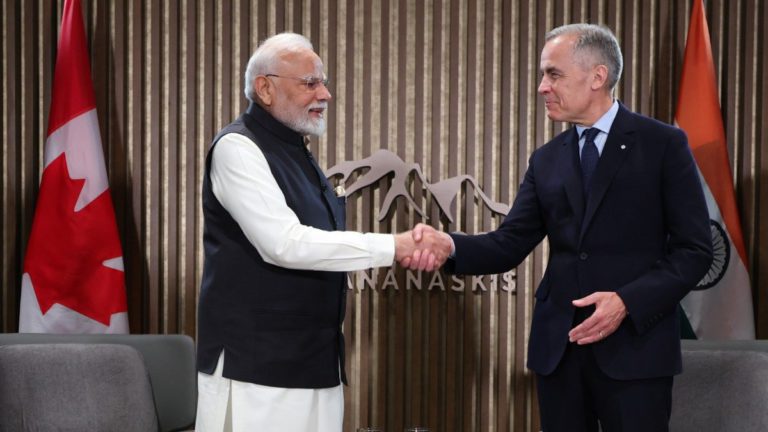
On Tuesday afternoon at the Pomeroy Kananaskis Mountain Lodge, Modi and Carney met for the first time since Carney took office in late 2024. In their wide-ranging discussion, they praised each other’s electoral mandates and reaffirmed their commitment to democracy, the rule of law and people-centric growth.
“It’s a great honour to host you at the G7,” Carney told Modi.
“This meeting is a testament to the importance of your country, to your leadership and to the critical issues we tackle together—from energy transition to artificial intelligence to combating transnational repression and terrorism.”
Modi reciprocated by congratulating Carney on steering a successful summit and invited him to New Delhi. “India and Canada are connected by a strong belief in democracy, freedom and the rule of law,” Modi said.
“I look forward to working closely with you to add momentum to our friendship—in trade, energy, space, clean technologies, critical minerals, fertilisers and more.”
The cordial exchange marks a stark departure from the low point of bilateral ties in 2023, when Canada accused Indian agents of involvement in the murder of a Sikh separatist on Canadian soil. Both governments expelled senior diplomats in a diplomatic tit-for-tat, and Ottawa pressed New Delhi to clamp down on extremist elements. India rejected the allegations, insisting that the accusations lacked evidence.
Yet, as Modi and Carney sat down at Kananaskis, that chapter appeared closed. “I am very grateful for the invitation to participate as a guest country,” Modi told Carney.
“India, as G20 chair, laid important groundwork for the global good. We now have a great opportunity to carry that momentum into the G7.”
During their meeting, Prime Minister Mark Carney and Prime Minister Narendra Modi reaffirmed the depth of Canada–India relations, underscored by mutual respect for the rule of law and shared commitment to sovereignty and territorial integrity.
The two leaders agreed to appoint new high commissioners in each country, restoring full consular services for citizens and businesses. They also highlighted the historic bonds between their peoples and explored expanded cooperation in the Indo-Pacific, noting significant commercial ties in economic growth, supply chains, and the energy transition.
On G7 priorities, Prime Minister Carney raised concerns over transnational crime and repression, regional security, and the importance of upholding a rules-based international order.
Roadmap for Renewed Collaboration In subsequent meetings, India and Canada outlined concrete areas for cooperation:
Trade & Investment: Building on Canada’s investments in India’s green energy and technology sectors, and India’s growing footprint in Canadian manufacturing and services.
Energy Security: Collaborating on diversification strategies, infrastructure financing and renewable power—an agenda both leaders championed during suite-wide G7 sessions.
Technology & Innovation: Deepening ties in AI research, digital public infrastructure and quantum technology, leveraging India’s booming startup ecosystem and Canada’s advanced R&D capabilities.
Critical Minerals & Sustainable Development: Co-investing in battery materials and rare earth processing to secure supply chains critical to decarbonisation.
While Canada loomed large in Modi’s schedule, the summit also saw Modi reinforce ties with a range of partners—from Mexico’s President Claudia Sheinbaum, Australia’s Anthony Albanese and South Korea’s Lee Jae-myung to the European Union’s Ursula von der Leyen. Each meeting carried its own promise of stronger economic, security and cultural bonds. Yet it was the Canada dialogue that stood out as the must-win bilateral after years of mistrust.
As Modi departs for his final G7 nation, Croatia, both he and Carney will return to their capitals buoyed by new momentum. With trade negotiations, joint energy projects and people-to-people exchanges on the horizon, the India–Canada axis is poised for a significant upgrade—one built on mutual respect, shared democratic values and a forward-looking agenda for the 21st century.
Support our Journalism
No-nonsense journalism. No paywalls. Whether you’re in Australia, the UK, Canada, the USA, or India, you can support The Australia Today by taking a paid subscription via Patreon or donating via PayPal — and help keep honest, fearless journalism alive.
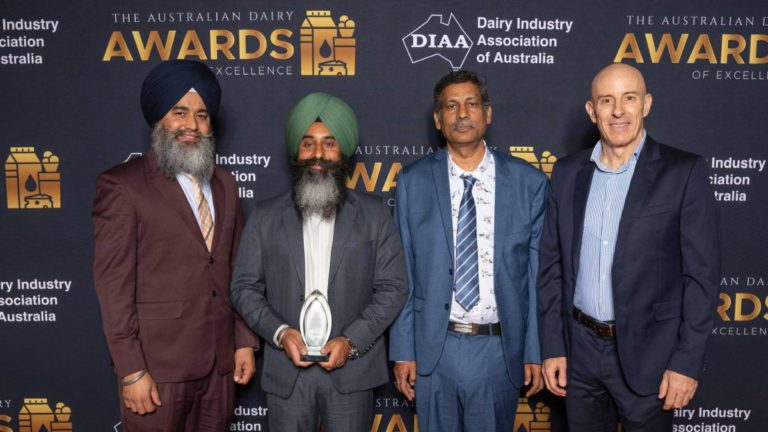
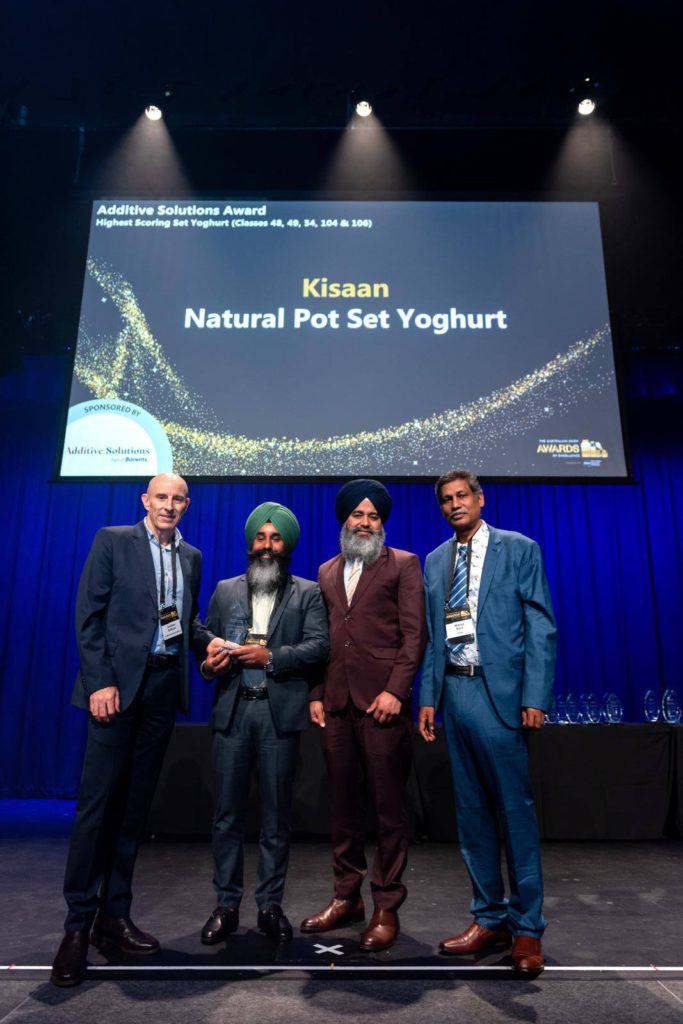
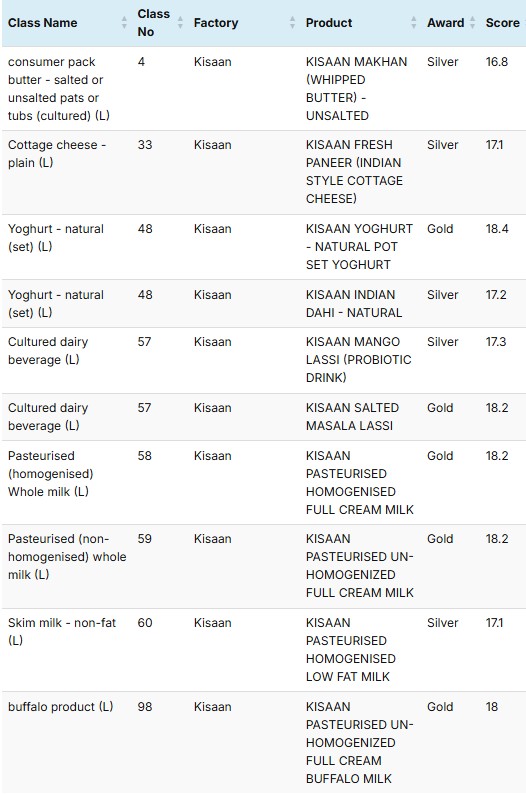
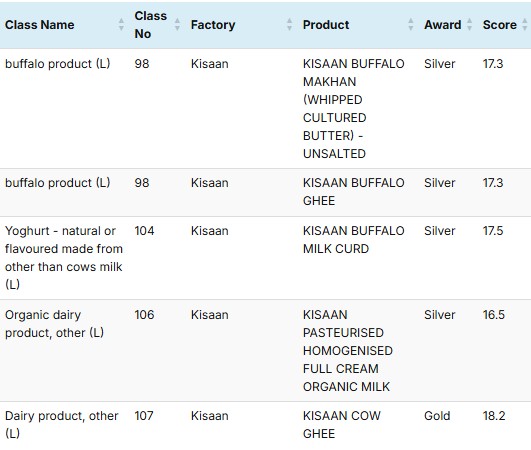
A Shepparton-based dairy company founded by two Indian-Australian entrepreneurs has scooped the top prize at the prestigious Dairy Industry Association of Australia (DIAA) Awardss 2025, with its natural pot-set yoghurt named the highest scoring yoghurt in the country.
Image: Kisaan’s natural yoghurt and desi dahi (Source: Facebook)
Kisaan Dairy, co-owned by Jaspreet Singh and Surinder Singh, also won an impressive six gold and nine silver medals across various product categories. The elated team took to Facebook to thank their loyal customers and dedicated staff, declaring:
“This achievement is a testament to your love for our products!”
The Punjabi word kisaan means farmer — a fitting name for a company that started out supplying Indian-style cheese to local sweet makers and is now producing over 100,000 kilograms of yoghurt weekly.
Image:Kisaan Dairy, co-founded by Jaspreet Singh and Surinder Singh, bagged six gold and nine silver medals across multiple categories at the prestigious Dairy Industry Association of Australia (DIAA) Awards. (Source: Facebook)
Jaspreet Singh and Surinder Singh, who are not related, first met in Melbourne in 2006 after migrating from India. They drove taxis and trucks before launching their dairy venture in response to community demand for Indian-style dairy products like dahi (yoghurt) and buffalo milk.
“In January, we launched two new products — natural pot-set yoghurt and dahi — after many trials and community tastings,” Jaspreet Singh told edairynews.
“We never imagined our yoghurt would win in its first year!”
The judges at the DIAA awards were so impressed, they couldn’t fault the product. “Usually there are two or three finalists,” Singh said. “This time there was only one — us.”
All the glamour of Cinderella’s ball!
In case you missed it, the Australian Dairy Awards of Excellence gala dinner was held at the Plaza Ballroom in Collins Street Melbourne late last month.
Industry participants turned out in their finery at the Spanish Rococo themed… pic.twitter.com/7KDwiXmrXj
— AustralianDairyFoods (@AustDairyFoods) June 6, 2025
Kisaan sources buffalo milk from dairies in northern Victoria and has built a growing customer base through south Asian grocery stores and home delivery services.
The business has expanded from Melbourne to regional centres like Shepparton, Griffith and Geelong, supplying over 260 stores and several cafés.
Currently offering buffalo curd, milk, ghee and yoghurt, Kisaan plans to launch buffalo butter and more fresh dairy products, including paneer, in the coming months.
Image: Jaspreet Singh and Surinder Singh showcasing their products at a local event (Source: Facebook)
Their journey from driving trucks to dominating the dairy shelves reflects not just entrepreneurial grit, but a deep connection to community and culture — with Australia’s highest-rated yoghurt as sweet proof.
Support our Journalism
No-nonsense journalism. No paywalls. Whether you’re in Australia, the UK, Canada, the USA, or India, you can support The Australia Today by taking a paid subscription via Patreon or donating via PayPal — and help keep honest, fearless journalism alive.
A seven-year-old boy in western Sydney has narrowly escaped serious injury after a car crashed through the wall of his home, just moments after he left the room.
The dramatic crash unfolded just before 6 pm on Medallist Parade in Colebee, when a Kia SUV veered off the road and slammed into the front of the house, destroying the wall of a room where the child had been playing with toys seconds earlier.
“I heard this bang, bang, bang,” said the horrified homeowner and the boy’s mother, Prianko Kapoor told 7News.
“I turned around and I saw smoke inside the house and I saw a big hole.”
The impact caused significant structural damage, leaving the family unsure when they’ll be able to return to normal life.
“We have to actually figure out how to make this house secure again to live in,”
Kapoor added.
The SUV driver, also a mother, had two toddlers in the car at the time. She was taken to the hospital for mandatory testing and was later cleared by paramedics.
Incredibly, no one was injured in the crash. Kapoor said she was shaken but grateful:
“I’m so thankful to God, my son is safe.”
Support our Journalism
No-nonsense journalism. No paywalls. Whether you’re in Australia, the UK, Canada, the USA, or India, you can support The Australia Today by taking a paid subscription via Patreon or donating via PayPal — and help keep honest, fearless journalism alive.
The United States has announced new visa restrictions on foreign government officials and others accused of facilitating illegal immigration into the country.
In a statement shared on June 17 by the US Embassy in India via its official X account, the embassy said, “We will not tolerate those who facilitate illegal and mass immigration to the United States.”
We will not tolerate those who facilitate illegal and mass immigration to the United States.
The United States has established new visa restrictions targeting foreign government officials and others who do so, and the Trump Administration has designated as Foreign Terrorist… pic.twitter.com/N6D3Tk1OJq
Nearly 100,000 Indians crossed the US-Mexico border last year, many through the “donkey route.” One smuggler shows CNN’s Ivan Watson video he says are his clients squeezing through a border fence. #cnn#news#india#ivanwatson
The Trump administration had already designated criminal cartels involved in people smuggling as Foreign Terrorist Organizations. The embassy’s statement added that governments which fail to repatriate their nationals could face broader consequences, including wide-ranging entry restrictions for their citizens.
The visa bans follow a recent federal crackdown in Los Angeles on smuggling networks and echo similar restrictions introduced last month on Indian travel agency owners and executives. These individuals are accused of knowingly helping people migrate illegally by offering fake documents and coordinating unlawful travel plans.
A separate statement from the US State Department said,
“Mission India’s Consular Affairs and Diplomatic Security Service work every day across our Embassy and Consulates to actively identify and target those engaged in facilitating illegal immigration and human smuggling and trafficking operations.”
The new visa restrictions are part of a global US immigration policy shift that applies even to individuals eligible under the Visa Waiver Programme. The State Department emphasised that anyone found guilty of visa fraud will face permanent bans from entering the country.
Was passed this message of a Punjabi guy who was just deported from 🇺🇸. Below I’ve translated it near word to word. This Khalistani SOB SimranjitMann is the most nihilistic shameless & dishonorable person. He has misled & brought suffering to so many Sikh youth & ordinary Pbis.… https://t.co/ywpP5jpRefpic.twitter.com/i4TbSixcFX
Earlier, screenshots of deportation messages have been circulating online, including a translated note from a young Punjabi man removed from the US. In the post, the man admits he falsely claimed links to Khalistan to seek asylum and was allegedly advised by his lawyer to support his case with a letter allegedly obtained from an Indian politician’s office. The court found the claim fraudulent, and deportation was ordered.
The embassy concluded its message by reaffirming that while the United States welcomes genuine visitors, it “cannot and will not tolerate illegal entry and abuse of visas or violation of US law.”
Support our Journalism
No-nonsense journalism. No paywalls. Whether you’re in Australia, the UK, Canada, the USA, or India, you can support The Australia Today by taking a paid subscription via Patreon or donating via PayPal — and help keep honest, fearless journalism alive.
Canada’s federal immigration department has released a damning report detailing serious internal misconduct by staff, including bribery attempts, privacy breaches, racism, and workplace harassment.
The 2023–2024 misconduct report, published on 13 June by Immigration, Refugees and Citizenship Canada (IRCC), confirms 62 founded cases of unethical behaviour across its workforce. The revelations mark the first time the department has publicly documented such internal issues.
Among the most serious breaches was a case officer, reportedly under financial stress, who asked a colleague whether they would take money in exchange for approving a study permit. Although the officer later claimed their computer had been hacked, an investigation found this to be a fabrication. Their security clearance was revoked.
Twelve employees were caught accessing confidential immigration files without authorisation—some driven by curiosity, others attempting to help relatives or friends. Several even requested colleagues to fast-track applications or alter official records.
Nine cases involved racist comments, threatening behaviour, or harassment within the workplace. One staff member was suspended without pay after making discriminatory remarks about a specific nationality. Another was found to have developed a personal relationship with an asylum seeker, co-signed their car loan, and offered departmental advice—actions flagged as a serious conflict of interest.
Other breaches included 37 instances of time theft, unauthorised absenteeism, and misuse of government resources. Some staff were caught cheating on internal assessments or failing to declare personal conflicts of interest in dealings with clients.
Of the 76 cases investigated, 62 were confirmed as misconduct. IRCC employs about 13,000 staff globally, including in Canadian embassies.
While the report highlights only a small portion of the workforce, Deputy Minister Harpreet S. Kochhar acknowledged that these were likely just the incidents that were detected or reported.
“We are grateful to the courageous employees who raised concerns or blew the whistle,” Kochhar said, adding that IRCC is committed to building a culture of openness and zero tolerance for misconduct.
The department has responded with disciplinary measures, mandatory training, and strengthened internal oversight. Managers are now required to report all privacy breaches to the internal privacy division for further investigation.
Despite existing safeguards—such as mandatory security screenings, task rotation, quality audits, and digital monitoring—the recurrence of these issues suggests persistent gaps in enforcement and supervision.
“This report reflects our journey towards continuous improvement, integrity, and excellence,” said Kochhar.
“We encourage all employees to speak up without fear of reprisal.”
The release of this inaugural misconduct report signals a push for greater accountability within IRCC, but also serves as a sobering reminder of the challenges that remain in safeguarding the integrity of Canada’s immigration system.
Support our Journalism
No-nonsense journalism. No paywalls. Whether you’re in Australia, the UK, Canada, the USA, or India, you can support The Australia Today by taking a paid subscription via Patreon or donating via PayPal — and help keep honest, fearless journalism alive.
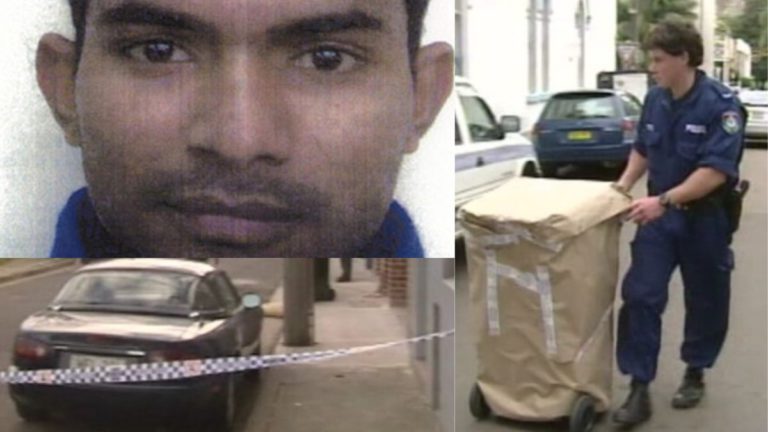
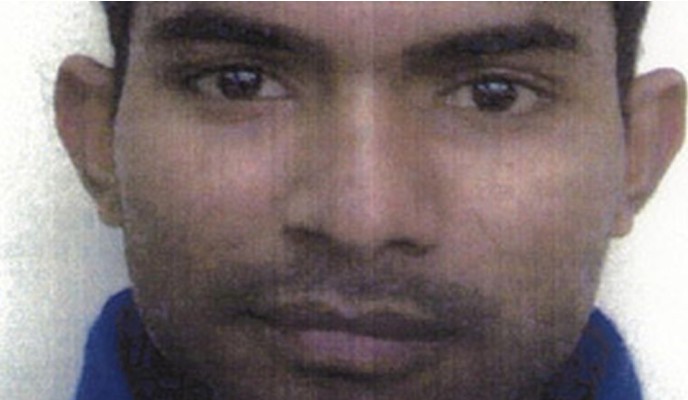
Mohammed Basheeruddin had spent nearly a month in custody after being apprehended on 17 May 2025, based on information relayed by Australian authorities through Interpol. He was believed to be “Basheeruddin Mohammed,” a suspect listed on NSW Police’s most wanted list in connection with the 2003 killing of Shoukat Mohammed.
Image: Body of Shoukat Mohammed was found inside a sleeping bag in June 2003 (Source: Nine News screenshot)
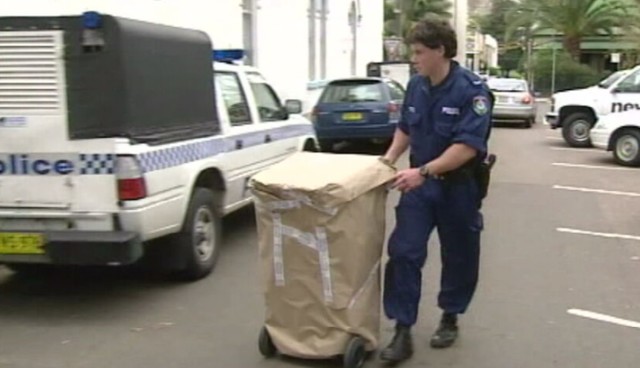
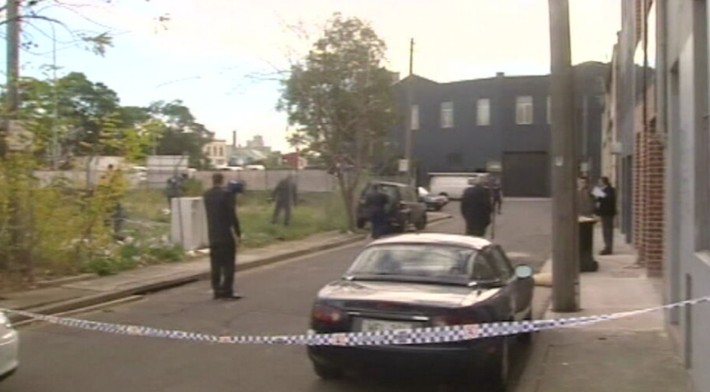
Shoukat’s body was discovered on 29 June 2003, stuffed inside a sleeping bag placed in a wheelie bin on James Street, Redfern. He had been drugged, assaulted, and strangled. At the time, one suspect was arrested and later sentenced to more than 26 years in prison. However, police have continued searching for a second man, Basheeruddin Mohammed, believed to have fled to India.
Australian authorities believed they had finally found the ‘most wanted’ fugitive in India — but they had the wrong man.
“There is a similarity of name between these two fellows, and this was a case of mistaken identity,” said defence counsel Farhat Jahan Rehmani. “He was very shocked and crying continuously for some two to three days,” added co-defence counsel M.A. Tousifoddin.
Image: Basheeruddin Mohammed remains on the NSW police’s most wanted list (Source: NSW Police Force)
Basheeruddin’s lawyers told the Delhi court that their client was only 16 years old at the time of the murder, had never travelled to Australia, and obtained his Indian passport only in 2016. Crucially, his father’s name also did not match that of the suspect identified in Australian police records.
In light of these inconsistencies, the court ordered his fingerprints to be taken and compared with those provided by Australian authorities. The Central Forensic Science Laboratory (CFSL) submitted its sealed report on 12 June 2025.
“The fingerprints of my client were also taken in the court, and they were sent to the forensic science lab,” Rehmani said.
“The report was brought in a sealed envelope, and when the envelope was opened, obviously it was different — all ten digits, they did not match.”
On 13 June, Additional Chief Judicial Magistrate Pranav Joshi formally discharged Basheeruddin from all proceedings, stating:
“As per the report, the fingerprints of Mohammed Basheeruddin… are different from those of the original fugitive criminal.”
Rehmani later questioned the basis for her client’s arrest, which stemmed solely from a name similarity. “How is it possible that a person, only for a similarity in name, can be arrested and he has been kept for 22 days?” she asked. “I know that truth prevails.”
Image: Body of Shoukat Mohammed was found inside a sleeping bag in June 2003 (Source: Nine News screenshot)
When contacted by 9News, the Australian Federal Police declined to comment on their role or how the mistaken identity occurred.
Detective Inspector Despa Fitzgerald, Crime Manager at Redfern Local Area Command, said in a statement it is important that Basheeruddin Mohammed is located as soon as possible, ““This was a brutal crime and it is in the public interest that we apprehend this man quickly.”
“We are hoping the announcement of this reward is the motivation required for persons within the community with information to break their silence and assist police.”
Support our Journalism
No-nonsense journalism. No paywalls. Whether you’re in Australia, the UK, Canada, the USA, or India, you can support The Australia Today by taking a paid subscription via Patreon or donating via PayPal — and help keep honest, fearless journalism alive.
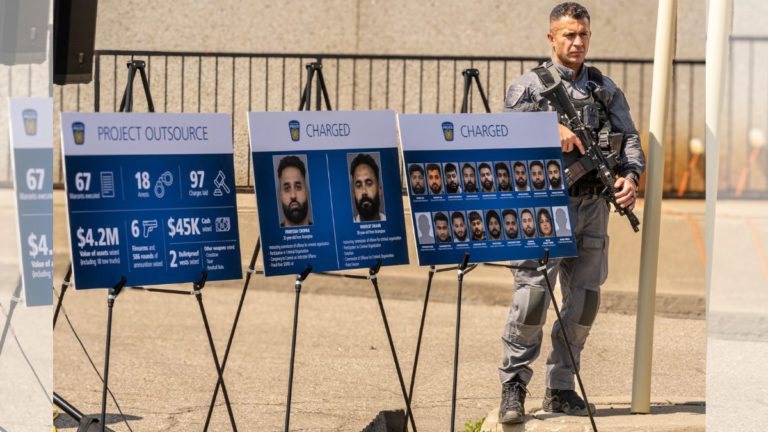
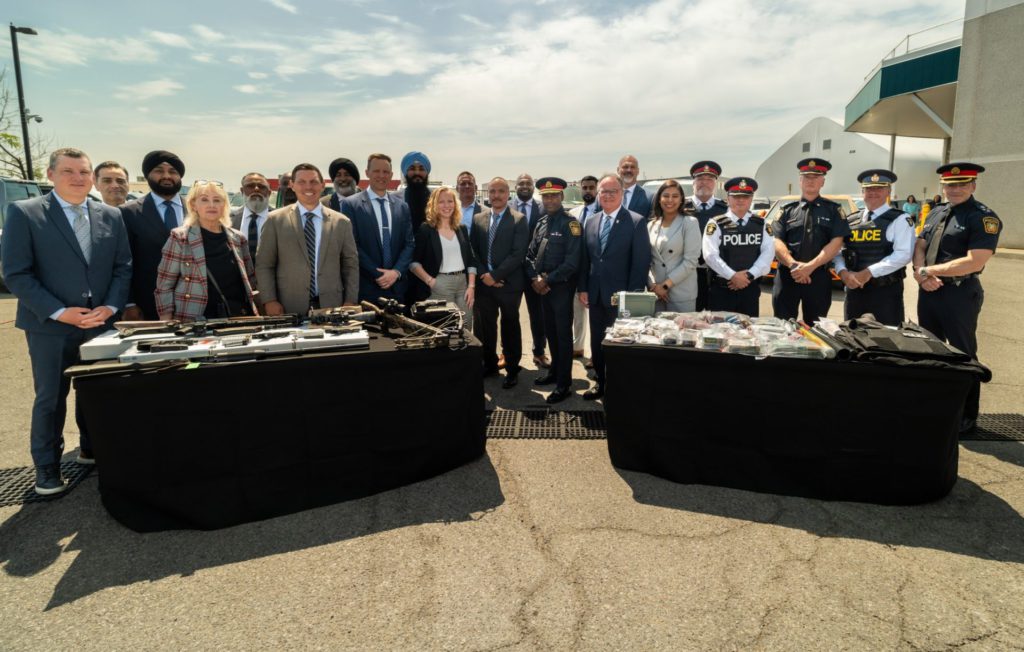
A violent criminal network targeting South Asian business owners and defrauding insurance companies by staging collisions has been dismantled, Peel Regional Police announced on Monday. The sweeping investigation—dubbed Project Outsource—has led to 18 arrests and nearly 100 criminal charges.
“This investigation has delivered a significant blow to a well-organised criminal network that has been spreading fear and violence in our communities,” said Chief Nishan Duraiappah.
“These individuals and their actions have no place here, and they will be held fully accountable.”
Image Source- Peel Police
Unveiled at a press conference in Peel Region, Project Outsource revealed the operations of a Brampton-based group that orchestrated a spree of violent crimes, including drive-by shootings, arsons, and threats—all part of an escalating pattern of extortion. The police investigation was launched in July 2024 following what Chief Duraiappah described as a “sharp” rise in violent extortion attempts in 2023 targeting members of the South Asian business community.
Detective Brian Lorette, who led the Extortion Investigation Task Force, said investigators uncovered two interlinked components within the criminal network: one focused on extortion and violence, the other embedded within the towing industry.
According to Lorette, the group was behind a “significant portion” of extortion incidents in Peel and across the Greater Toronto Area (GTA), and also manipulated the insurance system by staging “dozens” of fake collisions. These incidents were “fraudulent in every aspect,” he said.
“They start at the planning stage. These are collisions that are often happening on our roadways, which obviously have a public safety impact, sometimes including police, ambulance and fire attending the scene.”
Image Source- Peel Police
Deputy Chief Nick Milinovich added that the fraudulent claims exceeded $1 million in total. The scale of the operation was immense. Police executed 67 search warrants across Peel Region, Caledon, York Region, and Toronto on June 10. The result: a haul of over $4.2 million in seized assets, including 18 tow trucks valued at $2.8 million, four high-end personal vehicles, five stolen cars, six firearms, 586 rounds of ammunition, two bulletproof vests, and various other weapons.
The suspects were allegedly affiliated with towing companies operating under the names Certified Roadside and Humble Roadside. Police believe these companies were fronts used to commit the staged collisions and related fraud.
As of June 10, 2025, the following individuals have been arrested and charged in connection with Project Outsource: • Haleh Javady Torabi, 37, of King City • Inderjit Dhami, 38, of Brampton • Paritosh Chopra, 32, of Brampton • Gurbinder Singh, 28, of Brampton • Kulwinder Puri, 25, of Brampton • Parminder Puri, 31, of Brampton • Inderjit Bal, 29, of Brampton • Varun Aul, 31, of Brampton • Ketan Chopra, 30, of Brampton • Norman Tazehkand, 32, of Brampton • Pawandeep Singh, 25, of Brampton • Dipanshu Garg, 24, of Brampton • Rahul Verma, 27, of Brampton • Karan Boparai, 26, of Brampton • Mankirat Boparai, 22, of Brampton • Simar Boparai, 21, of Brampton • Jovan Singh, 23, of Brampton • Abhinav Bhardwaj, 25, of Brampton
Charges laid against the group include criminal organisation participation, extortion, fraud, firearms possession, and more. While three individuals have been released pending court appearances, 15 remain in custody following bail hearings at the Ontario Court of Justice in Brampton. Alarmingly, nearly half of those arrested were already on some form of judicial release at the time.
“Once again raising serious concerns about repeat offenders and the urgent need for bail reform,” said Chief Duraiappah.
The investigation was conducted in partnership with the Ontario Provincial Police, Toronto Police Service, York Regional Police, Halton Regional Police, the RCMP, and the Canada Border Services Agency. It was supported through funding from the Government of Ontario’s Ministry of the Solicitor General and coordinated by the Criminal Intelligence Service Ontario.
Image Source- Peel Police
Deputy Chief Jeff Hill of the Halton Regional Police Service called Project Outsource “a testament to the power of police collaboration,” noting that “criminal networks have no borders, and neither does law enforcement.”
Solicitor General of Ontario Michael S. Kerzner commended the operation:
“Our government is proud to have supported Peel Regional Police… We will always support the brave men and women who protect Ontario and keep our communities safe.”
The success of the operation was echoed by law enforcement leaders across the GTA. Superintendent Sony Dosanjh of York Regional Police said, “Whenever violence is used to silence and exploit members of the community, a strong and coordinated response is essential.”
Project Outsource was sparked by a growing pattern of violence and intimidation against business owners in Peel, culminating in the establishment of the dedicated Extortion Investigation Task Force in December 2023. The task force’s efforts have now led to what authorities believe will be a significant disruption of criminal activity in the region.
“This initiative is an example of how, regardless of jurisdictional lines, police services are facing the same public safety challenges,” said Chief Superintendent Joe Matthews of Toronto Police.
“Working together is paramount to ensuring the safety of everyone.”
Peel Police are urging any victims of extortion to come forward. Information can be reported directly to police at (905) 453-3131 or anonymously via Crime Stoppers at 1-800-222-TIPS (8477) or www.peelcrimestoppers.ca.
⸻
Quick facts: • 18 arrests, with 97 criminal charges laid • $4.2 million in assets seized, including tow trucks, vehicles, and weapons • Nearly 50% of those arrested were already on judicial release • Charges include extortion, insurance fraud, firearms offences, and more
The investigation continues, with police anticipating more arrests and charges in the coming weeks.
Support our Journalism
No-nonsense journalism. No paywalls. Whether you’re in Australia, the UK, Canada, the USA, or India, you can support The Australia Today by taking a paid subscription via Patreon or donating via PayPal — and help keep honest, fearless journalism alive.
Criminals who upload footage or messages bragging about serious offences on social media will face up to two years’ extra behind bars under landmark legislation introduced today by Victoria’s Allan Labor Government.
The Crimes Amendment (Performance Crime) Bill 2025—introduced into Parliament by Attorney-General Sonya Kilkenny—creates a standalone offence for anyone who “posts and boasts” about their involvement in specified crimes.
The measure targets content celebrating or encouraging offences such as affray, burglary, robbery, car theft, carjacking, home invasion and violent disorder, whether committed individually or as part of a wider gang.
“Victorians are outraged by offenders posting and boasting about their crimes— that’s why we’re taking action,” Attorney-General Kilkenny said.
“This crackdown, alongside our tough new bail laws and machete ban, is all about keeping Victorians safe.”
Under the new offence, anyone found guilty of a serious crime who also publishes social-media content praising or inciting it will face up to two years’ additional imprisonment, on top of any sentence for the underlying offence. The legislation expressly includes ringleaders or facilitators, closing loopholes that allow organisers to escape extra penalties.
“These laws back the work of Victoria Police and send a clear message to offenders—crime isn’t content, it isn’t entertainment, and it won’t be tolerated,”
said Minister for Police Anthony Carbines.
Responding to “Clout Chasing”
In recent years, police and community groups have sounded the alarm over a dangerous “clout-chasing” trend on platforms like TikTok, Snapchat and Instagram, where young offenders film violent stunts or home invasions as proof of “street cred.” Victoria Police data shows dozens of copycat break-ins and assaults every year closely mimic footage circulated online, rehashing trauma for victims and normalising violent behaviour.
Until now, courts could treat boastful social-media posts as an aggravating factor at sentencing. The new bill elevates such conduct to a discrete offence, bringing Victoria in line with emerging international precedents that clamp down on performance-style crime.
Third parties—including journalists, witnesses, bystanders and first responders—are explicitly exempt from prosecution, ensuring legitimate reporting, commentary or bystander footage remains protected.
Building on Broader Reforms
The “post and boast” offence forms part of a broader strategy to bolster community safety:
Tougher bail laws: Already in force, targeting repeat violent and sex-offence allegations with stricter remand criteria.
Machete ban: From 1 September, private ownership of machetes will be outlawed under an Australian-first prohibition.
Further bail changes: Additional legislative enhancements will be tabled later this year to refine police and court powers.
“Together, these measures send a powerful message: we will disrupt the cycle of violence, from the moment a weapon is procured to the instant someone tries to turn violence into viral fame,”
Ms Kilkenny said.
What Happens Next
Having passed its first reading in the Legislative Assembly, the bill will proceed to debate and committee stage, with cross-bench and Opposition feedback expected in the coming weeks. If enacted, Victoria will become Australia’s first jurisdiction to criminalise the modern phenomenon of performance crime, reflecting growing concern about social media’s role in glorifying violence.
“There is no pride in crime,” Minister Carbines concluded.
“Offenders who seek likes and followers by celebrating their worst deeds will now face real consequences—on top of the sentences they already deserve.”
Support our Journalism
No-nonsense journalism. No paywalls. Whether you’re in Australia, the UK, Canada, the USA, or India, you can support The Australia Today by taking a paid subscription via Patreon or donating via PayPal — and help keep honest, fearless journalism alive.
Two young sisters from Harrow, aged just four and eight, have been left orphaned after a heartbreaking series of events claimed the lives of both their parents in less than three weeks, culminating in the devastating Air India plane crash in Ahmedabad.
Their mother, Bharti Patoliya, passed away after a courageous battle with cancer. Her final wish was to have her ashes scattered in her native Gujarat. Her husband, Arjun Patoliya, travelled to India to fulfil that wish.
But tragedy struck again on his return journey: Arjun was among the 270 people killed when Air India Flight AI171 crashed shortly after take-off from Ahmedabad on 12 June 2025.
The flight, a Boeing 787-8 Dreamliner, was en route to London Gatwick with 242 passengers and crew onboard when it issued a Mayday call just minutes into the flight. It then lost contact and crashed into the densely populated Meghani Nagar area near the Ahmedabad airport. The crash not only claimed lives onboard but also caused fatalities and injuries on the ground. Emergency responders continue to recover remains and assess the damage in the area.
Arjun, who had travelled to India alone to honour his wife’s final rites, never made it back to the daughters they had lovingly raised together in the UK.
The Patoliya family’s story has sparked an outpouring of grief and support. A fundraiser launched by friends, colleagues, and community members — A Family’s Tragedy – Help Secure a Future for Arjun and Bharti’s Daughters — seeks to secure the children’s future.
“In just 18 days, these young girls lost both of their beloved parents,” reads the GoFundMe page. “Arjun left to bid farewell to his wife — and never returned.”
Arjun was a cherished colleague at Inspired Elements and an active member of the Harrow Indian community. Those who knew the couple remember them as devoted parents and kind-hearted individuals.
The campaign outlines several goals: • To provide the girls with a stable and nurturing home • To ensure they continue to receive education and emotional support • To establish trusted long-term care arrangements • And to build a future rooted in love, healing, and opportunity
Organisers have confirmed that all funds will be directed into a legal trust or to the appointed guardians to ensure financial transparency and sole use for the children’s welfare.
“No amount is too small,” the campaign notes.
“Your support will make a lasting impact. Please donate and share this campaign to help build a secure future for these two girls.”
To contribute, search A Family’s Tragedy – Help Secure a Future for Arjun and Bharti’s Daughters on GoFundMe.
As the investigation into the AI171 crash continues, global communities are not only mourning the broader tragedy but also rallying around the most vulnerable—like the Patoliya sisters—who are left to rebuild their lives in the aftermath.
Support our Journalism
No-nonsense journalism. No paywalls. Whether you’re in Australia, the UK, Canada, the USA, or India, you can support The Australia Today by taking a paid subscription via Patreon or donating via PayPal — and help keep honest, fearless journalism alive.
The Trump administration is considering a dramatic expansion of its controversial travel restrictions, with 36 countries — including small Pacific nations Tonga, Tuvalu, and Vanuatu — facing possible full or partial bans from entering the United States.
According to an internal State Department cable obtained by Reuters, the proposed measures come as part of President Donald Trump’s second-term push for tougher immigration controls, citing national security concerns.
Earlier this month, a new travel proclamation barred entry to citizens from 12 countries, including Afghanistan, Iran, and Somalia. The draft list of additional nations under review suggests that the administration is moving to further tighten its grip on global migration.
The diplomatic cable, signed by Secretary of State Marco Rubio, outlines issues ranging from weak passport security to non-cooperation in deportation processes. The memo claims that some governments failed to issue reliable identity documents or assist in removing nationals already ordered to leave the U.S.
“The Department has identified 36 countries of concern that might be recommended for full or partial suspension of entry if they do not meet established benchmarks within 60 days,” the cable said.
Among those countries are Tonga, Tuvalu, and Vanuatu — three small island nations in the Pacific that are now at risk of being swept up in the U.S.’s expanded immigration crackdown.
The Trump administration argues the changes are necessary to protect Americans from “foreign terrorists” and other threats. However, critics argue the sweeping nature of the policy — including its impact on countries with minimal historical security concerns — could damage international relations and unfairly penalise developing nations.
A senior State Department official, while not confirming the list, defended the policy: “We are constantly reevaluating policies to ensure the safety of Americans… The Department is committed to upholding the highest standards of national security.”
The list under review includes countries from across Africa, Asia, the Caribbean, and the Pacific. Other names on the list include Nigeria, Ethiopia, Syria, and Cambodia.
This move follows earlier bans enacted during Trump’s first term, including the widely criticised 2017 travel ban on several Muslim-majority nations, which was upheld by the U.S. Supreme Court in 2018.
The White House says the new restrictions are subject to change if countries demonstrate “material improvements” in document security, deportation cooperation, and other areas of concern.
Tongan, Tuvaluan, and ni-Vanuatu citizens currently travel to the U.S. in small numbers, often for education, tourism, or church missions. Pacific leaders are yet to respond publicly to the draft proposal, but concerns are expected to rise, especially as many small island nations rely heavily on international mobility and remittances.
Critics at home and abroad have blasted the move as discriminatory and excessive. Congresswoman Pramila Jayapal said the policy “will only further isolate us on the world stage,” while the African Union has called on Washington to enter constructive dialogue with affected nations.
The U.S. says exemptions will still apply, including for lawful residents, dual nationals, government employees, and athletes travelling for major sporting events. However, the inclusion of peaceful Pacific nations on a list alongside war-torn or high-risk states is likely to draw fresh scrutiny and diplomatic backlash.
Support our Journalism
No-nonsense journalism. No paywalls. Whether you’re in Australia, the UK, Canada, the USA, or India, you can support The Australia Today by taking a paid subscription via Patreon or donating via PayPal — and help keep honest, fearless journalism alive.
Israeli Prime Minister Benjamin Netanyahu has said Israel’s attack on Iran’s nuclear facilities could last for at least two weeks.
His timing seems precise for a reason. The Israel Defence Forces and the country’s intelligence agencies have clearly devised a methodical, step-by-step campaign.
Israeli forces initially focused on decapitating the Iranian military and scientific leadership and, just as importantly, destroying virtually all of Iran’s air defences.
Israeli aircraft can not only operate freely over Iranian airspace now, they can refuel and deploy more special forces at key sites to enable precision bombing of targets and attacks on hidden or well-protected nuclear facilities.
In public statements since the start of the campaign, Netanyahu has highlighted two key aims: to destroy Iran’s nuclear program and to encourage the Iranian people to overthrow the clerical regime.
With those two objectives in mind, how might the conflict end? Several broad scenarios are possible.
A return to negotiations
US President Donald Trump’s special envoy for the Middle East, Steve Witkoff, was to have attended a sixth round of talks with his Iranian counterparts on Sunday aimed at a deal to replace the Iran nuclear agreement negotiated under the Obama administration in 2015. Trump withdrew from that agreement during his first term in 2018, despite Iran’s apparent compliance to that point.
Netanyahu was opposed to the 2015 agreement and has indicated he does not believe Iran is serious about a replacement.
So, accepting negotiations as an outcome of the Israeli bombing campaign would be a massive climbdown by Netanyahu. He wants to use the defanging of Iran to reestablish his security credentials after the Hamas attacks of October 2023.
Even though Trump continues to press Iran to accept a deal, negotiations are off the table for now. Trump won’t be able to persuade Netanyahu to stop the bombing campaign to restart negotiations.
Complete destruction of Iran’s nuclear program
Destruction of Iran’s nuclear program would involve destroying all known sites, including the Fordow uranium enrichment facility, about 100 kilometres south of Tehran.
According to International Atomic Energy Agency (IAEA) Director General Rafael Grossi, the facility is located about half a mile underground, beneath a mountain. It is probably beyond the reach of even the US’ 2,000-pound deep penetration bombs.
The entrances and ventilation shafts of the facility could be closed by causing landslides. But that would be a temporary solution.
Taking out Fordow entirely would require an Israeli special forces attack. This is certainly possible, given Israel’s success in getting operatives into Iran to date. But questions would remain about how extensively the facility could be damaged and then how quickly it could be rebuilt.
And destruction of Iran’s nuclear centrifuges – used to enrich uranium to create a bomb – would be only one step in dismantling its program.
Israel would also have to secure or eliminate Iran’s stock of uranium already enriched to 60% purity. This is sufficient for up to ten nuclear bombs if enriched to the weapons-grade 90% purity.
But does Israeli intelligence know where that stock is?
Collapse of the Iranian regime
The collapse of the Iranian regime is certainly possible, particularly given Israel’s removal of Iran’s most senior military leaders since its attacks began on Friday, including the heads of the Islamic Revolutionary Guard Corps and the Iranian armed forces.
And anti-regime demonstrations over the years, most recently the “Women, Life, Freedom” protests after the death in police custody of a young Iranian woman, Mahsa Amini, in 2022, have shown how unpopular the regime is.
That said, the regime has survived many challenges since coming to power in 1979, including war with Iraq in the 1980s and massive sanctions. It has developed remarkably efficient security systems that have enabled it to remain in place.
Another uncertainty at this stage is whether Israeli attacks on civilian targets might engender a “rally round the flag” movement among Iranians.
Netanyahu said in recent days that Israel had indications the remaining senior regime figures were packing their bags in preparation for fleeing the country. But he gave no evidence.
A major party joins the fight
Could the US become involved in the fighting?
This can’t be ruled out. Iran’s UN ambassador directly accused the US of assisting Israel with its strikes.
That is almost certainly true, given the close intelligence sharing between the US and Israel. Moreover, senior Republicans, such as Senator Lindsey Graham, have called on Trump to order US forces to help Israel “finish the job”.
Trump would probably be loath to do this, particularly given his criticism of the “forever wars” of previous US administrations. But if Iran or pro-Iranian forces were to strike a US base or military asset in the region, pressure would mount on Trump to retaliate.
Another factor is that Trump probably wants the war to end as quickly as possible. His administration will be aware that the longer a conflict drags on, the more likely unforeseen factors will arise.
Could Russia become involved on Iran’s side? At this stage, that’s probably unlikely. Russia did not intervene in Syria late last year to try to protect the collapsing Assad regime. And Russia has plenty on its plate with the war in Ukraine.
Russia criticised the Israeli attack when it started, but appears not to have taken any action to help Iran defend itself.
And could regional powers such as Saudi Arabia or the United Arab Emirates become involved?
Though they have a substantial arsenal of US military equipment, the two countries have no interest in becoming caught up in the conflict. The Gulf Arab monarchies have engaged in a rapprochement with Iran in recent years after decades of outright hostility. Nobody would want to put this at risk.
Uncertainties predominate
We don’t know the extent of Iran’s arsenal of missiles and rockets. In its initial retaliation to Israel’s strikes, Iran has been able to partially overwhelm Israel’s Iron Dome air defence system, causing civilian casualties.
If it can continue to do this, causing more civilian casualties, Israelis already unhappy with Netanyahu over the Gaza war might start to question his wisdom in starting another conflict.
But we are nowhere near that point. Though it’s too early for reliable opinion polling, most Israelis almost certainly applaud Netanyahu’s action so far to cripple Iran’s nuclear program. In addition, Netanyahu has threatened to make Tehran “burn” if Iran deliberately targets Israeli civilians.
We can be confident that Iran does not have any surprises in store. Israel has severely weakened its proxies, Hezbollah and Hamas. They are clearly in no position to assist Iran through diversionary attacks.
The big question will be what comes after the war. Iran will almost certainly withdraw from the Nuclear Non-Proliferation Treaty and forbid more inspections by the International Atomic Energy Agency.
Israel will probably be able to destroy Iran’s existing nuclear facilities, but it’s only a question of when, not if, Iran will reconstitute them.
This means the likelihood of Iran trying to secure a nuclear bomb in order to deter future Israeli attacks will be much higher. And the region will remain in a precarious place.
No-nonsense journalism. No paywalls. Whether you’re in Australia, the UK, Canada, the USA, or India, you can support The Australia Today by taking a paid subscription via Patreon or donating via PayPal — and help keep honest, fearless journalism alive.
The University of Western Australia (UWA) has received a Letter of Intent from the Government of India, becoming the first of Australia’s prestigious Group of Eight (GO8) universities to be approved to establish an international branch campus in India.
Image: UWA makes history as first Australian Go8 university with green light for two Indian campuses (Source: Austrade – LinkedIn)
The formal announcement was made over the weekend by India’s Union Minister of Education, Dharmendra Pradhan, and Maharashtra’s Chief Minister, Devendra Fadnavis. This milestone marks a significant step in strengthening global education partnerships under India’s National Education Policy 2020.
UWA will open its first campus in Mumbai, followed by Chennai, offering a range of undergraduate and postgraduate programs in STEM and business. These programs are designed to meet the aspirations of Indian students and address the needs of the global workforce.
UWA Vice-Chancellor Professor Amit Chakma welcomed the approval, calling it a “milestone that reflects our shared commitment to academic excellence, innovation, and global collaboration.”
Group of Eight Chief Executive Vicki Thomson congratulated UWA on securing approval for its Indian campuses, calling it a significant milestone for regional collaboration.
“Huge congratulations to Amit Chakma and the team at The University of Western Australia for securing approval for branch campuses in India. These outcomes are never easy to achieve but are critical to our research and education partnerships in the region.”
Image: UWA makes history as first Australian Go8 university with green light for two Indian campuses (Source: Austrade – LinkedIn)
The new campuses aim to foster student mobility, deepen industry partnerships, and support regional priorities across the Indo-Pacific. UWA’s expansion is also expected to bolster Australia–India ties through collaborative research, entrepreneurship, and digital innovation.
To support inclusive education, UWA has signed an MoU with Avasara Academy to offer full scholarships to academically gifted girls from disadvantaged backgrounds. Another key partnership has been formed with tech giant HCLTech to create innovation hubs across UWA’s campuses in India and Australia.
UWA Deputy Vice-Chancellor Professor Guy Littlefair said the collaboration with HCLTech would “connect academic research to real-world innovation,” benefiting students, start-ups and industries alike.
The branch campuses will uphold the same academic standards and quality frameworks as UWA’s Perth campus, ensuring Indian students receive a globally recognised education closer to home.
Support our Journalism
No-nonsense journalism. No paywalls. Whether you’re in Australia, the UK, Canada, the USA, or India, you can support The Australia Today by taking a paid subscription via Patreon or donating via PayPal — and help keep honest, fearless journalism alive.
The Lubdub leadership team includes Dr Nikhilesh Bappoo (Co-Founder and Director), Prof. Girish Dwivedi (Co-Founder and Director), Prof. Sharath Sriram (Co-Founder and Director), and Jamie Davison (Chief Financial Officer).
Image: Lubdub leadership team includes Dr Nikhilesh Bappoo (Co-Founder and Director), Prof. Girish Dwivedi (Co-Founder and Director), Prof. Sharath Sriram (Co-Founder and Director) (Source: LinkedIn)
The ten Catalyst projects — ranging from 3D-printed heart valves to remote laundry programs for Indigenous health — form part of the Heart Foundation’s new Innovation Portfolio, which aims to accelerate transformative solutions to Australia’s most pressing cardiac challenges.
Selected from over 200 expressions of interest nationwide, Lubdub is among the inaugural recipients of the Heart Foundation’s 2025 Catalyst Partnership Grants.
Each of the ten awardees will receive $100,000 in seed funding, national advocacy support, and assistance in securing further investment from philanthropy, impact investors, and venture capital.
“The Heart Foundation’s backing brings national patient advocacy and clinical trust, support for adoption, reimbursement and impact at scale, credibility with policymakers and clinicians, and confidence for investors and philanthropists alike.”
At the centre of Lubdub’s innovation is a compact, three-in-one diagnostic platform dubbed ‘heart health in a box’. Built for home use, it includes:
Electro: a wearable ECG patch that continuously records heart rhythm data for up to 14 days
Bio: a saliva-based biosensor that detects five key cardiac biomarkers in minutes
Echo: a wearable ultrasound patch that provides hands-free, real-time heart imaging
These tools offer hospital-grade insights without the need for travel, long waitlists or specialist visits, making them especially valuable in remote, Indigenous, and underserved communities.
Image: Prof. Girish Dwivedi, MD, Co-Founder and Director – Lubdub.ai (Source: ARTRYA)
Project lead Prof. Girish Dwivedi said the need for such accessible technology is urgent. “I see this heartbreaking pattern far too often…… young patients walk into my clinic with advanced heart disease they never saw coming…their hearts have been silently damaged for years, unnoticed…”
“Why? Because basic heart diagnostic tests that should be accessible to everyone in Australia simply aren’t. And that failure is costing lives.”
Cardiovascular disease (CVD) is Australia’s leading cause of death, responsible for one in four deaths and a significant proportion of hospitalisations. Despite its prevalence, many patients do not receive a diagnosis until they reach a crisis point. Studies show up to 80% of heart failure hospitalisations are unplanned, and delays in seeing a heart specialist can significantly increase mortality risk.
Lubdub’s solution aims to shift the system from reactive to proactive care. Its AI-enhanced platform is Medicare-aligned, scalable, and designed to reduce reliance on centralised testing facilities. By placing diagnostic tools in people’s homes, it empowers patients and communities to monitor their heart health early and more regularly.
Image: Heart Foundation CEO David Lloyd (Source: Website)
Heart Foundation CEO David Lloyd said the selected Catalyst Partners reflect the bold thinking needed to tackle CVD.
“This is only the beginning – we will now work alongside our Catalyst Partners to attract funding from a variety of sources to unlock the full potential of this program towards making heart health achievable by everyone in Australia by 2050.”
Lubdub’s team, combining clinical, engineering, and financial expertise, is calling on health leaders, clinicians, and investors to join them in their mission.
“We’re proud — and more energised than ever to push this forward. If you’re an investor, partner, or clinician passionate about transforming heart health — let’s talk.”
Support our Journalism
No-nonsense journalism. No paywalls. Whether you’re in Australia, the UK, Canada, the USA, or India, you can support The Australia Today by taking a paid subscription via Patreon or donating via PayPal — and help keep honest, fearless journalism alive.
Prime Minister Anthony Albanese has welcomed a massive $20 billion commitment from Amazon Web Services (AWS) to expand its data centre infrastructure in Australia, describing it as “a huge vote of confidence in the Australian economy” and a move that will “set us up for the future”.
We’re taking advantage of the AI revolution – the Australian way. Amazon Web Services’ $20 billion investment in data centres in Australia will set us up for the future, boosting our economy and productivity.
Speaking from AWS headquarters in Seattle, Albanese said on social media platform X: “We’re taking advantage of the AI revolution – the Australian way. Amazon Web Services’ $20 billion investment in data centres in Australia will set us up for the future, boosting our economy and productivity.”
“This is a huge vote of confidence in the Australian economy. Australia is already a leader in technology, and we’re keeping our eyes on the future while putting Aussie jobs front and centre.”
In a follow-up post, the Prime Minister added, “When Australian ideas meet global opportunity, everyone benefits. Whether it’s quantum, AI, defence, health, software or space – our business leaders and experts are solving real-world problems and creating new opportunities.”
“We’re proud to back that work. Supporting innovation the Australian way: by backing our people, rewarding hard work, and creating jobs at home.”
We’re proud to back that work. Supporting innovation the Australian way: by backing our people, rewarding hard work, and creating jobs at home. pic.twitter.com/3cQcsVQbT2
AWS Chief Executive Matt Garman joined Albanese for the announcement, confirming that the company’s investment in Australia would rise from the previously committed $13 billion to $20 billion by 2029. The spending will support increased demand for AI, cloud computing, and data storage from major Australian clients such as the big four banks, Telstra, Optus, Atlassian and Canva.
“We think that AI has really the ability to change every industry,” Garman said. “And we look at a couple of our customers. First, we look at a customer like CommBank. CommBank is launching an AI factory powered by AWS to completely change how they do innovation.”
“They expect that AI will allow them to drive innovation up to four times faster than they do today… We can look at the Australian national swimming team, we used AI to help their swimmers improve, and actually led to improvements in their performance in the pool, helping them win seven gold medals in the Paris Olympics.”
“So AI is changing everything that we see, from sports to industry to the economy.”
Image: Prime Minister Anthony Albanese with AWS Chief Executive Matt Garman (Source: X)
The new investment will also drive AWS’s sustainability initiatives in Australia. The company plans to add two new solar farms in Victoria and one in Queensland, bringing its total to 11 renewable energy projects nationally. AWS is already the world’s largest corporate purchaser of renewable energy and reached its global target of 100 per cent renewable energy in 2023—seven years ahead of schedule.
Asked whether nuclear energy was part of the company’s strategy in Australia, Garman responded, “Here in the United States, we see nuclear as part of that portfolio. Our investments in Australia are wind and solar. There’s no question that we will continue to require more power going forward, and it’s an important thing that we spend a lot of time on.”
Albanese said the AWS announcement aligned with his government’s economic agenda to boost productivity, resilience and growth: “My government’s agenda for this term is very much about productivity.
“It was the centrepiece of a speech that I gave just this week in Canberra, and something where I’ll be bringing together private sector interests as well as other groups who have an interest in how does the Australian economy grow in the future?”
The Prime Minister will now travel to Kananaskis, Canada, for the G7 Summit. While not a member of the G7, Australia has been invited as a partner country. Albanese will participate in high-level discussions on energy security, critical minerals, technology, infrastructure, and supply chain resilience, and is expected to hold bilateral meetings with world leaders to advance Australia’s strategic and economic interests.
Support our Journalism
No-nonsense journalism. No paywalls. Whether you’re in Australia, the UK, Canada, the USA, or India, you can support The Australia Today by taking a paid subscription via Patreon or donating via PayPal — and help keep honest, fearless journalism alive.
Members of Fiji’s Indian diaspora gathered in large numbers yesterday at the Fiji Sevashram Sangh in Suva to offer their deepest condolences for the victims of the tragic Air India plane crash in Ahmedabad, Gujarat, which claimed the lives of at least 270 people, including both passengers on board and residents on the ground.
Image: Fiji’s Indian diaspora gathered at the Fiji Sevashram Sangh in Suva to mourn victims of Ahmedabad plane crash (Source: Facebook)
The condolence gathering was jointly organised by the Fiji Sevashram Sangh, Fiji Hindu Society, and the India-Fiji Friendship Forum. The solemn event was attended by the High Commissioner of India to Fiji and members of his diplomatic team.
Image: High Commissioner of India to Fiji, Suneet Mehta, addressing the gathering (Source: Facebook)
The community came together for a prayerful tribute, which included the chanting of Geeta Path, Shanti Path, and special prayers led by respected spiritual leader Swami Jee and community elder Manhar Kaka. The atmosphere was filled with grief and solidarity as attendees honoured the memory of those who lost their lives.
📹 WATCH: Exclusive footage from the scene of the Air India AI171 crash in Ahmedabad 🚨 All 232 passengers & 12 crew are feared dead—including 169 Indian, 53 British, 7 Portuguese & 1 Canadian nationals. In this harrowing report, we bring you: • On-the-ground video of rescue… pic.twitter.com/Np7AHki1cX
The Air India flight AI171, a Boeing 787-8 Dreamliner en route from Ahmedabad to London Gatwick, crashed shortly after take-off on 12 June 2025. The aircraft was carrying 242 people, including 232 passengers and 10 crew members. According to the Directorate of Civil Aviation, the plane issued a distress signal moments after take-off before crashing into a densely populated residential area in Meghani Nagar, resulting in a high number of casualties on the ground.
— Professor Biman Prasad DPM, Fiji (@bimanprasad) June 12, 2025
Earlier, Fiji’s Deputy Prime Minister and Minister for Finance Prof. Biman Prasad expressed shock over the tragedy and extended his condolences to the victims’ families.
“Deeply saddened by the tragic Air India crash in Ahmedabad. Our thoughts and prayers are with all who lost their lives and their loved ones.”
Image: Fiji’s Indian diaspora gathered at the Fiji Sevashram Sangh in Suva to mourn victims of Ahmedabad plane crash (Source: Facebook)
The condolence ceremony in Suva ended with collective prayers for peace and healing. “May the Almighty rest the departed souls in eternal peace. Om Shanti,” said one organiser on behalf of the community.
Support our Journalism
No-nonsense journalism. No paywalls. Whether you’re in Australia, the UK, Canada, the USA, or India, you can support The Australia Today by taking a paid subscription via Patreon or donating via PayPal — and help keep honest, fearless journalism alive.
Vasudeva Kriya Yoga (VKY) celebrated the 11th International Day of Yoga (IDY 2025) with the message “One Earth, One Health,” encouraging Australians to embrace yoga as a way of living that fosters holistic wellbeing and inner purpose.
VKY founder Rajendra Yenkannamoole delivered a stirring address, describing yoga as “a licence to lead a meaningful life.” He commended the many participants—young, elderly and in between—who braved Melbourne’s winter morning in search of stillness, strength and inner connection.
“Yoga means true connection—not just online connection, but alignment with our highest possibility. Only when we are physically, mentally, and spiritually enabled can we truly contribute to society.”
Rajendra expressed gratitude to Dr Sushil Kumar, Consul General of India in Melbourne, for attending the event and sharing the official IDY 2025 message on behalf of the Government of India.
Image: Participants at the Vasudeva Kriya Yoga (VKY) celebrated the 11th International Day of Yoga (IDY 2025) (Source: Facebook)
This year’s IDY theme, “One Earth, One Health,” follows last year’s focus on “Yoga for Self and Society.” While themes may vary, Rajendra stressed that the message of yoga remains unchanged. He urged attendees to see yoga not as a physical workout but as a conscious lifestyle rooted in ancient Indian wisdom.
Image: Participants at the Vasudeva Kriya Yoga (VKY) celebrated the 11th International Day of Yoga (IDY 2025) (Source: Facebook)
He described yoga as a framework for conscious and ethical living, built upon foundational principles known as Yama and Niyama. These principles, such as non-violence, truthfulness, contentment, self-discipline, and surrender to the higher self, shape both our interactions with the world and our inner mental landscape.
Quoting Patanjali’s Yoga Sutras and the Bhagavad Gita, Shri Rajendra said yoga is universal and inclusive—unbound by religion, language, or background. He likened life to a journey where the body is the vehicle and yoga is the licence required to navigate it meaningfully.
Image: Participants at the Vasudeva Kriya Yoga (VKY) celebrated the 11th International Day of Yoga (IDY 2025) (Source: Facebook)
In the face of rising mental health concerns in Australia, particularly among young people, he highlighted the urgency of integrating yoga into daily life. Nearly 40% of Australians aged 16–24 reported experiencing mental health disorders in the past year, and the economic cost of mental ill-health is estimated at $220 billion annually.
He called for a cultural shift from reactive health care to proactive self-care, where yoga can play a vital role in preventing illness, cultivating joy, and enhancing quality of life.
“Yoga transforms depression into direction. It expands consciousness from ‘me and mine’ to ‘we and ours’. A yogi sees positivity everywhere. And only one who is joyful can truly share joy with the world,” he said.
Image: Participants at the Vasudeva Kriya Yoga (VKY) celebrated the 11th International Day of Yoga (IDY 2025) (Source: Facebook)
One of the participants praised the event, saying it was “very well organised and conducted with so much positive energy.” They expressed deep appreciation for the VKY team’s inclusive approach and the lasting impact of Guruji’s teachings, especially on children. “The effort and love put in by Guruji and every member of the VKY team is commendable… The way you make yoga accessible for everyone, regardless of their level, is something I truly appreciate.”
Image: Dr Sushil Kumar, Consul General of India in Melbourne, with participants at the Vasudeva Kriya Yoga (VKY) celebrated the 11th International Day of Yoga (IDY 2025) (Source: Facebook)
The event concluded with gratitude to all volunteers, participants and the broader community, with the full video and message from the Consul General now available online.
WATCH VIDEO: Yoga for One Earth, One Health: Yoga is a must for everyone—a portal to a meaningful life: IDY2025
Support our Journalism
No-nonsense journalism. No paywalls. Whether you’re in Australia, the UK, Canada, the USA, or India, you can support The Australia Today by taking a paid subscription via Patreon or donating via PayPal — and help keep honest, fearless journalism alive.
A 56-year-old woman has been charged with multiple human trafficking offences after allegedly luring Papua New Guinea (PNG) nationals to Australia with the false promise of full scholarships, only to exploit them through forced farm labour and debt bondage.
The Australian Federal Police (AFP) arrested the woman – a dual Australian-Nigerian citizen primarily based in PNG – when she arrived at Brisbane Airport on a flight from PNG on 11 June, 2025.
Detective Superintendent Adrian Telfer of the AFP’s Northern Command said the agency is committed to protecting vulnerable workers from exploitation.
“Victims of debt bondage and other human trafficking offences can be lured to Australia with a promise of a dream career or free education – things they may not have access to in their home country,” Det-Supt Telfer said.
“If that promise turns into exploitation, victims can be left isolated and helpless in a foreign land. The AFP is focused on safeguarding their welfare and bringing offenders to justice.”
The AFP alleges the woman brought 15 PNG nationals to Australia between March 2021 and July 2023, promising them fully funded education. However, once they arrived, the students were allegedly coerced into signing documents that committed them to repaying unexpected and excessive costs including tuition, airfares, visa applications, and legal fees.
To repay these fabricated debts, the students were reportedly forced to work on farms across Queensland – in some cases in breach of their visa conditions – with the woman collecting their wages directly from farm owners and withholding the money.
She has been charged with 31 offences, including:
Four counts of trafficking in persons, which carries a maximum penalty of 12 years’ imprisonment;
Fourteen counts of deceptive recruiting for labour or services, with a maximum of seven years’ imprisonment; and
Thirteen counts of debt bondage, with a maximum penalty of four years’ imprisonment.
The woman appeared in Brisbane Magistrates Court, where she was granted conditional bail and is due to reappear on 19 September.
Support our Journalism
No-nonsense journalism. No paywalls. Whether you’re in Australia, the UK, Canada, the USA, or India, you can support The Australia Today by taking a paid subscription via Patreon or donating via PayPal — and help keep honest, fearless journalism alive.
By Rose-Marie Stambe, Arianna Gatta, and Christine Ablaza
Inflation has steadied and interest rates are finally coming down. But for many Australians, especially those in low-paid, insecure or precarious work, the cost-of-living crisis feels far from over.
The federal government has recently focused on improving outcomes for this group in a number of ways. Labor has advocated strongly for real wage increases and taken measures to protect weekend penalty rates.
Such wage-based policies go some way towards addressing workers’ financial struggles. But they aren’t the only way to improve workers’ lives.
We know that in contemporary society, having a job is important for subjective wellbeing. We also know not all jobs are equal in terms of quality. Permanent, full-time employment is considered the gold standard, with insecure or precarious work the most detrimental.
Yet not all insecure work is the same. Our recent study provides additional evidence that how a job is designed may be just as important as what kind of job it is. It also hints at the ingredients for designing better jobs.
Good jobs, bad jobs
Many books – from Arne Kalleberg’s Good jobs, Bad jobs to Guy Standing’s The Precariat – have explored the negative impacts job insecurity can have on individuals, their families and communities.
“Bad jobs” are more likely to affect waged workers with low levels of education or those with a history of unemployment.
But many different types of insecure work are bundled into what researchers call “contingent employment” – which can include labour hire, casual work and self-employment. And not all have to be “bad jobs”.
We found the link between employment type and job satisfaction (our proxy for worker wellbeing) isn’t straightforward. Some forms of contingent work are clearly worse for workers. Others, under the right conditions, can support job satisfaction and wellbeing.
This is where it becomes important to understand the concept of “job resources” – such as high skill use, autonomy or job security – which help to reduce the cost of meeting job demands.
Without adequate resources to support job demands, workers’ wellbeing can suffer, including through increased risk of burnout.
It all depends on job design
We found that job satisfaction varies significantly across different kinds of contingent roles.
For example, self-employment is, on average, associated with higher job satisfaction. Our study suggests a number of reasons for this, including that this group enjoys greater autonomy, more flexibility and more opportunities to use a range of skills.
These “job resources” appear to compensate for the lack of traditional employment benefits, such as job security.
At the other end of the spectrum, labour hire workers (who are hired by a labour hire agency and then supplied to a host organisation to perform work under its direction), experience lower job satisfaction than permanent workers.
While these jobs tend to be less demanding in terms of workload, they offer very few job resources. Labour hire positions are often marked by low levels of autonomy, minimal skill use and little opportunity for development.
These conditions are closely linked with lower motivation, disengagement and long-term dissatisfaction.
Casual differences
Casual employment sits somewhere in the middle, and our findings reveal important gender differences.
For men, we found casual work is associated with lower job satisfaction. For women, however, the picture is more complicated.
Our analysis suggests women in casual jobs may experience certain unmeasured benefits, such as work-life balance, that offset some of the downsides.
We couldn’t directly measure these benefits in our dataset. But our results align with other studies, showing how the flexibility of casual work can be useful for some women with caregiving responsibilities.
Job design is the missing link
What connects these findings is the role of job characteristics. Across the board, we found that features like skill use, autonomy, task variety and flexibility play a major role in shaping workers’ satisfaction.
When insecure jobs include these positive characteristics, they can be satisfying. When they don’t, the downsides build on each other.
In an ideal world, there should be a perfect trade-off between positive and negative job characteristics. For example, jobs with undesirable characteristics, such as job insecurity, would offer higher wages to attract workers or other desirable characteristics.
In our study, that only held true for some groups, such as self-employed workers and women in casual roles. For many others, casual or labour hire jobs offer neither security nor satisfaction.
Designing better jobs
These findings have implications for how we think about work and wellbeing.
For employers and policy makers the message is clear: improving job quality isn’t just about offering permanent contracts. While security matters, it’s also about how the job itself is designed.
Even in non-permanent roles, providing workers with more autonomy, opportunities to use their skills, and flexible scheduling can significantly improve job satisfaction and retention. It’s also important for supporting gender equality in the workplace.
No-nonsense journalism. No paywalls. Whether you’re in Australia, the UK, Canada, the USA, or India, you can support The Australia Today by taking a paid subscription via Patreon or donating via PayPal — and help keep honest, fearless journalism alive.
At Lord’s, South Africa completed a record-breaking chase of 282 to defeat Australia by five wickets and claim their first‐ever ICC World Test Championship title. The Proteas’ remarkable run-chase, the second-highest successful pursuit in the ground’s storied history, ended a 27-year wait for an ICC trophy and cemented their standing among cricket’s elite.
South Africa’s pace battery struck early after winning the toss and electing to bowl. Kagiso Rabada (5/51) and Marco Jansen (3/49) reduced Australia to 67/4 in the opening session of Day One. A dogged 79-run partnership between Steve Smith (66) and Beau Webster (72) rescued the Australians, helping them to 212 all out.
Australia’s reply on Day Two was initially dominant, with Pat Cummins producing a six-wicket haul (6/28) – the best figures by a captain at Lord’s – to skittle the Proteas for 138 and build a 74-run lead. But leg-spinner Nathan Lyon (0/66) bowled economically, and the tail’s resistance, particularly a 59-run stand between Alex Carey (46) and Mitchell Starc (58*), saw Australia extend their advantage to 281.
Starc’s gritty half-century – the first fifty by a number-nine batter in an ICC knockout match – took Australia to 207 all out on Day Three. Left with a target of 282, South Africa began their pursuit nervously, losing opener Ryan Rickelton cheaply. A stabilising 61-run stand between Aiden Markram and Wiaan Mulder (27) kept the chase on track before Australia struck back to leave the Proteas 94/2 at tea.
The defining moment arrived in the final session. Captain Temba Bavuma and Markram calmly navigated a benign pitch, rotating strike and punishing loose deliveries. “We stuck to our processes,” said batting coach Ashwell Prince. “Aiden thrives on the big stage, and Temba’s unbeaten 66 showed why he’s led this side so well.”
Markram’s unbeaten 136 – the first century by a South African in an ICC tournament final – and Bavuma’s unbeaten 66 formed a 147-run stand that shattered Australia’s hopes. The chase was sealed when Kyle Verreyne nonchalantly drove through mid-wicket to bring up the winning runs and spark jubilant scenes among the South African camp.
Reflections from Both Camps Australia skipper Pat Cummins paid tribute to the victors:
“Aiden and Temba didn’t give us a chance. They were deserved winners – they stayed in the game all day.”
Assistant coach Daniel Vettori acknowledged the challenge facing his side:
“It was a benign wicket, but they batted with conviction. We knew it was a tough chase, and they made it look straightforward.”
For South Africa, the victory lifted the “chokers tag” that had long haunted their knockout history. “This title belongs to every man in our dressing room,” said Markram, awarded Player of the Match, afterwards.
A New Chapter in Proteas Cricket South Africa’s triumph at Lord’s – a venue where they have now won six of eight Tests since readmission – represents more than just a trophy. It is a statement of intent, a vindication of years of development and resilience, and a landmark moment that will be celebrated for generations.
Brief Scores
Australia: 212 & 207 all out (Starc 58*; Rabada 5/51, Jansen 3/49, Cummins 6/28)
South Africa’s maiden WTC title not only ends a long wait for an ICC crown but also cements their evolution into one of Test cricket’s most formidable sides.
Support our Journalism
No-nonsense journalism. No paywalls. Whether you’re in Australia, the UK, Canada, the USA, or India, you can support The Australia Today by taking a paid subscription via Patreon or donating via PayPal — and help keep honest, fearless journalism alive.
Nasir Ahmad Tawhedi, 27, admitted in federal court to conspiring to provide material support to ISIS and attempting to obtain firearms and ammunition in furtherance of a federal crime of terrorism.
The Oklahoma-based plot, which involved plans to use AK-47 rifles and 500 rounds of ammunition, was foiled by an undercover FBI operation.
File image: Nasir Ahmad Tawhedi (Source: U.S. Department of Justice)
“By pledging allegiance to ISIS and plotting an attack against innocent Americans on Election Day, this defendant endangered lives and gravely betrayed the nation that gave him refuge,” Attorney General Pamela Bondi said in a statement.
“Today’s guilty plea guarantees he will be held accountable, stripped of his immigration status, and permanently removed from the United States.”
According to court documents, Tawhedi and his co-conspirator, Abdullah Haji Zada, 18, attempted to purchase two AK-47s, 500 rounds of ammunition, and 10 magazines between June and October 2024. Tawhedi had been communicating with an ISIS facilitator and sought confirmation that the weapons cache was sufficient for the attack planned around 5 November 2024.
Both men were arrested on 7 October 2024 after purchasing the weapons from an undercover FBI agent. Zada, who was 17 at the time, pleaded guilty in April 2025 and will be sentenced as an adult.
— FBI Oklahoma City (@FBIOklahomaCity) June 13, 2025
FBI Director Kash Patel praised the successful disruption of the plot:
“The defendant admits he planned and obtained firearms to carry out a violent terror attack on Election Day in 2024, a plot that was detected and disrupted through the good work of the FBI and our partners.”
“This case is a stark reminder that we remain vigilant in identifying and stopping threats to our democracy,” said U.S. Attorney Robert J. Troester for the Western District of Oklahoma. “Through incredible law enforcement coordination, a violent terrorist attack was thwarted.”
Tawhedi faces up to 20 years in prison for providing material support to ISIS and up to 15 years for the firearms charge. Both he and Zada will be deported to Afghanistan upon completion of their sentences and barred from reentering the US.
The FBI Oklahoma City Field Office’s Joint Terrorism Task Force led the investigation, with assistance from Homeland Security, ICE, USCIS, and local and campus police departments.
Tawhedi, who arrived in the United States as a refugee, now faces up to 35 years in prison and permanent removal from the country. Sentencing will be determined by a federal judge at a later date.
Support our Journalism
No-nonsense journalism. No paywalls. Whether you’re in Australia, the UK, Canada, the USA, or India, you can support The Australia Today by taking a paid subscription via Patreon or donating via PayPal — and help keep honest, fearless journalism alive.
In a world of growing uncertainty and geopolitical rivalry, Australia is making a quiet yet impactful comeback as a trusted development partner in its own backyard — the Indo-Pacific. While some critics lament that Australia’s foreign aid is not enough, a closer look reveals that Prime Minister Anthony Albanese and his government are not only reversing a decade of stagnation but also strategically reshaping the aid agenda to build enduring partnerships and regional stability.
Australia will always be a reliable partner to the Pacific, and that starts with listening and working together.
I met with Prime Minister Rabuka in Fiji ahead of the G7 to reaffirm that commitment.
At the G7, I’ll work with world leaders on issues that matter to our region -… pic.twitter.com/59EC8TSrX1
Albanese reaffirmed Australia’s commitment to regional unity and the Vuvale Partnership during his official visit to Fiji, ahead of the G7 Summit in Canada.
Meeting with Fiji’s Prime Minister Sitiveni Rabuka, Albanese praised Fiji’s leadership in Pacific affairs and discussed shared priorities including climate action, economic resilience, and regional security.
In a post on X following the meeting, Albanese wrote:
“Australia will always be a reliable partner to the Pacific, and that starts with listening and working together.”
Fiji’s Deputy Prime Minister Prof. Biman Prasad added that the visit by Albanese has indeed further deepened the strong ties between the two nations, noting it symbolises a renewed commitment to the Vuvale Partnership.
Joined Australian High Commissioner H.E. Peter Roberts, Police Commissioner Rusiate Tudravu, and RFMF Deputy Commander Humphrey Tawake in bidding farewell to Australian PM @AlboMP. Grateful for his steadfast support in strengthening the Fiji–Australia Vuvale Partnership.@AusHCFJpic.twitter.com/9QmYDS7FdS
— Professor Biman Prasad DPM, Fiji (@bimanprasad) June 13, 2025
It is no surprise that for the first time in a decade, Australia’s foreign aid has crossed the $5 billion mark — a significant milestone revealed in Treasurer Jim Chalmers’ March budget. This signals not just a recovery, but a reset of Australia’s global engagement, with a sharpened focus on its immediate neighbourhood.
Labor's budget is all about helping with the cost of living, strengthening Medicare and building Australia's future.
It includes two new tax cuts to top-up the relief we provided last year. That will put an average of about $50 a week back in taxpayers' pockets. #auspol#ausecon… pic.twitter.com/6zs95zjOMU
Much of this renewed investment — over $2.2 billion — is flowing into the Pacific and Southeast Asia, where Australia’s interests are deeply intertwined with regional prosperity and security. As Foreign Minister Penny Wong rightly noted, “In these uncertain times, we are making sure Australia’s development assistance is going to the Pacific and Southeast Asia, where Australia’s interests are most at stake.”
Indeed, Australia is stepping up — not just as a donor, but as a neighbour, collaborator and partner. The largest recipient of aid in 2025-26 is Papua New Guinea (PNG), receiving $707 million, alongside a separate ten-year, $600 million initiative to support PNG’s participation in the National Rugby League — a clever soft-power move that recognises the cultural and social importance of sport in nation-building.
We're working with Indonesia to grow our economies, boost jobs, and deliver a more secure region.
Indonesia, Southeast Asia’s largest economy and one of Australia’s most critical regional partners, is receiving $351.4 million in aid. Prime Minister Albanese has invested deeply in this relationship from the start of his term. His decision to make Jakarta his first overseas visit — prioritising it over Washington, Beijing or London — sent a powerful diplomatic message about Australia’s Indo-Pacific commitment.
Congratulations @JamesMarape on your re-election as Prime Minister of Papua New Guinea.
The Australia-PNG partnership is special: we are neighbours, friends and family.
Beyond PNG and Indonesia, the Solomon Islands, Timor-Leste, and the Philippines round out the top five recipients. Their combined funding supports vital initiatives in infrastructure, labour mobility, trade, banking, and tourism — all areas where Australia can offer technical expertise, capacity-building, and sustainable models of development.
Yes, there are calls from think tanks such as the Lowy Institute for Australia to further scale up aid to meet the OECD benchmark of 0.7% of Gross National Income (GNI) — Australia currently sits at 0.18%. But in a global environment where major powers including the US, UK, and Germany are slashing development assistance, Australia’s steady increases stand out as a sign of commitment rather than retreat.
— The Lowy Institute (@LowyInstitute) June 6, 2025
Moreover, the value of aid is not just in the dollar figures, but in how strategically and sensitively it is deployed. Albanese’s approach reflects a modern understanding of aid as a tool for mutual benefit — not charity, but partnership. Programs supporting clean energy, climate resilience, education, and digital connectivity in the Pacific are already strengthening regional resilience and enhancing Australia’s credibility.
Critics often focus on rankings and percentages, but what truly matters is impact. And here, Australia is making a difference. From cyclone recovery support in the Pacific to technical cooperation in Southeast Asia, Australia’s aid is increasingly aligned with the aspirations of its neighbours — and that is worth recognising.
Australia’s foreign aid under Albanese is no longer an afterthought. It is a deliberate pillar of foreign policy — pragmatic, principled, and forward-looking. Rather than asking whether Australia is doing enough, perhaps it’s time to appreciate how far it has come — and how it is choosing to lead with generosity, respect and regional purpose.
Support our Journalism
No-nonsense journalism. No paywalls. Whether you’re in Australia, the UK, Canada, the USA, or India, you can support The Australia Today by taking a paid subscription via Patreon or donating via PayPal — and help keep honest, fearless journalism alive.
Prime Minister Sir Keir Starmer has announced a landmark national inquiry into grooming gangs, following an explosive audit led by Baroness Louise Casey that found widespread institutional failings in responding to child sexual exploitation.
Sir Keir Starmer is to launch a new national inquiry into grooming gangs.
Expected to be published next week, the near-200-page report was commissioned earlier this year after mounting political and public pressure, including high-profile commentary by tech billionaire Elon Musk.
Reform UK leader Nigel Farage has welcomed the government’s decision to launch a national inquiry into grooming gangs, calling it a long-overdue step that must lead to accountability—not another cover-up. “The government’s decision to launch a national inquiry into the grooming gang scandal is a welcome U-turn,” Farage said. “A full statutory enquiry, done correctly, will expose the multiple failings of the British establishment. I repeat the words ‘done correctly’ — this cannot be a whitewash.”
“It’s time for victims to receive the justice they deserve and for perpetrators to face the full force of the law.”
The government’s decision to launch a national inquiry into the grooming gang scandal is a welcome u-turn.
A full statutory enquiry, done correctly, will expose the multiple failings of the British establishment. I repeat the words ‘done correctly’ — this cannot be a whitewash.…
According to Sky News, the report is expected to warn that victims, largely vulnerable white British girls—many from care homes—were “institutionally ignored for fear of racism.”
The report focuses on the grooming gang scandal that first came to light in Rotherham, where between the late 1980s and 2013, an estimated 1,400 girls were sexually abused by gangs predominantly composed of British-Pakistani men. Despite early warnings from frontline professionals and whistleblowers, authorities repeatedly failed to act.
Image: Twenty men have been found guilty of being part of a grooming gang that raped and abused girls as young as 11 in Huddersfield (Source: BBC)
From Rotherham to Rochdale, Derby, Oxford, Huddersfield and Telford, similar cases followed the same pattern—young girls groomed with alcohol, drugs and attention, before being raped, trafficked, and abused. Yet, as Sky News has previously reported, many agencies hesitated to investigate or prosecute, concerned about stoking racial tensions or being labelled racist.
Speaking to reporters en route to the G7 summit in Canada, Sir Keir said: “[Baroness Casey’s] position when she started the audit was that there was not a real need for a national inquiry over and above what was going on.”
“I have read every single word of her report, and I am going to accept her recommendation. That is the right thing to do on the basis of what she has put in her audit.”
Baroness Casey’s findings follow years of criticism that government bodies failed to adequately respond to grooming gang scandals.
A 2020 Home Office report was condemned as a “whitewash” by victims and campaigners after it claimed there was no evidence any particular ethnic group was disproportionately involved in child sexual exploitation.
In an interview with Sky News, safeguarding minister Jess Phillips defended the government’s shift in position, stating that she had long advocated for victim-led policy: “We listen to survivors, not to billionaires making noise on social media.”
However, Conservative Party leader Kemi Badenoch accused Starmer of being indecisive, “If Baroness Casey is now calling for a national inquiry into grooming gangs, it proves what I’ve been saying all year: only a full statutory inquiry will expose the truth, bring justice for survivors, and stop this evil from happening again.”
“Starmer must stop being a lawyer and start being a leader.”
If Baroness Casey is now calling for a national inquiry into grooming gangs, it proves what I’ve been saying all year: only a full statutory inquiry will expose the truth, bring justice for survivors, and stop this evil from happening again.
The new inquiry will examine institutional responses to grooming gangs, the role of immigration in facilitating abuse, and the systemic failure to implement recommendations from prior investigations—including the 2014 Jay Review, the Independent Inquiry into Child Sexual Abuse, and local reviews in Oxford, Telford and Oldham.
Sky News also reports that the inquiry is likely to probe why recommendations from earlier reports have not been uniformly adopted and whether authorities prioritised their reputations over the welfare of victims. The Casey audit reportedly paints a grim picture of ignored warnings, internal cover-ups, and a culture of denial.
A national inquiry into the grooming gangs scandal has been ordered by Keir Starmer.
This is only the first step in fighting for justice for the victims.
We will fight for survivors, making sure that their stories aren’t whitewashed and they receive the justice they deserve. pic.twitter.com/waLIQ1jr0m
— Women’s Safety Initiative (@WomenSafety_UK) June 14, 2025
For survivors, many of whom waited years to be believed, the inquiry is a long-overdue step towards justice.
“We will fight for survivors, making sure that their stories aren’t whitewashed and they receive the justice they deserve.”
Support our Journalism
No-nonsense journalism. No paywalls. Whether you’re in Australia, the UK, Canada, the USA, or India, you can support The Australia Today by taking a paid subscription via Patreon or donating via PayPal — and help keep honest, fearless journalism alive.
Image: Representative Melissa Hortman and Senator John Hoffman (Source: Facebook/Minnesota Legislature)
Melissa Hortman, a veteran politician and former Speaker of the Minnesota House of Representatives, and her husband, Mark, were fatally shot in their Brooklyn Park home just after 2am on Saturday (local time).
Only moments earlier, the alleged gunman had targeted Senator John Hoffman and his wife, Yvette, at their home in Champlin — roughly 8 kilometres away — leaving both seriously injured.
Authorities have identified the suspect as 57-year-old Vance Luther Boelter, a former appointee to the Governor’s Workforce Development Board. Described as armed and dangerous, Boelter allegedly posed as a police officer to gain entry to both homes, donning a fake uniform complete with a badge, vest, and even a taser.
“He used the trust that this badge and uniform symbolise to manipulate his way inside,” said Brooklyn Park Police Chief Mark Bruley.
“It was not a real police officer.”
The FBI has now offered a reward of up to $50,000 for info leading to the arrest and conviction of Boelter
The FBI offers a reward of up to $50,000 for info leading to the arrest and conviction of Vance L. Boelter, suspected of shooting two Minnesota lawmakers and their spouses at their residences on June 14, 2025: https://t.co/XjawGOt5lqpic.twitter.com/tZ9RE97OHk
The violent spree unfolded across two quiet suburban neighbourhoods in the early hours of the morning. According to law enforcement, the Hoffmans were rushed into emergency surgery and are now in stable condition. Their adult daughter, Hope, was also at home during the attack but was saved by Yvette, who reportedly shielded her with her own body.
Relatives say a bullet narrowly missed Senator Hoffman’s heart. As first responders arrived at the Hortmans’ residence, they found what appeared to be a squad vehicle with flashing lights and a uniformed man at the door. When officers confronted him, the suspect opened fire and fled on foot after a brief exchange of gunfire. Mark Hortman was still alive when officers reached him but later died despite resuscitation attempts. Melissa Hortman was pronounced dead at the scene.
Governor Tim Walz described the act as an “unspeakable tragedy” and urged Minnesotans to reject political violence in all forms. “Democracy must not die at the barrel of a gun,” he said during a news conference.
Boelter had reportedly left behind fliers referencing “No Kings,” a slogan linked to anti-Trump protests planned for that day, as well as a manifesto and a list of politicians’ names. The national “No Kings” demonstrations were immediately cancelled, and a shelter-in-place order was issued for a 4-kilometre radius around the Hortman home.
President Donald Trump condemned the “targeted attack against state lawmakers” and promised that those responsible would face the “fullest extent of the law.” US Attorney General Pam Bondi and the FBI are assisting in the investigation.
The attacks come amid rising political tensions in the United States, with escalating protests and deepening ideological divides. Former Speaker of the House Nancy Pelosi called the killings “heartbreaking” and a disturbing echo of politically driven violence in the country’s recent history.
Democratic National Committee chair Ken Martin paid a deeply personal tribute:
“Melissa, Mark, John, and Yvette – these are not just names. They are our friends. They are loved. They are the heart of our community.”
My full statement on the targeted murder of Minnesota Speaker Emerita Melissa Hortman and the shooting of Senator John Hoffman: pic.twitter.com/BueMVWLRMW
Authorities are still searching for Boelter, who is described as a 6-foot-1 white male with brown hair and eyes, last seen wearing black body armour over a blue shirt and blue trousers. Police are urging the public not to approach him and to report sightings immediately.
Post-mortems will confirm the cause of death, though investigators say both Melissa and Mark Hortman died from multiple gunshot wounds.
File image: Former US president Joe Biden with Melissa Hortman (Source: Instagram/ melissahortman)
Melissa Hortman, a mother of two, was first elected in 2004 and rose to become one of Minnesota’s most prominent political figures. Senator Hoffman, first elected in 2012, also runs a consulting firm and remains hospitalised.
Support our Journalism
No-nonsense journalism. No paywalls. Whether you’re in Australia, the UK, Canada, the USA, or India, you can support The Australia Today by taking a paid subscription via Patreon or donating via PayPal — and help keep honest, fearless journalism alive.
RCMP Commissioner Mike Duheme says Canada is making “positive” progress in rebuilding law enforcement ties with India, describing ongoing conversations as “good.”
The development comes as Prime Minister Mark Carney prepares to host Indian Prime Minister Narendra Modi at next week’s G7 summit amid lingering diplomatic tensions.
Glad to receive a call from Prime Minister @MarkJCarney of Canada. Congratulated him on his recent election victory and thanked him for the invitation to the G7 Summit in Kananaskis later this month. As vibrant democracies bound by deep people-to-people ties, India and Canada…
In 2023, former Prime Minister Justin Trudeau stated there were “credible allegations” linking Indian government agents to the killing of Hardeep Singh Nijjar, a Canadian Khalistani extremist. Since then, four Indian-origin nationals based in Canada have been charged in connection with Nijjar’s death.
India has consistently denied the claims, arguing that no credible evidence was shared with them by the Trudeau government.
The premiers and I want to make Canada a global energy superpower and build the strongest economy in the G7.
We’re working together to break down trade barriers across the country and get big, nation-building projects off the ground faster. pic.twitter.com/3x6GYBBGCH
Asked last week about his decision to invite Modi, PM Carney said he and the Indian PM had agreed to continue “law enforcement to law enforcement dialogue” and noted “some progress” on accountability.
When asked about the current status of the Nijjar investigation, Duheme confirmed the matter is now before the Canadian court but emphasised that rebuilding trust with Indian counterparts remains a priority.
“We want to fight the same crimes. We have common interest in it, and it’s important to keep on building that relationship.”
Responding to concerns about Modi’s visit, Duheme reiterated that the RCMP is not involved in inviting world leaders.
“This was a decision by Mr Carney. We will work closely to ensure the security while Mr Modi is here during the G7.”
I am pleased to note that Canada and India are set to establish a new structure to share information about cross-border crimes. The new information-sharing arrangement, which includes law enforcement agencies from both countries, will allow them to swap intelligence on… pic.twitter.com/YgZYaVPd1Q
Meanwhile, former Liberal MP Chandra Arya welcomed signs of thawing tensions.
“I am pleased to note that Canada and India are set to establish a new structure to share information about cross-border crimes.”
Arya added that the proposed arrangement would enable law enforcement agencies from both countries to exchange intelligence on transnational crime, terrorism, and extremism.
The G7 summit’s security is being handled by the RCMP-led Integrated Safety and Security Group (ISSG), in collaboration with the Canadian Armed Forces and local police, including the Calgary Police Service.
Alberta RCMP Commander Trevor Daroux, also appearing on Power Play, said:
“We’re well prepared to deal with any eventuality.”
He further noted that while the summit’s mountainous setting in Kananaskis, Alberta offers some natural security advantages, the modern threat landscape now includes both ground and aerial risks.
Security measures for the summit will include mobile command centres, drones, airspace restrictions, and personnel on ATVs. Designated protest zones have also been established in Calgary and Banff — about an hour from the summit — where demonstrators will be provided infrastructure to amplify their messages to G7 leaders.
Support our Journalism
No-nonsense journalism. No paywalls. Whether you’re in Australia, the UK, Canada, the USA, or India, you can support The Australia Today by taking a paid subscription via Patreon or donating via PayPal — and help keep honest, fearless journalism alive.
Around 20 per cent of students at the NZ International Commercial Pilot Academy (NZICPA) in Whanganui have returned home as the school’s aircraft fleet remains grounded due to an ongoing safety investigation by the Civil Aviation Authority (CAA) and the New Zealand Qualifications Authority (NZQA), the New Zealand Herald reports.
It is further reported that the grounding, effective from 23 May under Section 314 of the Civil Aviation Act 2023, came after anonymous concerns were raised regarding maintenance practices and record-keeping.
A letter from NZICPA chief executive Gerard Glanville to students said the prohibition was “deemed necessary to ensure the safety of students, staff, and the public.”
Glanville confirmed that students left voluntarily for a break and were not instructed to depart. “We will co-ordinate with them to bring them back in again, as soon as we understand the implications of this inquiry,” he said. The academy has retained students most likely to resume flying first. Travel costs were covered by students themselves.
In response to the probe, NZICPA has engaged industry consultants and is preparing remedial plans covering maintenance, airworthiness, and flight operations. “Obviously, NZICPA is looking at all the possible paths,” Glanville said.
NZQA is conducting a parallel review into the quality of training and the academy’s compliance with the Education (Pastoral Care of Tertiary and International Learners) Code of Practice 2021, with specific attention to student accommodation. NZQA deputy chief executive Eve McMahon stated that the agency is reviewing evidence gathered from students and management and will determine next steps based on its findings.
The academy has assured students they will not be charged for food and accommodation during the training suspension. “That comes from our balance sheet,” said Glanville. Whanganui Mayor Andrew Tripe confirmed the council is not covering these costs but said student wellbeing remains a priority.
“It’s fair to say we are working with urgency, but it pays to understand the full situation, which is complex.”
Owned by the Whanganui District Council, NZICPA is operated by its commercial arm, Whanganui District Holdings, which is currently in the process of being wound down.
The academy currently has about 140 students, including 108 enrolled in the IndiGo cadet programme.
In 2023, giving a strategic boost to its global pilot pipeline, Indian airline IndiGo renewed its Cadet Pilot Training Agreement with NZICPA. The partnership built on a successful earlier phase in which the New Zealand-based school trained approximately 45 cadets.
The IndiGo Cadet Pilot Program is a structured initiative aimed at training pilots to the airline’s exacting standards, with continuous oversight from IndiGo’s training team. Notably, around 40% of the cadets selected are young women, chosen purely on merit, signalling a shift towards greater gender equality in aviation.
Currently, it us being reported by the NZ Herald that the school’s financial outlook remains under pressure. “We don’t have income coming in, and we are covering costs at the same time. It’s almost like a pseudo-Covid world at the moment but, obviously, a much shorter one,” Glanville said. He confirmed to NZ Herald that while NZICPA’s Part 141 training licence is still active, the academy is not permitted to use its current aircraft fleet during the investigation.
To ensure training continuity, the academy is exploring the option of leasing unaffected aircraft from external providers, which would operate under their owners’ maintenance systems.
Meanwhile, a $3.6 million council-funded taxiway is being constructed to improve safety at the airfield. The academy, which began operating in 2017, is expected to begin repaying a $10.3 million council investment once it returns to profitability.
Support our Journalism
No-nonsense journalism. No paywalls. Whether you’re in Australia, the UK, Canada, the USA, or India, you can support The Australia Today by taking a paid subscription via Patreon or donating via PayPal — and help keep honest, fearless journalism alive.
Bullying is sadly a common experience for Australian children and teenagers. It is estimated at least 25% experience bullying at some point in their schooling.
The impacts can be far-reaching and include depression and anxiety, poorer school performance, and poorer connection to school.
The federal government is currently doing a “rapid review” of how to better prevent bullying in schools. This do this, we need a clear understanding of the full spectrum of aggressive behaviours that occur in schools.
We already know bullying can be physical, verbal and social, and can occur in person and online. But there is less awareness among educators and policymakers of “microaggressions”. These can be more subtle but are nonetheless very damaging.
What’s the difference between bullying and microaggressions?
Bullying is unwanted aggressive behaviour by a person or group against a targeted victim, with the intent to harm. The behaviour is repeated and there is a power imbalance between the perpetrator and victim.
Microaggressions are a form of aggression that communicate a person is less valued because of a particular attribute – for example, their race, gender or disability.
Microaggressions are repeated, cumulative and reflect power imbalances between social groups. A key difference with traditional bullying is microaggressions are often unconscious on the part of the perpetrator – and can be perpetrated with no ill intent.
For example, traditional bullying could include a child always excluding another child from the group, always pushing them when they walk past them, or calling them a rude name.
Microaggressions could include:
saying “you don’t look disabled” to a student with an invisible disability
mispronouncing a student’s name with no attempt to correct the pronunciation
saying to a student of colour, “wow, you’re so articulate”, implying surprise at their language skills
minimising a student with disability’s experience by saying “it can’t be that difficult. Just try harder.”
We don’t have specific statistics on prevalence within Australia, although there is ample research to say those from minority groups frequently experience microaggressions.
For example, studies of young people in the United States found incidents of microaggressions, often focused on racism, homophobia, transphobia and fat stigma. Students who held more than one identity (for example, a minority race and sexual orientation), were more likely to be targets.
Microaggressions in schools
My 2025 research on microaggressions towards dyslexic students in Australia found both students and parents can be on the receiving end. Teachers, school support officers and other students could be perpetrators.
These interactions minimised the students’ experiences of dyslexia and made them feel like second class students compared to their peers.
Some of the children reported comments from peers such as “oh yeah, reading, writing is hard already” which minimised the difficulties caused by dyslexia. Another student recalled how a peer had corrected her spelling “by snatching my book and re-writing it”, assuming she couldn’t do it herself. One student was made to feel bad for using a laptop in class as “someone said it was cheating”.
Research on US university students, showed students may also become hypervigilant waiting for future microaggressions to occur.
One Australian study found microaggressions can be so bad for some school students, they change schools in search of environments where staff and peers are more accepting.
How to address microaggressions
Research suggests addressing microaggressions can work as a prevention strategy to reduce other forms of bullying before it starts.
Studies also show teacher awareness of microaggressions is key to preventing and addressing incidents.
So a first step step is to make sure schools, teachers and students are aware of microagressions. Teachers should be educated about the relationship between microaggressions and bullying.
Schools need to create environments where microaggressions are understood, recognised and addressed. All students need to be taught how to respond appropriately as bystanders if they see microaggressions happening in the classroom, playground or online.
If a student feels that they or a friend has been made to feel less because of their identity, then they should be encouraged to seek help from an appropriate adult.
Schools also need proactive programs to foster inclusion in schools. Research shows school psychologists can help by delivering programs in mental health and social and emotional development.
Just as schools, teachers and school psychologists can be proactive in addressing microaggressions, so too can the federal government – by including microaggressions in its anti-bullying review.
If this article has raised issues for you, or if you’re concerned about someone you know, call Lifeline on 13 11 14 or Kids Helpline on 1800 55 1800.
No-nonsense journalism. No paywalls. Whether you’re in Australia, the UK, Canada, the USA, or India, you can support The Australia Today by taking a paid subscription via Patreon or donating via PayPal — and help keep honest, fearless journalism alive.
South Africa’s dreams of a maiden world title edged tantalisingly close on Day 3 of the World Test Championship Final, as captain Temba Bavuma and Aiden Markram produced an unbeaten 213 for 2 in pursuit of 282 to defeat Australia at Lord’s. By stumps, the Proteas needed just 69 more runs with eight wickets in hand.
WTC Final day 3: Image Source: ICC
Resuming the day on 94/2, Bavuma (65*) and Markram (102*) resumed with the calculated intent befitting a title decider. Early in the session, Bavuma’s fierce sweep off Josh Hazlewood cleared the ropes, steering South Africa past the 100-run mark in just 25.3 overs. Markram soon joined the attack, racing to his fifty in 69 balls with controlled drives through the off-side.
The pair rotated strike with clinical precision. Their century stand arrived in the 42nd over, when Bavuma unfurled an elegant aerial sweep off Nathan Lyon. Despite a hamstring niggle sustained earlier, the skipper shrugged off discomfort, gathering four more boundaries in an 83-ball half-century. Markram, undeterred by the occasion, reached triple figures in 156 deliveries—becoming the first South African to score a century in an ICC final—before pulling a widening full toss to the boundary.
WTC Final day 3: Image Source: ICC
“That partnership was exceptional,” said Australian assistant coach Daniel Vettori.
“The wicket wasn’t doing much for the bowlers under the floodlights, and they navigated through trickier periods before applying pressure back on us.”
WTC Final day 3: Image Source: ICC
By close, Bavuma and Markram had added an unbroken 143 runs. With the target now within sight, South Africa stands on the brink of ending a 27-year wait for ICC silverware.
Cummins’ captain’s spell sets up the contest
Australia’s lower-order resistance with the bat had laid the platform for a challenging target. In their second innings, Mitchell Starc smashed an unbeaten 58—becoming the first number-nine batter to register a fifty in an ICC knockout Test—before Josh Hazlewood chipped in with 17 to haul Australia to 207.
WTC Final day 3: Image Source: ICC
But it was Pat Cummins’ bowling that turned the match on its head. Resuming Day 2 on 43/4, South Africa’s first innings dissolved to 138 all out as Cummins claimed career-best figures of 6/28—surpassing Bob Willis’ 33-year Lord’s record for a captain—and secured his 300th Test wicket. Mitchell Starc (2/41) and Josh Hazlewood (1/27) shared the remaining scalps.
“Reaching 300 wickets, here at Lord’s, was pretty special,” Cummins reflected.
WTC Final day 3: Image Source: ICC
“It’s a sign of resilience and longevity, and doing it in an innings like that gave us real momentum.”
Proteas’ fightback and fielding scare
South Africa’s chase began shakily, as Starc trapped Ryan Rickleton (6) in the opening over, and later bowled Cameron Green for a duck. But a 63-run stand between Markram and Wiaan Mulder (27) steadied the ship. Mulder’s dismissal via a smart Marnus Labuschagne catch sparked a mini collapse, yet Bavuma’s leadership and Markram’s composure prevented further damage.
WTC Final day 3: Image Source: ICC
The afternoon session offered a scare when Australia’s veteran Steve Smith injured his little finger while attempting a slip catch off Bavuma. Smith was sent to the hospital for scans, leaving the bowling attack to weather the remainder of the day without him.
Batting coach Ashwell Prince praised Markram’s temperament and a minor technical tweak that unlocked his best form. “He’s the man for the big occasion,” Prince said.
WTC Final day 3: Image Source: ICC
“It wasn’t a major fix—just a reminder to keep his hands close to his body. Then it was a matter of sticking to the process, as coach Shukri Conrad emphasised.”
WTC Final day 3: Image Source: ICC
Markram’s knock placed him alongside legends who have scored fourth-innings centuries at Lord’s, including Don Bradman (1938), Michael Clarke (2009) and Gordon Greenidge (1984). It was also his third fourth-innings ton in Tests, a feat matched only by Geoff Boycott and Graeme Gooch.
With only 69 runs needed and eight wickets in hand, South Africa will begin the final day as overwhelming favourites. Australia must strike early, and skipper Cummins hinted at deploying his remaining seamers in short-of-length areas that have troubled the Proteas before.
WTC Final day 3: Image Source: ICC
“It’s a difficult task, but we’ve been here before,” Cummins said.
“If we can get one tonight, tomorrow morning could give us a sniff. We remain disciplined with our line and length.”
South Africa batting coach Prince urged calm in the dressing room ahead of what could be the most dramatic session of the match. “They understand what’s at stake,” he said. “We’ve come close so many times in ICC events—now it’s our moment to finish it off.”
If Bavuma and Markram can negotiate the new ball, South Africa will secure their long-awaited first ICC title. For Australia, it will take one final burst of bowling magic to defy the odds and retain their championship.
Brief Scores
Australia: 212 & 207 all out (Mitchell Starc 58*; Pat Cummins 6/28)
South Africa: 138 all out & 213/2 (Aiden Markram 102*, Temba Bavuma 65*; Mitchell Starc 2/37)
Target: South Africa needs 69 runs on Day 4 to win.
Support our Journalism
No-nonsense journalism. No paywalls. Whether you’re in Australia, the UK, Canada, the USA, or India, you can support The Australia Today by taking a paid subscription via Patreon or donating via PayPal — and help keep honest, fearless journalism alive.
In a proud moment for the Indian-Australian community, Year 5 student Aaryaveer “Veer” Tangri has been officially recognised in the NSW Legislative Assembly for his inspiring charity work through Golden Wickets — a grassroots initiative helping underprivileged children access sports equipment in Australia and India.
Image: Aaryaveer “Veer” Tangri (Source: Website)
“I’m lucky to have good sports stuff, and I want other kids to have that too,” Veer said in an interview.
“I want them to be happy and enjoy playing with the right equipment. I also want to build a community where all kids can play and have fun together.”
Image: Aaryaveer “Veer” Tangri with James Wallace, Member for Hornsby (Source: Facebook)
James Wallace, Member for Hornsby, acknowledged Veer’s efforts in Parliament, praising the young changemaker for his leadership and compassion.
Veer, a student of The King’s School, North Parramatta and talented state-level cricketer, received a copy of his Hansard entry as a token of this formal recognition.
Image: Aaryaveer “Veer” Tangri distributing sports equipment to children in India (Source: Website)
The idea for Golden Wickets was born in 2020, when Veer, during a visit to India, witnessed children his age playing sport barefoot. Deeply moved, he decided to act.
“I learned that spreading kindness is actually pretty easy and even one small act can make a huge difference in someone’s life.”
Since then, with support from The King’s School and the local community, Veer has collected and donated hundreds of items — including football boots, cricket gear and other sporting equipment — to children in need across Sydney and New Delhi.
Image: Aaryaveer “Veer” Tangri (Source: Website)
“Golden Wickets is where sports unite communities and give back to those in need,” Veer said in a statement on his website.
“I believe that every child, no matter where they are born, deserves the chance to dream big and play freely.”
Image: Aaryaveer “Veer” Tangri with children in India (Source: Website)
Golden Wickets has actively contributed to a range of community initiatives across Australia and India, promoting access to sport for children in need.
These include a football boots drive for the Indian Youth Soccer Association (18 Sept 2024), a shared birthday and donation event at the Centre of Education and Human Resource Organisation in New Delhi (18 Apr 2024), outreach support with Servants Community Care in Seven Hills (5 Jan 2024), participation in Human Rights Day at the Asylum Seeker Centre in Auburn (8 Dec 2023), and a friendly community cricket match at the Cultural Centre in Auburn (24 Oct 2023).
Veer has collaborated with organisations such as the Asylum Seekers Centre, Salvation Army, and Community Care Inc, among others. He also recently took part in a donation drive with the Centre of Education and Human Resource Organisation in New Delhi, India.
Image: Aaryaveer “Veer” Tangri (Source: Facebook)
Veer admits it’s sometimes hard to find time to handle all this stuff besides his school work and sports but said in an interview:
“I learned that spreading kindness is actually pretty easy and even one small act can make a huge difference in someone’s life.”
Image: Aaryaveer “Veer” Tangri with his little sister (Source: Website)
When he’s not running Golden Wickets, Veer enjoys spending time with his baby sister Saisha and pet cavoodle, Bails. A budding mathematician, he’s known among his peers for quick calculations and strategic thinking on the sports field.
Image: Aaryaveer “Veer” Tangri distributing sports equipment to children in India (Source: Website)
Through Golden Wickets, Veer continues to champion the transformative power of play.
“The initiative is inspired by a heartfelt determination to make the world a happier place for cricket loving communities unable to access proper equipment and uniforms.”
Veer is leading another initiative to collect used football boots for underprivileged children associated with the Indian Youth Soccer Association in India. The drive is in full swing, and so far, more than 100 pairs have been generously donated to support young athletes in need.
Support our Journalism
No-nonsense journalism. No paywalls. Whether you’re in Australia, the UK, Canada, the USA, or India, you can support The Australia Today by taking a paid subscription via Patreon or donating via PayPal — and help keep honest, fearless journalism alive.
Peel Regional Police have announced the largest drug seizure in the service’s history, uncovering a transnational trafficking operation that funnelled nearly half a tonne of cocaine into Canada.
The bust, which investigators say dismantled a sophisticated smuggling network using commercial trucks, led to the arrest of nine men from southern Ontario.
The men arrested and charged in this alleged trafficking operation include Hao Tommy Huynh (27, Mississauga), Sajgith Yogendrarajah (31, Toronto), Manpreet Singh (44, Brampton), Philip Tep (39, Hamilton), Arvinder Powar (29, Brampton), Karamjit Singh (36, Caledon), Gurtej Singh (36, Caledon), Sartaj Singh (27, Cambridge), and Shiv Onkar Singh (31, Georgetown).
Image: The men arrested and charged include Hao Tommy Huynh (27, Mississauga), Sajgith Yogendrarajah (31, Toronto), Manpreet Singh (44, Brampton), Philip Tep (39, Hamilton), Arvinder Powar (29, Brampton), Karamjit Singh (36, Caledon), Gurtej Singh (36, Caledon), Sartaj Singh (27, Cambridge), and Shiv Onkar Singh (31, Georgetown). All were held for a bail hearing at the Ontario Court of Justice in Brampton (Source: Peel Police)
The investigation, dubbed Project Pelican, began in June 2024 after Peel police uncovered a criminal network trafficking cocaine from the United States into the Greater Toronto Area (GTA). Working in close collaboration with national and international partners, including the Canada Border Services Agency (CBSA), the U.S. Drug Enforcement Administration, and Homeland Security Investigations, police tracked the illicit operation across the border and within Ontario.
Peel Regional Police Chief Nishan Duraiappah confirmed the significance of the case at a press conference on Tuesday, stating, “This seizure marks the largest drug seizure in the history of our service. Organized crime continues to exploit borders and pose serious threats to public safety. However, we remain firmly committed to working with our partners to protect our communities and enhance safety in our region and beyond.”
Project Pelican marks the largest drug bust in our service’s history, with nearly $50 million in cocaine seized and a major transnational organized crime network dismantled.
Key seizures included 127 kilograms of cocaine concealed in a trailer intercepted at the Ambassador Bridge in Windsor on 11 February, and another 50 kilograms hidden in a truck stopped at the Blue Water Bridge in Point Edward, near Sarnia. Investigators said several other seizures were also made across the GTA in connection with the same smuggling network.
Project Pelican: Peel Police’s Record Drug Bust Dismantles Transnational Criminal Network
In total, police seized 479 kilograms of bricked cocaine — with an estimated street value of $47.9 million — along with two loaded semi-automatic firearms. All nine alleged suspects, aged between 27 and 44, are from communities across southern Ontario and face a combined total of 35 criminal charges related to drug trafficking and firearms offences.
Michael Kerzner, Ontario’s Solicitor General, praised the collaborative effort and its impact on community safety:
“Seizures like this make a huge difference in the wellbeing of our Ontario communities. Whenever we get illicit substances off our streets, we are quite literally saving lives and protecting Ontario.”
He added, “Project Pelican is proof of what police can accomplish when they have the tools and resources needed to keep our communities safe.
“Our government is proud to have supported Peel Regional Police through investments in the Criminal Intelligence Service Ontario and the Guns, Gangs and Violence Reduction Strategy.”
The CBSA also highlighted the significance of the joint effort. “These significant seizures and arrests demonstrate the strength of our collaboration with law enforcement partners on both sides of the border,” Michael Prosia, CBSA’s Regional Director General for Southern Ontario.
“Together, we are committed to dismantling organized crime groups and keeping harmful drugs out of our communities.”
Authorities say Project Pelican dealt a major blow to organised crime groups operating across North America, sending a clear message that Ontario will not tolerate drug trafficking within its borders.
Project Pelican: Peel Police’s Record Drug Bust Dismantles Transnational Criminal Network. PRP & CBSA SEIZED 500KG ($50M) OF COCAINE IN COMMERCIAL TRUCKING ROUTES (CANADA-US) BORDER
It is reported that all nine individuals were held for a bail hearing at the Ontario Court of Justice in Brampton. Of those arrested, six alleged suspects have since been granted bail with conditions, while the remaining three are currently awaiting their bail hearings.
Support our Journalism
No-nonsense journalism. No paywalls. Whether you’re in Australia, the UK, Canada, the USA, or India, you can support The Australia Today by taking a paid subscription via Patreon or donating via PayPal — and help keep honest, fearless journalism alive.
On Friday, Fiji’s Prime Minister Sitiveni Rabuka warmly welcomed Prime Minister Anthony Albanese to Nadi, in the first leg of a high-level international tour that will take the Australian leader to Fiji, the United States, and Canada from 13–19 June 2025.
Albanese’s visit to Fiji marks the first official meeting between the two leaders since his re-election, reaffirming both nations’ commitment to the Vuvale Partnership—a family-like alliance focused on regional unity, sustainable development, and shared prosperity.
In a post on X following the meeting, Albanese wrote: “Australia will always be a reliable partner to the Pacific, and that starts with listening and working together. I met with Prime Minister Rabuka in Fiji ahead of the G7 to reaffirm that commitment. At the G7, I’ll work with world leaders on issues that matter to our region – climate change, energy security, and free and fair trade.”
“These issues matter to the Pacific, and Australia recognises Fiji’s critical leadership role in our region’s unity and stability.”
Australia will always be a reliable partner to the Pacific, and that starts with listening and working together.
I met with Prime Minister Rabuka in Fiji ahead of the G7 to reaffirm that commitment.
At the G7, I’ll work with world leaders on issues that matter to our region -… pic.twitter.com/59EC8TSrX1
Fiji’s Deputy Prime Minister Prof. Biman Prasad said the visit by Prime Minister Albanese further deepens the strong ties between the two nations, noting it symbolises a renewed commitment to the Vuvale Partnership.
In a post on X, Professor Prasad wrote:
“Honoured to welcome Australian PM @AlboMP on his first visit to Fiji since re-election, joined by H.E. Peter Roberts, Police Commissioner Rusiate Tudravu and Deputy Commander RFMF Humphrey Tawake. Strengthening our Vuvale Partnership.”
🇫🇯🇦🇺 Honoured to welcome Australian PM @AlboMP on his first visit to Fiji since re-election, joined by H.E. Peter Roberts, Police Commissioner Rusiate Tudravu and Deputy Commander RFMF Humphrey Tawake. Strengthening our Vuvale Partnership. @AusHCFJ@Fijinews#Vuvalepartnershippic.twitter.com/oP0TRf8D0C
— Professor Biman Prasad DPM, Fiji (@bimanprasad) June 13, 2025
In their bilateral discussions, Rabuka and Albanese praised the progress made under the elevated Vuvale Partnership, particularly in areas such as climate action, regional security, labour mobility, and infrastructure. They also reflected on the “enormous potential to amplify cooperation” as the Pacific navigates increasing global uncertainty.
Rabuka congratulated Albanese on his landslide win and thanked the Australian Government for its consistent support for Fiji’s development and broader Pacific solidarity.
Image: Fiji’s Prime Minister Sitiveni Rabuka warmly welcomed Prime Minister Anthony Albanese (Source: Fiji Government – Facebook)
“Visiting Fiji so soon after the election is a deliberate decision to reinforce my Government’s Pacific priorities and to exchange views with my dear friend Prime Minister Rabuka, a respected Pacific statesman.”
Climate change and regional priorities were high on the agenda, with both leaders discussing Australia’s COP31 bid in partnership with Pacific nations and preparations for the upcoming Pacific Islands Forum Leaders’ Meeting in Solomon Islands this September.
The Fiji visit comes as part of Prime Minister Albanese’s broader international tour. Following Nadi, he will travel to Seattle, USA, for key meetings with business leaders on emerging technologies, including artificial intelligence. He will then attend the G7 Summit in Kananaskis, Canada, at the invitation of Canadian Prime Minister
At the G7, Albanese will participate in partner country discussions focused on global energy transition, critical minerals, supply chain resilience, and enabling infrastructure—key themes shaping Australia’s economic future.
Support our Journalism
No-nonsense journalism. No paywalls. Whether you’re in Australia, the UK, Canada, the USA, or India, you can support The Australia Today by taking a paid subscription via Patreon or donating via PayPal — and help keep honest, fearless journalism alive.
Artificial intelligence is rapidly transforming the Australian business landscape, with 41 per cent of small and medium-sized enterprises (SMEs) now adopting AI technologies. This marks a five per cent increase compared to the previous quarter, highlighting growing confidence and interest in AI tools to drive productivity and innovation.
— Department of Industry, Science and Resources (@IndustryGovAu) December 18, 2024
The findings come from the AI Adoption Tracker, developed by the Department of Industry, Science and Resources’ National AI Centre in partnership with research firm Fifth Quadrant. The tracker provides real-time insights into how SMEs across Australia are using and viewing AI. It also informs the development of the National AI Capability Plan by capturing the challenges businesses face, the applications they are investing in, and the benefits they’re experiencing.
Image: Minister for Industry and Innovation Tim Ayres (Source: Facebook)
Minister for Industry and Innovation Tim Ayres said in a statement that the increased uptake of AI technology was encouraging, especially as more businesses begin to understand its potential.
“AI is being used by more Australian businesses than ever before, with 41% of small and medium enterprises currently adopting AI,” said Ayres.
“The tracker helps us to capture a real-time picture of Australia’s AI landscape and develop our National AI Capability Plan.”
The AI Adoption Tracker surveys over 400 businesses monthly, with the latest figures reflecting responses gathered between October and December 2024.
The data shows a steady rise in AI usage across various sectors, with SMEs demonstrating a clearer understanding of the technology and its business value. Notably, the percentage of businesses not aware of how to use AI dropped by two per cent to 21 per cent. In micro-businesses—those with up to four employees—AI adoption surged from 25 to 34 per cent. The share of SMEs not intending to implement AI in the next 12 months also fell by four per cent to 38 per cent.
While the data reveals that businesses increasingly see AI as offering a competitive edge, they still face significant hurdles. These include skills gaps, funding limitations, and the fast-evolving nature of the technology. Nonetheless, SMEs are reporting growing confidence in managing AI-related regulatory, compliance, and governance challenges. Cybersecurity readiness and responsible AI implementation remain areas needing improvement.
Representative image: Cafe owner (Source: CANVA)
AI adoption varied across industries. Retail trade saw an eight per cent rise to reach 45 per cent adoption. Construction followed with an eight per cent increase to 34 per cent, while agriculture, forestry and fishing experienced a dramatic 21 per cent increase to 32 per cent. Conversely, sectors such as health, education, hospitality and manufacturing saw slight declines in AI uptake, signalling the need for tailored support in these areas.
Regionally, AI adoption across Australian states and territories showed mixed progress. New South Wales rose from 26 to 28 per cent, while Victoria maintained a steady rate of 27 per cent. Queensland and Western Australia both increased significantly from 22 and 21 per cent respectively to 29 per cent. Tasmania, although still the lowest overall, grew from six to 11 per cent. A noticeable divide remains between metropolitan and regional areas, with the former adopting AI at much higher rates. For example, in New South Wales, AI usage sits at 34 per cent in metro areas compared to just 18 per cent in regional parts. Similarly, in Western Australia, metro adoption is 32 per cent versus only 11 per cent regionally.
Businesses are also turning to specific AI tools to streamline operations. The most commonly adopted applications are generative AI assistants, data entry and document processing, fraud detection, marketing automation, and customer support chatbots. Generative AI assistants have moved to the top of the list, with sectors such as services, hospitality, distribution and retail leading this uptake. Retail and hospitality also lead in marketing automation. Businesses looking to introduce AI in the near future are primarily interested in data processing and fraud prevention applications.
More SMEs now believe AI is delivering tangible outcomes. Twenty-two per cent of businesses reported faster access to accurate data to inform decision-making, while 18 per cent saw improvements in customer engagement and experience. Another 18 per cent reported better security, data protection and fraud detection. However, not all businesses are convinced of AI’s broader benefits. Many remain sceptical about its impact on employee engagement, with 43 per cent doubting its effectiveness in this area. Similarly, 42 per cent of businesses do not believe AI will help increase revenue or cash flow.
Minister Ayres said the findings would shape Australia’s National AI Capability Plan and ensure local businesses are equipped to benefit from emerging technologies. “Australia needs to make the most of the opportunities that artificial intelligence and other emerging technologies like robotics and quantum provide. If we get the balance right, it will mean higher living standards for all Australians.
“Globally the AI industry is growing rapidly. As a key driver of productivity, digital technologies have the potential to lift wages, improve services, and improve living standards for all Australians.”
Image: Executive Director of the National AI Centre Lee Hickin (Source: LinkedIn)
Executive Director of the National AI Centre Lee Hickin expressed enthusiasm about the country’s direction, “I couldn’t be more excited as I step into the role of steering the National AI Centre.”
“This tracker makes clear the appetite for Australia to be a leader in AI adoption is growing and I look forward to supporting business and industry on this journey.”
Image: Paul Foster, Chief Executive of George Weston Foods (Source: LinkedIn)
Some businesses are already seeing concrete benefits. Paul Foster, Chief Executive of George Weston Foods, noted,
“AI is adding real value across our operations at George Weston Foods from ensuring compliance to forecasting stock needs and supplier demands. It’s helping us respond faster and deliver more reliably for our customers.”
The AI Adoption Tracker is part of a broader strategy to ensure that Australia builds a strong, competitive AI industry. It supports initiatives such as the launch of a network of AI Adopt Centres to upskill SMEs and the delivery of a free micro-skills course, ‘Introduction to Artificial Intelligence’, through TAFE NSW.
Support our Journalism
No-nonsense journalism. No paywalls. Whether you’re in Australia, the UK, Canada, the USA, or India, you can support The Australia Today by taking a paid subscription via Patreon or donating via PayPal — and help keep honest, fearless journalism alive.
On Thursday afternoon local time, an Air India passenger plane bound for London crashed shortly after takeoff from the northwestern Indian city of Ahmedabad. There were reportedly 242 people onboard, including two pilots and ten cabin crew.
The most up-to-date reports indicate the death toll has surpassed 260, including people on the ground.
Thankfully, catastrophic plane crashes such as this are very rare. But seeing news of such a horrific event is traumatic, particularly for people who may have a fear of flying or are due to travel on a plane soon.
If you’re feeling anxious following this distressing news, it’s understandable. But here are some things worth considering when you’re thinking about the risk of plane travel.
Just how dangerous is flying?
One of the ways to make sense of risks, especially really small ones, is to put them into context.
Although there are various ways to do this, we can first look to figures that tell us the risk of dying in a plane crash per passenger who boards a plane. Arnold Barnett, a professor at the Massachusetts Institute of Technology, calculated that in 2018–22, this figure was one in 13.7 million. By any reckoning, this is an incredibly small risk.
And there’s a clear trend of air travel getting safer every decade. Barnett’s calculations suggest that between 2007 and 2017, the risk was one per 7.9 million.
We can also compare the risks of dying in a plane crash with those of dying in a car accident. Although estimates of motor vehicle fatalities vary depending on how you do the calculations and where you are in the world, flying has been estimated to be more than 100 times safer than driving.
Evolution has skewed our perception of risks
The risk of being involved in a plane crash is extremely small. But for a variety of reasons, we often perceive it to be greater than it is.
First, there are well-known limitations in how we intuitively estimate risk. Our responses to risk (and many other things) are often shaped far more by emotion and instinct than by logic.
As psychologist Daniel Kahneman explains in his book Thinking, Fast and Slow, much of our thinking about risk is driven by intuitive, automatic processes rather than careful reasoning.
Notably, our brains evolved to pay attention to threats that are striking or memorable. The risks we faced in primitive times were large, immediate and tangible threats to life. Conversely, the risks we face in the modern world are generally much smaller, less obvious, and play out over the longer term.
The brain that served us well in prehistoric times has essentially remained the same, but the world has completely changed. Therefore, our brains are susceptible to errors in thinking and mental shortcuts called cognitive biases that skew our perception of modern risks.
This can lead us to overestimate very small risks, such as plane crashes, while underestimating far more probable dangers, such as chronic diseases.
Why we overestimate the risks of flying
There are several drivers of our misperception of risks when it comes to flying specifically.
The fact events such as the Air India plane crash are so rare makes them all the more psychologically powerful when they do occur. And in today’s digital media landscape, the proliferation of dramatic footage of the crash itself, along with images of the aftermath, amplifies its emotional and visual impact.
The effect these vivid images have on our thinking around the risks of flying is called the availability heuristic. The more unusual and dramatic an event is, the more it stands out in our minds, and the more it skews our perception of its likelihood.
Another influence on the way we perceive risks relevant to flying is called dread risk, which is a psychological response we have to certain types of threats. We fear certain risks that feel more catastrophic or unfamiliar. It’s the same reason we may disproportionately fear terrorist attacks, when in reality they’re very uncommon.
Plane crashes usually involve a large number of deaths that occur at one time. And the thought of going down in a plane may feel more frightening than dying in other ways. All this taps into the emotions of fear, vulnerability and helplessness, and leads to an overweighting of the risks.
Another factor that contributes to our overestimation of flying risks is our lack of control when flying. When we’re passengers on a plane, we are in many ways completely dependent on others. Even though we know pilots are highly trained and commercial aviation is very safe, the lack of control we have as passengers triggers a deep sense of vulnerability.
This absence of control makes the situation feel riskier than it actually is, and often riskier than activities where the threat is far greater but there is an (often false) sense of control, such as driving a car.
In a nutshell
We have an evolutionary bias toward reacting more strongly to particular threats, especially when these events are dramatic, evoke dread and when we feel an absence of control.
Although events such as Air India crash affect us deeply, air travel is still arguably the safest method of transport. Understandably, this can get lost in the emotional aftermath of tragic plane crashes.
No-nonsense journalism. No paywalls. Whether you’re in Australia, the UK, Canada, the USA, or India, you can support The Australia Today by taking a paid subscription via Patreon or donating via PayPal — and help keep honest, fearless journalism alive.
An Air India flight travelling from Phuket to New Delhi made an emergency landing in Thailand on Friday after a bomb threat note was discovered onboard. All 156 passengers aboard flight AI 379 were safely evacuated after the plane returned to Phuket International Airport, having circled over the Andaman Sea.
Authorities confirmed that a bomb threat was received mid-air and that a note was later found on the aircraft. No explosives were detected during a preliminary search, but the passenger who discovered the note is currently being questioned. Air India has yet to issue an official statement on the incident.
This scare comes just a day after Air India flight AI171 crashed in Ahmedabad, killing at least 290 people, including local residents and medical students on the ground.
Last year, a wave of bomb threats targeted Indian airlines—more than 19 hoax threats were issued within a span of just three days. Air India and several private carriers were impacted, prompting emergency landings, flight diversions, and airport shutdowns across India and five other countries. Most threats circulated on social media platforms like X, escalating tensions during a period of diplomatic strain between India and Canada over the presence of Khalistani extremists abroad.
The threats have revived painful memories of the June 23, 1985 Air India bombing, when flight 182, travelling from Canada to India via London, exploded off the Irish coast, killing all 329 on board—making it Canada’s deadliest terror attack and the worst aviation disaster before 9/11. On the same day, a second bomb intended for another Air India flight exploded prematurely in Tokyo, killing two baggage handlers. Both attacks were linked to Khalistani terrorists.
(Images: Supplied, X)
While Khalistan terrorism was brought to an end by India within its territory almost thirty years ago, some groups of Khalistani separatists and their supporters have remained active in some western countries allegedly with support from Pakistan’s ISI.
Families of the 1985 victims have long accused Canadian authorities of mishandling investigations. A 2010 Canadian inquiry confirmed a series of intelligence and investigative failures that allowed the bombings to occur.
In late 2023, leader of SFJ, a group bannned by India, Gurpatwant Singh Pannun, released a video warning people to avoid flying on Air India.
Support our Journalism
No-nonsense journalism. No paywalls. Whether you’re in Australia, the UK, Canada, the USA, or India, you can support The Australia Today by taking a paid subscription via Patreon or donating via PayPal — and help keep honest, fearless journalism alive.
Australia responded to a second-innings wobble with a spirited lower-order stand to finish Day 2 of the World Test Championship Final on 144/8, extending their overall lead to 218 runs over South Africa at London’s Lord’s Cricket Ground.
South Africa resumed their first innings on 43/4, but rapidly folded to 138 all out shortly after lunch. Captain Pat Cummins spearheaded Australia’s charge, claiming career-best figures of 6/28—becoming the first skipper to take six wickets in an innings at Lord’s—and the 300th Test scalp of his career in just 68 matches.
Cummins trapped Kyle Verreynne lbw for 13, snapped up Marco Jansen’s edge for a duck, and wrapped up the tail by dismissing Kagiso Rabada for 1.
“Taking 300 Test wickets is a sign of durability and resilience,” Cummins said afterwards.
“And doing it here, in these conditions, makes it even more special.”
Mitchell Starc (2/41) and Josh Hazlewood (1/27) shared the rest of the wickets, ensuring Australia struck first blood on Day 2.
Second-innings setbacks and a fightback In reply, Australia’s top order collapsed under pressure from Rabada’s searing pace. The South African spearhead added two more wickets to his tally, removing Usman Khawaja for 6 and Cameron Green for a golden duck, to finish with 2/15 at tea.
After the interval, Marco Jansen delivered a breakthrough that set Australia on edge, removing Marnus Labuschagne for 22 off 64 deliveries—his only wicket of the innings so far—via an outside-edge catch to the keeper.
In quick succession, Lungi Ngidi uprooted Steve Smith for 13 and Beau Webster for 9 with an inswinging yorker, leaving Australia reeling at 44/5. Wiaan Mulder then trapped Travis Head lbw for 19, reducing the Australians to 69/6 and igniting hopes of a stirring Proteas recovery.
Instead, wicketkeeper-batter Alex Carey and skipper Cummins restored some stability. Carey, promoted to No. 8, marshalled the tail with an unbeaten 43, drilling five authoritative fours in a 50-run stand for the eighth wicket with Mitchell Starc (16*). Their partnership not only guided Australia past 100 but also reset the contest heading into Day 3.
“We wanted to hang in there and frustrate their bowlers,” Carey said.
“Getting to 100 was crucial, then we just tried to build as much as we could with what was left of the day.”
Rabada eventually claimed Carey’s wicket in the penultimate over, but the damage had been done: Australia left England’s Home of Cricket with 144/8, a lead of 218, and two survivors—Starc and veteran off-spinner Nathan Lyon (1*)—ready to resume.
Despite South Africa’s collapse, bowler Lungi Ngidi struck a defiant tone in the post-stumps press conference. His three-wicket haul (3/35) in Australia’s second innings underscored Proteas’ intent.
“The coach told us to play with conviction,” Ngidi said.
“We can turn the game around—we’ve shown in this tournament that any total can be chased on this wicket.”
Australia’s captain acknowledged the challenging nature of the Lord’s surface. “Just when it looks settled, one ball can sharply rear off the pitch,” he explained.
“Both teams bowled disciplined lines and lengths today. We’ll look to add every possible run tomorrow, then trust our bowlers to finish it off.”
Among the few Proteas batters to apply himself on Day 2 was David Bedingham, whose gritty 45 in the first innings laid the foundation for South Africa’s brief resistance. The 31-year-old believes his side can still engineer a memorable fourth-innings chase.
“There’s real belief in our dressing room,” Bedingham said.
“If we can wrap up these last two Australian wickets early, we’ve seen teams chase big totals here before. It’s going to require 100 per cent commitment in defence and attack.”
As the third day dawns, Australia will aim to add crucial runs to their lead before unleashing their world-class pace battery on an under-pressure South African batting line-up. A breakthrough or two in the morning session could yet set the stage for a thrilling finale, but for now, the momentum rests firmly with the reigning Test champions.
Brief scores: South Africa 138 all out (Cummins 6/28, Starc 2/41) & 43/4 vs Australia 212 all out & 144/8 (Carey 43, Rabada 3/35).
Support our Journalism
No-nonsense journalism. No paywalls. Whether you’re in Australia, the UK, Canada, the USA, or India, you can support The Australia Today by taking a paid subscription via Patreon or donating via PayPal — and help keep honest, fearless journalism alive.
A tragic development has emerged in the case of 42-year-old Indian-origin man Gaurav Kundi, who became unresponsive during a police arrest on Payneham Road in Adelaide two weeks ago.
Sunny Singh, City Councillor at Port Augusta City Council, broke the news of Gaurav Kundi’s death, posting on Facebook:
“With a broken heart 💔💔 we share that Mr. Gaurav Kundi has passed away this morning.”
Image: Gaurav Kundi (Source: Facebook – Sunny Singh)
Kundi has had his life support turned off at the Royal Adelaide Hospital, where he was being treated for severe brain and neck nerve injuries.
Kundi’s partner, Amritpal Kaur, claims police used excessive force during the arrest, alleging that an officer drove a knee into Kundi’s neck — a claim South Australian police have denied.
Image: Gaurav Kundi’s partner Amritpal Kaur (Source: Supplied to Nine News)
Kaur told 9News she stopped filming the arrest out of panic when she saw the officer’s knee pressed against Kundi’s neck. She further alleged that Kundi’s head was slammed against both a police vehicle and the road during the struggle.
“I’ve done nothing wrong,” Kundi can be heard shouting in video footage obtained by 9News, as officers forced him to the ground while Kaur protested tearfully.
Image: Gaurav Kundi (Source: Supplied to Nine News)
Police say they were called to a domestic disturbance and that Kundi violently resisted arrest after leaving his home intoxicated. However, Kaur insists the situation was misinterpreted and that her partner was drunk but not violent.
“At this stage, there is nothing to support any allegations that a knee was placed on the person’s neck during the incident,” Police Commissioner Grant Stevens had stated, also dismissing claims of racial motivation.
South Australia Police have launched an internal investigation and are reviewing body-worn camera footage from the officers involved. Despite reassurances, the Indian-Australian community remained unconvinced.
Image: Gaurav Kundi being forced onto Payneham Road by South Australia Police (Source: Supplied to Nine News)
It ws reported by 9News that Community advocate Preeti Nalavadi had written to the Police Minister on behalf of local Indian residents, calling for an independent inquiry, the suspension of involved officers, and the release of all footage to Kundi’s family.
“There is a lot of anxiety and anger together. Could they have avoided the incident itself? That is the big question.”
Image: Police Minister Stephen Mullighan (Source: Facebook)
Police Minister Stephen Mullighan acknowledged the concerns and the letter, noting its significance in reflecting the incident’s community impact.
“We are really grateful for that correspondence because it really highlights just how impactful this incident has been,” Mullighan said.
“But I don’t think it’s reasonable for anyone to be drawing any conclusions until we have the benefit of the investigation.”
Kundi’s death is likely to intensify calls for police accountability and transparency as members of the Indian-Australian community are reportedly planning a protest in the coming week to demand justice and action.
Support our Journalism
No-nonsense journalism. No paywalls. Whether you’re in Australia, the UK, Canada, the USA, or India, you can support The Australia Today by taking a paid subscription via Patreon or donating via PayPal — and help keep honest, fearless journalism alive.
A wave of sorrow has swept across continents following the crash of Air India Flight 171, which killed 241 people and left only one known survivor.
The London-bound Boeing 787, carrying 230 passengers and 12 crew members, crashed into a residential building near B J Medical College just minutes after take-off from Ahmedabad on Thursday.
📹 WATCH: Exclusive footage from the scene of the Air India AI171 crash in Ahmedabad 🚨 All 232 passengers & 12 crew are feared dead—including 169 Indian, 53 British, 7 Portuguese & 1 Canadian nationals. In this harrowing report, we bring you: • On-the-ground video of rescue… pic.twitter.com/Np7AHki1cX
World leaders, public figures, and diaspora voices have joined in expressing condolences, as investigations continue into India’s worst aviation disaster in over a decade.
Prime Minister Anthony Albanese said, “The news of a passenger plane crash in Ahmedabad is absolutely devastating.”
“In this time of tragedy, Australia’s thoughts are with everyone affected. Our government is receiving regular updates and we will continue to monitor the situation closely.”
The news of a passenger plane crash in Ahmedabad is absolutely devastating.
In this time of tragedy, Australia’s thoughts are with everyone affected.
Our government is receiving regular updates and we will continue to monitor the situation closely.
UK Prime Minister Keir Starmer expressed solidarity with families across two nations: “Today is a truly heartbreaking day for many British and Indian families up and down the country.”
“I want to extend my heartfelt sympathies to all those impacted by the horrific plane crash.”
Today is a truly heartbreaking day for many British and Indian families up and down the country.
I want to extend my heartfelt sympathies to all those impacted by the horrific plane crash. pic.twitter.com/wJGv9imrJ9
— Professor Biman Prasad DPM, Fiji (@bimanprasad) June 12, 2025
From the Middle East, Israeli Prime Minister Benjamin Netanyahu offered his sympathies: “To my friend @PMOIndia @narendramodi and the people of India, I was saddened to learn of the tragic Air India crash that has taken the lives of 242 men, women and children. My thoughts and prayers are with the families of the fallen.”
Prime Minister Benjamin Netanyahu:
To my friend @PMOIndia@narendramodi and the people of India, I was saddened to learn of the tragic Air India crash that has taken the lives of 242 men, women and children.
My thoughts and prayers are with the families of the fallen.
— Prime Minister of Israel (@IsraeliPM) June 12, 2025
Condolences also came from Europe. French President Emmanuel Macron said: “We have learned with deep emotion of the tragic plane crash in Ahmedabad, India. In this time of sorrow, I extend our heartfelt thoughts to the victims’ loved ones and to Prime Minister @NarendraModi.”
We have learned with deep emotion of the tragic plane crash in Ahmedabad, India. In this time of sorrow, I extend our heartfelt thoughts to the victims’ loved ones and to Prime Minister @NarendraModi.
Italian Prime Minister Giorgia Meloni stated: “On behalf of the Italian Government and myself, I express my sincere condolences to the families of the victims and our full solidarity with the Indian people in this moment of great sorrow.”
Profondamente addolorata per il tragico disastro aereo avvenuto ad Ahmedabad. A nome del Governo italiano e mio personale, esprimo le più sincere condoglianze alle famiglie delle vittime e la nostra piena solidarietà al popolo indiano in questo momento di grande dolore.
Mark Carney, Canadian economist and public figure, wrote: “Devastated to learn of the crash of a London-bound Air India plane in Ahmedabad, carrying 242 passengers — including one Canadian. My thoughts are with the loved ones of everyone on board.”
“Canada’s transportation officials are in close contact with counterparts and I am receiving regular updates as the response to this tragedy unfolds.”
Devastated to learn of the crash of a London-bound Air India plane in Ahmedabad, carrying 242 passengers — including one Canadian. My thoughts are with the loved ones of everyone on board.
Canada’s transportation officials are in close contact with counterparts…
Among the many voices from the Indian diaspora, former Canadian Liberal MP Chandra Arya shared: “The tragic crash of the Air India flight in Ahmedabad, claiming the lives of over 240 innocent souls, is a deeply heartbreaking loss. My heart goes out to the families and loved ones enduring this unimaginable pain. May they find strength, comfort, and courage in these darkest of times.”
“I pray that God grants them peace and solace as they navigate through this profound grief.”
The tragic crash of the Air India flight in Ahmedabad, claiming the lives of over 240 innocent souls, is a deeply heartbreaking loss. My heart goes out to the families and loved ones enduring this unimaginable pain. May they find strength, comfort, and courage in these darkest… pic.twitter.com/0LTFsI7lzy
Air India, owned by Tata Group, confirmed the death toll and announced a ₹1 crore (AUD 180,000 approx) compensation for each victim’s family. Chairman N. Chandrasekaran said the company would also cover all medical expenses for the injured and assist in the rebuilding of the B J Medical hostel, where the aircraft crashed.
We are deeply anguished by the tragic event involving Air India Flight 171.
No words can adequately express the grief we feel at this moment. Our thoughts and prayers are with the families who have lost their loved ones, and with those who have been injured.
The flight had taken off at 1:38pm local time and struggled to gain altitude before crashing minutes later. Eyewitnesses described a loud explosion, and video footage showed black smoke billowing from the site as emergency crews searched for survivors.
Authorities have launched a full investigation, and the aircraft’s black box has been recovered. While the immediate cause remains unknown, aviation experts suggest mechanical failure or engine stall could be factors.
This marks one of the deadliest aviation disasters in recent memory, and with global leaders and communities united in grief, attention now turns to providing answers—and justice—for the victims and their families.
Support our Journalism
No-nonsense journalism. No paywalls. Whether you’re in Australia, the UK, Canada, the USA, or India, you can support The Australia Today by taking a paid subscription via Patreon or donating via PayPal — and help keep honest, fearless journalism alive.
An Indian-origin British national who miraculously survived the catastrophic crash of Air India Flight 171 said he was thrown from the plane when it split mid-air, just seconds after take-off.
The crash killed 241 people, making it the world’s deadliest aviation disaster in over a decade.
📹 WATCH: Exclusive footage from the scene of the Air India AI171 crash in Ahmedabad 🚨 All 232 passengers & 12 crew are feared dead—including 169 Indian, 53 British, 7 Portuguese & 1 Canadian nationals. In this harrowing report, we bring you: • On-the-ground video of rescue… pic.twitter.com/Np7AHki1cX
Flight 171 was en route from Ahmedabad, in India’s Gujarat state, to London Gatwick when it failed to climb, plummeting into a residential building that housed a doctors’ hostel shortly after take-off on Thursday afternoon.
Miraculously, 40-year-old Vishwash Kumar Ramesh, who was seated near the emergency exit, emerged as the sole confirmed survivor of the crash that claimed the lives of all other 241 people on board — including 169 Indians, 53 Britons, seven Portuguese and one Canadian — as well as several people on the ground.
The survivor of the plane crash in India Ramesh Vishwas Kumar is from Leicester in UK. Many others from Leicester were believed to be in the aircraft. Originally from Daman Diu. Walked out from hell fire. What a miracle! Prayers for his speedy recovery! pic.twitter.com/4ppFreFuqP
“He was disoriented with multiple injuries all over his body,” Dr Dhaval Gameti told media, who treated Ramesh after he was rushed to hospital.
“But he seems to be out of danger.”
A second medic who examined him added:
“He told me that immediately after the plane took off, it began descending and suddenly split in two, throwing him out before a loud explosion.”
Ramesh, bloodied and limping, was captured on social media footage stumbling through the wreckage in a torn white T-shirt and dark trousers, surrounded by fragments of the Boeing 787 Dreamliner.
Image: India’s Union Home Minister Amit Shah(Source: X)
Eyewitnesses said he was pulled into an ambulance by bystanders. “There were bodies all around me. I was scared. I stood up and ran,” Ramesh told the Hindustan Times from his hospital bed.
“There were pieces of the plane all around me. Someone grabbed hold of me and put me in an ambulance and brought me to the hospital.”
His seat number, 11A, was near an emergency exit — a detail that may have saved his life. Police in Ahmedabad confirmed that he had “managed to escape by jumping out the emergency door,” according to Senior Police Officer Vidhi Chaudhary.
Amid all the horror of the Air India plane crash, this story of British national Vishwashkumar Ramesh from Leicester, who was in seat 11a, being the sole survivor and walking away with just a few scratches, is truly astonishing. pic.twitter.com/8py9Rssf0d
Still in shock, Ramesh is desperately searching for his brother, Ajay Kumar Ramesh, who had been seated elsewhere on the plane. “We visited Diu,” he said, referring to the coastal town they had travelled to together.
“He was travelling with me and I can’t find him anymore. Please help me find him.”
His cousin in Leicester, Nayan Kumar Ramesh, said Vishwash video-called their father moments after the crash. He told Sky News, “He video-called my dad as he crashed and said, ‘Oh, the plane’s crashed. I don’t know where my brother is. I don’t see any other passengers. I don’t know how I’m alive, how I exited the plane.’”
“It is a miracle that Vishwash survived. What about the other miracle — for my other brother? Just hearing about this crash… I’m scared to fly now.”
According to Air India, the Dreamliner departed Ahmedabad International Airport at 1.38pm local time. Shortly after take-off, the aircraft struggled to gain altitude and crashed into the medical hostel during lunchtime. The airline confirmed in a statement on X:
“Air India offers its deepest condolences to the families of the deceased. Our efforts now are focused entirely on the needs of all those affected, their families and loved ones.”
Ramesh, who has lived in London for 20 years, is married with a young son. His relatives have confirmed he spoke with family members in the UK via FaceTime after the crash. His cousin, Ajay Valgi, told the BBC:
“He only said that he was fine, nothing else. We’re not doing well. We’re all upset.”
As rescue operations continue, authorities have not ruled out the possibility of more survivors among the injured. Officer Chaudhary said:
“Chances are that there might be more survivors among the injured who are being treated in the hospital.”
We are deeply anguished by the tragic event involving Air India Flight 171.
No words can adequately express the grief we feel at this moment. Our thoughts and prayers are with the families who have lost their loved ones, and with those who have been injured.
Tata Sons Chairman N. Chandrasekaran has expressed deep sorrow over the fatal crash of Air India Flight 171 and announced a compensation package of ₹1 crore for the family of each person who lost their life in the disaster.
In a heartfelt statement following the tragedy, Chandrasekaran said:
“We are deeply anguished by the tragic event involving Air India Flight 171. No words can adequately express the grief we feel at this moment. Our thoughts and prayers are with the families who have lost their loved ones, and with those who have been injured.”
Chandrasekaran said the Tata Group, which owns Air India, would also cover all medical expenses for the injured and provide further structural support.
“We will also cover the medical expenses of those injured and ensure that they receive all necessary care and support. Additionally, we will provide support in the building up of the B J Medical’s hostel,” he said, referring to the residential building the plane crashed into.
⚡ Ahmedabad Air Crash: Visuals show people running away moments after the Air India flight AI-171 crashed after taking off from the Ahmedabad airport.
The Boeing aircraft, which could be seen losing altitude quickly, crashed in Meghaninagar area near the Ahmedabad international… pic.twitter.com/p0pPNAqxED
The tragedy, one of the deadliest in modern aviation, has shaken the nation and the global Indian diaspora. With investigations still ongoing and grieving families awaiting answers, Chandrasekaran emphasised the company’s ongoing commitment:
“We remain steadfast in standing with the affected families and communities during this unimaginable time.”
Emergency response teams, Air India personnel, and Tata Group officials have been deployed to Ahmedabad to assist with recovery, counselling, and logistical support.
For now, Ramesh stands as the lone figure to emerge alive from the charred remains of Flight 171 — a survivor of unimaginable horror and grief, still searching for his missing brother.
Support our Journalism
No-nonsense journalism. No paywalls. Whether you’re in Australia, the UK, Canada, the USA, or India, you can support The Australia Today by taking a paid subscription via Patreon or donating via PayPal — and help keep honest, fearless journalism alive.
More than 4,200 students across Australia are now scrambling to prove the legitimacy of their care sector qualifications after the Australian Skills Quality Authority (ASQA) cancelled the registration of SPES Education Pty Ltd, a private training provider, citing critical non-compliance.
The affected qualifications span crucial sectors including aged care, disability support, early childhood education, and community services—areas already grappling with workforce shortages.
SPES Education Pty Ltd (RTO 46018) was deregistered on 17 May 2025, with ASQA stating the provider failed to meet essential regulatory standards. A detailed investigation revealed that SPES:
Lacked a robust assessment system meeting vocational training standards,
Failed to conduct proper assessments before issuing certifications,
Operated without qualified staff or necessary training resources,
Did not ensure students had met the required learning outcomes or competencies.
“ASQA’s decision to cancel the registration was based on findings that SPES issued qualifications without ensuring students had satisfied all training and assessment requirements,” the authority said in a statement.
“Given the potential safety risks to students, workplaces, and vulnerable community members, urgent action was necessary.”
Among the qualifications under review are:
CHC30121 – Certificate III in Early Childhood Education and Care
CHC33021 – Certificate III in Individual Support
CHC43015 – Certificate IV in Ageing Support
CHC43121 – Certificate IV in Disability Support
CHC50121 – Diploma of Early Childhood Education and Care
CHC52021 – Diploma of Community Services
CHC62015 – Advanced Diploma of Community Sector Management
ICT40120, ICT50220, ICT60220 – Certificate to Advanced Diploma of Information Technology
ASQA has urged all affected individuals to respond to their notice of intention before the deadline specified in their letter. Failure to do so could result in cancellation of their qualifications—leaving them unable to work in their trained professions.
In a formal letter to impacted students, ASQA has invited them to respond in writing to the notice of intent to cancel their qualifications.
The regulator emphasised the importance of including supporting documentation showing they received appropriate training and assessment from SPES Education. “ASQA invites you to provide a written response to this notice,” the letter reads.
“Your response should include reference to and copies of any supporting documentation and relevant information that demonstrates SPES Education provided you with the training and assessment necessary for the qualification(s) issued to you.”
Students must submit their response, using a unique reference number, by 7:00 PM AEST on Tuesday, 10 June 2025, via the official response form. ASQA warned that failure to respond by the deadline could result in automatic cancellation of the student’s qualification(s) without further notice.
If qualifications are cancelled, affected individuals will be formally notified and required to return their issued certificates to ASQA.
This development has cast uncertainty over the futures of thousands of students—many of whom have invested substantial time and money into gaining skills to contribute to Australia’s care and community service sectors. The scandal also raises wider concerns about quality assurance and oversight within the country’s private vocational education system.
This regulatory crackdown comes amid growing scrutiny of Australia’s private vocational education sector, where several providers have come under fire for compromising on quality and compliance in high-demand fields.
Support our Journalism
No-nonsense journalism. No paywalls. Whether you’re in Australia, the UK, Canada, the USA, or India, you can support The Australia Today by taking a paid subscription via Patreon or donating via PayPal — and help keep honest, fearless journalism alive.
An Australian battery technology promising to slash lithium-ion charging times by over 40 per cent has secured a major international boost.
Wollongong-based startup Sicona Battery Technologies has striked a $15 million strategic deal with Indian chemicals conglomerate Himadri Speciality Chemical Ltd.
At the heart of the agreement is SiCx® — Sicona’s silicon carbon anode material that significantly outperforms conventional graphite anodes, delivering up to 100 per cent more capacity and cutting charging times dramatically.
Developed at the Australian Institute for Innovative Materials (AIIM), the innovation is now set for global commercial deployment.
Himadri’s investment includes a licensing deal to manufacture SiCx® in India, where it plans to build a large-scale production facility. The facility will primarily supply the automotive sector, embedding both companies in the global electric vehicle (EV) supply chain.
Sicona CEO Christiaan Jordaan thanksed Himadri “for their unwavering belief” in a statement.
“Despite challenging capital markets, we are forging ahead, delivering on our goal to be the largest global producer of Si/C materials. This is how we win in climate tech, through smart partnerships, fast execution, and solutions that scale globally.”
Image: Sicona co-founders Dr Andrew Minnet and Christiaan Jordaan (Source: Sicona)
“The licensing deal itself is worth much more than $15 million — I can’t disclose the numbers but it’s a considerable capital investment from them in the hundreds of millions of dollars that they’ll need to spend to build the facility,” Jordaan told the ABC.
“The revenue that it will generate for us in terms of royalties is in the tens of millions of dollars that will flow over quite a long period.”
Jordaan described the partnership as “transformative,” allowing Sicona to scale operations without the prohibitive cost of building its first full-scale manufacturing plant.
“This is a very neat way to overcome that challenge for us to get our first commercial-scale operation … our vision is to become the largest producer of these materials globally.”
In the short term, Himadri’s backing will enable Sicona to expand its pilot operations and boost employment at its Wollongong base in the Illawarra.
Long-term, the experience gained from Himadri’s Indian facility will inform Sicona’s own large-scale plant — likely to be built in the United States, where Jordaan says government support for manufacturing is stronger than in Australia.
“Governments like the US and Europe are looking at incentivising companies like Sicona to set up manufacturing there, as opposed to doing it here in Australia.”
Image: Anurag Choudhary, Himadri’s Chairman and CEO (Source: Website)
“Sicona’s SiCx® delivers two core advantages—higher energy density for longer driving range, and faster charging capability that dramatically reduces wait time for EV users.”
Unlike other silicon anode technologies that rely on volatile and emissions-heavy gas processes, SiCx® uses inert materials and a mechanical method — making it safer, cheaper and easier to scale globally. It can be blended with graphite and integrated into existing lithium-ion battery manufacturing lines, allowing for rapid adoption by battery manufacturers.
Image: Sicona Battery Technologies co-founder and chief technical officer Dr Andrew Minett (Source: Sicona)
The partnership positions Sicona to meet surging global demand from EV makers and the 3C (consumer electronics, communications and computers), defence, and space sectors.
Sicona’s long-term plans also include a 6,500-tonne-per-annum plant in the southeastern United States, with expansion capacity up to 26,500 tpa on the same site.
Founded in 2019, Sicona’s mission is to become a global leader in next-generation battery materials, accelerating the clean energy transition through advanced manufacturing and international collaboration.
Support our Journalism
No-nonsense journalism. No paywalls. Whether you’re in Australia, the UK, Canada, the USA, or India, you can support The Australia Today by taking a paid subscription via Patreon or donating via PayPal — and help keep honest, fearless journalism alive.
Griffith University has pledged to repay more than $8.34 million to over 5,400 current and former staff following widespread underpayments dating back to 2015. The Queensland-based institution has entered into an Enforceable Undertaking with the Fair Work Ombudsman (FWO) after it self-reported the breaches in 2022.
The underpaid staff, spread across all six Griffith campuses—including its virtual campus—included academic, fitness, support and proctor personnel employed on full-time, part-time, and casual contracts. The affected employees worked across faculties in Arts, Education and Law, Business, Health, and Sciences.
Fair Work’s investigation found that Griffith failed to pay correct rates for a wide range of work, including tutorials, subject coordination, PhD qualifications, and fitness employee entitlements like split shift and meal allowances. Pay progression errors and failures to meet minimum daily engagement requirements also contributed to the underpayments.
Individual underpayments ranged from less than $1 to over $92,400. The $8.34 million total includes more than $5.95 million in unpaid wages, over $1.55 million in interest, and about $830,000 in superannuation and associated interest. So far, Griffith has remediated $5.83 million (excluding superannuation and interest) to 5,226 workers.
Fair Work Ombudsman Anna Booth said the breaches were caused by systemic issues, including poor training, flawed payroll systems, a lack of automation, and inadequate review processes.
“Griffith University deserves credit for acknowledging its breaches and committing significant time and resources to full remediation and future compliance,” Booth said.
“But this matter is a clear warning about the serious, long-running consequences of failing to maintain robust checks and balances in payroll systems.”
As part of the enforceable undertaking, Griffith must pay a $175,000 contrition payment to the not-for-profit Cleaning Accountability Framework, which advocates for fair work conditions for cleaners. The university is also required to: • Upgrade its payroll and record-keeping systems; • Conduct two independent audits of employee entitlements; • Provide Fair Work compliance training to relevant staff; • Establish a formal consultation body with staff and the National Tertiary Education Union (NTEU); • Maintain a mechanism for employees to report payment issues; and • Embed compliance monitoring into its governing council’s remit.
“Improving universities’ workplace compliance is a priority for the Fair Work Ombudsman,” Booth added.
“We look forward to helping leadership teams across the sector take sustained, smart action to ensure full compliance with workplace laws.”
As per the Fair Work report, Griffith is now the seventh Australian university to enter such an agreement with the Fair Work Ombudsman, following La Trobe, Sydney, Melbourne, UTS, Newcastle, and Charles Sturt universities.
Support our Journalism
No-nonsense journalism. No paywalls. Whether you’re in Australia, the UK, Canada, the USA, or India, you can support The Australia Today by taking a paid subscription via Patreon or donating via PayPal — and help keep honest, fearless journalism alive.
The 38-year-old man was arrested as part of Operation Evandale, a joint investigation launched in December 2023 after Australian Border Force (ABF) officers intercepted 24 separate consignments from the United States. The shipments allegedly contained 18kg of methamphetamine and 30kg of cocaine.
Image: Operation Evandale (Source: AFP)
ABF Superintendent Asha Patwardhan said criminal groups continue to exploit multiple import methods in attempts to smuggle drugs into the country.
“Organised crime want to exploit any vulnerability they can identify to smuggle their goods in and boost their profits – they do not care about the harm it can cause to the community,” Supt Patwardhan said.
“ABF will continue to work closely with our border protection and law enforcement partners to disrupt and dismantle their deceitful business models.”
Image: Operation Evandale (Source: AFP)
Police allege the man played a critical role in monitoring the consignments while in transit and had planned to collect them upon arrival in Australia. He is also accused of receiving $125,000 in suspected proceeds of crime and laundering the funds on behalf of two individuals.
The man, who was arrested on the Gold Coast on Tuesday and extradited to New South Wales yesterday, has been charged with five offences, including aiding and abetting the importation of a commercial quantity of border-controlled drugs, dealing in property suspected to be crime proceeds, unauthorised possession of pistols, and supplying a commercial quantity of a prohibited drug.
Authorities seized three mobile phones during his arrest. Two properties linked to the investigation were also raided on 10 June – one in Condell Park, where about $100,000 in cash and five balaclavas were found, and another in Padstow, where police discovered approximately $24,800 in cash, 1kg of cocaine, ammunition, and four pistols hidden in the roof.
Image: Operation Evandale (Source: AFP)
AFP Detective Superintendent Morgen Blunden said that regardless of a person’s position within a criminal organisation, their actions contribute to serious harm.
“Moving illicit cash and drugs are not minor offences and negatively impact Australia’s economy and health care system,” Det Supt Blunden said.
“This arrest should send a strong warning to criminals that if you participate in illegal activities, the AFP will apprehend and prosecute you.”
If convicted, the man could face a maximum penalty of life imprisonment for the drug offence and three years for the proceeds of crime charges.
Support our Journalism
No-nonsense journalism. No paywalls. Whether you’re in Australia, the UK, Canada, the USA, or India, you can support The Australia Today by taking a paid subscription via Patreon or donating via PayPal — and help keep honest, fearless journalism alive.
When it comes to domestic violence, cases involving catastrophic physical violence are the ones that most often make it into the media.
But our new research shows there are often signs of trouble long before such tragic outcomes – before couples move in together or get married.
We asked a large group of women about how domestic violence (also known as intimate partner violence) they’d experienced had started and escalated.
A general pattern emerged. First came psychological abuse, then physical abuse, then sexual abuse.
So if women, health workers and others can recognise the signs of psychological abuse early on, there’s a chance to intervene before abusive behaviour progresses.
How does this relate to coercive control?
The types of psychological abuse women told us about indicate they’d experienced coercive control.
Coercive control is defined as a pattern of restrictive, manipulative and dominating behaviours used to undermine a partner’s autonomy and freedom. While it can occur in any type of relationship, it is most commonly perpetrated by men against women partners and is underpinned by inequitable gender roles and misogynistic attitudes.
Another way of describing coercive control is a pattern of behaviours that aim to prevent a partner from being in charge of their life. For instance, this could mean controlling who a partner can see, what they can wear, or where they can go. Or it could mean questioning a partner’s sanity when they raise concerns about abusive behaviour.
There’s been growing awareness of the impact of coercive control and domestic violence more broadly on women’s health and wellbeing. There’s also growing awareness that coercive control can escalate to catastrophic abuse against women and children, including homicide.
We wanted to know more about the progression of domestic violence and if there were key stages to intervene to help prevent the worst harms.
So we surveyed a nationally representative sample of 815 Australian women who had experienced domestic violence in the past five years and asked them to create a timeline of their relationship.
Women started with the earliest warning signs that something was wrong and then added what happened around important life events, such as moving in together, having children, seeking help or leaving. Women could describe their experiences in their own words.
When we analysed all the timelines together, we created a summary of the general sequence of abuse over time.
First, there were attacks to a survivor’s mind, then her physical body, then her sexual self.
How behaviours escalated, from the earliest sign something was wrong. Author provided
Psychological abuse an early sign
Psychological abuse was present in almost all relationships early in the timeline. It usually emerged before moving in together or getting married.
The earliest indicator of abuse was being isolated from others, as one woman said:
He stopped me from talking to male colleagues.
Controlling a woman’s day-to-day activities happened next. One survivor told us how her money and car were used against her:
He kept my belongings from me […] to prevent me from leaving.
Then, as one woman said, there was other emotional abuse:
If I said anything he didn’t like, a brick wall would be erected […] I wouldn’t be spoken to for two to three days.
Another said:
He called me crazy when he had done something wrong.
On average, women told us physically abusive behaviours first appeared after a major life commitment, such as marriage or moving in together.
In general, sexual abuse by a partner first emerged after the psychological and physical abuse started.
For survivors who had a child during the relationship and whose partner was sexually abusive, the worst of that sexual violence generally came sometime after giving birth.
For many survivors, a growing concern about the impact of abuse on their children occurred around the same time as leaving their relationship and trying to get help.
What next?
This research sets out clear opportunities for prevention and early intervention.
We need to train health professionals to look for signs and ask about psychological abuse when their patients are contemplating life transitions. This includes raising awareness and targeted resources for staff working in pregnancy care.
Future research should see if these patterns of abuse apply in different diverse groups of survivors.
We also need better community education, particularly for young women, about the features of psychological abuse that occur early in relationships, before physical and sexual abuse.
As one participant told us:
More domestic violence campaigns should focus on emotional abuse. We focus so much on the physical, but I can feel immediately when I am hit. It takes longer to feel gaslighting, manipulation and other emotionally heavy abuse. It lingers with you. It alters the way you think and traps you far worse than the physical does.
No-nonsense journalism. No paywalls. Whether you’re in Australia, the UK, Canada, the USA, or India, you can support The Australia Today by taking a paid subscription via Patreon or donating via PayPal — and help keep honest, fearless journalism alive.
A London-bound Air India flight carrying 242 people has crashed shortly after take-off in the densely populated Meghani Nagar area of Ahmedabad, Gujarat.
The aircraft, flight AI171, departed from Ahmedabad’s Sardar Vallabhbhai Patel International Airport at 1:38 pm local time. Just minutes into its journey to London Gatwick, the Boeing 787-8 Dreamliner sent out a distress call before disappearing from radar. It crashed into a residential area, causing a massive fire and chaos near the airport.
Air India Flight AI 171 (Boeing 787 Dreamliner) from Ahmedabad to London carrying 242 passengers has crashed into Meghaninagar IGP Complex. Fire fighters at the spot and rescue ops underway. Devastating. Prayers🙏🏽 pic.twitter.com/yNVb7gdna6
According to Faiz Ahmed Kidwai, director-general of the Directorate of Civil Aviation, the plane was carrying 232 passengers and 12 crew members, including 169 Indian nationals, 53 British, seven Portuguese, and one Canadian national.
Former Gujarat Chief Minister Vijay Rupani was reportedly among the passengers on board. Local police and Air India officials have not confirmed fatalities, but say injured passengers are being rushed to nearby hospitals, and emergency operations are ongoing.
Natarajan Chandrasekaran, Chairman of the Tata Group, which owns Air India, said on X:
“With profound sorrow, I confirm that Air India Flight 171 operating Ahmedabad–London Gatwick was involved in a tragic accident today. Our thoughts and deepest condolences are with the families and loved ones of all those affected by this devastating event. At this moment, our primary focus is on supporting all the affected people and their families. We are doing everything in our power to assist the emergency response teams at the site and to provide all necessary support and care to those impacted. Further updates will be shared as we receive more verified information. An emergency centre has been activated and support teams have been set up for families seeking information.”
With profound sorrow I confirm that Air India Flight 171 operating Ahmedabad London Gatwick was involved in a tragic accident today. Our thoughts and deepest condolences are with the families and loved ones of all those affected by this devastating event. At this moment, our…
India’s Prime Minister Narendra Modi has taken stock of the situation and Minister for Civil Aviation Ram Mohan Naidu is rushing to Ahmedabad to assess the situation.
Minister Kinjarapu, said he was “shocked and devastated” by the accident.
“My thoughts and prayers are with all those on board and their families. I am personally monitoring the situation and have directed all aviation and emergency response agencies to take swift and coordinated action. Rescue teams have been mobilised, and all efforts are being made to ensure medical aid and relief support are being rushed to the site,” the minister said.
Shocked and devastated to learn about the flight crash in Ahmedabad.
We are on highest alert. I am personally monitoring the situation and have directed all aviation and emergency response agencies to take swift and coordinated action.
The UK embassy in India has taken stock of the Air India plane crash in Ahmedabad. The Gatwick bound plane was carrying 53 British nationals.
“We are aware that a flight from Ahmedabad to London has crashed near Ahmedabad airport. We are working with local authorities to urgently establish the facts and provide support. Our thoughts are with all those affected,” reads the official statement.
Flightradar24 reported that the aircraft gave a “Mayday” call shortly after take-off from runway 23, but lost contact within seconds. The last signal was received just moments after departure.
The aircraft involved is a Boeing 787-8 Dreamliner with registration VT-ANB.
Air India has activated an emergency hotline (1800 5691 444) for families seeking information and confirmed it is fully cooperating with authorities investigating the crash.
In light of the AI171 crash, an Operational Control Room has also been activated at the Ministry of Civil Aviation to coordinate all details. Contact: 011-24610843 | 9650391859
Support our Journalism
No-nonsense journalism. No paywalls. Whether you’re in Australia, the UK, Canada, the USA, or India, you can support The Australia Today by taking a paid subscription via Patreon or donating via PayPal — and help keep honest, fearless journalism alive.
At least five aid workers have been killed and several others wounded in a deadly attack on a bus in southern Gaza, according to the Gaza Humanitarian Foundation (GHF), a United States and Israel-backed organisation established.
— Gaza Humanitarian Foundation (@CallElection) May 27, 2025
The attack occurred on Wednesday night as a bus carrying more than two dozen Palestinian staff was en route to a food distribution centre west of Khan Younis.
Urgent Statement from The Gaza Humanitarian Foundation:
Tonight, at approximately 10 p.m. Gaza time, a bus carrying more than two-dozen members of the Gaza Humanitarian Foundation team, local Palestinians working side-by-side with the U.S. GHF team to deliver critical aid, were… pic.twitter.com/Hab9B2rdj1
In a statement, GHF described the incident as a “brutal” assault, accusing Hamas of targeting its team.
“We are still gathering facts, but what we know is devastating: there are at least five fatalities, multiple injuries, and fear that some of our team members may have been taken hostage,” the organisation said.
GHF, which had previously warned of threats from Hamas, condemned the violence in unequivocal terms. “We condemn this heinous and deliberate attack in the strongest possible terms. These were aid workers. Humanitarians, brothers, sons, and friends, who were risking their lives every day to help others,” the foundation said.
“Our hearts are broken and our thoughts and prayers are with every victim, every family, and every person still unaccounted for.”
We are here to help ALL of the innocent people of Gaza!
— Gaza Humanitarian Foundation (@CallElection) May 27, 2025
Dr David Adler, former president of the Australian Jewish Association (AJA), accused Hamas of deliberately targeting aid workers, “Aid is an economic and strategic asset of Hamas and the control is threatened by Israel and US.”
“The Australian Labor government stands firmly with the murderers, and against Israel and US.”
HAMAS MURDERS AID WORKERS
Aid is an economic and strategic asset of Hamas and the control is threatened by Israel and US.
The Australian Labor government stands firmly with the murderers, and against Israel and US. pic.twitter.com/x8v0pxrgXr
The foundation noted that the attack followed several days of public threats from Hamas against its workers. “This did not happen in a vacuum,” GHF said.
“For days, Hamas has openly threatened our team, our aid workers, and the civilians who receive aid from us. These threats were met with silence.”
“Tonight the world must see this for what it is: an attack on humanity,” the statement added. “We call on the international community to immediately condemn Hamas for this unprovoked attack and continued threat against our people simply trying to feed the Palestinian people.”
GHF delivered 2 million meals today, now more than 13.5 million meals distributed to date.
GHF Operational Updates – Tuesday, June 10, 2025
BY THE NUMBERS
Distributed 2,051,280 meals today across three distribution sites: •SDS1 (Tal Sultan) distributed 18 truckloads of food… pic.twitter.com/P9YxaBSMqq
Last week on Saturday, GHF had reported it was unable to distribute aid in parts of Gaza due to escalating threats from Hamas.
Earlier this week, a statement on Hamas-linked media claimed the group has “full authority and mandate to strike decisively against any entity or individual collaborating with the enemy’s plans or with any rogue, criminal, or traitorous elements that violate the law and the traditions of our people.”
“All agents, thieves, and armed criminal gangs are considered legitimate targets for the resistance and its security apparatus.”
Hamas has not yet responded to the latest allegations.
Support our Journalism
No-nonsense journalism. No paywalls. Whether you’re in Australia, the UK, Canada, the USA, or India, you can support The Australia Today by taking a paid subscription via Patreon or donating via PayPal — and help keep honest, fearless journalism alive.
The Trump administration has launched a formal Pentagon-led review of the AUKUS security partnership, putting renewed scrutiny on the 2021 agreement under which Australia will acquire nuclear-powered submarines from the United States and the United Kingdom.
A U.S. defence official says the assessment will focus on the production rate of Virginia-class boats in American shipyards, the industrial investment needed to scale up capacity, and the long-term sharing of sensitive nuclear propulsion technology.
For Australia, where defence planners regard a fleet of nuclear-powered submarines as essential to deterring an increasingly assertive China in the Indo-Pacific, the review has proved unsettling.
Defence Minister Richard Marles told the Australian Broadcasting Corporation that he remains confident AUKUS will proceed. He stressed that the pact serves all three nations’ strategic interests and pledged to work closely with U.S. counterparts throughout the review process. Under the original schedule, allied submarines would begin regular rotations to Australian bases by 2027, paving the way for a jointly developed new class of AUKUS-designed submarines in the decades ahead.
Despite Canberra’s reassurances, significant scepticism has surfaced in Washington. Elbridge Colby, the Pentagon’s newly appointed under secretary for policy and a veteran of the Trump administration, has publicly described the plan to transfer U.S. nuclear-propelled boats to Australia as “problematic,” warning that sending too many Virginia-class submarines abroad could undermine American naval readiness at a time of rising competition with China.
Such concerns mirror long-standing debates over whether Washington can simultaneously meet its own force-generation needs and support AUKUS commitments.
In Australia, former prime minister Malcolm Turnbull has cautioned that any delay or scaling back of the submarine program risks reducing AUKUS to little more than hosting allied vessels rather than delivering sovereign capability.
The UK is conducting a review of AUKUS. The US DoD is conducting a review of AUKUS. But Australia, which has the most at stake, has no review. Our Parliament to date has been the least curious and least informed. Time to wake up?
Prime Minister Anthony Albanese is expected to press the pact’s importance when he meets President Trump next week on the sidelines of the G7 summit. Canberra has already committed to investing an estimated A$368 billion over 30 years in the AUKUS enterprise, including billions in U.S. shipyard expansion to support both American and Australian construction.
The timing of the review coincides with parallel announcements in London, where the U.K. government has unveiled plans to expand its own nuclear-submarine industrial base. Together, these moves underscore a shared commitment among the three allies to undersea deterrence—despite the current U.S. administration’s reservations.
As Australia, Britain, and the United States await the Pentagon’s findings, Canberra has reaffirmed that the success of AUKUS will not be determined by changing political winds but by the enduring imperatives of regional security and allied solidarity.
Support our Journalism
No-nonsense journalism. No paywalls. Whether you’re in Australia, the UK, Canada, the USA, or India, you can support The Australia Today by taking a paid subscription via Patreon or donating via PayPal — and help keep honest, fearless journalism alive.
Australia is sitting on an untapped $9 billion economic boost — and the key to unlocking it, according to advocates, is fixing the nation’s broken overseas skills recognition system.
“Two years ago, I moved to Australia on my wife’s PR visa, thinking my experience and university degrees in the insurance sector would help me settle into a similar high-profile role,” Manish* (name changed) told The Australia Today.
“But it’s been tough — I now work in a call centre during the week and drive rideshare on weekends to contribute to the family.”
Representative image: (Source: CANVA)
The Activate Australia’s Skills campaign, backed by over 100 businesses, unions, industry bodies and community organisations, is calling on the federal government to overhaul what it describes as a bureaucratic, expensive and disjointed process that keeps skilled migrants working far below their potential.
Image: campaign director Dane Moores (Source: LinkedIn)
“There are 620,000 people already living in Australia right now working below their skill level because of the barriers they face in having their overseas skills and qualifications recognised,” Dane Moores, campaign director and Head of Strategic Relations at Settlement Services International, said in a statement.
“At the same time, we have skills shortages across almost every industry acting as a handbrake on productivity and economic growth.”
The call comes ahead of Prime Minister Anthony Albanese’s planned national productivity roundtable in August, where the government will consider ways to lift economic performance in the face of labour shortages and slowing productivity growth.
That’s why we’re bringing business, unions and community leaders together at Parliament House in August.
Speaking at the National Press Club Albanese’s big announcement was on economic issues, particularly productivity growth, “At Parliament House in August, we’ll bring together a group of leaders from the business community, the union movement and civil society.”
“Making our way forward depends on what all of us can work together to achieve, and that’s why I’ve asked the treasurer, Jim Chalmers, to convene a roundtable to support and shape our government’s growth and productivity agenda.”
He says the government wants to build the broadest base possible to support further economic reform.
iMAGE: Australian Chamber of Commerce and Industry CEO Andrew McKellar (Source: LinkedIn)
Australian Chamber of Commerce and Industry CEO Andrew McKellar also welcomed the news, “There are few more critical issues than productivity for the Australian economy. In the end, that’s the only way that we’re going to get sustainable increases in living standards going forward.
“So, from a business point of view, we’re keen to participate. We will come with constructive ideas, suggestions how to improve productivity going forward. We want to see an ambitious agenda from the government. “
“These reforms are already widely supported by businesses, unions, industry groups and community organisations, all of which see the huge upsides from better harnessing the skills and productivity of workers already here,” Moores said.
“What we are talking about is a common-sense productivity solution: fix the skills recognition system so qualified people can work at their full potential and do the jobs we desperately need them to fill.”
The campaign is being convened by Settlement Services International (SSI), which estimates there are about 37,000 refugees in Australia currently working well below their level of training and experience.
“There are around 37,000 refugees in Australia right now … working below their level of skill and qualification,” said Moores.
“Almost every industry at the moment in Australia is suffering from skills shortages. We’ve got stagnant productivity and yet here is this tremendous talent source of refugees working below their skill level, which if we tapped into, could help address all of these skill shortages.”
Image: Dr John van Kooy (Source: Australian Institute of Family Studies)
New data from the Australian Institute of Family Studies (AIFS) also reveals the scale of the problem. In a decade-long study tracking 2,400 humanitarian migrants, researchers found that before arriving in Australia, 30 per cent of women and 19 per cent of men had worked in managerial or professional roles. A decade later, just 17 per cent of women and 10 per cent of men had jobs at a similar level.
“What we observed in the study is ‘occupational downgrading’,” lead researcher Dr John van Kooy told the ABC.
“This means people had managerial or professional roles, white-collar jobs in business, human resources, marketing or IT — in their home countries, but they have been unable to reach that same occupational status or even a similar occupational status even after 10 years of permanent residency in Australia.”
Image: Construction workforce (Source: CANVA)
Among refugee women, the downgrade was even more dramatic AS “those who had been managers or professionals in their home countries, more than two-thirds (67 per cent) were not in paid work after 10 years of living in Australia,” he said.
“The remainder were mostly working as carers, cleaners, education aides or sales assistants.”
Dr van Kooy’s study also pointed to the importance of social networks.
“We found that participants who had friends from a mix of ethnic backgrounds — diverse friendship groups — were more likely to be employed than those who only had friends from their own ethnic background, or no friends.”
Moores insists the reforms are ready to go. “These reforms are common sense. They’re shovel-ready and would have an immediate impact on productivity and economic growth,” he said.
“If the Government is serious about lifting productivity, it must get serious about activating skills. Skills recognition reform is the best way to kickstart Australia’s productivity project.”
The campaign’s push has attracted backing from prominent national figures including former Treasury Secretary Dr Martin Parkinson AC PSM, former Reserve Bank Governor Glenn Stevens AC, and CEDA CEO Melinda Cilento — all calling for a national, joined-up approach to help skilled migrants contribute at their full potential.
Support our Journalism
No-nonsense journalism. No paywalls. Whether you’re in Australia, the UK, Canada, the USA, or India, you can support The Australia Today by taking a paid subscription via Patreon or donating via PayPal — and help keep honest, fearless journalism alive.
Jewellery chain Michael Hill, homewares store MyHouse (operated by Global Retail Brands Australia), and Hairhouse Online were issued $19,800 infringement notices each by the Australian Competition and Consumer Commission (ACCC).
The consumer watchdog launched a targeted review of dozens of sales ads during last year’s Black Friday and post-Christmas period. It found widespread use of marketing terms such as “sitewide” and “everything on sale” that did not reflect the true scope of the discounts on offer.
“Advertisements that talk about ‘sitewide’ or ‘storewide’ sales or promise discounts ‘off everything’ should deliver what customers expect,” said ACCC Deputy Chair Catriona Lowe.
“Businesses are legally obliged to accurately describe their sale offers and not bury exclusions in fine print.”
Michael Hill, a jewellery retailer headquartered in Brisbane and operating around 170 stores across Australia, New Zealand and Canada, advertised a “25% off Sitewide” promotion during Black Friday 2024. The ACCC alleged not all items were included in the promotion.
“Michael Hill’s statement may have misled consumers, and contravened the Australian Consumer Law, because some of the products in its online store were not part of the sale and were not discounted,” Lowe said.
MyHouse, a homewares business with 28 physical stores in Australia and an online presence, is part of the Global Retail Brands Australia group, which also owns House, Robins Kitchen and Baccarat.
During Black Friday, MyHouse ran online ads claiming “Up to 60% OFF RRP EVERYTHING ON SALE” with an additional “+EXTRA 20% OFF” offer. However, the ACCC said the extra discount did not apply across all products.
“We say this was misleading because the extra 20 per cent discount was not available on all of its products,” Lowe said.
“Retailers need to ensure that their advertising makes it clear to consumers which products are discounted, and by how much.”
Hairhouse Online, the e-commerce arm of Hairhouse Warehouse, which operates over 120 salons and retail outlets across Australia, offering hair and beauty products and services, was fined for advertising “SAVE 20% to 50% SITEWIDE”.
The ACCC found that more than a quarter of the products on its website were not part of the sale. “Businesses that make false discount claims not only risk misleading consumers, they also compete unfairly against other businesses that correctly state the nature of their sales,” Lowe said.
All three companies paid the fines, and the ACCC said it will continue to monitor promotions, particularly during major sales events such as the end of the financial year, to ensure compliance with the Australian Consumer Law.
Support our Journalism
No-nonsense journalism. No paywalls. Whether you’re in Australia, the UK, Canada, the USA, or India, you can support The Australia Today by taking a paid subscription via Patreon or donating via PayPal — and help keep honest, fearless journalism alive.
A Brisbane jeweller is recovering from emergency brain surgery after being brutally attacked with a hammer during an armed robbery at his suburban store.
Four masked men stormed Shree Ganesh Jewellers on Gympie Road in Chermside just after 5pm on Tuesday, wielding hammers and metal bars.
Queensland Police said the group smashed glass cabinets and made off with a significant quantity of jewellery before fleeing in a grey Honda CR-V station wagon.
Image: Bijaya Sunar, the owner of Shree Ganesh Jewellers (Source: 7News screenshot)
The store’s owner, Bijaya Sunar, was behind the counter when the attackers barged in, reportedly pushing past a customer and her children who were being buzzed inside.
Sunar was struck in the head multiple times with a hammer. He was rushed to the Royal Brisbane and Women’s Hospital with a serious head injury and required emergency surgery to relieve a brain haematoma.
His wife, Samita Subarnkar Sunar, was also in the store at the time of the horrifying ordeal.
The stolen getaway vehicle had reportedly been taken from Calamvale on Brisbane’s southside two days earlier.
A crime scene has been declared and Queensland Police are urging anyone with dashcam or CCTV footage from the area to come forward.
No arrests have been made. Investigations are ongoing.
Anyone with information is urged to contact Policelink or Crime Stoppers on 1800 333 000 or at www.crimestoppersqld.com.au
Support our Journalism
No-nonsense journalism. No paywalls. Whether you’re in Australia, the UK, Canada, the USA, or India, you can support The Australia Today by taking a paid subscription via Patreon or donating via PayPal — and help keep honest, fearless journalism alive.
A 45-year-old man from southwest Sydney is due to face Liverpool Local Court today, charged with human trafficking and identity-fraud offences after allegedly leaving his wife and one-year-old child stranded in Pakistan.
The Australian Federal Police (AFP) say the man deceived his family into travelling with him to Pakistan in August 2024, then confiscated the child’s passport at the airport and returned alone to Australia.
The AFP’s Eastern Command Human Trafficking Team began investigating in February this year, after the woman managed to return to Australia and lodged a report. It is alleged that the man cancelled his wife’s Australian visa without her knowledge in November 2024 and retained their child’s travel documents, effectively preventing their return.
“The actions here amount to potential ‘exit-trafficking’ offences,” AFP Detective Acting Superintendent Luke Needham said.
“Carrying out actions to force or encourage someone to travel overseas and then impede their ability to return to Australia is a serious criminal offence.
The AFP will not hesitate to act when we have evidence of criminal actions.”
On 11 June, investigators executed a search warrant at the man’s Australian home, seizing electronic devices and documents. He was later formally charged with two counts of trafficking a person from Australia by deception—each carrying a maximum penalty of 12 years’ imprisonment—and one count of dealing with identification information via a carriage service, punishable by up to five years behind bars.
The AFP worked closely with the Department of Foreign Affairs and Trade to secure the safe return of the child, an Australian citizen by birth. The agency has also reminded the public that exit-trafficking offences often occur within family settings and may go unreported.
“We encourage anyone who suspects they, or someone they know, has been a victim of exit trafficking to come forward,” Det A/Supt Needham added.
“All complaints will be taken seriously and assessed with dignity, and the AFP can help victims obtain the support they require.”
Members of the public who believe they or others may be at risk of modern slavery or human trafficking can contact the AFP on 131 AFP (237) or via the confidential online form. In emergencies, dial Triple Zero (000).
Support for victims is also available through the Australian Red Cross’s Support for Trafficked People Program at 1800 113 015.
Support our Journalism
No-nonsense journalism. No paywalls. Whether you’re in Australia, the UK, Canada, the USA, or India, you can support The Australia Today by taking a paid subscription via Patreon or donating via PayPal — and help keep honest, fearless journalism alive.
Australia’s bowlers underlined their championship pedigree on a dramatic first day of the World Test Championship Final at Lord’s, bouncing back from a shaky start with the bat to post 212 and then rip through South Africa for 43/4 by stumps.
Australia’s Top Order Stumbles Proteas quicks set the tone in the opening session, reducing the holders to 67/4 inside 30 overs. Usman Khawaja (9) and Cameron Green (18) perished early, trapped lbw by Kagiso Rabada and Marco Jansen respectively, before veteran Steven Smith (15) edged a short delivery to slip. Travis Head’s poked drive was snaffled by short midwicket, leaving Australia reeling.
Smith and Webster Steer the Recovery Even when Alex Carey departed for 23 to Keshav Maharaj’s cunning spin, Australia’s innings threatened to fold. Yet a composed partnership between Steve Smith and Beau Webster proved decisive. Smith, in imperious form at Lord’s, ground out 66 off 112 balls, delighting the gallery with 10 crisply timed boundaries. “They came hard at us in that first hour,”
WTC 2025; Image Source- ICC
Smith said of South Africa’s new-ball burst.
“You had to stay patient.”
Webster matched Smith’s grit with counterattacking flair, striking 11 fours in an undefeated 72-run innings off 92 balls. “Having played county cricket here, I knew the slope would nip the ball around,” the all-rounder explained. “I stuck to my game plan, and it paid off.” Their 79-run stand hauled Australia to respectability before Smith fell to Aiden Markram, and Webster eventually to Rabada with the total on 212.
South Africa’s First-Innings Response In reply, South Africa’s batsmen scarcely settled. Mitchell Starc struck twice in his first seven overs, removing Aiden Markram for 3 and Ryan Rickleton for 16. Wian Mulder (6) and Tristan Stubbs (2) also fell cheaply to Josh Hazlewood and Pat Cummins, leaving the Proteas 43/4 at close and still trailing by 169. Starc finished with 2/10 from seven probing overs, while Cummins (1/14) and Hazlewood (1/10) maintained relentless pressure.
Rabada’s Resurgence Before Australia’s resurrection, South Africa’s attack had been in the ascendancy. Rabada returned career-best figures of 5/51, exploiting Lord’s famous slope to unsettle top-order batters. “We thought we’d have them all out for 160,” Rabada admitted, lamenting missed opportunities. His haul moved him past Allan Donald into fourth on South Africa’s all-time Test wicket list, and cemented his reputation in major finals. Marco Jansen (3/49) and spinners Maharaj (1/19) and Markram (1/5) supplemented the pace menace.
Pitch and Conditions The Lord’s wicket offered seam movement and uneven bounce throughout Day 1. “The ball kept nipping both ways,” Cummins noted. “When it hits that green slope, it can jag back sharply.” Batsmen on both sides had to adjust constantly, making the Smith-Webster stand all the more valuable.
What Lies Ahead With four first-innings wickets still in hand, Australia will look to build a lead beyond South Africa’s reach on Day 2. The Proteas face a daunting task to claw back, with their top order staring down one of the world’s most potent pace batteries. As Smith put it, “Our bowlers know they’ve got the skill to do damage. We’ll back them to finish the job.”
When play resumes, all eyes will be on whether Australia can convert their slender first-innings cushion into a commanding position, and whether South Africa’s batsmen can withstand another barrage at cricket’s hallowed venue.
Brief Scores: Australia 212 all out (Smith 66, Webster 72; Rabada 5/51, Jansen 3/49) South Africa 43/4 (Markram 8*, Bavuma 3*; Starc 2/10, Hazlewood 1/10)
Support our Journalism
No-nonsense journalism. No paywalls. Whether you’re in Australia, the UK, Canada, the USA, or India, you can support The Australia Today by taking a paid subscription via Patreon or donating via PayPal — and help keep honest, fearless journalism alive.
Last month, Google announced SynthID Detector, a new tool to detect AI-generated content. Google claims it can identify AI-generated content in text, image, video or audio.
But there are some caveats. One of them is that the tool is currently only available to “early testers” through a waitlist.
The main catch is that SynthID primarily works for content that’s been generated using a Google AI service, such as Gemini for text, Veo for video, Imagen for images, or Lyria for audio.
If you try to use Google’s AI detector tool to see if something you’ve generated using ChatGPT is flagged, it won’t work.
That’s because, strictly speaking, the tool can’t detect the presence of AI-generated content or distinguish it from other kinds of content. Instead, it detects the presence of a “watermark” that Google’s AI products (and a couple of others) embed in their output through the use of SynthID.
A watermark is a special machine-readable element embedded in an image, video, sound or text. Digital watermarks have been used to ensure that information about the origins or authorship of content travels with it. They have been used to assert authorship in creative works and address misinformation challenges in the media. https://www.youtube.com/embed/9btDaOcfIMY?wmode=transparent&start=0
SynthID embeds watermarks in the output from AI models. The watermarks are not visible to readers or audiences, but can be used by other tools to identify content that was made or edited using an AI model with SynthID on board.
Several AI companies, including Meta, have developed their own watermarking tools and detectors, similar to SynthID. But these are “model specific” solutions, not universal ones.
This means users have to juggle multiple tools to verify content. Despite researchers calling for a unified system, and major players like Google seeking to have their tool adopted by others, the landscape remains fragmented.
A parallel effort focuses on metadata–encoded information about the origin, authorship and edit history of media. For example, the Content Credentials inspect tool allows users to verify media by checking the edit history attached to the content.
However, metadata can be easily stripped when content is uploaded to social media or converted into a different file format. This is particularly problematic if someone has deliberately tried to obscure the origin and authorship of a piece of content.
There are detectors that rely on forensic cues, such as visual inconsistencies or lighting anomalies. While some of these tools are automated, many depend on human judgement and common-sense methods, like counting the number of fingers in AI-generated images. These methods may become redundant as AI model performance improves.
How effective are AI detection tools?
Overall, AI detection tools can vary dramatically in their effectiveness. Some work better when the content is entirely AI-generated, such as when an entire essay has been generated from scratch by a chatbot.
The situation becomes murkier when AI is used to edit or transform human-created content. In such cases, AI detectors can get it badly wrong. They can fail to detect AI or flag human-created content as AI-generated.
AI detection tools don’t often explain how they arrived at their decision, which adds to the confusion. When used for plagiarism detection in university assessment, they are considered an “ethical minefield” and are known to discriminate against non-native English speakers.
Where AI detection tools can help
A wide variety of use cases exist for AI detection tools. Take insurance claims, for example. Knowing whether the image a client shares depicts what it claims to depict can help insurers know how to respond.
Journalists and fact checkers might draw on AI detectors, in addition to their other approaches, when trying to decide if potentially newsworthy information ought to be shared further.
Employers and job applicants alike increasingly need to assess whether the person on the other side of the recruiting process is genuine or an AI fake.
Users of dating apps need to know whether the profile of the person they’ve met online represents a real romantic prospect, or an AI avatar, perhaps fronting a romance scam.
If you’re an emergency responder deciding whether to send help to a call, confidently knowing whether the caller is human or AI can save resources and lives.
Where to from here?
As these examples show, the challenges of authenticity are now happening in real time, and static tools like watermarking are unlikely to be enough. AI detectors that work on audio and video in real time are a pressing area of development.
Whatever the scenario, it is unlikely that judgements about authenticity can ever be fully delegated to a single tool.
Understanding the way such tools work, including their limitations, is an important first step. Triangulating these with other information and your own contextual knowledge will remain essential.
No-nonsense journalism. No paywalls. Whether you’re in Australia, the UK, Canada, the USA, or India, you can support The Australia Today by taking a paid subscription via Patreon or donating via PayPal — and help keep honest, fearless journalism alive.
A 25-year-old food delivery rider has undergone surgery after being stabbed in a violent and random attack along a popular cycling trail in Melbourne’s south-east.
The man was riding his e-scooter on the Djerring Trail near Oakdene Crescent in Carnegie around 8.20pm on Saturday when he was ambushed by an unknown attacker.
“He said someone jumped out from the darkness, stabbed him several times,” a witness told 9News.
“The guy was pretty rattled. He was pretty freaked out.”
The attacker fled the scene on the victim’s stolen e-scooter, heading towards Murrumbeena station. Locals rushed to the rider’s aid before emergency services arrived. He was later taken to hospital with non-life-threatening injuries.
Police conducted a thorough search of the area on Saturday night but were unable to locate the offender. The victim, from Murrumbeena, required surgery on his arm.
Anyone with information is urged to contact Crime Stoppers on 1800 333 000 or via crimestoppersvic.com.au.
Support our Journalism
No-nonsense journalism. No paywalls. Whether you’re in Australia, the UK, Canada, the USA, or India, you can support The Australia Today by taking a paid subscription via Patreon or donating via PayPal — and help keep honest, fearless journalism alive.
Muhammad Shahzeb Khan, 20, also known as Shahzeb Jadoon Khan, arrived in Toronto on June 24, 2023, one month after receiving his student visa.
Khan is charged with attempting to provide material support to a designated foreign terrorist organisation and attempting to commit acts of terrorism transcending national borders. If convicted, he faces a maximum sentence of life in prison. He was flown to the US on 10 June 2025 after his arrest by Canadian authorities last September.
According to US prosecutors, Khan, who lived near Toronto, planned to cross the US-Canada border and commit a mass shooting with automatic weapons at a prominent Jewish religious centre in Brooklyn on or around 7 October 2024 — the one-year anniversary of the Hamas-led terrorist attacks in Israel. US officials say the alleged plot was motivated by both ISIS ideology and violent antisemitism.
Image: FBI Director Kash Patel (Source: FBI)
FBI Director Kash Patel, announcing the extradition on X, said:
“Major news… earlier this afternoon, Muhammad Shahzeb Khan, a Pakistani citizen residing in Canada, was extradited to the United States on charges of attempting to provide material support to ISIS and attempting to commit acts of terrorism.”
Major news… earlier this afternoon, Muhammad Shahzeb Khan, a Pakistani citizen residing in Canada, was extradited to the United States on charges of attempting to provide material support to ISIS and attempting to commit acts of terrorism.
In the fall of last year, Khan…
— FBI Director Kash Patel (@FBIDirectorKash) June 10, 2025
“In the fall of last year, Khan allegedly planned to travel from Canada to New York and carry out a mass shooting in support of ISIS at a Jewish Centre in Brooklyn,” he added.
“Khan allegedly planned his attack to occur on October 7, 2024 — the one year anniversary of the Hamas terrorist attack in Israel.
Thankfully, the great work of FBI teams and our partners exposed those plans and shut them down — and Khan was arrested by Canadian authorities on September 4, 2024. He has now arrived in the U.S. and will face American justice.”
Patel said the case served as a reminder of “the constant threat of terrorism facing every corner of the world, as well as the disturbing rise in threats against our Jewish communities.”
It is reported that much of the evidence made public so far was gathered by FBI undercover agents posing as co-conspirators in the alleged plot. The FBI’s New York, Chicago, and Los Angeles field offices were involved in the investigation, in coordination with Canadian law enforcement. The extradition was secured with assistance from the US Department of Justice’s Office of International Affairs.
FBI New York along with @SDNYnews and @NYPDNews announced the extradition of Muhammad Shahzeb Khan, to face charges for his attempt to enter the United States to carry out a mass shooting in support of ISIS in New York City. https://t.co/VDfzLcxveHpic.twitter.com/BW8LbZkSzM
It is reported that the court documents allege that Khan began expressing his support for ISIS via social media and encrypted messaging platforms in November 2023, posting propaganda and engaging with like-minded individuals. He later made contact with two undercover FBI agents posing as ISIS supporters.
During his online exchanges with the agents, Khan allegedly revealed his intention to form “a real offline cell” of ISIS operatives to carry out a “coordinated assault” targeting “Israeli Jewish chabads.” He urged the undercover officers to acquire AR-style rifles, ammunition, and “some good hunting [knives] so we can slit their throats.”
The complaint states that Khan originally considered attacks in another US city (“City-1”) but shifted his focus to New York City in August 2024, citing its large Jewish population. He told the undercover officers:
“New york is perfect to target jews” because it has the “largest Jewish population In america,” and “even if we dont attack a[n] Event[,] we could rack up easily a lot of jews.”
Khan allegedly planned the attack for 7 October 2024, saying “Oct 7th and Oct 11th are the best days for targeting the jews” — with the former coinciding with the Hamas assault in Israel and the latter with Yom Kippur.
He later sent a photograph of the specific interior area of the Jewish centre where he planned to carry out the killings, reportedly stating,
“We are going to NYC to slaughter them.”
US Attorney Jay Clayton for the Southern District of New York said in a statement: “As alleged, Muhammad Shahzeb Khan attempted to enter the United States to carry out a deadly terrorist attack on a Jewish centre in New York City. He planned to use automatic weapons to kill as many members of our Jewish community as possible, all in support of ISIS.”
“Khan’s deadly, antisemitic plan was thwarted by the diligent work of our law enforcement partners and the career prosecutors in this Office who are committed to rooting out antisemitism and stopping terror.
Thanks to their efforts, Khan will now face justice in New York.”
Attorney General Pamela Bondi added: “The foreign terrorist organisation ISIS remains a clear and present danger to the American people, and our Jewish citizens are especially targeted by evil groups like these.
“The Department of Justice is proud to help secure this extradition, and we will prosecute this man to the fullest extent of the law.”
The NYPD’s Commissioner Jessica S. Tisch said the case served as “a powerful reminder of the ongoing efforts by the NYPD and our law enforcement partners to prevent acts of hate and protect our communities.”
According to authorities, Khan had made arrangements to be smuggled across the US-Canada border using three different vehicles during his final attempt to reach New York. He was intercepted on 4 September 2024 by the Royal Canadian Mounted Police in Ormstown, Quebec, just 12 miles from the border.
He is now scheduled to appear before Chief Magistrate Judge Sarah Netburn in Manhattan on 11 June 2025.
The charges against Khan are:
One count of attempting to provide material support and resources to a designated foreign terrorist organisation (maximum 20 years in prison).
One count of attempting to commit acts of terrorism transcending national boundaries (maximum life in prison).
The case is being prosecuted by Assistant U.S. Attorneys Kaylan E. Lasky and David J. Robles, with Trial Attorney Kevin C. Nunnally from the Justice Department’s Counterterrorism Section also assisting.
Officials emphasised that the charges are allegations and that Khan is presumed innocent until proven guilty in court.
Image: Mohamed Sabry Soliman, a 45-year-old Egyptian national, hurled Molotov cocktails at a pro-Israel hostage protest in Boulder, Colorado, setting multiple people on fire in what the FBI describes as a targeted terror attack (Source: X)
This extradition comes amid a marked increase in antisemitic incidents across the United States following the Hamas-Israel conflict, and just a week after an Egyptian national was charged with federal hate crimes over a separate plot targeting Jewish activists in Colorado.
Support our Journalism
No-nonsense journalism. No paywalls. Whether you’re in Australia, the UK, Canada, the USA, or India, you can support The Australia Today by taking a paid subscription via Patreon or donating via PayPal — and help keep honest, fearless journalism alive.
The cost of buying a new home in Australia has officially cracked the million-dollar mark, with new figures revealing the national average dwelling price has surpassed $1 million for the first time.
According to data released today by the Australian Bureau of Statistics (ABS), the national mean price of residential dwellings rose by $6,900 in the March quarter to $1,002,500 — a 0.7 per cent increase from the previous quarter.
This milestone comes even as the pace of property price growth slows. Annual growth for the March 2025 quarter eased to 5.9 per cent, down from 9.5 per cent in the same period last year.
ABS head of finance statistics, Dr Mish Tan, said Western Australia, South Australia and Queensland were the key drivers of this quarter’s price rise. Queensland, with a mean home price of $944,700, has now overtaken the ACT ($941,300) to become the second most expensive housing market in the country, behind New South Wales.
NSW remains Australia’s priciest state, with the average home now costing $1.25 million. At the other end of the spectrum, the Northern Territory holds its place as the most affordable market, with an average dwelling price of $517,700.
The total value of Australia’s residential dwellings also continued to climb, rising by $130.7 billion (1.2 per cent) to reach $11.4 trillion in the March quarter. Of that, households own $10.9 trillion worth of property.
The number of residential dwellings in Australia grew by 53,400 over the quarter, bringing the national total to 11,338,500.
Despite rising interest rates in recent years, home values continue to grow steadily, with expectations of future rate cuts potentially fuelling further demand in the months ahead.
Support our Journalism
No-nonsense journalism. No paywalls. Whether you’re in Australia, the UK, Canada, the USA, or India, you can support The Australia Today by taking a paid subscription via Patreon or donating via PayPal — and help keep honest, fearless journalism alive.
A Chinese national and PhD student from Wuhan has been arrested in the United States for allegedly smuggling biological materials related to parasitic roundworms and lying to federal authorities.
Chengxuan Han, a researcher at the Huazhong University of Science and Technology, was taken into custody by the FBI upon arrival at Detroit Metropolitan Airport on 8 June. US prosecutors have charged her with smuggling goods into the country and making false statements—both felony offences.
Authorities allege Han sent four undeclared packages containing biological material to individuals linked to a University of Michigan laboratory over the past year. The shipments, which included material concealed inside books, were intercepted by customs officials and reportedly required government permits.
Upon her arrival in Detroit on a J1 visa, Han allegedly misled US Customs and Border Protection officers about the contents of the shipments and admitted during an FBI interview that she had erased data from her electronic device just days earlier.
“She admitted to sending the packages and lying about their contents,” the FBI said in a court filing. Homeland Security and US Customs officials are also involved in the investigation.
FBI Director Kash Patel noted on social media that Han is the third Chinese national recently charged in similar cases: “This case is part of a broader effort by the FBI and our federal partners to crack down on the smuggling of potentially dangerous pathogens, as the CCP continues to target US research institutions.”
US Attorney Jerome Gorgon Jr said the incident is “part of an alarming pattern” and warned that the American public should not be “underwriting a PRC-based smuggling operation at one of our critical public institutions.”
Han remains in custody and is due to appear in federal court in Detroit for a bond hearing on Wednesday.
This arrest follows charges laid last week against two other Chinese scientists, Yunqing Jian and her partner Zunyong Liu. Jian, a postdoctoral fellow at the University of Michigan, and Liu, a researcher in China, are accused of smuggling Fusarium graminearum, a fungus considered a potential agroterrorism weapon, into the US.
Liu has since returned to China, while Jian remains in custody.
In response, the Chinese Consulate General in Chicago said it had lodged a formal protest with US authorities, accusing them of failing to fulfil obligations under the China-US Consular Convention.
“The Chinese government has always required its citizens overseas to observe local laws,” the consulate said in a statement, while warning against “political manipulation” under the guise of national security.
Experts have noted that while roundworms themselves may not pose a direct threat, proper permits are crucial for importing biological material due to potential biosecurity risks.
“This doesn’t strike me as something dangerous,” said University of California biologist Michael Shapira, “but there are rules for a reason.”
Support our Journalism
No-nonsense journalism. No paywalls. Whether you’re in Australia, the UK, Canada, the USA, or India, you can support The Australia Today by taking a paid subscription via Patreon or donating via PayPal — and help keep honest, fearless journalism alive.
Australia’s Western Australian Certificate of Education (WACE) has become the first foreign government-supported school board to formally launch operations in India in over two decades, marking a major milestone in the growing Australia-India education partnership.
Backed by the Government of Western Australia and administered by the School Curriculum and Standards Authority (SCSA), WACE has received formal recognition for its Year 10 and Year 12 qualifications from India’s Association of Indian Universities (AIU).
Image: Amarjeet Singh Takhi, Consul General of India to Western Australia and Northern Territories with Roger Cook MLA, Premier of Western Australia (Source: X)
This equivalence allows students graduating under the WACE curriculum to apply to Indian universities with full legitimacy, while also gaining access to top global institutions across Australia, the UK, the US, Canada, Europe, and Asia through the internationally recognised Australian Tertiary Admission Rank (ATAR).
The WACE programme offers a complete K-12 pathway and promotes inquiry-based, textbook-free learning with lesson plans and curated worksheets. The curriculum centres around seven key capabilities: literacy, numeracy, ICT, ethical understanding, civic and social responsibility, critical and creative thinking, and intercultural understanding.
Ange Smith, principal consultant for international education at SCSA, noted that India’s National Education Policy (NEP) 2020 played a significant role in shaping the curriculum’s local adaptation.
“We undertook curriculum mapping and found strong alignment with NEP goals, especially around holistic development and skill integration,”
she said.
Smith added that WACE has been expanding globally since 2019 and is now present in 16 countries.
The first WACE-affiliated schools have started operations in Bengaluru and Bidar in Karnataka, with plans to expand to 100 schools across India in the next three years. Students enrolled in these schools will receive direct certification from the Western Australian Government and a unique SCSA-issued student ID.
Recognising regional needs, WACE is also developing a customised Year 10 board examination to support student transitions within Indian states that require local certification.
Syed Sultan Ahmed, chairperson of the Association of International Schools of India, described WAIS—the Western Australian International School System under which WACE operates—as a “cost-effective model that bridges Indian and global education systems.”
Screenshot
According to Ahmed,
“A CBSE school charging Rs 1–1.2 lakh annually can adopt WAIS with a modest 15–20% fee increase, offering international pathways without the high cost of programs like IB.”
Students opting to pursue higher education in Western Australia will also be eligible for the Premier’s Bursary of AUD 20,000, making this initiative not just academically enriching but financially supportive.
With the introduction of WACE, India’s school education landscape is poised to become more globally integrated, offering students greater academic mobility and a future-ready learning experience.
Support our Journalism
No-nonsense journalism. No paywalls. Whether you’re in Australia, the UK, Canada, the USA, or India, you can support The Australia Today by taking a paid subscription via Patreon or donating via PayPal — and help keep honest, fearless journalism alive.
A Gold Coast-based security company is at the centre of one of Australia’s most elaborate money laundering investigations, accused of moving millions in criminal cash around the country using armoured vehicles and converting $190 million into cryptocurrency.
Four people – including the company’s director, general manager and two Brisbane men – have been charged following an 18-month multi-agency investigation led by the Australian Federal Police (AFP).
Authorities say the company used its legitimate cash transport operations as a front to disguise criminal proceeds. It allegedly blended dirty money with legal funds before funnelling it through a maze of bank accounts, front businesses, and cryptocurrency exchanges.
“This investigation has unravelled a sophisticated operation that allegedly moved illicit cash around the country,” AFP Detective Superintendent Adrian Telfer told reporters.
“These profits were being flown into Queensland to be washed and returned to individuals.”
The accused include a 48-year-old man and a 35-year-old woman from Maudsland, who were the director and general manager of the security business. Both were charged with dealing with proceeds of crime worth more than $10 million and face maximum penalties of 15 years to life in prison. The pair were granted bail and are due to appear in Southport Magistrates Court on 21 July.
A 32-year-old man from Heathwood, allegedly one of the scheme’s primary beneficiaries, is accused of laundering $9.5 million via a promotions company under his control, for which his wife was allegedly installed as a “straw director.” He was also charged with failing to provide the password to a mobile phone and has been remanded in custody ahead of a Brisbane Magistrates Court appearance.
A 58-year-old man from West End, who allegedly ran a classic car dealership that received $6.4 million in suspicious funds, faces charges including money laundering, using forged documents and dealing in stolen identity information. He is due in court on 1 August.
The AFP-led Criminal Assets Confiscation Taskforce (CACT) has frozen 17 properties, luxury cars, and bank accounts in Queensland and NSW valued at more than $21 million.
Authorities executed 14 search warrants last week across Brisbane and the Gold Coast, seizing encrypted devices, $30,000 in cash, business documents, and crypto wallets containing about $170,000 in digital assets.
According to investigators, the syndicate moved illicit cash from organised crime networks via “dead drop” points in multiple cities, where it was collected and flown as domestic cargo to Queensland. Couriers linked to the security firm then collected the cash for laundering.
The operation involved agencies including the Queensland Police, AUSTRAC, Australian Border Force, the ATO and the Australian Criminal Intelligence Commission.
AFP Detective Superintendent Telfer warned the operation posed a threat to Australia’s financial system and national security.
“Criminals always choose greed over decency,” he said.
“We allege this organisation intentionally concealed and disguised the source and nature of their illicit money in an elaborate and calculated plot.”
Investigations are continuing, and authorities have not ruled out further arrests.
Support our Journalism
No-nonsense journalism. No paywalls. Whether you’re in Australia, the UK, Canada, the USA, or India, you can support The Australia Today by taking a paid subscription via Patreon or donating via PayPal — and help keep honest, fearless journalism alive.
In a coordinated move, Australia, the United Kingdom, Canada, New Zealand and Norway have imposed targeted sanctions on two of Israel’s most hard-line cabinet ministers—National Security Minister Itamar Ben-Gvir and Finance Minister Bezalel Smotrich—citing their “incitement of extremist violence” and advocacy for forced displacement of Palestinians in the occupied West Bank.
Sanctions Regime and Rationale Under the new measures, Ben-Gvir and Smotrich face asset freezes within the sanctioning countries’ jurisdictions and travel bans barring entry. In a joint statement, Australia’s Foreign Minister Penny Wong condemned the ministers’ rhetoric as “appalling and dangerous,” accusing them of undermining both Palestinian human rights and Israel’s long-term security.
“Extremist rhetoric advocating the forced displacement of Palestinians and the creation of new settlements is unacceptable,”
Wong said, stressing the sanctions target individuals, not the State of Israel.
US Reaction: ‘Counterproductive to Peace’ The decision drew swift rebuke from the United States. Secretary of State Marco Rubio argued the sanctions “do not advance US-led efforts to achieve a ceasefire, bring all hostages home, or end the war,” and warned they risk equating Israel’s democratically elected ministers with terrorist organisations.
“We reject any notion of equivalence,” Rubio said, adding that Hamas, not the Israeli government, is “the real enemy” in the Gaza conflict.
Additional condemnation from Ambassador Amir Maimon The Ambassador of the State of Israel to Australia, Amir Maimon, has likewise decried the sanctions as “deeply concerning and entirely unacceptable.”
In a statement, he emphasised that these ministers act under a principle of collective responsibility and questioned the timing of the decision amid Israel’s ongoing conflict with Hamas. Maimon warned that imposing such measures while Israel is focused on securing the release of 55 hostages and combating terrorism undermines international solidarity and will be addressed at an upcoming special government session to determine a formal response.
Voices from Australia’s Jewish Community
The Australian Jewish Association (AJA) has also voiced fierce opposition to the sanctions, describing them as a “hostile and unjustified attack on a democratic ally” and accusing the Albanese Government of applying a “disturbing double standard” by engaging with authoritarian figures while penalising Israel.
AJA CEO Robert Gregory warned that targeting Jerusalem’s ministers “emboldens Islamic extremists,” undermines Australia’s crucial ties with the United States, and “contributes to a rise in antisemitism at home.”
He urged Opposition and crossbench MPs to “unequivocally oppose these measures” and called on Israel and its allies to consider reciprocal responses, including diplomatic restrictions, to defend the world’s only Jewish state.
Israeli Government’s Outrage Israel’s Foreign Minister Gideon Sa’ar denounced the sanctions as “outrageous.” He pledged to convene a special cabinet meeting to craft a response, with Prime Minister Benjamin Netanyahu, yet dependent on Ben-Gvir and Smotrich to maintain his fragile coalition, broadly dismissing the move as foreign interference in Israel’s internal affairs.
The ministers’ sanctioning reflects growing international frustration over Israel’s West Bank settlement expansion and the humanitarian crisis in Gaza. Both Ben-Gvir and Smotrich have publicly supported settlement construction—even on land deemed unlawful by the International Court of Justice—and have called for drastic measures against Palestinians, including forced displacement and a blockade of humanitarian aid.
Penny Wong emphasised that these penalties should be viewed alongside Australia’s continued commitment to Israel’s security and a two-state solution. “These are targeted measures against individuals whose actions undermine peace prospects,” she said.
However, the US reaction underscores cracks in Western unity on Middle East policy ahead of key diplomatic talks. Prime Minister Anthony Albanese described Washington’s objections as “predictable,” while Opposition figures questioned Canberra’s decision given the friction it could cause with its most important ally.
As the dust settles, Australia and its partners believe these sanctions will signal that extremist incitement bears consequences—even for sitting ministers—and will bolster pressure on Israel to curb settler violence and renew meaningful negotiations.
Support our Journalism
No-nonsense journalism. No paywalls. Whether you’re in Australia, the UK, Canada, the USA, or India, you can support The Australia Today by taking a paid subscription via Patreon or donating via PayPal — and help keep honest, fearless journalism alive.
New Zealand’s Government today unveiled the Parent Boost Visa, a new long-term visitor visa designed to help the parents of New Zealand citizens and residents stay in the country for up to five years, with the option to apply for a second five-year extension—a total of 10 years—without moving onto the resident visa pathway.
Indian-New Zealander Vivek Mishra, a software engineer in Auckland, had long dreamed of bringing his 74-year-old father, Ramesh, to live with him in New Zealand. When he heard the new Parent Boost Visa—allowing parents of citizens and residents to stay for up to five years, with the option to renew for another five—Vivek felt hope at last.
Under the scheme, his father Ramesh could spend as much as a decade alongside his son, without placing extra strain on public services, provided Vivek met eligibility requirements and secured comprehensive health cover for his father.
The Parent Boost Visa is a multiple-entry visitor visa that grants parents of New Zealand citizens or residents stays of up to five years, with the possibility of a second five-year grant if sponsors continue to meet income thresholds and Ramesh passes health checks at application and the three-year mark.
While it does not lead directly to permanent residency, it offers families like Vivek’s a long-term way to stay together. Those still seeking residence can pursue the existing Parent Resident Visa via the Parent Category, which remains open for those willing to meet its more stringent financial criteria.
Key Features of the Parent Boost Visa
Multiple-entry visitor status valid for five years, renewable once (up to 10 years total).
Not a pathway to residence—those seeking permanent residency must still apply under the Parent Resident Visa.
Eligibility requires an eligible sponsor (a citizen or resident child), good character, and health checks at application and after three years.
Financial thresholds: sponsors must earn at least the national median wage (NZD 66,400 in 2024) per parent; alternatively, parents can self-sponsor by showing NZD 160,000 (single) or NZD 250,000 (couple) in personal funds, or by meeting Superannuation-equivalent income tests.
Mandatory health insurance: minimum coverage of NZD 250,000 for emergency care, NZD 100,000 for cancer treatment, plus repatriation and return-of-remains coverage for the entire stay.
Fees and Timing Applicants will pay NZD 3,000 (NZD 2,450 under the Pacific fee band), plus the NZD 100 International Visitor Conservation and Tourism Levy. A third-year health-check fee of NZD 325 (or NZD 240 for Pacific fee-band applicants) applies. Applications open on 29 September 2025.
Immigration Minister Erica Stanford said the visa strikes “the right balance between family reunification and protecting public services.” The boost visa is intended to make New Zealand more attractive to skilled migrants by allowing parents to spend extended periods with their families, without adding pressure on health and welfare systems.
Mixed Reactions from the Community While many migrant families have applauded the move, some advocates warn the new visa’s high income and insurance requirements will put it out of reach for many. “It’s a breakthrough headline, but the fine print tells a more complex story,” wrote commentator Venkat Raman, noting that median-wage sponsorship and six-figure personal-fund thresholds may be unaffordable for lower-income migrants.
Despite criticism, officials stress that the existing Parent Resident Visa remains available for those seeking permanent settlement. This includes a ballot-based category offering 2,331 visas in 2024–25, up from 2,500 annual slots, plus a queue-based category for applicants meeting higher-income criteria.
Applications for the Parent Boost Visa will launch in September, giving families time to prepare and secure sponsors and insurance. As New Zealand seeks to balance demographic needs with social services, the success of the Parent Boost Visa will hinge on whether its financial and health requirements truly support family unity, or simply serve those already well-resourced.
Support our Journalism
No-nonsense journalism. No paywalls. Whether you’re in Australia, the UK, Canada, the USA, or India, you can support The Australia Today by taking a paid subscription via Patreon or donating via PayPal — and help keep honest, fearless journalism alive.
A young Indian student was reportedly handcuffed, pinned to the ground, and deported from Newark Liberty International Airport in the United States, sparking outrage and concern across social media platforms.
The incident, captured in videos and photos posted online, highlights growing unease over the treatment of international students amidst an intensified US visa crackdown.
Screenshot
Social entrepreneur Kunal Jain, who shared the visuals on X, wrote:
“I witnessed a young Indian student being deported from Newark Airport last night — handcuffed, crying, treated like a criminal.
He came chasing dreams, not causing harm.
As an NRI, I felt helpless and heartbroken. This is a human tragedy.”
Jain, who observed the student speaking in Haryanvi, claimed the young man was disoriented and insisted he was not mentally unstable, despite allegedly being treated as such by US authorities.
“These children get their visas and board a flight in the morning. For some reason, they are unable to explain their visit to immigration and are sent back the same evening, tied up like criminals,” he said.
“Every day 3–4 such cases are happening.”
The Consulate General of India in New York responded to the social media posts, stating:
“We have come across social media posts claiming that an Indian national is facing difficulties at Newark Liberty International Airport.
We are in touch with local authorities in this regard. The Consulate remains ever committed to the welfare of Indian nationals.”
This comes against the backdrop of the US government’s intensified scrutiny of international students, with increasing reports of visa revocations and heightened border checks. According to the US Department of Homeland Security’s FY2023 Entry/Exit Overstay Report, student visa overstays for F category holders rose to 3.5%.
Meanwhile, students at elite universities like Harvard have also been affected by sweeping policy changes. In a controversial move, US President Donald Trump recently revoked Harvard University’s Student and Exchange Visitor Program certification, accusing the institution of “fostering violence, antisemitism, and coordinating with the Chinese Communist Party”.
“Let this serve as a warning to all universities across the country,” said Homeland Security Secretary Kristi Noem.
“Harvard’s leadership has created an unsafe campus environment… Many of these agitators are foreign students.”
A federal judge in Boston has since blocked the Trump administration’s ban on international students at Harvard, pending further litigation. The university argued the proclamation was unlawful and undermined both student rights and academic freedom.
India currently sends the highest number of international students to the US, with over 330,000 enrolled in American institutions. For many families, it represents a life-changing investment, with annual tuition alone ranging between USD 40,000 and 80,000.
However, the uncertainty caused by policy shifts, halted student visa interviews, and expanding social media vetting protocols has left countless students and families in limbo. An internal memo recently directed US embassies to pause new student visa appointments until further notice, citing enhanced screening requirements.
While the Biden administration had softened many of the Trump-era immigration policies, recent developments indicate a renewed hardline stance as the US elections approach. Indian officials and diaspora groups are now calling for urgent intervention to ensure fair and humane treatment of students who arrive with valid documentation and educational aspirations.
Support our Journalism
No-nonsense journalism. No paywalls. Whether you’re in Australia, the UK, Canada, the USA, or India, you can support The Australia Today by taking a paid subscription via Patreon or donating via PayPal — and help keep honest, fearless journalism alive.
Fiji’s Deputy Prime Minister and Minister for Finance, Prof. Biman Prasad, has championed regional integration, economic resilience, and transparent governance during his keynote address at the 50th Congress of the Fiji Institute of Chartered Accountants (FICA) in Nadi.
In a wide-ranging speech, Prof. Prasad reaffirmed the government’s commitment to building a “fully integrated regional economy” under Fiji’s upcoming National Development Plan 2025–2029 and Vision 2050. He outlined a Pacific vision anchored in stronger international partnerships, visa-free travel within the region, shared infrastructure development, and increased trade cooperation.
“Our national budget must be founded on two core principles – transparency and stability. There will be no hidden messages; there are no hidden resources,” he said.
“You must be able to see that all our policies and programs are as transparently costed as possible. Trust flows from that.”
Prof. Prasad assured delegates that the upcoming national budget will contain no new taxes. Instead, the government will focus on closing compliance gaps and increasing operational spending on social welfare, agricultural support, and infrastructure – as a buffer against potential global economic slowdowns.
He also highlighted the importance of aligning development partner programs with national priorities and thanked those partners for their continued support. Notably, he announced a modest increase in government funding for FICA, recognising its pivotal role in shaping Fiji’s economic future.
Promoting a united Pacific, Prof. Prasad stressed the untapped potential of the Blue Pacific region, which collectively has a market of nearly 20 million people. He noted recent trade missions led by Deputy Prime Minister Manoa Kamikamica to Tonga and Papua New Guinea, calling for reciprocal visits to Fiji.
“There’s no reason why Solomon Islands logs cannot be processed in Fiji rather than in distant Asia,” he said.
“When we pool our talent, financial and human resources, and market power, we can grow whole new industries that are simply not possible at national levels.”
He cited the emergence of regional health facilities as an example of organic, entrepreneurial solutions to Pacific-wide challenges.
“A more regional approach to tertiary and specialist healthcare is a win-win zone for us all,” he said.
Professor Prasad urged a regional vision that facilitates the free flow of talent, capital, and resources across Pacific borders. He imagined a future where regional bulk-purchasing of essential goods like Panadol and united trade negotiations with Asian markets could drive economies of scale and shared prosperity.
“A Pacific-centred economy is within reach,” he concluded.
“The speed at which we move towards it will determine how soon we realise its full benefits.”
Support our Journalism
No-nonsense journalism. No paywalls. Whether you’re in Australia, the UK, Canada, the USA, or India, you can support The Australia Today by taking a paid subscription via Patreon or donating via PayPal — and help keep honest, fearless journalism alive.
Deputy Premier of New South Wales and Minister for Education and Early Learning, Prue Car, has announced she is taking personal leave following a breast cancer diagnosis.
Car, who has previously battled cancer, shared the news on Tuesday, saying a recent screening had detected the illness early and she would begin immediate treatment.
“I’ve faced this challenge before, and I’m determined to beat it again,” she said in a statement.
“Thankfully, because the cancer was caught early, my doctors are optimistic about my recovery — and so am I.”
Confirming the cancer is unrelated to her previous diagnosis, Car stressed the importance of early detection and encouraged all women to keep up with their health checks.
“Breast cancer screenings are vital for early detection and treatment,” she said.
“I am extremely grateful for early detection and to the incredible people who work in the NSW Health system. They are nothing short of extraordinary.”
While she takes time to focus on her health, Car has temporarily handed over her Education and Early Learning, and Western Sydney portfolios to Minister for Natural Resources, Courtney Houssos. She will, however, remain the Deputy Premier of NSW.
Premier Chris Minns offered his full support, calling Car a “fighter” and applauding her grace and determination.
“The thoughts of the entire Government are with our colleague and our friend Prue,” Minns said. “I know she will face this challenge with the same determination and grace that she brings to everything she does.”
“I fully support her decision to take the time she needs to focus on her health and recovery… and I echo her important message about early detection.”
Car reassured constituents that her Londonderry electorate office remains open to support the community during her absence.
Born and raised in Western Sydney, Car grew up near Penrith and has proudly represented Londonderry since 2015, when she won the seat from the Liberals. Of Indian and French heritage, her father, Noel Guillaume, is originally from Durgapur, West Bengal, and her grandfather was French. Her parents met while working for a bank.
Educated in the Catholic school system, Car attended Our Lady of the Sacred Heart in Emu Plains and later Caroline Chisholm College in Glenmore Park, where she served as school captain and dux.
Before entering Parliament, she worked as national communications manager for Multiple Sclerosis Australia and was a former adviser to NSW Premier Bob Carr.
Her health battles have shown her resilience—last year, she underwent treatment for a kidney tumour. Despite these personal challenges, Car continues to be admired for her dedication to public service.
She is married and has one son, Max, who is in primary school, and last October became engaged to her partner, Brad.
Car concluded her statement by saying she looks forward to returning to,
“the role I’ve cherished since our government took office in March 2023 — a role I absolutely love.”
Support our Journalism
No-nonsense journalism. No paywalls. Whether you’re in Australia, the UK, Canada, the USA, or India, you can support The Australia Today by taking a paid subscription via Patreon or donating via PayPal — and help keep honest, fearless journalism alive.
By Niall Johnston, Helen Quinn and Phoebe Williams
Whooping cough (pertussis) is always circulating in Australia, and epidemics are expected every three to four years. However, the numbers we’re seeing with the current surge – which started in 2024 – are higher than usual epidemics.
Vaccines for this highly infectious respiratory infection have been available in Australia for many decades. Yet it remains a challenging infection to control because immunity (due to prior infection, or vaccination) wanes with time.
In 2025, more than 14,000 cases have been recorded already. Some regions, including Queensland and Western Australia’s Kimberley region, are seeing a marked rise in cases.
In 2024, more than 57,000 cases of whooping cough were reported in Australia – the highest yearly total since 1991 – including 25,900 in New South Wales alone.
What is causing the current surge?
A few factors are driving numbers higher than we’d expect for an anticipated epidemic.
COVID lockdowns in 2020 and 2021 reduced natural immunity to many diseases, disrupted routine childhood vaccination services, and resulted in rising distrust in vaccines. This has meant higher-than-usual numbers for many infectious diseases.
And it’s not only Australia witnessing this surge.
In the United States, whooping cough cases are at their highest since 1948, with deaths reported in several states, including two infants.
In Australia, vaccine coverage remains relatively high but it is slipping and is below the national target of 95%.
Even small declines may have a significant impact on infection rates.
However, the greatest number of cases occur in older children and adults. In fact, in 2024, more than 70% of cases occurred in children 10 years and older, and adults.
Can you get whooping cough even if you’re vaccinated?
The whooping cough vaccine works well, but its protection fades with time. Babies are immunised at six weeks, four months and six months, which gives good protection against severe illness.
But without extra (booster) doses, that protection drops, falling to less than 50% by four years of age. That’s why booster doses at 18 months and four years are essential for maintaining protection against the disease.
A whooping cough vaccine is also recommended for any adult who wishes to reduce the likelihood of becoming ill with pertussis. Carers of young infants, in particular, should have a booster dose if they’ve not received one in the past ten years.
A booster dose is also recommended every ten years for health-care workers and early childhood educators.
One of the best ways we can protect babies from the life-threatening illness of whooping cough is vaccination during pregnancy, which transfers protective antibodies to the unborn baby.
If a woman hasn’t received a vaccine during pregnancy, they can be vaccinated as soon as possible after delivery (preferably before hospital discharge). This won’t pass protective immunity to the baby, but reduces the likelihood of the mother getting whooping cough, providing some indirect protection to the infant.
How contagious is whooping cough?
Whooping cough is extremely contagious – in fact, it is up to ten times more contagious than the flu.
If you’re immunised against whooping cough, you’re likely to have milder symptoms. But you can still catch and spread it, including to babies who have not yet been immunised.
Data shows siblings (and not parents) are one of the most common sources of whooping cough infection in babies.
This highlights the importance of on-time vaccination not just during pregnancy, but also in siblings and other close contacts.
How do I know it’s whooping cough, and not just a cold?
Early symptoms of whooping cough can look just like a cold: a runny nose, mild fever, and a persistent cough.
After about a week, the cough often worsens, coming in long fits that may end with a sharp “whoop” as the person gasps for breath.
In very young babies, there may be no whoop at all. They might briefly stop breathing (called an “apnoea”) or turn blue.
In teens and adults, the only sign may be a stubborn cough (the so-called “100-day” cough) that won’t go away.
If you have whooping cough, you may be infectious for up to three weeks after symptoms begin, unless treated with antibiotics (which can shorten this to five days).
You’ll need to stay home from work, school or childcare during this time to help protect others.
What should I do to reduce my risk?
Start by checking your vaccination record. This can be done through the myGov website, the Express Plus Medicare app or by asking your GP.
If you’re pregnant, get a whooping cough booster in your second trimester. A booster is also important if you’re planning to care for young infants or meet a newborn.
Got a cough that lasts more than a week or comes in fits? Ask your GP about testing.
One quick booster could help stop the next outbreak from reaching you or your loved ones.
Niall Johnston, Conjoint Associate Lecturer, Faculty of Medicine, UNSW Sydney; Helen Quinn, Senior Research Fellow, National Centre for Immunisation Research and Surveillance & Senior Lecturer, Children’s Hospital Westmead Clinical School, University of Sydney, and Phoebe Williams, Paediatrician & Infectious Diseases Physician; Senior Lecturer & NHMRC Fellow, Faculty of Medicine, University of Sydney
No-nonsense journalism. No paywalls. Whether you’re in Australia, the UK, Canada, the USA, or India, you can support The Australia Today by taking a paid subscription via Patreon or donating via PayPal — and help keep honest, fearless journalism alive.
The Australian Space Architecture Challenge (ASAC) returns in 2025 for its second edition, following a successful debut last year that concluded with a showcase of winning designs at the International Astronautical Congress (IAC) in Milan.
ASAC 2025 invites participants to envision the Habitat Zone of the Australian Lunar Village, planned for the elevated ridgeline of Malapert Massif near the Moon’s South Pole for a crew of 150.
ASAC 2025 places industry collaboration at its core. It serves as a dynamic innovation platform uniting Australia’s space sector with leaders in construction, manufacturing, material science, and sustainability to tackle real-world challenges in building for space and Earth.
Dr Amit Srivastava is Head (Lunar Architecture) at ATCSR (Andy Thomas Centre for Space Research) at The University of Adelaide. He told The Australia Today that this year’s challenge offers participants a unique opportunity to engage with industry partners.
“We’re collaborating with industry leaders across four cutting-edge construction technologies—regolith 3D printing, sintered regolith blocks, robotic regolith bagging, and recycled plastic 3D printing—to help imagine the future of human habitation in space. With the International Astronautical Congress (IAC) coming to Australia in September, we’ll showcase the challenge outcomes to a global audience through exhibitions and live demonstrations at the Space Architecture Symposium in Sydney.”
Dr Amit Srivastava
This year’s challenge aims to leverage Australia’s world-leading capabilities in additive manufacturing and robotic construction for in-situ resource utilisation (ISRU) and waste recycling in lunar construction:
– Large-Scale Regolith 3D Printing by 3VIMA & LUYTEN – Large-scale gantry-based 3D printing represents a versatile construction approach that can utilize lunar regolith combined with specialized binders to create concrete-like building materials. This technology enables both direct printing of complete structures and fabrication of discrete building blocks for modular assembly.
– Robotic Regolith Bagging by Crest Robotics & Earthbuilt Technology – Earth bagging construction transforms local particulate materials into durable structures without requiring traditional binding agents. This approach packs loose materials into tubular forms and compresses them to create structural layers, enabling true In-Situ Resource Utilization with minimal imported components.
– Modular Regolith Blocks by Astroport Space Technologies & FBR – Modular block-based construction systems leverage repeatable, interlocking elements to create scalable, robust structures. These systems utilize components such as bricks, pavers, or sintered blocks that can be produced through various methods, including thermal sintering, additive layering, or robotic placement.
– Plastic Waste Recycled 3D Printing by Arch_Manu[ARC Centre for Next-Gen Architectural Manufacturing] – Plastic waste 3D printing technology repurposes materials that would otherwise be discarded, transforming them into functional architectural elements. This approach creates a closed-loop material system ideal for resource-constrained environments where every kilogram of imported material must be maximized.
Entry is free, and participants can win over $6000 in cash prizes, gain access to industry mentors, engage in applied research, and contribute to sustainable solutions for both space exploration and life on Earth. Registrations close 30 June & submissions are due 15 August.
Speaking to The Australia Today Indian Australian entrepreneur Jai Ranganathan, who is the founder and CEO of 3VIMA, said that it has developed advanced 3D construction printing technology well-suited for Lunar applications.
“This technology enables both direct printing of complete structures and fabrication of discrete building blocks for modular assembly. Working with the Luyten Systems flagship PLATYPUS 3D Concrete Printer, which features a proprietary extruding mechanism, they can construct complex geometries up to 4 meters in height and 8 meters in width with unlimited length potential. The system’s robotically rotatable extruder nozzle includes a smoothing trowel for clean finishes, enabling precise layer binding and structural integrity.”
“For lunar habitation, this technology could be adapted to create habitat shells with complex geometries optimised for radiation protection and thermal management, or alternatively, produce standardised building blocks for modular construction.”
Jai further mentioned that this is the beginning of a new era in research for 3VIMA, a proud Australian company, honoured to be partnering with University of Adelaide for ASAC 2025 and developing materials that are deployable on the Moon and Mars using their cutting-edge 3D printers.
Support our Journalism
No-nonsense journalism. No paywalls. Whether you’re in Australia, the UK, Canada, the USA, or India, you can support The Australia Today by taking a paid subscription via Patreon or donating via PayPal — and help keep honest, fearless journalism alive.
Raju Vuppalapati, Chief Executive Officer of Country Road Group (CRG), has announced he will step down from his role at the end of August 2025 to pursue personal interests, concluding a four-year tenure marked by both transformation and turbulence at the prominent Australian fashion retailer.
Vuppalapati, who joined CRG in 2021, oversaw the management and repositioning of the group’s brands—including Country Road, Witchery, Trenery, Mimco and Politix—as well as the group’s return to department store Myer.
Reflecting on his departure, he described the role as an “honour and a privilege.”
“It has been a privilege to lead our passionate team and iconic brands,” he said in a statement.
“I know that I am leaving Country Road Group well-positioned to pursue its next chapter with compelling strategies, a strengthened culture and a clear pathway to reignite profitable growth.”
His resignation comes during a period of ongoing leadership changes at CRG. In recent years, several senior brand and group executives have exited the business. These changes have occurred in the context of a challenging retail environment and internal restructuring aimed at revitalising the group’s performance.
Woolworths Holdings, the South Africa-based parent company of CRG, expressed its appreciation for Vuppalapati’s contributions. Chief Executive Roy Bagattini credited him with spearheading a major transformation that has reshaped the business for future growth.
“The business transformation has been one of the most pivotal strategic initiatives undertaken by the group,” said Bagattini.
“Raju leaves the company in a foundationally much stronger position.”
The group reported a 6.2 per cent decline in sales in the first half of the 2024–25 financial year, while profit margins have been impacted by broader economic and operational headwinds. In 2024, he described the conditions as a “perfect storm” facing the retail sector.
Founded in 1974, Country Road is a mainstay of the Australian fashion scene, known for its modern, minimalist aesthetic. The company has yet to announce his successor, although recruitment for a new CEO is understood to be underway. In the meantime, CRG will continue to implement its strategic roadmap and focus on stabilising performance across its brand portfolio.
Support our Journalism
No-nonsense journalism. No paywalls. Whether you’re in Australia, the UK, Canada, the USA, or India, you can support The Australia Today by taking a paid subscription via Patreon or donating via PayPal — and help keep honest, fearless journalism alive.
By Birte Leonhardt, Folker Hanusch and Shailendra B. Singh
The role of journalism in society is shaped not only by professional norms but also by deeply held cultural values. This is particularly evident in the Pacific Islands region, where journalists operate in media environments that are often small, tight-knit and embedded within traditional communities. Our survey of journalists across Pacific Island countries provides new insight into how cultural values influence journalists’ self-perceptions and practices in the region. The findings are now available as an open access article in the journal Journalism.
Cultural factors are particularly observable in many collectivist societies, where journalists emphasize their intrinsic connection to their communities. This includes the small and micro-media systems of the Pacific, where “high social integration” includes close familial ties, as well as traditional and cultural affiliations.
The culture of the Pacific Islands is markedly distinct from Western cultures due to its collectivist nature, which prioritises group aspirations over individual aspirations. By foregrounding culture and values, our study demonstrates that the perception of their local cultural role is a dominant consideration for journalists, and we also see significant correlations between it and the cultural-value orientations of journalists.
We approach the concept of culture from the viewpoint of journalistic embeddedness, that is, “the extent to which journalists are enmeshed in the communities, cultures, and structures in which and on whom they report, and the extent to which this may both enable and constrain their work”.
The term embeddedness has often been considered undesirable in mainstream journalism, given ideals of detachment and objectivity which originated in the West and experiences of how journalists were embedded with military forces, such as the Iraq War.
Yet, in alternative approaches to journalism, being close to those on whom they report has been a desirable value, such as in community journalism, whereas a critique of mainstream journalism has tended to be that those reporters do not really understand local communities.
Cultural detachment both impractical and undesirable
What is more, in the Global South, embeddedness is often viewed as an intrinsic element of journalists’ identity, making cultural detachment both impractical and undesirable. Recent research highlights that journalists in many regions of the world, including in unstable democracies, often experience more pronounced cultural influences on their work compared to their Western counterparts.
To explore how cultural values and identity shape journalism in the region, we surveyed 206 journalists across nine countries: Fiji, Tonga, Samoa, Solomon Islands, Vanuatu, the Cook Islands, Tuvalu, Nauru and the Marshall Islands.
The study was conducted as part of a broader project about Pacific Islands journalists between mid-2016 and mid-2018. About four in five of journalists in targeted newsrooms agreed to participate, making this one of the largest surveys of journalists in the region. Respondents were asked about their perceptions of journalism’s role in society and the extent to which cultural values inform their work.
Our respondents averaged just under 37 years of age and were relatively evenly split in terms of gender (49% identified as female) with most in full-time employment (94%). They had an average of nine years of work experience. Around seven in ten had studied at university, but only two-thirds of those had completed a university degree.
The findings showed that Pacific Islands journalists overwhelmingly supported ideas related to a local cultural role in reporting. A vast majority – 88% agreed that it was important for them to reflect local culture in reporting, while 75% also thought it was important to defend local traditions and values.
Important to preserve local culture
Further, 71% agreed it was important for journalists to preserve local culture. Together, these roles were considered substantially more important than traditional roles such as the monitorial role, where journalists pursue media’s watchdog function.
This suggests Pacific islands journalists see themselves not just as neutral observers or critics but as active cultural participants — conveying stories that strengthen identity, continuity and community cohesion.
To understand why journalists adopt this local cultural role, we looked at which values best predicted their orientation. We used a regression model to account for a range of potential influences, including socio-demographic aspects such as work experience, education, gender, the importance of religion and journalists’ cultural-value orientations.
Our results showed that the best predictor for whether journalists thought it was important to pursue a local cultural role lay in their own value system. In fact, the extent to which journalists adhered to so-called conservative values like self-restraint, the preservation of tradition and resistance to change emerged as the strongest predictors.
Hence, our findings suggest that journalists who emphasize tradition and social stability in their personal value systems are significantly more likely to prioritise a local cultural role. These values reflect a preference for preserving the status quo, respecting established customs, and fostering social harmony — all consistent with Pacific cultural norms.
While the importance of cultural values was clear in how journalists perceive their role, the findings were more mixed when it came to reporting practices. In general, we found that such practices were valued.
Considerable consensus on customs
There was considerable consensus regarding the importance of respecting traditional customs in reporting, which 87% agreed with. A further 68% said that their traditional values guided their behaviour when reporting.
At the same time, only 29% agreed with the statement that they were a member of their cultural group first and a journalist second, whereas 44% disagreed. Conversely, 52% agreed that the story was more important than respecting traditional customs and values, while 27% disagreed.
These variations suggest that while Pacific journalists broadly endorse cultural preservation as a goal, the practical realities of journalism — such as covering conflict, corruption or political issues — may sometimes create tensions with cultural expectations.
Our findings support the notion that Pacific Islands journalists are deeply embedded in local culture, informed by collective values, strong community ties and a commitment to tradition.
Models of journalism training and institution-building that originated in the West often prioritise norms such as objectivity, autonomy and detached reporting, but in the Pacific such models may fall short or at least clash with the cultural values that underpin journalistic identity. These aspects need to be taken into account when examining journalism in the region.
Recognising and respecting local value systems is not about compromising press freedom — it’s about contextualising journalism within its social environment. Effective support for journalism in the region must account for the realities of cultural embeddedness, where being a journalist often means being a community member as well.
Understanding the values that motivate journalists — particularly the desire to preserve tradition and promote social stability — can help actors and policymakers engage more meaningfully with media practitioners in the region.
Contributing Authors: Birte Leonhardt is a PhD candidate at the Journalism Studies Center at the University of Vienna, Austria. Her research focuses on journalistic cultures, values and practices, as well as interventionist journalism. Folker Hanusch is professor of journalism and heads the Journalism Studies Center at the University of Vienna, Austria. He is also editor-in-chief of Journalism Studies, and vice-chair of the Worlds of Journalism Study. Shailendra B. Singh is associate professor of Pacific journalism and head of the University of the South Pacific Journalism Programme, based in Suva, Fiji, and a member of the advisory board of the Pacific Journalism Review.
Support our Journalism
No-nonsense journalism. No paywalls. Whether you’re in Australia, the UK, Canada, the USA, or India, you can support The Australia Today by taking a paid subscription via Patreon or donating via PayPal — and help keep honest, fearless journalism alive.
Australian supermodel and beauty entrepreneur Miranda Kerr is bringing her award-winning skincare brand, KORA Organics, back to India—this time with a strong nod to traditional Indian ingredients like turmeric and kakadu plum.
In a recent interview, Kerr praised India’s fusion of ancient holistic practices and modern beauty standards, calling the market a “perfect fit” for her certified organic products.
Kerr, once a Victoria’s Secret Angel and now the founder and CEO of KORA Organics, has officially re-launched her luxury skincare brand in India in partnership with Beautindia and online beauty retailer Nykaa. The move taps into India’s booming market for clean, conscious, and effective skincare.
“India has that deep-rooted connection to holistic beauty,” Kerr told Bazaar India.
“KORA Organics aligns with that because we’re about the ‘mind-body-skin philosophy’. Ingredients like turmeric, one of our hero ingredients, have been part of Indian wellness for centuries.”
KORA Organics’ return to India brings with it a range of bestselling products like the Turmeric Glow Foaming Cleanser, Kakadu Plum Vitamin C Serum, and Noni Glow Face Oil—each infused with botanical powerhouses and superfoods.
Key ingredients such as turmeric, known for its anti-inflammatory properties, and kakadu plum, the richest source of vitamin C, are inspired by centuries-old Indian remedies.
Kerr’s personal journey with wellness and organic skincare began in her teenage years, influenced by her grandmother and her mother’s health scare.
“When I was a teenager, my mum was diagnosed with tumours in her spleen. That was a huge wake-up call. We started looking into the ingredients in our food and skincare, and it shocked us how many toxic chemicals were hidden in ‘natural’ products.”
The result was KORA Organics—a brand Kerr created after becoming a certified health coach and working with top organic chemists. Each product is infused with noni extract, a family remedy Kerr has used since she was 13, and crafted using aromatherapy techniques and filtered through rose quartz crystals to promote healing energy.
Beyond ingredients, Kerr is passionate about mindful skincare.
“Consistency is key; there’s no overnight fix! I encourage people to take a moment for themselves every morning and night to pause, breathe, and nourish their skin with intention.”
KORA Organics’ re-entry into India is timely. As Indian consumers become more ingredient-conscious and wellness-driven, Kerr’s holistic philosophy, combined with science-backed formulations, is poised to resonate.
Note: This article is for informational purposes only. Please consult a healthcare professional for personalised skincare or medical advice.
Support our Journalism
No-nonsense journalism. No paywalls. Whether you’re in Australia, the UK, Canada, the USA, or India, you can support The Australia Today by taking a paid subscription via Patreon or donating via PayPal — and help keep honest, fearless journalism alive.
The Trump administration has officially moved to end deportation protections for over 7,000 Nepali nationals who were granted Temporary Protected Status (TPS) in the aftermath of Nepal’s devastating 2015 earthquake.
In a government notice published Thursday, US Secretary of Homeland Security Kristi Noem announced the termination of TPS for Nepal, stating that the country has “largely recovered” from the disaster. The decision, which follows a review of current conditions in Nepal, cited “notable improvements” in disaster preparedness and reconstruction efforts as justification.
“There is no longer a disruption of living conditions and Nepal is able to handle adequately the return of its nationals,” the notice said.
Image Source: ADHIKAAR
TPS grants deportation relief and work authorisation to foreign nationals whose home countries have suffered major disruptions due to natural disasters, conflict, or extraordinary circumstances.
The status for Nepal will officially end at 11:59 p.m. on 5 August 2025 — 60 days after the decision’s effective date — giving those affected a brief window to leave the country or seek alternate immigration pathways.
Of the approximately 12,700 Nepalese originally granted TPS, about 5,500 have already obtained lawful permanent residency in the US. The remaining 7,000 face an uncertain future, with deportation looming if they are unable to adjust their status by the deadline.
The decision has sparked concern from immigration advocates who argue that Nepal is still grappling with deep-seated challenges, including economic instability and ongoing recovery efforts.
DHS has encouraged those planning to depart to use the CBP One mobile app to facilitate their travel. Meanwhile, the Nepalese embassy in Washington has not yet commented on the announcement.
Support our Journalism
No-nonsense journalism. No paywalls. Whether you’re in Australia, the UK, Canada, the USA, or India, you can support The Australia Today by taking a paid subscription via Patreon or donating via PayPal — and help keep honest, fearless journalism alive.
Former Prime Minister Scott Morrison has been appointed a Companion of the Order of Australia (AC) — the nation’s highest civilian honour — in the 2025 King’s Birthday Honours List for his “eminent service to the people and Parliament of Australia.”
The award recognises Morrison’s leadership as Prime Minister from 2018 to 2022, particularly his role in steering the country through the COVID-19 pandemic, bolstering national security through the AUKUS alliance, and strengthening Australia’s international relationships — especially with India and the Indian diaspora in Australia.
Image: Former Prime Minister Scott Morrison (Source: The Australia Today)
During his tenure, Morrison prioritised deepening Australia-India ties through trade, education, defence cooperation, and people-to-people connections. He famously described the India-Australia relationship as being “as close as a curry and naan,” and was widely credited with expanding the Comprehensive Strategic Partnership between the two nations.
Image: Former Prime Minister Scott Morrison cooking Samosas (Source: Facebook)
Morrison’s overnment also worked closely with the Indian community in Australia on multicultural initiatives and pandemic support. Morrison said during a 2021 Diwali address:
“The Australia-India relationship has never been stronger — and our Indian-Australian community is a vital part of our national fabric.”
His government oversaw key economic and regional security initiatives, and Morrison played a pivotal role in Australia’s contribution to AUKUS — the trilateral security pact between Australia, the United States and the United Kingdom aimed at countering regional threats.
File image: PM Scott Morrison and Indian PM Narendra Modi in Chat (Source: PIB)
Morrison’s political career includes service as Treasurer (2015–2018), Minister for Social Services, and Minister for Immigration and Border Protection. He was the Member for Cook from 2007 until his retirement in 2024 and served as Leader of the Liberal Party from 2018 to 2022.
Since leaving politics, Morrison has remained active on the global stage through strategic advisory roles in the United States, Canada, and Australia, including with the International Democracy Union and the Hudson Institute.
Morrison expressed gratitude after being awarded the Companion of the Order of Australia (AC), the nation’s highest civilian honour. In a statement, he described it as a “privilege” to serve Australia. Reflecting on his term, Morrison acknowledged the resilience and unity of Australians:
“Australians responded to these events in the best traditions of Australian patriotism and mateship… This is why Australia proudly prevailed and will continue to do so in the future.”
He also highlighted the strengthening of key international partnerships through AUKUS, the QUAD, and Five Eyes, as well as economic reforms aimed at keeping Australia secure and self-reliant.
Morrison thanked his colleagues, staff, constituents in Cook, and most importantly, his family:
“Above all, I am exceedingly grateful to my wife Jenny, daughters Abbey and Lily… for their self-less love, support and sacrifice.”
He concluded with a personal note of faith:
“I acknowledge my Lord and Saviour Jesus Christ, the author of my faith, in whose joyful service and care I will remain forever. God bless Australia.”
Image: Governor-General of the Commonwealth of Australia is Her Excellency the Honourable Ms Sam Mostyn AC (Source: https://www.gg.gov.au/)
The Governor-General announced the King’s Birthday 2025 Honours List, which includes 830 Australians recognised for their exceptional contributions across various fields. The list reflects a nearly 30% increase in awardees compared to the Australia Day 2025 Honours, celebrating selfless service, creativity, and community spirit nationwide.
Governor-General Sam Mostyn AC, in announcing this year’s list, praised the honourees for their “passion, generosity, energy and resolve”, and noted the growing recognition of public service excellence across the country. “These honours recognise the selfless service, integrity, achievement, creativity, and care that flourish across our country,” she said.
“Every day, and all across the country, Australians are doing extraordinary things with passion, generosity, energy, and resolve. … I look forward to meeting many of you at the investiture of your awards.”
In coming months, honourees will be presented with their awards at investiture ceremonies held at Government House in their respective states and territories.
Support our Journalism
No-nonsense journalism. No paywalls. Whether you’re in Australia, the UK, Canada, the USA, or India, you can support The Australia Today by taking a paid subscription via Patreon or donating via PayPal — and help keep honest, fearless journalism alive.
Shabnam Safa, a passionate advocate for refugee rights and community inclusion, has been awarded the Medal of the Order of Australia (OAM) in the General Division as part of the King’s Birthday 2025 Honours List.
The honour recognises her service to the community through refugee support organisations and her unwavering commitment to reshaping how refugees are supported and heard in Australia.
Image: Shabnam Safa (Source: Instagram)
A proud Hazara Afghan woman who arrived in Australia as a 15-year-old refugee, Safa has transformed her lived experience of forced displacement into a powerful platform for systemic change. Her work spans grassroots initiatives, policy advocacy, and strategic leadership on government boards and civil society organisations.
Very honoured & humbled to be inducted to the Victorian Honour Roll of Women this year, alongside 22 other remarkable women contributing to their sectors & life in Victoria. I'm surrounded by incredible women who I learn from every day. This award goes to all of you ❤#honourherhttps://t.co/PKRVHbQgkX
Currently serving as National Training Lead at Community Refugee Sponsorship Australia, Safa is driving a community-led model of refugee resettlement that empowers local communities to welcome and support new arrivals. She is also the inaugural Chairperson of the National Refugee-led Advisory and Advocacy Group (NRAAG), amplifying refugee voices in decisions that directly affect them.
Her impressive portfolio includes key roles at the Centre for Multicultural Youth, where she served as Director and Project Officer, and at the Noor Foundation, which she co-founded to support refugee and migrant women. She has served on the Metropolitan Partnerships Board (Victorian Department of Jobs, Precincts and Regions), the Victorian Department of Premier and Cabinet, and advisory committees for the City of Casey and Victorian Refugee Health Network.
Image: Shabnam Safa (Source: Instagram)
Safa’s dedication has been widely recognised. She was inducted into the Victorian Honour Roll of Women in 2021 and previously received the Community Service Award from the Federal Electorate of Holt and Sportsperson of the Year from the City of Casey. Her leadership is rooted in creating genuine partnerships between marginalised communities and systems of power to foster lasting change.
Image: Governor-General of the Commonwealth of Australia is Her Excellency the Honourable Ms Sam Mostyn AC (Source: https://www.gg.gov.au/)
The King’s Birthday 2025 Honours List celebrates 830 outstanding Australians, marking a 30% increase in awardees since the Australia Day Honours. Governor-General Sam Mostyn AC praised recipients for embodying “the values of care, kindness and respect,” and hailed their “extraordinary contributions with passion, generosity, energy, and resolve.”
Governor-General Mostyn, in announcing this year’s list, praised the honourees for their “passion, generosity, energy and resolve”, and noted the growing recognition of public service excellence across the country. “These honours recognise the selfless service, integrity, achievement, creativity, and care that flourish across our country,” she said.
““Every day, and all across the country, Australians are doing extraordinary things with passion, generosity, energy, and resolve. … I look forward to meeting many of you at the investiture of your awards.”
In coming months, honourees will be presented with their awards at investiture ceremonies held at Government House in their respective states and territories.
Support our Journalism
No-nonsense journalism. No paywalls. Whether you’re in Australia, the UK, Canada, the USA, or India, you can support The Australia Today by taking a paid subscription via Patreon or donating via PayPal — and help keep honest, fearless journalism alive.
At 98 years old, Custodio “Chappie” Lobo has been recognised with the Medal of the Order of Australia (OAM) for his lifelong commitment to community service in Perth. But his journey to this national honour began far from Australian shores — in Uganda, within a vibrant Goan family.
Born in Uganda, Lobo’s early life was a blend of cultural depth and academic pursuit. He was sent to boarding school in Pune, India, and went on to graduate from Bombay University with a degree in Accounting. In 1950, he returned to Uganda and began working for the Uganda Electricity Board, carving out a stable life — until history intervened.
In 1972, then-dictator Idi Amin ordered the expulsion of all British passport holders, giving them just 90 days to leave the country. With a British passport in hand, Lobo applied to migrate to Australia, where he was accepted and began a new chapter that would ultimately benefit countless Australians.
Despite the upheaval, Lobo quickly established himself, not only professionally — as the inaugural Acting Academic Registrar at Curtin University — but also as a quiet force in the community. Though he kept his university role and community service work separate, both were driven by the same ethos: service above self.
Over the decades, Lobo has played instrumental roles in numerous organisations, including the Goan Overseas Association, Indian Society of Western Australia, Australian Asian Association, and Canning City Lions Club. His work ranged from fundraising and treasurer roles to committee leadership, always with a focus on fostering inclusion and care.
His enduring contributions were recognised in 2008 when he received the Melvin Jones Fellowship, the highest honour from the Lions Clubs of Australia, along with Life Membership.
Even today, Lobo continues to fundraise and chair committees, embodying the spirit of community that his adopted country so values. His story is not only one of service — it is one of resilience, migration, and the powerful impact one individual can have on generations.
Image: Governor-General of the Commonwealth of Australia is Her Excellency the Honourable Ms Sam Mostyn AC (Source: https://www.gg.gov.au/)
Governor-General Sam Mostyn AC, in announcing this year’s list, praised the honourees for their “passion, generosity, energy and resolve”, and noted the growing recognition of public service excellence across the country. “These honours recognise the selfless service, integrity, achievement, creativity, and care that flourish across our country,” she said.
“Every day, and all across the country, Australians are doing extraordinary things with passion, generosity, energy, and resolve. … I look forward to meeting many of you at the investiture of your awards.”
In the coming months, honourees will be presented with their awards at investiture ceremonies held at Government House in their respective states and territories.
Support our Journalism
No-nonsense journalism. No paywalls. Whether you’re in Australia, the UK, Canada, the USA, or India, you can support The Australia Today by taking a paid subscription via Patreon or donating via PayPal — and help keep honest, fearless journalism alive.
Vidyasagaran Haran Ramachandran of Castle Hill, NSW, has been honoured with the Medal of the Order of Australia (OAM) in the 2025 King’s Birthday Honours List for his outstanding service to the community through a range of organisations, particularly Rotary and Hindu community groups.
Ramachandran told The Australia Today that this recognition reflects his lifelong commitment to compassion, community, and service.
“This recognition is a reflection of the values I live by — compassion, community, and service above self — all of which I’ve been fortunate to uphold through my journey with Rotary,” he told The Australia Today.
A tireless volunteer and community leader, Ramachandran has been a driving force in Rotary International for over two decades, particularly through the Hills-Kellyville Rotary Club, where he served as President (2006–2008) and currently chairs International Service. He has been recognised repeatedly, including being named Rotarian of the Year for three consecutive years and honoured as a Paul Harris Fellow in 2005.
Within Rotary District 9685, Ramachandran currently serves as Chair of the Rotary Foundation and has previously led the Grants Sub-Committee. His international outreach includes multiple community service projects through Rotary Australia World Community Service Ltd, where he managed impactful initiatives in Vietnam, Sri Lanka and India, ranging from medical equipment provision to COVID-19 relief and sustainable development.
Ramachandran said it had been a privilege to collaborate with Rotarians and community leaders to uplift vulnerable communities through education, healthcare, and dignity.
“I hope this honour inspires others to see that through Rotary and collective action, we all have the power to create lasting change.”
In addition to his Rotary leadership, Ramachandran has made significant contributions to Australia’s Hindu community. He served on the Management Committee of the Sydney Sri Ayyappa Swami Temple from 2001 to 2016, including terms as Secretary and Assistant Secretary. He is also a Life Member of the Hindu Society of Victoria, having volunteered at Melbourne’s Shri Shiva Vishnu Temple in the early 1990s.
His contributions have been recognised by multiple Rotary accolades, including the Rotary Foundation District Service Award (2021), Avenues of Service Award for International Service (2020), and the prestigious Citation for Meritorious Service (2023).
Ramachandran’s OAM acknowledges a life devoted to selfless service, cross-cultural collaboration, and a commitment to improving lives across borders through humanitarian efforts.
Image: Governor-General of the Commonwealth of Australia is Her Excellency the Honourable Ms Sam Mostyn AC (Source: https://www.gg.gov.au/)
Governor-General Sam Mostyn AC, in announcing this year’s list, praised the honourees for their “passion, generosity, energy and resolve”, and noted the growing recognition of public service excellence across the country. “These honours recognise the selfless service, integrity, achievement, creativity, and care that flourish across our country,” she said.
“Every day, and all across the country, Australians are doing extraordinary things with passion, generosity, energy, and resolve. … I look forward to meeting many of you at the investiture of your awards.”
In the coming months, honourees will be presented with their awards at investiture ceremonies held at Government House in their respective states and territories.
Support our Journalism
No-nonsense journalism. No paywalls. Whether you’re in Australia, the UK, Canada, the USA, or India, you can support The Australia Today by taking a paid subscription via Patreon or donating via PayPal — and help keep honest, fearless journalism alive.
From neighbourhood garage sales to international service projects, three inspiring Indian-Australian leaders — Dr Satish Gupta, Menaka Iyengar, and Bindi Shah — have been recognised in the 2025 King’s Birthday Honours List with the Medal of the Order of Australia (OAM) for their outstanding contributions to community, public service, and cross-cultural engagement.
Image: Dr Satish Gupta (Source: Author website)
Dr Satish Gupta, a respected urban planner, author, and community leader based in Hallett Cove, South Australia, has been honoured with an OAM for his service to the community of South Australia across more than four decades.
A veteran of Rotary International, Dr Gupta has served as President of multiple South Australian Rotary Clubs and held key district leadership roles promoting international peace fellowships and scholarships. His leadership in multicultural affairs includes serving as President of the Indian Australian Association of South Australia and Director-General of the Australia-India Policy Institute.
An early leader in South Australia’s town planning sector, Dr Gupta has contributed to both government and private sectors—including a stint with the Hong Kong Government’s New Town Development Program—before founding his own consultancy, Gupta Environment and Planning Consultants.
Dr Gupta is also a published author, known for works such as Australia We Didn’t See (2023) and The Moguls of India (2018). Recognised as a Paul Harris Fellow on four occasions, his OAM celebrates a lifetime dedicated to civic leadership, multicultural dialogue, and public service.
Image: Menaka Iyengar (Source: Facebook)
New South Wales-based advocate Menaka Iyengar has been awarded the OAM for her passionate service to women and community empowerment. A tireless advocate for gender equality, disability inclusion, and migrant support, Iyengar serves as Director and Secretary of the Indian Crisis and Support Agency, supporting vulnerable South Asian women.
Iyengar told The Australia Today,
“Surprised but deeply honoured. Nothing will keep me from continuing on my journey of service.”
She has held leadership roles in major national advocacy groups including the Women’s Electoral Lobby, Older Women’s Network NSW, and Economic Security for Women. Her work has earned her accolades such as the Prof. Shirley Randell AO Social Contribution Award and the World of Difference Award from The International Alliance for Women.
An author, podcaster, and community radio voice on multicultural issues, she also brings extensive professional experience in HR and psychotherapy. Her memoir Monsoon Woman (2019) details her advocacy journey and commitment to women’s voices in public life.
Iyengar told The Australia Today that her memoir, written under the pseudonym Laxmi Lall, chronicles her journey as a migrant single parent who educated herself and rose through the ranks of corporate Australia, overcoming sexism, racism, and ageism during the 1980s, 1990s, and early 2000s to reach senior management.
Image: Bindi Shah (Source: Facebook)
Cheltenham-based community advocate Bindi Shah has received an OAM for her long-standing dedication to grassroots fundraising, children’s education, and local civic service.
Starting with annual garage sales that raised funds for international charities, Shah later co-founded WISEKidsWORLD, a charity supporting global educational access. She also serves as a volunteer Justice of the Peace and is actively involved with India Club Inc. and the Beecroft Rotary Club, where she is a Paul Harris Fellow.
Shah’s accolades include the NSW Community Services Award and Senior Champion of the Year at the Innate Power of Women Forum, reflecting her decades of quiet leadership and hands-on service.
Image: Governor-General of the Commonwealth of Australia is Her Excellency the Honourable Ms Sam Mostyn AC (Source: https://www.gg.gov.au/)
Governor-General Sam Mostyn AC, in announcing this year’s list, praised the honourees for their “passion, generosity, energy and resolve”, and noted the growing recognition of public service excellence across the country. “These honours recognise the selfless service, integrity, achievement, creativity, and care that flourish across our country,” she said.
““Every day, and all across the country, Australians are doing extraordinary things with passion, generosity, energy, and resolve. … I look forward to meeting many of you at the investiture of your awards.”
In the coming months, honourees will be presented with their awards at investiture ceremonies held at Government House in their respective states and territories.
Support our Journalism
No-nonsense journalism. No paywalls. Whether you’re in Australia, the UK, Canada, the USA, or India, you can support The Australia Today by taking a paid subscription via Patreon or donating via PayPal — and help keep honest, fearless journalism alive.
Gopinath Suryanarayanan Iyer and Ramnath Iyer, two trailblazers of Carnatic music in Australia, have been awarded the Medal of the Order of Australia (OAM) in the 2025 King’s Birthday Honours for their outstanding service to music.
Based in Mount Waverley, Victoria, the Iyer brothers are widely recognised and celebrated as a Carnatic music duo who have championed South Indian classical traditions for over 50 years.
Their performances have introduced the rich heritage and intricate nuances of Carnatic music to audiences across Australia and internationally, including upcoming events bringing their soulful tunes to the broader Yarra Ranges community.
Ramnath Iyer recalls that they began learning the veena in 1973 while growing up in southern India. “We started learning in ‘73 through three different gurus and we learned for about 15 years,” he said. After settling in Australia, the brothers have dedicated themselves to teaching and performing traditional South Indian Carnatic music here in Melbourne.
Image: The Iyer Brothers – Ramnath and Gopinath (Source: Supplied)
A distinctive feature of the Iyer Brothers’ performances is their emphasis on raga — a core element of Indian music involving melodic improvisation. Their concerts typically blend around 40 to 50 per cent improvisation with traditional compositions.
Committed to ensuring the veena and southern Indian music flourish both in Australia and India, the brothers have for the past eight years hosted the Melbourne Veena Festival. This annual event gathers students and artists from across Australia and New Zealand to celebrate the instrument and its rich cultural legacy.
Beyond their musical achievements, Gopinath co-founded the Pichumani School of Carnatic Music in 1990, nurturing generations of students in vocal, veena, and theoretical aspects of the tradition. He has also contributed to arts policy and development, serving as a Peer Specialist in Indian Music for the Australia Council since 1996 and advising the Federation of Indian Music and Dance Victoria since 2008. His philanthropic efforts include support for The East West Foundation and volunteer work with the Ramakrishna Mission in Melbourne.
Ramnath has similarly played a key role in Victoria’s multicultural music scene, serving on the Management Committee of The Boite since 2022 and maintaining long-term advisory roles for Indian arts organisations.
Both brothers were honoured earlier with the Victorian Multicultural Award for Excellence in the Arts (2010), reflecting their lasting impact on Australia’s multicultural arts scene.
Their OAM awards highlight a lifetime devoted to cultural preservation, mentorship, and enriching Australia’s diverse artistic landscape through the timeless beauty of Carnatic music.
Image: Governor-General of the Commonwealth of Australia is Her Excellency the Honourable Ms Sam Mostyn AC (Source: https://www.gg.gov.au/)
The Governor-General announced the King’s Birthday 2025 Honours List, which includes 830 Australians recognised for their exceptional contributions across various fields. The list reflects a nearly 30% increase in awardees compared to the Australia Day 2025 Honours, celebrating selfless service, creativity, and community spirit nationwide.
Governor-General Sam Mostyn AC, in announcing this year’s list, praised the honourees for their “passion, generosity, energy and resolve”, and noted the growing recognition of public service excellence across the country. “These honours recognise the selfless service, integrity, achievement, creativity, and care that flourish across our country,” she said.
“Every day, and all across the country, Australians are doing extraordinary things with passion, generosity, energy, and resolve. … I look forward to meeting many of you at the investiture of your awards.”
In the coming months, honourees will be presented with their awards at investiture ceremonies held at Government House in their respective states and territories.
Support our Journalism
No-nonsense journalism. No paywalls. Whether you’re in Australia, the UK, Canada, the USA, or India, you can support The Australia Today by taking a paid subscription via Patreon or donating via PayPal — and help keep honest, fearless journalism alive.
From saving fragile newborns to fortifying Australia’s diplomatic outposts, two extraordinary Australians have been recognised with the Public Service Medal (PSM) in the King’s Birthday 2025 Honours List, which this year celebrates 830 recipients—up nearly 30% from Australia Day.
Image: Dr Srinivas Bolisetty (Source: Supplied)
Dr Srinivas Bolisetty, based in Burwood, NSW, has been awarded the medal for his transformative work in neonatal services at the Royal Hospital for Women in Sydney. As Medical Clinical Co-Director and Senior Neonatologist, Dr Bolisetty has dedicated his career to caring for premature babies, some born as early as 22 weeks’ gestation.
Widely regarded as a pioneer in neonatal care, Dr Bolisetty has led groundbreaking initiatives such as developing standardised parenteral nutrition guidelines for very premature infants. Originally rolled out across Australia and New Zealand, his model is now adopted in countries including Singapore, Malaysia, Israel, the US, Europe and India. These cost-effective, pre-mixed nutritional solutions have become lifesaving staples in NICUs globally.
Dr Bolisetty told The Australia Today taht he was “deeply honoured” by the national recognition, which he described as a tribute to his entire neonatal care team.
“While my name is on this award, it represents the dedication and compassion of my remarkable team … who work tirelessly to provide the best care for our most vulnerable patients: newborns,” he said.
Dr Bolisetty added that the medal underscores the need for continued investment in research and resources to advance neonatal care in Australia and globally.
As founder and Chair of the Australasian Neonatal Medicines Formulary, his leadership has been instrumental in standardising evidence-based medication protocols, significantly enhancing the safety and effectiveness of treatments for premature and critically ill newborns.
Colleagues describe him as a “systems thinker” and tireless mentor whose work has redefined the standard of neonatal care. His influence reaches beyond medicine to education, clinical policy, and international collaboration.
Image: Bina Chandra (Source: DFAT)
Meanwhile, in Canberra, Bina Chandra has also been honoured with the PSM for her outstanding public service in managing Australia’s overseas diplomatic infrastructure.
A senior official at the Department of Foreign Affairs and Trade (DFAT), Chandra leads the Overseas Property Office, ensuring that more than 2,500 Australian public servants abroad are housed and equipped in safe, secure, and functional environments.
Chandra told The Australia Today she was humbled by the recognition of her work representing the Overseas Property Office in DFAT. “It is with humility that I accept the honour of being recognised as a public servant,” she said,
“Representing the Overseas Property Office in DFAT which embodies Australia to the world in every project while enabling Australia’s international interests through its diplomatic network.”
She dedicated the award to the collective efforts of hundreds of DFAT officers, and highlighted the role of Australian creativity through the work of architects, engineers, and builders.
“I also would like to acknowledge my parents—public servants and stalwarts in the medical field in India—who inspired in me the public service ethos, and my training as an architect in India which has held me in good stead in my career.”
From volatile zones like Kabul to diplomatic hubs like Paris and Bangkok, Chandra has overseen complex construction and redevelopment projects. Her portfolio includes the embassy annex in Port Moresby, major relocation works in Yangon, and critical upgrades in Paris—all while embedding sustainability and rigorous risk management. Her methodical leadership and ethical commitment have earned her a reputation as a mentor and problem-solver across DFAT’s global property operations.
Image: Governor-General of the Commonwealth of Australia is Her Excellency the Honourable Ms Sam Mostyn AC (Source: https://www.gg.gov.au/)
Governor-General Sam Mostyn AC, in announcing this year’s list, praised the honourees for their “passion, generosity, energy and resolve”, and noted the growing recognition of public service excellence across the country. “These honours recognise the selfless service, integrity, achievement, creativity, and care that flourish across our country,” she said.
“Every day, Australians are doing extraordinary things… I look forward to meeting many of you at your investiture.”
Dr Bolisetty will receive his medal at a ceremony at Government House, NSW, and Ms Chandra at Government House, ACT, in the coming months—each a powerful reminder of the quiet, enduring impact of public service done well.
Support our Journalism
No-nonsense journalism. No paywalls. Whether you’re in Australia, the UK, Canada, the USA, or India, you can support The Australia Today by taking a paid subscription via Patreon or donating via PayPal — and help keep honest, fearless journalism alive.
Australia has celebrated the contributions of 830 outstanding individuals in the King’s Birthday 2025 Honours List — a near 30 per cent increase in awardees compared to the Australia Day honours earlier this year.
Image: Prof. Gita Devi Mishra (Source: Sphere)
Among this year’s standout honourees is Prof. Gita Devi Mishra, appointed an Officer of the Order of Australia (AO) for her distinguished service to medical research in life course epidemiology and women’s health, as well as her leadership in tertiary education.
Prof. Mishra told The Australia Today the recognition highlights the collective effort behind her achievements.
“The recognition underlines the importance of not just my work, but of the diverse team at the Australian Women and Girl’s Health Research Centre and the contribution of community representatives that we partner with.”
Based at the University of Queensland, Prof. Mishra has led major national and international research programs, including the Australian Longitudinal Study on Women’s Health, and authored over 500 publications. She holds leadership roles in prestigious bodies such as the World Endometriosis Society (President Elect), the European Menopause and Andropause Society, and the American Society for Epidemiologic Research.
Prof. Mishra also heads the NHMRC Centre of Research Excellence on Women and Non-Communicable Diseases, making significant contributions to women’s health policy and research worldwide.
Image: Dr Sajeev Koshy OAM (Source: Wikipedia)
The Honours List also posthumously recognises Dr Sajeev Koshy OAM of Victoria with an appointment as a Member of the Order of Australia (AM), for his significant service to dentistry through leadership and governance roles.
Dr Koshy, who migrated to Australia from Trivandrum, Kerala, and passed away in 2023, was a pioneer in public dental health and a passionate advocate for accessible and equitable care.
Throughout his career, Dr Koshy served in senior clinical and advisory positions, including as Head of the Oral Rehabilitation Specialist Unit at Dental Health Services Victoria, and Deputy Head at the Royal Dental Hospital of Melbourne. He was also instrumental in the digital transformation of public dental services and accreditation of dental education programs.
In addition to being awarded the Medal of the Order of Australia (OAM) in 2016, Dr Koshy was recognised globally as Non-Resident Indian of the Year (2018) and was appointed a Knight of the Order of St John of Jerusalem in 2021.
Image: Governor-General of the Commonwealth of Australia is Her Excellency the Honourable Ms Sam Mostyn AC (Source: https://www.gg.gov.au/)
Announced today by Governor-General Sam Mostyn AC, the list features a wide cross-section of Australians recognised for their service across the Order of Australia (General and Military Divisions), meritorious service, and distinguished and conspicuous service.
Governor-General Mostyn, in announcing this year’s list, praised the honourees for their “passion, generosity, energy and resolve”, and noted the growing recognition of public service excellence across the country. “These honours recognise the selfless service, integrity, achievement, creativity, and care that flourish across our country,” she said.
““Every day, and all across the country, Australians are doing extraordinary things with passion, generosity, energy, and resolve. … I look forward to meeting many of you at the investiture of your awards.”
Honourees will receive their medals at formal investiture ceremonies held at Government Houses across Australia in the coming months.
Support our Journalism
No-nonsense journalism. No paywalls. Whether you’re in Australia, the UK, Canada, the USA, or India, you can support The Australia Today by taking a paid subscription via Patreon or donating via PayPal — and help keep honest, fearless journalism alive.
Australia has acknowledged the contributions of 830 citizens in the 2025 King’s Birthday Honours List — a record 30 per cent increase from the Australia Day awards. Among them are several inspiring Indian-origin Australians recognised for their achievements across medicine, music, multiculturalism, diplomacy, and community service.
Image: Prof. Gita Devi Mishra and the late Dr Sajeev Koshy – Officer of the Order of Australia (AO)
Prof. Gita Devi Mishra has been appointed an Officer of the Order of Australia (AO) for her distinguished service to life course epidemiology and women’s health, and for her leadership in tertiary education. Based at the University of Queensland, Prof. Mishra has led national and international research programs including the Australian Longitudinal Study on Women’s Health and holds key roles in global organisations such as the World Endometriosis Society, the European Menopause and Andropause Society, and the American Society for Epidemiologic Research.
The late Dr Sajeev Koshy OAM has been posthumously awarded the Medal of the Order of Australia (AM) for his significant service to dentistry through leadership and governance. A public dental health pioneer, Dr Koshy held senior clinical roles at Dental Health Services Victoria and the Royal Dental Hospital of Melbourne. He played a key role in digital transformation and education reform in public dental services, and his earlier recognition includes the NRI of the Year Award (2018) and a knighthood in the Order of St John.
Image: Gopinath and Ramnath Iyer – received the OAM
Gopinath and Ramnath Iyer, known as the Iyer Brothers, have received the OAM for their outstanding contribution to Carnatic music over more than five decades. Their performances, teaching, and cultural advocacy have helped bring the beauty of South Indian classical music to audiences across Australia and the world. They co-founded the Melbourne Veena Festival and the Pichumani School of Carnatic Music and are celebrated for their efforts to preserve and promote the Veena tradition while mentoring generations of musicians.
Image: Bindi Shah, Dr Satish Gupta, and and Menaka Iyengar – recognised with an OAM
Dr Satish Gupta, a respected urban planner, author, and community leader based in South Australia, has been recognised with the Medal of the Order of Australia (OAM) for his decades of civic and multicultural service. He has held leadership roles in Rotary International, the Indian Australian Association of South Australia, and the Australia-India Policy Institute. As a planner, Dr Gupta has contributed to significant projects in Australia and overseas and is a four-time Paul Harris Fellow.
New South Wales-based Menaka Iyengar has been honoured with the OAM for her passionate service to women’s advocacy, disability inclusion, and migrant support. A director of the Indian Crisis and Support Agency, Iyengar has contributed to national organisations like the Women’s Electoral Lobby and Older Women’s Network NSW. Her memoir Monsoon Woman, published under the pseudonym Laxmi Lall, recounts her journey as a migrant single parent who overcame systemic barriers to rise to senior management roles in corporate Australia.
Community advocate Bindi Shah of Cheltenham, NSW, has received an OAM for her enduring grassroots work in education, fundraising, and civic service. From running charity garage sales to co-founding WISEKidsWORLD, Shah’s initiatives have supported children’s education around the world. She volunteers as a Justice of the Peace and is an active member of India Club Inc. and the Beecroft Rotary Club. Her past accolades include the NSW Community Services Award and the Senior Champion of the Year award.
Image: Custodio “Chappie” Lobo
At 98, Custodio “Chappie” Lobo has been awarded the Medal of the Order of Australia (OAM) for a lifetime of selfless community service in Perth. Born into a Goan family in Uganda, Lobo’s path to Australia began with academic pursuits in India and a career with the Uganda Electricity Board. Forced to flee during Idi Amin’s 1972 expulsion of British passport holders, he migrated to Australia and rebuilt his life — becoming Curtin University’s inaugural Acting Academic Registrar and a tireless community volunteer. From leading cultural associations to decades of service with the Lions Club, Lobo’s legacy is defined by resilience, generosity, and a deep commitment to inclusion and public good.
Image: Dr Srinivas Bolisetty and Bina Chandra – awarded the Public Service Medal (PSM)
Dr Srinivas Bolisetty, a senior neonatologist at the Royal Hospital for Women in Sydney, has been awarded the Public Service Medal (PSM) for his pioneering work in neonatal care. He has developed standardised parenteral nutrition and medication guidelines that have been adopted in multiple countries. As founder of the Australasian Neonatal Medicines Formulary, he has helped transform clinical protocols for preterm and critically ill newborns. Dr Bolisetty described the honour as a tribute to his entire team’s dedication to newborn care.
Bina Chandra, a senior executive in the Department of Foreign Affairs and Trade, has also been honoured with the PSM for her leadership in managing Australia’s overseas diplomatic infrastructure. She oversees housing and security for more than 2,500 public servants posted abroad, with major projects completed in Kabul, Yangon, Port Moresby, and Paris. Known for her ethical leadership and mentoring, Chandra’s work ensures Australia’s global diplomatic presence is resilient, safe, and sustainable.
Image: Governor-General of the Commonwealth of Australia is Her Excellency the Honourable Ms Sam Mostyn AC (Source: https://www.gg.gov.au/)
Governor-General Sam Mostyn AC, in announcing this year’s list, praised the honourees for their “passion, generosity, energy and resolve”, and noted the growing recognition of public service excellence across the country. “These honours recognise the selfless service, integrity, achievement, creativity, and care that flourish across our country,” she said.
“Every day, Australians are doing extraordinary things… I look forward to meeting many of you at your investiture.”
Honourees will receive their medals at formal investiture ceremonies held at Government Houses across Australia in the coming months. The achievements of these Indian-origin awardees not only reflect individual excellence but also highlight the profound impact of Indian-Australian communities on national life. Their recognition in this year’s honours list is a proud moment for multicultural Australia.
Support our Journalism
No-nonsense journalism. No paywalls. Whether you’re in Australia, the UK, Canada, the USA, or India, you can support The Australia Today by taking a paid subscription via Patreon or donating via PayPal — and help keep honest, fearless journalism alive.
Jaydipsinh was last seen around 11:00am on Sunday, 1 June 2025, in Emu Plains. NSW Police had earlier issued a public appeal for assistance in locating him, expressing serious concerns for his welfare.
Described as being of Indian/Subcontinental appearance, approximately 170cm tall with a thin build, Jaydipsinh was last seen wearing a purple button-up shirt, black puffer jacket, and blue jeans.
His brother-in-law has confirmed his death, and the Hindu Council of Australia is now assisting the family with the repatriation of his body to India.
This devastating loss has deeply affected his family, who have asked the community to keep them in their thoughts and prayers during this difficult time.
Support our Journalism
No-nonsense journalism. No paywalls. Whether you’re in Australia, the UK, Canada, the USA, or India, you can support The Australia Today by taking a paid subscription via Patreon or donating via PayPal — and help keep honest, fearless journalism alive.
Manpreet Parmar never planned on becoming a business owner — let alone running multiple fast-food restaurants in his early 30s. But what began as a part-time job to make ends meet as an international student has grown into an inspiring story of grit, growth and entrepreneurship.
Image: Manpreet Parmar (Image: Supplied to news.com.au)
“I was just so excited, I used to work in the restaurant every single day,” Manpreet told news.com.au.
“It was where I wanted to be.”
That enthusiasm, however, came with a learning curve. “A friend said to me: you can’t work on the business if you’re working in the business,” he recalls.
“I’m someone who likes to take baby steps, rather than diving headfirst in all at once. I think otherwise, you end up getting freaked out or burnt out.”
It’s an approach that’s paid off handsomely. Since taking over his first store in Melbourne’s northern suburb of Epping in 2017 — aged just 24 — Manpreet has led the store to an 85 per cent growth in weekly sales. In 2019, he purchased a second franchise at Westfield Plenty Valley.
“One month after we took over, the sales increased by 10 per cent and we knew then that we could build something even stronger with the brand.”
In late 2024, he and his business partner opened a third restaurant in Whittlesea. But the journey began much earlier — and not in a boardroom.
“When I arrived in Australia in 2012 at age 19 to study a business degree, I never thought my part-time job would become the biggest business lesson of all.”
“None of my family back in India works in business — most of them work in Government,” he said.
“My dad was a lieutenant colonel, and he was always very disciplined. He wanted me to join the army as well, but I was never interested in that. From when I was a teenager, I was always just obsessed with understanding how business worked.”
Image: Manpreet Parmar (Image: Supplied to news.com.au)
To support himself during studies, he handed out résumés across Melbourne — eventually landing a night-shift role at Subway on Swanston Street. It wasn’t glamorous, but it opened doors.
“I’d been doing night shifts which were interfering with my sleep and uni schedule, so I jumped at the opportunity,” he said when offered more hours at another store. Within a year, he was promoted to store manager.
What followed was a pivotal moment. During a manager training course, a trainer from Eastern Victoria casually suggested he might one day consider owning a Subway franchise. The seed was planted.
“There was a guy named Sonny who owned about five stores, including one in Epping, and I’d heard he was planning on moving on from the franchise. I just went in there one day and said if he was ever keen to sell, I’d be keen to buy.”
That confidence and foresight paid off. After getting permanent residency, Manpreet dropped out of his business degree to pursue a different kind of education — one learned behind the counter, in staff meetings, and through daily decision-making.
As a new franchisee, he threw himself into the business and into learning. But over time, he realised the importance of stepping back to take a broader view.
“You can’t scale if you’re stuck in daily operations.”
Today, with three Subway restaurants under his belt and plans to expand further, Manpreet credits his long-term mindset to his father’s advice:
“What you do today, you’ll see the consequences in five years.”
“So that has always been my strategy,” he adds.
“In five years from now, who knows how many restaurants I’ll own? Why limit myself to a number? All I know is that I find it incredibly valuable and rewarding. It’s not about the destination for me, but the journey — and it has been an amazing journey.”
Support our Journalism
No-nonsense journalism. No paywalls. Whether you’re in Australia, the UK, Canada, the USA, or India, you can support The Australia Today by taking a paid subscription via Patreon or donating via PayPal — and help keep honest, fearless journalism alive.
A devastating car crash in Melbourne’s west has claimed the life of 24-year-old Arshdeep Kaur, a Victoria University student, after the Ford Mustang she was travelling in collided with a parked truck in Truganina during the early hours of Wednesday morning.
The emergency services were called to Dunmore Drive at approximately 1am, where they found a bright orange Mustang GT shredded after ploughing into the back of a stationary truck.
Arshdeep, seated on the passenger side — which bore the brunt of the impact — died at the scene.
Image: Vikramjit Singh’s car (Source: 7News Screenshot)Image: Vikramjit Singh’s car (Source: 9News Screenshot)Image: Vikramjit Singh’s car (Source: 7News Screenshot)
Dramatic images from the crash site, that 7News and 9News reported, show the sports car torn into pieces, with debris scattered across the road and the roof on the passenger side ripped clean off.
Arshdeep’s grieving relatives have launched a GoFundMe campaign to raise money for her funeral and to repatriate her body to India.
“Arshdeep Kaur, a kind and vibrant student, tragically lost her life in a road accident in Truganina. Her sudden passing has deeply affected her friends and family, both here and in India.”
“Arshdeep came to Australia with big dreams that ended far too soon,” the appeal reads.
Image: 23-year-old Vikramjit Singh with his lawyer (Source: 9News Screenshot)
Singh, who is on a temporary visa, had no prior criminal record. However, the decision to grant him bail has deeply saddened Arshdeep’s family, who told 9News they are devastated by the loss of their daughter and are seeking justice.
A driver accused of killing his girlfriend when he lost control of his Ford Mustang and crashed in Truganina is tonight back in the community.
So far this year, 134 lives have been lost on Victoria’s roads — a troubling increase compared to 119 at the same time last year. Anyone with dashcam footage or information is urged to contact Crime Stoppers on 1800 333 000 or via www.crimestoppersvic.com.au.
Support our Journalism
No-nonsense journalism. No paywalls. Whether you’re in Australia, the UK, Canada, the USA, or India, you can support The Australia Today by taking a paid subscription via Patreon or donating via PayPal — and help keep honest, fearless journalism alive.
A roundabout in Griffith has officially been named Khalsa Chowk, in a historic nod to the town’s Sikh community and their contribution to the region.
Located at the intersection of Thorne Road and Kidman Way, the newly installed sign displays the name “Khalsa Chowk” in both English and Punjabi script — with “Khalsa” meaning “pure” and “Chowk” translating to “junction” in the Punjabi language.
Image: construction of a new roundabout at the intersection of Thorne Road and Kidman Way (Source: Sussan Ley MP)
The renaming follows a community campaign led by local Sikh leader Harpreet Singh and strongly backed by former councillor Manjit Singh Lally, the only Sikh to ever serve on Griffith Council.
Image: Councillor Manjit Singh Lally, Narinder Sandhu and Manjit Chugha accept a Business Chamber award for the Sikh Games. (Source: Supplied to Region Riverina)
“Seeing the Khalsa Chowk sign officially installed is a proud moment — not just for the Sikh and Punjabi community, but for all of Griffith,” said Lally told Region Riverina.
“The name holds deep cultural and spiritual meaning and honours a community that has given so much to this town.”
The decision to rename the roundabout came after months of community debate. While some residents proposed it be named after the pioneering Forlico family, the Forlicos later clarified they had not sought such recognition — paving the way for council to unanimously approve the Khalsa Chowk name in December 2024.
Image: Councillor Jenny Ellis (Source: GCC)
Councillor Jenny Ellis introduced the motion to name the roundabout Khalsa Chowk, which passed 7–2, with only councillors Anne Napoli and Christine Stead voting against it.
“This is a moment of unity, respect, and inclusiveness for all of Griffith,” Lally told Region Riverina, who noted the name’s proximity to the local Sikh temple adds to its significance.
Image: Councillor Simon Croce (Source: Supplied to Region Riverina)
Councillor Simon Croce, who brought the Khalsa Chowk motion to council, said:
“I think it’s good to name roundabouts — like the Bagtown roundabout. Chowk means roundabout, and this name fits perfectly.”
“I think it’s wonderful we’re recognising different cultures in our community.”
The cost of erecting the sign was fully covered by the Sikh community. Griffith is home to around 1,000 Sikhs and the community is known for events like the annual Sikh Games.
While naming roundabouts is rare, Griffith Council has adopted the practice in recent years to honour individuals and communities who have helped shape the town.
The roundabout sign is now in place, and Transport for NSW confirmed the naming fell under council’s jurisdiction as the road is locally managed.
Support our Journalism
No-nonsense journalism. No paywalls. Whether you’re in Australia, the UK, Canada, the USA, or India, you can support The Australia Today by taking a paid subscription via Patreon or donating via PayPal — and help keep honest, fearless journalism alive.
“I was looking for a bigger challenge and my husband and coach actually suggested 24 hours of pull-ups,” Vinson told Guinness World Records.
“I quite literally laughed at it — I thought there was no way.”
But the Launceston-based athlete soon changed her mind. “After a little while, I did some maths on it and I thought maybe I could.”
Her first record attempt in September 2024 ended prematurely after she tore a bicep tendon 12 hours in. “At that point I couldn’t even do a single pull-up,” she said.
After a two-month recovery and further months of intense training, Vinson returned stronger — equipped with a rep schedule pinned beside her, a timer set to buzz every 45 seconds, and an unwavering determination to conquer the challenge.
But the road wasn’t smooth.
“Nineteen hours in, I started to feel quite nauseous. I think it was just from being over-tired, and it was something I had to just manage as best as possible.”
Averaging five pull-ups every minute, Vinson’s effort wasn’t just about breaking records — it redefined her self-belief.
“I’ve achieved a number that I genuinely didn’t think was possible for me. I think world records create a very tangible marker for human potential. Moving forward, this literally forces me to question everything that I don’t believe that I can do.”
Support our Journalism
No-nonsense journalism. No paywalls. Whether you’re in Australia, the UK, Canada, the USA, or India, you can support The Australia Today by taking a paid subscription via Patreon or donating via PayPal — and help keep honest, fearless journalism alive.
The rise of Donald Trump has been accompanied by a new word introduced to the international media vocabulary ‘MAGA’ (Make American Great Again) – movement backed by over 70 million Americans – who voted him into power for a second time. There is a genuine fear that they are losing the power to shape and exploit the world to a rising Asia and the Chinese are being scapegoated for it, and the Indians will not be far behind.
What China has spearheaded in the past 2 decades is Asia’s own MAGA (Making Asia Great Again) without making any noise about it. Its not only China, other Asian nations such as South Korea, Singapore, Malaysia and lately India have joined the movement that is rattling the West, and especially the United States (US) that is seeing its economic hegemony crumbling from under its feet.
Along with China, the so-called Asian Tigers and lately India, are all transforming from ‘Third World” economies to “First World” economies within a span of one generation. It took European nations about 300 years to achieve that economic progress and that is after sending gunboats to invade, occupy, enslave, plunder and exploit two thirds of the world – which today calls itself the “Global South”.
China and Asia have done none of it and they rose in a global economic order that was rigged by the West under the so-called Bretton Woods institutions like the World Bank and the IMF (International Monetary Fund) to benefit themselves.
While the Western mindset is still buried in the 19th century thinking of military conquest to maintain their global hegemony, the Chinese and the Asians have shown another way. Through hard work, intelligent study and practice of economics and business, and building infrastructure and communities – not destroying them – and rational management of their human resources (which the West calls authoritarianism) they are creating Asia’s own MAGA.
In a post that went viral on Facebook just after his death at the age of 100 last year, the former US President Jimmy Carter (who was then a Christian paster) was quoted on advice he has given to President Trump in a telephone conversation during his first term in 2019.
Carter has pointed out to Trump that while China has spent decades laying tracks for the future, building cities, schools, trains that move faster than thought. America has built military bases, debt, and an empire of rust. “China chose infrastructure. We chose interference. They built railways across continents. We bombed bridges across borders. They invested in AI, medicine, and education. We invested in overthrowing oil-rich governments, branding it freedom’” he said. “We spent $300 billion trying to bend the world to our will. They spent it making their own nation unshakable”. Carter warned that “the war we’re losing isn’t to China. It’s to our own addiction to dominance. And our refusal to invest in anything we can’t control”.
Carter has perhaps described Asia’s own MAGA and this is the lesson the Australian media need to understand. China’s rise is not a “security issue” for Australia, that needs a military response.
There is so much news that could be reasons for optimism, but that is missing from our newscasts.
China’s and Asia’s rise offers that optimism for the future. With the development of intra-regional connectivity, innovative IT applications, new and cheaper green technologies, expansion of tourism and cultural linkages bringing people together. Even when you hear about these in the Australian media, it comes with a negative slant, such as debt traps, unfair trade and over tourism. The media is trying to divide us.
I just cannot understand the Australian media’s general support for the AUKUS agreement that will cost Australia some 300 billion dollars to build nuclear powered submarines to defend Australia against its biggest trading partner. This is at a time when huge funds are needed to improve the ailing Medicare system, to fix a public housing crisis and reskill Australia to wean itself of dependency on migrant skills.
Very soon, Asia could have its own QUAD that is different to the one Australia belongs to. It is time for India and Japan to ditch the US and Australia initiated QUAD (Quadrilateral Security Dialogue) and join forces with China and South Korea to form an Asian Quad – lets call it QUADD (Quadrilateral Development Dialogue) that is focused on economic, trade, and development issues, not on so-called “security Issues” that are designed to create military conflicts and help to boost the wealth of the American military industrial complex.
This new QADD (or whatever you call it) could develop into an Asian Union later with the induction of ASEAN (Association of South East Asian Nations) and SAARC (South Asian Association for Regional Cooperation) as associate members.
In the late 1980s when the Asian economies were rising, the then Malaysian Prime Minister Mahathir Mohammad proposed an East Asian Caucus that would include the 10 members of ASEAN, and Japan, China and South Korea. He argued that Asians need a strong voice in international affairs as its economies rise.
This idea was scuttled by the then Australian Prime Minister Bob Hawke, when during a speech in Seoul on 31 January 1989 he proposed an Asia Pacific Economic Cooperation grouping that included Australia’s Anglo-Saxon cousins – the US, New Zealand and Canada. Ten months later, 12 Asia-Pacific economies met in Canberra to establish APEC. A furious Mahathir refused to attend the first APEC Summit in Seattle in November 1993.
Time is ripe for Asia to launch its own regional union. Japan has now realized the futility of its flirting with the West to form an Asian NATO; China is involved in a fierce tariff battle with the US; South Korea impeached a president backed by the pro-American Christian evangelicals and now elected a liberal; and India deeply resents US pressure to cut its trade ties with Russia – and lately President Trump’s attempt to interfere in the Kashmiri issue, which is a red line for India – these issues have all created the environment for such a grouping to be born.
Tokyo, Seoul and Beijing have recently shown signs of the formation of such an alliance and New Delhi need to be drawn into this. Since the June 2020 border squirmiest between China and India where India lost 20 soldiers, Washington has been fiercely wooing India with offers of access to hi-tech arms and nuclear technology among others which are mainly military in nature. The US would like India to be its regional policeman to confront China, but Delhi has not fallen into that trap (one hopes).
Indian External Affairs Minister S. Jaishankar’s excellent address to the United Nations General Assembly in September 2023 on the ‘rules based order’ where he argued that such an order cannot exist if the“rule -makers subjugate rule-takers. After all, rules will work only when they apply equally to all”. Though he did not name any country, it was obviously directed at the West, and the US in particular. China would have quietly applauded that speech.
One of the obstacles to creating an Asian Union are the US military bases in South Korea and Japan, a relic of the second world war and the Korean war. If China is a partner in the new Asian QUADD that threat does not exist. Trump may perhaps hasten the dismantling of these bases if he insists on the Koreans and the Japanese paying for the cost of stationing US forces in Asia.
For long, East Asia has seen India as an outsider ignoring history where Indian philosophy and culture shaped most of the Southeast and East Asian nations for centuries. Buddhism was the gel there, and it could again play that role.
In the 1990s, when APEC was formed, India was not included, because it was seen as a stagnant, backward nation immersed in poverty and internal conflicts. But, today India is a global economic and technological powerhouse. It is the world’s most populous country, with the world’s third largest economy measured at international purchasing-power parity, at $17 trillion. India is also a digital technology innovator.
While Trump is trying to lure Japan into an anti-China trade block at the moment, and G7 is trying to make India an associated member without any voice of course (like what Japan has been for the past many decades), around 20% of Japan’s total commerce is with China, larger than its trade with the US. India-China bilateral trade has been on the rise, with China being India’s largest trading partner. In 2023, the total trade between the two countries reached $136.2 billion.
After a high level meeting of trade officials from both countries in late April, in a significant move that promises to reshape the economic landscape between two of Asia’s largest economies, China has announced its readiness to open its markets to a greater variety of Indian goods. According to World Bank figures South Korea’s trade with China valued at over $ 152 billion is almost double of that with the US at just over $82 billion.
A formal trade and development based QUADD arrangements in Asia between its 4 economic powers could hasten Asia’s MAGA and dwarf anything Trump’s MAGA can achieve. It could also be able to control outside influencers who are trying to use the Philippines to create trouble in the South China Sea, and funding the Dalai Lama’s pro-western followers to destabilise the Himalayan borders between India and China (after Dalai Lama goes).
Where would Australia stand in this new order? First and foremost, the Australian media need to shed its Anglo-centric mindset that heaps on 19h century thinking about the region. Australia cannot guide or lead the region with a set of “superior liberal values”. Australian media need to open itself to viewpoints from Asia, and gradually make up its mind on how Australia could fit into the Asian MAGA.
With Australia’s population becoming more Eurasian, perhaps it would take a generation or two to fit Australia seamlessly into this new Asia.
Contributing Author: Dr Kalinga Seneviratne is a Sri Lanka born Australian journalist and international communications scholar. He is the author of the recently published book “ Global News Media: Countering Western Hegemony In International News” (Atlantic, 2025) and “GeoPolitics and the Media in Asia and the Pacific: Pulling in Different Directions” (Cambridge Scholars Publishing, 2024). He is currently a Research Fellow at Shinawatra University in Thailand.
Support our Journalism
No-nonsense journalism. No paywalls. Whether you’re in Australia, the UK, Canada, the USA, or India, you can support The Australia Today by taking a paid subscription via Patreon or donating via PayPal — and help keep honest, fearless journalism alive.
India’s National Investigation Agency (NIA) has filed a chargesheet against five accused, including Canada-based alleged terrorist Satinderjit Singh, also known as Goldy Brar, for their alleged involvement in the twin bomb attacks on two popular clubs in Gurugram, Haryana, in December 2024.
File image: Canada-based alleegd terrorist Satinderjit Singh, also known as Goldy Brar (Source: X)
Alongside Goldy Brar the chargesheet names Sachin Taliyan, Ankit, Bhawish, and US-based Randeep Singh, also known as Randeep Malik.
While Sachin, Ankit, and Bhawish have been arrested, Goldy Brar and Malik remain absconders.
NIA CHARGESHEETS 5, INCLUDING BKI TERRORIST GOLDY BRAR, IN GURUGRAM CLUBS BOMBING CASE pic.twitter.com/zlZ7z1aOh2
The attacks, carried out on 10 December 2024, involved crude bombs thrown outside the Warehouse Club and Human Club in Gurugram’s Sector 29, causing panic and minor damage.
The NIA investigation revealed that these bombings were part of a larger terror conspiracy orchestrated by the banned Babbar Khalsa International (BKI) outfit, aimed at stirring communal disharmony and disrupting peace in Haryana and neighbouring regions.
According to the NIA, Goldy Brar and his associates were involved in extortion, terror funding, and procuring explosives, arms, and ammunition to promote terror and threaten India’s sovereignty and security.
The accused have been charged under various provisions of the Bharatiya Nyaya Sanhita (BNS), Arms Act, Explosive Substances Act, and the Unlawful Activities (Prevention) Act (UAPA).
The anti-terror agency continues to probe the wider conspiracy behind the attacks.
Support our Journalism
No-nonsense journalism. No paywalls. Whether you’re in Australia, the UK, Canada, the USA, or India, you can support The Australia Today by taking a paid subscription via Patreon or donating via PayPal — and help keep honest, fearless journalism alive.
It is not a good break-up. These were always two big beasts used to getting their own way. Two alpha males, if you like the evolutionary metaphor, trying to get along. And now the Donald Trump and Elon Musk relationship is in meltdown.
Who could forget that iconic image from just a few short weeks back? Elon Musk standing behind the seated US president, Donald Trump, in the Oval Office, towering over him. Trump, his hands clasped, having to turn awkwardly to look up at him. That silent language of the body. Musk accompanied by his four-year-old, a charming and informal image, or that great evolutionary signal of mating potential and dominance, depending on your point of view.
These were also clearly two massive narcissistic egos out in their gleaming open-top speedster. Musk was appointed special advisor to Trump, heading the Department of Government Efficiency, cutting excess and waste. The backseat driver for a while.
There were a lot of bureaucratic casualties already, road kill at the side of the highway as the sports car roared on with frightening speed. But things were always going to be difficult if they hit a bump in the road. And they did. Perhaps, more quickly than many had imagined.
There were differing views on what caused the crash. Many pointed to the dramatic fall in Tesla’s sales – a 71% fall in profits in one quarter – and the inevitable impact on Musk’s reputation. Since the break-up, Tesla’s share price has also dropped sharply, as investors have panicked. The attacks on Tesla showrooms couldn’t have helped either.
Others pointed to Trump’s proposed removal of the tax credit for owners of electric vehicles, or the political backlash in Washington over Space X’s potential involvement in Trump’s proposed “golden dome” anti-missile defense system.
However, according to former White House strategist Steve Bannon, what really caused the crash was when the president refused to show Musk the Pentagon’s attack plans for any possible war with China. There’s only so far being the president’s best buddy can get you. Bannon is reported as saying: “You could feel it. Everything changed.” That, according to Bannon, was the beginning of the end. https://www.youtube.com/embed/opZnd8uDzWM?wmode=transparent&start=0 Elon Musk has criticised Trump’s ‘big, beautiful bill’.
So now we watch Trump and Musk stumbling away from the crash scene. One minute Trump is putting on a show for the cameras. He’s beaming away and introducing the “big, beautiful bill”, a budget reconciliation bill that rolls together hundreds of controversial proposals. Next, he is accusing Musk of “going crazy” and talking about withdrawing government contracts from the Musk empire.
Musk is unhappy too. “I’m sorry, but I just can’t stand it anymore. This massive, outrageous, pork-filled Congressional spending bill is a disgusting abomination,” he wrote on X. “Shame on those who voted for it: you know you did wrong.”
Rejection and repositioning
He says he’s disgusted by the bill. Disgust is one of the most primitive of all the emotions. A survival mechanism – you must avoid what disgusts you. He’s social signalling here, alerting others, warning them that there’s something disgusting in the camp.
Musk is highly attuned to public perception, perhaps even more so than Trump (which is saying something). With his acquisition of X (formerly Twitter), Musk was able to direct (and add to) online discourse, shaping public conversations.
Psychologically, Musk’s rejection of Trump is an attempt to simultaneously elevate himself and diminish the man behind the bill. He can call out the president’s action like nobody else. He is positioning himself anew as that free thinker, that risk taker, innovative, courageous, unfettered by any ties. That is his personality, his brand – and he’s reasserting it. https://www.youtube.com/embed/b3MBV9fLZ10?wmode=transparent&start=0 Trump on Musk’s criticism of the ‘big beautiful bill’
But it’s also a vengeful act. And it’s perhaps reminiscent of another political insider (and geek), former Downing Street adviser Dominic Cummings, who was sacked by the then UK prime minister, Boris Johnson, in 2020. Cummings was accused of masterminding leaks about the social gatherings in Downing Street.
He went on to criticise Johnson as lacking the necessary discipline and focus for a prime minister as well as questioning his competence and decision-making abilities. The revenge of a self-proclaimed genius.
And revenge is sweet. In a 2004 study, researchers scanned participants’ brains using positron emission tomography (PET) – a medical imaging technique that is used to study brain function (among other things) – while the participants played an economic game based on trust. When trust was violated, participants wanted revenge, and this was reflected in increased activity in the reward-related regions of the brain, the dorsal striatum.
Revenge, in other words, is primarily about making yourself feel better rather than righting any wrongs. Your act may make you appear moral but it may be more selfish.
But revenge for what here? That’s where these big narcissistic egos come into play.
Psychologically, narcissists are highly sensitive to perceived slights – real or imagined. Musk may have felt Trump was attempting to diminish his achievements for political gain, violating this pact of mutual respect. This kind of sensitivity can quickly transmogrify admiration into contempt.
Contempt, coincidentally, is the single best predictor of a breakdown in very close relationships.
Disgust and contempt are powerful emotions, evolving to protect us – disgust from physical contamination (spoiled food, disease), and contempt from social or moral contamination (betrayal, incompetence). Both involve rejection – disgust rejects something physically; contempt rejects something socially or morally. Musk may be giving it to Trump with both barrels here.
Break-ups are always hard, they get much harder when emotions like these get intertwined with the process.
But how will the most powerful man in the world respond to this sort of rejection from the richest man in the world? And where will it end?
No-nonsense journalism. No paywalls. Whether you’re in Australia, the UK, Canada, the USA, or India, you can support The Australia Today by taking a paid subscription via Patreon or donating via PayPal — and help keep honest, fearless journalism alive.
An internationally wanted man accused of attempted murder has been apprehended in Stockton, California, following a coordinated operation by FBI Sacramento, Homeland Security Investigations (HSI) San Francisco, and Enforcement and Removal Operations (ERO) San Francisco.
The suspect, Lakhvinder Kumar, is wanted in India on multiple serious charges, including alleged attempted murder, extortion, criminal conspiracy, and illegal use of firearms.
FBI Sacramento confirmed the arrest in a post on X, stating,
“This week, FBI Sacramento, @HSISanFrancisco, and @EROSanFrancisco apprehended Lakhvinder Kumar, who is wanted in India on charges including alleged attempted murder, extortion, criminal conspiracy, and illegal use of firearms, in Stockton.”
This week, FBI Sacramento, @HSISanFrancisco, and @EROSanFrancisco apprehended Lakhvinder Kumar, who is wanted in India on charges including alleged attempted murder, extortion, criminal conspiracy, and illegal use of firearms, in Stockton. pic.twitter.com/A7X9c53E5v
Further details on extradition proceedings or court appearances are yet to be released.
Support our Journalism
No-nonsense journalism. No paywalls. Whether you’re in Australia, the UK, Canada, the USA, or India, you can support The Australia Today by taking a paid subscription via Patreon or donating via PayPal — and help keep honest, fearless journalism alive.
For years, ABC Australia’s ‘The World This Week’ has promised viewers a broad, global snapshot of major events shaping our world. But instead of delivering fresh, relevant, and balanced coverage, the program has increasingly turned into a highlight reel of reheated international stories — many of them American, outdated, and recycled.
The latest episode makes that failure glaringly obvious.
The lead story — inexplicably — was a petty spat between Donald Trump and Elon Musk. It’s the kind of clickbait you’d expect from a YouTube gossip channel, not the flagship foreign affairs round-up of a taxpayer-funded broadcaster.
It didn’t stop there. The second story focused on the recovery of two Israeli hostages’ bodies — a grim development. Yet even this segment leaned heavily toward the Gaza conflict, repeating footage and analysis that had aired multiple times already, all while glossing over the Jewish victims themselves.
Then came a story on antisemitic violence in the U.S. — a rerun. And another Trump piece, this time about a Molotov attacker and proposed travel bans. Still in America, we were next treated to a Trump-Putin phone call and Russia-Ukraine drone warfare, both of which have also been previously aired. By this point, Australian viewers were half an hour deep into The World This Week, having barely left Washington and Kyiv.
India made a fleeting appearance — not for its historic Delhi-to-Kashmir train service finally beginning after decades of insurgency and isolation, but for a deadly IPL Bangalore stampede already covered earlier in the week. That event, tragic as it was, had already dominated multiple news cycles. But a monumental moment of infrastructure and unity, which held political, social, and strategic weight? Ignored.
It’s a pattern that plays out again and again. South Korea’s corruption case was filtered through American interests. Dutch politics were reduced to asylum policy debates. The Australian Deputy Prime Minister’s visit to Delhi was mentioned, but with no meaningful exploration of its diplomatic substance. Then came a strange detour into the 2007 Madeleine McCann case, followed by a eulogy for MASH* actress Loretta Swit.
The ABC seems stuck in an editorial time warp where the “world” means the US, Europe, and the occasional crisis in the Middle East — all served cold, long after their use-by date. Meanwhile, Australia’s neighbourhood — the Indo-Pacific — is barely a footnote. The Pacific Islands, Southeast Asia, and our own multicultural stories with global impact are invisible. And when India — home to over 1.5 million Australians’ heritage — makes global news, the coverage is still filtered through a Western lens of death, disaster, or dysfunction.
This isn’t just poor programming — it’s journalistic neglect.
A truly global bulletin should do more than repackage foreign wire stories and American culture wars. It should reflect Australia’s place in the world, not just its past media habits. It should highlight our region, our diaspora, our security, our innovation — and yes, even our optimism.
Instead, ABC’s The World This Week has become a lazy, disconnected, and increasingly irrelevant product, out of sync with the realities and priorities of the very nation that funds it.
Australia doesn’t live in Washington. Neither should our national broadcaster.
Support our Journalism
No-nonsense journalism. No paywalls. Whether you’re in Australia, the UK, Canada, the USA, or India, you can support The Australia Today by taking a paid subscription via Patreon or donating via PayPal — and help keep honest, fearless journalism alive.
Australia’s first dedicated Kho Kho ground was recently inagurated in Liverpool, Sydney, by Kho Kho Australia with a two-day celebration at Marsden Road Public School.
The opening ceremony began on 23rd May with an exclusive event for school students. Over 500 students gathered to witness a live demonstration of Kho Kho, showcasing the fast paced, traditional Indian sport on the brand-new ground here in Australia.
Esteemed guests at the event included Peter Rouse, Director of Leadership and Liverpool Principal Network, Department of Education NSW; Charishma Kaliyanda MP NSW; Nirav Sutariya, Consul and Head of Chancery at the Consulate General of India; and Manisha Gazula, School Principal. Their presence underscored the importance of cultural and sporting diversity in local education.
The 24th May event was open to the public and featured multiple demonstration matches that attracted widespread community interest and participation. Distinguished attendees included Mr. Sameer Pandey, Councillor and former Lord Mayor of the City of Parramatta; Dr. Rajiv Jairam, President of NSW HSS; Peter Harle, Deputy Mayor of Liverpool Council; and Manisha Gazula, Principal of Marsden Road Public School.
A key feature of this new Kho Kho ground is its world’s first innovation — a revolutionary removable Kho Kho poles mechanism that allows the poles to be easily removed, making the facility shareable with other sports. This flexible design maximizes the use of community sporting grounds and offers a scalable model that can be replicated across Australia to promote Kho Kho while supporting multiple sporting activities.
Kho Kho Australia is actively engaging with stakeholders in Canberra and Melbourne to roll out this innovative solution, aiming to expand access to the sport and foster greater community participation nationwide.
“Playing on this new ground has been an incredible experience. The facility is world-class, and the removable poles make it easy for us to train alongside other sports,” said Mudra Bhatt a Kho Kho player.
“It’s amazing to see Kho Kho gaining recognition and support here in Australia. This ground will definitely inspire more young players to take up the sport,” added Michael Limanuel, another enthusiastic Kho Kho player.
Varsha Tembe, Committee Member of Kho Kho Australia, commented, “This ground represents a milestone in promoting Kho Kho nationally. Achieving this just months after the World Cup in January is a testament to the dedication and passion of everyone involved. Our vision is to create accessible, multi-use facilities that not only celebrate this traditional sport but also foster community engagement and inclusivity.”
Kho Kho Australia’s initiative aims to promote the game of Kho Kho across Australia, encouraging community engagement, healthy living, and multicultural integration. The new ground at Liverpool stands as a landmark for sports innovation and cultural celebration in the region.
Support our Journalism
No-nonsense journalism. No paywalls. Whether you’re in Australia, the UK, Canada, the USA, or India, you can support The Australia Today by taking a paid subscription via Patreon or donating via PayPal — and help keep honest, fearless journalism alive.
A popular Indian restaurant in Baldivis, a semi-rural residential town 46 kilometres south of Perth in Western Australia, has been hit with a $40,000 fine — the biggest food business penalty issued so far in 2025 — after repeated failures to meet hygiene standards.
It is reported by 7NEWS that the Swadesh Indian Restaurant, praised online for its “delicious flavours” and high-quality food and which boasts a 4.5-star rating on Google, was also ordered to pay $24,000 in costs following a City of Rockingham prosecution.
Swadesh Indian Restaurant, which has been operating since 2018, was found by health inspectors to have ongoing cleanliness and hygiene issues dating back to 2022.
It is reported that in 2022, inspectors flagged serious concerns, including food stored in a way that could cause contamination, lack of proper handwashing facilities, and an accumulation of food waste, grease and dirt.
It is also reported that a follow-up inspection in 2023 revealed that the owners had failed to address the issues. The kitchen remained in poor condition, with unclean equipment and inadequate sanitation once again recorded.
It is being reported that Swadesh has now received the highest fine handed to a WA food business in 2025. It matches last year’s $40,000 fine to an Italian restaurant, also in Rockingham, where inspectors discovered cockroaches and cigarette butts in dry storage.
Support our Journalism
No-nonsense journalism. No paywalls. Whether you’re in Australia, the UK, Canada, the USA, or India, you can support The Australia Today by taking a paid subscription via Patreon or donating via PayPal — and help keep honest, fearless journalism alive.
Image: Canada’s Prime Minister Mark Carney (Source: X)
The phone call between Carney and Modi, held on Friday, marks a significant thaw in bilateral ties and reflects Carney’s eagerness to repair the damage left by his predecessor.
“The two leaders discussed the longstanding relationship between Canada and India, including deep people-to-people ties and significant commercial links.”
Relations hit a low point in 2023 after then-Prime Minister Justin Trudeau accused the Indian government—without providing any evidence—of involvement in the killing of Khalistani separatist Hardeep Singh Nijjar on Canadian soil. India categorically rejected the allegations, calling them “absurd” and “baseless”, and diplomatic relations remained tense through 2024.
By inviting Modi to the G7, Carney is signalling a more pragmatic approach. During the conversation, the two leaders acknowledged the longstanding relationship between Canada and India, grounded in vibrant people-to-people links and strong commercial ties. They also committed to continuing dialogue on law enforcement and security concerns—issues that had previously deepened the rift between the two countries.
Image: India’s Prime Minister Narendra Modi (Source: X)
Prime Minister Modi later posted on X: “Glad to receive a call from Prime Minister @MarkJCarney of Canada. Congratulated him on his recent election victory and thanked him for the invitation to the G7 Summit in Kananaskis later this month.”
“As vibrant democracies bound by deep people-to-people ties, India and Canada will work together with renewed vigour, guided by mutual respect and shared interests.”
Glad to receive a call from Prime Minister @MarkJCarney of Canada. Congratulated him on his recent election victory and thanked him for the invitation to the G7 Summit in Kananaskis later this month. As vibrant democracies bound by deep people-to-people ties, India and Canada…
Former Indian-origin Liberal MP Chandra Arya highlighted the importance of Prime Minister Narendra Modi’s visit to Canada, calling it “very significant for Canada-India relations and to realize its full potential for mutual benefit.”
Arya emphasised that in today’s multipolar world, it is in Canada’s national economic, strategic, and geopolitical interest to build a deeper and more structured partnership with India across trade, investment, policy, and civil society.
“Canada and India are united by shared values—democracy, pluralism, and a rules-based international order—as well as a rapidly growing commercial relationship and strong people-to-people ties.”
The visit to Canada by India’s Prime Minister Narendra Modi Ji is very significant for Canada India relations and to realize its full potential for mutual benefit. In today’s multipolar world, it is in Canada’s national economic, strategic, and geopolitical interest to forge a… pic.twitter.com/sChmDAvNN1
Canada has strong economic reasons to seek reconciliation. India is its 10th largest trading partner, and a key market for Canadian agricultural exports—especially pulses like lentils, which are central to both Indian kitchens and Canadian farming interests.
Carney, a former central banker with international credentials, is widely seen as someone capable of balancing principled diplomacy with economic pragmatism.
The G7, which includes Canada, France, Germany, Italy, Japan, the United Kingdom, the United States, and the European Union, is expected to focus on global security, economic stability, and climate change. Although India is not a member, it is regularly invited as a guest due to its growing global influence.
After nearly two years of strained silence, the conversation suggests a new chapter in India–Canada relations may be quietly underway.
Support our Journalism
No-nonsense journalism. No paywalls. Whether you’re in Australia, the UK, Canada, the USA, or India, you can support The Australia Today by taking a paid subscription via Patreon or donating via PayPal — and help keep honest, fearless journalism alive.
Papua New Guinea’s top anti-corruption body, the Independent Commission Against Corruption (ICAC), is reportedly on the brink of collapse as a bitter feud erupts between its three expatriate commissioners, leading to explosive allegations of misconduct, power abuse and retaliatory investigations.
As per a report in PNG Post-Courier, the turmoil centres on Australian lawyer and ICAC commissioner Andrew Forbes, who is the subject of an active arrest warrant over allegations of abusing his office, misappropriation, and secretly rewriting ICAC’s regulations to consolidate power.
Image: Graham Gill, Andrew Forbes and Daniel Baulch (Source: Independent Commission Against Corruption PNG)
According to documents seen by the ABC, it is alleged that Forbes altered the commission’s legislative powers to ensure only legally qualified commissioners — namely himself — could conduct hearings and issue directives. This move allegedly sidelined his deputies and concentrated key decision-making powers in his own hands.
But this saga took a dramatic twist when Forbes retaliated by referring his deputies to PNG police for allegedly misusing funds related to travel and accommodation. It is reported by PNG Post-Courier and the ABC that both Baulch and Gill have since left the country and deny the allegations, saying they are victims of “retaliatory behaviour” and vowing to defend their reputations.
It is also reported that almost all expatriate staff are expected to resign, severely weakening the commission’s ability to tackle the widespread corruption PNG is struggling to contain.
Image: Prime Minister James Marape with Prime Minister Anthony Albanese (Source: x)
“It was created to be a cornerstone in the fight against corruption — not a battleground of personalities and power struggles.”
The timing couldn’t be worse for PNG, which faces a looming review by the Financial Action Task Force (FATF) and is at risk of being grey-listed — a move that would damage the country’s financial credibility and international standing.
Support our Journalism
No-nonsense journalism. No paywalls. Whether you’re in Australia, the UK, Canada, the USA, or India, you can support The Australia Today by taking a paid subscription via Patreon or donating via PayPal — and help keep honest, fearless journalism alive.