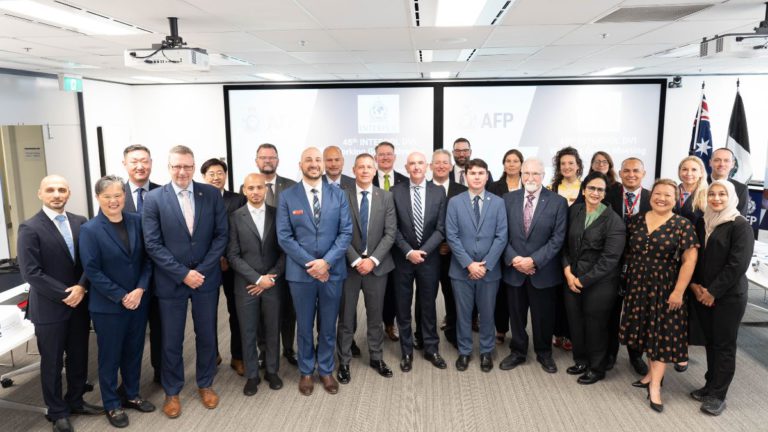
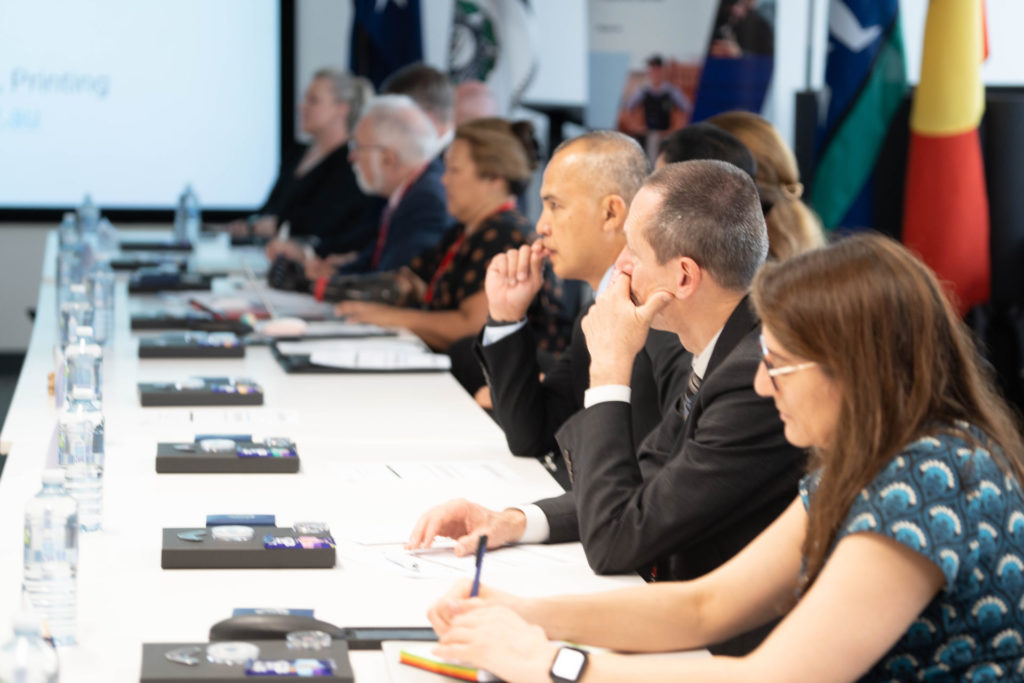
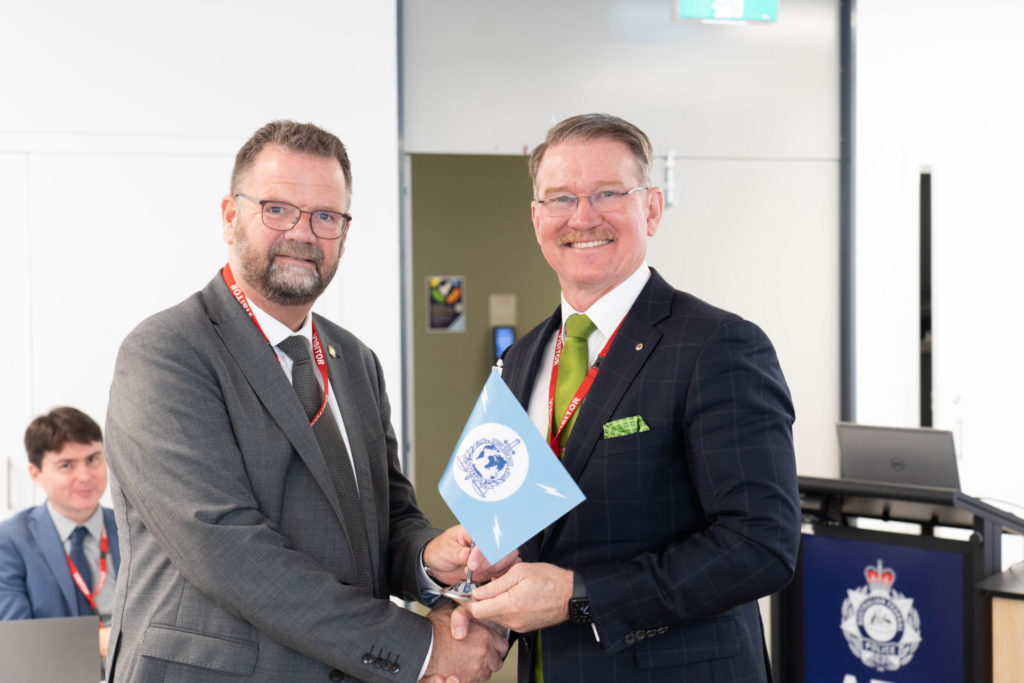
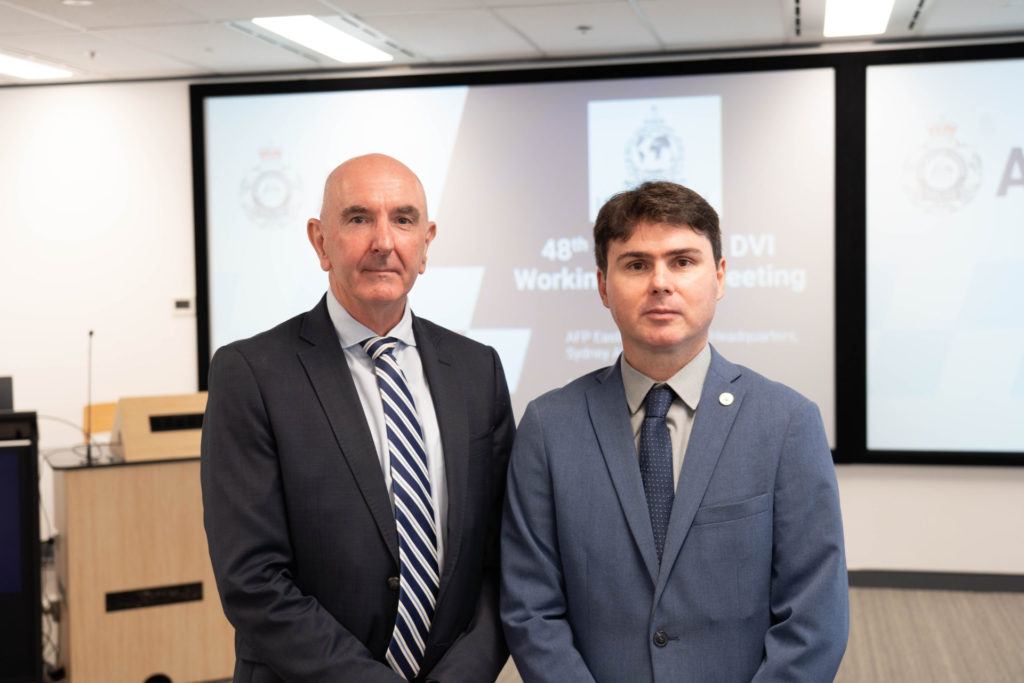
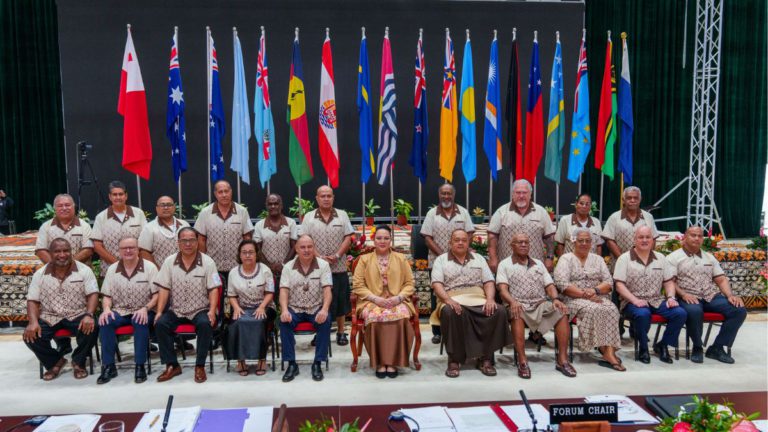
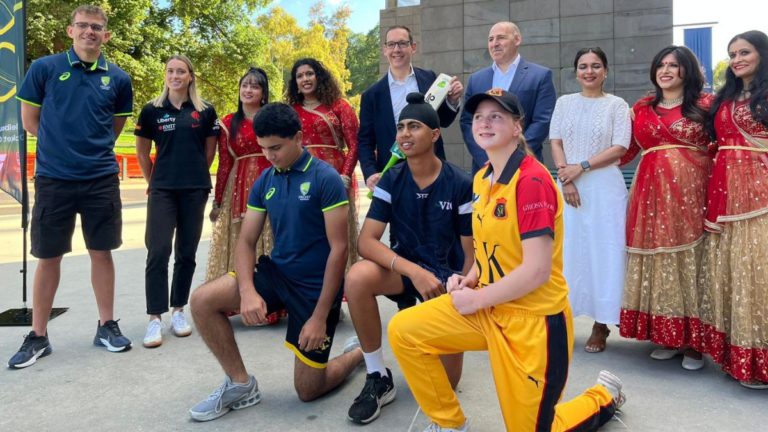
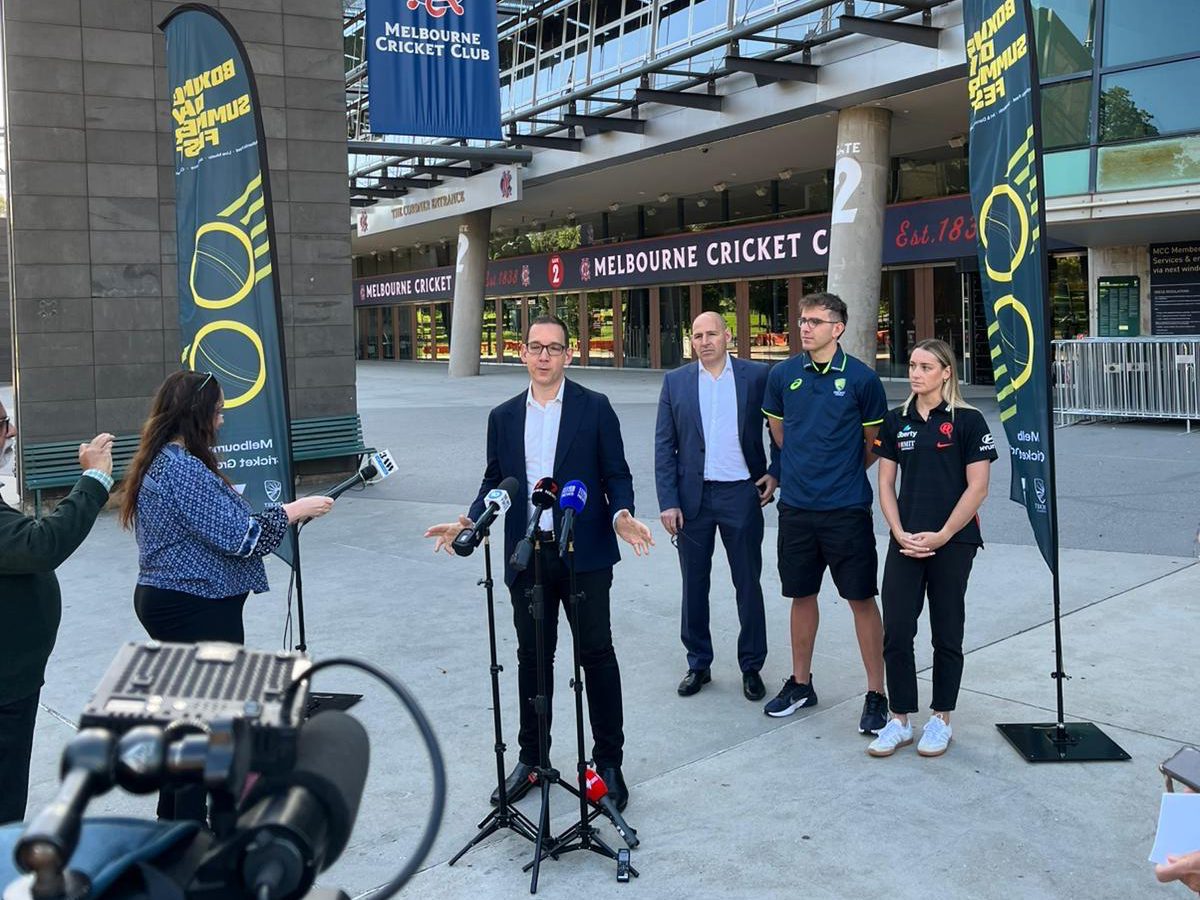
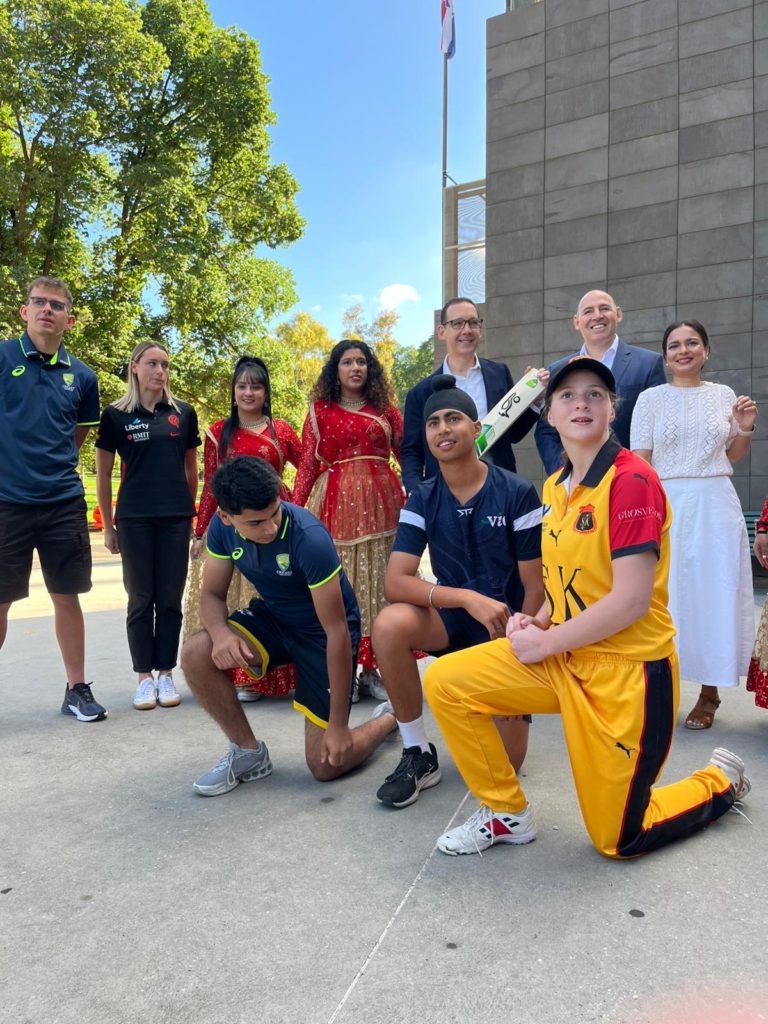
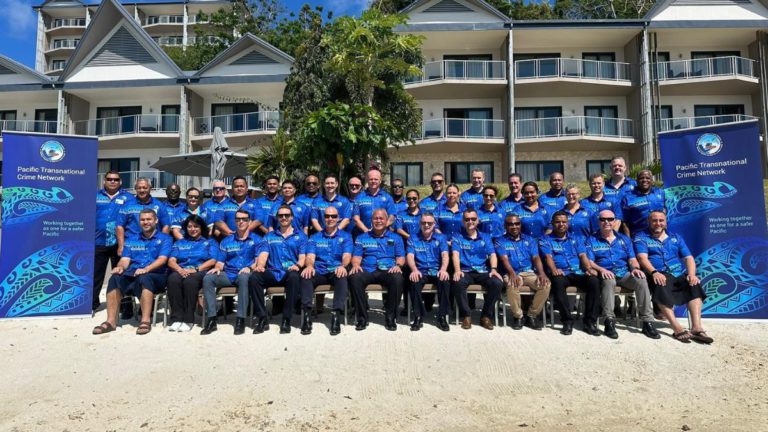
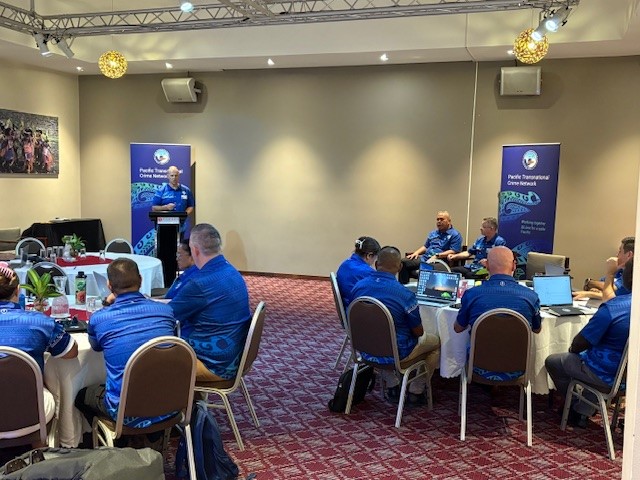
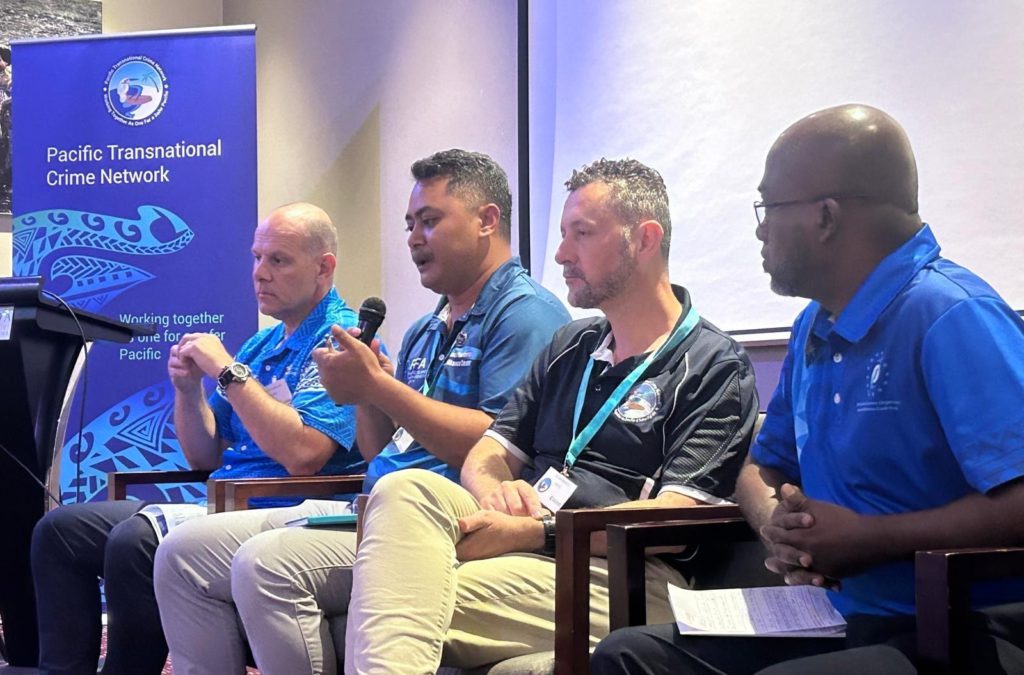
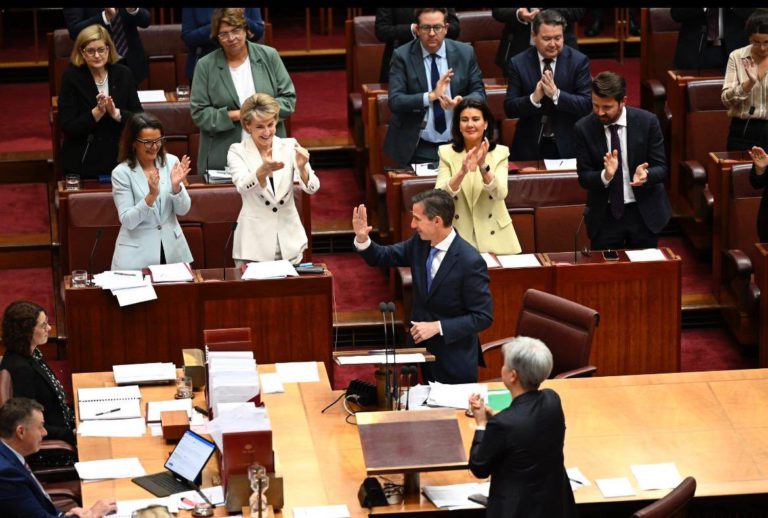
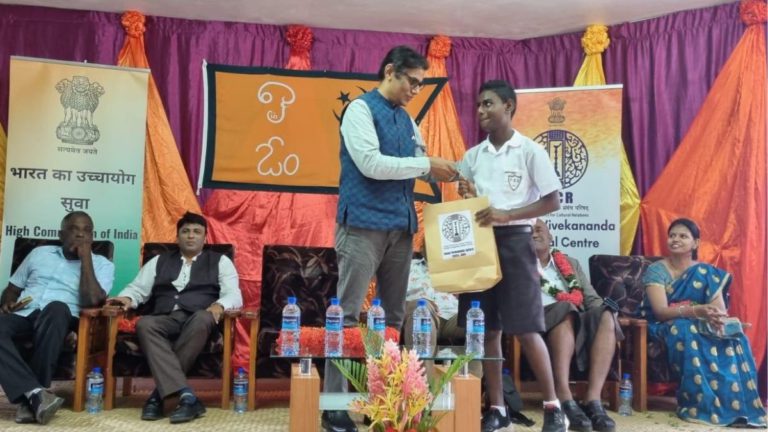
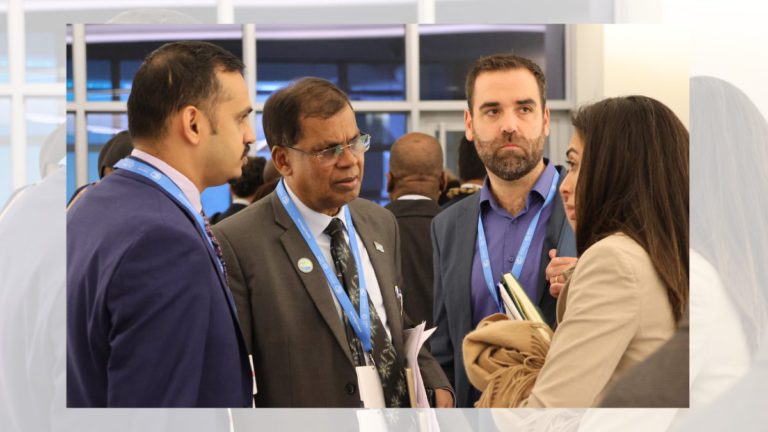
For the first time in nearly two decades, more than 50 global experts in disaster victim identification (DVI) convened in Sydney at the 48th INTERPOL DVI Working Group meeting. Hosted by the Australian Federal Police (AFP) and supported by the Australia New Zealand Policing Advisory Agency (ANZPAA), the event marked Australia’s first time hosting the meeting in 15 years.
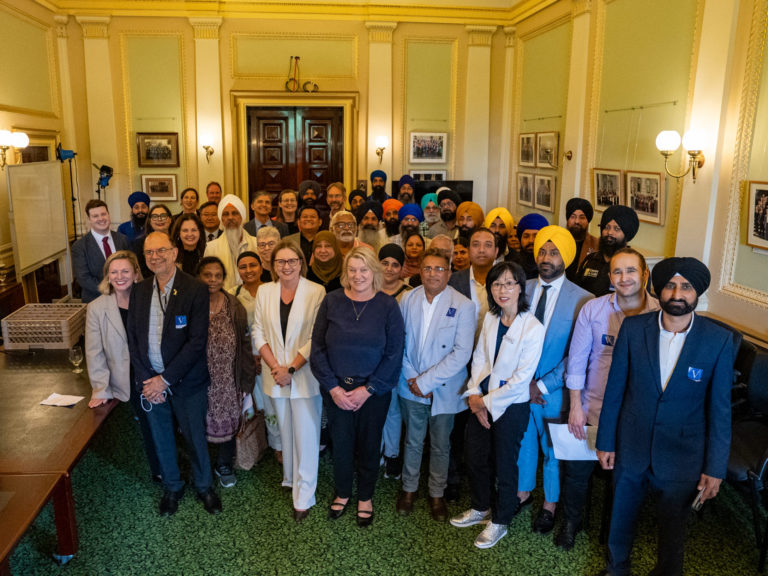
Image: AFP hosts the 48th INTERPOL Disaster Victim Identification (DVI) Working Group (Source: AFP)
Representatives from over 15 countries, including 28 policing and medical specialists, joined forces to advance international forensic processes for identifying human remains after disasters. The twice-yearly working group aims to refine and uphold global best practices in DVI.
During the meeting, participants exchanged insights on recent operations, cutting-edge scientific advancements, and evolving technologies, ensuring INTERPOL’s internationally recognised DVI protocols remain effective and relevant.
Dr Mark Tahtouh, AFP DVI Commander, highlighted the importance of collaboration in these high-stakes investigations.
“The law enforcement community’s partnership with forensic scientists, academia, and government agencies sets a global standard for coordinated disaster response.”
The AFP’s reputation in DVI is built on its pivotal role in high-profile disasters, such as the 2002 Bali bombings, the 2004 Boxing Day tsunami, and the 2019 Whakaari/White Island eruption.
Image: AFP hosts the 48th INTERPOL Disaster Victim Identification (DVI) Working Group (Source: AFP)
INTERPOL’s DVI Unit Coordinator, Charles Lamens, praised Australia’s leadership, noting the nation’s integral role in updating the DVI guide every five years, a key resource for teams worldwide.
“INTERPOL was delighted to return to Australia after 15 years. The Australian DVI team’s expertise and meticulous organisation were crucial to the meeting’s success.”
This gathering reinforced Australia’s global standing as a leader in forensic disaster response, fostering international cooperation in times of crisis.
Support Our Journalism
The global Indian Diaspora and Australia’s multicultural communities need fair, non-hyphenated, and questioning journalism, packed with on-ground reporting. The Australia Today—with exceptional reporters, columnists, and editors—is doing just that. Sustaining this requires support from wonderful readers like you.
Whether you live in Australia, the United Kingdom, Canada, the United States of America, or India you can take a paid subscription by clicking Patreon
Year 4 boys outperformed girls by the equal highest margin out of 58 countries that did the test. The story is not much better for Year 8 students – Australia had the 12th-largest gender gap of the 42 countries.
This is out of character with other subjects, such as literacy, where the gender gap is either much smaller, or girls outperform boys.
It has previously been suggested boys are just better at mathematics than girls. However, this has been thoroughly debunked, with many studies finding no statistically significant biological difference between boys and girls in maths ability.
Yet figures consistently show girls are under-represented in the most advanced maths courses at school. For example, for the two most advanced Year 11 and 12 courses in New South Wales, girls are outnumbered by a ratio of roughly two to one.
Research has found stereotyping is a problem, with maths been seen as a “boys’ subject”. These ideas start developing from an early age, even as young as five.
These stereotypes can negatively impact girls’ motivation in maths and their self-efficacy (their perception of how well they can do), which then impacts performance.
Girls are also more likely to develop maths anxiety, which may be due to lacking confidence in their ability.
Another possible reason for this gap is it is not as important for girls themselves to be seen as skilled at maths as it is for boys. This has been linked to differences in subject engagement and subsequent performance.
Given how important mathematical skills are for workplaces today and in the future, we need to change these attitudes.
What can we do?
Unfortunately, there are no simple answers. However, we recommend three strategies to help narrow the gap.
1. Treat boys and girls equally when it comes to maths: there is a noted tendency to expect boys to engage in more challenging maths than girls. If parents and teachers expect less from girls, we are feeding the stereotype that maths is “more suited to boys”. Simply holding beliefs that boys are better at maths can result in spending more time with or giving more attention to boys in maths. It can also be seen in behaviours where we think we are being supportive, such as reassuring a struggling girl, “it’s ok if you’re not great at maths”!
2. Talk to girls about maths: girls historically report lower confidence in maths when correlated with their actual achievement. This means girls potentially have inaccurate beliefs about their ability. So we need to understand how they feel they are progressing and make sure they understand their genuine progress.
3. Make use of female maths role models: when girls see themselves represented in maths-intensive careers – such as engineers, actuaries, chemists, economists, data scientists, architects and software developers – they are more likely to see the importance and value of maths. We know this can inspire young people.
The global Indian Diaspora and Australia’s multicultural communities need fair, non-hyphenated, and questioning journalism, packed with on-ground reporting. The Australia Today—with exceptional reporters, columnists, and editors—is doing just that. Sustaining this requires support from wonderful readers like you.
Whether you live in Australia, the United Kingdom, Canada, the United States of America, or India you can take a paid subscription by clicking Patreon
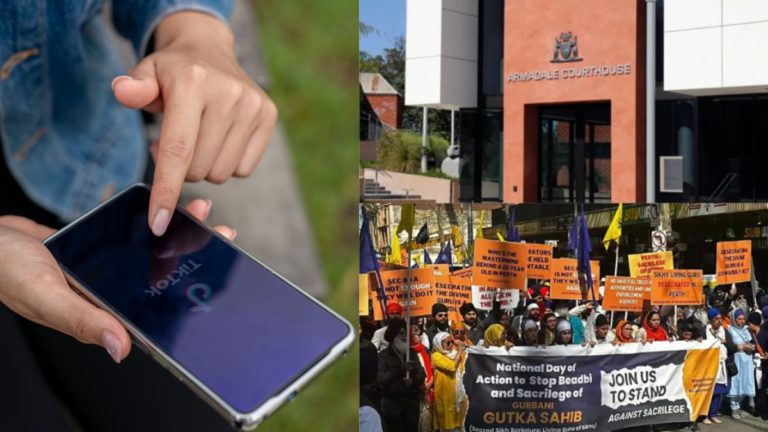
The Federal Government has cancelled the visa of Khizar Hayat, a 21-year-old Pakistani national, after he pleaded guilty to desecrating the Gutka Sahib, a revered Sikh holy text, and posting videos of the act on TikTok.
The incident, which occurred on August 27 outside the Canning Vale Gurudwara in Perth, shocked the Sikh community and drew widespread condemnation.
It was alleged that Hayat recorded himself throwing the Gutka Sahib on the ground, stepping on it, tearing out its pages, flushing them down a toilet, and setting portions on fire.
Hayat later uploaded the videos to TikTok, where they went viral, sparking protests in Melbourne and outside the Armadale Magistrates Court during his case.
More than 50 members of the Sikh community had then gathered at the Armadale Magistrates Court to witness Khizar Hayat plead guilty to one count of intending to racially harass. Although the community then welcomed his guilty plea, there was widespread concern that Hayat may face only a fine as a penalty, a consequence viewed as grossly inadequate given the gravity of the crime.
Hayat pleaded guilty in September to one count of intending to racially harass and was sentenced to community service. However, Home Affairs Minister Tony Burke has now cancelled his visa, placing him in immigration detention while he awaits deportation.
“Our visa system has rules. If you intend to break them, you’ll have your visa cancelled or rejected,” Mr Burke told The West Australian.
Although the Government has not confirmed Hayat’s deportation destination, reports in media suggest he may be sent back to Pakistan.
The Sikh and the Hindu community leaders have described the incident as an attack on the core of their spirituality. The Gutka Sahib, regarded as a living Guru, holds profound significance for Sikhs worldwide. Maninderjeet Singh, a Sikh community spokesperson, said the act has left the community deeply hurt and angry, prompting renewed calls for stricter sacrilege laws.
“This incident is a direct attack on Australia’s multicultural values,” Mr Singh said.
“The community is calling for stronger legal protections against sacrilegious acts, not just for Sikhs but for all faiths represented in Australia.”
Religious groups, including the Sikh Council of Western Australia, condemned the act as “un-Australian” and called for measures to build social harmony. Protests, mourning marches, and awareness rallies have since been held nationwide, demanding stricter laws to address religious hatred and sacrilege.
Religious leaders are urging the Government to take meaningful action to prevent similar incidents in the future and uphold the nation’s commitment to respecting all faiths.
Support Our Journalism
The global Indian Diaspora and Australia’s multicultural communities need fair, non-hyphenated, and questioning journalism, packed with on-ground reporting. The Australia Today—with exceptional reporters, columnists, and editors—is doing just that. Sustaining this requires support from wonderful readers like you.
Whether you live in Australia, the United Kingdom, Canada, the United States of America, or India you can take a paid subscription by clicking Patreon
India has scripted history at the inaugural AFL Asia Cup, delivering an electrifying return to international competition after 13 years.
The Indian Tigers not only defeated Vietnam 61–22 in their second international game but also obliterated arch-rivals China 110–3, marking their first-ever victory over the Chinese side.
The Day 1 of the tournament, held at the Thanh Long Sports Centre, has positioned India as a strong contender for the championship title. Under Captain Mahesh Tirkey and Head Coach Sudhasil Mitra, the team’s disciplined approach and improved skillset shone through.
Image: Indian Tigers (Source: Supplied)
After a nervy start against Vietnam, which saw India misfire despite creating early opportunities, they regrouped with a solid defensive and midfield strategy. Trailing by just seven points at halftime, the Tigers clawed back to dominate the second half, finishing with a decisive 8.13 to 3.4 scoreline.
The real fireworks, however, came later in the day when India unleashed their full potential against China. Using superior ball movement and clinical finishes, the Tigers stormed to an astounding 110–3 victory, with their midfield and forwards firing on all cylinders.
Image: A Vietnam Swan flies high against India. (Source: Supplied)
Other teams in the competition have also showcased their prowess. Japan edged Cambodia in a thrilling late-afternoon match, overcoming intense forward pressure to secure an 86–35 win. Cambodia earlier dominated Laos 96–13, while Pakistan recorded commanding victories over Laos (85–31) and Thailand (112–20), establishing themselves as another formidable force.
Image: Pakistan had a strong opening day, winning both its matches (Source: Supplied)
Vietnam and Thailand, though competitive, struggled against stronger opponents, while Hong Kong salvaged pride with a resounding 87–35 win over Vietnam after a narrow opening loss to China.
India’s rise in Australian Football has been a testament to grassroots development. The sport, introduced in Kolkata in 2008, has steadily grown through state and national competitions organised by the Australian Rules Football Association of India (ARFAI).
From its first national tournament in 2012 to recent initiatives like junior programmes and international matches, ARFAI has tirelessly worked to popularise the sport.
As the Tigers eye a semi-final spot on Day 2, with matches against Hong Kong and Indonesia, their dream of lifting the Asia Cup trophy seems increasingly within reach.
Support Our Journalism
The global Indian Diaspora and Australia’s multicultural communities need fair, non-hyphenated, and questioning journalism, packed with on-ground reporting. The Australia Today—with exceptional reporters, columnists, and editors—is doing just that. Sustaining this requires support from wonderful readers like you.
Whether you live in Australia, the United Kingdom, Canada, the United States of America, or India you can take a paid subscription by clicking Patreon
A 55-year-old man has been fined $400 and convicted of disorderly behaviour after refusing to disembark from a flight at Perth Airport, prompting police intervention earlier this week.
The incident unfolded on 2 December 2024, when airline staff called the Australian Federal Police (AFP) to remove the allegedly intoxicated passenger from an international flight preparing to depart Western Australia.
When AFP officers boarded the plane, the man refused to vacate his seat, defiantly telling officers they would “have to carry him.” After his refusal, officers physically removed him from the aircraft, placing him in a wheelchair to transport him through the terminal.
Throughout the process, the man caused further disruption by repeatedly swearing in the busy terminal.
Appearing in Perth Magistrates Court on 3 December, the man pleaded guilty to one count of disorderly behaviour in a public place. Along with his fine, he now has a criminal record for the offence.
AFP Superintendent Peter Hatch condemned the behaviour, emphasising that anti-social conduct on flights and at airports will not be tolerated.
“Passengers, airline staff, and police should not have to endure drunken belligerence or aggressive behaviour,” Supt Hatch stated.
“As we head into the festive season, police will continue to collaborate with airlines to ensure the safety and comfort of all travellers.”
Supt Hatch also issued a reminder for passengers to drink responsibly when travelling, particularly during the holiday period.
The incident caused no injuries, but authorities reiterated their commitment to ensuring safe and orderly travel for all passengers.
Support Our Journalism
The global Indian Diaspora and Australia’s multicultural communities need fair, non-hyphenated, and questioning journalism, packed with on-ground reporting. The Australia Today—with exceptional reporters, columnists, and editors—is doing just that. Sustaining this requires support from wonderful readers like you.
Whether you live in Australia, the United Kingdom, Canada, the United States of America, or India you can take a paid subscription by clicking Patreon
Last week, Parliament passed sweeping reforms to Australia’s aged care system. These “once-in-a-generation” changes, set to begin next year on July 1, aim to improve how care is provided to older Australians at home, in their communities and in nursing homes.
A key change is the introduction of a new payment system, requiring wealthier people to contribute more for non-clinical services.
If you – or a loved one – are planning for aged care, here’s what the changes could mean for you.
What to expect from the home care overhaul
Over the past decade, there’s been a noticeable shift towards “ageing at home”. The number of Australians using home care has more than quadrupled, surpassing those in nursing homes.
To meet growing demand, the government is adding 107,000 home care places over the next two years, with a goal to reduce wait times to just three months.
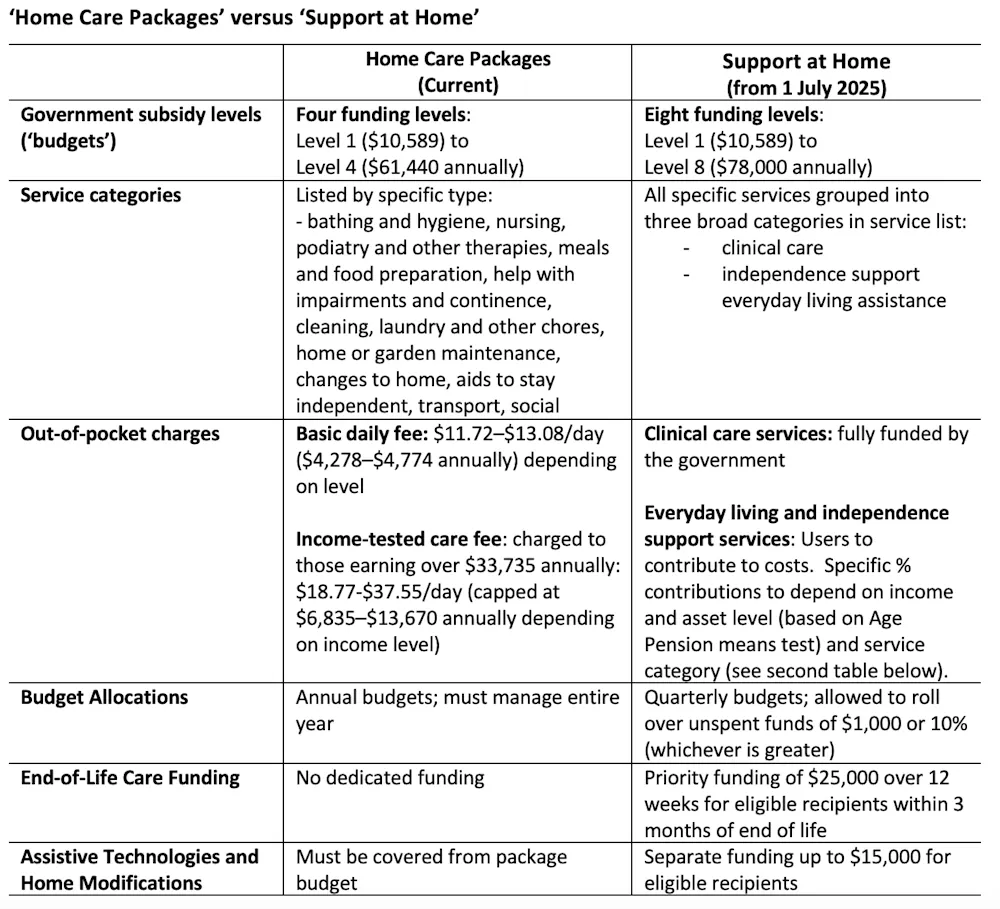
Starting July 1 2025, Support at Home will replace the Home Care Packages program. The table below shows some of the key differences between these two programs.
This aims to provide more tailored support and accommodate those needing higher levels of care.
Under the new system, recipients will receive quarterly budgets aligned to their funding level and work with their chosen provider to allocate funds across three broad service categories:
clinical care, such as nursing or physiotherapy
independence support, including personal care, transport and social support
everyday living assistance, such as cleaning, gardening and meal delivery.
Clinical care services will be fully government-funded, as these are crucial to supporting health and keeping people out of hospitals.
But recipients will contribute to the costs of independence and everyday living services under a new payment model, reflecting the government’s stance that these are services people have traditionally funded themselves over their lifetimes.
This will replace the basic daily fee and income-tested care fee that some people currently pay. Contributions will vary by income and assets (based on the age pension means test) and by service type.
Support at Home also includes additional funding for specific needs:
older Australians with less than three months to live will receive priority access to $25,000 in funding over 12 weeks
up to $15,000 will be available for assistive technologies and home modifications, eliminating the need to reserve home care budgets for these.
What if I or my loved one is already receiving a Home Care Package?
If you were receiving a package, on the waiting list, or assessed as eligible for one on September 12 2024, the government’s “no worse off” principle guarantees you won’t pay more under the new system.
Current recipients will have their Support at Home budget aligned with their existing package, and any unspent funds will roll over.
How nursing home fees will change
Australia’s nursing home sector is struggling financially, with 67% of providers operating at a loss. To ensure sustainability and support upgrades to facilities, the government is introducing major funding changes.
What stays the same?
The Basic Daily Fee, that everyone in nursing homes pays, set at 85% of the basic age pension (currently $63.57 a day or $23,200 annually), will not change.
What’s changing?
The government currently pays a Hotelling Supplement of $12.55 per day per resident to cover everyday living services like cleaning, catering and laundry ($4,581 annually).
From July 1 2025, this supplement will become means-tested. Residents with annual incomes above $95,400 or assets exceeding $238,000 (or some combination of these) will contribute partially or fully to this cost.
Currently, residents with sufficient means also pay a means-tested care fee between $0–$403.24 per day. This will be replaced by a “non-clinical care contribution”, capped at $101.16 daily and payable for the first four years of care. Only those with assets above $502,981 or incomes above $131,279 (or some combination of these) will pay this contribution.
Importantly, no one will pay more than $130,000 in combined contributions for Support at Home and non-clinical care in nursing homes over their lifetime.
Changes to accommodation payments
The way nursing home accommodation costs are paid is also changing from July 1 2025:
residents who pay their room price via a refundable lump sum will have 2% of their payment retained annually by the provider, up to a maximum of 10% over five years. For example, a $400,000 lump sum payment would result in $360,000 being refunded if a person stays five years or more, with the provider keeping $40,000
daily accommodation payments (a rent-style interest charge) will no longer remain fixed for the duration of a person’s nursing home stay. Instead, these payments will be indexed twice annually to the Consumer Price Index
providers will be able to set room prices up to $750,000 without government approval, an increase from the current $550,000 limit.
People with lower means (those who are fully subsidised by the government for their accommodation costs) will not be affected by these changes.
What if I own my home?
The treatment of the family home in means testing for nursing home costs will remain unchanged.
Its value is only assessed if no “protected person” (such as a spouse) lives in it, and even then, it’s capped at $206,039 (as at September 20 2024).
What happens to current nursing home residents?
The new rules for contributions and accommodation will apply only to those entering nursing homes from July 1 2025.
Existing residents will maintain their current arrangements and be no worse off.
Feeling overwhelmed?
These reforms aim to improve care delivery, fairness and sustainability, with the government emphasising that many older Australians – particularly those with lower incomes and assets – will not pay more.
The government has provided case studies to illustrate how home care and nursing home costs will differ under the new system for people at various income and asset levels.
Still, planning for aged care can be daunting. For more tailored advice and support, consider reaching out to financial advisors, services, or online tools to help you navigate the changes and make informed decisions.
The global Indian Diaspora and Australia’s multicultural communities need fair, non-hyphenated, and questioning journalism, packed with on-ground reporting. The Australia Today—with exceptional reporters, columnists, and editors—is doing just that. Sustaining this requires support from wonderful readers like you.
Whether you live in Australia, the United Kingdom, Canada, the United States of America, or India you can take a paid subscription by clicking Patreon
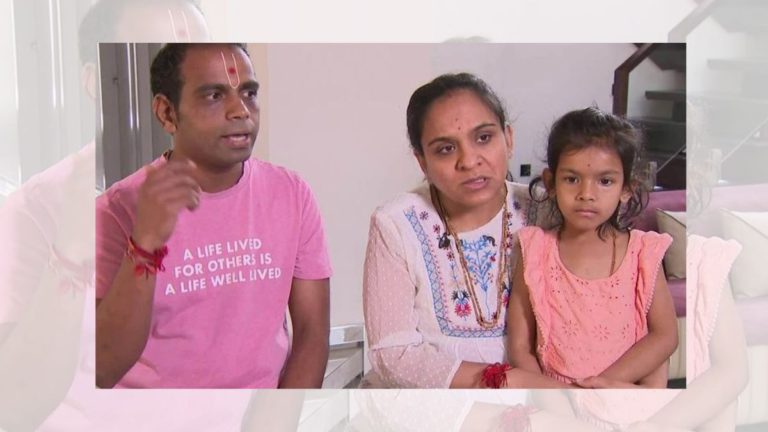
A Melbourne family has been left traumatised after two allegedly armed intruders broke into their Truganina home, threatening to kill them and stealing their car.
Chetan Patel, his pregnant wife Rohini, and their five-year-old daughter were in their bedroom when the men appeared, one allegedly carrying a knife and the other an axe.
“One of them said, ‘Give us the car keys or we’re going to kill you all. I’m going to kill your daughter.’”
The intruders allegedly jumped the fence, entered through the garage door, and made their way upstairs before escaping in the family’s new car.
The incident has left the family deeply shaken. Their daughter is now too scared to be alone in their home. “That five minutes is going to stay with us forever,” Chetan said.
“What they really stole is our peace of mind.”
Police recovered the stolen vehicle five kilometres away in Tarneit and arrested two men, aged 19 and 26, from Geelong. Both suspects appeared in Melbourne Magistrates’ Court and were remanded in custody.
Rohini expressed relief that the offenders were not minors.
“If they were under 18, they could have easily been let off.”
Support Our Journalism
The global Indian Diaspora and Australia’s multicultural communities need fair, non-hyphenated, and questioning journalism, packed with on-ground reporting. The Australia Today—with exceptional reporters, columnists, and editors—is doing just that. Sustaining this requires support from wonderful readers like you.
Whether you live in Australia, the United Kingdom, Canada, the United States of America, or India you can take a paid subscription by clicking Patreon
Canada’s New Democratic Party (NDP) failed in its attempt to have the 1984 anti-Sikh riots recognised as genocide, as the motion faced stiff resistance in the House of Commons.
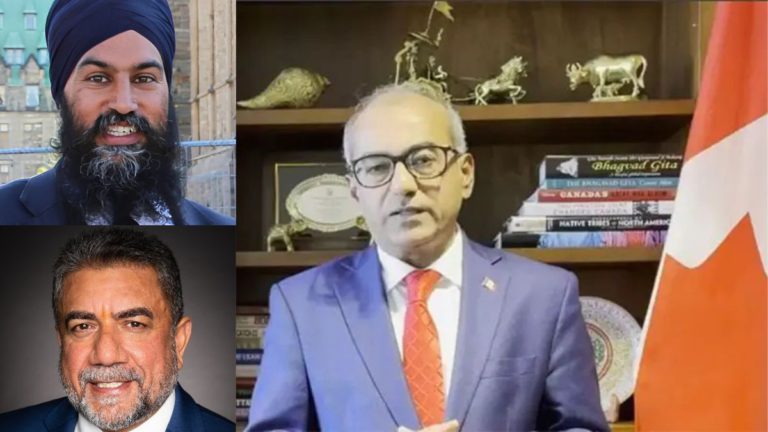
The motion, introduced by NDP MP Sukh Dhaliwal, was blocked by Liberal MP Chandra Arya, who claimed it was driven by a “politically powerful Khalistani lobby.” Arya was the sole MP present to oppose the motion, which required unanimous consent to pass.
Today, the Member of Parliament from Surrey-Newton attempted to have the Parliament declare the 1984 riots in India against Sikhs as a genocide.
He sought unanimous consent from all Members in the House of Commons to pass his motion.
Taking to social media, Arya explained his decision:
“The MP from Surrey-Newton sought unanimous consent to declare the 1984 riots in India against Sikhs as genocide. I was the only one to say NO, preventing its approval.”
Arya also alleged he was threatened inside Parliament after blocking the motion. “This is not the first time I’ve faced attempts to silence my concerns for Hindu-Canadians,” Arya said, calling for vigilance against what he termed a divisive agenda.
Today, in the Foreign Affairs Committee the Liberals and Conservatives teamed up to block a motion to recognize the Sikh Genocide.
They’ve known about this for months. They could have spent the time to listen to the concerns of the community.
NDP leader Jagmeet Singh accused Liberals and Conservatives of turning their backs on justice for the Sikh community, expressing frustration at their refusal to support the motion. “They had months to listen to the community’s concerns but chose to block this motion,” Singh said. Dhaliwal echoed this disappointment, highlighting the lack of support from both parties.
Arya, however, warned that the motion could resurface. “The Khalistani lobby will try again to push this agenda. I urge Hindu-Canadians to engage with their MPs to ensure it’s opposed in the future,” he said. While condemning the riots as “barbaric,” Arya argued that labelling them genocide risks polarising Canada’s Hindu and Sikh communities.
Today, I introduced a unanimous consent motion in Parliament to recognize the crimes committed against Sikhs in India during and after 1984 as genocide. Sadly, some Conservative MPs and one Liberal MP opposed it. pic.twitter.com/ABpcqMZpUz
The 1984 riots, triggered by the assassination of Indian Prime Minister Indira Gandhi by her Sikh bodyguards, resulted in the deaths of thousands of Sikhs. The Indian government has consistently rejected claims that the events constituted genocide, estimating the death toll at around 2,800.
Amid growing tensions between Hindu and Sikh communities in Canada, Arya reiterated his commitment to opposing motions he believes could destabilise community harmony. “We must stand united against divisive forces threatening peace and inclusivity in Canada,” he stated.
Support Our Journalism
The global Indian Diaspora and Australia’s multicultural communities need fair, non-hyphenated, and questioning journalism, packed with on-ground reporting. The Australia Today—with exceptional reporters, columnists, and editors—is doing just that. Sustaining this requires support from wonderful readers like you.
Whether you live in Australia, the United Kingdom, Canada, the United States of America, or India you can take a paid subscription by clicking Patreon
Indian pacer Mohammed Siraj found himself at the centre of controversy during the second Test at Adelaide Oval after an unexpected interruption led to an angry outburst.
• Man runs behind the sight screen with a beer snake • Marnus pulls away while Siraj is running in • Siraj is not happy
As Siraj prepared to bowl to Marnus Labuschagne under the floodlights, a spectator carrying a “beer snake” ran behind the sight screen, distracting the Australian batter.
Image: Siraj becomes frustrated and throws the ball at Labuschagne (Source: screenshot -Seven)
Labuschagne pulled away, signalling the disturbance, which appeared to frustrate Siraj. The bowler responded by throwing the ball at the stumps and gesturing angrily towards Labuschagne.
Image: Siraj becomes frustrated and throws the ball at Labuschagne (Source: screenshot -Seven)
The crowd reacted with boos as replays of Siraj’s actions played on the big screen. Commentators and fans alike criticised the outburst, with some labelling it “unprofessional.”
“You don’t often see a fast bowler react like that,” noted former cricketer Greg Blewett during commentary.
On social media, the reaction was mixed, with calls for Siraj to be fined or even banned for his behaviour. However, others directed their criticism at the spectator, arguing that interruptions like these have no place in Test cricket.
Despite the drama, Labuschagne and Nathan McSweeney managed to steady Australia’s innings, guiding the team to 1-86 at stumps, trailing India’s first innings total of 180.
Support Our Journalism
The global Indian Diaspora and Australia’s multicultural communities need fair, non-hyphenated, and questioning journalism, packed with on-ground reporting. The Australia Today—with exceptional reporters, columnists, and editors—is doing just that. Sustaining this requires support from wonderful readers like you.
Whether you live in Australia, the United Kingdom, Canada, the United States of America, or India you can take a paid subscription by clicking Patreon
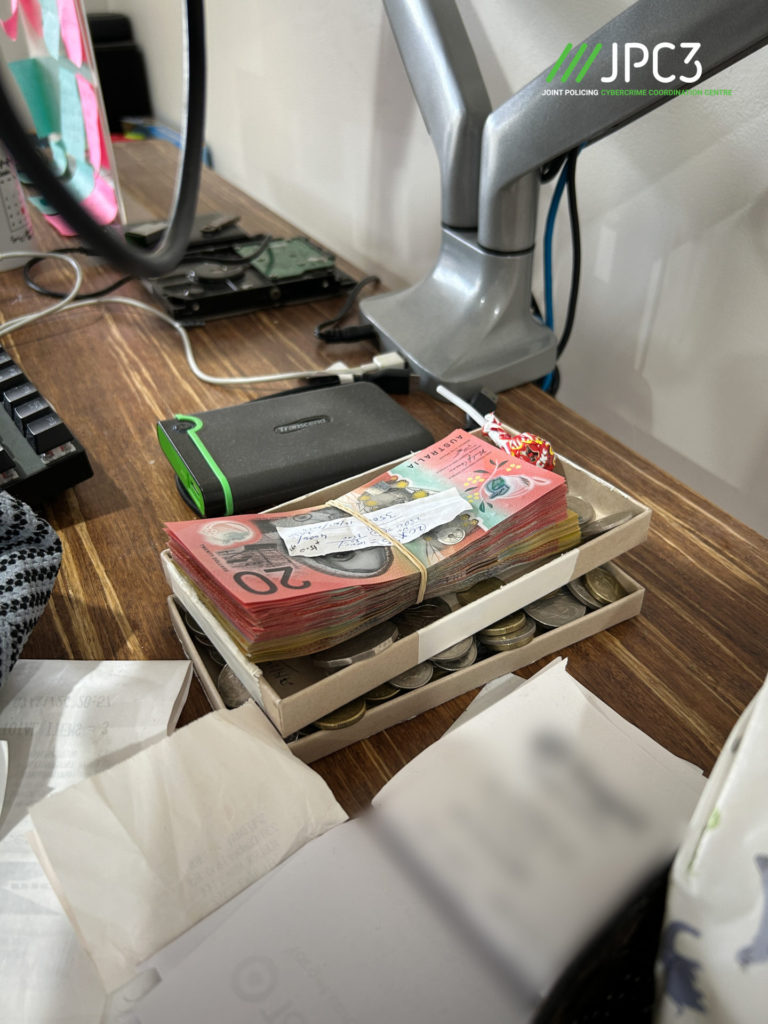
The Australian Federal Police (AFP), Australian Taxation Office (ATO), and Australian Securities and Investments Commission (ASIC) collaborated through the Serious Financial Crime Taskforce (SFCT) to dismantle the syndicate. The group used labour hire and payroll companies to siphon funds meant for taxes, funnelling the proceeds to offshore accounts and associates in Singapore.
The investigation began in December 2018, leading to the seizure of over $20 million in assets, including luxury properties and vehicles. The syndicate’s scheme, which deprived taxpayers of funds allocated for essential services, was described as one of the most complex tax evasion cases uncovered by the SFCT.
AFP Detective Superintendent Kristie-Lee Cressy highlighted the impact of such crimes: “This syndicate’s actions diverted millions away from potential investments in infrastructure and essential services for Australians.”
ATO Deputy Commissioner John Ford added, “This outcome sends a strong message to illegal phoenix operators: you will get caught, and we will hold you to account.”
The six men received sentences ranging from 18 months to over nine years, with non-parole periods of up to six years. The SFCT’s work continues to combat serious financial crimes, having secured 46 convictions and raised over $2.55 billion in tax liabilities since its establishment in 2015.
Support Our Journalism
The global Indian Diaspora and Australia’s multicultural communities need fair, non-hyphenated, and questioning journalism, packed with on-ground reporting. The Australia Today—with exceptional reporters, columnists, and editors—is doing just that. Sustaining this requires support from wonderful readers like you.
Whether you live in Australia, the United Kingdom, Canada, the United States of America, or India you can take a paid subscription by clicking Patreon and support honest and fearless journalism. LINK: https://tinyurl.com/TheAusToday
Australia has long tried to be two things at once – a trusted friend to Pacific nations in a bid to reduce China’s influence, and a giant exporter of fossil fuels. This diplomatic tightrope has become increasingly hard to walk, as Pacific nations see climate change as an existential threat.
This week, Australia’s government was forced to make a choice in a very public forum. It chose fossil fuels.
Disappointed by the slow pace of United Nations climate talks, Vanuatu and other Pacific nations launched a case at the International Court of Justice in the Netherlands to clarify the obligations countries have to prevent harm to the Earth’s climate system for current and future generations.
While international climate negotiations are often conducted behind closed doors, this case is being broadcast in public. We can clearly see the arguments Australia has laid out and the countries it has aligned itself with.
In the courtroom on Monday, Australia sided with major emitters and fossil fuel exporters such as Saudi Arabia, the United States and China to try and minimise their legal liability in contributing to climate change.
WATCH LIVE: Jamaica, Papua New Guinea, Kenya, Kiribati and Kuwait present their oral statements in the advisory proceedings on the Obligations of States in respect of Climate Change.https://t.co/8d3ajCcEnO
This week marks a milestone in a five-year legal campaign, travelling from a university tutorial in Vanuatu’s capital, Port Vila, through the halls of the United Nations in New York and now to the world’s court in the Hague. The International Court of Justice is the only international court able to settle disputes between United Nations member states.
In 2019, 27 law students at the University of the South Pacific were given a challenge: find the most ambitious legal pathways towards climate justice. They decided filing a case with the world court fitted the bill.
In 2023, Vanuatu and other nations succeeded in passing a resolution at the UN General Assembly requiring the world court to give an advisory opinion on two questions – what obligations do states have under international law to protect the climate from greenhouse gas emissions, and what are the legal consequences for states causing “significant harm” to the earth’s climate?
Ahead of the hearing, the world court has received a record number of written submissions. Justices will hear two weeks of oral submissions. They will then produce an advisory opinion, expected to set a new benchmark in international law, by clarifying the legal obligations countries have to tackle emissions.
While an advisory opinion is not binding, the court’s findings will feed into national court cases and UN climate talks.
For Australia, this case presents a direct challenge. It has no plans to phase down fossil fuel exports. In fact, it plans to expand them.
If the court’s opinion draws clear lines between fossil fuel exporters and climate damage, it could have severe implications for Australia. It could, for instance, pave the way to compensation lawsuits for climate damage.
Since 2000, Australia has approved more than 700 oil, gas and coal projects. Dozens more are in the approvals pipeline. Just this week the federal government cleared the way for three new coal mines.
Australia is now one of the world’s largest exporters of coal and gas. This is relatively new. While coal has been exported since 1801, large-scale exports of liquefied natural gas only began a decade ago.
When burned overseas, emissions from Australia’s fossil fuel exports are now more than double those of its entire domestic economy. These emissions damage our global climate, increasing risk of harm to people in Australia and worldwide.
What did Australia argue at the Hague?
In bringing the case, Vanuatu has argued actions causing climate change are unlawful under a range of international obligations including the law of the sea, human rights law and environmental law.
Australian delegates commended Vanuatu’s leadership in bringing this case and reiterated Australia’s commitment to working with the Pacific on climate.
But after the diplomatic niceties, Australian Solicitor-General Stephen Donaghue got down to business. He told the court only the Paris Agreement – which requires countries to set targets to cut domestic emissions – should apply when it comes to mitigating climate change.
Donaghue also argued greenhouse gas emissions are different to, say, one country’s toxic waste damaging the environment of another. This, he argued, was because emissions have many sources.
Donaghue and the Australian delegation argued the court should take a narrow view of obligations to cut emissions and suggested responsibility for harms caused by climate change could not be pinned on individual states.
Australia has also argued protecting human rights does not extend to obligations to tackle climate change.
In 2022, Torres Strait islanders told a UN Human Rights Committee that a failure to address climate change violated their human rights. In response, the Australian government used very similar arguments, claiming climate change was best addressed through UN climate negotiations.
What does this mean?
The court’s opinion will be handed down next year.
Despite Australia’s arguments, recent rulings by other courts and tribunals suggest the court may not decide in our favour.
For example in May, the International Tribunal on the Law of the Sea found greenhouse gas emissions were a form of marine pollution (because they acidify and heat the ocean), which countries have obligations to prevent. The tribunal rejected arguments that state obligations were limited to implementing the Paris Agreement.
A ruling on a similar case from the Inter-American Court of Human Rights is expected before the end of the year.
Relationships with Pacific states are likely to come under strain as the proceedings in the Hague roll on.
Matters could come to a head next year, when the court will release its advisory opinion.
A decision is still pending on whether Australia will host COP31, the 2026 UN climate talks, alongside Pacific island countries.
If our COP bid succeeds, it could give Canberra a chance to signal a shift away from fossil fuel exports in favour of green exports such as critical minerals and green iron. Doing so would align Australia’s interests with the Pacific – and present it much more clearly as a partner of choice.
The global Indian Diaspora and Australia’s multicultural communities need fair, non-hyphenated, and questioning journalism, packed with on-ground reporting. The Australia Today—with exceptional reporters, columnists, and editors—is doing just that. Sustaining this requires support from wonderful readers like you.
Whether you live in Australia, the United Kingdom, Canada, the United States of America, or India you can take a paid subscription by clicking Patreon and support honest and fearless journalism. LINK: https://tinyurl.com/TheAusToday
The Five Eyes intelligence alliance has sounded the alarm on the growing threat of violent extremism among young people, calling for a global effort to address the escalating issue.
The report, unveiled on 6 December 2024 by ASIO Director-General Mike Burgess AM and AFP Commissioner Reece Kershaw, marks the first public collaboration of Five Eyes agencies on this topic.
“The fact that the Five Eyes have chosen youth radicalisation for our first public research collaboration indicates how concerning, escalating, and pressing this challenge is,” said Mr Burgess.
The report, Young people and violent extremism: A call for collective action, highlights how online platforms and social isolation have created fertile ground for extremist recruitment. It warns that the average age of those drawn to violent ideologies is dropping, placing increased pressure on law enforcement and policymakers to intervene earlier.
“Minors can pose the same credible terrorist threat as adults, with some attracted to extremist content and ideologies – especially online,” the report states.
ASIO has revealed that around 20% of its priority counter-terrorism cases involve young people. “In every terrorist attack, disruption, and suspected incident in Australia this year, the alleged perpetrator was a young person,” Mr Burgess said.
Commissioner Kershaw echoed these concerns, noting that since 2020, the AFP and its partners have investigated 35 individuals aged 17 or younger, with some as young as 12. Over half of these cases have resulted in criminal charges.
Platforms such as Discord, Telegram, and TikTok are being exploited by extremists to share propaganda, with investigations finding the same materials across multiple unrelated cases.
CSIS and the RCMP are calling on you to help strengthen our collective efforts to disrupt the radicalization of young people to violent extremism. Learn more in the Five Eyes report published today.https://t.co/FyacBIyDyEpic.twitter.com/8D1cMUtCni
The Five Eyes alliance – comprising Australia, Canada, New Zealand, the United Kingdom, and the United States – is urging governments, communities, and families to act collectively. ASIO and the AFP advocate for early intervention and prevention strategies, empowering parents, educators, and health professionals to identify and address early signs of radicalisation.
“Once ASIO and the AFP get involved, it’s often too late – the young person is already in a dark and dangerous place,” Mr Burgess warned.
Commissioner Kershaw emphasised the need to limit access to violent extremist material online and raise awareness among caregivers and educators. “Promoting education and awareness in protective roles is critical to maximising prevention and early intervention options,” he said.
The findings from the Five Eyes report will guide the Australian Government’s upcoming counter-terrorism and violent extremism strategy.
Support Our Journalism
The global Indian Diaspora and Australia’s multicultural communities need fair, non-hyphenated, and questioning journalism, packed with on-ground reporting. The Australia Today—with exceptional reporters, columnists, and editors—is doing just that. Sustaining this requires support from wonderful readers like you.
Whether you live in Australia, the United Kingdom, Canada, the United States of America, or India you can take a paid subscription by clicking Patreon and support honest and fearless journalism. LINK: https://tinyurl.com/TheAusToday
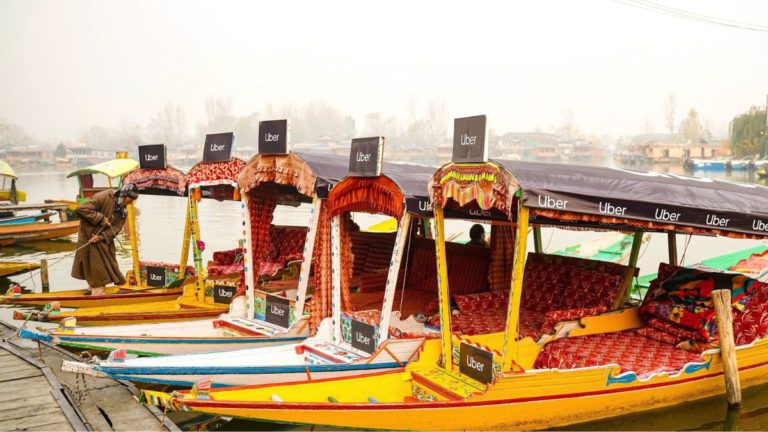
The iconic shikaras of India’s Dal Lake, a symbol of Kashmir’s beauty and heritage, are embracing modernity as Uber launches its Uber Shikara service.
This marks Asia’s first boat taxi initiative, allowing users to book these traditional wooden boats directly through the Uber app.
Introducing Uber Shikara in Srinagar! The perfect blend of tradition and tech!🚤📲 Now you can book your serene Shikara ride up to 15 days in advance. With just a tap on the Uber app, you are ready to set sail.
The service, introduced earlier this week, combines the charm of hand-carved, canopied shikaras with cutting-edge convenience.
According to Uber, passengers can make reservations between 12 hours and 15 days in advance, enjoying seamless accessibility to this cultural experience. Operating daily from 10 am to 5 pm, each shikara accommodates up to four passengers.
Uber rolls out India’s first water transport service with shikara bookings on its app in Dal Lake in Srinagar pic.twitter.com/t0JUzXFdAv
Prabhjeet Singh, Uber’s president for India and South Asia, told The Independent:
“Uber Shikara is our humble attempt to blend technology and tradition, enhancing tourism and supporting grassroots workers in Kashmir.”
Notably, Uber will not charge a commission, enabling shikara operators to retain the full fare, set by government standards.
Jammu and Kashmir Lieutenant Governor Manoj Sinha lauded the service, stating it reflects “creative ways technology can enhance our cultural heritage” and will boost tourism in the upcoming season.
Launch of Uber Shikara in Srinagar is a testament to creative ways technology can enhance our cultural heritage. This offering in upcoming tourist season will provide visitors a seamless way to experience timeless charm of Shikara rides, a hallmark of J&K's beauty. https://t.co/nPYW26SW6P
Many see this as a boost to the region’s tourism economy and Wali Mohammad Bhatt, president of the Shikara Owners Association, believes it will ensure fair pricing and transparency.
With around 4,000 shikaras gracing Dal Lake, the service is expected to enhance the timeless allure of Kashmir while supporting its local economy.
Support Our Journalism
The global Indian Diaspora and Australia’s multicultural communities need fair, non-hyphenated, and questioning journalism, packed with on-ground reporting. The Australia Today—with exceptional reporters, columnists, and editors—is doing just that. Sustaining this requires support from wonderful readers like you.
Whether you live in Australia, the United Kingdom, Canada, the United States of America, or India you can take a paid subscription by clicking Patreon and support honest and fearless journalism. LINK: https://tinyurl.com/TheAusToday
A suspected arson attack devastated the Adass Israel Synagogue in Ripponlea, one of Australia’s busiest synagogues, early Friday morning, leaving Melbourne’s Jewish community reeling.
Image: Adass Israel Synagogue in Ripponlea (Source: St Kilda Historical Society)
Prime Minister Anthony Albanese condemned the act as an “outrage” and a “deliberate attack on Australia’s values.” He assured on ABC Radio that federal assistance to Victorian authorities will be provided in the investigation.
“this is an act of hate and it’s something that should not occur in Australia or anywhere else for that matter.”
Witnesses reported seeing two suspects dressed in dark clothing, allegedly smashing windows and throwing Molotov cocktails.
Firefighters responded to the blaze at 4:10 am, battling flames that engulfed the 20-by-30-metre building. Fire crews prevented the blaze from spreading to neighbouring buildings, and no injuries were reported.
Pure Antisemitism this morning in Melbourne, Australia, where two suspected arsonists smashed windows at 4.10am and burnt down the Adass Israel Synagogue.
Time for Australian police to take a zero tolerance approach to antisemitism.
Congregants fled as flames erupted. Yumi Friedman, founder of Yumi’s Dips, was inside with another individual when the attack began. “I heard a big bang, ran out, and found a fire growing fast,” Friedman told The Age.
Board member Benjamin Klein recounted the chaos to ABC News:
“Banging on the doors, liquids being thrown, and the fire spreading rapidly. It’s horrifying for a peaceful community.”
The synagogue, built by Holocaust survivors, serves as a focal point for Melbourne’s Jewish population. Klein added,
“This is the jewel of our community. Seeing it in ruins is beyond devastating.”
Worshippers are traumatised, especially children who attend daily services. Sacred Torah scrolls and holy books, estimated to be worth millions, were lost in the fire.
A synagogue in Ripponlea in Melbourne has been firebombed at 4am.
Victoria’s Premier Jacinta Allan expressed her strong condemnation of the recent attack on a synagogue, highlighting the government’s commitment to addressing the incident with urgency.
“This morning I spoke to Police Commissioner Shane Patton about this attack. Every available resource will be deployed to find these criminals who tried to tear a community apart.”
And we stand against anti-Semitism, now and forever.
Australian Jewish Association (AJA) said in a staement, “Every time, Labor ministers spread blood libels against the Jewish State, it puts the lives of Jews in Australia at risk.”
STATEMENT – Synagogue attacked as government abandoned the Jewish community
"AJA is outraged but not at all surprised by the attack on Addas Synagogue in Melbourne.
We have spent over a year warning the Albanese Government that its actions were fuelling antisemitism and leading… pic.twitter.com/jaB9INlHLD
— Australian Jewish Association (@AustralianJA) December 5, 2024
Despite increased security measures, the attack marks the second time Adass Israel has been targeted by arsonists; a similar incident occurred in 1995.
Victoria Police have now launched a criminal investigation, treating the fire as suspicious. CCTV footage is being reviewed, and police are appealing to the public for information.
Support Our Journalism
The global Indian Diaspora and Australia’s multicultural communities need fair, non-hyphenated, and questioning journalism, packed with on-ground reporting. The Australia Today—with exceptional reporters, columnists, and editors—is doing just that. Sustaining this requires support from wonderful readers like you.
Whether you live in Australia, the United Kingdom, Canada, the United States of America, or India you can take a paid subscription by clicking Patreon and support honest and fearless journalism. LINK: https://tinyurl.com/TheAusToday
Nearly 1.3 million students from Years 3, 5, 7, and 9 participated in the annual NAPLAN tests earlier this year. The 2024 results, now released, highlight the schools achieving top marks in literacy and numeracy, offering a comprehensive look at academic excellence across the nation.
From Tasmania to Queensland, independent analysis of Year 5 and Year 9 scores has identified high achievers while exposing ongoing educational disparities.
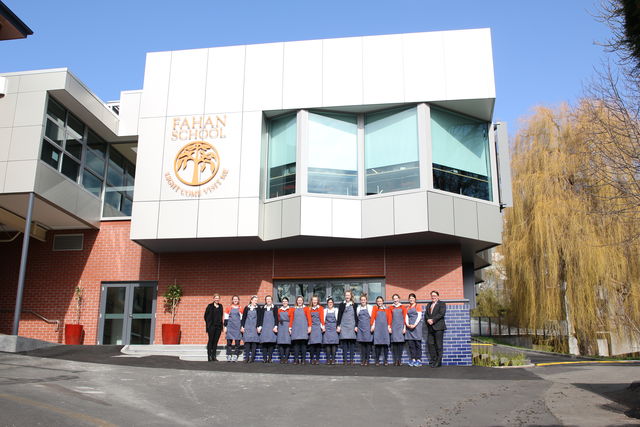
Image: Fahan School (Source: website)
Tasmania emerged as a standout, with Fahan School topping Year 9 rankings in writing, reading, spelling, and grammar, while also placing third in numeracy. Primary schools in Greater Hobart dominated, with Princes Street Primary School, Mount Stuart Primary School, and South Hobart Primary School ranking among the state’s best-performing schools. Despite the presence of government schools in the primary rankings, the secondary level was largely led by independent institutions, with Taroona High School being the only public school to break into the top ten.
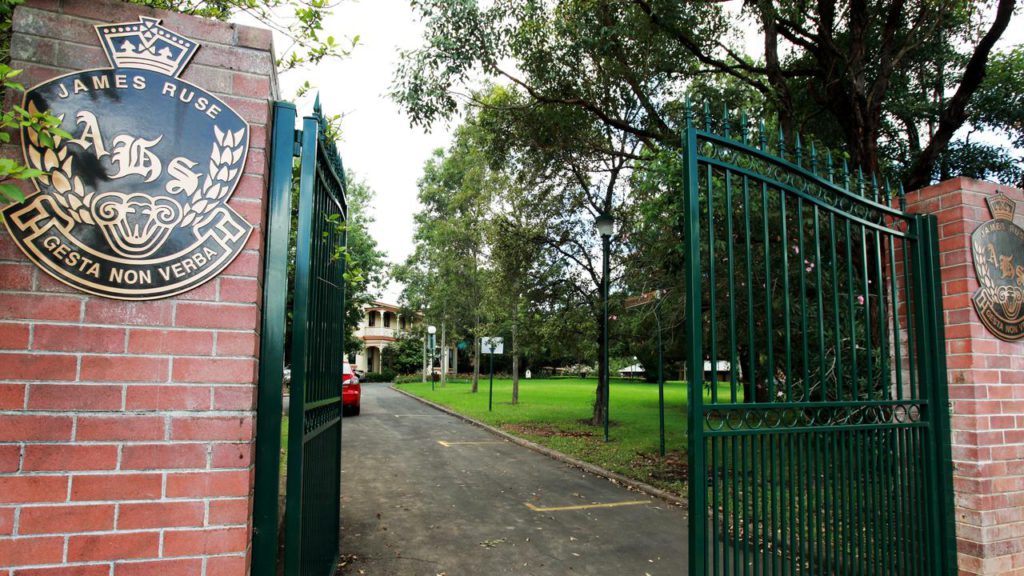
Image: James Ruse Agricultural High School (Source: website)
In New South Wales, James Ruse Agricultural High School retained its reputation as a powerhouse, bolstered by exceptional numeracy results. Sydney Grammar School’s Edgecliff campus maintained its grip on the top primary school spot, with other elite schools like North Sydney Girls High and Conservatorium High showing impressive gains. Meanwhile, regional disparities in socio-educational advantage remain a defining characteristic of the state’s academic landscape.
Image: Melbourne High School (Source: website)
Victoria’s results painted a mixed picture. While selective government schools like Melbourne High School and MacRobertson Girls High School upheld their positions among the state’s top secondary schools, several prestigious private schools faced declines. Presbyterian Ladies’ College, which led last year, experienced a drop in its average score, mirroring the trend seen in other high-fee institutions.
Image: Sunnybank Hills State School (Source: website)
In Queensland, independent schools continued to dominate the rankings, making up 70 per cent of the top-performing institutions. Sunnybank Hills State School secured the top primary spot, while Queensland Academy for Science, Mathematics and Technology once again outshone its peers in the secondary rankings. Despite their strong showing, only a handful of state schools managed to crack the top lists, underscoring the state’s reliance on private education for high academic performance.
Image: Southern Montessori School (Source: https://bicpl.com.au/projects/)
South Australia saw some dramatic shifts in the rankings, with Southern Montessori School dethroning Glenunga International High School as the top secondary performer. Dara School for gifted students surged to the top of the primary school rankings, overtaking long-time leader St Andrew’s School. These shifts reflect both the evolving nature of educational performance and the impact of tailored learning approaches in select institutions.
The broader picture of the 2024 NAPLAN results highlights a recurring theme: Australia’s top-performing schools are often located in areas of significant socio-educational advantage. This disparity has long been a point of contention, with experts cautioning against simplistic interpretations of ranking tables. The Australian Curriculum, Assessment and Reporting Authority (ACARA) continues to advocate for contextualised comparisons, urging parents to view results through the lens of each school’s unique circumstances.
While the rankings offer valuable insights, they also reignite debates about the fairness and utility of NAPLAN as a measure of educational success. Critics argue that such league tables risk overshadowing the achievements of schools working effectively with fewer resources. Despite these concerns, the results remain a key resource for parents navigating their children’s educational journeys, providing a glimpse into the schools excelling in a highly competitive landscape.
Support Our Journalism
The global Indian Diaspora and Australia’s multicultural communities need fair, non-hyphenated, and questioning journalism, packed with on-ground reporting. The Australia Today—with exceptional reporters, columnists, and editors—is doing just that. Sustaining this requires support from wonderful readers like you.
Whether you live in Australia, the United Kingdom, Canada, the United States of America, or India you can take a paid subscription by clicking Patreon and support honest and fearless journalism. LINK: https://tinyurl.com/TheAusToday
The Dance Studies Association’s Asian and Asian Diaspora Dance Studies Working Group is set to host the second edition of its New Books in Asian and Asian Diaspora Dance Studies Virtual Series.
Running from 16 December 2024 to 23 January 2025, the series will spotlight 17 groundbreaking books that explore diverse aspects of dance in the Asia-Pacific region and its diasporas. Six online events will feature discussions with the authors, offering participants a chance to engage directly with their research and network globally.
Imge: Dr Emily Wilcox (Photo by TinhVan Diep / Source: College of William & Mary website)
Organiser Emily Wilcox highlighted the significance of the initiative, noting the rapid growth of English-language scholarship in the field.
“We are thrilled to bring visibility to and generate discussion around this exciting new research. The series invites authors from Asia, Australia, the UK, and the US to share their insights.”
The series opens on 16 December with a session featuring Anna Morcom and Neelam Raina’s Creative Economies of Culture in South Asia: Craftspeople and Performers, alongside The Dancing Body: Labour, Livelihood and Leisure by Urmimala Sarkar Munsi and Aishika Chakraborty, and Sarkar Munsi’s solo work, Mapping Critical Dance Studies in India. These books examine the intersections of dance, labour, and cultural economies in South Asia.
On 19 December, Emily Wilcox and Soo Ryon Yoon will present their collaborative work, Inter-Asia in Motion: Dance as Method, followed by Rui Xu’s Creating With Roots: Contemporary Chinese National Folk Dance Choreography, and Donna L. Kwon’s Stepping in the Madang: Sustaining Expressive Ecologies of Korean Drumming and Dance. This session will explore contemporary and traditional practices in East Asia.
The new year kicks off on 3 January with Amit Sarwal’s The Celestial Dancers: Manipuri Dance on Australian Stage, alongside Mayco Santaella’s Performing Arts and the Royal Courts of Southeast Asia, and Sarah L. Morelli and Zoe C. Sherinian’s Music and Dance as Everyday South Asia. These works collectively highlight dance’s historical and cultural transformations, with a focus on Southeast Asia’s royal courts, global connections, and the everyday integration of music and dance in South Asian cultures.
On 13 January, the spotlight turns to Ann David’s Ram Gopal: Interweaving Histories of Indian Dance, Nan Ma’s When Words Are Inadequate: Modern Dance and Transnationalism in China, and Tara Rodman’s Fantasies of Ito Michio. This session examines transnationalism and the fusion of traditional and modern forms.
A thought-provoking session on 20 January features Priyanka Basu’s The Poet’s Song: ‘Folk’ and its Cultural Politics in South Asia, Kaustavi Sarkar’s Dance, Technology and Social Justice: Individual and Collective Emancipation Through Embodied Techniques, and Royona Mitra’s Unmaking Contact: Choreographing South Asian Touch. These works explore the interplay of dance with technology, politics, and identity.
The series concludes on 23 January with Manujendra Kundu’s Women Performers in Bengal and Bangladesh: Caught up in the Culture of South Asia (1795-2010s) and Laurel Victoria Gray’s Women’s Dance Traditions of Uzbekistan: Legacy of the Silk Road, shedding light on women’s roles and legacy in dance traditions across regions.
Hosted by the Dance Studies Association, a US-based global network of scholars and practitioners, the series reflects its commitment to decolonising dance studies and amplifying marginalised voices. The events aim to foster deeper understanding of the intersection of the arts, humanities, and social sciences, while building a global community of dance researchers and enthusiasts.
Support Our Journalism
The global Indian Diaspora and Australia’s multicultural communities need fair, non-hyphenated, and questioning journalism, packed with on-ground reporting. The Australia Today—with exceptional reporters, columnists, and editors—is doing just that. Sustaining this requires support from wonderful readers like you.
Whether you live in Australia, the United Kingdom, Canada, the United States of America, or India you can take a paid subscription by clicking Patreon and support honest and fearless journalism. LINK: https://tinyurl.com/TheAusToday
The Australian Federal Police (AFP) reported the incident occurred on 28 October 2024, when the man allegedly forced open an aerobridge door at the international terminal and boarded an aircraft without authorisation.
Flight crew members confronted the individual, who then exited the aircraft and allegedly assaulted a security officer, leaving the victim unconscious.
AFP Detective Inspector Dom Stephenson condemned the incident, emphasising a zero-tolerance policy for violence at airports.
“The AFP works closely with our partners in the airline industry to protect travellers and workers and will intervene if anyone’s behaviour in or around an airport becomes aggressive or violent.”
The AFP swiftly arrested the man, issuing a court attendance notice for assault occasioning actual bodily harm under section 59(1) of the Crimes Act 1900 (Cth). If found guilty, the offence carries a maximum penalty of five years’ imprisonment.
Support Our Journalism
The global Indian Diaspora and Australia’s multicultural communities need fair, non-hyphenated, and questioning journalism, packed with on-ground reporting. The Australia Today—with exceptional reporters, columnists, and editors—is doing just that. Sustaining this requires support from wonderful readers like you.
Whether you live in Australia, the United Kingdom, Canada, the United States of America, or India you can take a paid subscription by clicking Patreon and support honest and fearless journalism. LINK: https://tinyurl.com/TheAusToday
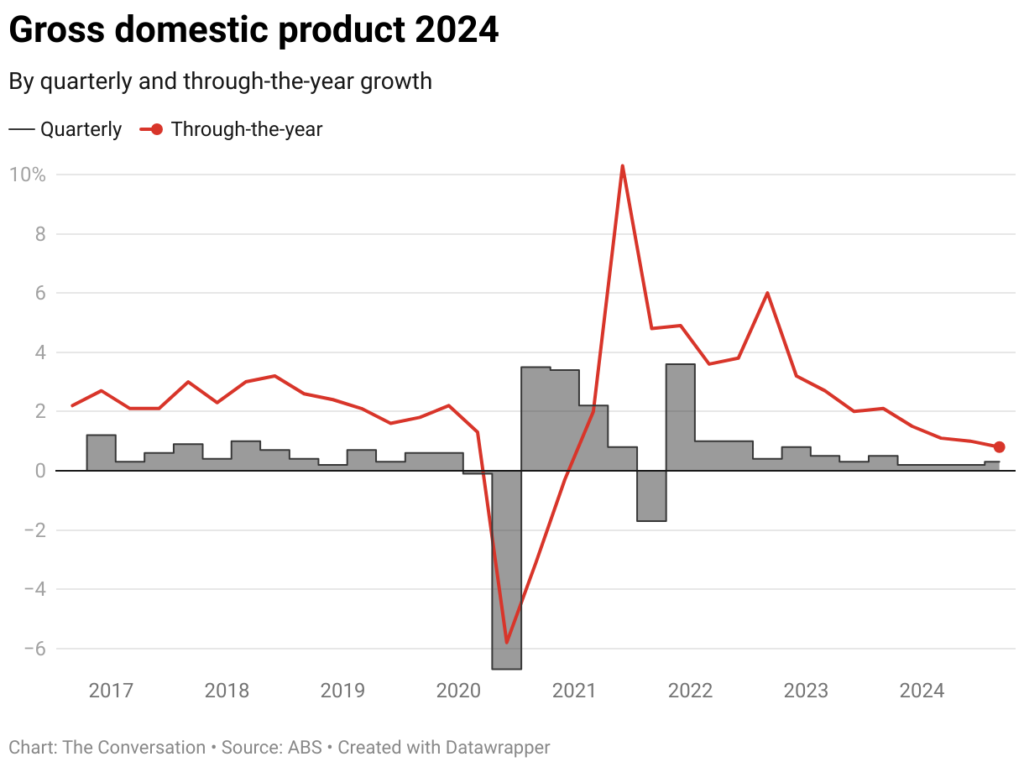
Australia’s economic growth remains in the slow lane, at only 0.3% for the September quarter, keeping Australia close to recession territory.
However, the national accounts data released on Wednesday by the Australian Bureau of Statistics (ABS) puts growth slightly higher than the snailish 0.2% recorded the previous quarter.
Although growth is painfully slow, this could well be seen by next year as the turning point when the trend started to move into positive territory.
The annual rate of growth, 0.8% since September 2023, is the slowest since 2020.
Most of it was driven by public-sector spending and investment. The main government spending was for energy rebates, plus social benefits including the National Disability Insurance Scheme and aged care. Public investment included roads, hospitals and imports of defence equipment.
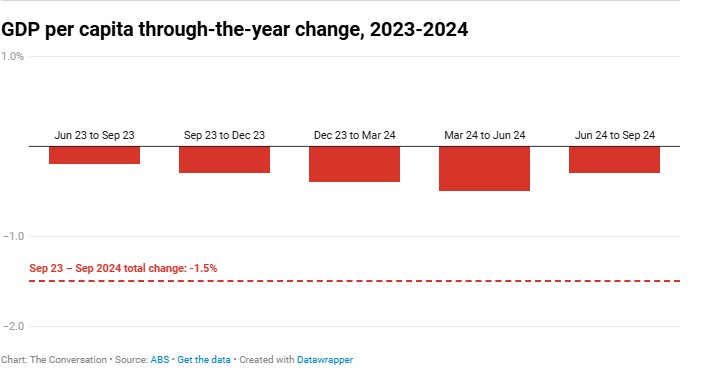
Gross domestic product (GDP) per head of population continues to fall, for the seventh consecutive quarter. Were it not for immigration, Australia’s growth would be going backwards – what many commentators call a per capita recession.
This means that average Australians’ standard of living, as measured by GDP, continues to decline. Not that GDP is the only thing that matters. GDP is limited – it only measures the dollar value of goods and services produced in Australia.
Thirty-six years ago, feminist economist Marilyn Waring wrote If Women Counted, pointing out that GDP did not measure the value of unpaid work (mostly by women) and nature.
That said, most people would prefer economic growth in their pockets, rather than living standards going backwards. It is why cost-of-living pressures – despite inflation falling – continue to bite. The government will be desperately hoping this statistic turns around before the election.
There is some good news for households in the ABS release. Disposable income rose, due to wages growth and income tax cuts. So households were able to save more, with the saving ratio growing from 2.4% to 3.5%. That is, more Australian families can set money aside for the future. It’s not yet at pre-COVID levels but heading in the right direction.
Productivity drops
Australia’s productivity, as measured by GDP per hour worked, declined by 0.8% over the year to September 2024. This is a worry. The most effective way to lift living standards over the longer term is to improve productivity.
Neither government nor academic economists agree on why our productivity has dropped, and solutions remain elusive. Some of them involve increasing investment in skills and training, and more effective use of capital resources.
On that latter element, there may be relief down the track. The good news is that business investment in machinery, equipment and software remained high. In comments released with Wednesday’s figures, the ABS said:
the last time we saw sustained levels of investment this high was during the mining construction boom between 2012 and 2014.
Other things being equal, more business investment in capital should give rise to higher productivity.
Australia’s slow GDP growth largely reflects high interest rates. By keeping interest rates high, the Reserve Bank of Australia makes it more expensive for businesses to borrow money to hire new staff or buy new equipment.
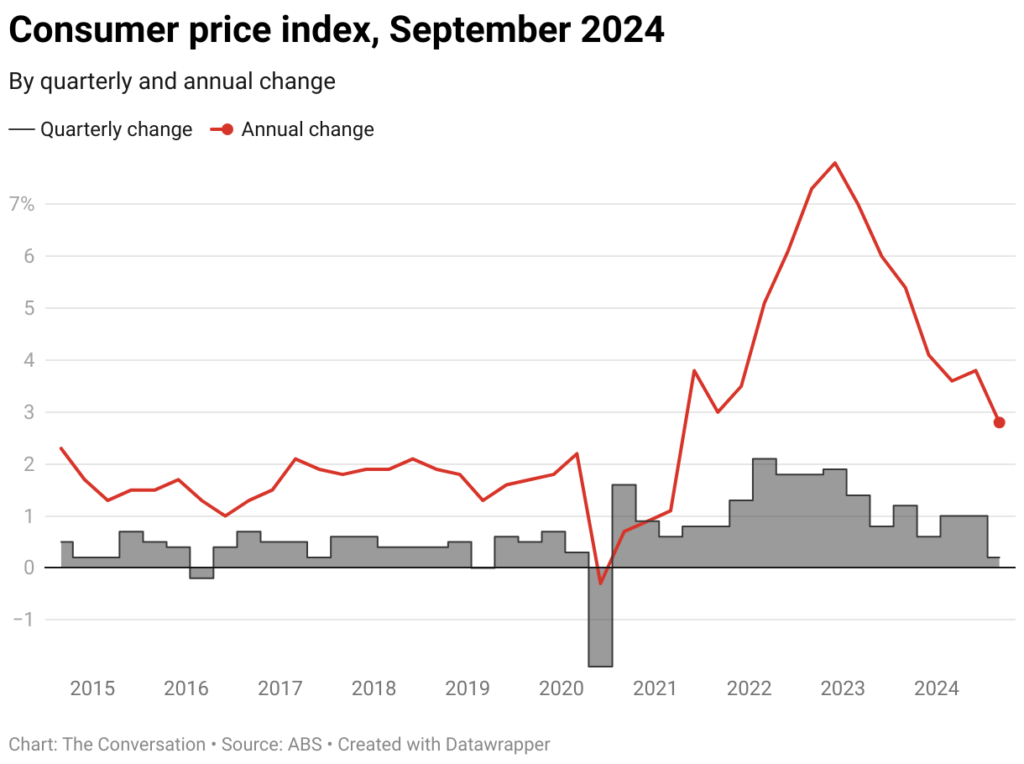
This puts the brakes on business growth, pulls the economy downwards, and helps control inflation. That is what the Reserve Bank is aiming for. Inflation has indeed fallen, to its lowest rate since the March quarter in 2021.
In that sense the low growth number for September may be good news for borrowers. The RBA won’t be as fearful of cutting interest rates and overheating the economy – there is little chance of that.
The global Indian Diaspora and Australia’s multicultural communities need fair, non-hyphenated, and questioning journalism, packed with on-ground reporting. The Australia Today—with exceptional reporters, columnists, and editors—is doing just that. Sustaining this requires support from wonderful readers like you.
Whether you live in Australia, the United Kingdom, Canada, the United States of America, or India you can take a paid subscription by clicking Patreon and support honest and fearless journalism. LINK: https://tinyurl.com/TheAusToday
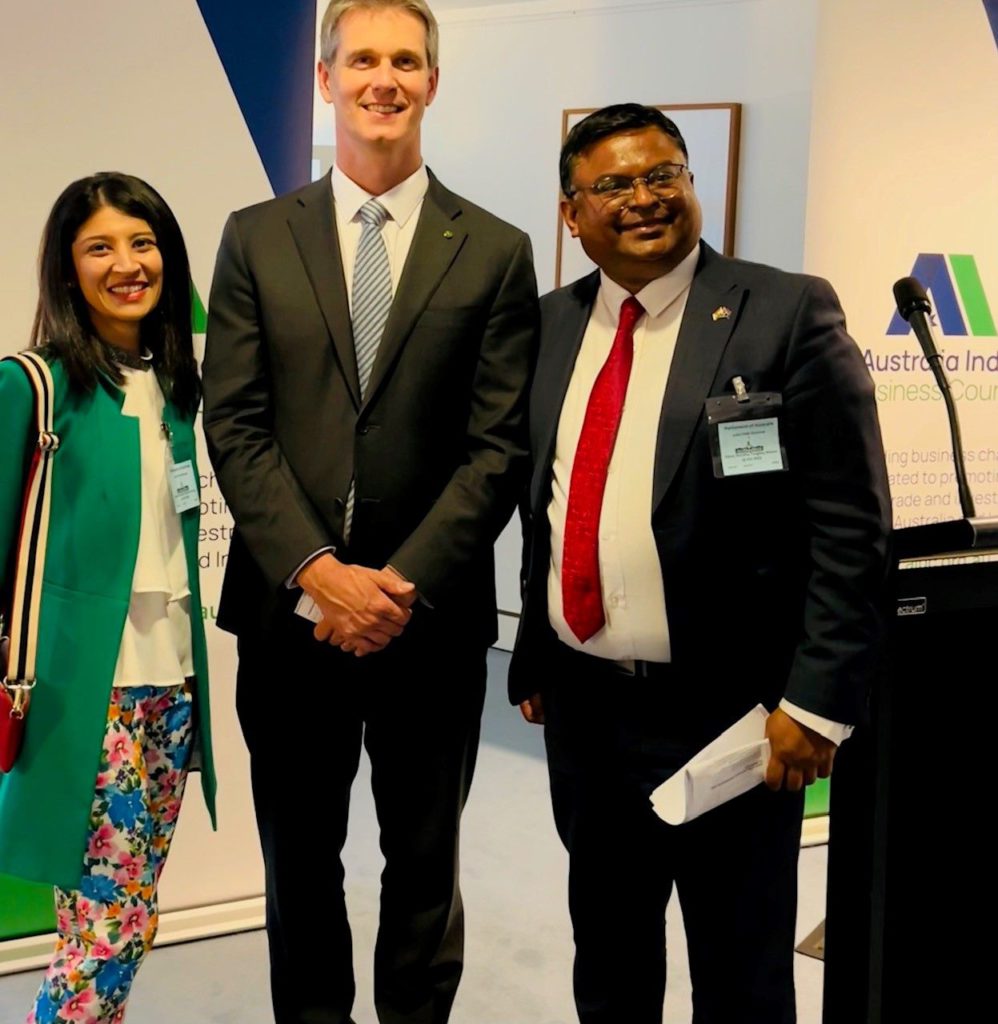
The Australia India Business Council (AIBC) has announced the election of Deepak-Raj Gupta OAM as its new National Chair and Amritha Zacharia as National Vice Chair, each serving a two-year term.
Image: Deepak-Raj Gupta OAM (Source: Facebook)
Newly elected Chair Gupta expressed his gratitude, saying,
“I am deeply honoured to lead AIBC into its next chapter. Together, we will enable collaboration, drive growth, and amplify the voice of our members while strengthening the Australia-India relationship.”
Agra-born and Shimla-educated Gupta served as the first India-born member of the Australian Capital Territory Legislative Assembly (2019–2020), representing Yerrabi for the Labor Party. Taking his oath on the Bhagawad Gita, he worked across justice, economic development, climate strategy, and tourism.
A strong advocate for India’s cultural diversity, Gupta has led numerous initiatives, including founding the Canberra India Council and serving as President of the India Australia Association of Canberra. He also led the ACT Chapter of the Australia India Business Council for a decade and participated in ACT trade delegations to India in 2015 and 2019.
Image: Amritha Zacharia (Source: LinkedIn)
Zacharia echoed his sentiments, stating,
“As National Vice Chair, I aim to bring fresh perspectives and foster dynamic partnerships to empower our members in advancing the Australia-India business corridor.”
Zacharia, a passionate advocate for universal education, has spent two decades driving innovation, business transformation, and strategic growth. She has held leadership roles in consulting firms, worked with mining giant Rio Tinto, and advised over 150 multinationals globally.
Currently leading APAC Client Advocacy, Strategy & Operations at Gartner, Amritha also serves as a Non-Executive Director for incluude, a Diversity and Inclusion learning platform. A CPA and University of Sydney Business School graduate, she has completed advanced leadership and finance programs, underscoring her commitment to equipping businesses and education sectors for the future of work.
The announcement comes as AIBC honours the achievements of outgoing leaders Jodi McKay and Ravneet Pawha.
Under their leadership, the Council navigated a transformative period marked by the signing of the Australia-India Economic Cooperation and Trade Agreement (ECTA), the deepening of the Comprehensive Strategic Partnership, and the strengthening of bilateral trade and cultural exchanges.
Reflecting on her tenure, McKay said,
“It has been an honour to lead AIBC during such a transformative time. I am confident the new leadership will build on our achievements and continue to strengthen ties between our two nations.”
Founded in 1986 by the governments of Australia and India, AIBC plays a pivotal role in fostering trade, investment, and cultural ties between the two nations through its state chapters and Indian presence. As AIBC looks to the future, the new leadership team is poised to further solidify its role as a cornerstone of the Australia-India economic relationship.
Support Our Journalism
The global Indian Diaspora and Australia’s multicultural communities need fair, non-hyphenated, and questioning journalism, packed with on-ground reporting. The Australia Today—with exceptional reporters, columnists, and editors—is doing just that. Sustaining this requires support from wonderful readers like you.
Whether you live in Australia, the United Kingdom, Canada, the United States of America, or India you can take a paid subscription by clicking Patreon and support honest and fearless journalism. LINK: https://tinyurl.com/TheAusToday
China has lifted the last remaining suspensions on two Queensland meat processing facilities, restoring full access for Australian red meat exports to the nation’s second-largest market.
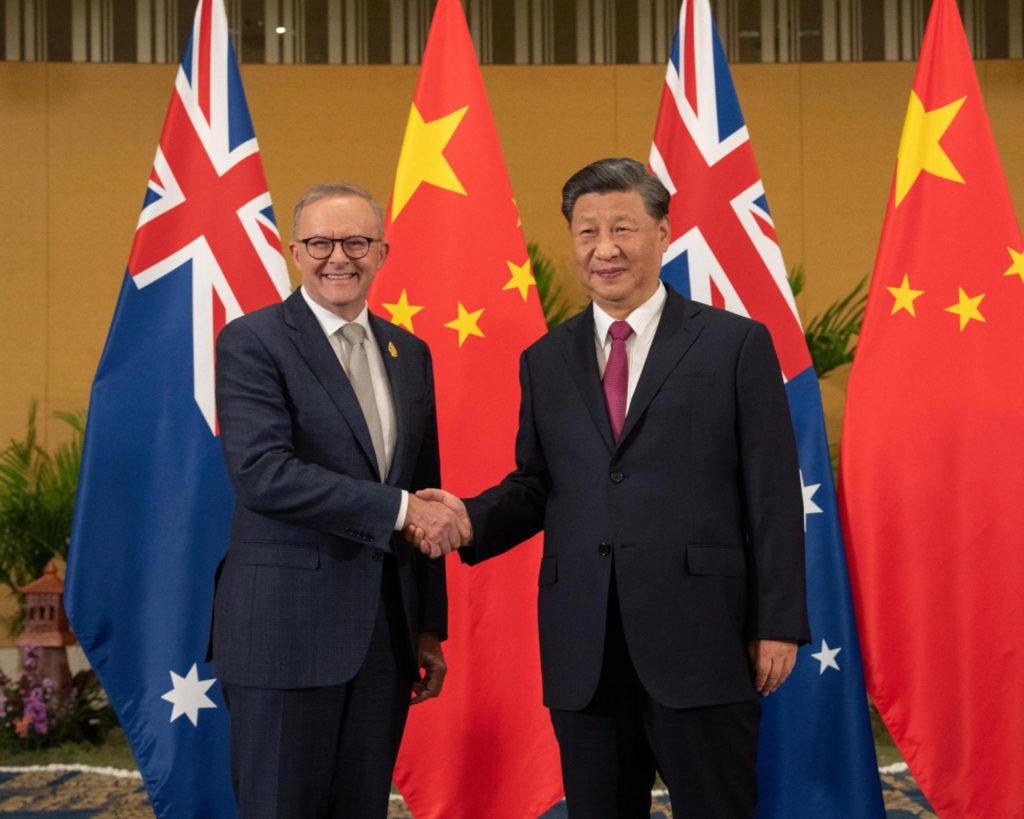
Image: Prime Minister Anthony Albanese with China’s President Xi Jinping, 2022 (Source: X)
Prime Minister Anthony Albanese described the news as a victory for the industry, stating:
“This is great news for Australian exporters, producers, and farmers. Since we were elected, we’ve worked tirelessly to resume trade, and that’s exactly what we are seeing. It’s a win for trade and a win for Australian jobs – something my Government will always back.”
China’s removal of the final trade restrictions marks a return to business as usual for Australian beef and veal exports, which reached $2.2 billion in 2023-24.
This development coincides with forecasts of a record-breaking year for the red meat sector in 2024-25, expected to drive the value of agriculture, fisheries, and forestry to $94.3 billion – the second-highest on record, according to the Australian Bureau of Agricultural and Resource Economics and Sciences.
Image: Senator Penny Wong with China’s Foreign Minister Wang Yi (Source: X)
Foreign Minister Penny Wong praised the outcome, attributing it to the government’s steady diplomacy:
“The removal of all impediments on Australian beef exports to China affirms the calm and consistent approach taken by the Albanese Labor Government. We will continue to support Australian businesses to sell their world-class products on the global stage, including efforts to diversify and expand trade markets.”
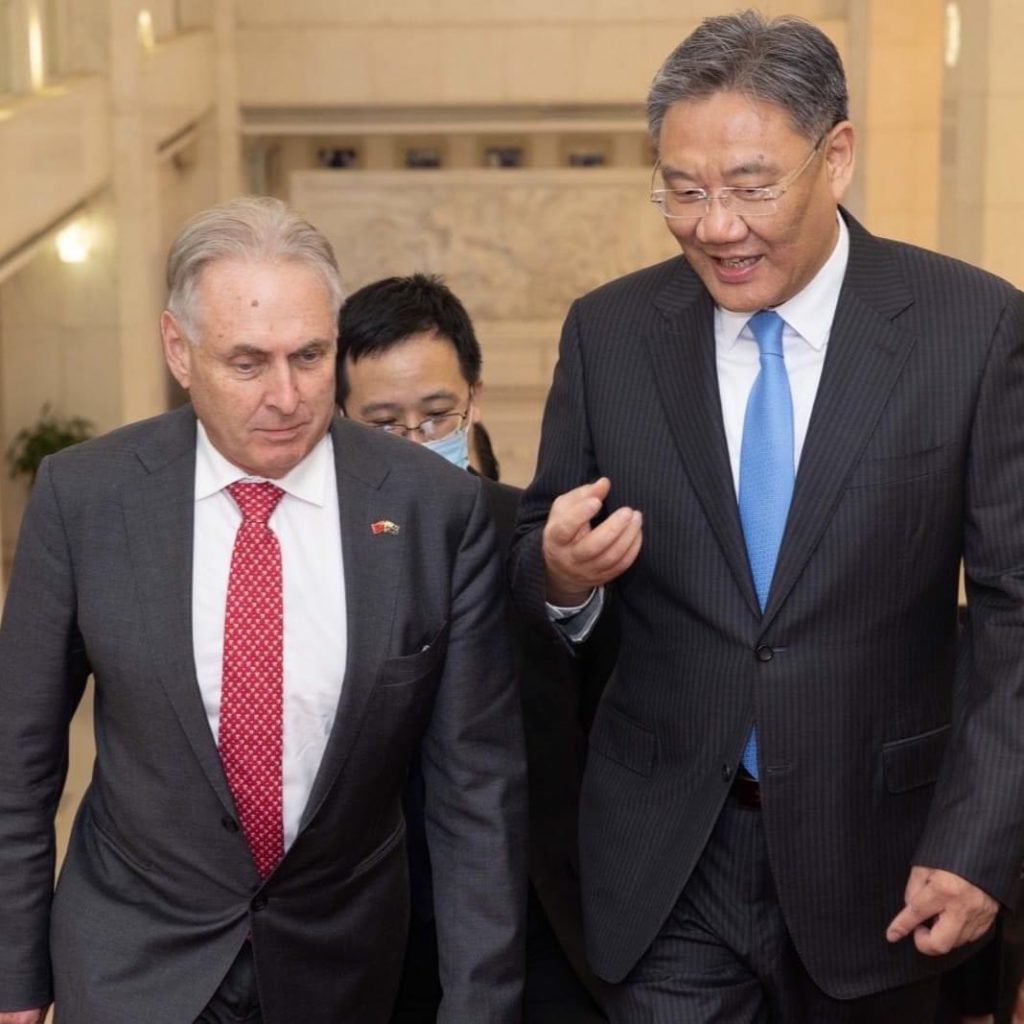
Image: Minister Don Farrell with Chinese Minister of Commerce Wang Wentao (Source: X)
Trade Minister Don Farrell highlighted the broader significance of resolving trade tensions:
“We are close to the point where China’s trade impediments, which impacted $20 billion worth of Australian exports, have all been removed. The removal of these barriers has not only saved, but also created thousands of new jobs in Australia. Beef producers in Queensland, winemakers in South Australia, and barley growers in Western Australia have all benefited from this Government’s steady hand on the trade tiller.”
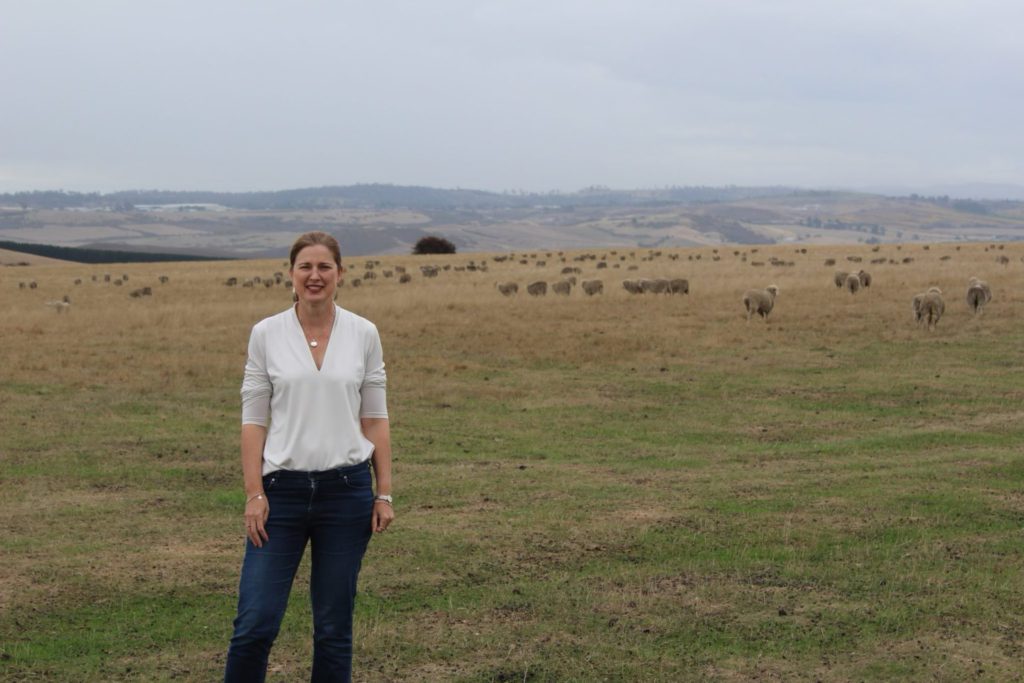
Image: Agriculture Minister Julie Collins (Source: X)
The red meat sector, in particular, has emerged as a major beneficiary of this restored relationship, thanks to concerted advocacy and industry efforts. Agriculture Minister Julie Collins thanked stakeholders for their persistence, stating:
“Concerted engagement and advocacy with our largest trading partner have been rewarded. In 2023-24, Australia exported over 70 per cent of its agricultural, fisheries, and forestry production to 169 markets globally – the most diversified trade has ever been. This is thanks to our Government.”
As exporters look to meet surging demand, the reopening of China’s market signals not just recovery, but also a promising future for Australian producers in global trade.
Support Our Journalism
The global Indian Diaspora and Australia’s multicultural communities need fair, non-hyphenated, and questioning journalism, packed with on-ground reporting. The Australia Today—with exceptional reporters, columnists, and editors—is doing just that. Sustaining this requires support from wonderful readers like you.
Whether you live in Australia, the United Kingdom, Canada, the United States of America, or India you can take a paid subscription by clicking Patreon and support honest and fearless journalism. LINK: https://tinyurl.com/TheAusToday
In the realm of Australian sports, where rugby, cricket, and AFL dominate, a traditional Indian sport is carving its niche. Kho Kho, a high-energy game that combines speed, agility, and teamwork, is finding its footing Down Under thanks to a dedicated group of volunteers who established Kho Kho Australia.
Kho Kho is a team game where agility meets strategy. Played between two sides—one defending and the other chasing—the objective is simple yet exhilarating: tag out the opposing team’s players while evading capture. The game thrives on lightning-fast reflexes, precise movement, and seamless coordination.
Kho Kho Australia was founded by a group of volunteers with diverse expertise in professional coaching, community development, and competitive sports. Their goal was to develop the sport in Australia and represent the country at the inaugural Kho Kho World Cup. While this immediate aim drives current efforts, the broader vision focuses on building the sport at the grassroots level to ensure its sustained growth.
The founders saw immense potential in introducing Kho Kho to a multicultural country like Australia, with its rich sporting culture and love for fast-paced games. Although the sport was already played within the Indian-Australian community, Kho Kho Australia aims to expand its reach across the nation, allowing people from all backgrounds to experience its charm.
The journey began with some challenges, including a lack of awareness. Many Australians initially mispronounced the sport as “Co Co.” However, training sessions held in Sydney, Melbourne, and Canberra helped spark interest and build a foundation. Players, both experienced and new, embraced the opportunity to try something different. Representing Australia at the World Cup has become a thrilling prospect for the team.
Assembling a team to represent Australia was no small feat. Players were recruited through community outreach and assessed on their fitness and adaptability to the game. The team now boasts a mix of experienced Kho Kho players, those with backgrounds in other sports, and newcomers eager to learn. The logistical challenge of bringing together players spread across various cities was met with enthusiasm and collaboration.
Participation in the Kho Kho World Cup is a landmark moment for the team and for Australia. It offers a chance to showcase Australian talent on a global stage while testing skills against the best in the world. The team’s training regimen has been intense, with personalised fitness plans and thrice-weekly training sessions focusing on agility and technique. National camps bring all players together to prepare as a cohesive unit.
Like any emerging sport, Kho Kho Australia has faced financial and logistical hurdles. While the International Federation of Kho Kho is covering travel costs for the World Cup, other expenses require additional support. Sponsorships from companies like Inteliment, Liquid Instruments, and Surface Design have been invaluable, but more support is needed. The team has called on the community to help through donations and sponsorships.
Despite being relatively unknown in Australia, Kho Kho has formed both men’s and women’s teams ready to compete in Delhi this January. The organisation plans to promote the sport in schools and local communities, aiming to build awareness and foster interest among younger generations. Kho Kho Australia’s commitment to inclusivity and multiculturalism reflects the broader Australian spirit, where fairness, teamwork, and community thrive.
Bringing Kho Kho to a new audience also offers an opportunity for cultural exchange. For many Indian Australians, the sport is a link to their heritage. Playing Kho Kho in Australia creates a bridge between generations, allowing younger people to reconnect with their roots while introducing the game to a wider audience. It fosters inclusivity and mutual understanding, strengthening community bonds.
Beyond the World Cup, Kho Kho Australia envisions a thriving future for the sport. Plans include organising national and international tournaments and establishing a robust culture around Kho Kho in Australia. With growing interest among university students and young people, the sport has the potential to become a staple in schools and universities nationwide.
Kho Kho Australia invites the community to support this journey by becoming members, donating, or simply spreading the word. As the team prepares to represent Australia at the World Cup, they hope their efforts inspire others to embrace new experiences, celebrate their roots, and contribute to a multicultural sporting legacy.
Support Our Journalism
The global Indian Diaspora and Australia’s multicultural communities need fair, non-hyphenated, and questioning journalism, packed with on-ground reporting. The Australia Today—with exceptional reporters, columnists, and editors—is doing just that. Sustaining this requires support from wonderful readers like you.
Whether you live in Australia, the United Kingdom, Canada, the United States of America, or India you can take a paid subscription by clicking Patreon and support honest and fearless journalism. LINK: https://tinyurl.com/TheAusToday
Five trailblazing Australian women researchers have been awarded prestigious fellowships to collaborate with leading Indian STEM experts. Their work will tackle critical global challenges, including urban rainwater harvesting, brain disease insights through data, and AI-driven air quality forecasting.
The initiative, part of the Australia India Women Researchers’ Exchange (AIWE) Program, is spearheaded by the Australia India Institute and supported by the Australian Government Department of Education.
Image: Lisa Singh, CEO of the Australia India Institute (Source: X)
Lisa Singh, CEO of the Australia India Institute, highlighted the program’s role in empowering women in STEM and advancing bilateral research collaboration.
“As the world’s third-largest producer of science and engineering publications, India is home to a dynamic research environment driving global innovation,” Ms Singh said.
“These fellowships enable early-career women researchers to engage with India’s leading scientists and institutions, tapping into its renowned STEM expertise.”
The fellowships provide an opportunity for five researchers from Australian regional universities to spend six to eight weeks in India, partnering with mentors in their fields of study.
Image: Dr Indu Bala (Source: Supplied)
Dr Indu Bala (University of Adelaide) will collaborate with Dr B R Ambedkar National Institute of Technology, Jalandhar, to optimise urban rainwater harvesting systems.
Image: Dr Paula Cartwright (Source: Supplied)
Dr Paula Cartwright (James Cook University) will join the Indian Institute of Technology Bhubaneswar to enhance water quality monitoring in coastal ports.
Image: Dr Azadeh Noori Hoshyar (Source: Supplied)
Dr Azadeh Noori Hoshyar (Federation University) will partner with Rajagiri School of Engineering and Technology to advance research on Alzheimer’s and Parkinson’s diseases.
Image: Dr Ekta Sharma (Source: Supplied)
Dr Ekta Sharma (University of Southern Queensland) will collaborate with the Indian Institute of Technology Delhi to harness AI for urban air quality forecasting.
Image: Dr Pabasara Wanniarachchige (Source: Supplied)
Dr Pabasara Wanniarachchige (University of Wollongong) will work with the Indian Institute of Science, Bangalore, on geothermal reservoir dynamics to improve energy efficiency.
With women representing only 30 percent of global STEM researchers, initiatives like the AIWE Program are critical for addressing gender disparity in the field, Ms Singh said.
“These fellowships not only create opportunities for early-career women researchers but also pave the way for the next generation to step into leadership roles,” she added.
“We look forward to seeing the innovative outcomes of these collaborations and the strengthening of Australia-India research ties.”
This announcement follows the earlier selection of five Indian women researchers from Tier 2 and Tier 3 cities, who will conduct research in Australia under the same exchange program.
Support Our Journalism
The global Indian Diaspora and Australia’s multicultural communities need fair, non-hyphenated, and questioning journalism, packed with on-ground reporting. The Australia Today—with exceptional reporters, columnists, and editors—is doing just that. Sustaining this requires support from wonderful readers like you.
Whether you live in Australia, the United Kingdom, Canada, the United States of America, or India you can take a paid subscription by clicking Patreon and support honest and fearless journalism. LINK: https://tinyurl.com/TheAusToday
Senior police officers from Australia and Papua New Guinea (PNG) witnessed the destruction of 500kg of cocaine last week, marking the conclusion of a joint operation that dismantled a major criminal syndicate.
The cocaine, seized in PNG after a black flight transporting it to Australia crashed in July 2020, was incinerated at a secure facility in Queensland on 28 November 2024. Estimated to be worth $800 million, the drugs could have been sold as 500,000 street deals, Australian Federal Police (AFP) Commander Stephen Jay revealed.
Image: Op Weathers drugs burn (Source: AFP)
“Had it arrived in Australia, it would have caused immense harm to the community,” Commander Jay said.
“Its destruction is a testament to the dedication and cooperation of all agencies involved in Operation Weathers.”
Operation Weathers was a multi-agency investigation led by the AFP, in partnership with Queensland and Victoria Police, Australian Border Force (ABF), the Australian Criminal Intelligence Commission (ACIC), and the Royal Papua New Guinea Constabulary (RPNGC). The investigation uncovered a syndicate attempting to smuggle the drugs into Queensland.
Image: Cmdr Stephen Jay and Deputy Commissioner Donald Yamasombi (Source: AFP)
The operation was set in motion after the light plane carrying the cocaine crashed north of Port Moresby on 26 July 2020. RPNGC officers recovered the haul five days later. Charges were laid against nine individuals—five in Australia and four in PNG—who received prison sentences of 18 to 19 years in September 2024.
The PNG National Court of Justice ordered the destruction of the cocaine, stipulating that a senior RPNGC officer be present. RPNGC Deputy Commissioner Donald Yamasombi and Commander Jay oversaw the transfer of the drugs from a secure AFP vault to the destruction site.
Image: Op Weathers drugs burn (Source: AFP)
Deputy Commissioner Yamasombi highlighted the shared success of both nations in tackling the illicit drug trade.
“The drug trade damages both our nations in similar ways. Together, we’ve achieved a mutually satisfying outcome.”
The AFP uses advanced waste disposal technology to destroy illicit substances. The process involves vaporising the drugs into steam, which is filtered into an ash-like substance for safe release, ensuring minimal environmental impact.
Commander Jay expressed gratitude for the partnership, while Deputy Commissioner Yamasombi emphasised the continued importance of collaboration to protect communities in both countries.
Support Our Journalism
The global Indian Diaspora and Australia’s multicultural communities need fair, non-hyphenated, and questioning journalism, packed with on-ground reporting. The Australia Today—with exceptional reporters, columnists, and editors—is doing just that. Sustaining this requires support from wonderful readers like you.
Whether you live in Australia, the United Kingdom, Canada, the United States of America, or India you can take a paid subscription by clicking Patreon and support honest and fearless journalism. LINK: https://tinyurl.com/TheAusToday
Chicken – or chooks, as they are affectionately known in Australia – have been a mainstay in backyards for generations.
More and more Australians now keep chickens, after the COVID pandemic triggered food shortages and prompted concern for egg supplies. At the same time, the welfare of egg-producing chickens is also in the spotlight, leading to an increase in the sale of free range eggs.
Globally, academic research into the trend has largely focused on public health and biosecurity risks. The human relationship to backyard chickens has not been deeply explored. Our recent research sought to change this.
We surveyed backyard-chicken owners in Adelaide, and found their relationships with the birds blur the lines between pet and livestock. The results throw up interesting questions about animal welfare, our trust in food systems, and how we relate to the non-human world.
What our research found
We interviewed 44 people who keep chickens at home. The in-depth discussions were conducted either over the phone or at suburban fodder stores, where chicken feed is sold.
We questioned participants on their motivations for keeping chickens in their backyards. Some saw their chickens as pets – in fact, one participant told us “they’re my babies”. Another respondent said:
Chickens as pets are a heap of fun and they’ve got such personalities and character and that’s one of the reasons why I like to have them out and about.
Backyard chickens provided an ongoing supply of fresh eggs from a trusted source. One person said:
I like fresh eggs. I don’t like buying eggs […] I get better quality […] And less stress to the chickens. I know that the chickens are happy. They’re not barn, they’re not cage, they’re definitely free range.
Others valued being able to recycle their food scraps by feeding them to chickens.
Some respondents said backyard chooks provided an educational experience for their children. One told us:
Hatching baby chicks has been an amazing experience for us and I think as our kids have grown up the whole thing has taught them a bit about life cycles and life and death.
Others said keeping chickens helped teach their children how to care for animals and educated them about where food comes from. Many recounted having chickens when they were children, and wanted the same experiences for their children or grandchildren.
Backyard chickens also provided some people with opportunities to connect with neighbours, by sharing food scraps and gifting eggs.
A few ethical quandaries
Interestingly, while some participants ate chicken, many emphasised that they would not kill or eat their own birds. Some had a preference for free-range chicken, but others said their keeping of backyard chickens had not influenced the type of meat they buy.
And while people valued their chickens for their ability to provide eggs and companionship, they were not likely to allow the animals inside the home. They were also unlikely to take them to the vet if they were unwell. As one person told us:
I personally just can’t justify the cost of the vet versus the monetary value of my chickens.
So while chickens are seen as pets, they are not considered as valuable as cats and dogs, which would usually be given vet care if needed.
This is worrying from a biosecurity perspective. Backyard chickens are capable of spreading highly pathogenic diseases such as avian influenza, and preventing this is difficult if chicken owners don’t take the animal to the vet.
What’s more, sick or injured chickens that don’t receive vet care may suffer unnecessarily, raising animal welfare concerns.
What all this means
Our results suggest backyard chickens are valued primarily because they provide eggs – but importantly, not meat. They are also valued for the human experiences they produce.
Owners consider their chooks to have distinct personalities and other attributes associated with pets. Yet the animals are not afforded the same care as cats and dogs.
This suggests backyard chickens occupy an in-between space on the human-animal relations spectrum – they are neither livestock nor companion animals.
As the trend of keeping backyard chickens grows, policymakers should consider the biosecurity risks and welfare of these and other animals that exist outside traditional categories.
This is especially important given the potential for a particularly virulent strain of avian influenza known as H5N1 to arrive in Australia and devastate wild and farmed bird populations.
Earlier this year, food security issues again came to the fore when Coles limited egg purchases in most of its supermarkets due to a bird flu outbreak in Victoria. It coincided with consumer concerns about and the rapidly increasing costs of food, including eggs.
Our results suggest more research is needed into consumers’ lack of trust in food supply systems, and the diverse ways Australians navigate the issues.
The global Indian Diaspora and Australia’s multicultural communities need fair, non-hyphenated, and questioning journalism, packed with on-ground reporting. The Australia Today—with exceptional reporters, columnists, and editors—is doing just that. Sustaining this requires support from wonderful readers like you.
Whether you live in Australia, the United Kingdom, Canada, the United States of America, or India you can take a paid subscription by clicking Patreon and support honest and fearless journalism. LINK: https://tinyurl.com/TheAusToday
Shiromani Akali Dal (SAD) president and former Punjab Deputy Chief Minister Sukhbir Singh Badal narrowly escaped an alleged assassination attempt at the Golden Temple in Amritsar.
#BREAKING: Assassination attempt on Akali Dal leader Sukhbir Singh Badal at the entrance of Golden Temple in Amritsar, Punjab. A former terrorist Narayan Singh Chaura who got training from Pakistan was overpowered by people and handed over to the Police. Major security failure. pic.twitter.com/CRwOgPeCOw
The accused, Narain Singh Chaura, a former Khalistani militant and active member of the pro-Khalistan organisation Dal Khalsa, fired a gunshot that missed Badal and struck a wall.
Bullet fired at Golden Temple | The attacker Narain Singh Chaura, who fired at Sukhbir Singh Badal, has been nabbed by the Police. The attack was foiled by the Police. A security cordon was already in place by the Police. Before Chaura could do anything, Police Constable nabbed… pic.twitter.com/nTQZsOmWNX
Badal, who was seated in a wheelchair with a fractured leg, was serving ‘tankhaiya’ (religious penance) at the temple’s entrance as ordered by the Akal Takht Sahib over alleged “sins” committed during the SAD government’s tenure from 2007 to 2017.
Holding a spear and dressed in a blue ‘sevadar’ uniform, Badal was performing seva (voluntary service) when the incident occurred.
Chaura, reportedly involved in multiple cases under the Unlawful Activities (Prevention) Act (UAPA), first paid obeisance at the temple before attempting the attack.
Image: [L] Narain Singh Chaura, and [R – sitting on the wheelchair] Sukhbir Singh Badal (Source: ANI screenshots)
Chaura was overpowered by bystanders and promptly arrested by Punjab Police.
#WATCH | Bullet fired at Golden Temple | Amritsar Police Commissioner Gurpreet Singh Bhullar says, "…The attacker has been caught. An investigation will reveal everything…Investigation will reveal whether there was a deeper conspiracy…It was an assassination attempt but he… pic.twitter.com/jDdeuNCed6
ADCP Harpal Singh confirmed that Badal was unharmed, stating,
“There were proper security arrangements. The assailant attempted mischief but could not succeed.”
SAD leader Daljit Singh Cheema expressed gratitude, saying,
“Jako Rakhe Saaiyan, Maar Sake Na Koy. Guru Nanak protected Sukhbirji. This is a serious incident. A high-level judicial enquiry must be conducted.”
Congress MP Manish Tewari told ANI,
“It is extremely sad and condemnable. Sri Akal Takht Sahib is the biggest religious organisation for Sikhs and Sukhbir Singh Badal was completing his punishment but attacking him is highly condemnable.”
#WATCH | Bullet fired at Golden Temple | Congress MP Manish Tewari says, "It is extremely sad and condemnable. Sri Akal Takht Sahib is the biggest religious organisation for Sikhs and Sukhbir Singh Badal was completing his punishment but attacking him is highly condemnable. An… pic.twitter.com/4yh0zMNk0i
The incident raises concerns over Punjab’s security climate, with Cheema questioning the state government: “What era is Punjab being pushed into?”
Despite the attack, Badal and SAD leaders, including Bikram Singh Majithia, vowed to continue performing seva at the Golden Temple as a mark of penance.
Support Our Journalism
The global Indian Diaspora and Australia’s multicultural communities need fair, non-hyphenated, and questioning journalism, packed with on-ground reporting. The Australia Today—with exceptional reporters, columnists, and editors—is doing just that. Sustaining this requires support from wonderful readers like you.
Whether you live in Australia, the United Kingdom, Canada, the United States of America, or India you can take a paid subscription by clicking Patreon and support honest and fearless journalism. LINK: https://tinyurl.com/TheAusToday
The Boxing Day Test between Australia and India is set to deliver more than thrilling cricket, with the Victorian Government announcing a Summer Festival at Yarra Park to coincide with the iconic event.
Minister for Tourism, Sport and Major Events Steve Dimopoulos described the Test as a thrilling showdown between “two cricket-loving nations” and a celebration of Victoria’s strong ties with India.
Image Source: Supplied
Minister Dimopoulos said, “This year there will be as much action outside the MCG as inside, with the Summer Festival providing fun for fans of all ages.”
“It’ll be a huge boost to our local economy, filling hotels, bars, and restaurants as some of the world’s most passionate cricket fans come to Melbourne.”
The three-day festival will feature live music, Bollywood dance performances, celebrity chef demos, food trucks, and pop-up cricket pitches. Experts will preview the day’s play each morning, and big screens will broadcast the on-field action throughout the day.
Cricket Australia CEO Nick Hockley praised the Boxing Day Test as “one of the most iconic fixtures on the cricket calendar,” adding, “The rivalry between Australia and India just gets bigger and bigger, and we can’t wait to see the MCG full on Boxing Day.
Image Source: Supplied
“The Indian-inspired Summer Festival will certainly add to the experience of fans coming to the MCG.”
Hockley also highlighted the significance of the upcoming Women’s Ashes, including the historic day-night Test at the MCG on 30 January. “Similar to the Women’s T20 World Cup Final in 2020, this will be a celebration of another milestone moment for cricket,” he said.
Image Source: Supplied
The Boxing Day Test’s significance extends beyond the boundary, surpassing ticket sales in 2018/19. International fans account for over 10 per cent of sales, indicating the Test’s global appeal.
Fans can also catch a slice of India’s second-biggest sport, Kabaddi, with the Pro Kabaddi Melbourne Raid debuting at John Cain Arena after stumps on day three.
To book your seat at the Boxing Day Test or Women’s Ashes, visit ticketek.com.au. For Pro Kabaddi tickets, visit johncainarena.com.au.
Support Our Journalism
The global Indian Diaspora and Australia’s multicultural communities need fair, non-hyphenated, and questioning journalism, packed with on-ground reporting. The Australia Today—with exceptional reporters, columnists, and editors—is doing just that. Sustaining this requires support from wonderful readers like you.
Whether you live in Australia, the United Kingdom, Canada, the United States of America, or India you can take a paid subscription by clicking Patreon and support honest and fearless journalism. LINK: https://tinyurl.com/TheAusToday
Image: Car stuck in the shallows at Glenelg Beach (Source: 7News screenshot)
Initially, the 38-year-old car owner, Raj, alleged that a group of teenagers stole his car and abandoned it at the beach. However, South Australia Police have dismissed this account after further investigation.
Image: 38-year-old car owner Raj (Source: 7News screenshot)
About 2.50 am Tuesday 3 December police were called to Chappel Drive after reports a Hyundai Accent was bogged on the beach.
The car, left stranded during high tide, drew significant attention from early morning beachgoers.
Image: Car stuck in the shallows at Glenelg Beach (Source: 7News screenshot)
South Australia Police have charged Raj with driving without due care and making a false report to police.
Support Our Journalism
The global Indian Diaspora and Australia’s multicultural communities need fair, non-hyphenated, and questioning journalism, packed with on-ground reporting. The Australia Today—with exceptional reporters, columnists, and editors—is doing just that. Sustaining this requires support from wonderful readers like you.
Whether you live in Australia, the United Kingdom, Canada, the United States of America, or India you can take a paid subscription by clicking Patreon and support honest and fearless journalism. LINK: https://tinyurl.com/TheAusToday
A desperate plea for help has been issued by the mother of three-year-old Vihaana, who is battling severe aplastic anaemia in India.
Diagnosed in March, Vihaana has undergone two bone marrow transplants, multiple blood transfusions, and is now fighting pneumonia in the paediatric ICU.
Her mother, Madhvi Poonam, who is also a doctor, explained to fijivillage that Vihaana’s immune system is severely compromised following the transplants, leaving her prone to life-threatening infections despite strict precautions. The latest challenge has been managing a complication called TA-TMA (Transplant-associated Thrombotic Microangiopathy), a condition causing blood clots and low platelet counts.
Image: Vihaana (Source: Make A Difference – Fiji – Facebook)
The family’s financial burden is overwhelming, as Vihaana requires a costly medication, Eculizumab, which is not produced in India and costs a minimum of US$2,500 per weekly dose. With recent complications, doctors have doubled her dosage to twice a week. In addition, Vihaana needs weekly platelet transfusions, further adding to the mounting medical expenses.
Madhvi says the family has exhausted their savings after nine months in India and is struggling to fund ongoing treatments and settle hospital bills.
“We are doing everything we can, but we need help to secure her medications and ensure she has a fighting chance.”
The family is also liaising with doctors to determine when Vihaana might be stable enough to return to Fiji before the harsh Indian winter worsens her condition. However, the urgent need for funds to continue her treatment remains critical.
Earlier this year, the family launched a GoFundMe campaign, Little Vihaana Needs Your Help to Fight for Her Life, and Madhvi expressed heartfelt gratitude to those who have contributed so far.
“Your support has helped us cover ICU costs and vital transfusions, but we need help to get through the next months and bring her home.”
To support Vihaana’s fight, visit the GoFundMe page and give her a chance at life.
Support Our Journalism
The global Indian Diaspora and Australia’s multicultural communities need fair, non-hyphenated, and questioning journalism, packed with on-ground reporting. The Australia Today—with exceptional reporters, columnists, and editors—is doing just that. Sustaining this requires support from wonderful readers like you.
Whether you live in Australia, the United Kingdom, Canada, the United States of America, or India you can take a paid subscription by clicking Patreon and support honest and fearless journalism. LINK: https://tinyurl.com/TheAusToday
The Australian Federal Police (AFP) has issued a stark warning about the dangers of illicit drug use, with a particular focus on nitazenes—synthetic opioids that are ten times more potent than fentanyl. These substances are increasingly being detected in Australia and have been found in cocaine, MDMA, GHB, and counterfeit pharmaceuticals.
Nitazenes come in various forms, including powders, tablets, nasal sprays, and vape liquids, and are often misrepresented as non-opioid substances. They pose significant health risks, including loss of consciousness, respiratory failure, erratic pulse, and even death.
Image: Rising imports of potent drug nitazene (Source: AFP)
Between January 2023 and September 2024, Australian Border Force (ABF) officers intercepted 64 nitazene shipments at the border. These imports, originating from Hong Kong, the United Kingdom, and Canada, were primarily smuggled via international mail.
In one case, police seized 4kg of a nitazene analogue during a raid in Doncaster East in June 2024, leading to the arrest of a 28-year-old Malaysian national. In another, a Northern Territory man was charged for importing metonitazene from the UK in October 2023.
Image: Rising imports of potent drug nitazene (Source: AFP)
AFP Commander Paula Hudson highlighted the severe risks nitazenes pose, describing them as even more dangerous than fentanyl. “Two milligrams of fentanyl—the size of two grains of salt—is lethal. Nitazenes are ten times stronger,” she said.
“Taking nitazenes is like playing Russian roulette with your life.”
Hudson also expressed concerns for frontline workers who could accidentally be exposed to nitazenes through inhalation or contact during drug seizures.
Image: Rising imports of potent drug nitazene (Source: AFP)
ABF Acting Commander Troy Sokoloff emphasised the agency’s commitment to intercepting nitazenes at the border, labelling their rise a serious threat.
“These substances are causing deaths globally, and we will continue to work tirelessly with our law enforcement partners to disrupt smuggling networks targeting Australia.”
The AFP and ABF remain steadfast in their efforts to combat the spread of nitazenes and protect Australians from the devastating consequences of synthetic opioids.
Support Our Journalism
The global Indian Diaspora and Australia’s multicultural communities need fair, non-hyphenated, and questioning journalism, packed with on-ground reporting. The Australia Today—with exceptional reporters, columnists, and editors—is doing just that. Sustaining this requires support from wonderful readers like you.
Whether you live in Australia, the United Kingdom, Canada, the United States of America, or India you can take a paid subscription by clicking Patreon and support honest and fearless journalism. LINK: https://tinyurl.com/TheAusToday
We often assume Australian students are great with technology and have access to a computer, reliable internet and adequate data.
But this is not necessarily the case, despite the importance of technology to our lives.
In our research released today, we surveyed 445 New South Wales school teachers and staff. They told us significant numbers of students are missing out on the basic technology and skills they need for their education.
What is ‘digital inclusion’
Digital inclusion means everyone can access and can use digital technology fairly and equally.
Students need to have an appropriate device to work on – such as a laptop or computer, fast internet and adequate data. They also need to have the skills to use this technology and technical support if they need it.
International research shows those who do not have proper access to technology cannot fully participate in their schooling and are at risk of falling behind their peers. So, digital exclusion can have serious consequences for children and young people’s education.
Our research
Concerns about some students not having access to technology are not new. But the pandemic and online learning highlighted the issue. Although we are now out of lockdown, lack of access to technology remains a problem for many students.
To better understand the situation, in 2023 we surveyed 445 NSW teachers, principals and support staff to gauge their concerns about digital exclusion before, during and after the pandemic. The responses came from primary and high schools in both public and private sectors.
We were particularly interested in Western Sydney due to concerns raised by local service providers. We also gathered responses from other parts of Sydney and regional NSW.
What we found
We found during school closures, extra resources (such as laptops and dongles) were provided to students who needed them. However, much of this support ended after the lockdowns.
With rising costs of living, school staff told us many students now have less access to the technology they need than before the pandemic. This is despite schools increasingly relying on it for learning.
There was a stark divide between responses from teachers in government schools and private schools.
When asked if they believed technology provided by schools for students to take home was adequate, only 46% of government school teachers said yes, compared to 96% of non-government teachers.
There was a also a geographical difference. Only 25% of teachers in Western Sydney thought school provisions were adequate, compared to 36% in regional NSW and 76% in the rest of Sydney.
Not enough resources at home
Many teachers also identified issues with students access to technology outside of school. Asked if students had adequate access to devices for learning at home, only 32% of teachers from Western Sydney said yes, compared to 39% in regional NSW and 59% in the rest of Sydney.
Many students also relied solely on mobile phones to complete their schoolwork at home, even though these devices are not suitable for most educational tasks. This included 37% of students in Western Sydney, 25% in regional NSW and 17% in other parts of Sydney.
Asked if they thought students had adequate technical support at home: 10% of teachers from Western Sydney said yes, compared to 5% in regional NSW and 24% for the rest of Sydney.
School staff also told us very few students from groups we know to be vulnerable to digital exclusion had the technology they needed. Asked if students had sufficient access, could afford and adequately use the technology they needed for their education, they estimated this was the case for:
19% of asylum seeker and refugee students
28% of students from lower socioeconomic backgrounds
30% of Indigenous students
34% of students from non-English speaking backgrounds and “students with physical disabilities”
36% of “students with special needs”.
How can we improve digital access for students?
Our research also outlines five ways we can improve students’ access to the technology they need for their education and life beyond school.
1. Do not assume students are digitally included: schools need to recognise many students may not have devices, internet at home or skills when planning lessons and activities
2. Meet students’ digital needs: schools should review “Bring Your Own Device” policies to ensure they don’t disadvantage students. Governments may need to provide more funding so all students have access to the technology they need
3. Teach digital literacy in schools: develop school-specific resources, including materials in different languages and partner with local organisations to help parents support their children’s learning
4. Invest in community infrastructure: provide areas of high need with free and safe public Wi-Fi and create “device banks” to lend equipment to students in need
5. Schools and researchers need to work together to collect better information: so they can better understand the problem and find solutions.
If we allow this level of digital exclusion to persist, the consequences could be serious for individual students, our economy and society. If we make changes now, we can ensure all students have the tools they need to navigate an increasingly digital world.
The global Indian Diaspora and Australia’s multicultural communities need fair, non-hyphenated, and questioning journalism, packed with on-ground reporting. The Australia Today—with exceptional reporters, columnists, and editors—is doing just that. Sustaining this requires support from wonderful readers like you.
Whether you live in Australia, the United Kingdom, Canada, the United States of America, or India you can take a paid subscription by clicking Patreon and support honest and fearless journalism. LINK: https://tinyurl.com/TheAusToday
Victorian multifaith and multicultural leaders have issued a powerful statement standing in solidarity with the Sikh community amidst growing concerns over racism and controversy surrounding the renaming of Berwick Springs Lake to Guru Nanak Lake.
The statement celebrates Victoria’s diversity, which boasts over 200 cultural backgrounds, 290 languages, and 200 faith traditions. Highlighting the Sikh community’s enduring values of generosity and service, the leaders declared, “Your hurt is our hurt, and your strength is our strength,” while embracing the teachings of Guru Nanak, the founder of Sikhism.
Image: Berwick Springs renamed in honour of Guru Nanak Dev Ji (Source: Sonya Kilkenny – Facebook)
The initiative to rename the lake was part of a 2018 election commitment by the Victorian Government, recognising the Sikh community’s contributions. However, the renaming has sparked local debate. The City of Casey clarified in a bulletin that the change applies solely to the lake and not the broader estate.
In addition, the state government announced $600,000 in funding to support Sikh organisations hosting Langar events for Guru Nanak’s 555th birth anniversary. Local MP Gary Maas commended the Sikh community for their service and called the renaming “a celebration of diversity.”
Conversely, Brad Battin MP and Ann-Marie Hermans MP organised a public hearing to address community concerns about transparency in the decision-making process. Battin emphasised, “This isn’t about division but ensuring local voices are heard.” The pair plan to release a discussion paper inviting public submissions.
Image: Berwick Springs Lake, located in Narre Warren, has been renamed Guru Nanak Lake, in honour of Guru Nanak Dev Ji, founder of the Sikh faith (Source: Facebook)
The statement, signed by prominent religious and community leaders, reaffirmed the importance of unity.
“We’ll keep standing together – shoulder to shoulder, now and always because this is what it means to be Victorian: united, proud, and stronger together.”
• Makarand Bhagwat – Hindu Council of Australia • Usha Rani Gulapalli – Hindu Society of Victoria • Victorian Council of Churches • Jewish Community Council of Victoria • Rabbi Daniel Rabin – Rabbinical Council of Victoria • Rabbi Gabi Kaltmann – Ark Centre • Viv Nguyen – Chairperson Victorian Multicultural Commission • Bishop Phillip Huggins – Australian Centre for Christianity and Culture • Board of Imams Victoria • CO.AS.IT. Italian Assistance Association • Federation of the Italian Migrant Workers and Families • Asian Business Association of Whitehorse • Australian Multicultural Foundation • Sikh Interfaith Council of Victoria • Victorian Sikh Gurduaras Council • Gurduara Council of Victoria • Islamic Council of Victoria • Greek Community of Melbourne • Zee Cheng Khor Moral Uplifting Society • Ethnic Council of Shepparton & District Inc. • Cultrua • Albury-Wodonga Ethnic Communities Council Inc. • Sunraysia Mallee Ethnic Communities Council • Gippsland Multicultural Services • Ballarat Regional Multicultural Council Inc. • Casey Interfaith Network • Reverend James Winderlich – St Johns Southgate • AMAFHH Federation • The Interfaith Centre of Melbourne • Xuyen T. (Samuel) Pho – Salvation Army • Reverend David Fotheringham – Uniting Church in Australia, Synod of Victoria and Tasmania • The Right Reverend Dr Paul Barker – Anglican Diocese of Melbourne, Jumbunna Episcopate • Australian Intercultural Society • Reverend Dr. Margaret Mayman – St Michael’s Uniting Church, Melbourne • Sikh Volunteers Australia
Leaders from Hindu, Jewish, Christian, Islamic, Sikh, and multicultural organisations joined the call for solidarity, underscoring the shared values that define Victoria.
Support Our Journalism
The global Indian Diaspora and Australia’s multicultural communities need fair, non-hyphenated, and questioning journalism, packed with on-ground reporting. The Australia Today—with exceptional reporters, columnists, and editors—is doing just that. Sustaining this requires support from wonderful readers like you.
Whether you live in Australia, the United Kingdom, Canada, the United States of America, or India you can take a paid subscription by clicking Patreon and support honest and fearless journalism. LINK: https://tinyurl.com/TheAusToday
The Department of Home Affairs has cancelled the visa of a foreign national caught providing unlawful immigration assistance in Australia. The individual charged over 1,000 visa applicants large sums for advice, encouraging them to apply for a Protection visa despite knowing they were ineligible.
This illegal activity caused significant delays for genuine asylum seekers and others in need of Australia’s protection. Under Australian law, only registered migration agents or legal practitioners are authorised to charge fees for immigration assistance.
Protection visas (subclass 866) are designed to offer asylum to individuals facing persecution or significant harm in their home countries. These visas are not for those seeking to extend their stay in Australia to work. Applications require applicants to be in Australia on a valid visa and to meet stringent criteria.
Recent reforms to the Protection visa application process have drastically reduced processing times, ensuring quicker grants for those in need and swift refusals for ineligible applicants. Currently, more than 85% of Protection visa applications are refused due to non-compliance with eligibility requirements.
Applying under false pretences has serious consequences, including lifetime records of visa refusals, future visa complications, potential detention, and removal from Australia. Providing false information can lead to hefty fines or jail terms of up to 10 years.
Unregistered migration operators, often advertising on social media, exploit vulnerable applicants with false advice and exorbitant fees. Communities are urged to raise awareness about the risks of engaging unregistered advisers and the importance of truthful applications.
The Department warns against applying for a Protection visa without genuine asylum claims, stating such applications are swiftly refused. To stay informed and avoid scams, applicants are advised to only engage registered migration agents or legal practitioners.
Support Our Journalism
The global Indian Diaspora and Australia’s multicultural communities need fair, non-hyphenated, and questioning journalism, packed with on-ground reporting. The Australia Today—with exceptional reporters, columnists, and editors—is doing just that. Sustaining this requires support from wonderful readers like you.
Whether you live in Australia, the United Kingdom, Canada, the United States of America, or India you can take a paid subscription by clicking Patreon and support honest and fearless journalism. LINK: https://tinyurl.com/TheAusToday
A Pew Research Center study reveals that the Hindu population in Pakistan reduced from 20% in 1947 to 3% in 2016 and by some metrics it’s less than 2% right now, in Bangladesh it declined from 23% in 1971 to 9% in 2023 (today, this figure has dwindled to less than 8%, despite the nation’s overall population more than doubling during the same period); and in Afghanistan it shockingly fell from 700,000 in 1970s to 0 Hindus today.
In the subcontinent, if we take a look at the Muslim population in India, it grew from 35 million in 1951 to over 172 million in 2011, which is a 4 times increase. This stark contrast in demographic trends paints a troubling picture, one that is conspicuously ignored by global human rights watchdogs and Western media. Why is the world silent about the steady erosion of Hindu populations in the subcontinent? As Bangladesh and its minorities face a watershed moment, the deafening silence of prominent Western media houses is nothing short of diabolical. These are the same outlets that flood the global discourse with editorials and analyses, putting the world on high alert over even isolated incidents of violence against minorities in India.
Since 2013, over 3,600 documented attacks have targeted Hindus, as reported by Ain o Salish Kendra (ASK), a Bangladeshi human rights group. These attacks include the vandalism and arson of over 550 homes and 440 businesses, alongside the desecration of more than 1,670 temples and places of worship.
The recent developments following the exile of Sheikh Hasina lay bare the grim reality of Bangladesh’s so-called secularism, exposing its fragile foundation and the systemic persecution of its minority communities. What started ostensibly as a student protest soon turned into arson and targeted violence against the Hindus of Bangladesh.
According to data put forward by The Bangladesh National Hindu Grand Alliance, within 4 days of Hasina’s exodus, in as many as 278 locations across 48 districts incidents of violence and threats to leave the country have been repeatedly inflicted on the Hindu community. The involvement of Taliban ideology inspired Jamaat-e-Islami in targeted attacks against Hindus is an open secret, and yet the Noble Laureate Yunus led interim government calls all of these visuals an ‘industrial scale misinformation campaign’ by Indian media.
#Bangladesh journalist Munni Saha, a prominent TV news personality was mobbed by a group of people in the heart of #Dhaka at Karwan Bazar on Saturday evening while leaving office. The mob accused her of being an Indian stooge, a RAW agent and pro Hasina regime media person. The… pic.twitter.com/l9ZZrufN7I
While the world’s self-anointed watchdogs rush to spotlight human rights violations in politically convenient regions, their indifference to the plight of Hindus in Bangladesh underscores a disturbing double standard.
After the recent spate of unrest, brutal arrest of ISKCON monk Chinmoy Krishna Das, temples have been attacked, and devotees have been harassed, beaten, or worse, islamist mobs could be heard saying “we’ll behead every ISKCONite” as they rally around streets.
These incidents are not isolated but part of a broader pattern of systemic persecution. What has come as a surprise is the negation and denial of suffering of the Hindu community by the western media. There has been a calculated dismissal of these developments calling them fake or fabricated or collateral damage and even an overreaction.
A BBC headline says, “the far-right videos distorting the truth of Bangladesh minority attacks”; and Al Jazeera went ahead claiming “misleading reports of attack on Bangladesh Hindus circulates in India” are “Islamophobic, alarmist”. Following the trend, France 24, shared a video on their Facebook page with the caption, “according to regional experts, Hindus are not specifically attacked because of their religion, but because of their political affiliation”. Another report by Deutsche Welle (DW), claims, “violent anti-government protests in Bangladesh have fueled many false claims of attacks against the nation’s Hindu minority”. Similarly, the New York Times calls violence against Hindus in Bangladesh “revenge attacks”. They quickly changed the title of the editorial after uproar. This prompts a critical question: what motivates such distorted journalism and the deliberate downplaying of Hindu suffering? This hypocrisy isn’t just unethical—it’s dangerous.
This silence has broader geopolitical implications. It enables regimes that allow such persecution to flourish under the radar. It also feeds into the growing narrative of Western hypocrisy, where moral grandstanding on human rights is weaponized selectively, often to serve political interests rather than genuine concern for humanity. It also compels one to reconsider the largely floated theory about involvement of the CIA in abrupt regime change in Bangladesh with the Biden administration hailing Muhammad Yunus as the ideal administrator.
Bangladesh Chief Adviser Professor Muhammad Yunus shares the stage with former U.S. President Bill Clinton at the 2024 Clinton Global Initiative meeting in New York on Tuesday, September 24, 2024. pic.twitter.com/qFwnwC1azP
— Chief Adviser of the Government of Bangladesh (@ChiefAdviserGoB) September 24, 2024
The silence of international human rights organizations like Amnesty International and Human Rights Watch is equally troubling. These groups often lead so called global campaigns against oppression but seem uninterested when the victims are Hindus in South Asia. In fact, some of these organizations have gone so far as to downplay these incidents, labeling them as “localized disputes” or “political conflicts” or “revolution”. Their muted response is perplexing, especially when the persecution involves widespread violence, desecration of temples, and even systematic displacement of minorities.
Their reluctance to engage with the atrocities against Hindus in Bangladesh suggests a glaring double standard. Why are these watchdogs hesitant to address the plight of Hindus in Bangladesh? Is it because such cases do not align with the narratives they seek to perpetuate? Or is it a calculated decision driven by the fear of being labeled Islamophobic, even if it means turning a blind eye to the suffering of an entire community?
It would not be an overstatement to draw parallels with Germany in 1938. The state-sponsored pogrom, systematic persecution, and open calls for genocide of Hindus and other minority groups, in broad daylight, are the reality of Bangladesh. The numbers are not just statistics; they are stories of pain, loss, and a community continually pushed to the brink of survival. The legacy of persecution that Hindus have faced over centuries is not a relic of the past—it is a grim reality that persists to this day.
In closing, I just want to ask ourselves: how many more generations will have to endure this legacy of suffering before we, as a global community, take a stand? And more importantly ask if this is the new normal–facts buried, suffering ignored? The global community needs to know that this is not history, it’s happening now. Hindus are under attack, and the world needs to wake up.
Contributing Author: Shreyash Sharma is a research assistant at the Department of Public and International Affairs in City University of Hong Kong (CityU).
Support Our Journalism
The global Indian Diaspora and Australia’s multicultural communities need fair, non-hyphenated, and questioning journalism, packed with on-ground reporting. The Australia Today—with exceptional reporters, columnists, and editors—is doing just that. Sustaining this requires support from wonderful readers like you.
Whether you live in Australia, the United Kingdom, Canada, the United States of America, or India you can take a paid subscription by clicking Patreon and support honest and fearless journalism. LINK: https://tinyurl.com/TheAusToday
The new route is expected to deliver significant economic benefits, bringing 26,593 visitors annually and generating over $12 million in visitor spending.
Queensland Tourism Minister Andrew Powell emphasised the opportunities for local tourism operators, exporters, and students:
“This route will create jobs, boost freight opportunities for fresh produce, and attract more international visitors.”
Tourism Tropical North Queensland CEO Mark Olsen added that the flights align with efforts to tap into the North American market, which has shown a 74% recovery, bringing over 101,000 visitors in the past financial year.
The new route, launched with much fanfare at Cairns Airport, marks the first direct connection between Northern Queensland and Fiji. The flights will operate on Tuesdays, Thursdays, and Saturdays on the modern Boeing 737 MAX 8 aircraft.
Cairns Airport CEO Richard Barker hailed the development as a “game changer” for the region, stating,
“This service not only offers locals a fantastic holiday option but also provides the South Pacific community easier access to loved ones, just four hours away. Additionally, seamless connections via Nadi to North America will cut travel time to destinations like Los Angeles, San Francisco, and Dallas by approximately three hours.”
The direct service opens a gateway to the South Pacific, while aligning with Fiji Airways’ Nadi-Dallas schedule to create efficient onward travel.
Fiji Airways Managing Director André Viljoen highlighted the strategic importance of the route:
“This expansion strengthens connectivity between the South Pacific, Australia, and North America. It also brings travellers closer to Northern Australia’s incredible attractions, including the Great Barrier Reef and Daintree Rainforest.”
Passengers on the new route can look forward to Fiji Airways’ renowned hospitality, including complimentary full-flight text Wi-Fi for economy passengers and full-browsing Wi-Fi for business class.
Support Our Journalism
The global Indian Diaspora and Australia’s multicultural communities need fair, non-hyphenated, and questioning journalism, packed with on-ground reporting. The Australia Today—with exceptional reporters, columnists, and editors—is doing just that. Sustaining this requires support from wonderful readers like you.
Whether you live in Australia, the United Kingdom, Canada, the United States of America, or India you can take a paid subscription by clicking Patreon and support honest and fearless journalism. LINK: https://tinyurl.com/TheAusToday
Marking International Day for the Abolition of Slavery on 2 December 2024, the AFP is spotlighting the plight of individuals lured by promises of legitimate work, only to find themselves trapped in conditions of forced labour, exploitation, and debt bondage—key forms of human trafficking.
Since 2018, the AFP has documented 247 reports of forced labour and exploitation, with incidents surging nearly 140 per cent over six years. Victims often endure gruelling conditions, including long hours without breaks, threats of violence, and the confiscation of personal documents such as passports and visas.
In January 2024, a Templestowe man received a prison sentence of three years and six months for forcing a victim to work 14-hour days for two consecutive years under the threat of deportation. The victim, employed at a confectionery business in Box Hill, was denied breaks and subjected to relentless exploitation.
The maritime industry has also seen rising exploitation. In December 2023, a Darwin man faced 44 charges for allegedly luring crew members to work on his fishing boat through fraudulent online advertisements, holding them against their will.
Forced labour involves coercing individuals to work against their will through threats, deception, or intimidation. Signs of victimisation include physical abuse, lack of contracts, restricted communication, and exploitative living and working conditions. Victims are often stripped of their autonomy, unable to leave their workplace or seek help.
Commander Helen Schneider, from AFP Human Exploitation, stressed the human cost of these crimes. “Criminal syndicates treat victims as commodities, forcing them into degrading conditions for profit,” she said. “We urge the public to stay vigilant and report suspicions of human trafficking to the AFP.”
In the 2023–2024 financial year alone, the AFP received 382 reports of human trafficking-related offences, including 69 cases of forced labour, 59 of sexual exploitation, and 21 of domestic servitude.
Support Our Journalism
The global Indian Diaspora and Australia’s multicultural communities need fair, non-hyphenated, and questioning journalism, packed with on-ground reporting. The Australia Today—with exceptional reporters, columnists, and editors—is doing just that. Sustaining this requires support from wonderful readers like you.
Whether you live in Australia, the United Kingdom, Canada, the United States of America, or India you can take a paid subscription by clicking Patreon and support honest and fearless journalism. LINK: https://tinyurl.com/TheAusToday
When federal parliament passed legislation last week which will ban under 16s from social media, Prime Minister Anthony Albanese celebrated. Posting on X, he said: “We’re doing everything we can to keep our kids safe”.
Part of that commitment involves launching a trial of age assurance technologies to determine the best way of enforcing the social media ban for under 16s and preventing young people under 18 from accessing online pornography sites.
The trial will be run by a consortium led by a British company called the Age Check Certification Scheme. It has previously tested software for Australian troops in Afghanistan.
The trial, which the government says is a “key plank” of its online safety agenda, will kick off next year. According to the project plan, it will explore “how different methods perform in verifying a user’s age without compromising their personal data”. In turn, this will help Australia “establish best practices and potential regulatory frameworks for age assurance”.
The trial will involve about 1,100 Australians of varying ages and cultural backgrounds. According to the project plan, it will test three main technology options.
So what exactly are these options – and what does the evidence say about their effectiveness?
Age assurance technologies
The trial will assess the following three technology options.
Age verification – using a person’s identity credentials, such as a digital ID or an uploaded driver’s license or passport. With this information, it is able to verify a person’s stated date of birth – and therefore, whether they are over or under an age threshold.
Age estimation – analysing a person’s biological or behavioural features known to change with age, such as examining a photo of their face or recordings of their voice. According to the project plan, these systems sometimes “employ machine learning and artificial intelligence and may be subject to configuration settings or age buffers to avoid false positives based on inherent performance errors”.
Age inference – which involves using known details of a person’s life circumstances to infer they are an adult, for example, because they are married, have a credit card or mortgage or because they have a government (.gov.au) email address.
Reliability concerns
These three technologies differ in terms of their reliability, how they can go wrong, and their potential unintended consequences when widely deployed.
Age verification based on identity credentials (whether a digital ID or an uploaded driver’s license or other physical documents) is likely to be most reliable – as long as the person supplying the credential actually owns it. What protections will prevent a 14-year-old from uploading their parent’s birth certificate remain unclear.
One option could involve requiring people to take a live photo of their face in real time and to upload that photo alongside verified photo ID. Facial recognition technology might then verify that the same person supplying the credential is pictured in it, by checking whether the face in the real-time photo matches the one in the ID.
However, as anyone who knows how easy it is to fake a live Snapchat picture will tell you, it can be difficult to prove whether a photo was taken live. Therefore, this kind of checking needs to be very carefully implemented to be effective against savvy and motivated teenagers.
Age estimation technology is also likely to include estimating somebody’s age based on (purportedly) real-time photo or video of their face. Even ignoring the difficulties of determining whether a photo or video was taken live, this kind of technology is known to be imperfect.
Previous evaluation has shown that on average it is accurate within only 3.7 years of somebody’s true age. More concerning, it performs worse on tweens and teens than it does on adults over 20. So age estimation may fail precisely when it is most needed.
We should expect similar challenges with age inference. However, it is also likely to exclude many people including young adults who still live with their parents and therefore don’t have evidence such as rental agreements or credit cards.
Privacy concerns
The age assurance trial includes evaluating the privacy implications of each technology option. However, it’s unclear how well Australians understand these risks.
This is something that will be much harder for the trial to evaluate. Pollingfrom2024 suggests most people are in favour of age assurance to prevent children and teens accessing social media or pornography online.
However, attitudes may shift next year when platforms deploy these technologies to enforce the impending ban.
Ultimately, no matter which technology is deployed, it remains to be seen how many Australians will be happy to identify themselves (whether with a digital or traditional ID, a photo of their face, or by their bank records) to access social media or adult content online.
The global Indian Diaspora and Australia’s multicultural communities need fair, non-hyphenated, and questioning journalism, packed with on-ground reporting. The Australia Today—with exceptional reporters, columnists, and editors—is doing just that. Sustaining this requires support from wonderful readers like you.
Whether you live in Australia, the United Kingdom, Canada, the United States of America, or India you can take a paid subscription by clicking Patreon and support honest and fearless journalism. LINK: https://tinyurl.com/TheAusToday
Orington & Partners has announced a strategic partnership with MultiConnexions Group, a leading international, multicultural, and diaspora marketing agency based in Sydney.
This new collaboration aims to empower businesses to thrive within an increasingly globalised framework.
This alliance combines Orington & Partners’ cross-border expertise in corporate advisory, management consulting, and financial services with MultiConnexions Group’s strength in multicultural and diaspora marketing. Together, the partnership seeks to bridge local communities and global opportunities.
Wei-Khing Seow, Executive Chair of Orington & Partners, expressed enthusiasm:
“This partnership enables us to provide expansive, culturally attuned solutions for businesses and government agencies, leveraging our networks across Sydney, New Delhi, Johannesburg, and Singapore.”
Sheba Nandkeolyar, CEO and Chief Strategy Officer of MultiConnexions Group, highlighted the partnership’s potential:
“Through this collaboration, our clients will not only access our multicultural expertise but also benefit from innovative corporate advisory and capital-raising services. It’s an exciting step in unlocking global opportunities.”
Key focus areas include India and China, which are pivotal for trade expansion. With bilateral trade between Australia and India valued at $49 billion in 2023 and the Australia-India Comprehensive Economic Cooperation Agreement (CECA) on the horizon, opportunities abound.
Nandkeolyar, a former National Chair of the Australia India Business Council, added:
“The impending CECA will solidify Australia-India relations, with both nations poised for significant trade growth.”
Orington & Partners operates across major global markets, providing comprehensive business services, while MultiConnexions Group, with over 15 years of expertise, leads in crafting culturally resonant marketing strategies for governments, organisations, and brands.
Support Our Journalism
The global Indian Diaspora and Australia’s multicultural communities need fair, non-hyphenated, and questioning journalism, packed with on-ground reporting. The Australia Today—with exceptional reporters, columnists, and editors—is doing just that. Sustaining this requires support from wonderful readers like you.
Whether you live in Australia, the United Kingdom, Canada, the United States of America, or India you can take a paid subscription by clicking Patreon and support honest and fearless journalism. LINK: https://tinyurl.com/TheAusToday
Outgoing US President Joe Biden’s decision to issue a sweeping pardon for his son, Hunter Biden, has sparked intense backlash, with President-elect Donald Trump and his allies accusing Biden of abusing his presidential powers.
The pardon, announced on Monday (AEDT), spares President’s son Hunter Biden from potential prison sentences for federal felony convictions on gun charges and tax evasion. It marks a significant reversal from Biden’s prior commitments not to intervene in his son’s legal matters.
“No reasonable person who looks at the facts of Hunter’s cases can reach any other conclusion than Hunter was singled out only because he is my son,” Biden stated, decrying the legal actions as a “miscarriage of justice.”
Everyone knew he was going to do it. He was just going to do it when it was if no consequence to democrat electability. https://t.co/Fd2Vf3YXIz
Taking to Truth Social, Trump condemned the pardon as a blatant misuse of power, questioning whether Biden’s clemency would extend to “January 6 hostages.” Trump’s allies echoed his sentiments, with figures like James Comer accusing Biden of shielding his family from accountability. “Does the Pardon given by Joe to Hunter include the J-6 Hostages, who have now been imprisoned for years?” he asked on the Truth Social platform.
“Such an abuse and miscarriage of justice!”
“Joe Biden assured Americans he wouldn’t pardon Hunter. Now he’s doing exactly that—breaking his word and undermining justice,” American commentator Clay Travis tweeted.
Even the people who engaged in the most criminal acts possible have already been punished far beyond what anyone else would have gotten for the same offense in DC. These were all political prosecutions. Pardon them all.
While some conservative commentators criticised the move, others expressed nuanced views. Charlie Kirk remarked,
“A father should look after his son… This might be the one thing Joe Biden truly cares about.”
BREAKING: Biden to pardon his son Hunter
Honestly, I don't think this is something worth getting mad over.
A father should look after his son. Joe has been so mistreated by the Democrat party and disrespected, this is the one thing he's actually always cared about. pic.twitter.com/x8e2O4leDO
Hunter Biden, convicted of lying about his drug use while purchasing a firearm and pleading guilty to tax evasion, admitted his actions but highlighted his efforts to overcome addiction. His legal team also released a 52-page white paper titled The Political Prosecutions of Hunter Biden. “I have admitted responsibility for my mistakes during the darkest days of my addiction,” Hunter said.
“I will never take the clemency I have been granted for granted.”
Biden’s critics argue the pardon sets a troubling precedent, with Trump spokesperson Steven Cheung accusing the Justice Department of being weaponised against political opponents. He pointed out that Delaware US Attorney David Weiss was elevated to the rank of special counsel to refile charges, which he did in Delaware and Los Angeles.
Meanwhile, Biden insists his decision was driven by fairness and his role as a father. “I believe in the justice system,” Biden said, “but raw politics infected this process. Enough is enough.”
A compilation of every time KJP was asked if Biden is going to pardon Hunter and every time she said no.pic.twitter.com/i4hEeVEpjN
The global Indian Diaspora and Australia’s multicultural communities need fair, non-hyphenated, and questioning journalism, packed with on-ground reporting. The Australia Today—with exceptional reporters, columnists, and editors—is doing just that. Sustaining this requires support from wonderful readers like you.
Whether you live in Australia, the United Kingdom, Canada, the United States of America, or India you can take a paid subscription by clicking Patreon and support honest and fearless journalism. LINK: https://tinyurl.com/TheAusToday
The international media is abuzz with the coverage of Delhi’s environmental crisis. It is indeed an irony to notice that this crisis, which engulfs Delhi annually finds almost no or very little space in our policymaking plans. The inability of our executive, legislature, and judiciary to deliberate on this annual apocalypse happening right in and around the national capital exposes the myopic vision of India’s future, a country that aspires to become a leading world economy by the end of 2030, thus turning Delhi into one of the most polluted places on this planet – clearly an undesirable achievement for any government. But what are we doing as a nation to prevent the annual apocalypse is the moot question.
Check live AQI ranking in Indiahttps://t.co/cwaDLuw3xv New Delhi is leading the charts—for the most polluted city in India. The capital city’s AQI levels are in the severe category, with no signs of respite.
Apparently, one doesn’t seem to have a solution to this problem. Perhaps, this failure is linked to the fact that the catastrophe can be avoided by staying in proximity to air purifiers, or because this happens only for 3-4 weeks annually. Both these assumptions are worrying points for the nation’s citizens.
To zoom out this problem over the years, it is vital to understand the gravity of this ongoing death play in Delhi. Firstly, it must be understood that stubble burning is not the sole reason behind the spike in Delhi’s pollution level. It takes nothing to make the farmers culpable for the annual devastation that is performed across Delhi and the NCR. The practice of stubble burning was made illegal in 2015, nonetheless, it continues. While stubble burning contributes to 35 per cent of Delhi’s pollution. Hence, the major problem lies elsewhere – both at the atmospheric level and the industrial level – and it is quite disheartening to see a resolute silence that undergirds this catastrophe.
Supreme Court advises wearing of masks due to the deteriorating air quality in Delhi. pic.twitter.com/xqwOL8Q82H
Secondly, the harvesting season of late October is also a time when the wind direction also changes. So, when the stubble is burnt in Lahore, Punjab, and Haryana, the pollution reaches Delhi and its neighbouring parts, and due to the meteorological conditions, it results into a thick cloud that percolates death to the citizens. Last week, Delhi’s air quality index (AQI) – which points to the level of pollutants in the air – reached almost 1,700 in some parts of the city.
Delhi’s daily average AQI clocked 441 today, which further rose to 457 today at 7PM.
CAQM Sub-Committee on GRAP accordingly invokes 8-point action plan as per Stage-IV of GRAP w.e.f. 8:00 AM of 18.11.2024 (tomorrow), in the entire NCR.
— Commission for Air Quality Management (@CAQM_Official) November 17, 2024
If we compare this with our closest competitor, China, its capital Beijing, reached the highest AQI of 1,300, which suggests how fast we are heading to convert Delhi and the NCR into a death chamber. Agreed that PM2.5 (particulate matter) is a major source of pollution in Delhi, but there are many contributing factors. About 40% of Delhi’s air pollution is attributed to vehicular emissions, with diesel vehicles being a major contributor. Yet, other polluting causes lie in the huge number of industries that have piled up across Delhi, including the NCR. They are the major and constant source of pollutants and ‘slow violence’ that Delhites are subjected to. Stubble burning only exacerbates the pollution level, turning the slow violence into a fierce one, thus rendering this catastrophic play visible to all of us.
Lets accept that stubble burning causes huge pollution every yr in North India during this time. And lets all together find a soln sincerely. Blame game and politics hasn’t helped anyone. People r suffering. I am extremely worried that pollution will play havoc coupled wid corona
In its desperate attempt to mitigate the severity of the crisis, a ‘Supersite’ air quality station was built in 2023 to obtain real-time source apportionment of air pollution. Arvind Kejriwal, the former Chief Minister of Delhi, inaugurated this station, while describing it as “an important leap: in the state’s fight against pollution. It takes very little effort to understand that monitoring the pollution level is linked to policymaking at the ground level. Apparently, the government is suffering from policy paralysis in matters pertaining to the deep crisis.
It also takes very little to understand that the issue of Delhi’s annual apocalypse is largely and deeply linked to power dynamics and legitimization of violence that categorizes zones into ‘liveable’ and ‘non-liveable’. As such, it is also linked to the unrestrained play of capital forces that has brought us to the perilous situation, which suggests around 33,000 people across 10 cities die annually from breathing air measured safe by official standards in India. Yet, attempts are half-hearted and seems to be only limited to the November-December period of severe pollution levels.
How else one could justify the flawed and distorted nature of India’s Air Quality Index measurements? It turns out that the measurement level that is being monitored is already compromised. While the Central Pollution Control Board (CPCB) officially recognizes the permissible matter for PM2.5, PM10, and NO2 (Nitrogen Dioxide) to be 40, 60, and 40 micrograms per cubic meter, respectively, the World Health Organization’s (WHO) recognition varies significantly from the Indian counterpart. The WHO considers the limits to be 5, 10, and 15 micrograms per cubic meter for the same pollutants.
— Central Pollution Control Board (@CPCB_OFFICIAL) December 1, 2024
For a nation that is heading toward becoming one of the world’s leading economies, this variance in the pollutant levels seem incomprehensible and deplorable. By subjecting citizens to this annual period of violence, the nation is also compromising on its workforce and resources. Silence and denialism, which happen to be the underlying features of the environmental crisis, need to be addressed, and it would be better if our leaders and bureaucrats start seeing this national crisis. For, there cannot be short-term policies to deal with issues that matter for the fate of our nation.
Contributing Author: Dr Om Prakash Dwivedi is an accomplished researcher in the area of Literary theory, Indian Writing in English, and Environmental Humanities.
Disclaimer: The opinions expressed within this article are the personal opinions of the author. The Australia Today is not responsible for the accuracy, completeness, suitability, or validity of any information in this article. All information is provided on an as-is basis. The information, facts, or opinions appearing in the article do not reflect the views of The Australia Today and The Australia Today News does not assume any responsibility or liability for the same.
Support Our Journalism
The global Indian Diaspora and Australia’s multicultural communities need fair, non-hyphenated, and questioning journalism, packed with on-ground reporting. The Australia Today—with exceptional reporters, columnists, and editors—is doing just that. Sustaining this requires support from wonderful readers like you.
Whether you live in Australia, the United Kingdom, Canada, the United States of America, or India you can take a paid subscription by clicking Patreon and support honest and fearless journalism. LINK: https://tinyurl.com/TheAusToday
Indian interest in Australian homes has surged, with searches for Melbourne properties climbing by 23% in October compared to last year, according to PropTrack’s Overseas Search Report.
The spotlight is on Melbourne’s growth corridors, with Tarneit and Point Cook emerging as the most sought-after suburbs for family-friendly homes priced around $600,000.
This rising trend is backed by Foreign Investment Review Board (FIRB) data, revealing Indian investors accounted for 550 property transactions worth nearly $400 million in 2023-2024, part of the $6.6 billion spent by international buyers on Australian real estate.
Indian buyers are primarily looking for affordable family homes near schools, while American and New Zealand buyers remain key players in Australia’s property scene.
Melbourne topped the list of Australian cities searched by international buyers. For Indian home seekers, Melbourne’s appeal lies in its multicultural neighbourhoods and high-quality schools.
Elite Buyer Agents founder Kim Easterbrook told realestate.com.au that strong Indian interest in family homes priced between $2 million and $6 million, particularly in eastern suburbs like Glen Waverley.
“Safe areas with backyards and proximity to good schools are top priorities for Indian families.”
While India saw the most significant growth, the United States, New Zealand, and China remain major international players in the Australian property market.
PropTrack senior analyst Karen Dellowhighlighted fluctuations in interest, linking them to political events and migration trends.
“Searches from China often spike with the influx of students at the start of school terms, while US interest varies with political events.”
High-profile suburbs like Toorak, South Yarra, and Brighton continue to attract affluent buyers, with property prices ranging from $1.69 million to $4.7 million.
Experts predict sustained international interest in Australian property, driven by skilled migration and investment opportunities. For Indian families, Melbourne offers the ideal blend of affordability, liveability, and opportunity—a testament to the strengthening cultural and economic ties between India and Australia.
Support Our Journalism
The global Indian Diaspora and Australia’s multicultural communities need fair, non-hyphenated, and questioning journalism, packed with on-ground reporting. The Australia Today—with exceptional reporters, columnists, and editors—is doing just that. Sustaining this requires support from wonderful readers like you.
Whether you live in Australia, the United Kingdom, Canada, the United States of America, or India you can take a paid subscription by clicking Patreon and support honest and fearless journalism. LINK: https://tinyurl.com/TheAusToday
The 2024 Prime Minister’s International Business Awards (PMIBA) saw the brightest stars of Fiji’s business community recognised for their exceptional contributions to the economy, innovation, and sustainability.
Held at the Sheraton Fiji Golf & Beach Resort, the event was a reflection of the country’s commitment to fostering an environment that nurtures creativity, sustainability, and economic growth.
Image: 2024 Prime Minister’s International Business Awards (Source: Facebook – Fiji Government)
Prime Minister Hon. Sitiveni Rabuka, in his opening remarks, applauded the hard work and dedication of the entrepreneurs, stating, “These awards provide an opportunity for all businesses to set higher standards, inspire creativity, and enhance corporate responsibility. We commend your efforts in pushing the boundaries of what is possible and your dedication to making positive impacts within your industries and communities.”
Image: 2024 Prime Minister’s International Business Awards (Source: Facebook – Fiji Government)
This year’s theme, “Business Innovation and Sustainability,” highlighted the growing importance of businesses adopting creative, sustainable practices while driving forward economic development.
Image: 2024 Prime Minister’s International Business Awards (Source: Facebook – Fiji Government)
The night’s winners exemplified excellence in a wide range of industries, from agriculture and e-commerce to sustainability and corporate responsibility. One of the standout moments was the Supreme Award, which went to Motibhai & Company Limited, a company that has shown remarkable resilience and innovation in its sector.
Other notable winners included Road King Farms Import & Export Pte Ltd, who took home the Agribusiness Innovation Award for their pioneering practices in sustainable agriculture.
Image: 2024 Prime Minister’s International Business Awards (Source: Facebook – Fiji Government)
The Excellence in E-Commerce Transformation Award went to Vodafone Fiji Pte Limited, who have revolutionised digital services in Fiji.
Image: 2024 Prime Minister’s International Business Awards (Source: Facebook – Fiji Government)
The Employer of the Year Award was presented to Tower Insurance, with the company lauding its efforts to create a dynamic, inclusive workplace.
Image: 2024 Prime Minister’s International Business Awards (Source: Facebook – Fiji Government)
Other winners included Rosie Travel Group, which received both the Excellence in Service Award and the Best Sustainability Initiative Award, for its outstanding efforts in both customer service and environmental responsibility.
Image: 2024 Prime Minister’s International Business Awards (Source: Facebook – Fiji Government)
For the Excellence in Fisheries Award, Pacific Fishing Company Ltd was recognised for its outstanding contribution to the sustainable management of marine resources.
Image: 2024 Prime Minister’s International Business Awards (Source: Facebook – Fiji Government)
Essence Group (Fiji) Pte Limited T/A Nama Fiji won the Premier Small Business Operating Internationally Award, while Food Processors (Fiji) Pte Ltd and Motibhai & Company Limited took home the Premier Medium Business Operating Internationally Award and Premier Large Business Operating Internationally Award, respectively.
Image: 2024 Prime Minister’s International Business Awards (Source: Facebook – Fiji Government)
“We are thrilled to see such a high level of engagement this year, with so many businesses showcasing their efforts to push the boundaries of what’s possible,” Chetty remarked.
Image: 2024 Prime Minister’s International Business Awards (Source: Facebook – Fiji Government)
The evening also saw the introduction of four new categories: Excellence in Employer Award, Excellence in Fisheries Award, Excellence in Forestry Award, and the Excellence in Yasana (Provincial) Aspiration Award, reflecting the diversity of Fiji’s economy and the range of sectors driving its growth.
Image: 2024 Prime Minister’s International Business Awards (Source: Facebook – Fiji Government)
Deputy Prime Minister and Minister for Trade, Manoa Kamikamica echoed the importance of collaboration between the government and the private sector.
“This event is a testament to the unity and strength of Fiji’s business community. Through the ongoing support and collaboration between the government and the private sector, we are creating an environment where businesses can flourish,” Kamikamica said.
Image: 2024 Prime Minister’s International Business Awards (Source: Facebook – Fiji Government)
Reflecting on Fiji’s economic progress, the Prime Minister noted significant growth in the past year, with the economy expanding by 7.5% in 2023, and a forecasted growth of 3.8% in 2024. “Tourism earnings have already surpassed the billion-dollar mark… a staggering increase of 125% from the previous year,” he said, underlining the resilience of the tourism sector.
Fiji’s economy is grateful for a strong leadership by the Prime Minister Hon. Sitiveni L. Rabuka. To ensure domestic & foriegn investment are facilitated in a timely order and help them establish in Fiji. Creating employment and entrepreneur opportunities. Google announced the… pic.twitter.com/ZFV8QDXg3s
Div Damodar, Executive Director of Damodar Group and Chairman of the Fiji PNG Business Council, praised Prime Minister Sitiveni Rabuka’s leadership in fostering both domestic and foreign investment in Fiji. He highlighted Google’s announcement of a state-of-the-art ICT facility in Natadola, which will create over 3,600 jobs by 2030, contribute US$250 million to Fiji’s GDP, and enhance internet connectivity. The project is expected to boost global dialogue, innovation, and unity among Fijians worldwide.
Image: 2024 Prime Minister’s International Business Awards (Source: Facebook – Fiji Government)
The event’s success, underpinned by its sponsors and partners, serves as a reminder of the incredible potential of Fiji’s business community to lead both locally and internationally. For businesses across the country, the PMIBA, which began in 1992, is not only a night of celebration but a call to action to continue striving for excellence and creating positive impacts within their industries and communities.
Support Our Journalism
The global Indian Diaspora and Australia’s multicultural communities need fair, non-hyphenated, and questioning journalism, packed with on-ground reporting. The Australia Today—with exceptional reporters, columnists, and editors—is doing just that. Sustaining this requires support from wonderful readers like you.
Australian souvenirs
Whether you live in Australia, the United Kingdom, Canada, the United States of America, or India you can take a paid subscription by clicking Patreon and support honest and fearless journalism. LINK: https://tinyurl.com/TheAusToday
Evans will commence his five-year term today (2 December 2024), marking a milestone in the Albanese Government’s commitment to eradicating modern slavery.
Attorney-General Mark Dreyfus had announced the appointment, stating that modern slavery “deprives victims of their dignity, fundamental rights, and freedoms,” with exploitative practices like forced labour, debt bondage, and forced marriage affecting an estimated 41,000 people in Australia.
Evans brings extensive experience to the role, having served as CEO of Walk Free’s Global Freedom Network, a faith-based initiative to combat human trafficking, and played a pivotal role in advocating for the Modern Slavery Act 2018. His political career spanned 20 years as a Western Australian Senator, including ministerial roles under the Rudd and Gillard governments.
Image: Labor Senator Chris Evans as the nation’s first Anti-Slavery Commissioner (Source: ABC News screenshot)
The Anti-Slavery Commissioner will collaborate with government, businesses, and civil society to address exploitation within Australia and its supply chains. Key priorities include supporting survivors, raising public awareness, and driving corporate accountability.
The Albanese Government has allocated $8 million to establish and operate the office, delivering on an election promise to create an independent body to lead the fight against modern slavery.
Honoured to speak at the closing plenary of the #UNForumBHR on Australia’s commitment to upholding human rights through our Modern Slavery Act, the appointment of Australia’s first Anti-Slavery Commissioner and working with partners through the Bali Process #BizHumanRightspic.twitter.com/Pn8jpISsNW
Evans will also help shape reforms to the Modern Slavery Act, which currently requires companies to report on anti-slavery efforts but stops short of enforcing actions. Advocates, including Walk Free, argue that stronger legislation is needed to prevent exploitation and bring Australia in line with global standards.
Efforts to combat other forms of exploitation, such as forced marriage, remain fragmented across federal and state jurisdictions, further highlighting the need for coordinated nationwide action.
Support Our Journalism
The global Indian Diaspora and Australia’s multicultural communities need fair, non-hyphenated, and questioning journalism, packed with on-ground reporting. The Australia Today—with exceptional reporters, columnists, and editors—is doing just that. Sustaining this requires support from wonderful readers like you.
Whether you live in Australia, the United Kingdom, Canada, the United States of America, or India you can take a paid subscription by clicking Patreon and support honest and fearless journalism. LINK: https://tinyurl.com/TheAusToday
The indictment, filed in Brooklyn, New York, also named executives from US-based Azure Power and Canadian investor CDPQ, allegedly charging them with a range of serious offenses.
The alleged charges include conspiracy to violate the US Foreign Corrupt Practices Act (FCPA), securities fraud conspiracy, wire fraud conspiracy, securities fraud concerning a 2021 bond issue, and conspiracy to obstruct justice.
Following the indictment, Adani Group stocks plummeted, sparking widespread political and public outcry. Opposition parties in India, particularly the Indian National Congress, called for a parliamentary discussion on the matter, and the Kenyan government cancelled two major infrastructure projects awarded to the Adani Group.
Honourable Prime Minister, Vibrant Gujarat is a stunning manifestation of your extraordinary vision. It has all your hallmark signatures; massive scale, meticulous governance, and flawless execution. – Shri Gautam Adani Chairman, Adani Group @gautam_adani@AdaniOnlinepic.twitter.com/2Ut8isiLie
Jugeshinder Robbie Singh, the Group CFO of Adani Group, posted on X regarding legal matters related to Adani Green. He clarified that the issue pertains to a specific contract, which represents around 10% of Adani Green’s business. He mentioned that the company had been aware of potential issues and had disclosed risks in their February 2024 offering circular.
Singh stated that none of Adani Group’s portfolio companies are part of the recent US Department of Justice (DOJ) legal filings, and no accusations of wrongdoing have been made against them. He urged the public to refrain from drawing conclusions from unrelated reports, emphasising that the allegations are still under review and no court has yet ruled.
Hi All, You would have seen a lot of news in the last 2 days re @AdaniOnline matters. This specifically relates to one contract of #adanigreen which is roughly 10% of overall business of Adani Green(there is a lot more precise & comprehensive detail of this which we will…
In a later official statement, Adani Green Energy Ltd (AGEL) strongly defended its executives. “The worst of the charges, the conspiracy to violate the FCPA, does not apply to Gautam Adani, Sagar Adani, or Vneet Jaain,” the company stated.
“Neither are they facing charges of conspiracy to obstruct justice.”
The clarification provided much-needed relief for investors, and within days, Adani Group stocks surged, hitting upper circuit limits for two consecutive days.
Senior Supreme Court advocate Jai Anant Dehadrai weighed in on the legal issues surrounding the alleged charges, stating on X that the allegations were “fundamentally flawed.”
Dehadrai, an expert in American law, criticised the wire fraud charge, arguing that “the US Court of Appeals for the Eleventh Circuit has set clear precedents in understanding the limits of wire fraud. If the alleged victims received what they paid for, even in the presence of deceit, a conviction cannot stand.” He further stated that the charges were “so ridiculous and remote” that “no jury in America will ever return a guilty verdict.”
Dehadrai elaborated on the difficulties prosecutors would face in proving wire fraud, explaining that for such a charge to stick, there must be a direct link between fraudulent actions and tangible harm.
My Perspective on the Adani “Wire Fraud” Allegations Being Sensationalised in the Media:
It is reasonable to expect experienced journalists and commentators to familiarize themselves with U.S. law before making sweeping public statements that could unnecessarily alarm Indian…
In this case, he pointed out, the US investors in Adani Green’s $2 billion bond had not lost any money. “Can I predict that some employee may bribe a local SHO somewhere in my company?” Dehadrai asked rhetorically. “Should I disclose to my investors in the US that such an incident may happen even before the incident occurs? That is what the Department of Justice wants the Adanis to do. It’s ludicrous.”
Further complicating the charges, Dehadrai noted, was the lack of evidence to substantiate the bribery claims. For instance, the indictment suggested that an alleged bribery scheme was linked to Andhra Pradesh’s power regulator. However, as Dehadrai explained, “why bribe an official to buy the cheapest power, which came with battery installations to store it too? Logic takes a backseat in this case.”
#WATCH | Delhi: On US prosecutors charging Gautam Adani and others in alleged Solar Energy contract bribery case, Supreme Court Advocate, Jai Anant Dehadrai says, "It seems to me that there has been a sustained campaign on the part of a few, perhaps very motivated individuals to… pic.twitter.com/FTIw9stsQ7
Mahesh Jethmalani, a senior Supreme Court advocate, described the indictment as part of a “smear campaign” aimed at discrediting the Adani Group. He argued that the case was politically motivated, pointing to the timing of the charges. “This indictment has all the hallmarks of agenda-driven persecution,” Jethmalani observed in an interview.
“It’s based on claims, not proven facts. The DOJ is acting in unseemly haste.”
The US indictment against #Adani is based on claims, not proven facts. There's no allegation of bribery in India, only a speculative charge of conspiracy to bribe. The case revolves around bond issuances by #AdaniGreenEnergy, where the DOJ infers without evidence that bondholders… pic.twitter.com/KsBAUwPbWl
Despite the allegations, some investors have shown their unwavering support for the Adani Group. GQG Partners, for example, has continued to back the company, and institutional investors have begun to reiterate their confidence in its operations. However, the opposition in India remains steadfast in calling for a parliamentary discussion, urging the government to hold the group accountable.
The five-count indictment of Gautam S Adani, Sagar R Adani and others unsealed by the US Attorney’s Office, Eastern District of New York has revealed more shocking details about Adani’s criminal activities. It alleges that they paid over $250 million (Rs 2,100 crore) in bribes to… https://t.co/PTcjMzLwBh
In the aftermath of the indictment, the Indian government has distanced itself from the issue. “This is a legal matter involving private individuals and the US Department of Justice,” said Ministry of External Affairs (MEA) spokesperson Randhir Jaiswal.
“We have not received any request for summons or arrest warrants from the US.”
"This is a legal matter involving private firms and individuals and the US Department of Justice" MEA on Adani indictment by US dept of justice pic.twitter.com/Zfty3qmjcI
As the legal process continues to unfold, the Adani Group remains in the spotlight, with many observers questioning the motives behind the charges and the potential impact on its global operations. Indian-American attorney Ravi Batra told PTI that the bribery case against Adani may potentially be withdrawn if the charges are deemed defective after Donald Trump takes office as the 47th U.S. President in January 2025.
Batra explained that Trump’s administration could intervene in the case by using prosecutorial discretion, potentially ending the charges if they are deemed unworthy or lacking merit. He further suggested that Adani’s legal team could ask the Indian government to raise the matter bilaterally with the incoming Trump administration.
Legal experts point that the alleged charges against Adani raise serious concerns about the extraterritorial application of U.S. law, as the individuals involved are based in India. The case is set against a backdrop of significant transitions in U.S. federal leadership, as President Joe Biden’s appointees, including SEC Chair Gary Gensler and U.S. Attorneys in New York, are expected to step down before Trump takes office, potentially influencing the handling of such cases.
So, at the heart of the alleged case is the question: is the indictment a genuine legal issue or a politically charged attempt to tarnish the reputation of one of India’s most prominent business groups? As Dehadrai concluded,
“The charges are legally unsustainable and are likely to be dismissed by a jury.”
Support Our Journalism
The global Indian Diaspora and Australia’s multicultural communities need fair, non-hyphenated, and questioning journalism, packed with on-ground reporting. The Australia Today—with exceptional reporters, columnists, and editors—is doing just that. Sustaining this requires support from wonderful readers like you.
Whether you live in Australia, the United Kingdom, Canada, the United States of America, or India you can take a paid subscription by clicking Patreon and support honest and fearless journalism. LINK: https://tinyurl.com/TheAusToday
New research from Swinburne University reveals that 83% of parents believe Australian-made children’s content is vital, valuing its relatability, positivity, and cultural relevance.
At the top of the list is Bluey, with 65% of younger children and 39% of older children naming it their favourite show, while 60% of parents enjoy co-viewing the adventures of the lovable Blue Heeler.
The findings come as the federal government delays introducing local content requirements for streaming platforms like Netflix and Disney+, citing trade concerns. The delay highlights a gap in regulations that currently bind traditional broadcasters but exempt global streaming giants from supporting Australia’s film industry and storytelling.
Image: ACTC research project team (Source: https://www.actcresearch.com/research-team)
Swinburne researchers, Associate Professor Liam Burke and Dr Joanna McIntyre, co-led the study under the Australian Children’s Television Cultures project. The team boasts internationally recognised experts in children’s media, audience research, and Australian national identity.
The data shows that while 93% of families still use ABC as a trusted content source, platforms like Netflix (73%), YouTube (66%), and Disney+ (56%) are close behind, reflecting a shift in viewing habits accelerated by the COVID-19 lockdowns.
“Younger children tend to watch trusted ABC content, while older kids gravitate towards Netflix and YouTube, exploring a wider variety of genres,” says Associate Professor Burke. He stresses the need for clearly identified Australian content, particularly in today’s fragmented streaming landscape.
The study underscores the growing importance of local children’s programming, with researchers urging the government to prioritise content rules that reflect the needs of Aussie families and support the nation’s cultural storytelling.
Bluey’s global success exemplifies the demand for relatable, high-quality Australian content, blending humour and life lessons in a way that resonates across generations.
Australian Children’s Television Cultures (ACTC) is a research project based at Swinburne University of Technology, Melbourne, in collaboration with RMIT University. To track and examine the screen viewing habits of Australian households with children, the ACTC team is conducting a four-year programme of audience research with Australian parents and legal guardians of children aged 14 and younger.
Support Our Journalism
The global Indian Diaspora and Australia’s multicultural communities need fair, non-hyphenated, and questioning journalism, packed with on-ground reporting. The Australia Today—with exceptional reporters, columnists, and editors—is doing just that. Sustaining this requires support from wonderful readers like you.
Whether you live in Australia, the United Kingdom, Canada, the United States of America, or India you can take a paid subscription by clicking Patreon and support honest and fearless journalism. LINK: https://tinyurl.com/TheAusToday
The Australian Federal Police (AFP) joined Pacific police leaders at the 2024 Pacific Transnational Crime Network (PTCN) Capacity Development Forum in Vanuatu to confront escalating criminal threats in the region.
Held from 11–15 November, the forum brought together 18 leaders from 21 member countries, including new member French Polynesia, which joined the network in September. Discussions focused on critical issues such as the illicit drug trade, organised crime, illegal immigration, and the movement of known child sex offenders.
Transnational Crime Unit (TCU) leaders shared insights, explored collaborative strategies, and reaffirmed their commitment to the PTCN’s mission of fostering a safer Pacific under the motto “By the Pacific, For the Pacific.”
Detective Superintendent Elias Petropoulos of the AFP emphasised the growing importance of regional partnerships. “With the ever-increasing threat of transnational organised crime in the Pacific, collaboration has never been more vital,” he said.
The network, comprising 29 TCUs across Pacific nations, employs a multi-agency approach involving police, immigration, customs, and other law enforcement agencies to combat organised crime. French Polynesia’s inclusion further strengthens the network’s capacity to tackle cross-border threats.
Samoa Police Commissioner and PTCN Executive Sponsor Auapaau Logoitino Filipo highlighted the collective resolve of Pacific nations. “Our journey is far from over. The road ahead will demand resilience and commitment to a mission that unites us for a safer and more peaceful Pacific region,” he said.
The AFP remains a founding member of the PTCN, with advisors stationed across key locations including Fiji, Papua New Guinea, Tonga, Solomon Islands, and Vanuatu. The annual forum underscores the region’s united front against the complexities of transnational crime.
Support Our Journalism
The global Indian Diaspora and Australia’s multicultural communities need fair, non-hyphenated, and questioning journalism, packed with on-ground reporting. The Australia Today—with exceptional reporters, columnists, and editors—is doing just that. Sustaining this requires support from wonderful readers like you.
Whether you live in Australia, the United Kingdom, Canada, the United States of America, or India you can take a paid subscription by clicking Patreon and support honest and fearless journalism. LINK: https://tinyurl.com/TheAusToday
Earlier this year, the Independent National Security Legislation Monitor (INSLM), Jake Blight, compared the sheer volume of Australia’s secrecy laws to works of literature.
“You’d be looking at about 3,000-plus pages. That’s about the same as the complete works of William Shakespeare, War and Peace, and the three volumes of the Lord of the Rings – added together,” he told the ABC.
Of course, secrecy laws are necessary in an increasingly dangerous world. And since the September 11 2001 attacks, Australia has passed more than any other country on Earth – more than 90 by a 2021 count (though the number is now closer to 100).
But as Blight went on to point out, when these laws also smother the transparency that legitimate whistleblowing and investigative journalism bring to a democracy, they can wind up damaging the very system they are designed to protect.
That is why Attorney General Mark Dreyfus’ announcement this week that he has accepted six of the INSLM’s 15 recommendations to reform Australia’s secrecy laws in full, and six others in part, is an important break from the direction of travel.
In 2023, the Albanese Government strengthened the Public Interest Disclosure Act. Alongside strengthened protections for whistleblowers, we legislated biannual reporting.
Today the Commonwealth Ombudsman has released the first annual report on public sector whistleblower laws.
In Blight’s review of the secrecy offences in the Criminal Code, some of those making submissions (including my own organisation, the Alliance for Journalists’ Freedom) argued that many of the laws are inconsistent with the rule of law and human rights principles.
Critics also argue the laws unnecessarily penalise legitimate whistleblowing and criminalise the very journalists, lawyers and activist groups that are essential to the effective functioning of our democracy.
As it stands, the law makes it an offence to “deal with” classified information – a phrase so broad that a journalist or lawyer cannot open an envelope containing a classified document without risking prison. The government has agreed that merely receiving information should not be an offence alone.
The law also assumes that if a document is stamped “classified”, it would be harmful if it were released. It is what the law describes as “deemed” harm.
Instead, the government has agreed that what matters is the actual harm that might be caused if a document is released, rather than the stamp at the top of it.
In his review, Blight agreed the current system of classifying documents depended on secret policies and anonymous public servants rather than the courts. He said, however, that should not form the basis for criminal prosecutions that could send people to prison for years.
My concern is in taking a policy document and trying to enshrine it in the criminal law. Criminal laws need much more precision than a policy like that can provide.
‘The most extreme secrets’
Dreyfus also agreed to invite the Commonwealth Director of Public Prosecutions to revise the policy to consider press freedom when the office is dealing with journalists or publishers in cases involving classified documents.
But the government did not go as far as Blight had asked, particularly with regard to narrowing the scope of what is considered harmful information about intelligence agencies.
Currently, it is an offence to publish any information from an intelligence agency. Blight had recommended it be restricted to information about the data they handle, their operations, capabilities, technologies, methods and sources.
While Dreyfus agreed the scope of protected information is broad, he said Blight’s recommendation would “remove protections from categories of information which would cause harm if disclosed”.
Blight called that decision “unfortunate”.
Many of our intelligence agencies now do important work, but actually isn’t intelligence work, and I think our laws need to be tailored to that. Extreme secrecy should be focused only on the most extreme secrets.
Government lacking action
Broadly, though, Blight and other groups, including the Human Rights Law Centre and the Alliance for Journalists’ Freedom, have welcomed the government’s response as an important step towards improving transparency and press freedom.
But accepting the recommendations is not the same as implementing them. The government has a record of promising improvements in transparency, but falling short in terms of passing legislation.
In 2020, the parliament’s intelligence and security committee published a report into the impact of the law enforcement and intelligence agencies on the freedom of the press.
The report included 16 recommendations, and both the government and the opposition accepted 15 of them. Dreyfus, who was the shadow attorney general at the time, went even further. He described the recommendations as “the bare minimum”.
So far, five years on, only one has been implemented.
The global Indian Diaspora and Australia’s multicultural communities need fair, non-hyphenated, and questioning journalism, packed with on-ground reporting. The Australia Today—with exceptional reporters, columnists, and editors—is doing just that. Sustaining this requires support from wonderful readers like you.
Whether you live in Australia, the United Kingdom, Canada, the United States of America, or India you can take a paid subscription by clicking Patreon and support honest and fearless journalism. LINK: https://tinyurl.com/TheAusToday
In a landmark decision, the Superior Court of Ontario has issued an injunction to protect Toronto’s Lakshmi Narayan Mandir from protests within a 100-metre radius during a consular camp scheduled for Saturday, 30 November.
The move comes amid heightened tensions and threats from pro-Khalistan groups, including Sikhs for Justice (SFJ), which have targeted Indian consular activities in Canada.
The court’s ruling, handed down on Thursday, follows a petition by the temple’s management to safeguard worshippers and attendees.
The annual camp, crucial for assisting Indian pensioners with life certificates, has drawn the ire of separatist elements, escalating fears of disruption and violence.
Judge’s remarks emphasised that harm isn’t limited to physical violence, stating that “intimidation of elderly individuals attending the temple for consular services or worship constitutes harm to both individuals and the wider community.”
The court deemed a restraining order necessary to prevent potential threats and maintain community safety.
Law enforcement agencies, including the Toronto Police and Ontario Provincial Police, have been directed to enforce the injunction, with provisions to remove violators who impede access, intimidate attendees, or trespass on temple premises. The restrictions will be in place from 8 am to 6 pm on Saturday.
IMPORTANT NEWS: COURT RULES TO PROTECT HINDU TEMPLE IN TORONTO An Ontario Superior court of Justice has granted an injunction to a temple in Toronto, preventing protesters from gathering within 100 metre of its premises on this Saturday November 30, as it hosts a consular camp.…
This decision comes against a backdrop of increasing hostility towards Hindu temples in Canada, exemplified by the violent intrusion at Brampton’s Hindu Sabha Mandir on 3 November, which led to arrests and raised alarms about extremist activities.
A red line has been crossed by Canadian Khalistani extremists today. The attack by Khalistanis on the Hindu-Canadian devotees inside the premises of the Hindu Sabha temple in Brampton shows how deep and brazen has Khalistani violent extremism has become in Canada. I begin to feel… pic.twitter.com/vPDdk9oble
Indian missions in Canada are wrapping up their final consular camps of the year this weekend, with additional events planned in Surrey, British Columbia, and London, Ontario. Previous disruptions, including the cancellation of a camp in Brampton due to security concerns, have drawn criticism from Hindu organisations, accusing authorities of failing to protect places of worship from rising Khalistani extremism.
Support Our Journalism
The global Indian Diaspora and Australia’s multicultural communities need fair, non-hyphenated, and questioning journalism, packed with on-ground reporting. The Australia Today—with exceptional reporters, columnists, and editors—is doing just that. Sustaining this requires support from wonderful readers like you.
Whether you live in Australia, the United Kingdom, Canada, the United States of America, or India you can take a paid subscription by clicking Patreon and support honest and fearless journalism. LINK: https://tinyurl.com/TheAusToday
As the global artificial intelligence (AI) infrastructure market expands at a rapid pace, Australia and India are making significant strides in establishing their presence in the field. A recent report by ARKANCE highlighted the countries leading the way in AI infrastructure, revealing important insights into the position of Australia and India amid the ongoing AI revolution.
The AI infrastructure market was valued at $36.59 billion in 2023 and is expected to grow to $356.14 billion by 2032 at an annual growth rate of 29.1%. As countries around the world ramp up their AI investments to foster innovation, Australia ranks fifteenth and India is tied for tenth place in a new AI infrastructure index that measured AI venture capital investments, talent availability, research output, broadband speeds, and government support over the past five years.
Australia ranked fifteenth in the index, with an AI infrastructure score of 4.48 out of 10. The country has shown particular strength in cybersecurity, scoring 9.75 out of 10, underscoring its commitment to secure AI development. Government technology maturity, which measures the level of digital transformation and AI readiness, was also relatively high at 8.11/10.
However, Australia’s challenges lie in the level of investment and broadband speeds. With AI venture capital investment sitting at $2.25 million per 1,000 GDP, Australia lags behind many of its international peers. Broadband speeds of 73.96 Mbps further limit digital integration, which is crucial for AI adoption. Nevertheless, AI research accounts for 18.76% of Australia’s research publications, reflecting growing academic and industry interest in the field.
India Tied for Tenth, Showing Strong Growth
India has emerged as a key player in the global AI landscape, tying for tenth place with Finland, with an AI infrastructure score of 5.26/10. The report highlighted India’s commitment to developing AI infrastructure, investing $3.76 million in AI venture capital per 1,000 GDP. Despite having relatively low broadband speeds (63.46 Mbps), India excels in several areas.
India’s strength lies in its AI research output and government support. Approximately 25.2% of research publications in India focus on AI, demonstrating the country’s dedication to technological innovation. Moreover, the Indian government’s technology maturity score of 9.40/10 underscores its strong backing of AI initiatives. With an impressive cybersecurity index score of 9.75/10, India is well-positioned to expand its AI capabilities despite certain infrastructure limitations.
Global AI Leaders: Singapore, South Korea, and the United Kingdom
In the global context, Singapore leads the AI infrastructure index with a score of 8.91/10, followed by South Korea (7.71/10) and the United Kingdom (6.93/10). Singapore’s exceptional AI venture capital investment—$14 million per 1,000 GDP—and fast broadband speeds of 305 Mbps have set it apart as a leading hub for AI development.
South Korea demonstrated the strongest government technology maturity (9.91/10), highlighting the role of state support in fostering AI growth. Meanwhile, the United Kingdom stands out for its high cybersecurity score and substantial AI venture capital investment, making it a key contender in the global AI arena.
The Future of AI in Australia and India
Australia and India are poised to build upon their current capabilities in AI infrastructure. Despite differences in broadband and venture capital investment, both countries demonstrate strong government support and commitment to developing a secure AI environment. Greg Arranz, CEO of ARKANCE, commented on the significance of these developments, emphasising that “as AI continues to shape the future, countries are investing heavily in the infrastructure needed to support this transformative technology.”
For Australia, boosting venture capital investment and enhancing digital infrastructure will be key areas of focus to improve its standing. Meanwhile, India, with its emphasis on research and government initiatives, is well on its way to solidifying its place among global leaders in AI development.
The advancements in AI infrastructure hold immense promise for various industries, especially the architecture, engineering, and construction (AEC) sector, where AI-driven automation can streamline workflows, reduce costs, and enhance project outcomes. As Australia and India continue their push towards AI innovation, their efforts will likely play a pivotal role in shaping the future of AI in the region and beyond.
Support Our Journalism
The global Indian Diaspora and Australia’s multicultural communities need fair, non-hyphenated, and questioning journalism, packed with on-ground reporting. The Australia Today—with exceptional reporters, columnists, and editors—is doing just that. Sustaining this requires support from wonderful readers like you.
Whether you live in Australia, the United Kingdom, Canada, the United States of America, or India you can take a paid subscription by clicking Patreon and support honest and fearless journalism. LINK: https://tinyurl.com/TheAusToday
More than 50,000 secondary school students in Andhra Pradesh have successfully completed the University of Melbourne’s Schools Engagement Program, designed to guide underrepresented students in India towards better career prospects and social mobility.
Launched initially in seven schools in Pune and Madurai, the program expanded to over 100 government schools across five districts in Andhra Pradesh in 2023. The initiative supports students with career guidance, labour market insights, and future planning, empowering them to thrive academically and in life.
Image: Prof. Michael Wesley, University of Melbourne’s Deputy Vice-Chancellor (Source: Uni Melbourne)
Prof. Michael Wesley, University of Melbourne’s Deputy Vice-Chancellor (Global, Culture and Engagement), emphasised the program’s importance in bolstering India’s educational ambitions.
“India is home to the largest tertiary population in the world. Empowering the tens of thousands of young students through this program is just one of the ways we endeavour to enrich academic capabilities in India, and we would like to reach as many students as possible.”
Dinesh Kumar, IAS, Collector and District Magistrate of Alluri Sitharama Raju District, highlighted the program’s role in leveraging India’s demographic dividend.
“Timely intervention is crucial; if we don’t act now and expand our efforts, we risk losing a demographic dividend essential for a future-ready world. Missing this opportunity could have significant global repercussions.”
The program’s expansion was supported by the Andhra Pradesh Government’s Department of School Education, Rotary International Districts in Zone 7, Rotary India Literacy Mission, and Samagra Shiksha, Andhra Pradesh.
Image: Secondary school students in Andhra Pradesh have completed the University of Melbourne’s Schools Engagement Program (Source: Supplied)
Beyond students, the program has reached over 1,700 teachers and more than 100,000 parents, carers, and guardians through capacity-building activities. Teachers have reported significant improvements in student responsibility and self-reliance, while students have expressed newfound clarity about their career aspirations.
“This program has enabled our children to select their career choices independently,” said one teacher.
“I had no clear vision of my future or career, but this program helped me discover my passions and how to build a career around them,” shared a participating student.
The University of Melbourne aims to further expand the initiative within Andhra Pradesh and across India to empower even more young learners with essential career guidance and life skills.
Support Our Journalism
The global Indian Diaspora and Australia’s multicultural communities need fair, non-hyphenated, and questioning journalism, packed with on-ground reporting. The Australia Today—with exceptional reporters, columnists, and editors—is doing just that. Sustaining this requires support from wonderful readers like you.
Whether you live in Australia, the United Kingdom, Canada, the United States of America, or India you can take a paid subscription by clicking Patreon and support honest and fearless journalism. LINK: https://tinyurl.com/TheAusToday
Fiji’s Home Affairs and Immigration Minister, Pio Tikoduadua, has temporarily stepped down following revelations of unauthorised passports issued to children of the South Korean doomsday cult, Grace Road Church.
Image: Fiji’s Minister for Home Affairs and Immigration Pio Tikoduadua (Source: X)
Tikoduadua described his decision as essential for ensuring an impartial investigation into the breaches. The minister expressed gratitude to Prime Minister Sitiveni Rabuka for accepting his offer to step aside, adding,
“Rest assured, I will continue fulfilling my role in service to the Fijian people as Minister for Defence and Veterans’ Affairs.”
Grateful to the Prime Minister for having accepted my offer to step aside for a proper investigation to be conducted.
Rest assured, I will continue fullfing my role in service to the Fijian people as Minister for Defence and Veteran's Affairs. pic.twitter.com/S087XocytS
The passports, reportedly issued without the knowledge of senior immigration officials, reignited scrutiny of Grace Road Church.
The group, which relocated hundreds of members to Fiji in 2014 under apocalyptic beliefs, has faced allegations of human rights abuses, including forced labour and physical violence.
This week, a former Grace Road employee alleged she was physically abused and separated from her children. While Grace Road denied the claims, labelling them a “family dispute sensationalised by the media,” calls for accountability have grown.
Image: Grace Road advt (Source: Islands Business)
Prime Minister Rabuka has reassigned oversight of the Immigration Department and Fiji Police Force to his portfolio, effective 1 December. He emphasised that Tikoduadua would retain his Defence Ministry responsibilities, supported by Permanent Secretary Mason Smith.
Tikoduadua acknowledged the breach as a “significant failure of oversight mechanisms” and vowed to hold those responsible accountable. “This investigation must restore trust in our institutions,” he said.
Grace Road Church has long been mired in controversy. Founder Shin Ok-ju was jailed in South Korea for abuse, while its operations in Fiji, spanning agriculture, construction, and hospitality, have faced allegations of forced labour and financial exploitation.
International efforts to hold the group accountable continue. In 2019, two Grace Road leaders were deported from Fiji, while a High Court order prevented the removal of others, including its acting president, Sung Jin Lee.
Support Our Journalism
The global Indian Diaspora and Australia’s multicultural communities need fair, non-hyphenated, and questioning journalism, packed with on-ground reporting. The Australia Today—with exceptional reporters, columnists, and editors—is doing just that. Sustaining this requires support from wonderful readers like you.
Whether you live in Australia, the United Kingdom, Canada, the United States of America, or India you can take a paid subscription by clicking Patreon and support honest and fearless journalism. LINK: https://tinyurl.com/TheAusToday
The man allegedly exploited personal financial details to acquire hundreds of high-end mobile devices, worth over $1 million.
Image: Op Rasta (Source: AFP)
AFP Commander Investigations Kate Ferry commended the collaboration between law enforcement and industry partners.
“This arrest highlights the critical role of partnerships in disrupting sophisticated scams and protecting Australians,” she said, urging the public to remain vigilant against unexpected calls or messages.
The arrest follows a months-long investigation led by the AFP’s Joint Policing Cybercrime Coordination Centre (JPC3) in collaboration with telecommunications providers Optus and TPG Telecom.
Image: Op Rasta (Source: AFP)
Optus Vice President Government and Regulatory Andrew Sheridan praised the operation, saying,
“This serves as a warning to fraudsters targeting Australian consumers.”
ScamWatch reports phone scams have cost Australians $71 million in 2024 alone, with almost 34,000 incidents reported.
“This joint effort demonstrates the importance of collaboration to safeguard Australians from fraudulent activities.”
The investigation began in March 2023 after Optus and TPG flagged suspicious activity. Authorities allege the accused contacted victims, posing as a telecommunications representative, claiming their mobile service required maintenance or offering discounts on upgrades. Victims were reportedly sent a one-time PIN for authorisation, which was intercepted and used to order devices on their accounts.
Image: Op Rasta (Source: AFP)
According to police, the devices were shipped to alternate addresses before being sent overseas for resale. When victims did not receive the promised upgrades, they alerted their service providers, triggering the investigation.
A search of the suspect’s home in Auburn, western Sydney, yesterday (27 November 2024) uncovered more than $1 million in cash, over 500 SIM cards, and 21 electronic devices, including mobile phones and laptops containing credit card and financial documents.
The man faces two charges:
Dishonestly obtaining or dealing in financial information, with a maximum penalty of five years’ imprisonment.
Dealing with proceeds of crime exceeding $1 million, carrying a maximum sentence of 25 years.
The accused remains in custody and is expected to face serious penalties if convicted.
Support Our Journalism
The global Indian Diaspora and Australia’s multicultural communities need fair, non-hyphenated, and questioning journalism, packed with on-ground reporting. The Australia Today—with exceptional reporters, columnists, and editors—is doing just that. Sustaining this requires support from wonderful readers like you.
Whether you live in Australia, the United Kingdom, Canada, the United States of America, or India you can take a paid subscription by clicking Patreon and support honest and fearless journalism. LINK: https://tinyurl.com/TheAusToday
On Thursday night, after a whirlwind day in Canberra, the Senate finally passed the federal government’s long-delayed amendments to the Reserve Bank Act.
The reforms will create two separate boards for the Reserve Bank of Australia (RBA) – one will be focused on monetary policy, the other on governance.
The idea of having two boards emerged from a landmark independent review of the Reserve Bank, which reported back in March last year.
But only a couple of months ago, such reforms were feared “dead” after the government had failed to strike a deal with either the Coalition or the Greens.
The government’s stunning recent turnaround – which required it to make some concessions – will have important implications for the way the Reserve Bank operates.
Whether it will ultimately translate to different kinds of monetary policy decisions is less clear.
It's a big week for economic reform.
Tax and super reform, housing, Future Made in Australia, consumer protections, competition, a better deal for people at the checkout & Reserve Bank reforms.
Under the reforms, the current functions of the Reserve Bank board will be split across two new boards.
The first will be a specialist monetary policy board, dedicated to setting the “target for the cash rate”. This is the interest rate on overnight loans between banks.
Controlling this rate is how the Reserve Bank affects the interest rates charged by banks to households and businesses, and how it exerts its influence on the economy.
Like the current board, the new monetary policy board would have nine members. These would include a governor, deputy governor, treasury secretary and six external members.
Creating this board was a key recommendation of the 2023 review. It would bring the RBA into line with some other central banks, such as the Bank of England.
There is no evidence, however, that having a separate board has led to a superior performance.
Monetary policy experts
Monetary policy board members are likely to be selected for being monetary policy experts, rather than corporate executives and other non-economists.
The six external members will not be RBA staff, public servants or bankers. But they will be expected to spend the equivalent of a day a week on monetary policy considerations.
This is a significant time commitment, meaning it may be difficult to find qualified outsiders who are willing to perform the role.
That’s led some commentators, including former Reserve Bank board member John Edwards, to suggest the board risks becoming dominated by academics.
The other board will concentrate on governance and operational issues, such as staffing decisions, premises, IT and so on. It will be more like the board of a company.
Splitting off monetary policy decisions from this board may mean governance matters get more attention.
Why create a separate board?
It’s important to understand why the government had been pursuing these reforms in the first place.
One key argument that emerged from the independent review of the Reserve Bank was the board wasn’t challenging the governor enough on interest rate decisions – that it was simply “rubber-stamping” decisions.
That would be a problem if true, because providing quality scrutiny is supposed to be one of the board’s key roles.
According to the review’s final report, the board had:
not voted against a recommendation of the RBA executive in at least the last decade.
It said the board was “not always fully involved in decisions” and there was a need to “shift the nature of the board from what is in effect an advisory body to one that proactively shapes policy decisions”.
Differing views
That assertion was soon challenged, however, by then-Governor Philip Lowe, who said in April 2023:
The idea that the board members sit there meekly and accept the recommendation that I put to them is very far from the reality that I’ve lived as the governor.
Recent board member Mark Barnaba echoed Lowe’s sentiment, reflecting:
In my experience, the way this board operates is diametrically opposed to a simple rubber-stamping.
It is difficult to be definitive on this. We have not been in the room during the board’s deliberations – but neither had the review panel members.
It is therefore hard to know just how much the proposed changes will reduce the influence of the RBA governor and staff.
Under the current system, there have not been formal votes on the RBA board. But this does not necessarily mean the governor always gets their way. They may just not bring to the table a recommendation likely to be rejected.
Would a separate board have made a difference earlier?
Australia’s target cash rate has now been held at 4.35% for over a year, its highest level since 2011. That begs the question: if we’d had a separate specialist board of experts earlier on, would we have a different cash rate?
One way of assessing how much difference a panel of monetary policy specialists might have made is to look at the record of the nine-person “RBA shadow board”.
This was established by the Centre for Applied Macroeconomic Analysis. Since 2011, it has been asked to report on what it thinks that the RBA should do. This is distinct from market economists, who concentrate on predicting what it will do.
In 105 out of 130 instances, it has made the same recommendation as that adopted by the actual board.
The average difference between the cash rate target set by the RBA and that suggested by the economists on the shadow board was less than 0.05%.
This would support the conjecture by academics Ross Garnaut and David Vines and journalist John Kehoe that had the separate boards been in place, recent policy settings would not have been very different.
Employment and inflation outcomes would likely to have been similar, too.
What had to be dropped?
To get the legislation through the Senate, the government had to drop two suggestions from the review. One was a proposal to remove the ability of the treasurer to overrule the RBA.
It is important to note this veto has existed in central bank legislation since 1945. It was introduced by a Labor government and retained by the subsequent Coalition government.
But it has never been used, despite having been considered on some occasions. In each case, one side backed off or a compromise was reached between the government and the Reserve Bank.
Actually exercising it would likely come at a large political cost to the government of the day. But that doesn’t automatically mean it shouldn’t be available.
There is a democratic principle around whether a central bank should be able to exercise total “unelected power”.
Back in the 1930s, the chair (this was before the governor became the ex officio chair) of the Commonwealth Bank (the Reserve Bank’s predecessor), arguably exacerbated the Great Depression by refusing to help the Scullin Labor government fund public works.
The global Indian Diaspora and Australia’s multicultural communities need fair, non-hyphenated, and questioning journalism, packed with on-ground reporting. The Australia Today—with exceptional reporters, columnists, and editors—is doing just that. Sustaining this requires support from wonderful readers like you.
Whether you live in Australia, the United Kingdom, Canada, the United States of America, or India you can take a paid subscription by clicking Patreon and support honest and fearless journalism. LINK: https://tinyurl.com/TheAusToday
Gujarat police have busted a major counterfeit currency operation, arresting four individuals, including Maulik Patel, an Indian-origin Australian businessman, who is accused of masterminding the scam.
It is reported that Maulik Patel, 36, allegedly turned to printing fake Australian dollars after incurring significant losses in his transport business in Australia.
Fake #Australia#dollars in Gujarat has come to light.Mastermind of the factory operating in Ahmedabad had returned to India aftr living in Australia for 20 yrs.He spread a network of illegal printing of foreign currency & started selling it at cheap prices to people going abroad pic.twitter.com/DOgQajSK6R
The operation was uncovered when 24-year-old Ronak Rathod was caught trying to exchange 119 counterfeit $50 Australian notes, valued at ₹2,240 (AUD 40 each). His arrest led authorities to Khush Patel (24), who had supplied the fake currency, and eventually to Maulik Patel, who, along with 20-year-old Dhruv Desai, was producing the counterfeit notes in a facility in Ahmedabad’s Vatva area.
Image source: Namaskar Gujarat.
During a raid, police seized 151 counterfeit Australian $50 notes, as well as equipment used in the production, including a high-end printer, laptops, and specialized materials. The gang’s total seized assets were valued at approximately ₹11,92,500 (AUD 22,000).
Image source: Namaskar Gujarat.
Maulik Patel, originally from Gujarat’s Patan district, had moved to Australia with his family 20 years ago and became an Australian citizen in 2012. Faced with business setbacks in Australia, he resorted to printing fake currency in India, with the goal of exchanging the counterfeit bills for Indian rupees.
Indian authorities have now launched further investigations to uncover the full extent of the operation.
Support Our Journalism
The global Indian Diaspora and Australia’s multicultural communities need fair, non-hyphenated, and questioning journalism, packed with on-ground reporting. The Australia Today—with exceptional reporters, columnists, and editors—is doing just that. Sustaining this requires support from wonderful readers like you.
Whether you live in Australia, the United Kingdom, Canada, the United States of America, or India you can take a paid subscription by clicking Patreon and support honest and fearless journalism. LINK: https://tinyurl.com/TheAusToday
A groundbreaking report from the Network Contagion Research Institute (NCRI) and Rutgers University suggests that certain diversity, equity, and inclusion (DEI) training methods may inadvertently escalate hostility, distrust, and punitive attitudes, potentially causing more harm than good.
(4/7) One striking finding: Exposure to anti-casteism DEI content led to a 35% increase in agreement with Hitler quotes, when we replaced the term "Jews" with upper-caste members. pic.twitter.com/jHSb754hqH
According to Coalition of Hindus of North America (CoHNA) the study participants exposed to the Equality Labs narrative, were more likely to view all Hindus as racist, more likely to perceive bias without any evidence of bias and alarmingly, more willing to punish perceived ‘oppressors’.
BREAKING 🚨🚨: A new study from @ncri_io and the Social Perception Lab at Rutgers confirms what we have suspected all along: hateful rhetoric on #caste from #Hinduphobic groups like #EqualityLabs causes average Americans to view ALL #Hindus with increased suspicion and bias.… https://t.co/Iuzg381GP9
— CoHNA (Coalition of Hindus of North America) (@CoHNAOfficial) November 25, 2024
Expressing their views on the report, a spokesperson for CoHNA told The Australia Today,
“The report shows that training to think about the Hindu and Indian community as ‘oppressive upper castes’ and ‘oppressed lower castes’ – as the Equality Labs rhetoric does – is to paint a target on the backs of the Hindu communities for increasing surveillance and purity testing -from mainstream Americans.”
The study, which focused on anti-oppressive frameworks in DEI materials, found these methods could foster authoritarian behaviours and psychological harm.“We examined popular DEI ideas to see their real-world psychological impact,” said Dr Joel Finkelstein, Chief Science Officer at NCRI told Fox.
“Our findings show that exposure to these materials often induces unwarranted hostility and perceptions of discrimination, even in neutral scenarios. Participants exposed to such teachings were significantly more likely to misattribute bias and support punitive measures without evidence.”
The study explored DEI content addressing race, caste, and religion, revealing concerning outcomes across all areas.
For instance, participants exposed to anti-casteism DEI content were 35% more likely to agree with altered quotes from Adolf Hitler, replacing “Jews” with “upper-caste members.” Similarly, anti-Islamophobia materials led participants to view a neutral legal trial as significantly unfair to Muslims. “These frameworks are unintentionally deepening divisions,” said Finkelstein.
“Instead of fostering inclusion, they amplify suspicion and distrust among groups.”
NCRI Study Validates CasteFiles, Echoes Concern Over Harmful Caste and Race Workshops FOR IMMEDIATE RELEASE November 28, 2024  Location New Jersey, USA [New Jersey] — CasteFiles, a leading voice advocating for the fair and balanced treatment of identity issues, has expressed… https://t.co/KUUeKAUhol
CasteFiles, a leading advocate for fair and balanced treatment of identity issues, expressed profound validation following the release of a groundbreaking study by the NCRI. Richa Gautam, founder of CasteFiles, said in a statement,
“We feel deeply gratified and validated by the findings of the NCRI study. It reinforces our mission to promote mature and nuanced discussions on identity, free from the divisive rhetoric and ‘Hostile Attribution Bias’ identified by NCRI in these trainings.”
The research also linked anti-oppressive teachings to “authoritarian intolerance,” characterised by coercive control, radical egalitarianism, and anti-hierarchical aggression. Participants exposed to such content were more likely to display punitive attitudes and endorse extreme measures against perceived oppressors.
#Breaking | HAF has independently confirmed that @nytimes killed a news story affecting the Hindu American community. 🧵
According to the Hindu American Foundation (HAF), which has independently reviewed the study, DEI training offered by organisations like Equality Labs exacerbates intergroup tensions. “The evidence is clear,” HAF wrote on X.
“Caste DEI frameworks don’t reduce discrimination; they increase anti-Hindu bias and hostility.”
During Twitter CEO @jack's visit here, he & Twitter's Legal head @vijaya took part in a round table with some of us women journalists, activists, writers & @TwitterIndia's @amritat to discuss the Twitter experience in India. A very insightful, no-words-minced conversation 😊 pic.twitter.com/LqtJQEABgV
The study’s findings have sparked outrage over alleged media censorship. HAF claimed major outlets, including The New York Times and Bloomberg, allegedly pulled planned coverage of the study without explanation. “To refuse to cover this landmark research is to censor vital information with far-reaching consequences for the Hindu American community,” HAF stated.
"Brahmin" – a dog whistle for Hindu.
Under the guise of "Anti-Caste" activism, Hindu religious festivals have been targeted on campuses. pic.twitter.com/sJdxf9ZSao
With $8 billion spent annually on DEI programs in the U.S. alone, their effectiveness is under growing scrutiny. “We need scientific and credible evaluations of these interventions,” Finkelstein emphasised. “If these methods harm more than they heal, we must rethink how we approach inclusion.”
Support Our Journalism
The global Indian Diaspora and Australia’s multicultural communities need fair, non-hyphenated, and questioning journalism, packed with on-ground reporting. The Australia Today—with exceptional reporters, columnists, and editors—is doing just that. Sustaining this requires support from wonderful readers like you.
Whether you live in Australia, the United Kingdom, Canada, the United States of America, or India you can take a paid subscription by clicking Patreon and support honest and fearless journalism. LINK: https://tinyurl.com/TheAusToday
The Ministry of External Affairs, Government of India, has announced the 5th edition of the Bharat Ko Janiye (Know India) Quiz 2024-25, an engaging initiative designed to connect the global Indian diaspora and foreign nationals with India’s vibrant culture and heritage.
Open to Persons of Indian Origin (PIO), Non-Resident Indians (NRI), and foreign nationals aged 14 to 50, the quiz aims to deepen knowledge and foster a sense of connection to India’s achievements, traditions, and values.
Running from 11 November to 10 December 2024, the online quiz is free to enter, with registration available at www.bkjquiz.com. Participants can attempt the quiz multiple times, with their best score considered for evaluation. The format features 30 multiple-choice questions to be completed within 16–17 minutes, and there’s no negative marking.
To make participation accessible worldwide, contestants can take the quiz from anywhere, with time taken to complete the questions factored into final scores.
The rewards are just as exciting as the challenge. The top 15 winners in each category—PIO/foreign nationals and NRI—will be invited on a two-week Bharat Ko Janiye Yatra, which includes participation in the Pravasi Bharatiya Divas (PBD) celebrations.
This journey offers a unique opportunity to experience India firsthand. Up to four winners per country will be selected to ensure wide geographical representation, and all participants will receive a digital certificate of participation.
This quiz is more than just a test of knowledge; it’s a chance to rediscover India and strengthen ties with its legacy. Interested individuals are encouraged to take part in this extraordinary opportunity.
Participate in the quiz and tag @TheAusToday for a chance to win $50!
Support Our Journalism
The global Indian Diaspora and Australia’s multicultural communities need fair, non-hyphenated, and questioning journalism, packed with on-ground reporting. The Australia Today—with exceptional reporters, columnists, and editors—is doing just that. Sustaining this requires support from wonderful readers like you.
Whether you live in Australia, the United Kingdom, Canada, the United States of America, or India you can take a paid subscription by clicking Patreon and support honest and fearless journalism. LINK: https://tinyurl.com/TheAusToday
A coalition of 25 Australian organisations is set to gather at Melbourne’s Federation Square this Sunday, December 1st, to protest against the detention of Chinmoy Krishna Das Brahmachari, popularly known as Chinmoy Prabhu, a revered ISKCON monk and human rights advocate.
The protest aims to raise awareness of the ongoing persecution of the Hindu minority in Bangladesh and to call for Chinmoy Prabhu’s immediate release.
The protest, organised by the Bangladeshi Hindu Community – Victoria, will take place from 11:00 AM to 1:00 PM and is expected to draw a large crowd from the broader Hindu community in Victoria. Associate Professor Jahar Bhowmik, President of the Bengali Puja and Cultural Society of Victoria (BPCSV), has urged the community to come together in solidarity to address the escalating human rights crisis in Bangladesh.
“We are deeply concerned about the safety of our family, friends, and relatives in Bangladesh,”
Bhowmik said in a statement.
“Their lives, homes, businesses, and places of worship are being mercilessly attacked every day by radical elements. The Hindu minority, which makes up approximately 8% of Bangladesh’s population, is facing increasing vulnerability as their numbers continue to shrink.”
The situation has escalated following the detention of Chinmoy Prabhu on November 25th at Dhaka Airport by Bangladeshi intelligence forces. Reports indicate that Prabhu was detained without identification or a warrant, sparking widespread panic among the Hindu community.
He was later transferred to the custody of the Detective Branch and denied bail in a court hearing in the Chottogram district on November 26th. The Hindu community worldwide has expressed deep sadness and concern over his treatment.
Sunday’s protest will serve as a platform to advocate for Chinmoy Prabhu’s release and to highlight the broader issues facing Hindus in Bangladesh. Protest organisers have stressed the importance of community support, encouraging individuals to invite others and spread the message of solidarity.
“We urge all community members to join this important cause, as Bangladeshi Hindus are facing a critical situation and need your support,”
Bhowmik added.
“Let us stand together and raise our voices to bring attention to their plight.”
The protest will feature speeches from community leaders and human rights advocates, calling on both the Australian government and international bodies to intervene and protect the rights of the Hindu minority in Bangladesh. With approximately 91% of Bangladesh’s population being Muslim, the Hindu community has faced systemic discrimination and violence, leaving them increasingly marginalised and vulnerable.
The organisers hope that this demonstration will amplify their calls for justice and prompt urgent action to safeguard the Hindu minority in Bangladesh. They are also calling for the support of other Hindu organisations and community groups across Australia to ensure a strong turnout.
For those interested in joining the protest or seeking further information, Associate Professor Bhowmik can be contacted at 0401 626 587.
Event Details:
What: Protest for the Release of ISKCON Guru Chinmoy Prabhu and Protection of Hindu Minority in Bangladesh
When: Sunday, December 1st, 2024, 11:00 AM to 1:00 PM
Where: Federation Square, Melbourne
The organisers are hopeful that through collective action, they can bring much-needed attention to the human rights crisis affecting Hindus in Bangladesh and secure the release of Chinmoy Prabhu.
Support Our Journalism
The global Indian Diaspora and Australia’s multicultural communities need fair, non-hyphenated, and questioning journalism, packed with on-ground reporting. The Australia Today—with exceptional reporters, columnists, and editors—is doing just that. Sustaining this requires support from wonderful readers like you.
Whether you live in Australia, the United Kingdom, Canada, the United States of America, or India you can take a paid subscription by clicking Patreon and support honest and fearless journalism. LINK: https://tinyurl.com/TheAusToday
A lecturer at the University of the South Pacific (USP) has resigned following allegations of sexually harassing more than 30 female students over the past three years. Despite his resignation, victims and student advocates are calling for justice, citing dissatisfaction with the university’s handling of the case.
A student spokesperson for the victims, speaking to FBC News anonymously, shared correspondence with USP’s management detailing the events. She revealed that the alleged harassment targeted students early in their academic journey or nearing graduation, leaving many too fearful to report the incidents.
According to the student, the university’s Human Resource Department suspended the lecturer, prompting his immediate resignation.
USP stated in a letter, accessed by FBC, that the resignation halted further investigations, though the suspension remains recorded in the lecturer’s personnel file. The university has advised victims to lodge official complaints with the police.
Victims, however, feel the university’s response contradicts its stated zero-tolerance policy on sexual harassment. “The investigation ended prematurely, leaving us without justice,” the student said, adding that she plans to escalate the matter to the USP Council before pursuing police action.
As the USP Council convenes in the Cook Islands, the victims hope the case will gain traction. Meanwhile, a separate group of students is collecting evidence, alleging systemic failures and a culture of silence surrounding sexual harassment at the university.
USP, in a statement, reaffirmed its commitment to addressing sexual harassment, citing internal procedures and confidentiality. However, it admitted limitations in compelling the accused to participate in disciplinary actions after his resignation. The university pledged support for complainants throughout any police investigations.
USP is a premier regional university serving 12 Pacific Island nations, including Fiji, Samoa, and Tonga. Established in 1968, USP is a hub for higher education and research, offering a wide range of programmes in arts, sciences, business, and law. With its main campus in Suva, Fiji, the university plays a vital role in fostering regional collaboration and addressing Pacific-specific challenges, including climate change, sustainable development, and cultural preservation.
Support Our Journalism
The global Indian Diaspora and Australia’s multicultural communities need fair, non-hyphenated, and questioning journalism, packed with on-ground reporting. The Australia Today—with exceptional reporters, columnists, and editors—is doing just that. Sustaining this requires support from wonderful readers like you.
Whether you live in Australia, the United Kingdom, Canada, the United States of America, or India you can take a paid subscription by clicking Patreon and support honest and fearless journalism. LINK: https://tinyurl.com/TheAusToday
Recently, Australian Consulate General in Mumbai in collaboration with Red Dot Foundation hosted a transformative legal clinic for 32 women from Pana Wellbeing and Vidya Vardhini Foundation.
The session, organised under Australia Direct Aid Program, led by advocate Chandni KC, aimed to equip participants with resources and knowledge to address domestic violence issues.
Highlighting the partnership, Paul Murphy, Australia’s Consul General in Mumbai, posted on X:
“Through capacity-building, women gain knowledge & skills to tackle sexual & gender-based violence. Together, we’re working towards safer, more resilient communities!”
— Australian Consulate General, Mumbai (@AusCG_Mumbai) November 27, 2024
Red Dot Foundation, a non-profit organisation dedicated to gender equity and safety, spearheads initiatives like Safecity, a platform that anonymously collects personal stories of sexual and gender-based violence. By leveraging data-driven insights, the foundation fosters local solutions and systemic change, engaging families, law enforcement, and community leaders in the fight against violence.
This recent session underscores Red Dot Foundation’s mission to create safer spaces and empower women with the tools to challenge systemic injustices, paving the way for safer and more resilient communities.
Support Our Journalism
The global Indian Diaspora and Australia’s multicultural communities need fair, non-hyphenated, and questioning journalism, packed with on-ground reporting. The Australia Today—with exceptional reporters, columnists, and editors—is doing just that. Sustaining this requires support from wonderful readers like you.
Whether you live in Australia, the United Kingdom, Canada, the United States of America, or India you can take a paid subscription by clicking Patreon and support honest and fearless journalism. LINK: https://tinyurl.com/TheAusToday
Coalition Senate leader Simon Birmingham has announced his decision to retire from politics, ending his 18-year career in federal parliament. The prominent Liberal senator from South Australia will not be contesting the next federal election in 2025, as he hinted at a “new, commercially oriented direction” for his career while ruling out lobbying, government relations, or media commentary.
Senator Birmingham referenced an ancient Persian proverb in an emotional valedictory speech delivered in the Senate, underscoring his readiness to move on. “Now it is time for my parliamentary service to also pass,” he said.
He added,
“It is always better to go when there are some wishing you to stay, and none of us is irreplaceable.”
The 50-year-old senator affirmed his belief that it was the right time to leave, considering both his family and the desire for new career pathways. The senator’s announcement came as a surprise to many, with tributes pouring in from across the political spectrum, including leaders from both the Coalition and Labor.
Birmingham, who has served in various ministerial roles under both Malcolm Turnbull and Scott Morrison—including Trade, Finance, and Education—has garnered respect across party lines. As a leading figure within the Liberal moderates faction, Birmingham’s exit is seen as a significant loss for the party, particularly given his steady leadership and ability to navigate complex policy issues.
Senator Birmingham’s time in politics has been marked by significant achievements, particularly during his tenure as trade minister, when he faced off against China over its punitive trade sanctions on Australian products worth $20 billion.
“Australians should be proud that our businesses, our economy, and our nation withstood that attempted coercion,”
Birmingham stated, reflecting on the resilience shown in the face of economic pressures from China.
During his farewell speech, Birmingham also addressed perceptions about the parliamentary workplace environment. While acknowledging the misconduct that led to the Jenkins report on workplace culture, he rejected the notion that all experiences in parliament were universally negative.
“Whilst we should never tolerate the type of behaviours that led to the Jenkins report, the whole should not have their experiences universally besmirched,”
he said, highlighting that many people still held positive memories of their time in parliament.
He also took aim at the divisive political climate both in Australia and globally. “The global rise of populism and divisive tribalism peddled by ideological extremes troubles me,” Birmingham said, urging colleagues to prioritize unity and constructive dialogue over culture wars.
In the Senate, Birmingham was met with a standing ovation following his remarks, and several senators paid tribute to his service. Labor Senate leader Penny Wong, who has often been his counterpart across the chamber, shook his hand and congratulated him on his “great contribution to the nation.”
She remarked,
“I thank him for his friendship, and I wish him all the very best for what’s next.”
Deputy Coalition Senate leader Michaelia Cash echoed similar sentiments, praising Birmingham’s “collegiate attitude, intelligence, and ability to negotiate successful outcomes” both within the Coalition and the broader Senate.
Opposition Leader Peter Dutton also expressed his gratitude, highlighting Birmingham’s dedication and commitment to his work, particularly given the sacrifices involved in balancing family life with a demanding political career.
“Birmo has a young family, and I know he’s going to look forward to spending more time with them, and he’s given an enormous amount to our country,”
Dutton said.
Prime Minister Anthony Albanese, who offered his own tribute, said, “Simon Birmingham has very broad respect right across the parliament, and he certainly has my personal respect.”
Albanese extended his best wishes to Birmingham and his family as they embark on the next chapter and lauded the senator’s integrity and collaborative approach, stating,
“He’s someone who is easy to deal with and to get things done.”
Senator Birmingham concluded his valedictory speech by thanking his colleagues, his constituents, and most importantly, his family.
Fighting back tears, he said,
“Those of you who have the honour of continuing in this place carry a great responsibility. I wish you well, do good, and make a positive difference. Thank you and farewell.”
With his departure from politics on the horizon, speculation now turns to what lies ahead for Birmingham. While he has kept his cards close regarding his next move, he has made it clear that his focus will be on a new challenge in the commercial sector—though what that entails is yet to be revealed. As one of the most respected figures within the Liberal Party, Birmingham leaves behind a legacy of public service, steady leadership, and bipartisan respect in an increasingly polarized political climate.
Support Our Journalism
The global Indian Diaspora and Australia’s multicultural communities need fair, non-hyphenated, and questioning journalism, packed with on-ground reporting. The Australia Today—with exceptional reporters, columnists, and editors—is doing just that. Sustaining this requires support from wonderful readers like you.
Whether you live in Australia, the United Kingdom, Canada, the United States of America, or India you can take a paid subscription by clicking Patreon and support honest and fearless journalism. LINK: https://tinyurl.com/TheAusToday
Support Our Journalism
The global Indian Diaspora and Australia’s multicultural communities need fair, non-hyphenated, and questioning journalism, packed with on-ground reporting. The Australia Today—with exceptional reporters, columnists, and editors—is doing just that. Sustaining this requires support from wonderful readers like you.
Whether you live in Australia, the United Kingdom, Canada, the United States of America, or India you can take a paid subscription by clicking Patreon and support honest and fearless journalism. LINK: https://tinyurl.com/TheAusToday
In a landmark move that promises to transform India’s academic landscape, the Indian government has rolled out the One Nation One Subscription (ONOS) scheme, a bold initiative designed to provide nationwide access to scholarly research and academic journals.
In the words of India’s Prime Minister Narendra Modi, the scheme is a “game-changer for Indian academia and for youth empowerment.” With access to such a vast repository of knowledge, India’s young scholars are now better equipped to make meaningful contributions to global research, bringing new perspectives and innovations to the table.
Game-changer for Indian academia and for youth empowerment!
The Cabinet has approved ‘One Nation One Subscription’, which will strengthen our efforts to become a hub for research, learning and knowledge. It will also encourage interdisciplinary studies.…
For the first time, more than 20 million students, teachers, and researchers across 6,300 institutions will be able to access thousands of high-impact international journals, all through a unified digital portal.
As Dr Om Dwivedi from Bennett University put it,
“This scheme will digitally connect all Indian universities and strengthen our research ecosystem, especially in tier 2 and tier 3 institutions. It’s a transformative move that will have a lasting impact on Indian scholarship.”
For decades, access to cutting-edge academic resources has been a privilege enjoyed by a select few—often reserved for well-funded institutions or students in major metropolitan areas. But ONOS, with its promise of inclusivity, aims to democratise knowledge, ensuring that even the smallest institutions in Tier 2 and Tier 3 cities are no longer left behind.
The scheme is expected to revolutionise academic research, promoting interdisciplinary studies and enhancing India’s position in the global academic ecosystem.
#Cabinet approves One Nation One Subscription (ONOS), a new Central Sector Scheme for providing country-wide access to scholarly research articles and journal publications with a total outlay of Rs. 6,000 crore
Launched by the Union Cabinet and approved with a staggering ₹6,000 crore (AUD 1.2 billion) funding allocation, the ONOS scheme is set to reshape the way Indian academia engages with global research. Under this initiative, institutions—ranging from government universities and colleges to research labs—will be given seamless, digital access to over 13,000 e-journals from 30 of the world’s top publishers, including Elsevier, Taylor & Francis, and Oxford University Press.
The scheme is backed by the Information and Library Network (INFLIBNET), an autonomous centre under the University Grants Commission (UGC), which will oversee the centralised distribution of the journals. From 2025, these academic resources will be made available on a single, easy-to-use portal, accessible by all eligible institutions across India.
For students, faculty, and researchers, access to high-quality research is critical for academic growth. However, the high cost of journal subscriptions has often been a barrier, particularly for smaller universities or those in less developed regions. As Union Minister Ashwini Vaishnaw pointed out, “In college, as students, it is often difficult to access even one good publication.” ONOS changes that by removing the financial barriers, providing equal access to the best global research across all disciplines—from physics and microbiology to humanities and social sciences.
This scheme will particularly benefit students and academics in Tier 2 and Tier 3 cities, who have historically been at a disadvantage due to limited access to global research. The move aligns with the government’s vision of creating a level playing field where every student, regardless of their geographic location, has the same opportunities to access world-class research materials.
Cabinet approves One Nation One Subscription (ONOS)
The Prime Minister in his address to the Nation from the ramparts of the Red Fort on 15th August, 2022, had pointed out the importance of Research and Development in our country in the Amrit Kaal. He had given the clarion call… pic.twitter.com/mXnJm7ZQ3m
One of the most exciting aspects of ONOS is the inclusion of prestigious international publishers. The nearly 13,000 e-journals that will be accessible include journals from top publishers such as Springer Nature, Wiley Blackwell, and Sage Publishing, covering a broad spectrum of academic disciplines. With these resources at their fingertips, students and researchers will be able to stay ahead of the curve in their fields, exploring the latest findings and contributing to the global body of knowledge.
The One Nation One Subscription scheme is not just about improving access to research; it’s about fostering a culture of innovation and excellence in India. As the country strives to become a global leader in research and development, initiatives like ONOS are essential in creating an environment where academic inquiry and discovery can flourish.
The scheme also serves as a stepping stone towards India’s broader educational goals. It supports the National Education Policy (2020), which places research at the heart of India’s educational framework. By increasing access to quality research materials, ONOS is empowering students to engage in interdisciplinary studies, think critically, and drive innovation in their fields.
One Nation One Subscription will open a goldmine of knowledge available in top quality scholarly journals to nearly 1.8 crore students, faculty, researchers of all disciplines, including those in tier 2 and 3 cities, encouraging core and interdisciplinary research in India. pic.twitter.com/3RzLftb13s
Prof. Mamidala Jagadesh Kumar, Chairman of the University Grants Commission, stated that One Nation One Subscription initiative will foster both core and interdisciplinary research in India.
The government’s ₹6,000 crore (AUD 1.2 billion) investment is just the beginning. With a phased rollout, the scheme will eventually expand to include private institutions and Indian journals, making it an all-encompassing platform for global and national research alike. Over the next three years, as more institutions join the programme, the ONOS platform is set to become the largest digital library for Indian academia, promoting not just research, but collaboration and knowledge exchange across borders.
The initiative’s long-term impact is clear. By increasing access to high-quality research, One Nation One Subscription will empower Indian students, faculty, and researchers to push the boundaries of knowledge. In turn, it will help India solidify its place as a knowledge-driven economy in the 21st century.
Support Our Journalism
The global Indian Diaspora and Australia’s multicultural communities need fair, non-hyphenated, and questioning journalism, packed with on-ground reporting. The Australia Today—with exceptional reporters, columnists, and editors—is doing just that. Sustaining this requires support from wonderful readers like you.
Whether you live in Australia, the United Kingdom, Canada, the United States of America, or India you can take a paid subscription by clicking Patreon and support honest and fearless journalism. LINK: https://tinyurl.com/TheAusToday
The federal parliament has passed legislation to ban people under 16 from having an account with some social media platforms.
In doing so, it has ignored advice from a chorus of experts – and from the Australian Human Rights Commission, which said the government rushed the legislation through parliament “without taking the time to get the details right. Or even knowing how the ban will work in practice.”
The ban is, however, backed by 77% of Australians, according to a new poll. It won’t take effect for at least 12 months.
So what will happen before then?
🚨*Bill Alert*🚨
The House has passed the Online Safety Amendment (Social Media Minimum Age) Bill 2024.
— Australian House of Representatives (@AboutTheHouse) November 26, 2024
What’s in the final bill?
The legislation amends the current Online Safety Act 2021 and defines an “age-restricted user” as a person under age 16. However, it does not name specific platforms that will be subject to the ban.
Instead, the legislation defines an “age-restricted social media platform” as including services where:
the “sole purpose, or a significant purpose” is to enable “online social interaction” between people
people can “link to, or interact with” others on the service
people can “post material”, or
it falls under other conditions as set out in the legislation.
The legislation does note that some services are “excluded”, but does not name specific platforms. For example, while services providing “online social interaction” would be included in the ban, this would not include “online business interaction”.
While it remains unclear exactly which social media platforms will be subject to the ban, those that are will face fines of up to A$50 million if they don’t take “reasonable steps” to stop under 16s from having accounts.
Social Media; Image Source- CANVA
While there are reports YouTube will be exempt, the government has not explicitly confirmed this. What is clear at the moment is that people under 16 will still be able to view the content of many platforms online – just without an account.
The legislation does not mention messaging apps (such as WhatsApp and Messenger) or gaming platforms (such as Minecraft), specifically. However, news reports have quoted the government as saying these would be excluded, along with “services with the primary purpose of supporting the health and education of end-users”. It is unclear what platforms would be excluded in these cases.
In passing the final legislation, the government included additional amendments to its original proposal. For example, tech companies cannot collect government-issued identification such as passports and drivers licenses “as the only means” of confirming someone’s age. They can, however, collect government-issued identification “if other alternative age assurance methods have been provided to users”.
There must also be an “independent review” after two years to consider the “adequacy” of privacy protections and other issues.
Social media platforms like TikTok will be able to collect a driver licence or Digital ID to prove your age — but only if they offer an alternative like facial scanning, under an amended teen social media ban bill.
— CAMERONWILSON – CROSS-POSTED FROM OTHER PLATFORMS (@cameronwilson) November 27, 2024
What now for the tech companies?
As well as having to verify the age of people wanting to create an account, tech companies will also need to verify the age of existing account holders – regardless of their age. This will be a significant logistical challenge. Will there be a single day when every Australian with a social media account has to sign in and prove their age?
An even bigger concern is how tech companies will be able to verify a user’s age. The legislation provides little clarity about this.
There are a few options social media platforms might pursue.
One option might be for them to check someone’s age using credit cards as a proxy linked to a person’s app store account. Communications Minister Michelle Rowland said previously that this strategy would be included in the age verification trials that are currently underway. YouTube, for example, has previously enabled users to gain access to age-restricted content using a credit card.
However, this approach would exclude access for people who meet the age requirement of being over 16, but do not hold credit cards.
Another option is to use facial recognition technology. This technology is among the various strategies being trialled for the government to restrict age for both social media platforms (for ages under 16) and online pornography (for ages under 18). The trial is being run by a consortium led by Age Check Certification Scheme, based in the United Kingdom. The results won’t be known until mid-2025.
However, there is already evidence that facial recognition systems contain significant biases and inaccuracies.
For example, commercially available facial recognition systems have an error rate of 0.8% for light-skinned men, compared to nearly 35% for dark-skinned women. Even some of the best performing systems in use currently, such as Yoti (which Meta currently offers to Australian users ahead of a global rollout) has an average error of almost two years for people aged 13 to 16 years old.
What about the digital duty of care?
Earlier this month the government promised to impose a “digital duty of care” on tech companies.
This would require the companies to regularly conduct thorough risk assessments of the content on their platforms. And, companies would need to respond to consumer complaints, resulting in the removal of potentially harmful content.
It remains unclear exactly when the government will fulfil its promise to do just that.
But even if the duty of care is legislated, that doesn’t preclude the need for more investment in digital literacy. Parents, teachers and children need support to understand how to navigate social media platforms safely.
In the end, social media platforms should be safe spaces for all users. They provide valuable information and community engagement opportunities to people of all ages. The onus is now on the tech companies to restrict access for youth under 16.
However, the work needed to keep all of us safe, and to hold the tech companies accountable for the content they provide, is only just beginning.
Lisa M. Given, Professor of Information Sciences & Director, Social Change Enabling Impact Platform, RMIT University
The global Indian Diaspora and Australia’s multicultural communities need fair, non-hyphenated, and questioning journalism, packed with on-ground reporting. The Australia Today—with exceptional reporters, columnists, and editors—is doing just that. Sustaining this requires support from wonderful readers like you.
Whether you live in Australia, the United Kingdom, Canada, the United States of America, or India you can take a paid subscription by clicking Patreon and support honest and fearless journalism. LINK: https://tinyurl.com/TheAusToday
The Albanese government’s crackdown on Australia’s notorious “ghost colleges” has exposed rampant visa fraud, with some Indian international students openly admitting to using these dodgy institutions to work illegally while pursuing residency.
In August 2023, the government announced the closure of 150 fake education providers and issued warnings to 140 others, labelling them as “visa factories.”
Minister for Education Jason Clare has remarked: “International education is an immensely valuable national asset. … However, there are ongoing challenges. The return of students has also seen the re-emergence of dodgy and unscrupulous operators seeking to exploit them.”
These so-called colleges have been exploiting loopholes in the student visa system for years, offering no real courses but instead serving as a cover for work rights.
A Tribune article highlighting the struggles of Indian students impacted by Australia’s crackdown on “ghost colleges” went viral this week after being shared on Reddit.
Many students from the North Indian state of Punjab admitted to The Tribune that they have enrolled in these colleges not for education but to work full-time while their attendance records and course certificates were falsified.
“I was assured my attendance would be handled while I worked,” one student said, adding that his college was recently shut down.
In this article, migration agents have also confessed to their role in the scam. “Students know the admission is just a formality,” one agent said, revealing he had sent over 250 students to Australia under such arrangements before shutting his operations.
This crackdown follows warnings in the March 2023 Nixon Review, which identified “high-risk” vocational education providers as key players in the visa exploitation scheme.
The Albanese government has since implemented stricter regulations, including increasing financial requirements for visa applicants and using new legal powers to suspend rogue institutions.
Critics argue that some students are co-conspirators rather than victims. “They’re not vulnerable; they’re part of the scam,” one commenter said. Others recounted firsthand experiences working in these “ghost colleges,” where attendance was minimal, and students often worked in unrelated industries like construction.
The Australian government has pledged to restore integrity to the $40 billion international education sector, which is the country’s fourth-largest export industry.
Despite the crackdown, concerns remain about the unintended consequences, including students applying for fake asylum to avoid deportation. The government continues to strengthen regulations while urging international students and providers to uphold the sector’s reputation.
Support Our Journalism
The global Indian Diaspora and Australia’s multicultural communities need fair, non-hyphenated, and questioning journalism, packed with on-ground reporting. The Australia Today—with exceptional reporters, columnists, and editors—is doing just that. Sustaining this requires support from wonderful readers like you.
Whether you live in Australia, the United Kingdom, Canada, the United States of America, or India you can take a paid subscription by clicking Patreon and support honest and fearless journalism. LINK: https://tinyurl.com/TheAusToday
After a resounding defeat at the hands of India in the first Test of the Border-Gavaskar Trophy, Australia’s head coach Andrew McDonald has confirmed that they will be retaining the same squad for the upcoming second Test in Adelaide, starting on December 6th.
Despite the 295-run defeat in Perth, the Australian side is banking on its current players to turn things around and level the series in the pink-ball day-night Test.
“The people in that change room are the same people that will be in Adelaide,” McDonald was quoted by the ICC as saying.
“It is always a consideration, wherever you go in the world, in terms of the personnel you pick for conditions,” he added, hinting that their squad selection strategy is driven by adaptability to the playing surface.
India’s stunning victory in Perth came despite their shaky first innings, where they were bowled out for a meagre 150 runs. However, the Indian bowlers produced an exceptional display, dismissing Australia for just 104 in response, giving India a slim lead. India then capitalised with a stellar batting display in the second innings to set an imposing target of 534 runs.
Australian all-rounder Mitchell Marsh, who is recovering from a series of fitness concerns, will remain in the squad despite being somewhat underdone ahead of the series opener. McDonald acknowledged that Marsh had been carrying a few fitness issues, including a hamstring injury that had hampered his bowling capabilities throughout the year.
Despite this, Marsh’s performance in the first innings was deemed satisfactory by the head coach, who expressed optimism about Marsh’s fitness and contributions in the next match.
“We’ll wait and see. We knew that Mitch was slightly underdone coming in, but I thought the performance in the first innings was satisfactory,”
McDonald said.
Marsh picked up two wickets in the first innings but struggled with consistency in the second, conceding runs during crucial phases. The head coach also spoke about the team’s morale, stating that despite the crushing defeat, the squad is mentally strong and will work towards making a solid comeback.
“I think morale is pretty good. I think this team is really good at the highs and lows; it’s quite a level team, so we’ll be somewhere in the middle of that,”
he added.
India’s victory was marked by standout performances from multiple players. Jasprit Bumrah, the stand-in captain, led from the front, picking up eight wickets across both innings, including a five-wicket haul in Australia’s first innings. Mohammed Siraj and Washington Sundar also chipped in with vital contributions.
The batting front was headlined by Yashasvi Jaiswal, who scored an impressive 161 in the second innings after a first-innings duck, and Virat Kohli, who silenced critics with a century, helping India post 487/6 declared. Their performances ensured that Australia was set a near-impossible target of 534 runs, one that the hosts struggled to even come close to.
Australia, in their second innings, faltered early, losing key wickets at regular intervals. Despite valiant efforts from Travis Head (89 off 101 balls) and Mitchell Marsh (47 off 67 balls), the Indian bowlers were relentless, skittling out the Australians for 238.
Reflecting on the loss, Australia captain Pat Cummins described the outcome as “fairly disappointing,” noting that despite the team’s solid preparations, “not much went right” for them.
“It is what it is. After a loss, you want to get back on the horse pretty quickly. But we’ll take a couple of days’ rest and get into Adelaide,”
Cummins stated at the post-match presentation.
Despite the setback, Cummins maintained confidence in the team’s preparation and ability to bounce back in the series. The second Test at the Adelaide Oval, which will feature the pink ball, presents a fresh challenge for both sides. Historically, Australia has thrived in day-night Tests at Adelaide, but India also boasts experience and success in this format.
The Border-Gavaskar Trophy series, now 1-0 in favour of India, has seen a significant shift in momentum. The Indian side, coming off a humiliating home series whitewash against New Zealand, has bounced back in spectacular fashion, and with regular skipper Rohit Sharma rejoining the squad, they will be looking to continue their strong performance in the second Test.
Rohit Sharma, who missed the first Test due to the birth of his second child, has started practising in the nets and will be back to lead the side in Adelaide. This comes as a major boost to India, who will be aiming to build on their lead and apply further pressure on the Australians.
The upcoming match at Adelaide will be a crucial one for Australia, as they look to avoid going down 2-0 in the five-match series. Retaining the same squad indicates the selectors’ faith in the players’ abilities to adapt and come back stronger, but the team will need to significantly improve both with bat and ball to challenge a confident Indian side.
With both teams eyeing different objectives—India aiming for an early series lead and Australia looking to level the playing field—the Adelaide Test promises to be a high-stakes battle under the lights.
Support Our Journalism
The global Indian Diaspora and Australia’s multicultural communities need fair, non-hyphenated, and questioning journalism, packed with on-ground reporting. The Australia Today—with exceptional reporters, columnists, and editors—is doing just that. Sustaining this requires support from wonderful readers like you.
Whether you live in Australia, the United Kingdom, Canada, the United States of America, or India you can take a paid subscription by clicking Patreon and support honest and fearless journalism. LINK: https://tinyurl.com/TheAusToday
In a groundbreaking milestone for the Tamil language in Fiji and the Pacific region, the Tamil Teaching Programme was officially launched today.
Funded by the Indian Ministry of External Affairs and implemented in collaboration with the Fijian Ministry of Education, the Fiji Government, and TISI Sangam, this initiative seeks to preserve and revitalise one of the world’s oldest classical languages.
A historic day for Tamil Language in Fiji and the wider #Pacific region.
Two Tamil teachers from India will be stationed at Sangam schools in Rakiraki and Labasa to educate and inspire future generations. This marks a significant step forward in promoting Tamil culture and language among Fiji’s South Indian diaspora.
High Commissioner @pskarthigeyan opened the 93rd TISI Sangam Convention at the Churchill Park in Lautoka today. Bharatnatyam students of @iccr_suva also performed a lively presentation at the event. pic.twitter.com/l1GvRczLsA
The Then India Sanmarga Ikya Sangam (TISI Sangam) was founded in 1926 in Nadi by Sadhu Kuppuswamy, an indentured labourer turned spiritual leader. Influenced by Swami Vivekananda and other Indian saints, Sadhu Kuppuswamy dedicated his life to uniting Fiji’s South Indian community and fostering cultural and linguistic heritage. The organisation, initially centred around the iconic Sri Siva Subramaniya Swami Temple in Nadi, has grown into a cornerstone of South Indian identity in Fiji.
Visited the Sri Siva Subrahmanya Swami temple in Nadi and had a darshan.
Along with my Parliamentary colleagues, could see first hand our vibrant culture and traditions flourishing in Fiji. pic.twitter.com/tTzGhmkVeQ
Dr Subrahmanyam Jaishankar, India’s Minister for External Affairs, has been a strong proponent of cultural preservation. Last year, during his visit to the Sri Siva Subramaniya Swami Temple last year, he committed to assisting with language and cultural education in Fiji. The introduction of Tamil teachers is a direct outcome of these discussions.
By strengthening ties between Fiji and Tamil Nadu, it ensures the survival of Tamil language and culture in Fiji for future generations.
Support Our Journalism
The global Indian Diaspora and Australia’s multicultural communities need fair, non-hyphenated, and questioning journalism, packed with on-ground reporting. The Australia Today—with exceptional reporters, columnists, and editors—is doing just that. Sustaining this requires support from wonderful readers like you.
Whether you live in Australia, the United Kingdom, Canada, the United States of America, or India you can take a paid subscription by clicking Patreon and support honest and fearless journalism. LINK: https://tinyurl.com/TheAusToday
A Sydney man has been charged with money laundering after Australian Federal Police (AFP) investigators discovered over $500,000 in cash, luxury gold watches, and a gold bar at his Strathfield home.
The AFP launched an investigation into the 42-year-old suspect, alleging he was part of a transnational money laundering network linked to organised crime groups.
During a search on 15 November 2024, officers seized the cash, five luxury brand watches, five mobile phones, and a gold bar.
Authorities claim the man allegedly operated a money laundering scheme involving proceeds of crime. He has been charged under the Criminal Code Act 1995 (Cth) with dealing in property suspected to be from an indictable offence valued at $100,000 or more, an offence carrying a maximum penalty of three years’ imprisonment.
AFP Detective Acting Superintendent Luke Needham warned about the dangers of money laundering, describing it as a serious threat to national security, the economy, and society.
“Money laundering syndicates are sophisticated, international groups with one purpose – to provide a shadow economy enabling more crime,” Det A/Supt Needham said.
The man appeared in Downing Centre Local Court on 22 November 2024 and was granted conditional bail. He is due back in court on 21 January 2025.
Support Our Journalism
The global Indian Diaspora and Australia’s multicultural communities need fair, non-hyphenated, and questioning journalism, packed with on-ground reporting. The Australia Today—with exceptional reporters, columnists, and editors—is doing just that. Sustaining this requires support from wonderful readers like you.
Whether you live in Australia, the United Kingdom, Canada, the United States of America, or India you can take a paid subscription by clicking Patreon and support honest and fearless journalism. LINK: https://tinyurl.com/TheAusToday
Australians are expected to spend more this Christmas than last, with spending projected to rise to A$69.7 billion. This is a 2.7% increase on what we spent last year on gifts, food and other treats for ourselves and others.
This is a lot at a time when many people are experiencing mortgage stress and high inflation. But by employing smart budgeting and spending strategies we can enjoy a festive Christmas season without huge financial stress.
Know how much you are spending
Being aware of what you are spending is important. So you don’t spend beyond your means, you need to decide what you are going to buy and track what you spend.
Using budgeting tools in your banking app will help you monitor your spending. Your bank’s app or a variety of budgeting apps, can also help you find deals and stick to your financial goals.
Research shows spending decreases when you use an online budgeting app by 15%.
Christmas budgeting means setting clear limits, like a gift allowance for each person of, for example, under $10, $25, $50 or $100. This helps us stay on track. Before shopping, we should also ask ourselves: “Is this worth buying?” or “Do I really need this?”.
How to bag a bargain
About 63% of Australian consumers say they start their shopping in November, before the last-minute push to fill the Christmas stockings. This enables them to take advantage of the Black Friday sales on now and Cyber Monday, next Monday.
Online research can uncover decent bargains to lower Christmas spending. Or you could wait until the Boxing Day sales to buy discounted gifts for people you don’t see until after December 25.
The post-Christmas sales are also good for stocking up on heavily discounted crackers and decorations for next year.
Most Australian shoppers (89%) are combining online (websites, mobile apps, social media) with physical in-store shopping. Major online retailers such as Amazon, eBay, and The Iconic (69%) are now more popular than department stores (59%).
There are also thrift and discount stores which offer affordable gifts while using their income to help those in need.
By using the internet to compare prices and set price alerts for goods you want to buy, you are more likely to get the best deals. Take time to search for store discounts. Using loyalty programs, coupons, promo codes, and free shipping also helps keep money in your pocket.
There is also the old “cash envelope system” used for centuries and popularised in the 1990s to help curb spending. This sees cash divided into envelopes, each labelled for a specific expense (for example, gifts for A, B, C). Once the money in the envelope is gone, nothing more can be spent.
One way to help boost your Christmas budget; while simultaneously decluttering, your home is to sell items you no longer use. There are numerous online sites and bricks and mortar stores where this can be done.
Saving money with DIY
In 2024, Australians will spend an average of $660 per shopper on gifts, with popular choices including clothing and shoes, books, and gift cards.
However, it’s not necessary to buy all your gifts or Christmas decorations. Consider making affordable handmade gifts to add a personal touch. There are demonstration videos online showing you how to re-purpose old items, bake homemade festive treats, create a special moments photo album or scrapbook.
Mix Epsom salts, essential oils and dried flowers to create relaxing bath salts or scrubs. Use natural pine cones or salt dough to make ornaments. Make wreaths using pine branches, holly or dried oranges. Sew fabric garlands to place on the tree, fireplace or mantle.
Instead of buying multiple extravagant presents for each person, try doing a Secret Santa. This is the low-cost tradition where everyone buys only one gift for one recipient who is chosen using an online tool. Gifts are then given anonymously.
Festive food
Festive food spending is projected to be $28 billion, up 4.2%, this year, contributing to the overall increase in expected total Christmas spending.
To save on food expenses, asks guests to bring a dish to share. Or celebrate Christmas with an economical picnic or BBQ, weather permitting.
Get creative with food leftovers to make meals and reduce the amount of food waste, while stretching your wallet further once Christmas has come and gone.
Managing costs, avoiding debt
Sticking to your Christmas budget can feel rewarding. If you do overspend, reflect on why, and adjust your plan. If needed, explore debt options, like credit cards or personal loans, but only as a last resort.
Thoughtful planning will help you manage your costs, while enjoying the festive season. After all, the true spirit of Christmas is about creating memories and enjoying time with loved ones, not about overspending.
The global Indian Diaspora and Australia’s multicultural communities need fair, non-hyphenated, and questioning journalism, packed with on-ground reporting. The Australia Today—with exceptional reporters, columnists, and editors—is doing just that. Sustaining this requires support from wonderful readers like you.
Whether you live in Australia, the United Kingdom, Canada, the United States of America, or India you can take a paid subscription by clicking Patreon and support honest and fearless journalism. LINK: https://tinyurl.com/TheAusToday
Anakhpal Singh, a 21-year-old newlywed, passed away suddenly just three weeks after marrying the love of his life. His untimely death on 13 November 2024, caused by heart failure, has left his family and young bride, Sharanjit Kaur, in profound shock and grief.
Anakhpal, who arrived in Ovingham, South Australia, on a student visa in September 2022, was the sole breadwinner for his family. His unexpected passing has not only shattered their lives emotionally but also placed them under immense financial strain.
“It is with deep sadness that we share the devastating loss of Anakhpal Singh, a beloved son, husband, brother, and friend. Any contribution, no matter how small, will make a difference during this incredibly challenging time.”
The fundraiser aims to cover funeral costs, medical bills, and other unexpected expenses, allowing the family to grieve without the weight of financial hardship.
Support Our Journalism
The global Indian Diaspora and Australia’s multicultural communities need fair, non-hyphenated, and questioning journalism, packed with on-ground reporting. The Australia Today—with exceptional reporters, columnists, and editors—is doing just that. Sustaining this requires support from wonderful readers like you.
Whether you live in Australia, the United Kingdom, Canada, the United States of America, or India you can take a paid subscription by clicking Patreon and support honest and fearless journalism. LINK: https://tinyurl.com/TheAusToday
On the 16th anniversary of the 26/11 Mumbai terror attacks, India united in solemn remembrance of the victims and the valiant security personnel who laid down their lives in the face of a brutal assault.
India’s President Droupadi Murmu led the nation in paying tribute to the martyrs of the 2008 tragedy, while several other high-ranking officials and ministers echoed her sentiments, emphasising India’s enduring commitment to combatting terrorism.
In a post on X, President Murmu honoured the memories of those lost in the attacks. “On the anniversary of cowardly terror attacks in Mumbai on 26th November 2008, I join the entire nation in paying homage to the bravehearts who lost their lives and expressing solidarity with their families,” she stated.
The President also reiterated India’s firm stance against terrorism, adding,
“A grateful nation salutes its valiant security personnel who made the ultimate sacrifice while protecting our people. It is also the day to reiterate that India remains firmly committed to defeating terrorism in all its forms.”
Mumbai, Nov 26 (ANI): Maharashtra Deputy Chief Minister Devendra Fadnavis speaks during the tribute-paying ceremony of those who lost their lives in the 26/11 terror attack, on its 14th anniversary, as Mumbai Police Commissioner Vivek Phansalkar looks on, at the Gateway of India, in Mumbai on Saturday. NSG Commando Sunil Jodha, who rescued the victims, civilians and guests from Taj Hotel during the 26/11 attack, is also seen. (ANI Photo)
The 26/11 attacks, a series of coordinated terror strikes across Mumbai, were carried out by ten operatives from the Pakistan-based terrorist group Lashkar-e-Taiba. Over four days, they targeted multiple iconic locations in the city, including the Taj Hotel, Oberoi Trident Hotel, Chhatrapati Shivaji Terminus, Leopold Cafe, and Nariman House.
The horrific events left at least 174 people dead, including 20 security personnel and 26 foreign nationals, with more than 300 others wounded. The scars of those days remain fresh in the hearts of millions, but so too does the resilience shown by Mumbai and the entire nation in the face of terror.
Solidarity and Salutes from Indian Leaders
Indian Union Home Minister Amit Shah also marked the day by paying homage to the martyrs and highlighting the Indian government’s approach to fighting terrorism.
“On this day in 2008, cowardly terrorists shamed humanity by killing innocent people in Mumbai. I pay my emotional tribute to the soldiers who attained martyrdom while fighting terrorists in the 26/11 Mumbai attacks and salute those who lost their lives,” Shah said in a post on X.
Mumbai, Nov 26 (ANI): Police personnel leaves after paying tributes to those who lost their lives in the 26/11 Mumbai terror attack on its 16th anniversary, at Office of the Commissioner of Police, in Mumbai on Tuesday. (ANI Photo)
He reiterated that terrorism is a “blot on the entire human civilisation,” adding,
“The Modi government’s ‘zero tolerance’ policy against terrorism has been appreciated by the entire world, and today, India has become a world leader in anti-terrorism initiatives.”
Mumbai, Nov 26 (ANI): Police personnel and a sniffer dog pays tribute to who lost their lives in the 26/11 Mumbai terror attack on its 16th anniversary, at Chhatrapati Shivaji Maharaj Terminus (CSMT), in Mumbai on Tuesday. (ANI Photo)
Indian Defence Minister Rajnath Singh, in his tribute, also remembered the fallen heroes, stating, “On the anniversary of the 26/11 Mumbai terror attacks, the nation remembers those who lost their lives that fateful day. We pay homage to the security personnel who fought with utmost courage and made the supreme sacrifice in the line of duty.”
Singh emphasised the collective national sentiment, adding,
“We remember, and we will never forget those wounds.”
Other Union Ministers, including Piyush Goyal, took to social media to express their respects.
Mumbai, Nov 26 (ANI): Nursing staff pay homage to their colleagues who lost their lives in the 26/11 Mumbai terror attack on its 16th anniversary, at Kama Hospital, in Mumbai on Tuesday. (ANI Photo)
“Respectful salute to the brave soldiers, policemen, and innocent citizens who made the supreme sacrifice to protect the motherland in the 26/11 Mumbai terrorist attack. Their bravery, sacrifice, and martyrdom will always be remembered,” Goyal said in his post.
Mumbai’s Leaders Honour the Fallen
In Mumbai, Maharashtra Chief Minister Eknath Shinde paid floral tributes at the Martyrs’ Memorial in the city, joined by Deputy Chief Ministers Devendra Fadnavis, Ajit Pawar, and Governor C. P. Radhakrishnan. The leaders gathered at the Commissioner’s Office to honour those who bravely defended the city during the prolonged siege, a gesture that drew many ordinary citizens who also came to pay their respects.
The memorial event was a poignant reminder of the sacrifices made by ordinary citizens and security personnel during those fateful days in November 2008. It was also a time for Mumbai to demonstrate its legendary resilience—a city that never stops, even in the face of terror.
Mumbai, Nov 26 (ANI): Maharashtra Governor CP Radhakrishnan, state caretaker CM Eknath Shinde, state Deputy CMs Ajit Pawar and Devendra Fadnavis and others pay tribute to police personnel who lost their lives while fighting with terrorists on the occasion of the 16th anniversary of the 26/11 Mumbai terror attacks, at Police Mayrtrs’ Memorial in Mumbai on Tuesday. (ANI Photo)
India’s Ongoing Commitment to Counterterrorism
The commemorations this year carried an underlying message of unity and resilience. The leaders reiterated the need to remain vigilant in the face of threats, with President Murmu and Union Ministers emphasising that India remains committed to eradicating terrorism from its soil. The “zero tolerance” policy of the Indian government, as mentioned by Amit Shah, underscores this intent, and the progress made in international anti-terrorism collaboration is a testament to the nation’s proactive measures on this front.
The anniversary also serves as a reminder of the ongoing battle against terrorism, not just for India, but for the global community. The tribute paid by the leaders reflected a shared determination to ensure that the lives lost in Mumbai were not in vain and that such acts of cowardice would be met with an unwavering commitment to peace and justice.
Mumbai, Nov 26 (ANI): Israel Ambassador to India Naor Gilon pays tribute to martyrs on the 15th anniversary of the 26/11 Terror Attack, at Nariman (Chabad) House rooftop memorial in Mumbai on Sunday. (ANI Photo)
A Nation Remembers
Sixteen years on, the 26/11 attacks are etched into India’s collective memory. The anniversary of the attacks is not only a time to mourn the loss of innocent lives but also to celebrate the bravery of those who risked everything to protect their fellow citizens. The tributes paid by President Droupadi Murmu, Home Minister Amit Shah, Defence Minister Rajnath Singh, and other leaders capture the nation’s gratitude and determination to never forget the sacrifices made.
The images of the burning Taj Hotel, the frantic crowds at Chhatrapati Shivaji Terminus, and the courageous National Security Guard commandos storming into danger are forever marked in history. They serve as a solemn reminder of the price of freedom and the importance of unity against forces that seek to disrupt peace and stability. On this day, as India reflects on the past, it also looks forward, with renewed resolve, to secure a future free from the scourge of terrorism.
Support Our Journalism
The global Indian Diaspora and Australia’s multicultural communities need fair, non-hyphenated, and questioning journalism, packed with on-ground reporting. The Australia Today—with exceptional reporters, columnists, and editors—is doing just that. Sustaining this requires support from wonderful readers like you.
Whether you live in Australia, the United Kingdom, Canada, the United States of America, or India you can take a paid subscription by clicking Patreon and support honest and fearless journalism. LINK: https://tinyurl.com/TheAusToday
The arrest of prominent ISKCON leader Chinmoy Krishna Das Brahmachari on alleged sedition charges has ignited violent protests in Bangladesh, drawing international condemnation and escalating tensions in the region.
ISKCON Bangladesh issued a statement strongly condemning Das’s arrest and the violence against the Sanatani community. The organisation called on the government to protect minority rights and investigate the attacks on Sanatani individuals and their properties.
“Bangladesh is our ancestral home, and we stand for peaceful coexistence. We urge authorities to uphold justice and ensure the safety of all communities,” said Charu Chandra Das Brahmachari, General Secretary of ISKCON Bangladesh.
Statement from ISKCON Bangladesh regarding the current situation in Bangladesh and the arrest of Chinmoy Krishna Das shared earlier today. pic.twitter.com/T9tPUbsrzj
Chinmoy Krishna Das, a vocal advocate for minority rights and spokesperson for the Bangladesh Sammilito Sanatani Jagaran Jote, was detained on Monday while travelling from Dhaka to Chittagong.
Das’ illegal detention prompted nationwide demonstrations, with supporters peacefully protesting outside the Chittagong court on Tuesday as he was denied bail.
Mass killing is going on in Hazari Goli, Chittagong. They are branding every Hindu as dalal of ISKCON & attacking. I am shocked by the videos I am receiving from the worried congregation in Bangladesh. Don't know whom to tag for help for #BangladeshiHindus.… pic.twitter.com/uJnMSVTVCQ
The protests turned deadly when Islamists attacked peaceful Hindu protestors, with a public prosecutor, Saiful Islam Alif, killed during the unrest. Authorities deployed stun grenades and baton charges to disperse peaceful Hindu demonstrators, who had surrounded the prison van transporting Das.
The Indian Ministry of External Affairs (MEA) expressed “deep concern” over the arrest and its implications for Bangladesh’s Hindu and minority communities. “We urge the government of Bangladesh to ensure the safety and security of Hindus and other minorities,” the MEA said in a statement, highlighting ongoing attacks and discrimination against minority groups in the country.
— Human Rights Congress for Bangladesh Minorities (@hrcbm) September 14, 2024
The arrest of Das has also drawn criticism from spiritual leaders like Sri Sri Ravishankar, who described it as “unbecoming” and a setback for communal harmony. “Arresting a spiritual leader who stands for the rights of minorities will damage Bangladesh’s progressive image,” he told ANI, urging both India and the international community to intervene.
#WATCH | On the detention of ISKCON Bangladesh priest Chinmoy Krishna Das by Dhaka police, Sri Sri Ravishankar says, "It is unbecoming of a Prime Minister of a neighbouring country to arrest a spiritual leader. He is not taking weapons, he is not taking guns, he is caring for his… pic.twitter.com/vXvjydC7B4
The detention of Das has exacerbated tensions in Bangladesh, already fraught with rising Islamist terror and the fragile state of inter-community relations.
Professor Muhammad Yunus said that the reports of attacks on the minorities have been exaggerated and he is inviting Indian journalists to visit Bangladesh and report from the ground on the issues of the minority protection.
— Chief Adviser of the Government of Bangladesh (@ChiefAdviserGoB) August 16, 2024
As protests escalate, pressure mounts on Bangladesh’s interim government, led by Chief Adviser Prof. Muhammad Yunus, to address minority grievances and prevent further violence. Yunus on record had previously downplayed reports of attacks on minorities, particularly Hindus, inviting Indian journalists to assess the situation on the ground.
Bangladesh's most-read Bengali newspaper Prothom Alo (the name is from a Sunil Gangopadhyay historical novel) has given clear numbers – between the 5th and the 20th of August Bangladesh saw attacks on 1,068 Hindu establishments (homes and work places). pic.twitter.com/OkdQ1Kz4JN
Prothom Alo, one of Bangladesh’s most-read newspapers, reports that between August 5 and 20, over 1,068 homes, businesses, and places of worship belonging to minorities were looted, vandalised, or set on fire. The southwestern Khulna division was worst affected, with 295 properties destroyed, followed by Rangpur (219), Mymensingh (183), and other regions.
Global outcry against Islamist violence towards Bangladeshi Hindus
In Australia, Bengali community members have protested against the violence calling for swift action to protect minorities particularly Hindus. The protestors have been urging both the Bangladeshi and Australian governments to bring perpetrators to justice and ensure the safety of affected communities.
Support Our Journalism
The global Indian Diaspora and Australia’s multicultural communities need fair, non-hyphenated, and questioning journalism, packed with on-ground reporting. The Australia Today—with exceptional reporters, columnists, and editors—is doing just that. Sustaining this requires support from wonderful readers like you.
Whether you live in Australia, the United Kingdom, Canada, the United States of America, or India you can take a paid subscription by clicking Patreon and support honest and fearless journalism. LINK: https://tinyurl.com/TheAusToday
Aditya Paul, a Year 7 student at Sydney Grammar School, has been crowned the 2024 Prime Minister’s Spelling Bee champion in the Red Level (Years 7-8), adding yet another accolade to his remarkable year.
Competing against over 70,000 students nationwide, Aditya secured victory with a score of 29/30 in an astonishing 1:34.433—an impressive 39 seconds faster than the runner-up.
Aditya and fellow national Spelling Bee champions met Prime Minister Anthony Albanese in Canberra, where he praised their exceptional skills and congratulated them on their 2024 victories.
Astrophysicist. Ornithorhynchus. Filibuster.
These are some of the words this year’s Prime Minister’s Spelling Bee winners tested me on.
Pretty impressive for children aged 9, 10 and 13!
Congratulations to Echo, Jillian and Aditya on your very impressive spelling skills. pic.twitter.com/WWuVgnyuj8
“Words like astrophysicist, ornithorhynchus, and filibuster were some of the tricky ones this year’s champions tested me on,” he remarked.
“It’s incredibly impressive, especially for children aged just 9, 10, and 13! Congratulations to Echo, Jillian, and Aditya on your outstanding spelling skills and well-deserved victories.”
This win is the culmination of years of dedication for Aditya, who has been a finalist in both state and national competitions since the Spelling Bee’s inception in 2021.
“Every time I tried, I got closer, and now it’s finally gone all the way. It’s really nice to be champion, especially as it’s been a culmination of a lot of things over the last few years.”
The only word Aditya missed in the competition was “coccyx,” which he admitted to spelling with an “x” instead of a double “c.” Despite the stumble, his performance solidified his place among the nation’s brightest young spellers.
While celebrating his spelling success, Aditya also enjoyed a royal moment this October. As a two-time Gold Finalist in the Commonwealth Essay Competition, Aditya had the honour of meeting Queen Camilla during her visit to Australia with King Charles. At an event at Green Square Library in Sydney, the Queen personally awarded Aditya and other finalists framed certificates for their exceptional writing.
Image: Aditya Paul after the state final of the Junior Secondary Speaking Award held at NSW Parliament (Source: Sydney Grammar School)
The young scholar’s essays have focused on using one’s voice for change, with his latest piece advocating for environmental action to combat the Great Pacific Garbage Patch.
“It was an unforgettable experience,” Aditya said about meeting Queen Camilla.
“To receive such recognition for my work and to meet someone who’s passionate about literature was truly inspiring.”
Full list of 2024 Prime Minister’s Spelling Bee winners
Green Level (Years 3-4):
Winner: Echo F, Brindabella Christian College, ACT – 29/30, 3:12.955
2nd Runner-up: Ozichukwu E, Perth Modern School, WA – 27/30, 2:35.241
Support Our Journalism
The global Indian Diaspora and Australia’s multicultural communities need fair, non-hyphenated, and questioning journalism, packed with on-ground reporting. The Australia Today—with exceptional reporters, columnists, and editors—is doing just that. Sustaining this requires support from wonderful readers like you.
Whether you live in Australia, the United Kingdom, Canada, the United States of America, or India you can take a paid subscription by clicking Patreon and support honest and fearless journalism. LINK: https://tinyurl.com/TheAusToday
The Australian Federal Police (AFP) is working alongside Philippine authorities to identify Australian victims of romance scams following the arrest of over 250 suspected cyber criminals in Manila.
On 3 October 2024, Philippine law enforcement raided a suspected scam compound in Pasay City, central Manila, in connection with immigration violations. AFP officers, including a Manila-based liaison, joined the operation to gather intelligence on Australian scam victims.
The operation, named Operation Firestorm, was launched earlier this year to disrupt organised crime syndicates targeting Australians through scams involving romance, investment, and cryptocurrency.
Image: Operation Firestorm Manila (Source: AFP)
AFP technical and cryptocurrency experts, in collaboration with the Philippines’ Presidential Anti-Organized Crime Commission (PAOCC) and National Bureau of Investigation (NBI), are collecting information on the victims targeted and the methods used to extract money.
The AFP-led Joint Policing Cybercrime Collaboration Centre (JPC3), working with the National Anti-Scam Centre (NASC), will reach out to potential victims once evidence is available. This intelligence will also be shared with international law enforcement partners to help shut down other scam centres globally.
Image: Operation Firestorm Manila (Source: AFP)
Authorities arrested 190 foreign nationals and 68 Filipinos for alleged immigration offences, while seizing over 300 computer towers, 1,000 mobile phones, and thousands of SIM cards.
The scammers are believed to have targeted men aged 35 and over through social media and dating apps, establishing trust before convincing them to invest in fraudulent cryptocurrency schemes.
AFP Assistant Commissioner David McLean called the raid a significant achievement for Operation Firestorm.
“A large portion of cybercrime affecting Australians originates offshore, and this action shows how the AFP and its international partners are proactively taking the fight to these syndicates where they operate.”
He praised the work of the PAOCC and NBI, highlighting the valuable intelligence gathered, which will assist in dismantling these scam networks.
Image: Operation Firestorm Manila (Source: AFP)
Australians are urged to stay vigilant against romance and investment scams. Authorities advise:
Be cautious of urgent requests for money or personal details.
Research individuals or companies online to verify their identity.
Beware of scammers who rush to express strong emotions—always verify their identity through video calls.
Trust your instincts—if it seems too good to be true, it likely is.
Report any suspicious interactions to relevant platforms or authorities.
If you suspect you are a victim of cybercrime, report it to police via Report Cyber.
The JPC3 continues to work with global partners to combat cybercrime and reduce harm to the Australian public.
Support Our Journalism
The global Indian Diaspora and Australia’s multicultural communities need fair, non-hyphenated, and questioning journalism, packed with on-ground reporting. The Australia Today—with exceptional reporters, columnists, and editors—is doing just that. Sustaining this requires support from wonderful readers like you.
Whether you live in Australia, the United Kingdom, Canada, the United States of America, or India you can take a paid subscription by clicking Patreon and support honest and fearless journalism. LINK: https://tinyurl.com/TheAusToday
Remember back at the turn of the millennium, when sending a small letter only cost 45 cents? If you haven’t used the postal service recently, you might be in for a rude shock.
Late last week, it was announced Australia Post had notified the Australian Competition and Consumer Authority (ACCC) of a proposal to increase the price of stamps.
If ultimately approved by Communications Minister Michelle Rowland, the current basic postage rate for a small letter, $1.50, would rise to $1.70 by mid-2025. Stamps for regular large and priority small letters would go from $2.20 up to $2.70.
There would still be a discounted option for seasonal greetings cards, which would remain at 65 cents.
If you’re feeling a sense of déjà vu, that’s because the last basic postage rate increase to $1.50 only just came into effect earlier this year.
Like physical cash, letters have arguably been in terminal decline. According to Australia Post, fewer than 3% of letters are now sent by individuals. The rest are overwhelmingly business and government communications.
But for some key groups, the “snail mail” remains a vital service. So why do we need to keep letters alive, and will increasing the price of stamps be enough to do so?
A duty to serve all Australians
As a publicly owned organisation, Australia Post has a range of formal community service obligations (CSOs). These are enshrined in legislation – the Australian Postal Corporation Act 1989.
These CSOs were set up to ensure essential postal services are accessible and affordable to all Australians, including those in regional, rural and remote areas.
They include providing a universal access to a standard letter service at a uniform price across the country, as well as specific obligations on the frequency, range and speed of mail delivery.
Since 2015, Australia Post has been lobbying to reform its community service obligations to better align with changed consumer behaviour and needs.
That has led to some changes in what’s expected, including a range of reforms implemented by the Australian government over the past year.
These have included reducing delivery frequency for letters and reallocating resources to parcel delivery, while still maintaining essential services in regional and remote areas and for special interest groups.
We are clearly in a broader transition to new CSOs – and a new role for Australia Post. Much of that comes down to the difficulty of delivering letters.
The long decline of letters
In the last financial year, Australia Post’s letter volumes fell by almost 13%, which the company said led to a loss of $361.8 million.
But this is nothing new. From a peak in 2008, letter delivery volumes have been plummeting for more than a decade.
Australia Post says they’re now at levels not seen since the 1950s. Remember, in 1955, the Australian population was only 9.2 million people.
Parallels with declining cash usage highlight our aversion to doing things with paper.
Cash use in Australia has also fallen to historic lows, forcing the government to step in with a plan to keep it alive for essentials.
All or nothing
A key conundrum is that we can’t keep letters half-alive. For all Australians to be able post letters on a scheduled basis with fast delivery requires Australia Post to maintain a complete letter network across the entire nation.
The overall costs of operating this – while not specifically itemised publicly – include maintaining delivery routes and retail outlets, paying employee wages and investing in infrastructure.
Naturally, increasing the cost of sending letters will discourage businesses from doing so, shrinking the market ever more.
But because the size of the mail delivery network does not shrink proportionately, this can cause outsize problems for Australia Post.
Australia is not unique. Postal services around the world have felt similar pressures, many of which have diversified into parcel logistics and offering other digital services.
Could we just lose letters?
There are three core demographics in Australian society that still need to send and receive physical mail. These are:
older Australians, particularly those who are less familiar with or have limited access to digital platforms
residents of regional and remote areas with limited internet connectivity
concessional users for whom discounted mail is the most affordable form of important communications.
At the very least, these groups all need to have a guaranteed ability to send and receive official information. That includes bank statements, legal notices, utility bills and government correspondence, such as electoral information.
Less critical, but still socially important and likely not to be terminated, is delivery of cards and letters for personal milestones, holidays or other events.
That puts Australia Post in a tricky position. It likely cannot maintain such large mail delivery infrastructure unless it does so at increasing losses.
That also reduces its ability to provide other, more relevant services and can blunt its competitiveness in the parcel delivery market.
Letters as small parcels
For Australia Post, one solution may lie in leveraging its thriving parcels delivery network.
Given the essential user base for mail delivery is now so small, it makes sense for letters to be “special” delivery services, much as courier document services are now. Parcel home delivery resources could take this mail the last mile.
This would be much more expensive per item for Australia Post. But if the market continued to decrease in volume, it would minimise total costs.
It would also allow the government to provide a targeted subsidy if required.
The global Indian Diaspora and Australia’s multicultural communities need fair, non-hyphenated, and questioning journalism, packed with on-ground reporting. The Australia Today—with exceptional reporters, columnists, and editors—is doing just that. Sustaining this requires support from wonderful readers like you.
Whether you live in Australia, the United Kingdom, Canada, the United States of America, or India you can take a paid subscription by clicking Patreon and support honest and fearless journalism. LINK: https://tinyurl.com/TheAusToday
India marked the 75th anniversary of the adoption of its Constitution on Tuesday with national leaders paying heartfelt tributes and emphasising the Constitution’s enduring role in upholding justice, equality, and unity.
Known as Constitution Day or ‘Samvidhan Divas,’ the occasion commemorated the remarkable journey of India’s foundational document that has shaped the country into a vibrant democracy. A host of government officials, including Prime Minister Narendra Modi, Union Ministers, and state leaders, reflected on the significance of this milestone and renewed their commitment to constitutional ideals.
National Leaders Reflect on Constitution’s Legacy
The central celebration took place at the Central Hall of the Indian Parliament, where President Droupadi Murmu addressed Members of both Houses. President Murmu used the occasion to pay tribute to the brave men and women who contributed to India’s struggle for independence and to the framers of the Constitution, noting that the document remains the backbone of India’s democracy.
The ceremony also saw Indian Prime Minister Narendra Modi releasing the annual report of the Indian Judiciary for 2023-24 and delivering an address to the gathering, reflecting on the evolution of governance in India over the past 75 years.
Vice President Jagdeep Dhankhar, Lok Sabha Speaker Om Birla, and other dignitaries attended the event, highlighting the collective effort needed to preserve and protect the constitutional framework.
Prime Minister Narendra Modi led the country in celebrating the 75th Constitution Day. In a post on X, PM Modi extended his greetings to the nation, stating:
“Happy Constitution Day to all countrymen on the auspicious occasion of the 75th anniversary of the Indian Constitution. #75YearsOfConstitution.”
His message echoed the sentiment of unity, pride, and resilience the Constitution embodies.
Chief Justice of India Sanjiv Khanna joined the Constitution Day celebration organised by the Supreme Court Bar Association, emphasising the transformative role the Constitution has played in Indian society since independence. He described it as “a way of life”and a guiding document that has helped the country emerge as a vibrant democracy. CJI Khanna also spoke about the judiciary’s significant contributions, from environmental laws to privacy protections, noting the critical role played by the legal community in upholding constitutional principles.
Union Home Minister Amit Shah also highlighted the importance of the Constitution in providing justice and ensuring equal rights for all. Calling it a “mantra of national unity and integrity,” Shah noted that the celebration was an opportunity to recognise the contributions of Dr. B.R. Ambedkar and other architects of the Constitution.
He reiterated the Modi government’s zero-tolerance policy against terrorism, emphasising how India has emerged as a global leader in anti-terror initiatives.
“We believe that the Constitution is not just a book to be displayed on stage, but it is the key to make the highest contribution to public life by internalising it with full devotion,”
Shah added.
Hardeep Puri, Union Minister for Petroleum and Natural Gas, acknowledged the significance of declaring November 26 as Constitution Day, stating that it has deepened public engagement with the ideals the Constitution enshrines. Puri also pointed to transformative reforms, such as the abrogation of Article 370, which have moved India closer to the vision of “One Nation, One Constitution.”
Nationwide Tributes to the Architects of the Constitution
Union Minister for Road Transport and Highways, Nitin Gadkari, honoured the Constitution as the soul of India’s democracy. He paid tribute to Dr. B.R. Ambedkar and other patriots who contributed to framing what he described as a “progressive Constitution.”
Meanwhile, KC Venugopal of the Congress Party also emphasised the Constitution’s role as a “living document” that embodies India’s rich cultural and historical legacy. Venugopal highlighted that the Constitution was a product of intense deliberation by luminaries like Dr Ambedkar, Pandit Nehru, and Sardar Vallabhbhai Patel, who sought to forge a path for a free, equitable, and diverse India.
Rajasthan Chief Minister Bhajan Lal Sharma and Gujarat Chief Minister Bhupendra Patel also echoed similar sentiments, calling on citizens to uphold the values enshrined in the Constitution. Their messages urged people to contribute to building a prosperous and unified India by embracing constitutional ideals like social justice, equality, and democratic principles.
Reflections on the Constitution’s Enduring Relevance
Congress MP Manish Tewari, in his message, stressed the need to reflect on the successes and shortcomings of the Constitution continually. He noted that a meaningful celebration of the 75th anniversary would involve Parliament debating and discussing how effectively the Constitution’s promises have been fulfilled over the years.
The Ministry of Law and Justice also marked this milestone with a year-long campaign titled “Hamara Samvidhan, Hamara Swabhiman” (Our Constitution, Our Pride). The campaign aims to deepen public awareness about the Constitution and highlight Dr. B.R. Ambedkar’s contributions. Regional events have been organised across the country, including in Bikaner, Prayagraj, and Guwahati, focusing on promoting an understanding of the Constitution among diverse communities, particularly in the Northeast.
In recent years, the principles enshrined in the Constitution have served as a guiding light for transformative governance in India. Initiatives like Panchteerth, which honours the legacy of Dr Ambedkar, and various legislative reforms have underscored the government’s commitment to equality, justice, and transparency.
The Constitution has also been at the forefront of India’s efforts to ensure a more inclusive and equitable society. The focus on justice, liberty, and equality—as outlined in the Preamble—continues to drive policy and inspire collective action aimed at addressing social and economic disparities. This year’s Constitution Day celebrations served as a reminder of the foundational values that have allowed India to navigate numerous challenges and emerge as a robust democracy.
Support Our Journalism
The global Indian Diaspora and Australia’s multicultural communities need fair, non-hyphenated, and questioning journalism, packed with on-ground reporting. The Australia Today—with exceptional reporters, columnists, and editors—is doing just that. Sustaining this requires support from wonderful readers like you.
Whether you live in Australia, the United Kingdom, Canada, the United States of America, or India you can take a paid subscription by clicking Patreon and support honest and fearless journalism. LINK: https://tinyurl.com/TheAusToday
At the 55th International Film Festival of India (IFFI) in Goa, Australian filmmaker Phillip Noyce captivated a packed room of aspiring filmmakers with a masterclass titled “How to Succeed in New Hollywood.”
Celebrated Australian director Phillip Noyce will be exploring the strategies & potential required to succeed in the world of filmmaking today during the Masterclass on ‘How to Succeed in New Hollywood’ at the 55th International Film Festival of India. #IFFI#IFFI2024#IFFI55… pic.twitter.com/n0IzxqQ95t
— Ministry of Information and Broadcasting (@MIB_India) November 25, 2024
The session offered invaluable insights into the filmmaking process, from script to screen, with Noyce sharing his journey from a childhood dream of being a ringmaster to becoming a celebrated director.
🏆 winning 🇦🇺 director Phillip Noyce captivated a packed audience of aspiring 📽️ makers at @IFFIGoa!
— Australian Consulate General, Mumbai (@AusCG_Mumbai) November 26, 2024
Noyce, this year’s recipient of the prestigious Satyajit Ray Lifetime Achievement Award, began by reflecting on his early fascination with the circus, where he admired the ringmaster’s control over the show. However, it was the joy of audience laughter that eventually led him to pursue a career in film. “You have to find the right crew and idea to make a great film,” Noyce told the eager crowd, emphasising the importance of collaboration in filmmaking.
🎥 Honoring a legend!
Phillip Noyce, the acclaimed Australian filmmaker, receives the prestigious Satyajit Ray Lifetime Achievement Award at the 55th International Film Festival of India. 🌟
The director of iconic films such as Clear and Present Danger (1994), Rabbit-Proof Fence (2002), and Salt (2010) discussed the critical role of writers in a film’s success. “You are only as good as your script,” he said, stressing the importance of nurturing a positive relationship between directors and writers. “The script is the backbone of any film,” he added.
Drawing on his 54-year career, Noyce also addressed the practicalities of filmmaking, including budgeting and pre-production.
Noyce advised filmmakers to learn how to work with smaller budgets, leveraging modern technology to reduce costs and risks. “You need to make a movie many times before it’s approved by producers and actors,” he noted, highlighting the essential planning and storyboarding required in the pre-production phase.
Support Our Journalism
The global Indian Diaspora and Australia’s multicultural communities need fair, non-hyphenated, and questioning journalism, packed with on-ground reporting. The Australia Today—with exceptional reporters, columnists, and editors—is doing just that. Sustaining this requires support from wonderful readers like you.
Whether you live in Australia, the United Kingdom, Canada, the United States of America, or India you can take a paid subscription by clicking Patreon and support honest and fearless journalism. LINK: https://tinyurl.com/TheAusToday
In a display of dominance, India crushed Australia by a massive 295-run margin in the first Test of the Border-Gavaskar Trophy at Perth’s Optus Stadium on Monday. This victory not only sets the tone for the rest of the series but also marks one of India’s most significant wins outside of Asia, showcasing their prowess on Australian soil and reaffirming their status as a top Test side.
Image Source- BCCI
A Record-Breaking Win
India’s 295-run win in Perth is their second-largest victory margin over Australia by runs, only trailing the 320-run victory in Mohali back in 2008. Outside Asia, this win ranks among their most significant, following the 318-run triumph over the West Indies in North Sound in 2019. Other notable wins outside Asia include a 279-run victory over England at Headingley in 1986 and a 272-run win against New Zealand in Auckland in 1968.
Image Source- BCCI
Australia’s loss in this match is also noteworthy as it marks a rare defeat for them in the opening Test of a home series during the 21st century. Previous instances include losses to South Africa at the WACA in 2008 and 2016, and to India in Adelaide in 2018. With this win, India has taken a crucial 1-0 lead in the five-match series, setting a confident and assertive tone for the battles ahead.
Image Source- BCCI
Bumrah’s Bowling Brilliance
Stand-in captain Jasprit Bumrah was the standout performer for India, showcasing his talent and leadership skills throughout the match. Bumrah claimed eight wickets across both innings, including a pivotal five-wicket haul in the first innings that dismantled the Australian batting lineup. His fiery pace and precision left Australia reeling, as they were bundled out for just 104 runs in response to India’s modest first-innings total of 150.
Image Source- BCCI
Bumrah’s performance was not only a testament to his skills as a bowler but also highlighted his growing stature as a leader. Speaking at the post-match presentation, Bumrah praised his teammates and highlighted the collective effort that led to this emphatic victory. He also lauded Virat Kohli for his vital century, emphasizing the importance of having experienced players step up in challenging conditions. “Virat Kohli does not need us, we need him. He is an experienced player, and this is his fourth or fifth tour here. He knows his cricket better than anyone else,” Bumrah said.
Image Source- BCCI
Jaiswal and Kohli Lead the Charge with the Bat
India’s second innings was characterized by a commanding batting display, led by young opener Yashasvi Jaiswal and veteran batter Virat Kohli. After being dismissed for a duck in the first innings, Jaiswal made a remarkable comeback, scoring a magnificent 161 off 297 balls. His innings included 15 boundaries and three sixes, and his resilience at the crease was instrumental in building India’s massive lead. Bumrah later described Jaiswal’s knock as one of the best he has seen, particularly praising the young batter’s ability to adapt his natural game to the situation at hand.
KL Rahul also played a crucial role at the top of the order, contributing 77 runs off 176 balls and putting up a 201-run partnership with Jaiswal. Rahul’s composed and patient approach provided the perfect platform for the middle order to capitalize on. Following Rahul’s dismissal, Devdutt Padikkal chipped in with a handy 25, adding a 74-run partnership with Jaiswal.
Image Source- BCCI
Virat Kohli, who has faced criticism for his recent dip in form, silenced his critics with an unbeaten 100. Kohli’s century, his first in over 500 days, was a masterclass in patience and shot selection. His innings featured eight boundaries and two sixes, and he built valuable partnerships with Washington Sundar (29) and Nitish Kumar Reddy (38*). Kohli’s return to form is a significant boost for India as they look to build on their early lead in the series.
Australia’s Struggles with the Bat
Australia’s batting lineup struggled to cope with the relentless pressure applied by India’s bowlers. After restricting India to 150 in the first innings, Australia had a golden opportunity to take control of the match. However, they faltered, managing only 104 runs in their first innings. Bumrah led the charge with figures of 5/30, while debutant Harshit Rana impressed with 3/48. The hosts found themselves in deep trouble at 79/9 before a late partnership between Mitchell Starc (26) and Alex Carey (21) provided some resistance.
Image Source- BCCI
In their second innings, Australia faced an uphill battle, needing 534 runs to win. The Indian bowlers continued to dominate, with Bumrah and Mohammed Siraj taking early wickets to leave Australia struggling at 12/3 by the end of Day 3. On Day 4, Mohammed Siraj dismissed Usman Khawaja early, reducing Australia to 17/4. Travis Head provided some resistance with a fighting 63, but wickets continued to fall at regular intervals.
Steven Smith and Travis Head attempted to steady the ship with a 62-run partnership, but Siraj struck again to dismiss Smith for 17. Head continued to fight valiantly, scoring 89 off 101 balls, but his dismissal by Bumrah effectively ended Australia’s hopes of a miraculous comeback. The hosts were eventually bowled out for 238, handing India a comprehensive 295-run victory.
Post-Match Reactions
Following the match, Jasprit Bumrah was full of praise for his young teammates, particularly Yashasvi Jaiswal and the debutants Nitish Kumar Reddy and Harshit Rana. Bumrah highlighted the fearless attitude of the young players, noting that they were eager to take on responsibility and contribute to the team’s success.
“It did not feel like it was their first time playing in Australia or their first match. They themselves wanted responsibility, and that is a very positive sign for our team,”
Bumrah said.
Australian captain Pat Cummins, on the other hand, expressed his disappointment with the result, acknowledging that his team had failed to capitalize on key moments.
“Fairly disappointing. We thought our prep leading into it was good. Everyone was firing. It’s just one of those games where not much went right,”
Cummins said.
He added that the team would regroup and look to bounce back in the second Test, a day-night affair in Adelaide.
Looking Ahead: Adelaide Awaits
With India leading 1-0 in the five-match series, attention now shifts to Adelaide, where the second Test will be played under lights with the pink ball. The day-night format presents a new set of challenges, and both teams will be eager to adapt quickly. Bumrah emphasized the importance of building on the confidence gained from the Perth victory but also acknowledged that each game presents a fresh challenge. “You can take the confidence from here, but you have to start from zero. You have to build on that confidence and put your best foot forward,” he said.
India’s comprehensive victory in Perth has set the stage for an exciting series. With key players like Virat Kohli and Yashasvi Jaiswal finding form and the bowling unit firing on all cylinders, India will be hopeful of continuing their dominance in Adelaide. For Australia, the challenge will be to regroup and find a way to counter India’s well-rounded attack and resilient batting lineup. The upcoming day-night Test promises to be a thrilling contest as both teams vie for supremacy in the Border-Gavaskar Trophy.
Support Our Journalism
The global Indian Diaspora and Australia’s multicultural communities need fair, non-hyphenated, and questioning journalism, packed with on-ground reporting. The Australia Today—with exceptional reporters, columnists, and editors—is doing just that. Sustaining this requires support from wonderful readers like you.
Whether you live in Australia, the United Kingdom, Canada, the United States of America, or India you can take a paid subscription by clicking Patreon and support honest and fearless journalism. LINK: https://tinyurl.com/TheAusToday
Distinguished Professor Svetha Venkatesh has been honoured with the 2024 Pearcey Medal, recognising her outstanding lifetime contributions to Australia’s ICT industry.
Awarded through a nationwide peer vote, this prestigious accolade celebrates her groundbreaking work in artificial intelligence, which is transforming sectors such as healthcare, education, security, and mental health.
Image: Prof. Svetha Venkatesh (Source: Invest Victoria)
Named as one of the top 15 women in the world in AI, Prof. Venkatesh’s AI solutions are addressing critical real-world challenges, leaving a profound impact on multiple industries. As Pearcey Foundation chair Wayne Fitzsimmons OAM noted, her work not only advances AI but also fosters the development of future talent worldwide.
This achievement further cements Prof. Venkatesh’s leadership in AI and highlights Deakin University’s commitment to driving global research and innovation. Her extensive career includes being elected a Fellow of the Australian Academy of Science in 2021 and receiving the Australian Laureate Fellowship in 2017.
In addition to her research, Prof. Venkatesh has led projects that have led to publications, patents, tools, and spin-off companies, such as icetana, TOBY Playpad, and Virtual Observer. Her work has revolutionised pattern recognition tasks and applications in areas including autism, security, and aged care.
The 2024 Pearcey Awards Gala Dinner will be hosted in Brisbane on 19 November. Join us for the announcement of the QLD ICT Entrepreneur Award, National Entrepreneur Award, Hall of Fame and Pearcey Medal, and celebrate the 75th anniversary of CSIRAC. https://t.co/ZdsDGlR4qxpic.twitter.com/aESDLDThP6
The Pearcey Foundation’s annual awards recognise the most exceptional individuals in Australian ICT, and Professor Venkatesh’s recognition is a testament to her visionary leadership and lasting impact.
Support Our Journalism
The global Indian Diaspora and Australia’s multicultural communities need fair, non-hyphenated, and questioning journalism, packed with on-ground reporting. The Australia Today—with exceptional reporters, columnists, and editors—is doing just that. Sustaining this requires support from wonderful readers like you.
Whether you live in Australia, the United Kingdom, Canada, the United States of America, or India you can take a paid subscription by clicking Patreon and support honest and fearless journalism. LINK: https://tinyurl.com/TheAusToday
The Victorian Government’s recent decision to officially name a lake in Berwick Springs as Guru Nanak Lake has sparked a heated debate within the local community.
Image: Victorian leaders and community members at Berwick lake renaming function (Source: Facebook)
Now, a counter petition, launched by supporters of the name change, emphasises the importance of fostering understanding and celebrating diversity in multicultural Australia.
This new petition entitled “Appeal on behalf of entire Australian Multicultural Communities” started by ‘Australian Community’ has garnered 6,200 signatures. It seeks to address recent concerns and foster understanding about the decision to officially name a lake in Berwick Springs for the first time.
“After years of effort- we now have a lake in Berwick named after *Guru Nanak* – the founder of Sikh faith and now the local community is protesting!!! *All communities need to understand that social cohesion is a core Australian value and our right*.”
The petition claims that “the issue appears to be politicised” and:
“This is not a renaming, as the lake never previously had an official name.”
However, the City of Casey’s 18 November bulletin clarifies that the renaming of Berwick Springs Lake to Guru Nanak Lake fulfils a 2018 election commitment made by Victoria’s former Premier.
The statement read:
“A lake in Berwick Springs was recently renamed Guru Nanak Lake by the State Government … The renaming applies only to the lake and not the wider estate or area.”
Image: Announcement event Berwick Springs as Guru Nanak Lake (Source: Sonya Kilkenny MP – Facebook)
In addition to the renaming, the state government announced $600,000 in funding to support Sikh organisations hosting Langar events—traditional community meals—to celebrate Guru Nanak’s 555th birth anniversary.
Image: Victorian leaders at Berwick Lake renaming function (Source: Gary Maas MP – Facebook)
Minister for Multicultural Affairs Ingrid Stitt defended the decision, saying:
“I’m delighted to recognise the Sikh community’s contributions by naming a landmark after Guru Nanak, who stands for equality, compassion, and service.”
According to the new petition, the renaming followed consultations with stakeholders, including the Bunurong Land Council, Geographic Names Victoria, and the Victorian Multicultural Commission. However, some residents argue the decision lacked sufficient input from the local community.
Image: Victorian leaders and community members at Berwick lake renaming function (Source: Gary Maas MP – Facebook)
“The sudden change of this name, without proper community consultation, has caused enormous distress among residents,” reads the petition, led by resident Michael Ball.
Image: Screenshot of Michael Ball’s Facebook comment on Sonya Kilkenny MP’s Facebook post.
Ball commented on social media:
“We respect the Sikh community, but this process feels disrespectful to us. Renaming a well-known public place requires broader community involvement. Berwick Springs is the heart of our neighbourhood.”
The controversy highlights a growing debate over the use of religious figures in public landmark naming in Australia. While many celebrate the Victorian Government’s move as a reflection of Victoria’s multicultural ethos, others worry it could set a precedent for excluding community voices in future decisions.
Image: Sonya Kilkenny with members of the Berwick community (Source: Facebook – Sonya Kilkenny)
Victoria’s Planning Minister Sonya Kilkenny defended the broader initiative, stating:
“This renaming ensures our place names better reflect and celebrate Victoria’s rich diversity and history.”
Image: Brad Battin MP at a public hearing on 19 November 2024 (Source: Facebook – Brad Battin MP)
Recently, Brad Battin MP and Ann-Marie Hermans MP organised a public hearing to raise concerns of the Berwick Springs Estate and local community members about the State Government’s renaming of Berwick Springs Lake to ‘Guru Nanak Lake’.
Brad Battin MP, the State Liberal MP for Berwick, stated that this public hearing wasn’t about division, but a call for transparency, genuine consultation, and shared decision-making.
“Having an opinion is not divisive; silencing a local community’s voice for politics is.”
He and Ann-Marie Hermans MP will soon release a formal discussion paper on the renaming issue, inviting all community members to submit.
As the debate continues, it underscores the need for clear communication and collaborative decision-making in Victoria’s multicultural communities.
Support Our Journalism
The global Indian Diaspora and Australia’s multicultural communities need fair, non-hyphenated, and questioning journalism, packed with on-ground reporting. The Australia Today—with exceptional reporters, columnists, and editors—is doing just that. Sustaining this requires support from wonderful readers like you.
Whether you live in Australia, the United Kingdom, Canada, the United States of America, or India you can take a paid subscription by clicking Patreon and support honest and fearless journalism. LINK: https://tinyurl.com/TheAusToday
“Big Tech” is celebrating one victory over the Albanese government, but is set to lose on another front.
Ahead of the final parliamentary sitting week for 2024, the government has not just withdrawn its bill aimed at curbing misinformation and disinformation, but says it won’t attempt to bring it back if re-elected for a second term. The government calculates the Senate wouldn’t be any better for it on the bill post-election.
The bill had no chance of passing the Senate, with the Coalition, the Greens and other crossbenchers lining up against it. It has been widely criticised from both the right (on freedom-of-speech grounds) and the left (for being too weak), with an earlier attempt at revising it failing to overcome objections.
But the parliament is set to take on the tech platforms over young people’s access to social media.
I know parents are worried about the impacts of social media on their children.
That’s why we're implementing a minimum age of 16. It will help protect kids and give parents peace of mind.
Opposition support will guarantee the government’s bill to ban children under 16 from access – as well as the legislation for sweeping changes to electoral donations and spending – will get through this week.
There will be a Senate committee hearing on the social media bill on Monday, lasting only three hours. Those making submissions have been asked to keep them to one or two pages because of the brevity of the inquiry. The inquiry had received more than 4000 submissions by Friday.
Elon Musk posted on his social media site X about this legislation, “Seems like a backdoor way to control access to the Internet by all Australians”.
The battle with big tech has become even more complicated given Musk is to take on a senior position in the Trump administration.
Meanwhile, the gambling industry has had a significant win. The government has failed to produce a response in time for this sitting week to the parliamentary inquiry chaired by the late Peta Murphy.
That inquiry’s report advocated a total ban on gambling advertising. The government made it clear it would not go that far, but a response indicating advertising would be restricted has been anticipated for months.
Employment Minister Murray Watt said on Sunday: “This is a very difficult and complex piece of work that simply cannot be finalised in the remaining week that we have of parliament this year.” He said the government was still “consulting”.
A spokesman for Communications Minister Michelle Rowland said: “The government takes seriously our responsibility to protect Australians, particularly young people, from the harms of online gambling.
“We will continue to work through the 31 recommendations of the Murphy inquiry into online gambling, which requires a whole of government response. As we have seen in the past, bad policy design leads to bad outcomes which is why it’s important that we get these reforms right.”
In October Rowland said the government was “committed to responding in full to Peta Murphy’s inquiry, and to have a comprehensive response in this term”. But she dodged questions on whether the government would introduce legislation.
The continued failure to act is a victory for a range of vested interests, including the gambling industry and media companies.
It is a bitter blow to many advocates and caucus members who believed the pressure of the Murphy report would force the government’s hand.
Anti-gambling advocate Tim Costello said on Sunday he was “profoundly disappointed”. He said polls showed between 72% and 80% of people supported a ban.
In these circumstances, normally action would be taken, Costello said. The only explanation that it was not was the power of vested interests – the media companies, the sports betting industry and the AFL and NRL, he said.
Costello also pointed to the contradiction between the government supporting a ban on children accessing social media, which it could not enforce, and doing nothing on curbing gambling advertising, which it could enforce.
If gambling advertising has proved too risky for the government to tackle, it reckons it is on safe territory in relation to bullying.
It has announced it will fund a short expert-led review to examine current school procedures and best practice methods to address bullying behaviours.
The review will report to Education Ministers Jason Clare with a view to developing a national standard. Clare has written to his state counterparts.
Albanese said the government was acting “online and offline to give young Australians the best start in life”.
Clare said: “Bullying doesn’t just happen in our schools. It’s everywhere. But schools are places where children come together and where we can make a difference if we get this right.”
“Just like we are taking action to help stop bullying on social media, we also can do more where children are face-to-face. This will be a help for parents and support happier and healthier children.”
The global Indian Diaspora and Australia’s multicultural communities need fair, non-hyphenated, and questioning journalism, packed with on-ground reporting. The Australia Today—with exceptional reporters, columnists, and editors—is doing just that. Sustaining this requires support from wonderful readers like you.
Whether you live in Australia, the United Kingdom, Canada, the United States of America, or India you can take a paid subscription by clicking Patreon and support honest and fearless journalism. LINK: https://tinyurl.com/TheAusToday
“Children notice what we do as adults. Our good deeds can lead the way and give them joy and hope for a better world,” wrote Prof. Arnold Dix in a heartfelt X post.
For the Australian lawyer, engineering professor, and emergency response expert, these words are more than just a mantra—they are a way of life.
If you happen to be near Silkyara on Monday, then please come along and help us celebrate. I feel very blessed to be able to travel back to the area where we rescued such great men.#silkyara#Uttarakhand#tunnelrescuepic.twitter.com/zodGZk2x23
In 2023, a young girl from Pondicherry dressed as Prof. Dix for her school’s fancy dress competition. Touched by this gesture, Dix launched a search for the girl and her family, eventually discovering that she attended Aditya Vidyashram Residential School in Pondicherry.
Image: A young girl from Pondicherry dressed as Prof. Dix for her school’s fancy dress competition (Source: X – Arnold Dix)
A year later, Dix fulfilled a promise to visit her, her family, and her school, saying, “I kept my promise and travelled to pay my respects.”
In 2023, a young girl dressed up as me for her school fancy dress competition.
I asked for help finding her and her family – eventually discovering – she was from Pondicherry – a famous educational area of South East India – thousands of kilometers south of the rescue.
Dix’s commitment to inspiring young minds aligns with his extraordinary work in saving lives. Just last November, this Aussie hero played a pivotal role in rescuing 41 Indian labourers trapped in a collapsed Silkyara Bend-Barkot tunnel in the Himalayas for 17 harrowing days.
The rescue, which could have ended in tragedy, instead became a testament to perseverance and Australia-India cooperation.
While in Europe, Dix was alerted by India’s chief engineer about a tunnel collapse in the Himalayas, where unstable conditions threatened rescue efforts.
Arriving in India on November 19, with the story already a national headline, Dix confidently assured journalists the team would rescue all 41 trapped workers before Christmas.
Image: Prof. Dix at the Silkyara Bend-Barkot tunnel (Source: Arnold Dix)
“I cried when the men were reunited with their families—an outcome no one thought possible at times,” Dix told 3AW radio.
Reflecting on the experience, he described the moment as “a reaffirmation that good people can do good things.”
Dix worked alongside Indian rescuers, navigating monumental challenges that included unstable terrain and broken machinery. His expertise in tunnel safety proved crucial in preventing further disasters, as the team worked “softly and slowly” to free the workers.
For Dix, the rescue was deeply personal. “It was for their country. These are their children that we’d brought home,” he told media. The emotional reunion was broadcast live, with 1.4 billion Indians celebrating the triumph together.
Today is a special day for me. It's my birthday, and it's a big one!
But more importantly, it's a day to celebrate the potential of humanity.
Dix, who has spent 20 years helping organisations and communities make better decisions, is now back in Australia, tending to his flower farm in the Yarra Ranges. But his experiences—from inspiring a schoolgirl in Pondicherry to leading a life-saving mission in the Himalayas—continue to resonate.
“Many peoples—one world,” he wrote, urging everyone to act with kindness and inspire the next generation.
Support Our Journalism
The global Indian Diaspora and Australia’s multicultural communities need fair, non-hyphenated, and questioning journalism, packed with on-ground reporting. The Australia Today—with exceptional reporters, columnists, and editors—is doing just that. Sustaining this requires support from wonderful readers like you.
Whether you live in Australia, the United Kingdom, Canada, the United States of America, or India you can take a paid subscription by clicking Patreon and support honest and fearless journalism. LINK: https://tinyurl.com/TheAusToday
The COP29 climate summit concluded in Baku, Azerbaijan, with a landmark agreement to channel over $460 billion annually towards helping developing nations combat the impacts of climate change. However, tensions flared as negotiators from small island nations temporarily walked out amid heated discussions over funding.
#Bakubreakthrough: a result of months of intensive diplomacy by the COP29 Presidency, delivering some of the most complex tasks in multilateral #ClimareAction. As we conclude #COP29Azerbaijan, these achievements mark a critical step in putting in place the means to deliver a… pic.twitter.com/ZmvEizKTX5
The deal, struck after two weeks of intensive negotiations and a dramatic extension, commits wealthier nations to lead payments through 2035, tripling the previous climate finance goal of $100 billion annually.
The new finance goal delivered at #COP29 is an insurance policy for humanity, amid worsening climate impacts hitting every country.
This deal will help all countries to share in the huge benefits of bold climate action.
UN Climate Chief Simon Stiell hailed the agreement as an “insurance policy for humanity,” emphasising its role in sustaining the global clean energy boom and protecting billions of lives.
“This deal will deliver bold climate action — more jobs, stronger growth, and cleaner energy for all…But like any insurance, it only works if the premiums are paid in full and on time.”
Despite the breakthrough, dissatisfaction lingered as India’s negotiator, Chandni Raina, criticised the agreement as a “travesty of justice,” arguing that the $300 billion annual commitment fell far short of the $1.3 trillion developing nations had sought.
Raina, advisor at India’s finance ministry and negotiator for India, observed:
“Gavelling and trying to ignore parties from speaking does not behove the UNFCCC’s system and we would want you to hear us and also hear our objections to this adoption.”
Tackling climate change is in our national interest, and getting climate finance right is vital for our nearest neighbours in the Pacific. This COP wasn’t easy, but it was important. We also welcome the very strong ongoing support for Australia to host COP31. pic.twitter.com/qRWmZ26RJY
Meanwhile, Australia has been accused of being “out of touch with the reality of climate change” by campaigners as it seeks to co-host COP31 in 2026 with Pacific Island nations. President of grassroots advocacy group 350 Pacific, Joseph Sikulu, told BenarNews that Australia cannot have it both ways, accusing it of paying “lip service” to the region’s ambitions.
While leading climate finance talks, Australia was also lobbying to secure the summit, marking the first time multiple nations would co-host the event and its return to the Southern Hemisphere after a decade. Australia’s climate change minister, Chris Bowen, has been lobbying intensively, including diplomatic efforts in Turkey, the other competing bidder.
Australian diplomat Emily Luck stated that her country recognised the importance of a unified and coordinated voice.
“We in Australia certainly recognize our responsibility in addressing the climate crisis through our own transition to net zero and providing support for the Pacific….We certainly recognize our responsibility to reduce our emissions and advocate that others, including the world’s largest emitters, do the same.”
Save the Pacific, Save the World – PIF SG Waqa at #COP29
The 1.5-degree goal in the #ParisAgreement represents a critical threshold in our fight for survival.
Pacific Islands Forum Secretary General Baron Waqa expressed support for the bid, though civil society groups warn the divide between Australia and the Pacific’s climate ambitions must be addressed.
Fiji’s Deputy Prime Minister Biman Prasad, however, expressed optimism during negotiations. He said:
“When it comes to money, it’s always controversial, but we are expecting a deal tonight.”
The summit also introduced a framework for global carbon trading, which proponents believe could mobilise billions more for climate initiatives such as reforestation and clean energy projects.
Amidst geopolitical divisions, the world needs countries to come together at #COP29 to deliver climate justice & move us closer to securing a decent world for all humanity. pic.twitter.com/HM78Hb9r2D
While the agreement sets a foundation for progress, UN Secretary-General António Guterres cautioned that the world must translate commitments into action. “Commitments must quickly become cash,” he urged.
“Climate finance is not a hand-out. It’s an investment against the devastation that unchecked climate chaos will inflict on us all. It’s a downpayment on a safer, more prosperous future for every nation on Earth.”
COP host countries are chosen on a rotational basis from five regional groupings: Africa, Asia, Eastern Europe, Latin America and the Caribbean, and Western Europe and Other States. With ongoing tensions and ambitious goals, COP29 leaves global leaders facing a challenging path to the next summit in Belém, Brazil.
Support Our Journalism
The global Indian Diaspora and Australia’s multicultural communities need fair, non-hyphenated, and questioning journalism, packed with on-ground reporting. The Australia Today—with exceptional reporters, columnists, and editors—is doing just that. Sustaining this requires support from wonderful readers like you.
Whether you live in Australia, the United Kingdom, Canada, the United States of America, or India you can take a paid subscription by clicking Patreon and support honest and fearless journalism. LINK: https://tinyurl.com/TheAusToday
Virat Kohli’s unbeaten century has helped India set a mammoth target of 534 runs for Australia in the first Test of the Border-Gavaskar Trophy 2024-25 at the Optus Stadium in Perth.
At stumps on Day 3, the hosts were in deep trouble at 12/3, still needing 522 runs over the next two days to win the match.
India, resuming from 359/5 after 110 overs in the final session of Day 3, had Virat Kohli (40*) and Washington Sundar (14*) unbeaten at the crease. India crossed the 400-run mark in the 125th over. The sixth wicket to fall was Washington Sundar, who was dismissed by Nathan Lyon for 29, leaving India at 410/6.
Raw emotions from the dugout as Virat Kohli reaches his 30th Test TON!
Virat Kohli reached a significant milestone by completing his 30th Test century, an innings of resilience and grit that helped India take complete control of the game. After Kohli’s century, India declared their innings at 487/6 in 134.3 overs.
Australia’s bowlers had a tough time in the third innings, with Nathan Lyon taking two wickets while Mitchell Starc, Josh Hazlewood, Pat Cummins, and Mitchell Marsh each picked up a wicket. Despite their efforts, the Indian batting unit set an imposing target for the hosts.
A Nightmare Start for Australia
Set a daunting target of 534 runs, Australia’s chase began on a disastrous note. Openers Nathan McSweeney and Usman Khawaja took the field, but the Indian bowlers struck early, reducing the hosts to 12/3 by stumps. Nathan McSweeney fell for a duck, captain Pat Cummins managed just 2 runs, and Marnus Labuschagne could only score 3 before being dismissed. The hosts found themselves in a precarious position, struggling against the relentless Indian pace attack.
Earlier Sessions on Day 3
India started Day 3 at 172/0, with Yashasvi Jaiswal and KL Rahul unbeaten overnight. Jaiswal continued his impressive form, reaching his century in the 61st over, marked by eight boundaries and three sixes. India reached the 200-run mark in the 63rd over.
KL Rahul was the first wicket to fall on Day 3 after scoring 77 runs, including five boundaries. His dismissal came off Mitchell Starc’s bowling, leaving India at 201/1. Devdutt Padikkal then joined Jaiswal at the crease, but his stay was short-lived as Josh Hazlewood dismissed him for a 23-ball duck in the very first ball of the second session. India was 275/2 at that stage.
Virat Kohli came in to stabilize the innings, and along with Jaiswal, the pair built a crucial 38-run partnership. However, Jaiswal’s well-crafted innings of 161 came to an end when Mitchell Marsh got him caught at point by Steve Smith, reducing India to 313/3. Rishabh Pant was dismissed shortly after, managing just one run before being stumped by Alex Carey off Nathan Lyon’s bowling.
Dhruv Jurel was the next to fall, scoring only one run before being taken by Pat Cummins, bringing India to 321/5. The Australians managed to pick up four wickets in the second session, with Cummins, Lyon, Hazlewood, and Marsh each contributing a wicket.
Kohli’s Masterclass and India’s Declaration
Despite the wickets falling around him, Kohli remained resolute at the crease. His unbeaten 100 helped India extend their lead beyond 500. After Kohli reached his century, India declared the innings at 487/6, setting an enormous target for Australia.
The Comeback Story
The ongoing Perth Test has been a story of comebacks for both sides. After being bowled out for just 150 in their first innings, India’s bowlers responded in style, with stand-in captain Jasprit Bumrah leading the way. Bumrah claimed a five-wicket haul, while debutant Harshit Rana also made an impact, helping India bowl Australia out for 104 in their first innings and giving them a slender lead.
India’s second innings were built on the platform set by openers KL Rahul and Yashasvi Jaiswal. Kohli’s unbeaten 100 further solidified India’s position, allowing them to put Australia under tremendous pressure heading into Day 4.
Brief Scores
India: 150 & 487/6 d (Yashasvi Jaiswal 161, Virat Kohli 100*, Nathan Lyon 2/96) Australia: 104 & 12/3 at stumps on Day 3
The match is now heavily tilted in India’s favour, with Australia needing a herculean effort to chase down 534 runs. With two days left and the Indian bowlers already making early inroads, the visitors are poised to take a 1-0 lead in the five-match Border-Gavaskar Trophy series.
Support Our Journalism
The global Indian Diaspora and Australia’s multicultural communities need fair, non-hyphenated, and questioning journalism, packed with on-ground reporting. The Australia Today—with exceptional reporters, columnists, and editors—is doing just that. Sustaining this requires support from wonderful readers like you.
Whether you live in Australia, the United Kingdom, Canada, the United States of America, or India you can take a paid subscription by clicking Patreon and support honest and fearless journalism. LINK: https://tinyurl.com/TheAusToday
A Victorian man has been hit with an $800 fine after throwing a lit cigarette out of his car window on the Hume Highway, thanks to a witness who reported the dangerous act.
According to 7News, the incident occurred on 7 June 2023, when the Tarneit man discarded the cigarette from his Toyota Camry while travelling towards Melbourne.
The offender was due to appear in court on 19 November but failed to show. A magistrate found him guilty in his absence, issuing a $740 fine and $93 in court costs.
The EPA highlighted the serious risks associated with such behaviour, noting that lit cigarette butts could spark bushfires, especially during warmer months, and are the most common form of litter, often polluting waterways.
“Smoking can be expensive, but littering can be worse,” an EPA spokesperson said.
“Lit cigarettes can cause fires if they land on dry grass or bushland, and their environmental impact is significant.”
Victorian drivers face fines of up to $790 for dropping lit cigarettes, with the EPA issuing approximately 10,000 litter fines annually. Fines extend to passengers who litter from vehicles, with vehicle owners held accountable.
Authorities are urging witnesses to report littering incidents to help reduce pollution and prevent fire hazards.
Support Our Journalism
The global Indian Diaspora and Australia’s multicultural communities need fair, non-hyphenated, and questioning journalism, packed with on-ground reporting. The Australia Today—with exceptional reporters, columnists, and editors—is doing just that. Sustaining this requires support from wonderful readers like you.
Whether you live in Australia, the United Kingdom, Canada, the United States of America, or India you can take a paid subscription by clicking Patreon and support honest and fearless journalism. LINK: https://tinyurl.com/TheAusToday
The taskforce launched its probe after an AFP canine detected two backpacks containing the cash during a routine patrol. The 52-year-old farmer had arrived from Adelaide and was waiting for a flight to Geraldton when the discovery was made.
A search of the man’s bags revealed bundles of $50 and $100 notes. The farmer claimed the money was from cash payments collected in Adelaide as part of his vegetable-growing business. He was arrested, but later released without charge while the investigation continued.
Further inquiries revealed suspicions of tax fraud linked to the man’s financial activities. In December 2021, AFP criminal assets investigators and Australian Border Force (ABF) officers executed warrants at three properties in Western Australia’s Mid-West region connected to the man.
Documents were seized, and ABF officers identified two workers breaching visa conditions. The farmer was fined $15,984 through two employer infringement notices.
The CACT found evidence suggesting the man had been concealing earnings from the Australian Taxation Office (ATO). The taskforce sought to restrain and forfeit the cash under the Proceeds of Crime Act 2002 (Cth), with the farmer not opposing the application.
On 11 November 2024, the Supreme Court of WA ordered the funds forfeited, redirecting them into programs benefiting the community.
AFP Detective Acting Inspector Fleur Jennings praised the taskforce’s collaboration in disrupting financial crimes.
“Australians who don’t pay taxes or accumulate illicit wealth unfairly enjoy lives of luxury at the expense of law-abiding citizens,” she said. “This forfeiture ensures the funds are repurposed to support crime prevention and community safety initiatives.”
The CACT is a collaboration between the AFP, Australian Border Force, ATO, Australian Criminal Intelligence Commission, and AUSTRAC, working to trace, restrain, and confiscate criminal assets.
Confiscated assets are liquidated and deposited into the Commonwealth Confiscated Assets Account (CAA), funding initiatives such as child protection, anti-drug programs, and community safety measures.
Support Our Journalism
The global Indian Diaspora and Australia’s multicultural communities need fair, non-hyphenated, and questioning journalism, packed with on-ground reporting. The Australia Today—with exceptional reporters, columnists, and editors—is doing just that. Sustaining this requires support from wonderful readers like you.
Whether you live in Australia, the United Kingdom, Canada, the United States of America, or India you can take a paid subscription by clicking Patreon and support honest and fearless journalism. LINK: https://tinyurl.com/TheAusToday
If parents have a choice, the decision about where to send a child to school and what will be best for them can be a really difficult one.
One question that comes up frequently in media reporting is whether single-sex or co-ed schools are better for students. There is ongoing debate about this for both private and public schools.
There has been community outcry over some schools’ plans to go co-ed. So it may surprise parents to know this isn’t a key question for many education researchers.
As someone who studies gender, social justice and schools, there are other questions I consider to be more important, such as: does a school give students equal opportunities for education and future life success? And how do we make sure all our schools do this?
There is also a widespread view it’s good for boys to be with girls, but better for girls to be on their own. But again, there is little comprehensive research evidence to support this premise.
These debates are also dominated by a belief that girls and boys learn differently. There is no strong basis for this in educational research.
A different question
Looking only at gender differences between boys and girls at school can mean we ignore other important factors that impact on students’ educational success such as social class, race, school location and funding.
This is why, instead of getting stuck in old debates about single-sex vs co-ed schools, we should be asking more important questions:
do schools support all students?
do they create an environment that gives every student a fair chance to succeed?
US philosopher Nancy Fraser has a helpful framework for us to think about these questions. Her framework provides guidance about what schools and schooling systems should focus on to provide a fair and quality education.
This includes three elements: economic, cultural and political justice. These elements support not only students’ academic and social learning but also their physical, social and emotional wellbeing.
If we just look at gender differences we can ignore other important components of school success. Jacob Lund/ Shutterstock
What about funding?
Economic justice is about fair access to resources. In Australia, reforms like the Gonski model aim to do this by focusing on student needs, such as location, Indigenous background, disability and language support. The idea is schools in needier areas should get more government funding and support.
However, there’s still a long way to go for funding equity. Public schools that serve the most disadvantaged students remain underfunded compared to private schools, which receive substantial government support.
This funding gap limits students’ access to the resources, safe spaces and support they need to thrive.
Respecting all backgrounds
But money alone isn’t enough. Schools need to respect and value the different backgrounds and experiences students have.
In Australia, with its rich multicultural makeup, it’s important schools focus on cultural justice by recognising and challenging discrimination based on gender, sexuality, race, ethnicity, religious background and ability.
They can do this by, for example, including Indigenous perspectives across the curriculum, teaching gender respect in relationships and setting up classrooms where cultural differences are valued. This helps create a welcoming and supportive school environment for everyone.
This is not about reducing identities to stereotypes. It is about supporting a deep understanding of different cultures that goes beyond labels and addresses the issues that keep certain groups marginalised.
Are all voices heard?
Schools also need to foster political justice. Good schools provide opportunities for all voices — especially those from marginalised communities — to be heard and be part of decision-making.
This is something that can easily be obscured in debates about single sex or co-ed schools being better for one gender. For example, while single-sex schools may try to address gender-specific needs, they often reinforce stereotypes and can exclude non-binary and transgender students.
Schools can foster political justice by creating ways for all students, families, and communities to have a real say in policies and practices.
Inclusive decision-making helps students, families, and the school community feel connected and valued.
Schools should allow all students to contribute to decisions and policy. DGL Images/ Shutterstock
What can you look for in a school?
Parents interested in whether a school is working to give all its students opportunities to succeed, could ask questions such as:
how does the school allocate resources to support disadvantaged students and ensure equal access to facilities and opportunities?
does the curriculum include diverse perspectives, celebrate cultural differences, and address issues like racism, sexism, and ableism?
are teachers trained to respond to diverse student needs?
how does the school ensure students, families and communities have a voice in decision-making?
finally, does the school’s staff reflect the diversity of its student body and if not, are there steps to rectify this?
The global Indian Diaspora and Australia’s multicultural communities need fair, non-hyphenated, and questioning journalism, packed with on-ground reporting. The Australia Today—with exceptional reporters, columnists, and editors—is doing just that. Sustaining this requires support from wonderful readers like you.
Whether you live in Australia, the United Kingdom, Canada, the United States of America, or India you can take a paid subscription by clicking Patreon and support honest and fearless journalism. LINK: https://tinyurl.com/TheAusToday
Springer’s Handbook of Indian History, sparked controversy following an announcement on social media platform X by well-known distinguisherd Hindu Professor Levanya Vemsani, the editor.
Instant criticism flowed from Islamic scholar, Associate Professor Brannon Ingram for allegedly excluding Muslims from the history of India.
Friends, thrilled to share the publication of Handbook of Indian History. Please check it out: https://t.co/qUc7nO52wN. #IndianHistory#NewBook this book contains 21 chapters many of which contain new groundbreaking research on Indian History
Ingram alleged, based on the apparently low number of mentions of the word ‘Muslim’, that the handbook was a case of the “Hindutva-isation” of Indian history. The figure provided however, was exponentially lower than actual word use.
Utilising the Springer link function for ‘search this book’, the word ‘Muslim’ appears, as Ingram claims, only nine times – but this isn’t a count of how many times the word is used. Similarly, though not mentioned by Ingram, the word ‘Hindu’ using that function, also results in only 18 mentions. Using the same search function, the word ‘Islam’ appears another five times, bringing the results to 14 mentions for Muslim or Islam compared to 18 for Hindu. Downloading the PDF or EPub from Springer provides very different results.
Vemsani’s work is divided into three parts. The first spans the period of early settlement of India to the 2nd century BCE. The second comprises topical exploration of the first millennium, and the last third spans the period of colonisation and modernity.
The search tool for the Handbook of Indian History PDF (ctrl F) counts each time the word is used. For instance, the word Muslim is mentioned in the handbook 55 times while Islam is mentioned 51. The word Muslim appears at the introduction and picks up in frequency from chapter 12.2, in the third part of the book. From there, the word is mentioned in chapter 13, 14, 15, 16, 17, 18 and in a footnote of chapter 20. Islam [or Islamic] is mentioned in chapter 1, 8, 9, 12, 15, 16, 17, 18 and 19.
Hindu is mentioned 459 times, and it appears more often at the start (20 times) in the biographies for each contributor, indicating that the scholars are perhaps not focussed on Islam like Ingram. Hindu is scattered sparsely in section one, appearing more frequently at the second part of the work and then more densely applied in section three. Due to copyright issues, rather than screenshot the text showing word use, the sliders below document distribution of each word across the text.
Image: Mentions of Muslim and Islam in Vemsani et al 2024 (Source: Screenshot)
The above slider screenshots show that Muslim and Islam mostly appear in the third section, consistent with the time frame of the second millennium. Hindu, similarly, appears more densely in the first and second millennium which correlates with historic trends. Muslim and Islam combined comprise around one-fifth the usage of Hindu.
Hindu history of India spans five millennia, while Islam spans less than one. The use is therefore proportionate in terms of time, although how accurate such a measure really is in terms of significance, or how the different groups are portrayed is not indicated by how many times a group is mentioned.
Images: Mentions of Zoroastrians (1), Indian Jews (1), Sikhs (31) and Christians (36) – not Buddhists (267), Jains (338) in Vemsani et al 2024 (Source: Screenshot)
If any group are disproportionately under-represented it is the minority Zoroastrians (1), Indian Jews (1), Sikhs (31) and Christians (36) – not Buddhists (267), Jains (338), Hindus (459) or Muslims/Islam (106). So, if any of these groups have a reason to feel left out, it is the Indian Zoroastrians who are a global micro minority surviving only in India.
In this case, it is certainly not a sign of Muslim erasure as had Ingram disclosed the proportion of chapters from his search method, relying on the Springer function, including the word Muslim, Islam, and Hindu, he might conclude the representation was disproportionately high for Islam and Muslim at 14 to 18 for Hindu.
There is a point to make about the impact of tweets and engagement on social media, considering the way in which Grok Ai summarised the issue in favour of Ingram, and how it came to be given that around 300K people viewed the tweet and nobody rushed to set the record straight.
They didn’t interpret your anti Hindu bias, you showed it in your post the way you attacked me & my book with Hindutva jibes. You said the book is- “Hindutva-ization of history” & alleged me as Hindutva citing my X. It’s adhominem attack; slander https://t.co/jdWCz3SyPXpic.twitter.com/V2EOsU5y0y
In my opinion, had replies checked the numbers prior to responding, Ai may have had more information to provide a balanced view. The matter generated much ado about nothing although instead of making it the nothing that it was, engagement tended to make it into something. What that something is, appears to be a misunderstanding based on a search tool that does not tell scholars how many times a word is mentioned.
The last mention of Islam in the Handbook of Indian History is a quote by Sri Ramakrishna and worth remembering in conclusion to these few observations:
“‘I have practiced,’ said he, ‘all religions–Hinduism, Islam, Christianity–and I have also followed the paths of the different Hindu sects. I have found that it is the same God toward whom all are directing their steps, though along different paths . . . The substance is One under different names, and everyone is seeking the same substance; only climate, temperament, and name create differences. Let each man follow his own path. If he sincerely and ardently wishes to know God, peace be unto him! He will surely realize Him.'” (Nikhilananda 1942, 35)
The final word comes from Grok:
“This story is a summary of posts on X and may evolve over time. Grok can make mistakes, verify its outputs.”
To err is apparently not just for humans. And though forgiveness may well be divine, verifying outputs is the obligation of a scholar. Ad hominem, however, should be avoided at all costs.
Support Our Journalism
The global Indian Diaspora and Australia’s multicultural communities need fair, non-hyphenated, and questioning journalism, packed with on-ground reporting. The Australia Today—with exceptional reporters, columnists, and editors—is doing just that. Sustaining this requires support from wonderful readers like you.
Whether you live in Australia, the United Kingdom, Canada, the United States of America, or India you can take a paid subscription by clicking Patreon and support honest and fearless journalism. LINK: https://tinyurl.com/TheAusToday
Bahal Singh Chahal, 51, appeared in the Adelaide Magistrates Court on Monday, charged with allegedly causing serious injury following the collision in Plympton Park earlier this year.
Emergency services were called to Macklin Street at approximately 10:45 am on Sunday, 28 July 2024, after reports that a 4-year-old child on a bike had been allegedly struck by a taxi near a local park and sports oval.
Image: CCTV footage footage of the incident (Source: 7News screenshot)
The boy was rushed to the Women’s and Children’s Hospital with serious but non-life-threatening injuries, the SA Ambulance Service confirmed to media.
Major Crash Investigators were deployed to the scene, where Chahal’s taxi was towed for examination. Police also appealed for public assistance, urging anyone with information or dashcam footage of the incident to contact Crime Stoppers.
It was reported that Chahal, who was not injured in the crash, cooperated with police inquiries and strongly denied the alleged charges.
A maxi cab driver charged after a four-year-old boy was struck at Plympton Park has strongly denied all allegations in court. CCTV obtained by 7NEWS in July shows the child riding his bike behind his father outside Plympton Park Oval when he was knocked over – he was seriously… pic.twitter.com/UB4Y43GnF6
According to The Advertiser, Chahal’s lawyer told the court that the defence “strongly contests” the alleged claims.
Magistrate Kym Millard presided over Chahal’s first court appearance, with the case set to return at a later date in January 2025 as investigations continue.
Support Our Journalism
The global Indian Diaspora and Australia’s multicultural communities need fair, non-hyphenated, and questioning journalism, packed with on-ground reporting. The Australia Today—with exceptional reporters, columnists, and editors—is doing just that. Sustaining this requires support from wonderful readers like you.
Australian wines
Whether you live in Australia, the United Kingdom, Canada, the United States of America, or India you can take a paid subscription by clicking Patreon and support honest and fearless journalism. LINK: https://tinyurl.com/TheAusToday
The unexpected hero of the day was television personality Andre Rerekura, known for his role in Shipwreck Hunters Australia. Despite his expertise with marine life, Rerekura proved just as adept with reptiles.
As the python glided past alarmed passengers’ feet, Rerekura sprang into action, calmly retrieving the snake and safely removing it from the aircraft.
“There were a few people with their feet up, a bit worried,” Rerekura recounted to ABC.
“As soon as I saw it, I knew it was harmless—just scared and shy.”
Passengers and crew cheered as the python was escorted off, sparing everyone the inconvenience of disembarking. Rerekura’s quick thinking earned him a complimentary soda water from the grateful crew.
The flight attendant captured the mood over the intercom:
“There is never a dull moment in aviation, but that certainly takes the cake!”
Virgin Airlines confirmed the incident, thanking passengers for their patience and assuring the snake’s safe removal. While the reptile’s unexpected boarding method remains a mystery, Broome International Airport officials reported minimal disruption.
Stimson’s pythons are a common sight in northern Australia, especially during warmer months. Non-venomous and patterned with reddish-brown blotches, they are typically harmless.
This incident joins a peculiar history of airborne reptile encounters, including a recent case of a snake spotted in an overhead compartment on a Thai flight. Yet for the passengers of Flight VA1482, Rerekura’s calm heroics ensured a memorable—if slightly delayed—journey to Perth.
Support Our Journalism
The global Indian Diaspora and Australia’s multicultural communities need fair, non-hyphenated, and questioning journalism, packed with on-ground reporting. The Australia Today—with exceptional reporters, columnists, and editors—is doing just that. Sustaining this requires support from wonderful readers like you.
Whether you live in Australia, the United Kingdom, Canada, the United States of America, or India you can take a paid subscription by clicking Patreon and support honest and fearless journalism. LINK: https://tinyurl.com/TheAusToday
Two Australian teenagers, Holly Bowles and Bianca Jones, have died after experiencing suspected methanol poisoning while they were travelling in Laos.
They are among six tourists reported to have died – also including a British woman, an American and two Danes – after becoming ill from unknowingly consuming alcoholic drinks containing methanol.
So what is methanol, and how does it make people sick?
The difference is in how methanol is metabolised, or broken down in our bodies.
Ethanol is metabolised into a chemical compound called acetaldehyde. Acetaldehyde is toxic, but is rapidly converted to acetate (also known as acetic acid, found in vinegar). Generating an acid may sound bad, but acetate actually produces energy and makes important molecules in the body.
By contrast, methanol is metabolised into formaldehyde (a chemical used in industrial glues and for embalming corpses, for example) and then to formic acid (the chemical in some ant bites that makes them hurt so much).
Unlike acetate, which the body uses, formic acid poisons the mitochondria, the powerhouses of the cells.
As a result, a person exposed to methanol can go into severe metabolic acidosis, which is when too much acid builds up in the body.
Methanol poisoning can cause nausea, vomiting, and abdominal pain. The acidosis then causes depression of the central nervous system which can cause people with methanol poisoning to fall unconscious and go into a coma, as well as retinal damage leading to vision loss. This is because the retinas are full of active mitochondria and sensitive to them being damaged.
Death is not inevitable if only a small amount of methanol has been consumed, and rapid treatment will greatly reduce damage.
However, permanent vision damage can occur even at non-lethal doses if treatment is not administered quickly.
What does treatment involve?
Treatment is mainly supportive care, such as intubation and mechanical ventilation to help the patient to breathe.
But it can also involve drugs such as fomepizole (which inhibits the generation of toxic formic acid) and dialysis to remove methanol and its metabolites from the body.
Methanol poisoning can cause serious illness and death. NATNN/Shutterstock
How does methanol get into alcoholic drinks?
Methanol can turn up in any alcoholic beverage, but it’s most likely in beverages with higher alcohol content, such as spirits, and traditionally brewed drinks, such as fruit wines.
Methanol can get into alcoholic beverages in a number of ways. Sometimes it’s added deliberately and illegally during or after manufacturing as a cheaper way to increase the alcohol content in a drink.
Traditional brewing methods can also inadvertently generate methanol as well as ethanol and produce toxic levels of methanol depending on the microbes and the types of plant materials used in the fermentation process.
We don’t yet know how the Australian teenagers came to be poisoned in this tragedy. But it is a good idea when travelling (particularly in areas with traditionally fremented drinks, such as south-east Asia, the Indian subcontinent and parts of Africa) to always be careful.
The Australian government’s Smartraveller website advises that to avoid methanol poisoning you should be careful drinking cocktails and drinks made with spirits, drink only at reputable licensed premises and avoid home-made alcoholic drinks.
Drinking only mass-produced commercial brews can be safer, though understandably people often want to try locally made drinks as part of their adventure.
The global Indian Diaspora and Australia’s multicultural communities need fair, non-hyphenated, and questioning journalism, packed with on-ground reporting. The Australia Today—with exceptional reporters, columnists, and editors—is doing just that. Sustaining this requires support from wonderful readers like you.
Whether you live in Australia, the United Kingdom, Canada, the United States of America, or India you can take a paid subscription by clicking Patreon and support honest and fearless journalism. LINK: https://tinyurl.com/TheAusToday
Amid growing tensions between India and Canada, recent developments have cast doubt on Canada’s accusations of Indian government involvement in criminal activities, including the killing of pro-Khalistani Canadian citizen Hardeep Singh Nijjar.
Statement from the Deputy Clerk of the Privy Council and National Security and Intelligence Advisor to the Prime Minister, Nathalie G. Drouin: https://t.co/UnKvb46HvE
“On October 14th, because of a significant and ongoing threat to public safety, the RCMP and officials took the extraordinary step of making public accusations of serious criminal activity in Canada perpetrated by agents of the Government of India,” the statement read.
“The Government of Canada has not stated, nor is it aware of evidence, linking Prime Minister Modi, Minister Jaishankar, or NSA Doval to the serious criminal activity within Canada. Any suggestion to the contrary is both speculative and inaccurate.”
“There is a violent extremism threat in Canada that Canada and India have been working on over the years.”
“Investigations have revealed that Indian diplomats and consular officials based in Canada leveraged their official positions to engage in clandestine activities, such as collecting information for the Government of India, either directly or through their proxies; and other individuals who acted voluntarily or through coercion,” it added.
My statement on the evidence brought forward by the RCMP against agents of the Government of India:https://t.co/kC6ZXzXXsG
In rush to score points at home, based on RCMP’s briefing, Prime Minister Justin Trudeau issued a fiery statement once again accusing agents of the Indian government of engaging in violent criminal activity on Canadian soil, including the murder of “Canadian citizen Hardeep Singh Nijjar.”
Trudeau called the alleged actions “a deeply unacceptable violation of Canada’s sovereignty and international law.” He announced the deportation of six Indian officials identified as “persons of interest” in the case, stating:
“They must leave Canada. They will no longer be able to act as diplomats in Canada, nor re-enter Canada, for whatever reason.”
Since last year, India has consistently denied the allegations, terming them “absurd” and politically motivated, while criticising Canada for allowing pro-Khalistan extremism to thrive.
In an exclusive interview with The Australia Today, Indian External Affairs Minister Dr S. Jaishankar has said that it is important that extremists are held in check, as no country has a stronger commitment to freedom than India.
“The original sin here is Canada's,” says Indian MP Dr @ShashiTharoor weighing in on #India–#Canada diplomatic tensions.
One would have expected to see someone convicted for the killing of 365 people, including several #Canadian citizens, in the 1985 Air India bombing. The… pic.twitter.com/73MKLcYRfF
In a strong statement, Dr Shahshi Tharoor also weighed in on the ongoing India-Canada diplomatic rift, urging Canada to approach matters with caution and a deeper understanding of India’s security concerns.
“The original sin here is Canada’s,” Dr Tharoor said in an exclusive interview to The Australia Today weighing in on India-Canada diplomatic tensions.
He added that one would have expected to see someone convicted for the killing of 365 people, including several Canadian citizens, in the 1985 Air India bombing. The Canadian judicial system has shown its deficiencies over the years, added Dr Tharoor when asked about Foreign Minister Senator Wong’s recent statement on having faith in the Canadian judicial system. Further, Dr Tharoor criticized what he called Canada’s “misguided stance,” emphasizing the need for nations to address mutual concerns respectfully rather than escalating tensions.
“The Government of India strongly rejects these preposterous imputations and ascribes them to the political agenda of the Trudeau Government that is centered around vote bank politics.”
India accused the Canadian government of failing to provide any evidence to support allegations made since September 2023, asserting this was part of a deliberate campaign to tarnish India’s image. The MEA also criticised Trudeau for pandering to separatist agendas, citing his 2018 India visit, Cabinet ties to extremist groups, and dependence on political allies with separatist ideologies.
“To that end, the Trudeau Government has consciously provided space to violent extremists and terrorists to harass, threaten, and intimidate Indian diplomats and community leaders in Canada.”
The statement also accused Canada of ignoring extradition requests for individuals linked to terrorism and organised crime, granting fast-tracked citizenship to illegal entrants, and failing to act against death threats targeting Indian leaders.
Prime Minister @NarendraModi and I met today. We spoke about our @G20org priorities and the progress made over the past few days – as well as our views on fighting climate change, advancing gender equality, supporting Ukraine, and upholding the rule of law. pic.twitter.com/diV9D9K4Sl
Despite heightened rhetoric and Canadian authorities deliberate media leaks, Canada has failed to present concrete proof linking Indian officials to the alleged crimes and has been unsuccessful in cointrolling the spread of Khalistani extremist ideology.
Diplomatic efforts, including meetings during the G20 Summit, have failed to de-escalate the situation, with India maintaining its stance and calling for evidence-based dialogue. The absence of tangible evidence has raised questions about Canada’s handling of the case and its potential impact on international relations.
Support Our Journalism
The global Indian Diaspora and Australia’s multicultural communities need fair, non-hyphenated, and questioning journalism, packed with on-ground reporting. The Australia Today—with exceptional reporters, columnists, and editors—is doing just that. Sustaining this requires support from wonderful readers like you.
Whether you live in Australia, the United Kingdom, Canada, the United States of America, or India you can take a paid subscription by clicking Patreon and support honest and fearless journalism. LINK: https://tinyurl.com/TheAusToday
Fiji has officially received its newest Guardian-class patrol boat, RFNS Timo, gifted by Australian, in a gesture that strengthens the enduring ties between the two nations.
Image: Fiji’s Minister for Home Affairs, Pio Tikoduadua, during the handover ceremony in Perth (Source: Ministry of Home Affairs and Immigration, Fiji – Facebook)
Fiji’s Minister for Home Affairs, Pio Tikoduadua, expressed his gratitude during a ceremony in Perth, joined by Permanent Secretary Mason Smith and Deputy RFMF Commander Humphrey Tawake.
“This remarkable addition to our maritime fleet strengthens our ability to safeguard Fiji’s waters, protect our natural resources, and uphold regional security,” Tikoduadua shared on X, thanking Australia for the invaluable support.
On behalf of the Fijian people, I am proud to warmly and graciously accept Fiji's newest Guardian-class patrol boat, RFNS Timo, gifted to us by our Australian Vuvale.
This remarkable addition to our maritime fleet strengthens our ability to safeguard Fiji's waters, protect our… pic.twitter.com/dQO9xPUxSz
The state-of-the-art vessel replaces RFNS Puamau, which was decommissioned earlier, leaving a capability gap in Fiji’s maritime operations.
Built by Austal, the vessel was originally designated for Timor-Leste but was renamed Timo and transferred to Fiji after a series of delays. The name honours Able Seaman Timo Puamau, a Fijian sailor who died during World War II.
Image: Fiji’s Minister for Home Affairs, Pio Tikoduadua, during the handover ceremony in Perth (Source: Ministry of Home Affairs and Immigration, Fiji – Facebook)
RFNS Timo joins RFNS Savenaca (401), another Guardian-class patrol boat also named in memory of a World War II Fijian sailor. Both vessels are part of a programme aimed at enhancing Fiji’s maritime security and border protection capabilities while preserving its natural resources.
Australia’s Guardian-class Patrol Boat Programme recently reached a milestone with the handover of its 21st vessel to Tuvalu, and a total of 24 vessels are planned.
Image: Fiji’s Minister for Home Affairs, Pio Tikoduadua, during the handover ceremony in Perth (Source: Ministry of Home Affairs and Immigration, Fiji – Facebook)
“This gift symbolises the deep partnership and shared commitment between Fiji and Australia,” said a statement from Fiji’s Ministry of Home Affairs, as the country looks to navigate toward a future of strengthened ties and mutual progress.
Support Our Journalism
The global Indian Diaspora and Australia’s multicultural communities need fair, non-hyphenated, and questioning journalism, packed with on-ground reporting. The Australia Today—with exceptional reporters, columnists, and editors—is doing just that. Sustaining this requires support from wonderful readers like you.
Whether you live in Australia, the United Kingdom, Canada, the United States of America, or India you can take a paid subscription by clicking Patreon and support honest and fearless journalism. LINK: https://tinyurl.com/TheAusToday
A 46-year-old UK national appeared in the Melbourne Magistrates’ Court on 22 November 2024 after being charged with attempting to smuggle drugs through Melbourne Airport.
The Australian Federal Police (AFP) were called to the airport yesterday morning when the man, en route to Bali, Indonesia, aroused suspicion.
AFP Detective Inspector Chris Salmon emphasised the importance of vigilance at Australia’s airports.
“Criminals use various methods to sneak contraband through our airports, but the AFP and our partners are committed to maintaining a secure safety net around Australia’s borders,” Det-Insp Salmon said.
“Drug crime, whether large-scale importation or small-scale smuggling, has a damaging impact on the community.”
Following inquiries, police believed the man was concealing drugs internally. He was arrested and taken to hospital, where about 100 grams of a powdered substance, suspected to be MDMA, was allegedly found hidden in his underpants.
The man has been charged with:
Attempting to export a marketable quantity of a border-controlled drug, contrary to section 307.2 of the Criminal Code 1995 (Cth), carrying a maximum penalty of 25 years’ imprisonment.
Possessing a controlled drug, contrary to section 308.1 of the Criminal Code 1995 (Cth), which carries a maximum penalty of two years’ imprisonment.
The man remains in custody as investigations continue.
Support Our Journalism
The global Indian Diaspora and Australia’s multicultural communities need fair, non-hyphenated, and questioning journalism, packed with on-ground reporting. The Australia Today—with exceptional reporters, columnists, and editors—is doing just that. Sustaining this requires support from wonderful readers like you.
Whether you live in Australia, the United Kingdom, Canada, the United States of America, or India you can take a paid subscription by clicking Patreon and support honest and fearless journalism. LINK: https://tinyurl.com/TheAusToday
The 25-year-old’s life was tragically cut short in 2014 when a bouncer struck the back of his neck during a match for South Australia.
Despite wearing a helmet, Hughes never regained consciousness after the ball struck an unprotected area just below his left ear.
A decade later, another supremely talented batsman, Will Pucovski, is facing premature retirement due to concussion-related concerns.
With player safety such a high priority area in cricket, how have the rules changed over the past decade? And even if you only play cricket at a community level, what do you need to know to stay safe?
27th November, 2014, the DARKEST day in CRICKET.
It was quite normal until a disturbing video surfaced all over the internet. Phil Hughes was struck by a bouncer & fell unconscious. He couldn't recover & passed away.
Batting is a daunting and dangerous activity: batters stand about 18 metres away from bowlers who can hurl a hard leather cricket ball at speeds exceeding 130 kilometres per hour for women and 150 km per hour for men.
The coroner also noted Hughes was not wearing a helmet that complied with the highest-level safety standards at the time. He said cricketers’ personal protective equipment was “essential if death and injury is to be minimised”.
He recommended Cricket Australia continue collaborating with developers and players’ associations to identify a neck protector that could be mandated for use in all first class cricket matches.
Cricket Australia changed the playing conditions for the 2023–24 season, and now all Australian players in international and domestic cricket must wear neck protectors.
#Australian batters will have to wear neck protectors on their helmets when facing fast or medium-pace bowlers for the 2023/24 season, #CricketAustralia announced
The death of Hughes was not the first to occur in a cricket match. But it served as the catalyst for researchers to take a closer look and gather data on cricket-related fatalities.
One historical review found cricket-related fatalities in Australia date back to 1864, with 174 deaths related to the game – of those, 83 were in organised settings, such as club or school competitions. The others were in informal play such as in backyards and on beaches.
In organised cricket, the most common cause of death was a batter suffering “a ball to the head (temple, forehead or face), to the side of the head, below or behind the ear, or on the neck”.
Notably, these fatalities decreased significantly after the introduction and widespread use of helmets by batsmen from the 1980s.
Concussion and traumatic brain injury
Even with the protective equipment available to players today, batters, wicket-keepers and even umpires and bowlers are still at some risk of severe facial and skull fractures, concussion and traumatic brain injury.
A 2022 UK study involving about 2,300 mostly male cricketers found 10% of players experienced at least one concussion during their career.
In Australian elite male and female cricket players, concussions were the third most frequent injury (in terms of time lost to a sport) from 2015 to 2022.
Dennis Amiss shows off two of the first cricket helmets, made by a motorcycle helmet manufacturer, during the 1977/78 World Series Cricket series. pic.twitter.com/32O2JP8sDg
Closer to home, the collapse of Australian batsman David Hookes after being struck in the jaw in the same year was the catalyst for changing attitudes towards helmet use.
Over the past decade, the International Cricket Council (ICC) and many national members have supported the United Kingdom’s Loughborough University research to improve the design of helmets.
This research is used to improve many of the rules regarding helmet use, and concussion testing and management approaches.
Helmet design technology is continuing to develop. High-impact materials are being used to reinforce the hard outer shell of the helmet (including the face guard), with the protective inner shells being further refined to better distribute and absorb ball impact forces.
As observed by the coroner in the Hughes inquest, helmets must now comply with what is known as the British Standard.
Who needs to wear helmets?
At all levels of the sport, the ICC and Cricket Australia owe a duty of care to players and helmet rules now apply across all levels.
International level
At international level, the ICC issued a directive in 2015 making it mandatory for elite cricketers to wear a compliant helmet in ICC-sanctioned matches.
For example, in Test matches, a helmet must be worn by batters who are facing pace bowlers, wicket-keepers who are standing up to the stumps, and fielders who are close to the batter in front of the wicket.
The ICC states “the use of a neck protector when batting in international cricket is optional”.
National level
Since the 2019–20 season, Cricket Australia mandated players wearing British Standard-compliant helmets when batting, wicket-keeping up to the stumps and fielding close to the batter.
It changed the playing conditions for the 2023–24 season, making it mandatory for batters in all Cricket Australia-sanctioned competitions to wear neck protectors when facing fast or medium paced bowlers.
The 2023-2024 playing conditions also state the umpires are the sole judge of whether bowling is fast or medium-paced.
Community level
Cricket Australia developed simplified playing conditions to help community clubs navigate the rules and enforcement options.
These recommendations and resources reflect its administrator role as the custodian of the game of cricket in Australia.
On the use of helmets, Cricket Australia “strongly” recommends community club players use British Standard-compliant helmets when batting, wicket-keeping up to the stumps and fielding close to the batter.
Cricket Australia also strongly recommends participants wear neck protectors.
Some leagues are going above and beyond these recommendations in an attempt to make their competitions safer.
For example, in October, Cricket Gold Coast introduced a rule making helmets compulsory in all competitions.
Cricket administrators at all levels are moving in the right direction in terms of helmets and player safety.
Whether neck guards for all international matches should be mandatory continues to be debated. Even if the risk of cricket related fatalities is rare, administrators still need to take precautions due to the greater knowledge around the dangers of head injuries.
The sport’s administrators need to remain vigilant by ensuring rules remain consistent with research evidence, are fit for purpose, and compliance is consistently enforced.
The global Indian Diaspora and Australia’s multicultural communities need fair, non-hyphenated, and questioning journalism, packed with on-ground reporting. The Australia Today—with exceptional reporters, columnists, and editors—is doing just that. Sustaining this requires support from wonderful readers like you.
Whether you live in Australia, the United Kingdom, Canada, the United States of America, or India you can take a paid subscription by clicking Patreon and support honest and fearless journalism. LINK: https://tinyurl.com/TheAusToday
Fiery spells from Australian pacers Josh Hazlewood and Mitchell Starc wreaked havoc on India’s batting lineup, leaving the visitors struggling at 51/4 by lunch on Day 1 of the first Test of the Border-Gavaskar Trophy at Perth’s Optus Stadium on Friday.
The Indian batters were visibly troubled by the extra pace and bounce of the Perth pitch, as Hazlewood and Starc showcased their skill and precision.
At the end of the first session, India stood at 51/4, with Rishabh Pant (10*) and Dhruv Jurel (4*) unbeaten at the crease, trying to stabilise the innings after a disastrous start.
Winning the toss and choosing to bat first on what appeared to be a challenging Perth surface, Indian openers Yashasvi Jaiswal and KL Rahul were off to a cautious start, unable to score any runs in the first two overs from Hazlewood and Starc, except for a boundary through byes. However, things quickly took a turn for the worse as Jaiswal, tempted by Starc, was caught at gully by debutant Nathan McSweeney after just 2.1 overs, leaving India at 5/1.
KL Rahul was then joined by Devdutt Padikkal, who was playing his first Test in Australia after a solitary Test appearance against England at home. However, Padikkal struggled to settle in and ultimately nicked a delivery to wicketkeeper Alex Carey, gifting Hazlewood his first wicket of the series. Padikkal departed without scoring, having faced 23 balls, and India was left at 14/2 in 11 overs.
Star batter Virat Kohli entered the fray to a massive cheer from the crowd, but his stay at the crease was brief. Hazlewood, finding the right length and extracting extra bounce from the surface, forced Kohli into an edge that Usman Khawaja comfortably took in the slips. Kohli’s poor run continued as he fell for just five runs, leaving India reeling at 32/3.
Despite the setbacks, KL Rahul showed composure and tried to anchor the innings, playing some fine strokes along the way. However, his efforts came to an unfortunate end under controversial circumstances. With no conclusive evidence of whether the ball had hit his pad or bat first, Rahul was given out for 26 off 74 balls, including three boundaries. The dismissal further compounded India’s woes, with the score at 47/4.
Young wicketkeeper-batters Rishabh Pant and Dhruv Jurel then took the responsibility of steadying the innings, managing to see out the remainder of the session without any further damage. They ended the first session at 51/4, with a daunting task ahead to help India recover.
The match saw India opting to bat first, hoping to capitalize on the sunny Perth conditions, but the Australian bowlers, led by Hazlewood and Starc, ensured that the visitors had a tough start to their innings.
Australia: Usman Khawaja, Nathan McSweeney, Marnus Labuschagne, Steven Smith, Travis Head, Mitchell Marsh, Alex Carey (w), Pat Cummins (c), Mitchell Starc, Nathan Lyon, Josh Hazlewood.
With a shaky start to their Border-Gavaskar campaign, India will need to rely on its middle and lower order to recover and post a competitive first-innings score. The Australian bowling attack, on the other hand, will be eager to keep the pressure on and continue their dominance as the match progresses.
The 55th International Film Festival of India (IFFI) commenced in Goa with a star-studded opening ceremony on 20 November 2024, celebrating the magic of storytelling and the unifying power of cinema.
Goa Chief Minister Pramod Sawant, Art of Living founder Sri Sri Ravi Shankar, and Union Information and Broadcasting Secretary Sanjay Jaju officially inaugurated the nine-day extravaganza. Hosted at the Dr Shyama Prasad Mukherjee Indoor Stadium, the event witnessed captivating dance performances, inspiring speeches, and tributes to cinematic legends.
Watch the highlights from the grand opening ceremony of the Film Bazaar at the 55th International Film Festival of India, in Goa.
Australia was announced as this year’s Country of Focus, marking a new chapter in Indo-Australian creative collaboration.
Australian Deputy High Commissioner Nick McCaffrey highlighted this cultural partnership on X, lauding the performance by the Australian First Nations Jannawi Dance Clan:
“Making First Nations storytelling front and centre stage in India — absolutely loved it!”
The festival opened with Michael Gracey’s “Better Man,” a biographical drama on pop icon Robbie Williams, which earned rave reviews for its compelling narrative and music.
Festival Director Shekhar Kapur, known for films like Masoom and Mr India, passionately underscored the importance of storytelling in bridging divides:
“Stories are how we relate, perceive, and understand each other… In a polarised world, film festivals like IFFI are crucial.”
The 55th International Film Festival of India opened with the film "Better Man" directed by Michael Gracey, received very positive reviews from the audience, captivated by the storytelling and music
Union Minister Ashwini Vaishnav emphasised India’s burgeoning creators’ economy in a video address, while Prasar Bharati announced its new digital platform, Waves. The revival of the iconic Fauji series was also unveiled, paying homage to the show that launched Shah Rukh Khan’s career.
IFFI 2024 offers a spotlight on Australian cinema with a showcase of seven diverse films, a masterclass by Oscar-winning cinematographer John Seale, and a dedicated Australian Co-Production Day. Representatives from Screen Australia and Ausfilm are promoting Australia’s appeal as a filming destination, supported by the Indo-Australian co-production treaty ratified last year.
Australian and Indian filmmakers are set to collaborate on projects like Home Before Night, selected for Film Bazaar’s Co-Production Market. The treaty enables access to financial incentives, fostering innovative storytelling between the two nations.
Australia takes the spotlight as the “Country of Focus,” & don’t miss the Australian project Home Before Night selected for the prestigious @filmbazaarindia. Plus, a special masterclass with Oscar-winning cinematographer John Seale.
— International Film Festival of India (@IFFIGoa) October 23, 2024
With over 6,500 delegates registered—a 25% increase from last year—IFFI 2024 promises an inclusive celebration of cinema. This year’s festival also expanded its reach, adding six new screens and 45% more screening venues, ensuring accessibility for film enthusiasts across Goa.
Running until 28 November, IFFI 2024 promises a rich blend of culture, innovation, and global storytelling, uniting filmmakers and audiences under one cinematic roof.
Support Our Journalism
The global Indian Diaspora and Australia’s multicultural communities need fair, non-hyphenated, and questioning journalism, packed with on-ground reporting. The Australia Today—with exceptional reporters, columnists, and editors—is doing just that. Sustaining this requires support from wonderful readers like you.
Whether you live in Australia, the United Kingdom, Canada, the United States of America, or India you can take a paid subscription by clicking Patreon and support honest and fearless journalism. LINK: https://tinyurl.com/TheAusToday
Australia and India have signed a groundbreaking arrangement enabling the Royal Australian Air Force (RAAF) and the Indian Armed Forces to conduct air-to-air refuelling, marking a new chapter in their defence partnership.
The agreement, announced on 21 November by Australia’s Minister for Defence Industry and Capability Delivery, Pat Conroy MP, and India’s Defence Minister Shri Rajnath Singh, underscores the deepening strategic relationship between the two nations.
Glad to have met the Australian Defence Minister Mr. Pat Conroy on the sidelines of ADMM Plus. Our defence partnership has achieved significant milestones in the recent years. We look forward to take our defence engagements to a higher level. pic.twitter.com/l966DxlZ9i
On social media platform X, India’s Defence Minister Rajnath Singh shared his optimism:
“Our defence partnership has achieved significant milestones in recent years. We look forward to taking our defence engagements to a higher level.”
Under the pact, the RAAF’s KC-30A Multi-Role Tanker Transport aircraft will be authorised to refuel Indian Armed Forces aircraft, enhancing operational flexibility and interoperability.
Hello Australia!#IAF contingent has reached Australia for participating in Ex Pitch Black 24, hosted by Australian Air Force from 12 Jul to 02 Aug. The exercise involves participation of 140 aircraft from various air forces including Su-30MKI, C-17, C-130 & IL-78 aircraft from… pic.twitter.com/04262nKqna
Deputy Chief of Air Force, Air Vice-Marshal Harvey Reynolds, AM, signed the arrangement on 19 November during the Australia-India Air Staff Talks in New Delhi. He praised the initiative, stating it strengthens defence ties and contributes to Indo-Pacific stability.
“India is a top-tier security partner for Australia,” said Air Vice-Marshal Reynolds.
“This arrangement elevates our interoperability and enables effective cooperation across a range of scenarios. It’s a significant step forward, fostering collaboration, trust, and shared expertise between our personnel.”
Image: An Indian Navy P-8I Neptune aircraft is guided onto the apron at RAAF Base Darwin, NT, during Exercise Kakadu 2024 (Photographer: LACW Aiesha White-Kratz / Source: Defence Australia)
The RAAF has also been conducting joint training with the Indian Navy’s P-8I Neptune surveillance aircraft. This arrangement is expected to pave the way for the KC-30A to refuel the P-8I, boosting India’s reach and operational capabilities in the Indo-Pacific region.
The pact is set to enhance the Comprehensive Strategic Partnership between Australia and India, prioritising practical cooperation for regional stability.
Support Our Journalism
The global Indian Diaspora and Australia’s multicultural communities need fair, non-hyphenated, and questioning journalism, packed with on-ground reporting. The Australia Today—with exceptional reporters, columnists, and editors—is doing just that. Sustaining this requires support from wonderful readers like you.
Whether you live in Australia, the United Kingdom, Canada, the United States of America, or India you can take a paid subscription by clicking Patreon and support honest and fearless journalism. LINK: https://tinyurl.com/TheAusToday
The Indian Women’s Hockey Team were crowned champions of the Bihar Women’s Asian Champions Trophy Rajgir 2024 today after a thrilling 1-0 victory over China at the Rajgir Hockey Stadium.
Deepika’s decisive goal in the 31st minute secured the win for India, allowing them to defend their title successfully in a match that showcased tactical finesse and sheer determination from both teams.
The Final saw an intense battle right from the start, with both teams trading circle entries and fighting for control without managing any shots on goal. The first quarter was a test of resilience and defensive capabilities, with both sides making strong attempts to break through. However, both defences held firm, and the first quarter ended goalless.
India’s players celebrate after winning the final hockey match against China in the Women’s Asian Champions Trophy 2024, at Rajgir Sports Complex in Nalanda. (ANI Photo)
China took the initiative in the second quarter, creating a penalty corner opportunity within the first two minutes. However, India’s goalkeeper Bichu Devi stepped up with a phenomenal save, leaping high to deny a close-range shot from Jinzhuang Tan. India responded swiftly, earning their own penalty corner moments later, but Deepika’s drag flick was saved by Chinese goalkeeper Surong Wu.
Despite trading several more penalty corners, neither team could break the deadlock, and the first half ended 0-0.
The second half began with renewed vigour from India. Within seconds, they earned another penalty corner, which ultimately set the stage for Deepika’s spectacular goal. After a mist-trap, Navneet passed the ball to Deepika on the left wing of the circle, and she executed a brilliant reverse shot that found the bottom right corner of the goal.
India’s players celebrate after winning the final hockey match against China in the Women’s Asian Champions Trophy 2024, at Rajgir Sports Complex in Nalanda. (ANI Photo)
This put India ahead 1-0, sending the Rajgir crowd into raptures.
India then pressed higher up the field, pushing China deep into their half. With just three minutes remaining in the third quarter, China began rotating the ball along their backline, trying to wrest control of the game. However, India regained possession and launched a quick counterattack, resulting in a penalty stroke for Deepika. Unfortunately, her low shot was saved by Ting Li, keeping China in the contest.
In the final quarter, China pressed forward with determination, seeking an equaliser. However, India’s defence proved unyielding. The Indian side quickly regained control and earned another penalty corner just two minutes into the final quarter, but Sushila’s shot was comfortably saved by Surong Wu.
Despite China’s repeated efforts and increased pressure, the Indian defence stood strong, effectively shutting down all opportunities for the opposition. The match ended with India securing a hard-fought 1-0 victory, winning their third Asian Champions Trophy title.
Following the victory, Hockey India announced a reward of Rs. 3 lakh for each player and Rs. 1.5 lakh for each member of the support staff in recognition of their outstanding performance. Additionally, the Asian Hockey Federation marked this edition of the competition with the first-ever rewards for podium finishers: India was awarded a substantial USD 10,000, while China and Japan received USD 7,000 and USD 5,000 respectively.
India’s players celebrate with the trophy after winning the final hockey match against China in the Women’s Asian Champions Trophy 2024, at Rajgir Sports Complex in Nalanda. (ANI Photo)
The Indian Women’s Hockey Team’s victory was a testament to their resilience, teamwork, and the hard work that has gone into their preparation. The journey to this win began over two years ago and has involved dedication from players, coaches, and support staff alike. Deepika, whose goal decided the outcome of the match, embodied the team’s fighting spirit. Speaking after the game, she expressed gratitude to the team’s supporters and reiterated her hope for continued success.
This triumph is another proud moment for Indian hockey, showcasing the skill and determination of the women’s team on an international platform. As they celebrate their victory in Rajgir, the Indian Women’s Hockey Team will look ahead with confidence to future competitions, aiming to build on their success and continue making the country proud.
Support Our Journalism
The global Indian Diaspora and Australia’s multicultural communities need fair, non-hyphenated, and questioning journalism, packed with on-ground reporting. The Australia Today—with exceptional reporters, columnists, and editors—is doing just that. Sustaining this requires support from wonderful readers like you.
Whether you live in Australia, the United Kingdom, Canada, the United States of America, or India you can take a paid subscription by clicking Patreon and support honest and fearless journalism. LINK: https://tinyurl.com/TheAusToday
The Australian Federal Police (AFP) have arrested a 27-year-old man following the discovery of more than $500,000 in cash, cocaine, methamphetamine, and other items linked to drug trafficking at a unit in Rhodes, Sydney.
The man was allegedly seen in East Ryde on 20 November 2024 collecting money believed to be tied to criminal activities. Investigators followed him to his apartment, where they executed a search warrant.
Authorities seized over half a million dollars in cash, suspected cocaine and methamphetamine, a cash-counting machine, drug paraphernalia, and multiple mobile phones. Packaging materials linked to a drug importation in August 2024 were also found.
AFP Detective Superintendent Bill Polychronopoulos, who leads Taskforce Gain, said the operation demonstrates the AFP’s commitment to combating organised crime.
“The AFP is working tirelessly to make Australia a hostile environment for organised crime syndicates,” he said.
“Criminals involved in drug trafficking do not care about the harm they cause to Australian communities – they put our community at risk of violence for their own greed.”
Trafficking a marketable quantity of a controlled drug, an offence carrying a maximum penalty of 25 years’ imprisonment under section 302.3 of the Criminal Code 1995 (Cth).
Dealing with criminal proceeds greater than or equal to $100,000, which has a maximum penalty of 20 years’ imprisonment under section 400.4 of the Criminal Code 1995 (Cth).
He appeared in the Downing Centre Local Court on 21 November 2024, where bail was formally refused. The accused is scheduled to return to court on 15 January 2025.
The investigation is ongoing.
Support Our Journalism
The global Indian Diaspora and Australia’s multicultural communities need fair, non-hyphenated, and questioning journalism, packed with on-ground reporting. The Australia Today—with exceptional reporters, columnists, and editors—is doing just that. Sustaining this requires support from wonderful readers like you.
Whether you live in Australia, the United Kingdom, Canada, the United States of America, or India you can take a paid subscription by clicking Patreon and support honest and fearless journalism. LINK: https://tinyurl.com/TheAusToday
The federal government today introduced into parliament legislation for its social media ban for people under 16 years.
Communications Minister Michelle Rowland said:
This is about protecting young people, not punishing or isolating them, and letting parents know we’re in their corner when it comes to supporting their children’s health and wellbeing.
Up until now details of how the ban would actually work have been scarce. Today’s bill provides a more complete picture.
But many ambiguities – and problems – still remain.
It introduces a new definition for an “age-restricted social media platform” whose sole or significant purpose is to enable users to post material online and interact socially with other users.
This includes platforms such as Facebook, Instagram, TikTok and Snapchat, but also many more minor platforms and services. It includes an exclusion framework that exempts messaging apps such as WhatsApp, online gaming platforms and services with the “primary purpose of supporting the health and education of end-users” (for example, Google Classroom).
The bill will attempt to force owners of newly defined age-restricted platforms to take “reasonable steps” to prevent people under 16 from having a user account. This will include young people who have an existing account. There are no grandfather provisions so it is unclear how platforms will be required to manage the many millions of existing users who are now set to be excluded and deplatformed.
The bill is also vague in specifying how social media platforms must comply with their obligation to prevent under 16s from having an account – only that it “will likely involve some form of age assurance”.
Oddly, the bill won’t stop people under 16 from watching videos on YouTube or seeing content on Facebook – it is primarily designed to stop them from making an account. This also means that the wider ecology of anonymous web-based forums, including problematic spaces like 4chan, are likely excluded.
Age-restricted platforms that fail to prevent children under 16 accessing their platforms will face fines of nearly A$50 million.
However, the government acknowledges that it cannot completely stop children under 16 from accessing platforms such as Instagram and Facebook.
Australia should be prepared for the reality that some people will break the rules, or slip through the cracks.
The legislation will take effect “at least” 12 months after it has passed parliament.
How did we get to this point?
The government’s move to ban under 16s from social media – an idea other countries such as the United Kingdom are now considering – has been heavily influenced by News Corp’s “Let Them Be Kids” campaign. This campaign included sensitive news reports about young people who have used social media and, tragically, died by suicide.
The New South Wales and South Australian governments last month held a summit to explore the impact of social media on the mental health of young people. However, Crikey today revealed that the event was purposefully set up to create momentum for the ban. Colleagues who attended the event were shocked at the biased and unbalanced nature of the discussion.
The announcement and tabling of the bill today also preempts findings from a parliamentary inquiry into the impact of social media on Australian society. The inquiry only tabled its report and recommendations in parliament this week. Notably, it stopped short of recommending a ban on social media for youth.
There are evidence-based alternatives to a ban
The government claims “a minimum age of 16 allows access to social media after young people are outside the most vulnerable adolescent stage”.
However, multiple experts have already expressed concerns about banning young people from social media platforms. In October more than 140 experts, me included, wrote an open letter to Prime Minister Anthony Albanese in which we said “a ‘ban’ is too blunt an instrument to address risks effectively”.
The Australian Human Rights Commission has now added its voice to the opposition to the ban. In a statement released today it said:
Given the potential for these laws to significantly interfere with the rights of children and young people, the Commission has serious reservations about the proposed social media ban.
In its report, the parliamentary inquiry into the impact of social media on Australian society made a number of recommendations to reduce online harm. These included introducing a “duty of care” onto digital platforms – a measure the government is also moving ahead with, and one which is more in line with best evidence.
The inquiry also recommended the government introduce regulations which ensure users of social media platforms have greater control over what content they see. This would include, for example, users having the ability to change, reset, or turn off their personal algorithms.
Another recommendation is for the government to prioritise the creation of the Children’s Online Privacy Code. This code will better protect the personal information of children online.
Taken together, the three measures above manage the risks and benefits of children’s digital media. They build from an evidence base, one that critically includes the voices and perspectives of children and parents. The concern then is how a ban undermines these efforts and possibly gives platforms a hall pass to avoid obligations under these stronger media policies.
The global Indian Diaspora and Australia’s multicultural communities need fair, non-hyphenated, and questioning journalism, packed with on-ground reporting. The Australia Today—with exceptional reporters, columnists, and editors—is doing just that. Sustaining this requires support from wonderful readers like you.
Whether you live in Australia, the United Kingdom, Canada, the United States of America, or India you can take a paid subscription by clicking Patreon and support honest and fearless journalism. LINK: https://tinyurl.com/TheAusToday
Cricket fans are in for a historic showdown this Friday as two of the world’s most prominent fast bowlers, Jasprit Bumrah and Pat Cummins, take on the roles of captains for their respective sides in the Border-Gavaskar Trophy series opener in Perth.
The series, beginning at the Optus Stadium, will see Bumrah leading India while Cummins, a familiar face at the helm, leads Australia.
The significance of two pacers captaining in a Test match cannot be understated. It’s a rare occurrence in modern cricket, and seeing two of the best in the game leading their nations adds an extra layer of excitement to the much-anticipated series.
Cummins expressed his enthusiasm about the unique scenario during the pre-match press conference on Thursday.
“Yeah, great to see. It should happen more, seeing bowlers as captains. The New Zealand series last year with Tim Southee was good, and now seeing Bumrah in this role is great. As a fan of fast bowling, it’s always exciting,”
Cummins remarked.
Bumrah, who will be captaining India for just the second time, mirrored Cummins’ sentiments. He praised the Australian skipper for the phenomenal job he has done for his side and shared his belief that fast bowlers make good captains.
Image Source; BCCI
“Pat has done a phenomenal job. There are several examples of successful pace captains, like Kapil Dev. Hopefully, this is the start of a new tradition,”
Bumrah said.
Bumrah takes on the role in place of Rohit Sharma, who is unavailable for the Perth match due to personal reasons. Bumrah’s previous captaincy experience came against England in 2022, a Test that ended in defeat for India. However, he is eager to improve upon that result, hoping to lead India to a rare victory on Australian soil.
The spotlight isn’t just on Bumrah and Cummins, but also on former Indian captain Virat Kohli. After a string of underwhelming performances over recent years, Kohli is under pressure to find his old form.
Addressing the media, Bumrah had nothing but praise for Kohli, noting his dedication and form in practice sessions.
“Virat is a leader, one of the greatest we have. He was looking sharp in the nets, and we’re confident he’ll deliver,”
said Bumrah.
Image Source; BCCI
Kohli’s struggles have been well documented, with his recent performances yielding just two centuries across formats since 2020. Despite his lean patch, Kohli remains a formidable figure, and expectations are high as he embarks on his fifth tour of Australia—a tour that could prove decisive for his Test legacy.
On India’s preparations, Bumrah stated that the team had arrived in Perth early and practised extensively at the WACA Ground, ensuring familiarity with the conditions. He emphasised the mental readiness of the players, especially the youngsters.
“We are well-prepared, it’s all about staying mentally focused now. The youngsters have done well in the past, and we’re confident they’ll step up again,”
Bumrah added.
Bumrah also spoke about his approach to captaincy, describing it as a responsibility he embraces wholeheartedly. “I always wanted to do the tough jobs. I don’t see captaincy as a title but as a responsibility.
Image Source; BCCI
“I’ve learned a lot from Rohit and Virat, and it’s a privilege to be in this position,”
Bumrah shared.
He highlighted the importance of trusting his instincts both as a bowler and as a captain, stating that each leader must find their unique style instead of imitating others.
Image Source; BCCI
The series opener in Perth will be followed by the day-night Test at Adelaide Oval from December 6 to 10. The third Test will be held at The Gabba in Brisbane from December 14 to 18, followed by the Boxing Day Test at the Melbourne Cricket Ground from December 26 to 30. The final Test will take place at the Sydney Cricket Ground from January 3 to 7, concluding what promises to be a thrilling series.
India’s Squad for Border-Gavaskar Series: Rohit Sharma (c), Jasprit Bumrah (vc), Ravichandran Ashwin, Mohammad Shami, Abhimanyu Easwaran, Shubman Gill, Ravindra Jadeja, Yashasvi Jaiswal, Dhruv Jurel (wk), Sarfaraz Khan, Virat Kohli, Prasidh Krishna, Rishabh Pant (wk), KL Rahul, Harshit Rana, Nitish Kumar Reddy, Mohammed Siraj, Washington Sundar.
Australia’s Squad for First Test: Pat Cummins (c), Scott Boland, Alex Carey, Josh Hazlewood, Travis Head, Josh Inglis, Usman Khawaja, Marnus Labuschagne, Nathan Lyon, Mitch Marsh, Nathan McSweeney, Steve Smith, Mitchell Starc.
#WATCH | Indian Skipper Jasprit Bumrah and Australian Skipper Pat Cummins pose with the Border-Gavaskar Trophy, for a photograph in Perth, Australia. India's Test Vice-Captain Jasprit Bumrah is stepping in for Rohit Sharma in his absence.
The global Indian Diaspora and Australia’s multicultural communities need fair, non-hyphenated, and questioning journalism, packed with on-ground reporting. The Australia Today—with exceptional reporters, columnists, and editors—is doing just that. Sustaining this requires support from wonderful readers like you.
Whether you live in Australia, the United Kingdom, Canada, the United States of America, or India you can take a paid subscription by clicking Patreon and support honest and fearless journalism. LINK: https://tinyurl.com/TheAusToday
The legislation, spearheaded by Communications Minister Michelle Rowland, aims to shield young Australians from the harmful effects of unfiltered online content while easing parenting challenges in the digital age.
If passed, the law would require platforms like TikTok, Instagram, Facebook, X (formerly Twitter), Reddit, and Snapchat to prevent under-16s from creating accounts. Failure to comply could result in fines of up to AU$50 million. Messaging apps, online gaming, and educational platforms will remain exempt from the restrictions.
“This bill seeks to set a new normative value in society that accessing social media is not the defining feature of growing up in Australia,” Rowland told Parliament. The government highlights alarming research showing two-thirds of 14- to 17-year-olds have encountered harmful content, including violence, self-harm, and unsafe behaviours online.
Seems like a backdoor way to control access to the Internet by all Australians https://t.co/694yCzWOaB
Elon Musk has openly criticised Australia’s proposed social media age limit, suggesting it could lead to broader government control over internet access.
Musk’s comments follow an earlier clash with Australia’s eSafety Commissioner, Julie Inman Grant, over a violent video depicting the graphic stabbing of a religious leader in Sydney.
While other platforms complied with a removal order, Musk’s X (formerly Twitter) resisted, prompting legal action. Musk framed the dispute as a defence of free speech, while Albanese accused him of “arrogance” and prioritising profits over public decency.
The Commissioner ultimately discontinued the case but called for a review of her decision, underscoring the tension between regulating harmful content and preserving digital freedoms.
We welcome the news that the eSafety Commissioner is no longer pursuing legal action against X seeking the global removal of content that does not violate X’s rules.
This case has raised important questions on how legal powers can be used to threaten global censorship of speech,…
— Global Government Affairs (@GlobalAffairs) June 5, 2024
eSafety Commissioner Julie Inman Grant, tasked with implementing the rules, raised concerns about the evidence base linking social media to declining mental health. She advocates for improved digital literacy over outright bans, comparing it to “teaching children to swim rather than fencing off the ocean.”
With bipartisan support, the bill is expected to pass, and platforms will have 12 months to implement the changes. However, digital advocacy groups, academics, and youth-focused organisations worry it could isolate teens, push them toward riskier online spaces, and overlook the nuanced role social media plays in young lives.
Support Our Journalism
The global Indian Diaspora and Australia’s multicultural communities need fair, non-hyphenated, and questioning journalism, packed with on-ground reporting. The Australia Today—with exceptional reporters, columnists, and editors—is doing just that. Sustaining this requires support from wonderful readers like you.
Whether you live in Australia, the United Kingdom, Canada, the United States of America, or India you can take a paid subscription by clicking Patreon and support honest and fearless journalism. LINK: https://tinyurl.com/TheAusToday