


I wrote fifteen years ago how Australia’s immigration debate is trapped between two false poles: those who fear diversity and those who celebrate it uncritically. Neither camp asks the question that actually matters — not where do you come from? but what do you believe in?
Australia has always been a nation in the making. Unlike countries whose identities were forged over millennia of shared ancestry, ours was built by successive waves of people who chose to be here—or whose ancestors made that choice for them. This makes us both more fragile and more resilient. Fragile, because we cannot fall back on blood and soil myths to hold us together. Resilient, because what binds us is something more durable than accident of birth: a commitment to shared principles.

What are those principles? They are imperfectly applied—no honest observer would claim otherwise—but they remain our aspirational core: the rule of law, freedom of speech, secularism in public life, equality between men and women, the dignity of labor, the promise of a fair go, and the conviction that merit should matter irrespective of lineage. These values didn’t emerge from nowhere. They were hard-won through centuries of struggle, debate, and reform. They are not universal human defaults. They are specific achievements, and they require active maintenance.
Senator Jacinta Nampijinpa Price has articulated this with characteristic clarity: people who come to Australia should adopt Australian values, contribute positively, and support social cohesion. Australian identity, she argues, should not be defined on ethnic grounds. This is precisely right—and it cuts in both directions.

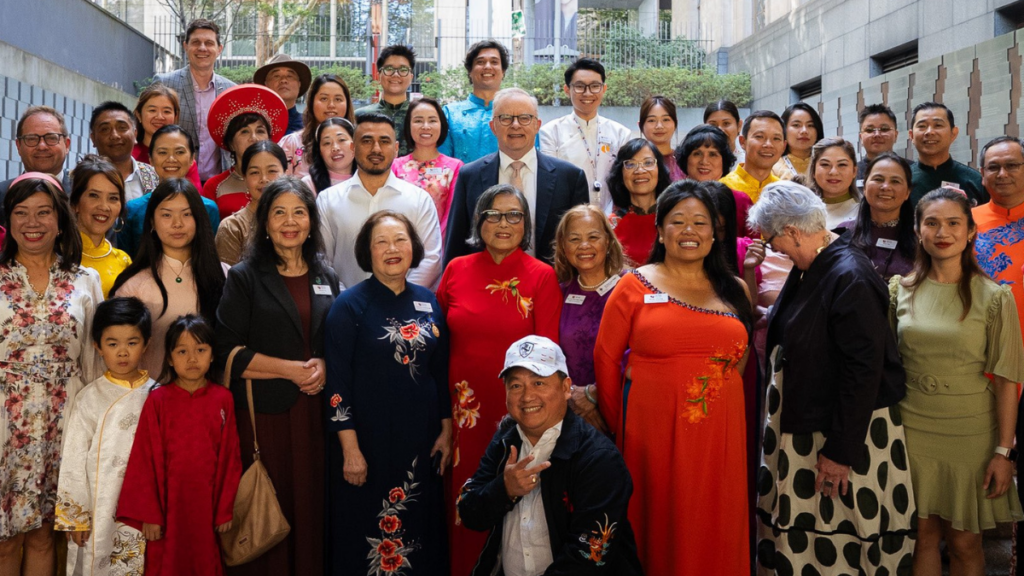
It means we cannot reduce Australianness to ancestry, complexion, or surname. The fourth-generation descendant of Cornish miners, the Indian surgeon who arrived five years ago, took the citizenship oath, and meant every word of it or the Vietnamese family who fled Saigon’s fall and built a business in Cabramatta, whose children teach in our schools—they are as Australian as anyone whose family came on the First Fleet.
But it also means we cannot pretend that all values are equally compatible with Australian civic life. When I wrote about the European multiculturalism debates in 2011, leaders like then British Prime Minister David Cameron were acknowledging, with varying degrees of reluctance, that a hands-off approach had failed. Concerns emerged that communities had formed that existed alongside British society rather than within it—parallel structures with parallel rules, some of which directly contradicted the liberal value systems of their host nations. We should not let Australia fall into that abyss ever.

The soft bigotry of low expectations, which assumes that migrants cannot or should not be asked to embrace liberal values, is no kindness. It is a betrayal—both of the migrants themselves and of the society they’ve joined.
None of this means cultural homogeneity. Australia’s texture has been enriched beyond measure by the cuisines, arts, languages, and traditions that migrants brought with them. I can eat pho in Footscray, celebrate Diwali in Parramatta, watch Greek tragedy in Carlton, and hear Mandarin on Chapel Street—and all of this makes Sydney and Melbourne more interesting and vibrant cities than they otherwise would be.
But there is a difference between cultural diversity and cultural relativism. You can keep your grandmother’s recipes and still believe that women should be free to choose their own partners. You can maintain your language at home and still accept that your disputes will be settled in Australian courts, under Australian law, with Australian standards of evidence. You can honor your ancestors and still recognize that loyalty to clan or tribe cannot override loyalty to the nation that shelters you.
The question is not about assimilation or multiculturalism. Australian society is remarkable in the way that it allows for layered identities to thrive. The question is the acceptance of fundamental premises that make a free society possible. Do you believe that people should be able to criticize religion without facing violence? Do you accept that your daughter has the same rights as your son? Do you understand that elected parliaments, not clerics or religious books, make our laws? These are not negotiable. They should be the entry fee for participation in Australian public life.
Australia did not become one of the world’s most liveable countries by chance. Generations of Australians worked hard and continually sought ways to build a fairer and better nation. Like every country, Australia has chapters in its history that are deeply troubling. However, what has often distinguished Australia from many others is the willingness to confront past mistakes and evolve. One significant example was the dismantling of the discriminatory White Australia Policy, which stood in stark contrast to the egalitarian values that modern Australia strives to uphold.

The millions of people around the world who dream of moving here are not dreaming of a random patch of dirt in the southern hemisphere. They are dreaming of safety, opportunity, and freedom. They are dreaming of a place where hard work is rewarded, where the government is not above the law, where you can speak your mind without disappearing into a prison cell. If we allow these values to erode, we will destroy the very thing that makes Australia the ‘lucky country’.
This is why the debate over immigration cannot be separated from the debate over values. It is not enough to ask how many migrants Australia can absorb, or what skills they bring, or whether they’ll fill gaps in regional workforces. We must also ask whether they understand and accept the principles on which this country is built. This is not a blood test or a skin test. It is a values test—and it should apply equally to everyone, regardless of where they were born.
I am not arguing for any scheme that discriminates on the basis of race, ethnicity or national origin. Such approaches are both morally repugnant and ultimately disadvantageous for Australia. A majority of migrants embrace Australian values and contribute enormously to society. Some of them also understand, through bitter experience, what it means to live without the protections and opportunities that many Australians take for granted, and may therefore become even more deeply committed citizens than those born here.
I am also not suggesting that migrants should abandon their heritage or pretend to be something they are not. Identity is complex, layered, and personal. You can be proudly Greek Australian, or Indian Australian, or Kenyan Australian, and still be fully, unreservedly Australian. The hyphen is not a division; it is an addition.
And the obligation to uphold Australian values falls on everyone who lives here, whether their ancestors arrived forty thousand years ago or they arrived last Tuesday. We are all custodians of this remarkable country, and we all bear a responsibility to not just remember our rights but also our duties to protect, enrich and serve it.
Australian identity should be grounded in shared values and commitment. We should welcome anyone, from anywhere, who embraces the principles that define us—and we should be honest that not all cultural values are compatible with those principles. This is not xenophobia. It is the recognition that liberal societies are fragile hard-fought achievements, requiring constant effort to sustain.
Fifteen years ago, I warned that Australia needed to strike a balance between openness and cohesion, between celebrating diversity and maintaining common ground. That balance is more precarious now than it was then. Polarization has deepened. Trust has frayed. The temptation to retreat into tribal camps—defined by ethnicity, ideology, or grievance—has grown stronger.
Australia may be imperfect, but what it has built is rare and precious: a liberal, secular and genuinely multiethnic democracy bound together not by race or religion, but by shared values, civic responsibility and a belief in human dignity and opportunity. These principles did not emerge by accident. They were built over generations, tested through struggle, and continually refined in the pursuit of a freer and fairer society. It is ours — and it is worth defending.
Support our Journalism
No-nonsense journalism. No paywalls. Whether you’re in Australia, the UK, Canada, the USA, or India, you can support The Australia Today by taking a paid subscription via Patreon or donating via PayPal — and help keep honest, fearless journalism alive.
