


By Liam Burke, Andrea Andiloro, and Steven Conway
In the early 1990s, when the home video game market was still in its infancy, Hollywood attempted to leverage the appeal of this emerging entertainment for feature length films.
The resulting movies – including Super Mario Bros. (1993), Mortal Kombat (1995), and the Jean Claude Van Damme-starring Street Fighter (1994) – largely bombed in their critical reception.
Today, however, video game to film adaptations are filling multiplexes, from blockbusters such as A Minecraft Movie (2025), to elevated horrors such as the recent Resident Evil (2026) film, and lower-budget breakouts like Iron Lung (2026).
As Street Fighter swing-kicks its way back into cinemas, it’s worth looking at how, and why, the video game-to-film pipeline has started gushing anew.
Cross-generational appeal
Film studios favour projects that will simultaneously appeal to younger and older audiences. This explains why there are so many live action Disney remakes.
The current video game film adaptation trend kicked off around 2020 – made possible by a cross-generational audience that didn’t exist a few decades ago.
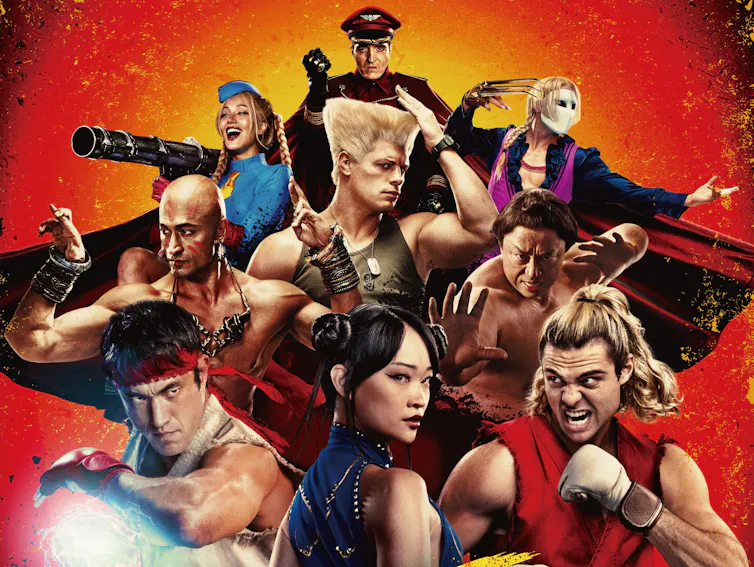
The 1994 Street Fighter film was distributed in US cinemas just a few years after the first game arrived on home consoles. The latest adaptation, on the other hand, will appeal to generations of fans familiar with characters like Ryu, Ken and Chun-Li.
Media commentator Patrick Metzger’s concept of the “nostalgia pendulum” describes how pop culture regularly revives trends from about 30 years earlier.
The new Street Fighter film leans heavily into 90s nostalgia. Set in 1993, it invoked touchstones such as Jolt Cola, MTV, and era-defining music like Tupac Shakur’s track Ambitionz Az a Ridah.
Cultural legitimacy
The fact these video game have stood the test of time has also earned them cultural legitimacy.
In the early 90s, video games were treated as a comparative novelty. When they were considered at all by tastemakers, it was usually in panicked terms about their addictive qualities or violent content.
But today’s audiences – who are also today’s filmmakers and critics – have grown up playing video games.
Promoting Street Fighter, director Kitao Sakurai emphasised his personal longstanding connection to the games. Critics, too, have compared the film seriously with its source material, rather than dismissing it as dumb, loud and violent.
Storyworld depth
Transmedia storyworlds such as the Marvel Cinematic Universe and the Wizarding World of Harry Potter are big business. They don’t just allow one story to be told; they provide multiple film sequels, TV spin-offs, theme park attractions, merchandise lines and even Broadway shows.
Video game universes are similarly ripe for creative mining, especially those that have been expanding since the 90s.
It’s telling that the phenomenally popular sandbox game Minecraft was adapted not as The Minecraft Movie, but “A Minecraft Movie”: the indefinite article indicates it is just one of many stories within its world. (And yes, a sequel is confirmed).
A Mario that actually looks like Mario
Video game adaptations have also been hugely bolstered by advances in digital technologies.
In the early 90s, blockbuster films still used practical effects, while video games relied on two-dimensional sprites. This created a technological gulf that made convincing adaptations difficult.
Moving into the 21st century, Hollywood’s growing embrace of digital production – and the shift towards 3D gaming (accelerated by consoles such as PlayStation) – narrowed the visual gap between the two media.
Writing about The Matrix franchise in 2006, media scholar Henry Jenkins observed how: “the game world can now look almost exactly like the film world – because they are reusing many of the same digital assets”.

Video games can now be adapted with a degree of visual fidelity that was impossible in earlier eras – even allowing Jason Momoa to transform into the green-skinned monster Blanka in the new Street Fighter.
Conglomerate ownership
Media conglomerates such as Disney, Universal and the Skydance Corporation (which oversees the recently merged studios Warner Bros. and Paramount), recognise video game worlds as a valuable foundation for transmedia franchises.
Many of these conglomerates are integrating games into their corporate strategies. In 2024, Disney acquired a 9% stake in Fortnite publisher Epic Games. The companies announced plans for a shared “social universe” that will extend Disney properties such as Marvel and Star Wars into new gaming experiences.
Video game companies also view adaptation as a way to cross-promote their properties and expand audiences.
Zach Cregger’s recent Resident Evil film was the eighth film adaptation in the horror franchise, but the first to involve Sony’s PlayStation Productions.
Executive producer Oliver Berben said the partnership created opportunities for both PlayStation and parent company Sony to promote the wider franchise across their platforms. https://www.youtube.com/embed/mNd1gb19A-c?wmode=transparent&start=0
PlayStation Productions is a Sony subsidiary that was founded in 2019 to adapt popular PlayStation games into films, such as Uncharted (2022), Gran Turismo (2023) and Until Dawn (2025).
Far from game over
Like arcade gamers lining up their coins for the next turn, Hollywood studios have dozens of video game films currently in production. The Legend of Zelda, Elden Ring and Call of Duty are all due for their own films within the next two years.
Clearly, the video game adaptation trend won’t be ending anytime soon.
Liam Burke, Associate Professor and Cinema and Screen Studies Discipline Leader, Swinburne University of Technology; Andrea Andiloro, Lecturer, Swinburne University of Technology, and Steven Conway, Senior Lecturer – Games and Interactivity, Swinburne University of Technology
This article is republished from The Conversation under a Creative Commons license. Read the original article.
Support our Journalism
No-nonsense journalism. No paywalls. Whether you’re in Australia, the UK, Canada, the USA, or India, you can support The Australia Today by taking a paid subscription via Patreon or donating via PayPal — and help keep honest, fearless journalism alive.
