

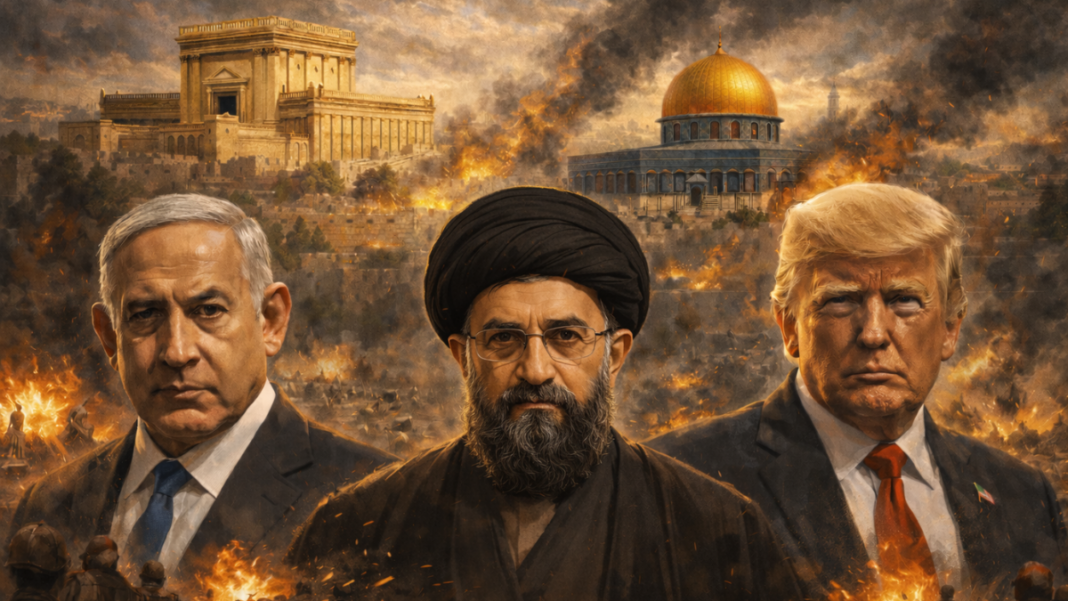
The world waits with bated breath to see whether the ceasefire in the US–Israel and Iran conflict will be extended. Yet many observers avoid grappling with deeper drivers behind the recurring cycles of violence, including Iran’s regional posture and its network of allied armed groups. Without addressing these underlying factors, ceasefires risk becoming temporary intermissions rather than meaningful steps toward lasting peace.
A ceasefire is not a peace agreement. It is merely the absence of active fighting. Lasting peace requires a shift in intent, ideology, and behaviour — particularly from actors that openly call for the destruction of another state and support armed groups committed to that goal.
Iran’s leadership, including the late Ayatollah Ali Khamenei repeatedly called for the elimination of Israel and supports multiple terrorist groups across the Middle East. Among the most prominent:
Hamas in Gaza
Hezbollah in Lebanon
The Houthis in Yemen
These groups are widely recognised as Iranian-backed militias or proxy forces by many governments and analysts. They operate across multiple fronts and frequently target Israel and Western allies.
This network has reshaped the Middle East into a multi-front conflict environment. When ceasefires are signed in Gaza, rockets may still be launched from Lebanon or Yemen. When one front quiets, another often escalates.
Ceasefires that address symptoms rather than underlying causes are unlikely to hold. Sustainable peace is difficult to achieve while a state continues to arm and finance organisations committed to the destruction of another state.

History matters: A brief timeline of Israel’s historical roots
The debate around Israel often begins in 1948. In reality, its history stretches back millennia based on established historical consensus:
c. 1000 BCE
Jews establish Jerusalem as their capital under King David. The First Temple is later built by King Solomon, making the city the spiritual centre of Judaism.
Ancient to medieval period
Jews experience successive exiles and invasions but maintain continuous religious and cultural ties to the land.
636–638 CE: Muslim Arab armies defeated the Byzantine Empire in the Levant.
637/638 CE: Jerusalem was captured during the caliphate of Umar ibn al-Khattab. From then onward, the region was ruled by successive Islamic caliphates and dynasties (Umayyads, Abbasids, Fatimids, Ayyubids, Mamluks) for centuries.


1517–1917
The region became part of the Ottoman Empire, a Turkish-ruled Islamic empire that governed much of the Middle East until World War I.
1922
The League of Nations established the British Mandate for Palestine after Allied powers dismantled Ottoman territories following World War I. During this period, new political entities were created across the former Ottoman lands, including areas that later became Saudi Arabia, Syria, and Jordan.
The Mandate incorporated the Balfour Declaration, which supported the establishment of a Jewish national home while stating that the civil and religious rights of existing non-Jewish communities should be protected. The name ‘Palestine’ had long been used by Europeans and was therefore adopted for the Mandate.

1947
The United Nations proposes a two-state partition plan. Jewish leaders accept the plan; Arab leaders reject it.
1948 onwards
Israel declares independence and is immediately attacked by neighbouring Arab states, beginning decades of wars and conflict that continue to impact the region to this day.
This historical timeline does not negate Palestinian suffering. But it demonstrates that the conflict is far more complex than the simplified narratives often presented in modern activism.
Real occupation and violence: A global comparison
If the world wishes to condemn occupation, it must condemn real occupation.
Consider Tibet.
Consider the Kurds.
Consider the Assyrians.
Consider the Yazidis.
Tibet
Tibet is widely described by scholars and governments as a territory under Chinese control since the 1950s. Yet Tibet has not produced international suicide bombing campaigns or global terror networks.
The Kurds
The Kurdish people remain the world’s largest stateless nation, spread across Turkey, Syria, Iraq and Iran. They have endured decades of repression and conflict. Yet Kurdish political movements have largely pursued autonomy through political or regional military struggle rather than global jihadist terrorism.
The Assyrians
One of the oldest Christian communities in the world, Assyrians have suffered massacres, displacement and persecution across Iraq and Syria, particularly at the hands of ISIS. Their tragedy rarely dominates global protest movements.
The Yazidis
This small ethno-religious minority, primarily from the Sinjar region of northern Iraq with communities spread across Syria and the diaspora, has long been effectively stateless and vulnerable. In 2014, ISIS carried out a genocide against Yazidis, killing thousands of men and enslaving women and children. Despite this trauma and displacement, Yazidi communities have not developed transnational terror movements or global suicide bombing campaigns in response.
These examples reveal an uncomfortable truth: occupation alone does not inevitably produce global terrorism.
Selective outrage and historical amnesia
History offers other examples of mass displacement and ethnic cleansing that rarely dominate global protests.
Hindus and Sikhs in Pakistan
The 1947 Partition of India created Pakistan as a state founded on a religious identity. The process triggered one of the largest and bloodiest migrations in human history, involving massacres, forced conversions and mass displacement of Hindus and Sikhs from regions that became Pakistan.
Today, Pakistan’s religious minorities remain a tiny fraction of the population compared to pre-Partition demographics.
Yet despite this history:
Hindus do not send suicide bombers into Pakistan.
Sikhs do not launch rocket attacks into Lahore.
The comparison highlights how ideology — not grievance alone — shapes the path from conflict to terrorism.
Conflicts persist when ideology glorifies violence and rejects coexistence. If a movement’s founding charter calls for the destruction of another state, ceasefires cannot create peace. At best, they buy time for rearmament and regrouping.
This is the uncomfortable reality many ceasefire advocates avoid. Peace requires ideological transformation — the same kind of reform that reshaped Europe after centuries of religious warfare.
Real peace in the Middle East will require:
- Iran ending support for armed proxy terrorist groups
- Regional recognition of Israel’s right to exist
- Abandonment of genocidal rhetoric and objectives
- Political solutions replacing armed struggle
Until these conditions begin to emerge, ceasefires will remain fragile and temporary.
The world should absolutely call for humanitarian relief and protection of civilians. But humanitarian concern must not blind us to the deeper structural drivers of conflict. Ignoring the role of ideology does not bring peace closer. It simply ensures the next war arrives sooner.
Support our Journalism
No-nonsense journalism. No paywalls. Whether you’re in Australia, the UK, Canada, the USA, or India, you can support The Australia Today by taking a paid subscription via Patreon or donating via PayPal — and help keep honest, fearless journalism alive.
