


In August 2024, University of Toronto Scarborough student Aliya Ali Shaikha shared an unusual update on LinkedIn. Her application to a campus legacy fund had been rejected, but her bidet project had become an “institutional priority” anyway. She hoped other universities across North America would follow suit.
Two years later, her idea has grown into a wider movement, raising a simple question for Australian universities: if campuses pride themselves on welcoming students from around the world, why are basic bathroom needs still overlooked?
Shaikha’s campaign began with a familiar culture shock. As an international student in Canada, she was surprised by the absence of bidets in university washrooms. For millions of people, washing with water after using the toilet is an everyday hygiene practice and, for many, a religious obligation.

For those who do not prefer toilet paper, carrying a water bottle into a cubicle is hardly an ideal substitute. It can be awkward, inconvenient and unreliable. What happens when you forget it?
Four bidets were installed at the Scarborough Student Centre in September 2024. A year later, the University of Toronto Mississauga Students’ Union and its Muslim Students’ Association announced installations at their student centre. By 2026, seven bidets had reached the university’s St George campus.
Shaikha says more than 2,500 students are involved in the wider initiative, with chapters at universities including Waterloo, Guelph and Harvard. Firstpost has reported that the network claims more than 20 chapters. Grinnell College in Iowa has also installed bidets in nearly all its residence halls.
The campaign has encountered obstacles. At McMaster University, a request for C$7,000 to install 14 handheld sprayers was rejected. At Mississauga, commercial plumbing requirements reportedly pushed installation costs to around C$600–700 per unit, compared with roughly C$100–150 in residential settings. Concerns about wet floors and maintenance have also complicated installations.
These are practical issues that universities need to address. But they should not end the conversation.
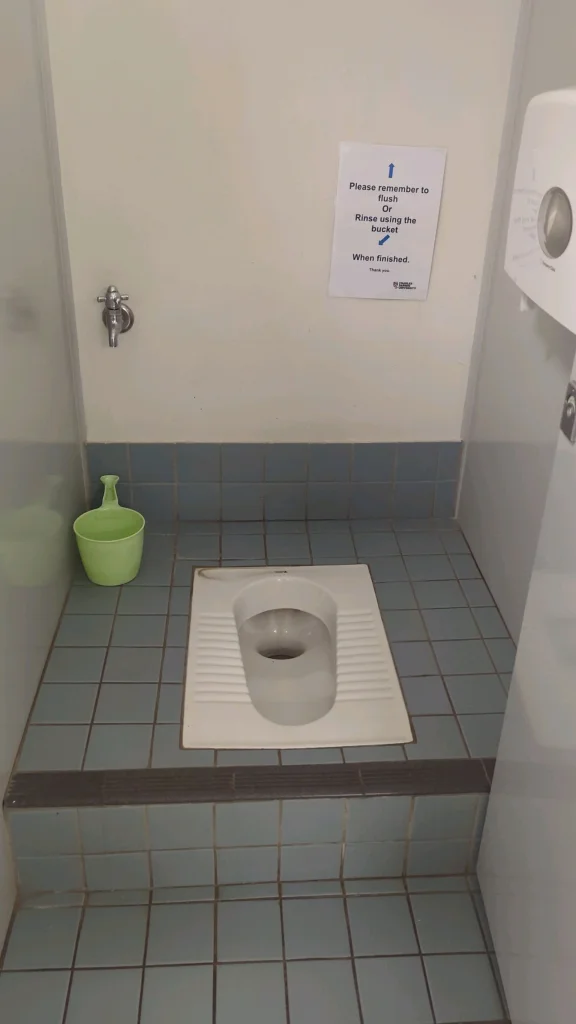
In 2013, Prof. Heddy Zola, then research director at SA Pathology in Adelaide, suggested that new buildings should consider providing squat toilets to accommodate a diverse workforce. The University of Adelaide pointed to existing facilities with culturally appropriate ablutions and squat toilets, while Flinders University had also installed some.
In 2026, the University of Adelaide incorporated squat toilets, also known as Nile pans, into its design codes for new construction.

That history shows that university facilities can change when institutions recognise the needs of their communities. But squat toilets and bidets serve different purposes. The former address how people use the toilet; the latter provide a way to wash with water afterwards.
Australia’s 42 universities enrol students from India, Nepal, Bangladesh, Pakistan, Indonesia, Malaysia, Japan and across the Middle East, as well as Australian students from communities where water-based cleansing is common. For many South Asian families, the lota—a small water vessel used for washing—is an ordinary household item.
Yet I am not aware of an Australian university campaign on the scale of the Canadian initiative to install bidets across campuses.
Universities invest heavily in promoting themselves as inclusive and internationally minded. But inclusion is experienced in everyday places, not just through brochures and orientation-week banners. A student should not have to choose between discomfort, carrying a bottle of water into a cubicle or going home to use facilities that meet their needs.

This does not mean every international student wants a bidet. It means universities should think of student need and provide reasonable options where demand exists.
Australian universities need not begin with an expensive, campus-wide rollout. Student associations could survey students, identify suitable locations and work with facilities teams to trial a small number of handheld sprayers in student centres or selected washrooms.
The trial could assess installation costs, maintenance, hygiene, plumbing requirements and student feedback before any wider expansion.
Simple, non-electric models may also help reduce toilet paper consumption, although the environmental benefits depend on how the devices are used.
Bidets will not solve the larger challenges international students face, including high living costs, housing pressures and visa uncertainty. But providing appropriate washroom facilities is a practical step towards making campuses more welcoming.
If universities are serious about inclusion, they should recognise that not all international students are familiar with Western-style toilets or accustomed to using toilet paper for personal hygiene. Rather than expecting every newly arrived student to adapt to existing facilities, universities should consider practical alternatives that accommodate different cultural practices. Sometimes, making campuses more welcoming begins with a small change in the bathroom.
Support our Journalism
No-nonsense journalism. No paywalls. Whether you’re in Australia, the UK, Canada, the USA, or India, you can support The Australia Today by taking a paid subscription via Patreon or donating via PayPal — and help keep honest, fearless journalism alive.
