

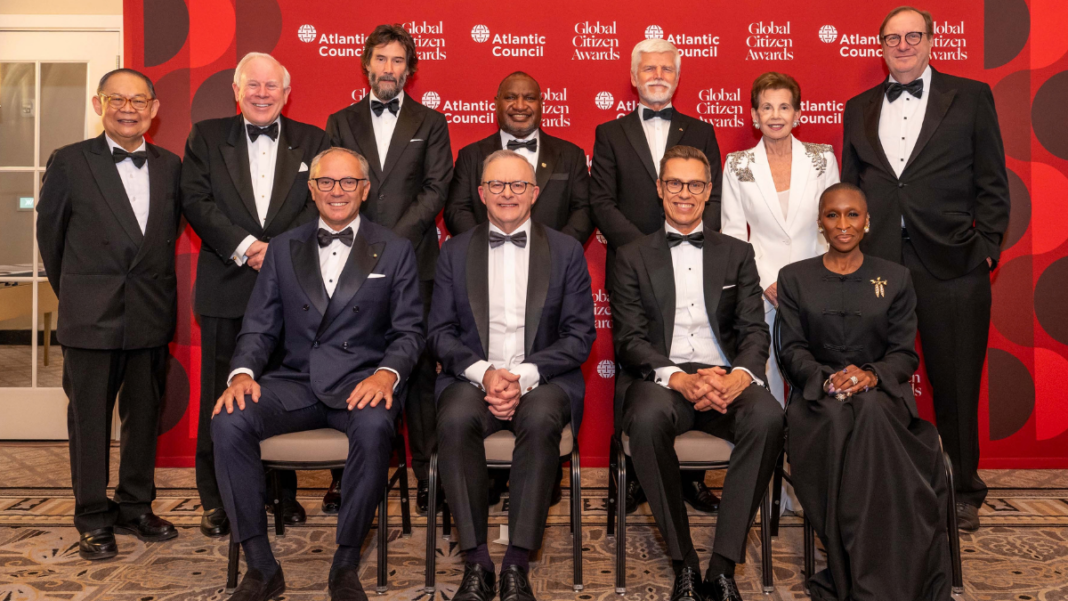
Prime Minister Anthony Albanese acknowledged the role of Australia’s multicultural communities in strengthening the country’s international connections, referring to Australians from “every place on the planet” and the country’s First Nations people.
He also declared that the Indo-Pacific is “not a chessboard” for the United States and China, using his acceptance speech for the 2026 Atlantic Council Global Citizen Award to outline Australia’s approach to a rapidly changing regional order.
Albanese accepted the award in New York on the sidelines of the United Nations General Assembly, alongside Finnish President Alexander Stubb, Formula 1 President and CEO Stefano Domenicali and actor and singer Cynthia Erivo.
The Atlantic Council recognised Albanese for deepening Australia’s alliances and partnerships and promoting security and stability across the Indo-Pacific.
Accepting the honour, Albanese said he did so “with humility on behalf of Australia”, describing serving Australians as “the honour of my life”.
He dedicated the recognition to Australians working across diplomacy, education, aid, emergency services, peacekeeping and community engagement.
But much of his speech focused on Australia’s strategic outlook and the changing international order.
Albanese said the post-1945 international order was being tested and argued that Australia needed to help shape new arrangements while preserving rules and institutions that remained important.
“The Post 1945 world order is no longer fit for purpose,” Albanese said.
“Australia’s response to this is to actively seek to shape and build the order that replaces the old while preserving the rules that matter most, and building the new partnerships, the relationships and the innovations required to deal with the challenges we face.”

The Prime Minister identified strategic competition between the United States and China as the most consequential factor shaping the Indo-Pacific.
“Our alliance with the United States is the anchor of Australia’s foreign policy,” he said. On China, Australia’s largest trading partner, Albanese said:
“Cooperate where we can, disagree where we must, and engage in the national interest.”
However, he warned against viewing the region solely through the relationship between the two major powers.
“The Indo-Pacific is not a chessboard on which superpowers move the pieces,” Albanese said.
“Its countries are not spectators. They are shaping its future and writing their own script.”
Albanese said Australia was strengthening its sovereign capability and working with regional partners on economic security, supply chains and resilience in critical minerals, energy and emerging technologies.
He highlighted Australia’s expanding partnerships across Southeast Asia, including with Indonesia, Vietnam, the Philippines, Singapore, Brunei and Timor-Leste, as well as its engagement with ASEAN.
The Prime Minister also pointed to Australia’s growing security relationships in the Pacific, including alliances with Papua New Guinea and Fiji and agreements with Tuvalu, Vanuatu and Nauru.
“For Pacific nations, their most immediate threat is climate change,” Albanese said, referring to the impacts he had witnessed during visits to the region.
He said Australia was supporting Fiji and Tuvalu to host a Pacific Pre-COP Leaders’ event ahead of COP31.
Albanese said Australia’s approach was to build resilience without abandoning openness, strengthen regional partnerships while maintaining rules, and deepen its alliance with the United States while engaging China.
“Deepening our alliance with the United States and engaging our largest trading partner, China, without allowing either relationship to define who we are.”
The Atlantic Council described its Global Citizen Awards as a forum recognising individuals whose work contributes to global cooperation and a better world. The 2026 ceremony was held on 23 September in New York during UN General Assembly week.
Albanese ended his remarks by thanking the Atlantic Council for what he called “the great honour to Australia” represented by the award, noting that Australia’s location facing the Pacific and Indian oceans made recognition from an organisation bearing the Atlantic name particularly significant.
Support our Journalism
No-nonsense journalism. No paywalls. Whether you’re in Australia, the UK, Canada, the USA, or India, you can support The Australia Today by taking a paid subscription via Patreon or donating via PayPal — and help keep honest, fearless journalism alive.
