

The Victorian government is expanding its Violence Reduction Unit with 17 new community-based programs aimed at preventing young people from becoming involved in violent crime, as youth safety remains one of the biggest issues heading into the November state election.
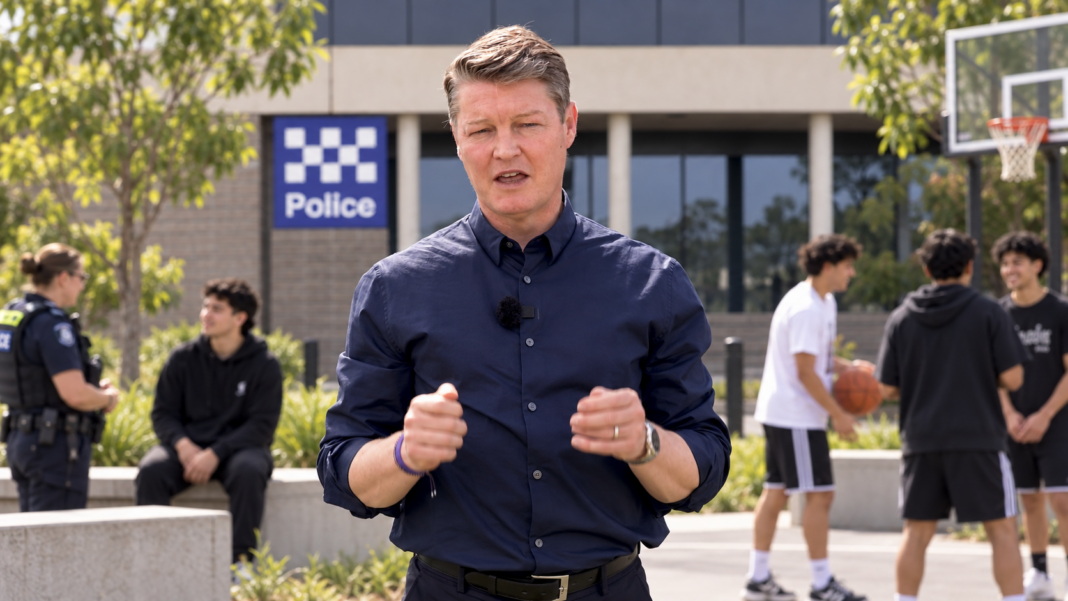
Premier Ben Carroll announced the next stage of the government’s crime prevention strategy in Melbourne’s west, including $10 million for new early-intervention programs and a separate $13 million grants program designed to fund organisations already working with young people in communities experiencing higher levels of violence.
The announcement comes just over a year after the deaths of 15-year-old Dau Akueng and 12-year-old Chol Achiek in Cobblebank, near Melton.
The two friends were walking home from basketball on September 6, 2025, when they were allegedly attacked by a group wearing masks and armed with bladed weapons. Both died at the scene. Eight people were eventually charged with both boys’ murders.
“This community in Melton suffered a terrible tragedy a year ago, and we will never forget it,” Carroll said.
“We are delivering serious consequences for violent crime – but we’re also getting in early to prevent it.”
The government says the new $10 million package will fund 17 programs across communities identified as being particularly affected by youth crime.
Those programs will include knife-crime prevention initiatives, homework clubs, youth mentoring and sporting activities designed to give young people positive alternatives to gang involvement and offending.
Among them will be the Airtime Cobblebank Basketball Program, which will use sport and mentoring to engage young people in Melbourne’s outer west.
The connection with Cobblebank is particularly significant.
Dau Akueng was remembered by friends and coaches as a talented basketball player who dreamed of playing professionally. He had been involved in development basketball programs before his death.
The government argues programs that keep young people connected to sport, school, trusted adults and employment can reduce the risk of them being recruited into violent groups or becoming involved in offending.
Victoria’s Violence Reduction Unit was established in December 2025 and is modelled partly on violence-prevention programs operating in Glasgow and London.
The unit uses a public-health approach to crime, bringing together police intelligence, education, community organisations, youth justice and social services to identify young people at risk before they become deeply involved in violence.
Attorney-General Sonya Kilkenny said the approach was intended to complement tougher criminal justice measures rather than replace them.
“The VRU uses data and evidence to target what works to prevent violence before it happens,” she said.
The government is also launching Ground Up, a $13 million targeted grants program intended to provide funding directly to community organisations.
The grants will be guided by crime data and intelligence, with the government saying organisations closest to affected communities are often best placed to identify the interventions most likely to work.
Violence Reduction Unit chief executive Andrea Davidson said there was no single answer to youth violence.
“There is no one-size-fits-all when it comes to violence prevention,” Davidson said.
“By supporting local programs to deliver solutions that work for them, we can make communities safer for everyone.”
Minister for Crime Prevention Paul Edbrooke said intervening before young people became entrenched in the criminal justice system remained crucial.
“Early intervention can change a young person’s path and make our communities safer,” he said.
The announcement builds on funding already committed through the 2026-27 Victorian Budget.
The budget allocated about $33 million to the Violence Reduction Unit and $81 million more broadly to youth crime response and prevention.
That includes $23 million for education support for young people at risk of entering, or already involved with, the justice system; $9.1 million to keep vulnerable students engaged in education; $8.6 million for programs designed to reduce reoffending; and $8.1 million for local prevention programs and support services.
The government has also provided $9.5 million to Blue Light Victoria to expand youth mentoring.
Blue Light has worked alongside Victoria Police for decades and delivers one-on-one mentoring aimed at young people experiencing school disengagement, isolation or a lack of positive role models.
The program already operates in locations including Bendigo, Latrobe, Brimbank and Melton and will now be expanded further, with school nominations open for Term 4.
Victoria Police budget documents show almost $9 million in additional funding is being administered for Blue Light crime prevention and early-intervention initiatives over the next three years.
The government’s strategy reflects a broader shift towards combining tougher bail and sentencing laws with prevention.
Labor’s 2026-27 budget included $397 million connected with tougher bail laws and additional corrections capacity, alongside its youth intervention spending.
The Violence Reduction Unit is also running anti-gang grooming programs, culturally tailored support for African-Australian young people, lived-experience mentoring, employment initiatives and community violence interventions.
A new anti-gang grooming campaign being delivered with Think Village began rolling out this month in selected schools and youth justice facilities, focusing on how organised crime groups recruit and exploit young people.
The government has repeatedly pointed to the Glasgow model as evidence that violence-prevention units can work.
The Victorian government says Scotland’s approach contributed to a roughly 60 per cent reduction in violent crime over time, particularly among younger people.
But whether similar results can be reproduced in Victoria will take years to determine.
The latest Crime Statistics Agency figures provide a mixed picture.
For the year ending March 2026, the total number of recorded offences fell marginally by 0.2 per cent and the offence rate fell 1.9 per cent.
Youth alleged-offender incidents fell 6 per cent, to 22,654.
However, overall alleged-offender incidents increased 8.6 per cent, while breaches of bail conditions rose sharply from 9,855 to 16,894 over the year.
Those figures help explain why both major parties are attempting to combine tougher enforcement with prevention ahead of the election.
The Carroll government has also recently promised to recruit 1,500 additional frontline police officers and establish a second police training academy in Wyndham.
The Liberal-National opposition has gone further, promising 3,000 additional officers, a “one-strike” bail rule for serious offences, broader Adult Crime, Adult Time laws and the reopening of more than 40 police stations.
Labor has sought to draw a sharp distinction between its approach and the opposition’s position on the Violence Reduction Unit.
The government says Jess Wilson’s Liberals opposed the VRU and would abolish it if elected.
There is some basis for that claim, although the opposition’s position is more complicated than Labor’s political attack suggests.
Liberal upper house MP Ann-Marie Hermans called for the Violence Reduction Unit to be scrapped in Parliament in November 2025, describing it as an expensive new bureaucracy and arguing the money should instead be directed towards community-led initiatives, schools and families.
Labor MPs have subsequently repeatedly accused the opposition of wanting to cut the unit. In March, government MPs moved motions condemning what they described as the Liberal Party’s call to scrap it.
However, Opposition Leader Jess Wilson has separately said the Coalition supports crime prevention and early intervention.
In a previous statement, Wilson said a Liberal-National government would invest $100 million in a Safer Communities Plan, including youth diversion programs aimed at moving at-risk young people towards education, employment and opportunity.
Wilson has also said her election platform would include “significant” investment in early intervention while arguing Labor’s broader crime strategy has failed.
The Coalition’s current crime plan includes tougher bail and sentencing, 3,000 additional police, 200 new Protective Services Officers and early-intervention and rehabilitation programs.
The political dispute is therefore less about whether early intervention has a role and more about whether Victoria needs a standalone Violence Reduction Unit to coordinate it — and whether the government’s investment is delivering results quickly enough.
Wilson and the opposition continue to frame crime primarily as a failure of policing, bail and sentencing.
Labor argues enforcement alone cannot prevent the next generation of offenders from emerging.
The issue is especially sensitive in Melbourne’s west.
The deaths of Chol Achiek and Dau Akueng shocked communities across Melton and reignited debate about youth gangs, knife crime and whether vulnerable children were being adequately protected from recruitment into violent groups.
Police said at the time the Cobblebank killings had hallmarks associated with youth gang offending, although investigators said there was no evidence either boy was a gang member.
Both boys had been returning from basketball when they were allegedly attacked.
That history gives the decision to fund basketball and mentoring programs in Cobblebank particular weight.
For the Carroll government, the argument is that community safety requires two things at once: serious consequences for people who commit violent offences and earlier intervention for those heading towards them.
The challenge will be demonstrating that the millions of dollars flowing into mentoring, schools, sport and community organisations produce measurable reductions in violence — particularly in the suburbs where families have already paid the highest price.
Support our Journalism
No-nonsense journalism. No paywalls. Whether you’re in Australia, the UK, Canada, the USA, or India, you can support The Australia Today by taking a paid subscription via Patreon or donating via PayPal — and help keep honest, fearless journalism alive.
