

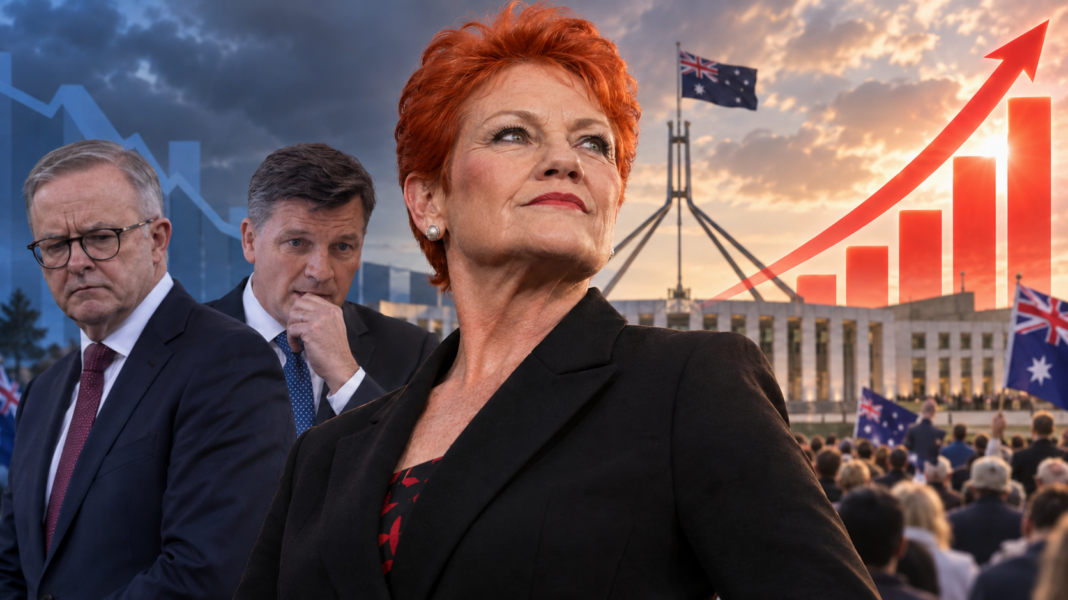
Pauline Hanson’s One Nation has overtaken Labor to become the highest-polling federal party on primary support in a new national survey, while the Coalition has fallen to just 18 per cent in another warning that Australia’s traditional two-party political order is being reshaped.
The latest News24/YouGov Pulse poll, conducted between September 1 and 8, puts One Nation on 30 per cent, up four percentage points from the previous survey.
Labor has fallen three points to 26 per cent, while the Liberal-National Coalition has dropped to 18 per cent. The Greens remain on 12 per cent. The poll surveyed 1,510 voters.
The result means One Nation has a four-point primary-vote lead over the governing Labor Party and a remarkable 12-point advantage over the Coalition.
However, the figures do not mean One Nation would necessarily win a federal election.
Australia’s preferential voting system means primary support must ultimately be converted into individual electorate victories, and the same poll continues to show Labor ahead in hypothetical head-to-head contests.
Labor leads the Coalition 52–48 on the poll’s respondent-allocated two-party-preferred measure and leads One Nation 53–47.
That is nevertheless a significant tightening of Labor’s advantage.
In the previous YouGov Pulse survey in late August, Labor was on 29 per cent, One Nation on 26 per cent and the Coalition on 21 per cent. Labor led One Nation 56–44 and the Coalition 53–47 on the respective two-party measures.
The latest result therefore suggests the immediate movement has been strongly towards One Nation, at the expense of both major parties.
YouGov director of public data Paul Smith said the Coalition’s position was particularly serious.
He told News24 that if an 18 per cent primary vote translated directly into electoral outcomes at the 2028 federal election, the Coalition could be reduced to fewer than 11 members of the House of Representatives — “less than a cricket team”.
Such a projection should be treated cautiously.
National vote shares do not translate evenly into seats, particularly for a party such as One Nation whose support is distributed differently across metropolitan, outer-suburban and regional electorates.
Candidate quality, preference flows and local campaigns would also determine whether a national surge delivered dozens of lower-house seats.
Even so, the scale of the change since the 2025 federal election is striking.
At that election, Labor won 34.56 per cent of the House primary vote and 94 of the 150 seats.
One Nation secured only 6.40 per cent, while the Liberal, National, LNP and Country Liberal parties collectively accounted for almost 32 per cent of first preferences and won 43 seats.
Measured against that election result, the latest YouGov poll has One Nation at almost five times its 2025 primary vote.
Labor is around nine points below its election result, while the Coalition is roughly 14 points below the combined vote achieved by its constituent parties in 2025.
The AEC has determined that the next federal election will again be fought across 150 House of Representatives seats.
The latest poll does not stand entirely alone.
Other recent national polling has also recorded One Nation at historically high levels, although the exact ranking of the parties varies considerably between pollsters.
A Newspoll/Pyxis survey with fieldwork ending August 28 put One Nation on 30 per cent, Labor on 29 and the Coalition on 19.
A RedBridge/Accent poll over a similar period recorded Labor on 29, One Nation on 28 and the Coalition on 22.
Essential had Labor and the Coalition tied on 26, with One Nation at 23, while the latest Roy Morgan survey put Labor narrowly ahead on 27, One Nation on 26.5 and the Coalition on 21.5.
The variation shows why individual polls should not be read as election predictions.
But collectively, the surveys point towards the same broader development: One Nation is currently attracting support at levels far above anything it achieved at the last federal election, while the Coalition is struggling to re-establish itself as the dominant alternative to Labor.
YouGov itself has recorded that shift over several months.
On July 1, the pollster had One Nation on 30 per cent, Labor on 29 and the Coalition at a then-record low of 17 per cent.
Two weeks later, One Nation fell to 26 as Labor moved to 28 and the Coalition recovered to 20.
By late August, Labor was back on 29, One Nation 26 and the Coalition 21.
The new September result has One Nation returning to 30 while both major parties retreat.
This volatility suggests a sizeable group of voters remains willing to move between parties rather than having permanently realigned.
But One Nation has also received an important real-world boost from Western Australia.
On August 29, One Nation won the previously Labor-held state seat of Secret Harbour in Perth’s south, its first lower-house victory in Western Australia.
Candidate Luke Herdegen secured 39.1 per cent of the primary vote, up more than 30 percentage points on One Nation’s result at the 2025 WA state election.
Labor’s primary vote collapsed to 24.1 per cent, while the Liberals received 17.2 per cent.
After preferences, One Nation defeated Labor 57.2–42.8, producing an 18.7-point two-candidate-preferred swing away from Labor.
Although a state by-election cannot be directly applied to federal voting intentions, the Secret Harbour result provided concrete evidence that One Nation’s polling strength can translate into votes in outer-suburban electorates.
It also demonstrated the potential danger to both major parties.
Labor lost a seat it had previously held comfortably, while the Liberal candidate finished a distant third.
The latest federal poll contains further evidence of One Nation’s growing ownership of one of the most politically charged issues in the country — immigration.
According to analysis of the YouGov survey published by Poll Bludger, 36 per cent of respondents nominated One Nation as the party best able to manage immigration, compared with 18 per cent for Labor and 18 per cent for the Coalition.
That result helps explain the strategic challenge facing Opposition Leader Angus Taylor.
The Coalition has traditionally relied on issues including immigration, border protection, national security and economic management to consolidate conservative voters.
It now faces a party to its right attracting voters who once regarded the Liberal and National parties as their natural political home.
The latest polling comes as One Nation is increasingly attempting to broaden its platform beyond immigration and cultural issues.
The party this week proposed allowing workers paying rent or a mortgage to redirect up to a quarter of their compulsory superannuation contributions into take-home income for as long as three years.
Senator Hanson has presented the policy as immediate cost-of-living relief.
Labor has attacked it as a threat to retirement savings, with Treasurer Jim Chalmers warning that Australians would ultimately lose substantially more through foregone compound returns than they would gain in short-term disposable income.
The debate illustrates the next stage of One Nation’s political strategy: turning heightened support over immigration, housing and dissatisfaction with the major parties into a broader economic pitch.
For the Coalition, the problem is different.
At 18 per cent, its latest primary vote is lower than the 20.7 per cent received by the Liberal Party alone at the 2025 election, before votes for the Nationals and Queensland LNP are even included.
The Coalition entered the current parliamentary term with 43 seats after suffering a heavy defeat in 2025. Labor won 94 seats, giving Anthony Albanese an overwhelming House majority.
If the Coalition remains in the high teens, its challenge would not merely be defeating Labor.
It would first have to prevent One Nation from replacing it as the principal force on the non-Labor side of federal politics.
A previous YouGov survey in July prompted Smith to suggest that, on those numbers, One Nation could become the official opposition while the Coalition fell to single figures.
The latest poll again raises that prospect, although there remains a long distance between national polling numbers and actually winning enough individual electorates to become the second-largest parliamentary party.
One Nation currently does not have anything resembling the nationwide lower-house infrastructure of Labor or the Coalition.
It would need competitive candidates across scores of electorates, substantial campaign resources and strong preference flows to turn a national primary vote of around 30 per cent into a large House presence.
The leadership numbers also provide Labor with some reassurance.
Despite the fall in Labor’s primary vote, Anthony Albanese remains ahead of both opposition alternatives as preferred prime minister.
Against Angus Taylor, Albanese leads 43 per cent to 39 per cent, with 18 per cent unsure.
Against Pauline Hanson, the Prime Minister leads 51 per cent to 40 per cent, with 9 per cent unsure.
Albanese’s personal ratings remain weak, however.
The latest YouGov figures put satisfaction with his performance at 36 per cent and dissatisfaction at 59 per cent.
Taylor’s satisfaction rating has risen to 36 per cent, with 48 per cent dissatisfied.
The juxtaposition is politically unusual.
Labor is no longer the leading party on primary votes in this survey, yet remains favoured to beat either of its major competitors after preferences, while Albanese retains the advantage as preferred prime minister.
One Nation, meanwhile, has the highest primary vote but still trails Labor in a direct two-party contest.
And the Coalition, traditionally one of the two pillars of Australian federal politics, is currently running third.
The numbers also reinforce a wider collapse in traditional party loyalty.
At the 2025 federal election, Labor and the Coalition parties together attracted more than two-thirds of House first preferences.
The new YouGov poll puts their combined support at just 44 per cent — 26 for Labor and 18 for the Coalition — meaning a majority of respondents are currently choosing One Nation, the Greens or other parties and independents.
That fragmentation is likely to make preference flows increasingly important.
In 2025, One Nation preferences generally flowed strongly towards the Coalition. For example, in Victoria, 75 per cent of One Nation preferences in the formal Labor-Coalition two-party count flowed to the Coalition.
If One Nation begins finishing ahead of Coalition candidates in large numbers of electorates, however, the direction of Liberal and National preferences towards One Nation could become decisive instead.
That would create difficult strategic decisions for the Coalition over preference recommendations and how aggressively it campaigns against Senator Hanson.
Taylor has recently described One Nation as unfit to govern, while individual Coalition MPs are simultaneously under pressure from a growing One Nation vote on their right.
For Labor, the danger is different.
Its 2025 landslide gives it a substantial parliamentary buffer, but recent results suggest One Nation can appeal in outer-suburban and working-class electorates that Labor has traditionally relied upon.
Secret Harbour was one such warning.
Recent polling in Treasurer Jim Chalmers’ Queensland electorate of Rankin has also shown a sharp increase in One Nation support, although Labor would still be favoured to retain the seat after preferences.
The next federal election is not due until 2028, meaning the political landscape has considerable time to change.
Economic conditions, interest rates, housing affordability, immigration, global events and the performance of all three major political forces could substantially alter voter sentiment before Australians return to the polls.
Polling two years out from an election is therefore better understood as a measure of current dissatisfaction than a reliable seat forecast.
But the September YouGov result is difficult for either major party to dismiss.
For Labor, losing the primary-vote lead after its overwhelming 2025 victory is a warning that a large portion of its electoral coalition is unsettled.
For the Coalition, 18 per cent represents something potentially more serious: the possibility that its status as Australia’s automatic alternative government can no longer be taken for granted.
And for Pauline Hanson, a national primary vote of 30 per cent — reinforced by a string of other strong polls and an actual lower-house by-election victory — places One Nation in political territory it has never previously occupied at the federal level.
The key question now is whether that support represents a temporary protest against the major parties or the beginning of a lasting realignment of Australian politics.
Support our Journalism
No-nonsense journalism. No paywalls. Whether you’re in Australia, the UK, Canada, the USA, or India, you can support The Australia Today by taking a paid subscription via Patreon or donating via PayPal — and help keep honest, fearless journalism alive.
