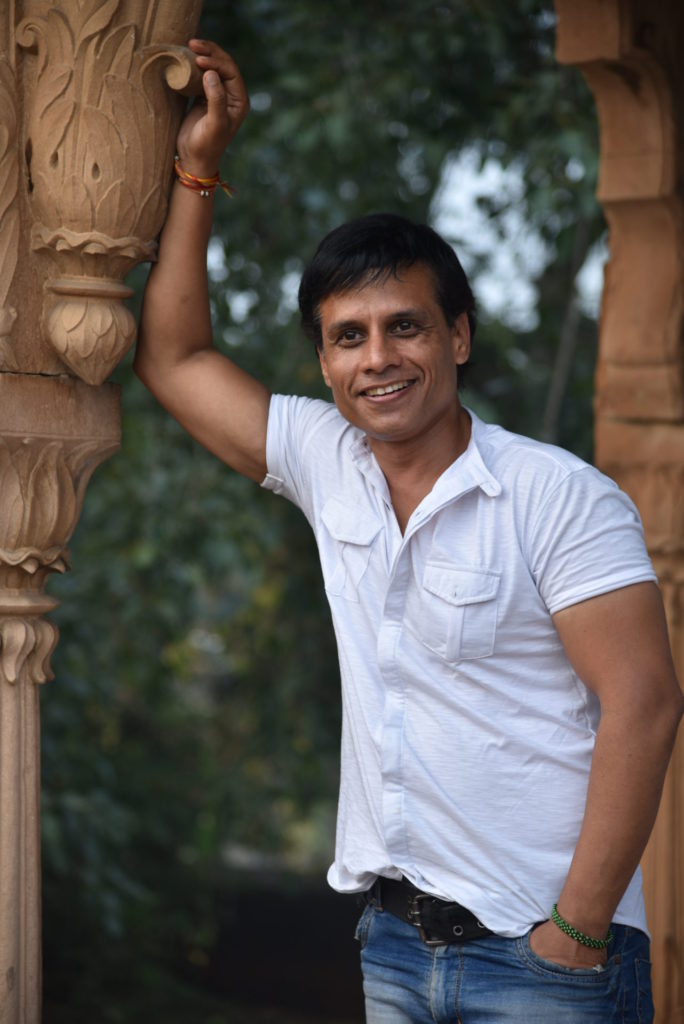
“Never, ever has this happened to me before, and it’s been continuous [over] the last two, three months.”
Mr Singh added that the racist incidents involved smearing of dog excrement on his car and racist graffiti in his driveway (“Go home, Indian”).
He also received letters that were filled with racist comments: “You can **** off back to India”.
The letters also included threats of damage to Mr Singh’s car which he says was sometimes intentionally scratched, outside his restaurant.
He further observed:
“It’s mentally very stressful when it comes to your house, and particularly [being targeted] with your name on it. It’s too much mental stress. Something has to be done.”
Mr Singh hopes that speaking out about his experiences could help prevent others from facing anything similar.
Image: Jarnail Singh’s post (Source: Dawat the Invitation – Facebook)
He has also posted a heartfelt note of thanks to his customers and supporters.
“Thanks you so much everyone in Hobart your support, love and emotions shows that we all are together and there is no space for racism in our beautiful country.”
Mr Singh has reported the racist letters and graffiti to Tasmania Police who are investigating the matter.
Support Our Journalism
Global Indian Diaspora needs fair, non-hyphenated, and questioning journalism, packed with on-ground reporting. The Australia Today – with exceptional reporters, columnists, and editors – is doing just that. Sustaining this needs support from wonderful readers like you.
Whether you live in Australia, the United Kingdom, Canada, the United States of America, or India you can take a paid subscription by clicking Patreon. Buy an annual ‘The Australia Today Membership’ to support independent journalism and get special benefits.
The Woodleigh man, 31, was sentenced on November 13, 2023 after pleading guilty to one offence on 28 July 2023.
The investigation began when the girl’s mother reported suspicious social media messages on her daughter’s mobile phone to ACT Police on 17 May 2021. Her daughter was 14 at the time of the offending.
The man was subsequently identified as a South Australian resident and the South Australia Joint Anti Child Exploitation Team (SA JACET) executed a search warrant at his Woodleigh home on 15 August 2022.
A mobile phone was seized for further analysis and he was charged with:
Using a carriage service to transmit communication with intention of making it easier to procure the recipient, being a person under 16 years of age, to engage in sexual activity, contrary to s474.27(1) of the Criminal Code 1995 (Cth).
The man was sentenced to one year in jail, suspended after three months in custody with another 12 months under a recognisance order.
AFP Sergeant Joe Barry said the man engaged in sexualised conversations with the girl on a number of platforms, including Snapchat.
“This case is another reminder of the prevalence of online child abuse but it is also an example of how parents and caregivers can act to protect children,” he said.
“We urge all parents and care givers to pay close attention to what their children are doing online and report abuse straight away.
“The AFP and other law enforcement agencies will be relentless in pursuing people who commit these vile acts.”
The AFP and its partners are committed to stopping child exploitation and abuse and the Australian Centre to Counter Child Exploitation (ACCCE) is driving a collaborative national approach to combatting child abuse.
The ACCCE brings together specialist expertise and skills in a central hub, supporting investigations into online child sexual exploitation and developing prevention strategies focused on creating a safer online environment.
Support Our Journalism
Global Indian Diaspora needs fair, non-hyphenated, and questioning journalism, packed with on-ground reporting. The Australia Today – with exceptional reporters, columnists, and editors – is doing just that. Sustaining this needs support from wonderful readers like you.
Whether you live in Australia, the United Kingdom, Canada, the United States of America, or India you can take a paid subscription by clicking Patreon. Buy an annual ‘The Australia Today Membership’ to support independent journalism and get special benefits.
In a sensational display of cricket, India makes a statement of its march to the final of the ICC World Cup 2023, defeating New Zealand by 70 runs in a thrilling semifinal at the Wankhede Stadium on Wednesday.
Virat Kohli’s landmark 50th ODI century and Mohammed Shami’s remarkable seven-wicket haul were the cornerstones of India’s emphatic victory.
The Wankhede Stadium, known for its electrifying atmosphere, was treated to a ‘Virat’ show as Kohli, following a blazing start by the Indian openers, scored a commanding 117 runs.
His century, coupled with Shreyas Iyer’s ton, propelled India to a formidable total of 397/4. New Zealand’s bowler Tim Southee faced the brunt of their assault, conceding 100 runs for his three wickets.
Shreyas Iyer became the first middle-order batter to smash 500 runs or more in a single edition of the ICC Cricket World Cup, It was his second successive century in the tournament.
Iyer said to Star Sports.
“Rohit sets the template, gives us the starts where we have to just go and carry forward from the base he gives. He is a fearless captain. You can see that in his body language and it’s kind of infectious, rubs off on all the players.”
On the backing from the management: “It is pivotal, coming from the captain and coach. I did not have a great start to the World Cup. They told me not to worry about the outside noise, we are backing you, so you just got to go out there and express yourself.”
About handling pressure: “To be honest, in pressure situations, you tend to get nervous but at the same time it is also fun playing in front of so many people and if you perform they lift you up. (How intense are the net sessions given the quality of the bowling attack) It is definitely intense. We see to it that we play the most difficult bowler. Whenever Bumrah comes with the new ball I face him because you know it’s going to be difficult and it helps you for the matches.”
Facing a mountainous target, New Zealand began their chase with an aggressive approach. Devon Conway and Rachin Ravindra looked to counter-attack in the powerplay, but their efforts were quickly stifled by Shami, who dismissed both openers for 13 runs each. The back-to-back setbacks shifted the momentum in India’s favour.
Indian captain Rohit Sharma in the post-match presentation said,
“I have played a lot of cricket here, any score on this ground, you cannot relax. Got to get the job done quickly and stay at it. We knew there would be pressure on us. We were very calm, even though we were a bit sloppy on the field.
These things are bound to happen (the partnership between Mitchell and Kane) but glad we could get the job done.”
He further added,
“Kohli did what he does, also got to his landmark century as well. England game we got 230 on the board, way bowlers bowled with the new ball was amazing. Today obviously being the semifinal, would not say there was no pressure, whenever you play there is pressure. Semifinal adds a bit extra, we wanted to not think too much about it, just do what we’ve been doing like in the first nine games. Things came off for us nicely in the second half.”
Despite the early blows, Daryl Mitchell’s resilient 134 and Kane Williamson’s solid 69 offered the Black Caps a glimmer of hope. The duo stitched together a partnership of 181 runs, keeping the dream alive for the New Zealand side.
However, India’s bowlers were relentless. Shami reintroduced into the attack and removed Williamson and later Tom Latham, halting the Black Caps’ resurgence.
“I was waiting for my chances. I didn’t play a lot of white-ball cricket. My return started against New Zealand [in Dharamsala]. We talk a lot of variations, but I still believe in pitching it up and getting wickets with the new ball,”
Shami said in a post-match presentation.
Shami dropped in-form New Zealand captain Kane Williamson’s catch, which could have been a major talking point, but he quickly returned and sent the Kiwi skipper packing.
“I dropped Williamson’s catch, I shouldn’t have. I felt terrible. But the focus was to try and take pace off, see if they’re hitting it in the air. It was a chance we had to take [with the variations],”
he added.
As the match progressed, Ravindra Jadeja’s brilliance in the field shone through. He took spectacular catches to dismiss Glenn Phillips and Mark Chapman, tipping the scales further in India’s favour. New Zealand’s challenge seemed to fizzle out as they lost wickets at regular intervals.
The final blow to New Zealand’s aspirations came when Jadeja completed a hat-trick of catches to dismiss the centurion Mitchell, with Shami claiming his fifth wicket of the match.
The pacer wasn’t done yet; he returned to take two more wickets, completing a seven-wicket haul, becoming the leading wicket-taker of the tournament, and sealing the deal for India.
India’s victory was a showcase of both batting prowess and bowling finesse, setting them on the path to their first ODI World Cup final appearance since 2011, and maintaining their unbeaten streak in the tournament.
New Zealand Captain Ken Williamson credited the Rohit Sharma-led India for outplaying his side.
“Firstly, congrats to India. They have played great cricket throughout. They played their best game today. They are a top side and played top cricket. Credit to the guys. Proud of the guys to stay in the fight,”
Williamson said in a post-match presentation.
New Zealand were outstanding in the first part of the competition, but then they faltered, and they were defeated by teams like India, Australia, and South Africa – all three of which are in the semifinals.
Williamson stated that he was disappointed after suffering a 70-run loss to India. New Zealand captain said hosts didn’t give Kiwis ‘a sniff’ as they fell short chasing down 398 in the WC semis.
“Disappointing to go out but super proud of the effort that’s gone in for the last seven weeks. The effort was there, but like I said India is top-class and has world-class batters who didn’t give us a sniff really. You come in and get 400, it’s a tick in the box. They deserve to be where they are, played outstandingly well.”
“It wasn’t to be today but nice to be out there to give ourselves a chance. It was a fantastic crowd, unbelievable atmosphere, slightly one-sided in the support but special to be part of the tournament, great to be hosted here by India,” he concluded.
Fans around the world are now keenly anticipating a spectacular final on Sunday, where India will seek to lift the trophy once again.
Support Our Journalism
Global Indian Diaspora needs fair, non-hyphenated, and questioning journalism, packed with on-ground reporting. The Australia Today – with exceptional reporters, columnists, and editors – is doing just that. Sustaining this needs support from wonderful readers like you.
Whether you live in Australia, the United Kingdom, Canada, the United States of America, or India you can take a paid subscription by clicking Patreon. Buy an annual ‘The Australia Today Membership’ to support independent journalism and get special benefits.
When independent supermarket startup Supie went bust last month, the company’s 120 employees were told they wouldn’t be paid for their last two weeks of work, or receive any of their owed annual leave pay.
The subsequent appointment of voluntary administrators again highlighted New Zealand’s limited protection for employees when their employer becomes insolvent.
Supie’s employees are not the first, nor will they be the last, to lose out when their employer goes under. In 2019, staff at restaurant chain Wagamama were owed NZ$50,000 when the company went into liquidation.
In both cases, the wages were eventually paid out by someone outside the company. In the case of Wagamama, by the franchise head office in the United Kingdom. Supie staff received their wages from an anonymous donor.
While the loss of money for any creditor is difficult, the double impact of losing wages as well as a job is particularly hard for employees.
So, what is it in New Zealand’s current legislation that puts employees in this difficult situation? And what can be done to protect staff when businesses fail?
Liquidations are the most common form of corporate insolvency process. When this happens, the company ceases to trade and a liquidator is appointed.
Under the Companies Act 1993, the liquidator’s role is to sell the company assets to repay unsecured creditors. In practice, only those assets not under a prior legal claim by one or more of the company’s creditors (for example, collateral used to secure a bank loan) are available to the liquidator to sell.
Once a liquidator has sold the company’s remaining assets, the Companies Act sets the order in which the debts are to be paid.
Preferential claims are to be paid before the claims of other unsecured creditors. Employees are considered preferential creditors.
There are five classes of preferential creditors in the Companies Act. Costs relating to the liquidation, including the liquidators’ fees, are ranked first, followed by the payment of unpaid wages and specified other amounts owed to employees.
Accordingly, amounts owed to employees are paid out after liquidation costs have been sorted – and only if there is any money left from the failed business. There is also a cap on what each employee can claim – currently set at $25,480 –regardless of what they are owed.
In practice, this means there is no guarantee employees will receive their unpaid wages when a business fails.
It all depends on whether there is enough money after secured creditors have accessed the assets used as collateral and the liquidator has paid their own fees. And this is often not the case.
Liquidators can take company directors to court for breaching their duties, such as recklessly trading. But this sort of action takes time, and there is no guarantee it will increase the amount of money available to unpaid staff. It took a decade for liquidators to secure a final judgement against the four directors of failed construction company Mainzeal.
Law changes could protect workers
New Zealand’s approach to protecting workers compares badly to other countries, where government schemes bolster the protections for unpaid employee debts. Such schemes operate alongside the preferential creditor rules in corporate law.
For example, in the Australian Corporations Act 2001, unpaid wages, superannuation contributions and certain other payments owed to employees are classed as preferential debts.
However, there is also a nationally-funded scheme that operates as a safety net for employees, which allows them to claim up to 13 weeks of unpaid wages, annual leave and other entitlements.
After the scheme makes a payment to employees, it then takes the employees’ place as a preferential creditor in the liquidation. A similar scheme operates in the UK.
Other options adopted in some countries include granting employee claims (capped or uncapped) “super-priority” status, which means they are paid before secured and other unsecured debts.
The previous New Zealand government, with support from Business New Zealand and the Council of Trade Unions, proposed introducing a social insurance scheme.
This would have paid up to seven months of wages at 80% of salary for most workers, funded through employee and employer contributions. But Labour eventually put the policy on ice, and the National Party has opposed such a scheme.
Because the government doesn’t collect the data, it is hard to say how many employees receive all or part of the amounts owing to them as preferential creditors when the company they work for fails.
But what is clear is that the current approach of labelling New Zealand workers privileged creditors does not guarantee they will see any money if their employers go into liquidation. The situation would be improved if New Zealand followed the best overseas examples.
Global Indian Diaspora needs fair, non-hyphenated, and questioning journalism, packed with on-ground reporting. The Australia Today – with exceptional reporters, columnists, and editors – is doing just that. Sustaining this needs support from wonderful readers like you.
Whether you live in Australia, the United Kingdom, Canada, the United States of America, or India you can take a paid subscription by clicking Patreon. Buy an annual ‘The Australia Today Membership’ to support independent journalism and get special benefits.
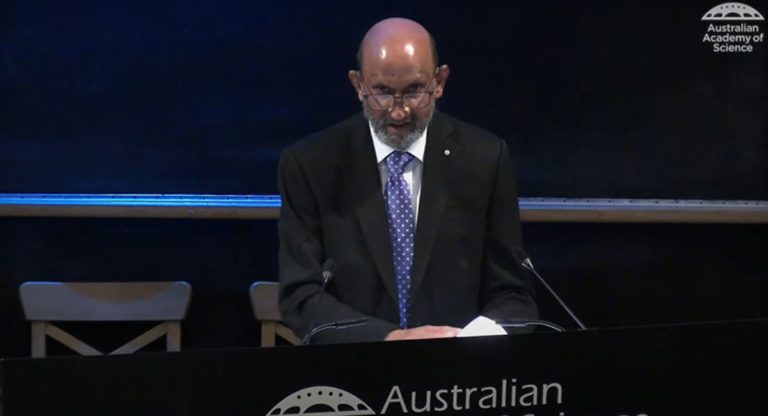
Not long after the Academy was established nearly 70 years ago, our second President, Sir Thomas Cherry, stood here and welcomed 150 participants for an international symposium on water resources, use and management.
In the audience were scientists from around the globe, including the United States, Russia and Belgium.
Sir Thomas called it the most important symposium the Academy had ever organised.
Then-Prime Minister Sir Robert Menzies, opening the symposium, described the topic as “a problem of the first magnitude”.
His comments came just two years before drought spread from NSW across much of Australia, ruining the rural economy and restricting exports.
As the driest inhabited continent on Earth, successfully managing our rivers, aquifers and catchments remains a challenge.
And a safe water supply for a world population that has now surpassed eight billion people is even more critical.
But today, I’m going to be bold. I claim that the 2023 National Symposium may well trump that of 1963, and be our Academy’s most important symposium yet, because of what’s at stake.
At stake of course is the future of the planet.
And it is in danger — science tells us that every day.
We are fed a never-ending stream of evidence about collapsing global ecosystems, about biodiversity loss, the damage to natural resources and their decline, and the rise and mobility of diseases due to the changing climate.
But what is also at stake is the very architecture and nature of the global research system required to respond to these challenges.
Today, I argue that the global science system is at its most valuable, and its most vulnerable.
There are local challenges which each country’s scientists will need to work to seek to solve, but the global challenges are different: bigger, harder and more complex, and political.
They require global solutions, and that will require researchers and peoples to work together.
We face challenges from technologies born of science that were recently the stuff of dystopian Hollywood imagination — artificial intelligence, advanced robotics and quantum.
And whilst they too demand collaborative science to deliver answers to government and society, they have fast become matters more characterised by strategic national competition, than collaboration.
But collaboration is a matter of strategic national interest, for everybody.
We in Australia can’t do without international collaboration either — our size and location make that obvious.
We have to be willing and able to contribute to the knowledge-bank that will help solve the challenges, and we need our scientists to be there when the big decisions are made that affect us and that affect the living systems in all other countries.
We share one planet; we have nowhere else to go.
We will be saved by ourselves — not some as yet undiscovered but a friendly neighbour who happens to pass by and feel the urge to help us do what we are not willing to do: work together.
So, how do we in Australia navigate the next few months and years?
How do we facilitate strategic collaboration?
The answers may well be amongst the most significant decisions we make as a nation.
They will dictate our contribution to meeting global challenges.
They will determine whether we develop the sovereign capabilities needed to secure our nation and globe.
They will determine whether science is adequately equipped to serve the national interest.
Whether it is:
open enough to develop the technologies we need and to access the 96% of knowledge we don’t generate
and protected enough to ensure our knowledge and capabilities do not fall into foul hands.
It’s a conundrum of global proportions and my own field of scientific endeavour illustrates why.
My work in nanotechnology and semiconductors — an area of strategic competition between nations — is fuelled by my research group which is entirely made up of international students.
My work is also made possible because of some 30 collaborations I maintain across the world, spanning countries including the UK, US, India, China, Germany, France, Sweden, Finland, Norway, Italy, the Netherlands, Japan, South Korea, Russia, Lithuania, Poland, Brazil, South Africa, and the list goes on.
My work is fundamental discovery research, designed to better understand our world at a nanoscale.
To put this into perspective, I can place 20 lasers in one strand of your hair.
Why would I want to do that?
Because at the nanoscale, I can create technology to better diagnose disease and understand and treat Alzheimer’s disease in the longer term.
I can create technology that more efficiently runs solar cells and generates hydrogen as a sustainable fuel source needed to decarbonise our industries and economy.
The trouble is, my research is also listed on the Defence and Strategic Goods List. Category 6, specifically 6A004, 6A005, 6A007… the number soup goes on.
And this means, placed in the wrong hands, my research could be used for less than desirable purposes.
On 7 November, a new piece of legislation was released designed to strengthen Australia’s defence export control framework, so it keeps pace with the emerging challenges in Australia’s security environment.
I, the Academy, and the research sector have an opportunity to express our views on the Exposure Draft of the Defence Trade Controls Amendment Bill 2023 by this Friday the 17th of November.
The Bill proposes to strengthen our defence export control framework, by, amongst other things, creating three new criminal offences in the Defence Trade Controls Act 2012.
It says I can collaborate freely with the US and the UK — which certainly has its benefits — but I would require an approved permit prior to collaborating with other foreign nationals.
Without it, my collaborations would see me jailed.
So, it expands Australia’s backyard to include the US and the UK, but it raises the fence.
For my research group, which consists entirely of PhD students, post-docs, technicians and senior researchers from countries other than the US and the UK, we will need permits for all that we do.
And members of my group will need to operate in a closed environment to not unintentionally share knowledge that may have a dual use.
Discussion at international conferences, where unpublished knowledge is shared freely to solve research problems and enable collaboration, seems unlikely if this Bill becomes law.
Some of this may still be technically legal under this new legislation, but how will I know which session of these conferences I will be able to present at, ask questions or engage in discussions with or without a permit?
My ability to attract the best and brightest in the world, wherever they are, will diminish.
It’s timely to ask what Australia is really seeking to secure if we are restricting the development of technologies that are critical for our country?
In my experience and the experience of researchers worldwide — the best research is global.
But, to comply with the new laws, I will have to lock down my communications and restrict my collaborations.
It feels like I am being asked to create something akin to the US’s federally funded research and development centres (FFRDCs) or university-affiliated research centres (UARCs), minus the funding.
These centres are not-for-profits that are established and funded to meet long-term engineering, research, development and analytic needs, like the Lincoln Lab at MIT.
They are a mechanism used in the US to control risk but not limit collaboration for critical innovation.
If such structural change in the research architecture and system is required to address national security concerns, the Australian Government will need to consider the resource implications of implementing such changes.
Resources to establish secure research facilities.
Resources to educate and train the workforce on the changing Defence and Strategic Goods List.
Resources to foster a more security-aware culture across the research sector.
And resources to facilitate compliance.
They will also need to accept the limitations of compliance.
Students live in shared houses and university colleges; they go to cafes and to the student union.
They don’t only talk about the weather or the latest episode of their favourite show on Netflix.
It’s natural to share what they do — perhaps vent a frustration, seek reassurance about a doubt or celebrate a success.
We all do it because we are human.
It ought not to be a jailable offence.
So, there is a lot at stake as we revise the architecture of our research system to respond to security threats.
I am the first to agree that we need to do something to the changing geopolitical environment we need to operate in!
But we ought not to throw the baby out with the bathwater.
I will leave it to others to share with you the defence and security reasons why we need a tall fence around a small paddock.
But, as President of the Australian Academy of Science, it is incumbent on me to make the case for international research collaboration as a matter of strategic national interest.
Forty-five percent of the Academy’s Fellows elected in the past five years were born overseas.
The scientific work of these stellar individuals has helped shape our nation.
In fact, Australia is the product of the freedom of movement of scientists and our ability to collaborate and welcome talent — like them — to our shores.
This is not new.
World War II saw researchers become part of the United States war effort — leading to evolutions in radar, computing and the development of nuclear weapons through the Manhattan Project.
Key amongst those researchers was the founding President of this Academy, Sir Mark Oliphant.
Throughout and beyond the Cold War, scientists continued to work with governments to find systematic approaches to research and technology development.
What followed was an era of openness, globalisation and an unimpeded flow of scientific communication and exchange.
It was research and collaboration in the name of constructing our nation post-war.
Today, we have a National Reconstruction Fund, with a stated ambition to diversify and transform Australia’s industry and economy.
We may not be post-war.
But we are post-pandemic, which has shown us how critical it is to both collaborate and to develop sovereign capability.
And much reconstruction is needed because we are still 93rd in the world in terms of our economic complexity.
In other words, we have a vulnerable economy that is underpinned by too few exports and industries, key amongst them unprocessed natural resources.
So, more than ever, we need to diversify our industrial base and build onshore capabilities.
With these imperatives in mind, it is not a time to impede collaboration.
Why?
There is perhaps no better recent example of the benefit of international science collaboration than the development of COVID-19 vaccines.
While the science behind mRNA was decades in the making, getting a vaccine to market in less than 12 months was a stunning achievement.
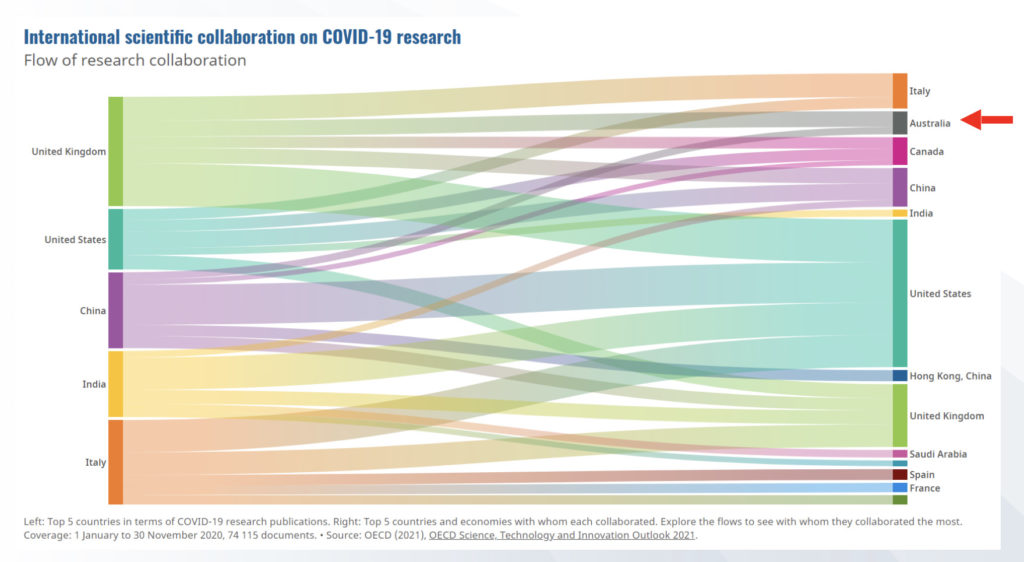
Take a look at this infographic. On the left are the five countries that led in COVID-19 research efforts and on the right are the countries they collaborated with the most.
Australia is there on the right, having the most research publications with the United Kingdom and China.
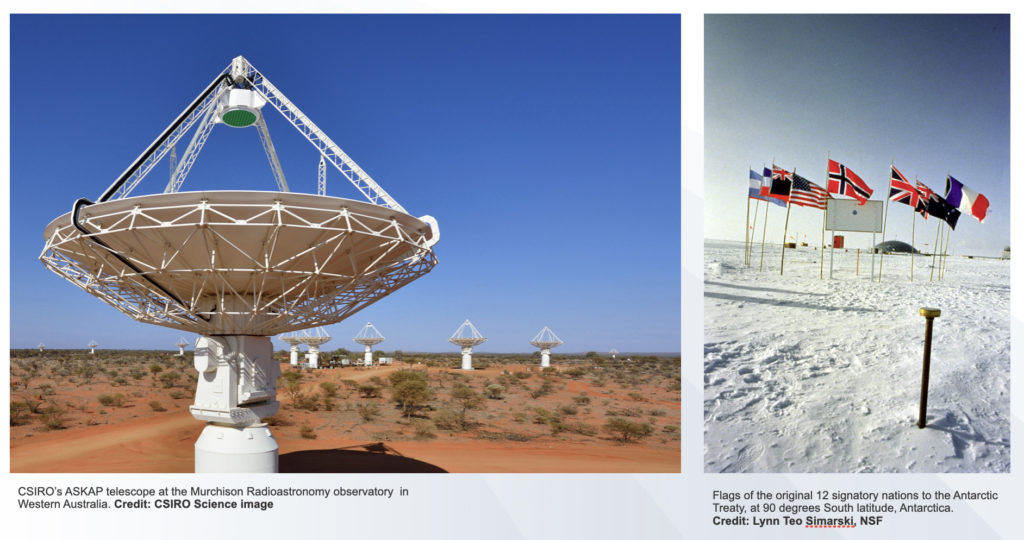
Consider global efforts to develop large-scale infrastructure beyond the capacity of any one country, like the Square Kilometre Array.
The SKA Observatory is one global observatory, over two sites: South Africa and Australia and associated data processing facilities.
It is achieved through a collaboration of member states and institutions, including Australia, China, Italy, the Netherlands, Portugal, South Africa, Spain, Switzerland, and the United Kingdom.
They collectively provide resources and knowledge, and industrial, technical scientific and policy experience, to realise the SKA.
Chinese industry and scientists have contributed to engineering design and development work.
Their know-how and technology are built into this global infrastructure.
We have been able to provide safeguards, without erecting high fences.
Australian businesses are benefitting from the economic opportunities of being a host nation.
And history has shown us that when we better understand the universe and its origins, it leads to unforeseen technological developments — like Wi-Fi.
Understanding our universe deepens our understanding of the fragility of the Earth’s ecosystems and helps us respond to variations to it!
It enables our communications. The list goes on.
Could we achieve any of our innovations and competitive edge without collaboration?
No.
Let’s be clear: the last major Australian invention that did not involve international input was the stump-jump plough.
That was 1876.
When we collaborate, we are stronger.
Consider the Antarctic Treaty — itself a demilitarisation agreement settled in 1959, the year this building was completed.
Despite individual national interests and international challenges, collaboration has kept the Antarctic free from military conflict and nuclear proliferation.
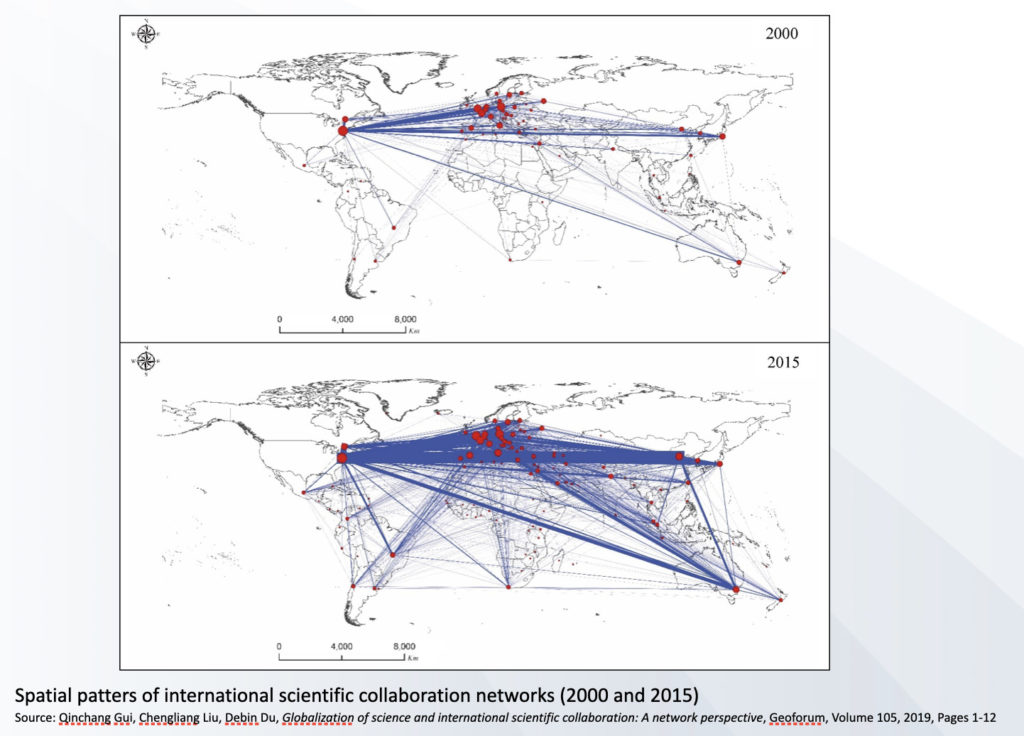
Where once science was dominated by the USA and Europe, as you can see in this figure of international scientific collaboration networks, it has now evolved into three main centres of activity: USA, Europe and China. There are other players, too, particularly in East and South Asia and South America.
Science has become increasingly networked and team-oriented.
Let’s look at Australian research trends over time.
This data is drawn from that captured in the Academy’s discussion paper published on our website ahead of this symposium.
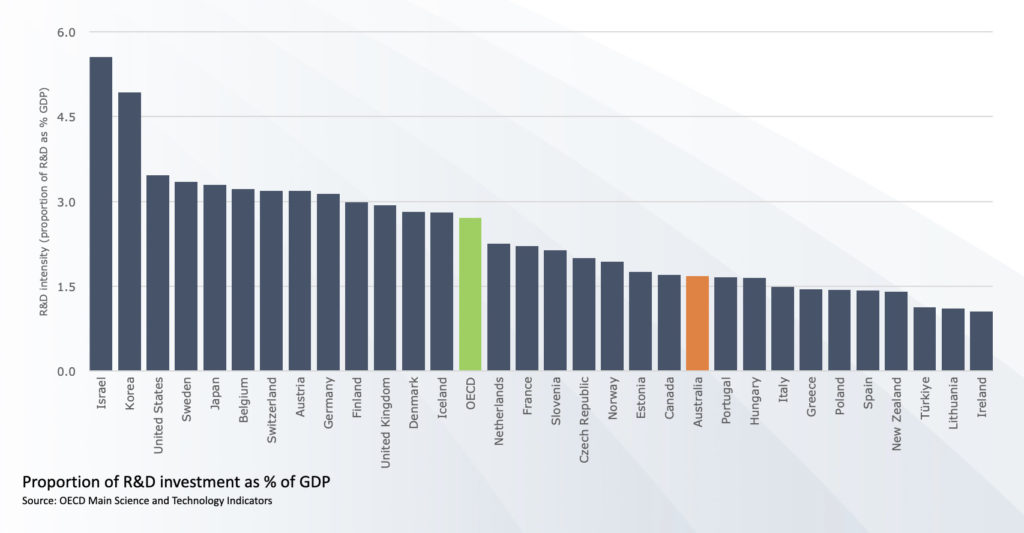
Australia is a relatively small market—0.3% of the world’s population — with low investment in R&D by international standards, at 1.68% of our GDP.
This has been falling for several years and is now well below the OECD average, as you can see here.
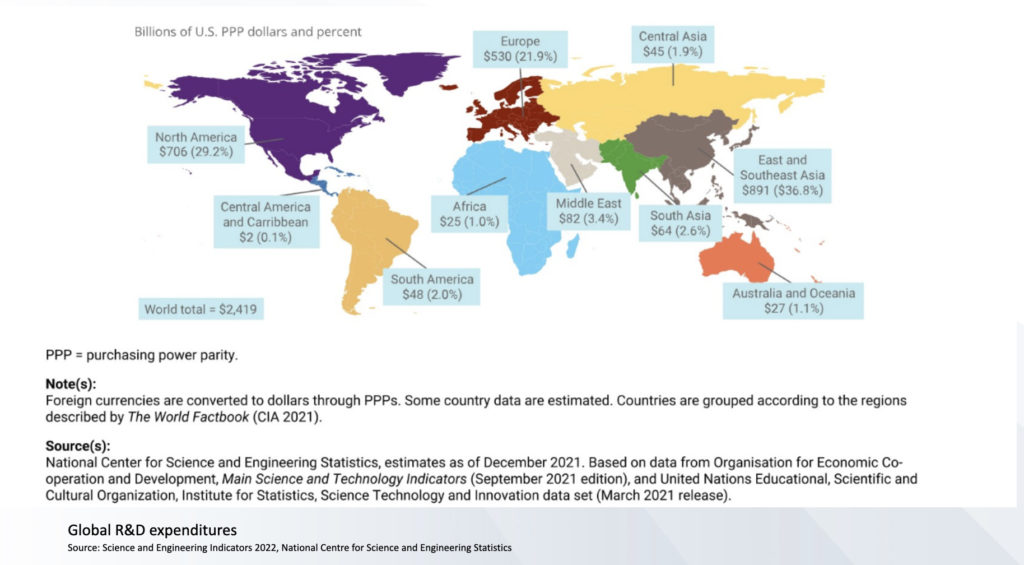
Australia and Oceania together account for only 1.1% of the world’s investment in research and innovation, a level that is dwarfed by the world’s science superpowers—the USA (29%), China (37%) and Europe (22%).
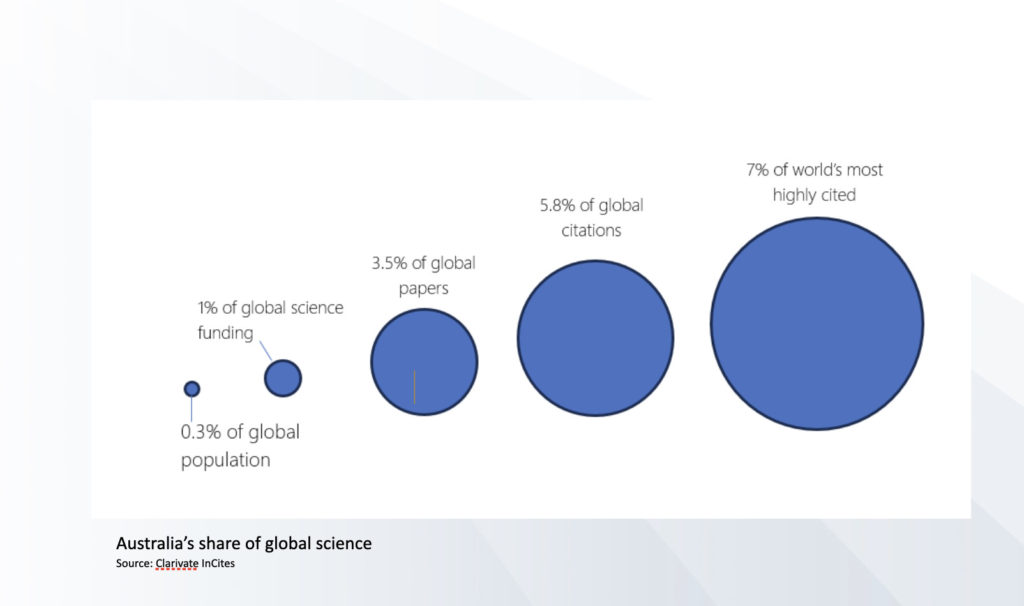
We are a middle-power science nation. Despite this, we are prolific collaborators with significant influence in global science for our size.
Looking at our share of global science, we contribute 3.5% of the world’s research and 7% of the world’s most highly cited research.
Australia is ranked ninth globally in the volume of scholarly outputs and sixth globally in citations.
Australia is above average in the OECD in international scientific collaborations.
Australian scientists’ proportion of the top 10% of cited publications involving international collaboration has risen more sharply than the OECD average.
It is indisputable — international collaboration is the norm for researchers in Australia.
Ninety percent of the top 50 cited papers from Australian authors in the Web of Science (from 2013 – 2023) were co-authored with overseas collaborators.
Eighty percent of Australian Research Council Discovery projects in STEM fields awarded in 2022 involved international collaborations.
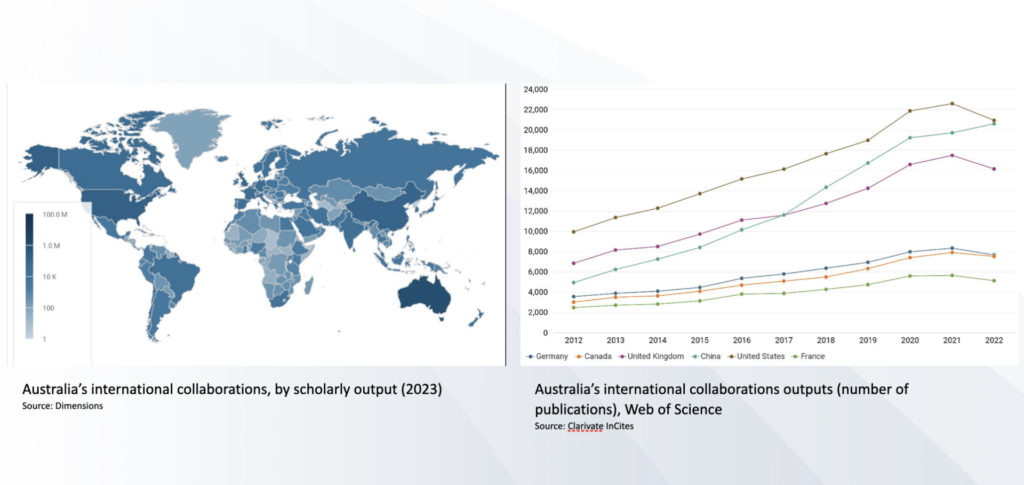
Australia’s patterns of international scientific collaborations are wide and diverse. We collaborate with almost every country in the world, with collaborations with the USA and UK being particularly strong.
Collaborations with China have grown in recent decades (teal-coloured line), and it is now among our most important international partners.
You can see on the chart how our scholarly outputs with China have increased steeply over the last decade.
Who does the research in Australia?
Our higher education sector and research workforce are also highly international.
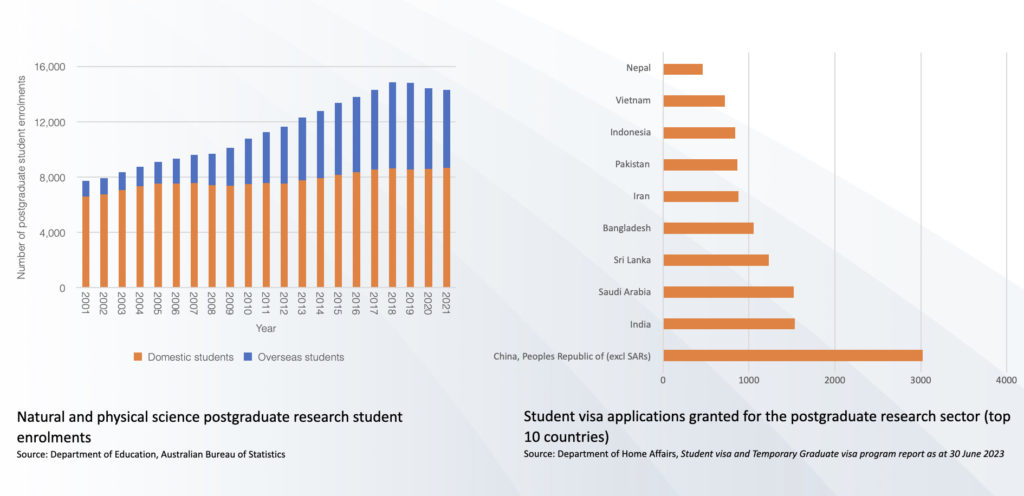
You can see from this graph how, in the natural and physical sciences, the number and proportion of overseas students has grown over the last two decades.
In 2021, 39% of natural and physical sciences postgraduate research student enrolments in Australia were overseas students.
Overall, international students represent 36% of Australia’s postgraduate research students, who make up nearly a quarter of our research workforce which drives much of the original research conducted in Australia.
In 2022-23, the top five citizenship countries for postgraduate research sector student visas granted were China (18%), India (9%), Saudi Arabia (9%), Sri Lanka (7%), and Bangladesh (7%).
The ‘professional, scientific and technical’ industry is the biggest user of temporary skilled visas.
In 2020-21, universities sponsored 320 university lecturers and tutors.
Let’s not forget that universities rely on international student fees to remain financially viable.
To summarise, our national interest is served by:
accessing 96% of the total knowledge pool which is generated abroad to innovate and advance our own priorities — consider Farrer and Federation Wheat where European genetic insights enabled plant breeding to evolve in Australia — industries that are now the backbone of jobs and communities in our wheat belts and provide cheaper food for Australians
a research workforce bolstered by overseas talent, wherever that brain power resides. With global demand for STEM skills skyrocketing, we really can’t afford to be picky
access to global infrastructure that Australia cannot afford to purchase
decision-making informed by the best available scientific evidence
participation in global ‘big science’ resulting in technologies such as the genome sequencing, vaccine development and touchscreens
cooperation brought about by effective science diplomacy, the role of which has become ever more central to international politics and state power
building networks and scientific capacity in our region, because it’s the right thing to do and because we must share the benefits amongst those least able to access them. And because it pays back in political stability, borne from a deeper more nuanced understanding of other nations, their values and their aspirations.
Colleagues, the bottom line is that supporting international scientific collaboration is in Australia’s national interest.
Perhaps just as much as strengthening our security is in our national interest.
International research collaboration does provide challenges to national security, but it also contributes to maintaining it.
Today, the global science system is more vulnerable than it has ever been due to decisions taken by states as they respond to respond to security challenges.
The Cold War and the war in Ukraine have shown that geopolitical events shape science as much as science shapes our lives.
So, we must tread carefully and with eyes wide open when presented with proposals that restrict our international scientific engagements.
We must consider all alternatives, like whether there is scope to consider new ways for middle science powers to maintain multilateral science collaboration in safe ways.
Or mitigation strategies such as deepening our association with Europe, via Horizon Europe.
We must carefully weigh up the benefits and the costs of de-risking our research environment.
We must consider the impact of our work on society so that we do not grow the number of disaffected people — those most likely to turn away from science-based solutions and those most likely to challenge our democracy.
And we must always take an evidence-informed approach.
There is too much at stake to do otherwise.
This was delivered as Keynote address at the International Science Collaborations in a Contested World National Symposium 2023. It was first published on the website of the Australian Academy of Science.
Contributing Author: Prof. Chennupati Jagadish, AC, has over 40 years of research experience in semiconductor physics, materials science and optoelectronic devices. He leads the Semiconductor Optoelectronics and Nanotechnology Group at the Australian National University, Research School of Physics. Prof. Chennupati Jagadish has published more than 750 journal papers and 280 refereed conference papers. He has given more than 230 plenary/keynote and invited talks and trained 60+ PhD students and 50+ post-doctoral fellows and research fellows. He is the Editor or Associate Editor of many journals and book series. Prof. Chennupati Jagadish has also held leadership positions of professional societies and Academies such as President of IEEE Nanotechnology Council, IEEE Photonics Society, Australian Academy of Science. He founded Acton Lasers to commercialize semiconductor laser technology developed in his research group and launched The Chennupati and Vidya Jagadish Endowment to support student interns and researchers from developing countries to visit the Australian National University Research School of Physics.
Support Our Journalism
Global Indian Diaspora needs fair, non-hyphenated, and questioning journalism, packed with on-ground reporting. The Australia Today – with exceptional reporters, columnists, and editors – is doing just that. Sustaining this needs support from wonderful readers like you.
Whether you live in Australia, the United Kingdom, Canada, the United States of America, or India you can take a paid subscription by clicking Patreon. Buy an annual ‘The Australia Today Membership’ to support independent journalism and get special benefits.
Fintech startup Upworth has made a bold entrance into the financial technology sector, securing a significant $1 million in its initial funding round. This investment comes from a consortium of business angels and entrepreneurs eager to support the company’s vision of democratizing money management.
Co-founded by Alexandre Chavotier, Carlos Rios, and Maxime Chaury, Upworth combines expertise in technology, finance, and consumer services to revolutionize wealth management.
With the launch of its consumer product, Upworth aims to offer Australians a comprehensive and free tool to navigate their financial future.
“We are proud to bring Upworth to the world, starting with Australia, providing individuals with powerful tools to achieve financial independence,” proclaimed CEO Alexandre Chavotier, an alumnus of McKinsey & AI firm Quantum Black.
Upworth’s platform boasts a range of features designed to empower users:
An integrated dashboard that consolidates users’ assets and liabilities, ranging from bank and investment accounts to cryptocurrencies and real estate.
Access to information on 170,000 securities across more than 70 global exchanges, allowing users to track and understand the dynamics of their wealth.
An AI-enhanced control tower offering insights and actionable advice for wealth growth, including a mortgage refinancing module for loan savings assessments within 60 seconds.
A digital marketplace connecting consumers with financial products, currently focusing on home loans, as Upworth operates as an authorized credit representative with a network of over 30 lenders.
Upworth is not resting on its laurels; plans are underway for the rollout of additional tools by 2024, such as a self-serve financial roadmap for retirement planning and a fee scanner to help users cut down on financial costs.
In an industry where security is paramount, Upworth ensures that all customer data is stored domestically, protected with AES-256 encryption, and compliant with Australia’s rigorous open banking and privacy standards, including the Consumer Data Rights legislation.
The team at Upworth is also invested in improving financial literacy, establishing the Upworth Hive knowledge base and launching the Upworth Talks podcast series, featuring personal finance and investment experts.
Upworth’s platform is now live, and consumers can create a free account to start managing their finances more effectively. Visit Upworth for more details or follow their journey on LinkedIn.
Support Our Journalism
Global Indian Diaspora needs fair, non-hyphenated, and questioning journalism, packed with on-ground reporting. The Australia Today – with exceptional reporters, columnists, and editors – is doing just that. Sustaining this needs support from wonderful readers like you.
Whether you live in Australia, the United Kingdom, Canada, the United States of America, or India you can take a paid subscription by clicking Patreon. Buy an annual ‘The Australia Today Membership’ to support independent journalism and get special benefits.
The AFP has charged a New Zealand national with serious drug import offences, after the elderly passenger allegedly smuggled illicit drugs inside his luggage on board an international flight to Australia at the weekend.
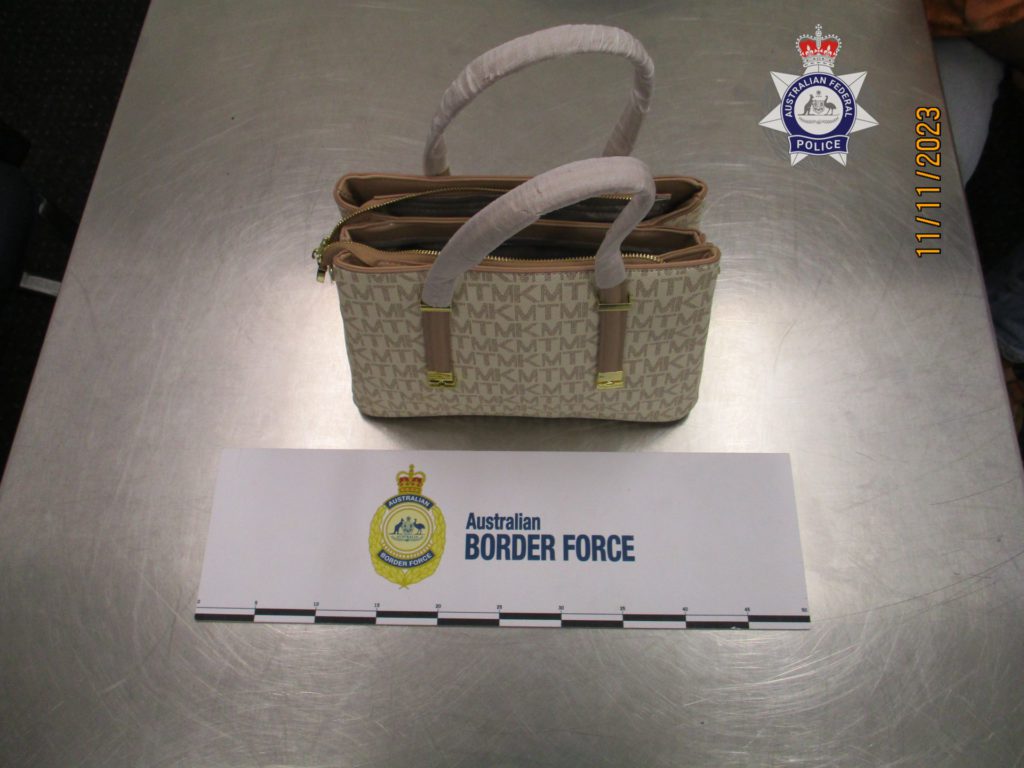
The man, 70, is accused of concealing about 5kg of heroin inside his baggage in an alleged attempt to import the illicit drugs into Melbourne on Saturday (11 November, 2023).
Investigations began after Australian Border Force (ABF) officers examined the man’s luggage at Melbourne Airport upon his flight’s arrival from Manila into Melbourne on Saturday morning.
Image: drug import (Source: AFP)
Officers allegedly discovered anomalies within a brown suitcase and a handbag belonging to the passenger.
Further examinations of both items revealed a white powdery substance which tested positive for the presence of heroin. The matter was subsequently referred to the AFP and the passenger was arrested inside the terminal.
This amount of heroin has an estimated street value over $2 million and could have accounted for about 25,000 individual hits of heroin had it reached the Australian community.
Image: drug import (Source: AFP)
AFP Detective Superintendent Anthony Hall said the AFP worked together with its state, Commonwealth and international partners to prevent transnational serious and organised crime from bringing illicit substances into Australia.
“The AFP together with our law enforcement partners have prevented harmful, illicit drugs from reaching our community,” said Det-Supt Hall.
“We remain committed to targeting, identifying and prosecuting transnational serious and organise criminals attempting to operate in our country and targeting us from offshore, along with the alleged drug mules trying to smuggle these drugs into our communities.
“This arrest should serve as yet another clear warning to anyone attempting to bring illicit drugs into Australia – you will be caught and you will face the full force of the law.”
ABF Superintendent Aviation Traveller Victoria, Kelly-anne Parish, said those lured into doing the dirty work of organised crime groups should be aware that they don’t stand a chance at the Australian border.
“We too often see people from all walks of life enticed into situations like this by organised crime groups, for which the individual doing the dirty work faces very real consequences,” Supt Parish said.
“Our message to people who are tempted by these types of illegal activities is clear: No offer is worth the risk. ABF officers are one step ahead of you and you will be caught out.
“The Australian border is our most critical national asset, and so ABF officers will continue to work around the clock to ensure it remains a hostile environment for those doing the wrong thing.”
The New Zealand national was charged with:
One count of importing a commercial quantity of a border controlled drug, namely heroin, contrary to section 307.1 of the Criminal Code Act1995 (Cth); and
One count of possessing a commercial quantity of a border controlled drug, namely heroin, contrary to section 307.8 of the Criminal Code Act1995 (Cth).
Image: drug import (Source: AFP)
The maximum penalty for this offence is life imprisonment.
The man faced the Melbourne Magistrates’ Court on Saturday, 11 November, 2023 and did not apply for bail. His next court appearance is Friday, 2 February, 2024.
The following services provide people with access to support and information.
For free and confidential advice about alcohol and other drug treatment services call the National Alcohol and Other Drug Hotline on 1800 250 015.
For information about drug and alcohol addiction treatment or support, visit Turning Point.
Support Our Journalism
Global Indian Diaspora needs fair, non-hyphenated, and questioning journalism, packed with on-ground reporting. The Australia Today – with exceptional reporters, columnists, and editors – is doing just that. Sustaining this needs support from wonderful readers like you.
Whether you live in Australia, the United Kingdom, Canada, the United States of America, or India you can take a paid subscription by clicking Patreon. Buy an annual ‘The Australia Today Membership’ to support independent journalism and get special benefits.
By Michael Westaway, Alison Crowther, Nathan Wright, Robert Henry, and Rodney Carter
For almost ten years, debate has raged over the book Dark Emu by Aboriginal historian Bruce Pascoe. In it, Pascoe argues many pre-colonial Aboriginal groups were farmers, pointing to examples like eel aquaculture in Victoria, and grain planting and threshing of native millet in the arid centre.
The debate has drawn in everyone from academics to Aboriginal communities invested in food futures to shock jocks claiming it is a warping of history.
For our group of archaeologists and First Nations people, the fact this debate has raged so long suggests there are shortcomings in how we think of food production and how we investigate it in Australian archaeology.
Farmers versus foragers is a huge oversimplification of what was a mosaic of food production. After all, Australian landscapes differ markedly, from tropical rainforest to snowy mountains to arid spinifex country. For many Aboriginal people, the terms “farming” and “hunter-gatherer” do not capture the realities of 60 millennia of food production.
In our new research published in the Archaeology of Food and Foodways, we argue that to better understand millennia-old systems, archaeologists must engage deeply with fields such as plant genetics, ethnobotany, archaeobotany and bioarchaeology as well as listening more carefully to the views of Aboriginal people. Here’s how.
We need to use better methods
For decades, archaeologists have grappled with the task of understanding ancient food production. We are by no means the first to point to the lack of appropriate methods as a reason why this has proved hard.
Archaeobotanists Anna Florin and Xavier Carah have observed that food production systems in northern Australia are very similar to those in Papua New Guinea. While we accept Papuan food gardens, Australian archaeologists have been less eager to embrace this idea for Australia.
In part, this is a failure of terminology. Aboriginal food production was enormously varied.
This map shows the complex and diverse types of food production and settlement systems documented by researchers across Australia, ranging from arid grainlands to rainforest seed processing to yam harvesting. Author provided, CC BY-ND
The solution lies in better methods. For instance, many Aboriginal groups lived semi-permanently in gunyah (bark hut) villages, as Dark Emu demonstrates by quoting colonial observers.
These settlement sites are vital to gaining a better understanding of how people lived. By excavating gunyah sites and fireplaces where food was prepared, we can recover seeds by sieving dirt and ash to find out which plants people used. The problem? Many of the sieves used were not fine enough to capture the tiny seeds of vital plants such as native millet. Most seeds used by Aboriginal groups were less than 1mm in radius.
This can be fixed. In south-west Asia, archeobotanists have long used fine mesh sieves to recover ancient seeds. You also need reference collections of seeds to be able to identify them from fireplaces.
Genetics – and archaeology?
It might not sound like a natural fit. But around the world, combining plant genetics with archaeology has dramatically changed our understanding of how people used plants, how they moved them about the landscape and how they changed these plants into forms better suiting our use. The wild precursor of corn, for instance, looks almost nothing like what we moulded it into through selection.
Combining these approaches is only in its infancy in Australia. But early applications together with Aboriginal knowledge of plant use has revealed dramatic new insights into how Aboriginal people moved important species such as black beanCastanospermum australe around the landscape and cultivated them.
The legacy of these food production techniques may still be visible today. For instance, when we look at the four species of native rice, we would not expect them to have large seeds. But all four species do. For millennia, Aboriginal groups in Australia’s wet north farmed these floodplain grasses. They may well have provided some selective pressure that resulted in larger grains, as early farmers did elsewhere.
To date, we don’t know this for sure. But we can find out. Careful genetic analysis of remaining wild populations should tell us if these large grains came from human rather than natural selection. We can also analyse genetic diversity between wild rice populations, to see if Aboriginal groups were involved in spreading these useful plants further.
Stories from ancestral remains
Every bone tells a story. In your bones lie traces of how fast you grew, what you ate and how hard your life was.
Studying ancestral remains is a very sensitive issue due to the colonial practice of collecting Aboriginal remains for research. But when done sensitively and respectfully, it yields fresh insights.
Bones and teeth can tell us many things about life in Aboriginal Australia. Tracking changes in isotope ratios in teeth can tell us if people were shifting to a more sedentary way of living. Stress in bones can tell us about difficult food production techniques such as labour-intensive seed grinding.
The past can shape the future
Aboriginal culture is 60 millennia old, during which time the climate shifted several times. Sea levels rose, flooding the Bass Strait and the coastal plains connecting Cape York to Papua New Guinea.
For a culture to survive that long means it had to rely on sustainable food production. Finding out how exactly this was done could yield lost knowledge and make it possible for current-day Aboriginal groups to recapture these methods and crops.
To date, renewed interest in bushfoods has not spread far beyond boutique food industries such as gourmet breads and specialised plant foods like Kakadu plum and quandongs.
Learning more about drought-resilient crops such as native rice and native millet (Panicum decompositum) could help farmers adapt to climate change and diversify food production. In central Victoria, the Dja Dja Wurrung group is exploring the potential for kangaroo grass (Themeda triandra) for use as a food and as drought-resistant cattle fodder.
The better we understand ancient food production, the more likely we are to be able to bring this knowledge to bear on today’s challenges – and give a fuller answer to the questions raised by Dark Emu.
Dja Dja Wurung man Rodney Carter inspects kangaroo grass. Author provided, CC BY-ND
Global Indian Diaspora needs fair, non-hyphenated, and questioning journalism, packed with on-ground reporting. The Australia Today – with exceptional reporters, columnists, and editors – is doing just that. Sustaining this needs support from wonderful readers like you.
Whether you live in Australia, the United Kingdom, Canada, the United States of America, or India you can take a paid subscription by clicking Patreon. Buy an annual ‘The Australia Today Membership’ to support independent journalism and get special benefits.
The Swami Vivekananda Cultural Centre, Consulate General of India, Sydney and the Art Gallery of New South Wales organised a ‘Diwali Storytime’ at the gallery’s Children’s Art library. The kids gathered there from different cultural backgrounds got to hear about jalebis, firecrackers and rangolis.
L to R Clair Eggleston, Niyati Mehta, Susanne Gervay OAM
Niyati Mehta, Director SVCC, Sydney (part of Indian Council for Cultural Relations) told The Australia Today about how the idea of having a book reading to celebrate Diwali came about.
Niyati Mehta speaking with Pallavi Jain
Award winning author Susanne Gervay OAM and Niyati Mehta conducted the special story time and enthralled the little kids with their readings from three children’s book provided by the library.
The three books, ‘It’s Diwal!’, ‘Elephants with Wings’ and ‘Amma’s Sari’ gave a glimpse of Indian culture to the kids at the library ranging from age 1 to 10.
‘It’s Diwal!’ is writtern by Kabir and Surishtha Sehgal with illustrations by Archana Sreenivasan. ‘Elephants with Wings’ is by the author-illustrator team of Susanne Gervay and Anna Pignataro and Amma’s Sari is by Sandhya Parappukkaran with illustrations from Michelle Pereira.
Ms Gervay read her own book ‘Elephant with Wings, while Ms Mehta read from It’s Diwal! and Amma’s Sari, to the delight of the children.
Author Susanne Gervay told Pallavi Jain about how her six-year-old grandson thinks that she is an Indian given her love for the rich culture of India. Speaking about Diwali she said “I love Diwali I would love it to be across this country as well as India as it’s about light…Diwali is a very precious festival”.
Susanne Gervay in conversation with Pallavi Jain
Clair Eggleston is Senior Librarian at the Arts Gallery of New South Wales and was involved in organising the ‘Diwali Storytime’ session. She said that the opportunity to celebrate Diwali was very appealing and it has been a great celebration.
Clair Eggleston speaking with Pallavi Jain
Support Our Journalism
Global Indian Diaspora needs fair, non-hyphenated, and questioning journalism, packed with on-ground reporting. The Australia Today – with exceptional reporters, columnists, and editors – is doing just that. Sustaining this needs support from wonderful readers like you.
Whether you live in Australia, the United Kingdom, Canada, the United States of America, or India you can take a paid subscription by clicking Patreon. Buy an annual ‘The Australia Today Membership’ to support independent journalism and get special benefits.
In an exciting development for aspiring female entrepreneurs, Press Play Ventures, has announced the launch of a scholarship program aimed at supporting women from corporate backgrounds to venture into the start-up world.
The program, which is supported by LaunchVic, is a collaborative effort involving NiceTo, Jumpstart Studio, Vox360, and Evander Strategy.
Press Play Ventures, through the combined expertise of its founding partners, including Preethi Mohan of NiceTo, Sangeeta Mulchandani of Jumpstart Studio, Poonam Advani of Vox360, and Isaac Jeffries of Evander Strategy, is poised to become a pivotal force in shaping Victoria’s start-up ecosystem.
Preethi Mohan, speaking with The Australia Today, shared insights into the motivation behind this initiative.
“Women in corporate roles are the perfect fit for entrepreneurship, and I say this from experience. They possess an arsenal of technical skills, tenacity, and leadership traits, and they are already battle-hardened players in the business world.”
“When these women step into the entrepreneurial arena, they thrive better than most other founders,”
added Preethi Mohan.
LaunchVic’s support has been crucial, enabling Press Play to offer 100 scholarship positions designed to help women transition from mid to senior employment backgrounds to successful startup founders.
The program’s benefits are extensive, and they include:
Cost-free & Equity-free: Participants can engage with scholarships valued at $4700 without incurring any cost while retaining full ownership of their business.
Flexible Participation: The program allows women to explore entrepreneurship without having to leave their current jobs, providing valuable startup insights.
Idea Development: The initiative promises to assist participants in evolving their business ideas into viable prototypes with significant growth potential.
Expert Mentorship: Industry leaders are on board to provide mentorship and support from the very beginning of the journey.
Time Efficiency: With a manageable commitment of 4-5 hours per week to the virtual program, participants can maintain a balance between family, personal time, and entrepreneurial development.
The application window for the cohort, which commences on February 5th, 2024, is closing soon on November 15th.
“Is the thought of being your own boss a frequent dream? If you’re thinking about entrepreneurship, particularly post-corporate life or within the startup or scale-up ecosystems, your moment is now,”
encourages Preethi.
Press Play Ventures stands as a testament to the commitment of its founders and LaunchVic towards empowering women in Victoria, offering them the tools and support to become the leaders of tomorrow’s business world.
“Press Play, we’re here to back you every step of the way,” asserts Preethi, highlighting the ethos of unwavering support that the program promises its participants.
The applications for a cohort start date of February 5th 2024 close 15th November.
Support Our Journalism
Global Indian Diaspora needs fair, non-hyphenated, and questioning journalism, packed with on-ground reporting. The Australia Today – with exceptional reporters, columnists, and editors – is doing just that. Sustaining this needs support from wonderful readers like you.
Whether you live in Australia, the United Kingdom, Canada, the United States of America, or India you can take a paid subscription by clicking Patreon. Buy an annual ‘The Australia Today Membership’ to support independent journalism and get special benefits.
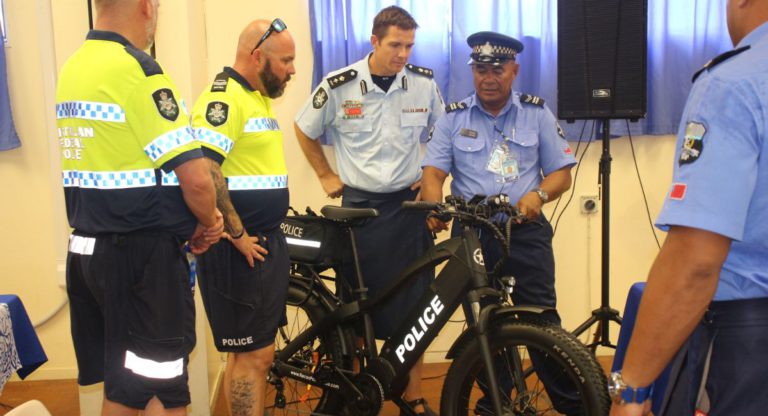
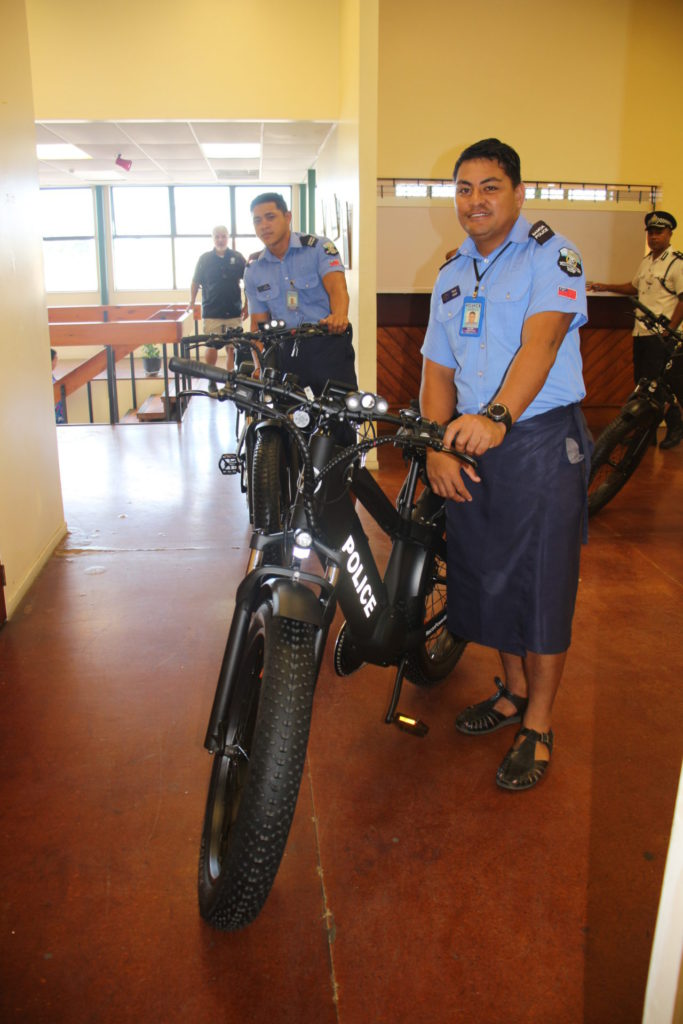
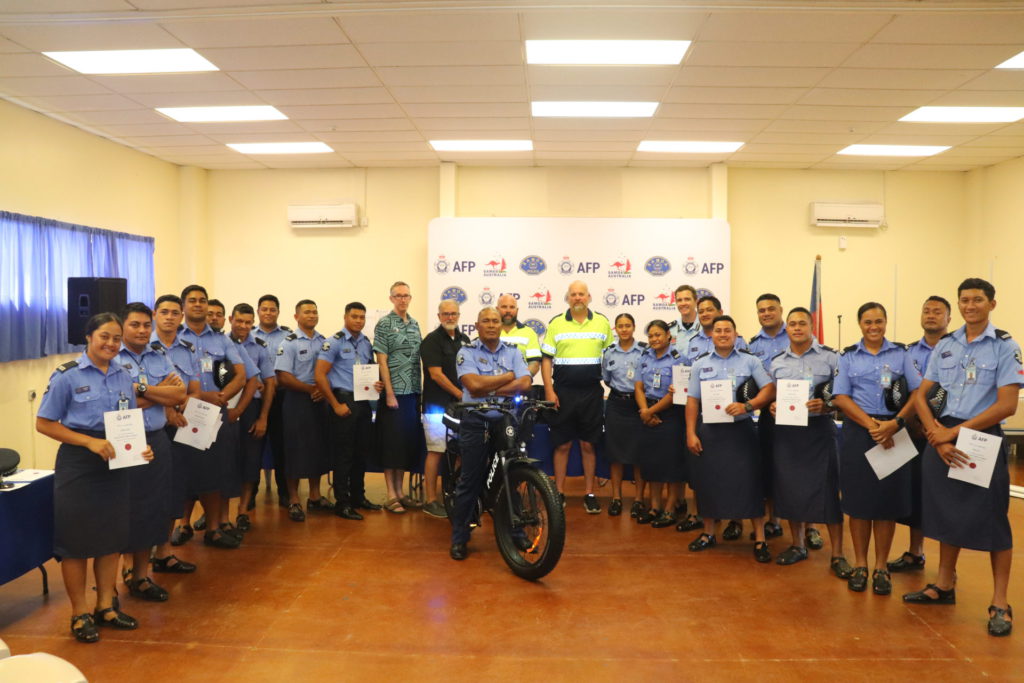
The AFP has donated eight electronic bikes (e-bikes) and provided specialised bicycle training to Samoa Police, Prisons and Corrections Services (SPPCS), giving Samoan police another tool to keep their communities safe.
The AFP, through the Samoa Australia Police Partnership (SAPP), has handed over the e-bikes in preparation for Samoa to host the Commonwealth Heads of Government Meeting (CHOGM) in October next year.
Image: AFP donates e-bikes to Samoa Police (Source: AFP)
AFP Detective Superintendent Daniel Evans said it was a privilege for the AFP to deliver the training to ensure officers could get the most out of the e-bikes.
“The AFP has delivered the e-bikes and training to an extremely dedicated police unit who are always out on the road working diligently to keep Samoa safe,” Detective Superintendent Evans said.
“The AFP will continue to work closely with Samoan police to boost capability for events like CHOGM next year, but also beyond.”
Image: AFP donates e-bikes to Samoa Police (Source: AFP)
Detective Superintendent Evans added:
“The AFP is entrusted by our Pacific partners to deliver training but these partnerships are truly symbiotic. We learn so much from our Pacific policing family and we are grateful for their continued partnership.”
SPPCS Commissioner Auapaau Logoitino Filipo said he was grateful for the partnership with the AFP and Australian Government.
“This is an historic moment for the Samoa Police Service, and I am very proud of all the officers who have graduated from the training course,” Commissioner Filipo said.
Image: AFP donates e-bikes to Samoa Police (Source: AFP)
SPPCS Commissioner Auapaau Logoitino Filipo further observed:
“The training and e-bikes will greatly assist the Ministry of Police and Corrections with its preparations for the CHOGM meeting next year as well as improve the standard of our service delivery on a daily basis.”
The e-bikes are the first in Samoa and are fitted with policing lights and service bags. The e-bikes give officers the opportunity to proactively patrol their communities and will allow them to visit more remote areas not accessible by cars.
Image: AFP donates e-bikes to Samoa Police (Source: AFP)
The AFP’s Learning and Development Command Driver Training Team also delivered three Bicycle Patrol Operations Programs to 16 police officers, including a train-the-trainer program so Samoan police can now take the skills they have learnt and train others, including other Pacific police forces.
Samoa Police is now exploring how the e-bikes can be used to patrol communities on remote islands that don’t have police stations, roads, or cars.
Support Our Journalism
Global Indian Diaspora needs fair, non-hyphenated, and questioning journalism, packed with on-ground reporting. The Australia Today – with exceptional reporters, columnists, and editors – is doing just that. Sustaining this needs support from wonderful readers like you.
Whether you live in Australia, the United Kingdom, Canada, the United States of America, or India you can take a paid subscription by clicking Patreon. Buy an annual ‘The Australia Today Membership’ to support independent journalism and get special benefits.
Parents may be familiar with this scenario: a child is well-behaved at school and polite to their teachers but has a meltdown at home in the afternoon.
Or they say please and thank you at a friend’s house but are rude to their family. They follow the rules if they visit a neighbour but have to be constantly reminded about not slamming doors and raiding the pantry at home.
Why is this so? And is there anything you can do about it?
Children learn early their behaviour matters
Even well-behaved children misbehave from time to time.
When young children get tired, such as after a play date or a long day at daycare or school, they can become irritable and disruptive. Children are also naturally curious and may misbehave sometimes just to see what happens.
However, some children seem to behave consistently worse at home than with other people. To understand this phenomenon, it’s necessary to understand why children behave the way they do.
From the very beginning, a child’s behaviour produces results or outcomes. For example, babies soon learn crying is a very effective way of signalling they are in distress. Parents quickly learn to change a wet nappy or feed their infant when they cry. A smile often results in an adult smiling back, cooing or cuddling the baby.
Children’s behaviour, whether desirable or undesirable, is influenced by the consequences it produces.
Sometimes, the reactions of parents or siblings can accidentally reward misbehaviour, and children learn undesirable behaviour has a payoff.
For example, children may learn that when they don’t do as they’re told, they get extra attention from their parents. This attention may be reasoning, discussing, arguing, nagging or repeating instructions over and over. It may not be seen as a “reward” to adults, but children are getting more attention from mum or dad.
Children may also learn when they whine and complain for an electronic device they are more likely to get it.
Unfortunately, in this scenario, the child is rewarded for whining and the parent is rewarded for giving them the iPad because it stops a highly irritating noise (at least in the short term). As both the child and the parent are rewarded, this interaction is likely to occur again.
Why are kids better at school?
When children are with less familiar people, they do not know how others will respond or what behaviour will result in a payoff. In these circumstances it is common for there to be less undesirable behaviour, at least temporarily.
Children can also behave better at school than at home because teachers have very good systems in place. Children are kept busy with a variety of engaging activities, expectations of children’s behaviour are clear, and the payoff for desirable behaviour is reliable. Teachers are well practised at recognising and rewarding desirable behaviour through attention, praise and sometimes token reward systems.
How can parents help kids to behave better at home?
The good news is if children behave well in one setting, we know they are capable of doing the same at home.
Parents can value children’s need to relax at home while still expecting them to be polite and follow rules. By making some small changes, it’s usually possible to see much improved behaviour.
Here are some practical things parents can do:
establish routines. Have a routine for when your child gets home from school or outings. This might include allowing your child to unwind and relax, giving them a healthy snack, and then setting them up with an engaging activity. Routines make it easier for everyone to transition from one setting to another. It is even better if the routine includes activities – such as colouring-in or a run around outside – that are calming or burn off energy.
set simple house rules. Have a few simple rules that clearly communicate to your child how you expect them to behave. For example: “use an inside voice” or “keep the toys on the floor”.
notice good behaviour. Let your child know when they have done the right thing. Do this by describing what you are pleased with (“you two are sharing the toy so nicely”). This will make it more likely the behaviour will occur again.
spend small amounts of time with your child regularly. This is especially important when your child approaches you for help or attention. It shows you’re there for them and they do not need to become louder or act out to get your attention. Spending small amounts of time – as little as one or two minutes – often throughout the day is a powerful way of strengthening your relationship with your child and preventing problem behaviour.
have realistic expectations. Change is easier if you focus on one or two goals at a time. Also, when striving to improve behaviour, expect occasional setbacks. No child (or parent) is perfect!
Global Indian Diaspora needs fair, non-hyphenated, and questioning journalism, packed with on-ground reporting. The Australia Today – with exceptional reporters, columnists, and editors – is doing just that. Sustaining this needs support from wonderful readers like you.
Whether you live in Australia, the United Kingdom, Canada, the United States of America, or India you can take a paid subscription by clicking Patreon. Buy an annual ‘The Australia Today Membership’ to support independent journalism and get special benefits.
Jidoka Technologies, a leader in the automated cognitive inspection space, has taken a bold step towards expanding its international reach by venturing into the Australian and New Zealand markets.
This strategic move is facilitated through a partnership with Emertel Indo-Pacific, a prominent B2B Go-To-Market (GTM) acceleration company based in Melbourne. The alliance is poised to revolutionise quality control in manufacturing across these regions, showcasing Jidoka’s commitment to global expansion and Emertel’s GTM prowess.
By providing AI-driven quality inspection solutions, Jidoka Technologies addresses the subjective nature of visual quality assessment in manufacturing. Their solutions, powered by artificial intelligence, enhance the accuracy and consistency of quality inspections at impressive speeds.
The collaboration with Emertel Indo-Pacific means that Jidoka’s innovative technologies, including deep learning algorithms and advanced image augmentation, will now support the manufacturing sector in Australia and New Zealand, enhancing efficiency and productivity.
The CEO and Co-founder of Jidoka Technologies, Sekar Udayamurthy, expressed delight over the partnership, emphasising the potential impact of their solutions on the ANZ region’s manufacturing landscape.
“We are indeed delighted to announce our partnership with Emertel Indo-Pacific and expansion into the Australian and New Zealand markets.”
“Our AI-driven quality inspection solutions are leveraged across the manufacturing sector in other regions across the globe and we look forward to bringing these innovative solutions to the benefit of the manufacturers in the ANZ region as well,”
said Mr Udayamurthy.
He further added, “We are confident these customised solutions will maximize value creation on the shopfloors for manufacturers in Australia and New Zealand and build a strong presence in the region.”
AI-powered quality control manufacturing1; Image Source CANVA
Udayamurthy’s optimism is mirrored by Sundar Iyer, Managing Director of Emertel Indo-Pacific, who regards Jidoka’s technologies as transformative for the efficiency of automated cognitive inspection in the manufacturing domain.
“Australian and New Zealand manufacturers, across verticals, are seeking to leverage the power of AI and automation to eliminate waste and enhance safety.
We are pleased to apply Emertel’s growth enablement and execution expertise to help Jidoka accelerate their market traction in the region, commencing with market testing and localisation with early adopters.”
With an already established global presence, Jidoka Technologies brings to the table cutting-edge solutions that have been adopted in various industries, including automotive, FMCG, pharmaceuticals, and electronics, to name a few. The company’s technological prowess is evident in its ability to handle over 10,000 inferences per minute, a testament to its scalable architecture.
Image Source: Handout/ Supplied
On the other side of the partnership, Emertel stands as a gateway for innovative scale-ups from the United States, Israel, India, and the European Union aiming to penetrate the Indo-Pacific market. Their expertise in GTM acceleration is crucial for Jidoka’s successful introduction to the manufacturing sectors of Australia and New Zealand.
As manufacturers in these countries continuously strive for excellence, the demand for advanced quality inspection solutions has surged. Jidoka and Emertel’s joint efforts will cater to this demand by offering solutions that promise over 99% accuracy for cognitive quality inspection. Moreover, the technology reduces the defect detection rate and minimises false positives, thereby bolstering the overall efficiency of the quality inspection process.
Jidoka Technologies, founded in 2018 by technology leaders Sekar Udayamurthy, Dr. Krishna Iyengar, and Vinodh Venkatesan, has emerged as a notable entity in automated cognitive inspection. The company is also recognised as one of the three winners in Cohort 7 of the Maruti Suzuki MAIL (Mobility and Automobile Innovation Lab) Program for startups. Beyond India, Jidoka has made strides in Europe and inaugurated its operations in the United States, with an ‘Experience Center’ in Dallas.
Emertel, founded by emerging technology commercialisation expert Sundar Iyer in 2016, brings over 250 years of collective experience in B2B commercialisation, covering product, market, and business development.
AI-powered quality control manufacturing; Image Source CANVA
The company’s approach prioritises learning, relationships, and the creation of shared value for all stakeholders, operating from a strong base in Melbourne, Australia.
Support Our Journalism
Global Indian Diaspora needs fair, non-hyphenated, and questioning journalism, packed with on-ground reporting. The Australia Today – with exceptional reporters, columnists, and editors – is doing just that. Sustaining this needs support from wonderful readers like you.
Whether you live in Australia, the United Kingdom, Canada, the United States of America, or India you can take a paid subscription by clicking Patreon. Buy an annual ‘The Australia Today Membership’ to support independent journalism and get special benefits.
In an exclusive interview with The Australia Today NSW Treasurer Daniel Mookhey spoke about steps he has undertaken to address the cost of living issue with Consumer Price Index in NSW hovering around 6.5% in June 2023 according to the NSW Treasury.
He also spoke about his own journey into politics. Treasurer Mookhey was the first politician anywhere in Australia to take his oath of office on the Bhagavad Gita. He is also the first person of Indian origin to become Treasurer in any Parliament of Australia.
Emphasising on the important contribution of the Indian diaspora, he said that diaspora here is the envy of other countries, when it comes to engaging with India. He mentioned that the AI-ECTA Free Trade agreement has been a game changer and stressed on the overall importance of the Australia-India bilateral relationship.
On a lighter note he also spoke about his Puri making skills given Diwali festivities.
Catch Treasurer Daniel Mookhey’s full interview with Pallavi Jain here:
Support Our Journalism
Global Indian Diaspora needs fair, non-hyphenated, and questioning journalism, packed with on-ground reporting. The Australia Today – with exceptional reporters, columnists, and editors – is doing just that. Sustaining this needs support from wonderful readers like you.
Whether you live in Australia, the United Kingdom, Canada, the United States of America, or India you can take a paid subscription by clicking Patreon. Buy an annual ‘The Australia Today Membership’ to support independent journalism and get special benefits.
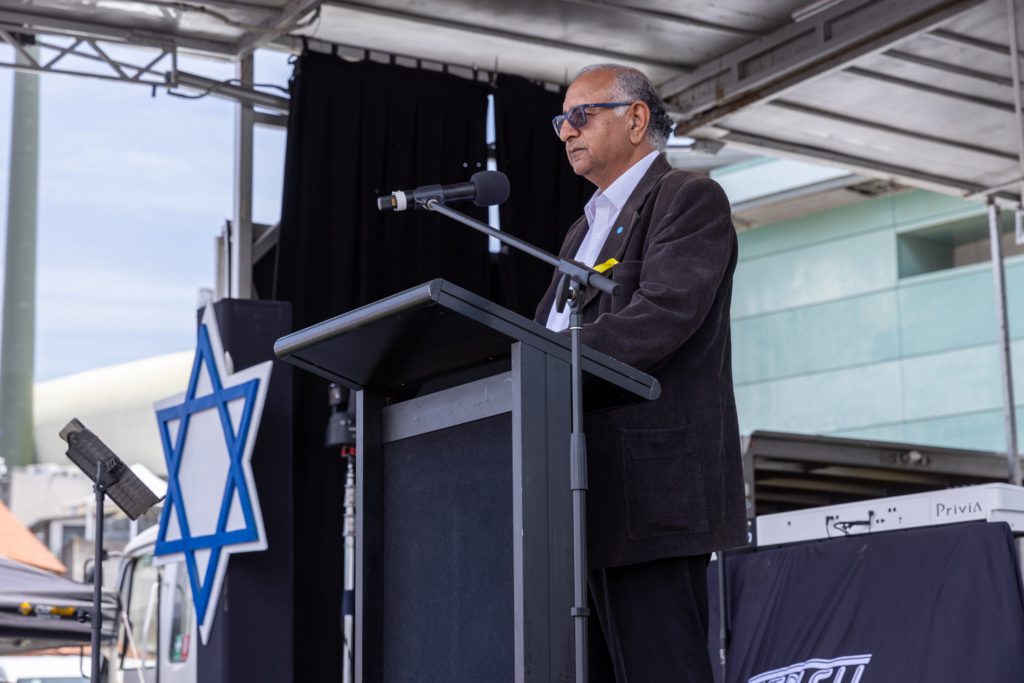
In response to the tragic October 7 attack in Israel by Hamas terrorists, over 5000 people from diverse communities gathered in Sydney, organised by the NSW Jewish Board of Deputies and the Executive Council of Australian Jewry. This vigil honoured the 1400 lives lost from over 40 countries.
Leaders from various backgrounds, including Surinder Jain of the Hindu Council of Australia and Andrew Mencinsky from the Ukrainian Council of NSW, spoke passionately about solidarity and peace. A symbolic act saw six multicultural community leaders pin yellow ribbons on a Magen David, uniting different communities in support of Israel and the Jewish people.
Surinder Jain, Vice President Hindu Council of Australia (Image: Cameron Clegg)
Representatives from Sydney’s multicultural communities included, Tica Lee from the Chinese Australian Services Society, Teresa Pirola of Catholic Religious Australia, Hermiz Shahen of the Assyrian National Council of Australia, Khaleda Alrubaie as the Iraqi representative, Panayiotis Daimides from the Australian Hellenic Education Progressive Association of NSW, and Daniel Gobena of the African Australian Advocacy Centre.
L to R Surinder Jain, Vice President Hindu Council of Australia, Dr Nihal Agar, former President Hindu Council of Australia, Panayiotis Diamadis Australian Hellenic Education Progressive Association of NSW (Image: Cameron Clegg)
These leaders stood together, showcasing the multicultural support against terrorism. The event underlined the need for global unity against groups like Hamas and ISIS, emphasising peace over violence.
This gathering was more than a vigil; it was a firm statement against terror and a collective call for peace and humanity. The message was clear: in the face of terror, unity and solidarity are our strongest weapons.
Support Our Journalism
Global Indian Diaspora needs fair, non-hyphenated, and questioning journalism, packed with on-ground reporting. The Australia Today – with exceptional reporters, columnists, and editors – is doing just that. Sustaining this needs support from wonderful readers like you.
Whether you live in Australia, the United Kingdom, Canada, the United States of America, or India you can take a paid subscription by clicking Patreon. Buy an annual ‘The Australia Today Membership’ to support independent journalism and get special benefits.
India maintained their winning streak in the league stage after beating the Netherlands by 160 runs in the 45th match of the ODI World Cup at M. Chinnaswamy Stadium in Bengaluru on Sunday.
After India’s stellar performance in the first inning, the ‘Men in Blue’ bowling was successful in defending the 411-run target. Meanwhile, the ‘Men in Blue’ saw a change in their bowling attack as Shubman Gill, Suryakumar Yadav, Virat Kohli and Rohit Sharma took charge in the second inning.
Following the 160-run win in Bengaluru, India registered its longest winning streak in World Cup history after staying unbeaten in 9 consecutive matches. Outdoing their 8-match winning streak in the 2003 World Cup.
Mohammed Siraj made the first breakthrough for India after he dismissed Wesley Barresi in 1.3 overs for four runs (NED 5-1).
At the end of the first powerplay in 10 overs, Netherlands was at 62/1. Kuldeep Yadav bagged his first wicket of the game after defeating Colin Ackermann for 35 runs in the 12.1 overs (NED 66-2).
Jadeja picked up India’s third wicket after he removed Max ODowd for 30 runs in 15.1 overs (NED 72-3).
The Dutch side reached the 100-run mark in the 23.2 overs. Dutch skipper Scott Edwards had to leave the crease after Virat Kohli dismissed him in the 24.3 overs for 17 runs (NED 111-4).
Bumrah bagged his first wicket of the game after removing Bas de Leede for 12 runs in the 31.6 overs (NED 144-5).
Siraj took Sybrand Engelbrecht’s wicket in the 37.3 overs for 45 overs. Engelbrecht was the second-highest run scorer for the Dutch side in the second inning (NED 172-6).
The Netherlands reached the 200-run mark in 40.6 overs. Logan van Beek was dismissed by Kuldeep in the 42.1 overs for 16 runs (NED 208-7).
Jadeja bagged his second wicket of the game after dismissing Roelof van der Merwe in the 43.4 overs for 16 runs (NED 225-8).
Bumrah dismissed Aryan Dutt in the 46.1 overs for 5 runs (NED 236-9). Rohit Sharma took the wicket of the game as he dismissed Teja Nidamanuru for 54 runs in the 47.56 overs (NED 250-10).
Coming to India’s bowling attack, Jasprit Bumrah, Mohammed Siraj, Kuldeep Yadav, and Ravindra Jadeja bagged two wickets each in their respective spell. On the other hand, Virat Kohli and Rohit Sharma picked up one wicket each against Netherlands.
After winning the toss, Rohit and Gill opened for the ‘Men in Blue’ and played a solid partnership of 100-run to give an early advantage to the host country.
At the end of the first powerplay in 10 overs, India was at 91/0 with Rohit Sharma and Shubman Gill on the crease.
‘Men in Blue’ reached the 100-run mark in the 11.4 overs. Gill’s inning came to an end after van Meekeren bagged his wicket in the 11.5 overs for 51 runs. Gill smashed three fours and fours sixes (IND 100-1).
Indian skipper Rohit had to leave the crease after Bas de Leede took his wicket in the 17.4 overs for 61 runs. He smashed eight fours and two sixes on Sunday (IND 129-2). India reached the 150-run mark in the 21.3 overs.
Virat Kohli came to the crease in the 11.5 over after Shubman Gill was dismissed by van Meekeren. Kohli started off well and smashed his 71st ODI half-century in 53 balls, with five fours and one six.
However, Kohli’s inning came to an end after van der Merwe bagged his wicket in the 28.4 overs for 51 runs. Kohli hit three fours and fours sixes against the Dutch side (IND 200-3).
India reached the 200-run mark in the 28.3 overs. In the second powerplay after the end of 40 overs, India scored 193 runs. While the Dutch bowling attack picked up three wickets.
The host country crossed the 300-run mark in the 41.4 overs. KL Rahul made his century in the 49.2 overs after smashing a six. Rahul made the fastest century for India in World Cups with just 62 balls.
India crossed the 400-run mark in the 49.2 overs. In the 49.5 overs, de Leede removed KL Rahul for 102 runs from 64 balls. He smashed 11 fours and four sixes (IND 408-4).
The Dutch bowling attack displayed a disappointing performance after they failed to keep a check on India’s run rate. Logan van Beek has been expensive in the first inning after he gifted 107 runs in his 10-over spell. Bas de Leede picked up two wickets in his spell. While Paul van Meekeren and Roelof van der Merwe scalped one wicket each.
Shreyas Iyer was named the ‘Player of the Match’ against the Netherlands.
Brief score: India: Shreyas Iyer 128*(94), KL Rahul 102(64), Rohit Sharma 61 (54); Bas de Leede 2/82, Van der Merwe 1/53, Van Meekeren 1/90 vs Netherlands: Teja Nidamanuru 54(39), Sybrand Engelbrecht 45(80), Colin Ackermann 35(32); Mohammed Siraj 2/29, Jasprit Bumrah 2/33, Kuldeep Yadav 2/41.
Support Our Journalism
Global Indian Diaspora needs fair, non-hyphenated, and questioning journalism, packed with on-ground reporting. The Australia Today – with exceptional reporters, columnists, and editors – is doing just that. Sustaining this needs support from wonderful readers like you.
Whether you live in Australia, the United Kingdom, Canada, the United States of America, or India you can take a paid subscription by clicking Patreon. Buy an annual ‘The Australia Today Membership’ to support independent journalism and get special benefits.
For many years, I have been calling for the Australian government – along with other governments – to play its part in assisting Pacific communities affected by the adverse impacts of climate change and disasters.
Our region is already experiencing some of the most drastic effects of climate change. Pacific communities are showing enormous innovation and resilience in the face of these challenges, but as a matter of international solidarity and climate justice, additional support and cooperation is needed.
One way of providing assistance is by creating migration pathways for people who wish to move. Australia’s recent Pacific Engagement Visa is one such example – enabling up to 3,000 workers and their families from the Pacific and Timor-Leste to migrate permanently to Australia each year.
Based on the principles of “neighbourliness, care and mutual respect”, the treaty is a result of a request by Tuvalu for Australia to support and assist its efforts on climate change, security and human mobility.
According to Australian Prime Minister Anthony Albanese, “developed nations have a responsibility to provide assistance” to countries like Tuvalu that are deeply impacted by climate change.
Under the treaty, Australia will implement a special visa arrangement to allow Tuvaluans to work, study and live in Australia. This is not a refugee visa, but rather will allow up to 280 Tuvaluans (from a population of around 11,200) to migrate to Australia each year – presumably on a permanent basis.
They will be able to access Australian education, health care, and income and family support on arrival. This is a welcome development that will provide people with both legal and psychological security. Despite longstanding “promises” that Australia would not sit by as disasters continue to affect the Pacific, this program provides the long-awaited security that many have wanted.
Historically, most Pacific visa programs in Australia (and the region) have been tied to labour mobility. And none has specifically referenced climate change as a driving rationale. In contrast, the measures announced this week are deliberately framed in the context of climate change and – furthermore – are not tied purely to work.
Indeed, it remains to be seen just how far the special visas may extend. Beyond “work” and “study”, the treaty says Tuvaluans can also come to Australia to “live”. This implies the visa may potentially provide a humanitarian pathway for people who want – or need – to move. This would include older people, who would not qualify for existing Pacific labour migration programs.
Despite the threats posed by climate change, however, most Pacific peoples do not want to leave their homes. Being dislocated from home is one of the greatest forms of cultural, social and economic loss people can suffer. It can often lead to inter-generational trauma.
The treaty itself recognises Tuvaluans’ “deep, ancestral connections to land and sea”, and pledges Australia will work with Tuvalu to help people “stay in their homes with safety and dignity”. At the same time, people want to know they have safe options to move if they need to – with dignity and choice.
How novel is the new treaty?
While there are other programs in the Pacific that facilitate mobility, this is the first to do so specifically in the context of climate change. It also operates differently from arrangements implemented by New Zealand and the United States.
As part of the “realm” of New Zealand, for instance, people from the countries of Niue, Tokelau and Cook Islands are considered New Zealand citizens, so they have the right to move there if they wish.
The United States, meanwhile, has compacts of free association with the Marshall Islands, Federated States of Micronesia and Palau, which enable eligible citizens to enter the US visa-free and live and work there indefinitely. However, those migrants do not have access to many government benefits and can easily fall through the cracks.
Last year, Argentina announced a special humanitarian visa program for people displaced from 23 countries in Latin America and the Caribbean due to disasters. Unlike the Australia–Tuvalu treaty, which allows for migration in anticipation of climate-related disasters, access to the Argentinian program is only available after displacement has occurred. As yet, no one has used the scheme.
For at least two decades, Pacific governments have made perennial requests for special visa pathways or relocation to Australia for their citizens.
In 2019, former Prime Minister Kevin Rudd proposed that Australia accept people from Tuvalu and other Pacific countries on account of projected climate impacts – but in exchange for “their territorial seas, their vast exclusive economic zones, including the preservation of their precious fisheries reserves”.
He was shot down by the then-prime minister of Tuvalu, Enele Sopoaga, who labelled it “imperial thinking”.
What could come next?
Last week, Pacific Leaders endorsed a world-first Pacific framework on climate mobility, which has gone relatively unnoticed, despite the Australia–Tuvalu announcement.
I had the privilege of working and consulting with Pacific governments and communities to draft the early versions of the framework. It will hopefully inspire the creation of further visa arrangements and other concrete mobility mechanisms to ensure Pacific peoples have dignified pathways to move when they wish, as well as support and assistance to remain in place when possible.
Earlier this year, Samoan Prime Minister Fiame Naomi Mata’afa suggested the Pacific could create a European Union-like entity, “based on cooperation and integration”, that would enable free movement across the region.
If enacted, it would follow a similar agreement signed by leaders in eastern Africa that specifically allows people in that region to cross borders in anticipation of or in response to disasters.
Though this is still a long way off in the Pacific, the agreement between Australia and Tuvalu could help pave the way for similar mobility pathways across the region and – ultimately – a broader regional scheme. If, and when, that time comes, the choice, agency and dignity of affected communities must be front and centre.
Jane McAdam, Scientia Professor and Director of the Kaldor Centre for International Refugee Law, UNSW Sydney
Global Indian Diaspora needs fair, non-hyphenated, and questioning journalism, packed with on-ground reporting. The Australia Today – with exceptional reporters, columnists, and editors – is doing just that. Sustaining this needs support from wonderful readers like you.
Whether you live in Australia, the United Kingdom, Canada, the United States of America, or India you can take a paid subscription by clicking Patreon. Buy an annual ‘The Australia Today Membership’ to support independent journalism and get special benefits.
The Grace Road business empire set up by a South Korean Christian group within a short span of 9 years has impressed many in Fiji, but they have also attracted controversy due to the Korean government’s ongoing investigations against the church and their desire to get their leaders exiled in Fiji back home to face charges and possible prison terms.
It was reported recently that Grace Road President Daniel Kim’s application for Fijian citizenship has been rejected and he remains in custody while the case on whether to deport him back to Korea continues.
Grace Road was founded as a religious group by a woman named Shin Ok-ju, and began their operation by setting up churches and business chains in Fiji in 2014 during the reign of the former Prime Minister Voreqe Bainimarama.
Image: Ok-Joo Shin, head pastor of the Grace Road Church, is shown allegedly striking a person in this image (Video screenshot source from Seoul Broadcasting Service)
Grace Road established a church and a business, primarily focused on agriculture and exporting products like organic ginger and paprika, promising their followers a better life and urging them to move to Fiji for a supposed “promised land.”
Close to 400 South Koreans arrived working in their Grace Road chain, it was not till 2018 that their founder Shin Ok-ju was allegedly accused of exploitation and abuse by holding followers captive in Fiji and subjecting them to violence.
Shin Ok-ju was arrested in South Korea upon her return and sentenced to prison on charges of violence and brainwashing.
Circulation of videos showed her beating followers and cutting off their hair saying “knocking the devil out of them “.
However, behind the scenes, reports started emerging about the group’s allegedly abusive practices and its leader’s authoritarian control over its members, where people who joined were reportedly subjected to strict rules, isolation, and forced labour.
However, this did not bring an end to Grace Road in Fiji. It is believed the group’s close ties with the previous government led by Prime Minister Bainimarama shielded their existence here.
But, there is the unending saga of human rights violations, as the Grace Road group started getting labelled as a religious “Cult”.
In 2018, the Fijian authorities began investigating Grace Road and its activities. But it was not until the fall of the Bainimarama government in December 2022 that court cases against the church became very public.
Image: Daniel Kim (Source: FBC screenshot)
The investigations have uncovered distressing stories of members enduring abuse and forced labour, with its leader Daniel Kim, facing allegations of being involved in these activities.
As a result, Kim and several other members of Grace Road were arrested and faced charges related to human trafficking, physical harm, and other offences. The Fijian courts took the case seriously, aiming to hold those responsible accountable for their actions.
The case brought international attention and raised concerns about the influence of religious groups and the protection of human rights in different parts of the world. It’s a reminder of the importance of upholding human rights and ensuring that vulnerable individuals are protected from exploitation and abuse, regardless of where they are in the world.
Kim, who was evading authorities after the Korean Government invalidated his passport making him a “Fugitive wanted for Prosecution”. The Fijian Government claimed that they were struggling to locate him as Kim was on the run.
Minister for Immigration Pio Tikoduadua, recently revealed that the Korean Government had nullified the passports of these individuals due to charges laid against them and the Interpol had issued Red Notices in July 2018, labeling them as fugitives wanted for prosecution.
However, the previous government under Bainimarama did not act on these notices.
Using his authority under the Immigration Act, Minister Tikoduadua declared these individuals as Prohibited Immigrants, making their stay in Fiji unlawful with a task force initiated to remove them, resulting in the successful apprehension of four individuals: Acting Grace Road President Sung Jin Lee, Nam Suk Choi, Byeong Joon Lee, and Beomseop Shin.
However, Fiji Airways declined to transport Sung Jin Lee and Nam Suk Choi due to a court order where legal processes were in motion for review in Fiji.
Meanwhile, Byeong Joon Lee and Beomseop Shin left Fiji for Singapore under proper escort.
The Ministry of Home Affairs and Immigration had considered legal options, considering the Interpol Red Notice, despite the absence of an extradition treaty between Fiji and Korea
The Ministry remained committed to monitoring and addressing this complex situation within the bounds of legal procedures.
The previous Attorney General, Aiyaz Sayed-Khaiyum under the Bainimarama government, clarified saying Grace Road Group President Kim couldn’t be sent to South Korea in 2018 when his passport was invalidated due to a court order that prevented his departure.
Tikoduadua, had previously highlighted that these critical matters were overlooked by the former government.
Sayed-Khaiyum explained outside the court that the Fijian courts had issued a stop order in 2018, emphasizing the need to adhere to it and restrict their departure.
Addressing questions regarding the South Korean government’s decision and Interpol’s declaration of Kim as a fugitive, Sayed-Khaiyum noted that anyone can label someone as anything, underscoring the complexity of the situation. Thus, he said, the government followed court orders.
Image: Fiji’s former Prime Minister Voreqe Bainimarama and Attorney General, Aiyaz Sayed-Khaiyum (Source: FBC screenshot)
Grace Road businesses spanning from rice farms and mills to retail, restaurants, and barber saloons employ thousands of local staff. They united to present a signed petition to the Ministry of Immigration, urging for the release of their President, Kim who was held in immigration custody due to the nullification of his passport.
Accompanied by about 10 Grace Road staff and Kim’s family, they handed over the petition to the Minister for Immigration’s Personal Secretary demanding local voices to be heard.
Kelera Delai, a staff representative, conveyed their concern that the smooth operation of their business could be compromised without their President by their side.
Delai emphasised that while no one had been coerced to sign the petition, they felt it was essential not just for themselves but also for their fellow Grace Road family members.
Many viewed this act as locals were threatened for their employment and were used to take the petition to the Minister of Immigration office as it might carry weight for the release of their president Kim.
Grace Road has also initiated a protest campaign under hashtag #Justice for Grace claiming religious persecution in Fiji. Many of their staff wear t-shirts bearing this hashtag.
But the Fijian government says they are not acting out of their own interest; instead, it was on the directive of the Korean Government and a request by Interpol where 7 executives were declared prohibited immigrants.
Meanwhile, the Grace Road saga continues in the legal arms of the country and the Grace Road business continues scooping gains out of Fiji.
This article was first published in Wansolwara and has been republished here with the kind permission of the author(s)/editor(s).
Contributing Author: Rohit Kumar is a final year journalism student at The University of the South Pacific (USP).
Support Our Journalism
Global Indian Diaspora needs fair, non-hyphenated, and questioning journalism, packed with on-ground reporting. The Australia Today – with exceptional reporters, columnists, and editors – is doing just that. Sustaining this needs support from wonderful readers like you.
Whether you live in Australia, the United Kingdom, Canada, the United States of America, or India you can take a paid subscription by clicking Patreon. Buy an annual ‘The Australia Today Membership’ to support independent journalism and get special benefits.
AFP and Tasmania Police (TasPol) officers conducted a routine baggage check at Hobart Airport on Thursday morning (9 November, 2023) and allegedly identified a large amount of cash concealed inside the man’s checked luggage.
It is alleged the cash, in excess of $150,000, was hidden inside a green supermarket shopping bag within the check-in luggage.
Police then discovered another bundle of cash concealed within the lining of the bag.
AFP officers located and arrested the man, 38, within the terminal after he was allegedly unable to provide sufficient information regarding why he was travelling with the significant amount of money.
Police seized the cash, believed to be the proceeds of crime.
Image: Sydney man arrested at Hobart Airport (Source: AFP)
AFP Detective Sergeant Aaron Hardcastle said the AFP worked closely with Tasmania Police and Hobart Airport to ensure domestic and international flights were not used as transit routes for criminal and illicit activities.
“The AFP, together with Tasmania Police and our law enforcement partners across Australia, will continue to keep a watchful eye across our airports and borders,” Det Sergeant Hardcastle said.
“We will continue to ensure all airports remain a hostile environment for criminal syndicates to prevent their illicit activities.
“This arrest should serve as a serious warning to anyone attempting to travel across our country with large and suspicious amounts of cash – the AFP will target and identify you, seizing your alleged illicit wealth and bring you to justice.”
Commander Ian Whish-Wilson from Tasmania Police’s Crime and Intelligence Command said police conduct ongoing screening at air and sea ports to make these entry and exit points as hostile as possible for any criminal activity.
Commander Whish-Wilson said:
“We’ll continue to work closely with our law enforcement partners to ensure criminals aren’t profiting from illegal activity in Tasmania.”
The Alexandria man was charged with one count of dealing with property reasonably suspected of being proceeds of crime, contrary to section 400.9(1) of the Criminal Code Act 1995 (Cth).
The maximum penalty for this offence is three years’ imprisonment.
The man is expected to face the Hobart Magistrates Court today (9 November, 2023).
Support Our Journalism
Global Indian Diaspora needs fair, non-hyphenated, and questioning journalism, packed with on-ground reporting. The Australia Today – with exceptional reporters, columnists, and editors – is doing just that. Sustaining this needs support from wonderful readers like you.
Whether you live in Australia, the United Kingdom, Canada, the United States of America, or India you can take a paid subscription by clicking Patreon. Buy an annual ‘The Australia Today Membership’ to support independent journalism and get special benefits.
If you are a woman around 50, you might have seen advice on social media or from influencers telling you protein requirements increase dramatically in midlife. Such recommendations suggest a 70 kilogram woman needs around 150 grams of protein each day. That’s the equivalent of 25 boiled eggs at 6 grams of protein each.
Can that be right? Firstly let’s have a look at what protein is and where you get it.
Protein is an essential macro-nutrient in our diet. It provides us with energy and is used to repair and make muscle, bones, soft tissues and hormones and enzymes. Mostly we associate animal foods (dairy, meat and eggs) as being rich in protein. Plant foods such as bread, grains and legumes provide valuable sources of protein too.
But what happens to our requirements as we get older?
Ages and stages
Protein requirements change through different life stages. This reflects changes in growth, especially from babies through to young adulthood. The estimated average requirements by age are:
1.43g protein per kg of body weight at birth
1.6g per kg of body weight at 6–12 months (when protein requirements are at their highest point)
protein needs decline from 0.92g down to 0.62g per kg of body weight from 6–18 years.
When we reach adulthood, protein requirements differ for men and women, which reflects the higher muscle mass in men compared to women:
0.68g per kg of body weight for men
0.6g per kg of body weight for women.
Australian recommendations for people over 70 reflect the increased need for tissue repair and muscle maintenance:
0.86g per kg of bodyweight for men
0.75g per kg of bodyweight for women.
For a 70kg man this is a difference of 12.6g/protein per day. For a 70kg woman this is an increase of 10.5g per day. You can add 10g of protein by consuming an extra 300ml milk, 60g cheese, 35g chicken, 140g lentils, or 3–4 slices of bread.
There is emerging evidence higher intakes for people over 70 (up to 0.94–1.3g per kg of bodyweight per day) might reduce age-related decline in muscle mass (known as sarcopenia). But this must be accompanied with increased resistance-based exercise, such as using weights or stretchy bands. As yet these have not been included in any national nutrient guidelines.
But what about in midlife?
So, part of a push for higher protein in midlife might be due to wanting to prevent age-related muscle loss. And it might also be part of a common desire to prevent weight gain that may come with hormonal changes.
There have been relatively few studies specifically looking at protein intake in middle-aged women. One large 2017 observational study (where researchers look for patterns in a population sample) of over 85,000 middle-aged nurses found higher intake of vegetable protein – but not animal protein or total protein – was linked to a lower incidence of early menopause.
In the same group of women another study found higher intake of vegetable protein was linked to a lower risk of frailty (meaning a lower risk of falls, disability, hospitalisation and death). Higher intake of animal protein was linked to higher risk of frailty, but total intake of protein had no impact.
Another smaller observational study of 103 postmenopausal women found higher lean muscle mass in middle-aged women with higher protein intake. Yet an intervention study (where researchers test out a specific change) showed no effect of higher protein intake on lean body mass in late post-menopasual women.
Some researchers are theorising that higher dietary protein intake, along with a reduction in kilojoules, could reduce weight gain in menopause. But this has not been tested in clinical trials.
Increasing protein intake, improves satiety (feeling full), which may be responsible for reducing body weight and maintaining muscle mass. The protein intake to improve satiety in studies has been about 1.0–1.6g per kg of bodyweight per day. However such studies have not been specific to middle-aged women, but across all ages and in both men and women.
What are we actually eating?
If we look at what the average daily intake of protein is, we can see 99% of Australians under the age of 70 meet their protein requirements from food. So most adults won’t need supplements.
Only 14% of men over 70 and 4% of women over 70 do not meet their estimated average protein requirements. This could be for many reasons, including a decline in overall health or an illness or injury which leads to reduced appetite, reduced ability to prepare foods for themselves and also the cost of animal sources of protein.
While they may benefit from increased protein from supplements, opting for a food-first approach is preferable. As well as being more familiar and delicious, it comes with other essential nutrients. For example, red meat also has iron and zinc in it, fish has omega-3 fats, and eggs have vitamin A and D, some iron and omega-3 fats and dairy has calcium.
So what should I do?
Symptoms of protein deficiency include muscle wasting, poor wound healing, oedema (fluid build-up) and anaemia (when blood doesn’t provide enough oxygen to cells). But the amount of protein in the average Australian diet means deficiency is rare. The Australian dietary guidelines provide information on the number of serves you need from each food group to achieve a balanced diet that will meet your nutrient requirements.
If you are concerned about your protein intake due to poor health, increased demand because of the sports you’re doing or because you are a vegan or vegetarian, talk to your GP or an accredited practising dietitian.
Global Indian Diaspora needs fair, non-hyphenated, and questioning journalism, packed with on-ground reporting. The Australia Today – with exceptional reporters, columnists, and editors – is doing just that. Sustaining this needs support from wonderful readers like you.
Whether you live in Australia, the United Kingdom, Canada, the United States of America, or India you can take a paid subscription by clicking Patreon. Buy an annual ‘The Australia Today Membership’ to support independent journalism and get special benefits.
Australia India Business Council (AIBC) recently celebrated Diwali in partnership with Cricket NSW at Cricket Central at Sydney Olympic Park.
The Hindu festival of lights (also known as Deepavali) is celebrated each year on the 15th Day of the ‘Kartik’ month (eight month according to the Hindu calendar) on Amavasya (new moon).
Diwali has now become a global festival with celebrations taking place around the world with the Indian diaspora and beyond partaking in the festivities. It is a celebration of the victory of good over evil, triumph of knowledge over ignorance.
The venue was decorated in traditional Indian marigold flowers and the food included Samosas and Rasmalai for the attendees.
The speakers at the event included HOC, CGI Sydney Sanjay Muluka, AIBC National Associate Chair, Irfan Malik, Chief Strategy Officer, Cricket NSW, Chris Muldoon, Parramatta Counsellor Sameer Pandey, NSW MP from Riverstone and NSW Parliamentary Friends of India, Warren Kirby, AIBC NSW Committee members Javed Khan and Poornima Menon.
The programme also included a beautiful dance performance by Hamsa Venkat’s Samskriti School of Dance.
Support Our Journalism
Global Indian Diaspora needs fair, non-hyphenated, and questioning journalism, packed with on-ground reporting. The Australia Today – with exceptional reporters, columnists, and editors – is doing just that. Sustaining this needs support from wonderful readers like you.
Whether you live in Australia, the United Kingdom, Canada, the United States of America, or India you can take a paid subscription by clicking Patreon. Buy an annual ‘The Australia Today Membership’ to support independent journalism and get special benefits.
An Indian-origin Victorian aged care worker has been convicted in the Geelong Magistrate’s Court after being found guilty of spending thousands of clients’ money on luxury items with their debit cards.
Geelong Advertiser reports that Ashpreet Kaur, 23 years old, was employed as a personal care worker at a Geelong retirement village until she stopped attending work at the end of February 2023.
Ms Kaur was found to have used the bank card of an 86-year-old resident to make almost $1,700 worth of purchases from David Jones and Myer.
The purchases included buying cosmetics and a watch worth $725 among other items.
The theft was flagged by the woman’s daughter who noticed suspicious transactions on her mother’s bank statement. The mother lives with Alzheimer’s disease.
It was also revealed that Ms Kaur stole the bank card of a 95-year-old resident.
In this incident, she made more than $5,000 worth of purchases. These included perfumes, beauty products, clothing, takeaway food, and money to top-up Myki card.
The woman became aware of the theft when she went to pay for a haircut.
All the purchases were delivered to Ms Kaur’s home address which was raided by police and some items recovered.
Victoria Police officers told the Geelong Magistrate’s Court that Ms Kaur initially denied any wrongdoing.
However after evidence was presented, she made a confession and pleaded guilty to two counts of theft and 11 counts of obtaining property by deception.
Geelong Advertiser notes that Magistrate John Bentley in his judgment observed that Ms Kaur’s actions were “as low as it gets” and “it’s a breach of trust from the most vulnerable members of society”.
Ms Kaur is in Australia on a student visa and has no previous convictions.
It is reported that her lawyer also presented a psychologist’s report to request the Magistrate to refrain from recording a conviction against Ms Kaur.
However, Magistrate Bentley said it was “much too serious” and said the only reason Ms Kaur was avoiding jail was that she could repay the money.
The Magistrate has given Ms Kaur a month to repay the stolen money ($7000) and also ordered her to complete 250 hours of community work as part of a 12-month Community Corrections Order (CCO).
The Aged Care Quality and Safety Commission has also banned Ms Kaur from aged care work for 10 years.
Support Our Journalism
Global Indian Diaspora needs fair, non-hyphenated, and questioning journalism, packed with on-ground reporting. The Australia Today – with exceptional reporters, columnists, and editors – is doing just that. Sustaining this needs support from wonderful readers like you.
Whether you live in Australia, the United Kingdom, Canada, the United States of America, or India you can take a paid subscription by clicking Patreon. Buy an annual ‘The Australia Today Membership’ to support independent journalism and get special benefits.
In an evening filled with light, music, and cultural reverence, Victorian Premier Jacinta Allan hosted a grand state reception to celebrate Diwali, the festival of lights, signifying the victory of light over darkness and good over evil.
The event, a vibrant display of multiculturalism and inclusivity, saw over 1200 attendees from the Hindu, Jain, and Sikh communities gather to partake in the festivities.
The ceremony began with the traditional lighting of the lamp, a symbolic act of inviting positivity and dispelling darkness. Premier Allan was joined in this inaugural act by notable figures including the Multicultural Minister Ingrid Stitt, Deputy Opposition leader David Southwick, Indian Consul General Sushil Kumar, and Hindu Council of Australia’s President Makrand Bhagwat among others.
The air was filled with a sense of communal harmony and reverence, as priests from the Shiva Vishnu Temple and Sri Durga Temple conducted a traditional Laxmi Ganesh pooja alongside the Premier, offering prayers for prosperity and well-being.
In a gesture that highlighted the interweaving of cultures, the president of the Hindu Council of Australia’s Victoria Chapter presented a copy of the Srimad Bhagavad Gita to Premier Jacinta Allan and the Multicultural Minister Ingrid, symbolising the sharing of wisdom and spiritual heritage.
Shuba Krishnan, the host for the evening, charmed the attendees with her engaging and curious style, ensuring a warm and inclusive atmosphere.
The cultural dances were a highlight of the evening, mesmerising the attendees with their elegance and vibrancy, showcasing the richness of Hindu culture.
However, the event was not without its challenges. While the food served was delectable, there were concerns about the management of the service. The culinary delights, though delicious, were marred by logistical hiccups, with some guests experiencing long waits.
This aspect underscored the need for better management in future events to match the growing scale and expectations of such community gatherings.
This, however, did not dampen the spirits of the attendees who viewed the celebration as a testament to the success and integration of Hindu communities originating from diverse regions like India, Nepal, Bhutan, Fiji, Malaysia, Sri Lanka, and others.
The gathering also served as a reminder of the growing needs of these communities. Attendees expressed a desire for more support from government entities at all levels to cater to the evolving needs of these vibrant and expanding cultural groups.
It is fair to say the Diwali state reception by Victorian Premier Jacinta Allan was more than a celebration; it was a vibrant showcase of Australia’s multicultural strengths and a poignant reminder of the ongoing journey towards greater inclusivity and support for diverse communities.
It reaffirmed the shared values of unity, respect, and the triumph of light over darkness, resonating deeply with the essence of Diwali and a reflection of the growing prominence of Hindu communities in the societal fabric of the nation.
Support Our Journalism
Global Indian Diaspora needs fair, non-hyphenated, and questioning journalism, packed with on-ground reporting. The Australia Today – with exceptional reporters, columnists, and editors – is doing just that. Sustaining this needs support from wonderful readers like you.
Whether you live in Australia, the United Kingdom, Canada, the United States of America, or India you can take a paid subscription by clicking Patreon. Buy an annual ‘The Australia Today Membership’ to support independent journalism and get special benefits.
The Pacific Islands Forum chair and Cook Islands Prime Minister, Mark Brown, has emerged as one of the more powerful Pacific leaders’ voices in projecting the region’s concerns and priorities to the world.
Knowing that the international attention was focused on the recent Pacific Islands Forum meeting in Rarotonga, Brown was quick to emphasise that this year’s gathering should, and would be led by issues that concern Pacific leaders, rather than superpowers like the United States and its allies like Australia. Or their chief adversary, China.
Forum meetings have been described by one scribe in Rarotonga as “little more than an annual retreat for island leaders” and by another analyst as “largely a talkfest”.
That may have been the case in the past, but not anymore.
With the Pacific region’s strategic importance in the superpower contest between the United States and China firmly established, the stakes at this Forum meeting – and forthcoming ones – are evidently much higher than ever before.
Besides the three most prominent nations with the strongest presence in the region – Australia, New Zealand, and the United States – the 52nd meeting expects representations from France, Taiwan, Japan, India, Germany, Cuba, Ghana, Norway, Turkey, Singapore, Portugal, and the Philippines.
Most, if not all the countries in this group want a stronger presence and greater influence in the Pacific.
Australia and Tuvalu are family. And today we are elevating our relationship to a more integrated and comprehensive partnership.
Prime Minister Natano and I signed a treaty that will safeguard Tuvalu’s future while respecting sovereignty, to be known as the ‘Falepili Union’. pic.twitter.com/stYYMBPAc4
Never since the end of the Cold War has the Pacific received this level of interest and attention, largely due to big power military and economic rivalry. This has elevated the international status of the annual Forum meetings to a significantly higher level.
Hence, Forum chair Brown’s move to quickly assert the region’s position and priorities in the global order, and establish the ground rules for deliberations, via the international media assembled in Rarotonga.
It was a preemptive strike, with Brown’s first-hand experience of how some visiting foreign leaders tend to steal the limelight and push forward their own agenda, often at the expense of Pacific Island leaders, who become a sideshow in their own region, with little opportunity to talk about their problems, or articulate their vision for a better future.
Brown gave the example of how the former US Secretary of State, Hillary Clinton, hijacked the last meeting in the Cook Islands in 2012, where “all the oxygen that we had generated as a Pacific region was sucked up by the USA”.
Some of Brown’s worst fears about focus and priorities were somewhat confirmed with international media linking the absence from the Forum of prime ministers of Solomon Islands, Vanuatu, and Papua New Guinea to various differences, including differing stances on China and the United States.
The Solomon Islands pro-China Prime Minister, Manasseh Sogavare, boycotted a major Pacific leaders meeting in Washington recently to avoid being “lectured” by the Americans, he said, while lavishing praise on China.
Brown has reiterated that climate and economic security are the region’s biggest priorities, not geopolitics, and such concerns should be taken seriously, rather than the assumption that “Pacific Island countries don’t know what they are doing”, which is “very insulting”.
According to Brown, the Forum should focus on opportunities to “lift the prosperity of our people”, which makes sense given the the levels of poverty, disease, and destitution in one too many island countries.
On his part, Forum Secretary-General Henry Puna has emphasised time and again that the challenges in the Pacific are different, not to mention quite complex, even as the strategic interest in our region is at an all-time high.
In reality, the acuteness of the everyday struggles of ordinary Pacific Islanders can be overshadowed by the big power competition in the region, on which the international media tend to fixate on.
Therefore Brown’s call, on the eve of the Forum, to the United States and China to not “bring adversarial competition to the Pacific”. He highlighted that the Pacific is a ‘“region of collaboration not competition”.
However, the United States-China military and economic competition is now firmly embedded in geopolitics, and while Brown’s plea – to keep the hostilities at bay – is understandable, there is little that the region can do about it except to protest loudly and in unison at every given opportunity.
On his part, Fijian Prime Minister Sitiveni Rabuka recently proposed the Pacific as a ‘zone of peace’ to act as a powerful example to a world consumed with conflicts from the Middle East to Ukraine.
🌴 Exciting News from #PIFSLM52 Retreat! 🤝 Today, leaders embraced Fiji's vision for a 'Zone of Peace,' aligning with the 2050 Strategy and key initiatives. 🕊️ The leaders are fully on board, tasking the Secretariat for further development at the 53rd Pacific Islands Forum. pic.twitter.com/Up049aJ5iM
But how does Rabuka’s call sit with militarization in the Pacific, with countries like Fiji, Solomon Islands, and Papua New Guinea being the beneficiaries of increased foreign military investments in the Pacific?
As I’ve written elsewhere, just as in World War II, the Pacific’s influence in the big-power contest is limited and when it comes to the crunch, the superpowers will do what they deem fit to protect and advance their own interests.
In this regard, leaders like Brown, Pune, and others are needed as strong and unrelenting voices of the people to highlight their problems regularly and forcefully and insist on concrete commitments and agreements. This is simply because the risk of small nations and their peoples being ignored, sidelined, and forgotten is very real, as history has shown.
Contributing Author: Dr Shailendra Bahadur Singh is an associate professor and head of the journalism program at The University of the South Pacific in Fiji. The views in this article are his own and do not reflect the position of The University of the South Pacific or Cook Island News.
Support Our Journalism
Global Indian Diaspora needs fair, non-hyphenated, and questioning journalism, packed with on-ground reporting. The Australia Today – with exceptional reporters, columnists, and editors – is doing just that. Sustaining this needs support from wonderful readers like you.
Whether you live in Australia, the United Kingdom, Canada, the United States of America, or India you can take a paid subscription by clicking Patreon. Buy an annual ‘The Australia Today Membership’ to support independent journalism and get special benefits.
A further contingent of AFP members has arrived in the Solomon Islands to support the Royal Solomon Islands Police Force (RSIPF) ahead of the 2023 Pacific Games, which start next week.
More than 100 additional personnel will join AFP members already in Solomon Islands, who work in partnership with the RSIPF.
The RSIPF is leading the security operation for the Pacific Games, which runs from 19 November to 2 December, 2023.
At the request of the Solomon Islands Government, the AFP will assist the RSIPF in various capacities across Honiara and the games venues, in support of the RSIPF Pacific Games operation.
Image: Additional AFP members at Pacific games (Source: AFP)
The AFP, through the ‘Solomons’ International Assistance Force’ (SIAF) and the ‘RSIPF and AFP Policing Partnership Program’ (RAPPP), has been working with the RSIPF to develop both operational planning and enhanced capabilities ahead of the games.
AFP support has included:
Funding and managing infrastructure projects that are critical to the delivery of the Pacific Games, including the rebuild of the Kukum Police Station and upgrade of the RSIPF Police Operations Centre (POC);
Delivery of community engagement activities with the RSIPF to establish key community contacts and relationships with Honiara youth and community leaders through engagement in sporting and cultural events;
Establishing the RSIPF Drone Support Unit, including capability development, equipment and training to support the operational delivery of the Pacific Games;
Facilitating tailored training and workshops in public order management (POM) and close personal protection (CPP);
Facilitating exchange programs where RSIPF officers have travelled to Australia to work with the AFP in the areas of aviation, protection, intelligence, specialist capabilities and major events planning;
Procuring equipment as part of a Pacific Games 2023 support package to bolster RSIPF’s ability to provide a safe and green games including POM equipment, ceremonial and operational police uniforms, and traffic and road safety equipment; and
The AFP has also supported a contingent of Royal Papua New Guinea Constabulary officers to deploy to the Solomon Islands to assist with the security operation for the Pacific Games.
Image: Additional AFP members at Pacific games (Source: AFP)
Commander Heath Davies said the AFP had listened to the needs of the RSIPF and assisted with preparations to ensure they were well equipped to deliver an effective games operation.
“The RSIPF is well positioned to lead the security efforts in executing a safe and secure Pacific Games, with the AFP ready to stand side-by-side with our counterparts,” Commander Davies said.
“The AFP is proud to be working alongside not only the people of the Solomon Islands and RSIPF but also other partners from across the Pacific, including Papua New Guinea, Fiji and New Zealand.
“The AFP has a long-standing and enduring partnership with the RSIPF, demonstrated through the sharing of resources and capability to ensure security challenges are met.
“Our members have been living and working in Solomon Islands for many years. They are part of the local community and will continue to play a big role in supporting the RSIPF and wider community well after the Pacific Games.
“The AFP, through SIAF and RAPPP, continues to foster a partnership that with the RSIPF that is dedicated to combatting future criminal and security threats across Solomon Islands and the broader Pacific region.
“We wish all athletes well – and coaches too, some of whom are AFP members who are training Pacific Island teams.”
Image: Additional AFP members at Pacific games (Source: AFP)
RSIPF Commissioner Mostyn Mangau thanked the AFP for the increased support and ongoing partnership.
“The support the RSIPF has received from the AFP has been vital in ensuring we successfully execute a safe and secure Pacific Games,” Commissioner Mangau said.
“RSIPF officers from all areas of the police force have greatly benefited from the training and uplift in capability provided by the AFP. Solomon Islands are very proud to be hosting the Pacific Games with the RSIPF ready to protect the community during this significant event. The RSIPF looks forward to continuing the deep friendship and partnership with the AFP well into the future.”
The Pacific Games is being held in the Solomon Islands for the first time in more than 40 years. About 5000 participants from 24 Oceania countries and territories are expected to compete in 24 sports.
Support Our Journalism
Global Indian Diaspora needs fair, non-hyphenated, and questioning journalism, packed with on-ground reporting. The Australia Today – with exceptional reporters, columnists, and editors – is doing just that. Sustaining this needs support from wonderful readers like you.
Whether you live in Australia, the United Kingdom, Canada, the United States of America, or India you can take a paid subscription by clicking Patreon. Buy an annual ‘The Australia Today Membership’ to support independent journalism and get special benefits.
As artificial intelligence (AI) reaches the peak of its popularity, researchers have warned the industry might be running out of training data – the fuel that runs powerful AI systems. This could slow down the growth of AI models, especially large language models, and may even alter the trajectory of the AI revolution.
But why is a potential lack of data an issue, considering how much there are on the web? And is there a way to address the risk?
Why high-quality data are important for AI
We need a lot of data to train powerful, accurate and high-quality AI algorithms. For instance, ChatGPT was trained on 570 gigabytes of text data, or about 300 billion words.
Similarly, the stable diffusion algorithm (which is behind many AI image-generating apps such as DALL-E, Lensa and Midjourney) was trained on the LIAON-5B dataset comprising of 5.8 billion image-text pairs. If an algorithm is trained on an insufficient amount of data, it will produce inaccurate or low-quality outputs.
The quality of the training data is also important. Low-quality data such as social media posts or blurry photographs are easy to source, but aren’t sufficient to train high-performing AI models.
Text taken from social media platforms might be biased or prejudiced, or may include disinformation or illegal content which could be replicated by the model. For example, when Microsoft tried to train its AI bot using Twitter content, it learned to produce racist and misogynistic outputs.
This is why AI developers seek out high-quality content such as text from books, online articles, scientific papers, Wikipedia, and certain filtered web content. The Google Assistant was trained on 11,000 romance novels taken from self-publishing site Smashwords to make it more conversational.
Do we have enough data?
The AI industry has been training AI systems on ever-larger datasets, which is why we now have high-performing models such as ChatGPT or DALL-E 3. At the same time, research shows online data stocks are growing much slower than datasets used to train AI.
In a paper published last year, a group of researchers predicted we will run out of high-quality text data before 2026 if the current AI training trends continue. They also estimated low-quality language data will be exhausted sometime between 2030 and 2050, and low-quality image data between 2030 and 2060.
AI could contribute up to US$15.7 trillion (A$24.1 trillion) to the world economy by 2030, according to accounting and consulting group PwC. But running out of usable data could slow down its development.
Should we be worried?
While the above points might alarm some AI fans, the situation may not be as bad as it seems. There are many unknowns about how AI models will develop in the future, as well as a few ways to address the risk of data shortages.
One opportunity is for AI developers to improve algorithms so they use the data they already have more efficiently.
It’s likely in the coming years they will be able to train high-performing AI systems using less data, and possibly less computational power. This would also help reduce AI’s carbon footprint.
Another option is to use AI to create synthetic data to train systems. In other words, developers can simply generate the data they need, curated to suit their particular AI model.
Several projects are already using synthetic content, often sourced from data-generating services such as Mostly AI. This will become more common in the future.
Developers are also searching for content outside the free online space, such as that held by large publishers and offline repositories. Think about the millions of texts published before the internet. Made available digitally, they could provide a new source of data for AI projects.
News Corp, one of the world’s largest news content owners (which has much of its content behind a paywall) recently said it was negotiating content deals with AI developers. Such deals would force AI companies to pay for training data – whereas they have mostly scraped it off the internet for free so far.
Content creators have protested against the unauthorised use of their content to train AI models, with some suing companies such as Microsoft, OpenAI and Stability AI. Being remunerated for their work may help restore some of the power imbalance that exists between creatives and AI companies.
Global Indian Diaspora needs fair, non-hyphenated, and questioning journalism, packed with on-ground reporting. The Australia Today – with exceptional reporters, columnists, and editors – is doing just that. Sustaining this needs support from wonderful readers like you.
Whether you live in Australia, the United Kingdom, Canada, the United States of America, or India you can take a paid subscription by clicking Patreon. Buy an annual ‘The Australia Today Membership’ to support independent journalism and get special benefits.
The NSW Jewish Board of Deputies and the Executive Council of Australian Jewryare organising a solidarity vigil in Sydney to honor the memories of those lost from around the worldin the horrific terror attacks in Israel. On October 7, 2500 Hamas terrorists stormed into Israel and massacred 1400 civilians representing over 40 countries and nationalities.
In a show of unity and support, the solidarity vigil will be held to honor the memories of those who lost their lives and to stand with the grieving families around the world. The Jewish community extends an invitation to all, reflecting our shared grief and unwavering solidarity.
This gathering is a testament to our collective resolve against terror and a call for peace and goodwill to prevail. The organisers welcome members of all communities to join them in this solemn observance.
Among those killed in the terror attacks by Hamas was Australian Galit Carbone and three Indian-origin Israeli security officers including two women.
Image: Supplied by Executive Council of Australian Jewry
No words can assuage the grief and the anguish which people of goodwill across the globe feel as they grapple to come to terms with the carnage which was perpetrated on that terrible day, and the traumatic impact which it continues to have on all communities, wherever we may reside.
In that spirit and in the spirit of our shared humanity, the NSW Jewish Board of Deputies and Executive Council of Australian Jewry are organising this solidarity vigil to be held in Sydney on Sunday November 12 at 10.30am.
A representative on behalf of the Executive Council of Australian Jewry said,
“Our objectives are to honour every one of the victims of the massacre and every one of the countries whose nationals were murdered, injured or taken hostage, and to demand the immediate release of all the hostages.
We would be deeply honoured if members of the community would attend the vigil as representatives of your country and of your ethnic community. We are extending this invitation to representatives of all the countries whose nationals were impacted by the atrocities of October 7 and we urge you to accept and to bring your national flag and Australian flag.
Solidarity among friends has never been more important. It is vital in these challenging times that countries and people of goodwill come together in the face of barbarism and terrorism. It is critical that we stand with each other in the face of groups such as ISIS and Hamas, which place no value on human life, which sacrifice innocents for perverse political ends and which inflict terrorism across the globe.
Now is the time to be together, to support each other, to let the world know that we will not be intimidated, that we will continue to demand that every one of our nationals be immediately set free and that peace and goodwill will ultimately prevail”
Event Details:
What: Solidarity Vigil for Global Victims of Terror
When: Sunday, November 12, at 10:30 AM
Where: Sydney
Who: Consul Generals and community leaders from over 40 nations
Global Indian Diaspora needs fair, non-hyphenated, and questioning journalism, packed with on-ground reporting. The Australia Today – with exceptional reporters, columnists, and editors – is doing just that. Sustaining this needs support from wonderful readers like you.
Whether you live in Australia, the United Kingdom, Canada, the United States of America, or India you can take a paid subscription by clicking Patreon. Buy an annual ‘The Australia Today Membership’ to support independent journalism and get special benefits.
“Respect and support for each other’s sovereignty lies at the heart of our Falepili Union. The Falepili concept recognises the importance of collective sovereignty, whereby a country’s actions can impact on its neighbours. Each member of the neighbourhood has a duty to care for and protect its neighbours.”
Falepili is a Tuvaluan word for the traditional values of good neighbourliness, care and mutual respect. These are the values that underpin our partnership and guide our commitments to each other.
Australia and Tuvalu are family. And today we are elevating our relationship to a more integrated and comprehensive partnership.
Prime Minister Natano and I signed a treaty that will safeguard Tuvalu’s future while respecting sovereignty, to be known as the ‘Falepili Union’. pic.twitter.com/stYYMBPAc4
PM Albanese added that Falepili Union embodies Australia’s commitment to the collective stewardship of the Blue Pacific continent.
“We believe in Pacific sovereignty, with the Pacific Islands Forum leading the region in the Pacific way, guided by the 2050 Strategy.”
Tuvalu, formerly known as the Ellice Islands, is located in the Pacific Ocean.
This small island nation faces unique challenges such as the effects of climate change, remote location, fragmented landmass, and scarcity of natural resources.
Tuvalu commissioned eminent Tuvaluans to undertake a comprehensive examination of partnership options to protect and promote its interests and ensure its continued sovereignty.
Following this examination, the Tuvalu Government formally requested Australia consider elevating our bilateral partnership, through transformational and durable arrangements, to safeguard the future of Tuvalu’s people, identity, and culture.
Image: The Prime Minister of Australia and the Prime Minister of Tuvalu (Source: X)
PM Albanese added that this agreement will help in people-to-people relations especially “support the aspirations and wellbeing of our peoples.”
“Australia will support Tuvalu’s efforts to enable its people to continue to live and thrive in their territory and retain Tuvalu’s deep, ancestral connections to land and sea.”
Australia will extend its partnership through the expansion of the Tuvalu Coastal Adaptation Project to reclaim land in Funafuti.
This project will expand Funafuti’s land by around six percent – creating vital space for new housing and essential services for Tuvaluans, and enabling people to remain living in Tuvalu in the face of sea-level rise.
In addition, Australia has committed to providing a special pathway for citizens of Tuvalu to come to Australia with access to Australian services.
Under the Falepili Union, Australia has also committed to continuing to work closely together to support Tuvalu’s development needs, including through our bilateral development programs, and Australia’s regional programs, budget support, and contributions to Tuvalu’s Trust Fund.
Support Our Journalism
Global Indian Diaspora needs fair, non-hyphenated, and questioning journalism, packed with on-ground reporting. The Australia Today – with exceptional reporters, columnists, and editors – is doing just that. Sustaining this needs support from wonderful readers like you.
Whether you live in Australia, the United Kingdom, Canada, the United States of America, or India you can take a paid subscription by clicking Patreon. Buy an annual ‘The Australia Today Membership’ to support independent journalism and get special benefits.
The AFP-led ACCCE has joined forces with Kids Helpline, Meta and US youth prevention program, NoFiltr, to better protect young people from the growing threat of sextortion.
The partnership includes the release of new educational resources, targeting 13-17 year olds online with safety messages to prevent and respond to sextortion. The package also includes support and advice to parents and youth on sextortion, information on how to report sextortion and most importantly, where to seek help if targeted by offenders.
Latest data reveals the AFP-led Australian Centre to Counter Child Exploitation (ACCCE) is receiving around 300 reports of sextortion targeting children each month. The initiative is timely heading into the end-of-year break, where the ACCCE typically sees an increase of reports.
Sextortion is a form of online blackmail where offenders trick or coerce someone into sending sexual images of themselves, and then threaten to share the images unless their demands are met. These demands could be for money, more graphic content or sexual favours.
There are serious safety and wellbeing concerns for children who are caught up in sextortion, with suicide and self-harm risks attributed to this offending both overseas and in Australia.
Resources have been developed in partnership with NoFiltr, a youth prevention program founded by Thorn, who play an important role in empowering young people to safely navigate sexual exploitation and risky encounters in their connected world.
Social media assets will be shared and promoted by Meta across platforms used by young people over the next month, directly reaching those at risk of sextortion.
AFP Acting Commander ACCCE and Human Exploitation Frank Rayner said the resources were designed to educate and support young people, parents and guardians, particularly before the end-of-year holidays when children typically spend more time online.
“It’s important that children know that help is available and the AFP and its partners, including Kids Helpline, are here to protect and support victims of sextortion,” Acting Commander Rayner said.
“Sextortion can escalate in a matter of minutes, but remember it is not your fault and when you speak up we will believe and support you.
“There are some tell-tale signs of sextortion, including incoming friend requests from strangers or people pretending to be friends with your friends, sudden sexualised questions, conversations, or photos from a random profile asking for some in return.
“We want young people to be alert to the signs, report and seek help and guidance if they have been targeted by offenders.”
CEO of yourtown Tracy Adams said that Kids Helpline, a service delivered by yourtown, has seen more than 280 reports of sextortion-based contacts made by young Australians, over the past 12 months between July 2022 and June 2023.
“This partnership highlights the need for a whole-of-community response to protecting our children through increased awareness and education aimed at preventing online sextortion before it happens,” Ms Adams said.
“If your child is or has been a victim, it is important to stay calm and reassure them that it’s not their fault and that there is help available through Kids Helpline.”
Meta’s Regional Policy Director, Mia Garlick said we’re proud to support the AFP-led ACCCE and Kids Helpline in raising awareness of these important tools and services that are available should young Australians be concerned about sextortion or non-consensual sharing of images online.
“We know the spread of intimate images can be an extremely traumatic experience for young people, and we want them to know that it does not matter what personal circumstances you are in – this can happen to anyone and most importantly – help is available,” Ms Garlick said
“We are committed to working with the broader industry to ensure we can help educate young people about the risk of sharing these images and to stop the spread of these images on our platforms.”
Representative image: Sextortion (Source: CANVA)
If you know someone that has become a victim of sextortion, here is what to do:
Urge them to not send any more graphic content or pay as this will lead to more demands;
Take screenshots of the chat for a police report;
Block the fake profile and notify the platform administrators;
Seek mental health support if required. Kids Helpline offers free and confidential sessions with counsellors.
The AFP and its partners are committed to stopping child exploitation and abuse, and the ACCCE is driving a collaborative national approach to combatting child abuse.
The ACCCE brings together specialist expertise and skills in a central hub, supporting investigations into online child sexual exploitation and developing prevention strategies focused on creating a safer online environment.
Members of the public who have information about people involved in child abuse are urged to contact the ACCCE at www.accce.gov.au/report. If you know abuse is happening right now or a child is at risk, call police immediately on 000.
If you or someone you know is impacted by child sexual abuse and online exploitation, support services are available at www.accce.gov.au/support.
Support Our Journalism
Global Indian Diaspora needs fair, non-hyphenated, and questioning journalism, packed with on-ground reporting. The Australia Today – with exceptional reporters, columnists, and editors – is doing just that. Sustaining this needs support from wonderful readers like you.
Whether you live in Australia, the United Kingdom, Canada, the United States of America, or India you can take a paid subscription by clicking Patreon. Buy an annual ‘The Australia Today Membership’ to support independent journalism and get special benefits.
In a brilliant celebration of cultural heritage, the SSK Hindu Association Australia, a beacon of cultural pride established just last year, held a grand Dusshera and Diwali event that attracted over 100 registered members. Dignitaries such as MP Lee Tarlamis OAM, Dandenong Mayor Eden Foster, LMATS Founder Pranay Wadyalkar, and Sentinel Management Consulting CEO Srini Vasan graced the occasion with their presence.
The festivities took place at the Springvale Reserve Hall, Melbourne marking a milestone for the association’s commitment to preserving Hindu culture in Australia. The evening was a vibrant showcase of Indian culture, featuring traditional dance, music, and a variety of engaging activities that captivated the attendees.
A standout moment of the event was the meticulously performed Sita Swayamvar, a pivotal scene from the Indian epic Ramayana, portrayed by Vijayalaxmi Rangrej. This performance not only demonstrated the participants’ acting prowess but also brought to life the ancient tale for the audience.
The celebration went beyond performances, fostering community spirit, especially among the youth. Children’s artistic abilities were nurtured in a colouring competition, which was both a display of their imagination and a celebration of their skills. The night was further brightened by the joyful sparkle of sparklers, adding enchantment to the festivities.
Praise for the event came from MP Lee Tarlamis OAM, who applauded the SSK Hindu Association Australia for fostering cultural diversity and understanding. He highlighted the significance of Diwali and Dusshera in both religious and cultural contexts, underscoring their role in strengthening community ties.
The Mayor of Greater Dandenong, Eden Foster, also acknowledged the association’s significant contributions. She shared her personal connection to Indian culture through her parents, a sentiment that resonated with the audience and reinforced the value of cultural diversity.
Lal Katwe, the President of the SSK Hindu Association Australia, shared his pride and appreciation for the event’s success, attributing it to the hard work of the members and support from the community and the Victorian Government.
Vinay Kabadi, the Vice President, highlighted the spiritual and scientific dimensions of the festivals. He discussed how these ancient traditions hold relevance today, connecting spiritual wisdom with modern understanding.
The SSK Hindu Association Australia, named after the legendary King Kartyaveer Arjuna, carries a deep historical significance, which enriches its cultural celebrations. As the association fosters growth and cultural exchange, it not only honours tradition but also embraces contemporary insights, demonstrating the enduring relevance of Hindu festivals.
The success of the SSK Hindu Association Australia’s event is a testament to the enduring power of cultural exchange and the unity it fosters within the community. Looking forward, the association is set to offer even more vibrant celebrations, reinforcing the Australian Hindu community’s bonds and honouring their historical roots.
Support Our Journalism
Global Indian Diaspora needs fair, non-hyphenated, and questioning journalism, packed with on-ground reporting. The Australia Today – with exceptional reporters, columnists, and editors – is doing just that. Sustaining this needs support from wonderful readers like you.
Whether you live in Australia, the United Kingdom, Canada, the United States of America, or India you can take a paid subscription by clicking Patreon. Buy an annual ‘The Australia Today Membership’ to support independent journalism and get special benefits.
By Joanne Wallis, Alan Tidwell, Henrietta McNeill, and Michael Rose
After years of neglect, there’s a reason why Pacific leaders now describe the Pacific Islands’ geopolitical landscape as “crowded and complex”. Many democratic powers have recently refocused their attention on the region, including Australia, the United States, New Zealand, France, the United Kingdom and Japan.
One after another, they are rolling out big-ticket initiatives to improve their reputations and relationships in the region. While some of these projects make good developmental sense – for instance, Australia’s A$4 billion infrastructure financing agency for the region (although questions are being asked about debt sustainability, given how quickly it has ramped up) – the rationale for others is less clear.
But what all these initiatives have in common is that they are being formulated with a sense of urgency – as a reaction to Chinese offers of assistance.
As the Pacific Islands Forum is holding its annual summit this week, we’ve asked experts on the Pacific to examine the great power competition in the region. How are countries like the US, Australia, China and others attempting to wield power and influence in the Pacific? And how effective has it been? This is the first story in a four-piece series.
There’s a risk to all this urgent energy: it’s difficult to know who is doing what, and where. To help meet this challenge, our Statecraftiness mapping project shows how all of these outside powers are seeking to engage with and influence the region.
Our StoryMap shows that the US, Australia and their partners do a lot in the region. Given the depth of this engagement, they should now shift their priorities from reacting to every Chinese announcement towards a more considered approach. This could better anticipate and respond to their interests and those of Pacific Island countries.
There are signs they are beginning to do this: the Partners in the Blue Pacific initiative announced in 2022 by the US, Australia and other partners may help to improve the coordination of their assistance.
Based on our analysis, we make five recommendations about how these partners could further implement proactive “statecraft” in the region.
But despite all the discussion about a potential Chinese military presence in the region, what is often overlooked is the existing presence of Australian, American and French forces (although such militarisation is contested by many islanders).
Similarly, there are concerns the China-Solomon Islands agreement could pave the way for a Chinese police presence in the region. This, too, led to reactive policymaking. After China provided police training in the Solomon Islands, Australia countered by donating rifles and police vehicles, and then China donated water cannons, motorbikes and vehicles.
But our StoryMap shows that China’s rather nascent policing activities are nowhere near as broad-reaching as the assistance provided by Australia and New Zealand.
2. Acknowledge the difference between quantity and quality
As our StoryMap below shows, Australia is the only partner state with diplomatic posts in all Pacific island countries, followed closely by New Zealand. The US, Japan, France, Taiwan, India and Indonesia also have a diplomatic presence, and others are looking to open embassies.
But the number of diplomatic posts does not necessarily equate to quality or effectiveness. This is because individuals, not policies, are the most important determinants of whether a country’s “statecraft” efforts succeed.
And diplomatic presence is not always reciprocated. Niue, Tuvalu, Micronesia, Cook Islands, Palau and Kiribati do not have diplomatic missions in Australia. Instead, they have missions in cities where international institutions are, such as New York and Geneva. This reflects how Pacific countries prioritise where they place their limited number of diplomats.
High-level visits to the Pacific by foreign leaders and officials have also increased dramatically in the past 18 months. Australian Prime Minister Anthony Albanese, US Secretary of State Antony Blinken, French President Emmanuel Macron, Chinese Foreign Minister Wang Yi, British Foreign Minister James Cleverly and Indian Prime Minister Narendra Modi have all made appearances.
But, again, the quantity of diplomatic engagement does not necessarily lead to quality relationships, which are “the enduring currency of influence” in the Pacific.
Social media, for instance, has greater reach and can impact countries’ diplomatic negotiations and shape their influence outside formal meetings.
To try to understand the effectiveness of social media as a diplomatic tool, we analysed social media followings of diplomatic missions in the region. As expected, countries with close relationships tended to have high numbers of followers.
However, social media engagement does not necessarily indicate that people agree with – or even think favourably of – a country. For example, the large following of the US embassy in Papua New Guinea could be due to recent controversies involving the mission there.
Some diplomatic missions also pay for extended social media reach through boosted posts. We also found examples of automated bots commenting on posts.
3. Focus on long-term, rather than short-term, engagement
The value of long-term engagement was illustrated in the US response to the Solomon Islands-China security agreement.
Senior US officials immediately flew to Honiara, without having had a diplomatic presence there for 29 years. Sudden, overtly self-serving engagement is seldom effective.
Soft power comes in many forms, such as media broadcasts, scholarships, church networks, sports tournaments, language training and cultural exchanges. Many of these are often overlooked by analysts, who tend to focus on more quantifiable tools of “statecraft”, such as aid, loans, infrastructure projects and security assistance.
But this misses the long-term value of soft power initiatives. These have the potential to shape the beliefs, attitudes and opinions of communities in ways that are harder to immediately identify, but often more influential.
4. Distinguish between announcement and implementation
In 2020, news broke that China had agreed to a A$204 million deal with Papua New Guinea to establish a fishery industrial park project on Daru Island.
Since 2020, there has been no substantive progress on the Chinese project. But it’s unlikely Australia’s reaction influenced this. While the pandemic may have delayed things, the more plausible explanation is that the project was an “outlandishly ambitious” “mirage” that will “never eventuate”.
Any development initiative on Daru Island — long a neglected region — is welcome. But the speed of Australia’s reaction exemplified how the significance of such an announcement can be misinterpreted.
5. Make sure the right country gets the credit
The US, Australia and its partners frequently subcontract the delivery of their programs in the Pacific to nongovernmental organisations and private contractors. Even Australian policing and justice assistance is increasingly coordinated by private contractors.
But as some Pacific islanders have told us, with so much American and Australian assistance provided by other organisations, it’s often unclear where it comes from.
And sometimes credit goes to the wrong party. Many infrastructure projects are funded by institutions such as the Asian Development Bank. Though much of the bank’s funding comes from Australia (A$11.31 billion) and the US (US$26.9 billion), the projects themselves are often built by Chinese state-owned enterprises.
So, China receives the credit – and the reputational and relationship boosts that come with it.
Global Indian Diaspora needs fair, non-hyphenated, and questioning journalism, packed with on-ground reporting. The Australia Today – with exceptional reporters, columnists, and editors – is doing just that. Sustaining this needs support from wonderful readers like you.
Whether you live in Australia, the United Kingdom, Canada, the United States of America, or India you can take a paid subscription by clicking Patreon. Buy an annual ‘The Australia Today Membership’ to support independent journalism and get special benefits.
In the solemn twilight of Thursday evening, the Wyndham community came together at Saltwater Reserve in a heartfelt vigil for the five beloved residents who perished in the tragic Daylesford incident last Sunday.
The Sharma-Chugh and Bhatia families, whose lives were cut short, were remembered in a sea of candles and hushed condolences.
Community Vigil for Daylesford incident victims; Image Source: The Australia Today
Organised by the Wyndham City Council, the vigil started at 7.30 p.m., allowing hundreds from the community to join in solidarity and support each other during this time of profound sorrow. Point Cook’s serene Saltwater Reserve, transformed into a space of shared mourning and reflection.
Pratibha Sharma, her daughter Anvi and husband Jatin Chugh; along with Vivek Bhatia and his son Vihaan, were the Wyndham residents who tragically lost their lives in an event that has left an indelible scar on the community. The families were well-known and cherished in the area, and their absence was palpable in the silence that enveloped the crowd.
Community Vigil for Daylesford incident victims; Image Source: The Australia Today
Mayor Susan McIntyre stood amongst the mourners, her presence a testament to the community’s unity in the face of tragedy. Cr Sahana Ramesh and local MP Mathew Hilkari also paid their respects, offering words of comfort and vows of support to the bereaved families and all those affected.
Mayor McIntyre expressed to the gathered crowd, her voice steady but filled with emotion.
“The pain we share tonight is the price of love and community,”
Cr Sahana Ramesh said,
“These were our friends, our neighbours, our family. Tonight, we stand together to remember them, not just for how they left us, but for all the cherished moments they gave us.”
Candles and phone lights flickered against the encroaching darkness, each a symbol of the lives lost and the memories that will continue to light the way for those left behind. Personal anecdotes, shared by friends and family, brought tears and painted a picture of the loved ones not as victims of a tragedy but as vibrant individuals whose legacies will endure.
Throughout the evening, community members embraced, offering each other the kind of support that words alone could not convey. The collective grief was a powerful reminder of the fragility of life and the strength of communal bonds.
As night descended fully upon Saltwater Reserve, the lights from the vigil stood out as a beacon of shared humanity — a community united in grief, hope, and resilience. The vigil not only served as a poignant remembrance but also as a bridge to healing for the many who came to find solace in the presence of friends and strangers alike.
Two separate fundraisers have been established to support the families, with overwhelming support from the public.
Community Vigil for Daylesford incident victims; Image Source: The Australia TodayCommunity Vigil for Daylesford incident victims; Image Source: The Australia TodayCommunity Vigil for Daylesford incident victims; Image Source: The Australia TodayCommunity Vigil for Daylesford incident victims; Image Source: The Australia TodayCommunity Vigil for Daylesford incident victims; Image Source: The Australia TodayCommunity Vigil for Daylesford incident victims; Image Source: The Australia TodayCommunity Vigil for Daylesford incident victims; Image Source: The Australia TodayCommunity Vigil for Daylesford incident victims; Image Source: The Australia TodayCommunity Vigil for Daylesford incident victims; Image Source: The Australia TodayCommunity Vigil for Daylesford incident victims; Image Source: The Australia TodayCommunity Vigil for Daylesford incident victims; Image Source: The Australia TodayCommunity Vigil for Daylesford incident victims; Image Source: The Australia Today
For now, the Indian Australian community of Wyndham continues to hold the lost in memory, their spirits echoing in the gentle winds and murmurs of a city coming together to find peace amidst loss.
Support Our Journalism
Global Indian Diaspora needs fair, non-hyphenated, and questioning journalism, packed with on-ground reporting. The Australia Today – with exceptional reporters, columnists, and editors – is doing just that. Sustaining this needs support from wonderful readers like you.
Whether you live in Australia, the United Kingdom, Canada, the United States of America, or India you can take a paid subscription by clicking Patreon. Buy an annual ‘The Australia Today Membership’ to support independent journalism and get special benefits.
NSW is celebrating the global festival of Diwali, commemorating the triumph of light over darkness.
The Hindu festival of lights (also known as Deepavali) is celebrated each year on the 15th Day of the ‘Kartik’ month (eight month according to the Hindu calendar) on Amavasya (new moon).
Sanskrit shlokas by children from BAPS Swaminarayan Temple
It is commonly celebrated by lighting small oil lamps called diyas, which symbolises the lifting of spiritual darkness and the renewal of life, and is a time to pray for health, knowledge and peace.
It is the culmination of month-long celebrations, when people from the Indian subcontinental and Southeast Asian communities wear new colourful clothes, decorate their houses with festive lighting, and exchange gifts and sweets with relatives and friends.
The event is of great significance to the Hindu, Sikh, Jain and Buddhist communities and has been celebrated by the NSW Government since 2011.
Premier Chris Minns hosted the annual NSW Government’s Diwali celebrations at the Museum of Contemporary Arts at The Rocks.
Pandit Jatinkumar Bhatt from Sri Temple Sydney putting Tilak and Kalava on Premier Chris Minns, Leader of the Opposition Mark Speakman, Treasurer Daniel Mookhey and Multicultural Minister Steve Kamper
Speaking at the Diwali celebrations, Premier Minns said,
“I want to wish everyone celebrating across NSW a Happy Diwali.
“Diwali recognises the triumph of the human spirit, through the festival of light and I can’t think of a better place to celebrate this wonderful day, than here in our multicultural state.
Premier Minns also said that there are only a couple of events in the calendar that can get Labour, Liberal and Independent politicians together and Diwali was one of them.
NSW Minister for Multiculturalism Steve Kamper also wished everyone a very Happy Diwali
“We wish all who celebrate, good health and a happy Diwali.”
“Diwali is a celebration of light over darkness and good over evil. Let us allow the light to always triumph.”
“We share in the rich social mosaic that makes us one of the most successful multicultural states in the world.”
Glimpses from Diwali celebrations by NSW Government (Images: @Salty Dingo 2023, NSW Government, The Australia Today)
Support Our Journalism
Global Indian Diaspora needs fair, non-hyphenated, and questioning journalism, packed with on-ground reporting. The Australia Today – with exceptional reporters, columnists, and editors – is doing just that. Sustaining this needs support from wonderful readers like you.
Whether you live in Australia, the United Kingdom, Canada, the United States of America, or India you can take a paid subscription by clicking Patreon. Buy an annual ‘The Australia Today Membership’ to support independent journalism and get special benefits.
Now celebrating 25 years, Sculpture by the Sea, Bondi has been the world’s largest free-to-the-public outdoor sculpture exhibition for over two decades, exhibiting 2,691 sculptures by 1,129 artists from 51 countries.
It is visited by up to half a million people each year. Most of Australia’s leading sculptors of the last 30 years have exhibited numerous times including May Barrie, Bert Flugelman AM, Inge King AM, Stephen King, Michael Le Grand, Ron Robertson-Swann OAM, Michaelie Crawford & Julie Turpin, and Ken Unsworth AM.
(Image: Sonia Sadiq Gandhi)
The exhibitions international profile has resulted in some of the biggest international names in sculpture exhibiting, including: Sir Anthony Caro, Phillip King CBE (England), Sui Jian Guo, Chen Wen Ling (China), Kozo Nishino (Japan), Fletcher Benton (USA) and David Černý (Czech Republic).
Clovelly local John Petrie was announced as the recipient of the $100,000 Aqualand Sculpture Award for his gravity defying basalt artwork 23.5°. The Aqualand Sculpture Award is an acquisitive award recognised as one of the most sought-after art awards in the world. To mark the significant 25th exhibition milestone, long standing Principal Sponsor Aqualand increased the award’s value from $70,000 to $100,000 for 2023, making the award the second most generous sculpture award in the world.
John Petrie (Image: Henri Fanti)Basalt artwork 23.5° (Image: Charlotte Curd)
Japanese artist Masayuki Sugiyama was awarded the Neil Balnaves AO 25th Anniversary Prize of $25,000 for his stainless steel work ‘Moving Stillness (2020/2023)’ and Greek artist Leda Alexopoulou was awarded the Waverley Council Mayor’s Award of $5,000 for her bronze sculpture ‘Keep Walking’.
Highlights of the 2023 exhibition included this year’s three $30,000 Helen Lempriere Scholarship recipients: Greg Johns (SA), Lucy Barker (NSW) and Siahne Rogers (WA).
(Image: Sonia Sadiq Gandhi)
Petrie is one of six artists in this year’s exhibition that also exhibited in the first Sculpture by the Sea, Bondi in 1997, including Paul Bacon, Stephen King, Michael Le Grand, James Rogers and Margarita Sampson.
They were joined by artists from 21 countries including every Australian State and Territory including renowned Australian sculptors Philip Spelman and R.M. Ron Gomboc who joined the Double Decade Club as they celebrated their 20th time in the exhibition and Lucy Barker and Ayako Saito who join the Decade Club.
Acclaimed Chinese artists Chen Wenling and Shen Lieyi exhibited alongside a dozen leading artists from Japan and, in continuing the support for Ukrainian artists, Nazar Bilyk exhibited at Bondi for the first time.
Chen Wenling’s ‘The Top Of The Balance’ (Image: Charlotte Curd)
Snapchat and Melbourne artist Mond Qu brought an immersive new ‘ARt’ collaboration with ‘Chasing the Sun’, which used Snap’s leading augmented reality (AR) technology to create a ‘secret’ sculpture that visitors could unlock at Tamarama beach, for a fully immersive AR experience that tracked the arc of the sun as it moved through the sky.
Snapchat and Melbourne artist Mond Qu’s ‘Chasing the Sun’ (Image: Charlotte Curd)
Those who couldn’t make it to Sydney could also experience the magic of Sculpture by the Sea, Bondi and ‘Chasing the Sun’, through a global Snapchat Augmented Reality (AR) lens, which could be used by anyone around the world.
Sculpture by the Sea, Bondi is supported by Principal Sponsor Aqualand, the Federal Government’s Restart Investment to Sustain and Expand (RISE) Fund, Create NSW and donations from the people of Sydney.
This year the exhibition ran from 20th October to 6th November.
Support Our Journalism
Global Indian Diaspora needs fair, non-hyphenated, and questioning journalism, packed with on-ground reporting. The Australia Today – with exceptional reporters, columnists, and editors – is doing just that. Sustaining this needs support from wonderful readers like you.
Whether you live in Australia, the United Kingdom, Canada, the United States of America, or India you can take a paid subscription by clicking Patreon. Buy an annual ‘The Australia Today Membership’ to support independent journalism and get special benefits.
The Fair Work Ombudsman has secured a total of $39,229 in penalties and back-payment orders in court against a former Gold Coast-based recruitment company and its general manager.
The Federal Circuit and Family Court has imposed a $25,000 penalty against Back Your Cause Pty Ltd, which traded as ‘BYC Recruitment’ in Bundall before it ceased operating, and a $5000 penalty against the company’s then-general manager, Aaron Murray.
The penalties were imposed in response to Back Your Cause failing to comply with a Compliance Notice requiring it to calculate and back-pay entitlements to a worker it employed as a full-time business development manager between July 2020 and November 2021. Mr Murray was involved in the contravention.
In addition to the penalties, the Court has ordered Back Your Cause to make a back-payment of $9,229, plus superannuation and interest.
Fair Work Ombudsman Anna Booth said business operators that fail to act on Compliance Notices need to be aware they can face penalties in court on top of having to back-pay workers.
“When Compliance Notices are not followed, we are prepared to take legal action to ensure workers receive all their lawful entitlements,” Ms Booth said.
“Any employees with concerns about their pay or entitlements should contact us for free advice and assistance.”
The FWO investigated after receiving a request for assistance from the affected worker.
A Fair Work Inspector issued a Compliance Notice to Back Your Cause in July 2022 after forming a belief the company had not paid the worker any wages for the final month of work she performed, owed under the National Minimum Wage Order 2021.
The inspector also formed a belief that the worker was not paid accrued but untaken annual leave entitlements at the end of her employment, owed under the Fair Work Act’s National Employment Standards.
In his penalty judgment, Judge Salvatore Vasta said that the fact that Back Your Cause and Mr Murray “have treated the compliance notice with contempt is a factor where the Court must send a very strong deterrent message”.
“Failing to comply with a Compliance Notice is seen by the Court as a very serious contravention,” Judge Vasta said.
Disclaimer: The news in this article is from the Fair Work Ombudsman. The Australia Today is not responsible for the accuracy, completeness, suitability, or validity of any information in this article. All information is provided on an as-is basis. The information, facts, or opinions appearing in the article do not reflect the views of The Australia Today and The Australia Today News does not assume any responsibility or liability for the same.
Support Our Journalism
Global Indian Diaspora needs fair, non-hyphenated, and questioning journalism, packed with on-ground reporting. The Australia Today – with exceptional reporters, columnists, and editors – is doing just that. Sustaining this needs support from wonderful readers like you.
Whether you live in Australia, the United Kingdom, Canada, the United States of America, or India you can take a paid subscription by clicking Patreon. Buy an annual ‘The Australia Today Membership’ to support independent journalism and get special benefits.
In January 2021, the Morrison government changed the way university fees are set with the Job-ready Graduates scheme.
The idea was to steer students into courses that would lead to “the jobs of the future”. So the scheme made some fields (such as history and journalism) more expensive and some (such as nursing, teaching, computer programming and engineering) less expensive.
Fees rose by as much as 117% for some fields and dropped by as much as 59% for others. The government believed this would affect student choices.
Education experts have been very critical of scheme. They argue it is not only unfair, it would not work. But to date there have been few studies looking at the evidence.
Our research with our former student Maxwell Yong shows the impact of the Job-ready Graduates scheme was modest at best.
Our research
Our study looked at student’s preferences when applying for degrees and final enrolments (what they ended up studying).
We used data from the Universities Admissions Centre, which handles applications for degrees in New South Wales and the Australian Capital Territory.
We looked at more than 725,000 undergraduates applying between 2014 and 2022. This means we had seven years of data before the Job-ready Graduates scheme was introduced, and two years afterwards.
Using various statistical models, we analysed whether students increased their preferences for fields that became cheaper and reduced preferences for fields that became more expensive.
Our findings
Overall we found the Job-ready Graduates scheme only had a minor impact on course choices.
Just 1.52% of university applicants in our study chose fields they would have not chosen had it not been for the scheme, moving from humanities, arts, law and business to STEM (science, technology, engineering and maths) and teaching.
Maths and statistics had the largest drop of student fees (59%) of any field. But only one out of every 2,000 students responded by changing their preference to maths.
Communications, journalism and media studies had the largest increase in fees (117%). But only one out of every 350 students chose not to preference these fields in response.
This is perhaps not surprising. Under HECS-HELP, students do not have to pay university fees up-front. Many students also choose courses based on their passions and interests rather than the amount of the deferred fees.
Big repercussions
While we found only modest responses to these large fee changes, this does not mean students are not affected. Because of the reforms, many will accumulate much larger HECS-HELP debts.
For a three-year bachelors degree in journalism, the debt grows from around A$20,000 to A$43,500. For a mathematics degree, the debt falls from around $28,600 to $11,850. The new difference in debts ($31,650) is more than triple the old difference ($8,600).
Higher debts mean more years of making repayments. Longer repayment times may mean delayed home purchases and starting families.
These reforms overturned 25 years of university fees reflecting the earning prospects of graduates. Those likely to earn more post-graduation (lawyers, doctors, financiers) paid a bit more. Those likely to earn less (arts, nursing, teaching) paid a bit less.
The Universities Accord
The Albanese government is in the middle of a broad review of the higher education system, including university fees. The Universities Accord review panel is due to hand in a final report in December.
An interim report was highly critical of the Job-ready Graduates scheme, saying it risks “causing long-term and entrenched damage to Australian higher education”.
As a new model is considered, it is important policymakers understand increasing HECS-HELP debts for some and reducing them for others is not going to prompt students into areas the government deems a “priority”.
Global Indian Diaspora needs fair, non-hyphenated, and questioning journalism, packed with on-ground reporting. The Australia Today – with exceptional reporters, columnists, and editors – is doing just that. Sustaining this needs support from wonderful readers like you.
Whether you live in Australia, the United Kingdom, Canada, the United States of America, or India you can take a paid subscription by clicking Patreon. Buy an annual ‘The Australia Today Membership’ to support independent journalism and get special benefits.
Last year the federal government replaced the jobactive employment support program with what was expected to be a more flexible and improved support system for jobseekers, Workforce Australia.
Yet, in the 16 months the contracted-out system has been running, almost 2 million income support payments have been suspended, affecting 70% of participants.
Under the new system, participants must meet a points target to receive payments.
For example, if the default points target is 100 per month, this can be met by a minimum of four job applications (worth 5 points each) and a mix of other activities. Points targets are adjusted to 60 per month for parents and people with disabilities.
Why are payments suspended?
Payment suspensions are supposed to get people to comply with requirements such as attending job interviews and undertaking training, education classes or other activities to reach their points target.
When these criteria are not met, participants are given a two-day grace period to resolve the problem, after which payments are automatically suspended. The suspension remains until the target is met or the suspension is lifted by a job service provider. The average suspension period is four days.
The figure of almost 2 million payment suspensions, cited at a Senate Estimates committee meeting last month, showed they have been occurring at an alarming rate since Workforce Australia started.
Committee member and Greens senator Janet Rice highlighted concern about the high suspension rate and representatives from the Department of Employment, which runs the program, agreed it was an issue.
If 70% of participants have been suspended, that makes it very likely some people have lost payments multiple times. These people might be long-term unemployed due to health, disability or discrimination in the workplace.
Suspending payments to these already disadvantaged groups has a devastating impact because income support payments are grossly inadequate. The single person rate of JobSeeker payment is only $749.20 per fortnight, and the maximum rate of Commonwealth rent assistance is $101.07, adding up to $860.27 a fortnight.
Meanwhile an average share house rent in a capital city like Melbourne is $446 per fortnight – with single renters often paying double – and this leaves people without much room for delays to their income support payments.
The damage caused by suspending payments
Research into the impact of payment suspensions on people’s mental health shows the consequences are dire.
This is especially so during the current cost-of-living crisis when people have enough to worry about just paying rent, buying food or keeping a car on the road.
I coded the frequency of words relating to poor psychological wellbeing as represented in the table. Of the 69 submissions reviewed, 52 identified how payment suspensions caused high levels of stress and affected trust of the job service provider.
https://flo.uri.sh/visualisation/15629350/embed
The word-frequency results show threats to payments have a devastating effect on the mental health of people receiving unemployment payments. Many felt bullied by their job services providers.
The impact of suspensions is reflected in this quote from one of the submissions. As one 53-year-old woman said in her submission:
I would ask you to consider and recognise that those of us who are reliant on this system are deprived of any means to control our circumstances. A system failure, a missed phone call, a misunderstanding or a simple lack of communication can lead to a suspension of payments.
The stress associated with being constantly under threat by the whims of a particular person, system faults or even a missed phone call is immeasurable. That I might be unable to eat, go to the doctor, pay for medication, buy petrol, pay bills on time (so as not to incur further costs), pay for internet/phone … is considerable and has a massive impact for those of us who are living under these unfortunate circumstances.
It effects our physical and emotional health, our ability to participate in our communities, our sense of future and diminishes our sense of self-worth and our accomplishments – reducing them to meaninglessness while keeping us in poverty.
Why is the suspension rate so high?
The suspension rate is high because the criteria people must meet to receive payments are unrealistic, and because job service providers make mistakes.
Some people can’t meet targets or report points under the points model on time, or don’t attend appointments because they’ve been given insufficient notice or the appointments have been scheduled at times they are already working or in training.
In a speech last month, Labor MP Julian Hill, who heads the parliamentary inquiry into Workforce Australia, told a conference the powers of the system’s providers to make decisions affecting payments was a “major false economy”.
This “false economy” of payment suspensions has been a fixture of job services requirements for nearly two decades.
Workforce Australia was meant to have addressed this with the points model. Instead, the points reporting is onerous and there is no evidence it improves the employment prospects of people who have been struggling to find work.
The next steps
When the parliamentary inquiry into Workforce Australia submits its report this month, it is likely to recommend big changes including returning and payment suspension decisions to the government’s former Human Services department, Services Australia.
If that happens, it will be vital to move swiftly.
As was the case with the former government’s highly discredited and unlawful automated debt assessment and recovery system, Robodebt, the widespread use of payment suspensions is unfair and causes acute distress to people already surviving on inadequate income support.
Global Indian Diaspora needs fair, non-hyphenated, and questioning journalism, packed with on-ground reporting. The Australia Today – with exceptional reporters, columnists, and editors – is doing just that. Sustaining this needs support from wonderful readers like you.
Whether you live in Australia, the United Kingdom, Canada, the United States of America, or India you can take a paid subscription by clicking Patreon. Buy an annual ‘The Australia Today Membership’ to support independent journalism and get special benefits.
The Fair Work Ombudsman has commenced legal action against the operator of a Gold Coast outlet that offers shoe and bag repairs and key-cutting services.
Facing court is sole trader Jeffery Sellick, whose business trades as Multi Services Gold Coast, based at Robina.
The regulator investigated after receiving a request for assistance from a retail worker Mr Sellick employed from April to June 2022.
A Fair Work Inspector issued a Compliance Notice to Mr Sellick in November 2022 after forming a belief that the worker had been underpaid minimum wages and Sunday penalty rates during her employment and was not paid accrued but untaken annual leave and payment-in-lieu-of-notice-of-termination entitlements at the end of her employment.
These were entitlements under the General Retail Industry Award 2020 and the Fair Work Act’s National Employment Standards.
The FWO alleges Mr Sellick, without reasonable excuse, failed to comply with the Compliance Notice, which required him to calculate and back-pay the worker’s entitlements.
Fair Work Ombudsman Anna Booth said the regulator would continue to enforce workplace laws and take businesses to court where lawful requests are not complied with.
“Where employers do not comply, we will take appropriate action to protect employees. A court can order a business to pay penalties in addition to back-paying workers,” Ms Booth said.
“Any employees with concerns about their pay or entitlements should contact the Fair Work Ombudsman for free assistance.”
The FWO is seeking a penalty in the Federal Circuit and Family Court in Brisbane against Mr Sellick for the alleged failure to comply with the Compliance Notice. He faces a penalty of up to $6,660.
The regulator is also seeking a court order for Mr Sellick to rectify the alleged underpayments in full, plus superannuation and interest.
Disclaimer: The news in this article is from Fair Work Ombudsman. The Australia Today is not responsible for the accuracy, completeness, suitability, or validity of any information in this article. All information is provided on an as-is basis. The information, facts, or opinions appearing in the article do not reflect the views of The Australia Today and The Australia Today News does not assume any responsibility or liability for the same.
Support Our Journalism
Global Indian Diaspora needs fair, non-hyphenated, and questioning journalism, packed with on-ground reporting. The Australia Today – with exceptional reporters, columnists, and editors – is doing just that. Sustaining this needs support from wonderful readers like you.
Whether you live in Australia, the United Kingdom, Canada, the United States of America, or India you can take a paid subscription by clicking Patreon. Buy an annual ‘The Australia Today Membership’ to support independent journalism and get special benefits.
A masterclass double century by Glenn Maxwell, the first for his country in international cricket, helped Australia secure a semifinal spot in the ICC Cricket World Cup as they defeated Afghanistan by three wickets in a crucial match here.
Maxwell’s blitzkrieg in which he scored 201 runs came in 128 balls and comprised 21 fours and 10 sixes.
Maxwell came to the crease when Australia were 49 for four chasing Afghanistan total of 291, and saw more wickets falling quickly with his team’s score reading 91 for seven.
The odds were heavily loaded in favour of Afghanistan, who have had a dream run in the World Cup and it seemed they were on the verge of another giant kill.
As Australia moves to semi-finals; Image Source; @ICC x/Twitter
But Maxwell would have none of it as he took charge of the Australian innings and single-handedly took the five-time champions to a memorable victory to the huge disappointment of Afghanistan fans. Australia now has won six matches in a row and is in the semis with 12 points. Afghanistan have lost four of their eight matches. They still have a South Africa match to go and hopes for semis are alive.
Chasing 292, David Warner smashed Mujeeb ur Rahman for a four on very first ball. However, in the next over, Australia received a huge blow as Travis Head was caught behind by Ikram Alikhil for a two-ball duck on a delivery by Naveen-ul-Haq. Australia were 4/1 in 1.2 overs.
Mitchell Marsh and Warner started to rebuild the innings, with Marsh targeting Naveen and Azhmatullah Omarzai, smashing them for a four and six each. However, Naveen trapped Marsh leg-before wicket for 24 and Australia were 43/2 in 5.4 overs.
Australia looked a little directionless and fragile in the absence of Steve Smith, its premier batter. Omarzai cleaned up Warner for 18 as he attempted a sweep. On the very next ball, an outswinger ended Josh Inglis’ one-ball stay for a duck as he was caught by Ibrahim Zadran in the slips. Australia slipped to 49/4.
As Australia moves to semi-finals; Image Source; @ICC x/Twitter
Australia reached the 50-run mark in 8.5 overs and ended the ten overs for the first powerplay at 52/4.
Marnus Labuschagne was the next casualty of a brilliant on-field performance by Afghanistan as Rahmat Shah ran him out for 14. Half of the Australian line-up was gone for 69 runs in 14.1 overs.
Maxwell and Marcus Stoinis, the big hitters of the line-up, tried to launch a counterattack on Afghanistan. However, Rashid trapped Stoinis lbw for just six. Australia sunk to 87/6 in 16.4 overs. Rashid’s next victim was Mitchell Starc. Ikram took a brilliant diving catch to remove him for just three. Australia were in deep trouble at 91/7 in 18.4 overs.
Maxwell made most of catches that Afghanistan dropped, reaching his half-century in 51 balls, with seven fours. Australia crossed the 100-run mark in 20.1 overs.
Maxwell launched his counterattack and Australia reach the 150-run mark in 28.1 overs. The all-rounder reached his century in just 76 balls, with ten fours and three sixes. A century stand was up for Australia in 89 balls. Australia reached 200-run mark in 35 overs.
Maxwell brought up his 150 runs in 104 balls, with 17 fours and five sixes. He battled heat and cramps all this while, smashing all his runs with his feet planted on the ground.
Australia appear to march towards victory reaching the 250-run mark in 43.3 overs, most runs coming from a swashbuckling Maxwell.
Maxwell completed the victory with a six, smashing a historic double century, the first by an Australian in international cricket.
Australia ended at 293/7 in 46.5 overs, with Maxwell standing at 201* in 128 balls, with 21 centuries and 10 sixes. Pat Cummins was unbeaten at 12*.
Cricketers laud Maxwell’s double century for Australia against Afghanistan
Indian legendary cricketer Sachin Tendulkar called the innings the “best ODI knock”. “A wonderful knock by @IZadran18to put Afghanistan in a good position. They started well in the 2nd half and played good cricket for 70 overs but the last 25 overs from @Gmaxi_32 was more than enough to change their fortune. From Max pressure to Max performance! This has been the best ODI knock I’ve seen in my life. #AUSvAFG,” tweeted Sachin.
“2022, MCG 2023, Wankhede Two of the greatest knocks in a chase you’ll ever see #PlayBold #ViratKohli #GlennMaxwell@imVkohli @Gmaxi_32,”
tweeted RCB.
England all-rounder Ben Stokes was also in awe of his arch-rivals’ dominance after a long period of being under pressure from Afghanistan bowlers.
“My goodness Maxi,”
he tweeted.
Former Indian opener Virender Sehwag also lauded Maxwell for batting like “a man possessed”.
“Saw this coming. 200 in a run-chase, One of the all time great one day innings by Maxwell. @Gmaxi_32 was a man possessed and great support by @patcummins30. An innings to remember for a long long time. #AUSvsAFG,”
tweeted Sehwag.
Naveen, Azhmatullah and Rashid took two wickets each. Earlier, Ibrahim Zadran’s maiden century helped Afghanistan to 291/5 against Australia in the 39th match of the ODI World Cup 2023 at Wankhede Stadium in Mumbai on Tuesday.
As Australia moves to semi-finals; Image Source; @ICC x/Twitter
Afghanistan’s maiden World Cup century came after Zadran played a 129-run knock from 143 balls against the Aussies on Tuesday. On the other hand, the Aussie bowling attack failed to make early breakthroughs in the match which helped Afghanistan to score 291/5.
After winning the toss Hashmatullah Shahidi’s Afghanistan decided to bat first. Rahmanullah Gurbaz and Zadran opened for the Afghanis and played a 38-run partnership. However, Josh Hazlewood managed to take the first breakthrough of the game after he dismissed Gurbaz for 21 runs from 25 balls in the 7.6 over (AFG 38-1).
In the first powerplay, Afghanistan scored 46 runs and Australia could only bag one wicket. After playing 122 balls, Afghanistan crossed the 100-run mark in the 20.2 overs. While Australia gave five extras in the game.
Glenn Maxwell got the second wicket for the Aussies after he removed Rahmat Shah for 30 runs from 44 balls in the 24.4 over (AFG 121-2).
Mitchell Starc’s first wicket of the game came after he bagged the wicket of Afghanistan skipper Shahidi for 26 runs from 43 balls (AFG 173-3).
Zadran helped Afghanistan to cross 200 runs in the 40.5 overs after playing 245 balls. Azmatullah Omarzai could manage to score only 22 runs from 18 balls after Adam Zampa removed him in the 42.3 overs (AFG 210-4).
Mohammad Nabi could not make a mark in the game after he scored only 12 runs from 10 balls and was dismissed by Hazlewood in the 45.3 overs (AFG 233-5).
Afghani opener Zadran stayed on crease till the end moment of the first inning and scored his fifth career hundred.
Rashid Khan played a crucial role in taking Afghanistan to 291 runs. Rashid smashed two fours and three sixes to make 35 runs from 18 balls with a strike rate of 194.44.
The third powerplay have been costly for Australia as they gave away 96 runs after picking up two wickets.
As Australia moves to semi-finals; Image Source; @ICC x/Twitter
Aussie star bowler Starc was expensive with the ball as he gifted 70 runs in his nine-over spell and picked one wicket. Hazlewood bagged two wickets in his nine-over spell. Meanwhile, Maxwell and Zampa picked up one wicket each in their respective spells.
Brief score: Afghanistan: (Ibrahim Zadran 129, Rashid Khan 35, Josh Hazlewood 2/39) lost to Australia: 293/7 in 46.5 overs (Glenn Maxwell 201*, Mitchell Marsh 24, Rashid Khan 2/44).
Support Our Journalism
Global Indian Diaspora needs fair, non-hyphenated, and questioning journalism, packed with on-ground reporting. The Australia Today – with exceptional reporters, columnists, and editors – is doing just that. Sustaining this needs support from wonderful readers like you.
Whether you live in Australia, the United Kingdom, Canada, the United States of America, or India you can take a paid subscription by clicking Patreon. Buy an annual ‘The Australia Today Membership’ to support independent journalism and get special benefits.
In a decisive move to combat persistent high inflation, the Reserve Bank of Australia (RBA) has announced an increase in the cash rate target by 25 basis points, bringing it to 4.35 per cent.
This is in alignment with the adjustment of the interest rate on Exchange Settlement balances which also saw an uptick of 25 basis points to 4.25 percent.
Provided banks pass the increase on to borrowers, the cash rate hike will add an extra $84 to monthly repayments for a $500,000 loan over 30 years
This recent monetary tightening follows a period of stability since June, with the RBA keeping the interest rates unchanged to evaluate the impact of previous hikes. However, with the inflation rates proving more stubborn than anticipated and the risk of a prolonged high-inflation environment increasing, the Board has resolved to take further action.
Interest Rate Hike; Image Source @Canva
And more tightening may still be needed, RBA governor Michele Bullock specified.
“Whether further tightening of monetary policy is required to ensure that inflation returns to target in a reasonable timeframe will depend upon the data and the evolving assessment of risks,”
Ms Bullock said in a post-meeting statement.
The most recent Consumer Price Index (CPI) data indicate that, while the rise in goods prices has moderated, the cost of services is advancing significantly.
The RBA now forecasts CPI inflation to ease to around 3.5 per cent by the end of 2024, finally reaching the upper edge of the 2 to 3 per cent target range by the end of 2025.
The Board’s decision comes after considering the latest data on inflation and the labor market, as well as the revised set of economic forecasts. The Australian economy has exhibited stronger-than-expected growth during the first half of the year, though now projected to experience below-trend expansion.
Despite the cooling of the labor market, conditions remain tight, and housing prices are on an upward trajectory nationwide.
Interest Rate Hike; Image Source @Canva
Conversely, high inflation impacts real incomes, causing household spending to soften and a slump in dwelling investments. With the economic growth expected to slow down, the job market is likely to expand at a lesser rate, leading to a gradual uptick in the unemployment rate to about 4.25 per cent – a more moderate increase than previously anticipated.
The Board underscores the urgency of returning inflation to the target range, emphasizing the widespread challenges high inflation presents to the economy. It stresses that entrenched inflation expectations could lead to even harsher measures in the future, including more drastic interest rate hikes and a significant increase in unemployment rates.
Uncertainty remains a key concern for the Board, with the persistence of service price inflation and the unpredictability of the global economic situation, including China’s economic outlook and international conflicts.
Moving forward, the RBA asserts that further monetary policy tightening will be guided by incoming data and risk assessment, with a steadfast commitment to bringing inflation back to its target range. The Board will maintain a close watch on global economic developments, domestic demand trends, and the overall outlook for inflation and the labor market in its resolve to stabilise the economy.
Support Our Journalism
Global Indian Diaspora needs fair, non-hyphenated, and questioning journalism, packed with on-ground reporting. The Australia Today – with exceptional reporters, columnists, and editors – is doing just that. Sustaining this needs support from wonderful readers like you.
Whether you live in Australia, the United Kingdom, Canada, the United States of America, or India you can take a paid subscription by clicking Patreon. Buy an annual ‘The Australia Today Membership’ to support independent journalism and get special benefits.
Indian and Australian Ministers of Education will be welcomed today at the University of Wollongong India campus site. University of Wollongong (UOW) Vice-Chancellor and President Professor Patricia M. Davidson will today (7th November 2023) give the Indian and Australian Ministers of Education a first look at the site of the University’s future campus in Gujarat International Finance Tec-City (GIFT City), Gandhinagar. The campus site is currently under construction.
The Indian Minister of Education, Dharmendra Pradhan, and the Australian Minister for Education, Jason Clare, will take part in a ceremony at the site, lighting traditional diyas (lamps).
The light from a diya is considered auspicious, signifying the triumph of light over dark and representing enlightenment, prosperity, knowledge, and wisdom.
Professor Davidson will show Minister Pradhan and Minister Clare artists’ impressions of the building that will house the University of Wollongong India campus, along with a display of the floorplans for the campus, which will open to students next year.
“The University of Wollongong has been a trailblazer in taking Australian education to the world for decades and we are excited about forging even stronger ties with India through our International Branch Campus in GIFT City,” Professor Davidson said.
“While it’s hard to visualise now, this 20-storey building will be the home to the University of Wollongong India. We plan to commence operations in July 2024 and in the coming years we will be able to accommodate up to 1,000 students at this location.
Legendary Cricketer and UOW Global Brand Ambassador Adam Glichrist
“The campus will include state-of-the-art digital infrastructure and technology-enabled learning spaces, delivering a cutting-edge education experience to students. This campus will become part of our vibrant global network that already includes campuses in Dubai, Hong Kong and Malaysia.”
During the visit, Professor Davidson will announce UOW’s intention to create a Global Women’s Fintech Collaboration including a UOW Women Leaders in Fintech Scholarship Fund for Indian students studying at the UOW India campus. The Global Women’s Fintech Collaboration will focus on networking, mentoring and sponsorship opportunities across UOW’s global footprint.
“Starting when the campus opens next year, the program will support emerging women in FinTech to pursue courses at our new GIFT City International Branch Campus as well as leverage our global network and exceptional alumni,” Professor Davidson said.
“We are looking forward to launching the campaign to help find the best and brightest people to be part of our foundational cohort.”
Initially, the campus space will be a total of 1100 square metres with the capacity to expand as course offerings also expand.
When it opens, UOW India will offer a Graduate Certificate in Computing and Master of Computing (Data Analytics), followed by further undergraduate programs in 2025.
Following the site tour, Minister Pradhan, Minister Clare and Professor Davidson will join other dignitaries and guests at Arambh (the beginning) … Australian university campuses in India, an event to celebrate education partnerships between Australia and India.
A new report suggests that education services exports could help drive Fiji’s growth further.
Released by ANZ Research, the report focuses on Fiji and balancing the economy notes that while exporting education is not new to Fiji, it could elevate its education exports by attracting well-regarded universities in Australia and/or New Zealand to set up campuses in Fiji, to not only cater for local students but also for their growing foreign student enrolments.
Authored by senior ANZ economists Dr Kishti Sen and Tom Kenny, the report highlights that Fiji already attracts foreign students mostly from neighbouring Pacific countries to its three universities and vocational colleges.
However, according to the economists Fiji’s education exports are small which peaked at $F48 million in 2016 and generated receipts of just under $F40m in 2022, which was just 2 per cent of total services exports.
According to Dr Sen and Mr Kenny this is offset by the number of Fijians studying abroad, with the net education-related balance (exports less imports) often close to zero or a small negative.
With demand for student places in Australian universities expected to grow, the report highlights the ability for Fiji to provide incentives for some Australian educational institutes to service some of that demand.
“Alternatively, Fiji could follow a similar approach to Australia and offer itself as a destination for tertiary and vocational learning,” it said.
A relatively cheap cost of living, English as the official language, friendly locals, good infrastructure, combined with a pathway to residency have been highlighted as some of the factors that would appeal to the growing student-age population in Asia.
According to the report the benefits of international students are not limited to the revenue accrued to the education sector through students fees.
Other sectors that are boosted by education-related travel include:
Dwellings construction, as students need somewhere to live
Retail spending and consumer services sectors
Transport
Tourism, as families and friends visit students and former students visit Fiji.
Foreign students also add to the labour supply and can fill gaps in the workforce if they are allowed to work certain hours per week.
The report highlights Australia’s booming education sector whereby international students make a significant contribution to its economy.
In 2019 (just prior to the pandemic), education-related travel service credits in Australia amounted to $A40.1 billion ($F59.1b), making education-related travel Australia’s fourth largest export sector, after iron-ore, coal and LNG exports.
More than 950,000 international students studied in Australia in 2019, with more than half coming from Asia (27.3% from China, 15% from India, 7.2% from Nepal, 3.3% from Vietnam and 2.7% from Thailand).
This article was first published in Wansolwara and has been republished here with the kind permission of the editor(s).
Disclaimer: The opinions expressed within this article are the personal opinions of the author. The Australia Today is not responsible for the accuracy, completeness, suitability, or validity of any information in this article. All information is provided on an as-is basis. The information, facts, or opinions appearing in the article do not reflect the views of The Australia Today and The Australia Today News does not assume any responsibility or liability for the same.
Support Our Journalism
Global Indian Diaspora needs fair, non-hyphenated, and questioning journalism, packed with on-ground reporting. The Australia Today – with exceptional reporters, columnists, and editors – is doing just that. Sustaining this needs support from wonderful readers like you.
Whether you live in Australia, the United Kingdom, Canada, the United States of America, or India you can take a paid subscription by clicking Patreon. Buy an annual ‘The Australia Today Membership’ to support independent journalism and get special benefits.
The Fair Work Ombudsman has secured a total of $21,456 in penalties and back-payment orders in court against a Perth CBD-based information technology company and its director.
The Federal Circuit and Family Court has imposed a $12,000 penalty against Saga Source Pty Ltd and a $2,500 penalty against its sole director Ayden Lee Hernan-Sayers.
The penalties were imposed in response to Saga Source failing to comply with a Compliance Notice requiring it to calculate and back-pay entitlements to a worker it employed as a junior backend developer between November 2020 and December 2021. Mr Hernan-Sayers was involved in the contravention.
In addition to the penalties, the Court has ordered Saga Source to back-pay the worker $6,956, plus interest.
Fair Work Ombudsman Anna Booth said business operators that fail to act on Compliance Notices need to be aware they can face penalties in court on top of having to back-pay workers.
“When Compliance Notices are not followed, we are prepared to take legal action to ensure workers receive all their lawful entitlements,” Ms Booth said.
“Any employees with concerns about their pay or entitlements should contact us for free advice and assistance.”
The FWO investigated after receiving a request for assistance from the affected worker.
A Fair Work Inspector issued a Compliance Notice to Saga Source in March 2022 after forming a belief the company had underpaid the worker’s minimum wages under the Professional Employees Award 2020 and his annual leave entitlements and personal leave entitlements under the Fair Work Act’s National Employment Standards.
In his penalty judgment, Judge Salvatore Vasta acknowledged the financial difficulties Saga Source had experienced but said “once a Compliance Notice is given to an employer, the priority for the employer must be compliance with the notice”.
“Failing to comply with a Compliance Notice is seen by the Court as a very serious contravention,” Judge Vasta said.
Support Our Journalism
Global Indian Diaspora needs fair, non-hyphenated, and questioning journalism, packed with on-ground reporting. The Australia Today – with exceptional reporters, columnists, and editors – is doing just that. Sustaining this needs support from wonderful readers like you.
Whether you live in Australia, the United Kingdom, Canada, the United States of America, or India you can take a paid subscription by clicking Patreon. Buy an annual ‘The Australia Today Membership’ to support independent journalism and get special benefits.
Businesses are increasingly using artificial intelligence (AI) to generate media content, including news, to engage their customers. Now, we’re even seeing AI used for the “gamification” of news – that is, to create interactivity associated with news content.
For better or worse, AI is changing the nature of news media. And we’ll have to wise up if we want to protect the integrity of this institution.
How did she die?
Imagine you’re reading a tragic article about the death of a young sports coach at a prestigious Sydney school.
In a box to the right is a poll asking you to speculate about the cause of death. The poll is AI-generated. It’s designed to keep you engaged with the story, as this will make you more likely to respond to advertisements provided by the poll’s operator.
If the article had been about an upcoming sports fixture, a poll on the likely outcome would have been harmless. Yet this example shows how problematic it can be when AI starts to mingle with news pages, a product traditionally curated by experts.
The incident led to reasonable anger. In a letter to Microsoft president Brad Smith, Guardian Media Group chief executive Anna Bateson said it was “an inappropriate use of genAI [generative AI]”, which caused “significant reputational damage” to The Guardian and the journalist who wrote the story.
Naturally, the poll was removed. But it raises the question: why did Microsoft let it happen in the first place?
The consequence of omitting common sense
The first part of the answer is that supplementary news products such as polls and quizzes actually do engage readers, as research by the Center for Media Engagement at the University of Texas has found.
Given how cheap it is to use AI for this purpose, it seems likely news businesses (and businesses displaying others’ news) will continue to do so.
The second part of the answer is there was no “human in the loop”, or limited human involvement, in the Microsoft incident.
The major providers of large language models – the models that underpin various AI programs – have a financial and reputational incentive to make sure their programs don’t cause harm. Open AI with its GPT- models and DAll-E, Google with PaLM 2 (used in Bard), and Meta with its downloadable Llama 2 have all made significant efforts to ensure their models don’t generate harmful content.
They often do this through a process called “reinforcement learning”, where humans curate responses to questions that might lead to harm. But this doesn’t always prevent the models from producing inappropriate content.
It’s likely Microsoft was relying on the low-harm aspects of its AI, rather than considering how to minimise harm that may arise through the actual use of the model. The latter requires common sense – a trait that can’t be programmed into large language models.
Thousands of AI-generated articles per week
Generative AI is becoming accessible and affordable. This makes it attractive to commercial news businesses, which have been reeling from losses of revenue. As such, we’re now seeing AI “write” news stories, saving companies from having to pay journalist salaries.
Essentially, the team of four ensures the content makes sense and doesn’t include “hallucinations”: false information made up by a model when it can’t predict a suitable response to an input.
While this news is likely to be accurate, the same tools can be used to generate potentially misleading content parading as news, and nearly indistinguishable from articles written by professional journalists.
Since April, a NewsGuard investigation has found hundreds of websites, written in several languages, that are mostly or entirely generated by AI to mimic real news sites. Some of these included harmful misinformation, such as the claim that US President Joe Biden had died.
It’s thought the sites, which were teeming with ads, were likely generated to get ad revenue.
As technology advances, so does risk
Generally, many large language models have been limited by their underlying training data. For instance, models trained on data up to 2021 will not provide accurate “news” about the world’s events in 2022.
However, this is changing, as models can now be fine-tuned to respond to particular sources. In recent months, the use of an AI framework called “retrieval augmented generation” has evolved to allow models to use very recent data.
With this method, it would certainly be possible to use licensed content from a small number of news wires to create a news website.
While this may be convenient from a business standpoint, it’s yet one more potential way that AI could push humans out of the loop in the process of news creation and dissemination.
An editorially curated news page is a valuable and well-thought-out product. Leaving AI to do this work could expose us to all kinds of misinformation and bias (especially without human oversight), or result in a lack of important localised coverage.
Cutting corners could make us all losers
Australia’s News Media Bargaining Code was designed to “level the playing field” between big tech and media businesses. Since the code came into effect, a secondary change is now flowing in from the use of generative AI.
Putting aside click-worthiness, there’s currently no comparison between the quality of news a journalist can produce and what AI can produce.
While generative AI could help augment the work of journalists, such as by helping them sort through large amounts of content, we have a lot to lose if we start to view it as a replacement.
Global Indian Diaspora needs fair, non-hyphenated, and questioning journalism, packed with on-ground reporting. The Australia Today – with exceptional reporters, columnists, and editors – is doing just that. Sustaining this needs support from wonderful readers like you.
Whether you live in Australia, the United Kingdom, Canada, the United States of America, or India you can take a paid subscription by clicking Patreon. Buy an annual ‘The Australia Today Membership’ to support independent journalism and get special benefits.
44-year-old Indian-origin lawyer Pratibha Sharma was tragically killed along with her daughter, Anvi (9-year-old), and partner, Jatin (30-year-old) in the Daylesford hotel crash.
The Point Cook family were killed in the tragic crash that happened at the Royal Daylesford Hotel, north of Melbourne, when a BMW ploughed through the diners.
Image: Pratibha Sharma, Jatin Chugh, and Anvi (Source: Facebook)
Victoria Police have also confirmed that a 38-year-old Tarneit man, Vivek Bhatia, and his 11-year-old son died instantly.
Further, the man’s 36-year-old wife and six-year-old son were rushed to hospital with serious injuries.
Another group, including a baby, was also injured in the incident.
A friend of Pratibha’s family posted on Facebook:
“It is very sad and shocking news … a big loss for community.”
In June 2023, Pratibha was admitted as a Lawyer in the Supreme Court of Victoria and has also ran for Victorian state parliament and local council.
She was well-known in the Indian Diaspora community for working tirelessly as a volunteer.
Image: Pratibha Sharma (Source: Facebook)
Prime Minister Anthony Albanese has tweeted that he is “deeply saddened” by the tragedy.
We are all shocked by what happened in Daylesford, and so deeply saddened – for those whose lives were so cruelly cut short, and for those who can never be the same again.
The pub in Daylesford was filled with hundreds of diners due to the long weekend before Tuesday’s Melbourne Cup public holiday.
Emergency services were called to Royal Hotel in Daylesford after a white BMW X5 crashed into the busy venue and struck patrons just after 6pm on Sunday.
Victoria Police are trying to piece together the exact circumstances of the fatal car crash.
Victoria Police Chief Commissioner Shane Patton told the media that all the victims were all visitors to the area.
“It’s believed all of those killed aren’t locals, not from the Daylesford area, but visitors, just going about their everyday life, just enjoying themselves on a beautiful sunny afternoon.”
The Police Commissioner added a breath test found there was no alcohol in his system.
“It is still very early days in this investigation.”
The driver of the SUV, a 66 yo Mount Macedon man, is expected to be interviewed by Victoria Police’s major crash investigators.
Support Our Journalism
Global Indian Diaspora needs fair, non-hyphenated, and questioning journalism, packed with on-ground reporting. The Australia Today – with exceptional reporters, columnists, and editors – is doing just that. Sustaining this needs support from wonderful readers like you.
Whether you live in Australia, the United Kingdom, Canada, the United States of America, or India you can take a paid subscription by clicking Patreon. Buy an annual ‘The Australia Today Membership’ to support independent journalism and get special benefits.
The India Australia Business and Community Alliance (IABCA) was established in 2014 by Indian-Australian entrepreneur and CEO of Gandhi Creations, Sonia Sadiq Gandhi. It has since been a platform that builds awareness and understanding between the peoples and institutions of Australia and India.
The IABCA recently celebrated its 10 Year anniversary and was hosted amongst key dignitaries at the High Commission of India, Canberra, Australia under the leadership of His Excellency Manpreet Vohra, High Commissioner of India to Australia. Those who attended the celebrations included, Australia India Business Council (AIBC), National Chair, Jodi McKay, Australia India Institute (AII), CEO, Lisa Singh and Asian Australian Lawyers Association, National President, Molina Asthana.
IABCA also thanked keynote speaker at the event, Dr Andrew Charlton MP, Federal Member for Parramatta, Chair Parliamentary Friends of India, for his championing the bilateral relationship and for his participation in the 10th Year celebration Reception at India House.
In 2023, IABCA celebrated a decade of sustained engagement, in honouring entrepreneurship, economic partnerships and human connections and rich people-to-people links.
“IABCA as an enabler and catalyst for stimulating new business investment between the two nations, provides an inclusive forum for connectivity, having garnered a subscriber base of 21,000, shared the business stories of 7000 finalists and showcased 128 winners case studies across the platform across 10 years.”
IABCA over the years
“With an ongoing 12-month campaign, IABCA reinforces that calibre and capabilities shared through the platform across initiatives continues to redefine the Australia India ties for a better future”, said Sonia.
According to IABCA they are the only non-membership and publicly accessible platform that is empowered by key players such as Australia India Business Council, Australia India Institute, Australia Indian Chamber of Commerce, Australia India Youth Dialogue, Export Council of Australia, Indo Australian Chamber of Commerce, and Invest India who come together collectively as IABCA Alliance partners.
Entries to the IABCA 2024 are now open to share your journey across a global platform.
Students commencing teaching degrees in 2024 can now register for scholarships worth up to $40,000 which are designed to encourage more people to become teachers.
The federal government is delivering on its election promise to deliver the $160 million Commonwealth Teaching Scholarships Program.
In designing the scholarships, the government consulted with school principals and teachers, who spoke about the scholarships they received and how they often included a requirement to teach for a period of time.
Minister for Education Jason Clare said, “Teachers do one of the most important jobs in the world, but we don’t have enough of them.
Primary Teachers; Image Source @Canva
“I want more young people to leap out of high school and want to become a teacher, rather than a lawyer or a banker.
“Tying scholarships to a commitment to teach is an old-school idea that will help tackle today’s teacher workforce challenges.”
“And I want more people in the middle of their careers to consider becoming teachers.
“That’s what these scholarships are all about.
“They will help 5,000 of the best and brightest teaching students to complete their studies and begin changing lives in the schools who need it most.
Primary Teachers 1; Image Source @Canva
Based on this feedback, the scholarships will include a ‘commitment to teach’ requirement, which means recipients must be willing to commit to teaching for four years (undergraduate) and two years (postgraduate) in government-run schools or early learning settings.
The 5,000 scholarships will be available for new teaching students studying from 2024 and will be targeted at high-achieving school leavers, mid-career professionals, First Nations peoples, people with disabilities, people from whom English is an additional language or dialect and individuals from rural, regional and remote locations or from low socio-economic backgrounds.
“This is one part of our plan to tackle the teacher workforce shortage and builds on our reforms to teacher training, extra uni places for teaching and the Be that teacher campaign to elevate the profession,”
explained Minister Clare.
Scholarships of $40,000 each will be available for undergraduate teaching students over four years and $20,000 for postgraduate students over two years.
Primary Teachers 3; Image Source @Canva
To encourage more teachers to live and work in remote Australia, students completing their final year professional experience placements in these communities may receive an additional top-up payment of $2,000.
Additionally, this initiative complements the government’s existing effort to reduce HECS-HELP debt for educators working in extremely remote locations.
Those considering a career in teaching can verify whether they qualify and express their interest by visiting the education.gov.au/teaching-scholarships website. Interested candidates should submit their applications by the deadline of January 14, 2024.
Support Our Journalism
Global Indian Diaspora needs fair, non-hyphenated, and questioning journalism, packed with on-ground reporting. The Australia Today – with exceptional reporters, columnists, and editors – is doing just that. Sustaining this needs support from wonderful readers like you.
Whether you live in Australia, the United Kingdom, Canada, the United States of America, or India you can take a paid subscription by clicking Patreon. Buy an annual ‘The Australia Today Membership’ to support independent journalism and get special benefits.
Nobel Laureate and Vice-Chancellor of the Australian National University Prof Brain Schmidt, in an exclusive interview with Pallavi Jain emphasised the importance of STEM subjects and the need to invest more in R&D.
He also shed light on Australia India collaboration in the space sector and the Square Kilometre Array Project. Speaking about India’s Chandrayaan 3 and Aditya-L1 space missions he said that India can be incredibly proud of its cutting edge research.
He also spoke about why Indian students should come to Australia to study. “Australia understands India” said Professor Schmidt.
Catch this free-flowing and enlightening interview with one of the brightest minds of our time.
Professor Schmidt is one of Australia’s most eminent scientists. He is the winner of the 2011 Nobel Prize in Physics, alongside many other academic awards and distinctions.
Prof Schmidt was awarded the Nobel Prize “for the discovery of the accelerating expansion of the Universe through observations of distant supernovae” which he jointly shared with Prof Saul Perlmutter and Prof Adam G Riess.
(Representative Image: Expanding Universe, CANVA)
He was appointed the 12th Vice-Chancellor of ANU in January 2016. Professor Schmidt spent most of his academic career as an astrophysicist at the ANU Mount Stromlo Observatory and Research School of Astronomy and Astrophysics before becoming Vice-Chancellor.
The U.S. Secret Service and the Australian Federal Police (AFP) signed a memorandum of understanding to establish a framework for inter-agency cooperation and information sharing regarding transnational crime.
The MOU is based on a shared understanding that addressing the increased threat of transnational crime requires international cooperation, and that coordinated operations may provide opportunities to disrupt and dismantle threats that affect both Australia and the United States.
Image: U.S. Secret Service Signs Memorandum of Understanding with the Australian Federal Police (Source: U.S. Secret Service – X)
“The Secret Service is honored to join our partners at the Australian Federal Police in signing this arrangement,” Deputy Director Ronald L. Rowe said.
“Collaboration between law enforcement agencies is essential to fighting transnational crime, and this framework will help us foster a stronger working relationship while accomplishing shared goals.”
As part of the MOU, the agencies agree to engage in cooperative activities such as coordinated operations, sharing information on law enforcement matters, strengthening, and consolidating existing cooperative networks, and providing each other with capacity building and professional development assistance.
These activities could take the form of consultations, training, intelligence sharing, and operational support, among others.
Image: U.S. Secret Service Signs Memorandum of Understanding with the Australian Federal Police (Source: U.S. Secret Service – X)
Assistant Commissioner Dave McLean said the arrangement would help investigators from both agencies deliver maximum impact to the criminal environment.
“Crime knows no borders, which is why it’s critical that law enforcement work closely to stop criminals – no matter where in the world they may be. The AFP has achieved significant operational successes in joint investigations with the Secret Service, and we look forward to continuing this important partnership.”
The MOU is not a legally binding international agreement and is subject to both agencies’ existing domestic laws, policies, procedures, and international obligations.
The AFP is Australia’s national policing agency and a key member of the Australian law enforcement and national security community. The AFP leads efforts to keep Australians and Australian interests safe from national and international threats.
Support Our Journalism
Global Indian Diaspora needs fair, non-hyphenated, and questioning journalism, packed with on-ground reporting. The Australia Today – with exceptional reporters, columnists, and editors – is doing just that. Sustaining this needs support from wonderful readers like you.
Whether you live in Australia, the United Kingdom, Canada, the United States of America, or India you can take a paid subscription by clicking Patreon. Buy an annual ‘The Australia Today Membership’ to support independent journalism and get special benefits.
Yesterday, Abdul Nacer Benbrika, perhaps Australia’s most notorious convicted terrorist, won in the High Court.
A six-one majority of the court struck down a ministerial power to revoke the Australian citizenship of certain terrorist offenders.
Benbrika’s citizenship had been revoked as a result of his conviction in 2008 of a range of terrorism offences, including directing the activities of a terrorist organisation for which he was sentenced to 15 years in prison.
Following the court’s decision, Benbrika remains an Australian citizen. So will he go free? And what does this mean for national security?
Unconstitutional punishment
This was not the first time the High Court had stopped the minister for home affairs revoking the citizenship of someone involved in terrorism.
Delil Alexander was a dual citizen of Australia (by birth) and Turkey (by descent) when he entered Syria in 2013 with the terrorist organisation ISIS.
In 2021, the minister revoked Alexander’s Australian citizenship because Alexander had engaged in certain terrorist conduct which demonstrated he had “repudiated his allegiance to Australia”.
Revoking his citizenship was, the minister reasoned, in the public interest.
At that time, Alexander was in prison in Syria and could not be contacted by his family or lawyers. His sister, Berivan, challenged the citizenship-stripping law on his behalf and won the case.
In Benbrika’s case, the situation was a little different.
Unlike Alexander, Benbrika (a dual national with Algeria) had actually been convicted of terrorism offences, which gave the minister a basis on which to strip his Australian citizenship.
Yet the court’s reasons for striking down the citizenship-stripping powers were similar in the two cases.
First, the court acknowledged that loss of one’s citizenship is at least as serious as detention.
Second, the court interpreted the law as being designed to punish the person for their conduct.
Under the separation of powers, which the Constitution protects, imposing punishments for wrongdoing is generally the work of courts and should follow a criminal trial and finding of guilt.
In this case, the minister was essentially – and unconstitutionally – trying to go around the courts by punishing these individuals outside the criminal process.
What now for Benbrika?
The consequence of Alexander remaining an Australian citizen is that it remained Australia’s responsibility to, for instance, take steps to find out where he was, re-establish contact with him, and provide consular assistance.
Alexander may even need to be brought back to Australia where he would be dealt with under our own laws and justice system (it is, after all, a serious federal offence to join ISIS).
Benbrika, on the other hand, has served his sentence for terrorism offences and won his fight to maintain his Australian citizenship.
So will he walk free? Is it only a matter of time before he is radicalising more young people and inciting further hatred and violence?
Whatever lies ahead for Benbrika, it is unlikely to be any sense of freedom.
Australia has more extensive counterterrorism law than anywhere else in the world. A recent count put the tally at almost 100 laws enacted since the 9/11 attacks in 2001.
Many of those laws tweak the usual rights given to people as they move through the criminal justice system.
This includes the option of post-sentence imprisonment – “continuing detention orders” – for those who are assessed to pose an unacceptable risk of committing national security offences.
Such an order can be made for up to three years and there are no limits on renewal.
Not only has Benbrika already been subject to those orders but, in 2021, he lodged an unsuccessful High Court challenge to those laws.
For as long as Benbrika is assessed to pose an “unacceptable risk” to the community, he will remain in prison.
But what if he satisfies a court that his release no longer poses an unacceptable risk?
Under Victorian law, Benbrika could be subject to an extended “supervision order”, which can be made for up to 15 years (with a possibility of being renewed for a further 15 years).
On top of this are federal “control orders”.
This is the kind of order imposed on David Hicks on his return from Guantanamo Bay, and on Joseph “Jihad Jack” Thomas after his acquittal for terrorism offences.
Control orders allow for an extremely wide range of restrictions and obligations to be imposed on a person if those conditions are “reasonably necessary, appropriate and adapted” to protecting the community from terrorism.
Control orders last for up to 12 months, but there are no limits on their renewal.
Under a supervision order or control order, Benbrika could be required to:
stay at a certain address
be subject to curfews (even amounting to home detention)
wear a tracking device
not use the internet, a phone or other devices
not contact certain people or go to certain places
undertake education, counselling or drug testing
or any number of other restrictions or obligations deemed necessary for community protection.
Breaching one of these orders is punishable by five years imprisonment.
But wouldn’t it be better to deport him?
There is a symbolic attraction to taking away the citizenship of someone who has acted in a way that shows no allegiance to – and even a violent disregard for – Australia and basic community values.
Indeed, the one judge who upheld the citizenship-stripping laws, Justice Simon Steward, did so on the basis that citizenship-stripping was not designed to punish.
Instead, he argued it was merely an acknowledgement that the person themselves had severed their ties to Australia.
A study looking at counterterrorism citizenship-stripping in the United Kingdom, Canada and Australia found the laws were serving this symbolic role.
But symbolism is a thin shield for national security.
When it comes to actually protecting security, the evidence shows that citizenship-stripping comes up short.
People have been stripped of their citizenship and committed terrorist acts elsewhere. Khaled Sharrouf, Australia’s most notorious foreign fighter, is one such person.
In a globalised world, people stripped of citizenship can still serve a pivotal role in recruitment and radicalisation, especially on the internet.
Kept in Australia, as an Australian, the full weight of our vast security laws can be brought to bear on Benbrika.
Stripped of his citizenship, Benbrika would have been beyond the reach of those laws, and it would be naïve to think that simply making him not-Australian would negate the risks he may present.
Global Indian Diaspora needs fair, non-hyphenated, and questioning journalism, packed with on-ground reporting. The Australia Today – with exceptional reporters, columnists, and editors – is doing just that. Sustaining this needs support from wonderful readers like you.
Whether you live in Australia, the United Kingdom, Canada, the United States of America, or India you can take a paid subscription by clicking Patreon. Buy an annual ‘The Australia Today Membership’ to support independent journalism and get special benefits.
Ramayan’ is a Hindu epic whose stories are staged by troupes as Ramleela in the cities, towns and villages in India during the nine days of Navratri festival, before Dussehra festival, and across the world throughout the year.
Talented actor-director ‘Rakesh Chaturvedi Om’ has directed film ‘MANDALI’, showing how the excellent folk art Ramleela is on the verge of extinction. MANDALI depicts the struggle of Ramleela artists to maintain decency, righteousness to save culture in the times of declining cultural, traditional values and decreasing social consciousness.
This film shows a mirror to the society, raising questions on issues like the difficulties faced by Ramleela artists and the organisers making bar-girls perform vulgar dances for financial gains etc. The ethos of MANDALI is rooted in a bygone era, gradually disappearing from the Indian consciousness.
MANDALI reflects the dedication of committed, determined, dedicated people to keep the traditional folk art alive. Rakesh Chaturvedi’s true appeal clearly reflects in the story’s depiction. He has worked tirelessly with full faith and belief, dedicating his heart, mind-soul, health and money to make MANDALI a realistic film. He has done a commendable job by bringing the story alive on big screen. Sensitive audiences loving elegant, meaningful cinema will surely appreciate this creative masterpiece.
MANDALI’s story is inspired by great writer Premchand’s story ‘Ramleela’. The film’s story is written by Rakesh Chaturvedi and Vinay Agrahari. In MANDALI, the simplicity of the events, environment and characters in Premchand’s story are shown realistically. In the environment of Mathura, dialogues written in Braj language are noteworthy, providing authenticity to the story. The story focusses on a Mathura resident Mahant Ramsevak Chaubey (Vineet Kumar) and his family.
Ramsevak, owning a troupe, stages Ramleela, training his son Sitaram (Ashwath Bhatt) to play Ram’s role and his nephew Purushottam alias Puru (Abhishek Duhan) to play Lakshman’s role. Ramsevak, a staunch supporter of purity, authenticity in staging Ramleela, has strong religious beliefs but is a staunch opponent of vulgarity and commercialism. In the beginning it appears as if the hero is Sitaram, but later the story turns towards Purushottam. Sitaram and Ramsevak are then seen in peripheral roles.
Watch Video: Rakesh Chaturvedi Om speaks with Pallavi Jain
MANDALI has accomplished actors with excellent acting. Veteran actor Vineet Kumar as Ramsevak Chaubey is natural, brilliant. Abhishek Duhan’s mature performance as Purushottam Chaubey ensures that given a chance, he’ll prove his mettle in future. Aanchal Munjal impresses as the brave girl ‘Bunty’. Alka Amin as Ramsevak’s wife, Kanwaljeet Singh as MP Rajeev Narayan Singh and Brijendra Kala as Naushad Ansari have shown their talent, despite having few scenes. Other actors Saharsh Kumar Shukla, Neeraj Sood have done justice to their characters.
Rakesh Chaturvedi’s sharp directorial vision and full control is visible throughout the film. Producers are Prashant Kumar Gupta, Geetika Gupta and Neetu Sabarwal. Made under the Reltic Pictures banner, MANDALI would have been grandeur, if it was made with a huge budget instead of a small budget and limited resources.
The cameraman Ayush Jain has shot beautiful scenes at real locations and the editing is excellent. Lyricist Sandeep Nath’s songs are beautifully sung by amazing singer Sukhwinder Singh, Dev Negi, Mugdha Karhade, Pratiksha Srivastava. The melodious background scores composed by Rahul Mishra match the mood of the film perfectly. A few shortcomings in the film can be ignored. Despite some scenes in the script being predictable, the flow of the film remains intact.
This extraordinary film reminds us of the Doordarshan serial telecast in the late 80s and early 90s. Rakesh Chaturvedi deserves full praise and encouragement for this unique effort. MANDALI is selected to be shown in November 2023 at the Goa International Film Festival. The selection of MANDALI in such a prestigious film festival proves that a talented, sensitive actor-director with immense potential, Rakesh Chaturvedi, has been grossly underestimated. MANDALI was released in theatres on October 27. This clean, honest film will be successful in appealing to the audience. This film is worth watching with the family for those believing in Indian culture and traditions. This film will prove helpful in re-establishing faith in meaningful cinema.
Contributing Author: Sushma ‘Shandilya’ is a well-known Hindi poet and writer based in Bhopal, Madhya Pradesh, India. Her short stories, articles and plays have been published in leading Indian publications. Sushma ‘Shandilya’ writes on various contemporary issues including themes around women empowerment. She is also a yoga teacher.
Disclaimer: The opinions expressed within this article are the personal opinions of the author. The Australia Today is not responsible for the accuracy, completeness, suitability, or validity of any information in this article. All information is provided on an as-is basis. The information, facts, or opinions appearing in the article do not reflect the views of The Australia Today and The Australia Today News does not assume any responsibility or liability for the same.
Late last year Indian-Australian entrepreneur Anand Tamboli was on the lookout for stories of migrant entrepreneurs in mainstream media. He wanted to include them in his work as an author and speaker.
“Globally, small businesses are lifeblood of every economy. In Australia, nearly 80% of small businesses are run by migrants. However, I wasn’t surprised to find there were none!
So instead of waiting on someone to feature them, I took the initiative.”
That is how the idea of ‘Visible Founders’ came about says Anand.
Anand Tamboli
‘Visible Founders’ is a documentary series produced by 3DOTS Studios. It highlights migrant entrepreneurs and small businesses. It is about the human side of entrepreneurs and entrepreneurship. The first season of Visible Founders features four enterprising individuals chasing their dreams whilst working against systemic odds.
“Being an entrepreneur, I understand how hard things can be. Add to that their multicultural background, and now you get to work on two fronts at once,” Anand tells The Australia Today.
“I have seen, up close and personal, how resilient, socially focused, and community-oriented migrant businesses are. And yet, most don’t get the attention they deserve. Their stories remain untold by the mainstream.”
“For a second, I thought someone should do it…and then the next, I asked myself, “Why can’t that someone be me?” We started Visible Founders to highlight multicultural entrepreneurs, their stories, journeys, thinking, and their humanness!”
These stories are not just about entrepreneurship; they are about the triumph of the human spirit, the pursuit of dreams, and the resilience that fuels these visible founders says Anand.
“The first episode delves into highlighting commonalities in multicultural entrepreneurs. We also cover why entrepreneurship is still the most viable option in today’s uncertain environment.
“The second episode features Joseph Oliver Yap and Shimroth John Thomas, two co-founders of Zerotag. What started as a beach clean-up activity in the Philippines became a sustainable startup journey for these entrepreneurs.”
“Chirag Soni is featured in the third episode. He is the founder and director of Soni Wealth. Coming from a humble background, Chirag arrived in Australia with a dream. And he did something that many people miss. This episode unravels what it is.”
“The fourth has quite a different flavour. It features Deepa P. Mani, who was in a 9-to-5 life like many others until a wave of unfortunate news within her family forced her to make a pivotal decision. Deepa is the founder and artistic director of Chandralaya, and what started as a creative outlet for her has now transformed into a journey, something beyond dancing.”
The documentary series was recently screened in Sydney and Melbourne.
On the 10th of March, 2023, Mr Malakai Waqa, the Social Work Teaching Assistant, called me to inform that the social work team selected me and another student for the student exchange program between Western Sydney University and the University of the South Pacific.
For years, the University of the South Pacific had been planning to sign a Memorandum of Understanding with Western Sydney University, allowing their students to pursue social work placements in Fiji and vice versa.
Upon selection, I received forms from Western Sydney University detailing areas of interest for my placement. I expressed a keen desire to focus on child protection and mental health in Sydney.
These areas involve working with vulnerable children and families grappling with abuse, neglect, trauma, and mental health issues. Additionally, I was intrigued by the support provided to women experiencing domestic violence.
When asked how I could contribute to the placement agency in Sydney, I emphasised the fresh perspectives I could offer from my Fiji background. My skills in social media management, story writing, and content creation could aid the agency’s promotional efforts.
My goals for the placement involved honing clinical skills, understanding relevant laws, building cultural competence, and staying abreast of research. By achieving these, I could better serve my clients and grow professionally.
Thankfully, the University of the South Pacific’s international office covered my visa and airfare costs, and Western Sydney University provided an allowance that included accommodation.
My friend Villiame and I arrived in Sydney on the 16th of July. My lecturers, Dr. Litea Meo-Sewabu and Ms Rosemary Qummouh, welcomed us and they took us for lunch at Liverpool Westfield and then Dr. Litea took us to our accommodation Western Sydney Nirimba Campus Village in Quakers Hill.
The subsequent days were an adventure, navigating the local landscape, securing essentials, and getting lost despite Google Maps!
Within two week, I began my placement at Harman Foundation in Blacktown, which offered an array of support services. The experience was invaluable. From handling helpline calls to shadowing my supervisor on case management tasks, I gained a deep understanding of the challenges faced by domestic violence survivors, especially those from South – Asian backgrounds.
Ms Avinash Kaur, my supervisor, allowed me to design empowerment programs for these women. Throughout my placement, I encountered numerous instances of the Indian diaspora facing domestic violence due to dowry demands.
Aside from the social work placement, I was also granted the opportunity to complete my journalism professional attachment at The Australia Today. I considered myself fortunate to be mentored by Ms. Pallavi Jain, who is an esteemed editor. Her guidance was instrumental in shaping my journalistic approach.
Aside from the placement, my study experience was rich. My courses at the university were interactive and enlightening, with assignments like creating a LinkedIn profile that I found particularly useful.
However, the journey was not without challenges. Grappling with the complexities of visa statuses was particularly tough. With the opal fares increase, travelling was challenging. But the rewards were abundant, from refining my communication skills to effectively using theoretical knowledge in practical scenarios.
Sydney’s city life was an eye-opener, teaching me independence and time management. Outside of my academic and placement commitments, Sydney offered a plethora of experiences. My friends and I, on weekends, embarked on culinary journeys, sampling the city’s diverse gastronomy. From tasting foods to enjoying the beautiful sights Sydney had to offer.
Throughout my stay, I met countless friendly faces, visited Melbourne, experienced the Australian culture, and even celebrated Halloween!
Sydney was expensive, but with family support and savings, I thoroughly enjoyed my time there.
When I return to Fiji, I will have a wealth of knowledge and skills to share.
I aim to recommend service enhancements at the University of the South Pacific and motivate more students to seize such opportunities.
I realised the depth of my passion for social work, stemming from personal experiences with my family and understanding the significance of addressing stigmas. After all, no dream is too small or too big; it’s the effort you put in that counts.
Contributing Authors:
Yukta Chand is from Suva, Fiji. Currently, she is part of a student exchange program between the University of the South Pacific and Western Sydney University. Yukta is undertaking an internship at The Australia Today as a part of her academic and professional development.
Support Our Journalism
Global Indian Diaspora needs fair, non-hyphenated, and questioning journalism, packed with on-ground reporting. The Australia Today – with exceptional reporters, columnists, and editors – is doing just that. Sustaining this needs support from wonderful readers like you.
Whether you live in Australia, the United Kingdom, Canada, the United States of America, or India you can take a paid subscription by clicking Patreon. Buy an annual ‘The Australia Today Membership’ to support independent journalism and get special benefits.
Australian businesses have grappled with a concerning surge in phishing attacks, reporting a staggering 90% success rate in 2021/22 – the highest globally and a significant 53% increase from the previous year. This alarming trend poses multifaceted challenges. The foremost concern lies in elevating employee awareness to recognize and respond to phishing threats effectively, requiring comprehensive training efforts.
Firms must fortify their cybersecurity measures, including email filtering systems and multi-factor authentication. Regulatory compliance, especially regarding data protection laws and incident reporting, becomes more critical as phishing incidents rise, highlighting the urgent need for holistic cybersecurity strategies and proactive compliance measures as organizations aim to safeguard sensitive data in an evolving threat environment.
In light of this, the 19th Edition of the Cyber Security Summit, Australiais a vital event strategically aligned to confront and guide organizations in overcoming the pressing cyber security challenges This event will provide a comprehensive coverage of a spectrum of cyber threats, notably addressing the alarming surge in phishing attacks. The summit is being organised by Exito. Each year, Exito hosts over 240 virtual and in-person conferences globally, bringing together audiences with world-class thought leaders and C-level executives across industries.
Leading IT professionals will share insights on emerging technologies, strategies, action plans, and best practices for creating a flexible digital organization at the Hyatt Regency Sydney. The agenda includes panel discussions, industry keynote presentations, and solution demonstrations, all designed to help IT leaders map out the most effective strategic direction.
An exclusive, by-invitation event, this summit presents a unique opportunity for crucial IT decision-makers to engage in face-to-face interactions. With its core theme of ‘Creating the Blueprint for Ensuring Australia’s Digital Future,’ the conference encourages collaboration, tackles challenges, and shapes the trajectory of Australia’s digital landscape.
Topics on the Agenda for the Cyber Security Summit
Australia Aims to Be World’s ‘Most Cyber-Secure’ Country
GPT & Generative AI: Weighing The Benefits And Risks In Cyber Security
How Will “Hack The Hackers” Help Prevent Data Breach Waves?
Ransomware Is Changing – Are You Ready?
OT Data & Security in the Cloud: An Evolving Paradigm
Improving Public-Private Mechanisms For Cyber Threat Sharing & Blocking
The Cyber Security Summit, Australia will be attended by top executives and leaders like CISO, CIO, CTO, CDO, Heads of IT, Heads of Digital Solutions, Head of IT Infrastructure, Heads of Information security from a variety of industries. Moreover, Digital Advisors can also benefit from this event by getting a chance to learn, network and collaborate with the brightest minds in the industry.
Note: Above article is published as per The Australia Today’s media partnership initiative.
Support Our Journalism
Global Indian Diaspora needs fair, non-hyphenated, and questioning journalism, packed with on-ground reporting. The Australia Today – with exceptional reporters, columnists, and editors – is doing just that. Sustaining this needs support from wonderful readers like you.
Whether you live in Australia, the United Kingdom, Canada, the United States of America, or India you can take a paid subscription by clicking Patreon. Buy an annual ‘The Australia Today Membership’ to support independent journalism and get special benefits.
In a repeat of the Asia Cup final, Mohammed Siraj’s sensational spell was shadowed by Mohammed Shami who took the onus to send India to the semi-finals of the World Cup after a thumping 302-run victory at the Wankhede Stadium on Thursday.
Since Shami’s arrival in India’s playing XI, the pace trio has been unstoppable and once again the batters succumbed in front of their prowess. Bumrah on the very first ball sent Pathum Nissanka back for a golden duck with a delivery that swung away sharply found an edge on its way and hit the pads right in front of the stumps.
Image Source: x/Twitter @ICC
Nissanka tried to overturn the decision with a review but the umpires’ call favoured Bumrah and brought an end to Nissanka’s night. In the next over ‘Indian Magic’ took the entire Sri Lankan team by storm. On his very first ball of the night, he sent Dimuth Karunaratne for a golden duck. Karunaratne made an attempt to flick the ball but missed it completely and got stuck right in front of the stumps.
Image Source: x/Twitter @BCCI
Sadeera Samarawickrama was next to fall in the same over as he tried to punch the ball looking to ease off the pressure but found a thick outside edge which went straight to Shreyas Iyer.
Image Source: x/Twitter @BCCI
He struck once again on the first ball of his second over by rattling skipper Kusal Mendis’s stumps and sending him back for a score of 1(10). As soon as the umpire’s finger went up in the air he hit Cristiano Ronaldo’s iconic ‘Siu’ celebration.
A couple of overs passed by within a blink of an eye as Charith Asalanka and Angelo Mathew started the repair work. But Shami’s introduction in the attack unravelled the entire middle order.
In his first over of the night, he claimed two consecutive wickets sending Charith Asalanka and Dushan Hemantha back to the dugout on back-to-back balls.
Image Source: x/Twitter @BCCI
Shami stayed in the attack keen to take more wickets and wrap up a quick victory for the Men in Blue. KL Rahul’s brilliant call behind the stumps took India a step closer to the semi-final spot. Dushmantha Chameera tried to flick the ball and it seemed as if he had missed the shot.
Rahul completed the catch and was the only one to ask for a review. Rohit decided to trust Rahul’s instincts and the DRS showed a spike as the ball passed the gloves. Even the outcome of DRS left umpire Chris Brown baffled.
Shami claimed his fourth victim of the night by breaching Mathews’ defence and clipping the bails of the stumps ending his night on a score of 12. With the way Shami was bowling another wicket was somewhere around the corner.
Four overs later Shami’s hunt for a wicket came to an end as Kasun Rajitha departed for 14(17) claiming his second five-for in the ongoing World Cup.
Image Source: x/Twitter @ICC
Ravindra Jadeja claimed the final wicket to end the game with a remarkable 302-run victory. Earlier in the innings, Virat Kohli (88), Shreyas Iyer (82) and Shubman Gill (92) took the game against Sri Lanka producing action-packed performances to power India to a score of 357/8.
Dilshan Madhushanka claimed a five-wicket haul but it wasn’t enough to restrict the Indian team from putting a massive total on the board.
Brief Score: India 357/8 (Shubman Gill 92, Virat Kohli 88; Dilshan Madushanka 5-80) vs Sri Lanka 55 (Kasun Rajitha 14; Mohammed Shami 5-18, Mohammed Siraj 3-16).
Support Our Journalism
Global Indian Diaspora needs fair, non-hyphenated, and questioning journalism, packed with on-ground reporting. The Australia Today – with exceptional reporters, columnists, and editors – is doing just that. Sustaining this needs support from wonderful readers like you.
Whether you live in Australia, the United Kingdom, Canada, the United States of America, or India you can take a paid subscription by clicking Patreon. Buy an annual ‘The Australia Today Membership’ to support independent journalism and get special benefits.
The Australia India Business Council and Consulate General of India in Sydney recently hosted a high-level business delegation from Gujarat, India, led by Dr Anju Sharma, Chief Additional Secretary,Government of Gujarat, in the lead up to the Tenth Annual Vibrant Gujarat Summit 10-12 January 2024.
The delegation included senior business leaders from industries representing fintech & financial services, smart manufacturing, education, training and skills development, renewable energy, real estate and urban infrastructure, IT, metals and logistics.
The seminar wasan opportunity for Australian businesses to meet the visiting delegates and learn more about bilateral business opportunities in Gujarat.
Dr Anju Sharma inviting AIBC National Associate Chair Irfan Malik for the Vibrant Gujarat Summit (Image: Vibrant Gujarat/X)
In the ongoing global economic landscape, India is making significant strides in economic development and emerging as a trusted partner for sustainable global supply chains. Besides the country’s business-friendly environment and growing consumer markets, major socio-economic developments are underway, making India one of the fastest growing countries globally.
In an exclusive interview with The Australia Today Dr Sharma said that Gujarat is the topmost FDI destination in India and has a business friendly government. She further added that Gujarat offers good infrastructure, peaceful industrial relations, business ecosystem and best return for your money.
She mentioned that the state has a investor facilitation portal which is a single window solution portal for businesses that want to set up shop with the process potentially taking as less as 15 days.
She particularly mentioned the Gujarati diaspora which she said were brand ambassadors for the state and their biggest strength.
Dr Anju Sharma inviting NSW MLC Scott Farlow and NSW MP Julia Finn for Vibrant Gujarat Summit at a reception hosted at NSW Parliament (Image: The Australia Today)
Dr Sharma also spoke about opportunities in the education and renewable energy sectors.
She mentioned that GIFT City is Gujarat is welcoming International Universities, that are in the top 500 in the world according to QS World University rankings, to open campuses there.
Earlier this year it was announced that Deakin University will be the first overseas university to establish a branch campus in India at Gujarat’s GIFT City. This will also be the first time that Deakin University will open a campus outside of Australia.
Speaking about renewable energy, Dr Sharma mentioned that Gujarat is a a power surplus state and a leader in this sector with around 46% of the state’s energy being generated from renewable energy.
Among the delegation from Gujarat was Adi Rishab Jain, Vice-President of Swarrnim Startup and Innovation University. He is also an alumni of LaTrobe University. He told The Australia Today about the bilateral opportunities in this sector.
Interview withAdi Rishab Jain
NSW has a sister state relationship with both Gujarat and Maharashtra. The delegation was also given a welcome reception at the NSW Parliament.
Raj Deepan (Partner – Private Advisory Grant Thorton) and former Federal Trade and Investment Minister Andrew Robb at NSW Parliament reception
Dr Anju Sharma inviting NSW MLC Rachel Merton to Vibrant Gujarat Summit
The recoveries detailed in the workplace regulator’s newly published Annual Report are the second-largest annual figure recorded, following only the record sum in 2021-22.
More than half of last year’s recoveries came from large corporate and university employers who together back-paid more than $317 million to more than 160,000 underpaid employees.
Fair Work Ombudsman Anna Booth said the regulator continues to deliver strong recoveries results because of its consistent work addressing underpayments in large employers.
“The Fair Work Ombudsman has created a firmer culture of accountability and an environment that expects Australia’s largest employers to prioritise compliance,” Ms Booth said.
“These efforts, including prioritising both the large corporates and university sectors, and combining stronger, targeted compliance and enforcement action across our work, have led to more wages returned to workers’ pockets.
“$1 billion in backpayments across the last two years alone is an important result making a real difference to workers’ lives.”
“Our investigations and enforcement actions send a clear message – all employers must place a higher priority on ensuring they are meeting all their workers’ lawful entitlements, including by improving their payroll and governance and investing in advice.”
The Fair Work Ombudsman filed 81 litigations in 2022-23.
In firsts for the regulator, the FWO commenced litigations against a university, a franchisor alleging liability for franchisee breaches of workplace laws, and a holding company for alleged contraventions by its subsidiaries.
These major litigations, all continuing before the Federal Court, include two separate cases against the University of Melbourne, separate cases against franchisors 85 Degrees Coffee and Bakers Delight Holdings, and proceedings against holding company Super Retail Group and four of its subsidiaries.
In concluded cases, the agency secured nearly $3.7 million in court-ordered penalties in the year, of which nearly $1.5 million were from matters that included exploited migrant workers. These workers can be vulnerable because they are often unaware of their workplace rights or can be reluctant to speak up.
The FWO also entered into 15 Enforceable Undertakings with businesses, which covered a total of $40.3 million back-paid to employees. These EUs involved backpayments of millions of dollars each from some of Australia’s largest employers including Suncorp, Australian Unity, David Jones, Politix, Crown Melbourne and Perth, Charles Sturt University, the University of Newcastle and University of Technology Sydney.
The workplace regulator issued 2,424 Compliance Notices, resulting in $14.8 million in unpaid wages recovered. Fair Work Inspectors also issued 626 Infringement Notices for record-keeping or pay slips breaches, with total fines of $739,966 – 65 per cent more than in 2021-22.
Fulfilling its crucial education role, the FWO’s website had 27 million visits to access its information on a variety of workplace law information such as award updates, legislative changes and workplace entitlements. Nearly 121,000 pages were translated into another language.
In addition, the agency’s Pay and Conditions Tool assisted employees and employers in calculating pay rates and other entitlements with a record 6.4 million visits and more than 7.1 million pay tool calculations made. While frontline staff answered more than 370,000 customer enquiries through phone and digital channels.
The agency’s Employer Advisory Service, in its second year of operation, provided 2,850 pieces of tailored, written advice to help small businesses comply with the law. This was an increase of 119 per cent compared to its first year.
Ms Booth said it is vitally important for the regulator to explore and address the drivers of non-compliance and leverage education and engagement activities to achieve the purpose of the FWO – to promote harmonious, productive, cooperative and compliant workplace relations.
“I am incredibly proud to lead an organisation that delivers such important services for the community. Through the agency’s sustained hard work, we have ensured that employees and employers across Australian workplaces have the help and latest accurate information they need. Of course, prevention is better for employer and worker alike,” Ms Booth said.
“We are continuing our intelligence-led, priority-driven work in 2023-24, targeting high risk sectors including agriculture, building and construction, care, fast food, restaurants and cafés, large corporates and the university sector, while also prioritising small business employers and employees, and vulnerable or ‘at risk’ workers.”
“Anyone with concerns about their workplace rights or obligations should contact us for free advice and assistance,” Ms Booth said.
Support Our Journalism
Global Indian Diaspora needs fair, non-hyphenated, and questioning journalism, packed with on-ground reporting. The Australia Today – with exceptional reporters, columnists, and editors – is doing just that. Sustaining this needs support from wonderful readers like you.
Whether you live in Australia, the United Kingdom, Canada, the United States of America, or India you can take a paid subscription by clicking Patreon. Buy an annual ‘The Australia Today Membership’ to support independent journalism and get special benefits.
The AFP, through the RSIPF and AFP Policing Partnership Program (RAPPP), began the project in September 2022, which included a building renovation and upgrades to technology with the installation of an audiovisual wall.
Image: RSIPF POC opening (Source: AFP)
The audiovisual wall will enable officers to watch live streaming of drone footage to monitor movement of crowds during the Pacific Games, track members via their radios as well as a number of other display options to enhance command and control during major operations.
The renovations also included the reconfiguration of the POC floor, construction of a briefing room and improved security.
The new POC was officially handed over to RSIPF yesterday, with the upgrades to allow officers to monitor planned operations or unplanned incidents more effectively as the country prepares to welcome thousands of people for the Pacific Games.
It is the first time Solomon Islands will host the games, with 5,000 participants from 24 Oceania countries and territories to compete in 24 sports from 19 November to 2 December, 2023.
Image: RSIPF POC opening (Source: AFP)
AFP Acting Commander Clinton Smith said the upgraded POC was a big boost to the RSIPF’s capability ahead of the Pacific Games.
“The POC is the central hub for the RSIPF to monitor and assess the environment during major events and it’s important it is equipped with the latest technology for officers to effectively do their job,” Acting Commander Smith said.
“The AFP is proud to have supported the development of this project, which will be vital for the RSIPF to manage large scale events like the Pacific Games and the National General Election coming up next year.”
Solomon Islands Permanent Secretary of Police, National Security and Correctional Services, Ms Karen Galokale said the success of the RSIPF’s operational capability would be enhanced and strengthened in the new POC.
“Having this modern communication capability is incredibly important to ensuring a well-resourced Police Operations Centre,” Ms Galokale said.
“I commend the AFP and Australian Government for their continuous support to develop the capabilities and capacity of the RSIPF. Australia has always been with us on this journey every step of the way.”
Image: RSIPF POC opening (Source: AFP)
The Australian Defence Force (ADF) also handed over more than 250 radios for RSIPF officers to use during the Pacific Games, as part of the most comprehensive communications project rolled out to the RSIPF to date.
The radios will ensure officers will be in constant communication during patrols of games venues and will allow members housed in the Police Operations Centre to track officers.
RSIPF Commissioner Mostyn Mangau and Ms Galokale formally accepted the handover of the POC from the AFP, ADF and Australian High Commissioner to Solomon Islands Rod Hilton.
The AFP and RSIPF have been working together in partnership to ensure preparedness for the delivery of a safe and green Pacific Games, as mandated by the Solomon Islands Government.
Support Our Journalism
Global Indian Diaspora needs fair, non-hyphenated, and questioning journalism, packed with on-ground reporting. The Australia Today – with exceptional reporters, columnists, and editors – is doing just that. Sustaining this needs support from wonderful readers like you.
Whether you live in Australia, the United Kingdom, Canada, the United States of America, or India you can take a paid subscription by clicking Patreon. Buy an annual ‘The Australia Today Membership’ to support independent journalism and get special benefits.
Electric vehicle owners in Victoria couldn’t be blamed for wondering if they might get their money back after the High Court found the state’s zero and low-emission vehicle road-user charge to be unconstitutional.
The government, facing massive budgetary pressures – don’t mention the Commonwealth Games – might also have its own questions to ask about the court putting an end to the tax.
Better known as the “EV tax” (and dubbed by its critics as the worst electric vehicle policy in the world), the charge meant that a registered owner of an electric or hydrogen vehicle had to pay the state government 2.8 cents for each kilometre that the vehicle travelled on public roads. Plug-in hybrid vehicle owners were charged at a lower rate of 2.3 cents.
What the court found
A majority of the justices held that this state “charge” was, in reality, an excise tax. Under the Constitution, only the federal parliament may impose excise taxes.
Victoria has, as a result, had to stop collecting this tax. Other states that were thinking of imposing such taxes have also put their plans on ice.
The state reportedly had hoped to raise $30 million through this tax over a four-year period. Since its introduction in 2021, about $5 million has been collected.
So, what happens with this money now?
Is there a legal obligation for the state to pay a refund?
One might think that, if tax may be exacted only under valid laws, and a law is shown to have been invalid from its inception, surely it would be axiomatic, if not common sense, that it would be necessary to return the money?
You could be forgiven for thinking so.
However, as has been observed: the law is an ass (at least sometimes).
To get technical, the availability of restitution from public authorities (for instance, in relation to invalid demands for money) is an intractable issue which has been the subject of much debate.
Specifically, the legal position in Australia on the recovery of unconstitutional taxes remains unsettled.
The law can get tricky
There currently appears to be no general right to a refund based solely on the invalid nature of a tax.
Oh, if only things were that straightforward.
Instead, a claimant is required to establish that, for example, the tax was paid due to a mistake of law (for instance, as to the validity or applicability of the purported tax).
Or that the tax was paid because of legally unfounded threats made to the taxpayer by the authorities.
However, with $378 being about the average amount of the tax paid by each vehicle operator per year, litigation to recover the tax might prove to be uneconomical.
The case-by-case nature of the enquiry required into whether a particular claimant actually made a mistake or was in fact baselessly threatened, might also make a class action difficult.
But wait, there’s more! Victoria’s statute of limitations states:
despite anything to the contrary in any other Act, if money paid by way of tax or purported tax is recoverable because of the invalidity of an Act or provision of an Act, a proceeding for the recovery of that money must (whether the payment was made voluntarily or under compulsion) be commenced within 12 months after the date of payment.
Put simply, this means that, even if a vehicle operator has satisfactory evidence to establish a legal entitlement to restitution of the invalid tax paid, recovery of the full amount of the tax that has been paid over the years may not be possible.
I say “may”, if only because the validity of this provision of the statute is itself not beyond constitutional doubt.
All is not lost
Fortunately for those who’ve paid the tax, Victoria’s road transport regulator, VicRoads, has reportedly said that, although specifics regarding the timeline and amount are still to be determined, a refund process will definitely be put in place.
Otherwise, Victoria may not be able to have its excise but might, effectively, still get to keep it.
Global Indian Diaspora needs fair, non-hyphenated, and questioning journalism, packed with on-ground reporting. The Australia Today – with exceptional reporters, columnists, and editors – is doing just that. Sustaining this needs support from wonderful readers like you.
Whether you live in Australia, the United Kingdom, Canada, the United States of America, or India you can take a paid subscription by clicking Patreon. Buy an annual ‘The Australia Today Membership’ to support independent journalism and get special benefits.
The Governor-General of the Commonwealth of Australia, His Excellency General the Honourable David Hurley AC DSC (Retd), and Her Excellency Mrs Linda Hurley recently hosted a morning tea for Diwali celebrations at Government House in Canberra.
The celebrations were organised by the Hindu Council of Australia which completed 25 years this year.
His Excellency General the Honourable David Hurley AC DSC (Retd), Governor-General of the Commonwealth of Australia and Her Excellency Mrs Linda Hurley host a morning tea for Deepavali. L to R first row National Secretary HCA Sai Paravastu (2nd from left), President HCA Prakash Mehta (3rd from left), Governor General David Hurely, Linda Hurley, Naseem Vohra (4th from right), Indian High Commissioner Manpreet Vohra, Vice President HCA Surinder Jain (3rd from right), Vice President HCA Kanti Jinna (extreme right), Fijian High Commissioner Ajay Bhai Amrit in the centre secong row. ACT Chair HCA Santosh Gupta second row left (Image: Governor-General of Australia Facebook)
The celebrations began with lighting of the lamp ceremony followed by chanting of Sanskrit Shlokas.
Governor-General Hurley spoke about the contribution of the Indian diaspora in Australia and said that the message of Diwali is timeless.
Indian High Commissioner to Australia, Manpreet Vohra, also spoke about the significance of Diwali and emphasised the achievements of the Indian diaspora in Australia at the celebrations.
Fiji’s High Commissioner to Australia Ajay Bhai Amrit spoke about love, compassion and forgiveness.
The programme was conducted by HCA Vice President Kanti Jinna. Faith leaders across religious communities also attended the event.
During the celebrations members of the Indian-Australian community presented Governor-General Hurley with a sculpture of ‘Nataraj’ (Hindu God Shiva as the Cosmic Dancer), a plaque with ‘Ṇamōkāra mantra’ (most important mantra in Jainism) written in gold and two books on Sikhism.
Former President of HCA and veteran community leader Nihal Agar and HCA ACT Chair Santosh Gupta present the ‘Nataraj’ to Governor General Hurley
Vice President HCA, Surinder Jain, gifting plaque with ‘Ṇamōkāra mantra’ to Governor General Hurley
Dr Sunita Dhindsa and Harjinder Singh Dhindsa present books on Sikhism to Governor General Hurley
The celebrations also included a dance by Dr Tanima Banerjee on the significance of the Sanskrit Shloka ‘Asato Ma Sadgamaya’
However, in a remarkable gesture, Mrs Hurley won everyone’s hearts by singing a special song for Diwali.
This year Diwali falls on the 12th of November but the festive spirit is already in the air.
L to R (Sai Paravastu, National Secretary HCA, Prakash Mehta President HCA, Governor General David Hurley, Mrs Linda Hurley, Kanti Jinna Vice President HCA, Santosh Gupta ACT Chair HCA)
Mrs Hurley then donned a Saree that was gifted to her by members of the community during the celebrations.
Support Our Journalism
Global Indian Diaspora needs fair, non-hyphenated, and questioning journalism, packed with on-ground reporting. The Australia Today – with exceptional reporters, columnists, and editors – is doing just that. Sustaining this needs support from wonderful readers like you.
Whether you live in Australia, the United Kingdom, Canada, the United States of America, or India you can take a paid subscription by clicking Patreon. Buy an annual ‘The Australia Today Membership’ to support independent journalism and get special benefits.
After an interim report in July, the review panel is due to finalise its work in December. This is expected to cover everything from student fees to international students, research and working conditions.
But what is the current state of Australian higher education? And how did we get here?
My new report, Mapping Australian Higher Education 2023, looks at trends in the university sector. It shows how the past 30 years have been characterised by vast changes, both transformative and tumultuous.
Enrolments, research output and revenue tripled or more in the three decades to 2019. This growth brought benefits but also problems. Cheating and dropping out became more common. Graduate outcomes worsened and student debt increased. Academic staff employment conditions deteriorated significantly.
Thanks to COVID, the early 2020s were also characterised by border and campus closures, a huge drop in international student numbers, reduced fee revenues, and university job losses.
At least temporarily, these disruptions ended three decades of growth for Australian universities.
Huge growth in international students
In the mid-1980s the Hawke Labor government opened up Australian university places to fee-paying international students. It was one of the most important higher education policy decisions ever made.
Public universities proved to be surprisingly entrepreneurial, sparking double-digit annual international enrolment growth rates through the 1990s.
In the late 1990s the Howard Liberal government linked international education to skilled migration. Study in Australia earned points towards permanent migration programs. Later reforms added points for qualifications leading to in-demand occupations such as accounting and engineering.
Opportunities for migration made Australia more attractive to international students in the 2000s. But it also led to problems, including migration-driven course choices, weakly linked to real labour market needs. The Rudd-Gillard Labor government reduced the list of eligible occupations in 2010. But by then, international student numbers had more than tripled since 2000, to 335,000.
Migration rules were later loosened again, including making it easier for international students to stay and work in Australia after graduation.
International student numbers grew significantly from the mid-2010s until Australia closed its borders in March 2020. In 2019 more than half a million international students made up nearly a third of all higher education enrolments, earning universities almost $10 billion.
The research boom
Profits from international students fuelled a 21st-century research boom in Australia’s universities. In inflation-adjusted terms, university expenditure on research nearly tripled to $12.7 billion between 2000 and 2020.
In 2020 federal government grants contributed about $4 billion of this total. But policy changes since 2000 drove more far-reaching changes to research than this funding share suggests. These policies aimed to strengthen university-industry links and improve research quality and productivity.
Although politicians still complain that universities and business should work together more, universities have been steering their research towards more commercial and practical topics.
Most university research is now “applied” – aimed at specific objectives. Knowledge for its own sake, known as “basic research”, fell from 30% to 19% of all research expenditure between 2000 and 2020.
Research outputs – mostly publications – also increased dramatically. For the government’s 2018 Excellence in Research for Australia excercise (which evaluated the quality of research in the 2011 to 2016 period), universities submitted more than 500,000 research outputs for evaluation. That exceeded the Excellence in Research total between 2003 and 2008 period by more than 50%.
A significantly expanded specialist academic workforce underpinned this growth. “Research only” academic staff numbers nearly tripled between 2000 and 2019. Research student enrolments increased by almost 80%.
Major enrolment growth
University enrolments have also increased significantly since the 1980s.
In 1989, 20% of Australians were university students at age 19. By 2007, 30% were students. It took just another nine years to reach 40% in 2016. The participation rate has remained around that level since.
Total university enrolments hit one million students in 2007 and stood at 1.6 million in 2021. Due to fewer international students, that was slightly less than in 2020, the first overall decrease since 1953.
Domestic student enrolments continued increasing to 2021, last having declined in 2004 (due to government penalties if universities enrolled more than their allocated number of students).
Domestic enrolments probably also fell in 2022, as universities lost students to a strong labour market, but official 2022 enrolment data are not yet available.
Domestic student funding policies
This increase in enrolments happened under a variety of funding systems, but three policy changes since the 1980s are worth noting.
The first and best-known change was a world-first income-contingent student loan scheme, known as HECS, which started in 1989. Students could defer paying their HECS until their income exceeded a threshold amount. HECS helped finance rapid domestic enrolment growth in the early 1990s.
A second important change was the development of new income-contingent loan schemes. By 2024, higher education students will have six schemes supporting different activities. The most important addition to HECS-HELP (the current descendant of the 1989 program) is FEE-HELP. This is mainly for “full-fee” domestic students who do not have government-subsidised fees.
Australia’s 38 public universities are largely not allowed to enrol full-fee domestic undergraduates. But public universities can take domestic postgraduates on a full-fee basis in addition to government-subsidised students. FEE-HELP helped finance significant increases in domestic postgraduates.
For four private universities and more than 100 non-university higher education providers, FEE-HELP meant their domestic students no longer had to pay up-front fees. As of 2021, 7% of domestic students study outside the public university system.
A third major change was “demand-driven funding”. This meant instead of the federal government providing each university with a fixed sum for teaching, it provided funds based on how many students were actually enrolled. Caps on bachelor degree places were eased between 2008 and 2011 and then removed in 2012.
Demand-driven funding encouraged fast growth in enrolments between 2009 and 2016. But it was expensive, and from 2018 domestic student funding caps at each university were re-imposed, limiting potential enrolment growth.
Academic downsides: dropping out and cheating
Big increases in student numbers created opportunities but also caused problems.
As less academically prepared students started degrees, the proportion not returning for a second year increased from 12.3% in 2009 to 15% in 2014. Figures improved again in subsequent years, settling at around 13% for 2019 and 2020 commencing students.
Subject pass rates have increased for commencing international and domestic students in recent years, up from 85-86% in 2017 to 89-90% in the COVID years of 2020 and 2021. Lockdowns created more time to study, although increased cheating (made easier by online study) is also probably a factor.
We know now-banned contract cheating websites (where students could pay to have someone else complete assignments for them) received substantial traffic from Australia. Universities also report large numbers of academic misconduct cases.
Meanwhile, universities are now grappling with Artificial Intelligence, such as ChatGPT, which poses a new threat to academic integrity.
Graduates with large debts looking for work
The rise in university student numbers meant there were more new graduates looking for work. Their full-time employment rates trended down in the early 2010s, with 2014 outcomes the worst yet recorded. The subsequent recovery was slow. Graduate employment did not return to 2009 levels until 2022.
There have also been major increases in student debt.
By 2023, three million current and former students owed nearly $72 billion, ten times the total in 2001.
There are many reasons for this, including large increases in enrolments. But there have also been new loans schemes (such as FEE-HELP) allowing students to take on more debt, and three rounds of student contribution increases since HECS began in 1989. On top of this, 2010s HELP repayments were slow due to lower graduate incomes. More recently we have also seen higher indexation of HELP balances due to inflation.
About 70% of international higher education students express interest in migrating to Australia. But growing international enrolments mean there is intense competition for a limited number of annual permanent residency places.
A 2022 Grattan Institute report found the proportion of former international students with permanent residence six years after arrival has dropped from 25% in the 2000s to 12% in more recent times. But many former students stay in Australia on temporary visas in the often false hope of eventual permanent residency.
Academic employment conditions deteriorate
Although universities have delivered major increases in research output and student numbers, the organisational strain is showing.
Academics see combined teaching and research positions as normal and desirable. But the public funding system no longer supports this employment model.
Over the past 30 years, government funding moved from mostly being a joint grant for teaching and research to specialised funding for each activity. International and domestic enrolment increases also meant demand for teaching services exceeded demand for research.
This has seen universities tend to hire research-only academics on fixed-term contracts, based on whatever funding has been secured for a project. As a result they lack employment security.
Specialised teaching positions also face difficulties.
There is cultural resistance to making teaching-only academic positions permanent jobs. People tend to be attracted to academic work because of research, not teaching. And research is viewed as more prestigious.
Student enrolments can also be volatile – as the loss of international students at the height of COVID showed. Universities want to avoid locking in staff they may not need in the future.
As a result, universities have a highly casualised teaching workforce. On a full-time equivalent basis, before COVID cut employment, 24% of the academic workforce were casual employees, up from 19% in 2000. But on a headcount basis, most university teachers are casuals.
Despite a small dip during the COVID years, student satisfaction with teaching has increased since the 1990s. But academics express high levels of dissatisfaction with their insecure employment conditions. To make matters worse, many universities failed to pay casual staff correctly.
Will Australia’s muddle-through success last?
Through a mix of design and muddling through, the period from the 1980s to 2019 successfully delivered much higher enrolments and research outputs.
While 2020-22 were especially difficult years, the system adapted with online study and job cuts. It was hard on students and staff, but no university stopped teaching or went broke. In 2023, international student numbers are recovering strongly.
But should universities be so reliant on them? What happens to the academic workforce if universities keep offering worse employment conditions than other professional work? Is student debt stopping young adults buying homes and starting families?
Foundations of past higher education policy success, such as charging domestic students more and taking additional international students, now look like part of the problem rather than solutions.
So the Universities Accord review panel has an unenviable task. It wants to see a radical new phase of “growth for skills.” But building stable foundations for the status quo will be difficult enough.
Global Indian Diaspora needs fair, non-hyphenated, and questioning journalism, packed with on-ground reporting. The Australia Today – with exceptional reporters, columnists, and editors – is doing just that. Sustaining this needs support from wonderful readers like you.
Whether you live in Australia, the United Kingdom, Canada, the United States of America, or India you can take a paid subscription by clicking Patreon. Buy an annual ‘The Australia Today Membership’ to support independent journalism and get special benefits.
As the International Monetary Fund (IMF) urges the Reserve Bank of Australia (RBA) to further tighten monetary policy to rein in runaway inflation, Australian households already struggling with soaring living costs are bracing for impact.
The IMF’s stern warning comes just days before the RBA board convenes on Melbourne Cup Day to decide whether to raise interest rates again.
Surging Inflation Raises Concerns
Headline inflation has increased by 5.4% annually in the September quarter, far exceeding the central bank’s target range of 2-3%. While this rate is an improvement from the peak of 7.8% in December, the IMF cautions that consumer price growth remains “well above” the central bank’s comfort zone, largely driven by sticky services inflation.
The global body recommends “further monetary policy tightening” to ensure inflation returns to the target range by 2025 and warns against the risk of “de-anchoring inflation expectations.”
The Burden on Mortgage Holders
A major concern arising from this inflationary trend is the disproportionate burden falling on working-age borrowers.
According to the Australian Bureau of Statistics, living costs for this cohort are increasing at a higher rate than any other, fueled by a 9.3% growth in mortgage interest charges in the September quarter. This follows a 9.8% increase in the previous quarter, driven by the expiration of fixed-rate loans.
Fiscal and Monetary Policy Must Align
While Treasurer Jim Chalmers claims the IMF’s independent assessment supports his government’s budget strategy, the IMF argues for more “equitable burden sharing” through coordinated fiscal and monetary policy.
The organisation suggests that federal and state governments could ease inflationary pressures by rolling out public investment projects at a “more measured and coordinated pace,” given existing supply constraints.
The Risks Ahead
Australia’s economy has shown resilience, but the IMF forecasts a slowdown in growth to 1.25% by 2024, compounded by potential downside risks like a prolonged slowdown in China.
IMF is also concerned about upside risks, including higher migration, faster public investment, and rising housing prices encouraging household spending.
A Balancing Act
The situation puts the RBA in a delicate position. Tightening monetary policy too aggressively could stifle economic growth and disproportionately affect mortgage holders, while failing to act might result in uncontrollable inflation.
As households, businesses, and policymakers await the RBA’s next move, the IMF’s recommendations serve as a stark reminder of the balancing act required to keep Australia’s economy on an even keel.
Long-Term Vision
While the focus is on immediate concerns, the IMF also advises Australian authorities to contemplate longer-term economic policies. These include tax reforms, productivity growth, and support for the green transition, suggesting that a multi-pronged approach will be crucial for sustainable economic stability.
As the RBA board prepares to meet, the eyes of the nation are fixed on what could be a defining moment for Australia’s economic trajectory. The hope is that any decisions made will not only address the immediate concerns but also provide a foundation for a stable and equitable economic future.
Support Our Journalism
Global Indian Diaspora needs fair, non-hyphenated, and questioning journalism, packed with on-ground reporting. The Australia Today – with exceptional reporters, columnists, and editors – is doing just that. Sustaining this needs support from wonderful readers like you.
Whether you live in Australia, the United Kingdom, Canada, the United States of America, or India you can take a paid subscription by clicking Patreon. Buy an annual ‘The Australia Today Membership’ to support independent journalism and get special benefits.
Since access to the sites was disrupted on 10 October 2023, AFP investigators have recorded tens of thousands of attempted visits from around the world.
The IP addresses and identities of those who visited these sites from another country will be referred to the relevant law enforcement agency in that country to identify offenders and support criminal investigations.
Access to the sites was blocked as a result of an investigation which was launched in 2022, when the AFP was alerted by the Shire of Cocos Keeling Islands to multiple websites containing child abuse material associated with the Australian territory. The websites’ URLs ended with ‘.cc’, which is the top-level domain (TLD) for the Cocos Keeling Islands.
The Internet Watch Foundation (IWF), an international not-for-profit agency combatting child abuse, has flagged the Cocos Keeling Islands TLD as one of the top 10 TLDs worldwide associated with the distribution of child abuse material.
Officers from the AFP-led Joint Policing Cybercrime Coordination Centre (JPC3), and Cocos Keeling Islands, along with the Shire of Cocos Keeling Islands, the office of the eSafety Commissioner, the Department of Infrastructure, Transport, Regional Development, Communications and the Arts and the top level domain administrator worked together to remove access to the sites identified as mostly hosting child abuse material.
Visitors to these sites will now see a ‘takedown notice’ issued by the AFP and cannot access previously-hosted child exploitation material.
An investigation is ongoing to identify the administrators, contributors and users of the websites involved.
AFP acting Commander Cybercrime Tim Stainton said viewing or sharing child abuse material was not a victimless crime.
“These videos and images show real children being exploited, physically harmed and traumatised for the perverse gratification of offenders. Each time these files are shared it perpetuates the harm caused to these children,” a/Commander Stainton said.
“Australian domain names should not, and will not, be a safe haven for this kind of horrible content.
“The AFP will use every tool in its arsenal, from website takedowns to seizing servers and arresting those who provide, access or distribute the material, to help keep children safe.
“We will be working to identify the people responsible for creating these sites as well as those who accessed them.”
eSafety Commissioner Julie Inman Grant said child sexual exploitation material can be found in all corners of the internet and Australians should report it to eSafety if they ever see it.
“With our partners in law enforcement, we continue to chip away at one of the most distressing and abhorrent violations of human rights: the sexual abuse of children,” eSafety Commissioner Inman Grant said.
“This challenge is of epic, global proportions, and I urge all Australians to help eradicate this content by reporting it to eSafety.gov.au. You can report anonymously and should only report the URL, rather than store or screenshot the illegal content.
Cocos (Keeling) Islands Shire President Aindil Minkom said this was a great outcome for the Shire and the .cc TLD.
“The result of many months’ collaboration and working with the AFP and other agencies has proven to be a huge success and we thank all those involved,” Mr Minkom said.
The AFP-led JPC3 brings together the powers, experience, investigative and intelligence capabilities of all Australian policing jurisdictions and key international law enforcement and industry partners.
It identifies organised cybercriminals targeting Australia, disrupts their criminal activities and prevents further harm and financial loss to the Australian community.
To report online child sexual abuse, including child sexual abuse material, please contact the Australian Centre to Counter Child Exploitation using the Report Abuse button.
Support Our Journalism
Global Indian Diaspora needs fair, non-hyphenated, and questioning journalism, packed with on-ground reporting. The Australia Today – with exceptional reporters, columnists, and editors – is doing just that. Sustaining this needs support from wonderful readers like you.
Whether you live in Australia, the United Kingdom, Canada, the United States of America, or India you can take a paid subscription by clicking Patreon. Buy an annual ‘The Australia Today Membership’ to support independent journalism and get special benefits.
In a world where mental health is often fought silently, a beacon of hope shines brightly through the transformative power of “Talanoa” (Open Dialogue) in New South Wales.
Open dialogue has become a cornerstone of healing and recovery for many “Pasifika” (Pacific) Youths, creating a ripple effect of resilience in the Pasifika community.
This program emerged as a response to the profound pain etched into the collective memory of a group of youth profoundly affected by two tragic suicides at the Western Sydney University, Milperra campus in 2018.
Image: Talanoa session at Street University in Mount Druitt. Photo: Sela Siale.
Talanoa: A Lifeline for Mental Health
24-year-old Sela Siale, who was one of those affected by the tragic suicide, said, “I was a part of the group that was affected by the two deaths by suicides at the Milperra campus in 2018. Our group was the inspiration behind Talanoa.”
“In response to the lack of resources we had at the time and the need for many to seek professional help, Talanoa laid a foundation.”
“Talanoa mirrored our cultural roots and served as a place to share our experiences, but over the years, it surpassed our expectations, transforming into something more remarkable.”
Image: Lana Aupaau, a Social Work Student Placement, Moera Tufunga, Counsellor Cultural Diversity Project Officer of Western Sydney University, and a parent engage in a Talanoa session from right to left at Matavai Cultural Arts Centre. Photo: Sela Siale.
Sela explained, “Under the guidance of Moera Tufunga, Counsellor Cultural Diversity Project Officer of Western Sydney University, Talanoa transcended its initial purpose.”
“It evolved into a haven where conversations were not just discussions—they became lifelines. It became apparent that Talanoa was needed everywhere.”
She said.
“It soon became evident that Talanoa’s value extended far beyond as an educational tool to help participants cope with their issues and find healthy coping strategies.”
Sela said she has had the privilege to be both a participant and a facilitator.
“In my experience as a participant, Talanoa’s space was incredibly valuable. During a period of vulnerability and isolation, it provided me with a profound sense of being heard, free from judgment or obligation.”
“Merely being part of it made me feel like I was coping, as I encountered inspiring stories that motivated me to persevere even when I had doubts,”
Sela said.
Sela added, “In my role as a facilitator, my skills and experience were well-suited for the position. I have worked alongside the community and with many diverse cultures and people from various backgrounds.”
“Through this experience, I have been able to provide support without the necessity of diagnosing mental illness, a testament to the effectiveness of Talanoa.”
“I hold a steadfast belief that communication is the key,” she shared.
“Talanoa serves as a bridge over cultural barriers, offering a safe haven for individuals to be heard and share their stories openly. I’ve come to realise that just being present in this space contributes to its supportiveness.”
“Likewise, every person who joins our circle shares their story, or imparts advice as a guest speaker adds substantial value to Talanoa. In the end, it evolves into a vast supportive network that can be applied in various settings,” she said.
Image: Sela Siale sitting on the floor with Social Work Students on Placement at Matavai Cultural Arts Centre. Photo: JT
An approach that Inspires Future Change
Lana Aupaau, who was on Social Work Student Placement under the Mental Health and Wellbeing Team at Matavai Pacific Cultural Arts Centre, said the Talanoa approach is a powerful cultural response program for young Pacific Islanders, as it continues to make a meaningful impact on participants.
“As part of Talanoa, young leaders are emerging, driven to connect with Pasifika youth on the critical issue of mental health. One inspiring example is a specific young person who stepped up to facilitate a discussion within Talanoa, underscoring their deep belief in the program’s mission.”
She said for many involved, participation in Talanoa has enhanced their understanding of cultural safety and the application of psychological first aid.
“Facilitators are trained to hold space for youth to share their stories and provide vital support in case of distress disclosures, promoting coping strategies.”
Lana said,
“I have learnt the value of deep listening when a person is telling their stories through Talanoa. I can respond to disclosures of distress appropriately to ensure that participants feel supported when they leave the space.”
“Challenges in the Talanoa approach, particularly closing sessions safely and responding to distress, have been addressed through smaller group discussions and applying psychological first aid. These strategies have made participants feel safe and provided necessary support structures.”
“Talanoa has transformed perspectives on mental health by valuing cultural approaches, breaking down barriers to access services for Pasifika youth and communities. Participants now recognise the vital importance of early intervention in potentially saving lives,” she shared.
Non-Pasifika Student’s Journey into Pasifika Cultures and Communities
For many, the allure of Pasifika cultures and communities might be an incredible and enriching journey.
“As a non-Pasifika student on placement for my Master of Social Work, my interest in Pasifika cultures and communities was ignited when I joined the Matavai Cultural Arts Centre,” said Sumeet Khanal
“Although I do not have Pacific Island heritage, my exposure to this diverse community grew through my involvement in organising and facilitating Talanoa Sessions.”
Image: Sumeet Khanal and Losa, students on placement, facilitate a session as they move from left to right. Photo: Sela Siale.
He said the Talanoa Program gave him a structured and immersive experience within Pasifika cultures and communities.
“Participating in Talanoa sessions at Matavai challenged and improved my critical thinking abilities. One memorable experience was co-facilitating a Men’s Business session at Street University.
“The topic was heavy, and the engagement within the group was encouraging,” he said.
Sumeet shared, “Various aspects of Pasifika cultures and values have intrigued and inspired me.”
“Among them are the strong emphasis on family and community, the rich traditions of oral storytelling, the vibrant expressions of art and dance, and the remarkable resilience and adaptability of Pasifika individuals in the face of adversity.”
” I have developed a deeper appreciation for cultural sensitivity, humility, and the necessity to tailor social work practices to the unique needs of individuals and communities.”
He said the experiences he had through the Talanoa Program have profoundly impacted his personal growth and worldview.
“I’ve cultivated a heightened sense of cultural humility, empathy, and commitment to social justice. Exposure to Pasifika cultures has effectively challenged and helped dispel the stereotypes and biases I held before,” he said.
Bridging Mental Health Gaps
Moera Tufunga said the program’s approach is as unique as its name.
“Talanoa is an open, closed space. It’s open to anyone, allowing anyone to join without needing a diagnosis of mental illness. Yet, it’s closed in the sense that it’s a week-by-week engagement, ensuring participants’ privacy and confidentiality,” she said.
Image: Participants, parents, and facilitators come together after a Talanoa session at Matavai Cultural Centre. Photo: Sela Siale.
She said, “Talanoa employs a “Care Collaborate Connect” framework, emphasising psychological first aid and suicide prevention training. This not only helps students on placement but also staff members involved in the program.”
“The main goal is to increase awareness and the ability to seek help, with additional support and resources readily available.”
“One of the key strengths of the Talanoa program is its ability to normalise distress and coping through cultural safety and psychological first aid,” Ms Tufunga said.
“This is achieved through coping plans, well-being plans, and training for all staff and volunteers in psychological first aid and suicide prevention. The program integrates Pacific culture’s positive aspects, such as family, food, arts, and sports, into its activities.”
“It equips them with tools to recognise and respond to poor mental health outcomes.”
Image: Sela Siale documents a Talanoa session at Matavai Cultural Arts Centre Photo: Sela Siale.
Ms Tufunga said the program’s focus on youth in crisis after lockdown has a profound impact on Pacific young people in New South Wales.
“Talanoa also collaborates with Matavai Cultural Arts Centre, providing opportunities for young people to co-facilitate meaningful conversations on mental health.”
She added Professional help is integrated into the approach through Pasifika guest speakers from various support services, enhancing the community engagement process.
“The program’s success stories are a testament to its effectiveness. By addressing issues over 10 to 14 weeks of discussions on topics like grief, healthy relationships, resilience, and more, Talanoa creates a space for healing and growth.”
“It’s a testament to the power of community, cultural understanding, and the value of acknowledging mental health struggles.”
Ms Tufunga explained, “Talanoa is not just a program; it’s a lifeline and a safe space for Pacific youth and to those you participate.
“It’s an initiative that shows the power of addressing mental health with cultural sensitivity and first response aid, empowering individuals to seek the help they need.
Support Our Journalism
Global Indian Diaspora needs fair, non-hyphenated, and questioning journalism, packed with on-ground reporting. The Australia Today – with exceptional reporters, columnists, and editors – is doing just that. Sustaining this needs support from wonderful readers like you.
Whether you live in Australia, the United Kingdom, Canada, the United States of America, or India you can take a paid subscription by clicking Patreon. Buy an annual ‘The Australia Today Membership’ to support independent journalism and get special benefits.
Victorians have been warned to prepare for the possibility of thunderstorm asthma again this season.
In temperate regions of Australia, thunderstorm asthma occurs when levels of grass pollen in the air are high, and when thunderstorm fronts pass over grass pollen sources. The weather conditions we see with a thunderstorm, including stormy winds and moisture, can break up pollen into particles small enough to enter the airways.
Thunderstorm asthma events have been noted all over the world, but the most severe ever reported was in Melbourne on November 21, 2016. In one night almost 3,500 people sought emergency care and ten people died.
While we don’t have reason to expect we’ll see another emergency at this scale, a longer than usual grass pollen season suggests a risk of thunderstorm asthma in southern Australia this year.
At the time of writing, on Monday October 30, west and south Gippsland was classified as being at high risk of thunderstorm asthma.
So who is at highest risk, and what’s the best way to prepare?
A changing climate
In Australia, most thunderstorm asthma events have occurred during the peak grass pollen season from the end of October through to early December.
With climate change we’re seeing significant increases in seasonal loads of airborne grass pollen. Pollen production depends partly on rainfall. Rain preceding the pollen season generally makes grasses grow more, driving up airborne grass pollen levels over the season.
With shifts over time in the distribution of the sorts of grasses that flower in cool season (temperate) and those that flower in warmer season (subtropical), grass pollen seasons may continue to change, potentially extending the timing and magnifying exposure.
However, these patterns aren’t necessarily predictable, so we need long-term, year-round pollen monitoring to track ongoing changes in Australian grass pollen seasons.
Who is most at risk?
The main risk factor for thunderstorm asthma is hay fever, a condition usually due to grass pollen allergy. Hay fever is common, affecting as many as one in five people in Australia and causing symptoms including an itchy, runny and blocked nose and itchy eyes over the course of the pollen season.
Asthma is more common in people with hay fever and its symptoms include cough, wheeze, chest tightness and shortness of breath. Symptoms of thunderstorm asthma are the same as for other asthma attacks.
However, many people who develop thunderstorm asthma won’t have had asthma before.
That said, people with asthma and hay fever are at higher risk of thunderstorm asthma, particularly if they’re not taking asthma preventer medication regularly.
Our research indicates that people with hay fever with high levels of allergic antibodies (allergen-specific IgE) to ryegrass pollen, one of the most common temperate grasses in the southern regions of Australia, are particularly at risk of thunderstorm asthma.
How to prepare
People who are affected by hay fever, asthma or both should be particularly vigilant for thunderstorm asthma warnings.
If faced with a thunderstorm asthma warning, the first thing to do if you think you may be susceptible is to stay out of the weather. Remain indoors with the doors and windows closed, particularly during the windy period that precedes the actual storm. Don’t use air conditioners that bring air in from outside.
The second thing – and you don’t need to wait for a warning to do this – is to ensure you have a plan to prevent and manage symptoms. This is something you can work out during a visit with your GP.
People with asthma should have a management plan which will usually include a prescribed preventer inhaler. It’s important to take preventer medications regularly as prescribed (even if you’re feeling well) and have reliever medication available at all times.
If you have hay fever, it’s similarly important to keep it well-managed. Regular use of a nasal steroid spray can help control underlying allergy processes.
Having a plan and treatment on hand is especially important for people who suffer from both hay fever and asthma.
Knowing the steps of asthma first aid and how to manage an asthma attack is also important for patients and families. People experiencing severe symptoms such as difficulty breathing should call an ambulance or attend the nearest emergency department.
On a broader scale, we need sustained, standardised pollen monitoring, forecasting and reporting at daily and seasonal time scales across Australia to document and predict changes in airborne pollen loads.
Currently, only Victoria has a supported thunderstorm asthma warning system in place. But New South Wales has also experienced thunderstorm asthma events, and outside of temperate regions, grass pollen exposure is associated with increased asthma presentations. A thunderstorm asthma event can overwhelm health-care resources, supporting the need for widespread pollen monitoring and alerts.
Global Indian Diaspora needs fair, non-hyphenated, and questioning journalism, packed with on-ground reporting. The Australia Today – with exceptional reporters, columnists, and editors – is doing just that. Sustaining this needs support from wonderful readers like you.
Whether you live in Australia, the United Kingdom, Canada, the United States of America, or India you can take a paid subscription by clicking Patreon. Buy an annual ‘The Australia Today Membership’ to support independent journalism and get special benefits.
In a landmark move, Air India announced that it will commence non-stop flights from Melbourne to Mumbai for the first time.
Air India has confirmed that it will operate the groundbreaking route starting from December 15th, initially offering three flights per week with the possibility of increasing frequency based on demand.
Boosting Connectivity
The new service will be operated using Boeing 787-8 Dreamliner aircraft and is set to supplement Air India’s existing daily flights between Melbourne and Delhi.
Melbourne Airport, which saw more Indian visitors than any other Australian city in the last financial year, aims to further boost its connectivity with the subcontinent.
“In recent months, Melbourne Airport has seen record numbers of Indian visitors traveling through its terminals,” said Melbourne Airport Chief of Aviation Jim Parashos.
“This new service will make it even easier for families to reconnect or for tourists and students to explore our great state,”
he added.
Open Skies Agreement
Parashos highlighted the role of open skies agreements in the initiation of the new route. “Australia and India have an open skies air services agreement, which has provided Air India the certainty they need to efficiently announce, put on sale, and launch these new flights without the uncertainty associated with bilateral agreements,” he explained.
He went on to add that such liberal bilateral agreements offer airlines the needed assurance to respond effectively to passenger and cargo demands, as they evolve.
Ties That Bind
Melbourne is home to Australia’s largest Indian population and shares substantial cultural ties with the country.
“Melbourne is the obvious gateway for travelers from the subcontinent wanting to explore Victoria and beyond,”
Parashos said.
According to Melbourne Airport data, Mumbai, India’s financial capital, currently stands as Melbourne’s largest international market without non-stop flights. “We expect this service to be very popular in both directions,” Parashos added.
Flight Details
Air India’s flights from Melbourne to Mumbai will depart at 8 p.m. This addition is likely to further solidify Melbourne’s status as a key international hub and may pave the way for even more intercontinental connections in the future.
With the start of this new service, Melbourne Airport continues its endeavor to be a leading global gateway, ever enhancing its network and connecting communities across continents.
Support Our Journalism
Global Indian Diaspora needs fair, non-hyphenated, and questioning journalism, packed with on-ground reporting. The Australia Today – with exceptional reporters, columnists, and editors – is doing just that. Sustaining this needs support from wonderful readers like you.
Whether you live in Australia, the United Kingdom, Canada, the United States of America, or India you can take a paid subscription by clicking Patreon. Buy an annual ‘The Australia Today Membership’ to support independent journalism and get special benefits
Students came in numbers with anticipation on October 6th as the 2023 Social Work and Community Careers Expo connected students to organisations for transformative career opportunities.
Preet Karan Phawa, an international student from India and a Master’s candidate in Social Work at WSU, shares his experience of the day,
“Attending the Social Work and Community Careers Expo at Western Sydney University Parramatta South Campus was a transformative experience. The opportunity to connect with esteemed speakers and representatives from top-notch organisations like Settlement Services International (SSI) and Department of Communities and Justice (DCJ) truly enlightened me.”
He said, “These organisations are on the lookout for passionate social workers, and they are opening doors for students.”
Karan mentioned that these organisations are also offering opportunities for international students.
Image: Preet Karan Phawa International Student from India pursing Master’s of Social Work at WSU.
He shares his interest in some particular fields, “My heart is set on working with prisoners, addressing their mental health needs, and also venturing into child and youth welfare. Every day, the thought of the change we can instigate in these areas fuels my motivation.”
“On a personal note, today, SSI caught my attention. I have applied through their general applications at the booth, and I am on pins and needles awaiting their response,” he said.
The expo featured a panel discussion with alumni from WSU’s Social Work Programme, who have now embarked on their careers with the organizations present at the expo.
Image: WSU alumni panel discussion with Alex, Liv and Emily.
During the panel discussions, Alumni, Alex Winata who is now working with SSI eagerly shared her work journeys insights that resonate with many of the students.
Ms Winata mentioned, “I graduated with a Master’s in Social Work in 2019. Interestingly, the universe had its plans, and due to the sudden outbreak of COVID in 2020, I missed out on my graduation ceremony.”
She explained,
“When started my job I first encountered the title ‘Community Engagement Officer’, I admit, I was puzzled. Different organizations had their unique interpretations of what it meant but at my heart, it is about creating bridges with the community.”
“I am dedicated to the Home Care Workforce Support Programme, a government initiative over these two years, reaching out to societies across NSW,” she said.
Similar testament was shared by Liv Bueno, Casework Manager at DCJ, “In my role as a manager, every caseworker under my supervision becomes an extension of my own commitment. I guide six individuals, each with their unique approach, ensuring that their every decision is informed, compassionate, and in the best interest of the families we serve.”
She explained,
“Engaging with families, talking to children at their schools, these are not mere tasks. They are profound moments, opportunities to make genuine connections, and to build trust in worlds often marred by mistrust.”
“Understanding is our tool. Whether it is the shadow of domestic violence, the silent struggle of mental health, or the chains of addiction, we strive to comprehend and then to act. Because for us, bringing about safety is not just duty, it is a moral imperative,” she said.
She further elaborated during the discussions that, “Every time we step into a home or engage with a child, our hearts are committed to a singular promise: safety. In our work, every piece of documentation and every referral is not just paperwork, it is a lifeline, a tangible testament to our dedication in weaving a tapestry of security, hope, and unwavering support.”
Image: Professor Linda Briskam delivering her speech at the expo’s opening.
Alumni, Emily Bradley from NSW Health added to the discussions, she said, “Within the walls of a hospital, social work transforms. It is not just about guiding or counseling; it is about resonating with every heartbeat, understanding the silent stories each patient carries, and navigating the intricate maze of human adversities.”
She explained,
“Our role goes beyond mere interaction. It is an exploration of every individual’s struggles, from the tangible hurdles that prevent them from returning to work, to the intangible battles they fight within. We’re there, right beside them, asking: ‘What do you need to get back on your feet?'”
“In this journey, we do not stand as solitary sentinels. We reach out, hands extended, inviting those lost in their challenges to join us. And together, we tread the path, finding solutions, breaking barriers, and building bridges,” she said.
The 2023 Social Work and Community Careers Expo left attendees inspired, exposed to new connections and a renewed sense of purpose in their chosen career path.
Support Our Journalism
Global Indian Diaspora needs fair, non-hyphenated, and questioning journalism, packed with on-ground reporting. The Australia Today – with exceptional reporters, columnists, and editors – is doing just that. Sustaining this needs support from wonderful readers like you.
Whether you live in Australia, the United Kingdom, Canada, the United States of America, or India you can take a paid subscription by clicking Patreon. Buy an annual ‘The Australia Today Membership’ to support independent journalism and get special benefits.
Where is the text you’re reading, right now? In one sense, it lives “on the internet” or “in the cloud”, just like your favourite social media platform or the TV show you might stream tonight.
But in a physical sense, it’s stored and transmitted somewhere in a network of thousands of data centres across the globe. Each of these centres is whirring, buzzing and beeping around the clock, to store, process and communicate vast amounts of data and provide services to hungry consumers.
All this infrastructure is expensive to build and run, and has a considerable environmental impact. In search of cost savings, greater sustainability and better service, data centre providers are looking to get their feet wet.
Tech giant Microsoft and other companies want to relocate data centres into the world’s oceans, submerging computers and networking equipment to take advantage of cheap real estate and cool waters. Is this a good thing? What about the environmental impact? Are we simply replacing one damaging practice with another?
Which companies are doing this?
Microsoft’s Project Natick has been pursuing the idea of data centres beneath the waves since 2014. The initial premise was that since many humans live near the coast, so should data centres.
An initial experiment in 2015 saw a small-scale data centre deployed for three months in the Pacific Ocean.
A two-year follow-up experiment began in 2018. A total of 864 servers, in a 12 by 3 metre tubular structure, were sunk 35 metres deep off the Orkney Islands in Scotland.
Microsoft is not the only company experimenting with moving data underwater. Subsea Cloud is another American company doing so. China’s Shenzhen HiCloud Data Center Technology Co Ltd has deployed centres in tropical waters off the coast of Hainan Island.
Why move data centres under the waves?
Underwater data centres promise several advantages over their land-locked cousins.
1) Energy efficiency
The primary benefit is a significant cut in electricity consumption. According to the International Energy Agency, data centres consume around 1–1.5% of global electricity use, of which some 40% is used for cooling.
Data centres in the ocean can dissipate heat in the surrounding water. Microsoft’s centre uses a small amount of electricity for cooling, while Subsea Cloud’s design has an entirely passive cooling system.
2) Reliability
The Microsoft experiment also found the underwater centre had a boost in reliability. When it was brought back to shore in 2020, the rate of server failures was less than 20% that of land-based data centres.
This was attributed to the stable temperature on the sea floor and the fact oxygen and humidity had been removed from the tube, which likely decreased corrosion of the components. The air inside the tube had also been replaced with nitrogen, making fires impossible.
Another reason for the increased reliability may have been the complete absence of humans, which prevents the possibility of human error impacting the equipment.
3) Latency
More than one third of the world’s population lives within 100 kilometres of a coast. Locating data centres close to where people live reduces the time taken for data to reach them, known as “latency”.
Offshore data centres can be close to coastal consumers, reducing latency, without having to pay the high real-estate prices often found in densely populated areas.
4) Increased security and data sovereignty
Moving data centres into the ocean makes them physically more difficult for hackers or saboteurs to access. It can also make it easier for companies to address “data sovereignty” concerns, in which certain countries require certain data to be stored within their borders rather than transmitted overseas.
5) Cost
Alongside savings due to reduced power bills, fewer hardware failures, and the low price of offshore real estate, the way underwater data centres are built may also cut costs.
The centres can be made in a modular, mass-produced fashion using standardised components, and shipped ready for deployment. There is also no need to consider the comfort or practicality for human operators to interact with the equipment.
What about the environmental impact?
At present there is no evidence placing data centres in the world’s oceans will have any significant negative impact. Microsoft’s experiments showed some localised warming, but “the water just metres downstream of a Natick vessel would get a few thousandths of a degree warmer at most”.
The Microsoft findings also showed the submerged data centre provided habitat to marine life, much like a shipwreck:
[…] crabs and fish began to gather around the vessel within 24 hours. We were delighted to have created a home for those creatures.
If underwater data centres go ahead, robust planning will be needed to ensure their placement follows best practise considering cultural heritage and environmental values. There are also opportunities to enhance the environmental benefits of underwater data centres by incorporating nature-positive features in the design to enhance marine biodiversity around these structures.
What’s next?
Several companies are actively exploring, or indeed constructing, underwater data centres. While the average end-user will have no real awareness of where their data are stored, organisations may soon have opportunities to select local, underwater cloud platforms and services.
Companies with a desire to shout about their environmental credentials may well seek out providers that offer greener data centres – a change that is likely to only accelerate the move to the ocean.
So far, it looks like this approach is practical and can be scaled up. Add in the environmental and economic savings and this may well be the future of data centres for a significant proportion of the planet.
Global Indian Diaspora needs fair, non-hyphenated, and questioning journalism, packed with on-ground reporting. The Australia Today – with exceptional reporters, columnists, and editors – is doing just that. Sustaining this needs support from wonderful readers like you.
Whether you live in Australia, the United Kingdom, Canada, the United States of America, or India you can take a paid subscription by clicking Patreon. Buy an annual ‘The Australia Today Membership’ to support independent journalism and get special benefits.
In an unprecedented show of unity, six former Australian prime ministers issued a joint statement calling for an end to religious and racial hatred, particularly anti-Semitism, in the wake of Israel’s ongoing campaign against Hamas in Gaza.
Tensions have escalated globally as Israel engages in a sustained campaign against Hamas, a group listed as a terrorist organisation by the Australian government, in Gaza.
The conflict has led to a disturbing loss of life, including thousands of children killed in Israel’s retaliatory strikes on Gaza. Amidst this backdrop, the former leaders of Australia have come together to voice their concerns and offer a call to action.
The Joint Statement
John Howard, Kevin Rudd, Julia Gillard, Tony Abbott, Malcolm Turnbull, and Scott Morrison released a collective statement condemning hate speech against any Australian, regardless of what’s happening elsewhere in the world.
The statement emphasised that “there is no place in our country for racial or religious hatred.”
They particularly pointed out the issue of anti-Semitism, stating it is a “tenaciously evil race hatred,” and expressed their support for the Australian Jewish community who had been directly affected by Hamas’ activities.
Simultaneously, they also acknowledged the suffering of the Palestinian community in Australia, saying,
“Likewise, we stand too with the Australian Palestinian community whose families are dying and suffering in this terrible conflict.”
The statement underlined that Australia’s success depends on not letting global conflicts turn its citizens against each other. The former leaders warned against allowing the spread of hatred, stating that doing so would be “doing the terrorists’ work.”
Federal Government Response
Foreign Minister Penny Wong reaffirmed Australia’s call for Israel to respect international humanitarian law and protect civilians in Gaza. Minister Wong expressed deep concerns about the potential for the conflict to spill over into other areas in the Middle East, including Lebanon, where the terrorist-designated organisation Hezbollah is based.
The conflict has had a dire effect on civilians, especially children, with the non-profit organisation Save the Children revealing that more than 40% of those killed in Gaza are children. Humanitarian organisations have also warned of the impending collapse of civil order in Gaza as essential services like power and water are increasingly scarce.
Minister Wong stated that 88 Australians remain stranded in Gaza, unable to leave due to blocked humanitarian corridors. She also issued a warning to Australians in Lebanon, advising them to leave while commercial options are still available.
The united stance of former Australian prime ministers serves as a timely reminder of the role of national unity in times of international crises.
The statement and the Australian government’s stance affirm the need for a balanced approach that calls for an end to violence, the protection of human rights, and the importance of national unity against the divisive powers of hatred.
Support Our Journalism
Global Indian Diaspora needs fair, non-hyphenated, and questioning journalism, packed with on-ground reporting. The Australia Today – with exceptional reporters, columnists, and editors – is doing just that. Sustaining this needs support from wonderful readers like you.
Whether you live in Australia, the United Kingdom, Canada, the United States of America, or India you can take a paid subscription by clicking Patreon. Buy an annual ‘The Australia Today Membership’ to support independent journalism and get special benefits.
More than 100 people from the Pasifika community sounded the alarm in the presence of Minister for Climate Change and Energy, Chris Bowen, during the recent PASIFIKA Empowered 2023 Event hosted at Pullman Hotel, Sydney Olympic Park.
In response to the plea, Mr Bowen has unveiled a comprehensive plan, assuring a robust 2035 climate.
“With high rents and rising energy prices, I had to move further West where housing is cheaper. Travelling to work and back takes longer. Rising costs forced me to work extra hours to stay afloat. The cost of living has made me poor with time,” This sentiment was shared by Tui Waqanibaravi during the Event.
The Fijian Native, who has been living in Australia for more than ten years, emphasised the toll that this harsh reality has on families and communities, saying, “We have no time for family, no time for community, and, most importantly, no time to cast a shadow over my son.”
Chris Bowen addresses members of the PASIFIKA Community on October 7, 2023, at the Pullman Hotel in Olympic Park. Photo: Viliame Tawanakoro
Mr Waqanibaravi said, “In the past, our Pasifika people had a faith, a religion, and a worldview in harmony with Moana and all creation. Things are different now.”
“The shadow cast by climate change is not the nurturing shadow of our parents and ancestors. Its darkness threatens our way of life – in the Pacific and here in western Sydney.”
The Pasifika leaders present at the event also stressed that their ancestral stories have always conveyed the importance of living sustainably and protecting the health of the land, skies, and seas. However, these values become increasingly challenging to uphold when the cost of living soars.
Mr Waqanibaravi made a heartfelt plea: “We need help so we don’t fall aside on the path. And our fear, Minister, is, to whom shall we pass this Talanoa (Open Dialogue) of tomorrow if we do not learn the lesson of today?”
Grandmother and Caregiver Share Her Story
Apii Tuaru, a resilient mother of seven, grandmother of twenty-one, and great-grandmother of four, has shared her heartfelt story of struggle and resilience in the face of climate change.
Originally hailing from the picturesque Island of Rarotonga in the Cook Islands, Ms Tuaru has been a resident of Australia since 1989, earning her citizenship in 1993.
From L-R: Pastor Joyce Tangi, Rev Vinnie Ravetali, Apenisa, Apii Tuaru, Tui Waqanibaravi, Dr Seforosa Carroll Nathan Tyson and Rosaline Parker at the Pullman Hotel in Olympic Park. Photo: Viliame Tawanakoro
Ms Tuaru resides in social housing in Mount Druitt, where she lives with her husband, children and grandchildren. Her life took a dramatic turn when her husband suffered a stroke five years ago, rendering him non-verbal and immobile.
“He’s not very mobile and has trouble understanding what’s happening around him. Disabilities are prevalent in my community – a lot of the time, people don’t know where to get help to control and manage it – so it just gets worse.”
“One of the major challenges I face is budgeting my finances every fortnight. We rely on the disability pension and a small carer’s allowance, which experienced a substantial drop compared to my previous income when I had worked for a pharmaceutical company.”
Ms Tuaru explained, “Most of [the income] goes to rent, then food, bills, and extra costs – even washing powder is expensive, and being a carer means I do a lot of washing. Electricity bills are tough to keep on top of.”
“This issue intensifies during the scorching Australian summer.”
“I vividly recall the hardship I endured during the 2019-2020 bushfire season when Mount Druitt experienced extreme temperatures exceeding 40 degrees Celsius.”
“Our old, worn-out air conditioner kept cutting out. I can’t afford to buy a new one. With my husband’s disability and because he can’t communicate, if there is a problem, hot weather like this is even more dangerous for him.”
“Having energy-efficient appliances that would lower our electricity bills and help us keep safe and cool in the summer would be great, but we can’t even afford to make sure ours work,” Ms Tuaru lamented.
She also expressed the unaffordability of sustainable solutions like installing solar panels due to their social housing situation, leaving them with limited choices.
Ms Tuaru has urged Minister Bowen, present at the event, to know how tough it is and that climate change is worsening.
“When every day’s a struggle, you don’t have time to sit back and reflect on what is happening to you. You are so in the moment, just dealing with it all. You often don’t realise that many other people have the same problems and that people like us deserve the support we need to make ends meet and get help with climate change.”
The PASIFIKA Community also raised their concerns to Minister Chris Bowen regarding the continued use of fossil fuels that threaten the existence of their island homes and way of life.
In Response, Minister Bowen said, “We will be announcing our 2035 target. It will be a good and strong target. And concerning fossil fuels, I just want to say this. We have a big task to replace them”.
“We still need the energy. So we have to work very hard. We have to work very hard domestically.”
“I’ve talked about 82% renewables. It takes work. It’s not easy to do, but we’re doing it. And internationally, we must also help our friends and partners make the transition.”
Chris Bowen, the Minister for Climate Change and Energy of Australia was warmly welcomed to the PASIFIKA Empower Event on October 7, 2023, at the Pullman Hotel in Olympic Park. Photo: Viliame Tawanakoro
He also stated they are developing a national adaptation plan, and mitigation is the most critical thing, reducing emissions.
“But we’ve left it too late as the world. So, our country and region are changing, and a national adaptation plan will greatly contribute to that.”
Mr Bowen added. “Australia’s contribution to a loss and damage fund for the Pacific. As announced, they would rejoin the Green Climate Fund, which is very important. But it’s not enough, and the Prime Minister will say more in a few weeks at the Pacific Islands Forum.”
“We are talking to various friends in the Pacific governments about the long-term future of our region.”
“The biggest economic transformation will come in Australian regions. In places like the Hunter Valley, in Newcastle and Gippsland, that’s where the coal-fired power stations are, and they’ll close.”
“We need to create new jobs there. We need to be fair to all Australians. And we’re going to see everybody take advantage of it. And the good news is those regions which have powered Australia for so long, and we owe them a debt of thanks.”
“We need to make sure everybody gets a fair share. Not just Western Sydney. Everyone,” he said.
Contributing Author: Viliame Tawanakoro hails from Fiji and is currently part of a student exchange program between the University of the South Pacific and Western Sydney University. Viliame is undertaking an internship at The Australia Today as part of his academic and professional growth.
Indian Pace duo of Jasprit Bumrah and Mohammed Shami led the demolition of England, beating the defending champions by 100 runs in their ICC Cricket World Cup match at Lucknow on Sunday.
With this, India is at the top with six wins in six matches and has 12 points. England is at the bottom with one win and five losses in six matches.
In the chase of 230, England started off decently, with openers Dawid Malan and Jonny Bairstow hitting some attacking shots to make pressure on the Indians.
However, pacer Jasprit Bumrah turned the game on its head with a two-wicket over, cleaning up Malan for just 14 and trapping Joe Root leg-before-wicket for a gold duck. England was 30/2 in 5 overs. Mohammed Shami took the attack up a notch, castling Ben Stokes’ stumps for a 10-ball duck after a well-planned set-up and removing Bairstow for just 14. England was 39/4 in 9.1 overs.
Image Source: X/Twitter @BCCI
England at the end of the power play was 40/4 in 10 overs, they reached the 50-run mark in 14.2 overs.
A massively turning delivery from Kuldeep Yadav drew curtains to skipper Jos Buttler’s 10-run knock. England had lost half their side for 52 runs.
All-rounders Moeen Ali and Liam Livingstone took their side further in the chase with a brief partnership. Shami broke the stand, dismissing Moeen for 15 after he was caught behind by KL Rahul. England was 81/6 in 23.1 overs.
The spin duo of Ravindra Jadeja and Kuldeep removed Chris Woakes (10) and Liam Livingstone before they crossed 100 runs. England sunk to 98/8 in 29.2 overs.
Image Source: X/Twitter @BCCI
Shami registered a four-fer, dislodging Adil Rashid’s stumps for 13 off 20 balls. England was at 122/9 in 34 overs.
Bumrah took the final wicket, removing Mark Wood for a duck. England was bundled out for 129 lost by 100 runs and crashed out of the tournament.
Shami (4/22) and Bumrah (3/32) were the pick of the bowlers for India. Kuldeep took 2/24 while Jadeja got one wicket.
India skipper Rohit Sharma’s 87-run and Suryakumar Yadav’s onslaught took the ‘Men in Blue’ to 229/9 against England in the 29th match of the ODI World Cup 2023 at Ekana Cricket Stadium in Lucknow on Sunday.
Image Source: X/Twitter @ICC
On the other hand, the England bowling attack showcased an eye-catching performance to restrict the unbeaten Indian side to 229 runs. After the ‘Men in Blue’ lost early wickets against the English side, Rohit Sharma (87) got hold of the inning. Meanwhile, Suryakumar (49) tried to dominate the England bowling attack but still couldn’t stand still infront of the opponent’s bowlers.
David Willey bagged three wickets. While Chris Woakes and Adil Rashid scalped two wickets in the first inning against India in Lucknow.
After winning the toss, England sent India to bat first on Sunday. Chris Woakes drew first blood in the 29th match of the ODI World Cup 2023 after he dismissed Shubman Gill for 9 runs in the 3.6 overs (IND 26-1).
Star player Virat Kohli had a disappointing game and was dismissed for a nine-ball duck by David Willey in the 6.5 overs (IND 27-2).
Image Source: X/Twitter @ICC
India started off slow and scored only 35 runs in the first powerplay. However, England picked up two early wickets.
India expected a lot from Shreyas Iyer, but the right-handed batsman had to leave the crease for 4 runs after Woakes picked his wicket in the 11.5 overs (IND 40-3).
In the meantime, ‘Men in Blue’ skipper Rohit Sharma continued to play singles and build up the inning. In the 14.2 overs, India reached the 50-run mark after playing 86 balls.
After playing 150 balls, India crossed the 100-run mark in the 24.6 overs. Willey dismissed KL Rahul in the 30.2 overs for 39 runs from 58 balls (IND 131-4). In the 36.5 overs, Adil Rashid bagged a big wicket in the game after he dismissed Rohit for 87 runs from 101 balls (IND 164-5).
Image Source: X/Twitter @ICC
In the second powerplay, the ‘Men in Blue’ scored 145 runs. On the other hand, Jos Buttler’s side bagged three wickets.
Ravindra Jadeja was removed from the crease by Rashid in the 40.3 overs for 8 runs (IND 182-6). Mohammed Shami too couldn’t stand still in front of the English pacers and was dismissed in the 41.2 overs after scoring just 1 run (IND 183-7).
In the 45.1 over, India crossed the 200 runs after Suryakumar Yadav smashed a six over the fine-leg. Suryakumar was unlucky after missing his half-century for just one run when Willey picked his wicket in the 46.2 overs (IND 208-8).
In the last ball of the inning, Jasprit Bumrah was dismissed after a run out from Jos Buttler (IND 229-9).
Image Source: X/Twitter @BCCI
In the third and last powerplay of the first inning, India bagged 49 runs. On the other hand, England picked up four wickets.
Coming to England’s bowling attack Wille bagged three wickets in his 10-over spell and gave away 45 runs.
Meanwhile, Chris Woakes and Adil Rashid picked up two wickets each in their respective spells. While Mark Wood took just one wicket.
Brief score: India 229/9 (Rohit Sharma 87 (101), Suryakumar Yadav 49 (47), KL Rahul 39 (58) David Willey 3/45) beat England: 129 in 34.5 overs (Liam Livingstone 27, Dawid Malan 16, Mohammed Shami 4/22)
Support Our Journalism
Global Indian Diaspora needs fair, non-hyphenated, and questioning journalism, packed with on-ground reporting. The Australia Today – with exceptional reporters, columnists, and editors – is doing just that. Sustaining this needs support from wonderful readers like you.
Whether you live in Australia, the United Kingdom, Canada, the United States of America, or India you can take a paid subscription by clicking Patreon. Buy an annual ‘The Australia Today Membership’ to support independent journalism and get special benefits.
Australian kids today have greater access to screen entertainment than any generation before. Across smartphones, tablets, laptops and the old-school TV set, streaming services mean there is an endless supply of kids’ content from around the globe.
But as our new research shows, many Australian parents still want Australian-made content for their kids because it reflects local experiences. It also tends to balance fun with education.
What is happening to Australian kids’ content?
In 2020, the federal government removed quotas for local children’s television on free-to-air commercial networks. This has had a significant impact on what is available on our screens.
In August, the Australian Communications and Media Authority found Australian children’s content on commercial broadcasters had dropped by 84% between 2019 and 2022.
Meanwhile, with Network 10 now a subsidiary of global media conglomerate Paramount, pay TV children’s channel Nickelodeon moved from cable to free-to-air in August this year.
So at a time when Australian kids’ content is disappearing from TV screens, hit overseas shows like PAW Patrol (a program about cartoon rescue dogs), SpongeBob SquarePants and Blaze and the Monster Machines are more available to Australian families than ever before.
Our research
We surveyed Australian parents as part of a broader research project on Australian children’s television cultures.
The national survey involved 333 parents of children 14 years and under between August and October 2022.
We asked about how Australian families find, watch and value local kids’ TV in an era of streaming services and global distribution.
Our findings
Our research suggests Australian parents strongly value local TV content for their kids. Of those surveyed, 83% say it is important their children see Australian-made programs. As a New South Wales dad-of-one explained:
[local TV] leans into our unique heritage without alienating those who have other experiences. Teaching about what it means to be Australian without creating a firm definition.
When asked what characteristics make “good” Australian children’s shows, parents said relatability, positive messages and humour were key. A Queensland father described how local shows instil
Australian values like fair play and helping your mate as opposed to the US-style ‘look out for number one’.
Parents also explained how humour was relaxed but not crude. As a mother-of-two remarked “poop jokes are fine” – a reference to how rude moments from Bluey have been cut by international distributors.
Showing Australian reality on TV
Perhaps unsurprisingly, parents identified Bluey as the show most watched by their youngest (65%) and oldest child (39%).
Most parents also highlighted education as an important feature of Australian children’s TV. Many drew contrasts with international content to make the point that Australian children’s television tends to pair education with fun and does not “talk down” to children.
Highlighting Little J & Big Cuz – an animated series about two Indigenous Australian children living with their Nanna – a Tasmanian father celebrated how local kids TV
doesn’t shy away from the reality that kids experience and incorporates the wide variety of ‘real Australia’ without being cliched.
A mum from a Canadian-Australian household noted how, unlike overseas content, local shows such as Kangaroo Beach highlight things that are important to Australian life, such as water and sun safety. Similarly, a Melbourne mum emphasised how local specificity is important for young children.
it can be hard to explain why we can’t get snow in the winter in Australia.
Kids are still watching TV on TV
In an era of seemingly endless streaming services, we asked about the devices parents use to access children’s television.
A huge 95% of surveyed households still use television sets to watch children’s shows and content. But the most popular “channels” are almost exclusively streaming services, such as ABC’s video-on-demand services (93%), Netflix (73%), YouTube (66%) and Disney+ (60%). The next most popular devices were tablets (53%) and smartphones (30%), while older children often used computers (21%).
Streaming services without clearly demarcated “kids” sections or that are not well-known for “all-ages” entertainment were less frequently used than those with prominently placed areas for children’s programming.
Four times as many parents identified Disney+ as a service their children use compared to Prime Video, despite Prime Video having a similar number of Australian subscribers.
Safety is key
We also asked parents about what features and functionality they value in streaming services.
They are concerned about safety, with participants identifying parental settings and controls as the most important feature of streaming services so their children don’t end up watching inappropriate content.
Parents also emphasised the importance of streaming services having content that can be watched together, with nine out of ten parents watching TV with their kids (usually at weekends).
Bluey was the show parents were most eager to watch with their children (60%) Other programs parents were happy to watch with their kids included time-tested Disney movies like The Lion King and Frozen and Australian favourites like Play School and Little Lunch – a program set in a suburban primary school.
What now?
At a time when audiences have access to shows from across the globe on multiple devices, the Australian parents in our research still value content that communicates local experiences and culture.
However, with protections for the Australian children’s television sector removed it remains to be seen how long can locals such as Bluey fend off overseas rivals like PAW Patrol.
If you’re a parent or guardian with children up to 14 you can participate in our current research on the role of local children’s TV by taking this short survey.
Global Indian Diaspora needs fair, non-hyphenated, and questioning journalism, packed with on-ground reporting. The Australia Today – with exceptional reporters, columnists, and editors – is doing just that. Sustaining this needs support from wonderful readers like you.
Whether you live in Australia, the United Kingdom, Canada, the United States of America, or India you can take a paid subscription by clicking Patreon. Buy an annual ‘The Australia Today Membership’ to support independent journalism and get special benefits.
Sri Durga Mandir in Melbourne is set to host a grand Dussehra festival on Sunday, October 29th, complete with traditional rituals, Ramleela performances, and the much-anticipated Ravan Dahan.
The temple management is expecting a turnout of nearly 18,000 people for the day-long festivities.
Kulwant Joshi, the President of the Sri Durga Mandir management committee, spoke to The Australia Today about the meticulous planning involved in this year’s celebrations.
“We are ready to welcome all devotees and make them immerse in traditional food, music, and different performances,”
said Mr Joshi.
Just to make it easier for devotees to attend the festivities a detailed parking plan has been released by the Temple management committee.
The Temple committee is requesting you to familiarise yourself with the route and parking area easily accessible to you for entry and exit.
Dussehra, also known as Vijayadashami, is one of the most important festivals in the Hindu calendar. Celebrated globally, it marks the victory of good over evil, epitomized by the Hindu God Sri Ram’s slaying of the demon King Ravan. The festival falls on the 10th day of the Hindu month of Kartik, concluding the nine-day Navratri festival.
To make the festival more engaging for younger attendees, the temple’s Ramleela performance has been specially crafted by volunteer artists.
“Our Ramleela is designed in such a way to educate the new generation of Hindu kids about their culture,”
added Mr. Joshi, underscoring the importance of imparting cultural education to the younger generation.
This year’s Dussehra festival will feature a host of activities to keep children and families entertained, including rides, games, and food stalls. For the grand finale, a giant cut-out effigy of Ravan will be set ablaze, symbolizing the destruction of evil, followed by an impressive fireworks display.
“As many as 18,000 people are expected to attend, and we have made extensive arrangements for car parking. However, we request everyone to follow the directions of traffic controllers for a convenient entry and exit,” Mr. Joshi noted, addressing the logistics of the large-scale event.
As Melbourne’s Indian-Australian community eagerly awaits the annual Dussehra celebrations at Sri Durga Mandir, the event promises to be more than just a religious occasion. It is a celebration of culture, a lesson in history, and above all, a collective aspiration for the triumph of good over evil.
For those interested, the festivities will begin with traditional rituals in the morning and conclude with Ravan Dahan and fireworks at 7:30 p.m. It’s a day of unity, tradition, and celebration that you won’t want to miss.
Support Our Journalism
Global Indian Diaspora needs fair, non-hyphenated, and questioning journalism, packed with on-ground reporting. The Australia Today – with exceptional reporters, columnists, and editors – is doing just that. Sustaining this needs support from wonderful readers like you.
Whether you live in Australia, the United Kingdom, Canada, the United States of America, or India you can take a paid subscription by clicking Patreon. Buy an annual ‘The Australia Today Membership’ to support independent journalism and get special benefits.
Earlier this month Transport NSW announced changes in Opal fares, changes that could strain weekly budgets for many in New South Wales (NSW).
Transport for NSW’s Lewis Clark, the then Executive Director of Customer Systems and Operations, emphasised that passengers must be ready for the fare adjustments and grasp the new perks to benefit entirely.
“Fares across the Opal network will be changing, with an average increase of 3.7 per cent, which will see an average difference of $1 to a passenger’s weekly fare,” Mr Clark said.
“Regular travellers can enjoy the same weekly travel cap, which will remain at $50 for adults and $25 for concession card holders and children. Seniors and pensioners are assured there will be no change to their long-standing $2.50 daily cap.”
Mr Clark mentioned, “Given a notable decline in its use, the benefit of half-price fare after eight journeys will be phased out. Opal data indicates a post-COVID change in travel patterns, with almost 90% of passengers not accessing this discount. Our aim is to align Opal perks with current passenger usage patterns.”
“Instead, we’re introducing weekend fares on Fridays. This means from next week people can travel all day on Friday for no more than $8.90 and receive a 30 per cent fare discount on metro, train, bus and light rail services. All-day Opal travel for children and concession card holders will be capped at $4.45 on Fridays,” he said.
Claudennise Caballero, an international student in Sydney from the Philippines, said that the increase in Opal card fares can significantly affect students financially.
Ms Caballero said, “As a student myself, I heavily rely on public transportation to commute to work and participate in extracurricular activities. With the increase in fares, I might find myself having to allocate a larger portion of my limited budget towards transportation expenses.”
She said the increase in fares has several implications for her as a student.
“It may reduce my disposable income, leaving me with less money for other essential expenses, such as basic necessities like food and rent. It can also impact my ability to participate in social activities or take advantage of opportunities outside of my campus, as the increased fares may limit my ability to travel,” explains Ms Caballero.
To manage her travels, she said, “The fare increase may require me to reevaluate my budget and make adjustments in other areas. I may need to cut back on discretionary spending or find ways to save money to accommodate the increased transportation costs.”
She also said, “To cope with the financial impact of increased Opal card fares, it is important to explore alternative transportation options, such as carpooling, cycling, or walking, whenever possible.”
She advises students to get their concession cards if they are eligible to help reduce the burden of transportation costs.
A similar sentiment was shared by Aashima Bhardwaj, an international student from India, “Australia’s limited work rights mean less money for students.”
“High rents, food costs, work licenses, and uni fees are tough,” she said.
She further elaborated, “The Opal fare increase and no discounts for international students make things harder. We need to travel often for work and study.”
A concerned individual, Zexin Koubaily, voiced his thoughts: “As a student, every increase in Opal fares deeply impacts me.”
“The current rates are already steep, and any further hike could be a real shocker for many of us. If I have to allocate more to transportation, it’s directly cutting into essentials like my food budget. It’s not just about paying more for a ride; it’s about choosing between a bus trip and a meal,” he said.
In a conversation about the fare increase, domestic violence survivor Ms Jane Hox shared, “Being on a temporary visa, I only have a temporary job. Traveling, especially from the city to my counselling sessions in Blacktown and then back to Strathfield, has become significantly harder with the fare hikes.”
She added, “With such a limited income, managing rent, bills, and groceries is already tough. Thankfully, my counsellor understood my situation and assisted with basic groceries, which has eased some pressure and allowed me to allocate funds for travel.”
Note: Jane Hox is a pseudonym.
Contributing Author: Yukta Chand is from Suva, Fiji. Currently, she is part of a student exchange program between the University of the South Pacific and Western Sydney University. Yukta is undertaking an internship at The Australia Today as a part of her academic and professional development.
Rachin Ravindra’s explosive century and James Neesham’s death over striking went in vain as New Zealand failed to chase down 389 runs set by Australia, losing by just five runs in their ICC Cricket World Cup match at Dharamshala on Saturday.
Australia is at fourth spot, with four wins and two losses in six matches, a total of eight points. NZ is at the third spot with the same win-loss record and points, but they have a better net run rate.
Image Source: X/Twitter @ICC
In the chase of 389 runs, New Zealand openers Will Young and Devon Conway put the Kiwis to a solid start. The duo played some attacking shots and batting with the run rate required for such a chase. The 50-run mark was up for NZ in 5.1 overs.
Josh Hazlewood managed to draw the first blood, removing Conway for 28 off 17 balls, with six fours. Kiwis were 61/0 in 7.2 overs with the help of a catch by Mitchell Starc at short fine leg. Hazlewood once again struck, removing Young for 32 in 37 balls, with four boundaries and a six. NZ was 72/2 in 9.4 overs.
At the end of the powerplay, the Kiwis were 73/2 in 10 overs. Daryl Mitchell and Rachin Ravindra stabilised the innings, displaying a solid temperament. 100-run was up for NZ in 13.4 overs. A fifty-run stand was up between the duo in 46 balls.
Mitchell reached another half-century in this tournament in 42 balls, with six fours and a six. New Zealand reached the 150-run mark in 21.3 overs and they were pretty much matching the tempo of their rivals.
The 96-run partnership between Mitchell and Ravindra was ended by spinner Adam Zampa, with Starc taking another catch to remove Mitchell for 54 off 51 balls, with six fours and a six. NZ was 168/3 in 24 overs.
Ravindra carried on Kiwis fight with skipper Tom Latham. Ravindra reached his half-century in 49 balls, with four boundaries and a six.
Image Source: X/Twitter @ICC
Kiwis reached the 200-run mark in 29.2 overs, needing just 189 runs to win. The 54-run stand between Latham and Ravindra was over as Zampa removed Latham for 21 off 22 balls. NZ was 222/4 in 31.2 overs at that point.
The explosive Glenn Phillips joined Ravindra out in the middle and NZ reached 250-run mark in 35.5 overs.
Ravindra reached his second century of the tournament in 77 balls, with seven fours and five sixes. But before Phillips could do much damage, Glenn Maxwell removed him for just 12. NZ was 265/5 in 37 overs.
Skipper Pat Cummins brought back the Aussies in the game, removing Ravindra for 116 in 89 balls, with Labuschagne taking a catch at long off. The all-rounder’s knock had nine fours and five sixes. NZ was 293/6 in 40.2 overs.
New Zealand was pretty much in the game, reaching the 300-run mark in 41.4 overs. Zampa and Marcus Stoinis dismissed Mitchell Santner (17) and Matt Henry (9), keeping Australia in the game while James Neesham raged at the other end. Kiwis were 346/8 in 46.4 overs.
Neesham and Trent Boult brought Kiwis to a reaching distance of a win, with 19 needed in final over. Neesham had also hit his half-century in 33 balls, with three fours and three sixes.
However, with seven runs needed in two balls, Neesham was run out for 58 in 39 balls, with four boundaries and four sixes. NZ was 383/9 in 49.5 overs, with six needed on one ball. However, NZ fell five runs short of a win.
Image Source: X/Twitter @ICC
Adam Zampa (3/74) was the pick of the bowlers for Australia. Hazlewood and Cummins got two wickets each, while Maxwell got one wicket.
Earlier, David Warner’s fifty, Travis Head’s thunderous century and late brutal hitting from Josh Inglis and Pat Cummins powered Australia to 388 against New Zealand in their ICC World Cup match here at Himachal Pradesh Cricket Association Stadium on Saturday.
Head and Warner both shone with the bat, scoring 109 and 81 respectively, while Glenn Maxwell (41), Inglis (38) and captain Cummins (37) contributed outstandingly to help five-time champions post 388 against arch-rival New Zealand.
Glenn Phillips and Trent Boult scalped three wickets hauls, helping New Zealand script a fine comeback to bundle out Australia.
Put to bat first, Australia openers David Warner and Travis Head gave their team a fiery and solid start. The duo hammered New Zealand bowlers all around the ground while hitting big shots. Head returned from a fractured hand that kept him out of the first five matches of this World Cup with a furious century off just 59 balls, Australia’s third-fastest World Cup century.
Head’s intentions were announced with an aerial off-drive for four off the third ball he faced. Then, in the third over, Matt Henry gave him two easy shots, each of which he cleared the front leg and pulled over midwicket for sixes.
Australia achieved the third-highest 10-over score in ODIs when ball-by-ball statistics are available, with Warner virtually matching him shot for shot – only the second time two openers have struck 50 inside 30 balls.
Warner fell short of a century when he hit a return catch to Glenn Phillips, but Head maintained his focus. He was eventually bowled off a straighter one from Phillips for 109 off 67, having struck seven sixes and ten fours and setting Australia on their path to a big total.
After removing two well-set openers New Zealand pulled back things beautifully as Australia kept losing wickets occasionally. However, Josh Inglis and Glenn Maxwell quickly got a top hand on Kiwi bowlers.
James Neesham provided his team with a massive breakthrough as he removed hard-hitting batter Maxwell for 41. The duo smoked Neesham for 27 runs in the 48th over with the help of four maximums.
Image Source: X/Twitter @ICC
New Zealand made a fine comeback in the 49th over Trent Boult gave five-time champions a double blow as he removed well-set batter Inglis and Cummins for 38 and 37.
Matt Henry then bagged his first wicket of the match and bundled out Australia for 388 in 49.2 overs. Brief score: Australia 388 (Travis Head 109, David Warner 81; Glenn Phillips 3-37) vs New Zealand.
Support Our Journalism
Global Indian Diaspora needs fair, non-hyphenated, and questioning journalism, packed with on-ground reporting. The Australia Today – with exceptional reporters, columnists, and editors – is doing just that. Sustaining this needs support from wonderful readers like you.
Whether you live in Australia, the United Kingdom, Canada, the United States of America, or India you can take a paid subscription by clicking Patreon. Buy an annual ‘The Australia Today Membership’ to support independent journalism and get special benefits.
The history of human civilization tells us that the economy is pharmakon in nature, i.e., it can be both medicine and poison. When the economy is wedded to geopolitics, one cannot downplay the possibility of a poison overdose. Time and again, the distribution of power and the control of international systems have rendered the economy xenophobic. The fact is economic rewards are also likely to generate security risks that can also be witnessed in the case of the India-Middle East-Europe Corridor (IMEC).
At the recently held G-20 summit in Delhi, the world witnessed the announcement of the India-Middle East-Europe Corridor, a joint venture of US President Biden, Indian Prime Minister Narendra Modi, and European Commission President Ursula von der Leyen. The proposed corridor seems to have triggered a waxing and waning kind of response from different corners of the world.
Sindhu Civilisation and Mesopotamia Trade
↓
Proposed IMEC Economic Corridor
…
"Silk Route & The Frontiers of India" unravels the 4700 years in between.
— Bhandarkar Oriental Research Institute (@BhandarkarI) October 22, 2023
Of course, IMEC holds immense promise for different reasons. The most obvious is India’s key role in advancing and strengthening the US-Europe geopolitical position in the region while also sharpening and enriching its security infrastructure in the Pacific region. By all means, the corridor is certainly a booster for India and its growing global influence. The crumbling economy and the subsequent diminishing power of the US need India more than ever before.
'The #IMEC aims to enhance economic development through improved connectivity and economic integration across continents, fostering sustainable and inclusive growth.'
Read how the India-Middle East-Europe Economic Corridor is a beacon of cooperation, innovation & shared… pic.twitter.com/oqrGJkpYaP
— Ministry of Information and Broadcasting (@MIB_India) October 28, 2023
The plan to connect western India to the UAE via sea lanes that may subvert the role of the Suez Canal; a rail network that aims to connect the UAE, Saudi Arabia, Jordan, and Israel, culminating in a maritime route from Haifa to a few European ports is very likely to change the geopolitical power in the Middle East. Plans are also to energise the transport systems with fiber-optic cables and a hydrogen pipeline spanning the 5,000-km route, which would certainly open new avenues for international collaboration in the fields of renewable energy, food security, and the digital economy.
The G-20 summit has projected India as a global player. The US sees India as a key player in the Asia-Pacific region. It has realised that India can be its best strategic partner to negate and downplay the overwhelming rise of China. US knows that to tame China it would need to regain its firm grip on the global economy. Hence, its recent inclination towards India is also understandable. To tilt the global balance of power, the US seized the opportunity at the G-2O summit. As it turns out, this equation is good for India. While China seeks to make the world dependent on its goods and services, this new corridor may anchor a new platform for India to reach out to the global market.
When examined closely, one can understand why some Arab nations may see this new development as problematic. But it is not only about the Arab nations, for how can one ignore Russia’s proposed North-South Corridor (INSTC), which sets out to connect India, the Persian Gulf, and Northern Europe with itself! In its bid to find evasive measures to revive its economy and stabilise itself in Western and Central Asia, Russia may use clout and power to counter the IMEC. The imposed sanctions against Russia need to find mechanisms to circumvent the closed doors. Ostensibly, Russia and Iran came together, the latter also adversely hit by the economic sanctions. This new collaboration arising out of mutual needs seeks ways to revive their trade ties and joint transportation. INSTC’s establishment would, therefore, play a pivotal role for both these countries.
Perhaps, this logic led US President Biden to cast his suspicion on why the IMEC may have led to the recent terror attack by the Hamas. Biden said,
“I’m convinced one of the reasons Hamas attacked when they did, and I have no proof of this, my instinct tells me, is because of the progress we were making towards regional integration for Israel, and regional integration. We can’t leave that work behind.”
There are perhaps more ways to sum up this terror attack, but Biden’s apprehensions cannot be ignored. This terror attack has problematized the fate of the IMEC. While the world is divided into factions, defending and critiquing the terror attacks, players with vested interests in the region seem to have orchestrated their agenda silently. Sadly, this has resulted in catastrophic consequences for several civilians.
Contributing Author: Om Prakash Dwivedi tweets @opdwivedi82. His interests lie in the field of postcolonial theory.
Disclaimer: The opinions expressed within this article are the personal opinions of the author. The Australia Today is not responsible for the accuracy, completeness, suitability, or validity of any information in this article. All information is provided on an as-is basis. The information, facts, or opinions appearing in the article do not reflect the views of The Australia Today and The Australia Today News does not assume any responsibility or liability for the same.
Support Our Journalism
Global Indian Diaspora needs fair, non-hyphenated, and questioning journalism, packed with on-ground reporting. The Australia Today – with exceptional reporters, columnists, and editors – is doing just that. Sustaining this needs support from wonderful readers like you.
Whether you live in Australia, the United Kingdom, Canada, the United States of America, or India you can take a paid subscription by clicking Patreon. Buy an annual ‘The Australia Today Membership’ to support independent journalism and get special benefits.
The Federal Court has imposed a $550,000 penalty against Winit (AU) Trade Pty Ltd, a Hong Kong-owned company that provides warehousing and distribution services in Sydney for products sold on online platforms, including eBay.
In addition, the Court has imposed a $8,190 penalty against the company’s sole director and general manager at the time of the contraventions, Song Cheng.
Between 2014 and 2019, Winit underpaid nearly 400 employees – most from migrant backgrounds – a total of more than $3.6 million.
The Fair Work Ombudsman’s litigation against Winit focused on a sample of 30 migrant employees who were underpaid a total of $368,684 under the Services and Wholesale Award 2010 between July 2017 and June 2018.
Three of the underpayment contraventions met the definition of ‘serious contraventions’ under the Protecting Vulnerable Workers laws because of the deliberate and systematic conduct.
Under the Protecting Vulnerable Workers laws, the maximum penalties for serious contraventions are 10-times the penalties which would ordinarily apply.
Fair Work Ombudsman Anna Booth said the penalties imposed demonstrate that employers who exploit migrant workers in Australia will face serious consequences.
“Lawful minimum rates apply to all employees in Australia and they are not negotiable. All workers in Australia have the same rights, regardless of nationality and visa status,” Ms Booth said.
“We will continue to pursue serious contraventions in court so that companies like Winit that deliberately and systematically exploit their employees face significant penalties.
“Anyone with concerns about their pay or entitlements should contact us for free assistance.”
FWO investigated Winit after receiving requests for assistance from several employees.
The 30 underpaid employees involved in FWO’s legal action were all working-holiday-visa holders, mostly from Taiwan and aged in their 20s, who performed various duties associated with sorting, loading and packing goods at Winit’s warehouse at Regents Park in western Sydney.
The employees regularly worked up to 60 to 70 hours per week over six or seven days, but most were paid a flat hourly rate of $24.41 with no penalty or overtime entitlements that were owed under the Services and Wholesale Award 2010.
Winit also failed to comply with laws relating to pay slips, providing new employees with a Fair Work Information Statement, and various other Award obligations, including shift allowances, meal allowances and frequency of pay.
The company also contravened adverse actions laws by reducing at least two employees’ shifts after they refused Winit’s settlement offer, made shortly after FWO commenced its investigation, to pay only 25 per cent of their outstanding entitlements.
Individual underpayments between July 2017 and June 2018 for the 30 employees ranged from $446 to $28,202, with 19 of the employees being underpaid more than $10,000.
All 30 employees have now been back-paid in full. Winit also back-paid the large majority of other employees underpaid between 2014 and 2019 after engaging an external auditor.
Mr Cheng was involved in Winit’s contraventions concerning overtime rates, penalty rates and frequency of pay. Serious contraventions were not alleged against Mr Cheng.
Justice John Snaden described Winit’s underpayment contraventions as “troubling”, particularly the serious contraventions, which he described as “deliberate and systematic”.
“The court must exact a heavy toll: not merely to ensure that Winit is brought to account for its obnoxious conduct; but also to serve as a warning to other employers who might be minded to ignore their own important Award and statutory obligations in the way that Winit did,” Justice Snaden said.
In relation to the adverse action contraventions, Justice Snaden said it was “difficult to overstate how concerning was Winit’s response to the refusal of the two employees in question to sign its proposed compromise.”
“When alerted to its wrongdoing, Winit’s initial response was not to correct it or take steps to ensure that it wouldn’t be repeated: it was to negotiate a monetary compromise. Worse, when two of its employees pushed back on that course, it took reprisal action against them in the form of reduced working hours (over and above reductions imposed upon other employees),” Justice Snaden said.
The FWO filed 138 litigations involving visa holder workers, and secured $15 million in court-ordered penalties in visa holder litigations, in the six financial years to June 2023.
Support Our Journalism
Global Indian Diaspora needs fair, non-hyphenated, and questioning journalism, packed with on-ground reporting. The Australia Today – with exceptional reporters, columnists, and editors – is doing just that. Sustaining this needs support from wonderful readers like you.
Whether you live in Australia, the United Kingdom, Canada, the United States of America, or India you can take a paid subscription by clicking Patreon. Buy an annual ‘The Australia Today Membership’ to support independent journalism and get special benefits.
There was a time when the family washing machine would last decades, with each breakdown fixed by the friendly local repair person. But those days are long gone.
Today, it is often faster, easier and cheaper to replace household items, even when they are meant to be repairable.
And the problem is likely to worsen as more appliances use software. This allows manufacturers to limit the lifespan of their products. Copyright rules on that software are making repairs even more difficult – and potentially illegal.
So what can be done to protect consumers and the environment from appliances with deliberately short lives? Our research found changes are needed to a range of laws, including copyright law, to enshrine the consumer’s “right to repair”. The government can look overseas to see how this can be done.
While there is no single definition or set of requirements, a number of countries (including the United Kingdom, France, Australia and parts of the United States) are introducing laws establishing the right to repair, albeit to varying degrees.
But New Zealand has yet to make, or indeed propose, any such legislation.
Beyond repair – software locks
Crucially, the right to repair is not limited to simply repairing broken electronics and appliances.
Consumers are then forced to choose between using expensive authorised repairers to “service” the printer, to continue paying a subscription, or to throw away their “bricked” appliance (one that has become as functional as a brick).
Hacking a software lock is possible, but it can be a technical challenge and also a legal nightmare. Professional repairers are concerned about infringing copyright and other intellectual property rights if they repair items.
And they have every reason to be worried, with manufacturers using “intellectual property as a weapon” against independent repairers.
In New Zealand, software locks called “technology protection measures” (TPMs), are protected under the Copyright Act. Independent repairers who circumvent a TPM to repair or maintain a product are committing an offence and if prosecuted are liable for a fine of up to NZ$150,000 or up to five years in prison, or both.
But some countries have recognised that manufacturers are illegitimately using copyright to prevent repair. In the US there are narrow exceptions for circumventing software locks to repair some goods. But these are temporary and need to be reconsidered and renewed every three years.
The growing practice of “parts pairing” – allowing manufacturers to prevent a product operating correctly, if at all, after the installation of a spare part – means circumventing TPMs will not resolve all the software lock issues.
It’s a complex problem and any ban on parts pairing would require careful consideration.
Overseas, Apple has a “self-service repair” programme, meant to allow independent repairs of Apple products. In practice, the programme has been largely unworkable due to Apple’s demands – including handing over customers’ personal information, agreeing to years of audits, and signing non-disclosure agreements simply to get the parts.
Some of the harm of parts pairing could be mitigated by implementing a repairability label scheme, as introduced in France.
Such schemes require manufacturers to include labels outlining the repairibility of an item, and what it is likely to cost. This helps consumers make an informed decision about what they are buying, but it also requires an independent watchdog to ensure the information is accurate.
While the global right-to-repair movement is growing, none of the solutions being implemented overseas are straightforward, and all require significant legislative effort.
That said, New Zealand needs to address the issue of product reliability and longevity as an environmental issue and a consumer right.
Global Indian Diaspora needs fair, non-hyphenated, and questioning journalism, packed with on-ground reporting. The Australia Today – with exceptional reporters, columnists, and editors – is doing just that. Sustaining this needs support from wonderful readers like you.
Whether you live in Australia, the United Kingdom, Canada, the United States of America, or India you can take a paid subscription by clicking Patreon. Buy an annual ‘The Australia Today Membership’ to support independent journalism and get special benefits.
Some thirty-two years ago, a young me reached Faizabad (a City in the Indian state of Uttar Pradesh) to play a football tournament for my school team. We played three matches and lost all, miserably with scores card reading 0-7, 1-8 and 0-15 but believe me it was a dream come true trip for a 16-year-old.
As far as I can remember it was about the same time in October just before the Diwali festival. We (team) stayed in the football camp for three nights and every night we went out to visit the Faizabad ‘Numaish’ (local fair) to watch dances and have fun.
However, the most significant visit that changed my life was to ‘Ayodhya’ the Hindu holy city and the birthplace of Sri Ram, a Hindu god.
Faizabad to Ayodhya is 15 Kilometre run and after losing our final match it took us a good 30 minutes via auto (three-wheeler taxi) to reach that very small town.
With us was Sandeep Saraswat, a pathetic football player but a very intelligent student with deep knowledge and understanding of Hindu culture and its challenges. (Caveat: He is a dear friend, I can take the liberty to call him whatever I like but you guys better behave.)
He gave us all the possible information within the auto ride about ‘Ayodhya’, its significance and the struggles the Hindu community was going through to get access to Sri Ram’s birthplace called Shri Ram Janambhumi.
We took a bath in the holy river Saryu and started our pilgrimage, every person within the local community we talked to told us to first visit the Shri Hanuman Garhi temple and take darshan (blessings) of Ram Lalla.
Following the local belief, as well as the custom, that before worshipping Lord Ram, one must visit Hanuman Garhi temple and venerate Lord Hanuman first because Lord Hanuman is considered an ardent devotee or bhakt of Lord Rama, therefore before worshipping Rama, one must worship his devotees first.
We did prayers and had prasad (food) at Hanuman Garhi Temple and walked towards Shri Ram Janambhumi.
I can’t forget that site with barbed wires and barricades and police persons covering every five meters. Above the little height was a torn tent with a flag which was supposed to be the temple of one of the holiest sites of Hindu religion.
Ignorant, I asked the police person, “Where is Shri Ram temple?”
He without emotions replied by pointing towards the top ‘that is it,” “Go from that gate” he guided us to the police checkpoint for visitors.
We stood there for a few minutes and Sandeep announced I am not going there for prayers. Again dumb me asked him what happened now, it was your idea to come here for prayers. Sandeep said with his trade mark confidence, “I will visit the Shri Ram Janambhumi when Ram Lalla gets his temple built.
All of a sudden people who would never agree to any subject without fights were nodding with a unanimous yes. We didn’t go and pray to Ram Lalla with a promise to each other that we will visit the day the Temple was built.
Eight years after that day life took its turn and I am a journalist with a news organisation in New Delhi.
In one of my assignments, I was again standing in front of the same barbed wires, hundreds of police officers restricting visitors and the torn tent of Ram Lalla. The police officer in charge of the Shri Ram Janambhumi area was a dear friend and offered to take me in and do prayers when no visitor was allowed.
I still remembered the promise made to Sandeep Saraswat and said NO to this unique opportunity to have the closest ‘darshan’ (prayers) of Ram Lalla.
However, Hanuman Garhi Temple was again my refuge. At the langer hall, someone sitting next to me told Shri Ram Janambhumi Temple will be built within two years. The surprised and curious journalist in me asked him how is he so confident.
He gave me the information that became the basis of a news story to bring a storm in the Indian Parliament. Believe me, I never planned it to be that way.
My source from Hanuman Garhi Temple took me to a walled compound that was spread over I think couple of acres. What I saw there were thousands of bricks sent from all over India and a number of artisans busy carving pillars for the Shri Ram Janambhumi Temple.
With my camera person took footage and interviews of the site in charge, artisans and some locals. My news story was simple “Ayodhya believes to get Shri Ram Janambhumi Temple in two years.”
Mr Atal Bihari Vajpayee of the Bhartiya Janta Party was the Prime Minister of India and the Indian National Congress was the main opposition party.
Within hours of the broadcast of the news it was the talk of the town, newspapers were writing op-eds that the Vajpai government was secretly preparing to build Shri Ram Janambhumi Temple.
Rajesh Pilot (Ex-State Minister for Home Affairs) was the then Shadow Minister for Home Affairs for the Congress Party in the Indian Parliament. He came to my news office and asked my boss Ms Nalini Singh for the raw footage of the news story. She however denied it and only gave a copy of the broadcast news story.
Rajesh Pilot took a printout of it and raised the issue in the Indian Parliament’s lower house Loksabha.
As a junior reporter, I felt thrilled to be treated as a star but there was someone who called and told me, I had single-handedly made the possibility of the Shri Ram Janambhumi Temple a bit more difficult.
A lot of people mocked my news story and said my boss Nalini Singh got it done in support of the Vajpayee government. That was the first time I heard the slogan “Mandir Vahi Banayenge Par Tareekh Nahi Bataayenge” (We will build the temple there but won’t tell the date).
Today, I can say it was one of the worst abuses as a Hindu journalist I have to bear without the right to reply to colleagues, seniors and sometimes unknowns.
The Supreme Court of India’s landmark judgement in November 2019 paved the way for the construction of the Shri Ram Janambhumi Temple at Ayodhya. This was a watershed moment, not just legally but also politically and socially.
It essentially took the wind out of the sails of the slogan “Mandir Vahi Banayenge Par Tareekh Nahi Bataayenge,” as the date became not just conceivable but legally sanctioned.
The day judgement news came I called Sandeep Saraswat reminding him the promise we made to each other some thirty years back will be realised soon.
However, now with the news that the Shri Ram Janambhumi Temple will be inaugurated on January 22, 2024, it seems like an apt time to examine the slogan and its political, social, and cultural implications in the Indian and global landscape.
The Ayodhya dispute has a long and tumultuous history dating back several hundred years, entangled in religious, historical, and legal controversies.
“Mandir Vahi Banayenge Par Tareekh Nahi Bataayenge” (We will build the temple there but won’t tell the date) has been a go-to taunting slogan for politicians, actors, social workers, academicians and journalists towards people advocating for the construction of the Shri Ram Janambhumi Temple at Ayodhya.
The slogan also encapsulates the volatile mix of religious passion and political calculation that characterized the debate over the temple. It indicated a commitment to building the temple but kept the timeline ambiguous, which many be sometimes interpreted as a political strategy.
For most Hindus, the completion of the Shri Ram Janambhumi Temple is not at all a political achievement but a fulfillment of religious and cultural aspirations as the temple is expected to become a major pilgrimage destination and a symbol of Hindu identity.
While the completion of the temple might appear to make the slogan obsolete, it’s essential to consider its lasting impact on Indian political and social structure. The slogan was an effective political tool, and its realization marks the fulfillment of a significant electoral promise, likely affecting voter behavior and party loyalties.
It’s crucial to acknowledge that the Ayodhya dispute has often been a source of division between Hindus and Muslims in India. Going forward, the challenge will be to ensure that the temple serves as a symbol of unity of India.
Till now I didn’t know how to react to praises to that news story “Ayodhya believes to get Shri Ram Janambhumi Temple in two years,” But today I am really proud of it as a journalist and also as a Hindu.
And yes, I know that no one absolutely no one will be able to taunt Hindus with the slogan “Mandir Vahi Banayenge Par Tareekh Nahi Bataayenge.”
Support Our Journalism
Global Indian Diaspora needs fair, non-hyphenated, and questioning journalism, packed with on-ground reporting. The Australia Today – with exceptional reporters, columnists, and editors – is doing just that. Sustaining this needs support from wonderful readers like you.
Whether you live in Australia, the United Kingdom, Canada, the United States of America, or India you can take a paid subscription by clicking Patreon. Buy an annual ‘The Australia Today Membership’ to support independent journalism and get special benefits.
More than 200 people from the Pacific Diaspora and the Australian Community recently attended the opening of the breathtaking Wansolmoana Pacific collection displaying ancient artefacts at the Australian Museum (AM).
For the first time in decades, this collection will feature stories and artefacts of some 19 Pacific nations with collection items from 32 Pacific communities and will go on permanent display.
Curators and co-curators of the Wansolmoana Pacific Collections at the Australian Museum on October 21, 2023. Photo: Viliame Tawanakoro
The exhibit will showcase a selection from the Australian Museum’s world-leading Pasifika collection of over 60,000 objects and newly commissioned objects by prominent Pacific Island artists and knowledge holders.
Wansolmoana Exhibit
Exhibition Lead Curator and Manager, Pasifika Collections and Engagement Melissa Malu said establishing a dedicated Pacific collection was inspired by a 200-year history of collecting and preserving items that reflect Australia’s relationship with the Pacific.
“Initially established as a colonial institution, the museum accumulated a significant portion of its Pacific artefacts from sources such as peacekeepers and religious missionaries who received gifts from the islands.”
Exhibition Lead Curator and Manager, Pasifika Collections and Engagement Melissa Malu at the Australian Museum on October 21, 2023. Photo: Viliame Tawanakoro
She said as these collectors aged and their families passed away, many items were donated to the museum.
“The idea to create the Pacific Gallery, known as Wansolmoana, meaning One Salt Ocean, emerged nearly a decade ago when our Chief Executive Officer recognised the vast number of objects in the collection that were not on public display.
Tokelauan kids sitting in front of the Vaka gifted by their Grandfather, Hio Pasilio, at the Australian Museum on October 21, 2023. Photo: Viliame Tawanakoro
“The museum received funding to build the gallery to address this issue. What sets Wansolmoana apart is its focus on allowing Pacific communities to tell their stories, moving away from the traditional approach where Western researchers and anthropologists interpreted the Pacific cultures through their own lens.”
Ms Malu said this shift enabled the Pacific communities to take control of the narrative and share their stories with the world.
She added, “One of the challenges the museum faces is the limited presence of the Pacific diaspora in Sydney, where most collections are housed. This makes it difficult to connect with the community, gather traditional names for objects, and hear unique stories.”
“However, there is a significant Pacific population in New South Wales, and the goal was to represent the local diaspora and the broader Pacific community. Extensive consultations, including Talanoa sessions, helped identify the important stories and themes to include in the gallery.”
Ms Malu said in terms of recent additions to the Pacific collection, some notable acquisitions have been made for Wansolmoana.
“Some of the featured objects include the Tokelauan canoe used in the 2014 Climate Change protest in Newcastle Harbour, a rare Rotuman Suru (head-dress) believed to be the first of its kind made since the 1800s, a ‘Turaga’ Fijian warlord’s ceremonial attire, and intricate traditional Tongan pole lashings – the first to be featured in a museum in Australia,”
Miss Samoa 2023-24 Moemoana Schwenke, also a Co-curator of the Pacific Collection, performing a Samoan Dance at the Australian Museum on October 21, 2023. Photo: Viliame Tawanakoro
She said the collaboration in developing Wansolmoana involved several storytelling sessions, including personal stories from knowledge holders, diaspora stories, and the Pacific using the Pasifika framework and expert research.
“The museum engaged in extensive consultation with various stakeholders including community leaders not only from the Diaspora but from the islands as well, ensuring that cultural elements were well presented with facts.”
Matavai Pacific Cultural Arts Co-Founder and Director Maryjane Schwenke, at the centre, surrounded by her colleagues and students from Matavai at the Australian Museum on October 21, 2023. Photo: Viliame Tawanakoro
“For far too long, the Pacific people, particularly in Sydney, have endured stigmatisation. Our primary aim is to ensure the genuine retelling of our history, promoting a greater understanding of our customs and the reasons behind our actions without facing discrimination. Above all, we aspire to promote a deep understanding and reflection on our identity and our values.” Ms Malu said
Celebrating Culture and Conservation
The co-curator of the Samoan Pasifika Gallery, Taofia Pelesasa, said curating this Gallery was an important task, but there were challenges during the project.
“We’re in a colonial space, and, as open as they are to change and new ways of working, you still have difficulties you must overcome and break down. Ensuring representation for all Pacific nations and languages was a crucial challenge.”
The co-curator of the Samoan Pasifika Gallery, Taofia Pelesasa, standing in front of The Vaka that came from his mother’s village in Tokelau at the Australian Museum on October 21, 2023. Photo: Viliame Tawanakoro
Mr Pelesasa said the collection extends beyond culture and history and contributes to ongoing discussions about environmental conservation in the Pacific region.
“Many Pacific nations, such as Tokelau, are facing the threat of submersion due to rising sea levels.”
“The reality is a place like a museum is so important for holding our collections because, for some of us, there is no place to hold them,” Mr Pelesasa explains.
“We do need places like the museum to hold and conserve our treasures to preserve culture while we deal with the pressing issue of climate change.”
The Australian Pasifika Educators Network Team at the Australian Museum on October 21, 2023. Photo: Viliame Tawanakoro
He said the Pacific Collection reminds us of who we are (Pacific People), objects displayed side by side reminding us of our shared histories and stories that offer hints on how communities can move forward together.
“The significance of this exhibit becomes even more apparent when visitors engage themselves in this unique collection. This can promote cultural exchange and understanding between Pacific communities and the broader Australian society.”
Mr Pelesasa explains, “You want them to understand the contribution that Pacific people made to this world, whether it be navigation, fishing; this space is here to let people know the things that make us who we are.”
“The Gallery is not just about showcasing culture but also an effort to challenge stereotypes about Pacific people. Especially in a country where stereotypes are held quite clearly about Pacific people, this space is designed to ensure we break those down,” he said.
“A focal point of the gallery is a big vaka (canoe) and a sail, which holds a deep personal significance for me.”
“The vaka comes from my mother’s village in Tokelau, and a Tokelauan woman weaved the sail from my mother’s village. My connection to this Gallery is very personal because if Tokelauans aren’t in spaces like this, we’re often forgotten.”
“These exhibit represents these smaller Pacific nations and reminds visitors that their stories are just as important as any others,” he said.
Spirit of Unity and shared heritage
Monica Vave, a 22-year-old of Tongan heritage, shared her thoughts and experiences at the event, shedding light on the significance of the event and the role of the Wansolmoana in maintaining the rich history and culture of the Pacific region.
Ms Vave enthusiastically said, “This is a wonderful event. It brings togetherness and ties our Pacific countries into one. It is humbling to be acknowledged in Australia because there are times when you feel displaced within Australia, but being able to come here, it feels like you are home away from home.”
From the right, 22-year-old Monica Vave crowned Miss Tonga Australia 2023 alongside her family at the Australian Museum on October 21, 2023. Photo: Viliame Tawanakoro
She highlighted the importance of the Pacific Collection in preserving and understanding the diverse cultures and history of the Pacific. “It’s here to serve and preserve not only our culture but our understanding of our history. I believe it’s here to help our younger generations understand our history and to carry it forward from our ancestors to now.”
Family who also enjoyed the event at the Australian Museum on October 21, 2023. Photo: Viliame Tawanakoro
Ms Vave said, “I feel alive and blessed to be a part of the event. It’s not only just one culture but also saying that we all can come together as one.”
Regarding the collection’s role in addressing environmental and conservation issues, Ms Vave said, “I believe it shows how we can preserve our culture and address ongoing issues like climate change.
“We see that our oceans are rising, and seeing that the Wansolmoana here can show that we can preserve our culture is also a beautiful thing because it can show our youth that not only are they able to see our culture, but they can do something else to let our Pacific nations know that we need to be heard and taught.” she said.
Pacific Voices
Australian Museum Director and Chief Executive Officer Kim McKay said during the first opening on (19th October 2023) of the Wansolmoana and the new permanent gallery is an essential celebration of the living and thriving cultures of our Pacific neighbours and their close connection with the ocean and their natural environment.
Family who also enjoyed the event at the Australian Museum on October 21, 2023. Photo: Viliame Tawanakoro
“For far too long, First Nations and Pasifika stories and culture have been dominated by a Western cultural lens and master narrative. The gallery will now enable the museum to have objects from its Pacific Island collection on permanent rotation, selected and narrated by Pasifika voices,” Mr McKay said.
“By bringing the customs and celebrations of our Pacific neighbours to the people of NSW and beyond, we hope to give audiences a chance to experience the creativity and cultural diversity encountered in different parts of the Pacific.
“The development of this gallery represents a ground-breaking moment for the AM, made possible with the generous support from the Macdoch Foundation and the NSW Government. Curated and programmed by the AM’s First Nations Pacific team and with extensive community consultation, it is the realisation of the AM’s commitment to unlocking our Pacific collections.”
Art Collections
The Australian Museum is the custodian of over 21.9 million objects and specimens of cultural and scientific significance, of which 60,000 objects come from the Melanesian Countries of Papua New Guinea, the Solomon Islands, Vanuatu, Fiji and New Caledonia, with representative collections from Polynesian and Micronesian countries.
Contributing Author: Viliame Tawanakoro hails from Fiji and is currently part of a student exchange program between the University of the South Pacific and Western Sydney University. Viliame is undertaking an internship at The Australia Today as part of his academic and professional growth.
Developing nations are at a bigger loss compared with their developed counterparts because of inequality in e-commerce rules.
This was revealed at the Digital Trade Webinar organised by the Pacific Network on Globalisation (PANG) recently.
In her presentation, the Senior Legal Advisor for Third World Network Sanya Reid Smith said that trade rules needed to be reviewed in the region.
“There is a temporary ban on the ability to put customs duty on electronic transmissions, but this is non-enforceable, ” Miss Smith said.
She pointed out that Fiji lost US$9 million ($F20.7m) of potential tariff revenue in 2020 because of low tariff charges.
Supporting Miss Smith’s stance was the Deputy Coordinator for Pacific Network on Globalisation (PANG) Adam Wolfenden who stressed the disparity between global players in the digital economy.
“The current push to write the rules of digital trade through binding commitments in free trade agreements will further enlarge the inequality that currently exists between developed nations and those that are still developing,” Mr Wolfenden said.
“There are few real benefits that signing up to such rules in a trade deal results in for the Pacific Island countries.
“They are free to liberalise or regulate such sectors however they see fit but a trade deal locks that in regardless of what happens next.”
He was adamant that how trade deals are reached have more to do with the players’ own interests than in promoting development.
“Securing these rules in a trade deal is more about securing their interests than promoting development.”
“Data needs to be understood as a new natural resource that is produced by all Pacific Islanders and as such the development conversation should revolve around how that natural resource is value added and controlled by Pacific Islanders and not just allowed to flow out of the region,” Mr Wolfenden said.
Meanwhile Ema Ganivatu, a participant on the webinar called on more action to be taken by Pacific Island governments to tackle disparities in e-commerce rules.
“These disparities simply cannot continue to exist. The Fiji government and other Pacific Island countries need to do more to resolve them,” Ms Ganivatu said.
The webinar heard that it will take a considered and well-resourced strategy to address this issue.
This article was first published in Wansolwara and has been republished here with the kind permission of the editor(s).
Contributing Author: Brittany Nawaqatabu is a final-year journalism student at The University of the South Pacific (USP). She is also one of the senior editors for Wansolwara, USP Journalism’s student training newspaper and online publications.
Disclaimer: The opinions expressed within this article are the personal opinions of the author. The Australia Today is not responsible for the accuracy, completeness, suitability, or validity of any information in this article. All information is provided on an as-is basis. The information, facts, or opinions appearing in the article do not reflect the views of The Australia Today and The Australia Today News does not assume any responsibility or liability for the same.
Support Our Journalism
Global Indian Diaspora needs fair, non-hyphenated, and questioning journalism, packed with on-ground reporting. The Australia Today – with exceptional reporters, columnists, and editors – is doing just that. Sustaining this needs support from wonderful readers like you.
Whether you live in Australia, the United Kingdom, Canada, the United States of America, or India you can take a paid subscription by clicking Patreon. Buy an annual ‘The Australia Today Membership’ to support independent journalism and get special benefits.
In a heart-pounding match at the MA Chidambaram Stadium in Chennai, South Africa secured a thrilling 1-wicket win against Pakistan in the 26th match of the ODI World Cup 2023. Aiden Markram’s exceptional 91-run innings guided the Proteas to a nail-biting victory.
While speaking at the post-match presentation, Babar said that they were very close to clinching a win against the Proteas but they did not finish well.
He added that the pacers and the spinners fought well in the game but unfortunately, it was not to be. The Pakistani captain further stated that they would try their best in the next 3 matches put in their efforts and play for Pakistan.
“We are very close, we did not finish well. Very disappointing for the whole team. We fought back very well. In the batting, we were 10-15 short. The fast bowlers and spinners fought well but unfortunately, it was not to be. It is part of the game, in DRS it is part of the game. Had he given it out, it would have favoured us.”
“We have an opportunity to win this and stay in the race but not to be. We will try our best in the next 3 matches put in our efforts and play for Pakistan. Let’s see where we will stand after that,” Babar Azam said.
Bavuma said that the players were on the edge of their seats during the last moment of the game. He added that the team could have shown a lot more of a clinical display in going about that run chase.
“Probably not as calm at the moment. A little bit chaotic now with the guys jumping around. I think obviously at the end as well, we were all on the edge of our seats.”
“I think you had everyone’s opinions flying around as to how we should be going about that run chase. But at the end of the day, the guys who were in there, Keshav and Shamu, they did it for us. Look, it’s easier for us to have conversations now with regard to our run chase. We’ve got the result on our side.”
South Africa beat Pakistan in ICC World Cup 2023; Image Source; X/Twitter @ICC
“I mean, I do think we could have shown up a lot more of a clinical display in going about that run chase. I think we did have luck on our side. We did give them opportunities to get into the game. But fortunately for us, I think the gods were with us.”
“But as I said, it’s easier for us to have those conversations regarding how probably regarding our blueprint and how we want to go about going about those run chases,”
Bavuma said.
In the first inning, after winning the toss and electing to bat, Pakistan managed to score 270 runs. Their innings was marked by a valiant 52-run knock by Saud Shakeel and a crucial 50 by captain Babar Azam. Tabraiz Shamsi was the standout bowler for South Africa, claiming four wickets, while Marco Jansen and Gerald Coetzee picked up three and two wickets, respectively.
The Proteas’ run chase didn’t start smoothly, as Pakistani pacers Shaheen Afridi and Mohammad Wasim Jr. dismissed early key wickets, including that of De Kock and Bavuma. However, Aiden Markram stood tall and anchored the innings with a brilliant 91-run performance. He received limited support from his teammates, with David Miller and Temba Bavuma contributing valuable runs.
Usama Mir and Shaheen Afridi were the standout bowlers for Pakistan, taking two wickets each. Mohammad Wasim Jr. also chipped in with two wickets. Despite the challenges, South Africa managed to edge closer to the target.
In the final moments of the game, with the tension at its peak, Maharaj’s crucial four over the backward square leg secured the win for South Africa, who reached the target with just one wicket in hand.
Shaheen Afridi was the standout bowler for Pakistan, securing three vital wickets and conceding 45 runs in his 10-over spell. Haris Rauf, Mohammad Wasim Jr., and Usama Mir also contributed with two wickets each.
With this thrilling victory, South Africa has gained momentum in the ODI World Cup 2023, while Pakistan’s hopes have taken a hit. The tournament continues to provide intense and exciting cricket for fans worldwide.
South Africa: Aiden Markram 91 (93), David Miller 29 (33), Temba Bavuma 28 (27); Shaheen Afridi 3/45, Usama Mir 2/45, Mohammad Wasim Jr 2/50.
The ODI World Cup 2023 continues to deliver thrilling contests, keeping cricket enthusiasts on the edge of their seats.
Support Our Journalism
Global Indian Diaspora needs fair, non-hyphenated, and questioning journalism, packed with on-ground reporting. The Australia Today – with exceptional reporters, columnists, and editors – is doing just that. Sustaining this needs support from wonderful readers like you.
Whether you live in Australia, the United Kingdom, Canada, the United States of America, or India you can take a paid subscription by clicking Patreon. Buy an annual ‘The Australia Today Membership’ to support independent journalism and get special benefits.
Today’s figures from the Australian Bureau of Statistics show inflation fell in the September quarter for the third consecutive quarter.
But petrol prices kept it uncomfortably high.
After reaching a 30-year high of 7.8% at the end of 2022, annual inflation as measured by the quarterly index slid to 7% in the March quarter, fell further to 6% in the June quarter and has now slipped to 5.4% in the September quarter.
These quarterly results are consistent with the more experimental monthly measure which also shows annual inflation trending down since December.
On that measure annual inflation has been broadly falling since December but has been climbing since it hit a low of 4.9% in July, hitting 5.6% in September largely in response to higher petrol prices and rents.
Helping bring down inflation in the September quarter were falls in the price of fruit and vegetables.
The bureau said an unusually warm winter improved yields for salad vegetables such as tomatoes, capsicums and lettuce and increased supply of berries.
But pushing it up were increases in the price of insurance (14.7% over the year to September), healthcare (5.4%) and petrol (7.9%).
Holding inflation back were three budget measures Treasurer Jim Chalmers said had a combined effect of knocking 0.5 percentage points off inflation:
measured electricity prices increased 4.2% in the September quarter. The bureau said without the rebates announced in the budget, the increase would have been 18.6%
measured childcare prices fell 13.2% in the quarter. The bureau said without the subsidies introduced in July they would have climbed 6.7%
measured rent increased 2.2% in the quarter. The bureau said without the increase in rent assistance announced in the May budget the increase would have been 2.5%.
To get a better idea of what would be happening were it not for unusual and outsized moves, the bureau calculates what it calls a trimmed mean measure of “underlying inflation”.
This excludes the 15% of prices that climbed the most in the quarter (notably petrol) and the 15% of prices that climbed the least or fell. Watched closely by the Reserve Bank, it also shows inflation falling, and down to 5.2%.
The fall in Australia’s inflation since 2022 is in line with falls in other Western nations including the United States, Canada and the United Kingdom.
Each has been brought about by an easing of supply bottlenecks and slowing economic activity in response to higher interest rates, and each has recently stalled in response to higher oil prices.
(In one nation not graphed – China – there has been almost no increase in prices over the past year, resulting in an inflation rate of near zero.)
Global oil prices climbed sharply in July after Saudi Arabia and Russia decided to cut production, a year and a half after Russia invaded Ukraine, pushing up oil prices in February 2022.
In the words of the new Reserve Bank governor Michele Bullock, the world keeps getting hit with “shock after shock after shock”.
What happens from here on in Australia will depend not only on the global oil price, which is expressed in US dollars, but also on the US-Australian dollar exchange rate which has fallen 6% since July, pushing up the price of petrol in Australian dollars.
The good news, so far, is that since the end of September (since the period covered by the inflation figures released today) the price of petrol has eased.
Where they go from here will largely depend on whether the Israel-Hamas conflict spreads to countries that produce oil.
What’s it mean for rates?
Petrol prices aside, inflationary pressures appear to be easing in Australia.
The interest rate increases engineered by the Reserve Bank have slowed spending and have yet to have their full impact.
Although the decade-long decline in unemployment appears to have halted there is no sign of an alarming wage break-out.
In the minutes of its October board meeting the Reserve Bank indicated it would be examining today’s inflation numbers closely when it next meets on Melbourne Cup Day November 7, warning it had
a low tolerance for a slower return of inflation to target than currently expected.
In her first speech as governor this week Michele Bullock reiterated that the board would “not hesitate to raise the cash rate further” if there was a material upward revision to the outlook for inflation.
Today, Treasurer Jim Chalmers said the view of his department was that the outlook for inflation had not materially changed.
The Bank will release its revised forecasts on November 10. The last lot, in August, had inflation dropping from 6% in June to a little over 4% in December.
While today’s result of 5.4% is a little bit above this trajectory, the underlying measure, 5.2% is almost on track.
This means while it may make the board members even more anxious, today’s inflation figure probably hasn’t made another interest rate rise more likely.
Of course, what the board does is up to it. It will be decided in a fortnight.
Global Indian Diaspora needs fair, non-hyphenated, and questioning journalism, packed with on-ground reporting. The Australia Today – with exceptional reporters, columnists, and editors – is doing just that. Sustaining this needs support from wonderful readers like you.
Whether you live in Australia, the United Kingdom, Canada, the United States of America, or India you can take a paid subscription by clicking Patreon. Buy an annual ‘The Australia Today Membership’ to support independent journalism and get special benefits.
Pacific island nations have been skeptical about the recent revival in U.S. interest in the region. Despite those misgivings it’s likely that Washington is back for the long haul.
China’s rise to a major economy – second only to the United States – is reshaping the world, notwithstanding its current domestic economic problems. So is its military buildup. U.S.-China competition is now embedded in geopolitics.
Fiji PM Sitiveni Rabuka with US President Joe Biden and First Lady Jill Biden at the annual reception hosted by the US during the United Nations General Assembly High-Level Week. The US-Pacific Leaders' Dialogue is scheduled to take place in Washington DC next week. pic.twitter.com/YELg77MweR
American officials have been at pains to stress historical ties to the Pacific and involvement in the region long before China’s government appeared on the scene, as a way of refuting the narrative that Washington’s primary motivation is to counter Beijing.
Indeed U.S. rhetoric asserts that its renewed attention to Pacific island countries is everything but a response to China. Instead, we’re told it’s the continuation of long-standing ties, grounded in shared values such as democratic governance and the international rules-based order.
“Like our forebears during World War II, we know that a great deal of the history of our world will be written across the Pacific over the coming years,” President Joe Biden said last month at the second summit in Washington of U.S. and Pacific island leaders in a year.
The awkward fact is that the United States did pack up and leave after the Cold War, when the Pacific was no longer deemed strategically important, assigning to Australia the role of deputy sheriff. The void was filled by China, which has become entrenched in the region through its diplomatic, economic and, increasingly, security ties with island countries.
The Pacific has gone from strategic neglect just a decade ago to the focus of strategic interest, competition and manipulation today, Pacific Islands Forum secretary-general Henry Puna said on the eve of the Washington summit.
Puna also cautioned that the strategic attention would not last forever as he urged Pacific island nations to “capitalize on it” to ensure sustainable gains for decades to come.
While nothing is forever, it is likely that this time the United States and its allies are in the Pacific as part of a long game with China. Working as strenuously as they are to regain their vantage point in the region, it is unlikely that these allies will relinquish any upper hand to China.
The United States-Pacific islands summits are just one component of a massive effort to counter China’s influence and shore up strategic interests in the region. A third leaders’ summit was confirmed for 2025 and biennial political engagements to follow thereafter.
China-friendly leaders such as Solomon Islands Prime Minister Manasseh Sogavare and Kiribati President Taneti Maamau have insisted that China’s interest in the Pacific is purely economic, and dismiss claims of militaristic designs. Both countries switched their diplomatic recognition to Beijing from Taiwan in 2019.
The United States, meanwhile, is clearly concerned that Beijing seeks a permanent military presence to project power in the region, including by being within striking distance of its ally Australia.
These developments are reflected in a marked increase in military investments in the Pacific, including the signing of defense treaties and more training for the region’s security forces.
Many analysts believe that because of China’s growing assertiveness and ambition, the U.S. expects and is preparing for a possible showdown.
Possible flashpoints are Taiwan, which Beijing regards as a rebel province that must be reunited with the mainland, and China’s claim to the entirety of the South China Sea, which puts it at frequent loggerheads with Southeast Asian nations.
Biden’s recall of the Pacific War in his summit address had a sentimental element but it also perhaps unwittingly reminded his audience of the risks of conflict in the future.
Pacific nations are adamantly against any escalation of tensions in the region, as reflected in Fijian Prime Minister Sitiveni Rabuka’s call for the Pacific to be a “zone of peace.”
But the hard reality is that just as in World War II, the Pacific’s influence in the big-power contest is limited.
When it comes down to it, the superpowers are more likely to do what they see fit to protect and advance their own interests than not.
This article was first published in BenarNews and has been republished here with the kind permission of the author/editor(s).
Contributing Author: Shailendra Bahadur Singh is an associate professor and head of the journalism program at The University of the South Pacific in Fiji. He has written widely on Pacific media, politics and development. The views in this article are his own and do not reflect the position of The University of the South Pacific or The Fiji Times.
Disclaimer: The opinions expressed within this article are the personal opinions of the author. The Australia Today is not responsible for the accuracy, completeness, suitability, or validity of any information in this article. All information is provided on an as-is basis. The information, facts, or opinions appearing in the article do not reflect the views of The Australia Today and The Australia Today News does not assume any responsibility or liability for the same.
Support Our Journalism
Global Indian Diaspora needs fair, non-hyphenated, and questioning journalism, packed with on-ground reporting. The Australia Today – with exceptional reporters, columnists, and editors – is doing just that. Sustaining this needs support from wonderful readers like you.
Whether you live in Australia, the United Kingdom, Canada, the United States of America, or India you can take a paid subscription by clicking Patreon. Buy an annual ‘The Australia Today Membership’ to support independent journalism and get special benefits.
In a surprising turn of events, Sri Lanka toppled defending champions England by eight wickets in a World Cup clash in Bengaluru on Thursday, breathing new life into the tournament.
The win was fueled by a solid partnership between Pathum Nissanka and Sadeera Samarawickrama, who both scored half-centuries and a stellar three-wicket performance by bowler Lahiru Kumara.
The victory has sent shockwaves through the tournament, pushing Sri Lanka up to the fifth position with four points from two wins. England, however, now languishes at the second-last spot, having lost four out of their five games. Their chances of progressing further in the tournament look increasingly bleak, especially with other teams like India, South Africa, New Zealand, and Australia performing well.
England, opting to bat first, made a promising start as openers Dawid Malan and Jonny Bairstow compiled 44 runs in under six overs. However, their momentum was halted when Angelo Mathews dismissed Malan for 28 runs in the seventh over.
Soon after, Kasun Rajitha dealt a massive blow to England by taking Bairstow’s wicket for 30 runs. Despite a valiant effort by Ben Stokes, who scored 43 off 73 deliveries, the English lineup crumbled against Sri Lanka’s fiery bowling attack.
Lahiru Kumara was the pick of the bowlers with three wickets, while Mathews chipped in with two wickets, conceding only 14 runs. England were eventually bowled out for a meagre 156 runs.
In their chase of 157, Sri Lanka had a rocky start, losing opener Kusal Perera for just four runs, caught by Ben Stokes off David Willey’s bowling. Captain Kusal Mendis was also disappointed, exiting the field after making only 11 runs, leaving Sri Lanka at 23/2 in 5.2 overs.
However, Nissanka and Samarawickrama orchestrated a superb comeback, bringing up their fifty-run partnership in 8.5 overs and the 100-run mark in 16.2 overs. Nissanka’s half-century was his fourth consecutive in the tournament, tying him with the legendary Kumar Sangakkara for the most successive fifty-plus scores in Sri Lanka’s tournament history. Samarawickrama also notched up his half-century in 44 balls, his second in a row for the tournament.
Nissanka ultimately sealed the win for Sri Lanka with a six, finishing unbeaten with 77 runs off 83 balls, including seven fours and two sixes. Samarawickrama also remained unbeaten with 65 runs off 54 balls, consisting of six fours and a six.
Brief Score
England: 156 (Ben Stokes 43, Jonny Bairstow 30; Lahiru Kumara 3-35) Sri Lanka: 160/2 in 25.4 overs (Pathum Nissanka 77*, Sadeera Samarawickrama 65*; David Willey 2/30)
The stunning defeat for England leaves them virtually out of the tournament, while Sri Lanka’s dominating performance has significantly spiced up the ongoing World Cup competition.
Support Our Journalism
Global Indian Diaspora needs fair, non-hyphenated, and questioning journalism, packed with on-ground reporting. The Australia Today – with exceptional reporters, columnists, and editors – is doing just that. Sustaining this needs support from wonderful readers like you.
Whether you live in Australia, the United Kingdom, Canada, the United States of America, or India you can take a paid subscription by clicking Patreon. Buy an annual ‘The Australia Today Membership’ to support independent journalism and get special benefits
At a White House briefing early this week, Joe Biden’s press secretary, Karine Jean-Pierre, was asked whether there’d been any thought of postponing Anthony Albanese’s state visit because of the Middle East conflict.
No, she said, highlighting the importance of alliances and reassuring that the president could handle more than one thing at a time.
From Albanese’s vantage point, it’s extraordinary that, in the space of a fortnight, he’s breaking bread with the two most powerful men in the world, Biden and China’s Xi Jinping.
Of course, when an Australian prime minister is invited to Washington, he or she has to go. This trip, partly a consolation prize for Biden having to pull out of the Quad meeting earlier this year, has been particularly important as Australia tries to push along the implementation of the AUKUS agreement.
But, domestically, the timing is not great for Albanese. As pictures came in of the glamorous black-tie White House state dinner (later overshadowed by another dreadful shooting in America), many Australian families were facing a fresh bout of anxiety about their mortgage payments.
Wednesday’s September-quarter figures, showing inflation is still uncomfortably high, set off speculation about whether the Reserve Bank will increase interest rates again, either after its meeting on Tuesday week, Melbourne Cup Day, or in December.
The bank is usually Delphic about its intentions, and new governor Michele Bullock is showing herself a master at that game.
In her first major speech as governor, delivered before the inflation figures, Bullock said the bank’s
“focus remains on bringing inflation back to target within a reasonable timeframe, while keeping employment growing”.
Image: Australia’s next Reserve Bank governor, Michele Bullock (Source: RBA -twitter)
It was possible this could be done without changing the cash rate, she said. But there were risks and the bank’s board “will not hesitate to raise the cash rate further if there is a material upward revision to the outlook for inflation”. The board would receive more information before its meeting that would be important for this assessment, she said.
She left similar uncertainty when she appeared before a Senate estimates hearing on Thursday, saying the inflation number “was pretty much where we thought it would come out”. As for whether it made a rate rise more or less likely, “I wouldn’t like to say more or less likely – we’re still looking at it.”
Bullock has her standing on the line with this decision. As her predecessor, Philip Lowe, found, misjudgments can bring both reputational damage and public odium for the bank’s governor, who is much more an exposed public figure these days.
Treasurer Jim Chalmers had multiple messages after the inflation number. The annual figure was in line with expectations, he said, but inflation was too high and would be so for too long. These figures didn’t take in the fallout from the Middle East conflict – that’s an unknown still to come. He emphasised (drawing on the Australian Bureau of Statistics data) that the government’s various measures (energy relief, child care and the like) are “taking some of the edge off these pressures that Australians are feeling”.
The point is, however, that whatever the government has done is for the average household only at the margin.
Many people have already moved from fixed low-interest loans to higher-rate loans. But many are still facing that cliff. According to Reserve Bank data, about 520,000 loans are estimated to roll over in the second half of 2023 and another 450,000 loans will roll onto higher rates in 2024.
The government hopes Bullock will hold the line on rates in the next two months. A pre-Christmas rise would really put pressure on it. It mightn’t be responsible for the trouble but it rode to power promising to relieve cost-of-living pressures. Since then those pressures have become a great deal worse.
If this issue were to take a serious toll on Labor’s popularity over the coming months, that would be likely to restrict the government’s scope to pursue its broader objectives.
Maybe Chalmers had this in mind when he spoke on Wednesday at the Political Book of the Year function (where the winner was Niki Savva for Bulldozed, her account of Scott Morrison’s demise). Chalmers reflected that the mood was rather more sombre than on the previous such occasion.
“Part of that, of course, is the recognition that people are under pressure, in some cases very serious pressure, we saw that again in today’s inflation numbers and addressing this challenge is our highest priority,” he told the audience.
“But also because, on top of this, we’ve had the Voice knocked back. There’s a new and escalating conflict in the Middle East, risking innocent lives and putting pressure on communities here at home. And we just lost one of the finest Australians, a wonderful Queenslander, Bill Hayden.”
Chalmers went on to observe that “political writing is writing about power”, and said: “The best speech delivered off the cuff in this room [at the National Press Club] was about power and purpose.
“When Paul Keating stood up here at the end of 1990, surrounded by journalists, he was mourning the loss of Chris Higgins [treasury secretary who had just died], and he spoke of our generational responsibilities to lead. Marrying-up power and purpose, in the service of something important.”
Chalmers recalled
“the first time I met Paul, when interviewing him for my thesis. He gave me some free advice that went something like ‘why don’t you stop thinking about power and start exercising it?’”
Both Hayden and Keating have been role models for Chalmers. As the final treasurer in the Whitlam government, Hayden pursued budgetary rigour (in his case in the most difficult circumstances). Keating was the driver (with PM Bob Hawke) of an impressive agenda of economic reforms.
These days the public appetite for change is not what it was in the 1980s, when Keating was pushing through his measures. If the cost-of-living crisis persists for a long time, the opportunity for reforms will be further constrained. The political cost, however, could extend well beyond that.
So far, the public haven’t turned their wrath onto the government. The cost-of-living dragon has wreaked its havoc on families. If it starts to consume the government’s support, it could eat a lot of political capital very quickly.
Global Indian Diaspora needs fair, non-hyphenated, and questioning journalism, packed with on-ground reporting. The Australia Today – with exceptional reporters, columnists, and editors – is doing just that. Sustaining this needs support from wonderful readers like you.
Whether you live in Australia, the United Kingdom, Canada, the United States of America, or India you can take a paid subscription by clicking Patreon. Buy an annual ‘The Australia Today Membership’ to support independent journalism and get special benefits
In an operation led by the Australian Federal Police (AFP), seven individuals connected to an alleged Chinese organised crime syndicate have been arrested. The syndicate is accused of secretly controlling Changjiang Currency Exchange, a multi-billion-dollar money-remitting chain in Australia.
The accused faced Melbourne Magistrates’ Court today, and they have been charged with laundering almost $229 million over the past three years. Those charged range in age from 33 to 40 and include both Chinese nationals and Australian citizens.
Arrest in Glen Iris; Image Source: AFP supplied
AFP Eastern Command Assistant Commissioner Stephen Dametto said,
“Unlike traditional money laundering organisations, the Long River money laundering organisation entrenched itself into the very fabric of the financial services industry.”
Search warrant at Adelaide shopfront; Search warrant at shopfront in Sunnybank, QLD; Image Source: AFP supplied
Dametto also highlighted the extravagant lifestyle enjoyed by the syndicate members, which involved private jets, luxury cars, and expensive homes—one valued at more than $10 million. Assets suspected to have been purchased with laundered money have now been restrained by the Criminal Assets Confiscation Taskforce.
“This operation exemplifies what can be achieved through multi-agency collaboration. By targeting key players, we will continue to dismantle these alleged criminal networks and focus on keeping Australian communities safe,”
said Jennifer Hurst, ACIC Executive Director Intelligence Operations.
Mercedes-Maybach seized in Kew; Image Source: AFP supplied
Operation Avarus-Nightwolf
The operation, codenamed Avarus-Nightwolf, involved more than 330 law enforcement officers who executed 20 search warrants across mainland Australia. Simultaneously, assets worth more than $50 million, including property and vehicles, were seized.
This 14-month investigation was a collaborative effort involving multiple agencies such as AUSTRAC, the Australian Border Force, and the United States Department of Homeland Security Investigations.
The Face of Legitimacy
Changjiang Currency Exchange, which has 12 shop fronts across mainland states, has made an effort to appear legitimate. The AFP alleges that the company provided information about Australia’s anti-money laundering laws to its customers and even updated its shopfronts during COVID-19 lockdowns in Sydney to maintain a facade of legality.
Search warrant at shopfront in Sunnybank, QLD; Image Source: AFP supplied
A Complex Web of Crime
According to the AFP, the syndicate coached their criminal clients in creating fraudulent business paperwork, such as fake invoices and bank statements, to deceive authorities. The alleged criminal enterprise laundered money by transferring unlawfully obtained funds to national and international accounts, claiming them as legitimate business profits and expenses.
Authorities have warned that this operation should serve as a strong deterrent to money laundering syndicates both in Australia and abroad. Over the past 12 months, Taskforce Avarus investigations have led to 26 arrests and the removal of more than $270 million from the criminal environment.
The operation represents a significant milestone in Australia’s fight against complex financial crimes and sends a clear message to syndicates that their illegal activities will not go unnoticed.
Support Our Journalism
Global Indian Diaspora needs fair, non-hyphenated, and questioning journalism, packed with on-ground reporting. The Australia Today – with exceptional reporters, columnists, and editors – is doing just that. Sustaining this needs support from wonderful readers like you.
Whether you live in Australia, the United Kingdom, Canada, the United States of America, or India you can take a paid subscription by clicking Patreon. Buy an annual ‘The Australia Today Membership’ to support independent journalism and get special benefits
Hosting PM Anthony Albanese at the Oval Office, US President Joe Biden discussed key priorities with him, including advancing a free and open Indo-Pacific, supporting Ukraine and showing solidarity with Israel.
The White House shared a post on social media ‘X’, stating that US President Biden and Australian PM Albanese met in the Oval Office to boost the US-Australia alliance.
On Russia’s ongoing military conflict with Ukraine, PM Albanese said both the US and Australia were opposed to Moscow’s “illegal and immoral invasion” of the neighbouring country.
“President Biden met with Prime Minister Albanese in the Oval Office to strengthen the U.S.-Australia alliance and discuss key priorities – including advancing a free and open Indo-Pacific, supporting Ukraine, and standing with Israel in the wake of Hamas’ terrorist attack,”
the White House said in the post.
Earlier, at a joint press briefing with Australian Prime Minister Anthony Albanese on Thursday, Biden said the two countries have signed a new Technology Safeguards Agreement (TSA) that would create more opportunities for American space companies to launch spacecraft from Australia.
“We’re also signing a new Technology Safeguards Agreement to create more opportunities for American space companies to launch vehicles from Australia,”
Biden said at the joint briefing.
According to a statement released by the White House, the agreement will be carried forward and implemented in such a way as to protect sensitive US launch technology and data in Australia, consistent with their shared nonproliferation goals.
President Biden and the PM Albanese condemned Hamas’s attack on Israel and reaffirmed solidarity with its ally.
“We will ensure Israel has what it needs to defend itself against these terrorists…We also have to remember that Hamas does not represent the vast majority of the Palestinian people in the Gaza Strip or anywhere else. Hamas is hiding behind Palestinian civilians and is despicable and, not surprisingly, cowardly as well,” Biden said.
According to an official statement released by the White House, the alliance between the US and Australia and its stand against “aggression for Russia’s illegal invasion of Ukraine” or Hamas’ attack on Israel could be relied upon to stand up for their common values.
Support Our Journalism
Global Indian Diaspora needs fair, non-hyphenated, and questioning journalism, packed with on-ground reporting. The Australia Today – with exceptional reporters, columnists, and editors – is doing just that. Sustaining this needs support from wonderful readers like you.
Whether you live in Australia, the United Kingdom, Canada, the United States of America, or India you can take a paid subscription by clicking Patreon. Buy an annual ‘The Australia Today Membership’ to support independent journalism and get special benefits
Glenn Maxwell’s masterclass in Delhi and David Warner’s wonderful century followed by Adam Zampa’s brilliance helped Australia register the highest-ever win by runs in World Cup history, beating Netherlands by 309 runs here at Arun Jaitley Stadium on Wednesday.
The Aussie side looked in supreme touch as they torched Nethreland with both bat and ball. The winning margin of 309 runs is the largest ever at a Men’s Cricket World Cup and the second largest ever in ODIs
Maxwell scored a masterclass 106 while Warner’s wonderful knock of 104 runs pushed Australia to a mammoth total total of 399 runs. Adam Zampa was the destructor in chief as he demolished the Dutch batting lineup completely, returning with a figure of 4-8 while Mitchell Marsh scalped two wickets.
https://x.com/ICC/status/1717360770780922328?s=20
Chasing 400 to win against a bowling attack of Australia’s calibre was always going to be difficult for the Netherlands. However, any Dutch expectations of a morale-boosting batting performance were dashed in the first 11 overs.
Max O’Dowd was the first to go, and he was cleaned up for 6 by Mitchell Starc. And Maxwell returned to the action with an amazing run-out to dismiss Vikram Singh for a run-a-ball 25.
The Dutch run rate slowed, content to sit in and take a break in the middle. Even the more conservative approach wasn’t enough to withstand Australia’s pace attack, as Josh Hazlewood trapped Colin Ackermann leg before wicket for 10 and Pat Cummins trapped Bas de Leede LBW for 4.
Mitchell Marsh got in on the act, removing both Sybrand Engelbrecht (11) and Teja Nidamanuru (14) and allowing the tail to open.
And Zampa made quick work of the Dutch lower order, taking two wickets in two balls twice to finish with superb figures and bowl them out for 90.
Captain Scott Edwards was left stranded at the finish of play on 12*, and he will attempt to pick up his teammates after the most brutal of confrontations.
Earlier, David Warner smashed another immaculate century as Australia built a solid platform against Netherlands in the ICC World Cup before Glenn Maxwell unleashed the fastest hundred in the tournament’s history, guiding their team’s total to a mammoth 399/8 against the Dutch side.
Maxwell’s century came from just 40 balls, nine faster than the previous best at a World Cup, and included eight maximums.
Warner and Steve Smith helped Australia get off to a solid start after deciding to bat, contributing to a 66/1 score after the first Powerplay in Delhi on Wednesday. After a solid start, Australia’s top order accelerated to set up a huge total.
Nobody could have foreseen the degree of the damage that was to come, with Maxwell shredding the Netherlands attack with a ruthless show of hitting, scoring the fastest-ever hundred in a Cricket World Cup.
Maxwell’s century came in 40 balls, nine faster than the previous World Cup record, and included eight maximums.
Brief score: Australia 399/8 (Glenn Maxwell 106, David Warner 104; Logan van Beek 4-74) vs Netherlands 90 (Vikramjit Singh 25, Teja Nidamanuru 14; Adam Zampa 4-8).
Support Our Journalism
Global Indian Diaspora needs fair, non-hyphenated, and questioning journalism, packed with on-ground reporting. The Australia Today – with exceptional reporters, columnists, and editors – is doing just that. Sustaining this needs support from wonderful readers like you.
Whether you live in Australia, the United Kingdom, Canada, the United States of America, or India you can take a paid subscription by clicking Patreon. Buy an annual ‘The Australia Today Membership’ to support independent journalism and get special benefits
A major higher education review is considering putting a levy on international student fees in Australia.
The idea is universities would pay some of the fees they receive from international students into a central fund managed by the government.
This would effectively impose an export tax on international students to address calls for increased funds for research and infrastructure.
Despite the radical nature of this proposal from the Universities Accord review team, there has been very little debate about an international student levy so far.
In a new report we examine how a levy might work and its likely impact on students and universities.
What is being proposed?
The Australian Universities Accord review team, led by former vice-chancellor Mary O’Kane, is at the business end of its work. An interim report was released in July and a final report is due back to the federal government in December.
The interim report contained more than 70 policy ideas for further consideration. One of these is a levy on international student fee income to:
provide insurance against future economic, policy or other shocks, or fund national and sector priorities such as infrastructure and research.
When releasing the report in July, Education Minister Jason Clare added the levy could could create a fund “a bit like a sovereign wealth fund”.
A big discrepancy
International student fees are a vital part of funding for Australia’s universities. In 2019, pre-COVID, international student revenue was A$10 billion.
But there is a big discrepancy between how much income Australian universities receive from international student fees. The levy would be a way to channel funds from institutions that receive a lot of international student fee income to those that do not.
Income from international fees tends to be concentrated in metropolitan universities, who can more easily attract students with their location and rankings.
In 2021, for example, The University of Sydney collected the most international student fee income at A$1.3 billion, which was roughly 38% of the university’s total budget that year. In contrast, The University of Notre Dame collected about $5 million or roughly 2% of their budget that year.
But if the levy is going to provide “insurance”, this implies a reserve would need to be built up. So hundreds of millions of dollars of fee revenue would be withdrawn from the sector for several years until a target was reached.
Why tax international students?
A core question confronting a new levy is “who should it apply to and why?” The current proposal involves taxing fees paid by international students but not those paid by domestic full-fee paying students. The vast majority of these are enrolled in postgraduate courses and like international students are unevenly distributed across the sector.
A levy risks exacerbating the already problematic perception international students are “cash cows” – a concern expressed by the Business Council of Australia and Bond University among others.
Most international students already pay tuition fees significantly higher than the amount universities receive for domestic students. But at least at the moment, international students can choose between a wide range of providers and courses at varying fee levels.
If there was a levy, their fees may end up funding activities that have little relationship to their studies or experience in Australia.
Without transparency and accountability over the different purposes for which the funds are used, students might rightly ask whether they are receiving value for money and why domestic full-fee students are not contributing.
International students already contribute significantly to the public purse beyond their course fees.
We estimate the Australian government currently collects more than A$2.6 billion per year directly from international students’ charges and taxes. This includes visa fees, income tax if they are working in Australia and GST.
Redistribution will be tricky
Another issue is around the public redistribution of private fee income.
As our report notes, Australia’s five largest universities – The University of Sydney, Monash University, The University of Melbourne, The University of New South Wales and The University of Queensland – have had significantly higher international revenue than other institutions in recent years. Depending on the design, they may provide the lion’s share of the contributions.
For example, a straight 5% levy on international student fees for each university in 2021 would have collected more than $430 million, half of which would come from the five universities with the highest fee income.
It might be considered unreasonable for fee income to be redistributed from high-income to low-income universities without a strong rationale, if this affects teaching and research at the former.
A radical step
If Australia imposes a levy on international student fees, it is likely some students will choose to study elsewhere.
Tuition fees will be increased by some universities in an effort to pass the cost of the levy on to students, rather than cutting expenditure.
If the levy forced universities to give up some funds for other universities, this would be a radical step, going far beyond current policy settings. The consequences of this – in terms of funds potentially lost from some universities – would need to be very carefully considered.
And if the levy also caused a major drop in Australia’s share of the international education market, it would be a self-defeating policy.
Global Indian Diaspora needs fair, non-hyphenated, and questioning journalism, packed with on-ground reporting. The Australia Today – with exceptional reporters, columnists, and editors – is doing just that. Sustaining this needs support from wonderful readers like you.
Whether you live in Australia, the United Kingdom, Canada, the United States of America, or India you can take a paid subscription by clicking Patreon. Buy an annual ‘The Australia Today Membership’ to support independent journalism and get special benefits.
Netherlands caused the second big upset of this World Cup on Tuesday as they defeated fancied South Africa by 38 runs in Dharamshala.
A three-wicket haul by Logan van Beek, a half-century by skipper Scott Edwards and an all-round show by Roelof van der Merwe helped the Netherlands beat South Africa, two days after Afghanistan caused an upset by defeating England.
South Africa is now in the third spot with two wins, a loss and four points. The Netherlands are ninth with a win and two losses.
Chasing 246 runs in 43 overs, the Proteas started decently, with Quinton de Kock and skipper Temba Bavuma unleashing some big hits. However, Colin Ackermann ended the partnership between the duo at 36 runs, dismissing de Kock for 20 as he was caught by Scott Edwards. South Africa were 36/1 in eight overs.
In the next two overs or so, the game swung in favour of the Netherlands as they got rid of skipper Bavuma (16) after he was cleaned up by Roelef van der Merwe. Paul van Meekeren clean-bowled Aiden Markram for just one. Merwe in his next over also removed Rassie van der Dussen for four runs after being caught by Aryan Dutt. South Africa were 44/4 in 11.2 overs.
Heinrich Klaasen and David Miller, the backbone of Protea’s middle-order started to rebuild the innings and the team reached the 50-run mark in 12.5 overs.
Klaasen-Miller were nearing a fifty-run partnership when Klaasen was removed by Logan van Beek for 28. He was caught by Vikramjit Singh at fine leg. Proteas were 89/5 in 18.5 overs. Miller with Marco Jansen took Proteas beyond the 100-run mark in 22.2 overs.
Meekeran delivered another blow to Proteas by rattling Jansen’s stumps when he was at nine. Proteas were now 109/6 in 25 overs.
Miller and Gerald Coetzee continued the innings and brought down the deficit to just a little more than 100 runs.
Just when Miller looked threatening and van Beek clean-bowled him for 43 runs. Coetzee did not last much longer and was removed for 22 after he was caught by Scott Edwards. Bas de Leede got the wicket. The Proteas were 147/8 in 33.1 overs.
De Leede removed Kagiso Rabada for just nine reducing South Africa to 166/9 in 35.1 overs, one wicket away from an upset.
Keshav Maharaj tried to put up a fight alongside Lungi Ngidi (7*), but was caught behind by Scott Edwards and gave Van Beek his third wicket. Maharaj was back in the pavilion for 40 and South Africa lost the match by 38 runs. They were all out for 207 runs in 42.5 overs.
Van Beek (3/60) was the pick of the bowlers for the Netherlands. Merwe, Leede and Meekeran also took two wickets. Ackermann got one wicket.
Netherlands stun South Africa at ICC World Cup 2023; Image Source: Twitter/X @ICC
Earlier, a half-century by skipper Scott Edwards and his quickfire stands with Roelof van der Merwe and Aryan Dutt helped the Netherlands reach a respectable 245/8 in 43 overs.
Put to bat first by South Africa in the 43-over-per-side affair due to rain, the Netherlands were off to a decent start with opener Max O’Dowd hitting Lungi Ngidi and Marco Jansen for fours. Vikramjit Singh tried to keep matters steady at the other end but did not last long. A top edge by Vikramjit landed in the hands of Heinrich Klaasen, giving Kagiso Rabada his first wicket.
Vikramjit was out for two and the Netherlands were 22/1 in 6.1 overs.
O’Dowd was caught behind by Quinton de Kock on a delivery by Marco Jansen for 18 (25 balls, four boundaries). The Netherlands were 24/2 in 7.1 overs.
Bas de Leede and Colin Ackermann started to rebuild the innings, taking Netherlands to 32/2 in their 10 overs of power-play.
Rabada got his second wicket, the big one of de Leede and The Netherlands were 40/3 in 10.5 overs. The Dutch side reached the 50-run mark in 13.1 overs.
Ackermann was cleaned up by Gerald Coetzee for a struggling 13 (25 balls) and the Netherlands were reduced to 50/4 in 15.1 overs.
Sybrand Engelbrecht and Teja Nidamanuru took the Netherlands innings forward. Just when it looked like they take the side beyond 100 runs, Lungi Ngidi struck to remove Sybrand for 19 (37 balls). The Netherlands were 82/5 in 20.2 overs.
Skipper Scott Edwards joined Teja at the crease and took the Netherlands to the 100-run mark in 23.4 overs with the help of a fine boundary.
The 30-run partnership between the two ended with Jansen trapping Teja lbw for 20 (25 balls, three fours). The Netherlands were 112/6 in 27 overs.
Skipper Scott was joined by all-rounder Logan van Beek. They had a brief partnership before van Beek was stumped by de Kock for 10. Keshav Maharaj took his first wicket. The Netherlands were 140/7 in 33.5 overs.
Reolef van der Merwe came to the crease and released some pressure by smashing Coetzee for 15 runs in the 35th over, including two fours and a six and 150 runs came in 34.5 overs.
Reolof and Scott then launched a brutal assault on South African bowlers, with Edwards getting his 14th ODI fifty in 53 balls. They brought up a fifty-run stand in 30 balls.
The 64-run partnership ended after Reolof was caught behind by de Kock on a Ngidi delivery for 29 (19 balls, three fours and a six). The Netherlands were 204/8 in 39.5 overs.
Edwards and Aryan Dutt did not remove their feet from the accelerator. Dutt smashed three sixes preying on the bad line and length of Rabada, Coetzee and Ngidi.
Netherlands ended at 245/8 in 43 overs, with Dutt 23* (nine balls) and Edwards 78* (69 balls, 10 fours and a six).
Jansen (2/28), Rabada (2/56) and Ngidi (2/56) were the main strikers in South African bowling. Coetzee and Maharaj got a wicket each.
Support Our Journalism
Global Indian Diaspora needs fair, non-hyphenated, and questioning journalism, packed with on-ground reporting. The Australia Today – with exceptional reporters, columnists, and editors – is doing just that. Sustaining this needs support from wonderful readers like you.
Whether you live in Australia, the United Kingdom, Canada, the United States of America, or India you can take a paid subscription by clicking Patreon. Buy an annual ‘The Australia Today Membership’ to support independent journalism and get special benefits.
In a significant return to Australia, Fijian Prime Minister Sitiveni Rabuka embarked on his second state visit more than three decades after his first term.
“Today (Saturday 14th October), we celebrate the beginning of my second state visit to Australia, leading the coalition between The Soqosoqo ni Vakavulewa ni Taukei (SVT), occasionally known in English as the Fijian Political Party and the General Voters Party (GVP) from 1992 to 1999,” said Mr Rabuka.
(Prime Minister of Fiji, Sitiveni Rabuka, with Governor-General of Australia, His Excellency Hon. David Hurley, at the Admiralty House on 16th October 2023. Photo: Fiji Government)
Diplomatically invited by Prime Minister Albanese and his government, since taking office in December 2022, he has used this opportunity to update the Fijian Diaspora Community in Australia about the People’s Coalition Government’s progress.
During this official visit, Mr Rabuka celebrated a rugby sponsorship deal, further strengthening Fiji and Australia’s longstanding friendship.
(FijianPrime Minister Sitiveni Rabuka and Minister for Defence Industry and International Development and the Pacific, Pat Conroy, during the sponsorship deal announced at NSW Country Rugby Union on 16th October 2023. Photo: Fiji Government)
While addressing members of the Fijian diaspora last Saturday evening, Mr Rabuka stressed the need for every Fijian to work together to address socio-economic issues and geopolitical challenges collectively.
“We thank you for the cordial relationship that Fiji has with Australia. You have made a great contribution to that.”
“Your role as residents here in Australia. Some of you call yourselves refugees, running away from difficult situations at home. Some of you are here on a personal choice,” he said.
(Prime Minister with the Fijian Community in Australia at The Fullerton Hotel Sydney on 14th October 2023. Photo: Fiji Government)
Mr Rabuka said whatever has driven you to come here and stay and work, you have contributed a lot to the economy of Fiji, particularly when we were undergoing restrictions related to COVID-19.
“Some of you would have heard me come and say this here last year: during the campaign, the international diaspora contributed $1 billion to the economy of Fiji.”
He assured them of the nation’s economic growth and highlighted Fiji’s international presence at the 78th United Nations General Assembly session in New York.
Mr Rabuka expressed his commitment to fostering peace in the Pacific and worldwide. He also reflected on the recent success of Fiji Day celebrations and the repatriation of Fijians and Pacific Island pilgrims aboard a chartered Fiji Airways flight.
“This week has been a week of celebration of the Fiji Day celebrations held throughout the country, the arrival of the first missionary in Lakeba and the repatriation of the 200-plus Fijians and Pacific Island pilgrims onboard a chartered Fiji Airways flight on Thursday.”
Mr Rabuka also encouraged the Fijian diaspora to invest back in Fiji as doing business has been made easier through digital platforms and access.
He also thanked members of the Fijian Diaspora for their contributions to the economy back home and in Australia.
Drua Teams Secure New Sponsorship Deal for 2024
The Fijian and Fijiana DRUA teams are gearing up for an exciting start to next year’s Super Rugby Pacific competition, thanks to a new sponsorship deal secured under the Australian Government’s PacificAus Sports program.
The Prime Minister, Sitiveni Rabuka, and Minister for Defence Industry and International Development and the Pacific, Pat Conroy, announced the sponsorship deal yesterday (16th October)
“Within two years of engagement in the Super Rugby competitions, we have seen the return of your investment and support in the lives of our families and communities,” Mr Rabuka said.
“Our young people now have the opportunity to dare to dream about a life that sports can offer them. Your contribution to our sporting teams through the PacificAus Sports Program, which I’m told is the most successful Australian-funded program in Fiji, will contribute to the development of our people in ways we cannot imagine right now.”
Mr Rabuka praised the positive impact of this sponsorship on the lives of Fijian families and communities, giving young people the opportunity to dream of a future in sports.
He expressed gratitude for Australia’s ongoing support in developing rugby at all levels in Fiji, emphasising the values of unity, inclusivity, and character development within the sport.
“Today is also special as we acknowledge and pay tribute to the Government and the people of Australia. It would be remiss of me not to mention the DFAT’s Office of the Pacific and Australian Rugby Union. Without you, we would never have seen the rise and success of our DRUA men’s and women’s teams.”
Minister Conroy said the Australian Government understands the power of rugby that brings people together.
“Through the PacificAus Sports program, we are offering pathways for Fijian players, coaches, and officials to train, exchange and engage with Australia’s rugby community, and this enhances our people-to-people links and deepens our bonds, providing more opportunities for Fijian players, women and men, to compete in elite competitions.”
“I am pleased to announce today that the Australian Government will continue supporting the Fijiana Drua and Fijian Drua to compete in the Super W and Super Rugby Pacific competitions for the next four seasons,” he said.
The PacificAus Sports Program, a flagship initiative of the Australian Government, with a funding commitment of $52 million from 2019 to 2023, now has a new sponsorship deal for another four years.
It aims to strengthen connections between Australia and the Pacific by supporting Pacific teams and athletes to realise their sporting dreams.
Meeting with The Governor-General of Australia
Prime Minister Sitiveni Rabuka paid a courtesy call on the Governor-General of Australia, David Hurley, at Admiralty House.
The two leaders with decorated military backgrounds shared their experiences and camaraderie. Governor-General Hurley expressed gratitude for Fiji’s warm hospitality during his official visit to Fiji the previous year, highlighting shared aspirations and mutual concerns between the two nations.
Governor Hurley thanked the Prime Minister and the people of Fiji for the warm hospitality he received while on an official visit to Fiji last year, adding it reinforced the two nations shared aspirations and commitment on areas of mutual concern.
He thanked Mr Rabuka for his swift action in bringing Kiribati back to the Pacific Islands Forum and fostering a spirit of unity within the forum family.
“I also acknowledged Fiji’s support to regional solidarity and collaboration in areas such as climate and ocean action, economic recovery and defence and security, among other important sectors,” Governor Hurley said.
In response, Mr Rabuka said the Governor General’s visit to Fiji demonstrated Australia’s commitment to maintaining and strengthening our relations.
“I thank you for the opportunity to meet and further discuss our bilateral relations, highlighting the positive impact of our Vuvale Partnership, which has reached our people at the grassroots level.”
Mr Rabuka said he is looking forward to the upcoming Pacific Islands Forum Leaders Meeting in Rarotonga, next month, where the forum leaders will endorse the Implementation Plan for the 2050 Strategy for the Blue Pacific Continent.
“Fiji is in support of Australia’s bid to host COP31, noting that it will be a Pacific COP and an opportunity for our region to advance and shape the narrative of change and influence and accelerate global efforts to avoid climate chaos,” he said.
Contributing Authors:
Yukta Chand is from Suva, Fiji. Currently, she is part of a student exchange program between the University of the South Pacific and Western Sydney University. Yukta is undertaking an internship at The Australia Today as a part of her academic and professional development.
Viliame Tawanakoro hails from Fiji and is currently part of a student exchange program between the University of the South Pacific and Western Sydney University. Viliame is undertaking an internship at The Australia Today as part of his academic and professional growth.
Support Our Journalism
Global Indian Diaspora needs fair, non-hyphenated, and questioning journalism, packed with on-ground reporting. The Australia Today – with exceptional reporters, columnists, and editors – is doing just that. Sustaining this needs support from wonderful readers like you.
Whether you live in Australia, the United Kingdom, Canada, the United States of America, or India you can take a paid subscription by clicking Patreon. Buy an annual ‘The Australia Today Membership’ to support independent journalism and get special benefits.
Australia secured their first victory in the World Cup campaign with a dominant performance against Sri Lanka on Monday.
The Australian bowling lineup set the tone for the game, and their batters maintained their composure to achieve a convincing five-wicket victory.
Australia win against Sri Lanka in ICC World Cup 2023; Image Source: Screen Shot @ICC Video
Australia faced an early setback in the innings when David Warner, who is participating in his last ODI World Cup, was dismissed for just 11 runs. Dilshan Madushanka trapped Warner in front of the stumps in the fourth over. Soon after, Steve Smith was sent back to the pavilion without scoring a run.
Mitchell Marsh and Marnus Labuschagne then took charge of the innings, preventing a potential collapse. Marsh went on to score 52 runs but was run out due to excellent fielding by Karunaratne. Kusal Mendis executed a precise stumping to dismiss Marsh before he could make it to the crease.
Australia win against Sri Lanka in ICC World Cup 2023; Image Source: Screen Shot @ICC Video
Josh Inglis joined Labuschagne, and Madushanka claimed his third wicket of the night by sending Labuschagne back for 40 runs in the 29th over. Dunith Wellalage contributed by taking the wicket of Inglis, who scored a crucial 58 off 59 balls.
Glenn Maxwell and Marcus Stoinis guided Australia to victory with scores of 31* and 20*, respectively.
Earlier in the match, Sri Lanka was bowled out for 209 runs in 43.3 overs. Opting to bat first, Sri Lankan openers Kusal Perera and Pathum Nissanka got off to a strong start, targeting Australia’s pace trio of Pat Cummins, Josh Hazlewood, and Mitchell Starc during the powerplay.
At the end of 10 overs, Sri Lanka reached 51/0, with Perera (24*) and Nissanka (22*) at the crease. The duo continued to build the partnership, and Sri Lanka reached the 100-run mark in just 17.5 overs.
Australian team celebrating at ICC Cricket World Cup 2023, AusvsSL; Image Source: Twitter/X @CricketAus
Perera reached his fifty in 57 balls with eight fours, while Nissanka reached his 16th ODI fifty in 58 balls with six fours. However, skipper Cummins broke their partnership by dismissing Nissanka for 61 runs off 67 balls.
In-form Kusal Mendis joined Perera, but Cummins once again struck, removing Perera for 78 off 82 balls. After that, spinner Adam Zampa and Mitchell Starc took control, with Zampa claiming four crucial wickets.
Sri Lanka was reduced to 199/8 in 39.2 overs. Starc continued his impressive form by taking another wicket. Sri Lanka eventually reached the 200-run mark but lost all their wickets for 209 runs in 43.4 overs.
Zampa was the standout bowler for Australia, finishing with figures of 4/47, while Starc and Cummins took two wickets each, and Maxwell claimed one.
With this victory, Australia moved up to the eighth spot in the team standings.
Brief Score: Sri Lanka 209 (Kusal Perera 78, Pathum Nissanka 61; Adam Zampa 4-47) vs Australia 215-5 (Josh Inglis 58, Mitchell Marsh 52; Dilshan Madushanka 3-3).
Support Our Journalism
Global Indian Diaspora needs fair, non-hyphenated, and questioning journalism, packed with on-ground reporting. The Australia Today – with exceptional reporters, columnists, and editors – is doing just that. Sustaining this needs support from wonderful readers like you.
Whether you live in Australia, the United Kingdom, Canada, the United States of America, or India you can take a paid subscription by clicking Patreon. Buy an annual ‘The Australia Today Membership’ to support independent journalism and get special benefits.
This is costly and contributes to escalating greenhouse gas emissions, because food waste rotting in landfill produces methane. So reducing household food waste and diverting it from landfill saves money, improves food security and benefits the environment.
To address the problem, we need to understand how people generate and dispose of food waste. In our new study, we found households fell into three categories – based on the amount of food wasted, how much of that waste was avoidable and how it was sorted. These insights into consumer behaviour point to where the most worthwhile improvements can be made.
Tips and tricks for reducing household food waste from the Fight Food Waste Cooperative Research Centre.
Three types of households
We conducted an online survey of 939 households in metropolitan Adelaide between April and May 2021.
The sample closely matched the national Australian population in terms of gender, age and income.
We asked about the types of food waste produced, the amount of food waste typically discarded in a week and motivations towards reducing and sorting food waste.
We identified three distinct types of households:
Warriors are typically older and highly motivated to reduce and sort food waste. They generate minimal waste (9.6 litres per week), such as bones and vegetable peels, that is mostly unavoidable. This group comprised 39.6% of the sample.
Strugglers mainly consist of families with children who produce the largest amount of food waste (33.1 litres per week). They produce the highest proportion of avoidable food waste, such as uneaten fruits and vegetables, bread and cereals. They are moderately motivated to reduce and sort food waste, but more than half of their food waste still ends up in landfill. This group made up 19.6% of the sample.
Slackers are generally younger. They show little concern about reducing or sorting food waste. Slackers produce the smallest amount of food waste overall (9 litres a week), but the proportion of avoidable food waste (such as mixed leftovers) is significantly higher (38.9%) compared to warriors (24.5%). They are more than twice as likely to live in units, with 17.2% doing so, compared to just 7.8% of warriors. This group was 40.8% of the sample.
Reducing household food waste involves changing behaviours in both food management (“upstream”) and waste management (“downstream”).
Upstream measures aim to prevent food waste in the first place. For example, households can avoid buying or cooking too much food. Supporting households to plan and buy just the right amount of food is a great starting point.
Once food waste has been produced, downstream measures come into play. The focus shifts to how we handle and dispose of this waste. Using a kitchen bin is an effective way to manage and contain food waste, making disposal more convenient and hygienic.
When households engage in food waste recycling they start thinking more about their behaviour including purchasing and cooking.
In Australia, food waste management is mainly the responsibility of local councils.
There are three ways to target household food waste management and drive behavioural change:
providing kerbside collection of food organics and garden organics, also known as “FOGO”
changing social norms around food waste
offering economic incentives and disincentives.
1. Providing a FOGO system
The FOGO interactive map shows the local government areas that currently have a food waste collection service, data is current as of February 2023. Bright green is FOGO, dark green is garden organics only. The Department of Climate Change, Energy, the Environment and Water
Councils should provide this option at a minimum. This ensures sufficient infrastructure is available to support motivated households to sort food waste.
Most councils in metropolitan Adelaide provide access to food waste recycling through the FOGO bin. But our research indicates more than half of household food waste still ends up in landfill. So we need additional programs to promote more sustainable behaviours.
2. Changing social norms
Social norms, the unspoken rules about what behaviours are deemed appropriate, can drive behavioural change.
Examples of promoting social norms around food waste reduction include a nationwide consumer campaign on stopping food waste and the kitchen caddy for benches to increase convenience for collecting food waste.
But our research suggests some groups, like slackers, remain unmotivated without additional incentives. Economic incentives might motivate this group to engage in more sustainable behaviours.
A benchtop kitchen caddy with a compostable liner for food waste scraps, provided by Adelaide City Council. Trang Nguyen
3. Economic incentives
Currently, Australians pay for waste management through their council rates. This is a “pay-as-you-own” system.
The cost is determined by the property’s value, regardless of the amount of waste generated. Renters indirectly contribute to this cost by paying rent.
Neither owner-occupiers nor renters have any incentive to reduce waste generation when the cost is levied on property value rather than the amount of waste.
An alternative approach gaining momentum in other parts of the world is the “pay-as-you-throw” approach, such as Stockholm and Taipei. This system charges households based on the weight of their waste, usually the general waste that needs to be discarded in landfill, while the collection of food waste and other recyclables remains free to encourage waste sorting.
Recent research in Italy shows pay-as-you-throw schemes result in significant reductions in both the quantity of waste and costs associated with waste disposal in many Italian municipalities.
The reduced costs flow on to savings for councils that could potentially reduce waste management fees passed on to homeowners and renters through council rates. Giving households incentives to reduce waste and find alternatives to disposal encourages residents to place a higher value on food that may otherwise be sent to landfill.
Reducing food waste is a win-win
Tackling food waste is a win-win for people and the planet. It’s worth using various approaches to encourage people to change their behaviour.
Our findings can help inform the design of interventions aimed at reducing and sorting food waste in specific segments of the Australian population.
Global Indian Diaspora needs fair, non-hyphenated, and questioning journalism, packed with on-ground reporting. The Australia Today – with exceptional reporters, columnists, and editors – is doing just that. Sustaining this needs support from wonderful readers like you.
Whether you live in Australia, the United Kingdom, Canada, the United States of America, or India you can take a paid subscription by clicking Patreon. Buy an annual ‘The Australia Today Membership’ to support independent journalism and get special benefits.
In a stunning upset at the ongoing ICC World Cup 2023, Afghanistan achieved a remarkable victory over defending champions and strong contenders, England, with a convincing 69-run win at the Arun Jaitley Stadium in the Indian national capital.
The Afghan team’s triumph was powered by Rahmanullah Gurbaz’s explosive performance and an impressive all-round display by Mujeeb Ur Rahman. Mujeeb not only contributed a quick-fire 28 off 16 with the bat but also led a lion-hearted bowling effort, claiming 3 crucial wickets. Rashid Khan and Mohammad Nabi also made significant contributions with three and two wickets, respectively.
For England, Harry Brook emerged as the highest scorer with 66 runs off 61 balls.
Defending a challenging total of 284, Afghanistan knew they needed early breakthroughs to put England on the back foot.
Fazaqlhaq Farooqi delivered the first blow by dismissing Jonny Bairstow for just 2 runs, caught plumb in front of the stumps. Mujeeb Ur Rahman compounded England’s problems by knocking out Joe Root’s stumps, leaving them at 33/2.
Afghanistan continued to dominate, with Dawid Malan offering a simple catch off Mohammad Nabi’s delivery, and Jos Buttler cleaned up by Naveen-ul-Haq. Rashid Khan removed Liam Livingstone, and Nabi sent back Sam Curran, further weakening the defending champions with a score of 117/5.
Harry Brook’s valiant efforts held the England innings together, scoring his second ODI fifty, but he struggled to find partners. Afghanistan tightened their grip on the game as Mujeeb dismissed Chris Woakes with a superb delivery, and Mujeeb’s brilliance sent Harry Brook packing in the 37th over.
The final blow came from Rashid Khan, who extinguished England’s hopes by claiming the last wicket, sealing Afghanistan’s historic 69-run victory over the defending champions.
Earlier, Afghanistan’s innings had been propelled by Rahmanullah Gurbaz’s aggressive batting and Mujeeb Ur Rahman’s late-order fireworks at the Arun Jaitley Stadium. Gurbaz’s explosive 80 runs, combined with Ikram Alikhil’s crucial 58, helped Afghanistan set a competitive total of 284.
England had fought back admirably with Adil Rashid taking three wickets and Mark Wood claiming two, but Afghanistan’s performance ultimately proved too strong for the defending champions.
Afghanistan’s remarkable victory against England in the ODI World Cup marked a historic moment in the tournament, showcasing their growing prowess in international cricket.
Support Our Journalism
Global Indian Diaspora needs fair, non-hyphenated, and questioning journalism, packed with on-ground reporting. The Australia Today – with exceptional reporters, columnists, and editors – is doing just that. Sustaining this needs support from wonderful readers like you.
Whether you live in Australia, the United Kingdom, Canada, the United States of America, or India you can take a paid subscription by clicking Patreon. Buy an annual ‘The Australia Today Membership’ to support independent journalism and get special benefits.
Kerala’s traditional ‘snake boat race’ (Vallam Kali) took place for the very first time in Sydney on Saturday (14th October 2023).
The ‘Traditional Kerala Boat Race’ was organised by the World Malayalee Council Sydney province with nine teams from various Malayalee associations in Australia participating. The teams were Gosford Kombans, Parakkum Chundan, Kannan Srank, Akkare Akkare Akkare, Navodaya Minnal Chundan, Elara Chundan, Shaji Pappan, MAQ Chundan, Aviyal Chundan.
Image: Team Elara Chundan (Pic WMC Sydney province)
The ancient Vallam Kali festival pays homage to local legends and serves as a celebration of the enduring cultural heritage of the region.
Image: Team Parakkum Chundan team that won second prize (Pic WMC Sydney province)
The snake boat race not only showcased the exceptional sporting talent of the participants but also served as a platform to preserve and promote India’s rich cultural heritage in Australia. It marks another milestone in Indian diaspora’s endeavour to stay connected to their roots and carry on the legacy of their ancestors in Australia. The event also aimed to bring the spirit and traditions of India’s Kerala state to a wider audience, fostering cross-cultural exchange and appreciation.
Image: Team Akkare Akkare Akkare (Pic WMC Sydney province)
Navodaya Minnal Chundan won the first prize of 15 gold coins and ever rolling trophy while Parakkum Chundan won the second prize of 500 gms worth of silver coins and ever rolling trophy.
Image: Team Navodaya Minnal Chundan winners (Pic WMC Sydney province)
The captain of the winning team Navodaya Minnal Chundan, Shahin Hareendran, said:
“Team Navodaya is so excited and elated to be part of the first ever boat race conducted by WMC and becoming the winners. We had people with different fitness level, from different places of Kerala.”
Hareendran added:
“Still we were one, backing each other, pushing each other up and we are the champions. It was equally fun as well as spirit raising victory . Love you all for wonderful support. I thank the whole team for the continuous efforts they put in to make it to the champions and the splendid sportsmanship.”
Image: (Pic: WMC Sydney Province)
World Malayalee Council (WMC) Sydney Chair & WMC Global Chair for Corporate, Industry partnerships and CSR Impact, Irfan Malik said,
“The Traditional Kerala Boat Race – ‘Vallam Kali’ took place here in the beautiful waters of Sydney Harbour on Parramatta River supported by the Consulate General of India Sydney, the local Government in NSW and Ryde City Council.”
Malik added:
“This event brought local Australians and Indian Diaspora together to enjoy this boat race as a bridge of our strong cultural connect with an enthralling atmosphere and support from all community leaders truly reflecting Vasudeva Kuttumbakam at its gloriest best!”
Image: Team – Parakkum Chundan that won second prize (Pic WMC Sydney province)
Gagan Kaur was among those who came to see the event.
“It was such a pleasure to attend the Kerala boat event today. The event was very well organised. We thoroughly enjoyed watching the races and dances. Very nice event to bring the community together.”
Image: Team Shaji Pappan (Pic Suresh Pokattu)
Speaking about the event, Kiran James, Chairman, World Malayalee Council Far East Asia and Australia Region, said:
“The Sydney Malayali community came together in large numbers on this glorious day to support the event and made it a huge success. This event showcased the togetherness of our community and sportsman spirits of Malayalis in Sydney.”
Dr Ambareesh Mohan, Vice President WMC Sydney Province, observed:
“With this boat race, we are proud to honor and uphold the spirit of Highness Mahabali Thamburan. Our aim is to showcase our rich culture and promote unity among us.”
Image: Long shot of boat race (Pic: WMC Sydney province)
Support Our Journalism
Global Indian Diaspora needs fair, non-hyphenated, and questioning journalism, packed with on-ground reporting. The Australia Today – with exceptional reporters, columnists, and editors – is doing just that. Sustaining this needs support from wonderful readers like you.
Whether you live in Australia, the United Kingdom, Canada, the United States of America, or India you can take a paid subscription by clicking Patreon. Buy an annual ‘The Australia Today Membership’ to support independent journalism and get special benefits.
On Wednesday, the chair of the National Disability Insurance Agency (NDIA), Kurt Fearnley, spoke passionately about the need to end segregation of Australians with disabilities, particularly in schools. “This is the way we build an entire country,” he said of the education system.
The disability royal commission was split over the issue of special schools.
When it handed down its report last week, three commissioners recommended special or segregated schools should be phased out by 2051. Another three said we should maintain special schools but, where practical, locate them close to mainstream schools so students can do some things together.
Some disability groups say inclusive education is the only way to fulfil the human rights of all Australians and students with disability should be funded and supported to attend mainstream schools.
But what is often missing from these debates is the voices of families. In our research, we spoke to parents who have children at special schools about what they think.
What are special schools?
Special schools – sometimes called specialist schools – are for students with moderate to high learning and support needs. This includes students with intellectual disability and complex learning needs.
In Australia, special schools are run by state and territory education systems. Special schools are not homogeneous, but respond to the diverse needs of students.
Our research
Our research, recently published in the journal Support and Learning, was based on a survey of 390 parents and guardians that was initially released by the Australian Special Education Principals’ Association in 2021.
Their children attended special schools all around Australia and ranged from the first year of school to Year 12. The students had one or more disabilities, including cognitive, sensory neurological, physical and language disabilities.
Most parents are satisfied
The study found parents had high levels of satisfaction with special schools:
91% of those surveyed were “extremely satisfied” or “slightly satisfied” with the educational support their child received
90% said there were “extremely satisfied” or “slightly satisfied” with the school’s overall understanding of their child’s strengths and needs.
Teachers, supports and individual attention
We also asked open-ended questions to gain more understanding of parents’ views.
One of the key themes was how much parents valued the teachers’ experience and expertise at their special school. One parents told us:
The amount of experience the teachers have with teaching kids with special needs is obvious to us, as we have noticed a remarkable improvement in our child’s behaviour and learning […] They really know how to manage these kids and modify their teaching to get them to learn and participate.
Parents also spoke about the individual attention and support given to their children. They noted there was “no attempt to try a one-size-fits-all method”:
Our son’s schooling is very tailored to his learning style, from equipment to the amazing staff and their personal knowledge of our son.
Our survey respondents spoke about how their children could access physiotherapy at school, had pool sessions on site and had sensory needs catered for. They also emphasised the benefits of small classes.
Our daughter’s disability is very complex. The small classroom setting with a teacher and support team provide her with the correct level of support and attention. Our daughter would not be able to follow the ‘mainstream’ curriculum and the school supports her well with her adapted curriculum.
Safety and friends
Families also told us how their children were safe and supported socially at their special school.
[My son] is supported by behaviour intervention methods by support staff who understand his needs. He is given literacy and numeracy support as well as social support in the playground.
Another parent similarly said:
My child is safe, [she] has friends which she may not have in a mainstream school. She is cared for and feels that she belongs in her special school setting.
Parents value special schools
This study was not designed to challenge the concept of inclusive education – if parents decide a mainstream school is the best learning environment for their child, they should be able to attend their local school and be supported to do so.
But parents’ responses in our research show their strong satisfaction with special schools because they provide teaching expertise, tailored support and safe learning environments.
It is important to keep providing choice for families to enrol their child in a school that fits their needs and values.
In that way, the option to enrol your child in a special school is no different from a parent wishing to enrol their child in an independent or religious school.
Fiona Forbes, principal of Peel Language Development School WA, coauthored the journal article and survey research on which this article is based.
Global Indian Diaspora needs fair, non-hyphenated, and questioning journalism, packed with on-ground reporting. The Australia Today – with exceptional reporters, columnists, and editors – is doing just that. Sustaining this needs support from wonderful readers like you.
Whether you live in Australia, the United Kingdom, Canada, the United States of America, or India you can take a paid subscription by clicking Patreon. Buy an annual ‘The Australia Today Membership’ to support independent journalism and get special benefits.
Caulfield Park in Melbourne’s southeastern region became a poignant gathering place for thousands of individuals who came together for a solemn vigil under a cloudy afternoon sky, displaying their unwavering support for Israel amid the ongoing conflict.
In this heartfelt assembly, a sea of Israeli flags fluttered in the breeze, while others clutched photographs of those who had been kidnapped in the midst of the conflict.
Children perched on their parent’s shoulders to catch a glimpse of performers on a stage, young girls, still in their school uniforms, swayed to the music, and elderly individuals found solace leaning on one another while tears streamed down their faces.
The vigil transcended religious boundaries as people from diverse faiths stood shoulder to shoulder-with the Jewish community.
Victoria state President of the Hindu Council of Australia Makrand Bhagwat attended the vigil to showcase the strength of Hindu Australians behind the grieving Jewish community.
Mr Bhagwat said,
“Our heart goes out to the families and friends of those who are suffering so bad due to this barbaric terrorist attack.”
Daniel Aghion, President of the Jewish Community Council of Victoria was grateful to the Hindu community for making them feel that they are not alone in these difficult times.
“We deeply thank the Hindu and Indian community for their support.”
Prominent political figures, including Attorney-General Mark Dreyfus, Victorian Premier Jacinta Allan, and Opposition Leader John Pesutto, joined the gathering.
Attorney-General Mark Dreyfus, who is the son of a Holocaust survivor, shared his deep anguish at the prospect of history repeating itself. He emphasised that the attacks were not just on the state of Israel but on the Jewish people as a whole.
Mr Dreyfus conveyed the unwavering support of the Australian government for Israel and the Jewish community, asserting,
“Australia stands as one with Israel and the people of Israel.”
Victorian Premier Jacinta Allan expressed her solidarity with the Jewish community and acknowledged their enduring struggle against hatred.
She pledged her support, saying,
“We will stand with you every day.”
Opposition Leader John Pesutto condemned the attacks as “barbaric” and called on the children in the audience to witness the resilience and unity of their community in the face of fear and pain.
Throughout the event, community members shared their fears for loved ones in Israel and their profound sorrow for those who had been taken hostage or lost their lives.
Several Jewish community members were pleasantly surprised to see the Indian-Australian Hindu community standing with them in this difficult time.
Geeta Devi is the President of the Hindu Organisations and Temples Association. She attended the vigil with a large number of Hindu community members.
Ms Devi told The Australia Today, I am stunned and saddened to see the recent events in the Middle East. The human misery and suffering of civilians is the real tragedy.
“Violence and terrorism anywhere in the world under any level is not acceptable. We hope and pray this conflict will end soon.”
The vigil was held under the watchful eye of a substantial police presence, including mounted officers, with private security personnel dispersed among the attendees.
Meanwhile, Israel’s military issued warnings to over one million Palestinians in Gaza to evacuate southwards, underscoring the gravity of the situation.
Prime Minister Anthony Albanese noted that 1600 Australians had registered for repatriation, including 19 in Gaza, highlighting the Australian government’s commitment to assisting its citizens in distress.
Foreign Minister Penny Wong is scheduled to meet with Israel’s ambassador to Australia, Amir Maimon, in the coming days. While Israel has not yet requested military assistance from Australia, it remains an option.
In total, an estimated 10,000 Australian citizens, including dual citizens and tourists, are currently in Israel, further emphasising the importance of international diplomacy and support during this challenging period.
In the 75-year history of Israel, 7 October 2023 stands as its darkest day. It may as well be etched in history as a genocide event that led to the destruction of infinite lives, not to mention the distortion of the Middle East itself.
Violence breeding violence has been the fundamental principle of our civilised world. That said, the Middle Eastern world is collectively responsible for this tragic moment that has turned each passing moment into a moment of acute trauma, grief, and ineffable suffering.
Hamas’s barbaric act of terrorism has opened up a spiral of events that may end up relocating 1.1 million residents based in northern Gaza to farther south.
Important message: We call on civilians in Northern Gaza to evacuate the area and head towards the southern area of the Gaza Strip.
Our fight is not with them.
It is with the barbaric Hamas terrorist organization and we are trying to prevent civilian casualties and to keep… pic.twitter.com/rrlMKFL4jo
The United Nations (UN) has critiqued this move of Israel since it is “impossible for such a movement to take place without devastating humanitarian consequences.”
Whereas Hamas continues to demonstrate its ugly face by urging people to stay put and not to evacuate their homes. Eyad al-Bozom, the spokesperson for the Hamas, said:
“We tell the people of northern Gaza and from Gaza City, stay put in your homes, and your places. By carrying out massacres against the civilians, the occupation wants to displace us once again from our land.”
Pitted against the Israel-Hamas war are the lives of innocent civilians.
To be infatuated by the codes of religion at this critical juncture would be a blunder. That would only stoke more violence. We have already witnessed the brutalities of crimes committed by the Hamas group against Israeli citizens, the way many innocent citizens were butchered, kidnapped, and tortured. While one cannot ignore the coercive role played by Israel at times, the nub of the matter is that the Israel-Palestine war has turned out to be a perennial civilisational clash. Hamas’s clarion call for Palestinian freedom raises several issues.
First, if the task of our freedom is handed over to terrorist groups like Hamas, ISIS, or Hezbollah then one is only playing with fire. Terrorism and peace cannot be wedded since terrorists’ task is to spread terror and violence. Likewise, Hamas has overtly declared itself as a jihadist Ismalist group, having least interest in the civilians living in Gaza. One only has to read the Hamas Covenant to understand the organisation’s goals. The document reeks of xenophobia, urging every Muslim to collectively work for the Jews’ annihilation. Article 7 of the document of Hamas offers a ‘Final Solution’ for the Muslims:
“The Day of Judgment will not come about until Moslems fight Jews and kill them. Then, the Jews will hide behind rocks and trees, and the rocks and trees will cry out: ‘O Moslem, there is a Jew hiding behind me, come and kill him.’”
Second, it is vital to look at Hamas’s funding source. It is already apprehended that Iran has diverted the funding it has received from the US to the Hamas entity. Florida Governor, Ron DeSantis said:
“Iran has helped fund this war against Israel and Joe Biden’s policies that have gone easy on Iran have helped fill their coffers.”
Although there is no official consent regarding this, Iran’s close ties with Hamas cannot be ignored. Apparently, an attack of such a magnitude cannot be undertaken by Hamas alone. The backend support of Iran and the Lebanese militant group, Hezbollah cannot be downplayed. Hamas, an acronym for Harakat al-Muqawama al-Islamiya (Islamic Resistance Movement), represents a political group powered with military training, was launched by the Palestinian cleric, Sheikh Ahmed Yassin in 1987. It stands as a transnational Sunni Islamist organisation that has continued to exercise its control over the Gaza Strip since 2007.
Terrorist convention this morning in Beirut: Iranian FM @Amirabdolahian met with senior Hamas and PIJ terrorists, to make sure that the Iranian Regime’s bloodthirsty proxies continue to plan inhumane attacks and murder innocent Israelis.
Whether the ensuing developments lead to diplomatic negotiations or violent turbulence can be answered only by the degree of wisdom Israel demonstrates.
Israel’s further retaliatory may position itself against the Arab world. This can ring an alarm bell for Christians as well. A storm is brewing in the region and a severe crisis in West Asia is lurking ahead. If other regional and international parties decide to become an ally in this war, then a global economic crisis is also a possibility.
War has become the raison d’etre of modern times, underlining our deceptive story of progress and development. The extremist fringe elements have agreed upon a universal language of war to write our stories of vulnerabilities and distorted futures. We are yet to learn to live collectively on this planet. This madness to invent wars and design death machines has resulted in the militarization of life itself. We have forgotten that human life has a limited time, hence, the agenda of controlling the world, seems mostly to be a mirage. Many leaders have been seduced by this mirage in the past, yet those stupid iterations have only led to loss and destruction.
Contributing Author: Dr Om Prakash Dwivedi teaches at Bennett University, Greater Noida, India.
Disclaimer: The opinions expressed within this article are the personal opinions of the author. The Australia Today is not responsible for the accuracy, completeness, suitability, or validity of any information in this article. All information is provided on an as-is basis. The information, facts, or opinions appearing in the article do not reflect the views of The Australia Today and The Australia Today News does not assume any responsibility or liability for the same.
Support Our Journalism
Global Indian Diaspora needs fair, non-hyphenated, and questioning journalism, packed with on-ground reporting. The Australia Today – with exceptional reporters, columnists, and editors – is doing just that. Sustaining this needs support from wonderful readers like you.
Whether you live in Australia, the United Kingdom, Canada, the United States of America, or India you can take a paid subscription by clicking Patreon. Buy an annual ‘The Australia Today Membership’ to support independent journalism and get special benefits.
By Alvise Dabalà, Anthony Richardson, Daniel Dunn, and Jason Everett
Mangroves might not look like much. Yes, they can have strange aerial roots. Yes, they’re surrounded by oozing mud.
But looks can be deceiving. These remarkable shrubs and trees are nurseries for many species of fish, shellfish and crabs. They protect our coastlines from erosion, storm surges, wind and floods. And that mud? It’s one of the best biological ways we know of to store carbon.
These ecosystem services are extremely valuable – but people often don’t notice what they offer until they’re lost to aquaculture, firewood or settlement.
Conserving mangroves by declaring parks and other protected areas seems like a logical solution. But often, nations can see protected areas as a cost, walling them off from human use, and ignoring their benefits to people.
What our new research shows is that you don’t have to choose between nature and humans. Protecting mangroves offers a win-win, given how valuable they are to coastal communities, fishers and the fight against climate change.
As nations aim to conserve 30% of their lands and waters by decade’s end, those lucky enough to have mangroves should look to their coasts.
Why are mangroves so important?
Mangroves thrive on the coast, poised between land and sea. They first evolved between 100 and 65 million years ago. Each of the 65 species of mangrove is a shrub or tree which has, over time, evolved to live in salt or brackish water.
These trees are extremely resilient, surviving in low-oxygen conditions which would kill other trees. To survive, they’ve acquired adaptations such as aerial roots that can take in oxygen. These tangled roots make excellent hiding places for the creatures of land and sea, such as mudskipper fish able to survive out of water.
Their complex roots are ideal nurseries for juvenile fish, crabs and prawns by providing shelter and places to feed. In turn, these nurseries keep populations healthy, sustaining commercial fisheries and supplying direct sources of protein for coastal people.
Their robust tangles of roots protect them from the force of waves, storm surges and wind. In turn, this helps people, who can shelter behind this green wall.
Mangroves also act as a natural way to tackle climate change. Their roots trap sediment, burying inorganic and organic carbon in the process. They also store carbon in their biomass. Overall, these sea forests store carbon at almost three times the rate of tropical rainforests, twice that of peat swamps, and almost seven times the rate of seagrasses.
Protecting mangroves needs a different approach
While mangroves give us a host of benefits, many of these only become apparent when these ecosystems are gone.
Unfortunately, mangroves are often cleared to make way for aquaculture, farming and human settlements, or for firewood. An estimated 20–35% of the world’s mangroves have been lost since 1980. In better news, losses have declined significantly. We now lose around 0.13% per year.
Protected areas work well as a way to cut mangrove losses. When a government sets out to create these areas, the aim is usually to protect biodiversity while minimising conflict with human use.
In our research, we found the world’s network of protected areas isn’t doing a great job in protecting either mangrove biodiversity or the ecosystem benefits mangroves give us. In fact, it’s no better than just picking areas at random.
That means high-priority mangrove forests important for both biodiversity and ecosystem services are not being properly conserved. Clever expansion of the current network could solve the problem. At present, parks and other protected areas cover about 13% of the world’s mangrove forests, which are clustered around the tropics.
Boosting this to 30% – in line with the biodiversity conservation target agreed to by 196 nations last year – would reap benefits. Our research suggests it would safeguard houses and infrastructure worth A$25.6 billion, protect six million people against coastal flooding, and store over one billion extra tonnes of carbon. Also, fishers would gain an extra 50 million days of successful fishing a year.
Even better – we found optimising conservation of both biodiversity and ecosystem services needed only 3–9% more area protected compared to mangrove protection areas based on saving species alone.
Protect mangroves in Asia and Oceania
Mangrove forests urgently needing protection are almost all in Asia (63% of the total) and Oceania (17%), where we find large biodiverse mangrove forests which support fishing industries and many coastal communities.
Indonesia is a particular hotspot, given its 17,000-odd islands are often ringed by mangroves. Mangroves in India, Vietnam and Papua New Guinea also need better protection.
This map shows the highest-priority mangroves needing protection. The darker the colour, the more important these mangroves are. Author provided, CC BY-NC-ND
Australia does reasonably well. Around 18% of our mangroves are protected, above the global average of 13.5%. Over 20% of the areas we have flagged are high-priority for mangrove conservation are already protected. Even so, expanding the protected area network would be a good move, as Australian mangroves are some of the world’s most biodiverse and carbon-rich.
Mangroves in parts of northern Queensland need better protection. Some mangroves are already protected by the Great Barrier Reef Marine Reserve, but there are still large unprotected tracts.
Mangroves around Darwin and Arnhem Land in the Northern Territory need expanded protected areas, as do those on the coast between the Pilbara and the Kimberley in Western Australia.
Too often, protecting nature is seen as a cost to society. What our modelling shows is that we can have a win-win. By protecting the most precious areas of mangrove, we can protect human communities and wider biodiversity at a stroke.
Global Indian Diaspora needs fair, non-hyphenated, and questioning journalism, packed with on-ground reporting. The Australia Today – with exceptional reporters, columnists, and editors – is doing just that. Sustaining this needs support from wonderful readers like you.
Whether you live in Australia, the United Kingdom, Canada, the United States of America, or India you can take a paid subscription by clicking Patreon. Buy an annual ‘The Australia Today Membership’ to support independent journalism and get special benefits.