


One Nation has secured a historic breakthrough in Western Australia, with Luke Herdegen winning the Secret Harbour by-election and delivering the party its first lower-house seat in the state.
The result represents a dramatic collapse in support for Labor in a beachside outer-suburban electorate south of Perth that was considered one of the party’s safer seats little more than a year ago.
ABC election analysts called the seat for Herdegen on Saturday night after results showed One Nation establishing an insurmountable lead over Labor candidate Georgia Tree. With about 74.5 per cent of votes counted in the ABC’s early Sunday tally, Herdegen was leading Tree 57 per cent to 43 per cent after preferences.
The Western Australian Electoral Commission has stressed that election-night figures remain indicative, with the full count to continue until eligible postal votes received by 9 am on September 3 are included and preferences are formally distributed.

But the remaining ballots are not expected to alter who wins the seat.
The scale of the shift is the most politically important part of the result.
On the latest ABC count, One Nation had secured 39.1 per cent of first preferences, up more than 30 percentage points from the party’s 8.4 per cent vote at the 2025 state election.
Labor’s primary vote collapsed from 46.6 per cent in 2025 to 24.4 per cent, a fall of more than 22 percentage points.
The Liberal Party also went backwards. Its candidate Ryan Robertson was sitting on 17.3 per cent, compared with the Liberals’ 25 per cent at last year’s election.
The Greens were on 7.5 per cent, with the remaining vote divided among a field of 16 candidates.
At the 2025 election, former Labor minister Paul Papalia had won Secret Harbour with 46.6 per cent of the primary vote and defeated the Liberals 61.5–38.5 after preferences.
One Nation was then a relatively distant fourth on 8.4 per cent.
Less than 18 months later, the party has transformed itself from a minor presence in the electorate into its new representative in the WA Parliament.
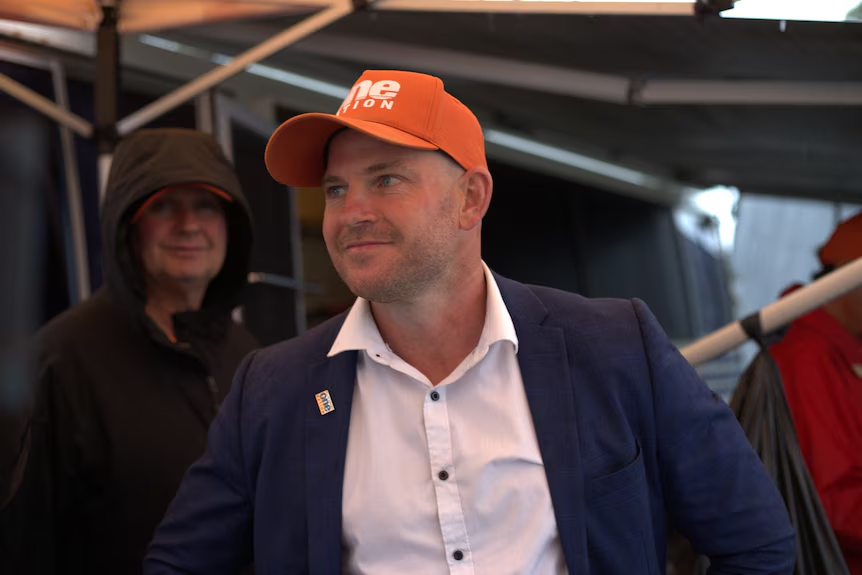
Herdegen told celebrating supporters the result should serve as a warning to politicians well beyond Western Australia.
“The people of Secret Harbour have sent a message, a message that will send shock waves across the entire country,” he said.
“There are no safe Labor seats in this state or in this country anymore.”
Herdegen described the result as the beginning of an “orange tsunami”, declaring:
“None of these MPs are safe.”
One Nation’s WA leader Rod Caddies went even further, saying the outcome demonstrated that voters no longer saw politics as a contest confined to Labor and the Liberals.
“You’re witnessing a result they said was impossible,” Caddies told supporters.
“Labor owned this part of Perth.”
He argued the traditional two-party system was “dead” and One Nation had demonstrated it could become a genuine alternative for working-class and outer-suburban voters.
Federal One Nation leader Pauline Hanson said the result showed voters were looking for politicians they believed would listen to them and challenge the direction of government policy.
“They’re wanting someone who’s really going to listen to them and really go out and fight for them to change the direction this country is going in,” Hanson said.
The victory is particularly damaging for WA Labor because Secret Harbour was not considered a marginal electorate before Papalia’s retirement.
The seat was created for the 2025 election largely from the abolished Labor stronghold of Warnbro.
Papalia had represented the area through a succession of electorates since entering Parliament in 2007 and won Secret Harbour with a comfortable 11.5 percentage-point two-party margin last year.
His resignation in July, prompted by serious illness in his immediate family, created the by-election.
Labor entered the campaign well aware that One Nation posed an unusually strong challenge.
Premier Roger Cook repeatedly described the contest as a “fight for our lives”.
His party threw substantial resources into defending the seat.
According to ABC reporting, a senior Labor figure estimated the campaign cost about $400,000.
Cook said Labor volunteers had knocked on 19,000 doors, held around 8,000 conversations with residents, distributed 210,000 pieces of campaign material and erected about 1,000 signs.
It was not enough.
“This campaign has been a reminder that Western Australians are doing it tough,” Cook told Labor supporters as the scale of the challenge became apparent.
“People are concerned about their lifestyle and their futures.”
He promised Labor would continue talking to communities and responding to those pressures.

“We will double down,” he said.
The result suggests economic dissatisfaction was a central part of the revolt.
Secret Harbour sits between Rockingham and Mandurah and includes suburbs such as Port Kennedy, Golden Bay, Singleton, Lakelands and Karnup.
It contains large numbers of young working families, many with trade or vocational qualifications, living in rapidly expanding housing estates.
Income levels are relatively average but workforce participation is high, making the electorate particularly exposed to mortgages, rents, energy bills, transport costs and other cost-of-living pressures.
Housing, cost of living and access to local services featured heavily throughout the campaign.
So did issues that would ordinarily receive little national attention, including the frequency of household red-bin collections.
Herdegen also linked local housing pressure to immigration and argued governments had allowed population growth to outpace infrastructure.
“They’re struggling with cost of living; there’s a major housing issue here with the mass immigration coming through and people have just had enough,” he said during polling day.
The result is therefore important because it shows One Nation attracting voters from both sides of the traditional political divide.
ABC chief elections analyst Casey Briggs said the available figures indicated One Nation had taken some votes from the Liberals but had apparently peeled away considerably more support from Labor.

He described the scale of One Nation’s win and the near-halving of Labor’s primary vote as remarkable.
The result, Briggs argued, would be studied closely by politicians in similar outer-suburban electorates across Australia.
That may be the most consequential aspect of Secret Harbour.
For decades, voters dissatisfied with Labor in working-class outer suburbs were largely expected to move towards the Liberal Party.
The by-election provides evidence that at least some of those voters are now prepared to move directly from Labor to One Nation without stopping at the Coalition.
That prospect will be particularly closely watched in Victoria, where voters go to a state election in November.
Melbourne’s outer north, west and south-east contain numerous seats with demographic characteristics that overlap with Secret Harbour — rapidly growing communities, comparatively high mortgage exposure, large numbers of tradespeople and working families, and frustration about housing and infrastructure.
Briggs said the Secret Harbour result represented a potential “warning shot” for MPs in comparable Victorian seats that have traditionally been safe for Labor.
New South Wales politicians will also be watching.
One Nation last week appointed former NSW senior trade commissioner Mike Newman to lead the party into the March 2027 state election, with the party targeting Labor and Coalition seats in regional and outer-suburban areas.
The Secret Harbour result gives the party something more valuable than favourable opinion polling: evidence that it can convert an increased primary vote into a lower-house victory.
The result is also deeply uncomfortable for the WA Liberal Party.
Robertson finished a distant third on first preferences despite the Liberals having been Labor’s main challenger in the seat just a year ago.
On the latest count, the Liberal primary vote had fallen almost eight percentage points to 17.3 per cent.
WA Opposition Leader Basil Zempilas had argued before polling day that any Labor loss could be viewed as a positive result for the Liberals because it would demonstrate anti-government sentiment.
But that proposition is complicated when the beneficiary of the anti-Labor vote is another party competing directly for conservative and dissatisfied working-class voters.
The question facing the Liberals is increasingly whether dissatisfaction with Labor actually helps them — or whether One Nation is becoming the preferred vehicle for voters wanting to register a protest against both major parties.
The by-election also carries a potentially significant federal warning.
Much of Secret Harbour lies within the federal electorate of Canning, held by senior Liberal MP Andrew Hastie.
One Nation has openly identified Canning as a potential target at a future federal election, and its state by-election victory gives it a substantial local organisational and electoral foothold inside Hastie’s territory.
The result also vindicates One Nation’s decision to nominate Herdegen despite controversy surrounding aspects of his past.
The 39-year-old owns several fitness businesses in Perth’s southern suburbs and moved to Western Australia in 2023.
Before politics he worked in jobs including concreting, traffic control and marketing and later built a career in fitness. One Nation says he operates gyms including one serving the Secret Harbour community.
During the campaign, an old social media post emerged in which Herdegen discussed heavy cocaine use and claimed associations with the Albanian mafia while living in London years earlier.
Herdegen said the story had been shared as part of an attempt to show how he had changed his life and to encourage others to live healthier lives.
The controversy ultimately failed to derail his campaign.
Labor had problems of its own.
Tree, a former political staffer who later worked in government relations at Woodside Energy, grew up in the area but did not live inside the electorate during the campaign.
Her campaign was also criticised after she did not speak at two consecutive media appearances, allowing political opponents to portray her as overly controlled by the party machine.
ABC analysis noted that each episode had an explanation but nevertheless allowed the issue to dominate parts of the campaign.
The lesson Labor will draw from the defeat is likely to extend beyond individual campaign errors.
The party has dominated WA politics since its landslide victory under Mark McGowan in 2017.
Even after losing ground at the 2025 election, Labor remained overwhelmingly dominant in the Legislative Assembly.
Secret Harbour demonstrates that incumbency, campaign resources and historically strong margins may not protect the government where voters believe living standards and local services are deteriorating.
Yet there are important reasons not to treat Saturday’s result as a blueprint for every election.
By-elections frequently produce larger swings against governments because voters know they are not deciding who will become premier.
Labor also promised to deliver its local commitments regardless of which candidate won, potentially reducing the perceived risk of casting a protest vote.
Local factors — including rubbish collection, development pressures and dissatisfaction with representation — were unusually prominent.
There is therefore no guarantee the swing will be replicated in a statewide or federal contest.
That will be tested over the coming months.
For One Nation, the challenge now changes.
Winning a protest vote is one thing; demonstrating that a first-term MP can deliver locally while the party withstands the heavier scrutiny that comes with electoral success is another.
For Labor, the warning is clearer.
A seat that returned a Labor primary vote of almost 47 per cent in March 2025 has, less than 18 months later, given One Nation almost 40 per cent of first preferences.
For the Liberals, there is an equally uncomfortable message: anti-Labor sentiment no longer automatically belongs to them.
And for politicians in outer-suburban electorates around Australia, Herdegen’s victory has turned One Nation’s polling surge from a hypothetical political threat into a tangible electoral result.
The final ballots are still being counted, and the WA Electoral Commission will not complete the formal process until after Thursday’s postal-vote deadline.
But the political result is already clear.
Labor’s safe harbour has turned orange — and Australia’s major parties will now be asking whether Secret Harbour was an isolated by-election revolt or the first sign of a much larger realignment.
Support our Journalism
No-nonsense journalism. No paywalls. Whether you’re in Australia, the UK, Canada, the USA, or India, you can support The Australia Today by taking a paid subscription via Patreon or donating via PayPal — and help keep honest, fearless journalism alive.
