
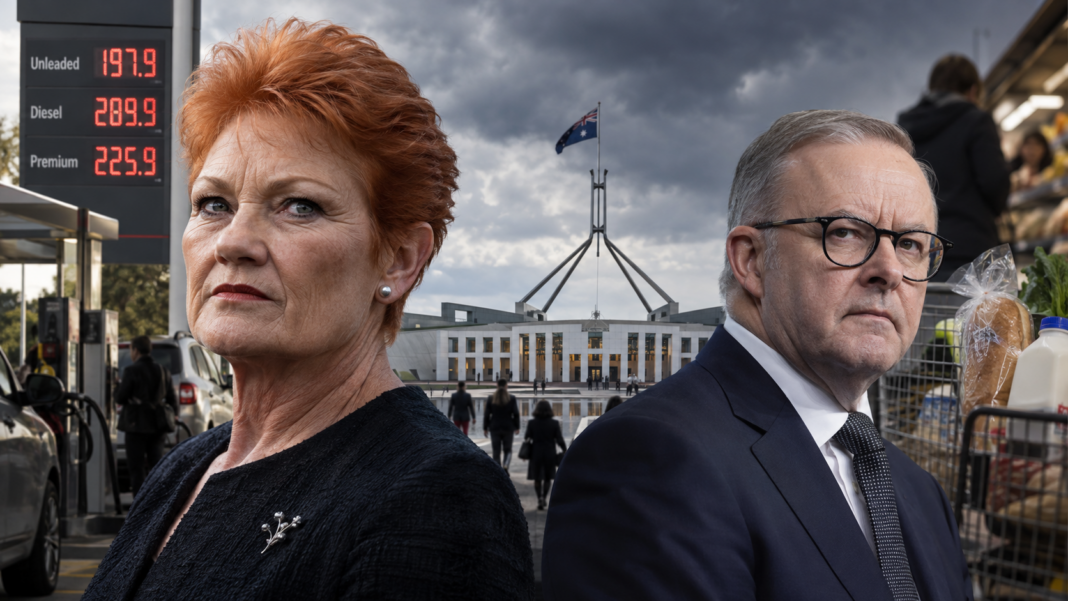
Federal Labor’s primary support has fallen to 27 per cent, its lowest Newspoll result in more than 14 years, as Australians confront another surge in petrol prices, elevated inflation and the possibility of further interest rate increases.
The latest Newspoll, conducted for The Australian by Pyxis Polling & Insights between September 14 and 17, found One Nation on 30 per cent, Labor on 27 per cent, the Coalition on 19 per cent and the Greens on 13 per cent. Another 11 per cent backed other parties or independents. The survey covered 1,244 voters.
Labor was down two percentage points from the previous Newspoll, while One Nation, the Coalition and the Greens were unchanged.
The result puts Labor only one point above its lowest-ever Newspoll primary vote of 26 per cent, recorded under Julia Gillard in September 2011. The latest 27 per cent figure is the party’s weakest since April 2012.
It also marks a sharp deterioration from the 2025 federal election, when Labor secured 34.56 per cent of House of Representatives first preferences. The Liberal, Liberal National and National parties together received more than 31 per cent at that election.
The new poll underlines a wider fragmentation of Australia’s electorate.
Labor and the Coalition together now command just 46 per cent of the primary vote in Newspoll, compared with the much larger combined share the two traditional blocs recorded at last year’s federal election.
One Nation’s 30 per cent result continues a run of unusually strong polling for Pauline Hanson’s party, which has increasingly drawn voters from both Labor and the Coalition.
According to voter-flow analysis published with the poll, Labor is retaining a little under two-thirds of people who recalled voting for it at the 2025 election.
Among those who have moved away from Labor, about 15 per cent have shifted to One Nation, 9 per cent to the Coalition, 6 per cent to the Greens and 5 per cent to other parties.
The Coalition has retained only about 53 per cent of its 2025 support, with approximately 39 per cent of its defectors moving to One Nation.
The figures do not translate directly into seats or an election result. Australia uses preferential voting in individual electorates, and One Nation’s unusually high primary support makes traditional two-party calculations more difficult to interpret.
The next federal election is not due until 2028.
Prime Minister Anthony Albanese’s personal ratings have also deteriorated.
Newspoll found 35 per cent of voters satisfied with his performance and 62 per cent dissatisfied, producing a net satisfaction rating of minus 27 — his weakest result since Labor returned to office in 2022.
Despite that decline, Albanese remained narrowly ahead of Opposition Leader Angus Taylor in a direct preferred-prime-minister contest, 42 per cent to 41 per cent.
On a three-way preferred-prime-minister measure, Albanese recorded 44 per cent, Hanson 32 per cent and Taylor 24 per cent.
Hanson’s personal ratings softened even as One Nation’s primary vote remained strong, with her approval falling to 44 per cent and disapproval rising to 51 per cent.
Taylor’s net satisfaction rating improved slightly to minus 15.
The poll arrives at a difficult economic moment for the government.
Australian motorists are again facing rapidly increasing petrol and diesel prices as instability in the Middle East disrupts global oil supplies and shipping.
Brent crude closed at about US$104.87 a barrel on September 18, after supply disruption linked to the conflict involving Iran and attacks on Saudi oil infrastructure pushed prices back above US$100.
Australian fuel prices have followed.
Recent figures reported nationally put average unleaded petrol at about 234.6 cents a litre and diesel at around 284.2 cents a litre, with both rising sharply through September.
The surge is particularly politically sensitive because petrol prices affect far more than household trips to the service station.
Higher diesel and transport costs flow through freight, food distribution, construction and other parts of the economy, potentially adding to inflation at a time when the Reserve Bank is already concerned that price pressures remain too high.
The RBA has lifted the cash rate three times during 2026, taking it from 3.60 per cent at the end of last year to 4.35 per cent.
The central bank left rates unchanged at its August meeting but warned that inflation remained elevated and said it was prepared to increase rates again if upside risks materialised.
The RBA’s next monetary policy decision is scheduled for September 29.
Official inflation figures show headline CPI rose 3.5 per cent in the year to July, while trimmed-mean inflation remained at 3.6 per cent — above the Reserve Bank’s 2–3 per cent target band.
The RBA has said Middle East-related energy costs are among the forces keeping inflation elevated.
Its August Statement on Monetary Policy said higher oil and commodity prices were feeding through into the cost of goods and services and warned inflation was not expected to return to around the middle of the target range until early 2028.
That combination — expensive petrol, higher mortgage repayments and persistent inflation — is creating another cost-of-living squeeze for households.
The Coalition has sought to capitalise on the fuel-price issue by announcing a Fuel Price Shield.
Under the proposal, fuel excise would automatically be halved whenever the two-week average price of Brent crude exceeded US$100 a barrel.
The Coalition says that would reduce tax on petrol and diesel by about 27 cents a litre, or roughly $15 on a typical tank.
It would also temporarily reduce the heavy vehicle road-user charge to zero while the measure was active.
Opposition Leader Angus Taylor said motorists should have certainty that tax would automatically fall when international oil prices surged.
“Fuel is not a luxury. Australians need it to get to work, take the kids to school and keep their businesses running,” Taylor said.
The Coalition proposes funding the policy through its separate plan to cut tobacco excise by 80 per cent.
Taylor says Parliamentary Budget Office modelling indicates that reform would improve the budget balance by about $8 billion over four years by shifting smokers away from the illegal tobacco market and back towards taxed legal products.
Labor disputes that argument.
Treasurer Jim Chalmers has rejected the Fuel Price Shield and said another fuel-excise reduction was not something the government had been discussing or considering.
Finance Minister Katy Gallagher has characterised the opposition proposal as uncosted and argued the government prefers more permanent forms of cost-of-living support.
Labor has also attacked the Coalition’s proposed tobacco tax reduction on public-health grounds, arguing cheaper cigarettes could increase smoking rates and associated health costs.
The Coalition counters that current tobacco taxes have helped drive consumers towards the illicit market and that reducing the price gap between legal and illegal products would undermine organised crime.
That debate has become intertwined with fuel policy because Taylor has nominated the tobacco changes as the funding source for his petrol-tax proposal.
The Albanese government has previously intervened on fuel excise.
Earlier in 2026, it temporarily reduced fuel taxes as oil prices surged following the outbreak of Middle East conflict, before restoring the normal rate.
The government argues continually adjusting excise in response to oil-market movements can be expensive and may complicate the fight against inflation.
Labor ministers have instead pointed to income-tax changes, cheaper medicines and other measures as evidence that the government is trying to reduce household costs without relying exclusively on short-term fuel subsidies.
Social Services Minister Tanya Plibersek acknowledged the latest polling was difficult for Labor but said the government remained focused on wages and cost-of-living pressures rather than opinion polls.
For Albanese, the latest numbers represent a dramatic reversal from the political position Labor occupied after its decisive 2025 election victory.
The Prime Minister returned Labor to office with a substantially enlarged parliamentary majority, while the Coalition suffered a major defeat.
Sixteen months later, both major parties are experiencing historically weak primary support in polling, while One Nation is attracting voters from each side.
The political shift cannot be attributed to a single issue.
Cost of living, housing, migration, crime, energy policy and dissatisfaction with political institutions have all featured prominently in national debate during 2026.
Labor has also faced scrutiny over the May budget and its response to major security and social-cohesion issues, while the Coalition has struggled to rebuild its own primary support despite Labor’s decline.
That point is crucial.
While Labor’s primary vote has fallen to 27 per cent, the Coalition remains even lower at 19 per cent in the same poll.
The principal beneficiary of the movement in voting intention is One Nation rather than the traditional opposition.
That makes the current political landscape very different from a conventional midterm swing from a government towards an alternative major party.
It also explains why leadership measures remain competitive despite both Labor and the Coalition recording weak primary votes.
The coming weeks will provide further tests of the economic environment driving much of the voter dissatisfaction.
The Reserve Bank meets on September 28 and 29, new August inflation data will be released on September 30, and global oil markets remain highly sensitive to developments in the Middle East.
For the Albanese government, those economic conditions may matter as much as any political strategy.
The latest Newspoll is only a snapshot rather than a forecast of the next election, but it shows a clear pattern: voters are moving away from both major parties, Labor is experiencing its weakest primary support in more than a decade, and rising household costs are ensuring economic management remains at the centre of Australian politics.
Support our Journalism
No-nonsense journalism. No paywalls. Whether you’re in Australia, the UK, Canada, the USA, or India, you can support The Australia Today by taking a paid subscription via Patreon or donating via PayPal — and help keep honest, fearless journalism alive.
