


Muslims are projected to overtake Christians as the world’s largest religious group by 2035, with the global Muslim population expected to grow by about 80 per cent between 2020 and 2070, according to new projections by the Pew Research Center.
The projections show that both Islam and Christianity will continue to grow in absolute numbers over the coming decades, but the Muslim population is expected to increase at a significantly faster rate.
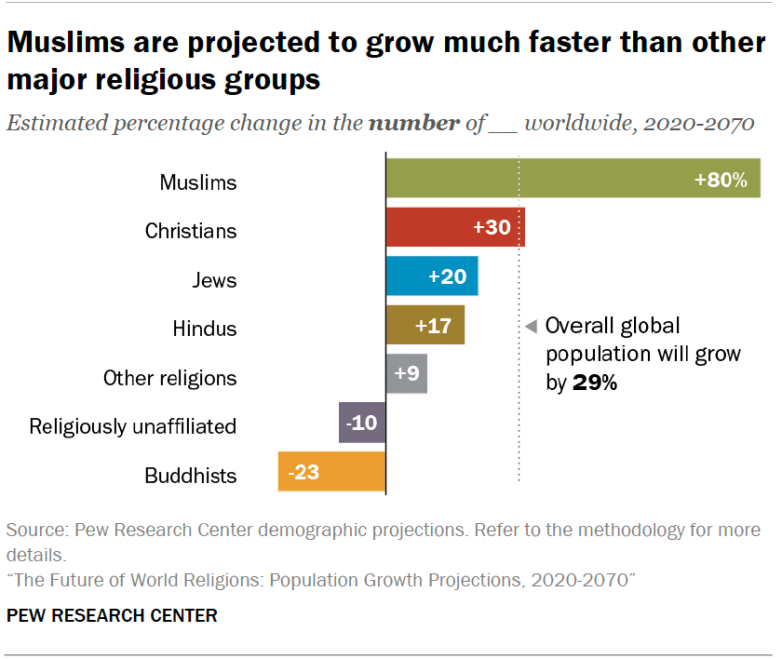
The main driver is demographic change rather than religious conversion, with Muslim communities having a younger age profile and higher fertility rates than other major religious groups.
Pew estimates that Muslim women had an average of 3.1 children during 2020–2025, compared with 2.5 among Christian women and 1.6 among women from all other religious groups combined.
Between 2020 and 2070, the number of Muslims worldwide is projected to rise from about 2.02 billion to 3.64 billion, while the Christian population is expected to increase from 2.27 billion to almost 2.96 billion.
The projections suggest that Islam’s growth will be driven primarily by births rather than people converting from other religions. Muslim communities are expected to gain around 1.6 billion people through natural population growth – the difference between births and deaths – over the 50-year period.
Religious switching will also influence the figures. Pew estimates that Christianity could experience a net loss of 105 million people through people leaving the faith, compared with a projected net loss of about eight million for Islam. Movement between the two religions is expected to be broadly balanced, with slightly more Muslims projected to become Christians than Christians becoming Muslims.
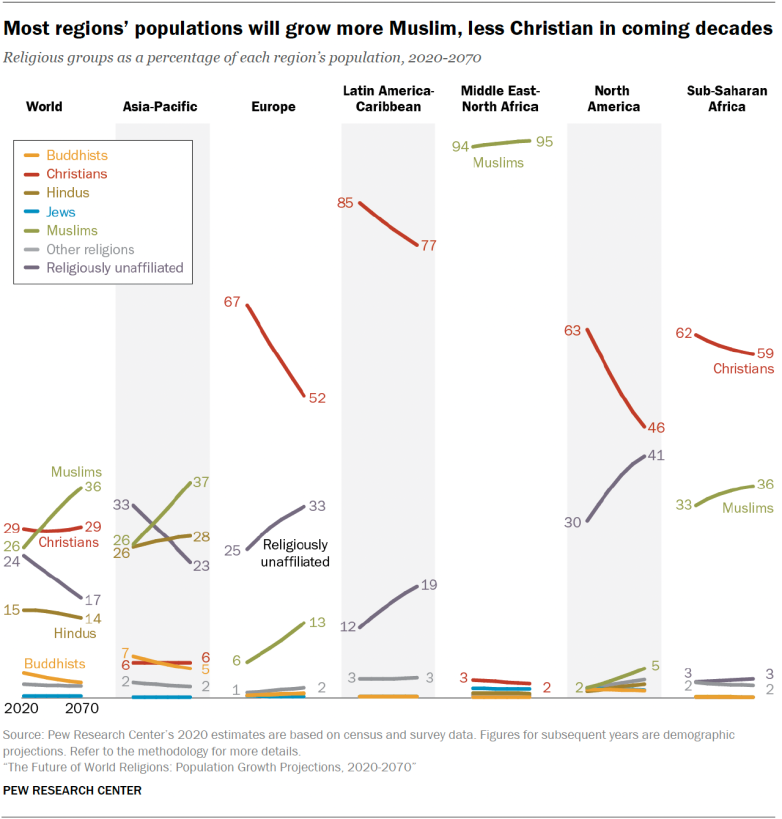
The study also points to significant changes in where the world’s religious communities will live.
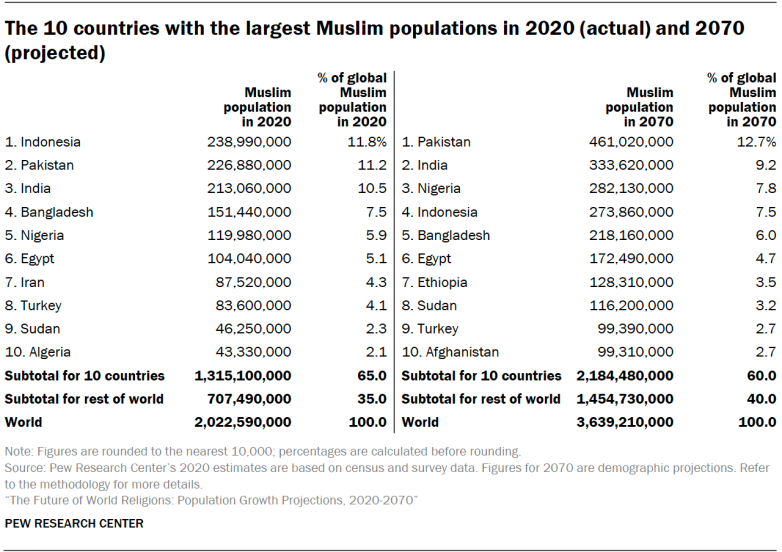
Pakistan is projected to replace Indonesia as the country with the largest Muslim population by 2070, with its Muslim population expected to rise from 227 million in 2020 to 461 million.
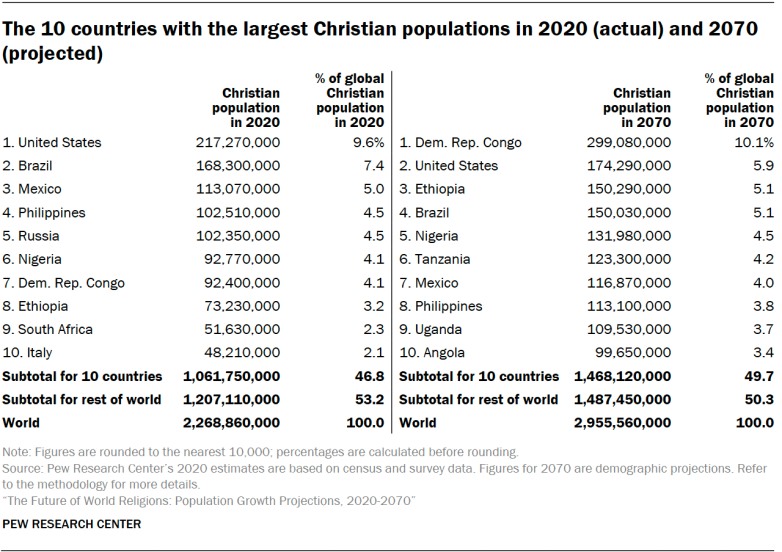
Christianity’s centre of population is also expected to shift further towards Africa. By 2070, 54 per cent of Christians worldwide are projected to live in sub-Saharan Africa. The Democratic Republic of the Congo is expected to overtake the United States as the country with the largest Christian population.
India is projected to remain home to the vast majority of the world’s Hindus in 2070. However, the Hindu population is expected to grow more slowly than non-Hindu communities in the country, reducing its share of India’s population.
The global Buddhist population is projected to decline, with the steepest falls expected in Asia. The Jewish population, meanwhile, is expected to become increasingly concentrated in Israel, where 62 per cent of the world’s Jews are projected to live by 2070.
Another notable finding concerns people who identify with no religion. Although the unaffiliated population is expected to increase in many countries, its global numbers are projected to fall, largely because of population decline in China.
Pew’s projections cover 201 countries and territories, accounting for 99.98 per cent of the world’s population. Researchers used census and survey data, alongside estimates of fertility, mortality, migration and religious switching, to model possible changes between 2020 and 2070.
The researchers caution that the figures are projections based on current demographic patterns, not predictions of every possible future development. Events such as wars, natural disasters, epidemics and changes in economic or social conditions could alter the trajectory.
The findings are part of Pew Research Center’s Global Religious Futures project, which examines how religious populations may change around the world over the coming decades.
Support our Journalism
No-nonsense journalism. No paywalls. Whether you’re in Australia, the UK, Canada, the USA, or India, you can support The Australia Today by taking a paid subscription via Patreon or donating via PayPal — and help keep honest, fearless journalism alive.
