


Pauline Hanson’s personal standing with voters has fallen sharply even as One Nation continues to poll strongly, according to the latest Australian Financial Review RedBridge Group–Accent Research survey, suggesting the party’s momentum may be becoming increasingly disconnected from its leader. 
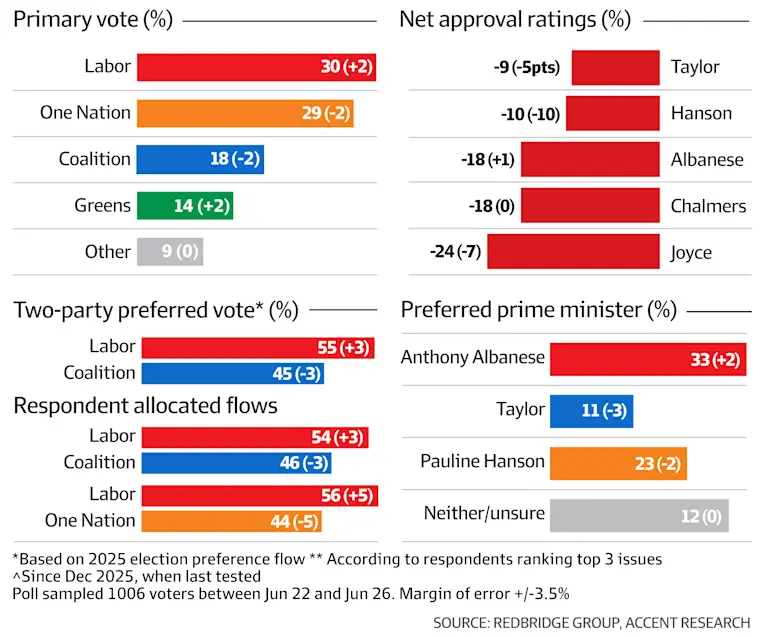
The poll of 1,006 voters, conducted between June 22 and June 26 with a margin of error of ±3.5 percentage points, places Labor on 30 per cent of the primary vote, up two points since the previous survey. One Nation sits on 29 per cent, down two points, while the Coalition has fallen to 18 per cent, with the Greens rising to 14 per cent.
While One Nation remains only one point behind Labor on first preferences, the survey points to a noticeable deterioration in Hanson’s personal appeal.
Her net approval rating has dropped to -10, a fall of 10 points since the previous poll. That is the largest movement among the major political figures measured in the survey and comes after months in which Hanson had steadily improved her standing with voters. 
The decline is also reflected in the preferred prime minister figures. Hanson is now the preferred prime minister for 23 per cent of respondents, down two points, while Prime Minister Anthony Albanese has increased his lead to 33 per cent, up two points.
Opposition Leader Angus Taylor, despite leading the Coalition, remains well behind on 11 per cent, down three points.
Labor’s improvement is also evident in the two-party preferred figures.
Against the Coalition, Labor now leads 55-45, a three-point increase since the previous survey. Against One Nation, Labor holds an even larger 56-44 advantage after respondent-allocated preference flows, indicating that while One Nation continues attracting significant first-preference support, it still struggles to assemble winning preference distributions under Australia’s preferential voting system.
The findings represent a shift from earlier RedBridge polling released last month, when One Nation briefly overtook Labor on primary vote and Hanson appeared to be benefiting from growing anti-establishment sentiment. 
The latest survey suggests that although dissatisfaction with the major parties remains high, some of Hanson’s personal political capital may have been eroded.
The polling period followed widespread debate over Hanson’s comments on immigration and multiculturalism, which attracted significant media scrutiny. While the survey does not identify the cause of the decline, it coincides with increased public attention surrounding those remarks. 
The survey also underlines the issues continuing to dominate voter concerns.
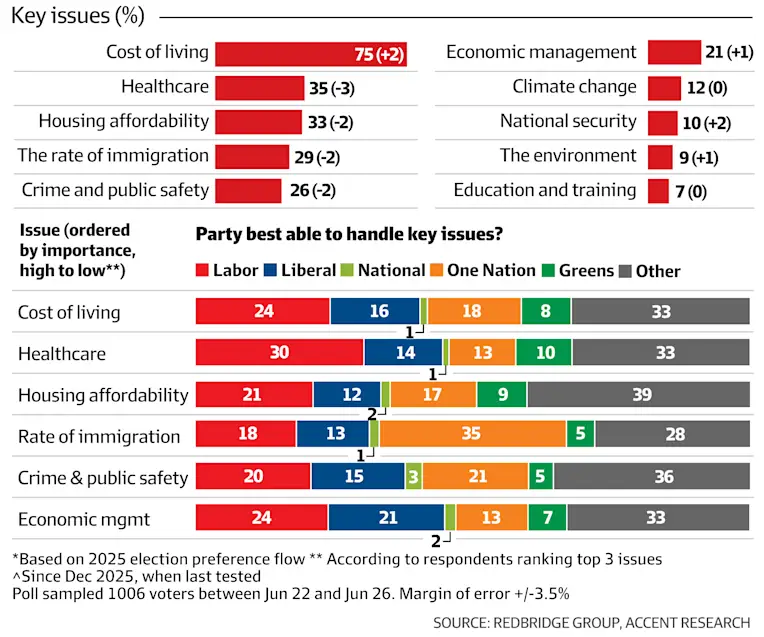
Cost of living remains overwhelmingly Australia’s biggest concern, nominated by 75 per cent of respondents, followed by healthcare (35 per cent), housing affordability (33 per cent), the rate of immigration (29 per cent) and crime and public safety (26 per cent).
On immigration, One Nation continues to hold its strongest policy advantage.
Asked which party is best able to handle the rate of immigration, 35 per cent nominated One Nation, well ahead of Labor on 18 per cent and the Liberals on 13 per cent.
The party also narrowly leads Labor on crime and public safety, polling 21 per cent compared with Labor’s 20 per cent.
However, Labor maintains an advantage on economic management, healthcare, housing affordability and cost-of-living issues, although a large proportion of respondents continue to select “other” or remain unconvinced that any major party has the answers.
The results suggest Australia’s political landscape remains highly fragmented.
While One Nation continues to command historically high levels of electoral support, the latest RedBridge survey indicates that Hanson’s personal popularity is no longer keeping pace with her party’s vote, raising fresh questions about whether the insurgent movement can sustain its momentum heading towards the next federal election. 
Support our Journalism
No-nonsense journalism. No paywalls. Whether you’re in Australia, the UK, Canada, the USA, or India, you can support The Australia Today by taking a paid subscription via Patreon or donating via PayPal — and help keep honest, fearless journalism alive.
