


An Indian-origin cab driver who ran towards wounded victims during the Bondi Beach terrorist attack has reportedly been granted Australian permanent residency in recognition of his actions.
Rehmat Pasha, 37, helped move injured people to safety and assisted emergency workers for almost three hours after two gunmen opened fire on a Jewish Hanukkah gathering at Sydney’s Bondi Beach on December 14, 2025.
The permanent residency decision was publicly revealed by Mr Pasha during a recent visit to Hyderabad. He said Immigration and Home Affairs Minister Tony Burke had personally informed him that he would receive permanent residency.
Applications involving his wife and three children, who remain in India, are also reportedly being processed. The Australia Today could not locate a public statement from the Department of Home Affairs or Mr Burke’s office confirming the individual visa decision at the time of publication.
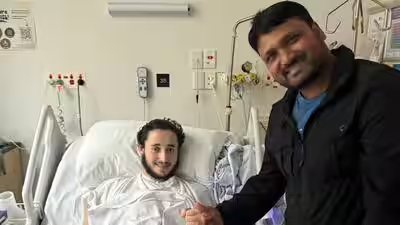
Mr Pasha moved to Australia in 2021 after studying hospitality and was supporting his family by undertaking various jobs, including driving passengers in Sydney.
He said he had just dropped off a passenger near Bondi Beach when he heard a series of loud noises. Initially believing they were fireworks, he stepped out of his vehicle and saw two gunmen firing from a pedestrian bridge about 100 metres away.
As hundreds of people attempted to escape, Mr Pasha said he made a split-second decision to remain at the scene and help those who had been shot.
He first attempted to stop the bleeding of a man suffering a serious neck wound. When the man could not be saved, Mr Pasha continued moving between victims, pulling injured people behind trees, benches and other structures to protect them from further gunfire.
After the shooting stopped, he reportedly helped identify the most seriously injured people and worked alongside paramedics to carry them towards ambulances. Surfboards were among the items used as makeshift stretchers during the rescue effort.
Mr Pasha estimates he assisted between 18 and 20 people during the attack and its immediate aftermath, including civilians, police officers and a wounded rabbi.

The December attack targeted hundreds of Jewish Australians gathered for the Chanukah by the Sea celebration. Fifteen victims were killed and 41 people, including four children and two police officers, were taken to hospital.
One gunman, a 50-year-old man, was shot dead by police. His 24-year-old son survived and was subsequently charged by the NSW Joint Counter Terrorism Team over the attack. Australian authorities described the shooting as an antisemitic terrorist attack.
Mr Pasha’s efforts came amid numerous acts of courage by police officers, paramedics, health workers and members of the public who placed themselves in danger to protect others.
Waverley Council later recognised Ahmed al-Ahmed, Gefen Bitton and Leibel Lazaroff for their actions during the attack. Mr al-Ahmed confronted and disarmed one of the alleged gunmen, while Mr Bitton and Rabbi Lazaroff also placed themselves at risk while attempting to stop the violence and assist victims.
Mr Pasha’s actions were brought to the attention of the Department of Home Affairs by immigration lawyer Abdul Syed Javeed, founder of the Indian Youth Committee of Australia.
The Times of India reported that Mr Pasha received financial assistance, medical treatment and counselling following the attack. He has also reportedly been nominated for a government bravery award, while the ride-share company he worked with has recognised his actions.
The cap he was wearing while assisting victims is also expected to be preserved for display at a Sydney museum, according to the report.
Despite the recognition and reported permanent residency grant, Mr Pasha said the psychological consequences of what he witnessed remain severe.
He was diagnosed with post-traumatic stress disorder and was temporarily assessed as unable to return to work. He continues to experience disrupted sleep, nightmares and memories of wounded people and frightened children.
“People say my life has changed for the better. But images from that day still haunt me,” he said.
Mr Pasha remains in contact with several survivors and their families, some of whom invite him to community gatherings and prayer meetings.
His story has received attention in both Australia and India, presenting a powerful account of an ordinary migrant worker who chose to help strangers during one of the darkest moments in Australia’s recent history.
It also provides a reminder that the impact of terrorism extends beyond those who are physically injured. Bystanders, first responders and volunteers who witness mass-casualty attacks can continue carrying serious psychological injuries long after the immediate emergency has ended.
The Australian and NSW governments established support arrangements for people physically or psychologically affected by the attack, including victims, bereaved families and others directly exposed to the violence.
For Mr Pasha, permanent residency may provide security and the prospect of reuniting his family in Australia. But his account also shows that formal recognition cannot erase the trauma of the lives lost, the victims he tried to save and the scenes he continues to remember.
Support our Journalism
No-nonsense journalism. No paywalls. Whether you’re in Australia, the UK, Canada, the USA, or India, you can support The Australia Today by taking a paid subscription via Patreon or donating via PayPal — and help keep honest, fearless journalism alive.
