
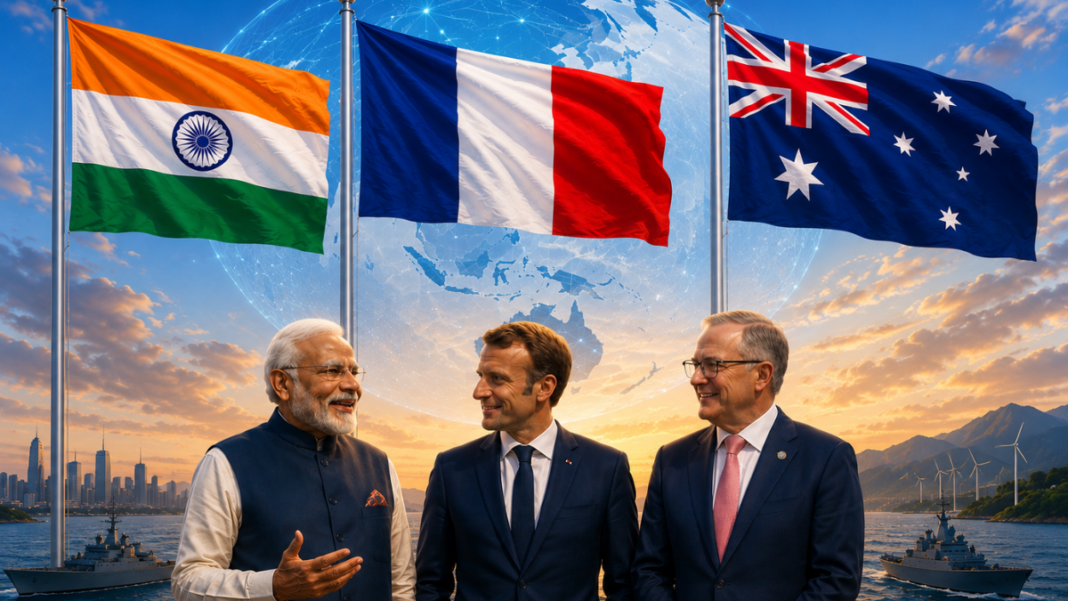
India, France and Australia have reaffirmed their commitment to a free, open, inclusive and rules-based Indo-Pacific following the latest India-France-Australia Trilateral Dialogue held in New Delhi on 22 June.
The meeting brought together senior officials from all three countries, including Piyush Srivastava, Joint Secretary (Europe West), and Paramita Tripathi, Joint Secretary (Oceania & Indo-Pacific) from India’s Ministry of External Affairs; Benoît Guidée, Director for Asia and Oceania at France’s Ministry for Europe and Foreign Affairs; and Sarah Storey, First Assistant Secretary, South and Central Asia Division at Australia’s Department of Foreign Affairs and Trade.
The three sides reviewed progress in trilateral cooperation and identified new proposals to strengthen collaboration across maritime security, regional connectivity, environmental challenges, supply-chain resilience and engagement with Indo-Pacific partners.
The trilateral reflects the changing reality of a multipolar world order. India, which is considered by many including former Prime Minister Tony Abbott, the 3rd superpower of the world, sits at the centre of the Indian Ocean. France, another major power, is the only European nation with overseas territories and a permanent military presence in both the Indian and Pacific Oceans, while Australia occupies a pivotal position linking the two regions.
India and France are among the world’s most powerful naval forces, while Australia maintains one of the region’s most technologically advanced navies. All three are secular democracies. Hence, the trilateral is based on substantive shared values beyond diplomatic symbolism and can prove pivotal in global geopolitical stability in the coming decades.
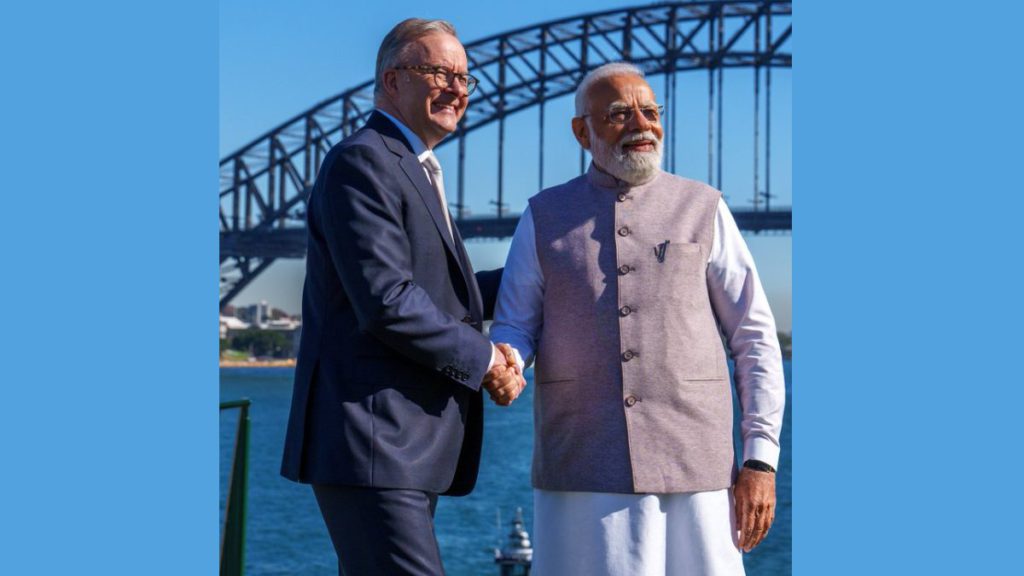
The dialogue comes as India continues to expand its maritime capabilities. Just on 21 June Indian Prime Minister Narendra Modi commissioned three warships, INS Agray, INS Dunagiri and INS Sanshodhak together in Kolkata, into the Indian Navy. The milestone highlighted India’s growing indigenous shipbuilding capability.
The timing is also notable as India and France continue to deepen defence cooperation. Earlier this year, the two countries elevated their relationship to a Special Global Strategic Partnership, reflecting expanding collaboration in defence, critical technologies, space, innovation and Indo-Pacific security. The two countries also converged on a slate of issues in bilateral engagements on the margins of the G7 summit in France.
Discussions are also continuing around a potential acquisition of 114 French Rafale fighter aircraft for the Indian Air Force. Estimated to be worth approximately US$39 billion, the programme would rank among the largest fighter aircraft procurement projects in modern history and further strengthen one of the world’s most significant defence partnerships.
After India’s strategic decimation of Pakistan in Operation Sindoor last year, which demonstrated its aerial combat superiority and precision strike capability against terror infrastructure and associated targets within Pakistan, it comes as no surprise that India’s air power planning continues to lean toward proven, high-performance platforms such as the Rafale.
India already operates 36 Rafale aircraft in its Air Force, inducted under the 2016 agreement with France, while a separate government-to-government deal for 26 Rafale Marine aircraft for the Indian Navy has already been finalised and signed.
For India, France and Australia, the trilateral is no longer merely a diplomatic forum. It is emerging as an important pillar of Indo-Pacific cooperation, bringing together three nations with the capability, geographic reach and shared interest to help shape the region’s—and indeed the global—future security architecture.
Support our Journalism
No-nonsense journalism. No paywalls. Whether you’re in Australia, the UK, Canada, the USA, or India, you can support The Australia Today by taking a paid subscription via Patreon or donating via PayPal — and help keep honest, fearless journalism alive.
