

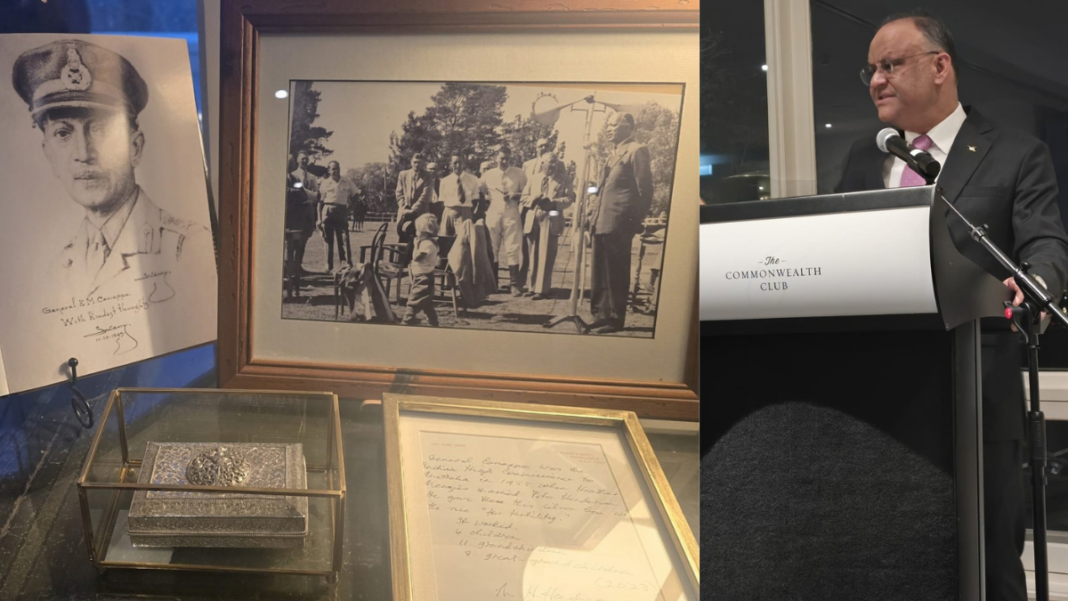
India’s High Commissioner to Australia, Nagesh Singh, has highlighted the deepening India–Australia relationship and its historic foundations while addressing the Commonwealth Club of Australia’s Capital Lecture Series Dinner in Canberra.
Singh was the distinguished guest speaker at the event, where he reflected on the longstanding connections between the two countries, their shared Indo-Pacific outlook and the growing breadth of the bilateral partnership.
He also highlighted the enduring legacy of Field Marshal K.M. Cariappa, who served as India’s High Commissioner to Australia and played a pivotal role in establishing the Commonwealth Club in Canberra in 1954.
Cariappa arrived in Australia in 1953 and envisioned a neutral and welcoming space where diplomats and members of the local community could meet and interact as equals.
In January 1954, he presented the idea to then Australian Prime Minister Sir Robert Menzies, who encouraged the initiative. Cariappa subsequently brought together community members to establish what became the Commonwealth Club.
The club went on to attract 116 foundation members and welcomed women as members from its beginning. Its first premises were at historic Old Canberra House before it moved to its present Yarralumla location in 1965.
Today, the Commonwealth Club describes itself as a longstanding meeting place for Canberra’s diplomatic, political and community circles, continuing the tradition of connection established by its founders.

Cariappa’s contribution came during an important period in India–Australia relations.
Well-known Australian historian Prof. David Walker has observed that India was among the most persistent international critics of Australia’s White Australia policy during the 1950s, with India’s concerns contributing to wider debate within Australia.
Despite the difficult political environment of the era, Cariappa developed strong personal connections in Canberra and became a well-known figure in Australian social and diplomatic circles.
Cariappa, a distinguished military officer and later India’s first Field Marshal, was also known for his interest in Indian philosophical traditions, including the Upanishads and the Bhagavad Gita.
He arrived in Australia in September 1953 accompanied by his 12-year-old daughter, Nalini, and his niece Sagari Chengappa, who assisted him as hostess at official functions.
The Commonwealth Club’s history reflects Canberra’s evolution from a small early settlement into Australia’s national capital and the development of its diplomatic and community networks.
More than seven decades after its establishment, the club continues to promote the values of connection, diplomacy and community that shaped its foundation.
Singh’s address brought that history into the context of contemporary India–Australia relations, as the two countries continue to expand cooperation across trade, education, defence, technology, critical minerals and the broader Indo-Pacific.
Support our Journalism
No-nonsense journalism. No paywalls. Whether you’re in Australia, the UK, Canada, the USA, or India, you can support The Australia Today by taking a paid subscription via Patreon or donating via PayPal — and help keep honest, fearless journalism alive.
