

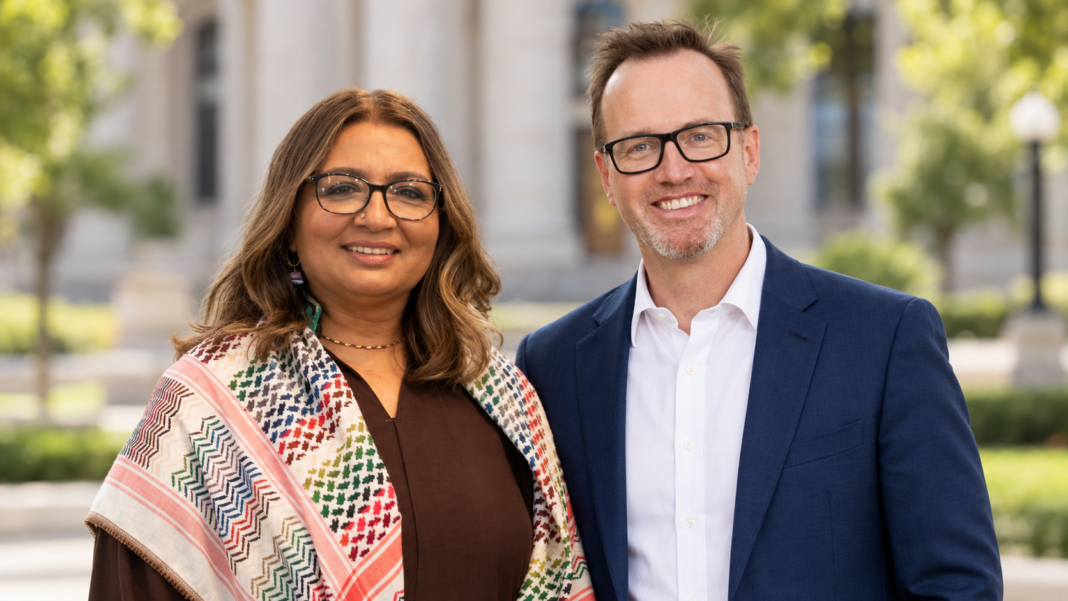
The battle to lead the Australian Greens has widened into a three-way contest, with senators David Shoebridge and Steph Hodgins-May joining Mehreen Faruqi and Nick McKim, while South Australian senator Sarah Hanson-Young is also seeking the top job.
The contest follows Larissa Waters’ decision to step down as federal leader because of a worsening chronic kidney condition. Waters plans to take medical leave before returning to her Senate duties. The Greens’ 11-member federal party room is meeting in Sydney to determine the new leadership.
But the contest is developing into something larger than a simple change of personnel.
Both the Shoebridge–Hodgins-May and Faruqi–McKim tickets are arguing that the Greens need to become a bigger political movement, take a more aggressive fight to Labor and respond to the sharp rise in support for Pauline Hanson’s One Nation.
Shoebridge, a NSW senator, is seeking the leadership with Victorian senator Steph Hodgins-May as his proposed deputy. Their statement declares that the Greens should no longer simply pressure Labor from the crossbench.
“We do not seek to reform Labor, but to replace them,” they said.
The pair also directly addressed One Nation’s growth, arguing that Labor had helped create the conditions in which Hanson’s party was gaining support.
“Labor has proven they can’t stop One Nation because they made the conditions for them to thrive in. Only the Greens can,” their statement says.
Their answer to the rise of One Nation is an explicitly progressive economic and environmental program.
They point to measures including meals for schoolchildren, secure housing and incomes, stopping new coal and gas projects and resisting what they describe as excessive influence from the United States and large technology companies.
“The answer to the rise of One Nation and the far right is giving people hope, and making people’s lives better with real economic and environmental security,” the pair said.
They have also promised to work towards greater grassroots involvement in future Greens leadership elections — an acknowledgement of an internal debate that has resurfaced because ordinary party members do not directly choose the federal leader.
Former Greens MP Max Chandler-Mather has argued that members should be given a direct vote, while the current leadership remains decided by the parliamentary party room.
But Shoebridge and Hodgins-May are not alone in arguing that the Greens must become larger and more confrontational.
Current deputy leader Mehreen Faruqi has formally entered the leadership contest with Tasmanian senator Nick McKim running as her deputy.
Their campaign statement makes a remarkably similar diagnosis of the Greens’ political problem.
“To meet the moment, the Greens need to grow,” Faruqi and McKim said.
“We need to take the fight to Labor and a broken economic system that rips off young people, keeps working people drowning in bills and wreaks havoc on nature and climate.”
The pair also explicitly connected their bid with the rise of parties they describe as the “far-right”.
“As the far-right gains strength, we think we are the right people to resist, and to grow our movement alongside our colleagues, members and supporters,” their statement says.
“Our politics are unapologetically bold, and we want to lead with hope over hate and people over profit.”
That means two of the main leadership tickets are now pitching versions of the same central argument: that the Greens should respond to dissatisfaction with the major parties not by moderating, but by expanding an unapologetically progressive alternative.
The differences will lie in how that strategy is pursued.
Faruqi, 63, has served as deputy leader since 2022 and entered federal parliament in 2018, becoming the first Muslim woman elected to the Australian Senate. Before politics she worked as an engineer and academic. She has developed a reputation for highly visible protest politics, particularly on Gaza, racism and social justice issues.
McKim, 61, is the Greens’ Senate whip and a former Tasmanian Greens leader who previously served in the Tasmanian parliament. He was co-deputy federal leader between 2020 and 2022.
Their decision to run together gives the contest a clearly defined ticket advocating what they describe as “unapologetically bold” politics.
Shoebridge and Hodgins-May are presenting their own combination of parliamentary combativeness and generational change.
Shoebridge, a former barrister and NSW upper-house MP, entered the federal Senate in 2022 and has built a profile through Senate estimates, defence, foreign affairs, civil liberties and national-security debates.
Hodgins-May entered the Senate in 2024 after the retirement of Janet Rice. A former environmental lawyer, she has focused heavily on climate and gas policy.
The third major contender, Sarah Hanson-Young, is offering another approach.
The South Australian senator confirmed she is seeking the leadership and described the contest as a “defining moment” for the party. She has argued that Australians deserve an alternative to Labor and the Coalition while also attacking One Nation’s politics.
Hanson-Young is the longest-serving Greens federal parliamentarian among the leadership contenders, having entered the Senate in 2008 after being elected in 2007.
She has played a central negotiating role with Labor on environmental legislation, including the Greens’ agreement with the government over reforms to national environmental laws in 2025. ABC describes her as having developed a reputation as a more pragmatic negotiator within the party.
The distinction matters because the leadership contest arrives after a difficult electoral period for the Greens.
At the 2025 federal election, the party retained a substantial national primary vote but lost three House of Representatives seats, including former leader Adam Bandt’s Melbourne electorate. Elizabeth Watson-Brown in Ryan became the Greens’ sole lower-house MP.
The party nevertheless retains considerable influence through its 10 senators, who can be important when Labor requires crossbench votes to pass legislation.
Since that election, another problem has emerged: One Nation’s support has risen dramatically in national polling.
That growth is now explicitly shaping the Greens leadership debate.
Shoebridge and Hodgins-May say “only the Greens” can address the conditions allowing One Nation to grow.
Faruqi and McKim say their leadership is needed as the “far-right gains strength”.
Hanson-Young has also singled out One Nation while arguing the Greens must offer voters a stronger alternative.
The question underneath those statements is whether the Greens’ proposed solution matches the reasons voters are moving elsewhere.
Recent polling has shown One Nation attracting support amid concerns over cost of living, housing, migration and dissatisfaction with the established parties. The Greens leadership candidates are attempting to answer much of that dissatisfaction with policies centred on housing security, higher taxes on large corporations and resource companies, climate action and stronger public services.
But their statements also give heavy prominence to coal and gas projects, relations with the United States, Gaza and foreign policy, technology companies and climate politics.
That creates a strategic challenge for whichever candidate succeeds Waters: how to connect those priorities with voters primarily focused on mortgages, rents, electricity bills, groceries and economic security.
The scale of the challenge is also apparent from the Greens’ parliamentary position.
Shoebridge and Hodgins-May have declared that the objective should ultimately be to replace Labor, rather than simply change Labor policy.
Faruqi and McKim similarly say they intend to “take the fight to Labor”.
But the Greens currently hold only one of the 150 seats in the House of Representatives.
That does not prevent the party from exercising substantial influence in the Senate, but turning a crossbench party into an alternative government would require a major expansion of support across electorates where the Greens have historically struggled to win.
It is also notable that the two joint tickets are offering strikingly similar political diagnoses.
Both say the Greens need to grow.
Both say economic insecurity is feeding political discontent.
Both want a harder line against Labor.
Both identify One Nation’s rise as a major threat.
And both argue that the answer is a larger progressive movement rather than an attempt to move towards One Nation on migration, cultural or social issues.
The differences may therefore emerge less from broad ideology than from leadership style, negotiating tactics and how aggressively each ticket is prepared to use the Greens’ Senate numbers.
That debate has already been encouraged by former leader Adam Bandt and Greens founder Bob Brown, who have urged the incoming leadership to take a stronger position against new coal and gas developments.
There is another tension running through the contest.
While candidates speak repeatedly about building a “mass movement”, grassroots organising and giving ordinary members a greater voice, the immediate leadership choice will be made by just 11 federal Greens parliamentarians.
The party generally attempts to reach consensus before resorting to a formal ballot.
For a party trying to decide how it responds simultaneously to Labor, the Coalition and a resurgent One Nation, that small room in Sydney is now determining a much larger strategic question.
Does the Greens’ path to growth come through harder ideological confrontation, stronger negotiating credentials, grassroots expansion — or some combination of all three?
Shoebridge and Hodgins-May say the party should aspire to replace Labor.
Faruqi and McKim say it must “take the fight” to Labor and the economic system itself.
Hanson-Young says the Greens must confront both the major parties and One Nation while convincing voters the party can deliver results.
Whichever approach the party room chooses, the next Greens leadership will inherit a difficult political equation
Support our Journalism
No-nonsense journalism. No paywalls. Whether you’re in Australia, the UK, Canada, the USA, or India, you can support The Australia Today by taking a paid subscription via Patreon or donating via PayPal — and help keep honest, fearless journalism alive.
