


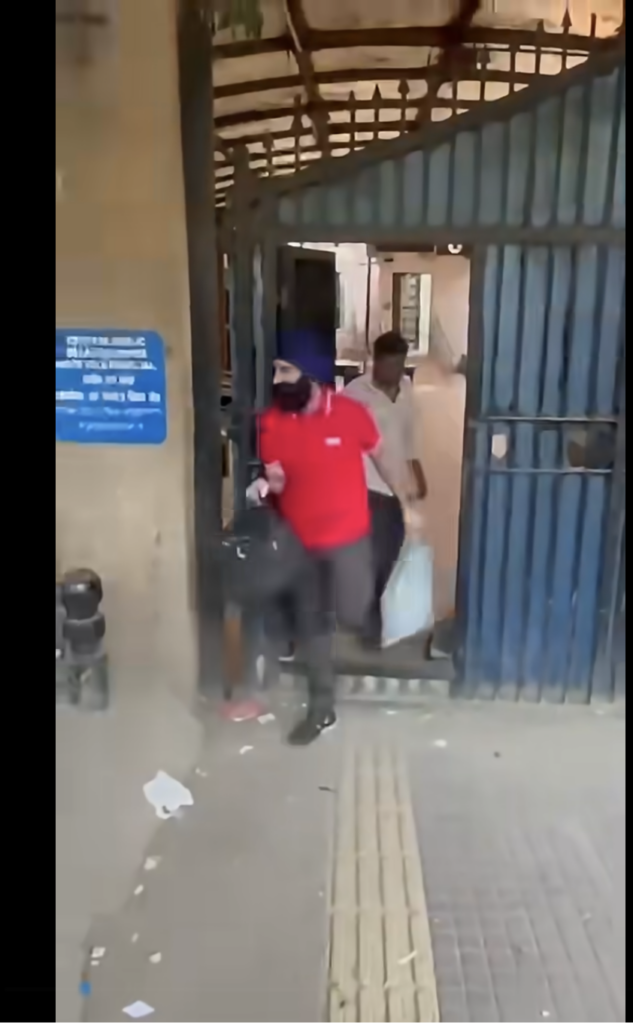
British national Jagtar Singh Johal has walked out of Delhi’s Tihar Jail after almost nine years in Indian custody, following a Delhi High Court decision granting him bail in seven terrorism-related cases being prosecuted by India’s National Investigation Agency.
Johal, 39, from Dumbarton in Scotland, was released on Thursday, October 1, almost two weeks after the High Court ordered his bail. He was arrested in Punjab in November 2017 while visiting India for his wedding and has remained in custody since then without being convicted in the cases that continue against him.
His release does not amount to an acquittal. Johal remains accused in multiple cases under India’s Unlawful Activities (Prevention) Act, the Indian Penal Code and the Arms Act, and will be required to remain in India and comply with an extensive list of bail conditions while the trials continue.
The Delhi High Court granted bail on September 18 after concluding that Johal’s lengthy imprisonment, combined with the slow pace of the prosecutions, raised serious questions about his constitutional right to a speedy trial.
A bench comprising Justices Navin Chawla and Ravinder Dudeja noted that only 40 prosecution witnesses had been examined while another 123 remained, including about 63 witnesses common to the different cases.
Despite repeated directions from India’s Supreme Court aimed at accelerating proceedings, the High Court said the trials were “certainly not likely to conclude any time soon”.
Johal had already spent more than eight years behind bars when the bail decision was handed down — approaching nine years by the time he was actually released.
The seven cases before the Delhi High Court relate to a series of alleged targeted killings and attempted killings in Punjab during 2016 and 2017.
India’s NIA alleges the attacks were part of a wider conspiracy linked to the banned Khalistan Liberation Force, or KLF.
The prosecution does not allege Johal personally carried out the shootings. Instead, investigators accuse him of acting as a financier and facilitator who helped support members of the alleged conspiracy.
According to the NIA charge sheet cited by the High Court, investigators allege Johal travelled from Britain to France and delivered about £3,000 to KLF-linked figures, with some of that money subsequently used to support the recruitment of an alleged operative involved in the conspiracy. The agency also alleges witnesses linked Johal to the KLF.

Johal has denied the allegations.
The cases include allegations involving murder, criminal conspiracy, terrorism offences and firearms offences. They stem from incidents involving victims associated with right-wing organisations, the Christian community and Dera Sacha Sauda in Punjab.
Johal’s lawyers have consistently argued that the cases against him are unsupported and that his detention became unconstitutional because the proceedings dragged on for years.
The High Court did not determine Johal’s guilt or innocence when granting bail.
Instead, it considered whether he should remain incarcerated while the trials continued, particularly given the extraordinary length of his pre-trial detention.

The court relied partly on Indian Supreme Court precedents holding that even the strict bail restrictions contained in the UAPA cannot completely prevent constitutional courts from intervening when prolonged imprisonment threatens rights protected under Article 21 of the Indian Constitution.
At the same time, the bench stressed that delay does not automatically entitle every person accused under the UAPA to bail.
Courts must consider the allegations, evidence, stage of proceedings, reasons for delay, risk of absconding, potential interference with witnesses and whether conditions can adequately protect the integrity of the trial.
For Johal, however, the combination of almost nine years in custody and the number of witnesses still to be examined weighed strongly in favour of release.
The High Court also took into account a significant development from another case.
In March 2025, a court in Moga, Punjab, acquitted Johal and seven other defendants in a separate case involving similar allegations of terror financing.
That acquittal was not challenged by prosecutors and has become final.
The Delhi High Court said the Moga judgment could not determine the cases still before it, because each prosecution must be considered separately. But it found the acquittal had “strong persuasive value” when considering Johal’s bail application because similar allegations had been made against him as a co-conspirator.
Johal had also been granted bail by the Punjab and Haryana High Court in another NIA case as far back as March 2022, when he had already spent about five years in custody, and the prosecution was proposing to call almost 200 witnesses.
But he remained imprisoned because other cases against him continued.
His lawyer has said a total of 11 cases were registered against Johal — eight investigated by the NIA, two by Punjab Police and one by the Delhi Police Special Cell. Bail had already been obtained in several of them before September’s High Court ruling cleared the remaining cases that were keeping him behind bars.
The NIA strongly opposed his release.
Prosecutors argued that Johal was a foreign national and therefore posed a flight risk. They also raised concerns that witnesses had allegedly received threats and argued his release could prejudice proceedings.
The High Court rejected the proposition that his liberty could continue to be restricted simply because he was British, saying stringent conditions could address the risk of him leaving India.
It also noted that no material had been produced before the bench linking the alleged threats against witnesses directly to Johal or establishing that they had been made at his direction.
Those conditions are nevertheless extensive.
Johal has been ordered to provide a ₹500,000 personal bond and two sureties of the same amount, surrender his passport and remain available to investigators.
He can use only one mobile or landline number during the trial and must keep it switched on.
His address, telephone number and email details must be supplied to investigators and the trial court, and he cannot change his residence or contact details without providing prior written notice.
Johal must appear before the trial court whenever required, unless specifically excused, and report to the investigating officer once every fortnight unless the court later changes that requirement.
He is prohibited from contacting or attempting to influence prosecution witnesses, complainants or others connected with the cases, and cannot tamper with documents, devices or electronic material.
The court has also imposed restrictions on what he can say publicly.
Johal must not make statements to the media or on social media concerning the merits of the cases, the evidence or witnesses.
He has also been ordered not to join WhatsApp groups or social-media platforms where what the court described as “anti-national material” is uploaded or circulated, and cannot distribute such material himself.
Any alleged breach could allow prosecutors to seek cancellation of his bail.
Despite receiving the September 18 bail order, Johal did not immediately leave prison.
He remained in Tihar Jail for another 13 days, leading his lawyers to file a habeas corpus petition seeking his release.
Reports from India say release orders were eventually issued after the Delhi High Court intervened, with Johal walking out of Tihar on October 1.
The delay further intensified criticism from his family and supporters, who have spent years campaigning internationally for his release.
Johal’s brother Gurpreet Singh Johal described finally seeing him outside prison as a moment of relief after repeated disappointments.
“There have been so many setbacks and disappointments in the last nine years that I didn’t dare to believe it until I saw Jagtar walking out of the prison gates with my own eyes,” he said.
But he emphasised that the family does not regard bail as the end of the case and wants Johal ultimately returned to Scotland.
The case has attracted sustained international attention.
The UK Government said after his release that it had repeatedly raised concerns about Johal’s prolonged pre-trial detention and had called for a proper investigation into allegations of mistreatment.
“We are in contact with the family of Jagtar Singh Johal following his release on bail today,” a UK Government spokesperson said.
“Today’s bail is not the end of the process and we will continue to provide consular support to Mr Johal and his family.”
Scotland’s First Minister John Swinney also welcomed the release as a “significant step”, while acknowledging that legal proceedings remained underway.
Johal’s case now enters a very different phase.
For the first time since November 2017, he is no longer behind prison walls.
But he is not free to leave India, is subject to tightly controlled communication and movement, and still faces multiple serious criminal trials.
The Delhi High Court’s decision therefore does not resolve the central allegations that have followed Johal for almost nine years.
Support our Journalism
No-nonsense journalism. No paywalls. Whether you’re in Australia, the UK, Canada, the USA, or India, you can support The Australia Today by taking a paid subscription via Patreon or donating via PayPal — and help keep honest, fearless journalism alive.
