

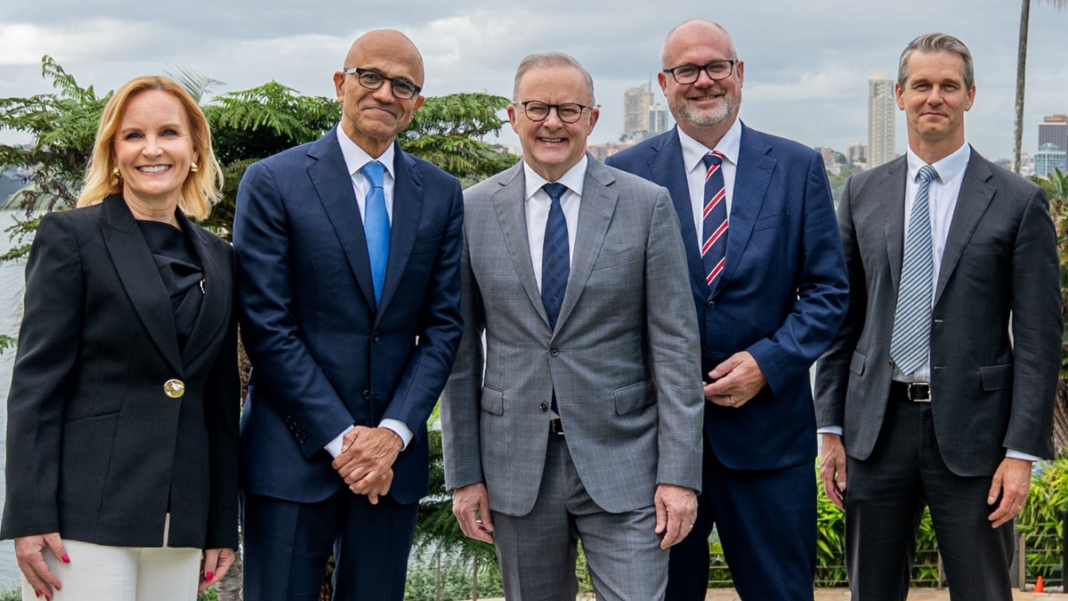
Prime Minister Anthony Albanese has signed a new Memorandum of Understanding with Microsoft, marking a major step in Australia’s push to build a stronger, safer artificial intelligence economy.
The agreement builds on the government’s National AI Plan and is backed by Microsoft’s announcement of a $25 billion investment aimed at expanding Australia’s AI capability, strengthening cyber security, and training up to three million Australian workers. The announcement was made by Microsoft CEO Satya Nadella during his visit to Sydney as part of the company’s global AI Tour, alongside Prime Minister Albanese.
The funding will be used to significantly grow Microsoft’s Azure cloud and AI supercomputing capacity in Australia, including the deployment of advanced AI processors and a major expansion of local data-centre infrastructure. The company plans to increase its Australian cloud footprint by more than 140 percent over the coming years, helping organisations access secure, high-capacity computing services within the country.
Industry Minister Tim Ayres said the partnership would help ensure AI delivers “real economic and social benefits” while maintaining strong safeguards.
“This is about capturing the opportunity of AI, while making sure Australians share in the benefits and remain protected.”
“This MoU outlines how the Australian Government and Microsoft will work together to strengthen AI infrastructure, improve safety measures and encourage adoption across the economy,” he said.
Assistant Minister Andrew Charlton added that partnering with global technology leaders would help set “the regional benchmark for safe, secure and inclusive AI”.
Under the agreement, Microsoft will expand its existing investments in cloud and AI infrastructure, building on a previously announced $5 billion commitment. The company will also work with national bodies including the AI Safety Institute and the National AI Centre to improve workforce capability and system safeguards.
The move comes as Australia positions itself to capture the economic benefits of AI while addressing concerns about data security, workforce disruption and ethical use.
A central part of the initiative is workforce development. Microsoft has pledged to provide AI training to three million Australians by 2028, the largest skills commitment of its kind in the country. The program builds on earlier training targets that have already reached more than one million people across Australia and New Zealand. New education and community programs will help teachers, students, nonprofit leaders and workers build practical AI skills and adapt to the changing job market.
Microsoft will also work closely with the Australian AI Safety Institute to support the safe testing and evaluation of advanced AI systems. This collaboration will focus on responsible deployment and understanding risks linked to emerging technologies such as conversational AI and companion chatbots.

Cyber security is another major pillar of the announcement. The Microsoft–Australian Signals Directorate Cyber Shield partnership, first launched in 2023, will be expanded to additional federal agencies. The initiative aims to improve threat detection, strengthen security settings across government systems and deepen cooperation with the Department of Home Affairs and the Digital Transformation Agency. The program has already secured tens of thousands of government accounts and uncovered previously unknown vulnerabilities.
According to economic analysis by EY-Parthenon, Microsoft’s operations contributed an estimated $36 billion to the Australian economy in the 2025 financial year and supported more than 186,000 full-time equivalent jobs.
Overall, the investment is intended to help Australia expand its digital infrastructure, improve cyber resilience and position itself as a global leader in responsible and inclusive AI adoption.
Support our Journalism
No-nonsense journalism. No paywalls. Whether you’re in Australia, the UK, Canada, the USA, or India, you can support The Australia Today by taking a paid subscription via Patreon or donating via PayPal — and help keep honest, fearless journalism alive.
