

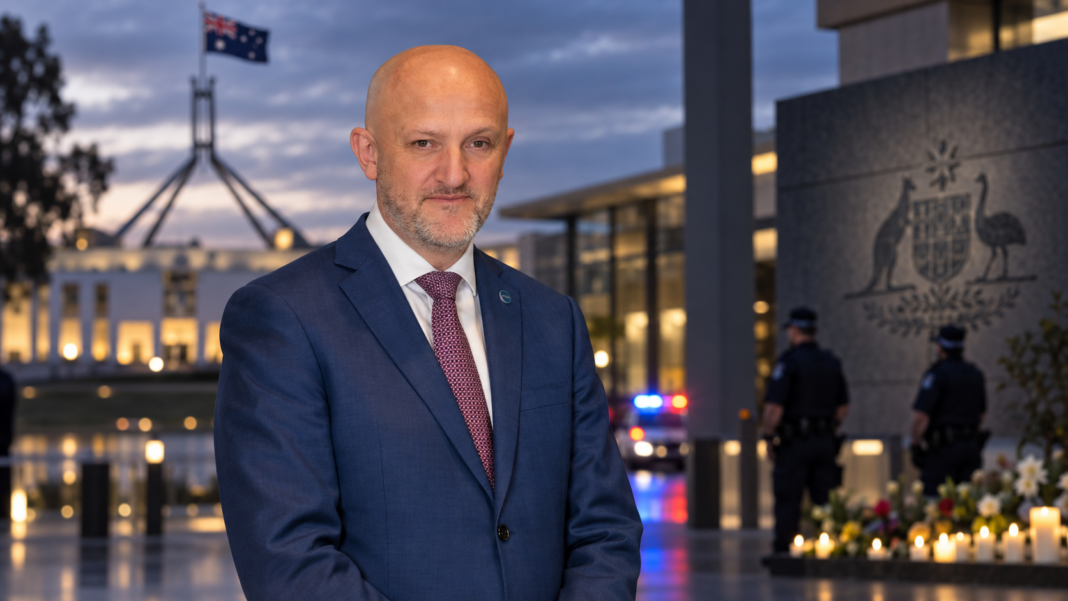
Australia’s domestic intelligence chief has warned antisemitism remains at a “pretty high, disturbing level”, saying political leaders, the media and wider society should have done more to challenge escalating hostility towards Jewish Australians after the October 7 attacks.
ASIO Director-General Mike Burgess made the comments during an extended interview with veteran broadcaster Neil Mitchell, arguing that legitimate anger or criticism directed at the Israeli government must not be transferred onto Jewish Australians.
“We still have antisemitism as a problem, and that does concern me,” Burgess said.
“It’s got to a pretty high, disturbing level.”
Burgess said the security environment had progressively deteriorated after the Hamas attacks on Israel on October 7, 2023, beginning with threatening and intimidating behaviour before escalating into direct attacks on people, places of worship and businesses.
He pointed to the December 14, 2025 Bondi terrorist attack, in which 15 people were killed and 40 wounded at a Jewish Chanukah celebration, as the most devastating consequence of that deteriorating environment.
“It raised its ugly head after the 7th of October,” Burgess said.
“It started with threatening, intimidating behaviour and then, a year later, it transitioned to direct targeting of people, places of worship and businesses.
And then we saw the death of 15 people. I reckon that’s a bad place for us to be.”
The ASIO chief stressed that criticism of Israel, including strong opposition to the actions of its government, was not inherently antisemitic.
“It’s OK to be angry at the state of Israel. But how you deal with that anger, it really does matter,” he said.
Burgess said some people expressing passionate political views might not intend to be antisemitic, but their words or actions could nevertheless have that effect.
He said a clearer distinction needed to be maintained between the State of Israel and Jewish Australians, many of whom had no connection to the decisions of the Israeli government.
Burgess also acknowledged that ASIO itself could potentially have spoken more forcefully as antisemitism escalated.
“All of us should have stood up more. Maybe I could have shouted more,” he said.
“Political leaders could have said ‘this is not right’.
I mean, a couple of them did do that, but not many of them did. The media should have probably watched how it was reporting.”
He said criticism of Israel should be accompanied by an explicit recognition that Jewish Australians should not be held responsible for actions taken by a foreign government.
The remarks closely echo comments made this week by former ASIO director-general Dennis Richardson, who said Australia had “dropped the ball” in responding to antisemitism after October 7.
Richardson said the country also needed to be capable of discussing Islamist extremism openly without treating Australian Muslims collectively as a security problem.
He argued mainstream Muslim leaders should be central to that discussion, warning that avoiding difficult conversations could strengthen both Islamist extremists and neo-Nazis seeking to exploit community divisions.
Burgess also used his latest interview to issue a stark warning about the threat posed by Iran.
Asked about risks facing Australia’s Jewish community from foreign states, Burgess said he would not rule out Tehran seeking to target prominent Jewish Australians.
“I wouldn’t rule out the possibility that Iran would want to kill prominent Jewish Australians,” he said.
The warning follows ASIO’s assessment earlier this year that Iran’s Islamic Revolutionary Guard Corps was responsible for directing attacks against Jewish-linked properties in Australia through layers of intermediaries and criminal proxies.
In his June annual threat assessment, Burgess said an Australian citizen based in Iran and working as a senior IRGC Quds Force operative had orchestrated the firebombing of Lewis’ Continental Kitchen in Sydney.
He also said a former Australian resident living in Iraq had directed the attack on Melbourne’s Adass Israel Synagogue through a network linked to Iranian-backed militia groups.
ASIO assessed that the operations involved Australian-based criminals acting through intermediaries rather than direct Iranian operatives carrying out the attacks themselves.
Burgess warned in June that Iran continued to regard Australia as a legitimate target for covert acts of violence and that an Iran-aligned network active in Europe could potentially expand its operations into Australia.
ASIO assessed there was a realistic possibility such networks could conduct or inspire arson, vandalism or even assassinations on Australian soil.
Australia expelled Iran’s ambassador and three other diplomats in August 2025 after the government attributed the attacks to the Iranian regime.
The latest comments also come amid continuing concern about antisemitic incidents in Melbourne.
Burgess referred during his interview to a recently reported incident at Melbourne Airport in which a Jewish family said they were repeatedly subjected to antisemitic abuse while travelling through the international terminal.
According to reports, a woman allegedly targeted members of the family, including children, using terms such as “baby killer”, “Zionist Nazi” and “Zionist pig”.
The family said the incidents left children distressed and crying.
Melbourne Airport said at the time that it had not received a formal complaint about the incident but condemned antisemitism and said passengers should feel safe within the terminal.
The incident followed a separate case earlier in the year in which a Melbourne Airport employee was charged after allegedly performing a Nazi salute towards Jewish teenagers travelling to Israel.
That case remains a matter for the courts.
Burgess’s warning comes against an increasingly complex national security backdrop.
Australia’s official terrorism threat level remains at PROBABLE, meaning intelligence agencies assess there is a greater than 50 per cent chance of an onshore terrorist attack or attack planning occurring within the following 12 months.
ASIO first raised the threat level back to probable in August 2024 after warning that political polarisation, social division and rapid online radicalisation were creating an environment increasingly permissive of violence.
In June this year, Burgess said he was “gravely concerned” about the trajectory of politically motivated violence and suggested the existing threat-level framework did not fully capture the breadth of the danger confronting Australia.
He said social media was accelerating grievance narratives, eroding trust in institutions and creating conditions in which inflammatory rhetoric could become normalised.
“When intolerance is tolerated, when violent language and violent acts are left unchecked, they become normalised,” Burgess said in his annual threat assessment.
ASIO says antisemitism now emerges from several ideologically opposed sources.
In his June assessment, Burgess identified neo-Nazis, Islamist extremists, some issue-motivated extremists, anarchist and revolutionary groups and foreign states as potential sources of antisemitic violence.
“Hatred of Jews is one thing virtually all the violent extremist cohorts have in common,” he said.
He again emphasised that criticism of the Israeli government was not itself antisemitic, but said threats and violence directed at Jewish Australians moved well beyond legitimate political protest.
Australia’s intelligence agencies are simultaneously dealing with a wider terrorism threat that has become less predictable.
Burgess said in June that radicalised individuals were increasingly adopting mixed ideologies rather than traditional extremist doctrines, being radicalised online rather than through physical groups, and moving towards violence within weeks rather than months or years.
Young people have become a particular concern.
ASIO cited cases involving teenagers with bomb-making material and plans to attack schools or public institutions, alongside threats motivated by Islamist, neo-Nazi, nationalist, racist, Christian and extreme-left ideologies.
Working with law enforcement agencies, ASIO had foiled 31 major terrorist plots since 2014 as of its June annual assessment.
The Bondi attack has prompted unprecedented scrutiny of whether governments, police, intelligence agencies, media organisations and other institutions responded adequately to warning signs surrounding antisemitism and violent extremism.
The Royal Commission on Antisemitism and Social Cohesion was established on January 9 following the attack.
Its terms of reference include examining the nature and prevalence of antisemitism in Australia, its drivers, government and institutional responses, radicalisation and the circumstances surrounding the Bondi massacre.
The commission, led by former High Court justice Virginia Bell, has completed 62 days of hearings and heard evidence from hundreds of witnesses.
More than 20,000 submissions have been received.
Its final report is now due on December 18 after the federal government agreed to move the original December 14 deadline so its release would not coincide with the first anniversary of the Bondi attack.
Burgess said he supported the royal commission undertaking a detailed examination of the causes of antisemitism and how institutions responded.
His comments suggest the intelligence chief believes responsibility cannot be placed solely on extremists or security agencies.
Rather, he argues the deterioration occurred within a broader environment in which political language, protests, online material and public commentary increasingly blurred the distinction between anger over events in the Middle East and hostility towards Jewish Australians.
The challenge for Australia, Burgess said, is protecting vigorous political debate — including criticism of Israel — without allowing that debate to become justification for intimidation, collective blame or violence against people because they are Jewish.
His warning is ultimately broader than one community.
ASIO’s assessment is that declining social cohesion, inflammatory rhetoric and the normalisation of hatred can create opportunities for violent extremists across the political and ideological spectrum.
For Burgess, the lesson of the past three years is that once hatred is allowed to escalate unchecked, the consequences can move rapidly from words to intimidation and ultimately to violence.
Support our Journalism
No-nonsense journalism. No paywalls. Whether you’re in Australia, the UK, Canada, the USA, or India, you can support The Australia Today by taking a paid subscription via Patreon or donating via PayPal — and help keep honest, fearless journalism alive.
