

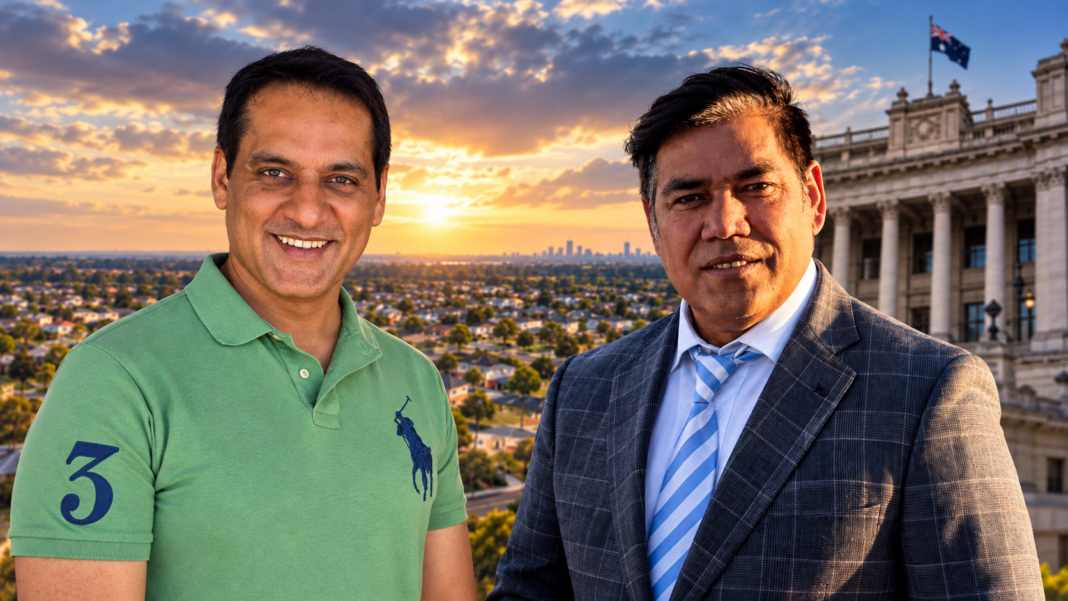
After a decade chasing Tarneit, two Indian-Australian powerbrokers are again left outside the race
Two of Melbourne’s west’s most recognisable Indian-Australian political figures have spent the better part of a decade circling the same prize: a seat in the Victorian Parliament representing Tarneit.
Neither will get it in 2026.
Labor powerbroker Jasvinder Sidhu and former Wyndham councillor Intaj Khan have travelled very different political paths. Still, their ambitions have repeatedly converged on Tarneit, one of Australia’s fastest-growing and most multicultural political battlegrounds.
This November, however, the contest will go ahead without either man.
Labor is going to the election with sitting MP Dylan Wight, while the Liberal Party has endorsed Venkat Ram Upparlapalle. Both parties have already publicly listed both men as their Tarneit candidates by June and September respectively.
For Sidhu and Khan, it is the latest chapter in political stories stretching back almost a decade.
In 2017, remarkably, both men were attempting to secure Labor preselection for Tarneit.
Sidhu came extraordinarily close. He won 54 per cent of the local Labor membership vote against Sarah Connolly, but ultimately failed to secure the state leadership’s endorsement. At the time, he was already confronting allegations of branch stacking and questions surrounding his charity Let’s Feed — allegations he emphatically denied, describing them as a smear campaign.


Khan, then a Wyndham councillor, also wanted the Labor nomination. His attempt became embroiled in a bitter internal fight after federal Labor MP Joanne Ryan called for him to be expelled from the party amid charges concerning the disclosure of property and commercial interests. Some of those charges were subsequently dropped. Khan threatened defamation proceedings against Ryan and denied wrongdoing. Ryan’s motion to expel Khan was defeated with an overwhelming majority.
Nearly a decade later, the names may have changed on the ballot paper, but the political prize has not.
Sources familiar with the latest Labor deliberations have told The Australia Today that Sidhu again wanted a pathway to Tarneit but was ultimately not given the seat.

His potential comeback was far from fanciful.
In 2025, Labor’s national executive controversially lifted a seven-year ban preventing Sidhu from seeking preselection two years before it was due to expire. At the time, senior Labor sources were openly discussing a factional scenario under which Wight could move to the Legislative Council, and Sidhu could take Tarneit.
The ban followed a Labor investigation that alleged Sidhu had engaged in branch stacking and inflamed ethnic tensions.
In 2020, Sidhu faced fierce criticism over recorded comments concerning Turkish and Lebanese Muslims. Muslim and Turkish community organisations condemned the remarks, while Sidhu apologised for the offence caused amid the controversy.
Sidhu has consistently rejected the allegations, maintaining the evidence against him was concocted and that he was the victim of a factional attack.
Sidhu nevertheless remained an influential figure inside Victorian Labor during the ban.
His political organisation in Melbourne’s west and links across Labor’s membership have long made him a consequential internal figure, even when he was unable to contest parliamentary preselection.
But his past has also followed him.
Labor sources speaking to The Australia Today say those events were among the matters raised during discussions surrounding his political future.
The sources also told The Australia Today that senior Labor figures were concerned about reopening community divisions in an electorate where Labor is increasingly conscious of the challenge posed by One Nation and the Greens, whose Tarneit candidate is long associated with local Mosques and Islamic leadership.
It means political disputes involving religion, migration and multiculturalism can carry particular weight in the electorate.
The broader political environment, however, has changed dramatically.
A RedBridge/Accent Research poll conducted between September 1 and 14 among 2,371 Victorian voters put One Nation on 25 per cent of the statewide primary vote, compared with 29 per cent for the Coalition and 24 per cent for Labor. The poll’s estimated margin of error for the full sample was ±2.2 percentage points. It was a statewide poll, not a Tarneit poll, so it cannot establish One Nation’s support in the electorate itself.
Labor’s concern about Melbourne’s west is nevertheless increasingly public. ABC reporting this week noted that Labor’s campaign against One Nation is particularly focused on western Melbourne, where frustration over infrastructure, population growth and government services is putting pressure on the party’s traditional support base.
Tarneit is especially important because few Victorian electorates look like it.
According to the 2021 Census, 22.6 per cent of Tarneit residents were born in India, and 21.8 per cent reported Indian ancestry. Punjabi/Sikh ancestry alone accounted for another 5.4 per cent, although Census ancestry categories can overlap because respondents can nominate two ancestries.
The sensitivity surrounding Tarneit is understandable given the electorate’s extraordinary demographic profile.
Hindus accounted for 17.1 per cent of residents, Muslims 14.6 per cent and Sikhs 9.6 per cent. Together those three faiths represented 41.3 per cent of the electorate’s population at the Census — although population figures should not be confused with the enrolled voting population.
That makes community relations more than a peripheral issue in Tarneit politics.
For Khan, meanwhile, the road from Labor aspirant to Liberal aspirant has been almost as complicated.

After his Labor ambitions collapsed, Khan eventually joined the Liberal Party and sought Tarneit preselection ahead of the 2022 election.
His bid failed again.
At that time Khan had only recently joined the Liberals and required an exemption from the party’s membership-duration rules. The Liberal Administrative Committee unanimously rejected his exemption application, The Australia Today reported at the time.
Khan has remained politically connected and visible in Melbourne’s west since then.
Sources have now told The Australia Today that Khan again explored Liberal candidacy for Tarneit ahead of the 2026 election, but withdrew after it became clear his application would not receive leadership support.

Those sources say concerns about controversies accumulated during his years in local politics and business were raised as obstacles to his candidacy.
What can be established is that Khan is not the Liberal candidate. The party has instead endorsed Venkat Ram Upparlapalle for Tarneit.
There is a remarkable historical symmetry to all of this.
In 2017, Sidhu and Khan were effectively competing against each other for a pathway into Parliament through Labor.
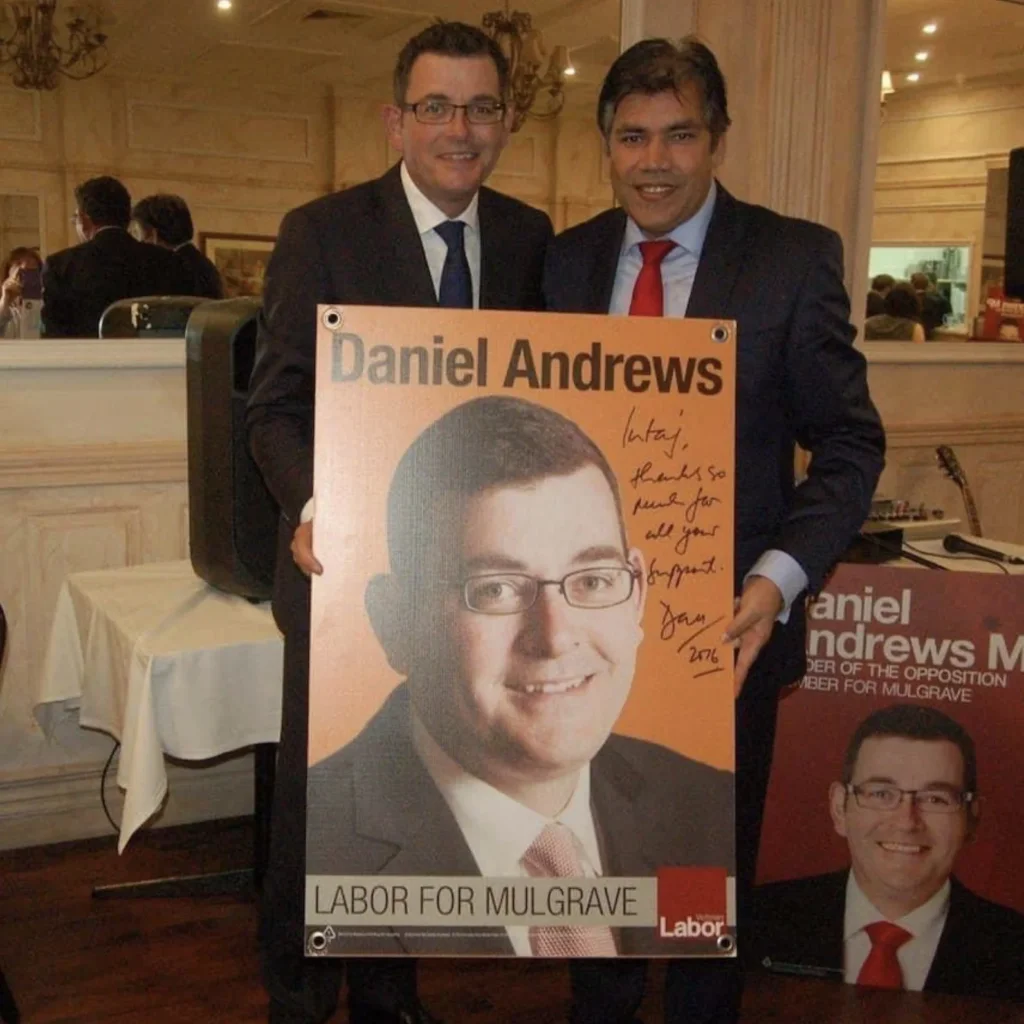

Khan later crossed the political divide and attempted to contest the same electorate for the Liberals.
Sidhu remained inside Labor, survived years of factional warfare and eventually regained his eligibility to seek preselection, again prompting speculation that Tarneit could finally become his route into Spring Street.
Yet as Victoria heads towards the 2026 election, both remain outside the contest.
Meanwhile, Tarneit itself is becoming harder for either major party to take for granted.
Labor has held the district at every election since it was created in 2002. Wight won it in 2022 with 46.6 per cent of the primary vote and 62.3 per cent after preferences against the Liberal candidate, a 5.6 percentage-point two-party-preferred swing against Labor.
The political environment heading into November is markedly different from four years ago. One Nation’s statewide polling surge, voter frustration across Melbourne’s rapidly growing west and Tarneit’s extraordinary demographic transformation mean the electorate is becoming an important test of how Victoria’s major parties speak to multicultural suburban voters.
And behind the official contest sits another political story — of two Indian-Australian figures who have spent almost 10 years trying to turn influence, organisation and community connections into a seat in Parliament.
For Jasvinder Sidhu and Intaj Khan, Tarneit has repeatedly appeared within reach.
For almost 10 years, two ambitious political figures have pursued the same parliamentary destination from different sides of politics.
In 2026, Tarneit will again go to an election without either man’s name on the ballot.
Support our Journalism
No-nonsense journalism. No paywalls. Whether you’re in Australia, the UK, Canada, the USA, or India, you can support The Australia Today by taking a paid subscription via Patreon or donating via PayPal — and help keep honest, fearless journalism alive.
