

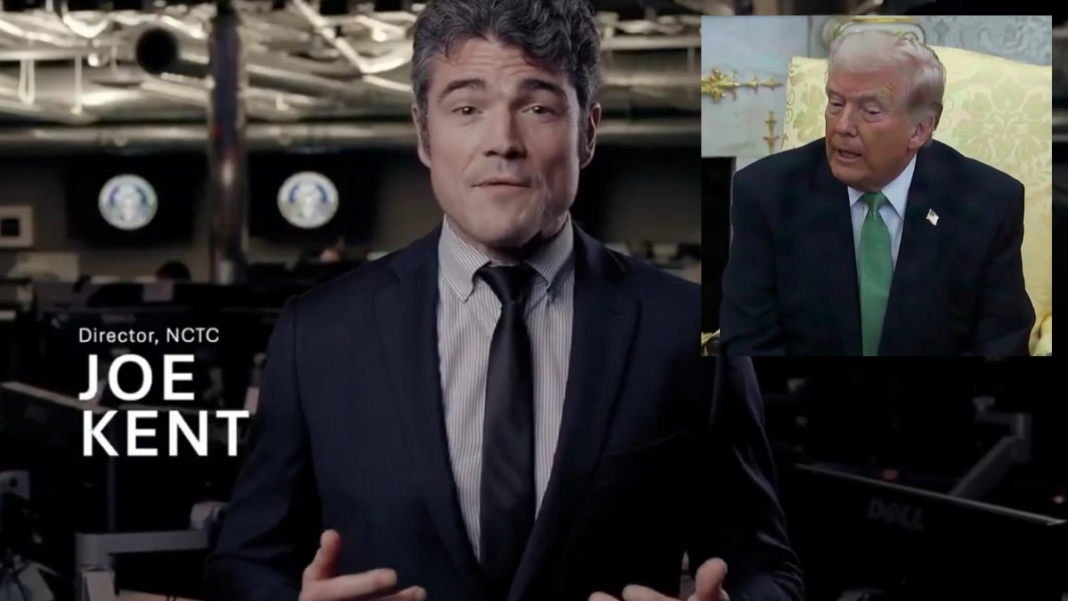
The resignation of the United States’ top counterterrorism official over the war with Iran has laid bare growing divisions within President Donald Trump’s administration, as political, military and public debate intensifies over the conflict’s justification and trajectory.
Joe Kent, director of the National Counterterrorism Center (NCTC), stepped down on Tuesday, announcing his decision in a blunt statement posted on X. “After much reflection, I have decided to resign… I cannot in good conscience support the ongoing war in Iran,” he wrote, arguing that Tehran posed “no imminent threat” to the United States.
Kent’s resignation was swiftly rebuffed by the White House. Trump dismissed Kent as “weak on security” and said he was “glad” he had left the post, reinforcing the administration’s stance that Iran posed a clear and present danger. “When somebody says they didn’t think Iran was a threat, we don’t want those people,” the president told reporters in the Oval Office.
“Iran was a tremendous threat.”
Kent’s departure is one of the most senior-level breaks with the administration since the conflict began, and comes at a sensitive moment, just 24 hours before key intelligence leaders are scheduled to testify before the Senate Intelligence Committee. His exit raises fresh questions about internal dissent within the national security apparatus and the intelligence underpinning the decision to strike Iran.
In his resignation statement, Kent alleged that the United States had been drawn into war by external pressure, claiming American media, Israeli officials and pro-Israel lobbying groups had fostered a “misinformation campaign” to build support for military action. He compared the situation to the lead-up to the 2003 Iraq War, suggesting a similar narrative had been used to justify intervention. There is no credible evidence supporting the claim that Israel manipulated U.S. intelligence assessments in that case.
Kent, a combat veteran and former congressional candidate, had been appointed to the role by Trump in early 2025 and confirmed by the Senate later that year. He thanked both the president and Director of National Intelligence Tulsi Gabbard in his message, describing his tenure as an honour.
White House press secretary Karoline Leavitt also rejected Kent’s claims, calling them “false” and emphasising that determinations of national security threats ultimately rest with the commander-in-chief. She described as “insulting and laughable” the suggestion that foreign governments influenced Trump’s decision-making.
Senior Republican lawmakers echoed that criticism, underscoring the administration’s broader messaging. House Speaker Mike Johnson said intelligence briefings available to senior leaders pointed to an imminent threat from Iran, including concerns over uranium enrichment and rapidly advancing missile capabilities. “Had the president waited, I am personally convinced that we would have mass casualties of Americans,” Johnson said.
Republican Congressman Don Bacon took a more combative tone, pointing to Iran’s history of attacks on U.S. personnel in the Middle East and dismissing Kent’s departure with a terse “good riddance” on social media.
The administration has consistently argued that its actions were both defensive and necessary. Secretary of State Marco Rubio said earlier this month that Washington moved to strike Iran after Israel initiated its own military action, warning that Tehran would likely retaliate against U.S. forces if the United States did not act pre-emptively.
Beyond Washington, Kent’s resignation has also triggered an emotional public response, highlighting the human dimension of the conflict.
Sharrell Anne, the wife of a U.S. service member killed by Iranian-backed forces in Iraq, publicly challenged Kent’s position. In a pointed reply, she accused him of downplaying the threat posed by Iran and argued that the current conflict represents a continuation of a long-standing struggle against state-sponsored militancy.
Her remarks drew attention to Kent’s own personal history. A combat veteran whose wife was killed in action by ISIS, Kent had previously been a vocal advocate for pursuing those responsible for attacks on Americans overseas. Anne’s criticism framed his resignation as a reversal of that earlier stance, underscoring how personal loss continues to shape perspectives on U.S. military engagements.
Kent’s political background adds another layer to the controversy. A staunch Trump ally, he ran unsuccessfully for Congress in Washington state in both 2022 and 2024, aligning himself closely with the former president’s political movement. His resignation, therefore, represents not only a policy disagreement but a notable fracture within a traditionally loyal segment of Trump’s support base.
The timing of his departure is particularly significant. With the war entering its third week and casualties mounting, the administration is under increasing pressure to justify both the intelligence behind its actions and its broader strategic objectives. Congressional hearings scheduled this week are expected to probe those questions, with Tulsi Gabbard and other senior officials set to face scrutiny from lawmakers.
Support our Journalism
No-nonsense journalism. No paywalls. Whether you’re in Australia, the UK, Canada, the USA, or India, you can support The Australia Today by taking a paid subscription via Patreon or donating via PayPal — and help keep honest, fearless journalism alive.
