
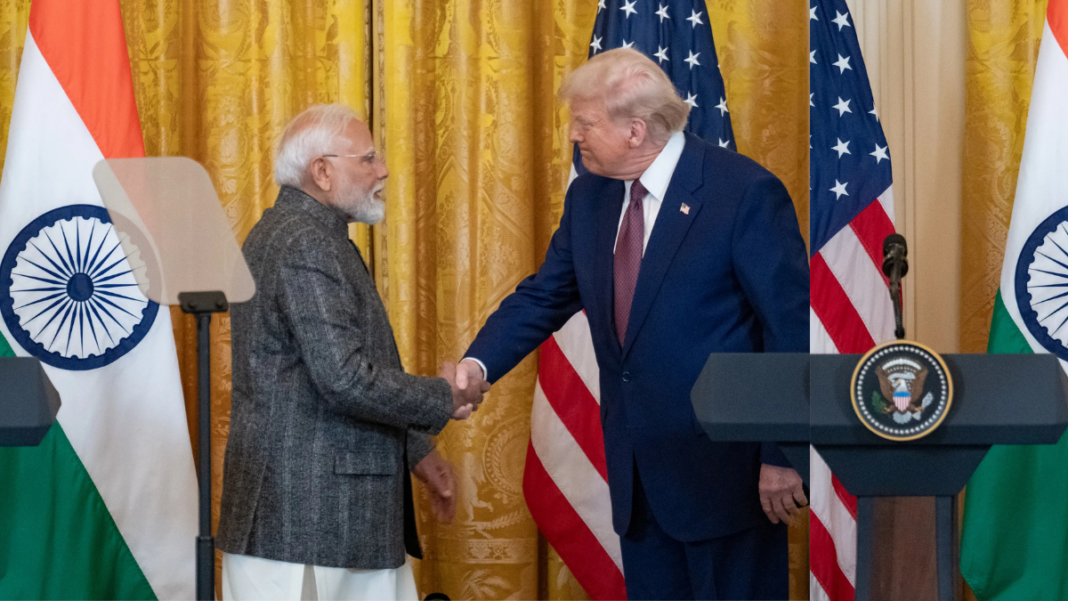
The United States and India have reached a landmark trade agreement that significantly resets bilateral economic relations, with the White House confirming the removal of an additional 25 per cent tariff on Indian imports imposed over New Delhi’s purchase of Russian oil.
The clarification, provided by a senior White House official to ANI on Monday (local time), follows an earlier announcement by Donald Trump that Washington would reduce reciprocal tariffs on Indian goods from 25 per cent to 18 per cent, effective immediately.
The official confirmed that the removal of the additional 25 per cent tariff was conditional on India ceasing not merely reducing, its imports of Russian oil, underscoring the geopolitical stakes embedded in the agreement.
“Yes, although the agreement is that India will cease, not just reduce, Russian oil purchases,” the White House official said when asked whether the punitive tariffs would be lifted in exchange for changes to India’s energy sourcing.
Trump–Modi agreement reshapes trade and energy ties
President Trump announced the deal following a phone call with Narendra Modi, describing the Indian leader as “one of my greatest friends” and a “powerful and respected leader”.
In a post on Truth Social, Trump said the tariff reduction was granted “out of friendship and respect” for Modi and claimed the Prime Minister had agreed to stop buying Russian oil and significantly increase purchases from the United States.
“He agreed to stop buying Russian Oil, and to buy much more from the United States and, potentially, Venezuela,” Trump wrote, linking the agreement to broader efforts to end the war in Ukraine.
Trump also said India would move to reduce tariffs and non-tariff barriers against US products to zero and commit to purchasing more than US$500 billion worth of American energy, technology, agricultural products, coal and other goods over time.
Modi welcomes tariff relief for ‘Made in India’ goods
Prime Minister Modi welcomed the announcement, confirming that Made in India products will now face a reduced US tariff of 18 per cent, a move expected to strengthen India’s export competitiveness.
“Wonderful to speak with my dear friend President Trump today. Delighted that Made in India products will now have a reduced tariff of 18%,” Modi wrote on X, thanking Trump on behalf of India’s 1.4 billion people.
Modi said cooperation between the world’s two largest democracies would unlock vast opportunities for mutually beneficial growth and described Trump’s leadership as vital for global peace, stability and prosperity.
White House links tariff rollback directly to Russian oil
While the tariff reduction itself was welcomed by New Delhi, the White House confirmation added a critical caveat: India must fully cease Russian oil purchases, not simply scale them back.
The additional 25 per cent tariff had been imposed specifically in response to India’s increased imports of discounted Russian crude following Moscow’s invasion of Ukraine. The White House clarification makes clear that Washington expects a decisive shift in India’s energy strategy as part of the trade reset.
The confirmation removes ambiguity around the scope of the deal and signals that energy policy is now firmly embedded within the broader India–US economic and strategic relationship.
India gains competitive edge over regional exporters
Under the new tariff structure, India now enjoys lower US tariffs than most of its major regional export competitors, giving it a strategic advantage in global supply chains.
India’s 18 per cent tariff compares favourably with:
- Indonesia at 19 per cent
- Pakistan at 19 per cent
- Bangladesh and Vietnam at 20 per cent
- China, which continues to face tariffs of 34 per cent
Trade experts say the shift positions India as a more attractive alternative manufacturing and export hub, particularly in sectors such as textiles, pharmaceuticals, electronics and engineering goods.
Indian ministers hail ‘historic turning point’
India’s External Affairs Minister S. Jaishankar welcomed the agreement, saying it would boost job creation, spur economic growth and strengthen India’s Make in India initiative.
“This will create more jobs, spur growth and promote innovation in both economies,” Jaishankar said, describing a strong economic relationship as the foundation of the broader strategic partnership.
Commerce and Industry Minister Piyush Goyal called the deal a “historic turning point” that would unlock unprecedented opportunities for farmers, MSMEs, entrepreneurs and skilled workers.
“This is not just a trade deal — it will reshape India–US relations and accelerate our journey towards Viksit Bharat 2047,” Goyal said, noting the agreement would also deepen access to advanced US technologies.
Commerce Secretary Rajesh Agrawal said the agreement would unlock shared prosperity, innovation and growth for two natural democratic partners.
Strategic timing amid global trade realignment
The India–US agreement comes within days of New Delhi concluding a landmark free trade agreement with the European Union, reinforcing India’s push to diversify trade partnerships amid global economic uncertainty.
Taken together, the tariff reductions, energy commitments and market access concessions represent one of the most significant recalibrations of India–US economic ties in recent years.
President Trump framed the deal as proof of decisive leadership, saying: “Prime Minister Modi and I are two people that GET THINGS DONE.”
With the White House now confirming the removal of the additional 25 per cent tariff tied to Russian oil purchases, the agreement signals a deeper integration of trade, energy and geopolitics — reshaping the trajectory of India–US relations at a critical moment for the global economy.
Support our Journalism
No-nonsense journalism. No paywalls. Whether you’re in Australia, the UK, Canada, the USA, or India, you can support The Australia Today by taking a paid subscription via Patreon or donating via PayPal — and help keep honest, fearless journalism alive.
