

Twenty-five thousand people were on their feet inside Melbourne’s Marvel Stadium.
The lights from thousands of mobile phones shimmered across the stands. Then came the chant.
“Modi! Modi! Modi!”
This was not Ahmedabad, Mumbai or Delhi.
This was Melbourne.
On 9 July 2026, Indian Prime Minister Narendra Modi walked into an Australian stadium alongside Prime Minister Anthony Albanese for an event called Melbourne Meets Modi.

Australian media, including The Australia Today, estimated more than 25,000 people inside the stadium.
For Australians unfamiliar with the intensity of Modi’s connection with sections of the Indian diaspora, the scenes were extraordinary.
Albanese himself captured the atmosphere.
“This stadium has seen some loud and legendary events,” he told the crowd, describing the affection between Australians and Indians as “palpable and present” inside the stadium.

It echoed what Albanese had said after an earlier Australian reception for Modi: the welcome was “pretty extraordinary” and the energy in the room was “quite extraordinary”.
It is tempting to dismiss such scenes as diaspora theatre.
That would miss the bigger story.
Because the man whose name was echoing around a Melbourne football stadium has spent the past quarter-century undergoing one of the more remarkable transformations in modern democratic politics.

On 7 October 2001, Narendra Modi became Chief Minister of Gujarat.
He had never previously held government office. He had never even contested an election.
Twenty-five years later, he has not spent a single day outside executive government.
More importantly for Australia, the politician who began as a provincial Indian chief minister has become a central participant in an increasingly complicated global order.
The man everyone seems able to call
One way of understanding Modi’s foreign policy is to look at his telephone.
Washington calls.
Moscow calls.
Paris calls.
European leaders call.
Middle Eastern leaders call.
And remarkably, Delhi can usually answer all of them without first asking permission from any of the others.


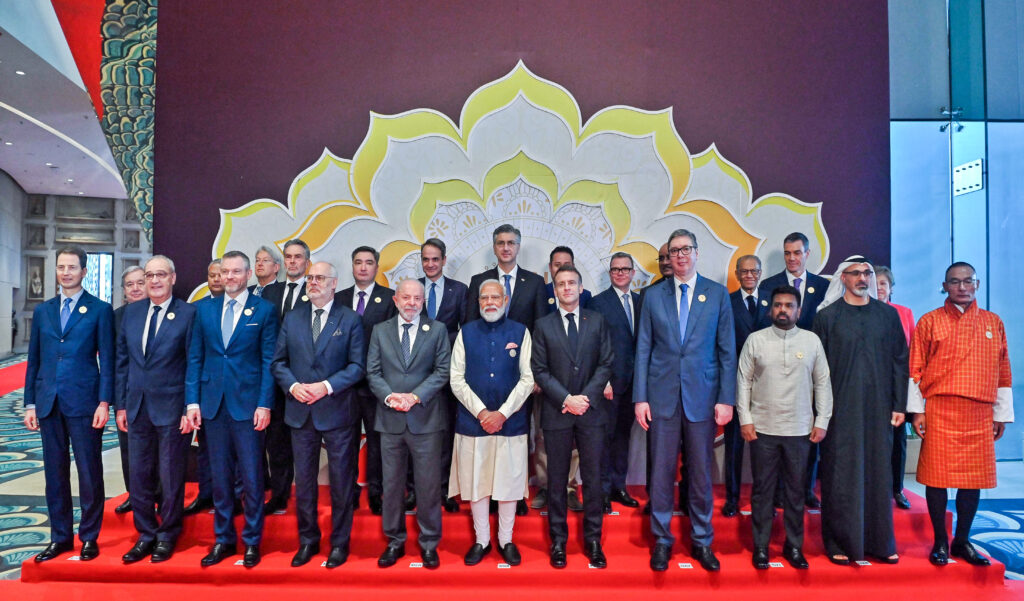
In 2026, Modi spoke separately with US President Donald Trump and French President Emmanuel Macron over the escalating situation in West Asia and the security of the Strait of Hormuz. He has maintained regular communication with Russian President Vladimir Putin, including over the war in Ukraine and Russia’s dealings with Washington.
That does not mean Modi is personally solving the world’s wars.
It means something subtler.
India has managed to become a country that governments on competing sides increasingly consider worth talking to.
For Australia, this is particularly important.
Australia and India are now partners in the Quad alongside Japan and the United States. In Melbourne this year, Albanese said the bilateral relationship had “never been more consequential” and announced expanded cooperation across defence, security, education, technology, energy and critical minerals.
Yet India remains outside the Western alliance system.
It buys Russian oil.
It maintains a decades-old defence relationship with Moscow.
It buys Rafale combat aircraft from France.
It conducts sophisticated military exercises with Western partners.
It has drawn closer to the United States without becoming an American treaty ally.
It works increasingly closely with Australia and Japan in the Indo-Pacific while simultaneously sitting with Russia and China in BRICS and the Shanghai Cooperation Organisation.
Western foreign policy traditionally likes categories: ally, adversary, partner or neutral.
Modi’s India resists being placed neatly inside any of them.
The preferred Indian phrase is “strategic autonomy”.
In practice, it means India wants the freedom to buy from Paris, trade with Moscow, negotiate with Brussels, exercise with Washington, build critical-minerals partnerships with Canberra and still tell each of them that Indian interests come first.
That can frustrate Western governments.
But it is increasingly difficult for them to ignore.


The dealmaker
There is another part of the Modi story that has received less attention than his summit diplomacy.
India once had a reputation for being exceptionally difficult to negotiate trade agreements with.
That has begun to change.
In January 2026, India and the European Union concluded negotiations on an extraordinarily ambitious free trade agreement after years of stops and starts. The European Commission says the agreement will eliminate or reduce tariffs on more than 96 per cent of EU goods exports to India.
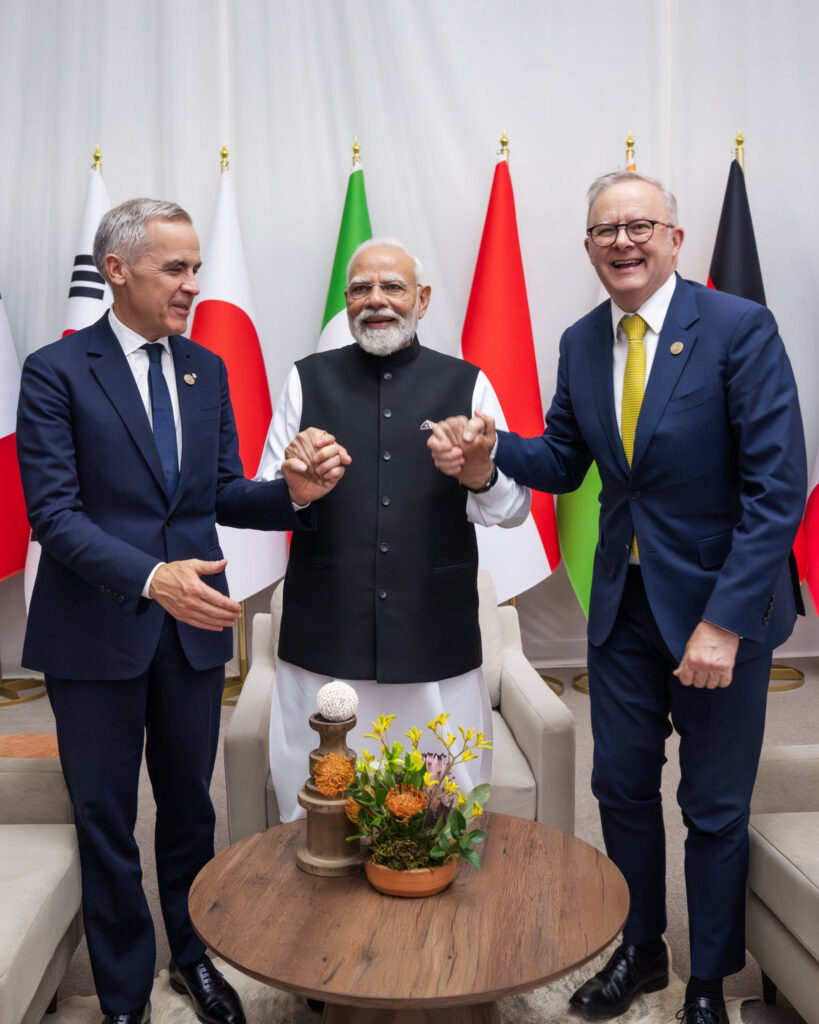
India already has its Economic Cooperation and Trade Agreement with Australia, while Albanese and Modi agreed in Melbourne to accelerate work towards the broader Comprehensive Economic Cooperation Agreement.
Days after the Melbourne spectacle, Modi travelled to Auckland — the first visit by an Indian prime minister to New Zealand in 40 years — as the two countries pushed ahead with their own free-trade negotiations.
This is not the India many Western governments remember from a generation ago.
It is still protectionist in important areas and fiercely defensive of domestic interests.
But it is negotiating from a position of much greater economic confidence.
The attraction is obvious: 1.4 billion people, a rapidly expanding middle class and one of the fastest-growing major economies on Earth.
France, Russia, America — why choose only one?
Perhaps nowhere is Modi’s approach clearer than defence and energy.
India can purchase advanced French military aircraft while retaining Russian-origin military platforms.
It can buy discounted Russian crude despite Western pressure while simultaneously expanding defence and technology cooperation with the United States.
And it can do all this while becoming more important to Australia’s Indo-Pacific strategy.
This is sometimes portrayed as a contradiction.
From Delhi’s perspective, it is diversification.
India remembers sanctions. It remembers dependence. It remembers a Cold War in which other powers routinely expected developing nations to choose camps.
Modi’s answer has effectively been: India will choose India.
That approach did not originate entirely with him. Strategic autonomy runs deep through Indian foreign policy, from Jawaharlal Nehru’s non-alignment through successive Congress and BJP governments.
Modi’s contribution has been to pursue it with far greater visibility, personal diplomacy and economic weight.
The medals tell their own story
Then there is an unusual measure of diplomatic reach: the honours Modi has received overseas.
Across his premiership, governments from remarkably different political, religious and strategic traditions have decorated him.
Saudi Arabia has honoured him.
The United Arab Emirates has honoured him.
Bahrain has honoured him.
Palestine has honoured him.
France has awarded him the Grand Cross of the Legion of Honour.

Russia awarded him the Order of St Andrew the Apostle, its highest order.
Bhutan awarded him the Order of the Druk Gyalpo, with Modi becoming the first foreign head of government to receive the kingdom’s highest decoration.
Other honours have come from countries across Africa, the Pacific, Europe, the Caribbean and the Middle East.
State honours should not be confused with independent assessments of political performance. Governments give decorations for many diplomatic reasons.
But their geographic spread is telling.
Few contemporary leaders can be decorated by Russia, France, Saudi Arabia, Palestine and several Pacific nations while simultaneously being embraced as a strategic partner by Washington and Canberra.
That says less about medals than it does about India’s reach.
When disaster strikes, India increasingly arrives
Another side of India’s global emergence receives much less attention in the West.
When countries are in trouble, India increasingly turns up.
After the catastrophic earthquakes in Türkiye and Syria in 2023, India launched Operation Dost.
Indian search-and-rescue teams, medical personnel, equipment, and supplies arrived rapidly. More than 250 personnel were deployed, an Indian Army field hospital treated thousands of patients, and humanitarian supplies went to both Türkiye and Syria. India’s foreign ministry described its contingent as among the earliest international assistance to arrive.
When a devastating earthquake struck Myanmar in 2025, India launched Operation Brahma. An Indian Army field hospital treated more than 2,500 injured people within two weeks, while aircraft and naval vessels delivered hundreds of tonnes of humanitarian supplies.
India has responded to disasters in Nepal, Sri Lanka and elsewhere. Its National Disaster Response Force lists international deployments stretching from Japan’s 2011 tsunami through Nepal, Türkiye, Myanmar and Sri Lanka.
And when Sri Lanka’s economy effectively collapsed in 2022, India provided close to US$4 billion in assistance through credit, currency support, fuel, food, medicines, fertiliser and other measures.
Not every act of international assistance is geopolitically disinterested — no serious country conducts foreign policy without national interests.
But there is an important distinction.
India has increasingly tried to present itself not as a country arriving with political lectures or demands for ideological alignment, but as a country capable of sending doctors, rescuers, food, medicines, credit or ships when they are needed.
For nations across the Indo-Pacific, including Australia, that capacity matters.
The Global South wants a seat
This helps explain another part of Modi’s diplomacy.
He has spent considerable political capital presenting India as a voice for countries that believe the institutions built after the Second World War no longer adequately represent today’s world.
The clearest example came during India’s G20 presidency in 2023.

The African Union was admitted as a permanent member of the G20.
It was more than ceremonial.
For decades, Africa had been dramatically underrepresented in institutions making decisions about the global economy. India used its presidency to make AU membership a priority and secured agreement.
Similarly, Modi proposed an International Day of Yoga at the United Nations in 2014. More than 170 countries co-sponsored the resulting resolution.
India and France then jointly launched the International Solar Alliance in 2015, creating another platform aimed particularly at solar-rich developing economies.
Individually, these initiatives can look symbolic.
Together they reveal the larger strategy.
India does not simply want a larger seat at the existing table.
It wants to help redesign the table.
Only then does the story return to Gujarat
The irony is that this global story began with a man who had never run a government.
When Modi took the oath as Gujarat Chief Minister on 7 October 2001, he was 51.
He had spent much of his career as an organiser rather than an elected politician.
He had never contested an election.
Gujarat was recovering from the devastating Bhuj earthquake, drought and political difficulties.
Within months, Modi had to contest his first election simply to remain constitutionally eligible to serve as chief minister.
That first victory came in a Gujarat state constituency.
Twenty-five years later, his politics fills stadiums in Australia.
Before Digital India, there was a video screen in Gujarat
One lesser-known part of the Modi record began in 2003.
Gujarat created SWAGAT — State Wide Attention on Grievances by Application of Technology.
Citizens whose complaints had become stuck in bureaucracy could escalate them through an electronic system, with senior administrators and ultimately the Chief Minister participating through video conferencing.
This was years before Zoom meetings, smartphones and digital government became mundane.
In 2010, the program received a United Nations Public Service Award.
The principle behind it later became central to Modi’s national governing philosophy: use technology to shorten the distance between citizen and state.

The same instinct can be seen in India’s enormous digital public infrastructure.
Hundreds of millions of bank accounts were opened under Jan Dhan.
Aadhaar digital identity was linked with financial services and government programs.
Direct transfers increasingly allowed money to move from government into citizens’ bank accounts.
And UPI transformed everyday payments.
Today, an Indian street vendor can accept an instant digital payment through a QR code with an ease that can surprise visitors from supposedly more developed economies.
The World Bank reported that UPI processed around 59 billion transactions in just three months between July and September 2025 — more transactions than Mastercard processed globally over the same period.
That is an extraordinary reversal of an old stereotype.
For decades, Western observers looked at India and saw technological potential constrained by bureaucracy and poverty.
Increasingly, governments are looking at India to understand how digital infrastructure can work at population scale.
Toilets, electricity and political dignity
Modi also understood something political elites sometimes forget: what looks mundane from a ministerial office can be transformational inside a household.
Toilets.
Electricity.
Bank accounts.
Cooking gas.
Tap water.
Housing.
These do not carry the glamour of aircraft carriers or international summits.
But they alter people’s relationship with government.
Swachh Bharat made sanitation a national political mission.
Rural electrification was accelerated.
Financial inclusion expanded dramatically.
Welfare payments became increasingly digital.
This combination — nationalism at the macro level and intensely practical welfare at the household level — helps explain a political phenomenon that outsiders sometimes struggle to understand.
Modi does not ask voters only to imagine India as a future global power.
His politics tries to connect that national ambition to something delivered inside their own home.
The difficult part of the record
Twenty-five years cannot be assessed credibly without acknowledging controversy.
The 2002 Godhra train burning occurred on the morning of February 27, when coach S-6 of the Sabarmati Express was set on fire near the Godhra railway station in Gujarat, resulting in the deaths of 59 people—mostly Hindu pilgrims and kar sevaks returning from Ayodhya.
What followed was the reprehensible Gujarat riots, which remain the darkest episode associated with Modi’s years as chief minister. His government faced allegations over its handling of the violence, and the issue followed him internationally for years.
The legal record is important too.
A Supreme Court-appointed Special Investigation Team examined allegations concerning a larger conspiracy involving Modi and senior officials. In 2022, India’s Supreme Court dismissed all challenges to the Special Investigation Team’s closure report.
That legal outcome does not diminish the horror suffered by victims of the violence. Nor does it end political or historical debate over Gujarat in 2002.
But allegations that have been investigated cannot simply be presented as judicial findings against Modi when they were not.
There are also debates about religious polarisation, minority rights, media freedom, institutional independence and the concentration of political power.
The Modi government disputes much of that criticism, arguing that its welfare programs operate without religious discrimination and that some international assessments apply selective standards to India.
And there is a much less ideological problem that may ultimately matter more to India’s future: jobs.
India needs enormous numbers of productive jobs for its young population. The World Bank has specifically identified employment, skills and informality as major challenges.
Modi’s India has demonstrated that it can build infrastructure at scale.
The next challenge is whether it can create opportunity at the same scale.
The Australian view
For Australians, the important point is not whether they would vote for Narendra Modi.
The question is whether Australia understands the India that has emerged during his quarter-century in government.
The answer matters because India is no longer a distant country that Australia can understand simply through curry, cricket, Commonwealth history and the occasional diplomatic visit.
India is now embedded in modern Australia.
Indian-born residents form one of Australia’s largest migrant communities.
Indian students fill Australian universities.
Indian professionals are increasingly visible across medicine, technology, business and public life.
India is a major Australian trading partner, a critical strategic partner in the Indo-Pacific and a fellow member of the Quad.
That is why the scene inside Marvel Stadium mattered.
Twenty-five thousand people chanting the name of a foreign leader in Melbourne inevitably attracts attention.
But behind the spectacle was something larger.
It represented the intersection of two transformations: the rise of India internationally and the rise of Indian Australia domestically.
Anthony Albanese appeared to understand that when he stood beside Modi in Melbourne.
The Australian Prime Minister called Modi a “true friend of Australia” and said the Australia-India relationship had never been more consequential.
Twenty-five years
Narendra Modi’s story is not simply that he has remained in office for 25 consecutive years.
Longevity alone is not legacy.
The more remarkable transformation is the distance between the two ends of those 25 years.
In October 2001, he was an unelected party organiser suddenly asked to govern an Indian state recovering from disaster.
In October 2026, he leads the world’s most populous nation.
He can sit with an American president without becoming an American ally.
Talk to Vladimir Putin without becoming Russia’s client.
Buy French military technology while maintaining Russian defence ties.
Work with Australia and Japan in the Quad while sitting alongside China in other forums.
Negotiate a major trade agreement with Europe while insisting that India will write its own economic rules.
Send Indian rescuers and doctors into disaster zones thousands of kilometres from home.
And then fly into Melbourne and hear 25,000 people chanting his name.
That does not make every Modi policy right.
It does not erase India’s contradictions, inequalities or political arguments.
And India’s rise is certainly not the achievement of one individual. It rests on generations of Indians, previous governments, institutions, entrepreneurs, scientists, workers and a diaspora spread across the world.
But political leadership can change a country’s conception of what it believes itself capable of doing.
That may ultimately be the most important change of the Modi era.
Twenty-five years ago, Narendra Modi was learning how to run a state.
Today, whether in Washington, Moscow, Paris, Canberra or a packed stadium in Melbourne, the world is learning that India expects to be heard.
Support our Journalism
No-nonsense journalism. No paywalls. Whether you’re in Australia, the UK, Canada, the USA, or India, you can support The Australia Today by taking a paid subscription via Patreon or donating via PayPal — and help keep honest, fearless journalism alive.
