

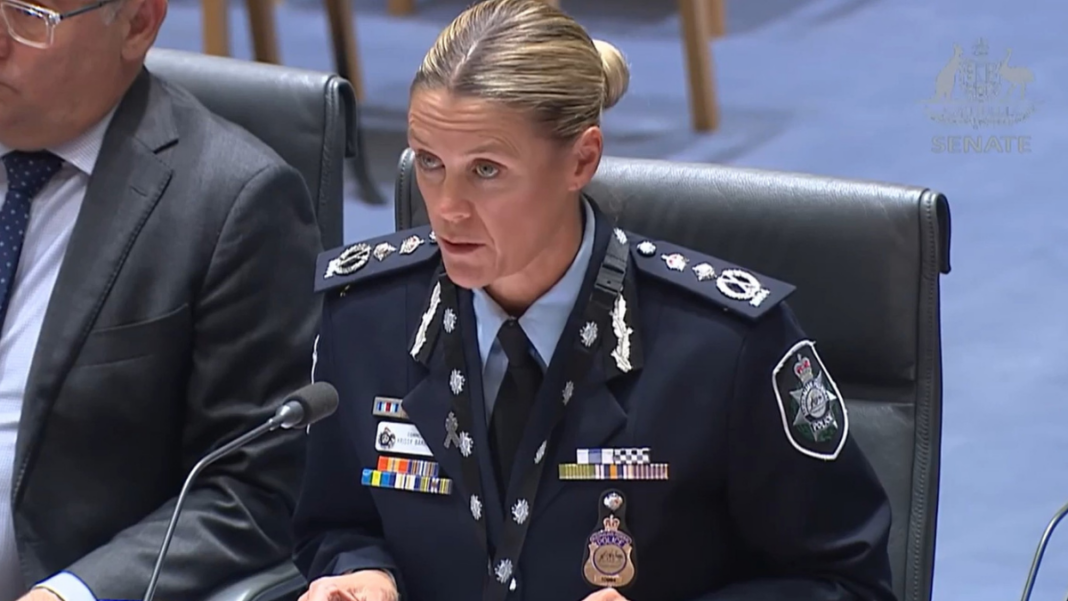
AFP Commissioner Krissy Barrett has issued a stark warning to extremists and hate groups, declaring authorities will “disrupt and intervene however and whenever we lawfully can” as terror threats evolve across Australia.
Opening her address at Senate Estimates on Wednesday evening, Commissioner Barrett said it was the AFP’s first appearance since the Bondi Beach terrorist attack on 14 December 2025, which remains the subject of an active criminal investigation and a Royal Commission.
She confirmed investigators continue to allege a father and son acted alone in the Bondi attack and were inspired by ISIS. The father was shot dead by police during the incident. His son was charged on 17 January 2026 by the NSW Joint Counter Terrorism Team — comprising NSW Police, the AFP, ASIO and the NSW Crime Commission.
The man, who remains in custody, faces 59 charges, including one count of committing a terrorist act, 15 counts of murder and 40 counts of causing grievous bodily harm with intent to murder. The most serious offences carry a maximum penalty of life imprisonment.
Commissioner Barrett said she would not provide further detail to avoid prejudicing the ongoing investigation or future court proceedings.
In a separate case, she revealed that on 4 February 2026, the Western Australia Joint Counter Terrorism Team charged a 31-year-old man over an alleged terrorism offence linked to a rally held in support of First Nations people on 26 January.
Police allege the man threw a home-made improvised device into the crowd and acted to advance a nationalist and racially motivated ideological cause, targeting First Nations people. The charge carries a potential life sentence.
Commissioner Barrett said authorities were increasingly concerned about individuals driven by grievance and radicalised rapidly, often online.
“We are witnessing the continued rise of individual grievance,” she said, noting some offenders no longer seek networks or co-conspirators but instead act alone, fuelled by world events, perceived injustices or personal fixations.
She said loneliness and social exclusion may also be contributing factors, with vulnerable individuals turning to online forums where extreme views are normalised.
While religiously motivated violent extremism continues to make up the majority of terrorism investigations, the AFP is seeing a rise in ideologically motivated extremism and lone actors radicalised in short timeframes.
Of particular concern is a growing number of young people drawn towards hate and violence. Since 2020, Joint Counter Terrorism Teams have charged 26 youths with terrorism-related offences.
Commissioner Barrett warned that, given current trends, it was likely young offenders could in future be placed under the Commonwealth’s High Risk Terrorist Offender regime, which allows for extended detention or strict monitoring after a sentence has been served.
In response to the evolving threat landscape, the AFP has established National Security Investigations teams — commonly referred to as “hate disrupter squads” — to intervene earlier and prevent escalation.
Since their creation, the teams have charged 21 people nationwide, most over alleged threats against parliamentarians, senior office holders and the Jewish community. The squads are now being expanded across all states and territories.
Following the recent passage of the Combatting Antisemitism, Hate and Extremism Act, Commissioner Barrett said the AFP would adopt a more aggressive disruption strategy, including releasing more operational information to reassure communities and deter offenders.
She confirmed the existence of two standing operations: Operation Drakelow, targeting white supremacists, and Operation Antrobus, focused on known and emerging hate preachers.
“We know who many of these malicious manipulators are,” she said, adding some were attempting to skirt the edges of the law with legal advice to avoid prosecution.
Even where criminal thresholds are not met, the AFP would continue to use lawful disruption tactics, both overt and covert.
“That unpredictability should worry those who are on our radar — and those who will be as we widen our net,” she said.
Her message to extremists was blunt:
“If you are one of these groups or individuals — your life will become very uncomfortable.”
Commissioner Barrett urged anyone aware of individuals mobilising towards violence to contact authorities or the National Security Hotline on 1800 123 400.
Support our Journalism
No-nonsense journalism. No paywalls. Whether you’re in Australia, the UK, Canada, the USA, or India, you can support The Australia Today by taking a paid subscription via Patreon or donating via PayPal — and help keep honest, fearless journalism alive.
