
By Om Prakash Dwivedi
“The classic maxim of foreign policy is: unite your friends and divide your adversaries,” as former Treasury Secretary Larry Summers said on Bloomberg Television’s Wall Street Week. He further added,
“We have pursued policies that have managed to unite our adversaries and divide our friends.”
This maxim gains more urgency when viewed from the context of postcolonial nations living in close proximity. While it is true that we cannot choose our neighbourhood, nourishing and cultivating relationships with them is certainly a matter of choice. It is a choice that sometimes needs opportune timing, as the one provided by President Donald Trump.
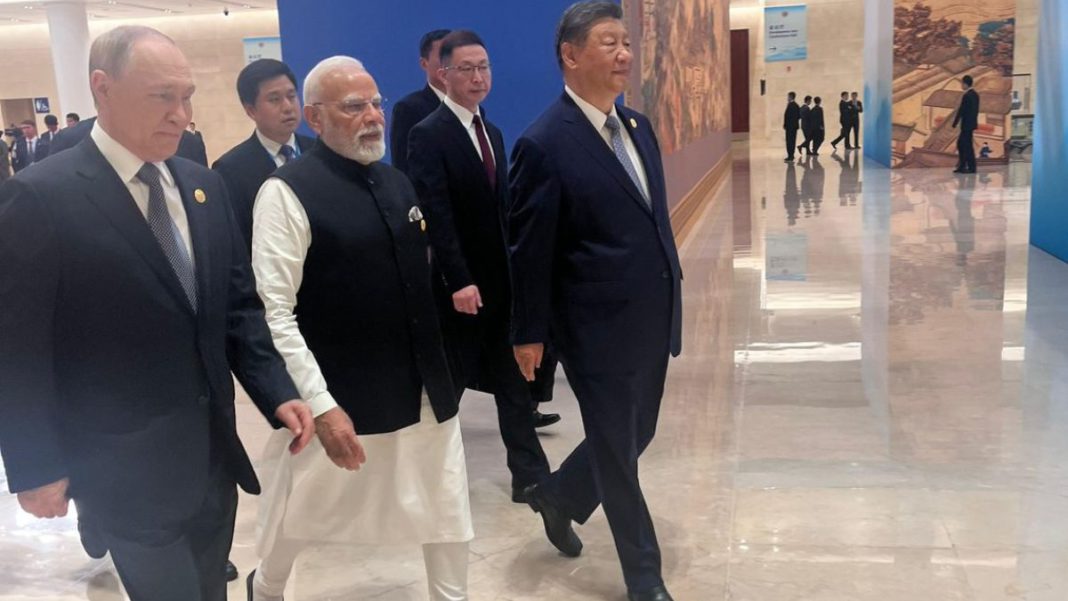
In politics, timing plays an important role. There are times when you go to war with your neighbour, and then there are times when you may decide to enter into a romantic relationship, even if it accounts for just a flirtation. There are also times, as witnessed in the recently concluded Shanghai Cooperation Organisation (SCO) leaders’ summit in Tianjin between 31 August and 1 September 2025, when the Elephant and the Dragon seemed to be preparing the stage for their dance. As the Chinese President, Xi Jinping, reiterated,
“it was vital to be friends, a good neighbour, and [for] the dragon and the elephant to come together.”
Modi’s meeting with Jinping at this summit could qualify as a powerful script for any bestselling work of fiction. For fiction always challenges the limits of our imagination. Who would have imagined this meeting between two of the world’s most powerful leaders, and that too after a long gap of seven years? In fiction as in politics, partners can change at the blink of an eye. Because no one stays long enough. Because some nothings change into somethings. Because bitterness can be swallowed when the hunter and the prey are on a battlefield.
Trump, who loves to steal the global spotlight, has apparently been replaced by Modi and Jinping recently. Just a few weeks before the 2024 US elections, Trump declared, “To me, the most beautiful word in the dictionary is tariff.” The tyranny of tariffs has turned out to be his nemesis. No wonder then that Van Jones, the American political commentator, claimed on CNN, analysing the timing of the emergence of this new romance between India, China, and Russia: “that image of Xi Jinping with Putin, with Modi, with the leader of Iran, and the leader of North Korea, should send a chill down the spine of every American.”
While pretending that all is well with the state of affairs in the US, Trump wrote on his Truth Social platform last Friday:
“Looks like we’ve lost India and Russia to deepest, darkest China. May they have a long and prosperous future together!”
Trump’s thuggish demeanour and his unquenchable desire to win the Nobel Peace Prize have ultimately made the United States a subject of global ridicule. He has turned out to be both dictator and clown, always changing the face of his enemy from China to Russia, and now to India. High on a dose of political ignorance, what Trump is eventually doing is by no means geopolitics; rather, it amounts to self-checkmate. His miscalculated move, stoked with his puerility, has brought together a new global alliance: China, India, and Russia. Perhaps, it is too early to predict the longevity of this alliance, but these are promising signs of the apertures of a new global geopolitical order. Dr Shashi Tharoor, the Congress MP, has a point when he predicts,
“A few years from now, if New Delhi finds itself in the embrace of China and Russia and alienated from America, might there be a new blame game in Washington DC, with finger-pointing American pundits angrily asking the question, ‘Who lost India?’”
Tharoor is right for many reasons. One can already see the way India made it clear that it would keep buying oil from Russia, a transaction on which Trump has already levied punitive tariffs. A seasoned diplomat, Tharoor knows well that India cannot be pressurised to change its national interest. While some see his statement as problematic, deviating from the party lines he belongs to, one needs to appreciate his astounding ability to be persuasive and insightful when it comes to international affairs. Nationalism does not have a prescribed lens; rather, what matters more is the ability to keep the nation’s interest above everything else. Exactly the reason why Modi also outrightly refused any US mediation in ending the India-Pakistan war – something that Trump would have never imagined.
And this is also what we witnessed in the SCO leaders’ summit. It pictured three nations that harbour a third of the world’s population, robust manufacturing power, and rich mineral resources. It also needs to be pointed out that these three nations “account for roughly a quarter of global gross domestic product.” That is why this new alliance is already seen as a “troublesome” one by Trump’s trade adviser, Peter Navarro, who tried to find fault lines in Modi’s meeting with the two biggest authoritarian dictators:
“I’m not sure what he is thinking, particularly since India has been in a cold war and sometimes a hot war with China for decades. So we hope that the Indian leader comes around to seeing that he needs to be with us and Europe and Ukraine and not with Russia on this, and he needs to stop buying the oil.”
Trump’s disastrous tariff policy has eventually opened new diplomatic frontiers. In losing India, the US may also lose its strategic partner in Asia. What it fails to recognise is that the triangular friendship of India-China-Russia could be the harbinger of a new culture of impunity, which also means that the US could no longer dictate lessons of patriotism and friendship on its own terms. If the news of Trump’s four phone calls to Modi going unanswered is true, then a new script of a new geopolitical order is about to unfold.
One needs to remember that “truth is the child of time, not of authority”, and that “the world is divided into winners and losers, not autocrats and democrats.” While the US may have lost India, it is also a moment for the Asian powers to dismantle White hegemony. Even with the risk of infuriating its western allies, both India and China have a lot to gain from each other: “Much of India’s manufacturing, which Modi is trying to boost, is reliant on materials and rare earths from China. China, meanwhile, stands to gain economically if it regains access to India’s market.”
Support our Journalism
No-nonsense journalism. No paywalls. Whether you’re in Australia, the UK, Canada, the USA, or India, you can support The Australia Today by taking a paid subscription via Patreon or donating via PayPal — and help keep honest, fearless journalism alive.
