


By Charlotte Bedford
Pacific advocates fighting for visa restrictions to be eased for Pacific nationals visiting New Zealand have recently taken their demands to parliament. A petition requesting visa-free entry for visitors who are citizens of Pacific Islands Forum (PIF) countries was presented to parliament on 11 February by Anae Arthur Anae, a former National MP and strong advocate for the rights of Pacific peoples in New Zealand.
The online petition, signed by nearly 50,000 people, many of whom are residents of PIF countries, was presented to the current foreign minister and leader of NZ First, Winston Peters. The submission followed a sustained awareness-raising campaign, including writing letters to the heads of government in several Pacific countries requesting their support and local media advertisements in national newspapers.
NZ First supports the visa-free travel proposition and Peters said he will seek to implement it within his current term (which finishes on 1 October ahead of a general election in early November). Other political parties, such as ACT and Labour, have withheld their support until they have been able to review the proposal in detail.
The petition asks that citizens of PIF countries be afforded the same entry rights as nationals of 60 visa-waiver countries who are eligible to apply online for a NZ Electronic Travel Authority (NZeTA) granted on arrival. The NZeTA, which grants entry for up to three months, is cheaper and more straightforward to apply for than a visitor visa, with fewer documentation requirements and a shorter processing time (up to three days versus up to three weeks for a visitor visa).
The petition comes at a time of increasing high-level discussions about enhancing regional mobility through the freer movement of people. At the national level, the proposal forms part of a continued effort for more equal treatment of visitors from the Pacific and follows changes to immigration settings in 2025 that make it easier for Pacific nationals to visit the country. These include:
- a two-year multi-entry visitor visa for nationals from PIF countries enabling them to visit multiple times within a 24-month period;
- a total stay of up to six months in any 12-month period (within the total 24 months); and
- a 12-month trial of visa-free (NZeTA) entry for PIF country passport holders who hold a valid Australian visa and are travelling to New Zealand from Australia.
Effectively, the latest petition is asking for the 12-month NZeTA trial to be extended to citizens of all PIF countries, not just for those travelling on a valid Australian visa from across the Tasman.
There are 18 PIF member countries including Australia and New Zealand. Of the 16 remaining members, Cook Islands and Niue already have visa-free entry to New Zealand as Realm countries. Citizens of French Polynesia and New Caledonia, who hold French passports, can enter France without a visa. Federated States of Micronesia, Palau and Republic of the Marshall Islands have free movement to live, work and study in the United States under Compacts of Free Association (CFA). Movements from the French Territories and the Micronesian CFA countries, all members of the PIF, are not included in the analysis below.
That leaves nine PIF countries: Fiji, Kiribati, Nauru, Papua New Guinea, Samoa, Solomon Islands, Tonga, Tuvalu and Vanuatu.
Pre-Covid, 50,000-60,000 visitor visa applications were lodged annually by citizens of the nine PIF countries. By 2025, the number had reached just over 66,000, equivalent to a very small fraction (0.019%) of the 3.5 million visitor arrivals in New Zealand during the year, the great majority of whom came from visa-waiver countries.
Numbers applying for visitor visas from the nine PIF countries vary significantly by country. Fiji (42%) had the highest percentage share of PIF-country visitor visa applications in 2025, followed by Tonga (29%) and Samoa (22%) (Figure 1). The other six countries were all below 2.5%.
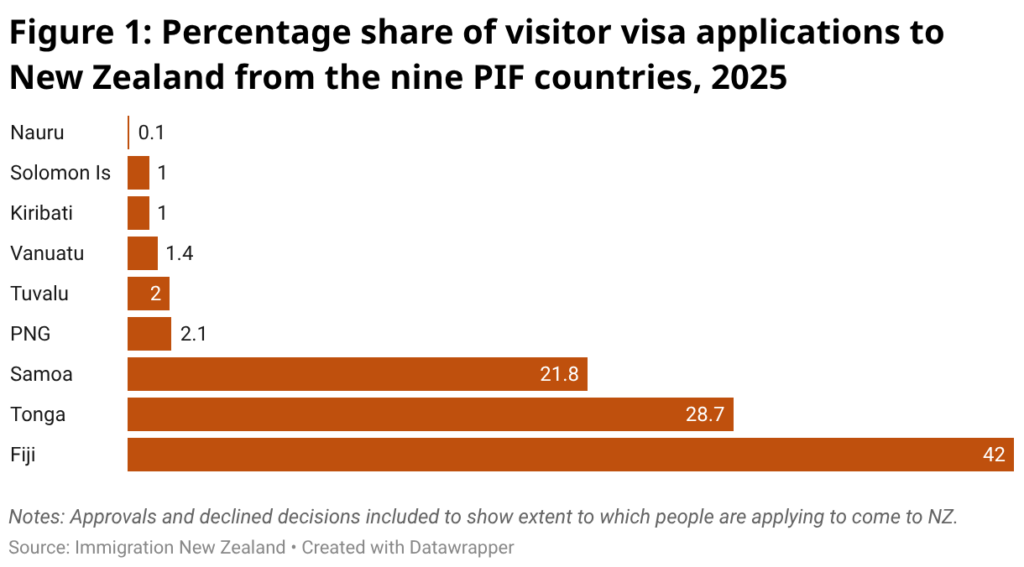
Large numbers of visitor visa applications from Fiji, Samoa and Tonga make sense in the context of their sizeable diaspora populations — people want to come and visit their family members residing in New Zealand. Samoa has New Zealand’s largest Pacific diaspora, with a resident population of 213,069 in the 2023 Census. Tonga is the second largest with a population of 97,894 in 2023. Fiji’s resident population in New Zealand is growing and is estimated to now be somewhere between 95,000-100,000.
Visa-waiver entry for Pacific citizens is not a new idea. New Zealand had visa-waiver arrangements with several Pacific countries 40 years ago. In December 1986, a visa waiver was introduced for Fiji, Kiribati, Nauru, Samoa, Tonga and Tuvalu — all countries with which New Zealand had special work permit schemes or long-established economic, education, religious or medical links.
Numbers of Pacific visitors to New Zealand grew rapidly under visa-free entry. Many who visited chose to remain in the country, contributing to significant net migration gains to New Zealand’s population — from Fiji, Tonga and Samoa especially — in the subsequent year.
The visa-free “experiment” for Fijians, Tongans and Samoans was short-lived. It lasted only two months. In February 1987, the visa waiver arrangements were terminated, largely because of fear of non-compliance with the three-month time limit on the visitor visa. For Kiribati, Nauru and Tuvalu, the visa-waiver arrangements remained in place until December 2003 when they were cancelled “to provide a consistent visa policy for all Pacific countries”, according to the Immigration Minister at the time.
While the latest visa-free petition is supported by NZ First, the New Zealand government will be cautious about easing restrictions in light of this history. The temporary introduction, from 1 June, of lower visa fees for Pacific visitors will make it less expensive for Pacific visitors travelling to New Zealand. However the government has not signalled any new commitments on visa-free entry, with the current Prime Minister Christopher Luxon saying it is not a government priority. Pacific advocates must now wait and see what, if anything, Peters can achieve in the months remaining before November’s general election.
This article appeared first on Devpolicy Blog (devpolicy.org), from the Development Policy Centre at The Australian National University.
Disclosure: This research was supported by the Pacific Research Program, with funding from the Department of Foreign Affairs and Trade. The views are those of the author only.
Contributing Author: Charlotte Bedford is a research fellow with the Development Policy Centre and is based in New Zealand.
Support our Journalism
No-nonsense journalism. No paywalls. Whether you’re in Australia, the UK, Canada, the USA, or India, you can support The Australia Today by taking a paid subscription via Patreon or donating via PayPal — and help keep honest, fearless journalism alive.
