

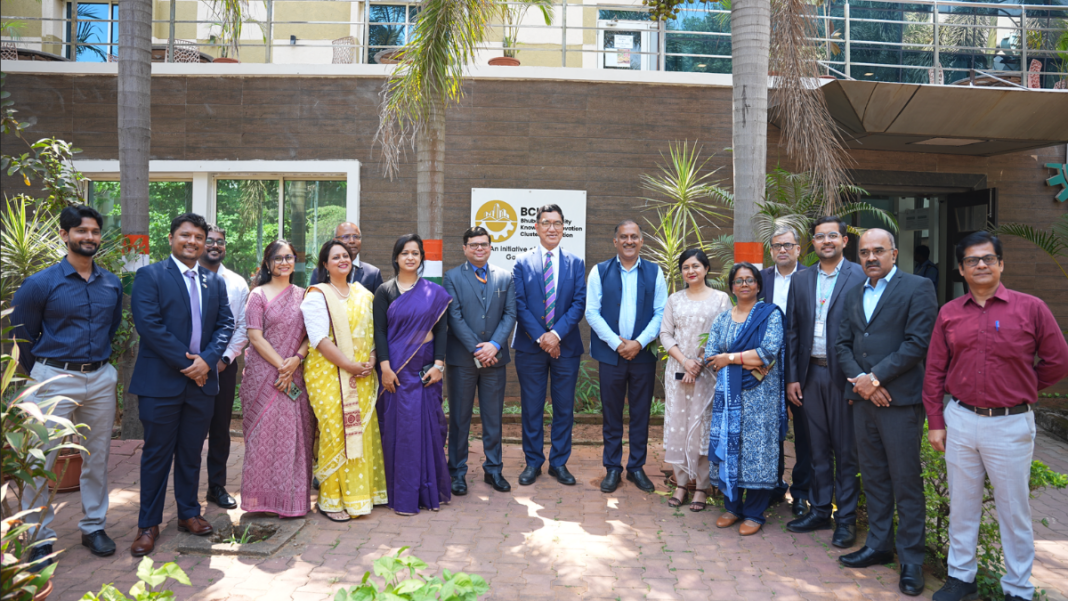
The University of Western Australia (UWA) has signed a strategic Memorandum of Understanding with India’s Science and Technology (S&T) Clusters, an initiative under the Office of the Principal Scientific Adviser to the Government of India, marking a significant step in expanding Australia–India collaboration in research and innovation.
The agreement establishes a structured, long-term partnership linking UWA with India’s national science and innovation framework. The collaboration is designed to support mission-driven research and strengthen ties between academia, industry and government across sectors critical to economic development and regional cooperation in the Indo-Pacific.
India’s Office of the Principal Scientific Adviser acts as the country’s highest scientific advisory body, providing strategic direction to the Prime Minister and Cabinet on science, technology and innovation policy. Under its leadership, India has created a network of eight S&T Clusters across major innovation hubs, including Bengaluru, Pune, Chandigarh, Bhubaneswar, Visakhapatnam and Hyderabad.
These clusters connect universities, national laboratories, startups, industry partners, MSMEs and state governments to address major challenges through coordinated research and innovation initiatives.
Dr Vishal Choudhary, Scientist-F at the Office of the Principal Scientific Adviser, said the collaboration would strengthen India’s innovation ecosystem by bringing global expertise into national research priorities.
“India’s S&T Clusters are designed to foster coordinated, mission-oriented research that addresses national priorities through strong academia–industry–government partnerships,” Dr Choudhary said.
“This collaboration with the University of Western Australia brings valuable global expertise into our innovation ecosystem and supports our objective of building scalable, policy-relevant, and internationally connected research platforms.”
Under the agreement, UWA will integrate into the cluster-based framework rather than forming isolated institutional partnerships. The model is intended to enable large-scale collaboration aligned with India’s national development goals, while accelerating pathways from laboratory research to real-world applications.
UWA Vice-Chancellor Professor Amit Chakma described the partnership as a milestone in deepening scientific ties between the two countries.
“This MoU represents a significant step in deepening Australia–India scientific collaboration at the highest level,” Professor Chakma said.
“By working closely with the Office of the Principal Scientific Adviser and its S&T Clusters, we are aligning our research strengths with India’s national priorities — from energy transition and critical minerals to climate resilience and advanced technologies.”
He said the collaboration would strengthen innovation ecosystems and support research outcomes with both national and global relevance.
The agreement also includes cooperation with the Bhubaneswar City Knowledge Innovation Cluster (BCKIC), where research efforts will focus on the blue economy and sustainable marine resources.
Dr Mrutyunjay Suar, Chairman of BCKIC, said the partnership would move beyond academic exchange to deliver practical solutions.
“Strategically, we will work in the area of the blue economy on a mission mode and bring the best practices to deploy affordable, adaptable and scalable solutions in the sector,” Dr Suar said.
The partnership outlines several areas of cooperation, including joint research programs and co-funded projects addressing national priorities such as energy transition, climate resilience, advanced manufacturing, artificial intelligence, deep technology, water systems and health technologies.
It will also support stronger lab-to-market pathways through translational research, commercialisation initiatives and startup collaboration.
Academic mobility is another key component of the agreement, with plans to facilitate doctoral, postdoctoral and faculty exchanges, including joint PhD programs and visiting scholar opportunities.
The MoU further aims to promote international scientific exchange and policy dialogue through bilateral forums aligned with broader Australia–India cooperation.
The partnership aligns closely with UWA’s globally recognised School of Earth and Oceans, which is expected to play a key role in joint research related to sustainable mining, renewable energy, climate science and ocean systems.
These areas are considered critical to both nations’ economic resilience and environmental sustainability, particularly in the context of energy transition and climate change.
By integrating into India’s national cluster model, UWA gains a federal-level entry point into one of the world’s fastest-growing science and innovation ecosystems.
Officials say the collaboration represents a government-aligned model for international research partnerships, providing structured access to India’s leading institutions while contributing to national scientific priorities.
The initiative also reflects the growing role of science diplomacy in the Australia–India relationship and the expanding cooperation between the two countries in research, technology and innovation across the Indo-Pacific.
Support our Journalism
No-nonsense journalism. No paywalls. Whether you’re in Australia, the UK, Canada, the USA, or India, you can support The Australia Today by taking a paid subscription via Patreon or donating via PayPal — and help keep honest, fearless journalism alive.
