


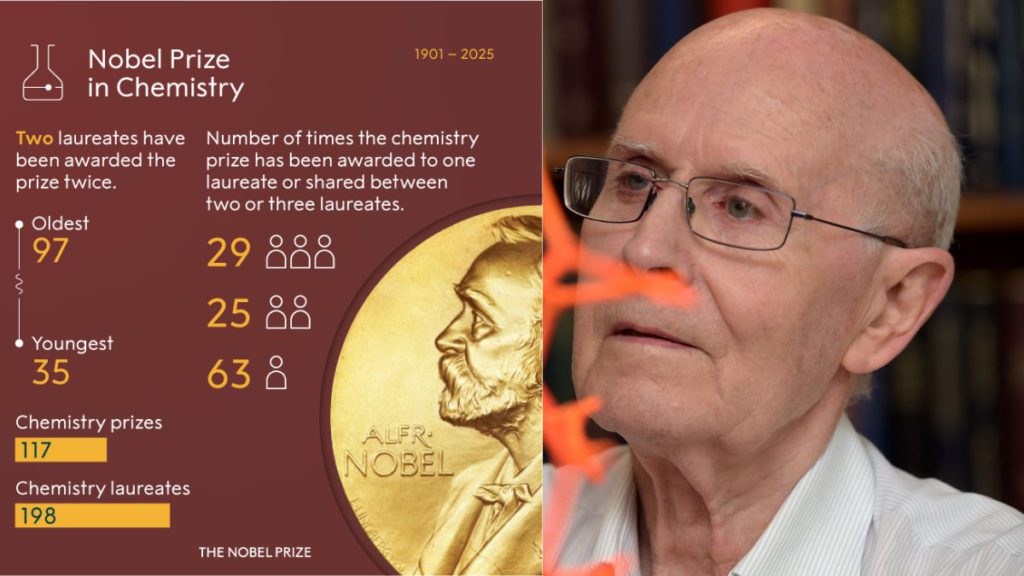
For most Australians, the term “metal-organic frameworks” or MOFs might sound like something out of a science fiction novel. Yet these extraordinary materials, now being developed into gas and energy storage devices and catalytic reactors, are at the heart of the 2025 Nobel Prize in Chemistry, awarded to University of Melbourne Prof. Richard Robson, alongside Prof. Susumu Kitagawa from Kyoto University and Prof. Omar M. Yaghi from the University of California.
MOFs represent a revolutionary approach to crystalline solids, with structures that combine metals and organic molecules to create frameworks with vast internal spaces—structures capable of transforming energy storage, catalysis, and potentially even future superconductors.
University of Melbourne Vice-Chancellor Prof. Emma Johnston AO praised Professor Robson’s achievements. “This is the kind of blue-sky research that not many people get the opportunity to explore, and even fewer make the kinds of breakthroughs Professor Robson has achieved,” she said.
“Fundamental research like this is essential if we are to solve the world’s greatest scientific and technological challenges.”
Prof. Robson, who has been with the University of Melbourne since 1966, first produced the metal-organic frameworks in the early 1990s. His work has been recognised internationally, including election as a Fellow of the Royal Society in 2022 and the naming of a Professorial Chair in his honour in 2024.
Yet the seeds of this groundbreaking research were planted decades earlier, with something as simple as wooden models. In 1974, Prof. Robson, then a lecturer in inorganic chemistry, was tasked with building large wooden models of crystal structures for first-year lectures. Using coloured wooden balls to represent atoms and rods to represent chemical bonds, he meticulously calculated angles and assembled models of sodium chloride, fluorite, zinc blende, and more.
“It became apparent that the balls were invested with information—they were predisposed to produce the structure we intended,” he recalls in an interview to The Pursuit.
“And that led to the thought: ‘What if you used molecules in place of balls and chemical bonds in place of rods?’”
Ten years passed before he finally tested the idea in the lab. Beginning with the diamond crystal structure, where each carbon atom connects to four others in a tetrahedron, the experiment was initially met with scepticism. Standard crystals are densely packed, but the new substance Prof. Robson created included vast empty spaces. “It turned out that it worked marvellously well. And we did get crystals,” he says.
These open frameworks were unprecedented. By replacing direct chemical bonds with molecular rods, Prof. Robson had created materials with enormous potential for functionality, predicting an almost infinite variety of structures, channels, cavities, and even catalytic applications—a vision now being realised decades later.
University of Melbourne Deputy Vice-Chancellor (Research) Prof. Mark Cassidy said the award reflects not only Prof. Robson’s curiosity and dedication but also the strength of Australian research. “He has inspired countless academics and students by simply doing what he loves—going into the lab every day, thinking big chemistry thoughts, and running experiments,” Prof. Cassidy said.
“Any scientific respectability that’s come out of it has been due to the brilliant work of colleagues who did the crystallography.”
For Prof. Robson, the process has always been a blend of science, architecture, and artistry. “My contribution has been more like that of an artist or an architect,” he says.
Support our Journalism
No-nonsense journalism. No paywalls. Whether you’re in Australia, the UK, Canada, the USA, or India, you can support The Australia Today by taking a paid subscription via Patreon or donating via PayPal — and help keep honest, fearless journalism alive.

