


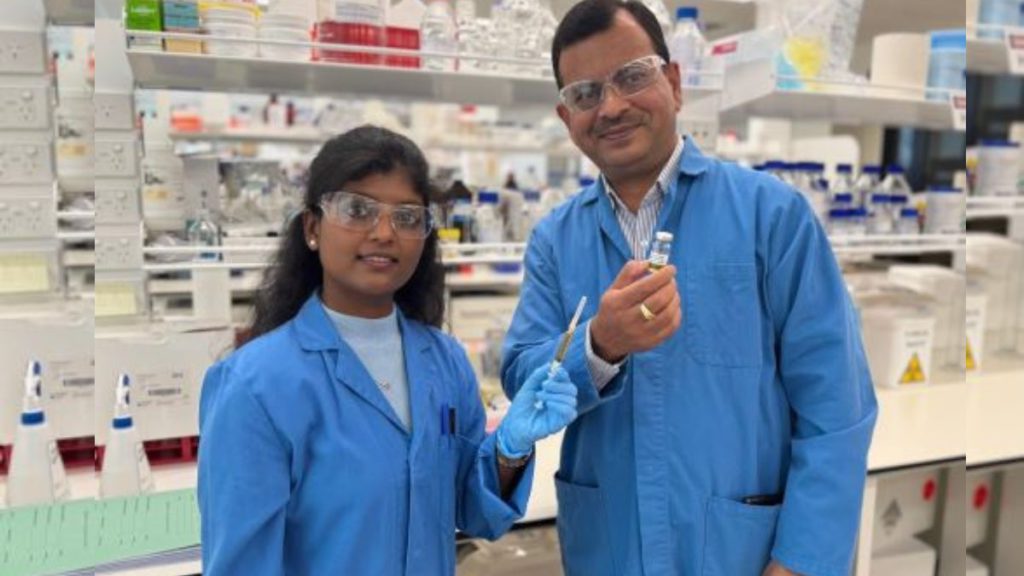
A weekly injectable drug developed by University of South Australia (UniSA) scientists could soon transform the way Parkinson’s disease is treated, potentially replacing the need for multiple daily tablets and improving the lives of more than eight million people worldwide.
The innovation developed by a team that includes two Indian-origin scientists delivers a steady dose of levodopa and carbidopa — the two most widely prescribed medications for Parkinson’s — over an entire week, a dramatic improvement over the current standard of care that requires patients to take pills several times a day.
The biodegradable gel is injected under the skin or into muscle tissue, where it gradually releases the medication for seven days. In laboratory tests, the system released more than 90% of the levodopa dose and 81% of the carbidopa dose over the week, degraded by more than 80% in that time, and showed no significant toxicity in cell viability tests.
The formulation, which can be administered with a fine 22-gauge needle, minimises discomfort and removes the need for surgical implantation.
Prof. Sanjay Garg, Co-Director of UniSA’s Centre for Pharmaceutical Innovation and Director of the Pharmaceutical Innovation and Development Group, says the weekly injectable could be a “game-changer” for Parkinson’s care.


“Our goal was to create a formulation that simplifies treatment, improves patient compliance, and maintains consistent therapeutic levels of medication,” he explains.
“By reducing the frequency of dosing from multiple times a day to once a week, we can significantly improve patients’ quality of life.”
Prof. Garg is a highly cited pharmaceutical scientist with an h-index of 70 (Google Scholar) whose research has led to patented formulations and real-world impact. His innovations include Acidform, patented in the USA, and the FDA-approved non-hormonal contraceptive Phexxi, now marketed in the United States.
He has also driven clinical-stage products in India, New Zealand, the UK, and Australia. With a PhD in Pharmaceutical Sciences and a Master’s in Management, he has mentored more than 240 research scholars and received awards including the Australasian Pharmaceutical Science Association Medal and the Research and Enterprise Excellence Supervisor of the Year. His work bridges cutting-edge science and practical healthcare solutions, with a strong focus on interdisciplinary collaboration.
For PhD student Deepa Nakmode, the innovation is the culmination of years of dedicated research.
“After years of focused work, it’s incredibly rewarding to see our innovation in long-acting injectables for Parkinson’s disease reach this stage,”
she says.
“We have now filed for an Australian patent, and I’m hopeful this will soon move towards clinical translation.” Deepa Nakmode, who previously earned a Master of Science in Pharmaceutics and a Bachelor of Pharmacy, is part of the Pharmaceutical Innovation and Development Group at UniSA. Her doctoral research focuses on developing long-acting injectables using different technologies for Parkinson’s disease treatment.
Parkinson’s disease is the second most common neurological disorder in the world, affecting more than 8.5 million people. Its symptoms — tremors, rigidity and slow movement — are caused by the brain’s progressive loss of dopamine-producing cells. While there is no cure, the mainstay treatment is levodopa, combined with carbidopa to improve its effectiveness. These drugs have a short half-life, meaning they must be taken multiple times daily, which is burdensome for patients and can lead to fluctuating drug levels and inconsistent symptom control.
The UniSA team’s innovation could help overcome these limitations, and its potential extends beyond Parkinson’s. Prof. Garg says the platform can be tuned to release drugs over a few days to several weeks and could be adapted for other chronic conditions such as cancer, diabetes, neurodegenerative disorders, chronic pain and long-term infections.
“We’re not just improving how the drug is delivered; we’re improving patients’ lives,”
he says.
With clinical trials planned and commercialisation opportunities under discussion, both Prof. Garg and Deepa Nakmode are optimistic their invention will make the leap from the laboratory to the clinic. If successful, it could mark a major turning point in how Parkinson’s and other chronic diseases are managed worldwide.
Support our Journalism
No-nonsense journalism. No paywalls. Whether you’re in Australia, the UK, Canada, the USA, or India, you can support The Australia Today by taking a paid subscription via Patreon or donating via PayPal — and help keep honest, fearless journalism alive.

