

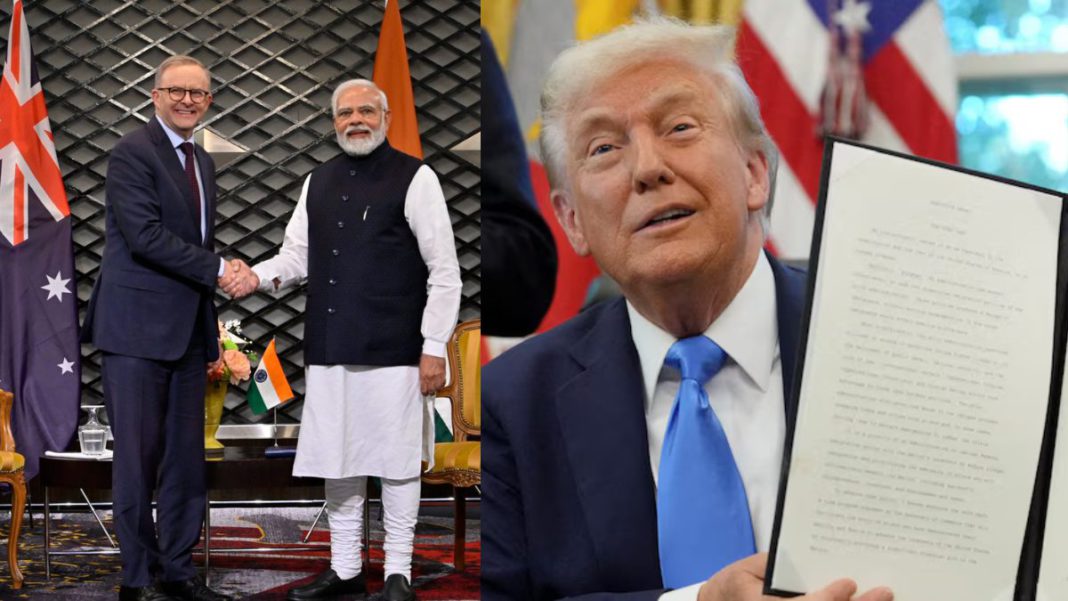
The Trump administration’s announcement to impose a $100,000 fee on H-1B visas is sending shockwaves across the technology sector, but it also presents a historic opportunity for countries like India and Australia.
He also signed an executive order to roll out new $US1 million “gold card” visas, offering a potential pathway to US citizenship for wealthy foreigners.
By making the United States a far more expensive and restrictive destination for global talent, America risks losing the very innovators and high-calibre professionals it has long relied on. And yet, in this challenge lies an opportunity for others.
As Amitabh Kant, Former CEO of India’s Niti Aayog, observed, “Donald Trump’s 100,000 H-1B fee will choke U.S. innovation, and turbocharge India’s. By slamming the door on global talent, America pushes the next wave of labs, patents, innovation and startups to Bangalore and Hyderabad, Pune and Gurgaon.”
“India’s finest Doctors, engineers, scientists, innovators have an opportunity to contribute to India’s growth & progress towards #ViksitBharat. America’s loss will be India’s gain.”
The numbers underline the scale of the potential shift. India was the largest beneficiary of H-1B visas last year, accounting for 71% of approved visas, while China accounted for just 11.7%.
In the first half of 2025 alone, Amazon had over 12,000 H-1B approvals, while Microsoft and Meta had more than 5,000 approvals each. The H-1B program currently provides 65,000 visas annually, with an additional 20,000 for workers with advanced degrees, making this fee hike a substantial barrier to mobility for skilled Indian professionals.
Australia is also well-positioned to benefit, with Prime Minister Anthony Albanese noting that “intelligence, imagination, and drive will be the forces behind a future made in Australia.”
The National Innovation Visa (NIV, subclass 858), introduced in December 2024, offers a permanent visa for exceptionally talented migrants. This visa stream targets global researchers, entrepreneurs, innovative investors, athletes, and creatives who can contribute directly to Australia’s economic prosperity by creating jobs and driving productivity growth in key sectors. Unlike the increasingly prohibitive H-1B, the NIV prioritises high-calibre talent and leadership and actively encourages those who can make measurable contributions to Australia’s future prosperity.
The timing could not be better. India has a vast pool of highly skilled professionals accustomed to working in technology, healthcare, and research-intensive sectors. Meanwhile, Australia’s welcoming immigration framework for top-tier talent and its stable, high-quality ecosystem for research and innovation make it an attractive alternative for those now facing prohibitive fees and uncertainty in the U.S.
For Indian innovators, the message is clear: there is now a dual opportunity. Domestically, they can play a central role in India’s growth story, leveraging government initiatives and private investment to build the next generation of global tech hubs.
Australia’s NIV offers a pathway to a permanent presence in a country that prizes talent, innovation, and measurable contributions to the economy.
Ultimately, Trump’s H-1B overhaul illustrates a broader truth: innovation knows no borders, and talent will gravitate to opportunities that recognise and reward it. As the U.S. risks stifling its own creative engines, India and Australia stand ready to absorb the global talent that fuels the next wave of scientific, technological, and entrepreneurial breakthroughs. For these nations, America’s loss could indeed become their strategic gain.