
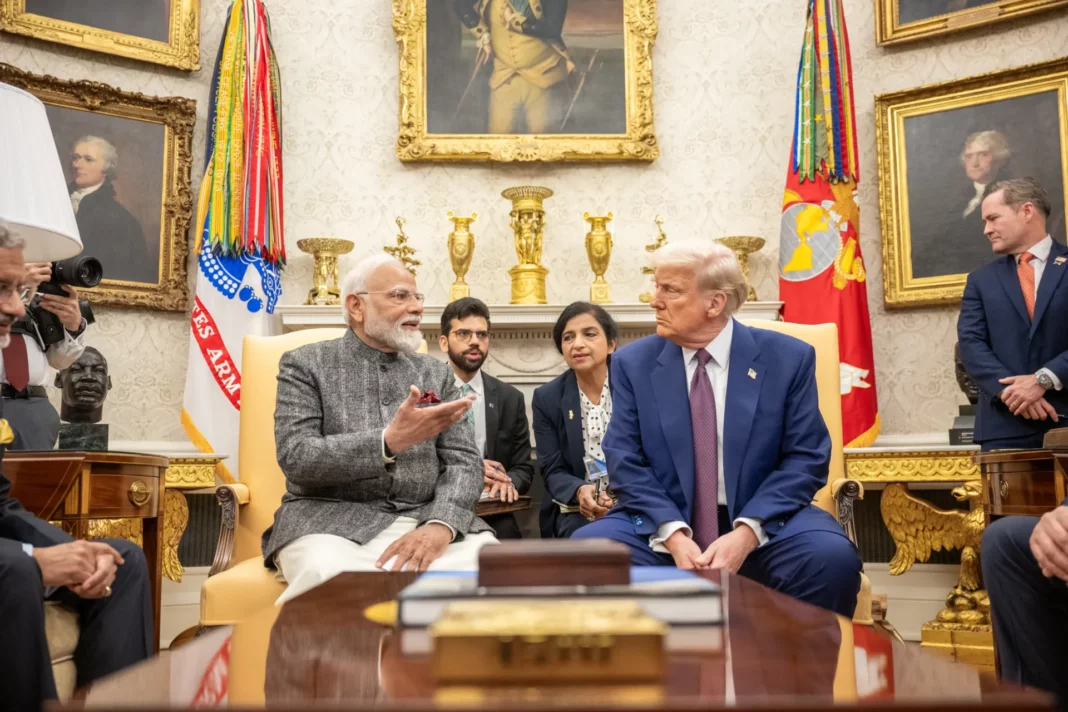
India’s Prime Minister Narendra Modi has held his third phone call with US President Donald Trump in less than five months, as New Delhi steps up pressure for relief from steep American tariffs that are hitting some of its key exports.
Modi said he spoke with Trump by phone on Thursday evening, describing it on X as a “good discussion” that covered trade, energy cooperation and regional security.
The call comes after Washington imposed “secondary tariffs” on India over its continued purchases of Russian oil, effectively doubling duties on a range of Indian goods to around 50 per cent from late August.
Tariffs tied to Russian oil trade
The US introduced a 25 per cent “secondary tariff” on Indian exports in August, on top of existing border taxes, in an effort to penalise New Delhi for buying large volumes of discounted Russian crude since the invasion of Ukraine. The measures took effect on 27 August and lifted overall tariffs on affected products to about 50 per cent.
American officials argue India is profiting from “arbitrage” – importing cheap Russian oil, refining it and reselling it as fuel, including into Europe and Ukraine. US Treasury Secretary Scott Bessent has publicly accused India of “buying cheap Russian oil, reselling it as product,” signalling Washington’s willingness to use trade tools to pressure New Delhi.

New Delhi rejects the criticism, insisting its energy purchases from Moscow are legal, comply with Western price caps and are necessary to protect a developing economy from global price shocks. Indian officials have also stressed that refined fuels can incorporate crude from multiple sources, making it difficult to identify any single origin.
Third call since July
Thursday’s phone call is Modi’s third direct conversation with Trump since the tariff announcement in July. India has dispatched senior officials to Washington twice in recent months for talks on trade and sanctions policy, but with limited progress so far.
According to people familiar with the discussions, India is seeking:
- a rollback or suspension of the extra 25 per cent duty on its goods
- clearer exemptions for sectors such as pharmaceuticals, textiles and certain engineering products
- assurances that future US-Russia-related sanctions won’t automatically trigger new trade penalties on India
In return, US officials have pressed India to slow or cap purchases of Russian crude and to provide greater transparency on the origin of refined fuels exported to third countries, including Ukraine.
Impact on Indian exporters
Industry groups in India say the higher tariffs are already squeezing exporters’ margins, particularly in sectors where profit margins are thin, and competition from other Asian suppliers is intense.
Federations representing engineering goods, chemicals and some consumer products warn that orders bound for the US are being delayed or diverted as buyers look for cheaper sources. Some exporters have begun lobbying New Delhi for targeted subsidies or support to weather the higher tax burden while talks continue.
Economists note that while the tariffed goods represent only a slice of overall India–US trade, the move could have an outsized psychological impact by reviving memories of earlier disputes – including Washington’s 2019 decision to strip India of preferential market access under the Generalised System of Preferences.

Threat of WTO challenge
Indian officials have publicly signalled they are prepared to challenge the US measures at the World Trade Organisation if bilateral talks fail. New Delhi argues that sanctions linked to Russia’s war should not be used to unilaterally rewrite trade terms with third countries, especially where binding WTO commitments are in place.
However, analysts point out that the WTO’s dispute system is weakened, with its appeals body effectively paralysed, and that any case could take years to resolve even if India were to win. That reality adds to the pressure on both sides to find a negotiated compromise.
Strategic ties under strain
The tariff dispute comes at a sensitive moment in India–US relations. The two countries have deepened defence, technology and intelligence cooperation in recent years as part of efforts to balance China’s power in the Indo-Pacific.
So far, both governments have been at pains to stress that the trade spat will not derail the broader strategic partnership. Modi’s office framed Thursday’s call as part of “regular high-level contact”, while the White House has described previous conversations as “constructive” and “friendly”.
But diplomats warn that prolonged economic friction could complicate cooperation in other areas, especially if businesses on either side begin to see the partnership as politically risky.
Domestic pressures on both leaders
At home, both leaders face pressure to look tough.
Trump has made aggressive use of tariffs as a signature tool of his economic agenda, promising to punish countries he accuses of “cheating” the US and of helping Russia evade Western sanctions. India, as a large democracy buying Russian oil, has become an obvious target for that rhetoric.
Modi, heading into another election cycle, must balance India’s long-standing ties with Russia, its need for affordable energy and its desire to strengthen strategic links with the US. Being seen as giving in to American pressure on oil or trade could prove politically costly, especially among nationalist voters.
What happens next
Officials in New Delhi say working groups on trade and energy will continue meeting in the coming weeks to explore possible adjustments, such as phased reductions in Russian crude purchases or carve-outs for specific Indian exports.
For now, though, Indian exporters will continue to face higher costs on goods bound for the US, and both capitals will have to manage a relationship that is strategically important but newly burdened by hard-edged trade politics.
Support our Journalism
No-nonsense journalism. No paywalls. Whether you’re in Australia, the UK, Canada, the USA, or India, you can support The Australia Today by taking a paid subscription via Patreon or donating via PayPal — and help keep honest, fearless journalism alive.
