

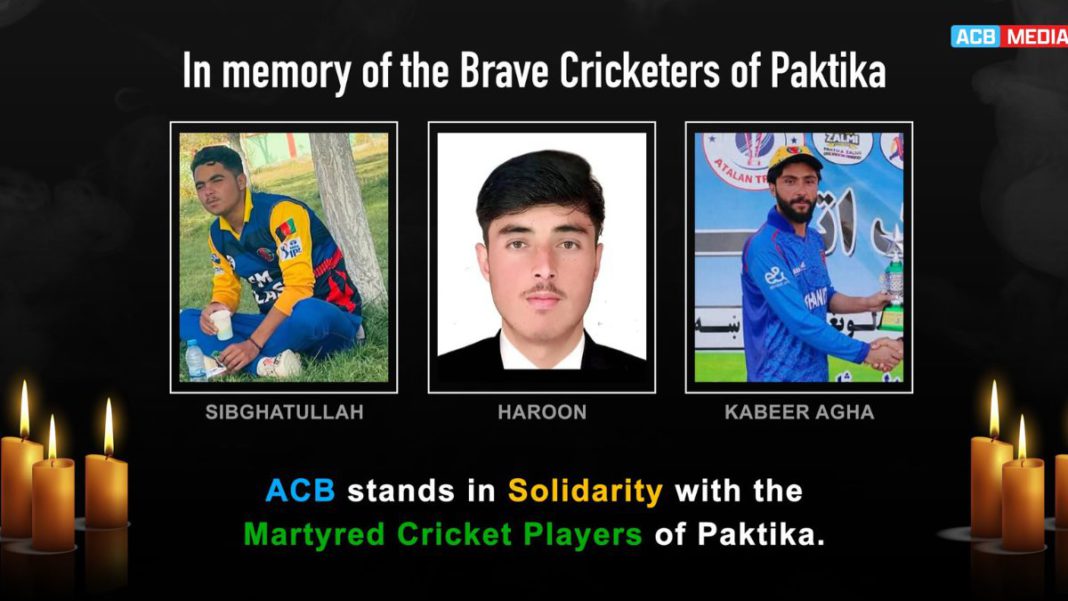
Three Afghan cricketers—Kabeer, Sibghatullah, and Haroon have been killed in a Pakistani airstrike in Afghanistan’s Paktika province. The players had travelled from Urgun to Sharana for a friendly match and were targeted during a gathering upon their return. The Afghanistan Cricket Board (ACB) condemned the strike as a “cowardly act” by Pakistan and announced Afghanistan’s withdrawal from the upcoming tri-nation T20 series involving Pakistan and Sri Lanka.
Rashid Khan, captain of Afghanistan’s men’s cricket team called the strike “immoral and barbaric,” stressing that it violated human rights and had extinguished innocent lives and sporting talent. Other senior cricketers, including Mohammad Nabi and Fazalhaq Farooqi, issued similar condemnations. The strike has further escalated tensions, with Kabul accusing Islamabad of breaching a fragile ceasefire.
On October 9, 2025, following a TTP (Tehreek-e-Taliban Pakistan) attack on Pakistani soldiers in Khyber Pakhtunkhwa, Pakistan carried out an airstrike in Kabul targeting TTP leader Noor Wali Mehsud. In retaliation, Afghan forces launched operations that reportedly killed at least 23 Pakistani soldiers, while at least 9 Afghan soldiers also died. Sporadic ground fighting continued in the following days before a fragile ceasefire was established. The flare-up has reopened longstanding hostilities linked to the Durand Line (the defacto border) dispute and mutual accusations of harbouring militants.
The crisis comes as Pakistan, currently on its 23rd IMF bailout, grapples with severe economic, political, and institutional breakdown. Analysts often attribute Pakistan’s long-term decline to decades of state-sponsored jihadist terrorism with global footprints (from 9/11 to 26/11 terror attacks), entrenched religious radicalisation—including distortions in textbooks—and failure to build an inclusive, plural, secular order like India from which it was cut away in 1947.
Pakistan also faces deep internal fragmentation: in occupied Balochistan, a full-blown insurgency led by groups such as the BLA and BLF targets Pakistani forces and Chinese CPEC assets amid allegations of resource plunder and enforced disappearances; in Pakistan-Occupied Jammu & Kashmir (POJK), residents routinely protest disenfranchisement, economic neglect, and military repression; and in Sindh, nationalist anger and urban unrest persist over demographic engineering, economic exploitation, and federal overreach. Together, these fault lines expose a state battling cascading crises of legitimacy and control.
More recently, Pakistan also suffered a major military setback after India struck Pakistan-based terror sites in response to the Pahalgam terror attack and then targeted several Pakistani military airbases amid the ensuing escalation. Defence commentators writing in open sources estimated that India destroyed roughly 19 Pakistani military aircraft — including some in the air — and may have hit near a nuclear-sensitive asset. Pakistan attempted retaliation but failed to inflict meaningful damage due to India’s air-defence advantage. The confrontation included what analysts described as the longest recorded surface-to-air kill in history by India’s air defence system. It ended with Pakistan seeking a ceasefire.
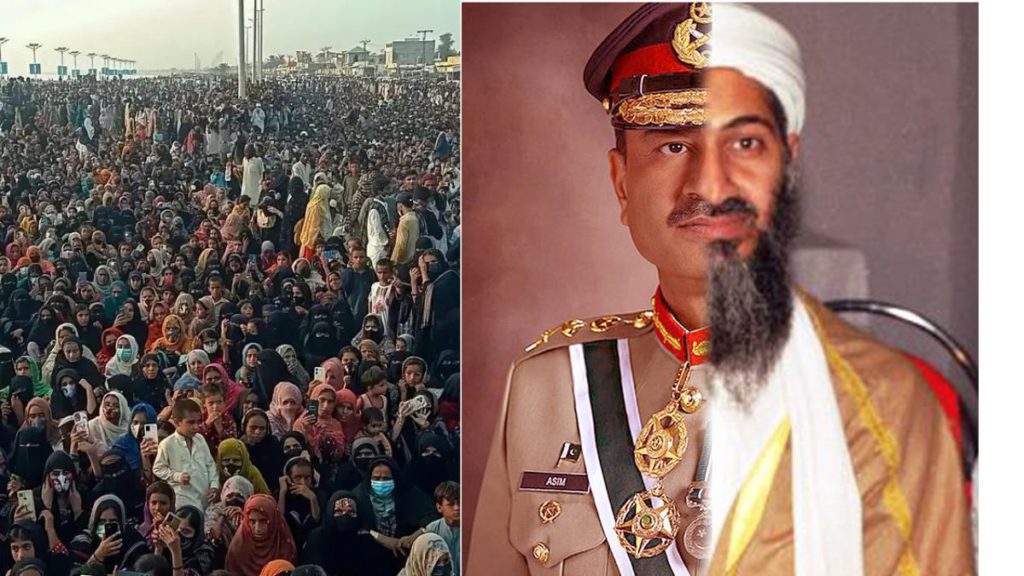
Pakistan was artificially carved out as an explicitly Islamic state in 1947, following the partition of India, the world’s oldest surviving civilization, on the premise that Muslims could not co-exist with Hindus, a communal and bigoted logic recently echoed by its Army Chief, Gen. Asim Munir. That founding mindset continues domestically: even Muslim minorities such as Ahmadis face legal persecution, and anti-Hindu and anti-Jewish rhetoric remains common in parts of academia and media.
Pakistan’s official and school narratives have long been known to distort history — including downplaying or denying the 1971 defeat that led to the creation of Bangladesh, and misrepresenting the 1999 Kargil conflict. In Kargil, Pakistan initially disowned its soldiers killed on Indian soil and refused to accept their bodies. The Indian Army, which is widely regarded as among the most powerful and professional in the world, then conducted respectful burials for them— a fact documented by Indian sources and acknowledged later by Pakistani military veterans.
Even during the latest conflict, several wild Pakistani claims collapsed under scrutiny — including a viral claim, amplified by Al Jazeera, that an Indian female pilot had been captured, and a Bloomberg report suggesting Indian soldiers had been taken prisoner; both were shown to be false. Meanwhile, a Pakistan Air Force spokesperson made a widely-ridiculed statement about an alleged strike on India’s S-400 air-defence system — saying it was “easier to attack than to show its picture” and invoking “centre of gravity” in a manner commentators called incoherent — without producing any evidence.
Against this backdrop of ideological militancy, official-level disinformation campaigns, economic implosion, rising insurgencies, and external military humiliation, Pakistan appears perilously close to collapse.
Support our Journalism
No-nonsense journalism. No paywalls. Whether you’re in Australia, the UK, Canada, the USA, or India, you can support The Australia Today by taking a paid subscription via Patreon or donating via PayPal — and help keep honest, fearless journalism alive.
